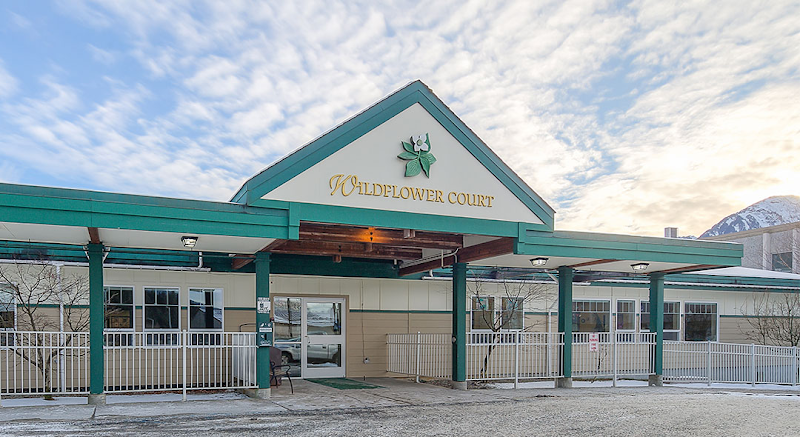
WILDFLOWER COURT

2000 SALMON CREEK LANE, JUNEAU, AK 99801 (907) 463-8700
Government - City/county 57 Beds Independent Data: November 2025
Trust Grade
70/100
#12 of 20 in AK
Last Inspection: May 2025

Inspected within the last 6 months. Data reflects current conditions.

Overview

Wildflower Court in Juneau, Alaska, has a Trust Grade of B, indicating it is a good choice for care, although it ranks #12 out of 20 facilities in the state, placing it in the bottom half of options available. However, it holds the top position in Juneau County, meaning it is the best local choice. The facility is showing improvement over time, with a decrease in issues from 13 in 2024 to 9 in 2025. Staffing is a strong point, rated 5 out of 5 stars, with a turnover rate of 46%, which is on par with the state average. There have been no fines, and while RN coverage is average, the facility has faced some concerns, such as nursing staff lacking current training for safe oxygen handling and not ensuring food safety standards, which could affect residents' well-being. Overall, while Wildflower Court has its strengths, families should consider these issues as part of their decision-making process.

Trust Score
B
70/100
In Alaska
#12/20
Bottom 40%
Safety Record
Low Risk
No red flags
Inspections
Getting Better
13 → 9 violations
Staff Stability
⚠ Watch
46% turnover. Above average. Higher turnover means staff may not know residents' routines.
Penalties
✓ Good
No fines on record. Clean compliance history, better than most Alaska facilities.
Skilled Nurses
✓ Good
Each resident gets 114 minutes of Registered Nurse (RN) attention daily — more than 97% of Alaska nursing homes. RNs are the most trained staff who catch health problems before they become serious.
Violations
⚠ Watch
37 deficiencies on record. Higher than average. Multiple issues found across inspections.
★★★★☆
4.0
Overall Rating
★★★★★
5.0
Staff Levels
★★★★☆
4.0
Care Quality
★★★☆☆
3.0
Inspection Score
Stable
2024: 13 issues
2025: 9 issues

The Good

  • 5-Star Staffing Rating · Excellent nurse staffing levels
  • 4-Star Quality Measures · Strong clinical quality outcomes
  • Full Sprinkler Coverage · Fire safety systems throughout facility
  • No fines on record

Facility shows strength in staffing levels, quality measures, fire safety.

The Bad

Staff Turnover: 46%

Near Alaska avg (46%)

Higher turnover may affect care consistency

The Ugly 37 deficiencies on record

May 2025 9 deficiencies
CONCERN (D)

Potential for Harm - no one hurt, but risky conditions existed

Deficiency F0554 (Tag F0554)

Could have caused harm · This affected 1 resident

. Based on record review, observation, and interview, the facility failed to ensure 1 resident (#49), out of 5 residents observed for medication administration, was appropriately assessed for safe sel...

Read full inspector narrative →
. Based on record review, observation, and interview, the facility failed to ensure 1 resident (#49), out of 5 residents observed for medication administration, was appropriately assessed for safe self-administration of medications. This failed practice placed the resident at risk of medication errors and adverse outcomes. Findings: Record review on 5/7/25 revealed Resident #49 was admitted to the facility with diagnoses that included cellulitis of the right lower limb (a bacterial skin infection causing redness, swelling, and pain), other chronic pain, and arthritis of the right knee due to other bacteria (inflammation of the joints that causes pain, stiffness, and swelling). An observation on 5/6/25 at 12:14 PM, revealed a medication cup containing two tablets of Tylenol sitting on Resident #49's bedside table. Review of Resident #49's Electronic Medication Administration Record (EMAR), dated 5/6/25, revealed an entry which documented that two tablets of Tylenol were administered at 12:00 PM. During an interview on 5/6/25 at 12:29 PM, Resident #49 stated the nurses usually left his/her medications in his/her room. He/she would take the two Tylenol with lunch or sometimes he/she would take it later. An observation on 5/7/25 at 9:00 AM, revealed Licensed Nurse (LN) #4 prepared and administered medications for Resident #49. LN #4 handed the resident a medication cup containing 9 medications, asked the resident to rate his/her pain level, and then exited the room. LN #4 did not observe the resident to ensure he/she ingested the medications. The medications included a controlled substance, oxycodone (an opioid pain medication used to treat moderate to severe pain, with potential for abuse and dependence). Further observation revealed the medications that were left with the resident, without being observed as being taken, were: - Entresto (a medication used to treat heart failure) 49mg/51mg tablet; - Eliquis (a blood thinner used to reduce risk of stroke and blood clots) 5mg tablet; - Allopurinol (a medication used for gout and kidney stone prevention) 100mg tablet; - Florastor (a probiotic used to promote gut health) 250mg capsule; - Metoprolol succinate (a medication used to treat high blood pressure, heart failure, and to reduce heart rate) ER (extended release) 50mg tablet; - Jardiance (a medication that lowers blood sugar) 10mg tablet; - Eplerenone (a medication used to treat high blood pressure and/or heart failure) 25mg tablet; - Torsemide (a medication used to reduce fluid buildup in the body) 20mg tablet; and - Oxycodone (a federally controlled substance, opioid pain medication) 5mg tablet. During an interview on 5/7/25 at 11:00 AM, LN #4 stated, [Resident # 49] takes the medications [himself/herself]. [He/She] is very independent, so we don't stand over [him/her]. There is an order to leave the medication with [him/her]. During an interview on 5/7/25 at 2:55 PM, when asked if it was appropriate for the LN's to leave medication with the residents, the Director of Nursing (DON) stated there was, No medication the nurse should walk away from . The nurse should watch the resident swallow the medication. When asked to provide a medication self-administration assessment or a physician's order authorizing medications to be left with Resident #49, the facility was unable to provide either document. Record review of Resident #49's current care plan, undated, revealed no documentation of Resident #49 being able to self-administer his/her own medications. Record review of Resident #49's PHYSICIAN ORDERS FOR 05/07/2025, revealed no orders for self-administered medications. Review of the facility's policy Administering Medications, dated 11/6/23, revealed: Residents may self-administer their own medications only if the attending physician, in conjunction with the interdisciplinary care planning team, has determined that they have the decision-making capacity to do so safely. .
CONCERN (D)

Potential for Harm - no one hurt, but risky conditions existed

Comprehensive Care Plan (Tag F0656)

Could have caused harm · This affected 1 resident

. Based on record review, observation, and interview, the facility failed to ensure the care plan was implemented for 1 resident (#40), out of 14 sampled residents. Specifically, a Certified Nurse Aid...

Read full inspector narrative →
. Based on record review, observation, and interview, the facility failed to ensure the care plan was implemented for 1 resident (#40), out of 14 sampled residents. Specifically, a Certified Nurse Aide (CNA #2) failed to follow Resident #40's care plan for basic care needs while assisting the resident out of bed to the toilet. This failed practice had the potential to injure the resident and negatively impact the resident's physical well-being. Findings: Record review during 5/5-9/25 revealed Resident #40 was admitted to the facility with diagnoses that included anoxic brain damage (a brain injury that occurs when the brain is deprived of oxygen), and other reduced mobility. The resident also used ankle-foot orthoses (AFOs, devices designed to support the foot and ankle) to help him/her stand and perform transfers. Review of Resident #40's Care Plan, with a start date of 4/15/25, revealed: Approach . TRANSFERS: I need 2 PEOPLE to assist with my transfers. Sara Steady and 2-person extensive assist . TOILETING: I need 2 PEOPLE to assist with my toileting for using the flush toilet . An observation and concurrent interview on 5/5/25, at 2:58 PM, revealed upon entering Resident #40's room, a Hoyer lift (a lift device designed to assist caregivers in safely transferring residents with limited mobility) was obstructing the room's internal entryway. Also, Resident #40 was laying down in bed, with the head of the bed elevated to approximately 45 degrees and the upper quarter side rails were raised. A Sara Steady device was positioned by the side of the bed. CNA #2 was standing with his/her feet firmly planted, leaning forward while holding the resident by the wrists. The CNA then leaned backward and used a tugging motion to assist the resident up into a seated position as the resident simultaneously twisted toward the bed's edge, with his/her face briefly resting on the side rail. After achieving a seated position, CNA #2 released the resident's wrists. The resident then adjusted his/her position by slightly swinging both feet back and forth, which were fitted with AFOs, and scooted his/her bottom toward the Sara Steady. With the resident's feet positioned on the Sara Steady, CNA #2 assisted the resident with grasping the support bar, and the resident proceeded to stand. Further observation revealed CNA #2 transported the resident to the bathroom. Resident #40 was positioned in front of the toilet. The CNA took down the resident's brief, and the resident lowered himself/herself shakily down to the toilet with no assistance. Next, CNA #2 hung several wet wipes from the bar of the Sara Steady that was parked in front of the resident. Afterwards, CNA #2 closed the bathroom door partially and went to make the resident's bed. While making the bed, CNA #3 stuck his/her head in the room and told CNA #2 that the tub will be available for Resident #40 at 4:00 PM. Afterwards, CNA # 2 and #3 both left the room while the resident was still on the toilet. Outside in the hallway, CNA #2 stated Resident #40 was good about pulling the call light when he/she finished and went on to further explain how different locations in a resident's room will make a different alert noise based on different initiation of call lights. CNA #2 then went back into the room stating he/she needed to make the bed. During an interview on 5/8/25 at 9:31 AM, the Director of Nursing (DON) stated that CNA's were trained on transferring residents and lift devices during orientation. She further stated Resident #40 was a 2-person assist, and staff should never pull on residents while assisting them. During an interview on 5/9/25 at 10:25 AM, CNA #4 stated that Resident #40 was always a 2 person assist out of bed and to the toilet. Review of the facility's policy Safe Patient Movement and Handling, undated, revealed: . It is the duty of each employee to take reasonable care of their own health and safety as well as that of their co-workers and of patients during patient handling activities . .
CONCERN (D)

Potential for Harm - no one hurt, but risky conditions existed

Quality of Care (Tag F0684)

Could have caused harm · This affected 1 resident

. Based on record review, observation, and interview, the facility failed to ensure 1 resident (#40), out of 14 sampled residents received quality care. Specifically,1) a Certified Nurse Aide (CNA #2)...

Read full inspector narrative →
. Based on record review, observation, and interview, the facility failed to ensure 1 resident (#40), out of 14 sampled residents received quality care. Specifically,1) a Certified Nurse Aide (CNA #2) failed to follow 2 person assist during a transfer and toileting as specified in the comprehensive care plan; 2) CNA #2 did not safely handle the resident during transfer; and 3) the internal doorway to Resident #40's room was obstructed. This failed practice had the potential to place the resident at risk of injury and negatively impact the resident's physical health and well-being. Findings: Record review during 5/5-9/25 revealed Resident #40 was admitted to the facility with diagnoses that included anoxic brain damage (a brain injury that occurs when the brain is deprived of oxygen), and other reduced mobility. The resident also used ankle-foot orthoses (AFOs, devices designed to support the foot and ankle) to help him/her stand and perform transfers. Review of Resident #40's Care Plan, with a start date of 4/15/25, revealed: Approach . TRANSFERS: I need 2 PEOPLE to assist with my transfers. Sara Steady and 2-person extensive assist . TOILETING: I need 2 PEOPLE to assist with my toileting for using the flush toilet . An observation and concurrent interview on 5/5/25, at 2:58 PM, revealed upon entering Resident #40's room, a Hoyer lift (a lift device designed to assist caregivers in safely transferring residents with limited mobility) was obstructing the room's internal entryway. Also, Resident #40 was laying down in bed, with the head of the bed elevated to approximately 45 degrees and the upper quarter side rails were raised. A Sara Steady device was positioned by the side of the bed. CNA #2 was standing with his/her feet firmly planted, leaning forward while holding the resident by the wrists. The CNA then leaned backward and used a tugging motion to assist the resident up into a seated position as the resident simultaneously twisted toward the bed's edge, with his/her face briefly resting on the side rail. After achieving a seated position, CNA #2 released the resident's wrists. The resident then adjusted his/her position by slightly swinging both feet back and forth, which were fitted with AFOs, and scooted his/her bottom toward the Sara Steady. With the resident's feet positioned on the Sara Steady, CNA #2 assisted the resident with grasping the support bar, and the resident proceeded to stand. Further observation revealed CNA #2 transported the resident to the bathroom. Resident #40 was positioned in front of the toilet. The CNA took down the resident's brief, and the resident lowered himself/herself shakily down to the toilet with no assistance. Next, CNA #2 hung several wet wipes from the bar of the Sara Steady that was parked in front of the resident. Afterwards, CNA #2 closed the bathroom door partially and went to make the resident's bed. While making the bed, CNA #3 stuck his/her head in the room and told CNA #2 that the tub will be available for Resident #40 at 4:00 PM. Afterwards, CNA # 2 and #3 both left the room while the resident was still on the toilet. Outside in the hallway, CNA #2 stated Resident #40 was good about pulling the call light when he/she finished and went on to further explain how different locations in a resident's room will make a different alert noise based on different initiation of call lights. CNA #2 then went back into the room stating he/she needed to make the bed. During an interview on 5/8/25 at 9:31 AM, the Director of Nursing (DON) stated that CNA's were trained on transferring residents and lift devices during orientation. She further stated Resident #40 was a 2-person assist, and staff should never pull on residents while assisting them. In addition, resident doorways should remain clear because resident safety was a priority. During an interview on 5/9/25 at 10:25 AM, CNA #4 stated when a Hoyer lift was needed inside of a resident's room, he/she would park it by the end of the resident's bed or in the bathroom, but never in front of the door where it could block someone from coming in to help. CNA #4 further stated that Resident #40 was always a 2 person assist out of bed and to the toilet. Review of the facility's policy Safe Patient Movement and Handling, undated, revealed: . It is the duty of each employee to take reasonable care of their own health and safety as well as that of their co-workers and of patients during patient handling activities . .
CONCERN (D)

Potential for Harm - no one hurt, but risky conditions existed

Accident Prevention (Tag F0689)

Could have caused harm · This affected 1 resident

**NOTE- TERMS IN BRACKETS HAVE BEEN EDITED TO PROTECT CONFIDENTIALITY** . Based on record review, observation, and interview, the facility failed to ensure residents' environment remains free of accid...

Read full inspector narrative →
**NOTE- TERMS IN BRACKETS HAVE BEEN EDITED TO PROTECT CONFIDENTIALITY** . Based on record review, observation, and interview, the facility failed to ensure residents' environment remains free of accident hazards. Specifically, the facility failed to ensure: 1) resident's room internal entryway was not obstructed for 1 resident (#40), out of 14 sampled residents; and 2) 1 exit door, out of 11 possible exit doors, was secured to prevent elopement of 6 residents (#'s 9, 1, 14, 20, 34, and 41), out of 53 residents (total census) who were at risk of wandering. This failed practice: 1) placed the resident at risk of delay in timely assistance in his/her room in emergency situations; and 2) placed residents who wandered at risk for unsafe situations if they eloped from the facility. Findings: Blocked Doorway Record review during 5/5-9/25 revealed Resident #40 was admitted to the facility with diagnoses that included anoxic brain damage (a brain injury that occurs when the brain is deprived of oxygen), and other reduced mobility. An observation on 5/5/25 at 2:58 PM, when this surveyor opened the door to Resident #40's room, revealed a Hoyer lift (a lift device designed to assist caregivers in safely transferring residents with limited mobility) was positioned on the opposite side of the door, which obstructed the room's door from opening fully. To access the room, this surveyor had to step over the Hoyer lift's legs and slide into the room sideways through the small space available. It was noted there were other open areas away from the entryway in the room where the lift could have been positioned. During an interview on 5/5/25 at 3:10PM, Certified Nurse Aide (CNA) #2 stated Resident #40 used a Hoyer lift to get into his/her wheelchair for a shower. During an interview on 5/9/25 at 10:25 AM, CNA #4 stated that when a Hoyer lift was needed inside of a resident's room, he/she would park it by the end of the resident's bed or in the bathroom, but never in front of the door as it could delay help in cases of emergency. During an interview on 5/8/25 at 9:31 AM, the Director of Nursing (DON) stated the resident doorways should have remained clear of obstruction because the resident's safety was a priority. Review of the facility's policy Safe Patient Movement and Handling, undated, revealed: . It is the duty of each employee to take reasonable care of their own health and safety as well as that of their co-workers and of patients during patient handling activities . Risk of elopement Review of the facility-provided list Wildflower Court Resident's at Risk for Elopement, date revised 4/24/25, revealed six residents (#'s 9, 1, 14, 20, 34, and 41) were listed with pictures. This list was available for the front desk staff to identify residents that may wander out of the main door. Random observations on 5/5-9/25 revealed Resident #41 was actively wandering around the facility. Record review on 5/5-9/25, Resident #41 was admitted to the facility with diagnosis of dementia (a decline in cognitive functioning including memory, thinking and reasoning). Review of Resident #41's physician's order, dated 11/22/24, revealed: Check Roam Alert Tag [a system that triggers an alarm when a resident approaches a monitored exit door] . Review of Resident #41's care plan, dated 4/9/25, revealed: . [Resident #41] is at risk for elopement . from anxiety, as evidenced by panic, exit seeking, pacing and trembling. [Resident #41] will remain safe within the facility. Review of the facility's reported incident (FRI) to the State of Alaska Health Facilities Licensing and Certification (HFLC) office, revealed Resident #41 eloped from the facility on 12/9/24 through a door going out of Cranberry Unit. Further review of the report revealed: .during the investigation it was found that the door the resident used to go out had a locking failure. An observation on 5/7/25 at 3:10 PM, revealed Resident #41, who was accompanied by Home Attendant (HA) #1, was going back to the [NAME] Unit, which was Resident #41's home unit. The staff stated he/she found Resident #41 in the main hallway by the Cranberry Unit. The Cranberry Unit is located on the opposite side of the of the facility away from the [NAME] Unit. An observation on 5/7/25 at 3:12 PM, revealed while CNA #1 demonstrated the operation of the wander guard alarm system on the [NAME] Unit's main door, Resident #41 wheeled himself/herself down the [NAME] hallway through the door that went into the Salmonberry Unit. No alarm/lock system was triggered. CNA #1 reported there was no alarm or locking system on the [NAME] door leading to Salmonberry, allowing residents to move freely throughout the two units. Further observation revealed Resident #41 wheeled himself/herself up to the front desk, which was by the building's main entrance. An observation and concurrent interview on 5/7/25 at 4:00 PM, revealed Licensed Nurse (LN) #7 accompanied the surveyor to inspect all exits when asked about the functionality of the wander guard alarm and locking system throughout the facility. During the inspection, it was noted that the door in the activity room kitchen lacked a wander guard locking or alarm system. LN #7 confirmed that the door had neither a locking system nor an alarm. Additionally, a no exit sign was observed above the door, which led to the outside. The door had a doorknob that could be opened from the kitchen, providing access to the outside. When asked if a resident with wander guard could exit through this door, LN #7 acknowledged this possibility and stated that it could be reported to the facility's maintenance team. During this observation, in the activity room, a piano session was in progress, with several residents listening to the music. Review of the attendance sheet of the piano session on 5/7/25, revealed Resident # 41 was on the list. Review of the facility's policy Wandering and elopements, dated 12/6/23, revealed checking the security of all exit doors was not included. .
CONCERN (D)

Potential for Harm - no one hurt, but risky conditions existed

Unnecessary Medications (Tag F0759)

Could have caused harm · This affected 1 resident

. Based on observation and interview, the facility failed to ensure the medication error rate was below 5%. The medication error rate was 36%. 9 medication administration errors were identified, out ...

Read full inspector narrative →
. Based on observation and interview, the facility failed to ensure the medication error rate was below 5%. The medication error rate was 36%. 9 medication administration errors were identified, out of 25 opportunities, during medication administration observations. This failed practice placed the resident at risk for adverse medication effects. Findings: Record review on 5/7/25 revealed Resident #49 was admitted to the facility with diagnoses that included cellulitis of the right lower limb (a bacterial skin infection causing redness, swelling, and pain), other chronic pain, and arthritis of the right knee due to other bacteria (inflammation of the joints that causes pain, stiffness, and swelling). An observation on 5/7/25 at 9:00 AM, revealed Licensed Nurse(LN) #4 prepared and administered medications for Resident #49. LN #4 handed the resident a medication cup containing the following 9 medications: - Entresto (a medication used to treat heart failure) 49mg-51mg tablet; - Eliquis (a blood thinner used to reduce risk of stroke and blood clots) 5mg tablet; - Allopurinol (a medication used for gout and kidney stone prevention) 100mg tablet; - Florastor (a probiotic used to promote gut health) 250mg capsule; - Metoprolol succinate (a medication used to treat high blood pressure, heart failure, and to reduce heart rate) ER (extended release) 50mg tablet; - Jardiance (a medication that lowers blood sugar) 10mg tablet; - Eplerenone (a medication used to treat high blood pressure and/or heart failure) 25mg tablet; - Torsemide (a medication used to reduce fluid buildup in the body) 20mg tablet; and - Oxycodone (a federally controlled substance, opioid pain medication) 5mg tablet, as needed. LN #4 asked the resident to rate his/her pain level and then exited the room. LN #4 did not observe the resident to ensure he/she ingested the medications. During an interview on 5/7/25 at 11:00 AM, LN #4 stated, [Resident #49] takes the medications [himself/herself]. [He/She] is very independent, so we don't stand over [him/her] . There is an order to leave the medication with [him/her]. During an interview on 5/7/25 at 2:55 PM, when asked if it was appropriate for the LN's to leave medication with the residents, the Director of Nursing (DON) stated there was, No medication the nurse should walk away from and The nurse should watch the resident swallow the medication. When asked to provide a medication self-administration assessment or a physician's order authorizing medications to be left with Resident #49, the facility was unable to provide either document. Review of Resident #49's MEDICATION RECORD FOR 05/2025 revealed 4 medications (Entresto, Eliquis, Allopurinol, and Florastor) were recorded on 5/7/25 as administered at 8:00 AM, and the remaining 5 medications (Metoprolol, Jardiance, Eplerenone, Torsemide and Oxycodone 5mg) were recorded as administered at 9:00AM. Record review of the facility's policy Administering Medications, dated 11/6/23, revealed: .As required or indicated for a medication, the individual administering the medication records in the resident's medical record: a. the date and time the medication was administered. Review of the facility's policy Resident Self-Administration of Medications, dated 11/9/23, revealed: Residents have the right to self-administer medications if the interdisciplinary team has determined that it is clinically appropriate and safe for the resident to do so . .
CONCERN (E)

Potential for Harm - no one hurt, but risky conditions existed

Deficiency F0697 (Tag F0697)

Could have caused harm · This affected multiple residents

. Based on record review and interview, the facility failed to ensure that residents who received opioid pain medications (a class of strong pain-relieving medications that act on the nervous system,...

Read full inspector narrative →
. Based on record review and interview, the facility failed to ensure that residents who received opioid pain medications (a class of strong pain-relieving medications that act on the nervous system, with potential for dependence, overdose, and serious side effects) were re-evaluated for pain for 11 residents (#1, #2, #6, #12, #20, #24, #26, #37, #49, #51, and #259), out of 53 residents reviewed for pain management. Specifically, the facility failed to re-evaluate the residents' pain level within 30 to 60 minutes following opioid administration. This failed practice had the potential to result in unrelieved pain, delayed identification of medication ineffectiveness, or overmedication. Findings: Resident #1 Record review on 5/5-9/25 revealed Resident #1 was admitted to the facility with diagnoses that included cerebral palsy (a group of neurological disorders that affect movement and muscle tone), hemiplegia (paralysis on one side of the body), and anxiety disorder. Review of Resident #1's Electronic Medication Administration Record (eMAR) and clinical progress notes revealed the Resident received an opioid pain medication: .Hydrocodone 5 mg-acetaminophen 325 mg tablet.as needed for severe back & hip pain, from 4/19/25 through 5/8/25. Further review revealed 25 instances in which opioid medications were administered, but no documentation of a pain reassessment was found within 30 to 60 minutes following administration. Resident #2 Record review on 5/5-9/25 revealed Resident #2 was admitted to the facility with diagnoses that included post-traumatic stress disorder (PTSD), neurogenic bladder (a condition where nerve damage affects bladder control), and heart failure (a chronic condition where the heart cannot pump blood effectively). Review of Resident #2's eMAR and clinical progress notes revealed the Resident received an opioid pain medication: .Norco 5 mg-325 mg tablet.as needed.for pain, from 4/16/25 through 5/5/25. Further review revealed two instances in which opioid medications were administered, but no documentation of pain reassessment was found within 30 to 60 minutes following administration. Resident #6 Record review on 5/5-9/25 revealed Resident #6 was admitted to the facility with diagnoses that included depression, renal insufficiency (impaired kidney function that affects waste elimination and fluid balance), and anemia (a condition marked by low red blood cell count or hemoglobin, leading to fatigue and weakness). Review of Resident #6's eMAR and clinical progress notes revealed the Resident received opioid pain medications: .Oxycodone 5mg tablet.Oxycodone 15 mg tablet.as needed for pain, from 4/20/25 through 5/9/25. Further review revealed 37 instances in which opioid medications were administered, but no documentation of pain reassessment was found within 30 to 60 minutes following administration. Resident #12 Record review on 5/5-9/25 revealed Resident #12 was admitted to the facility with diagnoses that included peripheral vascular disease (narrowing of blood vessels outside of the heart and brain, causing poor circulation), heart failure, and anemia. Review of Resident #12's eMAR and clinical progress notes revealed the Resident received an opioid pain medication: .Tylenol-Codeine #3 300mg-30 mg tablet.PRN (as needed) for DJD [degenerative joint disease] knee pain, from 4/17/25 through 5/8/25. Further review revealed 25 instances in which opioid medications were administered, but no documentation of pain reassessment was found within 30 to 60 minutes following administration. Resident #20 Record review on 5/5-9/25 revealed Resident #20 was admitted to the facility with diagnoses that included multiple sclerosis (a progressive disease of the central nervous system affecting movement, sensation, and coordination), dementia (a decline in memory and cognitive ability that interferes with daily function), and neurogenic bladder. Review of Resident #20's eMAR and clinical progress notes revealed the Resident received an opioid pain medication: .Percocet 5 mg-325 mg tablet.as needed for pain, from 4/2/25 through 5/8/25. Further review revealed 17 instances in which opioid medications were administered, but no documentation of pain reassessment was found within 30 to 60 minutes following administration. Resident #24 Record review on 5/5-9/25 revealed Resident #24 was admitted to the facility with diagnoses that included schizophrenia (a serious mental disorder affecting perception, thought, and behavior) and PTSD. Review of Resident #24's eMAR and clinical progress notes revealed the Resident received an opioid pain medication: . Oxycodone 5 mg tablet.as needed for pain, from 4/23/25 through 5/3/25. Further review revealed 36 instances in which opioid medications were administered, but no documentation of pain reassessment was found within 30 to 60 minutes following administration. Resident #26 Record review on 5/5-9/25 revealed Resident #26 was admitted to the facility with diagnoses that included hemiplegia, seizure disorder, and depression. Review of Resident #26's eMAR and clinical progress notes revealed the Resident received an opioid pain medication: .Oxycodone 5 mg tablet.as needed for pain, from 4/19/25 through 5/8/25. Further review revealed 10 instances in which opioid medications were administered, but no documentation of pain reassessment was found within 30 to 60 minutes following administration. Resident #37 Record review on 5/5-9/25 revealed Resident #37 was admitted to the facility with a diagnosis of anxiety disorder. Review of Resident #37's eMAR and clinical progress notes revealed the Resident received an opioid pain medication: .Oxycodone 5 mg tablet.as needed for pain, from 4/11/25 through 5/9/25. Further review revealed seven instances in which opioid medications were administered, but no documentation of pain reassessment was found within 30 to 60 minutes following administration. Resident #49 Record review on 5/5-9/25 revealed Resident #49 was admitted to the facility with diagnoses that included cellulitis (a bacterial skin infection causing redness, swelling, and pain) of the right lower limb, chronic pain, and arthritis (inflammation of one or more joints causing pain, stiffness, and reduced mobility) of the right knee. Review of Resident #49's eMAR and clinical progress notes revealed the Resident received an opioid pain medication: .Oxycodone 5 mg tablet.as needed for septic arthritis, from 4/22/25 through 5/9/25. Further review revealed 44 instances in which opioid medications were administered, but no documentation of pain reassessment was found within 30 to 60 minutes following administration. Resident #51 Record review on 5/5-9/25 revealed Resident #51 was admitted to the facility with diagnoses that included paraplegia, anxiety disorder, and neurogenic bladder. Review of Resident #51's eMAR and clinical progress notes revealed the Resident received an opioid pain medication: .Endocet 5 mg-325 mg tablet.PRN for pain, from 4/20/25 through 5/9/25. Further review revealed 62 instances in which opioid medications were administered, but no documentation of pain reassessment was found within 30 to 60 minutes following administration. Resident #259 Record review on 5/5-9/25 revealed Resident #259 was admitted to the facility with diagnoses that included neurogenic bladder and multiple sclerosis. Review of Resident #259's eMAR and clinical progress notes revealed the Resident received opioid pain medications: . Norco 5mg-325 mg tablet. as needed for pain. Dilaudid 2mg tablet. as needed for severe pain, from 4/12/25 through 5/9/25. Further review revealed 14 instances in which opioid medications were administered, but no documentation of pain reassessment was found within 30 to 60 minutes following administration. During an interview on 5/9/25 at 4:35 PM, the Director of Nursing (DON) stated that nurses were to perform pain reassessments within 30 to 60 minutes after administering pain medications. Review of the facility policy, Administering Pain Medications, dated 12/17/23, revealed: . Re-evaluate the resident's level of pain 30-60 minutes after administering. Review of an article from the U.S. Government's National Library of Medicine: Improving the Quality of Care Through Pain Assessment and Management, accessed at: https://www.ncbi.nlm.nih.gov/books/NBK2658/#:~:text=Assessment%20of%20effect%20should%20be,45%E2%80%9360%20minutes%20after%20administration. revealed: .Assessment of effect should be based upon the onset of action of the drug administered.oral opioids and nonopioids are reassessed 45-60 minutes after administration. .
CONCERN (F)

Potential for Harm - no one hurt, but risky conditions existed

Deficiency F0726 (Tag F0726)

Could have caused harm · This affected most or all residents

**NOTE- TERMS IN BRACKETS HAVE BEEN EDITED TO PROTECT CONFIDENTIALITY** . Based on record review and interview, the facility failed to ensure nursing staff have the specific competencies and skills s...

Read full inspector narrative →
**NOTE- TERMS IN BRACKETS HAVE BEEN EDITED TO PROTECT CONFIDENTIALITY** . Based on record review and interview, the facility failed to ensure nursing staff have the specific competencies and skills set necessary to care for residents' needs. Specifically, the facility failed to ensure: 1) 6 Licensed Nurses (LN #'s 1, 2, 3, 4, 5, and 6), out of 15 LN personnel files reviewed, had current training for safe oxygen handling; and 2) 1 Certified Nurse Aide (CNA #1), out of 3 CNA personnel files reviewed, had a valid Cardiopulmonary resuscitation (CPR) certificate. This failed practice had the potential to place all residents (based on a census of 53) at risk of not receiving the necessary treatment and care and immediate assistance during an emergency. Findings: Oxygen Safety Education During an interview on [DATE] at 3:35 PM, during a review of personnel files, the Human Resources (HR) Manager stated LN #4 had no training for oxygen handling safety. During an interview on [DATE] at 4:33 PM, the Assistant Director of Nursing (ADON) stated oxygen safety education was required annually for all licensed nurses. She stated LN #4 was a traveler nurse and had been to the facility before 2024. Since then, there was no record of oxygen safety training. The ADON stated LN #4 had no designated unit because he/she was a traveler. Review of oxygen safety education documents on [DATE] at 10:13 AM, revealed LN #s 1, 2, 3, and 5 had just completed their training on [DATE]; and LN #4 and #6 had just completed their training on [DATE] (during the survey). During an interview on [DATE] at 10:13 AM, when asked if the training was conducted after the personnel files review on [DATE] at 3:35 PM, the ADON stated, yes. An observation on [DATE] at 11:00 AM, revealed 13 compressed gas cylinders were stored at the Salmonberry unit. During an interview on [DATE] at 1:37 PM, ADON confirmed that there were oxygen tanks in the Salmonberry unit storage reserved for residents who might need oxygen. CPR certification Review of the personnel files on [DATE] at 3:35 PM, the HR Manager stated CNA #1 was hired on [DATE]. Further review revealed CNA #1's personnel file did not contain a CPR certificate. During an interview on [DATE] at 4:20 PM, the HR Manager confirmed that CNA #1 had no CPR certificate since hire. The HR Manager explained that the CNA was enrolled in a CPR class, but the CNA had not completed the course. The HR Manager also added that the Staff Development Office should have followed up with the completion of the course. During an interview on [DATE] at 4:27 PM, when asked if CNA #1 was allowed to work on the floor without a CPR certificate, HR Manager did not answer the question. Review of the facility's Emergency Procedure- Cardiopulmonary Resuscitation, dated [DATE], revealed: Policy statement [:] Personnel have completed training on the initiation of cardiopulmonary resuscitation (CPR). Review of the facility's policy Mandatory Education for All hospital Staff (that the HR Manager confirmed was applicable to Wildflower Court staff as well), dated [DATE], revealed: .F. Mandatory classes and competencies for clinical staff are.BLS (Basic Life Support) is required for all clinical employees providing direct patient care. .
CONCERN (F)

Potential for Harm - no one hurt, but risky conditions existed

Food Safety (Tag F0812)

Could have caused harm · This affected most or all residents

**NOTE- TERMS IN BRACKETS HAVE BEEN EDITED TO PROTECT CONFIDENTIALITY** . Based on observation, interview, and record review, the facility failed to store and prepare food in accordance with professio...

Read full inspector narrative →
**NOTE- TERMS IN BRACKETS HAVE BEEN EDITED TO PROTECT CONFIDENTIALITY** . Based on observation, interview, and record review, the facility failed to store and prepare food in accordance with professional standards for food service safety. Specifically, the facility failed to ensure: 1) expired food was discarded; and 2) the temperature of cooked potentially hazardous food was recorded after cooking. These failed practices had the potential of causing or spreading foodborne illness to all residents, based on a census of 53, who received food from the affected kitchens. Findings: Main Kitchen Observation on 5/5/25 at 10:55 AM, during the initial main kitchen tour with the Director of Nutrition Services (DNS), revealed: 1) Dry Storage: - One- 12-quart clear plastic container with a blue lid and a handwritten label that said, Brown Sugar 5-1-25 which contained two pieces of brown bread on top of the contents in the container. -Four- gallon size plastic bags which contained single servings of Smucker's Apple Butter not labeled with manufactures expiration or best used by date. -One- large clear plastic container with a blue lid labeled, Perfect [NAME] 4/30, no expiration date or best used by date. -One- small clear plastic container with a blue lid labeled, Perfect [NAME] 4/30, no expiration date or best used by date. During an interview on 5/5/25 at 11:10 AM, the DNS stated the bread was placed on top of the brown sugar in the container to keep the sugar from getting hard. The date on the label was when the contents were placed in the container. When the DNS was asked how long the bread was kept, the DNS stated dry goods were on a 2-week rotation. 2) Walk-in Cooler: -One- Arrezzion, Shredded Low Moisture Part Skim Mozzarella Cheese - 5-pound plastic bag- no expiration date, manufacture labeled #2329413, packed 11/11/24 13:13 400. The DNS was not able to provide an expiration date of the cheese. -One- unidentified large clear plastic container was not labeled and not dated. The DNS stated that the container was prepared celery to be used that day. 3) [NAME] Unit Kitchen: -One- expired PORK LOIN CHOPS, CENTER CUT, BONELESS, FROZEN - 16-ounce package- with manufacture best if use by 02/25/2025; -One- expired Johnsonville JALAPENO CHEDDAR Smoked Sausage - 14-ounce package- with manufacture best by date of 4/14/25. 4) Blueberry Unit Kitchen: - One box expired Instant Quaker Original Oatmeal- 10 packets- with manufacture best if used before Apr. [April] 12 25. An observation of the main kitchen dry storage area, on 5/8/25 at 4:10 PM, revealed a 12-quart clear plastic container with a blue lid and a handwritten label that said, Brown Sugar 5-1-25, which contained multiple pieces of brown bread on top of the contents in the container. Review of Sysco Food Safety & Quality Assurance, Customer Specification, for Mozzarella Cheese, revised 4/29/25, revealed: . 2329413 . ARREZZION . Shred Low Moisture Part Skim Mozzarella Cheese .5 pound . Shelf Life . Dry and Refrigerated 90 Days . Review of the facility's policy HOW TO: Properly Store Food, dated 2019, revealed: Label & Date All Stored Food . Review of the facility's policy Food Storage, Handling and Preparation, undated, revealed: Purpose: All foods will be stored, prepared, cooked and served using appropriate practices and procedures to ensure safety . Policy: A. Foods are stored, handled and prepared by safe methods that conserve nutritive value. Review of the facility's POSITION DESCRIPTION, dated 3/29/23, revealed: . [NAME] II . Ensures proper food storage procedures are being followed in all coolers, freezers and food storage areas . Follows all health department guidelines for safe handling of food . Review of the facility's POSITION DESCRIPTION, dated 11/21/24, revealed: . Director of Nutrition Services . This position independently manages the full food service and nutritional operations and assists with . patient and staff dietary needs for the. Wildflower Court . The Director of Nutrition Services is responsible for planning, coordination, staffing. of the Dietary Department. coordinate employee training, maintain effective communication, and participate in teaching and directing staff .Establishes and maintains standards of food . storage, sanitation, safety. Develops and mentors' staff . Makes department rounds to identify issues; observes and coaches staff . Education: Facilitates the education necessary for staff to perform competently . Must comply with all workplace health and safety requirements . Potentially Hazardous Cooked Foods During an observation on 5/5/25 at 11:05 AM, of the main kitchen, revealed a poster from the State of Alaska Division of Environmental Health posted on walk-in cooler listed cooking for meat and eggs. Cook to this temperature or hotter: . Poultry 165 [degrees] F [Fahrenheit] . During an interview on 5/5/25 at 11:45 AM, with the Home Attendant (HA) #5 in the Cranberry Unit kitchen, when asked if the HAs took the temperature of the food before serving the resident, HA #5 stated they stopped taking the food temperatures on the unit and that the main kitchen took the temperatures. HA #5 further stated the food steamer was prepared 30 minutes prior to the food arriving from the kitchen. HA #5 stated in order to prepare the steamer, water was put in and the steamer was turned on. HA#5 stated the temperature did not need to be adjusted on the steamer, he/she stated the steamer water needed to be 165 degrees or higher. During an interview on 5/5/25 at 12:10 PM, with HA #6 in the [NAME] Unit kitchen, HA #6 stated the food arrived warm and was served family style. HA #6 further stated the food was not kept in the steamer longer than 2 hours. During an interview on 5/6/25 at 4:05 PM, with HA #4 in the Blueberry Unit kitchen, HA #4 stated the temperature was not adjusted on the steam table. HA #4 further stated he/she took the temperature of the water in the steam table and the temperature was to be 165 degrees or higher. HA #4 stated once food was delivered by the kitchen and placed on the steamer it was served to the residents immediately. HA #4 further stated food was discarded after 1 1/2 to 2 hours. During an observation and concurrent interview on 5/7/25 at 11:20 AM, in the main kitchen, Food Service (FS) staff #1 removed chicken from the oven, FS staff #1 took the temperature with a digital thermometer and stated it was 167 degrees F. FS staff #1 did not document the temperature. FS staff #1 placed the cooked noon meal into metal pans and transferred to the steamer unit. The steamer unit temperature displayed 200 degrees F. During an observation and concurrent interview on 5/7/25 at 11:56 AM, in the main kitchen, FS staff #1 removed the noon meal from the steamer and obtained the temperatures of the food. FS staff #1 read off the temperatures after the recording: Chicken 162 degrees F, ground chicken 156 degrees F and pureed chicken 150 degrees F. FS staff #1 and FS staff #2 stated they were to only record temperatures of the food before it was taken to the dining units. FS staff #1 stated this was a recent change that was directed by management. FS staff #1 further stated the temperatures used to be documented after cooking. FS staff #1 and FS staff #2 stated they continued to take temperatures after cooking to ensure the food reached the recommended temperatures to prevent foodborne illnesses but no longer have a place to document them. When asked what temperature chicken needs to be, FS staff #1 and FS staff #2 stated 165 degrees F or higher. During an interview and concurrent observation on 5/8/25 at 4:15 PM, the DNS stated the cooks have a poster to use for guidance of minimum food temperatures before serving. The DNS further stated the temperature log was to make sure the food was cooked to the minimum temperature before going upstairs. The temperature log was titled Cart Temp Log. During an interview and concurrent observation on 5/9/25 at 11:17 AM, FS staff #2 was asked for the food temperature logs for 5/6-8/25. FS staff #2 stated he/she knew where the documents were located. FS staff #2 retrieved the clipboard that had sheets titled, Cart Temp Log. FS staff #2 stated those requested dates were not on the clipboard. FS staff #2 then started going through a stack of paper on the desk in the main kitchen. FS staff #3 then asked FS staff #2 what he/she was looking for. FS staff #2 stated he/she was looking for temperature logs for 5/6-8/25. FS staff #3 advised FS staff #2 to look in the garbage can by the dishwashing area. FS staff #2 stated the garbage can, FS staff #3 stated the DNS had thrown a bunch of papers in the garbage can previously. FS staff #2 retrieved 5/6-8/25 Cart Temp Log sheets that appeared to be the original documents. This surveyor obtained pictures of the documents as they had been taken out of the garbage can. FS staff #2 kept the original log sheets. Review of the facility's Cart Temp Log revealed: Dated 5/9/25- Chicken 162; Ground 156; Puree 150; Dated 5/8/25 - Chicken no recorded temperature- Ground no recorded temperature- Puree no recorded temperature; Dated 5/4/25- Chicken 164- Ground 162- Puree 162; Dated 5/3/25- Chicken . Ground 161; Puree 162; Dated 5/1/25- Chicken no recorded temperature; Ground 162- Puree 162; Dated 4/29/25- Chicken . Puree 162; Dated 4/23/25- Turkey. Ground 161- Puree 161; Dated 4/20/25- Chicken. Ground 161- Puree 162 . Pizza no recorded temperature- Veg [Vegetable] no recorded temperature- Mash [potatoes] no recorded temperature- Gravy no recorded temperature- Ground no recorded temperature- Puree no recorded temperature. Review of the facility's FOOD TEMP LOG revealed: Dated 4/15/25- Turkey. Puree 161; Dated 4/13/25- Chicken 164- Ground 161- Puree 161; Dated 4/12/25- Turkey. Ground 162- Puree 161; Dated 4/7/25- Turkey. Puree 163; Dated 4/6/25- Chicken 164- Ground 161- Puree 160; Dated 4/5/25- Chicken. Ground 162- Puree 162; Dated 3/31/25- Chicken. Ground 161- Puree 162; Dated 3/28/25- Turkey. Ground 162- Puree 162; Dated 3/26/25- Turkey. Ground 162- Puree 162; Dated 3/25/25- Chicken. Puree 161; Dated 3/23/25- Chicken. Ground 162- Puree 162; Dated 3/19/25- Chicken. Ground 162- Puree 162; Dated 2/23/25- Chicken. Ground 161- Puree 162; Dated 2/19/25- Chicken. Ground 162- Puree 162; Dated 2/17/25- Chicken. Puree 156; Dated 2/15/25 Turkey. Ground 164- Puree 162; Dated 2/12/25- Chicken. Ground 162- Puree 162; Dated 2/11/25- [NAME] no recorded temperature- Chicken no recorded temperature- Veggies no recorded temperature- Mash no recorded temperature- Gravy no recorded temperature- Ground no recorded temperature- Puree no recorded temperature; Dated 2/9/25- Chicken 164- Ground 162- Puree 162; Dated 2/8/25- Chicken. Ground 162- Puree 162; Dated 1/15/25- Chicken 162- Ground 162- Puree 162; Dated 1/12/25- Chicken. Ground 162- Puree 162; Dated 1/11/25- Chicken. Ground 162- Puree 162; Dated 1/9/25- Chicken. Ground 159. Review of the facility's POSITION DESCRIPTION, dated 3/29/23, revealed: . [NAME] II . Follows all health department guidelines for safe handling of food . Completes required documentation for temperatures of food . Must comply with all workplace health and safety requirements . Review of the facility's POSITION DESCRIPTION, dated 11/21/24, revealed: . Director of Nutrition Services . This position independently manages the full food service and nutritional operations and assists with . patient and staff dietary needs for the. Wildflower Court . The Director of Nutrition Services is responsible for the planning, coordination, staffing. of the Dietary Department. coordinate employee training, maintain effective communication, and participate in teaching and directing staff . ensure food is prepared. and served at proper temperatures. Establishes and maintains standards of food . storage, sanitation, safety. Develops and mentors' staff . Makes department rounds to identify issues; observes and coaches staff . Education: Facilitates the education necessary for staff to perform competently . Must comply with all workplace health and safety requirements . Review of the facility's policy Food Storage, Handling and Preparation, undated, revealed: Purpose: All foods will be stored, prepared, cooked and served using appropriate practices and procedures to ensure safety . Policy: A. Foods are stored, handled and prepared by safe methods that conserve nutritive value. H. Potentially hazardous foods requiring cooking are heated to the appropriate temperature and held at that temperature . H.1.1. All poultry, all food made from poultry, all stuffed meats, and the stuffing in them must reach 165 [degrees] F [Fahrenheit] or hotter to destroy Salmonella and other bacteria . H.2.6. Temperatures of foods placed in steam tables or other hot holding units must be taken when the product is placed . Review of Food and Drug Administration (FDA), 2022 Food Code U.S. Food and Drug Administration, dated 12/28/22. Accessed at this link: https://www.fda.gov/media/184685/download?attachment, revealed: 3-401 Cooking, 3-401.11 Raw Animal Foods. (A) . POULTRY, and FOODS containing these raw animal FOODS, shall be cooked to heat all parts of the FOOD to a temperature . (3) 74 C (165 F) or above . .
MINOR (C)

Minor Issue - procedural, no safety impact

Deficiency F0678 (Tag F0678)

Minor procedural issue · This affected most or all residents

**NOTE- TERMS IN BRACKETS HAVE BEEN EDITED TO PROTECT CONFIDENTIALITY** . Based on record review and interview, the facility failed to ensure 1 Certified Nurse Aide (CNA #1), out of 3 CNAs personnel ...

Read full inspector narrative →
**NOTE- TERMS IN BRACKETS HAVE BEEN EDITED TO PROTECT CONFIDENTIALITY** . Based on record review and interview, the facility failed to ensure 1 Certified Nurse Aide (CNA #1), out of 3 CNAs personnel file reviewed, had Cardiopulmonary Resuscitation (CPR) certificate before providing direct patient care. This failed practice had the potential to place all residents (based on a census of 53) at risk of not receiving CPR immediately during an emergency. Findings: Review of facility personnel files on [DATE] at 3:35 PM, revealed the Human Resources (HR) Manager stated CNA #1 was hired on [DATE]. Further review revealed CNA #1's personnel file did not contain a CPR certificate. During an interview on [DATE] at 4:20 PM, the HR Manager confirmed that CNA #1 had no CPR certificate since hire. The HR Manager explained that the CNA was enrolled in the CPR class, but the CNA did not complete the course. The HR Manager also added that the Staff Development Office should have followed up with the completion of the course. During an interview on [DATE] at 4:27 PM, when asked if the CNA was allowed to work on the floor without a CPR certificate, the HR Manager did not answer the question. Review of the facility's policy Emergency Procedure- Cardiopulmonary Resuscitation, dated [DATE], revealed: Policy statement [:] Personnel have completed training on the initiation of cardiopulmonary resuscitation (CPR). Review of the facility's policy Mandatory Education for All hospital Staff (that the HR Manager confirmed was applicable to Wildflower Court staff as well), dated [DATE], revealed: .F. Mandatory classes and competencies for clinical staff are.BLS (Basic Life Support) is required for all clinical employees providing direct patient care. Unit Assignments During an interview on [DATE] at 4:06 PM, the Assistant Director of Nursing (ADON) stated CNA #1 was assigned mostly to the [NAME] unit, but the CNA could be assigned to other units. The ADON further stated CNA #1 was assigned to different units during the orientation period from 9/2024 to [DATE]. A request was made to ADON for CNA #1's unit assignments since his/her hire date ([DATE]), along with the unit census for each assigned unit. This document was not provided at the end of the survey. .
Feb 2024 13 deficiencies
CONCERN (D) 📢 Someone Reported This

A family member, employee, or ombudsman was alarmed enough to file a formal complaint

Potential for Harm - no one hurt, but risky conditions existed

Transfer Notice (Tag F0623)

Could have caused harm · This affected 1 resident

. Based on record review and interview, the facility failed to ensure a copy of the resident's (#6) transfer notice was sent to the Office of the State Long Term Care (LTC) Ombudsman. This failed prac...

Read full inspector narrative →
. Based on record review and interview, the facility failed to ensure a copy of the resident's (#6) transfer notice was sent to the Office of the State Long Term Care (LTC) Ombudsman. This failed practice had the potential to affect all residents, based on a census of 48, by: 1) denying residents the added protection from being inappropriately discharged ; 2) providing the residents with access to an advocate who can inform them of their options and rights; and 3) ensuring the Office of the State LTC Ombudsman was aware of facility practices and activities related to transfers and discharges. Findings: Record review from 2/12-16/24 revealed Resident #6 was admitted to the facility with diagnoses that included stroke and expressive aphasia (the person knows what they want to say but is unable to produce the words or sentence). Further review revealed the resident suffered injuries after an unwitnessed fall in the facility and was hospitalized during the survey. During an interview on 2/15/24 at 2:35 PM, when asked about notifications when a resident was transferred to the hospital, Licensed Nurse (LN) #6, who was acting as the Charge Nurse, stated he/she had not alerted the Ombudsman when a resident was transferred or discharged to the hospital. During an interview on 2/15/24 at 3:00 PM, when asked about the process of alerting the Ombudsman to transfers or discharges, the Director of Nursing (DON) stated she didn't know if the Ombudsman was notified of resident transfers or discharges to the hospital. During an email correspondence with the Office of the Long-Term Care Ombudsman, on 2/15/24 at 4:52 PM, the Ombudsman wrote the facility had not been sending the monthly resident emergency transfer list, and a meeting was scheduled with the facility for the next week to follow up on discharge notices. During an interview on 2/15/24 at 5:14 PM, the Social Worker (SW) stated she had never notified the Ombudsman for the facility-initiated discharges. The SW further stated she spoke with the Ombudsman and set up a meeting to review the notification process. Review of the facility's policy WFC [Wild Flower Court] Facility Initiated Transfer or [Discharge], dated 9/25/23, revealed: When residents who are send emergently to an acute care setting, these scenarios are considered facility-initiated transfers, NOT discharges, because the resident's return is generally expected .Notice of Transfer is provided to the resident and representative as soon as practicable before the transfer and to the long-term care (LTC) ombudsman when practicable (e.g., in a monthly list of residents that includes all notice content requirements). .
CONCERN (D)

Potential for Harm - no one hurt, but risky conditions existed

Comprehensive Care Plan (Tag F0656)

Could have caused harm · This affected 1 resident

. Based on record review, observation, and interview, the facility failed to implement the comprehensive person-centered care plan for 1 resident (#4), out of 14 sampled residents, to repair eyeglasse...

Read full inspector narrative →
. Based on record review, observation, and interview, the facility failed to implement the comprehensive person-centered care plan for 1 resident (#4), out of 14 sampled residents, to repair eyeglasses and ensure the resident had regular eye exams, for proper and ongoing assessments of a known eye condition. This failed practice had the potential to delay treatments to improve eyesight by not scheduling follow up appointments, which could have affected the resident's ability to maintain his/her highest practicable physical, mental, and psychological well-being. Findings: Record review on 2/12-16/24 revealed Resident #4 was admitted to the facility in 2005 with diagnoses that included a traumatic brain injury, seizures, and 3rd nerve palsy of the left eye (partial or complete paralysis of the 3rd cranial nerve, which could result in the eye positioned downward and outward with the inability to move the eye normally. Double vision, enlarged pupil, droopy eyelid, eye misalignment, and tilting head to compensate for abnormal eyesight could also occur). An observation on 2/13/24 at 9:31 AM, revealed Resident #4 was wearing his/her glasses. Further observation revealed his/her glasses had tape over the right hinge of the glasses. Review of Resident #4's care conference notes, dated 12/21/22 through 12/16/23, revealed: . [Resident #4] wears glasses . Further review revealed no documentation that Resident #4's glasses were in need of repair. There was no documentation to indicate an eye appointment had been made or was scheduled during the year. Review of Resident #4's nurse's notes, dated 12/2022 to 2/2024, revealed no documentation that Resident #4's glasses were in need of repair. Review of Resident #4's care plan revealed an identified problem of visual function. Further review revealed: [Resident #4] has impaired vision related to 3rd nerve palsy of left eye. [He/She] wears glasses and denies impaired vision or visual disturbance. The goal for problem was: [Resident #4] will negotiate environment safety and participate in ADLs [activities of daily living] to maximum potential during this review period. Two actions listed under this problem were: 1) Assist/arrange for referral specialist for examination and follow-through as needed; and 2) Check glasses for cleanliness, label, scratches, or need for repair. This problem and all actions were dated 1/5/24. During an interview on 2/16/24 at 10:50 AM, the Director of Nursing (DON) stated the facility was unaware that Resident #4's glasses needed repair. The DON further stated that, after reviewing Resident #4's medical record, the facility could not determine when the last time Resident #4 had been to the ophthalmologist for an eye exam. During an interview on 2/16/24 at 11:00 AM, the Resident Care Coordinator stated this visual function problem had been on Resident #4's care plan since 7/15/16. Review of the facility's policy Care Plan Goals and Objectives, dated 9/28/23, revealed: Care plans shall incorporate goals and objectives that lead to the resident's highest obtainable level of independence . Care plan goals and objectives are defined as the desired outcome for a specific resident problem . Review of the facility's policy WFC [Wildflower Court] Comprehensive Person-Centered Care Plan(s), dated 9/28/23, revealed: A comprehensive, person-centered care plan that includes measurable objectives and timetables to meet the resident's physical, psychological and functional needs is developed and implemented for each resident . The comprehensive, person-centered care plan . describes the services that are to be furnished to attain or maintain the resident's highest practicable physical, mental, and psychological well-being . .
CONCERN (D)

Potential for Harm - no one hurt, but risky conditions existed

Quality of Care (Tag F0684)

Could have caused harm · This affected 1 resident

. Based on record review, interview, and observation, the facility failed to ensure information about a new open area on the skin was communicated to the nurse for 1 resident (#34), out of 14 sampled ...

Read full inspector narrative →
. Based on record review, interview, and observation, the facility failed to ensure information about a new open area on the skin was communicated to the nurse for 1 resident (#34), out of 14 sampled residents. Specifically, the Certified Nursing Assistants (CNAs) failed to communicate to the nurse information about a new non-pressure related wound discovered on Resident #34's sacral area (area at the end of the spine in the pelvic region) during cares. This failed practice placed this resident at risk for further skin breakdown and infection. Findings: Record review from 2/12-16/24 revealed Resident #34 was admitted to the facility with diagnoses that included spinal stenosis (narrowing of the spaces around spinal cord); weakness; and cellulitis (deep infection of the skin). Further review revealed the resident was wheelchair bound. During an interview on 2/12/24 at 10:55 AM, Resident #34 stated his/her sacral area was sore, and the CNAs applied a barrier cream to prevent skin breakdown and repositioned him/her to get pressure off the sacral area while he/she was in bed. During an interview on 2/13/24 at 10:00 AM, Resident #34 stated the pain level in the sacral area was an '8' on a scale of 0 to 10, with '0' being no pain and '10' being severe pain. Resident #34 stated he/she was concerned with skin breakdown and the possibility of pressure ulcer development. During an observation on 2/13/24 at 10:15 AM, CNA #1 and CNA #2 turned and repositioned Resident #34, who was lying in bed, while completing bowel incontinence care. The CNAs and this writer observed a red area above the anus with a small open area with a length of approximately ½ inch. CNA #1 applied a barrier cream to this open, reddened area. Review of Resident #34's medical record on 2/14/24 at 9:00 AM, revealed no documentation concerning the open area noted on Resident #34's skin area above the anus on 2/13/24 at 10:15 AM. During an interview on 2/14/24 at 9:30 AM, Licensed Nurse (LN) #2 and LN #3, when asked if there were any treatments scheduled for Resident #34, stated there were none scheduled. When asked if they were aware of an open area seen yesterday during Resident #34's incontinence care, they stated 'no' they weren't aware of that. The LNs stated the open area had not been mentioned in the morning report, and no treatments had been initiated. This writer explained about the open area observed on 2/13/24. During a continued interview on 2/14/24 at 9:35 AM, LN #3 discussed the open area with CNA #2 who did confirm to LN #3 that there was an open area on Resident #34's sacral area. LN #3 further stated that he/she would have reported this small wound to the charge nurse, LN #4. During an interview on 2/14/24 at 9:37 AM, LN #4 stated he/she would have assessed Resident #34's wound shortly. LN #4 further stated the CNAs who noticed the new open area should have reported to the LN on duty and then this information should have been reported to him/her. During an observation and concurrent interview on 2/14/24 at 9:50 AM, LN #4 and CNA #2 positioned Resident #34 in bed to view the resident's sacral area. After measuring the wound in the sacral area and cleaning the area with normal saline, LN #4 applied calmoseptine to the wound. Physical Therapist (PT) #1 arrived to the room. LN #4 stated to PT #1, There is a fissure [crack] in the skin. There is bleeding. The wound appeared to be about ¼ to 1/2 inch long with small amount of redness surrounding the open area. LN #4 stated, This is not the best spot for a dressing. The skin is split. Resident #34 stated, This is very new. LN #4 stated he/she would call the physician. Record review of an Interdisciplinary Notes, dated 2/14/24, revealed Informed by home LN that an area of open skin was noted to rsds [resident's] sacral region. Area of concern then assessed by this LN. 1 cm [centimeter] long fissure noted at the bottom of rsds gluteal cleft, superior to [his/her] anus. Small amount of soft stool noted which had frank blood present. CNA present confirmed that rsd did not have any blood in [his/her] stool yesterday. Stool cleaned and new brief placed. PT came in room at this time. This LN and PT in agreeance that Calmoseptine ointment the best option for treatment due to the very close proximity of rsds anus. Hands resanitized then area cleaned with normal saline and patted dry. Calmoseptine applied. Education provided to home LN and CNA on the importance of cleaning stool off of the Calmoseptine but not cleaning off the Calmoseptine. Message sent to primary MD [medical doctor] regarding frank blood in stool, rsds continued c/o [complaint/of] pain and the fissure/treatment plan. Response pending. Calmoseptine application added to the eTAR [electronic treatment administration record]. Home LN aware. This LN went back to rsds room to inform rsds on actions taken by this LN regarding [his/her] concerns . RSD currently talking on phone in room. During an interview on 2/14/24 at 1:30 PM, CNA #2, when asked if the open area was reported to the nurse when it was first observed, stated the open area was not reported because it was an open area and not a pressure ulcer. Review of the resident's Care Plan, dated 1/3/24 revealed: Category: 16 Pressure Ulcers . [Resident #34] has potential for skin breakdown related to incontinent episodes, inability to reposition self, and frequent skin disruptions to lower extremities [shin areas] . [Resident] skin will be free of breakdown. During an interview on 2/15/24 at 3:00 PM, the Director of Nursing, stated when the open area was found the CNAs should have communicated this to nursing the day the open area was discovered. Review of the facility's policy, Prevention of Pressure Injuries, dated 12/17/23, revealed: The RN [Registered Nurse], LPN [Licensed Practical Nurse], and CNA will inspect the skin on a daily basis when performing or assisting with personal care or ADLs [Activities of Daily Living] . CNA will report any new of changes in skin that are noted to the charge nurse on duty as quickly as possible. Review of the facility's policy, Skin Assessment, dated 12/5/23, revealed: RN/LPN shall notify the provider of any changes/concerns with patient/resident's skin integrity. .
CONCERN (D)

Potential for Harm - no one hurt, but risky conditions existed

Accident Prevention (Tag F0689)

Could have caused harm · This affected 1 resident

. Based on record review, interview, and observation, the facility failed to ensure the sole resident who smoked at the facility (Resident #4), followed his/her care plan and the smoking policy. Speci...

Read full inspector narrative →
. Based on record review, interview, and observation, the facility failed to ensure the sole resident who smoked at the facility (Resident #4), followed his/her care plan and the smoking policy. Specifically, the facility failed to ensure the resident smoked in the one and only designated smoking area on campus, where appropriate safety measures were maintained. This failed practice had the potential to introduce avoidable fire accidents, which could affect all residents (based on a census of 48). Findings: Record review on 2/12-16/24 revealed Resident #4 was the only resident who smoked. He/she was grandfathered in, allowed to continue to smoke, as he/she was admitted prior to 3/12/12. Review of Resident #4's medical record revealed Smoking Safety Evaluation forms that were completed 3/2/23 and 8/23/23. Both evaluations revealed Resident #4 was safe to smoke independently. Review of Resident #4's care plan, under activities, revealed: . I like to smoke on a daily basis, I am allowed to use the smoking shed outside of cranberry home . During an interview on 2/13/24 at 9:38 AM, Certified Nursing Assistant (CNA) #3 stated Resident #4 smoked at specific times of the day, and he/she was only allowed to smoke in the smoking shed outside of the Cranberry home. During an interview on 2/13/24 at 9:48 AM, Licensed Nurse (LN) #1 stated Resident #4's smoking materials, cigarettes and lighter, were stored in the nurse's medication room. LN #1 further stated Resident #4 had scheduled times for smoking of four times a day plus one as needed (prn) time which were documented in Resident #4's electronic Medication Administration Record (eMAR). LN #1 stated Resident #4 smoked in the smoking shed outside of the cranberry home. An observation on 2/13/24 at 12:47 PM, of the smoking shed outside of the cranberry home, revealed the floor of the shed was concrete and was equipped with the safety measures of a fire extinguisher, a smoking apron, a smoking blanket, and a metal trash can with a fire-resistant liner for disposal of cigarettes after use. An observation on 2/14/24 at 4:07 PM, revealed Resident #4 was smoking outside in a wood framed gazebo that was to the left of the main entrance of the facility. This gazebo had a wood floor and had no safety measures in place to prevent or immediately address any fire accidents. During an interview on 2/16/23 at 8:20 AM, the Facilities Manager stated Resident #4 should only be smoking in the smoking shed outside of Cranberry if the Resident was smoking on campus property. Review of the facility's policy Resident Smoking Policy, dated 11/15/23, revealed: It is the policy of this facility to provide for the safe use of smoking materials . by residents . Residents admitted to Wildflower Court prior to 3/12/12 are allowed to smoke in designated areas only .Staff is responsible for ensuring that smoking by residents is done in a safe manner . .
CONCERN (D)

Potential for Harm - no one hurt, but risky conditions existed

Deficiency F0710 (Tag F0710)

Could have caused harm · This affected 1 resident

**NOTE- TERMS IN BRACKETS HAVE BEEN EDITED TO PROTECT CONFIDENTIALITY** . Based on record review, observation, and interview, the facility failed to ensure significant weight loss was reported to the ...

Read full inspector narrative →
**NOTE- TERMS IN BRACKETS HAVE BEEN EDITED TO PROTECT CONFIDENTIALITY** . Based on record review, observation, and interview, the facility failed to ensure significant weight loss was reported to the physician for 1 resident (#39), out of 14 sampled residents. This failed practice had the potential to place the resident at risk for further weight loss and complications due to excessive weight loss. Findings: Record review from 2/12-16/24 revealed Resident #39 was admitted to the facility with diagnoses that included stroke and seizures. Review of Resident #39's Physician Order, dated 9/20/23, revealed the resident was prescribed a regular textured diet. Review of Resident #39's weight history, dated 9/21/23 through 2/1/24, revealed a 16.59% weight loss since admission on [DATE]. The weight on 2/1/24 was recorded as 101.2 pounds which was a 20.5 lb. weight loss since 9/21/23. The record did not reveal any interventions or communications for the weight recorded on 2/1/24 of 101.2 lbs. Below are the recorded weights since 9/21/23: - 9/21/23 121.60 pounds (lbs.) - 10/13/23 115.5 lbs. - 12/1/23 111.4 lbs. - 1/9/24 118.0 lbs. - 2/1/24 101.2 lbs. Review of Resident #39's Interdisciplinary note, signed by the Social Worker and dated 12/29/23, revealed: . [He/she] has had some weight loss since admission. Review of Resident #39's Care Plan, dated 1/3/24, revealed: Nutritional Status: Less than body requirements. [Resident #39] will experience adequate nutrition through oral intake (a) assess and document resident's diet history, patterns of ingestion and intolerance to foods; (A) assess resident's likes and dislikes; (A) provide snack of choice at HS [bedtime]; and OT [occupational therapy] to treat BADL [Basic Activities of Daily Living] for self-feeding to improve independence and safety in eating . Basic Needs and preferences . I need my weight taken on the 2nd of every month. During an observation and concurrent interview on 2/12/24 at 12:15 PM, Resident #39 was observed in his/her room seated in a wheelchair at a bedside table. Resident #39's family member had brought the resident a slice of apple pie and was encouraging resident to eat the pie. The resident was eating the pie slowly without difficulty. Resident #39's family member stated that Resident #39 had lost weight since his/her admit in September 2023 due to not liking the food. Resident #39 wanted berries and more native foods. Resident #39 stated, Agudak [Eskimo ice cream] sounds good. The family member stated this dish is made with shortening and berries. During an interview on 2/15/24 at 9:30 AM, the Registered Dietician (RD) stated the Resident should have been reweighed after the weight was completed on 2/1/24. During an interview on 2/16/24 at 9:30 AM, the Director of Nursing stated the RD should have looked into the weight loss and also contacted the physician about the resident's 2/1/24 weight and weight loss. Review of the facility's policy Nutrition [Impaired]/Unplanned Weight Loss - Clinical Protocol, dated 1/2/24, revealed: The staff and physician will define the individual's current nutritional status [weight, food/fluid intake, and pertinent laboratory values] and identify individuals with anorexia, weight loss or gain, and significant risk for impaired nutrition . the physician will consider whether any assessment including additional diagnostic testing is indicated to help clarify the severity or consequences of weight loss and/or impaired nutrition . For individuals with recent or rapid weight gain or loss the staff review for possible fluid and electrolyte imbalance as a cause. A. Conditions such as . fluid deficits can result in rapid weight loss . The physician, with the help of the multidisciplinary team, will identify conditions and medications that may be causing anorexia, weight loss or increasing the risk of weight loss. B. For residents with such conditions, the physician may order that the resident's weight be obtained more often than monthly such as daily or weekly weights. The physician will help identify medical conditions . and medications that may be causing weight gain or loss or increasing risk for either gaining or losing weight . the physician will review carefully, and rule out medical causes of, oral or swallowing problems before authorizing other consults or interventions to modify diet consistency . Review of the facility's policy WFC [Wild Flower Court] Change in Condition or Status, dated 9/28/23, revealed: The nurse will notify the resident's attending physician or physician on call when there has been a [an] . significant change in the resident's physical . condition. .
CONCERN (D)

Potential for Harm - no one hurt, but risky conditions existed

Deficiency F0757 (Tag F0757)

Could have caused harm · This affected 1 resident

. Based on record review and interview, the facility failed to ensure the medication regimen for 1 resident (#35), out of 14 sampled residents, was free from an unnecessary medication. Specifically, t...

Read full inspector narrative →
. Based on record review and interview, the facility failed to ensure the medication regimen for 1 resident (#35), out of 14 sampled residents, was free from an unnecessary medication. Specifically, the facility failed to ensure 4 different Morphine (a narcotic medication that helps control severe pain) as needed medication orders were written with specific parameters for each order. This failed practice placed the resident at risk of excessive medication administration, subtherapeutic (too low a dose to be effective) medication administration, and/or the potential for adverse reactions. Findings: Record review on 2/12-16/24 revealed Resident #35 was admitted to the facility with diagnoses that included dementia and anxiety. Further review revealed Resident #35 was on palliative care (specialized medical care for people with a serious illness, the focus is on providing relief from the symptoms of the illness to improve quality of life). Review of Resident #35's MDS (Minimum Data Set - a federally required assessment) admission assessment, dated 11/15/24, revealed Resident #35 had a BIMS (Brief Interview for Mental Status) score was 3, which indicated severe cognitive impairment. Further review revealed Resident #35 had unclear speech, could make himself/herself understood sometimes, and could understand others sometimes. Review of Resident #35's medication orders, dated 1/2/24, revealed the following four Morphine as needed orders: 1. Morphine concentrate 100mg [milligrams]/5mL [milliliter] [meaning 5 mL of liquid Morphine equaled 100mg] (20mg/mL) [meaning 1 mL of liquid Morphine equaled a 20mg dose] oral solution - 0.25 ml by mouth every 1 hour as needed for pain, pain scale 6-10/10 [pain scale 0 to 10, for any pain rated at a 6 or up to 10]. Titrate up for comfort . 2. Morphine concentrate 100mg/5mL (20mg/mL) oral solution - 0.5 ml by mouth every 1 hour as needed for pain, pain scale 6-10/10 [pain scale 0 to 10, for any pain rated at a 6 or up to 10]. Titrate up for comfort . 3. Morphine concentrate 100mg/5mL (20mg/mL) oral solution - 0.75 ml by mouth every 1 hour as needed for pain, pain scale 6-10/10 [pain scale 0 to 10, for any pain rated at a 6 or up to 10]. Titrate up for comfort . and 4. Morphine concentrate 100mg/5mL (20mg/mL) oral solution - 1 ml by mouth every 1 hour as needed for pain, pain scale 6-10/10 [pain scale 0 to 10, for any pain rated at a 6 or up to 10]. Titrate up for comfort . Further review revealed each Morphine PRN order had identical parameters, with the same pain scale rating. During an interview on 2/15/24 at 3:04 PM, the Director of Nursing (DON) and Assistant Director of Nursing (ADON) both stated that Resident #35's Morphine orders were not appropriate as written. The DON stated if there are multiple orders of the same medication, there needed to be very clear parameters to indicate which medication dose to give and when. During an interview on 2/16/24 at 10:04 AM, Pharmacist #8 stated Resident #35's Morphine PRN orders should have a parameter specific to each dose order and should not have all the same parameters. Review of the facility's policy Medication Orders and Treatment Orders, dated 11/10/23, revealed: . Orders for medications must include . clinical condition or symptoms for which the medication is prescribed . .
CONCERN (D)

Potential for Harm - no one hurt, but risky conditions existed

Deficiency F0800 (Tag F0800)

Could have caused harm · This affected 1 resident

. Based on interview, observation, and record review, the facility failed to ensure 2 residents (#'s 7 and 24) out of 14 sampled residents, were provided with their ordered diet. Specifically, no over...

Read full inspector narrative →
. Based on interview, observation, and record review, the facility failed to ensure 2 residents (#'s 7 and 24) out of 14 sampled residents, were provided with their ordered diet. Specifically, no oversight was provided to the staff serving the resident's meals in the unit kitchens. This failed practice had the potential to place the residents at risk for poor health outcomes, inadequate nutritional intake, and risk for medical complications. Findings: During the resident council meeting held on 2/14/24 at 10:32 PM, Resident #'s 2; 4; 5; 24; 34; 38; 42; 45; and 100 were in attendance. When asked about the food served in the facility, the consensus was there was too much sugar and too many carbohydrates being served. One resident stated the facility did not have any diabetic diets. Another resident stated the facility used meal (diet) cards, but he/she sometimes sent the food back, because the meal did not correspond to the meal card. Resident #7: During an observation on 2/14/23 at 12:21 PM, Home Attendant (HA) #1 was observed plating the resident's meals from the steam table on unit #1. The opened cabinet door above the steam table held the resident's diet cards, which included the resident's diet orders and preferences. Further observation revealed HA #1 plated lunch for Resident #7, whose diet card read 1800 calorie CCHO (consistent carbohydrate- diabetic) diet. HA #1 stated Resident #7 had requested soup (navy bean) and ladled out 2 servings into a large bowl. The HA then toasted and buttered two buns with 4 packs of imitation butter. When asked how he/she knew how to serve the 1800 calorie CCHO diet, the HA pointed to the menu extension sheet under the 1800 calorie column. The food items listed on the menu sheet consisted of roast turkey, gravy, mashed potatoes, pineapple upside down cake, milk, spinach, and juice. The alternative meal listed was beef tips au jus. Further review of the extension sheet revealed Week 2 Day 7 in the upper left-hand corner. Review of the WILDFLOWER COURT MENU, dated WEEK: February 26 - March 4, 2023 and the menu received on entrance for the survey week, revealed the items on the steam table matched the menu items for Wednesday, February 21, 2023, and included chicken, gravy mashed potatoes, green beans, biscuit, apple spice custard and cake, with the alternative lunch listed as grilled ham. Further review of the menu revealed Week 5 in the upper right-hand corner, which did not match the extension sheet the HA was using. During an interview on 2/15/24 at 9:16 AM, when asked if the 2 buns served during lunch were consistent with an 1800 calorie CCHO diet, the Registered Dietitian (RD) stated the residents had a choice of which carbohydrate they wanted, but 2 buns sounded like a larger than recommended serving size for that diet order. When asked about the training the HAs received for plating of food from the steam table, the RD stated she did not provide this training, that the nursing department trained the HAs. When asked who provided oversight to ensure the HAs were providing the residents with the proper diet, the RD stated the nursing department was providing this oversight. During an interview on 2/15/24 at 10:49 AM, when asked about his/her responsibilities regarding food service, Licensed Nurse (LN) #5 stated he/she did not provide any training to the HAs. When asked how he/she ensured the residents received the correct diet, the LN stated the diet cards were located in the kitchen for the HAs to follow, but he/she did not directly oversee this process. During an interview on 2/15/24 at 2:35 PM, when asked if he/she provided oversight to the HAs plating food in the kitchens, LN #6, who was acting as the charge nurse, stated he/she did not oversee the kitchens, and stated the Director of Nursing (DON) might have been responsible for that task. During an interview on 2/15/24 at 3:00 PM, when asked if she provided oversight to the HAs plating food in the kitchens, the DON stated she would have ensured the food was at the correct temperature, but she did not provide oversight to whether the HAs were serving the correct diet. Resident #24 Record review from 2/12-16/24 revealed Resident #24 was admitted to the facility with multiple sclerosis and history of stroke. Further review revealed the resident had a significant weight loss and complained of trouble swallowing. Review of Resident #24's current PHYSICIAN'S ORDERS revealed an order written on 1/11/24 to provide a side of moisture for all meals. During an observation on 2/14/23 at 12:21 PM, HA #1 was observed plating Resident #24's lunch. The Resident's diet card revealed: Soft and Bite Sized, Side of moisture with all meals (gravy, ranch dressing, sauces, melted butter). The resident was not provided a side of moisture with his/her meal, which included cut up ham and vegetables. During an interview on 2/14/24 at 12:45 PM, Resident #24 was eating his/her meal with his/her spouse. The Resident stated he/she had not received the side of moisture and he/she usually had to ask staff to provide the moisture. The Resident further stated it was hard to swallow the food without the side of moisture. Review of the facility's policy WFC [Wildflower Court] Food and Nutrition Services, dated 10/14/23, revealed: Food and nutrition services staff will inspect food trays to ensure that the correct meal is provided to each resident . .
CONCERN (D)

Potential for Harm - no one hurt, but risky conditions existed

Infection Control (Tag F0880)

Could have caused harm · This affected 1 resident

. Based on record review, observation, and interview, the facility failed to ensure staff performed hand hygiene according to accepted professional practices during provision of care and services for ...

Read full inspector narrative →
. Based on record review, observation, and interview, the facility failed to ensure staff performed hand hygiene according to accepted professional practices during provision of care and services for 1 resident (#148), out of 14 sampled residents. Specifically, hand hygiene was not performed when moving from a dirty to clean task during wound care. This failed practice had the potential to increase the risk for development and transmission of disease and infection in a vulnerable population. Findings: Record review from 2/12-16/24 revealed Resident #148 was admitted to the facility with diagnoses that included sepsis (a life-threatening complication of an infection) due to a urinary tract infection. Further review revealed the resident had a sacral wound/tear on admission. During an observation on 2/15/24 at 2:00 PM, Licensed Nurse (LN) #5 was performing wound care for Resident #148. The LN first removed the old dressing from the resident's sacral region. Without performing hand hygiene or glove change, LN #5 cleaned the resident's sacral area with normal saline soaked gauze. Next, the LN placed a new dressing over the resident's sacral area. During an interview on 2/15/24 at 3:44 PM, the Infection Preventionist (IP) consultant stated hand hygiene was required to be performed during wound care when moving from a dirty to clean task. The IP consultant further stated the facility was planning to perform audits of hand hygiene during wound care. Review of the facility's policy, HAND HYGIENE, not dated, revealed: Hands should be either washed or disinfected with alcohol-based hand rub .If moving from a contaminated-body site to a clean-body site during patient care (for example, after removing a soiled dressing and before applying a new dressing). .
CONCERN (E)

Potential for Harm - no one hurt, but risky conditions existed

Deficiency F0552 (Tag F0552)

Could have caused harm · This affected multiple residents

. Based on record review and interview, the facility failed to ensure the resident's, or the resident representative's, right to be informed of the risks and benefits of proposed care of psychoactive ...

Read full inspector narrative →
. Based on record review and interview, the facility failed to ensure the resident's, or the resident representative's, right to be informed of the risks and benefits of proposed care of psychoactive medication (a medication that can alter perception, mood, or behavior) administration was documented for 2 residents (#'s 2 and 35), out of 14 sampled residents. This failed practice had the potential to violate the resident's, or resident representative's, right to be informed of treatment and treatment alternatives or treatment options and to choose the alternative or option he/she preferred. Findings: Resident #2 Record review on 2/12-16/24 revealed Resident #2 was admitted to the facility with diagnoses that included depressive disorder and restless leg syndrome (a condition characterized by a nearly irresistible urge to move the legs). A review of Resident #2's active medication orders revealed an order for Diazepam [Valium - an anti-anxiety medication, which can be used to treat muscle spasms] 5 mg [milligrams] PO [by mouth] every HS [nighttime]. Further review revealed this medication was originally ordered on 6/11/18. A review of Resident #2's Physician's Orders, dated 1/6/23 through 2/16/24, revealed this Diazepam order had remained active all thirteen months. Review of Resident #2's medical record revealed no Informed Consent for the use of Psychoactive Medication for Diazepam, which would have informed the resident of the risks and benefits of using the medication. During an interview on 2/16/24 at 10:13 AM, Pharmacist #8 stated Resident #2 should have had an informed consent form completed for Diazepam. During an interview on 2/16/24 at 10:50 AM, the Director of Nursing stated there was no informed consent form for Diazepam in Resident #2's medical record. Resident #35 Record review on 2/12-16/24 revealed Resident #35 was admitted to the facility with diagnoses that included dementia and anxiety. Further review revealed Resident #35 had a resident representative through Power of Attorney paperwork. A review of Resident #35's active medication orders revealed two past orders for Lorazepam (Ativan - a sedative medication, which can be used to treat anxiety): 1. Lorazepam 2mg/mL oral concentrate - 0.5mg by mouth every 4 hours as needed for anxiety/agitation and 2. Lorazepam 2mg/mL oral concentrate - 1 mg by mouth every 4 hours as needed for anxiety/agitation Further review revealed this medication was originally ordered on 11/10/23 and was documented on the Physicians Orders on 12/4/23, however was not documented after this. There was no official discontinuation order for Lorazepam. Review of Resident #35's medical record revealed no Informed Consent for the use of Psychoactive Medication for Lorazepam, which would have informed the resident representative of the risks and benefits of using the medication. During an interview on 2/16/24 at 10:04 AM, Pharmacist #8 stated Resident #35 should have had an informed consent form completed for Lorazepam. During an interview on 2/16/24 at 10:50 AM, the Director of Nursing stated there was no informed consent form for Lorazepam in Resident #35's medical record. Review of the facility's policy Resident Rights, dated 11/10/23, revealed: . Federal and state laws guarantee certain basic rights to all residents of this facility. These rights include the resident's right to . be informed of, and participate in, his or her care planning and treatment . .
CONCERN (E)

Potential for Harm - no one hurt, but risky conditions existed

Deficiency F0582 (Tag F0582)

Could have caused harm · This affected multiple residents

. Based on record review and interview, the facility failed to ensure the Skilled Nursing Facility Advanced Beneficiary Notice (SNFABN), form CMS-10055, and the Notice of Medicare Non-Coverage (NOMNC)...

Read full inspector narrative →
. Based on record review and interview, the facility failed to ensure the Skilled Nursing Facility Advanced Beneficiary Notice (SNFABN), form CMS-10055, and the Notice of Medicare Non-Coverage (NOMNC), form CMS-10123, were delivered to 2 Medicare part A residents (#s 44 and 66) or the resident representatives, out of 3 sampled Medicare Part A residents reviewed, in a timely manner. Specifically, the forms were delivered either the day of, or 1 day before, the end of Medicare Part A coverage. This failed practice denied the resident, or family, a timely opportunity to appeal a denial of Medicare coverage and placed the resident at risk for not receiving services. Findings: Resident #44 Review of the SNF Beneficiary Notification Review for Resident #44, that was filled out by the facility, revealed Resident #44's Medicare Part A Skilled Services Episode started on 10/9/23 and ended on 10/17/23. Review of Resident #44's SNFABN and NOMNC forms revealed these forms were signed on 10/17/23, the day the Medicare Part A services ended. Resident #66 Review of the SNF Beneficiary Notification Review for Resident #66, that was filled out by the facility, revealed Resident #66's Medicare Part A Skilled Services Episode started on 8/17/23 and ended on 9/28/23. Review of Resident #66's SNFABN and NOMNC forms revealed these forms were signed on 9/27/23, one day before the Medicare Part A services ended. During an interview on 2/15/24 at 5:10 PM, the Social Services Manager stated the facility determined, through therapies and the residents or families, when residents were ready for discharge. The Social Services Manager further stated the SNFABN and NOMNC forms were presented to the resident or family at least 2 days prior to their Medicare Part A end date. The Social Services Manager stated this 2-day window did not always happen. Review of the facility's policy WFC [Wildflower Court] Advance Beneficiary Notice, dated 11/16/23, revealed: . To ensure that the resident, or representative, has enough time to make a decision whether or not to receive the services in question and assume financial responsibility, the notice shall be provided at least two days before the end of a Medicare covered Part A stay . The Social Service Department, or designee, is responsible for issuing notices . .
CONCERN (F)

Potential for Harm - no one hurt, but risky conditions existed

Pharmacy Services (Tag F0755)

Could have caused harm · This affected most or all residents

. Based on record review, observation, and interview, the facility's pharmacy services failed to meet the obligations of its contract agreement. Specifically, pharmacy services failed to: 1) provide a...

Read full inspector narrative →
. Based on record review, observation, and interview, the facility's pharmacy services failed to meet the obligations of its contract agreement. Specifically, pharmacy services failed to: 1) provide accurate pharmaceutical services to assure the accurate dispensing of drugs; and 2) provide consultation on aspects of the provision of pharmacy services in the facility. These failed practices placed all residents (based on a census of 48) at risk for receiving improper pharmaceutical services and the potential for medication errors and/or adverse reactions. Findings: Record review of the facility's contract agreement between the facility and Pharmacy #1, the pharmacy services for the facility, dated 1/1/23, revealed the pharmacy would: . provide the clinical services of a Registered Pharmacist and supply prescriptions in conformance with Federal and State regulations and the need of Wildflower Court patients, particularly as follows .: 1) Clinical Pharmacy Services . A pharmacist will be available for consultation on any drug therapy for the Medical Director and nursing staff at a regularly scheduled day and time for each week. If the need of a pharmacist arises at a time other than the scheduled time, a pharmacist can be reached by phone . during store hours . and 2) Supply of Prescriptions . [Pharmacy #1] will stock and provide the medications in Unit Dose [individual daily dose] sizes for the care center patients . This agreement as signed by Pharmacist #3 on 12/28/23, through Power of Attorney authority from Pharmacy #1. Further review revealed an amendment of the contract, dated 12/19/23, when Hospital #1 acquired the facility, to add standard terms and insurance requirements, however the agreed upon pharmacy services remained the same: This Agreement shall expire December 31, 2024 . Except as expressly modified herein, all other terms and provisions of the Agreement shall be and remain valid and enforceable by and between [Hospital #1] and [Pharmacy #1] . This amendment was signed by the owner of Pharmacy #1 on 11/16/23. An observation on 2/15/24 at 10:21 AM, revealed a pre-packed, individual dose bubble pack card of the medication Warfarin (an anticoagulant medication that thins the blood) for Resident #42. The medication order read: Warfarin Sodium 2 mg [milligram] tabs [tablets]. Take 1 tablet by mouth once daily for Afib [atrial fibrillations, an irregular, often rapid hear rate that commonly causes poor blood flow]. The bubble pack had multiple clear bubbles with one tablet in each, which was the individual dose ordered. Further review revealed that bubble #12 of the card had a half tablet, instead of a whole tablet. This would have been half the ordered dose, which was a dispensing error made by the pharmacy. During an interview on 2/15/24 at 2:50 PM, the Director of Nursing (DON) stated that the facility had been having issues with the pharmacy's services since 1/2024. When informed of the medication error found in Resident #42's Warfarin medication, the DON stated medication dispensing errors had been an identified concern lately and they have had to send back about 15 bubble pack cards of medication due to either medication errors or the pharmacy was filling medication that had already been discontinued. The DON stated the facility had made several attempts to contact the owner of Pharmacy #1 to discuss these concerns, but the pharmacy had not responded back despite multiple email attempts and phone texts. When asked for an accounting of the facility's attempts to contact Pharmacy #1 about the dispensing errors and the need for pharmacy services consultation, the DON provided the following: - 1/11/24: The wrong dose on the medication label of a bubble pack card was written, this was sent back and relabeled. - 1/16/24: Left a message for the owner about coming to the facility to conduct monthly medication regimen reviews. - 1/23/24: Wrong medication sent, sent back card because the medication had been discontinued. - 1/31/24: Left a text message for the owner for a call back. Got a message back that the owner would call back that day or the next. This never happened. - 2/7/24: Multiple bubble pack cards were sent to the facility, these medications were discontinued and had to be returned. Sent another text message stating the facility was having major issues with the pharmacy services and needed a call back as soon as possible. The DON received a text message back that the owner would call after 5:00 PM. The owner never called. Review of the facility's policy Accepting Delivery of Medications, dated 11/6/23, revealed: . If an error is identified when receiving medication from the pharmacy, the nurse verifying the order . informs the deliver agent of any discrepancies and notes them . returns the incorrect medications . to the dispensing pharmacy . The dispensing pharmacy, consultant pharmacist, and director of nursing services are notified of medication order errors . .
CONCERN (F)

Potential for Harm - no one hurt, but risky conditions existed

Drug Regimen Review (Tag F0756)

Could have caused harm · This affected most or all residents

. Based on record review and interview, the facility's pharmacy services failed to: 1) complete monthly drug regimen reviews (DRRs), from November 2023 to January 2024, by a licensed pharmacist for al...

Read full inspector narrative →
. Based on record review and interview, the facility's pharmacy services failed to: 1) complete monthly drug regimen reviews (DRRs), from November 2023 to January 2024, by a licensed pharmacist for all residents (based on a census of 48); and 2) complete accurate DRRs for 2 residents (#'s 2 and 35), out of 14 sampled residents. This failed practice placed all residents (based on a census of 48) at risk for unnecessary medications, medication errors, and/or adverse reactions. Findings: Consistent Monthly DRRs Record review of the facility's contract agreement between the facility and Pharmacy #1, dated 1/1/23, revealed the pharmacy would: . provide the clinical services of a Registered Pharmacist and supply prescriptions in conformance with Federal and State regulations and the need of Wildflower Court patients, particularly as follows .: 1) Clinical Pharmacy Services . A pharmacist will review each patient's chart every month. The drug therapy will be evaluated for proper application and dosage for each patient. The review will be documented in the patient's record in accordance with State and Federal laws. Any potential or current improper drug utilization will be identified, and the proper health professionals will be consulted. Recommendations will be based on currently accepted drug therapy. These reviews will be conducted on the premises of Wildflower Court. A pharmacist will work directly with the nursing staff to [ensure] proper and continued usage of drugs . This agreement as signed by Pharmacist #3 on 12/28/23, through Power of Attorney authority from Pharmacy #1. Further review revealed an amendment the contract, dated 12/19/23, when Hospital #1 acquired the facility, to add standard terms and insurance requirements, however the agreed upon pharmacy services remained the same: This Agreement shall expire December 31, 2024 . Except as expressly modified herein, all other terms and provisions of the Agreement shall be and remain valid and enforceable by and between [Hospital #1] and [Pharmacy #1] . This amendment was signed by the owner of Pharmacy #1 on 11/16/23. Record review on 2/12-16/24 of 5 sampled resident records (#'s 2,13, 26, 35, and 39) revealed no DRRs after the October 2023 review that was completed in November 2023. During an interview on 2/15/24 at 2:50 PM, the Director of Nursing (DON) stated Pharmacist #3 had been consistently completing the facility's DRRs for the residents up until November 2023, however had resigned from Pharmacy #1 after the assessments for November were completed. The pharmacy had not sent over another Pharmacist to take over this contractual obligation, despite repeated attempts from the facility to request this, as part of the pharmacy services for the facility. As a result, no DRRs for any residents in the facility had been completed for the review periods of November 2023 through January 2024 (three months). During the course of the survey, Pharmacist #8, who worked for Hospital #1, came to the facility and completed DRRs for the months of November and December 2023 for all residents. Accurate DRRs Resident #2 Record review on 2/12-16/24 revealed Resident #2 was admitted to the facility with diagnoses that included depressive disorder and restless leg syndrome (a condition characterized by a nearly irresistible urge to move the legs). A review of Resident #2's active medication orders revealed an order for Diazepam [Valium - an anti-anxiety medication, which can be used to treat muscle spasms] 5 mg [milligrams] PO [by mouth] every HS [nighttime]. Further review revealed this medication was originally ordered on 6/11/18. A review of Resident #2's Physician's Orders, dated 1/6/23 through 2/16/24, revealed this Diazepam order had remained active all thirteen months. A review of Resident #2's DRRs, completed by Pharmacist #3, revealed there was an error on the assessment, dated 6/10/23 (for the May 2023 review), that indicated the Diazepam had been discontinued: . Diazepam 5mg at bedtime for restless legs - discontinued 6/1/23 . Further review revealed this assessment error remained on the DRRs for the review periods of June, July, August, September, and October 2023. A review of Resident #2's DRR, completed by Pharmacist #8 and dated 2/15/24 (for the December 2023 review), revealed the same assessment error. During an interview on 2/16/24 at 10:13 AM, Pharmacist #8 stated Resident #2's Diazepam medication should have been assessed as an active order on his December 2023 DDR. Resident #35 Record review on 2/12-16/24 revealed Resident #35 was admitted to the facility with diagnoses that included dementia and anxiety. Further review revealed Resident #35 was on palliative care (specialized medical care for people with a serious illness, the focus is on providing relief from the symptoms of the illness to improve quality of life). Review of Resident #35's MDS (Minimum Data Set - a federally required assessment) admission assessment, dated 11/15/24, revealed Resident #35 had a BIMS (Brief Interview for Mental Status) score was 3, which indicated severe cognitive impairment. Further review revealed Resident #35 had unclear speech, could make himself/herself understood sometimes, and could have understood others sometimes. Review of Resident #35's medication orders, dated 1/2/24, revealed the following four Morphine PRN orders: 1. Morphine concentrate 100mg [milligrams]/5mL [milliliter] [meaning 5 mL of liquid Morphine equaled 100mg] (20mg/mL) [meaning 1 mL of liquid Morphine equaled a 20mg dose] oral solution - 0.25 ml by mouth every 1 hour as needed for pain, pain scale 6-10/10 [pain scale 0 to 10, for any pain rated at a 6 or up to 10]. Titrate up for comfort . 2. Morphine concentrate 100mg/5mL (20mg/mL) oral solution - 0.5 ml by mouth every 1 hour as needed for pain, pain scale 6-10/10 [pain scale 0 to 10, for any pain rated at a 6 or up to 10]. Titrate up for comfort . 3. Morphine concentrate 100mg/5mL (20mg/mL) oral solution - 0.75 ml by mouth every 1 hour as needed for pain, pain scale 6-10/10 [pain scale 0 to 10, for any pain rated at a 6 or up to 10]. Titrate up for comfort . and 4. Morphine concentrate 100mg/5mL (20mg/mL) oral solution - 1 ml by mouth every 1 hour as needed for pain, pain scale 6-10/10 [pain scale 0 to 10, for any pain rated at a 6 or up to 10]. Titrate up for comfort . Further review revealed each Morphine PRN order had identical parameters, with the same pain scale rating. Review of Resident #35's DRR, dated 2/15/24 (for the December 2023 review), revealed Pharmacist #8 identified four different Morphine orders on the medication list: .Morphine concentrate 100mg/5 mL (20 mg/mL) oral solution [generic]; [Physician #4] Morphine concentrate 100mg/5 mL (20 mg/mL) oral solution [generic]; [Physician #4] Morphine concentrate 100mg/5 mL (20 mg/mL) oral solution [generic]; [Physician #4] Morphine concentrate 100mg/5 mL (20 mg/mL) oral solution [generic]; [Physician #4] . Further review revealed No new concerns at this time was documented at the bottom of the DRR. During an interview on 2/15/24 at 3:04 PM, the DON and Assistant Director of Nursing (ADON) both stated Resident #35's Morphine orders were not appropriate as written. The DON stated if there were multiple orders of the same medication, there needed to be very clear parameters to indicate which medication dose was to be given and when. During an interview on 2/16/24 at 10:04 AM, Pharmacist #8 stated Resident #35's Morphine as needed orders should have had a parameter specific to each dose order and should not have had all the same parameters. Pharmacist #8 further stated this concern should have been documented on the December 2023 DRR. Review of the facility's policy Medication Regimen Reviews, dated 5/2019, revealed: . The consultant pharmacist performs a medication regimen review (MRR) [DRR] for every resident in the facility receiving medications. Medication reviews are done upon admission (or as close to admission as possible) and at least monthly thereafter, or more frequently if indicated . The consultant pharmacist provides the director of nursing services and medical director with a written, signed and dated copy of all medication regimen reports . .
CONCERN (F)

Potential for Harm - no one hurt, but risky conditions existed

Staffing Data (Tag F0851)

Could have caused harm · This affected most or all residents

**NOTE- TERMS IN BRACKETS HAVE BEEN EDITED TO PROTECT CONFIDENTIALITY** . Based on record review and interview, the facility failed to ensure the mandatory submission of staffing information based on ...

Read full inspector narrative →
**NOTE- TERMS IN BRACKETS HAVE BEEN EDITED TO PROTECT CONFIDENTIALITY** . Based on record review and interview, the facility failed to ensure the mandatory submission of staffing information based on payroll based journal (PBJ) data was submitted for the Fiscal Year (FY) Quarter 4 2023 (July 1 - September 30, 2023). This failed practice potentially denied residents and/or representatives (based on a census of 48), and the public, accurate staffing data when accessing the Nursing Home Compare website. Findings: Review on 2/12-16/23 of the facility's PBJ Staffing Data Reported, FY Quarter 2023 (July 1 - September 30), revealed the facility failed to submit data for the Quarter and had a one star staffing rating due to the failure to submit the data. During an interview on 2/15/24 at 3:50 PM, the Accounting Officer Controller stated the facility had missed the deadline to send the PBJ data for July 1 - September 30, 2023 due to the [NAME]/Wildflower transition (the facility had a change of ownership). Review of the facility's policy Wildflower Court Reporting Direct Care Staffing Information (Payroll-Based Journal), dated 11/12/23, revealed: .Direct care staffing information is submitted on the schedule specified by CMS [Centers for Medicare and Medicaid], but no less frequently than quarterly . Fiscal Quarter 4, date range: July 1-September 30, Submission Deadline: November 14 . .
Nov 2022 15 deficiencies
CONCERN (D)

Potential for Harm - no one hurt, but risky conditions existed

Resident Rights (Tag F0550)

Could have caused harm · This affected 1 resident

. Based on record review, observation, and interview, the facility failed to promote the residents' dignity while dining, for 2 residents (#8 and #18), out of 43 residents. This failed practice had th...

Read full inspector narrative →
. Based on record review, observation, and interview, the facility failed to promote the residents' dignity while dining, for 2 residents (#8 and #18), out of 43 residents. This failed practice had the potential to deny the residents from maintaining and enhancing their self-esteem and self-worth. Findings: Resident #8 Record review from 10/30/22- 11/3/22 revealed Resident #8 was admitted to the facility with diagnoses that included dementia. During a dining observation and interview on 10/30/22 at 5:53 PM, Resident #8 was seated in the dining room. Certified Nursing Assistant #2 stated he/she prepared Resident #8's food tray last because the Resident was a feeder. Resident #18 Record review from 10/30/22- 11/3/22 revealed Resident #18 was admitted to the facility with diagnoses that included chronic pain syndrome and major depressive disorder. During a dining observation and interview on 10/30/22 at 5:40 PM, Licensed Nurse #2 stated Resident #18 was a feeder and would be fed in his/her room. During an interview on 11/1/22 at 4:04 PM, when asked about calling the Residents' the word feeder, the Director of Nursing (DON) stated he would have discouraged that type of conversation and the word feeder should not have been used. The DON further stated he would have corrected that person if he heard the conversation. Review of the facility's policy Dignity, revised 2/2021, revealed: . Staff speak respectfully to residents at all times, including addressing the resident by his or her name of choice and not labeling or referring to the resident by his or her room number, diagnosis, or care needs . .
CONCERN (D)

Potential for Harm - no one hurt, but risky conditions existed

Deficiency F0578 (Tag F0578)

Could have caused harm · This affected 1 resident

. Based on record review and interview, the facility failed to follow up with the completion of an advanced directive for 1 resident (#30), out of 12 sampled residents. This failed practice had the po...

Read full inspector narrative →
. Based on record review and interview, the facility failed to follow up with the completion of an advanced directive for 1 resident (#30), out of 12 sampled residents. This failed practice had the potential of not honoring the resident's wishes for life-sustaining measures and end of life wishes. Findings: Record review on 10/30/22-11/3/22 revealed Resident #30 was admitted to the facility with diagnoses that included pulmonary embolism (a blood clot in the lungs), diabetes, and hypertension (elevated blood pressure). Review of Resident #30's medical chart on 10/31/22 at 2:23 PM, revealed Resident #30 had an Advance Directives Acknowledgement Form. Review of the Advance Directives Acknowledgement Form, dated 4/20/21, revealed: I do not have an Advance Directive/Living Will/Durable Power of Attorney for medical or health care decisions. I would like further information on Advance Directives at a future date not now. Further review revealed: under Staff Use Only: [it was check marked] Information regarding Advance Directives was not provided- wants to discuss at a later date, not now. During an interview on 10/31/22 at 2:23 PM, the Social Services Director (SSD) stated all residents were asked annually about advanced directives during the Interdisciplinary Team Meeting (IDT-a meeting consisting of the resident's health care team) to review the residents' wishes. During an interview on 11/3/22 at 8:25 AM, the SSD stated the facility had not followed up with Resident #30's advanced directives and end of life wishes at his/her annual visit. During an interview on 11/3/22 at 12:48 PM, Resident #30 stated he/she did want to work on advance directive planning. Review of the facility policy Advance Directives, revised 12/2016, revealed: If the resident indicates that he or she has not established advance directives, the facility staff will offer assistance in establishing advance directives . .
CONCERN (D)

Potential for Harm - no one hurt, but risky conditions existed

Investigate Abuse (Tag F0610)

Could have caused harm · This affected 1 resident

**NOTE- TERMS IN BRACKETS HAVE BEEN EDITED TO PROTECT CONFIDENTIALITY** . Based on record review and interview, the facility failed to thoroughly investigate an injury of unknown origin to rule out po...

Read full inspector narrative →
**NOTE- TERMS IN BRACKETS HAVE BEEN EDITED TO PROTECT CONFIDENTIALITY** . Based on record review and interview, the facility failed to thoroughly investigate an injury of unknown origin to rule out potential abuse for 1 resident (#17), out of 4 residents identified in facility reported incidents. The failure to thoroughly investigate minimized the facility's ability to ensure repeated incidents of potential abuse do not occur. Findings: Review on 10/31/22 of the facility's Abuse Prevention Program, revised 12/2016, revealed: Identify and assess all possible incidents of abuse. Record review from 10/30/22 - 11/3/22 revealed Resident #17 was admitted to the facility with diagnoses that included dementia and depression. Review of the most recent MDS (Minimum Data Set, a federally required nursing assessment), at the time of the incident, an annual assessment dated [DATE], revealed Resident #17 was totally dependent on two-people for bed mobility, transfers, dressing, toilet use, personal hygiene and bathing. The resident had severely impaired cognition and had difficulty communicating some words or finishing thoughts but was able to if prompted or given time. Review of Resident #17's Interdisciplinary Note, dated 11/25/21 at 12:23 PM, revealed: staff found [residents left] wrist to be swollen and painful during morning rounds. On assessment [resident complained of left] wrist pain while arm resting on pillow. Area around and proximal to [left] wrist swollen. [Resident] able wiggle fingers but [range of motion] limited by pain. [Resident] states, It burns .my sister burned me. Review of Resident #17's Interdisciplinary Note, dated 11/25/21 at 2:30 PM, revealed Resident #17 returned back from ED [Emergency Department] .with [diagnosis] of displaced fx [fracture- when the bone breaks into two or more pieces and moves out of alignment] of the distal [situated away from center of the body] left radius [wrist]. Review of the facility's investigation [Resident]- Injury of Unknown Origin Final Report, dated 11/29/21, revealed the resident was found after breakfast with left wrist pain and swelling. The physician was notified and placed an order to transport the Resident to the ED for evaluation and Xray. Interviews were conducted with the Certified Nursing Assistants (CNAs) and Licensed Nurses (LN) who were on duty at the time and prior to the Resident's injury. Further review revealed a conclusion of Following interviews with all staff involved, it is the opinion of this writer that [Resident #17] likely injured self while turning in bed or was injured unknowingly during setup for breakfast. Resident now has a splint on left arm . Further review revealed Resident #17 had stated It burns .my sister burned me. The Resident was unable to give further information. No interviews with the resident's roommate or other residents in the home were documented. The report did not indicate the investigation included care methods that were being provided to the resident prior to the incident were reviewed with the direct care staff to determine if the method of care could have contributed to the fracture. Further review revealed the report did not include documentation the resident's medical record had been reviewed. During an interview on 11/2/22 at 4:10 PM, when asked if he had evaluated the method of cares staff were providing, the Director of Nursing (DON) stated he had spot checked the cares staff provided but did not document in the investigation report that he had observed cares. When asked if a record review had been completed, the DON replied he had reviewed the Residents electronic health record, but he had not documented the review. Review of the facility's policy Abuse Investigations, revised 4/2014, revealed: . All reports of .injuries of unknown source shall be promptly and thoroughly investigated .The individual conducting the investigation may .Review the resident' medical record to determine events leading up to the incident .interview the resident' roommate .other residents to whom the accused employee provides care or services . .
CONCERN (D)

Potential for Harm - no one hurt, but risky conditions existed

Assessment Accuracy (Tag F0641)

Could have caused harm · This affected 1 resident

. Based on interview and record review, the facility failed to ensure the MDS (Minimum Data Set- A federally required assessment) accurately reflected the resident's status at the time of assessment. ...

Read full inspector narrative →
. Based on interview and record review, the facility failed to ensure the MDS (Minimum Data Set- A federally required assessment) accurately reflected the resident's status at the time of assessment. Specifically, the facility failed to ensure the MDS assessment accurately reflected the Oral/Dental status for 1 resident (#9), out of 12 sampled residents. This failed practice placed the resident at risk for receiving an inaccurate care plan, interventions, and less than optimal medical treatment for resident specific conditions. Findings: During an interview on 11/1/22 at 3:45 PM, the Director of Nursing (DON) stated the facility's MDS Nurse abruptly resigned last May. At that time, the facility moved to a hybrid system for MDS assessments and care planning. The DON stated the facility charge nurses could still have added or revised care plans if needed, or the MDS nurse from the hybrid system could have added or revised the care plans. During an interview on 11/2/22 at 8:35 AM, the MDS Nurse stated she worked for MDS Consultants out of Kansas and had been working for the facility as the MDS Nurse, along with a couple of other consultants, since June 2022. MDS Consultants were responsible for MDS completion and did this through information gathering through sent records, requests, signed physician's orders, physician notes, and anything in the electronic health record. They also attended Medicare meetings and care conference meetings. The MDS Nurse further stated that care plan revisions were part of MDS Consultants job responsibilities, but not the initiation of the care plans. Resident #9 Record review on 10/30/22 - 11/3/22 revealed Resident #9 was admitted to the facility with diagnoses that included diabetes and chronic kidney disease. During an interview on 10/31/22 at 10:38 AM, Resident #9 stated, Most of my teeth are broken off at the gum line. Resident #9 further stated he/she had not been to a dentist in a very long time and the facility had not initiated a dental appointment for him/her. Review of Resident #9's Interdisciplinary Note, an admission note dated 2/6/20, revealed: . Has own teeth but dentition is poor and teeth are missing. Resident reports some chewing problems related to poor dentition . Review of Resident #9's Interdisciplinary Note, a nutrition note dated 2/7/20, revealed: . Poor dentition with missing teeth noted. Resident reports some chewing problems related to poor dentition . Review of Resident #9's MDS Annual Assessment, dated 2/11/22, revealed: Oral/Dental Status: Dental: None of the above were present. Further review revealed the following choices under Dental: - A. Broken or loosely fitting full or partial denture . ; - B. No natural teeth or tooth fragment(s); - C. Abnormal mouth tissue; - D. Obvious or likely cavity or broken natural teeth; - E. Inflamed or bleeding gums or loose natural teeth; - F. Mouth or facial pain, discomfort or difficulty with chewing; - G. Unable to examine. Review of Resident #9's MDS Significant Change Assessment, dated 8/18/22, revealed: Oral/Dental Status: Dental: None of the above were present. Review of Resident #9's Care plan, with a goal date of 11/1/22, revealed: Problem: Dental Care: [Resident #9] has need of dental/oral care . Goal: [Resident #9] will have no evidence of debris in mouth and will be free from dental/oral pain throughout next review. Further review revealed the following approaches, all dated 5/11/22: Encourage/assist with mouth care twice daily and as needed; Dental evaluation by licensed dentist if warranted; [and] Prompt to brush teeth after each meal. During an interview on 11/2/22 at 8:45 AM, the MDS Nurse stated she was not aware that Resident #9 had dental issues and could not recall if dental issues were discussed in care plan meetings. Review of the facility's policy MDS Assessment Coordinator, revised 11/2019, revealed: . Each individual who completes a portion of the assessment (MDS) must certify the accuracy of that portion of the assessment . .
CONCERN (D)

Potential for Harm - no one hurt, but risky conditions existed

Deficiency F0657 (Tag F0657)

Could have caused harm · This affected 1 resident

. Based on record review and interview, the facility failed to ensure comprehensive care plans were revised based on ongoing assessments to meet the needs of 3 residents (#'s 34, 39, and 40), out of 1...

Read full inspector narrative →
. Based on record review and interview, the facility failed to ensure comprehensive care plans were revised based on ongoing assessments to meet the needs of 3 residents (#'s 34, 39, and 40), out of 12 sampled residents. This failed practice placed the residents at risk for inconsistent interventions due to inaccurate care planning. Findings: Physical Restraint Status Review of the facility's Bed/Rail Placement Informed Consent form revealed bed rails were used at the facility as mobility aides: Potential benefits of bed rails include: Aide in turning and repositioning in bed; Provide a hand-hold for getting into or out of bed; Provide a feeling of security and comfort; Reduce the risk of resident falling out of bed when being transported; and Provide easy access to bed controls and personal care items. Further review revealed risks of using bed rails was included on the consent form. Resident #34 Record review on 10/30/22 - 11/3/22 revealed Resident #34 was admitted to the facility with diagnoses that included a right leg above the knee amputation and acute kidney failure. Review of Resident #34's Interdisciplinary Note, an admission note dated 4/11/22, revealed: [Resident #34] admitted . for 2 days of worsening mental status with a progressive slow decline in the last 2 months . Consents signed for . bedrails . Review of Resident #34's Bed/Rail Placement Informed Consent, revealed the resident signed the consent on 4/11/22. Review of Resident #34's MDS admission Assessment, dated 4/17/22, revealed: Physical Restraints [Physical restraints are any manual method or physical or mechanical device, material or equipment attached or adjacent to the resident's body that the individual cannot remove easily which restricts freedom of movement or normal access to one's body] Use in Bed: Bed Rail, used daily. Review of Resident #34's MDS Quarterly Assessment, dated 7/10/22, revealed no physical restraints were coded. Review of Resident #34's MDS Quarterly Assessment, dated 10/3/22, revealed no physical restraints were coded. Review of Resident #34's Care Plan, with a goal date of 1/1/23, revealed the problem, goal, and approaches for Physical Restraint 1/4 bed rails related to: requires to assist in bed mobility . remained on the care plan despite the MDS quarterly assessment change on 7/10/22. Resident #39 Record review on 10/30/22 - 11/3/22 revealed Resident #39 was admitted to the facility with diagnoses that included Post Traumatic Stress Disorder (PTSD), anxiety disorder, and chronic kidney disease. Review of Resident #39's Interdisciplinary Note, a nursing note dated 1/4/21, revealed: Spoke with resident's daughter . Ok for use of side rails . Review of Resident #39's Bed/Rail Placement Informed Consent, revealed the daughter signed, via phone conversation, the consent on 1/4/21. Review of Resident #39's MDS Annual Assessment, dated 1/7/22, revealed: Physical Restraints Use in Bed: Bed Rail, used daily. Review of Resident #39's MDS Quarterly Assessment, dated 4/7/22, revealed: Physical Restraints Use in Bed: Bed Rail, used daily. Review of Resident #39's MDS Quarterly Assessment, dated 6/30/22, revealed: Physical Restraints Use in Bed: Bed Rail, used daily. Review of Resident #39's MDS Quarterly Assessment, dated 9/24/22, revealed no physical restraints were coded. Review of Resident #39's Care Plan, with a goal date of 12/1/22, revealed the problem, goal, and approaches for Physical Restraint right 1/4 bed rails related to: assist with repositioning in bed . remained on the care plan despite the MDS quarterly assessment change on 9/24/22. Resident #40 Record review on 10/30/22 - 11/3/22 revealed Resident #40 was admitted to the facility with diagnoses that included compression fractures of T11-T12 (Thoracic, torso vertebra #11 and #12) and L3 (Lumbar, waist/pelvis vertebra #3) and chronic respiratory failure. Review of Resident #40's Interdisciplinary Note, an admission note dated 5/9/22, revealed: [Resident #40] admitted for short term rehab [status post] compression fracture . Consents signed for bed rails to help resident improve bed mobility . Review of Resident #40's Bed/Rail Placement Informed Consent, revealed the resident signed the consent on 5/9/22. Review of Resident #40's MDS admission Assessment, dated 5/15/22, revealed: Physical Restraints Use in Bed: Bed Rail, used daily. Review of Resident #40's MDS Quarterly Assessment, dated 8/7/22, revealed: Physical Restraints Use in Bed: Bed Rail, used daily. Review of Resident #40's MDS Quarterly Assessment, dated 10/1/22, revealed no physical restraints were coded. Review of Resident #40's MDS Significant Change Assessment, dated 10/6/22, revealed no physical restraints were coded. Review of Resident #40's Care Plan, with a goal date of 1/1/23, revealed the problem, goal, and approaches for Physical Restraint bed rails related to: used to improve resident's bed mobility . remained on the care plan despite the MDS quarterly assessment change on 10/1/22. During an interview on 11/2/22 at 3:30 PM, the Staff Development Nurse and the Director of Nursing (DON) both stated that Resident #34's, #39's, and #40's bed rails were not restraints, but used as mobility aides. The Staff Development Nurse and the DON both stated the resident's MDS assessments should never had been coded for restraints and that the Residents care plans were inaccurate to identify physical restraints as problems being addressed. Review of the facility's policy Use of Restraints, revised 4/2017, revealed: . Practices that inappropriately utilize equipment to prevent resident out of bed as opposed to enhancing mobility are not permitted, including: using bedrails to keep a resident from voluntarily getting out of bed as opposed to enhancing mobility while in bed . .
CONCERN (D)

Potential for Harm - no one hurt, but risky conditions existed

ADL Care (Tag F0677)

Could have caused harm · This affected 1 resident

. Based on record review, observation, and interview, the facility failed to ensure necessary services of personal hygiene care were provided for 1 resident (#17), out of 12 sampled residents. Specifi...

Read full inspector narrative →
. Based on record review, observation, and interview, the facility failed to ensure necessary services of personal hygiene care were provided for 1 resident (#17), out of 12 sampled residents. Specifically, the resident's fingernails were not properly groomed. This failed practice placed the resident at risk for poor outcomes from lack of hygiene, a risk for infection and/or poor skin conditions, and a decreased feeling of self-worth. Findings: Record review from 10/30/22 to 11/3/22 revealed Resident #17 was admitted to the facility with diagnoses that included dementia and traumatic brain injury. Further review revealed the resident required extensive assistance for personal hygiene care. An observation on 10/31/22 at 11:10 AM, revealed Resident #17 laying in bed wearing a hospital gown. The resident's fingernails were long, and his/her right thumbnail had dirt caked under the long nail. During an interview on 11/1/22 at 2:52 PM, when asked the frequency of nail care, Certified Nursing Assistant (CNA) #8 stated nail care was performed on bath or shower days. An observation on 11/2/22 at 10:04 AM, revealed Resident #17 laying in bed wearing a hospital gown. The resident's fingernails remained long, and the right thumbnail remained dirty. During an interview on 11/2/22 at 10:43 AM, Licensed Nurse (LN) #1 stated the last time nail care was documented for Resident #17 was on 10/12/22. The LN stated Resident #17 received bed baths instead of showers and the CNAs were responsible for cleaning the nails after the bath. The LN further stated nailcare days were scheduled on Wednesdays after shower or bath, but the baths were scheduled on Sundays and Thursdays. During an observation and interview on 11/2/22 at 11:01 AM, LN #1 observed Resident #17's nails and stated the resident's nails were dirty and long. The LN stated he/she would request nailcare to be done today. Review of the facility's policy Fingernails/Toenails, Care of, revised 2/2018, revealed: Nail care includes daily cleaning and regular trimming .Trimmed and smooth nails prevent the resident from accidentally scratching and injuring his or her skin. .
CONCERN (D)

Potential for Harm - no one hurt, but risky conditions existed

Accident Prevention (Tag F0689)

Could have caused harm · This affected 1 resident

. Based on record review, observation, and interview, the facility failed to identify and implement food preparation safety protocols to prevent thermal injuries from reheated food and beverages for 2...

Read full inspector narrative →
. Based on record review, observation, and interview, the facility failed to identify and implement food preparation safety protocols to prevent thermal injuries from reheated food and beverages for 2 residents (#2 and #5), out of 43 residents. This failed practice placed the residents at risk for burns. Findings: Resident #2 Record review on 10/30/22- 11/3/22 revealed Resident #2 was admitted to the facility with diagnoses that included diabetes, gastroesophageal reflux disease (occurs when stomach acid repeatedly flows back into the tube connecting the mouth and stomach), depression, and post-traumatic stress disorder. A dining observation on 10/30/22 at 6:05 PM, revealed Resident #2 asked Certified Nursing Assistant (CNA) #7 to reheat a can of corn. CNA #7 reheated a bowl of corn in the microwave. Then, the CNA added 3 pieces of butter to the bowl; stirred the corn; and continued to reheat the food in the microwave. After reheating, CNA #7 served the bowl of corn to Resident #2. CNA #7 did not check the temperature of the food before serving. The same observation revealed a posted sign on the microwave that read, Temperatures: For Drinks 150 degrees (do not exceed) for food 165 degrees (at minimum). During an interview on 10/30/22 at 6:05 PM, when asked the process of reheating the food in the microwave, CNA #7 stated he/she reheated the corn for 1 minute and 30 seconds, added butter to it and reheated again for another 30 seconds. When asked how the temperature of the reheated food was checked, CNA #7 stated he/she forgot to check the temperature. The CNA explained that the facility had a thermometer in the unit's kitchenette to be used for checking food temperatures but forgot to use it. During an interview on 11/01/22 at 5:05 PM, the Director of Nursing (DON) stated that the CNA should have checked the temperature of the food prior to serving the food to the resident. The DON further stated he sent an e-mail to all the staff reminding them of the set temperature parameters. The DON explained there was a need for staff training in that area. Resident #5 Record review on 10/30/22-11/3/22, revealed Resident #5 was admitted to the facility with diagnoses that included multiple sclerosis (a condition of the nervous system to transmit signals), muscle wasting and atrophy (weakness), and feeding difficulties. Further review revealed the resident required extensive assistance with eating. An observation on 11/1/22 at 12:24 PM, revealed Resident #5 seated at a table awaiting lunch. CNA #4 greeted the resident and asked for his/her lunch order. Resident #5 requested his/her coffee be reheated. CNA #4 placed the plastic cup in the microwave, reheated it, and then served it to the resident without first taking the temperature of the coffee. During an interview on 11/1/22 at 12:27 PM, CNA #4 stated he/she did not take the temperature of the coffee because it was reheated for only 15 seconds but stated the temperature should have been checked. During an interview on 11/1/22 at 3:54 PM, when asked the process of reheating food/beverage items, Licensed Nurse (LN) #3 stated the temperature of the items should have been taken prior to being served to the residents. Review of facility policy Food Preparation and Service, revised 4/2019, revealed: Food Preparation, Cooking and Holding Time/Temperatures . Previously cooked food is reheated to an internal temperature of 165 [degrees] F [Fahrenheit] for at least 15 seconds . Ready to eat foods that require reheating are taken directly from the sealed container or intact package from the food processing source and cooked to at least 135 degrees F. According to US Food and Drug Administration (FDA), Food Code 2017, accessed at https://www.fda.gov/media/110822/download, revealed: Microwave Cooking. The rapid increase in food temperature resulting from microwave heating does not provide the same cumulative time and temperature . as do conventional cooking methods. Since cold spots may exist in food cooking in a microwave oven, it is critical to measure the food temperature at multiple sites when the food is removed from the oven and then allow the food to stand covered for two minutes post microwave heating to allow thermal equalization and exposure. Although some microwave ovens are designed and engineered to deliver energy more evenly to the food than others, the important factor is to measure and ensure that the final temperature reaches 74 degrees C (165 degrees F) throughout the food . .
CONCERN (D)

Potential for Harm - no one hurt, but risky conditions existed

Drug Regimen Review (Tag F0756)

Could have caused harm · This affected 1 resident

. Based on record review and interview, the facility failed to ensure accurate transcription of information on the monthly Medication Regimen Review (MRR) for 1 resident (#39), out of 5 sampled reside...

Read full inspector narrative →
. Based on record review and interview, the facility failed to ensure accurate transcription of information on the monthly Medication Regimen Review (MRR) for 1 resident (#39), out of 5 sampled residents reviewed for unnecessary medications. Specifically, a discontinued medication was documented as an active medication. This failed practice had potential for medication errors in the future. Findings: Record review on 10/30/22-11/3/22 revealed Resident #39 was admitted to the facility with diagnoses that included visual hallucinations (a perception of any of the five senses that wasn't actually present), major depressive disorder, anxiety disorder, and post-traumatic stress disorder. Review of Resident #39's discontinued Physician orders revealed Fluoxetine [an antidepressant] was discontinued on 12/22/21. Review of Resident #39's Consultant Pharmacist Notes, also known as the monthly MRR, from December 2021 to September 2022 (10 consecutive months) revealed: Fluoxetine 10 mg - ½ tab [tablet] po [by mouth] qam [every morning] for depression (decreased 10/5/21). Further review of the Consultant Pharmacist Note, for September 2022, revealed the Pharmacist recommended a Gradual Dose Reduction (GDR) for a medication that was discontinued on 12/22/21. During an interview on 11/3/22 at 9:15 AM, when asked the process for conducting an MRR, the Pharmacist stated a thorough chart review was conducted where all orders new and old, any consultations, nursing notes, etc. were reviewed for each resident. When asked if Resident #39 was currently on the medication Fluoxetine, the Pharmacist stated no, that medication had been discontinued on December 2021. The Pharmacist stated the fluoxetine listed as a current medication on all the Consultant Pharmacist Notes was just an oversight. Review of the facility policy Medication Regimen Review, revised 5/2019, revealed: . 5. The MRR involves a thorough review of the resident's medical record to prevent, identify, report, and resolve medication related problems, medication errors and other irregularities, for example: . h. other medication errors, including those related to documentation . 12. The attending physician documents in the medical record that the irregularity has been reviewed and what (if any) action was taken to address it . 15. Copies of medication regimen review reports, including physician responses, are maintained as part of the permanent medical record. .
CONCERN (D)

Potential for Harm - no one hurt, but risky conditions existed

Deficiency F0757 (Tag F0757)

Could have caused harm · This affected 1 resident

. Based on record review and interview, the facility failed to ensure the drug regimen was free from unnecessary medications for 1 resident (#7), out of 5 residents sampled for unnecessary medications...

Read full inspector narrative →
. Based on record review and interview, the facility failed to ensure the drug regimen was free from unnecessary medications for 1 resident (#7), out of 5 residents sampled for unnecessary medications. Specifically, the physician failed to respond to the pharmacists request to discontinue an as needed medication. If the medication was needed in the future, this failed practice had the potential of failing to alert the provider if the resident suffered a change of condition. Findings: Record review on 10/30/22- 11/3/22 revealed Resident #7 was admitted to the facility with diagnoses that included hypertension (high blood pressure) and diabetes. Review of Resident #7's active PHYSICIAN'S ORDERS, dated 11/2/22, revealed the resident was prescribed Robitussin DM cough liquid for cough suppression or congestion every 4 hours as needed, with a start date of 5/5/22. Review of the Consultant Pharmacist Note, dated 6/15/22, revealed: Resident hasn't had Robitussin DM since 5/8/22. This was ordered for symptoms of covid-19 which has since resolved. Please review this order and discontinue. Review of the Consultant Pharmacist Note, dated 7/12/22; 8/14/22; 9/14/22; and 10/16/22 under Concerns- not previously addressed revealed: Resident hasn't had Robitussin DM since 5/8/22. This was ordered for symptoms of covid-19 which has since resolved. Please review this order and discontinue. During an interview on 11/3/22 at 9:15 AM, the Pharmacist stated he was still waiting for a response from the physician regarding the request to discontinue the Robitussin medication. Review of the facility's policy Medication Regimen Reviews, revised 5/2019, revealed: . An irregularity refers to the use of medication that is inconsistent with accepted pharmaceutical services stands of practice; is not supported by medical evidence; and/or impedes or interferes with achieving the intended outcomes of pharmaceutical services .The attending physician documents in the medical record that the irregularity has been reviewed and what (if any) action was taken to address it .Copies of medication regimen review reports, including physician responses, are maintained as part of the permanent medical record . .
CONCERN (D)

Potential for Harm - no one hurt, but risky conditions existed

Medication Errors (Tag F0758)

Could have caused harm · This affected 1 resident

. Based on record review and interview, the facility failed to ensure a gradual dose reduction (GDR) was done, unless contraindicated, for 1 resident (#7) receiving psychotropic medications, out of 5 ...

Read full inspector narrative →
. Based on record review and interview, the facility failed to ensure a gradual dose reduction (GDR) was done, unless contraindicated, for 1 resident (#7) receiving psychotropic medications, out of 5 residents investigated for unnecessary medication. Specifically, the physician did not respond to the Pharmacist's GDR concerns. This failed practice the resident at risk of receiving inappropriate dosage and had the potential for not maintaining their highest practicable mental, physical, and psychosocial well-being. Findings: Record review on 10/30/22 - 11/3/22 revealed Resident #7 was admitted to the facility with diagnoses that included depression. Review of Resident #7's active PHYSICIAN'S ORDERS, dated 11/2/22, revealed the resident was prescribed Sertraline (an antidepressant medication) 100 mg every day, with a start date of 5/13/20. Review of the Consultant Pharmacist Note, dated 4/8/22, revealed: This resident has been on sertraline 100 mg daily for depression since 5/13/20. On 3/16/21 the provider deemed a gradual dose reduction for this medication to be clinically contraindicated. [Staff Licensed Nurse (LN)] faxed the provider [a reminder] to review this resident's continued use of sertraline at the current dosage on 3/1/22. As of the date of this review, 4/8/22, the prescriber has not responded to this fax. Per F758, it is required that the prescriber review the continued use of this medication annually for this resident. Review of the Consultant Pharmacist Note, dated 5/9/22; 6/15/22; 7/12/22; 8/14/22; 9/14/22; and 10/16/22, revealed: As of the date of this review, [dated each month], the prescriber has not responded to this fax. During an interview on 11/3/22 at 9:15 AM, when asked about the process for gradual dose reduction (GDR) of an antidepressant medication, the Pharmacist stated a GDR should have occurred annually, unless contraindicated by the physician. When asked about Resident #7's GDR for his/her sertraline medication, the pharmacist stated he was still waiting for the physician's response. The Pharmacist further stated the Physician had not responded to his note and this case had highlighted an example of why the facility needed to come up with a better process for reviewing the Pharmacist's notes. Review of the facility's policy Tapering medications and Gradual Drug Dose Reduction, revised 4/2007, revealed: . All medications shall be considered for possible tapering. Tapering that is applicable to antipsychotic medications shall be referred to as gradual dose reduction . Residents who use antipsychotic drugs shall receive gradual dose reductions, unless clinically contraindicated .After the first year, the facility shall attempt a GDR at least annually, unless clinically contraindicated . .
CONCERN (D)

Potential for Harm - no one hurt, but risky conditions existed

Deficiency F0790 (Tag F0790)

Could have caused harm · This affected 1 resident

. Based on record review and interview, the facility failed to provide or obtain routine dental services to meet the needs of 1 resident (#9), out of 12 sampled residents. This failed practice placed ...

Read full inspector narrative →
. Based on record review and interview, the facility failed to provide or obtain routine dental services to meet the needs of 1 resident (#9), out of 12 sampled residents. This failed practice placed the resident at risk for not receiving the necessary care and services to maintain his/her highest practicable physical wellbeing. Findings: Record review on 10/30/22 - 11/3/22 revealed Resident #9 was admitted to the facility 2/5/20 with diagnoses that included diabetes and chronic kidney disease. During an interview on 10/31/22 at 10:38 AM, Resident #9 stated, Most of my teeth are broken off at the gum line. Resident #9 further stated he/she had not been to a dentist in a very long time and the facility had not initiated a dental appointment for him/her. Review of Resident #9's Interdisciplinary Note, an admission note dated 2/6/20, revealed: . Has own teeth but dentition is poor and teeth are missing. Resident reports some chewing problems related to poor dentition . Review of Resident #9's Interdisciplinary Note, a nutrition note dated 2/7/20, revealed: . Poor dentition with missing teeth noted. Resident reports some chewing problems related to poor dentition . Further review revealed a diet order for easy to chew food texture, thin liquids. During an interview on 11/1/22 at 4:02 PM, the Director of Nursing (DON) stated when a resident was admitted to the facility, the physician would have completed admission orders. On that admission order sheet, there was a PRN (as needed) order for dental services the physician could have ordered. The DON further stated that in addition to this, the staff performing the admission intake would have asked the residents if they wanted to go to a dentist. The DON stated there was not another dental assessment of residents who lived at the facility for an extended period of time, unless that resident requested a dental appointment or there were dental symptoms that needed to be addressed. The DON further stated that Resident #9 mentioned he/she had broken teeth upon admission and reported dental pain. The DON stated there was no documentation to show Resident #9's dental needs were discussed, if a dental appointment was offered or made, or if Resident #9 declined any offered dental appointments. Review of Resident #9's Transfer/admission Orders, dated 2/3/20, revealed the order for Dental and eye exams as needed was not ordered. Review of Resident #9's MDS assessment (MDS- minimum data set- a federally required assessment), an annual assessment, dated 2/11/22, revealed: Oral/Dental Status: Dental: None of the above were present. Further review revealed Obvious or likely cavity or broken natural teeth [and] .Mouth or facial pain, discomfort or difficulty with chewing were choices that had not been documented. Review of Resident #9's MDS Significant Change Assessment, dated 8/18/22, revealed: Oral/Dental Status: Dental: None of the above were present. Further review revealed: Obvious or likely cavity or broken natural teeth [and] .Mouth or facial pain, discomfort or difficulty with chewing were choices that had not been documented. During an interview on 11/2/22 at 8:45 AM, the MDS Nurse stated she was not aware that Resident #9 had dental issues and could not recall if dental issues were discussed in care plan meetings. Review of Resident #9's Care plan, with a goal date of 11/1/22, revealed: Problem: Dental Care: [Resident #9] has need of dental/oral care . Goal: [Resident #9] will have no evidence of debris in mouth and will be free from dental/oral pain throughout next review. Further review revealed the following approaches, all dated 5/11/22: Encourage/assist with mouth care twice daily and as needed; Dental evaluation by licensed dentist if warranted; [and] Prompt to brush teeth after each meal. Review of Resident #9's Interdisciplinary Notes, care conference notes dated 2/24/20; 5/13/20; 11/14/20; 2/12/21; 5/24/21; 9/3/21; 11/19/21; 2/11/22; and 5/12/22, all revealed no documentation of Resident #9's broken teeth and difficulty chewing was documented. Further review revealed no documentation that Resident #9 was offered a dental appointment for poor dentition. Review of Resident #9's Interdisciplinary Notes, social worker notes dated 2/18/21; 5/29/21; 2/16/22; 5/21/22; and 8/5/22, all revealed no documentation of Resident #9's broken teeth and difficulty chewing was documented. Further review revealed no documentation that Resident #9 was offered a dental appointment for poor dentition. Review of the facility's A Matter of Rights: A guide to Your Rights and Responsibilities as a Resident booklet provided to residents, dated 2017, revealed: . Care Planning. You have the right to be a part of planning your own care . We will assess your strengths and needs and include you in creating and updating a plan to meet those needs. You have a right to receive the care and other items included in you plan of care . .
CONCERN (D)

Potential for Harm - no one hurt, but risky conditions existed

Infection Control (Tag F0880)

Could have caused harm · This affected 1 resident

. Based on record review, observation, and interview, the facility failed to ensure proper infection control procedures and practices were implemented to provide a safe and sanitary environment. Speci...

Read full inspector narrative →
. Based on record review, observation, and interview, the facility failed to ensure proper infection control procedures and practices were implemented to provide a safe and sanitary environment. Specifically, the facility failed to ensure professional standards for hand hygiene during wound care were maintained for 1 resident (#9), out of 3 sampled residents observed for wound care. This failed practice had the potential to place all residents receiving wound care at risk of contamination and transmission of communicable diseases and infections. Findings: Record review on 10/30/22 - 11/3/22 revealed Resident #9 was admitted to the facility with diagnoses that included diabetes and chronic kidney disease. Review of Resident #9's Skin Condition documentation revealed: Description: Multiple open areas on both buttocks but mostly on the right. Different sizes and shape, raw and excoriated. Treatment: Cleansed with NS [normal saline], dried with sterile gauze, sure-prep [a water-based polymer solution that forms a protective film over the skin] applied to surrounding skin, let air dry, and cover with sacral dressing. Further review revealed the date of origin for this wound was 9/12/21. An observation on 11/2/22 at 1:20 PM, revealed Wound Care Staff #1 completing a dressing change to Resident #9's sacral area: - Once supplies were gathered, Wound Care Staff #1 completed hand hygiene and applied non-sterile, disposable surgical gloves. - Wound Care Staff #1 proceeded to cleanse the resident's genitals, and once turned onto his/her left side, the Wound Care Staff #1 cleaned fecal matter from the resident's buttocks/rectum area. - Wound Care Staff #1 then removed the old bandage, which was still intact and dated 11/1/22. Without first changing gloves and performing hand hygiene, the Wound Care Staff lightly debrided skin shed, then used sterile saline as a wash/rinse. - Wound Care Staff #1 then removed his/her gloves and immediately put on a new set of non-sterile, disposable gloves without first performing hand hygiene. Wound Care Staff #1 then applied the 50/50 mix of INZO skin protector and barrier cream with a gloved finger directly onto the sacral wounds. The Wound Care Staff then applied a new bandage and dated the bandage. - Wound Care Staff #1 then changed gloves again, without performing hand hygiene between glove changes, and proceeded to change the bed paddings, apply a new brief, and assist the resident to dress. During an interview on 11/2/22 at 3:34 PM, Wound Care Staff #1 stated he/she would have washed his/her hands before and after any wound care. Wound Care Staff #1 further stated he/she did not usually wash his/her hands after completing dirty tasks, prior to putting on new gloves to complete clean tasks, because hand sanitizer damaged his/her hands. Wound Care Staff #1 stated washing hands after completing dirty tasks, and prior to putting on new gloves for clean tasks, was taught during clinical training. During an interview on 11/3/22 at 12:08 PM, the Infection Preventionist (IP) stated during training, staff were taught to sanitize their hands prior to putting on new gloves when moving from a dirty to clean task. The IP further stated this training was currently being completed in the online training tool Relias. The IP stated there used to be competency hands-on training for hand hygiene, but this stopped when COVID pandemic hit. The IP stated the facility was looking into re-initiating this aspect of training again soon. Review of the facility's policy Wound Care, revised 10/2010, revealed: . Steps in the Procedure . Wash and dry your hands thoroughly . Put on exam glove. Loosen tape and remove dressing. Pull glove over dressing and discard into appropriate receptacle. Wash and dry your hands thoroughly. Put on gloves . Wear exam gloves for holding gauze to catch irrigation solutions that are poured directly over the wound. Wear sterile gloves when physically touching the wound . apply treatments as indicated. Dress wound . Discard disposable items into the designated container. Discard all soiled laundry, linen, towels, and washcloths into the soiled laundry container. Remove disposable gloves and discard into designated container. Wash and dry your hand thoroughly. Reposition the bed covers. Make the resident comfortable . .
CONCERN (E)

Potential for Harm - no one hurt, but risky conditions existed

Grievances (Tag F0585)

Could have caused harm · This affected multiple residents

. Based on interview and record review, the facility failed to emulate a facility culture where grievances could be filed without reprisal, or fear of reprisal, for 3 sampled residents (B, C, and E), ...

Read full inspector narrative →
. Based on interview and record review, the facility failed to emulate a facility culture where grievances could be filed without reprisal, or fear of reprisal, for 3 sampled residents (B, C, and E), out of 12 sampled residents, and 2 unsampled residents (A and D). This failed practice resulted in psychosocial negative outcomes of fear and hesitancy in exercising the right to file a grievance. Findings: An observation on 11/3/22 at 4:33 PM, revealed a grievance box mounted on the wall outside the Social Worker's office. Further observation revealed new grievance forms near the box. Resident A Review of Resident A's medical record revealed the resident had a BIMS (Brief Interview for Mental Status) score of 15, which indicated intact cognition. During an interview on 10/30/22 at 4:00 PM, when asked about the care received at the facility, Resident A stated the care had diminished over the years and that he/she was afraid of retaliation. When asked for clarification, Resident A stated, look closely. When asked if he/she had ever submitted a complaint, Resident A stated he/she had and things got worse afterwards. When asked for more details, the Resident stated he/she did not want to talk about it. During an interview on 11/1/22 at 2:52 PM, when asked the process of reporting residents' concerns, Certified Nursing Assistant (CNA), #8 stated concerns would have been reported first to the Licensed Nurse (LN) on duty, then to the Charge Nurse, and lastly to the Director of Nursing. Resident B Review of Resident B's medical record revealed the resident had a BIMS score of 15. During an interview on 11/3/22 at 10:24 AM, Resident B stated grievance forms were available to file a grievance, and the grievance box was located outside the Social Worker's office, who was also the facility's Grievance Officer. Resident B further stated that he/she did not trust the facility's Grievance Officer. Resident B continued by explaining that the Grievance Officer runs hot and cold, sometimes she's mean and sometimes she's helpful. Resident B concluded the interview by stating that he/she was fearful of retaliation and was hesitant to submit grievances due to this fear. Resident C Review of Resident C's medical record revealed the resident had a BIMS score of 15. During an interview on 11/3/22 at 10:24 AM, Resident C stated there was a lack of resolution with verbal complaints at the facility. If a verbal complaint was reported to a CNA, that CNA informed the resident that the concern would be passed on to the LN. Resident C stated the follow through rarely occurred. Resident C stated if the concern was reported to the LN, the LN would inform the resident the concern would be passed on to management. Resident C stated this follow through also rarely occurred. Resident C further stated that if a concern was brought up in Care Conference (a meeting with staff and residents to discuss the plan of care) the staff would inform the resident the concern would be addressed, however this follow through rarely occurred. Resident C stated that he/she knew where the grievance forms were, and that the grievance box was located by the Social Worker's office. Resident C further stated if you turn your concerns or verbal complaints into formal grievances, you get treated differently. During an interview on 11/3/22 at 10:24 AM, when asked to provide specific examples of being treated differently due to filing grievances, Residents stated: - Resident B stated the level of care was different: staff slower to respond to call lights; shorter in their communication with you; food brought to you cold. - Resident C stated he/she felt ignored; like he/she was an inconvenience; staff would not communicate with you face to face, not even make eye contact. - Resident E stated call lights were treated as an inconvenience, or requests made were met with a bad attitude. Review of Resident E's medical record revealed the resident had a BIMS score of 11, which indicated moderate cognitive impairment, however, usually was able to make self-understood and usually understood others. Resident D Review of Resident D's medical record revealed the resident had a BIMS score of 15. During an interview on 11/3/22 at 10:24 AM, when asked if he/she felt comfortable filing a grievance, Resident D stated I don't want to make trouble because I have nowhere else to go. When asked if he/she had ever gotten the impression the facility would discharge him/her if he/she filed a grievance, Resident D turned his/her head away and stopped the interview. Review of the facility's Grievance/Complaint Log revealed only 8 grievances were filed from 3/31/20 to 11/3/22 (2 years and 217 days). Further review revealed 1 was due to disrespect from staff, 1 was due to inappropriate CNA behavior, and 2 were due to concern with LN competency. During this survey, the surveyor requested the grievance forms and investigations for all 8 grievances listed on the Grievance/Complaint Log. Only 4 out of 8 records were provided, and only 1 involved LN competency as described above. The surveyor did not receive the grievance reports for disrespect from staff, inappropriate CNA behavior, or the other concern with LN competency. Review of the facility's policy Grievances/Complaints, Filing, revised 2/2018, revealed: . Residents, family, and resident representatives have the right to voice or file grievances without discrimination or reprisal in any form, and without fear of discrimination or reprisal . The results of all grievances files, investigated and reported will be maintained on file for a minimum of three years from the issuance of the grievance decision . Review of the facility's procedure Resident Grievance/Complaint Procedures, revised 8/2008, revealed: A resident, his or her representative (sponsor), family member, visitor or advocate may file a verbal or written grievance or complain concerning treatment, abuse, neglect, harassment, medical care, behavior of other residents or staff members, theft of property, etc., without fear of threat or reprisal in any form . .
CONCERN (E)

Potential for Harm - no one hurt, but risky conditions existed

Food Safety (Tag F0812)

Could have caused harm · This affected multiple residents

. Based on observation, interview, and policy review, the facility failed to ensure food was prepared in accordance with professional standards for food safety. Specifically, a staff member's badge ca...

Read full inspector narrative →
. Based on observation, interview, and policy review, the facility failed to ensure food was prepared in accordance with professional standards for food safety. Specifically, a staff member's badge came into contact with resident food during meal preparation. This failed practice had the potential of causing or spreading infectious disease to all residents living in the home, out of a census of 18. Findings: Continuous observation on 10/30/22 from 4:57 PM to 5:20 PM in Home #1, revealed Certified Nursing Assistant (CNA) #5 plating the residents' dinner meals. Further observation revealed CNA #5's name badge was attached to the right front shirt pocket. Throughout this observation the badge came into physical contact with kitchen counters. Further observation revealed the badge contacted a resident's sandwich already dressed in condiments, as CNA #5 reached into an upper cabinet for dishes. During an interview on 10/30/22 at 5:22 PM, when asked if the work badge was usually placed on the right front shirt pocket, CNA #5 stated yes, though sometimes on the pants pocket. When asked if he/she knew that his/her badge touched the resident's food, CNA #5 stated I did not know that. During an interview on 11/3/22 at 8:12 AM, the Director of Nursing (DON) stated that all staff obtained a food service card and completed trainings along with yearly competencies. When asked about doing staff spot checks for kitchen service and infection control, the DON stated yes, but the audits were not documented. During an interview on 11/3/22 at 10:10 AM, the Infection Preventionist (IP) stated he/she performed spot checks on Mondays of staff performance regarding infection control practices. The IP further stated that the staff's badge should not have come into contact with food items or during cares. Review of facility policy Food Preparation and Service, revised 4/2019, revealed: Food preparation staff adhere to proper hygiene and sanitary practices to prevent the spread of foodborne illness Review of The Food Code, U.S. Public Health Service 2017, accessed from https://www.fda.gov/media/110822/download, revealed: 1. Code of Federal Regulations, Title 21, Sections 110.10 Personnel. (b) (1) Wearing outer garments suitable to the operation (4) Removing all unsecured jewelry (6) Wearing, where appropriate, in an effective manner, hair nets, head bands, caps, beard covers, or other effective hair restraints. (8) Confining .eating food, chewing gum, drinking beverages or using tobacco and (9) Taking other necessary precautions .
CONCERN (E)

Potential for Harm - no one hurt, but risky conditions existed

Deficiency F0883 (Tag F0883)

Could have caused harm · This affected multiple residents

. Based on record review and interview, the facility failed to ensure 4 residents (#s 23; 38; 39; and 40), out of 5 residents investigated for vaccination and immunization, were provided pneumococcal ...

Read full inspector narrative →
. Based on record review and interview, the facility failed to ensure 4 residents (#s 23; 38; 39; and 40), out of 5 residents investigated for vaccination and immunization, were provided pneumococcal vaccination. Specifically, the facility failed to document in the medical record the following: 1) The pneumococcal vaccination was offered to the residents; 2) The residents or resident's representatives were provided education regarding the benefits and potential side effects of pneumococcal vaccination; and 3) The residents either received the pneumococcal vaccination or did not receive the pneumococcal vaccination due to medical contraindication or refusal. This failed practice had the potential to place all residents who are eligible to receive pneumococcal vaccination at risk of acquiring pneumococcal infection. Findings: Resident #23 Record review on 10/30/22- 11/3/22 revealed Resident #23 was admitted to the facility with diagnoses that included gastroesophageal reflux disease (occurs when stomach acid repeatedly flows back into the tube connecting the mouth and stomach). Review of Resident #23's immunization record, dated 11/3/22, revealed Resident #23 met the requirements to receive the pneumococcal vaccine. Further review of the immunization record revealed no documentation the pneumococcal vaccination had been offered to the resident; no documentation of administration or refusal; and no documentation education was provided about the risks and benefits of receiving the vaccine. Resident #38 Record review on 10/30/22- 11/3/22 revealed Resident #38 was admitted to the facility with diagnoses that included coronary artery disease (a condition where the major blood vessels supplying the heart are narrowed) and hypertension (high pressure in the arteries). Review of Resident #38's immunization record, dated 11/3/22, revealed Resident #38 met the requirements to receive the pneumococcal vaccine. Further review of the immunization record revealed no documentation the pneumococcal vaccination had been offered to the resident; no documentation of administration or refusal; and no documentation education was provided about the risks and benefits of receiving the vaccine. Resident #39 Record review on 10/30/22- 11/3/22 revealed Resident #39 was admitted to the facility with diagnoses that included atrial fibrillation (an irregular and often very rapid heart rhythm that can lead to blood clots in the heart), coronary artery disease (a condition where the major blood vessels supplying the heart are narrowed), and heart failure (a progressive heart disease that affects pumping action of the heart muscles). Review of Resident #39's immunization record, dated 11/3/22, revealed Resident #39 met the requirements to receive the pneumococcal vaccine. Further review of the immunization record revealed no documentation the pneumococcal vaccination had been offered to the resident; no documentation of administration or refusal; and no documentation education was provided about the risks and benefits of receiving the vaccine. Resident #40 Record review on 10/30/22- 11/3/22 revealed Resident #40 was admitted to the facility with diagnoses that included atrial fibrillation, fractures, and multiple traumas. Review of Resident #40's immunization record, dated 11/3/22, revealed Resident #40 met the requirements to receive the pneumococcal vaccine. Further review of the immunization record revealed no documentation the pneumococcal vaccination having been offered to the resident; no documentation of administration or refusal; and no documentation education was provided about the risks and benefits of receiving the vaccine. During an interview on 11/3/22 at 12:13 PM, when asked for pneumococcal immunization records for Residents #s 23, 38, 39, and 40, the Infection Preventionist (IP) stated there was no documentation regarding the vaccination status of these residents. Review of the facility's policy on Pneumococcal Vaccination, dated 3/2022, revealed: . Assessments of pneumococcal vaccination are conducted within five (5) working days of the resident's admission . residents/representatives have the right to refuse vaccination, if refused appropriate information is documented in the resident's medical record indicating the date of the refusal of the pneumococcal vaccination. According to Centers for Disease Control and Prevention (CDC), Vaccines and Preventable Diseases, dated 1/24/22, accessed at this link https://www.cdc.gov/vaccines/vpd/pneumo/public/index.html, revealed CDC recommends pneumococcal vaccination . for all adults . In certain situations, other . adults should also get pneumococcal vaccines . for those who have never received pneumococcal conjugate vaccine, CDC recommends PCV15 or PCV20 for adults [who met the age requirement] and adults . with certain medical conditions or other risk factors . .
Understanding Severity Codes (click to expand)
Life-Threatening (Immediate Jeopardy)
J - Isolated K - Pattern L - Widespread
Actual Harm
G - Isolated H - Pattern I - Widespread
Potential for Harm
D - Isolated E - Pattern F - Widespread
No Harm (Minor)
A - Isolated B - Pattern C - Widespread

Questions to Ask on Your Visit

  • "Can I speak with families of current residents?"
  • "What's your RN coverage like on weekends and overnight?"

Our Honest Assessment

Strengths
  • • No major safety red flags. No abuse findings, life-threatening violations, or SFF status.
  • • No fines on record. Clean compliance history, better than most Alaska facilities.
Concerns
  • • 37 deficiencies on record. Higher than average. Multiple issues found across inspections.
Bottom line: Mixed indicators with Trust Score of 70/100. Visit in person and ask pointed questions.

About This Facility

What is Wildflower Court's CMS Rating?

CMS assigns WILDFLOWER COURT an overall rating of 4 out of 5 stars, which is considered above average nationally. Within Alaska, this rating places the facility higher than 99% of the state's 100 nursing homes. This rating reflects solid performance across the metrics CMS uses to evaluate nursing home quality.

How is Wildflower Court Staffed?

CMS rates WILDFLOWER COURT's staffing level at 5 out of 5 stars, which is much above average compared to other nursing homes. Staff turnover is 46%, compared to the Alaska average of 46%. This relatively stable workforce can support continuity of care.

What Have Inspectors Found at Wildflower Court?

State health inspectors documented 37 deficiencies at WILDFLOWER COURT during 2022 to 2025. These included: 36 with potential for harm and 1 minor or isolated issues.

Who Owns and Operates Wildflower Court?

WILDFLOWER COURT is owned by a government entity. Government-operated facilities are typically run by state, county, or municipal agencies. The facility operates independently rather than as part of a larger chain. With 57 certified beds and approximately 55 residents (about 96% occupancy), it is a smaller facility located in JUNEAU, Alaska.

How Does Wildflower Court Compare to Other Alaska Nursing Homes?

Compared to the 100 nursing homes in Alaska, WILDFLOWER COURT's overall rating (4 stars) is above the state average of 3.5, staff turnover (46%) is near the state average of 46%, and health inspection rating (3 stars) is at the national benchmark.

What Should Families Ask When Visiting Wildflower Court?

Based on this facility's data, families visiting should ask: "Can I visit during a mealtime to observe dining assistance and food quality?" "How do you handle medical emergencies, and what is your hospital transfer rate?" "Can I speak with family members of current residents about their experience?"

Is Wildflower Court Safe?

Based on CMS inspection data, WILDFLOWER COURT has a clean safety record: no substantiated abuse findings (meaning no confirmed cases of resident harm), no Immediate Jeopardy citations (the most serious violation level indicating risk of serious injury or death), and is not on the Special Focus Facility watch list (a federal program monitoring the lowest-performing 1% of nursing homes). The facility has a 4-star overall rating and ranks #1 of 100 nursing homes in Alaska. While no facility is perfect, families should still ask about staff-to-resident ratios and recent inspection results during their visit.

Do Nurses at Wildflower Court Stick Around?

WILDFLOWER COURT has a staff turnover rate of 46%, which is about average for Alaska nursing homes (state average: 46%). Moderate turnover is common in nursing homes, but families should still ask about staff tenure and how the facility maintains care continuity when employees leave.

Was Wildflower Court Ever Fined?

WILDFLOWER COURT has no federal fines on record. CMS issues fines when nursing homes fail to meet care standards or don't correct problems found during inspections. The absence of fines suggests the facility has either maintained compliance or corrected any issues before penalties were assessed. This is a positive indicator, though families should still review recent inspection reports for the full picture.

Is Wildflower Court on Any Federal Watch List?

WILDFLOWER COURT is not on any federal watch list. The most significant is the Special Focus Facility (SFF) program, which identifies the bottom 1% of nursing homes nationally based on persistent, serious quality problems. Not being on this list means the facility has avoided the pattern of deficiencies that triggers enhanced federal oversight. This is a positive indicator, though families should still review the facility's inspection history directly.