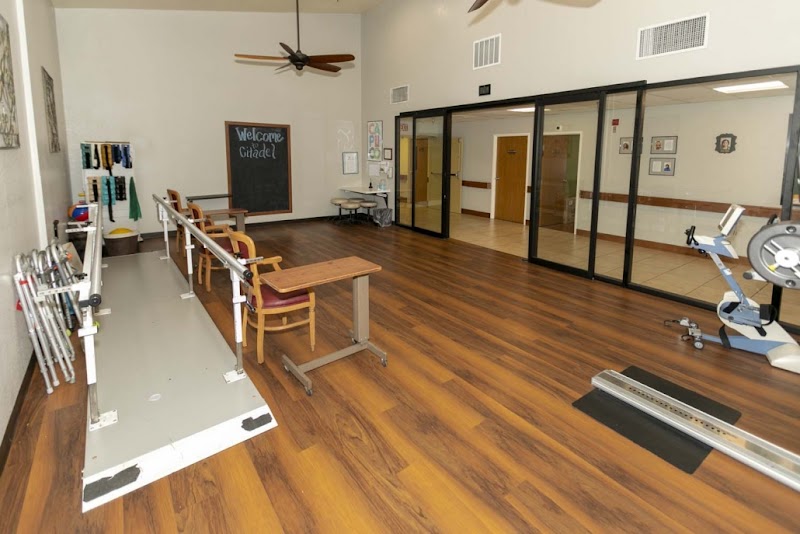
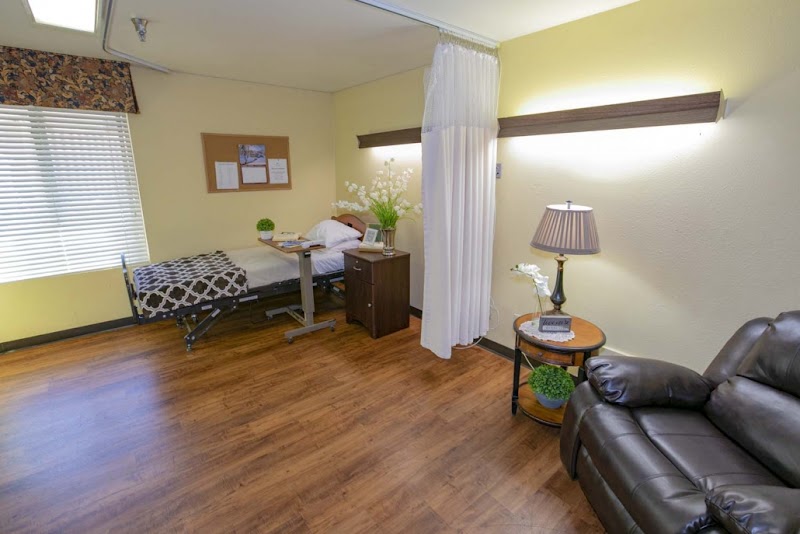
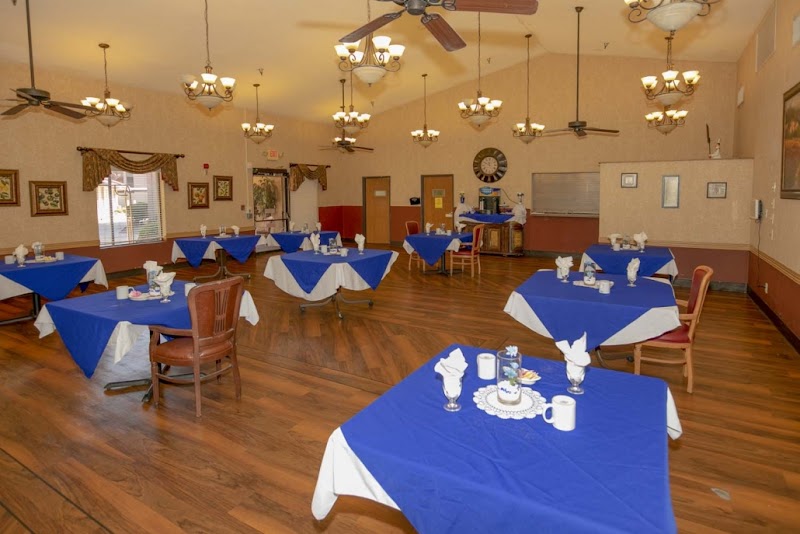
CITADEL POST ACUTE

5121 EAST BROADWAY ROAD, MESA, AZ 85206 (480) 832-5555
For profit - Corporation 128 Beds THE ENSIGN GROUP Data: November 2025
Trust Grade
90/100
#9 of 139 in AZ
Last Inspection: February 2025

Within standard 12-15 month inspection cycle. Federal law requires annual inspections.

Overview

Citadel Post Acute in Mesa, Arizona, has earned a Trust Grade of A, indicating it is an excellent option for care, highly recommended for families looking for a reliable nursing home. It ranks #9 out of 139 facilities in Arizona, placing it in the top half, and #8 out of 76 in Maricopa County, suggesting there are only a few local homes that perform better. However, the facility is experiencing a worsening trend, with issues increasing from 1 in 2023 to 4 in 2025. Staffing is rated average with a turnover rate of 42%, which is better than the state average of 48%, indicating staff stability, but RN coverage is only average, meaning some critical care might be overlooked. On a positive note, the facility has not incurred any fines, which is a good sign of compliance. However, specific incidents of concern include failures to protect residents from potential abuse by other residents and issues with the storage and management of medications, which could pose risks to resident safety. Families should weigh these strengths and weaknesses carefully when considering Citadel Post Acute.

Trust Score
A
90/100
In Arizona
#9/139
Top 6%
Safety Record
Low Risk
No red flags
Inspections
Getting Worse
1 → 4 violations
Staff Stability
○ Average
42% turnover. Near Arizona's 48% average. Typical for the industry.
Penalties
✓ Good
No fines on record. Clean compliance history, better than most Arizona facilities.
Skilled Nurses
○ Average
Each resident gets 30 minutes of Registered Nurse (RN) attention daily — about average for Arizona. RNs are the most trained staff who monitor for health changes.
Violations
✓ Good
Only 5 deficiencies on record. Cleaner than most facilities. Minor issues only.
★★★★★
5.0
Overall Rating
★★★☆☆
3.0
Staff Levels
★★★★★
5.0
Care Quality
★★★★☆
4.0
Inspection Score
Stable
2023: 1 issues
2025: 4 issues

The Good

  • 5-Star Quality Measures · Strong clinical quality outcomes
  • Full Sprinkler Coverage · Fire safety systems throughout facility
  • No fines on record
  • Staff turnover below average (42%)

    6 points below Arizona average of 48%

Facility shows strength in quality measures, fire safety.

The Bad

Staff Turnover: 42%

Near Arizona avg (46%)

Typical for the industry

Chain: THE ENSIGN GROUP

Part of a multi-facility chain

Ask about local staffing decisions and management

The Ugly 5 deficiencies on record

Jul 2025 1 deficiency
CONCERN (D) 📢 Someone Reported This

A family member, employee, or ombudsman was alarmed enough to file a formal complaint

Potential for Harm - no one hurt, but risky conditions existed

Free from Abuse/Neglect (Tag F0600)

Could have caused harm · This affected 1 resident

**NOTE- TERMS IN BRACKETS HAVE BEEN EDITED TO PROTECT CONFIDENTIALITY** Based on clinical record review, staff interviews, facility documentation, policy review, and the State's Agency (SA) complaint ...

Read full inspector narrative →
**NOTE- TERMS IN BRACKETS HAVE BEEN EDITED TO PROTECT CONFIDENTIALITY** Based on clinical record review, staff interviews, facility documentation, policy review, and the State's Agency (SA) complaint tracking system, the facility failed to protect two residents (#3 and #9) right to be free from sexual abuse by other residents (#4 and #10). The deficient practice could result in residents being at risk for further abuse.Based on clinical record review, staff interviews, facility documentation, policy review, and the State's Agency (SA) complaint tracking system, the facility failed to protect two residents (#3 and #9) right to be free from sexual abuse by other residents (#4 and #10). The deficient practice could result in residents being at risk for further abuse.Findings include:-Regarding Resident #9 (Alleged Victim):Review of Resident #9's care plan initiated on October 25, 2018 revealed resident has impaired cognitive function related to dementia and memory loss.Resident #9 was admitted to the facility on [DATE] with a diagnosis that included Hypertension, Diabetes mellitus (DM), Arthritis, Non-Alzheimer's Dementia, Depression, and Schizophrenia.Review of Minimum Data Set (MDS) annual assessment dated [DATE] revealed a Brief Interview for Mental Status (BIMS) score of 8.0, moderately impaired and rejection of care, wandering and behavioral symptoms were not exhibited.Review of the Interdisciplinary Team (IDT) progress notes dated July 20, 2023 revealed resident was interviewed regarding a resident to resident contact. Resident reported that she felt safe in the facility, that no one touched her and that she would report it if something did happen. Resident was being monitored for her psychosocial well-being.Review of another MDS for significant change dated August 1, 2023 revealed a BIMS score of 5.0, severe impairment and behavioral symptoms not exhibited.-Regarding Resident #10 (Alleged Perpetrator):Resident #10 was admitted on [DATE] with a diagnosis that included diabetes mellitus (DM), hypertension and cerebrovascular accident (CVA).Review of admission MDS assessment dated [DATE] revealed a BIMs score of 7.0, severe impairment, and resident exhibited physical behavioral symptoms directed towards others (e.g., hitting, kicking, pushing, scratching, grabbing, abusing others sexually).Review of care plan initiated on June 23, 2023 revealed a potential for a behavior problem related to cognitive decline. The interventions included to anticipate and meet needs, approach in a calm manner, and document behaviors and resident response to interventions.Review of nursing progress notes dated July 20, 2023 revealed the resident was seen touching another resident around the waistband. The residents were immediately separated, assessed, questioned, and educated. The provider and representative were notified. Resident #10 was placed on a one on one supervision, psych referral sent, and resident placed on change of condition monitoring.Review of another care plan initiated on July 20, 2023 revealed a potential to demonstrate inappropriate behaviors. The interventions dated July 20, 2023 included one on one staff observation, psych to evaluate and treat, and educating resident regarding being appropriate with others.Review of progress note dated July 21, 2023 revealed resident is on change of condition monitoring for inappropriate behaviors.On July 21, 2023, review of record revealed that Resident #10 was discharged to another facility.Review of facility's 5-day investigation report revealed that an interview was conducted with a certified nursing assistant (CNA/Staff #901). Staff #901 reported that she walked into the dining room where Resident #9 and Resident #10 were sitting in their wheelchair directly in front of each other. Staff stated that she thought she saw Resident #10's hands on Resident #9's lap and around her waistband. Staff #901 reported that while she was walking in, she observed Resident #9 pushed Resident #10's hand away and began to propel herself towards her lunch table. Staff #901 ensured the residents were safe and separated and she went to get help. The facility investigation concluded that abuse did not occur.-Regarding Resident #3 (Alleged Victim):Resident #3 was admitted to the facility on [DATE] with a diagnosis that included Hypertension, Urinary tract infection (UTI), Diabetes mellitus (DM), Non-Alzheimer's Dementia, Seizure disorder, and Depression.Review of significant change in status MDS assessment dated [DATE] revealed a BIMS score of 8.0, moderately impaired.Review of care plan initiated on April 30, 2024 revealed resident has an alteration in neurological status related to history of subarachnoid hemorrhage. The interventions included cueing and reorientation as needed.Another care plan initiated on April 24, 2024 revealed resident was at risk for impaired cognitive function/dementia or impaired thought processes related to unspecified dementia, and at risk for communication problem related to expressive aphasia.Review of nursing progress notes dated June 14, 2024 at 18:32 PM revealed Resident #3 was observed in a male resident's room. Resident was taken out of the room and brought back to her own room. Resident #3 was placed on a 15-minute checks. A skin check was completed and found no bruising, redness, swelling, discoloration, fluids or blood noted. The law enforcement was notified. Resident #3's emergency contacts were notified. And, Resident #3 was placed on psychosocial monitoring.Review of record, Skin Evaluation, dated June 14, 2024 revealed Resident's skin was intact, no redness, bruising, discoloration, swelling, abrasions, or skin tears noted. Resident's brief was clean and dry at time of assessment.Review of physician's progress notes dated June 14, 2024 revealed the provider was contacted by staff after Resident #3 was found in a male resident's room, both with pants down. Staff were unable to see if there was any penetration. The male resident initially denied that they were having sex at the time, but later reportedly stated that they have had sex before. The male resident also stated to staff that they were in a relationship. The staff notified the police and sexual crisis team. Furthermore, the progress note revealed that Resident #3 reported that she feels safe in the facility with staff, she is not the male resident's girlfriend, she did not want to have physical contact with the resident, however per staff camera review, Resident #3 independently wheeled herself from the cafeteria directly to the male resident's room. Resident #3 was unable to describe what happened in her own words. The progress note revealed that Resident #3 states yes when asked if she was in the male resident's room with her pants down. She endorses feeling scared while in his room. She agrees that she would like the male resident to stay away from her. According to the progress note, Resident #3 has the inability to properly weigh or retain information to make decisions and to verbally communicate said decisions. The situation has been confuted by the fact that it seems she sought out the male patient. After the incident, the staff have initiated a one on one on the male resident and a 15-minute checks on Resident #3.On June 15, 2024, a care plan for potential for a behavior problem related to poor impulse control, aphasia, seeks physical attention, resists care, history of striking out at caregivers and refusing medications was initiated. The interventions included 30-mimute checks, administer medications as ordered and monitor document for side effects and effectiveness, anticipate and meet resident's needs, caregivers to provide opportunity for positive interaction, attention, stop and talk with resident as passing by, document behaviors and resident response to interventions, discuss behavior, explain/reinforce why behavior is inappropriate, intervene as necessary to protect the rights and safety of others, remove from situation and take to alternate location as needed, and monitor behavior episodes and attempt to determine underlying cause.Another review of physician's progress note dated June 18, 2024 revealed that the provider was informed about the event. He was informed about a resident wheeled herself into a male resident's room. The female resident was found standing with another male resident and their pants were down but it looked like they were trying to engage in a sexual intercourse but there was no penetration as per staff. Staff immediately intervened and appropriate actions have been taken including wheeling Resident #3 out of the male patient's room, calling the sexual crisis team, police etc. The provider met with Resident #3 in her room. Resident #3 was pleasant, not in any distress. Resident does not seem to be any more confused than her baseline. Provider notes revealed that Resident #3 was being followed by psych. It is really hard to assess her capacity because she does seem to have capacity when it comes to basic necessities like food, showers and other basic necessities but the provider doubt she has the capacity to understand or analyze any complex situations.Another review of record, Skin Evaluation, dated June 18, 2024 revealed Resident's has no new skin issues, skin is clean dry and intact.Review of quarterly MDS assessment dated [DATE] revealed a BIMS score of 4.0, severely impaired.Resident #3 was discharged out of the facility on August 22, 2024.-Regarding Resident #4 (Alleged Perpetrator):Resident #4 was admitted to the facility on [DATE] with a diagnosis that included Anxiety disorder, Depression, Schizophrenia, and Post Traumatic Stress Disorder (PTSD).Review of admission note dated March 7, 2024 revealed that Resident arrived to the facility, resident was able to stand and walk with walker and rolled in bed for skin assessment. Resident was alert and oriented times four, able to make his own needs.Review of the IDT progress note dated March 12, 2024 revealed that Resident follows staff members throughout the facility calling them terms outside of their name and potential to make accusatory statements. Staff initiated cares and pairs with a psych referral sent.Review of physician progress note dated March 13, 2024 revealed Since admission to the facility, has been noted to be verbally aggressive toward staff and sexually inappropriate. Staff reported resident was asking staff to sit on my lap and called a staff a fat ass. Staff additionally report he has a strong need to feel respected by others.Review of admission MDS assessment dated [DATE] revealed a BIMs score of 14.0, cognitively intact. Resident exhibited verbal behavioral symptoms directed towards othersReview of progress notes dated June 14, 2024 revealed that the resident was observed in his room with a female resident. The female resident was removed from the room. Resident #4 was placed on a one on one. The law enforcement was notified. Resident #4 did not want anyone notified. Resident will be monitored for psychosocial well-being.Review of progress note dated June 16, 2024 revealed resident is on change of condition monitoring and on a one on one with staff.Review of another nursing progress note dated June 17, 2024 revealed Resident inquired why there was an investigation going on and why he was not allowed to be around the other female resident.On June 18, 2024, review of nursing discharge summary progress note revealed resident was discharged to an assisted living.Review of the facility's 5-day investigation report dated June 21, 2024 revealed Resident #3 and Resident #4 were interviewed immediately following the incident on June 14, 2024. The investigation report revealed during an interview with Resident #3, Resident #3 denied having a relationship with Resident #4. Resident #3 reported nothing physical happened, she does not want Resident #4 touching her, she did not try and stop Resident #4, she was not scared during the interaction, she noted yes to feeling safe now and wants to remain in the facility, she does not want Resident #4 to get in trouble or to be punished, she knows what sex is , she denied penetration, she denied having her clothes off, she denied touching Resident #4, she denied spending time with Resident #4, she denied having been in Resident#4's room before, she smiled when asked if she was Resident #4's girlfriend, she denied being assaulted or raped, and she denied feeling scared to see or interact with Resident #4 again. The investigation report also revealed that Resident #3's affect was calm, smiling and happy. On the other hand, the investigation report revealed during an interview with Resident #4, Resident #4 reported that Resident #3 and him had been in the television room around 9:00 or 10:00 AM watching television, coloring and hugging each other. Resident #4 reported that later during the day, Resident #3 came to his room and Resident #3 grabbed his hand. Resident #4 also reported that they were watching television, necking, petting and kissing. Resident #4 reported that a CNA entered his room to deliver his dinner tray. Resident #4 reported that Resident #3 had pulled her own pants down. Resident #4 reported that it was the first time Resident #3 came to his room and that they did not have intercourse, and that their interaction was consensual. Resident #4 reported that Resident #3 can speak in sentences.Further review of facility's 5-day investigation report dated June 21, 2024 revealed an interview was conducted with a certified nursing assistant (CNA/Staff #700). Staff #700 reported that around 17:45-17:50 PM, while she was passing trays in one of the hallways and knocked on Resident #4's door, she heard Resident #4 say hold on. Staff #700 pushed the curtain just a little to set Resident #4's dinner tray down. Staff #700 reported that she noticed Resident #3 standing facing the wall and Resident #4 was behind Resident #3 with his pants down. Staff #700 saw Resident #4 doing a rocking motion but could not see where his penis was and when Resident #4 noticed Staff #700, Resident #4 pulled his pants up. Staff #700 called Staff #41, who was just outside the room to stand there while Staff #700 will get the nurse. Staff #700 reported that Resident #3 was safe when Staff #700 left Resident #3 in Resident #4's room. In addition, the facility's 5-day investigation report revealed an interview was conducted with another CNA/Staff #41 who reported that she saw Resident #3 standing by the bed and Resident #4 was next to her. Staff #41 waited until the nurse came. In addition, the facility 5-day investigation report revealed an interview was conducted with a Registered Nurse (RN/Staff #800). Staff #800 reported that when Staff #800 arrived in Resident #4's room, another nurse was already in Resident's #4's room. Staff #800 saw Resident #4 sitting in his wheelchair while Resident #3 was on the bed with her pants and briefs by her knees. Furthermore, another RN was interviewed during the facility's investigation and revealed that RN/Staff #900 reported that Staff #700 came to the desk and notified the nurse to go to Resident #4's room. Staff #900 reported that upon entering Resident #4's room, Staff #900 reported that he saw Resident #3 sitting on the edge of the bed with her brief down and Resident #4 was in his wheelchair. Staff #900 place a call to the administrator and left a message and then he called 911. After review of the facility's investigation report, the facility concluded that no abuse occurred.On July 16, 2025 at 09:10 AM, a call was placed to Staff #700 for an interview. Surveyor left a voice message.An interview was conducted on July 16, 2025 at 09:43 AM with CNA/Staff #41 in the conference room. Staff #41 stated that she works from 06:00 AM to 06:00 PM. When she comes to work, she will first check her assignment, she signs her initials in the assignment book so the staff knows that she is in the facility, she will then get report from the night shift CNA, then she will start getting her residents' vital signs, check everybody, pass ice water, get her residents up, and dress them up for breakfast which starts at 07:00 AM in the dining room. Her responsibility also includes cleaning her residents' rooms, changing their bed linens, and taking care of trash in their room. Regarding abuse, Staff #41 stated that abuse can be verbal, hitting is abuse, and if she witnessed an abuse, she reports it immediately to the administrator and her nurses because it has to be reported and she will not let abuse happen to somebody. Furthermore, Staff #41 stated that abuse is also touching someone inappropriately like trying to have sex. Staff #41 stated that there was one time, it happened a year ago in one of the halls, there was a female resident and Staff #41 forgot the male resident's name. She stated that she saw a CNA coming from the room while she was walking toward the room, and the CNA told her to stay with them by the door and watch them because the CNA stated that they were trying to do something. Staff #41 stated that she saw Resident #3 sitting in the male resident's bed, Resident #3's pants was above her thigh like she was trying to pull it up and the male resident was so mad because Staff #700 came in his room. Staff #41 saw the male resident in his wheelchair and the male resident asked her why she was standing there. Staff #41 stated that Resident #3 was laughing while sitting in the bed. Furthermore, Staff #41 stated that a male nurse came, the nurse still works at the facility, the nurse reported the incident and then the police came in the male resident's room on the same day. During the interview with Staff #41, she stated that she will report any abuse right away. Staff #41 also stated that she thinks that the residents were trying to have sex. Staff #41 stated that she took care of Resident #3 in the past and stated that Resident #3 was always in her wheelchair, Resident #3 requires total care, Resident #3 can't talk because sometimes Staff #41 tries talking to Resident #3 and she does not understand Resident #3. Staff #41 thinks that Resident #3 knows where she is at sometimes.A phone interview was conducted on July 16, 2025 at 10:22 AM with a Licensed Practical Nurse (LPN/Staff #105). Staff #105 stated that abuse is a violation of patient's rights, abuse can be sexual, financial, physical, and seclusion. Staff #105 stated that his responsibility when he witnessed an abuse is to separate the victim, separate as soon as he witnessed a physical contact or something that could lead to a physical contact which includes shouting, to prevent and deescalate the situation. Staff #105 stated that last year, a resident was found in a room, sexual abuse, he was the nurse of the male resident, the male resident was alert and oriented and was independent somehow. Staff #105 stated that the male resident was in bed 2, a CNA was passing meal trays, the door was closed, the CNA pulled the privacy curtain and found a female resident in the male resident's private space, the CNA saw two residents a male and a female, and the situation was awkward. Staff #105 stated that the female resident was known to wonder, the female resident could not make decision on her own, and the female resident was friendly and smiling. Staff #105 stated that after being informed of the incident, he rushed in his male resident's room, and when he arrived in the resident's room, he found a female resident leaning on the bed, her pants down, her face down on the bed, and the male resident was trying to adjust by pulling his pants. Staff #105 stated that Resident #4 stated to the staff to get out of his room, it was a private matter, the female resident was his girlfriend, and it was consensual. Staff #105 stated that as far as he knows, the female resident cannot give consent mentally based on her mental fit such as engaging in that kind of space. Staff #105 stated that her Power of Attorney (POA) was making all the decisions for her. Staff #105 stated that he informed the female resident that the room she was in was not her room. Staff #105 stated that the management was made aware of the incident, and the police came. In addition, Staff #105 stated that he remembered that as soon as he walked in the male resident's room, the male resident was trying to pull his pants, he became hostile, and Staff #105 asked the CNA to help the female resident get dress because the female resident was undress, her pants and briefs were down because the female resident was leaning towards the bed. Staff #105 stated that the female resident back was facing Staff #105. Furthermore, Staff #105 stated that the female resident needs assistance with mobility and cannot stand on her own and Staff #105 stated that he does not know why the female resident was leaning on the bed and the female resident's wheelchair was next to the bed. Staff #105 stated that the male resident refused a one on one with staff. The female resident was given a one on one with staff. And after the incident, the male resident was looking for the female resident. In the dining room, the male resident was heard saying hey baby come here, blowing kisses to the female resident, and that was why the male resident was assigned one on one. The male resident was eventually discharged out of the facility.An interview was conducted on July 16, 2025 at 11:26 AM with RN/Staff #900 in the conference room. Staff # 900 stated that his abuse training is done annually online and annually in person such as during in services. He stated that abuse is for instance a person was pushed, or was left in a chair. He stated that he remembered an incident but cannot give specifics. Staff #900 stated that the incident happened in one of the halls where one of the residents went in the wrong room. Staff #900 stated that a CNA came and got him and asked his help. Staff #900 stated that another nurse was at the room already when he arrived in the resident's room. Staff #900 stated that one female resident was sitting at the bed with her briefs at her knees as if one would go use a commode. He described the situation further as the female resident's briefs were across her thighs, one male resident sitting at the wheelchair, Staff #900 then contacted the executive director/Staff #16 about something going on inappropriately, the other nurse in the room asked him to call the police, but instead he called 911 to report about a sexual in nature situation going on.An interview was conducted on July 16, 2025 at 11:48 AM with the Director of Nursing (DON/Staff #70) in the conference room. The DON stated that abuse training is done upon hire, annually, and they have a lot of abuse training throughout the year. She stated that they discuss types of abuse, and suspected abuse is reported immediately to the abuse coordinator, DON, so residents can remain safe immediately. The DON stated that abuse can be sexual, verbal, and involuntary seclusion. She stated that sexual abuse is when somebody does not want to be touch, touching in sexual manner that is not wanted, if a resident does not want to be touch and then touch is sexual abuse. The DON stated that she submitted a sexual abuse 5-day investigation report regarding Resident #3 and Resident #4, she has to go back to check her email, and stated that she finds it odd that a State surveyor was asking a confirmation email regarding submission date of the report. The DON stated that she wrote the report and her conclusion involving Resident #3 and Resident #4 investigation was that no abuse occurred. Furthermore, the DON stated that it appeared that the residents being investigated were in the room together, appears that their pants were down, did not appear any intercourse took place, their staff responded immediately, and both residents denied any intercourse happened. The DON stated that Resident #3 was very complex, has expressive aphasia, sometimes Resident #3 can communicate better than others, Resident #3 knew where the DON office was located, Resident #3 knew her friends, Resident #3 has pseudobulbar which the DON explained and gave an example such as when laughing their sad and crying their happy. The DON stated that there was no psychosocial effect on both residents after the incident, and the residents were followed up every day by monitoring any change of condition. In addition, the DON stated that in the residents' progress notes has both residents were disappointed that they were separated. The DON stated that Resident #4 was placed on a one on one with staff, and even after Resident #4 was discharged , Resident #3 was visiting her office.On July 16, 2025 at 01:36 PM, a second phone call was placed to Staff #700 for an interview. There was no return call.An interview was conducted on July 17, 2025 at 11:49 AM with the administrator/Staff #16 in his office. The administrator stated that cameras are placed in common areas and outside. The camera records short amount of time but it deletes and it does not get saved. The cameras are based on movements. The administrator stated that there would be no footage to review for instance a last month's footage.An interview was conducted on July 18, 2025 at 10:34 AM with a CNA/Staff #124. Staff #124 stated that she works day shift from 6 AM to 6 PM. Regarding call lights, she answers calls that are flashing on top of the door, she does her every 2-hour rounds to check on her residents and sometimes a little bit earlier to see if her residents were okay. She stated that if she observes a resident going to another resident's room, she will talk to the resident, she will assist the residents to where they will go. When residents are in dining room, Staff #124 stated that there is two CNAs in the dining room, residents are never left alone, one CNA always stays while the other CNA takes the other residents back to their room, and there is always staff in the dining room. Regarding reporting abuse, she will call the administrator and report what she saw. For instance, if she witnessed a resident touching another resident inappropriately such as touching the boobs, thighs and legs and even grabbing, she will separate the residents because she considers it sexual abuse. Another instance is, if she finds a female resident in a male resident's room, she will separate the residents right away, she would take the female resident out of the room because there is another male resident in that room and she would not leave her in that room, and she will notify her nurse using her radio and also, she will notify the administrator which is the abuse coordinator. Staff #124 stated that if anything happened, the abuse coordinator will look at the camera footage in the hallway. Furthermore, Staff #124 stated that hitting someone's head and hands is a form of abuse, its physical abuse, and throwing items at resident is abuse, spitting is abuse, and grabbing a resident's private area is sexual abuse.On July 18, 2025 at 11:33 AM, Resident #9 was observed in her room sleeping.A follow up interview was conducted on July 18, 2025 at 11:39 AM with the DON in the conference room regarding Resident #3 and Resident #4. The DON stated that while looking at the provider's progress note dated June 18, 2024, the progress note revealed that there was no penetration as per staff, and when the staff entered the room the staff stated that they did not see any penetration, no erection and that is what the report revealed. Regarding camera footage review of the incident, the DON stated that Resident #3 entered Resident #4's room after coming from the dining room, and that she will check her notes regarding the camera footage time. In addition, the DON stated that if resident was assessed for behavioral symptoms on admission such as grabbing, kicking, the staff will create a baseline care plan, and the assessment of the resident is ongoing. After a week or so, if the behavior symptoms are exhibited towards staff, the staff might implement a case by case basis such as cares and pairs, and or get psych involved. The interventions such as cares and pairs and psych involvement will be documented in the care plan and progress notes. At 12:48 PM, regarding the allegation of abuse with Resident #3, the DON came back to the conference room and stated that she cannot find the exact time of the camera footage and she stated that it was just after dinner from the dining room.On July 18, 2025 at 3:02 PM, received the contact information from the administrator/Staff #16 for CNA/Staff #901. A call was placed to Staff #901 and was unable to make contact.A review of facility's policy titled, Abuse: Prevention of and Prohibition Against, with a revision/reviewed date of September 2024 revealed that it is the facility's policy that each resident has the right to be free from verbal, sexual, physical, and mental abuse.

Feb 2025 3 deficiencies
CONCERN (D)

Potential for Harm - no one hurt, but risky conditions existed

Pharmacy Services (Tag F0755)

Could have caused harm · This affected 1 resident

**NOTE- TERMS IN BRACKETS HAVE BEEN EDITED TO PROTECT CONFIDENTIALITY** Based on observations, interviews, clinical record review, facility documentation, and facility policy, the facility failed to e...

Read full inspector narrative →
**NOTE- TERMS IN BRACKETS HAVE BEEN EDITED TO PROTECT CONFIDENTIALITY** Based on observations, interviews, clinical record review, facility documentation, and facility policy, the facility failed to ensure safeguards and systems were in place to control, and account for controlled medications in order to prevent loss, diversion or accidental exposure for three residents (#4, #329, and #330). This deficient practice could result in staff diversion of a resident's controlled medications. Findings include, -Resident # 4 was admitted to the facility on [DATE], with diagnoses that include anxiety, depression, unspecified dementia, and epilepsy. The consent form for treatment with psychotropic medications acceptance for resident was dated on November 15, 2017. Lorazepam 2 milligrams (mg) was ordered for as needed use for seizures on May 26, 2020. The care plan for anti-anxiety medication use for seizures was initiated on January 19, 2021. The quarterly Minimum Data Set (MDS) dated [DATE] revealed a Brief Interview Mental Status (BIMS) score of 3, indicated a significant impairment in cognition. A notice from the president of the facility's long-term care pharmacy dated February 20, 2025, revealed Lorazepam 2 milligrams (mg) Carpuject syringe was dispensed from the pharmacy on August 14, 2024. The Controlled Drug Receipt/Disposition Log form identified one pen syringe of Lorazepam Injection Prescription (Rx) # 2384163 was disposed of by two licensed staff members. The date of disposition is not recorded on the log. The Controlled Drug Receipt/Disposition Log form identified 30 milliliters of Lorazepam 2 mg solution Rx # 10286425 was disposed by two licensed staff members. The date of disposition is not recorded on the log. The Controlled Drug Receipt/Record/Disposition form confirmed 30 ml of Lorazepam 2mg/2 ml, Rx # 10286425 was received on July 25, 2024. The record fails to reflect the signature of nurse receiving the medication. No entries were recorded in the section for Disposition of Remaining Doses. No date or rationale was provided for the reason of the two signatures in the body of the form. The Controlled Drug Receipt/ Record/Disposition form confirmed a licensed nurse received the Lorazepam 2mg/ml, Rx # 2215224/001 on August 14, 2024. No entries were recorded in the section for Disposition of Remaining Doses. No date or rationale was provided for the reason of the two signatures in the body of the form. A Carpuject Syringe of Lorazepam 2 mg/1 ml belonging to the resident was observed with a break in the tamper seal integrity was observed in the narcotic refrigeration in the medication room with the Director of Nursing (DON/Staff # 24), and the Resource Licensed Practical Nurse (LPN/Staff # 105) on February 19, 2025 at 8:36 a.m. An interview was conducted with the DON and Resource LPN on February 19, 2025 at approximately 8:36 a.m. in the facility medication storage room. Both parties were unaware of the break in the tamper seal integrity and revealed the need to investigate the matter further, as this was not a facility expectation. An interview was conducted with the DON and Resource LPN on February 19, 2025 at approximately 2:50 p.m. revealed both parties agreed that the syringe with the tampered seal was disposed of properly. An interview with the facility's Registered Pharmacist (Staff # 300) on February 20, 2025 at 1:12 p.m. revealed that the intramuscular (IM) Carpujet injections requires its own injector and thus a special needle has to be available in order to use the syringe. The pharmacist stated that the Carpujet syringe system is used rarely, and that she would expect the nursing staff to not be well versed on its operation. The Pharmacist stated that if the integrity of the tamper seal was compromised it should have been reported according to facility policy immediately. -Resident # 329 was admitted to the facility on [DATE] with clinical diagnoses that included congested heart failure, dependence on supplemental oxygen, dementia, and hypotension (low blood pressure). A progress note dated December 8, 2024 identified the daughter as the resident's surrogate decision maker. The resident's inventory of personal effects with the admission date of December 9, 2024 does not reflect any medications either on admission or at discharge. The responsible party discharge section was signed, but not dated. There was no signature or date entered in the staff portion for inventory on discharge. The admission hospice orders dated December 23, 2024, revealed the resident was ordered Lorazepam .25 ml every four hours as an as needed comfort medication. The Controlled Drug Receipt/Record/Disposition Form for Rx # 10508766 Lorazepam 2mg/ml dispensed date of December 23, 2024, revealed two licensed staff members signed of on a 30 ml entry February 19, 2025 at 10:00 a.m. No entries were made in the disposition portion of the form. Documentation reflected the daughters wish to have the facility destroy the medication. The discharge MDS dated [DATE], revealed the resident was discharged home to hospice. The resident had a BIMS score of 15, indicating the resident was cognitively intact. The MDS does not reflect the resident use of anti-anxiety medication. The discharge summary and post discharge plan of care dated December 31, 2024 revealed that the resident received their personal belongings, and any remaining medications, as instructed by the provider order. An order dated December 31, 2024 revealed the resident was to be discharged with hospice with all remaining medications, including narcotics. A progress note dated December 31, 2024 revealed all discharge paperwork and all remaining medications went with resident along with all personal belongings. The Medication Administration Record (MAR) for December 2024, does not reflect the administration of any doses of the ordered Lorazepam to the resident. During the medication room observation on February 19, 2025 at 8:36 a.m. the DON could not explain the reason for the resident's Lorazepam ended up with other medications in the resident medication return box. The DON stated that not properly storing and securing controlled medications is against facility policy and has the potential for diversion. The DON, February 19, 2025, at approximately 2 pm. stated the resident's surrogate decision maker was contacted, and permission was granted for the facility to dispose of the controlled substance. An interview was conducted on February 20, 2025 at 10:42 a.m. with Resource LPN (Staff # 105) who revealed if a resident is admitted with home medications the nurse will tell the resident/family that the facility cannot use these, and the family can take it home. The inventory list is completed on admission and again at discharge. In a panel discussion conducted with the resident council on February 20, 2025 at 11:45, the participants stated on admission, if medications were bought with them, they are collected and sent back to their home with family members. During the discussion, no panel recipient was able to recall seeing or receiving a copy of their inventory sheets. An interview with the Pharmacist (Staff # 300) was conducted on February 20, 2025 at 1:12 p.m. The pharmacist is uncertain as to how the medication fell out of proper chain of custody. The Pharmacist explained that Lorazepam is a controlled substance, and strict adherence to chain of custody is of utmost importance for resident safety, and to prevent medication diversion. In addition, the pharmacist stated the medication are returned to the residents with an order, and if the medication does not go home with the resident, it is destroyed at the facility per protocol. -Resident # 330 was admitted to the facility on [DATE] for orthopedic aftercare following a leg fracture, with diagnoses of anxiety disorder, depression, insomnia, and unspecified dementia. The admission MDS dated [DATE] revealed the resident had a BIMS score of 11, which indicated moderate cognitive impairment. An order for Alprazolam .25 m, give two tablets twice a day was initiated on February 11, 2025 The care plan for anti-anxiety medication, initiated February 12, 2025, called for the consideration for reducing prescription therapy when clinically indicated. The MAR reflected the resident's refusal of the prescribed Alprazolam .25 mg one tablet for anxiety on February 20, 2025. An order dated February 12, 2025 revealed Alprazolam .25 mg to be held from February 12, 2025 to February 18, 2025. An order dated February 19, 2025 revealed Alprazolam .25 mg was reduced to one tablet every 12 hours for anxiety. The Controlled Drug Receipt/Record/Disposition form for Rx # 2498847 Alprazolam .25 mg tablet, dated February 11, 2025 at 11 p.m. through February 19, 2025 at 11:10 p.m. revealed the quantity dispensed as 18 which had a strike through to change the quantity to 9. The record reflects only one licensed signature is present on each line of the count. The record does not reflect a count being completed at morning shift change by 2 licensed nurses. The ending quantity count was recorded as 3 for February 19, 2025 at 11:10 p.m. The Controlled Drug Receipt/Record/Disposition form for Rx # 2498847 Alprazolam. 25 mg tablet, dated February 11, 2025 through February 20, 2025 revealed the quantity dispensed as 18 which had a strike through to change the quantity to 9. The directions from the previous log sheet are covered by a note stating Directions Changed, Refer to Chart. The record fails to reflect the date on which the change occurred. On February 20, 2025, the entry reflects two licensed signatures wasting 1. The documentation does not reflect if the 1 refers to the count by tablet or by blister (each blister contained 2 tablets). On February 20, 2025 at 8:50 a.m. the ending quantity count was recorded as 3. The ending count remained unchanged from February 19 - February 20, despite having a waste and no additions to the count. During medication pass observation (med pass) with LPN (Staff # 163) on February 20, 2025 at 8:18 a.m. the surveyor and LPN observed a break in the packaging integrity of the resident's Alprazolam .25 mg blister pack. Upon closer inspection, it was observed one tablet was missing from the compromised blister. During the narcotic log comparison to actual quantity on hand a discrepancy was detected, where there were 7 tablets present, but a total of 6 tablets were recorded. At the conclusion of the interview, all narcotics were returned and locked in a separate drawer so the Director of Nursing could be alerted. An interview was conducted with the LPN (Staff # 163) during med pass on February 20, 2025 at 8:18 a.m. The LPN was not aware of the break in blister integrity, and stated it would have been caught during a narcotic count and immediately reported to the Director of Nursing. The LPN voiced the importance of a two-person narcotic count, and understands her liability and responsibility for the medication cart and narcotic counts. Further discussion revealed the Lorazepam was counted by number of blisters instead of number of tablets, and in this case, each blister contained two tablets. The LPN confirmed the actual tablet count of seven did not match the narcotic count log count of 6. The nurse explained that the pharmacy quantity of 18 was changed to 9 to reflect the number of blisters. The LPN reviewed the chart and stated there was an order change which reduced the dose from 2 tablets to 1, so the extra tablet was not wasted according to policy. The LPN voiced incorrect narcotic counts is not a facility expectation and can be problematic. -Facility Written correspondence was initiated with the Arizona State Board of Pharmacy on February 20, 2025 at approximately 10:00 a.m. According to the State Board of Pharmacy, their duty is to regulate long-term care pharmacies, while the DEA office handles controlled substances issues the long-term care facilities. The board expects that when substances are delivered to the facility under a patient-specific order, intended for patient administration, it becomes the responsibility of the staff for safe and appropriate storage. In addition, the board requires the supplying pharmacy to record/ inventory all the way down to the specific total quantity level, instead of counting by number of blisters. An interview was conducted on February 20, 2025 at 1:12 p.m. with the Registered Pharmacist (Staff # 300). The pharmacist revealed the improper storage of controlled substances, and breaks in integrity of blister and tamper seals do not align with pharmacy and facility policy. The pharmacist was appreciative of the feedback and is making plans to further investigate and plan education/training for the staff. The facility's Medication Access and Storage, E kit access policy revealed Schedule IV controlled substances are stored separately from other medications in a locked drawer or compartment designated for that purpose. In addition, reconciliation of controlled medications is done at least every shift by the incoming and outgoing Licensed Nurses at change of shifts. The policy further instructs for discharged residents' narcotic medications are to be turned into the Director of Nursing for destruction. The policy also mandates that reconciliation of controlled medications are done at least every shift by the incoming and outgoing licensed nurses at change of shifts. The facility's Medication Destruction policy advises that discontinued medications and medications left in the facility after a resident's discharge, which do not qualify for return to the pharmacy for credit, are destroyed. It further revealed that controlled substances are retained in a securely locked area with restricted access until properly destroyed.
CONCERN (D)

Potential for Harm - no one hurt, but risky conditions existed

Deficiency F0761 (Tag F0761)

Could have caused harm · This affected 1 resident

Based on observation, staff interviews, and policy review, the facility failed to ensure that medications in the medication storage room were stored appropriately and that expired medications were dis...

Read full inspector narrative →
Based on observation, staff interviews, and policy review, the facility failed to ensure that medications in the medication storage room were stored appropriately and that expired medications were discarded or disposed of in accordance with professional standards. The deficient practice could result in the medications not being disposed of properly, and not being organized appropriately. Regarding medication storage During an observation of the medication storage room conducted with the Director of Nursing (DON/staff #101) on February 19, 2025 8:27 a.m, approximately 13 medication bubble packs were observed to be lying on the counter, along with 6 other boxes of medications, one COVID-19 test kit, a sharp container, a portable thermometer, and a glucometer. The medication bubble packs included: Dicyclomine caps 10 mg, Gabapentin caps 300 mg, Montelukast tabs 10 mg, Midorine tab 5 mg, Levothyroxine tabs 75 mcg, Benzonatate caps 100 mg, Atovastatin tabs 20 mg and Furosemide tabs 40 mg were stacked up on the counter. The 6 boxes of medications included: four boxes of Enoxaparin 40 mg per 0.4 ml, and one box of Albuterol 2.5 mg/3 ml, and one box of Ipratropium Bromide 0.5mg/ Albuterol Sulfate 3 mg. The medications were identified to belong to five previously discharged residents. There was no evidence of an organizational system or storage mechanism for discontinued medication storage. Further observation revealed a plastic bin on the floor next to the medication refrigerator. Inside the bin was an array of different medications that belonged to another five residents who had been discharged during 2024. The medications included: Clonidine tabs 0.1 mg, Nitroglycerine 0.4 sub tab, Memantine HCL 10 mg tabs, Cresemba 186 mg. One of the medicines, Cresemba, was stapled to a brown paper bag with a sticker that contained a handwritten note please send this med with the family home. Also, a bottle of Lorazepam, a schedule IV medication, was found in the bin with no evidence of a secondary lock. An interview was conducted following the medication room observation on February 19, 2025 at 8:36 a.m with the DON, who stated that the Pharmacy staff and team were responsible for conducting inventory and removing the discontinued medications. The DON explained that there are certain medical runners from the Pharmacy that bring in the medications and they could not pick up medications and that was the reason why medications were stacking up in the storage room. The DON also stated that she had a medication shredder machine in her office that she used to shred the medications of discharged residents that have been removed from the bubble packs. The DON stated that she had not destroyed the medications because it was safe and locked in the medication room. The DON also stated that she did not know why the bottle of Lorazepam ended up with the other medications in the plastic bin. She confirmed that the risk of not properly storing medication could result in other problems such as medication diversion. Regarding expired medications During an observation of the medication storage room conducted with the DON on February 19, 2025 at 8:50 a.m, two expired over the counter (OTC) medications were observed on a shelf above the medication room counter. The three boxes observed included: two boxes of Octreotide acetate injections 100 mcg/ml that expired January 2025 and one box of Nystatin suspension 100,000 mg that expired on February 6, 2025. An emergency box with expired medications inside was also identified under the sink. The DON stated that the staff are not using this emergency kit which is why they placed it under the sink. The DON identified and agreed that there are risks if nurses accidentally pull out this emergency kit during an emergency and that the risk of using the expired medications poses an extreme health outcome in the lives of the residents. The DON also stated that she is responsible for disposing expired medications and the medical storage room should not have any expired medications at all times. An interview was conducted on February 20, 2025 at 1:12 pm with a Registered Pharmacist (staff #300), who stated that Lorazepam and other controlled substances are stored in a secured locker and are typically destroyed by the nurses. The Pharmacist also stated that when a resident is discharged , narcotic medications are pulled out of the medication cart, and another nurse verifies that the amount matches and both the Pharmacist and the nurse sign off on the narcotic sheet. The narcotic log book stays with the medication bubble pack until the medication is destroyed and then the narcotic sheet is uploaded into the residents' record. The Pharmacist stated that the time to destroy the discharged residents' medications depends on the facility's policy and procedures. The facility policy titled, Medication Access and Storage, E Kit access, stated that all drugs and biological products must be stored in locked compartments under proper temperature controls, and the storage room should be kept clean, well lit, and free of clutter. Also, the policy stated for scheduled III & IV controlled medications are stored separately from other medications in a locked drawer or compartment designated for that purpose. Moreover, the policy stated that expired medications are immediately removed from the stock, disposed of according to procedures for medications destruction processes. Finally, the policy stated that discharged residents' medications shall be turned into the DON for proper destruction.
CONCERN (D)

Potential for Harm - no one hurt, but risky conditions existed

Infection Control (Tag F0880)

Could have caused harm · This affected 1 resident

**NOTE- TERMS IN BRACKETS HAVE BEEN EDITED TO PROTECT CONFIDENTIALITY** The facility failed to adhere to infection control guidelines in the medication storage room. This deficient practice could comp...

Read full inspector narrative →
**NOTE- TERMS IN BRACKETS HAVE BEEN EDITED TO PROTECT CONFIDENTIALITY** The facility failed to adhere to infection control guidelines in the medication storage room. This deficient practice could compromise resident medication safety. Findings include, A medication room tour was conducted with the Director of Nursing (Staff # 24) and Licensed Practical Nurse (Staff #105) on February 19, 2025. The following were observed: -Medication room sink contained white, brown, and black unidentifiable debris in the basin. -The purple curtain covering the area under the sink has an unidentifiable light brownish substance in a non-uniform splash throughout the material. -A cardboard box with an array of medical supplies is stored directly underneath the black polyvinyl chloride (PVC pipe), under the sink, beside a stack of plastic rectangular small storage bins. The brown paneling affixed to the water faucet line has streaks of dark discolorations. Towards the paneling sink divider there is a grayish colored panel with a significant amount of dark colored discolorations. Toward the bottom of the gray panel, there is visible dry wall, which has some crumbling of the white substance onto the floor. - An orange tackle box, which was identified as emergency kit, was stored under the sink. - Additional paneling under the sink, in the area where the copper waterlines and the black PVC pipe with silver clamp located, has dark discolorations on the board. The area with the densest concentration of dark discolorations runs parallel to the PVC pipe. -A card box without flaps is stored under the sink, containing additional medical supplies. Inside the box is a plastic bin which contains items such as a remote, and a biohazard bag of badge clips. - In the corner of the sink counter is a BladderScan machine, which is streaked down the middle with a light color discoloration. Scanning Systems is written on the top green portion of the barcode label. The machine is walled by a cardboard box of resident medications, multiple blister packs, and a temperature scanner. -Under the stack of blister packs, the wall between the counter and wheeled cart, and on the side of the wheeled cart are splashes of a dried, crusted, and brown substance. - The Over the Counter Shelf area contains a bottle of Biotene Dry Mouth Oral Rinse, which has stains of dark and light brown dried substance on the bottle. -The LPN (Staff # 105) retrieved a lockbox from the top of the refrigerator. Once opened, the box included a glucometer, and a bottle of testing strips. The LPN and the surveyor both observed dried brown stains on the glucometer and the test strip bottle. -An expired dark bottle of Nystatin suspension 100,000 mg, was located on the shelf in the medication room. There is a build up of a yellow crusted solution beginning under the tamper proof cap, and protrudes down the sides of the bottle. There is a grayish fingerprint present on the third white label on the back. All three white labels are stained with a grayish substance. The bottle reaches close to the 2 of 6 measurement mark on the side of bottle. -The counter area in front of the storage containers, housing the red end caps, and clear vacutainers, has residual pieces of ¾ inch transparent tape, with the borders stained with black substance. -An uncovered bin located on the floor, in the corner between the refrigerator and resident medication area, has a co-mingling of resident medications. Some of the medications are loose, some are enclosed in Ziploc bags, and others in personal belongings bags. There is also a biohazard bag with three medications inside, belonging to two different residents. An interview conducted with the DON on February 19, 2025 during the medication room observation beginning at 8:36 a.m., stated the cleanliness of the room and bottles is potentially an infection control issue. The DON further elaborated the expectation of the medication storage area, as all areas, is maintaining clean, organized, and sanitary conditions. The DON revealed that the current state of the medication storage room does not meet facility expectations. The DON stated that part of the process of keeping the area clean, is having the housekeeping staff (under the supervision of a licensed nurse), clean the area every morning. An interview conducted with the LPN (Staff # 105) during the morning medication room observation on February 19, 2025 beginning at 8:36 a.m. revealed that the stored glucometer failed to meet facility expectation of achieving the infection control goals. The LPN further elaborated that the unit was used by a resident that has now been discharged , however the meter and strips should have been cleaned and disinfected according to facility policy and manufacturer guidelines. The LPN explained that improper cleaning and disinfection of the glucometer can spread of disease. A panel discussion was held with members of the resident council conducted on [DATE] at approximately 11:10 a.m. The panel voiced significant contentment with the care they received at the facility. Regarding medication administration, the panel agreed that the staff are competent and have the utmost faith and trust that the staff properly handle their medications. An interview was conducted during medication pass with LPN (Staff # 161) on February 20, 2025 at approximately 9:00 a.m. The LPN explained that maintaining a clean, organized, and sanitized medication cart is important to decrease the risk of spreading pathogens. The LPN admitted the medication storage rooms also should have the expectations. The LPN explained that resident safety is one of the reasons for cleaning and sanitizing the glucometer after each resident use. The LPN voiced that leaving blood stains on the meter and test strips was against facility expectation, and can place the resident at risk for illness. An interview was conducted with the facility pharmacist (Staff # 300) on February 20, 2025 at 1:12 p.m. The pharmacist voiced that the expectation of medication carts and storage rooms are to be clean, sanitary, and orderly at all times. The pharmacist stated the co-mingling of used resident medications can increase the risk of cross-contamination, and becomes even more worrisome if a resident is discharged and takes a potentially contaminated medication home. The pharmacist continued that expectation is that resident home medications and discontinued medications are separated, secured, and handled properly as directed by facility policy in order to avoid cross contamination. The storage of a contaminated glucometer in the medication room, the pharmacist felt, was a violation of facility policy and health risk. The storage of resident medical supplies on the floor and under the sinks, the pharmacist explained, can cause contamination, which does not meet facility expectation. Stained and spills on medication bottles stored in clean areas with other medications, do not meet facility expectations either, according to the pharmacist. The 2024 Facility Assessment revealed their population averages 30 residents on Enhanced Barrier Precautions (EBP), and 7 residents on Transmission Based Precautions (TBP). The facility's Infection Control policy reflects a goal to decrease the risk of infection to residents and personnel. The facility's Medication Access and storage, E Kit Access policy dictates that storage areas are kept clean, well lit, and free of clutter.
Apr 2023 1 deficiency
CONCERN (D)

Potential for Harm - no one hurt, but risky conditions existed

Food Safety (Tag F0812)

Could have caused harm · This affected 1 resident

**NOTE- TERMS IN BRACKETS HAVE BEEN EDITED TO PROTECT CONFIDENTIALITY** Based on observation, staff interview, and policy review, the facility failed to maintain a clean and sanitary kitchen; and, fai...

Read full inspector narrative →
**NOTE- TERMS IN BRACKETS HAVE BEEN EDITED TO PROTECT CONFIDENTIALITY** Based on observation, staff interview, and policy review, the facility failed to maintain a clean and sanitary kitchen; and, failed to ensure that expired food items were not available for resident use. The deficient practice could result in a potential for food borne illness. Findings include: An initial observation of the kitchen was conducted with kitchen manager (staff #35) on April 1, 2023 at 8:30 a.m. The following expired food items were found in the refrigerator: -One open one-gallon container of [NAME] mayonnaise with an expiration date of March 23, 2023; -Open bag of lettuce with a use by date of March 29, 2023; and, - A 4-quart container of parmesan cheese with a use by date of April 6, 2023. A testing of four buckets of the sanitizer solution was conducted; and, three out of four buckets tested did not change the color of the test strip. An interview was conducted immediately following the observation with a kitchen staff who stated they had not changed the bucket sanitation fluids since earlier that morning. The kitchen manager stated that the expectations was that the sanitation buckets are at the required 200 ppm (parts per minute) at all times to prevent food borne illness and cross contamination of working surfaces for food and staff complete the logs following completion of their tasks. During an observation of puree food preparation was conducted with staff #199, #200, #35 and #221 on April 13, 2023 at 11:05 a.m. Staff #199 prepared the main dish of goulash to what she stated was a pureed consistency; and that, the food was ready. She did not taste the food then placed the pureed goulash in a heating dish to be served to those with a puree diet. Staff #199 stated that she knew the goulash was in a pureed consistency just by looking at the food. The pureed goulash was tasted during the observation and reveled that the pureed goulash was thick and grainy, with large particles of food and did not have a smooth consistency. Staffs #221, #35 and #220 sampled the pureed goulash and staffs #221, #35 and #220 stated that the pureed goulash was not prepared at the required consistency. Staff #221 stated the risks of serving the pureed goulash could pose a risk for choking or aspiration for a resident with a puree diet. Review of the facility policy on General Food Preparation and Handling dated 2018 included that food items will be prepared to conserve maximum nutritive value, develop and enhance flavor and keep free of harmful organisms and substances. The kitchen will be kept neat and orderly. The kitchen surfaces and equipment will be cleaned and sanitized as appropriate. The facility policy on Employee Sanitary Practices revealed that all nutrition and food service employees will practice good personal hygiene and safe handling procedures.
Understanding Severity Codes (click to expand)
Life-Threatening (Immediate Jeopardy)
J - Isolated K - Pattern L - Widespread
Actual Harm
G - Isolated H - Pattern I - Widespread
Potential for Harm
D - Isolated E - Pattern F - Widespread
No Harm (Minor)
A - Isolated B - Pattern C - Widespread

Questions to Ask on Your Visit

  • "Can I speak with families of current residents?"
  • "What's your RN coverage like on weekends and overnight?"

Our Honest Assessment

Strengths
  • • Grade A (90/100). Above average facility, better than most options in Arizona.
  • • No major safety red flags. No abuse findings, life-threatening violations, or SFF status.
  • • No fines on record. Clean compliance history, better than most Arizona facilities.
  • • Only 5 deficiencies on record. Cleaner than most facilities. Minor issues only.
Concerns
  • • No significant concerns identified. This facility shows no red flags across CMS ratings, staff turnover, or federal penalties.
Bottom line: Generally positive indicators. Standard due diligence and a personal visit recommended.

About This Facility

What is Citadel Post Acute's CMS Rating?

CMS assigns CITADEL POST ACUTE an overall rating of 5 out of 5 stars, which is considered much above average nationally. Within Arizona, this rating places the facility higher than 99% of the state's 100 nursing homes. This rating reflects solid performance across the metrics CMS uses to evaluate nursing home quality.

How is Citadel Post Acute Staffed?

CMS rates CITADEL POST ACUTE's staffing level at 3 out of 5 stars, which is average compared to other nursing homes. Staff turnover is 42%, compared to the Arizona average of 46%. This relatively stable workforce can support continuity of care.

What Have Inspectors Found at Citadel Post Acute?

State health inspectors documented 5 deficiencies at CITADEL POST ACUTE during 2023 to 2025. These included: 5 with potential for harm.

Who Owns and Operates Citadel Post Acute?

CITADEL POST ACUTE is owned by a for-profit company. For-profit facilities operate as businesses with obligations to shareholders or private owners. The facility is operated by THE ENSIGN GROUP, a chain that manages multiple nursing homes. With 128 certified beds and approximately 112 residents (about 88% occupancy), it is a mid-sized facility located in MESA, Arizona.

How Does Citadel Post Acute Compare to Other Arizona Nursing Homes?

Compared to the 100 nursing homes in Arizona, CITADEL POST ACUTE's overall rating (5 stars) is above the state average of 3.3, staff turnover (42%) is near the state average of 46%, and health inspection rating (4 stars) is above the national benchmark.

What Should Families Ask When Visiting Citadel Post Acute?

Based on this facility's data, families visiting should ask: "Can I visit during a mealtime to observe dining assistance and food quality?" "How do you handle medical emergencies, and what is your hospital transfer rate?" "Can I speak with family members of current residents about their experience?"

Is Citadel Post Acute Safe?

Based on CMS inspection data, CITADEL POST ACUTE has a clean safety record: no substantiated abuse findings (meaning no confirmed cases of resident harm), no Immediate Jeopardy citations (the most serious violation level indicating risk of serious injury or death), and is not on the Special Focus Facility watch list (a federal program monitoring the lowest-performing 1% of nursing homes). The facility has a 5-star overall rating and ranks #1 of 100 nursing homes in Arizona. While no facility is perfect, families should still ask about staff-to-resident ratios and recent inspection results during their visit.

Do Nurses at Citadel Post Acute Stick Around?

CITADEL POST ACUTE has a staff turnover rate of 42%, which is about average for Arizona nursing homes (state average: 46%). Moderate turnover is common in nursing homes, but families should still ask about staff tenure and how the facility maintains care continuity when employees leave.

Was Citadel Post Acute Ever Fined?

CITADEL POST ACUTE has no federal fines on record. CMS issues fines when nursing homes fail to meet care standards or don't correct problems found during inspections. The absence of fines suggests the facility has either maintained compliance or corrected any issues before penalties were assessed. This is a positive indicator, though families should still review recent inspection reports for the full picture.

Is Citadel Post Acute on Any Federal Watch List?

CITADEL POST ACUTE is not on any federal watch list. The most significant is the Special Focus Facility (SFF) program, which identifies the bottom 1% of nursing homes nationally based on persistent, serious quality problems. Not being on this list means the facility has avoided the pattern of deficiencies that triggers enhanced federal oversight. This is a positive indicator, though families should still review the facility's inspection history directly.