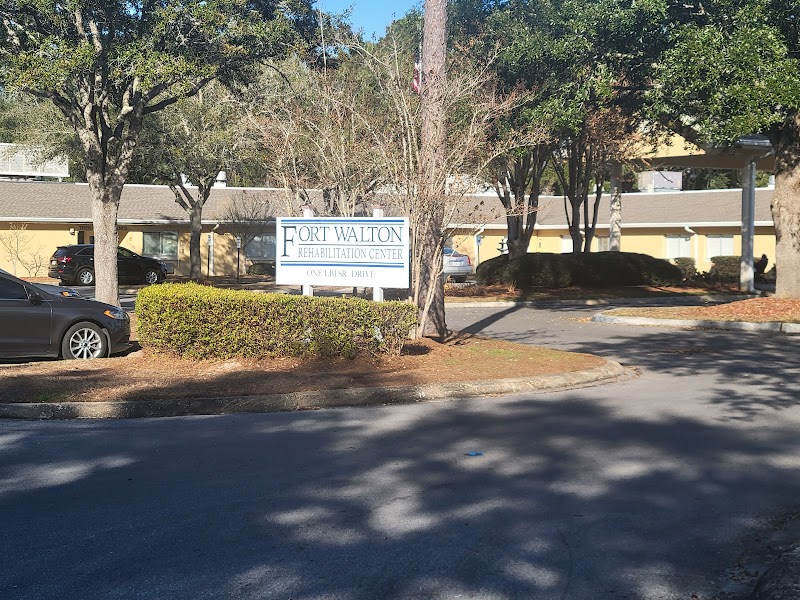
FORT WALTON REHABILITATION CENTER, LLC
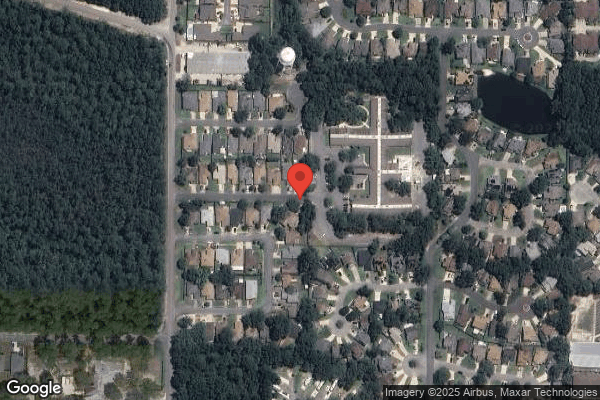

1 LBJ SR DRIVE, FORT WALTON BEACH, FL 32547 (850) 863-2066
For profit - Limited Liability company 120 Beds SOVEREIGN HEALTHCARE HOLDINGS Data: November 2025
Trust Grade
90/100
#37 of 690 in FL
Last Inspection: June 2025

Inspected within the last 6 months. Data reflects current conditions.

Overview

Fort Walton Rehabilitation Center, LLC has received a Trust Grade of A, indicating it is considered excellent and highly recommended for care. Ranked #37 out of 690 facilities in Florida, it places in the top half, while being #3 of 8 in Okaloosa County shows there are limited local options that are better. The facility is improving, having reduced its issues from 3 in 2023 to 2 in 2025. Staffing is average with a 3/5 star rating and a turnover rate of 43%, which is similar to the state average. Notably, there have been no fines recorded, reflecting a positive compliance history. However, there are some concerns; the facility was found to have maintenance issues in bathrooms, including peeling paint and biofilm buildup, which could affect resident safety. Additionally, there were documentation errors regarding a resident's mental health status that may have implications for proper care. Although there is average RN coverage, more could be done to enhance the quality of care provided. Overall, while there are strengths in its high trust grade and excellent health inspection ratings, the facility must address specific maintenance and documentation issues to improve resident safety and care quality further.

Trust Score
A
90/100
In Florida
#37/690
Top 5%
Safety Record
Low Risk
No red flags
Inspections
Getting Better
3 → 2 violations
Staff Stability
○ Average
43% turnover. Near Florida's 48% average. Typical for the industry.
Penalties
✓ Good
No fines on record. Clean compliance history, better than most Florida facilities.
Skilled Nurses
○ Average
Each resident gets 36 minutes of Registered Nurse (RN) attention daily — about average for Florida. RNs are the most trained staff who monitor for health changes.
Violations
✓ Good
Only 5 deficiencies on record. Cleaner than most facilities. Minor issues only.
★★★★★
5.0
Overall Rating
★★★☆☆
3.0
Staff Levels
★★★★☆
4.0
Care Quality
★★★★★
5.0
Inspection Score
Stable
2023: 3 issues
2025: 2 issues

The Good

  • 4-Star Quality Measures · Strong clinical quality outcomes
  • Full Sprinkler Coverage · Fire safety systems throughout facility
  • No fines on record
  • Staff turnover below average (43%)

    5 points below Florida average of 48%

Facility shows strength in quality measures, fire safety.

The Bad

Staff Turnover: 43%

Near Florida avg (46%)

Typical for the industry

Chain: SOVEREIGN HEALTHCARE HOLDINGS

Part of a multi-facility chain

Ask about local staffing decisions and management

The Ugly 5 deficiencies on record

Jun 2025 2 deficiencies
CONCERN (D)

Potential for Harm - no one hurt, but risky conditions existed

Safe Environment (Tag F0584)

Could have caused harm · This affected 1 resident

**NOTE- TERMS IN BRACKETS HAVE BEEN EDITED TO PROTECT CONFIDENTIALITY** Based on observations, interviews and record Review, the facility failed to provide maintenance services to maintain a clean, sa...

Read full inspector narrative →
**NOTE- TERMS IN BRACKETS HAVE BEEN EDITED TO PROTECT CONFIDENTIALITY** Based on observations, interviews and record Review, the facility failed to provide maintenance services to maintain a clean, safe living environment for 2 of 4 bathrooms observed in Hallway 200. (rooms [ROOM NUMBERS]) The findings include: On 06/23/25 at approximately 8:45 AM, an environmental observation was made in room [ROOM NUMBER], where holes were noted in the wall adjacent to the television and scratches were noted behind the bed. (Photographic evidence obtained) On 06/23/25 at approximately 9:50 AM, an observation in room [ROOM NUMBER] revealed peeling paint and a hole in the bathroom wall near the sink, with visible plaster residue deposited on the sink surface. Additionally, the bathroom faucet exhibited a buildup of a greenish hard biofilm. (Photographic evidence obtained) On 06/25/25 at approximately 12:16 PM, an interview was conducted with the Maintenance Technician. He explained the current process for reporting and addressing maintenance concerns, noting that any staff member may submit a work order, which can be recorded in maintenance logbooks located at each nursing station and in the kitchen. The Maintenance Technician further explained that both he and the Maintenance Director conduct monthly inspections to proactively identify and address areas in need of repair. During the interview, he assessed the bathroom wall and faucet in room [ROOM NUMBER]'s bathroom. He acknowledged the crumbling wall and the greenish biofilm buildup on the faucet, stating that the accumulation appeared to have developed over an extended period. He concluded that the condition was not acceptable and in need of corrective action. On 06/26/25 at approximately 11:35 AM, an interview was conducted with the Maintenance Director. He reported that he is responsible for reviewing the facility's work order book daily and addressing repairs requests accordingly. He clarified that the maintenance department consists of only himself and one technician and that the facility is currently undergoing renovations. During the interview, he assessed the bathroom wall and sink faucet in room [ROOM NUMBER]'s bathroom. He acknowledged that the wall above the sink was in poor condition with the crumbling deposit around the sink and confirmed the presence of a greenish biofilm buildup on the faucet. He indicated awareness of the need to repair the wall and replace the faucet and recalled discussing the matter previously with the Administrator. He explained that the repair priorities are determined in consultation with the Administrator and emphasized that renovation efforts are ongoing but take time to complete in addition to the daily repairs. On 06/26/25 at approximately 11:45 AM, an interview was conducted with the Administrator and the Maintenance Director. She confirmed her understanding of the facility's maintenance request and repair process. During the interview, the Administrator personally assessed the bathroom in room [ROOM NUMBER]. She acknowledged the deteriorating condition of the wall, noting crumbling deposits, as well as the presence of the greenish biofilm buildup on the faucet. She added that repairs would be made if deemed necessary. She agreed that the condition of the bathroom did not reflect a home-like or safe environment and acknowledged that the area was not in good repair. A record review of the 200 Hall Work Orders was reviewed. No work order was placed for the wall condition crumbling or the bathroom faucet with bio built up in Rooms 204 or 206.
CONCERN (D)

Potential for Harm - no one hurt, but risky conditions existed

Pharmacy Services (Tag F0755)

Could have caused harm · This affected 1 resident

**NOTE- TERMS IN BRACKETS HAVE BEEN EDITED TO PROTECT CONFIDENTIALITY** Based on observations, resident and staff interviews, and record reviews, the facility failed to ensure 1 of 26 residents review...

Read full inspector narrative →
**NOTE- TERMS IN BRACKETS HAVE BEEN EDITED TO PROTECT CONFIDENTIALITY** Based on observations, resident and staff interviews, and record reviews, the facility failed to ensure 1 of 26 residents reviewed medical record was clear and accurately documented in accordance with accepted professional standards and practices. (Resident # 413) The findings include: On 06/23/2025 at approximately 2:00 PM, Resident #413 was observed lying in bed with hard braces on the bilateral lower extremities which were noticeably swollen. The resident stated that she fell at home a week ago, had surgery, and was admitted to this facility. When asked if she has done any physical therapy, the resident answered yes, but it is hard with the braces on both legs. She stated she has pain and takes extra-strength Tylenol for it. She then began to say that she found out that she has Deep Vein Thrombosis (DVT) (a condition where a blood clot forms in a deep vein) in both legs and has to take Eliquis (an anticoagulant that helps prevent blood clots) for it. The resident stated she was admitted to the facility on [DATE]. Resident #413's record revealed that she does have diagnoses including DVT. The Orthopedic Surgery Report on 06/12/2025 documented that the resident had a ground level fall, fractured right and left lower femurs, had surgery to both legs with no complications. The plan included pain control, nonweightbearing to both lower extremities, maintain hinged braces, Physical Therapy/Occupational Therapy, DVT prophylaxis, and start on Lovenox (another anticoagulant that helps prevent blood clots) for known bilateral DVTs. The Orthopedic Progress Report on 06/15/2025 at 1:32 pm states to use the prophylaxis therapy Lovenox. But when her hemoglobin and hematocrit (H&H) stabilized post transfusion, they would switch to Eliquis therapy. On 06/19/2025 at 4:16 pm and 6/23/2025 at 10:45 am, the Nurse Practitioner (NP) wrote in the electronic record, History of DVTs was previously on eliquis but stopped taking- continue lovenox. However, in the Medication Administration Record, she appeared to be receiving Eliquis 5mg once every 12 hours, with no Lovenox is ordered. On 06/26/2025 at approximately 8:25 AM, an interview with nursing staff took place with Nurse K, Nurse C, and Unit Manager B. They stated that Resident #413 was monitored for pain every 8 hours. When asked to review the medication orders versus what the NP ordered, they acknowledged that she was taking Eliquis but the orders appeared to state that she should be continuing the Lovenox. On 06/26/25 at 11:20 AM, a telephone Interview with the NP was conducted. She stated that this resident had bilateral femur fractures and she should be on Lovenox. She stated that Eliquis should be started when the resident's Hemoglobin lab numbers are between 8.5 and 9, thereby indicating her condition was stable. A record review of her recent lab results on 06/14/2025 indicated a Hemoglobin level of 7.7; on 6/15/2025, she had a Hemoglobin level of 6.7; and on 6/20/2025 her Hemoglobin level was 7.7.
Jan 2023 3 deficiencies
CONCERN (D)

Potential for Harm - no one hurt, but risky conditions existed

Assessment Accuracy (Tag F0641)

Could have caused harm · This affected 1 resident

**NOTE- TERMS IN BRACKETS HAVE BEEN EDITED TO PROTECT CONFIDENTIALITY** Resident #78 The record review of resident #78 documented diagnoses of Alzheimer's disease and Depression. The Level I PASARR fo...

Read full inspector narrative →
**NOTE- TERMS IN BRACKETS HAVE BEEN EDITED TO PROTECT CONFIDENTIALITY** Resident #78 The record review of resident #78 documented diagnoses of Alzheimer's disease and Depression. The Level I PASARR for resident #78 was inaccurate, as it did not identify any serious mental disease or related conditions. On 01/23/2023, at approximately 3:00 PM, an interview was conducted with the Director of Nursing (DON). The DON indicates it is her responsibility to do a final review of all PASARRs. The DON indicates she performs the final review to determine if a Level II PASARR is needed. The DON verbally agreed that a Level II PASARR should have been completed for resident #78. On 01/23/2023, a review of the PASARR policy was completed. The Preadmission Screening and Resident Review policy (revised 11/18/2017) defined the federal requirement to complete a PASARR review to help ensure that individuals who have a mental disorder or intellectual disabilities are not inappropriately placed in nursing homes for long term care. The policy requires that 1) all applicants to a Medicaid-certified nursing center be evaluated for a serious mental disorder and/or intellectual disability; 2) be offered the most appropriate setting for their needs (in the community, a nursing center, or acute care setting); and 3) receive the services they need in those settings. Resident #1 A record review for Resident #1 on 1/23/2023 at approximately 12:30 PM noted a diagnosis of Unspecified Intellectual Disabilities dated 12/23/2007 and Cerebral Palsy dated 11/8/2022. A record review for resident #1 performed on 1/23/2023 at approximately 12:45 PM noted a Request for Level II PASARR Evaluation and Determination dated 12/13/2010. The Level II Determination for Mental Retardation dated 1/27/2011 acknowledges that specialized services were not needed. A record review of the Minimum Data Set (MDS) dated [DATE] noted no documentation in Section A1500 that acknowledged a Level II PASARR was completed for a diagnosis of Mental Retardation/Developmental Delay (MR/DD). A record review of the Annual MDS Assessment for Resident #1 dated 3/3/2011 noted no documentation in section A1500 acknowledging a diagnosis of MR/DD and/or the completion of a Level II PASARR screen. A record review of the Annual MDS Assessment for Resident #1 dated 6/4/2022 noted in section A1500 documented that Resident #1 was not considered by the state Level II PASARR process to have a serious mental illness and/or intellectual disability or related condition. An interview on 1/23/2023 at approximately 2:35 PM with Staff B, RN MDS Coordinator, acknowledged that a Level II screening was in the medical record from 2010, and that the MDS in section A did not acknowledge a Diagnosis requiring a Level II screen, and that a Level II screen had been completed. Staff B, RN MDS Coordinator stated the individual who did the annual MDS Screen dated 6.4.2022 was no longer at the facility. Resident #92 A record review performed on 1/24/2023 at approximately 2:34 PM of current and discontinued medications for Resident #92 noted that Resident #92 had not been prescribed a medication considered to be an anticoagulant. Resident #92 was prescribed Plavix (Clopidogrel Bisulfate) 75 mg on 8/9/2022, which is considered an antiplatelet medication. A review of the quarterly MDS of Resident #92 dated 11/10/2022 noted in Section N that Resident #92 received an anticoagulant for 7 of 7 days of the lookback period. In an interview on 01/25/23 at approximately 9:26 AM, the MDS Coordinators Staff B (a Registered Nurse) and Staff C (a Licensed Practical Nurse) were asked what medications are coded in MDS as an anticoagulant. Staff C stated that anticoagulants include Eliquis and Coumadin. Staff C stated that Plavix and Aspirin are not to be considered anticoagulants. Staff B and C were asked to pull up the records for Resident #92 and Resident #68. It was noted that both residents were noted to have been coded for an anticoagulant for 7 of 7 days. A review of the medications noted that neither resident #92 nor Resident #68 were prescribed a medication considered to be an anticoagulant. Both residents were prescribed Plavix which is not an anticoagulant. Staff B stated she had made that error. She stated she is recently new to the process and is learning. Resident #68 On 1/23/22, a record review was conducted for resident #68. The quarterly MDS assessment completed on 1/22/22 documented the resident had received anticoagulant medication for 7 days immediately prior to the assessment. A review of the active, discontinued and completed orders revealed the resident did not have orders and had not been administered anticoagulant medications but had an order for and received Clopidogrel Bisulfate Tablet, an antiplatelet medication. Based on observation, interview and record review, the facility failed to provide accurate Minimum Data Set (MDS) Resident Assessments on 5 of 6 residents sampled. (Residents #1, #5, #68, #78 and #92) The findings include: Resident #5 Resident #5's electronic medical record revealed a significant change minimum data set (MDS) with an assessment reference date of 1/13/23 that indicated, in section A.1500, that the resident is not considered by the state level II PASARR (Preadmission Screening and Resident Review) process to have serious mental illness and/or intellectual disability or a related condition. The record revealed a PASARR level II summary dated 3/21/19 indicating a diagnosis of Schizoaffective Disorder, which meets the state definition of serious mental illness. The record also contained a level I PASARR dated 6/19/18 indicating a PASRR level II evaluation was not required. An interview was conducted with employee B (Registered Nurse) on 1/23/23 at 2:35 PM. She stated she coded the MDS based on the level I review completed on 6/19/18 indicating she did not require a level II screening. She stated she did not see the level II and would have coded the the MDS differently if she had.
CONCERN (D)

Potential for Harm - no one hurt, but risky conditions existed

PASARR Coordination (Tag F0644)

Could have caused harm · This affected 1 resident

**NOTE- TERMS IN BRACKETS HAVE BEEN EDITED TO PROTECT CONFIDENTIALITY** Based on observation, interview, and record review, the facility failed to coordinate a Level II Preadmission Screening and Resi...

Read full inspector narrative →
**NOTE- TERMS IN BRACKETS HAVE BEEN EDITED TO PROTECT CONFIDENTIALITY** Based on observation, interview, and record review, the facility failed to coordinate a Level II Preadmission Screening and Resident Review (PASARR) assessment for 1of 1 residents sampled. (Resident #97) The findings include: A review of the PASARR form for Resident #97 dated 9/26/2021 noted no diagnosis of Serious Mental Illness (SMI) or Intellectual Disability (ID), or a primary diagnosis of dementia. A medical record review for Resident #97 noted a diagnosis of Generalized Anxiety Disorder added on 11/1/2021. In addition, on 9/13/2022, Resident #97 was prescribed Buspar tablet 7.5 mg by mouth three times a day for anxiety. On 12/16/2022, Resident #97 was additionally prescribed Lorazepam tablet 0.5 mg two tablets at bedtime for anxiety. A medical record review of thirteen psychiatry evaluations from 11/29/2021 through 11/15/2022 documented a diagnosis of Major Depressive Disorder and Generalized Anxiety Disorder. A medical record review of the Annual Minimum Data Set (MDS) assessment dated [DATE] for resident #97 noted in Section A: Section 1500 that the resident is currently considered to not have a serious mental illness and/or intellectual disability or related condition. In an interview on 1/24/2023 at approximately 11:59 AM with the MDS Coordinators, Staff B (a Registered Nurse) and Staff C (a Licensed Practical Nurse) were asked what the process was if the resident has a SMI added after they are admitted . Staff C stated that, when the consultant provides a new diagnosis, the Director of Nursing (DON) will let them know to add this to the MDS. In an interview with the Administrator, Director of Nursing (DON), and the Regional Clinical Director on 1/24/23 at 12:03 PM, they were asked what the process was to get a Level II PASARR screening completed when a resident gets a new diagnosis of a serious mental illness. They expressed confusion over what needed to be referred for a Level II, what qualified as a serious mental illness, and whether or not the resident had dementia. They produced guidance from the Level II contractor who provides their training and guidance. A review of the memo noted documentation that the Level II evaluation may be terminated if the evaluator determines at any time during the evaluation that the individual: 1. Does not have an SMI or ID. 2. Has a primary diagnosis of dementia; or 3. Has a non-primary diagnosis of dementia without a primary diagnosis of SMI or ID. They acknowledge that Resident #97 did not have a primary diagnosis of dementia and had been later given a diagnosis of anxiety disorder. They were then asked who does the referral for a Level II PASARR screening if there is an updated diagnosis or change. The DON stated that it would be her. A review of the facility policy titled Pre-admission Screening and Resident Review (PASARR) dated as 11/28/2017 states that Referral to the Stated Mental Health (SMH)/Intellectual Disability (ID) authority should be made as soon as the criteria indicative of a significant change are evident.
CONCERN (D)

Potential for Harm - no one hurt, but risky conditions existed

Infection Control (Tag F0880)

Could have caused harm · This affected 1 resident

Based on observation, staff interviews, and policy review, the facility failed to ensure staff effectively disinfected shared blood glucose meters during 1 of 1 random observations of blood glucose sa...

Read full inspector narrative →
Based on observation, staff interviews, and policy review, the facility failed to ensure staff effectively disinfected shared blood glucose meters during 1 of 1 random observations of blood glucose sampling for resident #43. The findings include: An observation of Employee A (Licensed Practical Nurse) checking resident #43's blood sugar was conducted on 1/23/23 at 4:41 PM. Employee A obtained the blood glucose meter from the medication cart, then placed the machine on the bedside table in resident #43's room. She obtained the blood sample from resident #43 and applied it to the strip in the machine then laid the machine in resident #43's bed. Afterwards, Employee A picked up the machine and placed it back on the bedside table. Employee A then disposed of the blood sampling strip and placed the blood glucose meter on top of the medication cart with no barrier under the machine. Employee A then cleansed the blood glucose meter with an alcohol wipe. An interview was conducted with employee A on 1/23/23 at 4:48 PM. She stated she had training to clean the blood glucose meter with bleach wipes. She stated she had to check 5 resident blood sugars and it was sometimes more convenient to use alcohol wipes to clean the machine. She then confirmed she was supposed to clean the machine with bleach wipes between each resident and stated the supervisor told her she could use alcohol. An interview was conducted with the Director of Nursing (DON) on 1/23/23 at 4:53 PM. The DON stated the staff are to use bleach wipes to clean the blood glucose meter, not alcohol. Review of the undated facility policy regarding Guidelines for Cleaning and Disinfecting Blood Glucose Meter revealed the meter should be disinfected with a germicidal wipe before and after each use. The policy states, Disinfect the meter with a germicidal wipe, place the meter on a clean barrier, and allow to air dry for a full 3 minutes. The policy includes a photo of bleach germicidal wipes.
Understanding Severity Codes (click to expand)
Life-Threatening (Immediate Jeopardy)
J - Isolated K - Pattern L - Widespread
Actual Harm
G - Isolated H - Pattern I - Widespread
Potential for Harm
D - Isolated E - Pattern F - Widespread
No Harm (Minor)
A - Isolated B - Pattern C - Widespread

Questions to Ask on Your Visit

  • "Can I speak with families of current residents?"
  • "What's your RN coverage like on weekends and overnight?"

Our Honest Assessment

Strengths
  • • Grade A (90/100). Above average facility, better than most options in Florida.
  • • No major safety red flags. No abuse findings, life-threatening violations, or SFF status.
  • • No fines on record. Clean compliance history, better than most Florida facilities.
  • • Only 5 deficiencies on record. Cleaner than most facilities. Minor issues only.
Concerns
  • • No significant concerns identified. This facility shows no red flags across CMS ratings, staff turnover, or federal penalties.
Bottom line: Generally positive indicators. Standard due diligence and a personal visit recommended.

About This Facility

What is Fort Walton Rehabilitation Center, Llc's CMS Rating?

CMS assigns FORT WALTON REHABILITATION CENTER, LLC an overall rating of 5 out of 5 stars, which is considered much above average nationally. Within Florida, this rating places the facility higher than 99% of the state's 100 nursing homes. This rating reflects solid performance across the metrics CMS uses to evaluate nursing home quality.
How is Fort Walton Rehabilitation Center, Llc Staffed?

CMS rates FORT WALTON REHABILITATION CENTER, LLC's staffing level at 3 out of 5 stars, which is average compared to other nursing homes. Staff turnover is 43%, compared to the Florida average of 46%. This relatively stable workforce can support continuity of care.

What Have Inspectors Found at Fort Walton Rehabilitation Center, Llc?

State health inspectors documented 5 deficiencies at FORT WALTON REHABILITATION CENTER, LLC during 2023 to 2025. These included: 5 with potential for harm.
Who Owns and Operates Fort Walton Rehabilitation Center, Llc?

FORT WALTON REHABILITATION CENTER, LLC is owned by a for-profit company. For-profit facilities operate as businesses with obligations to shareholders or private owners. The facility is operated by SOVEREIGN HEALTHCARE HOLDINGS, a chain that manages multiple nursing homes. With 120 certified beds and approximately 106 residents (about 88% occupancy), it is a mid-sized facility located in FORT WALTON BEACH, Florida.
How Does Fort Walton Rehabilitation Center, Llc Compare to Other Florida Nursing Homes?

Compared to the 100 nursing homes in Florida, FORT WALTON REHABILITATION CENTER, LLC's overall rating (5 stars) is above the state average of 3.2, staff turnover (43%) is near the state average of 46%, and health inspection rating (5 stars) is much above the national benchmark.

What Should Families Ask When Visiting Fort Walton Rehabilitation Center, Llc?

Based on this facility's data, families visiting should ask: "Can I visit during a mealtime to observe dining assistance and food quality?" "How do you handle medical emergencies, and what is your hospital transfer rate?" "Can I speak with family members of current residents about their experience?"

Is Fort Walton Rehabilitation Center, Llc Safe?

Based on CMS inspection data, FORT WALTON REHABILITATION CENTER, LLC has a clean safety record: no substantiated abuse findings (meaning no confirmed cases of resident harm), no Immediate Jeopardy citations (the most serious violation level indicating risk of serious injury or death), and is not on the Special Focus Facility watch list (a federal program monitoring the lowest-performing 1% of nursing homes). The facility has a 5-star overall rating and ranks #1 of 100 nursing homes in Florida. While no facility is perfect, families should still ask about staff-to-resident ratios and recent inspection results during their visit.

Do Nurses at Fort Walton Rehabilitation Center, Llc Stick Around?

FORT WALTON REHABILITATION CENTER, LLC has a staff turnover rate of 43%, which is about average for Florida nursing homes (state average: 46%). Moderate turnover is common in nursing homes, but families should still ask about staff tenure and how the facility maintains care continuity when employees leave.

Was Fort Walton Rehabilitation Center, Llc Ever Fined?

FORT WALTON REHABILITATION CENTER, LLC has no federal fines on record. CMS issues fines when nursing homes fail to meet care standards or don't correct problems found during inspections. The absence of fines suggests the facility has either maintained compliance or corrected any issues before penalties were assessed. This is a positive indicator, though families should still review recent inspection reports for the full picture.

Is Fort Walton Rehabilitation Center, Llc on Any Federal Watch List?

FORT WALTON REHABILITATION CENTER, LLC is not on any federal watch list. The most significant is the Special Focus Facility (SFF) program, which identifies the bottom 1% of nursing homes nationally based on persistent, serious quality problems. Not being on this list means the facility has avoided the pattern of deficiencies that triggers enhanced federal oversight. This is a positive indicator, though families should still review the facility's inspection history directly.