PRUITTHEALTH - SYLVESTER
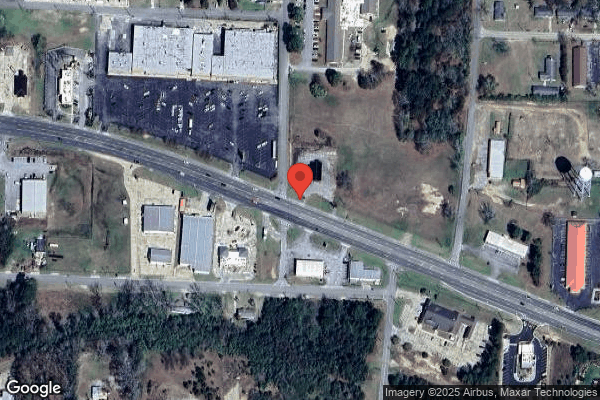
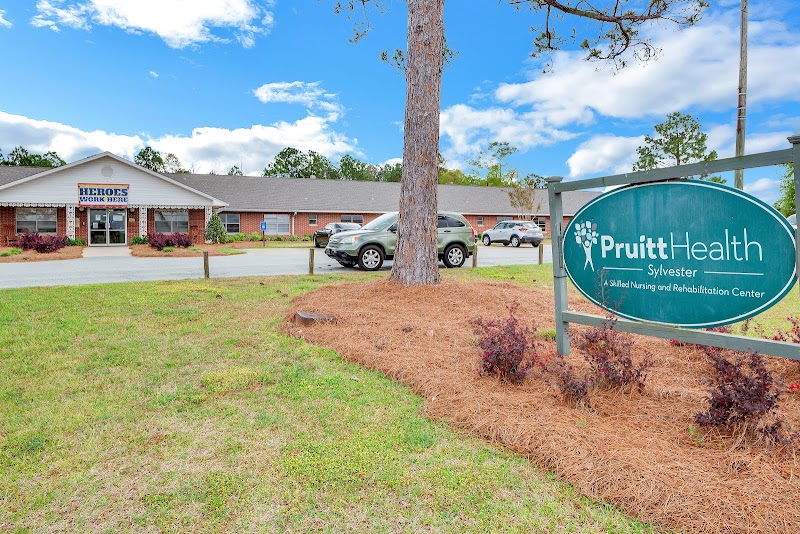
104 MONK STREET, SYLVESTER, GA 31791 (229) 776-5541
For profit - Corporation 117 Beds PRUITTHEALTH Data: November 2025
Trust Grade
83/100
#98 of 353 in GA
Last Inspection: April 2025

Within standard 12-15 month inspection cycle. Federal law requires annual inspections.

Overview

PruittHealth - Sylvester has a Trust Grade of B+, indicating it is above average and recommended for families seeking care. It ranks #98 out of 353 nursing homes in Georgia, placing it in the top half, and is the only facility in Worth County, making it the best local option. The facility is newly inspected, so there's no trend data yet, but it has a strong staffing rating of 4 out of 5 stars, with a low turnover rate of 25%, significantly better than the state average. Notably, there have been no fines issued, and it offers higher RN coverage than 79% of Georgia facilities, ensuring better oversight of residents' care. However, there were four concerns noted during the inspection, including one resident lacking accessible call devices, another not receiving adequate personal hygiene assistance, and a third not having gastric residual checked before tube feeding, which could lead to health complications. Overall, while there are some areas needing attention, the facility has many strengths that families may find reassuring.

Trust Score
B+
83/100
In Georgia
#98/353
Top 27%
Safety Record
Low Risk
No red flags
Inspections
Too New
0 → 4 violations
Staff Stability
✓ Good
25% annual turnover. Excellent stability, 23 points below Georgia's 48% average. Staff who stay learn residents' needs.
Penalties
✓ Good
No fines on record. Clean compliance history, better than most Georgia facilities.
Skilled Nurses
○ Average
Each resident gets 35 minutes of Registered Nurse (RN) attention daily — about average for Georgia. RNs are the most trained staff who monitor for health changes.
Violations
✓ Good
Only 4 deficiencies on record. Cleaner than most facilities. Minor issues only.
★★★★☆
4.0
Overall Rating
★★★★☆
4.0
Staff Levels
★★★★☆
4.0
Care Quality
★★★★☆
4.0
Inspection Score
Stable
: 0 issues
2025: 4 issues

The Good

  • 4-Star Staffing Rating · Above-average nurse staffing levels
  • 4-Star Quality Measures · Strong clinical quality outcomes
  • Low Staff Turnover (25%) · Staff stability means consistent care
  • Full Sprinkler Coverage · Fire safety systems throughout facility
  • No fines on record
  • Staff turnover is low (25%)

    23 points below Georgia average of 48%

Facility shows strength in staffing levels, quality measures, staff retention, fire safety.

The Bad

Chain: PRUITTHEALTH

Part of a multi-facility chain

Ask about local staffing decisions and management

The Ugly 4 deficiencies on record

Apr 2025 4 deficiencies
CONCERN (D)

Potential for Harm - no one hurt, but risky conditions existed

Deficiency F0558 (Tag F0558)

Could have caused harm · This affected 1 resident

**NOTE- TERMS IN BRACKETS HAVE BEEN EDITED TO PROTECT CONFIDENTIALITY** Based on observation, interview, and record review, the facility failed to ensure call devices were accessible for one of 33 res...

Read full inspector narrative →
**NOTE- TERMS IN BRACKETS HAVE BEEN EDITED TO PROTECT CONFIDENTIALITY** Based on observation, interview, and record review, the facility failed to ensure call devices were accessible for one of 33 residents (Resident (R) 68) observed for call light accessibility. This failure had the potential to place R68 at risk of accident, injury, or unmet needs related to an inability to call for staff assistance. Findings include: Review of R68's Face Sheet, located under the Face Sheet tab of the electronic medical record (EMR) revealed she was admitted to the facility on [DATE] with diagnoses including diabetes, dementia with agitation, insomnia, dizziness and giddiness, anxiety, lack of coordination, muscle weakness, and orthostatic hypotension. Review of R68's quarterly Minimum Data Set (MDS), with an Assessment Reference Date (ARD) of 2/7/2025 and located under the MDS 3.0 Assessments tab of the EMR, revealed she scored 13 out of 15 on the Brief Interview for Mental Status (BIMS), indicating intact cognition. The MDS also revealed R68 was independent with bed mobility and transfers, and required setup/clean up assistance with using the bathroom. She used a wheelchair for locomotion. Review of R68's Care Plan, dated 4/9/2025 and located under the Care Plan tab of the EMR, revealed, [R68] is at risk for falls related to chronic orthostatic HTN [hypertension], dementia, hx [history] of CVA [stroke], and syncope. The approaches included: encourage resident to call for assistance with mobility and place call light within reach. During observations on 4/22/2025 at 10:08 am and 11:56 am in R68's room, the resident was lying in bed. Her call light cord was coiled and hanging on the call box on the wall behind the head of her bed, approximately three feet away. During an observation on 4/22/2025 at 1:57 pm in R68's room, the resident was lying in bed awake. Her call light cord was coiled and still hanging on the wall behind the head of the bed. During a concurrent interview, R68 stated the call light button was not in a place where she could reach it and stated she needed it to be within reach to call for help. She stated, They were cleaning, and they forgot to move it back, and added that it should be on her bed. During an interview and concurrent observation on 4/22/2025 at 2:03 pm, Licensed Practical Nurse (LPN) 4 stated R68 was able to use her call light, and it should be placed within reach. LPN4 entered R68's room and confirmed the call light was not within the resident's reach. LPN4 moved the call light from the wall to R68's bed, and R68 was grateful. During an interview on 4/22/2025 at 2:05 pm, Certified Nurse Aide (CNA) 2 stated she typically placed the call light on R68's bed; however, sometimes the housekeeping staff moved it for cleaning and forgot to return it to the bed. CNA2 stated R68 would not be able to coil up her call light cord and hang it on the wall; she did not know how it got there. During a concurrent interview on 4/25/2025 at 11:25 am with the Administrator and Director of Nursing (DON), the DON stated all staff in-service trainings were held periodically, which included housekeeping staff, regarding the placement of call lights within resident reach. The DON stated that the training and her expectation were that the call light should be within reach of residents while they were in bed. The Administrator stated the facility did not have a policy addressing call light accessibility.
CONCERN (D)

Potential for Harm - no one hurt, but risky conditions existed

ADL Care (Tag F0677)

Could have caused harm · This affected 1 resident

**NOTE- TERMS IN BRACKETS HAVE BEEN EDITED TO PROTECT CONFIDENTIALITY** Based on observation, record review, and interview, the facility failed to ensure bathing and personal hygiene assistance were p...

Read full inspector narrative →
**NOTE- TERMS IN BRACKETS HAVE BEEN EDITED TO PROTECT CONFIDENTIALITY** Based on observation, record review, and interview, the facility failed to ensure bathing and personal hygiene assistance were provided for one of three residents (Resident (R) 92) reviewed for bathing out of 32 sample residents. This failure had the potential to cause residents' bathing and personal hygiene preferences not to be met. Findings include: Review of R92's Face Sheet located in the resident's electronic medical records (EMR) under the Face Sheet tab revealed the resident was admitted to the facility on [DATE] with diagnoses that included bilateral above-the-knee amputations. Review of R92's quarterly Minimum Data Set (MDS), with an Assessment Reference Date (ARD) of 3/3/2025 and located in the resident's EMR under the MDS tab revealed the resident had a Brief Interview for Mental Status (BIMS) score of 15 out 15 points which indicated the resident was cognitively intact. The MDS indicated the resident did not exhibit any behaviors such as resisting care. The resident was assessed to require substantial to maximal assistance with personal hygiene. Review R92's Care Plan revised on 4/9/2025and located in the resident's EMR under the Care Planning tab revealed the resident needed assistance with activities of daily living (ADLs). Interventions included checking nails and assisting with care as tolerated and resident requires assistance with bathing. Observation and interview on 4/22/2025 at 10:28 am, R92 was lying in bed wearing a green tee shirt and an adult brief. The resident's hair was matted and uncombed, and his face was unshaven. The resident had long discolored fingernails with brown colored matter underneath the nails. R92 stated had not received a bath or shower since his admission to the facility. The resident stated that he was left lying wet, in urine, for long periods. The resident also stated that he did not like long fingernails and wished the staff would trim and clean his nails. Observation on 4/22/2025 at 1:30 pm revealed R92 was lying in bed and still wearing a green tee shirt and an adult brief. The resident remained unshaven, and his hair matted and uncombed. The resident's fingernails were long and discolored with brown matter underneath the nails. Observation on 4/23/2025 at 8:56 am revealed R92 was lying in bed and still had on the same green shirt as the day before and an adult brief. The resident's hair remained uncombed, and his face unshaven. The resident's fingernails were trimmed, but still had brown colored matter underneath the nails. Observation and interview on 4/23/2025 at 11:44 am, R92 was lying in bed with the same green shirt on as in the previous observations and in a freshly changed adult brief. The resident's hair remained matted and uncombed, and his face was unshaven. R92's fingernails had brown residue underneath the nails. R92 stated the staff had just changed his brief; however, the staff did not offer to bathe him or wash his face. The resident stated the staff did trim his nails, but that stuff remained under his nails. The resident stated the staff did not offer to soak his hands to clean under the nails. Observation on 4/23/2025 at 3:00 pm revealed R92 was still wearing the same green shirt in only a brief, his hair matted and uncombed, and his fingernails with brown matter underneath the nails. Interview on 4/24/2025 at 10:10 am with Licensed Practical Nurse (LPN) 5 revealed R92 had never requested to have a shower. The LPN stated R92 would take bed baths but had a habit of refusing the bed bath at times. LPN5 stated the resident's refusal for bed baths was never documented. LPN5 stated the resident's tasks had to be segmented, meaning the staff had to perform the care in segments and not all at once. LPN5 also stated the resident was particular about nail care because the fingers were tender. LPN5 stated that she did not know if this was documented in his care plan. An interview on 4/24/2025 at 10:10 am with a Certified Nursing Assistant (CNA) 4 revealed she provided R92 with a complete bed bath, nail care, and encouraged the resident to be out of bed on this date. CNA4 stated that she was able to trim R92's fingernails on 4/23/2025, but really cleaned them today. CNA4 also stated the resident refused to take a bed bath yesterday, and she notified the nurse. Interview on 4/24/2025 at 2:30 pm with the Director of Nursing (DON) revealed R92 would at times refuse care; however, she was unaware that the resident's MDS and care plan did not reflect his refusal of care. The DON was unable to provide documentation of the resident's refusal of personal hygiene care. The DON stated the facility did not have a policy for ADL care or shower/bath.
CONCERN (D)

Potential for Harm - no one hurt, but risky conditions existed

Tube Feeding (Tag F0693)

Could have caused harm · This affected 1 resident

**NOTE- TERMS IN BRACKETS HAVE BEEN EDITED TO PROTECT CONFIDENTIALITY** Based on observation, interview, record review, and review of the facility's policy titled Enteral Nutrition (Tube Feeding), the...

Read full inspector narrative →
**NOTE- TERMS IN BRACKETS HAVE BEEN EDITED TO PROTECT CONFIDENTIALITY** Based on observation, interview, record review, and review of the facility's policy titled Enteral Nutrition (Tube Feeding), the facility failed to ensure gastric residual was checked prior to administering enteral nutrition via gastrostomy tube (G-Tube) for one of two residents (Resident (R) 65) reviewed for G-Tubes out of 36 sampled residents. The failure to check R65's gastric residual increased the risk that the resident could experience health complications associated with the stomach not digesting the contents as expected. Findings include: Review of the facility's policy titled, Enteral Nutrition (Tube Feeding), reviewed 9/12/2024, revealed, .Procedures .2. The physician writes orders prescribing the formula, rate, route of administration, and flush orders for the individualized resident/patient. Review of R65's quarterly Minimum Data Set (MDS), with an assessment reference date (ARD) of 2/26/25 and located in the Aspen MDS Viewer, revealed the resident was admitted to the facility on [DATE] and most recently readmitted on [DATE]. The MDS also revealed the resident was assessed as having a feeding tube (G-Tube) and received 51 percent or more of her calories via tube feeding for seven of seven days of the seven-day assessment period. Review of R65's Physician Orders found in the electronic medical record (EMR) under the Orders tab revealed an order dated 4/9/2025 of G-Tube: Check for residual before feeding. If residual is greater than 100 mL [milliliters], hold feeding and call MD [medical doctor] for further orders. Observation on 4/24/2025 at 2:10 pm, Licensed Practical Nurse (LPN) 2 approached R65 to start the G-tube feeding. LPN2 flushed the resident's G-tube with 30 mL of water. LPN2 then connected the line coming from the nutritional supplement and enteral feeding pump to the resident's G-tube and started the feeding. The LPN did not check the resident's gastric residual prior to the start of the enteral feeding pump. During an interview 4/24/2025 at 3:55 PM, LPN2 confirmed she did not check the resident's gastric residual per R65's physician's order. During an interview on 4/24/2025 at 4:45 pm, Registered Nurse (RN) 1 was asked to describe the process for checking a resident's gastric residual. RN1 stated that a clear syringe with a plunger should have been connected to the resident's G-tube, and the nurse should have slowly pulled out on the plunger to check and see if there was any gastric residual from the resident's last feeding. RN1 stated the nurse should have measured the amount of residual (if any) to ensure it was 100 mL or less prior to starting the resident's feeding.
CONCERN (D)

Potential for Harm - no one hurt, but risky conditions existed

Infection Control (Tag F0880)

Could have caused harm · This affected 1 resident

**NOTE- TERMS IN BRACKETS HAVE BEEN EDITED TO PROTECT CONFIDENTIALITY** Based on observations, staff interviews, record reviews, and review of the facility's policy titled Enhanced Barrier Precautions...

Read full inspector narrative →
**NOTE- TERMS IN BRACKETS HAVE BEEN EDITED TO PROTECT CONFIDENTIALITY** Based on observations, staff interviews, record reviews, and review of the facility's policy titled Enhanced Barrier Precautions, the facility failed to maintain their infection control and prevention program related to Enhanced Barrier Precautions (EBP) and hand hygiene for two of 15 residents reviewed for EBP (Resident (R) 211 and R65). Staff failed to wear the required personal protective equipment (PPE) while providing care to both residents. Additionally, nursing staff failed to perform hand hygiene in between glove changes when providing care to R65. These failures placed the residents at an increased risk of developing an infection. Findings include: Review of the facility's policy titled, Enhanced Barrier Precautions, revised 4/30/2024 indicated .Enhanced Barrier Precautions refers to an infection control interventions designed to reduce transmission of multi-drug resistant organism that employs targeted gown and gloves use during high contact resident care activities .wounds (i.e chronic wounds such as pressure ulcers, diabetic foot ulcers, unhealed surgical wounds, and chronic venous stasis ulcers) and/or indwelling medical devices (i e. central lines, urinary catheters, feeding tubes, tracheostomy/ventilator tubes even if the resident is known to be infected or colonized with a multi-drug resistant organism (MDRO) . 1. Review of R211's Face Sheet located in the resident's electronic medical records (EMR) under the Face Sheet tab revealed the resident was admitted to the facility on [DATE] with diagnoses that included cerebral infarct with right side hemiplegia and hemiparesis; dysphagia, and post-gastrostomy. Review of R211's Physician's Order dated 4/3/2025, located in the resident's EMR under the Orders tab, revealed the resident was ordered Jevity 1.5 calorie (a nutritional supplement used for enteral feeding) feeding at 57 milliliters (mL) per hour for 20 hours. The order also indicated Enhanced Barrier Precautions. Observation on 4/22/2025 at 11:00 am revealed signage on R211's room door that indicated the resident was on EBP precautions. The signage directed staff to wear a gown and gloves when providing resident care. During an observation on 4/22/2025 at 1:55 pm, Licensed Practical Nurse (LPN) 5 entered R211's room carrying tube feeding supplies without donning a gown or gloves. LPN5 then exited the resident's room carrying an old tube feeding. Observation on 4/22/2025 at 2:05 pm revealed LPN5 entered R211's room again with tube feeding supplies and the LPN did not don a gown or gloves. Continued observation of the nurse in R211's room revealed LPN5 connected the resident's Gastronomy Tube (G-tube), and she did not have on a gown or gloves. During an interview on 4/22/2025 at 1:57 pm, Family Member (F) 211 stated she was in the room when LPN5 was working on the resident's feeding tube, and the LPN was not wearing a gown or gloves. During an interview on 4/22/2025 at 2:20 pm, LPN5 stated R211 was on EBP because he had a gastrotomy tube with a dressing. LPN5 acknowledged that she failed to follow the facility's EBP protocol for donning a gown and gloves when providing care for this resident. During an interview on 4/25/2025 at 10:00 am, the Assistant Director of Nursing (ADON), who was also the facility's Infection Preventionist, stated LPN5 had made her aware that she failed to follow the EBP guidance for PPE. 2. Review of R65's quarterly Minimum Data Set (MDS), with an assessment reference date (ARD) of 2/26/2025 and located in the Aspen MDS Viewer, revealed the resident was admitted to the facility on [DATE] and most recently readmitted on [DATE]. The MDS also revealed the resident was assessed as having a feeding tube (gastronomy tube [G-Tube]) and received 51 percent or more of her calories via tube feeding for seven of seven days of the seven-day assessment period. Review of R65's Physician Orders found in the electronic medical record (EMR) under the Orders tab revealed an order dated 4/9/2025 of G-Tube: Check for residual before feeding. If residual is greater than 100 mL, hold feeding and call MD [medical doctor] for further orders. Observation on 4/22/2025 at 10:25 am revealed signage posted outside of R65's door, which indicated the resident was on EBP and directed that the personal protective equipment (PPE) of a gown and gloves was to be worn when staff were providing care to the resident. Continued observation revealed R65 was lying in bed in her room, being administered an enteral feeding, and her enteral feeding pump was sounding an audible alarm. R65 was receiving enteral feeding via her G-tube. During an observation and interview on 4/22/2025 at 10:27 am, Registered Nurse (RN) 2 entered R65's room to respond to the resident's enteral feeding pump alarm. The RN stated the alarm was informing her that the feeding was complete. RN2 then disconnected the feeding tube line from the resident's G-tube. Observation and interview on 4/24/2025 at 2:10 pm revealed LPN2 entered R65's room to restart the resident's enteral feeding pump. LPN2 performed hand hygiene and then donned a gown and gloves. Prior to approaching the R65, LPN2 doffed her gloves, adjusted her eyeglasses, rubbed her eye, and then donned new gloves. LPN2 then flushed R65's G-tube with water, attached the tubing to the G-tube, and started the enteral feeding pump. LPN2 did not perform hand hygiene prior to placing new gloves on after adjusting her glasses and rubbing her eye. LPN2 acknowledged that hand hygiene should have occurred between glove changes.
Understanding Severity Codes (click to expand)
Life-Threatening (Immediate Jeopardy)
J - Isolated K - Pattern L - Widespread
Actual Harm
G - Isolated H - Pattern I - Widespread
Potential for Harm
D - Isolated E - Pattern F - Widespread
No Harm (Minor)
A - Isolated B - Pattern C - Widespread

Questions to Ask on Your Visit

  • "Can I speak with families of current residents?"
  • "What's your RN coverage like on weekends and overnight?"

Our Honest Assessment

Strengths
  • • Grade B+ (83/100). Above average facility, better than most options in Georgia.
  • • No major safety red flags. No abuse findings, life-threatening violations, or SFF status.
  • • No fines on record. Clean compliance history, better than most Georgia facilities.
  • • Only 4 deficiencies on record. Cleaner than most facilities. Minor issues only.
Concerns
  • • No significant concerns identified. This facility shows no red flags across CMS ratings, staff turnover, or federal penalties.
Bottom line: Generally positive indicators. Standard due diligence and a personal visit recommended.

About This Facility

What is Pruitthealth - Sylvester's CMS Rating?

CMS assigns PRUITTHEALTH - SYLVESTER an overall rating of 4 out of 5 stars, which is considered above average nationally. Within Georgia, this rating places the facility higher than 99% of the state's 100 nursing homes. This rating reflects solid performance across the metrics CMS uses to evaluate nursing home quality.
How is Pruitthealth - Sylvester Staffed?

CMS rates PRUITTHEALTH - SYLVESTER's staffing level at 4 out of 5 stars, which is above average compared to other nursing homes. Staff turnover is 25%, compared to the Georgia average of 46%. This relatively stable workforce can support continuity of care.

What Have Inspectors Found at Pruitthealth - Sylvester?

State health inspectors documented 4 deficiencies at PRUITTHEALTH - SYLVESTER during 2025. These included: 4 with potential for harm.
Who Owns and Operates Pruitthealth - Sylvester?

PRUITTHEALTH - SYLVESTER is owned by a for-profit company. For-profit facilities operate as businesses with obligations to shareholders or private owners. The facility is operated by PRUITTHEALTH, a chain that manages multiple nursing homes. With 117 certified beds and approximately 104 residents (about 89% occupancy), it is a mid-sized facility located in SYLVESTER, Georgia.
How Does Pruitthealth - Sylvester Compare to Other Georgia Nursing Homes?

Compared to the 100 nursing homes in Georgia, PRUITTHEALTH - SYLVESTER's overall rating (4 stars) is above the state average of 2.6, staff turnover (25%) is significantly lower than the state average of 46%, and health inspection rating (4 stars) is above the national benchmark.

What Should Families Ask When Visiting Pruitthealth - Sylvester?

Based on this facility's data, families visiting should ask: "Can I visit during a mealtime to observe dining assistance and food quality?" "How do you handle medical emergencies, and what is your hospital transfer rate?" "Can I speak with family members of current residents about their experience?"

Is Pruitthealth - Sylvester Safe?

Based on CMS inspection data, PRUITTHEALTH - SYLVESTER has a clean safety record: no substantiated abuse findings (meaning no confirmed cases of resident harm), no Immediate Jeopardy citations (the most serious violation level indicating risk of serious injury or death), and is not on the Special Focus Facility watch list (a federal program monitoring the lowest-performing 1% of nursing homes). The facility has a 4-star overall rating and ranks #1 of 100 nursing homes in Georgia. While no facility is perfect, families should still ask about staff-to-resident ratios and recent inspection results during their visit.

Do Nurses at Pruitthealth - Sylvester Stick Around?

Staff at PRUITTHEALTH - SYLVESTER tend to stick around. With a turnover rate of 25%, the facility is 21 percentage points below the Georgia average of 46%. Low turnover is a positive sign. It means caregivers have time to learn each resident's needs, medications, and personal preferences. Consistent staff also notice subtle changes in a resident's condition more quickly. Registered Nurse turnover is also low at 9%, meaning experienced RNs are available to handle complex medical needs.

Was Pruitthealth - Sylvester Ever Fined?

PRUITTHEALTH - SYLVESTER has no federal fines on record. CMS issues fines when nursing homes fail to meet care standards or don't correct problems found during inspections. The absence of fines suggests the facility has either maintained compliance or corrected any issues before penalties were assessed. This is a positive indicator, though families should still review recent inspection reports for the full picture.

Is Pruitthealth - Sylvester on Any Federal Watch List?

PRUITTHEALTH - SYLVESTER is not on any federal watch list. The most significant is the Special Focus Facility (SFF) program, which identifies the bottom 1% of nursing homes nationally based on persistent, serious quality problems. Not being on this list means the facility has avoided the pattern of deficiencies that triggers enhanced federal oversight. This is a positive indicator, though families should still review the facility's inspection history directly.