PRUITTHEALTH - TOCCOA
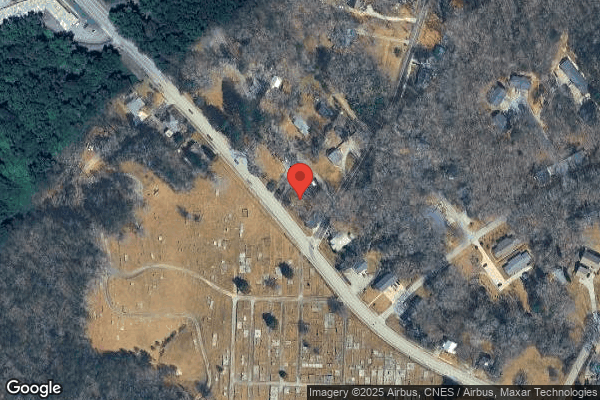
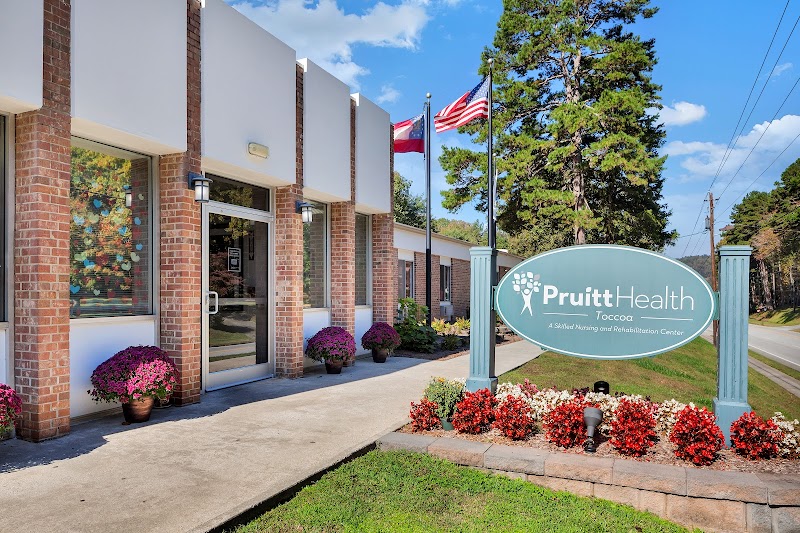
633 FALLS ROAD, TOCCOA, GA 30577 (706) 886-8491
For profit - Corporation 181 Beds PRUITTHEALTH Data: November 2025
Trust Grade
38/100
#321 of 353 in GA
Last Inspection: March 2024

Within standard 12-15 month inspection cycle. Federal law requires annual inspections.

Overview

PruittHealth - Toccoa has a Trust Grade of F, which indicates significant concerns regarding the quality of care provided. Ranked #321 out of 353 nursing homes in Georgia, they are in the bottom half, and they are the only option in Stephens County. While the facility is improving, with a decrease in issues from 8 in 2024 to 3 in 2025, there are still 26 concerns identified, including failures in food preparation and sanitation that could potentially affect residents' health. Staffing is a relative strength, with a 31% turnover rate that is below the state average, but the overall staffing rating is poor at 1 out of 5 stars. Additionally, the facility has incurred fines of $10,057, which is average, but the lack of critical issues does provide some reassurance. However, specific incidents, such as improper food storage and a lack of certification for the food service manager, highlight areas that need immediate attention.

Trust Score
F
38/100
In Georgia
#321/353
Bottom 10%
Safety Record
Low Risk
No red flags
Inspections
Getting Better
8 → 3 violations
Staff Stability
○ Average
31% turnover. Near Georgia's 48% average. Typical for the industry.
Penalties
✓ Good
$10,057 in fines. Lower than most Georgia facilities. Relatively clean record.
Skilled Nurses
⚠ Watch
Each resident gets only 15 minutes of Registered Nurse (RN) attention daily — below average for Georgia. Fewer RN minutes means fewer trained eyes watching for problems.
Violations
⚠ Watch
26 deficiencies on record. Higher than average. Multiple issues found across inspections.
★☆☆☆☆
1.0
Overall Rating
★☆☆☆☆
1.0
Staff Levels
★★★☆☆
3.0
Care Quality
★★☆☆☆
2.0
Inspection Score
Stable
2024: 8 issues
2025: 3 issues

The Good

  • Full Sprinkler Coverage · Fire safety systems throughout facility
  • No fines on record
  • Staff turnover below average (31%)

    17 points below Georgia average of 48%

Facility shows strength in fire safety.

The Bad

1-Star Overall Rating

Below Georgia average (2.6)

Significant quality concerns identified by CMS

Staff Turnover: 31%

15pts below Georgia avg (46%)

Typical for the industry

Federal Fines: $10,057

Below median ($33,413)

Minor penalties assessed

Chain: PRUITTHEALTH

Part of a multi-facility chain

Ask about local staffing decisions and management

The Ugly 26 deficiencies on record

Aug 2025 3 deficiencies
CONCERN (D) 📢 Someone Reported This

A family member, employee, or ombudsman was alarmed enough to file a formal complaint

Potential for Harm - no one hurt, but risky conditions existed

Deficiency F0558 (Tag F0558)

Could have caused harm · This affected 1 resident

Based on observations, record review, and resident and staff interviews, the facility failed to ensure call lights were within reach for one of 31 sample residents (Residents (R) 58) reviewed for acco...

Read full inspector narrative →
Based on observations, record review, and resident and staff interviews, the facility failed to ensure call lights were within reach for one of 31 sample residents (Residents (R) 58) reviewed for accommodation of needs and preferences. Specifically, the facility failed to ensure residents had access to their call lights to best assist the residents in maintaining and/or achieving their independent functioning, dignity, and well-being to the extent possible.Findings include:Review of R58's admission Record found in the Profile tab of the electronic medical record (EMR), revealed she was admitted with diagnoses including but not limited to dementia, cervical disc disorder with myelopathy, muscle weakness, and difficulty in walking.Review of R85's quarterly Minimum Data Set (MDS) located in the MDS tab in the EMR, with an Assessment Reference Date (ARD) of 8/4/2025, revealed a Brief Interview for Mental Status (BIMS) assessment with a score of nine out of 15, which indicated moderate cognitive impairment. R58 was observed on 8/25/2025 at 12:36 PM resting in bed with the call light button out of reach and sight of the resident. R58 was again observed on 8/26/2025 at 4:02 PM resting in bed with her call light on the floor behind the bed and out of reach.R58 was again observed on 8/27/2025 at 10:20 AM resting in bed. The call light was on the floor under the resident's bed against the wall.R58 was again observed on 8/28/2025 at 9:50 AM resting in bed with the call light still on the floor behind the bed out of reach.During an interview on 8/28/2025 at 9:51 AM, R58 stated that she did not have a call light, looked around her bed, and again stated she did not have a call light for use.During an interview on 8/28/2025 at 9:54 AM, Unit Manager (UM) 4 said that staff should ensure call lights were accessible to the residents.During an interview on 8/28/2025 at 9:56 AM, Certified Nurse Aide (CNA) 6 said that call lights should be pinned to the residents or placed near them.During a concurrent interview on 8/28/2025 at 9:59 AM, UM4 and CNA6 went into R58's room and both confirmed the resident's call light was on the floor against the wall, under the bed, and out of reach of the resident. They pinned the call light to the resident. During an interview on 8/28/2025 at 10:03 AM, the Administrator stated that call lights should always be placed in reach of the resident.During an interview on 8/28/25 at 2:10 PM, the Administrator stated that the facility did not have a policy regarding accommodation of needs or call light accessibility for residents.
CONCERN (D) 📢 Someone Reported This

A family member, employee, or ombudsman was alarmed enough to file a formal complaint

Potential for Harm - no one hurt, but risky conditions existed

Report Alleged Abuse (Tag F0609)

Could have caused harm · This affected 1 resident

Based on staff interview, document review, and facility policy review, the facility failed to report the results of the investigation of sexual abuse to the State Survey Agency (SSA) within five worki...

Read full inspector narrative →
Based on staff interview, document review, and facility policy review, the facility failed to report the results of the investigation of sexual abuse to the State Survey Agency (SSA) within five working days of the incident for one of one resident (Resident (R) 68) reviewed for abuse out of a total sample of 31 residents. Specifically, R71 removed her clothes and incontinence brief and climbed into R68's bed.Findings include:Review of the facility's policy titled, Investigation of Patient Abuse, Neglect, Exploitation, Mistreatment and Misappropriation of Property, dated 11/15/2024, indicated Procedure, 2.A written report of the investigation .should be submitted to the appropriate agency within five working days of the occurrence.Review of the facility investigation, provided by the Administrator, into the allegation of sexual abuse, revealed that on 7/31/2025 at 5:25 AM, R71 was unclothed sitting at the end of R68's bed in their room. The file indicated that the SSA was initially notified on 7/31/2025 at 6:20 AM. However, the final report of the investigation was not sent to the SSA until 8/11/2025.During an interview on 8/26/2025 at 12:44 PM, the Administrator confirmed the results of the investigation were not submitted timely within five days to the SSA. The Administrator stated that she was out of the country at the time of this incident and that the Administrative Assistant was informed of the incident, reported the initial report to the SSA, and then sent the results of the abuse investigation to the SSA.
CONCERN (D) 📢 Someone Reported This

A family member, employee, or ombudsman was alarmed enough to file a formal complaint

Potential for Harm - no one hurt, but risky conditions existed

Investigate Abuse (Tag F0610)

Could have caused harm · This affected 1 resident

Based on interviews, record review, document review and review of the facility's policy, the facility failed to complete a thorough investigation of an allegation of sexual abuse for two of 31 sampled...

Read full inspector narrative →
Based on interviews, record review, document review and review of the facility's policy, the facility failed to complete a thorough investigation of an allegation of sexual abuse for two of 31 sampled residents (Resident (R) 68 and R71). The facility's failure to complete a thorough investigation placed residents at risk of being unprotected from abuse.Findings include:Review of the facility's policy titled, Investigation of Patient Abuse, Neglect, Exploitation, Mistreatment and Misappropriation of Property, dated 11/15/2024, indicated Procedure, 1. Documentation of the investigation should include. Signed statements from pertinent parties. Interview should be conducted of all individuals who have relevant information.Written signed statements from any involved parties should be obtained. patients involved, reliable patients who may have witnessed the incident.Review of the facility investigation, provided by the Administrator, into the allegation of sexual abuse, revealed that on 7/31/2025 at 5:25 AM, R71 was unclothed sitting at the end of R68's bed in their room. The investigative file did not include a statement from R68 or from R49 who was the third resident who shared the room with R68 and R71.Review of R68's electronic medical record (EMR) under the Resident Assessment Instrument (RAI) tab, the quarterly Minimum Data Set (MDS) with an Assessment Reference Date (ARD) of 4/30/2025 indicated a Brief Interview for Mental Status (BIMS) score of 14 out of 15, which indicated R68 was cognitively intact. Review of R71's EMR under the RAI tab, the admission MDS with an ARD of 7/28/2025 indicated a BIMS that the resident was rarely/never understood, short-and long-term memory, therefore, a BIMS score was not obtained.Review of R49's EMR under the RAI tab, the quarterly MDS with an ARD of 8/25/2025 indicated a BIMS score of nine out of 15, which indicated R49's cognition was moderately impaired.During an interview on 8/25/2025 at 3:48 PM, R68 stated that she remembered when her roommate (R71) came to her side of the bed and was not wearing any clothes. R68 stated that R71 did not get in her bed. I used my call light to have the nurse come and help her.During an interview on 8/26/2025 at 2:18 PM, the Administrator confirmed that the investigative file contained all the interviews that were conducted. The Administrator confirmed that the file did not contain an interview with R68 or R49. The Administrator stated that R49 should have been interviewed even though her BIMS score was nine, to determine if she witnessed the incident. The Administrator stated that she was out of the country at the time of this incident and that the Administrative Assistant was informed of the incident and conducted the investigation. The Administrator confirmed it was not a thorough investigation.
Mar 2024 8 deficiencies
CONCERN (D) 📢 Someone Reported This

A family member, employee, or ombudsman was alarmed enough to file a formal complaint

Potential for Harm - no one hurt, but risky conditions existed

Safe Environment (Tag F0584)

Could have caused harm · This affected 1 resident

**NOTE- TERMS IN BRACKETS HAVE BEEN EDITED TO PROTECT CONFIDENTIALITY** Based on observations, resident and staff interviews, the facility failed to ensure a safe/clean/comfortable/homelike environmen...

Read full inspector narrative →
**NOTE- TERMS IN BRACKETS HAVE BEEN EDITED TO PROTECT CONFIDENTIALITY** Based on observations, resident and staff interviews, the facility failed to ensure a safe/clean/comfortable/homelike environment in one of 14 resident rooms (room [ROOM NUMBER]) on the Magnolia Hall. Specifically, a metal plate was observed on the bathroom door in room [ROOM NUMBER] to have a hole with sharp, jagged edges. The deficient practice had the potential to cause injury to residents and staff. Findings include: Observations and interview on 3/19/2024 at 10:18 am of the bathroom door in room [ROOM NUMBER] revealed a metal plate attached to the door on the side facing the resident room with a hole with edges that were noted to be sharp and jagged. Interview with Resident (R) (R10) revealed when the room door opens, it would hit the bathroom door and that the doorknob of the room door created the hole. He stated he was uncertain of how long the door had been damaged. Observations on 3/20/2024 at 7:42 am in room [ROOM NUMBER] revealed the bathroom door had a metal plate attached to the door which had a hole in the metal plate noted to have sharp, jagged edges exposed. Observations on 3/20/2024 at 10:30 am in room [ROOM NUMBER] revealed the bathroom door had a metal plate attached to the door which had a hole in the metal plate noted to have sharp, jagged edges exposed. Walking rounds made with the Administrator and the Maintenance Director on 3/20/2024 at 12:00 pm, both verified and confirmed the bathroom door in room [ROOM NUMBER] had a metal plate which had a hole in the metal plate with sharp, jagged edges. The Maintenance Director stated he was not aware of the hole in the metal plate on the bathroom door. Interview on 3/21/2024 at 11:15 am with the Administrator revealed his expectation regarding the condition of resident rooms was that staff report repairs needed in the system that they report and make maintenance requests. He stated all nurses have access to the system to create a maintenance request and if other staff notice a repair needed, they should report the issue to their direct supervisor, or a nurse who would enter a maintenance request into the system for them.
CONCERN (D)

Potential for Harm - no one hurt, but risky conditions existed

Comprehensive Care Plan (Tag F0656)

Could have caused harm · This affected 1 resident

**NOTE- TERMS IN BRACKETS HAVE BEEN EDITED TO PROTECT CONFIDENTIALITY** Based on observations, record review, staff interview, and review of the facility's policy titled, Care Plan, the facility faile...

Read full inspector narrative →
**NOTE- TERMS IN BRACKETS HAVE BEEN EDITED TO PROTECT CONFIDENTIALITY** Based on observations, record review, staff interview, and review of the facility's policy titled, Care Plan, the facility failed to follow the care plan for one of 46 sampled residents (R) (R37) related to providing assistance with showers and baths. Findings Include: Review of the facility's policy titled Care Plan dated 7/27/2023 revealed under admission Comprehensive Plan of Care, Number 3. The comprehensive person-centered care plan is developed to include measurable goals and timeframes to meet a patient/resident's medical, nursing and psychosocial needs, the services that are to be furnished to attain or maintain the resident's highest practicable physical, mental and psychosocial needs that are identified in the comprehensive assessment. Review of Resident Face Sheet for R37 revealed diagnoses that included but not limited to Parkinson's disease, muscle weakness, difficulty in walking, unsteadiness on feet, muscle weakness, and other lack of coordination. Review of Quarterly Minimum Data Set (MDS) dated [DATE] revealed a Brief Interview Mental Status (BIMS) was coded as 15, indicating that the resident had no cognitive impairment. Section GG (Functional Abilities and Goals) revealed that R37 required supervision or touching assistance with showering and bathing, touching assistance, and supervision. Review of the care plan dated 10/5/2023 for Activities of Daily Living (ADL) Functional Status/Rehabilitation Potential revealed R37 required assistance with ADL care as needed. Review of the Point of Care ADL Report (MDS 3.0) for R37 from 2/20/2024 through 3/21/2024 revealed documentation that staff provided the resident assistance with bathing on 3/1/2024, 3/5/2024, and 3/18/2024. Further review revealed bathing was coded as activity did not occur from 2//20/2024-2/29/2024, 3/3/2024-3/4/2024, 3/4/2024-3/6/2024, 3/6/2024-3/17/2024 and 3/19/2024-3/20/2024. There was no ADL data recorded on 3/2/2024 and 3/21/2024 for bathing. Interview on 3/20/2024 at 12:45pm with the Director of Health Services (DHS) revealed when asked how the Certified Nursing Assistants (CNAs) would know if a resident were to be provided a sponge bath or shower, DHS revealed that CNAs should follow the care plan unless residents request something different. Interview on 3/20/2024 at 5:00 pm with the Assistant Director of Health Services and the DHS revealed that the expectation was for staff to provide two to three showers per week but at minimum two showers per week for each resident who preferred showers. Cross Reference F677
CONCERN (D) 📢 Someone Reported This

A family member, employee, or ombudsman was alarmed enough to file a formal complaint

Potential for Harm - no one hurt, but risky conditions existed

ADL Care (Tag F0677)

Could have caused harm · This affected 1 resident

**NOTE- TERMS IN BRACKETS HAVE BEEN EDITED TO PROTECT CONFIDENTIALITY** Based on observations, resident and staff interviews, record review, and review of the facility's policy titled, Documentation: ...

Read full inspector narrative →
**NOTE- TERMS IN BRACKETS HAVE BEEN EDITED TO PROTECT CONFIDENTIALITY** Based on observations, resident and staff interviews, record review, and review of the facility's policy titled, Documentation: Charting Activities of Daily Living (ADLs) the facility failed to ensure that one of 46 sampled residents (R) (R37) had the necessary assistance with ADLs. Findings include: Review of the facility's policy titled, Documentation: Charting Activities of Daily Living (ADLs) dated 1/11/2024 revealed that the responsibility of the person completing the documentation on the Certified Nuse Assistant (CNA) /ADL flowsheet is to code the maximum amount of support the patient/resident received over the entire shift irrespective of frequency. For utilizing Care Assist, ADLs should be documented at the point of care each time care is given. The software will determine the most dependent episode. Review of R37's Resident Face Sheet located in the Electronic Health Record (EHR) revealed diagnoses included but not limited to Parkinson's disease, muscle weakness, difficulty in walking, unsteadiness on feet, muscle weakness, and other lack of coordination. Review of Quarterly Minimum Data Set (MDS) dated [DATE] revealed a Brief Interview Mental Status (BIMS) was coded as 15, indicating that the resident had no cognitive impairment. Section GG (Functional Abilities and Goals) revealed that R37 required supervision or touching assistance with showering and bathing, touching assistance, and supervision. Review of the [NAME] Hall Shower Schedule located in the shower room revealed R37 scheduled bath days were Tuesdays, Thursdays, and Saturdays. Further review revealed on 3/21/2024, 3/23/204, 2/27/2024, 3/2/2024,3/12/2024, 3/14/2024, 3/16/2024 there was no documentation to support R37 received or refused a shower. Review of the Point of Care ADL Report (MDS 3.0) for R37 from 2/20/2024 through 3/21/2024 revealed documentation that staff provided the resident assistance with bathing on 3/1/2024, 3/5/2024, and 3/18/2024. Further review revealed bathing was coded as activity did not occur from 2//20/2024-2/29/2024, 3/3/2024-3/4/2024, 3/4/2024-3/6/2024, 3/6/2024-3/17/2024 and 3/19/2024-3/20/2024. There was no ADL data recorded on 3/2/2024 and 3/21/2024 for bathing. Interview on 3/20/2024 at 12:45 pm with Certified Nursing Assistant (CNA) AA revealed that the facility's process to assure residents get showers was that they are assigned shower days. CNA AA revealed that they ask residents if they want a shower on assigned days, if they refuse, they put REF or refused on the weekly chart for that day. If residents get a shower, they either initial or put done on the chart to track for each day. CNA AA revealed that residents were offered showers three days during the week. During an interview on 3/20/2024 at 1:00 pm with R37, the resident revealed she filed a grievance during a Resident Council meeting related to help with showers. Review of the Resident Council Department response form dated 11/28/2024 revealed during a meeting, R37 requested help with showers and other concerns. Interview on 3/20/2024 at 1:05 pm with Licensed Practical Nurse BB revealed that each resident should be offered three showers per week. If the chart shows a blank for a day, which meant either they forgot to initial or write refused on the chart. She also revealed that if that was not the case, then the resident was never offered the opportunity to shower. Interview on 3/20/2024 at 5:00 pm with the Assistant Director of Health Services and the Director of Health Services revealed that the expectation was for staff to provide two to three showers per week but at minimum two showers per week for each resident who prefers showers. She stated staff would document the showers given and refused on the shower sheets and sometimes in the EHR. Cross Reference F656
CONCERN (D) 📢 Someone Reported This

A family member, employee, or ombudsman was alarmed enough to file a formal complaint

Potential for Harm - no one hurt, but risky conditions existed

Deficiency F0761 (Tag F0761)

Could have caused harm · This affected 1 resident

**NOTE- TERMS IN BRACKETS HAVE BEEN EDITED TO PROTECT CONFIDENTIALITY** Based on observations, staff interviews, record review, and review of the facility's titled Medication Storage in Healthcare Cen...

Read full inspector narrative →
**NOTE- TERMS IN BRACKETS HAVE BEEN EDITED TO PROTECT CONFIDENTIALITY** Based on observations, staff interviews, record review, and review of the facility's titled Medication Storage in Healthcare Centers and Medication Administration: General Guidelines, the facility failed ensure the medication cart was locked when unattended for one out of five medication carts and failed to obtain orders from a physician to allow one out of 46 sampled Residents (R) (R55) the ability to self-administer medications prior to leaving medications at the bedside. Findings include: Review of the facility's policy titled Medication Storage in Healthcare Centers reviewed and revised on 3/1/2024, under the Policy Statement revealed, Medications and biologicals are stored safely, securely, and properly following manufacturer's recommendations or those tot the supplier. The medication supply is accessible only to licensed nursing personnel and pharmacy personnel. Respiratory Therapist may access medications used in the provision of respiratory services. Under the section titled Procedure Number 2 revealed Only licensed nurses and the pharmacy personnel are allowed access to medications. Respiratory Therapists may access medications used in the provision of respiratory services. Medication rooms, carts, and medication supplies are locked or attended by persons with authorized access. Review of the facility's policy titled Medication Administration: General Guidelines last reviewed on 5/31/2023 under the Policy Statement revealed, Medications are administered as prescribed in accordance with good nursing principles and practices and only by persons legally authorized to do so. Personnel authorized to administer medications do so only after they have familiarized themselves with the medications. Under the section titled Procedure Number 3 revealed Patients/residents are allowed to self-administer medications when specifically authorized by the attending physician and in accordance with the procedures for self-administration of medications. Number 16 revealed During routine administration of medications, the medication cart is kept in the doorway of the patient/resident's room, with the drawers facing inward and all other sides closed and locked. No medications are kept on top of the cart, and all outward sides [NAME] be inaccessible to patient/resident or others passing by. 1. Observation on 3/20/2024 at 8:10 am of Licensed Practical Nurse (LPN) LL preparing medication for R77 in the main hallway near the station one nurses' desk revealed, LPN LL walking away from the medication cart to take medications to R77. The medication cart was left unattended and unlocked for three minutes. Interview on 3/20/2024 at 8:13 am with LPN LL confirmed she had left the medication cart unattended and unlocked while she administered medication to R77. She stated she got preoccupied with R77 and forgot to lock the medication cart. 2. Review of the Resident Face Sheet for R55 located in the Electronic Health Record (EHR) revealed Resident (R)55was admitted to the facility with diagnoses listed but not limited to unspecified sequelae of cerebral infarction. Review of R55 Quarterly Minimum Data Set (MDS) with an Assessment Reference Date (ARD) of 2/18/2024 revealed a Brief Interview for Mental Status (BIMS) of 15, which indicated R55 was cognitively intact. Review of R55's care plans last reviewed/revised date of 3/1/2024 revealed there was no care plan that addressed self-administration of medication. Review of physician's orders for R55 revealed there was no order for self-administration of medications. Observation and interview on 3/20/2024 at 9:08 am with Certified Medication Aide (CMA)/ Certified Nursing Assistant (CNA) DD of her taking a cup of medications to R55 and immediately exiting the room. Interview with CMA/CNA DD revealed she had left R55 medications at his bedside because he administered his own medications. Observation and interview on 3/20/2024 at 9:37 am with CMA/CNA DD of R55 resting quietly in bed with medications in medication cup on his over bed table. Interview with CMA/CNA DD verified and confirmed the medications she prepared earlier that morning were located on the over bed table. CMA/CNA DD stated, she reminded R55 he needed to take his medications and he did so while she watched. She confirmed it was not ok to leave medications at the resident's bedside. Interview on 3/20/2024 at 5:00 pm with the Director of Health Services (DHS) confirmed R55 did not have an order to self-administer medications, nor was a care plan developed to allow for him to self-administer medications. She stated there was a nursing assessment to self-administer medications, but she stated the expectation was for residents to have a physician order to self-administer medications and a care plan to reflect this as well. She stated she expected the nurses and CMA to check the care plan and physician order to verify a resident can self-administer medications and if they have a question they are expected to ask. She stated she expected the nurse and the CMA when administering medications to remain with the resident until all medications are taken.
CONCERN (D) 📢 Someone Reported This

A family member, employee, or ombudsman was alarmed enough to file a formal complaint

Potential for Harm - no one hurt, but risky conditions existed

Deficiency F0919 (Tag F0919)

Could have caused harm · This affected 1 resident

**NOTE- TERMS IN BRACKETS HAVE BEEN EDITED TO PROTECT CONFIDENTIALITY** Based on observations, resident and staff interviews, and record review, the facility failed to ensure that the call light commu...

Read full inspector narrative →
**NOTE- TERMS IN BRACKETS HAVE BEEN EDITED TO PROTECT CONFIDENTIALITY** Based on observations, resident and staff interviews, and record review, the facility failed to ensure that the call light communication system was functioning adequately to allow the resident to call for assistance in one room (room [ROOM NUMBER]A) on one of five halls. The sample size was 46 residents. Findings include: Record Review of R71's Quarterly Minimum Data Set (MDS) assessment dated [DATE] for Section A (Identification Information) revealed entry date of 12/15/2023; Section C (Cognitive Pattern) Brief Interview for Mental Status (BIMS) score of nine; Section I (Active Diagnosis) Debility, Cardiorespiratory Conditions. Observation and Interview on 3/20/2024 at 9:15 am, in room [ROOM NUMBER] A revealed, the call light was lying on the floor. The call light was inspected by the surveyor and was nonfunctional. Interview with Resident (R) R71, revealed, she was high risk for falls and had to resort to yelling or using her roommate's call light for assistance. Further Interview on 3/20/2024 at 9:55 am with R71 revealed her call light had been nonfunctional since her admission at the facility. Observation and Interview on 3/20/2024 at 10:05 am with the Director of Health Services (DHS) inspected the call light and verified the call light was nonfunctional. DHS revealed this was unacceptable and would have it replaced promptly.
CONCERN (E) 📢 Someone Reported This

A family member, employee, or ombudsman was alarmed enough to file a formal complaint

Potential for Harm - no one hurt, but risky conditions existed

Infection Control (Tag F0880)

Could have caused harm · This affected multiple residents

**NOTE- TERMS IN BRACKETS HAVE BEEN EDITED TO PROTECT CONFIDENTIALITY** 2. Review of the facility's policy titled Medication Administration: General Guidelines dated 5/31/2023 under the Policy Stateme...

Read full inspector narrative →
**NOTE- TERMS IN BRACKETS HAVE BEEN EDITED TO PROTECT CONFIDENTIALITY** 2. Review of the facility's policy titled Medication Administration: General Guidelines dated 5/31/2023 under the Policy Statement revealed, Medications are administered as prescribed in accordance with good nursing principles and practices and only by persons legally authorized to do so. Personnel authorized to administer medications do so only after they have familiarized themselves with the medications. Review of the Face Sheet for R73 revealed the resident was admitted to the facility with diagnoses listed but not limited to type II diabetes mellitus with diabetic neuropathy. Review of physician orders dated 8/25/2022 included but not limited to Humulin 70/30 insulin six units subcutaneous twice a day (10:00 am and 10:00 pm) ordered. Review of the care plan dated 8/25/2022 revealed a problem listed as potential for complications related to diabetes mellitus with the intervention listed but not limited to administer medications as ordered. Observations and interview on 3/20/2024 of CMA/CNA DD attempted to draw insulin from a multidose vial of Humulin 70/30 into a syringe for R73, she did not clean the rubber septum on top of the vial. Prior to puncturing the vial, the surveyor stopped CMA/CNA DD who verified she did not clean the septum of the vial and that she was going to draw the medication into a syringe without cleaning the septum of the vial. CMA/CNA DD confirmed she should have cleaned the septum with alcohol wipe and allowed it to dry before drawing any of the medication into a syringe. Interview on 3/20/2024 at 12:05 pm with the Director of Health Services (DHS) revealed that her expectation was that the nurse or CMA administering injectable medications were to clean the septum of top of the vial with an alcohol wipe and allow the top to dry prior to withdrawing medication for injection from the medication vials. 3. Observation and interview on 3/20/2024 at 8:55 am revealed CMA EE observed preparing medications for R87during medication pass. She removed a medication from a punch card into her bare hand and placed the medication into a medication cup. She attempted to take the medication to the resident when the surveyor stopped her. CMA EE verified she punched the medication out of the card into her bare hand and confirmed she was going to take the medication to the resident to administer the medication. She stated that she should have removed the medication from the card into a cup instead of her hand. Observation and interview on 3/20/2024 at 9:15 am revealed CMA/CNA DD observed preparing medications for R73 during medication pass. She removed a medication from a card and attempted to punch it into a medication cup, the medication landed on the cart. She picked up the medication with her bare, ungloved hand and placed the medication into a medication cup. CMA/CNA DD stated she should not have picked up the medication and placed it in the medication cup but should have discarded the medication immediately and documented it with the nurse. She further revealed she should have replaced it with a new tablet for R73 after wasting the dropped medication. Interview on 3/20/2024 at 12:05 pm with the DHS revealed her expectation of the nurses and CMA's administering medication from a punch card was to pop the medication out of the care into a medication cup. She stated she expected them to waste medications following proper procedures if they touched the medication with bare hands or if the medication was dropped. Based on observations, staff interviews, record review, and review of the facility's policies titled Infection Prevention-Hand Hygiene, and Medication Administration: General Guidelines, the facility failed to perform proper infection control processes as evidenced by two of six staff (Licensed Practical Nurse (LPN) JJ and LPN KK) observed not performing proper hand hygiene during meal tray pass, one of four staff (Certified Medication Aide/Certified Nursing Assistant (CMA/CNA) DD observed for medication administration who failed to properly prepare insulin for one Resident (R) (R73), and two of four staff (CMA/CNA EE and CMA/CNA DD) that failed to properly handle medications during medication administration for two residents (R87 and R73). The facility census was 102 residents, and the sample size was 46 residents. Findings include: 1. Review of the policy titled Infection Prevention-Hand Hygiene dated 8/15/2023, under the Policy Statement revealed, [Name] partners will improve hand hygiene practices and reduce Healthcare Associated Infections (HAIs) by complying with the recommendations established by Healthcare Infection Control Practices Advisory Committee (HICPAC0, Society for Healthcare Epidemiology of America ([NAME]), Association for Professionals in Infection Control (APIC), Infectious Disease Society of America (IDSA), World Health Organization (WHO) Hand Hygiene Task Force, and Center for Disease Control and Prevention (CDC). Under the section titled, D. Indications Requiring Hand Wash or Hand Rub Number 1. Before and after contact with the resident. Number 8. After contact with inanimate objects (i.e., including medical equipment) in the immediate vicinity of the resident. Unde the section titled, E. Indications Requiring Hand Wash revealed, Number 1. Before handling food. Number 3. Before and after assisting a resident to eat. Observation on 3/19/2024 at 12:15 pm during lunch, staff were observed during meal tray pass for proper infection control practice. At 12:18pm, LPN JJ was observed pulling a meal tray from the meal tray cart. She entered room [ROOM NUMBER] and placed the tray on the bedside table that was on the side of the room with the window. After preparing the tray for that resident, she exited the room. She approached the meal tray cart and pulled a second tray off the cart and then re-entered room [ROOM NUMBER] and placed the tray on the table of the resident on the side of the room closer to the exit door. Observation on 3/19/2024 at 12:20 pm revealed LPN KK observed pulling a tray from the meal tray cart before entering a resident's room. She was observed leaving the room without the tray and proceeded to approach the meal tray cart pulling a second tray from the cart before entering another resident's room. She was then observed, exiting the room without the tray, and returning to the meal tray cart for another tray. Interview on 3/19/2024 at 12:34pm with LPN KK revealed that hand hygiene should have been completed before and after each resident contact, which included before and after each tray pass. She confirmed that she didn't perform hand hygiene each time she was required to do. Interview on 3/19/2024 at 12:36pm with LPN JJ revealed that hand hygiene should be performed before and after each resident contact and before and after each meal tray that was passed. She then stated, I am not going to lie to you, I did not perform hand hygiene each time that I was required to do so when I passed the trays. Interview on 3/21/2024 at 1:06 pm with the Director of Health Services (DHS) revealed it was her expectation that all staff perform hand hygiene before passing a meal tray and then when the staff member exits the room before pulling the next tray. She then stated that if there was anything good that came out of the COVID 19 pandemic, it was that corporate allowed them to place hand sanitizer dispenses at the inside of the rooms at the doors of residents' rooms.
CONCERN (F) 📢 Someone Reported This

A family member, employee, or ombudsman was alarmed enough to file a formal complaint

Potential for Harm - no one hurt, but risky conditions existed

Deficiency F0804 (Tag F0804)

Could have caused harm · This affected most or all residents

Based on observations, staff interviews, and review of the facility's policy titled How to Puree Foods, the facility failed to follow the recipes to ensure puree foods were prepared by methods to cons...

Read full inspector narrative →
Based on observations, staff interviews, and review of the facility's policy titled How to Puree Foods, the facility failed to follow the recipes to ensure puree foods were prepared by methods to conserve nutritive value, flavor, and appearance. This deficiency had the potential to affect all twelve residents that received a puree diet. The facility census was 102 residents. Findings include: Review of the facility's policy titled How to Puree Foods under Preparation steps revealed: Number 1. Depending on the resident's dietary restrictions, follow the proper recipe to prepare the regular consistency food item. Number 2. Portion out the prepared food according to the number of pure 'ed portions needed, remember to include a little extra to make up for the loss of volume when pureeing. Number 5. If required, gradually add a small amount of liquid (2 -3 tablespoons) while continuing to process to form a very smooth puree (moist mashed potato consistency). Number 7. Taste and add seasonings while pureeing. The pureed food should be just as flavorful as the regular consistency food. Under the section titled, Common Mistakes revealed, Number 3. Not following the recipes; Number 4. Puree food has no flavor. Under the section titled, Simple Solutions revealed, Number 3. Follow proper recipe for restrictions; Number 4. Taste, add seasoning as you puree. Review of the lunch menu for 3/20/2024 revealed menu items included cheeseburger on bun, mashed potatoes, California blend vegetables, and brownie. Observation and Interview on 3/20/2024 at 10:32 am revealed the Dietary aide (DA) II pureed three bean salad as an alternative for the California blend vegetables. The DA II did not measure out the amount of three bean salad to puree for twelve residents who received a puree diet. The DA II poured broth from the three-bean salad using a large ice cream scoop. Interview with the DA II revealed he did not measure out the amount of three bean salad needed for 12 residents who received a pureed diet, nor did DA II taste the three-bean salad after it was pureed to ensure flavor. The DA II reported he was supposed to follow a recipe to make the pureed item but did not because he was familiar with making the pureed food item. Observation and Interview on 3/20/2024 at 10:55 am with revealed DA II preparing pureed food items for the lunch menu. DA residents grilled hamburger patties in the blender to puree for 12 residents who received a pureed diet and two of the 12 residents received double portions. The DA II reported that each resident was supposed to receive one-ounce (oz) portions of pureed beef patty. The DA II blended the hamburger patties with the desired consistency was not met. The DA II then added broth from the hamburger patties using a large ice cream scoop with the number eight on it. The consistency of the pureed meat was cheeked by the DA II using his gloved hand mashing the beef patty mixture together after he used the sanitizer to wipe the prep table off. The DA II returned the meat mixture back in the blender with the remaining meat mixture. After blending the meat mixture for about 30 more seconds the DA II added broth (no precise measurement) from the hamburger patties to the mixture using a large ice cream scoop. The DA II added four more large ice cream scoops of broth, at that point, satisfied with the consistency, he poured the pureed beef patties into a metal container for holding. The DA II did not follow a recipe as he pureed the hamburger patties. Interview on 3/20/2024 at 11:13 am the Dietary Manager (DM) revealed there was no recipe for the DA II to follow to puree for hamburger patty, and each resident should receive three ounces of meat. The DM retrieved a blue binder filled with different recipes, but there was not a recipe for puree hamburger patties, this was confirmed by the DM at this time. Observation and Interview on 3/20/2024 at 11:26 am revealed the DA II preparing (mashed potatoes) for the lunch menu. The DA II added an unmeasured amount of water to a pot and placed the pot on the stove to boil, he then added one teaspoon (tsp) of salt, one tsp of pepper, and one Tablespoon (TSBP) of parsley to the pot of water. Interview at this time with the DA II confirmed he did not measure the amount of water he placed in the pot to make the mashed potatoes. Next, he added one eight oz of milk (used small measuring cup that was found in drawer), added an unmeasured number of instant potatoes to the milk/water mixture, and stirred until desired consistency was reached. Review of the recipe for mashed potatoes revealed for a serving size of 25: instant potatoes 1.10 lbs (pounds)., margarine 4.00 (ounces), Hot water 2.25 (Quarts), Black Pepper .50 (Tsp). Further review of the recipe revealed it did not call for one tsp of salt or one TBSP of parsley, which DA II added to the mashed potatoes he prepared. Interview on 3/20/2024 at 11:30 am with the DM confirmed recipes should be used for all food items prepared.
CONCERN (F) 📢 Someone Reported This

A family member, employee, or ombudsman was alarmed enough to file a formal complaint

Potential for Harm - no one hurt, but risky conditions existed

Food Safety (Tag F0812)

Could have caused harm · This affected most or all residents

Based on observations, staff interviews and review of the facility's policy titled Patients/Residents' Personal Food, the facility failed to maintain sanitary resident nourishment refrigerators in the...

Read full inspector narrative →
Based on observations, staff interviews and review of the facility's policy titled Patients/Residents' Personal Food, the facility failed to maintain sanitary resident nourishment refrigerators in the unit pantries, failed to store food items properly in the resident nourishment refrigerators and failed to dispose of expired food items in a timely manner in the resident nourishment pantries for two of three units (Blue Unit and Memory Care Unit). The facility had a census of 102 residents. Findings include: Review of the facility's policy titled Patient/Residents' Personal Food dated 5/12/2023 revealed, Number 7. Nursing/housekeeping partners will be responsible for the disposal of outdated foods maintained in the patient/resident's room and those stored in the nursing units' nourishment refrigerators/freezers. Observation on 3/21/2024 at 12:24 pm of the resident nourishment station on the blue unit revealed in the resident refrigerator one single 12 ounce (oz) can of coke zero in a gray plastic bag unlabeled/undated, one 17 oz can sparkling ice starburst drink unlabeled/undated, one small cup of tuna labeled/dated with a name that was not a resident's name. Further observation of the resident nourishment station refrigerator revealed one 16 oz bottle of purified drinking water that had been opened unlabeled/undated. Interview on 3/21/2024 at 12:37 pm with Licensed Practical Nurse, Unit Manager (LPN, UM) FF, confirmed the unlabeled/undated items in the resident nourishment station refrigerator. She revealed she was not aware of who the items belonged to, and they should not have been in the refrigerator unlabeled/undated. Observation and interview on 3/21/2024 at 12:47 pm of the resident nourishment pantry and refrigerator on the Memory Care Unit (MCU) revealed residents' snacks labeled with names but no date of when food items were opened. Continued observations revealed two opened bags of brown cereal that was unlabeled/undated and out of its original packaging in a plastic container; five packs of cheese crackers labeled with a resident's name with a best by date of 4/11/2023; four packs of peanut butter crackers with a best by date of 10/21/2023; seven packs of cream cheese and chive crackers with a best by date of 3/16/2024, one pack dated 1/27/2024, and two packs dated 10/28/2023; and one opened box of mini coconut cakes with two cakes remaining with a best by date 2/14/20 that were discolored with a black and yellow substance. Interview with Registered Nurse (RN) HH confirmed the items were expired and were not labeled and dated once removed from the original packaging. Observation and interview on 3/21/2024 at 1:58 pm of the resident nourishment refrigerator revealed an assortment of open salad dressings unlabeled/undated; two containers of mayonnaise unlabeled/undated; one large bottle of coconut water unlabeled; one highly caffeinated sparkling 16 oz canned drink unlabeled/undated; three resident beverage cups filled with thickened liquids labeled with residents' names dated 3/10/2024; and one deli meat sandwich dated 3/10/2024. Further observation revealed there was a brown substance noted on the bottom inside of the refrigerator. Interview with RN HH confirmed that the highly caffeinated sparkling 16 oz canned drink belonged to her, that both staff and residents used the salad dressings, and that the food items were outdated that belonged to the residents. RN HH confirmed the food items should have been discarded after three days and that the refrigerator should be cleaned regularly. Interview on 3/21/2024 at 2:03 pm with RN HH revealed she was responsible for cleaning the refrigerator on the MCU.
Jan 2023 7 deficiencies
CONCERN (D) 📢 Someone Reported This

A family member, employee, or ombudsman was alarmed enough to file a formal complaint

Potential for Harm - no one hurt, but risky conditions existed

Safe Environment (Tag F0584)

Could have caused harm · This affected 1 resident

**NOTE- TERMS IN BRACKETS HAVE BEEN EDITED TO PROTECT CONFIDENTIALITY** Based on observations and staff interviews, the facility failed to ensure that it was maintained in a clean, comfortable, and ho...

Read full inspector narrative →
**NOTE- TERMS IN BRACKETS HAVE BEEN EDITED TO PROTECT CONFIDENTIALITY** Based on observations and staff interviews, the facility failed to ensure that it was maintained in a clean, comfortable, and homelike environment in 12 of 15 resident rooms (238/239, 240/241, 242/243, 244/245, 260/261, and 262/263) on one of five halls (Blue Hall) including clogged sinks, dust buildup on bathroom vents, light fixtures with debris in globes, air conditoner units with dust/grime buildup and dirty filters. The facility census was 98. Finding include: Observations on 1/24/23 at 11:29 a.m. during initial tour and on 1/25/23 at 1:56 p.m. revealed the following: *room [ROOM NUMBER]/239 shared bathroom had a clogged bathroom sink, and very slow to drain. *room [ROOM NUMBER]/241 shared bathroom had debris buildup in the light fixture and dust buildup on the air vent on the ceiling. *room [ROOM NUMBER]/243 shared bathroom had dust buildup on the air vent on the ceiling. *room [ROOM NUMBER]/245 shared bathroom had dust buildup on the air vent on the ceiling. *room [ROOM NUMBER]/261 shared bathroom had dust buildup on the air vent on the ceiling. *room [ROOM NUMBER]/263 shared bathroom had dust buildup on the air vent on the ceiling. *room [ROOM NUMBER] air conditioner/heater unit had a missing air vent on the unit. *room [ROOM NUMBER] had debris buildup in the light fixture. The air conditioner/heater unit had dust/grime buildup on the air vents and on top of the unit and dust buildup on the filters. *room [ROOM NUMBER] air conditioner/heater unit had dust/grime buildup on the air vents and on top of the unit. *room [ROOM NUMBER] air conditioner/heater unit had dust/grime buildup on the air vents and on top of the unit and dust buildup on the filters. *room [ROOM NUMBER] air conditioner/heater unit had dust/grime buildup on the air vents and on top of the unit and dust buildup on the filters. *room [ROOM NUMBER] air conditioner/heater unit had dust/grime buildup on the air vents and on top of the unit and the cover of the unit was loose off the wall. *room [ROOM NUMBER] air conditioner/heater unit had dust/grime buildup on the air vents and on top of the unit. *room [ROOM NUMBER] air conditioner/heater unit had dust/grime buildup on the air vents and on top of the unit. Environmental rounds on 1/26/23 at 8:49 a.m. with the Maintenance Director and the Housekeeping Supervisor, identified concerns on the Blue Hall resident rooms were verified by both staff members. Interview on 1/26/23 at 8:49 a.m. with the Maintenance Director indicated he deep cleans the air conditioner/heater units yearly. He stated he cleans the filters monthly. Interview on 1/26/23 at 8:49 a.m. with the Housekeeping Supervisor indicated the housekeepers should be cleaning the outside of the air conditioner/heater units and vents in the bathrooms when dirt is visible. Interview on 1/26/23 at 8:58 a.m. with the Administrator revealed they are ordering three new air conditioner/heater units monthly and are changing out the units as needed. She stated she would expect the units to be clean and the filters to be clean and the vents in the bathrooms to be free of dust build up. The facility does not have an Environmental policy. They follow Regulatory Guidance.
CONCERN (D) 📢 Someone Reported This

A family member, employee, or ombudsman was alarmed enough to file a formal complaint

Potential for Harm - no one hurt, but risky conditions existed

Free from Abuse/Neglect (Tag F0600)

Could have caused harm · This affected 1 resident

**NOTE- TERMS IN BRACKETS HAVE BEEN EDITED TO PROTECT CONFIDENTIALITY** Based on observations, record review, interviews, and review of the policy titled Prevention of Patient Abuse, Neglect, Exploita...

Read full inspector narrative →
**NOTE- TERMS IN BRACKETS HAVE BEEN EDITED TO PROTECT CONFIDENTIALITY** Based on observations, record review, interviews, and review of the policy titled Prevention of Patient Abuse, Neglect, Exploitation, Mistreatment, and Misappropriation of Property, the facility failed to ensure one resident (R) R#19 was protected from neglect, by failing to answer a call light, when multiple staff members walked past her room over 50-minute timespan. The sample size is 37. Finding include: Review of the policy titled Prevention of Patient Abuse, Neglect, Exploitation, Mistreatment, and Misappropriation of Property revised 10/27/2020, revealed the policy of [name] is to actively preserve each resident's right to be free from verbal, sexual, physical, and mental abuse, corporal punishment, involuntary seclusion, neglect, exploitation, mistreatment, and misappropriation of patient property. Review of the clinical record revealed R#19 was admitted to the facility on [DATE] with diagnoses including atrial fibrillation, COVID-19, anemia, bipolar disorder, schizophrenia, adult failure to thrive and depression. The resident's most recent annual Minimum Data Set (MDS) dated [DATE], revealed a Brief Interview for Mental Status (BIMS) score of five, indicating severe cognitive impairment. Section G revealed resident required extensive assistance with activities of daily living (ADL's) and supervision with eating. Observation on 1/25/2023 at 9:40 a.m. revealed the door to R#19's room was shut, and the call light was on. Surveyor stood in front of the room from 9:40 a.m. until 10:30 a.m. (50 minutes), while a dozen staff members passed by her room and did not answer the call light or check on the resident. R#19 indicated she was upset it took so long for someone to bring her a cup of coffee. Interview on 1/25/23 at 11:00 a.m. with the Administrator revealed it is unacceptable to not answering a call light in a reasonable amount of time. She stated they do not have a policy on answering call lights, but they follow regulatory guidance.
CONCERN (D) 📢 Someone Reported This

A family member, employee, or ombudsman was alarmed enough to file a formal complaint

Potential for Harm - no one hurt, but risky conditions existed

Report Alleged Abuse (Tag F0609)

Could have caused harm · This affected 1 resident

**NOTE- TERMS IN BRACKETS HAVE BEEN EDITED TO PROTECT CONFIDENTIALITY** Based on record review, interviews, review of facility documentation, and policy review, the facility failed to report within th...

Read full inspector narrative →
**NOTE- TERMS IN BRACKETS HAVE BEEN EDITED TO PROTECT CONFIDENTIALITY** Based on record review, interviews, review of facility documentation, and policy review, the facility failed to report within the required timeframe (24 hours for incidents that do not result in serious bodily injury) to the State Survey Agency (SSA) an incident of resident-to-resident abuse, in which resident (R) R#74 hit R#59 with a pool noodle. The incident was documented to have happened on 10/19/2022, but was not reported to the SSA until 12/9/2022. The sample size was 37. Findings include: Review of the policy titled Reporting Patient Abuse, Neglect, Exploitation, Mistreatment, and Misappropriation of Property dated 7/29/2019, procedure 1. any occurrence identified involving patient abuse, neglect, exploitation, mistreatment, and misappropriation of properties should be reported to the Administrator immediately. Procedure 2. The Administrator, or their designee should notify the appropriate state agency, the resident's physician, and the residents designated representative of allegation/incident and pending investigation. The state agency should be notified within 2 hours after the allegation is made, if the events which the allegation is based involve abuse, or result in serious bodily harm, but not later than 24 hours. Review of the policy titled Prevention of Patient Abuse, Neglect, Exploitation, Mistreatment, and Misappropriation of Property revised 10/27/2020, procedure 1. providers are to identify, correct, and intervene in situations in which abuse, neglect, mistreatment, or exploitation may occur. Analysis includes but not limited to assessment, care planning, and monitoring of residents with needs and behaviors that might lead to conflict or neglect. 1. Review of the clinical record for R#74 revealed she was admitted to the facility on [DATE] with diagnoses including vascular dementia with agitation, fracture of unspecified neck of right femur, and major depressive disorder. The resident's most recent quarterly Minimum Data Set (MDS) dated [DATE], revealed a Brief Interview for Mental Status (BIMS) score of 15, indicating she was cognitively intact. Section E revealed no behaviors exhibited. Review of the care plan revised 12/30/2022 revealed a problem area for behavior symptoms where R#74 is aggressive towards staff, refusing care, and making verbal statements regarding another female resident's character. Additionally, documentation revealed on 10/19/2022, physical altercation with another resident by striking her with a pool noodle during activities. Interventions to care include administer medications as ordered, notify Ombudsman to discuss rights of other residents, redirect resident away from other residents when becomes verbally and/or physically aggressive, assess and document behaviors. Review of a handwritten note, dated 10/19/2022, written by the Activity Director (AD), revealed during a 2:00 p.m. 'noodle hockey' activity, she witnessed R#74 hit R#59 on the left knee and head. By the time she got to the residents, they were both hitting each other. Review of Resident Progress Note dated 10/19/2022 at 4:26 p.m. written by Licensed Practical Nurse (LPN) OO revealed an altercation where resident was attending activities in the dining room playing noodle hockey when another female resident stated this resident had hit her on the left thigh very hard three times with a pool noodle. R#74 denied hitting another resident, but stated the other resident slapped her face on the right cheek with a pool noodle. The residents were separated and redirected; nurse contacted the administrator and Nurse Practitioner (NP). Review of Resident Progress Note dated 10/24/22 at 1:23 p.m. written by LPN MM revealed resident was overheard yelling at another resident stating she was wrong, and she was an adulteress. The nurse documented the resident was removed from dining room, an attempt was made to explain others have the rights, and the incident was reported to the Social Service Director. Review of Resident Progress Note dated 10/25/2022, at 7:15 a.m. written by Social Service Director (SSD), revealed she discussed with the resident the outburst in the dining room and explained to that she cannot hit other residents and cause harm, if so, the staff will have to contact the police. She was advised she can speak with the administrator, and the social worker documented she would call the ombudsman to come speak to her regarding resident rights. Review of Resident Progress Note dated 10/30/2022 at 10:14 a.m. written by SSD, revealed documentation of IDT [Interdisciplinary Team] meeting discussing residents abusive/aggressive behaviors in dining room toward another female resident, documenting plan to re-direct inappropriate behaviors and allow her to express her concerns/fears. Review of Resident Progress Note dated 11/30/2022 at 9:35 a.m. written by SSD, revealed resident wanted a meeting with the previous Administrator, Activities Director, and the SSD regarding her concerns with another female resident. The resident was demanding and yelling during the meeting. Resident rights were explained to R#74 during the meeting. She returned to the Administrators' office after the meeting to call him an SOB. The Social Service Director documented she emailed the ombudsman requesting her to speak with the resident about resident rights. 2. Review of the clinical record for R#59 revealed she was admitted to the facility on [DATE] with diagnoses including chronic pain, fusion of the spine, and degeneration of the lumbar region. The resident's most recent annual MDS dated [DATE], revealed a Brief Interview for Mental Status (BIMS) score of 15, indicating she was cognitively intact. Section E revealed no behaviors exhibited. Review of the care plan revised 12/21/2022 revealed a problem area for Mood State and documented an incident on 10/19/2022 an altercation with other resident during activities (no injury either party). Interventions to care include behavior monitoring and provide an opportunity for resident to express feelings. Review of Resident Progress Note dated 10/19/2022 at 4:14 p.m. written by LPN OO, revealed an altercation where resident was attending activities playing noodle hockey. She approached the nurse visibly upset stating another female resident hit her very hard on the left thigh three times with a pool noodle. Residents were separated and redirected. Assessment of resident revealed no redness or bruising to left thigh. Resident stated her left thigh was burning. Administrator and NP notified. Review of the Facility Incident Report Form revealed the incident was reported on 12/9/2022 by the Administrator as a resident-to-resident incident. It is documented the date and time of incident was sometime in November, reported to the Ombudsman on 12/9/2022 at 5:00 p.m. Details of the incident include on several occasions R#74 had attacked R#59 physically during activities and resident council. Steps taken by the facility revealed to be the investigation was begun and steps were taken to prevent further issues (there were no steps specified). Review of the Georgia Department of Community Health Follow Up Report dated 12/16/2022 at 1:00 p.m. revealed on 12/9/2022 the Ombudsman visited R#74 and was told by her she had issues with R#59 regarding her friendship with a male resident. R#74 did not approve of R#59 holding hands with the male resident during activities and dining. R#74 did not approve of R#59 walking in hallway with her night clothes on. The Ombudsman visited R#59 who stated on 10/19/2022 the residents were playing a game with pool noodles. R#59 stated R#74 hit her several times on the head with the noodle during the game. During another activity on an unknown date R#74 kicked R#59's chair with her feet as she passed by. On 11/29/2022 at a resident council meeting R#74 accused R#59 of being an adulterer loudly in front of the group. The Activities Director escorted R#59 to her room as she was visibly upset. Review of the facility Grievance Log for the past three months, November 2022, December 2022, and January 2023 revealed no evidence of any grievances filed on behalf of R#74 or R#59. Interview on 1/25/2023 at 1:23 p.m. with R#59, revealed she had reported that R#74 hit her and has thrown stuff at her. She stated that no one has done anything to prevent this from happening again. Interview on 1/26/2023 at 10:50 a.m. with LPN MM, revealed when an altercation between residents occurs, the nurse should separate the residents, conduct a full physical assessment of each resident, attempt to discover what triggered the event, notify the families, and call the administrator, who is the abuse coordinator. Interview on 1/26/2023 at 10:52 a.m. with the SSD, confirmed there was an altercation between R#74 and R#59 on 10/19/2022. She stated R#74 was placed on behavioral management program, after the altercation. During further interview, she revealed she called the Ombudsman to get her help explaining resident rights to both residents. Interview on 1/26/2023 at 10:56 a.m. with the Administrator revealed she is the Abuse Coordinator. She stated she reported the incident 12/9/2022 when the Ombudsman told her about it. She stated the two residents reside in rooms across the hall from one another and used to be friends before the incident on 10/19/2022. She stated the plan was to keep the residents separated from one another. During further interview, she stated when they both attend activities, they are seated across the room from one another, and they have no interaction while in attendance. Interview on 1/26/2023 at 3:00 p.m. with the Activities Director (AD) revealed she reported the incidents between R#59 and R#74 on 10/19/2022 and 11/29/2022 to the previous Administrator. She reported her account of the two incidents between R#59 and R#74: on 10/19/2022 during activities, they were playing noodle hockey when R#74 hit R#59 with the pool noodle and stated before she could get to them, they were both hitting one another with the pool noodles; on 11/29/2022 she reported that during resident council R#74 requested to speak and once granted permission, she began calling R#59 an adulteress. During further interview, she stated she reported both incidents immediately to the previous Administrator.
CONCERN (D) 📢 Someone Reported This

A family member, employee, or ombudsman was alarmed enough to file a formal complaint

Potential for Harm - no one hurt, but risky conditions existed

Deficiency F0698 (Tag F0698)

Could have caused harm · This affected 1 resident

**NOTE- TERMS IN BRACKETS HAVE BEEN EDITED TO PROTECT CONFIDENTIALITY** Based on observations, record review, staff interviews, and review of facility policy titled Dialysis Care Pre and Post Dialysis...

Read full inspector narrative →
**NOTE- TERMS IN BRACKETS HAVE BEEN EDITED TO PROTECT CONFIDENTIALITY** Based on observations, record review, staff interviews, and review of facility policy titled Dialysis Care Pre and Post Dialysis and SNF [Skilled Nursing Facility] Outpatient Dialysis Agreement, the facility failed to ensure that pre and post dialysis assessments were conducted for one of two residents (R) R#37, receiving dialysis services. In addition, the facility failed to maintain ongoing communication between the facility and the dialysis center for R#37. Findings Include: Review of the policy titled Dialysis Care Pre and Post Dialysis, revised 8/22/2022, revealed procedure I. Pre-Dialysis number 2. Take and record resident blood pressure and pulse and observe shunt access prior to resident transport to dialysis. II. Post-Dialysis number 2. Upon return from dialysis, take and record resident blood pressure, pulse, and observations of the dressing at the access site. Review of SNF Outpatient Dialysis Services Agreement with an effective date of 12/27/2012 and signed 1/3/2013, revealed under D. Mutual Obligations number 1. Collaboration of Care: Both parties shall ensure there is documented evidence of collaboration of care and communication between the Nursing Facility and ESRD Dialysis Unit. Review of the clinical record for R#37 revealed she was admitted to the facility on [DATE] with diagnoses including but not limited to end stage renal disease (ESRD), management of vascular access device, Alzheimer's disease, bipolar disorder, major depressive disorder, anxiety disorder, and colostomy. The residents most recent Quarterly Minimum Data Set (MDS) dated [DATE], revealed a Brief Interview for Mental Status (BIMS) was coded as 13, which indicates no cognitive impairment. Section O revealed resident was receiving Dialysis. Review of care plan revised on 1/17/2023 revealed resident is at risk for fluid volume complications related to chronic kidney disease (CKD) (stage 4) requiring dialysis. Approaches to care include dialysis three times a week on Tuesday, Thursday, and Saturday (T/TH/Sat), obtain daily blood pressures and notify nephrology if over 140/90 consistently, fluid restriction of 1800 milliliter's daily, dialysis access: fistula in left upper arm and perma-cath to left upper chest, observe and record blood pressure and pulse before and after dialysis twice a day, observe for signs/symptoms of bleeding/infection twice a day on dialysis days, auscultate dialysis shunts for bruit and palpate for thrill before and after dialysis notify physician if absent, assess for fluid excess (weight gain) and report abnormal labs indicative of fluid volume excess. Review of Dialysis Communication Forms dated 12/8/2022 through 1/24/2023 revealed resident had 20 dialysis days, with 10 Dialysis Communication Forms with the section titled to be completed by dialysis center were not completed. Six of the 10 forms identified as incomplete were missing the post treatment vital signs, to be completed by the nursing facility. Interview on 1/25/2023 at 10:00 a.m. with Licensed Practical Nurse (LPN) KK revealed when residents are sent to dialysis, the nurses fill out a communication form and sends it with the residents to the dialysis center. She stated the bottom portion of the form is to be filled out by the dialysis center and returned with the resident. During further interview, she stated if the form is not completed by the dialysis center, the nurse should contact the dialysis center and request the missing information. Once the form is completed, the Unit Manager reviews the form it is scanned into the electronic medical record (EMR). Interview on 1/25/2023 at 4:30 p.m. with the Unit Manager/Interim Director of Health Services (DHS) revealed when a resident goes to dialysis, a communication form is sent with the resident, and it is expected for the dialysis center to complete the bottom portion and return the form back to the facility. She stated the nurse receiving the resident back should complete the post-dialysis assessment, and review the form from the dialysis center. During further interview, she stated if the Dialysis Communication Form is not completed, the nurse should call the dialysis center to obtain the missing information. Once the Dialysis Communication Form is complete, it is placed in the Unit Managers box for review, then it will be uploaded into the residents EMR. She confirmed that the Dialysis Communication Forms for R#37 were incomplete from the dialysis center for 12/10/2022, 12/22/2022, 12/24/2022, 12/31/2022, 1/3/2022, 1/5/2022, 1/12/2022, 1/14/2022, 1/17/2022, and 1/21/2022; and post-dialysis vital signs were missing for 12/10/2022, 12/22/2022, 12/31/2022, 1/5/2023, 1/17/2023, and 1/21/2023. Interview on 1/26/2023 at 11:44 a.m. with dialysis center representative LL, revealed the facility usually sends a single sheet of paper with the resident and the transport team may give the paper to the dialysis team or they may give the paper to the resident. She stated the single piece of paper sometimes gets lost during transport or torn by the resident, so the facility was using a communication binder, to have better communication with the dialysis center, but stated they have not been sending the binder the past few months but sending the single sheets of paper. During further interview, she stated that when they see the forms from the facility, they will complete and send back with the resident. During further interview, she stated that sometimes the nursing facility will call and request the missing documentation. She stated there need to be a process put in place that is followed all the time.
CONCERN (E) 📢 Someone Reported This

A family member, employee, or ombudsman was alarmed enough to file a formal complaint

Potential for Harm - no one hurt, but risky conditions existed

Deficiency F0727 (Tag F0727)

Could have caused harm · This affected multiple residents

Based on record review and staff interview, the facility failed to provide the services of a Registered Nurse (RN) for at least eight consecutive hours a day, seven days a week. There were no Register...

Read full inspector narrative →
Based on record review and staff interview, the facility failed to provide the services of a Registered Nurse (RN) for at least eight consecutive hours a day, seven days a week. There were no Registered Nurses in the facility for at least eight consecutive hours on 12/18/22 and 1/21/23. The facility census was 98. Findings include: Review of past 30 days of daily staffing grids revealed there was no RN on duty for the minimum eight consecutive hours per day on 12/18/2022 and 1/21/2023. Interview on 1/25/2023 at 1:30p.m., the Director of Health Services (DHS) confirmed there was no RN coverage for eight consecutive hours on Saturday 1/21/2023. She stated there was no RN on duty during the 24-hour period. During further interview, the DHS revealed the scheduled RN was given her shift off by the Assistant Director of Health Services (ADHS), not realizing there was no other RN scheduled to work. She stated it is her expectation that a RN be on duty for at least eight hours per day. Interview on 1/25/2023 at 1:40p.m., the Administrator confirmed there was no RN coverage on Saturday 1/21/2023. She stated she was unaware until Monday the facility had no RN coverage and revealed the ADHS had given the scheduled RN the day off, unaware there was no other RN scheduled. Further interview revealed it is her expectation that the facility has at least eight-hour RN coverage daily. Interview 1/26/2023 at 9:45a.m., the Administrator revealed she was aware of the lack of RN coverage on 12/18/2022. She stated she was informed by the corporate office when it was identified while reporting the Payroll Based Journal (PB & J) report. The Administrator stated the facility does not have a specific policy for RN coverage and the facility follows CMS guidance and regulations regarding staffing. Interview on 1/26/2023 at 10:00 a.m., the DHS confirmed there was no RN coverage on 12/18/2022.
CONCERN (E) 📢 Someone Reported This

A family member, employee, or ombudsman was alarmed enough to file a formal complaint

Potential for Harm - no one hurt, but risky conditions existed

Deficiency F0761 (Tag F0761)

Could have caused harm · This affected multiple residents

**NOTE- TERMS IN BRACKETS HAVE BEEN EDITED TO PROTECT CONFIDENTIALITY** Based on observations, interviews, and review of the policies titled Medication Storage in the Healthcare Centers and Controlled...

Read full inspector narrative →
**NOTE- TERMS IN BRACKETS HAVE BEEN EDITED TO PROTECT CONFIDENTIALITY** Based on observations, interviews, and review of the policies titled Medication Storage in the Healthcare Centers and Controlled Substances for Healthcare Centers, the facility failed to ensure that two of six medication carts and one of two treatment carts on one of two units (unit one) were locked and secured when unattended and out of the view of the nurse. In addition, facility failed to ensure that narcotics were counted and documented at the beginning and end of each shift on one of six medication carts (Unit one). The census was 98. Findings include: 1. Review of the policy titled Medication Storage in the Healthcare Centers revised 9/15/17, revealed the policy is medications and biologicals are stored safely, securely, and properly following manufacturer's recommendations or those of the supplier. Procedure number 2. Only licensed nurses and the pharmacy personnel are allowed access to the medications. Medication rooms, carts, and medication supplies are locked or attended by persons with authorized access. Observation on 1/24/23 at 8:50 a.m. revealed one treatment cart located on unit one was unlocked, with the keys hanging from the lock, not within view of a nurse. The cart was located against a wall and near the resident dining room with the drawers facing the hallway. Observation on 1/24/23 at 8:53 a.m. with the Administrator verified the treatment cart to be unattended and unlocked with the keys hanging from the lock. The Administrator stated the cart should be locked and secured when left unattended. Interview on 1/24/23 at 2:15 p.m. with Licensed Practical Nurse (LPN) JJ revealed she was responsible for the treatment cart on unit one, and stated she was aware she had left the cart unlocked, unattended, and with the keys in the lock. She stated she must have forgotten to remove the keys and lock it. Observation on 1/26/23 at 8:46 a.m. revealed medication cart located on unit one Yellow Hall was unlocked, unattended, and out of view of a nurse. The cart was located between rooms [ROOM NUMBERS] with the drawers facing the hallway. LPN HH was observed to walk by the unlocked cart three times, without locking it. Observation on 1/26/23 at 8:48 a.m., the Director of Health Services (DHS) walked past the unlocked medication cart on unit one Yellow Hall, turned around and walked back to the cart and locked it. Observation on 1/26/23 at 8:49 a.m., LPN HH approached the cart and stated she heard a resident screaming and forgot to lock the cart when she walked away from it. The DHS verified at this time the cart to have been left unlocked and unattended in a resident hallway. Observation on 1/26/23 at 2:49 p.m., medication cart on unit one-Green Hall, revealed the medication cart unlocked, unattended, and out of view of a nurse. The cart was positioned against a wall across the hallway from the dining room entry door with the drawers facing the hallway. One resident in a wheelchair was observed self-propelling by the unlocked and unattended cart. Observation on 1/26/23 at 2:51 p.m. the Infection Control Preventionist (ICP) approached the unlocked medication cart on unit one-Green Hall and locked it. At this time, he confirmed the medication cart was left unlocked and unattended and stated the cart should have been locked when left unattended. Interview on 1/26/23 at 2:53 p.m. with the DHS, revealed her expectations are that all medication and treatment carts are to be locked and secured when left unattended. She stated she is not sure when the last education covering medication storage was provided. 2. Review of the policy titled Controlled Substances for Healthcare Centers revised 4/28/21 revealed the policy statement of [name] is that medications listed as controlled substances (Schedule I-V) under federal or state regulations will be properly stored with maintained accountability. Reconciliation of controlled substances will be performed at the end of each shift by licensed professional nurses. The section titled Accounting revealed: 1. A physical inventory of all controlled substances is conducted at each shift change by the oncoming and outgoing licensed professional nurses. 2. The inventory is documented on the Controlled Drug Shift Audit Sheet. Review of the Controlled Drug Shift Audit Sheet Form - 12 Hour Shifts forms located on top of the medication cart on unit one-Green Hall, dated 12/26/22 - 1/25/23 revealed missing signatures for shift change controlled medication count for the dates of 12/26/22, 1/2/23, 1/3/23, 1/4/23, 1/5/23, 1/6/23, 1/14/23, 1/15/23, 1/23/23. The review revealed there were 30 missing signatures verifying the controlled substances for the cart was counted and that the count was correct. Interview on 1/25/23 at 9:20 a.m. with LPN HH, revealed nurses are required to count the controlled medications at each shift change and sign the Controlled Drug Shift Audit Sheet Form - 12 Hour Shifts to verify the controlled substance count was performed. She verified there were missing signatures on multiple dates and stated she is unaware of the reason for the lack of signatures. She revealed the signatures are the proof that controlled medications were counted at the shift change. Interview on 1/25/23 at 9:30 a.m. with the DHS, revealed her expectations are that controlled medications are counted at each shift change and each nurse's signature verifies the count on the Controlled Drug Shift Audit Sheet Form - 12 Hour Shifts is correct. At this time, she reviewed the Controlled Drug Shift Audit Sheet Form - 12 Hour Shifts dated 12/26/22 - 1/23/23 and verified there were missing nurse signatures on multiple dates. She stated the nursing staff received education regarding counting of controlled medications and signing the Controlled Drug Shift Audit Sheet Form - 12 Hour Shifts within the past month. She stated she is unsure why there were missing signatures on the form, after the in-service was completed. Review of an in-service education form dated 1/16/23 revealed it to include controlled drug shift audit sheet form is expected to be signed during shift change. There were seventeen nursing signatures on the sign in sheets for the in-service.
CONCERN (E) 📢 Someone Reported This

A family member, employee, or ombudsman was alarmed enough to file a formal complaint

Potential for Harm - no one hurt, but risky conditions existed

Infection Control (Tag F0880)

Could have caused harm · This affected multiple residents

**NOTE- TERMS IN BRACKETS HAVE BEEN EDITED TO PROTECT CONFIDENTIALITY** 2. Review of the undated facility document titled Dressing a Wound revealed a checklist that identifies steps needed to dress a ...

Read full inspector narrative →
**NOTE- TERMS IN BRACKETS HAVE BEEN EDITED TO PROTECT CONFIDENTIALITY** 2. Review of the undated facility document titled Dressing a Wound revealed a checklist that identifies steps needed to dress a wound. It also provides rationales as to why these steps are performed. The use of this content is for educational purposes only and should only be used as a guide in performing this skill. Any federal, state, and local regulations and protocols must be observed, in addition to supplemental rules applied at the organization. Review of the clinical record revealed R#144 was admitted to the facility on [DATE] with diagnoses including surgical amputation, gangrene, cellulitis of left toe, acute osteomyelitis left ankle and foot, hemiplegia and hemiparesis following cerebral infarction. The resident's admission MDS dated [DATE], revealed a BIMS score of 15, indicating no cognitive impairment. Section G revealed resident required extensive assistance with activities of daily living (ADL's). Section M revealed resident had surgical wound care to feet. Review of the care plan initiated on 1/6/2023 revealed R#144 was admitted to the facility with amputation of second and third left toes with open surgical wound. Approaches to care include Quality Surgical Management (QSM) to evaluate and treat amputation to left toes, treatment as ordered to amputation site, skin assessment weekly, and assess for presence of risk factors/eliminate risk factor to extent possible. Observation on 1/25/2023 at 10:56 a.m. Licensed Practical Nurse (LPN) CC performing wound care for R#144 left foot surgical wound. LPN CC reviewed orders for wound care, gathered supplies, prepared a clean surface for supplies, but did not place a protective barrier on the table. She provided privacy for the resident, explained procedure to resident and obtained permission for surveyor to observe wound care. She performed hand hygiene, donned gloves, removed soiled dressing, and discarded in the trash. She assessed the wound, and doffed gloves. She then donned a clean pair of gloves without performing hand hygiene, and reapplied dressing according to the physician orders. Removed trash from room then removed gloves and performed hand hygiene. Interview on 1/25/2023 at 11:10 a.m., LPN CC stated she only changed her gloves after she removed the soiled dressing and confirmed she did not perform hand hygiene. She stated she should have performed hand hygiene after removal of old dressing and prior to donning new gloves for placement of new dressing. Interview on 1/26/2023 at 10:45 a.m. with the Infection Preventionist (IP) stated the expectation is for the nurse to sanitize/wash hands between glove changes during wound care. He stated the facility doesn't have a policy but uses a check list for the wound care nurse to follow as well as for observation of nurses during training in wound care. Interview on 1/26/2023 at 10:47 a.m. with the Director of Health Services (DHS) revealed her expectation related to findings during observation is that the nurse would sanitize her hands between glove changes. 3. Review of the undated procedure document titled Continuous Positive Airway Pressure (CPAP) Use revealed the objective was to administer CPAP to a patient according to the standard of care. One unnumbered checklist step revealed to clean and disinfect the equipment and store it properly. Review of the clinical record revealed R#344 was admitted to the facility on [DATE] with diagnoses including encephalopathy, chronic respiratory failure, diabetes, depression, sleep apnea, atrial fibrillation, chronic obstructive pulmonary disease (COPD), and hypertension (HTN). The resident's admission MDS dated [DATE], revealed a BIMS score of 13, indicating no cognitive impairment. Sections G and O were not completed. Review of the care plan initiated on 1/16/2023, revealed resident had potential for complications related to pneumonia and diagnosis of chronic obstructive pulmonary disease, congestive heart failure, and respiratory failure. Approaches to care include change respiratory supplies weekly and as needed, wash mask weekly with warm soapy water and allow to air dry, follow principles of infection control and universal/standard precautions. Observation on 1/24/2023 at 11:00 a.m. in room [ROOM NUMBER], revealed R#344's CPAP mask lying on top of the CPAP machine unbagged, uncovered, and exposed to the environment. Observation on 1/25/2023 at 10:40 a.m. in room [ROOM NUMBER], revealed R#344's CPAP mask lying on the floor next to residents bed, unbagged, uncovered, and exposed to the environment. Interviews on 1/24/2023 at 11:00 a.m., R#344 stated staff provide assistance with applying the CPAP mask at night, and removing the mask in the morning. During further interview, she stated she had not observed the mask to be placed into a protective bag. Interview on 1/25/2023 at 10:20 a.m. with CNA GG revealed R#344 required supervision to limited assistance with most ADLS. She further revealed the nurses provide all oxygen related care and monitoring. Interview on 1/25/2023 at 10:50 a.m. with LPN HH stated the night shift nurses are responsible for assisting residents with placement and removal of CPAP masks and maintenance of supplies. She stated that CPAP masks should be kept in a bag when not in use. At this time, LPN HH verified R#344's CPAP mask to be lying on the floor, unbagged, uncovered, and exposed to the environment. Interview on 1/25/23 at 1:48 p.m. with the Director of Health Services (DHS) stated her expectations are for CPAP masks to be stored in a protective bag and located on the bedside table or other surface area off of the floor. Based on observations, interviews, record review, facility documentation, and policy review, the facility failed to maintain an effective Infection Control Program (ICP) to prevent the spread of infections by not ensuring staff donned required Personal Protective Equipment (PPE) prior to entering COVID-19 positive room for one resident (R) (R#19) and failed to ensure staff washed/sanitized their hands during the provision of wound care for one resident (R) (R#144). In addition, the facility failed to properly store continuous positive airway pressure (CPAP) mask for R#344. The sample size was 38. Finding include: 1. Review of the policy titled COVID-19 Isolation and Cohorting Process revised 1/9/23 procedure: III. 9. Entering or exiting confirmed positive (level 1) or suspected of COVID-19 infection (level 2) room. 2) Personal Protective Equipment (PPE) will be used in each transmission-based precautions (TBP) room and changed accordingly: a) N95 mask; b) Eye protection; c) PPE donned properly. Review of the clinical record revealed R#19 was admitted to the facility on [DATE] with diagnoses including atrial fibrillation, COVID-19, anemia, bipolar disorder, schizophrenia, adult failure to thrive and depression. The resident's most recent annual Minimum Data Set (MDS) dated [DATE], revealed a Brief Interview for Mental Status (BIMS) score of five, indicating severe cognitive impairment. Section G revealed resident required extensive assistance with activities of daily living (ADL's) and supervision with eating. Review of the care plan revised 1/27/2023 revealed resident is at risk for COVID-19. Further review of the care plan documented resident tested positive for COVID-19 on 1/21/2023. Approaches to care include contact droplet isolation precautions. Review of Physician Order Report dated 12/25/2022 through 1/25/2023 revealed an order for Special Contact Droplet Isolation Precautions Covid two times daily, with an open-ended order date 1/21/2023. Observation on 1/24/2023 at 9:05 a.m. revealed R#19 was on Transmission Based Precautions (TBP) for COVID-19. The door was closed, PPE cart noted outside the door, and signage on the door indicated: *STOP/[NAME] *Special Droplet Contact Precautions *All Healthcare Personnel must: clean hands before entering and when leaving room, wear gown when entering room and remove before leaving, wear N95 mask or higher level of respirator before entering and remove after exiting, protective eyewear (face shield or googles), wear gloves when entering room and remove before leaving. Observation on 1/24/2023 at 10:38 a.m. Certified Nursing Assistant (CNA) AA, entered room [ROOM NUMBER] (R#19's room) wearing a face shield and mask. R#19, in room [ROOM NUMBER] bed A, was on TBP for testing positive for COVID-19. CNA AA did not have on any gloves or gown when entering the room, nor did she sanitize her hands before entering the room. She was observed taking vital signs on the two residents in the room, without wearing gloves. Signage on the door indicated to wear gown, N95 mask, eyewear, and gloves. Interview on 1/24/2023 at 10:38 a.m. with CNA AA, stated she was aware R#19 was on precautions for COVID-19. During further interview she stated she did not have to wear a gown or gloves if she was not doing patient care. Interview on 1/24/2023 at 10:53 a.m. the Director of Nursing (DON) revealed she would expect all staff who entered the room to wear the appropriate PPE that includes a gown, gloves, N95 mask and a face shield. Observation on 1/24/2023 at 11:08 a.m. Housekeeper (HK) BB, entered room [ROOM NUMBER], which was on TBP for COVID, wearing a mask under her nose and a face shield. She did not put on a gown, sanitize her hands, or don gloves prior to entering the room. She was observed removing the garbage from the room and placing in her cart garbage can. Continued observation revealed she did not sanitize her hands prior to leaving the room or after putting the garbage in the cart's garbage bag. HK BB stated she floats to other halls and was unaware that the resident was on precautions or had COVID-19. Interview on 1/24/2023 at 11:18 a.m. with the DON and the Administrator indicated this is unacceptable and the DON went down the hall. The Infection Preventionist (IP) conducted an on-the-spot education on PPE.
Jul 2019 8 deficiencies
CONCERN (D)

Potential for Harm - no one hurt, but risky conditions existed

Deficiency F0578 (Tag F0578)

Could have caused harm · This affected 1 resident

**NOTE- TERMS IN BRACKETS HAVE BEEN EDITED TO PROTECT CONFIDENTIALITY** Based on record review and staff interview, the facility failed to obtain a concurring physician's signature on a DNR (Do Not Re...

Read full inspector narrative →
**NOTE- TERMS IN BRACKETS HAVE BEEN EDITED TO PROTECT CONFIDENTIALITY** Based on record review and staff interview, the facility failed to obtain a concurring physician's signature on a DNR (Do Not Resuscitate) order form for two residents (R)(R#72 and R#118). A total of 41 residents' advance directives information was reviewed. Findings include: Review of the facility's Do Not Resuscitate Policy: Georgia revised 2/4/19 revealed: II: Requesting a DNR Order: A.the Social Worker/professional nurse shall be responsible for completing the process. C. If a patient/resident does NOT have decision making capacity: 1. A Durable Power of Attorney for Healthcare (DPOAHC) or Healthcare Agent, may consent orally or in writing to a DNR order along with the signature of the patient/resident's Attending Physician. 2. An Authorized Person who is not the patient/resident's DPOAHC or Healthcare Agent may consent orally or in writing to a DNR order. The patient/resident's DNR becomes effective upon the signature of the patient/resident's attending physician along with the signature of a concurring physician. 1. Review of an Advance Directives Checklist for R#118 revealed a section was checked for: I have not executed an advance directive, and do not wish to discuss advance directives further at this time. This checklist was signed on 10/1/18 by a resident representative listed as the responsible party on the resident's face sheet. Review of a Durable Power of Attorney for Healthcare Decisions signed by R#118 on 7/18/07 revealed that she listed a family member as her healthcare agent, and another family member as an alternate agent. Review of the resident's face sheet revealed that these two agents were listed as the second and third emergency contacts. Review of R#118's State of Georgia Physician's Do Not Resuscitate (DNR) Order for Adult Patient/Resident Without Decision Making Capacity With Authorized Person revealed that the form was signed by the same person listed as the resident representative on the Advance Directives Checklist, who was neither the healthcare agent nor alternate agent listed on the DPOAHC. In addition, this DNR order form was signed on 10/4/18 by the attending physician only. Review of R#118's Physician Orders revealed that she was listed as a DNR. 2. Review of a Physician's DNR Order Form for Adult Hospice Patient/Resident Without Decision-Making Capacity With Authorized Person Other Than Durable Power of Attorney for Healthcare (GA)(Georgia) for R#72 revealed that an authorized person signed the DNR form on 2/7/17, and the attending physician only signed the form on 2/8/17. Review of R#72's Physician Orders revealed that she was listed as a DNR. Further review of the Physician's Orders revealed no order for hospice services. Review of R#72's Annual Minimum Data Set (MDS) dated [DATE] revealed that she had a Brief Interview for Mental Status (BIMS) score of 15 (a BIMS score between 13 and 15 indicates no cognitive impairment). Further review of this MDS revealed that R#72 was not receiving hospice services. During interview with the Social Services Director (SSD) on 7/19/19 at 10:07 a.m., she stated that for a resident with decision-making capacity that desired a DNR, only one physician signature was needed on the DNR order form. She further stated that if the resident did not have decision-making capacity, two physicians needed to sign the form. The SSD stated during continued interview that if a resident had a DPOAHC, that the designated healthcare agent could sign the DNR form, and in that case only one physician signature was needed. She stated that when a DNR form was printed out of the facility's computerized system, that the form had only one line for the attending physician's signature, and no place designated for a concurring physician signature. She further stated that because of this, she used a pre-printed DNR form that had signature lines for both the attending and the concurring physicians. The SSD stated during continued interview at this time that R#72 was not able to sign her DNR form when she was first admitted and was on hospice, so a DNR order form for a hospice resident without decision-making capacity was used. She verified that R#72 was no longer on hospice services, but stated that because the information on the DNR form was the same whether or not a resident was on hospice, another DNR order had not been obtained when the resident was removed from hospice services. The SSD verified that there was only one physician signature on both R#72's and R#118's DNR order forms, and that the facility policy was for the attending and a concurring physician sign the DNR if the resident did not have decision-making capacity, and the responsible party signing the form was not the DPOAHC agent.
CONCERN (D)

Potential for Harm - no one hurt, but risky conditions existed

Comprehensive Care Plan (Tag F0656)

Could have caused harm · This affected 1 resident

**NOTE- TERMS IN BRACKETS HAVE BEEN EDITED TO PROTECT CONFIDENTIALITY** Based on observation, record review and staff interview, the facility failed to implement the care plan related to nail care prn...

Read full inspector narrative →
**NOTE- TERMS IN BRACKETS HAVE BEEN EDITED TO PROTECT CONFIDENTIALITY** Based on observation, record review and staff interview, the facility failed to implement the care plan related to nail care prn (as needed) for one totally-dependent resident (R) (R#52). The sample size was 68 residents. Findings include: Review of R#52's clinical record revealed that she had diagnoses including multiple sclerosis (MS), and muscle contractures of multiple sites. Review of R#52's Quarterly Minimum Data Set (MDS) dated [DATE] revealed that she was totally dependent for personal hygiene. Review of R#52's self care deficit related to progressive MS-functional quadriplegia care plan revealed an approach dated 6/5/19 to provide daily grooming, including nail care prn. Observation on 7/15/19 at 11:34 a.m. and 7/16/19 at 8:57 a.m. revealed that R#52's fingers were contracted into her palms, and the fingernails that could be seen were very long. Continued observation revealed that there was an unpleasant odor to the right hand. Observation on 7/16/19 at 9:26 a.m. revealed that Licensed Practical Nurse (LPN) MDS Coordinator GG was cutting and filing R#52's fingernails. During interview at this time, LPN GG stated that while she was in R#52's room, she noted the resident's fingernails were long and in need of cutting. Cross-refer to F 677.
CONCERN (D)

Potential for Harm - no one hurt, but risky conditions existed

ADL Care (Tag F0677)

Could have caused harm · This affected 1 resident

**NOTE- TERMS IN BRACKETS HAVE BEEN EDITED TO PROTECT CONFIDENTIALITY** Based on observation, record review and staff interview, the facility failed to perform nail care for one totally-dependent res...

Read full inspector narrative →
**NOTE- TERMS IN BRACKETS HAVE BEEN EDITED TO PROTECT CONFIDENTIALITY** Based on observation, record review and staff interview, the facility failed to perform nail care for one totally-dependent resident (R) (R#52), who had bilateral hand contractures. The sample size was 68 residents. Findings include: Review of R#52's clinical record revealed that she had diagnoses including multiple sclerosis (MS); functional quadriplegia; spastic paralysis; dementia; and muscle contractures of multiple sites. Review of R#52's Quarterly Minimum Data Set (MDS) dated [DATE] revealed that she had a Brief Interview for Mental Status (BIMS) score of 3 (a BIMS score between 0 and 7 indicates severe cognitive impairment); was totally dependent for personal hygiene; and had functional limitation in range of motion (ROM) of the upper and lower extremities. Review of R#52's self care deficit related to progressive MS-functional quadriplegia care plan revealed an approach dated 6/5/19 to provide daily grooming, including nail care prn (as needed). Review of an OT (Occupational Therapist)-Therapist Progress & Discharge Summary with start of care of 8/24/18 and end of care of 8/31/18 revealed: Start of Goal Status: The patient exhibits flexion of digits on both hands into palms due to joint stiffness and contractures putting patient at high risk for skin breakdown in palms. Educated RNP (restorative nursing program) and CNA/nursing staff regarding recommendations for positioning and hand splinting program. ROM (range of motion) should be performed daily, as well as hand hygiene and nail trimming as needed. Observation on 7/15/19 at 11:34 a.m. and 7/16/19 at 8:57 a.m. revealed that R#52's fingers were contracted into her palms, and the fingernails that could be seen were very long. Continued observation revealed that there was an unpleasant odor to the right hand. Observation on 7/16/19 at 9:26 a.m. revealed that Licensed Practical Nurse (LPN) MDS Coordinator GG was cutting and filing R#52's fingernails. During interview at this time, LPN GG stated that while she was in the room assessing R#52 for a Significant Change MDS, that she noted the resident's fingernails were long and in need of cutting. Continued observation at this time as the nurse straightened the resident's fingers as much as she could to cut them, that the left middle fingernail was especially long, and had dark debris underneath. Continued observation revealed that R#52 did not exhibit any discomfort as her nails were cut and filed, and no skin breakdown was seen in her palms. Further interview with LPN GG revealed that either the CNAs (Certified Nursing Assistants) or Activity staff typically performed the nail care, but may not have been doing it because it caused the resident discomfort. During continued interview with LPN GG, she stated the resident's right palm was moist, and verified that this hand had an odor. During interview with CNA HH on 7/17/19 at 2:33 p.m., she stated that R#52 was totally dependent for care, and that the CNAs were responsible for cutting fingernails as needed.
CONCERN (D)

Potential for Harm - no one hurt, but risky conditions existed

Quality of Care (Tag F0684)

Could have caused harm · This affected 1 resident

**NOTE- TERMS IN BRACKETS HAVE BEEN EDITED TO PROTECT CONFIDENTIALITY** Based on observation, interview and record review, the facility failed to follow the physician ' s orders to discontinue a divid...

Read full inspector narrative →
**NOTE- TERMS IN BRACKETS HAVE BEEN EDITED TO PROTECT CONFIDENTIALITY** Based on observation, interview and record review, the facility failed to follow the physician ' s orders to discontinue a divided plate for one of one resident (R) (R#62), who was reviewed for adaptation devices for eating. Findings include: Review of the electronic current physician order history dated 6/26/19 revealed the divided plate was discontinued was ordered and approved by physician. Review of meal ticket dated 7/17/19 (Dinner) revealed Resident # 62 was to receive a divided plate. Review of the Quarterly Minimum Data Set (MDS) MDS dated [DATE] revealed a Brief Interview in Mental Status (BIMS) of 15 (a BIMS score between 13 - 15 reveals intact cognitive) and a functional status including independent for eating via section G of the quarterly MDS dated [DATE]. Review of the electronic medical record revealed Resident R #62 had a diagnosis including anemia, type II diabetes, and hypertension. Interview with R# 62 on 7/16/19 at 8:37 a.m. during breakfast stated her food is always cold because the plate she receives can ' t go into the insulated plate. She stated she had spoken with staff about getting a different type of plate which would provide her food with insulation and not be cold. Interview with Dietary Manager DM on 7/17/19 at 10:37 a.m. regarding the adaptive device (divided plate) for R #62. The DM stated she thought she placed on the meal ticket for the resident to receive a regular plate. The DM verified the changes to the meal ticket had not been made and the meal ticket indicated divided plate. The DM verified she had spoken with R # 62 about the divided plate. Interview with Licensed Practical Nurse LPN/Unit Manager for the 200 hall on 7/17/19 at 11:20 a.m. verified R # 62 has a current physician ' s order dated 6/26/19 to discontinue the divided plate.
CONCERN (D)

Potential for Harm - no one hurt, but risky conditions existed

Incontinence Care (Tag F0690)

Could have caused harm · This affected 1 resident

**NOTE- TERMS IN BRACKETS HAVE BEEN EDITED TO PROTECT CONFIDENTIALITY** Based on observation, record review and staff interview, the facility failed to ensure that a urinary catheter was secured to th...

Read full inspector narrative →
**NOTE- TERMS IN BRACKETS HAVE BEEN EDITED TO PROTECT CONFIDENTIALITY** Based on observation, record review and staff interview, the facility failed to ensure that a urinary catheter was secured to the leg to prevent urethral traction for one resident (R) (R#52). A total of three residents were reviewed for urinary catheter use. Findings include: Review of R#52's clinical record revealed that she had a history of urinary calculi; frequent UTIs (urinary tract infections); and a neurogenic bladder with a Foley catheter. Review of R#52's Physician Orders revealed that they included: Catheter: Diagnosis neurogenic bladder. Gentamicin (an antibiotic) solution; 40 mg (milligrams)/mL (milliliter; amount: 2 ml; injection Special Instructions: Mix 1 vial Gentamicin in 500 cc (cubic centimeters) normal saline, place 100-150 cc in bladder and clamp for 30 minutes and release. Repeat qmwf (every Monday, Wednesday, and Friday) Once A Day. Nitrofurantoin (an antibiotic for preventing and treating UTIs) macrocrystal capsule; - Crushed; 50 mg; amount: One; oral Once A Day. Catheter: Catheter care every shift. Catheter: Change PRN (as needed) per facility protocol for leakage, dislodgement, obstruction. Review of R#52's Quarterly Minimum Data Set (MDS) dated [DATE] revealed that she had a Brief Interview for Mental Status (BIMS) score of 3 (a BIMS score between 0 and 7 indicates severe cognitive impairment); was totally dependent for toilet use, personal hygiene, and bathing; had an indwelling catheter; and a neurogenic bladder. Review of R#52's indwelling urinary catheter care plan dated 4/3/18 revealed the catheter was related to neurogenic bladder, with urinary retention and recurrent UTIs. Review of R#52's laboratory results revealed that a urinalysis and urine culture were done on 5/13/19, indicating 2+ bacteria that was treated with Cipro (Ciprofloxacin-an antibiotic). During an observation of R#52's skin with Licensed Practical Nurse (LPN) MDS Coordinator GG on 7/16/19 at 9:26 a.m., the resident's catheter was observed to not be secured to her leg in any way. This was verified by LPN GG, who stated that she would get a catheter strap for the resident. During observation of pressure ulcer wound care performed by LPN Treatment Nurse II and assisted by Certified Nursing Assistant (CNA) HH on 7/17/19 at 2:06 p.m., R#52's catheter tubing was observed to not be secured to her leg, and the tubing was pulling to the right side of the bed where the drainage bag was located. This was verified by LPN II, who stated that she would obtain a catheter strap after the treatment was completed. During interview with CNA HH on 7/17/19 at 2:33 p.m., she stated that she thought R#52 had a catheter strap earlier that day, and that she would apply a leg strap if she noticed that a resident did not have one. During interview with LPN MDS Coordinator GG on 7/17/19 at 3:03 p.m., she stated that R#52 had been taken to the shower shortly after the skin observation the morning of 7/16/19, and that she got busy and forgot to get a catheter strap for her after her shower. During interview with the Assistant Director of Health Services (ADHS) on 7/19/19 at 10:28 a.m., she stated that the usual nursing practice was for any resident with a catheter to have a catheter strap or Cath Secure device, and that a physician's order for this was not needed. The ADHS further stated that all residents with a catheter should have a leg strap unless they refused it, and this would be care planned. Review of the facility's Indwelling Urinary Catheter (Foley) Care and Management procedure revised 11/11/16 revealed: Make sure that the catheter is properly secured. Assess the securement device daily and change it when clinically indicated and as recommended by the manufacturer. Clinical alert: Provide enough slack before securing the catheter to prevent tension on the tubing, which could injure the urethral lumen and bladder wall. Complications: Complications associated with indwelling urinary catheter use include CAUTI (catheter-associated urinary tract infection), genitourinary trauma, epididymitis (in men), retained balloon fragments, bladder fistula (with prolonged use), bladder stone formation, and incontinence.
CONCERN (D)

Potential for Harm - no one hurt, but risky conditions existed

Deficiency F0698 (Tag F0698)

Could have caused harm · This affected 1 resident

**NOTE- TERMS IN BRACKETS HAVE BEEN EDITED TO PROTECT CONFIDENTIALITY** Based on record review and staff interviews, the facility failed to communicate with the dialysis center for one resident (R) R ...

Read full inspector narrative →
**NOTE- TERMS IN BRACKETS HAVE BEEN EDITED TO PROTECT CONFIDENTIALITY** Based on record review and staff interviews, the facility failed to communicate with the dialysis center for one resident (R) R #76. According to the facilities Resident Census and Conditions of Residents (CMS Form 672) there are two dialysis residents. The census is 147. Findings are as followed: Resident #76 diagnoses include; hypertensive chronic kidney disease with stage 5 chronic kidney disease, end-stage renal disease, hemiplegia and hemiparesis following unspecified cerebrovascular disease affecting left non-dominant side, dysphagia, mood disorder. Medications including but not limited to: citalopram (antidepressant) tablet 20mg x1 tab daily, famotidine (gastric-reflux) tablet 20mg x1 twice daily, Hydrocodone-acetaminophen (pain) tablet; 5-325mg x1 tab PRN, Renvela( phosphate binder) tablet 800mg x1 tab daily, sucralfate table (ulcers) 1gm x 1 tab twice daily. Review of the Quarterly Minimum Data Det (MDS) assessment dated [DATE] revealed Section C: Brief Interview for Mental Status (BIMS) score of 15/15 ( indicating no cognitive impairment), Section G: 0110-bed mobility 3/3, dressing 3/3, eating 1/1, toilet use 3/2. Section H: 0300 frequently incontinent, 0400 always incontinent, Section J: 1700 Fall history/ none Section K: 0100 swallowing/nutritional status/ none Section M: 0100 Pressure ulcer/injury risk- YES Section N: 0410 Medications 7 antidepressant-7 anticoagulant. Section O: none concerns. Review of Physician Orders dated 5/2/19 revealed Dialysis access type permcath location Monday, Wednesday, Friday every week at 9:00 a.m., blood pressure monitoring twice a day for dialysis Tuesday, Thursday, Saturday. Record review dated 10/6/99 of Dialysis Agreement signed between by both parties the facilities' and dialysis representative. Titled: Dialysis Agreement by and between Dialysis Center and the Nursing Center revealed no communication agreement. Review of record dated 2/26/19 of Care Plan for R#76 revealed problems/needs: History of Falls end-stage renal disease with dialysis and complications with the port. Self-care deficit- incontinent B&B - antidepressant medication use - risk for change in cognition personality changes Evaluation/Goals: No further fails -has left femoral permcath for dialysis three times a week Xarelto was added on 1/23/19 for clot access prevention. Prefers to stay in bed on days he is not at dialysis he can use bed controls to raise and lower his head to watch TV or for meals-has occ pain generalized per pt with Lorcet 5/325mg every 6 hours as needed has urinal with frequent incontinence of bowel still scratches at rectum getting feces on self -mood state states difficulty sleeping but napping during day 9.3 on Celexa 20mg daily wife does not visit as often no rash observed during assessment has dry, scaly skin on feet. A record review of January 2019 and July 2019 Nurse's Notes (NM) from R#76 revealed no shared communication between the nursing home and the dialysis facility. No documentation of dialysis treatment provided and resident's response, including declines in functional status, falls, the identification of symptoms such as anxiety, depression, confusion, and/or behavioral symptoms that interfere with treatments were found in R#76's medical record. An interview with R#76 on 7/15/19 at 12:20 p.m. revealed his dialysis days are on Tuesday, Thursday, Saturday. He states the facility provides the transportation. Reports no issues with dialysis services. Stated dialysis access was in his left groin. R#76 state he's unable to tell me what type of access he has. An interview with Certified Nursing Assistant (CNA) KK on 7/16/19 at 2:24 p.m. she has never received dialysis training since employment. States if there's an emergency or equipment failure it's reported to a Unit Manager or the Director of Nursing (DON). States she isn't aware of any type of dialysis communication report, and if she had any concerns about R#76, she would immediately notify the nurse. An interview with Licensed Practical Nursing (LPN) BB on 7/16/19 2:55 p.m. revealed she received dialysis training with the health university in June of 2019. Reports when R#76 returns from the dialysis center, she will check his bruits/thrill and remove the dressing to ensure no bleeding. States if there's are any concerns with R#76 at the dialysis center, they will typically call the facility. States if R#76 leaves the facility with concerns, they will contact the dialysis center to inform the staff. Reports the facility doesn't have a communication form, but they typically call if they have concerns. An interview with Administrator on 7/16/19 at 4:30 p.m. revealed that the facility reviews the current orders, ancillary orders, diagnosis, and services provided according to the plan of care for the dialysis R#76. States all communication between the dialysis center is verbal, and they receive a monthly report from dialysis on the hemodialysis treatment. The Administrator submitted a faxed report dated 7/16/19 of the hemodialysis treatments for R#76 for the month of June 2019. States the facility doesn't have a dialysis communication form. When asked for the monthly communication report for the past year the facilty was unable to provide the reports. An interview with DON on 7/17/19 at 3:14 p.m. revealed that the facility communicates with the dialysis center verbally. States if any concerns arise, the dialysis center will call the facility. States after resident returns from treatment, her staff will obtain vital signs and monitor for shortness of breath and hypotension. Reports the dialysis center sends a monthly report for the attending physician to review, however the DON could not provide evidence of the monthly reports.
CONCERN (E)

Potential for Harm - no one hurt, but risky conditions existed

Infection Control (Tag F0880)

Could have caused harm · This affected multiple residents

During two observations on 7/16/19, between 4:00 p.m. and 4:05 p.m., revealed RN AA did not wash, or sanitize her hands, before she performed a finger stick glucose check on R#18, and R#117. Interview...

Read full inspector narrative →
During two observations on 7/16/19, between 4:00 p.m. and 4:05 p.m., revealed RN AA did not wash, or sanitize her hands, before she performed a finger stick glucose check on R#18, and R#117. Interview at that time, RN AA revealed that today, she had all rooms on green, and red hall. An observation at 4:00 p.m., revealed RN AA opened the top drawer of the medication cart, took out one glucometer, two blood test strips, two lancets, two alcohol swabs, and several 2x2 gauze, and laid them out on the top of the medication cart, then took one of the test strips and placed it in the glucometer. She then laid the glucometer back on the medication cart and placed the additional supplies in the top drawer of the med cart. RN AA got gloves from a box on the med cart, picked up the supplies that remained on the medication cart, and went to room of R#18, and R#117. RN AA explained to R#18 what she was going to do, laid the supplies down on the over-the-bed table, donned gloves, cleaned the resident's finger with an alcohol prep, and waited a second for it to dry. RN AA pricked the finger of R#18 with the lancet, picked the glucometer, up and collected a drop of blood on the test strip. She then laid the glucometer on the table, and dried blood from the finger of R#18 with the 2x2 gauze. RN AA gathered the used supplies in her gloved hand, removed gloves, and placed them in the trash, and then placed the used lancet in the sharp's container on the medication cart. RN AA laid the glucometer on top of the medication cart, used hand sanitizer to clean her hands, and allowed to air dry. RN AA then repeated the same process for resident #117. An observation at 4:03 p.m., revealed RN AA performed a glucose check on R#117. RN AA used hand sanitizer and allowed her hands to dry, she removed supplies from the top drawer, placed them on top of the medication cart, placed the blood test strip in the glucometer, picked up gloves and supplies, and went into the room of R#117. RN AA explained what she was going to do, laid supplies down on the bed, donned gloves, and cleaned the finger of R#117 with an alcohol prep. She then performed a stick with the lancet, got a drop of blood on test the strip, dried blood from finger with the 2x2 gauze, gathered the used supplies in her gloved hand, removed gloves, and placed them in the trash. RN AA went back to the medication cart, put away the glucometer, and used hand sanitizer. RN AA did not clean the glucometer before, after, or between use, of R#18, or R#117. RN AA was not observed to clean the top of the medication cart, or the over-the-bed table, or to put a drape/covering down to provide a barrier to lay supplies on. RN AA was not observed to wash or sanitize her hands prior to gathering and laying out supplies, or to wash or sanitize her hands before performing test on R#18, or performing test on R#117 after she gathered supplies and touched the med cart. RN AA was not observed to clean the glucometer before or after use on either resident. During an observation on 7/16/19 at 4:05 p.m. with RN AA performing a glucose check on R#36 she was observed to open the top drawer of the medication cart and take out one of two glucometers and lay it on the top of the cart. She took a test strip for the glucometer and placed it in the meter and lay it back down on the top of the medication cart. RN AA then took two 2x2 gauze, an alcohol prep wipe, gloves, lancet, and glucometer and brought them into the room of R#36. She lay the glucometer, 2x2 gauze, lancet, and alcohol prep wipe down on the bed, put the gloves on, opened the alcohol prep wipe and cleaned the resident's finger. She allowed it to dry for a second then pricked the finger with the lancet, picked the glucometer up and collected the blood sample in the test strip. When finished she lay the glucometer down on the bed and placed the 2x2 gauze on the resident's finger. The nurse gathered all the used supplies, except the lancet, removed her gloves while folding the used items inside the gloves and tossed them into the trash can in the resident's room. She took the lancet to the sharp container, located on the side of the medication cart, and placed it inside then lay the glucometer on top of the medication cart and repeated the same process for the next resident receiving a glucose test. At no time was RN AA observed to clean the top of the medication cart, clean the glucometer before or after use on the resident, or to wash or sanitize her hands before or after the procedure prior to moving on to the next resident. During an observation on 7/16/19 at 4:15 p.m. with RN AA performing a glucose check on R#139 she was observed to take a test strip for the glucometer and place it in the meter laying on the medication cart that she had just used for resident R#36 and lay it back down on the top of the medication cart. RN AA then took two 2x2 gauze, an alcohol prep wipe, gloves, lancet, and glucometer and brought them into the room of R#139. She lay the glucometer, 2x2 gauze, lancet, and alcohol prep wipe down on the bedside table, put the gloves on, opened the alcohol prep wipe and cleaned the resident's finger. She allowed it to dry for a second then pricked the finger with the lancet, picked the glucometer up and collected the blood sample in the test strip. When finished she lay the glucometer back down on the bedside table and placed the 2x2 gauze on the resident's finger. The nurse gathered all the used supplies, except the lancet, removed her gloves while folding the used items inside the gloves, and tossed them into the trash can in the resident's room. She took the lancet to the sharp container, located on the side of the medication cart, and placed it inside then lay the glucometer on top of the medication cart and repeated the same process for the next resident receiving a glucose test. At no time was RN AA observed to clean the top of the medication cart, clean the glucometer before or after use on the resident, clean the bedside table prior to laying the glucometer down on it, or to wash or sanitize her hands before or after the procedure prior to moving on to the next resident. During an observation on 7/16/19 at 4:20 p.m. with RN AA performing a glucose check on R#58 she was observed to take a test strip for the glucometer and place it in the meter laying on the medication cart that she had just used for R#139 and lay it back down on the top of the medication cart. RN AA then took two 2x2 gauze, an alcohol prep wipe, gloves, lancet, and glucometer and brought them into the room of R# 58. She lay the glucometer, 2x2 gauze, lancet, and alcohol prep wipe down on the bed, put the gloves on, opened the alcohol prep wipe and cleaned the resident's finger. She allowed it to dry for a second then pricked the finger with the lancet, picked the glucometer up and collected the blood sample in the test strip. When finished she lay the glucometer down on the bed and placed the 2x2 gauze on the resident's finger. The nurse gathered all the used supplies, except the lancet, removed her gloves while folding the used items inside the gloves and tossed them into the trash can in the resident's room. She took the lancet to the sharp container located on the side of the medication cart, placed it inside, then lay the glucometer on top of the medication cart and repeated the same process for the next resident receiving a glucose test. At no time was RN AA observed to clean the top of the medication cart, clean the glucometer before or after use on the resident, or to wash or sanitize her hands before or after the procedure prior to moving on to the next resident. During an observation on 7/16/19 at 4:25 p.m. with RN AA performing a glucose check on R#136 she was observed to take a test strip for the glucometer and place it in the meter laying on the medication cart that she had just used for R#58 and lay it back down on the top of the medication cart. RN AA then took two 2x2 gauze, an alcohol prep wipe, gloves, lancet, and glucometer and brought them into the room of R#136. She lay the glucometer, 2x2 gauze, lancet, and alcohol prep wipe down on the bed, put the gloves on, opened the alcohol prep wipe and cleaned the resident's finger. She allowed it to dry for a second then pricked the finger with the lancet, picked the glucometer up and collected the blood sample in the test strip. When finished she lay the glucometer down on the bed and placed the 2x2 gauze on the resident's finger. The nurse gathered all the used supplies, except the lancet, removed her gloves while folding the used items inside the gloves and tossed them into the trash can in the resident's room. She took the lancet to the sharp container, located on the side of the medication cart, and placed it inside, then placed the glucometer back in the top drawer of the medication cart. At no time was RN AA observed to clean the top of the medication cart, clean the glucometer before or after use on the resident, or to wash or sanitize her hands before or after the procedure. During an interview on 7/16/19 at 5:20 p.m. with RN AA she stated that she has worked in the facility for one and a half years and received training on the proper procedure for performing a glucose test when she was hired and that the training is provided yearly. She stated that the glucometer should be cleaned with Clorox Bleach Germicidal Wipes that is kept in the bottom drawer of all medication carts, before use, allow to air dry, and then clean it again after use with each resident. During this time RN AA opened the green hall medication cart and there was no Clorox Bleach Germicidal Wipes observed to be in the medication cart. She then opened the medication cart on the red hall and there was a container of Clorox Bleach Germicidal Wipes observed in the drawer. RN AA stated that she should wash or sanitize her hands before and after a glucose on each resident, but stated she was in a hurry and did not sanitize or wash her hands, or clean the glucometer, between residents on the red hall. On 7/16/19 at 5:25 p.m. The facility's Administrator, Director of Health Services (DHS) CC, Corporate Consultant Nurse, Area [NAME] President for the company, and DHS DD were informed of the concern involving glucose testing after nine observations on seven residents. During this time an interview was conducted with DHS CC and she stated that it is her expectation that all nurses, performing a glucose test, wipe the glucometer with a Clorox Bleach Germicidal Wipe and allow it to air dry prior to use then wipe the glucometer again after use and allow it to air dry prior to using on the next resident. She stated the bleach wipes should also be used on any surfaces the glucometer may be laid and she expects handwashing or hand sanitizer to be used before and after performing a glucose test. DHS CC stated that there should be a container of Clorox Bleach Germicidal Wipes in the bottom drawer of each medication cart. During an interview on 7/16/19 at 5:38 p.m. with the Area [NAME] President for the company she stated that RN AA had been removed from the floor and is being retrained on the proper way to do glucose testing. She stated that all nursing staff will be retrained and in-serviced immediately. During an interview on 7/16/19 at 5:50 p.m. the Area [NAME] President for the company she stated there was Clorox Germicidal Bleach Wipes on the green hall medication cart in a side drawer. She stated they are checking all the medication carts to ensure they all have bleach wipes. During an interview on 7/17/19 at 8:50 a.m. with the Administrator, he stated that the facility has put together an action plan. He stated that RN AA was pulled from the floor yesterday evening, re-educated on the proper procedure for glucose testing, written up, and suspended. Administrator stated that the medical diagnosis for all resident who received a glucose test by RN AA was reviewed, and none had a diagnosis of an infectious disease. He stated he was not certain if any of these residents were receiving an antibiotic, but he would look at that and advise of any antibiotic use and the reason for use. He stated that RN AA works primarily on the red and green halls. Administrator stated that all medication carts were checked to ensure that there were Clorox Bleach Germicidal Wipes in each cart and all nurses were educated when to replace with a new container and ensure there is always one on the cart. He stated that all nurses are being re-educated on the proper procedure for glucose testing and are being given a competency check off. Administrator stated that this will continue until all nursing staff is re-educated and they will not be allowed to work on the floor until receiving the education and successfully complete the competency check off. Administrator stated that the Education Nurse EE, DHS CC, and Assistant Director of Health Services (ADHS) will be ensuring the re-education and competency check off for all nursing staff. He stated there will be a daily audit done of three random nurses performing glucose testing. He stated that cleaning of barriers and ensuring hands were gloved prior to touching sharp containers was not included in the action plan but will be added and implemented immediately. During an interview on 7/17/19 at 12:05p.m. with the Administrator, he stated that all residents on glucose testing have been identified and their information including the times they receive a glucose test is documented. He stated that the diagnosis for residents receiving glucose testing was audited and there were none with infectious disease. Review of the Residents with Blood Sugar Checks log revealed a total of 36 resident who receive glucose testing, none have bloodborne pathogens, and two are currently on antibiotics, one for a Urinary Tract Infection, and one for an Upper Respiratory Infection. There are no Residents on transmission-based precautions currently. Review of the in-service sign-in sheet dated 8/21/18 with a program titled All Staff Meeting revealed RN AA attended. Topic of discussion included, but was not limited to, Infection Control Issues. Review of the in-service sign in sheet dated 9/17/18 through 9/18/19 with a program titled Skills Fair 2018 revealed RN AA attended. Topic of discussion included, but was not limited to, dialysis patient care for the nurse/Certified Nursing Assistant (CNA), glucometer care, tube feeding management station, life vest, skin care and appropriate identification and treatment of common skin rashes/dermatitis, pressure ulcer reduction techniques, splints and braces observation, bathing without a battle, and mouth care without a battle. Review of transcripts for University for RN AA revealed on 5/31/18 infection control was completed, and a skills competency checklist was met on 9/18/18. Review of the Manager Evaluation dated 7/16/19 revealed RN AA admitted to knowing the correct policies and procedures related to infection control, however chose not to follow those policies and procedures. Based on observation, record review, and staff interview the facility failed to ensure proper sanitization/cleaning of monitors for testing of blood glucose during 9 observations of 6 resident's (R) (R#36, R#136, R#18, R#117, R#139, and R#58) on 3 of 6 halls out of a total of 36 residents who receive glucose testing. One out of two nurses observed reforming finger sticks failed to clean the blood glucose monitoring equipment. Review of the Healthcare Professional Operator's Manual for the G3 Blood Glucose Monitoring System revealed on page 11 that the G3 Meter should be cleaned and disinfected between each patient. The meter is validated to withstand a cleaning and disinfection cycle of ten times per day for an average period of three years. Clorox Healthcare Bleach Germicidal and Disinfectant Wipes have been approved for cleaning and disinfecting the G3 Meter. Step 1. Wash hands with soap and water. Step 2. Put on single-use medical protective gloves. Step 3. Inspect for blood, debris, dust, or lint anywhere on the meter. Blood and bodily fluids must be thoroughly cleaned from the surface of the meter. Step 4. To clean the meter, use a moist (not wet) lint-free cloth dampened with a mild detergent. Wipe all external areas of the meter including both the front and back surfaces until visibly clean. Avoid wetting the meter test strip port. Step 5. To disinfect your meter, clean the meter surface with one of the approved disinfecting wipes. Step 6. Remove gloves. Disposal of infectious material: Blood, body fluids and cleaning materials should be disposed of according to federal, state, and local regulations for infectious waste disposal. Review of the Policy Diabetes Monitoring: Blood Glucose Equipment and Supplies dated 9/2012 revealed standardized cleaning and disinfecting procedures will be utilized to promote compliance to manufacturer and CDC guidelines. Glucometer Cleaning and Disinfecting Procedure: 1. Wash hands. 2. Put on clean gloves. 3. Clean the outside of the glucometer with isopropyl alcohol wipe (70%-85%) or lint free cloth dampened with soapy water. 4. Disinfect the meter with a bleach solution wipe (>0.5% sodium hydrochloride) or spray 1:10 bleach solution on a paper towel. 5. Remove gloves and wash hands after cleaning glucometer. An observation on 7/16/19 at 11:31 a.m. of Registered Nurse (RN) AA, on Red hall, while performing a bedside blood glucose check revealed she failed to clean the blood glucose collection device prior to the procedure or after the procedure for two residents. She did not wash her hands or sanitize her hands between residents. Prior to entering the room for R#36, RN AA collected her equipment: gauze, lancet, gloves, paper towels, blood glucose collection device. She did not wash her hands prior to starting the procedure. She did put on gloves. She entered the room and laid the blood glucose device on the over-the-bed table. she cleaned the resident's finger, performed the finger stick and collected the blood onto the blood glucose strip. RN AA removed her gloves, wrapping the lancet inside one of the gloves; she did not wash her hands before leaving the room and returning to her medication cart. Upon returning to her medication cart, RN AA laid the glucose monitor on the medication cart; obtained lancets, gauze, gloves and paper towels from a stack on the cart - she went into room for resident R#136 carrying the supplies to check his blood glucose. RN AA did not clean the glucometer and she did not wash or sanitize her hands prior to the procedure; she put on gloves, cleansed the resident's finger while holding the glucometer in her gloved hands, she collected the drop of blood onto the blood glucose strip. RN AA left the room without washing her hands; she removed her gloves and proceeds to the medication cart. She did not sanitize her hands after the procedure.
CONCERN (F)

Potential for Harm - no one hurt, but risky conditions existed

Deficiency F0801 (Tag F0801)

Could have caused harm · This affected most or all residents

Based on record review, Registered Dietician (RD), and staff interview, the facility failed to ensure that the staff designated as Director of food and nutrition services was a certified dietary or fo...

Read full inspector narrative →
Based on record review, Registered Dietician (RD), and staff interview, the facility failed to ensure that the staff designated as Director of food and nutrition services was a certified dietary or food service manager or had a similar food service management certification or degree. Findings include: During interview with the Dietary Manager (DM) on 7/15/19 at 11:00 a.m., she stated that she had been working as an Assistant Dietary Manager at the facility, before recently being appointed as the DM. During the interview she will complete the Certified Dietary Manager course at the end of the July 2019. During interview with the administrator on 7/16/19 at 9:57 a.m., he stated the DM was hired into the dietary manager position on 9/22/18. During interview with the RD on 7/18/19 at 10:15 a.m., she stated that the DM was hired for the facility in September 2018. The RD stated she comes into the facility two or three times a month. She said when she enters the facility, she reviews the weight report, wound report, census and completes updates with nurses on residents. The RD stated she does monthly inspection in the kitchen and will assist the DM with menu changes and sign off on the changes as needed to the menu. She said she does not help daily in the kitchen. During interview with DM on 7/19/19 11:55 a.m. verified her hire date as the Assistant Dietary Manager was 3/3/13 and she was hired into the Dietary Manager position September 2018, she confirmed she does not have an Associates or Bachelor's degree in any nutrition related areas, however she is completing the final for the Certified Dietary Manager course at the end of July 2019. Review of the email from the desk of the DM dated 7/15/19 revealed the she began taking the Nutrition and Food service Professional training course on 2/2/19. The course will end 7/31/19.
Understanding Severity Codes (click to expand)
Life-Threatening (Immediate Jeopardy)
J - Isolated K - Pattern L - Widespread
Actual Harm
G - Isolated H - Pattern I - Widespread
Potential for Harm
D - Isolated E - Pattern F - Widespread
No Harm (Minor)
A - Isolated B - Pattern C - Widespread

Questions to Ask on Your Visit

  • "Can I speak with families of current residents?"
  • "What's your RN coverage like on weekends and overnight?"

Our Honest Assessment

Strengths
  • • No major safety red flags. No abuse findings, life-threatening violations, or SFF status.
  • • 31% turnover. Below Georgia's 48% average. Good staff retention means consistent care.
Concerns
  • • 26 deficiencies on record. Higher than average. Multiple issues found across inspections.
  • • $10,057 in fines. Above average for Georgia. Some compliance problems on record.
  • • Grade F (38/100). Below average facility with significant concerns.
Bottom line: Trust Score of 38/100 indicates significant concerns. Thoroughly evaluate alternatives.

About This Facility

What is Pruitthealth - Toccoa's CMS Rating?

CMS assigns PRUITTHEALTH - TOCCOA an overall rating of 1 out of 5 stars, which is considered much below average nationally. Within Georgia, this rating places the facility higher than 0% of the state's 100 nursing homes. A rating at this level reflects concerns identified through health inspections, staffing assessments, or quality measures that families should carefully consider.
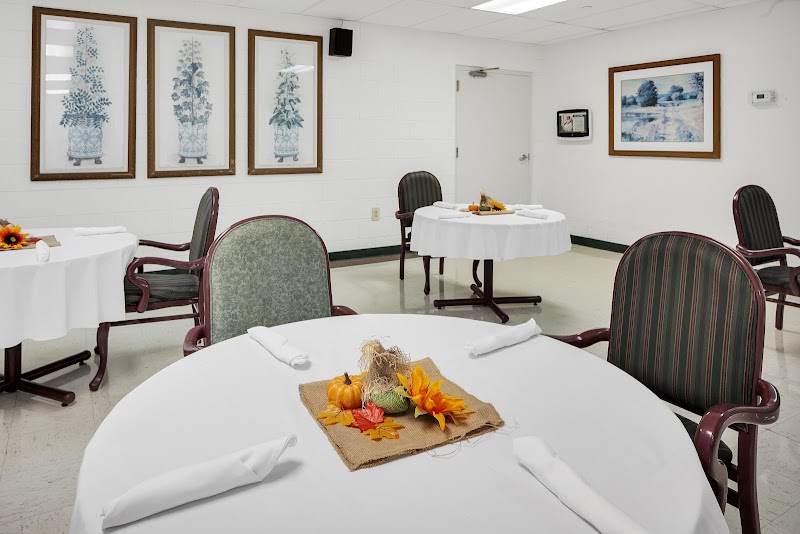
How is Pruitthealth - Toccoa Staffed?

CMS rates PRUITTHEALTH - TOCCOA's staffing level at 1 out of 5 stars, which is much below average compared to other nursing homes. Staff turnover is 31%, compared to the Georgia average of 46%. This relatively stable workforce can support continuity of care.

What Have Inspectors Found at Pruitthealth - Toccoa?

State health inspectors documented 26 deficiencies at PRUITTHEALTH - TOCCOA during 2019 to 2025. These included: 26 with potential for harm.
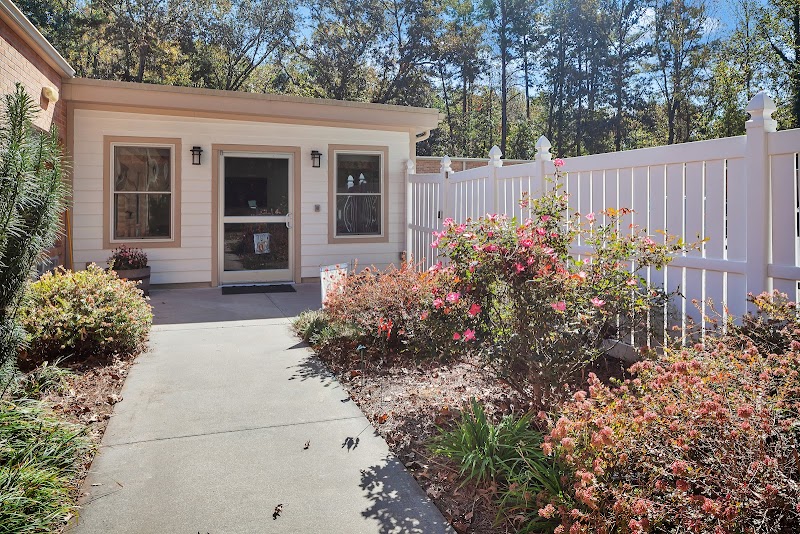
Who Owns and Operates Pruitthealth - Toccoa?

PRUITTHEALTH - TOCCOA is owned by a for-profit company. For-profit facilities operate as businesses with obligations to shareholders or private owners. The facility is operated by PRUITTHEALTH, a chain that manages multiple nursing homes. With 181 certified beds and approximately 111 residents (about 61% occupancy), it is a mid-sized facility located in TOCCOA, Georgia.
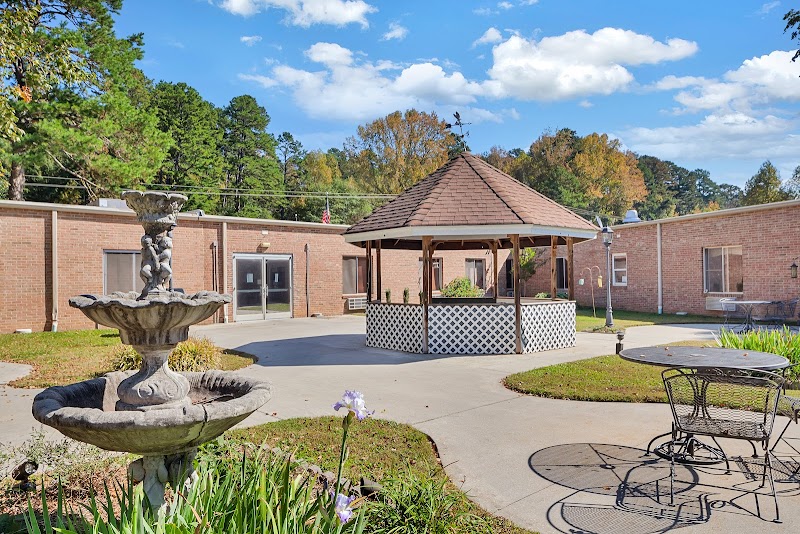
How Does Pruitthealth - Toccoa Compare to Other Georgia Nursing Homes?

Compared to the 100 nursing homes in Georgia, PRUITTHEALTH - TOCCOA's overall rating (1 stars) is below the state average of 2.6, staff turnover (31%) is significantly lower than the state average of 46%, and health inspection rating (2 stars) is below the national benchmark.

What Should Families Ask When Visiting Pruitthealth - Toccoa?

Based on this facility's data, families visiting should ask: "Can you walk me through typical staffing levels on day, evening, and night shifts?" "Can I visit during a mealtime to observe dining assistance and food quality?" "How do you handle medical emergencies, and what is your hospital transfer rate?" "Can I speak with family members of current residents about their experience?" These questions are particularly relevant given the below-average staffing rating.

Is Pruitthealth - Toccoa Safe?

Based on CMS inspection data, PRUITTHEALTH - TOCCOA has a clean safety record: no substantiated abuse findings (meaning no confirmed cases of resident harm), no Immediate Jeopardy citations (the most serious violation level indicating risk of serious injury or death), and is not on the Special Focus Facility watch list (a federal program monitoring the lowest-performing 1% of nursing homes). The facility has a 1-star overall rating and ranks #100 of 100 nursing homes in Georgia. While no facility is perfect, families should still ask about staff-to-resident ratios and recent inspection results during their visit.

Do Nurses at Pruitthealth - Toccoa Stick Around?

PRUITTHEALTH - TOCCOA has a staff turnover rate of 31%, which is about average for Georgia nursing homes (state average: 46%). Moderate turnover is common in nursing homes, but families should still ask about staff tenure and how the facility maintains care continuity when employees leave.

Was Pruitthealth - Toccoa Ever Fined?

PRUITTHEALTH - TOCCOA has been fined $10,057 across 1 penalty action. This is below the Georgia average of $33,179. While any fine indicates a compliance issue, fines under $50,000 are relatively common and typically reflect isolated problems that were subsequently corrected. Families should ask what specific issues led to these fines and confirm they've been resolved.

Is Pruitthealth - Toccoa on Any Federal Watch List?

PRUITTHEALTH - TOCCOA is not on any federal watch list. The most significant is the Special Focus Facility (SFF) program, which identifies the bottom 1% of nursing homes nationally based on persistent, serious quality problems. Not being on this list means the facility has avoided the pattern of deficiencies that triggers enhanced federal oversight. This is a positive indicator, though families should still review the facility's inspection history directly.