
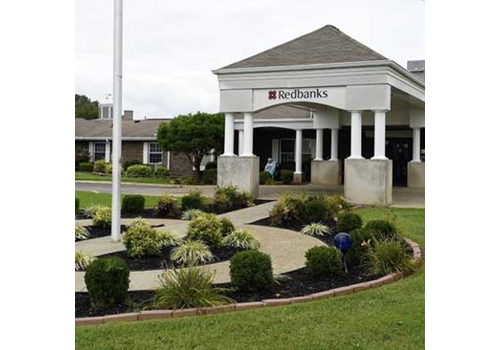

REDBANKS

851 KIMSEY LANE, HENDERSON, KY 42420 (270) 826-6436
For profit - Corporation 222 Beds Independent Data: November 2025
Trust Grade
65/100
#128 of 266 in KY
Last Inspection: June 2025

Inspected within the last 6 months. Data reflects current conditions.

Overview

Redbanks in Henderson, Kentucky, has a Trust Grade of C+, indicating it is slightly above average but not exceptional. It ranks #128 out of 266 facilities in Kentucky, placing it in the top half, but is the second-best option in Henderson County. The facility's trend is stable, as it reported three issues in both 2020 and 2025. Staffing is a strength, with a rating of 4 out of 5 stars and a turnover rate of 44%, which is below the state average, suggesting that staff remain long enough to build relationships with residents. However, the facility has concerning instances, including expired food and improperly stored medications, which could potentially harm residents, and a lack of adherence to infection control protocols.

Trust Score
C+
65/100
In Kentucky
#128/266
Top 48%
Safety Record
Low Risk
No red flags
Inspections
Holding Steady
3 → 3 violations
Staff Stability
○ Average
44% turnover. Near Kentucky's 48% average. Typical for the industry.
Penalties
✓ Good
No fines on record. Clean compliance history, better than most Kentucky facilities.
Skilled Nurses
○ Average
Each resident gets 37 minutes of Registered Nurse (RN) attention daily — about average for Kentucky. RNs are the most trained staff who monitor for health changes.
Violations
⚠ Watch
13 deficiencies on record. Higher than average. Multiple issues found across inspections.
★★★☆☆
3.0
Overall Rating
★★★★☆
4.0
Staff Levels
★★☆☆☆
2.0
Care Quality
★★★☆☆
3.0
Inspection Score
Stable
2020: 3 issues
2025: 3 issues

The Good

  • 4-Star Staffing Rating · Above-average nurse staffing levels
  • Full Sprinkler Coverage · Fire safety systems throughout facility
  • No fines on record
  • Staff turnover below average (44%)

    4 points below Kentucky average of 48%

Facility shows strength in staffing levels, fire safety.

The Bad

3-Star Overall Rating

Near Kentucky average (2.8)

Meets federal standards, typical of most facilities

Staff Turnover: 44%

Near Kentucky avg (46%)

Typical for the industry

The Ugly 13 deficiencies on record

Jun 2025 3 deficiencies
CONCERN (E)

Potential for Harm - no one hurt, but risky conditions existed

Deficiency F0761 (Tag F0761)

Could have caused harm · This affected multiple residents

**NOTE- TERMS IN BRACKETS HAVE BEEN EDITED TO PROTECT CONFIDENTIALITY** AMENDED Based on observation, interview, record review, and facility policy review, the facility failed to ensure drugs and/or ...

Read full inspector narrative →
**NOTE- TERMS IN BRACKETS HAVE BEEN EDITED TO PROTECT CONFIDENTIALITY** AMENDED Based on observation, interview, record review, and facility policy review, the facility failed to ensure drugs and/or biologicals used in the facility were current for use and/or stored and labeled in accordance with currently accepted professional principles, including the expiration date when applicable. Medications and nutritional supplements were opened but not labeled with a date as to calculate the discard date. Medications were found loose, without identification as to whom they belonged and/or what they were. This failure affected three of three medication rooms observed (out of a total of five rooms) and two of five medication carts observed (out of a total of nine carts.) The findings include: Review of the facility's policy, titled Storage of Medications, revised 04/2007, revealed the facility shall store all drugs and biologicals in a safe, secure, and orderly manner and the nursing staff shall be responsible for maintaining medication storage. Additionally, drugs and biologicals shall be stored in the packaging, containers or other dispensing systems in which they are received. Review of the facility's policy, titled Administering Medications, revised 12/2012, revealed the expiration/beyond use date on the medication label must be checked prior to administering and that when opening a multi-dose container, the date opened shall be recorded on the container. 1. Items not dated upon opening: a. An observation of the [NAME] Unit Medication Cart 1 on 06/12/2025 at 8:55 AM revealed one 8.3-ounce bottle of PEG 335 Polyethylene Glycol for R141, as well as one 4.1-ounce bottle of PEG Clear Lax for R140, which were opened but not dated. b. Observation of the [NAME] Unit medication room on 06/12/2025 at 8:45 AM revealed one 32-fluid ounce container of Med Plus NSA 1.7, High Calorie, High Protein Nutritional Drink, Vanilla Flavor, one 32-fluid ounce container of Med Plus 2.0, High Calorie, High Protein Nutritional Drink, Butter Pecan Flavor, and one 46- fluid ounce container of ReadyCare Thickened Orange Juice in the refrigerator that were opened. None of these containers had a date indicating when the containers were opened, resulting in no way of determining the use by date. In an interview with Licensed Practical Nurse (LPN) 4 during observation of the [NAME] Unit medication room on 06/12/2012 at 8:50 AM, she stated that she writes the date on anything she opens and that is what should be done by everyone. c. An observation of the South medication room on 06/11/2025 at 3:39 PM revealed a 32- ounce container of Med Pass that was opened but not dated. Interview with Certified Medication Aide (CMA) 8 revealed that containers should be dated by whoever opened them. CMA 8 stated the container should be thrown away since staff would not be sure of how long it had been opened and opened containers should be discarded 30 days after opening them. During an interview with Registered Nurse (RN) 1 on 06/11/2025 at 3:55 PM, she stated all medicine should be dated when opened and should not be given to the residents as it could be expired. During an interview with the South Hall Unit Manager (UM) on 06/12/2025 at 4:10 PM, she stated the CMAs and Nursing staff were responsible to check the medication rooms weekly as part of their assigned duties. She stated the facility uses a lot of Med Pass, but she expected staff to date the container as they open it. During an interview with the Director of Nursing (DON) on 06/12/2025 at 3:40 PM, she stated she expected staff to date and initial any item when they open it. Additionally, she stated that central supply staff are to check supply expiration dates on their daily rounds, and if an item was not dated, it should be disposed of. The DON stated the unit manager was responsible for checking the medication rooms for expired medications as part of their weekly rounds. Interview with the Executive Director on 06/12/25 at 4:15 PM, revealed that containers of nutritional drinks/supplements should be dated when opened and that dietary staff and nurses putting new items in a refrigerator should check dates. 2. Expired Supplies: a. An observation of the [NAME] Unit Medication room on 06/12/2025 at 08:45 AM revealed one bag of 0.45% potassium chloride in normal saline 1000 milliliters, dated 05/25. In an interview with LPN4 during this observation, she stated that expiration dates should be checked prior to using any IV fluids and, The IV bag should have been thrown out. b. Observation of the [NAME] Unit medication room on 06/12/2025 at 8:45 AM revealed an Intel Swab Covid 19 Rapid Test on the supply shelf with an expiration date of 11/30/2024. Observation of the Harbor Unit medication room on 06/12/2025 at 9:25 AM also revealed an OHC Covid-19 Antigen Self-Test on the supply shelf with an expiration date of 01/27/2024. Interview with LPN5 during the observation of the Harbor Unit medication room on 06/12/2025 revealed that covid tests should be thrown away when expired. In an interview with the DON on 06/12/2025 at 3:40 PM, she stated that central supply staff are to check supply expiration dates on their daily rounds. She stated if containers are expired, there is a chance to have a negative outcome for the resident. In an interview on 06/12/25 at 4:15 PM, the Executive Director stated that expired medications should be thrown out. She added that the responsibility to check expiration dates falls on the nurse using the product, and they should check the expiration date before using a product. 4. Unlabeled/Unidentified Medications: a. Observation of [NAME] Medication Cart 1 at 8:56 AM on 06/12/2025 revealed loose medications in the drawers without identifying information such as the name of the resident for whom it was prescribed, and the name/dose of the medication. In the left side Drawer 2, there was a capsule which was gray on one end and brown on the other end and Lifestar 404 printed on the capsule. (Per a pill identifier, this capsule was nitrofurantoin 100 milligrams (mg) (an antibiotic).) In the left side Drawer 3, there was a green, oval tablet with E imprinted on one side and 47 imprinted on the other. (Per a pill identifier, this tablet was losartan potassium 100mg (used to treat high blood pressure).) In the left side Drawer 4, there was a white, round tablet with ZC41 imprinted on one side. (Per a pill identifier, this tablet was carvedilol 12.5mg (used to treat conditions related to the heart and blood vessels).) In an interview with LPN 4 during observation of the [NAME] Unit medication room on 06/12/2012 at 8:50 AM, she stated that it is easy for pills to pop out of their cards when being replaced in the cart but they should have been removed from the draw and wasted. b. An observation of the South Medication Room on 06/11/2025 at 3:39 PM revealed a paper medicine cup in a drawer that contained a half tablet inside of the cup. The bottom of the medication cup had a handwritten note identifying the tablet as Keppra 250mg. During an interview with CMA8, she stated she did not know who the Keppra tablet belonged to or how long it had been in the drawer, adding that it should be discarded. During an interview with RN1 on 06/11/2025 at 3:55 PM, she stated she was not aware of the Keppra being in the drawer and did not know how long it had been there, adding that it should be discarded. She stated the nurses were responsible for checking the medication rooms but did not know how often it should be done. During an interview with the South Hall Unit UM on 06/12/2025 at 4:10 PM, she stated she did not have an explanation as to why the Keppra was found in a drawer. She stated it was in a drawer on the side of the medication room that was not often even used and had no idea why it was in there. Further interview revealed her statement that the CMAs and Nursing staff were responsible to check the medication rooms weekly as part of their assigned duties. In an interview with the DON on 06/12/2025 at 3:40 PM, she stated that she would not expect to find loose pills in medication carts, but it can happen, and her expectation was that staff would check for things like that. Additionally, she stated her expectation was that that the unit managers would check the medication rooms weekly and that medication carts would be cleaned weekly.
CONCERN (E)

Potential for Harm - no one hurt, but risky conditions existed

Infection Control (Tag F0880)

Could have caused harm · This affected multiple residents

Based on observation, interview, record review, and review of the facility's policy and procedure, it was determined the facility failed to maintain an infection prevention and control program designe...

Read full inspector narrative →
Based on observation, interview, record review, and review of the facility's policy and procedure, it was determined the facility failed to maintain an infection prevention and control program designed to help prevent the development and transmission of communicable diseases for four (Resident (R)109, R93, R37, and R41) of five sampled residents reviewed for infection control. Facility staff failed to indicate, via signage, the need for precautions, as well as provide and/or ensure the use of Personal Protective Equipment (PPE) and hand hygiene by staff and visitors for R109, who was on contact isolation precautions. Action to protect others from the risk of infection was not taken when R109 was out of her room for non-essential purposes. In addition, staff failed to follow manufacturer's instructions after cleaning/disinfecting a used glucometer used on R41. During medication pass for R93 and R37, staff handled medications with bare hands, did not perform hand hygiene as required and/or administered medication that had fallen on top of the medication cart. Findings include: 1. Review of R109's Face Sheet revealed that the facility admitted the resident on 01/11/2025 with diagnoses including non-traumatic brain dysfunction and unspecified dementia. R109 was placed on the facility's secured memory care unit. Review of R109's Quarterly Minimum Data Set (MDS) Assessment with an Assessment Reference Date (ARD) of 04/19/2025, revealed a Brief Interview for Mental Status (BIMS) score of 12/15, which indicated the resident had moderate cognitive impairment. Per this MDS, the resident required substantial/maximal assistance from staff with transfers and was occasionally incontinent of both bowel and bladder. Review of R109's current physician's orders revealed a new order, dated 06/07/2025 at 6:56 PM, for Macrobid (antibiotic) 100 milligrams (mg) oral capsule twice daily for a diagnosis of extended-spectrum beta-lactamase (ESBL - a type of Multidrug Resistant Organism (MDRO). Further review of physician's orders revealed an order dated 06/08/25 at 11:06 AM for Contact Isolation Precautions. Review of this order revealed it did not note whether the resident's infection was contained or not and did not indicate that the resident could leave their room. a. Review of the facility policy titled, Infection Control: Standard Precautions and Isolation, revised 10/2018, revealed its purpose is to guide care for residents known or suspected to have serious illnesses that are easily transmitted through direct contact or contact with contaminated items in the resident's environment. Further review of the policy revealed staff are to wear gloves (clean, nonsterile gloves are adequate) when entering the room if any contact is to be made with the resident or items in the room; change gloves after having contact with infective material that may contain high concentrations of microorganisms (fecal material and wound drainage); and remove gloves before leaving the resident's environment and wash hands immediately with an antimicrobial agent or a waterless antiseptic agent. The policy also stated to wear a gown (a clean, nonsterile gown is adequate) when entering the room if substantial contact is anticipated with the resident, environmental surfaces, or items in the room, or if the resident is incontinent or has diarrhea, an ileostomy, a colostomy, or wound drainage not contained by a dressing; and to remove the gown before leaving the resident's environment. The policy failed to address whether signage was required to be posted to indicate when precautions are in place. Observation of R109's room on 06/10/2025 at 6:30 AM revealed R109 was asleep in her bed. The resident's room contained two large red bins with lids marked with biohazard signage. Continued observation revealed no signage was posted either outside or inside the room to indicate that R109 was on any type of precautions. There was no Personal Protective Equipment (PPE) such as gloves and gown required for Contact Precautions present at the door prior to entering the room or visible inside the room. Observation of R109's room on 06/10/2025 at 6:42 AM revealed State Registered Nurse Aide (SRNA) 3 entered the room without donning PPE (including gloves or gown) and, using his bare hands, placed a large yellow plastic bag into one of the two red biohazard bins in the rooms. He then exited the room without performing hand hygiene. In a brief interview conducted at 6:43 AM, SRNA3 stated the red bins were needed because R109 was on precautions, and One bin is used for soiled linens, and the other for dirty diapers. In an interview with Licensed Practical Nurse (LPN) 4 on 06/11/2025 at 3:40 PM, she stated that Contact Precautions are required when there is a risk of exposure to infectious organisms, such as ESBL, which may be present on surfaces or linens. She reported that whenever a resident is placed on Contact Precautions, a sign should be posted immediately on the door of the resident's room, adding: People must be made aware. b. Further review of the facility policy titled, Infection Control: Standard Precautions and Isolation, revised 10/2018, revealed that the movement of a resident on Contact Precautions should be restricted, stating: Limit the movement and transport of the resident from the room to essential purposes only. Additionally, the policy directed that If the patient is transported out of the room, ensure that precautions are maintained to minimize the risk of transmission of microorganisms to other residents and contamination of environmental surfaces or equipment. However, the policy failed to explain how precautions were to be maintained when a resident was outside of their room, nor did it specify what actions should be taken to minimize the risk of transmission in these circumstances. Observation of the facility's memory care unit dining room on 06/10/2025 at 12:56 PM revealed R109 was in the dining room for lunch, seated at a square, four-person table, with one resident seated to her left and another to her right. Two staff members were also seated at the table, positioned between the residents, and were providing assistance throughout the meal. This assistance included offering verbal encouragement and prompting to eat, as well as handing the residents their drinks and utensils. Neither the staff members nor R109 were wearing any PPE. SRNA11 was observed asking the resident if she was feeling uncomfortable while gently patting her back. She then requested assistance from another aide, and they helped reposition R109 in her wheelchair with their bare hands. After repositioning R109, neither of the two staff was observed to perform hand hygiene. c. Observation of R109's room on 06/11/2025 at 1:07 PM revealed that, after surveyor intervention, a yellow organizer was now hanging on the door with PPE stored in its pockets. A sign was now also posted, indicating that the resident was on Contact Precautions. The sign instructed visitors to speak with nursing staff before entering and outlined the required PPE, including donning gloves and a gown prior to room entry. Observation at this time revealed R109 was in her room with two visitors, Family Member (FM) 109A and FM109B. Neither of the visitors were wearing any PPE. At 1:11 PM, LPN4, the unit charge nurse, approached the doorway and informed the visitors that they should be wearing PPE. FM109-A responded, 'We didn't think we needed to wear anything since she was in the dining room when we got here. Further interview with FM109-A on 06/11/2025 at 1:20 PM revealed that she had been informed by staff during a visit on 06/08/2025 that she should wear gloves and avoid bodily fluids. However, she then expressed confusion about the need to wear PPE, stating that during her visit that day (06/11/2025) a staff member had entered R109's room without donning any PPE. An interview with FM109-B, conducted at the same time, revealed that she was also unclear regarding the PPE requirement. She stated, No one told us (about the Contact Precautions). I saw the sign, but I thought it was okay (to not don PPE) because [R109] was in the dining room when we got here. She added that by the time LPN4 informed them they should don PPE, they had already been visiting with R109 in her room for an hour and a half. In an interview with SRNA6 on 06/11/2025 at 2:20PM, she described the protocol for Contact Precautions for ESBL as business as usual; they do their day-to-day things without any special stuff. SRNA6 stated that the PPE needed for Contact Precautions included a gown, gloves, and mask, but added that this PPE would just be for changing and dressing. She stated the purpose of putting residents on Contact Precautions was that infection can be passed along through clothing or on your body. Although the policy related that movement for residents on Contact Precautions was to be restricted, SRNA6 stated that residents on Contact Precautions can attend communal dining, saying, I think so as long as it is contained, like it is in their urine or in a catheter, or they have bandages covering it. SRNA 6 indicated that there were different signs to indicate whether a resident's infection was contained (making isolation unnecessary.) Review of the sign at R109's door with SRNA6 at this time revealed that SRNA6 could not tell if R109's infection was contained or whether the resident should stay in their room, except for essential purposes only. Further interview revealed SRNA 6 could not recall the last time she received any training on infection control precautions such as Contact Precautions, and that all staff members were responsible for explaining PPE requirements to visitors. In an interview with SRNA7 on 06/112025 at 2:40 PM, she stated that she was unclear about the specific requirements for Contact Precautions, stating she thought it required staff to wear gloves. However, she then described that while providing care for a resident with an infection in the urine, she would need to wear a mask, gown, and gloves, throw everything away or put items in the hazard bins away after care was provided, and perform hand hygiene. She explained that the yellow caddies hanging on a resident's door indicate that staff need to wear PPE while providing care because the resident has some type of infection that staff need to protect others from. SRNA7 reported being under the impression that residents on Contact Precautions were supposed to remain in their room but expressed uncertainty, exclaiming, I am sorry; I am getting them all mixed up. When asked how she would know if a resident can leave their room, she stated, Typically I get told by the nurse, but the door signage would also tell me. However, review of the door signage revealed it did not indicate whether the resident could leave the room. SRNA 7 further stated that she had recently returned to work at the facility and received some training on infection control practices at that time; however, her last in-depth training on the topic occurred approximately one year ago. In an interview with LPN 4 on 06/11/2025 at 3:40 PM, she stated that Contact Precautions were used because, They [the residents] have some kind of organism you could contract if you came into contact with it. She added that for Contact Precautions, You have to wear the gear every time you go in the room because you may come into contact with it; it may be in the room or on soiled linen. Regarding R109, she reported that R109 was on Contact Precautions due to ESBL in the urine but was unsure when the precautions were initiated. When asked about the protocol for Contact Precautions, she stated: If it [the infection] is contained, like the urine is the issue, they [residents] can still come out [of their rooms]. LPN4 stated that R109 is allowed to come and go as she pleases; she can go to therapy or sit in the common area. However, she acknowledged that because R109 does not don PPE, such as a gown, when exiting her room, her clothing could pose a risk for spreading ESBL and admitted that could be an issue. LPN4 stated that on the dementia unit where R109 resided, With these people back here, a lot of them are cognitively impaired, so it is up to staff to monitor it and make sure it isn't getting spread. [R109] does not do her own incontinent care, but if she sits on something it would have to be sanitized, but her room is infected and so her hands may not be clean. When asked whether they utilize any specific clinical criteria to determine whether a resident on Contact Precautions can participate in communal dining, she stated: I feel that if the staff is supervising the area and the resident has been toileted, it is okay for them to attend the meal. No risk assessment is completed. When asked how visitors would be informed and educated about the need to follow Contact Precautions/use PPE, she replied: We need to ensure everyone that goes in that room is wearing PPE .Visitors could take the organism home to their family. Staff are risking every one of these residents getting it. On 06/11/2025 at 3:55 PM, an interview was conducted with the Infection Control and Prevention Nurse (IP), along with Advanced Practice Registered Nurse (APRN) 1 and Advanced Practice Registered Nurse (APRN) 2. APRN1 stated that a resident would be placed on Contact Precautions for ESBL because it is highly contagious; it's so I can keep them away from the other residents. APRN1 then added that the decision to place a resident with ESBL on Contact Precautions is made on a case-by-case basis. However, no evidence was provided as to how this case-by-case decision was made relative to R109. APRN2 stated that R109 is permitted to leave her room, including to eat lunch in the communal dining hall at a table with other residents, because We can't confine them to their rooms; that wouldn't be good for them. However, she later stated that staff do make efforts to keep them in their room. The IP stated, We try to encourage them, but we can't make them stay in their room, and acknowledged that staff should be attempting to put a gown on her. She stated that there were no additional written policies outlining these protocols. Because staff made comments about different isolation requirements between contained and non-contained infections, a request was made on 06/12/25 at 9:06 a.m. with the IP for any policies differentiating Contact Precautions for contained versus non-contained infections. On 06/12/2025 at 9:35 a.m., the IP reported that there were no additional policies delineating the need for isolation in non-contained versus contained infections. The IP stated that it was up to the provider who initiates the orders to determine which should be followed. She stated that the order should contain that specification. Review of the physician's order confirmed that it did not distinguish between a contained or non-contained infection and called for Contact Isolation Precautions. In an interview with the Executive Director on 06/12/2025 at 4:33 PM, she stated that Contact Precautions require signage, PPE (gloves and gowns), red bins, and documentation in the resident's care plan. She reported that visitors are encouraged-but not required-to wear PPE, and staff are expected to read signage and don appropriate PPE upon entry. She explained that residents on Contact Precautions may leave their rooms based on psychosocial needs, though no formal assessment is used to determine this. She acknowledged the risk of exposure in shared spaces like the dining room and suggested that affected residents should avoid close contact with others, stating, Hopefully they won't touch anyone else. Hopefully they are not touching the area. Further interview with the Executive Director revealed that the failure to observe Contact Precautions included the potential for Spread of infection to residents, staff, family. 2. Review of the facility's policy and procedure titled, Administering Medication, revised 12/2012, revealed staff shall follow established facility infection control procedure (e.g. hand washing, antiseptic technique, gloves, isolation, precautions, etc.) for the administrations of medication, as applicable. a. Record review revealed R93's current medications orders included an order for Linzess oral capsule 72 micrograms (mcg) by mouth once a day for constipation. Observation during a medication pass on 06/10/2025 at 7:08 AM revealed Certified Medication Aide (CMA) 1 dropped a Linzess 72 mcg capsule into her bare hand, then proceeded to put it in the medication cup and administer it to R93.Observation revealed CMA1 failed to perform hand hygiene prior to touching the resident's medication with her bare hand. Interview with CMA1, on 06/10/25 at 07:15 AM, revealed it was not best practice to give a pill that had been placed in her bare hand, and it should have been put in a medication cup to administer. b. Record review revealed R37's medication orders included a 12/02/2024 order for Aspirin 325 mg one time a day by mouth for cerebrovascular accident (CVA- stroke). Observation during a medication pass on 06/10/2025 at 7:20 AM revealed CMA1 dropped R37's Aspirin 325mg, on top of the medication cart. CMA1 then proceeded to pick up the medication with her bare hand and administer it to R37.Further observation revealed that CMA1 failed to perform hand hygiene prior to picking up the pill with her bare hand. Interview with CMA1, on 06/10/25 at 07:29 AM, revealed that a medication should not be given after it had been dropped on top of the medication cart, but discarded and staff should administer another one. A joint interview was conducted with the Director of Nursing (DON) and Executive Director on 06/12/2025 at 4:33 PM. During the interview, the DON stated that nursing staff or CMAs were to discard a contaminated pill in the sharps container and get another one to administer. The DON added that the expectation of the staff is to use proper hand hygiene and standard precautions when giving medications. Further interview with the Executive Director revealed the expectation that if a medication was dropped or touched, it should be disposed of and not administered to residents. 3. Review of the facility's undated policy and procedure titled, Obtaining A Fingerstick Glucose Level revealed Step 18 stated staff were to Clean and disinfect reusable equipment between uses according to the manufacturer's instructions and current infection control standards of practice. Review of the manufacturer's instructions on the purple-topped container of Super Sani Wipes (used for disinfecting/sanitizing glucometers) revealed that staff were to Wipe Surface thoroughly. Allow surface to remain visibly wet for two minutes. Let airdry. Observation during a medication pass on 06/12/2025 at 11:55 AM, revealed that, per physician's orders dated 05/25/2025, CMA4 obtained a blood glucose reading on R41. After completing the test, CMA4 placed the soiled glucometer on top of the medication cart with no barrier. CMA4 then wiped the soiled glucometer three times for less than a total of ten seconds with a Super Sani Wipe from a purple-topped container. After using the wipe, CMA4 then immediately placed the glucometer on top of clean medical supplies on the medication cart. The product was not allowed to dwell (remain visibly wet) for two minutes, and then airdry before it was placed on supplies which were to be used for other residents. Interview with CMA4, on 06/10/25 at 11:30 AM, revealed that a soiled glucometer should not be placed directly on the medication cart without a barrier. Instead, it should be placed on a barrier and then cleaned. CMA4 stated education was received on how to clean the glucometer; however, she was unsure how long to allow the solution to dwell. A joint interview was conducted with the DON and Executive Director on 06/12/2025 at 4:33 PM. The DON stated that it was an expectation that the CMAs would place the dirty glucometer on a barrier and clean it for thirty seconds and allow it to dry, according to manufacturer's recommendations, and to dispose of/not use any clean supplies that dirty equipment may have contaminated. The Executive Director confirmed it was the expectation was that nursing staff or CMAs would clean the glucometers with the designated bleach wipes and use proper contact and dry times per policy. Per the Executive Director, if a dirty glucometer was placed on clean supplies, staff should dispose of the supplies and clean the glucometer.
CONCERN (F)

Potential for Harm - no one hurt, but risky conditions existed

Food Safety (Tag F0812)

Could have caused harm · This affected most or all residents

Based on observation, interview, and review of facility policy, it was determined that the facility failed to store food in accordance with professional standards for food service safety and quality. ...

Read full inspector narrative →
Based on observation, interview, and review of facility policy, it was determined that the facility failed to store food in accordance with professional standards for food service safety and quality. Opened foods were not dated. Expired foods and/or foods which were past their use by date were available for use and service to residents. This failure had the potential to affect 129 of 131 residents who consume food from the facility's kitchen and/or unit refrigerators. The findings include: Review of the facility policy titled Food: Preparation, with a revision date of 02/2023, revealed Item 17 stated that all refrigerated, ready-to-eat Time/Temperature Control for Safety (TCS) prepared foods that are to be held for more than 24 hours at a temperature of 41 degrees F or less, will be labeled and dated with a prepared date (Day 1) and a use by date (Day 7). Observation of the walk-in refrigerator, on 06/10/2025 at 6:25 AM, revealed one partial box of cabbage containing two bags of cabbage with showed a use by date of 06/08/2025. One opened bag of lettuce had a use by date of 06/08/2025 and showed browning of the lettuce. Observation of the reach-in refrigerator, on 06/10/2025 at 6:35 AM, revealed one partial container of ham salad with a use by date of 05/03/2025, one partial container of potato salad with a use by date of 05/25/25, and one open container of parmesan cheese with an open date of 04/08/2025. Ongoing observation of the Reach-in Refrigerator for Cooks revealed two chicken salad sandwiches dated with a use by date of 06/09/2025. In addition, this refrigerator contained an open gallon jug of mayonnaise that was undated (no open date), and an open jug of teriyaki sauce with a received date of 05/28/2025 which did not list an open date. Observation on 06/12/2025 at 1:15 PM of the Central nursing station resident food refrigerator revealed 15 single-serve grape juice containers with best by dates of 01/17/2025 and 06/08/2025. Observation on 06/12/2025 at 1:30 PM of the South Port nursing station resident food storage revealed seven single-serve grape juice containers with a best by date of 01/17/2025. Interview with the Dietary Manager (DM) on 06/10/2025 at 6:30 AM, revealed that dietary staff should have removed the items which were beyond their use by date from the refrigerator. Additional interview with the DM, on 06/12/2025 at 2:03 PM, revealed that once food leaves the kitchen, it is a team effort of the floor staff and kitchen staff to ensure items are not stored beyond the best by date for food safety to prevent food related illness. In an interview with the Dietary Supervisor (DS) on 06/12/2025 at 2:10 PM, the DS stated that it was his expectation that staff provide nutritious and filling meals without bacterial growth. He stated once food was past the beyond use date, there was the potential to allow bacteria to grow and potentially cause foodborne illness. He added that in the cooler, longer storage times would allow increased moisture to form that alters the environment and may allow for contamination or cross contamination. In an interview with the Director of Nursing (DON) on 06/12/25 at 3:42 PM, the DON stated that it was the responsibility of the kitchen to remove the beyond use juices from the unit refrigerators. She stated the dietary department has a stock list and pantry list that is brought to each unit every day that includes juices, as well as other items, and the juices should be switched out every day by the dietary staff when they bring out the new tray of juices. Interview with the Executive Director on 06/12/25 at 4:15 PM revealed she expected food items to be labeled and dated to prevent potential food-borne illnesses.
Mar 2020 3 deficiencies
CONCERN (D)

Potential for Harm - no one hurt, but risky conditions existed

Assessment Accuracy (Tag F0641)

Could have caused harm · This affected 1 resident

Based on observation, interview, record review, and review of the Centers for Medicare and Medicaid Services, Resident Assessment Instrument (RAI) Manual 3.0, it was determined the facility failed to ...

Read full inspector narrative →
Based on observation, interview, record review, and review of the Centers for Medicare and Medicaid Services, Resident Assessment Instrument (RAI) Manual 3.0, it was determined the facility failed to ensure the Minimum Data Set (MDS) Assessment accurately reflects the resident's status for two (2) of thirty-four (34) sampled residents (Resident #10 and Resident #141). Resident #10's Quarterly Minimum Data Set (MDS) Assessment, dated 12/11/19, Section I Active Diagnosis, was coded as no infections during the seven (7) day look back period; however, review of the Physician's Orders, dated December 2019, revealed the resident was receiving an antibiotic medication for a Urinary Tract Infection. Resident #141's Quarterly MDS Assessment, dated 11/25/19, Section J Health Conditions, was coded as no falls since prior assessment; however, review of the Fall Incident Reports, revealed the resident sustained falls on 10/10/19 and 11/05/19. The findings include: Interview with the MDS Coordinator, on 03/11/2020 at 5:00 PM, revealed the facility utilized the Resident Assessment Instrument (RAI) Manual 3.0, as a guideline for accuracy of assessments. Additionally, the Assessment process included communication with licensed and non-licensed direct care staff members, and review of the medical record. Review of the Centers for Medicare and Medicaid Services, Resident Assessment Instrument (RAI) Manual 3.0, dated October 2017, revealed the primary purpose of the MDS Assessment was to identify resident care problems, address resident problems in individualized care plans, and monitor the quality of care provided to residents. Additional review revealed the Assessment should be an accurate reflection of the resident's status. 1. Review of Resident #10's medical record revealed the facility admitted the resident on 04/30/14 with diagnoses including, but not limited to Types II Diabetes Mellitus, Gastro-Esophageal Reflux, Osteoarthritis, Dementia without behavioral disturbance, and History of Urinary Tract Infection (UTI). Review of Resident #10's Progress Notes, dated 12/02/19 at 2:34 PM, revealed the facility transferred the resident to the emergency room related to behaviors and combativeness. Additionally, a Progress Note, dated 12/02/19 at 9:27 PM, revealed the resident was admitted to the hospital with diagnoses including UTI and Sepsis. Review of the Progress Note, dated 12/04/19 at 4:20 PM, revealed the resident had a midline to the left upper arm and received intravenous Ertapenem (antibiotic) every twenty-four (24) hours. Further, a Progress Note, dated 12/04/19 at 8:13 PM, revealed the resident returned to the facility from the hospital with a diagnosis of Sepsis/UTI with ESBL (Extended Spectrum Beta-Lactamases -a type of enzyme or chemical caused by bacteria which is resistant to many antibiotics) and the resident was placed in contact isolation. Review of Resident #10's Physician's Orders, dated December 2019, revealed orders for Contact Precautions every shift for UTI with ESBL, with a start date of 12/05/19. Further review of Physician's Orders, revealed an order for Ertapenem Sodium Solution Reconstituted one (1) gram (gr), Intravenously every twenty-four (24) hours for UTI ESBL, for six (6) days, with a start date of 12/05/19. Review of Resident #10's Progress Notes, dated 12/06/19 at 1:21 PM, revealed the resident continued on IV antibiotics for UTI; IV site clean with dry dressing intact. Additionally, a Progress Note, dated 12/07/19 at 8:40 PM, revealed the resident continued in isolation for UTI with IV Invanz (Ertapenem) daily to midline left upper extremity. Review of the Progress Note, dated 12/09/19 at 2:52 AM, revealed the resident was tolerating IV Invanz for UTI; midline flushes with some resistance due to positioning. Further, a Progress Note, dated 12/10/19 at 5:06 PM, revealed the resident's IV antibiotics, for UTI, were completed for that shift. Continued review revealed a Progress Note, dated 12/11/19 at 5:53 AM, revealing the resident continued on Antibiotics for UTI with ESBL, with midline to left upper arm and remained in contact isolation. The Progress Note, dated 12/12/19 at 11:09 AM, revealed the resident was taken off isolation precautions due to being asymptotic and completion of IV antibiotics; provider will remove midline. Review of Resident #10's Quarterly MDS Assessment, dated 12/11/19, revealed the facility did assess the resident as receiving six (6) days of antibiotic medication and IV medication, during the seven (7) day look back period for the Assessment. However, Section I Active Diagnosis, revealed the facility assessed the resident as having no Infections present. 2. Review of Resident #141's medical record revealed the facility admitted the resident on 10/12/17 with diagnoses including, but not limited to Aftercare following surgery on the circular system, Peripheral Vascular disease, Heart Failure, Hypertension, Type II Diabetes Mellitus, Chronic Pain, Major Depressive Disorder, Anxiety Disorder, Insomnia, Difficulty walking, Osteoarthritis, Muscle Weakness, and Cognitive Communication Deficit. Review of Resident #141's Fall Incident Report, dated 10/10/19 at 10:51 AM, revealed the resident reported he/she fell when trying to sit down on the commode and fell to the left side hitting his/her arm on the grab rail in the bathroom. Additionally, the immediate action taken was applying nonskid strips in from of the commode. Per the Report, the resident was alert and oriented to person, place and time and had no obvious injury. Further, there was no predisposing environmental, physiological or situational factors contributing to the fall event. Review of Resident #141's Fall Incident Report, dated 11/05/19 at 5:00 AM, revealed the nurse heard resident yell for help. Per the Report, the nurse entered the resident's room and the upper half of the resident's body was on the bed with his/her legs twisted between the wheelchair and the bed. The resident stated he/she became dizzy and fell over in the bed while making up the bed. Continued review revealed the immediate action taken was assessment of the resident and new orders for Meclizine (antiemetic medication which may be used to treat vertigo) as needed. Further, the resident was alert and oriented to person, place and time and had no obvious injury. Per the Report, there were no environmental or situational factors contributing to the fall event; however, the resident did have a current UTI. However, review of Resident #141's Quarterly MDS Assessment, dated 11/25/19, Section J Health Conditions, revealed the facility assessed the resident as having no falls since the prior assessment. Conversely, review of the medical record revealed since the previous assessment, the resident had fall events on 10/10/19 and 11/05/19. Interview with Licensed Practical Nurse (LPN) #5/MDS Coordinator, on 03/12/2020 at 4:17 PM, revealed she had worked in the building in this role for five (5) years. Additionally, she used the RAI guidelines to ensure accurate MDS Assessments. Per interview, when collecting data to complete MDS Assessments, she interviewed staff and the resident; completed a face-to-face assessment of the resident, and reviewed the medical record to its entirety. Per interview, it was important to ensure MDS Assessments were accurate and reflected the current status of the resident because the MDS Assessment helped develop and revise the Comprehensive Plan of Care. Further interview with LPN #5/MDS Coordinator, revealed after review of Resident #10's Physician's Orders, and Progress Notes, dated 12/05/19 through 12/11/19, the Quarterly MDS Assessment, dated 12/11/19, should have been coded to indicate the resident had an active diagnosis of UTI. Continued interview revealed after review of Resident #141's Fall Incident Reports, dated 10/10/19 and 11/05/19, falls should have been coded on Resident #141's Quarterly MDS Assessment, dated 11/25/19. Interview with the Director of Nursing (DON), on 03/12/2020 at 5:26 PM, revealed she expected the MDS Assessments to be accurate, as per RAI guidelines. Per interview, LPN #5/MDS Coordinator was responsible for section I Active Diagnosis and section J Health Conditions. After review of Resident #10's medical record, she stated an active diagnosis of UTI should have been coded on the 12/11/19 Quarterly MDS Assessment. Continued interview revealed after review of Resident # 141's medical record, the Quarterly MDS Assessment, dated 11/25/19, falls should have been coded on the 11/25/19 Quarterly MDS Assessment. Further interview revealed the MDS Assessments guided the development or revision of the Comprehensive Care Plans and therefore the MDS Assessment was to be an accurate reflection of the resident's status in order for residents to receive appropriate services and individualized care. Interview with the Executive Director, on 03/12/2020 at 5:49 PM, revealed the facility was to utilize the RAI Manual as a resource to ensure accuracy of the MDS Assessments. Per interview, it was important for MDS Assessments to accurately reflect a resident's current status in order to ensure the Care Plan was developed or revised to address each resident's individual needs and to ensure resources were provided as necessary to meet resident care needs.
CONCERN (D)

Potential for Harm - no one hurt, but risky conditions existed

Deficiency F0657 (Tag F0657)

Could have caused harm · This affected 1 resident

Based on observation, interview, record review, review of facility Policy, and review of the Centers for Medicare and Medicaid Services (CMS), Resident Assessment Instrument (RAI) Manual 3.0, it was d...

Read full inspector narrative →
Based on observation, interview, record review, review of facility Policy, and review of the Centers for Medicare and Medicaid Services (CMS), Resident Assessment Instrument (RAI) Manual 3.0, it was determined the facility failed to ensure the Comprehensive Care Plan (CCP) was reviewed and revised by an interdisciplinary team composed of individuals who have knowledge of the resident and his/her needs for three (3) of thirty-four (34) sampled residents (Resident #87, Resident #109, and Resident #141). Resident #87 was diagnosed and treated for a Urinary Tract Infection (UTI) in March 2020; however, the CCP was not revised related to the acute infection. Resident #109 was diagnosed and treated for Pneumonia in March 2020; however, the CCP was not revised related to the acute infection. Resident #141 had a fall event on 11/05/19; however, the CCP was not revised to related to the actual fall, nor was the CCP updated with a new intervention to prevent further falls of the same nature. The findings include: Review of the facility Comprehensive Care Plans Policy, revised September 2010, revealed the Comprehensive Care Plan is an individualized plan developed to included measurable objectives and timetables to meet the resident's medical, nursing, mental and psychological needs. Additionally, the Interdisciplinary Team identifies problem areas, risk factors, treatment goal, and professional services to prevent or reduce declines in the resident's functional status level and enhance optimal functioning. Per policy, concerns triggered during the resident assessment are added to the care plan. Further, Care Plans are ongoing and revised as information about the resident and the resident's condition changes, at least quarterly. Interview with the MDS Nurse, on 03/12/2020 at 4:17 PM, revealed the facility utilized the Resident Assessment Instrument (RAI) Manual 3.0, as a guideline for Care Plans. Review of the Centers for Medicare and Medicaid Services, Resident Assessment Instrument (RAI) Manual 3.0, dated October 2016, revealed the care plan must be reviewed and revised periodically, and the services provided or arranged should be consistent with each resident's written plan of care. Continued review revealed the care plan was driven not only by identified resident issues and/or conditions, but also by a resident's unique characteristics, strengths, and needs. Furthermore, a care plan based on a thorough assessment and effective clinical decision making, was compatible with current standards of clinical practice that provide a strong basis for optimal approaches to quality of care and quality of life needs of individual residents. A well developed and executed assessment and care plan re-evaluates the resident's status at prescribed intervals (quarterly, annually, or if a significant change in status occurs) using the RAI and then modifies the individualized care plan as appropriate and necessary. 1. Review of Resident #87's medical record revealed the facility admitted the resident on 03/10/17 with diagnoses including, but not limited to Neuromuscular Dysfunction of Bladder, History of Sepsis, History of Elevated [NAME] Blood Cell Count, and History of UTI. Review of Resident #87's Comprehensive Care Plan (CCP), initiated 02/14/18, revealed the resident had the potential for UTI. The Goal stated the resident would be monitored for signs and symptoms of UTI. The interventions included monitor/document/report as needed signs and symptoms of UTI. Continued review of Resident #87's CCP, revised 06/04/19, revealed the resident had a history of UTI related to incontinence. The Goal stated the resident's UTI's would resolve without complication. The interventions included check every two (2) hours for incontinence, dated 04/04/18; give antibiotics therapy as ordered, dated 04/04/18; monitor intake and output, dated 02/01/19; and monitor vitals, dated 03/19/2020. Review of Resident #87's Quarterly Minimum Data Set (MDS) Assessment, dated 01/30/2020, revealed the facility assessed the resident as having severe cognitive impairment. Additionally, the resident required total assistance with Activities of Daily Living, had an indwelling catheter and was always incontinent of bowel. Per the Assessment, the resident had the diagnosis of neurogenic bladder and no infections. Review of Resident #87's Physician's Orders, dated March 2020, revealed an order for Ciprofloxacin (antibiotic) five hundred (500) milligrams (mg) two (2) times a day, starting on 03/05/2020 for seven (7) days, for UTI. Further review revealed an order for Pyridium (urinary analgesic) one hundred (100) mg three (3) times a day, starting on 03/01/2020, for UTI. Review of Resident #87's Medication Administration Record (MAR), dated March 2020, revealed the resident received Ciprofloxacin five hundred (500) mg, twice daily from 03/05/2020 through 03/11/2020 for UTI. Further, the MAR revealed the resident received Pyridium one hundred (100) mg, three (3) times a day from 03/01/2020 through 03/11/2020. Review of Resident #87's Urinalysis, dated 03/04/2020 revealed greater than 100,000 organisms; Citobacter fruendii (anaerobic gram negative bacteria of the family Enterobacteriaceae). However, further review of the CCP, revealed there was no documented evidence the Care Plan was revised to include the actual UTI, identified on 03/05/2020. 2. Review of Resident #109's medical record revealed the facility admitted the resident on 04/26/19 with diagnoses including, but not limited to History of elevated white blood cell count, Dysphagia, and Cognitive Communication Deficit. Review of Resident #109's Quarterly Minimum Data Set (MDS) Assessment, dated 02/10/2020, revealed the facility assessed the resident as having a Brief Interview for Mental Status (BIMS) score of fifteen (15) indicating intact cognition. Further, the resident had the diagnosis of Respiratory Failure and no infections. Review of Resident #109's Chest X-ray, dated 03/04/2020 revealed a modest infiltrate in the right lower lobe, indicating Pneumonia. Review of Resident # 109's Physician's Orders, dated March 2020, revealed an order for Levaquin (antibiotic) five hundred (500) milligrams (mg) one (1) time a day, for five (5) days, for Pneumonia, with a start date of 03/05/2020. Review of Resident #109's Medication Administration Record (MAR), dated March 2020, revealed the resident received Levaquin five hundred (500) mg, once daily from 03/05/2020 through 03/09/2020 related to Pneumonia. However, review of Resident #109's Comprehensive Care Plan (CCP), revealed no documented evidence the Care Plan was revised to include the acute Respiratory Infection/Pneumonia, identified on 03/04/2020. Interview with Licensed Practical Nurse (LPN) #3, on 03/12/2020 at 3:42 PM, revealed she had worked at the facility for one (1) month. Per interview, direct care nurses were responsible to revise the CCP with changes in resident conditions, including new acute illnesses. Additionally, Resident # 87 should have had an acute Care Plan revision related to the UTI on 03/05/2020 and Resident #109 should have had an acute Care Plan revision related to Pneumonia on 03/04/2020. Further, the Care Plan was used by direct caregivers as a reference in providing care and should be accurate and up to date. 3. Review of the facility Falls and Fall Risk, Managing Policy, revised March 2018, revealed the facility would identify interventions to prevent the resident from falling and to minimize complications from falling. Additionally, resident-centered approaches to managing falls would be implemented with recurring falls. Further, despite previous interventions, additional or different interventions will be implemented to manage falls. Review of Resident #141's medical record revealed the facility admitted the resident on 10/12/17 with diagnoses including, but not limited to Aftercare following surgery on the circular system, Peripheral Vascular disease, Heart Failure, Difficulty walking, Osteoarthritis, Muscle Weakness, and Cognitive Communication Deficit. Review of Resident #141's Quarterly MDS Assessment, dated 08/27/19, revealed the facility assessed the resident as having a Brief Interview for Mental Status (BIMS) score of thirteen (13) out of fifteen (15) indicating moderate cognitive impairment. Additionally, the facility assessed the resident as requiring supervision and oversight with Activities of Daily Living and not steady, but could stabilize without assistance during transition. Per the Assessment, the resident had no falls since the previous Assessment. Further, the facility assessed the resident as receiving six (6) days of Restorative Nursing: ambulation and active Range of motion during the seven (7) day look back period. Review of Resident #141's Comprehensive Care Plan, revised on 10/10/19 revealed the resident was a high fall risk related to deconditioning, and gait/balance problems. The Goal stated the resident would be free of minor injury and would not sustain major injury. The interventions included, but were not limited to: anticipate and meet the resident's needs, initiated 10/12/17; non-skid socks when out of bed and no shoes worn, initiated 10/12/17; resident enjoys making the bed, initiated 11/20/17; and wheelchair safety device anti-rollbacks, initiated 12/26/19. Review of Resident #141's Fall Incident Report, dated 11/05/19 at 5:00 AM, revealed the nurse heard the resident yell for help. Per the Report, the nurse entered the resident's room and the upper half of the resident's body was on the bed with his/her legs twisted between the wheelchair and the bed. Additionally, the resident stated he/she fell over in the bed while making up the bed when he/she became dizzy. Continued review revealed the immediate action taken was assessment of the resident and new orders for Meclizine (antiemetic medication used to treat vertigo) as needed. Further, the resident was alert and oriented to person, place and time and had no obvious injury. Per the Report, there were no environmental or situational factors contributing to the fall event; however, the resident did have a current UTI. Review of Resident #141's Physician's Orders, dated November 2019, revealed an order for Meclizine 12.5 milligrams (mg) every six (6) hours as needed (PRN), with a start date of 11/05/19. Review of Resident # 141's Progress Notes: Fall Risk Review, dated 11/07/19 at 1:30 PM, revealed the Root Cause was the resident stated he/she became dizzy and fell over the bed while making it. Further, the current intervention was Meclizine PRN. However, further review of the Comprehensive Care Plan, revealed no documented evidence the Care Plan was revised to indicate the resident had an actual fall on 11/05/19, or to include an additional or different intervention status post fall on 11/05/19, based on the facility fall event investigation. Interview with LPN #2, on 03/12/2020 at 3:42 PM, revealed she had worked at the facility for five (5) years. Additionally, direct care nurses were responsible to revise the CCP with changes in a resident's condition, including acute infections and fall events. Per interview, Resident #87 and Resident #109 should have had revisions to their CCP in March 2020 to reflect their acute illnesses. Continued interview revealed Resident #141's CCP should have been revised to include an intervention status post fall on 11/05/19 in an attempt to prevent falls of the same nature. Further, the Care Plan was a guide used by all staff to ensure resident care needs were met. Interview with the MDS Coordinator, on 03/12/2020 at 4:17 PM, revealed she had worked at the facility for five (5) months. Per interview, she used the RAI guidelines to ensure the CCP was revised as necessary. Continued interview revealed direct care nurses were responsible to complete revisions to the CCP for acute changes in the residents including new infection diagnoses and fall event interventions. Further, the Nurse Manager reviewed orders each morning and revised the CCP as necessary. Per interview, after review of Resident #87 and Resident #109's Physician's Orders, labs and MARs, revisions to their CCPs should have been made to reflect the infections and the necessary care they required. After review of Resident #141's CCP and Fall investigation dated 11/05/19, the MDS Coordinator stated the resident's CCP should have been revised status post fall on 11/05/19, to indicate the resident sustained an actual fall with a new intervention to prevent additional falls of the same nature. Further, it was important to have a current accurately revised Care Plan to ensure direct care staff knew how to provide care to residents in order to meet their needs. Interview was conducted on 03/12/2020 at 4:45 PM, with the Assistant Director of Nursing (ADON), who was the Interim Manager for the 100 hallway where Resident #87, Resident #109 and Resident #141 resided. She stated direct care nurses were responsible to revise the CCP to indicate new diagnoses related to infections with interventions for care and services related to the infections. Further, the CCP was to be revised status post falls to indicate the resident sustained a fall with new interventions to prevent further falls. Continued interview revealed she reviewed all new orders each morning and revised the Care Plans as necessary. However, she stated Resident #87 and Resident #109's CCPs should have been revised to include their acute illness in March 2020 and Resident #141's Care Plan should have been revised to include the fall with a new intervention to prevent falls status post fall on 11/05/19. Additionally, the Care Plan should be accurate and revisions should be made to ensure resident needs were met. Interview with the Director of Nursing (DON), on 03/12/2020 5:26 PM, revealed she expected the CCPs to be revised accurately, as per the facility policies and RAI guidelines. Per interview, direct care nurses were responsible for the revision of the CCP to include acute illness and status post fall interventions. Additionally, the current process in place to review Care Plans to ensure revisions were made as necessary was for the Unit Managers to review new orders and changes in the residents each morning. Per interview, the Unit Managers were to check to ensure the CCPs had been revised as necessary with the morning reviews. Continued interview revealed Resident #87's and Resident #109's CCP should have been revised to include the acute infections, a measurable goal and appropriate interventions related to the identified infections. Further, after review of Resident #141's fall investigation, dated 11/05/19, she stated the CCP should have been revised to indicate the resident sustained an actual fall with a new intervention added status post fall. Further interview revealed the CCPs should be revised as necessary to ensure residents received appropriate services and individualized care. Interview with the Administrator, on 03/12/2020 at 5:49 PM, revealed the facility was to utilize the RAI Manual and facility policies as resources to ensure the CCP was revised as necessary. Per interview, it was important for the CCP to be revised accurately to reflect a resident's current status and ensure the CCP addressed each resident's individual needs.
CONCERN (D)

Potential for Harm - no one hurt, but risky conditions existed

Accident Prevention (Tag F0689)

Could have caused harm · This affected 1 resident

Based on observation, interview, record review, and review of facility Policy, it was determined the facility failed to ensure position change alarms used as a fall prevention strategy were monitored ...

Read full inspector narrative →
Based on observation, interview, record review, and review of facility Policy, it was determined the facility failed to ensure position change alarms used as a fall prevention strategy were monitored to ensure efficacy and to ensure the alarms were the least restrictive device prior to implementation and on an on-going basis for three (3) of thirty-four (34) sampled Residents (Resident #10, Resident #96, and Resident #148). Although Resident #10 was Care Planned for the Sensor Alarm to bed and wheelchair on 01/29/19, there was no documented evidence of an Assessment for the Sensor Alarms until 03/16/19, over two (2) weeks later, in order to ensure the Alarms were effective and to ensure the Alarms were the least restrictive device to use as a fall prevention strategy. In addition, there was no documented evidence of ongoing monitoring of the device quarterly as per policy, as the next Assessment for the device was not completed until 01/31/2020, ten (10) months later. Further, Resident #10's Comprehensive Care Plan (CCP) was revised on 05/04/19, to include an intervention for the use of an Alarming Floor Mat; however, there was no documented evidence the facility completed an Assessment for the device in order to ensure the device was effective and the least restrictive device until 01/31/2020, over eight (8) months later. Furthermore, observation of Resident #96 on 03/09/2020, 03/10/2020, and 03/11/2020, revealed a Sensor Alarm to the bed; however, there was no documented evidence the facility completed an Assessment to ensure efficacy and to ensure the Alarm was the least restrictive device to use as a fall prevention strategy. Moreover, Resident #148 was initially assessed for the use of a Sensor Alarm, on 09/19/19; however, there was no documented evidence the facility monitored ongoing to ensure efficacy and to ensure the Alarm was the least restrictive device to use as a fall prevention strategy. The findings include: Review of the facility's Resident Safe Environment Policy, revised December 2017, revealed restraints would be medically justified to treat a medical symptom or condition that endangers the physical and/or psychosocial wellbeing of the resident. Additionally, the Comprehensive Device Assessment would be utilized for the use of protective devices quarterly and as indicated by the occurrences of events within the facility, or as the resident's status changed. Further, the facility would utilize the least restrictive type of restraint/device for the shortest period of time possible. 1. Review of Resident #10's medical record revealed the facility admitted the resident on 04/30/2014 with diagnosis including, but not limited to Type II Diabetes Mellitus, Dementia without behavioral disturbance, History of Urinary Tract infections, Muscle Weakness, Difficulty walking, and Spinal stenosis. Observation of Resident #10, on 03/09/2020 at 2:00 PM; 03/10/2020 at 12:20 PM, and 03/11/2020 at 4:00 PM, revealed the resident was sitting in his/her wheelchair with a Sensor Alarm to the wheelchair. Observation of Resident #10's room, on 03/09/2020 at 2:00 PM; 03/10/2020 at 9:40 AM; 03/11/2020 at 11:00 AM, and on 03/12/2020 at 2:00 PM, revealed an Alarming Mat at bedside. Interview with Resident #10, on 03/11/2020 at 11:00 AM. revealed he/she was not aware of the alarms in use or their purpose. Review of Resident #10's the Comprehensive Care Plan (CCP), revised 10/02/19, revealed the resident was at high risk for falls related to unaware of safety needs, sensory deficits and incontinence. The goal stated the resident would be free from falls. Interventions included, but were not limited to: left side of the bed against wall, initiated 01/27/17; anti-roll back to wheelchair, initiated 09/28/17; Sensor Alarm to bed and wheelchair at all times for safety, initiated 01/29/19; alarming floor mat at bedside due to decreased safety awareness, initiated 05/14/19; and bell placed on bedside table to be used when resident needs to go to the bathroom, initiated 09/16/19. Although the resident was Care Planned for the Sensor Alarm to bed and wheelchair on 01/29/19, there was no documented evidence of a Comprehensive Device Assessment for the Sensor Alarms until 03/16/19, over two (2) weeks later. Review of Resident #10's Comprehensive Device Assessment, dated 03/16/19, related to Sensor Alarms, revealed the resident had poor trunk control and attempted to get up unassisted. Additionally, the resident required limited assistance with mobility. Per the Assessment, the resident was at high risk for falls; had no history of falls; and demonstrated good use of the call light. Further, the least restrictive alternative attempted was modification of personal furniture and personalization of the resident's room. Per the Assessment, the resident's potential benefits for decreased risk for fall/injury and promotion of independent locomotion with the use of the Sensor Alarm outweighed risks associated with the Alarm. Per the Assessment, the Sensor Alarms were the least restrictive device recommended due to poor safety awareness. Review of Resident #10's Monthly March 2020 Physician's Orders, revealed current orders for a Sensor Alarm at all times due to poor safety awareness every shift to reduce fall risk, with a start date of 12/05/19; and orders for an Alarming Floor Mat to the right side of the bed every shift to reduce fall risk, with a start date of 02/17/2020. Review of Resident #10's Quarterly Minimum Data Set (MDS) Assessment, dated 12/11/19, revealed the facility assessed the resident as having a Brief Interview for Mental Status (BIMS) score of seven (07) out of fifteen (15) indicating severe cognitive impairment. Additionally, the facility assessed the resident to use a bed, chair and floor alarm daily to monitor and alert the staff of the resident's movements. Although facility policy dictated the Comprehensive Device Assessment would be completed at least quarterly, there was no documented evidence the Assessment for the Sensor Alarms for the bed and wheelchair was completed from 03/16/19, until 01/31/2020, ten (10) months later. In addition, although the CCP was revised on 05/04/19, to include an intervention for the use of an Alarming Floor Mat; there was no documented evidence the facility completed an Assessment for the device in order to ensure the device was effective and the least restrictive device until 01/31/2020, over eight (8) months later. Review of Resident #10's Comprehensive Device Assessment, dated 01/31/2020, for the Sensor Alarms, revealed the resident had unsteady gait/falls and attempted to get up unassisted. Additionally, the resident required assistance, up to limited assistance with mobility. Per the Assessment, the resident was at high risk for falls; had no history of falls; and demonstrated good use of the call light. Further, the least restrictive alternative attempted was modification of personal furniture, door buzzer/alarms, and personalization of the resident's room. Per the Assessment, the resident's potential benefits of decrease risk for fall/injury outweighed the resident's risk associated with use of the Alarm. Continued review of the Assessment, revealed the Sensor Alarms to the chair, bed, and floor were the least restrictive devices recommended due to unsafe transfers and history of falls. 2. Review of Resident #96's medical record revealed the facility admitted the resident on 11/04/2016 with diagnoses including, but not limited to Chronic Pain, Type II Diabetes Mellitus, and Depressive Disorder. Observation of Resident #96, on 03/09/2020 at 1:35 PM; 03/10/2020 at 9:40 AM and 1:05 AM; and 03/11/2020 at 11:09 AM and 4:00 PM, revealed the resident was lying in bed with a Sensor Alarm at the head of the bed. Interview with Resident #96, on 03/09/2020 at 1:35 PM, revealed the Sensor Alarm to the head of the bed was used to let staff know when he/she was getting out of bed and also to remind him/her to wait for help. Further interview revealed the resident could not recall how long the Sensor Alarm had been on the bed. However, review of Resident #96's Quarterly MDS Assessment, dated 02/04/2020, revealed the facility assessed the resident as having a BIMS score of twelve, (12) out of fifteen (15) indicating moderate cognitive impairment. Further, the facility assessed the resident as not utilizing alarms to monitor and alert the staff of the resident's movements. Additionally, review of Resident #96's current Physician's Orders, dated March 2020, revealed no orders for the use of a Sensor Alarm to the bed. Furthermore, review of Resident #96's Comprehensive Care Plan, revealed no documented evidence of an intervention for a Sensor Alarm to the bed. Moreover, Resident #96's medical record revealed no documented evidence of a Comprehensive Device Assessment for a Sensor Alarm to the bed. Interview with State Registered Nursing Assistant (SRNA) #1, SRNA #2 and SRNA #3, on 03/11/2020 at 5:00 PM, revealed they were frequently assigned to Resident #96, but were not aware of when the Sensor Alarm was placed to Resident #96's bed. Interview with Licensed Practical Nurse (LPN) #3, on 03/12/2020 at 3:42 PM, who was assigned to Resident #96, revealed she had worked at the facility for one (1) month. Additionally, direct care nurses completed Comprehensive Device Assessments when an alarm was initially implemented. Per interview, the purpose of completing the Assessment was to ensure the device was not a restraint and to ensure the resident's safety. Further, she was not familiar with the facility's Resident Safe Environment policy related to alarms and was uncertain who was responsible to complete ongoing evaluation/assessments of alarms or the frequency in which alarms should be evaluated/assessed. Continued interview revealed she was not aware of the date in which Resident #96's Sensor Alarm was implemented; however, she stated the Comprehensive Device Assessment should have been completed for Resident #96's Sensor Alarm prior to initiation of the Alarm to ensure the Alarm was appropriate for this resident. 3. Review of Resident #148's medical record revealed the facility admitted the resident on 09/19/19 with diagnoses including, but not limited to Polyneuropathy, Overactive bladder, Anxiety Disorder, Dementia with Behavioral Disturbance, Depressive Disorder, Abnormality of Gait and Mobility, and Hearing loss. Observation of Resident #148, on 03/09/2020 at 2:00 PM, revealed the resident was in the recliner with the Sensor Alarm attached. Additional observations on 03/10/2020 at 11:15 AM; 03/11/2020 at 4:10 PM, and on 03/13/2020 at 3:00 PM, revealed the resident was in his/her bed with a Sensor Alarm attached to the resident's bed. Interview with Resident #148, on 03/13/2020 at 3:00 PM, revealed the Sensor Alarm was used because he/she had a history of falls. Review of Resident #148's Comprehensive Device Assessment, dated 09/19/19, for the Sensor Alarm, revealed the resident was assessed as having visual and hearing impairment and dementia. Additionally, the resident required extensive assistance with mobility. Per the Assessment, the resident was at moderate risk for falls; had no history of falls; and demonstrated good use of the call light. Further review revealed the least restrictive alternative attempted was modification of personal furniture. Further, the resident's potential benefits of the Sensor Alarm for decreased risk for fall/injury and promotion of safety/security outweighed the resident's risk related to use of the Alarm. Further, the Sensor Alarm was the least restrictive device. Review of the Comprehensive Care Plan (CCP), revised 10/02/19, revealed the resident was at high risk for falls related to incontinence. The goal stated the resident would be free from falls. Interventions included, but were not limited to gait belt with all transfers; ensure frequently used items were in reach; nonskid strips in front of recliner; and Sensor Alarm at all times/ensure the device is in place as needed, initiated 09/20/19. Review of Resident #148's Quarterly Minimum Data Set (MDS) Assessment, dated 02/28/2020, revealed the facility did not assess the resident's cognitive pattern. Further, the facility assessed the resident as using a chair and bed alarm daily to monitor and alert the staff of the resident's movements. Review of Resident #148's Physician's Order, dated March 2020, revealed an order for a sensor alarm at all times due to poor safety awareness every shift to maintain safety, with a start date of 09/20/19. Although facility policy dictated the Comprehensive Device Assessment would be completed at least quarterly, there was no documented evidence of an Assessment for the Sensor Alarm after 09/19/19. Interview with Licensed Practical Nurse (LPN) #2, on 03/12/2020 at 3:42 PM, revealed the direct care nurses completed Comprehensive Device Assessments when an alarm was initially implemented. Per interview, the purpose of completing the Assessment was to ensure the device was the least restrictive device to maintain the resident's safety. Further, she was familiar with the facility's Resident Safe Environment policy related to alarms and direct care nurses were responsible to complete ongoing evaluation/assessments of alarms quarterly. Continued interview revealed she was not aware the Comprehensive Device Assessments were not being completed upon initiation of the Sensor Alarms and quarterly as per policy. Interview with the MDS Nurse, on 03/12/2020 at 4:17 PM, revealed she had worked at the facility for five (5) months. Per interview, direct care nurses were responsible to complete initial assessments of alarms when a new alarm was implemented and then ongoing quarterly. Continued interview revealed it was important to routinely assess alarms to ensure they were effective interventions, necessary and the least restrictive device for the resident. Additionally, she was unaware Resident #96 used a bed alarm. Per interview, if a direct care nurse implemented an alarm for Resident #96, there should be a physician's order, an alarm assessment and the Care Plan should be revised to include the Alarm. Further, Resident #10 and Resident #148 had a history of falls and used Sensor Alarms to decrease their risk for falls and injuries, but she was unaware the Comprehensive Device Assessments were not being completed for these residents quarterly as per policy. Interview was conducted on 03/12/2020 at 4:45 PM, with the Assistant Director of Nursing (ADON), who was the Interim Manager for the 100 hallway where Resident #10, Resident #96 and Resident #148 resided. Per interview, she was not aware Resident #96 had a bed alarm until 03/12/2020, and on that date she completed a Comprehensive Device Assessment related to the Sensor Alarm. Per interview, based on the Assessment and interviews with staff, it was identified Resident #96 had increased confusion and a bed alarm was a good idea to reduce his/her risk for falls. However, she stated the Comprehensive Alarm Assessment should have been completed before the alarm was implemented to ensure the device was the least restrictive device and an effective fall intervention. Further, the Physician should have been notified for an order for the Sensor Alarm prior to the Alarm being implemented. Additional interview with the ADON, revealed all alarms should be reviewed/evaluated quarterly by a nurse according to the MDS schedule to ensure the alarm was the least restrictive device for the resident and continued to be an effective intervention. She stated she was unaware Resident #10 and Resident #148 did not have Comprehensive Device Assessments completed quarterly for Sensor Alarms as per policy. Per interview, it was important to complete the Assessments related to the Alarms to ensure the Alarms continued to be beneficial to the residents and were the least restrictive device used in an an attempt to prevent falls. Interview with the Director of Nursing (DON), on 03/12/2020 at 5:26 PM, revealed she expected the facility policy on Resident Safe Environment, to be followed. Per interview, she expected the direct care nurse initiating an alarm to complete a Comprehensive Alarm Assessment to ensure the alarm was effective, the least restrictive device, and the safest device to benefit the resident. Continued interview revealed the MDS nurses were responsible to complete quarterly Comprehensive Alarm Assessments according to the MDS schedule. Further, the Comprehensive Device Assessment should be utilized quarterly and with changes in the resident's status to ensure the least restrictive type of device was used for the shortest period of time. Per interview, the Interdisciplinary Team shared the responsibility to consistently evaluate alarms for their effectiveness and to modify interventions to prevent falls as necessary. Interview with the Administrator, on 03/12/2020 at 5:49 PM, revealed she expected regulations and facility policies to be maintained in order to ensure the necessity of alarms. Per interview, consistent evaluation of alarms, per the facility policy ensured the least restrictive devices were used for residents and their safety and quality of life was maintained. Additionally, she expected an assessment of alarms to be completed prior to implementing an alarm and quarterly thereafter. Further, the facility's Quality Assurance Audits for alarms had not identified concerns related to Assessments not being consistently completed prior to initiation of the alarm and quarterly to ensure effectiveness and to ensure it was the least restrictive device .
Jan 2019 7 deficiencies
CONCERN (D)

Potential for Harm - no one hurt, but risky conditions existed

MDS Data Transmission (Tag F0640)

Could have caused harm · This affected 1 resident

**NOTE- TERMS IN BRACKETS HAVE BEEN EDITED TO PROTECT CONFIDENTIALITY** Based on interview, record review and review of the Resident Assessment Instrument (RAI) manual, it was determined the facility ...

Read full inspector narrative →
**NOTE- TERMS IN BRACKETS HAVE BEEN EDITED TO PROTECT CONFIDENTIALITY** Based on interview, record review and review of the Resident Assessment Instrument (RAI) manual, it was determined the facility failed to ensure a Minimum Data Set (MDS) Re-entry was completed for one (1) of forty-six (46) sampled residents (Resident #78). Resident #78 was transferred to the hospital on [DATE] with return anticipated and returned on 11/08/18; however, a Reentry MDS was not initiated and/or completed upon the resident's return to the facility. The findings include: Interview with the MDS Coordinator on 01/04/19 at 10:45 AM revealed the facility follows the Resident Assessment Instrument (RAI) manual for completion of the MDS assessments. Review of the RAI manual, October 2018, revealed Reentry refers to the situation when all three of the following occurred prior to this entry: the resident was previously in the facility, was discharged return anticipated, and returned within 30 days of discharge. Upon the resident's return to the facility, the facility is required to complete an Entry tracking record. In determining if the resident returned to the facility within 30 days, the day of discharge from the facility is not counted in the 30 days. Record review revealed the facility admitted Resident #78 on 04/24/18 with diagnoses which included Acute Respiratory Failure with Hypoxia and Urinary Tract Infection. Review of the Physician's Order, dated 11/05/18 revealed the resident was sent out of the facility to the emergency room (ER) for evaluation and treatment and was admitted to the hospital. Review of the MDS submission list revealed on 11/05/18 a Discharge-Return Anticipated Assessment was completed. Review of the Hospital Discharge summary, dated [DATE] revealed Resident #78 was discharged from the hospital and returned to the nursing facility on 11/08/18. However, further review of the resident's assessments revealed there was not a Reentry Assessment completed upon Resident #78's return to the facility on [DATE]. Interview with Registered Nurse (RN) #1, MDS Coordinator, on 01/04/19 at 10:46 AM, revealed a Reentry Assessment should have been completed when Resident #78 returned to the facility, but it was an over-sight and it was not completed. Interview with the Administrator on 01/04/19 at 2:18 PM revealed she expected the MDS Coordinator to follow the RAI manual when completing the MDS assessment.
CONCERN (D)

Potential for Harm - no one hurt, but risky conditions existed

Comprehensive Care Plan (Tag F0656)

Could have caused harm · This affected 1 resident

**NOTE- TERMS IN BRACKETS HAVE BEEN EDITED TO PROTECT CONFIDENTIALITY** 2. Record review revealed the facility admitted Resident #142 on 02/19/15 with diagnoses to include Cerebrovascular Disease, Hyp...

Read full inspector narrative →
**NOTE- TERMS IN BRACKETS HAVE BEEN EDITED TO PROTECT CONFIDENTIALITY** 2. Record review revealed the facility admitted Resident #142 on 02/19/15 with diagnoses to include Cerebrovascular Disease, Hypertension, Contracture Right and Left Knee, Diabetes, Pancytopenia, and Hemiplegia. Review of the Quarterly MDS assessment, dated 12/18/18, revealed the facility assessed Resident #142's cognition as severely impaired with a BIMS score of zero (0) which indicated the resident was not interviewable. Review of Resident #142's Comprehensive Care Plan, At Risk for Pressure Ulcer Development/Skin Breakdown, last revised 09/04/18, and Visual/Bedside [NAME] Report, not dated, revealed to apply foot protectors to bilateral feet at all times for skin care, and keep pillow/blanket between knees when resident lays on side. However, observations on on 01/02/19 at 4:52 PM and on 01/03/19 at 10:41 AM, revealed the resident was positioned on back, with knees together and legs positioned toward left side without a pillow or blanket between his/her knees; and, observations on 01/03/19 at 10:41 AM and 01/04/19 at 10:30 AM revealed the resident did not have foot protectors on both feet. Interviews with Certified Nursing Assistant (CNA) #4, on 01/04/19 at 10:50 AM, and CNA #3 on 01/03/19 at 10:30 AM revealed Resident #142 was to have foot protectors to both feet per care plan. CNA #4 stated the resident should also have a pillow between knees to relieve pressure to left foot and prevent further skin breakdown. Interview with the LPN #4 and the Unit Manager, on 01/04/19 at 11:15 AM, revealed rounds are made every two (2) hours to ensure care needs are met. Interview with the DON, on 01/04/19 at 3:13 PM, revealed she would expect staff to follow care plan interventions related to Resident #142's skin care to promote healing and minimize potential of any further skin breakdown. 3. Record review revealed the facility admitted Resident #166 on 11/29/18 with diagnoses to include Urinary Tract infection, Unspecified Fracture Lower End of Left Radius, Dislocation of Right Shoulder, Hypothyroidism, Heart Failure, Critical Illness Myopathy, Urinary Tract Infection, and Left Artificial Hip Joint. Review of the admission MDS assessment, dated 12/06/18, revealed the facility assessed Resident #166's cognition as intact with a BIMS score of fifteen (15) which indicated the resident was interviewable. Further review of Resident #166 record revealed the resident was treated for a UTI while hospitalized prior to admission on [DATE]; however, the facility failed to develop a care plan related to the resident's history of a UTI with specific care and services to assist the resident to attain or maintain his/her highest practicable well-being. Interview with Licensed Practical Nurse #2, on 01/04/19 at 11:05 AM, revealed nursing staff is responsible to develop and/or implement resident care plans. She stated the Unit Managers and MDS Coordinators follow up to ensure care plans are developed and implemented as to meet the resident's care needs. Interview with the Unit Manager, on 01/04/19 at 11:15 AM, revealed each resident should have a care plan to reflect care needs and she would expect the resident's care plan to reflect listed diagnoses. Interview with the DON, on 01/04/19 at 3:13 PM, revealed she expected the staff to follow the resident's care plan and for each resident's comprehensive care plan to reflect the care needs of the resident. Based on observation, interview, record review, and review of the facility's policy and procedures, it was determined the facility failed to ensure it developed or implemented a comprehensive person-centered care plan for three (3) of forty-six (46) sampled residents (Resident #12, #142, and #166). Observation on 01/04/19 revealed tracheostomy care was not provided per sterile technique according to Resident #12's Comprehensive Care Plan. Observations on 01/02/19-01/04/19 revealed staff failed to ensure foot protectors were on and a pillow or blanket was in place between the resident's knees according to Resident #142's care plan. In addition, Resident #166 returned to the facility with a diagnosis of Urinary Tract Infection The findings include: Review of the facility policy titled, Comprehensive Person-Centered Care Planning, not dated, revealed the facility will develop and implement a comprehensive person-centered care plan for each resident, consistent with resident rights that includes measurable objectives and time frames to meet the resident's medical, nursing, and mental and psychosocial needs that are identified in the comprehensive assessment. The comprehensive care plan will describe the services that are to be furnished to attain or maintain the resident's highest practicable physical, mental, and psychosocial well-being. The services provided or arranged by the facility, as outlined by the comprehensive care plan must meet professional standards of quality and be provided by qualified persons in accordance with each resident's written plan of care. 1. Record review revealed the facility admitted Resident #12 on 12/10/14, with diagnoses which included Anoxic Brain Damage, Tracheostomy Status, and Hypoxic Ischemic Encephalopathy with history of Pneumonia. Review of the Annual Minimum Data Set (MDS) assessment dated [DATE] revealed the facility assessed Resident #12 to have severely impaired cognition as the resident never or rarely made decisions; useful hearing was absent; the resident was non-verbal; had highly impaired vision; was rarely or never understood; and rarely or never understood. Therefore, Resident #12 was unable to complete a Brief Interview of Mental Status (BIMS) assessment and was not interviewable. Further review of the MDS revealed the resident required extensive to total care with activities of daily living. Review of the Comprehensive Care Plan, last revised 01/03/19, revealed Resident #12 had a tracheostomy with an Interventions to provide tracheostomy care and change inner cannula using sterile technique every day shift and every evening shift. However, observation of Licensed Practical Nurse (LPN) #1 on 01/04/19 at 8:40 AM, revealed she contaminated the sterile field when she manipulated the contents of a sterile tracheostomy (trach) kit with non-sterile gloves; placed a trach kit, that had been initially placed on the bedside table, onto a sterile field; and, used a previously contaminated fenestrated drape, placing sterile items from the trach kit onto the contaminated drape. LPN #1 realized the field was contaminated only after this surveyor stopped care and made her aware she had contaminated the field. Interview with LPN #1 on 01/04/19 at 9:10 AM revealed she realized she contaminated the sterile field when the surveyor brought her attention to it. She stated she should not have had to use three (3) tracheostomy care kits during care. LPN #1 further revealed she should be more mindful of maintaining the sterile field, and stated she provided trach care every day and does not have the problems with contamination she had during this observation. Interview with the Director of Nursing (DON) on 01/04/19 at 10:25 AM revealed she expected staff to maintain a sterile field when providing trach care per policy and per the comprehensive care plans.
CONCERN (D)

Potential for Harm - no one hurt, but risky conditions existed

Pressure Ulcer Prevention (Tag F0686)

Could have caused harm · This affected 1 resident

**NOTE- TERMS IN BRACKETS HAVE BEEN EDITED TO PROTECT CONFIDENTIALITY** Based on observation, interview, record review, and review of the facility's policy and procedure, it was determined the facilit...

Read full inspector narrative →
**NOTE- TERMS IN BRACKETS HAVE BEEN EDITED TO PROTECT CONFIDENTIALITY** Based on observation, interview, record review, and review of the facility's policy and procedure, it was determined the facility failed to ensure a resident receives care, consistent with professional standards of practice, to promote healing, and prevent new ulcers from developing for one (1) of forty-six (46) sampled residents (Resident #142). The facility failed to ensure Resident #142's foot protectors were on both feet and a pillow or blanket was between the resident's knees, at all times to promote healing of a pressure ulcer to left foot. The findings include: Review of the facility's policy and procedure, Pressure Ulcer Treatment, revised September 2013, revealed the purpose of this procedure is to provide guidelines for the care of existing pressure ulcers and the prevention of additional pressure ulcers. Review the resident's care plan to assess for any special needs of the resident. Record review revealed the facility admitted Resident #142 on 02/19/15 with diagnoses to include Cerebrovascular Disease, Hypertension, Contracture Right and Left Knee, Diabetes, Pancytopenia, and Hemiplegia. Review of the Quarterly Minimum Data Set (MDS) assessment, dated 12/18/18, revealed the facility assessed Resident #142's cognition as severely impaired with a Brief Interview of Mental Status (BIMS) score of zero (0) which indicated the resident is not interviewable. Further review of MDS; Section M - Skin Conditions, revealed the facility assessed Resident #142 at risk of pressure ulcers. Review of Resident #142's Wound Observation record, dated 06/27/18, revealed the facility identified a Stage lll pressure ulcer to left metatarsal head. Review of Resident #142's Comprehensive Care Plan, At Risk for Pressure Ulcer Development/Skin Breakdown, last revised 09/04/18, and Visual/Bedside [NAME] Report, not dated, revealed to apply foot protectors to bilateral feet at all times for skin care, may remove each shift for skin care; and, keep pillow/blanket between knees when resident lays on side. Review of the Physician Order Set (POS) revealed on 09/21/18 an order to keep pillows between legs every shift to keep pressure off left bottom of foot. Observations of Resident #142, on 01/02/19 at 4:52 PM and on 01/03/18 at 10:41 AM, revealed the resident was positioned on back, with knees together and legs positioned toward left side without a pillow or blanket between his/her knees. Interview with Certified Nursing Assistant (CNA) #4, on 01/04/19 at 10:50 AM, revealed Resident #142 was to have foot protectors to both feet and pillow between the knees to relieve pressure to left foot and prevent further skin breakdown. Observation of Resident #142, on 01/03/19 at 10:41 AM, revealed the resident did not have on bilateral foot protectors. Further observation revealed a staff member removed the resident's foot protectors out of the resident's closet and put them on the resident's feet. Interview with CNA #3, on 01/03/19 at 10:30 AM, revealed Resident #142 is to have the foot protectors on at all times to keep pressure off of wound on left foot. CNA #3 did not identify why the foot protectors were not on the resident's feet. Observation on 01/04/19 at 10:50 AM, revealed Resident #142 lying in bed positioned on back with a foot protector on the right foot and the foot protector for the left foot was around the resident's left lower shin instead of foot. Observation of Resident #142's wound care, on 01/03/19 at 10:23 AM, performed by the Assistant Director of Nursing (ADON), revealed a wound to underneath side of left great metatarsal head (where big toe connects to foot) measuring approximately 1.5 centimeters (cm) in length and 2 cm in width. Further observation revealed the wound was circular shaped, and the wound bed was red in color with a scant amount of white slough at edge of wound bed and white maceration surrounding the outer edge of wound. A small to moderate amount of serosangious drainage was noted on old bandage removed. The ADON identified the wound as a Stage lll pressure ulcer. Interview with the Licensed Practical Nurse (LPN) #4 and the Unit Manager, on 01/04/19 at 11:15 AM, revealed rounds are made every two (2) hours and as needed at which time residents are assessed to ensure care needs are met. Interview with the Director of Nursing (DON), on 01/04/19 at 3:13 PM, revealed she would expect staff to follow interventions related to Resident #142's skin care to promote healing and minimize potential of any further skin breakdown.
CONCERN (D)

Potential for Harm - no one hurt, but risky conditions existed

Incontinence Care (Tag F0690)

Could have caused harm · This affected 1 resident

Based on observation, interview, record review and review of the facility's policy and procedure, it was determined the facility failed to ensure a resident who is incontinent of bladder receives appr...

Read full inspector narrative →
Based on observation, interview, record review and review of the facility's policy and procedure, it was determined the facility failed to ensure a resident who is incontinent of bladder receives appropriate treatment and services to prevent urinary tract infections (UTI) to the extent possible for two (2) of forty-six (46) sampled residents (Residents #138 and #142). Observations of incontinent care for Residents #138 and #142 revealed staff failed to wash hands after removing used gloves after cleaning feces from each resident, and failed to wash hands prior to placing a clean brief on each resident. The findings include: Review of the facility policy and procedures titled, Perineal Care, last revised October 2010, revealed the purposes of this procedure is to provide cleanliness and comfort to the resident, to prevent infections, skin irritation, and to observe the resident's skin condition. Place the equipment on the bedside stand, arrange supplies so they can be easily reached, wash and dry your hands thoroughly. For a female resident: a. Wet washcloth and apply soap or skin cleansing agent. b. Wash perineal area, wiping from front to back (1) Separate labia and wash area downward front to back. (2) Continue to wash the perineum moving from inside outward to and including thighs, alternating from side to side, and using downward strokes. Do not reuse the same washcloth or water to clean the urethra or labia. (3) Rinse perineum thoroughly in same direction, using fresh water and a clean washcloth. (4) Gently dry perineum. Instruct or assist the resident to turn to side with top leg slightly bent, if able. d. Rinse wash cloth and apply soap of cleansing agent. e. Wash the rectal area thoroughly, wiping from the base of the labia towards and extending over the buttocks. Do not reuse the same washcloth or water to clean the labia. f. Rinse thoroughly using the same technique as described in e above. g. Dry area thoroughly. 1. Record review revealed the facility admitted Resident #142 on 02/19/15 with diagnoses which included Cerebrovascular Disease, Contracture Right and Left Knee, Diabetes, and Hemiplegia. Review of the Quarterly Minimum Data Set (MDS) assessment, dated 12/18/18, revealed the facility assessed Resident #142's cognition as severely impaired with a Brief Interview of Mental Status (BIMS) score of zero (0) which indicated the resident was not interviewable. Observation of incontinent care to Resident #142, on 01/03/19 at 10:41 AM, by Certified Nursing Assistant (CNA) #3 and CNA #4 revealed the resident was incontinent of stool. CNA #3 entered the room, put on gloves, cleansed the resident's perineal area, changed gloves, and cleansed the rectal area of stool. CNA #3 then removed her gloves, put on clean gloves before she put a clean adult brief on the resident, changed fitted sheet on the bed and underpad, removed her gloves, left the room to get the nurse, returned, and put on a clean pair of gloves and continued to provide the resident's care. CNA #3 failed to wash her hands upon entering the room and each time she changed her gloves which included after cleansing the resident of stool. Additionally, CNA #3 failed to cleanse her hands prior to leaving the resident's room, and upon returning to the resident's room. Interview with CNA #3, on 01/03/19 at 3:01 PM, revealed she stated, I didn't wash my hands before I started with the resident's incontinent care, after cleaning the bowel movement, I changed my gloves, but I did not wash my hands. Further interview revealed CNA #3 failed to wash her hands and change gloves after cleaning stool and before putting a clean sheet on the resident's bed and a clean brief on the resident. 2. Record review revealed the facility admitted Resident #138 on 05/02/14 with diagnoses which included Cerebral Infarction, Chronic Pain Syndrome, Chronic Obstructive Pulmonary Disease, and Osteoarthritis. Review of the Quarterly MDS assessment, dated 12/17/18, revealed the facility assessed Resident #138's cognition as intact with a BIMS score of fifteen (15) which indicated the resident was interviewable. Further review of the MDS, Section H0300 - Urinary Continence revealed the facility assessed Resident #138 as frequently incontinent of urine; Section H0400 - Bowel Continence revealed the facility assessed the resident as always incontinent of bowel. Review of Resident #138's Physician Order Report revealed the resident was treated for UTI's as follows; 12/11/18 with Cefdinir (antibiotic) 300 milligram (mg) capsule by mouth two times a day; and, 12/09/18 with Rocephin (antibiotic) 1 gram (gm) intramuscularly (IM) at bedtime until 12/13/18. Interview with Resident #138, on 01/02/19 at 3:34 PM, revealed he/she had to be treated for UTI's since admission. Resident #138 stated, I am not being cleaned properly. The staff have to clean me, I go all the time and don't realize it until it's to late. Observation of incontinent care for Resident #138, on 01/04/19 at 10:55 AM, by CNA #3 revealed CNA #3 failed to wash her hands prior to providing incontinent care, and after cleaning the resident of a bowel movement, prior to putting on a clean adult brief on the resident. Interview with CNA #3, on 01/04/19 at 3:53 PM, revealed she failed to wash her hands prior to starting incontinent care. She also stated she failed to wash her hands and put on a new pair of gloves after cleaning the resident of bowel movement, and before applying a clean brief. Interview with Licensed Practical Nurse (LPN) #2, on 01/04/19 at 11:05 AM, revealed staff should wash hands after cleaning a bowel movement and before putting on a clean pair of gloves when providing incontinent care. LPN #2 stated she would expect staff to cleanse their hands before providing resident care and before leaving a resident's room. Interview with the Unit Manager, on 01/04/19 at 11:15 AM, revealed staff was expected to wash hands with soap and water after cleaning bowel movement and before applying clean gloves. Interview with the Director of Nursing (DON), on 01/04/19 at 3:13 PM, revealed she expected staff to wash hands prior to performing incontinent and/or any resident care. She stated staff should wash hands and change gloves prior to applying a clean brief and staff should wash hands after removing gloves and prior to leaving a resident's room.
CONCERN (D)

Potential for Harm - no one hurt, but risky conditions existed

Tube Feeding (Tag F0693)

Could have caused harm · This affected 1 resident

Based on observation, interview, record review and review of the facility's policy and procedure, it was determined the facility failed to ensure one (1) of forty-six (46) sampled residents who was fe...

Read full inspector narrative →
Based on observation, interview, record review and review of the facility's policy and procedure, it was determined the facility failed to ensure one (1) of forty-six (46) sampled residents who was fed by enteral means received the appropriate treatment and services to prevent complications of enteral feeding. Observation on 01/02/19 revealed the nurse did not check Resident #78's feeding tube for placement prior to flushing and administering medication per facility policy. The findings include: Review of the facility policy and procedure titled, Specific Medication Administration Procedures, last revised 12/07/12, revealed to verify tube placement by unclamping the tube and use either of the following procedures: a. Insert a small amount of air into the tube with the syringe and listen to stomach with stethoscope for gurgling sounds; or b. Aspirate stomach contents with a syringe. Record review revealed the facility admitted Resident #78 on 04/24/18 with diagnoses which included Acute Respiratory Failure with Hypoxia, Acute Kidney Failure, Type II Diabetes Mellitus and Dysphagia. Observation of a medication pass, on 01/02/19 at 5:20 PM, revealed Licensed Practical Nurse (LPN) #1 did not check tube placement prior to administering a flush to Resident #78's peg tube. Interview with LPN #1, on 01/03/19 at 8:30 AM, revealed she should have checked the placement of the tube prior to administering the flush. Interview with the Administrator, on 01/04/19 at 8:30 AM and the Director of Nursing (DON), on 01/04/19 at 9:39 AM, revealed they expected the nurse to check for tube placement prior to administering anything through it.
CONCERN (D)

Potential for Harm - no one hurt, but risky conditions existed

Respiratory Care (Tag F0695)

Could have caused harm · This affected 1 resident

**NOTE- TERMS IN BRACKETS HAVE BEEN EDITED TO PROTECT CONFIDENTIALITY** Based on observation, interview, record review, and review of facility policy and procedure, it was determined the facility fail...

Read full inspector narrative →
**NOTE- TERMS IN BRACKETS HAVE BEEN EDITED TO PROTECT CONFIDENTIALITY** Based on observation, interview, record review, and review of facility policy and procedure, it was determined the facility failed to ensure a resident who needs respiratory care, including tracheostomy care, is provided such care, consistent with professional standards of practice and the comprehensive care plan for one (1) of forty-six (46) sampled residents (Resident #12). Observations on 01/04/19 at 8:40 AM, revealed staff failed to provide tracheostomy care for Resident #12, using aseptic (sterile) technique per facility policy and the resident's comprehensive care plan. The findings include: Review of the facility policy titled Tracheostomy Care, last revised August, 2013, revealed the purpose of this procedure is to guide tracheostomy care. Aseptic technique must be used during all dressing changes and during tracheostomy tube changes, either reusable or disposable. Record review revealed the facility admitted Resident #12 on 12/10/14, with diagnoses which included Anoxic Brain Damage, Tracheostomy Status, and Hypoxic Ischemic Encephalopathy with history of Pneumonia. Review of the Annual Minimum Data Set (MDS) assessment dated [DATE] revealed the facility assessed Resident #12 to have severely impaired cognition as the Resident never or rarely made decisions; useful hearing was absent; the Resident was non-verbal; had highly impaired vision; was rarely or never understood; and rarely or never understood. Therefore, Resident #12 was unable to complete a Brief Interview of Mental Status (BIMs) assessment and was not interviewable. Further review of the MDS revealed the resident required extensive to total care with activities of daily living. Review of the January 2019 Physician Orders, revealed to provide tracheostomy care and cleanse inner cannula using sterile technique every evening shift. Review of the Comprehensive Care Plan, last revised 01/03/19, revealed Resident #12 had a tracheostomy with interventions to provide tracheostomy care and change inner cannula using sterile technique every day shift and every evening shift. Observation of Licensed Practical Nurse (LPN) #1 on 01/04/19 at 8:40 AM, revealed she contaminated the sterile field three times while providing tracheostomy care. She contaminated the sterile field by manipulating the contents of a sterile tracheostomy (trach) kit with non-sterile gloves; placing a trach kit, that had been initially placed on the bedside table, onto a sterile field.; and, using a previously contaminated fenestrated drape, placing sterile items from the trach kit onto the contaminated drape. LPN #1 realized the field was contaminated only after this surveyor stopped care and made her aware she had contaminated the field. This required her to use three new tracheostomy care kits while providing care to Resident #12. Interview with LPN #1 on 01/04/19 at 9:10 AM revealed she realized she contaminated the sterile field when the surveyor brought her attention to it. She stated she should not have had to use three (3) tracheostomy care kits during care and she should be more mindful of maintaining the sterile field. She stated she provided trach care every day and does not have the problems with contamination she had during this observation. Interview with the Director of Nursing (DON) on 01/04/19 at 10:25 AM revealed she expected licensed staff to maintain a sterile field when providing trach care per the facility policy and comprehensive care plans.
CONCERN (D)

Potential for Harm - no one hurt, but risky conditions existed

Infection Control (Tag F0880)

Could have caused harm · This affected 1 resident

Based on observation, interview, and review of the facility's policy and procedure, it was determined the facility failed to maintain an infection prevention and control program to help prevent the de...

Read full inspector narrative →
Based on observation, interview, and review of the facility's policy and procedure, it was determined the facility failed to maintain an infection prevention and control program to help prevent the development and transmission of communicable diseases and infections for one (1) of forty-six (46) sampled residents #78. Observation on 01/04/19 revealed a licensed staff failed to change her gloves and wash her hands before administering a flush/medications to Resident #78's peg tube after touching bed linens and repositioning the resident. The findings include: Review of the facility's policy and procedure, titled Infection Control Guidelines for All Nursing Procedures, last revised September 2012, revealed the purpose was to provide guidelines for general infection control while caring for residents. General Guidelines: 3. Employees must wash their hands for ten (10) to fifteen (15) seconds using antimicrobial or non-antimicrobial soap and water under the following conditions: a. Before and after direct contact with residents; b. Before preparing or handling medications; c. After contact with a resident's intact skin. Observation during a medication pass, on 01/04/19 at 5:20 PM, revealed Licensed Practical Nurse (LPN) #1 failed to change gloves and wash her hands after repositioning Resident #78 in the bed before administering flush/medications via a peg tube to the resident. Interview with LPN #1, on 01/02/19 at 5:20 PM, revealed she should have washed her hands and changed her gloves after assisting the resident with positioning in the bed. Interview with the Director of Nursing and Administrator on 01/04/19 at 9:39 AM, revealed they expected the nurse to follow facility policy and procedure related to proper hand hygiene.
Understanding Severity Codes (click to expand)
Life-Threatening (Immediate Jeopardy)
J - Isolated K - Pattern L - Widespread
Actual Harm
G - Isolated H - Pattern I - Widespread
Potential for Harm
D - Isolated E - Pattern F - Widespread
No Harm (Minor)
A - Isolated B - Pattern C - Widespread

Questions to Ask on Your Visit

  • "Can I speak with families of current residents?"
  • "What's your RN coverage like on weekends and overnight?"

Our Honest Assessment

Strengths
  • • No major safety red flags. No abuse findings, life-threatening violations, or SFF status.
  • • No fines on record. Clean compliance history, better than most Kentucky facilities.
  • • 44% turnover. Below Kentucky's 48% average. Good staff retention means consistent care.
Concerns
  • • 13 deficiencies on record. Higher than average. Multiple issues found across inspections.
Bottom line: Mixed indicators with Trust Score of 65/100. Visit in person and ask pointed questions.

About This Facility

What is Redbanks's CMS Rating?

CMS assigns REDBANKS an overall rating of 3 out of 5 stars, which is considered average nationally. Within Kentucky, this rating places the facility higher than 99% of the state's 100 nursing homes. This mid-range rating indicates the facility meets federal standards but may have areas for improvement.

How is Redbanks Staffed?

CMS rates REDBANKS's staffing level at 4 out of 5 stars, which is above average compared to other nursing homes. Staff turnover is 44%, compared to the Kentucky average of 46%. This relatively stable workforce can support continuity of care.

What Have Inspectors Found at Redbanks?

State health inspectors documented 13 deficiencies at REDBANKS during 2019 to 2025. These included: 13 with potential for harm.

Who Owns and Operates Redbanks?

REDBANKS is owned by a for-profit company. For-profit facilities operate as businesses with obligations to shareholders or private owners. The facility operates independently rather than as part of a larger chain. With 222 certified beds and approximately 130 residents (about 59% occupancy), it is a large facility located in HENDERSON, Kentucky.

How Does Redbanks Compare to Other Kentucky Nursing Homes?

Compared to the 100 nursing homes in Kentucky, REDBANKS's overall rating (3 stars) is above the state average of 2.8, staff turnover (44%) is near the state average of 46%, and health inspection rating (3 stars) is at the national benchmark.

What Should Families Ask When Visiting Redbanks?

Based on this facility's data, families visiting should ask: "Can I visit during a mealtime to observe dining assistance and food quality?" "How do you handle medical emergencies, and what is your hospital transfer rate?" "Can I speak with family members of current residents about their experience?"

Is Redbanks Safe?

Based on CMS inspection data, REDBANKS has a clean safety record: no substantiated abuse findings (meaning no confirmed cases of resident harm), no Immediate Jeopardy citations (the most serious violation level indicating risk of serious injury or death), and is not on the Special Focus Facility watch list (a federal program monitoring the lowest-performing 1% of nursing homes). The facility has a 3-star overall rating and ranks #1 of 100 nursing homes in Kentucky. While no facility is perfect, families should still ask about staff-to-resident ratios and recent inspection results during their visit.

Do Nurses at Redbanks Stick Around?

REDBANKS has a staff turnover rate of 44%, which is about average for Kentucky nursing homes (state average: 46%). Moderate turnover is common in nursing homes, but families should still ask about staff tenure and how the facility maintains care continuity when employees leave.

Was Redbanks Ever Fined?

REDBANKS has no federal fines on record. CMS issues fines when nursing homes fail to meet care standards or don't correct problems found during inspections. The absence of fines suggests the facility has either maintained compliance or corrected any issues before penalties were assessed. This is a positive indicator, though families should still review recent inspection reports for the full picture.

Is Redbanks on Any Federal Watch List?

REDBANKS is not on any federal watch list. The most significant is the Special Focus Facility (SFF) program, which identifies the bottom 1% of nursing homes nationally based on persistent, serious quality problems. Not being on this list means the facility has avoided the pattern of deficiencies that triggers enhanced federal oversight. This is a positive indicator, though families should still review the facility's inspection history directly.