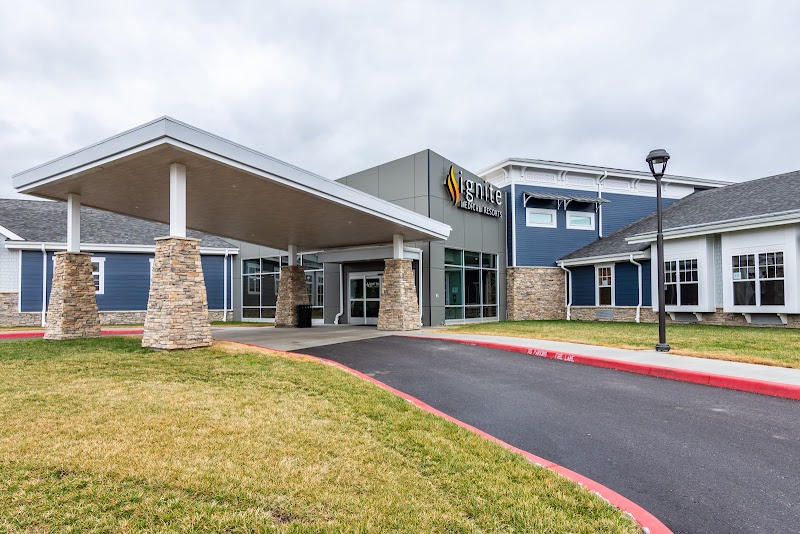
IGNITE MEDICAL RESORT BLUE SPRINGS

20511 E TRINITY PLACE, BLUE SPRINGS, MO 64015 (816) 622-2900
For profit - Limited Liability company 90 Beds IGNITE MEDICAL RESORTS Data: November 2025
Trust Grade
80/100
#20 of 479 in MO
Last Inspection: October 2024

Within standard 12-15 month inspection cycle. Federal law requires annual inspections.

Overview

Ignite Medical Resort in Blue Springs, Missouri, has a Trust Grade of B+, which means it is above average and recommended for families seeking care. It ranks #20 out of 479 facilities in Missouri, placing it in the top half, and it is the top-rated facility out of 38 in Jackson County. The facility shows an improving trend, reducing issues from 9 in 2024 to just 2 in 2025. Staffing is a weakness, with a rating of 2 out of 5 stars and a turnover rate of 58%, which is average for the state. However, it has good RN coverage, exceeding 89% of Missouri facilities, providing better oversight for residents' care. On the downside, there have been concerns about maintaining a safe environment, with one resident found on the floor outside their bathroom, and issues with cleanliness, such as cobwebs and dust in multiple resident rooms. Additionally, there were lapses in hand hygiene during colostomy care, raising infection control concerns. Overall, while there are some strengths in RN availability and a positive trend in operations, families should be aware of the facility's staffing issues and specific incidents that may affect resident safety and hygiene.

Trust Score
B+
80/100
In Missouri
#20/479
Top 4%
Safety Record
Low Risk
No red flags
Inspections
Getting Better
9 → 2 violations
Staff Stability
⚠ Watch
58% turnover. Above average. Higher turnover means staff may not know residents' routines.
Penalties
✓ Good
No fines on record. Clean compliance history, better than most Missouri facilities.
Skilled Nurses
○ Average
Each resident gets 39 minutes of Registered Nurse (RN) attention daily — about average for Missouri. RNs are the most trained staff who monitor for health changes.
Violations
⚠ Watch
16 deficiencies on record. Higher than average. Multiple issues found across inspections.
★★★★★
5.0
Overall Rating
★★☆☆☆
2.0
Staff Levels
★★★★★
5.0
Care Quality
★★★★☆
4.0
Inspection Score
Stable
2024: 9 issues
2025: 2 issues

The Good

  • 5-Star Quality Measures · Strong clinical quality outcomes
  • Full Sprinkler Coverage · Fire safety systems throughout facility
  • No fines on record

Facility shows strength in quality measures, fire safety.

The Bad

Staff Turnover: 58%

12pts above Missouri avg (46%)

Frequent staff changes - ask about care continuity

Chain: IGNITE MEDICAL RESORTS

Part of a multi-facility chain

Ask about local staffing decisions and management

Staff turnover is elevated (58%)

10 points above Missouri average of 48%

The Ugly 16 deficiencies on record

Apr 2025 2 deficiencies
CONCERN (D) 📢 Someone Reported This

A family member, employee, or ombudsman was alarmed enough to file a formal complaint

Potential for Harm - no one hurt, but risky conditions existed

Deficiency F0658 (Tag F0658)

Could have caused harm · This affected 1 resident

Based on interview and record review, the facility failed to ensure a medication error did not occur when one sampled resident (Resident #2) received Resident #14's medications instead of his/her own ...

Read full inspector narrative →
Based on interview and record review, the facility failed to ensure a medication error did not occur when one sampled resident (Resident #2) received Resident #14's medications instead of his/her own ordered medications out of 14 sampled residents. The facility census was 89 residents. On 4/24/25, the Administrator was notified of the past non-compliance which occurred on 4/16/25. Facility staff were educated on medication administration and the five rights during medication administration. Interventions were put into place to mitigate future occurrences. The deficiency was corrected on 4/17/25. Review of the facility's policy titled Administration of Medications dated October 2024 showed: -A physician or Nurse Practitioner order was required for administration of all medication. -The licensed staff were expected to check the medication administration record prior to administering medication for the right medication, dose, route, resident, and time. -Staff were expected to identify the resident by reading the resident's wristband or checking the picture in the Medication Administration Record (MAR). 1. Review of Resident #2's admission Record showed he/she admitted to the facility with the following diagnoses: -End-Stage Renal Disease (ESRD-a medical condition in which a person's kidneys cease functioning on a permanent basis leading to the need for a regular course of dialysis). -Respiratory Syncytial Virus Pneumonia (RSV- inflammation of the small airway passages entering the lungs). -Generalized Anxiety Disorder (GAD- any group of mental conditions characterized by excessive fear of or apprehension about real or perceived threats). -Pulmonary Hypertension (high blood pressure in the blood vessels that supply the pulmonary arteries). -Dependence of Renal Dialysis (the removal of excess water, solutes, and toxins from the blood in people whose kidneys no longer perform the functions naturally). Review of the resident's discharge Minimum Data Set (MDS- a federally mandated assessment instrument completed by facility staff for care planning) dated 4/21/25 showed the resident was cognitively intact. Review of the facility's Medication Error Investigation dated 4/16/25 showed: -On the morning of 4/16/25 Resident #2's nurse reported that he/she believed that he/she accidentally administered the incorrect medications to the resident. -Resident #2 received a different resident's medications. -The resident was sent out to the local hospital for further evaluation and treatment if needed. -The nurse reported that Resident #2 seemed lethargic after he/she received the wrong medications. -Resident #2's nurse was unable to explain what happened. -It was determined that the medication error was accidental. -Resident #2 required no treatment while at the local hospital's emergency room (ER). Review of Resident #2's and Resident #14's medical record showed Resident #2 received the following un-ordered medication: -Cetirizine Hydrochloride (HCl) (medication used to treat allergy symptoms) Oral Tablet 10 milligrams (mg), give one tablet by mouth one time a day for allergies. -Famotidine (medication typically used to treat Gastro-Esophageal Reflux Disease (a digestive disease in which stomach acid or bile irritates the food pipe lining)) 20 mg, give one tablet by mouth one time a day for GERD. -Furosemide (Lasix- used to treat fluid retention) 20 mg, give two tablets by mouth one time a day for edema (swelling caused by too much fluid trapped in the body's tissues). -Multiple Vitamins-Minerals Tablet, give one tablet one time a day as a supplement. -Prednisone (a steroid medication that can treat many diseases that cause inflammation) Oral tablet 20 mg, give a half tablet one time a day for Chronic Obstructive Pulmonary Disease (COPD- a disease process that decreases the ability of the lungs to perform ventilation). -Apixaban (Eliquis- used to treat or prevent blood clots) Oral Tablet five mg, give one tablet by mouth two times a day for Deep Vein Thrombosis (DVT- a blood clot in a deep vein, usually in the legs) prophylaxis. -Colace (Docusate Sodium- used to treat constipation) 100 mg, give one capsule by mouth two times a day for constipation. -Hydrocodone-Acetaminophen (Norco- used to treat severe pain) 5-325 mg, give one tablet by mouth every morning and at bedtime for pain. -Senna-S (used to treat constipation) Capsule 8.6-50 mg, give two capsules by mouth twice a day for constipation. -Acetaminophen (Tylenol- used as a pain and fever reliever) Oral Tablet 500 mg, give 1000mg by mouth three times a day for pain. -Methocarbamol (used to treat muscle pain and spasms) Oral Tablet 500 mg, give 500 mg by mouth three times a day for muscle aches). -Losartan Potassium (used to treat high blood pressure) Oral Tablet, give 100 mg by mouth one time a day for high blood pressure. During an interview on 4/23/25 at 3:53 P.M. Registered Nurse (RN) C said: -Interruptions during medication pass made for increased risk of medication errors. -The nurses were sometimes interrupted by staff and other residents during medication pass. -There could be a variety of problems or negative outcomes related to a resident receiving the wrong medication. -The medication on the resident's MAR that stuck out the most to him/her that could cause a potential negative outcome was the Losartan Potassium. During an interview on 4/24/25 at 10:16 A.M. the Director of Nursing (DON) said: -RN B should have given the correct medications to the resident. -There was potential for the resident to have a negative outcome which was why the resident was sent to the local hospital. -The investigation conducted determined that interruptions during medication pass most likely caused the error. -The Losartan Potassium was the main medication that stuck out to him/her which could have caused the biggest negative outcome. During an interview on 4/24/25 at 11:25 A.M. RN B said: -He/She had been preparing both Resident #2's medications and Resident #14's medications at the same time. -He/She normally labeled the medication cups with the resident's names. -He/She accidentally grabbed the wrong cup and administered Resident #14's medications to Resident #2. -He/She realized immediately afterwards that the medication error had occurred. -Resident #2 had not questioned him/her when taking the medication. -He/She typically pre-popped resident's medications during medication administration. -The pre-popping method was not something taught to him/her by the facility, but was the best way for him/her to get through the medication pass at a faster pace. -He/She had started working at the facility earlier in the year and this incident was the first and only time a medication error had occurred. -The resident seemed lethargic and sleepy after the incorrect medications were given. -He/She was distracted during the medication pass. -He/She had a student with him/her and other residents were asking for pain medications. -He/She was very upset about the error as the error should not have occurred. -He/She should have given Resident #2 the correct medications. MO00252843
CONCERN (E) 📢 Someone Reported This

A family member, employee, or ombudsman was alarmed enough to file a formal complaint

Potential for Harm - no one hurt, but risky conditions existed

Accident Prevention (Tag F0689)

Could have caused harm · This affected multiple residents

**NOTE- TERMS IN BRACKETS HAVE BEEN EDITED TO PROTECT CONFIDENTIALITY** Based on observation, interview and record review, the facility failed to ensure a safe environment for one sampled resident ( R...

Read full inspector narrative →
**NOTE- TERMS IN BRACKETS HAVE BEEN EDITED TO PROTECT CONFIDENTIALITY** Based on observation, interview and record review, the facility failed to ensure a safe environment for one sampled resident ( Resident #3) when on 3/8/25 he/she was found on the floor outside of his/her bathroom with his/her bathroom track door. The facility census was 89 residents. 1. Review of Resident #3's admission Record showed he/she admitted to the facility on [DATE] with the following diagnoses: -Unspecified Dementia (a progressive organic mental disorder characterized by chronic personality disintegration, confusion, disorientation, stupor, deterioration of intellectual capacity and function, and impairment of control of memory, judgement, and impulses). -Generalized Muscle Weakness. -Other Abnormalities of Gait and Mobility. -Cognitive Communication Deficit (an impairment in organization/thought organization, sequencing, attention, memory, planning, problem solving, and safety awareness). -Need for Assistance with Personal Care. Review of the resident's admission Minimum Data Set (MDS- a federally mandated assessment instrument completed by facility staff for care planning) dated 2/19/25 showed: -The resident had moderately impaired cognition. -The resident needed partial/moderate assistance (helper does less than half the effort) with toileting hygiene. Review of an Un-Witnessed Fall Incident Report dated 3/8/25 at 8:50 A.M. completed by Registered Nurse (RN) A showed: -Staff heard a loud bang come from the resident's room. -RN A had been called out into the hallway. -RN A went into the resident's room and noted the resident to be in a left lateral position asking for help to get up. -The resident's bathroom door was noted to be on the floor. -The resident could not give a description of what had happened. - The resident had a hematoma (a pool of mostly clotted blood that forms in an organ, tissue, or body space) on his/her face. -The resident had an additional hematoma noted. Review of the resident's skin observation dated 3/9/25 at 8:30 P.M. showed: -The resident had a hematoma to his/her left front scalp. -The resident had bruising to his/her left trochanter (a tubercle of the femur near its joint with the hip bone). -The resident had a left lateral facial bruise. -The resident had a bruise to his/her right top of his/her hand. Review of a Fall Investigation dated 3/10/25 completed by the Administrator and Director of Nursing (DON) showed: -The resident had an unwitnessed fall on 3/8/25. -The licensed nurse heard a loud noise that came from the resident's room. -The nurse went to the resident's room immediately and observed the resident in a left lateral position and asking for help to get up. -The call light was not engaged at the time of the fall. -Upon entry to the resident's room, the nurse noted that the resident's bathroom door was also on the floor. -Nursing staff reported that the door did not fall on or hit the resident. -The door was found lying next to the resident. -The nurse performed a head to toe skin assessment, a passive range of motion (ROM) assessment, and a neurological assessment. -It was noted that the resident had a hematoma to the left lateral side of his/her head. -Later in the day the resident started to complain of pain. -The facility received orders from the facility's provider for an X-ray of his/her head and left hip. -The X-rays were completed on 3/8/25 and the X-ray reports were received on 3/9/25. -The X-ray report showed that the resident had a left femoral neck fracture with minimal impaction and displacement. -The X-ray report showed the resident's skull did not have any fractures. -The facility's provider was then notified and the resident was sent to the local hospital for evaluation and treatment. -The inter-disciplinary team met on 3/10/25 to discuss the resident's fall. -The resident had been receiving antibiotics for a Urinary Tract Infection (UTI) prior to the fall and determined that the UTI was most likely the root cause of the fall. -All previous fall and safety interventions were in place at the time of the fall. -The Maintenance Director performed an audit to all the resident bathroom track doors in the facility to identify any concerns. -No concerns were found upon completion of the audit. -The inter-disciplinary team also determined that the secondary root cause of the fall was the resident's diagnosis of dementia. -The fall was determined to be accidental and was not caused by any facility abuse or neglect. Review of an Administrative Note dated 3/10/25 at 9:51 A.M. completed by the Administrator showed: -On 3/8/25 around 8:50 A.M. nursing care staff heard a loud bang come from the resident's room. -Nursing care staff responded immediately to the resident's room and found the resident on the floor on his/her left side asking for help. -It was noted that the resident's track bathroom door was also on the floor. -The resident had a hematoma to his/her left lateral part of head. Review of an undated witness statement completed by RN A showed: -The resident was found in his/her room lying on his/her left side between the two sides of the room. -The resident was unable to explain what happened. -The resident was wearing non-skid socks at the time of the fall. -The resident had gotten out of his/her wheelchair and the wheelchair was not near the resident or the door when the resident was found on the floor. -The resident did not have any complaints at the time of the fall. -The resident began to complain of pain about two hours after the fall occurred. Review of an undated statement completed by Occupational Therapist (OT) A showed: -OT A had not seen the resident prior to the resident's fall. -OT A had been in the hallway, then he/she heard a loud noise and joined RN A in the resident's room to assist. -The resident was wearing non-skid socks at the time of the fall. -The resident stated, he/she was trying to come out of the bathroom. -OT A assisted the resident in setting up his/her breakfast and began to eat his/her food. During an interview on 4/18/25 at 9:21 A.M. the Maintenance Director said: -There is an online system that staff could use to put in work orders. -Any staff person had access to the online system to put in work orders. -He/She was unaware of any issues with the resident's track bathroom door prior to the resident's fall on 3/8/25. -He/She had not received any requests from staff or family to fix the resident's bathroom track door prior to the resident's fall on 3/8/25. -He/She was notified immediately after the resident's fall that the resident's bathroom track door had fallen off the track. -He/She then came up to the facility to ensure there was nothing wrong with the resident's bathroom track door and to see if there were any issues with the door's track system. -He/She had not found anything wrong with the door or track system. -He/She then completed an audit of all the resident bathroom doors on 3/8/25, and no other issues were found. -All resident bathroom doors throughout the facility have the same door and track system. During an interview on 4/18/25 at 12:11 P.M. the Maintenance Director said: -The housekeepers complete a room flip checklist whenever a resident discharges. -The facility has a high volume of discharges, so the housekeepers perform the room flip checklist frequently. -The housekeepers were expected to let the Maintenance Director know of any issues once the room flip checklist had been completed. -The nurses and CNAs also were in the resident rooms frequently and were expected to place any work orders in the online system or let the Maintenance Director know of any issues. -The bathroom track door could not be permanently removed from the track because the resident lived in a semi-private room with a roommate. -He/She had tightened the bump stops on the resident's track bathroom door after the incident occurred out of caution and not because they were loose. -None of the staff were able to report how the bathroom door came off the track when the resident fell on 3/8/25. -If the door were to be bumped with enough leverage there would be a chance that the door could come off the track. During an interview on 4/18/25 at 12:30 P.M. RN A said: -He/She had not received any reports from the resident or resident's family about there being any issues with the resident's door. -The resident was found outside of his/her bathroom doorway with his/her feet towards the doorway and the resident's head towards the fork of the room that split the room in two sections. -The door was not found on top or really near the resident when the resident fell. -The resident was able to report to him/her that the door had not fallen on him/her. -The resident did not seem to be injured at the time of the fall and seemed to be embarrassed by the whole situation. -The resident had some scratches on his/her head and arms after the fall. -The resident reported that he/she was in pain a few hours after the fall occurred. -The resident's roommate at the time reported that the door had not hit or fallen on the resident when the resident fell. During an interview on 4/18/25 at 12:47 P.M. Licensed Practical Nurse (LPN) A said: -He/She had heard a crash and ran to the resident's room. -When he/she got to the room OT A was helping the resident up from the floor. -The resident's bathroom door was lying on the ground next to the resident. -He/She was unsure if the door had hit the resident. During an interview on 4/18/25 at 12:52 P.M. OT A said: -He/She had been in a different resident's room when he/she heard a loud bang. -He/She saw the resident lying on the ground on his/her left side with his/her feet towards the bathroom. -The resident's bathroom track door was lying next to the resident to the left of the resident. -With the way the track door was situated it did not appear that the door had hit or fallen on the resident. -The resident had stated he/she was trying to use the bathroom at the time of the fall. -The Maintenance Director came in to fix the bathroom track door afterwards. During an interview on 4/18/25 at 12:59 P.M. Family Member A said: -He/She had arrived at the facility around 9:25 A.M. on the morning of 3/8/25. -The resident was by the nurse's station when he/she arrived at the facility. -The resident had a bump and bruise on his/her head/face. -He/she wheeled the resident back to his/her room. -The resident's bathroom door was hanging on the track when he/she arrived at the resident's room. -He/She had been told by RN A that the bathroom track door did not hit or fall on the resident. -The door had been an issue prior to the incident. -He/She had been in communication with RN A about the bathroom track door being an issue. -He/She did not think that he/she had any additional conversations with other staff about the resident's bathroom track door. During an interview on 4/18/25 at 1:27 P.M. Resident #9 said: -He/She had been roommates with Resident #3. -The bathroom door was on the track prior to the incident. -He/She thought his/her roommate fell against the door and knocked it down. -He/She did not visualize the fall itself, only heard the resident and the door fall. -There had not been any issues with the bathroom track door prior to the incident. NOTE: Review of Resident #9's Prospective Payment System (PPS) five-day assessment showed the resident was cognitively intact. During an interview on 4/18/25 at 2:25 P.M. RN A said: -There had not been any issues with the resident's bathroom track door prior to the incident. -He/She had not reported any issues to the Maintenance Director prior to the incident. -He/She did not think the roommate visualized the incident but had been in the room at the time of the incident. -He/She had only ever spoken with Family Member A about the resident's care and not about any maintenance issues during his/her stay. During an interview on 4/22/25 at 2:51 P.M. LPN C said: -He/She had worked with the resident the day before the incident on 3/7/25. -He/She had not remembered anything wrong or abnormal about the resident's bathroom track door that day or at anytime prior to the incident. -The resident's bathroom track door was usually open. During an interview on 4/22/25 at 3:49 P.M. LPN D said: -He/She had not remembered there being any issue with the resident's bathroom track door prior to the incident. -He/She felt like he/she would have noticed if there was anything wrong with the bathroom track door. -There had not been any reports of any issues with the resident's bathroom track door. -The resident's bathroom track door seemed to always be open. -He/She felt like if the bathroom track door was pushed/pulled hard enough, it could come off the track. Observation on 4/23/25 at 10:05 A.M. showed all residents had the same bathroom track doors. During an interview on 4/24/25 at 9:00 A.M. the Maintenance Director said: -He/She had only performed an audit of all resident bathroom track doors after the incident. -Nothing else needed to be done after that point in time. -He/She had never had an issue with any resident bathroom track door like what happened during the incident prior to the incident. -The safety mechanisms that were in place to keep the bathroom track door on the track were all intact at the time of the incident. -No additional safety mechanisms were placed on the resident's bathroom track door prior to the incident. -The facility was looking into an extra safety precaution or mechanism that could be put in place to prevent an incident like what occurred from happening again. During an interview on 4/24/25 at 10:16 A.M. the DON said: -He/She was unaware of any issues with the resident's bathroom track door prior to the incident. -There had not been an issue with any other residents bathroom track doors like what happened during the this incident. -He/She was not a part of the investigation, so he/she was unsure if anything besides the bathroom track door audit had been completed after the incident. During an interview on 4/24/25 at 10:35 A.M. the Administrator said: -The incident had been an isolated incident. -He/She had not thought that what happened in the incident was even a possibility. -The Maintenance Director did not have to fix anything with the bathroom track door or track system after the incident occurred. -He/She was unaware of any issues with the resident's bathroom track door prior to the incident. -The facility was looking into any hardware that could be placed on the bathroom track doors to prevent an incident like what occurred from happening again. During an interview on 5/12/25 at 9:35 A.M. the Maintenance Director said all resident bathroom track doors were installed when the facility was first built. MO00252789
Oct 2024 7 deficiencies
CONCERN (D)

Potential for Harm - no one hurt, but risky conditions existed

Deficiency F0554 (Tag F0554)

Could have caused harm · This affected 1 resident

**NOTE- TERMS IN BRACKETS HAVE BEEN EDITED TO PROTECT CONFIDENTIALITY** Based on observation, interview, and record review, the facility failed to obtain a physician order for self-administration of m...

Read full inspector narrative →
**NOTE- TERMS IN BRACKETS HAVE BEEN EDITED TO PROTECT CONFIDENTIALITY** Based on observation, interview, and record review, the facility failed to obtain a physician order for self-administration of medication at bedside and failed to evaluate and document the ability to self-administer medication for one sampled resident (Resident #49) out of 19 sampled residents. The facility census was 87 residents. Review of the facility's policy titled Self Administration of Medications and Treatments dated May 2023 showed: -Self-administration of medications and treatments were determined by physician order after determining that the resident was able to self-administer. -Medications and treatments for self-administration were kept in a locked drawer in the resident room. -All medications and treatments that were self-administered were signed out in the Medication Administration Record (MAR) or Treatment Administration Record (TAR). -If determined by a member of the interdisciplinary team, or if the resident requested to self-administer, it would be documented in the chart and the physician would be called for an order to self-administer. -A care plan was to be made for the resident who self-administered medications, and documentation should be present in the nursing notes related to the teaching related to self-administration of the medications or treatments. 1. Review of Resident #49's face sheet showed he/she admitted to the facility on [DATE] with the following diagnoses: -Unspecified Fracture of Lower End of Humerus (upper arm bone). -Other Specified Fracture of Left Pubis (pubic bone). -Cognitive Communication Deficit (problems with communication that have an underlying cause in a cognitive deficit). Review of the resident's admission Minimum Data Set (MDS- a federally mandated assessment instrument completed by facility staff for care planning) dated 8/1/24 showed the resident had moderately impaired cognition. Review of the resident's care plan dated 10/6/24 showed no care plan related to self-administration of any medication. Observation on 10/6/24 at 4:02 P.M. of the resident's room showed: -A bottle of Miconazole Nitrate 2% powder (an antifungal medication used to treat fungal or yeast infections) sitting on the resident's windowsill and not in a locked box. -A medication cup sitting on the resident's bedside table with one unidentified pill that had been cut into multiple different pieces. -A pill cutter on the bedside table. Review of the resident's Physician Order Sheet dated October 2024 showed: -An order for Miconazole External Nitrate Powder 2%, apply to under bilateral breasts topically as needed for redness/rash dated 10/7/24. -No order for the resident to be able to self-administer the Miconazole External Nitrate Powder 2%. Review of a Self-Administration of Medication Evaluation dated 10/7/24 showed the resident had only been evaluated on 10/7/24 for self-administration of the Miconazole Nitrate Powder 2% and not any time prior. Observation on 10/7/24 at 10:47 A.M. showed: -The resident still had the Miconazole Nitrate Powder 2% on his/her windowsill and not stored in a locked box. -The bottle was not labeled with the resident's name or any resident identifier. During an interview on 10/7/24 at 10:48 A.M. the resident said: -He/She had brought the bottle of Miconazole Nitrate Powder 2% upon admission and had been using it occasionally. -He/She was unsure if he/she had been assessed for self-administration of the Miconazole Nitrate Powder 2%. Observation on 10/8/24 at 8:43 A.M. of the resident's room showed: -The resident still had the bottle of Miconazole Nitrate Powder 2% on his/her windowsill, not in a locked box or labeled. During an interview on 10/10/24 at 9:33 A.M. Licensed Practical Nurse (LPN) D said: -Any nurse could assess for a resident to be able to self-administer medication as long as there was an order from the provider to do so. -He/She was unsure if there was any timeframe that the assessment needed to be completed by. -If he/she were to see a medication at a resident's bedside and was unsure if the resident had an order to be able to self-administer the medication, then he/she would talk about the medication with the resident, look at the orders and if the resident did not have an order for self-administration, then he/she would take the medication from the resident. -He/She was unsure if there was anyone at the facility who ensured completion of self-administration orders. -The Miconazole Nitrate Powder 2% was a medication that needed to be assessed for the ability to self-administer. -Self-Administration of any medication should be on the care plan. During an interview on 10/10/24 at 10:25 A.M. Assistant Director of Nursing (ADON) B said: -He/She could assess residents for the ability to self-administer and any of the nursing managers could do as well. -There needed to be an order from the provider in order to do a self-administration assessment. -If a resident requested to be able to administer a medication, then the facility would try and get the order and assessment completed within 24-48 hours. -He/She would have expected the nurses to have removed the Miconazole Nitrate Powder 2% from the room if they were unsure if the resident had an order to be able to self-administer the medication. -The Miconazole Nitrate Powder 2% was a medication that needed to be assessed for the ability to self-administer. -Self-Administration of any medication should be on the resident's care plan. During an interview on 10/10/24 at 11:18 A.M. the [NAME] President of Clinical Operations and the Director of Nursing (DON) said: -Any nurse was able to perform the assessment for self-administration of medication as long as there was an order from the provider. -Once requested, the assessment for self-administration of medication should be performed as soon as possible. -The DON reviewed order listings daily, so he/she would have been the one to ensure an order for self-administration was in place. -He/She would have expected the nurses to ensure there was in order in place for the resident to self-administer the Miconazole Nitrate Powder 2% and if there had not been an order, to perform the self-administration assessment. -The Miconazole Nitrate Powder 2% was a medication that needed to be assess for the ability to self-administer. -The resident should have had a self-administration assessment completed prior to 10/7/24. -Self-Administration of medication should be on a resident's care plan.
CONCERN (D)

Potential for Harm - no one hurt, but risky conditions existed

Quality of Care (Tag F0684)

Could have caused harm · This affected 1 resident

**NOTE- TERMS IN BRACKETS HAVE BEEN EDITED TO PROTECT CONFIDENTIALITY** Based on observation, interview, and record review, the facility failed to assess, describe and measure wounds weekly for one sa...

Read full inspector narrative →
**NOTE- TERMS IN BRACKETS HAVE BEEN EDITED TO PROTECT CONFIDENTIALITY** Based on observation, interview, and record review, the facility failed to assess, describe and measure wounds weekly for one sampled resident (Resident #69) who had a left knee wound and right hip surgical incision out of 19 sampled residents. The census was 87 residents. Review of the facility's Wound Policy and Procedure dated March 2020 showed: -The facility needed to follow standard of practice for all wounds. -Upon admission, the wound should be assessed. -The wound assessment should include the location, measurement, appearance, drainage, characteristics, and appearance of wound edges. -The staff were to assess the wounds on a weekly basis. 1. Review of Resident #69's Minimum Data Set (MDS-a federally mandated assessment tool required to be completed by facility staff for care planning) dated 9/11/24 showed he/she was admitted for skilled services. Review of the resident's admission nursing evaluation dated 9/11/24 showed: -The resident had a left front knee open area. -There were no measurements or description of the wound. Review of the resident's nursing evaluation dated 9/13/24 showed: -The resident had a left front knee open area. -There were no measurements or description of the wound. Review of the resident's Daily Skilled Evaluations dated 9/14/24 to 9/16/24 showed no measurements or descriptions of any wounds. Review of resident's care plan dated 9/16/24 showed: -The resident was at risk for alteration of skin integrity. -Note: there was no information regarding the resident's left knee wound. Review of the resident's interdisciplinary team (IDT) note dated 9/17/24 showed: -He/she had a wound on his/her left knee. -Daily treatment was required to his/her surgical site on his/her right hip with hip precautions. Review of the resident's Daily Skilled Evaluations dated 9/17/24 to 9/18/24 showed no measurements or descriptions of any wounds. Review of the resident's admission MDS date 9/19/24 showed: -The resident was severely cognitively impaired. -There was no information regarding the resident's wounds. Review of the resident's skin assessment dated [DATE] showed: -The resident had an open area to his/her left front knee. -There were no measurements or description of the wound. Review of the resident's Daily Skilled Evaluations dated 9/20/24 to 9/22/24 showed no measurements or description of any wounds. Review of the resident's care plan dated 9/22/24 showed: -The resident was sent to the emergency room for hip pain. -While in the hospital the resident was found to have a right hip fracture. Review of the resident's Daily Skilled Evaluations dated 9/28/24 to 9/29/24 showed: -The resident had a right hip stapled surgical incision with approximated (closed) edges and no signs of infection. -There were no measurements or description of the wound. -There were no measurements or description of the left knee wound. Review of the resident's Daily Skilled Evaluations dated 9/30/24 to 10/1/24 showed no measurements or description of any wounds. Review of the resident's IDT note dated 10/1/24 showed: -Daily treatment was required to his/her surgical site on his/her right hip. -No documentation regarding the resident's left knee wound. Review of the resident's skin assessment dated [DATE] showed: -A wound on his/her left knee but with no description or measurements. -A surgical incision on his/her right hip but with no descriptions or measurements. Observation on 10/9/24 at 10:59 A.M. showed: -The resident had a right hip surgical wound with staples. -The right hip wound was clean, dry and intact with no signs of infection. -The resident's left knee had two heeled quarter size scars. During an interview on 10/9/24 at 1:20 P.M. Licensed Practical Nurse (LPN) A said: -He/she was not aware of the resident's left knee wound. -When a wound was identified on a resident the wound nurse would be notified. -The wound nurse was responsible for the assessment of all wounds. During an interview on 10/10/24 at 9:12 A.M. Assistant Director of Nursing (ADON) A said: -The nursing staff should be documenting all wounds on the weekly skin assessment. -The nurses can write a description and general size of the wound but do not measure the wound. -Upon admission the nurses were expected to assess and describe the resident's wounds. During an interview on 10/10/24 at 10:15 A.M. the Wound Nurse said: -He/she expected a full head to toe skin assessment on all residents upon admission. -The nurses should document a full description of the wound. -All skin assessments should show all resident wounds. During an interview on 10/10/24 at 10:30 A.M. Registered Nurse (RN) B said: -Upon admission the nurses were expected to assess and describe the resident's wounds. -He/she would document anything out of the ordinary related to the resident skin on the skin assessment. -He/she would describe any wounds in detail on the skin assessment. During an interview on 10/10/24 at 11:19 A.M.: -The Director of Nursing (DON) said: --He/she expected nursing staff to do a full detailed skin assessment at the time of admission. --He/she expected the Wound Nurse or nursing staff to complete a full description of any wounds on the resident and document on the skin assessment. --He/she expected the Wound Nurse to measure, assess, and describe any wounds. --He/she expected staff to document the description of the wound including redness, swelling, drainage, and the general size of the wound. -The [NAME] President of Clinical Operations said: --He/she expected the staff to give a full description of wounds including surgical incisions, but they should not stage or measure them.
CONCERN (D)

Potential for Harm - no one hurt, but risky conditions existed

Deficiency F0688 (Tag F0688)

Could have caused harm · This affected 1 resident

Based on observation, interview and record review, the facility failed to ensure the ordered application of splint devices were utilized to improve or maintain mobility for one sampled resident (Resid...

Read full inspector narrative →
Based on observation, interview and record review, the facility failed to ensure the ordered application of splint devices were utilized to improve or maintain mobility for one sampled resident (Resident #58) with limited mobility out of 19 sampled residents. The facility census was 87 residents. Review of a facility policy titled Range of Motion, dated 11/2020, showed: -A resident with limited range of motion would receive services to increase range of motion and/or decrease further range of motion. -Residents of the facility would be provided care and services to prevent formation and progression of contractures (a condition of shortening and hardening of tendons and muscles often leading to rigidity and deformities of joints) and deformities. 1. Review of Resident #58's admission Minimum Data Set (MDS, a federally mandated comprehensive assessment completed by the facility) dated 8/14/24, showed the resident: -Was severely cognitively impaired. -Did not reject cares in the assessment period. -Was dependent on staff for upper body dressing. -Had upper extremity range of motion impairment on one side. -Had diagnoses of stroke and hemiplegia (inability to use one side of the body) Review of the resident's Physician Order Summary (POS), dated 10/9/24, showed an order for a left functional resting hand splint (a medical device that immobilizes and protects a body part from further injury) to be applied during waking hours as tolerated. Review of the residents Care Plan, dated 8/9/24, showed: -The resident had limitations in physical mobility. -An intervention of a left hand splint. Review of the resident's Nurse Practitioner (NP) progress note dated 9/30/24, showed NP A observed the resident during waking hours without his/her ordered hand splint. Observation on 10/8/24 at 11:06 A.M., the resident was in his/her wheelchair near the nurse's station without the splint device in place. Observation on 10/9/24 at 11:07 A.M., the resident was in his/her wheelchair near the nurse's station without the splint device in place. During an interview on 10/9/24 at 11:26 A.M., Certified Nursing Assistant (CNA) D said: -The resident grimaced when he/she attempted to apply the splint, so he/she did not apply it. -The resident did not wear the splint all the time. During an interview on 10/9/24 at 1:16 P.M., Registered Nurse (RN) B said: -He/She was the resident's nurse for the day. -He/She was unaware if the resident had the splint in place or not. -There was not a reason the resident did not have the splint on today. Observation on 10/9/24 at 1:19 P.M., showed: -RN B placed the splint on the resident's left hand. -No grimacing or resistance was noted from the resident. Review of the resident's Treatment Administration Record (TAR) dated October 2024 showed documentation of splint application on 10/8/24 and 10/9/24 by the resident's staff nurse. During an interview on 10/10/24 at 11:25 A.M., the Director of Nursing (DON) said: -He/She would expect staff to apply ordered devices like splints. -He/She would not expect nurses to document application of devices if they were not applied.
CONCERN (D)

Potential for Harm - no one hurt, but risky conditions existed

Deficiency F0691 (Tag F0691)

Could have caused harm · This affected 1 resident

Based on interview and record review, the facility failed to obtain a physician's order for one sampled resident (Resident #49) to self-perform colostomy (a surgical operation in which a piece of the ...

Read full inspector narrative →
Based on interview and record review, the facility failed to obtain a physician's order for one sampled resident (Resident #49) to self-perform colostomy (a surgical operation in which a piece of the colon is diverted to an artificial opening in the abdominal wall so as to bypass a damaged part of the colon) care and failed to complete a full evaluation to self-perform the colostomy care out of 19 sampled residents. The facility census was 87 residents. Review of the facility's policy titled Self Administration of Medication and Treatments dated May 2023 showed: -Self-Administration of medications and treatments was determined by a physician order after determining that the resident was able to self-administer. -Treatments for self-administration were kept in a locked drawer in the resident's room. -All treatments that were self-administered were signed off in the Treatment Administration Record (TAR). -If it was determined by a member of the interdisciplinary team, or if the resident requested to self-administer, it would be documented in the chart and the physician would be called for an order. -If a treatment order was self-administered, the resident would need to perform a return demonstration of the treatment to be able to do the treatment independently. -A care plan would be made for the resident who self-administered medications, and documentation should be present in the nursing notes of teaching related to self-administration of the medications or treatments. 1. Review of Resident #49's face sheet showed he/she admitted to the facility with the following diagnoses: -Colostomy Status. -Cognitive Communication Deficit (problems with communication that have an underlying cause in a cognitive deficit). Review of the resident's admission Minimum Data Set (MDS- a federally mandated assessment instrument completed by facility staff for care planning) dated 8/1/24 showed: -The resident had moderately impaired cognition. -The resident had an ostomy (an artificial opening in an organ of the body). Review of the resident's care plan dated 8/11/24 showed: -The resident had impaired cognitive function and/or thought processes. -The resident had impaired visual function. -The resident had an Activities of Daily Life (ADL) self-care performance deficits and limitations in physical mobility. -The resident had an ostomy and staff were to provide ostomy care per protocol. Review of an Occupational Therapy Treatment Encounter Note dated 9/10/24 showed the resident had stood over the toilet and demonstrated emptying and cleaning of his/her colostomy bag. Review of the resident's Physician Order Sheet dated October 2024 showed: -An order to change colostomy bag and appliance as needed. -An order to change colostomy bag and appliance every day shift every seven days. -An order for ostomy care as needed. -An order for ostomy care every shift, check appliance, and empty. -An order for ostomy: change wafer and bag weekly every evening shift every seven days and as needed. --NOTE: There was no order for the resident to self-administer his/her own ostomy treatments and no clarification on any orders related to the resident's ability to perform self-care. During an interview on 10/7/24 at 1:56 P.M. the resident said he/she performed his/her colostomy care by himself/herself without any assistance from staff. Review of the resident's Electronic Medical Record on 10/8/24 showed no nursing notes related to the assessment or ability for the resident to perform his/her own ostomy care. During an interview on 10/8/24 at 12:32 P.M. the resident said: -He/She had not been assessed for the ability to self-care for his/her ostomy. -No one had asked him/her to demonstrate his/her ostomy care. During an interview on 10/10/24 at 9:07 A.M. Occupational Therapist Registered and Licensed (OTR-L) A said: -Only certain parts of the self-care assessment for ostomy care would be completed by therapy staff. -This included the voiding/dumping of the bag and cleaning of the bag. -All other aspects of the ostomy care would need to be assessed by the nursing staff. -He/She was unsure if the nursing staff were aware that only part of the assessment was completed by therapy staff. During an interview on 10/10/24 at 9:47 A.M. Licensed Practical Nurse (LPN) D said: -The nursing staff would be responsible for completing the assessment for the self-administration of ostomy care. -There was no specific timeline in which the assessment needed to be completed, just that the assessment would be completed once informed by the resident of wanting to self perform the care. -The orders in the POS should clarify what the resident would be responsible for and what the staff would be responsible for related to the resident's ostomy care, but a specific order for the resident to perform self-administration of his/her ostomy care was not needed. -He/She had watched the resident perform ostomy care but was unsure if he/she had documented a note. -The resident was able to self-administer his/her own ostomy care. -The care plan should clarify what care the resident would perform and what care the nursing staff would be responsible for. During an interview on 10/10/24 at 10:18 A.M. Assistant Director of Nursing (ADON) B said: -There was not an assessment form for nursing staff to complete when assessing for self-administration of a treatment, including ostomy care. -He/She would have expected the nursing staff to have completed an assessment for the resident to perform his/her own ostomy care by that point in time. -There should have been a note in the resident's electronic medical record that indicated the assessment had been completed. -The resident's care plan should have reflected the resident needed stand-by assistance when performing his/her ostomy care. -The resident's orders would need to be updated to include what care the resident could do by himself/herself and what care the staff would be responsible for. During an interview on 10/10/24 at 11:18 A.M. the [NAME] President of Clinical Operations and the Director of Nursing (DON) said: -Therapy or nursing staff could complete the assessment for self-administration of ostomy care. -They were not aware that therapy could only perform part of the assessment and were unsure if a full assessment had been completed. -There was no specific assessment form that was completed when assessing for self-administration of treatments, but there would need to be a note that indicated the assessment was completed. -They expected the nursing staff to check-in with the resident to see if any assistance was needed related to the ostomy care. -The resident's care plan needed to be updated to reflect that the resident could perform his/her own ostomy care. -The resident's current orders did not need to be updated or clarified.
CONCERN (D)

Potential for Harm - no one hurt, but risky conditions existed

Respiratory Care (Tag F0695)

Could have caused harm · This affected 1 resident

**NOTE- TERMS IN BRACKETS HAVE BEEN EDITED TO PROTECT CONFIDENTIALITY** 2. Review of Resident #280's admission Face sheet showed the resident had a diagnosis of Obstructive Sleep Apnea (a sleep disord...

Read full inspector narrative →
**NOTE- TERMS IN BRACKETS HAVE BEEN EDITED TO PROTECT CONFIDENTIALITY** 2. Review of Resident #280's admission Face sheet showed the resident had a diagnosis of Obstructive Sleep Apnea (a sleep disorder that keeps you from breathing normally while you sleep). Review of the resident's Treatment Administration Record (TAR) and Nursing Medication Administration record (MAR) dated 10/1/24 to 10/31/24 showed: -Did not have a detailed physician's order for use and monitoring/care of the residents CPAP machine and supplies. -No documentation of the monitoring of the resident's use of the CPAP machine at bedtime or as needed. Review of the resident POS dated 10/3/24 showed he/she had the following orders: -Administer supplemental oxygen as needed. -NOTE: There was no order found for the care and use of a CPAP machine. Review of the resident's Care Plan date 10/4/24 showed the resident did not have a care plan for sleep apnea to include a reason for the use and the care of C-PAP machine and mask Observation on 10/6/24 at 3:48 P.M., showed the resident: -Was in his/her room lying in bed. -Had a CPAP machine next to the bed on the dresser with a face mask draped over the machine uncovered. Observation on 10/7/24 at 10:14 A.M., showed the resident had a CPAP machine sitting on the dresser. During an interview on 10/7/24 at 10:14 A.M. the resident said he/she wore the CPAP at night. Review of the resident's electronic medical record on 10/7/24 at 10:40 A.M. showed the resident did not have a Physician's Order for use and care of his/her CPAP machine. Review of the resident's admission MDS dated [DATE], showed he/she: -Was cognitively intact, able to make his/her needs and wants known. -Required the use of a CPAP machine. Observation on 10/9/24 at 11:23 A.M. showed the resident had a CPAP machine next to the bed. Review on 10/9/24 at 11:40 A.M., of the resident's medical record with LPN B showed: -LPN B could not find a physician order and care plan for the residents use and care of a CPAP machine. -He/she would expect to have a detailed physician order for the use of a CPAP machine and supplies. -He/she would expect to have a care plan with an intervention for a CPAP machine for sleep apnea. -the admission nurse was responsible for the transcription of initial orders and reviewed by nurse manager the next day or two of admission During an interview on 10/10/24 at 9:00 A.M., Registered Nurse (RN) A said he/she would expect nursing staff to have obtained and transcribed a physician order for the resident's CPAP machine upon admission. During an interview on 10/10/24 at 9:35 A.M., CNA C said he/she was not sure if a CPAP mask or oxygen supplies should be covered when not in use by the resident. During an interview on 10/10/24 at 11:18 A.M., the [NAME] President of Clinical Operation and the Director of Nursing (DON) said: -He/She would expect to have a detailed physician order for the use of a CPAP machine and supplies needed. -He/She would expect the resident to have a current, updated care plan that included the use of a CPAP machine and care/cleaning of the CPAP. -He/she would expect the CPAP face mask be stored in bag when not in use. Based on observation, interview and record review, the facility failed to ensure physician's orders for a Continuous Positive Airway Pressure (CPAP a form of positive airway pressure ventilation in which a constant level of pressure greater than atmospheric pressure is continuously pumped into the lungs during spontaneous breathing) machine was on their Physician's Order Sheet (POS) and care plan; and failed to ensure respiratory face masks and tubing were kept covered when not in use for two sampled residents (Resident #183 and #280) out of 19 sampled residents. The facility census was 87 residents. Review of the facility policy for Respiratory Supplies revised 5/2023 showed: -There was no policy documentation related to obtaining physician orders for a CPAP machine or storage of CPAP and oxygen supplies. 1. Review of Resident #183's Face Sheet showed the resident was admitted on [DATE], with diagnoses including sleep apnea (a sleep disorder that causes breathing to repeatedly stop or become shallow during sleep), diabetes, high blood pressure, heart disease and emphysema (the permanent enlargement of air spaces in the lungs). Review of the resident's admission Minimum Data Set (MDS-a federally mandated assessment tool to be completed by facility staff for care planning) dated 10/2024, showed the MDS was not completed yet (it was not due until 10/9/24). Review of the resident's POS dated October 2024, showed physician's orders for: -Continuous oxygen at 3 liters per minute (ordered 10/6/24). -Change oxygen tubing every night shift on Sunday and as needed (ordered 10/6/2024). -NOTE: The POS did not show the resident used a CPAP, did not show orders for the CPAP setting or for the duration the resident was supposed to wear it. Review of the resident's Care Plan dated October 2024, showed the resident had altered respiratory status/difficulty breathing and emphysema. He/She received oxygen at 3 liters daily. Interventions showed staff would: -Administer medication as ordered. Monitor for effectiveness and side effects. -Administer oxygen per physician's orders. -Monitor for signs and symptoms of respiratory distress and report to the physician as needed. -Monitor the resident's vital signs as ordered. -NOTE: The care plan did not show the resident used a CPAP machine, when he/she was supposed to use it or how nursing staff was supposed to care for it. Observation on 10/6/24 at 5:04 P.M., showed the resident was sitting in his/her wheelchair dressed for the weather and watching tv in his/her room. His/Her call light was within reach and he/she was not wearing his oxygen, but showed no signs of respiratory distress. His/Her oxygen nasal cannula (a medical device that provides supplemental oxygen to a patient through two prongs that fit into the nostrils) was laying on top of his/her bed sheets, uncovered. There was also a CPAP machine that was sitting on the nightstand by his/her bed. The CPAP face mask and tubing were also laying on the resident's bedsheets uncovered. The resident's oxygen concentrator (a medical device that extracts oxygen from the air and delivers it to a patient in a more concentrated form) was sitting on the side of his/her bed and there was a plastic bag on the concentrator. Observation on 10/7/24 at 12:01 P.M., showed the resident was sitting in his/her recliner dressed for the weather. His/her eyes were closed and he/she seemed to be resting without signs or symptoms of distress. He/She was not wearing his/her oxygen and his/her oxygen tubing was in a plastic bag on the oxygen concentrator that was beside his/her bed. The resident's CPAP machine was sitting on the night stand beside his/her bed and the CPAP mask and tubing was laying on top of his/her bed sheets, uncovered. During an interview on 10/7/24 at 12:01 P.M. the resident said the nursing staff took care of his/her CPAP and oxygen tubing but he/she was able to put them on and remove them. They put his/her oxygen tubing in the bag since he/she only used it as needed. He/she said he/she wore the CPAP at night while sleeping. During an interview on 10/9/24 at 11:37 A.M., Certified Nursing Assistant (CNA) A said: -The face masks, nasal cannulas and mouthpieces for oxygen equipment should be kept covered in a plastic bag that was dated, when not in use. -Whenever they (nursing staff) went into the resident's room, they should check to see if the oxygen equipment was covered. -Sometimes residents would remove their nasal cannula or face masks and lay it down instead of placing them in the plastic bags, but when staff checked on the resident they should make sure it was put in a plastic bag. During an interview on 10/9/24 at 1:06 P.M., Licensed Practical Nurse (LPN) A said: -Oxygen equipment (nasal cannulas, face masks, tubing) should have plastic bags that they were stored in when they were not in use. -Anytime the nursing staff went into the resident's room, they should check because some residents removed their masks or nasal cannulas themselves and would not place them in the bags. -Nursing staff should place the oxygen equipment in the plastic bag anytime they saw that it was not in there. -They have some residents that they know would not place their tubing, mask and nasal cannula in the plastic bags so they checked those residents more frequently. -The resident's CPAP machine tubing and face mask should be kept covered when not in use and the nursing staff also had to rinse the tubing after use. -There should be physician's orders for the resident's CPAP machine and the orders should be documented on the physician's order sheet and include the duration of use and care for the machine. -Usually the orders for the CPAP were on the discharge orders and the nurse would transcribe it to the POS upon admission. -If the order for the CPAP was not on the discharge orders, usually the respiratory nurse would complete an assessment and put the orders on the resident's POS. -He/She was unaware that the resident did not have orders for his/her CPAP machine and would follow up on resolving this. -The CPAP should be on the resident's care plan with interventions for care and use.
CONCERN (E) 📢 Someone Reported This

A family member, employee, or ombudsman was alarmed enough to file a formal complaint

Potential for Harm - no one hurt, but risky conditions existed

Safe Environment (Tag F0584)

Could have caused harm · This affected multiple residents

**NOTE- TERMS IN BRACKETS HAVE BEEN EDITED TO PROTECT CONFIDENTIALITY** Based on observation, interview and record review, the facility failed to maintain resident rooms 118, 113, 111, 107, 103, 127, ...

Read full inspector narrative →
**NOTE- TERMS IN BRACKETS HAVE BEEN EDITED TO PROTECT CONFIDENTIALITY** Based on observation, interview and record review, the facility failed to maintain resident rooms 118, 113, 111, 107, 103, 127, 131, 130, 138, 142, 147, 157, 161, 160, 165, 166, 170, 173, and 176 free from cobwebs (a web spun by certain spiders, often found in the corners of disused rooms) and a buildup of dust behind the beds and in the corners next to the cabinets. This practice potentially affected at least 23 residents. The facility census was 87 residents. Review of the facility's undated policy titled Room Cleaning process showed: -Section 3: Damp wipe. --Wipe everything you can reach. --Start with the door and work around the room in a circular pattern. --Be sure to include wall spotting, light switches, call buttons, telephones, wall moldings, dispensers, windowsills, furniture and Packaged Terminal Air Conditioner (PTAC, is a ductless, self-contained air conditioning unit that heats and cools small areas) climate control units. -Section 5: Dust Mop and Sweep Floor; Dust behind all furniture and doors. 1. Observation on 10/8/24 with the Environmental (EVS) Director showed: -At 9:49 A.M., A buildup of dust was present behind the beds in resident room [ROOM NUMBER]. -At 10:02 A.M., cobwebs were present behind the chairs in resident room [ROOM NUMBER]. -At 10:11 A.M., a buildup of dust was present behind the armoire (a bigger piece of furniture, and it is more ornate than a wardrobe cabinets) in resident room [ROOM NUMBER]. -At 10:31 A.M., a buildup of dust and cobwebs were present behind the armoire in resident room [ROOM NUMBER]. -At 10:17 A.M., A buildup of dust was present on the frame of the bed in resident room [ROOM NUMBER]. -At 11:37 A.M., A buildup of dust was present behind the armoire in resident room [ROOM NUMBER]. -At 11:41 A.M., Cobwebs were present in the corner next to the bed in resident room [ROOM NUMBER]. -At 11:47 A.M., cobwebs were present in the corner next to the armoire in resident room [ROOM NUMBER]. -At 11:50 A.M., Cobwebs were present next to the bed in resident room [ROOM NUMBER]. -At 12:12 P.M., Cobwebs were present next to the armoire in resident room [ROOM NUMBER]. -At 12:22 P.M., cobwebs were present in the corner of the room next to the bed in resident room [ROOM NUMBER]. -At 12:28 P.M., cobwebs were present in the corner of the room next to the bed in resident room [ROOM NUMBER]. -At 12:49 P.M., cobwebs were present in the corner close to the armoire in resident room [ROOM NUMBER] -At 12:58 P.M., Cobwebs were present in the corner close to the armoire in resident room [ROOM NUMBER]. -At 1:00 P.M., cobwebs were present in the corner close to the armoire in resident room [ROOM NUMBER]. -At 1:08 A.M., cobwebs were present in the corner behind the bed in resident room [ROOM NUMBER]. -At 1:10 P.M., the plunger (the component of the prefilled syringe that, when depressed, pushes the liquid out through the needle into a patient/resident) of a syringe (the needle was not present) was present behind the bed in resident room [ROOM NUMBER] and cobwebs were present in the room also. -At 1:16 P.M., cobwebs were present in the corner next to the armoire in resident room [ROOM NUMBER]. -At 1:18 P.M., cobwebs were present in the corner next to the armoire in resident room [ROOM NUMBER]. -At 1:23 P.M., cobwebs were present in the corner close to the armoire in resident room [ROOM NUMBER]. -At 1:27 P.M., cobwebs were present in the corner close to the armoire in resident room [ROOM NUMBER]. During an interview on 10/9/24 at 3:04 P.M., the Lead Housekeeper said: -He/she expected housekeepers to use their tools such as a dust mop to get at objects from behind or under the beds. -He/she expected the housekeepers to use their tools to get at the cobwebs. -The housekeepers were provided with dust mops. -He/she expected the housekeepers to move the beds if there was not a resident lying in the bed. -He/she always told the housekeepers to take their time and not rush through and to just be mindful of the time they take to clean the rooms. Observation on 10/9/24 at 3:08 P.M. with the Lead Housekeeper showed cobwebs in the corner of room [ROOM NUMBER] and a live spider in those cobwebs.
CONCERN (E)

Potential for Harm - no one hurt, but risky conditions existed

Infection Control (Tag F0880)

Could have caused harm · This affected multiple residents

**NOTE- TERMS IN BRACKETS HAVE BEEN EDITED TO PROTECT CONFIDENTIALITY** Based on observation, interview, and record review, the facility failed to ensure appropriate precautions and correct hand hygie...

Read full inspector narrative →
**NOTE- TERMS IN BRACKETS HAVE BEEN EDITED TO PROTECT CONFIDENTIALITY** Based on observation, interview, and record review, the facility failed to ensure appropriate precautions and correct hand hygiene was completed during colostomy (a surgical operation in which a piece of the colon is diverted to an artificial opening in the abdominal wall so as to bypass a damaged part of the colon) care of one sampled resident (Resident #7); failed to ensure enhanced barrier precautions (a set of infection control measures that use personal protective equipment (PPE-protective clothing, helmets, goggles, or other garments or equipment designed to protect the wearer's body from injury or infection) to reduce the spread of multidrug-resistant organisms in nursing homes) were used when providing care for one sampled resident (Resident #182); and failed to ensure one sampled employee out of 10 sampled employees received tuberculosis (TB - a communicable disease that affects especially the lungs, that is characterized by fever, cough, difficulty in breathing, and abnormal lung tissue and function) screening timely and follow the facility policy and procedures for TB out of 19 sampled residents. The facility census was 87 residents. Review of the facility's policy entitled Enhanced Barrier Precautions dated March 2024 showed: -Use of Personal Protective Equipment (PPE) to include putting on gown and gloves during high-contact resident care activities, during but not limited to transferring, wound care, indwelling medical device care such as urinary catheter, changing linen and resident personal hygiene/incontinent care. -Continue to adhere to other infection prevention measure to including but not limited to hand hygiene, and cleaning and disinfection of medical equipment. Review of the facility's policy titled Hand Hygiene dated November 2018 showed: -Wash or sanitize hands when visibly dirty or contaminated, before performing cares and after performing resident cares. Review of the facility's policy titled Gloves dated November 2018 showed: -Gloves are worn when there was a chance of coming in contact with excretions, secretions, blood, body fluids, mucous membranes, non-intact skin or other potentially infective material. -Hands should be washed or hand sanitizer applied after removing gloves. Review of the facility's policy titled Tuberculosis (TB) Screening for Employees dated reviewed May 2023 showed: -All employees should receive baseline TB screening upon hire, using a two-step Tuberculin Skin testing (TST) . -TST should be read 48-72 hours after injection. -NOTE: The policy did not indicate a timeframe for the second step of the TB test to be completed. 1. Review of Resident #7's face sheet showed he/she admitted to the facility with the following diagnoses: -Spina Bifida (a congenital (present at birth) defect of the spine in which part of the spinal cord was exposed through a gap in the backbone, often causing paralysis of the lower limbs). -Colostomy Status (an artificial opening in an organ of the body). -Presence of Urogenital Implants. Review of the resident's undated care plan showed: -The resident had an ostomy. -The resident had a suprapubic catheter (a surgically created connection between the urinary bladder and the skin used to drain urine from the bladder). Review of the resident's quarterly Minimum Data Set (MDS- a federally mandated assessment instrument completed by facility staff for care planning) dated 9/19/24 showed the resident had an ostomy and an indwelling urinary catheter. Review of the resident's Physician Order Sheet (POS) dated October 2024 showed an order for the resident to be on Enhanced Barrier Precautions due to his/her ostomy and suprapubic catheter. Observation on 10/7/24 at 11:15 A.M. of the resident's ostomy care completed by Licensed Practical Nurse (LPN) C showed: -He/She entered the resident's room without washing/sanitizing his/her hands and without putting on a gown. -He/She put on gloves and removed the ostomy bag then removed his/her gloves. -Without washing or sanitizing his/her hands, he/she put on new gloves and cleaned the fecal matter from the resident's abdomen, leg, and surrounding the ostomy site. -He/She then removed his/her gloves, walked to the sink, washed his/her hands, put on new gloves, and stuffed additional gloves into his/her pocket to perform the rest of the care. -He/She then cut out the middle of the wafer paper and asked the resident what size the hole was normally cut too and cut the hole to the appropriate size and prepped the skin for the new appliance. -He/She then removed his/her gloves and without washing/sanitizing his/her hands. put on new gloves that had been in his/her pocket. -He/She then placed the wafer paper and new ostomy bag onto the resident. -He/She removed his/her gloves and without washing or sanitizing his/her hands, put on new gloves that were in his/her pocket. -He/She then assisted the resident in changing the resident's brief and removed his/her gloves. -He/She then grabbed the trash bag and walked out of the resident's room. During an interview on 10/7/24 at 11:32 A.M. LPN C said: -He/She should have had all the supplies ready and should have known the size of the ostomy before performing the care. -His/Her hands were clean when he/she had washed his/her hands after cleaning the fecal matter off the resident so additional hand hygiene throughout the procedure was not needed. -He/She should have washed his/her hands prior to exiting the room with the trash. -He/She would have also sanitized his/her hands prior to entrance of the resident's room. During an interview on 10/10/24 at 9:23 A.M. Certified Nursing Assistant (CNA) F said: -Enhanced Barrier Precautions were used for residents with wounds, active infections, catheters, ostomies, and any line going into the body. -Staff knew which residents were on Enhanced Barrier Precautions by the sign that would be posted outside of the resident room. -Enhanced Barrier Precautions included putting on a gown and gloves when in direct contact with the resident. -Staff were to wash/sanitize their hands when: --Entering and exiting resident rooms/areas. --After completion of any resident care. --In-between different tasks during resident care. -Gloves were not a substitute for hand hygiene. During an interview on 10/10/24 at 10:02 A.M. LPN D said: -Enhanced Barrier Precautions were used for residents with infections, wounds, and catheters. -Enhanced Barrier Precautions included wearing a gown and gloves when performing direct resident care. -Staff knew which residents were on Enhanced Barrier Precautions by the sign that would be posted outside of the resident room. -The LPN performing the ostomy care should have used the Enhanced Barrier Precautions for the task. -Hand Hygiene should be performed: --Before resident care. --When hands were contaminated. --When entering/exiting resident rooms/areas. --In-between care tasks. -The LPN should have washed/sanitized his/her hands before entering the resident's room, in-between glove changes, and after exiting the resident's room. -Whenever gloves were taken off hand hygiene needed to be performed. -Gloves were not a substitute for hand hygiene. During an interview on 10/10/24 at 10:42 A.M. Assistant Director of Nursing (ADON) B said: -Enhanced Barrier Precautions were used for residents with any tubes, lines, drains, wounds, and ostomies. -Enhanced Barrier Precautions included wearing a gown and gloves when performing direct resident care. -He/She expected the nursing staff to utilize Enhanced Barrier Precautions when performing ostomy care. -There should be a sign posted outside of resident rooms which indicated which residents were on Enhanced Barrier Precautions. -Hand Hygiene was to be performed when: --Entering and exiting resident rooms/areas. --In-between resident care tasks. --Anytime when gloves were worn. -The LPN should not have put the gloves in his/her pocket during the ostomy care. -The LPN had not performed appropriate hand hygiene during the resident's ostomy care. -The LPN should have sanitized his/her hands before entering the room and in-between glove changes. -Gloves were not a substitute for hand hygiene. During an interview on 10/10/24 at 11:18 A.M. the [NAME] President of Clinical Operations and the Director of Nursing (DON) said: -They would expect staff to utilize Enhanced Barrier Precautions when performing ostomy care. -Hand Hygiene should be performed when: --Entering and exiting resident rooms. --In-between glove changes. --In-between different care tasks. -The LPN had not performed the appropriate hand hygiene during the resident's ostomy care. -They would have expected the LPN to have performed hand hygiene before entering the resident's room, when changing gloves, and before exiting the resident's room. -The LPN should not have placed the additional gloves in his/her pocket during the ostomy care. -Gloves were not a substitute for hand hygiene. 2. Review of Resident #182's Face Sheet showed the resident was admitted on [DATE], with diagnoses including a left ankle wound, diabetes, malnutrition, and peripheral vascular disease (a circulatory condition that occurs when blood vessels outside of the heart and brain narrow, spasm, or become blocked). Review of the resident's POS dated 10/4/24 showed: -Enhanced Barrier Precautions (EBP) every shift due to his/her left lower leg wound. -Ciprofloxacin (an antibiotic) 750 milligrams (mg). Give 1 tablet by mouth every 12 hours for wound infection until 10/14/2024 (ordered on 10/7/2024). -Amoxicillin (an antibiotic) 875-125 mg Give 1 tablet by mouth every 12 hours for wound infection until 10/14/2024 (ordered 10/4/2024). -Treatment order to the resident's left lower extremity; Cleanse with wound cleanser, pat dry, drape wound bed with tape, apply black foam to wound bed, apply suction tubing to black foam, secure with tape, attached wound vacuum (a medical device and treatment that uses negative pressure to help wounds heal) running at 125 millimeters of mercury (mmHg-a unit of pressure that measures how high a column of mercury would rise) continuously, Change on Monday/Wednesday/Friday, and as needed for soiled/dislodged dressing (ordered 10/6/2024). -Enhanced Barrier Precautions every shift for lower left extremity wound (ordered 10/4/2024). Review of the resident's admission MDS showed it was in process and was not completed (due date was 10/10/24). Review of the resident's Physician's Note dated 10/5/24, showed the physician: -Reviewed the resident's medications, hospital and medical records, consults, care plan, labs and notes and documented the resident was in the facility for rehabilitation and had a recent hospitalization for chronic wounds, deconditioning, and evaluation of a non healing left ankle wound. -Per hospital records, the wound was open with purulent (containing or producing pus) drainage, foul odor, and visible tendon. The resident had vascular surgery and started him/her on antibiotics. -The resident was partially medically stabilized and transferred to the facility for rehabilitation. -The resident was otherwise stable and not in distress, though he/she did report moderate pain to the affected extremity. -The resident was placed on enhanced barrier infection precautions in the facility. Review of the resident's Care Plan dated 10/6/24, showed the resident was at risk for alteration in skin integrity, was admitted with a wound to his/her left lower extremity and received antibiotic therapy for a wound infection. Interventions showed staff were to: -Apply barrier cream per facility protocol to help protect skin from excess moisture. -Encourage/assist with turning and repositioning every 2-3 hours. -Provide skin/wound treatments as ordered. -Monitor/document/report as needed adverse reactions to antibiotic therapy. -Report pertinent lab results to the physician. -NOTE: The care plan did not show the resident was on enhanced barrier precautions, the reason why enhanced barrier precautions were initiated and how nursing staff was to initiate infection control procedures with the resident. Observation on 10/7/24 at 12:12 P.M., showed there was an Enhanced Barrier Precaution sign outside of the resident's room that instructed staff on what they needed to do prior to entering the resident's room, to include sanitizing/washing hands, putting on PPE (a gown and gloves). A box of gloves and gowns were on the resident's door. There was hand sanitizer on the wall upon entrance to the resident's room. The following occurred: -LPN A entered the resident's room without sanitizing or washing his/her hands, pulled up a chair and sat down to speak with the resident. He/She then left the resident's room without washing or sanitizing his/her hands. -At 12:14 P.M., he/she said that as part of his/her therapy, they wanted him/her to stay up but since he/she was complaining of a stomach ache, they were going to lay him/her down. -The resident was sitting in his/her wheelchair wearing a hospital gown with an ace bandage on his/her left leg and foot. There was a tube under the wrap connected to a wound vac. -LPN A and CNA B came into the residents room and without sanitizing or washing their hands, or putting on gowns, they both put on gloves, removed items from his/her bed, and pulled up his/her fitted sheet. -LPN A de-gloved and left the room to get additional linen then re-entered the resident's room and without sanitizing or washing his/her hands or gowning, he/she put on gloves. -CNA B then removed his/her gloves and left the room to get a battery for the mechanical lift (a device that helps move or transfer people who need more support than caregivers can provide manually) without sanitizing or washing his/her hands. CNA B returned to the resident's room and put a new battery on the lift. He/She then, without sanitizing or washing his/her hands or gowning, gloved and moved the lift in front of the resident, attached the sling to the lift and lifted the resident while LPN A assisted to guide the resident up and onto his/her bed. -CNA B and LPN A moved the resident to his/her bed, lowered him/her into bed and assisted with positioning the resident in bed. They covered him/her and asked if there was anything else they could do to assist. -LPN A removed his/her gloves and without washing or sanitizing his/her hands, he/she took the mechanical lift out of the resident's room. -CNA B removed his/her gloves, bagged the trash and without washing or sanitizing his/her hands, left the resident's room, taking the bag of trash out of the resident's room. Observation on 10/8/24 at 11:24 A.M., showed: -There was signage posted on the resident's room door for Enhanced Barrier Precaution. -The resident was sitting in his/her wheelchair and there was a wound vacuum on his/her left lower leg that was covered with a dressing. -CNA D placed the resident's left leg on the foot of his/her bed. -CNA C and CNA D entered the resident's room to assist the resident from his/her wheelchair to bed using the mechanical lift. -CNA C and CNA D both performed hand hygiene prior to putting on gloves, but they did not put on gowns. -Registered Nurse (RN) B entered the resident's room and observed the CNA's transfer the resident. -The CNA's did not apply personal protective equipment, including a gown, before having direct contact with the resident during a mechanical lift transfer of the resident. During an interview on 10/9/24 at 11:37 A.M., CNA A said: -Nursing staff should wash or sanitize their hands before entering the resident's room and upon leaving, whenever hands were visibly soiled and after cleaning the resident or performing a dirty task. -If the resident was on enhanced barrier precautions, and the nursing staff was going to provide resident care, they should also put on a gown and gloves and then remove the gown and gloves after performing cares, and sanitize or wash their hands prior to leaving the resident's room. During an interview on 10/9/24 at 1:06 P.M., LPN B said: -They usually would know before the resident came in that they would need enhanced barrier precautions. Once they determined the resident was going to be on enhanced barrier precautions, they put the sign on the resident's door and personal protective equipment, gloves and gowns, on the door or in a box by the residents door. -The protocol for staff was to put on the gown and then enter the room wash/sanitize their hands and put on gloves since the hand sanitizer was on there wall upon entering the resident's room. -Prior to leaving the resident's room they were to remove their gown, gloves and then sanitize their hands. -They would need to put on PPE with any cares they provided to the resident. -Staff should wash and or sanitize their hands when entering and exiting the resident's room, with any cares and between cares. -Staff should complete the dirty task and then sanitize/wash their hands before completing a clean task. During an interview on 10/10/24 at 9:08 A.M., CNA E said: -For residents on enhanced barrier precautions he/she would use the required PPE, to include a gown and gloves. -He/she would complete hand hygiene before and after direct contact with the resident, including during a transfer of a resident. During an interview on 10/10/24 at 9:35 A.M., CNA C said: -If a resident was on enhanced barrier precautions, the nursing staff should wear a mask, gown, and gloves, when having direct contact with the resident, to include transferring the resident from wheelchair to bed. -He/she was not aware Resident #182 was on enhanced barrier precautions. -He/she did not place PPE on when they transferred the resident to his/her bed. During an interview on 10/10/24 at 11:08 A.M., RN B said -On 10/7/24, he/she was aware the CNA C and CNA E did not put on the required PPE needed with direct care or contact with Resident #182. -CNA C and CNA E should have applied gowns and gloves when providing direct contact with Resident #182, who was on enhanced barrier precautions for wounds. During an interview on 10/10/24 at 11:18 A.M., the DON and [NAME] President of Clinical Operations said: -He/she would expect care staff to wash or sanitize their hands upon entering and exiting the resident's room, between each glove change and from a dirty to clean process. -Resident's on enhanced barrier precautions would require gowns and gloves to be worn with any high contact activities with the resident, to include transferring from chair to bed, resident's personal hygiene care, therapy treatments (any care contact with the resident). -He/she would expect facility staff to be aware of signage on the resident's door for those on enhanced barrier precautions or any other isolation protocols. -The sign outside the door would inform staff of the type of PPE required and when it needed to be used. -He/she would expect all staff, who enter a room with enhanced barrier precautions and planned to provide direct high contact care for the resident, to use PPE, to include gown and gloves. If there was potential of body fluids splashing, then he/she would expect face mask/shield to be worn. -Resident #182 was on enhanced barrier precautions for wounds. He/she would expect staff to wear PPE with any high direct contact with the resident for care or treatment. 3. Review of Dietary Aide A's employee record showed: -Dietary Aide A was hired on 7/1/23. -His/Her 1st step TB screening was completed on 10/30/23 and was read on 11/1/23 with negative results. -His/Her second step TB screening was completed on 11/14/23 and was read on 1/16/23 with negative results. -There was no documentation showing the resident had a previous TB test completed prior to hire or upon hire. -Dietary Aide A was no longer employed at the facility. During an interview on 10/10/24 at 11:18 A.M., the DON and [NAME] President of Clinical Operations said: -Employee TB tests should be done prior to orientation and then again in two weeks. -Facility licensed nursing staff were responsible for completion of employee TB testing. -Human resource staff also monitored for completion of new employee TB testing. -Employee A's initial TB testing was not completed in the required time frame, during orientation and two weeks after first step TB testing was completed.
Feb 2024 2 deficiencies
CONCERN (D) 📢 Someone Reported This

A family member, employee, or ombudsman was alarmed enough to file a formal complaint

Potential for Harm - no one hurt, but risky conditions existed

Incontinence Care (Tag F0690)

Could have caused harm · This affected 1 resident

**NOTE- TERMS IN BRACKETS HAVE BEEN EDITED TO PROTECT CONFIDENTIALITY** Based on observation, interview and record review, the facility failed to ensure indwelling urinary catheter (a catheter which i...

Read full inspector narrative →
**NOTE- TERMS IN BRACKETS HAVE BEEN EDITED TO PROTECT CONFIDENTIALITY** Based on observation, interview and record review, the facility failed to ensure indwelling urinary catheter (a catheter which is inserted into the bladder in the urethra and remains in place to drain urine) orders were in place including catheter care for one sampled resident (Resident #2) out of six sampled residents. The facility census was 90 residents. Review of the facility's policy titled Foley Catheter (a brand name for one of many brands of urinary catheters) Care dated April 2023 showed: -The purpose of catheter care was to prevent possible urinary tract infections (UTI- an illness in any part of the urinary tract) from bacteria spreading from the perineal area and external catheter into the bladder. -A physician's order for catheterization should include the reason/indications for catheterization, frequency, and type of irrigation if necessary. 1. Review of Resident #2's Face Sheet showed he/she admitted to the facility on [DATE] with the following diagnoses: -Periprosthetic (a structure in close relation to an implant) Fracture Around Internal Prosthetic Left Hip Joint (a broken bone that occurs around the implants of a total hip replacement). -Encounter for other Orthopedic (a branch of medicine dealing with the correction of deformities of bones and muscles) Aftercare. -Unspecified Macular Degeneration (a degenerative condition affecting the central part of the retina and resulting in distortion or loss of central vision). -Need for Assistance with Personal Care. Review of the resident's January 2024 Physician Order Sheet showed: -There was no order for an indwelling catheter. -There was no order for the resident to receive indwelling catheter care. Review of the resident's January 2024 Treatment admission Record (TAR) showed no documentation related to his/her indwelling catheter care. Review of the resident's admission Minimum Data Set (MDS- a federally mandated assessment instrument completed by facility staff for care planning) dated 1/25/24 showed: -The resident was significantly cognitively impaired. -The resident was completely dependent (helper does all the effort) on staff for toileting hygiene. -The resident had an indwelling catheter. Review of the resident's care plan dated February 2024 showed: -The resident had an Activities of Daily Living (ADL) self-care performance deficit and physical limitations in physical mobility with an intervention that the resident needed partial/moderate assistance for toileting hygiene. -The resident had a urinary catheter with the following interventions: --Check placement of tubing each shift. --Monitor/document for pain/discomfort due to catheter. --Monitor/record/report to MD for signs or symptoms of a UTI. Review of the resident's February 2024 Physician Order Sheet showed: -The resident had an order for staff to change foley catheter every 30 days and pro re nata (PRN- as needed) dated 2/7/24. -The resident had an order for the resident to receive foley catheter care every shift and PRN dated 2/7/24. -The resident had an order for staff to monitor foley catheter output every shift and PRN dated 2/7/24. NOTE: The resident discharged from the facility on 2/7/24. Review of the resident's February 2024 TAR showed documentation of the resident receiving foley catheter during the day shift on 2/7/24, which was the only documented record of the resident receiving foley catheter care during his/her stay at the facility. Review of the resident's discharge MDS dated [DATE] showed he/she discharged from the facility on 2/7/24 with return anticipated. Review of a Health Status Note dated 2/7/24 at 2:15 P.M., completed by Licensed Practical Nurse (LPN) E documented: -The facility's physician had seen the resident. -The resident needed to be sent to the local hospital for evaluation due to a wound infection. During an interview on 2/21/24 at approximately 3:00 P.M., LPN B said: -There should be an order for catheter care to be completed. -Common sense would indicate that the care still needed to be provided regardless of an actual order. -An order should have been in place for the resident to receive catheter care. -Nurses and Certified Nursing Assistants (CNA) were responsible for completing catheter care. -A progress note could be made to indicate catheter care was completed, but there would not be a place on the TAR to document without an order in place. -If there was not an order or progress notes then there would not be a way to verify catheter care was completed. During an interview on 2/23/24 at 11:18 A.M., CNA A said: -CNAs and nurses were responsible for catheter care. -He/She was not responsible for documenting catheter care completion. -He/She would document the output of catheters only. During an interview on 2/23/24 at 11:50 A.M., LPN C said: -If a resident had a catheter, then any nurse would be able to put in catheter care orders. -There should be an order in place for catheter care to be done. During an interview on 2/23/24 at 12:13 P.M., LPN C said: -Nurses and CNAs were responsible for the completion of catheter care. -There would be no way to verify catheter care completion without documentation in place. Observation on 2/23/24 at 12:56 P.M., the Director of Nursing (DON) and the [NAME] President of Clinical Operations for the local area showed they were unable to find an order for the resident to receive catheter care prior to the resident's discharge on [DATE]. During an interview on 2/23/24 at 1:17 P.M., LPN D said: -The resident did receive catheter care while at the facility. -There would not be able to verify the catheter care was received without an order in place. During an interview on 2/23/24 at 1:51 P.M., CNA C said: -He/She would know catheter care needed to be done for residents with catheters. -He/She was not responsible for documenting catheter care. During an interview on 2/23/24 at 2:07 P.M., the DON said: -He/She expected catheter care to be done every shift and when any perineal care in being done. -There should be an order in place for catheter care to be completed. -Without an order, there would not be a place for the nurses to document the completion of the care. -The facility has standing orders for foley catheter. -He/She would have expected the nurses to have put in the catheter care orders before the resident's discharge on [DATE]. MO00231755
CONCERN (D) 📢 Someone Reported This

A family member, employee, or ombudsman was alarmed enough to file a formal complaint

Potential for Harm - no one hurt, but risky conditions existed

Deficiency F0919 (Tag F0919)

Could have caused harm · This affected 1 resident

**NOTE- TERMS IN BRACKETS HAVE BEEN EDITED TO PROTECT CONFIDENTIALITY** Based on interview and record review, the facility failed to ensure the call light system was adequately equipped and functionin...

Read full inspector narrative →
**NOTE- TERMS IN BRACKETS HAVE BEEN EDITED TO PROTECT CONFIDENTIALITY** Based on interview and record review, the facility failed to ensure the call light system was adequately equipped and functioning including that the system was not turned off at the nurse's station only which affected the care of two sampled residents (Resident #1 and Resident #4) out of six sampled residents. The facility census was 90 residents. Review of the facility's policy titled Call Light-Ability to Use dated January 2024 showed: -The call light system was provided as a tool for residents to communicate with staff. -Staff members will acknowledge and respond to the call light by entering the resident's room and determining and assisting with the resident's needs. 1. Review of Resident #1's Face Sheet showed he/she was admitted to the facility with the following diagnoses: -Heart Failure. -Dementia (a progressive organic mental disorder characterized by chronic personality disintegration, confusion, disorientation, stupor, deterioration of intellectual capacity and function, and impairment of control of memory, judgement, and impulses). -Muscle Wasting and Atrophy (decrease in size and wasting of muscle tissue). -Need for Assistance with Personal Care. Review of the resident's admission Minimum Data Set (MDS- a federally mandated assessment instrument completed by facility staff for care planning) dated 10/8/23 showed: -The resident was moderately cognitively impaired. -The resident needed partial/moderate assistance (helper does less than half the effort) with toilet hygiene. During a phone interview on 2/21/24 at 10:10 A.M. Family Member #1 said: -On the evening of 10/11/23 Family Member #2 was with the resident. -Family Member #2 had pressed the call light two times with no response from staff. -Family Member #2 had to go to the nurse's station to get assistance for the resident to go to the bathroom. -The staff at the nurse's station said that he/she would have to wait for an aide to assist the resident to the bathroom. -A Certified Nursing Assistant (CNA) had come to help the resident about five minutes after going to the nurse's station. -The resident needed to speak with a nurse related to his/her condition and the aide had told the resident he/she would let the nurse know. -Family Member #2 waited for the nurse to come and pressed the call light two more times. -The nurse never came to the resident's room before Family Member #2 had to leave for the evening. During a phone interview on 2/21/24 at 10:35 A.M. Family Member #2 said: -He/She could not remember how long he/she and the resident waited for assistance from staff on the evening of 10/11/23. -He/She had pressed the call light two times for the resident to get assistance to the bathroom. -He/She had to go to the nurse's station to request help due to the lack of response from the staff. -A CNA did eventually come to the resident's room to assist the resident to the bathroom. -The resident was assisted back into bed and had requested to speak with the nurse. -The CNA told him/her and the resident that he/she would let the nurse know. -He/She waited for the nurse and had to press the call light two times to get staff back into the room. -The CNA had told him/her that he/she did notify the nurse. -The nurse never came to check in on the resident before he/she left the facility. 2. Review of Resident #4's Face Sheet showed he/she was admitted to the facility with the following diagnoses: -Spina Bifida (a congenital of the spine in which part of the spinal cord and its meninges are exposed through a gap in the backbone, often causing paralysis of the lower limbs), Unspecified. -Need for Assistance with Personal Care. Review of the resident's annual MDS dated [DATE] showed: -The resident was cognitively intact. -The resident needed assistance with toileting hygiene and lower body dressing. Review of the resident's care plan dated February 2024 showed the resident had an Activities of Daily Living (ADL) self-care deficit and limited physical mobility related to Spina Bifida with paralysis and needed physical assistance with dining, bathing, dressing, transfers, and toileting. During an interview on 2/21/24 at 12:45 P.M. the resident said: -When he/she was first at the facility, he/she was more independent. -Due to his/her condition he/she was now requiring more help with care. -There had been an issue in the past with the call lights, but it was much better now. During an interview on 2/21/24 at 9:25 A.M. the Administrator said: -The call light system had recently been fixed. -The staff used to be able to answer the call light with the telephone at the nurse's station. -The call light would turn off once the telephone was answered. -Now the system is set up to where the staff could still answer the phone at the nurse's station, but they had to go into the residents' rooms to turn off the call lights. During an interview on 2/21/24 at 10:04 A.M. the Maintenance Director said: -The call light system was changed about two months ago. -The staff now had to go into the residents' rooms to turn off the call light instead of the call light turning off when the staff picked up the phone at the nurse's station. During an interview on 2/21/24 at approximately 3:00 P.M. Licensed Practical Nurse (LPN) B said: -All staff were responsible for answering call lights. -There was a recent change to the system in which the staff now had to go into the residents' rooms to turn off the call light instead of the call light turning off by just answering the phones. -He/She had not received a call light complaint recently. During an interview on 2/23/24 at 11:18 A.M. CNA A said there had been a change to the call light system recently in which staff had to now go into the residents' rooms to turn off any call lights that were on. During an interview on 2/23/24 at 12:13 P.M. LPN C said: -He/She had not received any complaints recently related to call light response times. -Anyone can answer call lights. During an interview on 2/23/24 at 1:44 P.M. CNA B said: -He/She had not received any complaints recently related to call light response times. -Originally the staff could answer call lights by answering the phone at the nurse's station. -The system was updated recently, and the staff could still answer the call light by using the phone at the nurse's station, but the staff would have to go into the residents ' rooms to turn the call light off. -The new system had helped the facility and the residents seemed to be happier with call light response times. During an interview on 2/23/24 at 1:51 P.M. CNA C said: -He/She had not received any complaints recently related to call light response times. -In the past, he/she would receive multiple complaints related to call light response times. -The facility had a new system in place which had helped with the complaints. -The staff now had to go into the residents/ rooms to get the call lights to turn off as opposed to only answering the phone at the nurse's station. During an interview on 2/23/24 at 2:07 P.M. the Director of Nursing (DON) said the recent change in the call light had helped decrease the amount of complaints related to call light response times. MO00231418
Jun 2023 2 deficiencies
CONCERN (D) 📢 Someone Reported This

A family member, employee, or ombudsman was alarmed enough to file a formal complaint

Potential for Harm - no one hurt, but risky conditions existed

Incontinence Care (Tag F0690)

Could have caused harm · This affected 1 resident

**NOTE- TERMS IN BRACKETS HAVE BEEN EDITED TO PROTECT CONFIDENTIALITY** Based on observation, interview and record review, the facility failed to ensure correct catheter (a hollow, partially flexible ...

Read full inspector narrative →
**NOTE- TERMS IN BRACKETS HAVE BEEN EDITED TO PROTECT CONFIDENTIALITY** Based on observation, interview and record review, the facility failed to ensure correct catheter (a hollow, partially flexible tube inserted into the bladder to drain urine) care procedure for one sampled resident (Resident #1) out of five sampled residents. The facility census was 83 residents. Review of the facility Foley Catheter Care policy, dated November 2020 showed: -Catheter care would be provided to all residents with indwelling (left in place for long continuous urine drainage from the bladder) catheters at least every shift and more often as needed due to soiling with feces or when it is deemed necessary by the nurse. -The purpose of catheter care is to prevent urinary tract infection from bacteria spreading from the perineal area and external catheter into the bladder. -Equipment included gloves, cloth or disposable wipe. -Preparation included wash hands thoroughly before and after care of the catheter. -Don (put on) gloves. -Monitor for signs and symptoms of urinary tract infection, such as cloudy urine and concentrated-appearing urine. -Monitor for any type of catheter blockage, such as the lack of urine flow or output in the tubing; a licensed nurse may flush the catheter in accordance with physician's orders. -Begin cleaning starting at the urethral meatus (opening) and wiping away from the body. 1. Review of Resident #1's admission Record showed: -He/she was admitted to the facility on [DATE]. -He/she had diagnoses of retention of urine (the inability to voluntarily pass an adequate amount of urine). Review of the resident's physician's Order Summary Report showed: -Foley catheter care every shift and as needed dated 4/17/23. -Saline (salt solution) flush solution 0.9%, 50 milliliters (ml) via irrigation as needed for obstruction of catheter, dated 4/17/23. Review of the residents care plan dated 4/20/23 showed: -He/she had an indwelling catheter. -He/she would have minimal complication related to catheter use. -He/she had a Foley catheter, 16 French (FR) 10 cubic centimeter (cc) balloon - position his/her catheter bag and tubing below the level of his/her bladder. -Check the placement of tubing each shift. -Monitor/record/report to medical doctor signs and symptoms of urinary tract infection (including deepening of urine color). Observation on 6/16/23 at 12:05 P.M. showed: -The resident was lying in his/her bed. -His/her tubing and bag had dark urine which had sediment(specs of biological elements that can make urine cloudy). During an interview on 6/16/23 at 1:39 P.M., Certified Medication Technician (CMT) A said: -He/she had just been in the resident's room and had also been in the resident's room early that morning. -He/she had not noticed anything about the resident's catheter or urine. -Licensed nurses cleaned resident's catheters, CMTs and Certified Nursing Assistants (CNAs)emptied catheter bags and reported the amount of urine was emptied. During an interview on 6/16/23 at 1:39 P.M., CNA A said: -He/she had been in the resident's room early that morning and had noticed the resident had dark urine in his/her catheter tubing. -At about 7:45 A.M., he/she told Registered Nurse (RN) A that the resident's urine was dark. -Licensed Nurses cleansed catheters, CNAs emptied catheter bags and reported how much urine was in the catheter bag. -He/she would cleanse the catheter if it had bowel movement on it, just where the bowel movement was but did not do the daily cleaning of residents' catheters. Observation on 6/16/23 at 2:52 P.M. showed: -The resident was lying in his/her bed. -His/her catheter tubing and catheter bag had dark, cloudy urine with sediment -RN A cleansed bowel movement from the resident's inner buttocks, applied barrier cream to the residents buttock, and then removed his/her gloves and did not wash or sanitize his/her hands. -He/she left resident's room to obtain supplies and returned to the resident's room. -Without first sanitizing or washing his/her hands, RN A put on gloves he/she pulled from his/her pocket that contained his/her keys and key lanyard and entered the resident's room. -RN A looked at the resident's catheter bag and tubing; he/she then removed his/her gloves and without first sanitizing/washing his/her hands put on gloves from the personal protective equipment (PPE - specialized clothing or equipment worn by an employee for protection against infectious materials) dispenser located on the resident's room door. -RN A then cleansed a dried tan substance from the proximal (the area nearest the resident's body) portion of the resident's catheter using a peri wipe. -RN A then used the same area of the peri wipe and wiped the entire length of the resident's catheter in a forward (away from the body) and backward (toward the body). -He/she then opened and used an alcohol prep pad (a small prepackaged alcohol wipe) and wiped the resident's catheter repeatedly forward and backward. -He/she then picked up a pre-packaged syringe with flushing solution, opened it, uncapped it and began to place the end of the syringe onto the resident's catheter tubing. -RN A did not disconnect the tubing from the resident's catheter and demonstrated by pointing and by partially kinking the resident's catheter that he/she was intending to flush the resident's catheter tubing. -The surveyor asked RN A for an interview outside the resident's room. -RN A removed and discarded his/her gloves, did not wash/sanitize his/her hands and went to the nurse's station. During an interview on 6/16/23 at 3:33 P.M., RN A said: -He/she had not been told that day by any CNAs or CMT or any other staff person that the resident's urine was dark. -He/she had not been in the resident's room until the surveyor asked to see the resident's catheter care. -When just in the resident's room, he/she did see that the resident's urine was dark and that there was sediment in the resident's catheter tubing. -He/she thought if he/she flushed the resident's catheter tubing, he/she could clear it of sediment. -He/she was going to crimp the resident's catheter to prevent the flushing solution from going up his/her catheter. -He/she had not thought of changing the resident's catheter tubing and catheter bag. -He/she had not first checked to make sure the resident had a physician's order for his/her catheter to be flushed. -He/she checked in the resident's electronic medical record and said the resident did have a physician's order for his/her catheter to be flushed as needed. -That order meant flush his/her catheter, rather than flush his/her catheter tubing. -He/she did not disconnect the resident's catheter tubing from his/her catheter; he/she was trying to flush the residents catheter tubing, not his/her catheter. -The resident's dark urine might indicate he/she had a urinary tract infection or was dehydrated. -He/she did cleanse bowel movement from the resident and removed his/her gloves but did not wash or sanitize his/her hands. -He/she put on clean gloves without first washing or sanitizing his/her hands. -He/she should have washed his/her hands and put on clean gloves before giving care, after cleansing bowel movement, before beginning catheter care. -He/she had not sanitized or washed his/her hands before, during, or after the resident's care. -He/she was going to flush the resident's catheter tubing, not his/her catheter; he/she had seen the resident's urine flowed freely from the resident's catheter through the resident's catheter tubing and into the resident's urine collection bag. During an interview on 6/16/23 at 4:30 P.M. the Chief Nursing Officer (CNO) said: -Licensed nurses or CNAs could complete catheter care. -Licensed nurses were responsible to ensure catheter care was completed and documented at least once each shift. -Catheter care was also to be completed as needed during incontinence care. -Hand hygiene should always be completed just prior to catheter care. -Catheter care should preferably be completed using soap and water and wash cloths. -If perineal (peri - the genital and rectal areas) wipes (incontinence wet wipes) cleansing wipes made for cleansing the perineal area) were used for catheter care, they should be used in combination with spraying the peri wipes with peri wash (a no-rinse incontinent cleanser in a spray bottle). -Cleansing the catheter was to be done by wiping from proximal (near the body) to distal (away from the body). -Catheters should never be cleansed using a motion toward the body or in a back and forth motion. -Catheter irrigation was to be completed by disconnecting the indwelling catheter from the catheter tubing and injecting fluid from a syringe specially packaged for catheter irrigation. -The purpose of catheter flushing included ensuring and maintaining correct functioning of the Foley catheter rather than clearing catheter tubing. -If catheter tubing was in need of clearing, it should be replaced with new tubing and a new catheter bag rather than attempting to flush the tubing with fluid. -If a resident's urine was dark, the licensed nurse should assess the resident for possible urinary tract infection or dehydration and notify the resident's physician of his/her assessment of the resident.
CONCERN (D) 📢 Someone Reported This

A family member, employee, or ombudsman was alarmed enough to file a formal complaint

Potential for Harm - no one hurt, but risky conditions existed

Infection Control (Tag F0880)

Could have caused harm · This affected 1 resident

**NOTE- TERMS IN BRACKETS HAVE BEEN EDITED TO PROTECT CONFIDENTIALITY** Based on observation, interview and record review, the facility failed to ensure handwashing/hand hygiene was completed to preve...

Read full inspector narrative →
**NOTE- TERMS IN BRACKETS HAVE BEEN EDITED TO PROTECT CONFIDENTIALITY** Based on observation, interview and record review, the facility failed to ensure handwashing/hand hygiene was completed to prevent cross-contamination during incontinence care and catheter care for one sampled resident (Resident #1) out of five sampled residents. The facility census was 83 residents. Review of the facility Hand Hygiene policy dated November 2018 showed: -Handwashing/hand hygiene is generally considered the most important single procedure for preventing infections. -When hands are visibly dirty or contaminated with proteinaceous (highly enriched with protein) material with soap and water. -If hands are not visibly soiled, use an alcohol-based hand rub for routinely decontamination hands in all clinical situations other than those above. 1. Review of Resident #1's admission Record showed: -He/she was admitted to the facility on [DATE]. -He/she had diagnoses of retention of urine (the inability to voluntarily pass an adequate amount of urine) and need for assistance with personal hygiene. . Review of the resident's physician's Order Summary Report showed Foley catheter care every shift and as needed dated 4/17/23. Review of the resident's care plan dated 4/20/23 showed: -He/she had an indwelling catheter. -He/she had an activities of daily living (ADL - bathing or showering, dressing, getting in and out of bed or a chair, walking, using the toilet, and eating) self-care deficit and needed assistance with personal hygiene. Observation on 6/16/23 at 2:52 P.M. showed: -The resident was lying in his/her bed. -Registered Nurse (RN) A cleansed bowel movement from the resident's inner buttocks, applied barrier cream to the residents buttock, and then removed his/her gloves and did not wash/sanitize his/her hands. -He/she left resident's room to obtain supplies and returned to the resident's room. -Without first sanitizing/washing his/her hands, RN A put on gloves he/she pulled from his/her pocket that contained his/her keys and key lanyard and entered the resident's room. -He/she then removed his/her gloves and without first sanitizing/washing his/her hands put on gloves from the personal protective equipment (PPE - specialized clothing or equipment worn by an employee for protection against infectious materials) dispenser located on the resident's room door. -RN A then completed catheter care for the resident. -RN A removed and discarded his/her gloves, did not wash/sanitize his/her hands and went to the nurse's station. During an interview on 6/16/23 at 3:33 P.M. RN A said: -Before providing care for the resident, he/she had not washed/sanitized his/her hands. -He/she cleansed bowel movement from the resident. -Without first removing his/her gloves, washing/sanitizing his/her hands and putting on clean gloves, he/she put barrier cream on his/her hand, rubbed his/her gloved hands together and then applied the barrier cream to the resident's skin buttocks. -He/she removed his/her gloves, put on clean gloves without first washing/sanitizing his/her hands. -He/she then completed catheter care for the resident. -He/she should have washed his/her hands and put on clean gloves before giving care, after cleansing bowel movement, and before beginning catheter care and before leaving the resident's room. -He/she had not sanitized/washed his/her hands before, during or after the resident's care. During an interview on 6/16/23 at 4:30 P.M. the Chief Nursing Officer (CNO) said: -He/she expected all care staff to wash/sanitize their hands and put on clean gloves before providing care, after providing peri care and just prior to providing catheter care; each time gloves were removed, staff were to wash/sanitize their hands before putting on clean gloves. -RN A should have completed hand hygiene before providing care to the resident, after providing peri care, before putting barrier cream on the resident's buttocks and before providing catheter care for the resident and when finished with the resident's care.
Dec 2022 3 deficiencies
CONCERN (D)

Potential for Harm - no one hurt, but risky conditions existed

Transfer Notice (Tag F0623)

Could have caused harm · This affected 1 resident

**NOTE- TERMS IN BRACKETS HAVE BEEN EDITED TO PROTECT CONFIDENTIALITY** Based on interview and record review, the facility failed to ensure the written notice of transfer or discharge was provided to ...

Read full inspector narrative →
**NOTE- TERMS IN BRACKETS HAVE BEEN EDITED TO PROTECT CONFIDENTIALITY** Based on interview and record review, the facility failed to ensure the written notice of transfer or discharge was provided to the resident/family and to ensure the notice contained the location of transfer/discharge and the information to appeal the transfer/discharge of the regional Ombudsman (a resident advocate who provides support and assistance with problems and/or complaints regarding the facility) for one sampled resident (Resident #56) out of 18 sampled residents and for one closed record resident (Resident #267) out of three closed record sampled residents. The facility census was 89 residents. A policy was requested and no policy was received related to transfer/discharge notices. 1. Record review of Resident #56's admission Record showed he/she was admitted for Medicare Part A skilled services at the facility. Record review of the resident's Transfer Form dated 9/25/22 showed: -The resident was sent to the hospital. -There was no documentation that showed which hospital the resident was sent to. Record review of the resident's admission Minimum Data Set (MDS-a federally mandated assessment tool required to be completed by facility staff) dated 9/29/22 showed the resident was cognitively intact. Record review of the resident's Nurse Note dated 10/5/22 showed: -The resident was sent to the hospital. -No Transfer Form was provided to the resident or the resident's family member. Record review of the resident's Transfer Form dated 11/15/22 showed: -The resident was sent to the hospital. -There was no documentation that showed which hospital the resident was sent to. 2. Record review of Resident #267's admission Record showed he/she was admitted for Medicare Part A skilled services at the facility. Record review of the resident's admission MDS dated [DATE] showed the resident was cognitively intact. Record review of the resident's Transfer Form dated 11/14/22 showed: -The resident was sent to the hospital. -There was no documentation that showed which hospital the resident was sent to. 3. During an interview on 12/13/22 at 9:58 A.M. Licensed Practical Nurse (LPN) A said: -The Transfer form was completed by nurses when a resident transfer occurred. -The form should state the exact location the resident was going to. -These were given to the resident and family when the resident was being sent out of the building. During an interview on 12/13/22 at 12:02 P.M. the Director of Nursing (DON) said: -The nurses were responsible for proving the residents with the transfer form upon transfer/discharge. -The location of where the resident was going to should be documented on the form. -He/she did monitor through audits but was not aware the transfer form did not contain all the information required.
CONCERN (E)

Potential for Harm - no one hurt, but risky conditions existed

Abuse Prevention Policies (Tag F0607)

Could have caused harm · This affected multiple residents

Based on interview and record review, the facility failed to ensure checks through the Employee Disqualification List (EDL - a listing, maintained by the Department of Health and Senior Services (DHSS...

Read full inspector narrative →
Based on interview and record review, the facility failed to ensure checks through the Employee Disqualification List (EDL - a listing, maintained by the Department of Health and Senior Services (DHSS), of individuals deemed to have abused or neglected residents, patients, or clients or falsified documentation of services to in-home clients), Criminal Background Checks (CBCs), and/or Federal Indicators (FI) through the Nurse Aide (NA) Registry were completed prior to hire in accordance with State requirements and facility policy to ensure potential employees did not have a history of abuse or neglect or a disqualifying crime against persons for eight out of ten sampled employees. This deficient practice had the potential to affect all residents in the facility. The facility census was 89 residents. Record review of the facility's Applicant Reference and Background Checks policy, dated 10/2020 showed all selected applicants must have references checked, licensure and certification verified, and have a background check before an employment offer can be made. 1. Record review of Employee B's employee file showed: -The employee was hired on 2/7/22 as Director of Hospitality. -The EDL check was completed on 12/7/22. -The CBC was initiated on 12/6/22 and results came back on 12/7/22. -The FI check was not dated when completed. Record review of Employee C's employee file showed: -The employee was hired on 3/8/22 as a Certified Nurse Assistant (CNA). -The EDL check was completed on 3/15/22. -The CBC was initiated on 3/15/22 and results came back on 3/16/22. -The FI check was not dated when completed. Record review of Employee D's employee file showed: -The employee was hired on 4/26/22 as a CNA. -The EDL check was completed on 12/7/22. -The CBC was initiated on 12/6/22 and results came back on 12/7/22. -The FI check was not dated when completed. Record review of Employee E's employee file showed: -The employee was hired on 5/9/22 as a Dietary Chef. -The EDL check was completed on 12/7/22. -The CBC was initiated on 12/6/22 and results came back on 12/7/22. -The FI check was not dated when completed. Record review of Employee G's employee file showed: -The employee was hired on 5/31/22 as a Licensed Practical Nurse (LPN). -The EDL check was not completed. -The CBC was initiated on 12/6/22 and results came back on 12/7/22. -The FI check was not dated when completed. Record review of Employee H's employee file showed: -The employee was hired on 7/25/22 as an LPN. -The EDL check was completed on 12/7/22. -The CBC was initiated on 12/6/22 and results came back on 12/7/22. -The FI check was not dated when completed. Record review of Employee J's employee file showed: -The employee was hired on 9/13/22 as a CNA. -The EDL check was completed on 11/9/22. -The FI check was not dated when completed. Record review of Employee K's employee file showed: -The employee was hired on 6/28/22 as a Speech Therapist. -The EDL check was completed on 12/7/22. -The CBC was initiated on 12/6/22 and results came back on 12/7/22. -The FI check was not dated when completed. During an interview on 12/12/22 at 2:22 P.M. the Director of Culture and Engagement (DCE) said: -He/she was responsible for the background screenings for all employees. -He/She was responsible for providing potential employee names to a contracted company who completed the EDL and CBC checks. -He/she completed the employee FI checks prior to hire, but had not documented the date of the FI checks. -Results of the EDL, CBC, and FI should be available prior to the employee's date of hire. During an interview on 12/13/22 at 12:02 P.M. the Director of Nursing (DON) said: -The DCE was responsible for ensuring all required background screenings were completed prior to an employee's date of hire. -Background screening results should be back prior to a new employee's scheduled orientation and prior to the employee actively working at the facility.
CONCERN (E)

Potential for Harm - no one hurt, but risky conditions existed

Food Safety (Tag F0812)

Could have caused harm · This affected multiple residents

Based on observation, interview and record review, the facility failed to properly store food in the refrigerated walk-in unit and to practice sanitary procedures before food preparation tasks. These ...

Read full inspector narrative →
Based on observation, interview and record review, the facility failed to properly store food in the refrigerated walk-in unit and to practice sanitary procedures before food preparation tasks. These practices potentially affect an unknown number of residents who received their meals from the facility's kitchen. The facility census was 89 residents. 1. Observations on 12/8/22 between 5:05 A.M. and 8:20 A.M., in the kitchen, showed: -In the refrigerated, walk-in cooling unit, there was no portable thermometer inside to display the temperature of how cool/warm the unit and the stored foods were being maintained or becoming. -The floors near and behind the convection oven and the deep fryer had visible piles of grease on them. -The stove top burner grates were blackened with cooked on debris attached to them. -On the juice dispensing equipment (gun), its nozzles connected to six different dispensing beverages of orange juice, a lemon beverage, cranberry juice, fruit punch, apple juice and thickened water. These nozzles were sticky with multi-colored debris on the inside and outside of the nozzles. -On a shelf in the food preparation area, was a one gallon container of soy sauce that was ½ full which had an inscription on it to refrigerate the contents after opening. -Bulk containers of flour, sugar, thickener/starch and bread crumbs not being labeled or dated. -The clean plates and bowls were not inverted and stored upright under the counter top as to protect them from chemicals when the floors were being cleaned. During an interview on 12/8/22 at 7:18 A.M., the Dietary Manager said: -The kitchen floors behind the deep fryer and convection oven were not cleaned properly by the previous (night) shift. -The nozzles of the juice and beverage dispensing equipment were listed on a cleaning schedule, but he/she had did not inspect all of the closing duties of the staff. -The temperatures of the refrigerated walk-in unit were to be recorded on a daily basis, but he/she was unaware that there was not a thermometer in the refrigerated walk-in unit. -He/she was unaware that the clean dishes were to be protected from the staff when they cleaned the floors or counter tops. -Had not thought to place the date or label on the containers of the bulk ingredient items. -He/she would start reading the labels on the liquid ingredients more closely in order to store them properly. Record review of the facility's kitchen equipment cleaning schedule (undated), showed the floors behind the convection oven and deep fryer were not listed on the cleaning schedules. Record review of the 2013 edition of the FDA Food Code Chapter 4-601.11, showed, (A) EQUIPMENT FOOD-CONTACT SURFACES and UTENSILS shall be clean to sight and touch. (B) The FOOD-CONTACT SURFACES of cooking EQUIPMENT and pans shall be kept free of encrusted grease deposits and other soil accumulations. (C) Non-FOOD-CONTACT SURFACES of EQUIPMENT shall be kept free of an accumulation of dust, dirt, FOOD residue, and other debris. Record review of the 2013 edition of the FDA Food Code Chapter 4-602.11, showed, Non-FOOD-CONTACT SURFACES of EQUIPMENT shall be cleaned at a frequency necessary to preclude accumulation of soil residues. Review of the 2013 edition of the Food and Drug Administration (FDA) Food Code, Chapter 6-501.12, showed, (A) PHYSICAL FACILITIES shall be cleaned as often as necessary to keep them clean. (B) Except for cleaning that is necessary due to a spill or other accident, cleaning shall be done during periods when the least amount of FOOD is exposed such as after closing. Review of the 2013 edition of the FFDA Food Code, Chapter 6-702.11, showed, UTENSILS and FOOD-CONTACT SURFACES of EQUIPMENT shall be SANITIZED before use after cleaning.
Understanding Severity Codes (click to expand)
Life-Threatening (Immediate Jeopardy)
J - Isolated K - Pattern L - Widespread
Actual Harm
G - Isolated H - Pattern I - Widespread
Potential for Harm
D - Isolated E - Pattern F - Widespread
No Harm (Minor)
A - Isolated B - Pattern C - Widespread

Questions to Ask on Your Visit

  • "Why is there high staff turnover? How do you retain staff?"
  • "Can I speak with families of current residents?"
  • "What's your RN coverage like on weekends and overnight?"

Our Honest Assessment

Strengths
  • • Grade B+ (80/100). Above average facility, better than most options in Missouri.
  • • No major safety red flags. No abuse findings, life-threatening violations, or SFF status.
  • • No fines on record. Clean compliance history, better than most Missouri facilities.
Concerns
  • • 16 deficiencies on record. Higher than average. Multiple issues found across inspections.
  • • 58% turnover. Above average. Higher turnover means staff may not know residents' routines.
Bottom line: Generally positive indicators. Standard due diligence and a personal visit recommended.

About This Facility

What is Ignite Medical Resort Blue Springs's CMS Rating?

CMS assigns IGNITE MEDICAL RESORT BLUE SPRINGS an overall rating of 5 out of 5 stars, which is considered much above average nationally. Within Missouri, this rating places the facility higher than 99% of the state's 100 nursing homes. This rating reflects solid performance across the metrics CMS uses to evaluate nursing home quality.

How is Ignite Medical Resort Blue Springs Staffed?

CMS rates IGNITE MEDICAL RESORT BLUE SPRINGS's staffing level at 2 out of 5 stars, which is below average compared to other nursing homes. Staff turnover is 58%, which is 12 percentage points above the Missouri average of 46%. High turnover can affect care consistency as new staff learn residents' individual needs.

What Have Inspectors Found at Ignite Medical Resort Blue Springs?

State health inspectors documented 16 deficiencies at IGNITE MEDICAL RESORT BLUE SPRINGS during 2022 to 2025. These included: 16 with potential for harm.

Who Owns and Operates Ignite Medical Resort Blue Springs?

IGNITE MEDICAL RESORT BLUE SPRINGS is owned by a for-profit company. For-profit facilities operate as businesses with obligations to shareholders or private owners. The facility is operated by IGNITE MEDICAL RESORTS, a chain that manages multiple nursing homes. With 90 certified beds and approximately 83 residents (about 92% occupancy), it is a smaller facility located in BLUE SPRINGS, Missouri.

How Does Ignite Medical Resort Blue Springs Compare to Other Missouri Nursing Homes?

Compared to the 100 nursing homes in Missouri, IGNITE MEDICAL RESORT BLUE SPRINGS's overall rating (5 stars) is above the state average of 2.5, staff turnover (58%) is significantly higher than the state average of 46%, and health inspection rating (4 stars) is above the national benchmark.

What Should Families Ask When Visiting Ignite Medical Resort Blue Springs?

Based on this facility's data, families visiting should ask: "How do you ensure continuity of care given staff turnover, and what is your staff retention strategy?" "Can you walk me through typical staffing levels on day, evening, and night shifts?" "Can I visit during a mealtime to observe dining assistance and food quality?" "How do you handle medical emergencies, and what is your hospital transfer rate?" These questions are particularly relevant given the facility's high staff turnover rate and the below-average staffing rating.

Is Ignite Medical Resort Blue Springs Safe?

Based on CMS inspection data, IGNITE MEDICAL RESORT BLUE SPRINGS has a clean safety record: no substantiated abuse findings (meaning no confirmed cases of resident harm), no Immediate Jeopardy citations (the most serious violation level indicating risk of serious injury or death), and is not on the Special Focus Facility watch list (a federal program monitoring the lowest-performing 1% of nursing homes). The facility has a 5-star overall rating and ranks #1 of 100 nursing homes in Missouri. While no facility is perfect, families should still ask about staff-to-resident ratios and recent inspection results during their visit.

Do Nurses at Ignite Medical Resort Blue Springs Stick Around?

Staff turnover at IGNITE MEDICAL RESORT BLUE SPRINGS is high. At 58%, the facility is 12 percentage points above the Missouri average of 46%. High turnover means new staff may not know residents' individual needs, medications, or preferences. It can also be disorienting for residents, especially those with dementia who rely on familiar faces. Families should ask: What is causing the turnover? What retention programs are in place? How do you ensure care continuity during staff transitions?

Was Ignite Medical Resort Blue Springs Ever Fined?

IGNITE MEDICAL RESORT BLUE SPRINGS has no federal fines on record. CMS issues fines when nursing homes fail to meet care standards or don't correct problems found during inspections. The absence of fines suggests the facility has either maintained compliance or corrected any issues before penalties were assessed. This is a positive indicator, though families should still review recent inspection reports for the full picture.

Is Ignite Medical Resort Blue Springs on Any Federal Watch List?

IGNITE MEDICAL RESORT BLUE SPRINGS is not on any federal watch list. The most significant is the Special Focus Facility (SFF) program, which identifies the bottom 1% of nursing homes nationally based on persistent, serious quality problems. Not being on this list means the facility has avoided the pattern of deficiencies that triggers enhanced federal oversight. This is a positive indicator, though families should still review the facility's inspection history directly.