QUAIL RUN HEALTH CARE CENTER

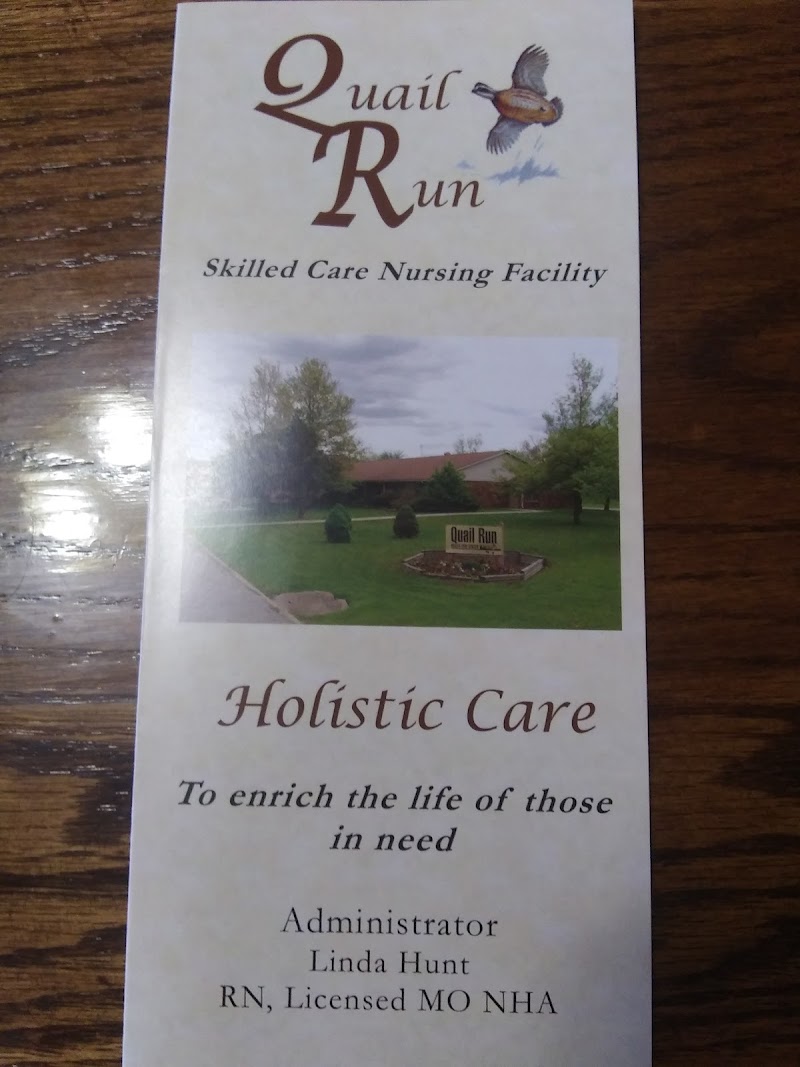
1405 WEST GRAND AVE, CAMERON, MO 64429 (816) 632-2151
For profit - Limited Liability company 84 Beds CIRCLE B ENTERPRISES Data: November 2025
Trust Grade
45/100
#290 of 479 in MO
Last Inspection: November 2024

Within standard 12-15 month inspection cycle. Federal law requires annual inspections.

Overview

Quail Run Health Care Center has a Trust Grade of D, indicating below-average performance with some significant concerns. Ranked #290 out of 479 facilities in Missouri, it falls into the bottom half overall, though it is the best option in De Kalb County where it ranks #1 of 2. The facility is worsening, with issues increasing from 11 in 2023 to 18 in 2024, and it has a troubling staff turnover rate of 69%, significantly above the state average. While there have been no fines, indicating some compliance with regulations, the quality of care is concerning with multiple incidents noted, such as staff failing to assist residents with eating and not addressing residents by their preferred names. Additionally, the facility did not respond effectively to feedback from resident council members, which raises questions about their commitment to resident needs and dignity.

Trust Score
D
45/100
In Missouri
#290/479
Bottom 40%
Safety Record
Low Risk
No red flags
Inspections
Getting Worse
11 → 18 violations
Staff Stability
⚠ Watch
69% turnover. Above average. Higher turnover means staff may not know residents' routines.
Penalties
✓ Good
No fines on record. Clean compliance history, better than most Missouri facilities.
Skilled Nurses
⚠ Watch
Each resident gets only 23 minutes of Registered Nurse (RN) attention daily — below average for Missouri. Fewer RN minutes means fewer trained eyes watching for problems.
Violations
⚠ Watch
44 deficiencies on record. Higher than average. Multiple issues found across inspections.
★★☆☆☆
2.0
Overall Rating
★★☆☆☆
2.0
Staff Levels
★★☆☆☆
2.0
Care Quality
★★☆☆☆
2.0
Inspection Score
Stable
2023: 11 issues
2024: 18 issues

The Good

  • Full Sprinkler Coverage · Fire safety systems throughout facility
  • No fines on record

Facility shows strength in fire safety.

The Bad

2-Star Overall Rating

Near Missouri average (2.5)

Below average - review inspection findings carefully

Staff Turnover: 69%

22pts above Missouri avg (46%)

Frequent staff changes - ask about care continuity

Chain: CIRCLE B ENTERPRISES

Part of a multi-facility chain

Ask about local staffing decisions and management

Staff turnover is elevated (69%)

21 points above Missouri average of 48%

The Ugly 44 deficiencies on record

Nov 2024 18 deficiencies
CONCERN (D)

Potential for Harm - no one hurt, but risky conditions existed

Deficiency F0760 (Tag F0760)

Could have caused harm · This affected 1 resident

**NOTE- TERMS IN BRACKETS HAVE BEEN EDITED TO PROTECT CONFIDENTIALITY** Based on observation, interview, and record review, the facility failed to ensure staff provided a safe and effective medication...

Read full inspector narrative →
**NOTE- TERMS IN BRACKETS HAVE BEEN EDITED TO PROTECT CONFIDENTIALITY** Based on observation, interview, and record review, the facility failed to ensure staff provided a safe and effective medication administration system that was free of significant medication errors when staff used insulin that was expired which affected one of the 14 sampled residents, (Resident #48). The facility census was 56. The facility did not provide a policy for administration of insulin. 1. Review of Resident #48's physician order sheet (POS) dated [DATE] showed: - Order date [DATE] - Insulin Lisper (fast acting insulin) per sliding scale. Blood sugar 151 - 200, give four units for diabetes mellitus for a blood sugar of 189. Review of the resident's medication administration record (MAR) dated [DATE] showed: - Insulin Lispro per sliding scale. Blood sugar 151 - 200, give four units for diabetes mellitus. Observation and interview on [DATE] at 12:08 P.M., showed: - Licensed Practical Nurse (LPN) B used the vial of Lispro insulin, opened [DATE] and discard after [DATE], and drew up four units in the syringe and administered the insulin; - He/she should not have used the insulin since it was expired. During an interview on [DATE] at 5:06 P.M., the Director of Nursing (DON) said staff should check the insulin vial for an expiration date and should not use it if expired.
CONCERN (D)

Potential for Harm - no one hurt, but risky conditions existed

Deficiency F0801 (Tag F0801)

Could have caused harm · This affected 1 resident

Based on observation, interview, and record review, the facility failed to ensure the Dietary Manager (DM) had the appropriate competencies and skills sets to carry out the functions of the food and n...

Read full inspector narrative →
Based on observation, interview, and record review, the facility failed to ensure the Dietary Manager (DM) had the appropriate competencies and skills sets to carry out the functions of the food and nutrition service. The facility census was 40. The facility did not provide the requested job description for the dietary manger. Review of the DM's personnel file showed: -Date of hire 10/04/2023; -No certification for food service management or dietary manger was found. During an interview on 02/24/25 at 11:32 A.M., the DM said: -He has been DM for six months; -He has worked as a dietary aide but does not have any managerial experience; -The facility is getting ready to start on his dietary manager training; -He has not completed his/her dietary manager's course. During an interview on 02/27/25 at 03:10 P.M., the Administrator said: -She would expect the DM to know all regulations related to the kitchen -The DM has not completed the dietary training yet; -She would expect the DM to have the training completed. During an interview on 03/05/25 02:15 P.M., the Registered Dietitian (RD) said: -The facility is trying to work on training the DM; -He would expect the DM to have the required training to manage the kitchen.
CONCERN (D)

Potential for Harm - no one hurt, but risky conditions existed

Infection Control (Tag F0880)

Could have caused harm · This affected 1 resident

**NOTE- TERMS IN BRACKETS HAVE BEEN EDITED TO PROTECT CONFIDENTIALITY** Based on observation, interview and record review the facility staff failed to provide sanitary resident care when facility staf...

Read full inspector narrative →
**NOTE- TERMS IN BRACKETS HAVE BEEN EDITED TO PROTECT CONFIDENTIALITY** Based on observation, interview and record review the facility staff failed to provide sanitary resident care when facility staff did not practice hand hygiene when perform person care tasks for one resident of 14 sampled residents (Resident #39). The facility census was 56. Review of the Handwashing/hand hygiene policy dated October 2023 showed: - All staff are trained and regularly in-serviced on the importance of hand hygiene in preventing the transmission of healthcare- associated infections; - All staff are expected to adhere to hand hygiene policies; - Hand hygiene is indicated immediately before touching a resident, after contact with body fluids, after touching a resident, before moving from work on a soiled body site to a clean area of the body on the same resident, and immediately after removal of gloves; - Staff are supposed to wash hand when their hands are visibly soiled and after contact with residents with an infectious diarrhea including Clostridium Difficile (C. diff, a contagious bacteria that causes severe diarrhea in a resident). 1. Review of Resident #39's quarterly MDS, dated [DATE] showed: - He/She had a BIMS score of 0, indicating severe cognitive impairment; - Diagnoses included: Stroke, heart disease and schizophrenia ( a disorder that affects a persons ability to think, feel and behave clearly). - The resident was dependent on staff for toileting, personal hygiene, and transfers; - The resident was incontinent of bowel and bladder. Review of the resident's undated compressive care plan showed: - The resident was incontinent of bowel and bladder; - The staff were supposed to provide incontinent care after each incontinent episode; - The resident was dependent on staff to complete his/her citifies of daily living. Observation on 11/4/24 at 10:11 A.M. showed: - NA A entered the resident's room and did not perform hand hygiene; - CNA D pushed the resident into his/her room and did not perform hand hygiene; - Both staff members put gloves on with out performing hand hygiene; - CNA D wet a wash cloth in the sink by throwing it in the bottom of the sink, CNA D wrung out the wash cloth with his/her gloved and and washed the resident's face, including his/her eyes; - CNA D placed the soiled washcloth on the sink counter; - CNA D and NA A assist the resident to bed; - CNA D performed the resident urinated and CNA D performed perineal care; - NA A removed his/her gloves, did not perform hand hygiene, left the resident's room; - NA A returned to the resident's room with clean linen's, did not perform hand hygiene, put gloves on and resumed perineal care of the resident. During an interview on 11/6/24 at 2:45 P.M. Registered Nurse (RN) A said he/she expected staff to wash their hands with each glove change and when entering and exiting resident rooms. During an interview on 11/7/24 at 9:00 A.M. The Director of Nursing (DON) said: - She expected staff to perform hand hygiene upon entering the resident's room, before and between glove changes, and when leaving the resident's room; - She expected staff to wash their hands when they were visibly soiled and after performing perineal care; - She expected staff to use an Alcohol-Based Hand Gel (ABHG) up to three times in a row, and then staff were to wash their hands with soap and water; - She expected staff to wash their hand when exiting a resident room and reentering the resident room.
CONCERN (E)

Potential for Harm - no one hurt, but risky conditions existed

Resident Rights (Tag F0550)

Could have caused harm · This affected multiple residents

**NOTE- TERMS IN BRACKETS HAVE BEEN EDITED TO PROTECT CONFIDENTIALITY** Based on observation, interview, and record review, the facility failed to treat residents with dignity and respect, when staff ...

Read full inspector narrative →
**NOTE- TERMS IN BRACKETS HAVE BEEN EDITED TO PROTECT CONFIDENTIALITY** Based on observation, interview, and record review, the facility failed to treat residents with dignity and respect, when staff failed to address one resident (Resident #33) by their preferred name of choice, failed to assist one resident with eating lunch (Resident #44) and when the facility staff failed to ensure one resident (Resident #41) was dressed in clean clothing. This affected three out 24 sampled residents. The facility census was 56. Review of the facility's undated Resident Rights Policy showed in part: -Residents have a right to a dignified existence and self-determination; -The facility shall protect and promote the rights of each resident; -The facility shall care for it's residents in a manner that promotes enhancement of each resident's quality of life. 1. Review of Resident #44's admission Minimum Data Set (MDS), a federally mandated assessment tool completed by facility staff, dated 8/18/24, showed: -Severe cognitive impairment; -Maximal assistance with showers and dressing; -Supervision or touching assistance with transfers from chair to bed, mobility from sitting to lying; -Frequently incontinent of urine; -Always incontinent of bowel; -Diagnosis included cancer, stroke, atrial fibrillation (AFib, a heart condition that causes irregular heart beat), high blood pressure and anxiety. Review of the resident's care plan, revised 8/29/24, showed: -The resident has an Activities of Daily (ADL) self-care performance deficit; -The resident has impaired cognitive function; -The resident is dependent on staff for meeting emotional, intellectual, and physical needs; -The resident has impaired visual function. Observation on 11/4/24, at 12:54 P.M., showed: - Nurse Aide (NA) A assisted the resident to the dining room; -The resident was using a walker and NA assisted the resident into a chair that sat approximately 12 inches from the table; -NA A did not assist the resident in moving his/her chair closer to the dining room table; -The resident leaned forward in the dining room chair but could not move the chair closer to the table; -The resident was still setting approximately 12 inches away from the table; -The resident was served lunch; -The resident picked up a fork and began eating; -The food dropped off the fork and landed on the table and onto the resident's lap; -Flies were landing on the food that was dropped on the table; -The resident sat his/her fork down and started to lick the table; -The resident licked the table and used his/her mouth to eat the food that had been dropped on the table; -NA A was in the dining room passing trays; -The flies were still landing on the food that was dropped on the table by the resident; -The resident continued to use his/her mouth and tongue to eat directly off of the table; -No staff assisted the resident with his/her meal. 2. Review of Resident #41's Quarterly MDS dated [DATE], showed: -Severe cognitive impairment; -Supervision with showers and dressing; -Supervision with personal hygiene; -Frequently incontinent of urine and bowel; -Diagnosis included dementia, anxiety and bipolar disorder (a mental illness that causes extreme mood swings). Review of the resident's care plan, revised 7/10/24, showed: -Requires assistance with ADLs related to dementia; -Visually impaired; -The resident will not suffer any loss of dignity due to memory loss. Observation on 11/4/24, at 01:18 P.M., showed: -The resident walked into the dining room and sat in a chair at the table; -The resident's pants had brown stains on the back of them; -NA A gave the resident his/her meal; -Flies landed on the meal as soon as it was set on the table by NA A; -Multiple flies landed on the resident's food and the resident left the table and began opening drawers in the dining room; -The resident left the dining room and returned with a fly swatter; -Flies continued to land and crawl on the resident's food; -The resident laid the fly swatter on the table and started to eat the food after the flies had landed on it; -The resident's pants still had stains on them; -Staff failed to offer the resident a new plate of food after the flies had landed on the food; -Staff failed to offer to change the resident's stained pants. During an interview on 11/5/24 at 10:53 A.M., NA A said: -There should not be flies in the dining room landing on the residents' food; -Residents should not be eating food that flies have landed on and the staff should offer them a new plate; -Residents should be assisted closer to the table if they are dropping food on themselves or on the floor; -Residents should not eat off the the table and should be assisted by staff; -The staff should offer to change a resident's clothes if they look dirty or soiled; -Residents should be treated with respect. During an interview on 11/7/24 at 09:22 A.M., Registered Nurse (RN) A said: -Residents should be treated with dignity; -Residents who are having difficulty eating should be assisted by staff; -If staff see flies on a resident's food they should be given a new plate; -There should not be multiple flies in the dining room; -If a resident is wearing dirty clothes the staff should offer to change them. During an interview on 11/7/24 at 5:06 P.M., the Administrator said: -He/she expects staff to assistance residents who need assistance with eating; -Residents should not be eating off the table and staff should be assisting to accommodate them; -He/she expects staff give resident's a new plate of food if flies have landed on the food; -He/she expects staff to change residents to who are wearing dirty clothes. 3. Review of Resident #33's care plan, reviewed 5/4/24 showed the resident did not wish to be called by his/her legal name. Review of the resident's quarterly MDS, dated [DATE] showed: - Cognitive skills intact; - Diagnoses included depression, dementia (inability to think), psychotic disorder (mental illness characterized by psychotic symptoms, which can generally be described as a loss of contact with reality), schizophrenia ( a mental disorder characterized by disruptions in thought processes, perceptions, emotional responsiveness, and social interactions) and post traumatic stress disorder (PTSD, a mental health condition that can develop after a person experiences or witnesses a traumatic event). During a group interview on 11/6/24 at 3:01 P.M., the resident said: - He/she did not like to be called honey, sweetie or dear; - He/she felt like it was very disrespectful for the staff to address him/her in such a manner; - He/she would prefer to be called by his/her given name or Ma'am/Sir. During an interview on 11/7/24 at 10:53 A.M., Licensed Practical Nurse (LPN) D said if a resident did not want to be called honey, sweetie or dear, the staff should not call them that. During an interview on 11/7/24 at 2:02 P.M., Certified Nurse Aide (CNA) A said: - He/she was not aware of any resident who did not want to be called honey, darling, sweetie or dear; - They are not supposed to call any of the residents by any nicknames; - We should not call the residents that if they did not want to be be called that. During an interview on 11/7/24 at 5:06 P.M., the Director of Nursing (DON) said she did not expect staff to call residents by nicknames.
CONCERN (E)

Potential for Harm - no one hurt, but risky conditions existed

Deficiency F0558 (Tag F0558)

Could have caused harm · This affected multiple residents

**NOTE- TERMS IN BRACKETS HAVE BEEN EDITED TO PROTECT CONFIDENTIALITY** Based on observation and interviews the facility failed to maintain accommodation of needs when the facility staff did not ensur...

Read full inspector narrative →
**NOTE- TERMS IN BRACKETS HAVE BEEN EDITED TO PROTECT CONFIDENTIALITY** Based on observation and interviews the facility failed to maintain accommodation of needs when the facility staff did not ensure two of 14 sampled resident (Resident #46 and #39), had their call lights within reach while they were in their rooms. The facility census was 56. The facility did not provide a policy regarding call light use. 1. Review of Resident #46's Quarterly minimum data set (MDS, a federally mandated assessment completed by the facility staff) date 10/17/24 showed: - The resident had a Brief Interview for Mental Status (BIMS) score of 0, indicating sever cognitive impairment; - Diagnoses included: Dementia (a disease that affect the brain that causes memory loss and impairs reasoning), weakness and anxiety; - The resident used a walker for mobility; - The resident required the assistance of one staff for bed mobility, toileting, and showering. Review of the resident's undated comprehensive care plan does not address call light use. Observation on 11/4/24 at 9:34 A.M. showed: The resident was in bed with the head of bed raised; - The resident's bed was pushed with the left side of the bed against the wall; - The residents call light was plugged into the wall and was lying on the floor behind the residents bed; - The resident was not able to reach the call light; - Certified Nurses Aide (CNA) D entered the resident's room, removed the resident's breakfast tray and then left the room without giving the resident his/her call light. Observation on 11/5/24 at 10:32 A.M. showed: - The resident was in his/her bed; - The residents call light was lying behind the residents bed, on the floor at the foot of the bed. Observation on 11/6/24 at 2:45 P.M. showed: -The resident was in his/her bed; - The bed was pushed with the left side against the wall; - The resident call light was behind the bed, lying on the floor at the foot of the bed; - The resident was unable to reach the call light. 2. Review of Resident #39's Quarterly MDS, dated [DATE] showed: - He/She had a BIMS score of 0, indicating severe cognitive impairment; - Diagnoses included: Stroke, heart disease and schizophrenia ( a disorder that affects a persons ability to think, feel and behave clearly). - The resident was dependent on staff for toileting, personal hygiene, and transfers; - The resident was incontinent of bowel and bladder. Review of the resident's undated comprehensive care plan directed the facility staff to keep the resident's call light within arms length. Observation on 11/4/24 at 10:11 A.M. showed: - CNA D and Nurse Aide (NA) A enter the residents room with the resident in his/her wheel chair; - The resident's head of bed was elevated and the resident's call light cord was draped across the frame of the head board with the call light resting on the floor; - The staff assist the resident to bed and provided incontinent care; - The staff covered the resident with his/her blanket, turned the light out and left the resident's room; - The staff did not pick up the resident's call light and did not provide it to him/her. Observation on 11/5/24 at 10:36 A.M. showed: - The resident was in bed with the head of bed elevated; - The resident's call light cord was draped across the bed frame at the head of the bed with the call light resident on the floor under the bed. During an observation on 11/6/24 at 2:43 P.M. showed: - The resident was in bed with the head of bed elevated; - The resident's call light cord was draped across the bed frame at the head of the bed with the call light resident on the floor under the bed. During an interview on 11/7/24 at 7:34 A.M. CNA D said he/she should have made sure the resident's call light was in reach at all times. During an interview on 11/7/24 at 5:06 P.M. the Director of Nurses said: - She expected the staff to ensure the resident had their call lights within reach while in their rooms and in bed; - She did not expect staff to provide cares and not provide the resident with his/her call light; - Call lights should be in reach at all times and should not be on the floor or under the bed.
CONCERN (E)

Potential for Harm - no one hurt, but risky conditions existed

Deficiency F0565 (Tag F0565)

Could have caused harm · This affected multiple residents

Based on observations, interviews and record review, the facility failed to consider concerns and recommendations of the resident council members concerning issues of resident care and life in the fac...

Read full inspector narrative →
Based on observations, interviews and record review, the facility failed to consider concerns and recommendations of the resident council members concerning issues of resident care and life in the facility and failed to communicate back with the resident council regarding their concerns as reported by ten of the 11 residents who participated in a group interview. This had the potential to affect all residents in the facility. The facility census was 56. Review of the facility's undated policy for grievances, showed, in part: - Residents have the right to voice grievances to facility or other agency that hears grievances without discrimination or reprisal and without fear of discrimination or reprisal; - Such grievances include those with respect to care and treatment which is furnished as well as that which has not been furnished, behavior of staff and other residents; and other concerns regarding their Long Term Care facility stay; - Residents have the right to and the facility must make prompt efforts by facility to resolve grievances residents may have; - The facility must make information on how to file a grievance or complaint available to the residents; - The facility must establish a grievance policy to ensure prompt resolution of all grievances regarding residents' rights; - Upon request, provider must give a copy of grievance policy to residents. Grievance policy must include: notifying resident of right to file grievances orally; contact information of grievance official; reasonable expected time frame for completing review of grievance; right to obtain written decision regarding grievance; contact information of independent entities with whom grievances may be filed; - Identifying Grievance Official responsible for overseeing grievance process, receiving and tracking grievances through conclusion, leading investigations by facility, maintaining confidentiality of all information associated with grievances, issuing written grievance decisions to resident, and coordinating with agencies as necessary in light of specific allegations; - Ensuring all written grievance decisions include date grievance was received, summary statement of the grievance, steps taken to investigate grievance, a summary of pertinent findings or conclusions regarding resident's concerns, a statement as to whether grievance was confirmed or not confirmed and any corrective actions taken or to be taken by facility as a result of grievance, and date written decision was issued. 1. Review of the resident council meeting minutes, dated 8/26/24 showed; - Old business - laundry, call lights, trash in rooms and loud employees; - New business - clothes missing, cold food, and trash piling up in rooms - The form did not indicate how the issues were resolved, who was responsible or if the resolutions were satisfactory with the residents. 2. Review of the resident council meeting minutes, dated 10/1/24 showed: - Old business - clothes missing, cold food, and trash piling up in rooms; - New business - smell of the facility, employees being loud and swearing, dignity issues, information board, cleaner rooms, theft, dirty linens being left on the floor and wheelchairs not being washed; - The form did not indicate how the issues were resolved, who was responsible or if the resolutions were satisfactory with the residents. 3. Review of the resident council meeting minutes, dated 10/29/24 showed: - Old business - smell of facility, employees loud and swearing, dignity issues, information board, cleaner rooms, theft, dirty linens being left on the floor and wheelchairs not being washed; - New business - gazebo lights not working, gazebo door needs fixed, recycle, cold food at dinner and toaster on North; - The form did not indicate how the issues were resolved, who was responsible or if the resolutions were satisfactory with the residents. 4. During the group meeting on 11/6/24 at 3:01 P.M., the residents said: - All 11 residents were not aware of who the Grievance Official was; - Ten of the 11 residents did not know how to file a grievance; - Ten of the 11 residents did not feel like they had any follow up from the staff about their concerns. During an interview on 11/5/24 at 12:44 P.M., the Activity Director said: - He/she had been in the current position since September; - He/she set up the resident council meetings; - They discussed the resident's concerns at the meetings. During an interview on 11/7/24 at 5:06 P.M., the Administrator said: - When residents voice concerns, the concerns should be followed up on the next month; - All grievances should be followed up on; - The residents concerns should be addressed.
CONCERN (E)

Potential for Harm - no one hurt, but risky conditions existed

Deficiency F0578 (Tag F0578)

Could have caused harm · This affected multiple residents

**NOTE- TERMS IN BRACKETS HAVE BEEN EDITED TO PROTECT CONFIDENTIALITY** Based on record review and interviews, the facility failed to ensure staff invoked (activated by verifying incapacity of the res...

Read full inspector narrative →
**NOTE- TERMS IN BRACKETS HAVE BEEN EDITED TO PROTECT CONFIDENTIALITY** Based on record review and interviews, the facility failed to ensure staff invoked (activated by verifying incapacity of the resident to make decisions) Durable Power of Attorney (DPOA) prior to allowing a resident to sign his/her Outside of Hospital Do Not Resuscitate (OHDNR) form which affected one of the 14 sampled residents, (Resident #30) and failed to obtain advance directives for code status (whether the resident wished to have cardiopulmonary resuscitation, CPR, if the resident's breathing stops or if the resident's heart stopped beating), which affected Resident #18. The facility census was 56. Review of the facility's policy for advance directives, revised [DATE], showed, in part: - Advance directives will be respected in accordance with state law and facility policy; - Upon admission, the resident will be provided with written information concerning the right to refuse or accept medical or surgical treatment and to formulate an advance directive if he/she chooses to do so; - If the resident is incapacitated and unable to receive information about his/her right to formulate an advance directive, the information may be provided to the resident's legal representative; - Information about whether or not the resident has executed an advance directive shall be displayed prominently in the medical record; - If the resident indicates that he/she has not established advance directives, the facility staff will offer assistance in establishing advance directives. The resident will be given the option to accept or decline the assistance, and care will not be contingent on either decision. Nursing staff will document in the medical record the offer to assist and the resident's decision to accept or decline assistance; - The Attending Physician will provide information to the resident and legal representative regarding the resident's health status, treatment options and expected outcomes during the development of the initial comprehensive assessment and care plan; - The plan of care for each resident will be consistent with his/her documented treatment preferences and/or advance directive; - The Interdisciplinary Team will conduct ongoing review of the resident's decisions making capacity and communicate significant changes to the resident's legal representative. Such reviews will be made during the annual assessment process and recorded on the resident assessment instrument (RAI); - Changes or revocations of a directive must be submitted in writing to the Administrator. The Administrator may require new documents if changes are extensive. The Care Plan Team will be informed of such changes and/or revocations so that appropriate changes can be made in the resident assessment and care plans; - The Director of Nursing (DON) or designee will notify the Attending Physician of advance directives so that appropriate orders can be documented in the resident's medical record and plan of care; - The Staff Development Coordinator will be responsible for scheduling advance directive training classes for newly hired staff members as well as scheduling annual Advance Directive In-Service Training Programs to ensure that our staff remain informed about the residents' rights to formulate advance directive and facility policy governing such rights. 1. Review of Resident #18's admission Minimum Data Set (MDS), a federally mandated assessment instrument completed by facility staff, dated [DATE] showed: - Cognitive skills intact; - Diagnoses included cancer, seizure disorder, anxiety, chronic obstructive pulmonary disease (COPD, obstruction of air flow that interferes with normal breathing) and congestive heart failure (CHF, accumulation of fluid in the lungs and other areas of the body). Review of the resident's care plan, initiated on [DATE] showed the care plan did not address the resident's code status. Review of the resident's physician order sheet (POS), dated [DATE] showed it did not address an order for the resident's code status. Review of the resident's face sheet showed it did not address the resident's code status. During an interview on [DATE] at 9:55 A.M., the MDS/Care Plan Coordinator said the resident's care plan should address the resident's code status. During an interview on [DATE] at 10:53 A.M., Licensed Practical Nurse (LPN) D said: - There should be a physician's order for a resident's code status; - Their code status should be on the face sheet and it should be care planned. During an interview on [DATE] at 5:06 P.M., the Director of Nursing (DON) said: - There should be a physician's order for the resident's code status; - The care plan should address the resident's code status. During an interview on [DATE] at 5:06 P.M., the Regional Quality Assurance (QA) Nurse said: - If the resident did not have a physician's order for a code status, they would automatically be a full code. 2. Review of Resident #30's Out of Hospital Do Not Resuscitate (OHDNR) order showed on [DATE], the resident had a mark to indicate his/her signature and the physician signed it on [DATE]. Review of the resident's Significant Change in Condition MDS, dated [DATE] showed: - Cognitive skills severely impaired; - Verbal behavior not directed at others occurred one to three days; - Upper and lower extremities impaired on both sides; - Dependent on the assistance of staff for eating, oral care, toilet use, dressing, personal hygiene, showers and transfers; - Always incontinent of bowel and bladder; - Diagnoses included dementia, anxiety, traumatic brain injury (TBI, a sudden injury that causes damage to the brain), depression and schizophrenia (a mental disorder characterized by disruptions in thought processes, perceptions, emotional responsiveness and social interactions). Review of the resident's care plan reviewed on [DATE] directed staff to not perform CPR as the resident has a DNR order. Review of the resident's Quarterly MDS, dated [DATE] showed: - The resident had short term and long term memory problems; - Upper and lower extremities impaired on both sides; - Dependent on the assistance of staff for eating, oral care, toilet use, dressing, personal hygiene, showers and transfers; - Always incontinent of bowel and bladder; - Diagnoses included dementia, anxiety, TBI, depression, schizophrenia and post traumatic stress disorder (PTSD, a disorder in which a person has difficulty recovering after experiencing or witnessing a terrifying event). Review of the resident's POS, dated [DATE] showed an order dated [DATE] - Do Not Resuscitate. Review of the resident's face sheet showed: - The resident's responsible party was him/herself; - The resident's code status was Do Not Resuscitate. During an interview on [DATE] at 3:34 P.M., the Social Services Designee (SSD) said: - He/she had only been in the current position for three weeks; - He/she has not done a lot of advance directives yet; - On admission, he/she asked their advance directives; - He/she did their Brief Interview for Mental Status (BIMS) assessment to determine their cognition; - Resident #30 is not alert and oriented and is non-verbal. He/she did not think the resident should be his/her own person. The resident does not have a guardian at this time; - If a resident's BIMS was a three, it would indicate severe cognition. During an interview on [DATE] at 3:50 P.M., the Administrator said: - If the resident had a BIMS of a three, the Interdisciplinary (IDT) team would meet and talk and see if the next of kin would want to pursue guardianship; - Social Services would contact the family and see if they would be the responsible party; - Resident #30 is currently not alert and oriented; - With the resident's BIMS being a three, he/she should not have signed their OHDNR form. During an interview on [DATE] at 10:32 A.M., LPN B said: - Resident #30 is not alert and oriented. He/she cannot talk to you; - He/she did not feel the resident was alert and oriented enough to make legal decisions; - He/she did not feel the resident should be their own person but did not know what to do about something like that. During an interview on [DATE] at 10:53 A.M., LPN B said Resident #30 is not alert and oriented and he/she did not think the resident was capable of making health care decisions. During an interview on [DATE] at 5:06 P.M., the DON said if the resident's BIMS was a three, then the resident should not sign his/her DNR paperwork.
CONCERN (E)

Potential for Harm - no one hurt, but risky conditions existed

Safe Environment (Tag F0584)

Could have caused harm · This affected multiple residents

**NOTE- TERMS IN BRACKETS HAVE BEEN EDITED TO PROTECT CONFIDENTIALITY** Based on observation and interview, the facility failed to ensure housekeeping and maintenance services was provided to maintain...

Read full inspector narrative →
**NOTE- TERMS IN BRACKETS HAVE BEEN EDITED TO PROTECT CONFIDENTIALITY** Based on observation and interview, the facility failed to ensure housekeeping and maintenance services was provided to maintain a sanitary, orderly and comfortable interior throughout the facility. The facility census was 56. Review of the facility's Floors policy, revised December 2009, showed in part: -All floors should be cleaned daily; -Floor cleaning procedures are maintained by the house keeping director. Review of the facility's undated house keeping daily cleaning duties showed: -Pull trash; -Dust/mop floors; -Clean toilet; -Dust horizontals; -Clean shower rooms; -Sitting and dining Rooms; -Resident rooms 100 - 119; -Resident rooms 120 - 139. The facilty provided no other policies on cleaning and environment. 1. Observation on 11/04/24 at 9:02 A.M., showed: -room [ROOM NUMBER] with dirt and debris on the floor; -The bathroom floor in room [ROOM NUMBER] was covered with dirt, and was sticky; -The toilet bowl in room [ROOM NUMBER] had brown debris on the sides and will not flush. 2. Observation of the shower room on South Hall on 11/04/24 at 12:10 P.M., showed: -The toilet bowl is covered with brown debris on the sides; -The floor tiles around the toilet are broken and base board is coming away from the wall behind the toilet; -The light cover above the toilet is cracked; -The window blinds are broken by the sink. 3. Observation on 11/04/24 at 2:46 P.M., showed: -The floor in room [ROOM NUMBER] covered with dirt and debris; -room [ROOM NUMBER] smelled of urine; -The back of the stool was not in place. 4. Observation on 11/04/24 at 2:55 P.M., showed room [ROOM NUMBER] with a brown stain on the bathroom ceiling the size of a basket ball. 5. Observation on 11/04/24 at 3:16 P.M., showed the door to the outside smoking area on South Hall with a two inch gap at the bottom and side. 9. Observation on 11/4/24 at 9:00 A.M. showed: - The south hall smelled like urine; - Rooms 120, 121, 123, and 125 smelled like urine; - The shared restroom in room [ROOM NUMBER] smelled like urine and the resident had an air freshener sitting on his/her over the bed table; - The floor of the restroom was sticky and had black debris on it. Observation on 11/4/24 at 10:02 A.M. showed room [ROOM NUMBER] a strong urine odor. Observation: 11/4/24 at 10:11 A.M. showed room [ROOM NUMBER] the floor was sticky and the room had a strong urine odor. 10. Observation on 11/5/24 at 7:42 A.M. - The South hall smells like strong urine; - Rooms 120, 121, 123, and 125 smelled like urine. Observation on 11/6/24 at 9:32 A.M. showed: - The South hall smells like strong urine; - Rooms 120, 121, 123, and 125 smelled like urine. Observation on 11/7/24 at 7:15 A.M. showed the South hall smelled like strong urine. During an interview on 11/07/24 at 11:35 A.M., the Maintenance Supervisor said: -He/she is in charge of making repairs in the facility which included repairs to resident rooms, resident bathrooms and shower rooms; -Staff verbally notify him/her if there is a repair that needs to be made; -He/she tries to make repairs as they are reported to him/her; -Sometimes he/she is not aware of repairs that need to be made; -The facility should be in good repair; -The door to the outside smoking area on south hall should not have a gap and should close completely. During an interview on 11/07/24 at 02:41 P.M. the Housekeeping Supervisor said: -The halls and resident rooms should not smell like urine; -He/she expects the floors to be cleaned daily and as needed; -Housekeepers should be using the daily cleaning list; -The floors should not be sticky and dingy; -The facility has had a high turnover in housekeeping staff and are trying to get back on track. During an interview on 11/7/24 at 5:06 P.M., the Administrator said: -He/she expects the facility to be clean and odor free; -He/she expects the building to be in good repair. 6. Observation on 11/5/24 at 2:23 P.M. and 2:50 P.M., showed the showers across from the nurse's stations by rooms [ROOM NUMBERS] did not have backfow preventers on the shower hoses. During an interview on 11/6/24 at 3:50 P.M., the Maintenance Supervisor said he did not know the shower hoses needed a backflow preventer. 7. Observation on 11/5/24 starting at 2:25 P.M. showed: - The call light cord less than two inch long in the room [ROOM NUMBER]'s bathroom; - No call light cord in room [ROOM NUMBER]'s bathroom; - No call light cord in room [ROOM NUMBER]'s bathroom; - No call light cord in room [ROOM NUMBER]'s bathroom. During an interview on 11/5/24 at 2:42 P.M., the Maintenance Supervisor said all bathroom call lights needed a cord, but some of them have been pulled out. He did not currently have any work orders for call light cords. 8. Observation on 11/6/24 at 3:27 P.M., showed the middle dining room door leading out to the corridor near the copy room would not easily open. Residents attempted to open the door but could not get it opened. The surveyor used significant force with their shoulder on the other side of the door (the door swung into the dining room) to push the door open. Several residents in group mentioned the door could be very difficult to open, so they don't ever use that door. During an interview on 11/6/24 at 3:50 P.M. the Maintenance Supervisor said he did not know the door in the dining room was difficult for residents to open.
CONCERN (E)

Potential for Harm - no one hurt, but risky conditions existed

Grievances (Tag F0585)

Could have caused harm · This affected multiple residents

Based on interviews and record review, the facility failed to ensure ten of eleven sampled residents who participated in a group meeting, knew who the Grievance Official was and how to file a grievanc...

Read full inspector narrative →
Based on interviews and record review, the facility failed to ensure ten of eleven sampled residents who participated in a group meeting, knew who the Grievance Official was and how to file a grievance. The facility census was 56. Review of the facility's undated policy for grievances, showed, in part: - Residents have the right to voice grievances to facility or other agency that hears grievances without discrimination or reprisal and without fear of discrimination or reprisal; - Such grievances include those with respect to care and treatment which is furnished as well as that which has not been furnished, behavior of staff and other residents; and other concerns regarding their Long Term Care facility stay; - Residents have the right to and the facility must make prompt efforts by facility to resolve grievances residents may have; - The facility must make information on how to file a grievance or complaint available to the residents; - The facility must establish a grievance policy to ensure prompt resolution of all grievances regarding residents' rights; - Upon request, provider must give a copy of grievance policy to residents. Grievance policy must include: notifying resident of right to file grievances orally; contact information of grievance official; reasonable expected time frame for completing review of grievance; right to obtain written decision regarding grievance; contact information of independent entities with whom grievances may be filed; - Identifying Grievance Official responsible for overseeing grievance process, receiving and tracking grievances through conclusion, leading investigations by facility, maintaining confidentiality of all information associated with grievances, issuing written grievance decisions to resident, and coordinating with agencies as necessary in light of specific allegations; - Ensuring all written grievance decisions include date grievance was received, summary statement of the grievance, steps taken to investigate grievance, a summary of pertinent findings or conclusions regarding resident's concerns, a statement as to whether grievance was confirmed or not confirmed and any corrective actions taken or to be taken by facility as a result of grievance, and date written decision was issued. Review of the facility's undated policy for resident rights showed, in part: - Residents have a right to a dignified existence, self determination and communication with and access to persons and services inside and outside the facility. This facility shall protect and promote the rights of each resident which shall include the following rights: - A resident has the right to exercise his/her rights as a resident of the facility and as a citizen or resident of the United States; - A resident has the right to voice grievances with respect to treatment or care that is, or fails to be furnished, without discrimination or reprisal for voicing grievances and prompt efforts by the facility to resolve grievances the resident may have, including those with respect to the behavior of other residents. 1. Review of the resident council meeting minutes showed: - 8/26/24 - the minutes did not indicate what resident rights had been reviewed or discussed or if the residents knew how to file a grievance; - 10/1/24- the minutes did not indicate what resident rights had been reviewed or discussed or if the residents knew how to file a grievance; - 10/29/24 - the minutes did not indicate if the resident rights had been reviewed or discussed or if the residents knew how to file a grievance. During a group meeting on 11/6/24 at 3:01 P.M., ten of the 11 alert and oriented residents who attended said they did not know who the Grievance Official was and did not know how to file a grievance. During an interview on 11/5/24 at 12:44 P.M., the Activity Director said: - He/she had been in the current position since September; - He/she set up the resident council meetings; - They discussed the resident's concerns at the meetings. During an interview on 11/7/24 at 5:06 P.M., the Administrator said the residents should know who the Grievance Official was and how to file a grievance. During an interview on 11/7/24 at 5:06 P.M., the Regional Quality Assurance (QA) Nurse said he/she addressed grievances with the residents back in April and discussed the process with them.
CONCERN (E)

Potential for Harm - no one hurt, but risky conditions existed

Comprehensive Care Plan (Tag F0656)

Could have caused harm · This affected multiple residents

**NOTE- TERMS IN BRACKETS HAVE BEEN EDITED TO PROTECT CONFIDENTIALITY** Based on record review and interviews the facility staff failed to develop a comprehensive person-centered care plan for three o...

Read full inspector narrative →
**NOTE- TERMS IN BRACKETS HAVE BEEN EDITED TO PROTECT CONFIDENTIALITY** Based on record review and interviews the facility staff failed to develop a comprehensive person-centered care plan for three of 14 sampled residents (Resident #25, #18, and #49). The facility census was 56. The facility did not provide a care plan policy. Review of the undated Resident Right's policy showed: - The resident had the right to participate in their person-centered care plan; - Participate in the development of goals and outcomes of care the care plan; - Request revisions to the person-centered care plan. 1. Review of Resident #25's Quarterly Minimum Data Set (MDS, a federally mandated assessment completed by the facility staff), dated 10/2/24 showed: - The resident had a brief interview for mental status (BIMS) score of 12, indicating minimal cognitive deficit; - Diagnoses included: Obesity, urinary incontinence and diabetes type 2 (a disease in which the body does not process blood sugar properly); - The resident was bound to his/her wheelchair; - The resident was incontinent of bowel and bladder; - The resident required assistance of two staff to provide hygiene, bathing, and transfers. Review of the resident's record showed the following: - The resident was admitted to the facility on [DATE]; - The care plan was one page in length, was dated 11/4/24 and addressed a fall the resident had; - The resident did not have a person-centered comprehensive care plan. 2. Review of Resident #18's MDS, dated [DATE] showed: - Cognitive skills intact; - Diagnoses included cancer, seizure disorder, anxiety, chronic obstructive pulmonary disease (COPD, obstruction of air flow that interferes with normal breathing) and congestive heart failure (CHF, accumulation of fluid in the lungs and other areas of the body). Review of the resident's care plan, initiated on 10/14/24 showed the care plan did not address the resident's code status. Review of the resident's physician order sheet (POS), dated November 2024 showed it did not address an order for the resident's code status. Review of the resident's face sheet showed it did not address the resident's code status. During an interview on 11/7/24 at 9:55 A.M., the MDS/Care Plan Coordinator said the resident's care plan should address the resident's code status. During an interview on 11/7/24 at 10:53 A.M., LPN D said: - There should be a physician's order for a resident's code status; - Their code status should be on the face sheet and it should be care planned. During an interview on 11/7/24 at 5:06 P.M., the Director of Nursing (DON) said: - There should be a physician's order for the resident's code status; - The care plan should address the resident's code status. 3. Review of Resident #49's care plan, reviewed on 4/24/24 showed the care plan did not address the resident going to dialysis ( a procedure that removes waste products and excess fluid form the blood when the kidneys are no longer functioning properly). Review of the resident's Quarterly MDS, dated [DATE] showed: - Cognitive skills severely impaired; - Independent with toilet use, dressing and transfers; - Always continent of bowel and bladder; - Diagnoses included stroke and chronic obstructive pulmonary disease (COPD, obstruction of air flow that interferes with normal breathing) and diabetes mellitus. During an interview on 11/7/24 at 9:55 A.M., the MDS/Care Plan Coordinator said the resident's care plan should address if the resident goes to dialysis. During an interview on 11/7/24 at 5:06 P.M., the DON said the care plans should be comprehensive and should include if the resident went to dialysis.
CONCERN (E)

Potential for Harm - no one hurt, but risky conditions existed

Deficiency F0657 (Tag F0657)

Could have caused harm · This affected multiple residents

**NOTE- TERMS IN BRACKETS HAVE BEEN EDITED TO PROTECT CONFIDENTIALITY** Based on observation, record review and interviews the facility staff failed to review and update care plans quarterly for two o...

Read full inspector narrative →
**NOTE- TERMS IN BRACKETS HAVE BEEN EDITED TO PROTECT CONFIDENTIALITY** Based on observation, record review and interviews the facility staff failed to review and update care plans quarterly for two of 14 sampled residents (Resident #36 and #43).The facility census was 56. The facility did not provide a policy for care plan revisions and updates. Review of the undated Resident Right's policy showed: - The resident had the right to participate in their person-centered care plan; - Participate in the development of goals and outcomes of care the care plan; - Request revisions to the person-centered care plan. 1. Review of Resident #36's Quarterly Minimum Data Set (MDS, a federally mandated assessment completed by the facility staff), dated 8/22/24 showed: - The resident had a Brief Interview for Mental Status (BIMS) score of 12, indicating the resident had mild cogitative deficit; - Diagnoses included: Alzheimer's Disease (A disease of the brain that impairs memory and reasoning), urinary incontinence and constipation; - The resident required assistance from one staff to use the toilet, get dressed, and shower; - The resident had verbal behaviors. Review of the resident's care plan showed: - The resident's care plan was last updated 5/4/24; - The resident's care plan did not address his/her verbal behaviors that were assessed for the MDS dated [DATE]. 2. Review of Resident #43's care plan conference summary, dated May 2024 showed: - Two staff attended the meeting; - The form did not indicate if the resident was invited to the care plan meeting or if he/she attended the meeting; - This was the only care plan conference summary provided by the facility. Review of the resident's Quarterly MDS, dated [DATE] showed: - Cognitive skills intact; - Upper extremity impaired on one side; - Required partial to moderate assistance of staff with toilet use, showers, and transfers; - Frequently incontinent of bowel; - Diagnoses included cancer, stroke, diabetes mellitus and hemiplegia (paralysis affecting one side of the body). During an interview on 11/4/24 at 11:31 A.M., the resident said: - He/she had not been invited to a care plan meeting and had not attended a care plan meeting. During an interview on 11/5/24 at at 12:31 P.M., the MDS/Care Plan Coordinator said: - He/she did the nursing component of the MDS; - Social Services invited the residents and the responsible parties to the the care plan meetings. During an interview on 11/5/24 at 3:34 P.M., the Social Services Designee said: - He/she had only been in the current position for three weeks; - Was only able to find one care plan conference summary for the resident; - Residents and responsible parties should be invited to the meetings. During an interview on 11/7/24 at 5:06 P.M., the Director of Nursing (DON) said: - Residents and/or responsible parties should be invited to their care plan meeting; - There should be documentation to indicate who attended the care plan meetings - Care plan should be updated quarterly and as needed in coordination with the MDS assessment schedule.
CONCERN (E)

Potential for Harm - no one hurt, but risky conditions existed

Deficiency F0658 (Tag F0658)

Could have caused harm · This affected multiple residents

**NOTE- TERMS IN BRACKETS HAVE BEEN EDITED TO PROTECT CONFIDENTIALITY** Based on observations, interviews, and record review, the facility failed to ensure staff provided services that met professiona...

Read full inspector narrative →
**NOTE- TERMS IN BRACKETS HAVE BEEN EDITED TO PROTECT CONFIDENTIALITY** Based on observations, interviews, and record review, the facility failed to ensure staff provided services that met professional standards of quality of care when staff failed to obtain an order for a resident to go to dialysis ( a procedure that removes waste products and excess fluid form the blood when the kidneys are no longer functioning properly) which affected one of the 14 sampled residents, (Resident #49). Additionally, the facility failed to monitor the settings of the low air loss mattress (an air mattress with tiny holes that helps prevent and treat pressure wounds and regulate skin temperature and moisture levels) which affected two residents, (Resident #21 and #30). The facility census was 56. Review of the facility's policy for medication orders, dated 2001, showed: - The purpose of this procedure is to establish uniform guidelines in the receiving and recording of medication orders; - A current list of orders must be maintained in the clinical record of each resident. 1. Review of Resident #49's care plan, reviewed on 4/24/24 showed the care plan did not address the resident going to dialysis. Review of the resident's Quarterly Minimum Data Set (MDS) a federally mandated assessment instrument completed by facility staff, dated 7/20/24 showed: - Cognitive skills severely impaired; - Independent with toilet use, dressing and transfers; - Always continent of bowel and bladder; - Diagnoses included stroke and chronic obstructive pulmonary disease (COPD, obstruction of air flow that interferes with normal breathing) and diabetes mellitus. Review of the resident's physician order sheet (POS) dated November 2024 showed the resident did not have a physician's order to go to dialysis. During an interview on 11/7/24 at 9:55 A.M., the MDS/Care Plan Coordinator said the resident's care plan should address if the resident goes to dialysis. During an interview on 11/7/24 at 10:53 A.M., Licensed Practical Nurse (LPN) D said the resident should have an order to go to dialysis. During an interview on 11/7/24 at 5:06 P.M., the Director of Nursing (DON) said: - The care plans should be comprehensive and should include if the resident went to dialysis; - There should be a physician's order for the resident to go to dialysis. 2. Review of the undated manufacturer's guidelines for the Drive low air loss mattress showed: - Adjust the dial to correspond to the resident's appropriate weight setting or comfort level. Review of Resident #21's care plan, revised 5/15//24 showed: - The resident had the potential for skin injury; - Provide a low air loss mattress with proper functioning. Review of the resident's Significant change in MDS, dated [DATE] showed: - Cognitive skills moderately impaired; - Upper and lower extremities impaired on both sides; - Dependent on staff assistance for eating, oral care, showers, dressing, personal hygiene, transfers and toilet use; - Always incontinent of bowel and bladder; - Weight - 160 pounds. No weight gain or weight loss; - Had one Stage III pressure ulcer (a full thickness of skin loss, exposing the subcutaneous tissues, presents as a deep crater with or without undermining adjacent tissue) on admit; - Diagnoses included non traumatic brain dysfunction (brain damage caused by internal factors rather than an external physical force), congestive heart failure (CHF, accumulation of fluid in the lungs and other areas of the body), anxiety, cerebral palsy (CP, abnormal brain development or damage to the developing brain that affects a person's ability to control their muscles) and dementia (inability to think). Observation on 11/4/24 at 9:23 A.M., showed the Drive low air loss mattress was set on 300 pounds. Observation on 11/4/24 at 9:47 A.M., showed Nurse Aide (NA) B and Certified Nurse Aide (CNA) C provided incontinent care and the resident did not have a pressure ulcer on his/her buttocks. Review of Resident #21's weight on 11/7/24 at 11:30 A.M., showed: - 10/4/24 - 151.6; - 11/3/24 - 147.8. Observation on 11/7/24 at 11:36 A.M., showed the low air loss mattress was set on 280 pounds. Review of the resident's POS, dated November 2024 showed the resident did not have a physician's order for the low air loss mattress or what the settings should be set on. 3. Review of the undated manufacturer's guidelines for the Proactive low air loss mattress, showed: - Users can adjust air mattress to a desired firmness according to the resident's weight or the suggestion from a a health care professional. Review of Resident #30's care plan, reviewed 3/22/24 showed it did not address the use of the low air loss mattress or what the settings should be. Review of the resident's Quarterly MDS, dated [DATE] showed: - Short term and long term memory problems; - Cognitive skills severely impaired; - Upper and lower extremities impaired on both sides; - Dependent on the assistance of staff for eating, oral care, toilet use, showers, dressing, personal hygiene and transfers; - Always incontinent of bowel and bladder; - Diagnoses included dementia, anxiety, traumatic brain injury (TBI, a sudden injury that causes damage to the brain), depression and schizophrenia (a mental disorder characterized by disruptions in thought processes, perceptions, emotional responsiveness and social interactions). Observation on 11/4/24 at 2:52 P.M., showed the low air loss mattress was set on 230 pounds. Review of the resident's weight on 11/7/24 at 11:28 A.M., showed: - 10/1/24 - 153.1 pounds; - 11/2/24 - 154.4 pounds. Observation on 11/7/24 at 11:36 A.M., showed the low air loss mattress was set on 230 pounds. Review of the resident's POS, dated November 2024 showed the resident did not have a physician's order for the low air loss mattress or what the settings should be set on. 4. During an interview on 11/6/24 at 10:32 A.M., LPN B said: - The nurses monitor the low air loss mattresses to make sure the settings are correct; - He/she just visually checks it and does not think it is documented anywhere; - Hospice (end of life care) sets up the low air loss mattresses. During an interview on 11/7/24 at 7:09 A.M., LPN A said: - The nurses check the settings each shift; - When they had paper charting, it was written in the books; - He/she just remembered what the settings should be; - Should look on the POS for the orders for the low air loss mattress and for what the settings should be set on. During an interview on 11/7/24 at 10:53 A.M., LPN D said: - The nurses monitor the settings on the low air loss mattress; - He/she did not know what settings they should be set on; - He/she did not know how often they should be checked. During an interview on 11/7/24 at 5:06 P.M., the Regional Quality Assurance (QA) nurse said: - There should be a physician's order to indicate the weight of the resident and it would be per manufacturer's guidelines; - The nurses should be checking them to ensure they are on the correct setting.
CONCERN (E)

Potential for Harm - no one hurt, but risky conditions existed

ADL Care (Tag F0677)

Could have caused harm · This affected multiple residents

**NOTE- TERMS IN BRACKETS HAVE BEEN EDITED TO PROTECT CONFIDENTIALITY** 5. Review of Resident #25's quarterly MDS dated [DATE] showed: - The resident had a BIMS score of 12, indicating minimal cogniti...

Read full inspector narrative →
**NOTE- TERMS IN BRACKETS HAVE BEEN EDITED TO PROTECT CONFIDENTIALITY** 5. Review of Resident #25's quarterly MDS dated [DATE] showed: - The resident had a BIMS score of 12, indicating minimal cognitive deficit; - Diagnoses included: Obesity, urinary incontinence and diabetes type 2 ( a disease in which the body does not process blood sugar properly); - The resident was bound to his/her wheelchair; - The resident required assistance of two staff to provide hygiene, bathing, and transfers. Review of the resident's undated comprehensive care plan does not address the resident's incontinence needs. Observation on 11/6/24 at 10:27 A.M. showed: - The resident's call light was on and CNA C and CNA F entered the resident's room; - The resident asks for incontinent care to be done; - Both CNA's wash their hands and put on gloves; - The resident had the blanket wrapped around his/her body; - CNA C pulls back the resident's blanket; - The blanket was saturated with urine and there was a strong odor of urine; - 11/6/24 6:00 A.M. was written across the front of the resident's incontinence brief; - CNA F rolled the resident toward him/her and CNA C unfastened the resident's brief; - The brief was soaked with urine though to the cloth pad, bath blanket used as a turn sheet, and the mattress below; - The bath blanket had large brown rings where the resident was lying; - CNA C pulled the residents' brief away from the resident; - The resident's bottom and left hip was dark red; - Under the resident abdominal skin fold was dark red and had an open slit on the right side above the resident's hip; - CNA C cleaned the resident's bottom with one wipe, making multiple swipes and turned the resident; - CNA F removed the dirty linens from the resident's bed and wiped the resident's right hip area with one wipe , making multiple swipes; - CNA C placed the resident on his/her back wiped the resident's pubic area with one wipe, going front to back; - CNA C wiped the resident's left and right groin with the same wipe; - CNA C did not separate the resident's groin fold to clean the resident; - CNA F applied a clean blanket over the resident and both CNA's left the room. During an interview on 11/6/24 at 10:50 A.M. CNA F said: - The resident was saturated with urine because the the staff did not clean the resident since 6:00 A.M. when night shift did it; - He/She and CNA C should have checked and cleaned the resident at 8:00 A.M.; - He/She was trained to check and provide incontinent care every two hours and as needed for residents that were not able to use the restroom. During an interview on 11/6/24 at 2:45 P.M. RN A said: - He/She expected staff to check and provide incontinent care every two to three hours when the resident was not able to get to the bathroom. 6. During an interview on 11/7/24 at 5:06 P.M., the Director of Nursing (DON) said: - She expected the staff to use different wipes for each area of the skin; - Staff should separate and clean all areas of the skin where urine or feces had touched. Based on observations, interviews, and record review, the facility failed to ensure dependent residents who were unable to carry out activities of daily living (ADL's) received the necessary services to maintain good personal hygiene when staff did not provide complete perineal care which affected three of the 24 sampled residents, (Resident #1, #21 and #25) and failed to ensure showers or bed baths were completed for Resident #21 and #43). The facility census was 56. Review of the undated policy for resident rights, showed, in part: - The facility shall care for its resident's in a manner and in an environment that promotes maintenance or enhancement of each resident's quality of life. The facility did not provide a policy for perineal care. 1. Review of Resident #21's Significant Change in Minimum Data Set (MDS), a federally mandated assessment instrument completed by facility staff, dated 8/2/24 showed: - Cognitive skills moderately impaired; - Upper and lower extremities impaired on both sides; - Dependent on staff assistance for eating, oral care, showers, dressing, personal hygiene, transfers and toilet use; - Always incontinent of bowel and bladder; - Diagnoses included non traumatic brain dysfunction (brain damage caused by internal factors rather than an external physical force), congestive heart failure (CHF, accumulation of fluid in the lungs and other areas of the body), anxiety, cerebral palsy (CP, abnormal brain development or damage to the developing brain that affects a person's ability to control their muscles) and dementia (inability to think). Review of the resident's care plan, revised 8/14/24 showed: - The resident had bowel and bladder incontinence related to diagnosis of dementia. Provide peri care after each incontinent episode. Observation on 11/4/24 at 9:47 A.M., showed: - Certified Nurse Aide (CNA) C and Nurse Aide (NA) B washed their hands and applied gloves; - CNA C wiped down each side of the groin with a different wipe each time; - CNA C used a new wipe and with the same area of the wipe, wiped down the skin folds and did not separate and clean all areas; - NA B applied antifungal powder ( used to treat fungal or yeast infections of the skin) to the front perineal folds; - CNA C and NA B turned the resident on his/her side and tucked the wet cloth pad; - CNA C wiped from front to back with a smear of fecal material on the wipe; - CNA C used a new wipe and wiped up one side of the buttocks and tucked a clean cloth pad under the resident; - CNA C removed gloves, did not wash his/her hands and applied gloves; - CNA C applied Thera Calazinc body shield (helps protect and relieve minor skin irritations due to rashes) to both sides of the resident's buttocks; - CNA C removed gloves, sanitized and applied new gloves; - CNA C and NA B turned the resident to the other side and removed the wet cloth pad and pulled the clean cloth pad through and repositioned the resident in bed; - CNA C did not clean all areas of the skin where urine or feces had touched. During an interview on 11/7/24 at 10:09 A.M., CNA C said: - He/she should have separated and cleaned all areas of the skin where urine or feces had touched; - Should not use the same area of the wipe to clean different areas of the skin. It should just be one swipe. 2. Review of Resident #1's care plan, reviewed 6/11/24 showed: - The resident required the use of an indwelling catheter; - Daily catheter care; - Monthly catheter change performed by urology due to complications in the past. Review of the resident's Quarterly MDS, dated [DATE] showed: - Brief Interview for Mental Status was not completed; - Dependent on the assistance of staff for toilet use, showers, dressing, personal hygiene and transfers; - Had a catheter; - Always incontinent of bowel; - Diagnoses included anxiety, diabetes mellitus, schizophrenia (a mental disorder characterized by disruptions in thought processes, perceptions, emotional responsiveness, and social interactions) and non-traumatic brain injury (brain damage caused by internal factors, rather than an external force to the head). Observation on 11/6/24 at 12:15 P.M., showed: - Certified Nurse Aide (CNA) A and Nurse Aide (NA) A did not wash their hands and applied gloves; - CNA A used the same area of the wipe and dabbed around the insertions site of the supra pubic catheter (a flexible tube that drains urine from the bladder through a small incision in the lower abdomen); - CNA A used a new wipe and wiped down one side of the groin; - CNA A used a new wiped and wiped down one side of the groin and with the same area of the wipe, wiped across the pubic area and down the skin folds; - CNA A did not separate and clean all the skin folds; - CNA A and NA A turned the resident on his/her side; - CNA A wiped down one side of the resident's buttocks and placed a clean incontinent brief under the resident; - CNA A and NA A turned the resident and pulled the clean incontinent brief through; - CNA A did not anchor the catheter tubing and wiped up and down the tubing from the connection site down to the drainage bag; - CNA A and NA A fastened the clean incontinent brief; - CNA A wiped in the wrong direction and did not separate and clean all areas of the skin. - CNA A and NA A removed gloves and washed hands During an interview on 11/7/24 at 2:02 P.M., CNA A said: - When cleaning the supra pubic catheter should use one wipe and clean around the insertion site and use a new one to wipe down the tubing; - They do not have to anchor the catheter tubing when cleaning it; - Should separate and clean all areas of the skin where urine has touched; - Should not use the same area of the wipe to clean different areas of the skin. It should be one wipe with one stroke; - He/she always wiped in the down direction. During an interview on 11/7/24 at 5:06 P.M., the DON said: - Staff should not use the same area of the wipe to clean different areas of the skin; - Staff should separate and clean all the skin folds; - Staff should wipe from front to back and not down. During an interview on 11/7/24 at 5:06 P.M., the Regional Quality Assurance (QA) Nurse said: - Staff should anchor the catheter tubing and wipe down the tubing. 3. The facility did not provide a policy for showers or bed baths. Review of Resident #43's care plan, reviewed 3/22/24 showed: - The resident required assistance due to hemiplegia (paralysis affecting one side of the body) due to history of stroke; - Preferred to have a shower two days a week. No preference for time or day. If resident refuses, please ask again at a later time. Review of the resident's Quarterly MDS, dated [DATE] showed: - Cognitive skills intact; - Upper extremity impaired on one side; - Required partial to moderate assistance from staff for toilet use, showers, transfer and dressing the lower extremities; - Frequently incontinent of urine; - Diagnoses included cancer, stroke, diabetes mellitus and hemiplegia. Observation and interview on 11/4/24 at 11:35 A.M., the resident said: - He/she was supposed to have showers on Monday and Thursday; - He/she has not been getting his/her showers; - It made him/her feel terrible because he/she liked to feel clean and fresh; - The resident's hair appeared greasy and dull. Review of the resident's bathing self-performance on 11/6/24 at 11:34 A.M., showed: - Preferred bathing on Monday and Thursday and as needed; - 10/9/24- total dependence; - 10/10/24 - the resident refused; - 10/24/24 - total dependence; - 10/28/24 - physical help with part of the bathing activity; - 10/31/24 - total dependence; - 11/5/24 - total dependence. 4. Review of Resident #21's care plan, revised 5/15/24 showed; - The resident required staff assistance for all ADL's; - The resident preferred to have bed baths two times per week. Review of the resident's Significant Change in MDS, dated [DATE] showed: - Cognitive skills moderately impaired; - Upper and lower extremities impaired on both sides; - Dependent on staff assistance for eating, oral care, showers, dressing, personal hygiene, transfers and toilet use; - Always incontinent of bowel and bladder; - Diagnoses included non traumatic brain dysfunction CHF, anxiety, CP, and dementia. Review of the resident's bathing self-performance on 11/7/24 at 12:03 P.M., showed: - The resident wanted bed baths on Tuesday and Friday and as needed; - 10/7/24 - total dependence; - 10/29/24 - total dependence; - Did not provide shower or bed bath information for November 2024. 5. During an interview on 11/6/24 at 10:32 A.M., LPN B said: - He/she has not had any residents complain about not getting their showers; - Do not have a dedicated shower aide; - The aides just work the shower schedule out between themselves and fill out the shower sheets; - The charge nurse reviews the shower sheets and signs them then puts them in the DON's box; - If a resident refused a shower, he/she would go and talk to them and if the resident still refused, then the resident and the charge nurse would sign the shower sheet. During an interview on 11/6/24 at 10:51 A.M., the Quality Assurance (QA) Nurse said: - In August, the facility switched computer programs and at that time the previous DON had the aides stop filling out shower sheets; - The point of care in point click care will only let them look at the last 30 days of showers; - The staff were educated and have started filling out shower sheets again. During an interview on 11/7/24 at 10:09 A.M., CNA C said: - On Mondays and Thursdays, the aides do the even rooms and on Tuesdays and Fridays the aides do the odd rooms; - Typically on Mondays and Thursdays they have about 14 showers to do and on Tuesdays and Fridays they have about 17 showers to do; - Some days they can get all the showers done and some days they only get three or four showers completed; - The evening shift does not normally pick up any showers; - They used to document the showers in point of care but just started filling out the shower sheets again; - He/she has had some residents complain about not getting their showers completed. During an interview on 11/7/24 at 10:53 A.M., LPN D said: - He/she has had residents complain about not getting their showers done. When the resident complains, they try to get them completed that day; - The aides are not able to get all the showers completed on one shift; - The aides have started filling out shower sheets and he/she reviews them, signs them and turn them into the DON; - If a resident refused a shower, he/she tried to document it in the resident's chart and talks to the resident. He/she did not sign the shower sheet if the resident refused. During an interview on 11/7/24 at 5:06 P.M., the DON said the residents should have their showers twice weekly if that was their preference.
CONCERN (E)

Potential for Harm - no one hurt, but risky conditions existed

Deficiency F0729 (Tag F0729)

Could have caused harm · This affected multiple residents

Based on record review and interviews, the facility failed to ensure three of five sampled staff (Certified Nurse Aid (CNA) E, CNA D, CNA C) completed competencies upon hire and annually. The facility...

Read full inspector narrative →
Based on record review and interviews, the facility failed to ensure three of five sampled staff (Certified Nurse Aid (CNA) E, CNA D, CNA C) completed competencies upon hire and annually. The facility census was 56. The facility did not provide a policy for CNA competencies. 1. Review of the staff roster showed: - CNA E was hired 2/21/24; - CNA D was hired 8/21/23; - CNA C was hired 4/15/24. 2. During an interview on 11/7/24 at 1:58 P.M. the Administrator said: - She was unable to find CNA's E, D, C competencies from hire or annual; - Competencies were not being completed upon hire and annually; - She expected the CNA competencies to be completed upon hire and annually by the nurses.
CONCERN (E)

Potential for Harm - no one hurt, but risky conditions existed

Drug Regimen Review (Tag F0756)

Could have caused harm · This affected multiple residents

**NOTE- TERMS IN BRACKETS HAVE BEEN EDITED TO PROTECT CONFIDENTIALITY** Based on observation, interview and record review the facility failed to minimize adverse consequences related to medication the...

Read full inspector narrative →
**NOTE- TERMS IN BRACKETS HAVE BEEN EDITED TO PROTECT CONFIDENTIALITY** Based on observation, interview and record review the facility failed to minimize adverse consequences related to medication therapy to the highest extent possible when the facility failed to ensure the consultant pharmacist reviewed each resident's medication for unnecessary medications, psychoactive medication, including gradual dosage reductions, and drug irregularities monthly and additionally failed to ensure the attending physician was notified of the pharmacist's recommendations. This affected three of the 24 sampled residents (Resident #1, #4 and #51). The facility census was 56. The facility did not provide the requested drug regimen review policy. 1. Review of Resident #4's medical record showed: -Initial admit date [DATE]; -admission date 9/3/24; - 8/14/24 a GDR (gradual dosage reduction) was attempted for Trazodone (used to treat insomnia) 50 milligrams (mg) and Zoloft (used to treat depression) 100 mg; -No other drug regimen reviews were found. Review of the resident's admission Minimum Date Sets (MDS) a federally mandated assessment tool completed by facility staff, dated 9/10/24 showed: - Severe cognitive impairment; - Dependent on the assistance of staff for toilet use, showers, dressing, personal hygiene; - Frequently incontinent of bowel and bladder; - Received antipsychotic, anti-anxiety and anti-depressant medications; - Diagnoses included stoke, dementia and thyroid (a gland that regulates other organs in the body) disorder. Review of the resident's care plan dated 9/23/24, showed: -The resident has an Activities of Daily Living (ADLs) performance deficit; -The resident takes psychotropic medications for depression, insomnia and dementia; -Consult with physician to perform or document against a Gradual Dose Reduction (GDR,tapering of a dose to determine if symptoms, conditions, or risks can be managed by a lower dose or if the medication can be discontinued altogether) at least quarterly. 2. Review of Resident #51's medical record showed: -admit date [DATE]; -6/12/24 - pharmacist recommended Haldol ( used to treat nervous, emotional, and mental conditions) 1 mg intramuscular injection, every 24 hours as needed, the order could not stand for greater that 14 days; -6/12/24 - pharmacist recommended Haldol 1 mg by mouth every 24 hours as needed, the order could not stand for greater that 14 days; -No response from the physician was found. Review of the resident's care plan dated 7/4/24, showed: -The resident is at risk for side effects from antidepressant use; -The resident is at risk for side effects from antipsychotic use; -Pharmacy consultant review of the resident's medication to be done monthly. Review of the resident's Quarterly MDS dated , 9/7/24 showed: - No cognitive impairment; - Independent with ADLs; - Received antipsychotic and anti-depressant medications; - Diagnoses included Post Traumatic Stress Disorder (PTSD, a mental health condition that can develop after someone experiences or witnesses a traumatic event), dementia and depression.3. Review of Resident #1's care plan, reviewed 6/11/24 showed: - The resident was at risk for side effects related to psychotropic drug use. Administer medication as ordered. Observe for side effects. Monitor the resident's behavior. Pharmacy consult to review medication monthly. Review of the resident's monthly drug regimen review between 6/12/24 through 9/11/24 showed: - 6/12/24 - the pharmacist recommended labs to be drawn. 6/19/24 - The form was faxed to the physician and it did not indicate if the physician had responded; - 9/11/24 - the pharmacist recommended a gradual dose reduction (GDR) of Lorazepam (used to treat anxiety), Lexapro (used to treat depression), Trazodone (used to treat depression) and Udezy (used to treat schizophrenia, a mental disorder characterized by disruptions in thought processes, perceptions, emotional responsiveness, and social interactions). There was no documentation to indicate if the physician had been notified of the recommendations. Review of the resident's Quarterly MDS, dated [DATE] showed: - Brief Interview for Mental Status was not completed; - Dependent on the assistance of staff for toilet use, showers, dressing, personal hygiene and transfers; - Had a catheter; - Always incontinent of bowel; - Received antipsychotic, anti-anxiety and anti-depressant medications; - Diagnoses included anxiety, diabetes mellitus, schizophrenia and non-traumatic brain injury (brain damage caused by internal factors, rather than an external force to the head). During an interview on 11/7/24 at 5:06 P.M., the Regional Quality Assurance (QA) Nurse said: - Drug regimen reviews should be done every month; - the recommendations are emailed, printed and given to the physician either in person or by fax; - It should be completed within 72 hours; - The GDRs got to the MDS Coordinator and should be reviewed at the weekly risk meeting; - The physician should sign the recommendations; - The previous Director of Nursing (DON) did not always complete the drug regimen reviews.
CONCERN (E)

Potential for Harm - no one hurt, but risky conditions existed

Unnecessary Medications (Tag F0759)

Could have caused harm · This affected multiple residents

**NOTE- TERMS IN BRACKETS HAVE BEEN EDITED TO PROTECT CONFIDENTIALITY** Based on observations, interviews and record review, the facility failed to ensure staff administered medications with an error ...

Read full inspector narrative →
**NOTE- TERMS IN BRACKETS HAVE BEEN EDITED TO PROTECT CONFIDENTIALITY** Based on observations, interviews and record review, the facility failed to ensure staff administered medications with an error rate of less than five percent (%). Staff made eight errors out of 30 opportunities for error, which resulted in an error rate of 26.67%. This affected three of the 14 sampled residents, (Resident #23, #35, and #48). The facility census was 56. The facility did not provide a policy for obtaining blood sugars, administration of insulin, administration of nasal sprays, or the administration of eye drops. Review of the website. mayoclinic.org. for obtaining blood sugars showed: - Wash and dry your hands and testing site thoroughly with soap and water before pricking your skin; - Don't use hand sanitizer before testing; - If using alcohol wipes, let the site completely dry prior to pricking the skin. 1. Review of Resident #48's physician order sheet (POS) dated [DATE] showed: - Order date [DATE] - Check blood sugars before meals and at bedtime related to diabetes mellitus; - Order date [DATE] - Insulin Lisper (fast acting insulin) per sliding scale. Blood sugar 151 - 200, give four units for diabetes mellitus. Review of the resident's medication administration record (MAR) dated [DATE] showed: - Check blood sugars before meals and at bedtime related to diabetes mellitus; - Insulin Lispro per sliding scale. Blood sugar 151 - 200, give four units for diabetes mellitus. Observation and interview on [DATE] at 12:08 P.M., showed: - Licensed Practical Nurse (LPN) B cleaned the resident's finger tip with an alcohol wipe, let it air dry for seven seconds then obtained the resident's blood sugar; - LPN B used the vial of Lispro insulin, opened [DATE] and was to be discarded after [DATE], drew up four units in the syringe and administered the insulin; - He/she should have let the finger tip air dry before obtaining the blood sugar. He/she should not have used the insulin since it was expired. 2. Review of the website, www.webmd.com for administration of artificial tears showed: - Tilt the head back, look up and pull down the lower eyelid to make a pouch; - Place the dropper directly over the eye and squeeze out one or two drops as needed; - Look down and gently close your eye for one or two minutes; - Place one finger at the corner of the eye near the nose and apply gentle pressure. This will prevent the medication from draining away from the eye. Review of Resident #35's POS dated [DATE] showed: - Start date [DATE] - Artificial Tears ophthalmic solution, instill one drop in both eyes twice daily for dry eyes; - Start date [DATE] - Glycol Powder 17 grams by mouth two times a day for constipation; - Start date [DATE] - Metamucil oral powder 48.57%, give one tablespoon by mouth daily for constipation. Review of the resident's MAR dated [DATE] showed: - Artificial Tears ophthalmic solution, instill one drop in both eyes twice daily for dry eyes; - GlycoLax Powder (Miralax) 17 grams by mouth two times a day for constipation; - Metamucil oral powder 48.57%, give one tablespoon by mouth daily for constipation. Observation on [DATE] at 7:41 A.M., showed; - Certified Medication Technician (CMT) A placed one tablespoon of Metamucil in a five ounce blue cup. The label on the container said to mix with eight ounces of water; - CMT A poured 17 grams of Miralax in the five ounce blue cup with the Metamucil and added four ounces of water to the blue cup and administered it to the resident; - CMT A instilled one drop in the resident's left eye and the tip of the eye dropper touched the resident's eye lid and eye lashes and applied lacrimal pressure for eight seconds; - CMT A instilled one drop in the resident's right eye and the tip of the eye dropper touched the resident's eye lid and eye lashes and applied lacrimal pressure for nine seconds. 3. Review of the package leaflet for Flonase nasal spray, revised [DATE], showed, in part: - Shake the bottle gently; - Blow your nose to clear the nostrils; - Close one side of the nostril. Tilt your head forward slightly and carefully insert the nasal applicator into the other nostril; - Start to breath in through your nose, and while breathing in press firmly and quickly down one tine on the applicator to release the spray; - Repeat in the other nostril; - Wipe the nasal applicator with a clean tissue and replace the cap. Review of Resident #23's POS dated [DATE] showed: - Start date [DATE] - Artificial Tears Ophthalmic solution, instill one drop in both eyes four times a day for dry eyes; - Start date - [DATE] - Fluticasone (Flonase) suspension 50 micrograms (mcg.), two sprays in each nostril daily for allergies. Review of the resident's MAR dated [DATE] showed: - Artificial Tears Ophthalmic solution, instill one drop in both eyes four times a day for dry eyes; - Fluticasone (Flonase) suspension 50 mcg., two sprays in each nostril daily for allergies. Observation on [DATE] at 9:21 A.M., showed: - CMT A did not shake the bottle or have the resident blow his/her nose; - CMT A did not close either side of the resident's nostril and instilled one spray in each nostril, instead of two sprays; - CMT A instilled one drop of Artificial Tears in left eye and touched the tip of the eye dropper to the resident's eye lid and eye lashes. CMT A applied lacrimal pressure for five seconds; - CMT A instilled one drop of Artificial Tears in the right eye and touched the tip of the eye dropper to the resident's eye lid and eye lashes. CMT A applied lacrimal pressure for four seconds. During an interview on [DATE] at 2:20 P.M., CMT A said: - He/she should have followed the manufacturer's guidelines for the administration of Flonase. Should have shook the bottle, had the resident blow their nose, and close one side of the nostril; - He/she should have administered two nasal sprays instead of one nasal spray; - The tip of the eye dropper should not touch the resident's eye lid or eye lashes; - He/she should have applied lacrimal pressure for one minute; - He/she was not for sure how much water to use with Miralax or with the Metamucil; - He/she thought it was alright to put the MIralax and the Metamucil in the same cup. During an interview on [DATE] at 5:06 P.M., the Director of Nursing (DON) said: - Staff should let the finger tip dry before obtaining the blood sugar; - Staff should check the insulin vial for expiration and should not use it if it was expired; - Staff should follow the manufacturer's guidelines for the administration of the Felons and should administer the correct dose; - Staff should not touch the tip of the eye dropper to the resident's eye lid or eye lashes and should apply lacrimal pressure for one minute; - Metamucil should be mixed in eight ounces of water and should mix the Miralax in four to eight ounces of water; - Staff should not mix the Metamucil and the Miralax together in the same cup.
CONCERN (E)

Potential for Harm - no one hurt, but risky conditions existed

Food Safety (Tag F0812)

Could have caused harm · This affected multiple residents

Based on observation, interview, and record review, the facility failed to ensure staff stored food in a sanitary manner and failed to maintain the kitchen in a sanitary manner. This had the potential...

Read full inspector narrative →
Based on observation, interview, and record review, the facility failed to ensure staff stored food in a sanitary manner and failed to maintain the kitchen in a sanitary manner. This had the potential to affect all residents residing in the facility. The facility census was 56. The facility did not provide a policy addressing food storage, kitchen cleaning and sanitation of the kitchen. Observation of the kitchen on 11/04/24 at 11:32 A.M.,showed: -The light switch by the coffee station was covered in dirt; -The vent above the hand washing sink was covered in dust and debris; -The back-splash behind the stove had food particles on it and was coming away from the wall; -The light in the dish-room is cracked; -Multiple cracked tiles on the dish room floor; -The inside of the dish room door is scuffed and scratched and the paint is peeling off of it; -Multiple tiles on the kitchen floor are broken; -There is a black substance on the wall behind the three compartment sink. Observation and interview on 11/06/24 at 10:45 A.M., showed: -Raw chicken quarters setting in water in the middle compartment of the three compartment sink; -No water was running over the chicken in the three compartment sink; -Cook A said the DM told him/her to thaw out the chicken by putting it in water in the three compartment sink; -Cook A said the chicken was partially frozen when he/she put it in the sink; -Cook A said the chicken has been setting in the sink for one hour. Observation and interview on 11/6/24 at 11:32 A.M., showed: -Cook A brought a pan from the clean dish rack and set it on the prep table; -The pan had food debris on the bottom of the pan; -Cook A said the pan was supposed to be clean; -Cook A said there should not be dirty dishes setting on the clean dish rack. During an interview on 11/06/24 12:15 P.M., the Registered Dietitian (RD) said: -He/she expects the kitchen to be maintained in a clean and sanitary manor; -He/she expects the kitchen to be in good repair; -He/she expects the kitchen staff to be responsible for the cleanliness of the kitchen; -The chicken should not be setting the three compartment sink without cool water running over it; -Staff should ensure the dishes are clean; -Maintenance is in charge of the repairs of the kitchen; -He/she did not know the last time the vents were cleaned in the kitchen. During an interview on 11/07/24 11:09 A.M., the Maintenance Supervisor said: -He/she is responsible for the repairs in the kitchen; -The staff tell him/her when repairs need to be made in the kitchen; -He/she was not aware of the repairs that needed to be made in the kitchen; -He/she was not aware the vent above the hand washing sink was dirty and needed to be cleaned; -The kitchen should be clean and in good repair. During an interview on 11/7/24 at 5:06 P.M., the Administrator said: -He/she expects the kitchen to be maintained in a clean and sanitary manor; -He/she expects the kitchen to be in good repair.
CONCERN (E) 📢 Someone Reported This

A family member, employee, or ombudsman was alarmed enough to file a formal complaint

Potential for Harm - no one hurt, but risky conditions existed

Deficiency F0925 (Tag F0925)

Could have caused harm · This affected multiple residents

**NOTE- TERMS IN BRACKETS HAVE BEEN EDITED TO PROTECT CONFIDENTIALITY** Based on observations, interviews, and record review, the facility failed to maintain an effective pest control program to preve...

Read full inspector narrative →
**NOTE- TERMS IN BRACKETS HAVE BEEN EDITED TO PROTECT CONFIDENTIALITY** Based on observations, interviews, and record review, the facility failed to maintain an effective pest control program to prevent flies in the facility, potentially effecting all residents. The facility census was 56. The facility did not provide the requested pest control policy. 1. Observation on 11/4/24 at 10:02 A.M. showed room [ROOM NUMBER] had six flies landing on the resident's property. 2. Observation: 11/4/24 at 10:11 A.M. showed room [ROOM NUMBER] had multiple flies in the room landing on the resident. 3. Observation on 11/4/24 at 12:30 P.M. showed: - Residents were at the dining tables with their heads on the table; - There was flies in the dining room; - The flies landed on residents and on their food; - Residents were swatting at the flies with their hands; - The residents ate the food that the flies landed on. 4. Observation on 11/6/24 at 5:51 P.M. showed: - Flies seen in the south dining room and crawling on the table's where residents were sitting; - Flies landed on residents hands and clothing; - Residents were swatting at the flies with their hands; - Flies landed on the resident's food when it was served, the residents ate the food the flies landed on. During an interview on 11/7/24 at 11:35 A.M., the Maintenance Director said: -He/she said some of the flies are coming in from outside due to the the door gap by the gazebo exit door; -The facility just started using a new pest control program; -The residents should not have flies in their rooms or in the dining room; -The residents should not have flies landing on their food and then eat the food. During an interview on 11/7/24 at 5:06 P.M., the Administrator said: -The facility was working with an outside pest control service to develop a fly program; - The residents should not have flies in their rooms or in the dining room; - The residents should not have flies landing on their food and then eat the food. MO243723
May 2023 11 deficiencies
CONCERN (D)

Potential for Harm - no one hurt, but risky conditions existed

Comprehensive Care Plan (Tag F0656)

Could have caused harm · This affected 1 resident

Based on observation, interview and record review, the facility failed to develop and implement a comprehensive person-centered trauma informed plan of care which included measurable objectives and ti...

Read full inspector narrative →
Based on observation, interview and record review, the facility failed to develop and implement a comprehensive person-centered trauma informed plan of care which included measurable objectives and timeframes for one of 13 sampled residents (Resident #4). The facility census was 51. Review of the facility's Comprehensive, Person-Centered Care Plan Policy, revised March 2022, showed: - A comprehensive, person-centered care plan that includes measurable objectives and timetables to meet the resident's physical, psychosocial and functional needs is developed and implement for each resident; - Services provided for or arranged by the facility and outline in the comprehensive care plan are culturally competent and trauma-informed. Review of the facility's Trauma Informed and Culturally Competent Care policy, revised August 2022, showed: - To guide staff in providing care that is culturally competent and trauma informed in accordance with professional standards of practice; - To address the needs of trauma survivors by minimizing triggers and/or re-traumatization; - Staff are provided inservice training about trauma and trauma informed care in the context of the healthcare setting; - Perform universal screening of residents, which includes a brief identification of exposure to traumatic events; - Develop individualized care plans that address past trauma in collaboration with the resident and family as appropriate; - Identify and decrease exposure to triggers that my re-traumatize the resident. 1. Review of the resident's admission Minimum Data Set (MDS), a federally mandated assessment instrument completed by facility staff, dated 1/9/23, showed: - No cognitive impairment; - Independent with with bed mobility, transferring, dressing, toileting and personal hygiene; - Propels self in wheel chair for ambulation; - Diagnoses included stroke, PTSD, bipolar disorder (a mental illness that causes unusual shifts in a person's mood, energy, activity levels, and concentration), anxiety and depression; - Treatments included oxygen therapy. Review of the resident's care plan, dated 1/23/23, showed: - The resident is easily startled; - The resident has depression; - The care plan did not identify and address PTSD. During an interview on 4/24/23 at 10:12 A.M., the resident said: -He/she had a bad weekend because he was having delusions and hallucinations; -He/she has never had them that bad before; -He/she did not know if it was from his/her PTSD or not; -The facility has not asked him/her about his/her PTSD. Review of the resident's medical record on 4/25/23, showed: - PASARR (Preadmission Screening and Resident Review, federally mandated assessment instrument completed by facility staff to help ensure that individuals are not inappropriately placed in nursing homes), dated 12/10/19 showed a diagnosis of PTSD; - No documentation of social/psychosocial history; - No order for psychiatric services was found; - No documentation of refusal by the resident for psychiatric services was found; - No documentation the resident had been seen by a psychiatrist for PTSD; - Social service's note dated 1/12/22 showed the resident is up most of the night with anxiety; - Social service's note dated 9/8/22 showed the resident has delusions. During an interview on 4/26/23, at 2:34 P.M., Certified Nurses Aide (CNA) E said: -The resident has delusions and hallucinations; -The resident was upset because he saw snakes in his/her room over the weekend; -The family said the resident has a history of PTSD and he has a history delusions; -He/she did not know what triggers or interventions the resident had in place to address the PTSD; -He/she had not received any training on how to provide care of residents with PTSD. During an interview on 4/26/23, at 2:38 P.M., Licensed Practical Nurse (LPN) C said: -He/she was not aware of the resident's diagnosis of PTSD; -He/she did not know what triggers or interventions the resident had in place to address the PTSD; -He/she had not received any training on how to provide care to residents with PTSD; -PTSD triggers and interventions should be care planned. During an interview on 4/26/23, at 2:43 P.M., the MDS coordinator said: -He/she did not know if the resident had a diagnosis of PTSD; -He/she did not know what triggers or interventions the resident had in place to address the PTSD; -He/she had not received any training on PTSD; -The staff should know what PTSD is and what the individual triggers are; -PTSD triggers and interventions should be care planned. During an interview on 4/26/23, at 2:48 P.M., the Director of Nursing (DON) said: -He/she did not know what triggers or interventions the resident had in place; -He/she was not sure if the staff had received training on PTSD; -The staff should know what PTSD is and what the triggers are; -PTSD triggers and interventions should be care planned. During an interview on 4/26/23, at 2:50 P.M., the administrator said: -The social services director went to a training on PTSD and trauma informed care two weeks ago; - He/she did not know what triggers or interventions the resident had in place; - He/she was not sure if the staff had received training on PTSD; - The staff should know what PTSD is and what the triggers are; - PTSD triggers and interventions should be care planned. During an interview on 4/26/23, at 2:56 P.M., the social services director said: - The resident was admitted before he/she came to the facilty as the social serviced director; - PTSD triggers and interventions should be care planned; - He/she thought he/she had filled out a brief trauma questionnaire for all the residents: - The resident was missed because he/she was in the hospital; - He/she attended a business office training two weeks ago but the training did not address the assessment, care or care planning of residents with PTSD; - He/she did not know other staff had been trained on PTSD; - The resident refused an appointment to see a psychiatrist that was set up by the facilty. During an interview on 5/2/23 at 10:30 A.M., the family of the resident said: -The resident had psychiatric treatment for past trauma; -The resident takes medications for his/her PTSD; -The staff have not questioned him/her about the resident's PTSD; -The facility has not discussed PTSD with him/her in during the resident's care plan meetings; -The facility offered psychiatric treatment by telemedicine (the remote diagnosis and treatment of patients by means of telecommunication technology) but the resident refused because he/she wanted a personal approach, without facility staff being at the sessions; -No other psychiatric services were offered by the facility; -The facility should know the details of the resident's trauma and have a plan in place to help him/her deal with it.
CONCERN (D)

Potential for Harm - no one hurt, but risky conditions existed

Deficiency F0699 (Tag F0699)

Could have caused harm · This affected 1 resident

Based on observation, record review and interviews, the facility failed assess a resident for a history of trauma and provide trauma informed care to one of 13 sampled residents (Resident #4) with a d...

Read full inspector narrative →
Based on observation, record review and interviews, the facility failed assess a resident for a history of trauma and provide trauma informed care to one of 13 sampled residents (Resident #4) with a diagnosis of Post Traumatic Stress Disorder (PTSD, a mental health condition that is triggered by a terrifying event). The facility census was 51. Review of the facility's Trauma Informed and Culturally Competent Care policy, revised August 2022, showed: - To guide staff in providing care that is culturally competent and trauma informed in accordance with professional standards of practice; - To address the needs of trauma survivors by minimizing triggers and/or re-traumatization; - Staff are provided inservice training about trauma and trauma informed care in the context of the healthcare setting; - Perform universal screening of residents, which includes a brief identification of exposure to traumatic events; - Develop individualized care plans that address past trauma in collaboration with the resident and family as appropriate; - Identify and decrease exposure to triggers that my re-traumatize the resident. 1. Review of the resident's admission Minimum Data Set (MDS), a federally mandated assessment instrument completed by facility staff, dated 1/9/23, showed: - No cognitive impairment; - Independent with with bed mobility, transferring, dressing, toileting and personal hygiene; - Propels self in wheel chair for ambulation; - Diagnoses included stroke, PTSD, bipolar disorder (a mental illness that causes unusual shifts in a person's mood, energy, activity levels, and concentration), anxiety and depression; - Treatments included oxygen therapy. Review of the resident's care plan, dated 1/23/23, showed: - The resident is easily startled; - The resident has depression; - The care plan did not identify and address PTSD. During an interview on 4/24/23 at 10:12 A.M., the resident said: -He/she had a bad weekend because he was having delusions and hallucinations; -He/she has never had them that bad before; -He/she did not know if it was from his/her PTSD or not; -The facility has not asked him/her about his/her PTSD. Review of the resident's medical record on 4/25/23, showed: - PASARR (Preadmission Screening and Resident Review, federally mandated assessment instrument completed by facility staff to help ensure that individuals are not inappropriately placed in nursing homes), dated 12/10/19 showed a diagnosis of PTSD; - No documentation of social/psychosocial history; - No order for psychiatric services was found; - No documentation of refusal by the resident for psychiatric services was found; - No documentation the resident had been seen by a psychiatrist for PTSD; - Social service's note dated 1/12/22 showed the resident is up most of the night with anxiety; - Social service's note dated 9/8/22 showed the resident has delusions. During an interview on 4/26/23, at 2:34 P.M., Certified Nurses Aide (CNA) E said: -The resident has delusions and hallucinations; -The resident was upset because he saw snakes in his/her room over the weekend; -The family said the resident has a history of PTSD and he has a history delusions; -He/she did not know what triggers or interventions the resident had in place to address the PTSD; -He/she had not received any training on PTSD. During an interview on 4/26/23, at 2:38 P.M., Licensed Practical Nurse (LPN) C said: -He/she was not aware of the resident's diagnosis of PTSD; -He/she did not know what triggers or interventions the resident had in place to address the PTSD; -He/she had not received any training on PTSD; -PTSD triggers and interventions should be care planned. During an interview on 4/26/23, at 2:43 P.M., the MDS coordinator said: -He/she did not know if the resident had a diagnosis of PTSD; -He/she did not know what triggers or interventions the resident had in place to address the PTSD; -He/she had not received any training on PTSD; -The staff should know what PTSD is and what the individual triggers are; -PTSD triggers and interventions should be care planned. During an interview on 4/26/23, at 2:48 P.M., the Director of Nursing (DON) said: -He/she did not know what triggers or interventions the resident had in place; -He/she was not sure if the staff had received training on PTSD; -The staff should know what PTSD is and what the triggers are; -PTSD triggers and interventions should be care planned. During an interview on 4/26/23, at 2:50 P.M., the administrator said: -The social services director went to a training on PTSD and trauma informed care two weeks ago; - He/she did not know what triggers or interventions the resident had in place; - He/she was not sure if the staff had received training on PTSD; - The staff should know what PTSD is and what the triggers are; - PTSD triggers and interventions should be care planned. During an interview on 4/26/23, at 2:56 P.M., the social services director said: - The resident was admitted before he/she came to the facilty as the social serviced director; - PTSD triggers and interventions should be care planned; - He/she thought he/she had filled out a brief trauma questionnaire for all the residents: - The resident was missed because he/she was in the hospital; - He/she attended a business office training two weeks ago but the training did not address the assessment, care or care planning of residents with PTSD; - He/she did not know other staff had been trained on PTSD; - The resident refused an appointment to see a psychiatrist that was set up by the facilty. During an interview on 5/2/23 at 10:30 A.M., the family of the resident said: -The resident witnessed the suicide of his/her twin brother; -The resident had psychiatric treatment for this trauma in the past; -The resident takes medications for his/her PTSD; -The staff has not questioned him/her about the resident's PTSD; -The facility has not discussed PTSD with him/her in during the resident's care plan meetings; -The facility offered psychiatric treatment by telemedicine (the remote diagnosis and treatment of patients by means of telecommunication technology) but the resident refused because he/she wanted a personal approach, without facility staff being at the sessions; -No other psychiatric services were offered by the facility; -The facility should know the details of the resident's trauma and have measures in place to help him/her deal with it.
CONCERN (D)

Potential for Harm - no one hurt, but risky conditions existed

Deficiency F0805 (Tag F0805)

Could have caused harm · This affected 1 resident

**NOTE- TERMS IN BRACKETS HAVE BEEN EDITED TO PROTECT CONFIDENTIALITY** Based on observation, record review and interviews, the facility failed to provide food in a form designed to meet individual ne...

Read full inspector narrative →
**NOTE- TERMS IN BRACKETS HAVE BEEN EDITED TO PROTECT CONFIDENTIALITY** Based on observation, record review and interviews, the facility failed to provide food in a form designed to meet individual needs when they did nto ensure pureed foods were at an appropriate texture and consistency. The facility census was 51. Review of the facility's Pureed Food Preparation policy, dated 2016, showed: -Pureed foods will be prepared using standardized recipes to ensure quality, flavor, palatability, and maximum nutritive value. 1. Each menu cycle will be reviewed and ensure there is a pureed recipe on each item served. 2. Standardized recipes will be used to prepare all pureed foods. The recipes will be adjusted according to the number of pureed diets needed, indicating seasoning and technique to ensure the highest quality. 3. Recipes will not use water to thin pureed foods. Only broth, milk, juice, gravy, margarine or another appropriate condiment that preserves flavor shall be used. 4. Food thickener will be used only in accordance with a specific recipe or product instructions. Measure and add commercial thickener, stabilizer, or shaping/enhancing product as directed in the recipe and process until blended. 5. Serve with appropriate scoop number or divide equally to provide an equal number of portions. All of the pureed food must be used in order to deliver the correct nutrient density to each resident. The number of servings obtained form the pureed recipe must equal the number of servings from which you started. 6. Pureed foods will be the consistency of applesauce or smooth mashed potatoes. A food processor is preferred; however, a blender may be used to make pureed foods. Observation of food preparation on 4/25/23 at 11:56 A.M., showed: -Cook A put the roast pork tips in the food processor, and processed for a short time. -Cook A scraped the sides with a spatula, added water to the pork tips. He/she then processed the pork tips again, added some additional water, and processed again. -Cook A took a small amount of pureed pork tips on a plastic spoon, look at it, added more water to the food processor and processed the pork tips again. -He/she then used a spoon to transfer the pureed pork tips to bowls, covered the bowls and then placed the bowls into the warmer. -Cook A said there is a recipe book available for staff to use. It is kept on the side prep table. Review of the provided recipe for pureed roast pork tips showed: -Recipe calls for using broth or gravy to thin the puree. Do not use water. Observation of the pureed meal on 4/25/23 at 1:28 P.M., showed: -The texture of the pureed pork tips is stringy with particles. similar to ground meat. It had to be chewed to be able to swallow it. - The pureed vegetables were not smooth, containing particles of vegetable. -The fruit was commercially prepared apple sauce. During an interview on 4/26/23 at 1:45 P.M., [NAME] A said: -Pureed food should be like mashed potatoes or pudding. -It should be smooth and have no chunks or particles in it. -Recipes are available to staff in the kitchen and he/she does use them. During an interview on 4/26/23 at 1:49 P.M., the Dietary Manager said: -Pureed food should have the consistency and texture of mashed potatoes or pudding. -It should be creamy and smooth with no chucks in it. -There are recipes available for staff to use in the [NAME]. He/she expects the staff to use the recipes. During an interview on 4/26/23 at 2:43 P.M., the Registered Dietician said: -He/she was unaware there was a resident receiving a pureed diet. -The pureed food should be smooth, a soft mashed potato consistency with no lumps or food particles. -There are recipes available in the kitchen for staff to use, even for pureed meals, and it is expected staff will follow them.
CONCERN (E)

Potential for Harm - no one hurt, but risky conditions existed

Deficiency F0582 (Tag F0582)

Could have caused harm · This affected multiple residents

Based on observation, interviews, and record review, the facility failed to provide Skilled Nursing Facility (SNF) Advance Beneficiary Notices (ABN) (the form Centers for Medicare and Medicaid (CMS)-1...

Read full inspector narrative →
Based on observation, interviews, and record review, the facility failed to provide Skilled Nursing Facility (SNF) Advance Beneficiary Notices (ABN) (the form Centers for Medicare and Medicaid (CMS)-10055 to each resident. The SNF ABN provides information to residents/beneficiaries so they can decide if they wish to continue receiving the skilled services that may not be paid by Medicare and assume financial responsibilities. The facility utilized an outdated CMS-10123 Notice of Medicare Non-Coverage (NOMNC) form dated 12/31/2011, most current for is 9/2020. This affected three of three sampled residents (Residents #6, #16, and #32), facility census was 51. The facility did not provide a policy regarding ABN. 1. Review of Resident #6's medical records showed: -Notice of NOMNC CMS-10123 outdated form provided and signed on 4/17/23 -Used ABN form CMS-R-131 (exp. 6/30/23) dated 4/17/23 -No documentation of SNF ABN CMS-10055 form initially provided by facility -Facility provided surveyor an electronically signed CMS-10055 form dated 3/6/23 2. Review of Resident #16's medical records showed: -Notice of NOMNC CMS-10123 outdated form provided and signed on 1/13/23 -Used ABN form CMS-R-131 (exp. 6/30/23) dated 1/13/23 -No documentation of SNF ABN CMS-10055 form initially provided by facility -Facility provided surveyor an electronically signed CMS-10055 form dated 1/4/23 3. Review of Resident #32's medical records showed: -Notice of NOMNC CMS-10123 outdated form provided and signed on 12/19/22 -Used ABN form CMS-R-131 (exp. 6/30/23) dated 12/19/22 -No documentation of SNF ABN CMS-10055 form initially provided by facility -Facility provided surveyor an electronically signed CMS-10055 form dated 9/28/22 During an interview on 4/25/23 at 2:15 P.M., Social Services Director said: -He/she received training last October for eight hours on many job related tasks which included beneficiary notices. -He/she knew to provide ABN notices in beginning of residents stay. If resident is not skilled he/she did not give resident form if they are Medicaid as resident did not get therapy as Medicaid. -He/she provided ABN and NOMNC three days prior to their end of benefits status. -He/she was not aware was not using correct forms. -He/she was not aware was not using most recent forms. -He/she did not have a computer provided to use for his/her position and was unable to look up updated or correct forms from the CMS website. During an interview on 4/25/23 at 2:34 P.M., Administrator said: -He/she did not know was using wrong forms for ABN notices. -He/she indicated facility received tag during last annual survey so is confident they corrected the issue and are using proper forms. -He/she received the current forms being utilized from the prior survey team.
CONCERN (E)

Potential for Harm - no one hurt, but risky conditions existed

Deficiency F0657 (Tag F0657)

Could have caused harm · This affected multiple residents

**NOTE- TERMS IN BRACKETS HAVE BEEN EDITED TO PROTECT CONFIDENTIALITY** 4. Review of Resident #9 quarterly minimum Data Set (MDS), a federally mandated assessment completed by facility staff), dated 1...

Read full inspector narrative →
**NOTE- TERMS IN BRACKETS HAVE BEEN EDITED TO PROTECT CONFIDENTIALITY** 4. Review of Resident #9 quarterly minimum Data Set (MDS), a federally mandated assessment completed by facility staff), dated 1/15/23, showed: -Brief Interview for Mental Status (BIMS) score of 99, indicated resident chose not to participate when test was given or gave four or more responses that were unrelated, incomprehensible, or incoherent. -He/she requires one person physical assistance with dressing and personal hygiene but is highly involved -Shower/bathe was refused -Diagnoses included anxiety disorder and dementia Review of care plan, dated 1/27/23, showed: -No interventions care planned what to do when he/she refuses showers or grooming care -No interventions on preferences with clothing and how to gain compliance with changing clothes -No interventions on how to provide assistance with hair care -No interventions addressing his/her specific activity preferences Review of resident activities evaluation, dated 11/4/21, showed: -He/she had past interest in animals, beauty/barber, cooking/baking, dominoes, gardening, current - arts/craft, bingo, board games, cards, community outings, cultural events, current events news, group discussion, movies, music, radio, reading, religious activities. Review of resident's admission MDS, dated [DATE], showed: -The following activities are very important to him/her included choosing what clothes to wear, caring for personal belongings, and receiving a shower Review of activity record showed on 4/26/23 showed he/she participated in only two activities in April including watching the band and planting seeds. Observation on 4/24/23 at 11:30 A.M., showed his/her hair going in all different directions. Observation on 4/25/23 at 8:12 A.M. showed residents hair is going in all different directions and is wandering halls wearing same clothes from 4/24/23 of gray sweat shirt and sweat pants. Review of April shower log showed he/she has only had three showers on 4/13/23, 4/17/23, and 4/22/23. During an interview on 4/26/23 at 11:16 A.M., NA B said: -He/she has to be caught on a good side or bad side to get him/her to change clothes. If he/she yells at me I walk out of room -He/she had refused showers -He/she went outside and planted tomato seeds. The try to get her into music and will have band here sometimes, sometimes he/she will stay in chair in front. During an interview on 4/26/23 at 11:25 A.M., CNA C said: -There are residents whom refuse to change their clothes including resident #9 -Resident #9 will refuse showers During an interview on 4/26/23 at 12:01 P.M., LPN B said: -Residents that commonly refuse showers included Resident #9 -Resident #9 does not like to be messed with and is very independent. He /she will go back to room and change clothes anytime he/she wants to -Resident #9 facility staff attempts to engage her in activities and will take him/her to listen to the band when they come and play and try to get her in on crafts. He/she has attention span of a two year old and if something catches his/her attention for a couple of minutes During an interview on 4/27/23 at 7:45 A.M., NA D said: -He/she wanders, would not sit still and likes to sit up at door. -He/she will pace up and down halls -He/she is hard to get in bed at night 5. Review of Resident #43's quarterly MDS, dated [DATE], showed: -BIMS score of 99, indicated resident chose not to participate when test was given or gave four or more responses that were unrelated, incomprehensible, or incoherent. -Diagnoses included dementia, adult failure to thrive, diarrhea, clostridium difficult (C.diff) (an inflammation of the colon), and renal disease (a gradual loss of kidney function over time) Review of resident's admission MDS, dated [DATE], showed: -The following activities are very important to him/her being around animals such as pets, doing things with groups of activities, doing favorite activities, going outside, and participating in religious activities Review of care plan dated 4/11/23, showed: -No care plan or interventions addressing his/her activity interests and desired level of activity participation. -No care planned interventions for peri-care, his/her removal of brief, and body odor -No care planned interventions for refusals of shower or combative behavior in shower Observation on 4/24/23 at 3:29 P.M. showed strong odor of urine in his/her room. Observation on 4/24/23 at 3:30 P.M. showed resident coming down hallway in wheelchair with strong putrid odor of urine Observation on 4/25/23 at 1:30 P.M. showed resident entering in conference room with surveyors and putrid odor of urine was emulating from resident. Observation on 4/26/23 at 9:45 A.M. showed resident continued with strong odor of urine Review of April shower log showed he/she received four showers on 4/4/23, 4/11/23, 4/14/23, and 4/21/23. During an interview on 4/25/23 at 11:25 A.M., CNA C said: -He/she has accidents when not in his/her room -He/she is very short-tempered on shower days and has smacked staff in face -Staff have a thirty second window when resident is out of room to go in and change bedding -He/she toilets his/herself and getting him/her to wear a brief is hit or miss. He/she will take brief off -Even after shower still has body odor During an interview on 4/26/23 at 12:01 P.M., LPN B said: -He/she has no history of urinary tract infections. -He/she will not keep a pull up on. When facility does put a brief on him/her, he/she will go into room and rip it off and then is incontinent. -He/she is unsure if Resident #43 doesn't realize she has odor, doesn't care, or is not cognitive enough to notify staff. During an interview on 4/27/23 at 7:45 A.M., NA D said -He/she wanders all the time and will not sit still -He/she goes to bathroom by self. During an interview on 4/27/23 at 10:27 A.M., the Activity Director said: -He/she is currently in an activity director training course. -He/she has not received training about care planning the activity interests and needs of residents. During an interview on 4/27/23 at 12:30 P.M., MDS Coordinator said: -He/she took on position two weeks ago but has been working in facility as an as needed nurse since October -He/she is responsible for care plan creation and updating -Care plans are updated when there is a clinical change, quarterly, and yearly -Activity preferences should be documented in care plan -Shower preferences should be documented and include preferences with time of day they like to receive showers, whether they prefer showers or bed baths, and grooming preferences -Specific behaviors should be care planned -Trauma history should be included in care plans -He/she received two days training from retiring staff member and has attended an all day training on Medicare 101. -He/she has not had any care plan specific training -He/she participates in weekly MDS meetings and training's with the corporate quality assurance and MDS staff member. During an interview on 4/27/23 at 1:21 P.M., the Administrator said: -The MDS person is responsible for care planning, but the care plan team meets to do the 48 hour baseline care plan and family care plan meetings. -Care plans should be current. Behaviors should be on the care plan. Activity preferences and desired participation level should also be on the care plans. Activities of Daily Living preferences and needs should be on care plan. Based on observation, interviews, and record review, the facility failed to follow policy and revise care plans to accurately represent the care needs of five of 13 sampled residents (Resident #44, #18, #34, #9, and #43), including activity and recreation needs. The facility census was 51. Review of the facility Care Plans, Comprehensive Person-Centered policy, dated March 2022, showed: -A comprehensive, person-centered care plan that includes measurable objectives and timetables to meet the resident's physical, psychological and functional needs is developed and implemented for each resident. 1. The interdisciplinary team, in conjunction with the resident and his/her family or legal representative, develops and implements a comprehensive, person-centered care plan for each resident. 2. The comprehensive, person-centered care plan is developed within seven days of the completion of required Minimum Data Set (MDS, a federally mandated assessment completed by staff) and no more than 21 days after admission. 3. The care plan interventions are derived from a thorough analysis of the information gathered as part of the comprehensive assessment. 4. Each resident's comprehensive person-centered care plan is consistent with the resident's rights to participate in the development and implementation of his/her plan of care. 7. The comprehensive, person-centered care plan: a. includes measurable objectives and timeframe's b. describes the services that are to be furnished to attain or maintain the resident's highest practicable physical, mental, and psychosocial well-being, including; -services that would otherwise be provided for the above, but are not provided due to the resident exercising his/her rights, including the right to refuse treatment -any specialized services to be provided as a result of the Preadmission Screening and Resident Review (PASRR, is a federal requirement to help ensure that individuals are not inappropriately placed in nursing homes for long term care), -which professional services are responsible for each element of care; c. includes the resident's stated goals upon admission and desired outcomes d. builds on the resident's strengths and e. reflects currently recognized standards of practice for problem areas and conditions. 9. Care plan interventions are chosen only after data gathering, proper sequencing of events, careful consideration of the relationship between the resident's problem areas and their causes, and relevant clinical decision making 10. When possible, interventions address the underlying sources of the problem area, not just the symptoms or triggers. 11. Assessments of residents are ongoing and care plans revised as information about the resident and the resident's condition change. 12. The interdisciplinary team reviews and updates the care plan: -when there has been a significant change in the resident's condition -when the desired outcome is not met -when the resident has been readmitted to the facility from a hospital stay -at least quarterly, in conjunction with the required quarterly MDS assessment. 1. Review of Resident #44's quarterly MDS, dated [DATE], showed: -He/she hears and sees adequately, makes self understood and usually understands others. - Score of 8 on the Brief Interview for Mental Status (BIMS, a structured evaluation aimed at evaluating aspects of cognition in elderly residents). A score of 8 indicates moderately impaired cognitive skills. -He/she requires supervision with activities of daily living, such as personal hygiene, toileting and eating. He/she requires extensive assistance with dressing. -He/she is continent of bowel and bladder. -He/she has had one fall since admission. -He/she regularly receives antipsychotic medication. -He/she has the following diagnoses: schizophrenia (serious mental disorder in which people interpret reality abnormally), major neurocognitive disorder (decreased mental function and loss of ability to do daily tasks), hypertension (high blood pressure) , cerebrovascular accident (CVA, damage to the brain from interruption of its blood supply). Review of the resident's admission MDS, dated [DATE], showed: -The following activities are very important to him/her: books, magazines, music, pets/animals, news, groups of people, going outside, and participating in religion. Review of the residents comprehensive care plan, dated 3/27/23, showed no care plan or interventions addressing his/her activity interests and desired level of activity participation. 2. Review of Resident #18's quarterly MDS, dated [DATE], showed: -He/she hears adequately and is blind. He/she is able to make self understood and understands others. -Unable to complete the BIMS interview. He/she has poor short and long term memories, is alert to season, room and staff. -He/she requires limited assistance with activities of daily living, including dressing, bathing and personal hygiene. -He/she is occasionally incontinent of bladder and always continent of bowel. -There is no weight loss noted. -He/she has the diagnoses of celiac disease (chronic digestive and immune disorder that damages the small intestine), diabetes mellitus type 2 ( chronic condition that affects the way the body processes blood sugar), and blindness. Review of the residents admission MDS, dated [DATE], showed: -BIMS score of 15. A score of 15 indicates no cognitive decline. -The following activities are very important to the resident: music, going outside and participating in religion. Review of the resident's comprehensive care plan, dated 3/15/23, showed no care plan or interventions addressing his/her activity interests and desired level of activity participation. 3. Review of Resident #34's admission MDS, dated [DATE], showed: -He/she hears and sees adequately. He/she makes self understood and able to understand others. -Score of 15 on the BIMS. A score of 15 indicates no cognitive decline. -He/she requires supervision for activities of daily living, including bathing, dressing, toileting and personal hygiene. He/she is continent of bowel and bladder. -The following activities are listed as very important to the resident: books and magazines, pets/animals, news, going outside, and participating in religion. -He/she has the diagnoses of dementia (group of thinking and social symptoms that interferes with daily functioning), post traumatic stress disorder (PTSD, a mental health condition that's triggered by a terrifying event, either experiencing it or witnessing it), major depressive disorder (MDD, a mood disorder that causes a persistent feeling of sadness and loss of interest and can interfere with daily functioning), psychosis (a mental disorder characterized by a disconnection from reality), and shizoaffective disorder (a combination of symptoms of schizophrenia and mood disorder). Review of the resident's comprehensive care plan, dated 3/23/23, showed no care plan or interventions addressing his/her activity interests and desired level of actvity participation.
CONCERN (E)

Potential for Harm - no one hurt, but risky conditions existed

Deficiency F0658 (Tag F0658)

Could have caused harm · This affected multiple residents

**NOTE- TERMS IN BRACKETS HAVE BEEN EDITED TO PROTECT CONFIDENTIALITY** Based on interview, and record review, the facility failed to ensure they provided care and treatments in accordance with profes...

Read full inspector narrative →
**NOTE- TERMS IN BRACKETS HAVE BEEN EDITED TO PROTECT CONFIDENTIALITY** Based on interview, and record review, the facility failed to ensure they provided care and treatments in accordance with professional standards of quality when staff failed to document when they administered physician ordered medications on the Medication Administration Record (MAR) for three of four sampled residents (Resident #4, Resident #29, and Resident #50) . The facility census was 51. Review of the facility's Administering Medications Policy, revised April 2019, showed: -Medications are administered in accordance with prescriber orders, including any required time frame; -If a drug is withheld, refused, or given at a time other than the scheduled time, the individual administering the medication shall initial and circle the MAR space provided for that drug and dose; -The individual administering the medication initials the resident's MAR on the appropriate line after giving each medication before administering the next ones. 1. Review of Resident #4's annual Minimum Data Set (MDS), a federally mandated assessment instrument completed by facility staff, dated 1/9/23, showed: - No cognitive impairment; - Independent with with bed mobility, transferring, dressing, toileting and personal hygiene; - Propels self in wheel chair for ambulation; - Diagnoses included Post Traumatic Stress Disorder (PTSD, a mental health condition that is triggered by a terrifying event), bipolar disorder (a mental illness that causes unusual shifts in a person's mood, energy, activity levels, and concentration), depression, atrial fibrillation (an abnormal heartbeat caused by extremely fast and irregular beats), Chronic Obstructive Pulmonary Disease (COPD, a group of diseases that cause airflow blockage and breathing-related problems) and gastro-esophageal reflux disease (GERD, a condition in which the stomach contents move up into the esophagus); - Treatments included oxygen therapy. Review of the resident's care plan, dated 1/23/23, showed: - The resident has atrial fibrillation; - The resident has depression; - The resident has GERD; - The resident has shortness of breath. Review of the resident's Physician Order Sheet (POS), dated April 2023, showed: - Start date: 7/2/20 - Xarelto (used to treat atrial fibrillation) 20 (milligrams) mg, give one tablet every evening; - Start date: 11/5/19 - Trazodone (used to treat depression) 50 mg, give one tablet every P.M.; - Start date: 4/12/23 - Culturell (used to improve digestion) 10 billion cell count, give one capsule daily; - Start date 4/12/23 - Performist (used to treat COPD) inhale 1 vial per nebulizer twice daily. Review of the resident's MAR dated 4/1/23 through 4/30/23, showed no staff initials indicating that medications were administered as ordered for the following: - Xarelto 20 mg, give one tablet every morning on 4/13/23; - Trazodone 50 mg, give one tablet every P.M. on 4/22/23; - Culturell 10 billion cell count, give one capsule daily on 4/22/23; - Performist inhale 1 vial per nebulizer twice daily, A.M. dose on 4/22/23, 4/23/23, 4/24/23, 4/25/23 and 4/26/23. 2. Review of Resident #29's quarterly MDS, dated [DATE], showed: - No cognitive impairment; - Independent with with bed mobility, transferring, dressing, toileting and personal hygiene; - Content of bowel and bladder; - Diagnoses included major depressive disorder (a mood disorder that causes a persistent feelings of sadness). Review of the resident's care plan, dated 3/23/23, showed the resident has depression. Review of the resident's POS, dated April 2023, showed: - Start date: 11/23/22 - Risperdal 2 mg (used minimize episodes of depression), give one tablet twice daily. Review of the resident's MAR dated 4/1/23 through 4/30/23, showed no staff initials indicating that medication was administered as ordered for Risperdal 2 mg, give one tablet twice daily, bedtime dose, on 4/21/23. 3. Review of Resident 50's admission MDS, dated [DATE], showed: - Moderate cognitive impairment; - Independent with with bed mobility, transferring, dressing, toileting and personal hygiene; - Continent of bowel and bladder; Diagnoses included high blood pressure, high cholesterol and benign prostatic hyperplasia (BPH, a condition in men in which the prostate gland is enlarged). Review of the resident's care plan, dated 3/3/23, showed: - The resident has high blood pressure; - The resident is at risk for urinary retention due to BPH; - The resident has high cholesterol. Review of the resident's POS, dated March 2023, showed: - Start date: 2/24/22 - Atorvastatin (used to treat high cholesterol) 80 mg, give one tablet daily; - Start date 2/24/23 - Tamsulosin (used to treat BPH) 0.4 mg, give one tablet daily; - Start date 2/24/23 - Metoprolol Tartrate (used to treat high blood pressure) 25 mg, give 1/2 tab twice daily. Review of the resident's MAR dated 3/1/23 through 3/31/23, showed no staff initials indicating that medication was administered as ordered for the following: - Atorvastatin 80 mg, give one tablet daily on 3/4/23; - Tamsulosin 0.4 mg, give one tablet daily on 3/4/23; - Metoprolol Tartrate 25 mg, give 1/2 tab twice daily, P.M. dose, on 3/4/23. Review of the resident's POS, dated April 2023, showed: - Start date: 2/24/22 - Atorvastatin 80 mg, give one tablet daily; - Start date 2/24/23 - Tamsulosin 0.4 mg, give one tablet daily; - Start date 2/24/23 - Metoprolol Tartrate 25 mg, give 1/2 tab twice daily. Review of the resident's MAR dated 4/1/23 through 4/30/23, showed no staff initials indicating that medication was administered as ordered for the following: - Atorvastatin 80 mg, give one tablet daily on 4/3/23; - Tamsulosin 0.4 mg, give one tablet daily on 4/3/23; - Metoprolol Tartrate 25 mg, give 1/2 tab twice daily, P.M. dose, on 4/3/23. During an interview on 4/26/23, at 7:55 A.M., Certified Medication Technician (CMT) A said: - All medications given should be documented by initialing on the resident's MAR; - If a medication is not given or refused the initials of the staff giving the medication should be circled and the reason not given documented on the back of the MAR. During an interview on 4/26/23, at 2:38 P.M., Licensed Practical Nurse (LPN) C said: - All medications given should be documented by initialing on the resident's MAR; - If a medication is not given or refused the initials of the staff giving the medication should be circled and the reason not given documented in the resident's chart; - He/she does not document on the back of the MAR the reason not given. During an interview on 4/26/23, at 2:48 P.M., the Director of Nursing (DON) said: - All medications given should be documented by initialing on the resident's MAR; - If a medication is not given or refused the initials of the staff giving the medication should be circled and the reason not given documented in the resident's chart; - He/she does not document on the back of the MAR the reason not given.
CONCERN (E)

Potential for Harm - no one hurt, but risky conditions existed

ADL Care (Tag F0677)

Could have caused harm · This affected multiple residents

**NOTE- TERMS IN BRACKETS HAVE BEEN EDITED TO PROTECT CONFIDENTIALITY** Based on observation, interview, and record review, the facility failed to ensure residents received the necessary services to m...

Read full inspector narrative →
**NOTE- TERMS IN BRACKETS HAVE BEEN EDITED TO PROTECT CONFIDENTIALITY** Based on observation, interview, and record review, the facility failed to ensure residents received the necessary services to maintain good grooming and personal hygiene when showers were not provided twice a week which affected four residents (Resident #9, #38, #43, and #39) of 13 sampled residents. The facility census was 51. Review of the facility's policy, Supporting Activities of Daily Living (ADL), dated 4/18, showed: -Appropriate care and services will be provided for residents who are unable to carry out ADL's independently, with the consent of the resident and in accordance with the plan of care, including appropriate support and assistance with hygiene (bathing, dressing, grooming, and oral care) -If residents with cognitive impairment or dementia resist care, staff will attempt to identify the underlying cause of the problem and not just assume the resident is refusing or declining care. Approaching the resident in a different way or at a different time, or having another staff member speak with the resident may be appropriate. 1. Review of Resident #9 quarterly Minimum Data Set (MDS), a federally mandated assessment completed by facility staff), dated 1/15/23, showed: -Brief Interview for Mental Status (BIMS) score of 99, indicated resident chose not to participate when test was given or gave four or more responses that were unrelated, incomprehensible, or incoherent. -He/she required one person physical assistance to get dressed and personal hygiene. -Shower/bathe was refused. -Diagnoses included anxiety disorder and dementia, (a disorder that affects the brain, reasoning and memory). Review of care plan, dated 1/27/23, showed: -He/She required assistance to complete daily activities of care safely related to dementia. -He/She frequently refused to take a bath or shower. -Provide him/her assistance to gather items for bathing and assist him/her to bathing area as needed -Report to nurse if he/she refused a bath. -Make his/her bathing process pleasant by ensuring a non-hurried atmosphere. Give assistance as needed. -Assist him/her with hair -Bathe him/her per schedule. He/She preferred to shower in morning. -One person to assist me with bathing Observation on 4/24/23 at 11:30 A.M., showed his/her hair unkempt, going in all different directions. Observation on 4/25/23 at 8:12 A.M. showed the residents hair was going in all different directions. He/She was wandering in the hallway wearing same gray sweat shirt and sweat pants he/she wore on 4/24/23. Review of April shower log showed he/she had three showers on 4/13/23, 4/17/23, and 4/22/23. During an interview on 4/26/23 at 11:16 A.M., Nurse Aide (NA) B said: -Resident #9 had to be caught on a good side or bad side to get him/her to change clothes. If he/she yelled at NA B, he/she walked out. -Resident #9 had the right to refuse showers. During an interview on 4/26/23 at 11:25 A.M., Certified Nurse Aide (CNA) C said: - Resident #9 refused to change his/her clothing. -Resident #9 refused showers. During an interview on 4/26/23 at 12:01 P.M., Licensed Practical Nurse (LPN) B said: -Residents that commonly refuse showers included Resident #9. -Resident #9 did not like to be messed with and was very independent. He /She will go back to room and change clothes anytime he/she wants to. 2. Review of Resident #39's quarterly MDS dated [DATE], showed: -He/She was cognitively intact with a BIMS score of 13. -He/She made him/herself-understood and had clear comprehension. -He/She required one person physical assist with bathing and personal hygiene. -Diagnoses included major depressive disorder, unspecified dementia, and a bone structure disorder (loss of bone mass and destruction of bone tissue causing weakening of bones making them more likely to break). Review of care plan, dated 1/18/23, showed: -He/She required assistance to complete daily activities of care - He/She preferred a shower on day shift, Wednesdays and Saturdays. -Assist him/her with his/her hair. -Allow him/her to make choices as needed. -Make his/her bathing process pleasant by ensuring non-hurried atmosphere. During an interview on 4/24/23 at 11:11 A.M. the resident said: -His/her just got a shower at midnight after being put down to bed at 7:00 P.M. -Staff was behind on showers so they got him/her in shower at midnight. -Sometimes showers have been done after lunch. -He/She sometimes had to wait to go to bathroom due to being short staffed. Review of April shower logs showed he/she received two showers during month of April on 4/12/23 and 4/22/23. 3. Review of Resident #43's quarterly MDS, dated [DATE], showed: -BIMS score of 99, indicated resident chose not to participate when test was given or gave four or more responses that were unrelated, incomprehensible, or incoherent. -Required extensive assistance with dressing and personal hygiene by one person physical assist. -Required limited assistance with toilet use by one person physical assist. -Required supervision and touching assistance for bath. -Diagnoses included dementia, adult failure to thrive, diarrhea, clostridium difficule (C.diff) (an inflammation of the colon), and renal disease (a gradual loss of kidney function over time). Review of care plan dated 4/11/23, showed: -He/She had trouble concentrating on tasks. -He/she exhibited aggressive behaviors with ADL's. -Approach the resident with a calm and quiet demeanor. -Allow him/her to make choices and participate in cares. -Do not argue with him/her. -Talk to him/her in a calm voice when behavior is disruptive. Observation on 4/24/23 at 3:29 P.M. showed strong odor of urine in his/her room. Observation on 4/24/23 at 3:30 P.M. showed resident came down hallway in wheelchair with strong putrid odor of urine Observation on 4/25/23 at 1:30 P.M. showed resident entered the conference room and putrid odor of urine came from resident. Observation on 4/26/23 at 9:45 A.M. showed resident continued with strong odor of urine. Review of April shower log showed he/she received four showers on 4/4/23, 4/11/23, 4/14/23, and 4/21/23. During an interview on 4/26/23 at 11:25 A.M., CNA C said: -Resident #43 will toilet him/herself and getting him/her to wear an incontinent brief was hit or miss. Sometimes the resident removed briefs. -Resident #43 had an odor after he/she was provided shower. During an interview on 4/26/23 at 12:01 P.M., LPN B said: -Residents that commonly refuse showers included Resident #43 -Resident #43 had no history of urinary tract infections. He/she will not keep an incontinent brief on. When facility staff put an incontinent brief on resident #43 he/she often went into his/her room to rip it off. The resident then had an incontinent episode. 4. Review of Resident #38's quarterly MDS, dated [DATE] showed: -BIMS score of 00, severely cognitively impaired. -Required one person physical assistance with dressing and personal hygiene. -Required moderate assistance with upper and lower body dressing. -Bathing required physical help with transfer. -Diagnoses included Parkinson's disease (a brain disorder that causes unintended or uncontrollable movements) and delusional disorder (person has one or more non-bizarre delusional thoughts for one month or more that cannot be explained by another condition) Observation on 4/24/23 at 11:15 A.M., showed he/she wore a purple and white striped top and had chin hair. Observation on 4/25/23 at 2:30 P.M., showed he/she wore the same purple and white top as 4/24/23. He/she had not been shaved and had chin hair 1 cm long. Observation on 4/26/23 at 10:34 A.M. showed he/she was wearing the same purple and white top since 4/24/23. His/Her upper lip had 1 cm in length of hair and chin hair observed. Observation of Resident #38 on 4/27/23 at 6:18 A.M. showed -He/she is wearing same clothing as has been wearing on 4/24/23, 4/25/23, and 4/26/23 Review of April shower log showed he/she had four showers: 4/5/23, 4/12/23, 4/19/23, and 4/22/23. During an interview on 4/26/23 at 11:16 A.M., NA B said: -Resident #38 had to have staff help him/her change his/her clothes. It is normal for resident to wear same clothes for multiple days. During an interview on 4/26/23 at 6:33 A.M., CNA A said: -Showers were completed on the 7 A.M. - 3 P.M. shift -The time he/she started those showers depended on how many showers he/she had to complete. Sometimes he/she started showers at 4:45 A.M., but usually tries to keep it around 5:00 A.M. During an interview on 4/26/23 at 11:16 A.M., NA B said: -When resident refused showers he/she documented with red X on the shower grid which means they refused. A black X indicated that resident had taken a shower. -Residents were shaved in the shower for privacy but sometimes they do not want to be shaved. -Some residents refused to change their clothes. -There were times residents do not get showers twice a week. During an interview on 4/26/23 at 11:25 A.M., CNA C said: -He/she tried to get showers done in the morning. -There were issues getting showers completed, some days he/she did not do showers as it was impossible. -When a resident refused showers he/she asked them three times throughout shift. If resident still says no then the staff were to notify nurse. -Showers were documented on shower chart and shower sheets. -Refusals were documented on shower sheet. The CNA, nurse, and resident also sign the shower refusal. -Shaving was supposed to be completed on every shower day. -Some residents do not want to be shaved during every shower. During an interview on 4/26/23 at 12:01 P.M., LPN B said: -He/she expected showers to get done. If residents refused shower then staff were to go do another task then go back and offer shower again and then again a third time. If the resident refused a shower three times, the staff were expected to notify him/her and he/she will go talk to resident. If resident still refused then staff was expected to get shower sheet signed by the staff, the resident if possible and the nurse. - There are sink baths or other options for residents who refuse a shower so that person can be cleaned -Residents should receive two showers per week by the facility. If a resident is on hospice then they receive two showers from hospice and two showers from facility. -If showers are not done the day they are scheduled the expectation is that they are offered the next day. -Showers at times were not completed as it depended on who was working and work ethic of staff. -Shaving should be offered on shower day and as needed. -Residents should be offered daily grooming of brushing hair, cleaning face when staff assists them to get up for morning meals. During an interview on 4/26/23 at 3:05 P.M., Director of Nursing said: -Showers were only done on night shift when resident has a major accident or a resident has requested one. During an interview on 4/27/23 at 7:45 A.M., NA D said: -There were no issues getting assigned showers completed, some residents will refuse and want their shower the next day. -Shaving was completed when resident gets out of shower. -If day shift did not complete all showers then second shift staff completed them. During an interview on 4/27/23 at 12:15 P.M., MDS Coordinator said -Resident shower preferences should be included in care plan including how many times a week they prefer to shower, what time of day they prefer to shower, and if they prefer bed baths. -Grooming preferences should also be included in care plan. During an interview on 4/27/23 at 1:21 P.M., Administrator said: -Grooming and shaving should be completed whenever the resident wants. -Residents clothing should be changed as resident prefers or it should be care planned if resident liked to wear same clothes repeatedly.
CONCERN (E)

Potential for Harm - no one hurt, but risky conditions existed

Deficiency F0679 (Tag F0679)

Could have caused harm · This affected multiple residents

**NOTE- TERMS IN BRACKETS HAVE BEEN EDITED TO PROTECT CONFIDENTIALITY** 3. Review of Resident #9 quarterly MDS, dated [DATE], showed: -Brief Interview for Mental Status (BIMS) score of 99, indicated r...

Read full inspector narrative →
**NOTE- TERMS IN BRACKETS HAVE BEEN EDITED TO PROTECT CONFIDENTIALITY** 3. Review of Resident #9 quarterly MDS, dated [DATE], showed: -Brief Interview for Mental Status (BIMS) score of 99, indicated resident chose not to participate when test was given or gave four or more responses that were unrelated, incomprehensible, or incoherent. -He/she requires one person physical assistance with dressing and personal hygiene but is highly involved -Diagnoses included anxiety disorder and dementia Review of resident's admission MDS, dated [DATE], showed: -The following activities are very important to him/her included choosing what clothes to wear, caring for personal belongings, and receiving a shower Review of resident's comprehensive care plan, dated 1/27/23, showed: -No interventions addressing his/her specific activity preferences Review of resident activities evaluation, dated 11/4/21, showed: -He/she had past interest in animals, beauty/barber, cooking/baking, dominoes, gardening, current - arts/craft, bingo, board games, cards, community outings, cultural events, current events news, group discussion, movies, music, radio, reading, religious activities. Review of resident's activity log for April 2023 showed: -Two activities documented for month of April. -Activity note 4/5/23: Resident came to band but he/she did not stay long. Time spent: 10 minutes. -Activity note 4/7/23: Resident enjoyed planting seeds for our yard. Time spent: 20 minutes. During an interview on 4/27/23 at 10:27 A.M., Activity Director said: -He/she used to paint and worked as a beautician -He/she does like listening to the band but will not play instruments -He/she will come to social gatherings 4. Review of Resident #43's quarterly MDS, dated [DATE], showed: -BIMS score of 99, indicated resident chose not to participate when test was given or gave four or more responses that were unrelated, incomprehensible, or incoherent. -Diagnoses included dementia, adult failure to thrive, diarrhea, clostridium difficule (C.diff) (an inflammation of the colon), and renal disease (a gradual loss of kidney function over time) Review of resident's admission MDS, dated [DATE], showed: -The following activities are very important to him/her being around animals such as pets, doing things with groups of activities, doing favorite activities, going outside, and participating in religious activities Review of care plan dated 4/11/23, showed: -No care plan or interventions addressing his/her activity interests and desired level of actvity participation. Review of resident's activity log for April 2023 showed: -Active participation in bingo, music/band, and outside on 4/4/23 -Activity note 4/4/23: Resident comes into activity but will not stay long. Resident will not sit long enough to do or join in on activities. Time spent: 15 minutes -Activity note 4/25/23: Resident came to bingo. Resident will not join in on any activity. Time spent: 10 minutes During an interview on 4/27/23 at 10:27 A.M., Activity Director said: -He/she will provide him/her with different piles of papers to sort. He/she separate papers into different piles for me -He/she provides him/her with a notebook and a pencil to write down what he/she has got 5. Review of Resident #39's quarterly MDS, dated [DATE], showed: -He/she is cognitively intact with a BIMS score of 13 -He/she makes self-understood and has clear comprehension -He/she requires one person physical assist with bathing and personal hygiene -Diagnoses included major depressive disorder, unspecified dementia, and a bone structure disorder (loss of bone mass and destruction of bone tissue causing weakening of bones making them more likely to break). Review of the resident's admission MDS, dated [DATE], showed: -It was very important to do things with groups of people, do his/her favorite activities, and go outside for fresh air when weather was good Review of care plan, dated 3/31/23, showed: -He/she enjoys 2-3 individual activities daily and 2-3 group activities weekly -He/she should be offered alternative independent activities Review of resident's activity log for April 2023 showed: -No activities documented for month of April -Activity note 4/4/23: Resident refuses any activiity. Resident does not like to be around a lot of people Time spent: 10 minutes -Activity note 4/13/23: One on one with resident, did his/her nails. Resident liked to have visits and have nails done. Time spent: 15 minutes Review of activity progress notes for April 2023 showed: -Resident doesn't come to activities he/she stays in his/her room and writes letters and visits with family. During an interview on 4/24/23 at 11:09 A.M., Resident #39 said -He/she is not a social person, likes to do word finds in big print -His/her hearing is so bad, if he/she listened to music it would be too loud and bother his/her neighbors -The activity schedule is in smaller print so he/she cannot see the scheduled activities. -Being in a room where there is a lot of noise makes hearing worse -He/she would give anything to be outside every once in awhile During an interview on 4/27/23 at 10:27 A.M., Activity Director said: -He/she does not like to be around a lot of people due to anxiety attacks -He/she writes lots of mail and sends letters Based on observations, interviews and record review, the facility failed to provide ongoing program of activities designed to the the resident's needs for five residents (Resident #44, #18, #9, #39, and #43) of 13 sampled residents. The facility census was 51. The facility did not provide a policy in regards to activity programming. 1. Review of Resident #44's quarterly MDS, dated [DATE], showed: -He/she hears and sees adequately, makes self understood and usually understands others. - Score of 8 on the Brief Interview for Mental Status (BIMS, a structured evaluation aimed at evaluating aspects of cognition in elderly residents). A score of 8 indicates moderaterly impaired cognitive skills. -He/she requires supervision with activities of daily living, such as personal hygiene, toileting and eating. He/she requires extensive assistance with dressing. -He/she is continent of bowel and bladder. -He/she has had one fall since admission. -He/she regularly receives antipsychotic medication. -He/she has the following diagnoses: schizophrenia (serious mental disorder in which people interpret reality abnormally), major neurocognitive disorder (decreased mental function and loss of ability to do daily tasks), hypertension (high blood pressure) , cerebrovascular accident (CVA, damage to the brain from interruption of its blood supply). Review of the resident's admission MDS, dated [DATE], showed: -The following activities are very important to him/her: books, magazines, music, pets/animals, news, groups of people, going outside, and participating in religion. Review of the resident's comprehensive care plan, dated 3/27/23, showed: -No care plan or interventions addressing his/her activity interests and desired level of actvity participation. Review of the resident's activity log for April 2023 showed: -No activities documented for the month of April. -Activity note 4/7/23: Refused activities. Resident prefers to stay in room and sleep. Resident will not come to any social gatherings. Time spent:10 minutes. -Activity note 4/12/23: Tried one on one with resident. Resident refuses any activity. Time spent: 10 minutes. 2. Review of Resident #18's quarterly MDS, dated [DATE], showed: -He/she hears adequately and is blind. He/she is able to make self understood and understands others. -Unable to complete the BIMS interview. He/she has poor short and long term memories, is alert to season, room and staff. -He/she requires limited assistance with activities of daily living, including dressing, bathing and personal hygiene. -He/she is occasionally incontinent of bladder and always continent of bowel. -There is no weight loss noted. -He/she has the diagnoses of celiac disease (chronic digestive and immune disorder that damages the small intestine), diabetes mellitus type 2 ( chronic condition that affects the way the body processes blood sugar), and blindness. Review of the residents admission MDS, dated [DATE], showed: -BIMS score of 15. A score of 15 indicates no cognitive decline. -The following activities are very important to the resident: music, going outside and participating in religion. Review of the resident's comprehensive care plan, dated 3/15/23, showed: -No care plan or interventions addressing his/her activity interests and desired level of actvity participation. Review of the resident's activity log for April 2023 showed: -One activity logged on April 3, 2023, as going outside. -Activity note 4/5/23: Resident did go outside with me for one on one. We just enjoyed the outside and we talked. Resident cannot participate in any activity because he/she is blind. Time spent: 10 minutes. -Activity note 4/22/23: One on one with resident. We talked and I straightned up his/her room. Time spent: 15 minutes. During an interview on 4/24/23 at 3:12 P.M., Resident #18 said: -He/she is blind. He/she says there are not activities and he/she is just existitng. -He/she attended church yesterday, first time he/she knew they had church. An interview was attempted with Resident #44 on 4/25/23 at 9:06 A.M. The resident would make eye contact but would not answer interview questions. During an interview on 4/27/23 at 10:27 A.M. the Activity Director said: -He/she start in the position in March 2022. He/she was perviously employed as a cook at the facility. -He/she is currently in Activity Director training/class on line. He/she started class on April 14, 2023. -He/she is still learning how to do one on one activities with residents. When providing activities to residents who prefer to spend time in his/her room or have advanced dementia, he/she would provide squeeze balls, books, sensory items. He/she would also do nails and crafts or read to them. -Resident #44 frequently refuses activities. He/she goes into the resident's room [ROOM NUMBER]-3 times per week to offer activities. He/she know he likes to smoke and have snacks. -He/she will comb Resident #18's hair, talk about the resident's past. He/she declines to do crafts or other activities. He/she goes in to the resident's room [ROOM NUMBER]-4 times per week to offer activities. -Resident #23 likes to have the Bible read to him/her. He/she usually reads to the resident 2-3 times per week. -He/she will frequently forget to log activities/one on one visits on the activity logs, including when residents refuse activities. During an interview on 4/27/23 at 1:21 P.M., the Administrator said: -The Activity Director tries to individualize activities. -He/she does need to do a better job on documenting on the activity logs. -He/she is now in class for Activity Director training. The training will completed next month, it is a six week course. -The Administrator didn't know the training was available until recently.
CONCERN (E)

Potential for Harm - no one hurt, but risky conditions existed

Deficiency F0680 (Tag F0680)

Could have caused harm · This affected multiple residents

**NOTE- TERMS IN BRACKETS HAVE BEEN EDITED TO PROTECT CONFIDENTIALITY** Based on observation, interview and record review, the facility failed to employ a qualified activity professional to oversee th...

Read full inspector narrative →
**NOTE- TERMS IN BRACKETS HAVE BEEN EDITED TO PROTECT CONFIDENTIALITY** Based on observation, interview and record review, the facility failed to employ a qualified activity professional to oversee the activity program for the facility. The facility employes a full time activity director but he/she has not completed an approved activity profressional training program with the State of Missouri. The facility census was 51. The facility did not provide a policy regarding activity professional training and requirements. During an interview on 4/24/23 at 3:12 P.M., Resident #18 said: -He/she is blind. He/she says there are not activities and he/she is just existitng. -He/she attended church yesterday, first time he/she knew they had church. An interview was attempted with Resident #44 on 4/25/23 at 9:06 A.M. The resident would make eye contact but would not answer interview questions. During an interview on 4/27/23 at 10:27 A.M. the Activity Director said: -He/she start in the position in March 2022. He/she was perviously employed as a cook at the facility. -He/she is currently in Activity Director training/class on line. He/she started class on April 14, 2023. -He/she is still learning how to do one on one activities with residents. When providing activities to residents who prefer to spend time in his/her room or have advanced dementia, he/she would provide squeeze balls, books, sensory items. He/she would also do nails and crafts or read to them. -Resident #44 frequently refuses activities. He/she goes into the resident's room [ROOM NUMBER]-3 times per week to offer activities. He/she know he likes to smoke and have snacks. -He/she will comb Resident #18's hair, talk about the resident's past. He/she declines to do crafts or other activities. He/she goes in to the resident's room [ROOM NUMBER]-4 times per week to offer activities. -Resident #23 likes to have the Bible read to him/her. He/she usually reads to the resident 2-3 times per week. -He/she will frequently forget to log activities/one on one visits on the activity logs, including when residents refuse activities. During an interview on 4/27/23 at 1:21 P.M., the Administrator said: -The Activity Director tries to individualize activities. -He/she does need to do a better job on documenting on the activity logs. -He/she is now in class for Activity Director training. The training will completed next month, it is a six week course. -The Administrator didn't know the training was available until recently.
CONCERN (E)

Potential for Harm - no one hurt, but risky conditions existed

Deficiency F0728 (Tag F0728)

Could have caused harm · This affected multiple residents

**NOTE- TERMS IN BRACKETS HAVE BEEN EDITED TO PROTECT CONFIDENTIALITY** Based on record review and interview, the facility failed to ensure nurse aides(NA) met the minimum qualifications which include...

Read full inspector narrative →
**NOTE- TERMS IN BRACKETS HAVE BEEN EDITED TO PROTECT CONFIDENTIALITY** Based on record review and interview, the facility failed to ensure nurse aides(NA) met the minimum qualifications which included satisfactory participation in a State-approved nurse aide training and competency evaluation program. This affected five staff members. The facility census was 51. The facility did not provide a policy regarding hiring and training nurses aides. Review of the facility employee list showed: -NA B was hired on 8/1/22. -NA C was hired on 11/4/22. -NA D was hired on 1/24/23. -NA E was hired on 1/25/23. -NA F was hired on 10/18/22. During an interview on 4/25/23 at 2:15 P.M., the Director of Nursing (DON) said: -He/she knows there are nurses aides employed by the facility that have not completed an NA training program. -NA B is currently enrolled in a NA training course. -NA C is currently enrolled in a NA training course. -NA D is not currently enrolled in a NA training course. -NA E is currently enrolled in a NA training course. -NA F was previously a licensed practical nurse and is planning to challenge the certified medication technician course. -He/she thought that a nurses aide must be enrolled in a training course before being employed for four months, not completed the course. During an interview on 4/27/23 at 1:21 P.M., the Administrator said: -He/she knows there are NA's working on the floor who have not completed a NA training course. -Most of those NA's are now enrolled in a training course in [NAME], Missouri. -One NA is starting a training course in Maryville, Missouri. -The facility has had trouble finding a training course for the NAs currently employed at the facility.
CONCERN (E)

Potential for Harm - no one hurt, but risky conditions existed

Food Safety (Tag F0812)

Could have caused harm · This affected multiple residents

Based on observation, interview and record review, the facility failed to ensure staff failed to maintain the kitchen in a sanitary manner. This has the potential to affect all residents residing in t...

Read full inspector narrative →
Based on observation, interview and record review, the facility failed to ensure staff failed to maintain the kitchen in a sanitary manner. This has the potential to affect all residents residing in the facility. The facility census was 51. Review of the facility Kitchen Sanitation policy, dated 2016, showed: -Cleaning Rotation Daily: a. coffee machine b. storerooms c. drawers d. cleaning closet e. shelves f. ovens g. cupboards Weekly: a. refrigerators b. freezers c. ingredient bins d. ice machines e. food containers f. walls Annually: a. ceilings b. windows Observation of the kitchen on 4/24/23 at 11:04 A.M., showed: -Missing floor tiles near the three bin sink; -Dark material/food debris on the floor under the three bin sink, around the corners and legs of three bin sink and legs of stove. -Box fan on the floor, under the coffee machine, is dirty with dust; -Food debris and crumbs on shelves below the coffee maker; -The top of the inside of the microwave is dirty with food debris; -Door and bottom of oven have grease build up and food debris; -Food debris and crumbs on the plate storage cart; -Plastic covers for the food transportation carts have multiple places of dried food. -Dark matter and dust on the vents above the steam table in the kitchen. Dry Storage Area: -Trays holding bottles of ketchup, mustard, honey have crumbs and food debris. Dish Room: -Missing floor tiles near the dish washer. There is an open area in the floor in the area with the missing tiles. -Black matter around the seam where the splashguard meets the backsplash. -Dark matter/food debris on the floor under the dish draining table. During an interview on 4/26/23 at 1:45 P.M., [NAME] A said: -There are cleaning scheduled the staff follow. Some things/areas are cleaned daily, weekly, monthly and annually. -Staff initial on the cleaning schedule when a task has been completed. -The floor and prep surfaces are cleaned daily, after each meal. During an interview on 4/26/23 at 1:49 P.M., the Dietary Manager said: -There is a cleaning schedule in place for staff. Tasks are assigned to the cook and dish aide each day. The staff initial on the cleaning schedule when they complete a task. -There are tasks that are completed daily, weekly, monthly and once per year. -He/she expects the kitchen be clean and organized. During an interview on 4/26/23 at 2: 43 P.M., the Registered Dietician said: -The kitchen should be clean and organized. Staff should follow a cleaning schedule.
Dec 2021 15 deficiencies
CONCERN (D)

Potential for Harm - no one hurt, but risky conditions existed

Resident Rights (Tag F0550)

Could have caused harm · This affected 1 resident

**NOTE- TERMS IN BRACKETS HAVE BEEN EDITED TO PROTECT CONFIDENTIALITY** Based on observation, interviews and record review, the facility failed to assure that staff maintained resident dignity when st...

Read full inspector narrative →
**NOTE- TERMS IN BRACKETS HAVE BEEN EDITED TO PROTECT CONFIDENTIALITY** Based on observation, interviews and record review, the facility failed to assure that staff maintained resident dignity when staff failed to provide privacy for the resident during the administration of an insulin injection affecting one of 12 sampled resident's (Resident # 22). The facility census was 48. Review of the dignity policy dated 2/21 showed: - Residents are to be treated with dignity and respect at all times. - Staff promote, maintain, and protect the resident's privacy during assistance with personal care and during treatment procedures. Review of the insulin administration policy dated 9/14 showed: - Licensed personal are the only ones allowed to administer insulin. - The insulin may be administered into the subcutaneous tissues (fatty area) of the upper arm, the inner or out thigh, and the abdomen. - The policy does not include direction for staff to provide privacy when administering insulin. Review of resident #22 quarterly Minimum Data Set (MDS) a federally mandated assessment that the facility staff completes, dated 9/21/21 showed: - The resident was admitted to the facility on [DATE]. - Diagnosis of dementia, (a progressive disease of the brain that affects memory, personality, and impairs reasoning), diabetes mellitus (DM) type II, (a metabolic disease that affects the way the body processes blood sugar), and heart failure, (the heart no longer functions correctly). - Brief Interview for Mental Status (BIMS) score of 15, indicating little to no cognitive impairment. - The resident requires assistance of one staff to turn in bed, transfers, getting dressed, and toilet use. Review of the Activities of Daily Living (ADL) care plan dated 8/2/18 showed: - He/she needs one person to assist with transfers. - He/she ambulates independently in the wheel chair. Review of the diabetes care plan dated 8/2/18 showed: - Obtain his/her finger stick blood sugars as the physician has ordered. - Administer insulin as the physician has ordered. Review of the physicians order sheet (POS) dated 12/21 showed: - An order dated 11/5/21 for Novolog Flexpen, inject 20 units subcutaneously every day before breakfast, a medication used to treat DM. - An order dated 11/5/21 for Novolog Flexpen, inject 20 units subcutaneously every day at lunch. - An order dated 11/5/21 for Novolog Flexpen, Inject 15 units every day before supper. - An order dated 11/5/21 for Levemir Flexpen, inject 25 units subcutaneously every day in the morning, a medication used to treat DM. - An order dated 11/5/21 for Levemir Flexpen, inject 54 units subcutaneously every day at bedtime. - An order dated 11/5/21 for Glucogon 1 mg kit, inject 1 application every 15 minutes intramuscularly for low blood sugar below 60. Notify the physician if the medication is used. - An order for accu check (a finger prick that checks the blood sugar with a machine), before meals and at bedtime; notify the physician if the blood sugar is below 60 or above 400. - An order for Metformin 850 mg per tablet, give 1 tablet by mouth 2 times per day with food, a medication used to treat DM. During an observation and interview on 12/3/21 at 8:57 A.M. the director of nursing (DON): - Prepared the resident's Novolog Flexpen at the medication cart by first placing a clean needle on the pen, then priming the pen with two units and releasing that dose and then dialing the correct dose of 20 units. - The DON carries the resident's own accu check machine and the Novolog Flexpen to the resident. - The resident is in the day room with his/her breakfast on an over the bed table and there is another resident sitting next to him/her. - The resident is eating breakfast. - The DON checked the resident's blood sugar in the day room in the presence of another resident. - The DON administered insulin with an injection in the residents left upper arm in the day room and in font of another resident. - The DON did not ask the resident to go to a private location and did not ask the resident if the procedure could be completed in the day room in front of another resident. - The DON said that the resident is in a relationship with the other resident and it does not bother them. - If it were another resident he/she would ask the resident to return to their room or move to a private area before giving insulin. During an interview on 12/3/21 at 9:15 A.M. the resident said: - He/she is usually in the day room or dining room when his/her insulin is given. During an interview on 12/3/21 at 2:14 P.M. the Administrator said: - Insulin should not be administered in the dining room or day room. - He/she expects the staff to move the resident to a private location prior to checking the accu check and administering insulin.
CONCERN (D)

Potential for Harm - no one hurt, but risky conditions existed

Transfer Notice (Tag F0623)

Could have caused harm · This affected 1 resident

**NOTE- TERMS IN BRACKETS HAVE BEEN EDITED TO PROTECT CONFIDENTIALITY** Based on interview and record review, the facility failed to ensure staff provided a written notice of transfer or discharge to ...

Read full inspector narrative →
**NOTE- TERMS IN BRACKETS HAVE BEEN EDITED TO PROTECT CONFIDENTIALITY** Based on interview and record review, the facility failed to ensure staff provided a written notice of transfer or discharge to one of 12 sampled residents, (Resident #22) that included include the addresses, e-mail addresses or telephone numbers for the appropriate agencies. The facility census was 48. The facility did not provide a policy for transfer and discharge of a resident. 1. Review of Resident #22's nurse's notes, dated 10/22/21 showed: - At 1:30 A.M., the resident was transferred to the hospital per physician's order. - Staff did not document that they provided a written discharge notice to the resident. Review of the resident's nurse's notes, dated 11/5/21 showed: - The resident returned to the facility. Review of Resident #22's face sheet showed: - The resident was readmitted on [DATE]; - The resident was his/her own responsible party; - Diagnoses included arteriosclerotic heart disease (ASHD, thickening of the arterial wall that results in decreased supply of blood flow), chronic obstructive pulmonary disease (COPD, obstruction of air flow that interferes with normal breathing), depression, anxiety, diabetes mellitus, and dementia. Review of the resident's quarterly Minimum Data Set, (MDS), a federally mandated assessment instrument completed by facility staff, dated 11/12/21 showed: - Cognitive skills intact; - No behaviors; - Limited assistance of one staff for transfers and toilet use; - Extensive assistance of one staff for dressing; - Diagnoses included CAD, high blood pressure, congestive heart failure (CHF, accumulation of fluid in the lungs and other parts of the body), dementia, anxiety and depression. Review of the resident's nurse's notes, dated 12/2/21 showed the resident was transferred to the hospital. Review of the resident's medical chart showed: - On 12/2/21, the staff filled out the notice of transfer/discharge form but the form did not include the addresses, e-mail addresses or telephone numbers for the appropriate agencies. During an interview on 12/3/2 at 9:51 A.M. and 1:55PM, the Administrator said: - The resident was transferred to the hospital in October but was unable to locate any of the transfer forms; - She understood the components of the transfer form should have the addresses and telephone numbers for the appropriate agencies. - When a resident is sent to the emergency room or to the hospital the staff should send the transfer form and the bed hold policy; - The charge nurse would be responsible to ensure the transfer letter, bed hold and other paperwork is completed at the time of the transfer; - The Director of Nursing (DON) would need to monitor to ensure the paperwork has been completed.
CONCERN (D)

Potential for Harm - no one hurt, but risky conditions existed

Comprehensive Assessments (Tag F0636)

Could have caused harm · This affected 1 resident

**NOTE- TERMS IN BRACKETS HAVE BEEN EDITED TO PROTECT CONFIDENTIALITY** Based on observation, interview's and record review, the facility failed to complete a Minimum Data Set (MDS) a federally mandat...

Read full inspector narrative →
**NOTE- TERMS IN BRACKETS HAVE BEEN EDITED TO PROTECT CONFIDENTIALITY** Based on observation, interview's and record review, the facility failed to complete a Minimum Data Set (MDS) a federally mandated assessment completed by the facility staff, upon the residnet's admission for 1 of 12 sampled resident's (Resident #145). The facility census was 48. Review of the electronic transmission of the Minimum Data Set (MDS), a federally mandated assessment completed by the facility staff, policy dated 11/19 showed: - All MDS assessments such as admission, annual, significant change, quarterly, discharge and reentry records are completed and electronically encoded into the facilities MDS information system and transmitted to the Centers for Medicare and Medicaid Services (CMS) system. - Staff member that are responsible for the completion of the MDS, receive training on assessment, data entry and the transmission process prior to being allowed to use the MDS information system. 1. Review of Resident #145 medical record showed: - admitted to the facility on [DATE] with hospice services. - Diagnosis include heart failure (the heart does not work properly), cardiomegaly (enlargement of the heart causing it to not function properly), and hypertension (high blood pressure), diabetes type II (a chronic condition that affects the way the body processes blood sugar). Review of the physicians order sheet (POS) dated 12/21 showed: - An order dated 11/3/21 for Lasix 40 mg by mouth 1 time daily, a medication used to remove excess fluid from the body. - An order dated 11/5/21 for sertraline 25 mg by mouth 1 time daily, a medication used to treat depression. - An order dated 11/3/21 for morphine sulfate 20 mg/ml, give 0.5 ml under the tongue every 2 hours as needed, a medication used to treat moderate to severe pain and shortness of breath. - An order dated 11/3/21 for lorazepam intensol 2 mg/ml, give 0.5 ml under the tongue every 2 hours as needed, a medication used to treat anxiety and shortness of breath. - An order dated 11/3/21 for oxygen at 2 liters delivered per nasal canulla (a tube that directs oxygen form the machine to the nose) as needed for shortness of air. Review of the residents medical record showed no MDS. Review of the ADL care plan dated 11/4/21 showed: - He/she requires assistance to complete ADL' safely. - Allow him/her to make choices. - Observe me for changes in my ability to perform my care. - Transfer ability is not care planned. Review of the skin care plan dated 11/5/21 showed: - He/she has the potential for skin breakdown. - Provide him/her with incontinent care after the residnet has been incontinent. Review of the nutrition care plan dated 11/4/21 showed: - He/she is at risk for weight loss. - Observe him/her for weight changes. Review of the pain care plan dated 11/4/21 showed: - He/she has the potential for pain. - Give him/her pain medication as ordered. - Provide comfort measure such as back rubs and sponge baths. During an interview on 12/1/21 at 1:17 P.M. the MDS coordinator said: - The resident's MDS are done with in 14 days of admission, then quarterly every 90 days and annually is once a year. - He/she has been the MDS coordinator for one year and was trained through regional training and through the Quality Improvement Program for Missouri (QIPMO) program. - He/she updates an admission MDS if the resident was discharged from the facility for three or more days. - The nurse's tell me during morning meeting when a residents condition is declining. - He /she should have gotten clarification when a significant change MDS should be done. During an interview on 12/2/21 at 3:44 P.M. the MDS coordinator said: - He/she should have had the residents MDS done by now. - The resident was admitted to the facility on [DATE]. During and interview on 12/3/21 at 1:55 P.M. the Administrator said: - The MDS is supposed to be done within 14 days of admission and then done quarterly and annually. - It is my expectation that an MDS would be completed within 14 days after admitting a residnet into the facility that receives hospice services.
CONCERN (D)

Potential for Harm - no one hurt, but risky conditions existed

Deficiency F0637 (Tag F0637)

Could have caused harm · This affected 1 resident

**NOTE- TERMS IN BRACKETS HAVE BEEN EDITED TO PROTECT CONFIDENTIALITY** Based on observation, interview's and record review, the facility failed to identify a significant change in status for one of 1...

Read full inspector narrative →
**NOTE- TERMS IN BRACKETS HAVE BEEN EDITED TO PROTECT CONFIDENTIALITY** Based on observation, interview's and record review, the facility failed to identify a significant change in status for one of 12 sampled resident's (Resident #12). The facility census was 48. Review of the change in a resident's condition or status policy dated 2/21 showed: - A significant change in condition is a major decline or improvement in the residnet's status that will not normally resolve itself without intervention by staff. - The change impacts more than one area of the resident's health status. - The change requires interdisciplinary review and/or revision of the care plan. - The nurse will document in the resident's medical record the information that is relevant to the changes in the resident's medical status. - If a significant change occurs in the resident's condition, a comprehensive assessment will be conducted. Review of the electronic transmission of the Minimum Data Set (MDS), a federally mandated assessment completed by the facility staff, policy dated 11/19 showed: - All MDS assessments such as admission, annual, significant change, quarterly, discharge and reentry records are completed and electronically encoded into the facilities MDS information system and transmitted to the Centers for Medicare and Medicaid Services (CMS) system. - Staff member that are responsible for the completion of the MDS, receive training on assessment, data entry and the transmission process prior to being allowed to use the MDS information system. 1. Review of Resident #12 admission MDS dated [DATE] showed: - The residnet was admitted to the facility 9/1/21 - Brief Interview for mental status (BIMS) score of 00, indicating severe cognitive impairment. - Poor appetite. - The resident was independent for bed mobility, transfers, and walking. - The resident required the assistance of one staff for eating, dressing, toilet use, and providing personal hygiene. - The resident is frequently incontinent of bowel and bladder. - Diagnosis includes dementia (brain disorder that affects memory, personality changes and impaired reasoning), and depression. - The resident complains of difficulty swallowing. The facility staff did not complete a significant change MDS. Review of the activities of daily living (ADL's) care plan dated 9/1/21 showed: - I require assistance to complete my ADL's - Allow me to make choices - Observe me for changes in my ability to provide my own cares. Review of the nutrition care plan dated 9/1/21 showed: - I have potential for weight loss. - I will not have significant weight loss for 90 days. - Notify my Dr. If I have significant weight loss. - Observe me for changes in my appetite. - Provide my diet as ordered. - Encourage me to eat. - Allow me enough time to eat. Review of the medical record showed: - Nurses note dated 10/11/21 no time, showed that Licensed Practical Nurse (LPN) B documented - The resident was in the dining room with his/her head tilted back. - Blood pressure was 92/40, respirations 14, pulse 128, oxygen saturation (the amount of oxygen circulating in the blood) 84% on room air. - Oxygen was put on the resident at 3 liter per nasal cannula(an oxygen delivery system that goes in the nose) and the residnet's oxygen saturation increased to 88%. - The resident's primary physician gave an order to send the residnet to the emergency department for an evaluation. - The resident was admitted to the hospital for urinary tract infection and sepsis(an infection that has spread to the blood stream). - Nurses note dated 10/21/21, no time, LPN B documented: - The resident returned to the facility from the hospital at 2:30 P.M. - The resident is alert only to self. - Diet changed from a regular diet and thin liquids, to puree diet and honey thick liquids. - Nurse note dated 10/23/21 10:00 A.M. the residnet is lethargic and unable to hold his/her head up. - The resident ate 40% of his/her lunch with the help of staff. - Nurse note dated 11/2/21 the resident's trazadone (medication that helps with sleep) has been discontinued. - Nurse note dated 11/21/21 the residents blood pressure 90/50, pulse 106, respirations 22, and oxygen saturation 90% on room air. - Resident's condition continues to decline. - The resident's skin is yellow in color. - Telephone order dated 11/24/21 hospice is to evaluate the resident for hospice services. During an observation and interview on 11/30/21 at 1:20 P.M. CNA C: - The resident is in bed with head of bed elevated placing the resident in a sitting position in bed. - CNA C attempts to feed the resident a bite of applesauce and the resident rolls it around in his/her mouth and holds it several minutes before letting the food run from his/her mouth. - CNA C said that the resident has not been eating very much for the past few weeks. He/she has lost a lot of weight. - When the resident came to the facility he/she was able to walk and feed themselves. - The resident got sick and went to the hospital and now she is on hospice. During an interview on 11/30/21 at 1:30 P.M. LPN B said: - The resident is not currently receiving hospice services. - A hospice company has been in to evaluate the resident, but there is a billing problem. Review of the medical record showed: - Nurse note dated 12/1/21 the nurse spoke with the resident's family, informing him/her of the resident's condition decline. - The family has spoken with one hospice company, however the family wants to speak with the primary physician before choosing a hospice company. - Nurse note dated 12/1/21 at 12:45 P.M. the resident's respirations are 24 per minute and oxygen saturation is 62% on room air and oxygen was placed on the resident. - The resident's oxygen saturation increases to 71% with the oxygen in place. - The residents weight 9/21 was 102 pounds and 11/21 the resident's weight 81 pounds,indicating a 21 pound, 20.5% weight loss over three months. During an observation and interview on 12/1/21 at 12:48 P.M. CNA D: - Enters the residents room and repositions the residnet to a sitting position while in bed. - The resident is wearing oxygen in his/her nose. - CNA D attempts to feed the resident a bite of puree food but the resident does not open his/her mouth. - CNA D said that the resident isn't breathing good. That is why the nurse put oxygen on the resident. - CNA D leaves the residnet in the sitting position and leaves the room. During an interview on 12/1/21 at 1:17 P.M. the MDS coordinator said: - The resident's MDS are done with in 14 days of admission, then quarterly every 90 days and annually once a year. - A significant change MDS should be done when there is a decline in two or more care areas such as ADL's and cognition or if the resident starts receiving hospice services. - He/she has been the MDS coordinator for one year and was trained through regional training and through the Quality Improvement Program for Missouri (QIPMO) program. - He/she updates an admission MDS if the resident was discharged from the facility for three or more days. - The nurse's tell me during morning meeting when a residents condition is declining. - He /she should have gotten clarification when a significant change MDS should be done. - When a resident is declining in condition, the nurses tell us during the daily clinical meeting. During an interview on 12/1/21 at 3:51 P.M. the Director of Nursing (DON) said: - A significant change MDS should be done when a resident starts to decline in two or more care areas. - She would expect a significant change MDS to be done for a resident that has had decline in his/her condition since return to the facility from the hospital in October and is now getting ready to receive hospice services. During and interview on 12/3/21 at 1:55 P.M. the Administrator said: - A significant change MDS should be done if there is decline in two or more care areas and/or when a residnet starts to receive hospice services. - We have daily clinical meetings with the nurses present and weekly risk meetings. - It is his/her expectation that a significant change MDS should have been completed for a resident who has had decline in two or more care areas since returning from the hospital in October of '21.
CONCERN (D)

Potential for Harm - no one hurt, but risky conditions existed

Comprehensive Care Plan (Tag F0656)

Could have caused harm · This affected 1 resident

Based on observations, interviews, and record review the facility failed to ensure staff updated a comprehensive, persons-centered care plan which affected one of 12 sampled residents, (Resident #11)....

Read full inspector narrative →
Based on observations, interviews, and record review the facility failed to ensure staff updated a comprehensive, persons-centered care plan which affected one of 12 sampled residents, (Resident #11). The facility census was 48. Review of the facility's resident participation - assessment/care plan, revised February, 2021, showed: - The resident/representative's right to participate in the development and implementation of his/her plan of care includes the right to: participate in the planning process; request revisions to the plan of care; participate in establishing his/her goals and expected outcomes of care; participate in the type, amount, frequency and duration of care; receive the the services and/or items included in the plan of care; be informed, in advance (by physician, practitioner or professional) of the risks and benefits of the care or treatment proposed; have access to and review the care plan; - The care planning process: facilitates the inclusion of the resident and/or representative; includes an assessment of the resident's strengths and his/her needs; incorporates the resident's personal and cultural preferences in establishing goals of care. 1. Review of Resident #11's care plan, dated 9/1/21, showed; - The care plan did not address how the resident was to be transferred; - The resident was at risk for falls. 10/11/21 - observed putting self on the floor. 11/5/21 - put self on the floor. - The care plan was not updated with new interventions with each fall that occurred and/or did not address the falls that occurred on 9/30/21, 10/11/21, 11/14/21 and 11/29/21. - The care plan did not address the resident being admitted to Hospice (a service providing care for the sick or terminally ill). Review of the resident's annual Minimum Data Set (MDS), a federally mandated assessment completed by facility staff, dated 9/3/21 showed: - Cognitive skills intact; - Verbal behaviors directed at others occurred four to six days; - Independent with bed mobility, transfers and toilet use; - Supervision with dressing and personal hygiene; - Occasionally incontinent of urine; - Always continent of bowel; - No falls; - Diagnoses included high blood pressure, dementia, schizophrenia (long-term mental disorder that affects a person's ability to think, feel and behave clearly), anxiety and depression. Review of the resident's nurse's notes showed: - 9/30/21 at 11:50 A.M., - the resident lowered him/herself to the floor; - 10/11/21, time not documented - staff observed the resident on the floor after room mate was attempting to transfer the resident with minor injury noted; - 11/14/21 at 3:50 P.M., - staff found the resident on the floor between his/her wheelchair and the bed; - 11/29/21 at 4:00 P.M., - the resident was found on the floor by his/her window. During an interview on 12/2/21 at 3:13 P.M., the MDS/Care Plan Coordinator said: - The nurse should update the care plan on incidents like falls, then it is reviewed the next day in clinical and the care plan is adjusted as needed; - He/she tried to do a new intervention with each fall; - The care plan should be updated to indicate how the resident needed to be transferred, the resident's chronic constipation. During an interview on 12/3/21 at 7:48 A.M., Licensed Practical Nurse (LPN) A said: - The MDS/Care Plan Coordinator, Social Services and the Administrator update the care plans; - The charge nurses do not update any care plans. During an interview on 12/3/21 at 1:55 P.M., the Administrator said; - The staff have 21 days to complete a comprehensive care plan. - Staff should meet with the family within two to five days to start the care plan. - The Regional Nurse said staff should meet with the family within the first week. - The baseline care plan should be completed on upon admission.
CONCERN (E)

Potential for Harm - no one hurt, but risky conditions existed

Deficiency F0568 (Tag F0568)

Could have caused harm · This affected multiple residents

**NOTE- TERMS IN BRACKETS HAVE BEEN EDITED TO PROTECT CONFIDENTIALITY** Based on interview and record review, the facility failed to provide personal funds and a final accounting within thirty days up...

Read full inspector narrative →
**NOTE- TERMS IN BRACKETS HAVE BEEN EDITED TO PROTECT CONFIDENTIALITY** Based on interview and record review, the facility failed to provide personal funds and a final accounting within thirty days upon discharge. This affected an additional three sampled residents (Residents #195, #196, and #197). The facility census was 48. The facility did not provide a policy on Resident Trust Funds. 1. Review of Resident #195 closed record showed: -The resident was discharged on [DATE] with a balance of $450.00 on the facilities Account Receivable Aging Report. 2. Review of Resident #196 closed record showed: -The resident was discharged on [DATE] with a balance of $2,395.72 on the facilities Account Receivable Aging Report. 3 Review of Resident #197 closed record showed: -The resident was discharged on [DATE] with a balance of $3,625.00 on the facilities Account Receivable Aging Report. During an interview on [DATE] at 9:05 A.M. the Business Office Manager (BOM) said: -Residents # 195, #196, and #197 have a balanced owed to them but have all passed away. -The process for getting the residents their money is that he/she sends a credit payment to corporate. -Corporate has to wait until all the insurance and other things have went through, sometimes that can take awhile. -He/she stated that corporate wants him/her to wait 60 days to make sure that all of the payments have went through before requesting the residents monies. -He/she stated that he/she keeps a record of the monies she has requested. -He/she usually has to wait for the billing period to close. -He/she did not send out a TPL form because he/she had checked through the history and the residents #195,196, and 197 had not been on Medicaid , but he/she could send one now to be sure. During an interview on [DATE] at 1:55 P.M. the Administrator said: -When a resident is deceased and has money in their account the BOM sends an email to corporate and then waits to make sure no other bills come in and then corporate lets he/she know when the money should be released to the family.
CONCERN (E)

Potential for Harm - no one hurt, but risky conditions existed

Deficiency F0570 (Tag F0570)

Could have caused harm · This affected multiple residents

Based on record review and interviews the facility failed to purchase a surety bond with a sufficient amount to ensure the security of all the residents personal funds deposited within the facility. T...

Read full inspector narrative →
Based on record review and interviews the facility failed to purchase a surety bond with a sufficient amount to ensure the security of all the residents personal funds deposited within the facility. The facility census was 48. Review of the facility policy for Resident Surety Bond revised March, 2021 showed: -Our facility has a current surety bond to assure the security of all resident's personal funds deposited within the facility. -The purpose of the surety bond is to guarantee that the facility will pay the resident for losses occurring from any failure by the facility to hold, account for, safeguard, and manage the residents' funds (i.e., losses occurring as a result of acts or errors of negligence, incompetence or dishonesty). Review of the facility surety bond dated November 6, 2020 , showed a bond amount of $12,000.00. Review of the Residents Funds worksheet completed on December 1, 2021 completed with the last twelve months of reconciled bank statements and petty cash amounts showed the required bond amount needed was $16,500.00. During an interview on 12/1/21 at 4:20 P.M. the Business Office Manager (BOM) said: He/she knew the bond wasn't big enough so he/she emailed corporate and is trying to get it raised. He/she provide an email stating that a request had been put in to raise the bond to $15,000.00. They had not heard back from the insurance company yet. During an interview on 12/3/21 at 1:55 P.M. the Administrator said he/she knows the bond needs to be increased and they are working on it.
CONCERN (E)

Potential for Harm - no one hurt, but risky conditions existed

Deficiency F0582 (Tag F0582)

Could have caused harm · This affected multiple residents

Based on record review and interview , the facility failed to ensure they utilized the correct SNF ABN form, a form that provides information to residents/beneficiaries so that they can decide if they...

Read full inspector narrative →
Based on record review and interview , the facility failed to ensure they utilized the correct SNF ABN form, a form that provides information to residents/beneficiaries so that they can decide if they wish to continue to receiving the skilled services that may not be paid for by Medicare and assume financial responsibility, for three of twelve sampled residents for beneficiary notifications (Resident #13, #16, and #6). The facility census was 48. The facility did not provide a policy for Skilled Nursing Facility (SNF) Beneficiary Notice of Non-coverage (SNF ABN). On 12/01/21 at 02:22 PM Review of Resident #13's medical record showed: - The resident was receiving medicare Part A services begging on date 9/1/21. With the last day covered date of 11/19/21. The resident was discharged from receiving Medicare services on 11/19/21. -Review of the record showed the facility did not issue the CMS- 10055 which is the SNF ABN form. On 12/01/21 at 02:22 PM Review of Resident #6's medical record showed: -The resident was receiving medicare Part A services begging on date 8/6/21. With the last day covered date of 09/24/21. The resident was discharged from receiving Medicare services on 09/24/21. Review of the record showed the facility did not issue the CMS-10055 which is the SNF ABN form. On 12/01/21 at 02:22 PM Review of Resident #16's medical record showed: -The resident was receiving medicare Part A services begging on date 9/14/21. With the last day covered date of 11/12/21. The resident was discharged from receiving Medicare services on 11/12/21. -Review of the record showed the facility did not issue the CMS- 10055 which is the SNF ABN form. During an interview on 12/3/21 at 9:05 A.M. the Business Office Manager (BOM) said he/she and Social Services Social Services sends the ABN forms. During an interview on 12/3/21 at 10:04 A.M. Social Services said: - He/she guesses he/she sends out the ABN forms. - They went to a 4 hour Social Services training at the end of October. - He/she stated that before they attended the training they have never sent out an ABN. During an interview on 12/3/21 at 1:55 P.M. the Administrator said: Social Services should be sending out the ABN forms.
CONCERN (E)

Potential for Harm - no one hurt, but risky conditions existed

Deficiency F0645 (Tag F0645)

Could have caused harm · This affected multiple residents

**NOTE- TERMS IN BRACKETS HAVE BEEN EDITED TO PROTECT CONFIDENTIALITY** Based upon observation, interview and record review, the facility failed to ensure that staff completed a Level I Pre-admission ...

Read full inspector narrative →
**NOTE- TERMS IN BRACKETS HAVE BEEN EDITED TO PROTECT CONFIDENTIALITY** Based upon observation, interview and record review, the facility failed to ensure that staff completed a Level I Pre-admission Screening (indicated for any individual who may have an intellectual disability (ID), developmental disability (DD), or mental illness (MI) and a Level II Pre-admission Screening and Annual Resident Review (PASARR, a level II is indicated for resident's with serious mental illness). This affected 2 of 12 sampled resident's (Resident #4 and Resident #11). The facility census was 48. Review of the PASARR policy dated 7/15/09 showed: - Every residnet record will contain a PASARR form and will be done prior to admission. - PASARR does not have to be done again when a Medicaid recipient transfers from facility to facility. - The outcome of the Level II PASARR evaluation will determine the action to be taken by the facility. The facility should work with the case manger to provide specialized services. 1. Review of Resident #4 quarterly Minimum Data Set (MDS), a federally mandated assessment that the facility staff completes, dated 8/16/21 showed: - Admit 6/28/17 - Brief Interview for Mental Status (BIMS) score of 15, indicating little to no cognitive deficit. - Diagnosis includes: Parkinson's Disease (a disorder of the central nervous system that affects movement), anxiety, panic disorder (recurrent and unexpected panic attacks), and psychotic disorder (mental disorder that is characterized by a disconnection from reality). Review of the behavior care plan dated 5/19/21 showed: - He/she will decrease the episodes of verbally influencing behaviors by 50% in the next 90 days. - Allow him/her to verbalize their feelings. - Help him/her to determine the source of anxiety. - Observe and document behavior's. Review of the physicians order sheet (POS) dated December 21 showed: - Order dated 8/6/19 aripiparazole 5 mg per tablet, give 1 tablet by mouth daily at bedtime (medication that treats bipolar disorder). - Order dated 3/5/10 for Vraylar 6 mg per capsule, give 1 capsule by mouth at bedtime (medication used to treat bipolar disorder). - Order dated 4/25/21 for Ativan 0.5 mg per tablet, give 1 tablet by mouth daily at bedtime (medication used to treat anxiety). - Order dated 6/23/21 for Depakote Sprinkles 125 mg per capsule, give 4 capsules by mouth daily at bed time; do not crush (a medication used to treat bipolar disorder). Review of the behavior monitoring form dated November 21 showed: - The facility staff documented that the resident did not have behaviors the entire month. Review of the PASARR Level I Screening dated 10/16/07 showed: - Section B-1 list's mood swings, poor activities of daily living (ADL), excessive anxiety, paranoia, agitation, hypochondria, impacted social fuctioning. - Section B-2 indicates the resident has bipolar disorder and anxiety disorder. - Section B-3 indicates that the resident's primary primary reason for facility placement is not due to dementia (a chronic disorder that causes memory loss, personality changes, and impaired reasoning. - Section B-4 indicates yes, the residnet required a skilled care nursing facility during 12/20/05 to 7/30/07 - Section B-5 indicates that the residnet has received intensive psychiatric treatment in 2 years prior to the assessment. - Section C-1 list's the resident has borderline intellectual functioning and suspected to have originated prior to the age of 18. - Section C-2 indicates that a PASARR Level II is indicated. The facility did not provide a PASARR Level II. 2. Review of Resident #11's annual MDS, dated [DATE], showed: - Cognitive skills intact; - Verbal behavior at others occurred four to six days, behaviors interfere with resident's participation in activities and disrupts care or the living environment; - Diagnoses included dementia and schizophrenia (long term mental disorder that affects a person's ability to think, feel, and behave clearly) and depression. Review of the resident's behavior sheet, dated November, 2021, showed: - Behavior: yelling; - The resident had 22 episodes of yelling out of 90 opportunities. Review of the resident's undated care plan, showed: - The resident is at risk for side effects from antipyschotic drug use; - Administer medications as ordered by the physician; - Observe for adverse side effects such as: drowsiness, feeling restless, nausea, diarrhea, stomach pain, loss of appetite, blurred vision. If any of these side effects are noted, document and report to the physician. Review of the resident's medical chart showed: - Payer source was medicaid and medicare; - Did not have a Level I PASARR in the medical chart. During an interview on 12/3/21 at 2:00 P.M. the Administrator said: - When a PASARR Level I Screenings triggers a Level II Screening, then it should be done. - The office manager is monitors that PASARR Level II Screenings are completed and obtains them for the facility records. - The Social Service Director (SSD) completes the PASARR Level I Screening. - The SSD then makes the appropriate referral so that the PASARR Level II Screening can be completed.
CONCERN (E)

Potential for Harm - no one hurt, but risky conditions existed

Deficiency F0658 (Tag F0658)

Could have caused harm · This affected multiple residents

**NOTE- TERMS IN BRACKETS HAVE BEEN EDITED TO PROTECT CONFIDENTIALITY** Based on observations, interviews and record review, the facility failed to ensure staff followed professional standards of care...

Read full inspector narrative →
**NOTE- TERMS IN BRACKETS HAVE BEEN EDITED TO PROTECT CONFIDENTIALITY** Based on observations, interviews and record review, the facility failed to ensure staff followed professional standards of care when staff failed to obtain blood pressure readings for one of 12 sampled residents, ( Resident #11), failed to apply lacrimal pressure after administering eye drops to one of 12 sampled residents, (Resident #35), and failed to follow protocol for a resident with medications at the bedside for one of 12 sampled resident's, (Resident #40). The facility census was 48. 1. Review of the facility's policy for administering medications, revised April, 2019) showed, in part: - Medications are administered in a safe and timely manner, and as prescribed; - Medications are administered in accordance with prescribed orders, including any required time frame. The facilty did not provide an eye drop administration policy. Review of the undated eye medication administration competency showed: - Position the head of the residnet back and looking up and separating the resident's eye lids by raising the upper lid with the first finger and the lower lid by the thumb. - Apply the eye drops gently near the inner and center of the lower lid. - Instruct the resident to close eyes for a few minutes and wipe the excess medication away with a cotton ball using a separate cotton ball for each eye. Review of the self- administration of medication policy dated 2/21 showed: - The interdisciplinary team (IDT) assesses each resident's cognitive ability and physical ability when determining if a resident is able to self-administer medications in a safe manner. - The IDT assesses if the medication is appropriate for self-administration, the resident is able to follow instructions, the residnet understand what the medication is and what it is used to treat, the residnet has the physical ability to self-administer the medication, and the resident is able to safely store the medication. - The resident completes a self- administered medication record and the nursing staff review the record each shift. 2. Review of Resident #11's annual Minimum Data Set (MDS), a federally mandated assessment completed by facility staff, dated 9/3/21 showed: - Cognitive skills intact; - Verbal behaviors directed at others occurred four to six days; - Independent with bed mobility, transfers and toilet use; - Diagnoses included high blood pressure, dementia, schizophrenia (long-term mental disorder that affects a person's ability to think, feel and behave clearly), anxiety and depression. Review of the resident's physician order sheet (POS), dated October, 2021, showed: - An order for blood pressure weekly on Monday. Notify physician if systolic blood pressure (SBP, measures the pressure in your arteries when your heart beats) is greater than 180, diastolic blood pressure (DBP, measures the pressure in your arteries when your heart rests between beats) is less than 50 or pulse less than 50; - Diagnoses included high blood pressure. Review of the resident's medication administration record (MAR), dated October, 2021, showed: - Blood pressure weekly on Monday. Notify the physician if is greater than 180, DBP is less than 50 or pulse less than 50; - Diagnoses included high blood pressure. - Staff obtained the resident's blood pressure twice out of four opportunities. Review of the resident's POS, dated November, 2021, showed: - An order for blood pressure weekly on Monday. Notify physician if SBP is greater than 180, DBP is less than 50 or pulse less than 50; - Diagnoses included high blood pressure. Review of the resident's MAR, dated November, 2021, showed: - Blood pressure weekly on Monday. Notify the physician if is greater than 180, DBP is less than 50 or pulse less than 50; - Diagnoses included high blood pressure. - Staff obtained the resident's blood pressure once out of four opportunities. During an interview on 12/3/21 at 7:48 A.M., Licensed Practical Nurse (LPN) A said: - The resident had an order to obtain his/her blood pressure weekly on Monday and it should have been obtained. During an interview on 12/3/21 at 1:55 P.M., the Administrator said: - Staff should obtain the resident's blood pressure on Monday if that's how it was ordered; - The charge nurse should be looking at it to ensure the Certified Medication Technician (CMT) has it completed. 3. Review of Resident #35 annual MDS Annual dated 10/11/21 showed: - The resident was admitted on [DATE]. - Diagnosis include heart failure ( the heart no longer functions properly), glaucoma (a disease of the eye that cause increased pressure within the eyeball and causes gradual blindness), and diabetes type II (a metabolic condition that affects the way the body processes blood sugar). - BIMS score of 13 indicating that the resident is mildly cognitively impaired. - The resident's vision is highly impaired. - The resident is dependent on two staff for his/her bed mobility, transfer, dressing, and locomotion. Review of the POS dated 12/21 showed: - An order dated 11/12/21 for artificial tears, instill 1 drop in both eyes 6 times daily for dry eyes. Review of the MAR dated 11/21 and 12/21 showed: - The facility staff document that the eye drops have been administered. Review of the impaired vision care plan dated 12/22/20 showed: - He/she has impaired vision. - The resident needs a well- lit room to enhance his/her vision. - Place items directly in front of the resident so that he/she can see it better. - The resident's eye drops are not in the care plan. During an observation and interview on 12/2/21 at 7:34 A.M. LPN B: - Administered natural tears in each of the resident's eye's. - Did not apply lacrimal pressure after the eye drops were administered. - LPN B said I do not know if I am supposed to apply lacrimal pressure after administering eye drops. During an interview on 12/3/21 at 2:12 P.M. the Administrator said: - He/she expects lacrimal pressure to be applied for 1 full minute after eye drops. - He/she has been training the staff on the administration of medications. 4. Review of Resident #40 quarterly MDS dated [DATE] showed: - admitted to the facility on [DATE]. - BIMS score of 11, indicating mild to moderate cognitive impairment. - Diagnosis of chronic obstructive pulmonary disease (COPD), a chronic disease of the lungs making it difficult to breath, heart failure, and lung cancer. - The resident requires the assistance of one staff to transfer, walk, and toilet. Review of the POS dated 12/21 showed: - An order dated 3/29/21 for Xopenex inhaler, give 1 puff inhaled by mouth with a spacer (is a device attached to the inhaler allowing the medication to rest in it so that the resident can inhale the medication comfortably) 1 time daily, a medication used to treat COPD. - An order dated 11/25/19 for Spiriva 18 mcg per capsule, inhale 2 puffs by mouth 1 time daily. Rinse the mouth with water and spit after administration, a medication used to treat COPD. - An order dated 7/2/20 for Advair Diskus 500/50 mcg per puff. Inhale 1 puff by mouth 2 times daily. Rinse the mouth with water and spit after use. A medication used to treat COPD. - An order dated 10/12/21 for Xopenex Inhaler take 1 puff every 6 hours as needed for COPD. - An order dated 6/3/20 for oxygen at 2 liters per nasal cannula. - There is no order for the medications to be at the resident's bedside for self-administration. Review of the MAR dated 11/21 showed: - The facility staff documented that the scheduled order for Xopenex and Spiriva administered every A.M., and Advair administered every A.M. and P.M. - The facility staff documented the as needed dose of Xopenex was administered on 11/6/21, 11/9/21, and 11/27/21. There is no assessment determining if the resident is able to administer inhaled medications safely at the bedside. Review of the ADL care plan dated 11/11/21 showed: - He/she requires assistance to complete ADL's due to shortness of breath. - Assist the resident with his/her grooming. - Assist with him/her with oral care. Review of the pulmonary care plan dated 2/10/20 showed: - He/she has impaired breathing. - Monitor oxygen saturation (the amount of oxygen circulating in the blood stream). - The COPD medications are not on the care plan. - The use of medications at bedside is not on the care plan. During an observation on 12/3/21 at 8:54 A.M. showed: - The Social Services Director (SSD) is passing medications this A.M. and is preparing the resident's medications. - The Xopenex inhaler and Advair Diskus inhaler boxes are in the medication cart and empty. - SSD asks the resident if he/she got the medication the day prior. - The resident pulls his/her a Xopenex inhaler and Advair Diskus inhaler from the top dresser drawer. - The resident reports that he/she has already self- administered the medication this A.M. but was unable to give a time. - The resident said that he/she uses the Xopenex inhaler 3 times per day, every day. - The SSD asks the resident if he/she used a spacer when self-administering the Xopenex. - The resident responds no, he/she does not have a spacer. - The SSD then hands the resident the spacer from the medication cart, and he/she places it in the drawer next to the other inhalers. During an interview on 12/3/21 at 2:28 P.M. the Administrator said: - Medications are not to be at the resident's bedside without an order and self-administer medications assessment.
CONCERN (E)

Potential for Harm - no one hurt, but risky conditions existed

ADL Care (Tag F0677)

Could have caused harm · This affected multiple residents

**NOTE- TERMS IN BRACKETS HAVE BEEN EDITED TO PROTECT CONFIDENTIALITY** Based on observations, interviews and record review, the facility failed to ensure residnet's who were unable to carry out their...

Read full inspector narrative →
**NOTE- TERMS IN BRACKETS HAVE BEEN EDITED TO PROTECT CONFIDENTIALITY** Based on observations, interviews and record review, the facility failed to ensure residnet's who were unable to carry out their own activities of daily living (ADL's) received the necessary services to maintain good personal hygiene when the staff did not provide adequate perineal care. This affected 2 of 12 sampled resident's (Resident #13 and Resident #9) and failed to ensure staff provided complete morning care for Resident #11. The facility census was 48. The facility did not provide a perineal care policy. Review of the undated perineal care competency showed: - The staff member is the wash his/her hands and put on gloves. - Clean the resident from front to back using a new clean area of the wipe for each swipe. - Separate the perineal folds of the resident and wipe from front to back. Do not use a swiping motion. - Clean the resident's bottom wiping front to back with the wipe. - Remove gloves and wash hands. 1. Review of Resident #13 admission Minimum Data Set (MDS), a federally mandated assessment that the facility documents, dated 9/8/21 showed: - The resident was admitted to the facility on [DATE]. - Brief Interview for Mental Status (BIMS) score of 00 indicating that the resident is severely cognitively impaired. - Diagnosis includes dementia (a chronic disorder caused by brain disease and causing memory problems, personality changes, impaired reasoning). - The resident requires one staff to help with bed mobility, transfers, and toilet use. - The resident is continent of bowel and bladder. Review of the activities of daily living (ADL) care plan dated 9/1/21 showed: - He/she require's assistance to complete ADL's. - Allow him/her to make choices. - Observe the resident for changes in the ability for him/her to provide ADL's. During an observation and interview on 11/30/21 at 10:24 A.M. Restorative Aide (RA) A: - The resident is in his/her room and turns on the call light to go to the toilet. - RA A enters the resident room washes his/her hands, puts on gloves and assists the resident to the toilet. - After the resident is done toileting, RA A stands the resident up as the resident is holding the hand rail. - RA A stands next to and slightly behind the resident and uses 1 wipe to wipe front to back the residnet's perineal area. - He/she swipes one time and then folds the same wipe and swipes again at the residnet perineal area. - He/she does not separate and clean the residnet's perineal folds or the residnet's bottom. - RA A then pull ups the residents pull up and pants and assists the residnet to the wheel chair. - RA A said that he/she always uses the wipe, folds the wipe and wipes again. - He/she said that they only fold twice and if a clean one is needed he/ she gets a clean wipe. - He/she described needing a clean wipe when there is bowel movement on the wipe. 2. Review of resident #9's quarterly MDS, dated [DATE], showed: - Long and short term memory problems; - Required extensive assistance of two staff for bed mobility and transfers; - Required extensive assistance of one staff for dressing; - Dependent on the assistance of one staff for toilet use and personal hygiene; - Lower extremities impaired on both sides; - Always incontinent of bowel and bladder; - Diagnoses included stroke, dementia, anxiety and psychotic disorder (severe mental disorders that cause abnormal thinking and perceptions). Review of the resident's care plan, reviewed 11/12/21 showed: - The resident had the potential for skin breakdown; - Provide the resident with incontinent care after each episode. Observation on 12/2/21 at 9:34 A.M., showed: - The resident was in bed on his/her left side; - CNA A unfastened the wet incontinent brief; - CNA A used a different wipe each time and wiped from front to back three times; - CNA A used a new wipe and with the same area of the wipe, wiped back and forth on both sides of the resident's buttocks; - CNA A did not separate and clean all areas where urine may have touched. During an interview on 12/2/21 at 2:37 P.M., CNA A said: - He/she should not have used the same area of the wipe to clean different areas of the skin, it should be one wipe and throw the wipe away; - He/she should have separated and cleaned all areas of the skin where urine had touched. 3. Review of the facility's undated competency for A.M. care of the resident showed, in part: - Wash the resident's face and hands; - Gather oral supplies for the resident to brush teeth and assist as needed; - Assist the resident to comb and brush hair as needed. Review of the resident's annual MDS, dated [DATE] showed: - Cognitive skills intact; - Verbal behaviors directed at others occurred four to six days and interfered with resident's participation in activities and disrupted care or the living environment; - Independent with bed mobility, transfers and toilet use; - Supervision with dressing and personal hygiene; - Always continent of bowel; - Diagnoses included diabetes mellitus, dementia, anxiety, depression and schizophrenia (long-term mental disorder that affects a person's ability to think, feel and behave clearly). Review of Resident #11's care plan, reviewed on 9/1/21, showed: - The resident required assistance with activities of daily living; - The care plan did not address how much assistance was required for A.M. cares. Observation on 12/2/21 at 7:47 A.M., showed: - CNA A and CNA B dressed the resident for the day and used the gait belt (special belt placed around the resident's waist to provide a handle to hold onto during a transfer) and transferred him/her into his/her wheelchair; - CNA A washed the resident's face but did not brush the resident's hair and did not offer oral care. During an interview on 12/2/21 at 2:37 P.M., CNA A said: - When they got the resident up for the day they should have provided or offered oral care and brushed his/her hair. During an interview on 12/2/21 at 2:53 P.M., CNA B said: - He/she should have offered oral care and brushed the resident's hair. 4. During and interview on 12/3/21 at 2:22 P.M. the Administrator said: - Perineal care is to be provided as needed and he/she expects the staff to wipe the perineal area from front to back. - The staff are not supposed to use the same area of the wipe to cleanse another area. - He/she expects the staff to use a clean wipe with each swipe, the staff are not supposed to fold the wipe and wipe the area again. - The staff are supposed to separate the perineal folds to clean where urine and bowel movement touch. - Staff should wash the resident's face with a warm wash cloth, brush hair and offer oral care.
CONCERN (E)

Potential for Harm - no one hurt, but risky conditions existed

Quality of Care (Tag F0684)

Could have caused harm · This affected multiple residents

**NOTE- TERMS IN BRACKETS HAVE BEEN EDITED TO PROTECT CONFIDENTIALITY** 3. Review of Resident #12 admission MDS dated [DATE] showed: - The resident was admitted to the facility 9/1/21 - Brief Intervie...

Read full inspector narrative →
**NOTE- TERMS IN BRACKETS HAVE BEEN EDITED TO PROTECT CONFIDENTIALITY** 3. Review of Resident #12 admission MDS dated [DATE] showed: - The resident was admitted to the facility 9/1/21 - Brief Interview for mental status (BIMS) score of 00, indicating severe cognitive impairment. - Poor appetite. - The resident was independent for bed mobility, transfers, and walking. - The resident required the assistance of one staff for eating, dressing, toilet use, and providing personal hygiene. - The resident is frequently incontinent of bowel and bladder. - Diagnosis includes dementia (brain disorder that affects memory, personality changes and impaired reasoning), and depression. - The resident complains of difficulty swallowing. Review of the activities of daily living (ADL's) care plan dated 9/1/21 showed: - I require assistance to complete my ADL's - Allow me to make choices - Observe me for changes in my ability to provide my own cares. Review of the skin care plan dated 9/1/21 showed: - He/she has the potential for skin breakdown. - The facility staff is to provide incontinent care after each incontinent episode. - Turn and reposition the resident according to his/her turning schedule. Review of the nutrition care plan dated 9/1/21 showed: - I have potential for weight loss. - I will not have significant weight loss for 90 days. - Notify my Dr. If I have significant weight loss. - Observe me for changes in my appetite. - Provide my diet as ordered. - Encourage me to eat. - Allow me enough time to eat. Review of the medical record showed: - Nurses note dated 10/11/21 no time, showed that Licensed Practical Nurse (LPN) B documented - The resident was in the dining room with his/her head tilted back. - Blood pressure was 92/40, respirations 14, pulse 128, oxygen saturation (the amount of oxygen circulating in the blood) 84% on room air. - Oxygen was put on the resident at 3 liter per nasal cannula(an oxygen delivery system that goes in the nose) and the residnet's oxygen saturation increased to 88%. - The resident's primary physician gave an order to send the residnet to the emergency department for an evaluation. - The resident was admitted to the hospital for urinary tract infection and sepsis(an infection that has spread to the blood stream). - Nurses note dated 10/21/21, no time, LPN B documented: - The resident returned to the facility from the hospital at 2:30 P.M. - The resident is alert only to self. - Diet changed from a regular diet and thin liquids, to puree diet and honey thick liquids. - Nurse note dated 10/23/21 10:00 A.M. the residnet is lethargic and unable to hold his/her head up. - The resident ate 40% of his/her lunch with the help of staff. - Nurse note dated 11/2/21 the resident's trazadone (medication that helps with sleep) has been discontinued. - Nurse note dated 11/21/21 the residents blood pressure 90/50, pulse 106, respirations 22, and oxygen saturation 90% on room air. - Resident's condition continues to decline. - The resident's skin is yellow in color. - Telephone order dated 11/24/21 hospice is to evaluate the resident for hospice services. During an observation on 12/1/21: - At 7:37 A.M. The resident is in bed lying on his/her right side facing the window. - At 8:26 A.M. The resident's food tray is taken to the residents room. The aide sets the tray down and exits the room. - At 8:34 A.M. CNA E enters resident's room, raises the head of bead without repositioning the resident, and attempts to feed him/her. - At 9:25 A.M. The resident remains on his/her right side with the head of bed raised. - At 10:08 A.M. The resident remains on his/her right side with the head of bed raised. - At 10:28 A.M. The resident remains on his/her right side and head of bed raised. - At 11:09 A.M. The resident is still on his/her right side with the head of bed raised. During an observation and interview on 12/1/21 at 12:48 P.M. CNA D: - CNA D enters the resident's room. - The resident remains on his/her right side with the head of bed raised. - CNA D repositions the resident at this time to his/her back with the head of bed raised into a sitting position. - CNA D tries to feed the resident, however, the resident does not take a bite. The resident does not open his/her eyes or mouth. - CNA D said we turn her every 2 hours. - He/she said that he/she turned the resident at 6 A.M. - He/she said that CNA E turned the resident to his/her right side at 8 A.M. - CNA D turned the resident to his/her back at 11:00 A.M. - CNA D said that he/she should have ensured that the resident was repositioned every 2 hours. - CNA D exits the resident's room leaving the resident positioned on his/her back and head of bed raised in a sitting position. During an interview on 12/3/21 at 2:25 P.M. the Administrator said: - He/she expects the staff to turn resident's who are unable to reposition themselves every 2 hours. - No, residnet's who are unable to repositioning themselves should not be left in the same position for approximately five hours. - It is the CNA's resposibility to turn the resident's that require repositioning. Based on interview and record review, the facility failed to assure staff provided the necessary care and services to attain or maintain the highest practicable physical, mental, or psychosocial well-being for two of 12 sampled residents, (Resident #11 and #12) when staff failed to treat the resident's constipation and one of 12 sampled resident's, (Resident #12), when staff did not turn the resident every 2 hours. The facility census was 48. 1. The facility did not provide a policy for treatment of constipation. The facility did not provide a policy for repositioning resident's. 2. Review of Resident #11's face sheet showed: - admission date: 9/6/17; - Diagnoses included chronic constipation. Review of the resident's care plan, reviewed 9/1/21 showed it did not address the resident's constipation. Review of the resident's annual Minimum Data Set (MDS), a federally mandated assessment instrument completed by facility staff, dated 9/3/21 showed: - Cognitive skills intact; - Verbal behaviors directed at others occurred four to six days and interfered with resident's participation in activities and disrupted care or the living environment; - Independent with bed mobility, transfers and toilet use; - Supervision with dressing and personal hygiene; - Always continent of bowel; - Had constipation; - Diagnoses included diabetes mellitus, dementia, anxiety, depression and schizophrenia (long-term mental disorder that affects a person's ability to think, feel and behave clearly). Review of the resident's physician order sheet (POS), dated October, 2021 showed: - Order date: 3/17/21 - Senna 8.6 milligrams (mg.) one daily for constipation (hold for loose stools); - Order date: 3/17/21 - Colace 100 mg. daily for constipation (hold for loose stools); - Order date: 2/9/18 - Milk of Magnesia 30 milliliters (ml.) daily PRN (as needed) for constipation. Review of the resident's medication administration record (MAR), dated October, 2021 showed: - The resident received Senna every day as ordered; - The resident received Colace every day as ordered; - Staff did not administer any Milk of Magnesia during the month. Review of the resident's bowel movement (bm) elimination record for October, 2021 showed: - The resident did not have a bowel movement on 10/8, 10/9, 10/10, 10/11, did not have anything documented from 10/13 through 10/22, 10/29. 10/30/ or 10/31. Review of the resident's POS, dated November, 2021 showed: - Order date: 3/17/21 - Senna 8.6 mg. one daily for constipation (hold for loose stools); - Order date: 3/17/21 - Colace 100 mg. daily for constipation (hold for loose stools); - Order date: 2/9/18 - Milk of Magnesia 30 ml. daily PRN for constipation. Review of the resident's MAR, dated November, 2021 showed: - The resident received Senna every day as ordered; - The resident received Colace every day as ordered; - Staff did not administer any Milk of Magnesia during the month. Review of the resident's bm elimination record for November, 2021, showed: - The resident did not have a bowel movement on 11/1, 11/2, 11/3, 11/9, 11/10, 11/11, 11/12, 11/13, 11/14, 11/15, 11/16, 11/17, or 11/18. During an interview with the resident on 11/30/21 at 10:15 A.M., the resident said: - He/she has been constipated and it happened frequently; - The laxatives and the stool softeners don't seem to work. During an interview on 12/2/21 at 2:37 P.M., Certified Nurse Aide (CNA) A said: - He/she documented the bowel movements on the bm elimination record; - The Certified Medication Technician (CMT) monitored the bm elimination record to determine if the resident needed medication for constipation. During an interview on 12/2/21 at 2:53 P.M., CNA B: - The resident has a problem with constipation; - When the resident has a bm, it's big around, long and hard; - The resident has stopped the toilet up before; - The resident takes medication for the constipation but it doesn't seem to help; - He/she has worked at the facility for the last year and the resident has had problems with constipation since he/she has worked there. During an interview on 12/3/21 at 7:48 A.M., Licensed Practical Nurse (LPN) A said: - The resident has a problem with constipation; - The CNA's keep track of the residents bms and let the charge nurses know if the resident hasn't had a bm for several days then the charge nurse will give the resident a PRN for constipation; - He/she would give the resident a PRN if they had not had a bm in two or three days; - He/she has administered a PRN to the resident before. During an interview on 12/3/21 at 1:55 P.M., the Administrator said: - Normally the CMTs look at the bm elimination record and if it has been three days they give the resident a PRN for constipation; - The charge nurse and the CMT should be monitoring the bm elimination record to determine if the resident needs a PRN for constipation. During a telephone interview on 12/9/21 at 12:12 P.M., the resident's physician said: - The resident has an order for colace, senna and PRN Milk of Magnesia; - He would expect the staff to administer the PRN medication if it was needed and if the resident had not had a bm in three days; - The staff notify him of any changes in any of his residents and if the medications were not working they could notify him; - The staff are able to reach him at any time by calling, texting or faxing him.
CONCERN (E)

Potential for Harm - no one hurt, but risky conditions existed

Accident Prevention (Tag F0689)

Could have caused harm · This affected multiple residents

**NOTE- TERMS IN BRACKETS HAVE BEEN EDITED TO PROTECT CONFIDENTIALITY** Based on observation, interviews, and record review, the facility failed to assure staff transferred residents in a safe manner ...

Read full inspector narrative →
**NOTE- TERMS IN BRACKETS HAVE BEEN EDITED TO PROTECT CONFIDENTIALITY** Based on observation, interviews, and record review, the facility failed to assure staff transferred residents in a safe manner when staff did not use a gait belt to transfer one resident (Resident #13) and staff failed to use the gait belt safely during the transfer of two residents (Resident #145 and Resident #11) affecting 3 of 12 sampled resident's. The facility census was 48. Review of the accidents and incidents policy dated July 2017 showed: - The nurse and or the department director will initiate and document the investigation of the accident or incident. - The incident reports will be reviewed by the Safety Committee for trends related to accident or safety hazards in the facility and to analyze individual residents vulnerabilities. The facility did not provide a gait belt transfer policy. Review of the undated one person transfer competency showed: - Check the care plan for the appropriate transfer technique. - Assist the residnet to a sitting position, placing feet firmly on the floor. - Stand facing the resident and apply the gait belt. - Have the resident place his/her hands on their chair/ wheel chair or bedside and grasp the gait belt firmly at each side of the resident. Do not allow the resident to hold the staff member around the neck. - The staff member is to brace their knees against the resident's knees, or on the outside of the resident's knees to block the residnet's feet from sliding. - Have the resident lean forward, count to three and have the residnet push up with their legs while the staff member pulls the residnet to a standing position. - Pivot the staff members and residnet body and lower the residnet into the wheelchair or bed. Review of the undated ambulation competency showed: - Check the resident's care plan for specific instructions. - Assist the resident to standing position after applying the gait belt, by grasping the gait belt at each side of the residnet and puling the residnet into a standing position. - Move behind the resident and slightly to one side, positioning yourself on the resident's strongest side. - Grasp the gait belt at the back or side with one hand and supporting the resident with the other hand. - Walk with the resident, matching the resident's gait. 1. Review of Resident #13 admission Minimum Data Set (MDS), a federally mandated assessment that the facility documents, dated 9/8/21 showed: - The resident was admitted to the facility on [DATE]. - Brief Interview for Mental Status (BIMS) score of 00 indicating that the resident is severely cognitively impaired. - Diagnosis includes dementia (a chronic disorder caused by brain disease and causing memory problems, personality changes, impaired reasoning). - The resident requires one staff to help with bed mobility, transfers, and toilet use. - The resident is continent of bowel and bladder. Review of the activities of daily living (ADL) care plan dated 9/1/21 showed: - He/she require's assistance to complete ADL's. - Allow him/her to make choices. - Observe the resident for changes in the ability for him/her to provide ADL's. Review of the falls care plan dated 9/1/21 showed: - He/she has a history of falls - Assist him/her with ambulating and toileting. - Updated 9/5/21 post fall make sure wheel are locked on the wheelchair. - Updated 9/9/21 residnet slid out of wheel chair and call my spouse to sit with me. - Updated 9/12/21 Fell in hallway with the intervention to monitor for fatigue. - Updated 10/12/21 the residnet was walking by nurses desk and fell backwards and hit his/her head with the intervention to encourage the residnet to use his/her walker. - Updated 11/10/21 the resident was observed on the floor in dining area with the intervention for facility staff to anticipate the resident's needs. - Updated 11/15/21 the resident was observed on the floor in the dining room with the intervention to increase staff observations and reorient the resident. - Fall mat is to remain at the side of the resident's bed while the residnet is occupying the bed. During an observation and interview on 11/30/21 at 10:24 A.M. Restorative Aide (RA) A: - RA A enters the resident's room with the resident already present in the room to answer the residnet call light. - RA A assist's the resident to the toilet and does not use gait belt - The residnet grabs the hand rail and RA A pushes on the residents lower back to help the resident in a standing position. - The resident completes his/her toileting, RA A does not use the gait belt to assist resident off of the toilet and places his/her hand under the resident's right armpit and pulls the resident to a standing position as the resident pulls on the hand rail. - RA A then assists the resident from his/her wheelchair to the recliner, does not use the gait belt, he/she places his/her arm under the residents right arm pit and lifts the resident from the wheel chair to the recliner. The resident does not help with this transfer. - RA A said that he/she should have used a gait belt prior to transferring the resident. 2. Review of Resident #145 medical record showed: - admitted to the facility 11/3/21. - Diagnosis include heart failure (the heart does not work properly), cardiomegaly (enlargement of the heart causing it to not function properly), and hypertension (high blood pressure). There is no MDS. Review of the ADL care plan dated 11/4/21 showed: - He/she requires assistance to complete ADL' safely. - Allow him/her to make choices. - Observe me for changes in my ability to perform my care. - Transfer ability is not care planned. During and observation and interview on 12/2/21 at 12:23 P.M. certified nurse assistant (CNA) C and CNA D: - Both CNA's are in the residents room with the resident sitting on the commode. - CNA D places the gait belt around the resident's waist, the gait belt is loosely around the resident's waist and CNA C readjusts the gait belt. - The CNA's stand on both sides of the resident, place their hands in front of and behind the resident with their fingers pointed up under the gait belt and lift the resident using the gait belt from the commode. The resident does not help with standing. - The gait belt is observed sliding up under the residents' armpit and around the chest area; placing pressure in the residnet's arm pit area. - Peri care preformed and the resident is unable to stand through the entire process and sits back on the commode. The CNA's stand the resident a second time. CNA C adjusts the gait belt prior to standing, however, it appears loose - The resident stands with both CNA's helping stand him/her and the gait belt pulls up to the residents armpit and chest area. - The resident says don't choke me. - The CNA's pivot the resident from the commode to the wheel chair and remove the gait belt once the transfer is complete. - CNA C said that the gait belt should be at the resident's waist and it is supposed to be tighter. - CNA C said that they should have sat the resident back down and adjusted the gait belt. During an interview on 12/2/21 at 11:47 A.M. Licensed Practical Nurse (LPN) B said: - During a gait belt transfer, the gait belt is not supposed to slide from the waist area to the chest area. - He/she would expect the CNA's to sit the resident down and tighten the gait belt. During an interview on 12/2/21 at 11:51 A.M. the Director of Nursing (DON) said: - He/she would expect the gait belt to be placed snuggly around the residnet's waist. - If the gait belt slides up he/she expects the CNA to sit the resident back down and tighten the gait belt so that it does not slide from the waist to the chest area during a transfer. 3. Review of Resident #11's annual MDS, dated [DATE], showed: - Cognitive skills intact; - Independent with bed mobility, transfers and toilet use; - Supervision with dressing and personal hygiene; - Occasionally incontinent of urine; - Always continent of bowel; - Diagnoses included high blood pressure, dementia, schizophrenia (long-term mental disorder that affects a person's ability to think, feel and behave clearly), anxiety and depression. Review of the resident's care plan, reviewed 11/12/21, showed: - The resident was at risk for falls; - Assist with stand by assist for all ambulation/transfers; - The resident used a wheelchair for long distances; - The care plan did not address what device the staff were to use to transfer the resident. Observation on 12/2/21 at 7:47 A.M., showed: - CNA A and CNA B dressed the resident and put his/her shoes on; - CNA A and CNA B assisted the resident to sit on the side of the bed; - CNA A placed the gait belt under the resident's arm pit and over his/her breasts; - CNA A and CNA B placed one arm under the resident's arm pit and grabbed the side of the gait belt with their other hand and transferred the resident into his/her wheelchair; - CNA A removed the gait belt. During an interview on 12/2/21 at 2:37 P.M., CNA A said: - The resident has required the assistance of two staff since he/she started two months ago; - He/she was taught at another facility to place the gait belt under the resident's arm pit and over their breasts. He/she reaches under the resident's arm pit and grabs the side of the gait belt and would place his/her other hand on the back of the gait belt or grab the resident's pants during the transfer. During an interview on 12/2/21 at 2:53 P.M., CNA B said: - Within the last month the resident had become more dependent, he/she was definitely a two person assist with transfers; - The gait belt should be placed around the resident's waist, just under the ribs and it should be snug enough so it doesn't slide up. He/she placed one hand under the resident's arm pit and the other hand and reached under the resident's arm and grabbed the gait belt with his/her other hand. 4. During an interview on 12/2/21 at 11:51 A.M. the Director of Nursing (DON) said: - He/she would expect the gait belt to be placed snuggly around the resident's waist. - If the gait belt slides up he/she expects the CNA to sit the resident back down and tighten the gait belt so that it does not slide from the waist to the chest area during a transfer. During an interview on 12/3/21 at 2:15 P.M. the Administrator said: - The gait belt should be applied around the resident's waist, unless it is care planned otherwise. - The gait belt needs to be snug against the resident. - Staff should not place the gait belt under the resident's arm pit or over their breasts. - When transferring with one staff then the staff member should grasp the gait belt on either side of the resident with fingers pointed up. - When transferring with two staff then the staff should be on both sides of the resident and place one hand in front of the resident and one hand on the back of the resident grasping the gait belt with fingers pointed up. - If the gait belt slide up then the staff member should sit the resident back down and adjust the snugness of the gait belt. - The staff should not be lifting resident under the arms or pulling on the resident's pants. - The staff completed transfer competencies two weeks ago. - The staff are not trained to place the gait belt around the chest area unless it is care planned that way.
CONCERN (E)

Potential for Harm - no one hurt, but risky conditions existed

Respiratory Care (Tag F0695)

Could have caused harm · This affected multiple residents

**NOTE- TERMS IN BRACKETS HAVE BEEN EDITED TO PROTECT CONFIDENTIALITY** 5. Review of Resident #6's quarterly MDS, dated 8/1321, showed: - Cognitive skills moderately impaired; - Supervision with bed m...

Read full inspector narrative →
**NOTE- TERMS IN BRACKETS HAVE BEEN EDITED TO PROTECT CONFIDENTIALITY** 5. Review of Resident #6's quarterly MDS, dated 8/1321, showed: - Cognitive skills moderately impaired; - Supervision with bed mobility and dressing; - Limited assistance of one staff with transfers and toilet use; - Diagnoses included chronic obstructive pulmonary disease (COPD, obstruction of air flow that interferes with normal breathing), sleep apnea( a sleep disorder in which breathing repeatedly stops and starts), Alzheimer's Disease( a progressive disease that destroys memory and other important mental functions). Review of the resident's care plan, dated 11/18/21 showed: - I require oxygen therapy; - Ensure my supply is available at all times; Monitor for changes in my symptoms that may indicate worsening respiratory status and report to physician. -Change my tubing per protocol. -I am non compliant with my O2 at times, please encourage me to use it. Review of the resident's physician order sheet (POS), dated November, 2021, showed: -Change O2 tubing on Sunday; -Oxygen to keep sats above 92% On 12/01/21 08:16 AM observation of Resident # 6 shows: -No date on the oxygen tubing. On 11/30/21 at 4:45 P.M. observation of Resident #6 shown: Resident propelling himself/herself down the hall to the dining room with no oxygen on. 6. During an interview on 12/3/21 at 1:55 P.M., the Administrator said: - The oxygen tubing and the nebulizer tubing should be changed weekly and it should be dated. 3. Review of Resident #12 admission MDS dated [DATE] showed: - The resident was admitted to the facility 9/1/21 - Brief Interview for mental status (BIMS) score of 00, indicating severe cognitive impairment. - Poor appetite. - The resident was independent for bed mobility, transfers, and walking. - The resident required the assistance of one staff for eating, dressing, toilet use, and providing personal hygiene. - The resident is frequently incontinent of bowel and bladder. - Diagnosis includes dementia (brain disorder that affects memory, personality changes and impaired reasoning), and depression. - The resident complains of difficulty swallowing. Review of the activities of daily living (ADL's) care plan dated 9/1/21 showed: - I require assistance to complete my ADL's - Allow me to make choices - Observe me for changes in my ability to provide my own cares. Review of the residents care plan showed: - There is not care plan for the resident's oxygen use. Review of the physicians order sheet (POS) dated 12/21 showed: - No order for oxygen use. Review of the resident 12/21 MAR showed: - No order of oxygen use. - No order for changing oxygen tubing. Review of the medical record showed: - Nurse note dated 12/1/21 the nurse spoke with the resident's family, informing him/her of the resident's condition decline. - The family has spoken with one hospice company, however the family wants to speak with the primary physician before choosing a hospice company. - Nurse note dated 12/1/21 at 12:45 P.M. the resident's respirations are 24 per minute and oxygen saturation is 62% on room air and oxygen was placed on the resident. - The resident's oxygen saturation increases to 71% with the oxygen in place. - The residents weight 9/21 was 102 pounds and 11/21 the resident's weight 81 pounds,indicating a 21 pound, 20.5% weight loss over three months. During an observation and interview on 12/1/21 at 12:48 P.M. CNA D: - Enters the residents room and repositions the residnet to a sitting position while in bed. - The resident is wearing oxygen in his/her nose. - CNA D attempts to feed the resident a bite of puree food but the resident does not open his/her mouth. - CNA D said that the resident isn't breathing good. That is why the nurse put oxygen on the resident. - CNA D leaves the residnet in the sitting position and leaves the room. - The oxygen tubing is not dated. 4. Review of Resident #145 medical record showed: - admitted to the facility on [DATE]. - Diagnosis include heart failure (the heart does not work properly), cardiomegaly (enlargement of the heart causing it to not function properly), and hypertension (high blood pressure). There is no MDS. Review of the ADL care plan dated 11/4/21 showed: - He/she requires assistance to complete ADL' safely. - Allow him/her to make choices. - Observe me for changes in my ability to perform my care. - Transfer ability is not care planned. Review of the respiratory care plan dated 11/8/21 showed: - The resident has poor endurance due to shortness of breath. - Administer oxygen therapy as ordered. - Obtain and record the resident's oxygen saturation (the amount of oxygen circulating in the blood stream) levels. - Assess the resident's respiratory status. Review of the POS dated 12/21 showed: - An order dated 11/3/21 for oxygen at 2 liters per nasal cannula (an oxygen delivery method through the nose) as need for shortness of breath. - The facility staff did not obtain an order to change the residnet's oxygen tubing. Review of the MAR dated 11/21 showed: - The facility staff did not document that the oxygen tubing has been changed. - No order to change the oxygen tubing. During an reservation on 11/30/21 at 9:35 A.M. the resident: - Oxygen is on the resident delivering oxygen with a nasal cannula and the machine is set on 1 liter. - The oxygen tubing is not dated. During an observation on 12/1/21 at 1:50 P.M. the resident: - Is in bed with his/her eyes open with oxygen on being delivered with a nasal cannula. - The oxygen tubing is rolled up and tucked under the oxygen concentrator handle. - The tubing is not dated. During an interview on 12/2/21 at 11:47 A.M. LPN B said: - Oxygen tubing is changed weekly on Sunday's and is supposed to be dated when it is changed. Based on observations, interviews and record review, the facility failed to assure staff provided proper respiratory care when staff failed to date oxygen and nebulizer tubing, which affected four of 12 sampled residents, (Resident #6, #12, #40 and #145). The facility census was 48. 1. Review of the facility's oxygen administration policy, revised October, 2010, showed, in part: - The purpose of this procedure is to provide guidelines for safe oxygen administration; - The policy did not address dating the oxygen or nebulizer tubing. 2. Review of Resident #40's quarterly Minimum Data Set (MDS), a federally mandated assessment instrument completed by facility staff, dated 10/20/21, showed: - Cognitive skills moderately impaired; - Supervision with bed mobility and dressing; - Limited assistance of one staff with transfers and toilet use; - Diagnoses included chronic obstructive pulmonary disease (COPD, obstruction of air flow that interferes with normal breathing), congestive heart failure (CHF, accumulation of fluid in the lungs and other parts of the body), and coronary artery disease (CAD, damage or disease in the heart's major blood vessels). Review of the resident's care plan, dated 11/12/21 showed: - The resident required assistance to complete daily activities of care safely related to shortness of air; - Impaired gas exchange; Oxygen use as ordered by the physician. Review of the resident's physician order sheet (POS), dated November, 2021, showed: - Duoneb (ipratropium bromide and albuterol sulfate, a combination of a bronchodilators used to treat and prevent symptoms of COPD), inhalation every six hours as needed for shortness of air; - Oxygen at two liters per nasal cannula (2L/NC) to keep oxygen saturation (the amount of oxygen in the blood stream) greater than 90%; - Did not address when the oxygen and nebulizer tubing should be changed. Review of the resident's medication administration record (MAR), dated November 2021, showed: - Duoneb inhalation per nebulizer every six hours as needed for shortness of air; - Oxygen at 2L/NC to keep oxygen saturation greater than 90%; - Did not address when the oxygen and nebulizer tubing should be changed. Observation on 11/30/21 at 10:45 A.M., showed: - The oxygen tubing was not dated; - The nebulizer tubing was not dated. During an interview on 12/3/21 at 7:48 A.M., Licensed Practical Nurse (LPN) A said: - The oxygen tubing gets changed every Sunday by the charge nurse and tried to complete it on the day shift; - The oxygen and the nebulizer tubing should be dated when it was changed.
CONCERN (E)

Potential for Harm - no one hurt, but risky conditions existed

Food Safety (Tag F0812)

Could have caused harm · This affected multiple residents

Based on observation, record review, and interview the facility failed to prepare and store food in accordance with professional standards when staff failed to label and date food when it was opened, ...

Read full inspector narrative →
Based on observation, record review, and interview the facility failed to prepare and store food in accordance with professional standards when staff failed to label and date food when it was opened, label when food should be discarded, and label what the food item is when taken out of its original packaging. The facility census was 48. Review of the facilities Food Receiving and Storage policy revised October 2017 states: -Dry foods that are stored in bins will be removed from original packaging, labeled and dated (use by date). Such foods will be rotated using a first in-first out system. -All foods stored in the refrigerator or freezer will be covered, labeled, and dated. On 11/30/21 at 09:22 A.M. observation during Initial tour shows: -3 bags of unlabeled, undated type of meat patties in freezer; -clear trash bag of what appears to be cinnamon rolls in freezer; -4 clear totes with blue lids on the counter in the middle of the kitchen. Containing what appears to be cereal. Not labeled with any type of food, only one date on the outside not specifying if the date is an opened date or discard date. On 12/3/21 at 11:15 A.M. the [NAME] said: Everything should always be labeled and dated as to what it is and if opened have a discard date. He/she identified the containers on the counter as holding cereal. He/she does not know when to get rid of the cereal because it was on the bag and there is no label on the container as to what type it is or when to discard it. On 12/3/21 @ 11:20 A.M.- the Dietary Manager said: Everything should be labeled and dated as to what it is and if it was opened as well as when it should be discarded. If something is taken out of it's original packaging it should be labeled as to what the item is and when it should be discarded for sure. He/she does not know when to get rid of the cereal as he/she is not sure when it was opened. On 12/3/21 at 1:55 P.M. the Administrator said : Any items opened should have a date as to when it was opened. It should be tabled and dated if it was taken out of it's original package and should also have a discard date.
Understanding Severity Codes (click to expand)
Life-Threatening (Immediate Jeopardy)
J - Isolated K - Pattern L - Widespread
Actual Harm
G - Isolated H - Pattern I - Widespread
Potential for Harm
D - Isolated E - Pattern F - Widespread
No Harm (Minor)
A - Isolated B - Pattern C - Widespread

Questions to Ask on Your Visit

  • "Why is there high staff turnover? How do you retain staff?"
  • "Can I speak with families of current residents?"
  • "What's your RN coverage like on weekends and overnight?"

Our Honest Assessment

Strengths
  • • No major safety red flags. No abuse findings, life-threatening violations, or SFF status.
  • • No fines on record. Clean compliance history, better than most Missouri facilities.
Concerns
  • • 44 deficiencies on record. Higher than average. Multiple issues found across inspections.
  • • Grade D (45/100). Below average facility with significant concerns.
  • • 69% turnover. Above average. Higher turnover means staff may not know residents' routines.
Bottom line: Trust Score of 45/100 indicates significant concerns. Thoroughly evaluate alternatives.

About This Facility

What is Quail Run Health's CMS Rating?

CMS assigns QUAIL RUN HEALTH CARE CENTER an overall rating of 2 out of 5 stars, which is considered below average nationally. Within Missouri, this rating places the facility higher than 0% of the state's 100 nursing homes. A rating at this level reflects concerns identified through health inspections, staffing assessments, or quality measures that families should carefully consider.

How is Quail Run Health Staffed?

CMS rates QUAIL RUN HEALTH CARE CENTER's staffing level at 2 out of 5 stars, which is below average compared to other nursing homes. Staff turnover is 69%, which is 22 percentage points above the Missouri average of 46%. High turnover can affect care consistency as new staff learn residents' individual needs. RN turnover specifically is 57%, which is notably high. RNs provide skilled clinical oversight, so turnover in this role can affect medical care quality.

What Have Inspectors Found at Quail Run Health?

State health inspectors documented 44 deficiencies at QUAIL RUN HEALTH CARE CENTER during 2021 to 2024. These included: 44 with potential for harm.

Who Owns and Operates Quail Run Health?

QUAIL RUN HEALTH CARE CENTER is owned by a for-profit company. For-profit facilities operate as businesses with obligations to shareholders or private owners. The facility is operated by CIRCLE B ENTERPRISES, a chain that manages multiple nursing homes. With 84 certified beds and approximately 55 residents (about 65% occupancy), it is a smaller facility located in CAMERON, Missouri.

How Does Quail Run Health Compare to Other Missouri Nursing Homes?

Compared to the 100 nursing homes in Missouri, QUAIL RUN HEALTH CARE CENTER's overall rating (2 stars) is below the state average of 2.5, staff turnover (69%) is significantly higher than the state average of 46%, and health inspection rating (2 stars) is below the national benchmark.

What Should Families Ask When Visiting Quail Run Health?

Based on this facility's data, families visiting should ask: "How do you ensure continuity of care given staff turnover, and what is your staff retention strategy?" "Can you walk me through typical staffing levels on day, evening, and night shifts?" "Can I visit during a mealtime to observe dining assistance and food quality?" "How do you handle medical emergencies, and what is your hospital transfer rate?" These questions are particularly relevant given the facility's high staff turnover rate and the below-average staffing rating.

Is Quail Run Health Safe?

Based on CMS inspection data, QUAIL RUN HEALTH CARE CENTER has a clean safety record: no substantiated abuse findings (meaning no confirmed cases of resident harm), no Immediate Jeopardy citations (the most serious violation level indicating risk of serious injury or death), and is not on the Special Focus Facility watch list (a federal program monitoring the lowest-performing 1% of nursing homes). The facility has a 2-star overall rating and ranks #100 of 100 nursing homes in Missouri. While no facility is perfect, families should still ask about staff-to-resident ratios and recent inspection results during their visit.

Do Nurses at Quail Run Health Stick Around?

Staff turnover at QUAIL RUN HEALTH CARE CENTER is high. At 69%, the facility is 22 percentage points above the Missouri average of 46%. Registered Nurse turnover is particularly concerning at 57%. RNs handle complex medical decisions and coordinate care — frequent RN changes can directly impact care quality. High turnover means new staff may not know residents' individual needs, medications, or preferences. It can also be disorienting for residents, especially those with dementia who rely on familiar faces. Families should ask: What is causing the turnover? What retention programs are in place? How do you ensure care continuity during staff transitions?

Was Quail Run Health Ever Fined?

QUAIL RUN HEALTH CARE CENTER has no federal fines on record. CMS issues fines when nursing homes fail to meet care standards or don't correct problems found during inspections. The absence of fines suggests the facility has either maintained compliance or corrected any issues before penalties were assessed. This is a positive indicator, though families should still review recent inspection reports for the full picture.

Is Quail Run Health on Any Federal Watch List?

QUAIL RUN HEALTH CARE CENTER is not on any federal watch list. The most significant is the Special Focus Facility (SFF) program, which identifies the bottom 1% of nursing homes nationally based on persistent, serious quality problems. Not being on this list means the facility has avoided the pattern of deficiencies that triggers enhanced federal oversight. This is a positive indicator, though families should still review the facility's inspection history directly.