


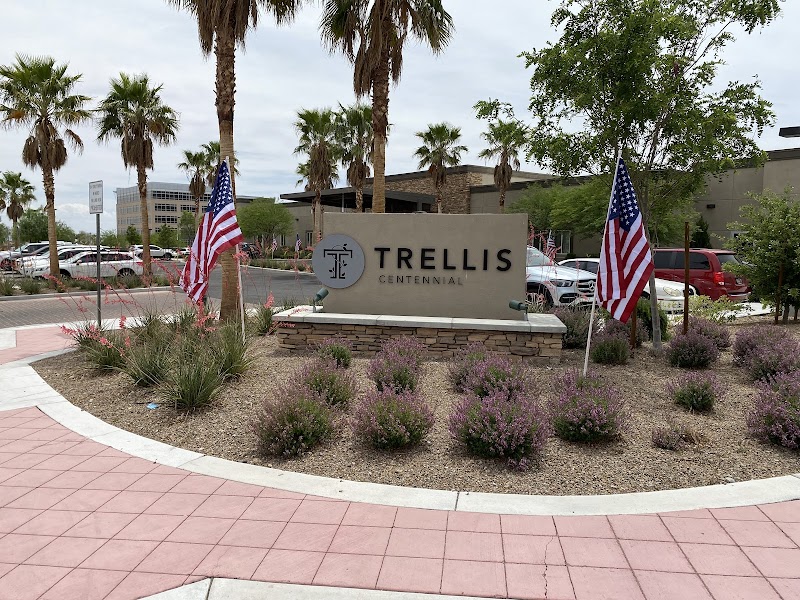
TRELLIS CENTENNIAL

8565 W ROME BLVD, LAS VEGAS, NV 89149 (702) 982-8555
For profit - Individual 72 Beds PACS GROUP Data: November 2025
Trust Grade
53/100
#25 of 65 in NV
Last Inspection: May 2025

Inspected within the last 6 months. Data reflects current conditions.

Overview

Trellis Centennial in Las Vegas has a Trust Grade of C, which means it is average and in the middle of the pack for nursing homes. It ranks #25 out of 65 in Nevada, placing it in the top half of facilities in the state, and #19 of 42 in Clark County, indicating that only a few local options are better. The facility is improving, with the number of reported issues decreasing from 9 in 2024 to 5 in 2025. However, staffing is a concern, rated 2 out of 5 stars, with a turnover rate of 56%, which is higher than the state average. While the nursing home has good RN coverage, exceeding that of 81% of facilities in Nevada, there have been serious incidents, including a failure to provide necessary behavioral health support for a resident with anxiety, which resulted in reported suicidal thoughts, and lapses in infection control procedures that could expose residents to health risks. Overall, while there are strengths in RN coverage and an improving trend, families should be aware of the staffing challenges and specific care issues.

Trust Score
C
53/100
In Nevada
#25/65
Top 38%
Safety Record
Moderate
Needs review
Inspections
Getting Better
9 → 5 violations
Staff Stability
⚠ Watch
56% turnover. Above average. Higher turnover means staff may not know residents' routines.
Penalties
⚠ Watch
$8,278 in fines. Higher than 92% of Nevada facilities. Major compliance failures.
Skilled Nurses
✓ Good
Each resident gets 83 minutes of Registered Nurse (RN) attention daily — more than 97% of Nevada nursing homes. RNs are the most trained staff who catch health problems before they become serious.
Violations
⚠ Watch
25 deficiencies on record. Higher than average. Multiple issues found across inspections.
★★★★☆
4.0
Overall Rating
★★☆☆☆
2.0
Staff Levels
★★★★★
5.0
Care Quality
★★★☆☆
3.0
Inspection Score
Stable
2024: 9 issues
2025: 5 issues

The Good

  • 5-Star Quality Measures · Strong clinical quality outcomes
  • Full Sprinkler Coverage · Fire safety systems throughout facility
  • No fines on record

Facility shows strength in quality measures, fire safety.

The Bad

Staff Turnover: 56%

Near Nevada avg (46%)

Frequent staff changes - ask about care continuity

Federal Fines: $8,278

Below median ($33,413)

Minor penalties assessed

Chain: PACS GROUP

Part of a multi-facility chain

Ask about local staffing decisions and management

Staff turnover is elevated (56%)

8 points above Nevada average of 48%

The Ugly 25 deficiencies on record

2 actual harm
May 2025 5 deficiencies 1 Harm
SERIOUS (G)

Actual Harm - a resident was hurt due to facility failures

Deficiency F0740 (Tag F0740)

A resident was harmed · This affected 1 resident

**NOTE- TERMS IN BRACKETS HAVE BEEN EDITED TO PROTECT CONFIDENTIALITY** Based on observation, interview, record review, and document review, the facility failed to develop a care plan, monitor behavio...

Read full inspector narrative →
**NOTE- TERMS IN BRACKETS HAVE BEEN EDITED TO PROTECT CONFIDENTIALITY** Based on observation, interview, record review, and document review, the facility failed to develop a care plan, monitor behaviors, and provide behavioral health services for 1 of 19 sampled residents (Resident 215). Specifically, the facility failed to document the resident's hospital-diagnosed anxiety as an active medical condition, develop a baseline care plan addressing behavioral health interventions for anxiety, and implement timely interventions until after the resident expressed suicidal ideation. This deficient practice resulted in psychosocial harm as evidenced by the resident's reported feelings of suicidal ideations. Findings include: Resident 215 (R215) R215 had been admitted on [DATE] and readmitted on [DATE] with diagnosis including Chronic Obstructive Pulmonary Disease (COPD) and heart failure. A Hospital Discharge summary dated [DATE] documented discharge diagnosis including COPD with acute exacerbation, shortness of breath, pneumonia, hypertension, and anxiety. R215's Physician History and Physical dated 04/30/25 documented past medical history and current assessment both included anxiety. On 05/01/25, therapy evaluations identified behavioral indicators: - Occupational Therapy Evaluation documented anxiety, self-limiting, agitated, and aggressive. - Speech/Language/Cognitive Therapy Evaluation documented anxiety. The Minimum Data Set (MDS) dated [DATE] documented: - Section C: Brief Interview for Mental Status (BIMS) a score of 12, indicating moderate cognitive impairment - Section D: Resident Mood Interview, a total severity score of 10, indicating moderate depression - Section I: Active Diagnosis listed I5700: Anxiety Disorder. The medical record lacked documented evidence of anxiety being coded as an active medical condition until 05/06/2025, when diagnosis code F41.9: Anxiety Disorder, unspecified, was entered. The baseline care plan initiated on 04/30/2025 lacked documented evidence of focus, goals, or interventions related to anxiety. The Progress Notes documented: - 04/30/25 - R215 refused weight upon admission, three times. - 05/01/25 - refused therapy evaluation; physician was informed. - 05/02/25 - refused bedside care and became verbally aggressive to staff. Charge Nurse aware. Refusal of bathing/shower. - 05/03/25 - Behavior Symptom charting documented rejection of care. - 05/04/25 - Behavior Symptom charting documented rejection of care, yelling, screaming, and use of abusive language. - 05/06/25 - refused care and bathing/showers. The record lacked documented evidence of activity participation or self-directed/independent activities between 04/30/2025 and 05/08/2025. On 05/06/25 at 9:13 AM, R215 was observed lying in bed, alert and oriented, with a flat affect, downturned gaze, and heavy eyelids. R215 verbalized feeling depressed, hopeless, and had suicidal ideation, stating, Yes, all the time, when asked about thoughts of self-harm. The resident also reported having asked staff for medication to help with anxiety, trouble sleeping, and sadness, but was told the facility would not provide any. On 05/06/25 at 9:28 AM, the survey team immediately notified the Director of Nursing (DON) of R215's reported suicidal ideation. On 05/06/25 at 10:22 AM, a Nurse's Note written by the DON documented R215 verbalized being sad and expressed thinking of hurting themselves, and when asked how, R215 replied, I will go to the garage and run the car. The Physician was notified, a psychiatric consult was ordered for the next day, and Hydroxyzine 25 milligram (mg) was prescribed for anxiety. On 05/07/25 at 3:39 PM, the Nurse Practitioner Notes titled Psychiatric Consultation documented R215 reported severe depression, feelings of helplessness, hopelessness, having low mood, avolition, and feeling frustrated. R215 admitted verbalizing to suicidal ideations due to feeling frustrated because of trouble sleeping and trouble breathing. Prior psychiatric diagnosis included depression and anxiety. On 05/08/25 at 1:39 PM, the DON verbalized the refusal of therapy, showers, meals, or weight checks could be a sign of anxiety. The social worker, nursing, and therapy should address these concerns in the Interdisciplinary Care Team (IDT) meeting. The DON confirmed there was no baseline care plan for anxiety. On 05/08/25 at 2:15 PM, the LPN confirmed the resident was readmitted with behavior issues, frequently refused ADL care, refused bathing and showering, did not participate in activities, and was often aggressive used foul language towards the nursing and therapy staff, but the physician had been notified. On 05/08/25 at 2:35 PM, the CNA in charge of R215 verbalized the resident often refuses care and had been aggressive since the readmission on [DATE]. The CNA verbalized being scared to go in R215 room due to the aggressive behavior and will often ask another staff member to accompany them. The CNA verbalized the nurse is aware of the aggressive behavior and refusal of care. On 05/08/25 at 3:39 PM, the Physical Therapist Assistant (PTA) verbalized during R215's Physical Therapy (PT) session on 05/02/25, the resident had displayed anxiety because of self-limiting factors such as being very aggressive with the PT staff, requiring a lot of encouragement, getting agitated very quickly, and visibly shaking from anxiety. The PTA verbalized the resident's hospital discharge summary included the medical diagnosis of anxiety. On 05/08/25 at 3:50 PM, the DON reviewed R215's care plan and verbalized the care plan only included focuses for aggression with use of foul language and aggression to staff, refusal of care, and at risk for decreased psychosocial well-being. An intervention listed under the refusal of care initiated on 05/01/25, documented the Interdisciplinary Care Team (IDT) would collaborate to identify underlying causes. An intervention listed under the at risk for psychosocial well-being documented R215 should be assessed for clinical issues which may cause or contribute to the mood pattern. The DON stated R215 was discussed in IDT, but documentation could not be confirmed. On 05/09/25 at 8:32 AM, R215's Physician verbalized the staff was expected to monitor the resident for behaviors and signs of anxiety even though there were no orders to monitor behavior. The Physician verbalized anxiety was a condition that would typically require care planning or monitoring. The facility should monitor the resident and inform the physician if there are 3 or more refusals in a row. On 05/09/25 at 9:35 AM, the Activities Assistant reported the resident never showed any interest in activities and did not participate. On 05/09/25 at 1:26 PM, the DON confirmed there is no documented IDT discussion of R215's behavioral symptoms, root cause, or interventions for anxiety before 05/06/2025. The policy provided by the facility titled Behavioral Assessment, Intervention and Monitoring, dated 2001, documented as part of the initial assessment, the nursing staff and attending physician will identify individuals with a history of impaired cognition, altered behavior, substance use disorder, or mental disorder. The IDT team will evaluate behavioral symptoms in residents to determine the degree of severity, distress and potential safety risk to the resident, and develop a plan of care accordingly. The interventions will be individualized and part of an overall care environment that supports physical, functional, and psychosocial needs, and strives to understand, prevent or relieve the resident's distress or loss of abilities. Interventions and approaches will be based on a detailed assessment of physical, psychosocial and behavioral symptoms and their underlying causes, as well as the potential situation and environmental reasons for the behavior. The care plan would have included, at a minimum: - a description of the behavioral symptoms, including frequency, intensity, duration, outcomes, location, environment, and precipitating factors or situations. - targeted and individualized interventions for the behavioral and/or psychosocial symptoms - the rationale for the interventions and approaches - specific and measurable goals for targeted behaviors - how staff will monitor for effectiveness of the interventions.
CONCERN (D)

Potential for Harm - no one hurt, but risky conditions existed

Quality of Care (Tag F0684)

Could have caused harm · This affected 1 resident

**NOTE- TERMS IN BRACKETS HAVE BEEN EDITED TO PROTECT CONFIDENTIALITY** Based on observation, interview, record review, and document review, the facility failed to ensure a care plan for anticoagulant...

Read full inspector narrative →
**NOTE- TERMS IN BRACKETS HAVE BEEN EDITED TO PROTECT CONFIDENTIALITY** Based on observation, interview, record review, and document review, the facility failed to ensure a care plan for anticoagulant use was formulated and a physician order was obtained for monitoring the resident while on anticoagulant (blood thinning) therapy for 1 of 19 sampled residents (Resident 166). This deficient practice had the potential to result in unrecognized bleeding complications, delayed medical intervention, and serious adverse outcomes such as internal bleeding, hospitalization, or death. Findings include: Resident 166 (R166) R166 was admitted on [DATE], with diagnoses including dementia, Parkinson's disease, and abnormalities of gait and mobility. The Minimum Data Set (MDS) dated [DATE], documented R166 had an anticoagulant with indication. The History and Physical dated 04/28/2025, documented the plan was to administer Lovenox for deep vein thrombosis (blood clot). A Physician order dated 04/28/2025, documented Lovenox injection solution prefilled syringe 40 milligrams (mg) 4 milliliters (ml). Inject 40 mg subcutaneously daily at 8:00 AM for deep vein thrombosis. The Medication Administration Record (MAR) from 04/28/2025 to 05/07/2025 documented the Lovenox was administered nine (9) times. R166's medical records lacked documented evidence a care plan for anticoagulant use was formulated, a physician order was obtained, and monitoring for anticoagulant therapy was implemented. On 05/07/2025 at 12:15 PM, a Licensed Practical Nurse (LPN) explained monitoring residents on anticoagulant therapy included a care plan, routine assessments for signs of bleeding such as bruising, bleeding gums, hematuria, and black tarry stools and then notifying the physician of any abnormal findings. The LPN confirmed no physician order was in place to monitor for bleeding until 05/07/2025. The LPN indicated a physician order should have been obtained and R166 should have been monitored. On 05/08/2025 at 8:07 AM, during the medication pass, a Registered Nurse (RN) administered Lovenox to R166 without assessing for signs of bleeding or adverse reactions. The injection was given in the abdominal area. On 05/08/2025 at 4:20 PM, the Registered Nurse (RN) indicated residents receiving anticoagulant therapy should have been care planned, monitored for signs and symptoms of bleeding and required a physician order. The RN explained without an order, no prompt would have been generated for implementation. The RN indicated documentation should have reflected monitoring for signs of bleeding or coagulation issues, such as confusion or other clinical indicators, in the MAR. On 05/07/2025 at 1:00 PM, the Director of Nursing (DON) indicated residents receiving anticoagulant therapy should have been care planned, monitored for signs of bleeding and any complications should have been reported. The DON explained Lovenox was ordered by the physician a few days after R166's admission and confirmed by the charge nurse on 04/28/2025. The DON acknowledged monitoring was not transcribed and confirmed no documented evidence of bleeding assessments were present. On 05/08/2025 at 12:44 PM, a Physician Assistant (PA) indicated the use of anticoagulants required a physician order which included monitoring for signs and symptoms of bleeding and adverse reactions. The PA indicated these included bruising, petechiae, hematomas, hematuria, melena, bleeding gums, nosebleeds, severe skin discoloration, and any unusual bleeding. The PA indicated the findings should have been documented and promptly reported to the physician. A facility policy titled Anticoagulation-Clinical Protocol, revised November 2018, emphasized the need to monitor for signs of bleeding in residents on anticoagulant therapy. The policy directed staff to assess for adverse reactions and stated if signs such as bruising, hematuria (blood in urine), or hemoptysis (spitting up blood) were present, the nurse must consult the physician before administering the next dose.
CONCERN (D)

Potential for Harm - no one hurt, but risky conditions existed

Respiratory Care (Tag F0695)

Could have caused harm · This affected 1 resident

**NOTE- TERMS IN BRACKETS HAVE BEEN EDITED TO PROTECT CONFIDENTIALITY** Based on observation, interview, record review, and document review, the facility failed to ensure a physician's order for the u...

Read full inspector narrative →
**NOTE- TERMS IN BRACKETS HAVE BEEN EDITED TO PROTECT CONFIDENTIALITY** Based on observation, interview, record review, and document review, the facility failed to ensure a physician's order for the use of Oxygen (O2) and corresponding care instructions were obtained for 1 of 19 sampled residents (Resident 166). This deficient practice had the potential to result in improper administration of O2 therapy, increased risk of respiratory complications, and failure to monitor the resident's response to treatment. Findings include: Resident 166 (R166) R166 was admitted on [DATE], with diagnoses including chronic obstructive pulmonary disease (COPD) with exacerbation, acute respiratory failure, and dementia. On 05/06/2025 at 9:50 AM, R166 was in bed, verbally responsive with garbled words. R166 was on O2 flowing at 1 liter per minute (LPM) via nasal cannula, with no humidifier in place. R166 had mild shortness of breath. The admission assessment dated [DATE], documented R166's respiratory status included crackling sounds. The admission Minimum Data Set, dated [DATE], documented the brief interview mental status score of 14/15, indicating cognitive status was intact. R166 had shortness of breath. R166's medical records lacked documented evidence a physician order was obtained for O2, and care orders were in place. On 05/07/2025 at 9:23 AM, R166 was in bed with eyes closed. O2 was flowing at 1.5 LPM via nasal cannula, with no signs or symptoms of respiratory distress. A Licensed Practical Nurse (LPN) indicated familiarity with R166 and indicated the resident had been continuously dependent on O2 via nasal cannula. The LPN verified and confirmed there was no physician order for the use of O2 and no order specifying when to change the nasal cannula. The LPN indicated an order should have included the flow rate, frequency, and schedule for changing the cannula. The LPN emphasized the importance of a physician's order to ensure O2 was administered appropriately, not too much and not too little. to prevent complications such as O2 toxicity or carbon dioxide retention. On 05/07/2025 at 1:00 PM, the Director of Nursing (DON) confirmed there was no physician order in place for the use of O2 or for cannula changes. The DON indicated O2 saturation was monitored a few days after admission. The DON indicated R166 was diagnosed with COPD and respiratory failure and had refused O2 upon admission, as documented. The DON indicated staff were expected to obtain and transcribe a physician order at the onset of O2 use, including associated care instructions. On 05/08/2025 in the afternoon, the Physician Assistant (PA) indicated the use of supplemental O2 required a physician's order. The PA indicated the order was expected to specify the flow rate, delivery method such as nasal cannula or mask, frequency and duration such as continuous or as needed, and monitoring parameters such as O2 saturation and signs of hypoxemia. The PA indicated the importance of monitoring to prevent complications from excessive O2, which could have led to toxicity or respiratory depression, and from insufficient O2, which could have resulted in hypoxia and organ damage. A facility policy titled Oxygen Administration, revised in 2010, documented a physician's order was required for this procedure. Review the resident's care plan and assemble the equipment and supplies as needed, including the humidifier bottle. A facility policy titled Medication and Treatment Orders, revised July 2016, documented medications should have been administered only upon written order.
CONCERN (D)

Potential for Harm - no one hurt, but risky conditions existed

Deficiency F0697 (Tag F0697)

Could have caused harm · This affected 1 resident

**NOTE- TERMS IN BRACKETS HAVE BEEN EDITED TO PROTECT CONFIDENTIALITY** Based on interview, record review and document review, the facility failed to ensure pain medication was administered per the ph...

Read full inspector narrative →
**NOTE- TERMS IN BRACKETS HAVE BEEN EDITED TO PROTECT CONFIDENTIALITY** Based on interview, record review and document review, the facility failed to ensure pain medication was administered per the physician order and physician order obtained for pain level rated 4-6/10 using the numerical pain scale 0-10 (0= no pain and 10= worst pain) for 1 of 19 sampled residents (Resident 265). The deficient practice had the potential to lead to inadequate pain management, an increased risk of adverse effects, and compromised patient safety. Findings include: Resident 265 (R265) R265 was admitted on [DATE] with diagnoses including cellulitis of right and left lower limb, muscle weakness, and acute and chronic respiratory failure with hypoxia. A physician order dated 04/21/2025 documented: Pain- PRN (as needed) Pain Scale 0-10: 0= No Pain 1-2= Least Pain 3-4= Mild Pain 5-6= Moderate Pain 7-8= Severe Pain 9-10= Very Severe/Horrible/Worst pain. A Physician order dated 04/21/2025 documented Tylenol tablet 325 milligram (MG) give two tablets by mouth every six hours as needed for mild pain rated 1-3/10. A Physician order dated 04/21/25 documented Hydrocodone-Acetaminophen oral tablet 10-325 milligram (MG) give one tablet by mouth every four hours as needed for severe pain rated 7-10/10. The Medication Administration Record (MAR) for May 2025 documented Hydrocodone-Acetaminophen oral tablet 10-325 milligram (MG) administered for pain scale rating of 4/10 on the following dates: -05/01/2025 -05/02/2025 -05/03/2025 R265's medical record lacked a physician order for pain medication coverage when pain was rated on a scale of 4-6/10. On 05/07/2025 at 02:09 PM, a Registered Nurse (RN), explained the process for administering pain medication was to have the resident rate the level of pain, review the medication order and administer the medication according to the pain level parameter and physician order. The RN explained if there were no orders to administer medications at the pain rating provided by the resident, the staff would notify the physician for clarification. The RN reviewed R265's MAR for May 2025 and confirmed the medication was not administered as per physician orders. On 05/07/2025 at 03:01PM, the Director of Nursing (DON) explained the process would be for staff to assess the resident for the location of pain and severity of pain, record findings and administer the medication as per physician orders. The DON reviewed R265s MAR for May 2025 and confirmed the Hydrocodone-Acetaminophen 10-325 MG tablet was administered for pain rating of 4/10 when orders specified 7-10/10. The DON explained the expectation would be for the staff to provide alternative medication if an order was available or contact the physician for clarification. The DON reviewed the Tylenol order for mild pain of 1-3/10 and confirmed R265 lacked orders for pain rated 4-6/10 and explained the staff should have contacted the physician for new orders or clarification. The Facility policy titled Administering Medications, revised April 2019 documented, Medications are administered in a safe and timely manner, and as prescribed.
CONCERN (F)

Potential for Harm - no one hurt, but risky conditions existed

Infection Control (Tag F0880)

Could have caused harm · This affected most or all residents

**NOTE- TERMS IN BRACKETS HAVE BEEN EDITED TO PROTECT CONFIDENTIALITY** Based on observation, interview, record review, and document review, the facility failed to ensure: 1) The shared glucometer dev...

Read full inspector narrative →
**NOTE- TERMS IN BRACKETS HAVE BEEN EDITED TO PROTECT CONFIDENTIALITY** Based on observation, interview, record review, and document review, the facility failed to ensure: 1) The shared glucometer device was disinfected using Environmental Protection Agency (EPA)-approved disinfectant wipes for 1 of 19 sampled residents (Resident 171). 2) Handwashing with soap and water was performed before and after entering the room of a resident on contact isolation for Clostridium difficile (C. diff) for 1 of 19 sampled residents (Resident 166) and required personal protective equipment (PPE) was donned when entering rooms in contact isolation precautions in 2 of 2 units. This deficient practice had the potential to expose residents to bloodborne pathogens and other infectious agents, increasing the risk of cross-contamination and facility-acquired infections. Findings include: 1) Resident 171 (R171) R171 was admitted on [DATE] and readmitted on [DATE], with diagnoses including diabetes mellitus and chronic kidney disease. On 05/08/2025 at 9:12 AM, during the medication pass, a Registered Nurse (RN) prepared medication, including insulin, and checked R171's blood glucose using the EvenCare G3 glucometer. After use, the glucometer was disinfected with an alcohol pad and returned to the cart. The RN indicated alcohol pads were considered acceptable per the pharmacy's last visit. Micro-Kill disinfectant wipes were available and used to clean the cart's surfaces. The RN explained no other residents on the assignment required a blood glucose check during the morning pass. On 05/08/2025 at 11:40 AM, a Licensed Practical Nurse (LPN) explained the shared glucometer was disinfected after each use with EPA-approved wipes per the manufacturer's instructions. The LPN indicated the device was required to remain visibly wet for 3 to 5 minutes before being returned to the medication cart. The LPN confirmed this procedure was part of the facility's infection control protocol to prevent cross-contamination. On 05/08/2025 at 11:55 PM, the Director of Nursing (DON) indicated alcohol pads were not appropriate for disinfecting shared glucometers and confirmed Licensed Nurses had been educated. The DON indicated Micro-Kill disinfectant wipes were available in each medication cart and nurses were expected to use EPA-approved disinfectant per infection control procedures. The DON verified no residents had active bloodborne pathogen diagnoses. On 05/08/2025 at 2:35 PM, the Infection Preventionist (IP) indicated shared glucometers were to be disinfected before and after each use with EPA-approved disinfectant wipes, maintaining a 3-minute contact time. The IP indicated failure to follow this protocol posed a cross-contamination risk, as the glucometer was shared, and residents were not assigned individual devices. The IP confirmed Licensed Nurses had been educated on proper disinfection procedures. The Blood Glucose Monitoring System User's Guide-Cleaning and Disinfecting Procedures for the EvenCare G3 Meter indicated the device must be cleaned and disinfected between each resident's use. Approved products include Medline Micro-Kill Germicidal Bleach Wipes (EPA Registration Number: 37549-1). The manufacturer's instructions specified the glucometer must be wiped thoroughly, ensuring the surface remained visibly wet for the recommended contact time. 2) Resident 166 (R166) R166 was admitted on [DATE] with diagnoses including dementia and hypertension and was a resident in Unit 2. A Physician Order dated 04/27/2025, documented contact precautions for possible Clostridium Difficile (C-diff) secondary to loose stool. On 05/08/2025 at 7:40 AM, contact isolation signage had been posted on the door of R166's room. The contact isolation signage instructed staff and visitors to wear gowns and gloves before entering the room, perform hand hygiene with soap and water before and after contact, use dedicated or disinfected equipment, and consult nursing staff before entry. PPE was available at the entry. A Certified Nursing Assistant (CNA) and Wound Care Treatment Nurse (WCTN) entered Resident 166's room without donning PPE, and handwashing had not been performed. Another CNA entered and exited the room without donning PPE or performing handwashing. The staff members explained did not pay attention to the isolation signage prior to entry. Staff acknowledged handwashing with soap and water should have been performed for a resident on Clostridium difficile precautions and PPE, including gloves and a gown, should have been worn when entering a room, but these actions had not been performed. On 05/08/2025 at 4:34 PM, the WCTN confirmed R166 had been on contact isolation for C. diff due to loose stools. The WCTN indicated having been pulled by a CNA to assist with R166's Oxygen. The WCTN explained entered the room without noticing the contact isolation signage and realized this after exiting the room. The WCTN acknowledged handwashing, and the use of PPE had not been performed. The WCTN indicated handwashing should have been performed both before and after entering the room to prevent cross-contamination for residents on C. diff isolation. On 05/08/2025 at 3:00 PM, the Infection Preventionist (IP) indicated signage, and PPE had been placed at the doorway in accordance with contact precautions. The IP explained all staff and visitors were expected to follow transmission-based precaution (TBP) protocols, including wearing appropriate PPE and performing hand hygiene. The IP indicated for residents on C. difficile isolation, handwashing with soap and water was required as alcohol-based hand sanitizers were not effective against C. difficile spores. The IP indicated staff entering a resident's room on contact precautions for C. difficile were required to perform handwashing to prevent cross-contamination. The IP indicated the facility had provided education on TBP protocols, including handwashing and the proper donning and doffing of PPE. A facility policy titled Isolation-Transmission-Based Precautions and Enhanced Barrier Precautions, revised September 2022, indicated TBP precautions were initiated when a resident showed signs of a transmissible infection, was admitted with symptoms, or had a lab-confirmed infection with transmission risk. Contact precautions were implemented for residents known or suspected to be infected with organisms spread through direct or indirect contact. When a resident was placed on TBP, appropriate signage was posted at the room entrance to inform personnel and visitors of the required precautions. The signage identified the type of Centers for Disease Control and Prevention (CDC) precautions, personal protective equipment (PPE) instructions, and other relevant protocols. Resident 267 (R267) R267 was admitted on [DATE] with diagnoses including post laminectomy syndrome, disruption of external operational (surgical) wound, and infection and inflammatory reaction due to internal fixation device of spine. R267 resided on Unit 1. A Physician order dated 04/28/2025 documented Contact Precaution due to neck wound culture positive for methicillin-susceptible staphylococcus aureus every shift. R267 had a sign posted to the left of the door documented the following: -Contact Precautions: put on gloves and gown before room entry and discard gloves and gown before room exit. A plastic three drawer storage bin stocked with personal protective equipment (PPE) including disposable gowns was present outside R267's room. On 05/06/2025 at 10:31 AM, a visitor entered R267's room with no PPE. On 05/06/2025 at 10:35 AM, a Registered Nurse (RN) explained the process for contract precautions was to apply gloves and gown when entering contact precautions rooms and remove gloves and gown when exiting. The RN explained staff and visitors were to abide by precautions, and visitors were educated to use PPE. 05/06/2025 at 10:36 AM, a visitor, who identified themselves as R267's spouse, was seated at R267's bed side in a chair approximately three feet from left side of the bed with no gown or gloves on. R267's spouse explained being unaware R267 was on contact precautions and PPE was required when visiting. On 05/06/2025 at 10:50 AM, the RN provided R267's spouse a gown and gloves and explained the PPE needed to be applied upon entrance of R267's room and removed when leaving the room. The RN explained staff and visitors would need to adhere to contact precautions to prevent the spread of infection. The Care plan dated 04/28/2025 documented the following: -Isolation Precautions: Resident requires contact precautions due to neck wound culture methicillin-susceptible staphylococcus aureus with interventions of: -ask family members, visitors, & care providers to stay home if they are sick. -educate resident and visitor about isolation precautions. Stress hand hygiene when visiting resident. -education of patients, families, visitors, and care providers about how infections are transmitted and how illness can be prevented -follow universal precautions when working with residents in isolation. -maintain isolation using contact precautions - use of personal protective equipment as recommended for type of infection On 05/08/2025 at 09:12 AM, the Infection Preventionist (IP) explained the isolation process for residents and visitors was to place the appropriate signage for the isolation and explain the reason and the process for use of personal protective equipment (PPE) to the resident and their family members. The staff would then place a bin with PPE supplies outside the resident room for staff and visitors to access upon entrance into the resident room. The IP stated the education for family and visitors included an explanation on the use of gloves, gown, and hand sanitizer. The education would sometimes be documented in the progress note but on occasion it would be missed. R267's medical record lacked documented evidence that education had transpired with R267's spouse and the facility was unable to provide documented evidence of education with family. On 05/08/2025 at 09:17AM, the IP explained the expectation was for visitors and staff to adhere to the isolation precautions to prevent the spread of infections. The IP confirmed not speaking with R267's spouse until 05/07/2025 and the conversations should have been documented. On 05/08/2025 at 02:40 PM, a Licensed Practical Nurse (LPN) entered R267's with no PPE. The LPN confirmed that gloves and gown should have been donned prior to entering the resident room. The LPN explained the need to utilize PPE was to protect the residents and self from the spread of infection. The facility policy titled Isolation- Transmission-Based Precautions & Enhanced Barrier Precautions, revised September 2022, documented Contact Precautions were implemented for residents known or suspected to be infected with microorganisms that can be transmitted by direct contact with the resident or indirect contact with environmental surfaces or resident care items in the resident's environment. Staff and Visitors wear gloves (clean, non- sterile) when entering room. Staff and Visitors wear a disposable gown upon entering the room and remove before leaving the room.
Nov 2024 2 deficiencies
CONCERN (D) 📢 Someone Reported This

A family member, employee, or ombudsman was alarmed enough to file a formal complaint

Potential for Harm - no one hurt, but risky conditions existed

Deficiency F0692 (Tag F0692)

Could have caused harm · This affected 1 resident

**NOTE- TERMS IN BRACKETS HAVE BEEN EDITED TO PROTECT CONFIDENTIALITY** Based on interview, record review, and document review, the facility failed to ensure a resident's weight was taken and recorded...

Read full inspector narrative →
**NOTE- TERMS IN BRACKETS HAVE BEEN EDITED TO PROTECT CONFIDENTIALITY** Based on interview, record review, and document review, the facility failed to ensure a resident's weight was taken and recorded upon admission for 1 of 4 sampled residents (Resident 4). This failure could have compromised the nutritional and medical well-being of the resident. Findings include: Resident (R4) R4 was admitted on [DATE], with diagnoses including dysphasia, chronic kidney disease stage I -IV, and diabetes mellitus. R4's Nutritional Risk Assessment, and vital signs and weight report dated 9/16/2024, documented R4's most recent weight was 156.2 pounds. R4's weight was obtained six days after admission. The medical record lacked documented evidence R4's weight was obtained upon admission. On 11/20/2024 at 3:30 PM, a Certified Nursing Assistant (CNA) explained all new admissions were weighed by a CNA initially, then by Occupational Therapy the next day before providing services. On 11/20/2024 at 3:40 PM, a Charge Nurse (CN) expressed the initial weights must be completed upon arrival to complete the admission. The CN explained the facility had 48 hours to enter necessary information after admission. On 11/20/2024 at 4:03 PM, the Director of Nursing (DON) clarified upon admission all residents were weighed unless the resident refused. If the resident refused the facility would retry the next day. The DON expectation was that the weights be completed upon admission. The DON voiced if the weights were not entered it would create difficulties with proper care pertaining to the resident's medication administration, dietary orders, and weight management. A facility policy titled Weight Assessment and Intervention policy, revised March 2022, specified residents were weighed upon admission and on a weekly basis as established by the interdisciplinary team.
CONCERN (E) 📢 Someone Reported This

A family member, employee, or ombudsman was alarmed enough to file a formal complaint

Potential for Harm - no one hurt, but risky conditions existed

ADL Care (Tag F0677)

Could have caused harm · This affected multiple residents

**NOTE- TERMS IN BRACKETS HAVE BEEN EDITED TO PROTECT CONFIDENTIALITY** Based on interview, record review and document review, the facility failed to provide documented evidence the residents were pro...

Read full inspector narrative →
**NOTE- TERMS IN BRACKETS HAVE BEEN EDITED TO PROTECT CONFIDENTIALITY** Based on interview, record review and document review, the facility failed to provide documented evidence the residents were provided assistance with activities of daily living (ADLs) for 2 of 4 sampled residents (R1 and R2). The deficient practice had the potential for the residents' skin integrity to be compromised. Findings include: Resident 1 (R1) R1 was admitted on [DATE] and discharged on 09/02/2024, with diagnoses including muscle weakness and displaced intertrochanteric fracture of left femur. R1's Care Plan documented the resident had self-care deficit as evidenced by needing assistance with ADLs related to pain. The following activities/tasks were identified in the resident's care plan: - Oral hygiene - partial/moderate assistance - Toileting hygiene - dependent - Personal hygiene - substantial/maximal assistance On 11/20/2024 at 12:57 PM, a Certified Nursing Assistant (CNA) indicated the residents were assisted with ADLs such as toileting and hygiene. The assistance provided should have been documented in the electronic ADL charting at least every shift. On 11/20/2024 at 02:14 PM, another CNA indicated the residents were assisted with ADLs of personal hygiene which included oral hygiene and toileting hygiene. The assistance provided should have been documented in the electronic ADL charting system, at minimum, once per shift. On 11/20/2024 at 2:25 PM, the Minimum Data Set (MDS) Director explained the CNAs would document in the electronic charting system (point of care/POC) the assistance with ADLs provided to each resident at least every shift. The MDS Director revealed oral, toileting, and personal hygiene tasks could be documented in the ADL Documentation Survey Report. The MDS Director indicated R1 required physical assistance with oral, toileting, and personal hygiene. R1's ADL Documentation Survey Report for July 2024 was reviewed with the MDS Director. There was no documented evidence the resident was provided with oral, toileting, or personal hygiene during the night shift on 07/24/2024 and 07/27/2024. The MDS Director confirmed the findings and indicated there was no documentation R1 had refused or R1 was unavailable during the shift. The MDS Director explained when a resident refused assistance or was unavailable for care, the CNA would document the refusal in the ADL Documentation Survey Report. R1's ADL Documentation Survey Report for August 2024 was reviewed with the MDS Director. There was no documented evidence the resident was provided with oral, toileting, or personal hygiene during the day shift on 08/03/2024, 08/04/2024, 08/21/2024, 08/25/2024 and during the night shift on 08/01/2024, 08/03/2024, 08/06/2024, 08/08/2024, 08/15/2024, 08/21/2024, 08/22/2024, 08/28/2024, and 08/30/2024. The MDS Director confirmed the findings and indicated there was no documentation R1 had refused or R1 was unavailable during the shift. R1's ADL Documentation Survey Report for September 2024 was reviewed with the MDS Director. There was no documented evidence the resident was provided with oral, toileting, or personal hygiene during the day shift on 09/01/2024. The MDS Coordinator confirmed the findings and indicated there was no documentation R1 had refused or R1 was unavailable during the shift. On 11/20/2024 at 2:41 PM, the Director of Nursing (DON) explained the CNAs were expected to provide personal care and hygiene to the residents as documented in the residents' care plan. The CNAs should document in the electronic chart the care or ADL assistance provided to the residents at a minimum of once per shift. The DON stated if there was no documented evidence, then there was no proof the tasks were performed. The DON reviewed R1's ADL Documentation Survey Report for July 2024, August 2024, and September 2024 and confirmed there was no documented evidence R1 was provided with oral, toileting, or personal hygiene on numerous shifts. Resident 2 (R2) R2 was admitted on [DATE] with diagnoses including muscle weakness, hemiplegia of the right dominant side, and respiratory failure. R2's Care Plan documented the resident had self-care deficit as evidenced by needing assistance with ADLs. The following activities/tasks were identified in the resident's care plan: - Oral hygiene - partial/moderate assistance - Toileting hygiene - dependent On 11/20/2024 at 8:18 AM, R2 stated being left lying in a soiled brief for hours quite often, particularly during the hours between 4:00 AM to 10:00 AM. R2 verbalized being left soiled and sitting in a wheelchair in the hall while waiting for physical therapy on most days. On 11/20/2024 at 02:25 PM, R2's ADL Documentation Survey Report for October 2024 and November 2024 were reviewed with the MDS Director. There was no documented evidence the resident was provided with toileting hygiene during the day shift on 10/25/2024 and during the night shift on 10/25/2024, 10/31/2024, 11/07/2024, 11/13/2024, 11/14/2024, and 11/15/2024. The MDS Director confirmed the findings and indicated there was no documentation R2 had refused or R2 was unavailable during the shift. On 11/20/2024 at 2:41 PM, the DON reviewed R2's ADL Documentation Survey Report for October 2024 and November 2024. The DON confirmed there was no documented evidence R2 was provided with oral, toileting, or personal hygiene on numerous shifts. The facility's policy titled Activities of Daily Living (ADLs) Supporting, revised in March 2018, documented care and services would be provided for the following ADLs: - Hygiene (bathing, dressing, grooming, and oral care) - Mobility (transfer and ambulation, including walking) - Elimination (toileting) - Dining (meals and snacks); and - Communication (speech, language, and any or functional communication systems). A resident who was unable to carry out activities of daily living independently would receive the appropriate support and assistance to maintain good oral, toileting, personal hygiene. Complaint #NV00072411
Jun 2024 7 deficiencies
CONCERN (D)

Potential for Harm - no one hurt, but risky conditions existed

Deficiency F0658 (Tag F0658)

Could have caused harm · This affected 1 resident

**NOTE- TERMS IN BRACKETS HAVE BEEN EDITED TO PROTECT CONFIDENTIALITY** 3) TED hose (compression stockings) Resident 43 (R43) R43 was admitted on [DATE], with diagnoses including hypertensive heart di...

Read full inspector narrative →
**NOTE- TERMS IN BRACKETS HAVE BEEN EDITED TO PROTECT CONFIDENTIALITY** 3) TED hose (compression stockings) Resident 43 (R43) R43 was admitted on [DATE], with diagnoses including hypertensive heart disease with heart failure, morbid obesity, and spondylosis of cervical region. A physician's order dated 05/13/2024, documented thrombo-embolic deterrent (TED) hose on bilateral legs two times a day for edema on for 12 hours, off for 12 hours. On 06/04/2024 at 8:55 AM, R43 laid alert in a bariatric specialty mattress. The resident was not covered with blanket which revealed edema on bilateral lower extremities, R43 was not wearing TED hose. There was no TED hose observed in the resident's room. On 06/05/24 at 8:50 AM, R43 laid in bed with a fully consumed breakfast tray on bedside table. R43 indicated having a history of wearing compression stockings for edema in the past but had not used compression stockings since admission to this facility in March 2024. According to the resident, use of TED hose was discussed with R43 a few weeks ago but no one had followed through, discussed, provided nor applied a TED hose on the resident since. On 06/05/2024 at 9:03 AM, a Certified Nursing Assistant (CNA) assigned to R43 indicated had been assigned multiple times to R43. The CNA indicated not being aware there were orders for TED hose for the resident and the CNA had not seen any compression devices in the resident's room even once. The CNA entered R43's room, uncovered R43' legs and confirmed R43 was not wearing compression stockings. The CNA looked around the resident's room and confirmed there was no TED hose device in the room. On 06/05/2024 at 9:08 AM, the CNA explained compression stocking were typically ordered to be worn during the day and taken off at night. The purpose of the device was to improve circulation, preventing deep vein thrombosis (DVT) and managing edema. The CNA reviewed R43's medication administration record (MAR) and could not speak to why nurses were signing off on R43's TED hose application as the hose were not found in the room or on the resident. R43's MAR for May 2024 and June 2024, revealed there were no missed administrations for R43's TED hose from 05/13/2024 until 06/05/2024. Multiple nurses had been signing R43's MAR as being administered at morning (AM) and removed at night (PM). On 06/05/2024 at 9:14 AM, a Licensed Practical Nurse (LPN) indicated being newly assigned to R43 and was not familiar with R43's TED hose orders. The LPN indicated the LPN was completing medication administration for assigned residents and was planning to apply the resident's TED hose afterwards. The LPN reviewed R43's MAR for May 2024 and June 2024 and acknowledged multiple nurses except for this LPN, had been signing off the device as having been administered in accordance with physician's orders. The LPN could not speak to why the nurses were signing off on R43's TED hose. On 06/05/2024 at 10:06 AM, the Director of Nursing (DON) was present during interview with the charge Registered Nurse (RN). The charge RN indicated being familiar with R43 and the resident's TED hose orders for edema management. The charge RN explained R43 was morbidly obese and the TED hose devices the facility had in stock were too small for R43. The charge RN confirmed an appropriately sized TED hose had not been ordered for R43 and the charge RN along with other nurses had been signing for the resident's TED hose as being administered from 05/13/2024 until 06/05/2024. The charge RN reviewed R43's MAR and confirmed signing for R43's TED hose five times in May 2024 (05/19/2024, 05/22/2024, 05/26/2024, 05/27/2024 and 05/29/2024) and three times in June 2024 (06/02/2024, 06/03/2024 and 06/04/2024). The charge RN verbalized signing for treatment services not rendered went against the facility's policies on documentation and medication administration and professional standards of practice specifically the Nurse Practice Act. On 06/05/2024 at 10:18 AM, the DON expressed it was not acceptable for nurses to be signing off for treatment services which were not performed or administered because this went against the facility policy on following physician's orders and the five rights of medication administration which were, 1) right medication, 2) right dose, 3) right route, 4) right time and 5) right patient. The DON indicated the facility's policy were aligned with the Nurse Practice Act, so this inaccurate documentation went against professional standards of practice as well. According to the DON, if the TED hose in stock was too small, the nurse should have contacted the physician immediately to obtain a modification to the order. The facility policy titled Applying Anti-Embolism Stockings (TED hose) dated 2001, documented the purpose of this procedure was to improve venous return to the heart, arterial circulation to the feet and to minimize edema to the legs and feet and to prevent complications associated with deep vein thrombosis and pulmonary embolism. The procedure included verifying with the physician if a thigh-length or knee-length stockings was to be used, obtaining measurements, and choosing appropriately sized stockings. Anti-embolism stocking should be applied in the morning and removed at night. Document the date and time the stockings were applied, schedule of removal or re-application and patient's response to the procedure. 4) Heparin Resident 43 (R43) R43 was admitted on [DATE], with diagnoses including hypertensive heart disease with heart failure, morbid obesity, and spondylosis of cervical region. On 06/05/2024 at 8:58 AM, R43 indicated receiving Heparin injections once a day in the morning but the medication was not administered at night. A physician's order dated 03/21/2024, documented to give Heparin Sodium (Porcine) Solution 5,000 units per milliliter (ml). Inject 5,000 units subcutaneously every 12 hours for deep vein thrombosis (DVT) prophylaxis. On 06/05/2024 at 9:35 AM, the Licensed Practical Nurse (LPN) assigned to R43 explained R43's Heparin was scheduled to be administered twice a day at 6:00 AM and 6:00 PM. The LPN indicated not being steadily assigned to R43 but whenever the LPN was assigned to R43, the medication would be administered at 6:00 PM prior to ending the LPNs shift at 7:00 PM. On 06/05/2024 at 3:17 PM, the DON reviewed R43's medication administration record (MAR) for the resident's Heparin for March 2024, April 2024, June 2024, and July 2024 which revealed the following: March 2024: 21 Heparin vials administered. April 2024: 59 Heparin vials administered. May 2024: 61 Heparin vials administered. June 2024: 9 Heparin vials administered. ---------------------------------------------------- Total administered: 150 Heparin single-dose vials The Pharmacy manifest dated 03/21/2024 through 06/05/2024 revealed the following Heparin single-dose vial deliveries for R43: 03/21/2024: 14 Heparin vials 03/29/2024: 14 Heparin vials 04/08/2024: 14 Heparin vials 04/17/2024: 14 Heparin vials 04/24/2024: 14 Heparin vials 04/29/2024: 14 Heparin vials 05/22/2024: 14 Heparin vials 06/05/2024: 14 Heparin vials --------------------------------- Total delivered: 112 Heparin vials. On 06/05/2024 at 3:25 PM, the LPN opened the medication cart and confirmed there were currently 19 Heparin vials remaining for R43. The Inventory Report indicated Heparin 5,000 units/ml for injection was included in the list of available drugs in the facility's medication dispensing system. On 06/06/2024 at 8:45 AM, the DON indicated speaking with the Pharmacist who verified there were no recorded retrievals of Heparin for Resident 43 from the dispensing system. On 06/06/2024 at 8:47 AM, the DON confirmed the following for period covering 03/21/2024 to 06/05/2024: -there were a total 150 recorded administrations of Heparin for R43 -there were 112 Heparin vials delivered for R43 -there were zero Heparin vial retrievals from the medication dispensing system -there were 19 Heparin vials left in the medication cart for R43 - there were 57 recorded administrations in excess of the number of Heparin vials delivered for R43 On 06/06/2024 at 8:50 AM, the DON indicated the number of recorded administrations cannot exceed the number of Heparin vials delivered for R43. The DON confirmed there were 57 more Heparin administrations over the number of Heparin vial deliveries for R43. The DON stated not being able to speak to the discrepancy and could not think of possible explanations. On 06/06/2024 at 9:06 AM, the Administrator confirmed there was a discrepancy between the number of recorded Heparin administrations versus the number of actual Heparin vials delivered for R43 which were unaccountable. On 06/06/2024 at 9:20 AM, the Regional Director of Clinical Services could not explain the discrepancy but presented possible explanations such as nurses may have been documenting the medication prior to actual administration when the medication was not actually administered due to R43 being asleep or unavailable. The resident may have also refused at times and these refusals were not recorded. According to the Regional Director of Clinical Services, even if an explanation could not determine it was evident the facility's medication administration and documentation policies were not followed in this case. On 06/06/2024 at 10:19 AM, the Consultant Pharmacist indicated the number of recorded administrations must match the number of vials delivered which would include the available supply in the medication cart. According to the Consultant Pharmacist, the number of recorded Heparin administrations cannot exceed the number of Heparin vials delivered especially taking into consideration there were no Heparin retrievals from the medication dispensing system for R43. The Consultant Pharmacist stated the discrepancy of 57 vials translated to missed doses regardless of whether the facility could provide an explanation or not. The pharmacist reviewed R43's record and indicated the resident had no documented refusals of Heparin. The Administering medications policy revised April 2019 documented if a drug was withheld, refused, or given at a time other than the scheduled time, the individual administering the medication shall initial and circle the MAR space provided for the drug and dose. For residents not in the room or otherwise unavailable to receive medication on the pass, the MAR may be flagged. After completing medication pass, the nurse will return to the missed resident to administer the medication. The Charting and Documentation policy revised July 2017 documented all medications, treatments or services performed would be documented in the patient's medical record. Documentation in the medical record will be complete and accurate. Entries must be recorded in accordance with state law and facility policy. Cross reference to Tag F684 Based on observations, interviews, record reviews, and document review, the facility failed to ensure documentation accurately reflected medications and treatment services provided. Specifically: 1) a Lidocaine patch; 2) an ACE wrap (elastic bandage); 3) Heparin (blood thinner); and 4) Thrombo-Embolic Deterrent (TED) hose or compression stockings. This deficient practice could potentially have led to severe harm, including ineffective pain management, an increased risk of blood clots, and inadequate compression therapy. Findings include: Resident 166 (R166) 1) Lidocaine Patch R166 was admitted on [DATE], with diagnoses including muscle spasm, bacteremia, and a history of liver transplant. A Physician order dated 05/31/2024, documented the application of Lidocaine Patch 5 percent (%) topically daily to the affected area and removal per schedule. Apply at 9:00 AM and remove at 8:59 PM. On 06/04/2024 at 10:18 AM, R166 indicated had been experiencing pain on the right side of the neck. Upon verification, a Lidocaine patch was in place dated 06/02/2024 with nurse's initials. R166 and the family indicated it was applied two days ago in the morning. A Licensed Practical Nurse (LPN) verified the application of the patch on R166's neck, confirming its two-day age. The LPN indicated the Lidocaine patch should have been removed at night following a 12-hour administration period. The LPN confirmed it was signed off in the MAR the Lidocaine patch was administered and removed when it was not applied as ordered or removed as scheduled. The Medication Administration Record (MAR) documented the following: -06/02/2024 at 8:59 PM, the Lidocaine patch was recorded as removed when it was still on. -06/03/2024 at 9:00 AM, the Lidocaine patch was recorded as applied without replacing a new patch. -06/03/2024 at 8:59 PM, the Lidocaine patch was recorded as removed when it was still on. On 06/05/2024 at 9:36 AM, another LPN indicated the Lidocaine patch was to be dated upon application and to be removed after 12 hours. The LPN indicated the MAR should have been accurately documented if the medication order was carried out, and if not, the physician would have been notified and documented. On 06/05/2024 at 11:00 AM, the Physician Assistant (PA) indicated the Lidocaine patch was to manage the pain and should have been applied and removed timely for efficacy. The PA indicated there was no harm if the patch was not removed for more than 12 hours, but the staff were expected to follow the orders and to document accurately. On 06/05/2024 at 2:33 PM, the Director of Nursing (DON) indicated the Lidocaine patch should have been applied and removed as ordered. The staff were expected to document accurately in the MAR or treatment administration record (TAR). 2) ACE wrap Resident 9 (R9) R9 was admitted on [DATE], with diagnoses including surgical amputation, diabetes mellitus, osteomyelitis, and peripheral vascular disease. The Brief Interview of Mental status dated 05/22/2024, documented a score of 15/15, which indicated R9's cognitive status was intact. A physician's order dated 04/18/2024, documented to apply an ACE wrap on R9's left foot amputation surgical site every shift. On 06/04/2024 at 11:50 AM, R9 removed the non-skid socks from the left foot, revealing the toes had been amputated and were uncovered, with stitches in place. R9 indicated being a diabetic, and the toes had undergone amputation. R9 indicated the wound nurse had provided the treatment, no ACE wrap was in place. On 06/05/2024 at 8:42 AM, R9 was seated in bed. R9 showed the swollen left foot, which had no ACE wrap in place. R9 indicated the wound nurse had previously applied the ACE wrap, but it had not been applied for more than a week. R9 expressed the ACE wrap was somehow reducing the swelling, but was wondering why it was no longer applied. The Medication Administration Record (MAR) from 06/01/2024 through 06/04/2024, documented the ACE wrap was applied. On 06/05/2024 at 9:36 AM, the LPN indicated the process was to verify the orders, perform the assessment, and carry out the orders and document. The LPN confirmed the MAR was signed off indicating the ACE wrap was applied. On 06/05/2024 at 11:07 AM, the Wound Care Treatment Nurse (WCTN) explained the ACE wrap had been ordered previously to support the dressing of the left foot surgical site, but the order was changed to leave it open to air. The WCTN confirmed the ACE wrap was an active order, but was unsure of the indication. The WCTN indicated the Licensed Nurses were responsible for the application of the ACE wrap and should not have been documented it was applied when it was not carried out. On 06/05/2024 at 10:30 AM, the DON indicated the staff members were expected to verify the orders, implement the ACE wrap, and document what had been implemented. The staff were expected to document accurately in the MAR or TAR as the standard of practice.
CONCERN (D)

Potential for Harm - no one hurt, but risky conditions existed

Quality of Care (Tag F0684)

Could have caused harm · This affected 1 resident

**NOTE- TERMS IN BRACKETS HAVE BEEN EDITED TO PROTECT CONFIDENTIALITY** 2) TED hose (compression stockings) Resident 43 (R43) R43 was admitted on [DATE], with diagnoses including hypertensive heart di...

Read full inspector narrative →
**NOTE- TERMS IN BRACKETS HAVE BEEN EDITED TO PROTECT CONFIDENTIALITY** 2) TED hose (compression stockings) Resident 43 (R43) R43 was admitted on [DATE], with diagnoses including hypertensive heart disease with heart failure, morbid obesity, and spondylosis of cervical region. A physician's order dated 05/13/2024, documented thrombo-embolic deterrent (TED) hose on bilateral legs two times a day for edema on for 12 hours, off for 12 hours. On 06/04/2024 at 8:55 AM, R43 laid alert in a bariatric specialty mattress. The resident was not covered with blanket which revealed edema on bilateral lower extremities, R43 was not wearing TED hose. There was no TED hose observed in the resident's room. On 06/05/24 at 8:50 AM, R43 laid in bed with a fully consumed breakfast tray on bedside table. R43 indicated having a history of wearing compression stockings for edema in the past but had not used compression stockings since admission to this facility in March 2024. According to the resident, use of TED hose was discussed with R43 a few weeks ago but no one had followed through, discussed, provided nor applied TED hose on the resident since. On 06/05/2024 at 9:03 AM, a Certified Nursing Assistant (CNA) assigned to R43 indicated had been assigned multiple times to R43. The CNA indicated not being aware there were orders for a TED hose for the resident and the CNA had not seen any compression devices in the resident's room even once. The CNA entered R43's room, uncovered R43' legs and confirmed R43 was not wearing compression stockings. The CNA looked around the resident's room and confirmed there was no TED hose device in the room. On 06/05/2024 at 9:08 AM, the CNA explained compression stocking were typically ordered to be worn during the day and taken off at night. The purpose of the device was to improve circulation, preventing deep vein thrombosis (DVT) and managing edema. The CNA reviewed R43's medication administration record (MAR) and could not speak to why nurses were signing off on R43's TED hose, as none were found in the room or on the resident. R43's MAR for May 2024 and June 2024, revealed there were no missed administrations for R43's application of TED hose from 05/13/2024 until 06/05/2024. Multiple nurses had been signing R43's MAR as being administered at morning (AM) and removed at night (PM). On 06/05/2024 at 9:14 AM, a Licensed Practical Nurse (LPN) indicated being newly assigned to R43 and was not familiar with R43's TED hose orders. The LPN indicated the LPN was completing medication administration for assigned residents and was planning to apply the resident's TED hose afterwards. The LPN reviewed R43's MAR for May 2024 and June 2024 and acknowledged multiple nurses except for this LPN, had been signing off the device as having been administered in accordance with physician's orders. The LPN could not speak to why the nurses were signing off on R43's TED hose. On 06/05/2024 at 10:06 AM, the Director of Nursing (DON) was present during interview with the charge Registered Nurse (RN). The charge RN indicated being familiar with R43 and the resident's TED hose orders for edema management. The charge RN explained R43 was morbidly obese and the TED hose devices the facility had in stock were too small for R43. The charge RN confirmed an appropriately sized TED hose had not been ordered for R43 and the charge RN along with other nurses had been signing for the resident's TED hose as being administered from 05/13/2024 until 06/05/2024. The charge RN reviewed R43's MAR and confirmed signing for R43's TED hose five times in May 2024 (05/19/2024, 05/22/2024, 05/26/2024, 05/27/2024 and 05/29/2024) and three times in June 2024 (06/02/2024, 06/03/2024 and 06/04/2024). The charge RN verbalized signing for treatment services not rendered went against the facility's policies on documentation and medication administration and professional standards of practice specifically the Nurse Practice Act. On 06/05/2024 at 10:18 AM, the DON expressed it was not acceptable for nurses to be signing off for treatment services which were not performed or administered because this went against the facility policy on following physician's orders and the five rights of medication administration which were, 1) right medication, 2) right dose, 3) right route, 4) right time and 5) right patient. The DON indicated the facility's policy were aligned with the Nurse Practice Act, so this inaccurate documentation went against professional standards of practice as well. According to the DON, if the TED hose in stock was too small, the nurse should have contacted the physician immediately to obtain a modification to the order. The facility policy titled Applying Anti-Embolism Stockings (TED hose) dated 2001, documented the purpose of this procedure was to improve venous return to the heart, arterial circulation to the feet and to minimize edema to the legs and feet and to prevent complications associated with deep vein thrombosis and pulmonary embolism. The procedure included verifying with the physician if a thigh-length or knee-length stockings was to be used, obtaining measurements, and choosing appropriately sized stockings. Anti-embolism stocking should be applied in the morning and removed at night. Document the date and time the stockings were applied, schedule of removal or re-application and patient's response to the procedure. 3) Heparin Resident 43 (R43) R43 was admitted on [DATE], with diagnoses including hypertensive heart disease with heart failure, morbid obesity, and spondylosis of cervical region. On 06/05/2024 at 8:58 AM, R43 indicated receiving Heparin injections once a day in the morning but the medication was not administered at night. A physician's order dated 03/21/2024, documented to give Heparin Sodium (Porcine) Solution 5,000 units per milliliter (ml). Inject 5,000 units subcutaneously every 12 hours for deep vein thrombosis (DVT) prophylaxis. 06/05/24 08:58 AM Resident # 43 indicated receiving Heparin injections once a day in the morning but the medication was not administered at night. On 06/05/2024 at 9:35 AM, the Licensed Practical Nurse (LPN) assigned to R43 explained R43's Heparin was scheduled to be administered twice a day at 6:00 AM and 6:00 PM. The LPN indicated not being steadily assigned to R43 but whenever the LPN was assigned to R43, the medication would be administered at 6:00 PM prior to ending the LPNs shift at 7:00 PM. On 06/05/2024 at 3:17 PM, the DON reviewed R43's medication administration record (MAR) for the resident's Heparin for March 2024, April 2024, June 2024, and July 2024 which revealed the following: March 2024: 21 Heparin vials administered. April 2024: 59 Heparin vials administered. May 2024: 61 Heparin vials administered. June 2024: 9 Heparin vials administered. ---------------------------------------------------- Total administered: 150 Heparin single-dose vials The Pharmacy manifest dated 03/21/2024 through 06/05/2024 revealed the following Heparin single-dose vial deliveries for R43: 03/21/2024: 14 Heparin vials 03/29/2024: 14 Heparin vials 04/08/2024: 14 Heparin vials 04/17/2024: 14 Heparin vials 04/24/2024: 14 Heparin vials 04/29/2024: 14 Heparin vials 05/22/2024: 14 Heparin vials 06/05/2024: 14 Heparin vials --------------------------------- Total delivered: 112 Heparin vials. On 06/05/2024 at 3:25 PM, the LPN opened the medication cart and confirmed there were currently 19 Heparin vials remaining for R43. The Inventory Report indicated Heparin 5,000 units/ml for injection was included in the list of available drugs in the facility's medication dispensing system. On 06/06/2024 at 8:45 AM, the DON indicated speaking with the Pharmacist who verified there were no recorded retrievals of Heparin for Resident 43. On 06/06/2024 at 8:47 AM, the DON confirmed the following for period covering 03/21/2024 to 06/05/2024: -there were a total 150 recorded administrations of Heparin for R43 -there were 112 Heparin vials delivered for R43 -there were zero Heparin vial retrievals from the medication dispensing system -there were 19 Heparin vials left in the medication cart for R43 - there were 57 recorded administrations in excess of the number of Heparin vials delivered for R43 On 06/06/2024 at 8:50 AM, the DON indicated the number of recorded administrations cannot exceed the number of Heparin vials delivered for R43. The DON confirmed there were 57 more Heparin administrations over the number of Heparin vial deliveries for R43. The DON stated not being able to speak to the discrepancy and could not think of possible explanations. On 06/06/2024 at 9:06 AM, the Administrator confirmed there was a discrepancy between the number of recorded Heparin administrations versus the number of actual Heparin vials delivered for R43 which were unaccountable. On 06/06/2024 at 9:20 AM, the Regional Director of Clinical Services could not explain the discrepancy but presented possible explanations such as nurses may have been documenting the medication prior to actual administration when the medication was not actually administered due to R43 being asleep or unavailable. The resident may have also refused at times and these refusals were not recorded. According to the Regional Director of Clinical Services, even if an explanation could not determine it was evident the facility's medication administration and documentation policies were not followed in this case. On 06/06/2024 at 10:19 AM, the Consultant Pharmacist indicated the number of recorded administrations must match the number of vials delivered which would include the available supply in the medication cart. According to the Consultant Pharmacist, the number of recorded Heparin administrations cannot exceed the number of Heparin vials delivered especially taking into consideration there were no Heparin retrievals from the medication dispensing system for R43. The Consultant Pharmacist stated the discrepancy of 57 vials translated to missed doses regardless of whether the facility could provide an explanation or not. The pharmacist reviewed R43's record and indicated the resident had no documented refusals of Heparin. The Administering medications policy revised April 2019 documented if a drug was withheld, refused, or given at a time other than the scheduled time, the individual administering the medication shall initial and circle the MAR space provided for the drug and dose. For residents not in the room or otherwise unavailable to receive medication on the pass, the MAR may be flagged. After completing medication pass, the nurse will return to the missed resident to administer the medication. The Charting and Documentation policy revised July 2017 documented all medications, treatments or services performed would be documented in the patient's medical record. Documentation in the medical record will be complete and accurate. Entries must be recorded in accordance with state law and facility policy. Based on observations, interviews, record reviews, and document review, the facility failed to ensure: 1) an ACE wrap (elastic bandage) was applied as ordered or the order was clarified for 1 of 17 sampled residents (Resident 9); 2) skin assessments were completed as ordered for 1 of 17 sampled residents (Resident 9); 3) TED hose was applied as ordered for 1 of 17 sampled residents (Resident 43); and 4) Heparin medication was administered as ordered for 1 of 17 sampled residents (Resident 43). These deficient practices could have led to several potential risks, including compromised patient care, delayed healing, an increased risk of injury or infection, and potential harm due to improper support or circulation issues. Findings include: Resident 9 (R9) R9 was admitted on [DATE], with diagnoses including orthopedic aftercare following surgical amputation and peripheral vascular disease. The Brief Interview of Mental status dated 05/22/2024, documented a score of 15/15, which indicated R9's cognitive status was intact. The Nursing Admission/readmission Evaluation/assessment dated [DATE], documented R9 had wound to left foot. 1) A physician's order dated 04/18/2024, documented the application of the ACE wrap on the left foot amputation surgical site every shift. A Care Plan dated 04/18/2024, documented R9 had a surgical incision and was at risk for dehiscence of left lower extremity surgical incision. On 06/04/2024 at 11:50 AM, R9 removed the non-skid socks from the left foot, revealed the toes had been amputated with stitches in place. R9 indicated being a diabetic, and the toes had undergone amputation. R9 indicated the wound nurse had provided the treatment, no ACE wrap was in place. On 06/05/2024 at 8:42 AM, R9 was seated in bed. R9 showed the swollen left foot, which had no ACE wrap in place. R9 indicated the wound nurse had previously applied the ACE wrap, but it had not been done for more than a week. R9 expressed the ACE wrap was somehow reducing the swelling, but was wondering why it was no longer applied. The Medication Administration Record (MAR) dated 05/01/2024-06/04/2024, documented the ACE wrap was applied. On 06/05/2024 at 9:36 AM, a Licensed Practical Nurse (LPN) indicated the process was to verify the orders, perform the assessment, and carry out the orders. The LPN confirmed the ACE wrap was an active order but was unsure of the indication and was unaware why it was not applied for more than a week. On 06/05/2024 at 11:07 AM, the Wound Care Treatment Nurse (WCTN) explained the ACE wrap was ordered previously to support the dressing of the left foot surgical site but the order was changed to leave open to air. The WCTN confirmed the ACE wrap was an active order and was unsure for what indication. On 06/05/2024 at 10:30 AM, the Director of Nursing (DON) indicated the staff members were expected to verify or clarify the indication of the order and carry it out. The DON indicated if the order was not necessary, the physician should have been notified to discontinue the order or obtain new orders. 2) A physician's order dated 04/17/2024, documented a complete head-to-toe weekly skin assessment under observation of skin risk daily on Tuesday and Friday. On 06/05/2024 at 8:42 AM, R9 was seated in bed and exhibited a swollen left foot. R9 expressed uncertainty about any treatment for the swelling and indicated it was increasing in size and moving upward. R9's medical records lacked documented evidence R9's head-to-toe weekly skin assessments were completed as ordered. On 06/05/2024 at 11:07 AM, the WCTN confirmed there was no previous assessment of R9's left foot edema. The WCTN indicated the edema or swelling was not identified or assessed. The WCTN indicated the skin assessment should have been done consistently as ordered to monitor any changes in the resident's condition. The WCTN indicated would notify the physician. On 06/05/2024 at 11:21 AM, the Wound Nurse indicated the physician advised discontinuing the ACE wrap because R9 had peripheral arterial disease and new orders were received to treat R9's edema. On 06/06/2024 in the afternoon, the DON confirmed R9's weekly skin assessment was not consistently completed. The DON indicated the Licensed Nurse who was assigned to the resident's care was responsible for completing the assessment. Stressing the importance of timely assessments in resident care, the DON indicated the staff were aware of this requirement, and continuous education was provided. A facility policy titled Prevention of Pressure Injuries revised 04/2020, documented assessing the resident on admission and repeating the risk assessment weekly and upon any changes in condition. During the skin assessment, check for erythema, skin and soft tissue temperature, and edema. Assess, report, and document potential skin changes.
CONCERN (D)

Potential for Harm - no one hurt, but risky conditions existed

Pressure Ulcer Prevention (Tag F0686)

Could have caused harm · This affected 1 resident

**NOTE- TERMS IN BRACKETS HAVE BEEN EDITED TO PROTECT CONFIDENTIALITY** Based on observations, interviews, record reviews, and document review, the facility failed to ensure: 1) a resident's wound was...

Read full inspector narrative →
**NOTE- TERMS IN BRACKETS HAVE BEEN EDITED TO PROTECT CONFIDENTIALITY** Based on observations, interviews, record reviews, and document review, the facility failed to ensure: 1) a resident's wound was cleansed and dressing was replaced or applied as ordered after the wound was soaked with urine or feces, and 2) the wound dressing applied was dated per policy for 1 of 17 sampled residents (Resident 63). These deficient practices could have the potential to cause delayed healing, worsened wounds, infection, missed treatments and further complications. Findings Include: Resident 63 (R63) R63 was admitted on [DATE], with diagnoses including stage IV (four) pressure ulcers of sacral region, and stage III (three) of right and left buttocks. R63's Braden Scale for Predicting Pressure Sore Risk dated 05/01/2024, documented a score of 11, indicating a high risk for developing pressure sores. This high risk was due to very limited sensory perception, very moist skin, severely restricted bed mobility, and significant issues with friction and shear. A Physician order dated 05/02/2024, documented to cleanse sacrum with wound cleanser, pat dry, apply Triad, cover with foam dressing daily for stage IV pressure injury. A Care Plan dated 05/02/2024, documented R63 had a pressure ulcer to sacrum, stage IV and was at risk for further breakdown and /or slow, delayed healing related to advanced aging process, decreased mobility and incontinence of bowel. The interventions were to provide treatment as ordered. The goal was to prevent or delay deterioration to the extent possible. On 06/04/2024 at 9:30 AM, a Certified Nursing Assistant (CNA) was cleaning R63 and provided incontinent care. The CNA confirmed R63's wound had no dressing in place when R63 was first cleaned and the diaper was soaked with urine and soft feces. On 06/04/2024 at 2:35 PM, the CNA repositioned and turned R63 to the side, removed the diaper, and revealed R63's wound in the sacrum, which appeared approximately a quarter size, open wound and uncovered. The CNA indicated was not familiar with R63 and was uncertain if R63's wound required a wound dressing. The CNA explained could not change the wound dressing, but the Licensed Nurses and the Wound Care Treatment Nurse (WCTN) would be responsible for dressing change. The CNA indicated had failed to inform the assigned nurse or the Licensed Nurse. On 06/04/2024 at 2:48 PM, a Licensed Practical Nurse (LPN) indicated was not informed R63's dressing needed to be changed. R63's wound should have been cleansed and the dressing would be replaced. On 06/04/2024 in the afternoon, the WCTN explained R63 had not been treated yet for the day and was not informed the dressing needed to be changed. The WCTN explained R63's order was to cover the wound with a foam dressing, and if the dressing was soiled, the Licensed Nurse or the wound team should be informed to cleanse the wound and apply the dressing. The WCTN indicated the wound should not be left open to prevent contamination with feces and urine, which could potentially worsen the wound or cause infection. The WCTN indicated the CNAs had no access to the treatment cart, which was the reason why the Licensed Nurses and WCTN should have been informed. On 06/04/2024 in the afternoon, the Wound Physician indicated there was no harm if the dressing was not in place but the consideration was how long it was exposed to urine and feces. The Wound physician indicated the staff members were expected to follow the wound orders to promote healing. On 06/05/2024 at 9:10 AM, the Director of Nursing (DON) indicated the staff members were expected to cover the wound to not be exposed with feces and urine to prevent contamination. A facility policy titled Wound Care (undated), documented dress wound. Pick up sponge with paper and apply directly to area. [NAME] tape with initials, time and date and apply dressing. A facility policy titled Prevention of Pressure Injuries revised 04/2020, documented to clean the skin promptly after episodes of incontinence. Use facility-approved protective dressings for at risk individuals. 2) A Physician order dated 05/02/2024, documented to cover with foam dressing right heel stage III. A Physician order dated 05/21/2024, documented Venelex external ointment apply to right heel topically as needed for stage III, cover with foam dressing. A Physician order dated 05/30/2024, documented cleanse left heel with wound cleanser, pat dry, apply Betadine, cover with foam dressing every Tuesday, Friday, Sun for unstageable pressure injury and as needed. A Care Plan dated 05/02/2024, documented R63 had a pressure ulcer to right heel and was at risk for further breakdown and /or slow, delayed healing related to advanced aging process, decreased mobility. The interventions were to provide treatment as ordered. The goal was to prevent or delay deterioration to the extent possible. On 06/04/2024 at 9:30 AM, a Certified Nursing Assistant (CNA) was cleaning R63 and provided incontinent care. R63's bilateral heels had wound dressing on bilateral heels which were undated. On 06/04/2024 in the afternoon, the WCTN explained R63 had wounds on both heels and was receiving active treatments. The WCTN confirmed R63's wound dressings were not dated and mentioned having been trained by the former trainer at the facility not to put dates on the dressing. The WCTN indicated dating the dressings was important for monitoring when the last treatment was done and for ensuring continuity of care. A facility policy titled Dressings, Dry/Clean dated 09/2013, documented to apply the ordered dressing. Label with date and initials to top of dressing.
CONCERN (D)

Potential for Harm - no one hurt, but risky conditions existed

Deficiency F0697 (Tag F0697)

Could have caused harm · This affected 1 resident

**NOTE- TERMS IN BRACKETS HAVE BEEN EDITED TO PROTECT CONFIDENTIALITY** Based on observations, interviews, record reviews, and document review, the facility failed to ensure the Lidocaine patch was ap...

Read full inspector narrative →
**NOTE- TERMS IN BRACKETS HAVE BEEN EDITED TO PROTECT CONFIDENTIALITY** Based on observations, interviews, record reviews, and document review, the facility failed to ensure the Lidocaine patch was applied as ordered and removed on schedule to manage the resident's pain for 1 of 17 sampled residents (Resident 166). This deficient practice could potentially lead to inadequate pain management, an increased risk of adverse effects, and compromised patient safety. Findings include: Resident 166 (R166) R166 was admitted on [DATE], with diagnoses including muscle spasm, bacteremia, and a history of liver transplant. A Physician order dated 05/31/2024, documented the application of a Lidocaine patch, 5 percent (%) topically, daily to the affected area. Apply at 9:00 AM and remove at 8:59 PM. A Care Plan dated 05/31/2024, documented R166 was at risk for pain or discomfort due to neck pain. The interventions included administering medication as ordered. On 06/04/2024 at 10:18 AM, R166 reported experiencing pain on the right side of the neck. Upon observation, a Lidocaine patch dated 06/02/2024 with the nurse's initials was in place. R166 and the family confirmed the patch had been applied two days ago in the morning. A Licensed Practical Nurse (LPN) verified the patch on R166's neck, confirming it had been there for two days. The LPN indicated the Lidocaine patch should have been removed at night following a 12-hour administration period and acknowledged a new patch was not applied on 06/03/2024. The Medication Administration Record (MAR) documented the following: -06/02/2024 at 8:59 PM, the Lidocaine patch was recorded as removed when it was still on. -06/03/2024 at 9:00 AM, the Lidocaine patch was recorded as applied without applying a new patch. -06/03/2024 at 8:59 PM, the Lidocaine patch was recorded as removed when it was still on. On 06/05/2024 in the morning, R166 indicated somehow the Lidocaine patch was helping to alleviate the pain and the desire to receive the patch timely. On 06/05/2024 at 11:00 AM, the Physician Assistant (PA) indicated the Lidocaine patch was ordered to manage the pain and should have been applied and removed timely for efficacy. The PA indicated there was no harm if the patch was not removed for more than 12 hours, but the staff were expected to follow the orders for the effectiveness of pain management. On 06/05/2024 at 2:33 PM, the Director of Nursing (DON) indicated the Lidocaine patch should have been applied and removed as ordered. The staff were expected to follow the orders for the effectiveness of the pain medication based on the resident's assessment and goals. On 06/06/24 at 08:46 AM, the Pain Specialist indicated the application timing and removal times of the Lidocaine patch were crucial for pain management. The Pain Specialist explained the patch should be removed after 12 hours to prevent skin irritation. The Pain Specialist also mentioned a previous incident where a resident's skin was burned due to the untimely removal of the patch. The Pain Specialist indicated the staff were expected to administer the pain medication timely to alleviate the resident's pain. A facility policy titled Pain Management dated 10/2022, indicated the pain management program was based on a facility-wide commitment to appropriate assessment and treatment of pain, based on professional standards of practice. Pain management was defined as the process of alleviating the resident's pain based on their clinical condition and established treatment goals.
CONCERN (D)

Potential for Harm - no one hurt, but risky conditions existed

Unnecessary Medications (Tag F0759)

Could have caused harm · This affected 1 resident

Based on observation, interview, record review and document review, the facility failed to ensure the medication error rate was below five percent (%), based on three errors identified out of 29 oppor...

Read full inspector narrative →
Based on observation, interview, record review and document review, the facility failed to ensure the medication error rate was below five percent (%), based on three errors identified out of 29 opportunities observed, resulting in an error rate of 10.34%. Failure to follow physician orders during medication administration had the potential to cause harm or injury to residents. Findings include: 1: On 06/05/2024 at 08:02 AM, a Licensed Practical Nurse (LPN) prepared and administered 10 medications including one Sodium Bicarbonate 650 milligrams (mg) oral tablet for Resident 34 (R34). A physician order dated 05/31/2024, documented Sodium Bicarbonate (Antacid) Oral Tablet 325 mg, give 325 mg by mouth three times per day for supplement. On 06/05/2024 at 09:46 AM, the LPN confirmed the Sodium Bicarbonate tablet administered to R34 was 650 mg per tablet. The LPN confirmed the physician order for Sodium Bicarbonate was 325 mg per tablet. The LPN acknowledged had administered the incorrect amount of medication to R34 and explained should have cut the 650 mg tablet in half. The LPN acknowledged the wrong dose of medication could have potentially caused R34 complications of elevated Sodium Bicarbonate. On 06/06/2024 at 01:17 PM, the Director of Nursing (DON) confirmed the physician order for Sodium Bicarbonate for R34 was 325 mg and explained if tablets available were of 650 mg strength, staff were to call the doctor to inform of the medication strength available. The DON confirmed the LPN administered more Sodium Bicarbonate than ordered for R34 and R34 should have been monitored for adverse reaction. 2: On 06/05/2024 at 08:02 AM, an LPN prepared and administered 10 medications including one Cyanocobalamin Injection Solution 1000 Microgram/Milliliter (MCG/ML) for R34. The LPN administered the injection into R34's abdomen. On 06/05/2024 in the morning, the LPN explained had administered Cyanocobalamin Injection Solution 1000 MCG/ML in R34's abdomen because believed order stated to be given subcutaneous for quicker absorption. The LPN then confirmed and acknowledged the order specified intramuscular administration and medications were to be administered per physician orders. A physician order dated 06/03/2024, documented Cyanocobalamin Injection Solution 1000 MCG/ML, inject 1 ML intramuscularly one time a day every Wednesday for supplement. On 06/06/2024 at 01:17 PM, the Director of Nursing (DON), confirmed the order for Cyanocobalamin Injection Solution 1000 MCG/ML for R34 documented intramuscular route. The DON acknowledged when an injection was not administered in the ordered route, absorption was compromised. The DON explained incorrect administration of the injection should have been reported to the physician. 3: On 06/05/2024 at 08:37 AM, an LPN prepared and administered nine medications including 4 tablets of Zinc Sulfate, 50 mg per tablet, for a total of 200 mg of Zinc Sulfate for resident 274 (R274). A physician order dated 02/29/2024, documented Zinc Sulfate Capsule 220 mg, give 1 capsule by mouth one time a day for zinc deficiency. On 06/05/2024 at 08:59 AM, the LPN confirmed the physician order was for Zinc Sulfate 220 mg. The LPN acknowledged administered 200 mg to the resident. The LPN reported would contact the ordering provider to clarify order. The LPN acknowledged should have obtained clarification of the order prior to administering a dose of 200mg, when the ordered dose was 220 mg. On 06/06/2024 at 01:17 PM, the Director of Nursing (DON) confirmed Zinc Sulfate 50mg per tablet was available in the LPN's medication cart. The DON confirmed the physician order for R274 was Zinc Sulfate 220 mg and R274 was administered an incorrect dose of Zinc Sulfate 200 mg, a lower dose of Zinc Sulfate than ordered by physician. A policy titled Administering Medications revised April 2019, documented medications were to be administered in accordance with prescriber orders. The individual administering the medication checks the label three times to verify the right resident, right dosage, right time, and right method (route) of administration before giving the medication.
CONCERN (D)

Potential for Harm - no one hurt, but risky conditions existed

Deficiency F0761 (Tag F0761)

Could have caused harm · This affected 1 resident

Based on observation, interview, record review, and document review the facility failed to ensure 1) a single dose of narcotic medication was documented as administered in the Narcotics Logbook, and 2...

Read full inspector narrative →
Based on observation, interview, record review, and document review the facility failed to ensure 1) a single dose of narcotic medication was documented as administered in the Narcotics Logbook, and 2) medication cart was free of loose pills, personal food items and an unlabeled white powdery substance in a plastic cup. The failed practice could have increased the potential for medication administration errors and a breach of infection control measures. Findings include: Medication Cart Station 1: On 06/06/2024 at 01:58 PM, an inspection of Station 1 medication cart was conducted with a Licensed Practical Nurse (LPN) present. Loose pills were found under medication packets including half of a white pill, half of a yellow pill and a full pink pill. On 06/06/2024 at 01:58 PM, the LPN reported had not looked under the medication packets while cleaning the medication cart at start of shift. The LPN reported pills could have fallen under medication packs when they were cut or medication packets opened and acknowledged the medication cart should have been free of loose pills. Medication Cart Station 2: On 06/06/2024 at 01:38 PM, an inspection of Station 2 medication cart was conducted with an LPN and the Director of Nursing (DON) present. One administration of a narcotic medication was found not logged in as administered in the Narcotics Logbook. There were personal food items including a bag of cheese crackers and multiple small chocolate bars in a drawer next to clean supplies. A white powdery substance was found in a clear plastic cup, uncovered, unlabeled, and placed on top of clean supplies. On 06/06/2024 at 01:38 PM, the LPN confirmed the narcotic medication was administered to the resident and acknowledged the administration of the narcotic had not been documented in the Narcotics Logbook as required. The LPN acknowledged the personal food items were theirs and was aware food was not to be stored in medication carts and consumed on the nursing floor. The LPN reported the white powdery substance found in a clear plastic cup, unlabeled, and uncovered was thickener for fluids to provide to a resident. On 06/06/2024 at 01:38 PM, The DON explained narcotics needed to be logged in the Narcotics Logbook the moment they were administered to residents. The DON confirmed personal food items could not be stored in medication carts and explained staff was not to eat on the nursing floor. The DON acknowledged all medication had to be labeled and stored correctly. A policy titled Storage of Medications, revised November 2020, documented the facility stored all drugs and biologicals in a safe, secure, and orderly manner. Nursing staff was responsible for maintaining medication storage areas in a clean, safe, and sanitary manner. Medications were stored separately from food and were labeled accordingly.
CONCERN (D)

Potential for Harm - no one hurt, but risky conditions existed

Infection Control (Tag F0880)

Could have caused harm · This affected 1 resident

**NOTE- TERMS IN BRACKETS HAVE BEEN EDITED TO PROTECT CONFIDENTIALITY** On 06/05/2024 at 08:02 AM, during medication pass, a Licensed Practical Nurse (LPN) prepared and administered one Cyanocobalamin...

Read full inspector narrative →
**NOTE- TERMS IN BRACKETS HAVE BEEN EDITED TO PROTECT CONFIDENTIALITY** On 06/05/2024 at 08:02 AM, during medication pass, a Licensed Practical Nurse (LPN) prepared and administered one Cyanocobalamin Injection Solution to resident 34 (R34). The LPN accessed the medication vial with a syringe without disinfecting the vial topper prior to drawing the medication. On 06/05/2024 at 08:14 AM, the LPN confirmed had not disinfected the vial topper prior accessing the vial. The LPN stated disinfecting the vial topper with alcohol was not needed for new sterile vials. On 06/06/2024 at 01:17 PM, the Director of Nursing (DON) confirmed all medication vials, regardless of being new and intact or not, needed to be wiped with alcohol to disinfect the vial topper. A facility policy titled Administering Medication revised April 2019, documented staff followed established facility infection control procedures for the administration of medications. Resident 33 (R33) R33 was admitted on [DATE], with diagnoses including unspecified dementia and urinary tract infection. On 06/04/2024 at 9:41 AM, an orange signage was observed on R33's door. The signage read: Contact Precautions: everyone must clean their hands before entering and when leaving the room. Put on gloves and gown before room entry. On 06/04/2024 at 9:42 AM, the Certified Nursing Assistant (CNA) assigned to R33 explained the resident was confirmed to be infected with Clostridium difficile (C. diff - a bacteria which causes inflammation of the colon which spreads by contact with infected persons, objects, or surfaces) on 06/02/2024 and everyone was required to wash hands and don gown and gloves prior to entering the room. A Lab Results Report received on 06/02/2024, documented R33's stool sample tested positive for C. diff. A physician's order dated 06/03/2024, documented contact isolation for ten days. On 06/04/2024 at 10:21 AM, a visitor was observed sitting on the side of R33's bed feeding the resident yogurt. The visitor was not wearing gown and gloves. On 06/04/2024 at 10:32 AM, R33's visitor identified self as a family member who visited daily and stayed for most of the day. The family member indicated not being told by any staff member regarding being required to wear gloves and gown during visits. The family member indicated confining self to the resident's room and went straight to the parking lot right after the visit. On 06/04/2024 at 10:37 AM, the Infection Preventionist (IP) confirmed the observation regarding R33's family member providing care to the resident without gown and gloves. The IP indicated isolation precautions applied to staff, providers and visitors and staff members were expected to educate visitors on hand hygiene and PPE requirements. During this interview, an ancillary staff member was observed entering R33's room without performing hand hygiene and donning gown and gloves. The IP confirmed the observation and identified the staff member as the admissions director. The admissions director and the family member were observed leaving R33's room without performing hand hygiene. The admissions director was observed putting arms over the family member's shoulder which was described as the IP as a comfort touch. The IP indicated the failure of both parties to wear appropriate PPE and perform hand hygiene and wander outside R33's room placed other residents and staff members at risk for cross contamination. The IP stated the admissions director clearly ignored the contact isolation signage posted on R33's door. The Isolation - Transmission based precautions and Enhanced Barrier precautions policy revised September 2022, documented contact precautions were implemented for residents known or suspected to be infected with microorganisms which can be transmitted by direct contact with the resident or indirect contact with environmental surfaces or resident-care items. When a resident was placed on transmission-based precautions, appropriate notification was placed on the entrance door so that personnel and visitors were aware of the need and type of precaution.Based on observations, interviews, record reviews, and document reviews, the facility failed to ensure the transmission-based precautions (TBP) and Enhanced Barrier Precautions (EBP) were followed upon entering the rooms for 2 of 17 sampled residents (Residents 166 and 33), and the vial topper was disinfected prior to drawing the medication for 1 of 17 sampled residents (Resident 34). These deficient practices could potentially lead to the spread of infectious diseases, an increased risk of cross-contamination, and compromised health and safety for both residents and staff. Findings include: A facility policy titled Isolation-TBP and Enhanced Barrier Precautions revised in September 2022, documented when a resident was placed on TBP, a notification was posted on the room entrance door to inform personnel and visitors of the required precautions. The signage provided the staff with details about the types of precautions, instructions for personal protective equipment (PPE) use, and/or directions to consult a nurse before entering the room. Resident 166 (R166) R166 was admitted on [DATE], with diagnoses including sepsis, bacterial agents as the cause of diseases, bacteremia, methicillin-resistant Staphylococcus aureus infection, and immunodeficiency. A Physician order dated 05/31/2024, documented contact precautions due to Methicillin-resistant Staphylococcus aureus (MRSA) in the blood. A Care Plan dated 05/31/2024, documented R166 was on isolation precautions, requiring contact precautions. The interventions included informing residents and visitors about isolation precautions: performing hand hygiene when visiting residents, and taking enhanced precautions. Residents were educated on the transmission of infections and ways to prevent illness. On 06/04/2024 at 10:06 AM, contact precaution signage was visible and posted by the door. Outside of R166's room, PPE supplies were readily available. Outside R166's room, PPE was readily available. A Certified Nursing Assistant (CNA) entered the room with no PPE. The CNA explained did not realize the resident was on contact precautions. The CNA explained PPE should have been worn to protect against cross contamination. On 06/04/2024 at 10:12 AM, R166's family, who stayed most days, assisted R166 at the bedside without wearing PPE. The family indicated no one in the facility had informed the family PPE was required during the stay or visitation. On 06/04/2024 at 10:20 AM, three family members came to visit R166. The family inquired about the reason for the contact precautions, and the nurse explained R166 had an infection in the blood. The family then entered R166's room without wearing PPE. The staff did not provide education on the requirement to wear PPE upon entering R166's room. On 06/04/2024 at 10:45 AM, the housekeeper was changing the sharps containers in each resident's room. The housekeeper noticed the signage posted by R166's door but entered the TBP room wearing only gloves, not a gown. The housekeeper confirmed seeing the precaution signage but admitted to not paying attention and failing to don a gown. On 06/06/2024 at 12:22 PM, the Infection Preventionist (IP) explained the contact precaution process required washing or cleaning hands before entry to TBP rooms and donning gloves and a gown to protect both the resident and the staff or visitors. The IP explained the Licensed Nurses should have called the family to inform of the precautions so the family would know what to do during visitation. The IP indicated if the precautions were not followed, there was a risk of cross-contamination and exposure for residents and other individuals. The IP indicated the staff members received education on donning PPE and handwashing, along with verbal reminders almost daily during rounds.
Aug 2023 4 deficiencies 1 Harm
SERIOUS (G) 📢 Someone Reported This

A family member, employee, or ombudsman was alarmed enough to file a formal complaint

Actual Harm - a resident was hurt due to facility failures

Deficiency F0760 (Tag F0760)

A resident was harmed · This affected 1 resident

Deficiency Text Not Available

Read full inspector narrative →
Deficiency Text Not Available
CONCERN (D) 📢 Someone Reported This

A family member, employee, or ombudsman was alarmed enough to file a formal complaint

Potential for Harm - no one hurt, but risky conditions existed

Free from Abuse/Neglect (Tag F0600)

Could have caused harm · This affected 1 resident

**NOTE- TERMS IN BRACKETS HAVE BEEN EDITED TO PROTECT CONFIDENTIALITY** Based on interview, record review, and document review, the facility failed to ensure the resident's debit card was appropriatel...

Read full inspector narrative →
**NOTE- TERMS IN BRACKETS HAVE BEEN EDITED TO PROTECT CONFIDENTIALITY** Based on interview, record review, and document review, the facility failed to ensure the resident's debit card was appropriately accounted for and protected for 1 of 6 sampled residents (Resident 4). This deficient practice led to misuse of the resident's funds through unauthorized access. Findings include: Resident 4 (R4) R4 was admitted on [DATE], with diagnoses including presence of cardiac pacemaker and encephalopathy. The Brief interview of Mental Status dated 06/09/2023, documented a score of 12/15, which meant R4's cognitive status was intact. R4's medical records lacked documented evidence the debit card was appropriately accounted for and protected to prevent misappropriation or unauthorized charges. The Inventory of Personal Items, dated 03/06/2023, documented the presence of a purse, was signed by the nurse and R4. The three-page inventory form lacked documented evidence the contents of the purse were accounted for, itemized, or items were endorsed for safekeeping. The facility's Summary of Investigation dated 04/25/2023, documented the Social Worker received a call from R4's family which indicated R4's debit card was used multiple times at retail stores on 04/23/2023. The facility gathered information, investigation was conducted and reported the incident to the Metro Police Department. The written statement of R4's family dated 04/26/2023, documented R4's family received R4's bank statements in emails. On 04/23/2023, R4's bank notified the family there was suspected fraud or unauthorized use on R4's account. R4's family immediately put a stop on R4's debit card and called the bank and ordered a new card. The written statement of the facility Administrator In Training, indicated on 04/26/2023, R4 was interviewed regarding the alleged missing debit card. R1 told the Administrator the debit card was last seen on 04/22/2023. A Statement of a Certified Nursing Assistant who was assigned to R4 dated 04/27/2023, documented did not notice any card or any other belongings on R4's bed and no visitors were noted at the time. The facility investigation revealed the staff assigned to R4 did not see the debit card and was unaware it was missing. R5's debit card was used at three different merchants, eight times with a total amount of $ 906.94. The unauthorized debit card transactions were as follows: -04/23/2023 $102.08 -04/23/2023 30.02 -04/23/2023 102.28 -04/23/2023 201.10 -04/23/2023 116.22 -04/23/2023 101.42 -04/23/2023 115.69 -04/23/2023 138.13 The Summary of Investigation documented on 06/05/2023, facility received a call from Metro Police Department which indicated a picture of the person who used R4's debit card was obtained. On 08/01/2023 at 10:32 AM, the Licensed Social Worker (LSW) indicated was contacted by R4's family regarding R4's missing debit card. The LSW indicated the report was given to the abuse coordinator and they were the one who investigated the case, The LSW acknowledged the case was reported to the police and the police investigated the reported incident. The LSW confirmed the image who used R4's debit card was an employee but could not recall the name of the employee. On 08/01/2023 at 8:25 PM, a Licensed Practical Nurse (LPN) indicated upon resident's admission the inventory sheet would be filled out by the staff and signed by the nurse and the resident. The completed inventory sheet should be placed to the medical record's box for scanning and another copy to be filed to the resident's individual chart. On 08/02/2023 in the afternoon, the assigned LPN who signed the inventory list for R4 could not recall R4 and the belongings. The LPN indicated R4's purse should have been searched with R4's consent to itemize the contents to protect R4's possessions and must be endorsed to Social Services or Human Resources for safekeeping. The LPN indicated if R4 chose to keep the items, it should have been witnessed and documented. On 08/01/2023 at 11:10 AM, the Director of Nursing (DON) indicated the Administrator was on vacation and unavailable for interview. The DON indicated was aware of the incident, the police had asked the facility to identify the image of the person who used R4's card and it was identified as the CNA that was assigned to R4. The DON indicated after the identification of the CNA who charged the unauthorized transactions at various merchants, the CNA was removed from the schedule. The DON indicated could not reveal the information to the CNA because the case was under investigation with the Metro Police. The DON acknowledged the purse should have been checked to itemize and document what was inside, to account for safekeeping if necessary with the consent of the resident. The DON confirmed R4's purse contents were not appropriately accounted for and endorsed. On 08/02/2023 at 12:56 PM, the Director of Human Resources indicated the resident's belongings should have been itemized for proper accounting, with the resident's consent. If there were any cash or cards among the belongings, they should have been endorsed to the social worker or the admission office for safekeeping and recorded in the log. On 08/20/2023 at 12:59 PM, the Director of Social Services emphasized the importance of protecting the resident's personal belongings and ensuring they were appropriately accounted for. The resident should have been encouraged to keep their belongings safe, and if the resident chose to keep any cash or cards, it should have been documented accordingly. A facility policy titled Personal Property revised 08/2022, documented the resident's belongings were treated with respect by facility staff. A representative of the admitting office advises the resident, prior to or upon admission, of the types of personal possessions the resident may keep in the room. The resident's personal belongings were inventoried and documented upon admission and updated as necessary. FRI #NV00068461
CONCERN (D) 📢 Someone Reported This

A family member, employee, or ombudsman was alarmed enough to file a formal complaint

Potential for Harm - no one hurt, but risky conditions existed

Deficiency F0624 (Tag F0624)

Could have caused harm · This affected 1 resident

**NOTE- TERMS IN BRACKETS HAVE BEEN EDITED TO PROTECT CONFIDENTIALITY** Based on record review, interview and document review, the facility failed to ensure an attempt to discharge a resident did not ...

Read full inspector narrative →
**NOTE- TERMS IN BRACKETS HAVE BEEN EDITED TO PROTECT CONFIDENTIALITY** Based on record review, interview and document review, the facility failed to ensure an attempt to discharge a resident did not occur when the resident's health condition deteriorated and required skilled services for 1 of 6 sampled residents (Resident #1). The deficient practices placed the resident at risk for an unsafe discharge. Findings included: Resident #1 (R1) Resident #1 (R1) was admitted on [DATE], with diagnoses including shortness of breath, acute back pain, history of hip fracture status post hip surgery, paroxysmal atrial fibrillation, hypertension, and congestive heart failure. R1 was admitted with a deep tissue injury pressure sore in the right gluteal area. The Minimum Data Set (MDS) 5 days admission assessment dated [DATE], revealed R1 needed extensive assistance with transfer, dressing, and personal hygiene, limited assistance with bed mobility, supervision with eating. Toileting occurred only once or twice. An occupational Therapy (OT) evaluation dated 05/01/2023, documented R1 diagnoses of acute hypoxic respiratory failure, fall risk, and muscle weakness (generalized). The evaluation indicated R1 could perform low body dressing and toileting with maximum assistance. A physical therapy (PT) evaluation dated 05/01/2023, documented diagnoses for treatment included difficulty in walking abnormalities of gait and mobility. The nursing admission assessment/evaluation conducted on 05/01/2023 indicated R1 had trace edema in both ankles, an open area on the left buttock, intact surgical site on the left hip with discoloration, bruising on both arms from a prior intravenous (IV) procedure, and redness with edema in the right antecubital area resulting from a previous IV procedure as reported by the resident. A change of condition note dated 05/01/2023 indicated R1 vomited undigested food in moderate amount twice throughout the shift. The note indicated R1 did not have sign or symptoms of dehydration. The attending physician was notified who prescribed an anti-nausea medication. A Nursing progress note dated 05/02/2023, indicated the attending physician ordered to give another dose of anti-nausea medication to R1, keep the resident on clear liquid diet for that day, monitor for increased abdominal pain and perform a kidney, ureter, and bladder X-ray (KUB) if R1 had abdominal pain, and hold medications (except pain and nausea) for that day. A Dietitian progress notes dated 05/05/2023, indicated, the Registered Dietitian (RD) attended a care conference the same day, finding R1 confused and having trouble drinking water. The RD noted R1 was on clear liquid diet for three days for nausea and vomiting and the KUB resulted negative. The note documented the RD discussed the case with the attending physician and advanced the diet to cardiac, regular, thin liquids and included jello on trays. The attending physician was made aware of low oral intake and would request laboratory analysis and monitor oral intake, labs, weight, and skin. A care conference note dated 05/05/2023, revealed a care conference was held regarding R1. The interdisciplinary team (IDT) reviewed R1's current diet, and noted the resident continued complaining of nausea and vomiting. A nursing progress note dated 05/06/2023, indicated the attending physician was informed about laboratory results for the renal function and new order was received to hold diuretic medications lisinopril and furosemide for one day, and for the administration of normal saline solution 500 milliliters (ml) and Kayexalate one gram (gm), one dose stat. A nursing progress dated 05/07/2023, documented R1 was seen and evaluated by the attending physician, laboratory results were reviewed, and orders were given to administrate Kayexalate 15 gm orally, one dose stat, and IV fluids of normal saline solution 1,000 ml. A wound care note dated 05/11/2023, documented R1 was seen by a wound specialist Nurse Practitioner (NP) who performed a light debridement to left buttock pressure injury. The wound care note indicated the pressure sore worsened and progressed from DTI to unstageable pressure injury. The note revealed R1 had episodes of noncompliance with care and positioning from side to side to relieve pressure to left buttock and sacrum area. The NP ordered a low air loss mattress and an indwelling catheter. A nursing progress noted 05/11/23, revealed R1 vomited once, and the anti-nausea medication Zofran was administered. The progress note indicated an indwelling urinary catheter was inserted. A facility Discharge summary dated [DATE], documented R1 was independent in bed mobility, bathing, dressing, eating, and needed assistance with supervision, direction or personal assistance needed to complete transfer, personal hygiene, toileting, and ambulation. The discharge summary indicated R1 was continent of bowel and bladder, the skin was intact, no vision or hearing impairment, no denture issues, and no physical limitations. The facility discharge summary stated the transfer or discharge was appropriate because R1's health had improved sufficiently so that the resident no longer required services provided by the facility and the resident signed the information was received and understood on 05/16/2023, a day before of the last day of coverage. The facility discharge summary evidenced false statements related to R1's health condition, leading to a potential unsafe discharge. A notice of Medicare non-coverage (NOMNC) document dated 05/15/2023, indicated Medicare provider or health plan determined Medicare probably would not pay for the current skilled nursing services after 05/17/2023. The document was signed by R1. An insurance document titled Detailed Explanation of Non-coverage dated 05/15/2023, revealed R1's case was reviewed, and it was decided that Medicare coverage of R1's for the skilled services should be ended since the resident's current level of function no longer required a skilled nursing facility for safe delivery of care, needing someone next to the resident for transferring, bed mobility, upper and lower body dressing, toileting, grooming and bathing. The document indicated R1 could not walk and needed someone next to the resident while using a wheelchair. The document stated the insurance criteria and the information received from the facility showed R1 was ready to be discharged to a lower level of care. The medical record revealed R1 appealed the decision of non-coverage on 05/15/2023. A determination letter provided by a Beneficiary Family Centered Care-Quality Improvement Organization (BFCC-QIO) dated 05/17/2023, indicated a review of R1's medical record showed that, per the facility rehabilitation services, the resident could not walk and needed moderate assistance for mobility and transfers, requiring further daily skilled rehabilitation services to optimize function and safety. A Case Manager (CM) note dated 05/15/2023, documented CM met with R1 at bedside and issued a NOMNC. R1 was informed the skilled services would be ending with last covered day on 05/17/2023 or financial liability on 05/14/2023. R1 was provided with appeal rights, the Quality Improvement Organization (QIO) phone number and instructions for the appeal process. The note indicated R1 verbalized understanding, signed the NOMNC and a hardcopy was provided. The note documented CM would proceed with the discharge. A Case Manager note dated 05/15/2023, revealed CM spoke to resident's representative and informed R1 had a discharge date , and a NOMNC was issued with last covered day on 05/17/2023 and financial liability beginning on 05/18/2023. The note documented R1's representative was very upset with this discharge verbalizing concerns that R1 was not able to return home and had no place to be discharged to. CM explained the financial liability and the right to appeal the decision and provided the appeal information. CM reiterated R1's representative was previously informed of R1's rehabilitation progress and recommended to travel to Las Vegas as soon as possible to start touring group homes as timeline for discharge date was already determined. The note indicated R1's representative was still very upset. CM asked the insurance CM to contact R1's representative. On 08/01/2023 at 2:00 PM, CM explained the determination for R1's discharge was based on R1's physical therapy progress. R1 reached the maximum potential physical functional status after therapy with no improvement in health conditions. CM indicated the insurance company analyzed the progress of the resident that would include therapy progress, intravenous treatment, and wound care needs, and determined the resident did not require more skilled services and provided a cut date for insurance coverage. CM acknowledged R1's health conditions worsened and the NOMNC should have not been initiated based on R1's actual conditions. CM confirmed the discharge summary presented and signed by the resident was inaccurate and did not represent R1's health status. CM acknowledged the facility discharge summary could have been a determinant for the insurance termination of services. On 08/01/2023 at 4:10 PM, the Wound Care Nurse explained R1 was admitted with DTI in left buttock. The treatment was initiated day one and was seen by the Wound Care Doctor and Nurse Practitioner. The Wound Care Nurse stated R1 did not require air mattress since the admission Braden scale for predicting pressure sore risks indicated R1 was at risk and resident could self-turn. The low air loss mattress was ordered on 05/11/2023, when the physician observed changes in the wound related to deterioration of the pressure sore status from DTI to unstageable. The Wound Care Nurse confirmed the factors influencing the worsening of the wound included the declination in bed mobility, refusal of care, including brief change, co-morbidities such as Clostridium difficile (C. diff) infection, nausea, vomiting, poor intake, and other infections such as pneumonia. R1's case was discussed in IDT and the Wound Care Physician agreed to perform visits more often to provide more skilled treatment due to the wound condition. On 08/02/2023 at 8:30 AM, the Director of Nursing (DON) explained R1's discharge plan was performed by CM and discussed with the providers and care team. The DON indicated the facility discharge summary was performed by a Licensed Practical Nurse and the assessment should have reflected the actual health status of the resident. The DON acknowledged the facility discharge summary was inaccurate since the assessment did not document R1 health status at that time. The DON indicated R1 had several health issues that lead to the deterioration of the health conditions, including refusal of care, poor meal intake, and GI infection. The DON acknowledged the NOMNC should have not been generated because R1 required more skilled services. On 08/02/2023 at 9:00 AM, the Director of Rehabilitation Services explained R1's level of function was more independent prior to admission according to the information provided by R1 and family. R1 demonstrated poor progress and poor performance during physical and occupational therapy due to the comorbidities and refusal of care and could not reach the previous level of function. The Director indicated Rehab services were discontinued when R1 was discharged and did not stop during the insurance coverage appeal process. The facility policy titled Assisting the Nurse in Examining and Assessing the Resident dated September 2010, indicated the primary purpose of assessing a resident was to gather detailed information that would help to develop an appropriate plan of care. The policy documented accurate documentation and reporting of observations provided the interdisciplinary team with information that helped tailor the care plan to the specific needs of the residents. The facility policy titled Discharge Summary and Plan dated October 2022, revealed a discharge summary was developed to assist the resident with the discharge process when a resident's discharge was anticipated and should have included the resident's status at the time of the discharge. Complaint #NV00068586
CONCERN (D) 📢 Someone Reported This

A family member, employee, or ombudsman was alarmed enough to file a formal complaint

Potential for Harm - no one hurt, but risky conditions existed

Assessment Accuracy (Tag F0641)

Could have caused harm · This affected 1 resident

**NOTE- TERMS IN BRACKETS HAVE BEEN EDITED TO PROTECT CONFIDENTIALITY** Based on record review, interview and document review, the facility failed to ensure a discharge summary assessment reflected th...

Read full inspector narrative →
**NOTE- TERMS IN BRACKETS HAVE BEEN EDITED TO PROTECT CONFIDENTIALITY** Based on record review, interview and document review, the facility failed to ensure a discharge summary assessment reflected the actual health status and conditions accurately. The deficient practices had the potential to deny the resident's insurance coverage, depriving the resident to receive the necessary skilled services to improve or maintain health conditions, and placing the resident at risk for an unsafe discharge. Findings included: Resident #1 (R1) Resident #1 (R1) was admitted on [DATE], with diagnoses including shortness of breath, acute back pain, history of hip fracture status post hip surgery, paroxysmal atrial fibrillation, hypertension, and congestive heart failure. R1 was admitted with a deep tissue injury pressure sore in the right gluteal area. The Minimum Data Set (MDS) 5 days admission assessment dated [DATE], revealed R1 needed extensive assistance with transfer, dressing, and personal hygiene, limited assistance with bed mobility, supervision with eating. Toileting occurred only once or twice. An occupational Therapy (OT) evaluation dated 05/01/2023, documented R1 diagnoses included acute hypoxic respiratory failure, fall risk, and muscle weakness (generalized). The evaluation indicated R1 could perform low body dressing and toileting with maximum assistance. A physical therapy (PT) evaluation dated 05/01/2023, documented diagnoses for treatment included difficulty in walking abnormalities of gait and mobility. The nursing admission assessment/evaluation conducted on 05/01/2023 indicated R1 had trace edema in both ankles, an open area on the left buttock, intact surgical site on the left hip with discoloration, bruising on both arms from a prior intravenous (IV) procedure, and redness with edema in the right antecubital area resulting from a previous IV procedure as reported by the resident. A change of condition note dated 05/01/2023 indicated R1 vomited undigested food in moderate amount twice throughout the shift. The note indicated R1 did not have sign or symptoms of dehydration. The attending physician was notified who prescribed an anti-nausea medication. A Nursing progress note dated 05/02/2023, indicated the attending physician ordered to give another dose of anti-nausea medication to R1, keep the resident on clear liquid diet for that day, monitor for increased abdominal pain and perform a kidney, ureter, and bladder X-ray (KUB) if R1 had abdominal pain, and hold medications (except pain and nausea) for that day. A Dietitian progress notes dated 05/05/2023, indicated, the Registered Dietitian (RD) attended a care conference the same day, finding R1 confused and having trouble drinking water. The RD noted R1 was on clear liquid diet for three days for nausea and vomiting and the KUB resulted negative. The note documented the RD discussed the case with the attending physician and advanced the diet to cardiac, regular, thin liquids and included jello on trays. The attending physician was made aware of low oral intake and would request laboratory analysis and monitor oral intake, labs, weight, and skin. A care conference note dated 05/05/2023, revealed a care conference was held regarding R1. The interdisciplinary team (IDT) reviewed R1's current diet, and noted the resident continued complaining of nausea and vomit. A nursing progress note dated 05/06/2023, indicated the attending physician was informed of laboratory results for the renal function and new order was received to hold diuretic medications Lisinopril and Furosemide for one day, and for the administration of normal saline solution 500 milliliters (ml) and Kayexalate one gram (gm) one dose stat. A nursing progress dated 05/07/2023, documented R1 was seen and evaluated by the attending physician, laboratory results were reviewed, and orders were given to administrate Kayexalate 15 gm orally one dose stat, and IV fluids of normal saline solution 1,000 ml. A wound care note dated 05/11/2023, documented R1 was seen by a wound specialist Nurse Practitioner (NP) who performed a light debridement to left buttock pressure injury. The wound care note indicated the pressure sore worsened and progressed from DTI to unstageable pressure injury. The note revealed R1 had episodes of noncompliance with care and positioning from side to side to relieve pressure to left buttock and sacrum area. The NP ordered a low air loss mattress and an indwelling catheter. A nursing progress noted 05/11/23, revealed R1 vomited once, and the anti-nausea medication Zofran was administered. The progress note indicated an indwelling urinary catheter was inserted. A facility Discharge summary dated [DATE], documented R1 was independent in bed mobility, bathing, dressing, eating, and needed assistance with supervision, direction or personal assistance needed to complete transfer, personal hygiene, toileting, and ambulation. The discharge summary indicated R1 was continent of bowel and bladder, the skin was intact, no vision or hearing impairment, no denture issues, and no physical limitations. The facility discharge summary stated the transfer or discharge was appropriate because R1's health had improved sufficiently so that the resident no longer required services provided by the facility and the resident signed the information was received and understood on 05/16/2023, a day before of the last day of coverage. The facility discharge summary evidenced false statements related to R1's health condition, leading to a potential unsafe discharge. A notice of Medicare non-coverage (NOMNC) document dated 05/15/2023, indicated Medicare provider or health plan determined Medicare probably would not pay for the current skilled nursing services after 05/17/2023. The document was signed by R1. An insurance document titled Detailed Explanation of Non-coverage dated 05/15/2023, revealed R1's case was reviewed, and it was decided that Medicare coverage of R1's for the skilled services should be ended since the resident's current level of function no longer required a skilled nursing facility for safe delivery of care, or needing someone next to the resident for transferring, bed mobility, upper and lower body dressing, toileting, grooming and bathing. The documented indicated R1 could not walk and needed someone next to the resident while using a wheelchair. The document stated the insurance criteria and the information received from the facility showed R1 was ready to be discharged to a lower level of care. The medical record revealed R1 appealed the decision of non-coverage on 05/15/2023. A determination letter provided by a Beneficiary Family Centered Care-Quality Improvement Organization (BFCC-QIO) dated 05/17/2023, indicated a review of R1's medical record showed that, per the facility rehabilitation services, the resident could not walk and needed moderate assistance for mobility and transfers, requiring further daily skilled rehabilitation services to optimize function and safety. A Case Manager (CM) note dated 05/15/2023, documented CM met with R1 at bedside and issued a NOMNC. R1 was informed the skilled services would be ending with last covered day on 05/17/2023 or financial liability on 05/14/2023. R1 was provided with appeal rights, the Quality Improvement Organization (QIO) phone number and instructions for the appeal process. The note indicated R1 verbalized understanding, signed the NOMNC and a hardcopy was provided. The note documented CM would proceed with the discharge. A Case Manager note dated 05/15/2023, revealed CM spoke to resident's representative and informed R1 had a discharge date , and a NOMNC was issued with last covered day on 05/17/2023 and financial liability beginning on 05/18/2023. The note documented R1's representative was very upset with this discharge verbalizing concerns that R1 was not able to return home and had no place to be discharged to. CM explained the financial liability and the right to appeal the decision and provided the appeal information. CM reiterated R1's representative was previously informed of R1's rehabilitation progress and recommended to travel to Las Vegas as soon as possible to start touring group homes as timeline for discharge date was already determined. The note indicated R1's representative was still very upset. CM asked the insurance CM to contact R1's representative. On 08/01/2023 at 2:00 PM, CM explained the determination for R1's discharge was based on R1's physical therapy progress. R1 reached the maximum potential physical functional status after therapy with no improvement in health conditions. CM indicated the insurance company analyzed the progress of the resident that would include therapy progress, intravenous treatment, and wound care needs, and determined the resident did not require more skilled services and provided a cut date for insurance coverage. CM acknowledged R1's health conditions worsened and the NOMNC should have not been initiated based on R1's actual conditions. CM confirmed the discharge summary presented and signed by the resident was inaccurate and did not represent R1's health status. CM acknowledged the facility discharge summary could have been a determinant for the insurance termination of services. On 08/01/2023 at 4:10 PM, the Wound Care Nurse explained R1 was admitted with DTI in left buttock. The treatment was initiated day one and was seen by the Wound Care Doctor and Nurse Practitioner wound care. The Wound Care Nurse stated R1 did not require air mattress since the admission Braden scale for predicting pressure sore risks indicated R1 was at risk and resident could self-turn. The low air loss mattress was ordered on 05/11/2023 when the physician observed changes in the wound related to deterioration of the pressure sore status from DTI to unstageable. The Wound Care Nurse confirmed the factors influencing the worsening of the wound included the declination in bed mobility, refusal of care, including brief change, co-morbidities such as Clostridium difficile (C. diff) infection, nausea, vomiting, poor intake, and other infections such as pneumonia. R1's case was discussed in IDT and the Wound Care Physician agreed to perform visits more often to provide more skilled treatment due to the wound condition. On 08/02/2023 at 8:30 AM, the Director of Nursing (DON) explained R1's discharge plan was performed by CM and discussed with the providers and care team. The DON indicated the facility discharge summary was performed by a Licensed Practical Nurse and the assessment should have reflected the actual health status of the resident. The DON acknowledged the facility discharge summary was inaccurate since the assessment did not document R1's health status at that time. The DON indicated R1 had several health issues that lead to the deterioration of the health conditions, including refusal of care, poor meal intake, and GI infection. The DON acknowledged the NOMNC should have not been generated because R1 required more skilled services. On 08/02/2023 at 9:00 AM, the Director of Rehabilitation Services explained R1's level of function was more independent prior to admission according to the information provided by R1 and family. R1 demonstrated poor progress and poor performance during physical and occupational therapy due to the comorbidities and refusal of care and could not reach the previous level of function. The Director indicated Rehab services were discontinued when R1 was discharged and did not stop during the insurance coverage appeal process. The facility policy titled Assisting the Nurse in Examining and Assessing the Resident dated September 2010, indicated the primary purpose of assessing a resident was to gather detailed information that would help to develop an appropriate plan of care. The policy documented accurate documentation and reporting of observations provided the interdisciplinary team with information that helped tailor the care plan to the specific needs of the residents. The facility policy titled Discharge Summary and Plan dated October 2022, revealed a discharge summary was developed to assist the resident with the discharge process when a resident's discharge was anticipated and should have included the resident's status at the time of the discharge.
Apr 2023 7 deficiencies
CONCERN (D)

Potential for Harm - no one hurt, but risky conditions existed

Notification of Changes (Tag F0580)

Could have caused harm · This affected 1 resident

**NOTE- TERMS IN BRACKETS HAVE BEEN EDITED TO PROTECT CONFIDENTIALITY** Based on observation, interview, record review, and document review, the facility failed to ensure the physician and the residen...

Read full inspector narrative →
**NOTE- TERMS IN BRACKETS HAVE BEEN EDITED TO PROTECT CONFIDENTIALITY** Based on observation, interview, record review, and document review, the facility failed to ensure the physician and the resident's representative were promptly notified of a significant weight loss of more than 5% for 1 of 17 sampled residents (Resident 9). The failure to promptly notify the physician and the resident's representative about significant weight loss could potentially jeopardize the well-being of the resident and lead to health complications. Findings include: A facility policy titled Change in a Resident's Condition or Status dated 02/2021, documented the facility promptly notify the resident, the physician, and the resident representative of changes in the resident's medical condition and/or status. Resident 9 (R9) R9 was admitted on [DATE], with diagnoses including dementia, Alzheimer's disease, and gastro-esophageal reflux disease. The Minimum Data Sheet dated 01/10/2023, documented R9's functional status with bed mobility was extensive assistance with one person, transfer, dressing, personal hygiene was extensive assistance with two persons, supervision with eating and total dependence with toilet use. The Social Service Note dated 01/06/2023, documented R9's cognitive skills were severely impaired. R9 was noted to have a poor appetite. A physician order dated 03/28/2023, documented regular, fortified foods diet. Regular texture, thin liquids consistency, for at risk for malnutrition. A Care Plan dated 01/03/2023, documented R9 was at risk for altered nutritional status, malnutrition, and dehydration related to decreased activities of daily living and cognition status. The intervention included notifying the physician and family of significant weight changes. The Weight Summary documented as follows: 03/01/2023 - 138.8 pounds (lbs.) 03/10/2023 - 139.2 lbs. 03/13/2023 - 130.4 lbs. 03/20/2023 - 136.0 lbs. 03/30/2023 - 135.0 lbs. The Progress Notes dated 03/21/2023, documented weight change note. R9's medical record lacked documented evidence the attending physician and representative were timely notified of R9's change in condition. On 04/05/2023 at 1:00 PM, a Registered Dietitian (RD) indicated R9's weight loss on 03/13/2023, was 9 lbs. and it was significant. The RD indicated R9's weight loss was undesirable because it was not intended. The RD confirmed R9's medical record lacked documented evidence the physician and the family or representative were timely notified. The RD indicated R9's family visited R9 regularly. The RD indicated a copy of the RD's weight report was placed on the physician's envelope in the nurse's station on 03/21/2023, and the physician's response came back on 03/27/2023. The RD indicated R9's weight was currently stable. On 04/06/2023 at 9:25 AM, R9's family was present at bedside and indicated R9 had dementia and episodes of confusion. R9's family indicated they visited the facility on a regular basis but were unaware R9 had lost 9 lbs. on 03/13/2023, and no one in the facility had mentioned the weight issues timely. The resident's family expressed expectations about being notified of any changes pertaining to R9's medical condition. On 04/06/2023 at 10:30 AM, the Director of Nursing (DON) indicated the protocol for the resident's change in condition was to immediately notify the physician to obtain orders within 24 hours, and the resident and representative should also be notified. The DON indicated the Situation, Background, Assessment and Recommendation (SBAR) should have been initiated and completed, but there was none for R9's more than 5% of significant weight loss. On 04/06/2023 at 12:15 PM, the attending physician indicated could not remember the exact date when the RD's notification took place, but usually the RD puts the notes on the physician's envelope located in the nursing station. The physician indicated the staff were expected to notify the provider promptly within 24 hours of any change in the resident's condition to address issues.
CONCERN (D)

Potential for Harm - no one hurt, but risky conditions existed

Deficiency F0583 (Tag F0583)

Could have caused harm · This affected 1 resident

**NOTE- TERMS IN BRACKETS HAVE BEEN EDITED TO PROTECT CONFIDENTIALITY** Based on observation, interview, and document review the facility failed to ensure privacy for a sampled resident (Resident #314...

Read full inspector narrative →
**NOTE- TERMS IN BRACKETS HAVE BEEN EDITED TO PROTECT CONFIDENTIALITY** Based on observation, interview, and document review the facility failed to ensure privacy for a sampled resident (Resident #314) while administering medications. This failure had the potential to allow for disclosure of protected health information. Findings include: Resident 314 (R314) R314 was admitted on [DATE] with diagnoses including cellulitis of buttock and pressure ulcer of sacral region. On 04/04/2023 at 11:23 AM, R314 was sitting at table with other residents and their guests in the common area when a nurse completed medication administration to R314. On 04/04/2023 at 11:30 AM, R314 verbalized if the nurse had been talking about the medication they were taking it would not have been acceptable and should have been asked to go back to their room. On 04/05/2023 at 11:10 AM, nursing staff completing medication pass for residents prior to lunch, all medications administered in resident rooms. On 04/05/2023 at 2:11 PM, a Licensed Practical Nurse (LPN) indicated when completing medication rounds the nurse should be teaching the resident about the medications and explain the specific medication they are taking and should be done in the resident room for the dignity and privacy of the resident. The LPN verbalized resident with intravenous medication in the common area would have a pillow case over the medication bag or tape placed over the name of medication so a resident would have health information protected while in common area. On 04/05/2023 at 2:25 PM, LPN2 indicated while doing medication pass the nurse will take resident back to room if they were in common area to give privacy during medication pass. On 04/06/2023 at 9:50 AM, the Director of Nursing (DON) verbalized when nurse was completing medication pass they would need to identify resident and explain medications so the resident would need be taken back to room if they were in the common area. The DON indicated the nurse would explain the risks and benefits and check on the resident again after the rest of medication pass was completed. The DON explained it was a privacy concern if the resident was given medication in common area. The facility policy titled Medication Administration documented when resident was not in their room or otherwise unavailable the medication administration record may be flagged. After completing the medication pass, the nurse will return to the missed resident to administer medications.
CONCERN (D)

Potential for Harm - no one hurt, but risky conditions existed

ADL Care (Tag F0677)

Could have caused harm · This affected 1 resident

**NOTE- TERMS IN BRACKETS HAVE BEEN EDITED TO PROTECT CONFIDENTIALITY** Based on interview, record review and document review, the facility failed to ensure residents who were dependent on staff for p...

Read full inspector narrative →
**NOTE- TERMS IN BRACKETS HAVE BEEN EDITED TO PROTECT CONFIDENTIALITY** Based on interview, record review and document review, the facility failed to ensure residents who were dependent on staff for personal hygiene received those services related to assistance with showering for 1 of 17 sampled residents (Resident #27). The failure placed the resident at risk for unmet needs depriving their right to achieve the highest practicable physical and psychosocial well-being. Findings include: Resident #27 (R27) Resident # 27 (R27) was admitted on [DATE], with diagnoses including chronic systolic heart failure, osteomyelitis of vertebra, sacral and sacrococcygeal area, and left foot drop. On 04/05/2023 at 10:43AM, R27 stated a shower was supposed to be provided the night before, but the Certified Nursing Assistant (CNA) who was assigned to R27 did not provide the shower. This happened since the CNA was unable to find another staff member to assist with the transfer, so R27 was only given a bed bath. R27 revealed had one shower since being admitted , and that shower was provided by an Occupational Therapist. R27 indicated had only declined a shower once, and it was due to the fact that the CNA had come at 11:00 PM and woke the resident up to administer the shower. R27 refused the shower because it was too late, and they were already asleep. The resident has made it clear that they would rather take their showers throughout the day shift. An Occupational Therapy treatment encounter note dated 04/03/2023, revealed R27 needed maximum assistance for transfer and shower. The admission Minimum Data Set assessment dated [DATE], indicated R27 needed extensive assistance for transfers requiring two or more person for physical assistance. The Facility's shower schedule documented showers would be given to R27 on Mondays and Thursdays during night shift. The shower records revealed R27 had received only one shower since admitted to the facility as follow: - Week 1: 01/24/2023 through 01/29/2023. No showers documented. - Week 2: 01/30/2023 through 02/05/2023. No showers documented. - Week 3: 02/02/2023 through 02/12/2023. No showers documented. - Week 4: 02/13/2023 through 02/19/2023, documented the shower was refused on 02/16/2023. The resident indicated preference to get shower on day shift. - Week 5: 02/20/2023 through 02/26/2023, documented refused shower and bed bath on 02/20/2023. - Week 6: 02/27/2023 through 03/05/2023, documented R27 did not want anything also other than face wash on 03/03/2023. - Week 7: 03/06/2023 through 03/12/2023, documented R27 refused bed bath or shower on 03/07/2023. A shower was provided by day shift staff with 2 persons assistance on 03/10/2023. - Week 8: 03/1/2023 through 03/19/2023. No showers documentation. - Week 9: 03/20/2023 through 03/26/2023. No shower provided on 03/20/2023, only bed bath. - Week 10: 03/26/2023 - 04/02/2023. No shower provided on 03/27/2023, only bed bath with hair wash. The Body Assessment Tool records revealed R27 received only one shower in 10 weeks since admission. On 04/05/2023 at 4:00 PM, R27 indicated had only one shower since admitted and was given by an Occupational Therapist. R27 verbalized had refused shower only once because the CNA came at 11:00 PM and woke up the resident to provide the shower. The resident refused because it was too late and was already sleeping. Resident verbalized the preference to receive shower during daytime. On 04/06/2023 at 12:00 PM, two CNAs relayed that showers were provided at least twice per week; however, they were offered more frequently than that. Shower refusal should be documented in the resident's medical record, as stated by the CNAs, and the residents should be reassured that other shower opportunities were available throughout the day upon request. On 04/06/2023 at 11:30 PM, the facility's Director of Nursing emphasized showers should be provided on the day after admission during the day shift, and at least twice weekly in accordance with the shower schedule. If a resident wanted to have a shower during the day rather than the night shift, then adjustments would be made to honor the resident's preference. The facility policy titled Supporting Activities of Daily Living (ADLs) dated March 2018, outlined residents would receive care, treatment, and assistance as necessary to preserve or enhance their capacity to engage in ADLs. Residents who were unable to perform ADLs independently would be provided with the necessary assistance in grooming, and personal hygiene, as stated in the policy. The facility policy titled Bath, Shower/Tub dated February 2018, documented the purpose of the shower or bath procedure was to promote cleanliness, provide comfort to residents, and to observe their skin conditions.
CONCERN (D)

Potential for Harm - no one hurt, but risky conditions existed

Deficiency F0688 (Tag F0688)

Could have caused harm · This affected 1 resident

**NOTE- TERMS IN BRACKETS HAVE BEEN EDITED TO PROTECT CONFIDENTIALITY** Based on observation, interview, record review, and document review, the facility failed to ensure a physician order was obtaine...

Read full inspector narrative →
**NOTE- TERMS IN BRACKETS HAVE BEEN EDITED TO PROTECT CONFIDENTIALITY** Based on observation, interview, record review, and document review, the facility failed to ensure a physician order was obtained before the immobilizer was applied and care orders were in place for 1 of 17 sampled residents (Resident 33). Failure to obtain a physician order could lead to an increased risk of improper application or use of the immobilizer, which could result in pain, discomfort, or even harm or injury to the resident. Findings include: Resident 33 (R33) was admitted on [DATE], with diagnoses including generalized body weakness, hemiplegia (paralysis of one side of the body), and hemiparesis (weakness or the inability to move on one side of the body) following a cerebral infarction affecting the left non-dominant side. The Brief Interview of Mental Status dated 02/20/2023, documented a score of 15/15, which means R33's cognitive status was intact. The Minimum Data Sheet dated 02/20/2023, documented R33's functional status with bed mobility, dressing, and personal hygiene requiring limited assistance with one person assistance, R33 transfer requiring extensive assistance with two-person assistance, and walking in the room, corridor, and off the unit not occurring. The Physical Therapy (PT) Evaluation dated 02/15/2023, documented the reason for therapy as prevention and management of contractures, bedsores, and skin breakdown. The precautions for upper and lower extremity contractures. The PT Treatment Encounter Note dated 03/31/2023, documented a knee immobilizer was applied to the left lower extremity for stretching. On 04/04/2023 at 9:31 AM, R33 was lying in bed, alert and verbally oriented, with the left arm and left leg contracted. An immobilizer had been applied to R33's left leg to help with the contraction, as R33 indicated had suffered from two strokes in the past. On 04/05/2023 in the morning, the immobilizer was not on the resident and placed at bedside. 04/05/2023 at 3:30 PM, a Licensed Practical Nurse (LPN) confirmed R33 had an immobilizer to help with R33's lower extremity contraction. The LPN indicated the immobilizer was applied and removed by a physical therapist (PT). On 04/05/2023 at 3:56 PM, the PT indicated R33 had been evaluated on 02/15/2023, and the immobilizer had been applied since the previous month to straighten R33's left leg. The PT explained due to R33's long-term stroke condition, the left leg had crossed over to the right leg. The PT confirmed there was no order for the utilization of the immobilizer and no care orders in place. The PT was uncertain whether an order was required since the immobilizer had been applied as needed. On 04/05/2023 at 4:16 PM, the Director of Rehabilitation Services (DOR) stated the immobilizers or splints required a physician's order, and it was essential to obtain one before application. The DOR explained the rehabilitation department could not place orders for immobilizer, but the nursing department could do so through verbal instructions from the therapist. The DOR emphasized the immobilizer should include an application schedule specifying when it should be applied and removed. On 04/06/2023 at 11:00 AM, the Director of Nursing (DON)) indicated the use of an immobilizer required an order and should have been care planned. The DON confirmed there was no order or care plan in place for the immobilizer's use. On 04/06/2023 at 12:35 PM, the attending physician indicated the use of an immobilizer should be preceded by a written order to ensure continuity of care and clear communication among all the staff. A facility policy titled Medication and Treatment Orders dated 07/2016, documented orders for medications and treatments would be consistent with the principles of safe and effective order writing. A facility policy titled Resident Mobility and Range of Motion dated 07/2017, documented the interventions, which may include therapies, the provision of necessary equipment, and or exercise, would be based on professional standards of practice and be consistent with state and laws and practice acts.
CONCERN (D)

Potential for Harm - no one hurt, but risky conditions existed

Deficiency F0692 (Tag F0692)

Could have caused harm · This affected 1 resident

**NOTE- TERMS IN BRACKETS HAVE BEEN EDITED TO PROTECT CONFIDENTIALITY** Based on observation, interview, record review, and document review, the facility failed to ensure: 1. the resident's weights w...

Read full inspector narrative →
**NOTE- TERMS IN BRACKETS HAVE BEEN EDITED TO PROTECT CONFIDENTIALITY** Based on observation, interview, record review, and document review, the facility failed to ensure: 1. the resident's weights were consistently taken and recorded in the medical record, 2. the resident's weight was retaken the next day when a weight change of more than 5% (percent) was identified per policy, 3. residents' significant weight changes were consistently monitored and reassessed, and a Registered Dietitian (RD) recommendation was processed timely for 1 of 17 sampled residents (Resident 9). Failure to identify, monitor, and reassess the weight of vulnerable residents could have led to an imbalance of nutrient intake and put the residents at risk of malnutrition, dehydration, and other health complications. The failure to process RD recommendations timely may have resulted in a missed opportunity to address the nutritional needs promptly and compromised the health and well-being of the residents. Findings include: Resident 9 (R9) R9 was admitted on [DATE], with diagnoses including dementia, Alzheimer's disease, and gastro-esophageal reflux disease. The caregiver was at the bedside. The Minimum Data Sheet dated 01/10/2023, documented R9's functional status with bed mobility as extensive assistance with one person's assistance, transfer, dressing, personal hygiene as extensive assistance with two persons assistance, supervision with eating and total dependence with toilet use. The Social Service Note dated 01/06/2023, documented R9's cognitive skills were severely impaired. R9 was noted to have a poor appetite. 1) A facility policy titled Weight Assessment and Intervention revised 03/2022, documented the resident weights were monitored for undesirable or unintended weight loss or gain. Weights were recorded in each unit's weight record chart and in the individual's medical record. Any weight change of 5% or more since the last weight assessment was retaken the next day for confirmation. If the weight was verified, nursing would immediately notify the dietitian in writing. The Weight Summary lacked documented evidence R9's weight was consistently taken and recorded on the following occasions: 01/04/2023 - 128 pounds (lbs.) 01/10/2023 - no recorded weight 01/17/2023 - 129 lbs. 01/24/2023 - no recorded weight 01/31/2023 - no recorded weight February 2023- no recorded weight 03/01/2023 - 138.8 lbs. (a weight gain of 9.8 lbs. from the last weight) 03/02/2023 - no reweigh done 03/06/2023 - no recorded weight 03/10/2023 - 139.2 lbs. On 04/05/2023 at 10:50 AM, the RD explained the process was to weigh a resident upon admission, weekly for 4 weeks, and if the resident was stable, monthly thereafter. The RD indicated the weighing schedule would be every Monday or Tuesday, performed by a Certified Nursing Assistant (CNA) and submitted to the RD. The RD confirmed R9 had no recorded weights on 01/10/2023, 01/24/2023, 01/31/2023 and for the entire month of February 2023. The RD was uncertain as to why no weights were recorded or if weights were taken on time. The RD acknowledged being responsible for the weight monitoring and for recording the weights in the medical record. The RD acknowledged the facility policy was not followed. On 04/06/2023 in the morning, a CNA confirmed the weights were taken on the resident's admission, then weekly and monthly thereafter. The CNA indicated all the residents weight results were given to the RD. The CNA indicated the RD was responsible for scheduling the weight if a reweigh was needed. 2) The Weight Summary lacked documented evidence R9's weight was retaken for confirmation when a weight change of more than 5% was identified on the following occasions: 03/01/2023 - 138.8 lbs. (Weight gain of 9.8 lbs. from the last weight of 129 lbs. dated 01/17/2023) 03/02/2023 - no reweigh done 03/10/2023 - 139.2 lbs. 03/13/2023 - 130.4 lbs. (a weight loss of 9 lbs. from the last weight) 03/14/2023 - no reweigh done On 04/05/2023 at 10:50 AM, the RD confirmed no reweigh was done on 03/02/2023, when R9 had a weight gain of 9.8 lbs. The RD explained R9 had edema on lower extremities and on 03/14/2023, when R9 had significant weight loss of 9 lbs. The RD indicated the weight loss was undesirable because it was unintended. On 04/05/2023 at 12:32 PM, the DON confirmed R63's weight was not consistently monitored and followed through. The DON indicated if weight change was identified the resident should be reweighed the following day with the same scale and an SBAR must be initiated for a change in condition. The physician and resident or family should have been notified. The DON confirmed there was no SBAR in place and the nutritional assessment was timely processed. 3) A facility policy titled Nutritional Assessment revised 10/2017, documented the dietitian in conjunction with the nursing staff and healthcare practitioners, would conduct a nutritional assessment for each resident upon admission, and as indicated by a change in condition, the resident would be at risk for impaired nutrition. A Care Plan dated 01/03/2023, documented R9 was at risk for altered nutritional status, malnutrition, and dehydration related to decreased activities of daily living and cognition status. The intervention included the RD assessment as indicated. On 04/05/2023 at 12:55 PM, the meal ticket indicated Fortified Diet. R9 had eaten lunch approximately 25% with assistance by a personal care giver. The caregiver indicated R9 required feeding assistance and would not feed self. On 04/06/2023 at 8:30 AM, R9 had eaten breakfast at 25-50% assisted by R9's family member. A physician order dated 03/25/2023, documented Mirtazapine tablet 7.5 mg to give by mouth at bedtime for appetite stimulant for poor food intake. A physician order dated 03/28/2023, documented regular, fortified food diet. Regular texture, thin liquid consistency, for at risk for malnutrition. On 04/05/2023 at 10:50 AM, the RD confirmed R9 had significant weight gain and on 03/01/2023, and weight loss on 03/13/2023. The RD explained R9 had edema of lower extremities and on 03/14/2023, when R9 had significant weight loss of 9 lbs. The RD confirmed the assessment was completed on 03/21/2023 after 8 days when the significant weight loss was identified. The RD explained R9's weight gain and weight loss had been significant, as it had exceeded 5%. The RD indicated a nutritional assessment should have been conducted promptly following a significant change in R9's condition. The RD confirmed the assessment had not been completed in a timely manner. The RD acknowledged R9 had been experiencing edema and had been prescribed diuretics. This put R9 at risk of fluid shift, making timely assessment even more crucial.
CONCERN (D)

Potential for Harm - no one hurt, but risky conditions existed

Deficiency F0730 (Tag F0730)

Could have caused harm · This affected 1 resident

Based on interview and document review, the facility failed to ensure an annual performance evaluation was completed for 1 of 2 Certified Nursing Assistants (CNA). The failure to complete the performa...

Read full inspector narrative →
Based on interview and document review, the facility failed to ensure an annual performance evaluation was completed for 1 of 2 Certified Nursing Assistants (CNA). The failure to complete the performance evaluation of the CNA in a timely manner could potentially compromise the quality of care provided to the residents. Findings include: The personnel records checklist dated 04/06/2023, documented a CNA who was hired on 01/25/2022 was missing an annual performance evaluation. On 04/06/23 at 8:47 AM, the Human Resources (HR) Director indicated performing monthly audits on employee files and employee requirements which were coming due were identified and communicated to the department heads for completion. The HR Director explained the Director of Nursing (DON) was responsible for completing performance evaluations for all nursing staff which included the CNA of concern. The HR Director acknowledged an annual performance evaluation was not completed for the CNA due to an oversight on the HR Director's part, specifically, the HR Director failed to remind the DON regarding the CNA's performance evaluation due date which was on or before 01/25/2023. On 04/06/23 at 9:23 AM, the Director of Nursing (DON) confirmed the CNA of concern was an active employee and the DON was responsible for completing the CNA's performance appraisal. The DON verbalized relying on the HR Director for a list of employees whose performance evaluations were coming due, but no reminder was received regarding the CNA of concern. The DON explained staff performance was evaluated on the 90-day mark and annually thereafter. The DON indicated the CNA who was hired on 01/25/2022 was scheduled for a performance evaluation on or before 01/25/2023, but the appraisal was not completed due to an oversight. 04/06/23 09:33 AM the DON explained the performance evaluation process gave the DON the opportunity to discuss potential areas for improvement, remind staff of required competencies, and to review and evaluate nursing staff performance to ensure the employee was practicing competently and safely. The DON indicated missing the CNA's performance evaluation in January 2023 resulted in a missed opportunity for the DON and the CNA to discuss opportunities for improvement, identifying education needs for growth along with short and long-term goals. The facility policy Performance Evaluations (undated) documented a performance evaluation would be completed on each employee on the 90-day mark and annually.
CONCERN (D)

Potential for Harm - no one hurt, but risky conditions existed

Deficiency F0757 (Tag F0757)

Could have caused harm · This affected 1 resident

**NOTE- TERMS IN BRACKETS HAVE BEEN EDITED TO PROTECT CONFIDENTIALITY** Resident 18 (R18) R18 was admitted on [DATE] with diagnosis of aftercare following joint replacement surgery. A physician order...

Read full inspector narrative →
**NOTE- TERMS IN BRACKETS HAVE BEEN EDITED TO PROTECT CONFIDENTIALITY** Resident 18 (R18) R18 was admitted on [DATE] with diagnosis of aftercare following joint replacement surgery. A physician order dated 03/18/2023 documented percocet oral tablet 10-325 milligrams (mg) (10 mg of oxycodone with 325 mg of acetaminophen) give one tablet by mouth every four hours as needed for severe pain (7-10). The medication administration record indicated percocet was administered on the following dates with pain level at the moderate level on the pain scale: - 03/17/2023 at 11:20 PM with pain level of 5/10 - 03/18/2023 at 5:46 AM with pain level of 5/10 - 03/18/2023 at 9:55 AM with pain level of 6/10 A physician order dated 03/20/2023 documented morphine sulfate extended release 15 mg, give one tablet by mouth every morning and bedtime for moderate to severe pain. The medication administration record revealed Morphine Sulfate was administered on the following dates with pain level below moderate to severe levels: - 03/21/2023 at 9:00 PM with pain level of 1/10 - 03/22/2023 at 7:00 AM with pain level of 1/10 - 03/22/2023 at 9:00 PM with pain level of 4/10 - 03/26/2023 at 9:00 PM with pain level of 3/10 - 03/27/2023 at 7:00 AM with pain level of 3/10 - 03/30/2023 at 9:00 PM with pain level of 4/10 A physician order dated 03/17/2023 documented the following pain scale for use to monitor pain levels: 0= No Pain 1-2= Least Pain 3-4= Mild Pain 5-6= Moderate Pain 7-8= Severe Pain 9-10= Very Severe/Horrible/Worst pain. On 04/06/2023 at 11:34 AM, an LPN indicated when resident was taking narcotic pain medication they would be monitored for abdominal discomfort, level of consciousness, and effectiveness of medication and would check 30-60 minutes after medication administration to determine effectiveness of medication. The LPN indicated when medication was ordered for moderate or severe pain the medication should be held for any pain level below 5/10 and physician contacted to clarify order. Based on record review, interview, and documented review, the facility failed to ensure pain medication ordered to be administered routinely was provided following the administration parameters for 2 of 17 sampled residents (Resident #40 and #18). Failure to follow the prescribed administration parameters could have the potential to expose the residents to adverse effects of the opioid medication. Findings include: The facility policy titled Administering Medications (revised April 2019) documented medications were administered in accordance with prescriber orders, including any required time frame. Resident #40 (R40) R40 was admitted on [DATE], with diagnoses including malignant neoplasm of colon, cutaneous abscess of abdominal, colostomy, and hydronephrosis. Physician order dated 02/23/2023, documented Morphine Sulfate ER (Extended Release) 15 mg give 1 tablet by mouth every morning and at bedtime for moderate to severe pain (pain level 7-10 on the scale 1 to 10). The medication administration record (MAR) for February, March and April 2023, documented Morphine Sulfate ER was administered routinely twice daily at 9:00 AM and 9:00 PM. The MAR revealed the parameters dictated by the physician order were not followed. The medication was administered with pain level less than 7 on the pain scale of 1 to 7. A care plan for pain dated 02/13/2023, documented interventions included to administer the medications as ordered. Medication regimen reviews dated 02/16/2023 and 03/16/2023, did not document comments related to the morphine parameters prescribed for the administration. On 04/06/2023 at 9:30 AM, the Director of Nursing (DON) explained that nurses should have followed physician's orders during the administration of Morphine. The DON acknowledged that nurses did not adhere to the prescribed administration parameters for Morphine. The DON agreed that pain medications prescribed to be routinely administered to manage chronic pain should not have parameters, as the purpose of the pain therapy was to maintain pain control. According to the DON, the nurses ought to have clarified the instruction. On 04/06/2023 at 10:00 AM, a Licensed Practical Nurse (LPN) explained medications should be administered following physician orders. The LPN agreed physician orders to manage pain with routine medication should not have parameters since the intention for the pain therapy was to keep pain level under control and should have been clarified with the physician. On 04/06/2023 at 10:20 AM, an LPN confirmed had been administering Morphine to R40. The LPN acknowledged the parameters were not followed. The LPN indicated R40 had a terminal cancer and medication was administered to keep the pain level under control.
Understanding Severity Codes (click to expand)
Life-Threatening (Immediate Jeopardy)
J - Isolated K - Pattern L - Widespread
Actual Harm
G - Isolated H - Pattern I - Widespread
Potential for Harm
D - Isolated E - Pattern F - Widespread
No Harm (Minor)
A - Isolated B - Pattern C - Widespread

Questions to Ask on Your Visit

  • "Why is there high staff turnover? How do you retain staff?"
  • "Can I speak with families of current residents?"
  • "What's your RN coverage like on weekends and overnight?"

Our Honest Assessment

Strengths
  • • Licensed and certified facility. Meets minimum state requirements.
Concerns
  • • 25 deficiencies on record, including 2 serious (caused harm) violations. Ask about corrective actions taken.
  • • Grade C (53/100). Below average facility with significant concerns.
  • • 56% turnover. Above average. Higher turnover means staff may not know residents' routines.
Bottom line: Mixed indicators with Trust Score of 53/100. Visit in person and ask pointed questions.

About This Facility

What is Trellis Centennial's CMS Rating?

CMS assigns TRELLIS CENTENNIAL an overall rating of 4 out of 5 stars, which is considered above average nationally. Within Nevada, this rating places the facility higher than 99% of the state's 100 nursing homes. This rating reflects solid performance across the metrics CMS uses to evaluate nursing home quality.

How is Trellis Centennial Staffed?

CMS rates TRELLIS CENTENNIAL's staffing level at 2 out of 5 stars, which is below average compared to other nursing homes. Staff turnover is 56%, which is 10 percentage points above the Nevada average of 46%. High turnover can affect care consistency as new staff learn residents' individual needs.

What Have Inspectors Found at Trellis Centennial?

State health inspectors documented 25 deficiencies at TRELLIS CENTENNIAL during 2023 to 2025. These included: 2 that caused actual resident harm and 23 with potential for harm. Deficiencies causing actual harm indicate documented cases where residents experienced negative health consequences.

Who Owns and Operates Trellis Centennial?

TRELLIS CENTENNIAL is owned by a for-profit company. For-profit facilities operate as businesses with obligations to shareholders or private owners. The facility is operated by PACS GROUP, a chain that manages multiple nursing homes. With 72 certified beds and approximately 69 residents (about 96% occupancy), it is a smaller facility located in LAS VEGAS, Nevada.

How Does Trellis Centennial Compare to Other Nevada Nursing Homes?

Compared to the 100 nursing homes in Nevada, TRELLIS CENTENNIAL's overall rating (4 stars) is above the state average of 3.0, staff turnover (56%) is near the state average of 46%, and health inspection rating (3 stars) is at the national benchmark.

What Should Families Ask When Visiting Trellis Centennial?

Based on this facility's data, families visiting should ask: "How do you ensure continuity of care given staff turnover, and what is your staff retention strategy?" "Can you walk me through typical staffing levels on day, evening, and night shifts?" "Can I visit during a mealtime to observe dining assistance and food quality?" "How do you handle medical emergencies, and what is your hospital transfer rate?" These questions are particularly relevant given the facility's high staff turnover rate and the below-average staffing rating.

Is Trellis Centennial Safe?

Based on CMS inspection data, TRELLIS CENTENNIAL has a clean safety record: no substantiated abuse findings (meaning no confirmed cases of resident harm), no Immediate Jeopardy citations (the most serious violation level indicating risk of serious injury or death), and is not on the Special Focus Facility watch list (a federal program monitoring the lowest-performing 1% of nursing homes). The facility has a 4-star overall rating and ranks #1 of 100 nursing homes in Nevada. While no facility is perfect, families should still ask about staff-to-resident ratios and recent inspection results during their visit.

Do Nurses at Trellis Centennial Stick Around?

Staff turnover at TRELLIS CENTENNIAL is high. At 56%, the facility is 10 percentage points above the Nevada average of 46%. High turnover means new staff may not know residents' individual needs, medications, or preferences. It can also be disorienting for residents, especially those with dementia who rely on familiar faces. Families should ask: What is causing the turnover? What retention programs are in place? How do you ensure care continuity during staff transitions?

Was Trellis Centennial Ever Fined?

TRELLIS CENTENNIAL has been fined $8,278 across 1 penalty action. This is below the Nevada average of $33,162. While any fine indicates a compliance issue, fines under $50,000 are relatively common and typically reflect isolated problems that were subsequently corrected. Families should ask what specific issues led to these fines and confirm they've been resolved.

Is Trellis Centennial on Any Federal Watch List?

TRELLIS CENTENNIAL is not on any federal watch list. The most significant is the Special Focus Facility (SFF) program, which identifies the bottom 1% of nursing homes nationally based on persistent, serious quality problems. Not being on this list means the facility has avoided the pattern of deficiencies that triggers enhanced federal oversight. This is a positive indicator, though families should still review the facility's inspection history directly.