Eckerd Living Center

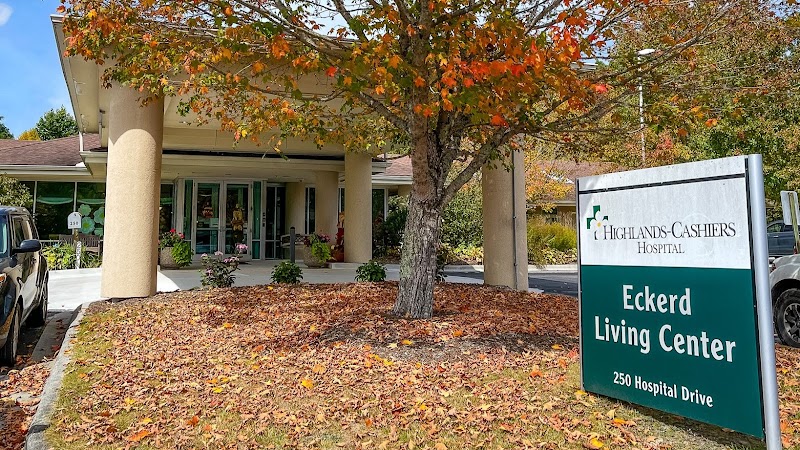
250 Hospital Drive, Highlands, NC 28741 (828) 526-1315
For profit - Corporation 80 Beds HCA HEALTHCARE Data: November 2025
Trust Grade
90/100
#28 of 417 in NC
Last Inspection: February 2025

Within standard 12-15 month inspection cycle. Federal law requires annual inspections.

Overview

Eckerd Living Center in Highlands, North Carolina has received a Trust Grade of A, indicating excellent quality and highly recommended care. It ranks #28 out of 417 facilities in the state, placing it in the top half, and is the best option out of two in Macon County. However, the facility is experiencing a worsening trend, with the number of issues increasing from 1 in 2023 to 2 in 2025. Staffing is a strong point, with a 5/5 star rating and a turnover rate of 33%, which is lower than the state average, indicating that staff stay long-term and are familiar with residents. Notably, there have been no fines reported, and the facility boasts more RN coverage than 96% of North Carolina facilities, which is beneficial for catching potential issues. On the downside, recent inspections revealed several concerns, such as failure to properly sanitize dishware and maintain kitchen cleanliness, which could affect food safety for residents. Additionally, there was a lapse in submitting staffing data to the appropriate authorities, and the dumpster area was found to be unkempt, indicating potential neglect in maintaining hygiene standards. Families should weigh these strengths and weaknesses when considering Eckerd Living Center for their loved ones.

Trust Score
A
90/100
In North Carolina
#28/417
Top 6%
Safety Record
Low Risk
No red flags
Inspections
Getting Worse
1 → 2 violations
Staff Stability
○ Average
33% turnover. Near North Carolina's 48% average. Typical for the industry.
Penalties
✓ Good
No fines on record. Clean compliance history, better than most North Carolina facilities.
Skilled Nurses
✓ Good
Each resident gets 64 minutes of Registered Nurse (RN) attention daily — more than 97% of North Carolina nursing homes. RNs are the most trained staff who catch health problems before they become serious.
Violations
○ Average
6 deficiencies on record. Average for a facility this size. Mostly minor or procedural issues.
★★★★★
5.0
Overall Rating
★★★★★
5.0
Staff Levels
★★★★☆
4.0
Care Quality
★★★★☆
4.0
Inspection Score
Stable
2023: 1 issues
2025: 2 issues

The Good

  • 5-Star Staffing Rating · Excellent nurse staffing levels
  • 4-Star Quality Measures · Strong clinical quality outcomes
  • Full Sprinkler Coverage · Fire safety systems throughout facility
  • No fines on record
  • Staff turnover below average (33%)

    15 points below North Carolina average of 48%

Facility shows strength in staffing levels, quality measures, fire safety.

The Bad

Staff Turnover: 33%

13pts below North Carolina avg (46%)

Typical for the industry

Chain: HCA HEALTHCARE

Part of a multi-facility chain

Ask about local staffing decisions and management

The Ugly 6 deficiencies on record

Feb 2025 2 deficiencies
CONCERN (E)

Potential for Harm - no one hurt, but risky conditions existed

Garbage Disposal (Tag F0814)

Could have caused harm · This affected multiple residents

Based on observation and staff interview the facility failed to contain trash when the dumpster doors were not closed and failed to keep the area around the trash compactor free from accumulated trash...

Read full inspector narrative →
Based on observation and staff interview the facility failed to contain trash when the dumpster doors were not closed and failed to keep the area around the trash compactor free from accumulated trash and debris for 2 of 2 dumpsters observed and 1 of 1 trash compactor observed. The findings included: An observation was completed on 2/17/25 at 11:45am. The observation revealed 2 dumpsters, the first dumpster door was completely open, and the second dumpster door was completely open with cardboard visible in both dumpsters. The area around the trash compactor had a soiled plastic bag, a tarp, and a box on the ground. An interview on 2/17/25 at 12:10 pm with Dietary Staff #2 revealed central supply staff use the dumpsters for cardboard and verified that the doors were left open. Dietary Staff #2 also explained that everyone used the trash compactor, and he was not sure who was responsible for keeping the area clean.
CONCERN (F)

Potential for Harm - no one hurt, but risky conditions existed

Food Safety (Tag F0812)

Could have caused harm · This affected most or all residents

**NOTE- TERMS IN BRACKETS HAVE BEEN EDITED TO PROTECT CONFIDENTIALITY** Based on observations and staff interviews, the facility failed to ensure dishware was air dried prior to stacking for use and f...

Read full inspector narrative →
**NOTE- TERMS IN BRACKETS HAVE BEEN EDITED TO PROTECT CONFIDENTIALITY** Based on observations and staff interviews, the facility failed to ensure dishware was air dried prior to stacking for use and free from dried debris. Additionally, the facility failed to ensure the double oven and stove were free of food and grease debris, the floors were free from built-up dark debris, and the high temperature dish-machine reached the manufacturer's recommended temperatures for dish sanitation. The facility failed to utilize the 3-compartment sink according to manufacturer's recommendations for the amount of time dishware was required to soak in the chemical solution for sanitizing dishware and the facility also failed to remove expired food stored for use, date leftover foods and ensure foods were sealed in 1 of 1 walk-in cooler and 1 of 1 walk-in freezer. These practices had the potential to affect food served to residents. Findings included: a. During the initial tour of the kitchen with Dietary Staff #2 on 2/16/25 at 10:12 AM the following areas of concern were observed. Five plastic food preparation containers located on a shelf ready for use were stacked wet, one of five observed dinner plates contained dried dark debris located on the tray line ready for use, five divided plates and one cold plate lid contained dark yellow debris located on the tray line ready for use, the double oven and stove had dark dried grease and food debris on the cooking surfaces, and the floors had built up dark debris under storage racks, around the edges of the floor and wall and in corners. On 2/16/25 at 10:32 AM an interview was conducted with Dietary Staff #1 that revealed the process for cleaning dishes was to check for cleanliness and return the dishes to the dirty area for reprocessing if found dirty. He reported the process for drying dishware was once dishes were cleaned, they were placed on the drying rack to air dry the dishes. b. An observation of the walk-in cooler on 2/16/25 at 10:38 AM revealed one 3-pound bag of opened broccoli with no date and one block of [NAME] cheese that expired on 2/11/25. An observation of the walk-in freezer on 2/16/25 at 10:42 AM revealed a package of opened fried chicken without a seal or date, seven premade puree country style chicken single serve packages. without dates, eight premade puree country style pork single serve packages without dates, nine premade puree sausage single serve packages without dates, and 22 premade puree macaroni and cheese single serve packages without dates. On 2/16/25 at 11:00AM with Dietary Staff #2 revealed he was not sure when premade puree products expired and that generally they went through the premade puree products quickly. He stated that Monday through Friday he was responsible for the cleanliness of the kitchen and ensuring opened food items were dated. On the weekends, the Sous Chef was responsible for kitchen cleanliness and ensured that open food items were dated. c. During a continued kitchen tour on 2/17/25 at 11:00 AM, the following concerns were identified: 6 plastic plate lids located on the tray line ready for use were stacked wet, the plate warmer had dark crumbly debris, and 3 dinner plates located on the tray line ready for use had dark brown debris and red staining. d. An observation was completed on 2/17/25 at 11:00 AM. Dietary Staff #2 tested the high temperature dish machine at the request of the surveyor and the wash temperature came to 159 degrees Fahrenheit (F) and the rinse cycle came to 141 F. There was a placard observed on the dish machine that indicated the wash temperature was to reach 160 degrees F and the rinse cycle was to reach 180 degrees F. An interview and observation with Dietary Staff #2 was conducted on 2/17/25 at 11:00 AM and revealed dietary staff had been working on repairing the dish machine with facility operations. Dietary staff were utilizing the 3 compartment sink to sanitize dishes or an added sodium hypochlorite chemical in the dish machine during the repair. Observation of the chemical container secured to the wall to the right of the dish machine revealed it was empty. Dietary Staff #2 stated they had gotten the chemical from their supervisor. He explained the chemical container had been empty for a while and were utilizing the 3 compartment sink to sanitize dishware until the chemical could be ordered. Observation of the 3 compartment sink process revealed Dietary Staff #2 allowed the dishes to dwell within the sanitizer for an estimated 5 seconds. Observation of a sign above the 3-compartment sink directed staff to dwell for a minimum of 60 seconds in the sanitizer. Dietary Staff #2 stated no one had ever told him how long the dishes needed to be in the sanitized water. Observation of Dietary Staff #2 revealed the tested parts per million (PPM) of the sanitizer were at 300. According to the manufacturer for the sanitizer, the required PPM range is 200-400. An interview was completed with Facility Operations Staff #1 and Facility Operations Staff #2 on 2/17/25 at 12:21 PM revealed that they were aware that the dish machine was not coming up to the required water temperatures. They replaced the booster heater on 2/13/25 and were not aware that there was a concern with dish machine water temperatures on 2/17/25. Facility Operations Staff #1 stated they also had a regulator on order to correct the water temperature concern with the dish machine. They also stated they were unaware that the kitchen staff had run out of the sanitizing chemicals. An interview with the Administrator on 2/17/25 at 12:27 PM revealed that the Dietary Manager was responsible for kitchen sanitation, however she was out on leave. The Administrator was aware that Facility Operations was working on repairing the dish machine.
Sept 2023 1 deficiency
CONCERN (F)

Potential for Harm - no one hurt, but risky conditions existed

Staffing Data (Tag F0851)

Could have caused harm · This affected most or all residents

Based on record review and staff interview, the facility failed to submit the Payroll Based Journal (PBJ) for the 3rd quarter in the fiscal year (FY) 2023. The findings included: Review of the Centers...

Read full inspector narrative →
Based on record review and staff interview, the facility failed to submit the Payroll Based Journal (PBJ) for the 3rd quarter in the fiscal year (FY) 2023. The findings included: Review of the Centers for Medicare and Medicaid Services (CMS) PBJ Staffing data report Certification and Survey Provider Enhanced Reports (CASPER Report 1705D) dated 9/21/23 revealed no data was submitted for: • April 1 - June 30 (FY Quarter 3 2023) An interview with the Administrator on 9/28/23 at 11:55 AM revealed she was aware that the data had not been submitted. She stated that she was the only staff member submitting this data and currently did not have another staff person to assist with the process. The Administrator explained the cut-off for PBJ data submission was the 15th of the month. The Administrator communicated once she was aware she had not submitted the PBJ data she contacted CMS but was unable to submit the PBJ data after the cut- off date of the 15th.
Mar 2022 3 deficiencies
CONCERN (D)

Potential for Harm - no one hurt, but risky conditions existed

Assessment Accuracy (Tag F0641)

Could have caused harm · This affected 1 resident

**NOTE- TERMS IN BRACKETS HAVE BEEN EDITED TO PROTECT CONFIDENTIALITY** Based on record review and staff interviews the facility failed to accurately code the Minimum Data Set (MDS) for 1 of 2 residen...

Read full inspector narrative →
**NOTE- TERMS IN BRACKETS HAVE BEEN EDITED TO PROTECT CONFIDENTIALITY** Based on record review and staff interviews the facility failed to accurately code the Minimum Data Set (MDS) for 1 of 2 residents (Resident #17) reviewed for hospice services. The findings included: Resident #17 was readmitted to the facility on [DATE] with diagnoses which included Dementia and Cerebrovascular Accident (stroke). Hospice progress notes were reviewed and revealed Resident #17's hospices started on 11/25/2019 and was visited routinely by hospice staff. The Hospice progress notes included notes dated 1/11/2022 and 1/25/2022. Both progress notes indicated Resident #17 was receiving hospice services with weekly visits from the home health aide and nurse. An annual MDS assessment dated [DATE] was reviewed and revealed Resident #17 was severely cognitively impaired and hospice services was coded as being received. A quarterly MDS assessment dated [DATE] was reviewed and revealed Resident #17 was severely cognitively impaired and hospice services was not coded as being received. A care plan dated 10/3/2021 and updated on 12/26/2021, 1/17/2022, 1/23/2022, and 3/28/2022 for Resident #17 showed a focus area for a terminal prognosis related to effects of a cerebral infarction with a goal stating resident's comfort will be maintained through the review date. Interventions included to consult with physician and social worker to have hospice care for resident in the facility and to work cooperatively with hospice team to ensure the resident's spiritual, emotional, intellectual, physical, and social needs are met. During an interview with the MDS coordinator on 3/31/2022 at 10:17 AM, the MDS coordinator indicated Resident #17 was on hospice and had been receiving hospice services for as long as the MDS coordinator had worked there which was a little over 2 years. The MDS coordinator stated it was an oversight that she had not coded hospice services for Resident #17 on the quarterly MDS dated [DATE]. An interview with the Director of Nursing (DON) on 3/31/2022 at 12:18 PM revealed the quarterly MDS assessment dated [DATE] for Resident #17 should have been coded for hospice services.
CONCERN (D)

Potential for Harm - no one hurt, but risky conditions existed

PASARR Coordination (Tag F0644)

Could have caused harm · This affected 1 resident

**NOTE- TERMS IN BRACKETS HAVE BEEN EDITED TO PROTECT CONFIDENTIALITY** Based on record review and staff interviews the facility failed to refer a resident to screen for a Level II Preadmission Screen...

Read full inspector narrative →
**NOTE- TERMS IN BRACKETS HAVE BEEN EDITED TO PROTECT CONFIDENTIALITY** Based on record review and staff interviews the facility failed to refer a resident to screen for a Level II Preadmission Screening and Resident Review (PASARR) after the new mental health diagnoses for 1 of 2 residents (Resident #24) reviewed for Level II PASARR. Findings included: Review of Resident #24's PASARR documentation revealed a Level I screening was completed on 07/31/2015. Resident #24 was readmitted to the facility on [DATE] with diagnoses included anxiety, depression, delusional disorder, and bipolar disorder. Review of the diagnosis list indicated Resident #24 was diagnosed with bipolar disorder on 04/13/21 and delusional disorders since 09/10/2021. Both diagnoses remained active. The annual Minimum Data Set (MDS) dated [DATE] coded Resident #24 with moderate impairment in cognition and required supervision for activities of daily living (ADL). Further review of the MDS revealed Resident #24 had not been referred to the appropriate state-designated authority for Level II PASARR evaluation and determination after she was diagnosed with bipolar disorder and delusional disorder. The comprehensive care plan dated 01/17/2022 indicated Resident #24 had mood problems related to depression. She was at risk for adverse reactions and side effects due to receiving multiple psychotropic medications. The goal was to have improved mood state without signs and symptoms of depression, anxiety, or sadness through the next review date. Interventions included educated Resident #24 and family regarding expectations of treatment and concerns related to potential adverse effects of medications. Monitored, documented, and reported as needed when signs and symptoms of self-harming occurred. The March 2022 Medication Administration Record (MAR) revealed Resident #24 was receiving Depakote (anticonvulsant) Delayed Release 250 milligrams (mg) twice daily related to bipolar disorder, and Seroquel (antipsychotic) 150 mg once daily at bedtime for delusional disorder. During an interview with the MDS Coordinator on 03/29/2022 at 2:17 PM, she stated Resident #24 was diagnosed with bipolar disorder and delusional disorder after she admitted to the facility. She confirmed Resident #24 had not been evaluated for Level II PASARR and explained the error was caused by her oversight. A joint interview with the Director of Nursing (DON) and the Administrator was conducted on 03/29/2022 at 2:28 PM. Both stated whenever a resident's level of care had changed, such as new diagnosis of bipolar disorder, they expected the MDS Coordinator to refer the resident for a Level II PASARR evaluation in a timely manner.
CONCERN (D)

Potential for Harm - no one hurt, but risky conditions existed

Comprehensive Care Plan (Tag F0656)

Could have caused harm · This affected 1 resident

**NOTE- TERMS IN BRACKETS HAVE BEEN EDITED TO PROTECT CONFIDENTIALITY** Based on record review and staff interviews, the facility failed to develop a care plan for a resident with a diagnosis of diabe...

Read full inspector narrative →
**NOTE- TERMS IN BRACKETS HAVE BEEN EDITED TO PROTECT CONFIDENTIALITY** Based on record review and staff interviews, the facility failed to develop a care plan for a resident with a diagnosis of diabetes mellitus for 1 of 5 residents reviewed for diabetes (Resident #192). The findings included: Resident #192 was admitted to the facility on [DATE] with diagnoses which included Type 2 Diabetes Mellitus (DM). A quarterly Minimum Data Set (MDS) dated [DATE] revealed Resident #192 was severely cognitively impaired and had a diagnosis of DM. Care plan review revealed there were no care plans in place for DM. Physician's orders reviewed and revealed the following orders: -Humalog Solution 100 unit/milliliter (mL)- inject as per sliding scale subcutaneously (SQ) before meals and at bedtime for diabetes dated 12/21/2021 -Lantus Solution 100 unit/mL- inject 12 units SQ at bedtime for diabetes dated 12/21/2021 An interview with the MDS coordinator on 3/31/2022 at 10:35 AM revealed there was not a care plan in place for diabetes for Resident #192. The MDS coordinator indicated she was responsible for implementing the diabetes care plan for Resident #192 and it should have been caught during record reviews for the previous MDS assessment on 1/5/2022. An interview with the Director of Nursing (DON) on 3/31/2022 at 12:18 PM revealed Resident #192 should have had a care plan in place for DM.
Understanding Severity Codes (click to expand)
Life-Threatening (Immediate Jeopardy)
J - Isolated K - Pattern L - Widespread
Actual Harm
G - Isolated H - Pattern I - Widespread
Potential for Harm
D - Isolated E - Pattern F - Widespread
No Harm (Minor)
A - Isolated B - Pattern C - Widespread

Questions to Ask on Your Visit

  • "Can I speak with families of current residents?"
  • "What's your RN coverage like on weekends and overnight?"

Our Honest Assessment

Strengths
  • • Grade A (90/100). Above average facility, better than most options in North Carolina.
  • • No major safety red flags. No abuse findings, life-threatening violations, or SFF status.
  • • No fines on record. Clean compliance history, better than most North Carolina facilities.
  • • 33% turnover. Below North Carolina's 48% average. Good staff retention means consistent care.
Concerns
  • • No significant concerns identified. This facility shows no red flags across CMS ratings, staff turnover, or federal penalties.
Bottom line: Generally positive indicators. Standard due diligence and a personal visit recommended.

About This Facility

What is Eckerd Living Center's CMS Rating?

CMS assigns Eckerd Living Center an overall rating of 5 out of 5 stars, which is considered much above average nationally. Within North Carolina, this rating places the facility higher than 99% of the state's 100 nursing homes. This rating reflects solid performance across the metrics CMS uses to evaluate nursing home quality.

How is Eckerd Living Center Staffed?

CMS rates Eckerd Living Center's staffing level at 5 out of 5 stars, which is much above average compared to other nursing homes. Staff turnover is 33%, compared to the North Carolina average of 46%. This relatively stable workforce can support continuity of care.

What Have Inspectors Found at Eckerd Living Center?

State health inspectors documented 6 deficiencies at Eckerd Living Center during 2022 to 2025. These included: 6 with potential for harm.

Who Owns and Operates Eckerd Living Center?

Eckerd Living Center is owned by a for-profit company. For-profit facilities operate as businesses with obligations to shareholders or private owners. The facility is operated by HCA HEALTHCARE, a chain that manages multiple nursing homes. With 80 certified beds and approximately 47 residents (about 59% occupancy), it is a smaller facility located in Highlands, North Carolina.

How Does Eckerd Living Center Compare to Other North Carolina Nursing Homes?

Compared to the 100 nursing homes in North Carolina, Eckerd Living Center's overall rating (5 stars) is above the state average of 2.8, staff turnover (33%) is significantly lower than the state average of 46%, and health inspection rating (4 stars) is above the national benchmark.

What Should Families Ask When Visiting Eckerd Living Center?

Based on this facility's data, families visiting should ask: "Can I visit during a mealtime to observe dining assistance and food quality?" "How do you handle medical emergencies, and what is your hospital transfer rate?" "Can I speak with family members of current residents about their experience?"

Is Eckerd Living Center Safe?

Based on CMS inspection data, Eckerd Living Center has a clean safety record: no substantiated abuse findings (meaning no confirmed cases of resident harm), no Immediate Jeopardy citations (the most serious violation level indicating risk of serious injury or death), and is not on the Special Focus Facility watch list (a federal program monitoring the lowest-performing 1% of nursing homes). The facility has a 5-star overall rating and ranks #1 of 100 nursing homes in North Carolina. While no facility is perfect, families should still ask about staff-to-resident ratios and recent inspection results during their visit.

Do Nurses at Eckerd Living Center Stick Around?

Eckerd Living Center has a staff turnover rate of 33%, which is about average for North Carolina nursing homes (state average: 46%). Moderate turnover is common in nursing homes, but families should still ask about staff tenure and how the facility maintains care continuity when employees leave.

Was Eckerd Living Center Ever Fined?

Eckerd Living Center has no federal fines on record. CMS issues fines when nursing homes fail to meet care standards or don't correct problems found during inspections. The absence of fines suggests the facility has either maintained compliance or corrected any issues before penalties were assessed. This is a positive indicator, though families should still review recent inspection reports for the full picture.

Is Eckerd Living Center on Any Federal Watch List?

Eckerd Living Center is not on any federal watch list. The most significant is the Special Focus Facility (SFF) program, which identifies the bottom 1% of nursing homes nationally based on persistent, serious quality problems. Not being on this list means the facility has avoided the pattern of deficiencies that triggers enhanced federal oversight. This is a positive indicator, though families should still review the facility's inspection history directly.