CRITICAL
(J)
📢 Someone Reported This
A family member, employee, or ombudsman was alarmed enough to file a formal complaint
Immediate Jeopardy (IJ) - the most serious Medicare violation
Free from Abuse/Neglect
(Tag F0600)
Someone could have died · This affected 1 resident
**NOTE- TERMS IN BRACKETS HAVE BEEN EDITED TO PROTECT CONFIDENTIALITY** Based on record review, observation, the facility's surveillance video, and interviews with staff and law enforcement, the facil...
Read full inspector narrative →
**NOTE- TERMS IN BRACKETS HAVE BEEN EDITED TO PROTECT CONFIDENTIALITY** Based on record review, observation, the facility's surveillance video, and interviews with staff and law enforcement, the facility failed to protect a cognitively impaired female resident's (Resident #1) right to be free from sexual abuse by a male visitor. On 03/28/24, the Visitor was at the facility visiting his family member (Resident #2) in a common area of the facility when he left that area and went to her (Resident #2's) semi-private room on the secured dementia unit where she resided with Resident #1. Resident #1 was in her bed when the Visitor was observed by Nursing Assistant (NA) #1 as he leaned over Resident #1 with his back to the door. NA #1 asked what he was doing and the Visitor turned around and adjusted the waist of his pants. The Visitor admitted to law enforcement that he took his hand and placed it on Resident #1's vagina. Resident #1 was incapable of giving consent for the Visitor to touch her. Resident #1 indicated the Visitor hurt me and that she was scared he was going to come back. This deficient practice was for 1 of 3 residents reviewed for abuse.
The findings included:
Resident #1 was admitted to the facility on [DATE] with diagnoses which included, in part, dementia with other behavioral disturbance, anxiety and depression.
A review of Resident #1's care plan revealed a focus, revised on 08/28/23, that she had inappropriate behaviors such as agitation, altercations with roommate, refusing showers, and taking her roommate's belongings. There was no care plan in place related to sexual behaviors.
A review of Resident #1's Minimum Data Set (MDS), dated [DATE], revealed that Resident #1 was moderately cognitively impaired and had no physical, verbal, or other behavioral symptoms and no rejection of care or wandering behaviors at the time of the assessment. The MDS indicated Resident #1 had no impairment in her upper and lower extremities. The assessment indicated the resident had been dependent on staff for assistance with dressing her lower body and toileting and that she had required substantial/maximal assistance with dressing her upper body, personal hygiene and bathing.
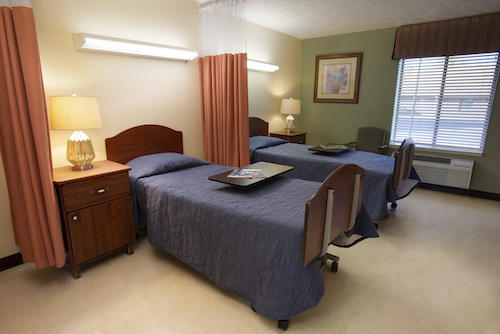
An observation of Resident #1's room was conducted on 04/03/24 at 11:55 a.m. She resided on the secured unit with a roommate, Resident #2. Resident #1's bed was the A bed, closest to the door.
Review of the facility's Initial Allegation Report, completed by Nurse #1 on 03/28/24, revealed an allegation of resident abuse on 03/28/24. The facility became aware of this allegation on 03/28/24 at 9:50 a.m. The allegation stated that NA #1 observed the Visitor (Resident #1's roommate's male family member) standing over her bed and as he turned around, he was observed tucking his penis back into his pants. The report indicated that the facility reported this incident to law enforcement on 03/28/24 at 10:00 a.m. and to the State agency on 03/28/24.
A review of Resident #1's 03/28/24 Progress Notes revealed a note written by Nurse #1 at 9:50 a.m. which indicated she was called to the resident's room by NA #1 who reported she observed the Visitor standing over Resident #1 with his hand in his pants and when he turned around his penis outside of his pants. Nurse #1 wrote she moved the Visitor away from the resident and made the Administrator of the facility aware of the incident.
A review of NA #1's written statement, dated 03/28/24, read as follows: I noticed [the Visitor] walk by and enter the resident's room (in which his [family member] shares a room with). So I followed him when he went back to the room where the incident occurred. He was standing over the resident and I asked what are you doing sir, he replied I'm fixing her back in the bed. He was putting his penis back in his pants and I immediately called for the nurse and ask him to leave the room and I checked on the resident to see if she was ok and she stated she wasn't.
An interview was conducted with the Director of Nursing (DON) on 04/04/24 at 3:37 p.m. The DON explained she had not been at work on the day of the incident (3/28/24) however she had been informed of it via a telephone call from the facility on 3/28/24. The DON further explained she had returned to work on 03/29/24 and during her review of the incident and of the different written statements by staff, she questioned a discrepancy she noticed regarding whether or not NA #1 had witnessed the Visitor's penis. She reported a discussion was held with NA #1 and explained the nursing assistant had made an assumption when she saw the Visitor adjusting the waist of his pants as he turned to face her. The DON acknowledged she and the Administrator asked NA #1 to write an addendum to her original written statement which clarified what she had actually witnessed.
A review of an undated addendum NA #1 had written to her original statement read as follows: I was going to assist a resident with a.m. care. Before I went in the room to assist a resident, I went in to [Resident #1] room to check on her to see if she was awake and upon me entering the room I witnessed [the Visitor] standing over her with his hands on her body. His hands was on her arm and thigh. I asked him what was he doing and as he turned towards me he was adjusting his pants (I did not see his penis out of his pants) and he stated he was helping her back on the bed. I asked him to leave the room and I yelled for the nurse to come. When the nurse escorted him out of the room, I checked on [Resident #1] and asked her if she was ok and she stated no I'm not ok. I observed her and noticed her brief the crotch part was moved to the side and I asked her if she was ok and she said no. I remained in with her until the nurse came back to the room to check on [Resident #1].
An interview was conducted with NA #1 on 04/03/24 at 12:43 p.m. NA #1 confirmed she had been assigned to care for Resident #1 on 03/28/24 from 7:00 a.m. until 3:00 p.m. NA #1 stated around 9:15 a.m. on 03/28/24 she had been doing her morning rounds on the dementia unit and had been ready to provide care to a resident who resided in the room across from Resident #1. She indicated because Resident #1 had been assessed as a fall risk, she had decided to pop her head into her room to quickly check on her before beginning care with the other resident. NA #1 explained she peeked into Resident #1's room and noticed the Visitor (family member of her roommate, Resident #2) standing over Resident #1's bed. NA #1 explained the Visitor had been standing beside the bed on the resident's right side, towards the middle of the bed. She further explained Resident #1 was lying on her back and he was leaning towards her with his left hand on her right upper arm and his right hand was on her right thigh. She stated the bed covers were pulled up to the resident's waist and that she had been wearing a hospital gown and an adult pull-up brief at the time of the incident. She clarified that the resident's brief was not exposed at the time of that observation. NA #1 described how she had asked the Visitor what he was doing and stated he stood up straight and turned towards her. As he was turning towards her, she said she noticed him adjusting his pants. When asked to explain, she stated he had been wearing a pair of jeans however could not recall if the buttons or zipper to his jeans were undone, or if he had been wearing a belt. She stated the Visitor then told her he was helping Resident #1 back on her bed. NA #1 denied seeing the man's penis. NA #1 said the Visitor started walking towards the doorway as if to leave the room and she immediately yelled for Nurse #1 to come to the room while the Visitor stood in the hallway outside the room. NA #1 stated as Nurse #1 approached the two of them (NA #1 and the Visitor) in the hallway, she told the nurse what she had witnessed, and then Nurse #1 asked the Visitor to go back to the dayroom where he had been visiting his family member (Resident #2) and escorted him to that area of the unit. NA #1 explained that she sat with Resident #1 until the Administrator and Nurse #2 got to her room. NA #1 indicated she had asked Resident #1 if she was okay and the resident said no. She stated she then pulled back the bed linens and saw that the leg opening part of her adult pull-up brief appeared to have been pulled away from her groin area which exposed her pubic hair and nothing else.
A second interview, via telephone, was conducted with NA #1 on 04/04/24 at 8:25 a.m. to discuss the reason she had written an addendum to her original written statement. In that addendum, NA #1 clarified she had not seen the Visitor's penis. NA #1 explained after she had discussed the incident at length with the Administrator and DON, she had been asked to write an addendum which clarified that she did not see the Visitor tucking his penis back in his pants. NA #1 further explained that because she had seen the Visitor adjusting the waist of his pants as he turned to respond to her question, she had assumed that he was tucking his penis back into his pants. NA #1 indicated both the Administrator and DON had expressed to her they wanted the reports to the State to be accurate.
A review of Nurse #1's written statement, dated 03/28/24, read as follows: [The Visitor] was visiting his [family member (Resident #2)] in the private dining room. This writer observed [the Visitor] going back and forth to [Resident #2's room number] with tissue in his hand on two occasions. The second time the CNA [certified nursing assistant] went to the room and called this writer to the room. I met [the Visitor] in the hallway. He stated he was 'getting tissue.' There was a box of tissue at the table with his [family member (Resident #2)].
An interview was conducted with Nurse #1 on 04/03/24 at 11:54 a.m. Nurse #1 confirmed she had been assigned to care for Resident #1 on 03/28/24 from 7:00 a.m. until 7:00 p.m. Nurse #1 explained she had been made aware of an incident involving Resident #1 at approximately 9:50 a.m. when NA #1 had called her name and motioned for her to come towards Resident #1's room. She noted that NA #1 was outside of Resident #1's room and the Visitor stood in an area between the 600 and 700 Hall. Nurse #1 explained she asked NA #1 what happened and said NA #1 told her that the Visitor had been in the room with Resident #1 alone. Nurse #1 stated she then asked the Visitor what he had been doing in there and stated he told her that he had gone into the room to get some tissue. Nurse #1 stated NA #1 then told her that the Visitor had been standing over Resident #1 while she was in her bed with his hand in Resident #1's adult brief and when he turned towards her, he put his penis back into his pants. Nurse #1 indicated she escorted the Visitor to the dayroom where he had been visiting with his family member (Resident #2) and stated she instructed him to stay there, which he agreed to do. Nurse #1 stated she had instructed the activities aide to go sit with Resident #1 and she left the secured dementia unit to get Nurse #2 and the Administrator who were in a meeting in the conference room. She expressed to them (the Administrator and Nurse #2) that she needed help and told them what had been reported to her by NA #1. Nurse #1 indicated both Nurse #2 and the Administrator then went to the dementia unit and she had been given instructions to begin the paperwork for an investigation as well as to call the police. Nurse #1 stated Resident #1 was sent to the hospital for evaluation. Nurse #1 acknowledged the police and Emergency Medical Services (EMS) got to the facility around the same time and both agencies looked over the resident before EMS took the resident to the hospital. She also stated the police officer took pictures of Resident #1's room and collected her bed linens. Nurse #1 said she then contacted Resident #1's medical doctor (MD) to inform them of the incident and reported no new orders were given at that time. Nurse #1 explained that the resident was normally anxious and took scheduled antianxiety medication but she (Nurse #1) worried the resident would experience increased anxiety later so she contacted the MD to see if she could get something else for Resident #1's anxiety if needed. Nurse #1 stated Resident #1 appeared a little anxious prior to going to the hospital. When asked about the Visitor, Nurse #1 stated he had visited his family member (Resident #2) on many occasions and had never displayed any inappropriate behavior during those visits.
A second interview was conducted with Nurse #1 on 04/04/24 at 2:40 p.m. Nurse #1 stated Resident #1 was alert but confused and would often think staff or other residents on the dementia unit were arguing with her or would think the people on the television were arguing with her. Nurse #1 confirmed that Resident #1 would tell staff that this man or that man was her brother or her husband and quite frequently thought she was pregnant, however, never made sexualized remarks to people. Nurse #1 explained on the day of the incident, the Visitor had done nothing to cause suspicion during his visit with his family member.
A third interview was conducted, via telephone, with Nurse #1 on 04/16/24 at 10:51 a.m. Nurse #1 stated when she escorted the Visitor down the hall and back to the dayroom, she instructed him to wait there and explained she had given instructions to the Life Enrichment Assistant to supervise the Visitor there until she returned. Nurse #1 stated the only other resident who was in the dayroom with Visitor was his family member (Resident #2). Nurse #1 explained approximately 5 minutes had elapsed from the time she left the unit until the time she returned to the unit along with Nurse #2 and the Administrator.
A review of Nurse #2's written statement, dated 03/28/24, read as follows: After alleged allegations writer interviewed resident. Writer asked resident was she ok. Resident stated 'I'm scared. He's going to come back.' Writer asked who will come back and what did he do? Resident states 'he hurt me.' Writer states how and where did he hurt you. Resident places hands on genitalia and states 'right here.' Writer asked what did he do right there. Resident states 'he was doing something with his fingers and it hurts on the inside.' Writer then left resident's bedroom and informed administrator.
Nurse #2 had written an addendum to her statement, dated 03/29/24. It read as follows: Prior to interviewing resident writer observed resident in bed gripping shirt and shaking. Brief was exposed and blanket was observed positioned below hip line. Writer later identified CNA [NA #1] pulled covers back.
An interview was conducted with Nurse #2 on 04/04/24 at 11:05 a.m. Nurse #2 confirmed she worked on 03/28/24 as the wound care nurse during day shift hours. Nurse #2 stated she had been made aware of the incident involving Resident #1 when Nurse #1 came to the conference room and told her that she needed to speak with her. She stated she and Nurse #1 went to the Staff Development Coordinator's office where Nurse #1 shared the details of the incident and then she returned to the conference room and shared those details with the Administrator. Nurse #2 explained she and the Administrator immediately went to the dementia unit and stated she had been given instructions by the Administrator to interview Resident #1 while he went to talk with the Visitor. Upon entering Resident #1's room, Nurse #2 stated the resident appeared nervous and afraid and was noted to be trembling. The resident was gripping onto her gown and she was shaking. She noted the bed linens were pulled over Resident #1's legs to her waist and she was gripping her gown. Nurse #2 said she walked over to the resident's bed and asked her what was wrong and stated Resident #1 said, I'm scared to which she asked her what she was scared of. Nurse #2 stated the resident said, that man hurt me and then she asked the resident where he had hurt her and said the resident took her hands and patted the area at the top of her adult pull-up brief and said, right here. Nurse #2 asked the resident to elaborate and stated the resident said he had done something with his fingers, and it hurt on the inside. Nurse #2 acknowledged she assessed Resident #1 and pulled her bed linens back exposing her brief; however, Nurse #2 could not recall if the brief had been shifted to expose any of her private parts. Nurse #2 then described she pulled Resident #1's brief down and checked it but did not see any blood in it and did not see any signs of trauma to her external private parts.
A review of the Administrator's written statement, dated 03/28/24, read as follows: Writer approached [the Visitor] at approximately 11AM while he was sitting in activities room with [his family member]. Writer informed [the Visitor] that he needed to leave the facility due to a report of inappropriate behavior. [The Visitor] collected his belongings and left the memory care unit with writer. As writer was escorting [the Visitor] to the front entrance, he told writer that he [the Visitor] messed up, because when he went into his [family member's] room to get something, the lady in the room with her [Resident #1] called him over to her bed and stated that she wanted him to 'f**k' her. He said he [the Visitor] only touched her leg and then the lady [NA #1] came to the room. Writer informed [the Visitor] that the police were being called and that he needed to wait in the social worker's office. [The Visitor] complied and was supervised by [Nurse #2] until police arrived.
A review of the law enforcement report, completed on 03/28/24, revealed the incident had occurred on 03/28/24 and had been reported to them by the facility on 03/28/24 at 10:01 a.m. The report indicated the Visitor committed a forcible sexual offense by touching a disabled individual's private part (Resident #1).
An interview was conducted with the local police department's lead detective on this case on 04/03/24 at 12:58 p.m. The Detective explained once she arrived at the facility, she had been briefed by the officers who had initially reported to the facility. She stated she did not speak with Resident #1 but had watched the responding officer's body camera footage and stated Resident #1 admitted to the officer that a man had touched her private parts. The Detective stated she had spoken with the accused individual (the Visitor), read him his rights, and then asked him to go to the police department so that she could conduct an interview with him privately. The Detective indicated the accused individual drove himself voluntarily to the police department as one of the police officers followed behind him. Before leaving the facility, the Detective spoke with Nurse #2 and the facility's Administrator and stated the Administrator informed her of his conversation with Nurse #1. The Detective acknowledged it had been suggested NA #1 had witnessed the accused individual tucking his penis back into his pants, however, she had been informed on 04/02/24 by the Administrator that the accused individual's penis had never been exposed. After speaking with the Administrator, the Detective then spoke with Nurse #2 who reported that the accused individual had told her that he had not had sex in a long time and that Resident #1 said to him, I want you to f**k me. The Detective stated Nurse #2 continued detailing her conversation with him and stated the accused individual had told her that he approached Resident #1 who had been in her bed and he had touched her in her private parts. The Detective stated Nurse #2 then told her that she had asked the accused individual if anything else had happened or did he touch himself and said Nurse #2 said he told her that he may or may not have touched himself on the outside of his pants, that he could not remember. The Detective stated the Administrator informed her that as he was walking the accused individual from the dementia unit to another office, the Visitor had apologized to him (the Administrator) and told him that he was embarrassed. The Detective stated she then left the facility to go interview the accused individual at the police department while another detective remained at the facility to gather evidence. When asked if the Detective considered the Visitor to be alert and oriented, she confirmed she had asked him questions such as the day, date and year and remarked he was correct on all accounts with the exception of getting the date wrong by one day. She also reported that he (the Visitor) was still able to drive a vehicle and had been able to describe his usual activities when he visited his family member at the facility. She stated he reported having a medical condition related to his blood pressure which required him to take medication. During the interview at the police department, the Detective explained the Visitor confessed to her and explained that he told her he had been thinking it had been so long since he had sex and that he had been attracted by the offer made by Resident #1. The Detective continued, stating the Visitor told her that he had approached Resident #1's bed and Resident #1 had been the one who pulled her bed linens down and pulled her underwear to the side exposing her vagina to him. The Detective stated the Visitor then said he took his hand and placed it on her (Resident #1's) vagina. The Detective then said she asked him if he had inserted a finger into her vagina and stated he told her (the Detective) that everything had happened so fast that he could not remember. The Detective stated she asked the Visitor to provide a DNA (a molecule that contains the genetic code that is unique to every individual) sample and he had done so voluntarily after which he was placed under arrest and charged with felony second-degree forceful sexual offense. When asked to explain the charges, the Detective explained that because Resident #1 was considered disabled and mentally incapable of giving consent, this offense could be anything but penetration. The Detective further explained the Visitor was processed in the county jail and there he remained on a high bond. She also stated that the Visitor was told that he can no longer go to the facility or have any contact with Resident #1.
An interview was conducted with the Life Enrichment Assistant from the Activities Department on 04/04/24 at 1:16 p.m. The Life Enrichment Assistant confirmed she had been working on 03/28/24 during the day shift and at the time of the incident with the Visitor and Resident #1, she had been doing activities with the residents on the secured dementia unit in the activities/dining room area. The Life Enrichment Assistant stated she often interacted with Resident #1 during activities and explained she was familiar with Resident #1's usual moods and behaviors. The Life Enrichment Assistant further explained that she had been asked by the Administrator to sit with Resident #1 as they waited for EMS to arrive. The Life Enrichment Assistant stated while she sat with Resident #1, the resident appeared to be acting a little stressed or scared at that time. Because she had worked with her before, the Life Enrichment Assistant stated she knew that Resident #1 had those types of behaviors occasionally but was unsure of what had caused the resident to act that way on that date. During her interaction with Resident #1, the Life Enrichment Assistant said she asked her how she was doing and said the resident replied, I could be better to which she responded why, what's wrong? The Life Enrichment Assistant detailed how the resident then moved her hand to her perineal area (the area between a person's anus and vulva) and told her that the man (the Visitor) had touched her vagina.
A second interview was conducted, via telephone, with the Life Enrichment Assistant on 04/16/24 at 10:10 a.m. The Life Enrichment Assistant stated upon entering the secured dementia unit to begin an activity with the residents, she observed NA #1 in the hall motioning for Nurse #1 to come to Resident #1's room. She stated she then observed Nurse #1 escorting the Visitor to the dayroom and heard her tell him to stay there. The Life Enrichment Assistant explained Nurse #1 did not give her any details of what had just occurred in Resident #1's room but asked her to supervise the Visitor in the dayroom while she went off the unit to talk with Nurse #2 and the Administrator. The Life Enrichment Assistant stated only the Visitor and the Visitor's family member (Resident #2) were in the dayroom during that time. She stated prior to the Administrator escorting the Visitor off the secured dementia unit, he instructed her to go to Resident #1's room and sit with her until EMS arrived.
A review of Resident #1's emergency room visit notes on 03/28/24 at a local hospital revealed the following:
-- Medical history and physical exam were completed by a Registered Nurse. Findings included vital signs within normal limits. An emotional assessment was documented as quiet and cooperative. A systems examination revealed no abnormalities. There were no signs of physical trauma noted on the anatomical drawing of the female body. A pelvic exam revealed no abnormalities.
-- She was assessed by a medical doctor and his assessment read as follows: Chief Complaint: Sexual Assault. History of Presenting Illness: .female with a [past medical history] significant for dementia who presents to the ED [Emergency Department] via EMS for evaluation of an alleged sexual assault. Per EMS, patient comes from [name of skilled nursing home] and staff there reported her roommate's [Resident #2] [family member] confirmed that he [the Visitor] 'touched her inappropriately' this morning. Staff notes that he was in the room for quite a while and when he came out he was 'adjusting his pants.' Patient states that 'he started at my head and worked his way down' noting that he touched her head, her breasts and her vaginal area. He denied [the Visitor] any penetration on scene . Patient claims that he [the Visitor] did penetrate her. Patient reports that she did not give consent. Denies any injuries or pain, but history is severely limited secondary to her dementia . Physical Exam . general - she is not in acute distress . psychiatric .mood normal .behavior normal . Clinical Impressions - sexual assault of adult, initial encounter, prophylactic antibiotic, severe dementia without behavioral disturbance, psychotic disturbance, mood disturbance or anxiety .
-- The record indicated Resident #1 was discharged back to the facility on 3/28/24.
During an interview conducted with Nurse #1 on 04/03/24 at 11:54 a.m., she stated after Resident #1 returned from the hospital (on 3/28/24 at approximately 4:00 p.m.), she and Nurse #2 completed a head-to-toe assessment on her which revealed no areas of trauma or bruising. Nurse #1 stated after Resident #1 returned from the hospital, she had been at her usual baseline mood and affect with no recollection of having gone to the hospital that day. Nurse #1 indicated Resident #1 returned from the hospital around 4:00 p.m. that afternoon.
A review of Resident #1's Head to Toe Evaluation, completed by Director of Nursing (DON) and dated 03/29/24 at 5:12 p.m., revealed Resident #1 had a normal exam with no complaints of pain and displayed no significant behavioral changes within the last 24 hours.
During an interview with the Director of Nursing (DON) on 04/04/24 at 3:37 p.m. she stated she had assessed Resident #1 on 03/29/24, just after lunch that day, and that there had been no signs or symptoms of trauma or distress. The DON remarked that Resident #1 seemed to be at her baseline regarding her behaviors, mood and affect; she also confirmed that the resident often thought she was pregnant or in labor. The DON confirmed Resident #1 was not seen by the facility's medical doctor after the incident of 03/28/24 but stated after the incident, the resident had been scheduled to see the facility's psych provider on 04/04/23.
During an interview with Nurse #2 on 04/04/24 at 11:05 a.m. she described Resident #1's emotional state after her return from the local hospital. Nurse #2 stated Resident #1 appeared to be at her baseline in regard to mood and affect. She said she had asked the resident how she was doing and said that the resident told her she had been at the hospital having a baby which was a common theme when talking with the resident. Nurse #2 stated Resident #1 was taken to her room and a full assessment had been completed which revealed no signs of trauma including vaginal discharge or blood nor any bruising, redness, or trauma to that area. Nurse #2 stated she and the DON repeated this exam again on 03/29/24 with no signs or symptoms of any trauma.
A review of the facility's surveillance video was conducted with the Administrator in attendance on 04/03/24 at 3:00 p.m. As the Administrator pulled up the surveillance video footage from their secured dementia unit on 03/28/24, he explained the times noted on the surveillance cameras were not 100% accurate but further explained the footage would show the length of time the Visitor was in Resident #1's room. According to the time stamps of the footage, the Visitor was observed approaching Resident #1's room at 9:16 a.m. and then entered her room at 9:16:16 a.m. The door to the room was never closed. NA #1 was observed walking down the hall towards Resident #1's room and then standing at the opening of the door and looking inside at 9:17:37 a.m. NA #1 then motioned to someone to come to the room. The Visitor was observed leaving the room at 9:17:56 a.m. which indicated he was in the room alone with Resident #1 for one minute and forty seconds.
Attempts made to contact Resident #1's Responsible Party by phone on 04/04/24 were unsuccessful.
An interview was conducted with the Administrator on 04/05/24 at 12:00 p.m. The Administrator detailed the 03/28/24 incident involving Resident #1 and the Visitor. He explained Nurse #1 had come to the conference room on 03/28/24 around 10:00 a.m. where he had been involved in their usual morning meeting and had asked to speak with Nurse #2 outside of the conference room. The Administrator explained both nurses (Nurse #1 and Nurse #2) returned to the conference room and informed him of what had just occurred on their secured dementia unit with Resident #1 and the Visitor and that he immediately went to that area. After locating the Visitor in the dayroom sitting with his family member and giving instructions to the staff about what needed to occur, he stated he escorted the Visitor off the dementia unit to the Social Worker's office where Nurse #2 supervised him while he waited for law enforcement to arrive to the facility. The Administrator stated he immediately began an investigation. The Administrator stated as he had been walking the Visitor to the Social Worker's office, the Visitor told him, I'm so sorry I got wrapped up in that, I went to get something for [Resident #2] but that lady [Resident #1] said come here, I want you to f**k me but all I did was touch her leg and then that lady [NA #1] came in. The Administrator, when asked, stated the Visitor had never displayed any inappropriate behaviors and did not know why the Visitor had done what had been reported to him. The Administrator said there had been no way he could have predicted what the Visitor did and felt he and the staff had followed their protocols after the incident by immediately securing the Resident #1's safety by removing the Visitor away from Resident #1 and beginning their investigation of the incident. The Administrator explained all staff from the different departments at the facility had been educated on their abuse policy and that they implemented a new policy which identified individuals that may be placed on a restricted visitation. The Administrator further explained the new policy included a notebook that contained a picture of the individual who had been placed on a restricted visitation and a log of the times the individual visited their facility and explained these individuals would only be allowed to visit the facility Monday through Friday, in the lobby, and the visitation would be supervised by a staff