



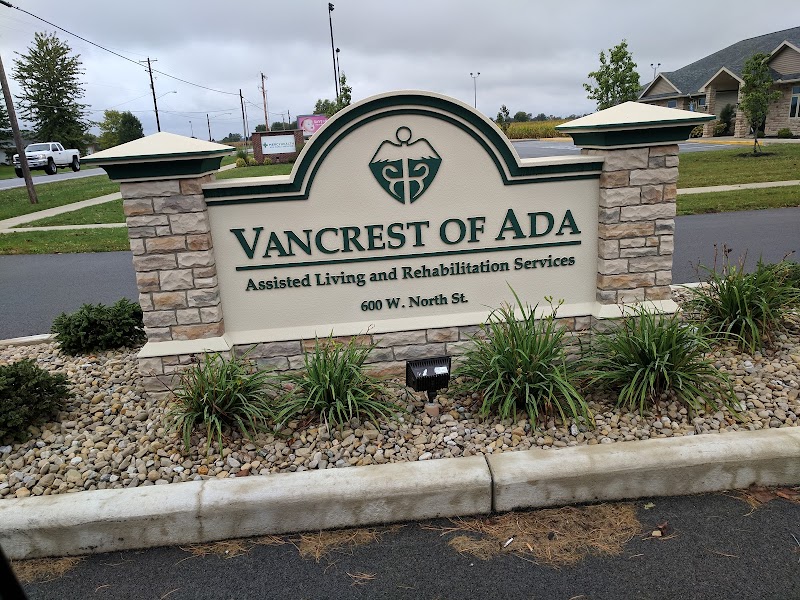
VANCREST OF ADA

600 WEST NORTH AVENUE, ADA, OH 45810 (419) 238-0715
For profit - Limited Liability company 60 Beds VANCREST HEALTH CARE CENTERS Data: November 2025
Trust Grade
65/100
#567 of 913 in OH
Last Inspection: February 2025

Within standard 12-15 month inspection cycle. Federal law requires annual inspections.

Overview

Vancrest of Ada has a Trust Grade of C+, indicating it is slightly above average but still has room for improvement. In terms of state ranking, it sits at #567 out of 913 facilities in Ohio, placing it in the bottom half, but it is the top facility in Hardin County, where there are only two options. Unfortunately, the facility is experiencing a worsening trend, with the number of issues rising significantly from 1 in 2024 to 13 in 2025. Staffing is a relative strength, with a turnover rate of 35%, which is below the state average, but the facility had days without registered nurse coverage, raising concerns about adequate medical supervision. Specific incidents include a failure to maintain a sanitary kitchen environment, which poses a risk to residents, and issues with timely completion of admission assessments, indicating potential gaps in care coordination. Overall, while Vancrest of Ada has some positive aspects, families should weigh these concerns carefully.

Trust Score
C+
65/100
In Ohio
#567/913
Bottom 38%
Safety Record
Low Risk
No red flags
Inspections
Getting Worse
1 → 13 violations
Staff Stability
○ Average
35% turnover. Near Ohio's 48% average. Typical for the industry.
Penalties
✓ Good
No fines on record. Clean compliance history, better than most Ohio facilities.
Skilled Nurses
○ Average
Each resident gets 31 minutes of Registered Nurse (RN) attention daily — about average for Ohio. RNs are the most trained staff who monitor for health changes.
Violations
⚠ Watch
19 deficiencies on record. Higher than average. Multiple issues found across inspections.
★★★☆☆
3.0
Overall Rating
★★★☆☆
3.0
Staff Levels
★★★★☆
4.0
Care Quality
★★★☆☆
3.0
Inspection Score
Stable
2024: 1 issues
2025: 13 issues

The Good

  • 4-Star Quality Measures · Strong clinical quality outcomes
  • Full Sprinkler Coverage · Fire safety systems throughout facility
  • No fines on record
  • Staff turnover below average (35%)

    13 points below Ohio average of 48%

Facility shows strength in quality measures, fire safety.

The Bad

3-Star Overall Rating

Near Ohio average (3.2)

Meets federal standards, typical of most facilities

Staff Turnover: 35%

11pts below Ohio avg (46%)

Typical for the industry

Chain: VANCREST HEALTH CARE CENTERS

Part of a multi-facility chain

Ask about local staffing decisions and management

The Ugly 19 deficiencies on record

Feb 2025 13 deficiencies
CONCERN (D)

Potential for Harm - no one hurt, but risky conditions existed

Deficiency F0582 (Tag F0582)

Could have caused harm · This affected 1 resident

Based on medical record review, review of Medicare beneficiary notice letters, and staff interview, the facility failed to issue Skilled Nursing Facility Advance Beneficiary Notices (SNFABN) to reside...

Read full inspector narrative →
Based on medical record review, review of Medicare beneficiary notice letters, and staff interview, the facility failed to issue Skilled Nursing Facility Advance Beneficiary Notices (SNFABN) to residents. This affected two residents (#24 and #104) of three residents reviewed for Medicare beneficiary notice letters. The census was 51. Findings include: 1. Review of Resident #24's medical record revealed an admission date of 06/18/24. Diagnoses listed included hemiplegia, type two diabetes mellitus, hypertension, and major depressive disorder. Review of a Notice of Medicare Non-Coverage (NOMNC) dated 10/07/24 revealed Medicare part A services would end on 10/11/24. Further review of Resident #24's medical record revealed he remains in the facility. There was no documentation of a SNFABN being issued to Resident #24 on 10/11/24. 2. Review of Resident #104's closed medical record revealed an admission date of 11/22/24. Diagnoses listed included atrial fibrillation, type two diabetes mellitus, and muscle weakness. Review of a NOMNC dated 12/16/24 revealed Medicare part A services would end on 12/20/24. Further review of Resident #104's closed medical record revealed she remained in the facility after 12/20/24. There was no documentation of a SNFABN being issued to Resident #104. Resident #104 was discharged from the facility on 01/07/25. During an interview on 02/05/25 at 1:40 P.M. the Administrator confirmed Residents #24 and #104 were not issued SNFABN. The Administrator confirmed both Residents #24 and #104 remained in the facility after Medicare part A services were discontinued and they had not exhausted Medicare part A benefits.
CONCERN (D)

Potential for Harm - no one hurt, but risky conditions existed

Deficiency F0655 (Tag F0655)

Could have caused harm · This affected 1 resident

**NOTE- TERMS IN BRACKETS HAVE BEEN EDITED TO PROTECT CONFIDENTIALITY** Based on medical record review and staff interview, the facility failed to develop and implement a baseline care plan within 48 ...

Read full inspector narrative →
**NOTE- TERMS IN BRACKETS HAVE BEEN EDITED TO PROTECT CONFIDENTIALITY** Based on medical record review and staff interview, the facility failed to develop and implement a baseline care plan within 48 hours of admission that included minimum healthcare information necessary to properly care for the immediate needs for one resident (#259) of one resident reviewed for baseline care plans. The facility census was 51. Findings include: Review of medical record of Resident #259 revealed an admission date of 01/25/25. Diagnoses included chronic systolic heart failure. Review of the 5-day Minimum Data Set (MDS) assessment dated [DATE] revealed Resident #259 was cognitively intact. Review of care plan initiated on 01/13/25 revealed the treatment of Tubigrips (compression stockings) and ace wraps was not added to the care plan Review of physician order dated 01/31/25 revealed to apply Tubigrips size G then wrap over the top with ace wraps every A.M. off P.M. Observation on 02/03/25 at 11:02 A.M. and second observation on 02/04/25 at 1:02 P.M. revealed Resident #259 sitting in recliner in resident's room. Tubigrips (compression stockings) in place bilateral without ace wraps. Ace wraps were on the counter in the resident's bathroom. Interview on 02/03/25 at 11:02 A.M. revealed Resident #259 stated he was told by staff he no longer needed ace wraps on his legs. Interview on 02/04/25 at 1:15 P.M. with Licensed Practical Nurse (LPN) #173 verified Resident #259 did not have ace wraps on bilateral and an order was in place. Interview on 01/13/25 at 1:00 P.M. with Assistant Director of Nursing (ADON) #219 revealed the care plan did not address the treatment of tubigrips and ace wraps in the care plan.
CONCERN (D)

Potential for Harm - no one hurt, but risky conditions existed

Deficiency F0657 (Tag F0657)

Could have caused harm · This affected 1 resident

**NOTE- TERMS IN BRACKETS HAVE BEEN EDITED TO PROTECT CONFIDENTIALITY** Based on observation, record review, and interview, the facility failed to implement a comprehensive care plan to include all as...

Read full inspector narrative →
**NOTE- TERMS IN BRACKETS HAVE BEEN EDITED TO PROTECT CONFIDENTIALITY** Based on observation, record review, and interview, the facility failed to implement a comprehensive care plan to include all aspects of patient care. This affected one (Resident #1) of 16 residents reviewed for comprehensive care plans. The facility census was 51. Findings include: Review of medical record for Resident #1 revealed an admission date of 08/11/23 with diagnoses including but not limited to hemiplegia/hemiparesis following cerebral infarction affecting right dominant side, rheumatoid arthritis, age-related osteoporosis, muscle weakness, and cerebral infarction. Review of the Minimum Data Set (MDS) assessment dated [DATE] revealed the resident had impairment on both sides for upper body movement and lower body movement. Review of current physician orders revealed no orders for splinting or bracing right hand contracture. Review of discharged physician orders revealed Resident #1 to wear right palm protector throughout the day eight to twelve hours, hand hygiene to be completed pre/post application, apply orthotic during A.M. care routine and remove during P.M. care routine prior to bed time from 09/07/23 through 10/02/23. Review of Occupational Therapy (OT) discharge note dated 12/15/23 revealed resident and staff inconsistent with palm protector application despite continued education and importance of use for contracture management. Review of care plan dated 01/03/25 revealed no care plan regarding contracture's. Observation and interview on 02/03/25 at 10:19 A.M. revealed Resident #1 had a significant contracture to right hand. Resident #1 stated she could open it a little bit. Resident #1 stated that the staff sometimes stretch it and she denied wearing any splints or braces to that hand. Observation and interview on 02/05/25 at 3:21 P.M. revealed Resident #1 resting in bed. No splints or palm protector noted in right hand. Resident #1 stated they used to have a palm protector in place but not recently or for awhile now. Interview on 02/05/25 at 3:15 P.M. with Physical Therapist (PT) #221 revealed she was unsure when Resident #1 was last seen for OT. PT #221 verified Resident #1 had a significant contracture to her right hand. PT #221 stated the resident had the contracture when admitted . Interview on 02/06/25 at 10:18 A.M. with MDS #220 verified Resident #1 did not have a care plan for contracture's or Range of Motion (ROM). MDS #220 verified the resident should have a care plan regarding contracture's.
CONCERN (D)

Potential for Harm - no one hurt, but risky conditions existed

Quality of Care (Tag F0684)

Could have caused harm · This affected 1 resident

**NOTE- TERMS IN BRACKETS HAVE BEEN EDITED TO PROTECT CONFIDENTIALITY** Based on observation, record review, interview, and policy review, the facility failed to provide treatment for contracture's. T...

Read full inspector narrative →
**NOTE- TERMS IN BRACKETS HAVE BEEN EDITED TO PROTECT CONFIDENTIALITY** Based on observation, record review, interview, and policy review, the facility failed to provide treatment for contracture's. This affected one (Resident #1) of one reviewed for contracture's. The facility also failed to provide treatments per physician order. This affected one (Resident #259) of one reviewed for treatments. The facility census was 51. Findings include: 1. Review of medical record for Resident #1 revealed an admission date of 08/11/23 with diagnoses including but not limited to hemiplegia/hemiparesis following cerebral infarction affecting right dominant side, rheumatoid arthritis, age-related osteoporosis, muscle weakness, and cerebral infarction. Review of the Minimum Data Set (MDS) assessment dated [DATE] revealed the resident had impairment on both sides for upper body movement and lower body movement. Review of current physician orders revealed no orders for splinting or bracing right hand contracture. Review of discharged physician orders revealed Resident #1 to wear right palm protector throughout the day eight to twelve hours, hand hygiene to be completed pre/post application, apply orthotic during A.M. care routine and remove during P.M. care routine prior to bed time from 09/07/23 through 10/02/23. Review of Occupational Therapy (OT) discharge note dated 12/15/23 revealed resident and staff inconsistent with palm protector application despite continued education and importance of use for contracture management. Review of care plan dated 01/03/25 revealed no care plan regarding contracture's. Observation and interview on 02/03/25 at 10:19 A.M. revealed Resident #1 had a significant contracture to right hand. Resident #1 stated she could open it a little bit. Resident #1 stated that the staff sometimes stretch it and she denied wearing any splints or braces to that hand. Observation and interview on 02/05/25 at 3:21 P.M. revealed Resident #1 resting in bed. No splints or palm protector noted in right hand. Resident #1 stated they used to have a palm protector in place but not recently or for awhile now. Interview on 02/05/25 at 3:15 P.M. with Physical Therapist (PT) #221 revealed she was unsure when Resident #1 was last seen for OT. PT #221 verified Resident #1 had a significant contracture to her right hand. PT #221 stated the resident had the contracture when admitted . Interview on 02/06/25 at 9:10 A.M. with Certified Nursing Assistant (CNA) #210 revealed she did not believe the resident had a splint or palm protector for her hands. CNA #210 looked in the CNA care book revealing no mention of any splint or palm protectors for Resident #1. 2. Review of medical record of Resident #259 revealed an admission date of 01/25/25. Diagnoses included chronic systolic heart failure. Review of the 5-day MDS assessment dated [DATE] revealed Resident #259 was cognitively intact. Review of physician order dated 01/31/25 revealed to apply Tubigrips size G then wrap over the top with ace wraps every A.M. off P.M Observation on 02/03/25 at 11:02 A.M. and second observation on 02/04/25 at 1:02 P.M. revealed Resident #259 sitting in recliner in resident's room. Tubigrips (compression stockings) in place bilateral without ace wraps. Ace wraps were on the counter in the resident's bathroom. Interview on 02/03/25 at 11:02 A.M. revealed Resident #259 stated he was told by staff he no longer needed ace wraps on his legs any longer. Interview on 02/04/2025 at 1:15 P.M. with Licensed Practical Nurse (LPN) #173 verified Resident #259 did not have ace wraps on bilateral and had an order to place ace wrap bilateral on top of tubigrips daily for edema.
CONCERN (D)

Potential for Harm - no one hurt, but risky conditions existed

Accident Prevention (Tag F0689)

Could have caused harm · This affected 1 resident

**NOTE- TERMS IN BRACKETS HAVE BEEN EDITED TO PROTECT CONFIDENTIALITY** Based on medical record review, observation, and staff interview, the facility failed to ensure an ordered safety intervention w...

Read full inspector narrative →
**NOTE- TERMS IN BRACKETS HAVE BEEN EDITED TO PROTECT CONFIDENTIALITY** Based on medical record review, observation, and staff interview, the facility failed to ensure an ordered safety intervention was in place for a resident. This affected Resident #21 of four reviewed for accidents. The census was 51. Findings include: Review of Resident #21's medical record revealed an admission date of 09/13/23. Diagnoses listed include hypertension, psychotic disturbance, and severe dementia without behavioral disturbance. Review of the quarterly Minimum Data Set (MDS) assessment dated [DATE] revealed Resident #21 had severe cognitive impairment. Review of the care plan dated 09/13/23 revealed Resident #21 had an activities of daily living (ADL) self care performance related to her severe dementia. Resident #21 required supervision and cueing for eating. The care plan was updated after 01/17/25 to add an intervention for a Kennedy cup (spill proof cup) was to be used for hot liquids. Review of progress notes revealed on 01/17/25 at 8:30 A.M. Resident #21 reached for her hot chocolate and spilled it on her upper thighs while the Certified Nursing Assistant (CNA) was placing a shirt protector. Redness and a blisters appeared on Resident #21's left thigh. Silvadene (burn treatment cream) was ordered by physician. Review of physician orders revealed an order dated 01/17/25 to use a Kennedy cup for hot liquids. Observation on 02/02/25 at 12:55 P.M. revealed Resident #21 was sitting at a dining room table. Resident #21 had a cup of hot chocolate without lid. The cup was not a Kennedy cup. No staff were currently assisting Resident #21 with her meal or sitting near. Interview with Certified Nurse Aide (CNA) #211 on 02/04/25 at 12:55 P.M. confirmed Resident #21 did not have a Kennedy cup with her hot chocolate. CNA #211 stated that she did not know Resident #21 required a Kennedy cup for her hot drinks. Interview with the Director of Nursing (DON) on 02/04/25 at 1:00 P.M. confirmed Resident #21 had an order for Kennedy cups for hot liquids and that Resident #21 had recently burned herself by spilling hot chocolate.
CONCERN (D)

Potential for Harm - no one hurt, but risky conditions existed

Respiratory Care (Tag F0695)

Could have caused harm · This affected 1 resident

Based on record review, observation, interview, and policy review the facility failed to ensure oxygen tubing was changed per physician order. This affected three (Residents #7, #22, and #23) of five ...

Read full inspector narrative →
Based on record review, observation, interview, and policy review the facility failed to ensure oxygen tubing was changed per physician order. This affected three (Residents #7, #22, and #23) of five residents reviewed for oxygen. The facility census was 51. Findings include: 1. Review of medical record for Resident #7 revealed an admission date of 09/01/17 with diagnoses including but not limited to asthma. Review of current physician orders revealed oxygen tubing/equipment to be changed/cleansed weekly. Observation on 02/03/25 at 10:40 A.M. revealed oxygen tubing dated 01/04/25. Interview on 02/03/25 at 10:41 A.M. with Certified Nursing Assistant (CNA #209) verified the oxygen tubing was dated 01/04/25. 2. Review of medical record for Resident #22 revealed an admission date of 07/27/22 with diagnoses including but not limited to personal history of pulmonary embolism, dementia, and atherosclerotic heart disease. Review of current physician orders revealed change oxygen tubing on Thursdays. Observation on 02/03/25 at 9:58 A.M. of oxygen concentrator in the bathroom revealed oxygen tubing was dated 01/16/25. Oxygen running at two liters via nasal cannula. Interview on 02/02/25 at 10:06 A.M. with CNA #209 verified the oxygen tubing was dated 01/16/25. 3. Review of medical record for Resident #23 revealed an admission date of 08/28/18 with diagnoses including but not limited to chronic obstructive pulmonary disease. Review of current physician orders revealed oxygen tubing/equipment to be changed/cleansed weekly. Observation on 02/03/25 at 10:13 A.M. revealed oxygen tubing dated 01/24/25. Interview on 02/03/25 at 10:13 A.M. with CAN #181 verified the oxygen tubing was dated 01/24/25. Review of policy titled, Oxygen Therapy-Mask and Cannula, not dated revealed when cannula becomes soiled with secretions, it needs to be changed. 10:00 P.M. - 6:00 A.M. shift changes all oxygen supplies weekly.
CONCERN (D)

Potential for Harm - no one hurt, but risky conditions existed

Pharmacy Services (Tag F0755)

Could have caused harm · This affected 1 resident

Based on medical record review, staff interview, and review of information from Medscape, the facility failed to follow pharmacy recommendation for one resident (#25) of five reviewed for unnecessary ...

Read full inspector narrative →
Based on medical record review, staff interview, and review of information from Medscape, the facility failed to follow pharmacy recommendation for one resident (#25) of five reviewed for unnecessary medications resulting in an unobserved medication error. The facility census was 51. Findings include. Review of the medical record of Resident #25 revealed an admission date of 07/09/24. Diagnoses included anemia, gastroesophageal reflux disease, migraines, and angina pectoris. Review of the physician orders dated 07/08/24 revealed orders for Topamax (migraines) 25 milligrams (mg) twice daily, Protonix 40 mg daily, Isosorbide mononitrate extended release 40 mg daily, and ferrous sulfate 325 mg daily. Review of a pharmacy recommendation dated 08/02/24 revealed a recommendation to consider holding or discontinuing the medications if crushing becomes necessary long-term. The document was indicated as agree and signed by the physician. Interview on 02/05/25 at 11:20 A.M. with Licensed Practical Nurse #167 revealed she crushes all of Resident #25's medications as Resident #25 will spit out any whole medications. LPN #167 was unaware the medications should not be crushed. Review of medication information from Medscape at https://www.medscape.com/nurses revealed Protonix is a proton pump inhibitor, Topamax is a anticonvulsant, Isosorbide mononitrate is a nitrate and Ferrous Sulfate is a iron supplement. Further review of Medscape revealed these medications should be swallowed whole and should not be split, crushed, or chewed.
CONCERN (D)

Potential for Harm - no one hurt, but risky conditions existed

Deficiency F0757 (Tag F0757)

Could have caused harm · This affected 1 resident

Based on record review, staff interview, policy review and review of medication information from Medscape, the facility failed to ensure a resident was free from unnecessary medications regarding havi...

Read full inspector narrative →
Based on record review, staff interview, policy review and review of medication information from Medscape, the facility failed to ensure a resident was free from unnecessary medications regarding having an adequate indication of use for a long-term antibiotic. This affected one (#40) out of five resident reviewed for antibiotic stewardship. The facility census was 51. Findings include: Review of medical record for Resident #40 revealed an admission date of 10/11/23 with diagnoses of dementia with behavioral symptoms, major depressive disorder, malnutrition, cognitive communication deficit, and anxiety. Resident #40 does not have a diagnosis of chronic urinary tract infections (UTI). Further review of the medical record revealed Resident #40 had a urinalyses with culture on 05/06/24 with Cipro (antibiotic) 250 milligrams (mg) two times a day for seven days ordered on 05/12/24 for UTI. A urinalysis with culture on 06/05/24 with Microbid 10 mg two times a day for seven days ordered on 06/10/24 for UTI. A urinalysis with culture on 06/24/24 with Amoxicillin 500 mg two times a day for five days ordered on 06/28/24 for UTI. Daughter states Resident #40 was on daily Cipro for UTI prophylaxis in the past. Daughter also mentions that Resident #40 typically gets diarrhea when on an antibiotic and request for Resident #40 to be placed on an antibiotic prophylaxis. Cephalexin oral suspension reconstituted 250 mg/5milliliter (ml), 2.5 ml by mouth one time a day, daily for UTI prevention and cranberry 250 mg daily was ordered on 07/02/24. Resident #40 was not diagnosed with a UTI when she was started on cephalexin, she did not have a stop date, and managment team never discussed stopping antibodic with doctor. Interview on 02/06/25 at 2:15 P.M. with Infection Disease Nurse #219 revealed no Time Out Sheet (a form the facility has for the provider to fill out for over use of medication is noticed) on Resident #40. Infection Disease Nurse #219 stated a time out sheet was not needed in Resident #40's case because the family requested her to be placed on the antibiotic. Infection Disease Nurse #219 confirmed cephalexin is not indicated for prolonged use. Review of policy titled, Antibiotic Stewardship, undated, revealed the prescribers will complete antibiotic order including the following elements: drug name, dose, frequncy of administration, duration of treatment including start and stop date or number of days of therapy, route of administration and indications of use. Review of medication information from Medscape at https://reference.medscape.com/drug/keflex-cephalexin-342490 revealed cephalexin is a 1st generation cephalosporin antimicrobial used to treat infections. Further review of Medscape revealed prolonged use of cephalexin is associated with fungal or bacterial superinfection.
CONCERN (D)

Potential for Harm - no one hurt, but risky conditions existed

Deficiency F0760 (Tag F0760)

Could have caused harm · This affected 1 resident

**NOTE- TERMS IN BRACKETS HAVE BEEN EDITED TO PROTECT CONFIDENTIALITY** Based on observation, Novolog insert, and staff interview, the facility failed to ensure insulin pen was primed resulting in a s...

Read full inspector narrative →
**NOTE- TERMS IN BRACKETS HAVE BEEN EDITED TO PROTECT CONFIDENTIALITY** Based on observation, Novolog insert, and staff interview, the facility failed to ensure insulin pen was primed resulting in a significant medication error. This affected one resident (#15) of one reviewed for insulin administration. The facility census was 51. Findings include: Review of medical record for Resident #15 revealed an admission date of 12/12/24 with diagnoses including but not limited to urinary tract infection, paroxysmal atrial fibrillation, and type two diabetes without complications. Review of the Minimum Data Set (MDS) assessment dated [DATE] revealed the resident was cognitively intact. Resident #15 received insulin injections three days out of seven during look back period. Review of current physician orders revealed Lantus SoloStar pen injector 100 unit/milliliter inject six units subcutaneously (SQ) daily at 8:00 P.M., Novolog FlexPen SQ solution pen injector 100 unit/milliliter inject per sliding scale if 0-150 no insulin, 151-200 = 2 units, 201-250 = 4 units, 251-300 = 6 units, 301-350 = 8 units, 351-400 = 10 units, 401-500 = 12 units call physician if blood sugar is greater than 400 before meals and at bedtime. Observation on 02/04/25 at 11:01 A.M. of insulin administration for Resident #15 revealed LPN #173 checked the residents blood sugar with a result of 208. LPN #173 checked the sliding scale on the medication administration record (MAR) and revealed the resident was to receive 4 units. LPN #173 removed the residents Novolog FlexPen from the cart, placed a needle on the pen, and proceeded to dial 4 units to the pen. LPN #173 entered the residents room and donned gloves, cleaned area on abdomen with alcohol wipe, removed cap from the needle on the pen and injected the insulin into the resident's abdomen. LPN #173 did not prime the insulin pen with two units prior to dialing up the dose to give to the resident per manufacturer recommendations. Interview on 02/04/25 at 11:08 A.M. with LPN #173 verified she did not prime the insulin pen prior to dialing up the ordered dose. LPN #173 stated she did not know you had to prime the pen every time you used it. Review of package insert for Novolog FlexPen revealed for each injection select a dose of two units, take off the outer needle cap, and the inner needle cap, with the pen pointing up, tap the insulin to move the air bubbles to the top, press the button all the way in and make sure insulin comes out of the needle, repeat up to two more times with the same needle if needed. If insulin does not come out after three times, change the needle and try again. If insulin still does not come out after changing the needle, the pen may be broken.
CONCERN (D)

Potential for Harm - no one hurt, but risky conditions existed

Menu Adequacy (Tag F0803)

Could have caused harm · This affected 1 resident

Based on observation, staff interview, and scoop size chart, the facility failed to follow the menu for pureed diets. This affected three residents (#02, #04, and #35) identified by the facility as re...

Read full inspector narrative →
Based on observation, staff interview, and scoop size chart, the facility failed to follow the menu for pureed diets. This affected three residents (#02, #04, and #35) identified by the facility as receiving a puree diet. The facility census was 51. Findings include: Observation on 02/07/25 at 11:45 A.M. revealed [NAME] #110 serving the meal. [NAME] #110 did not have a spreadsheet to indicate correct portion sizes. [NAME] #110 used a blue handled scoop to portion the pureed chicken onto the plates. Upon questioning the portion amount, [NAME] #110 did not know the amount the scoop provided. [NAME] #00 further did not serve any bread to the three residents. Upon interview with [NAME] #110, she responded the facility does not serve bread to puree diets as it just clumps. Review of the menu for Tuesday revealed the lunch to consist of Italian chicken breast, AuGratin potatoes, cauliflower, dinner roll, and apple cake. Review of the spreadsheet dated 02/04/25 revealed the pureed diet was to receive a number eight scoop (grey-handled, 1/2 cup). The menu further did not have any portion size for the dinner roll. Review of the scoop size chart revealed the blue-handled scoop portioned out one quarter cup of product. The grey-handled scoop would have portioned out one half cup.
CONCERN (D)

Potential for Harm - no one hurt, but risky conditions existed

Infection Control (Tag F0880)

Could have caused harm · This affected 1 resident

**NOTE- TERMS IN BRACKETS HAVE BEEN EDITED TO PROTECT CONFIDENTIALITY** Based on observation, interview, and policy review, the facility failed to ensure proper infection control practices during medi...

Read full inspector narrative →
**NOTE- TERMS IN BRACKETS HAVE BEEN EDITED TO PROTECT CONFIDENTIALITY** Based on observation, interview, and policy review, the facility failed to ensure proper infection control practices during medication pass. This affected two residents (#1 and #15) of four residents reviewed for medication administration. The facility census was 51. Findings include: 1. Review of medical record for Resident #1 revealed an admission date of 10/03/23 with diagnoses including but not limited to methicillin resistant staphylococcus aureus (MRSA) infection as the cause of diseases classified elsewhere, unspecified open wound of abdominal wall, urinary tract infection, and cerebral infarction. Review of the Minimum Data Set (MDS) assessment dated [DATE] revealed the resident had moderate cognitive impairment. Resident #1 received intravenous antibiotics (IV ATBs) with IV access. No isolation per MDS. Review of current physician orders revealed change peripherally inserted central catheter (PICC) line dressing every week on Thursday, contact isolation related to MRSA, and vancomycin IV one gram intravenously daily for MRSA. Observation on 02/04/25 at 10:06 A.M. of IV administration for Resident #1 revealed Licensed Practical Nurse (LPN) #101 donned gloves prior to entering room. LPN #101 cleansed PICC port with alcohol pad, flushed IV with 10 milliliters of normal saline, attached the ATB ball to the port and placed the ball into the holder on the back of the wheelchair. LPN #101 cleaned up area and removed gloves and washed hands. Interview on 02/04/25 at 10:15 A.M. with LPN#101 verified she did not don a gown prior to entering the room to a resident in contact isolation for MRSA to hang IV medication through a PICC line. Review of policy titled, Isolation-Categories of Transmission-Based Precautions, revised January 2012 revealed contact isolation used for residents known or suspected to be infected with microorganisms that can be transmitted by direct contact with the resident or indirect contact with environmental surfaces or resident-care items in the resident's environment. The decision on whether precautions are necessary will be evaluated on a case by case basis. Gown: wear a disposable gown upon entering the contact precaution room or cubicle. After removing the gown, do not allow clothing to contact potentially contaminated environmental surfaces. 2. Review of medical record for Resident #15 revealed an admission date of 12/12/24 with diagnoses including but not limited to urinary tract infection, paroxysmal atrial fibrillation, and type two diabetes without complications. Review of the MDS assessment dated [DATE] revealed the resident is cognitively intact. Resident #15 received insulin injections three days out of seven during look back period. Review of current physician orders revealed Lantus SoloStar pen injector 100 unit/milliliter inject six units subcutaneously (SQ) daily at 8:00 P.M., Novolog FlexPen SQ solution pen injector 100 unit/milliliter inject per sliding scale if 0-150 no insulin, 151-200 =2 units, 201-250 =4 units, 251-300 =6 units, 301-350 =8 units, 351-400 =10 units, 401-500 =12 units call physician if blood sugar is greater than 400 before meals and at bedtime. Observation on 02/04/25 at 11:07 A.M. following blood sugar check with glucometer, revealed Licensed Practical Nurse (LPN) #173 placed the glucometer on the medication cart, donned gloves, and cleaned the glucometer with an alcohol pad and placed on a paper towel. LPN #173 removed gloves and sanitized hands. Interview on 02/04/25 at 11:08 A.M. with LPN #173 verified she cleaned the glucometer with an alcohol wipe. LPN #173 verified the facility uses the same glucometer for each resident on the 200 hallway that require blood sugar readings. Review of policy titled, Cleaning and Disinfection of Resident-Care Items and Equipment revised on September 2022 revealed reusable items are cleaned and disinfected or sterilized between residents. Reusable resident care equipment is decontaminated and/or sterilized between residents according to manufacturers' instructions.
CONCERN (D)

Potential for Harm - no one hurt, but risky conditions existed

Antibiotic Stewardship (Tag F0881)

Could have caused harm · This affected 1 resident

Based on record review, staff interview, policy review, and review of information from Medscape, the facility failed to conduct ongoing review for antibiotic stewardship. This affected one (#40) out o...

Read full inspector narrative →
Based on record review, staff interview, policy review, and review of information from Medscape, the facility failed to conduct ongoing review for antibiotic stewardship. This affected one (#40) out of five resident reviewed for antibiotic stewardship. The facility census was 51. Findings include: Review of medical record for Resident #40 revealed an admission date of 10/11/23 with diagnoses of dementia with behavioral symptoms, major depressive disorder, malnutrition, cognitive communication deficit, and anxiety. Resident #40 does not have a diagnosis of chronic urinary tract infections (UTI). Further review of the medical record revealed Resident #40 had a urinalyses with culture on 05/06/24 with Cipro (antibiotic) 250 milligrams (mg) two times a day for seven days ordered on 05/12/24 for UTI. A urinalysis with culture on 06/05/24 with Microbid 10 mg two times a day for seven days ordered on 06/10/24 for UTI. A urinalysis with culture on 06/24/24 with Amoxicillin 500 mg two times a day for five days ordered on 06/28/24 for UTI. Daughter states Resident #40 was on daily Cipro for UTI prophylaxis in the past. Daughter also mentions that Resident #40 typically gets diarrhea when on an antibiotic and request for Resident #40 to be placed on an antibiotic prophylaxis. Cephalexin oral suspension reconstituted 250 mg/5milliliter (ml), 2.5 ml by mouth one time a day, daily for UTI prevention and cranberry 250 mg daily was ordered on 07/02/24. Resident #40 was not diagnosed with a UTI when she was started on cephalexin, she did not have a stop date, and managment team never discussed stopping antibodic with doctor. Interview on 02/06/25 at 2:15 P.M. with Infection Disease Nurse #219 revealed no Time Out Sheet (a form the facility has for the provider to fill out for over use of medication is noticed) on Resident #40. Infection Disease Nurse #219 stated a time out sheet was not needed in Resident #40's case because the family requested her to be placed on the antibiotic. Infection Disease Nurse #219 confirmed cephalexin is not indicated for prolonged use. Review of policy titled, Antibiotic Stewardship, undated, revealed the prescribers will complete antibiotic order including the following elements: drug name, dose, frequncy of administration, duration of treatment including start and stop date or number of days of therapy, route of administration and indications of use. Review of medication information from Medscape at https://reference.medscape.com/drug/keflex-cephalexin-342490 revealed cephalexin is a 1st generation cephalosporin antimicrobial used to treat infections. Further review of Medscape revealed prolonged use of cephalexin is associated with fungal or bacterial superinfection.
CONCERN (F)

Potential for Harm - no one hurt, but risky conditions existed

Food Safety (Tag F0812)

Could have caused harm · This affected most or all residents

Based on observation, staff interview, and policy review, the facility failed to maintain a clean and sanitary kitchen environment. This had the potential to affect all 37 residents residing in the fa...

Read full inspector narrative →
Based on observation, staff interview, and policy review, the facility failed to maintain a clean and sanitary kitchen environment. This had the potential to affect all 37 residents residing in the facility. The facility census was 51. Findings include: Observation on 02/03/25 beginning at 8:40 A.M. revealed the kitchen floor surrounding the deep fryer had a thick amount of grease as well as both left and right sides of the deep fryer; the handles of the oven had a large amount of dried food substances; the shelf above the range was covered in aluminum foil but black with foods and grease; the two shelves above the steam table had a moderate film of grease build-up; the top of the convection oven had a thick film of black grease; and the ice scoop was stored inside the machine on top of the ice. Interview on 02/03/25 at 9:00 A.M. with [NAME] #110 verified the above findings. Review of the policy titled, Sanitization, dated 11/22, revealed all kitchens and kitchen areas are kept clean and free from debris.
Sept 2024 1 deficiency
CONCERN (F) 📢 Someone Reported This

A family member, employee, or ombudsman was alarmed enough to file a formal complaint

Potential for Harm - no one hurt, but risky conditions existed

Deficiency F0727 (Tag F0727)

Could have caused harm · This affected most or all residents

Based on review of nursing schedules, review of timecards, staff interview, and policy review, the facility failed to ensure an Registered Nurse (RN) was scheduled for at least eight hours everyday. T...

Read full inspector narrative →
Based on review of nursing schedules, review of timecards, staff interview, and policy review, the facility failed to ensure an Registered Nurse (RN) was scheduled for at least eight hours everyday. This had the potential to affect all 54 residents residing in the facility. Findings include: Review of the daily schedule dated 09/01/24 revealed no RN was scheduled. Review of the RN nursing timecards for 09/01/24 revealed no RN worked on 09/01/24. Interview on 09/04/24 at 1:06 P.M. with the Administrator verified the facility had no RN coverage for 09/01/24. Review of the policy titled Staffing, Sufficient and Competent Nursing dated August 2022 revealed a Registered Nurse provides services at least eight hours every 24 hours, seven days a week. Registered Nurses may be scheduled more than eight hours depending on the acuity needs of the resident. This was an incidental finding discovered during the course of the complaint investigation.
Jul 2023 1 deficiency
CONCERN (D) 📢 Someone Reported This

A family member, employee, or ombudsman was alarmed enough to file a formal complaint

Potential for Harm - no one hurt, but risky conditions existed

Safe Transfer (Tag F0626)

Could have caused harm · This affected 1 resident

Based on staff interview, record review, and review of facility policy, the facility failed to permit a resident to return to the facility following a hospitalization. This affected one (Resident #160...

Read full inspector narrative →
Based on staff interview, record review, and review of facility policy, the facility failed to permit a resident to return to the facility following a hospitalization. This affected one (Resident #160) of three residents reviewed for discharge. The facility census was 57. Findings include: Review of the medical record for Resident #160 revealed an admission date of 05/19/23 and a discharge date of 06/02/23. Diagnoses included fracture of the left humerus (bone in the arm), a fracture of the left fibula (bone in the lower leg), fracture of the lumbar (back), history of falls, and bradycardia. Review of the admission Minimum Data Set (MDS) 3.0 assessment, dated 05/26/23, revealed Resident #160 was cognitively intact. Resident #160 required the extensive assistance of two person for bed mobility, transfers, dressing, toilet use, and personal hygiene. Review of the nursing note dated 06/02/23 revealed Resident #160 was being transferred to the hospital due to status post fall. Review of the nursing note dated 06/06/23 at 3:14 P.M. revealed the resident representative was verbally notified of Resident #160's denial of return to the facility due to his care needs. Interview on 07/03/23 at 11:31 A.M. with Regional Administrator (RA) #312 stated a collaborative decision was made with herself and the Administrator that the facility would not take Resident #160 back based on the family being upset. They felt this would have a negative impact on the resident. The trust between the facility and the family had been broken and this would impact the recovery of the resident and felt another facility would be best for the best outcome of the resident and family. Interview on 07/03/23 at 3:30 P.M. with Social Services (SS) #313 stated she communicated with Resident #160's representative notifying of denial of readmission due to unable to meet the resident's care needs. SS #313 also stated she communicated with the local hospital of denial and documented this denial on a log of all referrals she keeps. Telephone interview on 07/03/23 at 4:53 P.M. with the Administrator stated a collaborative decision was made with the RA #312 that Resident #160 was refused re-admission back to facility based on not being able meet the families' expectations, danger to himself in the facility by not using the call light, unsure of behavior, and family dissatisfaction with blaming facility for fall and fracture. The Administrator stated she did not have knowledge if this was documented other than unable to meet the resident's needs on the denial log. The Administrator refused to answer a specific question of if the family was not upset, would Resident #160 be allowed to be re-admitted . The Administrator was also asked a specific question of what were the care needs the facility was unable to meet with Resident #160 re-admission considering Resident #160's initial admission was for a fall with fractures and the need for therapy for goals to return to the community. The re-admission for Resident #160 would be for fall with fractures (fall in facility with femur fracture and surgical repair) and need for therapy. The Administrator did not answer the question. Review of the facility policy titled Transfer or Discharge, Facility-Initiated, dated 10/2022, revealed residents who are sent emergently to an acute setting such as a hospital are permitted to return to the facility. If the facility does not permit a resident's return to the facility (i.e., initiated a discharge) based on inability to meet the resident's needs, the facility will notify the resident, and/or his or her representative in writing of the discharge, including the notification of appeal rights. This deficiency represents non-compliance investigated under Complaint Number OH 00143555.
May 2023 2 deficiencies
CONCERN (D)

Potential for Harm - no one hurt, but risky conditions existed

Quality of Care (Tag F0684)

Could have caused harm · This affected 1 resident

**NOTE- TERMS IN BRACKETS HAVE BEEN EDITED TO PROTECT CONFIDENTIALITY** Based on medical record review, observation, staff interview and review of facility of policy, the facility failed to provide ca...

Read full inspector narrative →
**NOTE- TERMS IN BRACKETS HAVE BEEN EDITED TO PROTECT CONFIDENTIALITY** Based on medical record review, observation, staff interview and review of facility of policy, the facility failed to provide care for a resident's intravenous access. This affected one (#15) of one residents reviewed in the sample for IV access. The census was 53. Findings include: Review of Resident #15's medical record revealed an admission dated of 03/24/22. Diagnoses listed included hypertension, major depressive disorder, chronic obstructive pulmonary, type two diabetes mellitus, hyperlipidemia, hypothyroidism, hemiplegia, and hemiparesis. Review of a quarterly Minimum Data Set (MDS) dated [DATE] revealed Resident #15 was cognitively intact with brief interview for mental status score (BIMS) of 14 and required extensive assistance for personal hygiene. Review of physician orders revealed an order dated 05/02/23 for may place peripherally inserted central catheter (PICC). Further review of Resident #15's medical record revealed no documentation of her PICC line dressing being changed or being assessed. Observation on 05/16/23 at 2:24 P.M. revealed a PICC line dressing located in Resident #15's right upper arm was dated 05/02/23. During an interview on 05/17/23 at 9:17 A.M. the Director of Nursing (DON) confirmed Resident #15's PICC line dressing had not been changed since the insertion date of 05/02/23. The DON also confirmed the was not any documentation of Resident #15 PICC line being assessed since 05/02/23. Review of the facility's undated policy titled Intravenous Therapy-Preventing Catheter-Related Infections revealed catheter sites should be assessed visually or by palpitation on a daily basis. If residents have any of the following symptoms, remove the dressing the dressing and thoroughly examine the site. Symptoms included tenderness and the insertion site, fever without obvious source, and other signs and symptoms suggesting local or bloodstream infection (BSI). Transparent dressing on short term central venous catheter (CVC) devices should be changed every three to seven days.
CONCERN (E)

Potential for Harm - no one hurt, but risky conditions existed

Comprehensive Assessments (Tag F0636)

Could have caused harm · This affected multiple residents

**NOTE- TERMS IN BRACKETS HAVE BEEN EDITED TO PROTECT CONFIDENTIALITY** Based on medical record review, staff interview and review of the Resident Assessment Instrument (RAI) 3.0, the facility failed ...

Read full inspector narrative →
**NOTE- TERMS IN BRACKETS HAVE BEEN EDITED TO PROTECT CONFIDENTIALITY** Based on medical record review, staff interview and review of the Resident Assessment Instrument (RAI) 3.0, the facility failed to complete admission Minimum Data Set (MDS) assessments within the required timeframe. This affected four (#208, #209, #212 and #55) out of the four residents reviewed for timely completion of admission MDS assessments. The facility census was 53. Findings include: 1. Review of the medical record for Resident #212 revealed an admission date of 04/13/23 with medical diagnoses of hypotension, atrial fibrillation, status post left hip fracture, and chronic obstructive pulmonary disease. Review of the medical record for Resident #212 revealed an admission nursing assessment dated [DATE] which indicated Resident #212 was cognitively intact and required extensive assist with bed mobility, transfers, toileting, and dressing. Review of the medical record revealed an admission MDS had not been completed. 2. Review of the medical record for Resident #209 revealed an admission date of 04/14/23 with medical diagnoses of altered mental status, acute respiratory failure with hypoxia, dementia, and peripheral vascular disease. Review of the medical record for Resident #209 revealed an admission nursing assessment, dated 04/14/23, which indicated Resident #209 was alert to person only and required extensive assistance with bed mobility, transfers, dressing, and toileting. Review of the medical record for Resident #209 revealed an admission MDS had not been completed. 3. Review of the medical record for Resident #208 revealed an admission date of 05/02/23 with medical diagnoses of arthritis, hyperlipidemia, anxiety, depression, and anemia. Review of the medical record for Resident #208 revealed an admission nursing assessment, dated 05/02/23, which indicated Resident #208 was cognitively intact and required extensive assist for bed mobility, transfers, dressing and toileting. Review of the medical record for Resident #208 revealed an admission MDS had not been completed. 4. Review of the medical record for Resident #55 revealed an admission date of 04/21/23 with medical diagnoses of cardiac arrest, atrial fibrillation, congestive heart failure, diabetes mellitus, and hypertension. Review of the medical record for Resident #55 revealed an admission nursing assessment, dated 04/21/23, indicated Resident #55 was cognitively intact with long term memory loss and required extensive assistance with bed mobility, transfers, toileting and bathing. Review of the medical record for Resident #55 revealed an admission MDS had not been completed. Interview on 05/16/23 with the Director of Nursing (DON) confirmed admission MDS assessments were not completed for Residents #208, #209, #212, and #55. DON stated the facility was training a new MDS nurse and the facility was behind in completing admission MDS assessments timely. Review of the RAI manual revealed an admission comprehensive MDS must be completed on the 14th day of the resident's admission to the facility.
Feb 2020 2 deficiencies
CONCERN (D)

Potential for Harm - no one hurt, but risky conditions existed

Investigate Abuse (Tag F0610)

Could have caused harm · This affected 1 resident

Based on medical record review, staff interview, review of Self Reported Incident (SRI) and facility policy, the facility failed to perform a thorough investigation regarding an allegation of sexual a...

Read full inspector narrative →
Based on medical record review, staff interview, review of Self Reported Incident (SRI) and facility policy, the facility failed to perform a thorough investigation regarding an allegation of sexual abuse. This affected one (#6) out of one SRI's reviewed. The facility identified one SRI in the last six months. Facility census was 48. Findings include: Review of the medical record for Resident #6 revealed an admission date of 08/28/18. Diagnoses included chronic kidney disease, unsteady on feet, difficulty in walking, abnormalities of gait an mobility. Review of the Minimum Data Set for Resident #6 dated 10/29/19 revealed she was assessed as being cognitively intact. Her activity of daily living was assessed as needing supervision of one person physical assistance for locomotion on the unit and uses a wheelchair for mobility. Review of the nurses notes for Resident #6 dated 10/31/19 at 4:49 revealed at 11:00 A.M. the resident reported incident involving a male resident that lives in Assisted Living (AL) to State Tested Nurse Assistant (STNA). STNA reported incident to nurse and then reported to management. Resident is alert and oriented SRI opened for related allegations. Review of the SRI dated 10/31/19 revealed the incident information of category of allegation or suspicion was for sexual abuse. The alleged or suspected perpetrator was family or visitor with initial source of allegation or suspicion was staff. The SRI involved Resident #6 and a resident who resides in the AL. The summary of the incident revealed the resident of the AL facility, attached to the nursing home, asked to take Resident #6 back to her room from dining room. Resident #6 told him it was okay for him to take her back to her room. Resident #6 alleged, when the two were approaching her room, he stepped in front of her wheelchair and touched her breast. She asked him to stop, he stopped and walked away. After interviewing Resident #6, she verified she feels safe and was not harmed in anyway. She does not have any physical or mental anguish from the incident. The facility asked the resident from AL to only visit the nursing home under supervision. Nursing home staff are aware to redirect him back to the AL. The allegation was unsubstantiated. The investigation included interviews with Resident #6, the resident from AL, Director of Nursing (DON) and STNA whom the Resident #6 had talked to her. The investigation did not include interviews with other female residents who reside in the facility or any staff who may have been working in the facility at the time of the incident. Interview with the Administrator on 02/11/20 at 2:09 P.M. verified he did not interview any residents or staff regarding Resident #6's allegation of sexual abuse. The Administrator stated he only put a message on the message board for the resident from the AL who is to be redirected back to the AL side. There was no interviews of any of the other female residents. Interview on 02/11/20 at 2:36 P.M. with STNA #300 and STNA# 301 revealed they were not aware there was a resident from the AL who had to be supervised when in the nursing home side of the building. Review of the facility's policy Abuse, Neglect, Exploitation, and Misappropriation of Resident Property undated revealed it is the facility's policy to investigate all alleged violations involving Abuse, Neglect, Exploitation, Mistreatment of a resident, or Misappropriation of Resident Property, including injuries of Unknown Source, in accordance with this policy. Under the section of investigation revealed the investigation protocol is for the person investigating the incident should generally take the following actions included to interview the resident, the accused, and all witnesses. Witness generally include anyone who: witnessed or heard the incident; came in close contact with the resident the day of the incident (including other residents and or family members) and employees who worked closely with the alleged victim the day of the incident. If there are no direct witnesses, then the interviews may be expanded, to cover all employees on the unit or as appropriate the shift.
CONCERN (D)

Potential for Harm - no one hurt, but risky conditions existed

Deficiency F0757 (Tag F0757)

Could have caused harm · This affected 1 resident

**NOTE- TERMS IN BRACKETS HAVE BEEN EDITED TO PROTECT CONFIDENTIALITY** Based on medical record review, staff interview and policy review, the facility failed to ensure a resident was free from unnece...

Read full inspector narrative →
**NOTE- TERMS IN BRACKETS HAVE BEEN EDITED TO PROTECT CONFIDENTIALITY** Based on medical record review, staff interview and policy review, the facility failed to ensure a resident was free from unnecessary medications when staff failed to administer blood pressure medications in accordance with the blood pressure parameters ordered by the physician. This affected one (#25) of five residents reviewed for unnecessary medications. The census was 48. Findings include: Review of the medical record for Resident #25 revealed the resident was admitted to the facility on [DATE]. Diagnoses include vascular dementia with behavioral disturbance, acute and chronic respiratory failure with hypoxia, acute and chronic respiratory failure with hypercapnia, Parkinson's disease, anxiety disorder, acute rheumatic heart disease, atrial fibrillation, hypertension, gastroesophageal reflux disease, dysphagia, muscle weakness, difficulty walking, repeated falls, malignant neoplasm of the breast, arthropathy and urinary urgency. Review of the medication administration records (MARs) dated 11/2019, 12/2019 and 01/2020 revealed Resident #25 was to be administered Valsartan 160 milligrams (mg) one tablet by mouth twice daily related to hypertension. The instructions included to hold the medication if the systolic blood pressure (SBP) was less than 110 milligrams of mercury (mmHg). Continued review of the MARs revealed on 11/24/19 (evening) the resident was administered the medication when the resident's blood pressure was 108/56 mmHg. Review of the 12/2019 MARs revealed on 12/15/19 (evening) the resident was administered the medication when the resident's blood pressure was 105/80 mmHg; administered on 12/18/19 (evening) when the resident's blood pressure was 103/51 mmHg and administered on 12/21/19 (evening) when the resident's blood pressure was 108/60 mmHg. Further review of the MAR for 01/2020 revealed on 01/13/20 (evening) the medication was administered when the resident's blood pressure was 101/74 mmHg and administered on 01/22/20 (evening) when the resident's blood pressure was 108/73 mmHg. Interview on 02/11/20 at 10:36 A.M. with Registered Nurse (RN) #101 verified Resident #25 was documented as receiving the medication on the above listed dates when it should not have been held according to the parameters specified by the physician. Review of a facility provided undated policy titled, Administering Medications revealed that medications must be administered in accordance with the orders.
Understanding Severity Codes (click to expand)
Life-Threatening (Immediate Jeopardy)
J - Isolated K - Pattern L - Widespread
Actual Harm
G - Isolated H - Pattern I - Widespread
Potential for Harm
D - Isolated E - Pattern F - Widespread
No Harm (Minor)
A - Isolated B - Pattern C - Widespread

Questions to Ask on Your Visit

  • "Can I speak with families of current residents?"
  • "What's your RN coverage like on weekends and overnight?"

Our Honest Assessment

Strengths
  • • No major safety red flags. No abuse findings, life-threatening violations, or SFF status.
  • • No fines on record. Clean compliance history, better than most Ohio facilities.
  • • 35% turnover. Below Ohio's 48% average. Good staff retention means consistent care.
Concerns
  • • 19 deficiencies on record. Higher than average. Multiple issues found across inspections.
Bottom line: Mixed indicators with Trust Score of 65/100. Visit in person and ask pointed questions.

About This Facility

What is Vancrest Of Ada's CMS Rating?

CMS assigns VANCREST OF ADA an overall rating of 3 out of 5 stars, which is considered average nationally. Within Ohio, this rating places the facility higher than 0% of the state's 100 nursing homes. This mid-range rating indicates the facility meets federal standards but may have areas for improvement.

How is Vancrest Of Ada Staffed?

CMS rates VANCREST OF ADA's staffing level at 3 out of 5 stars, which is average compared to other nursing homes. Staff turnover is 35%, compared to the Ohio average of 46%. This relatively stable workforce can support continuity of care.

What Have Inspectors Found at Vancrest Of Ada?

State health inspectors documented 19 deficiencies at VANCREST OF ADA during 2020 to 2025. These included: 19 with potential for harm.

Who Owns and Operates Vancrest Of Ada?

VANCREST OF ADA is owned by a for-profit company. For-profit facilities operate as businesses with obligations to shareholders or private owners. The facility is operated by VANCREST HEALTH CARE CENTERS, a chain that manages multiple nursing homes. With 60 certified beds and approximately 52 residents (about 87% occupancy), it is a smaller facility located in ADA, Ohio.

How Does Vancrest Of Ada Compare to Other Ohio Nursing Homes?

Compared to the 100 nursing homes in Ohio, VANCREST OF ADA's overall rating (3 stars) is below the state average of 3.2, staff turnover (35%) is significantly lower than the state average of 46%, and health inspection rating (3 stars) is at the national benchmark.

What Should Families Ask When Visiting Vancrest Of Ada?

Based on this facility's data, families visiting should ask: "Can I visit during a mealtime to observe dining assistance and food quality?" "How do you handle medical emergencies, and what is your hospital transfer rate?" "Can I speak with family members of current residents about their experience?"

Is Vancrest Of Ada Safe?

Based on CMS inspection data, VANCREST OF ADA has a clean safety record: no substantiated abuse findings (meaning no confirmed cases of resident harm), no Immediate Jeopardy citations (the most serious violation level indicating risk of serious injury or death), and is not on the Special Focus Facility watch list (a federal program monitoring the lowest-performing 1% of nursing homes). The facility has a 3-star overall rating and ranks #100 of 100 nursing homes in Ohio. While no facility is perfect, families should still ask about staff-to-resident ratios and recent inspection results during their visit.

Do Nurses at Vancrest Of Ada Stick Around?

VANCREST OF ADA has a staff turnover rate of 35%, which is about average for Ohio nursing homes (state average: 46%). Moderate turnover is common in nursing homes, but families should still ask about staff tenure and how the facility maintains care continuity when employees leave.

Was Vancrest Of Ada Ever Fined?

VANCREST OF ADA has no federal fines on record. CMS issues fines when nursing homes fail to meet care standards or don't correct problems found during inspections. The absence of fines suggests the facility has either maintained compliance or corrected any issues before penalties were assessed. This is a positive indicator, though families should still review recent inspection reports for the full picture.

Is Vancrest Of Ada on Any Federal Watch List?

VANCREST OF ADA is not on any federal watch list. The most significant is the Special Focus Facility (SFF) program, which identifies the bottom 1% of nursing homes nationally based on persistent, serious quality problems. Not being on this list means the facility has avoided the pattern of deficiencies that triggers enhanced federal oversight. This is a positive indicator, though families should still review the facility's inspection history directly.