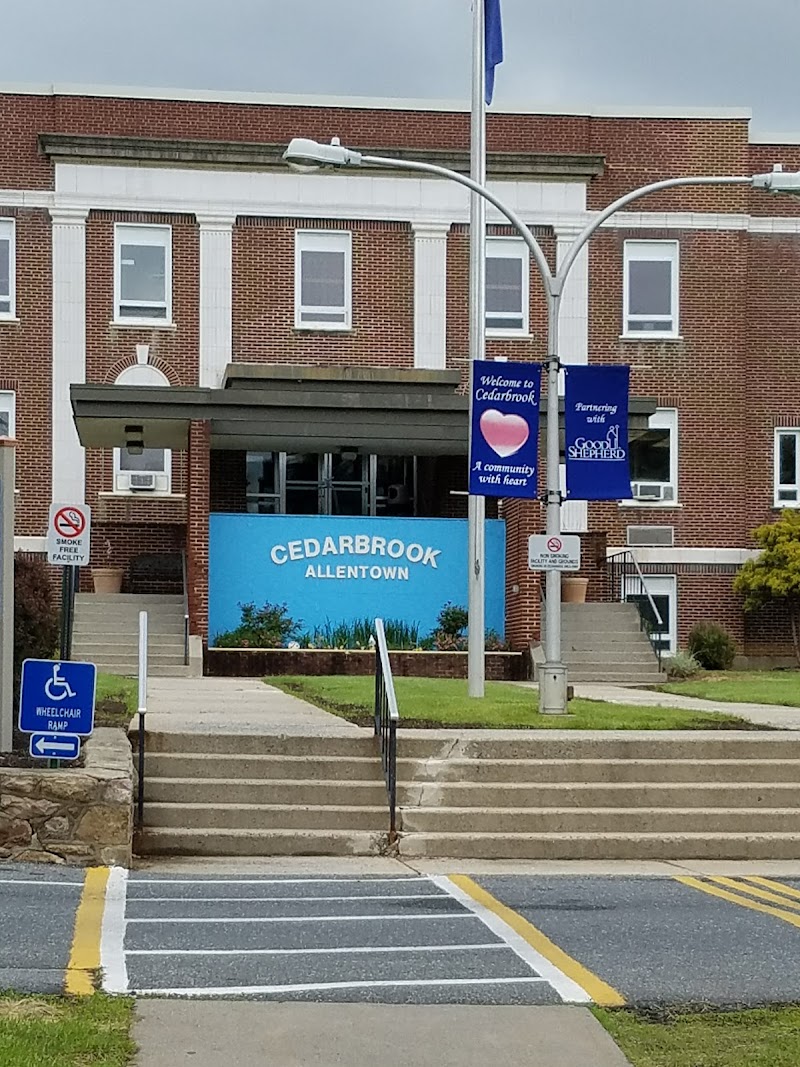
CEDARBROOK SENIOR CARE AND REHABILITATION
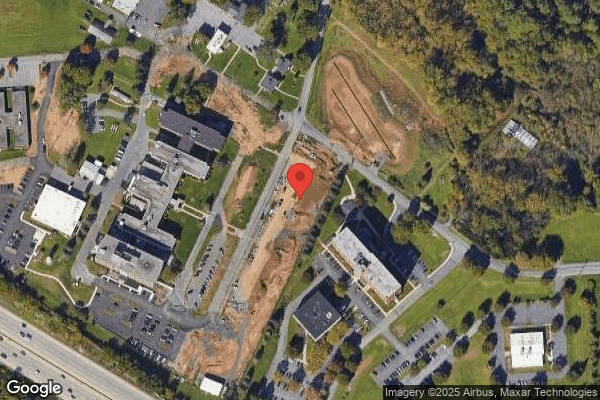
350 S. CEDARBROOK ROAD, ALLENTOWN, PA 18104 (610) 395-3727
Government - County 670 Beds Independent Data: November 2025
Trust Grade
90/100
#14 of 653 in PA
Last Inspection: May 2025

Inspected within the last 6 months. Data reflects current conditions.

Overview

Cedarbrook Senior Care and Rehabilitation has received a Trust Grade of A, indicating it is an excellent facility that is highly recommended. It ranks #14 out of 653 nursing homes in Pennsylvania, placing it in the top half of facilities in the state, and #1 out of 16 in Lehigh County, meaning it is the best option locally. However, the facility's trend is worsening, with the number of issues increasing from 3 in 2024 to 5 in 2025. Staffing is a strength here, with a 5/5 star rating and a turnover rate of 31%, which is well below the state average. Notably, the facility has faced concerns such as unsanitary food storage, with debris and pests found in the kitchen, and issues with privacy curtains being damaged or improperly maintained in resident rooms. Additionally, there was a failure to ensure that new staff received timely training on preventing abuse, which raises concerns about staff preparedness. Overall, while Cedarbrook has strong staffing and an excellent trust grade, these recent findings highlight some areas for improvement.

Trust Score
A
90/100
In Pennsylvania
#14/653
Top 2%
Safety Record
Low Risk
No red flags
Inspections
Getting Worse
3 → 5 violations
Staff Stability
○ Average
31% turnover. Near Pennsylvania's 48% average. Typical for the industry.
Penalties
✓ Good
No fines on record. Clean compliance history, better than most Pennsylvania facilities.
Skilled Nurses
✓ Good
Each resident gets 43 minutes of Registered Nurse (RN) attention daily — more than average for Pennsylvania. RNs are trained to catch health problems early.
Violations
⚠ Watch
12 deficiencies on record. Higher than average. Multiple issues found across inspections.
★★★★★
5.0
Overall Rating
★★★★★
5.0
Staff Levels
★★★☆☆
3.0
Care Quality
★★★★☆
4.0
Inspection Score
Stable
2024: 3 issues
2025: 5 issues

The Good

  • 5-Star Staffing Rating · Excellent nurse staffing levels
  • Full Sprinkler Coverage · Fire safety systems throughout facility
  • No fines on record
  • Staff turnover below average (31%)

    17 points below Pennsylvania average of 48%

Facility shows strength in staffing levels, fire safety.

The Bad

Staff Turnover: 31%

15pts below Pennsylvania avg (46%)

Typical for the industry

The Ugly 12 deficiencies on record

May 2025 5 deficiencies
CONCERN (D)

Potential for Harm - no one hurt, but risky conditions existed

Safe Environment (Tag F0584)

Could have caused harm · This affected 1 resident

**NOTE- TERMS IN BRACKETS HAVE BEEN EDITED TO PROTECT CONFIDENTIALITY** Based on observation and staff interview, it was determined that the facility failed to provide a clean and comfortable environm...

Read full inspector narrative →
**NOTE- TERMS IN BRACKETS HAVE BEEN EDITED TO PROTECT CONFIDENTIALITY** Based on observation and staff interview, it was determined that the facility failed to provide a clean and comfortable environment on one of 13 nursing units. (Station 3) Findings include: On May 7, 2025, from 10:30 a.m. to 1:15 p.m., the following was observed: In room [ROOM NUMBER], the privacy curtain on the door side of the room had six curtain hooks missing or off track. In room [ROOM NUMBER], the privacy curtain on the bathroom was missing several curtain hooks. In room [ROOM NUMBER], the privacy curtain on the door side of the room was missing three curtain hooks, and the curtain on the widow side of the room was missing six curtain hooks. In room [ROOM NUMBER], the privacy curtain on the door side of the room was missing three curtain hooks. In rooms 211, the privacy curtain on the window side of the room was torn. In an interview on May 8, 2025, at 9:40 a.m., the Assistant Administrator stated that these privacy curtains should have been replaced or fixed. 28 Pa. Code 201.14(a) Responsibility of licensee. 28 Pa. Code 201.18(b)(1)(e)(2.1) Management.
CONCERN (D)

Potential for Harm - no one hurt, but risky conditions existed

Abuse Prevention Policies (Tag F0607)

Could have caused harm · This affected 1 resident

Based on facility policy review, employee file review, and staff interview, it was determined that the facility failed to ensure employees completed required abuse training in a timely manner for two ...

Read full inspector narrative →
Based on facility policy review, employee file review, and staff interview, it was determined that the facility failed to ensure employees completed required abuse training in a timely manner for two of eleven sampled newly hired employees. (Employees 11 and 26) Findings include: Review of the facility policy entitled, Resident Abuse, Neglect, Misappropriation of Property, and other related offenses, last reviewed October 8, 2024, revealed that the facility was to educate staff upon hire and ongoing thereafter regarding the facility's policy to prohibit abuse, neglect, involuntary seclusion, and misappropriation of property for all residents. Review of employee files revealed the following: Employee 11 (E11) had been working at the facility as an executive chef since November 14, 2024. There was no documented evidence that E11 had been educated per the facility policy on abuse prevention upon hire. In an interview on May 9, 2025, at 10:36 a.m., the Assistant Administrator confirmed that E11 had not been educated on abuse prevention per the facility policy. Employee 26 (E26) had been working at the facility as a contracted agency nurse aide. There was no documented evidence that E26 had been educated per the facility policy on abuse prevention upon hire. In an interview on May 9, 2025, at 10:38 a.m., the Director of Nursing confirmed that E26 had not been educated on abuse prevention per the facility policy. 28 Pa. Code 201.14(a) Responsibility of Licensee. 28 Pa. Code 201.18(b)(1) Management. 28 Pa. Code 201.19(3)(7)(8) Personnel policies and procedures.
CONCERN (D)

Potential for Harm - no one hurt, but risky conditions existed

Comprehensive Care Plan (Tag F0656)

Could have caused harm · This affected 1 resident

**NOTE- TERMS IN BRACKETS HAVE BEEN EDITED TO PROTECT CONFIDENTIALITY** Based on clinical record review, review of facility documentation, and staff interview, it was determined that the facility fail...

Read full inspector narrative →
**NOTE- TERMS IN BRACKETS HAVE BEEN EDITED TO PROTECT CONFIDENTIALITY** Based on clinical record review, review of facility documentation, and staff interview, it was determined that the facility failed to develop and/or implement a comprehensive care plan that addressed individual resident needs as identified in the comprehensive assessment for three of 41 sampled residents. (Residents 228, 372, 481) Findings include: Clinical record review revealed that Resident 228 had diagnoses that included epilepsy, type 2 diabetes, muscle weakness, dementia, osteoporosis, Alzheimer's disease, and a history of falls prior to admission. The Minimum Data Set (MDS) assessment (a periodic evaluation of resident care needs) dated January 9, 2025, indicated that the resident had a history of falls, was severely cognitively impaired, required assistance to transfer and ambulate, and had a bed alarm. Review of the care plan dated February 10, 2025, indicated that Resident 228 was at risk for falls, wandered, required a bed and a chair alarm, needed fall mats (cushions place on the floor to minimize injury), and needed periodic checks of the the bedding to avoid entanglement. On March 29, 2025, a nurse noted that Resident 228 was found on the floor with sheets tangled around her legs after a loud noise was heard from her room. According to the facility investigation into the fall, the bed alarm and fall mats were not in place at the time. In an interview on May 8, 2025, at 11:33 a.m., the Director of Nursing and Assistant Administrator confirmed the bed alarm and fall mats were not in place at the time of the incident. Clinical record review revealed that Resident 372 had diagnoses that included a history of a traumatic brain injury and a loss of motor function to the right side of the body. Review of the MDS assessment dated [DATE], revealed that the resident had impaired function to one side of her body. Review of the current care plan revealed that Resident 372 was to have a foam roll placed in her right palm and a bracelet on her right arm to indicate to staff that the right limb was not to be used to take blood pressures or draw blood from that side. On May 6, 2025, at 10:30 a.m. and 12:05 p.m., and on May 7, 2025, at 9:30 a.m., 12:44 p.m., and 1:42 p.m., the resident was observed without the foam roll or the bracelet. In an interview on May 8, 2025, at 9:32 a.m., the Director of Nursing stated that the foam roll should have been in Resident 372's hand and the limb alert bracelet should have been on her arm. Clinical record review revealed that Resident 481 had diagnoses that included difficulty walking and muscle weakness. Review of a facility incident report, dated March 7, 2025, revealed Resident 481 had a fall while refusing to use her walker. There was no evidence that interventions to address Resident 481's refusal to use her walker were included in the current care plan. 28 Pa. Code 211.12(d)(1)(5) Nursing services.
CONCERN (D)

Potential for Harm - no one hurt, but risky conditions existed

Accident Prevention (Tag F0689)

Could have caused harm · This affected 1 resident

**NOTE- TERMS IN BRACKETS HAVE BEEN EDITED TO PROTECT CONFIDENTIALITY** Based on clinical record review, review of facility documentation, facility policy review, and staff interview, it was determine...

Read full inspector narrative →
**NOTE- TERMS IN BRACKETS HAVE BEEN EDITED TO PROTECT CONFIDENTIALITY** Based on clinical record review, review of facility documentation, facility policy review, and staff interview, it was determined that the facility failed to provide adequate supervision and interventions to prevent falls for one resident (Resident 228), and failed to thoroughly investigate a fall to prevent reoccurrence for one resident (Resident 481) of nine sampled residents who had falls. Findings include. Clinical record review revealed that Resident 228 was admitted to the facility on [DATE], and had diagnoses that included muscle weakness, osteoporosis, Alzheimer's disease, and a history of falls prior to admission. The Minimum Data Set (MDS) assessment (a periodic evaluation of resident care needs) dated January 9, 2025, indicated that the resident had a history of falls, was cognitively impaired, requiring assistance from staff for mobility, and used an alarm while in bed. Since July 10, 2024, the care plan indicated that the resident was at high risk for falls and that staff was to place an alarm on the resident's bed or chair to alert staff of unsafe movement, and that staff was to place mats on the floor beside the bed. According to nurses' notes, the resident had multiple falls, including falls on August 19, 2024, September 26, 2024, October 8, 2024, November 24, 2024, December 12, 2024, and February 21, 2025. After the fall on December 12, 2024, the care plan also indicated that the resident was at risk for tripping on her bedsheet, and that staff was to ensure she did not get tangled in her bedding. On March 29, 2025, a nurse noted that Resident 228 fell while in her room, and was found on the floor with her legs wrapped in her blankets. The facility investigation into the fall revealed that her bed alarm was not in place, and that there were no mats beside her bed in accordance with her care plan. In an interview on May 8, 2025, at 11:33 a.m., the Director of Nursing and Assistant Administrator confirmed the bed alarm and fall mats were not in place at the time of the incident. Clinical record review revealed that Resident 481 had diagnoses that included difficulty walking and muscle weakness. Review of Resident 481's care plan revealed she was at risk for falls and that staff was to assist with transfers and walk with using a rolling walker. Review of a facility incident report, dated March 7, 2025, revealed Resident 481 had a fall in the shower room. According to the witness statement, dated March 7, 2025, Employee 26 indicated that Resident 481's walker was not in use during the incident. There was no documented evidence that the facility further investigated the fall to identify why the walker was not in place, and to prevent future falls in a similar situation. In an interview on May 8, 2025, at 11:32 a.m., the Abuse Coordinator confirmed that the fall should have been further investigated. 28 Pa. Code 201.14(a) Responsibility of licensee. 28 Pa. Code 201.18(b)(1) Management. 28 Pa. Code 211.12(d)(1)(5) Nursing Services.
CONCERN (D)

Potential for Harm - no one hurt, but risky conditions existed

Deficiency F0804 (Tag F0804)

Could have caused harm · This affected 1 resident

Based on review of facility documentation, resident interview, results of a test tray audit, and staff interview, it was determined that the facility failed to provide food that was palatable and at a...

Read full inspector narrative →
Based on review of facility documentation, resident interview, results of a test tray audit, and staff interview, it was determined that the facility failed to provide food that was palatable and at an appetizing temperature on one of 13 nursing units. (C-3) Findings include: Review of Food Committee Minutes from February through April 2025, revealed that residents had stated that their food was served cold and was not palatable. In a group interview on May 7, 2025, at 10:30 a.m., Residents 51, 444, and 494 reported that it was an ongoing problem that hot food was frequently served cold and food was not palatable. Review of facility documentation entitled, Test Tray Meal Evaluation, revealed that the hot entree, vegetable, and starch should be greater than 135 degrees Fahrenheit (F) at point of service to the residents. Results of a test tray audit conducted on May 7, 2025, at 1:19 p.m., after the last resident meal tray was served from the dining cart, revealed the grilled chicken was served at a temperature of 121.1 degrees F, the mashed potatoes were served at a temperature of 117.5 degrees F, the zucchini was served at a temperature of 110.8 degrees F, and the gravy at a temperature of 121.1 degrees F. The foods were noted to be below 135 degrees F and were not palatable to taste. On May 7, 2025, from 12:15 p.m. through 12:35 p.m., Residents 35 and 46 were observed eating lunch in their rooms and they stated that the hot foods were served cold and that they were not palatable. In an interview on May 7, 2025, at 1:30 p.m, the Food Service Director confirmed the food did not meet the policy guidelines for hot foods to be served at 135 degrees F and should have been hotter. 28 Pa. Code 201.14(a) Responsibility of licensee.
Apr 2024 3 deficiencies
CONCERN (D)

Potential for Harm - no one hurt, but risky conditions existed

Resident Rights (Tag F0550)

Could have caused harm · This affected 1 resident

Based on observation and staff interview, it was determined that the facility failed to ensure that meals were served in a manner that promoted and maintained each resident's dignity for two of 36 sam...

Read full inspector narrative →
Based on observation and staff interview, it was determined that the facility failed to ensure that meals were served in a manner that promoted and maintained each resident's dignity for two of 36 sampled residents. (Resident 82 and 175) Findings include: Observations of the lunch meal on the Station 5 unit on April 3, 2024, at 12:19 a.m., revealed Residents 82, 106, 117, 198, 490, and 497 were seated at a table together in the dining room. All the residents at the table were served and eating meals except Resident 82. Resident 82 was observed without a meal, looking around the room and reaching for the trays of other residents. Residents at other tables were being served their meals. Resident 82 was not served her lunch tray until 12:29 p.m. Observations of the lunch meal on the Station 5 unit on April 2, 2024, at 12:50 p.m., revealed Residents 82, 106, 117, 175, 198, 490, and 497 were seated at a table together in the dining room. All the residents at the table were served and were eating their meals except Resident 175. Resident 175 was observed throwing her hands in the air, making the sign of praying hands to a person walking by, and reaching towards other resident's trays. At 1:20 p.m., staff members escorted Resident 175 to the resident's room and served the lunch tray. In an interview on April 4, 2024, at 11:58 a.m., ADON 1 (Assistant Director of Nursing) confirmed that meals in the dining room should be served one table at a time. 28 Pa. Code 201.29(a) Resident rights.
CONCERN (D)

Potential for Harm - no one hurt, but risky conditions existed

Assessment Accuracy (Tag F0641)

Could have caused harm · This affected 1 resident

**NOTE- TERMS IN BRACKETS HAVE BEEN EDITED TO PROTECT CONFIDENTIALITY** Based on clinical record review and staff interview, it was determined that the facility failed to ensure that the Minimum Data ...

Read full inspector narrative →
**NOTE- TERMS IN BRACKETS HAVE BEEN EDITED TO PROTECT CONFIDENTIALITY** Based on clinical record review and staff interview, it was determined that the facility failed to ensure that the Minimum Data Set (MDS) assessments were completed to accurately reflect the resident's status for two of 36 sampled residents. (Residents 310, 437) Findings include: Clinical record review revealed that Sections C (Brief Interview for Mental Status) and D (Mood Interview) of Resident 310's MDS assessment dated [DATE], were incomplete. Clinical record review revealed that Sections C and D of Resident 437's MDS assessment dated [DATE], were incomplete. In an interview on April 4, 2024, at 9:57 a.m., RN 1 (MDS Coordinator) confirmed that the MDS sections were not completed during the assessment period to reflect the resident's current status.
CONCERN (D)

Potential for Harm - no one hurt, but risky conditions existed

Quality of Care (Tag F0684)

Could have caused harm · This affected 1 resident

Based on resident interview, clinical record review, and staff interview, it was determined that the facility failed to ensure that physicians' orders were implemented for three of 36 sampled resident...

Read full inspector narrative →
Based on resident interview, clinical record review, and staff interview, it was determined that the facility failed to ensure that physicians' orders were implemented for three of 36 sampled residents. (Residents 402, 437, 450) Findings include: Clinical record review revealed that Resident 402 had diagnoses that included congestive heart failure, diabetes mellitus, and dementia. On December 22, 2023, the physician ordered that staff weigh the resident daily and notify the physician if the weight was less than 150 pounds (lbs.) or greater than 160 lbs. Review of Resident 402's weight records revealed that the resident weighed 163.3 lbs on March 30, 2024, and 164 lbs. on March 31, 2024. There was no documented evidence in the clinical record that Resident 402's physician was notified of the weight changes. In an interview on April 4, 2024, at 8:50 a.m., the ADON 1 confirmed that the physician was not notified of Resident 402's weight changes. Clinical record review revealed that Resident 437 had diagnoses that included chronic kidney disease and edema (fluid retention in the lower legs). On February 6, 2024, the physician ordered that staff apply compression stockings (devices to relieve swelling in the legs) to both of the resident's lower legs while out of bed to prevent edema. The resident was observed without compression stockings on his lower legs on April 2, 2024, at 10:35 a.m., while out of bed in the solarium. The resident was observed again at 10:55 a.m., 12:18 p.m., and 3:05 p.m., without the compression stockings on while out of bed. During an interview on April 4, 2024, at 1:24 p.m., the Director of Nursing confirmed that the physician order was not followed. Clinical record review revealed that Resident 450 had diagnoses that included a history of stroke, high blood pressure, and dementia. On March 8, 2024, the physician ordered that staff administer 5 milligrams (mg) of a blood pressure medication (amlodipine besylate) daily. Staff was to hold the medication if the systolic blood pressure (SBP) (the top number on a blood pressure reading) was below 110 millimeters of mercury (mm Hg) and to call the physician if the SBP was greater than 150 mm Hg. A review of the March 2024 Medication Administration Record revealed that staff administered the medication when the resident's systolic blood pressure was over 150 mm Hg on March 17, 18, 22, 27, and 29, 2024. A review of the resident's progress notes revealed a lack of evidence to support that a physician was notified of the elevated SBP. In an interview on April 4, 2024, at 8:52 a.m., ADON 1 confirmed that the physician was not notified of Resident 450's elevated SBP readings between March 17 and 29, 2024. 28 Pa. Code 211.12(d)(1)(5) Nursing services.
May 2023 4 deficiencies
CONCERN (D)

Potential for Harm - no one hurt, but risky conditions existed

Deficiency F0676 (Tag F0676)

Could have caused harm · This affected 1 resident

**NOTE- TERMS IN BRACKETS HAVE BEEN EDITED TO PROTECT CONFIDENTIALITY** Based on clinical record review and resident interview, it was determined that the facility failed to provide necessary care and...

Read full inspector narrative →
**NOTE- TERMS IN BRACKETS HAVE BEEN EDITED TO PROTECT CONFIDENTIALITY** Based on clinical record review and resident interview, it was determined that the facility failed to provide necessary care and services to improve or maintain activities of daily living (walking) for one of 36 sampled residents. (Resident 283) Findings include: Clinical record review revealed that Resident 283 had diagnoses that included ambulatory dysfunction. According to the Minimum Data Set assessment dated [DATE], the resident had no memory problems and required assistance from staff to walk. There was a physician's order dated April 18, 2023, that staff provide nursing rehabilitation for ambulation using a walker and assistance of two staff. In a Discharge summary dated [DATE], the physical therapist recommended the continuation of a restorative nursing program for ambulation (walking). Review of the clinical record revealed a lack of documentation to support that the resident was offered nursing assistance to walk following discharge from physical therapy. During an interview conducted on May 10, 2023, at 1:30 p.m., Resident 283 reported that nursing assistance for walking had not been offered since his discharge from therapy. In an interview on May 11, 2023, at 11:46 a.m., the Assistant Director of Nursing (ADON 2) confirmed that there was a lack of evidence that Resident 283 had been offered restorative ambulation services after April 25, 2023. 28 Pa. Code 211.12(d)(1)(3)(5) Nursing services.
CONCERN (D)

Potential for Harm - no one hurt, but risky conditions existed

Deficiency F0685 (Tag F0685)

Could have caused harm · This affected 1 resident

Based on clinical record review, observation, and resident and staff interview, it was determined that the facility failed to ensure each resident received timely treatment and services to maintain vi...

Read full inspector narrative →
Based on clinical record review, observation, and resident and staff interview, it was determined that the facility failed to ensure each resident received timely treatment and services to maintain visual abilities for one of 36 sampled residents. (Resident 222) Findings include: Clinical record review revealed that Resident 222 had diagnoses that included diabetes and hypertension. Review of the Minimum Data Set assessment, dated March 9, 2023, revealed that the resident had vision problems and needed corrective lenses. Review of the care plan revealed that the resident had a potential for falls due to visual impairment and staff was to provide the resident with eyeglasses. On May 9, 2023, at 10:55 a.m., Resident 222 was observed sitting in her wheelchair and her eyeglasses were on the bedside table. The right lens was missing from the eyeglasses. The resident stated that her eyeglasses have been broken for several weeks. On May 10, 2023, at 08:52 a.m., Resident 222 was observed sitting in her chair eating breakfast, she was wearing her eyeglasses that were missing the right lens. In an interview at that time, the resident stated she had notified staff that her eyeglasses were broken. Review of facility documentation revealed that the resident requested eye care services on February 23, 2023. There was no documented evidence that the resident received eye care as requested since February 23, 2023. In an intervew on May 11, 2023, at 1:45p.m., Assistant Director of Nursing 1 (ADON1) stated that the resident should have been seen for eyecare services prior to May 11, 2023. 28 Pa Code 211.12(d)(1)(3)(5) Nursing services. 28 Pa. Code 211.16(a) Social services.
CONCERN (D)

Potential for Harm - no one hurt, but risky conditions existed

Tube Feeding (Tag F0693)

Could have caused harm · This affected 1 resident

**NOTE- TERMS IN BRACKETS HAVE BEEN EDITED TO PROTECT CONFIDENTIALITY** Based on clinical record review, observation, and staff and resident interview, it was determined that the facility failed to pr...

Read full inspector narrative →
**NOTE- TERMS IN BRACKETS HAVE BEEN EDITED TO PROTECT CONFIDENTIALITY** Based on clinical record review, observation, and staff and resident interview, it was determined that the facility failed to provide enteral nutrition (delivery of nutrition by a feeding tube) in accordance with the physician's order for one of 36 sampled residents. (Resident 248) Findings include: Clinical record review revealed that Resident 248 had diagnoses that included stroke, paralysis to the right side, and anorexia. Review of the Minimum Data Set (MDS) assessment dated [DATE], revealed that the resident required extensive assistance for activities of daily living. Further review of the MDS assessment revealed that the resident received more than 51% of nutrition through an enteral feeding tube. A physician's order dated April 25, 2023, directed staff to administer Osmolite 1.5 (a tube feeding formula) at a rate of 100 milliliters (ml) per hour starting at 6:00 p.m., and to continue until a total volume of 1200 ml was infused. On May 9, 2023, at 10:23 a.m., the resident was observed in bed. A bottle of tube feed formula was on the pole and was labeled and dated May 8, 2023, at 6:00 p.m. The tube feeding was not infusing at the time of the observation. Formula remained in the bottle, just below the 200 ml line. The bottle contained 1000 ml of formula when full. In an interview on May 9, 2023, at 10:48 a.m., Licensed Practical Nurse 1 (LPN 1), stated that the total volume of tube feed as ordered was typically infused during the night shift and the order required two bottles of tube feed formula. In an interview on May 9, 2023, at 11:05 a.m., Registered Nurse 1 (RN 1), stated that there was no evidence that the resident had refused administration of a second bottle of tube feed formula during the night shift. In an interview on May 9, 2023, at 12:29 p.m., Resident 248 stated that he is awoken during the night shift when staff changed the tube feed bottle and staff did not wake him during the night shift on May 8, 2023, to administer the second bottle of tube feed. There was no evidence that staff administered a second bottle of tube feed formula that would have been required to complete the total volume of 1200 ml per the physician's order. In an interview on May 11, 2023, at 8:31 a.m., the Director of Nursing confirmed that staff did not administer the second bottle of tube feed formula to provide the total volume of 1200 ml per the physician's order. 28 Pa. Code 211.12(d)(1)(5) Nursing services.
CONCERN (F)

Potential for Harm - no one hurt, but risky conditions existed

Food Safety (Tag F0812)

Could have caused harm · This affected most or all residents

Based on observation, it was determined that the facility failed to store and serve food under sanitary conditions in the main kitchen. Findings include: Observation of the main kitchen on May 9, 20...

Read full inspector narrative →
Based on observation, it was determined that the facility failed to store and serve food under sanitary conditions in the main kitchen. Findings include: Observation of the main kitchen on May 9, 2023, at 9:22 a.m., revealed the following: The inside of the microwave was soiled. The lids of the bulk bins that contained flour, sugar and thickener powder were soiled. There were various particles of debris on the windowsill and on the bottom shelf in the food preparation area. The base and sides of the floor mixer were soiled. There were multiple particles of debris on the floor of the walk in freezer. There was a bag of frozen omelets that was not sealed and was open to air. There was an uncovered garbage can that contained waste in a food preparation area near uncovered food. There was a large accumulation of an orange substance on the floor at the drain under the pot wash dish machine. There was a large accumulation of small, black, winged insects on the racks that contained hot plate hats in the dish washing area. There were containers of fruit salad in the walk in refrigerator with use by dates of April 24 and 25, 2023. There was a mop bucket that contained dirty mop water in the dry storage room. Review of the holding food temperature logs revealed no evidence that staff measured holding food temperatures for the dinner meal on May 1, the lunch meals on May 6, and 8, or the breakfast meals on May 6, 7, 8, of 2023. 28 Pa. Code 201.18 (b)(3) Management.
Understanding Severity Codes (click to expand)
Life-Threatening (Immediate Jeopardy)
J - Isolated K - Pattern L - Widespread
Actual Harm
G - Isolated H - Pattern I - Widespread
Potential for Harm
D - Isolated E - Pattern F - Widespread
No Harm (Minor)
A - Isolated B - Pattern C - Widespread

Questions to Ask on Your Visit

  • "Can I speak with families of current residents?"
  • "What's your RN coverage like on weekends and overnight?"

Our Honest Assessment

Strengths
  • • Grade A (90/100). Above average facility, better than most options in Pennsylvania.
  • • No major safety red flags. No abuse findings, life-threatening violations, or SFF status.
  • • No fines on record. Clean compliance history, better than most Pennsylvania facilities.
  • • 31% turnover. Below Pennsylvania's 48% average. Good staff retention means consistent care.
Concerns
  • • 12 deficiencies on record. Higher than average. Multiple issues found across inspections.
Bottom line: Generally positive indicators. Standard due diligence and a personal visit recommended.

About This Facility

What is Cedarbrook Senior Care And Rehabilitation's CMS Rating?

CMS assigns CEDARBROOK SENIOR CARE AND REHABILITATION an overall rating of 5 out of 5 stars, which is considered much above average nationally. Within Pennsylvania, this rating places the facility higher than 99% of the state's 100 nursing homes. This rating reflects solid performance across the metrics CMS uses to evaluate nursing home quality.
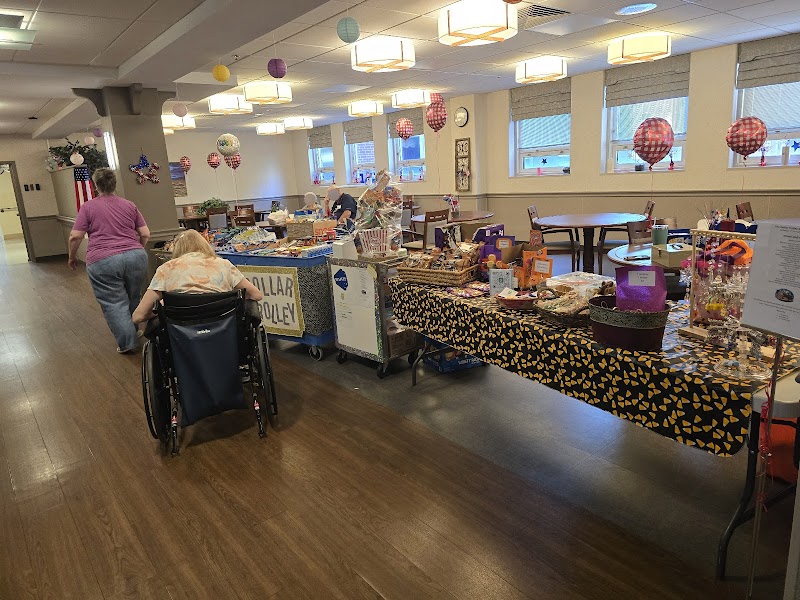
How is Cedarbrook Senior Care And Rehabilitation Staffed?

CMS rates CEDARBROOK SENIOR CARE AND REHABILITATION's staffing level at 5 out of 5 stars, which is much above average compared to other nursing homes. Staff turnover is 31%, compared to the Pennsylvania average of 46%. This relatively stable workforce can support continuity of care.

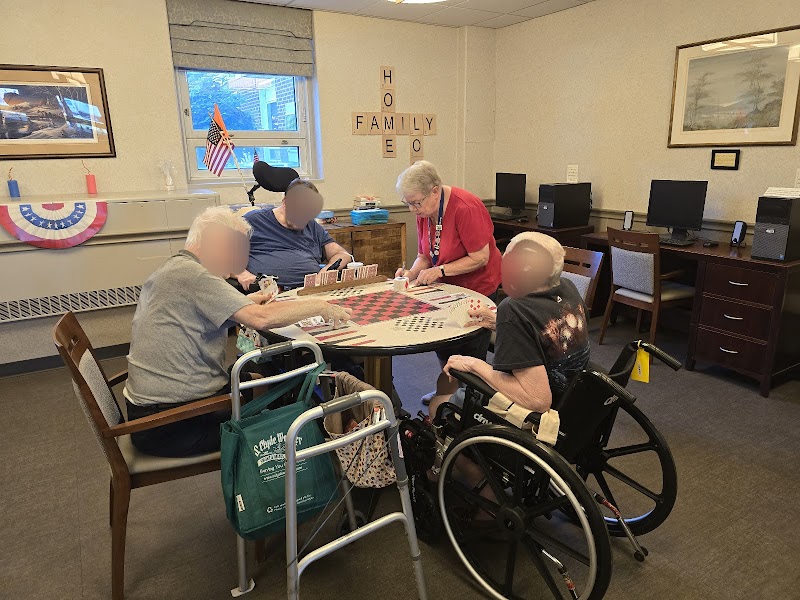
What Have Inspectors Found at Cedarbrook Senior Care And Rehabilitation?

State health inspectors documented 12 deficiencies at CEDARBROOK SENIOR CARE AND REHABILITATION during 2023 to 2025. These included: 12 with potential for harm.
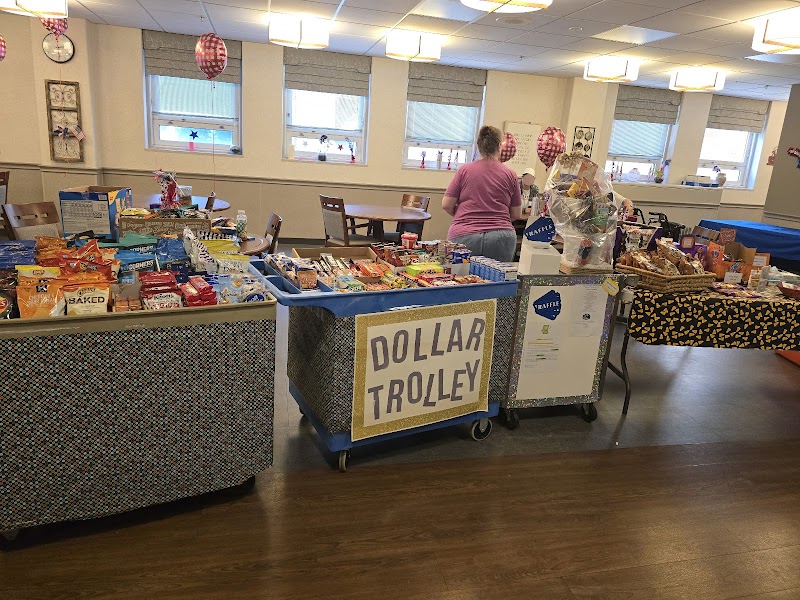
Who Owns and Operates Cedarbrook Senior Care And Rehabilitation?

CEDARBROOK SENIOR CARE AND REHABILITATION is owned by a government entity. Government-operated facilities are typically run by state, county, or municipal agencies. The facility operates independently rather than as part of a larger chain. With 670 certified beds and approximately 502 residents (about 75% occupancy), it is a large facility located in ALLENTOWN, Pennsylvania.
How Does Cedarbrook Senior Care And Rehabilitation Compare to Other Pennsylvania Nursing Homes?

Compared to the 100 nursing homes in Pennsylvania, CEDARBROOK SENIOR CARE AND REHABILITATION's overall rating (5 stars) is above the state average of 3.0, staff turnover (31%) is significantly lower than the state average of 46%, and health inspection rating (4 stars) is above the national benchmark.

What Should Families Ask When Visiting Cedarbrook Senior Care And Rehabilitation?

Based on this facility's data, families visiting should ask: "Can I visit during a mealtime to observe dining assistance and food quality?" "How do you handle medical emergencies, and what is your hospital transfer rate?" "Can I speak with family members of current residents about their experience?"

Is Cedarbrook Senior Care And Rehabilitation Safe?

Based on CMS inspection data, CEDARBROOK SENIOR CARE AND REHABILITATION has a clean safety record: no substantiated abuse findings (meaning no confirmed cases of resident harm), no Immediate Jeopardy citations (the most serious violation level indicating risk of serious injury or death), and is not on the Special Focus Facility watch list (a federal program monitoring the lowest-performing 1% of nursing homes). The facility has a 5-star overall rating and ranks #1 of 100 nursing homes in Pennsylvania. While no facility is perfect, families should still ask about staff-to-resident ratios and recent inspection results during their visit.

Do Nurses at Cedarbrook Senior Care And Rehabilitation Stick Around?

CEDARBROOK SENIOR CARE AND REHABILITATION has a staff turnover rate of 31%, which is about average for Pennsylvania nursing homes (state average: 46%). Moderate turnover is common in nursing homes, but families should still ask about staff tenure and how the facility maintains care continuity when employees leave.

Was Cedarbrook Senior Care And Rehabilitation Ever Fined?

CEDARBROOK SENIOR CARE AND REHABILITATION has no federal fines on record. CMS issues fines when nursing homes fail to meet care standards or don't correct problems found during inspections. The absence of fines suggests the facility has either maintained compliance or corrected any issues before penalties were assessed. This is a positive indicator, though families should still review recent inspection reports for the full picture.

Is Cedarbrook Senior Care And Rehabilitation on Any Federal Watch List?

CEDARBROOK SENIOR CARE AND REHABILITATION is not on any federal watch list. The most significant is the Special Focus Facility (SFF) program, which identifies the bottom 1% of nursing homes nationally based on persistent, serious quality problems. Not being on this list means the facility has avoided the pattern of deficiencies that triggers enhanced federal oversight. This is a positive indicator, though families should still review the facility's inspection history directly.