MAPLE RIDGE REHABILITATION & HEALTHCARE CENTER
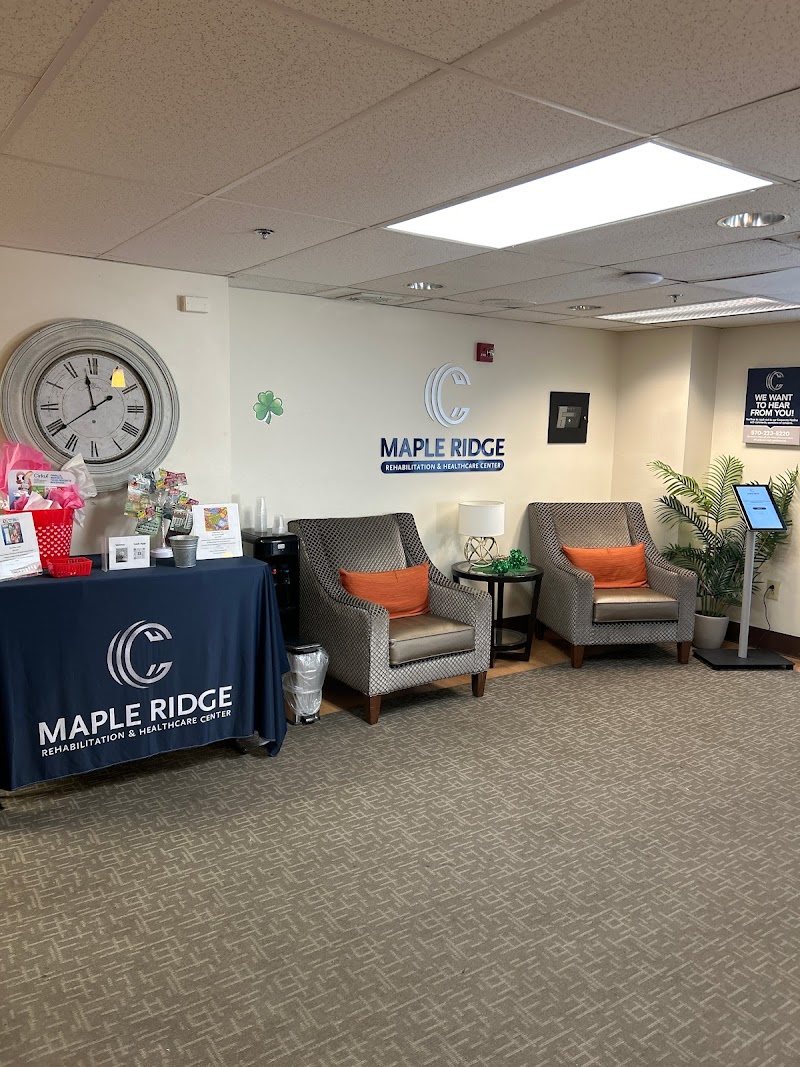
615 WYOMING AVENUE, KINGSTON, PA 18704 (570) 288-5496
For profit - Limited Liability company 92 Beds CENTURY HEALTHCARE Data: November 2025
Trust Grade
55/100
#309 of 653 in PA
Last Inspection: June 2025

Inspected within the last 6 months. Data reflects current conditions.

Overview

Maple Ridge Rehabilitation & Healthcare Center in Kingston, Pennsylvania has a Trust Grade of C, which means it is average-neither great nor terrible. It ranks #309 out of 653 nursing homes in the state, placing it in the top half, and #6 out of 22 in Luzerne County, indicating that there are only five facilities in the county that perform better. The facility is improving, as it reduced its issues from 11 in 2024 to 5 in 2025. Staffing is a relative strength with a turnover rate of 45%, which is slightly below the state average. However, it has less RN coverage than 79% of Pennsylvania facilities, which could affect the quality of care. Specific incidents include a failure to properly manage a resident's pressure ulcer, which worsened due to a lack of necessary treatment, and inadequate disposal of garbage, as the facility's dumpsters were left uncovered, raising hygiene concerns. Additionally, they did not consistently monitor the nutritional status of residents, which could lead to weight loss issues. Overall, while there are some strengths in staffing and improvements in compliance, there are also significant weaknesses that families should consider.

Trust Score
C
55/100
In Pennsylvania
#309/653
Top 47%
Safety Record
Moderate
Needs review
Inspections
Getting Better
11 → 5 violations
Staff Stability
⚠ Watch
45% turnover. Above average. Higher turnover means staff may not know residents' routines.
Penalties
✓ Good
No fines on record. Clean compliance history, better than most Pennsylvania facilities.
Skilled Nurses
⚠ Watch
Each resident gets only 29 minutes of Registered Nurse (RN) attention daily — below average for Pennsylvania. Fewer RN minutes means fewer trained eyes watching for problems.
Violations
⚠ Watch
22 deficiencies on record. Higher than average. Multiple issues found across inspections.
★★★☆☆
3.0
Overall Rating
★★★☆☆
3.0
Staff Levels
★★★☆☆
3.0
Care Quality
★★★☆☆
3.0
Inspection Score
Stable
2024: 11 issues
2025: 5 issues

The Good

  • Full Sprinkler Coverage · Fire safety systems throughout facility
  • No fines on record

Facility shows strength in fire safety.

The Bad

3-Star Overall Rating

Near Pennsylvania average (3.0)

Meets federal standards, typical of most facilities

Staff Turnover: 45%

Near Pennsylvania avg (46%)

Higher turnover may affect care consistency

Chain: CENTURY HEALTHCARE

Part of a multi-facility chain

Ask about local staffing decisions and management

The Ugly 22 deficiencies on record

1 actual harm
Sept 2025 1 deficiency
CONCERN (D) 📢 Someone Reported This

A family member, employee, or ombudsman was alarmed enough to file a formal complaint

Potential for Harm - no one hurt, but risky conditions existed

Deficiency F0565 (Tag F0565)

Could have caused harm · This affected 1 resident

Based on a review of facility policy, the minutes from facility Resident Council meetings, and grievances lodged with the facility, and resident and staff interviews, it was determined the facility fa...

Read full inspector narrative →
Based on a review of facility policy, the minutes from facility Resident Council meetings, and grievances lodged with the facility, and resident and staff interviews, it was determined the facility failed to put forth sufficient efforts to promptly resolve resident complaints and grievances expressed during Resident Council meetings and written grievances, including those voiced by for two of ten residents reviewed. (Residents 1 and 2). Findings include:A review of the facility's Grievance Policy last revised on May 27, 2025, revealed that the resident has the right to voice grievances to the Center or other agency or entity (for example the State Ombudsman) that hears grievances without discrimination or reprisal and without fear of discrimination or reprisal. The Nursing Home Administrator will serve as the Grievance Officer who is responsible for overseeing the grievance process, receiving and tracking grievances through to their conclusion, leading any necessary investigations by the facility, maintaining the confidentiality of all information associated with grievances, for example, the identity of the resident for those grievances submitted anonymously, issuing written grievance decisions to the resident, and coordinating with state and federal agencies as necessary in light of specific allegations. Any resident, family member, or appointed resident representative may file a grievance or complaint concerning the care, treatment, behavior of other residents, staff members, theft of property, or any other concerns regarding his or her stay at the facility. Grievances also may be voiced or filed regarding care that has not been furnished. Residents, family and resident representatives have the right to voice or file grievances without discrimination or reprisal in any form, and without fear of discrimination or reprisal. All grievances, complaints or recommendations stemming from residents or family groups concerning issues of resident care in the facility will be considered. Actions on such issues will be responded to in writing, including a rationale for the response. Any resident, family member, or appointed resident representative may file a grievance or complaint concerning the care, treatment, behavior of other residents, staff members, theft of property, or any other concerns regarding his or her stay at the facility. Grievances also may be voiced or filed regarding care that has not been furnished. A review of the Resident Council meeting minutes dated August 28, 2025, revealed repeated concerns that call bells were not being answered timely. A review of a written grievance from Resident 1, dated August 28, 2025, revealed that the resident stated she had to wait a long time for staff to respond to the call bell to meet her needs. The documented facility action was to conduct call bell audits. Resident 1 refused to sign the grievance as resolved, stating I am still waiting too long. Facility call bell audits were conducted from August 29, 2025, through September 1, 2025, and the grievance was marked by the NHA as completed and resolved on September 2, 2025. During an interview on September 3, 2025, at 11:00 AM, Resident 1 (who is cognitively intact, able to understand and communicate clearly) stated that staff response times to her call bell continued to be greater than 30 minutes on the second and third shifts. She reported she had voiced grievances both verbally and in writing at the August 2025 Resident Council meeting and remained unsatisfied with the facility's response. During an interview on September 3, 2025, at 11:15 AM, Resident 2 (also cognitively intact) stated he regularly waited longer than 30 minutes for staff to respond to his call bell. He reported that he requires the assistance of two staff members and his roller walker to ambulate to the bathroom and that he recently experienced a bowel incontinence episode because staff did not answer his call bell in time. During an interview on September 3, 2025, at 11:30 AM, the NHA and Director of Nursing (DON) acknowledged there was no documented evidence of completed resolutions for grievances raised during Resident Council meetings or for verbal complaints. 28 Pa. Code 201.18 (b)(1)(3) Management. 28 Pa. Code 201.29(a) Resident Rights. 28 Pa. Code 211.10 (d) Resident Care policies.
Jun 2025 2 deficiencies
CONCERN (D)

Potential for Harm - no one hurt, but risky conditions existed

Deficiency F0553 (Tag F0553)

Could have caused harm · This affected 1 resident

**NOTE- TERMS IN BRACKETS HAVE BEEN EDITED TO PROTECT CONFIDENTIALITY** Based on clinical record review and resident and staff interviews, it was determined the facility failed to ensure a resident wa...

Read full inspector narrative →
**NOTE- TERMS IN BRACKETS HAVE BEEN EDITED TO PROTECT CONFIDENTIALITY** Based on clinical record review and resident and staff interviews, it was determined the facility failed to ensure a resident was invited to participate in the care planning process for one of 19 residents reviewed (Resident 42). Findings include: A clinical record review revealed Resident 42 was admitted to the facility on [DATE], with diagnosis to include vascular dementia (reduced blood flow to the brain leading to cognitive decline) and polyosteoarthritis (inflammation and pain of five or more joints of the body). A review of the annual Minimum Data Set assessment (MDS - a federally mandated standardized assessment conducted at specific intervals to plan resident care) dated May 7, 2025, revealed that Resident 42 was cognitively intact with a BIMS score of 15 (Brief Interview for Mental Status, a tool within the Cognitive Section of the MDS that is used to assess the resident's attention, orientation, and ability to register and recall new information; a score of 13-15 indicates cognitively intact). During an interview on June 17, 2025, at 10:15 AM, Resident 42 stated she has not been invited to participate in the care planning process for development of her comprehensive person-centered care plan or attend any care plan meetings. A further review of the clinical record revealed no documented evidence that a care plan conference had been conducted since November 20, 2024. The clinical record revealed no documentation that Resident 42 had been invited to participate in the development or review of her comprehensive care plan. During an interview with the Director of Nursing (DON) and the Nursing Home Administrator (NHA) on June 18, 2025, at 1:38 PM, both confirmed there was no documentation to show that a care plan conference had been held for Resident 42 since November 2024 or that Resident 42 had been invited to participate in the care planning process. 28 Pa. Code 201.29 (a) Resident rights. 28 Pa. Code 211.12(d)(3) Nursing services.
CONCERN (D)

Potential for Harm - no one hurt, but risky conditions existed

Deficiency F0699 (Tag F0699)

Could have caused harm · This affected 1 resident

**NOTE- TERMS IN BRACKETS HAVE BEEN EDITED TO PROTECT CONFIDENTIALITY** Based on a review of clinical records and staff interview, it was determined the facility failed to develop and implement an ind...

Read full inspector narrative →
**NOTE- TERMS IN BRACKETS HAVE BEEN EDITED TO PROTECT CONFIDENTIALITY** Based on a review of clinical records and staff interview, it was determined the facility failed to develop and implement an individualized person-centered plan to render trauma informed care to a resident with a diagnosis of Post-Traumatic Stress Disorder for one out of 19 residents reviewed (Resident 18). Findings include: A review of Resident 78's clinical record revealed the resident was admitted to the facility on [DATE], with diagnoses that included Depression. Resident 18 had been newly diagnosed on [DATE] with Post Traumatic Stress Disorder (PTSD a mental health condition that's caused by an extremely stressful or terrifying event, either being part of it or witnessing it. Symptoms may include flashbacks, nightmares, severe anxiety, and uncontrollable thoughts about the event). The resident's current care plan, in effect at the time of review on June 16, 2025, did not identify the resident's PTSD symptoms or triggers related to this diagnosis and resident specific interventions to meet the resident's needs for minimizing triggers and/or re-traumatization. The facility failed to develop and implement an individualized person-centered plan to address, this resident's diagnosis of PTSD according to standards of practice to promote the resident's emotional well-being and safety. Interview with the Nursing Home Administrator on June 18, 2025, at 1:00 p.m., confirmed the facility was unable to demonstrate the facility provided culturally competent, trauma-informed care in accordance with professional standards of practice and accounting for resident's experiences and preferences to eliminate or mitigate triggers that may cause re-traumatization of the resident. 28 Pa Code 211.12 (d)(3)(5) Nursing services.
May 2025 1 deficiency 1 Harm
SERIOUS (G) 📢 Someone Reported This

A family member, employee, or ombudsman was alarmed enough to file a formal complaint

Actual Harm - a resident was hurt due to facility failures

Pressure Ulcer Prevention (Tag F0686)

A resident was harmed · This affected 1 resident

**NOTE- TERMS IN BRACKETS HAVE BEEN EDITED TO PROTECT CONFIDENTIALITY** Based on a review of clinical records, facility policy, and staff interview, it was determined the facility failed to consistent...

Read full inspector narrative →
**NOTE- TERMS IN BRACKETS HAVE BEEN EDITED TO PROTECT CONFIDENTIALITY** Based on a review of clinical records, facility policy, and staff interview, it was determined the facility failed to consistently implement planned interventions and provide necessary treatment and services to prevent the worsening of a pressure ulcer for one resident out of four residents sampled for pressure ulcer care (Resident CR1) resulting in the worsening of a Stage 2 pressure ulcer to an unstageable pressure injury, constituting actual harm. Findings include: According to the US Department of Health and Human Services, Agency for Healthcare Research & Quality, the pressure ulcer best practice bundle incorporates three critical components in preventing pressure ulcers: Comprehensive skin assessment, Standardized pressure ulcer risk assessment, and care planning and implementation to address the areas of risk. The American College of Physicians (ACP) is a national organization of internists who specialize in the diagnosis, treatment, and care of adults. Clinical Practice Guidelines indicate that the treatment of pressure ulcers should involve multiple tactics aimed at alleviating the conditions contributing to ulcer development (i.e., support surfaces, repositioning, and nutritional support); protecting the wound from contamination and creating and maintaining a clean wound environment; promoting tissue healing via local wound applications, debridement, and wound cleansing; using adjunctive therapies; and considering possible surgical repair. Review of the facility policy titled Prevention of Pressure Injuries, provided on May 1, 2025, indicated the facility will review the resident's care plan and identify the risk factors as well as the interventions designed to reduce or eliminate those considered modifiable. The facility will inspect the skin on a daily basis when performing or assisting with personal care or ADLs (activities of daily living) and reposition the resident as indicated on the care plan. The facility will reposition all residents with or at risk of pressure injuries on an individualized schedule, as determined by the interdisciplinary care team and choose a frequency for repositioning based on the resident's risk factors and current clinical practice guidelines. Additionally, monitoring of area(s) will include evaluation, report, and documentation of potential changes in the skin, and a review of interventions and strategies for effectiveness on an ongoing basis. A clinical record review revealed Resident CR1 was admitted to the facility on [DATE], with diagnoses that included Parkinson's Disease (a disorder of the central nervous system that affects movement, often including tremors), dementia (a condition characterized by progressive or persistent loss of intellectual functioning, especially with impairment of memory and abstract thinking, and often with personality change, resulting from organic disease of the brain), and need for assistance with personal care. A review of Resident CR1's admission Minimum Data Set assessment (MDS-a federally mandated standardized assessment process conducted periodically to plan resident care) dated March 30, 2025, revealed that Resident CR1 was severely cognitively impaired with a BIMS score of 5 (Brief Interview for Mental Status-a tool within the Cognitive Section of the MDS that is used to assess the resident's attention, orientation, and ability to register and recall new information; a score of 0-7 indicates severe cognitive impairment), and required total staff assistance for activities of daily living, rolling in bed, and transfers; and was moderately at-risk for the development of pressure ulcers and injuries. Section M: Skin Conditions, indicated that Resident 18 had a stage 2 pressure ulcer (partial-thickness loss of skin with exposed dermis, presenting as a shallow open ulcer. The wound bed is viable, pink or red, moist, and may also present as an intact or open/ruptured blister. Adipose or fat tissue is not visible and deeper tissues are not visible. Granulation tissue, slough and eschar are not present) upon admission to the facility. According to the MDS the resident utilized an indwelling urinary catheter but was always incontinent of bowels. A review of the resident's care plan initiated March 25, 2025, identified a focus area related to skin integrity with planned interventions which included application of protective barrier cream after incontinent episodes and as needed, assist resident with turning and repositioning as needed, complete skin inspection every 7 days and as needed, complete wound evaluation to monitor the progress of the resident's skin condition, encourage/assist resident as needed to elevate heels off the mattress, pressure reducing air cushion to chair, and provide treatments as per physician orders. A review of Resident CR1's clinical record revealed an initial wound evaluation dated March 25, 2025, at 7:28 PM, which revealed the resident was admitted to the facility with a Stage 2 pressure ulcer on the sacrum that measured 2 cm x 2 cm x < 0. 1cm with no drainage and no odor present in the wound bed. The peri wound (skin area surrounding the wound) appearance was red in color. Review of a Skin and Wound note dated March 26, 2025, at 1:57 PM, completed by the wound care consultant, indicated the pressure area was on Resident CR1's right intergluteal fold (the vertical groove between the buttocks). The wound was classified as a stage 2 that measured 0.5 cm x 0.4 cm x 0.1 cm, was 100% epithelialized (entire surface of wound is covered by new skin tissue) with scant amount of serous drainage (clear, thin, watery fluid that is a normal part of the healing process). Treatment recommendations were to cleanse with soap and water, pat dry; apply Renew Peri Protect (specific barrier cream used to protect the skin from moisture) to the base of the wound every shift and as needed, provide swift incontinence management, provide an alternating air/low air loss mattress for pressure redistribution, and provide ongoing turning/repositioning precautions. Review of a Skin and Wound note dated April 2, 2025, at 2:06 PM, completed by the wound care consultant, indicated the stage 2 pressure area on the right intergluteal fold measured 0.5 cm x 0.4 cm x 0.1 cm and continued to be 100% epithelialized with a scant amount of serous drainage. Treatment recommendations included to cleanse with soap and water, pat dry, apply Renew Peri Protect to the base of the wound every shift and may be applied after each incontinence episode, provide swift incontinence management, keep resident off his bottom as resident will allow, and turn the patient side to side as tolerated. Despite these interventions being documented in wound care recommendations and the resident's care plan, a review of the Treatment Administration Records (TAR) for March and April 2025 failed to reveal documentation that Renew Peri Protect was ordered or applied as recommended by the wound care consultant on March 26, 2025, and April 9, 2025. Additionally, review of Resident CR1's Documentation Survey Report v2 (reports that capture care-related tasks completed by nurse aides) for March and April 2025 did not show evidence that staff consistently turned and repositioned the resident as per the plan of care and wound consultant's instructions. Review of Skin and Wound note dated April 9, 2025, at 2:06 PM, completed by the wound care consultant, documented the right intergluteal fold wound significantly worsened and spread across the sacral region. The pressure wound was now classified as an unstageable wound (type of wound where the base of the wound is obscured by slough, a yellow/white material consisting of dead cells or eschar, a dry, hard, leathery dead tissue in the wound bed, making it impossible to determine the true depth and stage of the wound) measuring 7.5 cm x 2.5 cm x 0.2 cm. The wound base was 40% slough with a moderate amount of serous drainage. Treatment recommendations included application of Renew Peri Protect every shift and apply after each incontinence episode, increase frequency of incontinence management due to new onset of diarrhea, keep off bottom, and turn the resident side to side every 2 hours and as needed. Although the wound had significantly declined, no new or intensified treatment interventions were initiated beyond reiterating the prior recommendations. Skin inspections were documented on April 1, 2025, and April 8, 2025, however, there were no wound measurements recorded for Resident CR1's sacral pressure area to evaluate whether the pressure ulcer was healing, worsening, or remaining unchanged. Facility policy indicated that wounds would be monitored to determine any potential changes. The lack of consistent wound measurements had the potential to prevent accurately evaluating the effectiveness of the treatment plan and adjusting interventions as necessary. Interview with the Director of Nursing on May 1, 2025, at approximately 12:45 PM, confirmed the facility could not provide evidence the treatment interventions ordered by the wound care consultant were implemented, including use of the barrier product or that new treatment interventions were developed after the decline in the wound was identified. The facility could not provide evidence of a consistent turning and repositioning schedule or that facility staff thoroughly evaluated Resident CR1's sacral pressure ulcer for worsening and/or improvement. There was no evidence the worsening of the wound was met with an updated plan of care or intensified interventions. 28 Pa. Code 201.14 (a) Responsibility of licensee 28 Pa. Code 201.18 (e)(1)(3) Management 28 Pa. Code 201.29 (a)(c) Resident Rights 28 Pa. Code 211.12 (c)(d)(1)(3)(5) Nursing Services
Apr 2025 1 deficiency
CONCERN (E) 📢 Someone Reported This

A family member, employee, or ombudsman was alarmed enough to file a formal complaint

Potential for Harm - no one hurt, but risky conditions existed

Deficiency F0692 (Tag F0692)

Could have caused harm · This affected multiple residents

**NOTE- TERMS IN BRACKETS HAVE BEEN EDITED TO PROTECT CONFIDENTIALITY** Based on review of clinical records, select facility policy, and staff interviews, it was determined the facility failed to comp...

Read full inspector narrative →
**NOTE- TERMS IN BRACKETS HAVE BEEN EDITED TO PROTECT CONFIDENTIALITY** Based on review of clinical records, select facility policy, and staff interviews, it was determined the facility failed to complete a comprehensive nutritional assessment and monitor resident weights consistently and accurately to timely identify changes in nutritional status and implement appropriate interventions to address weight loss for two of three residents reviewed for nutritional status and weight loss (Residents CR1 and A1). Findings included: A review of a facility policy entitled Nutritional Assessment last revised October 2024, revealed that the Registered Dietitian (RD), in conjunction with nursing staff and healthcare practitioners, will conduct a nutritional assessment for each resident upon admission (within current baseline assessment timeframes) and as indicated by a change in condition that places the resident at risk for impaired nutrition. As part of the comprehensive assessment, the nutritional assessment will be a systematic, multidisciplinary process that includes gathering and interpreting data and using that data to help define meaningful interventions for the resident at risk for or with impaired nutrition. The nutritional assessment will be conducted by the multidisciplinary team and shall identify at least the following components: usual body weight, current height and weight, a description of the resident's usual intakes, history of reduced appetite or progressive weight loss or gain prior to the resident's admission, current clinical conditions and recent events that may have affected a resident's nutritional status, general appearance - a description of the resident's overall appearance, usual meal and snack patterns, food preferences and dislikes (including flavors, textures, and forms), preferred portion size. Additionally, the assessment will include a review of prescribed medications that may affect nutrient absorption, appetite, level of consciousness, and/or gastrointestinal function, a review of laboratory results to assess fluid and electrolyte balance, an estimation of calorie, protein, and fluid needs, and an assessment of whether the resident's current intake is adequate to meet his or her nutritional needs. Further review of a facility policy entitled Weight Assessment and Intervention last revised by March 2022, indicated that in one month any unplanned/undesired significant weight chance of 5% or more since the last weight assessment is significant and greater than 5% is severe and any undesirable weight change is evaluated by the dietitian, physician, and multidisciplinary team to develop interventions to stabilize/improve the residents' weight. A review of Resident CR1's clinical record revealed the resident was admitted to the facility on [DATE], with diagnoses that included dysphagia (difficulty swallowing), weakness, and dependance on supplemental oxygen. Review of the resident's weight documentation revealed that on March 7, 2025, the resident weighed 123 pounds with a height of 65 inches, resulting in a Body Mass Index (BMI) of 20.6 (a tool that healthcare providers use to estimate the amount of body fat by using height and weight measurements) of 20.6 within ideal body weight. Further review of Resident CR1's weight record revealed the following weights: March 12, 2025, at 11:51 AM - 121.8-lbs. March 20, 2025, at 12:37 PM - 110.9-lbs., This represented a weight loss of 10.9 pounds or 8.9% in one week, and a total loss of 12.1 pounds or 9.8% since admission, which constituted severe and significant weight loss. No additional weights were recorded in Resident CR1's clinical record. A review of Resident CR1's Survey Documentation Report (a report that summarizes the recoded tasks performed by nurse aides) dated March 2025, revealed the resident's average meal intakes for breakfast, lunch, and dinner was approximately 31.4 percent. Review of the resident's Survey Documentation Report for March 2025 showed an average meal intake of approximately 31.4% across breakfast, lunch, and dinner. Progress notes dated March 25, 2025, at 11:01 AM, indicated the resident was transferred to the hospital due to altered mental status and hematuria (blood in urine). Hospital records dated March 25, 2025, at 4:41 PM, documented that the resident appeared extremely malnourished, exhibited signs of severe dehydration (loss of fluid in the body) and hypotension (low blood pressure), and was subsequently placed on hospice care. Further review of the clinical record revealed no documentation that a comprehensive nutritional assessment was completed by the RD upon admission, nor was there evidence that the resident's attending physician or responsible party (RP) had been notified of the resident's poor intake or progressive weight loss. An interview conducted with the facility's RD, in the presence of the Nursing Home Administrator (NHA), on April 8, 2025, at 10:45 AM, confirmed that a comprehensive nutritional assessment should have been completed within 72 hours of admission but was not completed for Resident CR1. The RD also confirmed that no interventions were initiated to address the resident's poor intake or significant weight loss. The NHA reported the prior RD had worked at the facility through February 28, 2025, and that a Certified Dietary Manager (CDM) provided temporary coverage from March 1 through March 9, 2025. The NHA acknowledged that a CDM is not qualified to complete comprehensive nutrition assessments and confirmed the facility did not employ a qualified nutrition professional during that period to fulfill this responsibility. A review of Resident A1's clinical record revealed that the resident was admitted to the facility on [DATE], with diagnoses that included Barrett's esophagus ( a condition in which tissue that is similar to the tissue lining in the intestines changes or replaces the lining of the esophagus which is the tube that transports food from the mouth to the stomach) without dysplasia (a precancerous condition), malignant neoplasm (cancerous tumors) and dementia (a term used to describe a group of symptoms affecting memory, thinking and social abilities). A review of the resident's comprehensive person-centered plan of care initiated December 7, 2023, and revised November 5, 2024, indicated that the resident was at risk for nutritional deficits due to diagnoses and required a therapeutic diet. Interventions included periodic weight monitoring, evaluation and notification of significant weight changes to the RD, physician, and family, provision of nutritional supplements as ordered, and the use of meals and snacks tailored to the resident's preferences and functional needs. A review of the resident's quarterly Nutrition Risk Assessment/Full - V4 assessment completed by the facility's RD dated January 29, 2025, at 11:51 AM, documented the resident needed increased nutrient needs related to cancer diagnosis, assist with meals to promote po (oral) intake, need verbal cues, and continue to use finger foods as available. Also, the RD noted to continue to monitor monthly weights per protocol with a goal to maintain weight stability, tolerate diet, adequate hydration, meet estimated needs, and skin integrity and adjust diet regimen prn (as needed). A review of Resident A1's weight record revealed the following recorded weights: January 6, 2025, at 1:56 PM, weight was 156.4 -lbs. February 1, 2025, at 11:45 AM, weight was 156.8 - lbs. March 3, 2025, at 3:11 PM, weight was 143.3 - lbs. March 4, 2025, 2:06 PM, weight was 145.2 - lbs. April 1, 2025, at 2:05 PM, weight was 146.4 - lbs. Further review of Resident A1's weight record revealed that he had a significant weight loss of 11.6 - lbs. or 7.4% in 30-day (February 1, 2025, through March 4, 2025). A review of a weight change note completed by the RD eighteen (18) days post weight loss on March 17, 2025, at 11:33 AM, indicated that weights were reviewed and identified a significant loss of 7.6% in 30 days. History of colon cancer and Barrett's esophagus. Diet order regular/regular texture/thin liquids with intake for meals is 50-100% and occasional intakes less than 50%. Lactose intolerance noted. Most recent labs from March 12, 2025, reviewed and medications reviewed. Comfort measures noted with weight stability desired. The RD's note confirmed the weight loss and stated the resident's physician and RP had been notified and that the plan was to continue monitoring and follow up with the interdisciplinary team. However, there was no evidence that additional or revised nutritional strategies were developed and implemented at the time of the initial weight loss. During an observation of the third-floor dining room on April 8, 2025, at 12:10 PM, Resident A1 was observed eating rice and meatballs with his hands. The resident scooped food with his hands, and food was observed falling before reaching his mouth. Interview with the Director of Nursing (DON) on April 8, 2025, at 1:00 PM, revealed that Resident A1 prefers to feed himself and often declines staff assistance. The DON confirmed the resident would benefit from the use of finger foods but acknowledged this intervention, which was part of the resident's care plan, was not being consistently implemented. Further interview with the DON confirmed that the facility failed to identify the resident's significant weight loss in a timely manner and failed to initiate nutritional interventions to address the weight loss or reinforce the use of care-planned accommodations, such as finger foods, to support the resident's independence and nutritional intake. 28 Pa Code 211.10 (c) Resident care policies 28 Pa. Code 211.12 (c)(d)(3)(5) Nursing services
Oct 2024 1 deficiency
CONCERN (D) 📢 Someone Reported This

A family member, employee, or ombudsman was alarmed enough to file a formal complaint

Potential for Harm - no one hurt, but risky conditions existed

Accident Prevention (Tag F0689)

Could have caused harm · This affected 1 resident

**NOTE- TERMS IN BRACKETS HAVE BEEN EDITED TO PROTECT CONFIDENTIALITY** Based on review of clinical records, document review, and resident and staff interviews, it was determined that the facility fai...

Read full inspector narrative →
**NOTE- TERMS IN BRACKETS HAVE BEEN EDITED TO PROTECT CONFIDENTIALITY** Based on review of clinical records, document review, and resident and staff interviews, it was determined that the facility failed to provide an environment free from accident hazards to prevent potential incidents for one resident (Resident A1) out of eight sampled residents. Findings include: A review of Resident A1's clinical record revealed that the resident was admitted to the facility on [DATE], with diagnoses that included chronic pain and osteoarthritis (is inflammation of one or more joints and is the most common form of arthritis that affects joints in the hand, spine, knees, and hips). A review of the resident's quarterly Minimum Data Set Assessment (MDS - a federally mandated standardized assessment completed at specific times to identify resident care needs) assessment dated [DATE], indicated that Resident A1's completed Brief Interview for Mental Status [(BIMS) a tool that assesses cognition, a tool to assess the resident's attention, orientation, and ability to register and recall new information] score was 15 out of 15 (a score of 13 to 15 suggests intact cognition) and cognitively intact. Additionally, the MDS indicated that the Resident was able to independently ambulate with the use of a walker. A review of an investigation to an incident that occurred on August 31, 2024, at 8:30 PM, completed by Employee 1 (Registered Nurse [RN]), revealed that she was called to a Resident's room by a nurse who reported injury to ankle from slippage. Resident ambulated independently with her rolling walker to bedside drawer. While walking, she slipped on a wet floor caused by leaking window in her room. Resident denied falling and stated she was able to hold onto handle of her walker; however, she reported twisting her ankle during the event. RN assessment completed; right ankle noted to be tender to touch with mild edema. No visible bruises or deformity observed at the time of assessment. Resident pain rated 6/10 stated I was going over there to get my clothes and slipped on the water and hurt my leg. Ice applied to affected limb, medicated with acetaminophen 625 mg PO (by mouth), wet sign placed in room, and Resident encouraged to remain in bed and call for assistance. Bath blankets placed on windowsill and by the window to absorb water, work order submitted to maintenance department. MD contacted and ankle X-ray requested. Resident is her own responsible party, emergency contact notified, and a nursing communication sent to therapy. Further review of Resident A1's clinical record revealed negative x-ray results of her right ankle; however, moderate right ankle pain persisted with movement, touch, and weight bearing. Physician aware new orders for rest, ice, elevation/positioning. An interview with Resident A1 on October 9, 2024, at 10:49 AM, revealed that she reported that the window inside of her old room leaked when it rained heavy and was windy outside and would trickle onto her windowsill, the heating/cooling unit, and pool on her floor. Resident A1 stated that she reported this to her social worker prior to slipping on August 31, 2024, and was told that a maintenance repair ticket was entered and would be completed. Additionally, Resident A1 reported that the facility did not attempt to repair the leaky window in her room until after she slipped on the water. A review of work order number 1922 that was created by Employee 2 (Therapy Department) on August 7, 2024, at 9:13 AM, indicated that Resident A1 reported a leaking window in room/area 303. Further review of work order number 1922 that was updated on August 12, 2024, at 7:34 AM, by Employee 3 (Maintenance worker) commended that windows need to be replaced and set the order to completed. Additionally, a review of work order number 1947 created on August 31, 2024, at 8:50 PM, by Employee 1, after Resident A1's slip, revealed please repair the leaking window 303B bedroom window. Further review of work order number 1947 that was updated on September 4, 2024, at 3:08 PM, by Employee 3, commended that Resident A1 was moved and was completed. During an interview with the facility's Regional Maintenance Director or October 9, 2024, at 11:48 AM, revealed that the facility obtained a quote to repair the leaking windows on September 19, 2024, and that the facility was planning to have them repaired with upcoming facility renovations. The facility failed to timely respond and implement effective safety measures to deter Resident A1's accident with minor injury, right ankle sprain. An interview with the facility's Nursing Home Administrator on October 9, 2024, at 1:00 PM, confirmed that the facility failed to timely respond to Resident A1's concerns related to the leaking window in her room, which resulted in the Resident slipping on a wet floor and spraining her right ankle. 28 Pa. Code 201.18 (e)(1) Management 28 Pa. Code 211.12 (c)(d)(5) Nursing services 28 Pa. Code 211.10 (a)(c)(d) Resident care policies
Aug 2024 7 deficiencies
CONCERN (D)

Potential for Harm - no one hurt, but risky conditions existed

Free from Abuse/Neglect (Tag F0600)

Could have caused harm · This affected 1 resident

**NOTE- TERMS IN BRACKETS HAVE BEEN EDITED TO PROTECT CONFIDENTIALITY** Based on a review of clinical records, select facility policy and investigative reports, and staff interviews, it was determined...

Read full inspector narrative →
**NOTE- TERMS IN BRACKETS HAVE BEEN EDITED TO PROTECT CONFIDENTIALITY** Based on a review of clinical records, select facility policy and investigative reports, and staff interviews, it was determined that the facility failed to ensure that one resident out of 18 sampled (Resident 39) was free from physical abuse, perpetrated by another resident (Resident CR4). Findings include: A review of facility policy titled Abuse of Residents, last reviewed by the facility on May 1, 2024, revealed it is the facility policy that acts of physical abuse directed against residents are absolutely prohibited. The policy indicates that each resident has the right to be free from physical abuse and shall not be subjected to abuse by anyone, including but not limited to staff, other residents, consultants, volunteers, family members, friends, or other individuals. The policy defines physical abuse as including but not limited to hitting, slapping, punching, or kicking. A clinical record review revealed Resident 39 was admitted to the facility on [DATE], with diagnoses that include dementia (a condition characterized by the loss of cognitive functioning such as thinking, remembering, and reasoning, to such an extent that it interferes with a person's daily life and activities). A review of a quarterly Minimum Data Set assessment (MDS - a federally mandated standardized assessment process conducted periodically to plan resident care) dated May 13, 2024, revealed that Resident 39 is severely cognitively impaired with a BIMS score of 2 (Brief Interview for Mental Status- a tool within the Cognitive Section of the MDS that is used to assess the resident's attention, orientation, and ability to register and recall new information; a score of 01-07 indicates severe cognitive impairment). A clinical record review revealed that Resident CR4, was admitted to the facility on [DATE], with diagnoses that include chronic obstructive pulmonary disease (COPD is a condition caused by damage to the airways or other parts of the lung that blocks airflow and makes it hard to breathe) and dementia. A review of an annual MDS assessment dated [DATE], revealed that Resident CR4 is cognitively intact with a BIMS score of 14 (a score of 13-15 indicates cognitively intact). A care plan review revealed Resident CR4 has behaviors related to dementia with agitation, makes accusatory statements, and is physically and verbally aggressive toward others initiated on April 14, 2024. Interventions implemented to assist Resident CR4 with these behaviors include approaching the resident in a calm manner to avoid frustration and behavior escalation, giving the resident non-judgmental support, and keeping the resident safe during episodes of behaviors. A progress note dated April 14, 2024, at 6:09 AM indicated that Resident CR4 propelled himself up the hallway in his wheelchair cursing, yelling, and name-calling at staff. The resident became agitated and started throwing a snack tray and chair at staff. Resident CR4 attempted to kick staff. A progress note dated April 15, 2024, at 6:46 AM indicated that Resident CR4 was yelling and cursing at staff. A progress note dated April 15, 2024, at 7:00 AM indicated that Resident CR4 displayed verbally aggressive behavior with staff at midnight the previous shift. The note indicated he was cursing and yelling at staff. A progress note dated April 16, 2024, at 6:32 AM indicated that Resident CR4 was yelling and cursing at staff at the beginning of the shift, but displayed no additional behaviors. A facility incident report dated April 19, 2024, at 12:05 PM indicated that Resident CR4 was observed yelling at Resident 39. Staff attempted to redirect Resident CR4, explaining that Resident 39 did not understand him; however, the redirection was not effective, and Resident CR4 continued yelling. A witness statement dated April 19, 2024, revealed that Employee 3, Nurse Aide (NA), was assisting residents in the dining room, on April 19, 2024, at 12:05 PM when she witnessed Resident CR4 punch and kick Resident 39. Employee 3, NA, indicated that she immediately removed Resident 39 for safety and notified the nurse. A witness statement dated April 19, 2024, revealed that Employee 5, NA, heard his coworker scream for help on April 19, 2024, at 12:05 PM. When he arrived, he witnessed Resident CR4 attempting to throw coffee on Resident 39. Employee 5, NA, indicated that Resident CR4 has been having outbursts and has been verbally abusive to the same resident weeks prior. A progress note dated April 19, 2024, at 12:05 PM indicated that Resident CR4 was screaming and yelling at staff. Staff witnessed Resident CR4 punch Resident 39 in the face and throw a full glass of orange juice at him. The note indicated that Resident CR4 stated, He doesn't belong here. I will beat the living sh** out of him! Resident CR4 refused care and was swinging his fist at staff. The note indicated that Resident CR4 was sent to the community hospital due to combative and aggressive behavior. A progress note dated April 19, 2024, at 12:07 PM indicated that Resident 39 is alert only to himself, does not seem to understand questions, and is not able to verbalize what occured {in the dining room on on April 19, 2024, at 12:05 PM}. The note indicated that prior to lunch being served, Resident 39 picked up an orange juice that was sitting on a table and started to drink it. Resident CR4 was sitting in the dining room and started yelling at Resident 39, saying, That's my orange juice! Resident CR4 approached Resident 39, picked up another glass of orange juice, and threw it on Resident 39, covering his shirt and lap in juice. Resident 39 did not appear to understand and continued to hold the glass of orange juice. Resident CR4 then punched Resident 39 in the face. Resident 39 was removed from the area for safety. A progress note dated April 19, 2024, at 2:34 PM indicated Resident 39 had no complaints of pain. A progress note dated April 20, 2024, at 5:56 PM indicated that Resident 39 denies any pain or discomfort and neurological checks were within normal limits. The note indicated Resident 39 had no redness, swelling, or erythema noted. During an interview on August 9, 2024, at approximately 9:30 AM, the Nursing Home Administrator (NHA) and Director of Nursing (DON) confirmed that Resident CR4 threw orange juice on Resident 39 and punched him in the face. The NHA and DON confirmed that the facility failed to prevent Resident 39 from abuse perpetrated by Resident CR4. The NHA confirmed that it is the facility's responsibility to ensure residents are not subjected to abuse by anyone, including other residents. 28 Pa. Code 201.14 (a) Responsibility of licensee. 28 Pa. Code 201.18(e)(1) Management. 28 Pa. Code 201.29(a) Resident rights.
CONCERN (D)

Potential for Harm - no one hurt, but risky conditions existed

Assessment Accuracy (Tag F0641)

Could have caused harm · This affected 1 resident

**NOTE- TERMS IN BRACKETS HAVE BEEN EDITED TO PROTECT CONFIDENTIALITY** Based on a review of clinical records, the Resident Assessment Instrument, and staff interview, it was determined the facility f...

Read full inspector narrative →
**NOTE- TERMS IN BRACKETS HAVE BEEN EDITED TO PROTECT CONFIDENTIALITY** Based on a review of clinical records, the Resident Assessment Instrument, and staff interview, it was determined the facility failed to ensure the Minimum Data Set Assessment (MDS - a federally mandated standardized assessment conducted at specific intervals to plan resident care) accurately reflected the status of one resident out of 21 sampled (Resident 142). Findings include: A review of the clinical record revealed that Resident 142 was admitted to the facility on [DATE]. A review of Resident 142's admission MDS assessment dated [DATE], indicated in Section K0200 Height and Weight that the resident had a height of 62 inches and weighed 116 pounds. However, review of the resident's weight record revealed that on July 27, 2024 (the date of admission) the resident weighed 115.6 pounds. On July 29, 2024 (the most recent weight prior to the admission MDS assessment), the resident weighed 108.6 pounds. Interview with the facility's registered dietitian (RD) on August 9, 2024, at approximately 12:30 PM, confirmed that Resident 142's admission MDS Assessment section K0200 was coded incorrectly and that Section K0200 should have been coded to reflect the most recent weight prior to the date of the MDS assessment. 28 Pa. Code 211.12(c)(d)(1)(5) Nursing services
CONCERN (E)

Potential for Harm - no one hurt, but risky conditions existed

Deficiency F0565 (Tag F0565)

Could have caused harm · This affected multiple residents

Based on a review of resident council meeting minutes and resident and staff interviews, it was determined that the facility failed to ensure that the facility considered the views and recommendations...

Read full inspector narrative →
Based on a review of resident council meeting minutes and resident and staff interviews, it was determined that the facility failed to ensure that the facility considered the views and recommendations raised during resident group meetings, including experiences expressed by five residents out of five during a resident group interview (Residents 18, 31, 36, 49, and 86), and failed to ensure that the facility acted upon grievances and concerns raised during resident group meetings for one resident out of the 21 sampled (Resident 22). Findings include: The facility must consider the views of a resident or family group and act promptly upon the grievances and recommendations of such groups concerning issues of resident care and life in the facility. A review of Resident Council meeting minutes dated June 25, 2024, revealed that residents in attendance raised concerns regarding vegetarian food options such as vegetarian hotdogs and vegetarian bacon. A review of the facility's June 2024 grievance log revealed no documentation of the concerns residents raised regarding the resident council meeting on June 25, 2024. A review of Resident Council meeting minutes dated July 23, 2024, revealed no documented evidence of a response to residents' concerns regarding vegetarian food options. During an interview on August 7, 2024, at 9:50 AM, Resident 22, indicated she raised concerns during a resident council meeting on June 25, 2024, that were not addressed or resolved. She indicated that she received no response from the facility individually or at following resident council or food committee meetings. During an interview on August 8, 2024, at approximately 1:00 PM, the Nursing Home Administrator (NHA) was unable to provide documentation that the concerns Resident 22 raised during the resident group meeting regarding her diet preferences were addressed or resolved. A review of Resident Council meeting minutes dated May 23, 2024, revealed the Treasurer's Report section. The area for the amount was blank. The meeting minutes had no documented evidence of resident fund monetary activities or related discussions. A review of Resident Council meeting minutes dated June 25, 2024, revealed the Treasurer's Report section. The area for the amount indicated a value of $1186.56. The meeting minutes had no documented evidence of resident fund monetary activities or related discussions. A review of Resident Council meeting minutes dated July 23, 2024, revealed the Treasurer's Report section. The area for amount indicated a value of $1186.56. The meeting minutes had no documented evidence of resident fund monetary activities or related discussions. During a resident group interview on August 8, 2024, residents in attendance (Residents 18, 31, 36, 49, and 86) were not able to explain why there was a treasurer's report on the monthly resident council meeting minutes. Residents in attendance were unable to recall discussing the resident fund or any decision making regarding the resident fund. The residents indicated that they do not recall staff asking for resident input or considering their views for resident fund activities. During an interview on August 8, 2024, at 1:15 PM, Employee 1, Activities Director, demonstrated financial records she keeps regarding resident fund monetary activities. Employee 1 explained that funds are raised by snack cart purchases made by residents and employees. She also indicated that funds are raised through employee donations. Employee 1 was not able to provide documented evidence of resident involvement, input or recommendations regarding resident fund monetary activities. During an interview on August 8, 2024, at approximately 1:30 PM, the Nursing Home Administrator (NHA) confirmed that it is the facility's responsibility to consider the view of residents during resident group meetings. The NHA was not able to provide documented evidence that residents views and input were discussed regarding resident fund activities. 28 Pa. Code 201.14 (a) Responsibility of licensee 28 Pa. Code 201.18(e)(1) Management 28 Pa. Code 201.29(a) Resident Rights
CONCERN (E)

Potential for Harm - no one hurt, but risky conditions existed

Comprehensive Care Plan (Tag F0656)

Could have caused harm · This affected multiple residents

**NOTE- TERMS IN BRACKETS HAVE BEEN EDITED TO PROTECT CONFIDENTIALITY** Based on observation, clinical record review, and staff interview, it was determined that the facility failed to implement a per...

Read full inspector narrative →
**NOTE- TERMS IN BRACKETS HAVE BEEN EDITED TO PROTECT CONFIDENTIALITY** Based on observation, clinical record review, and staff interview, it was determined that the facility failed to implement a person-centered care plan to meet each resident's needs for four of 21 sampled residents (Residents 7, 8, 64, and 66). Findings including: Review of Resident 8's clinical record revealed the resident was admitted to the facility on [DATE], with diagnoses to include heart failure (chronic condition in which the heart does not pump blood as well as it should), and the presence of a pacemaker (small battery-powered device that prevents the heart from beating too slowly, surgically placed under the skin near the collar bone). A review of the resident's current comprehensive care plan, conducted during the survey ending August 9, 2024, failed to include the presence of a pacemaker. The care plan did not include how the facility would monitor the pacemaker or evaluate the resident for symptoms related to the pacemaker not properly functioning. Interview with the director of nursing on August 8, 2024, at 1:00 PM confirmed that the facility failed to address the care and management of Resident 8's pacemaker on the resident's person-centered plan of care. A clinical record review revealed Resident 7 was admitted to the facility on [DATE], with diagnoses that included chronic kidney disease (gradual loss of kidney function). A care plan indicated Resident 7 is at risk for falls related to generalized weakness, poor balance, unsteady gait, and fall from home was initiated on November 15, 2023. Interventions in place to mitigate Resident 7's risk for falling included ensuring her bed is in the lowest position. During an observation and interview on August 6, 2024, at 11:10 AM, in resident room [ROOM NUMBER], Employee 2, Licensed Practical Nurse (LPN), confirmed Resident 7 was in bed and her bed was not in the lowest position. Following inquiries made during the interview, Employee 2, LPN, lowered Resident 7's bed to the lowest position. A clinical record review revealed that Resident 66 was admitted to the facility on [DATE], with diagnoses that include cerebral infarction (brain damage that results from a lack of blood). A care plan indicated Resident 66 is at risk for falls related to impaired mobility and a history of falls in the facility initiated on July 29, 2024. Interventions in place to mitigate Resident 66's risk of falling included ensuring his call bell is within reach. A facility fall risk evaluation dated July 29, 2024, revealed Resident 66 is at high risk of falling. During an observation and interview on August 6, 2024, at 11:40 AM, in resident room [ROOM NUMBER], Employee 3, Nurse Aide (NA), confirmed Resident 66 was in bed and that his call bell was not within reach. Following inquiries made during the interview, Employee 3, NA, picked Resident 66's call bell from the floor and positioned it within reach of the resident. A clinical record review revealed that Resident 64 was admitted to the facility on [DATE], with diagnoses that included osteoarthritis (a degenerative joint disease that occurs when tissues that cushion the ends of bones within the joints break down). A care plan indicated Resident 64 is at risk for falls related to general weakness and a history of noted falls initiated on December 13, 2023. Interventions in place to mitigate Resident 64's risk of falls include a bed clip alarm (a device that will ring to notify staff the resident is attempting to ambulate from bed) and for Resident 64's bed to be in the lowest position. A facility fall risk evaluation dated June 2, 2024 revealed Resident 64 is a high risk for falling. During an observation and interview on August 6, 2024, at 12:20 PM, in resident room [ROOM NUMBER], Employee 4, LPN, confirmed that Resident 64 was in bed and her bed alarm was not connected. Employee 4, LPN, also confirmed that Resident 64's bed was not in the lowest position. Following inquiries made during the interview, Employee 4, LPN, connected Resident 64's bed alarm and lowered the bed to the lowest position. During an interview on August 9, 2024, at approximately 9:30 AM, the Director of Nursing (DON) and Nursing Home Administrator (NHA) confirmed that it is the facility's responsibility to ensure that person-centered care plans are implemented to mitigate residents' risk of falling. 28 Pa. Code 211.10(d) Resident care policies. 28 Pa. Code 211.12(c)(d)(5) Nursing services.
CONCERN (E)

Potential for Harm - no one hurt, but risky conditions existed

Deficiency F0657 (Tag F0657)

Could have caused harm · This affected multiple residents

**NOTE- TERMS IN BRACKETS HAVE BEEN EDITED TO PROTECT CONFIDENTIALITY** Based on clinical record review and resident and staff interview, it was determined that the facility failed to ensure comprehen...

Read full inspector narrative →
**NOTE- TERMS IN BRACKETS HAVE BEEN EDITED TO PROTECT CONFIDENTIALITY** Based on clinical record review and resident and staff interview, it was determined that the facility failed to ensure comprehensive care plans were developed and revised with participation of the resident and the resident's representative for three residents out of 21 sampled (Residents 15, 31, and 49). Findings include: A clinical record review revealed Resident 15 was admitted to the facility on [DATE], with diagnoses that included schizophrenia (a serious mental illness that affects how a person thinks, feels, and behaves) and cerebral infarction (brain damage that results from a lack of blood). A review of a quarterly Minimum Data Set assessment (MDS - a federally mandated standardized assessment process conducted periodically to plan resident care) dated May 6, 2024, revealed that Resident 15 is cognitively intact with a BIMS score of 15 (Brief Interview for Mental Status- a tool within the Cognitive Section of the MDS that is used to assess the resident's attention, orientation, and ability to register and recall new information; a score of 13-15 indicates cognition is intact). During an interview on August 6, 2024, at 11:00 AM, Resident 15 indicated that she has not participated in any recent care plan meetings. She was not able to recall being invited to participate in the development or revision of her care plan. Resident 15 explained that she would be interested in attending because she would like to discuss her discharge options and goals. A clinical record review revealed Resident 31 was admitted to the facility on [DATE], with diagnoses that included chronic kidney disease (gradual loss of kidney function) and chronic respiratory failure (a condition where the respiratory system is unable to remove carbon dioxide from or provide oxygen to the body). A review of a quarterly MDS assessment dated [DATE], revealed that Resident 31 is cognitively intact with a BIMS score of 14 (a score of 13-15 indicates cognition is intact). During an interview on August 6, 2024, at 11:25 AM, Resident 31 indicated that she has not participated in any recent care plan meetings. She was not able to recall being invited to participate in the development or revision of her care plan. Resident 31 indicated that she would participate in care plan meetings and participate in the revision or development of her plan of care if invited by the facility. A clinical record review revealed Resident 49 was admitted to the facility on [DATE], with diagnoses that include atherosclerotic heart disease (a condition that involves the buildup of plaque on artery walls). A review of a quarterly MDS assessment dated [DATE], revealed that Resident 49 is cognitively intact with a BIMS score of 15 (a score of 13-15 indicates cognition is intact). During an interview on August 6, 2024, at 12:00 PM, Resident 49 indicated that he is not included in his care plan meetings or the development or revision of his care plan. He indicated that he would like to attend these meetings but explained that the facility has not invited him to attend. During an interview on August 9, 2024, at approximately 9:30 AM, the Director of Nursing (DON) and Nursing Home Administrator (NHA) confirmed that it is the facility's responsibility to ensure that residents are provided an opportunity to participate in development and revisions of their comprehensive care plans. The NHA and DON confirmed that the interdisciplinary team meets quarterly to discuss, revise, and develop each resident's plan of care. The DON and NHA were unable to provide documented evidence that Residents 15, 31, and 49 were offered the opportunity to participate in their care plan meetings over the past 6 months. The DON and NHA confirmed that the facility must include residents in the development and revision of their care plans to the greatest extent possible. 28 Pa. Code 201.29(a) Resident Rights 28 Pa Code 211.12 (d)(3) Nursing services.
CONCERN (E)

Potential for Harm - no one hurt, but risky conditions existed

Deficiency F0692 (Tag F0692)

Could have caused harm · This affected multiple residents

**NOTE- TERMS IN BRACKETS HAVE BEEN EDITED TO PROTECT CONFIDENTIALITY** Based on observation, review of clinical records, select facility policy, and resident and staff interviews it was determined th...

Read full inspector narrative →
**NOTE- TERMS IN BRACKETS HAVE BEEN EDITED TO PROTECT CONFIDENTIALITY** Based on observation, review of clinical records, select facility policy, and resident and staff interviews it was determined that the facility failed to timely identify and assess a resident's weight loss, implement individualized nutritional support measures to maintain or improve nutritional parameters, and to timely consult with the physician and notify the resident of a significant weight loss for one resident (Resident 22) and failed to implement a planned nutrition intervention in response to weight loss for one resident (Resident 142) of seven sampled residents. Findings include: A review of facility policy entitled Weight Management Guideline, last reviewed by the facility on May 1, 2024, is the identification of weight loss (planned, or unplanned) to determine accurate weight with supporting documentation to prevent, monitor, or intervene with undesirable weight. Weight variances include weight change of 5 Ibs or weight change of 3 Ibs if weight less than 100 Ibs. If variance is noted, staff will determine if resident has a change such as a splint, edema, prosthesis, new shoes, bag etc. Significant weight variance is defined as: 5 % in one month (30 days) 7.5% in three months (90 days) 10% in six months (180 days) Review of Resident 22's clinical record revealed admission to the facility on April 24, 2024, with diagnoses to have included gastro-esophageal reflux disease (GERD), chronic obstructive pulmonary disease (COPD), and cerebral atherosclerosis (a build-up of plaques in the blood vessels of the brain). A review of an April 29, 2024, admission Minimum Data Set assessment (MDS-a federally mandated standardized assessment process conducted at specific intervals to plan resident care), revealed that the resident was cognitively intact, with a BIMS score (Brief Interview for Mental Status - a tool to assess cognitive function) of 14. Section K 0200 Height and Weight, 152 pounds. Resident 22's clinical record reflected a primary representative (responsible party) as the resident herself. The resident's care plan initiated on April 30, 2024, identified that Resident 22 is at risk for altered nutritional status related to therapeutic diet, diuretic therapy, and diagnosis of COPD, hypertension, GERD, heart failure, and depression, date initiated April 30, 2024, with a noted goal that the resident will not have a significant weight change (gain or loss) through the next review with a target date of September 20, 2024. Interventions planned were to provide meals, snacks, fluids based on resident food preferences and physician orders, review the importance of maintaining the ordered therapeutic diet. Encourage compliance and discuss risks related to not following diet as ordered; honor residents' preferences when choice is made, and periodically obtain resident's weight, evaluate, and report to registered dietician (RD), physician, and family of significant weight changes, date-initiated April 30, 2024. A review of a document entitled admission Nutritional Assessment (Mini) MNA dated April 30, 2024, indicated the resident was at risk for malnutrition with a score of 11.0 (a score of 8-11 indicates at risk of malnutrition). A review of the resident's weight record revealed the resident's height as 66.0 inches and that her ideal body weight (IBW) range is between 149.0 - 180.0, with the following recorded weights: April 24, 2024 (12:07 PM) - 151.8 lbs (Admission) May 9, 2024 (2:22 PM) - 151.0 lbs May 14, 2024 (2:58 PM) - 153.6 lbs May 21, 2024 (11:23 AM) - 158.0 lbs May 23, 2024 (2:08 PM) - 158.1 lbs May 31, 2024 (10:30 AM) - 148.0 lbs weight loss (6.39 %) in 8 days June 1, 2024 (10:41 AM) - 148.0 lbs June 4, 2024 (1:30 PM) - 149.0 lbs Resident 22 lost a total of 10.1 lbs. or 6.39 % of body weight in 8 days (May 23, to May 31, 2024). During an interview with alert, and oriented Resident 22 on August 7, 2024, at approximately 9:50 AM, revealed she is a vegetarian who also eats tuna and seafood. In further questioning, the resident indicated being aware of the unplanned weight loss by the way she feels. She stated that staff had not spoken with her regarding her weight loss, and or vegetarian preferences, selections, and or satisfaction. She further stated that staff is well aware of her vegetarian preference and has even voiced concerns, dissatisfaction, with no response from the facility. At the time of the survey ending August 9, 2024, there were no documented evidence that the facility had identified the significant, unplanned weight loss. Nor that a nutritional assessment was conducted and or documentation from the RD regarding the resident's weight loss noted on May 31, 2024. There was no documented evidence that the resident or physician was notified of the weight loss. The resident's weight dropped below the goal range of 149.0 - 180.0 lbs (148.0 Ibs. on May 31, and June 1, 2024), but there was no evidence of reassessment by the RD or revision of the resident's care plan or that the RD evaluated the resident's significant weight for additional interventions necessary to deter further weight loss. There was no evidence at the time of the survey ending August 9, 2024, that the facility had timely acted upon the resident's weight loss and developed and implemented nutritional support measures to maintain acceptable nutritional parameters and deter progressive weight loss. Interview with the Director of Nursing on August 8, 2024, at approximately 9:20 AM, confirmed that the facility failed to timely identify, address, and implement weight loss interventions, and timely notify the resident, and or consult with the physician to improve Resident 22's nutritional status. Review of the clinical record revealed that Resident 142 was admitted to the facility on [DATE], with diagnoses which include subarachnoid hemorrhage (sudden rupture of an aneurysm in an artery in the brain), diabetes, and dysphagia (difficulty swallowing). A review of the resident's weight record revealed the following recorded weights: July 27, 2024 115.6 pounds July 29, 2024 108.6 pounds August 1, 2024 104.6 pounds August 5, 2024 100.4 pounds (reflective of a 13.1% significant weight loss since July 27, 2024) A mini nutritional assessment dated [DATE], indicated the resident weighed 104.6 pounds, had a moderate decrease in food intake, and was malnourished (imbalance between the nutrients your body needs to function and the nutrients it gets). A physician order dated August 7, 2024, noted an order for a Healthshake (nutritional beverage) 4 ounces with meals for weight loss. Observation during the lunch meal on August 9, 2024, at 12:00 PM revealed that the Healthshake was not provided with the resident's lunch as ordered by the physician. Review of the resident's meal ticket failed to indicate that the resident was to receive a Healthshake. Interview with the registered dietitian (RD) on August 9, 2024, at approximately 12:20 PM confirmed that Resident 142 had a significant weight loss and that a 4 ounce Healthshake with meals was ordered by the physician. The RD confirmed that the order for the 4 ounce Healthshake was not added to the resident's meal ticket. Refer 803 28 Pa Code 211.10 (c) Resident care policies. 28 Pa Code 211.12 (d)(3)(5) Nursing services.
CONCERN (E)

Potential for Harm - no one hurt, but risky conditions existed

Menu Adequacy (Tag F0803)

Could have caused harm · This affected multiple residents

Based on a review of clinical records, facility provided documents, facility's planned cycle menu, and resident and staff interviews it was determined that the facility failed to ensure a pre-planned ...

Read full inspector narrative →
Based on a review of clinical records, facility provided documents, facility's planned cycle menu, and resident and staff interviews it was determined that the facility failed to ensure a pre-planned nutritionally adequate menu for one resident out of 21 residents sampled (Resident 22). Findings include: Review of Resident 22's clinical record revealed admission to the facility on April 24, 2024, with diagnoses to have included gastro-esophageal reflux disease (GERD), chronic obstructive pulmonary disease (COPD), and cerebral atherosclerosis (a build-up of plaques in the blood vessels of the brain). A review of an April 29, 2024, admission Minimum Data Set assessment (MDS-a federally mandated standardized assessment process conducted at specific intervals to plan resident care), revealed that the resident was cognitively intact, with a BIMS score (Brief Interview for Mental Status - a tool to assess cognitive function) of 14. A review of facility document entitled Nutritional Risk Assessment/Full - V4 dated April 30, 2024, indicating resident 22 has distinct food preferences, and is a vegetarian but eats fish and seafood. No recommendations at this time, nutrition plan of care (POC) established. A review of facility document entitled Resident Profile indicating the resident is on a regular diet, no meat products, fish ok. Dislikes/intolerances meat, pears, grilled cheese. (Having no mention of her being a vegetarian, and or what her distinct food preferences are). The resident's plan of care (POC) initiated on April 30, 2024, identified that Resident 22 is at risk for altered nutritional status related to therapeutic diet, diuretic therapy, and diagnosis of COPD, hypertension, GERD, heart failure, and depression, date initiated April 30, 2024, with a noted goal that the resident will not have a significant weight change (gain or loss) through the next review with a target date of September 20, 2024. Interventions planned were to provide meals, snacks, fluids based on resident food preferences and physician orders, review the importance of maintaining the ordered therapeutic diet. Encourage compliance and discuss risks related to not following diet as ordered; honor residents' preferences when choice is made, and periodically obtain resident's weight, evaluate, and report to registered dietician (RD), physician, and family of significant weight changes, date-initiated April 30, 2024. (Having no mention of her being a vegetarian, and or what her distinct food preferences are). A review of facility document entitled Resident Council Meeting Minutes dated June 25, 2024, revealing resident 22 had attended, and had voiced concerns, questions regarding food choices, and would like veggie hot dogs, and veggie bacon as stated during an interview with Employee 1, Activity Director, on August 7, 2024, at approximately 2:00 PM. A review of a document entitled June 25, 2024, Food committee resolutions indicating Resident 22 had voiced concerns, questions regarding food choices, and that the facility explained several Pescatarian (primarily a vegetarian diet that includes fish and other seafood) options were available. A review of the resident' meal ticket dated June 26, 2024, revealed that Resident 22 was on a regular diet, no meat products, fish ok. Dislikes/intolerances meat, pears, grilled cheese. (Having no mention of her being a vegetarian diet - preference). A review of Resident Council Meeting Minutes dated July 23, 2024, made no indication of any follow up, or resolution (old business) regarding resident 22's concern and request for veggie hot dogs, and veggie bacon as stated in the June 25, 2024 Resident Council Meeting Minutes, as confirmed during an interview with Employee 1, Activity Director, on August 7, 2024, at approximately 2:00 PM. During an interview with alert, and oriented Resident 22 on August 7, 2024, at approximately 9:50 AM, revealed she is a vegetarian who also eats tuna and seafood. She stated that staff had not spoken with her regarding her weight loss, and or vegetarian preferences, selections, and or satisfaction. She further stated that staff is well aware of her vegetarian preference and has even voiced concerns, dissatisfaction, with no response from the facility. A review of the facility diet manual reviewed May 1, 2024, revealed that the diet manual did include a vegetarian diet. However, there was no planned menu at the time surveyed of a planned vegetarian diet, as confirmed during an interview with the RD on August 7, 2024, at approximately 2:40 PM. During an interview with the Nursing Home Administrator (NHA) on August 8, 2024, at approximately 10:40 AM, confirmed that the facility failed to plan, in advance, a nutritionally complete vegetarian diet to meet Resident 22's nutritional needs and preferences. The NHA also confirmed the resident had a significant weight loss in 8 days (May 23, to May 31, 2024). Refer F692 28 Pa. Code 211.6 (a) Dietary services. 28 Pa. Code 201.18 (e)(2)(3) Management
Jul 2024 2 deficiencies
CONCERN (E) 📢 Someone Reported This

A family member, employee, or ombudsman was alarmed enough to file a formal complaint

Potential for Harm - no one hurt, but risky conditions existed

Safe Environment (Tag F0584)

Could have caused harm · This affected multiple residents

**NOTE- TERMS IN BRACKETS HAVE BEEN EDITED TO PROTECT CONFIDENTIALITY** Based on observations and staff interviews, it was determined that the facility failed to provide housekeeping and maintenance s...

Read full inspector narrative →
**NOTE- TERMS IN BRACKETS HAVE BEEN EDITED TO PROTECT CONFIDENTIALITY** Based on observations and staff interviews, it was determined that the facility failed to provide housekeeping and maintenance services necessary to maintain a clean and homelike resident environment on two of the three floors of the facility (the second, third floor and forth floor) and failed to maintain resident care equipment in clean and sanitary manner. Findings Include: An observation July 18, 2024 at 9 A.M. revealed a black substance on the air vent above the second floor nurses station, and two adjacent ceiling tiles. Observation on May 20, 2023, at 11:50 a.m. revealed that the floor of the second-floor community television and dining area was sticky floor and the feeling of resistance when lifting feet off of the floor to walk throughout the area. Dried liquid stains and food crumbs were observed in the refrigerator in the room. Liquid stains and food and paper debris were observed on the counter. Littered paper and food debris were observed in the drawers under the counter. Dried food and liquid stains were observed inside of the microwave. There was no lid on the garbage can, which contained trash. Dirt, debris and black scuff marks were observed on the floor in the second floor hall. A tour of the resident rooms on the second floor revealed that, with the exception of resident room [ROOM NUMBER], the floors in each resident room were coated with a thick brown residue and black scuff marks. Liquid stains, black scuff marks, and gouges were observed on the walls of the third floor hallway. Observation in resident room [ROOM NUMBER] revealed damaged floor tiles under the legs of the bed. An accummulation of a thick brown substance was observed along the baseboard of the floor running the perimeter of the third floor dining/activity room. An observation on July 18, 2024, at 12:00 P.M. in the fourth floor dining/activity room, revealed a wheelchair and broda chair, that were stained with dried white, brown, and yellow substances, dried stains and food were also observed the seats, wheels and axles of both the broda chair and the wheelchair. A thick black substance was observed at the floor baseboard running the perimeter room. In resident room [ROOM NUMBER], several damaged floor tiles were observed under the legs of the bed. Dirt, debris and black scuff marks were observed on the floor of the fourth floor hallway. The floors of the resident rooms on the fourth floor were covered with a thick brown residue and black scuff marks. An interview with the Nursing Home Administrator on July 18, 2023, at approximately 2:00 p.m., confirmed that the residents' environment was to be maintained in a clean and homelike manner and resident care equipment was to be clean and sanitary. 28 Pa. Code 201.18 (e)(2.1) Management
CONCERN (F) 📢 Someone Reported This

A family member, employee, or ombudsman was alarmed enough to file a formal complaint

Potential for Harm - no one hurt, but risky conditions existed

Garbage Disposal (Tag F0814)

Could have caused harm · This affected most or all residents

Based on observation and staff interview, it was determined that the facility failed to properly dispose of garbage and refuse Findings include: An observation July 18, 2024, at 8 AM and again at 12 P...

Read full inspector narrative →
Based on observation and staff interview, it was determined that the facility failed to properly dispose of garbage and refuse Findings include: An observation July 18, 2024, at 8 AM and again at 12 P.M. revealed that the facility's two large trash dumpsters, containing bags garbage and trash, were not covered. The lids to both garbage dumpsters were observed opened during each observation. During an interview July 18, 2024 at approximately 2:30 P.M., the Nursing Home Administrator confirmed that the dumpsters lids should be closed. 28 Pa Code 201.18 (e)(2.1) Management
May 2024 1 deficiency
CONCERN (E) 📢 Someone Reported This

A family member, employee, or ombudsman was alarmed enough to file a formal complaint

Potential for Harm - no one hurt, but risky conditions existed

Deficiency F0574 (Tag F0574)

Could have caused harm · This affected multiple residents

**NOTE- TERMS IN BRACKETS HAVE BEEN EDITED TO PROTECT CONFIDENTIALITY** Based on a review of clinical records, guidance issued by the Centers for Medicare and Medicaid Services and facility documentat...

Read full inspector narrative →
**NOTE- TERMS IN BRACKETS HAVE BEEN EDITED TO PROTECT CONFIDENTIALITY** Based on a review of clinical records, guidance issued by the Centers for Medicare and Medicaid Services and facility documentation, and staff interview, it was determined that the facility failed to develop and implement policies and procedures designed to protect residents from unacceptable practices of disenrolling residents from their Medicare health plans by ensuring all risks of disenrolling are explained, both verbally and in writing, and the residents are found to be competent to make informed decisions for seven of 13 reviewed the facility disenrolled from Medicare health plans (Resident CR1, 13, 50, 59, 61, 75, and 81). Finding include: A review of a CMS guidance entitled Memo to Long Term Care (LTC) Facilities on Medicare Health Plan Enrollment dated [DATE] revealed that CMS continues to hear reports of the unacceptable practice of nursing facilities or skilled nursing facilities (collectively, long-term care or LTC facilities) disenrolling beneficiaries from Medicare health plans (Medicare Advantage plans with and without Part D, Medicare-Medicaid plans, or Programs of All-Inclusive Care for the Elderly {PACE}) without the beneficiary's or the beneficiary's representative's request, consent, knowledge, and/or complete understanding. CMS guidance noted that Only a Medicare beneficiary, the beneficiary's authorized or designated representative, or the party authorized to act on behalf of the beneficiary under state law can request enrollment in or voluntary disenrollment from a Medicare health or drug plan. Changes in a beneficiary's health care coverage generally must be initiated by the beneficiary or their representative. If a beneficiary or their legal representative requests assistance from the LTC facility in changing the beneficiary's health care coverage, the LTC facility should take the following steps to help ensure changes to a beneficiary's health care coverage comply with regulations regarding enrollment/disenrollment and resident rights: 1) Explain orally and in writing the impact to the beneficiary if they change coverage (e.g., to a stand-alone prescription drug plan (PDP) and Original Medicare, or to a different Medicare health plan). 2) Develop written policies and procedures regarding the process of assisting beneficiaries with changing their health care coverage. At a minimum, information should include the circumstances under which the facility can assist a beneficiary with a plan change. The need to obtain a document signed by the beneficiary or representative that acknowledges that the specific information regarding the impact of a change in coverage was provided to them orally and in writing, and that that the beneficiary and/or the representative understand the information. The need to obtain an attestation signed by the facility staff member that assisted with the change in enrollment, attesting that the beneficiary or representative requested the change and that the beneficiary or representative (as applicable) received and understood the minimum required information listed above. In cases where beneficiaries request disenrollment from PACE, LTC facilities that are contracted with PACE organizations should work directly with the PACE organization and the participant's interdisciplinary team to ensure the PACE participant receives the information required under the PACE regulations and to coordinate the transition of care, including as specified in their contract requirements. If a LTC facility cannot provide documentation of a beneficiary's request to change enrollment, this may suggest that the enrollment action was not initiated by the beneficiary or their legal representative and therefore was not legally valid. Lastly If the facility has the beneficiary sign documentation regarding their understanding of an enrollment change, CMS will expect to find that the beneficiary's assessed cognitive function also supports an ability to understand this type of information. If CMS becomes aware of enrollment actions that the beneficiary alleges were taken without their request, consent, knowledge, and/or complete understanding, CMS will expect the facility to provide the above noted documentation to support that it appropriately assisted the beneficiary with their choice to change coverage, including that the beneficiary's cognitive function supports such decision-making. A review of Resident CR1's clinical record revealed the resident was admitted to the facility on [DATE], with diagnoses which included type 2 diabetes, peripheral vascular disease, and bilateral below the knee amputations. Upon admission the resident's primary insurance payer was noted to be Aetna Medicare Advantage Plan. On February 1, 2024, the resident's primary insurance payer was changed to traditional Medicare with Medicaid pending. Review of documentation dated [DATE], completed by the facility's Business Office Manager (BOM), revealed that on [DATE], the BOM spoke with Resident CR1 about transitioning to straight Medicare since he will be long term. Went over how the transition will benefit him here at the facility regarding his therapy and possibly getting more time. According to the documentation, the resident chose to disenroll in his Aetna MCA and give straight MCA [Medicare] a try. A review of a facility form entitled Medicare Advantage Disenrollment Form dated [DATE], revealed a request to disenroll the resident from the resident's Medicare Advantage plan so that the resident may be covered under original Medicare prescription plan (Part D) benefits. Resident CR1 no longer resides at the facility, he expired at the hospital on February 13, 2024. A review of Resident 13's clinical record revealed the resident was admitted to the facility on [DATE], with diagnoses which included bipolar disorder (disorder which causes extreme mood swings that include emotional highs and lows), aphasia (a disorder which that affects how one communicates. It can impact speech, as well as the way you write and understand both spoken and written language), and high cholesterol. Effective [DATE], the resident's stay at the facility was paid by Medicaid. A quarterly MDS dated [DATE], revealed that the resident was cognitively intact with a BIMS score of 15. A review of a facility form entitled Medicare Advantage Disenrollment Form dated February 13, 2024, revealed a request to disenroll the resident from the resident's GHP Medicare Advantage plan so that the resident will be eligible for Medicare Part A and Part B benefits. covered under original Medicare prescription plan (Part D) benefits. Review of documentation dated [DATE], completed by the facility's BOM, revealed that on February 13, 2024, the BOM spoke with Resident 13 and the resident's daughter/RP about transitioning to straight Medicare since we recently got her approved for Medicaid and went over how the transition will benefit her here at the facility pertaining to her therapy and possibly getting more time. According to the documentation, the resident chose to disenroll from her GHP Medicare Advantage Plan to try out straight Medicare. Documentation dated [DATE], completed by the BOM, indicated that Resident 13 is happy with her choice and stated that she has been getting more therapy time. According to the note, Resident 13 will be transitioning home with waiver services and intends not to reenroll in the Medicare Advantage Plan. Review of Resident 50's clinical record revealed that the resident was admitted to the facility on [DATE], with diagnoses which included congestive heart failure, cognitive communication deficit (communication problems that can occur after a brain injury, stroke, or other neurological damage. These deficits can affect many aspects of thinking and social skills including difficulty concentrating on conversations, or missing important information), and aphasia following a stroke. A quarterly MDS dated [DATE], revealed that the resident was cognitively intact with a BIMS score of 15. A review of a facility form entitled Medicare Advantage Disenrollment Form dated [DATE], revealed a request to disenroll Resident 50 from the resident's Aetna Medicare Advantage plan so that the resident will be eligible for Medicare Part A and Part B benefits and for the resident to be enrolled in a Medicare Drug Plan effective [DATE]. Review of documentation dated [DATE], completed by the facility's BOM, revealed that on [DATE], the BOM spoke with Resident 50 about transitioning to straight Medicare at the facility since the resident intended to remain in the facility long-term. According to the documentation, the BOM went over how the transition could benefit her here at the facility regarding her therapy and possibly getting more time. The BOM further discussed that we can always reenroll her in Aetna MCA if she chooses to do so. Review of Resident 59's clinical record revealed that resident was admitted to the facility on [DATE], with diagnoses which included heart disease, diabetes, and chronic post-traumatic stress disorder. A quarterly MDS dated [DATE], revealed that the resident was cognitively intact with a BIMS score of 15. A review of a facility form entitled Medicare Advantage Disenrollment Form dated February 15, 2024, revealed a request to disenroll Resident 59 from the resident's GHP Medicare Advantage plan so that the resident will be eligible for Medicare Part A and Part B benefits and for the resident to be enrolled in a Medicare Drug Plan effective [DATE]. Review of documentation dated [DATE], completed by the facility's BOM, revealed that on February 15, 2024, the BOM spoke with the resident about transitioning to straight Medicare. According to the documentation, the resident is a long-term resident who is off and on part B services often. The BOM went over how the transition will benefit him here at the facility regarding his therapy and possibly getting more time and also cut down on submitting for auths [authorizations] and having a specific time range to work with. We spoke about referrals and his doctors, and I let him know that with Medicare, referrals aren't usually needed and Medicare you can go to any doctor in the U.S. and he will not have a problem. He chose to disenroll in his GHP MCA and give straight Medicare a try. Review of Resident 61's clinical record revealed admission to the facility on [DATE], with diagnoses which included cognitive communication deficit, dementia, and hypertension. A quarterly MDS dated [DATE], revealed that the resident was cognitively intact with a BIMS score of 15. A review of a facility form entitled Medicare Advantage Disenrollment Form dated February 15, 2024, revealed a request to disenroll Resident 61 from the resident's GHP Medicare Advantage plan so that the resident will be eligible for Medicare Part A and Part B benefits and for the resident to be enrolled in a Medicare Drug Plan effective [DATE]. Review of documentation dated [DATE], completed by the facility's BOM, revealed that on February 15, 2024, the BOM spoke to Resident 61 about transitioning to straight Medicare at the facility since she would be staying long term. The BOM further stated that she went over how the transition will benefit her here, especially since she is off and on her part B services at the facility regarding her therapy and possibly getting more time without having to struggle with auths [authorizations] and time frames. Review of Resident 75's clinical record revealed admission to the facility on [DATE], with diagnoses which included aphasia following a stroke, dementia, and COPD. A quarterly MDS dated [DATE], revealed that the resident was moderately cognitively impaired with a BIMS score of 11. A review of a facility form entitled Medicare Advantage Disenrollment Form dated [DATE], revealed a request to disenroll Resident 75 from the resident's Aetna Medicare Advantage plan so that the resident will be eligible for Medicare Part A and Part B benefits and for the resident to be enrolled in a Medicare Drug Plan effective [DATE]. Review of documentation dated [DATE], completed by the facility's BOM, revealed that on [DATE], the BOM spoke with Resident 75 about transitioning to straight Medicare due to her often voicing not getting enough therapy time. The BOM went over how the transition will benefit her here at the facility regarding her therapy and possibly getting more time as she wished. She chose to disenroll in her Aetna MCA and give straight MCA a try. Review of clinical record revealed admission to the facility on [DATE], with diagnoses which included COPD, diabetes, and hypertension. A quarterly MDS dated [DATE], revealed the resident was cognitively intact with a BIMS score of 15. A review of a facility form entitled Medicare Advantage Disenrollment Form dated [DATE], revealed a request to disenroll Resident 81 from the resident's GHP Medicare Advantage plan so that the resident will be eligible for Medicare Part A and Part B benefits and for the resident to be enrolled in a Medicare Drug Plan effective February 1, 2024. Review of documentation dated [DATE], completed by the facility's BOM, revealed that on [DATE], about transitioning to straight Medicare at the facility since he will be a long-term resident. According to the documentation, the BOM discussed how the transition will benefit him here at the facility regarding his therapy, getting more skilled time part B services and avoiding having to submit auths and also being capable to monitor progress in-house. These changes in Medicare health plans were initiated by the facility and not by the beneficiary or their representative. Interview with the Nursing Home Administrator and Business Office Manager on [DATE], confirmed that the facility did not have any policies or procedures in place that outline the process of assisting beneficiaries and their representatives with changing their Medicare health plans. This deficiency is cited as past non-compliance. The facility's corrective action plan included the following: 1. The facility policy and procedure was updated. The residents identified, will be contacted to review verbally and in writing their current plans. The facility will reconnect with those residents not capable of making their own decisions. 2. Nursing Home Administrator or designee will conduct an initial audit to validate that any changes made to current residents Medicare Health Plans follow the facility's policy. 3. Nursing Home Administrator or designee will re-educate the Business office manager and Social Service Director regarding Medicare Health Plan Enrollment Policy and Procedure. 4. Nursing Home Administrator or designee will conduct weekly random audits for four weeks and then monthly audits for two months thereafter to validate that current residents who have recently elected to change their Medicare Health Plan is following the facility policy. Results of the audits will be reviewed by the Quality Assurance Performance Improvement Committee and changes will be made as necessary. The facility's completion date was [DATE], and verified during survey completed [DATE]. 28 Pa. Code 201.29 (a)(c) Resident rights 28 Pa. Code 201.18 (b)(1)(2)(3) Management
Jul 2023 6 deficiencies
CONCERN (D)

Potential for Harm - no one hurt, but risky conditions existed

Deficiency F0657 (Tag F0657)

Could have caused harm · This affected 1 resident

**NOTE- TERMS IN BRACKETS HAVE BEEN EDITED TO PROTECT CONFIDENTIALITY** Based on review of clinical records and staff interview, it was determined that the facility failed to review and revise the res...

Read full inspector narrative →
**NOTE- TERMS IN BRACKETS HAVE BEEN EDITED TO PROTECT CONFIDENTIALITY** Based on review of clinical records and staff interview, it was determined that the facility failed to review and revise the resident's comprehensive care plan in response to new and increased behaviors displayed by one resident out of 18 reviewed (Resident 61). Findings include: A review of the clinical record revealed that Resident 61 was admitted to the facility on [DATE], and had diagnoses, which included Alzheimer's disease with early onset; an uncommon form of dementia that affects people younger than age [AGE]. A review of the resident's comprehensive plan of care implementation date April 8, 2022, revealed that the facility identified the resident's behavioral symptoms of restlessness, irritability, and feeling down. Revisions to the care plan were noted on November 5, 2022, to identify that the resident had a new behavior of physical aggression. Resident 61's clinical record revealed progress note documentation that the resident was exhibiting new behavioral concerns beginning in January of 2023, including hallucinations, pacing, increased agitation, and wanting to take his wanderguard off. Nursing progress notes revealed that these new and worsening behavioral symptoms continued throughout the months of January 2023, February 2023 and March of 2023. Further review of the resident's care plan, conducted during the survey ending July 28, 2023, revealed no documented evidence of revisions to the resident's care plan to include interventions developed to address the resident's worsening and new behavioral symptoms. There was no documented evidence that the facility revised the resident's comprehensive care plan to reflect interventions planned for staff use in response to Resident 61's current behaviors. Interview with the Director of Nursing on July 27, 2023, at approximately 9:30 a.m. confirmed there was no documented evidence that the resident's care plan was revised to address the resident's new and worsening behavioral symptoms. 28 Pa. Code 211.12(d)(3)(5) Nursing services
CONCERN (D)

Potential for Harm - no one hurt, but risky conditions existed

Deficiency F0699 (Tag F0699)

Could have caused harm · This affected 1 resident

**NOTE- TERMS IN BRACKETS HAVE BEEN EDITED TO PROTECT CONFIDENTIALITY** Based on a review of clinical records and staff interview, it was determined that the facility failed to develop and implement a...

Read full inspector narrative →
**NOTE- TERMS IN BRACKETS HAVE BEEN EDITED TO PROTECT CONFIDENTIALITY** Based on a review of clinical records and staff interview, it was determined that the facility failed to develop and implement an individualized person-centered plan to provide trauma informed care to a resident with a diagnosis of Post-Traumatic Stress Disorder for one out of 18 residents reviewed (Resident 45). Findings include: A review of the clinical record revealed that Resident 45 was admitted to the facility on [DATE], with diagnoses that included depression. During the resident's stay in facility, it was noted that on September 27, 2022, Resident 45 received a diagnosis of Post Traumatic Stress Disorder (PTSD). The resident's current care plan, in effect at the time of review ending July 28, 2023, did not identify the resident PTSD symptoms or triggers related to this diagnosis and resident specific interventions to meet the resident's needs for minimizing triggers and/or re-traumatization. The facility failed to develop and implement an individualized person-centered plan to address, this resident's diagnosis of PTSD according to standards of practice to promote the resident's emotional well-being and safety. Interview with the Director of Nursing on July 27, 2023, at approximately 1:30 PM, confirmed the facility was unable to demonstrate that the facility provided culturally competent, trauma-informed care in accordance with professional standards of practice and accounting for resident's experiences and preferences to eliminate or mitigate triggers that may cause re-traumatization of the resident. 28 Pa Code 211.12 (d)(3)(5) Nursing services
CONCERN (D)

Potential for Harm - no one hurt, but risky conditions existed

Deficiency F0740 (Tag F0740)

Could have caused harm · This affected 1 resident

**NOTE- TERMS IN BRACKETS HAVE BEEN EDITED TO PROTECT CONFIDENTIALITY** Based on observations, clinical record review and staff interviews, it was determined that the facility failed to ensure each re...

Read full inspector narrative →
**NOTE- TERMS IN BRACKETS HAVE BEEN EDITED TO PROTECT CONFIDENTIALITY** Based on observations, clinical record review and staff interviews, it was determined that the facility failed to ensure each resident received the necessary behavioral health care in a timely manner to attain or maintain the highest practicable mental and psychosocial well-being for one of 18 residents sampled (Resident 52). Findings include: Review of clinical record of Resident 52 revealed that the resident was admitted to the facility on [DATE], with diagnoses including dementia (the loss of cognitive functioning - thinking, remembering, and reasoning - to such an extent that it interferes with a person's daily life and activities). Further review of Resident 52's clinical record revealed that the resident exhibited multiple behaviors, including yelling and making fun of his roommate, verbal behaviors towards staff, and throwing things at staff. Resident 52 was noted to have an increase in these behaviors beginning June 28, 2023, according to a review of progress notes. Review of Resident 52's care plan, initiated by the facility on July 12, 2022, indicated that the resident has a behavioral problem. However, this care plan did not address the resident's specific behavioral problems or symptoms. Interventions planned were that the resident enjoys talking to his sister and nephew, medications per physician orders, and to observe for mental status/behavioral changes when new medication started or with changes in dosage. Review of Resident 52 nursing progress notes in the resident's clinical record between June 28, 2023, and July 27, 2023, revealed that the resident also continued to consistently exhibit behaviors of yelling at staff, and yelling at roommate. There were no new or revised behavioral interventions for staff to employ added to the resident's care plan following the increase in behaviors beginning June 28, 2023, including yelling at, and making fun of his roommate, throwing things at staff, yelling at staff, which were continuing through end of survey July 28, 2023. According to Resident 52's clinical record, staff were to track the resident's behaviors on the resident's Medication Administration Record (MAR). A review of these MARs staff completed for Resident 52 from June 2023, through end of survey July 28, 2023, revealed that staff were not consistently tracking the resident's specific behaviors identified for monitoring that included delusions or hallucinations. There were no interventions identified for staff to use when the resident displayed the specific behaviors that were to be monitored and tracked. There was no documented evidence of the use of interventions or tracking of resident behaviors to identify any patterns (such as time of day, environmental stimuli, etc.), trends (frequency of similar behaviors) or other potential triggers. There was no evidence that the facility had developed and implemented plans to provide meaningful activities, which promote resident engagement based on the resident's customary routines, interests, preferences, to enhance the resident's mental health and well-being. Interview with the Director of Nursing and Nursing Home Administrator on July 27, 2023, at approximately 1:30 PM verified that the facility was unable to provide evidence that the facility tracks resident behaviors and/or interventions used in response, as part of behavior management or modification plans. There is no mechanism in place to assess the effectiveness of any behavioral management approaches, diversional activities, or behavioral modification interventions noted on the resident's care plan. 28 Pa. Code 211.12 (d)(3)(5) Nursing services
CONCERN (E)

Potential for Harm - no one hurt, but risky conditions existed

Assessment Accuracy (Tag F0641)

Could have caused harm · This affected multiple residents

**NOTE- TERMS IN BRACKETS HAVE BEEN EDITED TO PROTECT CONFIDENTIALITY** Based on a review of clinical records and the Resident Assessment Instrument and staff interviews, it was determined the facilit...

Read full inspector narrative →
**NOTE- TERMS IN BRACKETS HAVE BEEN EDITED TO PROTECT CONFIDENTIALITY** Based on a review of clinical records and the Resident Assessment Instrument and staff interviews, it was determined the facility failed to ensure the Minimum Data Set Assessments (MDS - a federally mandated standardized assessment conducted at specific intervals to plan resident care) accurately reflected the status of four residents out of 18 sampled (Resident 43, 66, 51 and 83). Findings include: A review of Resident 43's quarterly MDS assessment dated [DATE], revealed in Section H0100 Appliances that the resident had an indwelling catheter. Section H0300, Urinary Continence indicated that the resident was always continent (coded 0), instead of coded as not rated (coded 9) due to the resident's an indwelling bladder catheter, condom catheter, ostomy, or no urine output for the entire 7 days. A review of Resident 66's significant change MDS assessment dated [DATE], revealed Section K0300 that the resident did have a weight loss of 5% or more in the last month or loss of 10% or more in last 6 months. However, a review of the resident's clinical record revealed no indication of a weight loss in the last month or last 6 months. Resident 51's quarterly MDS assessment dated [DATE], revealed that section K0200. Height and Weight indicated that the resident was 64-inches and weighed 122-pounds. Section K0300. Weight Loss, loss of 5% or more in the last month or loss of 10% or more in last 6 months was coded no or unknown and section K0310. Weight Gain, gain of 5% or more in the last month or gain of 10% or more in last 6 months was coded yes not on a prescribed physician weight-gain regimen. Review of Resident 51's nutrition progress notes completed by the registered dietitian (RD) on February 24, 2023, at 10:02 AM, revealed that the resident was assessed and her weight was 121.6-pounds with a BMI 20.9. The RD noted that the resident's weight stable was stable for one-month, but the resident had a significant weight loss of 16.9% in six months. Interview with the facility's registered dietitian (RD) on July 28, 2023, at 9:45 AM, confirmed that Resident 51's quarterly MDS section K0310 was coded incorrectly and that section K0300 should have been coded to reflect the resident's significant weight loss of 16.9% in six months. A review of Resident 83's discharge MDS assessment dated [DATE], section A. Identification Information Section A2100. Discharge Status was coded 03. Acute Hospital. Review of the resident's closed clinical record revealed a physician Discharge summary dated [DATE], revealed that the resident went home with family and hospice services were to continue in the home. Interview with the DON (Director of Nursing) on July 27, 2023, at 1:23 PM, confirmed that the above MDS assessments were inaccurate.
CONCERN (E)

Potential for Harm - no one hurt, but risky conditions existed

Quality of Care (Tag F0684)

Could have caused harm · This affected multiple residents

**NOTE- TERMS IN BRACKETS HAVE BEEN EDITED TO PROTECT CONFIDENTIALITY** Based on review of clinical records and select facility policy, and staff and resident interviews it was determined that the fac...

Read full inspector narrative →
**NOTE- TERMS IN BRACKETS HAVE BEEN EDITED TO PROTECT CONFIDENTIALITY** Based on review of clinical records and select facility policy, and staff and resident interviews it was determined that the facility failed to provide nursing services consistent with professional standards of quality by failing to monitor bowel activity and implement physician's ordered bowel protocol to relieve constipation for two residents (Resident 19 and 25) out of 18 sampled residents. Findings include: Review of a facility policy entitled Bowel (Lower Gastrointestinal Tract) Disorder - Clinical Protocol that was last reviewed by the facility May 2023, indicated that the staff and physician will monitor the individual's response to interventions and overall progress, for example, overall degree of comfort distress, frequency and consistency of bowel movements, and the frequency, severity, and duration of abdominal pain, etc. According to the American Academy of Family Physicians {The American Academy of Family Physicians is one of the largest medical organizations in the US founded to promote the science and art of family medicine}the primary goal of constipation management should be symptom improvement, and the secondary goal should be the passage of soft, formed stool without straining at least three times per week). A review of Resident 19's clinical record revealed that the resident was admitted to the facility on [DATE], with diagnoses to have included aphasia [a comprehension and communication (reading, speaking, or writing) disorder resulting from damage or injury to the specific area in the brain], weakness, and pain, unspecified. A review of Resident 19's bowel tracking report revealed that from June 3, 2023, 11:00 PM-7:00 AM shift, through June 11, 2023, 7:00 AM- 3:00 PM shift (23 shifts), revealed a lack of documented evidence that the resident's bowel activity was consistently and accurately monitored as evidenced by multiple blanks on the report with nothing recorded. A physician order dated July 17, 2023, at 7:57 AM, was noted for Milk of Magnesia Suspension [(MOM) reduces stomach acid, and increases water in the intestines which may induce bowel movements] 400 MG/5 ML (Magnesium Hydroxide) give 30 ml by mouth every 24 hours as needed for constipation and was given. The bowel tracking report from June 18, 2023, 3:00 PM- 11:00 PM, through June 23, 2023, 3:00 PM-11:00 PM (15 shifts) was not consistently completed to accurately reflect the resident's bowel activity to ensure that the resident received intervention, MOM, as needed for lack of bowel activity and to promote regularity. Review of Resident 25's clinical record revealed that the resident was initially admitted to the facility on [DATE], with diagnoses to have included dysphagia (difficulty swallowing) and Down's syndrome [is an individual - intellectual and developmental problems may be mild, moderate, or severe]. A physician order dated May 3, 2023, at 1:36 PM, was noted for Milk of Magnesia Suspension 400 mg (Magnesium Hydroxide) give 30 ml by mouth as needed for constipation administer if no bowel movement (BM) by the third day or 9 shifts, document effectiveness. If MOM was ineffective, administer a Dulcolax Suppository (Bisacodyl) [stimulant laxatives made to relieve occasional constipation] insert 1 suppository rectally as needed for constipation for no bowel movement within 24 hours after administration of MOM. Along with an order dated May 3, 2023, at 1:36 PM, for a Fleet Enema 7-19 GM/118 ML (Sodium Phosphates) insert 1 applicatorful rectally as needed for Constipation For no bowel movement by the end of the following shift after administration of suppository. Notify MD if ineffective. A review of Resident 25's bowel tracking report revealed dated June 1, 2023, 3 PM-11 PM shift, through June 5, 2023, 7 AM- 3 PM shift (12 shifts) revealed that staff failed to consistently record the resident's bowel activity, or lack of, as evidenced by multiple unrecorded entries. Further review of the resident's bowel tracking report revealed that from June 10, 2023, 11PM-7AM shift, through June 16, 2023, 7 AM-3 PM shift (seventeen shifts), inconsistent documentation or unrecorded (blanks) to represent bowel movements. A review of the resident's Medication Administration Record (MAR) dated June 2023 revealed that there was no documented evidence that the physician prescribed medications to relieve constipation were administered as needed for lack of bowel movements. During an interview with the Director of Nursing on July 27, 2023, at 2:00 PM, the DON confirmed that the facility failed to consistently record and monitor Residents 19 and 25's bowel activity or lack of bowel movements to ensure that the physician prescribed bowel protocols were timely provided. 28 Pa Code 211.10 (a)(c)(d) Resident care policies. 28 Pa Code 211.12 (c)(d)(3)(5) Nursing services. 28 Pa. Code 211.5 (f) Medical Records
CONCERN (E)

Potential for Harm - no one hurt, but risky conditions existed

Deficiency F0692 (Tag F0692)

Could have caused harm · This affected multiple residents

**NOTE- TERMS IN BRACKETS HAVE BEEN EDITED TO PROTECT CONFIDENTIALITY** Based on review of clinical records and select facility policies and staff interviews, it was determined that the facility faile...

Read full inspector narrative →
**NOTE- TERMS IN BRACKETS HAVE BEEN EDITED TO PROTECT CONFIDENTIALITY** Based on review of clinical records and select facility policies and staff interviews, it was determined that the facility failed to timely identify and assess residents with significant weight loss and review and revise interventions planned to maintain acceptable nutrition status for two residents out of five samples residents with significant weight loss (Residents 51 and 25). Findings include: A review of a facility policy entitled Weight Monitoring Policy dated May 2023, indicated that residents are weighed for the first 4-weeks after admission and/or if otherwise ordered and then monthly. Weight changes of greater than or equal to five pounds need to be re-weighed. Significant changes of 5% weight gain/loss in 30-days or 10% in 6 months will be reported to the physician and family and discussed in the interdisciplinary team meeting. The facility policy entitled Nutritional Assessment indicated that the dietitian, in conjunction with the nursing staff and healthcare practitioners, will conduct a nutritional assessment for each resident upon admission and as indicated by a change in condition that places the resident at risk for impaired nutrition. The nutrition assessment will be a systematic, multidisciplinary process that includes gathering and interpreting data and using that data to help define meaningful interventions for the resident at risk for or with impaired nutrition. Once current conditions and risk factors for impaired nutritional status are assessed and analyzed, individualized care plans will be developed that address or minimize to the extent possible the resident's risk for nutritional complications. Such interventions will be developed within the context of the resident's prognosis and personal preference. Review of Resident 51's clinical record revealed that the resident was admitted to the facility on [DATE], with diagnoses of dementia, aphasia [a comprehension and communication (reading, speaking, or writing) disorder resulting from damage or injury to the specific area in the brain], and obsessive-compulsive disorder [(OCD) is a common, chronic, and long-lasting disorder in which a person has uncontrollable, reoccurring thoughts (obsessions) and/or behaviors (compulsions) that he or she feels the urge to repeat over and over]. Review of the resident's care plan for nutrition initiated January 27, 2021, identified that Resident was at risk for altered nutritional status related to a history of CHF, generalized edema, dementia, behaviors, need for a mechanically altered diet, and at risk for unavoidable weight loss based on diagnosis and comfort measures with a goal to slow down weight loss as able. Planned interventions to deter weight loss were to honor food preferences, weigh as ordered, and supplements as ordered. Review of the resident's weight record dated February 1, 2023, at 2:45 PM, revealed that the weight recorded was at 121.6-pounds. A nutrition note completed by the facility's registered dietitian (RD) dated February 14, 2023, at 10:59 AM, revealed a quarterly assessment noting the resident's current weight of 121.6-pounds, body mass index (BMI) was 20.9 within normal limits (WNL), low for age, and weight was stable for one-month after a significant weight loss of 16.9% in 6-months. The resident's intakes were noted as variable with health shake (high calorie oral supplement) provided with meals. No changes were made and the RD noted the plan to continue to monitor. A nutrition note completed by the RD dated February 24, 2023, at 10:02 AM, continued to note that the resident's intakes were variable and the plan to continue with health shake with meals, but no changes were made to the resident's regimen or the plan to continue to monitor. Review of Resident 51's weight record revealed that the resident's weight recorded on March 2, 2023, at 11:07 AM, was 109.6-pounds. There was no re-weight noted. The resident had a significant weight loss of 12-pounds or 12% in 30 day. On April 2, 2023, at 2:25 PM, the resident's recorded weight was 106-pounds. A nutrition note completed by the RD on April 3, 2023, at 9:41 AM, indicated that the resident had a significant weight loss in six months of 22% loss of body weight and now weighed 106-pounds. BMI at 18.2 (classified as underweight). The resident's diet order was currently a regular, puree, thin liquids. The entry noted that the resident had a variable intake and continued to receive health shake three times per day. Despite the resident's progressive weight loss no revisions to the resident's nutritional support regimen were made and the RD's plan was to continue to encourage intake as resident allows. There was no evidence that resident's attending physician and interested representative were notified of the resident's 12-pounds weight loss or 12% loss of body weight in 30 days. The RD failed to timely address and review and revise the resident's nutritional support regimen to impede progressive, significant weight loss. Interview with the facility's RD on July 27, 2023, at 11:35 AM, confirmed that Resident 51's significant weight loss of 12-pounds or 9.8% in 30 days on March 2, 2023, was not addressed that that resident's plan was not reviewed and revised to deter further weight loss the RD also confirmed that there was no documented evidence that the resident's attending physician and interested representative were timely notified of significant weight loss. Review of Resident 25's clinical record revealed that the resident was initially admitted to the facility on [DATE], with diagnoses of dysphagia (difficulty swallowing) and Down's syndrome [is an individual - intellectual and developmental problems may be mild, moderate, or severe]. A review of the resident's initial nutrition admission assessment completed by the facility's registered dietitian (RD) on May 5, 2023, at 8:29 AM, revealed that the resident's weight was noted as 133.8-pounds. The resident was dependent on staff for assistance at meals. The resident also had experienced vomiting episodes caused by brain cancer and the RD noted that a weight loss was likely. The RD recommended to add Boost pudding with the resident's lunch. Review of the Resident 25's initial care plan dated May 5, 2023, identified that the resident was at nutrition risk due to body mass index [(BMI) is a person's weight in kilograms (or pounds) divided by the square of height in meters (or feet) used to classify degrees of obesity] overweight, diagnosis of Down's syndrome, need for mechanically altered diet with need for supplements, dependent with meals with a goal for the resident to maintain adequate nutritional status. Planned interventions to maintain adequate nutritional status included to weigh as per physician's orders, provide and serve diet as ordered, monitor and record intakes for every meal, and provide supplements as ordered. Resident 25's weight record revealed the following recorded weights: May 3, 2023, at 3:12 PM - 133.2-pounds May 4, 2023, at 12:53 PM - 133.8-pounds May 12, 2023, at 9:20 PM - 133.8-pounds May 18, 2023, at 3:42 PM - 116.8-pounds (significant weight loss of 16-pounds in one week and no re-weight obtained) May 23, 2023, at 10:52 AM - 116.8-pounds No weekly weight recorded. June 2, 2023, at 12:27 PM - 116.4-pounds June 12, 2023, at 5:24 PM - 118.4-pounds June 20, 2023, at 11:15 AM - 116.4-pounds June 26, 2023, at 1:44 PM - 118-pounds July 2, 2023, at 10:46 AM - 114.8-pounds On 7/10/2023 - changed to a monthly weight. Weekly weight obtained May 12, 2023, at 9:20 PM, at 117-pounds and was a significant weight loss of 16.8-pounds or 12.6% in one week. Another weight was obtained May 23, 2023 (5-days later), at 10:52 AM, at 116.8-pounds. A clinical record nutrition note completed by the RD on June 5, 2023, at 11:32 AM, revealed that the resident had a significant weight loss of 12.7% in one month. Current body weight at 116.4-pounds and a BMI of 26.1 - overweight. Diet was regular, puree, thin liquids and intake was good at 75-100% of meals. Dependent on staff for meals and supplemented with Boost pudding. The RD increased Boost pudding to three times per day and to continue weekly weights and monitor. There was no documented evidence that the physician was timely notified of Resident 25's significant weight loss in one week. Additionally, the clinical record revealed that the RD failed to timely identify and address Resident 25's significant weight loss until June 5, 2023, 15 days after the weight loss was identified to ensure timely review and revision of the resident's nutritional plan to assure the resident's degree and speed of weight loss was consistent with the resident's goals for weight status and maintenance of adequate nutritional paramaters. Interview with the facility's Registered Dietitian on July 27, 2023, at 10:15 AM, confirmed that Resident 25's significant weight loss was not timely acted upon and the physician wa not notified. Interview with the Director of Nursing (DON) on July 28, 2023, at 9:45 AM, confirmed that the facility failed to timely address significant weight loss to ensure timely review of the adequacy and continued appropriateness of planned nutritional regimens in maintaining adequate nutritional paramaters for these residents. 28 Pa Code 211.10 (a)(d) Resident care policies. 28 Pa Code 211.12 (d)(3)(5) Nursing services.
Understanding Severity Codes (click to expand)
Life-Threatening (Immediate Jeopardy)
J - Isolated K - Pattern L - Widespread
Actual Harm
G - Isolated H - Pattern I - Widespread
Potential for Harm
D - Isolated E - Pattern F - Widespread
No Harm (Minor)
A - Isolated B - Pattern C - Widespread

Questions to Ask on Your Visit

  • "Can I speak with families of current residents?"
  • "What's your RN coverage like on weekends and overnight?"

Our Honest Assessment

Strengths
  • • No fines on record. Clean compliance history, better than most Pennsylvania facilities.
Concerns
  • • 22 deficiencies on record, including 1 serious (caused harm) violation. Ask about corrective actions taken.
  • • Grade C (55/100). Below average facility with significant concerns.
Bottom line: Mixed indicators with Trust Score of 55/100. Visit in person and ask pointed questions.

About This Facility

What is Maple Ridge Rehabilitation & Healthcare Center's CMS Rating?

CMS assigns MAPLE RIDGE REHABILITATION & HEALTHCARE CENTER an overall rating of 3 out of 5 stars, which is considered average nationally. Within Pennsylvania, this rating places the facility higher than 0% of the state's 100 nursing homes. This mid-range rating indicates the facility meets federal standards but may have areas for improvement.

How is Maple Ridge Rehabilitation & Healthcare Center Staffed?

CMS rates MAPLE RIDGE REHABILITATION & HEALTHCARE CENTER's staffing level at 3 out of 5 stars, which is average compared to other nursing homes. Staff turnover is 45%, compared to the Pennsylvania average of 46%. This relatively stable workforce can support continuity of care. RN turnover specifically is 67%, which is notably high. RNs provide skilled clinical oversight, so turnover in this role can affect medical care quality.

What Have Inspectors Found at Maple Ridge Rehabilitation & Healthcare Center?

State health inspectors documented 22 deficiencies at MAPLE RIDGE REHABILITATION & HEALTHCARE CENTER during 2023 to 2025. These included: 1 that caused actual resident harm and 21 with potential for harm. Deficiencies causing actual harm indicate documented cases where residents experienced negative health consequences.
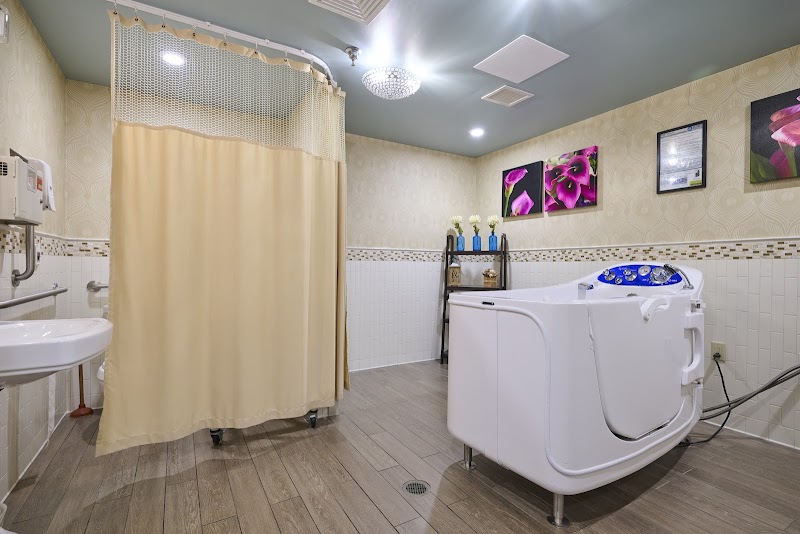
Who Owns and Operates Maple Ridge Rehabilitation & Healthcare Center?

MAPLE RIDGE REHABILITATION & HEALTHCARE CENTER is owned by a for-profit company. For-profit facilities operate as businesses with obligations to shareholders or private owners. The facility is operated by CENTURY HEALTHCARE, a chain that manages multiple nursing homes. With 92 certified beds and approximately 83 residents (about 90% occupancy), it is a smaller facility located in KINGSTON, Pennsylvania.
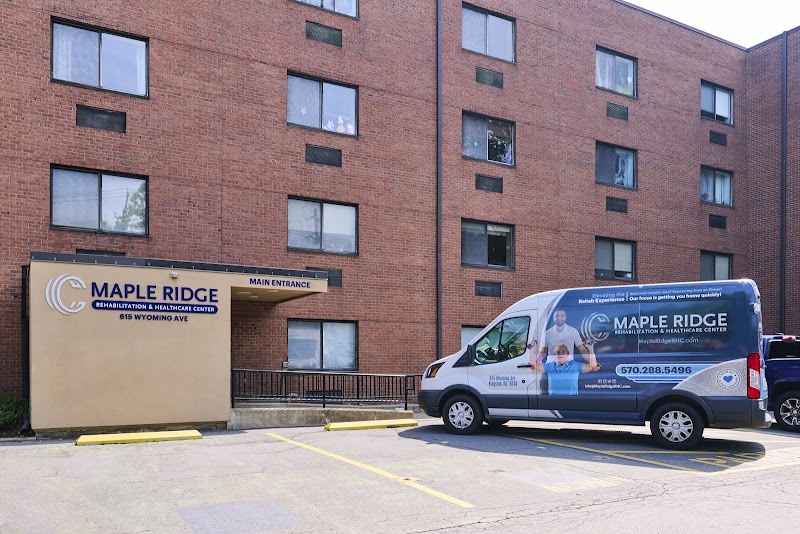
How Does Maple Ridge Rehabilitation & Healthcare Center Compare to Other Pennsylvania Nursing Homes?

Compared to the 100 nursing homes in Pennsylvania, MAPLE RIDGE REHABILITATION & HEALTHCARE CENTER's overall rating (3 stars) matches the state average, staff turnover (45%) is near the state average of 46%, and health inspection rating (3 stars) is at the national benchmark.

What Should Families Ask When Visiting Maple Ridge Rehabilitation & Healthcare Center?

Based on this facility's data, families visiting should ask: "Can I visit during a mealtime to observe dining assistance and food quality?" "How do you handle medical emergencies, and what is your hospital transfer rate?" "Can I speak with family members of current residents about their experience?"

Is Maple Ridge Rehabilitation & Healthcare Center Safe?

Based on CMS inspection data, MAPLE RIDGE REHABILITATION & HEALTHCARE CENTER has a clean safety record: no substantiated abuse findings (meaning no confirmed cases of resident harm), no Immediate Jeopardy citations (the most serious violation level indicating risk of serious injury or death), and is not on the Special Focus Facility watch list (a federal program monitoring the lowest-performing 1% of nursing homes). The facility has a 3-star overall rating and ranks #1 of 100 nursing homes in Pennsylvania. While no facility is perfect, families should still ask about staff-to-resident ratios and recent inspection results during their visit.

Do Nurses at Maple Ridge Rehabilitation & Healthcare Center Stick Around?

MAPLE RIDGE REHABILITATION & HEALTHCARE CENTER has a staff turnover rate of 45%, which is about average for Pennsylvania nursing homes (state average: 46%). Moderate turnover is common in nursing homes, but families should still ask about staff tenure and how the facility maintains care continuity when employees leave.

Was Maple Ridge Rehabilitation & Healthcare Center Ever Fined?

MAPLE RIDGE REHABILITATION & HEALTHCARE CENTER has no federal fines on record. CMS issues fines when nursing homes fail to meet care standards or don't correct problems found during inspections. The absence of fines suggests the facility has either maintained compliance or corrected any issues before penalties were assessed. This is a positive indicator, though families should still review recent inspection reports for the full picture.

Is Maple Ridge Rehabilitation & Healthcare Center on Any Federal Watch List?

MAPLE RIDGE REHABILITATION & HEALTHCARE CENTER is not on any federal watch list. The most significant is the Special Focus Facility (SFF) program, which identifies the bottom 1% of nursing homes nationally based on persistent, serious quality problems. Not being on this list means the facility has avoided the pattern of deficiencies that triggers enhanced federal oversight. This is a positive indicator, though families should still review the facility's inspection history directly.