CRITICAL
(J)
Immediate Jeopardy (IJ) - the most serious Medicare violation
Accident Prevention
(Tag F0689)
Someone could have died · This affected 1 resident
**NOTE- TERMS IN BRACKETS HAVE BEEN EDITED TO PROTECT CONFIDENTIALITY** Based on observation, staff interview, and facility document review it was determined the facility staff failed to prevent an ac...
Read full inspector narrative →
**NOTE- TERMS IN BRACKETS HAVE BEEN EDITED TO PROTECT CONFIDENTIALITY** Based on observation, staff interview, and facility document review it was determined the facility staff failed to prevent an accident hazard by ensuring that a bag of medications had been properly secured on 1 of 3 units in the facility. The scope and severity was originally cited at Immediate Jeopardy, Level IV Isolated and was reduced to a Level II Isolated after the facility was cleared of Immediate Jeopardy. The administrator and regional vice president of operations were notified on 7/16/19 that the extended survey process had begun at 9:02 am, as the survey team had identified Immediate Jeopardy & Substandard Quality of Care in the area of Quality of Care.
The findings included:
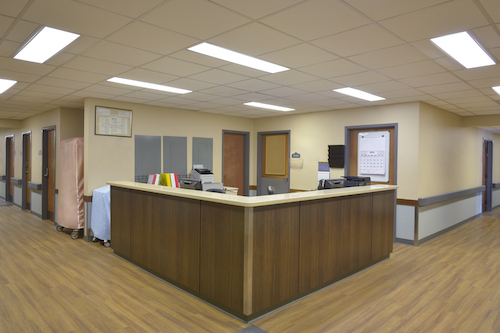
The facility staff failed to ensure that a bag of medications had been properly secured on a dementia unit within the facility. The opened bag of medications was left on the floor in the nurse's station that was open and accessible to the wandering residents on the Carter's Fold secured dementia unit, which created an accident hazard with the potential for a serious adverse outcome.
On 7/16/19 at 8:30 am, the surveyor entered the nurse's station on the Carter's Fold secured dementia unit. The surveyor observed that the nurse's station on the unit is open and accessible to anyone on the unit. The surveyor observed Resident # 86 wheel into the nurse's station with her wheelchair and then wheeled back out near the dining room table. The surveyor looked down onto the floor and observed a large plastic bag that was full of medications on the floor of the open and accessible nurse's station. The surveyor observed a total of five residents in the area of the nurse's station at that time. The surveyor did not observe any staff supervision. The surveyor summoned another team member to report observations.
On 7/16/19 at 8:38 am, three surveyors observed the large plastic bag full of medications on the floor of the open and accessible nurse's station on Carter's Fold secured dementia unit. The surveyor looked into the bag and observed that the following medications were in the bag: potassium, warfarin, vancomycin, Cymbalta, albuterol, levalbuterol, gas-x, hydrochlorothiazide, myrbetriq, singulair, zantac, protonix, midodrine, trimethoprim, anoro inhaler, insulin, and atropine eye drops. While the surveyors were observing the medications in the bag, one CNA entered the nurse's station to review the bath list that was posted on the wall at the nurse's station. The CNA looked at the list and exited the area without acknowledging the bag of medications. At that time, the surveyors observed five residents in the area of the open and accessible nurse's station without staff supervision.
On 7/16/19 at 8:45 am, one surveyor remained on the unit with the medications to ensure that no resident handled the bag of medications, and the remaining surveyors conducted a team meeting to discuss the findings as stated above. While the team meeting was in progress a surveyor observed one resident in a wheelchair enter the open and accessible nurse's station where the bag of drugs were located. A surveyor also observed two staff members open the drawer directly above where the bag of medications was located to get the bathroom key and neither of the staff members acknowledged the bag of medications.
On 7/16/19 at 9:02 am, the administrator, administrator in training, director of nursing, and regional director of clinical services were made aware of the findings as stated above and that a Level IV Immediate Jeopardy deficiency had been cited.
On 7/16/19 at 9:13 am, the administrator, administrator in training, director of nursing, and regional director of clinical services went onto the Carter's Fold secured dementia unit along with the surveyor and observed the bag of medications on the floor of the open and accessible nurse's station. The regional director of clinical services removed the bag of medications and searched the nurse's station to ensure that there were no other medications or hazards that had been left unsecured.
On 7/16/19 at 1:30 pm, the facility staff presented the survey team with the facility Immediate Jeopardy Removal Plan. The immediate jeopardy removal plan was documented as follows,
Identify those recipients who have suffered or likely to suffer as a result of the noncompliance:
Residents on the Carter's Fold (secured unit) could be affected by this noncompliance practice of securing medications. There were not any residents identified to be affected. On 7/16/19, the unsecured medications were immediately removed from the Carter's Fold nurse's station. A door was installed at the nurse's station with a slide lock to prevent wandering residents from entering the nurse's station. The nurse's station was immediately assessed for potential hazards for wandering residents.
Residents likely to suffer a serious adverse outcome as a result of the noncompliance.
All residents have the potential to be affected by this noncompliance practice. On 7/16/19, the facility staff immediately conducted observation rounds in all resident rooms and nurse's stations to ensure all medications are appropriately stored and secured so that residents remained free of accidents. No additional medications were found or identified to be unsecured in any areas.
The action the entity will take to alter the process/system failure to prevent an adverse outcome from occurring or reoccurring:
To prevent this from reoccurring, the facility Director of Nursing and designee immediately began to provide education for all staff regarding securing medications, and potential hazards for wandering residents. All staff will be educated prior to starting their next assignment when they return. These staff members will not be permitted to work until education is received. This education will be included in all new hire training and on boarding.
On 7/16/19, the Regional Director of Clinical Services provided education to the Director of Nursing and Nursing Home Administrator on securing medication, medication storage, as well as potential accidents and hazards for secured unit.
DON (director of nursing) or designee will complete observation rounds daily to ensure medications remain secure for four weeks. Results of rounds will be brought to monthly Quality Assurance and Performance Improvement (QAPI) meetings for review and revision as necessary.
Person responsible: NHA (nursing home administrator) (Administrator's name withheld)
Action Complete Date
July 16, 2019
On 7/16/19 at 6:34 pm, the surveyor interviewed LPN # 2 (licensed practical nurse). The surveyor asked LPN # 2 if she had worked the night shift on Carter's Fold on 7/15/19. LPN # 2 stated, Yes. The surveyor asked LPN # 2 if she had seen the bag of medications that had been left unsecured in the nurse's station on Carter's Fold. LPN # 2 stated, Me and another nurse bagged them up to send them back to the pharmacy. The surveyor asked LPN # 2 if she locked the bag of medications up before she left the facility. LPN # 2 stated, No. The surveyor asked LPN # 2 if there was somewhere to lock the medications up until they are picked up from the pharmacy. LPN # 2 stated, Yes there's an area to lock them up.
The facility policy on Storage and Expiration of Medications, Biologicals, Syringes, and Needles contained documentation that included but was not limited to,
.Procedure
3.3 Facility staff should ensure that all medications and biologicals, including treatment items, are securely stored in a locked cabinet/cart or locked medication room that is inaccessible by residents and visitors.
17. Facility staff should inspect nursing station storage areas for proper storage compliance on a regularly scheduled basis.
On 7/16/19 at 7:00 pm, the administrator in training presented the survey team with evidence that the corrective action as listed in the plan of correction had been completed.
On 7/16/19 at 7:02 pm, the regional vice president of operations, the administrator, the administrator in training, the director of nursing, and the regional director of clinical services were made aware that the Level IV Isolated Immediate Jeopardy citation had been reduced to a Level II Isolated deficiency.
On 7/17/19 at 6:00 pm, the director of nursing provided the surveyor with 2 statements that had been signed by the director of nursing. The first statement was documented as, Statement for LPN # 3. LPN # 3 states that medications were bagged to be sent back to pharmacy. She states she intended to take medications and was called away, and failed to remove them. The second statement was documented as, Statement obtained from LPN # 2. LPN # 2 states that medications had been secured in med room until she removed the bag with the intention of putting them in [NAME] Hall med room to be picked up by pharmacy. LPN # 3 states she sat the medication down, and accidentally walked away, leaving the medication at the desk.
No further information regarding this issue was presented to the survey team prior to the exit conference on 7/18/19.medications.
CRITICAL
(J)
Immediate Jeopardy (IJ) - the most serious Medicare violation
Deficiency F0761
(Tag F0761)
Someone could have died · This affected 1 resident
**NOTE- TERMS IN BRACKETS HAVE BEEN EDITED TO PROTECT CONFIDENTIALITY** Based on observation, clinical record review, staff interview, and facility document review, the facility staff failed to approp...
Read full inspector narrative →
**NOTE- TERMS IN BRACKETS HAVE BEEN EDITED TO PROTECT CONFIDENTIALITY** Based on observation, clinical record review, staff interview, and facility document review, the facility staff failed to appropriately store medications on 1 of 3 units and failed to label a medication for 1 of 34 residents, Resident # 20.
The findings included:
1. The facility staff failed to ensure that a bag of medications had been properly stored on a dementia unit within the facility. The opened bag of medications was left on the floor in the nurse's station that was open and accessible to the wandering residents on the Carter's Fold secured dementia unit, which created the potential for a serious adverse outcome. The scope and severity was originally cited at Immediate Jeopardy, Level IV Isolated and was reduced to a Level II Isolated after the facility was cleared of Immediate Jeopardy. The administrator and regional vice president of operations were notified on 7/16/19 that the extended survey process had begun at 9:02 am, as the survey team had identified Immediate Jeopardy & Substandard Quality of Care in the area of Quality of Care.
On 7/16/19 at 8:30 am, the surveyor entered the nurse's station on the Carter's Fold secured dementia unit. The surveyor observed that the nurse's station on the unit is open and accessible to anyone on the unit. The surveyor observed Resident # 86 wheel into the nurse's station with her wheelchair and then wheeled back out near the dining room table. The surveyor looked down onto the floor and observed a large plastic bag that was full of medications on the floor of the open and accessible nurse's station. The surveyor observed a total of five residents in the area of the nurse's station at that time. The surveyor did not observe any staff supervision. The surveyor summoned another team member to report observations.
On 7/16/19 at 8:38 am, three surveyors observed the large plastic bag full of medications on the floor of the open and accessible nurse's station on Carter's Fold secured dementia unit. A total of five residents were observed in the area of the open and accessible nurse's station with no staff supervision. The surveyor looked into the bag and observed that the following medications were in the bag: potassium, warfarin, vancomycin, Cymbalta, albuterol, levalbuterol, gas-x, hydrochlorothiazide, myrbetriq, singulair, zantac, protonix, midodrine, trimethoprim, anoro inhaler, insulin, and atropine eye drops. While the surveyors were observing the medications in the bag, one CNA entered the nurse's station to review the bath list that was posted on the wall at the nurse's station. The CNA looked at the list and exited the area without acknowledging the bag of medications. At that time, the surveyors observed five residents in the area of the open and accessible nurse's station without staff supervision.
On 7/16/19 at 8:45 am, three surveyors observed two CNA staff members leave the unit. The surveyors observed five residents in the area of the open and accessible nurse's station without staff supervision. One surveyor remained on the unit with the medications to ensure that no resident handled the bag of medications, and the remaining surveyors conducted a team meeting to discuss the findings as stated above. While the team meeting was in progress a surveyor observed one resident in a wheelchair enter the open and accessible nurse's station where the bag of drugs were located. A surveyor also observed two staff members open the drawer directly above where the bag of medications was located to get the bathroom key and neither of the staff members acknowledged the bag of medications.
On 7/16/19 at 9:02 am, the administrator, administrator in training, director of nursing, and regional director of clinical services were made aware of the findings as stated above and that a Level IV Immediate Jeopardy deficiency had been cited.
On 7/16/19 at 9:13 am, the administrator, administrator in training, director of nursing, and regional director of clinical services went onto the Carter's Fold secured dementia unit along with the surveyor and observed the bag of medications on the floor of the open and accessible nurse's station. The regional director of clinical services removed the bag of medications and searched the nurse's station to ensure that there were no other medications or hazards that had been left unsecured.
On 7/16/19 at, the facility staff presented the survey team with the facility Immediate Jeopardy Removal Plan. The immediate jeopardy removal plan was documented as follows,
Identify those recipients who have suffered or likely to suffer as a result of the noncompliance:
Residents on the Carter's Fold (secured unit) could be affected by this noncompliance practice of securing medications. There were not any residents identified to be affected. On 7/16/19, the unsecured medications were immediately removed from the Carter's Fold nurse's station. A door was installed at the nurse's station with a slide lock to prevent wandering residents from entering the nurse's station. The nurse's station was immediately assessed for potential hazards for wandering residents.
Residents likely to suffer a serious adverse outcome as a result of the noncompliance
All residents have the potential to be affected by this noncompliance practice. On 7/16/19, the facility staff immediately conducted observation rounds in all resident rooms and nurse's stations to ensure all medications are appropriately stored and secured so that residents remained free of accidents. No additional medications were found or identified to be unsecured in any areas.
The action the entity will take to alter the process/system failure to prevent an adverse outcome from occurring or reoccurring:
To prevent this from reoccurring, the facility Director of Nursing and designee immediately began to provide education for all staff regarding securing medications, and potential hazards for wandering residents. All staff will be educated prior to starting their next assignment when they return. These staff members will not be permitted to work until education is received. This education will be included in all new hire training and on boarding.
On 7/16/19 at 1:30 pm, the Regional Director of Clinical Services provided education to the Director of Nursing and Nursing Home Administrator on securing medication, medication storage, as well as potential accidents and hazards for secured unit.
DON (director of nursing) or designee will complete observation rounds daily to ensure medications remain secure for four weeks. Results of rounds will be brought to monthly Quality Assurance and Performance Improvement (QAPI) meetings for review and revision as necessary.
Person responsible: NHA (nursing home administrator) (Administrator's name withheld)
Action Complete Date
July 16, 2019
On 7/16/19 at 6:34 am, the surveyor interviewed LPN # 2 (licensed practical nurse). The surveyor asked LPN # 2 if she had worked the night shift on Carter's Fold on 7/15/19. LPN # 2 stated, Yes. The surveyor asked LPN # 2 if she had seen the bag of medications that had been left unsecured in the nurse's station on Carter's Fold. LPN # 2 stated, Me and another nurse bagged them up to send them back to the pharmacy. The surveyor asked LPN # 2 if she locked the bag of medications up before she left the facility. LPN # 2 stated, No. The surveyor asked LPN # 2 if there was somewhere to lock the medications up until they are picked up from the pharmacy. LPN # 2 stated, Yes there's an area to lock them up.
The facility policy on Storage and Expiration of Medications, Biologicals, Syringes, and Needles contained documentation that included but was not limited to,
.Procedure
3.3 Facility staff should ensure that all medications and biologicals, including treatment items, are securely stored in a locked cabinet/cart or locked medication room that is inaccessible by residents and visitors.
17. Facility staff should inspect nursing station storage areas for proper storage compliance on a regularly scheduled basis.
On 7/16/19 at 7:00 pm, the administrator in training presented the survey team with evidence that the corrective action as listed in the plan of correction had been completed.
On 7/16/19 at 7:02 pm, the regional vice president of operations, the administrator, the administrator in training, the director of nursing, and the regional director of clinical services were made aware that the Level IV Isolated Immediate Jeopardy citation had been reduced to a Level II Isolated deficiency.
On 7/17/19 at 6:00 pm, the director of nursing provided the surveyor with 2 statements that had been signed by the director of nursing. The first statement was documented as, Statement for LPN # 3. LPN # 3 states that medications were bagged to be sent back to pharmacy. She states she intended to take medications and was called away, and failed to remove them. The second statement was documented as, Statement obtained from LPN # 2. LPN # 2 states that medications had been secured in med room until she removed the bag with the intention of putting them in [NAME] Hall med room to be picked up by pharmacy. LPN # 3 states she sat the medication down, and accidentally walked away, leaving the medication at the desk.
No further information regarding this issue was presented to the survey team prior to the exit conference on 7/18/19.
2. The facility staff failed to ensure a medication bottle was labeled in a manner that provided the needed instructions to correctly mix and administer the medication.
On 7/12/19 at 8:48 a.m., LPN (licensed practical nurse) #11 was observed administering medications to Resident #20. Resident #20 was admitted to the facility on [DATE]. Resident #20's diagnoses included, but were not limited to: hypertension, diabetes mellitus, peripheral vascular disease/peripheral arterial disease, and hyperlipidemia. Resident #20's 4/22/19 quarterly minimum data set (MDS) assessment indicated the resident had adequate hearing and clear speech; the resident was also assessed as being oriented to year, month, and day.
Resident #20's clinical documentation included the following medication order: Sodium Polystyrene Sulfonate Suspension 15GM/60ML. Give 60 ml by mouth one time a day for hyperkalemia. (Hyperkalemia is when the potassium level in one's blood is elevated.)
The facility's pharmacy staff provided administration information about Sodium Polystyrene Sulfonate. This information included the following: The average total daily adult dose of sodium polystyrene sulfonate is 15 g. to 60 g. administered as a 15-g dose (four level teaspoons), one to four times daily.
The following information was found in a policy titled 6.0 General Dose Preparation and Medication Administration (with an effective date of 12/1/07 and the most recent revision date of 01/01/13): Verify each time a medication is administered that it is the correct medication, at the correct dose, at the correct route, at the correct time, for the correct resident . Facility staff should not administer a medication if the medication or prescription label is missing or illegible. This policy was provided to the survey team by the Regional Director of Clinical Services (RDCS) on 7/18/19 at 12:50 p.m.; the RDCS reported this policy was obtained from the facility's pharmacy.
On 7/16/19 at 9:49 a.m., a unit manager (Registered Nurse (RN) #11) was interviewed about the labeling of Resident #20's Sodium Polystyrene Sulfonate Suspension bottle; RM #11 acknowledged a label was covering the mixing instructions
On 7/17/19 at 10:45 a.m., the mxing instructions on the aforementioned medication label being covered was discussed during a survey team meeting with the facility's Director of Nursing, Administrator, Administrator-In-Training, Regional Director of Clinical Services, and Regional Vice-President of Operations.
On 7/18/19 at 12:57 p.m., the RDCS was interviewed about the aforementioned medication administration. The RDCS reported that if the label placed on the bottle was covering the administration directions then the pharmacy should be called for guidance.
CONCERN
(D)
Potential for Harm - no one hurt, but risky conditions existed
Deficiency F0554
(Tag F0554)
Could have caused harm · This affected 1 resident
**NOTE- TERMS IN BRACKETS HAVE BEEN EDITED TO PROTECT CONFIDENTIALITY** Based on observation, resident interview, staff interview, facility document review and clinical record review, the facility sta...
Read full inspector narrative →
**NOTE- TERMS IN BRACKETS HAVE BEEN EDITED TO PROTECT CONFIDENTIALITY** Based on observation, resident interview, staff interview, facility document review and clinical record review, the facility staff failed to determine that medication self-administration for 2 out of 34 residents was appropriate (Resident #91 and Resident #95).
The findings included:
1. The facility staff failed to assess Resident #91 for medication self-administration of eye drops (Systane Ultra).
The clinical record of Resident #91 was reviewed 7/15/19 through 7/18/19. Resident #91 was admitted to the facility 6/13/19 with diagnoses, that included but not limited to sepsis, metastatic colon cancer, type 2 diabetes mellitus, morbid obesity, urogenital implants, chronic urinary retention, hypertension, chronic obstructive pulmonary disease, obstructive sleep apnea, systemic lupus erythematous, depression, and congestive heart failure.
Resident #91's admission minimum data set (MDS) with an assessment reference date (ARD) of 6/20/19 assessed the resident with a BIMS (brief interview for mental status) as 15/15.
The surveyor interviewed Resident #91 on 7/15/19 at 6:31 p.m. During this interview, the surveyor observed a bottle of Systane Ultra eye drops on the over the bed table. The bottle of eye drops did not have a label with directions for use. Resident #91 stated the eye drops were used for dry eyes.
The surveyor reviewed the clinical record for an order for Resident #91 to administer the Systane Ultra eye drops independently; reviewed the current comprehensive care plan for medication self-administration; and reviewed the clinical record for an assessment for medication self-administration.
The surveyor was unable to locate any of the above items in the clinical record.
The surveyor interviewed the director of nursing (DON) on 7/16/19 at 2:06 p.m. about the medication self-administration process. The DON stated an assessment of that resident would be done prior to the start of medication self-administration. The surveyor asked the DON to see if Resident #91 had a medication self-administration assessment for Systane Ultra eye drops.
The DON informed the surveyor on 7/16/19 at 2:30 p.m. that a medication self-administration assessment had not been completed on Resident #91. The DON stated someone from the resident's family probably brought the medicine in. The surveyor requested the facility policy on medication self-administration on 7/16/19.
The surveyor reviewed the facility policy titled Self Administration of Medication Date Revised May 2016. The policy read in part 1. Verify physician's order in the resident's chart for self-administration of specific medications under consideration. 2. Complete Self-Administration of Medications Assessment form (AL 1008) with the resident. 5. In the event the Interdisciplinary team has determined the resident safe to administer medication (s), administration of medication (s) will be Care Planned for approved self-administered medication. 8. The MAR (medication administration record) must identify medications that are self-administered and the medication nurse will need to follow-up with the resident as to documentation and storage of medication during each medication pass. If medication (s) are kept at bedside, it must be kept in a locked box.
The surveyor informed the administrator, the director of nursing, the regional director of clinical services, the administrator-in-training, and the regional vice president of operations of the above concern on 7/17/19 at 11:35 a.m.
No further information was provided prior to the exit conference on 7/18/19.
2. The facility staff failed to assess Resident #95 for medication self-administration of nasal spray.
The clinical record of Resident #95 was reviewed 7/15/19 through 7/18/19. Resident #95 was admitted to the facility 11/10/15 and readmitted [DATE]. Diagnoses included but were not limited to mycoplasma pneumonia, urinary tract infection, type 2 diabetes mellitus, chronic obstructive pulmonary disease, neuromuscular dysfunction of the bladder, hypokalemia, chronic kidney disease, obesity, hypertension, and anemia.
Resident #95's 5-day minimum data set (MDS) assessment with an assessment reference date (ARD) of 6/24/19 assessed the resident with a BIMS (brief interview for mental status) as 15/15.
The surveyor interviewed Resident #95 on 7/16/19 at 11:40 a.m. and observed a bottle of Deep Sea moisturizing nasal spray on the over-the-bed table. The label read that resident may keep at bedside. Use in both nostrils. Resident #95 stated the oxygen tends to dry her nose and the spray helps with the dryness.
The surveyor reviewed the clinical record for an order for medication self-administration, an assessment for medication self-administration, and the care plan for medication self-administration.
The surveyor was unable to locate any of the above items in the clinical record.
The surveyor informed the director of nursing on 7/16/19 at 12:31 p.m. and requested if the DON could locate the order for the nasal spray and the medication self-administration assessment.
The DON informed the surveyor on 7/16/19 at 2:04 p.m. that a medication self-administration assessment had not been completed for the resident for the use of the nasal spray. The surveyor requested the facility policy on medication self-administration.
The surveyor reviewed the facility policy titled Self Administration of Medication Date Revised May 2016. The policy read in part 1. Verify physician's order in the resident's chart for self-administration of specific medications under consideration. 2. Complete Self-Administration of Medications Assessment form (AL 1008) with the resident. 5. In the event the Interdisciplinary team has determined the resident safe to administer medication (s), administration of medication (s) will be Care Planned for approved self-administered medication. 8. The MAR (medication administration record) must identify medications that are self-administered and the medication nurse will need to follow-up with the resident as to documentation and storage of medication during each medication pass. If medication (s) are kept at bedside, it must be kept in a locked box.
The surveyor informed the administrator, the director of nursing, the regional director of clinical services, the administrator-in-training, and the regional vice president of operations of the above concern on 7/17/19 at 11:35 a.m.
No further information was provided prior to the exit conference on 7/18/19.
CONCERN
(D)
Potential for Harm - no one hurt, but risky conditions existed
Deficiency F0558
(Tag F0558)
Could have caused harm · This affected 1 resident
**NOTE- TERMS IN BRACKETS HAVE BEEN EDITED TO PROTECT CONFIDENTIALITY** Based on observation, resident interview, staff interview, and clinical record review, the facility staff failed to
provide a r...
Read full inspector narrative →
**NOTE- TERMS IN BRACKETS HAVE BEEN EDITED TO PROTECT CONFIDENTIALITY** Based on observation, resident interview, staff interview, and clinical record review, the facility staff failed to
provide a reasonable accommodation by maintaining the breath activated call cord/light within the resident's reach for 1 of 34 residents (Resident #260).
The findings included:
Resident #260's breath activated call cord was out of reach for twenty-five minutes.
The clinical record of Resident #260 was reviewed 7/15/19 through 7/18/19. Resident #260 was admitted to the facility 6/24/19 and readmitted [DATE] with diagnoses that included but not limited to ventilator associated pneumonia, protein-calorie malnutrition, extradural and subdural abscess, quadriplegia, chronic respiratory failure, pressure ulcer sacral region, stage 2, osteomyelitis of vertebra, lumbosacral region, Hepatitis A, Hepatitis B, Hepatitis C, opioid abuse, hypertension, cocaine abuse, stimulant abuse, tracheostomy status, gastrostomy status, and dependence on ventilator.
The admission MDS (minimum data set) assessment had not yet been completed but other clinical documentation indicated the resident was not cognitively impaired but did require total assistance with all aspects of care, was a quadriplegia, and was ventilator dependent.
Resident #260's current care plan identified the focus area dated 6/25/19 that read the resident is ventilator dependent r/t (related to) respiratory failure. Interventions: Keep call bell within reach.
The surveyor interviewed Resident #260 on 7/15/19 at 5:22 p.m. Resident #260 was in bed, ventilator in use. The surveyor observed the breath activated call cord was approximately 1 ½-2 inches from Resident #260's mouth. The surveyor sat in a chair at bedside and interviewed the resident. Resident #260 spoke in a very soft voice. The surveyor did not understand most of the words spoken by the resident. The surveyor had to have ear to Resident #260's mouth in order to hear the spoken words.
During the interview, Resident #260 kept trying to blow into the breath activated call cord but was unable to activate it as indicated by his care plan. The call cord was approximately 1 ½ inches-2 inches from the resident's mouth. During the interview of approximately 25 minutes, the surveyor did not witness any staff attempt to check on Resident #260.
Upon completion of the interview at 5:40 p.m., the surveyor informed Resident #260's nurse for the day-registered nurse #1 of the above concern. R.N. #1 followed the surveyor to Resident #260's room, adjusted the breath activated call cord and stated the call cord was within reach when checked earlier in the shift.
The surveyor informed the administrator, the director of nursing, the regional director of clinical services, the vice president of regional operations, and the administrator-in-training of the above concern on 7/17/19 at 11:35 a.m.
No further information was provided prior to the exit conference on 7/18/19.
CONCERN
(D)
Potential for Harm - no one hurt, but risky conditions existed
Deficiency F0583
(Tag F0583)
Could have caused harm · This affected 1 resident
Based on observation, staff interview, and facility document review, the facility staff failed to provide privacy for 1 of 4 residents observed during a medication pass and pour observation, Resident ...
Read full inspector narrative →
Based on observation, staff interview, and facility document review, the facility staff failed to provide privacy for 1 of 4 residents observed during a medication pass and pour observation, Resident # S2.
The findings included
The facility staff failed to pull the privacy curtain to provide privacy while administering medications through a peg tube for Resident # S2.
On 9/12/19 at 8:47 am, the surveyor was conducting a medication pass and pour observation with LPN # 1 (licensed practical nurse). The surveyor observed that LPN # 1 did not pull the privacy curtain and Resident # S2 was visible to her roommate as LPN # 1 administered medications to Resident # S2 via peg tube.
On 9/12/19 at 10:03 am, the surveyor interviewed LPN # 1. The surveyor asked LPN # 1 why she did not pull the privacy curtain during medication administration for Resident # S2. LPN # 1 stated, I didn't even think about it. Her husband used to be in the room with her, and he used to like to watch her get her medicine. The person that is in there now is usually in therapy when I give her medication, and I didn't think to pull the curtain.
The facility policy on Resident Privacy contained documentation that included but was not limited to,
. Procedure
2. A closed door, drawn curtain, or both, shields the resident from passerby, as well as their roommate.
On 9/12/19 at 2:30 pm, the administrator, the administrator in training, the director of nursing and the regional director of clinical services were made aware of the findings as stated above. The administrative team was provided the opportunity to ask questions and submit more information to dispute the deficient practice as stated above.
No further information regarding this issue was provided to the survey team prior to the exit conference on 9/12/19.
CONCERN
(D)
Potential for Harm - no one hurt, but risky conditions existed
Report Alleged Abuse
(Tag F0609)
Could have caused harm · This affected 1 resident
**NOTE- TERMS IN BRACKETS HAVE BEEN EDITED TO PROTECT CONFIDENTIALITY** Based on facility document review, staff interview and clinical record review, the facility staff failed to report an allegation...
Read full inspector narrative →
**NOTE- TERMS IN BRACKETS HAVE BEEN EDITED TO PROTECT CONFIDENTIALITY** Based on facility document review, staff interview and clinical record review, the facility staff failed to report an allegation of abuse to the appropriate agencies for 1 of 12 residents in the survey sample (Resident #209).
The findings included:
The facility staff failed to report an allegation of abuse to the appropriate agencies for Resident #209.
Resident #209 was originally admitted to the facility on [DATE] with the following diagnoses of, but not limited to anemia, coronary artery disease, high blood pressure, pneumonia, diabetes, arthritis and dementia. This resident was first admitted to a facility in which it was a sister facility but was transferred to present facility due to being able to meet the increased needs of this resident in a secure unit due to wandering tendencies and family request. This transfer of this resident occurred on 8/23/19.
During the clinical record review by the surveyor on 9/11/and 9/12/19, the following documentation was noted on the Admission/readmission Evaluation, which was completed on 8/23/19:
o .During the last 90 days resident had No Falls .
o The resident's cognitive status changed in the last 90 days was answered as No .
o Moderately impaired limited vision, but can identify objects .
o Confined to a chair .
o Balance not steady, only able to stabilize with physical assistance .
o 3 or more medications taken currently or within the last 7 days .
o Memory loss .
o Resident #209 was also marked as requiring 1 person assist with ambulation, bed mobility, bathing, dressing, eating, toileting, and transfers.
The surveyor reviewed the resident's clinical record on 9/11/19 and 9/12/19. During this review, the surveyor noted the following documentation dated and timed for 8/27/19 at 10:57 am which read, While attempting to get resident dressed and cleaned up for the day, resident started yelling before anyone even touched this resident. No, your not going to beat me up and put more bruises on me! Do not touch me, you guys are mean to me! The resident was left alone for now to rest. The surveyor reviewed the nursing notes after this incident and there was no further documentation on the allegation of abuse.
On 9/11/19 at approximately 4:45 pm, the surveyor asked the administrative team in the end of the day conference if they had any FRI's (Facility Reported Incidents) on Resident #209 for this date. The director of nursing and the regional nurse consultant both stated they were not aware of any FRI's that had been completed concerning this resident. Both stated they would look into this and provide the surveyor with any information that they find.
On 9/12/19 at 9:15 am, the regional nurse consultant, director of nursing (DON) and administrator in training (AIT) were present with the surveyor in the conference room. The regional nurse consultant stated, I was wondering why you asked us for a FRI on this resident yesterday because all that we were aware of was 2 falls that occurred on 8/26 and 8/27/19. Both the DON and I worked late and read the nurses' notes and that was when we found the allegation of abuse that was documented by the nurse of 8/27/19 at 10:57 am. Both the regional nurse consultant and the DON stated they were not aware of this allegation until they were reviewing the notes last night (9/11/19). The regional nurse consultant stated, After finding this out, we immediately faxed in a FRI to your office and notified the appropriate agencies of this allegation. The administrator in training stated that after these measures were taken, the staff was educated on reporting of any allegations of abuse immediately to their supervisor and then follow the chain of command so any allegations that are reported and investigations could be started within 2 hours of being told of an allegation. We have been doing this as staff was clocking into work last night and following through until all staff are in-serviced on this. The surveyor asked if the nurse that wrote this note was working today. The DON stated, No, she is on vacation and not on the schedule. The surveyor asked for a copy of the facility's policy on reporting allegations of abuse or neglect. The surveyor also requested a copy of any in services that staff had received in the past year on abuse and neglect of any resident in the facility.
The surveyor was provided with a copy of the facility's policy titled Virginia Resident Abuse Policy which read in part, .Facility staff must immediately report all such allegations to the Administrator/Abuse Coordinator. The Administrator/Abuse Coordinator will immediately begin an investigation and notify the applicable local and state agencies in accordance with the procedures in this policy .
The administrator in training provided the surveyor with a list of courses that the facility staff are required to have on an annual base. Included in these courses, were the courses on abuse and neglect, who and how to report this to if they ever receive a report of any of this. The surveyor reviewed the documentation on this list and noted there was a completion percentage of 99.12% of staff had completed these annual courses.
The unit manager for the Memory Care Unit was interviewed on 9/12/19 at approximately 1 pm in the conference room. The surveyor asked if she had received any allegations of abuse in which Resident #209 had reported to a nurse and then that nurse documented the statements in a nurses' note on 8/27/19 at 10:57 am. The unit manager stated, No one reported this incident to me and I was not aware of it until the DON had shown me the nurses' notes this morning.
The surveyor notified the Administrator along with the rest of the administrative team of the above documented findings on 9/12/19 at 3:30 pm. The surveyor asked the administrator if he had been aware of the allegation of abuse that had been documented in the nurses' notes of Resident #209 on 8/27/19 at 10:57 am. The administrator replied, No one knew of this allegation until my staff was reading over the notes last night and found it.
No further information was provided to the surveyor prior to the exit conference on 9/12/19.
CONCERN
(D)
Potential for Harm - no one hurt, but risky conditions existed
Investigate Abuse
(Tag F0610)
Could have caused harm · This affected 1 resident
**NOTE- TERMS IN BRACKETS HAVE BEEN EDITED TO PROTECT CONFIDENTIALITY** Based on staff interview, facility document review and clinical record review, the facility staff failed to immediately start an...
Read full inspector narrative →
**NOTE- TERMS IN BRACKETS HAVE BEEN EDITED TO PROTECT CONFIDENTIALITY** Based on staff interview, facility document review and clinical record review, the facility staff failed to immediately start an investigation when 1 of 12 residents in the survey sample alleged abuse by a staff member and failed to report these completed findings within 5 days of the becoming aware of an alleged abuse to a resident in the nursing facility (Resident #209).
The findings included:
The facility staff failed to immediately investigate an allegation of abuse that was reported to staff by Resident #209 on 8/27/19 at 10:57 am
Resident #209 was originally admitted to the facility on [DATE] with the following diagnoses of, but not limited to anemia, coronary artery disease, high blood pressure, pneumonia, diabetes, arthritis and dementia. This resident was first admitted to a facility in which it was a sister facility but was transferred to present facility due to being able to meet the increased needs of this resident in a secure unit due to wandering tendencies and family request. This transfer of this resident occurred on 8/23/19.
During the clinical record review by the surveyor on 9/11/and 9/12/19, the following documentation was noted on the Admission/readmission Evaluation, which was completed on 8/23/19:
o .During the last 90 days resident had No Falls .
o The resident's cognitive status changed in the last 90 days was answered as No .
o Moderately impaired limited vision, but can identify objects .
o Confined to a chair .
o Balance not steady, only able to stabilize with physical assistance .
o 3 or more medications taken currently or within the last 7 days .
o Memory loss .
o Resident #209 was also marked as requiring 1 person assist with ambulation, bed mobility, bathing, dressing, eating, toileting, and transfers.
The surveyor reviewed the resident's clinical record on 9/11/19 and 9/12/19. During this review, the surveyor noted the following documentation dated and timed for 8/27/19 at 10:57 am which read, While attempting to get resident dressed and cleaned up for the day, resident started yelling before anyone even touched this resident. No, your not going to beat me up and put more bruises on me! Do not touch me, you guys are mean to me! The resident was left alone for now to rest. The surveyor reviewed the nursing notes after this incident and there was no further documentation on the allegation of abuse.
On 9/11/19 at approximately 4:45 pm, the surveyor asked the administrative team in the end of the day conference if they had any FRI's (Facility Reported Incidents) on Resident #209 for this date. The director of nursing and the regional nurse consultant both stated they were not aware of any FRI's that had been completed concerning this resident. Both stated they would look into this and provide the surveyor with any information that they find.
On 9/12/19 at 9:15 am, the regional nurse consultant, director of nursing (DON) and administrator in training (AIT) were present with the surveyor in the conference room. The regional nurse consultant stated, I was wondering why you asked us for a FRI on this resident yesterday because all that we were aware of was 2 falls that occurred on 8/26 and 8/27/19. Both the DON and I worked late and read the nurses' notes and that was when we found the allegation of abuse that was documented by the nurse of 8/27/19 at 10:57 am. Both the regional nurse consultant and the DON stated they were not aware of this allegation until they were reviewing the notes last night (9/11/19). The regional nurse consultant stated, After finding this out, we immediately faxed in a FRI to your office and notified the appropriate agencies of this allegation. The administrator in training stated that after these measures were taken, the staff was educated on reporting of any allegations of abuse immediately to their supervisor and then follow the chain of command so any allegations that are reported and investigations could be started within 2 hours of being told of an allegation. We have been doing this as staff was clocking into work last night and following through until all staff are in-serviced on this. The surveyor asked if the nurse that wrote this note was working today. The DON stated, No, she is on vacation and not on the schedule. The surveyor asked for a copy of the facility's policy on reporting allegations of abuse or neglect. The surveyor also requested a copy of any in services that staff had received in the past year on abuse and neglect of any resident in the facility.
The surveyor was provided with a copy of the facility's policy titled Virginia Resident Abuse Policy which read in part, .Facility staff must immediately report all such allegations to the Administrator/Abuse Coordinator. The Administrator/Abuse Coordinator will immediately begin an investigation and notify the applicable local and state agencies in accordance with the procedures in this policy .
The administrator in training provided the surveyor with a list of courses that the facility staff are required to have on an annual base. Included in these courses, were the courses on abuse and neglect, who and how to report this to if they ever receive a report of any of this. The surveyor reviewed the documentation on this list and noted there was a completion percentage of 99.12% of staff had completed these annual courses.
The unit manager for the Memory Care Unit was interviewed on 9/12/19 at approximately 1 pm in the conference room. The surveyor asked if she had received any allegations of abuse in which Resident #209 had reported to a nurse and then that nurse documented the statements in a nurses' note on 8/27/19 at 10:57 am. The unit manager stated, No one reported this incident to me and I was not aware of it until the DON had shown me the nurses' notes this morning.
The surveyor notified the Administrator along with the rest of the administrative team of the above documented findings on 9/12/19 at 3:30 pm. The surveyor asked the administrator if he had been aware of the allegation of abuse that had been documented in the nurses' notes of Resident #209 on 8/27/19 at 10:57 am. The administrator replied, No one knew of this allegation until my staff was reading over the notes last night and found it.
No further information was provided to the surveyor prior to the exit conference on 9/12/19.
CONCERN
(D)
Potential for Harm - no one hurt, but risky conditions existed
Assessment Accuracy
(Tag F0641)
Could have caused harm · This affected 1 resident
**NOTE- TERMS IN BRACKETS HAVE BEEN EDITED TO PROTECT CONFIDENTIALITY** Based on observation, staff interview, and clinical record review, the facility staff failed to accurately assess 1 of 34 Reside...
Read full inspector narrative →
**NOTE- TERMS IN BRACKETS HAVE BEEN EDITED TO PROTECT CONFIDENTIALITY** Based on observation, staff interview, and clinical record review, the facility staff failed to accurately assess 1 of 34 Residents in the survey sample, Resident # 409.
The findings included:
The facility staff documented assessments in the clinical record, and created a care plan that reflected that Resident # 409 had a urostomy when Resident # 409 did not have a urostomy.
Resident #409 was an [AGE] year-old-female that was admitted to the facility on [DATE]. Diagnoses included but were not limited to, urinary tract infection, hypertension, restlessness, and agitation.
The clinical record for Resident # 409 was reviewed on 7/16/19 at 10:53 am. At the time of the survey, there were no completed MDS (minimum data set) assessments for Resident # 409.
The baseline plan of care for Resident # 409 was initiated on 4/12/19. The facility staff documented a focus area for Resident # 409 as, Resident requires urostomy. Interventions included but were not limited to, Inspect stoma and peristomal skin area with each pouch change. Note: irritation, redness, rashes.
Resident # 409 had current orders that included but were not limited to, Suprapubic catheter care q (every) shift and prn (as needed), which was initiated by the physician on 7/12/19. The surveyor reviewed the current physician's orders for Resident # 409 and did not observe any orders for urostomy care for Resident # 409.
On 7/16/19 at 3:38 pm, the surveyor observed Resident # 409 as CNA # 1 was providing ADL (activities of daily living) care. The surveyor observed that Resident # 409 had a suprapubic catheter size 20 Fr (French) with a 10 ml (milliliter) balloon. The suprapubic catheter and a leg drainage bag was secured to Resident # 409's left leg. The surveyor did not observe a urostomy site anywhere on Resident # 409's body.
On 7/17/19 at 8:04 am, the surveyor reviewed the facility Admission/readmission Evaluation form for Resident # 409 that had been documented on 7/11/19 at 22:00 (10:00 pm). The admission/readmission evaluation form for Resident # 409 contained documentation that included but was not limited to,
.13. Urinary Elimination
G. Urostomy (check mark observed in box beside urosotmy).
A facility 72 Hour Post admission Nursing Note that was documented on 7/12/19 at 10:47 am, contained documentation that included but was not limited to:
.5. Skin
4. Comments
(Typed in box below comments) Urostomy.
A facility CHF (congestive heart failure) Pathway Daily Nursing Note that was documented on 7/13/19 at 9:20 am, contained documentation that included but was not limited to,
.2. Evaluation
1.
Reason for Resident being skilled?
PT, OT (physical therapy, occupational therapy) to treat ADLs, mobility and strengthening. Nursing to monitor vital signs, labs, nutrition, safety, s/p (status post) hospitalization for UTI (urinary tract infection) - Urostomy care.
A CHF Pathway Daily Nursing Note that was documented on 7/14/19 at 9:20 am, contained documentation that included but was not limited to,
.Skilled Service Progression: Resident skilled for: PT, OT to treat ADLs, mobility and strengthening. Nursing to monitor vital signs, labs, nutrition, safety, s/p hospitalization for UTI - Urostomy care.
A CHF Pathway Daily Nursing Note that was documented on 7/15/19 at 9:20 am, contained documentation that included but was not limited to,
.Overview: Resident skilled for: PT, OT to treat ADLs, mobility and strengthening. Nursing to monitor vital signs, labs, nutrition, safety, s/p hospitalization for UTI - Urostomy care. Therapies ordered PT OT .
A CHF Pathway Daily Nursing Note that was documented on 7/16/19 at 9:20 am, contained documentation that included but was not limited to,
.Overview: Resident skilled for: PT, OT to treat ADLs, mobility and strengthening. Nursing to monitor vital signs, labs, nutrition, safety, s/p hospitalization for UTI - Urostomy care. Therapies ordered PT OT .
On 7/17/19 at 8:11 am, the surveyor interviewed LPN # 1 (licensed practical nurse). The surveyor asked LPN # 1 if Resident # 409 had a urostomy. LPN # 1 stated, I don't think so but I will go check.
On 7/17/19 at 8:15 am, LPN # 1 stated to the surveyor, She does not have a urostomy. She has a suprapubic catheter.
On 7/17/19 at 8:21 am, the surveyor interviewed MDS coordinator # 1. The surveyor askes MDS coordinator # 1 to review Resident # 409 baseline care plan. The surveyor and MDS coordinator # 1 observed that Resident # 409 had a focus area for having a urostomy on her baseline care plan. The surveyor asked who generated the focus area for a urostomy for Resident # 409. MDS coordinator # 1 stated, The nurse generated that on admission.
On 7/17/19 at 6:42 pm, the regional vice president of operations, the regional director of clinical services, the administrator, the administrator in training, and the director of nursing was made aware of the findings as stated above. The regional director of clinical services agreed that the facility staff had documented that Resident # 409 had a urostomy when in fact Resident # 409 did not have a urostomy.
No further information regarding this issue was presented to the survey team prior to the exit conference on 7/18/19.
CONCERN
(D)
Potential for Harm - no one hurt, but risky conditions existed
Deficiency F0679
(Tag F0679)
Could have caused harm · This affected 1 resident
**NOTE- TERMS IN BRACKETS HAVE BEEN EDITED TO PROTECT CONFIDENTIALITY** Based on observation, staff interview, and facility document review, the facility staff failed to provide activities to meet the...
Read full inspector narrative →
**NOTE- TERMS IN BRACKETS HAVE BEEN EDITED TO PROTECT CONFIDENTIALITY** Based on observation, staff interview, and facility document review, the facility staff failed to provide activities to meet the needs of Residents on 1 of 3 units in the facility and for 3 of 34 Residents in the facility, Resident # 91, Resident # 260, and Resident # 108.
The findings included:
1. The facility staff failed to provide group activities for Residents on the [NAME] Fold unit.
On 7/15/19 at 4:32 pm, the surveyor was making observations on the [NAME] fold unit. The surveyor observed an activity calendar for July 2019 that was posted on the unit. The surveyor observed that the activity calendar had Coffee Club as an activity that was to be conducted at 4:30 pm. The surveyor did not observe any staff member conducting a group activity with the Residents on the unit.
On 7/15/19 at 4:47 pm, the surveyor continued to conduct observations on the [NAME] Fold unit and did not observe any staff member conducting a group activity with the Residents on the unit.
On 7/15/19 at 5:02 pm, the surveyor continued to conduct observations on the [NAME] Fold unit and did not observe any staff member conducting a group activity with the Residents on the unit.
On 7/16/19 at 9:35 am, the surveyor observed that the activity calendar posted on the [NAME] Fold unit had Exercise posted to be conducted at 9:30 am. The surveyor did not observe any staff member conducting group activities with the Residents on the unit at that time.
On 7/16/19 at 9:47 am, the surveyor continued to conduct observation on the [NAME] Fold unit and did not observe any staff member conducting group activities with the Residents on the unit.
On 7/16/19 at 10:08 am, the surveyor observed that Noodle Ball was posted to be conducted at 10:00 am on the activity calendar that was posted on the unit. The surveyor did not observe any staff member conducting group activities with the Residents on the unit.
On 7/16/19 at 10:35 am, the surveyor reviewed the activity calendar that was posted on the unit. The activity calendar had Hand & Nails as an activity that was to be conducted at 10:30 am. The surveyor did not observe any staff member conducting group activities with the Residents on the unit.
On 7/16/19 at 11:10 am, the surveyor reviewed the activity calendar that was posted on the unit. The calendar had Rummy as an activity that was to be conducted at 11:00 am. The surveyor did not observe any staff member conduct group activities with the Residents on the unit.
On 7/16/19 at 2:08 pm, the surveyor reviewed the activity calendar that was posted on the unit. The calendar has About the Past as an activity that was to be conducted at 2:00 pm. The surveyor did not observe any staff member conduct group activities with the Residents on the unit.
On 7/17/19 at 8:30 am, the surveyor met with the administrator in training and the director of nursing and reported the observations as stated above. The administrator in training informed the surveyor that the facility activity director was in Richmond testing during the week of the survey. The surveyor asked the administrator in training who assisted with activities when the activity director was not present in the facility. The administrator in training informed the surveyor that the CNAs (certified nursing assistants) and the activity assistant helped with activities when the activity director was absent. The surveyor informed the administrator in training that there were no observations of CNAs conducting group activities with the Residents on the unit, and the surveyor did not observe the activity assistant on the [NAME] Fold unit conducting group activities. The administrator in training stated, She was busy with the rest of the building.
On 7/17/19 at 8:40 am, the surveyor interviewed the facility activity assistant. The surveyor made the activity assistant aware that she did not observe group activities being conducted with the Residents on [NAME] Fold on 7/15/19 and 7/16/19. The activity assistant informed the surveyor that she had been busy working on the other units and did not get to [NAME] Fold to conduct activities.
The facility Activity Program/Calendar Policy contained documentation that included but was not limited to,
.Policy:
The facility will provide activity programming to promote physical, cognitive, and/or emotional health, and that supports self-expression, exercise, socialization, lifestyle programs and leisure pursuits.
Procedure:
C) Activities will be offered every day for a minimum of six hours per day and including at least 2 evenings per week at hours offered at times convenient for the residents, and not to interfere during specific nursing care (i. e. medication administration) times.
On 7/17/19 at 6:42 pm, the regional vice president of operations, the regional director of clinical services, the administrator, the administrator in training, and the director of nursing was made aware of the findings as stated above.
No further information regarding this issue was presented to the survey team prior to the exit conference on 7/18/19.
2. The facility staff failed to provide an on-going program of activities designed to meet the needs, in accordance with the comprehensive assessment, the interests, and the physical, mental, and psychosocial well-being of Resident #260.
The clinical record of Resident #260 was reviewed 7/15/19 through 7/18/19. Resident #260 was admitted to the facility 6/24/19 and readmitted [DATE] with diagnoses that included but not limited to ventilator associated pneumonia, protein-calorie malnutrition, extradural and subdural abscess, quadriplegia, chronic respiratory failure, pressure ulcer sacral region, stage 2, osteomyelitis of vertebra, lumbosacral region, Hepatitis A, Hepatitis B, Hepatitis C, opioid abuse, hypertension, cocaine abuse, stimulant abuse, tracheostomy status, gastrostomy status, and dependence on ventilator.
The admission MDS (minimum data set) assessment had not yet been completed but other clinical documentation indicated the resident was not cognitively impaired, did require total assistance with all aspects of care, was a quadriplegia, and was ventilator dependent.
Resident #260's current care plan dated 7/8/19 read that the resident had made personal preferences known. She enjoys watching television, playing bingo, listening to music, socializing. Interventions: Have family involved with POC (plan of care), have snacks between meals, help keep personal belongings taken care of in the room and facility.
The surveyor interviewed Resident #260 on 7/15/19 at 5:22 p.m. Resident #260 was in bed, ventilator in use. The surveyor asked the resident about activities. Resident #260 stated in a very soft voice that she was ready to go to activities.
The surveyor reviewed Resident #260's Activities Evaluation Initial completed 7/8/19. Interests marked were bingo, small group, cards, one to one, movies, music, reading, current events, social/parties, family/friend visits, and television.
The surveyor interviewed the activity assistant on 7/17/19 at 9:37 a.m. The activity assistant stated Resident #260 attended social activities-sits in lounge area and talks with others. The activity assistant stated the resident had no active participation in an activity. The activity assistant stated the activity director (AD) was out of the facility this week and the activity director (AD) typically does 1-1 visits. The activity assistant was unable to locate documentation of any 1-1 visits.
The surveyor reviewed Resident #260's Individual Resident Daily Participation Record on 7/17/19. Group discussion was marked with an A from 7/2/19-7/16/19. A=active participation. Social/Parties was also marked with an A from 7/2/19 through 7/16/19.
During the survey from 7/15/19 through 7/18/19, the surveyor did not see Resident #260 participate in activities. The majority of the day Resident #260 sat in a small lounge across from the special care unit nurse's station. The surveyor did observe a male resident sitting with her during some of this time.
The surveyor requested a copy of the July 2019 calendar from the activity assistant on 7/17/19. Many of Resident #260's interests were scheduled on the calendar yet Resident #260 did not attend per the individual participation record:
Bingo scheduled on 7/4/19, 7/6/19, 7/8/19, 7/11/19, 7/13/19, and 7/15/19. Resident #260 did not attend any of these based on the individual record of participation.
Music time scheduled on 7/7/19, 7/8/19, 7/14/19 and 7/15/19- Resident #260 did not attend any of these based on the individual record of participation.
Cards scheduled on 7/9/19 and 7/16/19. Resident #260 did not attend any of these based on the individual record of participation.
The surveyor informed the DON on 7/18/19 at 8:25 a.m. of the concern with activities. The DON stated she couldn't speak about activities but would try to get in touch with the AD for activities.
The surveyor informed the administrator, the director of nursing, the regional director of clinical services, the vice president of regional operations, and the administrator-in-training of the above concern on 7/17/19 at 11:35 a.m.
No further information was provided prior to the exit conference on 7/18/19.
3. The facility staff failed to provide an on-going program of activities designed to meet the needs, in accordance with the comprehensive assessment, the interests, and the physical, mental, and psychosocial well-being of Resident
#91.
The clinical record of Resident #91 was reviewed 7/15/19 through 7/18/19. Resident #91 was admitted to the facility 6/13/19 with diagnoses, that included but not limited to sepsis, metastatic colon cancer, type 2 diabetes mellitus, morbid obesity, urogenital implants, chronic urinary retention, hypertension, chronic obstructive pulmonary disease, obstructive sleep apnea, systemic lupus erythematous, depression, and congestive heart failure.
Resident #91's admission minimum data set (MDS) with an assessment reference date (ARD) of 6/20/19 assessed the resident with a BIMS (brief interview for mental status) as 15/15.
Resident #91's current comprehensive care plan dated 6/25/19 and revised 7/8/19 read, Alteration in supervised/organized recreation characterized by little or no involvement, lack of attendance related to isolation. The resident likes to watch tv and read. Interventions: Arrange 1-1 contracts, determine feasibility of offering activities of interest to resident that are not currently offered, offer activity program directed towards specific interests/needs of resident.
The surveyor interviewed Resident #91 on 7/15/19 at 6:25 p.m. The resident was asked about activities. Resident #91 stated, The activity lady came in and talked to me but I've never seen the activity lady again. Resident #91 stated he/she had not attended any activities. Resident #91 stated that he/she watches tv (television) and reads the Bible while in the room.
The surveyor reviewed Resident #91's Activities Evaluation Initial completed 6/17/19. Activity pursuit patterns and preferences indicated the resident liked bingo, small groups, reading, television, and family/friend visits.
The surveyor interviewed the activity assistant on 7/17/19 at 9:40 a.m. and asked what activities Resident #91 attended. The activity assistant reviewed the Individual Resident Daily Participation Record and stated the only thing documented was tv (television) and current news/events. The surveyor stated both of those activities the resident can do without leaving the room. The activity assistant agreed. The activity assistant stated the activity director (AD) was out of the facility this week and the activity director (AD) typically does 1-1 visits. The activity assistant was unable to locate documentation of any 1-1 visits. The surveyor requested a copy of the July 2019 activity calendar.
The July 2019 Individual Resident Daily Participation Record was reviewed. Television was marked with an A from 7/1/19 through 7/16/19 for television and current events/news. A= active participation.
During the survey from 7/15/19 through 7/18/19, the surveyor observed Resident #91 in bed with the television on and with the Bible in it's case on the over-the-bed table Resident #91 was currently on reverse isolation.
The surveyor requested a copy of the July 2019 calendar from the activity assistant on 7/17/19. Many of Resident #91's interests were scheduled on the calendar yet Resident #91 did not attend per the individual participation record:
Bingo scheduled on 7/4/19, 7/6/19, 7/8/19, 7/11/19, 7/13/19, and 7/15/19. Resident #91 did not attend any of these based on the individual record of participation.
The surveyor informed the DON on 7/18/19 at 8:25 a.m. of the concern with activities. The DON stated he/she couldn't speak about activities but would try to get in touch with the AD for activities.
The surveyor informed the administrator, the director of nursing, the regional director of clinical services, the vice president of regional operations, and the administrator-in-training of the above concern on 7/17/19 at 11:35 a.m.
No further information was provided prior to the exit conference on 7/18/19.
4. The facility staff failed to provide recreational activities for Resident #108.
Resident #108 was admitted to the facility on [DATE]. Resident #108's diagnoses included, but were not limited to: heart failure, peripheral vascular disease, diabetes mellitus, arthritis, and non-Alzheimer's dementia. Resident #108's 7/1/19 minimum data set (MDS) assessment indicated the resident was able to express ideas and wants; the resident was oriented to year and month; and the Activity Preferences section documented it being 'very important' for the resident to listen to music, be around pets, and keep up with the news.
Observations of Resident #108 on 7/15/19, 7/16/19, and 7/17/19 failed to find the resident participating in recreational activities. Clinical documentation also failed to provide evidence Resident #108 had participated in recreational activities during her stay at the facility.
Resident #108's care plan included the following Focus information: Alteration in supervised/organized recreation characterized by little or no involvement, lack of attendance related to: cognitive impairment, impaired mobility, impaired social interaction. The following interventions were listed related to this 'Focus' area:
-Arrange 1:1 contacts with resident
-assist with transport resident to activities [sic]
-Engage resident in group activities
-Familiarize resident with nursing home environment and activities programs on regular basis [sic]
-Invite and encourage family to attend
-Praise all efforts.
The aforementioned care plan was provided to the surveyor by the facility's Administrator-In-Training (AIT) on 7/18/19 at 11:10 a.m.; the AIT reported no evidence was found to indicate this care plan had been implemented. The AIT reported to the surveyor that an activities staff member had unsuccessfully been attempting to contact Resident #108's family to identify activities the resident would enjoy.
The failure of facility staff to have evidence of recreational activities being provided to Resident #108 was discussed during a survey team meeting with the facility's administrative staff on 7/18/19 at 11:55 a.m. The facility's Director of Nursing, Administrator, Administrator-In-Training, and Regional Director of Clinical Services were present at this meeting.
CONCERN
(D)
Potential for Harm - no one hurt, but risky conditions existed
Quality of Care
(Tag F0684)
Could have caused harm · This affected 1 resident
**NOTE- TERMS IN BRACKETS HAVE BEEN EDITED TO PROTECT CONFIDENTIALITY** Based on staff interviews and clinical record review, the facility staff failed to provided services outline in the comprehensiv...
Read full inspector narrative →
**NOTE- TERMS IN BRACKETS HAVE BEEN EDITED TO PROTECT CONFIDENTIALITY** Based on staff interviews and clinical record review, the facility staff failed to provided services outline in the comprehensive care plan by following the physician's order in regards to notifying the physician when the resident's weight exceded 3 pounds for 1 of 34 residents, Resident #19.
The findings included:
The facility staff failed to notify the physician when Resident #19's weight gain exceeded 3 (three) pounds following dialysis. The order read to obtain weight upon return from dialysis and notify the physician of a weight gain greater than 3 (three) pounds (lbs).
Resident #19's clinical record was reviewed on 07/16/19 through 07/18/19. The review reveal Resident #19 was initially admitted to the facility on [DATE] and was most recently re-admitted on [DATE]. Diagnoses included but were not limited to, congestive heart failure, type 2 diabetes, and chronic kidney disease, stage 4 (severe).
Section C (cognitive patterns) of the Residents' quarterly MDS (minimum data set) assessment with an ARD (assessment reference date) of 04/22/19 and included a BIMS (brief interview for mental status) summary score of 15 out of a possible 15 points.
The Resident's electronic clinical record under the tab labeled orders contained an order with a start date of 06/08/19 at 7:00 p.m. that read to obtain weight upon return from dialysis. Notify MD if 3+ lbs is noted, every night shift Tue, Thu, Sat.
The Resident's care plan contained, but not limited to, a focus area of CHF (congestive heart failure) which listed interventions to include monitoring weight. Another focus area read, Resident is on hemodialysis. 3 days week. Tues., Thur., Saturday. (listed name and address of dialysis facility) with one of the interventions to restrict fluids.
Resident #19's MAR (medication administration record) noted a weight gain greater than 3 (three) pounds on both Tuesday, 06/11/19 and Saturday, 06/15/19:
•
Weight: 243.2 lbs (pounds) on Saturday, 06/08/19 and 248.2 lbs on Tuesday, 06/11/19 reflecting a gain of 5 lbs.
•
Weight: 249.2 lbs on Thursday, 06/13/19 and 253.4 lbs on Saturday, 06/15/19 reflecting a gain of 4.2 lbs.
The facility's director of nursing (DON) and nurse practitioner (NP) were interviewed in the conference room on 07/17/19 at 4:10 p.m. The NP acknowledged the order read to notify the provider of a weight gain over 3 (three) pounds and stated she would expect to be notified of that weight gain especially if the weight gain was accompanied by other signs or symptoms of congestive heart failure (CHF) such as shortness of breath (SOB). The DON explained that since Resident #19 usually returned from dialysis later in the evening, sometimes as late as 7:00 p.m. or after, the staff weighed the Resident on night shift (night shift started at 7:00 p.m.) The NP stated her expectation would be the staff would write a note for the NP to see the next morning unless the Resident's condition (i.e. SOB) required sooner notification. The DON planned to look for any evidence the staff had notified the provider of the 2 (two) weights in June that were over 3 lbs.
The DON was interviewed in the conference room on 07/18/19 at 9:25 a.m. She reiterated that if Resident #19 did not display any signs or symptoms of distress such as SOB, the facility staff would write the Resident's weight gain in the NP's rounding book for the NP to review the next day. The facility's process was that once the NP had reviewed the rounding book, the notes were shredded and therefore there was no evidence the staff had reported Resident #19's weight gains of over 3 lbs.
The administrator, administrator in training, director of nursing, regional director of clinical services, and regional vice president of operations were notified of the above referenced concern on 07/17/19 at 11:35 a.m. The administrator, administrator in training, director of nursing, and regional director of clinical services were notified again on 07/18/19 at 11:56 a.m.
No further information regarding this issue was provided to the survey team prior to the exit conference.
CONCERN
(D)
Potential for Harm - no one hurt, but risky conditions existed
Incontinence Care
(Tag F0690)
Could have caused harm · This affected 1 resident
**NOTE- TERMS IN BRACKETS HAVE BEEN EDITED TO PROTECT CONFIDENTIALITY** Based on observation, staff interview, facility document review and clinical record review, the facility staff failed to ensure ...
Read full inspector narrative →
**NOTE- TERMS IN BRACKETS HAVE BEEN EDITED TO PROTECT CONFIDENTIALITY** Based on observation, staff interview, facility document review and clinical record review, the facility staff failed to ensure that the resident received services and assistance to maintain continence by assuring that there was a physician order for the size of the indwelling Foley catheter and balloon for 1 of 34 residents (Resident #79).
The findings included:
The clinical record of Resident #79 was reviewed 7/15/19 through 7/18/19. Resident #79 was admitted to the facility 5/2/19 and readmitted [DATE] with diagnoses that included but not limited to pneumonia, persistent vegetative state, adult failure to thrive, severe sepsis with septic shock, neuromuscular dysfunction of the bladder, dysphagia, hypothyroidism, acute respiratory failure, dependence on respirator, tracheostomy status, unspecified coma, and non-traumatic intracerebral hemorrhage.
Resident #79's 30-day minimum data set (MDS) assessment with an assessment reference date (ARD) of 7/3/19 assessed the resident to be in a persistent vegetative state in Section B0100. Section H Bladder and Bowel was coded for the presence of an indwelling catheter under appliance (H0100A) and urinary continence (H0300) was coded as a 9-not rated, resident had a catheter (indwelling, condom), urinary ostomy, or no urine output for the entire 7 days.
Resident #79's current comprehensive care plan had the focus area that read Indwelling catheter characterized by inability to control urination. At risk for infection/complications. Attempted d/c (discontinue) of catheter 5/6/19. Unable to void. Dx (diagnosis) neurogenic bladder. Date initiated 5/3/19. Revision on 5/15/19. Interventions: Indwelling cath per orders.
The surveyor observed the resident on 7/15/19 at 3:01 PM. A Foley drainage bag was observed from the doorway. A sign on the door indicated the resident was on contact precautions. Certified nursing assistant #1 was providing care during the observation. The surveyor asked C.N.A. #1 for the size of the indwelling Foley catheter. C.N.A. #1 stated the Foley size was 16 FR (French) with a 10 cc (cubic centimeter) balloon.
The surveyor reviewed the July 2019 physician's orders for the size of the indwelling Foley catheter and balloon on 7/18/19. The surveyor was unable to locate an order for the size of the catheter and balloon.
The surveyor informed the director of nursing on 7/18/19 at 8:51 a.m. and requested the facility policy on the care of indwelling Foley catheters.
The DON provided the facility policy on the care of Foleys on 7/18/19 at 10:34 a.m. and stated the July 2019 physician's orders were reviewed and he/she was unable to locate an order for the size of the catheter and balloon. The DON stated the size of the Foley catheter and the balloon size should be included in the order.
The surveyor reviewed the facility policy on 7/18/19 titled Indwelling Catheter Use. The policy read Indwelling catheters are used when ordered by a physician to treat a specific medical condition.
The surveyor informed the administrator, the director of nursing, the regional director of clinical services and the administrator-in-training of the above issue on 7/18/19 at 11:56 a.m.
No further information was provided prior to the e exit conference on 7/18/19.
CONCERN
(D)
Potential for Harm - no one hurt, but risky conditions existed
Tube Feeding
(Tag F0693)
Could have caused harm · This affected 1 resident
Based on observation, staff interview, and facility document review, the facility staff failed to provide appropriate care and services in regards to gastrostomy tube for 1 of 4 residents observed dur...
Read full inspector narrative →
Based on observation, staff interview, and facility document review, the facility staff failed to provide appropriate care and services in regards to gastrostomy tube for 1 of 4 residents observed during a medication pass and pour observation, Resident # S2.
The findings included
The facility staff failed to appropriately check gastrostomy tube placement and residual for Resident # S2.
On 9/12/19 at 8:47 am, the surveyor conducted a medication pass and pour observation with LPN # 1 (licensed practical nurse). The surveyor observed LPN # 1 as she applied a syringe to Resident # S2's gastrostomy tube and pulled the syringe plunger back. The surveyor observed a small amount of dark yellow liquid residual return into the syringe. The surveyor observed LPN # 1 as she pushed down on the plunger and returned residual the contents to Resident # S2. The surveyor observed LPN # 2 as she removed the plunger from Resident # S2's peg tube, pulled back on the plunger, and replaced the plunger into Resident # S2's gastrostomy tube. The surveyor then observed LPN # 1 place her stethoscope on Resident # S2's stomach and inserted air into Resident # S2's gastrostomy tube to check placement.
On 9/12/19 at 10:03 am, the surveyor interviewed LPN # 1. The surveyor asked LPN # 1 why she checked the residual prior to checking placement when preparing to administer medications via gastrostomy tube to Resident # S2. LPN # 1 stated, That's the way I was taught to do it a long time ago.
The facility policy relating to Medication Administered through an Enteral Tube contained documentation that included but was not limited to,
.Procedure
Facility should check the placement of the naso-gastric or gastrostomy tube in accordance with facility policy.
Checking gastric residual volume.
On 9/12/19 at 4:35pm, the administrator, administrator in training, the director of nursing, and regional director of clinical services were made aware of the findings as stated above. The administrative team was provided the opportunity to ask questions and provide additional information.
No further information regarding this issue was presented to the survey team prior to the exit conference on 9/12/19.
CONCERN
(D)
Potential for Harm - no one hurt, but risky conditions existed
Deficiency F0697
(Tag F0697)
Could have caused harm · This affected 1 resident
**NOTE- TERMS IN BRACKETS HAVE BEEN EDITED TO PROTECT CONFIDENTIALITY** Based on staff interview, facility document review, and clinical record review, the facility staff failed to provide pain manage...
Read full inspector narrative →
**NOTE- TERMS IN BRACKETS HAVE BEEN EDITED TO PROTECT CONFIDENTIALITY** Based on staff interview, facility document review, and clinical record review, the facility staff failed to provide pain management services through non-pharmacological interventions for pain management prior to the use of pain medication for 3 of 34 residents (Resident #67, Resident #81, and Resident #260).
The findings included:
nter
1. The facility staff failed to provide non-pharmacological pain interventions prior to the use of pain medication for Resident #67.
The clinical record of Resident #67 was reviewed 7/15/19 through 7/18/19. Resident #67 was admitted to the facility 5/10/19 and readmitted [DATE], 6/17/19 and 7/3/19 with diagnoses that included but not limited to dependence on respirator, type 2 diabetes mellitus, chronic atrial fibrillation, hypertension, cardiac pacemaker, anemia, cirrhosis of the liver, gastrostomy tube, acute viral hepatitis, sedative, hypnotic, or anxiolytic dependence, opioid dependence, pyothorax without fistula, nicotine dependence, anxiety, and depressive episodes.
Resident #67's admission minimum data set (MDS) with an assessment reference date (ARD) of 5/29/19 assessed the resident with a BIMS (brief interview for mental status) as 6/15. Section J Health Conditions indicated the resident, at the time of the interview, did not have pain.
Resident #67's current comprehensive care plan identified the focus area for pain initiated 5/10/19 and revised on 5/23/19. Interventions: assist with positioning for comfort, non-pharmacological interventions for pain, and therapy screens as needed.
Resident #67's July 2019 physician's orders read in part Oxycodone hcl (hydrogen chloride) Tablet 5 mg (milligrams) Give 1 tablet by mouth q (every) 6 hours as needed for pain.
The surveyor reviewed the July 2019 electronic medication administration records (eMARs) on 7/18/19. Resident #67 was administered Oxycodone 5 mg twenty-three (23) times from 7/3/19 through 7/18/19 for pain ratings from 2 (lowest) to 9 (highest).
The surveyor reviewed the progress notes for 7/3/19. The 7/3/19 progress noted timed 18:36 (6:36 p.m.) read, Oxycodone HCL Tablet 5 mg Give 1 tablet by mouth every 6 hours as needed for pain pulled from stat box. No non-pharmacological interventions documented.
The progress note dated 7/6/19 at 21:49 (9:49 p.m.) read in part Oxycodone HCL Tablet 5 mg Give 1 tablet by mouth every 6 hours as needed for pain was requested by resident, resident could not express type of pain, location of pain and level of pain. No non-pharmacological interventions documented.
The 7/9/19 23:05 (11:05 p.m.) progress note read, Oxycodone HCL Tablet 5 mg Give 1 tablet by mouth every 6 hours as needed for pain. No non-pharmacological interventions documented.
The 7/11/19 05:32 a.m. progress note read, Oxycodone HCL Tablet 5 mg Give 1 tablet by mouth every 6 hours as needed for pain. There were not any non-pharmacological interventions documented.
The 7/13/19 07:42 a.m. progress note read, Oxycodone HCL Tablet 5 mg Give 1 tablet by mouth every 6 hours as needed for pain. There were no non-pharmacological interventions documented.
The 7/14/19 12:23 p.m. progress note read, Oxycodone HCL Tablet 5 mg Give 1 tablet by mouth every 6 hours as needed for pain. There were no non-pharmacological interventions documented.
The 7/15/19 14:57 (2:57 p.m.) progress note read, Oxycodone HCL Tablet 5 mg Give 1 tablet by mouth every 6 hours as needed for pain. There were no non-pharmacological interventions documented.
The 7/15/19 22:54 (10:54 p.m.) progress note read, Oxycodone HCL Tablet 5 mg Give 1 tablet by mouth every 6 hours as needed for pain. There were no non-pharmacological interventions documented.
The 7/16/19 04:57 a.m. progress note read, Oxycodone HCL Tablet 5 mg Give 1 tablet by mouth every 6 hours as needed for pain. There were no non-pharmacological interventions documented.
The 7/16/19 21:32 (9:32 p.m.) progress note read, Oxycodone HCL Tablet 5 mg Give 1 tablet by mouth every 6 hours as needed for pain. There were no non-pharmacological interventions documented.
The 7/17/19 06:20 a.m. progress note read, Oxycodone HCL Tablet 5 mg Give 1 tablet by mouth every 6 hours as needed for pain. There were no non-pharmacological interventions documented.
The 7/17/19 20:31 (8:31 p.m.) progress note read, Oxycodone HCL Tablet 5 mg Give 1 tablet by mouth every 6 hours as needed for pain. There were no non-pharmacological interventions documented.
The surveyor informed the regional director of clinical services of the above concern with the lack of non-pharmacological interventions prior to the administration of Oxycodone twelve times during July 2019 on 7/18/19 at 10:24 a.m. Resident #67 received Oxycodone 23 times from 7/3/19 through 7/18/19. The regional director of clinical services stated he/she was unaware of the interventions on the care plan. The surveyor requested the current care plan from the regional director of clinical services and the facility policy on pain management.
The care plan for pain read as follows: Resident #67's current comprehensive care plan identified the focus area for pain initiated 5/10/19 and revised on 5/23/19. Interventions: assist with positioning for comfort, non-pharmacological interventions for pain, and therapy screens as needed.
There were not any non-pharmacological interventions offered or documented in the above progress notes prior to the administration of Resident #67's Oxycodone 5 mg tablet.
The surveyor informed the administrator, director of nursing, the regional director of clinical services and the administrator-in-training of the above issue on 7/18/19 at 11:56 a.m.
The surveyor reviewed the facility policy titled Pain Management and Pain Protocol on 7/18/19. The policy read in part Procedure 3. Non-pharmacological intervention will be attempted prior to the administration of PRN (whenever needed) pain medications.
No further information was provided prior to the exit conference on 7/18/19.
2. The facility staff failed to provide non-pharmacological pain interventions prior to the use of pain medication for Resident #81.
The clinical record of Resident #81 was reviewed 7/15/19 through 7/18/19. Resident #81 was admitted to the facility 6/13/17 and readmitted [DATE] with diagnoses that included but not limited to cardiac arrest, ventilator dependence, hypertension, tracheostomy, atrioventricular block, complete, atherosclerotic heart disease, gastroesophageal reflux disease (GERD) with esophagitis, chronic obstructive pulmonary disease (COPD), depressive disorder, anxiety, scoliosis, visual loss, acute and chronic respiratory failure with hypercapnia, and muscular dystrophy.
Resident #81's annual minimum data set (MDS) assessment with an assessment reference date (ARD) of 6/7/19 assessed the resident with a BIMS (brief interview for mental status) as 15/15. Section J Health Conditions assessed the resident to have received scheduled pain medication, received prn (as needed) pain medication, and received no non-medication interventions for pain.
Resident #81's current comprehensive care plan identified the focus area that read alteration in comfort related to pain from Muscular Dystrophy. Date initiated 6/14/17 and revised on 6/18/19. Interventions: Administer pain medications as ordered, monitor for pain, assess for pain every shift, eliminate or reduce causative factors, refer to pain flow sheet as needed, staff to attempt non-pharmacological interventions. Repositioning.
Resident #81's July 2019 physician's orders read in part Hydrocodone-Acetaminophen Tablet 7.5-325 mg (milligrams) Give 1 tablet by mouth every 6 hours as needed for pain.
The surveyor reviewed the July 2019 electronic medication administration records. Resident #81 received pain medications thirty-one times from 7/1/19 through 7/16/19. Of the dates and times administered, fourteen (14) did not have non-medication interventions documented in the progress notes or on the electronic medication administration records (eMARs):
7/3/19 at 1320 (1:20 p.m.)
7/3/19 at 2148 (9:48 p.m.)
7/4/19 at 0600
7/6/19 at 1219
7/6/19 at 1831 (6:31 p.m.)
7/7/19 at 0840
7/8/19 at 2003 (8:03 p.m.)
7/9/19 at 0653
7/11/19 at 0639
7/12/19 at 2050 (8:50 p.m.)
7/13/19 at 0734
7/13/19 at 1900 (7:00 p.m.)
7/14/19 at 1132
7/15/19 at 1651 (4:51 p.m.)
The surveyor discussed the above lack of non-medication interventions with the director of nursing on 7/18/19 at 8:21 a.m. The DON stated the staff need to offer non-pharm interventions prior to use and document those interventions. The surveyor informed the DON that the record documents mainly nurses that work in the evenings and at nights. The DON stated some of those nurses were new. The surveyor requested the facility policy on pain management.
The surveyor informed the administrator, director of nursing, the regional director of clinical services and the administrator-in-training of the above issue on 7/18/19 at 11:56 a.m.
The surveyor reviewed the facility policy titled Pain Management and Pain Protocol on 7/18/19. The policy read in part Procedure 3. Non-pharmacological intervention will be attempted prior to the administration of PRN (whenever needed) pain medications.
No further information was provided prior to the exit conference on 7/18/19.
3. The facility staff failed to provide non-medication interventions prior to pain medication administration for Resident #260.
The clinical record of Resident #260 was reviewed 7/15/19 through 7/18/19. Resident #260 was admitted to the facility 6/24/19 and readmitted [DATE] with diagnoses that included but not limited to ventilator associated pneumonia, protein-calorie malnutrition, extradural and subdural abscess, quadriplegia, chronic respiratory failure, pressure ulcer sacral region, stage 2, osteomyelitis of vertebra, lumbosacral region, Hepatitis A, Hepatitis B, Hepatitis C, opioid abuse, hypertension, cocaine abuse, stimulant abuse, tracheostomy status, gastrostomy status, and dependence on ventilator.
The admission MDS (minimum data set) assessment had not yet been completed but other clinical documentation indicated the resident was not cognitively impaired, did require total assistance with all aspects of care, was a quadriplegia, and was ventilator dependent.
Resident #260's current comprehensive care plan identified the focus area for pain r/t (related to) osteomyelitis initiated 6/25/19 and revised 6/25/19. Interventions included: assist with positioning for comfort, meds (medications) as ordered, and provide distractions prn (as needed) such as television, or activities. Interaction with others, reading material as able.
Resident #260's July 2019 physician's orders read in part Hydrocodone-Acetaminophen (Hycet Solution) 7.5-325 mg (milligram)/15ml (milliliter) Give 15 ml by mouth every 4 hours as needed for pain-start date 7/2/19 and discontinued 7/16/19. Resident #260's July 2019 physician's orders read in part Oxycodone Hcl Tablet 5 mg (milligrams) Give 1 tablet by mouth every 4 hours as needed for pain.
Resident #260 received Hycet 7.5-325mg thirty-two (32) times from 7/2/19 through 7/16/19. Fifteen (15) of those administered were administered prior to the use of a non-medication intervention. Those days and times were:
7/3/19 at 1409 (2:09 p.m.)
7/3/19 at 2045 (8:45 p.m.)
7/4/19 at 0458
7/6/19 at 1005
7/6/19 at 1545 (3:45 p.m.)
7/7/19 at 1313 (1:13 p.m.)
7/7/19 at 1758 (5:58 p.m.)
7/8/19 at 2301 (11:01 p.m.)
7/9/19 at 0714
7/10/19 at 0018
7/10/19 at 1100
7/13/19 at 0052
7/13/19 at1236
7/14/19 at 1117
7/15/19 at 1629 (4:29 p.m.)
Resident #260 received Oxycodone 5 mg twenty-one (21) times from 7/10/19 through 7/17/19. Of those administered, eight (8) were administered prior to the use on a non-medication intervention. Those days and times were:
7/10/19 at 1459 (2:59 p.m.)
7/11/19 at 0548
7/12/19 at 1152
7/13/19 at 0829
7/14/19 at 1022
7/15/19 at 1303 (1:03 p.m.)
7/15/19 at 2013 (8:13 p.m.)
7/16/19 at 0109
The surveyor informed the director of nursing of the above concern on 7/18/19 at 8:30 a.m. that the staff had not offered/documented non-medication interventions prior to administration on the above days/times. The DON stated some of the residents don't want to try interventions. They know they can have the medications and they want them when they want them. The surveyor requested the facility policy on pain management on 7/18/19.
The surveyor reviewed the facility policy titled Pain Management and Pain Protocol on 7/18/19. The policy read in part Procedure 3. Non-pharmacological intervention will be attempted prior to the administration of PRN (whenever needed) pain medications.
No further information was provided prior to the exit conference on 7/18/19.
CONCERN
(D)
Potential for Harm - no one hurt, but risky conditions existed
Pharmacy Services
(Tag F0755)
Could have caused harm · This affected 1 resident
Based on observation, clinical record review, staff interview, and facility document review failed to determines that drug records are in order and that an account of all controlled drugs were maintai...
Read full inspector narrative →
Based on observation, clinical record review, staff interview, and facility document review failed to determines that drug records are in order and that an account of all controlled drugs were maintained and periodically reconciled by
completing the shift verification of controlled substances record on the special care unit for 15 opportunities.
The findings included:
During the survey from 7/15/19 through 7/18/19, the surveyor observed three medication carts on each of the three units. On 7/16/19 at 2:24 PM, the Special Care Unit medication cart was checked with licensed practical nurse #1.
The surveyor and L.P.N. #1 checked the shift verification of controlled substances for June 2019 and July 2019.
The surveyor identified the following areas where there was not a signature from the on-coming nurse or a signature from the off-going nurse:
On 6/28/19 Day shift, there was not a signature by the off-going nurse.
On 6/30/19 Day shift, there was not a signature by the off-going nurse.
On 7/3/19 Day shift, there was not a signature by the on-coming nurse.
On 7/3/19 Night shift, there is not a signature by the off-going nurse.
On 7/6/19 Night shift, there was not a signature by the off-going nurse.
On 7/7/19 Night shift, there was not a signature by the on-coming nurse.
On 7/8/19 Day shift, there was not a signature by the on-coming nurse.
On 7/13/19 Day shift, there was not a signature by the off-going nurse.
On 7/13/19 Night shift, there was not a signature by the on-coming nurse.
On 7/14/19 Night shift, there was not a signature by the off-going nurse.
On 7/14/19 Day shift, there was not a signature by the on-coming nurse.
On 7/15/19 Day shift-No signatures of on-going or off-going nurse.
On 7/15/19 Night Shift, there was not a signature by the off-going nurse.
On 7/16/19 Day shift, there was not a signature by the on-coming nurse.
On 7/16/19 Night shift, there was not a signature by either the on-coming nurse or the off-going nurse.
The legend at the top of the form read:
1. Two licensed nurses shall reconcile all doses of controlled substances stored in the assigned medication cart at the change of each shift.
2. The oncoming nurse shall inspect each package of controlled medication and read the remaining quantity in each package.
3. The off-going nurse shall read the remaining quantity documented on each resident Controlled Substance Declining Inventory record and record their findings.
4. Each nurse performing the reconciliation shall place his/her signature on the appropriate line for the date and shift.
5. If the quantities do not match, notify the Nursing Supervisor immediately to initiate an investigation.
The surveyor interviewed licensed practical nurse #1 on 7/16/19 at 2:24 p.m. if the completion of the shift verification of controlled substances should be done each shift. L.P.N. #1 stated yes and then stated, I haven't signed off from this morning.
The surveyor informed the director of nursing (DON) of the above concern on 7/18/19 at 8:55 a.m. The DON stated the controlled sheets should be completed each shift. The surveyor requested the facility policy on storage of medication.
The facility policy titled 5.3 Storage and Expiration of Medications, Biologicals, Syringes and Needles Revision Date 10/31/16 read in part 17. Facility personnel should inspect nursing station storage areas for proper storage compliance on a regularly scheduled basis.
The surveyor informed the administrator, the director of nursing, the regional director of clinical services and the administrator-in-training of the above issue on 7/18/19 at 11:56 a.m.
No further information was provided prior to the exit conference on 7/18/19.
CONCERN
(D)
Potential for Harm - no one hurt, but risky conditions existed
Medication Errors
(Tag F0758)
Could have caused harm · This affected 1 resident
**NOTE- TERMS IN BRACKETS HAVE BEEN EDITED TO PROTECT CONFIDENTIALITY** Based on staff interview, facility document review, and clinical record review, the facility staff failed to ensure 1 of 34 resi...
Read full inspector narrative →
**NOTE- TERMS IN BRACKETS HAVE BEEN EDITED TO PROTECT CONFIDENTIALITY** Based on staff interview, facility document review, and clinical record review, the facility staff failed to ensure 1 of 34 residents was free of an unnecessary psychotropic medication (Resident #260).
The findings included:
The facility staff failed to identify and monitor resident specific target behaviors and identify non-pharmacological interventions associated with the use of Klonopin and Ativan for Resident #260.
The clinical record of Resident #260 was reviewed 7/15/19 through 7/18/19. Resident #260 was admitted to the facility 6/24/19 and readmitted [DATE] with diagnoses that included but not limited to ventilator associated pneumonia, protein-calorie malnutrition, extradural and subdural abscess, quadriplegia, chronic respiratory failure, pressure ulcer sacral region, stage 2, osteomyelitis of vertebra, lumbosacral region, Hepatitis A, Hepatitis B, Hepatitis C, opioid abuse, hypertension, cocaine abuse, stimulant abuse, tracheostomy status, gastrostomy status, and dependence on ventilator.
The admission MDS (minimum data set) assessment had not yet been completed but other clinical documentation indicated the resident was not cognitively impaired, did require total assistance with all aspects of care, was a quadriplegia, and was ventilator dependent.
The current comprehensive care plan for Resident #260 had the focus area that read the resident uses anti-anxiety medications r/t (related to) anxiety disorder. Date initiated 7/9/19 and revision on 7/9/19. Interventions included to assess/record occurrence of targeted behaviors, educate the resident/family/and/or caregivers about risks, benefits and the side effects and or toxic symptoms of, and give anti-anxiety medications ordered by physician. Monitor/document side effects and effectiveness.
The July 2019 physician's orders were reviewed 7/15/19 through 7/18/19. Physician's orders included Ativan 0.5 mg (milligrams) every 6 hours as needed for 3 days-start date 7/3/19 and Klonopin 0.5 mg Give 0.25 mg by mouth every 12 hours as needed for anxiety for 14 days-start date 7/8/19.
The surveyor was unable to locate specific behaviors for the use of Ativan and Klonopin. The surveyor was unable to locate non-pharmacological interventions prior to the use of Ativan and Klonopin.
The July electronic medication administration record (eMAR) documented that Resident #260 was administered Ativan 0.5 mg on 7/3/19 at 1643 (4:43 p.m.), 7/4/19 at 1359 (1:59 p.m.), 7/5/19 at 1027 and 7/6/19 at 1005. The surveyor reviewed the facility progress notes for 7/3/19 through 7/6/19. None of the progress notes documented that Resident #260 was offered non-medication interventions prior to use.
Resident #260 was administered Klonopin 0.25 mg twelve times from 7/9/19 through 7/17/19. Resident #260 was not offered non-medication interventions prior to medication administration nine times (9).
7/9/19 at 0707 Non-medication interventions were not documented in progress note prior to medication administration.
7/9/19 at 1925 (7:25 p.m.) No non-medication intervention documented in progress note prior to medication administration.
7/10/19 at 1743 (5:43 p.m.) No non-medication intervention documented in progress note prior to medication administration.
7/11/19 at 0548 No non-medication intervention documented in progress note prior to medication administration.
7/11/19 at 2308 (11:08 p.m.) No non-medication intervention documented in progress note prior to medication administration.
7/12/19 at 1107 No non-medication intervention documented in progress note prior to medication administration.
7/13/19 at 0829 No non-medication intervention documented in progress note prior to medication administration.
7/14/19 at 0751 No non-medication intervention documented in progress note prior to medication administration.
7/15/19 at 1514 (3:14 p.m.) No non-medication intervention documented in progress notes prior to medication administration.
The surveyor informed the regional director of clinical services of the above concern on 7/16/19 at 6:33 p.m. and requested the behavior monitoring sheets for Ativan and Klonopin for Resident #260.
The surveyor informed the director of nursing of the above concern on 7/18/19 at 8:26 a.m. The surveyor informed the director of nursing the care plan did not identify targeted behaviors or any non-medication interventions. The surveyor was unable to locate behavior monitoring sheets for Ativan and Klonopin. The DON stated the behavior monitoring had been corrected when brought to her/his attention. The surveyor requested the facility policy on psychotropic medication monitoring.
The surveyor reviewed the facility policy titled Psychotropic Medication Documentation and Review Revised 2015 on 7/18/19. The policy read in part Procedure: A. Residents receiving psychotropic medication will have a Behavior/Intervention Monthly Flow Record (BFR) (Form 4.11) initiated on admission or whenever psychotropic meds are ordered. a. Each psychotropic medication will be entered on BFR. b. Resident specific behaviors related to medication use will be entered on BFR. c. Diagnosis for the reason psychotropic medication is being given will be documented in medical record. B. Nurses will document on the following every shift: b. specific non-medication interventions used-entered code as indicated on BFR.
The surveyor informed the administrator, the director of nursing, the regional director of clinical services and the administrator-in-training of the above concern on 7/18/19 at 11:56 a.m.
No further information was provided prior to the exit conference on 7/18/19.
CONCERN
(D)
Potential for Harm - no one hurt, but risky conditions existed
Unnecessary Medications
(Tag F0759)
Could have caused harm · This affected 1 resident
Based on observations, staff interviews, clinical document review, and during a medication pass and pour observation, it was determined the facility staff failed to ensure a medication error rate of l...
Read full inspector narrative →
Based on observations, staff interviews, clinical document review, and during a medication pass and pour observation, it was determined the facility staff failed to ensure a medication error rate of less than 5%. There were three (3) errors in thirty-one (31) opportunities resulting in a medication error rate of 9.68%.
The findings include:
Medication errors were observed while completing the Medication Administration Task. There were three (3) errors in thirty-one (31) opportunities resulting in a medication error rate of 9.68%.
On 7/12/19 at 8:48 a.m., LPN (licensed practical nurse) #11 was observed administering medications to Resident #20. LPN #11 reported that two (2) of Resident #20's medications, which were ordered for 9:00 a.m., were not found in the medication cart. These medications were Allopurinol and Lantus Insulin. LPN #11 looked in the unit's medication storage area and reported the two (2) medications were not available to be administered to Resident #20. After the medications were discovered to not be available, LPN #11 contacted the provider and obtained orders to hold the two (2) unavailable medications.
On 7/12/19 at 8:48 a.m. LPN #11 was observed to administer Sodium Polystyrene Sulfonate Suspension to Resident #20. The bottle was noted to have the instructions for how to mix the medication covered by an adhesive label therefore unable to be read. LPN #11 consulted with LPN #12 about how much of the medication (which was a powder) should be mixed with water to obtain the ordered dose. It was decided that three (3) teaspoons of the medication should be mixed with water to get the ordered dose. The three (3) teaspoons were administered to Resident #20. Resident #20's clinical documentation included the following medication order: Sodium Polystyrene Sulfonate Suspension 15GM/60ML. Give 60 ml by mouth one time a day for hyperkalemia. (Hyperkalemia is when the potassium level in one's blood is elevated.) The facility's pharmacy staff provided administration information about Sodium Polystyrene Sulfonate. This information included the following: The average total daily adult dose of sodium polystyrene sulfonate is 15 g. to 60 g. administered as a 15-g dose (four level teaspoons), one to four times daily. LPN #11 was observed to administer three (3) teaspoons not four (4) teaspoons of Sodium Polystyrene Sulfonate to Resident #20.
The following information was found in a policy titled 6.0 General Dose Preparation and Medication Administration (with an effective date of 12/1/07 and the most recent revision date of 01/01/13): Verify each time a medication is administered that it is the correct medication, at the correct dose, at the correct route, at the correct time, for the correct resident . This policy was provided to the survey team by the Regional Director of Clinical Services (RDCS) on 7/18/19 at 12:50 p.m.; the RDCS reported this policy was obtained from the facility's pharmacy.
On 7/17/19 at 10:45 a.m., the aforementioned three (3) medication errors were discussed during a survey team meeting with the facility's Director of Nursing, Administrator, Administrator-In-Training, Regional Director of Clinical Services, and Regional Vice-President of Operations.
CONCERN
(D)
Potential for Harm - no one hurt, but risky conditions existed
Deficiency F0760
(Tag F0760)
Could have caused harm · This affected 1 resident
**NOTE- TERMS IN BRACKETS HAVE BEEN EDITED TO PROTECT CONFIDENTIALITY** Based on observation, clinical record review, staff interview, and facility document review, the facility staff failed to ensure...
Read full inspector narrative →
**NOTE- TERMS IN BRACKETS HAVE BEEN EDITED TO PROTECT CONFIDENTIALITY** Based on observation, clinical record review, staff interview, and facility document review, the facility staff failed to ensure that 1 of 4 Residents observed during a medication pass and pour observation were free of significant medication errors, Resident # S1.
The findings included:
The facility staff failed to appropriately administer Lantus via insulin pen to Resident # S1.
Resident # S1 was a [AGE] year-old- female who was originally admitted to the facility on [DATE], with a readmission date of 6/17/19. Diagnoses included but were not limited to; type 2 diabetes mellitus, obesity, hypertension, and anemia.
Resident # S1 had orders that included but were not limited to, Lantus Solution 100 unit/ML (milliliter) Inject 20 unit subcutaneously two times a day for dm (diabetes mellitus).
On 9/12/19 at 9:29 am, the surveyor observed LPN # 2 (licensed practical nurse) administer medications to Resident # S1. The surveyor observed LPN # 2 as she administered 20 units of Lantus via insulin pen to Resident # S1 on the left side of her abdomen. The surveyor observed LPN # 2 as she pressed the injection button on the insulin pen, and immediately removed the insulin pen from Resident # S1's left abdomen. The surveyor observed that LPN # 2 did not hold the Lantus pen in place for 10 seconds following the injection to ensure that full dose of Lantus had been delivered.
On 9/12/19 at 4:09 pm, the surveyor interviewed LPN # 2. The surveyor asked LPN # 2 why she did not pinch the skin on Resident # S1's abdomen when she administered the 20 units of Lantus with the insulin pen. LPN # 2 stated, She usually pinches it herself. The surveyor informed LPN # 2 that Resident # S1 did not pinch her skin during the administration of the Lantus. The surveyor asked LPN #2 why she did not hold the insulin pen in place after pressing the injection button to ensure that Resident # S1 had received all of the medication. LPN #2 stated, I thought I did.
On 9/12/19 at 4:30 pm, the director of nursing provided the surveyor with the facility standard of practice for Lantus Solostar (insulin glargine injection). The facility standard of practice contained documentation that included but was not limited to,
.Step 5. Inject the dose
A.
Use the injection method as instructed by your health care professional.
B.
Insert the needle into the skin
C.
Deliver the dose by pressing the injection button in all the way. The number in the window will return to 0 as you inject.
D.
Keep the injection button pressed all the way in. Slowly count to 10 before you withdraw the needle from the skin. This ensures that the full dose will be delivered.
On 9/12/19 at 4:35pm, the administrator, administrator in training, the director of nursing, and regional director of clinical services were made aware of the findings as stated above. The administrative team was provided the opportunity to ask questions and provide additional information to dispute the deficient practice as stated above.
No further information regarding this issue was presented to the survey team prior to the exit conference on 9/12/19.
CONCERN
(D)
Potential for Harm - no one hurt, but risky conditions existed
Medical Records
(Tag F0842)
Could have caused harm · This affected 1 resident
**NOTE- TERMS IN BRACKETS HAVE BEEN EDITED TO PROTECT CONFIDENTIALITY** Based on clinical record review and staff interview, the facility staff failed to ensure an accurate clinical record for 1 of 34...
Read full inspector narrative →
**NOTE- TERMS IN BRACKETS HAVE BEEN EDITED TO PROTECT CONFIDENTIALITY** Based on clinical record review and staff interview, the facility staff failed to ensure an accurate clinical record for 1 of 34 Residents in the survey sample, Resident # 86.
The findings included:
The facility staff failed to ensure that complete advanced directive documentation was in the clinical record for Resident # 86.
Resident # 86 was a [AGE] year-old-female that was admitted to the facility on [DATE]. Diagnoses included but were not limited to, cognitive communication deficit, hypertension, Alzheimer's disease, and Type 2 diabetes mellitus.
The clinical record for Resident # 86 was reviewed on 7/16/19 at 9:44 am. The most recent MDS (minimum data set) assessment for Resident # 86 was a significant change assessment with an ARD (assessment reference date) of 6/12/19. Section C of the MDS assesses cognitive patterns. In Section C1000, the facility staff documented that Resident # 86's cognitive status was moderately impaired.
The current plan of care for Resident # 86 was reviewed and revised on 3/7/19. The facility staff documented a focus area for Resident # 86 as, Resident has chosen DNR, DNI (do not recesutate, do not intubate). The facility staff documented a goal for this focus area as, Resident's code status will be honored daily through next review date.
Resident # 86 had orders that included but were not limited to, Code: No code/DNR, which was initiated by the physician on 5/28/19.
On 7/16/19 at 10:35 am, the surveyor observed a Durable Do Not Resuscitate Order form in the clinical record for Resident # 86. The surveyor observed a handwritten X documented next to the following statement on the form: While capable of making an informed decision, the patient has executed a written advanced directive which appoints a person Authorized to Consent on the Patient's behalf with authority to direct that life-prolonging procedures be withheld or withdrawn. (Signature of Person Authorized to Consent on the Patient's Behalf is required.). The surveyor reviewed the entire clinical record for Resident # 86 and did not locate an advanced directive document for Resident # 86.
On 7/17/19 at 8:15 am, the surveyor spoke with the administrator in training and made him aware that the advanced directive documents were not located in Resident # 86's clinical record.
On 7/17/19 at 2:33 pm, the administrator in training provided the surveyor with a copy of a Durable Power of Attorney for Resident # 86. The surveyor observed a fax time stamp 07/07/2019 WED (Wednesday) 13:14 (1:14 pm)at the top of the durable power of attorney form for Resident # 86 that had been provided by the administrator in training. The surveyor asked the administrator in training to explain the fax time stamp that had been observed at the top of the durable power of attorney document for Resident # 86.
On 7/17/19 at 2:47 pm, the administrator in training and the facility social service director informed the surveyor that document that had originally been submitted by Resident # 86's family only had the last two pages of the durable power of attorney, and when the surveyor asked for the document, the facility staff contacted the family and requested that the family fax the document to the facility. The administrator in training agreed that the durable power of attorney documentation was not complete in the clinical record for Resident # 86 at the time the surveyor reviewed and requested documentation.
On 7/17/19 at 6:42 pm, the regional vice president of operations, the regional director of clinical services, the administrator, the administrator in training, and the director of nursing were made aware of the findings as stated above.
No further information regarding this issue was provided to the survey team prior to the exit conference on 7/18/19.
CONCERN
(E)
Potential for Harm - no one hurt, but risky conditions existed
Infection Control
(Tag F0880)
Could have caused harm · This affected multiple residents
**NOTE- TERMS IN BRACKETS HAVE BEEN EDITED TO PROTECT CONFIDENTIALITY** Based on observation, staff interview, facility document review and clinical record review, the facility staff failed to ensure ...
Read full inspector narrative →
**NOTE- TERMS IN BRACKETS HAVE BEEN EDITED TO PROTECT CONFIDENTIALITY** Based on observation, staff interview, facility document review and clinical record review, the facility staff failed to ensure an infection control program during a medication pass and pour observation and for 4 of 34 residents (Resident 21, Resident #91, Resident #79, and Resident #20).
The findings included:
1. The facility staff failed to perform hand hygiene during a medication pass and pour observation on 7/16/19 with licensed practical nurse #2.
The surveyor observed a medication pass and pour observation on 7/16/19 beginning at 8:12 a.m. with licensed practical nurse #2. L.P.N. #2 used hand sanitizer before entering the medication cart to begin the medication pass.
L.P.N. #2 prepared seven medications for Resident #21 and administered the medications. L.P.N. #2 returned to the medication cart. No hand washing was observed upon exiting Resident #21's room or prior to entering the medication cart.
L.P.N. #2 left the medication cart, went to the medication room for two medications for Resident #21, poured the two medications, administered the two medications to Resident #21, exited the resident room, and returned to the medication cart. No hand washing or hand hygiene was observed except the initial use of hand sanitizer.
L.P.N. #2 entered the medication cart and began to prepare Resident #20's medication. L.P.N. #2 prepared three medications for the resident. L.P.N. #2 locked the medication cart, entered Resident #20's room and administered the medications. While administering the medications, Resident #20 dropped one of the medications on the floor [Aspirin 81 mg (milligrams)]. L.P.N. #2 picked the dropped medication from the floor with bare hands, returned to the medication cart, placed the dropped pill in the sharps container and headed to the medication room to retrieve a new Aspirin 81 mg from the floor stock.
L.P.N. #2 did not perform hand hygiene after picking the pill up from the floor, going to the medication cart to discard the dropped pill, and entering and exiting the medication room.
The surveyor requested the facility policy on handwashing from the director of nursing on 7/16/19 at 4:56 p.m.
The facility policy titled Hand Washing Date Revised: August 2015 read 3. Perform hand hygiene a. before and after having contact with residents. G. Wash hands with either plain or antimicrobial soap and water or rub hands with an alcohol based formulation before handling medication and preparing food.
The surveyor informed the administrator, the director of nursing, the regional director of clinical services, and the administrator-in-training of the above observation on 7/18/19 at 11:56 a.m.
The surveyor interviewed L.P.N. #2 on 7/18/19 12:19 p.m. L.P.N. #2 stated an in-service had been held that morning about the location of germicidal sprays and making sure medications were locked appropriately. L.P.N. #2 stated the spray wasn't available for use and L.P.N. #2 stated I got nervous.
No further information was provided prior to the exit conference on 7/18/19.
2. The facility staff failed to follow physician's orders for reverse isolation for Resident #91.
The clinical record of Resident #91 was reviewed 7/15/19 through 7/18/19. Resident #91 was admitted to the facility 6/13/19 with diagnoses, that included but not limited to sepsis, metastatic colon cancer, type 2 diabetes mellitus, morbid obesity, urogenital implants, chronic urinary retention, hypertension, chronic obstructive pulmonary disease, obstructive sleep apnea, systemic lupus erythematous, depression, and congestive heart failure.
Resident #91's admission minimum data set (MDS) with an assessment reference date (ARD) of 6/20/19 assessed the resident with a BIMS (brief interview for mental status) as 15/15.
Resident #91's current comprehensive care plan had the focus area that read Resident is at risk of infection due to recent chemotherapy treatments secondary to cancer. Date initiated 6/18/19. Interventions: Reverse isolation precautions as ordered.
The July 2019 physician's orders for Resident #91 read in part Reverse Isolation.
The surveyor observed Resident #91 on 7/15/19 at 3:26 p.m. The surveyor observed a treatment cart between the resident's door and the entrance to the bedroom. The treatment cart contained PPE (personal protective equipment). There was no sign on the door describing the type of isolation. Resident #91 stated to the surveyor the type of isolation he/she was currently on. I have cancer and you have to wear gloves and a mask when you come into my room.
The surveyor interviewed licensed practical nurse #7 on 7/15/19 at 3:27 p.m. L.P.N. #7 stated Resident #91 was on reverse isolation and a sign should be on the door. The surveyor and L.P.N. #7 checked the door for signage for isolation. There was none. L.P.N. #7 stated she would contact the physician to see if isolation should continue.
The surveyor interviewed the director of nursing on 7/15/19 at 4:14 p.m. regarding reverse isolation. The DON stated a sign should be on the door directing staff and visitors what precautions to take. The surveyor requested the facility policy on reverse isolation.
The director of nursing provided the surveyor with the Reverse Isolation Precautions Guidelines for Immunocompromised Residents/Patients on 7/16/19 at 11:30 a.m. The guidelines read in part The purpose is to protect the resident/patient from any germs the staff or visitors are carrying. Residents/patients, who have a decreased immune system (neutropenic), usually from chemotherapy, may be placed in reverse isolation. For a resident/patient in reverse isolation, staff should wear gloves, a mask, and a gown. The use of Standard Precautions for all residents/patients and Transmission-Based Precautions for specified patients, as recommended in this guideline, should reduce the acquisition by these residents/patients of institutionally acquired bacteria from other patients and environments.
The surveyor reviewed the facility policy titled Infection Control-Transmission Based Precautions Date Revised April 2016. The policy read in part D. A sign will be placed on the door frame of the resident's room indicating that visitors should stop at Nurses Station before entering.
The surveyor informed the administrator, the director of nursing, the regional director of clinical services, the regional vice president of operations, and the administrator-in-training of the above issue on 7/17/19 at 11:35 a.m.
No further information was provided prior to the exit conference on 7/18/19.
3. The facility staff failed to follow infection control guidelines for Resident #79 who was on contact isolation. The surveyor was unable to locate the site of the infection for contact precautions.
The clinical record of Resident #79 was reviewed 7/15/19 through 7/18/19. Resident #79 was admitted to the facility 5/2/19 and readmitted [DATE] with diagnoses that included but not limited to pneumonia, persistent vegetative state, adult failure to thrive, severe sepsis with septic shock, neuromuscular dysfunction of the bladder, dysphagia, hypothyroidism, acute respiratory failure, dependence on respirator, tracheostomy status, unspecified coma, and non-traumatic intracerebral hemorrhage.
Resident #79's 30-day minimum data set (MDS) assessment with an assessment reference date (ARD) of 7/3/19 assessed the resident to be in a persistent vegetative state in Section B0100.
The surveyor observed wound care on 7/17/19 at 8:33 a.m. with licensed practical nurse #3. Resident #79's door had a sign that read Contact Precautions.
L.P.N. #3 knocked and entered the room and hands washed.
L.P.N. #3 returned to the treatment cart and cleaned the over-the-bed table with a Sani-cloth wipe.
L.P.N. #3 left the treatment cart, went into Resident #79's room and washed hands. L.P.N. #3 returned to treatment cart and placed a barrier on the table.
L.P.N. #3 removed supplies from cart-poured hydrogel into graduated cup and placed on barrier. Cleaned scissors with Sani cloth and placed on barrier. Removed Maxorb Extra AG 2 packages and placed on table. Dated all dressings prior to entering the resident's room.
L.P.N. #3 placed a box of gloves, an opened package of telfa, 4x4's and a bottle of normal saline on the over-the-bed table.
L.P.N. #3 donned gown, masks and gloves, entered Resident #79's room with the over-the-bed table, and positioned the table on the left side of the bed.
Resident #79 was turned to the left side. Old dressing on left leg (hip region) removed and discarded. Gloves off and hands washed. Gloves applied and dressing on coccyx/sacrum removed. Gloves off and discarded. Hands washed. Gloves applied. Area on left leg cleaned with normal saline and discarded. Gloves removed and hands washed. Gloves applied. Maxorb extra AG applied. Covered with telfa (dated prior to applying). Gloves removed and hands washed.
L.P.N. #3 then left the resident's room, went to treatment cart for supplies, and then returned. L.P.N. #3 did not remove gown or masks when exiting Resident #79's room and re-entering. Upon return to room, L.P.N. #3 did wash hands and gloves applied. Area on coccyx cleaned with normal saline. Gloves removed and hands washed. Gloves applied. Area cleaned again with normal saline. Gloves off and hands washed. Gloves applied. Maxorb Extra AG applied then Telfa Island dressing applied (dated prior to applying).
L.P.N. #3 removed gloves and washed hands. Gloves on and cleaned scissors before leaving the room. L.P.N. #3 removed gloves and washed hands. Over-the-bed table and the box of gloves removed from the room. L.P.N. #3 cleaned the top of the over-the- bed table with Sani-wipe cloth. None of the metal frame of the over-the-bed table was cleaned with any type of disinfectant. The box of gloves was placed back on top of the treatment cart.
The surveyor interviewed L.P.N. #3 about the wound care observations. The surveyor questioned L.P.N. #3 if the gown and masks should have been removed and hands washed when the nurse exited the room to get supplies from the treatment cart. L.P.N. #3 stated he/she thought he/she should but then didn't. The surveyor also asked about taking gloves and the over-the-bed-table in and out of Resident #79's room. The surveyor asked if those items should be dedicated items and left in the resident's room. L.P.N. #3 stated he/she should have used the resident's over-the-bed table and left the box of gloves in the room when wound care was finished.
The surveyor interviewed the director of nursing (DON) on 7/17/19 at 10:00 a.m. and requested the facility policy on isolation, standard precautions, the July 2019 physician orders and Resident #79's current wound care orders and the site of the infection. The DON was informed of the surveyor's observations during wound care. The DON stated the gloves and table should have been left in the room and gown and masks should have been removed when L.P.N. #3 left the room.
The surveyor reviewed the facility policy titled Infection Control-Transmission Based Precautions-Date Revised April 2016 on 7/17/19. The policy read in part Procedure 1. Contact Precautions-d. Resident -Care equipment-use disposable non-critical equipment (thermometers, B/P (blood pressure) cuffs, stethoscope, etc.) or implement resident-dedicated equipment. If common use of equipment is unavoidable, clean and disinfect equipment before use on another resident. The surveyor did not receive the facility policy on Standard Precautions.
On 7/18/19 at 8:00 a.m., the director of nursing stated Resident #79's contact isolation had been removed. The director of nursing stated the resident had been on isolation prior to admission and the most recent progress note dated 7/16/19 did not address the reason for the isolation.
The surveyor informed the administrator, the director of nursing, the regional director of clinical services, and the administrator-in-training of the above concern on 7/18/19 at 11:56 a.m.
No further information was provided prior to the exit conference on 7/18/19.
4. Facility staff members failed to ensure point-of-care equipment (a glucometer) was cleaned prior to returning it to its storage area and facility staff members failed to ensure used laboratory blood draw equipment/supplies were not commingled with clean, unused laboratory blood draw equipment/supplies.
On 7/16/19 at 10:45 a.m., LPN (licensed practical nurse) #14 was observed to attempt to collect Resident #20's blood; LPN #14 made two (2) unsuccessful attempts to collect Resident #20's blood. Registered Nurse (RN) #11 was assisting LPN #14 with the attempt to collect the blood. It was noted after each of the two unsuccessful attempts that the protective device was put in place over the used butterfly needle but the used butterfly needle was placed in the laboratory caddy which also held clean blood collection supplies.
On 7/16/19 at 11:10 a.m., LPN #11 was observed to use a point-of-care device (a glucometer) to obtain a FSBS (finger stick blood sugar) test on Resident #20. LPN #11 was observed to return the glucometer to its storage area in the medication cart without cleaning and disinfecting the glucometer.
The following information, guiding the cleaning of the facility's glucometer, was found in a facility policy titled Blood Glucose Monitoring via Finger Stick and Cleaning of Glucometers (with the most recent revised date of 11/28/2018): Wipe glucometer surface using a germicidal disposable wipe with bleach per manufacturer's directions and recommendation. The Surface must be visibly wet. a. Friction is the key to cleaning and disinfecting environmental surfaces. b. Take care not to get liquid in the test strip and key code ports of the meter. This policy indicated the aforementioned cleaning should occur prior to obtaining blood for testing and after the blood test is completed.
The following information was found in the facility's glucometer's User Instruction Manual: Cleaning and Disinfecting: The cleaning procedure is needed to clean dirt as well as blood and other body fluids on the exterior of the meter and lancing device before performing the disinfection procedure. The disinfection procedure is needed to prevent transmission of blood-borne pathogens. -The meter should be cleaned and disinfected after use on each patient. This Blood Glucose Monitoring System may only be used for testing multiple patients when Standard Precautions and the manufacturer's disinfection procedures are followed . Cleaning . 1. Wear appropriate protective gears [sic] such as disposable gloves. 2. Open the cap of the disinfectant container and pull out 1 towelette and close the cap. 3. Wipe the entire surface of the meter 3 times horizontally and 3 times vertically using one towelette to clean blood and other body fluids. 4. Dispose of the used towelette in a trash bin. The meter should be cleaned prior to each disinfection step. Disinfecting . 5. Pull out 1 new towelette and wipe the entire surface of the meter 3 times horizontally and 3 times vertically using a new towelette to remove blood-borne pathogens. 6. Dispose of the used towelette in a trash bin. 7. Allow exteriors to remain wet for the corresponding contact time for each disinfectant. 8. After disinfection, the user's gloves should be removed to be thrown away and hands washed before proceeding to the next patient.
The following information was found in the facility policy titled Infection Control (with an effective date of May 2015): .Staff and residents shall maintain clean work areas . All waste products shall be placed in appropriate containers .
On 7/17/19 at 10:45 a.m., the following infection control concerns were discussed during a survey team meeting with the facility's Director of Nursing, Administrator, Administrator-In-Training, Regional Director of Clinical Services, and Regional Vice-President of Operations: (a) observations of used butterfly needles being placed in the laboratory caddy which contained cleaned blood draw equipment and supplies and (b) the observation of a point-of-care device (glucometer) being returned to its storage area after use without first being cleaned and disinfected.
CONCERN
(F)
Potential for Harm - no one hurt, but risky conditions existed
Food Safety
(Tag F0812)
Could have caused harm · This affected most or all residents
Based on observation and staff interview the facility staff failed to prepare, distribute and serve food in a manner that would prevent foodborne illnesses. The facility staff did not complete any han...
Read full inspector narrative →
Based on observation and staff interview the facility staff failed to prepare, distribute and serve food in a manner that would prevent foodborne illnesses. The facility staff did not complete any hand hygiene prior to obtaining food temperatures.
The findings included:
The facility staff when obtaining food temperatures allowed the top of the thermometer to touch the food. The top of this thermometer is what the facility staff held while obtaining food temperatures. The facility staff did not have gloves in place, were not observed to wash their hands prior to obtaining the temperatures, and were observed touching the top of the thermometer with their bare hands.
On 07/16/19 at 11:41 a.m., the surveyor entered the kitchen to obtain tray line temperatures. Tray aide #1 was working in the kitchen area and stated she would obtain the tray line temperatures. Tray aide #1 did not wash their hands or apply any gloves prior to obtaining these temperatures.
Tray aide #1 picked up the thermometer with their bare hands and placed the thermometer into a pan of broccoli. Tray aide #1 did not hold onto the thermometer and allowed the top of the thermometer to lay backwards onto the broccoli which resulted in the top of the thermometer touching the broccoli.
On 07/16/19 at 12:00 p.m., the administrator in training who was in the kitchen stated he would discard the broccoli.
The administrator, administrator in training, director of nursing, regional director of clinical services, and the regional vice president of operations were notified of the above issue during a meeting with the survey team on 07/17/19 at 11:35 a.m.
No further information regarding these issues were provided to the survey team prior to the exit conference.