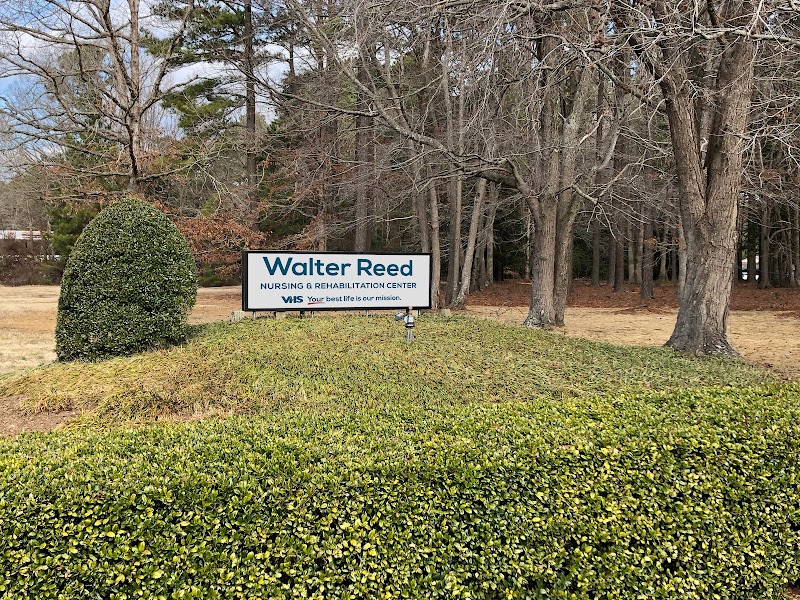
WALTER REED NURSING & REHABILITATION CENTER


7602 MEREDITH DRIVE, GLOUCESTER, VA 23061 (804) 693-6503
For profit - Corporation 181 Beds VIRGINIA HEALTH SERVICES Data: November 2025
Trust Grade
80/100
#49 of 285 in VA
Last Inspection: August 2024

Within standard 12-15 month inspection cycle. Federal law requires annual inspections.

Overview

Walter Reed Nursing & Rehabilitation Center has a Trust Grade of B+, which means it is recommended and above average in quality. It ranks #49 out of 285 facilities in Virginia, placing it in the top half, and is the best option in Gloucester County. The facility is improving, with issues decreasing from four in 2021 to two in 2024. Staffing is average with a rating of 3 out of 5 stars and a turnover rate of 40%, which is better than the state average of 48%. Although there have been no fines, the nursing home has less RN coverage than 85% of Virginia facilities, which may affect the quality of care. However, there are some concerning incidents worth noting. A serious issue occurred when a resident missed four dialysis appointments due to a lack of transportation, which led to hospitalization and the need for anxiety medication. Additionally, there were multiple findings related to food safety, including improper handwashing practices and failure to store food under sanitary conditions. While the facility has strengths, such as no fines and an improving trend, these weaknesses in care practices should be carefully considered by families researching options.

Trust Score
B+
80/100
In Virginia
#49/285
Top 17%
Safety Record
Moderate
Needs review
Inspections
Getting Better
4 → 2 violations
Staff Stability
○ Average
40% turnover. Near Virginia's 48% average. Typical for the industry.
Penalties
✓ Good
No fines on record. Clean compliance history, better than most Virginia facilities.
Skilled Nurses
⚠ Watch
Each resident gets only 22 minutes of Registered Nurse (RN) attention daily — below average for Virginia. Fewer RN minutes means fewer trained eyes watching for problems.
Violations
⚠ Watch
18 deficiencies on record. Higher than average. Multiple issues found across inspections.
★★★★★
5.0
Overall Rating
★★★☆☆
3.0
Staff Levels
★★★☆☆
3.0
Care Quality
★★★★★
5.0
Inspection Score
Stable
2021: 4 issues
2024: 2 issues

The Good

  • Full Sprinkler Coverage · Fire safety systems throughout facility
  • No fines on record
  • Staff turnover below average (40%)

    8 points below Virginia average of 48%

Facility shows strength in fire safety.

The Bad

Staff Turnover: 40%

Near Virginia avg (46%)

Typical for the industry

Chain: VIRGINIA HEALTH SERVICES

Part of a multi-facility chain

Ask about local staffing decisions and management

The Ugly 18 deficiencies on record

1 actual harm
Aug 2024 2 deficiencies
CONCERN (D)

Potential for Harm - no one hurt, but risky conditions existed

Deficiency F0685 (Tag F0685)

Could have caused harm · This affected 1 resident

Based on observation, resident interview, staff interview, clinical record review, and review of facility documents, the facility's staff failed to assist the resident to obtain vision services for 1 ...

Read full inspector narrative →
Based on observation, resident interview, staff interview, clinical record review, and review of facility documents, the facility's staff failed to assist the resident to obtain vision services for 1 of 45 residents (Resident #85), in the survey sample. The findings included: Resident #85 was originally admitted to the facility 11/16/23 after an acute care hospital stay. The current diagnoses included Macular Degeneration. The quarterly Minimum Data Set (MDS) assessment with an assessment reference date (ARD) of 8/5/2024 coded the resident as completing the Brief Interview for Mental Status (BIMS) and scoring 15 out of a possible 15. This indicated Resident #85 cognitive abilities for daily decision making were intact. In sections B.1000 the resident's vision was coded as two which represented moderately impaired, limited vision, and not able to see newspaper headlines but can identify objects and section B.1200 was coded zero, identified the resident did not utilize corrective lenses. The current care plan dated 8/13/2024 was initiated on 11/16/23 had a problem which read B1000.2 Vision: (name of resident) ability to see in adequate light was moderately impaired. The goal read, will maintain current level of function/activity without injury through the next review. The interventions included schedule eye exam for evaluation/management of vision and use large print for any item (the resident name) must read (signs, labels, menu). This care plan has not been revised since initiation for vision. An interview was conducted with Resident #85 on 08/20/24 at approximately 4:35 PM. The resident stated that she was unable to see my face, but she could see the outline of my body. The resident also stated that she could no longer view the television screen or read books which is a hobby. Resident #85 stated that she had not seen an eye doctor since admission to the facility and staff is aware of her low vision. On 8/20/24 an interview was conducted with Licensed Practical Nurse (LPN) #2 at approximately 4:50 PM. LPN #2 stated that she was aware of Resident #85's visual impairments but not aware of her limitations which included the inability to see faces and view the television. LPN #2 Further stated that she ensures that frequently used items are kept within reach. An interview was held with one of the facility's Social Workers (SW) on 8/21/24 at approximately 5:25 PM. The SW stated that Resident #85 was not on her primary case load, but based on her chart review she does not see where the resident had a vision appointment since admission. The SW confirmed this with the Administrator to be accurate. The SW further stated she would add Resident #85 to the list to be seen next month by SVS. The facility's policy titled person-centered baseline and comprehensive care plan, last reviewed on 11/14/22 indicated, the facility will review and revise residents care plans on a quarterly basis and as needed. The facility was unable to provide a policy on resident's vision care services but did provide an agreement from 2007 with Senior Vision Services (SVS). This agreement indicated SVS will provide primary vision care for the facility residents by request. On 8/22/24 at approximately 10:00 AM, the above findings were shared with the Administrator and Director of Nursing. An opportunity was offered to the facility's staff to present additional information, but no additional information was provided.
CONCERN (D)

Potential for Harm - no one hurt, but risky conditions existed

Incontinence Care (Tag F0690)

Could have caused harm · This affected 1 resident

**NOTE- TERMS IN BRACKETS HAVE BEEN EDITED TO PROTECT CONFIDENTIALITY** Based on observation, staff interview, clinical record review, and review of facility documents, the facility's staff failed to ...

Read full inspector narrative →
**NOTE- TERMS IN BRACKETS HAVE BEEN EDITED TO PROTECT CONFIDENTIALITY** Based on observation, staff interview, clinical record review, and review of facility documents, the facility's staff failed to ensure a leg strap was available to secure to a resident's leg to prevent the Foley (brand) catheter from dislodging or being pulled and the facility staff failed to date resident's Foley bag and Foley catheter for 1 of 45 residents (Resident #29), in the survey sample. The findings included: Resident #29 was originally admitted to the facility 02/22/2016 and readmitted [DATE] after an acute care hospital stay. The current diagnoses included; retention of urine. The quarterly Minimum Data Set (MDS) assessment with an assessment reference date (ARD) of 6/17/24 coded the resident as not having the ability to complete the Brief Interview for Mental Status (BIMS). The staff interview was coded for long and short term memory problems as well as severely impaired for daily decision making. In sectionH(Bladder and Bowel) the resident was coded as having an indwelling catheter. The care plan dated 6/26/24 read that Resident #29 requires the use of an indwelling catheter. The goal for the resident was that urine elimination needs will be met through the use of the catheter through the next review. The intervention for the resident was to change catheter and bag per order to maintain patency and minimize infection. A review of the Physicians Order dated 11/26/22 read: ensure catheter is secured to the leg with appropriate device two times daily, days, evenings and as needed. A review of the Physicians Order dated 11/26/22 read: Gravity/leg drainage bag to be changed every two weeks and as needed. On 08/21/24 at approximately 3:01 PM., an observation was made of Resident #29 lying in her [NAME] (recliner) chair in the TV room. The resident's Foley bag was observed with no label affixed. On 8/21/24 at approximately 3:05 PM., an interview was conducted with Licensed Practical Nurse (LPN) #1 concerning the resident's Foley bag. LPN #1 said that she wasn't sure if the resident's Foley bag was dated but will take the resident to her room and check. Upon visual inspection, the foley bag had no label, the foley catheter observed laying on the side of the resident's left upper thigh unsecured. LPN #1 said that there should be a date and a strap to keep the foley in place. On 8/21/24 at approximately 3:30 PM., an interview was conducted with the Director of Nursing (DON) concerning the above issue. The DON said there should have been a strap to hold the catherter tubing in place. On 8/21/24 at approximately 3:50 PM., an interview was conducted with Certified Nursing Assistant #1. CNA #1 said that while showering the resident this morning, she noticed that the resident's leg strap was missing, but forgot to report it to the nurse. CNA #1 also said that the strap is important because it keeps the Foley cathere tubing from getting pulled. The importance of fixation and securing devices in supporting indwelling catheters: Health-care professionals follow recognized national guidelines to assess clinical reasons for the insertion of urinary catheters. However, the use of fixation and securing devices is an area that is often neglected. Health-care professionals sometimes employ a 'do-it-yourself' approach, using adhesive tape or Velcro strapping devices, neither of which are appropriate. If urinary catheters are not secured appropriately, they can lead to severe trauma of a patient's urethra, potential damage to bladder neck, infection and inflammation, pain and irritation, possible bypassing, accidental dislodging of a catheter and a cleaving (condition whereby the catheter splits the penile or labial tissues). This article identifies reasons for using securing/fixation devices and explains the advantages and disadvantages of the different types of devices in relation to individual patients. https://pubmed.ncbi.nlm.nih.gov/24335791/ On 8/22/24 at approximately 10:00 AM., the above findings were shared with the Administrator and Director of Nursing and Corporate Consultant. There were no further concerns voiced prior to the survey's exit.
May 2021 4 deficiencies
CONCERN (D)

Potential for Harm - no one hurt, but risky conditions existed

Deficiency F0558 (Tag F0558)

Could have caused harm · This affected 1 resident

**NOTE- TERMS IN BRACKETS HAVE BEEN EDITED TO PROTECT CONFIDENTIALITY** Based on observations, record review and interviews, the facility failed to accommodate the need of one (Resident (R) 20 of two ...

Read full inspector narrative →
**NOTE- TERMS IN BRACKETS HAVE BEEN EDITED TO PROTECT CONFIDENTIALITY** Based on observations, record review and interviews, the facility failed to accommodate the need of one (Resident (R) 20 of two residents reviewed for accommodation of needs. Specifically, the facility failed to ensure R20, who had contractures of both hands, was provided with a call bell system that R20 could use to signal for assistance and that the call bell was within reach when in bed. Findings include: Review of R20's Face sheet in the Electronic Medical Record (EMR) under the admission tab revealed R20 was admitted on [DATE]. Review of R20's EMR physician orders under the Orders tab revealed diagnoses that included quadriplegia and aphasia. Review of R20's EMR quarterly Minimum Data Set (MDS) with an assessment reference date (ARD) of 03/04/21 showed a Brief Interview for Mental Status (BIMS) screening that was not completed with the resident. The resident had functional limitation in range of motion in the upper and lower extremities. The resident required one person assist with bed mobility and transfer. Observation on 5/18/21 at 9:25 AM, R20 was in bed and the call bell was on the floor behind the headboard of the bed and not within the resident's reach. Observation on 5/18/21 at approximately 2:47 PM, the resident was in bed and the call bell was on the floor not within the resident's reach. On 05/20/21 08:32 AM, Certified Nurse Aide (CNA)74 observed the call bell on the floor and not within the resident's reach. She acknowledged that the resident was unable to use the type of call bell. CNA74 stated that the resident sometimes had seizures and that the call bell should be within the resident's reach. On 05/20/21 at 09:47 AM, CNA11 stated that the call bell was to be clipped to the resident's bedsheet and that staff were to make sure it was within the resident's reach. During an observation and interview on 05/20/21 at 10:27 AM, the Director of Nursing (DON) and the facility's [NAME] President of Nursing (VPNRS) observed the resident in bed. The DON stated that R20 was unable to use the cylindrical, push button styled call light because she has contractures of both of her hands. The DON stated that the resident was unable to call or alert staff for care or concerns that required immediate attention. Review of the facility's policy titled Call Bell dated 01/07/12 indicated, .Call bells should be place within reach before leaving the resident's room .
CONCERN (D)

Potential for Harm - no one hurt, but risky conditions existed

Notification of Changes (Tag F0580)

Could have caused harm · This affected 1 resident

Based on observation, interview, and record review, the facility failed to notify the physician to obtain an order for treatment for one (Resident (R) 65) of one resident reviewed for the development ...

Read full inspector narrative →
Based on observation, interview, and record review, the facility failed to notify the physician to obtain an order for treatment for one (Resident (R) 65) of one resident reviewed for the development of an open area on the sacrum. Findings include: Review of R65's quarterly Minimum Data Set (MDS) assessment found under the MDS tab of the Electronic Medical Record (EMR) with an assessment reference date (ARD) of 03/19/21, revealed a Brief Interview Mental Status (BIMS) score of 15 which indicated cognitively intact. The MDS did not indicate any pressure ulcers. Review of the Physician Order Sheet in the EMR under the orders tab, dated May 2021 did not reveal an order for the open area on the sacrum. During an interview with the Assistant Director of Nursing and observation of R65's sacrum on 05/20/21 at 3:00 PM, the Assistant Director of Nursing (ADON) stated that she had no knowledge of an open area to R65's sacrum area. The observation revealed that R65's sacrum had an open area that measured 7 centimeters (cm) in length and 5.1 cm wide, no depth. Review of R65's clinical record revealed that there was no documentation that the resident's physician had been notified of the new open area. During the interview on 05/20/21 at 3:00 PM, the ADON confirmed that there was no documentation in R65's clinical record that R65's physician was notified of the open area. During a phone interview on 5/21/21 at 10:50 AM, Licenses Practical Nurse (LPN)129 stated that on 5/18/21 that LPN115 told her that R65 had an open area on her sacrum. LPN129 further stated that the ADON stated that she would come and take a look at it but in the meantime, place a Triad and border foam dressing on the open area. In an interview on 05/21/21 at 02:04 PM, LPN15 stated that when she returned to work from being off over the weekend, she heard from another licensed nurse about R65's open area to the sacrum. LPN115 stated that the resident told her about the area on May 17th. LPN115 stated that she reported it directly to the ADON who stated that she would assess the area. LPN115 stated that she applied an Alleyvn (absorbent foam dressing) while waiting for the ADON to get an order. She further stated that she did not know if the ADON obtained an order.
CONCERN (D)

Potential for Harm - no one hurt, but risky conditions existed

Medication Errors (Tag F0758)

Could have caused harm · This affected 1 resident

**NOTE- TERMS IN BRACKETS HAVE BEEN EDITED TO PROTECT CONFIDENTIALITY** Based on interview, record review, and facility policy review, the facility failed to ensure that one of five sampled residents ...

Read full inspector narrative →
**NOTE- TERMS IN BRACKETS HAVE BEEN EDITED TO PROTECT CONFIDENTIALITY** Based on interview, record review, and facility policy review, the facility failed to ensure that one of five sampled residents reviewed for unnecessary medications was free from the use of a psychotropic medications (Resident (R) 61). R61 was restarted on olanzapine (medication used to treat certain mental/mood conditions and may be used with other medication to treat depression) at the Hospital and was re-admitted to the facility without clinical justification for the drug's use and continued drug use. Findings include: Review of R61's undated Face Sheet, located in the resident's electronic medical record (EMR), under the face sheet tab, revealed the resident was admitted to the facility on [DATE] and readmitted to the facility on [DATE]. Review of R61's Diagnoses, located in the resident's EMR under the admissions tab, revealed the resident's diagnoses included unspecified psychosis, unspecified dementia without behaviors, panic disorder, anxiety disorder, and major depressive disorder. Review of the Hospital History and Physical report, dated 03/16/21, provided by the Director of Nurses (DON), revealed R61 had sepsis related to a urinary tract infection and there was no evidence R61 had psychotic symptoms or behaviors at the hospital. The Hospital History and Physical report revealed R61's discharge medications included olanzapine 7.5 milligrams (mg) at bedtime. Review of R61's Physician's Order, dated 03/19/21 revealed, olanzapine 7.5 mg tablet by mouth, to be given every night at for psychosis. During an interview with the DON on 05/21/21 at 11:05 AM, the DON stated R61 did not receive psychotropic medication after the olanzapine was discontinued in 2018 until after she returned from the hospital on [DATE]. Review of R61's change in status Minimum Data Set (MDS), with an assessment reference date (ARD) of 03/24/21 and found under the MDS tab in the resident's EMR, revealed R61 had a Brief Interview for Mental Status (BIMS) score of 15 out of 15, which indicated the resident had no cognitive impairment. The MDS also revealed the resident did not have any behaviors and received antipsychotic medication six of seven days during the last seven days. Review of the facility Medication Regimen Review (MRR) Consultation Report, completed by the Pharmacist dated 03/27/21 revealed R61, .may need the following evaluated. The hospital appears to have unintentionally changed several of her medications based on an incorrect home medication list on their History and Physical form. The MMR revealed, there were some medications R61 had not used since her hospital admission in 2018 that included olanzapine 7.5 mg at bedtime, that was discontinued at the Hospital in 2018 related to an elevated QTc greater than 500 (in electrocardiography, the duration of the interval adjusted for the patient's heart rate. Prolonged QTc greater than 500 is associated with an increased risk of dysrhythmia (abnormality in heart rhythm), stroke, and sudden death). The MMR revealed the need to .consider clarifying if her previous orders should resume, and these unintentional changes should be corrected. The MMR dated 03/27/21 revealed the Nurse Practitioner (NP) agreed to all of the Pharmacy recommendations, except for the olanzapine, which was not to be discontinued. Further review of the MMR revealed the NP documented to keep the olanzapine-discussed with the nursing staff, all other changes made. The MMR revealed no rational as to why R61 needed the olanzapine. Review of the NP Progress Note, dated 03/30/21 located under the notes tab of the resident's EMR, revealed R61 was .seen today for review of MMR recommendations .QT interval was prolonged (>500) while in the hospital, will discontinue olanzapine. Review of R61's Medication Administration Record (MAR), located in the administration tab in the EMR dated March 2021, revealed R61 received olanzapine 7.5 mg every night from 03/19/21 through 04/29/21. Review of R61's Physician's Order, dated 04/30/21, revealed the resident's olanzapine was discontinued on 04/30/21. During interviews with Social Worker 117 on 05/19/21 at 12:33 PM, Licensed Practical Nurse (LPN) 117 on 05/20/20 at 9:00 AM, Certified Nursing Assistant (CNA) 57 on 05/20/21 2:19 PM, and CNA 59 on 05/20/21 at 2:55 PM, they stated R61 was pleasant, alert, oriented, and had no behaviors toward herself, other residents, and staff. LPN117 stated R61 had no signs of psychosis during interactions with her. During an interview on 05/21/21 at 11:05 AM, the DON stated that R61 did not receive any psychotropic medication after the olanzapine was discontinued in 2018 until 03/19/21. The DON stated on 03/16/21, R61 was admitted to the hospital and treated for urosepsis. On 03/19/21, R61 was transferred back to the facility, with the hospital discharge medication list that included olanzapine 7.5 mg at bedtime. The DON stated R61 had no behavioral symptoms prior to or after her hospitalization in March 2021 that required antipsychotic medication. During the same interview, the DON stated that on 03/27/21, the Pharmacist's MRR recommendation included reviewing the olanzapine for discontinuation related to her elevated QTc. The DON stated on 03/30/21, the NP documented in R61's clinical record not to discontinue the olanzapine on the MMR. The DON stated that on the same day the NP assessed R61 and dictated her progress note to discontinue the olanzapine related to a past elevated QTc at the hospital. The DON stated that the facility did not receive the faxed NP Progress Note until 04/05/21 and that she did not know why nursing staff did not discontinue the olanzapine on 04/05/21. The DON stated that on 04/30/21, the NP was in the facility for R61's follow-up evaluation and wrote the order in R61's clinical record to discontinue the olanzapine. The DON confirmed that R61 should not have received olanzapine from 04/05/21 until 04/30/21. Review of the facility's policy titled, Behavior Management revised on 07/10/16 revealed, .The facility must evaluate the use of the antipsychotic medication within two weeks of admission and consider whether or not the medication can be reduced or discontinued .
CONCERN (F)

Potential for Harm - no one hurt, but risky conditions existed

Food Safety (Tag F0812)

Could have caused harm · This affected most or all residents

Based on observation and interviews, the facility failed to ensure food items were stored and served under sanitary conditions in that the facility failed to ensure dietary staff cleansed food prepara...

Read full inspector narrative →
Based on observation and interviews, the facility failed to ensure food items were stored and served under sanitary conditions in that the facility failed to ensure dietary staff cleansed food preparation areas with an appropriate strength sanitizer, failed to change gloves and perform hand hygiene before touching clean dishes and before serving food. This deficient practice had the potential to affect all the residents in the facility. Findings included: Observation on 05/18/21 at 9:19 AM, Dietary Aide (DA)27 cleansed the counter surfaces in the kitchen with a solution in a red bucket labeled Sanitizer solution. DA27 tested the solution in the buckets described above and reported the solution recorded zero Part Per Million (PPM) according to the Bleach test strips. During an interview on 05/21/21 at 2:25 PM, the Dietary Manager (DM) stated that dietary staff completed a log which recorded the PPM of the sanitizing solution. She said it was the individual staff's responsibility to ensure the solution was changed out as needed to ensure it maintained its recommended concentration. The DM stated that the sanitizing solution needed to be at a minimum of 200 PPM to be considered potent enough to perform its sanitizing function. Observation on 05/18/21 at 08:57 AM, DA26 intermittently adjusted her mask with her gloved hands while she transferred the clean plates from the clean dish machine racks to where the clean plates were shelved ready to use. On 05/21 at 9:10 AM, DA 26 stated that she did not know that there was the potential to cross-contaminate the dishes, when she was adjusting her mask and not performing glove changes and hand hygiene. On 05/18/21 at 9:19 AM, DA 27 was observed cleaning the food preparation surfaces in the kitchen with a cloth rag and a solution which was in a red bucket. DA27 was observed to doff the pair of gloves, adjusted her face mask and immediately proceeded to the serving area where DA27 plated the dessert on the dessert plates. DA27 failed to perform hand hygiene after completing the cleaning task and after doffing her gloves. DA27 did not apply gloves before dishing out the dessert on the dessert dishes. On 5/20/21 at 3:59 PM, DA24 was observed in the kitchen opening a package of mixed vegetable, emptied the vegetables into a tray, and then proceeded to disposed of the plastic package in the trash can that was underneath the cook's prep sink. The DA24 pulled out the trash can with her gloved hands, disposed of the plastic container described above and then rubbed her hands against her shirt. She returned to the vegetable tray without changing out her gloves and performing hand hygiene. On 05/21/21 at 2:25 PM, the DM stated that dietary staff were trained to wash their hands when they were visibly soiled, between completing different tasks, before and after wearing gloves She stated that dietary staff should not be touching body part or adjusting mask without hand hygiene.
Aug 2018 12 deficiencies 1 Harm
SERIOUS (H)

Actual Harm - a resident was hurt due to facility failures

Deficiency F0698 (Tag F0698)

A resident was harmed · This affected multiple residents

**NOTE- TERMS IN BRACKETS HAVE BEEN EDITED TO PROTECT CONFIDENTIALITY** Based on observation, interview, and clinical record review the facility failed to provide dialysis services for 1 Resident (Res...

Read full inspector narrative →
**NOTE- TERMS IN BRACKETS HAVE BEEN EDITED TO PROTECT CONFIDENTIALITY** Based on observation, interview, and clinical record review the facility failed to provide dialysis services for 1 Resident (Resident #135) in a survey sample of 42 Residents resulting in harm. For Resident #135 the facility failed to ensure transportation to and from dialysis appointments which resulted in two back-to-back missed appointments. The missed appointments on 03/01/2018 (Thursday) and 03/03/2018 (Saturday) resulted in a new prescription for Ativan (a medication for anxiety) due to a panic attack. This resulted in harm. For the missed appointments on 04/28/2018 (Saturday) and 05/01/2018 (Tuesday), the resident was hospitalized . This also resulted in harm. These four missed appointments result in a pattern. Resident # 135 a [AGE] year old female was admitted on [DATE] with diagnoses of but not limited to ESRD (End stage renal disease) requiring dialysis three times weekly, Diabetes, Diabetic neuropathy, CHF (Congestive Heart Failure), chronic pain of both lower extremities, generalized weakness, and cellulitis of right lower extremity. Her most recent Minimum Data Set (MDS) with an Assessment Reference Date of 6/18/2018 coded resident as having a Brief Interview of Mental Status (BIMS) of 15 indicating no cognitive impairment. On 8/21/2018 at 8:15 A.M. during initial tour Resident #135 was interviewed. She expressed concern over missing appointments for hemodialysis. She was tearful in explaining her situation and expressed desire to find a new facility. She stated she was afraid that the facility would be mean to me if I complain. A review of clinical records was conducted and a physician progress note dated 03/05/2018 (completed by the facility medical director) read : History of present illness --Crying, breathing rapidly, talking rapidly, stating I am having a panic attack. -States she is having a panic attack and in fear of losing her life b/c [because] she has not been to dialysis; missed her last two appointments [3/1/2018 and 3/3/2018] d/t [due to] transportation issues. The progress note further states Resident #135 was prescribed Ativan 0.5 milligrams PO [by mouth] Every 8 hours PRN [as needed] for Anxiety. On 8/22/2018 at 3:50 PM an interview as conducted with the Director at Dialysis Center who stated that Resident #135 is scheduled for dialysis Tuesday, Thursday, and Saturday. The missed dates were as follows: 03/01/2018 (Thursday) 03/03/2018 (Saturday) 03/24/2018 (Saturday) 03/31/2018 (Saturday) 04/28/2018 (Saturday) 05/01/2018 (Tuesday) 08/07/2018 (Tuesday) During the interview, the dialysis clinic director stated The danger with missing dialysis is fluid overload and elevated Potassium Levels which can cause cardiac issues. She stated I know at one hospital admission she had a Potassium level of 6 or 8. The Director of Dialysis submitted attendance record showing the missed dates and the treatment record showing the patient weight before and after dialysis indicating how much fluid was removed during dialysis. On 5/1/2018 Resident #135 requested to be sent to the hospital after missing another two consecutive dialysis on 4/28/18 and 5/1/18. Lab values were reviewed in the 5/1/18 hospital discharge summary. Lab values in the discharge summary read: Potassium - 5.9 H [normal value 3.5-5.1] Creatinine - 10.80 H [normal value 0.5-1.4] Blood Urea Nitrogen - 80 H [normal value 7-20] BUN/Creatinine - 7.4 L Included in the discharge summary was a note from the attending emergency room physician. The note read I discussed your labs with [Nephrologist name] and he wants to make sure you undergo hemodialysis tomorrow. On 8/22/2018 at 3:15 p.m., an interview was conducted with LPN B. LPN B stated If transportation doesn't show up we call the transport company, then we notify dialysis or the doctor, the responsible party and the house doctor. On 8/22/2018 at 3:22 p.m., an interview with the Administrator, the DON, and Corporate Nurses was conducted. The Administrator stated We have the usual ongoing problems with [name of transportation provider], they will dump a call for one that pays more which means Residents won't get picked up. We usually try to call another company. In addition, the DON stated if they miss an appointment with dialysis we contact the dialysis center and try to reschedule, we notify the physician and the responsible party and if family can take them they do, she also stated we have taken some people in the facility van when their transportation didn't show up. On 8/22/18 at 4:40 PM an interview with the Social Worker A she stated that the facility gets the orders for dialysis on admission. We contact the [transportation provider] and they set up continuous pick up and drop off based on the Resident's dialysis days and times. Usually we have her [Resident #135] ready an hour before pick up. They [transportation] then tell us what time they will be picking her up from facility and what time they will pick her up from dialysis to return to the facility. She further stated when the transportation doesn't show up we usually find out when dialysis calls us and says she didn't show up. Then we call transportation and try to schedule another time but we cannot get transportation arranged in 24 hours. Social Worker A stated that Resident #135 was a stretcher transport and had to go by ambulance.
CONCERN (D)

Potential for Harm - no one hurt, but risky conditions existed

Deficiency F0658 (Tag F0658)

Could have caused harm · This affected 1 resident

**NOTE- TERMS IN BRACKETS HAVE BEEN EDITED TO PROTECT CONFIDENTIALITY** Based on observations, staff interview, clinical record review, and facility policy review, the facility staff failed to meet pr...

Read full inspector narrative →
**NOTE- TERMS IN BRACKETS HAVE BEEN EDITED TO PROTECT CONFIDENTIALITY** Based on observations, staff interview, clinical record review, and facility policy review, the facility staff failed to meet professional standards by failing to secure a prescription for a controlled substance for one Resident (Resident # 101) in a survey sample of 42 residents. The findings include: Resident # 101 was admitted to the facility on [DATE]. Diagnoses include but not limited to hemiplegia, hypertension, and diabetes. Resident # 101's most recent Minimum Data Set (MDS) with an Assessment Reference Date (ARD) of 08/02/2018 was coded as a quarterly assessment. Resident # 101 was coded with a Brief Interview of Mental Status (BIMS) score of 8 out of possible 15 indicating moderate cognitive impairment. On 08/23/2018 at approximately 08:55 am, an original handwritten prescription for hydrocodone, an opioid analgesic, was observed in Resident's chart. It was an active prescription for hydrocodone dated 08/21/18. 08/23/18 at approximately 09:00 am an interview was conducted with licensed practical nurse (LPN) B. When asked LPN B about the process for filling prescriptions of controlled substances, LPN B stated that the physician hands the script to the nurse, the nurse will then scan it to the pharmacy, put the original script in the pharmacy folder, and place a copy in the chart. When asked how to tell if a script has been scanned, LPN B stated there will be a checkmark in the upper right-hand corner of the original script. When asked if Resident # 101's prescription had been filled, LPN B stated it didn't look like the prescription was scanned to pharmacy and stated I will scan it now. In a review of facility policies, the procedure for securing original prescriptions of controlled substances was not addressed. On 08/23/2018, the Director of Nursing and the Administrator were notified of the findings.
CONCERN (D)

Potential for Harm - no one hurt, but risky conditions existed

Deficiency F0676 (Tag F0676)

Could have caused harm · This affected 1 resident

**NOTE- TERMS IN BRACKETS HAVE BEEN EDITED TO PROTECT CONFIDENTIALITY** Based on observations, staff interview, clinical record review, and facility policy review, the facility staff failed to provide...

Read full inspector narrative →
**NOTE- TERMS IN BRACKETS HAVE BEEN EDITED TO PROTECT CONFIDENTIALITY** Based on observations, staff interview, clinical record review, and facility policy review, the facility staff failed to provide care and service associated with Activities of Daily Living by not serving food in a scoop plate for one Resident (Resident # 101) in a survey sample of 42 residents. The findings include: Resident # 101 was admitted to the facility on [DATE]. Diagnoses include but not limited to hemiplegia, hypertension, and diabetes. Resident # 101's most recent Minimum Data Set (MDS) with an Assessment Reference Date (ARD) of 08/02/2018 was coded as a quarterly assessment. Resident #101 was coded with a Brief Interview of Mental Status (BIMS) score of 8 out of possible 15 indicating moderate cognitive impairment. Functional status for eating is coded as needing set-up help only. On 08/22/18 at 6:45 pm, Resident #101 was observed in his bed. The head of bed of the bed was elevated and resident was feeding himself. The main meal was on a plate and a mixed fruit cup was in a small plastic container. The resident was unable to pick up fruit with the spoon. The resident put the spoon down and ate the fruit with his hand. The tray menu included instructions that stated yellow scoop plate. The resident's clinical record review of physician's orders revealed the Resident is on a regular diet with low concentrated sweets. An occupational therapy note dated 05/22/2018 stated .include scoop plate in order to maximize independence with self-feeding routine. The resident's care plan had an active intervention that stated scoop plate to assist with meals. 08/23/18 at approximately 11:00 am, an interview was conducted with certified nursing assistant (CNA) A. CNA A was asked if resident had special instructions on his tray card and CNA A stated that resident needs to have the yellow scoop plate for self-feeding. On 08/23/18 at 3:40 pm, an interview with Admin C was conducted. Admin C stated the dishwasher was down on 08/22/2018 and there was not an alternative plan in place. Admin C also stated that the facility Assistant Director of Nursing (ADON) went in to check on the resident during the evening meal on 08/22/2018 and observed him eating the fruit with his hand and making it work without his scoop plate. On 08/23/2018, the DON and the Administrator were notified of the finding and they offered no further information.
CONCERN (D)

Potential for Harm - no one hurt, but risky conditions existed

Deficiency F0692 (Tag F0692)

Could have caused harm · This affected 1 resident

**NOTE- TERMS IN BRACKETS HAVE BEEN EDITED TO PROTECT CONFIDENTIALITY** Based on observations, family interview, staff interview, and clinical record review, the facility staff failed to provide hydra...

Read full inspector narrative →
**NOTE- TERMS IN BRACKETS HAVE BEEN EDITED TO PROTECT CONFIDENTIALITY** Based on observations, family interview, staff interview, and clinical record review, the facility staff failed to provide hydration care and services for one resident (Resident # 94) in a survey sample of 42 residents. The facility staff failed to provide Resident #94 with water. The findings include: Resident # 94 was admitted to the facility on [DATE]. Diagnoses for Resident #94 include but not limited to vascular dementia, orthostatic hypotension, difficulty in walking, and generalized muscle weakness. Resident # 94's most recent Minimum Data Set (MDS) with an Assessment Reference Date (ARD) of 06/20/2018 was coded as a quarterly assessment. Resident #94 was coded with a Brief Interview of Mental Status (BIMS) score of 5 out of possible 15 indicating severe cognitive impairment. Functional status of eating and drinking is coded for a one-person physical assist and supervision, oversight, encouragement, or cueing. On 08/21/18 at 1:30 pm, in a telephone interview with resident's daughter, the daughter stated she used to visit her parent 1-2 times a week and never saw a water pitcher in her parent's room. She stated she shared her concerns with facility staff. She has only visited her parent a few times in the past 4 weeks but still has not seen a water pitcher in the room. On 08/21/18 at 2:30 pm, Resident #94 was in his room seated in his wheelchair. A water pitcher was not seen on any table surfaces in the Resident's room. On 08/22/18 at 9:00 am, Resident # 94 was observed in his room and again, a water pitcher was not seen on any table surfaces in the Resident's room. On 08/22/18 at approximately 10:30 AM, certified nursing assistant (CNA) A stated water pitchers are usually delivered toward the end of night shift (11pm-7am). When told it was observed there was not a water pitcher in resident's room, CNA A stated sometimes the Resident's roommate (also with a diagnosis of dementia) will hide or lose the water pitcher and it may not get replaced. On 08/22/18 at approximately 11:30 am, the licensed practical nurse (LPN) D stated she just brought ice water to the resident's room. On 08/23/18, Record review indicates resident is on a regular diet with no added salt, low concentration sweets, and large portions. On 08/23/2018, the Director of Nursing and Administrator were notified of findings.
CONCERN (D)

Potential for Harm - no one hurt, but risky conditions existed

Pharmacy Services (Tag F0755)

Could have caused harm · This affected 1 resident

**NOTE- TERMS IN BRACKETS HAVE BEEN EDITED TO PROTECT CONFIDENTIALITY** Based on staff interview and clinical record review the facility staff failed to ensure medications were available for administr...

Read full inspector narrative →
**NOTE- TERMS IN BRACKETS HAVE BEEN EDITED TO PROTECT CONFIDENTIALITY** Based on staff interview and clinical record review the facility staff failed to ensure medications were available for administration for 1 resident (Resident #244) of 42 residents in the survey sample. For Resident #244 the facility staff failed to ensure Diazepam (for anxiety) was available for administration. The findings included: Resident #244, an [AGE] year old, was admitted on [DATE]. Diagnoses included Alzheimer's disease, anxiety disorder, diabetes, depression, heart disease, and dementia. A Minimum Data Set assessment had not been completed since the resident was new to the facility. Resident #244 was observed to have cognitive impairment and required extensive assistance with activities of daily living. Resident #244 was at the facility for a respite stay from 8/17/18- 8/22/18. Resident #244 had a physician order dated 8/17/18 for Diazepam 10 milligram tablet take daily at hour of sleep. According to the August Medication Administration Record (MAR), the Diazepam was unavailable during Resident #244's entire five day stay at the facility. The notes on the MAR read, 8/17/18 no diazepam on cart 8/18/18 Not Administered 8/19/18 Medication is not on the cart and has not been sent to the facility from the pharmacy 8/20/18 not available 8/21/18 Not Administered On 8/23/18 in the afternoon, the Corporate Nurse provided the packing slip for Resident #244's Diazepam. The medication was delivered on 8/22/18, after the resident had been discharged . The Corporate Nurse stated that the medication had not been filled timely because the facility was waiting for a hard script from hospice. The facility policy titled Medication Shortages and Unavailable Medications was reviewed. The policy read, When medication orders are unavailable or were not received, the licensed nurse will initiate action in cooperation with the physician and the pharmacy. The procedure read, Upon discovery that Facility has an inadequate supply of a medication to administer to a resident, Facility staff should immediately initiate action to obtain the medication from the Pharmacy.
CONCERN (D)

Potential for Harm - no one hurt, but risky conditions existed

Medication Errors (Tag F0758)

Could have caused harm · This affected 1 resident

**NOTE- TERMS IN BRACKETS HAVE BEEN EDITED TO PROTECT CONFIDENTIALITY** Based on observation, interview and clinical record review the facility failed to ensure 1 Resident (Resident #24) was free from...

Read full inspector narrative →
**NOTE- TERMS IN BRACKETS HAVE BEEN EDITED TO PROTECT CONFIDENTIALITY** Based on observation, interview and clinical record review the facility failed to ensure 1 Resident (Resident #24) was free from unnecessary psychotropic medication in a survey sample of 42 Residents. For Resident # 24 the facility failed to ensure Resident was free from unnecessary psychotropic medication. The findings include: Resident # 24 an [AGE] year old female admitted to the facility on [DATE] with diagnoses of but not limited to Hypertension, Hypothyroidism, Diabetes, anxiety disorder, unspecified dementia with behavioral disturbance also listed was unspecified dementia without behavioral disturbance. Her last (MDS) Minimum Data Set (a screening tool) was coded as having a (BIMS) Brief Interview of Mental Status score of 0, indicating Resident has severe cognitive impairment. On 8/21/18 at 7:30 AM during initial tour Resident #24 was noted to be still in bed asleep. On 8/22/18 at 11:30 AM Resident #24 was in wheel chair in the day room / common area did not appear to interact with other Residents and mumbled something unintelligible when spoken to. On 8/22/18 a review of clinical record was conducted and found that Resident #24 had orders for the following medications listed along with the diagnosis: Seroquel (an anti-psychotic) 25 Milligrams (mg) 1/2 tablet daily ICD-10:F99 - Mental Disorder Not Otherwise Specified. R46.89 - Other symptoms and signs involving appearance and behavior F41.9 Anxiety disorder Unspecified F03.91 Dementia with behavioral disturbance The manufacturer instructions state: WARNING! INCREASED MORTALITY IN ELDERLY PATIENTS WITH DEMENTIA-RELATED PSYCHOSIS; and SUICIDAL THOUGHTS AND BEHAVIORS Increased Mortality in Elderly Patients with Dementia-Related Psychosis Elderly patients with dementia-related psychosis treated with antipsychotic drugs are at an increased risk of death [see WARNINGS AND PRECAUTIONS]. SEROQUEL is NOT approved for the treatment of patients with dementia-related psychosis [see WARNINGS AND PRECAUTIONS]. According to the FDA: SEROQUEL may cause serious side effects, including: 1. Risk of death in the elderly with dementia. Medicines like SEROQUEL can increase the risk of death in elderly people who have memory loss (dementia). SEROQUEL is not for treating psychosis in the elderly with dementia. 2. Risk of suicidal thoughts or actions (antidepressant medicines, depression and other serious mental illnesses, and suicidal thoughts or actions). In addition, the resident also has an order for: Divalproex 125 mg capsule (a seizure medication) delayed release sprinkle 1 cap in the AM 8-10 AM med pass and 2 caps give at4 PM med pass daily. ICD-10:F99 - Mental Disorder Not Otherwise Specified , Alzheimer Dementia with combative behavior. According to the manufacturer: Depakote® Sprinkle Capsules (Divalproex sodium delayed release capsules), for oral use, is a prescription medicine used alone or with other medicines to treat: Manic episodes associated with bipolar disorder Alone or with other medicines to treat: Complex partial seizures in adults and children [AGE] years of age and older Simple and complex absence seizures, with or without other seizure types Prevention migraine headaches On 8/22/18, a request was made to the Director of Nursing (DON) for any psychiatric notes or consults for this resident regarding medications. On 8/23/18, an interview with Corporate nurse and DON was conducted and the DON Stated the facility Dr. gave us the diagnosis for the Seroquel, Remeron, and Divalproex (mental disorder not otherwise specified) she takes care of all her patients medications psych as well as physical illness. She further stated she was aware of the black box warnings about elderly / dementia patients taking anti-psychotics such as Seroquel. Administration were made aware on 8/23/18 and no further information was provided
CONCERN (D)

Potential for Harm - no one hurt, but risky conditions existed

Deficiency F0760 (Tag F0760)

Could have caused harm · This affected 1 resident

**NOTE- TERMS IN BRACKETS HAVE BEEN EDITED TO PROTECT CONFIDENTIALITY** Based on staff interview and clinical record review the facility staff failed to ensure 2 resident (Resident #244 and #9) of 42 ...

Read full inspector narrative →
**NOTE- TERMS IN BRACKETS HAVE BEEN EDITED TO PROTECT CONFIDENTIALITY** Based on staff interview and clinical record review the facility staff failed to ensure 2 resident (Resident #244 and #9) of 42 residents in the survey sample were free from significant medication errors. 1. For Resident #244 the facility staff failed to administer Diazepam (for anxiety) for five days. 2. For Resident #9, the facility failed to administer prn (as needed) Lasix per physician order on three occasions. The findings included: 1. For Resident #244 the facility staff failed to administer Diazepam (for anxiety) for five days. Resident #244, an [AGE] year old, was admitted on [DATE]. Diagnoses included Alzheimer's disease, anxiety disorder, diabetes, depression, heart disease, and dementia. A Minimum Data Set assessment had not been completed since the resident was new to the facility. Resident #244 was observed to have cognitive impairment and required extensive assistance with activities of daily living. Resident #244 was at the facility for a respite stay from 8/17/18- 8/22/18. Resident #244 had a physician order dated 8/17/18 for Diazepam 10 milligram tablet take daily at hour of sleep. According to the August 2018 Medication Administration Record (MAR), the Diazepam was unavailable during Resident #244's entire five day stay at the facility. The notes on the MAR read, 8/17/18 no diazepam on cart 8/18/18 Not Administered 8/19/18 Medication is not on the cart and has not been sent to the facility from the pharmacy 8/20/18 not available 8/21/18 Not Administered On 8/23/18 in the afternoon, the Corporate Nurse provided the packing slip for Resident #244's Diazepam. The medication was delivered on 8/22/18, after the resident had been discharged . The Corporate Nurse stated that the medication had not been filled timely because the facility was waiting for a hard script from hospice. 2. For Resident #9, the facility failed to administer prn (as needed) Lasix (for swelling) per physician order. Resident #9, a [AGE] year old, was admitted to the facility on [DATE]. Diagnoses included schizophrenia, bipolar disorder, diabetes, chronic obstructive pulmonary disease, and heart disease. Resident #9's most recent Minimum Data Set assessment was a significant change assessment with an assessment reference date of 7/25/18. He was coded with a Brief Interview of Mental Status score of 15 indicating no cognitive impairment and required limited assistance with activities of daily living. Resident #9 had a physician order dated 7/19/18 for prn Lasix 40 milligram tablet as needed if the most recent obtained weight reflects a weight gain of greater that 2 lbs. (pounds) A Nutritional Assessment dated 8/10/18 read Wts (weights) being monitored 3 times weekly. Resident #9's weights were reviewed. According to the weights, the Lasix should have been administered as follows: 7/20/18= 316 pounds 7/23/18= 319.5 pounds. The medication should have been administered on 7/23/18 for a 3.5 pound weight gain. 8/10/18= 314.5 pounds 8/13/18= 317.4 pounds. The medication should have been administered on 8/13/18 for a 2.9 pound weight gain. 8/15/18= 317.4 pounds 8/17/18= 322.0 pounds. The medication should have been administered on 8/17/18 for a 4.6 pound weight gain. According to the July 2018 and August 2018 Medication Administration Records (MAR), the Lasix was not administered per physician order on 7/20/18, 8/13/18 or 8/17/18. The Administrator and Director of Nursing (DON) were notified of the issue on 8/23/18 at 12:30 p.m. On 8/23/18 at 3:45 p.m., the DON stated that the prn Lasix had not been given and should have been administered.
CONCERN (D)

Potential for Harm - no one hurt, but risky conditions existed

Menu Adequacy (Tag F0803)

Could have caused harm · This affected 1 resident

Based on observation and staff interview the facility staff failed to ensure meals were served according to the published menu. The food served for lunch on 8/22/18 did not reflect the foods listed o...

Read full inspector narrative →
Based on observation and staff interview the facility staff failed to ensure meals were served according to the published menu. The food served for lunch on 8/22/18 did not reflect the foods listed on the published lunch menu. The findings included: On 8/22/18 at 11 a.m., 12 out of 12 cognitively intact residents complained that the facility hardly ever served what was listed on the menu board in the lobby. They stated they wished they could have the meals as listed on the menu. They stated they have very little to be excited about but they would like to enjoy their food. They gave an example of one day when chocolate pie was listed. They stated they were excited to be able to have pie but they were served jello instead because the kitchen ran out of the pie. Two residents in the group meeting asked why the dietary staff did not seem to know how to prepare enough meals for the number of residents in the facility. They stated there should be enough food to serve to residents. One resident stated during one meal four residents seated at the table together all received different food. While complaints about the food were issued from residents on all the units, a majority of the complaints were from residents living on the Abingdon Unit. The menu for the date of 8/22/18 was provided by the facility dietitian. The lunch menu for a regular diet read, chicken tenders, baked sweet potato, broccoli, dinner roll, pudding, beverage. A white board was posted outside of the dining room. The lunch meal for 8/22/18 was hand written on the board. The white board read: chicken tenders, baked sweet potato, broccoli, dinner roll, chocolate pudding. On 8/22/18 at 11:45 a.m., food was observed on the steam table in preparation for lunch tray line. The following foods were on the steam table and used to prepare a regular diet tray at the beginning of meal service: sweet potato tots, chicken tenders, broccoli. The tray line began at 12:30 p.m. and concluded at 1:51 p.m. During the trayline observation, the broccoli ran out and additional broccoli was prepared for service. The sweet potato tots ran out and were replaced with mashed potatoes. A regular test tray was prepared for the survey team to be included on the last cart which was for the Abingdon Unit. The food on the test tray included chicken tenders, broccoli, mashed potatoes and vanilla pudding. Two of the four foods on the test tray were different from what was on the menu and the white board: mashed potatoes instead of baked sweet potato and vanilla pudding instead of chocolate pudding. Baked sweet potato, as listed on the menu, was never on the tray line for meal service. Meal trays containing these different foods were sent to the Abingdon Unit where a majority of the complaints were issued by the group interview residents. On 8/23/18 at 10:00 a.m., the menu issues were reviewed with the Corporate Dietitian, Facility Dietitian, Dietary Manager and Diet Staff D. The facility staff were notified that the residents expressed concern about not getting the food listed no the published menu. The Dietary Manager stated that she ordered food according to the census. She stated if the census increased from the time she placed the food order then they would run out of food during the tray line. When asked if she was limited to the amount of food she could purchase, the Diet Manager stated no, she just tried to order per the census. The Administrator and Director of Nursing were notified of the menu issues at the end of day meeting on 8/23/18.
CONCERN (D)

Potential for Harm - no one hurt, but risky conditions existed

Administration (Tag F0835)

Could have caused harm · This affected 1 resident

**NOTE- TERMS IN BRACKETS HAVE BEEN EDITED TO PROTECT CONFIDENTIALITY** Based on resident interview, staff interview, facility documentation and clinical record review Administration failed to use its...

Read full inspector narrative →
**NOTE- TERMS IN BRACKETS HAVE BEEN EDITED TO PROTECT CONFIDENTIALITY** Based on resident interview, staff interview, facility documentation and clinical record review Administration failed to use its resources to ensure the dialysis residents attain and maintain the highest practicable physical and psychosocial wellbeing. For Resident #135 the facility failed to ensure highest practicable wellbeing for dialysis patients by not utilizing its resources to transport dialysis patients to appointments. Resident # 135 a [AGE] year old female was admitted on [DATE] with diagnoses of but not limited to Diabetes, Diabetic neuropathy, CHF (Congestive Heart Failure), chronic pain of both lower extremities, generalized weakness, cellulitis of right lower extremity and ESRD (End stage renal disease) requiring dialysis three times weekly. Her most recent Minimum Data Set (MDS) with an Assessment Reference Date of 6/18/2018 coded resident as having a Brief Interview of Mental Status (BIMS) of 15 indicating no cognitive impairment. On 8/21/2018 at 8:15 A.M. during initial tour Resident #135 was interviewed. She expressed concern over missing appointments for hemodialysis. She was tearful in explaining her situation and expressed desire to find a new facility. She stated she was afraid that the facility would be mean to me if I complain. A review of clinical records was conducted and a physician progress note dated 03/05/2018 (completed by the facility medical director) read : History of present illness --Crying, breathing rapidly, talking rapidly, stating I am having a panic attack. -States she is having a panic attack and in fear of losing her life b/c [because] she has not been to dialysis; missed her last two appointments [3/1/2018 and 3/3/2018] d/t [due to] transportation issues. The progress note further states Resident #135 was prescribed Ativan 0.5 milligrams PO [by mouth] Every 8 hours PRN [as needed] for Anxiety. On 8/22/2018 at 3:50 PM an interview as conducted with the Director at Dialysis Center who stated that Resident #135 is scheduled for dialysis Tuesday, Thursday, and Saturday, and she has missed eight appointments with dialysis. The missed dates are as follows: 03/01/2018 (Thursday) 03/03/2018 (Saturday) 03/24/2018 (Saturday) 03/31/2018 (Saturday) 04/28/2018 (Saturday) 05/01/2018 (Tuesday) 08/02/2018 (Thursday) 08/07/2018 (Tuesday) 08/11/2018 (Saturday) During the interview, the dialysis clinic director stated The danger with missing dialysis is fluid overload and elevated Potassium Levels which can cause cardiac issues. She stated I know at one hospital admission she had a Potassium level of 6 or 8. The Director of Dialysis submitted attendance record showing the missed dates and the treatment record showing the patient weight before and after dialysis indicating how much fluid was removed during dialysis. On 5/1/2018 Resident #135 requested to be sent to the hospital after missing another two consecutive dialysis on 4/28/18 and 5/1/18. Lab values were reviewed in the 5/1/18 hospital discharge summary. Lab values in the discharge summary read: Potassium - 5.9 H [normal value 3.5-5.1] Creatinine - 10.80 H [normal value 0.5-1.4] Blood Urea Nitrogen - 80 H [normal value 7-20] BUN/Creatinine - 7.4 L Included in the discharge summary was a note from the attending emergency room physician. The note read I discussed your labs with [Nephrologist name] and he wants to make sure you undergo hemodialysis tomorrow. On 8/22/2018 at 3:15 p.m., an interview was conducted with LPN B. LPN B stated If transportation doesn't show up we call the transport company, then we notify dialysis or the doctor, the responsible party and the house doctor. On 8/22/2018 at 3:22 p.m., an interview with the Administrator, the DON, and Corporate Nurses was conducted. The Administrator stated We have the usual ongoing problems with [name of transportation provider], they will dump a call for one that pays more which means Residents won't get picked up. We usually try to call another company. In addition, the DON stated if they miss an appointment with dialysis we contact the dialysis center and try to reschedule, we notify the physician and the responsible party and if family can take them they do, she also stated we have taken some people in the facility van when their transportation didn't show up. On 8/22/18 at 4:40 PM an interview with the Social Worker A she stated that the facility gets the orders for dialysis on admission. We contact the [transportation provider] and they set up continuous pick up and drop off based on the Resident's dialysis days and times. Usually we have her [Resident #135] ready an hour before pick up. They [transportation] then tell us what time they will be picking her up from facility and what time they will pick her up from dialysis to return to the facility. She further stated when the transportation doesn't show up we usually find out when dialysis calls us and says she didn't show up. Then we call transportation and try to schedule another time but we cannot get transportation arranged in 24 hours. Social Worker A stated that Resident #135 was a stretcher transport and had to go by ambulance. When asked about the four missing appointments in March before the fall [at the facility ] that rendered her non weight bearing thus requiring a stretcher, she stated we have no way to transport her if they don't show up. Administration was interviewed and aware of concerns no further information was provided.
CONCERN (D)

Potential for Harm - no one hurt, but risky conditions existed

Infection Control (Tag F0880)

Could have caused harm · This affected 1 resident

Based on observation and staff interview the facility staff failed to implement an effective infection control program. The ice scoop was stored in the ice machine on the Ware unit. The findings inc...

Read full inspector narrative →
Based on observation and staff interview the facility staff failed to implement an effective infection control program. The ice scoop was stored in the ice machine on the Ware unit. The findings included: On 8/22/18 at 11:15 a.m. the ice scoop was observed stored inside the ice machine on the Ware Unit. The ice machine had a storage compartment inside the machine for the ice scoop. There was also a bin with an ice scoop on top of the ice machine. On 8/23/18 at 11:17 a.m., an interview was held with the Infection Control Nurse who was also the Director of Nursing (DON). The DON was informed that the ice scoop was stored inside the ice machine. The DON stated that the ice scoop should not be stored inside the ice machine. The DON and this surveyor together observed the ice scoop in the machine. The 6th Edition of the ServSafe Manager training book addressed the storage of the ice scoop. Chapter 6, page 6.5, section titled Ice read, Containers and scoops: Use clean and sanitized containers and ice scoops to transfer ice from an ice machine to other containers. Store ice scoops outside of the ice machine in a clean, protected location, as shown in the photo at left. The photo showed a scoop holder affixed to the outside of the ice machine. During the lunch observation in the main kitchen on 8/22/18, Diet Staff D stated that she and the Dietary Manager just obtained their ServSafe food safety certification. No further information was provided.
CONCERN (E)

Potential for Harm - no one hurt, but risky conditions existed

Deficiency F0804 (Tag F0804)

Could have caused harm · This affected multiple residents

Based on observation and resident interview the facility failed to ensure food was served at a palatable temperature. Facility staff failed to ensure food was served hot. The findings included: On 8...

Read full inspector narrative →
Based on observation and resident interview the facility failed to ensure food was served at a palatable temperature. Facility staff failed to ensure food was served hot. The findings included: On 8/21/18 after the initial tour of the facility, the breakfast meal observation was conducted at 8:00 a.m. Residents #15, and #66 were observed and interviewed. Both Residents were in their rooms and both had pancakes and bacon on Styrofoam plates. Both Residents complained of cold food, and neither of them ate the meal. They stated that this had happened a lot lately, and getting the food reheated was almost impossible, as the staff was busy handing out trays, and feeding other Residents. Resident #15 requested just feel this, no one wants cold bacon and pancakes, I am not eating this, and requested the surveyor touch the pancakes and bacon. Both were cool to the touch. On 8/22/18 at 11 a.m., 12 out of 12 cognitively intact residents complained of the food being cold the majority of the time during the group meeting. While complaints about the food were issued from residents on all the units, a majority of the complaints were from residents living on the Abingdon Unit. On 8/22/18, the lunch tray line was observed. The tray line began at 12:30 p.m. and concluded at 1:51 p.m. After all of the trays were prepared to be delivered to the units, Diet Staff D was asked to prepare a regular diet test tray for the survey team to be included on the last cart which was for the Abingdon Unit. Temperatures were taken at 1:55 p.m. by the Corporate Dietitian of the foods on the test tray using a digital thermometer as follows: chicken tenders= 126.5 degrees F broccoli= 102.3 degrees F mashed potatoes= 113 degrees F The food was not held on the steam table at 135 degrees or above during meal service. The cart was delivered to the Abingdon Unit. After all trays were delivered to the residents, the test tray was removed from the cart and food temperatures were re-measured at 2:06 p.m. by the Corporate Dietitian using the same thermometer as follows: chicken tenders= 110 degrees F broccoli= 100 degrees F mashed potatoes= 108 degrees F The food on the test tray did not leave the kitchen at the required hot holding temperature of 135 degrees Fahrenheit or above. The food was even colder by the time it was served on the unit. The survey team tasted the food from the test tray. The food was not hot. The Administrator and Director of Nursing were notified of the food temperature issues at the end of day meeting on 8/23/18.
CONCERN (F)

Potential for Harm - no one hurt, but risky conditions existed

Food Safety (Tag F0812)

Could have caused harm · This affected most or all residents

Based on observation, staff interview and facility documentation review the facility staff failed to store and serve food in accordance with professional standards for food service safety. Facility st...

Read full inspector narrative →
Based on observation, staff interview and facility documentation review the facility staff failed to store and serve food in accordance with professional standards for food service safety. Facility staff failed to use correct handwashing procedures, hold food at appropriate temperature, and reheat food to appropriate temperature. The findings included: An initial tour of the kitchen began on 8/21/18 at 7:30 a.m. At 7:32 a.m. Diet Staff A was observed to wet hands, use soap and turn faucet off with paper towel in approximately 5 seconds. Diet Staff B was observed to wet hands, did not use soap and did not turn off faucet with a paper towel. Diet Staff C was observed to was hands for approximately 3 seconds. On 8/22/18 at 11:45 a.m. food was observed on the steam table in preparation for lunch tray line. The Corporate Dietitian took the temperatures of the food with a digital thermometer. The sweet potato tots were measured at 128 degrees Fahrenheit. They were sent back to the oven to be reheated. Dietary Staff D also took the temperatures of the food on the steam table. The broccoli measured 128 degrees Fahrenheit. It was sent back to the oven to be reheated. At 12:15 p.m., the reheated sweet potato tots were removed from the oven and measured 150 degrees Fahrenheit. The broccoli was removed from the oven and measured 144.9 degrees Fahrenheit. Both items were placed on the steam table for service. The food was not reheated to 165 degrees Fahrenheit. Diet Staff E was observed to load the trays onto the cart during the entire meal service. During the observation, Diet Staff E was not observed to wash his hands using appropriate handwashing technique. On two occasions, Diet Staff E was observed to use soap with out water, wiping the soap from his hands with a paper towel. The tray line began at 12:30 p.m. and concluded at 1:51 p.m. After all of the trays were prepared to be delivered to the units, Diet Staff D was asked to prepare a regular diet test tray for the survey team to be included on the last cart which was for the Abingdon Unit. Temperatures were taken at 1:55 p.m. by the Corporate Dietitian of the foods on the test tray using a digital thermometer as follows: chicken tenders= 126.5 degrees F broccoli= 102.3 degrees F mashed potatoes= 113 degrees F The food was not held on the steam table at 135 degrees or above during meal service. The cart was delivered to the Abingdon Unit. After all trays were delivered to the residents, the test tray was removed from the cart and food temperatures were re-measured at 2:06 p.m. by the Corporate Dietitian using the same digital thermometer as follows: chicken tenders= 110 degrees F broccoli= 100 degrees F mashed potatoes= 108 degrees F The survey team tasted the food from the test tray. The food was not hot. On 8/23/18 at 10:00 a.m., the kitchen observations were reviewed with the Corporate Dietitian, Facility Dietitian, Dietary Manager and Diet Staff D. The facility staff were notified of the multiple instances of inappropriate handwashing technique. The facility staff were asked to explain proper handwashing technique. The Dietary Manager stated that handwashing should be done in the length of time it takes to sing the Happy Birthday song. It was reviewed that food was not held on the steam table at 135 degrees or above and it was reviewed that foods were not reheated to proper temperature. The facility staff were asked to what temperature food should be re-heated. The Corporate Dietitian stated 165 degrees. Handwashing instructions were hung above the handwashing sink. The instructions read, How? Wet your hands with clean, running water (warm or cold), turn off the tap, and apply soap. Lather your ands by rubbing them together with the soap. Be sure to lather the backs of your hands, between your fingers and under your nails. Scrub your hands for at least 20 seconds. Need a timer? Hum the 'Happy Birthday' song from beginning to end twice. Rinse hands well under clean, running water. Dry hands using a clean towel or air dry them. On 8/23/18 at 11:17 a.m. the Director of Nursing (DON) was interviewed about infection control procedures as she functioned as the infection control nurse. When asked if she monitored the handwashing technique of the dietary staff, the DON stated that she does not monitor the dietary staff. She stated she was unsure who monitored the dietary staff for proper handwashing procedures. The Administrator and Director of Nursing were notified of the kitchen issues at the end of day meeting on 8/23/18.
Understanding Severity Codes (click to expand)
Life-Threatening (Immediate Jeopardy)
J - Isolated K - Pattern L - Widespread
Actual Harm
G - Isolated H - Pattern I - Widespread
Potential for Harm
D - Isolated E - Pattern F - Widespread
No Harm (Minor)
A - Isolated B - Pattern C - Widespread

Questions to Ask on Your Visit

  • "Can I speak with families of current residents?"
  • "What's your RN coverage like on weekends and overnight?"

Our Honest Assessment

Strengths
  • • Grade B+ (80/100). Above average facility, better than most options in Virginia.
  • • No fines on record. Clean compliance history, better than most Virginia facilities.
  • • 40% turnover. Below Virginia's 48% average. Good staff retention means consistent care.
Concerns
  • • 18 deficiencies on record, including 1 serious (caused harm) violation. Ask about corrective actions taken.
Bottom line: Generally positive indicators. Standard due diligence and a personal visit recommended.

About This Facility

What is Walter Reed Nursing & Rehabilitation Center's CMS Rating?

CMS assigns WALTER REED NURSING & REHABILITATION CENTER an overall rating of 5 out of 5 stars, which is considered much above average nationally. Within Virginia, this rating places the facility higher than 99% of the state's 100 nursing homes. This rating reflects solid performance across the metrics CMS uses to evaluate nursing home quality.
How is Walter Reed Nursing & Rehabilitation Center Staffed?

CMS rates WALTER REED NURSING & REHABILITATION CENTER's staffing level at 3 out of 5 stars, which is average compared to other nursing homes. Staff turnover is 40%, compared to the Virginia average of 46%. This relatively stable workforce can support continuity of care.

What Have Inspectors Found at Walter Reed Nursing & Rehabilitation Center?

State health inspectors documented 18 deficiencies at WALTER REED NURSING & REHABILITATION CENTER during 2018 to 2024. These included: 1 that caused actual resident harm and 17 with potential for harm. Deficiencies causing actual harm indicate documented cases where residents experienced negative health consequences.
Who Owns and Operates Walter Reed Nursing & Rehabilitation Center?

WALTER REED NURSING & REHABILITATION CENTER is owned by a for-profit company. For-profit facilities operate as businesses with obligations to shareholders or private owners. The facility is operated by VIRGINIA HEALTH SERVICES, a chain that manages multiple nursing homes. With 181 certified beds and approximately 145 residents (about 80% occupancy), it is a mid-sized facility located in GLOUCESTER, Virginia.

How Does Walter Reed Nursing & Rehabilitation Center Compare to Other Virginia Nursing Homes?

Compared to the 100 nursing homes in Virginia, WALTER REED NURSING & REHABILITATION CENTER's overall rating (5 stars) is above the state average of 3.0, staff turnover (40%) is near the state average of 46%, and health inspection rating (5 stars) is much above the national benchmark.

What Should Families Ask When Visiting Walter Reed Nursing & Rehabilitation Center?

Based on this facility's data, families visiting should ask: "Can I visit during a mealtime to observe dining assistance and food quality?" "How do you handle medical emergencies, and what is your hospital transfer rate?" "Can I speak with family members of current residents about their experience?"

Is Walter Reed Nursing & Rehabilitation Center Safe?

Based on CMS inspection data, WALTER REED NURSING & REHABILITATION CENTER has a clean safety record: no substantiated abuse findings (meaning no confirmed cases of resident harm), no Immediate Jeopardy citations (the most serious violation level indicating risk of serious injury or death), and is not on the Special Focus Facility watch list (a federal program monitoring the lowest-performing 1% of nursing homes). The facility has a 5-star overall rating and ranks #1 of 100 nursing homes in Virginia. While no facility is perfect, families should still ask about staff-to-resident ratios and recent inspection results during their visit.

Do Nurses at Walter Reed Nursing & Rehabilitation Center Stick Around?

WALTER REED NURSING & REHABILITATION CENTER has a staff turnover rate of 40%, which is about average for Virginia nursing homes (state average: 46%). Moderate turnover is common in nursing homes, but families should still ask about staff tenure and how the facility maintains care continuity when employees leave.

Was Walter Reed Nursing & Rehabilitation Center Ever Fined?

WALTER REED NURSING & REHABILITATION CENTER has no federal fines on record. CMS issues fines when nursing homes fail to meet care standards or don't correct problems found during inspections. The absence of fines suggests the facility has either maintained compliance or corrected any issues before penalties were assessed. This is a positive indicator, though families should still review recent inspection reports for the full picture.

Is Walter Reed Nursing & Rehabilitation Center on Any Federal Watch List?

WALTER REED NURSING & REHABILITATION CENTER is not on any federal watch list. The most significant is the Special Focus Facility (SFF) program, which identifies the bottom 1% of nursing homes nationally based on persistent, serious quality problems. Not being on this list means the facility has avoided the pattern of deficiencies that triggers enhanced federal oversight. This is a positive indicator, though families should still review the facility's inspection history directly.