
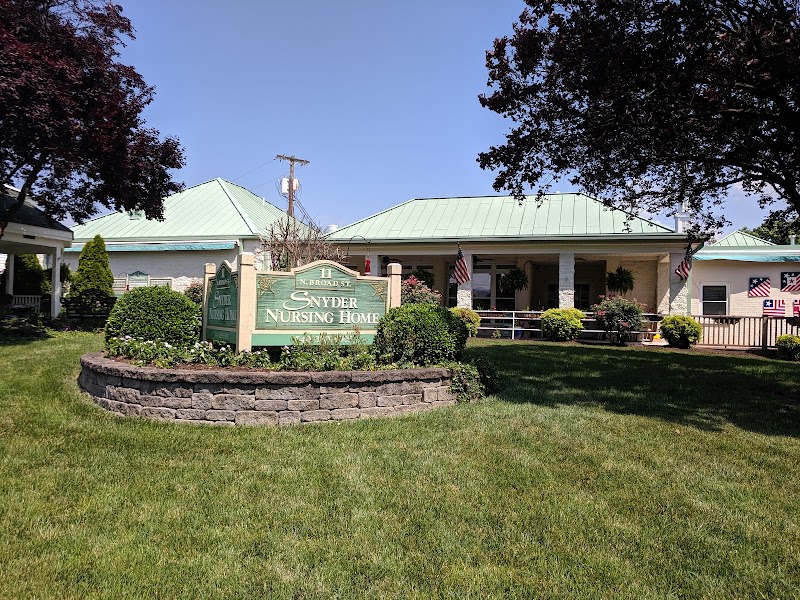
SNYDER NURSING HOME

11 NORTH BROAD ST, SALEM, VA 24153 (540) 389-6305
Non profit - Corporation 45 Beds Independent Data: November 2025
Trust Grade
90/100
#34 of 285 in VA
Last Inspection: August 2023

Over 2 years since last inspection. Current conditions may differ from available data.

Overview

Snyder Nursing Home in Salem, Virginia has received an excellent Trust Grade of A, indicating a high level of quality and care. It ranks #34 out of 285 facilities in Virginia, placing it in the top half, and is the best option among the three nursing homes in Salem City County. However, the facility's trend is worsening, with issues increasing from 2 in 2021 to 3 in 2023. Staffing is a strong point, with a 5-star rating and a turnover rate of 43%, which is better than the state average of 48%. Notably, there have been no fines recorded, which is a positive sign. On the downside, some specific incidents have raised concerns, including failures in food safety standards, such as not properly securing and labeling food items, and lapses in COVID-19 testing protocols for asymptomatic staff. While the facility offers good RN coverage, being better than 79% of Virginia facilities, these incidents highlight areas that need improvement. Overall, Snyder Nursing Home has strengths in staffing and care quality but must address these compliance issues to enhance resident safety.

Trust Score
A
90/100
In Virginia
#34/285
Top 11%
Safety Record
Low Risk
No red flags
Inspections
Getting Worse
2 → 3 violations
Staff Stability
○ Average
43% turnover. Near Virginia's 48% average. Typical for the industry.
Penalties
✓ Good
No fines on record. Clean compliance history, better than most Virginia facilities.
Skilled Nurses
✓ Good
Each resident gets 61 minutes of Registered Nurse (RN) attention daily — more than 97% of Virginia nursing homes. RNs are the most trained staff who catch health problems before they become serious.
Violations
⚠ Watch
11 deficiencies on record. Higher than average. Multiple issues found across inspections.
★★★★★
5.0
Overall Rating
★★★★★
5.0
Staff Levels
★★★★☆
4.0
Care Quality
★★★★★
5.0
Inspection Score
Stable
2021: 2 issues
2023: 3 issues

The Good

  • 5-Star Staffing Rating · Excellent nurse staffing levels
  • 4-Star Quality Measures · Strong clinical quality outcomes
  • Full Sprinkler Coverage · Fire safety systems throughout facility
  • No fines on record
  • Staff turnover below average (43%)

    5 points below Virginia average of 48%

Facility shows strength in staffing levels, quality measures, fire safety.

The Bad

Staff Turnover: 43%

Near Virginia avg (46%)

Typical for the industry

The Ugly 11 deficiencies on record

Aug 2023 3 deficiencies
CONCERN (D)

Potential for Harm - no one hurt, but risky conditions existed

Deficiency F0657 (Tag F0657)

Could have caused harm · This affected 1 resident

Based on observation, staff interview, clinical record review, and facility document review, the facility staff failed to review and revise the comprehensive person-centered plan of care for 3 of 14 r...

Read full inspector narrative →
Based on observation, staff interview, clinical record review, and facility document review, the facility staff failed to review and revise the comprehensive person-centered plan of care for 3 of 14 residents in the survey sample, Residents #10, #18, and #22. The findings included: 1. For Resident #10, the facility staff failed to revise the comprehensive person-centered care plan following the development of an unstageable pressure injury. Resident #10's diagnosis list indicated diagnoses, which included, but not limited to Alzheimer's Disease, Hemiplegia and Hemiparesis following Cerebral Infarction, Type 2 Diabetes Mellitus, and Chronic Congestive Heart Failure. The most recent annual minimum data set (MDS) with an assessment reference date (ARD) of 5/16/23 assigned the resident a brief interview for mental status (BIMS) summary score of 8 out of 15 indicating the resident was moderately cognitively impaired. A review of Resident #10's clinical record revealed a report entitled Weekly Pressure Ulcer Progress Report indicating a 1 cm x 1 cm unstageable wound was identified to the resident's left heel on 8/08/23. A physician's order was obtained on 8/08/23 to apply Betadine to the left heel wound twice a day until healed. Surveyor reviewed Resident #10's comprehensive person-centered care plan and was unable to locate documentation of a pressure wound to the resident's left heel. The plan of care included a focus area stating the resident had the potential for pressure ulcers due to frequent bowel and bladder incontinence and requiring assistance with bed mobility. On 8/22/23 at 4:00 PM, the survey team met with the administrator and director of nursing (DON) and discussed the concern of staff failing to revise Resident #10's care plan following development of an unstageable pressure injury. On 8/22/23 at 8:27 AM, the DON informed the surveyor they had now revised Resident #10's care plan and provided a copy of the revised care plan which included the unstageable pressure area. Surveyor requested and received the facility policy entitled Comprehensive Care Plan with the revision date of 10/01/17 which read in part .6. The comprehensive care plan will be reviewed and revised by IDT [interdisciplinary team] composed of individuals who have knowledge of the resident and his/her needs . No further information regarding this concern was presented to the survey team prior to the exit conference on 8/23/23. 2. For Resident #18, the facility staff failed to review and revised the comprehensive person-centered care plan following COVID-19 exposure and placement on transmission-based precautions (TBPs). Resident #18's diagnosis list indicated diagnoses, which included, but not limited to Multiple Sclerosis, Essential Hypertension, Hyperparathyroidism, and Paraplegia. The most recent quarterly minimum data set (MDS) with an assessment reference date (ARD) of 7/12/23 assigned the resident a brief interview for mental status (BIMS) summary score of 15 out of 15 indicating the resident was cognitively intact. On 8/21/23 at approximately 3:00 PM, surveyor observed signage present outside of Resident #18's room indicating contact and droplet precautions were in place. Resident #18's clinical record revealed a physician's order dated 8/20/23 for contact and droplet precautions related to roommate being positive for COVID-19. Surveyor reviewed Resident #18's comprehensive person-centered care plan and was unable to locate documentation of the resident's COVID-19 exposure and subsequent placement on transmission based-precautions. Surveyor requested and received the facility policy entitled Comprehensive Care Plan with the revision date of 10/01/17 which read in part .6. The comprehensive care plan will be reviewed and revised by IDT [interdisciplinary team] composed of individuals who have knowledge of the resident and his/her needs . On 8/23/23 at approximately 10:15 AM, the survey team met with the administrator and director of nursing and discussed the concern of staff failing to revise Resident #18's care plan to reflect their exposure to COVID-19 and subsequent transmission-based precautions. No further information regarding this concern was presented to the survey team prior to the exit conference on 8/23/23. 3. For Resident #22, the facility staff failed to revise the comprehensive person-centered care plan after the resident tested positive for COVID-19 and was placed on transmission-based precautions. Resident #22's diagnosis list indicated diagnoses, which included, but not limited to Hemiplegia and Hemiparesis following Cerebral Infarction, Essential Hypertension, Dementia, and Type 2 Diabetes Mellitus. The most recent quarterly minimum data set (MDS) with an assessment reference date (ARD) of 7/12/23 assigned the resident a brief interview for mental status (BIMS) summary score of 1 out of 15 indicating the resident was severely cognitively impaired. On 8/21/23 at approximately 3:00 PM, surveyor observed signage present outside of Resident #22's room indicating contact and droplet precautions were in place. A review of Resident #22's clinical record revealed a nursing progress note dated 8/19/23 at 9:30 AM stating the resident had tested positive for COVID-19. A physician's order dated 8/19/23 was received to place Resident #22 on contact and droplet precautions. Surveyor reviewed Resident #22's comprehensive person-centered care plan and was unable to locate documentation of the resident's COVID-19 diagnosis and subsequent placement on transmission based-precautions. On 8/22/23 at 4:00 PM, the survey team met with the administrator and director of nursing (DON) and discussed the concern of staff failing to revise Resident #22's care plan following testing positive for COVID-19 and placement on transmission-based precautions. On 8/23/23 at 8:27 AM, the DON informed the surveyor they had now revised Resident #22's care plan and provided a copy of the revised care plan which included the diagnosis of COVID-19 and the intervention of contact and droplet precautions. Surveyor requested and received the facility policy entitled Comprehensive Care Plan with the revision date of 10/01/17 which read in part .6. The comprehensive care plan will be reviewed and revised by IDT [interdisciplinary team] composed of individuals who have knowledge of the resident and his/her needs . No further information regarding this concern was presented to the survey team prior to the exit conference on 8/23/23.
CONCERN (D)

Potential for Harm - no one hurt, but risky conditions existed

Quality of Care (Tag F0684)

Could have caused harm · This affected 1 resident

Based on staff interview and clinical record review, the facility staff failed to follow the providers orders for 1 of 14 residents, Resident #20. The findings included: For Resident #20, the facili...

Read full inspector narrative →
Based on staff interview and clinical record review, the facility staff failed to follow the providers orders for 1 of 14 residents, Resident #20. The findings included: For Resident #20, the facility staff failed to administer the medication Metoprolol per the providers orders. Resident #20's diagnoses included, but were not limited to hypertension, atrial fibrillation, and congestive heart failure. Section C (cognitive patterns) of Resident #20's quarterly MDS assessment with an assessment reference date (ARD) of 07/12/23 included a brief interview for mental status (BIMS) score of 14 out of a possible 15 points. Resident #20's clinical record included an order for Metoprolol 50 mg take 1 tablet by mouth every day for hypertension hold if systolic is less than 90 AND diastolic less than 60. A review of Resident #20's medication administration records for August 2023 revealed that Licensed Practical Nurse (LPN) #1 held Resident #20's Metoprolol for a blood pressure of 106/68 on 08/20/23 for the administration time of 8:00 a.m. Resident #20's comprehensive care plan included the focus area has hypertension. Interventions included, but were not limited to, give anti-hypertensive medications as ordered. On 08/21/23 3:05 p.m., the Director of Nursing (DON) was made aware of the issue regarding Resident #20's medication Metoprolol. On 08/23/23 10:00 a.m., during a meeting with the Administrator and DON the DON stated they would have the provider review Resident #20's blood pressure medication orders. No further information regarding this issue was provided to the survey team prior to the exit conference.
CONCERN (D)

Potential for Harm - no one hurt, but risky conditions existed

Infection Control (Tag F0880)

Could have caused harm · This affected 1 resident

**NOTE- TERMS IN BRACKETS HAVE BEEN EDITED TO PROTECT CONFIDENTIALITY** Based on observation, resident interview, staff interview, interviews with local health department staff, clinical record review...

Read full inspector narrative →
**NOTE- TERMS IN BRACKETS HAVE BEEN EDITED TO PROTECT CONFIDENTIALITY** Based on observation, resident interview, staff interview, interviews with local health department staff, clinical record review, and facility document review, the facility staff failed to maintain an infection prevention program for preventing and controlling infection and communicable diseases during an identified outbreak of COVID-19. Facility staff failed to follow facility policy and procedure and CDC (Centers for Disease Control and Prevention) guidance related to cohorting COVID-19 positive and untested, asymptomatic residents together when vacant rooms were available creating the likelihood of the resident being exposed to and contracting COVID-19 for 1 of 29 current residents residing in the facility, Resident #18. Facility staff failed to follow CMS (Centers for Medicare and Medicaid Services) and CDC guidance related to performing COVID-19 testing for exposed residents and staff following residents testing positive for COVID-19 on [DATE] and [DATE]. At the time of the survey, two (2) residents were positive for COVID-19. The findings included: 1. For Resident #18, the facility staff failed to test the resident for COVID-19 or move the resident to a vacant room following the roommate testing positive for COVID-19 on [DATE]. Resident #18's diagnosis list indicated diagnoses which included, but not limited to, Multiple Sclerosis, Essential Hypertension, paraplegia, and Hyperparathyroidism. The resident's current physician's orders included the active diagnosis of congestive heart failure. The most recent quarterly minimum data set (MDS) with an assessment reference date (ARD) of [DATE] assigned the resident a brief interview for mental status (BIMS) summary score of 15 out of 15 indicating the resident was cognitively intact. On [DATE] at approximately 3:00 PM, surveyor observed signage present outside of Resident #18's room indicating contact and droplet transmission-based precautions were in place. Resident #18 shared a semi-private room with Resident #22. Surveyor donned necessary personal protective equipment (PPE) and entered the residents' room. Upon entrance, surveyor observed the privacy curtain drawn approximately halfway across the room, Resident #18's left side of the bed was against the wall and Resident #22's right side of the bed was against the wall, the residents were greater than six feet apart with the privacy curtain drawn between them. Each resident was in bed and neither resident was wearing a facial covering. Resident #18 was lying in bed and receiving oxygen via nasal cannula at 2 liters per minute. Resident #18 stated they were usually in the dining room but could not because of their roommate. A review of Resident #18's clinical record revealed a physician's order dated [DATE] for contact and droplet precautions related to roommate testing positive for COVID-19. Surveyor reviewed Resident #18's clinical record and was unable to locate documentation of the resident being tested for COVID-19 following exposure to the positive roommate. Resident #18 had no documented signs or symptoms of COVID-19. Resident #18 received COVID-19 vaccinations on [DATE], [DATE], and [DATE]. According to the roommate's (Resident #22) clinical record, they tested positive for COVID-19 on [DATE] at 9:30 AM. On [DATE] at 3:45 PM, surveyor observed five (5) vacant resident rooms available for use and one (1) vacant resident room being used for storage. Surveyor requested and received facility room census reports for [DATE] and [DATE]. A review of the room census reports revealed the five (5) identified vacant rooms were also vacant on [DATE] and [DATE]. Upon entrance on [DATE], the census in this 45-bed facility was 29. On [DATE] at 3:55 PM, the director of nursing (DON) provided the facility policy entitled Coronavirus Disease-COVID-19 - Resident Cohorting with an effective date of [DATE] which read in part . 1. During the pandemic, residents may be cohorted in a room utilizing the following guidelines: a. All resident [sic] who are COVID-19 positive (symptomatic or asymptomatic) may only be cohorted with residents who are also positive . The administrator and DON verified this was a current policy. On [DATE] at 11:06 AM, surveyor spoke with the DON who stated the facility medical director did not want residents moved due to COVID-19 and the possibility of spreading it to other areas in the facility. Surveyor asked the DON if Resident #18 was offered a room move and the DON stated no. DON stated staff were monitoring Resident #18's vital signs every shift to monitor for signs or symptoms of COVID-19. On [DATE] at 1:36 PM, surveyor spoke with the facility medical director (MD) who stated they instructed the staff not to move either resident due to possibility of exposing additional residents in other areas. MD further stated that the exposure was already there, and it was reasonable to keep the residents where they were. On [DATE] at 3:00 PM, surveyor spoke with Resident #18 who stated they were on isolation because their roommate had COVID, and staff had not talked to them about changing rooms. Resident #18 also stated they had not been tested for COVID-19. On [DATE] at 4:00 PM, the survey team met with the administrator and DON and discussed the concern of Resident #18 not being tested for COVID-19 and remaining in the room with a COVID-19 positive roommate despite having multiple vacant rooms available. The administrator acknowledged the facility had vacant rooms available. Surveyor shared and discussed current CDC guidance. The following information was provided: CDC COVID-19 Interim Infection Prevention and Control Recommendations for Healthcare Personnel During the Coronavirus Disease 2019 (COVID-19) Pandemic, updated [DATE] documents in part, .The ICP [infection prevention and control] recommendations described below (e.g., patient placement, recommended PPE [personal protective equipment]) also apply to patients with symptoms of COVID-19 (even before results of diagnostic testing) and asymptomatic patients who have met the criteria for empiric Transmission-Based Precautions based on close contact with someone with SARS-CoV-2 infection. However, these patients should not be cohorted with patients with confirmed SARS-CoV-2 infection unless they are confirmed to have SARS-CoV-2 infection through testing .Place a patient with suspected or confirmed SARS-CoV-2 infection in a single-person room .If cohorting, only patients with the same respiratory pathogen should be housed in the same room .If limited single rooms are available, or if numerous residents are simultaneously identified to have known SARS-CoV-2 exposures or symptoms concerning for COVID-19, residents should remain in their current location . On [DATE] at 10:03 AM, surveyor spoke with the local health department epidemiologist who stated they were unaware of the current COVID-19 activity in the facility and had not spoken to any facility staff. Surveyor informed the epidemiologist of the concern of Resident #18 remaining in the room with a COVID-19 positive roommate without being tested for COVID-19. Epidemiologist stated they always recommended the current guidelines. The epidemiologist then referred surveyor to the case investigator working with area facilities. On [DATE] at 10:09 AM, the administrator stated the medical director instructed them to leave the residents where they were and only to test residents if they were symptomatic and the facility did as they were directed. The administrator stated they saw this as a standing order. The administrator stated they were appreciative of the survey team identifying the issue and would be looking at the concerns. On [DATE] at 10:35 AM, surveyor spoke with the case investigator (CI) with the local health department who stated they were also unaware of the COVID-19 activity in the facility. Surveyor informed the CI of the concern regarding Resident #18; CI stated it was negligent for Resident #18 to remain in the room with a COVID-19 positive roommate when empty rooms were available. CI stated their recommendation would be to separate COVID-19 positive and negative roommates and do point prevalence testing. On [DATE] at 10:55 AM, the survey team met with the administrator and DON and provided contact information for the local health department case investigator for additional guidance. No further information regarding this concern was presented to the survey team prior to the exit conference on [DATE]. 2. Facility staff failed to follow CMS (Centers for Medicare and Medicaid Services) and CDC (Centers for Disease Control) guidance related to performing COVID-19 testing for exposed residents and staff following residents testing positive for COVID-19 on [DATE] and [DATE]. Upon facility entrance on [DATE], the survey team was informed of one (1) active case of COVID-19 stating Resident #22 had tested positive for COVID-19 on [DATE]. According to Resident #22's clinical record, they tested positive for COVID-19 on [DATE] at 9:30 AM. On [DATE] at approximately 3:00 pm, surveyor observed signage present outside of Resident #22's room indicating contact and droplet transmission-based precautions were in place. Resident #22 currently shared a semi-private room with Resident #18. Surveyor reviewed Resident #18's clinical record and was unable to locate documentation of the resident being tested for COVID-19 following exposure to the positive roommate. Resident #18's physician's orders included a current order for a rapid COVID test as needed. Resident #18 had no documented signs or symptoms of COVID-19. On [DATE] at approximately 8:30 am, the survey team was informed an additional resident, Resident #3, had tested positive for COVID-19 on the evening of [DATE]. On the previous day, surveyor observed Resident #3 outside on the patio with a minimum of ten (10) additional residents and attended a resident council meeting with a surveyor outdoors on the patio. Surveyor had also observed Resident #3 having lunch in the facility dining room with other residents and the resident remained in the dining room following lunch. On [DATE] at 9:37 AM, surveyor spoke with the director of nursing (DON) and requested the facility testing policy. At 10:55 AM, the DON provided surveyor with pages 1 and 6 of the CMS QSO-23-13-ALL memo dated [DATE] and stated this was the facility testing policy. The [DATE] CMS QSO-23-13-ALL memo read in part, .Requirements for COVID-19 Testing · On [DATE], CMS issued an IFC (CMS-3401-IFC) requiring LTC [Long Term Care] facilities to perform routine testing of residents and staff for the COVID-19 infection. As noted in the IFC, this testing regulation will expire with the end of the PHE [public health emergency]. Note: CMS issued the testing requirements early in the COVID-19 PHE to ensure facilities were conducting the volume and frequency of tests needed to identify COVID-19 cases and prevent transmission, such as surveillance testing of nursing home staff. Throughout the PHE, CDC and CMS have updated the testing guidance, including most recently, removing the recommendation for surveillance testing of staff. However, COVID-19 testing is still an important action and is a nationally recognized standard to help identify and prevent the spread of COVID-19. Therefore, while this specific regulatory requirement will end with the PHE, CMS still expects facilities to conduct COVID-19 testing in accordance with accepted national standards, such as CDC recommendations . On [DATE] at 11:06 AM, the DON stated they monitor all residents for signs and symptoms of COVID-19 but were only doing vital signs every shift for COVID-19 monitoring on the two positive residents, Resident #22 and #3, and the exposed roommate, Resident #18. On [DATE] at 11:17 AM, surveyor spoke with the administrator who stated they were testing residents and staff based on signs and symptoms only. The administrator stated when a resident tested positive for COVID-19, notices were hung, the COVID information hotline was updated, a report was sent to the local health department, supplies were monitored, and the medical director was notified. On [DATE] at 1:36 PM, surveyor spoke with the medical director (MD) regarding the facility only testing for COVID-19 based on signs and symptoms and not following exposure, the MD stated they thought the facility was testing everyone, but they had no strong feelings either way about testing. MD stated it was reasonable to test Resident #22's exposed roommate. On [DATE] at 3:00 PM, surveyor spoke with Resident #18 who stated they had not been tested for COVID-19. On [DATE] at 4:00 pm, the survey team met with the administrator and DON and discussed the concern of the facility only testing symptomatic residents and staff and not performing testing following exposure to COVID-19. The administrator and DON stated their facility medical director instructed them to only test symptomatic residents. The administrator stated COVID-19 testing kits were issued to facility staff to take home and test when symptomatic. Surveyor shared and discussed current CMS and CDC guidance. The following information was provided: CMS QSO-20-38-NH memo dated [DATE], expired [DATE] documents in part .Effective [DATE], this memo is no longer in effect. Testing for COVID-19 should be conducted by following accepted national standards, such as CDC recommendations . CDC COVID-19 Interim Infection Prevention and Control Recommendations for Healthcare Personnel During the Coronavirus Disease 2019 (COVID-19) Pandemic, updated [DATE] documents in part, .Responding to a newly identified SARS-CoV-2 infected HCP [healthcare personnel] or resident - When performing an outbreak response to a known case, facilities should always defer to the recommendations of the jurisdiction's public health authority. - A single new case of SARS-CoV-2 infection in any HCP or resident should be evaluated to determine if others in the facility could have been exposed. - The approach to an outbreak investigation could involve either contact tracing or a broad-based approach; however, a broad-based (e.g., unit, floor, or other specific area(s) of the facility) approach is preferred if all potential contacts cannot be identified or managed with contact tracing or if contact tracing fails to halt transmission. - Perform testing for all residents and HCP identified as close contacts or on the affected unit(s) if using a broad-based approach, regardless of vaccination status. · Testing is recommended immediately (but not earlier than 24 hours after the exposure) and, if negative, again 48 hours after the first negative test and, if negative, again 48 hours after the second negative test. This will typically be at day 1 (where day of exposure is day 0), day 3, and day 5 . On [DATE] at 8:30 AM, the DON stated they had not tested or offered to test Resident #18. On [DATE] at approximately 8:45 AM, the DON stated they tested the three (3) residents who Resident #3 shared a table in the dining room on [DATE]. The DON provided copies of COVID-19 test results for Resident #25, #26, and #27 obtained on [DATE], all results were negative. On [DATE] at 10:03 AM, surveyor spoke with the local health department epidemiologist who stated they were unaware of the current COVID-19 activity in the facility and had not spoken to any facility staff. Surveyor informed the epidemiologist of the concern of the facility not conducting testing on exposed residents or staff. Epidemiologist stated they always recommended the current guidelines. The epidemiologist then referred surveyor to the case investigator working with area facilities. The epidemiologist confirmed that a single positive COVID-19 case was considered an outbreak. On [DATE] at 10:09 AM, the administrator stated the medical director instructed them to only to test residents if they were symptomatic and the facility did as they were directed. The administrator stated they saw this as a standing order. The administrator stated they were appreciative of the survey team identifying the issue and would be looking at the concerns. On [DATE] at 10:31 AM, the administrator and DON confirmed they were only testing symptomatic staff members and to their knowledge, no staff have been tested for COVID-19 this week. On [DATE] at 10:35 AM, surveyor spoke with the case investigator (CI) with the local health department who stated they were also unaware of the COVID-19 activity at the facility. Surveyor informed the CI of the concern regarding the facility not conducting testing on exposed residents or staff, CI stated their recommendation would be to do point prevalence testing. On [DATE] at 10:55 AM, the survey team met with the administrator and DON and provided contact information for the local health department case investigator for additional guidance. No further information regarding this concern was presented to the survey team prior to the exit conference on [DATE].
Feb 2021 2 deficiencies
CONCERN (D)

Potential for Harm - no one hurt, but risky conditions existed

Pressure Ulcer Prevention (Tag F0686)

Could have caused harm · This affected 1 resident

Based on clinical record review, staff interview, and facility document review, the facility staff failed to ensure residents with pressure ulcers receive necessary treatment to promote healing as evi...

Read full inspector narrative →
Based on clinical record review, staff interview, and facility document review, the facility staff failed to ensure residents with pressure ulcers receive necessary treatment to promote healing as evidenced by failure to follow physician's orders for 1 of 14 residents, Resident #8. The findings included: For Resident #8, the facility staff failed to follow physician's orders for treatment to a stage II pressure area to the left buttock on 2/08/21 and 2/09/21. Resident #8's diagnosis list indicated diagnoses, which included, but not limited to Alzheimer's Disease with Late Onset, Psychotic Disorder with Delusions due to Known Physiological Condition, Type 2 Diabetes Mellitus without Complications, Muscle Weakness Generalized, and Unspecified Urinary Incontinence. The quarterly MDS (minimum data set) with an ARD (assessment reference date) of 12/15/20 coded the resident as being severely impaired in cognitive skills for daily decision making with short term and long term memory loss in section C, Cognitive Patterns. Resident #8 was coded as being totally dependent on staff for bed mobility, transfers, toilet use, and personal hygiene. A nurse's progress note dated 2/07/21 at 7:00am, states Found with Stage II open area to L (left) buttock - old site re-opened - See Wound sheet. Subsequent nurse's note on 2/07/21 at 11:00am states POA (power of attorney), DON (director of nursing), MD informed of open site L buttock N.O. (new order) noted. Weekly Pressure Ulcer Progress Report entry dated 2/07/21 states in part, area to the left buttock is a reoccurred stage II measuring 1cm x 0.3cm with 0 depth with causes identified as diabetes, continuous urinary incontinence, and Alzheimer's. A signed physician's order dated 2/07/21 states Clean open site to L buttocks with NS (normal saline) then apply Silvadene Cream bid (twice a day) and prn (as needed) til healed T.O. (telephone order) Dr. (name omitted). Resident #8 has a current care plan focus dated 2/07/21 for open area L buttock - tx (treatment) per order with an intervention for tx as ordered. Surveyor reviewed Resident #8's February 2021 TAR (treatment administration record) and was unable to locate the treatment order for the area to the left buttock. On 2/10/21 at approximately 3:05pm, surveyor spoke with LPN (licensed practical nurse) #1 and asked if they could located the order on the TAR. LPN #1 stated I don't see it either and likely I forgot to write it in. In the presence of the surveyor, LPN #1 transcribed the order Clean open site L buttock with NS Silvadene Cream bid and prn to site qd til healed to the February 2021 TAR and initialed TAR for 1/08/21 7-3 and 1/10/21 7-3. LPN #1 stated they did the treatment at those times. The treatment was only signed as being completed once on 2/08/21 and was not signed as being completed on 2/09/21. On 2/10/21 at approximately 3:10pm, surveyor asked LPN #1 to view Resident #8's tube of Silvadene Cream. LPN #1 pulled Resident #8's tube of Silvadene Cream from the treatment cart and removed the cap from the tube. The tube had been previously opened and there was a pressure indention on the outside of the tube. On 2/10/21 at approximately 3:15pm, surveyor notified the DON that Resident #8's treatment order to the left buttock from 2/07/21 was not transcribed to the TAR until today. On 2/11/21 at 9:55am, surveyor notified the administrator and DON of Resident #8's treatment to the left buttock not being completed as ordered. No further information regarding this issue was presented to the survey team prior to the exit conference on 2/11/21.
CONCERN (E)

Potential for Harm - no one hurt, but risky conditions existed

Deficiency F0886 (Tag F0886)

Could have caused harm · This affected multiple residents

Based on staff interview and review of facility documents, the facility staff failed to conduct COVID-19 testing for asymptomatic staff based on the county positivity rate for 30 of 60 staff members. ...

Read full inspector narrative →
Based on staff interview and review of facility documents, the facility staff failed to conduct COVID-19 testing for asymptomatic staff based on the county positivity rate for 30 of 60 staff members. The findings included: The facility staff failed to conduct routine COVID-19 testing for asymptomatic staff members based on the county positivity rate for staff members that have not previously tested positive. At the time of the survey, there were no residents or staff positive for COVID-19. Testing totals in the facility indicated a cumulative total of 24 COVID-19 positive residents with three (3) deaths and a cumulative total of 30 positive staff members. On 2/09/21 at 2:15pm during the Entrance Conference with the survey team, the administrator stated the facility is testing staff based on signs and symptoms only. Survey team requested the current county COVID-19 positivity rate, administrator stated the current rate for the City of (name omitted) is 6.7% and the facility considers themselves to be in the low range for testing. Administrator stated they are using the VDH (Virginia Department of Health) website to monitor positivity rates. Administrator further stated that on 1/06/21, all staff that had never tested positive for COVID-19 were tested using PCR testing and all results were negative. Administrator reported the facility has been testing staff members based on signs and symptoms only since the first COVID-19 vaccine was administered, which was on 1/11/21, based on guidance from the local health department and the facility medical director. Surveyor requested the county positivity rates since 11/01/20. Administrator provided the following information for the City of (name omitted): 1/09/21 - 1/22/21 8.5% and 1/23/21 - 2/05/21 6.6%. Administrator stated the rates on the VDH website only went back to this timeframe. CMS QSO-20-38-NH: August 26, 2020 documents in part, Routine testing should be based on the extent of the virus in the community, therefore facilities should use their county positivity rate in the prior week as the trigger for staff testing frequency and The facility should begin testing all staff at the frequency prescribed in the Routine Testing table based on the county positivity rate reported in the past week. Testing requirements for a county positivity rate of 5% - 10% is a minimum testing frequency of once a week. Surveyor requested and received the facility policy entitled, COVID-19 Testing Plan which states in part: Policy: The facility will ensure compliance with federal and state guidance of performing resident and staff testing for viral respiratory illness, including COVID-19. Subsequent / Follow Up Testing 3) Following initial testing, the facility will test staff and residents, excluding those who have had positive test history at the frequency that is recommended by the local health department and based upon the prevalence of the virus in the geographical community. Specific Test Procedures 1) d) Asymptomatic Staff: test asymptomatic staff prior to employment, after return from travel to a high-risk location, upon suspicion of exposure and as required by CDC and CMS guidance. On 2/10/21 at 9:08am, survey team spoke via phone with (name omitted), epidemiology nurse with the local health department, who stated it was their understanding that if the facility is still screening staff it is okay that only new employees should be tested. Epidemiology nurse stated the facility's outbreak is over, every resident had COVID-19 and has received vaccinations. They stated they would review the CMS guidelines and their last conversation with the facility administrator and return the call to the survey team. Epidemiology nurse contacted the survey team at 9:53am and stated they looked at the CMS memo and facility should be testing once a week. They stated they do not remember talking to the facility about going by positivity rates for testing. On 2/10/21 at 9:58am, survey team spoke with administrator and DON (director of nursing) concerning the facility not testing asymptomatic staff based on the county positivity rates. Administrator stated staff are screened daily for signs and symptoms of COVID-19, their temperatures are checked and the 30 staff members that have remained negative are tested monthly. Administrator stated the facility has an ample supply of rapid COVID tests available for use. Survey team referred the facility to the CMS QSO-20-38-NH 8/26/20 memo for guidance for routine testing of staff. Administrator stated We are going to start testing according to locality positivity rate and we'll start testing today. On 2/11/21 at 8:52am, surveyor asked for the results of the staff COVID-19 tests performed yesterday. Administrator stated no one has tested positive. Surveyor spoke with the DON at 9:10am who stated 23 staff members have been tested. No further information regarding this issue was presented to the surveyor prior to the exit conference on 2/11/21.
Dec 2018 6 deficiencies
CONCERN (D)

Potential for Harm - no one hurt, but risky conditions existed

Deficiency F0578 (Tag F0578)

Could have caused harm · This affected 1 resident

Based on staff interview and clinical record review, the facility staff failed to ensure the DDNR (durable do not resuscitate order) was complete for 1 of 15 residents (Resident #18). The findings inc...

Read full inspector narrative →
Based on staff interview and clinical record review, the facility staff failed to ensure the DDNR (durable do not resuscitate order) was complete for 1 of 15 residents (Resident #18). The findings included: The facility staff failed to ensure Resident #18's DDNR was accurate. The clinical record of Resident #18 was reviewed 12/18/18 through 12/20/18. Resident #18 was admitted to the facility 7/25/18 with diagnoses that included but not limited to dementia without behavioral disturbances, chronic obstructive pulmonary disease, chronic kidney disease, hypertension, gastroesophageal reflux disease, and Vitamin D deficiency. Resident #18's quarterly minimum data set (MDS) assessment with an assessment reference date (ARD) of 10/23/18 assessed the resident with a BIMS (brief interview for mental status) summary score of 01/15. Resident #18's clinical record contained a Durable Do Not Resuscitate Order (DDNR) dated 5/15/11. The DDNR was incomplete. Section 1 of the DDNR read in part, I further certify [must check 1 or 2]: 1. The patient is CAPABLE of making an informed decision . 2. The patient is INCAPABLE of making an informed decision . The boxes beside #1 and #2 were blank. Section 2 read If you checked 2 above, check A, B, or C below: The three boxes below were blank. The surveyor informed the administrator and the director of nursing of the incomplete DDNR in the end of the day meeting on 12/18/18 at 5:13 p.m. No further information was provided prior to the exit conference on 12/20/18.
CONCERN (D)

Potential for Harm - no one hurt, but risky conditions existed

Deficiency F0760 (Tag F0760)

Could have caused harm · This affected 1 resident

Based on staff interview and clinical record review, the facility staff failed to ensure 1of 15 residents was free of a significant medication error (Resident #17). The findings included: The facility...

Read full inspector narrative →
Based on staff interview and clinical record review, the facility staff failed to ensure 1of 15 residents was free of a significant medication error (Resident #17). The findings included: The facility staff failed to administer insulin as ordered by the physician for Resident #17. Resident #17 was administered Novolog insulin on two occassions when the medication should have been held. The clinical record of Resident #17 was reviewed 12/18/18 through 12/20/18. Resident #17 was admitted to the facility 2/8/18 with diagnoses that included but not limited to type 2 diabetes mellitus, hypertension, hypothyroidism, osteoarthritis, anemia, dizziness and giddiness, gastroesophageal reflux disease, synovial cyst of popliteal space, low back pain, anxiety, and irritable bowel syndrome. Resident #17's quarterly minimum data set (MDS) with an assessment reference date (ARD) of 10/23/18 assessed the resident with a BIMS (brief interview for mental status) as 15/15. The surveyor reviewed the physician's orders for diabetic management beginning with the September 2018 physician's orders. The September 2018 and November 2018 physician's orders for insulin read Lantus 5 units sub-q (subcutaneous) at bedtime, Novolog 100 u/ml (units/milliliter) Inject 3 units sub-q with breakfast and lunch Hold if blood sugar less than 120, and accuchecks before meals and at bedtime. Resident #17's blood sugar on 9/20/18 at 6:30 a.m. was recorded as 94. Resident #17 was administered Novolog 3 units at 8:00 a.m. As per the physician order, Novolog 3 units should have been held. Resident #17's blood sugar on 11/28/18 at 11:30 a.m. was recorded as 108. Resident #17 was administered Novolog 3 units at 11:30 a.m. As per the physician order, Novolog 3 units should have been held. Resident #17's current comprehensive care plan was reviewed. One focus area read Resident #17 has potential for elevated blood sugar due to (d/t) diabetes. Date initiated 2/21/2018. Interventions: Accuchecks as ordered. Administer meds (medications) as ordered. The surveyor interviewed licensed practical nurse #1 on 12/19/18 at 11:30 a.m. L.P.N. #1 reviewed the insulins administered and the physician orders and stated she was responsible for the insulin on 11/28/18 and stated she did not know why she gave the insulin. The surveyor informed the administrator and the director of nursing of the above insulin concern during the end of the day meeting on 12/19/18 at 4:42 p.m. No further information was provided prior to the exit conference on 12/20/18.
CONCERN (D)

Potential for Harm - no one hurt, but risky conditions existed

Deficiency F0761 (Tag F0761)

Could have caused harm · This affected 1 resident

Based on observation and staff interview, the facility staff failed to remove expired items in the facility medication room and failed to label and date food in the refrigerator. The findings included...

Read full inspector narrative →
Based on observation and staff interview, the facility staff failed to remove expired items in the facility medication room and failed to label and date food in the refrigerator. The findings included: The facility staff failed to remove expired medical items from the facility medication room and failed to label and date a bag of candy. The surveyor and registered nurse #1 checked the medication room on 12/18/18 at 1:55 p.m. The refrigerator contained an opened 40-ounce bag of Hershey kisses. There was no date or resident name on the bag. R.N. #1 stated the name and date should be on the bag when opened. The surveyor checked the cabinets with R.N. #1. One closed system Foley catheter tray had expired 2/18. One IV (intravenous) Latex free start kit had expired 10/30/18. One 22-gauge 0.9 x 25 mm (millimeter) syringe expired 11/2018. R.N. #1 stated the expired items should be removed and proceeded to do this. The surveyor informed the director of nursing of the above expired items found in the medication room on 12/18/18 at 5:13 p.m. The surveyor requested the facility policy for dating/removing expired items. The administrator stated the facility does not have a policy on labeling and dating medical items. When asked if he expected staff to remove items that had expired, he stated yes. No further information was provided prior to the exit conference on 12/20/18.
CONCERN (D)

Potential for Harm - no one hurt, but risky conditions existed

Medical Records (Tag F0842)

Could have caused harm · This affected 1 resident

**NOTE- TERMS IN BRACKETS HAVE BEEN EDITED TO PROTECT CONFIDENTIALITY** Based on staff interview and clinical record review, the facility staff failed to ensure an accurate clinical record for 1 of 15...

Read full inspector narrative →
**NOTE- TERMS IN BRACKETS HAVE BEEN EDITED TO PROTECT CONFIDENTIALITY** Based on staff interview and clinical record review, the facility staff failed to ensure an accurate clinical record for 1 of 15 Residents in the survey sample, Resident # 24. The findings included: The facility staff improperly documented insulin administration for Resident # 24. Resident # 24 was a [AGE] year-old-female who was admitted to the facility on [DATE]. Diagnoses included but were not limited to: Alzheimer's disease, Type 2 diabetes mellitus, hypertension, and osteoarthritis. The clinical record for Resident # 24 was reviewed on 12/18/18 at 4:52 pm. The most recent MDS (minimum data set) assessment was a quarterly assessment with an ARD (assessment reference date) of 11/6/18. Section C of the MDS assesses cognitive patterns. In Section C0500, the facility staff documented that Resident # 24 had a BIMS (brief interview for mental status) score of 6 out of 15, which indicated that Resident # 24's cognitive status was severely impaired. Section N of the MDS assesses medications. In Section N0350, the facility staff documented that Resident # 24 had insulin injections for 7 days during the lookback period for the 11/6/18 ARD. The current plan of care for Resident # 24 was reviewed and revised on 11/13/18. The facility staff documented a focus area for Resident # 24 as, Resident # 24 has potential for hyper or hypoglycemic episodes secondary to diabetes. Interventions included but were not limited to, Meds as ordered. Resident # 24 had current orders that were signed by the physician on 11/28/18. Orders included but were not limited to, Novolog 100U (units)/ML (milliliter) Inject 15 units sub-q (subcutaneously) three times daily with meals *Hold if BS (blood sugar) <110*. On 12/18/18 at 4:55 pm, the surveyor reviewed the facility accucheck flow sheet for Resident # 24. The surveyor observed that facility staff had documented a blood sugar of 97 for the 6:30 am blood sugar on 10/26/18 for Resident # 24. The surveyor reviewed the October 2018 medication administration record for Resident # 24. The surveyor observed that facility staff had documented that Novolog 15 units was given at 8 am and documented the site given as 18 (to left and above level of umbilicus). The surveyor reviewed the back of the October 2018 medication administration record and observed documentation documented as, 10/26/18 8AM- Held Novolog 15 u R/T (related to) BS of 97. On 12/18/18 at 5:30 pm, the administrator and director of nursing was made aware of the findings as stated above. On 12/19/18 at 10:29 am, the director of nursing informed the surveyor that she had spoken to the nurse that was responsible for medication administration on 10/26/18. The director of nursing stated that the nurse stated that she did not give the medication. The director of nursing agreed that the documentation of Novolog on 10/26/18 for Resident # 24 was inaccurate. No further information regarding this issue was presented to the survey team prior to the exit conference on 12/20/18.
CONCERN (E)

Potential for Harm - no one hurt, but risky conditions existed

Medication Errors (Tag F0758)

Could have caused harm · This affected multiple residents

**NOTE- TERMS IN BRACKETS HAVE BEEN EDITED TO PROTECT CONFIDENTIALITY** 6. The facility staff failed to identify appropriate person centered target behaviors to support the use of Seroquel for Residen...

Read full inspector narrative →
**NOTE- TERMS IN BRACKETS HAVE BEEN EDITED TO PROTECT CONFIDENTIALITY** 6. The facility staff failed to identify appropriate person centered target behaviors to support the use of Seroquel for Resident # 5. Resident # 5 was a [AGE] year-old-female who was admitted to the facility on [DATE]. Diagnoses included but were not limited to: Alzheimer's disease, major depressive disorder, anxiety disorder, and chronic kidney disease stage 3. The clinical record for Resident # 5 was reviewed on [DATE] at 5:06 pm. The most recent MDS (minimum data set) assessment for Resident # 5 was a quarterly assessment with an ARD (assessment reference date) of [DATE]. Section C of the MDS assesses cognitive patterns. In Section C1000, the facility staff documented that Resident # 5's cognitive status was severely impaired. Section N of the MDS assesses medications. In Section N0410, the facility staff documented that Resident # 5 had received antipsychotic medication for 7 days during the lookback period for the [DATE] ARD. The plan of care for Resident # 5 was reviewed and revised on [DATE]. The facility staff documented a focus area for Resident # 5 as, The resident receives Zoloft as ordered for depression, Buspar as ordered for anxiety & Seroquel as ordered for psychosis w (with)/potential for adverse effects. Interventions included but were not limited to, Observe for behavioral symptoms q (every) shift & prn (as needed). Resident # 5 had current orders that included but was not limited to, Quetiapine 200 mg tablet Take 1 tablet by mouth twice a day for delusional psychosis For Seroquel. This order was initiated by the physician on [DATE]. Upon further review of the current orders for Resident # 5, the surveyor observed that Resident # 5 did not have any current orders for medications to manage or treat dementia. On [DATE] at 9:15 am, the surveyor observed a pharmacy recommendation in Resident # 5's clinical record dated [DATE]. The pharmacy recommendation was documented as, This resident has had failed GDR (gradual dose reduction) attempts for Seroquel in the past. It has been discussed that no further GDR attempts be requested due to previous failed attempts. Please document if no further GDR attempts are indicated for Seroquel for this resident. The surveyor observed that the physician documented an (X) next to agree and handwrote, Her condition is fragile and likely to worsen with any further GDR attempts. On [DATE] at 9:20 am, the surveyor reviewed the Psychoactive Medication Monthly Flow Record for Resident # 5. The surveyor observed that the facility staff had circled delusions and paranoia as target behavioral symptoms for Quetiapine (Seroquel). The surveyor reviewed the Psychoactive Medication Monthly Flow Record for Resident # 5 from 12/2017 through 12/2018. The surveyor observed that the facility staff had documented that Resident # 5 had no behaviors of delusions or physical aggression on day, evening, or night shift from 12/2017 through 2/2018, and no behaviors of delusions or paranoia on day evening or night shift from 3/2018 through 12/2018. On [DATE] at 9:25 am, the surveyor interviewed the director of nursing. The surveyor asked the director of nursing what types of behaviors Resident # 5 displayed during delusional and paranoid episodes. The director of nursing stated that Resident # 5 would attempt to get up and believed that a baby was at home alone and would try to get home to the baby. The director of nursing also stated that Resident # 5 would cry out loudly at times and become agitated. On [DATE] at 9:34 am, the surveyor interviewed LPN # 1 (licensed practical nurse) The surveyor asked LPN # 1 what types of behaviors did Resident # 5 display during delusional and paranoid episodes. LPN # 1 stated that Resident # 5 resisted care. LPN # 1 stated, She will fight and she will hit. She thinks a baby is left at home all alone. She thinks all of her family has died. She will talk about her mom and dad and how her mother hates her, but most often talks about a baby boy being left. The surveyor asked LPN # 1 if Resident # 5 became combative often. LPN # 1 stated, Maybe every 2 weeks we will hear of her hitting out. Just in the last 2 weeks she got one of the CNAs (certified nursing assistant) pretty good. She did not break the skin but she did leave marks. The surveyor asked LPN # 1 if she felt that the behaviors that Resident # 5 displayed were due to psychosis or if they were behaviors related to dementia. LPN # 1 stated, Dementia. The surveyor reviewed the Psychoactive Medication Monthly Flow Record along with LPN # 1. LPN # 1 agreed that combative behaviors was not listed as a target behavior to support the use of Seroquel. The surveyor reviewed the nurse's notes in Resident # 5's clinical record from 12/2017 through 12/2018. The surveyor did not locate any documentation of combative, paranoid, or delusional episodes. The facility policy for Psychotropic Medication Usage contained documentation that included but was not limited to; .Policy: The facility will ensure psychotropic medications are only used when the medication is appropriate to treat a resident's specific, diagnosed and documented condition and the medication is beneficial to the resident, as demonstrated by monitoring and documentation of the resident's response to the medication. For any resident who is receiving a psychotropic medication to treat a disorder other than expressions or indications of distress related to dementia (for example schizophrenia, bipolar mania, depression with psychotic features, or other medical condition other than dementia, which may cause psychosis), the GDR may be considered clinically contraindicated for reasons that include but are not limited to: a) The continued use is in the accordance with relevant current standards of practice and the physician has documented the clinical rationale for why any attempted dose reduction would be likely to impair the resident's function or exacerbate an underlying medical or psychiatric disorder; or b) The resident's target symptoms returned or worsened after the most recent attempt at a GDR within the facility and the physician documented the clinical rationale for why an additional attempted dose reduction at the time would be likely to impair the resident's function or exacerbate an underlying medical or psychiatric disorder. Antipsychotic medications shall generally only be used for the following conditions/diagnoses as documented in the record: f) psychosis in the absence of dementia . On [DATE] at 2:30 pm, the administrator and director of nursing was made aware of the findings as stated above. No further information regarding this issue was presented to the survey team prior to the exit conference on [DATE]. 7. The facility staff failed to identify person centered target behaviors for support the use of Haldol for Resident # 35. Resident # 35 was a [AGE] year-old-female who was admitted to the facility on [DATE]. Diagnoses included but were not limited to, Alzheimer's disease, major depressive disorder, chronic kidney disease, and hypothyroidism. The clinical record for Resident # 35 was reviewed on [DATE] at 4:37 pm. The most recent MDS (minimum data set) assessment for Resident # 35 was a quarterly assessment with an ARD (assessment reference date) of [DATE]. Section C of the MDS assesses cognitive patterns. In Section C1000, the facility staff documented that Resident # 35's cognitive status was moderately impaired. Section N of the MDS assesses medications. In Section N0410, the facility staff documented that Resident # 35 had received antipsychotic medications for 7 days during the look-back period for the [DATE] ARD. The current plan of care for Resident # 35 was reviewed and revised on [DATE]. The facility staff documented a focus area for Resident # 35 as The resident uses psychotropic medications w (with)/ potential for adverse effects. Interventions included but were not limited to, Monitor/record occurrence of behavior symptoms and document per facility protocol. The surveyor did not observe any documented target behaviors associated with antipsychotic use on the current plan of care for Resident # 35. The physician signed the current orders for Resident # 35 on [DATE]. Orders included but were not limited to, Haloperidol Con 2 mg (milligram)/ml (milliliter) Take 1 ml by mouth twice daily at noon and 6 pm for psychosis For Haldol. The surveyor observed that Resident # 35 did not have current orders for medications to manage dementia. On [DATE] at 10:35 am, the surveyor reviewed the [DATE] Psychoactive Medication Monthly Flow Record for Resident # 35. The surveyor observed that the facility staff had identified delusions, paranoia, and increased anxiety as target behaviors associated with the use of Haldol for Resident # 35. On [DATE] at 10:37 am, the surveyor observed a pharmacy recommendation in Resident # 35's clinical record dated [DATE]. The pharmacy recommendation contained documentation that included but was not limited to, .The resident receives antipsychotic Haloperidol 2 mg po (by mouth) BID (twice daily) since a dose decrease [DATE]. *Please Note: Resident's family has refused medication changes in the past. The physician/prescriber Response was documented as, Stable, no adverse effects and family refuses any change to her current regimen. On [DATE] at 10:40 am, the surveyor interviewed LPN # 1(licensed practical nurse). The surveyor asked LPN # 1 what behaviors Resident # 35 displayed during delusional episodes, paranoid episodes, and during episodes of increased anxiety. LPN # 1 stated, She can be combative and resists care. She can be really feisty. The surveyor reviewed the Psychoactive Medication Monthly Flow Record for Resident # 35 along with LPN # 1 and LPN # 1 agreed that combativeness was not listed as a target behavior associated with the use of physician ordered Haldol. On [DATE] at 10:55 am, the surveyor reviewed the Psychoactive Medication Monthly Flow Record for Haldol for Resident # 35 from [DATE] through [DATE]. The surveyor observed that the facility staff documented that Resident # 35 had no behaviors on day, evening, and night shift from [DATE] through [DATE]. On [DATE] at 11:00 am, the surveyor reviewed the nurse's notes for Resident # 35 from [DATE] through [DATE]. The surveyor did not locate any documentation of combativeness, resistance of care, increased anxiety, paranoia, or delusions in the nurse's notes for Resident # 35. The facility policy for Psychotropic Medication Usage contained documentation that included but was not limited to; .Policy: The facility will ensure psychotropic medications are only used when the medication is appropriate to treat a resident's specific, diagnosed and documented condition and the medication is beneficial to the resident, as demonstrated by monitoring and documentation of the resident's response to the medication. For any resident who is receiving a psychotropic medication to treat a disorder other than expressions or indications of distress related to dementia (for example schizophrenia, bipolar mania, depression with psychotic features, or other medical condition other than dementia, which may cause psychosis), the GDR may be considered clinically contraindicated for reasons that include but are not limited to: a) The continued use is in the accordance with relevant current standards of practice and the physician has documented the clinical rationale for why any attempted dose reduction would be likely to impair the resident's function or exacerbate an underlying medical or psychiatric disorder; or b) The resident's target symptoms returned or worsened after the most recent attempt at a GDR within the facility and the physician documented the clinical rationale for why an additional attempted dose reduction at the time would be likely to impair the resident's function or exacerbate an underlying medical or psychiatric disorder. Antipsychotic medications shall generally only be used for the following conditions/diagnoses as documented in the record: f) psychosis in the absence of dementia . On [DATE] at 2:30 pm, the administrator and director of nursing was made aware of the findings as stated above. No further information regarding this issue was presented to the survey team prior to the exit conference on [DATE]. 8. The facility staff failed to identify appropriate person centered target behaviors to justify the use of Seroquel for Resident # 38. Resident # 38 was an [AGE] year-old-female who was admitted to the facility on [DATE]. Diagnoses included but were not limited to, unspecified dementia without behavioral disturbance, depression, psychosis, and mood disorder. The clinical record for Resident # 38 was reviewed on [DATE] at 8:55 am. The most recent MDS (minimum data set) assessment for Resident # 38 was a quarterly assessment with an ARD (assessment reference date) of [DATE]. Section C of the MDS assesses cognitive patterns. In Section C0500, the facility staff documented that Resident # 38 had a BIMS (brief interview for mental status) score of 3 out of 15, which indicated that Resident # 38's cognitive status was severely impaired. Section N of the MDS assesses medications. In Section N0410, the facility staff documented that Resident # 38 had received antipsychotic medication for 7 days during the look-back period for the [DATE] ARD. The plan of care for Resident # 38 was reviewed and revised on [DATE]. The facility staff documented a focus area for Resident # 38 as, The resident uses psychotropic medications: Buspar for anxiety, Trazodone for depression, & Seroquel for psychosis, w (with)/potential for adverse effects. Res (Resident) displays s/s (signs and symptoms) of sun downing daily; makes multiple calls to family members in evening hrs (hours) (distressed/upset, wanting them to come get her). Interventions included but were not limited to, Observe for/document behavioral symptoms &/or adverse effects. The physician signed the current orders for Resident # 38 on [DATE]. Orders included but were not limited to, Quetiapine tab (tablet) 100 mg (milligram) take one tablet by mouth every day at 2 pm for psychosis For Seroquel, and Quetiapine 50 mg tablet take one by mouth at bedtime for psychosis For Seroquel. On [DATE] at 9:35 am, the surveyor reviewed the Psychoactive Medication Monthly Flow Record for [DATE] for Resident # 38. The surveyor observed that the facility staff had documented delusions and paranoia as target behaviors for physician ordered Seroquel. The surveyor observed that the facility staff had documented that Resident # 38 had no delusions or paranoia during the day, evening, or night shift from [DATE] through [DATE]. On [DATE] at 9:40 am, the surveyor reviewed the nurse's notes in the clinical record for Resident # 38. The surveyor did not locate any documentation in the nurse's notes for Resident # 38 to support delusional or paranoid behaviors. The surveyor did observe the following documentation in Resident # 38's clinical record; a nurse's note documented on [DATE] at 4:45 pm was documented as, Resident anxious, upset, daughter with resident wheeling around facility. Resident exit seeking, requesting to leave stating I'm in that room alone. Per daughter she has phoned several family members requesting rides to get home. Daughter unplugged resident's phone in room, per daughter resident has been very anxious and upset since death of her roommate. Daughter requesting MD (medical doctor) be notified. A nurse's note documented [DATE] at 4:50 pm was documented as, (Facility medical director's name withheld) notified of resident status and behaviors along with daughter's concerns. N.O. (new order) received for Seroquel 100 mg po now and one for psychosis/delusional. A nurse's note documented on [DATE] at 6:00 pm was documented as Resident less agitated at this time but continues to talk about going home, ate dinner, on resident phone dialing several numbers stating I'm going to call 911 phone removed at this time. A nurse's note documented on [DATE] at 7:00 pm was documented as, Resident refuses to go to room to get ready for bed sitting at nurse's station stating I need to call my mother and tell her where I am. Unable to redirect. Offered snacks, fluids, bathroom but refused. A nurse's note documented on [DATE] at 9:00 pm was documented as Resident finally agreed to go down to room. Staff assisted resident with ADL (activities of daily living) care. Resident informed staff that she doesn't want to stay in that room alone. Resident from another room moved in that room temporarily overnight and resident very happy and talking with resident. A nurse's note documented on [DATE] at 7:00 am was documented as Nurse given report this am of resident having delusions/ being anxious at beginning of 11-7 shift. Rolling around in wheelchair looking for her mother so they could go home and not wanting to be alone. Will have NP (nurse practitioner) assess on rounds. A nurse's note documented on [DATE] at 4:15 pm was documented as V/S (vital signs) 97.2, 74, 18, 138/76, 95 % on room air. Rsd (resident) was seen by (Nurse practitioner's name withheld) New order noted to increase Seroquel: Seroquel 50 mg po (by mouth) at 2 pm and Seroquel 25 mg po qhs (every night at bedtime) for psychosis. 2) CBC (complete blood count) CMP (complete metabolic panel) TSH (thyroid stimulating hormone) next lab day for increased agitation. POA (power of attorney) (POA's name withheld) notified. A nurse's note documented on [DATE] at 2:00 pm was documented as Res (resident) upset with family and blaming them for her being here. Also calling family multiple times on the phone each day. (Medical director's name withheld) notified. N.O. noted to increase Seroquel POA informed. A nurse's note documented on [DATE] at 11:20 am was documented as Res refused to take tub bath. Had dresses herself and stated I'm going to take my bath when I get home. Staff attempted to redirect persuade resident to take bath, but were unsuccessful. A nurse's note documented on [DATE] at 2:20 pm was documented as Res refused to take tub bath this morning-I'm going to take a bath when I get home. Had already gotten up to be toileted and wanted to put clothes on then. Would not go into tub room. On [DATE] at 11:33 am, the surveyor interviewed the facility medical director regarding Resident # 38 being on Seroquel. The surveyor asked the facility medical director what was the indication for use of Seroquel for Resident # 38. The facility medical director stated that Resident # 38 displayed behaviors that she wanted to go home especially during the evening hours. The surveyor asked the facility medical director if the behaviors that Resident # 38 was displaying were behaviors associated with sun downing and dementia. The facility medical director stated that Resident # 38 would get to the point that she would become combative and exit seeking. The surveyor informed the facility medical director that the documentation in Resident # 38's clinical record did not reflect that Resident # 38 had delusions, paranoia, or psychosis. The surveyor asked the facility medical director why psychiatric services were not being utilized for Resident # 38. The facility medical director stated that the facility did have a contract for psychiatric services but went on to explain that the cost associated with the services and stated that it would be too costly to the facility. The facility medical director stated that he felt perfectly comfortable prescribing and monitoring antipsychotic medications. On [DATE] at 8:06 am, the surveyor interviewed LPN # 1 (licensed practical nurse) The surveyor asked LPN # 1 what behaviors Resident # 38 displayed. LPN # 1 stated, She packs her clothing almost every night. She constantly calls her family wanting to go home. She resists care at times and refuses her meds at times because she forgets that she takes certain medications. The surveyor asked LPN # 1 if she had known Resident # 38 to be combative. LPN # 1 stated, No. She will threaten to but I have never known her to be combative. The surveyor asked LPN # 1 if she felt that the behaviors that Resident # 38 displayed are related to dementia or psychosis. LPN # 1 stated, Dementia. The surveyor asked LPN # 1 if Resident # 38 displayed and delusional behaviors. LPN # 1 stated she was not aware of any delusional behaviors displayed by Resident # 38. On [DATE] at 8:20 am, the surveyor reviewed the clinical record for Resident # 38 following the interview that was conducted with the facility medical director on [DATE] at 11:33 am, to determine when Resident # 38 was initially prescribed Seroquel and the rationale for the antipsychotic. The surveyor observed a progress note in Resident # 38's clinical record dated [DATE], which was the day Resident # 38 was admitted to the facility. The progress note contained documentation that included but was not limited to, . Plan: She is admitted to (facility name withheld), screened lab work pending and will include B-12, Vitamin D levels. Following a lengthy discussion with her daughter reviewing her care, advanced care plans, her prognosis. We will try to reduce her medications as much as possible and I will remove the Ativan. I will place her on Seroquel for her psychosis given daily at 2 p.m. prior to her sun downing behaviors. The facility policy for Psychotropic Medication Usage contained documentation that included but was not limited to; .Policy: The facility will ensure psychotropic medications are only used when the medication is appropriate to treat a resident's specific, diagnosed and documented condition and the medication is beneficial to the resident, as demonstrated by monitoring and documentation of the resident's response to the medication. For any resident who is receiving a psychotropic medication to treat a disorder other than expressions or indications of distress related to dementia (for example schizophrenia, bipolar mania, depression with psychotic features, or other medical condition other than dementia, which may cause psychosis), the GDR may be considered clinically contraindicated for reasons that include but are not limited to: a) The continued use is in the accordance with relevant current standards of practice and the physician has documented the clinical rationale for why any attempted dose reduction would be likely to impair the resident's function or exacerbate an underlying medical or psychiatric disorder; or b) The resident's target symptoms returned or worsened after the most recent attempt at a GDR within the facility and the physician documented the clinical rationale for why an additional attempted dose reduction at the time would be likely to impair the resident's function or exacerbate an underlying medical or psychiatric disorder. Antipsychotic medications shall generally only be used for the following conditions/diagnoses as documented in the record: f) psychosis in the absence of dementia . On [DATE] at 2:30 pm, the administrator and director of nursing was made aware of the findings as stated above. No further information regarding this issue was presented to the survey team prior to the exit conference on [DATE]. Based on staff interview, facility document review, and clinical record review, the facility staff failed to ensure 8 of 15 residents were free of an unnecessary medication (Resident #20, Resident #15, Resident #29, Resident #35, Resident #33, Resident #5, Resident #8, Resident #38). The findings included: 1. The facility staff failed to document when Resident #20 exhibited behaviors to support the use of the antidepressant Zoloft and failed to ensure the current comprehensive care plan included targeted behaviors for the use of Zoloft (an antidepressant). Resident #20 was admitted to the facility [DATE] and readmitted [DATE] with diagnoses that included but not limited to diabetes mellitus, COPD (chronic obstructive pulmonary disease), asthma, dementia, and chronic inhaled steroid use. Resident #20's quarterly minimum data set (MDS) assessment with an assessment reference date (ARD) of [DATE] assessed the resident with a BIMS (brief interview for mental status) as 10/15. Resident #20 was identified to have inattention daily. Resident #20 was not assessed with any signs or symptoms of psychosis or behaviors that affected others. Section N Medications and specifically N0410 Medications documented Resident #20 had received an antidepressant 7 days during the look back period [DATE]-[DATE]. Resident #20's current comprehensive care plan initiated [DATE] had a focus area that read Resident #20 receives routine antidepressant med (medication) w/potential (with) for adverse effects. Interventions: Meds as ordered, notify provider of behavioral symptoms and/or adverse effects, observe for and record adverse effects, observe for and record behavioral symptoms, and pharmacist to review meds monthly & (and) as needed. The care plan did not identify any specific targeted behaviors or non-pharmacological interventions to use. Resident #20's [DATE] physician orders were reviewed. Resident #20 currently received Sertraline 100 mg qd (everyday) for depression. The surveyor reviewed the monthly psychoactive medication flow records from [DATE] through [DATE] for Sertraline. Targeted behaviors identified were tearfulness, decrease interest in activities and persistent sadness. Side effects circled to monitor were disorientation, confusion, lethargy, increased agitation, and sedation/drowsiness. The monthly behaviors sheets from [DATE] through [DATE] did not identify any issues with tearfulness, decrease interest in activities, persistent sadness, disorientation, confusion, lethargy, increased agitation, or sedation/drowsiness. Each day was marked with a 0 and the nurse's initials. The surveyor reviewed the [DATE] through the [DATE] nurse's notes. The [DATE] nurse's note stated the resident was seen by her physician for s/s (signs/symptoms) of depression; however, there are no signs or symptoms of depression charted. Resident #20's Sertraline had been increased from 50 mg (milligrams) to 100 mg on [DATE] without any evidence to support the increase in Sertraline. Resident #20's physician had documented on the medication regimen review for [DATE] has failed GDRs (gradual dose reductions) in the past with recurrence of depressive sx (symptoms). No further GDRs. The surveyor interviewed the activities director/social worker on [DATE] at 8:42 a.m. about Resident #20. The activity director/social worker stated that during the mood interview for the most recent MDS, the resident had been having trouble sleeping, expressed about being sad, lonely, and the resident's fixation on men. The activity director/social worker stated after the men leave, the resident goes back to focusing on her baby dolls. The surveyor asks the activity director/social worker where the information just provided was located as the surveyor was unable to locate any of this information in the clinical record. The activity director/social worker stated it wasn't charted-we just know it. The surveyor informed the administrator and the director of nursing of the above concern on [DATE] at 12:44 p.m. and requested the facility policy on psychotropic medications. The surveyor reviewed the facility policy titled Psychotropic Medication Usage on [DATE]. The policy read in part, The facility will ensure psychotropic medications are used only when the medication is appropriate to treat a resident's specific, diagnoses and documented condition and the medication is beneficial to the resident, as demonstrated by monitoring and documentation of the resident's response to the medication. Psychotropic medications will be prescribed at the lowest possible dosage for the shortest period and will be subject to gradual dose reduction and review. The staff will observe, document and report to the Attending Physician information regarding the behaviors, effectiveness of any intervention, and/or any side effects and consequences of psychotropic medications. No further information was provided prior to the exit conference on [DATE]. 2. The facility staff failed to document when Resident #15 exhibited behaviors to support the use of the antidepressant Zoloft and failed to ensure the current comprehensive care plan included targeted behaviors for the use of Zoloft (an antidepressant). The clinical record of Resident #15 was reviewed [DATE] through [DATE]. Resident #15 was admitted to the facility [DATE] and readmitted [DATE] with diagnoses that included but not limited to multiple sclerosis, chronic kidney disease, deep vein thrombosis with pulmonary embolus, restless leg syndrome, gastroesophageal reflux disease, and depression. Resident #15's quarterly minimum data set (MDS) assessment with an assessment reference date (ARD) of [DATE] assessed the resident with a BIMS (brief interview for mental status) as 05/15. There were no signs or symptoms of delirium, behaviors affecting others or evidence of psychosis. Section N Medications and specifically N0410 Medications documented Resident #15 received an antidepressant 7 days during the look back period [DATE]-[DATE]. Resident #15's current comprehensive care plan identified the focus area that read Resident #15 receives routine antidepressant therapy for diagnosis of depression w/potential (with) for adverse effects. Date initiated: [DATE]. Interventions: Administer meds (medications) as ordered, notify provider of behavioral symptoms, adverse effects and/or pharm (pharmacy) rec (recommendations), observe for behavioral symptoms and/or adverse effects, and pharmacist reviews meds monthly & (and) as needed. The current comprehensive care plan did not identify any specific targeted behaviors for the use of Zoloft or identify any non-pharmacological interventions. The [DATE] physician's orders were reviewed. Resident #15 had orders that read Mirtazapine (Remeron) 15 mg (milligrams) take 1 tablet by mouth at bedtime for depression and Sertraline 50 mg take 1 tablet daily for depression (Zoloft). The surveyor reviewed the monthly psychoactive medication flow records from [DATE] through [DATE] for Sertraline and Remeron. Targeted behaviors identified were tearfulness, decrease interest in activities and persistent sadness. Side effects circled to monitor were dry mouth, anticholinergic symptoms, sedation/drowsiness and increased falls/dizziness. The monthly behaviors sheets from [DATE] through [DATE] did not identify any issues with tearfulness, decrease interest in activities, persistent sadness, dry mouth, anticholinergic symptoms, sedation/drowsiness and increased falls/dizziness. Each day was marked with a 0 and the nurse's initials. The surv[TRUNCATED]
CONCERN (F)

Potential for Harm - no one hurt, but risky conditions existed

Food Safety (Tag F0812)

Could have caused harm · This affected most or all residents

**NOTE- TERMS IN BRACKETS HAVE BEEN EDITED TO PROTECT CONFIDENTIALITY** Based on observation, staff interview, and facility document review, the facility staff failed to store, prepare, distribute, an...

Read full inspector narrative →
**NOTE- TERMS IN BRACKETS HAVE BEEN EDITED TO PROTECT CONFIDENTIALITY** Based on observation, staff interview, and facility document review, the facility staff failed to store, prepare, distribute, and serve food in accordance with professional standards for food safety. The findings included: The facility staff failed to ensure that food items were secured and labeled properly, failed to ensure that expired food items were discarded, and failed to ensure that dietary staff members hair was appropriately secured in the food service area. On 12/18/18 at 10:45 am, an initial tour of kitchen was conducted with the facility dietary manager. The surveyor observed the following items upon inspection of the walk in freezer; a plastic bag of mixed vegetables that had been opened with no documented open date on the bag, a plastic bag of corn dog nuggets that had been opened with no documented open date on the bag, sausage links opened on 10/22/18 that were not securely closed, riblets with no documented open date on the bag. The dietary manager was asked by the surveyor if the items mentioned above should have been dated. The dietary manager stated, They probably should have. The surveyor observed a frozen red ring in a plastic bag that was not labeled and dated. The dietary manager identified the frozen red ring as a punch ring for the Resident Christmas party. The surveyor asked the dietary services manager if the punch ring should have been labeled and dated. The dietary manager stated, It probably should have, but I know when it's going out. The surveyor observed a large container with frozen substance that was not labeled or dated. The dietary manager identified the frozen substance in the container as vegetable soup. The surveyor asked the dietary manager if the vegetable soup should be labeled and dated. The dietary manager stated, Yes, and removed the vegetable soup from the freezer. On 12/18/18 at 10:55 am, the surveyor inspected the walk in cooler. Upon inspection of the walk in cooler, the surveyor observed 3 large items wrapped in tan wrapping that was not labeled or dated. The dietary manager identified these items as cheese balls that she had just made for the Resident Christmas party. The dietary manager was asked if these items should have been labeled and dated. The dietary manager stated, Yes. The surveyor also observed a bag of lettuce with 3 heads of lettuce that was open and was not securely contained. The surveyor also observed that there was no open date documented on the bag of lettuce. On 12/18/18 at 11:01 am, the surveyor inspected the dry storage area. Upon inspection of the dry storage area, the surveyor observed the following items: Biscuit and gravy mix that had been opened with no open date documented on the package, prewashed pinto beans 20 lb. (pound) box that was open to air. The dietary manager stated, I don't have any way to seal that box that is how they come. The surveyor also observed a 20 lb. box of split peas that was open to air, a 50 lb. bag of Panko bread crumbs that had been opened with no open date documented on the package, and a box of baking soda open on top shelf in dry storage with a use by date of 10/13/18 printed on the box. The dietary manager stated, We use that for odors. The dietary manager discarded the box of baking soda. The dietary manager also observed a 48 oz. (ounce) container of vegetable shortening with no documented date opened and a use by date of 9/23/16 printed on the bottom of the container. The surveyor observed a 25 lb. box of Thick & Easy that was opened with no opened dated documented on the package. The surveyor observed 2 plastic storage containers on the top shelf in the dry storage room. The dietary manager stated that the items inside the container was used for activities by the activities department and that the dietary staff did not monitor those items. The surveyor reviewed the items inside the plastic containers and observed the following items: Waffle cones best if used by 3/19/16 documented on the package Graham Cracker piecrust 6oz Best by 1/21/15 documented on the package Waffle cones 5 oz. box best by April 13 2018 documented on the package [NAME] Jet Puff Marshmallow 5/10/18 documented on the package Sugar cones unopened 5 oz. box best by 9/13/`18 documented on the package Vanilla candy coating best by 1/21/15 documented on the package Light corn syrup unopened best by 2/14/16 documented on the package Light corn syrup unopened best by 10/25/13 documented on the package Grissine [NAME] 4.41 oz. opened no opened date 12/13/17 documented on the package Focaccia opened best by 18 May 2018 documented on the package On 12/18/18 at 11:24 am, the surveyor inspected the spices located on the spice rack in the kitchen. Upon inspection of the spice rack in the kitchen, the surveyor observed a container of bay leaves with no opened date or dispensed date. The surveyor asked the dietary manager how she would know if the bay leaves were still good to use. The dietary manager stated, I use my judgement as a nutritional professional. The surveyor observed a 16 oz. container of all spice with no open or dispensed date. The surveyor asked the dietary manager how she knows if the all spice is still good to use. The dietary manager stated, As long as you can still smell it it's good. The surveyor observed a small glass jar of Lemon peel 1.5 oz. with a best by date of 10/9/06 printed on the container. The surveyor observed a bottle of lemon juice with a best by date of 8/7/2018 printed on the bottle, and Gluten free chocolate chip cookies that were unopened with a best by date of 7/23/18 printed on the package. On 12/18/18 at 11:45 am, while checking tray line temperatures, the surveyor observed dietary aide # 1 as she checked the tray line temperatures. The surveyor observed that dietary aide # 1's hair was pulled back into a bun and the bun was not secured under the hairnet. The surveyor also observed dietary aide # 2 in the food service area. The surveyor observed that dietary aide # 2's hair in the front was not secured underneath her hairnet. On 12/18/18 at 12:02 pm, the surveyor observed a gallon of milk in the reach in cooler with a use by date of 12/10 printed on the container and a ½-gallon of buttermilk with a use by date of 12/13 printed on the container. On 12/19/18 at 2:47 pm, the surveyor inspected the unit refrigerator. Upon inspection of the unit refrigerator, the surveyor observed an opened carton of milk with a use by date of 12/17 printed on the container. The facility policy on Infection Control Dietary Services contained documentation that included but was not limited to, . IV Personal Hygiene a. Proper attire for food handlers should include a hair covering (hair net or caps) VI Proper Food Handling I. Leftovers must be labeled, dated, covered. On 12/18/18 at 5:30 pm, the administrator and director of nursing was made aware of the findings as stated above. No further information regarding this issue was provided to the survey team prior to the exit conference on 12/20/18.
Understanding Severity Codes (click to expand)
Life-Threatening (Immediate Jeopardy)
J - Isolated K - Pattern L - Widespread
Actual Harm
G - Isolated H - Pattern I - Widespread
Potential for Harm
D - Isolated E - Pattern F - Widespread
No Harm (Minor)
A - Isolated B - Pattern C - Widespread

Questions to Ask on Your Visit

  • "Can I speak with families of current residents?"
  • "What's your RN coverage like on weekends and overnight?"

Our Honest Assessment

Strengths
  • • Grade A (90/100). Above average facility, better than most options in Virginia.
  • • No major safety red flags. No abuse findings, life-threatening violations, or SFF status.
  • • No fines on record. Clean compliance history, better than most Virginia facilities.
  • • 43% turnover. Below Virginia's 48% average. Good staff retention means consistent care.
Concerns
  • • 11 deficiencies on record. Higher than average. Multiple issues found across inspections.
Bottom line: Generally positive indicators. Standard due diligence and a personal visit recommended.

About This Facility

What is Snyder's CMS Rating?

CMS assigns SNYDER NURSING HOME an overall rating of 5 out of 5 stars, which is considered much above average nationally. Within Virginia, this rating places the facility higher than 99% of the state's 100 nursing homes. This rating reflects solid performance across the metrics CMS uses to evaluate nursing home quality.

How is Snyder Staffed?

CMS rates SNYDER NURSING HOME's staffing level at 5 out of 5 stars, which is much above average compared to other nursing homes. Staff turnover is 43%, compared to the Virginia average of 46%. This relatively stable workforce can support continuity of care.

What Have Inspectors Found at Snyder?

State health inspectors documented 11 deficiencies at SNYDER NURSING HOME during 2018 to 2023. These included: 11 with potential for harm.

Who Owns and Operates Snyder?

SNYDER NURSING HOME is owned by a non-profit organization. Non-profit facilities reinvest revenue into operations rather than distributing to shareholders. The facility operates independently rather than as part of a larger chain. With 45 certified beds and approximately 32 residents (about 71% occupancy), it is a smaller facility located in SALEM, Virginia.

How Does Snyder Compare to Other Virginia Nursing Homes?

Compared to the 100 nursing homes in Virginia, SNYDER NURSING HOME's overall rating (5 stars) is above the state average of 3.0, staff turnover (43%) is near the state average of 46%, and health inspection rating (5 stars) is much above the national benchmark.

What Should Families Ask When Visiting Snyder?

Based on this facility's data, families visiting should ask: "Can I visit during a mealtime to observe dining assistance and food quality?" "How do you handle medical emergencies, and what is your hospital transfer rate?" "Can I speak with family members of current residents about their experience?"

Is Snyder Safe?

Based on CMS inspection data, SNYDER NURSING HOME has a clean safety record: no substantiated abuse findings (meaning no confirmed cases of resident harm), no Immediate Jeopardy citations (the most serious violation level indicating risk of serious injury or death), and is not on the Special Focus Facility watch list (a federal program monitoring the lowest-performing 1% of nursing homes). The facility has a 5-star overall rating and ranks #1 of 100 nursing homes in Virginia. While no facility is perfect, families should still ask about staff-to-resident ratios and recent inspection results during their visit.

Do Nurses at Snyder Stick Around?

SNYDER NURSING HOME has a staff turnover rate of 43%, which is about average for Virginia nursing homes (state average: 46%). Moderate turnover is common in nursing homes, but families should still ask about staff tenure and how the facility maintains care continuity when employees leave.

Was Snyder Ever Fined?

SNYDER NURSING HOME has no federal fines on record. CMS issues fines when nursing homes fail to meet care standards or don't correct problems found during inspections. The absence of fines suggests the facility has either maintained compliance or corrected any issues before penalties were assessed. This is a positive indicator, though families should still review recent inspection reports for the full picture.

Is Snyder on Any Federal Watch List?

SNYDER NURSING HOME is not on any federal watch list. The most significant is the Special Focus Facility (SFF) program, which identifies the bottom 1% of nursing homes nationally based on persistent, serious quality problems. Not being on this list means the facility has avoided the pattern of deficiencies that triggers enhanced federal oversight. This is a positive indicator, though families should still review the facility's inspection history directly.