CONCERN
(D)
Potential for Harm - no one hurt, but risky conditions existed
Assessment Accuracy
(Tag F0641)
Could have caused harm · This affected 1 resident
**NOTE- TERMS IN BRACKETS HAVE BEEN EDITED TO PROTECT CONFIDENTIALITY** Based on record review, interviews, and review of the facility's Voiding Pattern Rosters for Resident Identifier (RI) #76, the f...
Read full inspector narrative →
**NOTE- TERMS IN BRACKETS HAVE BEEN EDITED TO PROTECT CONFIDENTIALITY** Based on record review, interviews, and review of the facility's Voiding Pattern Rosters for Resident Identifier (RI) #76, the facility failed to ensure RI #76's 10/05/17 quarterly Minimum Data Set (MDS) assessment and 12/25/17 annual MDS assessment, accurately reflected RI #76's incontinence status.
This affected one of 32 residents for whom MDS assessments were reviewed:
Findings include:
RI #76 was readmitted to the facility on [DATE] with diagnoses of Type Two Diabetes Mellitus, Essential Hypertension, and Dementia.
RI #76's quarterly MDS assessment, with an Assessment Reference Date (ARD) of 10/05/2017, documented RI #76 was occasionally incontinent of urine, which indicated less than seven incontinent episodes during the assessment period (09/29-10/05/17).
However, review of RI #76's Voiding Pattern Roster from 09/29/17 through 10/05/17, indicated RI #76 was incontinent of urine, 19 of 20 documented occurrences during the assessment period.
RI #76's annual MDS assessment, with an ARD of 12/25/17, documented RI #76 was occasionally incontinent of urine, which indicated less than seven incontinent episodes during the assessment period (12/19-12/25/2017).
However, review of RI #76's Voiding Pattern Roster from 12/19/2017 through 12/25/2017, indicated RI #76 was incontinent of urine 20 of 20 documented occurrences during the assessment period.
During an interview with Employee Identifier (EI) #19, Registered Nurse/MDS/Care Plan Coordinator, on 02/04/18 at 10:31 AM, EI #19 reviewed RI #76's 10/5/2017 quarterly MDS assessment and 12/25/2017 annual MDS assessment, and said neither of them were coded correctly for RI #76's incontinence status. EI #19 said the assessments were coded in error and the assessments were not accurate. EI #19 said it was important to ensure the MDS accurately reflected the resident's status at the time of the assessment and was unsure how the errors occurred.
CONCERN
(D)
Potential for Harm - no one hurt, but risky conditions existed
Deficiency F0657
(Tag F0657)
Could have caused harm · This affected 1 resident
**NOTE- TERMS IN BRACKETS HAVE BEEN EDITED TO PROTECT CONFIDENTIALITY** Based on record review, interviews, and review of the facility policy titled Comprehensive Care Plans, the facility failed to en...
Read full inspector narrative →
**NOTE- TERMS IN BRACKETS HAVE BEEN EDITED TO PROTECT CONFIDENTIALITY** Based on record review, interviews, and review of the facility policy titled Comprehensive Care Plans, the facility failed to ensure:
1) Resident Identifier (RI) #48's care plans were updated to reflect his/her catheter had been discontinued; and
2) RI #78's care plans and/or FYI (for your information) Smart Charting tasks were revised to ensure incontinence interventions were consistent.
These failures affected two of 32 residents for whom care plans were reviewed.
Findings include:
Review of the facility policy titled Comprehensive Care Plans, dated 11/28/2017, revealed the following:
POLICY
The facility will compete comprehensive care plans for each resident based on an interdisciplinary team assessment .
PROCEDURE .
4. Comprehensive care plans will be reviewed and revised by the interdisciplinary team .
1) RI #48 was readmitted to the facility on [DATE] with a diagnosis of Urinary Tract Infection.
Review of RI #48's most recent quarterly Minimum Data Set (MDS) assessment, with an Assessment Reference Date (ARD) of 12/23/2017, revealed RI #48 was always incontinent of urine and did not have a urinary catheter.
However, review of RI #48's comprehensive care plans revealed a care plan, last reviewed 12/19/2017, indicating RI #48 required the use of an indwelling urinary catheter due to urinary retention.
During an interview with Employee Identifier (EI) #19, Registered Nurse/MDS/Care Plan Coordinator, on 02/04/18 at 10:31 AM, EI #19 was asked if RI #48 still had a urinary catheter. EI #19 reviewed nursing notes and Certified Nursing Assistant charting, and said RI #48 no longer had the catheter. She said the care plan addressing the use of a catheter had been initiated on 05/20/2017 and was not revised to reflect the resident no longer had the catheter. When asked why it was important for care plans to be revised to reflect changes with the resident, EI #19 said the care plans should be current and reflect what is going on with the resident.
2) RI #78 was admitted to the facility on [DATE] with diagnoses of Muscle Weakness and Essential Hypertension.
Review of RI #78's most recent quarterly MDS assessment, with an ARD of 12/18/2017, revealed RI #78 was always incontinent of bowel and bladder and required extensive assistance of one person for toileting needs.
RI #78's comprehensive care plans, last reviewed 12/21/2017, listed approaches to take the resident to the bathroom after meals and at the end of each shift and to ask the resident if he/she needed to use the bathroom before and after meals. However, RI #78's FYI Smart Charting (also part of the plan of care) indicated staff should check RI #78 for incontinence every two hours and provide care as needed. The FYI Smart Charting did not reflect staff should offer or assist with toileting.
During an interview with Employee Identifier (EI) #19, Registered Nurse/MDS/Care Plan Coordinator, on 02/04/18 at 10:31 AM, the surveyor asked EI #19 to review the resident's care plans. After doing so, EI #19 acknowledged RI #78's care plan listed an approach to ask the resident if he/she needed to use the bathroom before and after meals, in contrast to the FYI Smart Charting tasks which directed staff to check for incontinence every two hours and provide care as needed. The surveyor asked if the FYI Smart Charting tasks were consistent with the care plans, and EI #19 responded no. EI #19 explained the care plans and the FYI Smart Charting tasks should match, because Certified Nursing Assistants (CNAs) use FYI Smart Charting tasks to know what care the residents require. EI #19 said without reviewing RI #78's continence status, she would be unable to tell which intervention was correct. EI #19 said the intervention that is no longer accurate should have been discontinued to avoid the discrepancy.
CONCERN
(D)
Potential for Harm - no one hurt, but risky conditions existed
Incontinence Care
(Tag F0690)
Could have caused harm · This affected 1 resident
**NOTE- TERMS IN BRACKETS HAVE BEEN EDITED TO PROTECT CONFIDENTIALITY** Based on an observation of catheter care, interviews with staff, and review of the facility policies related to Perineal and and...
Read full inspector narrative →
**NOTE- TERMS IN BRACKETS HAVE BEEN EDITED TO PROTECT CONFIDENTIALITY** Based on an observation of catheter care, interviews with staff, and review of the facility policies related to Perineal and and Urinary Catheter Care, the facility failed to clean the perineal area of Resident Identifier (RI) #170 on 01/31/18. This affected one of one resident observed for the provision of catheter care.
Findings included:
The facility policy, Catheter Care, Urinary (undated) cites the purpose as: .to prevent infection of the resident's urinary tract.
The procedure includes:
.13. Wash the resident's genitalia and perineum thoroughly with soap and water. Rinse the area well and towel dry.
A second policy, Perineal Care (undated) cites the purpose as: .to provide cleanliness and comfort to the resident, to prevent infections and skin irritation, and to observe the resident's skin condition.
The procedure includes:
.11. b. Wash perineal area, wiping from front to back.
1) RI #170 was admitted to the facility on [DATE] with diagnoses including: Urine Retention, Muscle Weakness, Rheumatoid Arthritis and Bipolar Disorder.
The resident's 02/01/18 admission Minimum Data Set Assessment identified the presence of an indwelling catheter and the need for extensive assistance of one staff member with personal hygiene.
On 01/31/18 at 11:45 a.m., an observation was made of perineal and catheter care provided by Certified Nursing Assistants (CNAs), Employee Identifier (EI) #9 and EI #10. Both EI #9 and EI #10 washed their hands. EI #9 washed her hands, applied gloves, and added peri-wash to a wash cloth. She wiped the resident's catheter tubing from the top, down toward the collection bag, one time. EI #9 placed the cloth into a trash bag. EI #9 removed her gloves, washed her hands, and applied new gloves. EI #9 wet another cloth and wiped the catheter tubing a second time, from the top to the bottom of the catheter tubing. EI #9 placed the second wash cloth into the trash bag. EI #9 then pulled the covers back over the resident, without cleaning either side of the resident's perineal area. The resident asked EI #9 to wash the sides of his/her peri area. EI #9 did not respond.
On 01/31/18 at 11:45 a.m., the surveyor asked RI #9 if she had cleaned the resident's perineal area. EI #9 responded, no. When asked what harm could occur from not cleaning the resident's perineal area. EI #9 replied, infection.
On 02/03/18 at 9:08 AM, the surveyor questioned the Infection Control Nurse (Assistant Director of Nursing), EI #8, why staff should wipe the sides of the perineal area when cleaning a resident. EI #8 explained it was to ensure the resident was clean.
CONCERN
(D)
Potential for Harm - no one hurt, but risky conditions existed
Deficiency F0700
(Tag F0700)
Could have caused harm · This affected 1 resident
**NOTE- TERMS IN BRACKETS HAVE BEEN EDITED TO PROTECT CONFIDENTIALITY** Based on observations, review of the facility policy Proper Use of Side Rails, side rail consent forms signed by the sponsor, th...
Read full inspector narrative →
**NOTE- TERMS IN BRACKETS HAVE BEEN EDITED TO PROTECT CONFIDENTIALITY** Based on observations, review of the facility policy Proper Use of Side Rails, side rail consent forms signed by the sponsor, the Siderail Assessment and interviews with staff, the facility failed to ensure:
1) the consent form signed by the sponsor detailed the potential risks associated with the use of side rails;
2) the side rail assessment addressed prior alternatives attempted before installation; and
3) the side rail assessment included an assessment for the risk of entrapment.
This affected Resident Identifier (RI) #87, one of two residents reviewed for the use of side rails.
Findings included:
The facility policy, Proper Use of Side Rails (undated) specifies the purpose .Is to prevent resident injury and serve as an enabler for the resident. The Procedure states:
.An assessment must be made to determine the resident's symptoms or reason for using bed rails. When used for mobility or transfer, an assessment should include a review of the resident's:
Bed mobility
Ability to transfer between positions, to and from bed or chair, to stand and toilet.
.Less restrictive interventions that the facility might incorporate in care planning include other alternatives to uses to side rails.
Providing restorative care to enhance abilities to stand safely and to walk
A trapeze to increase bed mobility .
At the surveyor's request, a copy was provided of a consent for the use of side rails, signed by the sponsor (12/13/16) prior to the resident's initial admission. This form included the following disclaimer: Although we will do our best to prevent problems, based on their physical, mental and medical conditions, things that can happen to them while they are here include:
1. At risk for falls r/t (related to) past history. Will utilize siderails and low bed and any other intervention necessary . The form failed to document the risks imposed by the use of bed rails.
Another admission Agreement signed by RI #87's sponsor (undated), approved the use of bed rails. No mention was made of the potential risks involved.
RI #87 was initially admitted to the facility on [DATE] and re-admitted to the facility on [DATE] following hospitalization for the repair of a hip fracture resulting from a fall at the facility. readmission diagnoses included: Generalized Muscle Weakness, Unspecified Dementia and a History of Repeated Falls.
The quarterly review Minimum Data Set assessment dated [DATE], identified RI #87 as in need of extensive assistance from one staff with bed mobility and transfers, and impaired range of motion on one side of the lower extremities.
Care plan interventions initiated 12/15/16 for the risk of further falls, included: Keep siderails up while in bed . Keep in eyesight when up in WC (wheelchair), and Fall mat at bedside. An undated care plan provided related to FYI Smart Charting specifies: Two Siderails up.
On 02/02/18 at 8:16 a.m., and on 02/05/18 at 9:15 a.m., RI #87 was observed in a low bed, with four side rails up.
On 02/05/18 at 09:18 AM, the resident's Certified Nursing Assistant (CNA), Employee Identifier (EI) #15 was asked why four side rails were in use on the resident's bed. EI #15 explained the rails were kept up because RI #87 had a fall resulting in a right shoulder injury. EI #15 explained the resident could move his/her legs, but very little since the (11/17/17) fall which resulted in the fractured (right)shoulder. EI #15 did not know why the lower side rails were in place. When questioned why RI #87 needed to be in a highly visible area, EI #15 explained RI #87 tried to get up out of the wheel chair; but RI #87 had not been trying to get up and out of bed (since the November fall).
On 02/05/18 at 09:56 AM, the facility Administrator, EI #2, was interviewed. EI #2 explained the resident's fall occurred on November 17, 2017 when he/she got up out of bed unassisted. EI #2 affirmed they wanted the least restrictive measure, but when asked why the lower (3rd and 4th) side rails were now up, EI #4 did not know. The surveyor pointed out the side rail consent form failed to mention the potential hazards associated with the use of side rails. EI #2 stated entrapment was a potential hazard, and referred the surveyor to their Corporate Consultant, EI #17.
On 02/05/18 at 10:09 AM, EI #17 was questioned about the lack of potential risks included on the side rail consent form. EI #17 affirmed the consent form given at the time of admission did not list the potential hazards associated with the use of side rails.
On 02/05/18 at 10:46 a.m., the surveyor interviewed the Registered Nurse (EI #16), who completed the 12/08/17 Siderail Assessment for RI #87. EI #16 determined the resident was dependent for moving and positioning self in the bed, and with transfers to and from the bed. Recommendations included: TWO siderails to be used to promote bed mobility and for safety.
When asked what two siderails meant, EI #16 responded two rails at the top (of the bed) and one lower side rail was what she thought the resident was supposed to have. EI #16 commented the form needed revision because there was no box to check for three or four siderails. EI #16 stated, if the side rail was not needed, it was considered to be a restraint.
The surveyor then asked how the lower side rails assisted RI #87 with bed mobility and transfers in and out of the bed. EI #16 stated, All four side rails are up. I'd have to look in the care plans. Some people may sit on the side of the bed and use each rail to help get up. (RI #87) is small, so could possibly fit between the rails. The surveyor asked if the resident's bed had four side rails when the last fall occurred. EI #16 responded yes, but EI #16 did not know if the four rails were up at the time of the fall (the Incident Report did not state whether or not RI #87 crawled over the side rails). EI #16 went on to say the bed RI #87 was now in was like the one he/she had when the fall occurred. When asked how the lower side rails could help, EI #16 explained the resident could hold onto both (upper and lower) rails when getting up out of bed, but someone would have to assist in getting up. Since the fall, EI #16 did not believe RI #87 had tried to get up unassisted from the bed.
At this point (02/05/18 at 10:50 a.m.) the surveyor looked again at the resident and bed. The gap between the upper and lower bed side rails was approximately 12 inches. All four rails were up. The resident looked at the surveyor but made no effort to communicate.
On 02/05/18 at 11:15 AM, the surveyor again spoke with the Corporate Consultant, EI #17. EI #17 explained the side rail assessment could mean side rails up on two sides when stating two side rails. EI #17 stated the assessment had not been updated to reflect the split (4) rails (and risk of entrapment), nor did the assessment reflect what was done prior to the use of side rails.
CONCERN
(D)
Potential for Harm - no one hurt, but risky conditions existed
Menu Adequacy
(Tag F0803)
Could have caused harm · This affected 1 resident
Based on observation, resident and staff interviews and a review of the planned menus, the facility staff failed to follow each menu as planned, including the provision of the planned dessert at the 0...
Read full inspector narrative →
Based on observation, resident and staff interviews and a review of the planned menus, the facility staff failed to follow each menu as planned, including the provision of the planned dessert at the 01/31/18 lunch meal for Resident Identifier (RI) #169 and the planned alternate to RI #173 at the 02/01/18 supper meal. Three other residents likewise reported similar complaints of staff not following the menus, including RI#s 88, 56 and 35.
This affected five of 116 residents for whom food of a solid consistency (non-pureed) were prepared and served.
Findings included:
The Menus and Nutritional Adequacy policy dated 11/28/17, states Menus will be followed. If the facility must adjust the menu, it must be reviewed and signed off by the dietitian for nutritional adequacy. The residents must be notified of the menu change.
1) During the 01/31/18 lunch meal at 12:03 p.m., RI #169 received a Regular meal, as ordered. Instead of the Peach Cobbler (as planned) the tray included canned Peach Slices. When questioned about the dessert, the resident seated with RI #169 commented, They never follow the menu.
When asked about the above discrepancy on 01/31/18 at 4:25 p.m., the Dietary Manager, Employee Identifier (EI) #4, affirmed the resident should have received the cobbler.
2) On 02/01/18 at 5:52 p.m., RI #173 received a Regular supper tray. The planned menu consisted of: Grilled Sausage Cuts; Oven Fried Potatoes; Cabbage; Cherry Pie; Corn Bread; Margarine and Beverage of Choice. The tray contained steamed potatoes and excluded the House Shake as specified on the menu.
The resident explained he/she had specifically ordered the alternate meal from a nursing staff member, because he/she had a taste for the stewed tomatoes planned on the alternate menu and knew the cooked cabbage and sausage on the Regular menu would not sit well on his/her stomach.
A nursing staff member returned to the room at 5:55 p.m., with a second plate of food and stated it was the alternate meal. The plate contained: Salisbury Steak with Gravy; Rice; and Whole Kernel Corn. The planned menu specified the alternate meal as including: Beef Patty with Gravy; [NAME] Peas; Stewed Tomatoes. The resident commented, We get rice, peas and corn a lot.
On 02/01/18 at 6:15 p.m., the Dietary Manager (EI #4) was asked how the residents knew what was being served prior to each meal. EI #4 explained the menus were posted in the Dining Room and at each Nursing Station. When asked how the cook had prepared the oven fried potatoes EI #4 responded the potatoes were steamed, not oven fried. EI #4 explained the Dietitian (who plans the menus) left it up to each facility how the food was served. When asked why the alternate menu had not been followed, EI #4 explained they didn't have the stewed tomatoes or peas, so she substituted them with rice and corn. EI #4 stated the menu changes happened no less than once a week. When asked how often the facility ran out of food, EI #4 stated never. EI #4 explained the alternate meal was typically prepared for 16 to 20 people; they may run out of food if more than 16 people want it.
3) On 02/01/18 between 3:15 p.m. and 6:00 p.m., the surveyor asked residents whether or not the facility followed the planned menus.
a. RI #88 stated the nursing assistants would tell him/her what was planned on the menu, but when he/she got the meal, the kitchen had changed it.
b. RI #56 explained that a lot of times he/she did not get what was on the menu. RI #56 knew because sometimes he/she would ask the nursing assistants and they would tell him/her. Chicken [NAME] was on the menu and he/she got a hamburger instead. RI #56 could not recall how often that occurred.
c RI #35 stated on 02/01/18 at 10:38 a.m.) he/she knew the staff did not follow the menus because of what he/she received; sometimes it was rice and mashed potatoes at the same meal.
CONCERN
(E)
Potential for Harm - no one hurt, but risky conditions existed
Comprehensive Care Plan
(Tag F0656)
Could have caused harm · This affected multiple residents
**NOTE- TERMS IN BRACKETS HAVE BEEN EDITED TO PROTECT CONFIDENTIALITY** Based on observations, record review, interviews, and review of the facility policy titled Comprehensive Care Plans, the facilit...
Read full inspector narrative →
**NOTE- TERMS IN BRACKETS HAVE BEEN EDITED TO PROTECT CONFIDENTIALITY** Based on observations, record review, interviews, and review of the facility policy titled Comprehensive Care Plans, the facility failed to ensure:
1) Resident Identifier (RI) #87 had a fall mat placed at bedside on two of seven days of survey; and
2) RI #s 48, 69, and 87 had person-centered care plan interventions in place addressing their toileting and/or incontinence needs.
These failures affected three of 32 residents for whom care plans were reviewed.
Findings include:
1) RI #87 was readmitted to the facility on [DATE] with diagnoses of Muscle Weakness, Unspecified Dementia, Difficulty Walking, and Repeated Falls.
RI #87's most recent quarterly Minimum Data Set (MDS) Assessment, with an Assessment Reference Date (ARD) of 12/21/2017, documented RI #87 had severely impaired cognition. The assessment also indicated RI #87 had sustained two falls since the prior assessment or readmission, one with no injury and one with major injury.
RI #87's current comprehensive care plans, last reviewed 01/04/2018, included an approach to place a fall mat at RI #87's bedside.
On 01/30/2018 at 02:41 PM, RI #87 was observed in bed with no fall mat beside the bed.
On 01/31/2018 at 09:37 AM and also at 03:38 PM, RI #87 was again observed in bed with no fall mat beside the bed.
On 02/03/2018 at 09:50 AM, RI #87's Certified Nursing Assistant (CNA), Employee Identifier (EI) #15, said RI #87 should have the fall mat at bedside in case he/she gets up or falls out of bed.
On 02/03/2018 at 6:45 PM, Employee Identifier (EI) #19, Registered Nurse/MDS/Care Plan Coordinator, was interviewed regarding RI #87's care plan interventions. EI #19 reviewed RI #87's care plans and said he/she should have a fall mat at bedside. EI #19 said the fall mat should be in place any time RI #87 is in the bed because it creates a softer surface, instead of the floor, if the resident was to get up. EI #19 said if RI #87 was observed in bed without a fall mat at bedside, the care plan was not being followed. EI #19 further explained it was important for staff to follow the care plan to ensure the safety of residents and to prevent further injuries.
2) Review of the facility policy titled Comprehensive Care Plans, dated 11/28/2017, revealed the following:
POLICY
The facility will complete comprehensive care plans for each resident based on an interdisciplinary team assessment. The comprehensive care plans will be person centered .
RI #48-
RI #48 was readmitted to the facility on [DATE] with diagnoses to include Muscle Weakness and Pneumonia.
A review of RI #48's quarterly MDS assessment, with an ARD of 12/23/2017, revealed RI #48 was cognitively intact. This assessment also documented RI #48 was totally dependent on staff for toileting, needed extensive assistance for personal hygiene, and was always incontinent of bladder and bowel.
RI #48's comprehensive careplans documented . Problem Onset: 06/26/2015 Needs assistance with ADLs: . Assist to extent needed with incontinence care.Problem Onset: 06/26/2015 Risk for skin breakdown . Approaches . Incontinence care as needed .
During an interview with Employee Identifier (EI) #19, Registered Nurse/MDS/Care Plan Coordinator, on 02/04/18 at 10:31 AM, EI #19 reviewed RI #48's care plan approaches. When asked how RI #48's toileting and/or incontinence needs were addressed in the comprehensive care plans, EI #19 said she saw approaches to assist to the extent needed with toileting and to assist to the extent needed with incontinence care. EI #19 said the care plan did not address the amount of assistance RI #48 required. She also explained neither of the approaches listed were person centered, but should be because each individual is different and has different needs.
RI #69-
RI #69 was readmitted to the facility on [DATE] with diagnoses to include Dependence on Renal Dialysis and Type Two Diabetes Mellitus.
A review of RI #69's admission MDS assessment, with an ARD of 12/21/2017, revealed RI #69 was cognitively intact. This assessment also documented RI #69 was always continent of bowel and bladder and required one person physical assist with personal hygiene and toileting.
A review of RI #69's comprehensive care plans revealed an approach to provide Incontinence care as needed . There were no interventions addressing RI #69's toileting needs.
During an interview with Employee Identifier (EI) #19, Registered Nurse/MDS/Care Plan Coordinator, on 02/04/18 at 10:31 AM, EI #19 was asked how RI #69's comprehensive care plans addressed incontinence and/or toileting needs. After reviewing all care plans, EI #19 said she saw an approach to provide incontinence care as needed, but nothing about toileting. EI #19 said this was not a person centered approach, and should be because each individual is different.
RI #87-
RI# 87 was readmitted to the facility on [DATE] with diagnosis of Dementia and Generalized Weakness.
RI #87's most recent quarterly MDS assessment, with an ARD of 12/21/17, indicated RI #87 had severely impaired cognition, was occasionally incontinent of urine and frequently incontinent of bowel, and required extensive assistance with toileting needs.
RI #87's comprehensive care plans, last reviewed 01/04/2018, listed an approaches to provide Incontinence care as needed .
During an interview with Employee Identifier (EI) #19, Registered Nurse/MDS/Care Plan Coordinator, on 02/04/18 at 10:31 AM, EI #19 said RI #87's care plans included an approach to provide incontinence care as needed. EI #19 said the care plans did not specify how often staff should provide care to RI #87. EI #19 also stated this was not a person centered approach, and should be because each individual is different.
EI #19 explained that in order for care plans to be person centered, residents must first be assessed and documentation reviewed. She said careplans should reflect the residents' history and/or patterns.
CONCERN
(E)
Potential for Harm - no one hurt, but risky conditions existed
Deficiency F0804
(Tag F0804)
Could have caused harm · This affected multiple residents
Based on a test tray, meal observations and resident interviews, the facility failed to consistently serve food palatable in taste and temperature to the residents.
This affected RI #s 18, 56, 35, 170...
Read full inspector narrative →
Based on a test tray, meal observations and resident interviews, the facility failed to consistently serve food palatable in taste and temperature to the residents.
This affected RI #s 18, 56, 35, 170, 78, 88, 103, 54, and 173, nine of 29 sampled residents.
Findings included:
Throughout the survey, residents were interviewed regarding food palatability. Comments included:
a) RI #18 (on 01/30/18 at 3:25 p.m.) stated The food doesn't have a good flavor.
b) RI #56 (on 01/31/18 at 3:41 p.m.) described the food as bland, with no taste; mostly no seasoning. The resident also commented that a lot of the time the food was not hot.
c) RI #35 (on 01/30/18 at 6:08 p.m.) said the food did not taste good or was tasteless. On 02/01/18 the resident was observed to receive a baked sweet potato on the lunch tray. The resident explained he/she did not eat it because it was raw in the center. RI #35 stated the baked potatoes were often not completely cooked in the center.
d) RI #170 commented on 01/30/18 the food had no taste and was cold.
e) RI #78 stated the baked potatoes were usually not done and much of the food lacked seasoning.
f) RI #88 stated he/she had complained about the food palatability at the Resident Council meetings, but nothing had been done.
g) RI #103 commented (02/01/18 at 3:22 PM) the baked potatoes were not always cooked thoroughly, and breakfast was cold at times.
h) RI #54 commented on 02/01/18 at 3:25 PM, the baked sweet potato previously served was not done on 01/31/18. He/she ate the outside portion of the potato, but the middle section was not fully cooked.
i) RI #173 commented on 02/01/18 at 4:30 PM, the breakfast meals had been cold nearly every day since admission. When asked if the meal had a heated base under the plate, RI #173 said there had been a heated base under the plate of food only two times during the previous three weeks.
On 01/31/18 at 12:30 p.m., the surveyor observed a lack of heated metal bases and liners for the plates served on Unit Locator #2 during the lunch meal.
On 01/31/18 at 4:15 p.m., the surveyor asked the Dietary Manager, Employee Identifier (EI) #4 if the facility had enough heated bases and liners to serve all of the residents in the facility. EI #4 replied no; they were about 24 to 30 bases short of each type. The DM explained they had been short for about 1 to 1.5 months.
On 01/31/18 at 6:10 p.m., a pureed and regular test tray was requested and sampled by the surveyor, facility Dietitian, Corporate Dietitian and the Dietary Manager. Although all of the food temperatures registered 110 degrees (tasting slightly warm), the pureed mixed vegetables were bland and watery, with no taste of margarine or salt. EI #4 refused to taste the vegetable without first using a packet of salt to season it.
On 02/01/18 at 5:52 PM, the surveyor observed RI #173 with the supper tray in his/her room. When asked how the (steamed) potatoes tasted, RI #173 said they had no seasoning. A few minutes later, a nursing staff member brought in a second plate of food. The resident explained it was the alternate he/she had ordered. The rice had a dry appearance with no evidence of gravy or margarine. When asked if the rice contained seasoning, RI #173 tasted it and stated it had no butter and no salt.
CONCERN
(E)
Potential for Harm - no one hurt, but risky conditions existed
Infection Control
(Tag F0880)
Could have caused harm · This affected multiple residents
**NOTE- TERMS IN BRACKETS HAVE BEEN EDITED TO PROTECT CONFIDENTIALITY** 3) RI #17 was admitted to facility on 12/10/03 with diagnoses including: Alzheimer's Disease, Adult Failure to Thrive, and Polyn...
Read full inspector narrative →
**NOTE- TERMS IN BRACKETS HAVE BEEN EDITED TO PROTECT CONFIDENTIALITY** 3) RI #17 was admitted to facility on 12/10/03 with diagnoses including: Alzheimer's Disease, Adult Failure to Thrive, and Polyneuropathy Disease.
The annual MDS with a ARD of 07/27/17 identified RI #17 as severely impaired in cognition, totally dependent on staff for all activities of daily living, and incontinent of bowel and bladder.
On 01/31/18 at 3:00 p.m., the surveyor observed as two CNAs, EI #11 and EI #12 provided perineal care to RI #17. EI #11 began by placing her supplies on the resident's bedside table, without first putting a barrier down or sanitizing the surface.
The two CNAs provided perineal care to the resident and when completed, EI #11 picked up the trash bag containing the soiled linen, and placed it on the floor beside the trash can.
On 01/31/18 at 3:00 p.m , EI #11 affirmed she had not put a barrier down before placing the supplies on the resident's bedside table. When asked what potential harm might occur from not first cleaning or placing a barrier, EI #11 said contamination. EI#11 was asked where she/he set the dirty linen after performing pericare. EI #11 responded, on the floor. EI #11 was asked what potential harm could occur from setting dirty linen bag on the floor. EI #11 replied contamination.
An interview with the Infection Control nurse, EI #8, was held on 02/03/18 at 9:09 a.m. EI #8 was asked why a bedside table should be cleaned and a barrier placed down prior to performing pericare. EI #8 explained it would decrease the risk of infection. The surveyor asked EI #8 what the potential harm was in placing a soiled linen bag on the floor. EI #8 said it would increase the risk of infection and cross contamination.
A facility form titled HANDLING LINEN MONITORING INFECTION CONTROL (undated), specified: .ALL LINEN WILL BE HANDLED .
Soiled linen will not be placed directly on the floor. (i.e. place soiled linen in lined trash receptacle).
Soiled linens are to be bagged before carrying out of a resident's room, and then placed directly in soiled linen barrels.
The facility's policy titled: INCONTINENCE CARE, BOWEL states the following:
The purpose of this policy and procedure is to provide guidelines that will aid in preventing exposure to fecal matter.
Miscellaneous
3. Disposable items soiled with feces (i.e., disposable diapers . ) must be handled so as to prevent contamination of the environment of feces. Such items must be placed in closed containers in the soiled utility room and discarded .
4) RI #170 was admitted to the facility on [DATE] with diagnoses including Generalized Muscle Weakness, Retention of Urine and Chronic Pain Syndrome.
The initial MDS assessment with an ARD of 02/01/18 identified RI #170 as cognitively intact (with a BIMS score of 15 out of 15), with a need for extensive assistance in personal hygiene and the presence of an indwelling catheter.
On 01/31/18 at 11:45 a.m., during an observation of catheter/perineal care, CNAs EI #9 and #10 placed their supplies (wash cloths) on the resident's bedside table without first putting a barrier down.
On 01/31/18 at 11:45 a.m., EI #9 was asked if she had set up a barrier before placing the linen (used in RI #170's catheter care) on RI #170's bedside table. EI #9 replied, I did not. The surveyor asked what potential harm could occur from not placing a clean barrier. EI #9 explained that something off the table could get on the cloth.
On 02/03/18 at 9:08 AM, the surveyor asked the Infection Control Nurse, EI #8, why the bedside table should be clean and a barrier placed down before setting supplies on it to perform pericare. EI #8 replied to decrease the risk of infection.
Based on observations of incontinence care and medication administration, review of the facility's policies titled: Oral Inhalers, Eye Drops, Hand Hygiene, Standard Precautions Infection Control, and Handling Linen, as well as a review of medical records, and staff interviews, the facility failed to ensure staff utilized good infection control practices .as follows:
1) Staff provided no barrier prior to placing supplies (for catheter and perineal care) on the bedside tables of Resident Identifier (RI) #17 and RI #170.
2) Licensed and unlicensed staff placed bags of soiled and/or clean linen directly on the floors of RI #17 and RI #69's rooms.
3) Staff failed to wash hands after changing gloves and before donning clean gloves during the care of RI #69 and RI #367.
4) Licensed staff handled clean linen and the brief of RI #69 with dirty gloves.
5) Licensed staff did not wash hands before and after administering an inhaler to RI #367, and failed to place a barrier on the resident's over-bed table, before placing eye medication on the table.
These practices affected RI #17, 170, 69, and 367, four of 29 sampled residents.
Findings Include:
A review of a facility policy titled HAND HYGIENE with a date of November 28, 2017 documented:
.Policy Statement Hand Hygiene shall be regarded by this organization as the single most important means of preventing the spread of infection.All personnel shall follow our .hand hygiene procedures to prevent the spread of infection and disease to other personnel, patient, and visitors. 21. After removing gloves.
A review of a facility document titled HANDLING LINEN (with no date) documented: .Soiled linen is not placed .on the floor
A review of a facility policy titled STANDARD PRECAUTIONS INFECTION CONTROL (dated 11/28/17) documented: .It is our policy to use Standard Precautions when caring for all patients. There is always the potential for a patient to be infected or colonized with an organism that could be transmitted during patient care.
1.Hand hygiene continues to be the primary means of preventing the transmission of infection. After removing gloves .
A review of a facility policy titled EYE DROPS (undated) documented: . The purpose of this policy and procedure is to administer . medication to the resident's eye. 1. Perform hand hygiene thoroughly before beginning the procedure.
A review of a facility policy titled MEDICATIONS: ORAL INHALERS (undated) specified:
.Procedure . 3. Wash hands before and after administration.
1) RI #69 was readmitted to the facility on [DATE] with diagnoses including: Dependence on Renal Dialysis and Type 2 Diabetes.
A review of RI #69's five day Minimum Data Set (MDS) with an Assessment Reference Date ARD) of 12/21/17 revealed RI #69 was cognitively intact (with a Brief Interview for Mental Status score of 13), but required assistance with all activities of daily living.
On 01/31/2018 at 10:00 a.m., a surveyor observed RI #69 lying supine in bed, uncovered. The resident's linen was positioned at the foot of the bed. A strong odor of bowel movement (BM) was present. RI #69 said, I am soiled. I need to be changed. I am stinging and burning on my bottom. Bowel excrement was clearly visible on the resident's bed pad. Yellow feces was observed also on the top of the resident's right leg splint.
On 01/31/2018 at 10:10 a.m., Employee Identifier (EI) #13, a Certified Nursing Assistant (CNA) and EI #14 (also a CNA) entered the room to change RI #69. The surveyor asked who was assigned to care for RI #69. EI #13 replied, I am. EI #14 washed her hands and placed a barrier on the overbed table. She placed the bath linen and two basins on the resident's overbed table. EI #13 and EI #14 washed their hands and donned gloves.
EI #13 placed a bag of clean linen on the over-bed table. EI #14 unfastened the brief. RI #69 turned self to the right side. EI #14 wiped the resident's buttock, front to back with toilet tissue, twice. When asked to clarify what was on the tissue, EI #14 said BM (bowel movement). EI #14 took her gloves off and washed her hands.
EI #14 donned clean gloves and rolled the soiled (with BM) bed pad and brief out from under the resident. Without changing gloves and washing hands, EI #14 then placed a clean bed pad and a clean brief under the resident. At this point, EI #14 removed her soiled gloves, but did not wash her hands before donning clean gloves. EI #14, with a clean cloth (soap and water to cloth) wiped the resident' perineal area, from front to back twice, changing to different areas of the cloth. EI #14 said, BM is on the rag.
EI #14 changed her gloves then (without washing her hands) donned a clean pair of gloves. EI #14 wiped the resident's perineal area with a clean cloth, front to back, and again commented there was BM on the cloth. EI #2 obtained another clean cloth and wiped the perineal area, front to back. EI #14 said no BM on rag. RI #69 turned self supine.
EI #14 removed her gloves, and without washing her hands donned a clean pair of gloves. BM was observed on bed pad. RI #69 rolled self back to the right side, and EI #14 pulled the bed pad out. She then placed a clean pad under the resident. Yellow BM was noted on the top of the resident's right leg splint. EI #13 and EI #14 removed the splint, and placed it in a dirty linen bag. EI #13 then placed the dirty linen bag on the floor. EI #13 took her gloves off and washed her hands.
EI #14 removed her gloves but did not wash her hands before donning clean gloves. EI #14 then obtained a clean cloth (applying soap and water to the rag). EI #14 wiped the resident's front peri-area from inner to outer. EI #14 removed her gloves, washed her hands, and donned clean gloves.
RI #69 turned self to the right side and pointed to where he/she was burning. The genital area was red on both the left and right sides, RI #69 said, It hurts and is burning. When asked, EI #13 described the area as Red on the bottom part and mild skin irritation to both sides. The left is more irritated than the right side.
On 01/31/2018 at 10:50 a.m., the surveyor asked EI #13 what would cause redness and complaints of burning to the perineal and buttock areas. EI #13 responded, From BM being on him/her. EI #13 was asked why should a resident not be left sitting in BM for any length of time. EI #13 replied, Could get skin breakdown. When asked where she should have placed the dirty and the clean linen bags, EI #13 said, I should have placed the bags at the bottom of the bed and not on the floor. The surveyor asked why. EI #13 responded, Because of cross contamination.
On 01/31/2018 at 10:55 a.m., EI #14 was asked to describe the color of the perineal and buttock areas she observed on RI #69. EI #14 replied, It was red on the left and right side. The surveyor asked if she had washed her hands after removing her dirty gloves. EI #14 said, No. When asked if she should have changed her gloves and washed her hands before touching the resident's clean linen and the clean brief. EI #14 said, Yes. EI #14 was asked why. EI #14 said, Because of cross contamination. EI #14 was asked what was the potential harm in not washing your hands after changing dirty gloves. EI #14 said, infection.
2) RI #367 was readmitted to the facility on [DATE] with diagnoses to include Chronic Obstructive Pulmonary Disease and Hypertension.
A review of RI #367's five day MDS assessment with an ARD of 01/13/18 revealed RI #367 was cognitively intact with a BIMS score of 13.
On 02/01/2018 at 8:30 a.m., the surveyor observed the Licensed Practical Nurse, EI #18, administer medication to RI #367. EI #18 administered RI #367's inhaler, then removed her gloves.
EI #18 placed a bottle of eye drops on the resident's over-bed table, without first putting a barrier down. Without first washing her hands, EI #18 donned a clean pair of gloves and administered the eye drops.
On 02/01/2018 at 11:26 a.m., EI #18 was asked what did the facility policy say regarding the administration of inhalers. EI #18 said, To wash hands before and after administration. EI #18 was asked what should you have done. EI #18 said, Washed my hands before and after administering the inhaler. EI #18 was asked why. EI #18 said, Hands are contaminated. EI #18 was asked before donning gloves and administering the eye drops, what should you have done. EI #18 replied, Wash my hands. EI #18 was asked if she should have placed a barrier on the over-bed table before putting the eye drop bottle on top of it. EI #18 said, Yes, because everything is contaminated.
MINOR
(C)
Minor Issue - procedural, no safety impact
Safe Environment
(Tag F0584)
Minor procedural issue · This affected most or all residents
**NOTE- TERMS IN BRACKETS HAVE BEEN EDITED TO PROTECT CONFIDENTIALITY** Based on observations, interviews, review of the facility's Census List dated 01/30/2018, review of the facility's policies titl...
Read full inspector narrative →
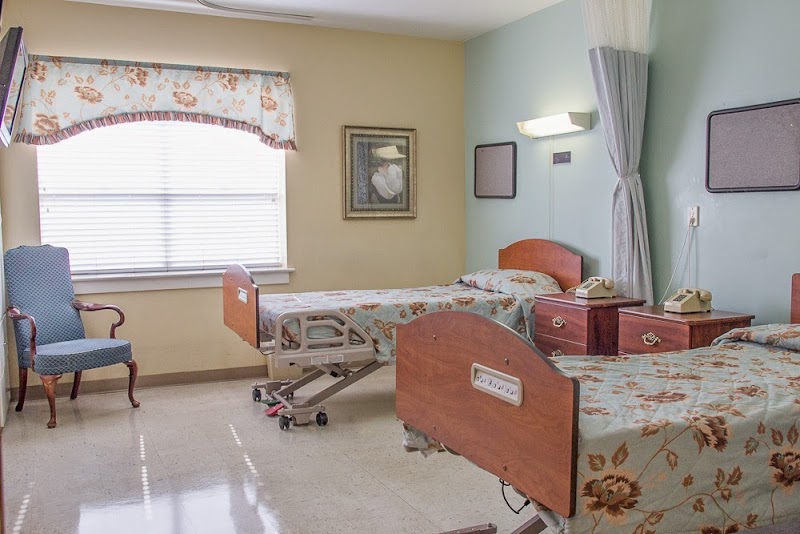
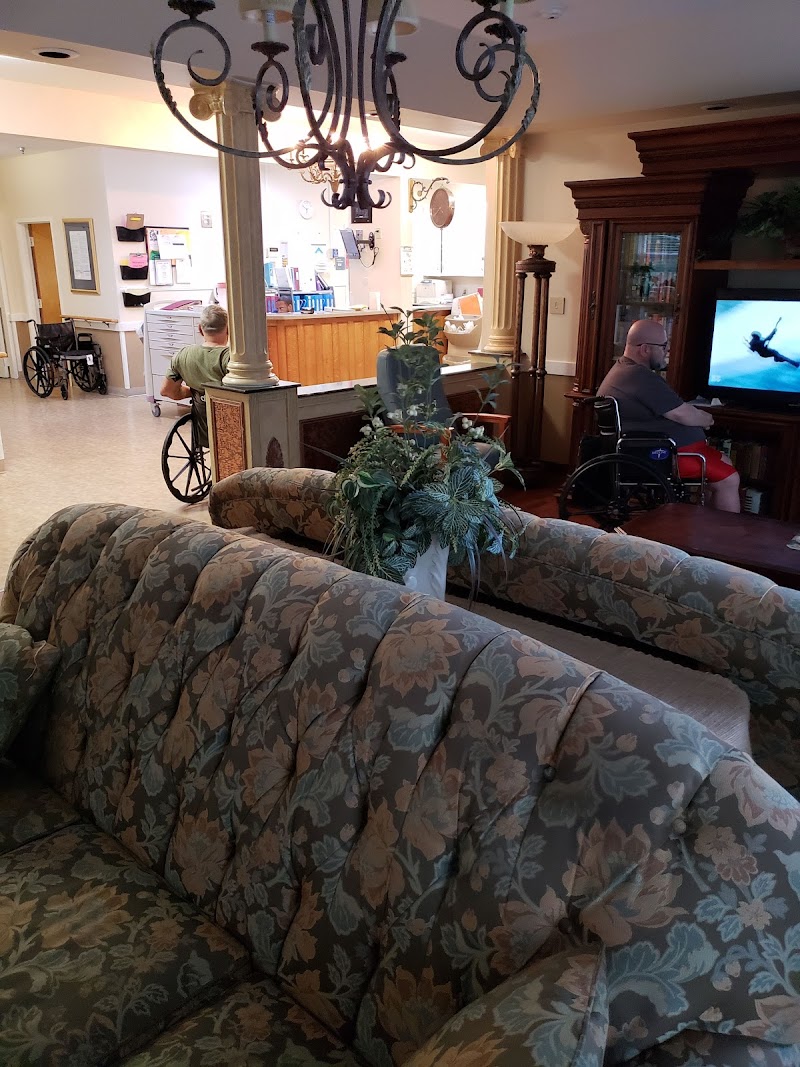
**NOTE- TERMS IN BRACKETS HAVE BEEN EDITED TO PROTECT CONFIDENTIALITY** Based on observations, interviews, review of the facility's Census List dated 01/30/2018, review of the facility's policies titled Comfortable and Homelike Environment and Preventative / PRN (as needed) Maintenance Schedule, and review of Job Descriptions for the Maintenance Director and Maintenance Technician, the facility failed to ensure resident rooms and common areas were maintained to provide a safe, clean, comfortable, and/or homelike environment for the residents. Walls, door frames, doors, baseboards, and furniture throughout the facility were observed chipped, scraped, scratched, and with missing paint. Furniture was missing knobs and/or handles, sinks and/or showers did not have faucet fixtures, leaving unfinished exposed pipe, ceiling tiles were stained brown, floor tiles were missing and/or stained. Tube feeding and/or Intravenous (IV) poles were wobbly.
These concerns were observed on four of four units in the facility, affecting common areas as well as 72 of 79 resident rooms (as reflected on the facility's Census List dated 01/30/2018). These findings affected Room Locator (RL) #s: 1 through 72, but had the potential to affect all 137 residents residing in the facility at the time of this survey.
Findings include:
1) Review of the facility's policy and procedure titled COMFORTABLE AND HOMELIKE ENVIRONMENT, dated 11/28/2017, revealed the following:
POLICY
It is the policy of this facility to have a homelike environment for residents in our facility .
PROCEDURE .
4. Maintenance concerns are addressed through the Maintenance service request logs .
Review of the facility's undated Preventative / PRN Maintenance Schedule revealed the following:
Daily
* Check Maintenance Logs
* Walk Through Facility
Weekly .
*Grand Rounds .
- Electrical
- Plumbing .
- Closet Doors
- Flooring/Baseboard .
- Furniture
- Screens/ Blinds
- Walls/ Paint
- Ceiling
- Others .
Review of the job description for Facilities Maintenance Director revealed the following:
. Essential Functions:
1. Develop and ensure implementation of a preventative maintenance plan, which describes specific tasks, to be completed and the time frame for completion.
2. Establish an equipment and utilities management program.
14. Inspect building to . detect . needed repair .
15. Perform minor plumbing and electrical maintenance.
16. Perform minor painting, carpentry and masonry work .
Review of the job description for Facilities Maintenance Technician revealed the following:
. Essential Functions:
1. Inspect building to . detect . needed repair .
2. Performs minor electrical maintenance to include but not limited to replacement or repair of fixtures .
3. Performs minor plumbing maintenance (e.g. (for example) replacement or repair of leaks in drains and faucets .) .
4. Performs minor painting, carpentry, and masonry work .
6. Preparing surfaces and painting various structures and equipment (e.g. walls, ceilings, floors, equipment, and doors, etc. (et cetera)) to preserve wood and metal parts and surfaces from corrosion and maintain a safe, comfortable living environment .
On 01/30/18 at 03:12 PM the A Bed of Room Locator (RL) #43 was observed without a handle on the top drawer of a four drawer dresser. At 3:27 PM the B bed of RL #43 was also noted without a handle on the bottom drawer of a four drawer dresser.
On 01/30/18 at 4:15 PM, Resident #170 said the facility was a hell hole. The tube feeding/IV (intravenous) pole in his/her room was observed to be wobbly. The ceiling vent was dirty and covered with dark grime. The resident voiced concerns regarding contamination to the air blowing out of the vent. Two water stained ceiling tiles were also observed. The doorway into the room from the sink area was unfinished sheet rock with exposed nail heads, uncaulked gaps, unfinished edges, and was unpainted. The sink was too small for the counter, resulting in the placement of a strip of wood and caulking to fill the void at the back of the sink.
During a follow-up with Resident #170 on 02/03/18 at 4:00 PM, the resident said the tube feeding/IV pole was still wobbly. He/she indicated maintenance staff were informed of the concern while they were in the room, but so far it had not been corrected.
On 01/31/2018 at 09:23 AM, Resident #170's daughter was interviewed. The daughter indicated she was in the process of getting Resident #170 transferred to another facility; she further indicated she was very concerned about the environment in the facility and described it as awful.
On 01/31/18 at 9:44 AM, two of two residents at the Resident Council meeting stated the walls in the hallways needed painting, and it bothered them. They both indicated their rooms also needed painting.
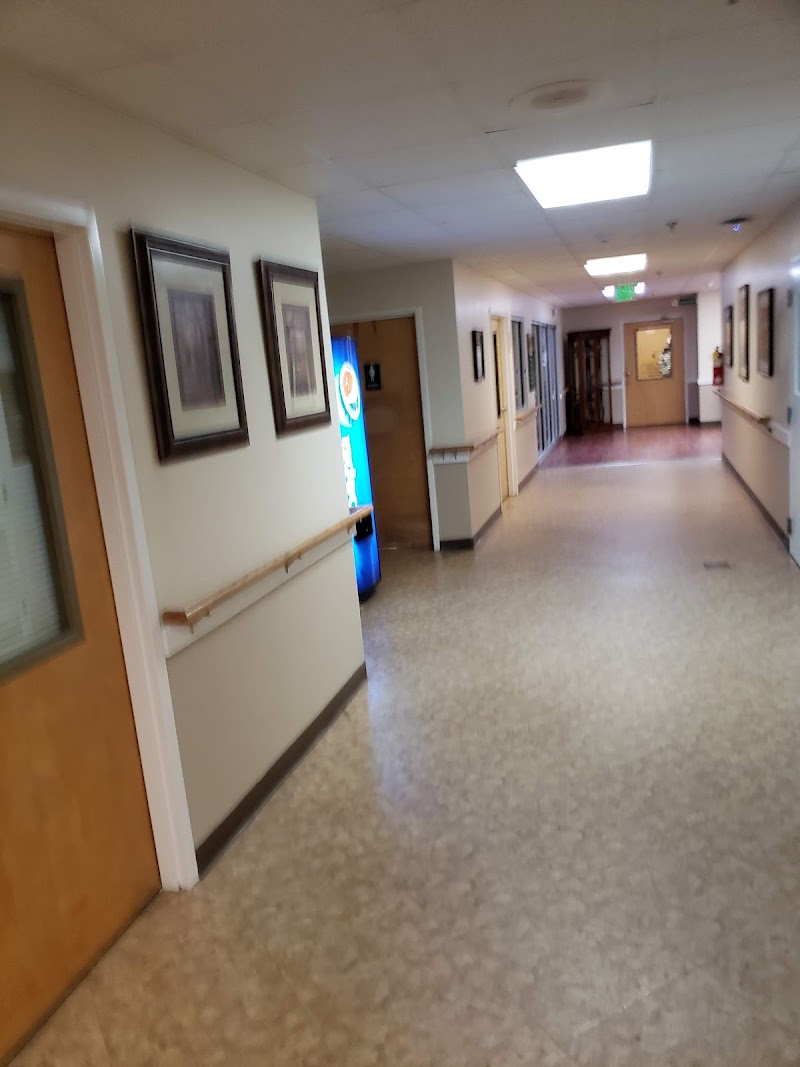
On 01/31/18 at 10:57 AM, the hand rail outside of Room Locator (RL) #10 was observed with a nail head extending out from the rail; Multiple concerns were observed on Unit Locator #1, including scraped baseboards with missing paint down the entire length of the hall, scraped doorframes to resident rooms, and scraped/scratched kick plates on resident doors.
On 01/31/18 at 11:28 AM, the nurses station on Unit Locator #1 was observed with two vertical beams that were grey, discolored and scratched. The bottom portion of the wall across from the nurses station had a dark build-up, visible despite the dark paint on the bottom of the wall.
On 02/01/18 beginning at 04:55 PM, Employee Identifier (EI) #3, Corporate Maintenance, and EI #1, the owner, made walking rounds with the surveyor starting on Unit Locator #1. EI #2, the Administrator, and EI #5, Maintenance Director, rounded with another surveyor on the opposite side of the facility, starting at Unit Locator #4. The following concerns were noted:
Unit #1 -
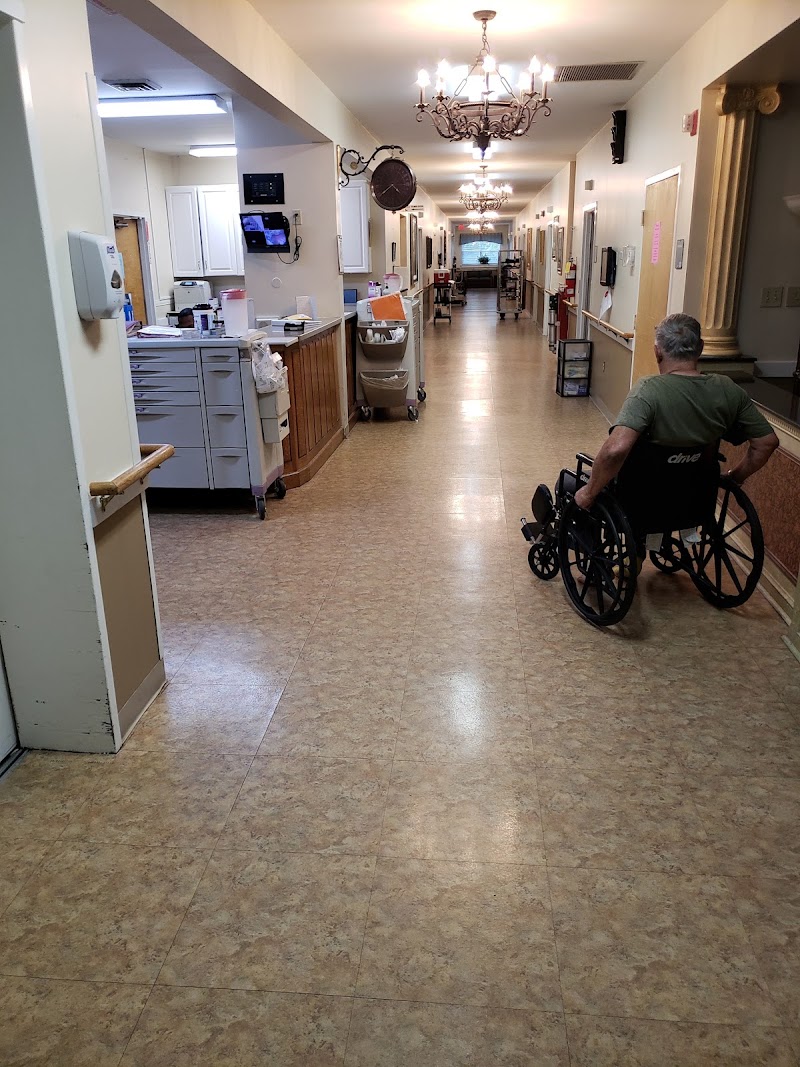
At the Nurses Station on Unit Locator #1, the cove basing along wall was partially detached and baseboards were scratched and missing paint. A pillar at the front corner of the nurses station had a large area of plaster missing, with scraped paint and baseboards. The trim around the chart area at the nurses station (visible to residents) had a grey discoloration. EI #1 said the area needed to be repainted. The cove basing along the wall beside the nurses station was coming loose, and a large area, measuring approximately 1 inch x 3 inches (confirmed by EI #3) had patch work but had not been repainted; an overhead beam was patched and sanded but not repainted. Knicks and scratches in the paint were observed running along the length of the hallway baseboards that were not covered with cove basing.
RL #1: laminate on bathroom vanity peeled loose and held on with tape; faucet with steady stream of water, unable to turn off; baseboards around interior of room with scraped, missing paint, grey discoloration and exposed wood
RL #2: plastic shield on the bottom, inside of the doorframe coming loose; wall behind bed A and bed B with paint scrapes allowing green colored paint to show through the tan paint, of which the room was finished; per EI #1 the room was previously painted green
RL #3: cove basing outside the door coming loose; entry door frame with plastic shield coming loose; scarred dresser inside room
RL #4: plastic shield on the doorframe coming loose on the right hand side
RL #5: doorframe and door to room with multiple scratched and chipped areas of paint covering approximately half the length of the door; missing knob on dresser; baseboards around interior of room with scraped, missing paint, and grey discoloration; windowsill in room is broken (confirmed by EI #3) and wood is exposed
RL #6: per EI #3 the kickplate on the entry door was painted and paint has since been scratched off; large areas of missing paint on the door; dresser with scarred wood; baseboards around the interior of the room with scraped, missing paint, and grey discoloration; built-in dresser in room with scuffs along the edges and the drawers
RL #7: cove base coming loose outside of room; doorframe with chipped and scratched areas of paint extending about half the length of the door; kickplate with multiple horizontal scratches; baseboards around the interior of the room with scraped, missing paint, and grey discoloration; bathroom door with multiple chipped areas, exposing wood; dresser with missing paint along the edges
RL #8: cove basing on the front left of the entryway was about an inch short; a plastic shield on the doorframe was coming loose at the bottom; door with multiple chipped areas and a large area of missing paint; baseboards around the interior of the room with scratched and missing paint
RL #9: cove basing outside of the room torn and wood exposed; doorframe with chipped paint almost half the length of the door; no knob on the closet; chipped paint behind the sink; baseboards around the interior of the room with scraped, missing paint, and grey discoloration
RL #10: the entry door had chipped and missing paint extending approximately half the length of door; the kick plate had horizontal scrapes; scraped paint on the dresser and trim broken off of the dresser; the resident in B bed reported the dresser had been like that since before he/she came to the facility; EI #3 said the front of the dresser needed to be replaced; commode bolts about one inch long in the bathroom were not capped; patchwork approximately 4 inches x 4 inches (confirmed by EI #3) behind the sink was not repainted
RL #11: the entry door was scarred and had chipped paint approximately half the length of the doorway; the kickplate had multiple horizontal scratches; the doorframe had scraped, missing paint; two of four closet knobs were loose; baseboards around the interior of the room with scraped, missing paint, and grey discoloration; bathroom door scraped and missing paint; cracked caulking around the sink in the room, needing to be cut out and re-caulked per EI #3
RL #12: the cove base on both sides of the door were coming loose from the wall; the entry door had chipped and missing paint
RL #13: missing knob on the dresser; loose knob on the dresser; scraped paint on edges of the dresser and drawers; base boards around the interior of the room had scraped, missing paint, and grey discoloration; bathroom door and entry door both with scratches and chipped/missing paint
RL #14: baseboards around the interior of the room with scraped, missing paint, and grey discoloration; entry door and kickplate both with scratches and door with chipped/missing paint
RL #15: cove base outside of the door coming loose; entry door with gray scratches and chipped paint
RL #16: dresser with scraped paint along the edges of drawers; baseboards around the interior of the room scraped and missing paint, with grey build up; bathroom door scraped; entry door with chipped paint
RL #17: drawer on dresser off track; missing paint on drawer edges; black build up on filter/vent in bathroom door, which EI #1 indicated was probably a result of a spill; the kick plate on the entry door had multiple scratches in the paint
RL #18: missing drawer knob on dresser; paint scraped off of dresser; baseboards scraped and missing paint with grey build-up around the interior of the room; the bathroom door had grey discoloration; a large area of patch work behind the sink in the bathroom was not painted; commode bolts approximately one inch long were not capped; EI #3 said the bolts should be capped to make it look better; the entry door to the room had chipped paint affecting approximately half the length of the door
RL #19: cove basing outside of the room was peeling loose from the wall; per EI #3, it was probably from where the glue didn't adhere; vertical scratched areas were noted on paneling behind A bed; EI #3 indicated the paneling does still need painting at times; He also said this room had previously been renovated, but was unsure of the date it was completed; the bottom drawer of the night stand beside bed A was off track; the wall and bathroom door had chipped paint and horizontal scrape marks that obviously could use some paint per EI #3; two missing knobs on drawers in the built-in dresser; the entry door to the room was scarred with chipped paint and scratches on the kickplate, that extended nearly half the length of the doorway
RL #20: the wall behind the A bed had large grey scratches, probably due to side rails going up and down per EI #1; an area about 6 inches x 2 inches (confirmed by EI #3) with no paint and two visible television brackets, not in use.
RL #21: baseboards around the interior of the room with scraped, missing paint, grey discoloration, and exposed wood; an area around the air conditioning unit needed to be resealed per EI #3; EI #3 said it looked like someone tried to seal off the area around the unit with duct tape and that should not be done
RL #22: the baseboards outside of the room were scuffed with exposed wood; the doorframe and entry door had chipped paint, extending approximately half the length of the door
RL #23: a board with an affixed hand rail outside of the room entryway with a gap in the back where the board meets the wall, needed caulking per EI #3; the corner protector beside the bathroom inside of the room was coming loose from the wall; to the right of the entry door in the hallway there was a strip of wood holding the hand rail with ten plus visible screw holes that should be replaced per EI #3
RL #24: doorframe and entry door were scarred and missing paint
The sitting area inside the entry (after coming through the lobby) had a cracked ceiling. Per EI #3, the Heating Ventilation and Air Conditioning (HVAC) drain was leaking a few months prior. He said they replaced the drain and unit and painted over the stains. He also said the facility had discussed adding a drop ceiling in the area, but no definite decision had been made.
Unit Locator #2
The right side of the lower half of the wall had wall paper peeling off. The enteral supply closet was observed with a hole in the bottom left of the door, approximately one inch, that was visible in the hallway. The linen and eye wash station door frames were scuffed with black marks. The floor tiles were stained brown. The housekeeping closet and Activities storage doors were also scuffed. A half dollar sized hole was noted in the wall beside the elevator. One of two shower rooms was observed with missing tiles across the width of the entrance doorway. The bathroom door also had chipped wood on the lower half of the door, and the walls had black scuffed area to the left, when entering the bathroom.
RL #25: dresser scuffed; bathroom door had chipped and missing paint; the ceiling inside the doorway had a cracked area about 6 inches x 4 inches on a 1.5 foot patch (as described by EI #3); EI #3 said someone did not prepare the surface, so the patch did not adhere
RL #26: large area behind B bed scraped with missing paint; the resident indicated it had been like that since before he/she came to the facility on [DATE]; the doorframe to the bathroom had chipped paint that was peeling away and exposing wood; approximately 6 inch x 3 inch area of missing paint and plaster on the wall by the shower (in the bathroom)
RL #27: accordion window fillers replaced with cardboard and aluminum tape; EI #3 said it needed to be replaced; the far wall in the bathroom had sheetrock paper peeling off at the bottom, running the length of the wall; one nail was protruding about one inch from the windowsill (in the bathroom); EI #3 said the nail could be a hazard and cause a cut
RL #28: built-in dresser had scraped paint; paint on windowsills was bubbling and starting to peel back
RL #29: doorframe with cracked and chipped paint; broken door seal around entry door; sink vanity with multiple scratches greater than six inches in length
RL #30: doorframe had chipped paint about one fourth the length of the door; top of the door with broken rubber seal; baseboards around interior of room with scraped, missing paint, and grey discoloration; crack on wall under the window (EI #3 indicated this was due to settling); windowsill with scraped, missing paint; large area behind the bed with scraped, missing paint
RL #31: doorframe with chipped, missing paint; closet doors with gray streaks and chipped, missing paint; baseboards in the room scratched with missing paint
RL #32: door to the room and doorframe had chipped paint
RL #33: scratches on the wall beside B bed from siderails scraping the wall; closet doors with scraped and peeling paint
RL #34: doorframe and door with scuffed, black marks; phone jack with no cover; walls with missing paint
RL #35: doorframe and door with scuffed, black marks
RL #36: scrapes on doorframe and door
RL #37: exposed blue and red wires to the light observed on the wall; scuffed, black areas on walls; closet door and doorframe scuffed; bottom of doorframe with black marks
RL #38: the floor outside of the bathroom door had a dark brown stain; two quarter sized holes in the wall in the room; walls scuffed and scraped with black marks; door scraped
RL #39: door and doorframe scraped and scuffed with black marks; walls missing paint on both A and B bed sides of the room
RL #40: doorframe and door scraped with black marks; closet doors scraped and discolored; missing faucet in shower/tub area; walls in room with black and brown scuffs
RL #41: doorframe and door scraped with black marks; closet doors scraped and discolored; bathroom doorframe with rust colored substance at the bottom
RL #42: doorframe and door scraped with black marks
RL #43-45: doorframes and doors scraped with black marks; room walls with black marks
RL #46: wall behind A bed with scuffed areas on the paint; bathroom tiles stained brown
RL #47: doorframe and door scraped with black marks; small electrical box on the floor was loose; staff indicated it was no longer in use; bottom portion of walls with scuffed black and brown areas
RL #48: resident reports ceiling tiles were stained brown but staff spray painted them just before the surveyor entered the room; no faucet fixtures in the shower area; the sink was chipped on the front left and right sides; bottom portion of walls with black scuff marks; foyer type entryway with unfinished/exposed sheetrock
RL #49: doorframes and doors scraped and missing paint; wall behind the bed scraped; bathroom door and walls scraped and missing paint; rust colored material on the bottom of the doorframe in the bathroom; five brown stained ceiling tiles
RL #50: doorframe scuffed black; walls in room scraped; missing cover on phone jack
Unit Locator #3
RL #51: walls in room with scraped, black areas
RL #52: entry door scraped; five brown stained ceiling tiles; black marks on walls in room; two quarter sized holes around the toilet paper holder in the bathroom; bathroom doorframe and door scraped
RL #53: doorframe scraped; bottom of room walls scraped, scuffed, and black
RL #54: scraped and scuffed doorframe and walls, with black discoloration
RL#55: door and doorframe scraped and stained; door has chipped wood on lower half of door
RL #56: doorframes scuffed with black marks; wall behind bed B with scuffed areas, black marks, and patched areas without paint; one dark brown stained ceiling tile
RL #57: floor tile behind door stained brown; doorframe with black scuff marks
RL #58: bottom of wall scraped in the bathroom
RL #59: doorframe scraped with missing paint; five brown stained ceiling tiles; closet doors with scuffed, black marks
Unit Locator #4
RL #60: bathroom doorframe and door scraped
RL #61: bottom of bathroom door scraped; bottom portions of walls in the room with scuffed, black marks
RL #62: door with chipped wood from the lower to middle part of the door; closet door, bathroom door, and door frame scraped on the lower half
RL #63: lower half of door with chipped wood; bottom of walls scraped with missing paint and exposed sheetrock
RL #64: lower half of door with chipped wood; bottom of walls scuffed black
RL #65: half dollar and quarter size holes in the wall in the bathroom; lower walls scuffed black
RL #66: lower half of entry and bathroom doors with chipped wood
RL #67: lower half of door with chipped wood
RL #68: walls scraped behind bed, some areas with missing paint and exposed sheetrock; floor stained brown around the toilet in the bathroom; bathroom doorframe and door scraped
RL #69: lower half of door with chipped wood; room and bathroom walls scuffed with black marks, with small areas of missing paint and exposed sheetrock; brown stain on floor around toilet in bathroom
RL #70: lower half of door with chipped wood; walls with black scuff marks
RL #71: bathroom with lower half of door chipped; bottom of bathroom walls with black, scuffed areas
RL #72: lower half of entry door chipped; wall outside of room scuffed with black marks
The facility's Main Dining Room was observed with a blackened door, and scraped doorframes. Wires were observed hanging from a metal plate (per staff an old computer kiosk had been removed). Tiles and walls outside of the entryway had black scuffed marks. The lower half of the walls inside the dining room were scraped.
Walking rounds of the entire facility were completed on 02/01/2018 at 6:50 PM. EI #1, the owner, EI #2, the Administrator, and EI #5, the Maintenance Director, all voiced agreement with the concerns noted by the surveyors. EI #1 agreed the items needed to be corrected.
On 02/03/18 at 2:30 PM, Resident #88 said the paint was peeling off the side wall of the shower in his/her room. The surveyor observed an area about 10 inches X 4 inches wide with the plaster/paint peeled off on the left side wall. Resident #88 said, It bothers me as an artist. Resident #88 also indicated he/she would like the facility to look more presentable, and specifically they needed new paint.
During a follow-up with Resident #88 on 02/04/18 at 9:50 AM, the ceiling was observed to be slightly buckled, after a hard rain that morning. Resident #88 pointed out a build-up of dark grey residue (build-up of grime over a period of time) on the linoleum in his/her room and said he/she would get a friend to bring in a brillo pad, attach it to his/her scrubber and try to clean the linoleum his/herself. I don't like it to be dirty--if it's the rest of my life.
On 02/03/18 at 2:45 PM the resident in RL #68 said all over the facility needed painting, as well as his/her door and walls in the room. A family member present at this time also indicated the entire facility needed painting. The family member also said the door to RL #68 needed to be addressed because the bottom of the door was scuffed/scraped. The spouse indicated when he/she comes in the front door and walks back towards the room, he/she notices the facility needs painting all over the walls and doors.
On 02/03/18 at 2:55 PM, a family member of the resident residing in RL #55 said the resident had just been admitted the day before, but stated the room needed painting, the closet doors and the walls needed painting, and there were scuff marks on the floor.
On 02/03/18 at 02:58 PM, Resident # 78 was asked what he/she thought about of the appearance of his/her room. Resident #78 said it could use an update, such as painting the walls and replacing the (water stained) ceiling tiles in the room. Resident #78 said the roof had leaked when it rained.
On 02/04/18 at 9:55 AM, the ceiling tiles in front of the bathroom in Resident # 78's room were observed with wet stains. The bathroom ceiling vent was not securely attached to the ceiling at one end.
On 02/03/18 at 2:30 PM, a family member of the resident in RL #70 said the facility needed painting.
On 02/02/18 at 12:42 PM , EI #2, the Administrator, was interviewed regarding the environmental concerns observed throughout the facility. EI #2 was asked why the areas of concern were so widespread. He indicated the facility focused primarily on any potential areas that may have some sort of harm. He said they then focus on painting and touch up work.
On 2/2/2018 at 01:21 PM, EI #2, the Administrator, agreed the problems identified by the surveyors did not get that way overnight. He indicated the facility needed to re-purpose . their system of identifying areas needing repairs in such a way it will be better systematically to maintain patient areas. When asked what system was in place to ensure areas that had previously been renovated or repaired were maintained and kept up, EI #2 said they kept maintenance request logs on each unit, but they would need to come up with an action plan to address the concerns. EI #2 said staff on the hall were expected to report all concerns, such as the items identified during walking rounds with surveyors, so actions could be taken to address them.
On 02/02/18 at 01:30 PM, EI #1, the owner, agreed major work was needed for environmental concerns on Unit Locator #1, as well as the other side of the facility. EI #1 said there was a need to do touch up work in almost each room. EI #1 explained they had a system of Grand Rounds they complete every Tuesday for about two hours, looking for concerns, including environmental issues, that need to be addressed. He said the system of Grand Rounds was excellent, but had to be done properly. He said they had to teach and train staff on what they should look for. EI #1 then said, to be honest, some people just go through the motions and just check the boxes, and the facility needed to remind staff of the purpose of the system and why it is important to inspect each room. EI #1 said it was embarrassing to go around with the surveyor and see the concerns identified, and indicated he was not happy with what he saw.
EI #5, the Maintenance Director, was interviewed on 02/03/18 at 10:28 AM. When asked how he addressed the need for ongoing touch-ups and repairs, EI #5 said they go around and check, stating they started on Unit Locator #4 and have been trying to make their way around the facility. When asked what system was in place to identify and address areas that need attention, EI #5 said he did not really have a system in place, but he addressed as many issues as he could. EI #5 said it was important for him to have a system in place to address concerns because the facility is the residents' home, and they need to beautify it for them. EI #5 said it was an old building, and explained currently they just had himself, a maintenance technician, and Corporate Maintenance that came to assist with big projects.
MINOR
(C)
Minor Issue - procedural, no safety impact
Deficiency F0838
(Tag F0838)
Minor procedural issue · This affected most or all residents
Based on interviews and review of a facility document titled Hillview Terrace Facility Assessment, the facility failed to evaluate and identify areas of the environment needing to be maintained.
This ...
Read full inspector narrative →
Based on interviews and review of a facility document titled Hillview Terrace Facility Assessment, the facility failed to evaluate and identify areas of the environment needing to be maintained.
This had the potential to affect all 137 of 137 residents residing in the facility at the time of the survey.
Findings include:
Cross reference F584.
During the recertification, the survey team identified multiple environmental concerns, including walls, doorframes, doors, baseboards, plumbing fixtures, ceiling tiles, and furniture in resident rooms and hallways throughout the facility. These concerns were observed on four of four units in the facility, affected common areas as well as 72 of 79 resident rooms reflected on the facility's Census List dated 01/30/2018.
Review of the document titled Hillview Terrace Facility Assessment, dated 11/28/2017, revealed the following:
. The following criteria were examined and evaluated by our team . :
. * Physical environment and physical plant considerations necessary for resident population.
F. Building/physical structure and equipment:
The physical structure is sound and no areas were identified needing repair. all planned maintenance is documented.
On 02/02/2018 at 12:42 PM, EI #2, the Administrator, was interviewed regarding the facility assessment. When asked who was involved in the facility assessment, EI #2 listed a variety of individuals, including himself, corporate staff, maintenance, and environmental staff. EI #2 said the purpose of the facility assessment was to develop an action plan to address any condition, any diagnosis of what the facility provides care for. EI #2 said maintenance was involved in the section of the facility assessment related to building/structure and equipment. When asked why the facility assessment did not reflect needed maintenance and repairs, EI #2 said he did not know.
During a follow-up interview with EI #2, the Administrator, on 02/05/18 at 10:24 AM, EI #2 said the facility assessment addressed the physical plant, meaning the plant was physically sound. He said when completing the facility assessment, generator systems, kitchen systems, air conditioner systems, and maintenance schedules were reviewed; however, from his interpretation of the facility assessment,the purpose was to assess the structure of building, major equipment, and ensure it was in good repair. EI #2 said based on his understanding, items such as cosmetics and painting would go through the Quality Assurance and Process Improvement committee instead of being addressed in the facility assessment.