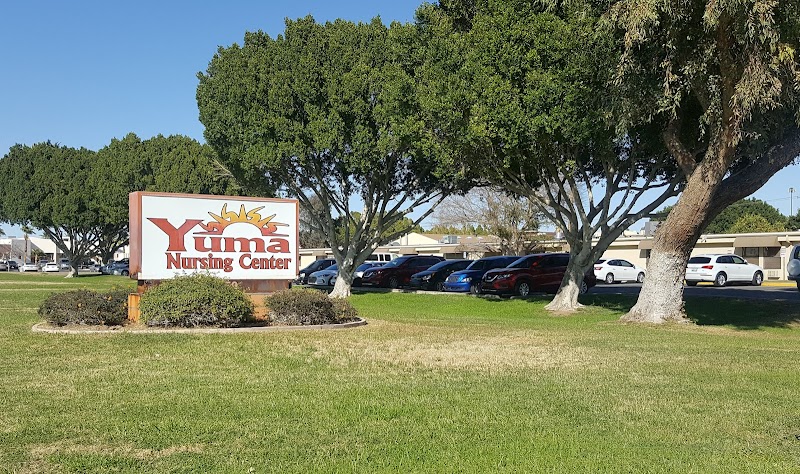
YUMA NURSING CENTER

1850 WEST 25TH STREET, YUMA, AZ 85364 (928) 726-6700
For profit - Corporation 120 Beds CIRCLE B ENTERPRISES Data: November 2025
Trust Grade
35/100
#125 of 139 in AZ
Last Inspection: June 2023

Over 2 years since last inspection. Current conditions may differ from available data.

Overview

Yuma Nursing Center has received a Trust Grade of F, indicating significant concerns about the quality of care provided. It ranks #125 out of 139 facilities in Arizona, placing it in the bottom half of nursing homes in the state, and #6 out of 6 in Yuma County, meaning there are no better local options. Unfortunately, the facility is worsening, with reported issues increasing from 1 in 2023 to 5 in 2024. While staffing is rated as a strength with a score of 4 out of 5 stars and a turnover rate of 52%, which is average, the RN coverage is concerning as it is lower than 81% of Arizona facilities. Notably, inspector findings indicate serious lapses, such as a failure to implement COVID-19 precautions for a resident, which could lead to virus spread, and failure to conduct required testing for staff during a high positivity period, highlighting ongoing compliance issues.

Trust Score
F
35/100
In Arizona
#125/139
Bottom 11%
Safety Record
High Risk
Review needed
Inspections
Getting Worse
1 → 5 violations
Staff Stability
⚠ Watch
52% turnover. Above average. Higher turnover means staff may not know residents' routines.
Penalties
✓ Good
No fines on record. Clean compliance history, better than most Arizona facilities.
Skilled Nurses
○ Average
Each resident gets 32 minutes of Registered Nurse (RN) attention daily — about average for Arizona. RNs are the most trained staff who monitor for health changes.
Violations
⚠ Watch
22 deficiencies on record. Higher than average. Multiple issues found across inspections.
★★☆☆☆
2.0
Overall Rating
★★★★☆
4.0
Staff Levels
★★★☆☆
3.0
Care Quality
★★☆☆☆
2.0
Inspection Score
Stable
2023: 1 issues
2024: 5 issues

The Good

  • 4-Star Staffing Rating · Above-average nurse staffing levels
  • Full Sprinkler Coverage · Fire safety systems throughout facility
  • No fines on record

Facility shows strength in staffing levels, fire safety.

The Bad

2-Star Overall Rating

Below Arizona average (3.3)

Below average - review inspection findings carefully

Staff Turnover: 52%

Near Arizona avg (46%)

Higher turnover may affect care consistency

Chain: CIRCLE B ENTERPRISES

Part of a multi-facility chain

Ask about local staffing decisions and management

The Ugly 22 deficiencies on record

Dec 2024 1 deficiency
CONCERN (D) 📢 Someone Reported This

A family member, employee, or ombudsman was alarmed enough to file a formal complaint

Potential for Harm - no one hurt, but risky conditions existed

Free from Abuse/Neglect (Tag F0600)

Could have caused harm · This affected 1 resident

**NOTE- TERMS IN BRACKETS HAVE BEEN EDITED TO PROTECT CONFIDENTIALITY** Based on clinical record review, interviews, review of facility documentation and policy review, the facility failed to ensure r...

Read full inspector narrative →
**NOTE- TERMS IN BRACKETS HAVE BEEN EDITED TO PROTECT CONFIDENTIALITY** Based on clinical record review, interviews, review of facility documentation and policy review, the facility failed to ensure resident #4 was free from abuse from resident #5. The deficient practice could result in residents experiencing emotional, physical, and mental trauma from the abuse. Findings include: Related to resident #4- Resident #4 was admitted to the facility on [DATE] with diagnoses of Parkinson's Disease, Dementia, and unsteadiness on feet. Review of the admission Minimum Data Set (MDS), dated [DATE], revealed resident #4 completed a Brief Interview for Mental Status (BIMS) and scored a 12 which indicated the resident was moderately cognitively impaired. Review of resident #4's Electronic Health Record (EHR) revealed a progress note dated December 1, 2024 at 7:45 p.m. The note indicated that a Certified Nursing Assistant (CNA) informed the nurse that resident #4 was slapped on the right forearm by male peer who stated, you need to stop crying. The progress note also noted that both residents were separated and there were no injuries. Related to resident #5- Resident #5 was admitted to the facility on [DATE] with diagnoses of acute kidney failure, history of strokes, and type 2 diabetes. Review of the admission MDS, dated [DATE], revealed resident #5 completed a BIMS and scored a 4 which indicated the resident was significantly cognitively impaired. Review of resident #5's care plan, created October 28, 2024, revealed a focus area related to behavior management. Interventions included encouraging the resident to participate in self-calming behaviors, reorient resident to person, place, time and situation, and to monitor for signs and symptoms related to infection. Review of resident #5's EHR revealed a progress note dated December 1, 2024 at 7:45 p.m. The note indicated that it was reported that resident #5 appeared agitated and propelled wheelchair next to female peer where he slapped her on the right forearm stating you need to stop crying. The note also indicated that residents were separated and the resident was administered a PRN (as necessary) medication of Sertraline (anti-depressant) 50 milligrams (mg). An interview with resident #5 was attempted on December 10, 2024 at 11:58 a.m. however, resident #5 refused interview and stated he wanted to sleep. An interview was conducted with Licensed Practical Nurse (LPN/Staff #15) on December 10, 2024 at 1:44 p.m. Staff #15 confirmed that she worked on December 1, 2024. She explained that she was walking down the hall when a CNA reported that resident #5 had slapped resident #4 with an open hand. Staff #15 indicated that she had asked both CNAs working the floor if there had been any triggers that led to the altercation and both CNAs had reported there were none and that resident #5 was a bit more irritable lately. Staff #15 also indicated that she contacted the provider notifying them of the incident and that resident #5 had been more irritable and requested to administer Sertraline, which the provider approved. An interview was conducted on December 10, 2024 at 2:40 PM with a Certified Nursing Assistant (CNA/Staff #4). Staff #4 confirmed she was working on December 1, 2024 with both resident #4 and #5. Staff #4 recalled that it was a normal shift that evening and resident #4 was crying and sitting in the common area between her and another CNA (staff #18) as they both were consoling her. Resident #5 was sitting in the common area in front of the TV when he approached the direction they were sitting at. Staff #4 indicated that she thought resident #5 was approaching her to ask her something but instead he slapped resident #4. When staff #18 asked resident #5 why he slapped resident #4, he stated that she needed to stop crying. Once resident #5 was moved away from the area, staff #4 consoled resident #4 and informed the nurse of the incident. A telephonic interview was conducted on December 10, 2024 at 3:23 PM with a CNA (CNA/Staff #18). Staff #18 recalled the altercation between resident #4 and #5 and indicated that she was in the common area with resident #4 consoling her because she was crying. Staff also indicated that resident #4 typically cries before bed. Resident #5 then wheeled himself next to resident #4 and looked at her while she was crying. Staff #18 indicated that resident #5 all of a sudden slapped resident #4 on her Right arm and said something to the affect of she needs to stop. Staff #18 added that both CNAs then took resident #4 to her room to put her into bed because she needed a Hoyer lift which required 2 CNAs. Staff #18 also indicated that the slap sounded hard but there was no bruising on her arm. An interview was conducted on December 10, 2024 with two Directors of Nursing (staff #20 and #21, respectively). When asked what would be the risks to the residents who might be abused in the facility, staff #21 responded they could suffer from psychological harm, physical harm, death, emotional harm, and it could affect their relationships with family. When asked what transpired between resident #4 and #5, staff #21 explained that resident #4 likes to cry and she was informed by the CNA that resident #5 slapped resident #4 opened handed and he said to stop crying. Staff #21 continued to explain that neither of the residents remember what happened and there were no injuries noted. Staff #20 added that resident #5 did not have prior incidents and she thought that resident #5 was trying to console resident #4 but he hit her too hard. Review of the facility policy titled, Abuse, Neglect, Exploitation, and Misappropriation Prevention Program, indicated that residents have the right to be free from abuse. The policy also indicated that the facility will protect residents from abuse . from other residents.
Oct 2024 1 deficiency
CONCERN (D) 📢 Someone Reported This

A family member, employee, or ombudsman was alarmed enough to file a formal complaint

Potential for Harm - no one hurt, but risky conditions existed

Free from Abuse/Neglect (Tag F0600)

Could have caused harm · This affected 1 resident

**NOTE- TERMS IN BRACKETS HAVE BEEN EDITED TO PROTECT CONFIDENTIALITY** Based on documentation, staff interviews and the facility policy and procedures, the facility failed to ensure that one resident...

Read full inspector narrative →
**NOTE- TERMS IN BRACKETS HAVE BEEN EDITED TO PROTECT CONFIDENTIALITY** Based on documentation, staff interviews and the facility policy and procedures, the facility failed to ensure that one resident (#12) was free from abuse from other residents (#12). This deficient practice could result in other residents being abused. Findings include: Resident #12 was admitted to the facility on [DATE] with diagnoses that included Alheimer's disease, anxiety, generalized muscle weakness. The minimum data set (MDS) dated [DATE] included a brief interview for mental status score of 08 indicating the resident had a moderate cognitive impairment. Review of a nurse practitioner note dated October 4, 2024 revealed that resident #12 is an [AGE] year old female with a past medical history of Alzheimer's disease and a mixed mood disorder and the resident resides in a memory care unit in a long-term care facility. Review of the progress notes revealed a late entry dated October 4, 2024 at 7:25 p.m. by the Director of Nursing (DON/staff #1), which stated that she was called into the hallway, where a certified nursing assistant (CNA/staff #7) told her that she witnessed how another resident had struck resident #12 with an open hand. The resident was removed from the area as well as other residents. The resident was remove from the area, quickly assessed and offered emergency medical services, which the resident denied. A progress note dated October 5, 2024 revealed that a licensed practical nurse (LPN/staff #10) was called into the hall and was notified that the resident was slapped by another resident with an open hand on the left cheek, which was witnessed by the (CNA/staff #7). The resident did not lose consciousness, was startled, but reported being fine. Upon examination, the resident presented with a slight discoloration on the right cheek. The provider and the DON were notified by phone at around 7:45 p.m. as well as a relative of the resident at around 8:30 p.m. The resident was removed immediately from the proximity of the aggressor. The resident was in good spirits and denied any pain. -Resident #87 was admitted to the facility on [DATE] with diagnoses that included dementia, anxiety disorder, and depression. Review of the care plan did revealed a plan dated April 11, 2024 for anti-anxiety, antidepressants, mood disorder medication use. Interventions included to monitor patterns of target behaviors. The MDS dated [DATE] included a brief interview for mental status score of 99 indicating the resident had significant cognitive impairment. A progress note dated October 4, 2024 at 12:38 p.m. revealed that the resident had a physical altercation with residents and staff, and that resident #87 was sent out to the emergency room. A behavior note dated October 4, 2024 at 5:12 p.m. revealed that resident #87 was refusing all medications, being belligerent and aggressive towards staff and residents. The provider was notified. A progress note dated October 4, 2024 at 8:26 p.m. revealed that around 7:25 p.m. the writer was notified that resident #87 slapped resident #12. The other resident was examined and made sure she was not harmed. Resident #87 had been aggressive all afternoon, and when the other resident got too close to her, she slapped her on the left cheek. The DON was called at 7:36 p.m. and made aware of the situation and staff was advised to call emergency medical services to send resident #87 to the emergency room (ER) due to being a threat to others. At 8:34 p.m. the ER called to ask if they could send resident #87 back to the facility, but the writer was not comfortable having the resident back due to her attacking other residents. An interview was conducted on October 17, 2024 at 2:07 p.m. with (CNA/staff #7), who stated that , she has received training on abuse and when a resident hits another resident that is abuse. She stated that she was charting by the TV area and resident #87 was within 3 to 4 feet of her. Resident #12 said, hey you're in my way because she was trying to get by resident #87 in the hallway. Resident #87 was already irritated and she was trying to wheel away when she swung out her left arm and hit resident #12 on the left cheek. The residents were separated. She stated that by the end of the the shift, around 9:40 p.m., she noticed a small bruise, red in color, about the size of a nickel on resident #12's cheek, and she reported the bruising to the nurse. She stated that the police and the paramedics came resident #87 was taken away at about 9:00 p.m. She stated that resident #87 is always hitting the staff and staff try to keep her away from the other residents. An interview was conducted on October 17, 2024 at 2:49 p.m. with the Director of Nursing (DON/staff #1), who stated that resident #12 didn't have a bruise, but did have some redness on her cheek. She stated that both residents wander and they were separated as soon as possible. She also stated that she and all there staff have received training on abuse, which occurs when anybody intentionally inflicts harm. The facility Abuse Prevention Program stated that the facility will not tolerate verbal, sexual, physical and mental abuse, corporal punishment, involuntary seclusion, neglect, or misappropriation of resident property by employees, family members, visitors, or other residents.
Apr 2024 3 deficiencies
CONCERN (D) 📢 Someone Reported This

A family member, employee, or ombudsman was alarmed enough to file a formal complaint

Potential for Harm - no one hurt, but risky conditions existed

Free from Abuse/Neglect (Tag F0600)

Could have caused harm · This affected 1 resident

**NOTE- TERMS IN BRACKETS HAVE BEEN EDITED TO PROTECT CONFIDENTIALITY** Based on clinical record reviews, facility documentation, resident and staff interviews, and policy review, the facility failed ...

Read full inspector narrative →
**NOTE- TERMS IN BRACKETS HAVE BEEN EDITED TO PROTECT CONFIDENTIALITY** Based on clinical record reviews, facility documentation, resident and staff interviews, and policy review, the facility failed to ensure that one resident (#20) was free from physical abuse by other residents (resident #100). The deficient practice could result in further incidents of resident to resident abuse. Findings include: -Resident #20 was admitted to the facility on [DATE], with diagnoses that include Calculus of Kidney, Cystocele, Metabolic encephalopathy, anxiety, and dementia. A behavioral care plan dated January 30, 2024 revealed the resident was at risk of wandering and intruding on another residents' privacy. The goal was noted to be wandering will not contribute to injury, with noted interventions of alerting staff when the resident is wandering, and place resident in area where frequent observation is possible. Review of the admission Minimum Data Set (MDS) assessment dated [DATE] revealed a Brief Interview for Mental Status (BIMS) score of 99 which indicated the resident had significant cognitive impairment. -Resident #100 was admitted to the facility on [DATE], with diagnoses that include Urinary tract infection, metabolic encephalopathy, Alzheimer's disease, dementia, anxiety, and restlessness. A review of the clinical record progress notes dated March 29, 2024 at 3:21 a.m. revealed the resident was anxious and not easily redirected. A second progress note dated March 29, 2024 at 11:32 p.m. revealed that at 7:30 p.m, resident #20 had stated to the nurse that she had been struck in the head by resident #100, and that part of her scalp was sore. However, no corrective measure was noted for this incident. Further review of the progress notes revealed that at 8:25 p.m. in a separate incident two staff members witnessed resident #100 striking resident #20 on top of the head, and the residents were put into rooms far apart. Review of the admission Minimum Data Set (MDS) assessment dated [DATE] revealed a Brief Interview for Mental Status (BIMS) score of 99 which indicated the resident had significant cognitive impairment. A behavioral care plan dated April 8, 2024 revealed the resident was at risk of wandering and intruding on another residents' privacy. The goal was noted to be wandering will not contribute to injury, with noted interventions of redirect resident when wandering into other resident's rooms, place resident in area where frequent observation is possible, and provide diversional activities. An interview was conducted with a Registered Nurse (RN/staff #25) on April 24, 2024 at 2:07 p.m who stated that resident #100 had struck her for the first time prior to the interview. The RN further stated that was the first time but there had been many instances of resident #100 striking at staff and other residents because she doesn't understand staffs are trying to help her and that re-orienting resident #100 is tough because she doesn't make sense when she speaks. An interview with a Certified Nursing Assistant (CNA/staff #80) was conducted on April 24, 2024 at 2:13 p.m. The CNA stated that resident #100 is very confused and very hard to understand. The CNA also stated that at times resident #100 can be nice, but most of the time she is aggressive and swats at other people. An interview with a CNA (CNA/staff #120) was conducted on April 24 at 2:30 p.m. The CNA stated that when resident #100 admitted she was trying to kiss at other residents, but that quickly turned into her acting like she was going to smack them. The CNA also stated they were short staffed that day and only had two CNA's on the unit. When asked about the above incidents on March 29, 2024, the CNA stated that she was working that day, there was a call off and so they were short staffed that day also.The CNA further stated that the nurse working that day was new hire nurse who was untrained and she felt that the nurse needed more training. An interview with the Director of Nursing (DON/staff #80) was conducted on April 24, 2024 at 2:53 p.m. The DON stated resident #100 was Spanish speaking only, and speaks only gibberish. The DON further stated resident #100 was on isolation for an infection, and was isolated in her room because she would turn over tables. The DON stated that they removed everything in her room for her safety, and that eventually resident #100 was sent to the hospital for behaviors that couldn't be controlled. The DON stated that her expectation in an incident is that residents are assessed to ensure there are no injuries, do vitals and keep the resident's separated. The DON concluded that she didn't want to bring the resident back into the facility but was over-ruled. A review of facility policy titled ''Abuse Prevention Program revealed Protection of residents' revealed that the facility will have a system in place to prevent abuse.
CONCERN (D) 📢 Someone Reported This

A family member, employee, or ombudsman was alarmed enough to file a formal complaint

Potential for Harm - no one hurt, but risky conditions existed

Abuse Prevention Policies (Tag F0607)

Could have caused harm · This affected 1 resident

**NOTE- TERMS IN BRACKETS HAVE BEEN EDITED TO PROTECT CONFIDENTIALITY** Based on clinical record review, staff interviews, facility documentation, and policy, the facility failed to implement their ab...

Read full inspector narrative →
**NOTE- TERMS IN BRACKETS HAVE BEEN EDITED TO PROTECT CONFIDENTIALITY** Based on clinical record review, staff interviews, facility documentation, and policy, the facility failed to implement their abuse policy, by failing to report an allegation of abuse within the required time for two residents (#100 and #20). This deficient practice could result in further incidents of abuse not being reported. Findings include: -Resident #20 was admitted to the facility on [DATE], with diagnoses that include Calculus of Kidney, Cystocele, Metabolic encephalopathy, anxiety, and dementia. Review of the admission Minimum Data Set (MDS) assessment dated [DATE] revealed a Brief Interview for Mental Status (BIMS) score of 99 which indicated the resident had significant cognitive impairment. -Resident #100 was admitted to the facility on [DATE], with diagnoses that include Urinary tract infection, metabolic encephalopathy, Alzheimer's disease, dementia, anxiety, and restlessness. Review of the admission Minimum Data Set (MDS) assessment dated [DATE] revealed a Brief Interview for Mental Status (BIMS) score of 99 which indicated the resident had significant cognitive impairment. A progress note dated March 29, 2024 at 11:32 p.m. revealed that at 7:30 p.m, resident #20 had stated to the nurse that they had been struck in the head by resident #100, and that part of their scalp was sore. Further review of the progress notes revealed that at 8:25 p.m. in a separate incident two staff members witnessed resident #100 striking resident #20 on top of the head, and the residents were put into rooms far apart. An interview with the Director of Nursing (DON/staff #80) was conducted on April 24, 2024 at 2:53 p.m. The DON stated the event on March 29 between resident #100 and #20 was reported to her by the staff, and stated I had told my executive director. The DON further stated that they are both the abuse coordinators, but the executive director handles the reportable. An interview with the Administrator (staff #35) was conducted on April 24, 2024 at 3:05 p.m. The administrator stated that there were no facility reportable incidents for resident #100. He further stated that he was aware of the incident on March 29 but there were no injuries, so he thought he didn't have to make a report. A review of facility policy titled Abuse, Neglect, Exploitation or misappropriation - reporting and investigating revealed that all reports of resident abuse (including injuries of unknown origin) are reported to local, state and federal agencies and thoroughly investigated by facility management.
CONCERN (D) 📢 Someone Reported This

A family member, employee, or ombudsman was alarmed enough to file a formal complaint

Potential for Harm - no one hurt, but risky conditions existed

Report Alleged Abuse (Tag F0609)

Could have caused harm · This affected 1 resident

**NOTE- TERMS IN BRACKETS HAVE BEEN EDITED TO PROTECT CONFIDENTIALITY** Based on closed clinical record review, staff interviews, facility documentation and policy review and the State Agency (SA) dat...

Read full inspector narrative →
**NOTE- TERMS IN BRACKETS HAVE BEEN EDITED TO PROTECT CONFIDENTIALITY** Based on closed clinical record review, staff interviews, facility documentation and policy review and the State Agency (SA) database, the facility failed to ensure that an allegation of abuse for one resident (#20) was reported to the State Agency as required. The deficient practice could result in abuse not being identified and investigated. Findings include: -Resident #20 was admitted to the facility on [DATE], with diagnoses that include Calculus of Kidney, Cystocele, Metabolic encephalopathy, anxiety, and dementia. Review of the admission Minimum Data Set (MDS) assessment dated [DATE] revealed a Brief Interview for Mental Status (BIMS) score of 99 which indicated the resident had significant cognitive impairment. -Resident #100 was admitted to the facility on [DATE], with diagnoses that include Urinary tract infection, metabolic encephalopathy, Alzheimer's disease, dementia, anxiety, and restlessness. Review of the admission Minimum Data Set (MDS) assessment dated [DATE] revealed a Brief Interview for Mental Status (BIMS) score of 99 which indicated the resident had significant cognitive impairment. A progress note dated March 29, 2024 at 11:32 p.m. revealed that at 7:30 p.m, resident #20 had stated to the nurse that they had been struck in the head by another resident, and that part of their scalp was sore. Further review of the progress notes revealed that at 8:25 p.m. in a separate incident two staff members witnessed another resident striking resident #20 on top of the head, and the residents were put into rooms far apart. However, there was no evidence found in the clinical record and facility documentation that this incident was reported to the SA as required. The SA database received an online report dated April 10, 2023 at 8:43 p.m. from an anonymous source that revealed a report of multiple resident to resident interactions on March 29, 2024. The report alleged that a resident was admitted in an unsafe manner, and that documentation and staffing were sub-par. The report further revealed that the same resident had struck resident #20 on top of the head. An interview with a CNA (CNA/staff #120) was conducted on April 24 at 2:30 p.m. The CNA stated that that she was working the day the incident happened, there was a call off and so they were short staffed that day also. The CNA stated a resident hit resident #20 that day. The CNA further stated that the resident that hit resident #20 had two incidents that day, but that two was probably it. An interview with the Director of Nursing (DON/staff #80) was conducted on April 24, 2024 at 2:53 p.m. The DON stated the event on March 29 involving resident #20 was reported to her by the staff, and stated she told the executive director. The DON further stated that they are both the abuse coordinators, but the executive director handles the reportable. The DON stated that her expectation in an incident is that residents are assessed to ensure there are no injuries, do vitals and keep the resident's separated. An interview with the Administrator (staff #35) was conducted on April 24, 2024 at 3:05 p.m. The administrator stated that there were no facility reportable incidents for resident #20. He further stated that he was aware of the incident on March 29 but there were no injuries, so he thought he didn't have to make a report. A review of facility policy titled Abuse, Neglect, Exploitation or misappropriation - reporting and investigating revealed that all reports of resident abuse (including injuries of unknown origin) are reported to local, state and federal agencies and thoroughly investigated by facility management.
Jun 2023 1 deficiency
CONCERN (D) 📢 Someone Reported This

A family member, employee, or ombudsman was alarmed enough to file a formal complaint

Potential for Harm - no one hurt, but risky conditions existed

Accident Prevention (Tag F0689)

Could have caused harm · This affected 1 resident

**NOTE- TERMS IN BRACKETS HAVE BEEN EDITED TO PROTECT CONFIDENTIALITY** Based on observations, clinical records, staff interviews and facility policy, the facility failed to ensure adequate supervisio...

Read full inspector narrative →
**NOTE- TERMS IN BRACKETS HAVE BEEN EDITED TO PROTECT CONFIDENTIALITY** Based on observations, clinical records, staff interviews and facility policy, the facility failed to ensure adequate supervision was provided to prevent elopement for two residents (#178 and #179). The deficient practice could result in increase the risk of resident for harm and injury. Findings include: -Resident #178 was admitted on [DATE] with diagnoses of dementia with behavioral disturbance, restlessness, agitation and wandering. A progress note dated January 8, 2021 included the resident was admitted at the facility, was alert, oriented to self only, pleasant and responding well and had a steady gait and balance with sufficient strength to extremities. A progress note dated January 10, 2021 revealed the resident was roaming and refused to go to her room. Per the note the resident made statement about wanting to go outside and was told that she was not able to at this time. Per the documentation, staff attempted to divert the resident's attention but had no positive effect and the resident continued to refuse to comply. A progress note dated January 16, 2021 included the resident was alert to self only, was responding, was wandering in the hallway and was monitored for safety. Per the documentation, the door alarm was set to on. Another progress note dated January 16, 2021 included the resident was ambulating throughout the unit; and that, the resident was experiencing auditory and visual hallucinations. A progress note dated January 18, 2023 at 12:02 a.m. included the resident was alert to self only, confused and restless. It also included that the resident wandered in the hallway and attempted to tear the plastic isolation barrier in the hallway. Another progress note dated January 18, 2023 revealed that at approximately 3:24 p.m. the resident eloped using the fire exit in the COVID unit, crossed the street and refused to come in. Per the documentation, the resident became agitated, aggressive, was yelling and confronted the police officer. The note included that at approximately 4:15 p.m., the resident was transported to the hospital for evaluation and treatment. The progress note dated January 19, 2021 included that resident was outside the building yesterday (January 18, 2021) and was in the grass area; and that, the nurse attempted to get the resident back in the building but the resident started walking away from the building. Per the documentation, the resident yelled vulgarities at the nurses, refused to come back in the building, continued to walk away to the streets, fell and refused to be assisted by staff. It also included that the police were called to assist with the de-escalation; and that the police were able to get the resident to sit in the wheelchair in the parking lot across the street of the facility. Further, the note included that EMS (emergency medical services) were called and the resident was taken to the ER (emergency room) for danger to self. A self-reported intake dated January 19, 2021 included that the resident went out of the fire door on the 100 hall; and that, a staff nurse saw her and attempted to have the resident come back inside the facility. Per the report, the resident became highly agitated and would not return, police and EMS were called and the resident was transferred to the emergency room. The facility report dated January 25, 2021 included that at approximately 3:30 p.m. (January 18), the resident was witnessed by staff exiting the 100 unit exit door. Per the documentation, it was determined that the 100 unit exit door was disarmed for trash disposal. Per the documentation, the 100 unit was a designated COVID hall and the exit door was used by housekeeping and laundry; and that, the unit was not a COVID unit as of January 19, 2021 An interview with a housekeeping manager (staff #58) was conducted on June 22, 2023 at 2:22 p.m. The housekeeping manager stated that staff takes the solid trash to the outside and that staff have a master key in laundry to go outside. He said that housekeeping staff take the alarm off and then they come inside and put the alarm on; and that, most of the time the housekeeping staff do remember to enable the alarm. Further the housekeeping manager said that he checks this regularly. An interview was conducted with the Director of Nursing (DON/staff #66) on June 22, 2023 at 2:41 p.m. the DON stated that the trash door was supposed to be locked and that several of the staff have keys to the door. The DON said that when staff comes in through the door, staff had to lock it to reset the alarm. Regarding resident #178, the DON stated that she believed that the resident exited a different door; and, she was not there at the time of this elopement. An interview was conducted on June 22, 2023 at the same time with the Assistant Director of Nursing (ADON/staff #74) who said that the door was an emergency exit door and resident #178 came out of the door on the COVID unit. -Resident #179 was readmitted on [DATE] with diagnoses of dementia, wandering, anxiety disorder, restlessness and agitation. The 48-hour discharge planning care plan dated November 10, 2022 included and intervention of social services special considerations for wandering. The behavior care plan dated November 10, 2022 included resident had wandering behaviors. Interventions included to place resident in an area where frequent observation is possible, provide diversional activities; note which exits resident favors for elopement from facility and alert staff working near those areas; implement facility protocol for locating eloped resident; if wandering away, instruct staff to stay with resident, converse and gently persuade to walk back to designated area with them; alert staff to wandering behavior; and remove and change exit combination numbers so patients does not have access to door codes. An admission Minimum Data Set (MDS) assessment dated [DATE] included resident had severe cognitive impairment; and that, the resident had wandered 4 to 6 days of the last 7. A progress note dated November 18, 2022 included that the resident went on a leave of absence (LOA) with a family at 4:30 p.m. Per the documentation, the facility received a call from another facility across the street that resident #179 was there. According to the documentation, at the family member had signed the resident back in at the front desk; and that, the family was asked to bring the resident back and sign the resident back in the locked unit. Further, the document included that the resident could not recall how he got to the other facility. The facility report dated November 25, 2022 revealed that on November 17, 2022 the resident went out of the facility for lunch with family. Per the documentation, at around 4:15 p.m., front office staff witnessed resident and family enter the lobby and went through lobby door. The investigation included that family left the resident in the hallway unattended with no staff present; and the resident walked to the west side entrance, left the building and walked across the street. Further, the documentation included that the resident was able to read the code to exit posted by the door. The care plan dated November 29, 2022 included the resident required assistance with self-care. Interventions included to assist resident to find his room when he feels lost or cannot find it; to assist and meet needs, concerns and ADL (activities of daily living) by anticipation; and, supervision to limited assist for ADLs and 1-person assist. A progress note dated December 5, 2022 included that a staff noted that this resident was outside and across the street and that he was returned without difficulty. A social service note dated December 15, 2022 included resident needed a higher level of security as the resident was actively exit seeking. A provider note dated December 18, 2022 included the resident was alert and had a history of dementia and wandering. The progress note dated December 26, 2022 included the resident continued to wander inside the unit on and off, was on 15 minutes continuous monitoring and was high risk for elopement. An interview was conducted with the Director of Nursing (DON/staff #66) on June 22, 2023 at 2:41 p.m. The DON stated that she remembered that the staff had specifically showed the family the book that the family was supposed to sign; and that, the family was supposed to go onto the unit and sign the resident back in the unit. However, the DON stated that the family brought the resident back and let the resident out right in the hall, not the unit. She said that the resident looked like a visitor as he was wearing blue jeans and he walked well. Further, the DON said that the staff in the front of the building did not know the resident. The DON stated that resident #179 eloped in 2020 and was due to the resident removing his wanderguard. Further, she stated that it was their policy that their residents do not elope from the building. The facility policy on Wandering and Elopements revealed the facility will identify residents who are at risk of unsafe wandering and strive to prevent harm while maintaining the least restrictive environment for residents. This document included that if residents are identified as at risk for wandering, elopement, or other safety issues, the resident's care plan will include strategies and interventions to maintain the resident's safety
May 2022 8 deficiencies
CONCERN (D)

Potential for Harm - no one hurt, but risky conditions existed

Resident Rights (Tag F0550)

Could have caused harm · This affected 1 resident

**NOTE- TERMS IN BRACKETS HAVE BEEN EDITED TO PROTECT CONFIDENTIALITY** Based on resident and staff interviews, the facility investigation report and document, clinical record review, and policy revie...

Read full inspector narrative →
**NOTE- TERMS IN BRACKETS HAVE BEEN EDITED TO PROTECT CONFIDENTIALITY** Based on resident and staff interviews, the facility investigation report and document, clinical record review, and policy review, the facility failed to ensure one resident (#18) was treated in a dignified manner. The sample size was 15 residents. The deficient practice could negatively impact the psychosocial wellbeing of residents. Findings include: Resident #18 was admitted on [DATE] with diagnoses that included heart failure, dehydration, diabetes mellitus, peripheral vascular disease, morbid obesity, chronic kidney disease, and major depressive disorder. During the initial part of the survey, an interview was conducted with resident #18 on May 23, 2022 at 12:19 PM, who stated that a CNA (certified nursing assistant) had said the resident was fat, and was a problem to move and was lazy. The resident also stated that she asked the CNA to leave or get another staff member to assist, but the CNA continued the care and gave the resident an evil smile. The resident stated that she had not told the administration staff, but that she did tell the nurses. She also stated that she had told other CNAs and they said they don't like her either. She stated that she did not want to disclose the CNA's name because she did not want the CNA to lose her job, and she was afraid of retaliation. The resident further stated that the CNA worked on the day shift yesterday, and still made fun of her. The resident stated that this causes emotional pain. The resident further stated that she knows she's fat, but the CNA does not need to be mean. On May 23, 2022 at 1:14 PM, the Administrator (staff #7) was notified of the resident's allegations and stated that she would begin the investigation process. Review of the comprehensive care plan dated March 10, 2022, revealed the following: -ADL: requires staff assistance with activities of daily living (ADL) with interventions that stated the resident is mostly dependent for all ADL with 1-2-person assistance, has poor participation with ADL, and needs a lot of encouragement to participate. A Medicare 5-day MDS (minimum data set) assessment dated [DATE], revealed a Brief Interview of Mental Status (BIMS) score of 13, which indicated the resident had intact cognition. The assessment also revealed the resident required extensive assistance with bed mobility, personal hygiene, and was totally dependent with transfer, dressing, toilet use, and bathing. Review of nursing progress notes dated March 2022 through May 25, 2022, revealed no evidence that the resident or other staff had reported any concerns regarding the resident's care/treatment by the Certified Nursing Assistants (CNAs). Review of the facility investigation report dated May 27, 2022, revealed that May (no day documented), 2022 resident #18 stated to a surveyor that a CNA was name calling. The report included the facility DON (Director of Nursing/staff #83), social services (staff #36) and Administrator (staff #7) were notified, and social services visited the resident to discuss how the resident felt and obtain feedback. The report was currently ongoing and did not have a resolution documented on the grievance/complaint report. The investigation report included the following witness statements: -Staff #84 (licensed nursing assistant) stated he had heard resident #18 say that other staff members called her demeaning names, almost a week ago, but he could not remember the day it happened. He stated he thinks it is staff #77 (CNA), but was not sure because he works in the evenings. He stated that he did not report it. -Staff #82 (CNA) reported that the resident had told her that staff #77 calls her fat, and that she does not like staff #77. -Staff #45 (CNA) reported that the resident complained of someone giving her an evil look. She stated that the resident would just say that she knows. She stated that she did not want to be too pushy with the resident to find out the name, because the resident may be uncomfortable. -The investigative report included a family member's statement dated May 25, 2022, which included that the family member did recall that sometime back in April resident #18 told the family member a staff said something to the resident about moving her from place to place, and somebody made her feel bad and that the resident did not want to cause problems. The resident had said that she knew she was big/fat, because she did not take care of herself and she did not need a worker to tell her that. -The investigative report included staff #77's statement dated May 25, 2022, which included that she denied ever calling the resident overweight or fat. She denied saying anything that would cause this resident to make allegations. She reported that when cleaning the resident up, she asked the resident to assist with repositioning because she could not hold the resident on her side by herself. She also reported that she tried to encourage the resident to eat because she knew the resident was diabetic and could have low blood sugars at times. She stated the resident does not like to be told she needs to eat. She reported that she is really patient with the residents. Review of facility grievance documentation, revealed no complaints involving resident #18 had been submitted to the facility, per the administrator on May 24 2022. Another interview was conducted on May 25, 2022 at 12:07 PM with the Administrator (staff #7) who stated that they had identified the CNA as staff #77. She stated that she did interview the CNA, and that staff #77 denied saying anything about the resident being fat, but stated she has asked the resident to assist with repositioning because she cannot hold the resident by herself. The Administrator further stated that the resident's roommate (resident #52) was also interviewed and she stated that yes, she has heard a CNA saying a resident was fat, but declined naming the resident or staff. An interview was conducted on May 25, 2022 at 1:30 PM with resident #18's roommate (resident #52), who stated that she cannot tell if any staff have talked to her meanly, or to any other resident. An interview was conducted via telephone on May 26, 2022 at 11:26 AM with a CNA (staff #82), who stated that one day (does not remember the day), she and the staff #77 were providing care to the resident, and staff #77 said that the resident was fat, and needed to get on a diet because she was fat, and did not look good. Staff #82 said that she gave staff #77 a look, then they completed the resident's care and left the room. She also stated that the resident told staff #77 to stop it, and that she was short and fat. Staff #82 stated that she did not report the incident immediately, because she was not sure if they were kidding or not. Staff #82 also stated that she had not heard staff #77 talk to any other residents that way, or the resident joke with other staff that way. An interview was conducted on May 26, 2022 at 11:30 AM with a CNA (staff #45), who stated that she had worked with resident #18 before she went to the hospital, and currently. The CNA stated that the resident had stated that she did not like the way someone looked at her, and that this person was really good friends with the kitchen lady. She stated that when the resident told her this she advised her to tell social services, if she felt uncomfortable. She further stated that this occurred in normal conversation, and the resident was not frightened or making accusations. The CNA also stated that she did not report this to administration, as she did not think that anything was going on. An interview was conducted via telephone on May 26, 2022 at 12:04 PM with staff #77, who stated that the last time she cared for resident #18 was on the previous Saturday. The CNA also stated that she did not recall providing care with another CNA and telling the resident that she was fat and needed to lose weight. She stated that she never said anything like that to the resident and was surprised. She also stated that she did not remember or note the resident was unhappy with her when she was providing care, and the resident has never said anything mean to her. An interview was conducted on May 26, 2022 at 2:17 PM with the Administrator (staff #7), and a Nurse Consultant (staff #100) in attendance. The Administrator stated that according to facility policy it is never okay for a staff member to say to a resident that he/she is fat or needs to lose weight, even if they are kidding. She further stated that the CNA (staff #82) that observed the interaction, should have reported it immediately. The Administrator stated that they had substantiated inappropriate words/behavior, that what staff #77 said was not appropriate and did not follow the facility policy, or resident rights. An interview was conducted on May 27, 2022 at 10:33 AM with the Administrator (staff #7) and the Nurse Consultant (staff #100). The administrator stated that social services had conducted one last visit with the resident to see if she was okay, and reported that the resident stated that she felt good, that the comments had offended her, and she felt upset when it happened. The Administrator stated that based on the resident statement, they are verifying that staff #77 did make those statements or something to that effect. Review of the facility policy titled, Resident Rights, revealed the facility must treat each resident with respect and dignity and care for each resident in a manner that promotes enhancement of their quality of life. The facility must protect and promote the rights of the residents. The resident has the right to be treated with respect and dignity.
CONCERN (D)

Potential for Harm - no one hurt, but risky conditions existed

Deficiency F0558 (Tag F0558)

Could have caused harm · This affected 1 resident

**NOTE- TERMS IN BRACKETS HAVE BEEN EDITED TO PROTECT CONFIDENTIALITY** Based on observation, clinical record review, resident and staff interviews, and policy reviews, the facility failed to ensure t...

Read full inspector narrative →
**NOTE- TERMS IN BRACKETS HAVE BEEN EDITED TO PROTECT CONFIDENTIALITY** Based on observation, clinical record review, resident and staff interviews, and policy reviews, the facility failed to ensure that one sampled resident's (#39) needs and preferences were addressed, regarding a wheelchair and cushion. The deficient practice could result in residents' needs/preferences not being addressed. Findings include: Resident #39 was admitted to the facility on [DATE] with diagnoses that included morbid obesity, chronic obstructive pulmonary disease, type 2 diabetes mellitus (DM), Parkinson's disease, limitation of activities due to disability, muscle weakness, and lack of coordination. An observation and interview conducted on May 24, 2022 at 10:00 AM revealed the resident lying in the bed. During an interview with the resident, she stated that she asked for a bigger wheelchair, and that some people came in to talk to her about it a month ago, but she has not heard back. The resident further stated that she cannot go to activities because the wheelchair is not comfortable. Review of a care conference progress note dated February 17, 2022 revealed the therapy goal for resident #39 was to sit in the wheelchair 1-2 hours a day and participate in activities, and to encourage family visits in the facility courtyard sitting in the wheelchair to avoid the bed all day. Review of the care plan dated February 25, 2022 revealed the following: -The resident required staff assistance with ADL's (activity of daily living) due to obesity, end stage renal disease (ESRD) and decreased mobility. Interventions stated Physical Therapist to work with transfers and ambulation, and Hoyer transfers with two-person assistance. -Pressure Injury due to decreased mobility, obesity, DM, ESRD, sitting in dialysis, with interventions to provide pressure reducing surfaces on bed and chair. -Activities: the resident unable to participate in the usual daily routine with interventions that included assisting to preferred activities. -Renal disease: requires dialysis with interventions that stated Hoyer transfers, two-person assistance, provide/coordinate transportation to the dialysis center. Review of a social service note dated April 4, 2022 revealed a gel wheelchair cushion was not covered by insurance, the Social worker notified the family so they could have the option to private pay, and nursing and the therapy department was notified. The quarterly Minimum Data Set (MDS) assessment dated [DATE] revealed a Brief Interview for Mental Status (BIMS) score of 12, which indicated the resident moderate cognitive impairment. The assessment indicated the resident had a range of motion limitation in both lower extremities. Review of a therapy services referral/screening form dated April 20, 2022 revealed the resident was non-mobile and was currently at baseline per nursing. The referral/screening did not include an evaluation for a wheelchair or wheelchair cushion. A quarterly care conference progress note dated April 21, 2022 revealed a request for a therapy referral to assess wheelchair and seat cushion recommendation, the resident voiced wanting a bigger wheelchair or recliner wheelchair and cushion. Review of the medical record progress notes after April 21, 2022 revealed no documentation that a therapy evaluation was completed regarding the resident request for a bigger wheelchair, or recommendations regarding other wheelchair cushion options. Review of the medical record revealed no written physician orders for a therapy evaluation for a wheelchair or wheelchair cushion. An interview was conducted on May 25, 2022 at 2:18 PM with a physical therapist (PT/staff #6), who stated that central supply has different sizes/types of wheelchairs and physical therapy will complete a screening to see if a wheelchair is appropriate for the resident. He also stated that screening is documented in the medical record for long-term care residents. He reviewed the medical record and stated that the resident was discharged from physical therapy on February 25, 2022. He further stated that he did not see any documentation that an evaluation of the wheelchair had been completed for this resident. An interview was conducted on May 25, 2022 at 2:22 PM with a PT technician (staff #70), who stated that he makes sure that all the documentation is taken care of. He also stated that a wheelchair evaluation would ensure that the wheelchair fits the resident well. He reviewed the medical record, including therapy documentation and stated that therapy had not completed an evaluation for a wheelchair for this resident. Later that day at 3:07 PM, staff #70 stated that there were no notes in the medical record documenting a referral for a wheelchair cushion or wheelchair for this resident. He stated he also checked the files in the therapy room and that there were no further notes or referrals for a wheelchair evaluation or cushion. An interview was conducted on May 25, 2022 at 2:49 PM with the Social Services Director (staff #36), who stated that if a resident would request a new wheelchair she would be contacted by nursing, and then therapy would be notified to complete an assessment, and an order would be written. She also stated that if it was for a long-term care resident, the facility would rent/purchase the wheelchair. The social services director reviewed the progress notes in the medical record and stated that this resident is in the long-term care unit. She further stated that the physician gave her a written prescription for a wheelchair cushion, and it was submitted to central supply, then on to the DME (durable medical equipment) supply company. She stated that the resident's insurance did not cover a wheelchair cushion. Staff #36 stated that she had notified therapy that the cushion was not covered, and that therapy was going to look into a different cushion. She stated that this took place on April 21, 2022, when she was made aware that therapy did not recommend a gel cushion, and they were going to evaluate for another option. She said that she spoke with the occupational therapy assistant (OTA/staff #68) at that time. She further stated that she did not keep the original prescription that the physician had given to her for the gel cushion. She also stated that she would assume that a physician order would be documented in the medical record. She reviewed the medical record and stated that it is not in the physician orders in the medical record for a wheelchair cushion, or referral for evaluation of a wheelchair. An interview was conducted on May 26, 2022 at 9:25 AM with the Director of Nursing (DON/staff #83), who stated that the physician order for the wheelchair cushion should have been entered/scanned into the medical record. She also stated that a social worker can accept an order from a provider, but the orders should be entered into the EMR (electronic medical record), and there should be a care plan. The DON also stated that for a wheelchair or cushion order, if therapy felt the cushion ordered was not good for the resident, the provider should have been notified and the notification documented. She reviewed the medical record and stated that the care plan meeting documentation on April 21, 2022 revealed that therapy would make recommendations on the wheelchair and cushion. She also stated that she would expect that therapy would research and document their recommendations. She stated that for this meeting they should have gotten back to the resident if they could not get the cushion or wheelchair, and an alternative should have been recommended and documented. She further stated that she did not see any documentation in the medical record that therapy had completed an evaluation regarding a wheelchair or cushion. The DON stated that according to the facility policy they should have continued collaborating until this was solved, and that it did not meet the facility policy or the resident's preferences. An interview was conducted on May 26, 2022 at 10:35 AM via telephone with the OTA (staff #68), who stated that she is the rehabilitation director. She stated that for long-term care residents, nursing would inform them if there was a need to complete a screening for a wheelchair and/or wheelchair cushion, and that they would document the screening and the recommendations in the medical record. She further stated that she was aware of the care plan meeting on April 21, 2022, and that social services did request she evaluate for a wheelchair and a seat cushion. The OTA stated that she did not document that this had been conducted or her recommendations, and that the resident was not notified. She also stated that she did not follow through with the screening for the wheelchair or cushion as requested in the care planning meeting. Staff #68 also stated that this does not meet the facility expectations. An interview was conducted on May 26, 2022 at 11:33 PM with a Central Supply/certified nursing assistant (CNA/staff #29) who stated that for a resident that is in the long-term care unit she would check inventory if she received notice from therapy that a resident required a wheelchair or cushion. She also stated that physical therapy would inform her what type of wheelchair or cushion was needed. She further stated that when a provider writes a physician order for a wheelchair cushion, it would be scanned into the medical record and she would receive a copy of the order. She stated that the process for requests of durable medical equipment (DME), is that PT would complete a screening to see if the product is a good fit for the resident, then they would notify central supply of what product they wanted. She stated that she did not receive any order for a wheelchair cushion or wheelchair for this resident. Review of the facility policy titled, Therapy Specific Evaluation, revealed a therapy evaluation will be performed and documented for all patients with written therapy orders from a licensed physician. The results of the evaluation are documented within the EMR system. In the event that upon completion of the evaluation, the therapist determines that there is no need to proceed with the treatment, the therapist will clearly document why the patient does not qualify and what indicators lead to the evaluation. This supports the initial decision to perform the evaluation. Review of the facility policy titled, Resident rights, revealed that the resident has a right to and facility must promote and facilitate self-determination through support of resident choice. The facility must consider the views of a resident and act promptly upon grievances and recommendations of such groups concerning issues of resident care and life in the facility. The resident has the right to be informed of and participate in their treatment including the right to: -Be fully informed in a language they can understand. -Participate in establishing expected goals and outcomes of factors related to effectiveness of the plan of care. -Have been included in the plan of care for the resident's needs. - Be informed of treatment and treatment alternatives or treatment options and to choose alternative or option they prefer. Review of the facility policy titled, Patient care: Admission, Treatment and Discharge, revealed that treatment modalities will be selected based on the needs of each individual patient to support reaching their personal goals based on functional deficits and underlying impairments. Details regarding patient and caregiver education should be documented within the patient's medical record via the EMR system utilized by the therapy department. Each patient chart will contain completed any additional documentation/reports pertinent to the patient's treatment/care, evaluation/plan of care.
CONCERN (D)

Potential for Harm - no one hurt, but risky conditions existed

Report Alleged Abuse (Tag F0609)

Could have caused harm · This affected 1 resident

**NOTE- TERMS IN BRACKETS HAVE BEEN EDITED TO PROTECT CONFIDENTIALITY** Based on clinical record review, staff interviews, facility investigative report, and policy review, the facility failed to ensu...

Read full inspector narrative →
**NOTE- TERMS IN BRACKETS HAVE BEEN EDITED TO PROTECT CONFIDENTIALITY** Based on clinical record review, staff interviews, facility investigative report, and policy review, the facility failed to ensure that an allegation of possible verbal abuse for one sampled resident (#18) was reported immediately to the facility administrator. The deficient practice could result in additional abuse allegations not being reported to the administrator. Findings include: Resident #18 was admitted on [DATE] with diagnoses that included heart failure, dehydration, diabetes mellitus, peripheral vascular disease, morbid obesity, chronic kidney disease, and major depressive disorder. During the initial part of the survey, an interview was conducted with resident #18 on May 23, 2022 at 12:19 PM, who stated that a CNA (certified nursing assistant) had said the resident was fat, and was a problem to move and was lazy. The resident also stated that she asked the CNA to get out of there, or get another staff member to assist, but the CNA continued the care and gave her an evil smile. The resident stated that she had not told administration, but that she did tell nurses. She also stated that she had told other CNAs and they said they don't like her either. The resident further stated that the CNA worked on the day shift yesterday, and she still made fun of her. The resident stated that this causes her emotional pain. She further stated that she knows she's fat, but the CNA does not need to be mean. On May 23, 2022 at 1:14 PM, the Administrator (staff #7) was notified regarding the resident's allegation of verbal abuse and stated that she would begin the investigation process. Review of the facility investigation report dated May 27, 2022, revealed that on May (no day documented), 2022 the resident #18 stated to a surveyor that a certified nursing assistant (CNA/staff #77) was name calling. The report included the facility DON (Director of Nursing/staff #83), social services (staff #36) and Administrator (staff #7) were notified, and social services visited the patient to discuss how she felt and obtain feedback. The report was currently ongoing and did not have a resolution documented on the grievance/complaint report. The investigation report included the following witness statements: -Staff #84 (licensed nursing assistant) stated he had heard resident #18 say that other staff members called her demeaning names, almost a week ago, but he could not remember the day it happened. He stated he thinks it is staff #77 (CNA), but was not sure because he works in the evenings. He stated that he did not report it. -Staff #82 (CNA) reported that the resident had told her that the alleged perpetrator (staff #77) calls her fat, and that she does not like staff #77. -Staff #45 (CNA) reported that the resident complained of someone giving her an evil look. She stated that the resident would just say that she knows. She stated that she did not want to be too pushy with the resident to find out the name, because the resident may be uncomfortable. An interview was conducted via telephone on May 26, 2022 at 11:26 AM with a CNA (staff #82), who stated that one day (does not remember the day), she and the alleged perpetrator (staff #77) were providing care to the resident, and the alleged perpetrator said that the resident was fat, and needed to get on a diet because she was fat, and did not look good. Staff #82 said that she gave the CNA (staff #77) a look, then they completed the resident's care and left the room. She also stated that the resident told the alleged perpetrator (staff #77) to stop it, and that she was short and fat. Staff #82 stated that she did not report the incident immediately, because she was not sure if they were kidding or not. The CNA stated that telling a resident she is fat and needs to lose weight is verbal abuse, and that she should have reported it immediately, per the facility policy. An interview was conducted on May 26, 2022 at 11:30 AM with a CNA (staff #45), who stated that she had worked with resident #18 before she went to the hospital, and currently. The CNA stated that the resident had stated that she did not like the way someone looked at her, and that this person was really good friends with the kitchen lady. She stated that when the resident told her this she advised her to tell social services, if she felt uncomfortable. She further stated that this occurred in normal conversation, and the resident was not frightened or making accusations. The CNA also stated that she did not report this to administration, as she did not think that anything was going on. She further stated that she has received training for all types of abuse including verbal, physical and emotional, and to report abuse to the charge nurse. An interview was conducted on May 26, 2022 at 2:17 PM with the Administrator (staff #7), and a Nurse Consultant (staff #100) was in attendance. The Administrator stated that she started the investigation immediately after the surveyor reported the resident complaint of abuse. She also stated that the state agency was notified via the facility reported incident process. The Administrator stated that according to facility policy it is never okay for a staff member to say to a resident that he/she is fat or needs to lose weight, even if they are kidding. She further stated that the CNA that observed the interaction (staff #82) should have reported it immediately. She also stated that during another staff interview the staff member stated that the resident mentioned to him about a lady who called her a name, who works during the day, but the resident did not seem distraught. Review of the facility policy titled, Abuse Prevention Program, revealed zero tolerance of verbal abuse by employees. Verbal abuse is defined as any use of oral language that willfully includes disparaging and derogatory terms to a resident. Examples include berating, ridiculing, and teasing. Inappropriate joking around or cutting up may be misunderstood as verbal abuse. Any witnessed incidents, allegations of incidents, or suspected incidents, are to be immediately reported to a supervisor or charge nurse. The charge nurse is to notify the DON or administrator immediately of the report. Reports are to be made as soon as the incident, potential incident, or suspicion, is made known. Any person observing resident abuse is to report the concern to their supervisor immediately.
CONCERN (D)

Potential for Harm - no one hurt, but risky conditions existed

Comprehensive Care Plan (Tag F0656)

Could have caused harm · This affected 1 resident

**NOTE- TERMS IN BRACKETS HAVE BEEN EDITED TO PROTECT CONFIDENTIALITY** Based on clinical record review, staff interviews, and policy and procedure, the facility failed to ensure that care plan interv...

Read full inspector narrative →
**NOTE- TERMS IN BRACKETS HAVE BEEN EDITED TO PROTECT CONFIDENTIALITY** Based on clinical record review, staff interviews, and policy and procedure, the facility failed to ensure that care plan interventions for pressure ulcers were implemented for one resident (#36). The sample was 15 residents. The deficient practice could affect the quality of residents' care. Findings include: Resident #36 was admitted to the facility on [DATE] with diagnoses that included unspecified acute kidney failure and contusion of an unspecified part of the head. A care plan dated October 8, 2021 revealed the resident had a pressure ulcer to the right ischial hip. Interventions included performing wound care as ordered, assessing skin daily with routine care, full skin evaluation with bath/shower, and assessing the wound healing weekly. Review of paper weekly skin/body assessment forms completed by the CNAs (certified nursing assistant) after a shower/bath had been provided revealed no evidence that the weekly skin/body assessments were completed from November 24, 2021 to April 14, 2022. Review of the medical record revealed no wound observations in the medical record related to hospice care/treatment of the resident's wound. The DON requested the records from hospice. Review of the facility medical record and records provided by hospice revealed no documentation of wound assessment and care by facility nursing or hospice nursing on the facility wound assessment report form, or hospice wound/skin assessment form for the following: -No documentation between 10/7/2021 and 10/22/21 -No documentation between 10/22/2021 and 11/5/21 -No documentation between 11/19/2021 and 11/28/21 -No documentation between 11/31/2021 and 12/09/21 Review of the quarterly Minimum Data Set (MDS) assessment dated [DATE], revealed a Brief Interview for Mental Status (BIMS) score of 5, which indicated the resident had severe cognitive impairment. The assessment included the resident had an unstageable pressure ulcer that was not present upon admission. Further review of the Skin Wound Observation forms (provided by hospice) revealed incomplete wound documentation including no wound measurements and no wound assessment on the following dates: 11/11/21 - no measurements/assessment 11/19/21 - no measurements/assessment 12/23/21 - no measurements/assessment. 12/30/21 - no measurements/assessment. 1/13/2022 - no measurements/assessment 1/18/2022 - no measurements/assessment 1/20/2022 - no measurements/assessment 1/26/2022 -no measurements/assessment Further review of the medical record revealed there was no skin/wound observation documentation from hospice between January 26, 2022 through February 1, 2022 and on 3/10/22 no measurements/assessment. An interview conducted on May 26, 2022 at 8:40 AM with the Registered Nurse (RN) wound nurse (staff #54), who stated that the CNAs will look for open areas on the resident's skin during showers/baths and document it on the weekly skin/body assessment form. The RN stated that a care plan for wound care would be completed by the MDS nurse or wound nurse. She also stated that if the care plan interventions stated to assess the resident's skin during bath/shower or to complete wound care weekly, that it should be done as written in the care plan. She also stated that the resident was receiving hospice care when the wound started, and that hospice would have completed the wound assessments and showers/baths and documented them. She further stated that the facility would complete the wound care and showers/baths when hospice did not and document it. An interview was conducted on May 26, 2022 at 9:25 AM with the Director of Nursing (DON/staff #83), who stated that she would expect the care plan interventions to be implemented as written. The DON stated that the MDS nurse or Assistant DON would complete the care plan for wound/skin, but any nurse can update the care plan. The DON stated that she reviewed the medical record and that they had no documented weekly skin/body assessments completed between 11/24/2021 and 4/13/2022. She further stated that the hospice CNAs should have completed the forms when they provided showers to the resident. She stated that she was not aware that this was not being completed by hospice. She further stated that the skin/body assessments were not completed as ordered, or according to the facility policy. The DON stated that the facility is to have copies of hospice notes scanned into the EMR (electronic medical record). She stated the risk of not communicating with hospice could result in a skin issue not being identified. She stated that she would have expected there to be weekly wound assessments documented by hospice and the facility staff. She also stated that the facility process is to complete care plan interventions as written. An interview was conducted on May 26, 2022 at 1:07 PM with a restorative nurse (staff #45) who stated that the MDS nurse is responsible for updating the care plans. She stated that during baths/showers the CNA would look for any skin issues and would document on the shower/skin form. She also stated that the form needs to be completed every time a resident receives a shower/bath. The nurse further stated that hospice staff are to complete the shower/bath forms and have the nurse sign them. She stated the risk of not completing the shower forms could result in a shower not being performed or a new skin issue not being identified. An interview was conducted on May 27, 2022 at 8:32 AM with a RN (staff #62), who stated that the facility process is to implement care plan interventions as needed. She also stated that the CNAs complete the weekly shower/bath skin forms and place them in a notebook at the nursing station. An interview was conducted on May 27, 2022 at 8:33 AM with a certified nursing assistant (CNA/staff #37) who stated that the facility process is to document the care they give the resident, and follow the care plan interventions. She stated that they complete a skin/bath assessment form and document any skin issues that are observed during a resident's shower. Another interview was conducted on May 27, 2022 at 9:06 AM with the DON (staff #83) who stated the facility policy is to measure, assess and document wound status every week, including care/treatment performed by hospice nurses/staff. She stated that there were multiple hospice wound care assessments that contained no documentation of the wound measurements or assessments in the medical record per her review. She also stated that hospice should be following the facility policy and procedures, and documenting the wound measurements and assessments. She also stated that the risk of documentation not being completed accurately could impact the care of the patient. The DON stated that hospice needs to communicate and document their care to support the care/treatment of the resident. The DON stated that shower forms should be completed every time the resident has a shower by the facility CNAs or hospice staff. She stated that she has reviewed the shower sheets for November 2021 through April 2022, and that there were multiple bath/shower, skin assessments that had not been completed. She also stated that it is the facility policy that the forms be completed with each bath/shower/bed bath. She then stated that the shower forms are scanned into the medical record. Later that day at 10:10 AM, the DON stated that she reviewed the medical record and that it was the hospice CNA documentation that was missing for the shower/skin assessments. She further stated that they have no CNA documentation on the unit bath shower/care notebook for December 2021 through March 2022, and that this did not follow the facility policy or the care plan interventions. Review of a facility policy titled, Care Plans, Comprehensive Person-Centered, revealed that a care plan to meet the resident's physical and functional needs is developed and implemented for each resident. A review of the facility policy titled, Bath, Shower/tub, revealed the purpose is to promote cleanliness, and to observe the condition of the resident's skin. All assessment data obtained (reddened areas, sores on the resident's skin) should be documented. Review of facility policy titled, Wound care, revealed that documentation to be recorded in the resident's medical record includes all assessment date (wound bed color, size, drainage) obtained when inspecting the wound and to review the care plan to assess for any special needs of the resident. A review of the facility policy titled, Pressure Ulcer Assessment, revealed a resident-centered care plan is created to address the modifiable risks. Conduct a comprehensive skin assessment with every risk assessment, once inspection of skin is completed document the findings on a facility-approved skin assessment tool.
CONCERN (D)

Potential for Harm - no one hurt, but risky conditions existed

Pressure Ulcer Prevention (Tag F0686)

Could have caused harm · This affected 1 resident

**NOTE- TERMS IN BRACKETS HAVE BEEN EDITED TO PROTECT CONFIDENTIALITY** Based on clinical record review, staff interviews, and policies and procedures, the facility failed to ensure timely assessments...

Read full inspector narrative →
**NOTE- TERMS IN BRACKETS HAVE BEEN EDITED TO PROTECT CONFIDENTIALITY** Based on clinical record review, staff interviews, and policies and procedures, the facility failed to ensure timely assessments and consistent treatments were provided to one sampled resident (#36) with pressure ulcers. The deficient practice could result in delayed healing of pressure ulcers. Findings include: Resident #36 was admitted to the facility on [DATE] with diagnoses that included unspecified acute kidney failure and contusion of an unspecified part of the head. The significant change in status Minimum Data Set (MDS) assessment dated [DATE] revealed the resident was receiving hospice care. The assessment also included the resident did not have one or more unhealed pressure ulcers at stage 1 or higher. Review of wound assessment documentation in the medical record revealed the pressure ulcer to the right buttock was initially present on October 7, 2021. A physician order dated October 7, 2021 stated to apply zinc barrier cream to the right ischial hip pressure ulcer as needed with brief change. Review of the care plan dated October 8, 2021 revealed the resident had a pressure ulcer to the right ischial hip. Interventions included performing wound care as ordered and assessing wound healing weekly. Review of the physician's orders revealed the following: -an order dated November 11, 2021 to cleanse the open area on the right ischial hip with normal saline, pat dry with gauze, apply xeroform to the wound bed, and secure with a bordered foam dressing 3 times per week. -an order dated November 28, 2021 to cleanse the stage 4 pressure ulcer to the right buttock with wound cleanser, apply a sterile packing strip moistened with silvasorb gel to the wound cavity, and loosely cover with a foam dressing every Monday, Wednesday, Friday. -an order dated December 2, 2021 to cleanse the open area on the right ischial hip with normal saline, pat dry with gauze, apply skin prep to the periwound, apply betadine to the wound bed, apply a crushed Flagyl 500 milligrams tablet in the wound bed, fill the void with fluffed gauze, and cover with a nonadherent dressing. Review of the Treatment Administration Records (TARs) for October 2021- February 2022 revealed the treatment was provided as ordered. However, continued review of the medical record revealed no wound assessments in the medical record related to hospice care/treatment of the resident's wound. The DON requested the records from hospice. Review of the wound assessment forms for the facility and for hospice revealed no evidence that wound assessments were conducted between 10/7/2021 and 10/22/21, 10/22/2021 and 11/5/21, 11/19/2021 and 11/28/21, and 11/31/2021 and 12/09/21 Review of the hospice Skin Wound Observation forms revealed no measurements/assessment on 11/11/21, 11/19/21, 12/23/21, 12/30/21, 1/13/2022, 1/18/2022, 1/20/2022, and 1/26/2022. Additional review of wound assessments forms for the facility and for hospice revealed no evidence of wound assessments for January 26, 2022 through February 1, 2022. Further review of wound assessment documentation in the medical record revealed the pressure ulcer to the right buttock healed on February 17, 2022. Review of the clinical record did not reveal physician, Nurse Practitioner (NP), or Physician Assistant progress notes regarding wound assessment, treatment, and progress. An interview conducted on May 24, 2022 at 2:27 PM with the wound nurse (staff #54), Registered Nurse (RN), who stated that the resident's wound is healed at this time and no longer receives dressing changes. She further stated that she had observed that when hospice was documenting information about the buttock wound, they were calling it a right hip ischial wound, rather than a right buttock pressure ulcer. She stated it was the same area. Another interview was conducted with staff #54 on May 26, 2022 at 8:40 AM, who stated that a provider order is needed for wound care treatment. She stated the physician does not see the resident weekly, but the NP or PA will follow the wound nurse weekly to assess the wounds. She stated that the NP will document progress notes, including if there are any changes in orders. The RN stated that it is the facility process to follow physician orders. She stated that it is the facility policy that wound assessments/treatment be completed accurately and as ordered, and be available in the medical record. The RN stated that the resident was on hospice care when the wound started, and that hospice wrote the wound orders, and would document wound assessments/treatment. She also stated that the facility would complete the wound care assessments/treatments when hospice did not. She further stated that both hospice and the facility nurses were expected to document the wound assessments, including measurements and wound tissue appearance. An interview was conducted on May 26, 2022 at 9:25 AM with the Director of Nursing (DON/staff #83), who stated that she would expect the physician orders to be completed as written. The DON stated that the facility is to have copies of hospice notes scanned into the EMR (electronic medical record). She stated that she would have expected there to be weekly wound assessments documented by hospice and/or facility nursing that included measurements of the wound and description of the wound tissue. The DON stated that they do not have any documentation from the provider regarding wound care evaluation/treatment in the medical record. She stated the risk of not communicating with hospice could result in a skin issue not being identified. Another interview was conducted on May 27, 2022 at 9:06 AM with the DON (staff #83), who stated the facility policy is to measure, assess and document wound status every week, including care/treatment performed by hospice nurses/facility nurses. She stated that there were multiple hospice wound care assessments that contained no documentation of the wound measurements or assessments in the medical record per her review. She also stated that hospice should be following the facility policy and procedures, and documenting the wound measurements and assessments in the medical record. The DON further stated that she reviewed the medical record and there were multiple days in October and December, 2021, that there were no wound care/assessments completed by the facility or hospice nurses. She also stated that the risk of documentation not being completed, or completed accurately, could impact the care of the patient. She further stated that she will talk with hospice about this, including that the hospice nurses were calling the wound a hip wound. The DON stated that hospice needs to communicate and document their care to support the care/treatment of the resident. Review of facility policy titled, Wound Care, revealed that documentation is to be recorded in the resident's medical record that includes all assessment data (wound bed color, size, drainage) obtained when inspecting the wound. Review of the facility policy titled, Resident Assessment, included that pressure ulcers will be assessed weekly to ensure physician notification, wound characteristics and treatment plan remains appropriate to promote improvement. If skin breakdown is present, protocols for wound care will be followed to include documentation and treatments. A review of the facility policy titled, Pressure Ulcer Assessment, revealed the purpose of the procedure is to provide guidelines for structured assessment and identification of residents at risk of developing pressure ulcers/injuries. Once inspection of the skin is completed, document the findings on a facility-approved skin assessment tool. A review of the facility policy titled, Physician Services, revealed that physician orders and progress notes are maintained in accordance with current regulations and facility policy.
CONCERN (D)

Potential for Harm - no one hurt, but risky conditions existed

Deficiency F0943 (Tag F0943)

Could have caused harm · This affected 1 resident

Based on personnel record review and staff interviews, the facility failed to provide evidence that one of ten sampled staff (#61) was provided training on dementia management. The deficient practice ...

Read full inspector narrative →
Based on personnel record review and staff interviews, the facility failed to provide evidence that one of ten sampled staff (#61) was provided training on dementia management. The deficient practice could result in staff not being knowledgeable of how to care for residents with dementia. Findings include: A review of the personnel file for a Certified Nursing Assistant (staff #61) revealed a hire date of 6/30/2021. Continued review of the personnel file revealed the orientation checklist for staff #61 was completely blank. An interview was conducted on 05/27/2022 at 11:36 PM with the Administrator (staff #7) and the Director of Nursing (staff #83) who indicated that they have no evidence to prove that staff #61 was provided training on dementia management. In an interview conducted with Human Resources (staff #56) on 05/27/2022 at 11:36 PM, staff #56 stated there was no policy on required annual training for staff.
CONCERN (E)

Potential for Harm - no one hurt, but risky conditions existed

Infection Control (Tag F0880)

Could have caused harm · This affected multiple residents

**NOTE- TERMS IN BRACKETS HAVE BEEN EDITED TO PROTECT CONFIDENTIALITY** Based on clinical record review, staff interviews, and facility policy and procedures, the facility failed to ensure transmissio...

Read full inspector narrative →
**NOTE- TERMS IN BRACKETS HAVE BEEN EDITED TO PROTECT CONFIDENTIALITY** Based on clinical record review, staff interviews, and facility policy and procedures, the facility failed to ensure transmission-based precautions for one resident (#157) were implemented. The deficient practice could result in the spread of the COVID-19 virus. Findings include: Resident #157 was admitted to the facility on [DATE] with diagnoses that included peripheral vascular disease, hyperlipidemia, and major depressive disorder. Review of the baseline care plan dated May 20, 2022 included a plan for the resident to self-quarantine for 7 days. The Summary Orders included an order dated May 20, 2022 for COVID-19 screening - monitor for cough, shortness of breath, fever, headache, repeated shaking with chills, new loss of taste of or smell, diarrhea, muscle pain, sore throat or vomiting every shift. Review of the clinical documentation dated May 23, 2022, revealed that the resident's family members declined to have the resident vaccinated for the COVID-19 virus. On May 24, 2022 at 8:30 a.m., resident #157 was observed in the dining room eating lunch with the rest of the residents. The resident was sitting at a table across from the dining room entrance. The resident's back was to the door. There were three other residents observed sitting at the table within 6 feet of the resident. The resident was observed eating and therefore observed not wearing a mask. During an interview conducted on May 27, 2022 at 8:53 a.m. with the Assistant Director of Nursing (ADON/staff #25) and the Director of Nursing (DON/staff #83). Staff #25 stated that resident #157 is on observation for 7 days because the resident is a new admission and is not vaccinated for the COVID-19 virus. She said the resident cannot leave their room for the first 7 days and should be eating meals in their room at this time. She also said that the purpose for the 7-day observation is to ensure that a resident is not exhibiting symptoms for the COVID-19 virus. The ADON stated that if the resident does not remain in their room, there is a risk of exposing other residents to the virus. Staff #83 reviewed the resident's clinical record and stated that the resident was admitted to the facility on [DATE], which means the resident was on the third day of observation on May 24, 2022 when observed eating with the other residents in the dining room. Review of the facility COVID-19 Room Isolation Plan stated that all new admissions are to be going into a 14-day isolation room for admission precautions. The facility policy, COVID-19 Vaccine Policies and Procedures, updated March 2022 did not reveal an observation/quarantine plan for new admissions who have not been vaccinated for the COVID-19 virus.
CONCERN (E)

Potential for Harm - no one hurt, but risky conditions existed

Deficiency F0886 (Tag F0886)

Could have caused harm · This affected multiple residents

Based on employee record reviews, facility documentation, staff interview, and facility policy and procedures, the facility failed to conduct COVID-19 testing based on the frequency set forth by state...

Read full inspector narrative →
Based on employee record reviews, facility documentation, staff interview, and facility policy and procedures, the facility failed to conduct COVID-19 testing based on the frequency set forth by state and federal guidelines for three staff (#3, #57, #62). The deficient practice could result in the spread of the COVID-19 virus. Findings include: Review of facility documentation revealed that the county positivity rate was substantial/high from May 9, 2022 through May 23, 2022 and required COVID-19 testing 2 times per week. -Staff #3's (Speech Therapist) employee record included an exemption form from the COVID-19 vaccine approved on December 5, 2021. Review of staff #3's employee records revealed that he received a POC (Point of Care) COVID-19 test on May 10, 13, and 24 and the results were negative. The Time Card from May 9, 2022 through May 23, 2022 for staff #3 revealed that staff #3 worked at the facility on May 9, 10, 11, 13, 17, 18, 23, and 24. Comparison of the test dates and Time Card revealed that staff #3 worked on May 17 and 18, 2022, but was not tested for COVID-19 during that week. -Staff #57's (Certified Nursing Assistant) employee record included an exemption form from the COVID-19 vaccine approved on December 5, 2021. Staff #57's employee records revealed that staff received a POC COVID-19 test on May 14, 15, and 23, 2022 and the results were negative. Review of staff #57's Time Card revealed that staff worked at the facility on May 16, 18, 19, and 21, 2022. Comparison of the test dates and Time Card revealed that staff #57 was tested on e time for COVID-19 on May 15, 2022, and worked multiple days that week. -Staff #62's (Registered Nurse) employee record included an exemption form from the COVID-19 vaccine approved on December 5, 2021. Review of staff #62's employee records revealed that staff received a POC COVID-19 test on May 9, 15, 20, and 23, 2022 and the results were negative. Review of staff #62's Time Card revealed that staff worked on May 9, 12, 15, 19, 20, 21, 23, and 25, 2022. Comparison of the test dates and Time Card reveal that staff #62 revealed that staff was tested on e time on the week of May 9, 2022, but worked in the facility two times that week. An interview was conducted on May 27, 2022 at 8:21 a.m. with the Director of Nursing (DON/staff #83). She stated that the county positivity rate has been substantial/high since May 9, 2022. She said staff who are not fully vaccinated or have an exemption are required to be tested for COVID-19 two times a week when the county positivity rate is high. She stated that staff #3 has an exemption, so staff #3 should have been tested 2 times a week since May 9, 2022. She reviewed the staff #3's test dates and Time Card and stated that staff #3 should have been tested for COVID-19 two times the week of May 16, 2022. Staff #83 reviewed the test dates and Time Card for staff #57 and stated that staff #57 was tested on e time the week of May 9, 2022, one time the week of May 16, 2022, and one time the week of May 23, 2022 and should of have been tested two times the week of May 16, 2022. Then, she reviewed the test results and Time Card for staff #62 and stated that staff #62 should have been tested 2 times the week of May 9, 2022. The DON stated the Assistant DON/Infection Control Preventionist (ICP/staff #25) is responsible for following up on the COVID-19 testing to make sure that it is being done. The DON stated the purpose is to make sure staff are not entering the facility with COVID, which could jeopardize the health of the residents and other staff, and could result in an outbreak. The facility policy, COVID-19 Vaccine Policies and Procedures, updated March 2022 stated that staff who receive an exemption to the COVID-19 vaccine will be subject to additional precautions to mitigate the transmission and spread of COVID-19, which included POC/PRC testing per current community transmission rates. The facility policy, Coronavirus Disease (COVID-19) - Testing and Return to Work Criteria for Healthcare Personnel, stated routine testing of facility staff who are not up-to-date (those who are asymptomatic and have no known or suspected exposure to SARS-CoV-2) is based on the extent of the virus in the community. Frequency of retesting is based on the following criteria, high/substantial COVID-19 Transmission is twice a week.
Oct 2019 8 deficiencies
CONCERN (D)

Potential for Harm - no one hurt, but risky conditions existed

Deficiency F0583 (Tag F0583)

Could have caused harm · This affected 1 resident

**NOTE- TERMS IN BRACKETS HAVE BEEN EDITED TO PROTECT CONFIDENTIALITY** Based on observation, clinical record review, family and staff interviews, and policy review, the facility failed to ensure one ...

Read full inspector narrative →
**NOTE- TERMS IN BRACKETS HAVE BEEN EDITED TO PROTECT CONFIDENTIALITY** Based on observation, clinical record review, family and staff interviews, and policy review, the facility failed to ensure one sampled resident (#73) had the right to personal privacy during visits with family by allowing another resident (#38) to wander into resident #73's room. The deficient practice could result in residents not having privacy when visiting with family. Findings include: -Resident #73 was readmitted to the facility on [DATE], with diagnoses that included osteoarthritis, dementia with behavioral disturbance, and anxiety and delusional disorder. -Resident #38 was admitted on [DATE], with diagnoses that included Alzheimer's disease, wandering, restlessness and palliative care. Review of nursing notes from 9/4/19 - 10/9/19 revealed multiple entries of resident #38 pacing, going into other residents' rooms, pulling blankets off of sleeping residents, pushing residents in wheelchairs down the hall, and hitting a Certified Nursing Assistant (CNA) in the face causing the CNA's lip to bleed. An interview was conducted with resident #73's family member on October 7, 2019 at 3:14 p.m., who stated that she had concerns involving resident #38. The family member stated that she observed resident #38 pulling resident #73's blouse. The family member stated that resident #38 walks into resident #73's room and will not leave. The family member also stated that if she closes resident #73's room door, resident #38 keeps pushing the door. The family stated that she has reported these incidents to the nurse (Licensed Practical Nurse/staff #10) and to some of the Certified Nursing Assistants (CNAs). The family member stated that she was told staff will keep an eye on resident #38. During an observation conducted on October 9, 2019 at 10:33 a.m., resident #38 was observed pacing up and down the hallway and entering resident #73s room. No staff members were observed present to redirect the resident. An interview was conducted on October 9, 2019 at 2:56 p.m. with a CNA (staff #48), who stated that resident #38 pushes residents in their wheelchairs down the hall and keeps going into other residents' rooms. The CNA stated that one resident kept asking resident #38 to leave her room and that resident #38 pushed the resident. The CNA also stated that she has seen resident #38 in resident #73's room and resident #73's family members have complained. She said the CNAs try to redirect resident #38 when she is in another resident's room, but that resident #38 gets angry and she has behaviors. She said that she has witnessed resident #38 getting into other residents' faces. An interview was conducted with a Registered Nurse (RN/staff #6) on 10/7/19 at 2:00 PM. The RN stated that she is aware resident #38 goes in and out of other residents' rooms. The RN stated the resident is on a dementia unit and that is expected behavior. She stated that the other residents did not mind resident #38 going into their rooms. The RN was unable to say if the residents who are unable to communicate objected to resident #38 going into their rooms. Review of the facility's Resident's Rights policy revised September 2017, revealed that a resident has the right to personal privacy. The policy included personal privacy shall include accommodations, and visits and meetings with family. The facility's policy titled Confidentiality of Information and Personal Privacy revised October 2017 revealed the facility will strive to protect the resident's privacy regarding his or her visits and accommodations.
CONCERN (D)

Potential for Harm - no one hurt, but risky conditions existed

Report Alleged Abuse (Tag F0609)

Could have caused harm · This affected 1 resident

**NOTE- TERMS IN BRACKETS HAVE BEEN EDITED TO PROTECT CONFIDENTIALITY** Based on clinical record review, staff interviews and policies and procedures, the facility failed to report an injury of an unk...

Read full inspector narrative →
**NOTE- TERMS IN BRACKETS HAVE BEEN EDITED TO PROTECT CONFIDENTIALITY** Based on clinical record review, staff interviews and policies and procedures, the facility failed to report an injury of an unknown source involving one resident (#73) to the State Survey Agency, within 2 hours as required. The deficient practice could result in additional incidents regarding injuries of an unknown source not being reported to the State Agency; resulting in the State Agency not being informed of possible abuse situations. Findings include: Resident #73 was admitted to the facility on [DATE] and readmitted on [DATE], with diagnoses that included dementia with behavioral disturbance, anxiety and delusional disorder. Review of the Significant Change Minimum Data Set (MDS) assessment dated [DATE], revealed a Brief Interview for Mental Status (BIMS) score of 3, indicating the resident had a severe cognitive impairment. The MDS also revealed the resident was totally dependent on staff assistance when moving from one place to another on the unit. Review of a progress note dated September 4, 2019 revealed the resident was observed lying on her left side on the floor by her wheelchair. The resident had left hip and groin pain and the left leg was shorter than the right leg when extended. Per the note, the resident was transferred to the hospital and was admitted due to a femoral neck fracture. The facility was unable to provide any evidence that the incident regarding an injury of an unknown source was reported to the State Agency. On October 9, 2019 at 10:13 a.m., an interview was conducted with a LPN (staff #10), who stated that a male activities volunteer found the resident on the floor next to her wheelchair in the 300 hall by the (RNA) room. She said that she was at the nurse's station when staff called her. She said that when she arrived, she found the resident lying on the floor by her wheelchair which was by the RNA door on the 300 unit. She said that she does not know how the resident got there, as the resident is not able to self-propel herself. She said if a CNA assists the resident with leaving her room, the CNA usually takes the resident to the area where the TV is located. On October 9, 2019 at 10:30 a.m., an interview was conducted with an activities volunteer (staff #139), who stated that he remembered that he was taking a resident from the dining hall back to the room, when he saw a woman lying on the floor by the RNA door on the Unit 300. He said that her wheelchair was next to her. He said he could hear her moaning and asked her what happened, but she kept saying Please help me. He said that he did not witness the incident and did not know what had happened to her. An interview was conducted on October 9, 2019 at 11:27 a.m. with the Director of Nursing (DON/staff #65), who stated that when there is an injury of unknown origin, the nurse is to report the incident to DON as soon as possible. She said it is her responsibility to notify the State agency, within 2 hours. She said that she was notified about the resident being found lying on the floor and that no one was around when it occurred, but it was thought that the resident fell. At this time, the facility's Abuse policy was reviewed and staff #65 stated that the incident should have been reported to the State Agency. Review of the facility's Abuse policies revealed that allegations of abuse, neglect, mistreatment, exploitation, including injuries of unknown source, are to be immediately reported to a supervisor/charge nurse, who will report the incident to the Administrator/designee. All alleged violations of abuse, neglect, exploitation, mistreatment, including injuries of unknown source will be reported immediately to the State Survey agency, but no later than 2 hours if involves abuse or has resulted in serious bodily injury.
CONCERN (D)

Potential for Harm - no one hurt, but risky conditions existed

Investigate Abuse (Tag F0610)

Could have caused harm · This affected 1 resident

**NOTE- TERMS IN BRACKETS HAVE BEEN EDITED TO PROTECT CONFIDENTIALITY** Based on clinical record review, staff interviews and policies and procedures, the facility failed to ensure that an injury of a...

Read full inspector narrative →
**NOTE- TERMS IN BRACKETS HAVE BEEN EDITED TO PROTECT CONFIDENTIALITY** Based on clinical record review, staff interviews and policies and procedures, the facility failed to ensure that an injury of an unknown source was thoroughly investigated for one resident (#73) and failed to report the results of the investigation to the State Agency, within 5 working days of the incident as required. The deficient practice could result in causative factors related to injuries of an unknown source not being identified, including possible abuse and not implementing corrective action to prevent further occurrences. Findings include: Resident #73 was admitted to the facility on [DATE] and readmitted on [DATE], with diagnoses that included dementia with behavioral disturbance, anxiety and delusional disorder. Review of the Significant Change Minimum Data Set (MDS) assessment dated [DATE], revealed a Brief Interview for Mental Status (BIMS) score of 3, indicating the resident had a severe cognitive impairment. The MDS also revealed the resident was totally dependent on staff assistance when moving from one place to another on the unit. Review of a progress note dated September 4, 2019 revealed the resident was observed lying on her left side on the floor by her wheelchair. The resident had left hip and groin pain and the left leg was shorter than the right leg when extended. Per the note, the resident was transferred to the hospital and was admitted due to a femoral neck fracture. The facility was unable to provide any evidence that a thorough investigation was completed for this incident regarding an injury of unknown source. On October 9, 2019 at 10:13 a.m., an interview was conducted with a LPN (staff #10), who stated that a male activities volunteer found the resident on the floor next to her wheelchair in the 300 hall by the (RNA) room. She said that she was at the nurse's station when staff called her. She said that when she arrived, she found the resident lying on the floor by her wheelchair which was by the RNA door on the 300 unit. She said that she does not know how the resident got there, as the resident is not able to self-propel herself. She said if a CNA assists the resident with leaving her room, the CNA usually takes the resident to the area where the TV is located. On October 9, 2019 at 10:30 a.m., an interview was conducted with an activities volunteer (staff #139), who stated that he remembered that he was taking a resident from the dining hall back to the room, when he saw a woman lying on the floor by the RNA door on the Unit 300. He said that her wheelchair was next to her. He said he could hear her moaning and asked her what happened, but she kept saying Please help me. He said that he did not witness the incident and did not know what had happened to her. An interview was conducted on October 9, 2019 at 11:27 a.m. with the Director of Nursing (DON/staff #65), who stated that when there is an injury of unknown origin, the nurse is to report the incident to DON as soon as possible. She said it is her responsibility to notify the State Agency, within 2 hours. She said that she was notified about the resident being found lying on the floor and that no one was around when it occurred, but it was thought that the resident fell. At this time, the facility's Abuse policy was reviewed and staff #65 stated that the incident should have been investigated by the facility. Review of a policy regarding Accidents and Incidents revealed that all accidents or incidents involving residents occurring on their premises must be investigated and reported to the Administrator. Regardless of how minor an accident or incident may be, including injuries of an unknown source, it must be reported to the department supervisor as soon as discovered or when the information is learned. Review of the facility's Abuse policies revealed that allegations of abuse, neglect, mistreatment, exploitation, including injuries of unknown source, are to be immediately reported to a supervisor/charge nurse, who will report the incident to the Administrator/designee. All alleged violations of abuse, neglect, exploitation, mistreatment, including injuries of unknown source will be reported immediately to the State Survey agency, but no later than 2 hours if involves abuse or has resulted in serious bodily injury. If an incident or suspected incident of abuse, neglect, exploitation, mistreatment, including injuries of unknown source is reported, the Administer will assign the investigation to an appropriate individual. The incident shall be thoroughly investigated and include reviewing all events leading up to the incident, clinical record review, interviews with the resident and the roommate, any witnesses and staff on all shifts who had contact with the resident. The policy also included a written report of the investigation will be sent to the State Agency.
CONCERN (D)

Potential for Harm - no one hurt, but risky conditions existed

Deficiency F0625 (Tag F0625)

Could have caused harm · This affected 1 resident

**NOTE- TERMS IN BRACKETS HAVE BEEN EDITED TO PROTECT CONFIDENTIALITY** Based on clinical record review, staff interviews, and policy review, the facility failed to ensure one resident (#73) and/or th...

Read full inspector narrative →
**NOTE- TERMS IN BRACKETS HAVE BEEN EDITED TO PROTECT CONFIDENTIALITY** Based on clinical record review, staff interviews, and policy review, the facility failed to ensure one resident (#73) and/or the resident's representative was provided written information regarding the facility's bed hold policy before transfer to the hospital. The deficient practice could result in residents not being informed of the facility's bed hold policy. Findings include: Resident #73 was readmitted on [DATE], with diagnoses that included osteoarthritis, dementia with a behavioral disturbance, and anxiety and delusional disorder. Review of a nursing progress note dated September 4, 2019, revealed the resident was observed lying on her left side on the floor by her wheelchair. The note included the resident was transferred to the hospital and admitted due to a femoral neck fracture. However, review of the clinical record including the progress notes dated September 4, 2019, did not reveal the resident or the resident's representative had been informed of the facility's bed hold policy. A copy of the discharge summery for September 4, 2019, was requested, but staff said the summary was not available. During an interview conducted with a registered nurse (RN/staff #118) on October 9, 2019 at 12:47 p.m., the RN stated that when a resident is transferred to the hospital, she contacts the family to let them know about the transfer and that she also tells the family about the bed hold policy at that time. The RN stated that she would then document the conversation with the family in the progress notes. An interview was conducted on October 9, 2019 at 2:48 p.m. with a licensed practical nurse (LPN/staff #10), who stated that she completes a discharge summary when a resident is discharged to the hospital. The LPN stated that the transfer summary includes the reason the resident is being transferred to the hospital, an explanation of what happened to the resident, vital signs, the resident's level of activities of daily living (ADLs), known allergies, the physician's information, if the responsible party was informed of the transfer, and the resident's code status. The LPN stated that she did not discuss the bed hold policy with the resident/representative when resident #73 was transferred to the hospital on September 4, 2019. She stated that she has never discussed the bed hold policy when a resident was transferred to the hospital. An interview was conducted with the assistant director of nursing (ADON/staff #43) on October 10, 2019 at 9:10 a.m. The ADON stated that the bed hold policy is given to residents during the admission process. The ADON stated that when a resident is transferred to the hospital, the resident is told by staff that he or she can leave their belongings in the room. The ADON further stated that if they need the room, social services or admissions would contact the resident and/or the hospital. She stated that the nurses do not inform a resident that is transferred to the hospital about the bed hold policy because the nurses do not have anything to do with payments. On October 10, 2019 at 9:17 a.m., an interview was conducted with the Admissions Coordinator (staff #95). Staff #95 stated that when a resident is admitted to the facility, she goes over the admission packet with the resident and/or representative. Staff #95 said that she did not know if the bed hold policy was included in the admission packet. During the interview, she reviewed an admission packet and was not able to locate the bed hold policy. She said that she was not aware of the bed hold policy being reviewed and signed with residents when they are admitted to the facility. Staff #95 stated that it was the nurses' responsibility to go over the bed hold policy with resident #73. The facility's bed hold policy revised July 2009 revealed that the facility shall inform residents upon admission and prior to a transfer or discharge home, hospital, or for therapeutic leave of their bed hold policy. Upon any discharge/transfer, including emergency transfer, a discharge/transfer packet will be provided that includes the facility's bed hold policy. The policy also revealed that a copy of the bed hold policy will be reviewed upon admission and provided each time the resident is transferred or discharged .
CONCERN (D)

Potential for Harm - no one hurt, but risky conditions existed

Deficiency F0660 (Tag F0660)

Could have caused harm · This affected 1 resident

**NOTE- TERMS IN BRACKETS HAVE BEEN EDITED TO PROTECT CONFIDENTIALITY** Based on clinical record review, staff interviews, and policy review, the facility failed to ensure discharge planning included ...

Read full inspector narrative →
**NOTE- TERMS IN BRACKETS HAVE BEEN EDITED TO PROTECT CONFIDENTIALITY** Based on clinical record review, staff interviews, and policy review, the facility failed to ensure discharge planning included developing a discharge care plan, which is part of the comprehensive care plan for one sampled resident (#85). The deficient practice could result in the facility failing to develop discharge care plans that address all the needs for residents being discharged . Findings include: Resident #85 was readmitted on [DATE], with diagnoses that include Methicillin-resistant Staphylococcus aureus (MRSA) of the left leg with osteomyelitis needing 6 weeks of intravenous (IV) antibiotics. Review of the admission care plan and the 48-hour care plan dated June 11, 2019, revealed no discharge care plan had been developed. Review of the PPS (Prospective Payment System) 5 day Minimum Data Set assessment dated [DATE] revealed there was an active discharge plan in place for the resident to return to the community. A care plan conference summary signed by the social service director dated June 20, 2019, revealed the discharge potential location was home and that they discussed the resident returning home with possible outpatient IV's. A physician's order dated July 26, 2019, revealed an order to discharge the resident home when arrangements were made. A daily skilled nursing note dated July 26, 2019, revealed the resident was discharged to home on July 26, 2019. The note revealed the resident went home with a wheelchair, medication list, wound care directions and list of follow up appointments. A review of the social services progress note dated July 26, 2019, revealed resident #85 was discharged home with home health and a wheelchair and cushion. However, review of the comprehensive care plan revealed no evidence a discharge care plan was developed. An interview was conducted with the social services director (SSD/staff #42) on October 9, 2019 at 8:34 a.m. Staff #42 stated that discharge goals are discussed with a resident upon admission and that based on that discussion, the discharge care plan is developed. She stated the discharge care plan is initiated on the admission care plan or within 48 hours on the baseline care plan. The SSD also stated that a discharge care plan should be initially developed for a resident on the baseline care plan and then developed on the comprehensive care plan. After reviewing the clinical record, she stated the discharge care plan for resident #85 was not developed, that it must have been missed. An interview was conducted on October 9, 2019 at 10:24 a.m. with the Director of Nursing (DON/staff #65). She stated there should have been a discharge care plan initiated within 48 hours of admission. The DON also stated that the discharge care plan that includes goals and interventions for discharge should be part of the comprehensive care plan. Review of the facility's policy titled care plans, comprehensive person-centered revised December 2016, revealed a comprehensive person-centered care plan that includes measurable objectives and timetables to meet the resident's physical, psychosocial and functional needs is developed and implemented for each resident. The interdisciplinary team in conjunction with the resident develops and implements a comprehensive person-centered care plan for each resident. The comprehensive care plan will include the resident's stated goals upon admission and desired outcomes. The policy also revealed the comprehensive care plan will include the resident's stated preference and potential for future discharge, including the resident's desire to return to the community and any referrals made to local agencies or other entities to support such desire.
CONCERN (D)

Potential for Harm - no one hurt, but risky conditions existed

Deficiency F0757 (Tag F0757)

Could have caused harm · This affected 1 resident

**NOTE- TERMS IN BRACKETS HAVE BEEN EDITED TO PROTECT CONFIDENTIALITY** Based on clinical record review, staff interviews and policy review, the facility failed to ensure one resident (#64) had clinic...

Read full inspector narrative →
**NOTE- TERMS IN BRACKETS HAVE BEEN EDITED TO PROTECT CONFIDENTIALITY** Based on clinical record review, staff interviews and policy review, the facility failed to ensure one resident (#64) had clinical indications regarding antibiotic medication use. The deficient practice could result in residents receiving unnecessary antibiotics, which could result in infectious microorganisms with increased drug resistance. Findings include: Resident #64 was re-admitted to the facility on [DATE], with diagnoses that included benign prostatic hyperplasia, inflammatory disorders of the scrotum, and cystostomy. Review of the admission physician's orders revealed orders dated September 4, 2019 for Bactrim DS (antibiotic), 1 tablet every 12 hours for 9 days for urinary tract infection (UTI) and/or methicillin resistant staphylococcus aureus (MRSA), and ciprofloxacin (antibiotic) 500 milligrams (mg) twice a day for 10 days for UTI/MRSA. Further review of the physician's orders revealed orders dated September 5, 2019, for a wound culture for a scrotal wound and a urinalysis (UA) with culture and sensitivity (C & S). Review of a pharmacy medication regimen review dated September 5, 2019, revealed the question, Please clarify if patient is to be on both oral antibiotics. The review contained a handwritten note signed by a nurse on September 9, 2019, that the physician was notified and to see the telephone order dated September 9, 2019. The completed wound culture results dated September 7, 2019, revealed no organisms were seen, with the comment, staph epidermidis rare. The final urine C & S results dated September 8, 2019, revealed there was no growth for 2 days. Review of the physician's orders for September 2019, revealed an order dated September 9, 2019, to discontinue the antibiotics Bactrim DS and ciprofloxacin. The handwritten comment on the order was, no infection. The Medication Administration Record for September 2019 revealed the resident received Bactrim DS and ciprofloxacin from September 5 through 8:00 a.m. on September 9, 2019. Continued review of the clinical record revealed a hospice nursing assessment dated [DATE], that the resident had no redness to his penis; however smegma (a buildup of dead skin cells, oil, and other fluids affected by personal hygiene) was observed and cleansed. The assessment included staff was re-educated on perineal care. The assessment also contained no documentation under the section Renal/Urological signs and symptoms of infection. A hospice physician's order dated September 30, 2019, revealed an order for Bactrim DS twice a day for 10 days for UTI. Review of an infection report form dated September 30, 2019, revealed the resident's signs and symptoms included increased confusion, drainage of the penis, and lethargy. The form revealed that a UA was not performed, and that no diagnostic tests were done. The form further revealed the resident had a history of chronic UTIs, had recently had a new suprapubic catheter placed, and previously had an indwelling Foley catheter. Review of the Medication Administration Record for September and October 2019, revealed the resident received Bactrim as ordered from September 30 through October 9, 2019. An interview was conducted on October 9, 2019 at 11:59 a.m., with the Director of Nursing (DON/staff #65). She stated that when a nurse receives a new order for antibiotics, the nurse completes an infection report form and gives it to her or the Assistant Director of Nursing (ADON). She said the form would be used to evaluate the order using McGeer criteria for infections. She said resident #64's signs and symptoms included increased confusion, yelling, fatigue, drowsiness, and hypotension, which would satisfy one of two components of the McGeer criteria for a UTI with an indwelling catheter. She said the second component of the McGeer criteria would be a positive urine culture. She stated both components must be present to satisfy the McGeer criteria for a UTI. She said for resident #64, a UA with C & S was not done, so she questioned the order for Bactrim. She said she spoke to the hospice nurse to find out why the order was initiated. She said the hospice nurse told her the physician ordered Bactrim because of the resident's increased confusion, yelling, and the presence of smegma. She said it was not normal to have an order for Bactrim for smegma, but the resident had a history of frequent UTIs, and had just recently had a suprapubic catheter placed. She said the hospice nurse sent the facility a copy of the nursing assessment, and she did not question the order further. She said she was satisfied with what the hospice nurse had provided. An interview was conducted on October 9, 2019 at 12:52 p.m., with a registered nurse (RN/staff #118). She said if a nurse suspected a resident had a UTI, the nurse would implement a 72 hour protocol which included monitoring the resident's temperature, behavior, and urinary symptoms. She said if the resident continued to have signs or symptoms, the nurse would ask the provider for an order for a UA with C & S. She said some providers would order preliminary antibiotics based on the UA results, while waiting for the culture results. She said most providers would wait for the final culture results, which would usually be received within 3 days. She said that when the provider orders antibiotics; the nurse completes an infection report form and gives it to the DON or ADON. She said resident #64 was currently receiving antibiotics for a UTI. She said the order had been received via fax from hospice, and she had notified the DON of the order and that a UA had not been collected for the resident. She said the DON told her that she would follow up with hospice. Review of the facility's Antibiotic Stewardship policy revealed antibiotics will be prescribed and administered under the guidance of the facility's antibiotic stewardship program. The purpose of the Antibiotic Stewardship Program is to monitor the use of antibiotics in the residents. Staff will receive training and education that will emphasize the importance of antibiotic stewardship, including how inappropriate use of antibiotics affects individual residents and the overall community. Training will include the relationship between antibiotic use and gastrointestinal disorders, opportunistic infections, medication interactions, and the evolution of drug-resistant pathogens. When antibiotics are prescribed over the phone, the primary care practitioner will assess the resident within 72 hours of the telephone order. When a C & S is ordered lab results and the current clinical situation will be communicated to the prescriber as soon as available to determine if antibiotic therapy should be started, continued, modified, or discontinued.
CONCERN (E)

Potential for Harm - no one hurt, but risky conditions existed

Comprehensive Care Plan (Tag F0656)

Could have caused harm · This affected multiple residents

**NOTE- TERMS IN BRACKETS HAVE BEEN EDITED TO PROTECT CONFIDENTIALITY** Based on observations, staff interview, clinical record review, and policy review, the facility failed to consistently implement...

Read full inspector narrative →
**NOTE- TERMS IN BRACKETS HAVE BEEN EDITED TO PROTECT CONFIDENTIALITY** Based on observations, staff interview, clinical record review, and policy review, the facility failed to consistently implement the care plan for one sampled resident (#38) with wandering behavior. The deficient practice could result in residents' care plan not being implemented resulting in avoidable incidents. Findings include: Resident #38 was admitted [DATE], with diagnoses that included Alzheimer's disease, wandering, restlessness and palliative care. The admission Minimum Data Set (MDS) dated [DATE] revealed the resident was severely impaired regarding cognitive skills for daily decision making. The assessment included the resident had wandering behavior which significantly intruded on the privacy or activities of others and placed the resident at significant risk of getting to a potentially dangerous place. Review of the care plan initiated 8/28/19 revealed the resident wanders the hall and goes into other residents' room. The goal was that the resident would not display any inappropriate or disruptive behaviors. Interventions included monitoring and documenting resident #38's behavior, removing the resident from public area when behavior is disruptive and unacceptable and for activity staff to visit with the resident and provide diversional activities as needed. The care plan interventions were updated 9/21/19 to include redirecting the resident not to go into other residents' room and separating residents and redirecting resident #38 out of other residents' rooms. Review of nursing notes from 9/4/19 - 10/10/19 revealed multiple entries of the resident pacing, going into other residents' rooms, pulling blankets off of sleeping residents, pushing residents in wheelchairs down the hallway, and hitting one Certified Nursing Assistant (CNA) in the face causing the CNA's lip to bleed. Review of Behavioral Intervention Monthly Flow Records dated September 2019 and October 2019 revealed the resident was being monitored for continuously pacing and impulsiveness. Interventions included redirection. On 10/7/19 at 1:41 PM, resident #38 was observed pacing in the hallway, going through the unattended housekeeping cart and pushing it down the hallway. Approximately 5 minutes later, a staff member redirected the resident to the lobby of the dementia unit and encouraged the resident to sit in a chair. The resident started pacing the hallway again and took another resident's wheelchair and pushed it down the hallway. No staff members were observed to redirect resident #38. During an observation conducted on 10/09/19 at 10:33 AM, the resident was observed walking down the hallway going in and out of three rooms. No staff members were observed to redirect the resident. On 10/09/19 at 12:45 PM, resident #38 was observed pacing in the hallway with her clothing protector still on from lunch. A medication cart was observed at the far end of the hallway with cartons of supplement on the top of the cart. The resident was observed trying to open the cartons. No staff members were observed present to redirect the resident. An interview was conducted with the Director of Nursing (DON/staff #65) on 10/09/19 at 10:25 AM. The DON stated that she is aware resident #38 wanders into other residents' room. The DON stated that it is OK for residents to go into each other rooms because they reside on a dementia unit. During an interview conducted with social services (staff #22), staff # stated that they expect residents to go into each other's rooms on the dementia unit. She stated that they redirect the residents as soon as they can. Staff #22 also stated that they need to be more creative to prevent resident #38 from going into other residents' rooms. A review of the facility's policy regarding care plans, comprehensive person-centered revised December 2016, revealed the care plan interventions are derived from a though analysis of the information gathered as part of the comprehensive assessment. Areas of concern that are identified during the resident assessment will be evaluated before interventions are added to the care plan. Identifying problem areas and their causes, and developing interventions that are targeted and meaningful to the resident, are the endpoint of an interdisciplinary process. The policy included care plan interventions are chosen only after careful data gathering, proper sequencing of events, and careful consideration of the relationship between the resident's problem areas and their causes, and relevant decision making. The facility's policy regarding unsafe resident wandering revised January 2011 revealed the resident's care plan will indicate the resident is at risk for elopement or other safety issues. Interventions to try to maintain safety will be included in the resident's care plan.
CONCERN (E)

Potential for Harm - no one hurt, but risky conditions existed

Accident Prevention (Tag F0689)

Could have caused harm · This affected multiple residents

**NOTE- TERMS IN BRACKETS HAVE BEEN EDITED TO PROTECT CONFIDENTIALITY** Based on observations, staff interviews, clinical record review, and policy review, the facility failed to provide adequate supe...

Read full inspector narrative →
**NOTE- TERMS IN BRACKETS HAVE BEEN EDITED TO PROTECT CONFIDENTIALITY** Based on observations, staff interviews, clinical record review, and policy review, the facility failed to provide adequate supervision for one sampled resident (#38) that wandered. The deficient practice could result in avoidable accidents. Findings include: Resident #38 was admitted [DATE], with diagnoses that included Alzheimer's disease, wandering, restlessness and palliative care. The admission Minimum Data Set (MDS) dated [DATE] revealed the resident was severely impaired regarding cognitive skills for daily decision making. The assessment included the resident had wandering behavior which significantly intruded on the privacy or activities of others and placed the resident at significant risk of getting to a potentially dangerous place. Review of the care plan initiated 8/28/19 revealed the resident wanders the hall and goes into other residents' room. The goal was that the resident would not display any inappropriate or disruptive behaviors. Interventions included monitoring and documenting resident#38's behavior, removing the resident from public area when behavior is disruptive and unacceptable and for activity staff to visit with the resident and provide diversional activities as needed. The care plan interventions were updated 9/21/19 to include redirecting the resident not to go into other residents' room and separating residents and redirecting resident #38 out of other residents' rooms. Review of nursing notes from 9/4/19 - 10/9/19 revealed multiple entries of the resident pacing, going into other residents' rooms, pulling blankets off of sleeping residents, pushing residents in wheelchairs down the hall, and hitting a Certified Nursing Assistant (CNA) in the face causing the CNA's lip to bleed. On 10/7/19 at 1:41 PM, resident #38 was observed pacing in the hallway, going through the unattended locked housekeeping cart that contained floor mop water and gloves on top pushing it down the hallway. Approximately 5 minutes later, a staff member redirected the resident to the lobby of the dementia unit and encouraged the resident to sit in a chair. The resident started pacing the hallway again and took another resident's wheelchair and pushed it down the hallway. No staff members were observed to redirect resident #38. During an observation conducted on 10/09/19 at 10:33 AM, the resident was observed walking down the hallway going in and out of three rooms. No staff members were observed to redirect the resident. On 10/09/19 at 12:45 PM, resident #38 was observed pacing in the hallway with her clothing protector still on from lunch. A medication cart was observed at the far end of the hallway with cartons of supplement on the top of the cart. The resident was observed trying to open the cartons. No staff members were observed present to redirect the resident. During an interview conducted with a Certified Nursing Assistant (CNA/staff #67), the CNA confirmed resident #38 wanders constantly. The CNA stated they try to redirect the resident and that at times the resident becomes aggressive. An interview was conducted with a Registered Nurse (RN/staff #6) on 10/7/19 at 2:00 PM. The RN stated that she was aware resident #38 goes in and out of other residents' rooms. The RN stated the resident is on a dementia unit and that is expected behavior. She stated that the other residents did not mind resident #38 going into their rooms. The RN was unable to say if the residents who are unable to communicate objected to resident #38 going into their rooms. During an interview conducted with another CNA (staff #18), the CNA stated that she knows at times resident #38 pushes residents in their wheel chair down the hallway. The CNA stated that it is very hard to redirect the resident because the resident gets very angry. An interview was conducted with the Director of Nursing (DON/staff #65) on 10/09/19 at 10:25 AM. The DON stated that she is aware resident #38 wanders into other residents' room. The DON stated that it is OK for residents to go into each other rooms because they reside on a dementia unit. The DON further stated that she was not aware resident #38 was in the housekeeping cart and the supplements on the medication cart. During an interview conducted with social services (staff #22), staff #22 stated that they expect residents to go into each other's rooms on the dementia unit. She stated that they redirect the residents as soon as they can. Staff #22 also stated that they need to be more creative to prevent resident #38 from going into other residents' rooms. A review of the facility's policy and procedure Wandering, Unsafe Resident revised January 2011, revealed the facility will strive to prevent unsafe wandering while maintaining the least restrictive environment for residents who are at risk for elopement. The staff will identify residents who are at risk for harm because of unsafe wandering. The staff will assess at risk residents for potentially correctible risk factors related to unsafe wandering. The policy included nursing staff will document circumstances related to unsafe actions, including wandering, by a resident as needed.
Understanding Severity Codes (click to expand)
Life-Threatening (Immediate Jeopardy)
J - Isolated K - Pattern L - Widespread
Actual Harm
G - Isolated H - Pattern I - Widespread
Potential for Harm
D - Isolated E - Pattern F - Widespread
No Harm (Minor)
A - Isolated B - Pattern C - Widespread

Questions to Ask on Your Visit

  • "What safeguards are in place to prevent abuse and neglect?"
  • "Can I speak with families of current residents?"
  • "What's your RN coverage like on weekends and overnight?"

Our Honest Assessment

Strengths
  • • No fines on record. Clean compliance history, better than most Arizona facilities.
Concerns
  • • Multiple safety concerns identified: Federal abuse finding. Review inspection reports carefully.
  • • 22 deficiencies on record. Higher than average. Multiple issues found across inspections.
  • • Grade F (35/100). Below average facility with significant concerns.
Bottom line: This facility has a substantiated abuse finding. Extreme caution advised. Explore alternatives.

About This Facility

What is Yuma Nursing Center's CMS Rating?

CMS assigns YUMA NURSING CENTER an overall rating of 2 out of 5 stars, which is considered below average nationally. Within Arizona, this rating places the facility higher than 0% of the state's 100 nursing homes. A rating at this level reflects concerns identified through health inspections, staffing assessments, or quality measures that families should carefully consider.

How is Yuma Nursing Center Staffed?

CMS rates YUMA NURSING CENTER's staffing level at 4 out of 5 stars, which is above average compared to other nursing homes. Staff turnover is 52%, compared to the Arizona average of 46%.

What Have Inspectors Found at Yuma Nursing Center?

State health inspectors documented 22 deficiencies at YUMA NURSING CENTER during 2019 to 2024. These included: 22 with potential for harm.

Who Owns and Operates Yuma Nursing Center?

YUMA NURSING CENTER is owned by a for-profit company. For-profit facilities operate as businesses with obligations to shareholders or private owners. The facility is operated by CIRCLE B ENTERPRISES, a chain that manages multiple nursing homes. With 120 certified beds and approximately 79 residents (about 66% occupancy), it is a mid-sized facility located in YUMA, Arizona.

How Does Yuma Nursing Center Compare to Other Arizona Nursing Homes?

Compared to the 100 nursing homes in Arizona, YUMA NURSING CENTER's overall rating (2 stars) is below the state average of 3.3, staff turnover (52%) is near the state average of 46%, and health inspection rating (2 stars) is below the national benchmark.

What Should Families Ask When Visiting Yuma Nursing Center?

Based on this facility's data, families visiting should ask: "What safeguards and monitoring systems are in place to protect residents from abuse or neglect?" "Can I visit during a mealtime to observe dining assistance and food quality?" "How do you handle medical emergencies, and what is your hospital transfer rate?" "Can I speak with family members of current residents about their experience?" These questions are particularly relevant given the substantiated abuse finding on record.

Is Yuma Nursing Center Safe?

Based on CMS inspection data, YUMA NURSING CENTER has documented safety concerns. The facility has 1 substantiated abuse finding (meaning confirmed case of resident harm by staff or other residents). The facility has a 2-star overall rating and ranks #100 of 100 nursing homes in Arizona. Families considering this facility should ask detailed questions about what corrective actions have been taken since these incidents.

Do Nurses at Yuma Nursing Center Stick Around?

YUMA NURSING CENTER has a staff turnover rate of 52%, which is 6 percentage points above the Arizona average of 46%. Moderate turnover is common in nursing homes, but families should still ask about staff tenure and how the facility maintains care continuity when employees leave.

Was Yuma Nursing Center Ever Fined?

YUMA NURSING CENTER has no federal fines on record. CMS issues fines when nursing homes fail to meet care standards or don't correct problems found during inspections. The absence of fines suggests the facility has either maintained compliance or corrected any issues before penalties were assessed. This is a positive indicator, though families should still review recent inspection reports for the full picture.

Is Yuma Nursing Center on Any Federal Watch List?

YUMA NURSING CENTER is not on any federal watch list. The most significant is the Special Focus Facility (SFF) program, which identifies the bottom 1% of nursing homes nationally based on persistent, serious quality problems. Not being on this list means the facility has avoided the pattern of deficiencies that triggers enhanced federal oversight. This is a positive indicator, though families should still review the facility's inspection history directly.