SAN BRUNO SKILLED NURSING

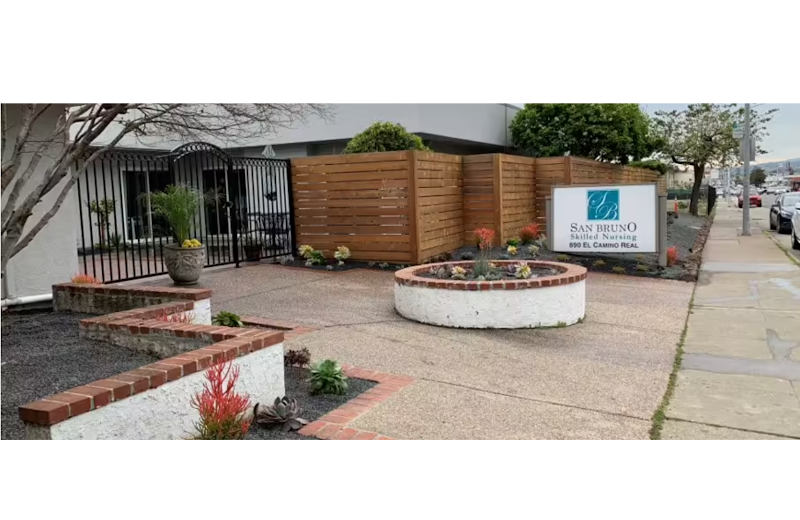
890 EL CAMINO REAL, SAN BRUNO, CA 94066 (650) 583-7768
For profit - Limited Liability company 45 Beds PACS GROUP Data: November 2025
Trust Grade
75/100
#186 of 1155 in CA
Last Inspection: June 2024

Within standard 12-15 month inspection cycle. Federal law requires annual inspections.

Overview

San Bruno Skilled Nursing has a Trust Grade of B, indicating it is a good choice, solidly positioned in the middle range of care facilities. It ranks #186 out of 1,155 nursing homes in California, placing it in the top half, and #4 out of 14 in San Mateo County, meaning only three local facilities are rated higher. The facility is improving, with a significant reduction in issues from 17 in 2024 to just 1 in 2025. However, staffing is a concern, with a below-average rating of 2 out of 5 stars and a turnover rate of 39%, which is close to the state average. On a positive note, the facility has not incurred any fines, which is a good sign of compliance, and it offers more RN coverage than many other facilities, ensuring that skilled nursing care is readily available. Specific incidents of concern include a failure to provide necessary care for a resident's pressure injury, leading to potential complications, and inadequate dining and activity space, limiting social interaction among residents. Additionally, there were issues with food safety standards, as some food was not stored at safe temperatures, putting residents at risk for foodborne illness. Overall, while there are strengths in care quality and compliance, families should be aware of staffing limitations and specific care incidents.

Trust Score
B
75/100
In California
#186/1155
Top 16%
Safety Record
Moderate
Needs review
Inspections
Getting Better
17 → 1 violations
Staff Stability
○ Average
39% turnover. Near California's 48% average. Typical for the industry.
Penalties
✓ Good
No fines on record. Clean compliance history, better than most California facilities.
Skilled Nurses
⚠ Watch
Each resident gets only 26 minutes of Registered Nurse (RN) attention daily — below average for California. Fewer RN minutes means fewer trained eyes watching for problems.
Violations
⚠ Watch
30 deficiencies on record. Higher than average. Multiple issues found across inspections.
★★★★★
5.0
Overall Rating
★★☆☆☆
2.0
Staff Levels
★★★★★
5.0
Care Quality
★★★★☆
4.0
Inspection Score
Stable
2024: 17 issues
2025: 1 issues

The Good

  • 5-Star Quality Measures · Strong clinical quality outcomes
  • Full Sprinkler Coverage · Fire safety systems throughout facility
  • No fines on record
  • Staff turnover below average (39%)

    9 points below California average of 48%

Facility shows strength in quality measures, fire safety.

The Bad

Staff Turnover: 39%

Near California avg (46%)

Typical for the industry

Chain: PACS GROUP

Part of a multi-facility chain

Ask about local staffing decisions and management

The Ugly 30 deficiencies on record

1 actual harm
Aug 2025 1 deficiency
CONCERN (D) 📢 Someone Reported This

A family member, employee, or ombudsman was alarmed enough to file a formal complaint

Potential for Harm - no one hurt, but risky conditions existed

Deficiency F0637 (Tag F0637)

Could have caused harm · This affected 1 resident

**NOTE- TERMS IN BRACKETS HAVE BEEN EDITED TO PROTECT CONFIDENTIALITY** Based on observation, intervention and record review, the facility did not ensure that re-assessment of one of two residents, Re...

Read full inspector narrative →
**NOTE- TERMS IN BRACKETS HAVE BEEN EDITED TO PROTECT CONFIDENTIALITY** Based on observation, intervention and record review, the facility did not ensure that re-assessment of one of two residents, Resident 1, when Resident 1 developed an ulcer of left leg, no weekly skin assessment and no MD assessment done to evaluate for healing or change of treatment. This failure has the potential for other residents to not receive necessary care Review of admission Record, dated 8/6/25, indicated, admitted on [DATE] with diagnoses including : Severe Dementia with Psychotic Disturbance, Adult Failure to Thrive, Moderate Protein - Calorie Malnutrition, Altered Mental Status. Full Code Status.Resident transferred to acute 7/16/25.During an interview with Marketing/Admission, on 8/1/25 at 12:10 PM, per Marketing, she assessed resident from Alameda Hospital, approved of her admission meeting skilled criteria. Plan is short term rehab and discharge to Assisted Living facility per daughter, as RP. Patient was skilled for 2 months and discontinued and work on discharge plan.Interview on 8/1/25 at 1:25 PM, with CNA, per CNA she worked for 2 years at facility and knows this resident. Patient's vision is not good, but she is used to my voice. Takes time to give her care, her knees are really stiff, and she needs to move slowly. Left leg and knees are very stiff. The therapist instructed me to do some stretching every day and up on wheelchair, she won't eat when in bed. She was able to spoon food to her mouth. Escorted to activities, she knows her name but does not understand what is going on. Non skin breaks, knees are elevated with pillows, heels have boots and pillows. She is a feeder; at breakfast she eats 100%. She is on Ensure drink 2 times a day, not on pureed diet. I give her a shower, she helps when given a face towel. Interview on 8/1/25 at 1:50 PM, with Social Services, per SS she knows the daughter, they are in constant update and communication with her. Daughter will request for appointment transportation and escort and requests to talk to RD and other staff. Daughter spoke to Ombudsman about conservatorship. Daughter spoke to Hospice but decision was not made to enroll to Hospice till transferred to acute.Concurrent interview and record review on 8/1/25 at 3 PM with Director of Nursing, per DON, the resident came at high risk for skin breakdown, Preventive measures were put in place. Resident is on psychotropic medication, has a neurologist managing her medication. Has telehealth consult with daughter and facility staff regarding medication changes. Resident discovered on 5/27/25 with left heel opened blister, treatment order given. We did all possible interventions to prevent ulcer. Daughter was talking to Hospice agency for possible Hospice referral, but did not make decision to enroll to Hospice.On Wound MD evaluation? Per DON, they did not refer patient to Wound MD because of the Kind of wound the patient has, that for Hospice patients that just developed, like the [NAME] Ulcer? The reason she was transferred to acute was, the ulcer was getting worst so MD decided to send her for evaluation.Review of MD progress notes dated 11/22/24, Physical Exam: Skin: No open sores, cellulitis or wounds, feet with extremely long and curled under nails, very poor hygiene.Review of facility MD progress notes dated 5/7/25, Physical Exam: Extremities: calves non tender, no edema. Skin: warm and dry. Progress notes dated 6/9/25, indicated, no recent CBC noted, order to repeat [DATE], Elevated A1c and Lipids. Physical Exam: Extremities: calves nontender, no edema. Skin: warm and dry.Progress Notes dated 7/9/25, indicated, Left leg cellulitis, treated Bactrim 6/18-6/25/25, Continue wound care, diet changed to CCHO A1C-6.3. Physical Exam: calves non-tender, no edema. Skin: warm and dry. Review of facility Admission/ readmission Evaluation/ Assessment, dated 11/14/2024, indicated Ambulation status: Ambulatory. During skin assessment, patient noted with dry scalp and no other skin issues noted.Review of nursing weekly summaries dated 5/9/25, 5/15/25 and 5/20/25., indicated no skin problem . Braden Score is 13- moderate risk for skin breakdown.Review of Registered Dietitian progress notes dated 5/12/25, indicated weight gain of 8 lbs. Current weight is 99 lbs. on 6/7/25, notes indicated weight loss of 8 lbs. in 3 weeks. Weight at 85 lbs. No mention about left heel ulcer. On 6/24/25 notes, indicated, resident is being referred to Hospice, will hold off on weekly weights for now. On 7/17/15, progress notes indicated resident gained 4 lbs. x 1 month. Continue with all interventions. No mention about left heel wound.Review of Nutritional care plan: RD has no care plan, goal and intervention for wound.Review of Skin Problem care plan: Risk at high risk for skin breakdown.interventions, air mattress, barrier cream, assist to turn and repositioned.on 5/27/25, impaired skin integrity. popped and open left heel blister, treatment as ordered, notify if signs of infection occur pad rails. on 6/18/25, resident noted to have cellulitis on left leg related to left heel opened blister.on 7/16/25 noted opened blister to left heel worsening and not healing and discoloration on left ankle. Resident transferred to ER.During an interview on 8/19/25 at 11:30 AM, with charge nurse, per charge nurse, he knows resident since admission. When patients come for admission, we try to prevent developing pressure ulcers by checking skin, CNAs to report any skin redness, turning and repositioning. For this resident, the wound on the heel was not treated as pressure ulcer, due to the wound classification, that it is related to Peripheral Artery Disease) PAD, there was a delay in referral and treatment. When wound was escalated to referral to Wound MD, the Wound MD will not evaluate the resident since no order for Hospice. The family was talking to MD and Hospice but did not make decision to enroll to Hospice till she was transferred out for worsening wounds. During an interview on 8/19/25 at 2:20 PM, with DON, per DON, weekly skin assessments are done for pressure ulcer, since her wound is the left heel popped ulcer was not considered a pressure ulcer. There is no documentation to this diagnosis but, MD diagnosed her with Cellulitis on 6/18/25 and ordered antibiotic. The nurses were monitoring the opened blister Q shift in the Treatment sheet. No wound assessment since 5/27/25. On 7/16/25 when MD saw patient had multiple open areas, on legs and on buttocks and decided to send patient to ER. Review of facility Skin Breakdown-Clinical Protocol, dated 4/18, indicated: The nursing staff and practitioner will assess and document an individual's significant risk factors for developing pressure ulcers or skin breakdown.the physician will assist the staff to identify the type (for example, arterial, or stasis ulcer) and characteristics (presence of necrotic tissue, status of wound bed, etc. ) of an ulcer. Monitoring: 1. During resident visits, the physician will evaluate and document the progress of wound healing-especially for those with complicated, extensive or poorly healing wounds. 2. The physician will guide the care plan as appropriate, especially when wounds are not healing or new wounds develop despite existing interventions. A. healing may be delayed or may to occur, or additional ulcers may occur because of other factors which cannot be modified.
Jun 2024 17 deficiencies
CONCERN (D)

Potential for Harm - no one hurt, but risky conditions existed

Resident Rights (Tag F0550)

Could have caused harm · This affected 1 resident

Based on observation, interview and record review, the facility did not ensure that resident's unique care instructions for one resident (Resident 12) are made private, when care instructions are post...

Read full inspector narrative →
Based on observation, interview and record review, the facility did not ensure that resident's unique care instructions for one resident (Resident 12) are made private, when care instructions are posted in two places in her bedroom wall. This failure can result in exposing her medical condition to other residents and visitors. Findings: Review of admission Record, dated, 6/18/24, indicated, admitted to SNF on 10/28/22 with diagnoses including: Parkinson's Disease(a disorder of the central nervous system that affects movement including tremors), Diabetes Mellitus(a condition when the body has trouble controlling blood sugar) Major Depressive Disorder( a mental health disorder characterized loss of interest in activities causing impairment in daily life). Review of MDS (Minimum Data Set) Section C, BIMS (Brief Interview for Mental Status) result is 8= with cognitive impairment. During an interview on 6/12/24 at 3:30 PM, with CNA 2, per CNA 2, the daughter was the one who posted it for her mother's care. Not sure if we can post it here. During an interview on 6/12/24 at 3:40PM, with DON, per DON, there is nothing wrong with that, its instructions for CNAs since we have registry working here. Maybe the name should not be there. I know its dignity and privacy. It is the family who wanted it posted. Review of care plan, not found for the posting of instructions. Review of facility's Policy and Procedure, Resident's Rights, dated 2/2021, indicated, Policy Statement, Employees shall treat all residents with kindness, respect and dignity. 1. Federal and state laws guarantee certain basic rights to all residents of this facility. These rights include the resident's rights to: a. a dignified existence; b. be treated with respect, kindness, and dignity.
CONCERN (D)

Potential for Harm - no one hurt, but risky conditions existed

Deficiency F0554 (Tag F0554)

Could have caused harm · This affected 1 resident

Based on observation, interview, and record review, the facility failed to ensure that a resident could safely administer a medication when one out of one sampled residents (Resident 11) did not recei...

Read full inspector narrative →
Based on observation, interview, and record review, the facility failed to ensure that a resident could safely administer a medication when one out of one sampled residents (Resident 11) did not receive an assessment or education regarding the self-administration of doxycycline (an antibiotic). This failure could result in the resident inappropriately taking the medication resulting in overdose (taking beyond the safe amount of a medication), drug interactions (typically unwanted reaction between two medications that someone takes), or unrecognized side effects of the medication. Findings: A review of the facility policy and procedure titled, Self-Administration of Medications, undated, indicated that the interdisciplinary team (IDT) should assess each resident's cognitive and physical abilities to determine whether self-administering medications is safe and clinically appropriate for the resident. The policy and procedure further indicated that The IDT considers the following factors when determine whether self-administration of medication is safe and appropriate . the resident can follow directions and tell time to know when to take the medication .resident comprehends the medications' purpose, proper dosage, timing, signs of side effects and when to report these to the staff. In addition, it indicated, If it is deemed safe and appropriate for a resident to self-administer medications, this is documented in the medical record and the care plan. During a concurrent observation and interview on 06/12/24 at 3:16 PM with Resident 11, inside of Resident 11's room, a bottle of doxycycline labeled for Resident 11 was observed on the resident's bedside table. Resident 11 indicated that they have been taking the medication because I have a bacterial infection. During a concurrent observation and interview on 06/12/24 at 3:18 PM with Registered Nurse (RN) 1, at Resident 11's bedside, a bottle of Doxycycline labeled for Resident 11 was observed on the resident's bedside table. RN stated that Resident 11 takes medications by himself and that she is not aware of a care plan for the doxycycline at bedside. During an interview on 06/13/24 at 12:23 PM with the Case Manager (CM), the CM stated that residents who self-administer medication should have a self-mediation assessment and the medication should also be in their care plan. During a concurrent interview and record review on 06/13/24 at 4:13 PM with the Director of Nursing (DON), Resident 11's care plan for self-administration of medication, dated 10/19/23, was reviewed. The care plan indicated that the resident could self-administer five different medications. The DON stated that medications the resident was care planned to self-administer were an inhaler [handheld device used to deliver medication to lungs to help with breathing] and vitamin, triamcinolone cream [cream applied to skin to reduce redness or irritation], ketoconazole [an antifungal] . nitroglycerin [medication used to reduce chest pain]. The DON stated these were the only medications she is aware that the resident self-administers. During a concurrent interview and record review on 06/13/24 at 4:51 PM with the Assistant Director of Nursing (ADON), a nursing assessment for Resident 11 titled, NURSING - SELF-ADMINISTRATION OF MEDICATION OBSERVATION, dated 02/28/24, was reviewed. The nursing assessment indicated that a licensed staff reviewed five medications for Resident 11 to self-administer. The ADON stated that these were the same five medications in the resident's current care plan for medication self-administration. The ADON stated that he was not aware of the resident taking Doxycycline stating, not sure how he [Resident 11] got that one. The ADON further stated that his concern for a resident self-administering a medication they were not educated on is the Resident's risk for overdose. During a concurrent interview and record review on 06/14/24 at 9:25 AM with the DON, Resident 11's care plan for self-administration of medication, updated on 06/13/24, was reviewed. The care plan included doxycycline as a self-administered medication. The DON stated that care plan was updated the day prior. The DON also stated that the resident was taking the doxycycline prior to the care plan being updated. During a concurrent interview and record review on 06/14/24 at 11:11 AM with the DON, Resident 11's medication orders, dated 06/14/24, was reviewed. The medication orders did not indicate that the resident is taking doxycycline. The DON stated that since the resident is self-administering doxycycline, the medication should be there [in the list of medication order] but it is currently not.
CONCERN (D)

Potential for Harm - no one hurt, but risky conditions existed

Deficiency F0578 (Tag F0578)

Could have caused harm · This affected 1 resident

Based on interview and record review, the facility failed to have a valid copy of a resident's Physician Orders for Life-Sustaining Treatment (POLST, a written medical order that assists people in mak...

Read full inspector narrative →
Based on interview and record review, the facility failed to have a valid copy of a resident's Physician Orders for Life-Sustaining Treatment (POLST, a written medical order that assists people in making decisions about medical treatment and life saving measures during end-of-life care or medical crisis) when one of twelve sampled residents (Resident 47) had a POLST lacking a clear signature or identity of who the POLST was discussed with. This failure has the potential to result in a resident's end-of-life choices not being honored. Findings: A review of Resident 47's Minimum Data Set (MDS, a resident assessment tool), dated 04/30/24, indicated that Resident 47 was admitted in April of 2024. It further indicated that the resident has a Brief Interview for Mental Status (BIMS, a cognitive screening tool) score of 13 (scores of 0-7 suggest severe cognitive impairment, 8 to 12 suggests moderate cognitive impairment, and 13 to 15 suggest that cognition is intact). A review of Resident 47's POLST, dated 04/27/24, indicated that To be valid a POLST form must be signed by (1) a physician, or by a nurse practitioner or a physician assistant .and (2) the patient or decisionmaker.' During a concurrent interview and record review on 06/14/24 at 11:23 AM with the Director of Nursing (DON), Resident 47's POLST, dated 04/27/24, was reviewed. In a section of the POLST asking if the information was discussed with the Patient or Legally Recognized decision maker, neither option was chosen. The DON stated that the section is blank stating, there's nothing there. When asked whether the resident or a decision maker signed the POLST, the DON stated, I don't know there are two signatures I can't understand. When asked if there is a printed name of either a patient or the legally recognized decision maker, the DON stated, it's missing the name. The DON further stated, it's incomplete because there is no name.
CONCERN (D)

Potential for Harm - no one hurt, but risky conditions existed

Deficiency F0582 (Tag F0582)

Could have caused harm · This affected 1 resident

**NOTE- TERMS IN BRACKETS HAVE BEEN EDITED TO PROTECT CONFIDENTIALITY** Based on interview and record review, the facility failed to provide the required Skilled Nursing Facility Advance Beneficiary N...

Read full inspector narrative →
**NOTE- TERMS IN BRACKETS HAVE BEEN EDITED TO PROTECT CONFIDENTIALITY** Based on interview and record review, the facility failed to provide the required Skilled Nursing Facility Advance Beneficiary Notice of Non-coverage, Form CMS-10055 (SNF ABN, Form Centers for Medicare & Medicaid Services-10055 - a written notice used to inform the resident/beneficiary of potential financial liability for the non-covered stay and the right to appeal to receive care and services which may not be covered by Medicare) for one of three sampled residents (Resident 32) receiving Medicare Part A services. This failure had the potential for residents and/or resident representative not being aware of the financial liability and the right to appeal for the denial or termination of resident's Medicare Part A services. Findings: Review of Resident 32's admission record indicated, was admitted on [DATE] with diagnoses including orthopedic aftercare following surgical amputation of right lower extremity, non-pressure wound on left calf, type 2 diabetes mellitus (high blood sugar), and end stage kidney disease. The admission record also indicated Resident 32 is responsible for himself and his own decision maker. Review of Resident 32's SNF Beneficiary Protection Notification Review form indicated, Medicare Part A Skilled Services started on 5/12/24 and last covered day was 5/31/24. The form also indicated the facility initiated the discharge from Medicare Part A when benefit days were not exhausted. During an interview on 6/14/24 at 9:28 AM, the Case Manager (CM) stated, Resident 32 reached his maximum potential and saving the remaining Part A days for his upcoming surgery. The CM stated that a NOMNC CMS 10123 (Notification of Medicare Non-Coverage - is a CMS approved form delivered to the resident/beneficiary receiving covered skilled nursing services) was provided to Resident 32 before the last covered day. Review of the NOMNC issued to Resident 32 indicated, Resident 32 signed the form on 5/30/24. During a follow up interview on 6/14/24 at 9:56 AM, the CM stated Resident 32 was not provided with the SNF ABN because he went to dialysis on the day it was supposed to be issued. During concurrent interview, the CM called the previous Social Services Director (SSD) to confirm that a SNF ABN was not issued to Resident 32. During a concurrent telephone interview, SSD stated she was not able to issue Resident 32 with the SNF ABN because he was out for dialysis that day, I miss it. During further interview, the CM stated that SNF ABN along with the NOMNC, is provided to residents discharged from skilled services (Medicare Part A) and stayed at the facility. Review of the CMS document titled Form Instructions Skilled Nursing Facility Advanced Beneficiary Notice of Non-Coverage (SNFABN) Form CMS-10055 (2018), indicated, . Medicare requires SNFs to issue the SNFABN to Original Medicare, also called fee-for-service (FFS), beneficiaries prior to providing care that Medicare usually covers, but may not pay for in this instance because the care is: not medically reasonable and necessary; or considered custodial. The SNFABN provides information to the beneficiary so that s/he can decide whether or not to get the care that may not be paid for by Medicare and assume financial responsibility. SNFs must use the SNFABN when applicable for SNF Prospective Payment System services (Medicare Part A). SNFs will continue to use the ABN Form CMS-R-131 when applicable for Medicare Part B items and services .
CONCERN (D)

Potential for Harm - no one hurt, but risky conditions existed

Report Alleged Abuse (Tag F0609)

Could have caused harm · This affected 1 resident

Based on interview and record review, the facility failed to report an injury of unknown origin within the required timeframes in one out of one sampled resident (Resident 8) when Resident 8 reported ...

Read full inspector narrative →
Based on interview and record review, the facility failed to report an injury of unknown origin within the required timeframes in one out of one sampled resident (Resident 8) when Resident 8 reported hip pain that was later diagnosed as a pathological fracture (a break in the bone because of disease rather than physical trauma). This failure has the potential to result in delayed identification and investigation of possible harm occurring from abuse. Findings: A review of Resident 8's face sheet (summary of resident's demographic and admitting information), dated 06/14/24, indicated that Resident 8 was initially admitted on January of 2024 with multiple diagnoses including END STAGE RENAL DISEASE [failure of the kidneys to function properly], ANEMIA [lack of healthy blood cells], and MUSCLE WASTING AND ATROPHY [thinning or loss of muscle] A review of Resident 8's Minimum Data Set (MDS, a resident assessment tool), dated 05/08/24, indicated that Resident 8 had a Brief Interview for Mental Status (BIMS, a cognitive screening tool) score of 8 (scores of 0-7 suggest severe cognitive impairment, 8 to 12 suggests moderate cognitive impairment, and 13 to 15 suggest that cognition is intact). A review of a change of condition nursing note for Resident 8, written by the Director of Nursing (DON) and dated 04/16/24, indicated that Resident 8 was c/o [complaining of] pain on Right hip. Resident has no reported falls while in the facility .Xray [image of bones and tissue in the body to identify injury] . with conclusion . right distal femoral fracture [a break in the lower part of the upper thigh bone] .order 'may send to ED [emergency department] for further evaluation'. During an interview with the DON on 06/13/24 at 10:04 AM, the DON stated that she was the registered nurse taking care of Resident 8 on 04/16/24. The DON recalled that the resident was complaining of pain and an X-ray was done. The DON further stated that at the time the pain was reported, Resident 8 had not fallen or preformed an activity that could explain the pain. When asked if she would consider this complaint of pain on 04/16/24 as an unusual occurrence, the DON stated of course. In addition, the DON stated yes when asked if this event should have been reported to the California Department of Public Health, but she does not see any nursing notes related to a report being made. A review of an interdisciplinary team (IDT) note for Resident 8, dated 04/18/24, indicated that On 4/16/24 . LN [Licensed Nurse] notified MD [Medical Doctor] that resident was experiencing right hip pain . The resident had no recollection of any recent falls or injuries, no presentation of any signs and symptoms of psychosocial or emotional distress; no skin discoloration or visible skin trauma was noted on the right hip and surrounding area .Per further investigation and interview staff who cared for the resident prior to the transfer and several days before, staff observed no falls or receive reports of fall or apparent injuries during their shift .the interdisciplinary team deemed the resident's injury as likely a spontaneous (pathological) fracture. During an interview on 06/14/24 at 11:48 AM with the Director of Staff Development (DSD), the DSD stated injuries of unknown origin should be reported to the California Department of Public Health. A review of a facility policy titled, Investigating Resident Injuries, last revised April 2023, indicated that If an incident/accident is suspected, the nurse supervisor/DON will do an investigation .If the nursing and medical assessment determines an 'injury of unknown source' the investigation will follow the protocols set forth in our facility's established abuse investigation guidelines .'Injury of unknown source' is defined as an injury that meets both of the following conditions .The source of the injury was not observed by any person or the source of the injury could not be explained by the resident; and . The injury is suspicious because of . the extent of the injury; or . the location of the injury .the number of injuries observed at one particular point in time . or the incidence of injuries over time. A review of facility policy titled, Recognizing Signs and Symptoms of Abuse/Neglect., last revised January 2011, indicated that Signs of Actual Physical Abuse include Fractures, dislocations or sprains of questionable origin. A review of facility policy titled Abuse, Neglect, Exploitation And Misappropriation Prevention Program, last revised April 2021, indicated that the facility should investigate and report any allegations within timeframes required by federal requirements.
CONCERN (D)

Potential for Harm - no one hurt, but risky conditions existed

Comprehensive Assessments (Tag F0636)

Could have caused harm · This affected 1 resident

**NOTE- TERMS IN BRACKETS HAVE BEEN EDITED TO PROTECT CONFIDENTIALITY** 4. A review of Resident 8's face sheet (summary of resident's demographic and admitting information), dated 06/14/2024, indicate...

Read full inspector narrative →
**NOTE- TERMS IN BRACKETS HAVE BEEN EDITED TO PROTECT CONFIDENTIALITY** 4. A review of Resident 8's face sheet (summary of resident's demographic and admitting information), dated 06/14/2024, indicated that Resident 8 was re-admitted on [DATE]. During a concurrent interview and record review on 06/14/24 at 10:52 AM with the MDSC, Resident 8's 5-day/admission MDS assessment, with an ARD of 05/08/24, was reviewed. The 5-day/admission MDS assessment indicated that the assessment was signed by the RN assessment coordinator as complete on 06/04/24, 29 days after admission. The MDSC stated that It [the assessment] was signed late. Review of facility's undated policy and procedure titled, Comprehensive Assessments, indicated, Comprehensive assessments are conducted to assist in developing person-centered care plans. 1. Comprehensive assessments are conducted in accordance with the criteria and timeframes established in the Resident Assessment Instrument (RAI) User Manual. 2. admission Assessment - The admission assessment is a comprehensive assessment for a new resident and, under some circumstances, a returning resident that must be completed by the end of day 14, counting the date of admission to the nursing home as day 1 .3. Annual Assessment is a comprehensive assessment for a resident that must be completed on an annual basis (at least every 366 days) .Its completion dates (MDS/CAA(s)/care plan) depend on the most recent comprehensive and past assessments' ARDs and completion dates . Review of the Long-Term Care Facility Resident Assessment Instrument 3.0 User's Manual Version 1.18.11, dated October 2023, indicated, .The OBRA (Omnibus Budget Reconciliation Act of 1987) regulations require nursing homes that are Medicare certified, Medicaid certified or both, to conduct initial and periodic assessments for all their residents . The admission assessment is a comprehensive assessment for a new resident and, under some circumstances, a returning resident that must be completed by the end of day 14, counting the date of admission to the nursing home as day 1 . The Annual assessment is a comprehensive assessment for a resident that must be completed on an annual basis (at least every 366 days) unless an SCSA or an SCPA has been completed since the most recent comprehensive assessment was completed. Its completion dates (MDS/CAA(s)/care plan) depend on the most recent comprehensive and past assessments' ARDs and completion dates . The MDS completion date (item Z0500B) must be no later than 14 days after the ARD (ARD + 14 calendar days) . Based on interview and record review, the facility failed to ensure the admission and annual Minimum Data Set (MDS, a resident assessment tool) assessment was completed within the required period of 14 calendar days of admission and Assessment Reference Date (ARD, specific endpoint for the look-back periods in the MDS assessment process) for four of 12 sampled residents (Resident 29, Resident 16, Resident 17, and Resident 8). Failure to complete a comprehensive resident assessment within the required timeframe could result in delayed identification of needs and significant issues that may affect the physical, mental, and psychosocial well-being of Resident 29, Resident 16, Resident 17, and Resident 8. Findings: 1. Review of Resident 29's admission record indicated, was admitted to the facility on [DATE]. Review of Resident 29's 5-day/admission MDS assessment with an ARD of 4/16/24 indicated, the assessment was signed by the RN assessment coordinator as complete on 4/30/24, 16 days after admission. During concurrent record review and interview on 6/14/24, at 10:32 AM, the MDSC reviewed Resident 29's 5-day/admission MDS assessment with an ARD of 2/26/24 and stated the MDS was completed on 4/30/24. The MDSC further stated, Resident 17's annual MDS assessment should have been completed and signed on 4/27/24. 2. Review of Resident 16's admission record indicated, was admitted to the facility on [DATE]. Review of Resident 16's annual MDS assessment with an ARD of 1/8/24, indicated, the assessment was signed by the Registered Nurse (RN) assessment coordinator as complete on 1/24/24, 16 days after the ARD. During a concurrent record review and interview on 6/14/24, at 10:42 AM, the MDS Coordinator (MDSC) reviewed Resident 16's annual MDS assessment with an ARD of 1/8/24 and confirmed the MDS was completed late. The MDSC stated, Resident 16's annual MDS assessment should have been completed and signed on 1/21/24. 3. Review of Resident 17's admission record indicated, was admitted to the facility on [DATE]. Review of Resident 17's annual MDS assessment with an ARD of 2/26/24, indicated, the assessment was signed by the RN assessment coordinator as complete on 3/14/24, 17 days after the ARD. During concurrent record review and interview on 6/14/24, at 11:01 AM, the MDSC reviewed Resident 17's annual MDS assessment with an ARD of 2/26/24 and stated the MDS was completed late. The MDSC further stated, Resident 17's annual MDS assessment should have been completed and signed on 3/9/24. During an interview on 6/14/24, at 11:05 AM, the MDSC stated, the admission MDS assessment should be completed on the 14th day of admission while the annual MDS assessment need to be completed 14 days after the ARD.
CONCERN (D)

Potential for Harm - no one hurt, but risky conditions existed

Deficiency F0637 (Tag F0637)

Could have caused harm · This affected 1 resident

Based on interview and record review, the facility failed to complete a Significant Change in Status Assessment (SCSA, is a comprehensive assessment for a resident that must be completed when the IDT ...

Read full inspector narrative →
Based on interview and record review, the facility failed to complete a Significant Change in Status Assessment (SCSA, is a comprehensive assessment for a resident that must be completed when the IDT has determined that a resident meets the significant change guidelines for either major improvement or decline) for one of 12 sampled residents (Resident 3) who was admitted to hospice care on 11/11/23. This failure could potentially delay the provision of appropriate treatment and services for Resident 3. Findings: Review of Resident 3's admission record indicated, was admitted to hospice on 11/11/24 with diagnoses including stroke, respiratory failure, pulmonary fibrosis (a disease where there is scarring of the lungs which makes it difficult to breathe), and lung involvement in systemic lupus erythematosus (an illness that occurs when the immune system attacks healthy tissues and organs). Review of Resident 3's Minimum Data Set (MDS, a resident assessment tool) with an Assessment Reference Date (ARD, specific endpoint for the look-back periods in the MDS assessment process) 11/14/23, indicated, a SCSA was completed when Resident 3 was enrolled to hospice care. During concurrent interview and record review on 6/13/24, at 11:37 AM, Licensed Vocational Nurse (LVN) 2 reviewed Resident 3's electronic health record (EHR) and stated Resident 3 was determined to be on hospice care on 11/9/23 and was admitted to hospice care on 11/11/23. Review of Resident 3's Order Summary Report dated 6/14/24, indicated, Resident 3 had an order to admit to hospice on 11/11/23. During an interview on 6/14/24, at 10:45 AM, MDS Coordinator (MDSC) stated, residents placed on hospice will need a significant change in status assessment and should be completed 14 days from the day resident was admitted to hospice. During concurrent record review, indicated, Resident 3's SCSA MDS was signed by the RN assessment coordinator as complete on 11/26/23, 16 days after Resident 3 was admitted to hospice. Review of the Long-Term Care Facility Resident Assessment Instrument 3.0 User's Manual Version 1.18.11, dated October 2023, indicated, .The OBRA (Omnibus Budget Reconciliation Act of 1987) regulations require nursing homes that are Medicare certified, Medicaid certified or both, to conduct initial and periodic assessments for all their residents . An SCSA is required to be performed when a terminally ill resident enrolls in a hospice program (Medicare-certified or State-licensed hospice provider) or changes hospice providers and remains a resident at the nursing home. The ARD must be within 14 days from the effective date of the hospice election (which can be the same or later than the date of the hospice election statement, but not earlier than) . The MDS completion date (item Z0500B) must be no later than 14 days from the ARD (ARD + 14 calendar days) and no later than 14 days after the determination that the criteria for an SCSA were met .
CONCERN (D)

Potential for Harm - no one hurt, but risky conditions existed

Deficiency F0638 (Tag F0638)

Could have caused harm · This affected 1 resident

**NOTE- TERMS IN BRACKETS HAVE BEEN EDITED TO PROTECT CONFIDENTIALITY** Based on interview and record review, the facility failed to ensure Minimum Data Set (MDS, a resident assessment tool) quarterly...

Read full inspector narrative →
**NOTE- TERMS IN BRACKETS HAVE BEEN EDITED TO PROTECT CONFIDENTIALITY** Based on interview and record review, the facility failed to ensure Minimum Data Set (MDS, a resident assessment tool) quarterly assessment was completed at least every 92 days following the previous OBRA (Omnibus Budget Reconciliation Act of 1987) assessment for three of 12 sampled residents (Resident 20, Resident 3, and Resident 17). Failure to complete quarterly resident assessment within the required timeframe could result in delayed identification of needs and significant issues that may affect the physical, mental, and psychosocial well-being of the residents. Findings: 1. Review of Resident 20's admission record indicated, was admitted to the facility on [DATE]. Review of Resident 20's quarterly MDS with an Assessment Reference Date (ARD, specific endpoint for the look-back periods in the MDS assessment process) of 5/9/24 indicated, the assessment was signed by the RN assessment coordinator as complete on 6/4/24, 26 days after the ARD. During concurrent interview and record review on 6/14/24, at 10:39 AM, the MDS Coordinator (MDSC) reviewed Resident 20's quarterly MDS and stated, the MDS should have been completed and signed on 5/22/24. The MDSC also stated that the quarterly MDS assessment should be signed 14 days after the ARD. 2. Review of Resident 3's admission record indicated, was readmitted to the facility on [DATE]. Review of Resident 3's quarterly MDS with an ARD of 5/14/24 indicated, the assessment was signed by the RN assessment coordinator as complete on 6/4/24, 21 days after the ARD. During concurrent interview and record review on 6/14/24, at 10:45 AM, the MDSC reviewed Resident 3's quarterly MDS and stated, the MDS should have been completed and signed on 5/27/24. 3. Review of Resident 17's admission record indicated, was admitted to the facility on [DATE]. Review of Resident 17's quarterly MDS with an ARD of 5/16/24 indicated, the assessment was signed by the RN assessment coordinator as complete on 6/2/24, 17 days after the ARD. During concurrent interview and record review on 6/14/24, at 11:00 AM, the MDSC reviewed Resident 3's quarterly MDS and stated, the MDS should have been completed and signed on 5/29/24. Review of facility's undated policy and procedure titled, Comprehensive Assessments, indicated, Comprehensive assessments are conducted to assist in developing person-centered care plans. 1. Comprehensive assessments are conducted in accordance with the criteria and timeframes established in the Resident Assessment Instrument (RAI) User Manual . Review of the Long-Term Care Facility Resident Assessment Instrument 3.0 User's Manual Version 1.18.11, dated October 2023, indicated, .The OBRA (Omnibus Budget Reconciliation Act of 1987) regulations require nursing homes that are Medicare certified, Medicaid certified or both, to conduct initial and periodic assessments for all their residents . The Quarterly assessment is an OBRA non-comprehensive assessment for a resident that must be completed at least every 92 days following the previous OBRA assessment of any type. It is used to track a resident's status between comprehensive assessments to ensure critical indicators of gradual change in a resident's status are monitored . The ARD (A2300) must be not more than 92 days after the ARD of the most recent OBRA assessment of any type . The ARD must be within 92 days after the ARD of the previous OBRA assessment (Quarterly, Admission, SCSA, SCPA, SCQA, or Annual assessment + 92 calendar days). The MDS completion date (item Z0500B) must be no later than 14 days after the ARD (ARD + 14 calendar days) .
CONCERN (D)

Potential for Harm - no one hurt, but risky conditions existed

Comprehensive Care Plan (Tag F0656)

Could have caused harm · This affected 1 resident

**NOTE- TERMS IN BRACKETS HAVE BEEN EDITED TO PROTECT CONFIDENTIALITY** Based on observation, interview, and record review, the facility failed to ensure a person-centered care plan was implemented fo...

Read full inspector narrative →
**NOTE- TERMS IN BRACKETS HAVE BEEN EDITED TO PROTECT CONFIDENTIALITY** Based on observation, interview, and record review, the facility failed to ensure a person-centered care plan was implemented for three of 12 sampled residents (Resident 3, Resident 29, and Resident 16) when: 1. The facility did not ensure oxygen (O2) at 5 liters per minute (LPM) via nasal cannula (NC, a device that delivers extra oxygen through a tube and into the nose) was administered to Resident 3. 2. The facility did not ensure O2 at 2 LPM via NC was administered to Resident 29. 3. The facility did not ensure two-persons assist was provided for Resident 16 during transfer from bed to wheelchair using a sit-to-stand/standing lift. The deficient practice resulted in Resident 3 and Resident 29 to not receive the appropriate amount of oxygen as prescribed by the physician; and can increase the risk for an accident such as a fall and/or injury to Resident 16. Findings: 1. Review of Resident 3's admission record indicated, was readmitted on [DATE] with diagnoses including stroke, respiratory failure, pulmonary fibrosis (a disease where there is scarring of the lungs which makes it difficult to breathe), and lung involvement in systemic lupus erythematosus (an illness that occurs when the immune system attacks healthy tissues and organs). During an observation on 6/11/24 at 11:58 AM, in resident's room, Resident 3 was sitting on the edge of the bed wearing an ill-fitting non-rebreather mask on top of the nasal cannula During a concurrent observation and interview on 6/11/24 at 12:02 PM, in resident's room, Licensed Vocational Nurse (LVN) 1 stated, Resident 3 is nebulizer treatment (help control breathing problems like wheezing and help loosen lung secretions) for shortness of breath (SOB) as needed (PRN) via a non-rebreather mask which runs for 30 minutes. During concurrent observation, LVN 1 checked on the O2 concentrator (a device that help you breathe) and stated Resident 3 is on 2 LPM (liters per minute) continuous via NC per concentrator. Review of Resident 3's active order dated 5/10/24, indicated, O2 @ 5 LPM via nasal cannula continuous per concentrator/tank. Can be titrated up to 5 LPM as needed to keep O2 > 90% every shift. Review of Resident 3's care plan for oxygen initiated and revised on 5/6/24, indicated, Resident requires the use of oxygen continuous related to acute respiratory failure, dyspnea (difficulty of breathing) . Intervention: Administer oxygen at 3-5 L via nasal cannula per concentrator/tank . Educate the resident on the importance of keeping oxygen on and at the prescribed setting . 2. Review of Resident 29's admission record indicated, was admitted to facility on 4/14/24 with diagnoses including heart failure, pneumonia (inflammation and fluid in your lungs caused by a bacterial, viral or fungal infection), respiratory failure, and chronic obstructive pulmonary disease (COPD - lung disease that cause airflow blockage and breathing related problems). During an observation on 6/12/24 at 9:48 AM, in resident's room, Resident 29 was sleeping in bed with O2 via NC attached to an oxygen concentrator. During further observation, the flowmeter and dial on the oxygen concentrator showed Resident 29's O2 was on 3 LPM. During concurrent interview and record review on 6/12/24 at 12:29 PM, LVN 3 reviewed Resident 29's active orders and stated, Resident 29 has an order on 4/14/24 for O2 administration at 2 LPM via NC continuously per concentrator for SOB. Resident 29's active orders dated 4/14/24, indicated, O2 @2LPM via nasal cannula continuous per concentrator/tank every shift for SOB. The active orders also indicated, O2 @2LPM via nasal cannula PRN (as needed) per concentrator every 8 hours as needed. Administer Oxygen if O2 saturation is less than 92% or there is shortness of breath (SOB). During concurrent observation and interview on 6/12/24 at 12:32 PM, in resident's room, LVN 3 checked the O2 concentrator and confirmed the flowmeter showed Resident 29 was receiving O2 at 3 LPM via NC per concentrator. LVN 3 immediately lowered Resident 29's O2 at 2 LPM and stated, it (O2) should be at 2 LPM. Review of Resident 29's care plan for oxygen initiated on 4/14/24 and revised 6/11/24, indicated, Resident requires the use of oxygen continuous related to acute respiratory failure, COPD . Intervention: Administer oxygen at 2L via NC . Educate the resident on the importance of keeping oxygen on and at the prescribed setting . 3. Review of Resident 16's admission record, indicated, was admitted on [DATE] with diagnoses including hemiplegia (paralysis on one side of the body) and hemiparesis (weakness or partial paralysis on one side of the body) following a stroke affecting right dominant side, aphasia (a language disorder that affects a person's ability to communicate), and vascular dementia (a brain damage caused by multiple strokes). During an observation on 6/12/24 at 9:53 AM, in resident's room, a sit-to-stand lift/standing lift (specialized medical devices designed to assist individuals with limited mobility in transitioning from a seated to a standing position) and a blue colored sling was observed by the foot of the bed. The RNA assisted Resident 16 to sit on the edge of the bed, put on the blue sling, moved the sit-to-stand lift close to the bed and wheelchair. The RNA then began to transfer Resident 16 from bed to wheelchair by herself. During an interview on 6/12/24 at 10:02 AM, the RNA stated, Resident 16 required two persons assist with transfer, two person assist but since I'm used to him I can do it by myself. The RNA further stated, This one (standing lift) I can do it myself. I'm familiar with him. I know if it's safe or not. During an interview on 6/13/24 at 12:26 PM, Certified Nursing Assistant (CNA) 1 stated, Resident 16 required two persons assist with transfer from bed to wheelchair but with the use of the standing lift, Resident 16 required one person only since resident is able to help by grabbing on to the bar of standing lift. Review of Resident 16's care plan for use of standing lift, initiated on 1/20/21, indicated, Resident is on standing lift. Risk for falls/skin breakdown . Interventions: Assess equipment (sling) before use. 2 person assist with transfer. Gentle handling during transfer .
CONCERN (D)

Potential for Harm - no one hurt, but risky conditions existed

Deficiency F0657 (Tag F0657)

Could have caused harm · This affected 1 resident

Based on interview and record review, the facility failed to update a care plan after an interdisciplinary team (IDT) assessment when one of twelve sampled residents (Resident 41) with care plans had ...

Read full inspector narrative →
Based on interview and record review, the facility failed to update a care plan after an interdisciplinary team (IDT) assessment when one of twelve sampled residents (Resident 41) with care plans had a body weight that was beyond the recommendation from their care plan. This failure has the potential to result in the clinical staff not recognizing significant changes in weight due to a difference in care planned goals versus those decided by an interdisciplinary team. Findings: During a concurrent interview and record review on 06/13/24 at 9:48 AM with the Director of Nursing (DON), Resident 41's care plan for nutrition, initiated on 05/14/24, was reviewed. The care plan indicated a focus of Nutritional Risk: Resident has the potential for altered nutrition and/or hydration status related to medical diagnosis . The DON reviewed the care plan and stated that Resident 41's goal was to maintain a body weight within 5% of 195 pounds (lbs). During a concurrent interview and record review on 06/13/24 at 9:48 AM with the Director of Nursing (DON), Resident 41's most current body weight record, dated 06/04/24, was reviewed. The body weight record indicated that Resident 41 was 182.8 lbs on 06/04/24. The DON stated that this weight is below 5% of 195 lbs. During a concurrent interview and record review on 06/13/24 at 10:59 AM with the Consultant Registered Dietician (RD), an IDT note for Resident 41, dated 05/30/24, was reviewed. The note indicated that the IDT was due to a weight variance as Resident lost 8.6lb [pounds] . The IDT further stated, Recommend to continue with current plan-weight loss may be partially r/t [related to] dx [diagnosis of] CHF [congested hear failure, a condition in which the heart does not pump as well]. The RD stated that based on this IDT, weight loss was acceptable. During a concurrent interview and record review on 06/13/24 10:59 AM with the RD, Resident 41's care plan for nutrition, initiated on 05/14/24, was reviewed. The care plan indicated Resident 41's goal to maintain a body weight within 5% of 195 pounds (lbs). The RD verified that the IDT's interpretation of the weight loss does not coincide with the care planned weight goals stating, I should update the care plan. The RD further stated that rather than 5% variation in weight, the resident would better benefit from a goal based on body mass index (BMI, a value calculated based on a someone's height and weight) stating potentially I should use BMI instead of weights.
CONCERN (D)

Potential for Harm - no one hurt, but risky conditions existed

Deficiency F0658 (Tag F0658)

Could have caused harm · This affected 1 resident

**NOTE- TERMS IN BRACKETS HAVE BEEN EDITED TO PROTECT CONFIDENTIALITY** Based on observation, interview, and record review, the facility failed to ensure care and treatment provided meet professional ...

Read full inspector narrative →
**NOTE- TERMS IN BRACKETS HAVE BEEN EDITED TO PROTECT CONFIDENTIALITY** Based on observation, interview, and record review, the facility failed to ensure care and treatment provided meet professional standards when the physician's order for oxygen (O2) administration was not followed for two of 12 sampled residents (Resident 29 and Resident 3). The deficient practice had the potential to compromise the health and safety of Resident 29 and Resident 3. Findings: 1. Review of Resident 3's admission record indicated, was readmitted on [DATE] with diagnoses including stroke, respiratory failure, pulmonary fibrosis (a disease where there is scarring of the lungs which makes it difficult to breathe), and lung involvement in systemic lupus erythematosus (an illness that occurs when the immune system attacks healthy tissues and organs). Review of Resident 3's Minimum Data Set (MDS, a resident assessment tool) dated 5/14/24, indicated, problem with memory and cognitive (thought process) skills for daily decision making. During an observation on 6/11/24 at 11:58 AM, in resident's room, Resident 3 was sitting on the edge of the bed wearing an ill-fitting non-rebreather mask on top of the nasal cannula (NC, a device that delivers extra oxygen through a tube and into the nose). During a concurrent observation and interview on 6/11/24 at 12:02 PM, in resident's room, Licensed Vocational Nurse (LVN) 1 stated, Resident 3 is nebulizer treatment (help control breathing problems like wheezing and help loosen lung secretions) for shortness of breath (SOB) as needed (PRN) via a non-rebreather mask which runs for 30 minutes. During concurrent observation, LVN 1 checked on the O2 concentrator (a device that help you breathe) and stated Resident 3 is on 2 LPM (liters per minute) continuous via NC per concentrator. Review of Resident 3's active order dated 5/10/24, indicated, O2 @ 5 LPM via nasal cannula continuous per concentrator/tank. Can be titrated up to 5 LPM as needed to keep O2 > 90% every shift. Review of Resident 3's care plan for oxygen initiated and revised on 5/6/24, indicated, Resident requires the use of oxygen continuous related to acute respiratory failure, dyspnea (difficulty of breathing) . Intervention: Administer oxygen at 3-5 L via nasal cannula per concentrator/tank . Educate the resident on the importance of keeping oxygen on and at the prescribed setting . 2. Review of Resident 29's admission record indicated, was admitted to facility on 4/14/24 with diagnoses including heart failure, pneumonia (inflammation and fluid in your lungs caused by a bacterial, viral or fungal infection), respiratory failure, and chronic obstructive pulmonary disease (COPD - lung disease that cause airflow blockage and breathing related problems). Review of Resident 29's MDS dated [DATE], indicated, moderate cognitive impairment. The MDS Section O: Special Treatments and Programs indicated; Resident 29 was on continuous oxygen therapy. During an observation on 6/12/24 at 9:48 AM, in resident's room, Resident 29 was sleeping in bed with O2 via NC attached to an oxygen concentrator. During further observation, the flowmeter and dial on the oxygen concentrator showed Resident 29's O2 was on 3 LPM. During concurrent interview and record review on 6/12/24 at 12:29 PM, LVN 3 reviewed Resident 29's active orders and stated, Resident 29 has an order on 4/14/24 for O2 administration at 2 LPM via NC continuously per concentrator for SOB. Resident 29's active orders dated 4/14/24, indicated, O2 @2LPM via nasal cannula continuous per concentrator/tank every shift for SOB. The active orders also indicated, O2 @2LPM via nasal cannula PRN (as needed) per concentrator every 8 hours as needed. Administer Oxygen if O2 saturation is less than 92% or there is shortness of breath (SOB). During concurrent observation and interview on 6/12/24 at 12:32 PM, in resident's room, LVN 3 checked the O2 concentrator and confirmed the flowmeter showed Resident 29 was receiving O2 at 3 LPM via NC per concentrator. LVN 3 immediately lowered Resident 29's O2 at 2 LPM and stated, it (O2) should be at 2 LPM. Review of Resident 29's care plan for oxygen initiated on 4/14/24 and revised 6/11/24, indicated, Resident requires the use of oxygen continuous related to acute respiratory failure, COPD . Intervention: Administer oxygen at 2L via NC . Educate the resident on the importance of keeping oxygen on and at the prescribed setting . Review of facility's undated policy and procedure titled, Oxygen Administration, indicated, .Preparation: 1. Verify that there is a physician's order for this procedure. Review the physician's orders for facility protocol for oxygen administration. 2. Review the resident's care plan to assess for any special needs of the resident .Procedure . 10. Adjust the oxygen delivery device so that it is comfortable for the resident and the proper flow of oxygen is being administered .
CONCERN (D)

Potential for Harm - no one hurt, but risky conditions existed

Accident Prevention (Tag F0689)

Could have caused harm · This affected 1 resident

**NOTE- TERMS IN BRACKETS HAVE BEEN EDITED TO PROTECT CONFIDENTIALITY** Based on observation, interview, and record review, the facility failed to provide adequate supervision and safe transfer techni...

Read full inspector narrative →
**NOTE- TERMS IN BRACKETS HAVE BEEN EDITED TO PROTECT CONFIDENTIALITY** Based on observation, interview, and record review, the facility failed to provide adequate supervision and safe transfer technique for one of 12 sampled residents (Resident 16) when: a. The Restorative Nursing Assistant (RNA) transferred Resident 16 from bed to wheelchair using a sit-to-stand lift (or standing lift) by herself when the care plan indicated two persons. b. The mesh and/or material of the standing sling used for Resident 16 were frayed and torn and one of the belts had a missing buckle. Failure to provide adequate supervision and safe transfer technique may result in an accident and can increase the risk for fall and/or injury. Findings: Review of Resident 16's admission record, indicated, was admitted on [DATE] with diagnoses including hemiplegia (paralysis on one side of the body) and hemiparesis (weakness or partial paralysis on one side of the body) following a stroke affecting right dominant side, aphasia (a language disorder that affects a person's ability to communicate), and vascular dementia (a brain damage caused by multiple strokes). Review of Resident 16's Minimum Data Set (MDS, a resident assessment tool) dated 4/9/24, indicated, moderate cognitive (thought process) impairment. Under the functional abilities section indicated, Resident 16 was dependent and required two or more helpers (persons) with chair/bed-to-chair transfer. During an observation on 6/12/24 at 9:53 AM, in resident's room, a sit-to-stand lift/standing lift (specialized medical devices designed to assist individuals with limited mobility in transitioning from a seated to a standing position) and a blue colored sling was observed by the foot of the bed. The RNA assisted Resident 16 to sit on the edge of the bed, put on the blue sling, moved the sit-to-stand lift close to the bed and wheelchair. The RNA then began to transfer Resident 16 from bed to wheelchair by herself. During an interview on 6/12/24 at 10:02 AM, the RNA stated, Resident 16 required two persons assist with transfer, two person assist but since I'm used to him I can do it by myself. The RNA further stated, This one (standing lift) I can do it myself. I'm familiar with him. I know if it's safe or not. During further interview, the RNA stated there were two slings used for the standing lift but stated she prefer the sling she used for Resident 16 because this sling (blue) is easy to put. During concurrent observation, the RNA showed the sling she used for Resident 16, the mesh/material of the sling were frayed and torn and one of the belts had a missing buckle. The RNA stated, There should be two locks (buckle) and there's only one. I need to request a new one. Missing one lock. During an interview on 6/12/24 at 4:14 PM, the Director of Maintenance (DM) stated, the staff are not supposed to use an equipment or device if there's a broken or missing part. During an interview on 6/13/24 at 12:26 PM, Certified Nursing Assistant (CNA) 1 stated, Resident 16 required two persons assist with transfer from bed to wheelchair but with the use of the standing lift, Resident 16 required one person only since resident is able to help by grabbing on to the bar of standing lift. Review of Resident 16's care plan for use of standing lift, initiated on 1/20/21, indicated, Resident is on standing lift. Risk for falls/skin breakdown . Interventions: Assess equipment (sling) before use. 2 person assist with transfer. Gentle handling during transfer . During an interview on 6/13/24 at 3:44 PM, the Assistant Director of Nursing (ADON) stated, mechanical lift requires two persons but not sure with standing lift. The ADON further stated, there was no recent training for staff on the use of mechanical lift. During an interview on 6/14/24 at 11:52 AM, the Director of Staff Development (DSD) stated, there was no recent training for staff on transfers, It's been a while. During an interview on 6/14/24 at 1:05 PM, the Director of Rehab (DOR) stated, rehab staff do not provide transfer training for long term residents since the CNAs know already how to transfer the long term residents. Review of facility's undated policy and procedure titled, Lifting Machine, Using a Mechanical, indicated, The purpose of this procedure is to establish the general principles of safe lifting using a mechanical lifting device . 1. At least two (2) nursing assistants are needed to safely move a resident with a mechanical lift. 2. Mechanical lifts may be used for tasks that require: . b. Transferring a resident from bed to chair . 3. Types of lifts that may be available in the facility are: . c. Sit-to-stand lifts . Steps . 2. Measure the resident for proper sling size and purpose, according to manufacturer's instructions. 3. Select a sling bar that is appropriate for the resident's size and task .8. Make sure that all necessary equipment (slings, hooks, chains, straps and support) is on hand and in good condition . Sling Care . 3. Discard any worn, frayed, or ripped slings . Document the following in the medical record: . 4. The names of and titles of staff assisting. Review of the user manual for Stand Up Patient Lift, revised 12/2013, indicated, .Using the Sling . Stand Assist Slings: The belt MUST be snug, but comfortable on the patient, otherwise the patient can slide out of the sling during transfer, possibly causing injury . Bleached, torn, cut, frayed, or broken slings are unsafe and could result in injury. Discard immediately. DO NOT alter slings . Review of the Invacare Patient Sling Reference Guide, revised 04/2007, indicated, .Inspect sling before each use for wear, tears and loose stitching. Bleached, torn, cut, frayed, or broken slings are unsafe and could result in injury. Discard immediately. Do not alter slings. Use only on Invacare lifts .
CONCERN (D)

Potential for Harm - no one hurt, but risky conditions existed

Unnecessary Medications (Tag F0759)

Could have caused harm · This affected 1 resident

Based on observations, interviews, and record reviews, the facility failed to maintain a medication error rate below five percent (5%). During the medication pass on 6/11/24, three medication errors w...

Read full inspector narrative →
Based on observations, interviews, and record reviews, the facility failed to maintain a medication error rate below five percent (5%). During the medication pass on 6/11/24, three medication errors were observed out of twenty-six opportunities for two out of four residents, resulting in an error rate of 11%. This failure had the potential to result in more than minimal harm in the health and safety of residents. Findings: A review on 6/11/24 of the facility's policy, titled Administering Medications, indicates that the individual administering medication must verify the resident's identity prior to dispensing medication. Accepted methods of identification include checking photo identification via the medical record, and, if necessary, seeking verification of resident identification from other facility personnel. During an observation on 06/11/24 at 9:36 AM Registered Nurse 1 was observed preparing medications for Resident 10. The nurse attempted to identify Resident 10 by asking for her name; however, Resident 10 did not speak English. RN 1 did not speak Resident 10's language. RN 1 then proceeded to administer medications without seeking further verification of the resident's identity. During an interview with RN 1 on 06/11/24 at 10:15 AM, RN 1 stated that she did not identify the patient by photograph because no picture had been taken of RN 1. She further explained that when she attempted to communicate with the resident, the resident was unable to speak English, which prevented her from verifying the resident's identity before administering medications. A review of the manufacturer's instructions for MiraLAX indicates that the medication should be administered with 4 to 6 ounces of fluid and taken immediately after mixing. Waiting too long before consuming the mixture can cause it to thicken, potentially leading to choking. It is crucial to follow the recommended dosage and administration guidelines provided by the manufacturer to ensure safety and efficacy. During an observation on 06/11/24 at 9:36 AM, Registered Nurse 1 administered MiraLAX mixed with 4 ounces of fluid to Resident 10. The resident consumed approximately half of the mixture and then left the remaining portion on the bedside table. It was visually apparent that some solute had settled at the bottom of the glass, indicating the presence of the medication. The remaining medication was not consumed during the entire medication pass, and after the medication pass ended the medication was left at bedside. During an interview conducted at 10:20 AM on 06/11/24, Registered Nurse 1 stated that she had not observed Resident 10 consume the entire glass of MiraLAX. She acknowledged that, at the end of the medication pass, approximately half a glass of the mixture was left at the resident's bedside. The nurse further admitted that in the future, she would ensure that the entire dose is consumed or remove any remaining medication at the end of the medication pass. According to the Flonase package insert, prior to administration, patients should blow their nose. The proper technique involves holding one nostril closed while inserting the medication into the other nostril. Patients should then inhale deeply through their nose and exhale through their mouth to ensure optimal delivery and absorption of the medication. Adhering to these instructions can help maximize the effectiveness of the treatment and minimize potential side effects. During an observation at 9:49 AM, Licensed Vocational Nurse 1 administered Flonase to Resident 36. However, the resident did not blow their nose before administration, and their nostrils were not closed alternately during the process. Instead, both nostrils remained open while each received one spray, with the resident breathing through their nose. This observation indicates that the administration did not fully adhere to the recommended guidelines for optimal Flonase administration. During an interview conducted on 06/11/24 at 10:10 AM, Licensed Vocational Nurse 1 acknowledged that he did not instruct Resident 36 to blow their nose before administering Flonase. He also admitted that he had not directed the resident to close one nostril while inhaling the medication through the other, nor did he advise the resident to exhale through their mouth following administration. LVN 1 acknowledged his oversight and expressed a commitment to improving his practice in the future.
CONCERN (D)

Potential for Harm - no one hurt, but risky conditions existed

Food Safety (Tag F0812)

Could have caused harm · This affected 1 resident

Based on observation, interview and record review, the facility did not ensure safe food handling practices when jewelries were worn during food handling, when two kitchen staff observed wearing yello...

Read full inspector narrative →
Based on observation, interview and record review, the facility did not ensure safe food handling practices when jewelries were worn during food handling, when two kitchen staff observed wearing yellow bracelets on both arms during food preparation and handling. This failure can result in food contamination, when it touches food products. Findings: During the initial tour of the kitchen, on 6/11/24, at 9:30 AM, observed CDM(Certified Dietary Manager), with yellow bracelets in both arms and kitchen [NAME] wearing yellow bracelets in both arms while preparing food for lunch. During an interview on 6/11/24 at 11 AM, with CDM, and Cook, CDM stated, I know, we took them out now. We Indians feel bare if we don't have anything on our arms. Sorry, but its out now. Per Cook, it's a sign that you're married for Indians, but I took it out. Review of facility Policy and Procedure, Food Prepararion and Service, dated, 11/22, indicated, under Food and Distribution and Service, 9.Food and nutrition service staff keep fingernails trimmed and clean. Jewelry is worn minimally and hand jewelry (i.e) wedding ring is covered with gloves.
CONCERN (D)

Potential for Harm - no one hurt, but risky conditions existed

QAPI Program (Tag F0867)

Could have caused harm · This affected 1 resident

Based on observation, interview, and document reviews it was found that the facilities' Quality Assessment Performance Improvement (QAPI) program was ineffective. Despite its purpose to proactively id...

Read full inspector narrative →
Based on observation, interview, and document reviews it was found that the facilities' Quality Assessment Performance Improvement (QAPI) program was ineffective. Despite its purpose to proactively identify and prevent medication administration errors, it fell short. This was evident during a medication pass observation conducted during the survey, which revealed a concerning 11% medication error rate (See F759). Findings Based on observation, interview and document reviews (See deficiency under F759) the facility was found to have a medication error rate of 11% during a medication pass on 06/11/24 between the times of 9:00 AM and 10:45 AM, which exceeds the acceptable threshold of 5%. This rate was derived from observing three errors out of twenty-six medication administration opportunities involving two of four residents. Such a high error rate poses a risk to the residents' health and safety. The first error involved a failure to properly identify Resident 10 before administering medication. Registered Nurse 1 attempted to verify the resident's identity by asking for her name, but the resident did not speak English, and the nurse did not seek further verification. Consequently, the medication was administered without confirming the resident's identity, contrary to the facility's policy requiring photo identification or verification from other staff. The second error pertained to the administration of MiraLAX to the same resident by the same nurse. Although MiraLAX should be consumed immediately after mixing with 4 to 6 ounces of fluid, the resident only drank half and left the rest on the bedside table, where the medication settled and was not fully consumed. The nurse admitted she had not ensured the entire dose was taken or removed the leftover medication. The third error involved the improper administration of Flonase to Resident 36. Licensed Vocational Nurse 1 did not follow the correct procedure, which includes the patient blowing their nose beforehand and closing one nostril while inhaling the spray into the other. Instead, the resident inhaled the medication with both nostrils open and without the proper breathing technique. The nurse acknowledged these mistakes and expressed a commitment to adhere to proper procedures in the future. During an interview on 6/11/24 at 3:30 PM an interview was conducted with four members of the Quality Committee: the Director of Staff Development, the Assistant Director of Nursing, the Director of Nursing and the Administrator. During the interview, it was discovered that the quality committee members had attended only a single meeting within the past year. Additionally, the interviewed members could not recall any specific discussions or topics pertaining to medication errors that took place during that meeting. During this interview, it was also noted that they had not identified any recent issues related to medication pass observations. Furthermore, they did not have a sufficient ongoing performance improvement project specifically aimed at addressing medication errors that showed a measurable improvement in reducing medication errors. The Quality Committee members acknowledged the need for improvements in the medication administration process. They expressed concern over the survey results, which indicated a medication error rate of 11%.
CONCERN (D)

Potential for Harm - no one hurt, but risky conditions existed

Infection Control (Tag F0880)

Could have caused harm · This affected 1 resident

**NOTE- TERMS IN BRACKETS HAVE BEEN EDITED TO PROTECT CONFIDENTIALITY** Based on observation, interview, and record review, the facility failed to implement and maintain its infection control program ...

Read full inspector narrative →
**NOTE- TERMS IN BRACKETS HAVE BEEN EDITED TO PROTECT CONFIDENTIALITY** Based on observation, interview, and record review, the facility failed to implement and maintain its infection control program for two of two sampled residents (Resident 32 and Resident 34) on transmission-based precautions (specific protections used when a someone has an infection that could be spread easily) when: 1. Resident 32 did not have personal protective equipment (PPE, equipment used to minimize exposure to a hazard) directly outside of the room. 2. Licensed Vocational Nurse (LVN) 1 did not wear full PPE when handling the urine collection bag (Foley bag) of Resident 34, who's on enhanced barrier precautions (EBP- refer to an infection control intervention designed to reduce transmission of multidrug-resistant organisms that employs targeted gown and glove use during high contact resident care activities). Additionally, the PPE cart for Resident 34, was placed next to his roommate and not in his care area. Failure to implement infection prevention practices has the potential to result in increased spread of a communicable disease or infectious bacteria to staff and other residents. Findings: 1. A review of Resident 32's face sheet (summary of resident's demographic and admitting information), dated 06/14/2024, indicated that Resident 32 was admitted in May of 2024 with multiple diagnoses including INFECTION OF AMPUTATION STUMP [the leg after surgical removal of a section of it], RIGHT LOWER EXTREMITY A review of Resident 32's care plan, dated 05/13/24, indicated a focus of Resident requires contact single room isolation precautions [use of gloves and gown to decrease risk of infection transmission due to touch] due to klebsiella (infectious bacteria) and MRSA (Methicillin-resistant staphylococcus aureus, infectious bacteria that are resistant to a group of antibiotics) infection . The care plan further indicated interventions including use of personal protective equipment as recommended for type of infection. A review of the facility policy and procedure, titled Isolation - Transmission-Based Precautions & Enhanced Barrier Precautions, last revised April 2024, indicated that for residents under contact precautions, Staff and visitors wear gloves (clean, non-sterile) when entering the room Staff and visitors wear a disposable gown upon entering the room. During an observation on 06/11/24 at 10:15 AM, there was no available PPE outside of Resident 32's room. During an observation on 06/11/24 at 12:12 PM, there was no available PPE outside of Resident 32's room. During a concurrent observation and interview on 06/11/24 at 12:14 PM with Licensed Vocational Nurse (LVN) 1 outside of Resident 32's room, there was not PPE outside of Resident 32's room. LVN 1 stated that he is expected to wear a gown, gloves, and mask before entering the resident's room. LVN 1 further stated that normally there should be PPE available outside of the resident's room in a cart. When asked where the PPE cart is for the resident, LVN 1 stated I have no idea . I guess they took them out. During a concurrent observation and interview on 06/11/24 at 12:19 PM with LVN 2 outside of Resident 32's room, there was not PPE outside of Resident 32's room. LVN 2 stated that PPE should be used prior to going into the room. When asked where the PPE is for Resident 32, LVN 2 stated, they removed it. During an interview on 06/14/24 at 11:52 AM with the Infection Preventionist (IP), the IP stated that she expects for PPE to be available directly outside of a resident's room that is on contact precautions. The IP further stated that if there is no PPE outside of the room, there is a concern that people are entering without PPE. The IP stated that this could increase the risk for spread of an infection or bacteria to staff or residents. 2. Review of Resident 34's admission record indicated, was admitted on [DATE] with diagnoses including hemiplegia (paralysis on one side of the body) and hemiparesis (weakness or partial paralysis on one side of the body) following a stroke affecting left non-dominant side, aspergillosis (an infection caused by a type of mold [fungus]), encephalopathy (a group of conditions that cause brain dysfunction), and respiratory failure. During an observation on 6/11/24 at 12:07 PM, in resident's room, there was a small green star sticker next to Resident 34's name by the door and an uncovered Foley bag hanging on the side of the bed. A PPE cart was also observed next to Resident 34's roommate's foot of the bed and by the bathroom door. During an interview on 6/11/24 at 12:14 PM, LVN 1 stated, the green star next to Resident 34's name means on enhanced barrier precautions because of his Foley catheter. LVN 1 also stated that gown, gloves, and mask were required when providing care to residents on EBP. During concurrent observation, LVN 1 pointed at the PPE cart and stated, the PPE cart belongs to Resident 34 and should be inside the room by the resident's care area. During an observation on 6/11/24 at 2:29 PM, in resident's room, Resident 34's Foley bag did not have a label and a cover (dignity bag). During concurrent observation and interview on 6/11/24 at 2:31 PM, in resident's room, LVN 1 touched Resident 34's Foley bag with no PPE (gowns, gloves, mask) worn. LVN 1 stated the Foley bag should be inside a dignity bag for resident's privacy. During an interview on 6/13/24 at 5:03 PM, the Infection Preventionist (IP) stated that for EBP, gown, gloves and mask are required during direct contact with the resident including touching a Foley bag. Review of Resident 34's care plan dated 5/28/24, indicated, .Resident requires enhanced barrier precautions during high-contact resident care activities due to the presence of: Indwelling device: Foley Catheter not known to be infected or colonized with any MDRO (multidrug resistant organism) . Interventions . Ensure items for following EBP are in place (gloves, gown, alcohol-based hand rub, face-shield, signage, trash receptacle .) . Utilize PPE (gown and gloves; face-shield as indicated) during high contact resident care activities ( .device care, wound care). According to the Center for Clinical Standards and Quality/Quality, Safety & Oversight Group letter with a subject of Enhanced Barrier Precautions in Nursing Homes, dated 3/20/24, indicated, .EBP recommendations now include use of EBP for residents' with chronic wounds or indwelling medical devices during high-contact resident care activities regardless of their multidrug-resistant organism status . According to the Centers for Disease Control and Prevention (CDC) Implementation of Personal Protective Equipment (PPE) Use in Nursing Homes to Prevent Spread of Multidrug-resistant Organisms (MDROs), dated 4/2/24, indicated, Expand the use of PPE and refer to the use of gown and gloves during high-contact resident care activities that provide opportunities for transfer of MDROs to staff hands and clothing . Nursing home residents with wounds and indwelling medical devices are at especially high risk of both acquisition of and colonization with MDROs356. The use of gown and gloves for high-contact resident care activities is indicated, when Contact Precautions do not otherwise apply, for nursing home residents with wounds and/or indwelling medical devices regardless of MDRO colonization as well as for residents with MDRO infection or colonization. Examples of high-contact resident care activities requiring gown and glove use for Enhanced Barrier Precautions include: . Device care or use: central line, urinary catheter . Review of facility's policy and procedure titled, Isolation - Transmission-Based Precautions & Enhanced Barrier Precautions, revised April 2024, indicated, .Enhanced Barrier Precautions are indicated for residents with any of the following: . Wounds and/or indwelling medical devices even if the resident is not known to be infected or colonized with a MDRO. 1. Wear gowns and gloves while performing the following high-contact tasks associated with the greatest risk for MDRO contamination of staff hands, clothes, and the environment such as: .b. Device care, for example, urinary catheter . 3.PPE supplies such as gowns and gloves may be placed near or outside the resident's room .
CONCERN (F)

Potential for Harm - no one hurt, but risky conditions existed

Deficiency F0920 (Tag F0920)

Could have caused harm · This affected most or all residents

**NOTE- TERMS IN BRACKETS HAVE BEEN EDITED TO PROTECT CONFIDENTIALITY** During an interview on 6/11/24 at 9:30 AM, with Certified Dietary Manager (CDM), per CDM all meals are served in the patient's r...

Read full inspector narrative →
**NOTE- TERMS IN BRACKETS HAVE BEEN EDITED TO PROTECT CONFIDENTIALITY** During an interview on 6/11/24 at 9:30 AM, with Certified Dietary Manager (CDM), per CDM all meals are served in the patient's rooms. There is no one who eats in the dining room, there is no dining room. Since pandemic, everyone eats in their own room. They did not open that room for dining , its now a rehab room. During an interview on 6/14/24 at 10:43 AM, with Administrator, per Administrator it's patient's preference, they prefer to eat in the room or in the hallway. We have a dining room set up in the patio offered to patients, but nobody wants to go. There are tables and chairs in the rehab room that we can set up for small group if they want to. Based on observation, interview, and record review, the facility failed to provide a sufficient space to accommodate group activities and communal dining for 43 residents. This failure resulted in limiting residents to participate in group activities and communal dining; caused inconvenience to residents whose rooms were in the hallway where the activities are conducted; and placed residents at risk for feelings of being isolated or depressed. Findings: The facility is licensed for 45 beds and the resident census on 6/11/24 was 43. During an observation on 6/11/24 at 9:29 AM, in the hallway between room [ROOM NUMBER] and 5, four residents were sitting on their wheelchair with one staff in front of them playing music on an iPad (a brand of a tablet computer). During an interview on 6/11/24 at 9:48 AM, Resident 32 mentioned about the noise outside his room especially when they play music or karaoke in the hallway. Resident 32 stated, a man comes every Wednesday to sing karaoke together with the residents in the hallway outside his room. Resident 32 further stated, he would close his door whenever the noise from the activities outside his room became loud. During an interview on 6/11/24 at 12:17 PM, the Activities Assistant (AA) stated, there is no designated activity room that is why group activities are conducted in the hallway. During an observation on 6/11/24 at 12:18 PM, in the hallway, Today's Activities June 11th 2024 Tuesday was posted on the wall between room [ROOM NUMBER] and 7 indicating, 9:30 daily news, 10:00 music/coffee social, 10:30 movement exercise/balloon toss, 11:30 table games, 2:00 ball toss, 2:30 word finds/puzzles. During an interview on 6/11/24 at 12:19 PM, the Activities Director (AD) stated, group activities are conducted in the hallway since there is no designated activity or dining room. The AD also stated the number of residents joining depends how many are up. The AD further stated residents in the room close to the hallway where the activities are conducted do not like the noise and would close the door to minimize the noise. During concurrent observation, two tables were in the hallway right outside a resident's room who was on transmission based precautions (are used in addition to standard precautions when the route of transmission is not completely interrupted). The AD stated the two tables were set up in the hallway for the board games. During an observation on 6/12/24 at 11:06 AM, on the patio outside the rehab room, six residents were on their wheelchairs listening and watching [person's name] sing and dance for them. During dining observation on 6/12/24 at 12:15 PM, residents were eating their meals (lunch) inside their rooms. During concurrent observation and interview on 6/12/24 at 12:16 PM, in resident's room, Resident 20 was sitting on a wheelchair at his bedside eating his meal. During concurrent interview, Resident 20 stated that he prefers to eat sitting up on a chair rather than in bed, would be nice to have a dining room. Resident 20 also stated he participates in the activities conducted in the hallway, plays bingo three times a week. Resident 20 further stated, It would be nice to have a room than the hallway. During an interview on 6/14/24 at 1:39 PM, the Administrator (ADM) stated, the designated spot for activity/dining were the therapy (rehab) room, the hallway, or outside on the patio when weather permits. Review of facility's policy and procedure titled, Activity Programs, revised August 2006, indicated, .9. Adequate space and equipment are provided to ensure that needed services identified in the resident's plan of care are met.
Feb 2023 3 deficiencies
CONCERN (D) 📢 Someone Reported This

A family member, employee, or ombudsman was alarmed enough to file a formal complaint

Potential for Harm - no one hurt, but risky conditions existed

Free from Abuse/Neglect (Tag F0600)

Could have caused harm · This affected 1 resident

Based on observation, interviews and record review, the facility failed to ensure Residents 20, 28, and 32, three out of 14 sampled residents, were protected from neglect. All three residents reported...

Read full inspector narrative →
Based on observation, interviews and record review, the facility failed to ensure Residents 20, 28, and 32, three out of 14 sampled residents, were protected from neglect. All three residents reported delayed response from staff to their requests for assistance. This pattern of delayed staff response resulted in Residents 20, 28, and 32 being left in pain for prolonged periods of time. These residents reported: increased pain while waiting, feelings of frustrations, feelings of anger and feelings of being neglected. Findings: Resident 20 Review of Resident 20's record titled Minimum Data Set (MDS, a standardized resident assessment tool), dated 1/12/2023, indicated her BIMS (Brief Interview for Mental status, a standardized test for memory and reasoning functions) score was 15 out of 15. A score of 15 indicated no impairment in memory and reasoning. According to her MDS, she required: supervision of one staff for bed mobility, transfers, toilet use, and personal hygiene. According to her MDS she was occasionally incontinent of bowel; she displayed no episodes of hallucination (seeing, hearing, or sensing things that are not based on reality), no delusion (believing in something that is not based on reality), and no rejection of care. Review of Resident 20's record titled admission RECORD, printed on 2/10/23, indicated she was admitted with multiple diagnosis including: chronic pancreatitis (inflammation of the pancreas. Pancreas is an organ that makes digestive juice and other hormones), glaucoma (disease that damages your eye's optic nerve), epilepsy (brain disorder/malfunction and may cause uncontrolled body movement, loss of consciousness, and/or loss of bodily functions), and need for assistance with personal care. Review of Resident 20's record titled PACS-MEDICATION ADMINISTRATION RECORD, printed on 2/10/2023, indicated Resident 20 was on multiple medications to control her pain. Resident 20 was on : 1. Menthol methyl salicylate cream (a cream used to relieve minor pain) at bedtime for pain. 2. Acetaminophen, every six hours as needed for pain. 3. Oxycodone (an opioid pain medication used to treat moderate to severe pain. This opioid medication is controlled by the FDA=Food and Drug Administration to minimize risk for addiction) every eight hours as needed for moderate to severe pain. Review of Resident 20's medical records titled ED to Hosp-Admission, dated 12/9/2022, indicated Resident 20 was admitted for worsening of her pancreatitis. Within the same document, staff assessments indicated she was experiencing uncontrolled sharp severe stomach pain. During an interview on 2/7/23 at 10:00 AM, Resident 20 stated I have to wait a long time for my pain medication. It's usually agency nurse. They don't know me and they make me wait. It's very painful. I have this pancreatitis. One time with this agency nurse I waited at least 20 minutes. The regular staff they know. They know to bring my pain medicine right away when I call. So painful, I get mad at them when they don't come with my pain medicine. Last time they sent me to . hospital for my stomach pain. I get scared if they don't come (with my pain medication). I don't want to go to hospital again. Resident 28 Review of Resident 28's record titled admission RECORD, printed on 2/9/2023, indicated she was admitted with multiple diagnosis including: Quadriplegia (unable to have full control of arms and legs), spinal cord injury, spinal bone fracture, cramps and spasms, depression and assistance with personal care. Review of Resident 28's record titled MDS, dated 1/23/2023, indicated her BIMS score was 12 out of 15. A score of 12 indicated moderate impairment in memory and reasoning. According to her MDS, she required extensive assistance of two staff for bed mobility, transfers, dressing, and personal hygiene. According to her MDS she was totally dependent on the assistance of two staff for bowel incontinence. She has a suprapubic catheter (a tube draining the bladder). She displayed no episodes of hallucination, no delusion, and no rejection of care. Review of Resident 28's care plans, printed on 2/9/2023, indicated her pain medications included: Tramadol (Tramadol is an opioid pain medication used to treat moderate to severe pain. This opioid medication is controlled by the FDA=Food and Drug Administration to minimize risk for addiction), and gabapentin (a medication for nerve pain and muscle spasms). Resident 28's care plan also indicated .The resident needs to change position every 2-3 hours. Alternate periods of rest .with activity out of bed in order to prevent respiratory complications, . During an interview on 2/9/23 at 3:45 PM, CNA 4 (Certified Nursing Assistant) stated, Resident 28 complains about her call light not being answered. During a concurrent observation and interview on 2/9/23 at 3:50 PM in Resident 28's room, Resident 28 was observed with a special call light, a round, flat rubber laying on her left abdomen just below her chest. Observation indicated Resident 28 was able to move her left arm/hand. During the interview, Resident 28 stated, .They don't have (enough) help at night! Only two CNAs for 40 patients . Review of a communication between Resident 28 and this Department (on a document called Intake Information), dated 2/3/2023, indicated .Today Monday January the 30th there was no nursing staff making medication passes or focusing on patient medical needs for my wing of this facility. I am to have a round of morning medication's including anti-contracture medication and muscle relaxers between 8 and 9 AM. At 10:30 AM I began having muscle contractions and contractures that I could not control and they were very painful. During a second interview on 2/10/23 at 3:05 PM, Resident 28 stated, .the medication, if my pain pill is late my muscle does a lot of contraction and muscle spasm.Everything will be fine if they fully staff the night and evening shift. Resident 32 Review of Resident 32's record titled MDS, dated 12/28/2022, indicated his BIMS score was 15 out of 15. A score of 15 indicated no impairment in memory and reasoning. According to his MDS, he required: extensive assistance of two staff for bed mobility; extensive assistance of two staff for personal hygiene; extensive assistance of one staff for transfers; extensive assistance of one staff to use the toilet. According to his MDS he was always incontinent of bowel and bladder (has no control over his urine and stool); he displayed no episodes of hallucination (seeing, hearing, or sensing things that are not based on reality), no delusion (believing in something that is not based on reality), and no rejection of care. Review of Resident 32's record titled admission RECORD, printed on 2/10/23, indicated he was admitted with multiple diagnosis including: Spinal stenosis to the lower part of the spine (Spinal stenosis is deformation of the spinal bones, causing pain, numbness, muscle weakness, and loss of urine or stool control). Review of Resident 32's record titled PACS-MEDICATION ADMINISTRATION RECORD, printed on 2/10/2023, indicated Resident 32 was on multiple medications to control his pain. Resident 32 was on : 1. Acetaminophen (over the counter pain medication to treat mild and moderate pain) three times a day for chronic knee pain. 2. Lidocaine 5% patch (a patch with pain medication to numb nerves in specific area of the body) every 12 hours for chronic knee pain. 3. Gabapentin twice a day. 4. Tramadol every eight hours as needed for moderate to severe pain. Using the medication administration record above, Tramadol usage analysis for the month February (2/1/2023 to 2/10/2023), indicated there were 30 opportunities for Tramadol administration. Staff administered 13 doses of Tramadol during this time period (43.3% of the time, Resident 32 was in pain and asked for Tramadol on as needed basis for pain relief). During an interview on 2/7/23 at 12:10 PM, Resident 32 stated They answer my call light but it might be an hour before the nurse come to give me my pain medication. I be ringing my call light. I see them walking past, I hear them talking in the hallway. They have all kind of excuses when they answer my call light: I was on break, I had to help another patient . I am not getting the best of service here. Can you imagine, I'm already at maximum pain, I ask for pain medication and they make you wait and wait. The service here is lousy, makes me feel neglected when I have to wait and wait for them to come help me. Staff interviews During an interview on 2/10/23 at 11:53 AM, CNA 1 (Certified Nursing Assistant) stated I remember working there on PM shift. For two hours, the regular staff were just arguing about assignment. And nobody was answering the call light. The call light was just ringing and ringing. During an interview on 2/10/23 12:40 PM, CNA 2 stated I work the NOC shift (night shift = 11 PM to 7 AM). They don't have enough staff. There was only two CNA for NOC shift, there wasn't enough staff to answer all the call lights. Policy review Review of the facility's policy titled Abuse and Neglect - Clinical Protocol, not dated, indicated neglect means .the failure of the facility, its employees or service providers to provide goods and services to a resident that are necessary to avoid physical harm, pain, mental anguish or emotional distress.
CONCERN (D)

Potential for Harm - no one hurt, but risky conditions existed

Pharmacy Services (Tag F0755)

Could have caused harm · This affected 1 resident

Based on observation and interview the facility failed to provide pharmaceutical services to meet the needs of each resident when multiple expired medications were available for resident use in the me...

Read full inspector narrative →
Based on observation and interview the facility failed to provide pharmaceutical services to meet the needs of each resident when multiple expired medications were available for resident use in the medication room. Findings: During an observation on 2/6/23 at 1:30 PM in the facility medication room, there were seven bottles of Magnesium Citrate Saline Laxative non-pasteurized oral solution that were found to have expired. The expiration date was August 2022. The expiration date, based on the manufacturer, indicated that the Magnesium Citrate should not have been available for resident use. During an observation on 2/6/23 at 1:30 PM in the facility medication room medication refrigerator it was observed there were multiple expired emergency kits. The emergency kits had multiple medications that were used when the pharmacy was closed. The following expiration dates were found on the emergency kits: COVID Kit 8/23/22 Refrigerator Kit 1/2023 Refrigerator Kit 1/2023 During an interview on 2/6/23 at 1:30 PM the Registered Pharmacist 1 stated that he was the facility pharmacist. He also stated that the emergency kits were no longer supposed to be in the medication room because all the kits were now being dispensed through the AlixaRx. The AlixaRx was an automated dispensing cabinet (ADC). The ADC was an electronic operated machine that would open drawers and medication would then be available including medication emergency kits. RPH 1 said they changed the system about six months ago. He further said that no emergency kits should be freely available in the medication room refrigerator, and he has told pharmacy multiple times to pick up the expired emergency kits. He also said he would have them removed right away.
CONCERN (D)

Potential for Harm - no one hurt, but risky conditions existed

Unnecessary Medications (Tag F0759)

Could have caused harm · This affected 1 resident

Based on observation, interview, and document review the facility failed to maintain a medication error rate less than five percent when three medications errors were observed for thirty three observe...

Read full inspector narrative →
Based on observation, interview, and document review the facility failed to maintain a medication error rate less than five percent when three medications errors were observed for thirty three observed opportunities which would equal a medication error rate of nine percent. Findings: During an observation on 2/6/23 at 11:56 AM Licensed Vocational Nurse (LVN 1) administered four different medications (Allopurinol, Amlodopine, Eliquis, and Hydralazine) to Resident 101. LVN 1 flushed with 1-3 ml of water between each medication. During an interview on 2/6/23 at 2:30 PM LVN 1 stated that she flushed with 1-3 ml of water instead of the policy required 15 ml. LVN 1 also stated she did not know that 15 ml flushes were required between medications when administering through an enteral tube. During an observation on 2/7/23 at 8:05 AM LVN 2 prepared Fluticasone Nasal Spray (medication used for allergies) and then left the nasal spray unattended on the meal tray in front of Resident 20. Resident 20 pick up the Fluticasone Nasal Spray and administered the spray into her right nostril. LVN 2 came back into the room picked up the Fluticasone Nasal Spray and readministered the medication into Resident 20's right nostril. A review on 2/07/23 of Resident 20's physician's orders indicated orders for Fluticasone 1 spray in each nostril for Resident 20. LVN 2 had erroneously administered twice the dose into the right nostril. During an interview on 2/7/23 at 10:15 AM LVN 2 stated that he had forgotten not to leave the Fluticasone Nasal Spray unattended. LVN 2 also stated that he should not have left the Fluticasone Nasal Spray on the meal tray when he left the room. A review on 2/7/23 of the Fluticasone Nasal Spray manufacturer's insert under the section Instructions for Use indicated Step 1. Blow your nose to clear your nostrils .Close 1 nostril. Tilt your head forward slightly and, keeping the bottle upright . During an observation on 2/7/23 at 8:05 AM LVN 2 while administering Fluticasone Nasal Spray did not blow Resident 20's nose to clear the nostrils before administration, and did not close 1 nostril while instructing the resident to tilt their head slightly forward. During an interview on 2/7/23 at 10:15 AM LVN 2 stated that he did not know that he had to clear the nostrils and had to close one of Resident 20's nostril while administering the Fluticasone Nasal spray. LVN 2 said was not aware of the manufacturer's administration requirements. A review on 2/6/23 of the facility policy dated 12/17 entitled Specific Medication Administration Procedures Eye Drop Administration indicated Instruct resident to close eyes slowly to allow for even distribution over surface of the eye. The resident should also refrain from blinking or squeezing eyes shut .While the eye is closed, use one finger to compress the tear duct in the inner corner (inner canthus) of the eye for 1-2 minutes. This reduces systemic absorption of the medication . During an observation on 2/7/23 at 8:05 AM LVN 2 did not instruct Resident 20 to close eyes slowly after administering Timolol eye drops (medications for glaucoma) to Resident 20. LVN 2 also did not hold the tear duct in the inner corner of the eye for 1-2 minutes after the administration of the Timolol. During an interview on 2/7/23 at 10:15 AM LVN 2 stated that he was not familiar with the facility policy for eye drop administration. He also stated that he did not instruct Resident 20 to close eyes slowly after administration of the eye drops. LVN 2 said that he did not hold the tear duct in the inner corner of Resident 20's eyes. A review on 2/6/23 of the facility policy dated revised 2018 entitled Administering Medications through an Enteral Tube indicated If administering more than one medication, flush with 15 ml .between medications .
Feb 2020 9 deficiencies 1 Harm
SERIOUS (G)

Actual Harm - a resident was hurt due to facility failures

Pressure Ulcer Prevention (Tag F0686)

A resident was harmed · This affected 1 resident

Based on observation, interview, and record review, the facility failed to provide preventive care and treatment to avoid development of pressure injury for one of 15 sample residents (Resident 29) wh...

Read full inspector narrative →
Based on observation, interview, and record review, the facility failed to provide preventive care and treatment to avoid development of pressure injury for one of 15 sample residents (Resident 29) when: 1. The physician's treatment orders for Stage 3 pressure injury on the left ankle such as daily wound dressing change, floating both heels and keeping legs elevated at all times were not implemented; 2. There was no ongoing skin assessment to monitor the status and progress of the left ankle pressure injury; 3.a. The care plan addressing left ankle Stage 3 pressure injury/ulcer (Stage 3 pressure ulcer has full thickness tissue loss. Subcutaneous (situated under the skin) fat may be visible but bone, tendon or muscle is not exposed. Slough (dead tissue) may be present but does not obscure the depth of tissue loss) was developed on 1/29/2020, 32 days after the change of wound status was assessed on 12/27/19. 3.b. The Stage 3 pressure ulcer care plan did not include person-centered wound care and treatment as indicated on the physician's order. These failures resulted in progression of left ankle skin tear to Stage 3 pressure injury for Resident 29. Findings: 1. Review of Resident 29's clinical record indicated, a diagnoses including high blood pressure, kidney and heart disease, muscle weakness, chronic (long-lasting) pain, and dementia (impairment in memory, communication, and thinking). The Minimum Data Set (MDS, a resident assessment tool), dated 10/18/19, indicated, Resident 29 required extensive assistance with two-person physical assist for bed mobility and transfers. Resident 29 was also determined to have impairment on both lower extremities and was at risk for developing pressure ulcers. Review of Resident 29's Order Summary Report, dated 2/1/20 to 2/29/20, indicated, .Float both heels on pillows at all times . Keep leg elevated at all times . left outer ankle, clean with N/S [sic] (Normal Saline - a salt and water solution) pat dry apply Santyl and TAO (Triple Antibiotic Ointment) to area cover with 4x4 secure with tape one time a day . During an observation and concurrent interview, on 2/12/20, at 10:23 AM, with Restorative Nursing Assistant 1 (RNA 1), Resident 29 was awake in bed, lying on her left side with knees bent and rubbing against each other. Resident 29 was wearing blue foam booties on both feet touching and resting on the mattress. On the resident's left outer ankle, was a pink foam dressing with 1/29/20 written on the foam. RNA 1 acknowledged Resident 29 had a wound on the left ankle and there was no pillow placed to float and elevate the feet. RNA 1 also stated, We should put pillows to elevate the feet. During a concurrent observation and interview, on 2/12/20, at 10:25 AM, with Licensed Vocational Nurse 1 (LVN 1), LVN 1 stated, Resident 29 had a Stage 3 pressure ulcer. LVN 1 also explained the date on the foam dressing was the date the dressing was last changed and confirmed that the dressing was 14 days overdue to be changed. LVN 1 further stated, It should be changed every day as ordered (referring to the pink foam wound dressing) . LVN 1 acknowledged the physician's order for the daily wound dressing change was not followed. During a concurrent observation and interview, on 2/12/20, at 10:35 AM, with LVN 1, LVN 1 removed the pink foam dressing from Resident 29's left ankle. The left ankle wound had a foul smelling odor with a yellow thick and moist material sticking on the wound bed. LVN 1 stated, It smells. It's covered with slough (a layer of dead tissue, usually cream or yellow material in the wound). During an interview, on 2/12/20, at 5 PM, with the Director of Nursing (DON), DON acknowledged Resident 29's wound dressing was not changed since 1/29/20. The DON stated, The physician's treatment order should be followed, if order says daily, it should be done daily. During a review of the facility's policy and procedure titled, Prevention of Pressure Ulcers/Injuries, dated July 2017, indicated, .Risk Assessment .4. Inspect the skin on a daily basis when performing or assisting with personal care or ADL's (Activity of Daily Living). a. Identify any signs of developing pressure injuries .b. Inspect pressure points .c. Wash the skin after any episodes of incontinence .d. Moisturize dry skin daily; and e. Reposition resident as indicated on the care plan . Review of the facility policy and procedure titled, Wound Care, dated October 2010, indicated, .Preparation 1. Verify 2. Review the resident's care plan to assess for any special needs of the resident . Procedure . 17. Make the resident comfortable. Use supportive devices as instructed . Review of the facility policy and procedure titled, Administering Medications indicated, .3. Medications must be administered in accordance with the orders, including any required time frame . 2. During an interview, on 2/13/20, at 10:53 AM, Registered Nurse 1 (RN 1) stated, on 12/27/19, Resident 29 had a skin tear on the left ankle. The skin tear progressed to a Stage 3 pressure ulcer after a month. During an interview, on 2/12/20, at 11:18 AM, LVN 1 stated there were two wound assessments on the record dated, 1/20/20 and 1/27/20. LVN 1 stated, I don't see other assessment aside from that (1/20/20 and 1/27/20). The treatment nurse was responsible for completing the wound evaluation every Monday. LVN 1 acknowledged the wound assessment evaluation was not consistently completed every week to monitor the progress of left ankle skin tear to Stage 3 pressure injury. Review of the MDS Section M (Skin Condition) dated 10/18/19, indicated, Resident 29 had one (1) unstageable pressure injury (Full thickness tissue loss in which the base of the ulcer is covered by slough and/or eschar [tan, brown or black] in the wound bed) with suspected deep tissue injury. The MDS assessment, dated 1/18/2020, indicated, Resident 29 had one (1) Stage 3 pressure injury. Under Unstageable-Deep Tissue Injury (Purple or maroon area of discolored intact skin due to damage of underlying soft tissue), it indicated 0 which meant Unstageable-Deep Tissue Injury was not present. 3.a. Review of Resident 29's Change of Condition (COC) Evaluation, dated 12/27/19, under Skin Status Evaluation indicated, .6a. Describe skin changes .Skin tear .Accompanied by significant pain or bleeding .Left ankle (outer) skin tear 1.5 cm (centimeter) x 1 cm) . Review of Resident 29's Weekly Wound Evaluation, dated 1/20/2020 and 1/27/2020 indicated, Resident 29 had a Stage 3 pressure ulcer on the left ankle. The 1/20/20 evaluation indicated the ulcer measured 2 cm x 1.9 cm and the 1/27/20 indicated the ulcer measured 1.2 cm x 1.1 cm. Review of Resident 29's care plan for Stage 3 pressure ulcer, initiated on 1/29/20, under the interventions it indicated, .Assess/record/monitor wound healing q (every) week .Assess and document status of wound perimeter, wound bed, and healing progress . Review of the facility policy and procedure titled, Prevention of Pressure Ulcers/Injuries, dated July 2017, indicated, .Risk Assessment 1. Assess the resident on admission (within eight hours) for existing pressure ulcer/injury risk factors. Repeat the risk assessment weekly and upon any changes in condition . Review of the facility policy and procedure titled, Pressure Ulcer/Injury Risk Assessment, dated July 2017, indicated, .General Guidelines 1. The purpose of a structured risk assessment is to identify all risk factors and then to determine which can be modified and which cannot, or which can be immediately addressed and which will take time to modify .Steps in the Procedure .3. Conduct a structured pressure ulcer/injury risk assessment using a facility-approved tool. 4. Conduct a comprehensive skin assessment with every risk assessment . Review of Resident 29's Change of Condition (COC) Evaluation, dated 12/27/19, under Skin Status Evaluation indicated, .6a. Describe skin changes .Skin tear .Accompanied by significant pain or bleeding .Left ankle (outer) skin tear 1.5 cm (centimeter) x 1 cm) . Review of Resident 29's Weekly Wound Evaluation, dated 1/20/2020 and 1/27/2020 indicated, Resident 29 had a Stage 3 pressure ulcer on the left ankle. 3.b. Review of the care plan for Resident 29 indicated, the care plan addressing Stage 3 pressure ulcer was initiated on 1/29/2020, 32 days after the change of wound status was assessed on 12/27/19. There was no documented evidence a care plan was developed prior to 1/29/20. Further review of the Stage 3 pressure ulcer care plan, dated 1/29/2020, indicated the following interventions: a. Administer medications as ordered .; b. Assess/record/monitor wound healing q week. Measure length, width and depth where possible. Assess and document status of wound perimeter, wound bed and healing progress. Report improvements and decline to the MD (physician); c. Educate the resident/family/caregivers as to causes of skin breakdown, including transfer/positioning requirements . d. Follow facility policies/protocols for the prevention/treatment of skin breakdown .; e. If the resident refuses treatment, confer with the resident, IDT (interdisciplinary team), and family .; f. Monitor nutritional status .; g. Teach resident/family the importance of changing positions .; h. Treat pain per orders prior to treatment . i. Weekly treatment documentation to include measurement of each area of skin breakdown's width, length, depth, type of tissue and exudate [drainage]. Review of the Order Summary Report for Resident 29, dated 2/1/20 to 2/29/20, indicated, .Float both heels on pillows at all times . Keep leg elevated at all times . left outer ankle, clean with N/S [sic] pat dry apply Santyl and TAO (Triple Antibiotic Ointment) to area cover with 4x4 secure with tape one time a day . This order was not included in the care plan dated 1/29/20. Review of the facility policy and procedure titled, Pressure Ulcer/Injury Risk Assessment, dated July 2017, indicated, .Steps in the Procedure .5. Develop the resident-centered care plan and interventions based on the risk factors identified in the assessment, the condition of the skin, the resident's overall clinical condition .a. The interventions must be based on current, recognized standards of care .c. The care plan must be modified as the resident's condition changes, or if current interventions are deemed inadequate . Review of the facility's policy and procedure titled, Wound Care, dated October 2010, indicated, .Preparation . 2. Review the resident's care plan to assess for any special needs of the resident . Review of the facility's policy and procedure titled, Care Plans, Comprehensive Person-Centered, dated December 2016, indicated, .1. The Interdisciplinary Team (IDT), in conjunction with the resident, and his/her family or legal representative, develops and implements a comprehensive, person-centered care plan .2. The care plan interventions are derived from a thorough analysis of the information gathered as part of the comprehensive assessment .
CONCERN (D)

Potential for Harm - no one hurt, but risky conditions existed

Deficiency F0582 (Tag F0582)

Could have caused harm · This affected 1 resident

Based on observation, interview, and record review, the facility failed to provide one (Resident 34) of three sampled residents, or their representative(s), with a Skilled Nursing Facility Advance Ben...

Read full inspector narrative →
Based on observation, interview, and record review, the facility failed to provide one (Resident 34) of three sampled residents, or their representative(s), with a Skilled Nursing Facility Advance Beneficiary Notice of Non-coverage (SNF ABN) Form Centers for Medicare and Medicaid Services (CMS) CMS-10055 prior to the termination of Medicare Part A (inpatient services) services on 1/22/20. The SNF ABN Form CMS-10055 is used to inform residents of their potential financial liability and appeal rights and protections should they wish to receive care and services which may not be covered by Medicare. This deficient practice had the potential to prevent the representative of Resident 34 from being aware of the financial liability or the right to make an appeal for the denial/termination of the resident's Medicare Part A services. Findings: During a review of Resident 34's Minimum Data Set (MDS - a resident assessment tool), dated 1/22/20, indicated the resident's most recent Medicare-covered stay occurred between 10/13/19 and 1/22/20. During a review of Resident 34's admission Record, (AR), dated 2/12/20, indicated the resident was her own responsible party; however, she also had a power of attorney (also known as the resident's representative). During a review of Resident 34's History and Physical (Amended), dated 10/28/19, indicated the resident was unable to handle personal finances, although she had capacity to make medical decisions. During an interview and record review on 2/13/20, at 2:49 p.m., with Minimum Data Set Coordinator (MDSC), the MDSC stated she completed Resident 34's .Beneficiary Protection Notification Review, (Beneficiary Notification Checklist) (undated). She reviewed Resident 34's Beneficiary Notification Checklist, and the Beneficiary Notice - Residents discharged Within the last Six Months . (Beneficiary Notice List), (undated). MDSC stated Resident 34 remained in the facility after the last day of resident's Medicare Part A ended on 1/22/20. MDSC stated, there was no response or documentation in Resident 34's Beneficiary Notification Checklist about the facility providing a SNF ABN because she was not aware of a SNF ABN. During a review of Resident 34's clinical record, between 10/13/19 and 2/13/20, there was no SNF ABN included in Resident 34's medical record. During a concurrent observation and interview on 2/13/20, at 9:27 a.m.,with Resident 34, in the resident's room, there were two beds, and Resident 34 used a low air pressure mattress bed. Resident 34 answered questions appropriately, at that time. Resident 34 denied she or her representative received a SNF ABN. During an interview and record review on 2/13/20, at 9:40 a.m., with Business Office Manager (BOM), she reviewed Resident 34's Beneficiary Notification Checklist, the Beneficiary Notice List. MDSC entered the room and reviewed Resident 34's medical record with BOM. BOM stated she and MDSC were unable to find a SNF ABN form for Resident 34. BOM added, the facility did not give a SNF ABN, although Resident 34 needed a SNF ABN. BOM continued, the SNF ABN informed a resident and/or their representative about the facility's available services and the cost of the facility's available services when their Medicare benefits stop, which had the potential to change the services or treatment a resident received. During an interview on 2/13/20, at 10:13 a.m., with Administrator (ADM), ADM stated residents needed to be notified before any insurance benefits changes occurred. ADM stated Social Services Director (SSD) and/or BOM communicated any insurance coverage changes. ADM added BOM was responsible for the communication regarding any payment(s). After reviewing Resident 34's Beneficiary Notification Checklist, ADM stated Resident 34 remained in the facility after her Medicare Part A benefits ended. ADM added, he was unable to find evidence the facility gave a SNF ABN for Resident 34. During an interview and record review on 2/13/20, at 10:48 a.m., with SSD and Human Resources/Payroll/Accounts Payable (HR/P/AP), SSD stated she did not complete or give a SNF ABN for Resident 34. SSD and HR/P/AP reviewed Resident 34's Beneficiary Notification Checklist, the Beneficiary Notice List, and Resident 34's clinical record. HR/P/AP stated she and SSD were unable to find a SNF ABN for Resident 34. SSD stated SNF ABN informed a resident about how to appeal the decision to end Medicare coverage for services or items, and the SNF ABN informed a resident and/or their representative about the cost of those services or items. During an interview on 2/13/20, at 1 p.m., with Resident 34's representative, she stated Resident 34 remained in the facility after the resident's Medicare Part A benefits ended on 1/22/20. Resident 34's representative continued, We [the resident or the resident's representative] never saw that [a completed SNF ABN for the resident].
CONCERN (D)

Potential for Harm - no one hurt, but risky conditions existed

Deficiency F0655 (Tag F0655)

Could have caused harm · This affected 1 resident

**NOTE- TERMS IN BRACKETS HAVE BEEN EDITED TO PROTECT CONFIDENTIALITY** Based on observation, interview and record review, the facility failed to ensure one of one sampled resident on contact precauti...

Read full inspector narrative →
**NOTE- TERMS IN BRACKETS HAVE BEEN EDITED TO PROTECT CONFIDENTIALITY** Based on observation, interview and record review, the facility failed to ensure one of one sampled resident on contact precautions (methods used to prevent transmission of infectious agents), (Resident 190), had a care plan to effectively address the resident's Clostridium Difficile [also known as C. diff. (a bacteria that cause diarrhea and an inflammation of the colon)] diagnosis when: The care plan did not delineate a discipline or staff responsible for notifying and educating appropriate parties on contact precaution measures. This failure resulted in non-compliance of contact precautions implemented for Resident 190 and posed a potential risk of transmitting infection to other residents, staff and visitors in the facility. Findings: During a review of Resident 190's admission Record, printed 2/10/20, the admission Record indicated, the resident was admitted on [DATE] with diagnoses that included Enterocolitis (inflammation of both the small intestine and the colon) due to Clostridium Difficile [also known as C. diff. (a bacteria that cause diarrhea and an inflammation of the colon)]. During an initial tour observation on 2/10/20 at 9:04 AM, outside of Resident 190's room, a yellow-colored signage indicated, Stop: Enhanced Barrier Precautions. Everyone Must: Clean their hands, including before entering and when leaving the room. Providers and Staff Must Also: Wear gloves and a gown for the following High-Contact Resident Care Activities. Dressing Bathing/Showering Transfering Changing Linens Providing Hygiene . The signage was taped on the hallway handrail next to the door outside Resident 190's room. Below the signage was a personal protective equipment (PPE) cart. Resident 190's room door was open, and the physical therapy assistant (PTA) was inside the room wearing a gown, mask, and gloves while assisting Resident 190. Resident 190's Personal Caregiver (PC) was also seen inside the room, touching the linen and fixing the resident's bed. The PC did not wear appropriate PPEs. During a concurrent observation and interview on 2/10/20 at 9:06 AM with Licensed Vocational Nurse (LVN) 3, in the hallway across Resident 190's room, LVN 3 stated Resident 190 was on contact precautions since admission. LVN 3 acknowledged Resident 190's PC was not wearing appropriate PPEs. LVN 3 said, nursing should've fixed that. LVN 3 stated she had not informed Resident 190's PC regarding contact precautions. During an interview on 2/10/20 at 9:08 AM, with Resident 190's PC, the PC stated nobody told her anything about contact precautions on the resident. The PC stated there was no contact precautions signage posted when she got in at 6:30 AM, but confirmed she saw a PPE cart outside the resident's room. During an interview on 2/10/20 at 10:11 AM, with the Director of Staff Development (DSD) who is also the facility-designated Infection Control Nurse, the DSD stated nurses were responsible to inform, update and educate residents, family and visitors on contact precautions. During a review of Resident 190's care plan, printed 2/10/20, the care plan indicated, Focus: has C. Difficile . Goal: Will have no complications related to c. difficile through the review date . Interventions: Contact Isolation . Educate resident/family/staff regarding preventive measures to contain the infection. Date Initiated 02/08/2020 . Position: [Blank, none indicated] . During a concurrent interview and record review on 2/13/20 at 9:05 AM, with the DSD, the DSD acknowledged there was no designated staff indicated in the care plan to carry out the intervention developed to educate appropriate parties on preventive measures to contain infection. The DSD stated the nurses on duty were responsible for informing and educating Resident 190's PC on contact precautions. The DSD stated she did not know how it was communicated pertinent to the incident. During a review of the facility's Contact Precautions signage provided by the DSD on 2/13/20, the signage indicated, .Contact Precautions. Visitors must report to Nursing Station before entering. Perform hand hygiene before entering and before leaving room. Wear gloves when entering room or cubicle, and when touching patient's intact skin, surfaces, or articles in close proximity. Wear gown when entering room or cubicle and whenever anticipating that clothing will touch patient items or potentially contaminated environmental surfaces . During a review of the facility's policy and procedure (P&P) titled, Care Plans, Comprehensive Person-Centered, dated 12/2016, the P&P indicated, . 8. The comprehensive, person-centered care plan will: . b. Describe the services that are to be furnished to attain or maintain the resident's highest practicable physical, mental, and psychosocial well-being; . l. Identify the professional services that are responsible for each element of care; .
CONCERN (D)

Potential for Harm - no one hurt, but risky conditions existed

Unnecessary Medications (Tag F0759)

Could have caused harm · This affected 1 resident

**NOTE- TERMS IN BRACKETS HAVE BEEN EDITED TO PROTECT CONFIDENTIALITY** Based on observation, interview and record review, the facility had a 7.41% error rate when 2 errors out of 27 opportunities wer...

Read full inspector narrative →
**NOTE- TERMS IN BRACKETS HAVE BEEN EDITED TO PROTECT CONFIDENTIALITY** Based on observation, interview and record review, the facility had a 7.41% error rate when 2 errors out of 27 opportunities were observed during medication pass for Resident 18. 1. Metformin (a drug that helps control blood sugar levels) was given without food. 2. Ferrous Sulfate (an essential body mineral used to treat iron deficiency anemia) was not administered according to the physician's order. Medications not given according to manufacturer's specifications or physician's order may compromise the resident's medical condition. Findings: 1. During a medication pass observation on 2/11/20, at 10 AM, the Licensed Vocational Nurse (LVN) 1 was preparing 12 medications for Resident 18. LVN 1 poured the oral tablets in a medication cup, and the powdered medication was mixed in with water. LVN 1 went inside the resident's room, verified Resident 18's identity using his name band, and administered the medications on 2/11/20 at 10:17 AM. There was no breakfast tray inside the resident's room. During a review of Resident 18's Physician's Order Summary Report, dated 2/12/20, the Pharmacy Order Summary indicated, Metformin HCL [Hydrochloride] Tablet 500 MG, Give 1 tablet by mouth two times a day .with breakfast and dinner. During an interview with LVN 1 on 2/11/20 at 10:33 AM, LVN 1 stated she was not sure if the resident had eaten breakfast. LVN 1 confirmed she did not ask the resident. LVN 1 said, I should've asked, normally I would ask . LVN 1 checked Resident 18's medical record which indicated the resident ate his breakfast at 9:41 AM. LVN 1 stated it was important to give Metformin with meals in order to prevent hypoglycemia (condition caused by low blood sugar levels). During a review of Lexicomp's Clinical Drug information on Metformin, on 2/19/20, the drug information indicated, .Administration: Oral - Administer with a meal (to decrease GI upset) . [https://online.[NAME].com/lco/action/doc/retrieve/docid/patch_f/7260?cesid=7lNQCSoxkeA&searchUrl=%2Flco%2Faction%2Fsearch%3Fq%3Dmetformin%26t%3Dname%26va%3Dmetformin#aor] 2. During a medication pass observation on 2/11/20, at 10 AM, LVN 1 was preparing 12 medications for Resident 18. LVN 1 poured the oral tablets in a medication cup, and the powdered medication was mixed in with water. LVN 1 went inside the resident's room, verified Resident 18's identity using his name band, and administered the medications on 2/11/20 at 10:17 AM. There was no breakfast tray inside the resident's room. During a review of Resident 18's Physician's Order Summary Report, dated 2/12/20, the Pharmacy Order Summary indicated, Ferrous Sulfate Tablet Delayed Release . Give 1 tablet by mouth two times a day for Anemia with breakfast and dinner. During an interview with LVN 1 on 2/11/20 at 10:33 AM, LVN 1 stated she was not sure if the resident had eaten breakfast. LVN 1 confirmed she did not ask the resident. LVN 1 said, I should've asked, normally I would ask . LVN 1 checked Resident 18's medical record which indicated the resident ate his breakfast at 9:41 AM. During a review of the facility's policy and procedure (P&P) titled, Administering Oral Medications, dated 10/2010, the P&P indicated, Purpose - the purpose of this procedure is to provide guidelines for the safe administration of oral medications. Preparation - 1. Verify that there is a physician's medication order for this procedure . Follow the medication administration guidelines .
CONCERN (D)

Potential for Harm - no one hurt, but risky conditions existed

Infection Control (Tag F0880)

Could have caused harm · This affected 1 resident

**NOTE- TERMS IN BRACKETS HAVE BEEN EDITED TO PROTECT CONFIDENTIALITY** Based on observation, interview and record review, the facility failed to ensure contact precautions (methods used to prevent tr...

Read full inspector narrative →
**NOTE- TERMS IN BRACKETS HAVE BEEN EDITED TO PROTECT CONFIDENTIALITY** Based on observation, interview and record review, the facility failed to ensure contact precautions (methods used to prevent transmission of infectious agents), were implemented and followed for 1 of one sampled resident (Resident 190) on contact precautions when: 1. Contact Precaution signage was not prominently displayed on Resident 190's room entrance door. 2. Resident 190's personal caregiver (PC) did not follow contact precaution guidelines while inside the resident's room. 3. The Social Services Director (SSD) went inside Resident 190's room without following contact precaution guidelines. This failure posed a potential risk of transmitting infection to other residents, staff and visitors in the facility. Findings: During a review of Resident 190's admission Record, printed 2/10/20, indicated, the resident was admitted on [DATE] with diagnoses that included Enterocolitis (inflammation of both the small intestine and the colon) due to Clostridium Difficile [also known as C. diff. (a bacteria that cause diarrhea and an inflammation of the colon)]. 1. During an initial tour observation on 2/10/20 at 9:04 AM, outside of Resident 190's room, a yellow-colored signage indicated, Stop: Enhanced Barrier Precautions. Everyone Must: Clean their hands, including before entering and when leaving the room. Providers and Staff Must Also: Wear gloves and a gown for the following High-Contact Resident Care Activities. Dressing Bathing/Showering Transfering Changing Linens Providing Hygiene . The signage was taped on the hallway handrail next to the door outside Resident 190's room. Below the signage was a personal protective equipment (PPE) cart. Resident 190's room door was open, and the physical therapy assistant (PTA) was seen wearing a gown, mask and gloves while assisting Resident 190. Resident 190's PC was also seen inside the room, touching the linen and fixing the resident's bed. The PC did not wear appropriate PPEs. 2. During a concurrent observation and interview on 2/10/20 at 9:06 AM with Licensed Vocational Nurse (LVN) 3, in the hallway across Resident 190's room, LVN 3 stated Resident 190 was on contact precautions since admission. LVN 3 acknowledged Resident 190's PC was not wearing appropriate PPEs. LVN 3 said, nursing should've fixed that. LVN 3 stated she had not informed Resident 190's PC regarding contact precautions. During an interview on 2/10/20 at 9:08 AM, with Resident 190's PC, the PC stated nobody told her anything about contact precautions on the resident. The PC stated there was no contact precautions signage posted when she got in at 6:30 AM, but confirmed she saw a PPE cart outside the resident's room. 3. During a concurrent observation and interview on 2/10/20 at 9:22 AM, with Resident 190's PC in the hallway outside Resident 190's room, with regard to the PC's tasks, the Social Services Director (SSD) was seen coming out of Resident 190's room. The SSD had no gown and gloves worn. During an interview on 2/10/20 at 9:23 AM, with the SSD, the SSD confirmed going inside Resident 190's room without wearing appropriate PPEs. The SSD stated she should have followed contact precaution guidelines and worn PPEs to prevent potential risk of contamination. During an interview on 2/10/20 at 9:25 AM, with the Director of Nursing (DON), the DON stated that Resident 190 had no active infection of C. diff The DON stated active C. diff. meant the resident had loose bowel movement for 48 hours, and non-active would be a solid stool. During a review of Resident 190's Bowel Continence records, the record indicated the resident had no bowel movement since admission on [DATE] at 7:35 PM, until 2/9/20 at 1:26 PM. The record indicated, Resident 190 had a bowel movement on 2/9/20 at 4:27 PM that indicated, medium (size) and putty like (consistency). During an interview on 2/10/20 at 10:11 AM, with the Director of Staff Development (DSD) who was also the facility-designated Infection Control Nurse, DSD stated nurses were responsible to inform, update and educate residents, family and visitors on contact precautions. Further, DSD stated, the DON and herself reviewed Resident 190's symptoms that morning, and discontinued contact precautions with no indication of active C. diff. During a follow-up observation and interview on 2/10/20 at 12:10 PM, with LVN 3, LVN 3 stated contact precautions were removed on Resident 190 around 9:30 AM. LVN 3 stated the Minimum Data Set (MDS) nurse informed her, and the DON educated her that contact precautions were discontinued. The precautions signage and PPE cart were no longer seen by the entrance of Resident 190's room. During a review of Resident 190's care plan, printed 2/10/20, the care plan indicated, .Interventions: Contact Isolation: Wear gowns and masks when changing contaminated linens .Date initiated 02/08/2020 .Educate resident/family/staff regarding measures to contain the infection. Date initiated 02/08/2020 . During a review of the facility's Contact Precautions signage provided by the DSD on 2/13/20, the signage indicated, .Contact Precautions. Visitors must report to Nursing Station before entering. Perform hand hygiene before entering and before leaving room. Wear gloves when entering room or cubicle, and when touching patient's intact skin, surfaces, or articles in close proximity. Wear gown when entering room or cubicle and whenever anticipating that clothing will touch patient items or potentially contaminated environmental surfaces . During a review of the facility's policy and procedure (P&P) titled, Isolation-Initiating Transmission-Based Precautions, dated 8/2019, the P&P indicated, .3. When Transmission-Based Precautions are implemented, the Infection Preventionist (or designee): a. Clearly identifies the type of precautions, the anticipated duration, and the personal protective equipment (PPE) that must be used; b. Explains to the resident (or representative) the reason(s) for the precautions; c. Provides and/or oversees the education of the resident, representative and/or visitors regarding the precautions and use of PPE; d. Determines the appropriate notification on the room entrance door and on the front of the resident's chart so that personnel and visitors are aware of the need for and type of precautions: (1) The signage informs the staff of the type of CDC precaution(s), instructions for use of PPE, and/or instructions to see a nurse before entering the room . 4. Transmission-Based Precautions remain in effect until the Attending Physician or Infection Preventionist discontinues them, which occurs after criteria for discontinuation are met .
CONCERN (E)

Potential for Harm - no one hurt, but risky conditions existed

Deficiency F0658 (Tag F0658)

Could have caused harm · This affected multiple residents

2. Review of the clinical record for Resident 12, indicated, diagnoses including palliative care (an approach that improves the quality of life of patients & families) and stroke. The Minimum Data Set...

Read full inspector narrative →
2. Review of the clinical record for Resident 12, indicated, diagnoses including palliative care (an approach that improves the quality of life of patients & families) and stroke. The Minimum Data Set (MDS, a resident assessment tool), dated 1/24/20, indicated, Resident 12 had an open lesion on the left shoulder. Review of the Order Summary Report for Resident 12, dated 2/1/20 to 2/29/20, indicated, order date 2/8/20 .Left shoulder, apply bacitracin ointment on the wound bed and Santyl on areas with slough (a layer of dead tissue, usually cream or yellow material in the wound) daily and as needed x 14 days then reassess. Then cover with dry adhesive dressing and secure with tape. During an observation on 2/12/20, at 10:32 AM, in resident room, Resident 12 was awake in bed, resting in a side lying position. There was a pink foam dressing on Resident 12's left shoulder with 2/10/20 written on the foam. During a concurrent observation and interview on 2/12/20, at 2:22 PM, with Licensed Vocational Nurse 2 (LVN 2), LVN 2 stated Resident 12 had a broken bullae on the left shoulder. LVN 2 explained the date on the foam dressing (referring to 2/10/20) was the date the dressing was last changed. LVN 2 was cleaning the broken bullae on the left shoulder with wound cleanser, applied a thin, square shaped, beige color dressing and covered it with foam border dressing. LVN 2 stated the dressing he applied on the broken bullae on Resident 12's left shoulder was calcium alginate (a type of dressing with calcium and sodium fibers made from seaweed). Review of the Weekly Wound Evaluation dated 2/11/20, indicated, left shoulder (rear) bullae (a large blister containing serous fluid) . measuring 5.9 cm x 3.0 cm . dressing daily and PRN when soiled . During an interview on 2/12/20, at 4:55 PM, with LVN 2, LVN 2 stated Resident 12's treatment order for the broken bullae on the left shoulder was Santyl and bacitracin ointment. LVN 2 acknowledged he used calcium alginate as an alternative treatment because the current treatment order (referring to Santyl and bacitracin ointment) was not available. LVN 2 acknowledged the daily wound treatment for the broken bullae was not followed and there was no physician's treatment order obtained to use calcium alginate as the alternative for Santyl and bacitracin ointment. During an interview on 2/12/20, at 5 PM, with the Director of Nursing (DON), the DON stated it is the facility's policy for licensed nurses to call the physician when a medication for wound treatment is not available. The DON further stated the licensed nurses should obtain a physician's order before providing any kind of wound treatment to residents. During an interview on 2/13/20, at 10 AM, with the Director of Staff Development (DSD), the DSD stated the licensed nurses are expected to notify and ask the physician for an alternative if the current medication or treatment order is not available. During a review of the facility's policy and procedure titled, Wound Care, dated (Revised October 2010), indicated, .1. Verify that there is a physician's order for this procedure . During a review of the facility's policy and procedure titled, Medication and Treatment Orders, dated (Revised July 2016), indicated, . 11. Drugs and biologicals that are required to be refilled must be reordered from the issuing pharmacy not less than three (3) days prior to the last dosage being administered to ensure that refills are readily available . Review of the facility policy and procedure titled, Administering Medications indicated, .3. Medications must be administered in accordance with the orders . Based on observation, interview and record review, the facility failed to ensure seven of seven sampled residents received treatment and care according to professional standards of practice. 1. For six of six sampled residents who take PRN (pro re nata, as needed) narcotic (regulated medications due to high risk for potential abuse and dependence) medications (Residents 30, 23, 28, 8, 34, and 37) there was no documented evidence assessments were done prior and after administration of narcotic pain medications and no documented evidence administration of narcotic pain medications were followed according to the facility's policy and procedure. 2. For one of three sampled residents with prescribed wound treatment (Resident 12), the physician's treatment order for broken bullae (a large blister containing pale yellow/transparent fluid) on the left shoulder such as daily wound dressing was not implemented and there was no physician's treatment order obtained to use calcium alginate (a type of dressing with calcium and sodium fibers made from seaweed) as an alternative for Santyl and bacitracin ointment. This failure had the potential to result in lack of, delay, or ineffective care and treatment of residents. Findings: 1. During a concurrent interview and record review on 2/11/20 at 4:19 PM, with Licensed Vocational Nurse (LVN) 4, Resident 30's controlled drug records indicated: 2/3/20 at 10 PM - two Hydromorphone 4 MG tablets were signed off by the nurse 2/7/20 at 10:30 PM - two Hydromorphone 4 MG tablets were signed off by the nurse 2/8/20 at 10 PM - two Hydromorphone 4 MG tablets were signed off by the nurse 2/9/20 at 10PM - two Hydromorphone 4 MG tablets were signed off by the nurse 2/10/20 at 10 PM - two Hydromorphone 4 MG tablets were signed off by the nurse LVN 4 accessed the MAR in the computer for the above-referenced dates and times and no entries were found in the MAR. LVN 4 stated she did not record administration of Hydromorphone on Resident 30. LVN 4 said she forgot to write them in the MAR. LVN 4 confirmed she had no documented evidence Resident 30 was assessed and given the narcotic for pain relief. During a review of Resident 30's controlled drug records dated 1/23/20, the individual patient's narcotic record indicated, Hydromorphone 4 MG tablet . Give 1 Tablet by mouth twice daily as needed for moderate pain (4-5), 2 Tabs (tablets) for severe (6-9) . The record further indicated: 1/30/20 at 9:30 - one Hydromorphone 4 MG tablet was recorded. No signature by a nurse. 1/31/20 at 10:30 - two Hydromorphone 4 MG tablets were signed off by the nurse During a review of Resident 30's MAR for January 2020, there were no entries for Hydromorphone 4 MG tablets for the above dates and times. There was no documented evidence Resident 30 was assessed and given the narcotic for pain relief. During a review of Resident 30's controlled drug records dated 11/25/19 and 12/5/19, the record indicated: 12/3/19, no time indicated - two Hydromorphone 4 MG tablets were signed off by the nurse No dates and times - two Hydromorphone 4 MG tablets were signed off by the nurse 12/12/19 at 10 PM - two Hydromorphone 4 MG tablets were signed off by the nurse 12/13/19 at 10:30 PM - two Hydromorphone 4 MG tablets were signed off by the nurse 12/14/19 at 10:30 PM - two Hydromorphone 4 MG tablets were signed off by the nurse 12/17/19 at 10 PM - two Hydromorphone 4 MG tablets were signed off by the nurse 12/18/19 at 10:30 PM - two Hydromorphone 4 MG tablets were signed off by the nurse During a review of Resident 30's MAR for December 2019, there were no entries for Hydromorphone 4 MG tablets for the above dates and times. There was no documented evidence Resident 30 was assessed and given the narcotic for pain relief. - During a review of Resident 23's controlled drug records dated 1/7/20, the individual patient's narcotic record, indicated, Tramadol HCL 50 MG tablet . (a narcotic medication used to treat moderate to severe pain) Take 1 tablet every 4 hours as needed . The record further indicated: 1/7/20 - one Tramadol 50 mg tablet was signed off by the nurse 1/7/20 at 9 AM - one Tramadol 50 mg tablet was signed off by the nurse 1/7/20 at 12 PM - one Tramadol 50 mg tablet was signed off by the nurse 1/7/20 at 5:07 PM - one Tramadol 50 mg tablet was signed off by the nurse 1/7/20 - one Tramadol 50 mg tablet was signed off by the nurse 1/8/20 - one Tramadol 50 mg tablet was signed off by the nurse 1/8/20 - one Tramadol 50 mg tablet was signed off by the nurse 1/8/20 at 9 AM - one Tramadol 50 mg tablet was signed off by the nurse During a review of Resident 23's MAR for January 2020, there were no entries for Tramadol 50 mg tablet for the above dates and times. There was no documented evidence Resident 23 was assessed and given the narcotic for pain relief. - During a review of Resident 28's controlled drug records dated 2/4/20, the individual patient's narcotic record, indicated, Oxycodone HCL 5 MG tablet . (a narcotic medication used to treat moderate to severe pain) Take 1 tablet every 4 hours as needed for pain . The record further indicated: 1/13/20 - two Oxycodone 5 mg tablets were signed off by the nurse 1/14/20 - five Oxycodone 5 mg tablets were signed off by the nurse 1/15/20 - five Oxycodone 5 mg tablets were signed off by the nurse 1/16/20 - five Oxycodone 5 mg tablets were signed off by the nurse 1/17/20 - seven Oxycodone 5 mg tablets were signed off by the nurse 1/18/20 - four Oxycodone 5 mg tablets were signed off by the nurse 1/19/20 - four Oxycodone 5 mg tablets were signed off by the nurse 1/20/20 - five Oxycodone 5 mg tablets were signed off by the nurse 1/21/20 - four Oxycodone 5 mg tablets were signed off by the nurse 1/22/20 - five Oxycodone 5 mg tablets were signed off by the nurse 1/23/20 - three Oxycodone 5 mg tablets were signed off by the nurse 1/24/20 - two Oxycodone 5 mg tablets were signed off by the nurse 1/25/20 - four Oxycodone 5 mg tablets were signed off by the nurse 1/26/20 - two Oxycodone 5 mg tablets were signed off by the nurse 1/27/20 - seven Oxycodone 5 mg tablets were signed off by the nurse 1/28/20 at 10 PM - two Oxycodone 5 mg tablets were signed off by the nurse 1/29/20 at 7:51 - one Oxycodone 5 mg tablets were signed off by the nurse 1/29/20 at 5:42 PM - one Oxycodone 5 mg tablets were signed off by the nurse 2/10/20 at 8:44 PM - two Oxycodone 5 mg tablets were signed off by the nurse During a review of Resident 28's MARs for January 2020 and February 2020, there were no entries for Oxycodone 5 mg tablets for the above dates and times. There was no documented evidence Resident 28 was assessed and given the narcotic for pain relief. - During a review of Resident 8's controlled drug records dated 12/11/19, the individual patient's narcotic record, indicated, Tramadol HCL 50 MG tablet . Take 1 tablet by mouth every 4 hours as needed for moderate to severe pain . The record further indicated: 1/9/20 at 10 AM - one Tramadol 50 mg tablet was signed off by the nurse 1/10/20 at 10 AM - one Tramadol 50 mg tablet was signed off by the nurse 1/23/20 at 1 PM - one Tramadol 50 mg tablet was signed off by the nurse 2/5/20 at 9:45 AM - one Tramadol 50 mg tablet was signed off by the nurse 2/5/20 at 2:30 PM - one Tramadol 50 mg tablet was signed off by the nurse During a review of Resident 8's MARs for January 2020 and February 2020, there were no entries for Tramadol 50 mg tablets for the above dates and times. There was no documented evidence Resident 8 was assessed and given the narcotic for pain relief. - During a review of Resident 34's controlled drug records dated 12/11/19 and 1/19/20, and an undated record with an initial entry made on 2/9/20, the individual patient's narcotic record indicated, Hydrocodone-Acetamin [sic] 5-325 MG . (a narcotic medication used to treat moderate to severe pain) Give 1 tablet by mouth every 4 hours as needed for pain . The record further indicated: 12/14/19 at 9 AM - one Hydrocodone-Acetaminophen 5-325 mg tablet was signed off by the nurse 12/19/19 at 10 AM - one Hydrocodone-Acetaminophen 5-325 mg tablet was signed off by the nurse 12/27/19 at 2 PM - one Hydrocodone-Acetaminophen 5-325 mg tablet was signed off by the nurse 12/31/19 at 10 AM - one Hydrocodone-Acetaminophen 5-325 mg tablet was signed off by the nurse 1/11/20 at 5 PM - one Hydrocodone-Acetaminophen 5-325 mg tablet was signed off by the nurse 1/20/20 at 9 PM - one Hydrocodone-Acetaminophen 5-325 mg tablet was signed off by the nurse 1/21/20 at 7 PM - one Hydrocodone-Acetaminophen 5-325 mg tablet was signed off by the nurse 2/1/20 at 5 PM - one Hydrocodone-Acetaminophen 5-325 mg tablet was signed off by the nurse 2/1/20 at 9 PM - one Hydrocodone-Acetaminophen 5-325 mg tablet was signed off by the nurse 2/8/20 at 10 AM - one Hydrocodone-Acetaminophen 5-325 mg tablet was signed off by the nurse 2/8/20 at 11:15 AM - one Hydrocodone-Acetaminophen 5-325 mg tablet was signed off by the nurse 2/11/20 at 11:42 PM - one Hydrocodone-Acetaminophen 5-325 mg tablet was signed off by the nurse During a review of Resident 34's MARs for December 2019, January 2020 and February 2020, there were no entries for Hydrocodone-Acetaminophen 5-325 mg tablets for the above dates and times. There was no documented evidence Resident 34 was assessed and given the narcotic for pain relief. - During a review of Resident 37's controlled drug records dated 12/31/19, the individual patient's narcotic record indicated, Tramadol HCL 50MG tablet . Give 1 tablet by mouth every 6 hours as needed for pain . The record further indicated: 1/27/20 at 5:56 PM - two Tramadol 50 mg tablets were signed off by the nurse 2/4/20 at 9:20 PM - one Tramadol 50 mg tablet was signed off by the nurse During a review of Resident 37's MAR for January 2020, there was only one entry for Tramadol 50 mg tablet for the above date and time, and no entry for Tramadol 50 mg tablet for February 2020 MAR for the above date and time. There was no documented evidence Resident 37 was assessed and given the narcotic for pain relief. During a concurrent interview and record review on 2/13/20 at 10 AM, with the Director of Nursing (DON), Resident 30's controlled drug records from December 2019 to February 2020 for Hydromorphone 4 mg tablet ordered as needed were not reflected in the MARs. The DON confirmed the discrepancies, and stated she had not investigated the incidents because she became aware of the issue only now. The DON stated it was expected that nurses should be on top of it . The DON explained she did weekly narcotic audits by counting remaining tablets from pharmacy-issued narcotic blister packs, and comparing them with controlled drug records. The DON stated she did not review controlled drug records against the MARs. According to the DON, she did not know if the consultant pharmacist did a separate narcotic audit, and stated she did not receive a narcotic audit report from the consultant pharmacist. Further, the DON stated she was not sure if narcotic audits were part of the consultant pharmacist's contract. The DON acknowledged the discrepancies found on controlled drug records and MARs for Residents 30, 23, 28, 8, 34, and 37 ordered with narcotic pain medications.When asked how residents were assessed for pain before and after narcotics were administered, the DON said, if it's not written, it's not done . I think it's part of my responsibility to check it .expecting nurses to do their job . The DON acknowledged there was no evidence the residents were assessed and given narcotic pain medications. The DON acknowledged this was a concern and a potential issue for diversion because there was no documentation available. During a review of the facility's policy and procedure (P&P) titled, Administering Pain Medications, dated 10/2010, the P&P indicated, .The purpose of this procedure is to provide guidelines for assessing the resident's level of pain prior to administering analgesic pain medication . General Guidelines: 1. The pain management program is based on a facility-wide commitment to resident comfort . 6. Acute pain should be assessed every 30 to 60 minutes after the onset and reassessed as indicated after analgesic pain relief is obtained. 7. The pain assessment consists of gathering both subjective and objective data . Steps in the Procedure: .3. Conduct a pain assessment as indicated. The initial assessment is comprehensive and should follow the facility pain assessment procedure. 4. Conduct an abbreviated pain assessment if there has been no change of condition since the previous assessment. The assessment shall consist of at least the following components: a. Whether pain has improved or worsened since the last assessment; b. The general condition of the resident; c. Verbal and non-verbal signs of pain; .6. Administer pain medications as ordered . Documentation: Document the following in the resident's medical record: 1. Results of the pain assessment; 2. Medication; 3. Dose; 4. Route of administration; and 5. Results of the medication (adverse or desired). Reporting: . 2. Report other information in accordance with facility policy and professional standards of practice. During a review of the facility's P&P titled, Controlled Substances, dated 4/2019, the P&P indicated, .The facility complies with all laws, regulations, and other requirements related to handling, storage, disposal, and documentation of controlled medications . 10. Upon administration: a. The nurse administering the medication is responsible for recording: (1) Name of the resident receiving the medication; (2) Name, strength and dose of the medication; (3) Time of administration; (4) Method of administration; (5) Quantity of the medication remaining; and (6) Signature of nurse administering medication . 14. Policies and procedures for monitoring controlled medications to prevent loss, diversion or accidental exposure are periodically reviewed and updated by the Director of Nursing Services and the Consultant Pharmacist.
CONCERN (E)

Potential for Harm - no one hurt, but risky conditions existed

Pharmacy Services (Tag F0755)

Could have caused harm · This affected multiple residents

Based on observation, interview and record review, the facility failed to ensure controlled drugs (regulated medications due to high risk for potential abuse and dependence) were accurately reconciled...

Read full inspector narrative →
Based on observation, interview and record review, the facility failed to ensure controlled drugs (regulated medications due to high risk for potential abuse and dependence) were accurately reconciled and accounted for, for six of six sampled residents (Residents 30, 23, 28, 8, 34 and 37) who take PRN [pro re nata (as needed)] pain medications when: 1. The controlled drug records did not match the Medication Administration Records (MAR) for Residents 30, 23, 28, 8, 34 and 37. 2. There were missing controlled drug records for Resident 37's Tramadol (a controlled drug used to treat moderate to severe pain) 50 mg tablet from 1/1/20 to 1/26/20. This failure had the potential for not meeting the pharmaceutical needs of residents. This failure also had the potential to result in loss or potential diversion of controlled drugs. Findings: 1. During an observation on 2/11/20 at 4:02 PM, with Licensed Vocational Nurse (LVN) 4, medication cart B located in station B was inspected for controlled drug reconciliation. During a review of Resident 30's controlled drug records dated 1/23/20 and 2/4/20, the individual patient's narcotic record indicated, Hydromorphone 4 MG tablet . Give 1 Tablet by mouth twice daily as needed for moderate pain (4-5), 2 Tabs (tablets) for severe (6-9) . During a concurrent interview and record review on 2/11/20 at 4:19 PM, with LVN 4, Resident 30's controlled drug records indicated: 2/3/20 at 10 PM - two Hydromorphone 4 MG tablets were signed off by the nurse 2/7/20 at 10:30 PM - two Hydromorphone 4 MG tablets were signed off by the nurse 2/8/20 at 10 PM - two Hydromorphone 4 MG tablets were signed off by the nurse 2/9/20 at 10 PM - two Hydromorphone 4 MG tablets were signed off by the nurse 2/10/20 at 10 PM - two Hydromorphone 4 MG tablets were signed off by the nurse LVN 4 pulled up the MAR on the computer for the above-referenced dates and times, and there were no entries found in the MAR. LVN 4 stated she did not record administration of Hydromorphone on Resident 30. LVN 4 said she forgot to write them in the MAR. LVN 4 confirmed she had no documented evidence Resident 30 was assessed and given the narcotic for pain relief. During a review of Resident 30's controlled drug records dated 1/23/20, the individual patient's narcotic record indicated, Hydromorphone 4 MG tablet . Give 1 Tablet by mouth twice daily as needed for moderate pain (4-5), 2 Tabs (tablets) for severe (6-9) . The record further indicated: 1/30/20 at 9:30 - one Hydromorphone 4 MG tablet was recorded. No signature by a nurse. 1/31/20 at 10:30 - two Hydromorphone 4 MG tablets were signed off by the nurse During a review of Resident 30's MAR for January 2020, there were no entries for Hydromorphone 4 MG tablets for the above dates and times. There was no documented evidence Resident 30 was assessed and given the narcotic for pain relief. During a review of Resident 30's controlled drug records dated 11/25/19 and 12/5/19, the record indicated: 12/3/19, no time indicated - two Hydromorphone 4 MG tablets were signed off by the nurse No dates and times - two Hydromorphone 4 MG tablets were signed off by the nurse 12/12/19 at 10 PM - two Hydromorphone 4 MG tablets were signed off by the nurse 12/13/19 at 10:30 PM - two Hydromorphone 4 MG tablets were signed off by the nurse 12/14/19 at 10:30 PM - two Hydromorphone 4 MG tablets were signed off by the nurse 12/17/19 at 10 PM - two Hydromorphone 4 MG tablets were signed off by the nurse 12/18/19 at 10:30 PM - two Hydromorphone 4 MG tablets were signed off by the nurse During a review of Resident 30's MAR for December 2019, there were no entries for Hydromorphone 4 MG tablets for the above dates and times. There was no documented evidence Resident 30 was assessed and given the narcotic for pain relief. During a review of controlled drug records for Residents 23, 28, 8, 34 and 37, the following discrepancies were found: - During a review of Resident 23's controlled drug records dated 1/7/20, the individual patient's narcotic record, indicated, Tramadol HCL 50 MG tablet . Take 1 tablet every 4 hours as needed . The record further indicated: 1/7/20 - one Tramadol 50 mg tablet was signed off by the nurse 1/7/20 at 9 AM - one Tramadol 50 mg tablet was signed off by the nurse 1/7/20 at 12 PM - one Tramadol 50 mg tablet was signed off by the nurse 1/7/20 at 5:07 PM - one Tramadol 50 mg tablet was signed off by the nurse 1/7/20 - one Tramadol 50 mg tablet was signed off by the nurse 1/8/20 - one Tramadol 50 mg tablet was signed off by the nurse 1/8/20 - one Tramadol 50 mg tablet was signed off by the nurse 1/8/20 at 9 AM - one Tramadol 50 mg tablet was signed off by the nurse During a review of Resident 23's MAR for January 2020, there were no entries for Tramadol 50 mg tablet for the above dates and times. There was no documented evidence Resident 23 was assessed and given the narcotic for pain relief. - During a review of Resident 28's controlled drug records dated 2/4/20, the individual patient's narcotic record, indicated, Oxycodone HCL 5 MG tablet . (a narcotic medication used to treat moderate to severe pain) Take 1 tablet every 4 hours as needed for pain . The record further indicated: 1/13/20 - two Oxycodone 5 mg tablets were signed off by the nurse 1/14/20 - five Oxycodone 5 mg tablets were signed off by the nurse 1/15/20 - five Oxycodone 5 mg tablets were signed off by the nurse 1/16/20 - five Oxycodone 5 mg tablets were signed off by the nurse 1/17/20 - seven Oxycodone 5 mg tablets were signed off by the nurse 1/18/20 - four Oxycodone 5 mg tablets were signed off by the nurse 1/19/20 - four Oxycodone 5 mg tablets were signed off by the nurse 1/20/20 - five Oxycodone 5 mg tablets were signed off by the nurse 1/21/20 - four Oxycodone 5 mg tablets were signed off by the nurse 1/22/20 - five Oxycodone 5 mg tablets were signed off by the nurse 1/23/20 - three Oxycodone 5 mg tablets were signed off by the nurse 1/24/20 - two Oxycodone 5 mg tablets were signed off by the nurse 1/25/20 - four Oxycodone 5 mg tablets were signed off by the nurse 1/26/20 - two Oxycodone 5 mg tablets were signed off by the nurse 1/27/20 - seven Oxycodone 5 mg tablets were signed off by the nurse 1/28/20 at 10 PM - two Oxycodone 5 mg tablets were signed off by the nurse 1/29/20 at 7:51 - one Oxycodone 5 mg tablets were signed off by the nurse 1/29/20 at 5:42 PM - one Oxycodone 5 mg tablets were signed off by the nurse 2/10/20 at 8:44 PM - two Oxycodone 5 mg tablets were signed off by the nurse During a review of Resident 28's MARs for January 2020 and February 2020, there were no entries for Oxycodone 5 mg tablets for the above dates and times. There was no documented evidence Resident 28 was assessed and given the narcotic for pain relief. - During a review of Resident 8's controlled drug records dated 12/11/19, the individual patient's narcotic record, indicated, Tramadol HCL 50 MG tablet . Take 1 tablet by mouth every 4 hours as needed for moderate to severe pain . The record further indicated: 1/9/20 at 10 AM - one Tramadol 50 mg tablet was signed off by the nurse 1/10/20 at 10 AM - one Tramadol 50 mg tablet was signed off by the nurse 1/23/20 at 1 PM - one Tramadol 50 mg tablet was signed off by the nurse 2/5/20 at 9:45 AM - one Tramadol 50 mg tablet was signed off by the nurse 2/5/20 at 2:30 PM - one Tramadol 50 mg tablet was signed off by the nurse During a review of Resident 8's MARs for January 2020 and February 2020, there were no entries for Tramadol 50 mg tablets for the above dates and times. There was no documented evidence Resident 8 was assessed and given the narcotic for pain relief. - During a review of Resident 34's controlled drug records dated 12/11/19, 1/19/20 and an undated record with an initial entry made on 2/9/20, the individual patient's narcotic record indicated, Hydrocodone-Acetamin [sic] 5-325 MG . (a narcotic medication used to treat moderate to severe pain) Give 1 tablet by mouth every 4 hours as needed for pain . The record further indicated: 12/14/19 at 9 AM - one Hydrocodone-Acetaminophen 5-325 mg tablet was signed off by the nurse 12/19/19 at 10 AM - one Hydrocodone-Acetaminophen 5-325 mg tablet was signed off by the nurse 12/27/19 at 2 PM - one Hydrocodone-Acetaminophen 5-325 mg tablet was signed off by the nurse 12/31/19 at 10 AM - one Hydrocodone-Acetaminophen 5-325 mg tablet was signed off by the nurse 1/11/20 at 5 PM - one Hydrocodone-Acetaminophen 5-325 mg tablet was signed off by the nurse 1/20/20 at 9 PM - one Hydrocodone-Acetaminophen 5-325 mg tablet was signed off by the nurse 1/21/20 at 7 PM - one Hydrocodone-Acetaminophen 5-325 mg tablet was signed off by the nurse 2/1/20 at 5 PM - one Hydrocodone-Acetaminophen 5-325 mg tablet was signed off by the nurse 2/1/20 at 9 PM - one Hydrocodone-Acetaminophen 5-325 mg tablet was signed off by the nurse 2/8/20 at 10 AM - one Hydrocodone-Acetaminophen 5-325 mg tablet was signed off by the nurse 2/8/20 at 11:15 AM - one Hydrocodone-Acetaminophen 5-325 mg tablet was signed off by the nurse 2/11/20 at 11:42 PM - one Hydrocodone-Acetaminophen 5-325 mg tablet was signed off by the nurse During a review of Resident 34's MARs for December 2019, January 2020 and February 2020, there were no entries for Hydrocodone-Acetaminophen 5-325 mg tablets for the above dates and times. There was no documented evidence Resident 34 was assessed and given the narcotic for pain relief. - During a review of Resident 37's controlled drug records dated 12/31/19, the individual patient's narcotic record indicated, Tramadol HCL 50MG tablet . Give 1 tablet by mouth every 6 hours as needed for pain . The record further indicated: 1/27/20 at 5:56 PM - two Tramadol 50 mg tablets were signed off by the nurse 2/4/20 at 9:20 PM - one Tramadol 50 mg tablet was signed off by the nurse During a review of Resident 37's MAR for January 2020, there was only one entry for Tramadol 50 mg tablet at the above date and time, and no entry for Tramadol 50 mg tablet in the February 2020 MAR for the above date and time. There was no documented evidence Resident 37 was assessed and given the narcotic for pain relief. 2. During a review of Resident 37's MAR for January 2020, it indicated, Tramadol HCl Tablet 50 MG, Give 1 tablet by mouth every six hours as needed for severe pain . were given on 1/1/20 and 1/26/20. During a review of Resident 37's controlled drug records dated 12/31/19, the individual patient's narcotic record indicated, Tramadol HCL 50MG tablet . were signed off by the nurse on the following dates: 1/27/20, 1/28/20, 2/1/20 and 2/4/20. There were no entries found for 1/1/20 and 1/26/20. The facility was unable to provide a controlled drug record for Tramadol 50 mg tablet from 1/1/20 to 1/26/20. During a concurrent interview and record review on 2/13/20 at 10 AM, with the Director of Nursing (DON), Resident 30's controlled drug records from December 2019 to February 2020 for Hydromorphone 4 mg tablet ordered as needed were not reflected in the MARs. The DON confirmed the discrepancies, and stated she had not investigated the incidents because she became aware of the issue only now. The DON stated it was expected that nurses should be on top of it . The DON explained she did weekly narcotic audits by counting remaining tablets from pharmacy-issued narcotic blister packs, and comparing them with controlled drug records. The DON stated she did not review controlled drug records against the MARs. According to the DON, she did not know if the consultant pharmacist did a separate narcotic audit, and stated she did not receive a narcotic audit report from the consultant pharmacist. The DON further stated she was not sure if narcotic audits were part of the consultant pharmacist's contract. The DON acknowledged the discrepancies found on controlled drug records and MARs for Residents 30, 23, 28, 8, 34, and 37 ordered with narcotic pain medications. When asked how residents were assessed for pain before and after narcotics were administered, the DON said, if it's not written, it's not done . I think it's part of my responsibility to check it .expecting nurses to do their job . The DON acknowledged there was no evidence the residents were assessed and given narcotic pain medications. The DON acknowledged this was a concern and a potential issue for diversion because there was no documentation available. During a review of the facility's policy and procedure (P&P) titled, Controlled Substances, dated 4/2019, the P&P indicated, .The facility complies with all laws, regulations, and other requirements related to handling, storage, disposal, and documentation of controlled medications . 10. Upon administration: a. The nurse administering the medication is responsible for recording: (1) Name of the resident receiving the medication; (2) Name, strength and dose of the medication; (3) Time of administration; (4) Method of administration; (5) Quantity of the medication remaining; and (6) Signature of nurse administering medication . 12. At the End of Each Shift: .c. The Director of Nursing Services investigates all discrepancies in controlled medication reconciliation to determine the cause and identify any responsible parties, and reports the findings to the Administrator. d. The Director of Nursing Services consults with the provider pharmacy and the Administrator to determine whether further legal action is indicated . 14. Policies and procedures for monitoring controlled medications to prevent loss, diversion or accidental exposure are periodically reviewed and updated by the Director of Nursing Services and the Consultant Pharmacist.
CONCERN (E)

Potential for Harm - no one hurt, but risky conditions existed

Deficiency F0761 (Tag F0761)

Could have caused harm · This affected multiple residents

**NOTE- TERMS IN BRACKETS HAVE BEEN EDITED TO PROTECT CONFIDENTIALITY** Based on observation, interview, and record review, the facility failed to ensure medications and biologicals were properly labe...

Read full inspector narrative →
**NOTE- TERMS IN BRACKETS HAVE BEEN EDITED TO PROTECT CONFIDENTIALITY** Based on observation, interview, and record review, the facility failed to ensure medications and biologicals were properly labeled and stored when the following were found in the medication storage room: 1. One unopened bottle of Sennosides (medication used to treat constipation) tablets belonging to Resident 33 was stored in the medication cabinet designated for house supply medications 2. One opened bottle of Vitamin D and one opened bottle of Vitamin B supplements belonging to a discharged resident (Resident B); and one opened bottle of Vitamin B supplement belonging to a discharged resident (Resident C) were stored in the medication cabinet designated for house supply medications 3. One set of expired glucose control solution bottles 4. Two expired packages of antibacterial foam dressings This failure had the potential to cause inaccurate and ineffective treatment, and unsafe administration of medications to residents. Findings: During an observation on [DATE] at 10:04 AM, the medication storage room located behind the nurses' station was inspected with the Director of Nursing (DON). The following items were found: 1. An unopened bottle of Sennosides tablets with a pharmacy label indicating Resident 33's information was kept in the same shelf where house supply oral medications were stored. 2. One opened bottle of Vitamin D softgels indicated, date opened [DATE] and one opened bottle of Vitamin B supplements, indicated date opened [DATE] labeled with Resident B's name including one opened bottle of Vitamin B supplement, undated, labeled with Resident C's name were all stored in the medication cabinet designated for house supply medications. 3. One set of Evencare G3 glucose control solution bottles with an expiration date of [DATE] was found in a cabinet drawer next to the medication refrigerator. 4. Two packages of Hydrofera Blue Ready antibacterial foam dressings with expiration dates of 7/2019 was found in a cabinet drawer next to the medication refrigerator. During a concurrent observation and interview on [DATE] at 10:16 AM with the DON, the DON stated the medication storage room was checked every week by a middle [mid-shift] nurse. The DON stated the medication bottle belonging Resident 33 should not be in the medication cabinet where house supply medications were kept. When asked about the opened medication bottles belonging to Resident B and Resident C, that were found on the same cabinet shelf, the DON stated they belonged to residents that were discharged . The DON said, it should be discarded if patient is discharged . The DON also stated expired items should be discarded. During a review of the facility's policy and procedure (P&P) titled, Discarding and Destroying Medications, dated 4/2019, the P&P indicated, .3. Unless otherwise prohibited under applicable federal or state laws, individual resident medications supplied in sealed unopened containers may be returned to the issuing pharmacy for disposition provided that: a. All such medications are identified as to lot or control number; and b. The receiving Pharmacist and a Registered Nurse employed by the facility sign a separate log that lists the resident's name; the name, strength, prescription number (if applicable) and amount of the medication returned; and the date the medication was returned . During a review of the facility's P&P titled, Storage of Medications, dated 4/2019, indicated, . 5. Discontinued, outdated, or deteriorated drugs or biologicals are returned to the dispensing pharmacy or destroyed .
CONCERN (F)

Potential for Harm - no one hurt, but risky conditions existed

Food Safety (Tag F0812)

Could have caused harm · This affected most or all residents

Based on observation, interview, and record review, the facility failed to ensure foods were stored according to professional standards for food service safety when: 1. The temperature of the food and...

Read full inspector narrative →
Based on observation, interview, and record review, the facility failed to ensure foods were stored according to professional standards for food service safety when: 1. The temperature of the food and supplement refrigerator designated for residents was 46° F (Fahrenheit). 2. Four Nepro [therapeutic nutrition to help meet the nutritional needs of dialysis patients] containers were refrigerated. 3. One of one ice machine was not sanitized in accordance with the manufacturer's guidelines. This failure had the potential to place residents at risk for foodborne illness. Findings: During a concurrent observation and interview on 2/12/20 at 10:11 AM, with the Director of Nursing (DON), the medication storage room located behind the nurses' station was inspected. The following were noted and acknowledged by the DON: 1. The temperature of the food and supplement refrigerator indicated 46°F. 2. Four unopened Nepro containers were inside the food and supplement refrigerator. The label on the container indicated, store at room temperature. During a review of the facility's policy and procedure (P&P) titled, Refrigerators and Freezers, dated 12/2014, the P&P indicated, This facility will ensure safe refrigerator and freezer maintenance, temperatures, and sanitation . 1. Acceptable temperature ranges are 35°F to 40°F for refrigerators and less than 0°F for freezers . During a review of the facility's P&P titled, Food Receiving and Storage, undated, indicated, . Foods shall be received and stored in a manner that complies with safe food handling practices . 9. Refrigerated foods must be stored below 41°F unless otherwise specified by law . 3. During an interview on 2/10/20, at 10:05 am, with the Maintenance Supervisor (MS), the MS stated that he cleaned the ice machine with an ice-machine scale remover and used bleach wipes to wipe down the inside of the ice machine bin. Consecutively, the MS reviewed the manufacture's guidelines that indicated, The ice machine's water system should be cleaned and sanitized a minimum of twice per year .16. Mix a solution of sanitizer ., 21. Circulate the sanitizer solution for 10 minutes . The MS verified he had not sanitized the ice machine's water system in accordance with the manufacturer's guidelines. The MS stated that he thought the ice-machine scale remover was both a cleaner and sanitizer. During further review of the ice-machine's manufacturer's guidelines provided by the facility, indicated, This ice system requires .Remove the buildup of mineral scale from the ice machine's water system and sensors, Sanitize the ice machine's water system and the ice storage bin .It is the User's responsibility to keep the ice machine and storage in a sanitary condition. Without human intervention, sanitation will not be maintained . the ice machine's water system should be cleaned and sanitized a minimum of twice per year.
Understanding Severity Codes (click to expand)
Life-Threatening (Immediate Jeopardy)
J - Isolated K - Pattern L - Widespread
Actual Harm
G - Isolated H - Pattern I - Widespread
Potential for Harm
D - Isolated E - Pattern F - Widespread
No Harm (Minor)
A - Isolated B - Pattern C - Widespread

Questions to Ask on Your Visit

  • "Can I speak with families of current residents?"
  • "What's your RN coverage like on weekends and overnight?"

Our Honest Assessment

Strengths
  • • No fines on record. Clean compliance history, better than most California facilities.
  • • 39% turnover. Below California's 48% average. Good staff retention means consistent care.
Concerns
  • • 30 deficiencies on record, including 1 serious (caused harm) violation. Ask about corrective actions taken.
Bottom line: Generally positive indicators. Standard due diligence and a personal visit recommended.

About This Facility

What is San Bruno Skilled Nursing's CMS Rating?

CMS assigns SAN BRUNO SKILLED NURSING an overall rating of 5 out of 5 stars, which is considered much above average nationally. Within California, this rating places the facility higher than 99% of the state's 100 nursing homes. This rating reflects solid performance across the metrics CMS uses to evaluate nursing home quality.
How is San Bruno Skilled Nursing Staffed?

CMS rates SAN BRUNO SKILLED NURSING's staffing level at 2 out of 5 stars, which is below average compared to other nursing homes. Staff turnover is 39%, compared to the California average of 46%. This relatively stable workforce can support continuity of care.

What Have Inspectors Found at San Bruno Skilled Nursing?

State health inspectors documented 30 deficiencies at SAN BRUNO SKILLED NURSING during 2020 to 2025. These included: 1 that caused actual resident harm and 29 with potential for harm. Deficiencies causing actual harm indicate documented cases where residents experienced negative health consequences.
Who Owns and Operates San Bruno Skilled Nursing?

SAN BRUNO SKILLED NURSING is owned by a for-profit company. For-profit facilities operate as businesses with obligations to shareholders or private owners. The facility is operated by PACS GROUP, a chain that manages multiple nursing homes. With 45 certified beds and approximately 43 residents (about 96% occupancy), it is a smaller facility located in SAN BRUNO, California.
How Does San Bruno Skilled Nursing Compare to Other California Nursing Homes?

Compared to the 100 nursing homes in California, SAN BRUNO SKILLED NURSING's overall rating (5 stars) is above the state average of 3.2, staff turnover (39%) is near the state average of 46%, and health inspection rating (4 stars) is above the national benchmark.

What Should Families Ask When Visiting San Bruno Skilled Nursing?

Based on this facility's data, families visiting should ask: "Can you walk me through typical staffing levels on day, evening, and night shifts?" "Can I visit during a mealtime to observe dining assistance and food quality?" "How do you handle medical emergencies, and what is your hospital transfer rate?" "Can I speak with family members of current residents about their experience?" These questions are particularly relevant given the below-average staffing rating.

Is San Bruno Skilled Nursing Safe?

Based on CMS inspection data, SAN BRUNO SKILLED NURSING has a clean safety record: no substantiated abuse findings (meaning no confirmed cases of resident harm), no Immediate Jeopardy citations (the most serious violation level indicating risk of serious injury or death), and is not on the Special Focus Facility watch list (a federal program monitoring the lowest-performing 1% of nursing homes). The facility has a 5-star overall rating and ranks #1 of 100 nursing homes in California. While no facility is perfect, families should still ask about staff-to-resident ratios and recent inspection results during their visit.

Do Nurses at San Bruno Skilled Nursing Stick Around?

SAN BRUNO SKILLED NURSING has a staff turnover rate of 39%, which is about average for California nursing homes (state average: 46%). Moderate turnover is common in nursing homes, but families should still ask about staff tenure and how the facility maintains care continuity when employees leave.

Was San Bruno Skilled Nursing Ever Fined?

SAN BRUNO SKILLED NURSING has no federal fines on record. CMS issues fines when nursing homes fail to meet care standards or don't correct problems found during inspections. The absence of fines suggests the facility has either maintained compliance or corrected any issues before penalties were assessed. This is a positive indicator, though families should still review recent inspection reports for the full picture.

Is San Bruno Skilled Nursing on Any Federal Watch List?

SAN BRUNO SKILLED NURSING is not on any federal watch list. The most significant is the Special Focus Facility (SFF) program, which identifies the bottom 1% of nursing homes nationally based on persistent, serious quality problems. Not being on this list means the facility has avoided the pattern of deficiencies that triggers enhanced federal oversight. This is a positive indicator, though families should still review the facility's inspection history directly.