CEDAR CREST NURSING AND REHABILITATION CENTER
797 E FREMONT AVENUE, SUNNYVALE, CA 94087 (408) 738-4880
For profit - Limited Liability company 99 Beds GENERATIONS HEALTHCARE Data: November 2025
Trust Grade
85/100
#38 of 1155 in CA
Last Inspection: March 2024

Within standard 12-15 month inspection cycle. Federal law requires annual inspections.

Overview

Cedar Crest Nursing and Rehabilitation Center has a Trust Grade of B+, indicating it is above average and recommended for families considering care options. It ranks #38 out of 1,155 facilities in California, placing it in the top half of the state, and it is the top-ranked facility out of 50 in Santa Clara County, meaning it stands out locally. The facility is improving, with reported issues decreasing from 10 in 2024 to just 1 in 2025. Staffing is a strength, rated 4 out of 5 stars, with a low turnover rate of 17%, significantly better than the state average of 38%. Notably, there have been no fines, and there is more RN coverage than 78% of California facilities, which is a positive sign for resident care. However, there are some weaknesses to note. Recent inspections revealed concerns such as failure to maintain proper infection control practices, including nurses not washing their hands before administering medication, which could pose infection risks. Additionally, some residents did not have comprehensive care plans, potentially affecting their wellbeing. Another issue was found in the kitchen, where dirty and rusty utensils could lead to foodborne illnesses. Families will want to weigh these strengths and weaknesses when considering Cedar Crest.

Trust Score
B+
85/100
In California
#38/1155
Top 3%
Safety Record
Low Risk
No red flags
Inspections
Getting Better
10 → 1 violations
Staff Stability
✓ Good
17% annual turnover. Excellent stability, 31 points below California's 48% average. Staff who stay learn residents' needs.
Penalties
✓ Good
No fines on record. Clean compliance history, better than most California facilities.
Skilled Nurses
✓ Good
Each resident gets 45 minutes of Registered Nurse (RN) attention daily — more than average for California. RNs are trained to catch health problems early.
Violations
⚠ Watch
22 deficiencies on record. Higher than average. Multiple issues found across inspections.
★★★★★
5.0
Overall Rating
★★★★☆
4.0
Staff Levels
★★★★★
5.0
Care Quality
★★★★☆
4.0
Inspection Score
Stable
2024: 10 issues
2025: 1 issues

The Good

  • 4-Star Staffing Rating · Above-average nurse staffing levels
  • 5-Star Quality Measures · Strong clinical quality outcomes
  • Low Staff Turnover (17%) · Staff stability means consistent care
  • Full Sprinkler Coverage · Fire safety systems throughout facility
  • No fines on record
  • Staff turnover is low (17%)

    31 points below California average of 48%

Facility shows strength in staffing levels, quality measures, staff retention, fire safety.

The Bad

Chain: GENERATIONS HEALTHCARE

Part of a multi-facility chain

Ask about local staffing decisions and management

The Ugly 22 deficiencies on record

Aug 2025 1 deficiency
CONCERN (E) 📢 Someone Reported This

A family member, employee, or ombudsman was alarmed enough to file a formal complaint

Potential for Harm - no one hurt, but risky conditions existed

Infection Control (Tag F0880)

Could have caused harm · This affected multiple residents

**NOTE- TERMS IN BRACKETS HAVE BEEN EDITED TO PROTECT CONFIDENTIALITY** Based on observation, interview, and record review, the facility failed to ensure infection control practices were implemented w...

Read full inspector narrative →
**NOTE- TERMS IN BRACKETS HAVE BEEN EDITED TO PROTECT CONFIDENTIALITY** Based on observation, interview, and record review, the facility failed to ensure infection control practices were implemented when:1. The filter of Resident 6's oxygen concentrator was dusty;2. Licensed vocational nurse M (LVN M) did not cleanse her hands before administering Pataday eye drops (allergy itch relief eye drops) to Resident 12;3. Licensed vocational nurse N (LVN N) did not cleanse her hands and change gloves before administering Fluticasone nasal spray (used to relieve allergy symptoms in the nose) to Resident 95; and4. Unlabeled personal care items in a shared bathroom by multiple residents.Findings: 1. Review of Resident 6’s admission Record indicated she was admitted to the facility on [DATE] with chronic obstructive pulmonary disease (COPD, a condition caused by damage to the airways or other parts of the lung). Review of Resident 6’s physician order, dated 7/17/25, indicated she has an order for oxygen at 2-4 liters (L, a metric unit of volume) per minute as needed for shortness of breath. During an observation with LVN M on 8/5/25, at 10:20 a.m., the filter of Resident 6’s oxygen concentrator was dusty. LVN M confirmed the filter was not clean and stated it should be kept clean. During an interview with the director of staff development/infection preventionist consultant (DSD/IPC) on 8/8/25, at 10:45 a.m., she stated the filter of the oxygen concentrator should be kept clean and cleansed every week. Review of the facility’s user manual, “Oxygen Concentrator,” dated 2016, indicated, “Remove the filter and clean as needed. Environmental conditions may require more frequent inspection and cleaning of the filter.” 2. During a medication pass observation on 8/5/25, at 10:25 a.m., Resident 12 held the medication cup in her hand and administered the oral medications herself. Resident 12 put the medication cup on her overbed table. LVN M repositioned Resident 12’s medication cup on the overbed table; then without cleansing her hands, LVN M put on gloves and administered Pataday eye drops to Resident 12. During a concurrent interview with LVN M, she stated she should cleanse her hands before putting on gloves to administer Pataday eye drops to Resident 12. Review of the facility’s policy, “Medication Administration – Eye Drops,” dated 1/2023, indicated, “… Procedures: … 3. Perform hand hygiene.” 3. During a medication pass observation on 8/7/25, at 4:18 p.m., LVN N sanitized her hands, put on gloves, and repositioned Resident 95 in his bed; then without cleansing her hands and changing gloves, LVN N administered Fluticasone nasal sprays to Resident 95’s nostrils. During a concurrent interview with LVN N, she acknowledged that she should clean her hands and change gloves before administering Fluticasone nasal sprays to Resident 95. During an interview with the DSD/IPC on 8/8/25, at 10:45 a.m., she stated the licensed nurses should sanitize their hands and change gloves before administering eye drops or nasal sprays to the residents. Review of the facility’s policy, “Medication Administration – Nose Drops,” dated 1/2023, indicated, “… Procedures: … 3. Perform hand hygiene.” 4. During an initial room rounds on 8/5/2025 at 9:54 a.m., observed in bathroom between resident’s room A and B with unlabeled one plastic pink wash basin (a light weight container used for personal care for residents), one pink plastic bed pan (a shallow, toilet shaped container used for collecting urine and feces from a resident who unable to get out of the of the bed), two urinals (a portable container designed to collect urine when access to toilet is limited or with mobility issues with residents), and one kidney shape plastic pink basin ( a small kidney shape light weight container used for mouth care for residents) with tooth brush and half used tooth paste tube inside. During a concurrent observation and interview with certified nursing assistant K (CNA K) on 8/5/2025 at 9:56 a.m., CNA K confirmed above resident's care items unlabeled with resident’s name or room number and currently all are in use, not new. CNA K also confirmed this bathroom is currently being shared by four residents from room A and B. CNA K stated without label, there is risk of using these care items for unassigned resident. During an interview with director of staff development/infection preventionist consultant (DSD/IP C) on 8/8/2025 at 8:10 a.m., DSD/IP C stated above care items should be labeled. DSD/IP C also stated nursing staff should have labeled these care items before using them for residents for infection control. Review of facility’s undated policy and procedure titled, “Cleaning of bed pans and urinals,” the P&P indicated, “All bed pans and urinals will be marked with resident’s name for individual use.”
Mar 2024 10 deficiencies
CONCERN (D)

Potential for Harm - no one hurt, but risky conditions existed

Resident Rights (Tag F0550)

Could have caused harm · This affected 1 resident

**NOTE- TERMS IN BRACKETS HAVE BEEN EDITED TO PROTECT CONFIDENTIALITY** Based on observation, interview, and facility document review, the facility failed to treat one of 22 sampled residents (Residen...

Read full inspector narrative →
**NOTE- TERMS IN BRACKETS HAVE BEEN EDITED TO PROTECT CONFIDENTIALITY** Based on observation, interview, and facility document review, the facility failed to treat one of 22 sampled residents (Resident 390) with respect and dignity when Certified Nurse Assistant E (CNA E) was standing while feeding the resident. This failure had the potential to negatively affect residents' emotional and psychosocial well-being. Findings: Review of Resident 390's clinical records indicated he was admitted on [DATE] and had diagnoses including dysphagia (difficulty swallowing). During an observation and interview on 3/26/24 at 8:32 a.m. with CNA E, CNA E was observed standing over Resident 390 while feeding the resident. Licensed Vocational Nurse J (LVN J) was observed in the room for medication administration. CNA E confirmed the observation. CNA E stated she should have sit down while feeding residents but she did not sit down on a chair. During an interview on 3/26/24 at 8:35 a.m. with Licensed Vocational Nurse J, she confirmed the above observation. LVN J stated CNA E should have sit down to the resident's eye level while feeding residents. During a review of the facility's undated policy and procedure (P&P) titled Dignity, the P&P indicated, Each resident shall be cared in a manner that promotes and enhances his or her sense of well-being, level of satisfaction with life, and feelings of self-worth and self-esteem. During a review of the facility's undated policy and procedure (P&P) titled Assistance with Meals, the P&P indicated, Residents who cannot feed themselves will be fed with attention to safety, comfort and dignity, for example: a. not standing over residents while assisting them with meals.
CONCERN (D)

Potential for Harm - no one hurt, but risky conditions existed

Deficiency F0578 (Tag F0578)

Could have caused harm · This affected 1 resident

**NOTE- TERMS IN BRACKETS HAVE BEEN EDITED TO PROTECT CONFIDENTIALITY** Based on interview and record review, the facility failed to document the status of the resident's advance directive (AD, a writ...

Read full inspector narrative →
**NOTE- TERMS IN BRACKETS HAVE BEEN EDITED TO PROTECT CONFIDENTIALITY** Based on interview and record review, the facility failed to document the status of the resident's advance directive (AD, a written set of instructions, such as a living will or durable power of attorney, which is a document that authorizes to act on behalf of the resident for health care when the individual is incapacitated) for one of seven residents investigated (Resident 2). This failure had the potential for the resident's wishes to not be fulfilled, and not address. Findings: Review of Resident 2's face sheet (a document that gives residents' information at a quick glance) indicated, Resident 2 was admitted to the facility on [DATE] with diagnoses including angioneurotic edema (which usually presents with episodic and unpredictable swellings of the head and neck, especially of the tongue and oropharynx), subsequent encounter, unspecified heart failure (a chronic condition in which the heart doesn't pump blood as well as it should), and unspecified hyperlipidemia (a condition in which there are high levels of fat particles in the blood). Review of Resident 2's clinical records indicated, there was no documentation that the facility verified or obtained an advance directive for Resident 2. There was also no care plan regarding the advance directive of Resident 2. Review of Resident 2's physician orders for life-sustaining treatment (POLST, a document that specifies the medical treatments, the resident wants to receive during serious illness) form, dated 3/29/19, indicated, all options in section D, for advance directive, were left blank. During a concurrent record review of Resident 2's clinical records and interview with the social service director K (SSD K) on 3/27/24 at 1:39 p.m., SSD K verified, section D, for advance directive of Resident 2's POLST, was left blank. SSD K further verified, there was no documentation or care plan regarding her advance directive. During a concurrent record review of Resident 2's clinical records and interview with the registered nurse supervisor (RNS) on 3/28/24 at 9:45 a.m., RNS verified, section D, for advance directive of Resident 2's POLST, was left blank. RNS further verified, there was no documentation or care plan regarding her advance directive. Review of the undated facility's policy and procedures titled Advance Directives indicated, Advance directives will be respected in accordance with state law and facility policy. Prior to or upon admission of a resident to our facility, the Social Services Director or designee will provide written information to the resident concerning his/her right to make decisions concerning medical care, including the right to accept or refuse medical or surgical treatment and the right to formulate advance directives .Prior to or upon admission of a resident, the Social Services Director or designee will inquire of the resident, and/or his/her family members, about the existence of any written advance directives. Information about whether or not the resident has executed an advance directive shall be displayed prominently in the medical record .
CONCERN (D)

Potential for Harm - no one hurt, but risky conditions existed

Assessment Accuracy (Tag F0641)

Could have caused harm · This affected 1 resident

**NOTE- TERMS IN BRACKETS HAVE BEEN EDITED TO PROTECT CONFIDENTIALITY** Based on interview and record review, the facility failed to accurately complete the discharge Minimum Data Set (MDS, an assessm...

Read full inspector narrative →
**NOTE- TERMS IN BRACKETS HAVE BEEN EDITED TO PROTECT CONFIDENTIALITY** Based on interview and record review, the facility failed to accurately complete the discharge Minimum Data Set (MDS, an assessment tool) for one of three residents (Resident 79). Failure to accurately assess had the potential to compromise the facility's ability to provide resident-centered discharge care planning and interventions for the resident. Findings: Review of Resident 79's face sheet (a document that gives resident's information at a quick glance) indicated, Resident 79 was admitted to the facility on [DATE] with diagnoses including displaced (the ends of the bone have come out of alignment) intertrochanteric (located between the greater and lesser trochanters and is composed of dense trabecular bone) fracture (broken bone) of left femur (thigh bone), subsequent encounter for closed fracture (a break in the continuity of the bone which does not communicate with the outside of the body) with routine healing, unspecified atrial fibrillation (an irregular, often rapid heart rate that commonly causes poor blood flow) and essential primary hypertension (high blood pressure that doesn't have a known secondary cause). Review of Resident 79's interdisciplinary team (IDT, a group of dedicated healthcare professionals who work together to provide the care needed and when it is needed) planned discharge summary report indicated, Resident 79 was discharged to home with home health services (medical care delivered in the resident's home) on 12/30/23. Review of Resident 79's section A of the MDS on 3/27/24 at 1:16 p.m., Resident 79's MDS, section A2105, regarding discharge status indicated, Resident 79 was discharged to the short-term general hospital. During a concurrent record review of Resident 79's discharge MDS and interview with the social service director K (SSD K) on 3/27/24 at 2:19 p.m., SSD K confirmed, the coding for Resident 79's discharge MDS was incorrect. SSD K verified, Resident 79 was discharged to home with home health services and not to the short-term general hospital. During a concurrent record review of Resident 79's discharge MDS and interview with the Minimum Data Set Coordinator (MDSC) on 3/27/24 at 2:27 p.m., the MDSC also verified that Resident 79's discharge MDS was incorrectly coded. The MDSC stated, Resident 79 was not discharged to a short-term general hospital but to her home with home health services, and she will update the discharge MDS to correctly code her discharge. During a concurrent record review of Resident 79's discharge MDS and interview with the registered nurse supervisor (RNS) on 3/28/24 at 9:42 a.m., RNS verified, the coding for Resident 79's discharge MDS was incorrect. RNS further verified, Resident 79 was discharged to home with home health services and not to the short-term general hospital. Review of the Centers for Medicare and Medicaid Services (CMS), October 2023 Long-Term Care Facility Resident Assessment Instrument 3.0 User's Manual (RAI Manual, MDS coding instructions) indicated, for section A2105, Discharge Status, Code 12, Home under care of organized home health service organization.
CONCERN (D)

Potential for Harm - no one hurt, but risky conditions existed

Respiratory Care (Tag F0695)

Could have caused harm · This affected 1 resident

**NOTE- TERMS IN BRACKETS HAVE BEEN EDITED TO PROTECT CONFIDENTIALITY** Based on observation, interview, and record review, the facility failed to provide respiratory care in accordance with professio...

Read full inspector narrative →
**NOTE- TERMS IN BRACKETS HAVE BEEN EDITED TO PROTECT CONFIDENTIALITY** Based on observation, interview, and record review, the facility failed to provide respiratory care in accordance with professional standards of practice for one of 22 sampled residents (Resident 390) when staff failed to ensure oxygen was administered as specified in the physician's order. This failure had the potential to compromise the residents' health and safety. Findings: Review of Resident 390's clinical records indicated he was admitted on [DATE] and had diagnoses including chronic respiratory failure (inability to keep oxygen and carbon dioxide at normal levels). Review of Resident 390's physician's order, dated 3/21/24, indicated he was to receive oxygen (O2) at 2 liters per minute (LPM, rate of oxygen administration) via a nasal cannula (flexible tubing placed into the nostrils and connected to an oxygen source) every shift. Review of Resident 390's care plan for admitted on oxygen therapy indicated, Administer oxygen as ordered by physician. During an observation on 3/27/24 at 8:08 a.m., Resident 390's oxygen concentrator (the machine used to deliver oxygen) was set at 4 LPM. During an observation on 3/27/24 at 12:17 p.m., Resident 390's oxygen concentrator was set at 4 LPM. During an interview and record review on 3/27/24 at 12:19 p.m. with Licensed Vocational Nurse J (LVN J), she reviewed Resident 390's oxygen order and confirmed he was to receive oxygen at 2 LPM via nasal cannula. During an observation and interview on 3/27/24 at 12:21 p.m. with LVN J, Resident 390's oxygen concentrator was set at 4 LPM. LVN J confirmed the observation. LVN J stated the oxygen concentrator for Resident 390 should have been set at 2 LPM and not on 4 LPM. LVN J confirmed staff should have administer oxygen as ordered by the physician. During an interview on 3/27/24 at 12:57 p.m. with the Registered Nurse Supervisor (RNS), she acknowledged staff should ensure the oxygen was administered at the prescribed rate. During a review of the facility's undated policy and procedure (P&P) titled Physician Orders, the P&P indicated, 4. A physician's order is needed for diets, therapies, and other treatments as required under State and Federal regulations. During a review of the facility's undated policy and procedure (P&P) titled Oxygen Administration, the P&P indicated, Verify that there is a physician's order for this procedure. Review the physician's orders or facility protocol for oxygen administration.
CONCERN (D)

Potential for Harm - no one hurt, but risky conditions existed

Deficiency F0698 (Tag F0698)

Could have caused harm · This affected 1 resident

**NOTE- TERMS IN BRACKETS HAVE BEEN EDITED TO PROTECT CONFIDENTIALITY** Based on interview and record review, the facility failed to consistently complete the dialysis (the clinical purification of bl...

Read full inspector narrative →
**NOTE- TERMS IN BRACKETS HAVE BEEN EDITED TO PROTECT CONFIDENTIALITY** Based on interview and record review, the facility failed to consistently complete the dialysis (the clinical purification of blood as a substitute for the normal function of the kidney) communication form after dialysis for one of five residents (Resident 381) who received dialysis services. This failure had the potential to compromise the facility's ability to identify and address potential complications after dialysis. Findings: Review of Resident 381's clinical record indicated she was admitted on [DATE] and had diagnoses including end stage renal disease (kidneys are no longer able to work as they should to meet the body's needs). The clinical record further indicated Resident 381 received dialysis on Tuesdays, Thursdays, and Saturdays. Review of Resident 381's dialysis communication forms indicated that To be filled up by licensed nurse receiving patient from dialysis on the dialysis communication form was not completed consistently. The dialysis communication form was to be completed by the facility nurses upon Resident 381's return from dialysis. The To be filled up by licensed nurse receiving patient from dialysis on the dialysis communication form was to be completed with information including his vital signs: temperature; heart rate; respirator rate; blood pressure; oxygen saturation; blood sugar; and pain upon returning to the facility. There was no documentation of vital signs on 3/24/24, which was signed by Registered Nurse G (RN G), and no documentation of blood sugar on 3/26/24, which was signed by Licensed Vocational Nurse C (LVN C). During an interview and concurrent record review on 3/27/24 at 9:45 a.m. with RN G, she stated the nurse should have filled up the dialysis form To be filled up by licensed nurse receiving patient from dialysis on the dialysis communication form upon the resident's return from dialysis. RN G reviewed Resident 381's dialysis communication forms and confirmed the above record review. RN G stated she did not check Resident 381's vital signs, but LVN C might have checked the resident's vital signs when the resident returned from dialysis on 3/24/24. RN G acknowledged she should have completed the To be filled up by licensed nurse receiving patient from dialysis on the dialysis communication form when Resident 381 returned from dialysis on 3/24/24. During an interview on 3/27/24 at 9:50 a.m. with LVN C, he stated there was no documentation indicating he checked Resident 381's vital signs when the resident returned from dialysis on 3/24/24. During an interview and concurrent record review on 3/27/24 at 9:51 a.m. with LVN C, he reviewed Resident 381's dialysis communication forms and confirmed the above record review. LVN C acknowledged he should have completed the To be filled up by licensed nurse receiving patient from dialysis on the dialysis communication form when Resident 381 returned from dialysis on 3/27/24. During a review of the facility's undated policy and procedure (P&P) titled Care of Dialysis Resident, the P&P indicated, It is the policy of this facility to provide nursing care that maintains the patency of arteriovenous shunts, prevents complications, and identifies specific measures to be followed if complications occur. Post Dialysis: 1. Take vital signs upon return from dialysis.
CONCERN (D)

Potential for Harm - no one hurt, but risky conditions existed

Unnecessary Medications (Tag F0759)

Could have caused harm · This affected 1 resident

Based on observations, interviews, and a review of records, it was found that the facility failed to maintain a medication error rate of less than 5%. During the medication pass, four medication error...

Read full inspector narrative →
Based on observations, interviews, and a review of records, it was found that the facility failed to maintain a medication error rate of less than 5%. During the medication pass, four medication errors were observed out of thirty opportunities for three of seven residents, resulting in an error rate of 13%. Findings: A review on 3/26/24 of Resident 19's clinical record revealed a physician's order for Flonase (Fluticasone) 50 microgram, with the following instructions: *Administration: One spray in each nostril *Frequency: Once daily *Indication: Treatment of allergies During an observation on 03/26/24 at 8:02 AM, a Licensed Vocational Nurse A (LVN A) administered Flonase to Resident 19. LVN A sprayed two sprays in each nostril instead of the prescribed one spray in each nostril as indicated in the physician's orders. This discrepancy between the prescribed dosage and the actual administration could potentially result in an excessive dose, which may lead to adverse effects or reduced treatment efficacy. During an interview conducted on 03/26/24 at 2:45 PM, LVN A confirmed administering two sprays of Flonase in each nostril to Resident 19. LVN A acknowledged the discrepancy between the administered dosage and the physician's orders, attributing it to initial confusion about how the orders were written. After clarifying the intended dosage, the LVN A stated that they now understand the prescription requires only one spray in each nostril and committed to adhering to the correct dosage for future administrations. A review on 3/26/24 of the manufacturer's guidelines for the proper administration of Flonase 50 microgram nasal spray are as follows: Firstly, blow your nose gently to clear your nostrils. Then, close one nostril by pressing your finger against the side of your nose. Tilt your head forward slightly and keep the bottle upright. Carefully insert the nasal applicator into the open nostril. While breathing in through your nose, press firmly and quickly down one time on the applicator to release the spray and ensure a full dose is delivered. Use your index finger and middle finger to activate the spray while supporting the base of the bottle with your thumb. After administration, breathe out through your mouth. Finally, wipe the nasal applicator with a clean tissue and replace the dust cap and safety clip. Adhering to these guidelines will help maximize the effectiveness of the medication and maintain resident safety during administration. During an observation on 3/26/24 at 8:02 AM, a Licensed Vocational Nurse A (LVN A) administered physician prescribed Flonase 50 microgram nasal spray 1 spray in each nostril to Resident 19. However, LVN A did not adhere to the recommended administration guidelines as follows: *Failed to instruct the resident to blow their nose before administering the nasal spray. *Did not close the opposite nostril during administration, which may reduce the medication's efficacy. *Neglected to follow the general manufacturer's instructions while administering Flonase nasal spray including not wiping the nasal applicator with a clean tissue. During an interview on 3/26/24 at 8:12 AM LVN A said he did not follow the manufacturer guidelines for the administration of Flonase nasal spray. LVN A admitted that he had forgotten at the time of the administration. LVN A expressed his commitment to ensuring proper administration in the future and stated that they would strive for improvement. A review on 3/26/24 of the manufacturer's insert for Brimonidine (Alphagan) 0.1% ophthalmic solution provides crucial instructions to prevent contamination and ensure proper administration. These are as follows: Firstly, avoid touching the tip of the bottle with eyelashes or any other surface to minimize the risk of contamination. Secondly, wash your hands before using eye drops to maintain proper hygiene. Thirdly, tilt your head back and gently pull down the lower eyelid to create a small pocket. Then, position the dropper above the eye and gently squeeze the bottle to release one drop into the affected eye(s). Finally, close your eye(s) for 1 to 2 minutes after administering the drop and press your index finger gently against the inner corner of the eye to prevent the medication from draining. During an observation on 3/26/24 at 8:02 AM, LVN A administered physician prescribed Alphagan ophthalmic solution one drop to both eyes for Resident 19. However, LVN A did not adhere to the manufacturer's recommended guidelines, as observed through the following actions: *Allowed the tip of the eye drop bottle to contact the eyelashes of both eyes, increasing the risk of contamination. *Failed to follow the manufacturer's instructions for proper administration technique, which may affect the medication's effectiveness and resident safety. LVN A failed to instruct Resident 19 to keep their eye(s) closed for 1 to 2 minutes after administering the eye drop, and to gently press their index finger against the inner corner of the eye. This step is crucial to prevent the medication from draining away. During an interview on 3/26/24 at 8:12 AM LVN A said he did not follow the manufacturer guidelines for the administration of Alphagan ophthalmic solution. LVN A admitted that he had forgotten at the time of the administration. LVN A expressed his commitment to ensuring proper administration in the future and stated that they would strive for improvement. A review conducted on 3/26/24, using Lexicomp Online, a nationally recognized drug information resource, revealed that for MiraLAX (Polyethylene Glycol) to stir powder in 120 to 240 ml (4 to 8 ounces) of water, juice, soda, coffee, or tea .until dissolved and administer immediately. During an observation on 3/26/24 at 8:24 AM, LVN B administered physician prescribed Polyethylene Glycol (MiraLAX) 17 g to Resident 61. However, the administration process did not follow optimal guidelines, as observed in the following steps: * The LVN mixed MiraLAX with approximately 8 ounces (about 236.59 ml) of water, but the mixing was not thorough enough to ensure proper dissolution. This was evident as the solute could still be seen at the bottom of the glass. *After the mixture was handed over, Resident 61 drank less than half of the mixture. However, the MiraLAX that had settled at the bottom of the glass remained there even after Resident 61 placed the glass back on the table. This suggests that most of the MiraLAX was not consumed. *Resident 61 consumed less than half of the mixture, leaving a substantial amount of undissolved MiraLAX powder in the glass. As a result, Resident 61 did not receive the full prescribed dose of MiraLAX due to inadequate mixing and incomplete consumption. To ensure proper administration of MiraLAX and other medications requiring reconstitution, healthcare providers should follow recommended guidelines and thoroughly mix the solution before administering it to the resident. During an interview on 3/26/24 at 8:35 AM LVN B admitted to not adhering to the manufacturer's guidelines for the preparation of the MiraLAX solution. He acknowledged his awareness of the need for thorough mixing. LVN B confessed that he had overlooked the necessity to fully mix the solution and instruct Resident 61 to consume the entire glass immediately. Despite this, LVN B expressed a firm commitment to ensure proper administration in the future and pledged to strive for improvement. During an observation on 3/26/24 at 8:58 AM, LVN C administered physician prescribed MiraLAX 17 g to Resident 75. During the medication administration process, several actions were observed. LVN C provided Resident 75 with a glass containing an 8-ounce mixture of MiraLAX. However, Resident 75 only took a small sip of the mixture, leaving most of it in the glass (approximately 95% of the mixture was still present). Resident 75 then set the glass on her bedside table. Notably, LVN C departed without ensuring that the medication was fully consumed. As a result, Resident 75 did not receive the full prescribed dose of MiraLAX. During an interview on 3/26/24 at 9:10 AM LVN C confessed to leaving before confirming that Resident 75 had completely consumed her MiraLAX. He recognized that if MiraLAX is not consumed promptly, it could thicken and potentially choke the resident. He attributed this oversight to an error in judgement and pledged to improve his practices in the future.
CONCERN (D)

Potential for Harm - no one hurt, but risky conditions existed

Infection Control (Tag F0880)

Could have caused harm · This affected 1 resident

**NOTE- TERMS IN BRACKETS HAVE BEEN EDITED TO PROTECT CONFIDENTIALITY** 2. Review of Resident 381's clinical record indicated she was admitted on [DATE] and had diagnoses including acquired absence (r...

Read full inspector narrative →
**NOTE- TERMS IN BRACKETS HAVE BEEN EDITED TO PROTECT CONFIDENTIALITY** 2. Review of Resident 381's clinical record indicated she was admitted on [DATE] and had diagnoses including acquired absence (removed or amputated) of left leg below knee and pressure ulcer (injury to the skin and underlying tissue from prolonged pressure) of sacral region (the portion of the spine between the lower back and tailbone). During a wound treatment observation on 3/28/24 at 7:38 a.m., Certified Nurse Assistant D (CNA D) with gloves removed pillows under Resident 381's leg and turned Resident 381 to her right side. Licensed Vocational Nurse F (LVN F) provided wound treatment for Resident 381's coccyx area. Then CNA D applied a diaper without performing hand hygiene or changing his gloves. During an observation on 3/28/24 at 7:55 a.m., CNA D, with the same gloves, turned Resident 381 to her back and held her left leg above the knee. LVN F provided wound treatment on Resident 381's surgical wound on the left leg amputation area. LVN F's gloved hands were observed touching CNA D's gloved hands multiple times during the treatment. During an observation on 3/28/24 at 8:09 a.m., CNA D, with the same gloves, placed pillows under Resident 381's leg and put the blanket over for the resident without performing hand hygiene or changing his gloves. During an interview on 3/28/24 at 8:13 a.m. with CNA D, he confirmed the above observation. CNA D stated he should have performed hand hygiene and changed his gloves after the wound treatment for Resident 381 on the coccyx area and also after the wound treatment on the leg, but he forgot to do it. During an interview on 3/28/24 at 8:16 a.m. with LVN F, she confirmed the above observation. LVN F stated CNA D should have performed hand hygiene and changed his gloves during the wound treatment procedure, as well as before starting another wound treatment for infection control. During a review of the facility's undated policy and procedure (P&P) titled Handwashing/Hand Hygiene, the P&P indicated, All personnel shall follow the handwashing/hand hygiene procedures to help prevent the spread of infections to other personnel, residents, and visitors. Use an alcohol-based hand rub containing at least 62% alcohol; or, alternatively, soap and water for the following situations: Before and after direct contact with residents; Before handling clean or soiled dressings, gauze pads, etc.; Before moving from a contaminated body site to a clean body site during resident care; After contact with a resident's intact skin. Based on observation, interview, and record review, the facility failed to implement infection control practices when: 1. One laundry staff did not perform hand hygiene before handling clean linens and residents' personal clothings; and 2. For Resident 381, staff did not perform hand hygiene during her treatment. These failures had the potential to spread infections, and compromise resident's health and safety in the facility. Findings: 1. During an observation and concurrent interview with the maintenance director (MD) on 3/28/24, at 11:00 a.m., in the laundry room, the MD stated that the clean area was located on the right side of the room, designated for linens (such as sheets, blankets, and pillows), towels, bibs, and residents' personal clothing. It was noted that laundry staff H (LS H) entered the laundry room and began folding linens in the designated clean area. Subsequently, LS I entered the laundry room and performed hand hygiene before handling clean linens and residents' personal clothing, while LS H did not. The MD was informed of the observation, the MD stated that LS H had just started her shift, and the MD stated that all laundry staff should have washed their hands before handling clean linens and residents' personal clothing in the designated area. During an interview with the Infection Preventionist (IP) on 3/29/24, at 12:30 p.m., the IP was informed of the above observation. The IP stated the importance of LS H washing her hands before handling clean linens, bedding, and residents' personal clothing, emphasizing the need for sanitary handling of residents' clean belongings. Review of the facility's undated policy and procedure titled Handwashing/Hand Hygiene, indicated, This facility considers hand hygiene the primary means to prevent the spread of infections .Use an alcohol-based hand rub containing at least 62% alcohol; or, alternatively, soap (antimicrobial or non-antimicrobial) and water for the following situations: a. Before and after coming on duty .
CONCERN (E)

Potential for Harm - no one hurt, but risky conditions existed

Comprehensive Care Plan (Tag F0656)

Could have caused harm · This affected multiple residents

**NOTE- TERMS IN BRACKETS HAVE BEEN EDITED TO PROTECT CONFIDENTIALITY** Based on observation, interview, and record review, the facility failed to develop and implement comprehensive, resident-centere...

Read full inspector narrative →
**NOTE- TERMS IN BRACKETS HAVE BEEN EDITED TO PROTECT CONFIDENTIALITY** Based on observation, interview, and record review, the facility failed to develop and implement comprehensive, resident-centered care plans for six out of twenty-two sampled residents (Residents 37, 1, 53, 71, 41, and 2), when the activity care plans of Residents 37, 1, 53, 71, 41, and 2 were not comprehensive and resident-centered. These failures had the potential to result in the residents not receiving the interventions necessary to maintain their highest level of well-being. Findings: 1. Review of Resident 37's face sheet (a document that gives the resident's information at a quick glance) indicated, Resident 37 was admitted to the facility on [DATE] with diagnoses including unspecified nondisplaced fracture (the bone typically stays aligned in an acceptable position for healing) of surgical neck of left humerus (a bony constriction at the proximal end of shaft of the upper arm bone), subsequent encounter for fracture (broken bone) with routine healing, history of falling, and other abnormalities of gait (a person's manner of walking) and mobility. During an observation of Resident 37 on 3/25/24 at 10:42 a.m., Resident 37 was sitting in his wheelchair, alert, calm, comfortable, and verbally responsive. He's able to answer the questions asked. Review of Resident 37's active physician orders as of 3/27/24 indicated, Resident 37 may participate in activities, not in conflict with treatment plan ordered on 2/27/24. During the interview with the activity director (AD), on 3/27/24 at 8:51 a.m., AD stated that Resident 37 liked to be alone, wanted the blinds closed, liked his privacy, and also wanted to watch television. AD further stated that they do room visits daily, asking for Resident 37's concerns and desires for his activities. Review of Resident 37's care plans indicated, Resident 37 did not have the specific activities that would be provided to him in his activity care plan. The interventions in the care plan did not mention that he had daily room visits, and there was no mention of the activities that would be provided to him or the activities in which Resident 37 would be participating. Resident 37's activity care plan was not comprehensive and resident-centered, it included measurable objectives and timetables to meet the resident's physical, psychosocia,l and functional needs. During a concurrent record review of Resident 37's activity care plan and interview with the registered nurse supervisor (RNS), on 3/29/24 at 10:08 a.m., RNS verified Resident 37 did not have specific activities to be provided to him in his care plan. RNS further verified, Resident 37's activity care plan was not comprehensive and resident-centered, which includes measurable objectives and timetables to meet the resident's physical, psychosocial, and functional needs. RNS then stated that Resident 37 should have a comprehensive, person-centered activity care plan, and the activity care plan of Resident 37 needed to be updated. During an interview with AD on 3/29/24 at 10:33 a.m., AD verified, Resident 37 did not have specific activities to be provided to him in his care plan. AD further verified, Resident 37's activity care plan was not comprehensive and resident-centered, that includes measurable objectives and timetables to meet the resident's physical, psychosocial, and functional needs. AD then stated that Resident 37 should have a comprehensive, resident-centered activity care plan, and she would update Resident 37's activity care plan. 2. Review of Resident 1's face sheet indicated, Resident 1 was readmitted to the facility on [DATE] with diagnoses including unspecified chronic obstructive pulmonary disease (COPD, a group of lung diseases that block airflow and make it difficult to breathe), unspecified schizophrenia (a disorder that affects a person's ability to think, feel, and behave clearly), and unspecified hyperlipidemia (a condition in which there are high levels of fat particles in the blood). During an observation of Resident 1 on 3/25/24 at 10:52 a.m., Resident 1 was laying in his bed, alert, oriented, calm, and comfortable. Review of Resident 1's active physician orders as of 3/27/24 indicated, Resident 1 may participate in activities, not in conflict with treatment plan. During the interview with AD on 3/27/24 at 8:43 a.m., AD stated that Resident 1 liked watching television, going outside daily, and smoking outside. AD further stated that they do daily room visits, asking for Resident 1's concerns and desires for his activities. Review of Resident 1's care plans indicated, Resident 1 did not have the specific activities that would be provided to him in his activity care plan. The interventions in the care plan did not mention that he had daily room visits, and there was no mention of the activities that would be provided to him or the activities that Resident 1 would be participating. Resident 1's activity care plan was not comprehensive and resident-centered, that included measurable objectives and timetables to meet the resident's physical, psychosocial, and functional needs. During a concurrent record review of Resident 1's activity care plan and interview with RNS, on 3/29/24 at 9:53 a.m., RNS verified, Resident 1 did not have specific activities to be provided to him in his care plan. RNS further verified, Resident 1's activity care plan was not comprehensive and resident-centered, that includes measurable objectives and timetables to meet the resident's physical, psychosocial, and functional needs. RNS then stated that Resident 1 should have a comprehensive, person-centered activity care plan, and the activity care plan of Resident 1 needed to be updated. During an interview with AD on 3/29/24 at 10:25 a.m., AD verified, Resident 1 did not have specific activities to be provided to him in his care plan. AD further verified, Resident 1's activity care plan was not comprehensive and resident-centered, that includes measurable objectives and timetables to meet the resident's physical, psychosocial, and functional needs. AD then stated that Resident 1 should have a comprehensive, resident-centered activity care plan, and she would update Resident 1's activity care plan. 3. Review of Resident 53's face sheet indicated, Resident 53 was admitted to the facility on [DATE] with diagnoses including unspecified dementia (a group of symptoms affecting memory, thinking and social abilities), unspecified severity (seriousness of the condition), with other behavioral disturbance, hemiplegia (paralysis of one side of the body) and hemiparesis (muscle weakness or partial paralysis on one side of the body) following cerebral infarction (occurs as a result of disrupted blood flow to the brain due to problems with the vessels that supply it) affecting right dominant side, and essential primary hypertension (high blood pressure that doesn't have a known secondary cause). During an observation of Resident 53 on 3/25/24 at 10:58 a.m., Resident 53 was laying in his bed, appeared calm, confused, and comfortable. Review of Resident 53's active physician orders as of 3/27/24 indicated, Resident 53 may participate in activities, not in conflict with treatment plan ordered on 6/25/21. During the interview with AD on 3/27/24 at 8:31 a.m., AD stated that Resident 53 had room visits daily, aroma therapy, blessings, and prayers for his activities. Review of Resident 53's care plans indicated, Resident 53 did not have the specific activities that would be provided to him in his activity care plan. The interventions in the care plan did not mention that he had daily room visits, and there was no mention of the activities that would be provided to him or the activities that Resident 53 would be participating. Resident 53's activity care plan was not comprehensive and resident-centered, that included measurable objectives and timetables to meet the resident's physical, psychosocial, and functional needs. During a concurrent record review of Resident 53's activity care plan and interview with RNS on 3/29/24 at 9:35 a.m., RNS verified, Resident 53 did not have specific activities to be provided to him in his care plan. RNS further verified, Resident 53's activity care plan was not comprehensive and resident-centered, that includes measurable objectives and timetables to meet the resident's physical, psychosocial, and functional needs. RNS then stated that Resident 53 should have a comprehensive, person-centered activity care plan, and the activity care plan of Resident 53 needed to be updated. During an interview with AD on 3/29/24 at 10:18 a.m., AD verified, Resident 53 did not have specific activities to be provided to him in his care plan. AD further verified, Resident 53's activity care plan was not comprehensive and resident-centered, that includes measurable objectives and timetables to meet the resident's physical, psychosocial, and functional needs. AD then stated that Resident 53 should have a comprehensive, resident-centered activity care plan, and she will update Resident 53's activity care plan. 4. Review of Resident 71's face sheet indicated, Resident 71 was admitted to the facility on [DATE] with diagnoses including dysphagia (difficulty swallowing) following cerebral infarction, type 2 diabetes mellitus (adult-onset high blood sugar) without complications, and essential primary hypertension. During an observation of Resident 71 on 3/25/24 at 12:10 p.m., Resident 71 was sitting in her wheelchair, alert, calm, comfortable, and verbally responsive. Review of Resident 71's active physician orders as of 3/27/24 indicated, Resident 71 may participate in activities, not in conflict with treatment plan ordered on 12/29/23. During the interview with AD on 3/27/24 at 8:49 a.m., AD stated that Resident 71 liked watching television and had room visits daily. Review of Resident 71's care plans indicated, Resident 71 did not have the specific activities that would be provided to her in her activity care plan. The interventions in the care plan did not mention that she had daily room visits, and there was no mention of the activities that would be provided to her or the activities that Resident 71 would be participating. Resident 71's activity care plan was not comprehensive and resident-centered, that included measurable objectives and timetables to meet the resident's physical, psychosocial, and functional needs. During a concurrent record review of Resident 71's activity care plan and interview with the RNS on 3/29/24 at 10:05 a.m., the RNS verified, Resident 71 did not have specific activities to be provided to her in her care plan. The RNS further verified, Resident 71's activity care plan was not comprehensive and resident-centered, that includes measurable objectives and timetables to meet the resident's physical, psychosocial, and functional needs. The RNS then stated that Resident 71 should have a comprehensive, person-centered activity care plan, and the activity care plan of Resident 71 needed to be updated. During an interview with AD, on 3/29/24 at 10:29 a.m., AD verified, Resident 71 did not have specific activities to be provided to her in her care plan. AD further verified, Resident 71's activity care plan was not comprehensive and resident-centered, that includes measurable objectives and timetables to meet the resident's physical, psychosocial, and functional needs. AD then stated that Resident 71 should have a comprehensive, resident-centered activity care plan, and she will update Resident 71's activity care plan. 5. Review of Resident 41's face sheet indicated, Resident 41 was admitted to the facility on [DATE] with diagnoses including unspecified Alzheimer's disease (a progressive disease that destroys memory and other important mental functions), hypertensive heart disease (constellation of changes in the left ventricle, left atrium, and coronary arteries as a result of chronic blood pressure elevation) with heart failure (a chronic condition in which the heart doesn't pump blood as well as it should), and unspecified insomnia (sleep disorder where people have trouble sleeping). During an observation of Resident 41 on 3/25/24 at 1:50 p.m., Resident 41 was laying in her bed, alert, calm, comfortable, and verbally responsive. Review of Resident 41's active physician orders as of 3/27/24 indicated, Resident 41 may participate in activities, not in conflict with treatment plan ordered on 3/11/20. During the interview with AD on 3/27/24 at 8:45 a.m., AD stated that Resident 41 liked talking to staff, socialization, stuffed toys, comedy shows, old movies, and religious movies. Resident 41 also had daily room visits. Review of Resident 41's care plans indicated, Resident 41 did not have the specific activities that would be provided to her in her activity care plan. The interventions in the care plan did not mention that she had daily room visits, and there was no mention of the activities that would be provided to her or the activities that Resident 41 would be participating. Resident 41's activity care plan was not comprehensive and resident-centered, that included measurable objectives and timetables to meet the resident's physical, psychosocial, and functional needs. During a concurrent record review of Resident 41's activity care plan and interview with the RNS on 3/29/24 at 10:00 a.m., the RNS verified, Resident 41 did not have specific activities to be provided to her in her care plan. The RNS further verified, Resident 41's activity care plan was not comprehensive and resident-centered, that includes measurable objectives and timetables to meet the resident's physical, psychosocial, and functional needs. The RNS then stated that Resident 41 should have a comprehensive, person-centered activity care plan, and the activity care plan of Resident 41 needed to be updated. During an interview with AD on 3/29/24 at 10:27 a.m., AD verified, Resident 41 did not have specific activities to be provided to her in her care plan. AD further verified, Resident 41's activity care plan was not comprehensive and resident-centered, that includes measurable objectives and timetables to meet the resident's physical, psychosocial, and functional needs. AD then stated that Resident 41 should have a comprehensive, resident-centered activity care plan, and she will update Resident 41's activity care plan. 6. Review of Resident 2's face sheet indicated, Resident 2 was admitted to the facility on [DATE] with diagnoses including angioneurotic edema (usually presents with episodic and unpredictable swellings of the head and neck, especially of the tongue and oropharynx), subsequent encounter, unspecified heart failure, and unspecified hyperlipidemia. During an observation of Resident 2 on 3/25/24 at 1:53 p.m., Resident 2 was laying in her bed, alert, calm, comfortable, and verbally responsive. Review of Resident 2's active physician orders as of 3/27/24 indicated, Resident 2 may participate in an approved activity plan, if not in conflict with resident's treatment plan, ordered on 1/25/19. During the interview with AD on 3/27/24 at 8:39 a.m., AD stated that Resident 2 liked current events, watching television, and using the iPad (brand name of a touchscreen tablet computer). Resident 2 had daily room visits. Review of Resident 2's care plans indicated, Resident 2 did not have the specific activities that would be provided to her in her activity care plan. The interventions in the care plan did not mention that she had daily room visits, and there was no mention of the activities that would be provided to her or the activities that Resident 2 would be participating. Resident 2's activity care plan, was not comprehensive and resident-centered, that included measurable objectives and timetables to meet the resident's physical, psychosocial, and functional needs. During a concurrent record review of Resident 2's activity care plan and interview with the RNS on 3/29/24 at 9:49 a.m., the RNS verified, Resident 2 did not have specific activities to be provided to her in her care plan. The RNS further verified, Resident 2's activity care plan was not comprehensive and resident-centered, that includes measurable objectives and timetables to meet the resident's physical, psychosocial, and functional needs. The RNS then stated that Resident 2 should have a comprehensive, person-centered activity care plan, and the activity care plan of Resident 2 needed to be updated. During an interview with AD on 3/29/24 at 10:21 a.m., AD verified, Resident 2 did not have specific activities to be provided to her in her care plan. AD further verified, Resident 2's activity care plan was not comprehensive and resident-centered, that includes measurable objectives and timetables to meet the resident's physical, psychosocial, and functional needs. AD then stated that Resident 2 should have a comprehensive, resident-centered activity care plan, and she will update Resident 2's activity care plan. Review of the undated facility's policy and procedures titled, Care Plan, indicated, Our facility develops a resident-centered comprehensive care plan for each resident that includes measurable objectives and timetables to meet the resident's medical, nursing and psychological needs. An Interdisciplinary Assessment team (provides care in which several disciplines coordinates assessment and treatment, so that problems can be dealt with consistently and comprehensively) in coordination with the resident and his/her family or representative (sponsor), develops and maintains a comprehensive care plan for each resident. Care plans are revised as changes in the resident's condition dictate. Reviews are made at least quarterly.
CONCERN (E)

Potential for Harm - no one hurt, but risky conditions existed

Food Safety (Tag F0812)

Could have caused harm · This affected multiple residents

Based on observation, interview, and record review, the facility failed to ensure kitchen utensils and equipment were maintained in good condition and stored in accordance with professional standards ...

Read full inspector narrative →
Based on observation, interview, and record review, the facility failed to ensure kitchen utensils and equipment were maintained in good condition and stored in accordance with professional standards for safety when baking pans and magnetic knife holder were not kept in good working conditions. These failures had the potential to cause the growth of microorganisms, which could cause foodborne illness (illness caused by food or water contaminated with bacteria, viruses, parasites, or toxins) and cross contamination of food that could affect the 81 residents residing and consuming food at the facility. Findings: During the initial kitchen tour observation on 3/25/2024 at 9:21 a.m. with the dietary supervisor (DS), observed ten baking pans with brownish to dark colored spots that looked dirty and rusty and one magnetic knife holder with kitchen knives attached to it with brownish discolorations that looked dirty and rusty as well. During an interview with the DS on 3/25/24 at 9:30 a.m., the DS verified the ten baking pans that looked dirty and rusty and removed them right away. The DS also verified the magnetic knife holder with kitchen knives attached that also looked dirty and rusty, and stated that he would clean it. During an interview with the registered dietitian (RD) on 3/28/24 at 1:25 p.m., the RD verified baking pans and the magnetic knife holder should be kept clean and free of rust and would remind the DS about them. Review of the facility's undated policy and procedures titled Sanitation, indicated, The food service area shall be maintained in a clean and sanitary manner. All utensils, counters, shelves, and equipment shall be kept clean, maintained in good repair and shall be free from breaks, corrosions, open seams, and cracks, and chipped areas that may affect their use or proper cleaning. Seals, hinges, and fasteners will be kept in good repair.
CONCERN (E)

Potential for Harm - no one hurt, but risky conditions existed

QAPI Program (Tag F0867)

Could have caused harm · This affected multiple residents

Based on observation and interview it was found that the hospital's Quality Assessment Performance Improvement (QAPI) program was ineffective. Despite its purpose to proactively identify and prevent m...

Read full inspector narrative →
Based on observation and interview it was found that the hospital's Quality Assessment Performance Improvement (QAPI) program was ineffective. Despite its purpose to proactively identify and prevent medication administration errors, it fell short. This was evident during a medication pass observation conducted during the survey, which revealed a concerning 13% medication error rate (See F759). Findings: On 3/26/24, a review of Resident 19's clinical record revealed a physician's order for Flonase (Fluticasone) 50 micrograms. The instructions were to administer one spray in each nostril once daily for the treatment of allergies. However, during an observation at 8:02 AM on the same day, a Licensed Vocational Nurse A (LVN A) administered Flonase to Resident 19 but did not follow the prescribed instructions. Instead of one spray in each nostril, LVN A sprayed two sprays in each nostril. This discrepancy between the prescribed dosage and the actual administration could potentially result in an excessive dose, leading to adverse effects or reduced treatment efficacy. Later that day, at 2:45 PM, during an interview, LVN A confirmed administering two sprays of Flonase in each nostril to Resident 19. LVN A acknowledged the discrepancy between the administered dosage and the physician's orders, attributing it to initial confusion about how the orders were written. After clarifying the intended dosage, LVN A stated that they now understand the prescription requires only one spray in each nostril and committed to adhering to the correct dosage for future administrations. On the morning of 3/26/24, at 8:02 AM, an observation was conducted where a Licensed Vocational Nurse A (LVN A) was seen administering a physician-prescribed Flonase 50 microgram nasal spray to Resident 19. The prescribed dosage was one spray in each nostril. However, LVN A deviated from the recommended administration guidelines in several ways. Firstly, LVN A failed to instruct the resident to blow their nose before administering the nasal spray. Secondly, LVN A did not close the opposite nostril during administration, which could potentially reduce the medication's efficacy. Lastly, LVN A neglected to follow the general manufacturer's instructions while administering Flonase nasal spray, including not wiping the nasal applicator with a clean tissue. Later that day, at 8:12 AM, LVN A was interviewed and admitted to not following the manufacturer guidelines for the administration of Flonase nasal spray. LVN A acknowledged being aware of the proper administration guidelines for Flonase nasal spray but admitted to having forgotten them at the time of administration. LVN A expressed a commitment to ensuring proper administration in the future and stated a desire to strive for improvement. This incident underscores the importance of adhering to manufacturer guidelines to ensure the safety and efficacy of medication administration. On the morning of 3/26/24, at 8:02 AM, an observation was made where a Licensed Vocational Nurse A (LVN A) was seen administering a physician prescribed Alphagan ophthalmic solution, one drop to both eyes, to Resident 19. However, LVN A did not adhere to the manufacturer's recommended guidelines. Specifically, LVN A allowed the tip of the eye drop bottle to contact the eyelashes of both eyes, which increases the risk of contamination. Furthermore, LVN A failed to follow the manufacturer's instructions for proper administration techniques, which could affect the medication's effectiveness and resident safety. LVN A did not instruct Resident 19 to keep their eyes closed for 1 to 2 minutes after administering the eye drop, nor did they instruct the resident to gently press their index finger against the inner corner of the eye, a crucial step to prevent the medication from draining away. Later that day, at 8:12 AM, LVN A was interviewed and admitted to not following the manufacturer guidelines for the administration of Alphagan ophthalmic solution. LVN A expressed a commitment to ensuring proper administration in the future and stated a desire to strive for improvement. This incident underscores the importance of adhering to manufacturer guidelines to ensure the safety and efficacy of medication administration. On 3/26/24, at 8:24 AM, an observation was made where a Licensed Vocational Nurse B (LVN B) administered a physician prescribed dose of Polyethylene Glycol (MiraLAX) 17 g to Resident 61. However, the administration process did not adhere to optimal guidelines. Specifically, LVN B mixed MiraLAX with approximately 8 ounces (about 236.59 ml) of water, but the mixing was not thorough enough to ensure proper dissolution. This was evident as the solute could still be seen at the bottom of the glass. After the mixture was handed over, Resident 61 drank less than half of the mixture. However, the MiraLAX that had settled at the bottom of the glass remained there even after Resident 61 placed the glass back on the table. This suggests that most of the MiraLAX was not consumed. As a result, Resident 61 did not receive the full prescribed dose of MiraLAX due to inadequate mixing and incomplete consumption. To ensure proper administration of MiraLAX and other medications requiring reconstitution, healthcare providers should follow recommended guidelines and thoroughly mix the solution before administering it to the resident. On 3/26/24, at 8:58 AM, an observation was made where a Licensed Vocational Nurse C (LVN C) administered a physician-prescribed dose of MiraLAX 17 g to Resident 75. During the medication administration process, LVN C provided Resident 75 with a glass containing an 8-ounce mixture of MiraLAX. However, Resident 75 only took a small sip of the mixture, leaving most of it in the glass. Resident 75 then set the glass on her bedside table. Notably, LVN C departed without ensuring that the medication was fully consumed. As a result, Resident 75 did not receive the full prescribed dose of MiraLAX. Later that day, at 9:10 AM, LVN C was interviewed and confessed to leaving before confirming that Resident 75 had completely consumed her MiraLAX. He recognized that if MiraLAX is not consumed promptly, it could thicken and potentially choke the resident. He attributed this oversight to an error in judgement and pledged to improve his practices in the future. This incident underscores the importance of adhering to manufacturer guidelines to ensure the safety and efficacy of medication administration. During an interview conducted on 3/27/24 at 9:09 AM, The Assistant Administrator stated that she was involved with the QAPI program, and she expressed her unawareness of any medication administration issues within the facility. She further stated that the Quality Assessment Performance Improvement (QAPI) program had neither identified nor addressed any medication administration issues. Additionally, there were no ongoing performance improvement projects aimed at enhancing the medication administration process. It is important for healthcare organizations to continuously assess and monitor medication administration processes, identify areas for improvement, and implement appropriate interventions to reduce the risk of medication errors. The apparent lack of awareness regarding medication administration issues and the QAPI program's failure to address such concerns indicated a gap in the facility's quality assurance practices. The facility failed to provide any documented proof that medication administration errors were being reviewed or that any performance improvement projects were in place to address these errors. This lack of evidence raises concerns about the facility's commitment to quality assurance and resident safety. It's crucial for healthcare facilities to have robust systems in place to monitor, review, and rectify medication administration errors to ensure optimal resident care.
Nov 2021 7 deficiencies
CONCERN (D)

Potential for Harm - no one hurt, but risky conditions existed

Assessment Accuracy (Tag F0641)

Could have caused harm · This affected 1 resident

**NOTE- TERMS IN BRACKETS HAVE BEEN EDITED TO PROTECT CONFIDENTIALITY** Based on interview, and medical record review, the facility failed to accurately code the Minimum Data Set (MDS, an assessment t...

Read full inspector narrative →
**NOTE- TERMS IN BRACKETS HAVE BEEN EDITED TO PROTECT CONFIDENTIALITY** Based on interview, and medical record review, the facility failed to accurately code the Minimum Data Set (MDS, an assessment tool) for two of 41 sampled residents (Residents 12 and 19), to reflect the fall incidents that occurred prior to the scheduled MDS assessment. MDS assessments should be accurate so as to provide the appropriate fall interventions to help prevent residents' further falls. Findings: 1. A review of Resident 12's Quarterly MDS dated [DATE], indicated the fall incident with no injury was not coded in item J 1800. Resident 12's fall incident on 9/13/2020 was not addressed on this assessment. 2. A review of Resident 19's Quarterly MDS dated [DATE], indicated the fall incident with minor injury was not coded in item J 1800. Resident 19's fall incident on 6/24/21 with minor injury was not addressed on this assessment. During the clinical record review and concurrent interview on 11/4/21 at 11:34 a.m., the minimum data set coordinator (MDSC) confirmed that the fall incidents for Residents 12 and 19 were not accurately coded in section J of the completed MDS. The MDSC stated any fall incident and fall incident with minor injury prior to the assessments should have been reflected in the completed MDS assessments. Residents 12 and 19's modified and corrected MDS were completed on 11/4/21 and submitted to the Centers for Medicare & Meicaid Services (CMS). A review of the facility's undated policy and procedure, Comprehensive Assessments and the Care Delivery Process, indicated comprehensive assessments will be conducted to assist in developing person-centered care plans. If an inaccuracy is noted, a correction will be made in accordance with the RAI manual.
CONCERN (D)

Potential for Harm - no one hurt, but risky conditions existed

Pharmacy Services (Tag F0755)

Could have caused harm · This affected 1 resident

**NOTE- TERMS IN BRACKETS HAVE BEEN EDITED TO PROTECT CONFIDENTIALITY** Based on interview and record review, the facility failed to ensure an account of all controlled drugs was maintained and reconc...

Read full inspector narrative →
**NOTE- TERMS IN BRACKETS HAVE BEEN EDITED TO PROTECT CONFIDENTIALITY** Based on interview and record review, the facility failed to ensure an account of all controlled drugs was maintained and reconciled for 3 out of 4 randomly selected residents (Residents 66, 329 and 330) and, to ensure safe and effective use of medications for one of 18 sampled residents (Resident 32) when: 1. Three out of four randomly selected residents' (Residents 66, 329, and 330) controlled medication (those with high potential for abuse and addiction) records did not reconcile. The nursing staff signed out of the Controlled Drug Record (CDR, an inventory sheet that keeps record of the usage of controlled medications) but did not document on the Medication Administration Record (MAR) to indicate the controlled medications were given to the residents. This failure had the potential for misuse or diversion of controlled medications; and 2. Resident 32 received ferrous sulfate (iron, for prevention/treatment of iron deficiency anemia) and calcium (a medication used to prevent or treat low blood calcium level) at the same time every day, when the co-administration could lead to decreased absorption of iron. This failure had the potential for the resident not receiving iron supplement as intended. Findings: 1.a. A review of Resident 66's physician's order, dated 10/7/2021, indicated for oxycodone-acetaminophen (brand name: Percocet, a potent controlled medication for pain) tablet 10-325 milligrams (mg, unit of measurement), give 2 tablets by mouth every 4 hours as needed for severe pain related to hip surgery. On 11/2/21, a review of the CDR for Resident 66's Percocet and October 2021 MAR indicated on 10/30/21, at 1:00 a.m., two tablets of Percocet 10/325 mg were signed out by a nursing staff, but it was not documented on the MAR as given to the resident. During an interview on 11/2/21 at 1:48 p.m. with the director of nursing (DON), she stated nursing staff should sign out controlled drugs on CDR whenever they were taking them out from the narcotic box, administer the medication to the resident, and document on the MAR once the resident had taken the medication. During a concurrent interview and record review on 11/02/21 at 2:12 p.m., with the assistant director of nursing (ADON), inside the DON office, the ADON reviewed Resident 66's medical record and confirmed 2 tablets of Percocet for Resident 66 were not documented on the MAR around the time they were signed out on 10/30/21 at 1:00 a.m. nor was it written in the nursing progress notes. 1.b. A review of Resident 329's physician order, dated 10/25/21, indicated for Norco (a potent controlled medication for pain) tablet 5-325 mg, give 1 tablet by mouth every 4 hours as needed for moderate to severe pain. On 11/2/21, a review of the CDR for Resident 329's Norco and October 2021 MAR indicated on 10/25/21 at 2:30 p.m., one tablet of Norco 5-325 mg was signed out of the CDR by a nursing staff (licensed vocational nurse E, LVN E), but it was not documented on the MAR. During a concurrent interview and record review on 11/02/21 at 1:58 p.m. with ADON, inside the DON's office, he confirmed one Norco 5-325 mg tablet for Resident 329 was not documented on the MAR, nor was it documented in the nursing progress notes, around the time it was signed out of the CDR on 10/25/21 at 2:30 p.m. During an interview on 11/02/21 at 2:07 p.m. with LVN E, she confirmed she could not find her documentation on the MAR, and stated she probably forgot to document. 1.c. A review of Resident 330's physician order, dated 10/14/21, indicated for tramadol (a potent controlled medication for pain) tablet 50 mg, give 50 mg by mouth every 6 hours as needed for severe pain. On 11/2/21, a review of the CDR for Resident 330's tramadol and October 2021 MAR indicated on 10/27/21 at 9 p.m. and 10/28/21 at 9 p.m., one tablet of tramadol 50 mg each night was signed out by a nursing staff, but they were not documented on the MAR. This resulted in two Tramadol 50 mg tablets unaccounted for. During a concurrent interview and record review on 11/2/21 at 2:03 p.m. with ADON, inside the DON's office, he confirmed the tramadol 50 mg were signed out in CDR but not documented as given on the MAR and/or progress notes on both dates and times, 10/27 and 10/28/21 at 9:00 p.m. During a concurrent interview and record review, on 11/2/21 at 4:13 p.m., the DON and ADON provided copies of October MARs for Residents 66, 329 and 330. The MARs indicated all missing nurse's signatures for the above medication administrations were already present on the MAR. Both DON and ADON confirmed they called the nurses who signed out the controlled medications on the CDR to go to the facility earlier that afternoon to sign the MAR. They said the nurses remembered giving them to the residents in October. DON stated a late entry in the MAR was acceptable according to the facility's Regulatory and Operations Advisor (RO-ADV). During a telephone interview on 11/8/21 at 10:05 a.m. with the consultant pharmacist (CP), she stated nursing staff should document the administration of controlled medications on the MAR right away to account for the medication administration. Review of the facility's undated policy and procedure titled, Administering Medications, indicated, The individual administering the medication must initial the resident's MAR/EMAR [electronic MAR] on the appropriate line and date for that specific day before administering the next resident's medication. These policy and procedure also reflected, When medications are administered, the individual administering the medication must record in the resident's medical record: The date and time the medication was administered. 2. Review of Resident 32's admission Record indicated she was admitted to the facility on [DATE]. Review of Resident 32's clinical record indicated she had physician orders for ferrous sulfate 325 milligrams (mg, a metric unit of mass) two times daily at 9 a.m. and 5 p.m. started on 12/31/2020; and for calcium carbonate 500 mg daily at 9 a.m. started on 3/11/21. Thus since 3/11/21 ferrous sulfate and calcium were given to Resident 32 at the same time at 9 a.m. During an interview with the director of nursing (DON) and the consultant pharmacist (CP) on 11/5/21 at 4:21 p.m., the DON reviewed Resident 32's clinical record and confirmed, since 3/11/21, ferrous sulfate and calcium were given to Resident 32 at the same time at 9 a.m. The CP stated ferrous sulfate and calcium should be administered at least two to four hours apart. According to Lexi-comp (www.[NAME].com), a nationally recognized drug information resource, the concurrent use of calcium and ferrous sulfate led to a drug-drug interaction (DDI) of Risk Rating D, which was a significant interaction and required therapy modification. The effect of the DDI was that the calcium may decrease the absorption of oral preparations of iron salts. It indicated the iron absorption was decreased an average of 60% when given as ferrous sulfate and co-administered with calcium. Lexi-comp also indicated to separate the administrations of these medications so it may minimize the potential for significant interaction.
CONCERN (D)

Potential for Harm - no one hurt, but risky conditions existed

Medication Errors (Tag F0758)

Could have caused harm · This affected 1 resident

**NOTE- TERMS IN BRACKETS HAVE BEEN EDITED TO PROTECT CONFIDENTIALITY** Based on interview and record review, the facility failed to ensure two of 18 sampled residents (Residents 17 and 43) were free ...

Read full inspector narrative →
**NOTE- TERMS IN BRACKETS HAVE BEEN EDITED TO PROTECT CONFIDENTIALITY** Based on interview and record review, the facility failed to ensure two of 18 sampled residents (Residents 17 and 43) were free from unnecessary psychotropic medications (drugs that affects brain activities associated with mental processes and behaviors, example is antipsychotics) when: 1. Resident 17 received quetiapine (brand name: Seroquel, antipsychotic medication) 50 milligrams (mg, unit of measurement) since 5/7/2019 without a gradual dose reduction (GDR, a tapering of a dose to determine if symptoms, conditions, or risks can be managed by a lower dose or if the dose or medication can be discontinued); and there was no documented clinical rationale by the physician for why an attempted GDR was not indicated. The failure had the potential to result in complications from long term use of Seroquel such as movement disorders, falls with injury, cerebrovascular adverse events [cerebrovascular accidents (CVA), commonly referred to as stroke, and transient ischemic events], and increased risk of death. 2. Resident 43 received Lexapro (medication for depression and anxiety) and lorazepam (an anti-anxiety medication) without GDRs. The failure had the potential for medication interactions, adverse reactions, and increased risks associated with the use of psychotropic medications that included, but not limited to sedation, respiratory depression, falls, constipation, anxiety, agitation, and memory loss. Findings: 1. On 11/4/21, a review of Resident 17's clinical record indicated Resident 17 was admitted to the facility with diagnoses of secondary Parkinsonism (a neurologic disease that significantly affects mobility), psychotic disorder with hallucinations due to known physiological condition, delusional disorders, adjustment disorder with mixed anxiety (a mental illness that causes constant fear), depressed mood (a mood disorder that causes a persistent feeling of sadness and loss of interest), unspecified dementia (a condition characterized by memory loss) without behavioral disturbance, and generalized idiopathic epilepsy (a neurological disorder marked by episodes of loss of consciousness or convulsions). A review of Resident 17's clinical record reflected a physician's order, dated 6/1/20, for quetiapine (Seroquel) 50 mg 1 tablet by mouth at bedtime for mania, psychosis, paranoid delusion, hallucination manifested by verbalizing someone trying to arrest him. A review of the medication administration record (MAR), where nursing staff documented the behavior monitoring, indicated Resident 17 only had one episode of hallucination on 10/9/21 on night shift. A review of Interdisciplinary team (IDT, team composed of members from different departments involved in resident's care) psychotropic minutes, dated 7/8/21, for Resident 17 indicated there were 0 incidents [of mania, psychosis, paranoid delusions, hallucinations manifested by verbalizing someone is trying to arrest him] on April, May and June, with IDT recommendation indicating, Pt [patient] is stable, consider GDR to 25 mg. Another review of IDT psychotropic minutes, dated 10/7/21, reflected that there were 0 incidents on July, August and September, with IDT recommendation indicating, Continue for now tried to ask MD [medical doctor] for GDR - but will continue for now. A review of the consultant pharmacist's (CP) Medication Regimen Review (MRR), dated 7/8/21, indicated the CP recommended a dose reduction of Resident 17's quetiapine from 50 mg to 25 mg. As a response, Resident 17's MD declined a dose reduction of quetiapine, and checked the pre-printed choices of: Resident with good response, maintain the current dose and See physician Progress notes for clinical rationale on 7/16/21. A review of Resident 17's clinical record indicated there were no MD's progress notes, since 7/16/21, documenting the clinical rationale justifying why a GDR should not be attempted. During an interview on 11/5/21, at 11:16 a.m., with Resident 17's MD, he stated his clinical rationale was documented in the progress notes, dated 8/10/21. A review of this progress note indicated MD documented the diagnosis for Seroquel; and under Assessment and Plan, MD documented, Appears controlled. Continue Seroquel 50 mg at bedtime. The MD acknowledged he documented the decision to continue but did not document the clinical rationale or provide justification, such as risk vs benefit assessment, for the continued use and for not attempting a GDR for Resident 17's Seroquel. During a telephone interview on 11/8/21 at 10:05 a.m. with CP, she stated there had been no GDR for Resident 17's Seroquel since May 2019, and confirmed there should be a clinical rationale for the continuation of the medication in the medical record and whenever the physician declined a GDR. During a review of the facility's undated policy and procedure titled, General Guidelines for the Use of Chemical Restraints indicated under Drug Reduction, Residents who use antipsychotic drugs must receive gradual dose reductions, unless clinically contraindicated, in an effort to discontinue the use of such drugs; Should the gradual dose reduction cause an adverse effect on the resident and the gradual dose reduction is discontinued, documentation of this decision and the reasons for it must be included in the clinical record. A review of Lexi-comp, nationally recognized drug information, indicated adverse effects of quetiapine included: abnormal muscle movements, falls, cerebrovascular events, and increased risk of death. 2.a. Review of Resident 43's admission Record indicated she was admitted to the facility on [DATE] with diagnoses including dementia (loss of memory, language, problem-solving and other thinking abilities that are severe enough to interfere with daily life), anxiety (people with anxiety frequently have intense, excessive and persistent worry and fear about everyday situations), and depression (a persistent feeling of sadness and loss of interest). Review of Resident 43's physician order indicated she had an order for Lexapro (used to treat depression and anxiety) 5 milligrams (mg, a metric unit of mass) one time a day for depression, started on 9/16/2020. Review of Resident 43's Note To Attending Physician/Prescriber, dated 3/4/21, indicated the pharmacist recommended to reduce Lexapro from 5 mg to 2.5 mg one time a day. The physician agreed with the pharmacist's recommendation and signed it on 3/15/21. However, the physician's order to reduce Lexapro to 2.5 mg was not carried out, and Resident 43 had been still on Lexapro 5 mg since 9/16/2020. During an interview with the director of nursing (DON) on 11/8/21 at 4:45 p.m., she stated the physician's order to reduce Lexapro to 2.5 mg was not carried out because Resident 43's son refused the reduction. However, the DON was unable to provide the document on the refusal of Resident 43's son to reduce Lexapro to 2.5 mg. 2.b. Review of Resident 43's admission Record indicated she was admitted to the facility on [DATE] with diagnoses including dementia (loss of memory, language, problem-solving and other thinking abilities that are severe enough to interfere with daily life), anxiety (people with anxiety frequently have intense, excessive and persistent worry and fear about everyday situations), and depression (a persistent feeling of sadness and loss of interest). Review of Resident 43's physician order indicated she had an order for lorazepam (used to treat anxiety disorders) 0.5 milligrams (mg, a metric unit of mass) two times a day for anxiety, started on 7/14/2020. Review of Resident 43's clinical record indicated there had been no gradual dose reduction (GDR) attempt for her lorazepam 0.5 mg two times a day since 7/14/2020. During an interview with the director of nursing (DON) on 11/8/21 at 4:45 p.m., she stated there was no GDR attempt for Resident 43's lorazepam because her son refused the reduction. The DON provided interdisciplinary team (IDT, team composed of members from different departments involved in resident's care) document, dated 4/8/21, with the notes that Resident 43's son refused to change the lorazepam order. However, the physician was not participating in the IDT meeting, and the physician did not sign that he agreed with the IDT recommendations. Review of the facility's undated policy, Tapering Medications and Gradual Drug Dose Reduction, indicated During the first year in which a resident is admitted on a psychopharmacological medication (other than an antipsychotic or a sedative/hypnotic), or after the facility has initiated such medication, the facility will attempt to taper the medication during at least two separate quarters (with at least one month between the attempts), unless clinically contraindicated. After the first year, tapering will be attempted at least annually, unless clinically contraindicated.
CONCERN (D)

Potential for Harm - no one hurt, but risky conditions existed

Unnecessary Medications (Tag F0759)

Could have caused harm · This affected 1 resident

**NOTE- TERMS IN BRACKETS HAVE BEEN EDITED TO PROTECT CONFIDENTIALITY** Based on observation, interview, and record review, the facility had 7.69 percent medication error rate when two medication erro...

Read full inspector narrative →
**NOTE- TERMS IN BRACKETS HAVE BEEN EDITED TO PROTECT CONFIDENTIALITY** Based on observation, interview, and record review, the facility had 7.69 percent medication error rate when two medication errors out of 26 opportunities were identified during the medication pass for one of five residents (Resident 42). These failures had the potential to result in an ineffective drug therapy and possible adverse events (such as side effects) for the resident. Findings: 1. During a medication administration observation on 11/01/21 at 9:06 a.m., licensed vocational nurse A (LVN A) crushed one tablet of ferrous sulfate (iron pill, to treat or prevent iron deficiency anemia) 325 milligrams (mg, unit of measurement). She mixed it with about 10 milliliters (ml, volume of measurement) of water and administered to Resident 42 through the gastrostomy tube (G-tube or GT, feeding tube placed through the abdomen into the stomach). During an interview with LVN A on 11/01/21 at 9:58 a.m., LVN A stated the facility had been using the same ferrous sulfate brand from Manufacturer A (MNFTR A), and the nurses had been crushing it to give via G-tube for Resident 42 since 2/20/2021. During another interview with LVN A on 11/01/21 at 4:00 p.m., LVN A stated she verified with their pharmacist the ferrous sulfate tablet should not be crushed, and she will ask the physician to get an order for a liquid form of the medication. Review of LVN A's progress note dated 11/1/21 at 04:01 p.m., indicated, Spoke to [Pharmacy's Name] Pharmacist [name] regarding ferrous sulfate tablet if it can be crushed. [Pharmacist's name] verbalized that it can't be crushed and there's a liquid form of the medication Ferrous elixir 220mg/5 ml. Pharmacist recommend Ferrous elixir liquid 220mg/5 ml 7.4 ml dose for GT. MD [Medical Doctor] notified for clarification order and ok to changed order. During a telephone interview with the Customer Manager from MNFTR A of ferrous sulfate on 11/08/21 at 09:15 a.m., she stated per manufacturer's specifications, their ferrous sulfate tablet product should not be crushed for consumption. During a telephone interview with the facility's consultant pharmacist on 11/08/21 at 10:05 a.m., she agreed ferrous sulfate tablets should not be crushed. 2. During a medication administration observation on 11/01/21 at 09:48 a.m., LVN A was observed preparing 12 medications for Resident 42. LVN A crushed each solid medication individually, placed each in a small medication cup, and added a small amount of water to each cup to dissolve the medications. During the administration at the resident's bedside, LVN A was observed pouring each medication cup, one after another, into the irrigation syringe which was attached to the resident's G-tube. For those that had some medication residuals left in the cup (after pouring), she rinsed the cups with some water and added to the syringe. For those without residuals, she just added one after another into the syringe. At one time, LVN A poured four different medications into the syringe, one after another, without flushing of water in between each medication During an interview with LVN A on 11/01/21 at 09:58 a.m., she verified she did not flush the medications with water in between administration. During an interview with the director of nursing (DON) on 11/2/21 at 10:31 a.m., she stated the facility staff followed the physician's order regarding water flush during medication administration through the G-tube. She added the nursing staff should flush the G-tube with water before, between medications, and after medication administration. Review of Resident 42's physician order dated 2/9/2021, indicated, Flush tubing with 10 mls of water before and after medication administration and 10 mls between each individual medication. Review of facility's Policy and Procedure titled, Administering Medications Through an Enteral Tube, dated 07/01/2020, indicated, If administering more than one medication, flush with 15 ml (or prescribed amount) warm sterile or purified water between medications.
CONCERN (D)

Potential for Harm - no one hurt, but risky conditions existed

Deficiency F0761 (Tag F0761)

Could have caused harm · This affected 1 resident

Based on observation, interview, and record review, the facility failed to properly label and store medications and biologicals when: 1. A bottle of lorazepam (anti-anxiety medication) oral liquid so...

Read full inspector narrative →
Based on observation, interview, and record review, the facility failed to properly label and store medications and biologicals when: 1. A bottle of lorazepam (anti-anxiety medication) oral liquid solution for Resident 42 was opened but not dated. 2. A vial of Tuberculin Purified Protein Derivative (to test for tuberculosis [TB]) was opened but not dated. 3. Two Systane eyedrops (Artificial Tears) were opened but not dated in medication cart #4. 4. A vial of Heparin (blood thinner to treat or prevent blood clots) injection solution was opened but not dated in medication cart #2. 5. Breo inhaler (medication for breathing problems) was open but not dated in medication cart #2. The deficient practice had the potential for the products to be used beyond the date they were safe and effective for use. Findings: 1. During a concurrent observation and interview with the assistant director of nursing (ADON), on 11/01/21 at 11:01 a.m., in Medication Room Two, an inspection of the medication refrigerator identified a bottle of lorazepam oral liquid solution for Resident 42, which was opened but not dated. The ADON confirmed the lorazepam did not have an open date. A review of the manufacturer's label on lorazepam liquid solution box indicated, Discard opened bottle after 90 days. The ADON verified this information and said it should have been dated when it was opened. 2. During the same observation and interview with ADON as above, on 11/01/21 at 11:01 a.m., in Medication Room Two, an opened vial of Tuberculin Purified Protein Derivative was identified in the medication refrigerator without an open date. During an interview with the ADON on 11/01/21 at 11:05 a.m., he confirmed that the vial of tuberculin was not dated. 3. During an observation on 11/01/21 at 3:41 p.m., in Station 2, an inspection of medication cart #4 with licensed vocational nurse C (LVN C) identified two bottles of Systane eyedrops which were opened but not dated. During an interview with LVN C, on 11/01/21 at 3:42 p.m., she confirmed the eyedrops should be labeled and dated when opened. Review of the policy and procedure titled, Medications and Medication Labels, dated 05/2016, Section 3.7 indicated, The provider pharmacy permanently affixes label to the outside of prescription containers. Medication labels are not inserted into vials, bags or other containers. For medications designed for multiple administration, (for example, inhalers or eye drops), a label is affixed to product to assure proper resident identification. 4. During an inspection of medication cart #2 with LVN D on 11/02/21 at 10:46 a.m., in Station 1, a vial of Heparin injection solution was identified opened but not dated. LVN D confirmed the Heparin vial was not dated. She stated it should have been dated and should be good for 28 days after opening. 5. During the same inspection of medication cart #2 with LVN D above, a Breo inhaler was found opened but not dated. LVN D confirmed the inhaler was not dated. A review of the manufacturer's label on the Breo carton box indicated, Discard the inhaler 6 weeks after opening the moisture-protective foil tray or when the counter reads 0 (after all blisters have been used), whichever comes first. LVN D confirmed this information. During an interview with the director of nursing (DON) on 11/02/21 at 10:31 a.m., she stated all multi-dose vials, eyedrops, and inhalers should be dated when opened, and nursing staff should just throw them away if not dated. Review of the policy and procedure titled Medications and Medication Labels, dated 05/2016, Section 3.7 indicated, Multi-dose vials shall be labeled to assure product integrity, considering the manufacturers' specifications. (Example: Modified expiration dates upon opening the multi-dose vial.) Nursing staff should document the date opened on multi-dose vials on the attached auxiliary label.
CONCERN (E)

Potential for Harm - no one hurt, but risky conditions existed

Quality of Care (Tag F0684)

Could have caused harm · This affected multiple residents

**NOTE- TERMS IN BRACKETS HAVE BEEN EDITED TO PROTECT CONFIDENTIALITY** Based on observation, interview and record review, the facility failed to ensure residents received the necessary care and servi...

Read full inspector narrative →
**NOTE- TERMS IN BRACKETS HAVE BEEN EDITED TO PROTECT CONFIDENTIALITY** Based on observation, interview and record review, the facility failed to ensure residents received the necessary care and services for seven of 41 sampled residents (Residents 12, 11, 45, 66, 7 and 8) when: 1. Staff did not develop a personalized and resident-centered care plan, or document any follow-up treatment/skin reassessment when Resident 12 sustained a hematoma (a collection of blood, usually clotted, outside of a blood vessel that may occur because of an injury to the wall of a blood vessel) and cut on her right eyebrow. 2. Staff did not follow the physician's order to place floor/landing pad next to the bed when Resident 11 was in bed. 3. Staff did not follow the physician's order for bilateral heel floaters while in bed for Resident 45. 4. Licensed nurses did not follow the physician's orders for pain medication based on the residents' pain level for Residents 66 and 7. 5. Licensed nurses did not follow ordered parameters for blood pressure medication for Resident 8. These failures had the potential to affect the residents' care and could jeopardize their health and well-being. Findings: 1. During a record review and concurrent interview on 11/4/21 at 1:52 p.m., licensed vocational nurse H (LVN H) reviewed Resident 12's progress notes dated 9/25/21 that indicated she had an incident when she sustained a hematoma and cut on her right eyebrow after accidentally hitting the siderail during ADL (activities of daily living) care. LVN H confirmed there was no care plan developed and/or any follow-up skin treatment/reassessment documented. LVN H stated, whoever did the incident report should have done the care plan. A review of the undated policy and procedure on Comprehensive Assessments and the Care Delivery Process, indicated assessment and information collected, information analysis, and decision making leading to person-centered plan of care includes selecting and implementing interventions based on the results of the above. Monitor results and adjust interventions by periodically reviewing progress and adjusting treatments. 2. A review of Resident 11's Fall Risk Review dated 2/11/21, 5/18/1 and 8/17/21 indicated scores that indicated she was high risk for falls. The physician's order dated 2/11/21 included an order for floor/landing pad to be placed next to the bed when the resident is in bed every shift. Her care plan dated 5/18/21 and revised on 8/22/21 indicated she was high risk for falls related to poor safety awareness, impaired cognition and history of falling. During observations on 11/3/21 at 9:23 a.m., and on 11/5/21 at 9:24 a.m., while Resident 11 was in bed awake, there was no landing or floor pad seen on the floor next to her bed. During an observation and concurrent interview on 11/8/21 at 9:15 a.m., while Resident 11 was in bed awake, licensed vocational nurse I (LVN 1) confirmed there was no landing or floor pad placed at the side of her bed. Upon review of Resident 11's physician's orders LVN 1 stated resident should have a landing pad when she was in bed. During an interview on 11/8/21 at 10:38 a.m., the director of staff development (DSD) stated Resident 11 needed the landing pad for safety and she already placed the pad after her attention was called to it. The DSD also stated staff should carry out doctor's orders. 3. A review of Resident 45's facesheet included diagnoses of abnormal posture, type 2 diabetis mellitus (a long-term metabolic disorder that is characterized by high blood sugar, insulin resistance, and relative lack of insulin), and heart failure (a heart condition that causes symptoms of shortness of breath, weakness, fatigue, and swelling of the legs, ankles, and feet). His physician's order dated 8/17/21 included bilateral heel floaters while in bed as tolerated. A review of Resident 45's Braden Scale For Predicting Pressure Sore Risk dated 9/7/21 indicated score of 12 or high risk for pressure ulcer. His care plan (CP) for risk for skin breakdown and further decline in skin integrity dated 8/17/21 and revised 10/6/21 included interventions float heels while in bed. The revised CP dated 11/3/21, Resident has potential/actual impairment to skin integrity , bil heels blanchable redness indicated approaches/tasks that included elevate heels off the bed. During observations on 11/3/21 at 2:00 p.m. and on 11/4/21 at 1:49 p.m., Resident 45 was seen in bed with no heel floaters applied. During an observation on 11/5/21 at 1:08 p.m., Resident 45 was in bed wearing socks, heels were touching the mattress, and licensed vocational nurse J (LVN J) assessed his heels and noted left heel redness. During the concurrent interview, LVN J confirmed Resident 45 did not have his heel floaters applied nor his heels were elevated with anything. LVN J stated heel floaters were purple boots that should be applied to the resident's heels to help prevent pressure ulcer/injury. LVN J reviewed Resident 45's physician's orders and confirmed there should be heel floaters applied when the resident was in bed. 4. A review of Resident 66's facesheet included diagnoses of specified fracture of right pubis (break of the ring of bones that connect your spine to the hips), right hip osteoarthritis (is the most common form of arthritis, inflammation of the joint, usually called degenerative joint disease or wear and tear arthritis), polyneuropathy (damage to multiple nerves outside of the brain and central nervous system that can cause pain, discomfort, and mobility difficulties) and, difficulty in walking. During an observation and concurrent interview on 11/5/21 at 10:05 a.m., Resident 66 who was sitting up in a wheelchair in her room stated, my pain is not good especially right hip, and, been painful for a while and pain still there. A review of Resident 66's physician's order dated 10/7/21 included Oxycodone-Acetaminophen (pain medication) 10-325 mg. (milligrams, unit of measurement) one tablet by mouth every 4 hours as needed for moderate pain 4-6/10 pain level and 2 tablets as needed for severe pain (7-10/10 pain level). The medication administration record (MAR) for October 2021 indicated staff administered Oxycodone-Acetaminophen 10-325 mg one tablet for 7/10 pain level (severe pain) on 10/17/21 and 10/22/21 instead of two tablets; and administered two tablets for 2-5 pain level (moderate pain) instead of one tablet as per physician's order on 10/8/21, 10/17/21, 10/21/21, 10/24/21, 10/27/21 and 10/28/21. During an interview on 11/5/21 at 10:17 a.m., registered nurse K (RN K) stated Resident 66 was still in pain because she just had the right hip surgery and nurses should follow doctor's orders. Review of the California Board of Registered Nursing website, California Business and Professions Code, Division 2, Chapter 6, Article 2, Section 2725(b)(2), indicated RNs should follow the physician orders for a medication regimen necessary to implement a treatment per the physician's order. 4a. Review of Resident 7's admission Record indicated he was readmitted to the facility on [DATE] with orthopedic (relating to the branch of medicine dealing with the correction of deformities of bones or muscles) aftercare diagnosis. Review of Resident 7's physician order indicated he had an order on 11/6/19 to monitor for presence of pain every shift using scale 0-10; 0 = no pain; 1-2 = least pain; 3-4 = mild pain; 5-6 = moderate pain; 7-8 = severe pain; 9-10 = very severe/horrible/worst pain. Resident 7 also had a physician order for Norco (used to treat pain) 5-325 milligrams (mg, a metric unit of mass) one tablet every 4 hours as needed for severe breakthrough pain, started on 11/30/2020. Review of Resident 7's Medication Administration Record (MAR), from 9/2021 to 11/2021, indicated licensed nurses administered Norco 5-325 mg to Resident 7 when he had pain level below 7 which was mild to moderate pain on 9/12/21, 9/16/21, 9/20/21, 9/24/21, 9/27/21, 9/28/21, 9/29/21, 10/3/21, 10/6/21, 10/7/21, 10/10/21, 10/11/21, 10/12/21, 10/13/21, 10/14/21, 10/17/21, 10/20/21, 10/21/21, 10/23/21, 10/26/21, 10/27/21, 10/31/21, 11/3/21, and 11/4/21. During an interview with the director of nursing (DON) on 11/5/21 at 4:15 p.m., she stated the severe pain level was 7-10. The DON reviewed Resident 7's 9/2021 to 11/2021 MARs and confirmed that licensed nurses administered Norco 5-325 mg to Resident 7 when he had pain level below 7 on 9/12/21, 9/16/21, 9/20/21, 9/24/21, 9/27/21, 9/28/21, 9/29/21, 10/3/21, 10/6/21, 10/7/21, 10/10/21, 10/11/21, 10/12/21, 10/13/21, 10/14/21, 10/17/21, 10/20/21, 10/21/21, 10/23/21, 10/26/21, 10/27/21, 10/31/21, 11/3/21, and 11/4/21. The DON stated licensed nurses should follow the physician's order. 5. Review of Resident 8's admission Record indicated she was admitted to the facility on [DATE]. Review of Resident 8's physician order indicated she had an order for Norvasc (used to treat high blood pressure) 5 mg one tablet in the morning every Monday, Wednesday, Friday, and Sunday for hypertension (high blood pressure) if her systolic blood pressure (SBP, the pressure in the arteries when the heart beats) was greater than 140, started on 2/26/2020. Review of Resident 8's MARs, from 9/2021 to 11/2021, indicated licensed nurses administered Norvasc 5 mg to Resident 8 when her SBP was below 140 on 9/3/21, 9/8/21, 9/10/21, 9/13/21, 9/15/21, 10/4/21, 10/11/21, 10/17/21, 10/27/21, and 11/5/21. During an interview with the DON on 11/5/21 at 4:10 p.m., she reviewed Resident 8's 9/2021 to 11/2021 MARs and confirmed that licensed nurses administered Norvasc 5 mg to Resident 8 when her SBP was below 140 on 9/3/21, 9/8/21, 9/10/21, 9/13/21, 9/15/21, 10/4/21, 10/11/21, 10/17/21, 10/27/21, and 11/5/21. The DON stated licensed nurses should follow the physician's order. Review of the California Board of Registered Nursing website, California Business and Professions Code, Division 2, Chapter 6, Article 2, Section 2725(b)(2), indicated registered nurses should ensure the safety, protection of residents; administration of medications, and therapeutic agents, necessary to implement a treatment, disease prevention, ordered by and within the scope of the licensure of a physician.
CONCERN (E)

Potential for Harm - no one hurt, but risky conditions existed

Infection Control (Tag F0880)

Could have caused harm · This affected multiple residents

**NOTE- TERMS IN BRACKETS HAVE BEEN EDITED TO PROTECT CONFIDENTIALITY** 2. During a medication administration observation on 11/01/21 at 9:33 a.m., LVN A entered Resident 42's room wearing gloves, car...

Read full inspector narrative →
**NOTE- TERMS IN BRACKETS HAVE BEEN EDITED TO PROTECT CONFIDENTIALITY** 2. During a medication administration observation on 11/01/21 at 9:33 a.m., LVN A entered Resident 42's room wearing gloves, carrying all the prepared medications for Resident 42. LVN A adjusted Resident 42's bed height level, touching the bed remote control. She then moved the overbed table, touched Resident 42's bed rail and turned off the feeding pump. LVN A started to check the placement of the resident's gastrostomy tube (or G-tube, a tube inserted through the abdomen that delivers nutrition and medications directly to the stomach) and started with medication administration without changing her gloves and without performing hand hygiene. During an observation on 11/01/21 at 9:48 a.m., LVN A stopped administering medication through the G-tube because she ran out of water for flushing. LVN A went to the faucet inside Resident 42's room, touched the faucet to get some water wearing the same gloves then returned to Resident 42 to resume medication administration. During an interview on 11/01/21 at 9:58 a.m. with LVN A, she stated she only used one pair of gloves for the entire medication administration of Resident 42. LVN A confirmed she did not perform hand hygiene and did not change her gloves when she touched the bed remote control, the overbed table, the bed rail, the feeding pump, and the faucet. LVN A acknowledged she should have performed hand hygiene and changed gloves after touching those objects. A review of the facility's undated policy and procedures, titled, Administering Medications indicated, Established facility infection control procedures must be followed during the administration of medication (e.g., handwashing, antiseptic technique, gloves, isolation precautions, etc.). A review of the facility's undated policy and procedures, titled, Handwashing/Hand Hygiene indicated, All personnel shall follow the handwashing/hand hygiene procedures to help prevent the spread of infections to other personnel, residents, and visitors. It also reflected Handwashing/Hand Hygiene should be done, Before and after direct contact with residents; After contact with objects (e.g., medical equipment) in the immediate vicinity of the resident; and After removing gloves. Based on observation, interview, and record review, the facility failed to follow proper infection control procedures when: 1. The nebulizer face mask and tubing for two Residents (24 and 28) were found undated and uncovered. 2. Licensed vocational nurse A (LVN A) did not perform hand hygiene and did not change gloves after touching potentially contaminated surfaces during the medication administration for Resident 42. 3. The two staff did not perform hand hygiene during dining observation. These failures put residents, staff and visitors at risk of possible spread of infection. Findings: 3. During an observation on 11/2/21 at 11:54 a.m., during dining observation, restorative nursing aide (RNA) wheeled Resident 44 out of the dining area to endorse to the resident's mother who was waiting after Resident 44 was done with lunch. The RNA did not sanitize their hands before touching Resident 68's lunch tray and removed it from the food cart and placed it on her table. During the concurrent interview, the RNA validated the observation and she stated, I missed to sanitize my hands. During an observation on 11/2/21 at 12:19 p.m., the student trainee (ST) adjusted Resident 45's facemask to cover his nose snugly. She stated to him let me help you adjust your mask. The ST did not perform hand hygiene or sanitize her hands before she removed Resident 68's mask and got her ready to eat. The ST told Resident 68, let me remove your mask, then assisted Resident 68 to eat. During the concurrent interview, the ST validated the observation and stated that we, should wash hands to prevent contamination and spread of infection. A review of the facility's undated policy and procedures, titled, Handwashing/Hand Hygiene indicated, All personnel shall follow the handwashing/hand hygiene procedures to help prevent the spread of infections to other personnel, residents, and visitors. It also reflected Handwashing/Hand Hygiene should be done, Before and after direct contact with residents; After contact with objects (e.g., medical equipment) in the immediate vicinity of the resident; and After removing gloves. 1. Review of Resident 24's admission Record indicated he was admitted to the facility on [DATE] with diagnoses including chronic obstructive pulmonary disease (COPD, a disease that causes airflow blockage and breathing-related problems) and asthma (a long-term disease of the lungs, causing the airways to inflame and narrow, making it hard to breathe). Review of Resident 24's physician order indicated he had an order for ipratropium-albuterol solution (used to help control the symptoms of lung diseases) 0.5-2.5 milligrams (mg, a metric unit of mass)/3 milliliters (ml, a metric unit of volume) inhale orally via nebulizer (a machine that turns liquid medicine into a fine mist inhaled into the lungs, mist comes through a tube that is attached to a facemask) four times a day for COPD, started on 10/20/21. During an observation and interview with licensed vocational nurse A (LVN A) on 11/1/21 at 10:55 a.m., Resident 24's nebulizer facemask was not dated and not covered. LVN A stated the facemask should be dated and covered. 1a. Review of Resident 28's admission Record indicated she was admitted to the facility on [DATE] with hypoxemia (low blood oxygen) diagnosis. Review of Resident 28's physician order indicated she had an order for ipratropium-albuterol solution 0.5-2.5 mg/3 ml inhale orally every six hours as needed for wheezing/short of breath/congestion, started on 9/7/21. During an observation and interview with LVN B on 11/1/21 at 2:21 p.m., Resident 28's nebulizer facemask and tubing were not dated, not covered, and were laying on top of the nebulizer machine. LVN B stated the nebulizer facemask and tubing should be dated and covered. Review of the facility's undated policy, Departmental (Respiratory Therapy/Nebulizer) - Prevention of Infection, indicated Infection Control Considerations Related to Medication Nebulizers/Continuous Aerosol: . Store the circuit in plastic bag, marked with date and resident's name, between uses. Discard the administration set-up every seven days.
Feb 2020 4 deficiencies
CONCERN (D)

Potential for Harm - no one hurt, but risky conditions existed

Comprehensive Care Plan (Tag F0656)

Could have caused harm · This affected 1 resident

**NOTE- TERMS IN BRACKETS HAVE BEEN EDITED TO PROTECT CONFIDENTIALITY** 2. Review of Resident 48's clinical record indicated she was admitted to the facility with a diagnoses of right femur ( the thig...

Read full inspector narrative →
**NOTE- TERMS IN BRACKETS HAVE BEEN EDITED TO PROTECT CONFIDENTIALITY** 2. Review of Resident 48's clinical record indicated she was admitted to the facility with a diagnoses of right femur ( the thigh bone) fracture, history of falls, and dementia (a group of symptoms affecting memory, thinking and social abilities severely enough to interfere with your daily life) Review of Resident 48's Order Summary dated 1/14/2020, indicated floor mat left side of bed. Review of Resident 48's care plan dated 1/14/2020, indicated floor mat on left side of bed for safety precaution due to high risk for fall. Review of Resident 48's Fall Risk assessment dated [DATE], indicated she was a high risk for fall. During an initial observation and concurrent interview with certified nursing assistant C (CNA C) on 2/10/2020 at 9:30 a.m., Resident 48 was in bed and a floor mat on the wall by the foot of the bed. CNA C stated Resident 48 needed the floor mat at night time but not during daytime. CNA C stated, Resident 48 would get up during daytime and he would keep an eye on her. During another observation on 2/11/2020 at 7:17 a.m., Resident 48 was in bed. A wheelchair and a table was located beside Resident 48's left side. A floor mat was folded on the wall by the foot of the bed. During an interview with CNA D on 2/11/2020 at 7:32 a.m., CNA D stated Resident 48 did not need the floor mat because Resident 48 would always try to reach for the wheelchair. During an interview with licensed vocational nurse B (LVN B) on 2/12/2020 at 7:42 a.m., she stated Resident 48 wanted the wheelchair closer to her at all times. During an interview and concurrent record review with the ADON on 2/12/2020 11:17 a.m., the ADON confirmed Resident 48's care plan for the use of floor mat was not implemented. The care plan should also be updated to include a reassessment in Resident 48's use of a floor mat. 3. Review of Resident 24's clinical record indicated she was admitted to the facility with a diagnoses including dementia and repeated falls. Review of Resident Minimum Data Set (MDS, an assessment tool) dated 2/5/2020, indicated she was totally dependent with two plus person assistance during transfer and had severe cognitive impairment. Review of Resident 24's care plan dated 7/19/18 indicated Resident 24 was totally dependent on two staff to use Hoyer lift for transferring . During an observation on 2/10/2020 at 11:07 a.m., in Resident 24 room, CNA E lowered Resident 24 to the wheelchair using a Hoyer lift. CNA E was alone during the process. During an interview with CNA E on 2/10/2020 at 11:14 a.m., he confirmed he transferred Resident 24 by himself. CNA E stated he needed another staff during a Hoyer lift transfer but he was about to go on lunch break. During an interview with the ADON on 2/10/2020 at 11:45 a.m., the ADON confirmed staff were trained to have two people during transfer when using a Hoyer lift. During an interview with the director of rehabilitation (DOR) on 2/13/2020 at 12:41 p.m., she confirmed two staff should transfer a resident using a Hoyer lift for safety. During a review of the facility's undated policy, Patient Care Planning Policy and Procedures, under Patient Care Plan Development, Steps in Development; included .A. Gathering information, B. Writing the plan, C. Using the plan, and D. Evaluating the plan. During a review of the facility's undated policy, Falls and Fall Risk, Managing, it indicated . to minimize the serious consequences of fall; interventions included . Low bed in low position when sleeping/resting .Floor mats (on one or both side). Based on observation, interview, and record review, the facility failed to ensure care plans were implemented for three out of 19 residents (Residents 71, 48 and 24). 1. For Resident 71, floor mats were not placed on both sides of the bed while the resident was in bed. 2. For Resident 48, a floor mat was not placed on the left side of the bed while the resident was in bed . For Resident 24, a staff did not follow the care plan for the use of a Hoyer lift (equipment used to transfer residents using a sling). These failures placed the residents at risk for accidents and potential injuries. Findings: During an initial observation on 2/10/2020 at 9:30 a.m., Resident 71 was awake lying in a low bed. The floor mat was folded up and leaning against the wall. During another observation on 2/11/202 at 7:56 a.m., Resident 71 was awake lying in bed. The floor mat was again folded up and leaning against the wall. During a concurrent interview with Resident 71, she stated the floor mat was never placed on the floor at the side of the bed. During this time, the night shift registered nurse A (RN A) entered the room to administer a medication to Resident 71. When asked about the floor mat, she stated it should be on the floor next to the bed. She then proceeded to place the floor mat on the left side of the bed. During a review of Resident 71's clinical record, it indicated Resident 71 was admitted on [DATE], with the primary diagnosis of unspecified Ataxia (loss of full control of bodily movements). A review of the minimum data set (MDS, an assessment tool) dated 1/24/2020 indicated Resident 71's cognition (mental or thought processes) was moderately impaired. She also needed extensive assistance with ambulation, locomotion, bed mobility, and transfers. During a review of the interdisciplinary team (IDT, a team of professional health care workers who plan, coordinate, and deliver personalized care) notes dated 1/24/2020, Resident 71 fell on 1/23/2020 at approximately 7:45 a.m. The resident was attempting to move to the wheelchair, slid out of bed to the floor. There was no reported injury. The IDT notes further stated, at the request of the family, to have the bed at the lowest position when sleeping or resting and mats on both sides of the bed. Resident 71 had a second fall on 2/3/2020 at approximately 5:30 a.m. She was found sitting on the floor next to her bed. Resident 71 sustained a skin tear on her left forearm. The documentation for both falls did not indicate the presence of fall mats on both sides of the bed. During a review of Resident 71's clinical record, the physician's order dated 1/24/2020, indicated floor mats on both sides of the bed while resident is in bed. During a review of Resident 71's care plan initiated on 1/21/2020, it indicated the resident is high risk for falls related to generalized weakness, ataxia, and a history of falls. The interventions included .bed in lowest position while resting or sleeping, and mats on both sides of bed when resting or sleeping.
CONCERN (D)

Potential for Harm - no one hurt, but risky conditions existed

Deficiency F0658 (Tag F0658)

Could have caused harm · This affected 1 resident

**NOTE- TERMS IN BRACKETS HAVE BEEN EDITED TO PROTECT CONFIDENTIALITY** 2. Review of Resident 17's clinical record indicated she was admitted to the facility with a diagnoses including chronic pain sy...

Read full inspector narrative →
**NOTE- TERMS IN BRACKETS HAVE BEEN EDITED TO PROTECT CONFIDENTIALITY** 2. Review of Resident 17's clinical record indicated she was admitted to the facility with a diagnoses including chronic pain syndrome. Review of Resident 17's Order Summary dated 11/17/19, indicated an order for Hydrocodone - acetaminophen ( contain an opioid (narcotic) pain reliever (hydrocodone) and a non-opioid pain reliever (acetaminophen ) 5-325 mg every day for pain management, give 30 minutes prior to therapy and Hydrocodone - acetaminophen 5-325 mg two times daily for pain management with a start date of 11/26/19. Review of Resident 17's Medication Administration Record (MAR) from 2/1/2020 to 2/12/2020, indicated Resident 17 received Hydrocodone - acetaminophen 5-325 at 8:00 a.m. and 2:00 p.m. without documentation of pain assessment. Her MAR also included a pain monitoring every shift (day, evening and night) with pain level of zero from 2/1/2020 to 2/12/2020. During an observation on 2/12/2020 at 1:43 p.m., Resident 17 was in bed and stated she did not have pain. During an interview and concurrent record review with registered nurse F (RN F) on 02/13/2020 at 7:38 a.m., RN F confirmed a pre-assessment for pain was missing prior to giving the medication on the above dates. A review of the facility's policy, Pain Management, dated 4/2009 , indicated staff would assess pain using a consistent approach and a standardized pain assessment instrument appropriate to the resident's cognitive level. Based on observation, interview, and record review, the facility failed to ensure care and services were provided to meet the professional standards of practice for 2 of 19 sampled residents (Residents 78 and 17) when: 1. For Resident 78, the physician's order for the administration of Lorazepam (medication to treat anxiety) was not followed, and 2. For Resident 17, the pain assessment was not done prior to administration of pain medications. These failures had the potential to jeopardize the health and safety of the residents. Findings: 1. Review of Resident 78's clinical record indicated she was admitted to the facility on [DATE] with diagnoses including anxiety disorder (significant feelings of anxiety and fear). Her physician order dated 2/3/2020 indicated Lorazepam tablet 0.5 milligram (mg, unit of measurement) one tablet orally as needed for anxiety everyday for 14 days. During a review of Resident 78's medication administration record (MAR), indicated Lorazepam was given twice a on 2/9/2020 at 9:57 a.m. and 9:37 p.m., and on 2/10/2020 at 12:35 p.m. and 9:40 p.m. There was no evidence of physician's written order that the licensed nurse staff may give another dose of Lorazepam tablet after it was already given once on the above dates. During an interview with licensed vocational nurse G (LVN G) on 2/12/2020 at 3:47 p.m., she confirmed she administered another dose of Lorazepam 0.5 mg tablet on 2/10/2020 at 9:40 p.m. for Resident 78. LVN G stated she did not know a Lorazepam tablet was already administered earlier in the afternoon that day of 2/10/2020. LVN G acknowledged she should have not given another dose of Lorazepam for Resident 78 because it needed to be given only once as needed everyday as ordered by the physician. During an interview with LVN H on 2/12/2020 at 3:52 p.m., she confirmed she gave another dose of Lorazepam 0.5 mg tablet on 2/9/2020 at 9:37 p.m. for Resident 78. LVN H stated she was not aware that Lorazepam was already given in the morning on that day of 2/9/2020 for Resident 78. LVN H acknowledged she should have not administered another dose of Lorazepam tablet for Resident 78 because it should have been given only once a day as needed as ordered by the physician. During an interview with the director of nursing (DON) on 2/12/2020 at 4:01 p.m., she acknowledged Lorazepam 0.5 mg tablet should have given only one time a day on 2/9/2020 and 2/10/2020 for Resident 78 because the physician order indicated give one tablet as needed everyday. Review of the facility's revised policy, dated 4/2007, Administering Medications, indicated .Medications must be administered in accordance with the order, including any required time frame. Review of the facility's policy and procedure dated 4/2007, Charge Nurse: Job Functions, indicated prepare and administer medications as ordered by the physician.
CONCERN (D)

Potential for Harm - no one hurt, but risky conditions existed

Pharmacy Services (Tag F0755)

Could have caused harm · This affected 1 resident

Based on observation, interview, and record review, the facility failed to provide pharmaceutical services to meet the needs of the residents for one of 19 sampled residents (Resident 15) when the rou...

Read full inspector narrative →
Based on observation, interview, and record review, the facility failed to provide pharmaceutical services to meet the needs of the residents for one of 19 sampled residents (Resident 15) when the routine medication was not available at the time of the scheduled administration. This failure resulted in the resident missing the medication at the scheduled time. Findings: Review of Resident 15's clinical record indicated she had diagnoses including traumatic brain injury (an acquired brain injury caused by external force). Her physician order dated 4/6/11 indicated Namenda (drug used to improve ability to think and remember) tablet 10 milligram (mg, unit of measurement) one tablet one time a day for traumatic brain injury. During a medication pass observation with licensed vocational nurse I (LVN I) on 2/11/2020 at 8:59 a.m., Resident 15's Namenda was not available for administration. LVN I confirmed the observation. During an interview with the resident care coordinator (RCC) on 2/12/2020 at 10:16 a.m., she stated the refill order for Resident 15's Namenda was faxed to the pharmacy on 2/8/2020. Review of the binder for refill/reorder medications indicated the refill order for Resident 15's Namenda was faxed to the pharmacy on 2/8/2020. During an interview with LVN J on 2/12/2020 at 7:30 a.m., she stated she called the pharmacy to follow-up for a refill of Resident 15's Namenda on 2/8/2020, 2/9/2020, and 2/10/2020 but the pharmacy had not delivered the medication. During an interview with the facility's pharmacy consultant (PC) on 2/13/2020 at 8:50 a.m., she was unable to provide evidence of documentation regarding the receipt of the refill order of Resident 15's Namenda dated 2/8/2020, and the receipts of the phone orders for Resident 15's Namenda on 2/8/2020, 2/9/2020, and 2/10/2020. During an interview with the director of nursing (DON) on 2/13/2020 at 12:54 p.m., she confirmed the pharmacy was unable to provide a copy of evidence of receipt regarding refill request of Resident 15's Namenda faxed by the facility on 2/8/2020. The DON further stated the pharmacy was unable to provide them with the evidence of documentation regarding phone orders made by facility's staff on 2/8/2020, 2/9/2020, and 2/10/2020. Review of facility's policy and procedures dated 4/2008, Medication Ordering And Receiving From Pharmacy, indicated the refill order is called in, faxed, or otherwise transmitted to the pharmacy. If needed before the next regular delivery, inform pharmacy of the need for the prompt delivery.
CONCERN (E)

Potential for Harm - no one hurt, but risky conditions existed

Food Safety (Tag F0812)

Could have caused harm · This affected multiple residents

Based on observation, interview, and record review, the facility failed to ensure sanitary conditions were maintained in the food services when: 1. Twenty-two bran muffin cups were expired. 2. Three e...

Read full inspector narrative →
Based on observation, interview, and record review, the facility failed to ensure sanitary conditions were maintained in the food services when: 1. Twenty-two bran muffin cups were expired. 2. Three expired enchilada sauce cans; and two chocolate syrup cans did not indicate an expiration date. 3. Macaroni container was left partly uncovered. 4. Pureed bread powder in open box found at the counter table. These failures had the potentials to result in cross contamination and food borne illness in residents who were on oral diets. Findings: During an initial kitchen tour with the dietary cook (DC) on 2/10/19 at 7:50 a.m., the following were observed: 1. Twenty-two bran muffin cups had an open date of 2/3/2020 were found inside the walk-in refrigerator; 2. Three cans of six-pound enchilada sauce had an expiry date of 10/12/18. Two cans of 96-ounces chocolate syrup had a yellow sticker dated 6/16/14. The cans did not indicate an expiration date. 3. A large container of elbow macaroni was partly uncovered; 4. An open box of pureed bread powder at the kitchen counter top corner. During a concurrent interview with the DC, she confirmed the above observation and stated the bran muffin cups must be disposed of because it had passed the shelf life. She also stated the enchilada sauce, the chocolate syrup, and the pureed bread powder should be all discarded to avoid consumption and possible cross-contamination. The DC acknowledged the elbow macaroni container must be tightly closed to maintain freshness. During an interview with the dietary supervisor (DS) on 2/13/2020 at 8:45 a.m., he stated all food items that past its shelf life should have been disposed. The DS also acknowledged the macaroni container must have been tightly sealed to prevent vermin, dust, etc. out from the food item. The facility's untitled policy and procedure dated 1/01/17, indicated canned goods are good for 3 years once processed. Dietary staff will rotate storeroom items on a first-in, first out basis.
Understanding Severity Codes (click to expand)
Life-Threatening (Immediate Jeopardy)
J - Isolated K - Pattern L - Widespread
Actual Harm
G - Isolated H - Pattern I - Widespread
Potential for Harm
D - Isolated E - Pattern F - Widespread
No Harm (Minor)
A - Isolated B - Pattern C - Widespread

Questions to Ask on Your Visit

  • "Can I speak with families of current residents?"
  • "What's your RN coverage like on weekends and overnight?"

Our Honest Assessment

Strengths
  • • Grade B+ (85/100). Above average facility, better than most options in California.
  • • No major safety red flags. No abuse findings, life-threatening violations, or SFF status.
  • • No fines on record. Clean compliance history, better than most California facilities.
  • • 17% annual turnover. Excellent stability, 31 points below California's 48% average. Staff who stay learn residents' needs.
Concerns
  • • 22 deficiencies on record. Higher than average. Multiple issues found across inspections.
Bottom line: Generally positive indicators. Standard due diligence and a personal visit recommended.

About This Facility

What is Cedar Crest's CMS Rating?

CMS assigns CEDAR CREST NURSING AND REHABILITATION CENTER an overall rating of 5 out of 5 stars, which is considered much above average nationally. Within California, this rating places the facility higher than 99% of the state's 100 nursing homes. This rating reflects solid performance across the metrics CMS uses to evaluate nursing home quality.
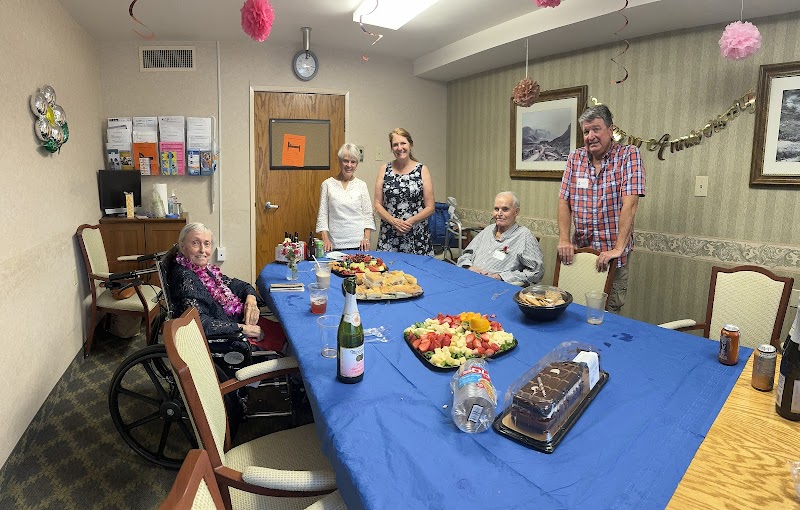
How is Cedar Crest Staffed?

CMS rates CEDAR CREST NURSING AND REHABILITATION CENTER's staffing level at 4 out of 5 stars, which is above average compared to other nursing homes. Staff turnover is 17%, compared to the California average of 46%. This relatively stable workforce can support continuity of care.

What Have Inspectors Found at Cedar Crest?

State health inspectors documented 22 deficiencies at CEDAR CREST NURSING AND REHABILITATION CENTER during 2020 to 2025. These included: 22 with potential for harm.
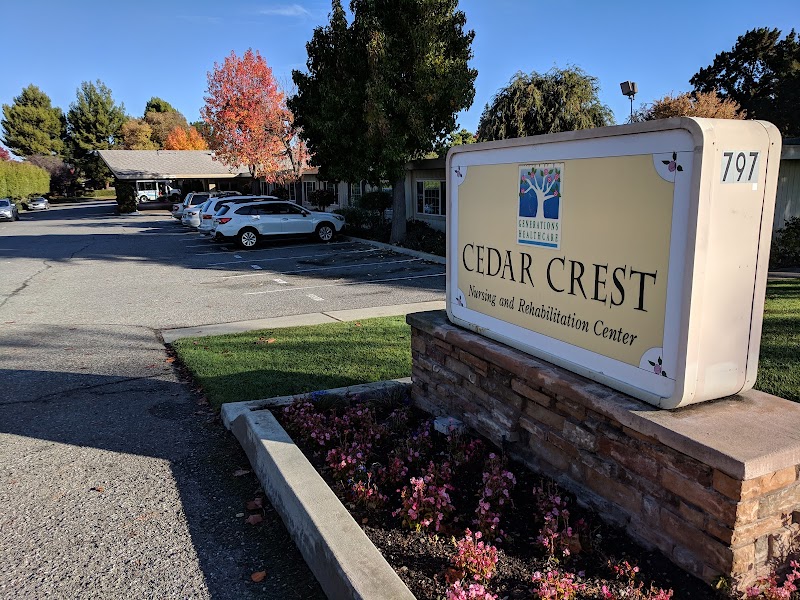
Who Owns and Operates Cedar Crest?

CEDAR CREST NURSING AND REHABILITATION CENTER is owned by a for-profit company. For-profit facilities operate as businesses with obligations to shareholders or private owners. The facility is operated by GENERATIONS HEALTHCARE, a chain that manages multiple nursing homes. With 99 certified beds and approximately 83 residents (about 84% occupancy), it is a smaller facility located in SUNNYVALE, California.
How Does Cedar Crest Compare to Other California Nursing Homes?

Compared to the 100 nursing homes in California, CEDAR CREST NURSING AND REHABILITATION CENTER's overall rating (5 stars) is above the state average of 3.2, staff turnover (17%) is significantly lower than the state average of 46%, and health inspection rating (4 stars) is above the national benchmark.

What Should Families Ask When Visiting Cedar Crest?

Based on this facility's data, families visiting should ask: "Can I visit during a mealtime to observe dining assistance and food quality?" "How do you handle medical emergencies, and what is your hospital transfer rate?" "Can I speak with family members of current residents about their experience?"

Is Cedar Crest Safe?

Based on CMS inspection data, CEDAR CREST NURSING AND REHABILITATION CENTER has a clean safety record: no substantiated abuse findings (meaning no confirmed cases of resident harm), no Immediate Jeopardy citations (the most serious violation level indicating risk of serious injury or death), and is not on the Special Focus Facility watch list (a federal program monitoring the lowest-performing 1% of nursing homes). The facility has a 5-star overall rating and ranks #1 of 100 nursing homes in California. While no facility is perfect, families should still ask about staff-to-resident ratios and recent inspection results during their visit.

Do Nurses at Cedar Crest Stick Around?

Staff at CEDAR CREST NURSING AND REHABILITATION CENTER tend to stick around. With a turnover rate of 17%, the facility is 29 percentage points below the California average of 46%. Low turnover is a positive sign. It means caregivers have time to learn each resident's needs, medications, and personal preferences. Consistent staff also notice subtle changes in a resident's condition more quickly. Registered Nurse turnover is also low at 24%, meaning experienced RNs are available to handle complex medical needs.

Was Cedar Crest Ever Fined?

CEDAR CREST NURSING AND REHABILITATION CENTER has no federal fines on record. CMS issues fines when nursing homes fail to meet care standards or don't correct problems found during inspections. The absence of fines suggests the facility has either maintained compliance or corrected any issues before penalties were assessed. This is a positive indicator, though families should still review recent inspection reports for the full picture.

Is Cedar Crest on Any Federal Watch List?

CEDAR CREST NURSING AND REHABILITATION CENTER is not on any federal watch list. The most significant is the Special Focus Facility (SFF) program, which identifies the bottom 1% of nursing homes nationally based on persistent, serious quality problems. Not being on this list means the facility has avoided the pattern of deficiencies that triggers enhanced federal oversight. This is a positive indicator, though families should still review the facility's inspection history directly.