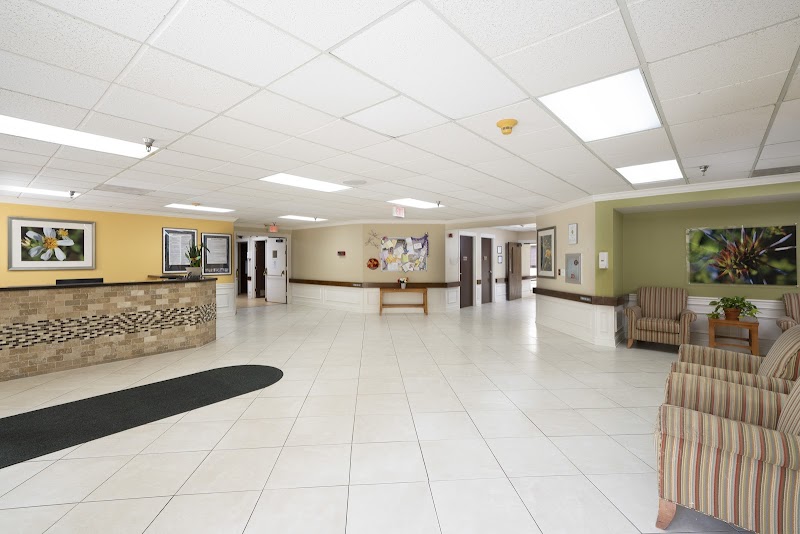
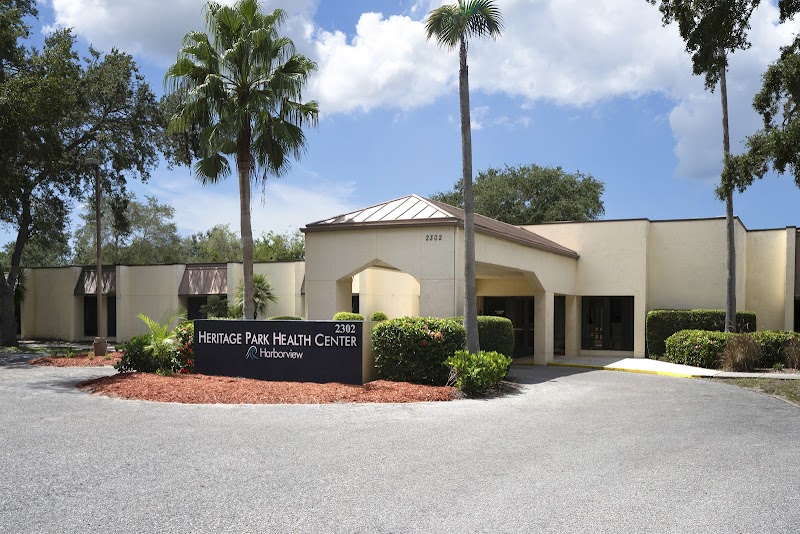
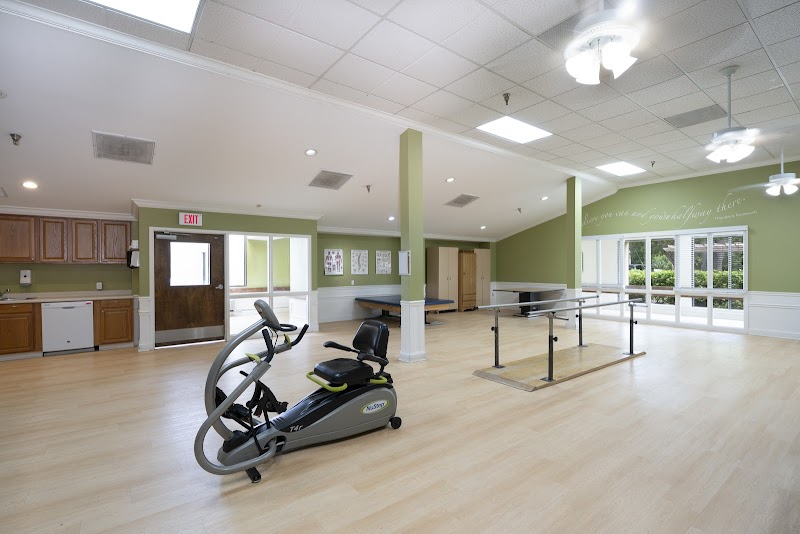
HERITAGE PARK HEALTH CENTER BY HARBORVIEW

2302 59TH ST W, BRADENTON, FL 34209 (941) 792-8480
For profit - Limited Liability company 120 Beds BENJAMIN LANDA Data: November 2025
Trust Grade
68/100
#219 of 690 in FL
Last Inspection: October 2023

Over 2 years since last inspection. Current conditions may differ from available data.

Overview

Heritage Park Health Center by Harborview has a Trust Grade of C+, indicating it is decent and slightly above average. It ranks #219 out of 690 facilities in Florida, placing it in the top half, and #3 out of 12 in Manatee County, meaning there are only two local options that are better. The facility's trend shows stability with four issues identified in both 2021 and 2023. Staffing is a concern with a 2 out of 5 star rating and a high turnover rate of 73%, significantly above the Florida average of 42%. While the facility has a good overall rating of 4 out of 5 stars for health inspections, it has received fines totaling $4,475, which is average. However, it has less RN coverage than 85% of Florida facilities, which is a drawback since Registered Nurses can catch issues that Certified Nursing Assistants might miss. Specific incidents noted include a lack of hand soap at a handwashing sink used by kitchen staff, which raises hygiene concerns, and a past failure to provide timely admission medications for a resident, leading to unnecessary pain and anxiety. Overall, while there are strengths in some areas, there are also significant weaknesses that families should consider.

Trust Score
C+
68/100
In Florida
#219/690
Top 31%
Safety Record
Low Risk
No red flags
Inspections
Holding Steady
4 → 4 violations
Staff Stability
⚠ Watch
73% turnover. Very high, 25 points above average. Constant new faces learning your loved one's needs.
Penalties
✓ Good
$4,475 in fines. Lower than most Florida facilities. Relatively clean record.
Skilled Nurses
⚠ Watch
Each resident gets only 25 minutes of Registered Nurse (RN) attention daily — below average for Florida. Fewer RN minutes means fewer trained eyes watching for problems.
Violations
⚠ Watch
11 deficiencies on record. Higher than average. Multiple issues found across inspections.
★★★★☆
4.0
Overall Rating
★★☆☆☆
2.0
Staff Levels
★★☆☆☆
2.0
Care Quality
★★★★☆
4.0
Inspection Score
Stable
2021: 4 issues
2023: 4 issues

The Good

  • Full Sprinkler Coverage · Fire safety systems throughout facility
  • No fines on record

Facility shows strength in fire safety.

The Bad

Staff Turnover: 73%

27pts above Florida avg (46%)

Frequent staff changes - ask about care continuity

Federal Fines: $4,475

Below median ($33,413)

Minor penalties assessed

Chain: BENJAMIN LANDA

Part of a multi-facility chain

Ask about local staffing decisions and management

Staff turnover is very high (73%)

25 points above Florida average of 48%

The Ugly 11 deficiencies on record

Oct 2023 4 deficiencies
CONCERN (D)

Potential for Harm - no one hurt, but risky conditions existed

Comprehensive Care Plan (Tag F0656)

Could have caused harm · This affected 1 resident

**NOTE- TERMS IN BRACKETS HAVE BEEN EDITED TO PROTECT CONFIDENTIALITY** Based on observation, record review, and interview, the facility failed to develop care plan problem areas with goals and interv...

Read full inspector narrative →
**NOTE- TERMS IN BRACKETS HAVE BEEN EDITED TO PROTECT CONFIDENTIALITY** Based on observation, record review, and interview, the facility failed to develop care plan problem areas with goals and interventions related to Post Traumatic Stress Disorder (PTSD), for one (Resident #151) of two sampled residents, who had a history of PTSD. Findings included: On [DATE] at 10:15 a.m., Resident #151 was observed in her room with two visiting family members. She was seated on the side of her bed and was dressed for the day and well groomed. Resident #151 was not presenting with any behaviors, pain, or discomfort. She appeared to be comfortable around and with her family members. Resident #151 was interviewed and revealed she felt generally safe at the facility and was happy to have her brother and nephew who visited regularly. She did not have any immediate concerns with her care and services while at the facility. Review of Resident #151's medical record revealed she was admitted to the facility on [DATE] and was at the facility for short term rehabilitation. Review of the advance directives revealed Resident #151 was her own decision maker. Review of the diagnosis sheet revealed diagnoses to include but not limited to: Dysphagia, muscle weakness, acute chronic respiratory failure, pain, and Anxiety. Review of the Minimum Data Set (MDS), 5 day assessment, dated [DATE] revealed; Cognition/Brief Interview for Mental Status (BIMS) score of 13 of 15, which indicated intact cognition. Mood - checked yes for mood interview to be conducted, checked yes as feeling down, checked yes as trouble falling asleep, checked yes as poor appetite, checked yes as feeling bad about self; Behaviors - none marked as exhibited; Active Diagnosis section was not checked for Post Traumatic Stress Disorder PTSD. Review of the nurse progress notes dated [DATE] at 12:47 p.m., revealed Resident #151 was admitted for short term rehab with a diagnosis of pneumonia. She was alert and oriented. She presented with moderate signs and symptoms of depression. The note further added that the resident had disclosed she had a history of being abused. The note also revealed; Referral made to psych. services. No behaviors noted. Review of the interim care plans as completed within the first forty-eight hours of Resident #151's admission, revealed the following but not limited to problem areas: 1. Risk for alteration in psychosocial wellbeing, mood, behavior, cognition, and functioning. Resident is at risk to experience adverse psychosocial changes such as increased depression and anxiousness with potential to affect wellbeing with interventions to include; Psych consult and follow up as needed. Observe and report changes in mood, behaviors, cognition, and level functioning caused by situational stressors to Medical Doctor. Reinforce appropriate expression of feelings. 2. Receives Antianxiety meds due to history of anxiety making resident at risk for medication side effects with interventions to include: Provide medications as ordered, Pharmacy consultant review every month, Observe resident's mood and response to medication, Observe medication side effects, Attempt non pharmacological interventions such as 1 on 1 and or TLC for increased anxiety, attempts to gradually dose reduction if warranted. On [DATE] at 8:00 a.m., an interview with both the Director of Nursing (DON) and the Minimum Data Set (MDS)/Care Plan coordinator Staff D, revealed Resident #151 was newer to the facility but they knew of her and her daily routines. Staff D and the DON confirmed the resident was visited by family on a daily basis and she participated in therapy. Staff D and the DON confirmed Resident #151 had been marked on the facility's Resident Matrix, which indicated she had Post Traumatic Stress Disorder (PTSD). Staff D revealed Resident #151 had PTSD related to behaviors that occurred to her as a child and also while with her now deceased husband. Staff D revealed after the admission MDS/5-day assessment, dated [DATE] was completed, it was brought to her attention the resident had PTSD. She revealed the care plan for the resident did not include PTSD with goals and interventions. Staff D reviewed the progress note, dated [DATE], and confirmed the 5 Day MDS assessment should have reflected Resident #151 had PTSD. She said there should have been a PTSD care plan developed. The Director of Nursing confirmed Resident #151 was not care planned with a specific problem area, goals and interventions related to PTSD as of yet, and they should have care planned that problem area during the interim care planning phase, within forty-eight hours of her admission. On [DATE], the Nursing Home Administrator (NHA) provided the Comprehensive Care Plans, policy with a last review date of 10/2023, for review. The Policy revealed; All residents will have a Comprehensive Care Plan (CCP) completed in accordance with Federal and State requirements. The CCP will include measurable objectives and timetables in order to meet the resident's medical and psychosocial needs that are identified from the comprehensive assessment (MDS). All applicable Care Area Assessment (CAA) will be reviewed. Any issues may be identified by members of the comprehensive care plan team and should be evaluated for inclusion in the comprehensive care plan. The Policy continued to reveal; The CCP will be developed within 7 days after the completion of the comprehensive assessment. The CCP will be periodically reviewed and revised by a team of qualified Clinicians after each MDS assessment and reassessment. Key points include but not limited to: Initial admission, readmission, and significant change; Episodically as plan of care changes. The Procedure section of the policy revealed; 1. The CCP will be initiated by all members of the team on admission. a. Problems will be identified from the MDS triggers and review of the CAA, and from the resident assessment, interviews, and direct observation. b. Team disciplines will write identified problems directly onto the care plan problem sheet. All disciplines are responsible for reviewing the plan of care and documenting interventions and initiating responsibility in the disciplinary column. c. Disciplines will be responsible for updating the plan of care when there is a new problem that requires the discipline to intervene. d. Any discipline can initiate a special care plan meeting.
CONCERN (D)

Potential for Harm - no one hurt, but risky conditions existed

Quality of Care (Tag F0684)

Could have caused harm · This affected 1 resident

**NOTE- TERMS IN BRACKETS HAVE BEEN EDITED TO PROTECT CONFIDENTIALITY** 2. Review of Resident #67's face sheet revealed she was admitted on [DATE] from an acute care hospital. Resident #67 had medical...

Read full inspector narrative →
**NOTE- TERMS IN BRACKETS HAVE BEEN EDITED TO PROTECT CONFIDENTIALITY** 2. Review of Resident #67's face sheet revealed she was admitted on [DATE] from an acute care hospital. Resident #67 had medical diagnoses to include but were not limited to, infection and inflammatory reaction due to her internal orthopedic prosthetic devices, implants and grafts, sepsis due to Methicillin susceptible staphylococcus aureus, osteomyelitis, fracture of right femur, encounter for closed fracture with routine healing, periprosthetic fracture around internal prosthetic right hip joint, and the need for assistance with personal care. An observation was conducted on 10/16/23 at 10:48 a.m. Resident #67 was observed to be lying in bed with an intravenous (IV) pole next to her bed. The resident was observed to have an IV in her left arm with a clear dressing that was intact and dated 10/16/23. The resident was observed to also have a bandage on her right upper arm which was dated 10/12 the bandage was intact but soiled with dark reddish brownish substance that filled more than half of the occlusive bandages absorbent pad. Resident #67 said she used to have an IV in that arm and they took it out and put the bandage on. Photographic evidence obtained. Review of Resident #67's physician orders did not reveal any orders related to the right upper arm occlusive dressing. An interview was conducted on 10/16/23 at 11:13 a.m., with Staff L, Certified Nursing Assistant (CNA) who was Resident #67's assigned CNA. She stated she had not worked with Resident #67 in a while, and she did not know anything about the bandage. An interview was conducted on 10/16/23 at 11:31 a.m., with Resident #67's nurse Staff K, Licensed Practical Nurse (LPN). She said Resident #67 used to have an IV in her right arm but it got clogged and the IV team came and put a new one in. They did not take the old one out so on Thursday last week, Staff K contacted the doctor and received an order to remove the old IV. Staff K said, The DON removed it and I put a bandage on it last Thursday. I'm pretty sure I dated the dressing. I didn't work yesterday but on Saturday I tried to take the bandage off but the resident didn't want me to so I told her it is going to have to come off in a week. Review of Resident #67's progress note dated 10/12/23 at 3:12 p.m. showed old PICC [peripheral intravenous central catheter] line removed 40 cm long. Pressure applied, and no bleeding noted. An interview was conducted with the Director of Nursing (DON) on 10/19/23 at 2:01 p.m. She said, Resident #67 had an IV upon admission. It was removed because it was leaking and not flushing, so a new IV was inserted. Review of the facility's Clean Dressing Change policy undated, revealed Intent: It is the policy of the facility to ensure change in dressings in accordance with State and federal Regulations, and national guidelines. Procedure: 1. Verify and review physician's order for procedure. .27. Document the completion of dressing change on the treatment record. Based on observation, record review, and interview, the facility failed to ensure two (Resident #26, and #67) of three sampled residents for quality of care received treatment and care in accordance with professional standards of practice related to 1. Responding to a change in condition timely related to a skin condition for Resident #26, and 2. Monitor and provide care to an occlusive dressing for Resident #67. Findings included: 1. On 10/16/23 at 10:58 a.m., Resident #26 was observed in her room sitting in the wheelchair next to her bed. A tube of [over-the-counter (OTC) medicated ointment, used for skin irritation] was observed sitting on the bedside table. She stated her husband always brought the [OTC medicated ointment] because she wanted to make sure she had it. She had an open area around her anus and in the groin area. Resident #26 stated it was very painful from sitting for so long. The wound care doctor came on Monday, and she needed to see them. She stated it hurt very bad when she urinated. They checked her for a Urinary Tract Infection (UTI) and it was negative. On 10/18/23 at 1:29 p.m., Resident #26 was observed in her room sitting in the wheelchair next to her bed. She received a phone call during the interview. Resident #26 reported to the person on the other end of the phone that her bottom was in pain and she needed to see the wound care doctor. On 10/19/23 at 9:20 a.m., Resident #26 was observed in her room sitting in the wheelchair next to her bed. She stated she had been feeling the pain on her buttocks and when she urinated for more than three months. She asked for the wound doctor to see her, and staff acted as if it was unusual. Staff were telling her it was just a raw opening and that was why the area was sore. Resident #26 stated when staff changed her, her bottom rubbed against the bed and it hurt. She stated sitting in the chair was hard. Every move she made hurt those places. She stated she wished staff could explain things to her better. At one point, they moved her to another room because her sores were so bad. It had not gotten any better. It started with just a burning on her buttocks. She could not consider going home because she was in so much pain. The burning and soreness have been going on for the last three months. When the pad was wet, it stayed up against her and it burned. She drank a lot of water, so she urinated a lot. Staff told her yesterday that she could not use the[OTC medicated ointment]. The ointment that was ordered for her was not helpful at all. The areas were really raw. The last person talked to her said it was raw with open patches with little flaky skin. Sometimes the staff would say it cleared up in a day and then it would come right back. A review of the Resident Face Sheet revealed Resident #26 was admitted into the facility on [DATE] with diagnoses to include urinary tract infection. The Minimum Data Set (MDS) dated [DATE] revealed the resident had a Brief Interview for Mental Status (BIMS) score of 14 out of 15 which indicted intact cognition. A review of the active orders revealed the following: Apply zinc cream to buttocks 3 times a day for redness and Head to toe skin checks weekly once a day. Special instructions: Complete non-pressure observation or wound management form if appropriate. There was no order on the active orders list for the [OTC medicated ointment]. A review of the Medication Administration Record (MAR) for August, September, and October 2023, showed the zinc cream was applied three times daily for all three months and skin assessments were completed as ordered. Resident Progress Notes revealed the following: 10/18/23 18:57 (6:57 p.m.) - Patient showing increasing confusion and agitation. The doctor was notified. New orders for Urinalysis and Culture and Sensitivity to be completed. 10/13/23 10:53 a.m.- Weekly skin assessment completed, resident had excoriation to her coccyx and groin, continue current treatment until healed, and will continue to monitor for any changes in condition. 10/11/23 15:41 (3:41 p.m.) - Resident had reddened area to groin and coccyx, continue current treatment until healed, will continue to monitor for changes of condition. 10/09/23 13:57 (1:57 p.m.) - Patient had non-blanching area to coccyx, purple in center. Notified doctor and he requested for wound care to follow. 10/06/23 12:05 p.m. - Weekly skin assessment complete. Resident has no skin impairments at this time, resident had reddened area to sacrum with treatment, will continue to monitor for any changes of condition. 09/30/23 12:01 p.m.- Weekly skin assessment complete. Resident had reddened area to coccyx, no other skin issues noted, continue current treatment until resolved. Will continue to monitor for any changes of condition. 09/22/23 8:20 a.m.- Weekly skin assessment complete. Coccyx reddened, continue current treatment until healed, will continue to monitor for any changes in condition. 09/14/23 20:58- (8:58 p.m.) Weekly skin assessment complete. Resident had reddened area to her buttocks, continue current treatment until healed. 09/07/23 1:04 a.m. - Weekly skin check complete. Reddened area left buttocks. Continue current treatment. Will continue to monitor for any changes in conditions. 09/04/23 18:17 (6:17 p.m.) - Weekly skin assessment completed. Open area to right buttock. No signs and symptoms of infection noted. Treatment order in place. 09/01/23 14:46 (2:46 p.m.) - Weekly skin assessment complete. Patient had open area on right buttock, treatment in place. Will continue to monitor. 08/25/23 18:54 (6:54 p.m.) - Weekly skin assessment. Patient had open area on right buttock, treatment in place. 08/24/23 14:22 (2:22 p.m.) - Weekly skin assessment complete. Resident had small open area on right side below her coccyx. Continue current treatment until healed. Will continue to monitor for any changes in condition. 08/20/23 19:23 (7:23 p.m.)- The doctor was notified of new open areas on back of thigh. Orders placed. 08/20/23 0:07 (12:07 a.m.)Certified Nursing Assistant (CNA) reported skin alteration to the patient's right buttock. On observation, the patient had slight excoriation to the right buttock, on the fold of skin. The area was cleansed with soap and water. Barrier cream applied. Skin alert completed and placed in the unit manager's box. 08/18/23 11:19 a.m. - Weekly skin assessment completed. No new skin conditions noted. Will continue to monitor. 08/16/23 17:52 (5:52 p.m.) - Weekly skin assessment completed. No new skin issues noted. 08/11/23 11:07 a.m. - Weekly skin check completed. Resident had reddened area to coccyx. Continue current treatment until healed. 08/04/23 10:10 a.m. - Weekly skin check complete. Reddened area to coccyx. Continue current treatment until healed. Will continue to monitor for any changes in condition. 08/02/23 14:53 (2:53 p.m.) - Weekly assessment completed. No new skin issues noted. The progress notes showed on 10/11/23, Resident #26 was noted to have a new reddened area to her groin and on 10/13/23 she was noted to have a new area of excoriation to her groin with no orders in place for treatment. The most Recent Wound Evaluation and Management Summary dated 07/10/23, showed the patient presented for follow up of wound on her sacrum. Prior healing wound had improved. The progress notes showed on 10/09/23 the doctor requested for wound care to follow up. There was no evidence of a follow up from the wound care doctor. The care plan related to skin integrity with a problem date of 12/09/20 showed the resident had a risk for skin integrity. Interventions included but were not limited to report changes in skin status to the physician. There was no evidence the physician was contacted related to the changes in skin condition. On 10/18/23 at 1:30 p.m., Staff E, CNA, stated Resident #26 had complained of pain to her buttocks and groin area but it was getting better. The nurse was aware, and the nurse was responsible for doing treatment. On 10/19/23 at 9:32 a.m., Staff F, Licensed Practical Nurse (LPN) stated Resident #26 had not complained to her about pain on her buttocks or groin area. She did not like the wheelchair and she would not let them turn her because she said it was uncomfortable. She hated the wheelchair and preferred to lay in bed. She had been very confused and agitated so the doctor was contacted. They ordered a urinalysis because of the agitation and confusion. Staff F stated the resident had a pack of sour cream and was saying it was a cream for her bottom. Staff F reported the resident had not reported to her about the pain while urinating. She stated, Well that would be perfect for a UTI. On 10/19/23 at 10:21 a.m., Staff G, LPN/Unit Manager (UM), reported she saw Resident #26 a couples of times a day; but, the resident did not say anything to Staff G about pain when she urinated. The resident would always report that the areas were sore. She got excoriated. It went away and came back. Resident #26 seemed to like the [OTC medicated ointment] and she knew she was not supposed to have it. The resident never told Staff G the cream she had ordered was not working and never asked her about seeing the wound care doctor. Staff G said if there was anything other than a red area, the resident could be seen by the wound care doctor. The area was not open so she was not on the schedule to see the wound care doctor. Staff G, LPN/UM stated they could send a wound care referral. The area to the groin was observed during the middle of last week when she did a skin assessment. She confirmed the resident did not have an order in place for treatment to the groin area. On 10/19/23 at 10:12 a.m., the Director of Nursing (DON) stated the resident had a history of pain. The resident had not reported any skin concerns to her. She was ordered a barrier cream that the nurse put on her twice a day. When the nurses perform skin checks, and the note indicated redness or excoriation, she or Staff G, LPN/UM would look at the area. If there was a concern, they would fax that information to the wound care doctor and the wound care doctor would see them that following Monday. If the area was open, then the wound care doctor would see the resident. The wound care doctor was here on Monday. She stated the wound care doctor did not see the resident because the area was not open. The nurse would indicate the area of concern on the 24-hour report, the UM would review the report, and then the UM would go assess the patient. She confirmed the resident was not seen by the wound care doctor as ordered by the physician because on 10/11/23, the resident was seen and assessed by the UM and the area was red. There was no need to see the wound care doctor. The [NAME] Wound Round Policy provided by the facility revised on 05/22 revealed the following: In addition to the Attending Physician, the residents will receive services from consultants if ordered by the attending physician.
CONCERN (D)

Potential for Harm - no one hurt, but risky conditions existed

Tube Feeding (Tag F0693)

Could have caused harm · This affected 1 resident

**NOTE- TERMS IN BRACKETS HAVE BEEN EDITED TO PROTECT CONFIDENTIALITY** Based on observation, interview, and record review, the facility failed to prevent enteral feeding complications related to not ...

Read full inspector narrative →
**NOTE- TERMS IN BRACKETS HAVE BEEN EDITED TO PROTECT CONFIDENTIALITY** Based on observation, interview, and record review, the facility failed to prevent enteral feeding complications related to not providing the ordered nutrition for one (Resident #28) out of 32 residents sampled. Findings included: Review of Resident #28's face sheet revealed she was admitted to the facility on [DATE]. Resident #28 was receiving hospice services. Her medical diagnoses included but were not limited to dysphagia, gastrostomy status, hemiplegia and hemiparesis following a cerebral infarction affecting the left non-dominant side, muscle weakness, major depressive disorder, and dementia. Review of Resident #28's physician orders revealed an order with a start date of 8/23/23 without an end date for enteral feeding: Formula Jevity, strength 1.5 calorie, Flow rate 70 ml/hr. (milliliters per hour) for 20 hours. Further physician order review revealed an order with a start date of 8/16/23 without an end date for free water flush 250 ml via peg tube every 4 hours. Another order with a start date of 6/20/23 without an end date for off Tube feeding at 10 AM once a day and another order with a start date of 6/20/23 without an end date for Start tube feeding at 2 PM once a day. On 10/16/23 at 9:08 a.m., Resident #28 was observed lying in bed. She was nonverbal but was intermittently moaning. The resident was observed to be hooked up to her enteral feeding pump. The pump was running a bottle of Jevity 1.5 calories and the pump was set for the resident to receive 65 ml' s' per hour with 250 ml water flush every 4 hours. Further observations were conducted on 10/17/23 at 10:18 a.m. Resident #28 was observed lying in bed, eyes closed, with her enteral feeding pump turned off. On 10/17/23 at 2:19 p.m. Resident #28 was observed lying in bed, eyes closed, with her enteral feeding pump turned off. On 10/17/23 at 2:35 p.m. Resident #28 was observed lying in bed, eyes closed, and her enteral feeding pump turned off. On 10/17/23 at 3:07 p.m., Resident #28 was observed lying in bed, eyes closed, her enteral feeding pump was turned on and running Jevity 1.5 calories. The pump rate was set for Resident #28 to receive 65 ml/hr, and the water flush was set for Resident #28 to receive D2000 of water every four hours. Photographic Evidence Obtained. An interview was conducted on 10/17/23 at 3:20 p.m. with Staff K, Licensed Practical Nurse (LPN). She reviewed the physician orders for the feeding rate, went into the resident's room, placed the pump on hold and said, I'm going to put this on hold because I thought it was supposed to be going at 65 ml/hr. Let me see if the dietitian changed the order. Staff K, LPN reviewed the feeding order and confirmed the order had been in place since August 23, 2023. She reviewed the record and said she was having trouble finding the dietitian's note but the night nurse, who was an agency nurse, gave her in report the pump was at a rate of 65 ml/hr. Staff K, LPN also said she took the resident off of her tube feeding at 10:00 a.m. and put her back on at 2:00 p.m. like the order says. Staff K, LPN went into the resident's room cleared the volume infused and changed the feeding pump rate to 70 ml' s' per hour and said she would need to talk to her unit manager to see what the dietitian said. Review of Resident #28's October Medications Administration History revealed on 10/17/23 the physician's orders Off Tube feeding at 10 AM and Start tube feeding at 2 PM were signed off as administered. Review of Resident #28's progress note dated 9/22/23 at 7:18 p.m., written by the facility's dietitian revealed, Unstageable sacrum wound. On Jevity 1.5 @ 70 mls/hour X [times] 20 hour via PEG [Percutaneous Endoscopic Gastrostomy]. Add [brand name of liquid protein supplement] AWC [advanced wound care] 30 mls via PEG daily for 200 Kcals and 30 grams protein, administer per enteral instructions on bottle. Significant loss noted from 113.5 lbs [pounds] to weight 100 lbs on 7-12-23. [Resident #28] is on hospice. NPO [nothing by mouth] diet order continues. F/U PRN [follow up as needed]. A progress note dated 8/15/23 at 9:58 a.m. revealed, called hospice about getting residents tube feed orders adjusted r/t [related to] weight loss, and about her pain meds not being sent from pharmacy due to insurance, they to [sic] call back with new orders. A progress note dated 8/15/23 at 2:54 p.m. revealed, spoke to hospice they called and got the billing corrected with the pharmacy, meds to be delivered today, referral sent to hospice dietitian to review the tube feeding and give recommendations. A progress note dated 8/23/23 at 8:51 a.m. revealed, Pt [patient] seen by [Hospice] dietitian orders to increase Jevity to 70 ml/hr running for 20 hours. Orders confirmed and carried out. Review of Resident #28's care plan, last reviewed on 10/12/23 revealed, Resident has a need for use of a feeding tube related to: (insufficient caloric intake, dysphagia, failure to thrive, cognitive impairment). Resident has risk for complication secondary to tube feeding use. The goal included, Resident will remain free from complications r/t [related to] the use of a feeding tube AEB [as evidence by] no s/s [signs and symptoms] of aspiration, no N&V [nausea and vomiting], no diarrhea, no abdominal distension. The interventions included but were not limited to Administer tube feeding formula and flushes as ordered. An interview was conducted on 10/18/23 at 3:37 p.m. with the Director of Nursing (DON). She said, I am aware she was not getting the ordered amount. We educated the nurse. I also talked to the dietitian, she is new to us, and I educated her that we don't do weights on hospice residents. Review of the facility's Enteral Nutrition policy undated revealed Physician Orders For Enteral Feeding Policy: Enteral formulas are provided to meet the nutritional needs of those residents unable to take liquids or food by normal means. .Quantum Feeding Pump Policy: Tube feedings will be administered as per MD orders, using the Quantum Enteral Feeding Pump .
CONCERN (F)

Potential for Harm - no one hurt, but risky conditions existed

Food Safety (Tag F0812)

Could have caused harm · This affected most or all residents

Based on observation, staff interview, and facility record review, the facility failed to ensure; 1. One of one dish washing machine was operating at its low temperature wash and rinse specifications;...

Read full inspector narrative →
Based on observation, staff interview, and facility record review, the facility failed to ensure; 1. One of one dish washing machine was operating at its low temperature wash and rinse specifications; 2. One of one walk in freezer was free from icing, ice sheeting build up on floors, inside walls, shelving and packaged food items; 3. One of one walk in refrigerator had an internal thermometer to gauge the internal temperatures; and 4. One of one hand washing sink had soap available to wash hands. Findings included: 1. On 10/16/2023 at 9:32 a.m., a kitchen tour was conducted with the Certified Dietary Manager (CDM). There was a hand pump soap dispenser attached to the wall directly above the hand sink. The soap dispenser was empty. The Dietary Manager confirmed the wall mounted soap dispenser was empty and did not know how long it had that way. She further confirmed the sink was where the staff who come into the kitchen washed their hands. She confirmed using an alcohol base sanitizer was not acceptable for her and her staff to use in lieu of washing their hands at the sink with soap and water. 2. On 10/16/2023 at 9:37 a.m., the CDM said the the kitchen had a Low temperature sanitizer dish washing machine. She revealed the wash cycle temperature and the rinse cycle temperature should reach 120 degrees Fahrenheit (F), and the sanitizer parts per million (PPM) should reach 100 - 200 PPM. She reviewed the last two months of the dish machine temperature log. Both months 10/2023 and 9/2023 the dish machine temperature logs showed appropriate temperatures logged, reaching at least 120 degrees F for both the wash and rinse cycle and the sanitizer was 50 ppm. The CDM pointed out on the wall next to the dish machine, informational posters that showed what the PPM expectations were for the sanitizer. She pointed out the machine's specification plate on the lower end of the machine. Both indicated a Low temperature dish machine with chemical sanitizer at optimum levels of 50-100 ppm for the sanitizer, and 120 degrees F for the wash and rinse cycles. The Dietary Manager confirmed the chemical sanitizer should be at 50 - 100 PPM. While speaking with the Dietary Manager, Staff A, dietary aide and Staff B, dietary aide were operating the dish machine. Staff A and Staff B said the dish machine had been running for about 15 minutes. Both Staff A and B confirmed the machine was operating well and there were no problems with it. Staff A and B said the machine was a Low temperature dish washing machine and temperatures for both wash and rinse should reach at least 120 degrees F. They also both said the chemical sanitizer was tested on ce every meal service. Staff A and B did not know the PPM range for the sanitizer. On 10/16/23 at 9:43 a.m., both Staff A and B demonstrated the use of the dish machine. Staff B ran a crate of dishes through the machine. After the crate of dishes was in the machine, the wash temperature only reached 103 degrees F ,according to the machine's analog thermometer. After the rinse cycle finished, and the machine clicked, the rinse cycle revealed a temperature only reaching 119 degrees F. The thermometer attached to the machine was heavily fogged and difficult to read. The CDM said, I can read it just fine. Photographic evidence obtained. On 10/16/23 at 9:44 a.m., a second dish machine demonstration was observed. Staff B ran another crate of dishes though the machine. After the crate of dishes were sent through the machine, the wash temperature only reached 115 degrees F. After the wash cycle ended and the machine clicked, the rinse cycle reached only 118 degrees F. Both Staff A and B said they primed the machine prior to washing the first crate of dishes. They said the wash and rinse temperatures were at 120 degrees F. before they started running crates of dishes through the machine. Staff B said she could not read the temperature gauge. The Dietary Manager said she would notify the dish machine company of the issue and have them come out to fix the gauge and the water temperature. 3. As the kitchen tour continued, the walk in refrigerator was found without a thermometer. The CDM and cook were unable to locate the refrigerator thermometer. During this observation, the internal temperature of the walk in refrigerator could not be confirmed. The Dietary Manager was unable to provide the daily/weekly/monthly temperature log for the walk in refrigerator. 4. As the kitchen tour continued, the walk in freezer was observed with a thick sheeting of ice on the floor on the left side of the unit. The sheeting of ice was approximately three feet long and three feet wide, with a thickness of about two inches or more in some spots. Further observations revealed the top left side shelf was observed with heavy icing and long icicles, with heavy icing built up on three boxes of packaged food items. Also, the flow pipes leading from the motor fan housing to the back of the unit wall were observed with heavy ice build up. An interview with the Dietary Manager revealed she was not aware of the icing on the floor and on the packages of food items. She confirmed the freezer iced up at times and believed the Maintenance Director was aware of the situation. Photographic evidence obtained. On 10/19/2023 at 1:00 p.m., an interview with the Maintenance Director confirmed he was aware of the walk in freezer ice build up but did not have a work order to show what he was currently doing to fix the issue. On 10/19/2023 at 2:00 p.m. the Nursing Home Administrator provided the undated Dish Machine Policy and Procedure. The Policy showed the following procedures: 1. The dirty carts/dishes must enter the dirty area and exit the clean area when possible considering architectural design and kitchen layout. 2. Check unit chemical container levels and run dish machine while empty (as many times as necessary) to get desired temperature. 3. Run dishes through the unit cycles of wash and rinse. 4. Record temperature and chemical level of unit at least 3 times per day. 5. Follow unit specifications for proper temperature and chemical levels to assure proper sanitation.
Sept 2021 4 deficiencies
CONCERN (D)

Potential for Harm - no one hurt, but risky conditions existed

Deficiency F0578 (Tag F0578)

Could have caused harm · This affected 1 resident

**NOTE- TERMS IN BRACKETS HAVE BEEN EDITED TO PROTECT CONFIDENTIALITY** Based on record review and interviews, the facility failed to ensure the advance directive for a resident was identified in the ...

Read full inspector narrative →
**NOTE- TERMS IN BRACKETS HAVE BEEN EDITED TO PROTECT CONFIDENTIALITY** Based on record review and interviews, the facility failed to ensure the advance directive for a resident was identified in the medical record for one resident (#184) out of the sampled thirty-five residents. Findings included: A review of the Resident Face Sheet revealed Resident #184 was admitted into the facility on [DATE] with primary diagnoses of hypo-osmolality and hyponatremia. A review of the banner on the electronic medical record did not reflect an advance directive for Resident #184. A review of the Physician Order Report dated [DATE] to [DATE] did not reflect an order for an advance directive. A review of the care plans initiated on [DATE] for Resident #184 did not reflect a care plan related to advance directives. On [DATE] at 11:35 a.m., Staff A, Registered Nurse (RN), reported the code status for all residents should be listed on the top of the screen in the electronic health record. She stated that if a resident was coding, she would look at the top of the screen to check the code status. On [DATE] at 1:19 p.m., the Nurse Liaison, stated if a resident was coding, staff should look on the Software Program at the top left under the identifiers and there was a book on the unit for Do Not Resuscitate status. She stated the code status should be at the top of the electronic medical record with the demographics. The Nurse Liaison stated the expectation was that the code status should be in the medical record. The policy provided by the facility Advance Directive Procedure, revised [DATE], revealed the following: 3. If the resident or the resident's representative states that the resident has completed an advance directive, it shall be documented in the medical record. The policy provided by the facility Florida Cardiopulmonary Resuscitation, last revised [DATE], revealed the following general guideline: 2. During a resident's admission and/or stay, Facility should ask about and document a resident's choices regarding CPR [cardiopulmonary resuscitation], with two witnesses signing off on same. Faciilty should seek to obtain a physician order reflecting the resident's CPR choice as soon as possible, and place in the resident's medical record, wherever that record is maintained.
CONCERN (D)

Potential for Harm - no one hurt, but risky conditions existed

Transfer Notice (Tag F0623)

Could have caused harm · This affected 1 resident

**NOTE- TERMS IN BRACKETS HAVE BEEN EDITED TO PROTECT CONFIDENTIALITY** Based on interviews, record reviews, and review of facility policy, the facility failed to notify the Office of the State Long-T...

Read full inspector narrative →
**NOTE- TERMS IN BRACKETS HAVE BEEN EDITED TO PROTECT CONFIDENTIALITY** Based on interviews, record reviews, and review of facility policy, the facility failed to notify the Office of the State Long-Term Care (LTC) Ombudsman of a facility initiated transfer for one resident (#41) of two residents sampled for hospitalizations. Findings included: A review of Resident #41's Resident Face Sheet revealed that Resident #41 was admitted to the facility on [DATE], with a readmission to the facility on [DATE], with diagnoses of bilateral primary osteoarthritis of knee, acute pyelonephritis, and sepsis. Resident #41's Resident Face Sheet also revealed Resident #41 was her own responsible party. A review of Resident #41's Progress Notes revealed a note, dated 07/24/2021 at 5:38 p.m., which documented Resident #41 was transferred to the hospital due to complaints of abdominal pain and decreased bowel sounds. A review of Resident #41's Progress Notes also revealed a note, dated 07/24/2021 at 11:20 p.m., which documented Resident #41 was admitted to the hospital with diagnoses of urinary tract infection and pyelonephritis. An interview was conducted on 09/15/2021 at 3:17 p.m. with the facility's Nursing Home Administrator (NHA). The NHA stated that the LTC Ombudsman was not notified of Resident #41's transfer to the hospital on [DATE] and that the notification should have been made by the facility's Social Services Director (SSD). An interview was conducted on 09/15/2021 at 3:34 p.m. with Resident #41. Resident #41 stated she was recently admitted to the hospital due to a urinary tract infection that bothered her kidneys and that she was in the hospital for a couple of days. Resident #41 stated that she was her own responsible party and that she made her own health care decisions. An interview was conducted on 09/16/2021 at 11:08 a.m. with the SSD. The SSD stated they were not sending notification of transfers to the LTC Ombudsman but they were working on putting a plan in place to make sure the notifications were being completed. A review of the facility policy titled, Discharge or Transfer Summary, last reviewed on 06/28/2018, revealed under the section titled Guideline, that prior to a resident transfer or discharge, the facility will notify the resident and/or the resident's representative of the transfer or discharge and the reason for the move in writing and in a language and manner they understand and the facility will send a copy of the notice to a representative of the Office of the State LTC Ombudsman.
CONCERN (D)

Potential for Harm - no one hurt, but risky conditions existed

Deficiency F0625 (Tag F0625)

Could have caused harm · This affected 1 resident

**NOTE- TERMS IN BRACKETS HAVE BEEN EDITED TO PROTECT CONFIDENTIALITY** Based on interviews, record reviews, and review of facility policy, the facility failed to provide written notice of bed hold up...

Read full inspector narrative →
**NOTE- TERMS IN BRACKETS HAVE BEEN EDITED TO PROTECT CONFIDENTIALITY** Based on interviews, record reviews, and review of facility policy, the facility failed to provide written notice of bed hold upon a facility initiated transfer for two residents (#41 and #72) of two residents sampled for hospitalizations. Findings included: A review of Resident #41's Resident Face Sheet revealed that Resident #41 was admitted to the facility on [DATE], with a readmission to the facility on [DATE], with diagnoses of bilateral primary osteoarthritis of knee, acute pyelonephritis, and sepsis. Resident #41's Resident Face Sheet also revealed Resident #41 was her own responsible party. A review of Resident #41's Progress Notes revealed a note, dated 07/24/2021 at 5:38 p.m., which documented Resident #41 was transferred to the hospital due to complaints of abdominal pain and decreased bowel sounds. A review of Resident #41's Progress Notes also revealed a note, dated 07/24/2021 at 11:20 p.m., which documented Resident #41 was admitted to the hospital with diagnoses of urinary tract infection and pyelonephritis. An interview was conducted on 09/15/2021 at 3:17 p.m. with the facility's Nursing Home Administrator (NHA). The NHA stated that a notice of bed hold document was not sent in the transfer paperwork upon Resident #41's transfer to the hospital on [DATE], that the transfer paperwork was probably dropped. The NHA also stated Resident #41 was her own responsible party and that she made her own health care decisions. An interview was conducted on 09/15/2021 at 3:34 p.m. with Resident #41. Resident #41 stated she was recently admitted to the hospital due to a urinary tract infection that bothered her kidneys and that she was in the hospital for a couple of days. Resident #41 also stated that she did not remember signing any documentation related to the facility bed hold notice and did not remember receiving the notice at all during her time in the hospital. Resident #41 stated that she was her own responsible party and that she made her own health care decisions. A review of Resident #41's Minimum Data Set (MDS) Assessment, dated on 07/31/2021, revealed under Section C - Cognitive Patterns a Brief Interview for Mental Status (BIMS) score of 12, which indicated that Resident #41 was cognitively intact. A review of the facility policy titled, Facility Bedhold, last revised on 11/12/2018, revealed under the section titled Policy Statement, that the facility will notify the resident/responsible party of the facility's bed hold and re-admission policies at admission and anytime a resident is transferred to the hospital or goes out on therapeutic leave. The facility policy also revealed, under the section titled Guideline, that the facility's Bedhold and re-admission policies will be discussed with the resident/responsible party and the facility will provide written notice of the bed hold and re-admission policies at the time of admission and before a resident's transfer to the hospital or for overnight therapeutic leave, included in the resident's transfer packet. Resident #72 was admitted to the facility with a diagnosis of Alzheimer's, according to the Resident Face Sheet in the medical record. Review of the MDS assessment dated [DATE] reflected a Brief Interview for Mental Status (BIMS) score of 0, indicating severe cognitive impairment. Review of the physician orders revealed an order dated 7/4/21, send patient to ED (emergency department) for evaluation and treatment for sob (shortness of breath). Review of the resident's medical record reflected there wasn't a bed hold policy on file for the date of the transfer (7/4/21). An interview with the NHA on 9/15/21 at 3:11 p.m. was conducted. She said the admission paperwork has the bed hold policy in it. He went out on July 4th. We don't have a copy of the bed hold policy. We don't know if it was sent or not. The NHA also said there is a whole packet that is provided when they go out to the hospital.
CONCERN (D)

Potential for Harm - no one hurt, but risky conditions existed

Drug Regimen Review (Tag F0756)

Could have caused harm · This affected 1 resident

**NOTE- TERMS IN BRACKETS HAVE BEEN EDITED TO PROTECT CONFIDENTIALITY** Based on record review, interviews, and policy review, the facility did not ensure the consultant pharmacist's recommendations w...

Read full inspector narrative →
**NOTE- TERMS IN BRACKETS HAVE BEEN EDITED TO PROTECT CONFIDENTIALITY** Based on record review, interviews, and policy review, the facility did not ensure the consultant pharmacist's recommendations were acted upon for one resident (#26) of five residents sampled for unnecessary medications. Findings included: Resident #26 was admitted to the facility with a diagnosis of dementia without behavior disturbance, according to the face sheet in the admission record. Review of the Minimum Data Set (MDS) assessment dated [DATE] reflected a Brief Interview for Mental Status (BIMS) score of 5, indicating cognitive impairment. Further review of the assessment indicated Resident #26 did not have any mood or behavior symptoms at the time of the assessment. A review of the Physician Order Report dated 6/27/21 - 9/15/21 in the medical record revealed the following medications: 6/27/21 Seroquel 25 mg (milligram) give 1/2 tablet (12.5 mg) by mouth at bedtime, with a discontinue date of 6/28/21 6/28/21 Seroquel 25 mg give 1/2 tablet (12.5 mg) by mouth at bedtime Additional review of physician orders revealed an order was received to discontinue Seroquel on 6/27/21 with a discontinue date of 6/28/21 and signed by the resident's attending physician. A review of the 7/10/21 MRR (medical record review) from the consultant pharmacist revealed a recommendation as: Federal Guidelines for long-term care facilities require an evaluation of antipsychotic usage within two weeks of admission. This resident (#124) was recently admitted with an order for Seroquel 12.5 mg QHS (bedtime) to treat Major Depressive Disorder. Please consider a trial dose reduction to assess continued need for treatment and check one of the following: ()Medication to be continued as ordered. Discontinuation of therapy likely will be harmful to resident and/or others or it will interfere significantly with the provision of care for others. ()Reduce the current order as indicated below. ()Evaluation of the antipsychotic medication was completed by Psych. See Psych progress notes dated ___. The section for the physician/prescriber response was blank. None of the boxes were checked off as Agree, Disagree, or Other, nor was there a signature indicating the physician received/reviewed the recommendation. Review of the Medication Administration Records (MAR) for the months of July, August, and September 2021 revealed the Seroquel 12.5 mg continued to be administered. On 9/15/21 at 10:38 a.m. an interview was conducted with the Admissions Nurse Liaison. She said the unit managers fax the recommendations to the physicians. On 9/15/21 at 11:09 a.m. an interview was conducted with the Regional Nurse. She said the pharmacist may have reviewed the medications before it (Seroquel) was discontinued. She confirmed the physician signed a discontinue order on 6/27 for Seroquel and that it was being administered for the months of July, August, and September 2021. On 9/16/21 at 10:39 a.m. a telephone interview was conducted with the Consultant Pharmacist. She said when the facility receives her recommendations they put them in the practitioner's folders, or it may go to the behavior meeting for psychiatric services to review. On 9/16/21 at 1:10 p.m. a follow up interview was conducted with the Regional Nurse. She said the pharmacist sends the recommendations to the DON (Director of Nursing). The DON disperses them to the unit managers and they get them to the doctors. On 9/16/21 at 1:12 p.m. an interview was conducted with the Nursing Home Administrator (NHA). She said she prints off the recommendations and gives them to the unit manager. They also go to the ADON (Assistant Director of Nursing). Sometimes they come to herself too. She doesn't know where they go after that; that's nursing. Review of the policy, Psychotropic Medications, revised 9/5/18, reflected the following: Policy Statement Physicians and mid-level providers will use psychotropic medications appropriately working with the interdisciplinary team to ensure appropriate use, evaluation, and monitoring. Guideline: 7. If a clinical contraindication for a gradual dose reduction (GDR)/tapering has been indicated, it must be properly and fully documented on the physician order sheet and care plan. Primary Care Physician, Physician Assistant (PA) or advanced nurse practitioner (APRN) 8. If contraindicated, the prescriber will document in the medical record the clinical rationale why the attempt would likely impair the resident's function or cause instability. 11. Review reports from the consultant pharmacist and documents in the medial record the identified irregularity has been reviewed and what, if any, action has been taken to address the irregularity. If the physician determines there is to be no change in the medication; the physician will document the rationale in the resident's medical record. Pharmacist and/or consulting pharmacist 4. The consultant pharmacist and the nursing care center follow up on the recommendations to verify appropriate action has been taken. Recommendations shall be acted upon within 30 calendar days.
Jan 2020 3 deficiencies
CONCERN (D)

Potential for Harm - no one hurt, but risky conditions existed

Accident Prevention (Tag F0689)

Could have caused harm · This affected 1 resident

**NOTE- TERMS IN BRACKETS HAVE BEEN EDITED TO PROTECT CONFIDENTIALITY** Based on interviews, observations, and record review, the facility failed to ensure that adequate fall interventions were in pla...

Read full inspector narrative →
**NOTE- TERMS IN BRACKETS HAVE BEEN EDITED TO PROTECT CONFIDENTIALITY** Based on interviews, observations, and record review, the facility failed to ensure that adequate fall interventions were in place for one resident (#226), of three residents sampled for falls. Resident #226 entered the facility after being hospitalized for prior fall injuries which required hip surgery. Her family emphasized her fall risk upon admission. She suffered two falls the first two days in the facility. Findings included: A review of the facility's fall log from 9/1/2019 to 12/31/2019 revealed that Resident #226 had a fall with no injury on 12/28/2019 at 3:53 in the morning, and a fall event on 12/29/2019 at 1:27 p.m. Both falls occurred in the resident's room. Review of the admission Nursing Progress note for Resident #226 on 12/27/19 at 6:55 p.m. revealed: New admit from Hospital Name. Alert and oriented to person only. Impulsive with poor safety awareness. Family at bedside, and resident still attempting to get out of bed (OOB) Frequent checks for safety. Per the face sheet, Resident #226 was admitted to the facility on [DATE] at 5:03 p.m. She was listed as responsible for herself, with her daughter and son in law the emergency contacts. Her diagnoses included: fracture of the right femur, muscle weakness, and dementia without behavioral disturbance. Her physician's orders included: donepezil 23 milligrams once daily at hour of sleep for dementia and memantine 5 milligrams twice daily for dementia. Her code status was listed as full code. Initiate Falls prevention program (start: 12/29/29, end: 12/30/19). Bilateral hips x-ray 2 views post fall; monitor status for 72 hours for bruising, changes in mentation, pain, etc. Physical Therapy and Occupational Therapy to evaluate and treat (start: 12/29/19 end: 12/30/19. Urinalysis and urine culture and sensitivity test ordered 12/29/19. Stat re-read x-ray for left hip on 12/29/19. Review of Resident 226's Minimum Data Set (MDS), dated [DATE], revealed: Brief Interview for Mental Status score: 3, which indicated severe cognitive limitation. Behaviors checked: physical and verbal behavioral symptoms, and rejection of care. Functional: extensive/1-2 person assist for most activities of daily living, including toileting, personal hygiene, transfers, bed mobility, and bathing. Balance during transitions and walking: not steady, only able to stabilize with staff assistance. Bladder/Bowel: incontinent of both. Health conditions: two or more falls since admission. Review of Resident #226's care plan (12/30/19) revealed: falls (on 12/28/19 and on 12/29/19) related to cognitive deficits, Alzheimer's disease, history of wandering, and poor safety awareness. Interventions: keep call bell in reach (start date: 12/30/19), keep resident close to nurse's station/common areas for close observation, redirect as needed (start date: 12/30/19). Anti-roll backs to wheelchair (start date: 1/2/20). Provide 1:1 as needed (start date: 1/8/20). ADL (Activities of Daily Living) deficit: assist with toileting and transfers, provide ADL care to ensure daily needs met. Communication deficit: interventions: anticipate and meet the needs per physical/non-verbal indicators of discomfort/distress. Behavioral: address wandering; redirect from inappropriate areas. Review of a Nursing Progress note dated 12/27/19 at 7 p.m. revealed: Resident's daughter and son in law with resident on admission. Daughter reports She has been very confused and trying to get out of bed constantly. Her bed had to be put in front of the nurse's station because she won't stay in bed. Resident's room placed across from the nurse's station at this facility .Family says, She will fall here, just so you know. Resident doesn't know where she is, she is impulsive with no safety awareness, and she is not able to call for assistance or verbalize her needs due to poor cognition. One family member stays with her at all times because she will get out of bed in a second. Family left facility at 7:15 p.m., at 7:17 p.m. she was out of the bed and did not know why. Frequent observation every 5 minutes. Resident found on the floor by the dresser less than one minute after being toileted and put back to bed. Family and physician were notified. Family says, Of course she fell, we said she would. No injuries. Resident is attended to by one to one staff. This note also reflected that the family requested side rails for bed mobility and the use of restraints. A Nursing progress note written on 12/28/19 at 4:17 a.m. indicated that Resident #226 was found on the floor by a Certified Nursing Assistant (CNA). Patient observed on floor past foot of the bed between wheelchair and tall dresser in room; on right side of buttocks on floor, and right side of head leaning against the wall; no injuries observed; neuro checks initiated. MD (medical doctor) notified, POA (Power of Attorney) daughter notified. Daughter stated, I told you so. Daughter informed that labs would be drawn in the morning, and that Resident #226 would be on 1:1 supervision for the rest of the 3-11 p.m. CNA shift; and that on the 11 p.m. to 7 a.m. shift the resident would be by the nurse's station near the nurses and CNAs. Observations of Resident #226 were conducted over a few days. These observations revealed the following: 1/7/20 at 10:00 a.m.: Resident #226 was lying in bed, and a CNA was getting ready to provide morning care to the resident. Her room was directly across from the nursing station in the 400's hall. 1/8/20 at 2 p.m.: resident was lying in bed. after lunch. One of the CNA's had just provided incontinence care and helped her back into bed. 1/9/20 at 1 p.m.: resident was sitting at bedside in wheelchair; with an empty lunch tray on the bedside table in front of her. Her grandson was in the room with her. 1/10/20 at 11 a.m.: Resident #226 was lying in bed, eyes closed. A Registered Nurse (RN), Staff N , was sitting in a chair at the bedside. Staff N said, I am working as a sitter today. This resident is on 1:1 supervision, and so I will be her sitter until the replacement comes at 1 p.m. This is my first time as her sitter, but I have functioned as her nurse before, about a week ago. An interview was conducted on 1/10/20 at 11:15 a.m. with the Rehab Director, Staff M. Staff M said, Yes, the resident had a decline in her mobility. Side rail evaluations are done by the nurses. However, I can tell you that the side rails are to aide with bed mobility, but that is only if the resident is cognitively aware enough to use them. In her case, I do not think it would have been of benefit to her. Also, side rails do not prevent falls. She needed constant redirection as she was very impulsive. A progress note was written on 12/31/19 at 1:02 p.m. by an Advanced Registered Nurse Practitioner (ARNP). The ARNP's note revealed: Review of Systems: Neurologic: Alert and oriented x 1 only. Assessment: Acute Urinary Tract Infection (UTI) . and Advanced Dementia His note also revealed: Travel to an outpatient office setting for care/treatment could not be accomplished without taxing effort from the patient and care staff. Patient suffers from acute and chronic debilitating medical conditions and requires close follow-up and treatment to avoid unnecessary re-hospitalizations. Review of labs and diagnostics completed in December 2019 revealed that the urinalysis test was negative, and the x-rays of both hips were also unremarkable. A neurological evaluation flow sheet was completed over 72 hours for the resident. An interview was conducted on 1/10/2020 at 12:00 p.m. with the Social Services Director, (SSD), Staff K. Staff K said, Yes, I did know the Resident, and I knew her to be confused on admission. I remember that the family was encouraged from the beginning to have 1:1 care. The resident had to be kept right by the nurse's station because she kept getting up from the wheelchair and tried to walk around. I did write that note on 12/31/19, and I let the family know that there were other options. An interview was conducted on 1/10/20 at 12:10 p.m. with the Weekend Nursing Supervisor, Staff L . Staff L said, Yes, I am very familiar with the resident. I was here when she was admitted . Her family was here. But they made it seem like the resident was more confused than her normal baseline. We weren't sure of how much of a fall risk she was, until a few hours had passed. But yes, the family did tell us that she had siderails and restraints in the hospital. We don't use restraints at this facility. I felt that the resident should be on frequent checks, so that is what I directed the staff to do. After the first fall, then I put her on one to one supervision, but it wasn't documented in the record as one to one. Then there were a few minutes, when the resident was left alone, because I had to attend to something, and she fell again. I know when someone is on 1:1 supervision, that you have to get another staff member to watch the resident while you are out of the room, and I didn't do that. An interview was conducted on 1/10/20 at 1:30 p.m. with the Nursing Home Administrator (NHA), who functioned as the Risk Manager. The NHA said, I will refer you to my Director of Nursing (DON) for the actual details of the investigation; she is actually the spearhead for the investigations. An interview was then conducted with the DON on 1/10/20 at 1:45 p.m. The DON said, Yes, I did investigate her falls. She had a fall on the 12/28 and 12/29/19. When she was made aware that the fall log and progress notes indicated falls on 12/27 and 12/28/19, the DON stated she needed to go and verify the actual dates. The DON said, I didn't bring all my investigative notes with me, I just have the event reports for the falls on 12/27/19 and on 12/29/19. I will have to go get the rest of the information. The DON was asked about her process for investigation of falls. The DON said, After a fall, there should be an incident report filled out, with witness statements of what happened/was observed, and what immediate interventions were done. This immediate report should be done by the nurse on the floor that is assigned to that resident. This report gets reviewed by the DON, and Assistant Director of Nursing (ADON) during Stand-up meeting in the morning. Physician orders should be reviewed, and all interventions initiated. If there was a major injury, an Immediate Report should be filed to the state. But she had no injuries. Then the DON, and ADON meet with the unit manager to complete the root cause analysis and determine if interventions were appropriate. Again, I don't have all the information, on witnesses, all staff involved, and who met for the Standup, etc. I will have to go and get that information. The DON returned and a short while later and confirmed with a member of the surveyor team that her investigations of Resident #226's falls were incomplete, and she could not provide any further information on her investigations. Review of Fall #1's Event Report referred to by the DON in the preceding paragraph revealed: Description: Fall No Injury. Date and Time of the Event: 12/27/19 at 7:35 p.m. Location of Injury: none. Doctor Notified: 12/27/19 at 7:40 p.m. Doctor's Response: admission labs in a.m. Family notified: 12/27/19 at 7:50 p.m. Was fall witnessed? : No. What was resident doing just prior to fall? : resting in bed. Describe measures taken: neuro checks initiated; 1:1 with CNA, during the night 1:1 with nurses at the nurse's station. Care plan reviewed and revised: Yes. Orders: Monitor for 72 hours for bruising, change in mental status/condition, pain, or other injuries related to fall. Physical therapy consult ordered. Evaluation notes: Resident a new admission with confusion and right hip fracture; very fidgety and restless being in new facility. Bed in lowest position; will continue to monitor. Fall prevention program initiated: No. Review of the 5 Why's Root Cause Analysis Worksheet revealed: Define the problem: Fall 12/28/19. Why is it happening? Resident is a new admission to a new facility. Why is that? Right hip fracture, dementia. Why is that? Confused and fall risk. Why is that? Bed in lowest position. Review of Fall #2's Event Report created on 12/29/19 revealed: Description: Fall event. Date and Time of the Event: 12/29/19 at 11:20 a.m. Resident Evaluation: Location of Injury: no new injuries noted/observed at current time. Doctor notified: 12/29/19 02:20 Doctor's response: (blank). Family notified: 12/29/19 12:00 Was fall witnessed? : No What was resident doing just prior to fall? : resting in low bed position. Care plan reviewed and revised as needed: Yes. Treatments: Initiate Fall Prevention program: ordered 12/29/19, discontinued 12/30/19. Fall with Suspected head trauma: neuro checks every 15 minutes x 4, then every hour x 2, then every 2 hours x 2, then every 4 hours x 2, then every shift x 3. Evaluation: Resident alert and confused with poor safety awareness. Resident continues to get up out of chair constantly, attempts to ambulate and transfer without assistance. Resident's family and physician aware. No apparent injuries noted. Resident to be redirected as needed and to be kept closer to nurse's station and common areas for closer supervision. Fall prevention program initiated: No. Review of the 5 Why's Root Cause Analysis Worksheet revealed: Define the problem: Fall 12/29/19. Why is it happening? Resident observed on floor in her room. Why is that? Resident has dementia with poor safety awareness. Why is that? Attempts to transfer/ambulate without assistance. Observed to be very fidgety. Why is that? New orders for hip x-rays. Resident on 1:1 for rest of the shift. Labs completed with no new orders. Review of the facility's policy titled, Falls, revised on 11/6/19, revealed: Policy Statement: It is the intent of this facility to provide residents with assistance and supervision to minimize the risk of falls and fall related injuries. Guidelines; 1) All residents will have a comprehensive fall risk assessment on admission/readmission .Appropriate care plan interventions will be implemented and evaluated as indicated by the assessment. 2) The care plan will be reviewed following each fall; interventions are to be revised as indicated by the assessment. 3) If a fall occurs, the following actions will be taken: f) Document the evaluation, pertinent facts, and incident in the Electronic Medical Record (EMR). g) Begin investigation. h) Interdisciplinary Team (IDT) and DON reviews during At Risk Meeting: a. Identify additional referrals, consults, and interventions. b. Document resident response to intervention. c. Document At Risk review in the EMR (electronic medical record).
CONCERN (E)

Potential for Harm - no one hurt, but risky conditions existed

Deficiency F0760 (Tag F0760)

Could have caused harm · This affected multiple residents

**NOTE- TERMS IN BRACKETS HAVE BEEN EDITED TO PROTECT CONFIDENTIALITY** Based on observations, interviews, record review, and policy review, the facility failed to provide admission medications relate...

Read full inspector narrative →
**NOTE- TERMS IN BRACKETS HAVE BEEN EDITED TO PROTECT CONFIDENTIALITY** Based on observations, interviews, record review, and policy review, the facility failed to provide admission medications related to pain, anxiety, and antibiotics for a urinary tract infection (UTI), after transfer from the hospital for one (Resident #333) of three residents sampled. Findings included: During an interview with Resident #333 on 01/07/20 at 11:30 a.m. she revealed she was admitted on [DATE] at 2:58 p.m. The resident stated that she did not receive any of her medications during the evening of her admission as directed by her physician. Also, prior to arriving to the facility from the hospital, she was taken off injectable pain medication. As the evening progressed at the facility, she began experiencing pain due to back spasms. Resident # 333 requested her medication during the evening due to increasing anxiety and pain. However, the facility did not have her medication and no relief came until midnight. Around midnight, the nurse provided her with something which helped ease the pain. The resident did not think it was her prescribed medication. Record review of the Medical Certification for Medicaid Long-Term Services and Patient Transfer Form revealed that Resident #333 was transferred to facility with a primary diagnosis (DX) of left knee pain with additional DX of severe osteoarthritis, rheumatoid arthritis, and a UTI (Urinary Tract Infection). The record also revealed that the resident was alert, oriented, and followed instructions. Review of Resident #333's medical record showed a Physician Order Report with the following information: admission date and time: 1/6/2020, 14:58 (2:58 p.m.) Medications with a start date of 01/06/20 included: Acetaminophen (Tylenol) for mild pain. Instructions: 325 MG (milligrams), 2 tablets, orally every 6 hours as needed. Alprazolam. (Xanax) for anxiety disorder. Instructions: 0.5MG tablet orally once a day HS (at bedtime) Amoxicillin for UTI. Instructions: 500MG, 1 tablet orally for 7 days, 3 times a day. Baclofen for muscle spasms. Instructions: 10 MG tablet orally 3 times a day. Meloxicam 15 mg for osteoporosis. Instructions: 1, 15 mg tablet orally Once per day. Restasis (cyclosporine) for dry eye syndrome. Instructions: install 1 drop into each eye every 12 hours. Record Review of the (Pharmacy Supplier) Inventory Summary (inventory present in the EDK Emergency Drug Kit) revealed that since 11/11/19 medications available for residents if their prescriptions are not filled by pharmacy in a timely manner included: amoxicillin 250 MG tablets, Xanax 0.25 MG tablets, and meloxicam 7.5 MG tablets. Review of Resident #333's Medication Administration History showed that none of the prescribed or as needed medications were administered on 1/6/2020. The following entries were found in the medication administration record: Xanax at bedtime, not administered on 1/6/20 due to drug unavailable, resident new admission. Xanax at bedtime, not administered on 1/7/20 due to unavailable, awaiting pharmacy delivery Amoxicillin 500 mg, not administered on 01/06/20 due to late charting, New Admission. Baclofen 10 mg, not administered on 01/06/20 due to late admission. Baclofen 10 mg, not administered on the morning of 01/07/20 due to unavailability, pharmacy notified. Meloxicam not administered on 01/06/20 due to late charting. Restasis not administered on 01/06/20 due to new admission status. Restasis not administered on the morning of 01/07/20 due to unavailability. Tylenol 325 mg two tablets were given on 01/07/20 at 5:16 a.m. Record review of the Care Plan dated 01/07/20 revealed additional DX of unspecified pain, anxiety disorder due to a known physiological condition, and muscle spasms. Care plan goals related to required medications include: 1) Resident will have relief or reduction in pain intensity within 1 hour after receiving interventions over the next 30 days. Actions to achieve this goal include administering pain medications per physicians' orders and observing effectiveness of pain medications. 2) Resident will be free from signs and symptoms of infection by 01/13/20. Actions to achieve this goal include administering medications per physicians' orders and observing for adverse reactions to medications. During interview on 01/08/20 at 5:55 p.m., Staff H, Licensed Practical Nurse (LPN) said that, Resident #333 should get Xanax at bedtime, but the prescription is not available for the Resident. Staff H said that if the prescription is not in from the pharmacy, they should pull it from the emergency drug kit (EDK). During an interview with the Director of Nursing (DON) on 01/09/20 at 9:31 a.m., the DON said that staff are expected to call pharmacy, check with the physician, and get a code to fill medication. Upon review of the Medication Administration History, the DON acknowledged that Resident #333 had not received her pain or anxiety medications on multiple days. The DON acknowledged that the resident had not received anything for pain management during the night of 01/06/20 until the following morning at 5:00 a.m. when the Resident was provided with Tylenol. The DON acknowledged that the (Pharmacy Supplier) Shipping Manifest revealed that Resident #333's prescriptions were sent from the (Pharmacy Supplier) on 01/07/20 at 10:18 a.m. and would not have arrived until around 1:00 p.m. on 01/07/20 with Xanax not listed as one of the medications. Policy review of Medication Administration General Guidelines dated 9/18 revealed on page 3, Section: Medication Administration 1. Medications are administered in accordance with written orders of the prescriber. If a dose seems excessive considering the resident's age and condition, or a medication order seems to be unrelated to the resident's current diagnosis or condition, the nurse calls the provider pharmacy for clarification prior to the administration of the medication. If necessary, the nurse contacts the prescriber for clarification. This interaction with the pharmacy and the resulting order clarification are documented in the nursing notes and elsewhere in the medical record as appropriate. 14. Medications are administered within 60 minutes of scheduled time, .
CONCERN (E)

Potential for Harm - no one hurt, but risky conditions existed

Infection Control (Tag F0880)

Could have caused harm · This affected multiple residents

**NOTE- TERMS IN BRACKETS HAVE BEEN EDITED TO PROTECT CONFIDENTIALITY** 5. On 01/07/20 at 1:48 p.m., Resident #58 was observed sitting in her wheelchair with oxygen cannulas in her nostrils, with the ...

Read full inspector narrative →
**NOTE- TERMS IN BRACKETS HAVE BEEN EDITED TO PROTECT CONFIDENTIALITY** 5. On 01/07/20 at 1:48 p.m., Resident #58 was observed sitting in her wheelchair with oxygen cannulas in her nostrils, with the oxygen concentrator turned on. Upon entering the room, the resident was oriented and able to communicate. A nebulizer mask was observed on the nightstand desk behind her. The nebulizer mask was placed directly on the nightstand without protective bagging. The nightstand was also used to store the resident's personal items to include food products, tissues, and a lotion bottle. (Photographic Evidence Obtained) During the observation and interview, the Assistant Activities Director (AAD) entered the room to take the resident to bingo. At 2:00 p.m., the resident was observed being wheeled by the AAD with the catheter bag under the resident's wheelchair being dragged along the floor down the hallway. Record review of Resident 58's care plan with a start date of 12/16/19 and edited on 12/18/19 revealed, Resident is at risk for complications related to current indwelling urinary catheter R/T (related to) recent hospitalization for bladder obstruction. Requires assists with toileting, transfers and cath care. The goal was documented as, Resident will have catheter care managed appropriately . An observation on 01/08/20 at 2:51 p.m. revealed Resident #58 to be sitting up in a wheelchair with a water cup in front of her as she watched television. Resident #58 was wearing oxygen cannulas with the oxygen concentrator turned on. The nebulizer mask was observed to be placed directly on the nightstand without protective covering. The catheter bag was observed to be underneath the resident's wheelchair in contact with the floor. Staff I, CNA said during an interview on 01/09/20 at 2:47 p.m. that while providing care to the resident related to the catheter, they look for any sediment around it and that the urine is clear. They verify that the resident is not complaining of pain. Staff I said that if the catheter bag is touching the floor; then staff can maneuver the bag, so the tubing and the bag are lifted off the floor. Staff I said if she saw the bag touching the floor, she would probably change it out. She stated that the nurse is responsible for the nebulizer. However, if she sees that the resident has finished her nebulizer treatment, and the nurse is busy, Staff I would remove it from the resident. Staff I said that once the mask is removed from the resident, it should be placed into a bag on the table. An interview was conducted with the DON on 01/10/20 at 8:52 a.m. in the company of another surveyor. The DON said that the catheter bag should never touch the floor and if it does, the bag should be changed. Record review of the Physician Order Report dated 12/9/19 - 1/9/20 revealed that Resident #58 was prescribed albuterol sulfate solution for nebulization inhalation as needed for a diagnosis of shortness of breath. A review of Resident #54's medical record revealed an admission date of 8/29/19. The face sheet showed diagnoses included unspecified dementia without behavioral disturbance and urinary tract infection (UTI). A record review of the Quarterly MDS, dated [DATE], showed a BIMS score of 09 (moderately impaired cognition). Further review of the MDS for Section H, Bowel and Bladder, revealed Bowel was coded as frequently incontinent. Urinary continence was coded as, Resident has a catheter. On 01/07/20 at 12:30 p.m., Resident #54's catheter was observed with the catheter tubing dragging on the floor of the dining room during the lunch meal. On 01/09/20 at 12:53 p.m., Resident #54 was observed at mealtime in the dining room and the catheter bag was dragging on the floor. The Registered Nurse was in the process of coming into the dining room and placed a pillow case over the catheter. 01/10/20 at 10:11 a.m., Resident #54 was observed seated in the hallway in a wheelchair with a pillow case covering the catheter and the tubing was dragging on the floor. Staff D, LPN asked the assigned Certified Nursing Assistant, Staff B, to fix the tubing. A review of Resident #54's physician's orders on the Physician Order Report dated, 12/10/19 - 1/10/2020 revealed orders, all dated 1/1/2020, for Cipro 500 mg (milligram) tablet twice a day for x7 days for Urinary Tract Infection, site not specified on 1/7/2020, Change suprapubic catheter 18 FR (French) every month on the 15th - once a day on the 15th of month, Cleanse suprapubic catheter site with soap and water; pat dry, apply drain sponge daily - once a day, Follow -up with (Urologist) as needed, Irrigate catheter with 60 ml of 1/4 strength white vinegar and sterile water daily- once a day, (Indwelling catheter)/Supra-pubic catheter care every shift- every shift day night. A review of Resident #54's care plan, dated 8/29/19, revealed a problem of Indwelling Catheter, Resident has a supra pubic cath (catheter) urinary catheter long standing according to hospital record, dx urinary obstruction. The interventions included, flush per current order (12/11/2019). Keep catheter tubing free of kinks and drainage bag below level of bladder (9/11/2019). Prevent tension on urinary meatus from catheter (9/11/2019). Provide catheter care per policy (9/11/2019). An interview was conducted on 01/10/20 at 9:06 a.m. with the Director of Nursing. She stated and verified catheter bags and tubing should never touch the floor and staff should change bag when that occurs. On 01/10/20 at 10:12 a.m., an interview was conducted with Staff B, CNA. He stated, Start by going in to give peri care, drain the catheter, alcohol wipe- clean thoroughly, and wash hands. He stated a resident should have a privacy bag and not be in plain view. The bag should be placed under the bladder, not touching the floor, seat resident at 45-degree angle. He stated he has had in-services on catheter care, hand washing, standard precautions, and customer care. An interview was conducted on 01/10/20 at 2:01 p.m. with Staff D, LPN on catheter care. She stated, The CNA takes care of it when the resident is having a shower. You do good peri-care to clean every shift. The nurse wipes with normal saline, drain dressing every day and unless it is soiled. She stated the resident should have a blue covering on the catheter bag. She stated, The bag should be pulled up and placed under wheelchair so it does not drag on the floor and they (the CNAs) should put the catheter bag in a blue cover. On 01/10/20 at 2:09 p.m., an interview as conducted with Staff J, CNA. She stated, The catheter is put in a dignity bag. You must put the bag up and make sure it does not kink up and fixed, so it does not splatter. This is making sure the resident does not have a spasm and a back-up does not occur. She stated if she saw a pillow case covering the catheter bag and it was dragging, she would look for a blue privacy bag and then tie up the ends off the floor. Based on observations, interviews, record review, policy review, and CDC (Center for Disease Control and Prevention) guidelines, the facility did not ensure 1. appropriate infection control measures were implemented for one resident (#184) of two residents related to contact precautions, and 2. medication was administered in a sanitary manner for one resident (#45) of six residents, and 3. the facility did not ensure pressure ulcer care was done according to practice standards for one resident (#42) of two residents, and 4. the facility did not ensure catheter bags were maintained off the floor for three residents (#54, #58, and #64) of three residents, and 5. the facility did not ensure a nebulizer mask was appropriately bagged for one resident (#58) of two residents reviewed for respiratory care. Findings included: 1. An initial tour of the facility was conducted on 1/07/20 at 9:31 a.m. on the 100 hallway. There were no isolation kits observed or any signage indicating any of the residents were on any precautions. Resident #184 was readmitted to the facility after a hospitalization, on 1/3/20 with a diagnosis of infection of amputation stump, according to the face sheet was documented in the admission record. On 1/07/20 at 3:36 p.m. an interview was conducted with Resident #184 in his bedroom. He said he has an infection in his surgical site where they amputated his right leg. He said they are changing the wound vac dressing regularly and they are doing a good job. He said after the leg was amputated; he came here and had been here a couple days when the nurse came and looked at it, and said he needed to go the hospital immediately. It was draining and had an odor. There was no isolation kit observed on his door or in his room, or any signage indicating any precautions were necessary at that time. Review of the Medical Certification for Medicaid Long Term Care Services and Patient Transfer Form (3008) dated 1/3/20 reflected the primary diagnosis was right stump infection. Under Section F. Infection Control Issues, Associated Infections/resistant organisms, the box was checked for MRSA (Methicillin-Resistant Staphylococcus Aureus) , and the site indicated was nares and blood. A review of the Minimum Data Set (MDS) assessment dated [DATE] indicated Resident #184 had a Brief Interview for Mental Status (BIMS) score of 10 which indicated moderately impaired . Section G, Functional Status, showed Resident #184 required extensive assistance of one person for bed mobility, dressing, toileting, personal hygiene, and bathing, with bilateral lower extremity impairment. A review of the January 2020 physician's orders in the electronic medical record revealed a physician's order dated 1/3/20 for contact precautions for MRSA of the blood and nares. Review of nursing notes in the electronic medical record revealed nursing staff were aware of the contact precautions, as indicated in notes. The 1/3/20 progress note showed Resident #184 was readmitted after right surgical site was debrided, and a wound vac was ordered. Contact isolation for MRSA to blood/nares. Review of the 1/5/20 nursing progress note reflected that Resident #184 remains on [NAME] (antibiotics) for MRSA of wound. On 1/08/20 at 12:37 p.m. an observation was conducted of Resident #184's bedroom. There was no signage on the door indicating contact precautions, and no isolation kit available with PPE (personal protection equipment) near his bedroom. On 1/08/20 at 6:29 p.m. an interview was conducted with Staff D, Licensed Practical Nurse (LPN). She said she saw the order, but she didn't get any information in report that Resident #184 was on contact precautions, so she told the aides to just make sure they were washing their hands real good. Staff D, LPN said she wasn't here when Resident #184 returned from the hospital, so she didn't do his orders. Staff D, LPN confirmed there was an order for contact precautions. She said usually if there is an order for contact precautions a kit would be placed outside the door. The precautions would also be documented on the treatment records. On 1/09/20 at 8:50 a.m. an observation was conducted of Resident #184's entryway to his bedroom. There was not an isolation or PPE kit available for staff to use, neither at the entryway or in the resident's room. There was also no signage indicating Resident #184 was on contact precautions. On 1/09/20 at 8:53 a.m. in an interview with Staff B, Certified Nursing Assistant (CNA), he said he has cared for Resident #184 before. He said he has not seen any isolation precautions in the month he has been employed at the facility. He also said he had not been advised that Resident #184 had MRSA. He said contact precautions for MRSA would include use of gloves and a gown. On 1/09/20 at 8:55 a.m. an interview was conducted with Staff C, CNA. She said no one has been on any precautions. She was observed exiting Resident #184's room after delivering a breakfast tray to his roommate. She was not observed to be wearing a gown or gloves while she was in the room. On 1/09/20 at 10:17 a.m. an interview was conducted with the Staff O, Registered Nurse (RN). She said she does infection control at the facility. The surveyor asked if any precautions were necessary if a resident came to the facility with MRSA of the blood and nares. She said, Contact, unless its contained, its universal or standard precautions. Yes, she was aware he had MRSA of the nares, blood, and stump. She said that it is contained. He has a wound vac. The blood is associated with the stump. He is not bleeding from any orifices, so it would be contained by the vac. I have to see if they did a nasal swab to see if the nares were cleared. She said the doctor determines if they need to be on precautions. She confirmed there was an order for contact precautions and she read it; Contact precautions every shift day and night from the doctor. She said she would have clarified it. Yes, if she saw that order she would initiate it. Usually it would be in the MAR (medication administration record) with a check off for it, or in the progress note. They can write verbiage in relations to it. Yes, PPE should be available somewhere. It's allocated for the level of precaution needed. It should be at the resident's room. The storage room and central supply has the overflow. The nurse who receives the order should initiate the precaution upon receiving the order. She said she does participate in the meetings. She can't recall if Resident #184 was discussed. They go over all the new admissions and new orders. The kit should be right outside the room before you enter. I would have called to clarify it. To me, it is contained. Ideally nares should have contact. But it is contained with the wound vac. If the nurse changes the vac she should wear PPE (personal protective equipment). I think he goes out for his wound vac, I am not sure. I use the policy to determine precautions. I think the policy came from CDC, I would have to check. The surveyor asked if the MRSA infection would be logged on a surveillance log. She said, Yes, it would go on the infection control log. The infection, the antibiotic, the resident, the room number, the day it was started, the duration, the organism, and the physician. The nurse who admits should have admitting orders and diagnosis. She would initiate the precautions. There should be a sign on the door that indicates do not enter and tells people to see the nurse before going in. Usually, the unit managers would know they have precautions on their unit and would communicate it. Review of the TAR (treatment administration record) in the electronic medical record reflected the physician's order, Contact precautions for MRSA blood/nares. It had been signed every shift beginning 1/4/20 to the day shift of 1/9/20, indicating nurses were aware of the necessary precautions. On 1/09/20 at 12:35 p.m. a follow up interview was conducted with Staff O, RN. She said Resident #184 went to the hospital for an infected wound stump last month. He was swabbed at the hospital on admission. They gave him an order for Bacitracin. He completed it on the 1st. When he returned to the facility on the third, prior to returning they tested his stump and it was positive for MRSA. She said, We don't initiate contact precautions if it's contained. Our policy is to use standard precautions. The admitting nurse should have clarified it. We have initiated education with staff. And we are going to implement a process for reviewing orders. There was a breach of communication. The nurse should have communicated with the unit manager, who should have communicated that with the doctor. Obviously, there was a lack of communication. They would utilize standard precautions regardless, gloves. They shouldn't be touching his sheets without gloves. Staff O, RN also said the facility does not document surveillance. On 1/10/20 at 8:52 a.m. an interview was conducted with the Director of Nursing (DON). She said, We do not repeat any testing and they would remain on standard precautions. We follow our own policy. It's on a case by case basis. We look at containment of fluids, secretions. We would clarify that order with the admitting physician here. The med (medication) reconciliation form would include any orders. The nurse did not clarify the order. She put the order in and did not set up the precautions that go with it. She put the order in and didn't follow through with the rest of the process. The surveyor asked if there was an order for contact precautions, should staff have implemented them. She said, No, I would have clarified it based on our policy on admission. He is contained. He was on Bacitracin at the hospital. I assumed he received nasal irrigation during surgery at the hospital. The stump is contained. Any drainage is contained in the wound vac. My determine was made based on our policy. She said, No, she did not use a CDC resource to make that determination. On 1/10/20 at 11:10 a.m. an observation was conducted of Resident #184. He was dressed and clean and awake, sitting in his bed with a wound vac hanging from the foot of the bed. The tubing was extending from his right leg contained serosanguainous drainage. There was not an isolation kit observed in the entryway of his bedroom, or any signage indicating contact precautions were necessary. Review of the policy titled, Infection Control, revised October 2018, reflected the following information: Policy Statement This facility's infection control policies and practices are intended to facilitate maintaining a safe, sanitary and comfortable environment and to help prevent and mange transmission of diseases and infections. Policy Interpretation and Implementation 1. This facility's infection control policies and practices apply equally to all personnel, consultants, contractors, residents, visitors, volunteer workers, and the general public alike, regardless of creed, nationality origin, religion, age, sex, handicap, marital or veteran status, or payor source. 2. The objectives of our infection control policies and practices are to: a. Prevent, detect, investigate, and control infections in the facility; b. Maintain a safe, sanitary and comfortable environment for personnel, residents, visitors, and the general PUBLIC; c. Establish guidelines for implementing Isolation Precautions, including Standard and Transmission based precautions; d. Establish guidelines for the availability and accessibility of supplies and equipment necessary for Standard and Transmission-based Precautions. e. Maintain records of incidents and corrective actions related to infections; and f. Provide guidelines for the safe cleaning and reprocessing of reusable resident-care equipment. 3. The Quality Assurance and Performance Improvement Committee, through th infection Control Committee, shall establish, review, and revise infection control policies and practices, and help department heads and managers ensure that they are implemented and followed. 4. All personnel will be trained on our infection control policies and practices upon hire and periodically thereafter, including where and how to find and use pertinent procedures and equipment related to infection control. The depth of employee training shall be appropriate to the degree of direct resident contact and job responsibilities. 5. The Administrator or Governing Board, through Quality Assurance and Performance Improvement and the Infection Control Committees, has adopted the infection control policies and practices. Inquiries concerning our infection control polices and facility practices should be referred to the Infection Preventionist or Director of Nursing Services. Multidrug-Resistant Organisms Policy Statement Appropriate precautions will be taken when caring for individuals known or suspected to have infection with a multidrug resistant organism. (Note: Infection means that the organism is present and is causing illness. Colonization means that the organism is present in or on the body but is not causing illness.) Policy Interpretation and Implementation General Guidelines 1. Multidrug-resistant organism (MDROs) are bacteria and other microorganisms that have developed resistance to one or more classes of antimicrobial drugs. a. Common examples of MDROs in long-term care facilities include MRSA (methicillin/oxacillin resistant Staphylococcus Aureus) and VRE (Vancomycin resistant Enterococci). 2. Persons who have Staphylococcus Aureus resistant to nafcillin, oxacillin, or methicillin are considered to have MRSA, no matter what other antibiotic sensitivities are identified for the organism. Standard Precautions 1. Staff will use standard precautions as the primary approach to preventing transmission of MDROs. Contact Precautions 1. The staff and practitioner will evaluate each individual known or suspected to have infection with a multi-drug resistant organism for room placement and initiation of contact precautions on a case-by-case basis. Standard precautions will be adequate for some. 2. The infection prevention and control committee or medical director may implement or consider the following to determine the need for contact precautions and/or room placement: a. individual's ability to contain infected/colonized body fluids or body site; b. Personal hygiene of the resident c. Risks for transmission including uncontrolled secretions. stool incontinence, draining wounds, diarrhea, total dependence for activities of daily living or behaviors that may increase the risk of transmission. 3. Should a resident be placed on contact precautions, implement the facility's contact precautions policy. Discontinuing Contact Precautions 1. Residents who are placed on Contact Precautions will remain so until a clear culture report has been obtained or until it is determined that they are no longer present a risk of transmission. a. If a resident is symptomatic and a has a positive culture he or she is considered colonized and does not require precautions. b. If resident is symptomatic and has a positive culture, a case by case decision will be made on whether precautions are needed. c. If resident is considered colonized but there are other factors such as behaviors that increase the risk of transmission, precautions may be continued. 2. Contact Precautions shall not be discontinued until the infection preventionist/designee reviews there situation and the attending physician approves the discontinuation. Environmental Precautions 1. In general, healthy visitors and volunteers will be encouraged to wear disposable gloves during visitation. If refused, visitors will be asked to perform hand hygiene before leaving the room and will be requested to not visit with other residents. For residents with colonization or infection with MDROs, non-critical resident care items will be dedicated for individual use or decontaminated prior to sue with another resident. Surveillance and Reporting 1. Ongoing surveillance of MDROs will be conducted by the infection preventionist. Communication 1. The nursing staff and/or infection preventionist will ensure that staff are aware of a resident with a MDRO infection so that appropriate transmission based precautions can be utilized. 3. Physicians and other healthcare personnel who provide care for the resident will be notified of confirmed or suspected infections/colonization with a MDRO. Implementation of Personal Protective Equipment in Nursing Homes to Prevent Spread of Novel or Targeted Multidrug-resistant Organisms (MDROs) Implementation of Contact Precautions, as described in the CDC Guideline for Isolation Precautions (https://www.cdc.gov/infectioncontrol/guidelines/isolation/), is perceived to create challenges for nursing homes trying to balance the use of personal protective equipment (PPE) and room restriction to prevent MDRO transmission with residents ' quality of life. Thus, current practice in many nursing homes is to implement Contact Precautions only when residents are infected with an MDRO and on treatment. Focusing only on residents with active infection fails to address the continued risk of transmission from residents with MDRO colonization, which can persist for long periods of time (e.g., months), and result in the silent spread of MDROs. With the need for an effective response to the detection of serious antibiotic resistance threats, there is growing evidence that current implementation of Contact Precautions in nursing homes is not adequate for prevention of MDRO transmission. This document is intended to provide guidance for PPE use and room restriction in nursing homes for preventing transmission of novel or targeted MDROs, including as part of a public health containment response (https://www.cdc.gov/hai/containment/index.html). This guidance introduces a new approach called Enhanced Barrier Precautions, which falls between Standard and Contact Precautions, and requires gown and glove use for certain residents during specific high-contact resident care activities,3 that have been found to increase risk for MDRO transmission. This document is not intended for use in acute care or long-term acute care hospitals and does not replace existing guidance regarding use of Contact Precautions for other pathogens (e.g., Clostridioides difficile, norovirus) in nursing homes. Contact Precautions is one type of Transmission-Based Precaution that are used when pathogen transmission is not completely interrupted by Standard Precautions alone. Contact Precautions are intended to prevent transmission of infectious agents, like MDROs, that are spread by direct or indirect contact with the resident or the resident ' s environment. Contact Precautions requires the use of gown and gloves on every entry into a resident ' s room. The resident is given dedicated equipment (e.g., stethoscope and blood pressure cuff) and is placed into a private room. When private rooms are not available, some residents (e.g., residents with the same pathogen) may be cohorted, or grouped together. Residents on Contact Precautions should be restricted to their rooms except for medically necessary care and restricted from participation in group activities. Because Contact Precautions require room restriction, they are generally intended to be time limited and, when implemented, should include a plan for discontinuation or de-escalation. Description of New Precautions: Enhanced Barrier Precautions expands the use of PPE beyond situations in which exposure to blood and body fluids is anticipated, refers to the use of gown and gloves during high-contact resident care activities that provide opportunities for transfer of MDROs to staff hands and clothing 2,3. Examples of high-contact resident care activities requiring gown and glove use for Enhanced Barrier Precautions include: Dressing Bathing/showering Transferring Providing hygiene Changing linens Changing briefs or assisting with toileting Device care or use: central line, urinary catheter, feeding tube, tracheostomy/ventilator Wound care: any skin opening requiring a dressing Gown and gloves would not be required for resident care activities other than those listed above, unless otherwise necessary for adherence to Standard Precautions. Residents are not restricted to their rooms or limited from participation in group activities. Implementation: When implementing Contact Precautions or Enhanced Barrier Precautions, it is critical to ensure that staff have awareness of the facility ' s expectations about hand hygiene and gown/glove use, initial and refresher training, and access to appropriate supplies. To accomplish this: Post clear signage on the door or wall outside of the resident room indicating the type of Precautions and required PPE (e.g., gown and gloves). o For Enhanced Barrier Precautions, signage should also clearly indicate the high-contact resident care activities that require the use of gown and gloves. See Enhanced Barrier Precautions - Example Sign [PDF - 1 page] (https://www.cdc.gov/hai/pdfs/containment/enhanced-barrier-precautions-sign-P.pdf) Make PPE, including gowns and gloves available immediately outside of the resident room Ensure access to alcohol-based hand rub in every resident room (ideally both inside and outside of the room) Position a trash can inside the resident room and near the exit for discarding PPE after removal, prior to exit of the room or before providing care for another resident in the same room Incorporate periodic monitoring and assessment of adherence to determine the need for additional training and education Provide education to residents and visitors Note: Prevention of MDRO transmission in nursing homes requires more than just proper use of PPE and room restriction. Guidance on implementing other recommended infection prevention practices (e.g., hand hygiene, environmental cleaning, proper handling of wounds, indwelling medical devices, and resident care equipment) are available in CDC ' s free online course - The Nursing Home Infection Preventionist Training (https://www.train.org/cdctrain/training_plan/3814). Nursing homes are encouraged to have staff review relevant modules and to use the resources provided in the training (e.g., policy and procedure templates, checklists) to assess and improve practices in their facility. 2. Resident #45 was admitted to the facility with a diagnosis of dysphagia following cerebral infarction, according to the face sheet in the admission record. On 1/09/20 at 9:27 a.m. an observation was conducted during medication administration for Resident #45, with Staff A, Registered Nurse (RN). Staff A, RN poured Resident #45's pills in individual medication cups. Then Staff A, RN poured each pill into a medication pouch and crushed each one individually. Next Staff A, RN took a narcotic book binder and placed each cup on it. After announcing herself, Staff A, RN placed the binder on Resident #45's bedside table. Then Staff A, RN went into the bathroom where she washed her hands in the sink. She exited the bathroom and put on a pair of gloves. Then she took the syringe off the pump next to the resident's bed and placed it on the bedside table next to the binder. Then Staff A, RN took a Styrofoam cup off the bedside table, and went to the bathroom with it, where she turned on the faucet and filled it with tap water. She returned the cup to the bedside table, removed her gloves, and put on a new pair. Next, Staff A, RN poured 5 milliliters (ml) into each medication cup containing the crushed pills. Then Staff A, RN removed the syringe from the bag and connected it to Resident #45's gastrostomy tube. She unclamped his tube and poured 60 ml of the water into it. Then Staff A, RN poured each medication one at a time into the syringe and flushed with 5 ml of water after each. When Staff A, RN finished pouring the medications, she clamped the tube, and retrieved the Styrofoam cup. She returned to the bathroom sink and refilled the cup with tap water. She returned the cup to the bedside table and removed her gloves. Then Staff A, RN returned to the bathroom and washed her hands in the sink. Next, Staff A, RN put on another pair of gloves and returned to the bedside. She unclamped the tube and poured 60 ml of tap water into it. Then Staff A, RN reclamped the gastrostomy tube. She removed her gloves, put on new gloves, and returned the syringe to the bag. She returned the bag to the iv pole. Staff A, RN disposed of the remaining supplies and gloves in the trash can. Then Staff A, RN retrieved the narcotic binder from the bedside table, exited the room with it, and returned it to the top of the medication cart. Staff A, RN did not clean the binder and she did not perform hand hygiene. Staff A, RN opened the computer on top of the medication cart and started using it. On 1/10/20 at 8:52 a.m. an interview was conducted with the DON. She said they have the Styrofoam trays for c[TRUNCATED]
Understanding Severity Codes (click to expand)
Life-Threatening (Immediate Jeopardy)
J - Isolated K - Pattern L - Widespread
Actual Harm
G - Isolated H - Pattern I - Widespread
Potential for Harm
D - Isolated E - Pattern F - Widespread
No Harm (Minor)
A - Isolated B - Pattern C - Widespread

Questions to Ask on Your Visit

  • "Why is there high staff turnover? How do you retain staff?"
  • "Can I speak with families of current residents?"
  • "What's your RN coverage like on weekends and overnight?"

Our Honest Assessment

Strengths
  • • No major safety red flags. No abuse findings, life-threatening violations, or SFF status.
  • • $4,475 in fines. Lower than most Florida facilities. Relatively clean record.
Concerns
  • • 11 deficiencies on record. Higher than average. Multiple issues found across inspections.
  • • 73% turnover. Very high, 25 points above average. Constant new faces learning your loved one's needs.
Bottom line: Mixed indicators with Trust Score of 68/100. Visit in person and ask pointed questions.

About This Facility

What is Heritage Park By Harborview's CMS Rating?

CMS assigns HERITAGE PARK HEALTH CENTER BY HARBORVIEW an overall rating of 4 out of 5 stars, which is considered above average nationally. Within Florida, this rating places the facility higher than 99% of the state's 100 nursing homes. This rating reflects solid performance across the metrics CMS uses to evaluate nursing home quality.

How is Heritage Park By Harborview Staffed?

CMS rates HERITAGE PARK HEALTH CENTER BY HARBORVIEW's staffing level at 2 out of 5 stars, which is below average compared to other nursing homes. Staff turnover is 73%, which is 27 percentage points above the Florida average of 46%. High turnover can affect care consistency as new staff learn residents' individual needs. RN turnover specifically is 68%, which is notably high. RNs provide skilled clinical oversight, so turnover in this role can affect medical care quality.

What Have Inspectors Found at Heritage Park By Harborview?

State health inspectors documented 11 deficiencies at HERITAGE PARK HEALTH CENTER BY HARBORVIEW during 2020 to 2023. These included: 11 with potential for harm.

Who Owns and Operates Heritage Park By Harborview?

HERITAGE PARK HEALTH CENTER BY HARBORVIEW is owned by a for-profit company. For-profit facilities operate as businesses with obligations to shareholders or private owners. The facility is operated by BENJAMIN LANDA, a chain that manages multiple nursing homes. With 120 certified beds and approximately 110 residents (about 92% occupancy), it is a mid-sized facility located in BRADENTON, Florida.

How Does Heritage Park By Harborview Compare to Other Florida Nursing Homes?

Compared to the 100 nursing homes in Florida, HERITAGE PARK HEALTH CENTER BY HARBORVIEW's overall rating (4 stars) is above the state average of 3.2, staff turnover (73%) is significantly higher than the state average of 46%, and health inspection rating (4 stars) is above the national benchmark.

What Should Families Ask When Visiting Heritage Park By Harborview?

Based on this facility's data, families visiting should ask: "How do you ensure continuity of care given staff turnover, and what is your staff retention strategy?" "Can you walk me through typical staffing levels on day, evening, and night shifts?" "Can I visit during a mealtime to observe dining assistance and food quality?" "How do you handle medical emergencies, and what is your hospital transfer rate?" These questions are particularly relevant given the facility's high staff turnover rate and the below-average staffing rating.

Is Heritage Park By Harborview Safe?

Based on CMS inspection data, HERITAGE PARK HEALTH CENTER BY HARBORVIEW has a clean safety record: no substantiated abuse findings (meaning no confirmed cases of resident harm), no Immediate Jeopardy citations (the most serious violation level indicating risk of serious injury or death), and is not on the Special Focus Facility watch list (a federal program monitoring the lowest-performing 1% of nursing homes). The facility has a 4-star overall rating and ranks #1 of 100 nursing homes in Florida. While no facility is perfect, families should still ask about staff-to-resident ratios and recent inspection results during their visit.

Do Nurses at Heritage Park By Harborview Stick Around?

Staff turnover at HERITAGE PARK HEALTH CENTER BY HARBORVIEW is high. At 73%, the facility is 27 percentage points above the Florida average of 46%. Registered Nurse turnover is particularly concerning at 68%. RNs handle complex medical decisions and coordinate care — frequent RN changes can directly impact care quality. High turnover means new staff may not know residents' individual needs, medications, or preferences. It can also be disorienting for residents, especially those with dementia who rely on familiar faces. Families should ask: What is causing the turnover? What retention programs are in place? How do you ensure care continuity during staff transitions?

Was Heritage Park By Harborview Ever Fined?

HERITAGE PARK HEALTH CENTER BY HARBORVIEW has been fined $4,475 across 1 penalty action. This is below the Florida average of $33,124. While any fine indicates a compliance issue, fines under $50,000 are relatively common and typically reflect isolated problems that were subsequently corrected. Families should ask what specific issues led to these fines and confirm they've been resolved.

Is Heritage Park By Harborview on Any Federal Watch List?

HERITAGE PARK HEALTH CENTER BY HARBORVIEW is not on any federal watch list. The most significant is the Special Focus Facility (SFF) program, which identifies the bottom 1% of nursing homes nationally based on persistent, serious quality problems. Not being on this list means the facility has avoided the pattern of deficiencies that triggers enhanced federal oversight. This is a positive indicator, though families should still review the facility's inspection history directly.