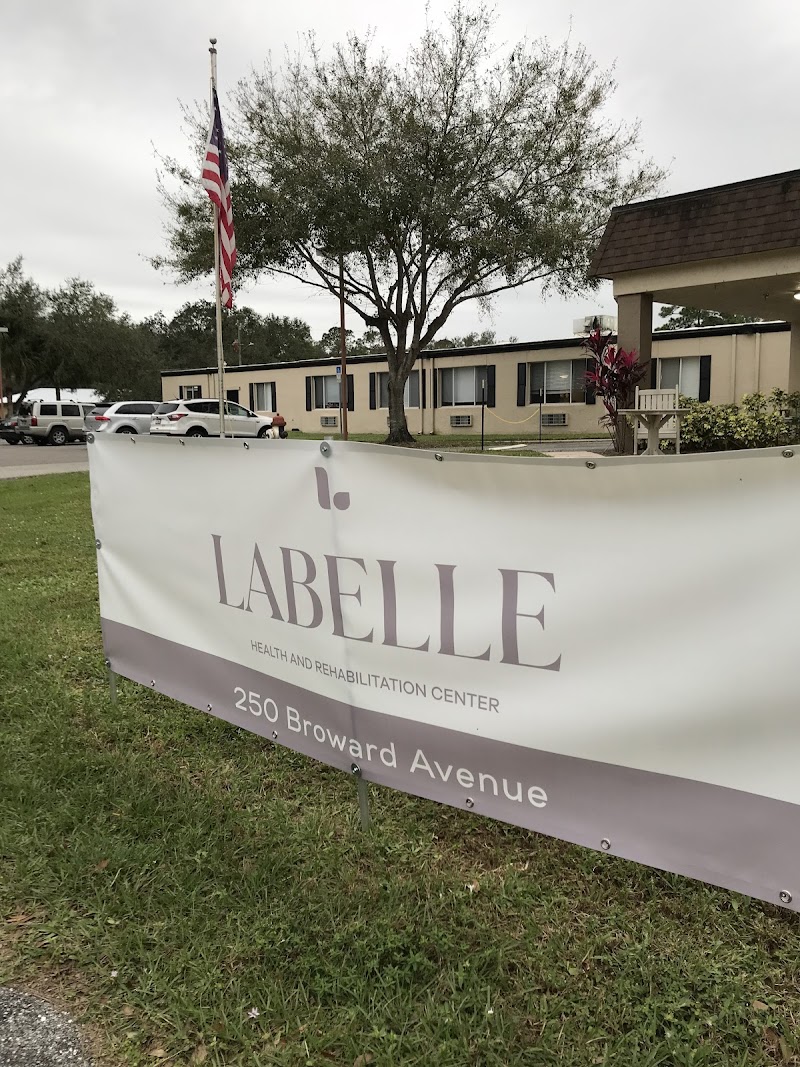
LABELLE HEALTH AND REHABILITATION CENTER


250 BROWARD AVE, LABELLE, FL 33935 (863) 675-1440
For profit - Limited Liability company 93 Beds SIMCHA HYMAN & NAFTALI ZANZIPER Data: November 2025
Trust Grade
95/100
#59 of 690 in FL
Last Inspection: May 2024

Within standard 12-15 month inspection cycle. Federal law requires annual inspections.

Overview

Labelle Health and Rehabilitation Center has an impressive Trust Grade of A+, indicating it is an elite facility and among the best in its category. It ranks #59 out of 690 nursing homes in Florida, placing it in the top half, and is the top facility in Hendry County, with only one other local option available. The facility is showing an improving trend, with issues decreasing from five in 2023 to just one in 2024. While staffing is a strength, rated at 4 out of 5 stars with a low turnover of 25%, there are still areas of concern; for example, three residents were found not receiving adequate personal hygiene care, and documentation of advanced directives was not accurately maintained for one resident. Despite these weaknesses, the absence of any fines and a high overall star rating of 5 out of 5 indicate that this facility generally provides quality care.

Trust Score
A+
95/100
In Florida
#59/690
Top 8%
Safety Record
Low Risk
No red flags
Inspections
Getting Better
5 → 1 violations
Staff Stability
✓ Good
25% annual turnover. Excellent stability, 23 points below Florida's 48% average. Staff who stay learn residents' needs.
Penalties
✓ Good
No fines on record. Clean compliance history, better than most Florida facilities.
Skilled Nurses
○ Average
Each resident gets 33 minutes of Registered Nurse (RN) attention daily — about average for Florida. RNs are the most trained staff who monitor for health changes.
Violations
○ Average
9 deficiencies on record. Average for a facility this size. Mostly minor or procedural issues.
★★★★★
5.0
Overall Rating
★★★★☆
4.0
Staff Levels
★★★★★
5.0
Care Quality
★★★★★
5.0
Inspection Score
Stable
2023: 5 issues
2024: 1 issues

The Good

  • 4-Star Staffing Rating · Above-average nurse staffing levels
  • 5-Star Quality Measures · Strong clinical quality outcomes
  • Low Staff Turnover (25%) · Staff stability means consistent care
  • Full Sprinkler Coverage · Fire safety systems throughout facility
  • No fines on record
  • Staff turnover is low (25%)

    23 points below Florida average of 48%

Facility shows strength in staffing levels, quality measures, staff retention, fire safety.

The Bad

Chain: SIMCHA HYMAN & NAFTALI ZANZIPER

Part of a multi-facility chain

Ask about local staffing decisions and management

The Ugly 9 deficiencies on record

May 2024 1 deficiency
CONCERN (D)

Potential for Harm - no one hurt, but risky conditions existed

ADL Care (Tag F0677)

Could have caused harm · This affected 1 resident

**NOTE- TERMS IN BRACKETS HAVE BEEN EDITED TO PROTECT CONFIDENTIALITY** Based on observation, review of facility policy and procedure, clinical record review, resident and staff interview, the facilit...

Read full inspector narrative →
**NOTE- TERMS IN BRACKETS HAVE BEEN EDITED TO PROTECT CONFIDENTIALITY** Based on observation, review of facility policy and procedure, clinical record review, resident and staff interview, the facility failed to provide the necessary care and services to maintain personal hygiene for 3 (Residents #45, #57 and #63) of 4 residents reviewed for activities of daily living. The findings included: The facility policy Activities of Daily Living (ADL) implemented 11/2020 (revised 11/22/21) documented, The facility will, based on the residents comprehensive assessment and consistent with the resident's needs and choices, ensure a resident's abilities in ADL's do not deteriorate unless deterioration is unavoidable . Care and services will be provided for the following activities of daily living : bathing, dressing, grooming and oral care. A resident who is unable to carry out activities of daily living will receive the necessary services to maintain good, nutrition, grooming and personal hygiene. 1. Review of the clinical record revealed Resident #45 had an admission date of 8/18/23 with diagnoses including chronic obstructive pulmonary disease, seizures, anxiety and obesity. The Significant Change Minimum Data Set (MDS) (standardized assessment tool that measures health status in nursing home residents) with an assessment reference date of 3/14/24 documented Resident #45 required partial to moderate assistance for personal hygiene, dressing and bathing. The MDS revealed Resident #45 did not demonstrate refusal of care. The MDS noted Resident #45's cognitive skills for daily decision making were intact. Review of the care plan initiated 8/19/23 specified Resident #45 required assistance with transfers, toileting, grooming, hygiene, dressing, and bathing. On 5/20/24 at 11:12 a.m., Resident #45 was observed in his bed wearing a blue T-shirt and shorts. He declined to answer any questions. He was unshaven with approximately one to two days of facial hair growth. On 5/21/24 at 9:22 a.m., Resident #45 was observed in bed wearing the same clothing as the previous day. He remained unshaven and his fingernails were noted to extend approximately ½ inch in length with a brown substance under the nails. Resident #45 did not respond when spoken to. On 5/21/24 at 11:30 a.m., Resident #45 was observed in bed, and able to answer simple questions. He said he was fine and said he takes himself from the wheelchair to the bed. He was unshaven and said, Yeah, I could use a shave. He said he thinks he was receiving his showers but was not certain. The resident was noted to have a slight foul body odor, and his hair was greasy. Review of the certified nursing assistant (CNA) daily documentation revealed Resident #45's scheduled shower days were Mondays, Wednesdays and Fridays on the 7:00 a.m., to 3:00 p.m., shift. The CNA documentation for April 2024 revealed Resident #45 refused scheduled showers on 4/3/34, 4/5/24, 4/8/24, 4/12/24, 4/15/24, 4/19/24, 4/24/24, 4/26/24. On 4/29/24 the documentation specified not applicable. The documentation showed Resident #45 received two scheduled showers on 4/1/24 and 4/22/24. Review of the CNA documentation for May 2024 documented on 5/1/24, 5/6/24, 5/10/24 and 5/20/24 documented Resident #45 refused his scheduled showers. On 5/3/24 the CNA documented the resident was not available. On 5/8/24 the CNA documented not applicable. Resident #45 received his scheduled showers on 5/15/24 and 5/17/24. 2. Review of the clinical record revealed Resident #57 had a readmission date of 1/17/23 with diagnoses including cerebral infarction with flaccid hemiplegia affecting the left side of the body. The Quarterly MDS dated [DATE] documented Resident #57 was dependent for bathing, toileting, dressing and personal hygiene. The MDS did not document rejection of care. The MDS noted Resident #57's cognitive skills for daily decision making were intact. On 5/20/24 at 10:44 a.m., Resident #57 was observed in his bed, he was unshaven approximately four days of facial hair growth. He said was not able to move his left hand and leg due to a stroke. His fingernails extended approximately ½ inch with a brown substance under the nails, and the skin surrounding the nail beds had a dry brown substance. The resident said, my nails need to be cut. He appeared unkempt; his hair was uncombed. On 5/21/24 at 8:44 a.m., Resident #57 was observed in his bed wearing a hospital gown. He said he gets up sometimes because he needs to use a lift to get into the wheelchair. He was unshaven, his fingernails remained with the brown substance under the nails and the skin surrounding the nails; he had a slight body odor of urine. Review of the CNA documentation for April 2024, and May 2024 showed Resident #57's scheduled shower days were on Tuesdays and Fridays during the 3:00 p.m., to 11:00 p.m., shift. On 4/2/24, 4/16/24, 5/10/24, 5/14/24, and 5/17/24, the CNA documented not applicable. On 4/5/24, 4/9/24, 4/12/24, 4/19/24, 4/23/24, 4/26/24, 4/30/24, 5/3/24, and 5/7/24, the CNA documented the resident refused scheduled showers. Resident #57 received no scheduled showers in April 2024, or from May 1, 2024, to May 17, 2024. On 5/22/24 at 10:14 a.m., in an interview CNA Staff C said Resident #57 does refuse showers. She said, If a resident refused I tell the nurse first and then I go back and offer it again. I try 3 times and if they refuse, I tell the nurse and I document it on the skin sheet that the resident refuses. On 5/22/24 at 10:27 a.m., in an interview Unit Manager Licensed Practical Nurse Staff A said all residents are offered a bed bath on each shift and the CNAs document it. Staff A retrieved Resident #57's electronic record of bed baths showing Resident #57 did not receive any bed baths. Staff A said, Well, it is documented as prn (as needed), not each shift but he received none. Staff A confirmed the lack of documentation that the resident received the scheduled showers for the month of April 2024, and from 5/1/24 to 5/17/24. The Unit Manager said, Well, he refuses, he is alert and oriented and it's his right. 3. Review of the clinical record revealed Resident #63 had an admission date of 1/5/24 with diagnoses including Alzheimer's, dementia, hemiplegia and hemiparesis following cerebral infarction affecting the right side of the body and mixed expressive and receptive language disorder. Review of the Quarterly MDS with a target date of 4/4/24 documented the resident was dependent for toileting, dressing and bathing. The MDS noted Resident #63's cognitive skills for daily decision making were moderately impaired and documented no rejection of care. On 5/20/24 at 11:05 a.m., in an interview, Resident #63's family member said, My mother is not being showered. I know she likes to refuse but her hair has been greasy like this for three weeks now. I told the nurse, but nothing was done. Her nails have not been cut or cleaned. Resident #63's fingernails were observed to be approximately jagged, extended approximately 1/2 inch in length with a brown substance under the nails. Her hair was long and greasy. Resident #63 did not respond to any questions. Her daughter said the resident rarely speaks anymore. On 5/21/24 at 8:57 a.m., Resident #63 was observed in the activity room watching the television. Resident #63 had her hair pulled back in a hair clip. Her hair was greasy and her fingernails had not been cleaned or trimmed. Review of the CNA documentation showed the residents shower days were Tuesdays and Fridays on the 7;00 a.m., to 3:00 p.m., shift. Review of the CNA documentation for April 2024 documented not applicable on 4/5/24 and 4/9/24. On 4/16/24 and 4/19/24 the documentation specified the resident refused the scheduled showers. On 4/12/24 and 4/30/24 the resident received a bed bath in place of her shower. The documentation showed the resident received her scheduled showers on 4/2/24, 4/23/24 and 4/26/24. Review of the CNA documentation for May 1, 2024, to May 17, 2024, documented Resident #63 received a scheduled shower on 5/10/24 and 5/14/24. On 5/22/24 at 9:21 a.m., in an interview the Director of Nursing (DON) explained the codes on the CNA shower sheets and said if a resident refuses a shower they are offered it again. The DON was not able to provide documentation the residents were offered showers once they refused. On 5/22/24 at 9:25 a.m., Staff A said, I spoke with her daughter, she knows her mother refuses showers. The resident does not smell and when her hair looks greasy then I say ok it's time. Her nails are long because sometimes she lets me trim them and sometimes, she doesn't. Staff A said, The CNAs complete the skin sheets for each scheduled shower and turn them in everyday even if the resident refuses. This writer requested to review the shower sheets for April to May 22, 2024, and Staff A provided a total of four CNAs shower sheets. Review of the form identified as skin check form showed on 4/ 2/24 a shower was provided. On 4/5/25 and 5/9/24 documented not applicable. On 4/12/24 a bed bath was documented. On 4/16/24 and 4/19/24 documented refusal. On 4/23/24 and 4/26/24 a shower was documented. On 4/30/24 a bed bath was documented. Review of CNA documentation with Staff A confirmed Resident #63 received only five scheduled showers from 4/1/24 to 5/17/24.
Feb 2023 5 deficiencies
CONCERN (D)

Potential for Harm - no one hurt, but risky conditions existed

Deficiency F0578 (Tag F0578)

Could have caused harm · This affected 1 resident

**NOTE- TERMS IN BRACKETS HAVE BEEN EDITED TO PROTECT CONFIDENTIALITY** Based on record review, staff interview and family interview, the facility failed to ensure advanced directives were accurately ...

Read full inspector narrative →
**NOTE- TERMS IN BRACKETS HAVE BEEN EDITED TO PROTECT CONFIDENTIALITY** Based on record review, staff interview and family interview, the facility failed to ensure advanced directives were accurately documented in the clinical record for 1 (Resident #29) of 3 residents reviewed for Advanced Directives from a total sample of 29 residents reviewed. This failure could impact quality of care at the end of life for the residents. The findings included: Review of Resident #29's Order Summary Report as of [DATE] revealed a Full Code order on [DATE], indicating the facility would initiate cardiopulmonary resuscitation (CPR) if Resident #29's heart stopped or if the resident stopped breathing. Review of Resident #29's Care Plan initiated on [DATE] revealed the Care Plan matched the Order Summary noting Resident #29 was a Full Code. Review of Resident #29's electronic health record revealed a Determination of Incapacity on [DATE] and a Health Care Surrogacy on [DATE]. A Do Not Resuscitate (DNR) order was signed by the Health Care Surrogate on [DATE]. This DNR order conflicted with Resident #29's Care Plan and the Order Summary Report (both indicating Resident #29 was a Full Code). On [DATE] at 8:41 a.m., during a telephone conversation with Resident #29's Health Care Surrogate, she said Resident #29 was incapacitated and unable to make any of his health care decisions. She confirmed she was the Health Care Surrogate and that she signed the DNR paper for Resident #29 on [DATE]. On [DATE] at 10:05 a.m., Social Services Director (SSD) Staff S said she's worked at the facility for approximately one year and has been a social worker for 3 years. She said she is responsible for auditing the residents' electronic health records for Code Status accuracy. Staff S verified the discrepancy between the Order Summary, Care Plan and the DNR order (indicating Resident #29 was not to be resuscitated.) Staff S said the Care Plan did not contain accurate information.
CONCERN (D)

Potential for Harm - no one hurt, but risky conditions existed

ADL Care (Tag F0677)

Could have caused harm · This affected 1 resident

Based on observations, record review, review of policies and procedures, resident and staff interviews, the facility failed to ensure 1 (Resident #39) of 3 residents reviewed for continuous activities...

Read full inspector narrative →
Based on observations, record review, review of policies and procedures, resident and staff interviews, the facility failed to ensure 1 (Resident #39) of 3 residents reviewed for continuous activities of daily living (ADLs) received completed care on a routine basis. The findings included: On 1/30/23 at 2:15 p.m., Resident #39 was observed in his bed wearing a hospital gown. Via observation Resident #39's hair appeared uncombed, and his fingernails were long, extending approximately one quarter of an inch from the base, uneven, and had dark matter underneath each nail. On 1/30/23 at 2:15 p.m., Resident #39 said he doesn't remember the last time staff washed and comb his hair and doesn't remember the last time staff trimmed and cleaned under his fingernails. On 1/31/23 review of Resident #39's medical records revealed his most recent admission date was 12/6/2022. Resident #39's plan of care for ADLs had a revision date of 12/14/22 and stated Resident #39 required assistance for most ADLs. Resident #39 required extensive assistance with bed mobility, transfers, toileting, grooming/hygiene, and bathing. On 1/31/23 at 10:38 a.m., Resident #39's son said since admission he had noted his father's hair had not been washed and combed and his father's fingernails were long and uneven with dark black matter under each fingernail. He said he had asked the nursing staff who was responsible to cut his father's hair and fingernails and the staff told him, it was the family's responsibility to cut his father's hair, and trim and clean his father's toenails and fingernails. On 1/31/23 review of the Certified Nursing Assistant (CNA) job description dated April 2020; the summary stated the CNAs were to perform direct resident care under supervision of licensed nursing personnel. One of the CNAs job duties and responsibilities were to provide personal care (i.e., grooming, bathing, dressing, oral care, etc ) of residents daily and as needed. On 1/31/23 review of the undated Activities of Daily Living (ADLs) policy, it stated care and services would be provided for the following activities of daily living to include bathing, dressing, grooming and oral care. On 1/31/23 review of the undated Care of Fingernails/Toenails policy, it stated the purpose of fingernails and toenails care is to clean the resident's nail bed, and to keep the nails trimmed/to prevent infections. On 2/2/23 at 9:48 a.m., CNA Staff T said Resident #39 was cooperative and did not refuse his daily routine ADL care. She confirmed part of routine resident's ADL care included resident nail care. She said she didn't remember when ADL nail care was completed for Resident #39. On 2/2/23 at 10:00 a.m., Licensed Practical Nursing (LPN), Staff D said the resident daily ADL care included nail care. On 2/2/23 at 10:05 a.m., Staff D's observation of Resident #39's fingers confirmed Resident #39's fingernails were very long, uneven, with a dark substance under each of Resident #39's fingernails. She said it appeared Resident #39's fingernails had not been trimmed or cleaned in a long time. On 2/2/23 at 10:30 a.m., the DON said the CNA's Job Description, the policy for Care of Fingernails and Toenails, and Activities of Daily Living stated the nursing staff were required to ensure each resident's ADL care to include fingernail and toenail care.
CONCERN (D)

Potential for Harm - no one hurt, but risky conditions existed

Quality of Care (Tag F0684)

Could have caused harm · This affected 1 resident

**NOTE- TERMS IN BRACKETS HAVE BEEN EDITED TO PROTECT CONFIDENTIALITY** Based on observation, record review and staff interview, the facility failed to coordinate care and ensure 1 (Resident #33) of 1...

Read full inspector narrative →
**NOTE- TERMS IN BRACKETS HAVE BEEN EDITED TO PROTECT CONFIDENTIALITY** Based on observation, record review and staff interview, the facility failed to coordinate care and ensure 1 (Resident #33) of 1 sampled resident receiving intravenous antibiotics received care and services in accordance with professional standards of care and the physician's orders. The findings included: Resident #33 was admitted to the facility on [DATE] with diagnoses including a right sided mastectomy (surgical removal of the breast). The physician's orders with an effective date of 11/25/22 specified, No Blood Pressures or Blood Draw to right arm. Review of the progress notes revealed documentation Resident #33's blood pressure was taken on the right arm on 12/8/22, 12/9/22, 12/10/22, 12/11/22, 12/14/22, 12/16/22 and 12/17/22. On 1/30/23 at 2:00 p.m., Licensed Practical Nurse (LPN) Staff D was observed administering an intravenous antibiotic to Resident #33 through a midline catheter (catheter inserted in the upper arm with the tip located just below the axilla) inserted into the resident's right arm. On 1/31/23 at 9:36 a.m., resident #33 was observed awake, lying on her back, with a midline catheter in her right upper arm. Resident #33 was not able to answer any question related to the midline catheter. On 1/31/23 at 12:03 p.m., the nurse documented in a progress note Resident #33's right upper arm was edematous (swollen). The midline was pulled from the right arm without difficulty. On 2/1/23 at 9:34 a.m., LPN Staff D stated she was aware of the physician's order specifying, no blood pressures or blood draws on the right arm due to the mastectomy to the right side. On 2/1/23 at 9:53 a.m., the attending physician stated it was preferable not to do anything to the affected side (right mastectomy) such as blood pressure or blood draws unless we don't have a choice. On 2/1/23 at 10:25 a.m., the Advanced Practice Registered Nurse (APRN) said standards of practice would be to avoid placing a midline catheter on the affected side. She said she was not notified of the swelling to the resident's right upper arm. On 2/1/23 at 11:47 a.m., the Minimum Data Set (MDS) Coordinator verified Resident #33's care plan and the [NAME] (Information of needs for each resident) did not reflect the right side mastectomy and the physician's orders for no blood pressure or blood draws to the right arm. She said, It is absolutely fair to say it should be on the care plan and I'll add it now. On 2/1/23 at 12:41 p.m., in a telephone interview Registered Nurse Staff P who inserted the midline catheter said the facility nurse did not inform her Resident #33 had a previous right side mastectomy. She said, if a resident has had a mastectomy, I can't insert the intravenous line on that side. On 2/1/23 at 3:20 p.m., The Director of Nursing (DON) verified the order for no blood pressures or blood draws had been in place to flag the nurses not to use the right side to obtain vital signs, including blood pressure.
CONCERN (D)

Potential for Harm - no one hurt, but risky conditions existed

Deficiency F0688 (Tag F0688)

Could have caused harm · This affected 1 resident

**NOTE- TERMS IN BRACKETS HAVE BEEN EDITED TO PROTECT CONFIDENTIALITY** Based on observation, interview, and record review, the facility failed to implement care and services to prevent a decline in r...

Read full inspector narrative →
**NOTE- TERMS IN BRACKETS HAVE BEEN EDITED TO PROTECT CONFIDENTIALITY** Based on observation, interview, and record review, the facility failed to implement care and services to prevent a decline in range of motion for 1 (Resident #6) of 1 resident reviewed for the application of a splinting device. The findings included: Review of Resident #6's quarterly Minimum Data Set (MDS) dated [DATE] revealed resident #6 had paralysis on the left side of his body, required extensive assistance with dressing, and was cognitively intact with a Brief Interview for Mental Status (BIMS) of 15. Review of Resident #6's Order Summary Report as of 2/2/2023 revealed an active physician's order, As of 8/9/22, elbow splint to be worn 2 hours daily on the left elbow every day shift. Review of Resident #6's Activities of Daily Living (ADL) Care Plan initiated on 6/5/22 revealed the resident required extensive assistance for bed mobility and dressing. There were no goals or interventions for applying the splint. Review of Resident #6's Care Plans did not indicate Resident #6 refused to wear the splint. Review of Resident #6's Task List Report dated 2/2/23 (a list of tasks for the Certified Nursing Assistant) did not include applying the splint. Review of Resident #6's Treatment Administration Record for January 2023 and February 2023 revealed nursing signed-off the left elbow splint was applied on 1/30/23, 1/31/23, 2/1/23, and 2/2/23. On 1/30/23 at 10:35 a.m., Resident #6 was observed in his bed, not wearing his splint. His left elbow was bent, and his hand was near his chest. He verified he could not move his left arm and the position of the elbow was permanent. Resident #6 said the facility had an elbow splint made for him, but staff do not apply the splint, and it has been a long time since he wore it. Resident #6 said he does not refuse to wear the splint and cannot apply it himself. The resident said there was a Certified Nursing Assistant (CAN) who used to work at the facility and applied the brace for him every day. On 1/31/23 at 9:29 a.m., 2/1/23 at 11:11 a.m., 2/2/23 at 8:55 a.m., 2/2/23 at 3:00 p.m. and 4:04 p.m., Resident #6 was observed in his bed, not wearing his splint. During those observations, Resident #6 reiterated staff were not applying the splint or asking him to apply it. A splint was observed on the resident's nightstand. Photographic evidence obtained. On 2/1/23 at 11:30 a.m., the Occupational Therapist (OT) Staff I said Resident #6 was discharged from therapy in December 2022 and therapy does not apply the splint. He said Resident #6 was referred to the Restorative Nursing Program. The Occupational Therapist said daily wearing of the splint would not repair the left elbow contracture, but it would help to prevent further tightening of the muscles involved in the contracture. Review of the Occupational Therapy (OT) Discharge Recommendations and Status signed by OT Staff I on 12/14/22 revealed the Restorative Nursing Program was not indicated at this time. On 2/2/23 at 1:18 p.m. Certified Nursing Assistant (CNA) Staff J said she was familiar with Resident #6 and was assigned to him from 7:00 a.m. to 3:00 p.m. Staff J said she did not know Resident #6 had a splint because it was not on her task list and the nurse did not tell her to apply it. On 2/2/23 at 1:39 p.m., Restorative CNA Staff K said Resident #6 was not in the Restorative Nursing Program and the CNA assigned to Resident #6 should apply the splint. On 2/2/23 at 3:12 p.m. Licensed Practical Nurse Staff M said she was assigned Resident #6 this week and did not apply the splint or instructed the CNA to apply it. She said she signed off on the Treatment Administration Record (TAR) the splint was applied but did not see the resident wear it. On 2/2/23 at 3:28 p.m., CNA Staff G said she was assigned to Resident #6 on 2/1/22, and she did not apply the splint to Resident #6's left elbow. She said the nurse did not tell her to apply the splint and she does not know where it is. On 2/2/23 at 3:55 p.m., LPN Unit Manager Staff C said she is responsible for updating and adding care plans according to resident needs and physician orders. Staff C reviewed Resident #6's Care Plans and verified they did not include interventions for applying the splint. Staff C reviewed Resident #6's Order Summary Report and verified the order for daily day shift application of Resident #6's left elbow splint. Staff C acknowledged the Care Plans were not reflective of the physician orders. On 2/2/23 at 4:04 p.m., Registered Nurse Staff N said he was assigned to Resident #6 and did not apply the splint. He said he did not tell the CNA to apply the splint or see the Resident #6 wearing the splint. He said he signed the TAR today indicating Resident #6 wore the splint even though the resident had not.
CONCERN (D)

Potential for Harm - no one hurt, but risky conditions existed

Deficiency F0726 (Tag F0726)

Could have caused harm · This affected 1 resident

Based on clinical record review, review of the Florida Board of Nursing requirement for intravenous administration for Licensed Practical Nurses, and staff interview the facility failed to ensure 1 (L...

Read full inspector narrative →
Based on clinical record review, review of the Florida Board of Nursing requirement for intravenous administration for Licensed Practical Nurses, and staff interview the facility failed to ensure 1 (Licensed Practical Nurse Staff D) of 3 Licensed Practical Nurses reviewed had the required certification and competency prior to administer Intravenous Medication. The findings included: The Florida Board of Nursing Chapter 64B9-12, Administration of intravenous therapy by Licensed Practical Nurses noted the course necessary to qualify a licensed practical nurse or graduate practical nurse to administer IV (Intravenous) therapy shall be not less than thirty (30) hour post-graduate level course teaching aspects of IV therapy with content as specified by the Board of Nursing. Review of the clinical record for Resident #33 showed on 1/26/23 a midline catheter (catheter inserted in the upper arm with the tip located just below the axilla) was inserted into the resident's right arm to administer intravenous (IV) antibiotics for an infected wound. On 1/30/23 at 2:00 p.m., Licensed Practical Nurse (LPN) Staff D was observed administering an intravenous antibiotic to Resident #33 through a midline catheter inserted in the resident's right arm. On 2/1/23 at 9:34 a.m., LPN staff D stated she had completed her IV competency training a long time ago but did not have record of the certification. On 2/2/23 at 11:53 a.m., The Assistant Director of Nursing (ADON) stated LPNs are required to complete a 30 hours IV certification in Florida to administer intravenous medications. On 2/2/23 at 12:26 p.m., the Director of Nursing (DON) said she was unable to provide documentation LPN Staff D completed the required training, or competency to administer intravenous medications.
Jun 2021 3 deficiencies
CONCERN (D)

Potential for Harm - no one hurt, but risky conditions existed

Deficiency F0688 (Tag F0688)

Could have caused harm · This affected 1 resident

**NOTE- TERMS IN BRACKETS HAVE BEEN EDITED TO PROTECT CONFIDENTIALITY** Based on observation, record review, staff and resident interviews the facility failed to follow physician's orders and consiste...

Read full inspector narrative →
**NOTE- TERMS IN BRACKETS HAVE BEEN EDITED TO PROTECT CONFIDENTIALITY** Based on observation, record review, staff and resident interviews the facility failed to follow physician's orders and consistently implement therapy recommendations to prevent a decrease in range of motion for 1 (Resident # 49) of 3 residents reviewed with limited range of motion. The findings included: The facility's Policy titled Prevention of Decline in Range of Motion implemented on 11/3/2020 and revised 3/2021 noted . Residents who exhibit limitations in range of motion, initially and thereafter, will be referred to the therapy department for a focused assessment of range of motion . Based on the comprehensive assessment, the facility would provide interventions, exercises and/or therapy to maintain or improve range of motion. The facility would provide treatment and care in accordance with professional standards of practice. This included but was not limited to: 1. Appropriate services (specialized rehabilitation, restorative, maintenance). 2. Appropriate equipment (braces or splints). 3. Assistance as needed (active assisted, passive, supervision) . A nurse with responsibility for the resident will monitor for consistent implementation of the care plan interventions. Review of the Quarterly Minimum Data Set (MDS) dated [DATE] revealed Resident #49 scored 15 on the Brief Interview for Mental Status (BIMS), indicating intact cognition and did not reject care. Resident #49 required extensive assistance with all Activities for Daily Living (ADL) except eating. Resident #49 had a diagnosis of hemiplegia or hemiparesis (muscle weakness or partial paralysis) affecting one side of her body. Resident #49 received occupational therapy from 3/4/21 through 5/13/21. The Physician's order summary report dated 5/28/21 included an order dated 5/19/21 for Resident #49 to wear a left upper extremity (LUE) splint in the daytime and off at hours of sleep (HS) as tolerated. Resident #49 also had an active order dated 5/12/21 for a Restorative Nursing Program (RNP) splint program. The Care Plan initiated on 2/5/21 noted Resident #49 had a diagnosis cerebrovascular accident (CVA) with hemiparesis of left side and required extensive assistance with activities of daily living (ADLs). The goals initiated on 5/12/21 included to maintain level of range of motion (ROM) to LUE. The listed interventions dated 5/12/21 included the Certified Nursing Assistant (CNA) to encourage the resident to participate in RNP splint program. The interventions initiated on 5/19/21 included to wear LUE splint in the daytime and off at HS as tolerated. The care plan included specific directions of how to apply the splint during the day and off at HS. The occupational therapy (OT) evaluation and plan of treatment for certification period 3/4/21 through 4/2/21 noted Resident #49's long-term goals included safe wear of a functional splint to position LUE left fingers and left wrist for up to seven hours to decrease developing contractures (Shortening and hardening of tissues leading to rigidity of joint) and improve quality of life. The OT Discharge summary dated [DATE] noted Resident #49 would safely wear a functional splint to position LUE left fingers, left hand, and left wrist for up to seven hours to decrease developing contractures and improve quality of life. The summary noted Resident #49 was discharged to a RNP with instructions on don (applying)/doffing (removing) the splint. The purpose of the splint for the LUE was to prevent further fixing contractures and soft tissue tightness, simple ADLs, and functional transfers. The discharge summary was signed by OT Staff S . The therapy referral for restorative nursing program care giver instructions for Resident #49 dated 5/12/21 noted the overall goal of the restorative program was to improve/maintain range of motion on LUE to decrease potential fixing contractures and further soft tissue tightness. On 6/21/21 at 10:30 a.m., Resident #49 was observed in bed, awake, and alert. She said she had a stroke that affected her left side. She pulled her left hand from below her blanket to display contractures of her left wrist, hand, thumb and four fingers. Resident #49 was not wearing a splint and said staff did not assist her with it. On 6/23/21 at 10:47 a.m., Resident #49 was in her room in bed, awake, and alert. She was not wearing a splint on her left hand. She said staff did not assist her to wear the splint yesterday or today and she could not apply it herself. She pointed to the splint on her nightstand. She said when she was getting therapy, the therapist applied the splint for her, but she was discharged from therapy over a month ago. She said the splint did not bother her and she wanted to wear it. *Photographic Evidence Obtained * On 6/23/21 at 2:23 p.m., Certified Nursing Assistant (CNA) Staff R said he had taken care of Resident #49 a lot. He said there was never a time when Resident #49 refused care or did not like to get out of bed. He checked the CNA [NAME] (Instructions to safely care for residents) system on the wall. He said according to the computer, Resident #49 refused to wear the splint today. On 6/23/21 at 2:42 p.m., in an interview CNA Staff J said she took care of Resident #49 today and she refused to wear her splint or get out of bed. On 6/24/21 at 9:50 a.m., Resident #49 was observed in her room. She was not wearing the splint and said staff did not assist her with it. On 6/24/21 at 9:55 a.m., in an interview OT Staff S said she worked with Resident #49 and created the splint for the Resident #49's left hand contracture. She said Resident #49 completed therapy and the referral to the Restorative Nursing Program (RNP) was made on 5/12/21. She said the resident was agreeable to the splint and motivated to wear the splint to keep the contractures from progressing. OT Staff S said she instructed the nursing staff on the purpose of the splint and how to apply it. OT Staff S said Resident #49 required staff assistance to apply the splint and facility staff should be applying the splint every day. On 6/24/21 at 10:00 a.m., observed OT Staff S into Resident #49's room. She confirmed the splint was not on Resident #49's hand. She said staff must apply the brace daily or the fingers will tighten. She said Resident #49's fingers and wrist were beginning to tighten. OT Staff S used a warm damp towel to massage Resident #49's left hand and fingers open and applied the splint to the resident's hand. She confirmed Resident #49 was motivated to wear the splint when she was discharged from therapy. She said it was staffs' responsibility to ensure residents wear their splints once the resident was discharged from therapy. On 6/24/21 at 11:09 a.m., Licensed Practical Nurse (LPN) Staff M said she had been the unit manager since February 2020, and was responsible for Resident #49. She said she was aware of Resident #49's left hand contracture and the physician's order to wear the splint every day. She said it was the CNA's responsibility to assist Resident #49 with the splint every day. LPN Staff M provided the CNA task print-out for the month. She said according to the printout, Resident #49 wore the splint for a total of 50 minutes over the last 30 days. LPN Staff M said there was only one progress note where Resident #49 refused the RNP on 6/23/21. LPN Staff M said she has been to Resident #49's room during the day when she was not wearing the splint, but she did not ask the resident about it or assist Resident #49 to wear it.
CONCERN (D)

Potential for Harm - no one hurt, but risky conditions existed

Incontinence Care (Tag F0690)

Could have caused harm · This affected 1 resident

Based on record review, observation, staff and resident interviews, the facility failed to have documentation of appropriate care and services to manage and prevent complication of indwelling catheter...

Read full inspector narrative →
Based on record review, observation, staff and resident interviews, the facility failed to have documentation of appropriate care and services to manage and prevent complication of indwelling catheter for 1 (Resident #8) of 1 resident with urinary tract infection. The findings included: The facility's policy titled Catheter Care with a revised date of March 2021, stated, It is the policy of this facility to ensure that residents with indwelling catheters receive appropriate catheter care and maintain their dignity and privacy when indwelling catheters are in use. The policy explanation stated, Catheter care will be performed every shift and as needed by nursing personnel. Document care and report any concerns noted to the nurse on duty. On 6/21/21 at 2:45 p.m., Resident #8 was observed in bed with a Foley Catheter ( Indwelling Catheter inserted in the bladder to drain urine) with a urine collection leg bag strapped to the right leg. Review of Resident #8 clinical record showed a readmission date of 6/18/21 with active diagnoses including, urinary tract infection (UTI) and sepsis (bacteria in the bloodstream). The current physician's orders for June 2021 included two different intravenous antibiotics for bacteremia (bacteria in the blood stream) and UTI. The physician's orders did not include catheter care. Review of the progress notes revealed on 6/19/21 at 2:48 a.m., and 6/20/21 at 4:02 a.m., the nurse documented Foley care given as ordered. No other entry was found in the progress notes or the Treatment Administration Record (TAR) from 6/18/21 through 6/21/21 of nursing interventions related to catheter care. On 6/22/21 at 4:23 p.m., in an interview Licensed Practical Nurse (LPN) Staff A confirmed Resident #8 had an indwelling urinary catheter (Foley catheter). LPN Staff A said, All residents with urinary catheters get catheter care each shift and when completed we document the care in the TAR for the resident. On 6/22/21 at 4:40 p.m., in an interview LPN Staff N said she was unable to find any urinary catheter orders, interventions, or urinary catheter documentation on the TAR for Resident #8. LPN Staff N said, She should have had orders and documentation entered. On 6/22/21 at 4:52 p.m., in an interview the Director of Nursing (DON) said she was unable to find documentation on Resident #8's TAR for catheter care from 6/18/21 to 6/21/21. The DON said, It is expected to have the catheter care documentation each shift and the orders for the indwelling catheter entered on readmission to the facility. On 6/23/21 at 11:07 a.m., in an interview Unit Manager Staff L confirmed Resident #8 was currently on two antibiotics for a urinary tract infection and bacteremia.
CONCERN (D)

Potential for Harm - no one hurt, but risky conditions existed

Medical Records (Tag F0842)

Could have caused harm · This affected 1 resident

**NOTE- TERMS IN BRACKETS HAVE BEEN EDITED TO PROTECT CONFIDENTIALITY** Based on record review and staff and resident interview the facility failed to have a complete medical record including advance ...

Read full inspector narrative →
**NOTE- TERMS IN BRACKETS HAVE BEEN EDITED TO PROTECT CONFIDENTIALITY** Based on record review and staff and resident interview the facility failed to have a complete medical record including advance directives documentation for 1 (Resident #376) of 13 residents reviewed for advance directives. This has the potential to lead to confusion as to the proper care to be delivered. The findings included: The facility's policy titled Residents' Rights Regarding Treatment and Advance Directives dated 11/2020 and revised 3/2021 stated, It is the policy of this facility to support and facilitate a resident's right to request, refuse, and/or discontinue medical or surgical treatment and to formulate advance directives. The Policy Guidelines stated, On admission, the facility will determine if the resident has executed an advance directive, and if not, determine whether the resident would like to formulate an advance directive . Upon admission, should the resident have an advance directive, copies will be made and placed on the chart as well as communicated to staff. On [DATE] at 12:25 p.m., clinical record review revealed Resident #376 was admitted to the facility on [DATE]. Resident #376 was a Hospice patient, and the code status (refers to the level of medical interventions a person wishes to have started if their heart or breathing stops) was listed as Do Not Resuscitate (DNR). There was no yellow DNR form in the clinical record to identify Resident #376's wish to not be resuscitated in the event of respiratory or cardiac arrest. On [DATE] at 12:30 p.m., Licensed Practical Nurse (LPN) Staff M said the DNR forms were kept in the hard chart. On [DATE] at 3:20 p.m., LPN Staff A stated she would check paper chart for yellow DNR. If it was not on chart, she would check EMR for doctor's order. On [DATE] at 3:21 p.m., LPN Staff O stated, we go by the yellow DNR an original order in the chart. If there is no yellow in the chart or in the computer, you start CPR (cardiopulmonary resuscitation). On [DATE] at 3:22 p.m., Staff P LPN stated, we go to the chart and look for the yellow DNR form and we look at the order. On [DATE] at 3:25 p.m., in an interview the Director of Nursing said in case of cardiac arrest her nurses were trained to look in the chart for the yellow DNR. If not in the chart, they would verify by checking doctors' orders. If it was a verbal order, it must be signed by two Registered Nurses. On [DATE] at 3:28 p.m. Registered Nurse/Staffing Educator Staff Q said the nurses completed an advanced directive course on the computer. She said, We look for the yellow paper in the chart and an order. The computer will say do not resuscitate, but if we do not have that, we would do CPR.
Understanding Severity Codes (click to expand)
Life-Threatening (Immediate Jeopardy)
J - Isolated K - Pattern L - Widespread
Actual Harm
G - Isolated H - Pattern I - Widespread
Potential for Harm
D - Isolated E - Pattern F - Widespread
No Harm (Minor)
A - Isolated B - Pattern C - Widespread

Questions to Ask on Your Visit

  • "Can I speak with families of current residents?"
  • "What's your RN coverage like on weekends and overnight?"

Our Honest Assessment

Strengths
  • • Grade A+ (95/100). Above average facility, better than most options in Florida.
  • • No major safety red flags. No abuse findings, life-threatening violations, or SFF status.
  • • No fines on record. Clean compliance history, better than most Florida facilities.
  • • 25% annual turnover. Excellent stability, 23 points below Florida's 48% average. Staff who stay learn residents' needs.
Concerns
  • • No significant concerns identified. This facility shows no red flags across CMS ratings, staff turnover, or federal penalties.
Bottom line: Generally positive indicators. Standard due diligence and a personal visit recommended.

About This Facility

What is Labelle Center's CMS Rating?

CMS assigns LABELLE HEALTH AND REHABILITATION CENTER an overall rating of 5 out of 5 stars, which is considered much above average nationally. Within Florida, this rating places the facility higher than 99% of the state's 100 nursing homes. This rating reflects solid performance across the metrics CMS uses to evaluate nursing home quality.

How is Labelle Center Staffed?

CMS rates LABELLE HEALTH AND REHABILITATION CENTER's staffing level at 4 out of 5 stars, which is above average compared to other nursing homes. Staff turnover is 25%, compared to the Florida average of 46%. This relatively stable workforce can support continuity of care.

What Have Inspectors Found at Labelle Center?

State health inspectors documented 9 deficiencies at LABELLE HEALTH AND REHABILITATION CENTER during 2021 to 2024. These included: 9 with potential for harm.
Who Owns and Operates Labelle Center?

LABELLE HEALTH AND REHABILITATION CENTER is owned by a for-profit company. For-profit facilities operate as businesses with obligations to shareholders or private owners. The facility is operated by SIMCHA HYMAN & NAFTALI ZANZIPER, a chain that manages multiple nursing homes. With 93 certified beds and approximately 86 residents (about 92% occupancy), it is a smaller facility located in LABELLE, Florida.

How Does Labelle Center Compare to Other Florida Nursing Homes?

Compared to the 100 nursing homes in Florida, LABELLE HEALTH AND REHABILITATION CENTER's overall rating (5 stars) is above the state average of 3.2, staff turnover (25%) is significantly lower than the state average of 46%, and health inspection rating (5 stars) is much above the national benchmark.

What Should Families Ask When Visiting Labelle Center?

Based on this facility's data, families visiting should ask: "Can I visit during a mealtime to observe dining assistance and food quality?" "How do you handle medical emergencies, and what is your hospital transfer rate?" "Can I speak with family members of current residents about their experience?"

Is Labelle Center Safe?

Based on CMS inspection data, LABELLE HEALTH AND REHABILITATION CENTER has a clean safety record: no substantiated abuse findings (meaning no confirmed cases of resident harm), no Immediate Jeopardy citations (the most serious violation level indicating risk of serious injury or death), and is not on the Special Focus Facility watch list (a federal program monitoring the lowest-performing 1% of nursing homes). The facility has a 5-star overall rating and ranks #1 of 100 nursing homes in Florida. While no facility is perfect, families should still ask about staff-to-resident ratios and recent inspection results during their visit.

Do Nurses at Labelle Center Stick Around?

Staff at LABELLE HEALTH AND REHABILITATION CENTER tend to stick around. With a turnover rate of 25%, the facility is 21 percentage points below the Florida average of 46%. Low turnover is a positive sign. It means caregivers have time to learn each resident's needs, medications, and personal preferences. Consistent staff also notice subtle changes in a resident's condition more quickly. Registered Nurse turnover is also low at 17%, meaning experienced RNs are available to handle complex medical needs.

Was Labelle Center Ever Fined?

LABELLE HEALTH AND REHABILITATION CENTER has no federal fines on record. CMS issues fines when nursing homes fail to meet care standards or don't correct problems found during inspections. The absence of fines suggests the facility has either maintained compliance or corrected any issues before penalties were assessed. This is a positive indicator, though families should still review recent inspection reports for the full picture.

Is Labelle Center on Any Federal Watch List?

LABELLE HEALTH AND REHABILITATION CENTER is not on any federal watch list. The most significant is the Special Focus Facility (SFF) program, which identifies the bottom 1% of nursing homes nationally based on persistent, serious quality problems. Not being on this list means the facility has avoided the pattern of deficiencies that triggers enhanced federal oversight. This is a positive indicator, though families should still review the facility's inspection history directly.