SERIOUS
(G)
Actual Harm - a resident was hurt due to facility failures
Deficiency F0806
(Tag F0806)
A resident was harmed · This affected 1 resident
**NOTE- TERMS IN BRACKETS HAVE BEEN EDITED TO PROTECT CONFIDENTIALITY** Based on observations, interviews, and record review the facility failed to ensure dietary allergies and dietary preferences wer...
Read full inspector narrative →
**NOTE- TERMS IN BRACKETS HAVE BEEN EDITED TO PROTECT CONFIDENTIALITY** Based on observations, interviews, and record review the facility failed to ensure dietary allergies and dietary preferences were honored for four residents (#146, #37, #101, #11) out of five residents reviewed for nutritional services. These failures resulted in emotional harm to one resident (#146) resulting in a discharge against medical advice (AMA), and potential harm due to food allergies to two residents (#37, #11) when the wrong dietary trays were served on multiple occasions. Finding included:
1) During an interview on 07/21/2025 at 10:00 a.m., Resident #146 stated, “I am leaving today, I cannot do this anymore. They always bring me food that I don't eat. Saturday, I went hungry because when they brought my tray it had bacon on it. I have talked to them; my family even came down from Canada to talk to them. I am a vegetarian and don’t eat any kind of meat. I asked them to get beans, and they cannot do that. I filed a grievance, but the Unit Manager wrote it, and it was not in my own words. They make me seem more senile than I am. I would rather go home and live by myself and risk my friends and family finding me before I stay in this place any longer. Someone will find me before I start to stink.” During the interview, Resident #146’s eyes were observed to be red, swollen and watering. Resident #146 had tears streaming down her face and was using a tissue to wipe her eyes and nose.
Review of Resident #146's admission record revealed an admission date of 06/19/2025 and a discharge date of 07/21/2025. Resident #146 was admitted to the facility with diagnoses to include: Syncope and Collapse, Heart Failure, unspecified, Ischemic Cardiomyopathy, Other Seizures, Epilepsy, Unspecified, Not Intractable, Without Status Epilepticus, Personal History of Transient Ischemic Attack (Tia), And Cerebral Infarction Without Residual Deficits.
Review of Resident #146's Medicare 5 Day Minimum Data Set (MDS), dated [DATE], revealed Section C. Cognitive Patterns, Brief Interview Mental Status (BIMS) of 11 out of 15 showing moderate cognitive impairment.
Review of Resident #146 Orders revealed:
06/29/2025- Consistent Carbohydrate Diet (CCHO) No Added Salt (NAS) diet Regular texture, thin consistency, for Diet change VEGETARIAN ! Please send broccoli, green beans, corn and beans (pinto, black, or kidney beans) for lunch and dinner.
Review of Resident #146’s Care Plan dated 06/20/2025 revealed:
Focus: Resident #146 is at risk for altered nutrition r/t chronic disease, advanced age, variable by mouth (PO) intake, therapeutic diet. Resident #146 is vegetarian.
Goal: Resident #146 will maintain weight without significant fluctuations through next review date; Resident #146 will maintain adequate nutrition by consuming at least 75% of most meals by next review date; Resident 146 will tolerate diet as prescribed through next review date.
Interventions: Honor food preferences within meal plan; Dietitian consult as needed; Nutrition evaluation as indicated; Observe and report to the physician: Any new indications of significant weight loss, chewing/swallowing difficulties; Observe for signs and symptoms of aspiration such as coughing, choking, pocketing, runny nose, watery eyes spitting food out, wet vocal quality, wet lungs; Notify nurse/ Speech Language Pathologist (SLP) if any symptoms are present; Observe intake of meals/ fluids; Obtain weight as indicated; Provide diet as ordered; Provide supplements as ordered.
Review of Resident #146’s Nutrition Risk Screen, dated 06/25/2025, revealed CCHO NAS diet, Regular texture, thin consistency. Comment: Resident shows variable intake at meals. Tolerates current therapeutic diet for DX: Diabetes Mellitus (DM), Heart Failure (HF) Stable weight recommended. On diuretics for HF [heart failure] which may cause fluid weight fluctuations. Will continue to monitor and provide care as needed. RD [Registered Dietician] Recommendations: Continue Plan of Care (POC).
Review of Resident #146’s Discharge Against Medical Advice Assessment, dated 07/21/2025, revealed a handwritten note at the bottom of the page stating, “I leave this facility because of the conditions and treatment of the facility. I am just learning of the rules, but I continue to leave because I am afraid that someone will kill me. Most days I can’t eat; the food is not fit for human consumption no matter how I complain there is no change. I do everything for myself with no help. So that’s why I decided to go home. I feed myself enough and had no choice but to leave by my own choice, but last-minute information and advice. Signed Resident #146
The facility was asked on 07/22/2025 and 07/24/2025 to provide a vegetarian menu and one was not provided to the survey team.
Review of Resident #146’s Tray Meal Tickets revealed:
Sunday 06/26/2025-
Lunch: Diced Carrots, Parslied Buttered Egg Noodles, Dinner Roll, Margarine, Fruit
Monday 06/27/2025
Lunch: Broccoli Cuts, Whipped Sweet Potato, fruit
Dinner: Bacon & Cheese Egg Bake, Buttered [NAME] beans, parslied buttered egg noodles, dinner roll, fruit
Tuesday 06/28/2025
Lunch: [NAME] beans, [NAME] Rice, Dinner roll, fruit
Dinner: Tossed Salad, Dressing, Creamy Mashed Potatoes, Garlic Bread, fruit
Wednesday 06/29/2025
Lunch: California Blend Veg, fruit
Dinner: Cottage Cheese & Fruit Plate, fruit
Thursday 06/30/2025
Lunch: Vegetables Cheese Bake, Mixed Vegetables Capri, Mashed Potatoes, Dinner Roll, Fruit
Dinner: Marinated Cucumber Salad, Fruit
Friday 07/01/2025
Lunch: Creamy Coleslaw, Orzo, Dinner Roll, Fruit
Dinner: 3 Bean Salad, Garlic Bread Stick, Fruit
Saturday 07/02/2025
Lunch: Diced Carrots, Pasta Salad, Dinner Roll, Fruit
Sunday: 07/03/2025
Lunch: Seasoned Collard Greens, Mashed Potatoes, Fruit
Monday 07/04/2025
Lunch: Calico Coleslaw, Baked Beans, Fruit
Tuesday 07/05/2025
Lunch: California Blend Veg, Mashed Potatoes, Dinner Roll, Fruit
Dinner: Pimento Cheese Sandwich, Marinated [NAME] Beans, Potato Chips, Fruit
Wednesday 07/06/2025:
Lunch: Mixed [NAME] Salad, Onion Rings, BBQ Sauce, Garlic Bread Stick, Fruit
Dinner: Wax Beans, Fruit
Thursday 07/07/2025
Lunch: Oriental Mixed Vegetables, [NAME] Buttered
Dinner: [NAME] Peas, Macaroni Salad, Country Vegetable Soup
Friday 07/08/2025
Lunch: Creamy Coleslaw, Buttered Spiral Tricolor Pasta, Fruit
Saturday 07/09/2025
Lunch: Diced Carrots, Mashed Potatoes, Dinner Roll, Fruit, Marinara Sauce
Dinner: Buttered Kernel Corn, Fruit
Sunday 07/10/2025
Lunch: Broccoli Cuts, Fruit
Dinner: Tangy Coleslaw, Scalloped Potatoes, Fruit
Monday 07/11/2025
Lunch: Cheddar and Broccoli Strata, House Salad, Garlic Bread, Fruit
Dinner: Tossed Salad, Potato Wedges, Fruit
Tuesday 07/12/2025
Lunch: Fried Okra, Parmesan Noodles, Fruit
Wednesday 07/13/2025
Lunch: [NAME] Peas, [NAME] Pilaf, Dinner Roll, Fruit
Dinner: House Salad, Cornbread, Fruit
Thursday 07/14/2025
Lunch: Corn Casserole, Garlic Mashed Potatoes, Garlic Bread, Fruit
Dinner: Cottage Cheese and Fruit Plate, Fruit
Friday 07/15/2025:
Lunch: Cheese Baked Ziti, Grated Parmesan Cheese, House Salad, Dinner roll, fruit
Dinner: Buttered Zucchini, French Fries, Fruit
Saturday 07/16/2025
Lunch: Buttered [NAME] Beans, Cornbread, Fruit
Dinner: Creamy Coleslaw, Sweet Potato Fries, Fruit
Sunday 07/17/2025
Lunch: California Blend Veg, [NAME] Rice, Fruit
Dinner: Buttered Kernel Corn, [NAME] Buttered, Cornbread
Monday 07/18/2025
Lunch: Calico Coleslaw, French Fries, Biscuit
Dinner: Creamy Cucumber Salad, Country Vegetable Soup
Tuesday 07/19/2025
Lunch: [NAME] Beans, Baked Potato, Fruit
Wednesday 07/20/2025
Lunch: Broccoli Cuts, Scalloped Potatoes, Dinner Roll, Fruit
Dinner: Marinated Broccoli Salad, French Fries, Garlic Bread, Fruit
Thursday 07/21/2025
Dinner: Mixed Vegetables Capri, [NAME] Spanish Rice, Fruit
Friday 07/22/2025
Lunch: Creamy Coleslaw, French Fries, Dinner Roll, fruit
Dinner: Buttered [NAME] Beans, Parslied Buttered Egg Noodles, Dinner Roll, Fruit
Saturday 07/23/2025
Lunch: Tossed Salad, [NAME] Buttered, Fruit
Dinner: Country Tomato Salad, Potato Salad, Dinner Roll, Fruit
Review of Resident #146’s Progress Notes revealed the following:
07/04/2025 Social Service Note
This writer spoke with Resident #146 regarding her request to be discharged . The attending physician was notified, and the nurse practitioner (NP) was consulted. The NP stated that if the resident insisted on discharge, it would have to be against medical advice (AMA). This writer discussed the implications of an AMA discharge with Resident #146, outlining both the risks and benefits. Resident #146 was encouraged to express her concerns, which she did in detail. She stated that if her concerns were addressed, she would be willing to remain in the facility until a safe and appropriate discharge could be arranged. Resident #146’s was documented submitted as a grievance, and they been communicated to the relevant department heads for follow-up. This writer will monitor and follow up on the resolution of these concerns. Resident #146 has agreed to stay at this time, pending resolution of her concerns.
07/21/2025 Narrative Note
Resident states she wants to leave, expressed to resident it would be against medical advice. Educated residents on risks of leaving AMA. The residents stated an understanding. Notified PCP.
During an interview on 7/22/2025 at 3:11 p.m., Staff V, Social Services Assistant stated they had multiple conversations in regard to Resident #146 wanting to leave and it not being safe for her to go home because she had confusion and lived alone. She is not sure if she filed any grievances for Resident #146 related to her diet. Resident #146 did voice to her that she was a vegetarian. Resident #146 told her about the food she received the night she got admitted to the facility she could not eat because she was a vegetarian. “I reached out to the dietician go get her dislikes, to do a nutritional eval for Resident #146. After this conversation I was not aware of any other concerns about her diet. I was not here when Resident #146 decided to leave.
During an interview on 7/22/2025 at 3:44 p.m. Staff Y, Licensed Practical Nurse (LPN), Unit Manager, stated Resident #146 had a lot of preferences on her diet and was a vegetarian. There was one dinner where she got a plate of lettuce, “It was just lettuce, the meal ticket said salad, but it was just lettuce. I filled out a grievance on her behalf related to her food a few times. She originally said she did not want a grievance to be filled out but I told her that was the best way to get a change made. On 07/21/2025 I went to speak with her and she was already packing her clothes and said she was leaving because of the issues she had with her diet she told me over the weekend she had issues with her food and was served pork which she does not eat for religious reasons. She also believed she got her tray after everyone else had gotten theirs because she had asked for grilled cheese. I offered to fill out a grievance related to this, but she declined. I gave her the ombudsman information. I called the provider to get a discharge. Resident #146 told him that she was not waiting for the order. I told her she would sign out AMA and she said she did not care she had a home to go to.”
During an interview on 7/22/2025 at 4:50 p.m., the Certified Dietary Manager, (CDM), stated when residents are admitted she speaks with them within 24-48 get their likes dislikes. If there is a concern or complaint like cold food, or food they didn't want she is the one who follows up with the resident. When she gets a grievance, she will go and speak with the resident, then she will follow up with the kitchen staff and do education. The resident’s meal ticket should list their food preferences or allergies. Vegetarian residents are offered grilled cheese and offer different types of protein like beans. They have Kidney beans, baked beans, and pinto beans. A vegetarian breakfast would consist of scrambled eggs and toast, scrambled eggs and French toast. “Resident #146 was very hard to please. We tried to make beans for her. She wanted specific items, like broccoli and beans.” Resident #146’s meal tickets said send “beans and vegetables”. “Resident #146 was not happy, and we did what we could. I spoke with her about 2-3 times, when I first spoke with her she wanted boiled eggs, and our boiled eggs are pre boiled so she did not like them so she then asked for no boiled eggs. I would change her preferences each time, she said she didn’t like something. When she first came in, she was receiving meat, and to fix it I started highlighting her ticket to make it more known to staff that she was a vegetarian and should not receive meat. There were about 5-7 times I had complaints about Resident #146 receiving meat with her meals. When this happened, I would go back and double check her ticket, make sure that it was highlighted, and speak with staff. She reviewed the meal tickets for Resident #146 and stated “these do not have my handwritten notes where I write which beans she got for that day. I know she was receiving them because I am the one who hand writes each meal ticket since I don’t have the option to add that in the computer.” She reviewed the meal ticket dated Friday 06/27/2025, Dinner, Bacon and Cheese Egg Bake, and stated I know she did not get this because my cook told me he made just a cheese and egg bake as well.”
During an interview on 07/23/2025 at 5:27 p.m., the Nursing Home Administrator (NHA) stated when a resident is voicing any concerns that is their form of having their voices heard. They review it at stand up and give out the grievance to department heads to resolve. Part of the resolution is to do education with staff. “We try to close the grievance with in 72 hours.” There have been a few concerns with diets not being correct. They have done education with the dietary department. They implemented meal trays being checked multiple times, even before it goes to the residents room to ensure the correct meal is going out. “I was aware of a few grievances filed for Resident #146 related to her meals while she was here. She was not getting the correct diet. We had multiple meetings with her nephew who was visiting and went over her diet. After these conversations, “I was under the assumption that her diet was going okay. She was not aware of the conversation the Social Services Assistant had with Resident #146 7/04/2025 and Resident #146 wanting to discharge this day. “It was not safe for her to discharge, that is why they had the care plan meetings. She left on Monday because of her concerns with her food, she was served the incorrect diet over the weekend. Resident #146 was upset when she left.”
During an interview on 07/23/2025 at 4:31 p.m., Staff Z, Certified Nursing Assistant (CNA) stated she first had Resident #146 when she first arrived to the facility. Resident #146 let her know about her food preferences and complained about it being cold. Resident #146's meal ticket on the tray said “vegetarian” and when Resident #146 removed the covering there was meat on her plate. Staff Z said, “Resident #146 told me that she can't eat that meat, I immediately took the food tray away and went down to dietary and told them she needed a grilled cheese and that this resident was vegetarian and had received meat. The dietary staff told me it would take 45 minutes to get grilled cheese, and I didn’t think that was quick enough, so I got her 2 Peanut Butter and Jelly sandwiches. Resident #146 was happy with the switch, and I then went and told the unit manager.”
During an interview on 07/23/2025 at 4:36 p.m., Staff U, Licensed Practical Nurse (LPN), Unit Manager remembered Resident #146. She said, “Resident #146 was vocal about her food preferences. There was one meal where the CNA came and told her that Resident #146 had been served meat with her meal. She could not remember the date. When she was told about the wrong diet being provided for Resident #146, she reported it to dietary by sending an “email about her food preferences. She didn't get a response. Resident #146 mentioned being a vegetarian during her care plan meeting as well. After this she made sure to check her food trays.
2) On 7/21/25 at 12:35 p.m. Resident #37 was observed sitting in the hallway of the secured unit. A meal tray was observed on the over-bed table in front of the resident. The plate contained one breaded shrimp and French fries. Staff O, Certified Nursing Assistant (CNA) reported the resident had received shrimp (type of shellfish) for lunch. The staff member removed a portion of the breading and confirmed the item was shrimp. Staff M, CNA, (who was assisting another resident in a room across from the resident) stated, “No, (Resident #37) is allergic to it, (pronoun) will swell up.” Staff N, CNA spoke in the resident’s preferred language and stated the resident was okay with it. An observation of Resident #37's meal ticket revealed the resident was to receive “No Shellfish”, allergies: “Shellfish”. The ticket showed the resident was to receive a French Dip Sandwich for lunch. Staff O and N confirmed Resident #37 did not receive a French Dip sandwich for lunch.
An interview was conducted on 7/21/25 at 12:55 p.m. with Staff Q, Registered Nurse (RN), as the staff member was returning to the unit. The staff member reported thinking Resident #37 had an allergy to shellfish. Staff Q reviewed the electronic record and confirmed the resident had an allergy to shrimp. Staff Q was informed the resident received shrimp for lunch, reviewed the meal ticket and the staff member confirmed the resident should have received a French dip sandwich. Staff Q stated she would assess the resident and notify the Unit Manager. The staff member reviewed the medical record revealing the resident had a moderate reaction of face and body rash to shellfish. Staff Q reported being unaware of the situation.
Review of the facility Spring/Summer (SS) week 4 menu revealed the primary item for the second day of the week was 3 ounces of Breaded Shrimp with an alternative French dip sandwich.
Review of Resident #37s electronic profile, on 7/21/25 at 1:33 p.m. revealed the resident had a dietary allergy to Shellfish.
Review of Resident #37s electronic care coordination document, on 7/21/25 at 1:45 p.m. revealed the resident had a dietary allergy to Shellfish.
Review of the progress note, dated 7/21/25 at 2:01 p.m., revealed the Nurse Practitioner (NP) had been notified Resident #37 had an allergy to shellfish and had consumed shellfish. New orders had been obtained to monitor for allergic reactions throughout the next 48 hours. The note did not reveal if the resident representative had been informed the facility had provided the resident with shellfish.
An interview was conducted with Staff N, CNA on 7/21/25 at 2:58 p.m. The staff member stated the aides check (meal) tickets and meals. The kitchen was supposed to read the ticket. Staff N stated Resident #37 has been sent shrimp before and did not, has had it since (the reaction), was not aware of any allergic reaction. The staff member revealed Resident #37 was Spanish-speaking only.
An interview was conducted with Staff M, CNA on 7/21/25 at 3:03 p.m. The staff member reported Resident #37 had been fed shrimp and there was no reaction. The resident had swelled up and (the facility) thought it was due to shrimp, has had it since and did not have a reaction. Staff M reported she “usually” looks at the meal ticket to determine the correct diet. Staff M stated she did not serve Resident #37 the meal and if she had, she would have taken it back (to kitchen) and gotten the alternate.
An interview was conducted with Staff Q, Registered Nurse (RN) on 7/21/25 at 3:12 p.m. The staff member reported the ARNP saw Resident #37, ordered Benadryl which had not been given, orders to monitor for swelling, redness, hives and/or shortness of breath (SOB). Staff Q reported documenting on a safety check sheet and there would be a shift note. The staff member stated staff should have informed her so the Nurse Practitioner and Unit Manager could have been notified. Staff Q stated “normally” they look at the (meal) tickets to see if a resident is puree diet and if it (the meal) is not puree they ask so the staff member can look in the computer. The staff member stated she believed the Unit Manager was going to contact the family member.
An interview was conducted on 7/21/25 at 3:17 p.m. with Staff U, Licensed Practical Nurse/Unit Manager (LPN/UM). The staff member reported being unaware of Resident #37 being fed shrimp before and said “not to my knowledge”. Staff U stated the process was a “team effort”, dietary puts the tray and meal ticket together and the aides verified the tickets and meals matched. The expectation was for staff to immediately notify the nurse who could immediately inform the doctor and monitor for a reaction such as difficulty breathing. The Unit Manager reported she would have to find out from the nurse if the resident had a guardian. The staff member reported not having contacted the representative and in this situation the facility would have the healthcare surrogate or emergency contact. Staff U stated the nurse would be asked to document the contact with family and the family should have been notified as soon as the facility verified the resident was stable and the physician was notified. The expectation was the representative should have been contacted prior this interview.
Review of Resident #37's progress notes showed on 7/21/25 at 3:30 p.m. the resident’s guardian was “notified of situation with shellfish allergy. No concerns or questions at this time.”
Review of Resident #37s Nutrition Risk Screen dated 7/10/25 revealed a food allergy/intolerance to “shellfish”.
Review of Resident #37s care plan, accessed on 7/24/25, showed the resident was at increased nutritional risk related to chronic medical condition, psychotropic medications that can affect weight, abnormal labs, food allergy (shellfish). Body Mass Index (BMI) is elevated. Diagnosis (Dx) dementia, mood disorder can affect appetite, oral (PO) intake, initiated 8/7/22 and revised on 1/14/25. The goals include “avoid exposure to food allergen”, initiated on 1/14/25, revised on 6/24/25, and a target date of 9/22/25. The interventions included instructions for dietary staff and CNAs “Provide diet as ordered. ***FOOD ALLERGY: SHELLFISH***, revised on 1/14/25. The care plan showed the resident had a communication problem due to cognitive impairment, language barrier, and aphasia.
Review of an Advanced Registered Nurse Practitioner (ARNP) note, dated 3/7/24 Resident #37 was seen per staff request for “rash/facial swelling”. The facility staff had reported the resident had eaten some shrimp and face started getting red/blotchy with swelling. The staff were instructed to complete a dietary slip showing the resident was allergic to shellfish and to add shellfish to allergies.
Review of Resident #37s Allergy Report revealed a dietary allergy to Shellfish with a “Propensity to adverse reactions”. The severity level was moderate and created on 3/7/24. This information was struck out by the Director of Nursing (DON) on 7/23/25, two days after the resident consumed the shellfish offered by the facility.
Review of Resident #37s admission Record revealed the resident was admitted on [DATE]. The record included diagnoses not limited to unspecified Alzheimer’s disease, cerebral infarction due to unspecified occlusion or stenosis of left posterior cerebral artery, type 2 diabetes mellitus without complications, and aphasia.
Review of Resident #37s Brief Interview of Mental Status, completed on 7/12/25 revealed a score of 00 out of 15, showing a severely impaired cognition.
An interview was conducted on 7/22/25 at 1:02 p.m. with the ARNP. The ARNP reported seeing Resident #37 and did not remember exactly what happened (previously). The ARNP said the resident had swollen lips and eyes, did not have any medication changes, and one of the aides reported the resident had shrimp the previous day, and thought that was really good detective work. The ARNP state orders were given to check every 30 minutes for 4 hours and every two hours throughout the night and day, and if the resident didn’t have any reaction “we “ could discontinue the allergy. The ARNP reported seeing the resident 30 minutes to hour after the resident ate the shrimp and if the resident hadn’t had a reaction she would have had one during that time. The ARNP said nothing (allergy) was confirmed last time “we” added the allergy because it was the only thing different. The ARNP stated, It was not the best thing to happen, we were the ones who gave (the resident) the allergy. The ARNP stated they do not want to give anyone anything they have an allergy to.
An interview was conducted with Staff R, Dietary Aide, on 7/22/25 at 1:50 p.m. The staff member reported not having anything to do with the lunch she does dinner service. Staff R reported the tray line began with assembling 5 trays with napkins and silverware, places meal tickets in order and check consistency of desserts. The meal tickets say the name of the resident, whether they get a mechanical or puree (consistency), if Low-Calorie Sweeteners (LCS), no-added salt (NAS) or Renal diet, allergies are listed on the meal ticket with likes and dislikes. The staff member stated if an allergy was on the tray, would hold the tray. Staff R reported the cook was on one side of the table and cannot see the meal ticket, the aides call out the type of consistency, the alternate and allergies.
An interview was conducted with Staff S, Dietary Aide on 7/22/25 at 2:09 p.m. The staff member was aware of the situation (with Resident #37) yesterday, “we had a talk about it”. The staff member did not know how it happened, was not working the line. Staff S reported the first thing to do on the tray line was to set up the tray, put napkin (on tray), read the ticket, place nutrient drink , yogurt on tray and pass it down to the person on the right. The person on the right reads out the ticket to the cook, the cook plates it. The staff compare the meal ticket and the plate, has been the process for approximately a year. The aide tells the cook allergies, and if an alternate (is needed). The staff member stated if the resident was allergic to shellfish and the cook handed a plate of shrimp, the staff would not put it on the tray.
An interview was conducted with Staff T, cook on 7/22/25 at 2:17 p.m. The cook reported “mostly” prepares the dinner meal, does lunch and dinner sometimes, and did the lunch yesterday (7/21/25). The aides call the ticket, they call out Renal, Mechanical, Puree, and alternate, yesterday (alternate) was French dip. The aides call out what’s on the ticket, need to have everyone be able to read, starting with the person who puts the ticket on the tray. The staff member reported putting the food item on a plate that was called out, the cook cannot see the ticket from the tray, only way it got missed. Staff T reported aide call out 3 meals in a row, makes the alternate by itself. The expectation was for the aides to double check the plate matches the ticket, would have stopped the tray (Resident #37). Staff T stated once the plate was taken off the rack it was up to the aide to make the right decision and make sure the plate had the right food items. The staff member stated “3 people responsibility”, the cook, the (dietary) aide, and the CNA who served it. The CNA should have looked at the meal to make sure it was the right meal, if not, immediately stopped and brought it back to the kitchen.
An interview was conducted with the Certified Dietary Manager (CDM) on 7/22/25 at 2:32 p.m. The CDM reported the process for the tray line was the first aide was responsible for desserts, meal tickets, and any special items. The second aides responsibility was to let the cook know dislikes, allergies, anything different, and if they wanted the regular or alternate. The expectation was for the cook to make sure they were listening to the aide for the correct diet, dislikes, allergies, and any changes. The aide needed to catch the wrong food item before putting it on the tray, regarding the incident with Resident #37 was the second aide put the wrong plate on the tray and it should have been caught by the CNA. She stated she had just found out about the incident “this morning” and had not done any in-services.
3) An interview was conducted on 7/21/25 at 10:39 a.m. with Resident #101. The resident stated she is supposed to have large portions for her meals and that is never followed. Resident #101 said she had spoken to staff several times about the concern, but it was not corrected. The resident said she did not receive enough food at mealtimes and it led to her eating a lot of snacks.
An observation was conducted on 7/21/25 at 1:31 p.m. of Resident #101’s lunch. The resident’s plate had approximately 10 small shrimp, 7 French fries, 1 roll, 1/2 cup of coleslaw, and 4 oz. of ice cream. The resident’s tray card indicated “Large Portions” showing she should have received 8 oz. of shrimp, 1 cup of coleslaw, 3 oz. of fries, 1 1/2 biscuits, and 6 oz. of ice cream.
4) An observation and interview was conducted on 7/22/25 at 12:41 p.m. with Resident #11. The resident stated she was lactose intolerant and could not have dairy products. She said she is served milk all the time and will give it to staff to take back. The resident said she is often served sweets even though she is diabetic also. The resident said she knows she had to be careful about eating sweets, so she only eats them sometimes and she does not eat the dairy products served to her. Resident #11’s lunch tray was observed to be served with sour cream and a cookie.
Review of Resident #11’s diet order, dated 8/27/24, showed “Consistent Carbohydrate (CCHO) diet Regular texture, thin consistency, lactose allergy.”
An interview was conducted on 7/22/25 at 4:32 p.m. with the CDM. The CDM reviewed the picture of Resident #101’s lunch from 7/21/25. She confirmed the meal was normal meal portions, not the large portions that was ordered. The CDM reviewed a picture of Resident #11’s lunch tray from 7/22/25. She confirmed the resident should not have been served the sour cream because it contains lactose.
Review of the Consistency Census Report, which list the diet of every resident in the facility, was provided by the CDM. The report’s dietary notes showed Resident #146 as “Vegetarian NO MEAT, NO GRAVY Send Vegetables and Beans,” Resident #37 as “No Shellfish,” Resident #101 as “Large Portions,” and Resident #11 as “Lactose intolerance.”
Review of the facility's undated policy titled Dining and Food Preferences, revealed the following:
Policy Statement
It is the center policy that individual dining, food, and beverage preferences are identified for all residents/patients.
Action Steps
1. The licensed nurse will notify the dining services departments of food allergies upon admission and prior to any meals are served.
2. The Dining Services Director or designee will interview the resident or resident representative to complete a Food Preference Interview within 48 hours of admission. The purpose of identifying individual preferences for dining location, mealtimes including times outside of the routine schedule, food, and bevera
CONCERN
(D)
Potential for Harm - no one hurt, but risky conditions existed
Resident Rights
(Tag F0550)
Could have caused harm · This affected 1 resident
**NOTE- TERMS IN BRACKETS HAVE BEEN EDITED TO PROTECT CONFIDENTIALITY** Based on observations and interviews, the facility failed to ensure dignity was maintained for residents during meals on one uni...
Read full inspector narrative →
**NOTE- TERMS IN BRACKETS HAVE BEEN EDITED TO PROTECT CONFIDENTIALITY** Based on observations and interviews, the facility failed to ensure dignity was maintained for residents during meals on one unit (East Wing) out of three units in the facility. Findings included: An observation was conducted on 7/21/25 on the East Wing. In the dining area there were three residents seated at a table together. At 1:07 p.m. the first resident was served their lunch tray; the second resident had her head lying on the table asleep and the third resident sat and watched the first resident eat. At 1:10 p.m. the second resident woke up and took the first resident's drink and began drinking it. No staff were in the dining room at that time. The second resident then proceeded to take the first resident's ice cream and began licking it. It was not until 1:21 p.m. that the second resident was delivered their meal tray and 1:22 p.m. the third resident was delivered their meal tray. At 3:06 p.m. the third resident that received his meal tray remained sitting pushed up to the table in the dining room with his half-eaten lunch in front of him, with a blanket over his head sleeping. An observation was conducted on 7/21/25 at 5:05 p.m. in the main dining room. Several residents were observed to be seated at multiple tables in the dining room. A nurse was observed with her medication cart outside the dining room door. The nurse then proceeded to enter the dining room, approached a resident that was sitting at a table with other residents, and administered eye drops to the resident at the dinner table. An observation was conducted on 7/22/25 at 12:42 p.m. of a resident sitting outside of room [ROOM NUMBER] on the East Wing. The resident stated her roommate already had her lunch tray and I'm just waiting. The resident in the window bed was observed to be eating. At 12:49 p.m. the resident that had been sitting at her door waiting received her lunch tray. The resident said she was glad she got her tray it's a little bit late coming. An observation was conducted on 7/22/25 at 12:46 p.m. in the East Wing dining room. Three residents were sitting at a table together for lunch. One resident had his lunch and was almost finished with his meal. The other two residents were watching the first resident eat. The second resident received their lunch tray at 12:52 p.m. and the third at 12:54 p.m. An interview was conducted on 7/23/25 at 3:23 p.m. with Staff CC, Certified Nursing Assistance (CNA). Staff CC said it is very difficult to deliver meal trays to residents at the same time because the trays on are different carts and not in order. An interview was conducted on 7/23/25 at 3:27 p.m. with Staff DD, Registered Nurse (RN). Staff DD said floor staff are not educated about serving meals to residents at the same table or in the same room at the same time. An interview was conducted on 7/24/25 at 11:02 p.m. with Staff EE, CNA. Staff EE said there had not been any training on serving residents in rooms or seated together at the same time. She said the trays do not come out in order and the kitchen does not know who eats in the East wing dining room. She said typically the same residents eat in the dining room, but their trays come out depending on which tray cart their room is on. Staff EE said she didn't know residents should be served meals together. An interview was conducted on 7/22/25 at 4:32 p.m. with the Certified Dietary Manager (CDM). The CDM stated meal trays are delivered to the units in room order. An interview was conducted on 7/24/25 at 3:15 p.m. with the Director of Nursing (DON). She said staff are educated and it is widely known that residents sitting at the same table or in the same room should be served their meal at the same time. The DON agreed it was a dignity concern. The DON also said a resident should not still be sitting at the dining table with a dirty tray in front of them 1 1/2 hour after their meal. The DON also confirmed eye drops should not be administered to a resident in the dining room. Review of a facility policy titled Promoting/Maintaining Resident Dignity, undated, showed: Policy: It is the practice of this facility to protect and promote resident rights and treat each resident with respect and dignity as well as care for each resident in a manner and in an environment, that maintains or enhances residents' quality of life by recognizing each resident's individuality.Compliance Guidelines: 1. All staff members are involved in providing care to residents to promote and maintain resident dignity and respect resident rights
CONCERN
(D)
📢 Someone Reported This
A family member, employee, or ombudsman was alarmed enough to file a formal complaint
Potential for Harm - no one hurt, but risky conditions existed
Deficiency F0561
(Tag F0561)
Could have caused harm · This affected 1 resident
**NOTE- TERMS IN BRACKETS HAVE BEEN EDITED TO PROTECT CONFIDENTIALITY** Based on observations, interviews and record review the facility failed to honor 1 (Resident #83) choice to transfer to another ...
Read full inspector narrative →
**NOTE- TERMS IN BRACKETS HAVE BEEN EDITED TO PROTECT CONFIDENTIALITY** Based on observations, interviews and record review the facility failed to honor 1 (Resident #83) choice to transfer to another facility out of 5 residents sampled. Findings Included: During an interview on 07/21/2025 at 11:12 a.m., Resident #83 stated she wanted to go to a another facility. She said, I talked to them about this and nothing happens. They don't care and they act like they don't hear you. Review of Resident 83's admission record revealed an admission date of 08/28/2024. Resident #83 was admitted to the facility with diagnoses to include unspecified protein-calorie malnutrition, other bipolar disorder, unspecified mood [affective] disorder, opioid dependence, uncomplicated, bipolar disorder, current episode mixed, moderate, and generalized anxiety disorder. Review of Resident #83's Quarterly Minimum Data Set (MDS), dated [DATE], revealed Section C. Cognitive Patterns, revealed a Brief Interview Mental Status (BIMS) of 10 out 15 showing moderate cognitive impairment. Review of the facility Grievance Log from January 2025 to present revealed no grievances were filed for Resident #83. Review of Resident #83's progress notes revealed no progress notes related to the resident wanting to transfer to another facility. During an interview on 07/22/2025 at 2:55 p.m., Staff V, Social Services Assistant stated if a resident or resident's family wants to transfer to another facility, they let them pick out the facility and then she will reach out to the new facility. If the resident needs assistance with finding another facility she will give them the names of the facilities in the area they are looking at. She stated she was aware of Resident #83 wanting to go to another facility. She spoke with Resident #83 last month about moving and she no longer wanted to move. She said, I would not file a grievance for Resident #83 wanting to go to another facility unless the reason for the move was related to a concern with the facility. I would not document the conversation with a resident wanting to go to another facility. There should be a note in her chart about not wanting to move any longer. During an interview on 07/23/2025 at 10:09 a.m., Staff V, Social Services Assistant stated she was not able to find any documentation related to Resident #83 no longer wanting to transfer to another facility. I forgot to document the conversation.Review of the facility undated policy titled Resident Rights revealed the following:Policy: The facility will inform the resident both orally and in writing, in a language that the resident understands, of his or her rights and all rules and regulations governing resident conduct and responsibilities during the stay in the facility. The facility will also provide the resident with prompt notice (if any) of changes in any State or Federal laws relating to the resident rights or facility rules during the resident's stay in the facility. Receipt of any such information must be acknowledged in writing.
CONCERN
(D)
Potential for Harm - no one hurt, but risky conditions existed
Deficiency F0627
(Tag F0627)
Could have caused harm · This affected 1 resident
**NOTE- TERMS IN BRACKETS HAVE BEEN EDITED TO PROTECT CONFIDENTIALITY** Based on interviews and record review the facility did not provide preparation and orientation for discharge and complete a disc...
Read full inspector narrative →
**NOTE- TERMS IN BRACKETS HAVE BEEN EDITED TO PROTECT CONFIDENTIALITY** Based on interviews and record review the facility did not provide preparation and orientation for discharge and complete a discharge summary for one resident (#124) out of two reviewed for discharge. Findings included: Review of admission Records showed Resident #124 was admitted on [DATE] with diagnoses including atrial fibrillation, myocardial infarction, personal history of transient ischemic attack, and acute embolism and thrombosis of unspecified deep veins of lower extremity, bilateral. Review of Resident #124's Care Plan showed a focus area of discharge plan home with home health, dated 5/25/25. Interventions included: discuss discharge plan on admission, discuss with resident/family/responsible party discharge planning, social service evaluation as needed. Review of Resident #124's progress notes showed a narrative note written by Staff DD, Licensed Practical Nurse (LPN), dated 7/16/25, showing resident d/c [discharge] with understanding all d/c summary and instructions along with medications. Resident v/s [vital signs] wnl [within normal limits] d/c home via family car. Review of Resident #124's Discharge Summary/Instructions, dated 7/16/25, showed the document was not completed. The resident's primary physician was marked NA. Under Community Service Referrals, there was no phone number or contact information for the home health company or the company that was to provide medical equipment. The sections of the discharge summary for appointments, medication reconciliation, medication education, recap of stay, respiratory treatments, and prevention and disease management were all blank. The Discharge Summary/Instructions were not signed. On 7/22/25 at 3:55 p.m. the Nursing Home Administrator (NHA) provided Resident #124's paper chart and stated the complete record and all other information would have been scanned into the electronic medical record. Review of Resident #124's primary care provider's (PCP) note, dated 7/10/25 showed:History of Present Illness7/10/2025Patient was seen resting comfortably sitting up in chair in no apparent distress. Patient voiced that he wasupset that he is being told that he will be discharging due to insurance. Chart reviewed. Medications reviewed and reconciled. Warfarin has been increased to 6 mg daily.PlanStable Problems7/10/25Continue Warfarin and Lovenox. Monitor for s/s [signs and symptoms] of bleeding. Continue current treatment plan. Follow up with Social Services on discharge planning. Monitor BLE [bilateral lower extremities] closely.7/8/25Continue with Doxycycline. Monitor for s/s of bleeding. Monitor vitals closely. INR as indicated.7/6/25Cellulitis, superimposed on top of his DVTs [deep vein thrombosis], we will start on a course of p.o. [oral] antibiotics, await for the INR to be therapeutic for escalating off of the Lovenox. Review of Resident #124's lab results report, dated 7/16/25, showed an INR of 1.36. The therapeutic range for warfarin therapy is 2.0-3.5, depending on intensity of therapy. This result indicated the resident was not yet at a therapeutic level for Warfarin. An interview was conducted on 7/22/25 at 3:04 p.m. with the Social Services Assistant (SSA). The SSA said she is the person doing all the resident discharges currently. She said when a resident is going to be discharged an email goes to the PCP [primary care provider] and therapy to give the ok. She said she then looked at medication, durable medical equipment needed, and home health. The SSA said she initiated a Discharge Summary/Instructions document and filled out the top, section A-D, including primary physician and community referrals. She said the nurse then filled out the rest of the discharge summary, including appointments, medication reconciliation, medication education, respiratory treatments, and prevention and disease management. The SSA said the Discharge Summary/Instructions is completed, printed, and signed before a resident is discharged because they are provided with a copy of the document. An interview was conducted on 7/24/25 at 10:34 a.m. with the Director of Nursing (DON). The DON said on the discharge summary, social service fills out the top section and the nurse assigned to the resident at discharge fills out the rest of the document. The DON said upon discharge the residents are given a copy of their signed discharge summary, a list of their active orders, and any prescriptions the doctor provided. The DON said if the resident had any follow up appointments they would show in the active order summary given to the resident as well as the discharge summary. A follow up interview was conducted on 7/23/25 at 4:53 p.m. with the SSA. The SSA reviewed Resident #124's discharge summary and confirmed she filled out the home health company and did not put any contact information. The SSA said she usually puts the phone number for the home health company but must have missed it. The SSA said she did not know why nursing did not fill out the rest of the discharge summary and sign it. An interview was conducted on 7/24/25 at 11:03 a.m. with Staff DD, LPN. Staff DD said she when a resident discharged home the nurse would send a facesheet, medication, if the doctor wants the resident to take them, a list of active medications, prescriptions if there are any, and a complete signed copy of the discharge summary. Staff DD said the nurse that was assigned to the resident at discharge was responsible for filling out the Discharge Summary/Instructions. Staff DD said she remembered Resident #124 and she was assigned to him at discharge. She said the resident was stable but was still having his medication adjusted. Staff DD said if she remembered correctly, Resident #124 did not have a primary care doctor and was looking for one. She said the only doctor appointment the resident had scheduled after discharge was with a urologist. Staff DD reviewed Resident #124's discharge summary and confirmed it was not completed. She said she had the resident sign one and it was put in the folder for medical records. A follow up interview was conducted on 7/24/24 at 3:03 p.m. with the DON. The DON reviewed Resident #124's Discharge summary, dated [DATE], and confirmed it had not been completed. The DON said the discharge summary should have been completed, printed, and given to the resident at discharge. She said the resident and nurse should have signed the completed discharge summary; a copy should have been given to the resident to take home, and a copy should have been put in the resident's medical record. The DON confirmed the discharge summary had no contact information for home, no follow up appointments, or primary care provider. She said the nursing sections were not completed. The DON reviewed the residents electronic medical record and hard chart medical record. She said there was no documentation of what information was provided to the resident upon discharge, no documentation the resident had a primary care provider, or had scheduled follow up appointments to monitor labs and medication. The DON reviewed Resident #124's PCP notes and said since the resident went home on Warfarin and Lovenox, there should have been follow-up appointments scheduled or at least a referral made so the resident's labs (PT/INR) could be followed up on and medications adjusted. The DON also confirmed there was no documentation to show the resident knew how to give himself Lovenox injections or was educated on the process. The DON agreed there was a lack of discharge planning for Resident #124. She said it could be considered both an inappropriate discharge and lack of discharge planning.Review of a facility policy titled, Transfer and Discharge (including AMA), revised 7/17/23, showed: Policy:It is the policy of the facility to permit each resident to remain in the facility, not initiate transfer or discharge for the resident from the facility, except in limited circumstances. Policy Explanation and Compliance Guidelines: 4. The facility's transfer/discharge notice will be provided to the resident and the resident's representative in a language and manner in which they can understand. The notice will include all of the following at the time it is provided: . 6. In these exceptional cases, the notice must be provided to the resident, resident's representative if appropriate, and LTC ombudsman as soon as practicable before the transfer or discharge. 11. Non-Emergency Transfers or Discharges initiated by the facility, return not anticipated. a. Document the reasons for the transfer or discharge in the resident's medical record, and in the case of necessity for the resident's welfare and the resident's needs cannot be met in the facility, document the specific resident needs that cannot be met, facility attempts to meet the resident needs, and the service available at the receiving facility to meet the needs. Document any danger to the health or safety of the resident or other individuals that failure to transfer or discharge would pose. b. Provide transfer/discharge notice to the resident/representative and Ombudsman as indicated. c. For a transfer to another provider, ensure necessary information listed in #9 of this policy is provided along with, or as part of, the facility's transfer form. e. Orientation for transfer or discharge will be provided and documented to ensure safe and orderly transfer or discharge from the facility, in a form and manner that the resident can understand. Depending on the circumstances, this orientation may be provided by various members of the interdisciplinary team. f. Assist with transportation arrangements to the new facility and any other arrangements, as needed.g. Assist with any appeals and Ombudsman consultations, as desired by the resident. h. The physician shall document medical reasons for transfer or discharge in the medical record, when the reason for transfer or discharge is for any reason other than nonpayment of the stay or the facility ceasing to operate. A copy of the physician's order for discharge should be attached to the discharge notice.i. For a community discharge, a discharge summary and plan of care should be prepared for the resident. Document in the medical record that written discharge instructions were given to the resident and if applicable, the resident's representative. 14. Anticipated Transfers or Discharges - resident-initiated discharges. a. Obtain physicians' orders for transfer or discharge and instructions or precautions for ongoing care. b. A member of the interdisciplinary team completes relevant sections of the Discharge Summary. The nurse caring for the resident at the time of discharge is responsible for ensuring the Discharge Summary is complete and includes, but not limited to, the following: i. A recap of the resident's stay that includes diagnoses, course of illness/treatment or therapy, and pertinent lab, radiology and consultation results. ii. A final summary of the resident's status. iii. Reconciliation of all pre-discharge medications with the resident's post-discharge medications (both prescribed and over the counter). iv. A post discharge plan of care that is developed with the participation of the resident, and the resident's representative(s) which will assist the resident to adjust to his or her new living environment. c. Orientation for transfer or discharge must be provided and documented to ensure safe and orderly transfer or discharge from the facility, in a form and manner that the resident can understand. Depending on the circumstances, this orientation may be provided by various members of the interdisciplinary team. d. Assist with transportation arrangements to the new facility and any other arrangements as needed. e. The comprehensive, person-centered care plan shall contain the resident's goals for admission and desired outcomes and shall be in alignment with the discharge. f. Residents who are sent to an acute care setting for routine treatment/planned procedure must be allowed to return to the facility. g. Supporting documentation shall include evidence of the resident's or resident representative's verbal or written notice of intent to leave the facility, a discharge plan, and documented discussions with the resident and/or resident representative.
CONCERN
(D)
Potential for Harm - no one hurt, but risky conditions existed
ADL Care
(Tag F0677)
Could have caused harm · This affected 1 resident
**NOTE- TERMS IN BRACKETS HAVE BEEN EDITED TO PROTECT CONFIDENTIALITY** Based on observations, interviews and record review the facility failed to ensure Activities of Daily Living (ADL)'s were comple...
Read full inspector narrative →
**NOTE- TERMS IN BRACKETS HAVE BEEN EDITED TO PROTECT CONFIDENTIALITY** Based on observations, interviews and record review the facility failed to ensure Activities of Daily Living (ADL)'s were completed for three residents (#80, #83, and #11) related to matted hair, untrimmed fingernails, haircuts, and showers out of three residents reviewed. Findings Included:
During an observation on 07/21/2025 at 11:27 a.m., Resident #80 was observed lying in bed dressed in a hospital gown. Resident #80's hair was observed unkept and matted. Resident #80 stated “I would like my hair brushed; I have knot in my hair.” Resident #80's nails were observed to be yellow, overgrown with black debris underneath them. Resident #80 stated “If I had scissors, I could cut them, I don’t like them being this long. You would be a miracle worker if you could get my hair fixed.”
Review of Resident #80's admission record revealed an admission date of 11/27/2023. Resident #80 was admitted to the facility with diagnosis to include Unspecified Dementia, Unspecified Severity, Without Behavioral Disturbance, Psychotic Disturbance, Mood Disturbance, Anxiety, and Major Depressive Disorder, Recurrent, Mild.
Review of Resident #80's Quarterly Minimum Data Set (MDS) dated [DATE] revealed, Section C. Cognitive Patterns a Brief Interview Mental Status (BIMS) of 14 out of 15 showing intact cognition. Review of Section GG. Functional Abilities revealed Resident #80 was dependent for Shower/Bathe and personal hygiene.
Review of Resident #80's Care Plan dated 11/29/2023 revealed:
Focus: Resident #80 is at risk for decreased ability to perform ADLS in bathing, grooming, personal hygiene, dressing, eating, bed mobility, transfer, locomotion and toileting related to Muscle weakness, COPD [chronic obstructive pulmonary disease], DM [diabetes mellitus], spondylosis.
Goal: Resident #80 will have bathing, grooming, toileting, and ADL needs met with assistance from staff through next review date.
Interventions: Assist as indicated with transfers, ambulation, WC [wheelchair] mobility, bathing/grooming, and meals; Requires Dependent Assistance by one staff with personal hygiene.
During an interview on 07/21/2025 at 11:12 a.m., Resident #83 stated “Do you see this? My hair is too long, and I would like it trimmed. I have never seen anyone come in to do haircuts.”
Review of Resident 83's admission record revealed and admission date of 08/28/2024. Resident #83 was admitted to the facility with diagnosis to include Unspecified protein-calorie malnutrition, other bipolar disorder, unspecified mood [affective] disorder, opioid dependence, uncomplicated, bipolar disorder, current episode mixed, moderate, and generalized anxiety disorder.
Review of Resident #83's Quarterly MDS dated [DATE] revealed Section C. Cognitive Patterns, revealed a Brief Interview Mental Status (BIMS) of 10 out 15 showing moderate cognitive impairment.
During an interview on 07/23/2025 at 2:09 p.m., Staff W, Certified Nurse Assistant (CNA) stated she brings trays, ice water, and provides showers for the residents on her assignments. If they allow me to trim nails I will trim their nails. I have not seen Resident #80's nails. Resident #80 has a big knot/matted spot in her hair. When I have her on shower days, I try to let her hair soak in a shower cap and brush it out, but I cannot get it out. We used to have a beautician that came in three times a week to give haircuts to residents, but she has not seen anyone in a few weeks.
During an interview on 07/23/2025 at 2:37 p.m., the Director of Nursing (DON), stated CNAs are responsible for providing ADLs to residents. CNAs are supposed to offer nail trimming during their shower days. We had a beautician who used to come 2-3 times a week but recently had to have surgery, so she has not been in, and we are using a temporary person. Residents who need a haircut or want to see the beautician sign up at the front desk. Anyone who expresses they want a haircut, or their hair done can see the beautician. “Yes, I have seen Resident #80’s hair. I have even tried bringing in special products from home to get the matte out of Resident #80’s hair. When we start to try to brush the matte from Resident #80’s hair she starts to cry because it is painful to brush out. We have offered to cut it out, but she does not want it cut. I don't know if we have tried seeing if the beautician can help get it out.”
During an interview on 07/23/2025 at 3:25 p.m., Staff X, Receptionist stated residents come to her to sign up for a haircut and she adds them to a list. If the resident cannot come to the front desk to sign up CNA's, Nurses and Activities let her know and she adds them to the list that way. She calls the barber and lets them know they have residents needing a haircut. We currently do not have a beautician that comes in, and are working on getting one to come in.
On 7/21/25 at 2:56 p.m., an observation of Resident #11 revealed she was sitting in the wheelchair at the doorway of her room. Resident #11 was observed with white colored, 1-1.5 inch facial hair curling on her chin.
On 7/22/25 at 12:00 p.m., Resident #11 was observed sitting in her wheelchair at the doorway of her room with the same concerns observed on 7/21/25. An interview with Resident #11 revealed she preferred to be shaved. Resident #11 stated, “It depends on who showers,” her if shaving gets completed. She said she received a shower twice a week. Resident #11 said she could independently shave if she had supplies. Resident #11 said she sometimes has her own shaving razors or the staff would provide them upon request. The resident provided permission to capture photographic evidence of her facial hair.
A review of Resident #11’s admission record revealed an admission date of 12/31/23.
A review of Resident #11’s care plan revealed no documentation related to shaving or history of refusing ADL care.
A review of Resident #11’s progress notes from 6/22/25 to 7/23/25 revealed no documentation related to shaving or history of refusing ADL care.
A review of Resident #11’s quarterly Minimum Data Set (MDS) assessment, dated 6/19/25, in section C - cognitive patterns revealed a Brief Interview Mental Score (BIMS) of 10, moderately impaired.
A review of Resident #11’s ADL personal hygiene task documentation, with a look back over the last 30 days, revealed that Resident #11 received daily hygiene care. Further review of the personal hygiene task revealed documentation from 6/23/25 - 6/28/25 varied from, “partial/moderate assistance,” to, “dependent/helper does all effort.” From 7/8/25 - 7/20/25 documentation in the personal hygiene tasks revealed more entries of set-up assistance instead of substantial and dependent assistance.
A review of Resident #11’s bathing log revealed a shower schedule of Wednesday and Saturday during the 7:00 a.m. to 3:00 p.m. shift. Further review of the bathing log revealed Resident #11 received seven showers, from 6/25/25 - 7/19/25, and shaving was documented on two of those days (6/25/25 and 7/9/25). On Resident #11’s shower dates of 7/2/25 and 7/16/25 there is no documentation as to whether she was shaved or not. A review of her shower log on 6/28/25, 7/12/25, and 7/19/25 revealed, “No,” was marked for resident being shaved. Further review of those shower sheets revealed no documentation of why the resident was not shaved or if there were refusals.
On 7/22/25 at 3:45 p.m., an interview was conducted with Staff AA, Certified Nursing Assistant (CNA) who provided a shower to Resident #11 on 7/19/25. Staff AA, CNA said every time a resident received a shower, they are shaved. She said if a resident refused assistance with shaving, she tells the Unit Manager (UM). Staff AA, CNA said shower routines vary if the resident is independent or dependent. She said if a resident is independent, she stayed out of the shower unless the resident requested help. She said for dependent residents, she assisted them with their shower. She stated. “Men get shaved, and women get their hair dried.”
On 7/22/25 at 3:51 p.m., an interview was conducted with Staff AB, CNA. She stated she assisted residents with shaving, “Every time that they need it.” She said she tried to do extra grooming assistance, such as shaving or nail care, on her Sunday shifts. Staff AB, CNA said she did not document the extra grooming or showers in the log if it is not their desired shower day. Staff AB, CNA said she documented if a resident refused assistance with shaving in the resident’s electronic health record and shower log. She said she also tells the UM about the resident’s refusal. Staff AB, CNA said the UM would go speak to the resident to inquire why they were refusing and tried to convince them to receive assistance. Staff AB, CNA initially said she could not remember the last time she assisted Resident #11 with shaving. A follow-up interview revealed she last assisted Resident #11, “Last week Wednesday,” and confirmed it was on 7/16/25. She said Resident #11 allows her to assist with her shaving needs.
On 7/22/25 at 4:26 p.m., an interview was conducted with Staff A, Licensed Practical Nurse (LPN)/UM. Staff A, LPN/UM said that female and male residents are expected to be shaved during every shower. She said Resident #11 refused to be shaved sometimes. Staff A, LPN/UM said she was unaware that Resident #11 was wanting to be shaved currently. She said after multiple grooming refusals are documented, the care plan is updated to include the resident’s history of refusing ADL care. Staff A, LPN/UM said the reasoning for refusals are expected to be documented in the resident’s shower sheets.
A review of Resident #11’s shower sheets, dated 6/25/25 to 7/19/25, was conducted with Staff A, LPN/UM. She confirmed the refusal reasons were not documented on any of the shower sheets reviewed.
A review of the facility’s ADL Policy revealed the following:
“The facility will, based on the resident’s comprehensive assessment and consistent with the resident’s needs and choices, ensure a resident’s abilities in ADLs do not deteriorate unless deterioration in unavoidable. … Care and services will be provided for the following activities of daily living: 1. Bathing, dressing, grooming and oral care … 3. A resident who in unable to carry out activities of daily living will receive the necessary services to maintain good nutrition, grooming, and personal and oral hygiene. … 5. The facility will maintain individual objectives of the care plan and periodic review and evaluation.”
CONCERN
(D)
Potential for Harm - no one hurt, but risky conditions existed
Drug Regimen Review
(Tag F0756)
Could have caused harm · This affected 1 resident
Based on record review and interviews, the facility did not ensure medication recommendations from the pharmacy consultant were reviewed and addressed by the medical provider for one (#8) of five resi...
Read full inspector narrative →
Based on record review and interviews, the facility did not ensure medication recommendations from the pharmacy consultant were reviewed and addressed by the medical provider for one (#8) of five residents reviewed for unnecessary medications.Findings included:A review of Resident #8's admission record revealed an original admission date of 11/12/24, and a re-admission date of 5/31/25. The admission record revealed diagnoses to include gastro-esophageal reflux disease without esophagitis, unspecified, major depressive disorder, recurrent, moderate, unspecified dementia, unspecified severity, with other behavioral disturbance, conversion disorder with seizures or convulsions, mood disorder due to known physiological condition, unspecified, other specified anxiety disorders, fracture of unspecified part of neck of left femur, subsequent encounter for closed fracture with routine healing, unspecified fracture of the lower end of left radius, subsequent encounter for closed fracture with routine healing, unspecified fracture of lower end of left ulna, subsequent encounter for closed fracture with routine healing, fracture of orbital floor, right side, subsequent encounter for fracture with routine healing, multiple fractures of ribs, right side, subsequent encounter for fracture with routine healing.A review of Resident #8's physician orders revealed the following to include:- Keppra oral tablet 750 milligrams (mg) (Levetiracetam), give 1 tablet by mouth two times a day for seizures, with a start date of 6/1/25.- Gabapentin oral capsule 300 mg, give 1 capsule by mouth every 8 hours for neuropathy, with a start date of 6/1/25.- Paroxetine Hydrochloride (Hcl) oral tablet 40 mg, give 1 tablet by mouth one time a day for depression, with a start date of 6/4/25.- Pantoprazole Sodium oral tablet delayed release 40 mg, give 1 tablet by mouth one time a day for gastroesophageal reflux disorder (gerd), with a start date of 6/1/25.- Percocet oral tablet 5-325 mg (oxycodone w/ acetaminophen), give 1 tablet by mouth every 24 hours as needed for pain, with a start date of 6/4/25.- Percocet oral tablet 5-325 mg (oxycodone w/ acetaminophen), give 1 tablet by mouth every 6 hours for pain, with a start date of 6/7/25.-Lorazepam oral tablet 1 mg, give 1 tablet by mouth every 6 hours for anxiety, with a start date of 6/9/25.- Depakote sprinkles oral capsule delayed release sprinkle 125 mg (divalproex sodium), give 4 capsule by mouth three times a day for mood disorder, with a start date of 6/16/25.- Trazodone Hcl oral tablet 100 mg, give 1 tablet by mouth three times a day for depression, with a start date of 6/16/25.A review of the pharmacist medication regimen review (MRR) recommendations, dated 5/5/25, revealed the following, Physician recommendation: RE: Pantoprazole 40 MG daily for GERD, started 11/13/24 . The recommended duration of therapy is up to 12 weeks unless otherwise clinically indicated. Additionally, studies have strongly indicated that patients taking PPIs for longer than one year are at significantly higher risk for hip fracture. With this in mind, please consider a dose reduction to 20 MG in the morning, or discontinuation. If continued use is indicated, please check the appropriate reason below: . Further review of the pharmacist's recommendation revealed there was no response from the medical provider to include the signature or date.A review of Resident #8's Medication Administration Record (MAR) and Treatment Administration Record (TAR) for June and July 2025 revealed the order for Pantoprazole 40 mg one time a day was administered daily as ordered.A review of Resident #8's progress notes from 5/7/25 to 6/30/25 revealed no documentation related to the Pantoprazole order being reviewed by the medical provider and whether they considered the pharmacist's recommendation.On 7/24/25 at 10:20 a.m., an interview was conducted with the Director of Nursing (DON). She said she received monthly emails from the pharmacist regarding their recommendations. She said she gives the pharmacist recommendations to the Unit Manager (UM), who then provides them to the resident's medical doctor (MD). She said there is one provider who takes the recommendations and sometimes doesn't give them back. The DON stated, I give the recommendations appropriately and timely, but it's on the MD to give it back. She confirmed Resident #8's order for Pantoprazole was not changed per the pharmacist's recommendations. She said the UM will call the MD if the recommendation has not been signed or completed. The DON reviewed Resident #8's electronic health record and said she didn't see that the provider addressed the recommendation. She said once they are signed off by the MD, they go back to her, and she sends it back to the pharmacist consultant. She said she uploads the completed document to the electronic health record. The DON said the UM should have called the NP or MD, or let her know and she would have called the MD. She stated, I assume they missed it or didn't follow up on it.On 7/24/25 at 10:40 a.m., an interview was conducted with Staff A, Licensed Practical Nurse (LPN)/UM. She said when she received pharmacy recommendations, she notifies the MD. She said the MD decides if they wanted to change the order or keep it the same. Staff A, LPN/UM stated, The MD gets back within 10 minutes, but if they are delayed then they will call or notify them electronically through an application about the recommendation. She said if she had received a pharmacist recommendation that was not reviewed or signed by an MD she would call them, let them know about the recommendation and ask if the order should be changed or kept the same. Staff A, LPN/UM said does follow up with the MD after giving them the pharmacists' recommendations. She stated, It's an instant process because the patients need medications.A request for a facility policy related to the review and acknowledgement of pharmacy recommendations by the MD was requested but not provided.
CONCERN
(E)
Potential for Harm - no one hurt, but risky conditions existed
Accident Prevention
(Tag F0689)
Could have caused harm · This affected multiple residents
**NOTE- TERMS IN BRACKETS HAVE BEEN EDITED TO PROTECT CONFIDENTIALITY** Based on observations, interviews, and record review the facility failed to maintain a safe environment for residents related to...
Read full inspector narrative →
**NOTE- TERMS IN BRACKETS HAVE BEEN EDITED TO PROTECT CONFIDENTIALITY** Based on observations, interviews, and record review the facility failed to maintain a safe environment for residents related to 1) an unsecured steam table in the North Wing Dining Room; 2) No resident emergency call cords in two of two restrooms in the main hallway; 3) unsecured chemicals on two units (North Wing and Happy Trails); and 4) failure to provide one-to-one supervision for one resident (#65) out of one resident sampled for supervision. Findings included:
On 07/21/2025 at 9:47 a.m. during the initial tour of the North Wing Dining Room both entry doors were observed to be open and unlocked. A steam table was observed with an approximately two-foot wooden swing door at one end. The swing door was open and not latched. The steam table was observed to be on and hot to the touch. Further observations occurred on 07/21/2025, 07/22/2025 and 07/23/2025 between breakfast and lunch. The steam table was observed to be on and all doors to the area open. Residents were observed entering and exiting the dining room at various times throughout the survey with full access to the steam table.
An interview was conducted on 7/21/25 at 10:11 a.m. with the Certified Dietary Manager (CDM). She said the steam table in the North Wing dining room were used at breakfast and lunch. She said dietary comes down in the morning to fill the steam tables up with hot water and turn them on. She said it stays on until after lunch, then the dietary staff turn the steam tables off and drain them. The CDM said there is a door between the dining area and the steam table that should be closed and locked to ensure residents do not get to the steam table. The CDM was observed entering the North Wing dining area and closing the door between the dining area and the steam tables. She said it should have been closed.
During an interview on 7/21/25 at 1:00 p.m. Staff FF, Dietary Aide stated being responsible for serving the residents from the North Wing steam table. Staff FF stated the steam table is left on all the time and explained the steam table is utilized to keep the food warm during the meal service. The water in the table is kept very hot for this to occur. Staff FF stated they needed to utilize a cloth to open the lids as the steel lids get very hot.
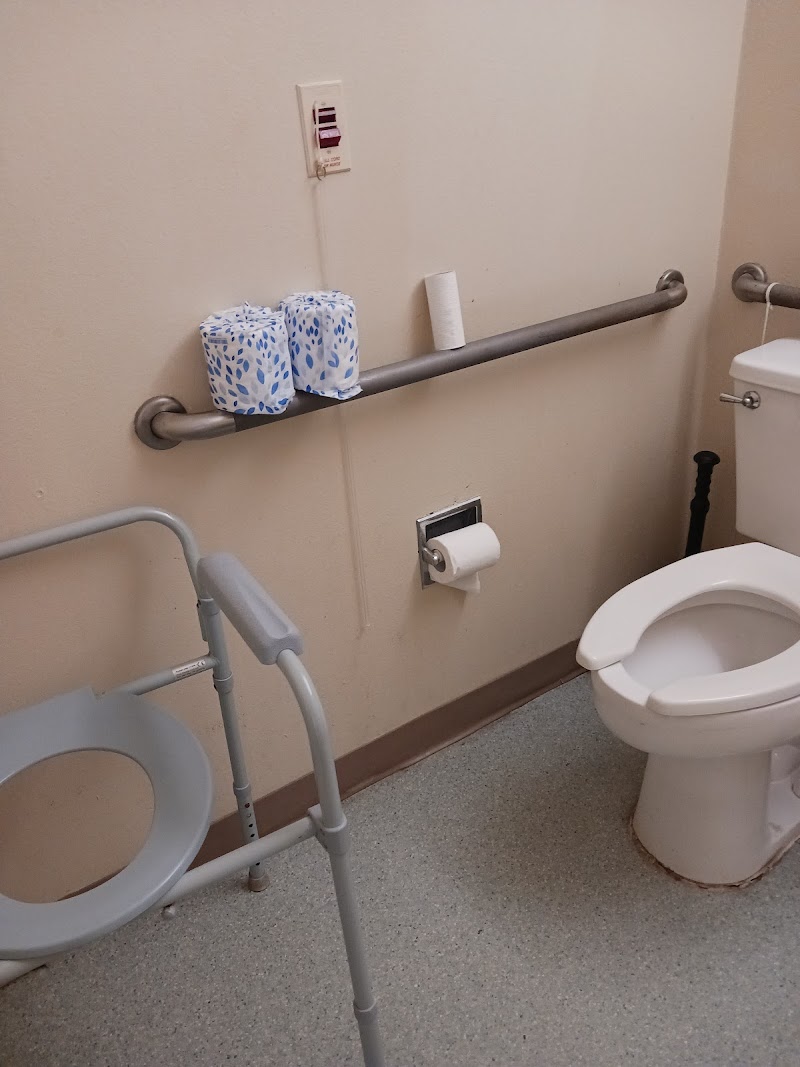
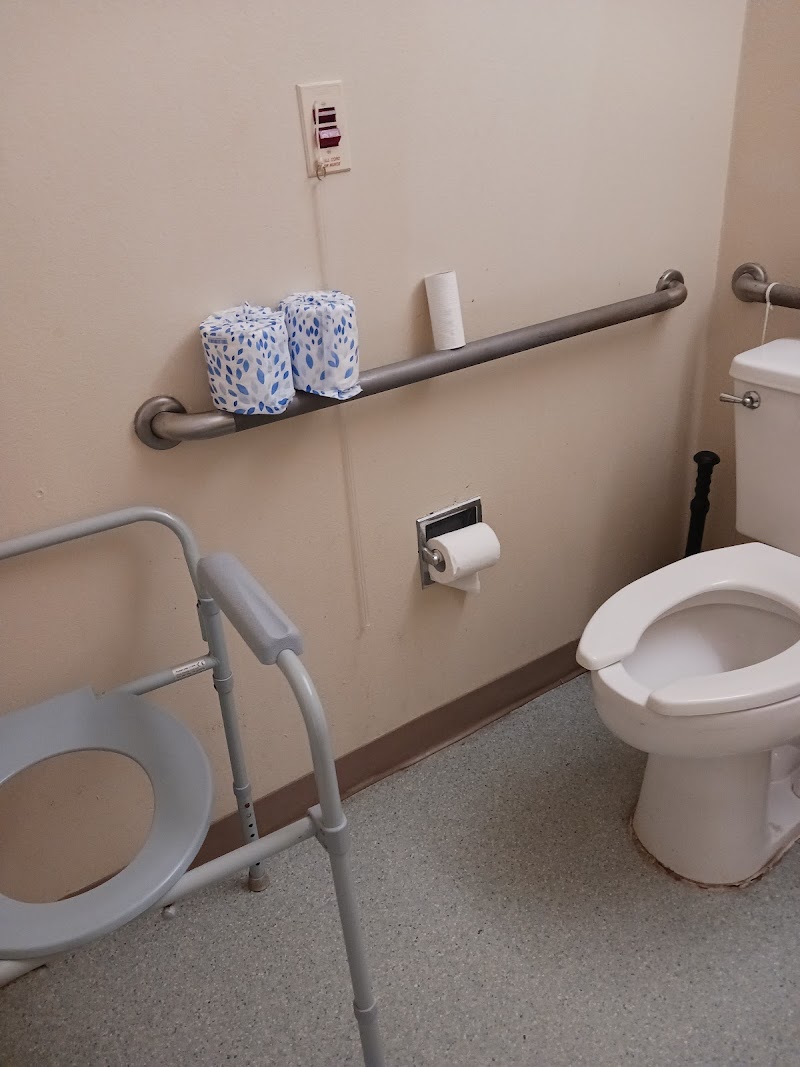
On 7/24/25 at 1:54 p.m. the restrooms in the main hallway next to the main dining room were observed to be unlocked and available for use. Upon entering the restrooms neither had an emergency call cord near the toilet for use during an emergency. Residents would be able to utilize the restrooms.
During an interview on 7/24/25 at 10:32 a.m. the Director of Nursing (DON) stated the steam table being left on is a concern, as the area is used by residents not just for a dining room but as an additional day room for activities and general visit; someone could get burned. The DON continued to state residents should have access to call lights in the restrooms.
An observation was conducted on 7/21/25 at 9:42 a.m. on the Happy Trails unit of an unlocked cabinet in the dining/activity room. The unlocked cabinet contained a spray bottle of odor eliminator. Residents were present in the room at the time and were able to access the cabinet.
An observation was conducted on 7/21/25 at 9:47 a.m. in the North Wing dining room. There was a cabinet unlocked that contained a bottle of ant, roach, and fly spray.
An interview was conducted on 7/24/25 at 4:01 p.m. with the Director of Nursing (DON). The DON reviewed photos of the unlocked cabinet with the bottle of odor eliminator on the Happy Trails unit and the unlocked cabinet with the ant, roach and fly spray in the North Wing dining area. The DON stated it is an accident hazard and the cabinets should have been locked.
On 7/21/25 at 9:59 a.m. Staff O, Certified Nursing Assistant (CNA), who was standing in hallway of secure unit, Happy Trails, was asked to introduce residents on the unit. The staff member followed this writer into the day room saying the residents sit in the dayroom but sit in the hallway outside of the room when it is being cleaned. The staff member introduced six of the residents who were sitting in the hallway. Staff O reported having an assignment, was assigned 1:1 supervision with Resident #65. The staff member stated Resident #65 could answer questions, opened the door to the resident room at 10:13 a.m., introduced writer, then walked out of the room shutting the door, leaving this writer and the resident in room.
On 7/21/25 at 10:20 a.m. Staff O observed outside Resident #65s room (door shut) in hallway with other residents. The staff member stated the resident was on 1:1 from 7 a.m. to 11 p.m. as the resident could get physically and verbally aggressive, which might have been the reason for not having a roommate. Resident #65 came out of room at 10:23 a.m. and the staff member escorted the resident outside to courtyard.
On 7/21 – 7/23/25 random observations of the Happy Trails secured unit revealed multiple residents wandering in the hallways and in resident rooms.
On 7/21/25 at 3:09 p.m. Staff O was observed redirecting unknown residents out of room [ROOM NUMBER].
Review of Resident #65s admission Record revealed the resident was admitted on [DATE]. The record included diagnoses not limited to unspecified dementia unspecified severity with other behavioral disturbance, other specified anxiety disorder, other specified persistent mood disorders, and moderate recurrent major depressive disorder.
Review of Resident #65s physician orders revealed an order started on 7/13/25 at 11:00 p.m. for 1:1 supervision every shift. This order was discontinued on 7/22/25. An order for 1:1 supervision every day and evening shift started on 7/22/25 at 7:00 a.m. and was active on 7/24/25 at 2:41 p.m.
Review of Resident #65s care plan, a focus was initiated on 4/15/25 revealing Resident #65 has the potential to display behaviors: easily agitated, yells at nurses and hit nurses station windows, (and) is protective of personal space and can become aggressive. The focus was revised on 6/18/25. The interventions instructed staff to “Assist the resident to develop more appropriate methods of coping and interacting” and to “Intervene as necessary to protect the rights and safety of others.”
Review of the facility Reportable Events showed on 6/12/25 a Resident to Resident Abuse incident had occurred involving Resident #65 and Resident #35.
An interview was conducted with the Director of Nursing (DON) on 7/24/25 at 10:18 a.m. The DON stated they (staff) should be within sight of the resident and within a distance to prevent the reason for 1:1 (supervision).
During an interview on 7/24/25 at 12:48 p.m. the DON reported on 6/12/25 Resident #65 was in the resident’s room and Resident #35 had wandered into the room. Resident #65 yelled at the other resident to leave and pushed him out of the room. Resident #35 did fall and an Xray was obtained to rule out injury. The DON stated this incident was not the reason Resident #65 was on 1:1 supervision, the resident’s Healthcare Surrogate (HCS) was not receptive to behavioral medications, the resident does get agitated in crowds, was “100%” exit-seeking, and has to have someone with (pronoun) during periods of agitation. The DON stated the incident where Staff O showed the writer around unit was “upsetting”.
Review of the facility’s policy titled Accidents and Supervision with a reviewed/revised date of 10/18/2022 revealed:
Policy: The resident environment will remain as free of accident hazards as is possible. Each resident will receive adequate supervision and assistive devices to prevent accidents. This includes: l. Identifying hazard(s) and risk(s). 2. Evaluating and analyzing hazard(s) and risk(s). 3. Implementing interventions to reduce hazard(s) and risk(s). 4. Monitoring for effectiveness and modifying interventions when necessary. … Policy Explanation and Compliance Guidelines: The facility shall establish and utilize a systematic approach to address resident risk and environmental hazards to minimize the likelihood of accidents.
1. Identification of Hazards and Risks- the process through which the facility becomes aware of potential hazards in the resident environment and the risk of a resident having an avoidable accident. a. All staff (e.g., professional, administrative, maintenance, etc.) are to be involved in observing and identifying potential hazards in the environment, while taking into consideration the unique characteristics and abilities of each resident. b. The facility should make a reasonable effort to identify the hazards and risk factors for each resident. c. Various sources provide information about hazards and risks in the resident environment. d. These sources may include, but are not limited to: i. Quality assessment and assurance (QAA) activities ii. Environmental rounds iii. MDS/CAA data …
Review of the policy – One to One Supervision revealed the following:
“Center will place resident displaying behavior(s) that may be self-injurious or cause physical, sexual, or psychosocial harm to others and one-to-one supervision based on resident assessment and clinical needs.” The process included the guideline, “Conditions which may indicate need for one-to-one supervision include but are not limited to history of multiple falls, suicidal ideations, homicidal ideations, inappropriate contact with other residents, exit seeking behaviors or any other behavior that may cause harm to themselves or others.”
CONCERN
(E)
Potential for Harm - no one hurt, but risky conditions existed
Unnecessary Medications
(Tag F0759)
Could have caused harm · This affected multiple residents
Based on observations, record reviews, and interviews the facility failed to ensure that the medication error rate was less than 5.00%. Twenty-five medication administration opportunities were observe...
Read full inspector narrative →
Based on observations, record reviews, and interviews the facility failed to ensure that the medication error rate was less than 5.00%. Twenty-five medication administration opportunities were observed and four errors were identified for 3 (#30, #94, and #97) of six residents observed. These errors constituted a 12.00% medication error rate.Findings included:1.On 7/22/25 at 4:32 p.m., an observation of medication administration with Staff J, Licensed Practical Nurse (LPN), was conducted with Resident #30. The staff member dispensed the following medications:- Calcium carbonate 600 milligram (mg)/ Vitamin D 10 microgram (mcg) over the counter (otc) tablet- Eliquis 5 mg tablet- Metoprolol tartrate 25 mg tablet (1/2 tablet = 12.5 mg)- Vitamin C 500 mg tablet- Metformin 1000 mg tablet- Potassium chloride Extended Release (ER) 10 milliequivalents (meq) tablet- Erythromycin 5 mg/gram ophthalmic ointment- Insulin Aspart FlexPenStaff J confirmed the dispensing of 6 oral tablets then removed the ophthalmic ointment prior to entering Resident #30s room. The staff member obtained a blood pressure from the resident, removed the cuff, applied gloves, cleaned the resident's left middle finger with an alcohol pad, lanced the finger, and obtained a blood glucose level of 164. The staff member removed gloves, sanitized hands and explained the oral medications to the resident who swallowed them, the staff member sanitized hands before applying gloves then administered the topical ophthalmic ointment. Staff J returned to the med cart and documented a blood glucose level of 135. The staff member was asked what the blood glucose level was and Staff J checked the history of the glucometer reporting the resident's level was 164. Staff J removed the Insulin Aspart FlexPen, applied a needle, dialed the dosage selector and while holding the FlexPen parallel to the medication cart top, depressed the dosage selector then dialed to 6 units. The staff member confirmed priming the pen with 2 units that's what they told me. Staff J entered the room, applied gloves, cleaned the left upper abdomen, inserted the FlexPen, depressed the dosage selector, then withdrew it.Review of Resident #30's July Medication Administration Record (MAR) showed a sliding scale order for Insulin Aspart FlexPen to be injected before meals and at bedtime. The scale instructed the injection to begin with 150-200 = 6 units, then in increments of 49 the amount of insulin to be injected was dependent on the blood glucose level. The observation revealed Staff J had documented a blood glucose level of 135 prior to being asked for blood glucose level then confirmed the reading was 164 which according to the sliding scale Resident #30 would not have received the scheduled dose of Insulin Aspart.Review of the policy - Insulin Pen, revised on 5/3/22 revealed It is the policy of this facility to use insulin pens in order to improve the accuracy of insulin dosing, provide increased resident comfort, and serve as a teaching aid to prepare residents for self-administration of insulin therapy upon discharge. The compliance guidelines revealed:- 6.: Insulin pens will be primed prior to each use to avoid collection of air in the insulin reservoir.- 11. Procedure:o h. Prime the insulin pen:S i. Dial 2 units by turning the dose selector clockwise.S ii. With the needle pointing up, push the plunger, and watch to see that at least one drop of insulin appears on the tip of the needle. If not repeat until at least one drop appears. Review of the manufacturer's instructions for the use of an Insulin Aspart pen, located at www.novo-pi.com/novolog.pdf included the following instructions:Giving the airshot before each injection: Before each injection small amounts of air may collect in the cartridge during normal use. To avoid injecting air and to ensure proper dosing:E. Turn the dose selector to select 2 units. (see diagram E).F. Hold your (name brand Insulin Aspart pen) with the needle pointing up. Tap the cartridge gently with your finger a few times to make any air bubbles collect at the top of the cartridge. (see diagram F).G. Keep the needle pointing upwards, press the push-button all the way in (see diagram G). The dose selector returns to 0. A drop of insulin should appear at the needle tip. If not, change the needle and repeat the procedure no more than 6 times. If you do not see a drop of insulin after 6 times, do not use the (name brand insulin pen) and contact (manufacturer with phone number).A small air bubble may remain at the needle tip, but it will not be injected.Selecting your dose:Check and make sure that the dose selector is set at 0.2.On 7/22/25 at 5:08 p.m. an observation of medication administration with Staff P, Registered Nurse (RN) was started for Resident #94. The staff member reported not having the resident's Guaifenesin and would have to text the physician as (pronoun) did not think the facility carried 600 mg tablets (of the medication). The staff member texted the physician who gave an order to change it to the available 400 mg tablets. Staff P informed the Unit Manager, Staff Y of needing 400 mg of Guaifenesin, that staff member reported going to supply if the staff member needed it (400 mg Guaifenesin). Staff P looked in the medication room and did not locate the 600 mg tablets. Staff P continued medication pass with another resident, while waiting for Staff Y to arrive with 400 mg Guaifenesin, during the administration with the other resident, Staff Y was observed leaving a bottle of otc on the medication cart for Staff P.On 7/22/25 at 5:21 p.m., an observation of medication administration with Staff P, Registered Nurse (RN), was conducted with Resident #94. The staff member dispensed the following medications into a medication cup:- Tamsulosin Hydrochloride 0.4 mg capsule- Ticagrelor 90 mg tablet- Guaifenesin 400 mg/Dextromethorphan 20 mg (DM) tabletOn 7/22/25 at 5:25 p.m. Staff P entered Resident #94s room when the staff member was stopped and asked to confirm the Guaifenesin order. The staff member stated it was the right medication; the staff member reviewed the bottle of Guaifenesin/Dextromethorphan and texted the physician to change the order to the combination medication. Staff P confirmed the dispensing and potential administration was a medication error. The physician texted an answer allowing to change the order to the combination medication after the staff member was stopped inside the resident's room and asked to review the order with the dispensed medication.Review of Resident #94's July Medication Administration Record (MAR) revealed the following:- Guaifenesin Extended Release (ER) 12 hour 600 mg - Give 1 tablet every 12 hours for congestion/cough for 30 days. The order started on 7/2/25 at 6:00 p.m. The MAR showed this order was discontinued on 7/22/25 at 5:14 p.m. (six minutes after Staff P revealed the facility did not stock 600 mg Guaifenesin. The last dose documented as given was the scheduled dose on 7/22/25 at 6:00 a.m.- Guaifenesin oral 400 mg tablet - Give 1 tablet by mouth two times a day for cough. The order started on 7/22/25 at 6:00 p.m. and was discontinued without any administration on 7/22/25 at 5:27 p.m.- Chest Congestion Relief DM 20-400 mg (Dextromethorphan/Guaifenesin) - Give 1 tablet by mouth two times a day for cough. The order was started on 7/22/25 at 6:00 p.m. and the MAR showed Staff P had administered this medication.3.On 7/23/25 at 8:02 a.m., an observation of medication administration with Staff H, Licensed Practical Nurse (LPN), was conducted with Resident #97. The staff member dispensed the following medications into a medication cup:- Aspirin 81 mg chewable otc tablet- Vitamin B1 100 mg otc tablet- Carvedilol 12.5 mg tablet- Spironolactone 25 mg tablet- Folic Acid 1 mg tablet- Gabapentin 100 mg capletThe staff member confirmed dispensing 6 tablets. Staff H obtained a blood pressure of 120/71 from the resident's left arm then administered the oral medications.Review of Resident #97s July MAR revealed the resident was ordered to receive 325 mg of Aspirin - 1 tablet by mouth one time a day for Heart Health, scheduled for 9:00 a.m. The MAR revealed Staff H had administered 325 mg of Aspirin on 7/23/25. The MAR did not show the resident had an order for 81 mg of Aspirin.During an interview on 7/23/25 at 2:51 p.m. the findings were discussed with the Director of Nursing (DON). The DON looked quizzically and reported she did not prime her own pen. I don't know if that's in our policy. The DON confirmed the issue with Resident #94s Guaifenesin was an issue. The DON asked what Staff H had said about Resident #97's wrong dosage of Aspirin.Review of the policy - Medication Administration, revised on 10/2023, showed medications are administered by licensed nurses, or other staff who are legally authorized to do so in the state, as ordered by the physician in accordance with professional standards of practice, in a manner to prevent contamination or infection. The compliance guidelines included:- 10. Review MAR to identify medication to be administered.- 11. Compare medication source (bubble pack, vial, etc.) with MAR to verify resident name, medication name, form, dose, route, and time.o a. Refer to drug reference material if unfamiliar with the medication, including its mechanism of action or common side effects.
CONCERN
(E)
Potential for Harm - no one hurt, but risky conditions existed
Deficiency F0761
(Tag F0761)
Could have caused harm · This affected multiple residents
**NOTE- TERMS IN BRACKETS HAVE BEEN EDITED TO PROTECT CONFIDENTIALITY** Based on observations, interviews, and record review the facility 1) failed to maintain the storage of medications in four of fo...
Read full inspector narrative →
**NOTE- TERMS IN BRACKETS HAVE BEEN EDITED TO PROTECT CONFIDENTIALITY** Based on observations, interviews, and record review the facility 1) failed to maintain the storage of medications in four of four sampled medication carts (West Front, [NAME] Back, 200-hall and Happy Trails) without expired, undated and loose medications, 2) failed to ensure the locked narcotic boxes were unremovable for two (East and West) of two sampled medication refrigerators, 3) failed to ensure two of two sampled rescue carts (100 & 400 halls) which contained medication for low blood sugar were locked while unattended and not in use, and 4) failed to ensure medications were not stored at bedside in two resident rooms (309 and 406) observed during survey. Findings included:
On 7/23/25 at 11:59 a.m. an observation with Staff K, Licensed Practical Nurse (LPN) was conducted of the [NAME] Front medication cart. The observation revealed:
- 4 vials containing Albuterol/Ipratropium nebulizer medication was lying on top of the foil packaging and 3 vials were lying under the foil package.
- One vial of Albuterol/Ipratropium nebulizer medication was unlabeled with a resident name and in a compartment of the top drawer along with multiple insulins.
- An open bottle of Latanoprost ophthalmic drops were not dated, neither was the medication bottle containing the bottle of Latanoprost.
On 7/23/25 at 12:13 p.m. an observation with Staff L, LPN was conducted of the [NAME] Back medication cart. The observation revealed:
- A bottle of liquid protein was not dated with an open date. The bottle label instructs to “Discard 3 months after opening”.
On 7/23/25 at 12:27 p.m. an observation with Staff L, LPN was conducted of the [NAME] Hall Medication Refrigerator. The observation showed a locked narcotic box was attached to a glass removable shelf. The staff member stated (pronoun) guessed the shelf could be removed from the refrigerator.
An observation was conducted on 7/21/25 at 9:56 a.m. of a cardiopulmonary resuscitation (CPR) cart in the 400-hall unlocked. The unlocked cart contained a tube of glucose gel in the drawer.
An observation was conducted on 7/21/25 at 10:15 a.m. of a CPR cart in the 100-hall unlocked. The unlocked cart contained a box of glucose gel in the drawer.
An observation was conducted on 7/21/25 at 11:51 a.m. in room [ROOM NUMBER] of two bottles of antacid tablets on the resident’s bedside table in clear view. The resident stated the bottles were at the bedside because she took them at least every day and sometimes multiple times a day. The resident said her family gave them to her, but the staff knew she had them.
An observation was conducted on 7/21/25 at 3:00 p.m. in room [ROOM NUMBER] of an antibiotic vial full of medication at the resident’s bedside hanging on an IV pole. There were no residents in the room at the time and the medication had not yet been administered.
An observation was conducted on 7/22/25 at 5:20 p.m. of a UM walking down the hall with a bottle of medication. The UM was overheard telling a nurse, who was in a resident room, that he brought the medication she needed. He then proceeded to set the medication, a full bottle of Guaifenesin tablets, on top of the medication cart and walked out of the hall, while the nurse remained in the resident room, leaving the medication unsecured.
An interview was conducted on 7/23/25 at 10:47 a.m. with the Nursing Home Administrator (NHA) and Regional Nurse Consultant (RNC). They both stated there were no residents in the facility that were approved to self-administer medication.
An audit of a medication cart on the 500-hall was conducted on 7/23/25 at 10:47 a.m. with Staff I, RN. A drawer in the cart contained one loose pill and the narcotics drawer contained a half a loose pill as well as several quarter pieces and smaller bits of pills. Staff I said nurses are responsible for cleaning their own medication carts and the pills should not be loose in the drawers.
An audit of a medication cart on the 200-hall was conducted on 7/23/25 at 10:55 a.m. with Staff H, LPN. There was one loose pill in the drawer with bubble packs of medication. The cart also contained an expired bottle of ProStat. The bottle was opened on 5/16/25 and expired on 7/9/25. The medication cart also contained a foil bag containing plastic vials of Ipratropium bromide-albuterol sulfate inhalation solution. The bag was labeled as being opened on 6/23/25 and had a sticker from the pharmacy showing “Discard 15 days after opening.” Staff H said nurses do their best to keep their own carts cleaned out, but night shift usually cleans them out more. Staff H said there should not be loose or expired medication in the cart. As for the Ipratropium bromide-albuterol sulfate inhalation solution, she said she did not know why it was labeled to discard 15 days after opening and thought it could have been put on the bag by mistake.
An audit of the East wing medication storage room on 7/23/25 at 1:40 p.m. with Staff A, LPN/UM. The cabinet in the storage room contained a box of Bisacodyl suppositories labeled as expired on 6/2025. The medication refrigerator contained two vancomycin IV bags labeled discard after 7/12/25. The refrigerator also had an emergency drug kit that contained Lorazepam, a controlled substance. The emergency kit was not in a container attached to the refrigerator and could easily be removed. Staff A said all nurses should check the medication room to ensure expired medications are removed. She said she had only been a UM for two weeks and had not had time to audit the medication room.
An interview was conducted on 7/23/25 at 2:10 p.m. with the Director of Nursing (DON). The DON said if a nurse is not at the medication or treatment cart, it should be locked, and medication should not be left on top of the cart. She said, “If they cannot see it and be sure it is secure then it is not okay for sure.” The DON said she was surprised to hear expired medications were in the medication room because pharmacy returns are done nightly. She said UM are expected to do audits of the medication rooms and carts. The DON said the CPR carts should be locked because they all have glucose in them. She said all nurses have keys to the CPR carts. The DON also confirmed no residents are approved to self-administer medication and it is not okay for them to have medication in the room. The DON said inside the medication carts, medications should not be loose, and vials should not be out of their labeled containers. She said she was ok if open dates are written on boxes of medication if they cannot be legibly written on the actual medication container, if it is clear the medication goes with a particular box. The DON also confirmed narcotics should be in a container attached to the refrigerator. She said she would look at what to do with the emergency kit and would find a solution for the narcotics box that is attached to the removable shelf in the refrigerator.
Review of the policy – Medication Storage, revealed “It is the policy of this facility to ensure all medications housed on our premises will be stored in the pharmacy and/ or medication rooms according to the manufacturers recommendations and sufficient to ensure proper sanitation, temperature, light, ventilation, moisture control, segregation, and security.” The compliance guidelines included the following:
1. General Guidelines:
a. All drugs and biologicals will be stored in locked compartments (i.e. medication carts, cabinets, drawers, refrigerators, medication rooms) under proper temperature controls.
c. During a medication pass, medications must be under the direct observation of the person administering medications or locked in the medication storage area/ cart.
2. Narcotics and Controlled Substances:
b. Schedule II controlled medications are to be stored within a separately locked permanently affixed compartment when other medications are stored in the same area, such as in refrigerator.
7. Light Protection: all drugs, which require light protection while in storage, remain in the original package, enclosed drawers or cabinets, or in a specially wrapped manner until the time of administration.
8. Unused Medications: The pharmacy and all medication rooms are routinely inspected by the consultant pharmacist for discontinued, outdated, defective, or deteriorated medications with worn, illegible, or missing labels. These medications are destroyed in accordance with our Destruction of Unused Drugs policy.
CONCERN
(E)
Potential for Harm - no one hurt, but risky conditions existed
QAPI Program
(Tag F0867)
Could have caused harm · This affected multiple residents
**NOTE- TERMS IN BRACKETS HAVE BEEN EDITED TO PROTECT CONFIDENTIALITY** Based on observation, record review, interviews, and review of the Plan of Correction, the facility failed to ensure it had a fu...
Read full inspector narrative →
**NOTE- TERMS IN BRACKETS HAVE BEEN EDITED TO PROTECT CONFIDENTIALITY** Based on observation, record review, interviews, and review of the Plan of Correction, the facility failed to ensure it had a functioning Quality Assurance Committee. The facility was actively involved in the creation, implementation, and monitoring of the plan of correction for deficient practice identified during an annual survey on 07/21/2025 to 07/24/2025 and was cited at F628. During the revisit on 09/23/2025 through 09/25/2025, the facility was recited at F628 related to discharge process. The facility had developed a Plan of Correction with a completion date 08/22/2025. The facility had not comprehensively implemented the plan of correction for the identified deficiencies related to ensuring the resident's clinical discharge records were accurately documented, signed and readily available for three residents (#25, #26, #27) out of three residents reviewed for completion and accuracy of records. Findings included: On 9/25/25 at 1:33 p.m. an interview was conducted with the Nursing Home Administrator (NHA) regarding their Quality Assurance and Performance Improvement (QAPI) plan, revealing that QAPI meetings were held on 08/15/2025, 08/22/2025, and 09/19/2025. All previously cited citations from the survey dated 07/21/2025 were discussed. The NHA stated the trainings had been completed between 07/30/2025 to 08/17/2025, and education was provided to all staff with the Medical Director (MD) present for all meetings. The NHA explained that nothing had changed related to the audit process for discharge planning but stated they had identified concerns with their current SSD not accomplishing routine job duties.A review of the facility's policy titled, Quality Assurance and Performance Improvement (QAPI) revealed the following: It is the policy of this facility to develop, implement, and maintain an effective, comprehensive, data-driven QAPI program that focuses on indicators of the outcomes of care and quality of life. 'Performance Improvement (PI)' is the continuous study and improvement of processes with the intent to improve services or outcomes, and prevent or decrease the likelihood of problems, by identifying opportunities for improvement, and testing new approaches to fix underlying causes of persistent/systemic problems or barriers to improvement. 'Problem-Prone' refers to care or service areas that have historically had repeated problems (e.g., call bell response times; staff turnover, lost laundry). 'Quality Assurance (QA)' is the specification of (1) standards of quality of care, service and outcomes, and (2) systems throughout the facility for assuring that care is maintained at acceptable levels in relation to those standards. 'QAPI' is the coordinated application of two mutually reinforcing aspects of a quality management system: (QA) and Performance Improvement (PI). 2. The Quality Assessment and Assurance (QAA) Committee shall be interdisciplinary and shall: . c. Develop and implement appropriate plans of action to correct identified quality deficiencies. d. Regularly review and analyze data, including data collected under the QAPI program and data resulting from drug regimen reviews, and act on available data to make improvements. 3. The QAPI plan will address the following elements: . c-i. Tracking and measuring performance. c-iii. Identifying and prioritizing quality deficiencies. c-v. Developing and implementing corrective action or performance improvement activities. e. A commitment to quality assessment and performance improvement by the governing body and/or executive leaders. 2. Governance and Leadership-b. Governing oversight responsibilities include but are not limited to the following: . ii. Ensuring the program is ongoing, defined, implemented, maintained, and addresses identified priorities. iii. Ensuring the program is sustained during transitions in leadership and staffing. 3. Program Feedback, Data Systems, and Monitoring-c-ii. Department heads are responsible for ensuring data is collected appropriately and performance metrics are monitored in accordance with facility policy. 4. Program Activities-a. All identified problems will be addressed and prioritized, whether by frequency of data collection/monitoring or by the establishment of sub-committees. Consideration include, but are not limited to: i. High-risk, high-volume, or problem-prone areas. ii. Incidence, prevalence, and severity of problems in those areas. b. Medical errors and adverse events are routinely tracked. iii. Preventative actions and mechanisms will be implemented to prevent medical errors and adverse events, including feedback and education. c-i. The number and frequency of improvement activities conducted shall reflect the scope and complexity of the facility's services as reflected in the facility assessment. 5. Program Systemic Analysis and Systemic Action-a. The facility takes actions aimed at performance improvement as documented in QAA Committee meeting minutes and action plans. Performance/success of the actions will be monitored and documented in subsequent QAA Committee or sub-committee meetings.Previously cited deficiencies revealed:During an interview on 07/22/25 at 10:45 a.m. Resident #172's Resident Representative (RR) stated the facility only provided a medication list upon discharge and Resident #172 who lived in a group home was unable to live independently due to a mental diagnosis. The RR stated they did not receive any information when Resident #172 was transferred to the hospital. Review of Resident #172's admission Record revealed an admission date to the facility on [DATE] and readmission on [DATE], with diagnoses to include: schizophrenia; metabolic encephalopathy; cognitive communication deficit; brief psychotic disorder; bipolar disorder, current episode mixed, severe, with psychotic features; anxiety disorders; major depressive disorder (MDD); hypertension; metabolic encephalopathy; influenza due to identified novel influenza a virus with other respiratory manifestations; heart failure; non-ST elevation (NSTMI) myocardial infarction; and other comorbidities. A Brief Interview for Mental Status (BIMS), dated 02/17/25, revealed a score of 00, indicating severe cognitive impairment. Review of Resident #172's census list revealed a discharge date on 03/27/25 and transfer to the hospital on [DATE]. Review of Resident #172's progress notes and evaluations did not reveal documentation of notifications to RR or Resident #172. The Nursing Home Transfer and Discharge Notice (AHCA Form 3120-0002) could not be found nor was documentation found stating the notice was given or mailed to the resident or the resident representative. During an interview on 07/23/25 at 4:33 p.m. the Social Service Assistant (SSA) stated being responsible for coordinating discharge planning, including the Nursing Home Transfer and Discharge Notice. The SSA stated the Nursing Home Transfer and Discharge Notice is not given to the resident or the RR. The notice is only faxed to the Ombudsman monthly. During an interview on 07/23/25 5:01 p.m. the Nursing Home Administrator (NHA) stated the discharge process is coordinated by Social Services, including the Nursing Home Transfer and Discharge Notice (AHCA Form). The NHA stated the expectation is the form be given to the resident and the RR upon discharge/transfer of the facility. Review of admission Records showed Resident #124 was admitted on [DATE] with diagnoses including atrial fibrillation, myocardial infarction, personal history of transient ischemic attack, and acute embolism and thrombosis of unspecified deep veins of lower extremity, bilateral. Review of Resident #124's Care Plan showed a focus area of discharge plan home with home health, dated 5/25/25. Interventions included discuss, discharge plan on admission, discuss with resident/family/responsible party discharge planning, social service evaluation as needed. Review of Resident #124's progress notes showed a narrative note written by Staff DD, Licensed Practical Nurse (LPN), dated 7/16/25, showing resident d/c [discharge] with understanding all d/c (discharge) summary and instructions along with medications. Resident v/s [vital signs] wnl [within normal limits] d/c home via family car. Review of Resident #124's Discharge Summary/Instructions, dated 07/16/25, showed the document was not completed. The resident's primary physician was marked NA. Under Community Service Referrals, there was no phone number or contact information for the home health company or the company that was to provide medical equipment. The sections of the discharge summary for appointments, medication reconciliation, medication education, recap of stay, respiratory treatments, and prevention and disease management were all blank. The Discharge Summary/Instructions were not signed. On 7/22/25 at 3:55 p.m. the Nursing Home Administrator (NHA) provided Resident #124's paper chart and stated the complete record and all other information would have been scanned into the electronic medical record. The Nursing Home Transfer and Discharge Notice (AHCA Form 3120-0002) could not be found in Resident #124's electronic or paper medical records. An interview was conducted on 7/24/24 at 3:03 p.m. with the DON. The DON reviewed Resident #124's electronic medical record and paper chart medical record. She said there was no documentation of what information was provided to the resident upon discharge. During the revisit survey, the facility failed to ensure the resident's clinical discharge records were accurately documented, signed and readily available for three residents (#25, #26, #27) out of three residents reviewed for completion and accuracy of records. Review of Resident #25's admission record revealed an admission date of 08/19/2025 with diagnoses to include asthma, hypertension, urinary tract infection, and anxiety disorder. A review of Resident #25's Minimum Data Set (MDS) dated [DATE] revealed in section C, a Brief Interview for Mental Status (BIMS) score of 15, indicating intact cognition. Review of Resident #25's physician orders dated 08/28/2025 revealed on 08/27/2025 the resident was ordered to be discharged home on [DATE] with home health, physical therapy (PT), occupational therapy (OT), Nursing Durable Medical Equipment (NSG DME): 4 Wheeled Walker/Oxygen, and to send home with Narcotics. Review of Resident #25's Nursing Home Transfer and Discharge Notice form revealed the notice was given on 08/25/2025. The Physician/Designee Name and signature were left blank. The Resident or Representative Name and signature were left blank. The dates of notice given to Resident/Guardian, Ombudsman, and Resident Clinical Record were left blank. Review of Resident #26's admission record revealed an admission date of 08/13/2025 with diagnoses to include a history of falling, hypertension, and depression. A review of resident #26's Minimum Data Set (MDS) dated [DATE] revealed in section C a Brief Interview for Mental Status (BIMS) score of 15, indicating intact cognition. A review of Resident #26's Discharge summary dated [DATE] presents resident's signature on 08/28/2025 with orders to discharge home with spouse. Home health services for PT and OT were ordered. The Durable Medical Equipment (DME) included a wheelchair. Review of Resident #26's Nursing Home Transfer and Discharge Notice form revealed the notice was given on 08/26/2025. The Physician/Designee Name and signature were left blank. Resident or Representative Name and signature were blank. Dates of notice given to Resident/Guardian, Ombudsman, and Resident Clinical Record were blank. Review of Resident #27's admission record revealed an admission date of 08/11/2025 with diagnoses to include a neck fracture, injury of muscles and tendons, and a history of falling. Resident #27 was documented as their own person, and a family member documented as an emergency contact. A review of resident #27's Minimum Data Set (MDS) dated [DATE] revealed in section C a Brief Interview for Mental Status (BIMS) score of 14, indicating intact cognition. Review of Resident #27's physician orders dated 08/24/2025 revealed on 08/23/2025 the resident was ordered to be discharged home on [DATE] with home health referral, DME: 4 Wheeled Walker/Oxygen, and to send home with Narcotics. Orders showed the resident's family signature on 08/24/2025, but there was no resident signature present.Review of Resident #27's Nursing Home Transfer and Discharge Notice form revealed notice of date given 08/22/2025. Physician/Designee Name and signature were blank. Resident or Representative Name and signature were blank. Dates of notice given to Resident/Guardian, Ombudsman, and Resident Clinical Record were blank. On 9/25/25 at 11:54 a.m. an interview with the NHA revealed the Nursing Home Transfer and Discharge Notice form is given to the residents by the Social Services Director (SSD) when they are preparing to discharge. These forms are to be signed by the resident two days prior to leaving the facility. The NHA explained the Nursing Home Transfer and Discharge Notice form is a plan for the residents to know their care is complete and notifies the resident's doctors of discharge. The Nursing Home Transfer and Discharge Notice form is sent to the Ombudsman monthly, and uploaded into the resident's charts, with a copy sent home with the resident. The NHA stated, even though it is the SSD's responsibility to get these forms signed, the NHA is the one who was responsible for ensuring they are completed and signed prior to discharge, whether the resident is being discharged home or to the hospital, it must be signed. The NHA stated there were various ways to get the Nursing Home Transfer and Discharge Notice form signed: Signed by resident if able, signed by a Power of Attorney (POA) or Responsible Party if resident is not able. The NHA stated the form can be mailed, or the resident/POA can come in to the facility to sign. The NHA stated the Nursing Home Transfer and Discharge Notice form is compiled as soon as the facility receives orders from the physician to present to the resident. The NHA confirmed the three discharge forms should have been signed and dated. The NHA said, Yes, the forms should be dated and signed. A review of the facility policy titled, Discharge Planning Process, revised on 09/19/22, revealed - It is the responsibility of this facility to develop and implement effective discharge planning process that focuses on the resident's discharge goals, the preparation of residents to be active partners and effectively transition them to post-discharge care, and the reduction of factors leading to preventable readmissions. 1. The facility will support each resident in the exercise of his or her right to participate in his or her care and treatment, including planning for discharge. 11. The evaluation of resident's discharge needs and discharge plan will be completely documented on a timely basis in the clinical record. 12. All relevant information will be provided in a discharge summary to avoid unnecessary delays in the resident's discharge or transfer, and to assist the resident in adjustment to his or her new living environment.
CONCERN
(F)
📢 Someone Reported This
A family member, employee, or ombudsman was alarmed enough to file a formal complaint
Potential for Harm - no one hurt, but risky conditions existed
Notification of Changes
(Tag F0580)
Could have caused harm · This affected most or all residents
**NOTE- TERMS IN BRACKETS HAVE BEEN EDITED TO PROTECT CONFIDENTIALITY** Based on interviews and record review, the facility failed to promptly notify the resident and resident representative (RR) of a...
Read full inspector narrative →
**NOTE- TERMS IN BRACKETS HAVE BEEN EDITED TO PROTECT CONFIDENTIALITY** Based on interviews and record review, the facility failed to promptly notify the resident and resident representative (RR) of a change in room or roommate assignment for three (#146, #172 and #173) of three residents sampled. Findings included:During an interview on 07/22/25 at 10:45 a.m. Resident #172's Resident Representative (RR) stated the facility moved Resident #172 without notification to herself or Resident #172. Review of Resident #172's admission Record revealed an admission date to the facility on [DATE] and readmission on [DATE], with diagnoses to include: schizophrenia; metabolic encephalopathy; cognitive communication deficit; brief psychotic disorder; bipolar disorder, current episode mixed, severe, with psychotic features; anxiety disorders; major depressive disorder (MDD); hypertension; metabolic encephalopathy; influenza due to identified novel influenza a virus with other respiratory manifestations; heart failure; non-ST elevation (NSTMI) myocardial infarction; and other co-morbidities. A Brief Interview for Mental Status (BIMS), dated 02/17/25, revealed a score of 00, indicating severe cognitive impairment.Review of Resident #172's census list reveals a room change on 03/10/25 at 12:19, and another at 12:29. Review of Resident #172's progress notes and evaluations did not reveal documentation of notifications to RR or Resident #172. During an interview on 07/22/25 at 9:30 a.m. Resident #173 stated, The staff just told me I was moving rooms late yesterday. I did not get an option for what room; they just moved me. Review of Resident #173's admission Record revealed an admission date of 07/14/25 with diagnoses to include: surgical aftercare following surgery on the skin and subcutaneous tissue; chronic obstructive pulmonary disease; and other co-morbidities. A BIMS, dated 07/18/25, revealed a score of 13, indicating intact cognition.Review of Resident #173's census list reveals a room change on 07/21/25 at 3:30 p.m. Review of Resident #173's progress notes and evaluations did not reveal documentation of notifications to RR or Resident #173. During an interview on 07/21/25 at 10:00 a.m. Resident #146 stated a need to move rooms due to a payer change and the resident was not in agreement. Review of Resident #146 ‘s admission Record revealed an admission date to the facility on [DATE], with diagnoses to include: syncope and collapse, heart failure, hypertension, type 2 diabetes and other co-morbidities. An admission Minimum Data Set (MDS), dated [DATE], showed a Brief Interview for Mental Status (BIMS) score of 11, indicating moderately impaired cognition. During an interview on 07/23/25 at 4:33 p.m. Staff V, Social Services (SS) stated being involved in the room change process and is responsible for completing the documentation that is required in the medical record. Documentation is required for a room change to occur for the resident and the prospective new roommate, and notifying the RR party is not required unless the resident specifically requests it. Staff V reviewed Resident #146's medical record and recalled the room change from memory, stating it was due to a payer change. After reviewing the census list in Resident #146's medical record, Staff V confirmed the room change occurred but found no supporting documentation in the medical record. Staff V reviewed Resident #172's medical record and stated according to the census tab, two room changes occurred, however, no documentation regarding these room changes exists in the medical record. Staff V stated they were not aware of a room change for Resident #173. Staff V confirmed a room change occurred for Resident #173, and confirmed no documentation regarding the room change or any notification to the RR party was present. Staff V confirmed documentation should have occurred for Residents #146, #172, and #173 room changes. Staff V stated not being aware RR should be notified of the room change. During an interview on 07/23/25 at 5:01 p.m. the Nursing Home Administrator (NHA) stated SS is responsible for assisting the residents in room changes, if this is the request of the resident and/or resident representative. The SS department is responsible for the required notifications to the prospective roommate, resident, and resident representative. Room changes only occur if the resident and/or resident representative agree. Room changes do not occur because of a resident's change in payer type. The NHA stated the expectation is all documentation is written in the residents medical record at the time of occurrence. Review of a facility policy titled, Notification of Changes, dated revised: 8/16/2022, showed the following: Policy: The purpose of this policy is to ensure the facility promptly informs the resident, consults the resident's physician; and notifies, consistent with his or her authority, the resident's representative when there is a change requiring notification. Compliance Guidelines: The facility must inform the resident, consult with the resident's physician and /or notify the resident's family member or legal representative when there is a change requiring such notification. Circumstances requiring notification include: .4. A transfer or discharge of the resident from the facility.5. A change of room or roommate assignment.Additional considerations:1. Competent individuals:a. The facility must still contact the resident's physician and notify resident's representative, if known.2. Residents incapable of making decisions:a. The representative would make any decisions that have to be made.b. The resident should still be told what is happening to him or her. 4. Notice of room changes: .
CONCERN
(F)
📢 Someone Reported This
A family member, employee, or ombudsman was alarmed enough to file a formal complaint
Potential for Harm - no one hurt, but risky conditions existed
Grievances
(Tag F0585)
Could have caused harm · This affected most or all residents
**NOTE- TERMS IN BRACKETS HAVE BEEN EDITED TO PROTECT CONFIDENTIALITY** Based on observations, interviews, and record review the facility did not ensure grievances were being addressed for five out of...
Read full inspector narrative →
**NOTE- TERMS IN BRACKETS HAVE BEEN EDITED TO PROTECT CONFIDENTIALITY** Based on observations, interviews, and record review the facility did not ensure grievances were being addressed for five out of six months of resident council meetings and for three (#101, #106, #172) out of three residents sampled for grievances. Findings included:
An interview was conducted on 7/21/25 at 10:39 a.m. with Resident #101. The resident said she was not happy with the way staff treated her sometimes. She said there was a Certified Nursing Assistant (CNA) that was rude to her and told her she was tired of having to clean her up after having had an incontinent episode. The CNA mentioned that the CNAs were talking about her. The resident spoke to Staff H, Licensed Practical Nurse (LPN) and a Unit Manager (UM) was notified about the incident.
Review of admission Records showed Resident #101 was admitted on [DATE] with diagnoses including hemiplegia.
Review of Resident #101’s Quarter Minimum Data Set (MDS), dated [DATE], Section C, Cognitive Patterns, showed a Brief Interview for Mental Status (BIMS) score of 15, indicated she was cognitively intact.
An interview was conducted on 7/24/25 at 10:55 a.m. with Staff H, Licensed Practical Nurse (LPN). Staff H said she recalled the incident with Resident #101. She said the resident told her about a CNA making comments while changing her and being rude. Staff H said she notified the Unit Manager (UM) who was present at the time and had her speak with the resident. Staff H said she wanted Resident #101 to speak with a UM so the grievance process could be started and the issue with the CNA could be addressed. Staff H said the grievance process should have been followed but she did not know anything else because the UM was dealing with it.
The UM was unable to be reached for an interview.
Review of the facility grievance logs did not show any grievances for Resident #101 related to this incident.
Review of the Resident Council Minutes revealed:
· February 12, 2025, residents had concerns with cold food being served and call lights not being answered in a timely manner.
· March 12, 2025, residents had a concern regarding the dietary department.
· April 9, 2025, residents had concerns regarding call lights not being answered in a timely manner and concerns regarding the dietary department.
· May 7, 2025, residents had concerns regarding the dietary department.
· June 11, 2025, residents met with the Dietary Manager and Maintenance Director to discuss concerns.
· July 16, 2025, residents had concerns with water pacing, call lights are not answered in a timely manner, changing of linens, and met with the Dietary Manager regarding concerns.
Review of the grievance logs from February 2025 to July 2025 revealed only one grievance written for the July 16, 2025 meeting.
During an interview on 07/24/25 at 12:01 p.m. the Activities Director (AD) stated being responsible for assisting the residents with Resident Council. The Resident Council requests the AD to be present and assist in transcribing the meeting minutes. The AD stated being “very aware” of the grievance process. Every month after the completion of the meeting the AD stated writing grievances for the concerns mentioned and has done this monthly. The AD states turning in these grievances to the Social Services (SS) or the Nursing Home Administrator (NHA). No follow up is usually given to the Resident Council that the AD is aware of.
During an interview on 07/21/25 at 11:50 a.m. and 07/22/25 at 2:46 p.m. Resident #106’s representative (RR) stated reporting issues to various staff members (Unit Manager, nurses, and SS) but never having resolution or any further communication regarding the concerns. Resident #106’s representative stated the concerns are usually regarding the call light response time.
Review of Resident #106’s admission Record revealed an admission date to the facility on [DATE], with diagnoses to include: chronic obstructive pulmonary disease; hemiplegia and hemiparesis following cerebral infarction affecting left dominant side; diabetes mellitus with diabetic neuropathy; anxiety disorder; major depressive disorder; and other co-morbidities.
Review of the grievance log from January 2025 to July 2025 lacked grievances for Resident #106.
During an interview on 07/22/25 at 10:45 a.m. the Resident Representative of Resident #172 stated having discussed concerns with the facility staff including the administrator, on several occasions, nothing changed, nor was there any follow up.
Review of Resident #172’s admission Record revealed an admission date to the facility on [DATE] and readmission on [DATE], with diagnoses to include: schizophrenia; metabolic encephalopathy; cognitive communication deficit; brief psychotic disorder; bipolar disorder, current episode mixed, severe, with psychotic features; anxiety disorders; major depressive disorder (MDD); hypertension; metabolic encephalopathy; influenza due to identified novel influenza a virus with other respiratory manifestations; heart failure; non-ST elevation (NSTMI) myocardial infarction; and other co-morbidities.
A Brief Interview for Mental Status (BIMS), dated 02/17/25, revealed a score of 00, indicating severe cognitive impairment.
Review of Resident #172’s progress note, dated 03/07/25 at 11:33, reveals: “Notified Social services, administrator and DON on family concerns.” …
Review of the grievance log from February 2025 to July 2025 lacked grievances for Resident #172.
During an interview on 07/22/2025 at 2:55 p.m., Staff V, Social Services (SS) stated being in the position for six years, and SS is responsible for logging and tracking grievances. Staff V explained that anyone can complete a grievance form. For example, if a Certified Nursing Assistant (CNA) learns of a concern the CNA would write up the concern and turn the grievance form into SS. SS would log the concern and distribute the concern to the department the concern is regarding. The department has approximately 72 hours to complete and resolve the concern. SS is responsible to follow up with the resident or resident representative and confirms the concern has been resolved and the resident or family is happy with the resolution. Staff V reviewed the grievance logs and confirmed no grievances were filed on behalf of Resident Council until July 2025. Staff V reviewed the note in Resident #172’s medical record and stated a grievance should have been written. Staff V confirmed no grievances were filed for Resident #172. Staff V reviewed the log for grievances related to Resident #106 and stated there were no grievances logged for Resident #106.
During an interview on 07/23/25 at 5:01 p.m. the NHA stated anyone can complete a grievance. All grievances should be logged and tracked by SS. The department responsible would investigate the concern, report back the issues to the interdisciplinary team and a resolution determined based on the resident and/or RR goals. The facility would then implement an educational plan for the staff to ensure resolution continues. The goal is to resolve the grievance with 72 hours for the resident, although sometimes education takes a bit longer. The department head would relay the resolution to the resident and/or RR. The NHA stated the expectation is all grievances are written, tracked, and resolved to the best of the facility’s ability.
Review of the facility’s policies and procedures titled “Resident Right -Grievances,” not dated revealed the following:
Policy: It is the policy of the facility to allow the resident and or legal representative to voice a grievance in such a manner to acknowledge and respect resident rights.
PROCEDURE:
1. The resident has the right to voice grievances to the facility or other agency or entity that hears grievances without discrimination or reprisal and without fear of discrimination or reprisal. Such grievances include those with respect to care and treatment which has been furnished as well as that which has not been furnished, the behavior of staff and of other residents, and other concerns regarding their LTC facility stay.
2. The resident has the right to and the facility will make prompt efforts by the facility to resolve grievances the resident may have, in accordance with this paragraph.
3. The facility will maintain a Grievance Program with a designated professional responsible for grievance management that answers to the Administrator. …
6. Residents, resident representatives and Staff will be information on how to file grievances.
7. Facility staff will not discourage residents or their representatives filing of a grievance and or the communication with federal, state, or local officials.
8. The facility will establish a grievance policy to ensure the prompt resolution of all grievances regarding the residents' rights.
9. Upon request, the facility will give a copy of the grievance policy to the resident. The grievance policy must include:
a. Notifying resident individually or through postings in prominent locations throughout the facility of the right to file grievances orally (meaning spoken) or in writing; the right to file grievances anonymously; the contact information of the grievance official with whom a grievance can be filed, that is, his or her name, business address (mailing and email) and business phone number; a reasonable expected time frame for completing the review of the grievance; the right to obtain a written decision regarding his or her grievance; and the contact information of independent entities with whom grievances may be filed, that is, the pertinent State agency, Quality Improvement Organization, State Survey Agency and State Long-Term Care Ombudsman program or protection and advocacy system;
b. Identifying a Grievance Official who is responsible for overseeing the grievance process, receiving and tracking grievances through to their conclusions; leading any necessary investigations by the facility; maintaining the confidentiality of all information associated with grievances, for example, the identity of the resident for those grievances submitted anonymously, issuing written grievance decisions to the resident; and coordinating with state and federal agencies as necessary in light of specific allegations;
c. As necessary, taking immediate action to prevent further potential violations of any resident right while the alleged violation is being investigated; …
e. Ensuring that all written grievance decisions include the date the grievance was received, a summary statement of the resident's grievance, the steps taken to investigate the grievance, a summary of the pertinent findings or conclusions regarding the resident's concerns(s), a statement as to whether the grievance was confirmed or not confirmed, any corrective action taken or to be taken by the facility as a result of the grievance, and the date the written decision was issued;
f. Taking appropriate corrective action in accordance with State law if the alleged violation of the residents' rights is confirmed by the facility or if an outside entity having jurisdiction, such as the State Survey Agency, Quality Improvement Organization, or local law enforcement agency confirms a violation for any of these residents' rights within its area of responsibility; and
g. Maintaining evidence demonstrating the result of all grievances for a period of no less than 3 years from the issuance of the grievance decision.
CONCERN
(F)
📢 Someone Reported This
A family member, employee, or ombudsman was alarmed enough to file a formal complaint
Potential for Harm - no one hurt, but risky conditions existed
Deficiency F0628
(Tag F0628)
Could have caused harm · This affected most or all residents
**NOTE- TERMS IN BRACKETS HAVE BEEN EDITED TO PROTECT CONFIDENTIALITY** Based on interviews and record review, the facility failed to ensure the transfer or discharge was documented in the resident's ...
Read full inspector narrative →
**NOTE- TERMS IN BRACKETS HAVE BEEN EDITED TO PROTECT CONFIDENTIALITY** Based on interviews and record review, the facility failed to ensure the transfer or discharge was documented in the resident's medical record and a notice was given before the transfer or discharge for two residents (#124 and #172) out of two residents reviewed for transfer/discharge process. Findings included:
During an interview on 07/22/25 at 10:45 a.m. Resident #172’s Resident Representative (RR) stated the facility only provided medication list on discharge and Resident #172 lives in a group home as resident is unable to live independently with mental diagnosis’ and did not receive any information when resident was transferred to the hospital.
Review of Resident #172’s admission Record revealed an admission date to the facility on [DATE] and readmission on [DATE], with diagnoses to include: schizophrenia; metabolic encephalopathy; cognitive communication deficit; brief psychotic disorder; bipolar disorder, current episode mixed, severe, with psychotic features; anxiety disorders; major depressive disorder (MDD); hypertension; metabolic encephalopathy; influenza due to identified novel influenza a virus with other respiratory manifestations; heart failure; non-ST elevation (NSTMI) myocardial infarction; and other co-morbidities.
A Brief Interview for Mental Status (BIMS), dated 02/17/25, revealed a score of 00, indicating severe cognitive impairment.
Review of Resident #172’s census list reveals a discharge date on 03/27/25 and transfer to the hospital on [DATE].
Review of Resident #172’s progress notes and evaluations did not reveal documentation of notifications to RR or Resident #172. The Nursing Home Transfer and Discharge Notice (AHCA Form 3120-0002) could not be found nor was documentation found stating the notice was given or mailed to the resident or the resident representative.
During an interview on 07/23/25 at 4:33 p.m. the Social Service Assistant (SSA) stated being responsible for coordinating discharge planning, including the Nursing Home Transfer and Discharge Notice. The SSA stated the Nursing Home Transfer and Discharge Notice is not given to the resident or the RR. The notice is only faxed to the Ombudsman monthly.
During an interview on 07/23/25 5:01 p.m. the Nursing Home Administrator (NHA) stated the discharge process is coordinated by Social Services, including the Nursing Home Transfer and Discharge Notice (AHCA Form). The NHA stated the expectation is the form be given to the resident and the RR upon discharge/transfer of the facility.
Review of admission Records showed Resident #124 was admitted on [DATE] with diagnoses including atrial fibrillation, myocardial infarction, personal history of transient ischemic attack, and acute embolism and thrombosis of unspecified deep veins of lower extremity, bilateral.
Review of Resident #124’s Care Plan showed a focus area of discharge plan home with home health, dated 5/25/25. Interventions included discuss, discharge plan on admission, discuss with resident/family/responsible party discharge planning, social service evaluation as needed.
Review of Resident #124’s progress notes showed a narrative note written by Staff DD, Licensed Practical Nurse (LPN), dated 7/16/25, showing “resident d/c [discharge] with understanding all d/c summary and instructions along with medications. Resident v/s [vital signs] wnl [within normal limits] d/c home via family car.”
Review of Resident #124’s Discharge Summary/Instructions, dated 7/16/25, showed the document was not completed. The resident’s primary physician was marked NA. Under Community Service Referrals, there was no phone number or contact information for the home health company or the company that was to provide medical equipment. The sections of the discharge summary for appointments, medication reconciliation, medication education, recap of stay, respiratory treatments, and prevention and disease management were all blank. The Discharge Summary/Instructions were not signed.
On 7/22/25 at 3:55 p.m. the Nursing Home Administrator (NHA) provided Resident #124’s paper chart and stated the complete record and all other information would have been scanned into the electronic medical record.
The Nursing Home Transfer and Discharge Notice (AHCA Form 3120-0002) could not be found in Resident #124’s electronic or paper medical records.
An interview was conducted on 7/24/24 at 3:03 p.m. with the DON. The DON reviewed Resident #124’s electronic medical record and paper chart medical record. She said there was no documentation of what information was provided to the resident upon discharge.
A facility policy titled, “Transfer and Discharge (including AMA)” five pages total. Date implemented: 11/3/2020 and date reviewed and revised: 7/17/2023, revealed:
Policy: It is the policy of the facility to permit each resident to remain in the facility, not initiate transfer or discharge for the resident from the facility, except in limited circumstances. … Policy Explanation and Compliance Guidelines: 4. The facility's transfer/discharge notice will be provided to the resident and the resident's representative in a language and manner in which they can understand. The notice will include all of the following at the time it is provided: … i. For nursing facility residents with intellectual and developmental disabilities (or related disabilities) or with mental illness (or related disabilities), the notice will include the name, mailing and e-mail addresses and phone number of the state agency responsible for the protection and advocacy of these populations. … 6. In these exceptional cases, the notice must be provided to the resident, resident's representative if appropriate, and LTC ombudsman as soon as practicable before the transfer or discharge. … 10. For a transfer to another provider, for any reason, the following information must be provided to the receiving provider: … a. Contact information of the practitioner who was responsible for the care of the resident; b. Resident representative information, including contact information; c. Advance directive information; d. All other information necessary to meet the resident's needs, which includes, but may not be limited to: i. Resident status, including baseline and current mental, behavioral, and functional status, reason for transfer, recent vital signs; ii. Diagnoses and allergies; iii. Medications (including when last received); and iv. Most recent relevant labs, other diagnostic tests, and recent immunizations. e. All special instructions and/or precautions for ongoing care, as appropriate such as: i. Treatments and devices (oxygen, implants, IVs, tubes/catheters); ii. Transmission-based precautions such as contact, droplet, or airborne; iii. Special risks such as risk for falls, elopement, bleeding, or pressure injury and/or aspiration precautions; f. The resident's comprehensive care plan goals; g. All other information necessary to meet the resident's needs, which includes, but may not be limited to: i. Resident status, including baseline and current mental, behavioral, and functional status, reason for transfer, recent vital signs; ii. Diagnoses and allergies; iii. Medications (including when last received); and iv. Most recent relevant labs, other diagnostic tests, and recent immunizations. v. Additional information, if any, outlined in the transfer agreement with the acute care provider Additional information, if any, outlined in the transfer agreement with the acute care provider. 11. Non-Emergency Transfers or Discharges initiated by the facility, return not anticipated. a. Document the reasons for the transfer or discharge in the resident's medical record, and in the case of necessity for the resident's welfare and the resident's needs cannot be met in the facility, document the specific resident needs that cannot be met, facility attempts to meet the resident needs, and the service available at the receiving facility to meet the needs. Document any danger to the health or safety of the resident or other individuals that failure to transfer or discharge would pose. b. Provide transfer/discharge notice to the resident/representative and Ombudsman as indicated. c. For a transfer to another provider, ensure necessary information listed in #9 of this policy is provided along with, or as part of, the facility's transfer form. d. In the case of facility closure, the Administrator must provide written notification prior to the impending closure to the State Survey Agency, the Office of the State Long-Term Care Ombudsman, residents of the facility, and the resident representatives, as well as the plan for the transfer and adequate relocation of the residents. e. Orientation for transfer or discharge will be provided and documented to ensure safe and orderly transfer or discharge from the facility, in a form and manner that the resident can understand. Depending on the circumstances, this orientation may be provided by various members of the interdisciplinary team. f. Assist with transportation arrangements to the new facility and any other arrangements, as needed. g. Assist with any appeals and Ombudsman consultations, as desired by the resident. h. The physician shall document medical reasons for transfer or discharge in the medical record, when the reason for transfer or discharge is for any reason other than nonpayment of the stay or the facility ceasing to operate. A copy of the physician's order for discharge should be attached to the discharge notice. i. For a community discharge, a discharge summary and plan of care should be prepared for the resident. Document in the medical record that written discharge instructions were given to the resident and if applicable, the resident's representative. 12. Emergency Transfers/Discharges — initiated by the facility for medical reasons to an acute care setting such as a hospital, for the immediate safety and welfare of a resident (nursing responsibilities unless otherwise specified). … c. For a transfer to another provider, ensure necessary information listed in #9 of this policy is provided along with, or as part of, the facility's transfer form. d. The original copies of the transfer form and Advance Directive accompany the resident. Copies are retained in the medical record. e. Provide orientation for transfer or discharge to minimize anxiety and to ensure safe and orderly transfer or discharge, in a form and manner that the resident can understand. f. Document assessment findings and other relevant information regarding the transfer in the medical record. g. Provide a notice of transfer and the facility's bed hold policy to the resident and representative as indicated. … 14. Anticipated Transfers or Discharges — resident-initiated discharges. a. Obtain physicians' orders for transfer or discharge and instructions or precautions for ongoing care. b. A member of the interdisciplinary team completes relevant sections of the Discharge Summary. The nurse caring for the resident at the time of discharge is responsible for ensuring the Discharge Summary is complete and includes, but not limited to, the following: i. A recap of the resident's stay that includes diagnoses, course of illness/treatment or therapy, and pertinent lab, radiology and consultation results. ii. A final summary of the resident's status. iii. Reconciliation of all pre-discharge medications with the resident's post-discharge medications (both prescribed and over the counter). iv. A post discharge plan of care that is developed with the participation of the resident, and the resident's representative(s) which will assist the resident to adjust to his or her new living environment. c. Orientation for transfer or discharge must be provided and documented to ensure safe and orderly transfer or discharge from the facility, in a form and manner that the resident can understand. Depending on the circumstances, this orientation may be provided by various members of the interdisciplinary team. d. Assist with transportation arrangements to the new facility and any other arrangements as needed. e. The comprehensive, person-centered care plan shall contain the resident's goals for admission and desired outcomes and shall be in alignment with the discharge. f. Residents who are sent to an acute care setting for routine treatment/planned procedure must be allowed to return to the facility. g. Supporting documentation shall include evidence of the resident's or resident representative's verbal or written notice of intent to leave the facility, a discharge plan, and documented discussions with the resident and/or resident representative. …
CONCERN
(F)
Potential for Harm - no one hurt, but risky conditions existed
Deficiency F0645
(Tag F0645)
Could have caused harm · This affected most or all residents
**NOTE- TERMS IN BRACKETS HAVE BEEN EDITED TO PROTECT CONFIDENTIALITY** Based on observations, interviews and record review the facility did not ensure level I and level II Preadmission Screening and ...
Read full inspector narrative →
**NOTE- TERMS IN BRACKETS HAVE BEEN EDITED TO PROTECT CONFIDENTIALITY** Based on observations, interviews and record review the facility did not ensure level I and level II Preadmission Screening and Resident Review (PASARR) were accurate for 12 ( #1, 2, 8, 9, 15, 35, 55, 65, 76, 83, 118, and 172) out of 14 Residents sampled. Findings Included:
Review of Resident 83's admission record revealed and admission date of 08/28/2024. Resident #83 was admitted to the facility with diagnosis to include Other Bipolar Disorder, Unspecified Mood [Affective] Disorder, Opioid Dependence, Uncomplicated, Bipolar Disorder, Current Episode Mixed, Moderate, And Generalized Anxiety Disorder.
Review of Resident #83's PASARR dated 07/31/2024, revealed anxiety disorder was not marked. Questions 1-7 were all marked no. Section IV. PASARR Screen Completion, no diagnosis or suspicion of serious mental illness or intellectual disability indicated, Level II PASARR evaluation not required was marked.
During an interview on 07/24/2025 at 10:05 p.m., the Director of Nursing (DON) stated Resident #83, has diagnosis of bipolar, anxiety, and mood disorder. She should at the very least be screened for a Level II PASARR.
Review of Resident #1s PASARR dated 6/18/25 revealed the resident was not diagnosed with a mental illness (MI) or suspected mental illness (SMI) per documented history. The screening showed the resident did not have any other indications for decision-making. The screening showed the resident had no diagnosis or suspicion of SMI or Intellectual Disability and a Level II PASARR was not required.
Review of Resident #1s admission Record showed the resident was admitted on [DATE]. The primary diagnosis of the resident was metabolic encephalopathy, with secondary diagnoses including unspecified dementia unspecified severity without behavioral disturbance, psychotic disturbance, mood disturbance, and anxiety, and Cognitive Communication Deficit.
The psychiatry note, dated 7/9/25 revealed Resident #1 had a history of dementia, mood disorder, and psychosis. The diagnostic assessment and plan showed diagnoses of dementia, persistent mood disorders, and brief psychotic disorder. The mental health provider continued Divalproex for mood disorder and discontinued the antipsychotic medication, Seroquel.
Review of Resident #9s PASARR dated 6/30/21, revealed the resident had not been diagnosed with any MI, SMI, Intellectual Disability (ID) or suspected ID. The resident was currently receiving services for MI. The resident had or may have had a disorder resulting in functional limitations in major life activities, had concentration, persistence and pace issues, and due to mental illness had experienced an episode of significant disruption to normal living situation. The screening revealed the resident did have a primary diagnosis of dementia with validating documentation. The completion of the PASRR revealed the resident did not have a diagnosis or suspicion of SMI or ID and a Level II PASARR evaluation was not required.
Review of Resident #9s admission Record revealed the resident was admitted on [DATE]. The record revealed diagnoses of unspecified dementia unspecified severity with other behavioral disturbance, unspecified mood (affective) disorder, moderate recurrent major depressive disorder, generalized anxiety disorder, unspecified post-traumatic stress disorder, other specified persistent mood disorders, and other specified anxiety disorders.
Review of Resident #9's psychiatry note, dated 7/9/25 revealed diagnoses of moderate recurrent major depressive disorder, generalized anxiety disorder, unspecified dementia unspecified severity with other behavioral disturbance, primary insomnia, other specified persistent mood disorders, and unspecified post-traumatic stress disorder.
Review of Resident #35s PASARR dated 7/1/24 revealed the resident had not been diagnosed with any MI, SMI, ID, or SID based on documented history. The screenings decision-making did not reveal the resident had any indicator(s) of functional limitations. The screening did reveal the resident had exhibited actions or behaviors that may make them a danger to themselves or others and had a secondary diagnosis of dementia and a primary diagnosis of a SMI or ID. The PASARR showed the resident could be admitted to the nursing facility and a Level II PASARR was not required. The PASRR also showed the resident could not be admitted to a nursing facility and a Level II PASARR evaluation was requested due to a diagnosis or suspicion of a serious mental illness. The screening revealed a Level I had been distributed to the discharging hospital and the patient was unable to consent to a Level II due to Altered Mental Status (AMS).
Review of Resident #35s admission Record revealed the resident was admitted on [DATE] and readmitted on [DATE]. The record showed the resident’s primary diagnoses was unspecified dementia unspecified severity without behavioral disturbance, psychotic disturbance mood disturbance and anxiety. The co-morbidity diagnoses included other seizures, other toxic encephalopathy, unspecified insomnia, mild recurrent major depressive disorder, generalized anxiety disorder, brief psychotic disorder, and others specified persistent mood disorders.
Review of a letter from the state PASARR evaluator, dated 7/1/24, revealed Resident #9 required a Level II screening due to findings of a serious mental illness and the results would be mailed when completed.
Review of a document the facility provided revealed a notice that “Based on clinical review of the submitted documentation and information this individual is not considered to have a Serious Mental Illness”. The document did not include a resident identifier, was not written on any type of official letterhead, who had written the document, or when the document was written.
On 7/21/25 at 10:13 a.m. Resident #65 was observed and interviewed on the secure unit. Staff O, Certified Nursing Assistant reported on 7/21/25 at 10:20 a.m. reported the resident was on 1:1 supervision as the resident could get physically and verbally aggressive.
Review of Resident #65s admission Record revealed the resident was admitted on [DATE]. The record included diagnoses not limited to unspecified dementia unspecified severity without behavioral disturbance, psychotic disturbance, mood disturbance and anxiety (onset 12/3/24), general anxiety disorder, (onset date 12/3/24), unspecified depression (onset 12/3/24) other specified persistent mood disorders (onset 3/31/25, moderate recurrent major depressive disorder (onset 5/14/25), unspecified dementia unspecified severity with other behavioral disturbance (onset 5/14/25), moderate recurrent major depressive disorder (onset 5/14/25), and other specified anxiety disorders (onset 5/14/25).
Review of Resident #65s Preadmission Screening and Resident Review (PASARR) Level 1 screen, dated 11/29/24, did not include any Mental Illness (MI) or serious MI (SMI) diagnoses. The decision-making did not show the resident was currently or had previously received services for MI based on documented history. The screen completion showed the resident could be admitted to the nursing facility as there was no diagnosis or suspicion of SMI or Intellectual Disability indicated and a Level II PASARR evaluation was not required. The PASRR was completed by a Registered Nurse (RN) at the acute care facility the resident was previously located.
Review of the psychiatry provider visit note, dated 12/4/24, revealed the provider was “consulted for psychiatric evaluation and treatment of depressed mood, anxiety, and disorganized and confused thinking”. The history of the patient revealed a “past psychiatric history of depression, anxiety, and insomnia.” At the time of the visit the resident denied symptoms of depression and anxiety. The depression assessment revealed mild depression, impaired insight and judgement, impaired recall/short-term memory, impaired remote memory, and impaired attention span/concentration. The diagnostic assessment and plan included diagnoses of moderate recurrent major depressive disorder, other specified anxiety disorders, and unspecified dementia unspecified severity with other behavioral disturbance.
Review of a Psychologist evaluation, dated 12/9/24, showed Resident #65 had been referred by the Primary Care Physician due to concerns for depression and anxiety. The evaluation revealed a history of depression, anxiety, and dementia which the resident was receiving antidepressants and a central acetylcholinesterase inhibitor medications to treat. The evaluation showed the resident had reported concentration difficulties, hopelessness, increased worrying, no longer enjoyed previously enjoyed activities, feeling restless, feelings of impending doom, and difficulty relaxing. The [NAME] Depression Inventory test measured the resident’s depression as moderate and the [NAME] Anxiety Scale measured moderate anxiety.
During an interview with the Director of Nursing on 7/24/25 at 10:08 a.m. The DON stated when they take someone in they get a hospital referral, they get provider notes, intake notes, therapy notes, and the PASARR is not something they would have had upon admission. The review of Resident #35s PASARR was done and she confirmed the Level 1 should have been re-done. She reviewed the document received and confirmed it did not reveal a resident name or date. The DON reviewed Resident #1s, #9s, #35s, and #65s PASARRs confirming the four needed to redone and Level II’s were not completed.
Review of admission Records showed Resident #118 was admitted on [DATE] and re-admitted on [DATE] with diagnoses including major depression, schizoaffective disorder, and bipolar disorder current episode mixed, moderate.
Review of Resident #118’s PASARR Level I Screen, dated 10/1/24, indicated bipolar disorder under Section I A, MI or suspected MI. Schizoaffective disorder and depressive disorder were not indicated. Section II #1 indicated “No” to the question “Is there an indication the individual has or may have had a disorder resulting in functional limitations in major life activities that would otherwise be appropriate for the individual’s developmental age?” Section IV, PASARR Screen Completion showed “No diagnosis or suspicion of Serious Mental Illness or Intellectual Disability indicated. Level II PASARR evaluation not required.”
Review of admission Records showed Resident #76 was admitted on [DATE] with diagnoses including post-traumatic stress disorder, unspecified dementia, epilepsy, and mental disorders, not otherwise specified. Diagnoses including brief psychotic disorder, bipolar disorder, major depressive disorder, and other specified anxiety disorders were added on 6/11/25.
Review of Resident #76’s PASARR Level I Screen, dated 4/18/25, did not indicate the resident had any mental illness or suspected mental illness. The Level I screen did not show the resident had epilepsy or dementia either. Section IV, PASARR Screen Completion showed “No diagnosis or suspicion of Serious Mental Illness or Intellectual Disability indicated. Level II PASRR evaluation not required.”
The facility could not provide an updated PASARR Level I Screen or a Level II PASARR for Resident #76.
Review of the admission Record showed Resident #2 was admitted on [DATE] with diagnoses of senile degeneration of brain, Dementia, Major Depressive Disorder, Mood Disorder, Anxiety, and other co-morbidities.
Review of Resident #2's PASARR Level I Screen, dated 05/07/25 did not reveal a qualifying mental health diagnosis marked in section I A. Anxiety, Depressive Disorder, Mood Disorder were not checked. The level 1 did not indicate the diagnosis of Dementia. A level II PASRR should be completed due to the qualifying diagnoses. No Level II was provided.
Review of the admission Record showed Resident #15 was re-admitted on [DATE] with original admission date of 12/09/21 with diagnoses of Schizoaffective Disorder, Major Depressive Disorder, Adjustment Disorder with mixed anxiety and depressed mood, Bipolar Disorder, delusional disorders, Alcohol dependence with alcohol-induced dementia; delirium due to known physiological condition; other psychoactive substance dependences, and other co-morbidities.
Review of Resident #15’s psychiatric physician note dated 07/09/25 revealed the resident’s mental diagnosis cause significant distress and functional impairment to the resident.
Review of Resident #15's PASARR Level I Screen, dated 05/10/25 was marked for diagnosis in section I A; Anxiety, Bipolar Disorder, Depressive Disorder, Schizoaffective Disorder. The level 1 did not indicate the diagnosis for substance abuse or dementia. Section II: Other Indications for PASRR Screen Decision-Making reveals: All questions relating to resident’s functional impairment/limitations due to mental diagnosis are marked with a “no”. A level II PASARR should be completed due to the qualifying diagnoses, and the resident’s functional impairment/limitations. No Level II was provided.
Review of the admission Record showed Resident #172 was re-admitted on [DATE] with original admission date of 02/11/25 with diagnoses of Schizophrenia, Major Depressive Disorder, Bipolar Disorder, Brief Psychotic Disorder, Anxiety Disorders, and other co-morbidities.
Review of Resident #172’s psychiatric physician note dated 03/19/25 revealed the resident’s mental diagnosis cause significant distress and functional impairment to the resident.
Review of Resident #172's PASARR Level I Screen, dated 02/11/25 was marked for diagnosis in section I A; Anxiety, Bipolar Disorder, Depressive Disorder, and Schizophrenia. Section II: Other Indications for PASARR Screen Decision-Making reveals: All questions relating to resident’s functional impairment/limitations due to mental diagnosis are marked with a “no”. A level II PASARR should be completed due to the qualifying diagnoses, and the resident’s functional impairment/limitations. No Level II was provided.
During an interview on 07/24/25 at 9:51 a.m., the Director of Nursing (DON) confirmed Resident #2, 15, and 172 needed a Level II PASARR and the facility did not submit for one.
Review of Resident #55's admission record revealed an admission date of 7/16/2024 and initial admission of 09/20/2023.
Resident #55 was admitted with diagnoses to include unspecified dementia, unspecified severity, with other behavioral disturbance, Major depressive disorder. Single episode, severe without psychotic features; other specified persistent mood disorders; generalized anxiety disorder; brief psychotic disorder.
Review of Resident #55’s Level I Pre-admission Screening and Resident Review (PASARR), dated 11/16/2023, showed the Level I PASARR was blank. The review showed Resident #55 had diagnosis that were not noted, and a level II was not submitted for recommendations.
During an interview on 07/24/2025 at 10:05 a.m., The Director of nursing (DON) stated Resident #55 had some mental health diagnosis. The DON stated her PASARR should not be blank, and she would definitely need a Level II screening.
A review of Resident #8's admission record revealed an original admission date of 11/12/24, and a re-admission date of 5/31/25. Further review of the admission record revealed diagnoses to include major depressive disorder, recurrent, moderate, unspecified dementia, unspecified severity, with other behavioral disturbance, conversion disorder with seizures or convulsions, mood disorder due to known physiological condition, unspecified, and other specified anxiety disorders
A review of Resident #8's physician's orders revealed the following to include:
- Keppra oral tablet 750 milligrams (mg) (levetiracetam), give 1 tablet by mouth two times a day for seizures.
- Paroxetine Hydrochloride (HCI) oral tablet 40 mg, give 1 tablet by mouth one time a day for depression.
- Lorazepam oral tablet 1 mg, give 1 tablet by mouth every 6 hours for anxiety.
- Depakote sprinkles oral capsule delayed release sprinkle 125 mg (divalproex sodium), give 4 capsule by mouth three times a day for mood disorder.
- Trazodone Hcl oral tablet 100 mg, give 1 tablet by mouth three times a day for depression.
A review of Resident #8's level I PASARR screen, dated 9/19/24, revealed depressive disorder and substance abuse were marked under section A – mental illness (MI) or suspected mental illness (SMI). No other diagnoses are indicated on the level I PASARR. A review of Resident #8's medical record revealed no documentation of a level II PASARR evaluation and determination.
On 7/24/25 at 9:51 a.m., an interview was conducted with the Director of Nursing (DON). She said when a resident is admitted to the facility it is identified if they have a PASARR or if they do not have the right one. She said she emails the Social Services (SS) staff who go into the PASARR system. She said the current SS staff works on an as needed (prn) basis. The DON said she currently does not have access to the PASARR system. She stated she is in the process of obtaining access to, “Fill in the gap,” until the SS director is hired. She confirmed no one at the facility currently has access to the PASARR system. She confirmed the prn SS staff does have access, but is not completing the PASARRs. She said that staff member has been prn for three weeks and has come to the facility one time. She said the PASARR process at the facility is on admission, the staff use their admission audit sheet which included making sure the resident has a Level I PASARR. The DON stated, “If we feel like they need a level II, then we send an email to the prn SS.” She said diagnoses such as bipolar disorder, schizophrenia, or any serious mental illness would trigger a submission for a level II PASARR. The DON said the facility has a monthly gradual dose reduction (GDR) meeting with the behavioral health (BH) provider. She said they review every resident in the building that has orders for psychotropic medication. She said if it’s a current resident, they are reviewed in the monthly GDR meeting. She said she does not go back and double check the SS staff work regarding the PASARRs. She said the PASARR task is assigned to the SS staff. A review of Resident #8’s PASARR was conducted with the DON. She said it should have been updated. She stated, “He should have at least been screened for the level II PASSAR.” She said Resident #8 was admitted to the facility with a traumatic brain injury (TBI) but also has behavior issues as well. The DON said he was not admitted with dementia, but the level I PASSAR should have been updated once that diagnosis was added.
A review of the facility’s policy titled, “Resident Assessment – Coordination with PASARR Program,” revealed the following under policy explanation and compliance guidelines, “ … a. PASARR Level I … i. Negative Level I Screen – permits admission to proceed and ends the PASARR process unless a possible serious mental disorder or intellectual disability arises later. ii. Positive Level I Screen – necessitates a PASARR Level II evaluation prior to admission. b. PASARR Level II – a comprehensive evaluation by the appropriate state-designated authority (cannot be completed by the facility) that determines whether the individual has MD [mental disorder], ID [intellectual disability], or related condition, determines the appropriate setting for the individual, and recommends any specialized services and/or rehabilitative services the individual needs.” Further review of the facility’s policy, under policy explanation and compliance guidelines, revealed the following, “ …6. The Social Services Director shall be responsible for keeping track of each resident’s PASARR screening status, and referring to the appropriate authority. …9. Any resident who exhibits a newly evident or possible serious mental disorder, intellectual disability, or a related condition will be referred promptly to the state mental health or intellectual disability authority for a level II resident review…”
CONCERN
(F)
Potential for Harm - no one hurt, but risky conditions existed
Food Safety
(Tag F0812)
Could have caused harm · This affected most or all residents
Based on observations, record review, and interviews, the facility did not follow professional standards for food service safety in the kitchen as evidenced by: a) dietary staff were not competent in ...
Read full inspector narrative →
Based on observations, record review, and interviews, the facility did not follow professional standards for food service safety in the kitchen as evidenced by: a) dietary staff were not competent in the operation of the dish machine; b) the dish machine and refrigerator temperature logs had missed entries; c) hand hygiene and proper glove use was not performed; d) dietary staff's personal items were stored inappropriately; and e) resident's food items and beverages were not labeled and dated in the nourishment rooms. Findings included:On 7/21/25 at 9:38 a.m., an initial tour of the kitchen was conducted with the Certified Dietary Manager (CDM). An observation of the dish machine area revealed it was in use by Staff D, Dietary Aide and Staff E, Dietary Aide. An interview with Staff E, Dietary Aide revealed it was a high temperature dish machine. The CDM corrected him and said it was a low temperature machine. An interview with Staff E, Dietary Aide revealed he did not know what type of dish machine there was. An observation of the top of the dish machine revealed a Styrofoam cup with red droplets of liquid toward the rim. Staff E, Dietary Aide said it was his and proceeded to remove it.On 7/21/25 at 9:41 a.m., an observation of the dish machine sanitizing and temperature log revealed there was missing documentation on 7/18/25, 7/19/25, and 7/20/25. An interview with the CDM revealed she expected the log to be filled out three times a day. An interview with Staff E, Dietary Aide revealed he does not fill out the dish machine sanitizing and temperature log. He stated, I don't know how to do that. He said two other staff members know how to check the sanitizing solution and temperature of the dish machine, and they are the ones who complete the log. The CDM was observed instructing Staff E, Dietary Aide on how to check the sanitizing solution and temperature of the dish machine, as well as, expectations for logging the information.On 7/21/25 at 9:52 a.m., an observation of the walk-in refrigerator revealed a metal rack, with plastic food trays which had multiple uncovered individual cups of coleslaw. The CDM said they did not have lids, and she expected them to come today. She confirmed the individual cups of coleslaw should have lids when stored in the refrigerator.On 7/21/25 9:53 a.m., an observation of the bread cooler revealed a liter size plastic water bottle on the top rack. The CDM said she thought it belonged to one of the dietary staff and confirmed it should not be there.On 7/21/25 at 9:58 a.m., an observation of the reach-in cooler revealed a green to-go cup on the middle shelf. The CDM was observed removing the cup and said it should not be there.On 7/21/25 at 10:01 a.m., an observation of the east wing nourishment room was conducted with the CDM. Observations of the refrigerator revealed two individual cups of blueberry flavored yogurt with no labeling of a resident's name or room number. The CDM confirmed the yogurts observed are not from the kitchen and thought they belonged to a resident.On 7/21/25 at 10:08 a.m., an observation of the happy trails nourishment room refrigerator/freezer revealed the following items did not have labeling of a resident's name or room number: three 16-ounce plastic water bottles, half of a slice of cheesecake in a clear to-go box, two individual size cups of yogurt, one orange, red container wrapped in plastic with an unidentified food item, and a smoothie bowl in a pint size container. The CDM said the items observed should dated and labeled with the residents' information.On 7/21/25 at 10:15 a.m., an observation of the west wing nourishment room refrigerator revealed a yogurt parfait with strawberries on top and yogurt on the bottom. The CDM was observed removing the item and confirmed it was not dated or labeled with the resident's information. On 7/21/25 at 10:22 a.m., an interview was conducted with the CDM. She said she does not have documentation of the dietary staff's competencies, including Staff E, Dietary Aide, related to the dish machine. She said she assumed staff knew how to use the dish machine prior to her being hired, about 10 months ago.On 7/21/25 at 11:50 a.m., an observation of the refrigerator in the dining room revealed the afternoon temperatures were not documented on 7/18/25, 7/19/25 and 7/20/25.On 7/23/25 at 11:32 a.m., an observation of Staff F, [NAME] was conducted. He was observed taking the temperatures of the lunch meal. At 11:39 a.m., he stepped away from the steam table and touched the knob of the oven to turn down the heat of the burner where soup was cooking. He continued taking the temperatures of the food items without performing hand hygiene. At 11:41 a.m., Staff F, [NAME] was observed lifting up the garbage lid to throw a napkin away, then went back to taking the temperatures of the food without performing hand hygiene.On 7/23/25 at 11:53 a.m., an observation of the CDM revealed her left pointer finger had a band aid. She was observed taking the temperature of pudding in a plastic bowl with no gloves on. After taking the temperature of the pudding, she was observed going back to the refrigerator to put the item back. On 7/23/25 at 2:40 p.m., a follow-up interview was conducted with the CDM with the Senior Regional Director of Food Service and the Regional Director of Food Service present. The CDM said staff should not be storing personal items in kitchen refrigerators. She said staff have refrigerators in the breakroom. The CDM stated, Staff know this. She said no personal items should be stored anywhere in the kitchen, including on top of the dish machine. Regarding labeling and dating of resident items, the CDM said on every refrigerator in the nourishment room there is a sign that indicated to staff they needed to label, date and write the residents' room number. She said the unit managers educated staff on this process. She said she checked the nourishment room refrigerators and freezers five times a week. She said the dietary aides that take items to the nourishment rooms should also be reviewing for proper labeling and dating. She stated, No label and dating on resident items should get thrown away. The CDM said she expected dietary aides to complete the refrigerator temperature log in the dining room two times a day. She said she conducted audits and rounds five times a week of the refrigerators and freezers. She said dietary aids also double check them on the weekends when the CDM is not there. The CDM said hand hygiene should be performed when staff start and finish a task. She stated, You should wash your hands if you leave the area or task, unless you are in the same area. She confirmed if a staff member touched the lid of a garbage can, they should have washed their hands. The CDM confirmed she had a cut on her finger. She pointed to her finger and stated, It's a regular band aid. She said when handling food she wears a glove so she doesn't lose the band aid in something. She said she thought she was wearing a glove when she was taking the temperature of the pudding.Photographic evidence obtained.A review of the facility's policy titled, Ware washing, with a revision date of October 2019, revealed the following under action steps, 1. The Dining Services Director insures that the nutrition service staff is knowledgeable in proper technique for processing dirty dish ware to clean through the dish machine and proper handling of sanitized dish ware . 3. The Dining Services Director is responsible for insuring appropriate completion of temperature and/or sanitizer concentration logs as appropriate.A review of the facility's policy titled, Meal Distribution - Infection Control Considerations, with a revision date of October 2019, revealed the following under the policy statement, It is the center policy that meal service and ware washing for residents/patients with infectious conditions will follow the guidelines of the federal Center for Disease Control (CDC) or as directed by the local or state health officials.A review of the facility's policy titled, Food: Preparation, with a revision date of October 2019, revealed the following under the policy statement, It is the center policy that all foods are prepared in accordance with the guidelines of the FDA [Food and Drug Administration] Food Code. Further review of the policy under action steps revealed the following, 1. The Dining Services Director insures that all staff practice proper hand washing technique and practice proper glove use.A review of the facility's policy titled, Food Storage: Cold with a revision date of October 2019, revealed the following under action steps, .4. The Dining Services Director/Cook(s) insures that an accurate thermometer will be kept in each refrigerator and freezer. A written record of daily temperatures is recorded.A review of the facility's policy titled, Hand Hygiene revealed the following, All staff will perform proper hand hygiene procedures to prevent the spread of infection to other personnel, residents and visitors. This applies to all staff working in all locations within the facility. Further review of the policy under, policy explanation and compliance guidelines, revealed the following, 1. Staff will perform hand hygiene when indicated, using proper technique consistent with accepted standards of practice.
CONCERN
(F)
Potential for Harm - no one hurt, but risky conditions existed
Infection Control
(Tag F0880)
Could have caused harm · This affected most or all residents
**NOTE- TERMS IN BRACKETS HAVE BEEN EDITED TO PROTECT CONFIDENTIALITY** Based on observations and interviews, the facility did not ensure infection control practices were followed as evidenced by: a) ...
Read full inspector narrative →
**NOTE- TERMS IN BRACKETS HAVE BEEN EDITED TO PROTECT CONFIDENTIALITY** Based on observations and interviews, the facility did not ensure infection control practices were followed as evidenced by: a) hazardous chemicals accessible in resident dining areas; b) improper hand hygiene by residents and staff during dining and medication administration; and c) improper personal hygiene practices related to personal cloth.
Findings included:
On 7/21/25 at 11:58 a.m., an observation of the main dining room during the lunch meal service revealed staff were assisting residents who could not ambulate on their own to their tables. No hand hygiene was observed being offered to residents prior to eating.
On 7/21/25, from 12:17 p.m. to 12:39 p.m., an observation of the Activities Director revealed she did not perform hand hygiene between passing trays. She was observed wiping her face with the back of her hand, and no hand hygiene was performed. The Activities Director was also observed assisting residents with opening condiment packets and touching their plates and beverages on the tables. At 12:24 p.m., she was observed throwing an item away in the garbage. No hand hygiene was performed.
On 7/21/25, from 12:17 p.m. to 12:28 p.m., an observation of Staff C, Certified Nursing Assistant (CNA) revealed she was putting beverages in cups and providing them to residents. She was observed going to another area of the dining room to get tea and powdered creamer as well as opening the dining room refrigerator. Staff C, CNA was observed going to the meal cart to assist with passing trays. She did not perform hand hygiene throughout these tasks.
During an observation on 7/21/2025 at 12:43 p.m. during the lunch dining, Staff B, Activities Assistant was observed grabbing clear cups from the top of the meal cart. Further observations revealed she was scooping ice out of a clear tray that contained pitchers of beverages for the residents and placed the cups with ice on the meal trays. An interview was conducted with Staff B, Activities Assistant who stated, I help the nurses with the lunch trays. I forgot that there was another cart with ice.
On 7/23/25 at 10:05 a.m., an interview was conducted with Resident #84. He confirmed he eats lunch in the dining room and for the other meals he preferred to eat in his room. He said staff do not offer him hand hygiene. Resident #84 stated, “They never have.” A hand sanitizer dispenser was observed in the room by the door. He said he could not reach the hand sanitizer dispenser.
A review of Resident #84’s quarterly Minimum Data Set (MDS) assessment, dated 6/16/25, under section C – cognitive patterns revealed a Brief Interview for Mental Status (BIMS) score of 12, moderately impaired.
On 7/23/25 at 10:06 a.m., an interview was conducted with Resident #83. She said she preferred to eat in her room. She said staff have never offered her hand hygiene. Resident #83 stated, “It would be nice if they did offer.”
A review of Resident #83’s quarterly MDS assessment, dated 6/4/25, under section C – cognitive patterns revealed a BIMS score of 10, moderately impaired.
On 7/23/25 at 10:40 a.m., Resident #72 was observed sitting in the wheelchair in the patio area outside of the activities room. Resident #72 said he eats all his meals in the dining room. He said staff do not offer him anything to wash or clean his hands. Resident #72 said he does want to wash his hands. He stated, “That would be nice,” if staff offered him hand hygiene. Resident #72 stated, “I think they can do better with that”
A review of Resident #72’s annual MDS assessment, dated 4/8/25, under section C – cognitive patterns revealed a BIMS score of 11, moderately impaired.
On 7/23/25 at 10:12 a.m., an interview was conducted with the Activities Director. She confirmed she typically assisted in the main dining room. She said she performed hand hygiene between touching the resident and passing out trays. She said she washed her hands and continued passing out trays. She said she is also a Certified Nursing Assistant (CNA) and that is how she knows about hand hygiene expectations. The Activities Director said she thought she performed hand hygiene for herself during the lunch dining meal observed on 7/21/25. She said the staff do not offer hand hygiene to residents and confirmed she did not provide hand hygiene to residents before the lunch meal on 7/21/25. She said she had never been instructed to provide hand hygiene to residents before dining.
On 7/23/25 at 11:32 a.m., an observation of Staff F, [NAME] was conducted. He was observed taking the temperatures of the lunch meal. At 11:39 a.m., he stepped away from the steam table and touched the knob of the oven to turn down the heat of the burner where soup was cooking. He continued taking the temperatures of the food items without performing hand hygiene. At 11:41 a.m., Staff F, [NAME] was observed lifting up the garbage lid to throw a napkin away, then went back to taking the temperatures of the food without performing hand hygiene.
An interview was conducted with Staff C, CNA on 7/24/25 at 9:20 a.m. She confirmed she typically assisted during meal service in the main dining room. She stated, “Hand hygiene is done at the beginning of passing trays and throughout.” Staff C, CNA said she used hand sanitizer when she puts the tray down in front of a resident, when her hands are dirty, and in between meal passing. She said during the lunch meal observation on 7/21/25 she tried to perform hand hygiene between changing tasks and passing out meal trays to residents. Regarding offering hand hygiene to residents, she stated, “We would wipe their hands down if we could, if they needed to be cleaned. Staff C, CNA said she usually assisted residents with hand hygiene at the beginning of the day while they are helping them get ready for the day to include brushing their teeth and getting them dressed.
On 7/23/25 at 2:53 p.m., an interview was conducted with the Certified Dietary Manager (CDM). She said hand hygiene should be performed when staff start and finish a task. She stated, “You should wash your hands if you leave the area or task, unless you are in the same area.” She confirmed if a staff member touched the lid of a garbage can, they should have washed their hands.
An observation on 7/21/25 at 12:08 p.m. was conducted of the lunch meal service on the secure unit, Happy Trails. Staff directed the residents into the dayroom of the unit. The following observations were made during the meal:
- 12:16 p.m. a Certified Nursing Assistant (CNA) served a resident, used foot pedal to open garbage and threw unknown item(s) into the garbage, then went to the insulated meal cart and began shuffling meal trays around. No hand hygiene was done between serving the resident and shuffling of trays.
- 12:16 p.m. Staff M, CNA attempted to use hand sanitizer from the wall dispenser in the day room, clutched hand then entered room [ROOM NUMBER]. Staff N was observed taking a meal tray from the cart and serve a resident.
- 12:19 p.m. Staff N attempted to use hand sanitizer from the same wall dispenser Staff M had just used and stated “no hand sanitizer” The staff member confirmed there was no hand sanitizer in the wall dispenser, took meal tray from insulated cart and served a male resident.
- 12:23 p.m. Staff O, CNA was observed moving a resident’s chair, went to insulated cart and removed a tray before serving it to the resident. The staff member did not perform hand hygiene in between moving the chair and removing the meal tray. Staff O removed another tray from the cart and served Resident #35. The staff member pumped the hand sanitizer wall dispenser , previously used by Staff M and Staff N, and rubbed hands together.
An observation on 7/22/25 at 8:30 a.m. of Staff G, CNA with Resident #157. The staff member reported being assigned 1:1 with Resident #157. Staff G stated while assigned 1:1, the staff member performed all care needs for the resident. The staff member had braids hanging past buttocks with one thick braid and multiple, green-colored individual tendrils. The staff members fingernails extended approximately ¼ inch past the fingertips and were painted with black tips.
An observation on 7/22/25 at 8:31 a.m. revealed Staff A, Licensed Practical Nurse/Unit Manager (LPN/UM) with fingernails with white tips extending 1/3 to ½ inch past the fingertips.
An observation on 7/23/25 at 8:02 a.m. was conducted with Staff H, LPN during the administration of medications. The observation showed the staff members almond-shaped fingernails extended approximately ½-3/4 inch past the fingertips, the nails were painted a mauve/light pink color with glittered index fingers.
Review of the employee handbook – [NAME]/Leave Early Coaching & Counseling Levels, undated included the general rules of
- Employee’s hair should be kept clean and arranged neatly so as not to interfere with the Employee’s assigned duties. Extreme hairstyles are not permitted.
- Fingernails are to be kept clean, neatly trimmed, and professional looking at all times.
o May not exceed 1/4 inch long in all areas.
Review of the Centers of Disease Control and Prevention guidance, dated 2/27/24 – Clinical Safety: Hand Hygiene for Healthcare Workers, located at https://www.cdc.gov/clean-hands/hcp/clinical-safety, revealed the key points were to “Protect yourself and your patients from deadly germs by cleaning your hands.” The CDC recommended:
- Natural nails should not extend past the fingertip.
- Do not wear artificial fingernails or extensions when having direct contact with hght-risk patients like those at intensive-care units or operating rooms.
- Germs can live under artificial fingernails both before and after using an alcohol-based hand sanitizer and handwashing.
- Some studies have shown that skin underneath rings contain more germs than fingers without rings.
- Further studies should determine if wearing rings increases the spread of deadly germs.
An observation on 7/23/25 at 8:31 a.m. revealed Staff I, Registered Nurse (RN) don gloves and place blood pressure cuff on Resident #9s right upper arm. The nurse attempted twice to obtain blood pressure before placing the cuff to the left upper arm. A large amount of greenish-gray mucus was coming from the resident’s left nostril and ended at the top lip and the sclera of the left eye was red. The staff member stated they had addressed the eye. The staff member removed the cuff from the left arm after obtaining a blood pressure of 120/41. Staff I dispensed a tablet of Cetirizine crushed it and added pudding to the cup. The staff member returned to the resident who was attempting to pick up an item from the floor. Staff I returned to the cart, obtained a tissue and removed the item from the resident, and administered the Cetirizine. At 8:47 a.m. the staff member crushed a tablet of Eliquis, put the med cup in the cart, left the unit, returning a few moments later with a handful of disposable spoons. The staff member retrieved the cup containing Eliquis, placed pudding into it, and administered the medication to the resident. The observations continued with Staff I dispensing and crushing a Furosemide tablet for the resident, then poured 15 milliliters of Potassium into med cup and assisted the resident with drinking it. The staff member moved the mousepad and mouse onto the keyboard of laptop, flipped through the narcotic inventory book, and signed off a tablet of Lorazepam for the resident as the laptop shut down. The staff member moved the med cart to the doorway, opened the locked door, pushing the med cart through it. The staff member received another computer from the Staff Educator and moved the med cart back through the locked door and onto the secure unit. Staff I unlocked the narcotic drawer, thumbed thru the cards before removing a card of Lorazepam for the resident, The staff member crushed one tablet of Lorazepam, added pudding to the cup and administered it to the resident. Resident #9 began to sit down in a chair in the hallway and Staff I assisted by moving the chair. The staff member searched the medication cart twice for the resident’s eye drops without locating them. At approximately 9:06 a.m. Staff I dispensed a capsule of Gabapentin, the staff member donned gloves, opened the capsule, removed gloves and added pudding before administering it to the resident. The staff member threw away the medication cup in the trash attached to the medication cart and shut the lid. Staff I confirmed on 7/23/25 at 9:13 a.m. that hand hygiene had not been done during the administration of Resident #9s medications and yes, hand hygiene was supposed to have been done.
Review of the policy – Medication Administration, revised on 10/2023 included the compliance guidelines:
- 3. Identify resident by photo in the MAR (medication administration record).
- 4. Wash hands prior to administering medication per facility protocol and product.
- 15. Observed resident consumption of medication.
- 16. Wash hands using facility protocol and product.
Review of the policy – Hand Hygiene, revised on 5/21/22, revealed “Staff will perform proper hand hygiene procedures to prevent the spread of infection to other personnel, residents, and visitors. This applies to staff working in all locations within the facility.”
1. Staff will perform hand hygiene when indicated using proper technique consistent with accepted standards of practice.
6. Additional considerations:
a. The use of gloves does not replace hand hygiene. If your task requires gloves, perform hand hygiene prior to donning gloves, and immediately after removing gloves.
On 07/21/2025 at 12:11 p.m. Staff FF, Dietary Aide was observed entering the North Wing Dining Room, walked behind the steam table, donned gloves and began to place food onto plates. Staff FF opened the refrigerator, located behind the steamtable and continued to serve from the tray line.
On 07/21/2025 at 12:15 p.m. Staff GG, Certified Nursing Assistant (CNA) was observed exiting the North Wing Dining Room, with a washcloth draped over his/her shoulder. Staff GG took the cloth off his/her shoulder and wiped perspiration from his/her face and placed cloth back on his/her shoulder. Staff GG re-entered the North Wing Dining Room, approached the tray line and started to assist with tray line. Staff GG continued to wipe perspiration from his/her face during tray line assistance. Staff GG exited the dining room by pushing the meal cart out of the dining room into the hallway and continued with passing trays. Staff GG was observed taking the cloth from his/her shoulder, wiping face and placing the cloth into his/her back pocket. The cloth was observed hanging from the back pocket. Staff GG continued to wipe perspiration from his/her face throughout the meal observation. Observation ended at 12:48 p.m. No hand hygiene was observed during this time.
During an interview on 07/21/2025 at 12:51 p.m. Staff GG, CNA stated hand hygiene should occur between residents when passing trays. Staff GG confirmed having a cloth to wipe the perspiration from his/her face. Staff GG stated hand hygiene did not occur when utilizing the cloth as would not have time to get his/her job completed if hand hygiene occurred each time his/her face was wiped with the cloth.
During an interview on 07/21/2025 at 1:00 p.m. Staff FF, Dietary Aide confirmed hand hygiene should occur prior to donning gloves. Staff FF confirmed he/she did not complete hand hygiene prior to donning gloves for the meal pass.
During an interview on 07/24/2025 at 12:54 p.m. the Infection Control Coordinator stated the expectation is for hand hygiene to be completed between residents during meal pass and staff should complete hand hygiene when wiping perspiration from themselves prior to providing any care to residents and staff should not be carrying around a cloth for wiping perspiration.
Review of the facility’s policy titled Hand Hygiene not dated revealed: Policy: All staff will perform proper hand hygiene procedures to prevent the spread of infection to other personnel, residents, and visitors. This applies to all staff working in all locations within the facility. … Policy Explanation and Compliance Guidelines: 1. Staff will perform hand hygiene when indicated, using proper technique consistent with accepted standards of practice. … a. The use of gloves does not replace hand hygiene. If your task requires gloves, perform hand hygiene prior to donning gloves, and immediately after removing gloves.
Review of the facility’s policy titled Infection Prevention and Control Program dated 8/15/2022 revealed: Policy: This facility has established and maintains an infection prevention and control program designed to provide a safe, sanitary, and comfortable environment and to help prevent the development and transmission of communicable diseases and infections as per accepted national standards and guidelines. …