CONCERN
(D)
📢 Someone Reported This
A family member, employee, or ombudsman was alarmed enough to file a formal complaint
Potential for Harm - no one hurt, but risky conditions existed
Safe Environment
(Tag F0584)
Could have caused harm · This affected 1 resident
**NOTE- TERMS IN BRACKETS HAVE BEEN EDITED TO PROTECT CONFIDENTIALITY** Based on observation and interviews, the facility failed to ensure a clean, comfortable and homelike environment for residents o...
Read full inspector narrative →
**NOTE- TERMS IN BRACKETS HAVE BEEN EDITED TO PROTECT CONFIDENTIALITY** Based on observation and interviews, the facility failed to ensure a clean, comfortable and homelike environment for residents on 3 of 4 units.
The findings included:
During the initial tour of the facility which began on 06/24/24 at 9:30 AM, the following concerns were observed by the survey team:
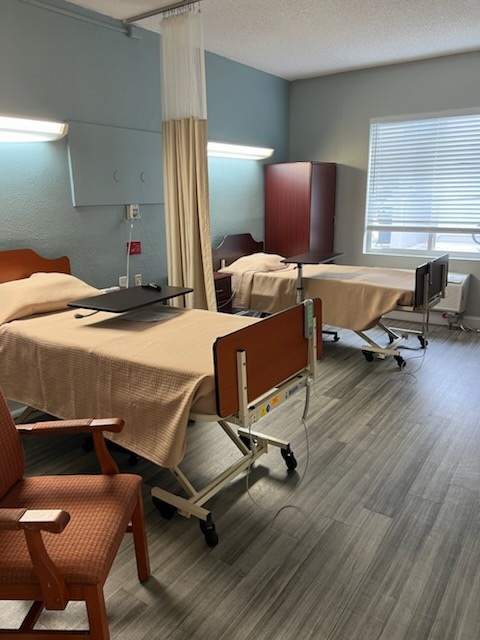
1) room [ROOM NUMBER] - The foot of Bed A has a chunk of wood missing from the right side of the footboard, leaving jagged edges. Photographic Evidence Obtained.
2) room [ROOM NUMBER] - The top border of the vertical blinds covering the resident's window was off and positioned upright on the floor in the corner of the room. Photographic Evidence Obtained.
3) room [ROOM NUMBER] - The privacy curtain separating Bed A from Bed B had a large, brown stain on bottom, right section of the curtain; and the pole holding tube feeding bottle had residue smeared on the display screen. Photographic Evidence Obtained.
4) room [ROOM NUMBER] - The air-conditioning vent had dust build up in the top and side vents. A small roach was seen crawling into one of the vents. Photographic Evidence Obtained.
5) room [ROOM NUMBER] - Wall behind Bed B in disrepair. A bowl containing unknown substance with small insects (or seeds??) on top it and the table. Metal parts on the floor at the top of the resident's bed; and Tube Feeding pole and tube feeding machine with brown dripping down the pole and onto the machine. There was also brown residue on the floor near the Tube Feeding pole. The top of the oxygen concentrator contained brown drippings and dust. The brown substance was still observed on 06/28/24 during the tour with Housekeeping and the Administrator. Photographic Evidence Obtained.
6) room [ROOM NUMBER] - Bed A does not have a bedside nightstand/dresser. A plastic bin is being used as the nightstand for Bed A. Photographic Evidence Obtained.
7) room [ROOM NUMBER] - Strong urine odor permeating the room which was also noted on 06/25/24, 06/27/24, and 06/28/24. Per the Unit Manager, the resident in Bed B is known to urinate on the floor.
On 06/28/24 at 9:58 AM, an interview was conducted with the Maintenance Director, who stated he had recently been hired for this position. He stated, Resident furniture comes through central supply. The nurse or aides would report missing items so they can be ordered through central supply. The CNA's and nursing staff are to let us know if repairs are needed through messages or work orders. We work off a work order system called Secura and keep a maintenance log of all the work completed.
On 06/28/24 at 10:11 AM, an interview was conducted with the Housekeeping Manager, who stated he had only been in this position for 2.5 months. He stated he had not been made aware of the urine odor in room [ROOM NUMBER]. Staff should have notified me if there was still a urine odor in a resident's room after being cleaned. If it is urine-soaked mattress, maintenance is responsible for replacing the mattress. It is my understanding that the CNAs are responsible for cleaning the IV poles and Oxygen Machines during Turn-over, but housekeeping should clean them during their cleaning of the room. We have specific rooms scheduled for deep cleaning twice a month.
On 06/28/24 at 10:45 AM, an environmental tour was completed with the Housekeeping Manager and the Administrator. Environmental concerns were discussed with both. She made a note of the missing nightstand in room [ROOM NUMBER], and both she and Housekeeping confirmed they were unaware that a plastic bin was being used instead of a regular nightstand for Bed A. When entering room [ROOM NUMBER], the Housekeeping Manager confirmed the presence of strong urine odor. He stated that it would be addressed by the Housekeeping Department. During the tour, the stained privacy curtain in room [ROOM NUMBER] could not be verified, as the resident was receiving care during this time.
On 06/28/24 at 11:32 AM, the Housekeeping Manager confirmed the presence of the stained privacy curtain in room [ROOM NUMBER]. He stated staff were, at this time, replacing the stained curtain with a clean curtain.
CONCERN
(D)
Potential for Harm - no one hurt, but risky conditions existed
Grievances
(Tag F0585)
Could have caused harm · This affected 1 resident
**NOTE- TERMS IN BRACKETS HAVE BEEN EDITED TO PROTECT CONFIDENTIALITY** Based on policy review, observation, record review, and interview, the facility failed to respond to a voiced complaint for 1 of...
Read full inspector narrative →
**NOTE- TERMS IN BRACKETS HAVE BEEN EDITED TO PROTECT CONFIDENTIALITY** Based on policy review, observation, record review, and interview, the facility failed to respond to a voiced complaint for 1 of 1 sampled resident. Resident #38 voiced a concern about her roommate to staff with no further action or response taken.
The findings included:
Review of the policy Social Services - Grievance Process revised 02/21/23 documented in part, Purpose: It is the policy of this facility to support the resident's right to voice grievances without discrimination or reprisal. Definitions: 1. Grievance is defined as a concern that cannot be resolved to the satisfaction of the person making the objection at the bedside or immediately. Grievances are formal written or verbal complaints . General Guidelines: 1. the Facility Grievance Coordinator is the Director of Social Services . 4. Grievances may be voiced in the following forums: a. Verbal complaint to a staff member or Grievance Coordinator. Procedure: 1. The facility shall implement a process whereby when there is a grievance, it should be: a. Documented on the facility Grievance Report. b. Routed to the Grievance Coordinator or their designee, if not available. 5. When a grievance is received orally and the resident does not choose to complete a written report, then the staff member receiving the grievance shall complete the report and forward it to the Grievance Coordinator/Director of Social Services.
Review of the record revealed Resident #38 was admitted to the facility on [DATE] and moved into her current room on 12/20/23. Her roommate, Resident #40, moved into that same room on 05/14/24. Review of the current Minimum Data Set (MDS) assessment dated [DATE] documented Resident #38 had a Brief Interview for Mental Status score of 9, on a 0 to 15 scale, indicating some cognitive impairment. This MDS also indicated it was very important for Resident #38 to choose her clothes, take care of personal belongings, choose between a bath and a shower, choose her bedtime, and have privacy on the phone, indicating she could voice her preferences. Resident #38 was also receiving medications for insomnia, depression, and anxiety.
On 06/24/24 in the morning, while observing residents on the second floor, Resident #40 was observed self-propelling throughout the unit. Resident #40 was observed at times yelling out and or crying, with staff needing to redirect and or console, and at other times the resident was calm.
On 06/24/24 at about 3:15 PM, Resident #40 was observed in her room, sitting in her wheelchair, constantly moving back and forth in her chair, holding the facility phone that was in her room. Resident #40 was screaming at the phone, and suddenly forcefully threw the phone to the floor. Resident #38, the roommate, and the surveyor both jumped from the startling loud noise. There were black marks all over the floor on the side of the room belonging to Resident #40, showing her agitation as she had wheeled back and forth, turning about (Photographic Evidence Obtained). Resident #38 was visibly upset and stated, This has been going on for a month . 24/7 . she throws her phone and other things day and night . I can't take it. She needs help. It's been a month. After speaking with the resident for a while, she changed the subject and wanted some ice cream. When told the surveyor could not get her anything, but she could use the call bell and ask the staff for some ice cream, Resident #38 pushed the call bell.
On 06/24/24 at 3:24 PM, the Social Services Assistant (SSA) answered the call bell, and Resident #40 became visibly agitated again. The SSA asked if he could help Resident #38 who stated, She (referring to Resident #40) is driving me crazy . it's 24/7 . I can't take it. The SSA listened and just stated, OK.
Review of the record lacked any documented evidence of this interaction or any follow-up by the Social Services Director (SSD).
During an interview on 06/28/24 at 12:12 PM, when asked if there had been any follow-up regarding the interaction observed on 06/24/24, the SSA stated he would get the SSD.
On 06/28/24 at 12:33 PM, the SSD stated she was not made aware of any concerns between Resident #38 and Resident #40. When told of the observation and interaction with the SSA, the SSD stated she had not been made aware.
CONCERN
(D)
Potential for Harm - no one hurt, but risky conditions existed
Deficiency F0645
(Tag F0645)
Could have caused harm · This affected 1 resident
**NOTE- TERMS IN BRACKETS HAVE BEEN EDITED TO PROTECT CONFIDENTIALITY** Based on record review and interviews, the facility failed to ensure timely, accurate, and complete Preadmission Screening and R...
Read full inspector narrative →
**NOTE- TERMS IN BRACKETS HAVE BEEN EDITED TO PROTECT CONFIDENTIALITY** Based on record review and interviews, the facility failed to ensure timely, accurate, and complete Preadmission Screening and Resident Record Review (PASSARs) for 3 of 4 sampled residents reviewed for PASARR's (Residents #64, #78, and #94).
The findings included:
1) Resident #64 was admitted to the facility on [DATE] with diagnoses including Psychosis and Dementia. No completed Level 1 PASSAR was found in Resident 64's electronic record.
On 06/26/24 at 1:54 PM, a request was made to the Social Services Director for a copy of the PASSAR for Resident #64, since one could not be located in the Resident's electronic record.
On 06/27/24 at 11:30 AM, the Social Services Director brought a copy of the PASSAR that had been completed by her on 06/27/24. No previous copy of Resident #64's PASSAR was provided.
2) Resident #78 was admitted on [DATE] and re-admitted on [DATE] with diagnoses including Parkinsonism and Psychosis.
A review of Resident #78's Level I PASSAR, completed on 06/22/23, was not completed in its entirety. There was missing information regarding:
Present Location of Individual Being Evaluated
Representative's Name, Address, Telephone Number
Medicaid Identification Number or Other Health Insurance Name and Number
Section I.A had no checkmarks indicating a mental illness or suspected mental illness, even though there is a documented history of Psychosis. Section II.1, II.2a, and II.3b all had checkmarks indicating yes there were situations that would warrant a Level II PASSAR.
Section IV, which indicates whether the Resident may or may not be admitted to a nursing facility was left black.
Under the signature of the person completing the form, the box asking for information regarding what agencies received a copy of the PASSAR is left blank.
No Level II PASSAR was found in Resident #78's electronic record.
On 06/26/24 at 1:54 PM, the Social Services Director (SSD) was informed that Resident #78's Level I PASSAR was incomplete and indicated a Level II PASSAR may be required; however, no Level II PASSAR could not be found in the resident's electronic record.
On 06/27/24 at 11:31 AM, the Social Services Director stated, The Psychiatrist was in visiting and reviewed the Level I PASSAR and stated that the previous PASSAR completed by the hospital was not accurate, as the information was not reflective of the resident's behavior/diagnoses while residing in the facility. A new PASSAR is being completed to accurately reflect the resident's condition.
On 06/27/24 at 12:14 PM, the Social Services Director brought a newly completed Level I PASAR for Resident #78, dated 06/27/24.
3) Resident #93 was admitted on [DATE] with diagnoses including Unspecified Psychosis, Anxiety, Depression, and Dementia.
A Level I PASSAR was completed on 05/22/24. Several sections of the PASSAR form were left blank:
Social Security Number
Present Location of Individual Being Evaluated
Representative's Name, Address, Telephone Number
Medicaid Identification Number or Other Health Insurance Name and Number
No check marks were present in Section A (MI or suspected MI) even though resident does have diagnoses of mental illness (Psychosis, Anxiety Disorder)
No check marks were present under SERVICES.
There was no indication as to Finding based on (check all that apply):
No answer was checked to Question #4: Has the individual exhibited actions or behaviors that may make them a danger to themselves or others?
Section IV does not have a check mark in response to the statement Individual may be admitted to an NF (check one of the following:
Under the signature of the person completing the form, the box asking for information regarding what agencies received a copy of the PASSAR is left blank.
On 06/26/24 01:54 PM, the Social Service Director was informed that the PASSAR for this resident was not complete. She stated, The PASSARs we have been getting from the hospital are almost always not filled out entirely. Sometimes, we get a form with just the resident's first name and nothing else on the form. I try to catch them, but I miss some.
On 06/27/24 at 11:40 AM, a fully completed Level I PASSAR was provided by the Social Services Director, dated 06/27/24.
CONCERN
(D)
📢 Someone Reported This
A family member, employee, or ombudsman was alarmed enough to file a formal complaint
Potential for Harm - no one hurt, but risky conditions existed
ADL Care
(Tag F0677)
Could have caused harm · This affected 1 resident
**NOTE- TERMS IN BRACKETS HAVE BEEN EDITED TO PROTECT CONFIDENTIALITY** 2) Resident #74 was admitted on [DATE] with diagnoses of dorsalgia (spine pain), difficulty in walking, muscle weakness, atrial ...
Read full inspector narrative →
**NOTE- TERMS IN BRACKETS HAVE BEEN EDITED TO PROTECT CONFIDENTIALITY** 2) Resident #74 was admitted on [DATE] with diagnoses of dorsalgia (spine pain), difficulty in walking, muscle weakness, atrial fibrillation, age related nuclear cataract, essential primary hypertension. This resident had a history of falling in August 2023.
A record review of the Minimum Data Set (MDS) dated [DATE], revealed Brief Interview for Mental Status (BIMS) score of 13 in Section C indicating good cognitive function, while Section O showed passive range of motion score of 7 compared to active range of motion score of 0 (zero).
Further record review of the modified triggered areas of the MDS revealed Activities of Daily Living (ADL) assistance for movement is needed related to resident's dependent status in the ability to roll from lying on back to left and right side. Pressure ulcer and injury were modified triggered areas due to frequent urinary and bowel incontinence. It also showed that Resident #74 needed substantial/maximal assistance in toileting.
During observation and interview on 06/24/2024 at 11:38 AM, the resident stated he wanted his hair shampooed because his hair had not been shampooed for 6 months. He added his scalp itches. When asked how often he shampooed his hair when he was living at home, this resident stated everyday. Resident # 74 added, I really like my hair to be shampooed, but he knew it would be hard to make this simple request from Staff because they are busy. He added that Staff sometimes changed him at 1 PM and the next change or perineal care would be at 9 PM. This resident is still wearing his gown and has not changed into regular clothes. His hair is not combed. His face did not look like it was cleaned after breakfast.
During observation on 06/25/24 at 09:31 AM, the resident was deeply asleep.
In an interview with the resident and his roommate on 06/25/2024 at 1:30 PM, they both verified that this resident gets perineal care, and changes in positioning at 05:30 AM, with the next perineal care after lunch between 2:00 PM to 3:00PM. Resident #74 stated he sits in a wet brief for hours at times. The resident was still wearing his gown with left over food on his neck areas. His fingernails have brownish material underneath. His hair uncombed, had brownish lower teeth, distribution of whitish hair on jaw, above nose, and facial areas. When asked if staff attended to him, or give him personal grooming assistance, he stated Maybe after 2:00 PM. When asked about hair shampooing, he said he stopped asking staff because he knew the answer. They are busy and do not have time.
In an interview with a CNA, Staff K on 06/28/204 at 10:02 AM, when this Surveyor asked about shampooing hair logs, she stated the facility does not have one. When asked if she had shampooed Resident # 74's hair, she stated no. When asked how residents would get their hair shampooed, she stated they must ask.
In an interview with a CNA, Staff N on 06/28 2024 at 10:30 AM, when asked if she could provide hair shampooing to this resident, she stated that Resident # 74 is not one of her assigned residents.
Based on observation, interview and record review, the facility failed to ensure activity of daily living (ADL) care for 3 of 7 sampled residents related to incontinence for Resident #45, hair shampoo and incontinence care for Resident #74, and nail care for Resident #8.
The findings included:
1) Record review revealed Resident #45 was admitted to the facility on [DATE] with diagnoses that included: Cerebral Vascular Accident (CVA), one-sided weakness (Hemiplegia) and depression. The quarterly Minimum Data Set (MDS), assessment, reference date 04/19/24, recorded a brief interview for mental status (BIMS) score of 08, which indicated Resident #45 was moderately cognitively impaired. This MDS recorded the following mood: Feeling down, depressed, or hopeless. Trouble falling or staying asleep or sleeping too much. Feeling tired or having little energy. Poor appetite or overeating. No behavior concern was recorded. The MDS also recorded Resident #45 required supervision or touching assistance with toileting hygiene. She required set up or clean up assistance with Personal hygiene.
The care plan, review/revision date 05/09/24, indicated Resident #45 had an ADL self-care performance deficit related to status post CVA with right sided weakness. Also, Resident #45 had potential for impairment to skin integrity related to decreased mobility and bowel/bladder incontinence. The goal was Resident #45 will maintain or develop clean and intact skin by the review date. Interventions included: provide incontinence care as needed. The skin assessment dated [DATE] and 06/26/24 revealed Resident #45 had redness in the sacral and perineal area.
On 06/24/24 at 10:58 AM, an interview process was started with Resident #45. She was noted alert and oriented, but slow to respond. During the interview, she stated when she does number 2 (defecate), in the morning, sometimes she doesn't get changed until the afternoon. She said this has happened three times already.
On 06/26/24 at 9:00 AM, the surveyor went to check on Resident #45. When asked how she was doing, she said, I am sitting in feces.
At 9:01 AM, Resident #45 put the call light on to alert the staff regarding her needing assistance with changing her adult brief.
At 9:03 AM the human resources (HR) staff answered the call light. He informed Resident #45 that he was going to seek assistance for her.
At approximately 9:05 AM, HR informed the attending nurse, Staff R, a license practical nurse (LPN), that Resident #45 needed to be changed, and he was going to look for the assigned certified nursing assistant (CNA).
At 9:18 AM, no one attended to Resident #45 to change her soiled adult brief.
At 9:19 AM, the surveyor observed Staff A, a CNA walking in the hallway. When the CNA was asked what assignment she had, the CNA responded with the room numbers that she was assigned, which included Resident #45's room. When asked what she was getting ready to do, the CNA said she was going to assist another resident first, then she would assist Resident #45.
At 9:22 AM, Staff R was heard asking for the attending CNA (Staff A) to go assist Resident #45.
At 9:29 AM, Staff R saw the attending CNA (Staff A) walking in the hallway and asked her to go and change Resident #45. The CNA said she was going to do Resident #45 next, after she was done with the other resident.
At 9:34 AM, Staff A finally went and performed care to Resident #45.
At 9:47 AM, while Resident #45 was receiving care, this surveyor observed Resident #45 with extreme redness to her groin and gluteal area.
On 06/27/24 at 11:26 AM, a subsequent interview was held with Resident #45. When the resident was asked about the redness to her groin and gluteal area, she stated, That's because I sits in a soiled adult brief for too long, that's what doing it.
On 06/28/24 at 11:04 AM, an inquiry was made regarding the resident's severe redness of her skin. The Director of Nursing (DON) voiced that the resident had contact dermatitis. The DON and Social Services Director (SSD) were made aware of Resident #45's voiced complaint of staff not cleaning her timely when she soils her adult brief.
3) Review of the record revealed Resident #8 was admitted to the facility on [DATE] and moved to his current room on 03/28/24. Review of the current Minimum Data Set (MDS) assessment dated [DATE], documented the resident had a Brief Interview for Mental Status (BIMS) score of 4, on a 0 to 15 scale, indicating cognitive impairment. This MDS also documented the resident needed from partial to moderate assistance for personal hygiene tasks.
Review of the current care plan initiated on 01/17/24, and revised on 02/01/24, revealed Resident #8 had an ADL (activities of daily living) self-care performance deficit related to late effects of a stroke affecting his right side. This care plan instructed staff to provide up to moderate assistance of one person for personal hygiene and grooming.
During an observation on 06/24/24 at 2:32 PM, Resident #8 was sitting in his wheelchair, pleasantly answering questions. An observation of the resident's fingernails revealed they were trimmed, but black debris was noted under most of his nails on both hands. When asked if staff help him clean his nails, Resident #8 stated, No. A short beard was also noted. When asked if he likes his beard, the resident stated, No, I'd like it cut off. When asked if he could do it himself, he stated, Not anymore. I used to. When asked if staff offer to shave him, he stated they do not.
An observation on 06/26/24 at 8:59 AM revealed Resident #8 had been shaved, but his fingernails remained dirty.
During an observation on Friday 06/28/24 at 11:26 AM, Resident #8 had just gotten up into his wheelchair. As per his roommate, who was alert and oriented, the resident prefers to get up between 10 AM and noon. Staff N, Certified Nursing Assistant (CNA), was in the room and stated she had just finished providing morning care and put lotion on the resident's hands. Resident #8 was rubbing his hands back and forth and fresh lotion was noted. Three fingernails on each hand remained with black noted under each nail. When asked the process for keeping fingernails clean, the CNA explained they clean the nails as needed, with a wooden stick that is flat on the end. When asked if she does it routinely for the residents, Staff N stated. When I work I do it. When shown the resident's fingernails, the CNA agreed they needed to be cleaned. When asked why she had not done so, the CNA stated she had no reason.
Review of staff assignments for the week revealed Staff N, CNA, had worked that same assignment on Tuesday 06/25/24, Wednesday 06/26/24, and Thursday 06/27/24.
CONCERN
(D)
Potential for Harm - no one hurt, but risky conditions existed
Quality of Care
(Tag F0684)
Could have caused harm · This affected 1 resident
**NOTE- TERMS IN BRACKETS HAVE BEEN EDITED TO PROTECT CONFIDENTIALITY** 3) Resident #82 was admitted on [DATE] with diagnoses of Heart Failure and Chronic Obstructive Pulmonary Disease (COPD). He was ...
Read full inspector narrative →
**NOTE- TERMS IN BRACKETS HAVE BEEN EDITED TO PROTECT CONFIDENTIALITY** 3) Resident #82 was admitted on [DATE] with diagnoses of Heart Failure and Chronic Obstructive Pulmonary Disease (COPD). He was hospitalized on [DATE] with the complaint of Left Flank Pain and a diagnosis of Major Sepsis. He was re-admitted to the facility on [DATE].
Record review of quarterly Minimum Data Set (MDS) performed on 06/05/2024 revealed a score of 15, Brief Interview for Mental Status (BIMS) indicating good cognitive function.
A medication order initiated on 05/10/2024 and activated on 05/11/2024 of Bumetanide 1mg (milligram) one tablet by mouth one time a day related to Heart Failure (a diuretic that treats fluid retention by reducing swelling or edema).
During observation and interview on 06/28/2024 at 09:13 AM, Resident was observed sitting on the right-side of the bed. He had nasal cannula prongs on both nasal openings with a clear tubing dated 06/23/24 connected to long green tubing attached to Oxygen concentrator at 3 L/m (Liters per minute). (There was no visible canister of solution or Humidifier attached to the oxygen tubing). This Resident complained he is having a hard time talking and breathing. He added he has not received his water pill for the past 5 days. When asked why, he stated Nurses do not give it to me, and I do not know why.
In an interview and observation with Staff J, an LPN on 06/28/2024 at 09:20 AM, she stated from previous experience that Staff usually call the Pharmacy if there is a missing medication. She will check if the resident is not getting his water pill. She showed this Surveyor the resident has been receiving the medication according to the Electronic Medication Administration Record.
In an interview on 06/28/2024 at 10:11 AM, the resident stressed that he did not receive his water pill which was scheduled this morning. The Nurse gave his other scheduled medications but not his water pill. He is almost crying when he said it and added I am very stressed. The medication makes me breathe easier and I continually have a hard time breathing. He also showed this Surveyor his urinal confirming that his urine output is half of what he usually eliminated because the water pill has not been administered to him. He also pointed to his right upper thigh stating, My right thigh is getting more swollen everyday.
Record review of the electronic Medication Administration Record on 06/28/2024 at 10:20 AM, revealed there were check marks and Nurses' initials indicating the medications were administered. On 06/23/2024 a check mark with nurse's initials of MLB7 was documented. On 06/24/2024, 06/25/2024, and 06/27/2024 check marks with the Nurse's initials of ssl were documented, and a check mark with Nurse's initials of BS were documented on 06/26/2024.
In another interview with Staff J, an LPN on 06/28/2024 at 1:38 PM, she stated she spoke to the Pharmacist who told her that the Bumetanide medication will be delivered later tonight. She then called the resident's physician, who prescribed Lasix (a diuretic that helps reduce sodium and fluid retention in the body). She was made aware by this resident that he had not received the prescribed water pill for the past few days. She gave the one-time prescribed Lasix medication to this resident today.
In an interview on 06/28/2024 at 02:40 PM, Resident #82 stated the Nurse gave him a medication, but it was not the same. He needed something for his heart failure and the Nurse did not explain to him what the substitute medication was for.
In an interview with the Director of Nursing (DON) on 06/28/2024 at 2:36 PM, she stated the medication is usually stored in the Medication Storage Cart. She asked this Surveyor to accompany her upstairs to show the Medication Storage Cart where the resident's medication is usually kept. She tried her keys on the Medication Cart Middle located in front of the Nurses' Station on the second floor, but they did not work. The DON came back at 2:50 PM unlocked and opened Medication Cart Middle with the new set of keys and started searching for the missing medication, but did not find the missing medication. She then stated The resident's Bumetanide (Diuretic) medication is not here.
Based on record review and interview, the facility failed to follow physician orders related to blood pressure parameters and failed to obtain blood pressure and heart rate vital signs for 2 of 5 sampled residents reviewed for medication usage (Residents #40 and #73), and failed to ensure the provision of medications for 1 of 1 sampled resident who voiced complaints (Resident #82).
The findings included:
1) Review of the record revealed Resident #40 was admitted to the facility on [DATE].
Review of the current orders revealed Midodrine (a medication for low blood pressure) was ordered as of 12/23/23, to be given three times daily. This order documented nursing staff were to hold the medication is the resident's systolic blood pressure (the upper number) was above 130.
Review of the current Medication Administration Record (MAR) for June 2024 documented the following:
a) On 06/18/24 at 2200 (10 PM) the resident's blood pressure was 131/76, and the medication administered.
b) On 06/22/24 at 1400 (2 PM) the resident's blood pressure was 138/79, and the medication was administered.
c) On 06/23/24 at 2200 (10 PM) the resident's blood pressure was 108/65, and the medication was held.
Review of the previous MAR for May 2024 documented the following:
d) On 05/21/24 at 0600 (6 AM) the resident's blood pressure was 135/69, and the medication was administered.
e) On 05/30/24 at 0600 the resident's blood pressure was 198/55, and the medication was administered.
During a side-by-side review of the record on 06/28/24 at 12:25 PM, the second floor Unit Manager was shown the findings and concerns. The Unit Manager stated she would look into it and inform the surveyor of any additional information. As of the Exit Conference, no additional information was provided.
2) Review of the record revealed Resident #73 was admitted to the facility on [DATE].
Review of the current orders revealed as of 02/21/24 staff were to obtain the resident's BP (blood pressure) and pulse twice daily, at 8:00 AM and 8:00 PM. Review of the June 2024 MAR documented a checkmark twice daily, indicating the blood pressure and pulse were being done twice daily. The MAR lacked any documented values for the blood pressure or pulse. Review of the vital sign section of the record revealed a blood pressure reading was documented daily at 8:00 AM. The record lacked the evening blood pressure. Further review of the vital signs revealed the pulse was documented only thirteen of 127 ordered times, since the initiation of the order through 06/27/24. The only days that had a documented pulse were 02/21/24, 03/01/24, 04/04/24, 04/05/24, 04/07/24, 04/12/24, 04/19/24, 05/03/24, 05/10/24, 05/24/24, 05/31/24, 06/07/24, and 06/14/24.
During a side-by-side review of the record, on 06/28/24 at 12:13 PM, the second floor Unit Manager was made aware of the findings and concerns. The Unit Manager explained the normal process would be for the staff to document the vital sign readings in the MAR. The Unit Manager stated she would look into it and inform the surveyor of any additional information. As of the Exit Conference, no additional information was provided.
CONCERN
(D)
Potential for Harm - no one hurt, but risky conditions existed
Deficiency F0685
(Tag F0685)
Could have caused harm · This affected 1 resident
**NOTE- TERMS IN BRACKETS HAVE BEEN EDITED TO PROTECT CONFIDENTIALITY** Based on record review, observation, interview and policy review, the Facility failed to timely provide the prescribed eyeglasse...
Read full inspector narrative →
**NOTE- TERMS IN BRACKETS HAVE BEEN EDITED TO PROTECT CONFIDENTIALITY** Based on record review, observation, interview and policy review, the Facility failed to timely provide the prescribed eyeglasses for 1 of 2 residents sampled for vision (Resident #35).
The Findings included:
Resident # 35 was admitted to the facility on [DATE] with diagnoses of Congestive Heart Failure, Chronic Atrial Fibrillation, Shortness of Breath, Type 2 Diabetes. She had undergone Cataract Surgery on 05/10/2023.
Record review on 05/07/2024 of the Minimum Data Set (MDS), Section C revealed this resident received a score of 13 indicating good cognitive function on the Brief Interview for Mental Status (BIMS). Section B showed adequate vison. Additional vision assessment showed resident's ability to see adequate light with glasses or other visual appliances. Corrective lenses (contacts, glasses, or magnifying glass) were used in completing this vision assessment.
During an interview on 06/25/2024 at 10:00 AM, the resident stated she is unable to read because the facility did not give her the prescribed eyeglasses. She had been waiting for the eyeglasses since last year after cataract surgery.
In an interview with the Social Services Director on 06/24/2024, she stated the facility tried to track the location of the medically prescribed eyeglasses. When asked about the tracking documentation, she was unable to respond.
In an interview with the resident on 06/25/2024 at 09:33 AM, she complained that her eyeglasses were sent to the facility by the Eye Company and got lost. She received this information from the Social Services Director. This resident told the Surveyor that she had not been reading since May 2023. She had been waiting for a very long time and she could not get a verifiable response from the facility staff.
In an interview with the Director of Social Services on 06/25/2024 at 10:11 AM, she stated Resident # 35 had been seen by an eye doctor last year. The Administrator joined the interview, and she added that the eye doctor's office sent the glasses to this facility last year, but the resident did not receive them. The DON tried calling the doctor back but did not get any response. The facility decided to refer this resident to another eye doctor. This new eye doctor recommended a pair of reading glasses, with 2.5 Diopter (Dpt). This facility provided those to this resident, but the resident gave it back because it did not help her with reading.
The Director of Social Services stated that an eye doctor would be seeing this resident on Thursday 06/27/2024, adding that accurate and prescribed eyeglasses are going to be provided to this resident.
In an interview with another RN, Staff E on 06/26/2024 at 2:00 PM, she stated the resident did tell her about missing glasses.
In an interview with this resident on 06/26/2024 at 2:10 PM, she still has problems with reading and is waiting for her eyeglasses.
In an interview with Staff D, an LPN on 06/27/2024 at 9:05 AM, she stated the resident had been complaining about her eye and eyeglasses. She knew about the missing eyeglasses since last month and she never informed the resident's physician.
In an interview with a visiting Optician on 06/27/2024 at 1:45 PM, he stated he verified the surgeon recommended prescription eyeglasses after surgery last year. He verified all the information from his phone and added that the eyeglasses were prescribed and ordered from his company. He added the company has a systematic procedure which keeps track of the eyeglasses ordered from them. He was sure they sent the eyeglasses to the facility. He does not understand how a resident failed to receive the prescribed eyeglasses.
In another interview with the Director of Social Services on 06/27/2024 at 2:50 PM, she said it takes a month or longer for the ordered eyeglasses to arrive at the facility after ordering them. When asked why this resident's eyeglasses are still not received when they were ordered back in January 2024, she didn't have a response. The facility waited until January 2024 to provide resident the substitute eyeglasses for the prescribed lost eyeglasses post -surgery in 2023. Since January 2024, the facility had not been able to provide prescribed eyeglasses Resident #35 needs to read.
In an interview with the Eye Doctor from the eye company on 06/27/2024 at 3:41 PM, he stated he was not made aware by the facility that the prescribed eyeglasses were not received by this resident.
In another interview with this resident on 06/28/2024 at 08:57 AM, she stated she cannot see with the glasses she received from the Eye Doctor yesterday. She was told before eye dilatation that when the given eye medication wears off, she would be able to see again with the glasses they left for her, but she cannot see.
In another interview with the Director of Social Services on 06/28/2024 at 10:18 AM, she stated she will get the policy and procedures for eyeglasses today.
In an interview with Social Services Assistant on 06/28/2024 at 12:30 PM, this Surveyor reminded him to submit the grievance for the lost eyeglasses. This Surveyor wanted to get documentation that the facility tried to track this resident's eyeglasses from the eye company.
In an interview with Social Services Director on 06/28/2024 at 1:01 PM, she stated she is still getting information regarding tracking of Resident #35' s glasses. The facility waited until January 2024 to provide the substitute for prescribed glasses ordered by eye doctor post-surgery in October 2023, additionally the facility gave substitute eyeglasses instead of the prescribed glasses.
In another interview with Resident # 35 on 06/28/2024 2:54 PM, this resident said that the facility is sending her outside to be eye tested again. She was very upset because she does not know when she can read and see better again.
Record Review of a document titled Policy, Procedures and Information: Policy Nursing-Visually Impaired Resident with an effective date of 04/01/2024, showed only definitions of visual devices, the process when residents lose visual devices, interactions with visually impaired residents and interventions to help prevent accidents for the visually impaired residents. There is no written process on how the Facility tracks eyeglasses not delivered or received from the prescribing source.
Record review on 06/26/2024 at 3:06 PM showed no Progress notes pertaining to this resident complaining about missing eyeglasses. Until after inquiry with the Director of Social Services, an updated progress notes were electronically written on 06/26/2024 by Social Services Director at 08:55 AM, stating she had contacted the office who was responsible for resident's surgery last year regarding this resident's eyeglasses. There were no notes explaining the result of Resident # 35's eyeglasses inquiries from the office.
The facility's Social Services Director did not provide any documentation regarding the lost prescribed eyeglasses.
CONCERN
(D)
Potential for Harm - no one hurt, but risky conditions existed
Incontinence Care
(Tag F0690)
Could have caused harm · This affected 1 resident
**NOTE- TERMS IN BRACKETS HAVE BEEN EDITED TO PROTECT CONFIDENTIALITY** Based on policy review, record review, observation, and interview, the facility failed to ensure proper incontinence care for 1 ...
Read full inspector narrative →
**NOTE- TERMS IN BRACKETS HAVE BEEN EDITED TO PROTECT CONFIDENTIALITY** Based on policy review, record review, observation, and interview, the facility failed to ensure proper incontinence care for 1 of 4 sampled residents reviewed with a history of Urinary Tract Infections (UTIs) (Resident #66).
The findings included:
Review of the policy Nursing - Perineal Care (care provided to a resident after an incontinent episode) revised 02/21/23 documented, Purpose: The purposes of this procedure are to provide cleanliness and comfort to the resident, to prevent infections and skin irritation, and to observe the resident's skin condition. Steps in the Procedure . For a female resident: e. Wash the rectal area thoroughly, wiping from the base of the labia towards and extending over the buttocks.
Review of the record revealed Resident #66 was admitted to the facility on [DATE]. Review of the current Minimum Data Set (MDS) assessment dated [DATE] revealed the resident was totally dependent upon staff for toileting and was always incontinent of bowel and bladder.
Review of the physician orders and laboratory results revealed Resident #66 had a UTI as of 07/05/23 with organisms of E. Coli (Escherichia [NAME], normal intestinal flora, that is not found in urine), indicating poor incontinence care. The record also revealed three additional orders for urinalysis on 12/24/23, 05/26/24, and 06/16/24, related to signs and symptoms of a UTI, that were not completed (Refer to F770 for details). An order dated 06/25/24 documented the use of an antifungal and steroid cream to the sacrum.
Review of the latest skin evaluation completed on 06/27/24 documented a rash to the sacrum with orders in place. This assessment lacked any redness to the perineal area.
Review of the current care plans initiated on 04/30/23 confirmed the bowel and bladder incontinence and the resident's need for total assistance with incontinence care.
During an interview on 06/24/24 at 2:50 PM, the son of Resident #66 volunteered, Mom gets lots of UTIs here. She did not get them at home.
An observation of incontinence care for Resident #66 was made on 06/27/24 at 11:24 AM with Staff T, Certified Nursing Assistant (CNA). Upon removal of the resident's adult brief and during personal care to the resident's front side, the skin was noted to be red, and the resident was grimacing as if uncomfortable. The CNA did not notice the resident's grimacing. The CNA provided appropriate care to the resident's front area, then assisted the resident to her side. Staff T then cleaned the resident's back side by wiping from the buttock toward the front with each cleansing swipe and rinse. Resident #66 continued to grimace. When asked by the surveyor if that hurt, the resident stated, Yes, that hurts. The CNA acknowledged and provided care more gently. A diffuse red rash was noted on the resident's upper buttock and lower back.
During an interview after the provision of care, when asked the appropriate direction for cleansing of the resident during incontinence care, Staff T stated, Front to back. When asked why she cleaned the back side of Resident #66 from back to front, the CNA responded, I did? and had no further reasoning.
During an interview with the Second Floor Unit Manager on 06/27/24 in the afternoon, she was unaware of the resident's redness and grimacing observed during the incontinence care earlier that day.
CONCERN
(D)
Potential for Harm - no one hurt, but risky conditions existed
Respiratory Care
(Tag F0695)
Could have caused harm · This affected 1 resident
**NOTE- TERMS IN BRACKETS HAVE BEEN EDITED TO PROTECT CONFIDENTIALITY** 3) Resident # 31 was admitted to the facility on [DATE] with the diagnosis of Chronic Obstructive Pulmonary Disease (COPD), Emph...
Read full inspector narrative →
**NOTE- TERMS IN BRACKETS HAVE BEEN EDITED TO PROTECT CONFIDENTIALITY** 3) Resident # 31 was admitted to the facility on [DATE] with the diagnosis of Chronic Obstructive Pulmonary Disease (COPD), Emphysema, Chronic Respiratory Failure with Hypoxia (Low Oxygen Tissue Level), Shortness of Breath (SOB) when lying flat.
Record review of Minimum Data Set (MDS) dated [DATE] revealed Resident # 31 scored 14 under Section C of the Brief Interview for Mental Status (BIMS) indicating good cognitive function.
Review of Physician Order written on 06/03/24 and activated on 06/09/24 showed to Change nebulizer tubing/mouthpiece every Sunday during night shift. Another order for oxygen equipment showed to change tubing every Sunday night, and to provide oxygen inhalation (via nasal cannula at 3 Liters per minute {@3 L}.
Review of Care Plan showed this resident has altered respiratory status/difficulty breathing related to Chronic Obstructive Pulmonary Disease (COPD), emphysema, chronic respiratory failure, Shortness of Breath (SOB) when lying flat. The goal of this care plan is for staff to make sure resident have minimal risk of complications related to Shortness of Breath (SOB) though the review date. The interventions include monitoring for the effectiveness and side effects of oxygen therapy with changing and dating nebulizer mask and tubing as ordered, monitoring for signs and symptoms (s/sx ) of respiratory distress, and reporting to Medical Doctor (MD) PRN (pro re nata or as needed) these respiratory distress signs and symptoms.
During observation and interview on 06/24/24 at 10:33 AM, this resident was observed with oxygen tubing and nasal cannula wrapped around the left wrist. Resident # 31 stated, I am uncomfortable. The humidifying solution canister and the oxygen tubing had a written date of 06/09.
During observation and interview on 06/25/24 at 10 :20 AM, Resident #31 was sitting on his bed with nasal cannula and tubing wrapped around his left wrist. He stated, I can control when to put them inside my nose. He added the insides of his nose were getting dried. Upon closer observation, the oxygen level was between 3 and 4 Liters per minute and the humidifier was on. The green top of humidifying canister had the date of 06/09 written in black ink.
In another observation on 06/25/2024 at 11:00 AM, Staff M saw the resident without nasal cannula on both nares indicating he was not receiving the oxygen therapy, This Staff did not say anything to the resident or inform a Nurse that this resident was not receiving oxygen therapy. She left the room without a word.
During observation on 06/26/2024 at 12:55 PM, this resident's oxygen canister (humidifier) and tubing still have the same date of 06/09. Resident made a productive cough, and his nasal cannulas and tubing were wrapped around wrist. Suddenly Staff L, a RN, came in (she did not knock on the door). She looked at the resident but did not say anything to him (or reminded resident to put the nasal cannula back on the nares). She went in and then out. This Surveyor waited to make sure she had informed a Nurse regarding this resident not wearing nasal cannula on both nares. After 5 minutes, no Staff came back inside the room.
During observation and interview on 06/26/24 2:18 PM with Staff L, an RN, when asked if she had noticed resident was not receiving oxygen therapy because the nasal cannula and tubing were wrapped on his left arm, she stated she just made a quick glance if resident was eating lunch. She stated she did not check anything else. After this conversation, this Staff did not go back to the resident's room to check the oxygen therapy but continued sitting at the front desk.
Review of progress notes dated on 06/27/2024 at 00:15 revealed Resident # 31 was restless in bed and had a chief complaint of Shortness of breath presenting an O2 sat (oxygen saturation {the amount of hemoglobin bound to oxygen in your blood}) of 93% (Normal oxygen saturation is 95 % to 100%) on room air. He called 911 and was re- hospitalized .
4) Resident #82 was admitted on [DATE] with the diagnoses of Heart Failure, Chronic Obstructive Pulmonary Disease (COPD), and Chronic Respiratory Failure with Hypoxia and Heart Failure. He was hospitalized on [DATE] with a complaint of Left Flank Pain and a diagnosis of Major Sepsis. He was re-admitted to the facility on [DATE] with the diagnoses of Sepsis unspecified Organism, non -ST Elevation Myocardial Infarction, Acute Posthemorrhagic Anemia, Acute Respiratory Failure with Hypoxia.
The resident's quarterly Minimum Data Set (MDS) performed on 06/05/2024 revealed a score of 15 on Brief Interview for Mental Status (BIMS) located on Section C indicating good cognitive function. Section O assessment on 06/13/2024 revealed Continuous Oxygen therapy.
Further review of plan showed to monitor oxygen saturation and respiratory status, to use oxygen pro re nata (prn or as needed) to maintain oxygen saturation greater than 92 percent (O2 sat >92%), to continue Nebulized treatment, to continue medications, and to get out of bed (OOB) with assistance.
The following orders activated on 05/10/24 included to change oxygen tubing and humidifier every Sunday night shift.; to provide oxygen at 3 Liters per Nasal Cannula (L per NC) every shift; to change Nebulizer Tubing and Mask every Sunday during night shift and to date, initial, and place in dated bag; to encourage this resident to use Incentive Spirometry for 3 sets of 10 breathes for 15 minutes; to record volume with best effort and good technique two times a day related to chronic obstructive pulmonary disease, unspecified.
Record review of Care Plans based on the diagnoses of COPD, Chronic Respiratory Failure with Hypoxia, Shortness of Breath (SOB) when lying flat and the resident's oxygen usage, this resident will display optimal breathing patterns daily through review date. The facility Staff must do the following: Change oxygen tubing and humidifier as ordered and PRN (pro re nata or as needed); Give aerosol or bronchodilators as ordered. The Staff must also monitor/document any side effects and effectiveness of treatment, ensure the head of bed is elevated or resident is out of bed upright in a chair during episodes of difficulty breathing, monitor for difficulty breathing (Dyspnea) on exertion, remind resident not to push beyond endurance, monitor for signs and symptoms ( s/sx) of acute respiratory insufficiency such as Anxiety, Confusion, Restlessness, Shortness of Breath (SOB) at rest, Cyanosis, Somnolence.
During initial observation and interview on 06/24/24 11:22 AM, this Resident's oxygen tubing had a paper tag dated 6/12/24. In an interview, resident said Staff did not change his Oxygen tubing yesterday since he requires longer tubing to go to the bathroom. The Staff said the facility did not have a longer oxygen tubing for him.
During observation and interview on 06/24/2024 at 1:22 PM, this resident said he is always on 3 Liters of oxygen per minute. This surveyor observed the oxygen humidifying canister (humidifier is usually a container of a distilled water given concurrently with oxygen therapy to provide moisture to the inhaled air thus preventing nasal mucosa dryness) dated 06/16/2024. The long oxygen clear tubing was dated 06/12/24 (tag wrapped around the tubing).
During observation on 06/25/24 at 12:30 PM, Resident # 82 was sitting in bed with the same clear oxygen tubing (dated 06/12/24). He added that Staff did not change his oxygen tubing. It was supposed to be changed last Sunday (06/23/2024). The same canister (humidifier) was dated 06/16/2024.
On 06/27/24 at 12:27 PM, during observation this Surveyor noticed the oxygen tubing is connected directly to the oxygen concentrator (the canister of humidifier was missing; observed during the first days of survey), delivering 3 Liters per minute (L/min). There was a new green colored tubing connected to a clear nasal cannula tubing with tape tag dated 06/23/24. Resident # 82 stated they just changed the tubing but did not provide a new humidifier (green top plastic cannister was gone). (The order states to change humidifier every Sunday night).
2) Record review revealed Resident #51 was admitted to the facility on [DATE] with diagnoses that included cancer of the larynx. Review of the admission Minimum Data Set (MDS), assessment reference date 05/25/24, recorded a brief interview for mental status (BIMS) score of 15, which indicated Resident #51 was cognitively intact. This MDS recorded no mood or behavior concern. Review of physician order, dated 05/20/24, documented Ambu bag at bedside. (Ambu bag is a device known as a bag valve mask, which is used to provide respiratory support to patients).
On 06/26/24 at 3:23 PM, Resident #51 was noted with tracheostomy (a procedure to help air and oxygen reach the lungs by creating an opening into the trachea from outside the neck). An interview was held with Resident #51, and the resident was asked about the ambu bag which was supposed to be at bedside. The resident signaled I don't know.
With his permission, the surveyor looked for the Ambu bag in the drawers and closet. It was not there. At approximately 3:28 PM, the surveyor called the Director of Nursing (DON) to the room and inquired about the Ambu bag which was supposed to be at bedside, per the physician order. The DON searched for the ambu bag in the same locations that the surveyor had searched, and she was not able to find the ambu bag, either. Subsequently, the DON asked Staff C, the North and South Unit Manager, for the ambu bag. Staff C left and went to the other side of the unit and obtained a bag with trach care items, including an ambu bag. When asked where these items were found, Staff C said she kept them in the trach room.
Based on policy review, record review, observation, and interview, the facility failed to ensure oxygen care and services for 4 of 5 sampled residents (Residents #78, #51, #31, and #82).
The findings included:
Review of the policy Nursing - Oxygen Administration effective 04/01/22 documented, General Guidelines: . 5. All disposable equipment labeled with the resident's name, the date it was opened or provided, and should be changed a minimum of every 7 days.
1) Review of the record revealed Resident #78 was admitted to the facility on [DATE] and moved to his current room on 05/14/24. Review of the current Minimum Data Set (MDS) assessment dated [DATE] documented the resident was on continuous oxygen. This MDS documented the resident was totally dependent upon staff for all activities of daily living (ADLs) and had functional limitation in range of motion to all extremities.
During an observation on 06/24/24 at 11:14 AM, Resident #78 was lying in bed with the oxygen concentrator running at 3 liters per minute. The concentrator was visibly dirty with black debris, tan colored splattering of what looked like tube feeding formula, and faded white streaks. The filter on the back of the oxygen concentrator was gray to white in color, appeared dusty instead of clean and black or dark. The nasal cannula was noted just under the resident's right eye.
During a supplemental observation on 06/26/24 at 9:13 AM, the oxygen equipment remained in the same condition.
During an interview on 06/28/24 at 9:58 AM, the Maintenance Director stated his department was not responsible for the oxygen concentrators or oxygen filters.
During an interview on 06/28/24 at 10:11 AM, the Housekeeping Manager stated the housekeepers were responsible for cleaning the resident equipment in the rooms, such as oxygen concentrators, but was unsure who was responsible for the oxygen filters.
During the environmental tour on 06/28/24 at 10:45 AM with managerial staff, the Administrator stated that the maintenance department was responsible for changing the oxygen filters.
CONCERN
(D)
Potential for Harm - no one hurt, but risky conditions existed
Unnecessary Medications
(Tag F0759)
Could have caused harm · This affected 1 resident
Based on observation, interview and record review, the medication error rate was 7.69 percent. Two medication errors were identified while observing a total of 27 opportunities, affecting 2 of 6 resid...
Read full inspector narrative →
Based on observation, interview and record review, the medication error rate was 7.69 percent. Two medication errors were identified while observing a total of 27 opportunities, affecting 2 of 6 residents observed (Residents #64, and #57).
The findings included:
1) A medication administration observation for Resident #64 was made on 06/27/24 beginning at 5:33 PM with Staff U, Licensed Practical Nurse (LPN). The LPN poured two Tylenol 325 milligram (mg) tablets into the medication cup followed by one 500 mg Methocarbamol (a muscle relaxant) tablet. The LPN poured a cup of water and locked the medication cart. When asked if that was all that was due at that time, the LPN's response was yes. When asked how many pills the nurse had poured into the medication cup for administration, the LPN stated three.
The LPN provided the three pills to Resident #64 and continued on with her medication pass.
During the reconciliation of medications, the record revealed the current order for the Methocarbamol 500 mg was to give two tablets.
During an interview on 06/27/24 at 6:19 PM, when asked to verify the order for the Methocarbamol administered to Resident #64, Staff U, LPN agreed she should have provided two tablets.
2) A medication administration observation for Resident #57 was made on 06/27/24 at 5:59 PM with Staff U, Licensed Practical Nurse (LPN). The LPN explained the resident had a blood pressure medication due, so she obtained a blood pressure reading. Upon return to the medication cart, the LPN obtained three medications to include a probiotic, an anti-seizure medication, and Losartan 50 milligrams (the anti-hypertensive/blood pressure medication). When asked if that was all that was due at that time, the LPN's response was yes. When asked how many pills the nurse had poured into the medication cup for administration, the LPN stated three. Staff U administered the three medications to Resident #57.
During the reconciliation of medications, record review revealed the resident was only due to receive the probiotic and anti-seizure medication, and that the Losartan was not due to be administered until 10 PM.
During a side-by-side review of the record and continued interview on 06/27/24 at 6:19 PM, Staff U, LPN confirmed the order documented the Losartan was to be given at 10 AM and 10 PM. The LPN stated the medication came up on the electronic MAR to administer. The LPN could not figure out why.
During an interview on 06/27/24 at 6:35 PM, when explained to the Assistant Director of Nursing (ADON) and upon review of the MAR, she determined the medication had either not been provided that morning, or not been signed off as administered by the First Floor Unit Manager, who had taken the assignment late due to a call off. That failure by the morning nurse caused the Losartan to remain on the electronic MAR to be administered.
CONCERN
(D)
Potential for Harm - no one hurt, but risky conditions existed
Laboratory Services
(Tag F0770)
Could have caused harm · This affected 1 resident
**NOTE- TERMS IN BRACKETS HAVE BEEN EDITED TO PROTECT CONFIDENTIALITY** Based on record review and interview, the facility failed to ensure laboratory services for 2 of 5 sampled residents as evidence...
Read full inspector narrative →
**NOTE- TERMS IN BRACKETS HAVE BEEN EDITED TO PROTECT CONFIDENTIALITY** Based on record review and interview, the facility failed to ensure laboratory services for 2 of 5 sampled residents as evidenced by the failure to obtain a urine sample from Resident #66 three times as per physician order, and failure to obtain the most recent blood work for Resident #73.
The findings included:
1) Review of the record revealed Resident #66 was admitted to the facility on [DATE]. Review of the current Minimum Data Set (MDS) assessment dated [DATE] revealed Resident #66 was cognitively impaired and always incontinent of urine.
Review of the orders, lab results, Treatment Administration Record (TAR), and corresponding progress notes revealed the following:
a) An order dated 12/24/23 documented staff were to obtain urine for a urinalysis. A corresponding nursing progress note dated 12/24/23 at 8:23 PM documented the family reported the resident was complaining of pain when urination. This note further documented upon assessment by the nurse, Resident #66 said it was very painful and with a burning sensation. The record lacked any results of the urinalysis and any further documentation.
b) An order dated 05/26/24 documented staff were to obtain urine for a urinalysis. A corresponding nursing progress note dated 05/27/24 at 11:28 PM documented unable to obtain, incontinent. The record lacked any results or additional information regarding the ordered urinalysis, although the TAR documented a checkmark indicating it was completed.
c) An order dated 06/16/24 documented staff were to obtain urine for a urinalysis. The record lacked any results, the laboratory requisition documented not collected, and the TAR indicated it was completed. The progress notes lacked any further information related to the urinalysis.
During a side-by-side review of the record and interview on 06/27/24 at 10:24 AM, the Assistant Director of Nursing (ADON) explained the process for a urinalysis was after obtaining the order, the request is put directly into the laboratory website and a requisition is printed out and put into their laboratory binder. The ADON stated if staff were unable to collect the urine, they should notify the physician and obtain order to either attempt another collection or do a straight catheterization to obtain the urine. The ADON searched the laboratory website and was unable to locate results for the above three ordered urinalysis. The ADON also was unable to provide any progress notes or reason for the failure to obtain and or follow through with their process.
2) Review of the record revealed Resident #73 was admitted to the facility on [DATE]. Review of the record revealed an order dated 03/14/24 to obtain a CMP (comprehensive metabolic panel) and a CBC (complete blood count) on 03/15/24. Review of the corresponding Treatment Administration Record (TAR) documented the blood work was completed as evidenced by a checkmark. Further review of the record lacked any results or documentation about the ordered laboratory services.
During an interview on 06/28/24 at 12:13 PM, the Second Floor Unit Manager was told of the concern and stated she would look into the missing blood work. As of the exit conference on 06/28/24 at 6:45 PM no further information had been provided.
CONCERN
(D)
Potential for Harm - no one hurt, but risky conditions existed
Deficiency F0804
(Tag F0804)
Could have caused harm · This affected 1 resident
**NOTE- TERMS IN BRACKETS HAVE BEEN EDITED TO PROTECT CONFIDENTIALITY** Based on interviews, record reviews, and a review of the grievance logs, the facility failed to ensure that residents were serve...
Read full inspector narrative →
**NOTE- TERMS IN BRACKETS HAVE BEEN EDITED TO PROTECT CONFIDENTIALITY** Based on interviews, record reviews, and a review of the grievance logs, the facility failed to ensure that residents were served food at a palatable temperature for 3 of 15 sampled residents with voiced food concerns (Residents #82, #89, and #77), and 4 residents from Resident Council who voiced food concerns also (Residents #88, #84, #14, and #15).
The findings included:
1) During an interview on 06/27/24 at 5:48 PM. Resident #82 was asked how the temperature of his dinner was. The resident responded, It's a little warm today. Sometimes it's cold, not every day. When asked how often the food was cold the resident answered, half and half. Review of the Minimum Data Set assessment dated [DATE] showed that Resident #82's Brief Interview for Mental Status (BIMS) score was 15. This indicated that the resident was cognitively intact.
2) An interview with Resident #89 on 06/27/24 at 6:02 PM revealed that when she was asked how the temperature of her dinner was, she responded: Most times it's warm, sometimes it's cold.
3) Review of the grievance log for the past six months revealed resident complaints of cold food on 12/12/23 and 02/07/24 with resolutions to reheat meals in the microwave and to provide a staff in-service to deliver the trays upon arrival to the units. In addition, on 5/21/24, there were 4 Food/customer service grievances filed. The resolutions all specified In service with staff.
5) On 06/27/24 at 3:00 PM, a special Resident Council meeting was held to discuss concerns voiced by many of the residents during the initial interview process. The following 4 residents in attendance for this meeting were all alert and oriented and regularly attended the monthly resident council meetings:
Resident #88, who has a BIMS (Brief Interview of Mental Status) of 13 out of 15 (cognitively intact);
Resident #84, who has a BIMS of 14 out of 15;
Resident #14; who has a BIMS of 15 out of 15; and
Resident #15, who has a BIMS of 13 out of 15.
These 4 Resident Council Attendees also stated that the food is consistently served cold. They each stated they have complained to the Dietary Department about the food being served cold. Resident #14 stated, Even though there has been a small improvement lately, it hasn't been a consistent improvement. The 4 resident Council attendees ( Residents #88, #84, #15, and #14) confirmed that food trays will often sit in the carts for a long time before staff pass them out to the residents.
4) Review of the record revealed Resident #77 was admitted to the facility on [DATE]. Review of the current Minimum Data Set (MDS) assessment dated [DATE] documented a Brief Interview for Mental Status (BIMS) score of 13, on a 0 to 15 scale, indicating he was cognitively intact.
During an interview on 06/24/24 at 11:39 AM, Resident #77 stated the food was always cold. The resident stated he eats in his room and the cart sits out in the hall.
On 06/26/24 at 12:30 PM, Resident #77 was eating his lunch. When asked if the food was hot, Resident #77 stated, It's warm, shrugged his shoulders, stated he would like it warmer, but was going to eat it.
CONCERN
(D)
Potential for Harm - no one hurt, but risky conditions existed
Deficiency F0806
(Tag F0806)
Could have caused harm · This affected 1 resident
**NOTE- TERMS IN BRACKETS HAVE BEEN EDITED TO PROTECT CONFIDENTIALITY** Based on interviews and record reviews the facility failed to provide foods per preferences for 5 of 15 sampled residents with v...
Read full inspector narrative →
**NOTE- TERMS IN BRACKETS HAVE BEEN EDITED TO PROTECT CONFIDENTIALITY** Based on interviews and record reviews the facility failed to provide foods per preferences for 5 of 15 sampled residents with voiced food concerns (Residents #104, #63, #77, #73, and #107).
The findings included:
Review of the policy Dining and Food Preferences, revised 9/2017, documented that food allergies, food intolerance, food dislikes, and food and fluid preferences will be entered into the resident profile in the menu management software system. The individual tray assembly ticket will identify all food items appropriate for the resident/patient based on diet order, allergies & intolerances, and preferences. Upon meal service, any resident/patient with expressed or observed refusal of food and/or beverage will be offered an alternate selection of comparable nutrition value.
1) In an interview on 06/27/24 at 10:24 AM Resident #104 was asked if she likes the food here. She said she was served foods that she doesn't like, and orange juice every morning that she will never drink because of her diabetes. She added that she could not stand the smell of the eggs. When Resident #104 was asked if the facility offered other food options she answered: They haven't offered me any. Per resident, I don't eat green beans, snap peas, carrots. A lot of times I get carrots and green beans. This resident's Brief Interview for Mental Status (BIMS) score, per Minimum Data Set (MDS) assessment dated [DATE] was 14. This score indicates that this resident was cognitively intact.
2) On 06/26/24 at 1:03 PM, Resident #63 was observed at lunch. His meal ticket listed double potion [sig] Country Fried Steak and double potion [sig] Mashed Potatoes, and double potion [sig] Whole Kernel Corn. The resident was served a single portion of each. (Photographic Evidence Obtained). Resident #63 did not eat the lunch. He said, I'm not eating this stuff, and he left the dining room. Per the Minimum Data Set assessment dated [DATE], this resident's BIMS score equaled 15, which indicated this Resident was cognitively intact. Staff failed to offer the resident another food option. Per resident's care plan, revised 5/15/24, this resident had a potential nutritional problem related to increased needs for nutrition.
3) On 06/27/24 at 11:50 AM there were two dietary aides, and one cook on the tray line plating the lunch meals. The Dietary Manager was present for the entire duration of the tray line and was stationed at the end of the line. He checked all the trays before he placed them on the meal carts (also called trucks) for delivery. He requested a turkey sandwich for a resident whose meal ticket communicated no lasagna and no egg salad.
4) On 06/28/24 at 4:35 PM an interview with the Dietary Manager revealed that usually two people prepare the trays after the cook gives them the plate with the entree. Per the Dietary Manager, A third person, either myself or a person who also prepares sandwiches, fruits, or desserts, will help on the line. The third person will also help to bring the food trays on the trucks to the units. When the Dietary Manager was asked about the process for obtaining food preferences the DM said he receives a communication form from nursing and within the first 24 hours he meets with the resident and he gives them a menu and asks them about their food preferences. He added that he lets them know about the other food options available.
5) Record review revealed Resident #107 was admitted to the facility on [DATE] with diagnoses including: hypertension, and diabetes. The admission Minimum Data Set (MDS) assessment, reference date 06/03/24, recorded a brief interview for mental status (BIMS) of score 15, indicated Resident #107 was cognitively intact. This MDS recorded no mood or behavior issue. Review of Physician order dated 05/28/24 revealed RESIDENT IS VEGETARIAN, NO MEAT, NO FISH, NO MILK. Review of nutrition assessment completed on 05/29/24 evidenced we are honoring preferences as feasible vegetarian noted. admitted with ccd diet stated being vegetarian. Review of care plan dated 06/12/24 recorded Resident #107 had nutrition problems related to Diabetes, Hyponatremia (low sodium) Hyperlipidemia (high cholesterol), hydronephrosis (excess fluid in kidney), HTN (hypertension) and on a therapeutic diet. Interventions included: Provide and serve diet as ordered.
On 06/27/24 at 12:13 PM, while speaking to Resident #107's roommate, Resident #107 came towards the surveyor and said, Excuse me, can you help me? He stated that his meal ticket specifically states, No meat, and the facility gave him salad with turkey. He expressed being frustrated with the kitchen. He continued to state, Every day the facility gives me the same food, and I am tired of it! Now they gave me a salad with meat on it. It was revealed that Resident #107 was served a chef salad with eggs and turkey on it. The surveyor called Staff A, a CNA who was in the hallway, to assist Resident #107.
At 12:20 PM Staff A returned and informed the surveyor that the resident said he doesn't eat meat, and the facility gave him meat on the salad.
On 06/27/24 at 1:08 PM, the nursing home administrator (NHA) and the food service manager encountered the surveyor in the hallway, and they revealed they were made aware that the resident had received a chef salad with meat.
6) Review of the record revealed Resident #73 was admitted to the facility on [DATE]. Review of the current Minimum Data Set (MDS) assessment dated [DATE] documented a Brief Interview for Mental Status (BIMS) score of 13, on a 0 to 15 scale, indicating the resident was cognitively intact.
During an interview on 06/25/24 at 11:32 AM, Resident #73 stated he does not get a menu or any of his choices. When asked if he was provided a menu to circle his choice, the resident stated he did not, but the food just arrived. When asked if there was an alternate menu or if he could ask for something different when the meal arrived, Resident #73 stated, If I ask for something I get the dirty eye. The resident confirmed that meant the staff were not happy when he requested something different.
During an interview on 06/26/24 at 9:21 AM, Resident #73 was told the lunch for that day was hamburger steak with brown gravy and mashed potatoes. The resident stated, I like the hamburger steak, but watch, it will have gravy on it. I don't like gravy, my meal ticket says no gravy, but I'll get the gravy.
On 06/26/24 at 12:30 PM, the lunch tray was provided to Resident #73 and the hamburger steak and mashed potatoes were covered in gravy (Photographic Evidence Obtained). The staff had left the room. Resident #73 stated, See . told you, addressing the surveyor. When asked if he wanted a new lunch with no gravy, the resident stated in frustration, as noted by his tone of voice, No . forget it . I'll just have a ham and cheese sandwich.
7) Review of the record revealed Resident #77 was admitted to the facility on [DATE]. Review of the current MDS assessment dated [DATE] documented a BIMS score of 13, on a 0 to 15 scale, indicating he was cognitively intact. Further review of this MDS documented the resident was 6 foot 2 inches tall and weighed 191 pounds.
During an interview on 06/24/24 at 11:39 AM, Resident #77 stated he was supposed to get double portions for his meals, and that it rarely happened. When asked how he had maintained his weight, the resident stated he had a stash of honey buns and Vienna sausages that he gets when he goes out on leave. Although Resident #77 received double portions during the survey week, on 06/26/24 at 12:30 PM, the resident confirmed the issue concerning the double portions was an ongoing problem.
Review of the current orders lacked an order for double portions, indicating it was a preference for the resident.
CONCERN
(D)
Potential for Harm - no one hurt, but risky conditions existed
Infection Control
(Tag F0880)
Could have caused harm · This affected 1 resident
**NOTE- TERMS IN BRACKETS HAVE BEEN EDITED TO PROTECT CONFIDENTIALITY** 2) Resident # 31 was admitted to the facility in 08/25/2023 with the diagnoses of Prostate Cancer, Unspecified Neuromuscular Dys...
Read full inspector narrative →
**NOTE- TERMS IN BRACKETS HAVE BEEN EDITED TO PROTECT CONFIDENTIALITY** 2) Resident # 31 was admitted to the facility in 08/25/2023 with the diagnoses of Prostate Cancer, Unspecified Neuromuscular Dysfunction of the Bladder, Unspecified Urinary Tract Infection, Methicillin Resistant Staphylococcus Aureus (MRSA).
Record review of Minimum Data Set (MDS) dated [DATE] revealed Resident # 31 scored 14 under Section C of the Brief Interview for Mental Status (BIMS) indicating good cognitive function. Section H showed this resident has an indwelling urinary catheter related to a neurogenic bladder diagnosis. He scored positive for bowel incontinence under the same section. Section M showed Resident # 31 had multiple unhealed pressure injuries prompting pressure ulcer injury care.
Physician orders initiated on 06/03/2024 included an order to maintain Enhanced Barrier Precautions (EBP) related to foley (Brand name for urinary catheter) and wound every shift.
Review of a document titled Policy, Procedures, and Information -Enhanced Barrier Precautions with an effective date of 04/01/2024, showed Procedure #1 b stating a clear signage will be posted on the door or wall outside of the resident room indicating the type of precaution, required personal protective equipment (PPE), and the high-contact resident care activities which require the use of gown and gloves; Procedure #2 b stated an order of Enhanced Barrier Precautions will be obtained for residents with wounds and/or indwelling medical devices (e.g. central line, urinary catheter, feeding tube, tracheostomy, ventilator, etc.) regardless of Multiple Drug Resistant Organisms (MDRO) colonization status; Procedure# 3 a. stated to make gowns and gloves immediately available outside of the resident's room. An additional note here showed face protection may also be needed if performing activity with risk of splash or spray; Procedure # 4 stated EBP must be employed for residents when performing the following high-contact resident care activities like a. dressing, b. bathing, (letter c is not appropriate for this case), d. providing hygiene e. changing linens f. changing briefs or assisting with toileting, g. device care or use of urinary catheter h. Wound care: any skin opening requiring a dressing; Procedure #6. stated to continue EBP while the qualifying condition or indwelling device is still active or in use.
In an observation on 06/24/24 at 3:04 PM, Resident #31 stated he is itching and very uncomfortable. Staff F, a CNA came in and asked what the resident needed. After the resident stated what he needed, this staff put gloves on both hands, then left the resident's room with both gloves on at 3:06 PM. This surveyor observed the Enhanced Barrier Precautions (EBP) signs (one red paper and 2 white papers) posted next to 5 compartment plastic shelf) inside the room. Only one of the 5-compartment plastic shelves contained a pack of yellow gowns, the other 4 compartments were empty.
Staff F, a CNA came back in with gloves still on both hands carrying supplies (linen, towel, skin protectant cream, and lotion all inside a clear plastic bag). She then closed the door behind her and drew the curtain around Resident# 31.
She put on gloves on top of the other pair of gloves. She started touching this resident's clean brief, cabinet drawer, and basin which she half- filled with water. She then assembled all clean linen from the top of the cabinet of drawers to the top of resident's wheelchair. This resident was observed to have urinary catheter tubing connected to a urine bag hanging on the right lower side of the bed. This Staff un-velcroed both sides of this resident's diaper, took resident's pillow under resident's left leg, and put it next to the clean linen on top of a wheelchair. Resident # 31 was wearing yellow socks. This Staff then wiped the resident's frontal perineal area with wipes. She squeezed some liquid soap on top of the wipes, wet the wipes with water from the yellow basin, and wiped perineal area (front, sides, scrotum, and frontal anal area). She rinsed these areas with water and dried them with a towel. She wiped the catheter tubing from the tip of the penis downward with the same set of gloves. She was not wearing a protective gown. (EBP Policy & Procedure # 1states high-contact resident care activities require the use of gown and gloves; and Procedure # 4 states EBP must be employed for residents when performing the following high-contact resident care activities such as d. providing hygiene, e. changing linen, f. changing briefs or assisting with toileting, and g. device care or use: urinary catheter). She turned the resident left side up, wiped the resident's posterior anal area, and lower back. A plastic patch was observed on this resident's back and this Staff removed it with the same set of gloves. She proceeded and touched the resident's gown to move it higher. Using her left hand, she rinsed the resident's back while her right hand was supporting resident's left hip (same gloves). She towel- dried the back areas using her right hand.
She then went to this Resident's cabinet of drawers and on top searched for the plastic bag for lotion and skin protectant (using the same gloves). She pushed soiled linen and brief from under the resident and put the clean linen and brief underneath resident's right side. Using the same gloves she opened the plastic skin protectant pouch. She proceeded to apply on Resident #3's lower back and posterior anal area the creamy white protectant. She touched and adjusted the catheter tubing with her left hand. Then, she removed both gloves. This Staff pressed the bed control and raised resident's head up. She put on a new set of gloves on both hands. This staff velcroed the resident's brief (left side), touched resident's right leg, and removed the soiled linen located on the right bottom edge of Resident # 31's bed. Using both newly changed gloves, she bundled the dirty linens including the drying towel, and put them in a plastic bag inside the resident's bathroom. Using the same set of gloves, she then put the pillow back on the resident's right leg, then on the left. She then emptied the urine from the catheter bag into a urinal. She was not wearing an EBP gown or face protection. Additional note states that protection may also be needed if performing activity with risk of splash or spray).
At 03:27 PM, this Staff removed both gloves, then washed her hands inside this resident's bathroom sink.
In an interview with Staff M, a CNA, on 06/24/2024 at 1:45 PM, she was asked by this Surveyor about Resident # 31 and EBP. She stated hand washing or hand sanitation must be provided every time she completes perineal care, and after the resident ate a meal. She did not mention putting on a gown as Personal Protective Equipment (PPE) when providing perineal care.
In an interview with Staff L, an RN on 06/26/2024 at 11:00 AM, she stated EBP is a precautionary measure because this resident has urinary catheter and wound. She did not mention putting gown as part of PPE for this resident. She stressed the importance of hand washing and gloving.
In another interview with Staff D, an LPN, on 06/25/2024 at 10:30 AM, she stated using only gloves as PPE for proving care to this Resident. She did not mention anything about using a gown as PPE.
Review of progress note dated 06/27/2024 at 1:00 AM revealed that Resident # 31 was in bed, and restless while asking to be sent out to the hospital. He was complaining of burning on urination with the indwelling urinary catheter in place. He was sent to the hospital the same day.
Based on policy review, record review, observation, and interview, the facility failed to follow Infection control practices during a blood sugar check for 1 of 2 sampled residents observed as evidenced by the failure to properly disinfection the glucometer (machine used to obtain the blood sugar level from a blood sample) (Resident #4), and failed to properly utilize personal protective equipment (PPE) for 1 of 2 sampled residents observed on Enhanced Barrier Precautions (EBP) (Resident #31).
The findings included:
1) The facility's practice was to disinfect the glucometers after each use as per manufacturer's instructions on the disinfectant wipes. Review of the manufacturer's instructions for the MicroKill Bleach wipes used by the facility, indicated a three minute wet time to kill all organisms, including blood born pathogens.
An observation of a blood sugar check was made for Resident #4 on 06/27/24 at 5:46 PM with Staff U, Licensed Practical Nurse (LPN). The LPN gathered the needed items, including the glucometer. Upon completion of the process, the LPN returned to the medication cart, obtained a wipe from a package of FitRight Wet Wipes, and wiped off the glucometer and placed it back into it's hard plastic case. Review of the instructions and ingredients on the package of FitRight wipes documented the wipes were used for hand hygiene and lacked any type of disinfecting agent.
During an interview on 06/27/24 at 6:19 PM, Staff U verified she used the FitRight Wet Wipes to clean the glucometer. When asked her usual process to disinfect the glucometer, the LPN stated that sometimes she used the FitRight wipes, and at other times she used the MicroKill Bleach wipes, pulling them out of the side of her cart. The LPN then took a MicroKill Bleach wipe, wiped the glucometer, and immediately put it into the plastic container and back into the medication cart. The LPN was unaware of any needed wet time, as per manufacturer's instructions.
CONCERN
(E)
Potential for Harm - no one hurt, but risky conditions existed
Deficiency F0583
(Tag F0583)
Could have caused harm · This affected multiple residents
**NOTE- TERMS IN BRACKETS HAVE BEEN EDITED TO PROTECT CONFIDENTIALITY** Based on observation, interview and record review, the facility failed to ensure right to privacy for Resident's person and reco...
Read full inspector narrative →
**NOTE- TERMS IN BRACKETS HAVE BEEN EDITED TO PROTECT CONFIDENTIALITY** Based on observation, interview and record review, the facility failed to ensure right to privacy for Resident's person and records affecting Resident #9, #116, and #77, related to privacy curtains, loudly speaking residents's diagnosis, walking into resident rooms without permission and leaving residents naked.
The findings included:
1) Record review revealed Resident #9 was admitted to the facility on [DATE] with diagnoses including: cancer, and bipolar disorder. The quarterly minimum data (MDS) assessment, reference date 03/27/24, recorded a Brief Interview for Mental Status score (BIMS) of 15, indicated the resident was cognitively intact.
On 06/24/24 at 11:13 AM, an interview process was started with Resident #9.Tthe resident was observed to be alert and oriented. He explained that privacy is huge for him; sometimes when staff are providing activity of daily living care, to included bed bath, the staff don't close the curtain all the way, while his body was exposed while lying in the bed; sometimes people come into the room without knocking and/or asking for permission, while he is receiving care, and sometimes when they knock on the door, they give him no time to respond, the staff just walk right in. He stated, The staff need to be respectful about his privacy, and the staff need to knock on the door and ask for permission before entering his room. He further explained due to the lack of privacy it has become stressful to him when a Certified Nursing Assistance (CNA) say they're ready to provide care to him. He said his stress level goes up because he kept thinking who's probably going to walk into the room without knocking and/or asked for permission. He divulged, when his roommate visitors come in, he had told the facility he doesn't want visitors in his room, while he was receiving care, because the curtain does not close all the way the visitors would be able to see his exposed body, but the facility told him this was not a private room.
On 06/24/24 at 11:54 AM, while the interview process was being conducted with Resident #9, the surveyor was standing in front of the closed room door, that suddenly, Staff Q, a CNA opened the door, she almost hitting the surveyor with the door. The surveyor then yelled, don't hit me with the door please! and quickly moved away. Staff Q did not knock on the door, or asked for permission to come, she walked right into the room to bring the lunch tray to Resident #9's roommate. During that time Resident #9 looked at the surveyor while stating proof.
On 06/27/24 at 12:25 PM, the resident's roommate had 2 family members visiting. At 12:27 PM, the family had left the room, and during that time staff A, CNA, came to the room to tell Resident #9 that she was ready to provide care to him. The resident was noted stressed out and he was shaking. He then refused the care. He stated, he doesn't want to receive care right now, because he is stressing out, he doesn't know if the roommate family are going to return to the room and see his body while lying in the bed. The resident said the curtains did not pull all the way. During that time, observation was made of his curtain and the roommate curtain. When asked, Staff A pulled his curtain and the roommate curtain closed. Both curtains had a huge gap, they were not able to close all the way. Staff A then said, maintenance said he was going to fix it, she has reported to maintenance. Subsequently, Staff A made a statement in the presence of Resident #9. She said he was refusing care, that's his choice and his right. At that moment, an interview was held with Staff A. The surveyor asked her why the resident refused care. She stated, I don't know. The surveyor asked her what she thought about the curtain. She confirmed they were not able to close all the way, and the roommate's visitors would be able to see his body if they were to come back in the room. During that time the resident's roommate returned to the room to say goodbye to him.
On 06/27/24 at 12:52 PM, the resident was in the process of receiving care and the curtains were not replaced, they were still short with a huge gap.
2) On 06/25/24 at 9:37 AM while the surveyor was standing in the hallway, there were two nurses standing in the hallway as well. Staff B, Registered Nurse (RN) was heard telling Staff C, (the North and South unit manager) that she was looking for the HIV medication for a resident. She stated the resident's room number loud enough that the surveyor was able to hear it. During that time there was one housekeeper staff standing immediately next to them, and all the residents' doors in the unit were open with the potential for them to hear about a resident's diagnosis.
At 9:39 AM, an interview was held with Staff C who acknowledged the nurse had spoken loudly while in the hallway and repeated a resident diagnosis.
3) On 06/25/24 at 10:13 AM, while interviewing a resident in her room, the door was closed. The Human Resources staff knocked on the door, he didn't wait for permission to enter the room, and he then commenced to walk in the room. Once he saw the surveyor standing there, he apologized and left.
On 06/28/24 at 10:22 AM, an interview was held with the Social Service Director (SSD) and the Director of Nursing (DON). They were made aware of the privacy concerns.
4) Review of the record revealed Resident #77 was admitted to the facility on [DATE]. Review of the current Minimum Data Set (MDS) assessment dated [DATE] documented the resident had a Brief Interview for Mental Status (BIMS) score of 13, on a 0 to 15 scale, indicating he was cognitively intact. Resident #77 resided in a room with the bed at the window.
On 06/24/24 at 10:24 AM, Staff S, Certified Nursing Assistant (CNA), looked out of the opened door of Resident #77, with his gloves on and the curtain pulled around the bed at the door, and stated he was taking care of someone. Within a minute or two, the CNA left the room. Upon entering the room while the CNA was gone, after gaining permission, Resident #77 was observed lying on top of the bed totally naked, with the bed covers at the foot of the bed and out of reach. The curtain was not drawn around the bed. The surveyor excused herself and went back out into the hallway, just outside of the room. Within a minute or two, Staff S returned to the room with a bag of clean linens.
During an interview on 06/24/24 at 11:39 AM, when asked about the lack of privacy, Resident #77 stated staff sometimes pull the curtain for privacy, but sometimes do not. Resident #77 stated he had gotten used to it, and just shrugged his shoulders.
CONCERN
(E)
Potential for Harm - no one hurt, but risky conditions existed
Deficiency F0725
(Tag F0725)
Could have caused harm · This affected multiple residents
**NOTE- TERMS IN BRACKETS HAVE BEEN EDITED TO PROTECT CONFIDENTIALITY** 4) On 06/27/24 at 3:00 PM, a special Resident Council meeting was held to discuss concerns voiced by many of the residents durin...
Read full inspector narrative →
**NOTE- TERMS IN BRACKETS HAVE BEEN EDITED TO PROTECT CONFIDENTIALITY** 4) On 06/27/24 at 3:00 PM, a special Resident Council meeting was held to discuss concerns voiced by many of the residents during the initial interview process. The following 4 residents in attendance for this meeting were all alert and oriented and regularly attended the monthly resident council meetings:
Resident #88, who has a BIMS (Brief Interview of Mental Status) of 13 out of 15 (cognitively intact);
Resident #84, who has a BIMS of 14 out of 15;
Resident #14; who has a BIMS of 15 out of 15; and
Resident #15, who has a BIMS of 13 out of 15.
Resident #54, who has a BIMS of 15 and had never attended a Resident Council meeting before, attended for approximately 5 minutes in the beginning.
Each of these 5 residents confirmed that staff response to call lights is very bad at night and on weekends.
Resident #15 stated, Staff will come in and tell you they are coming back, but they never do.
Residents #88, #84, #54, and #14 all stated that during the nights and on weekends, it often takes a couple hours to get help, and sometimes staff will never come at all.
The 4 regular Resident Council attendees confirmed that incontinent care is not done in a timely manner, especially at night.
Resident #14 stated: I have had to stay in wet briefs all night because I couldn't get staff to answer the call light. I would hear them laughing and talking outside my room, but as soon as I turn on my call light, they all seem to disappear.
These 4 Resident Council Attendees also stated that the food is consistently served cold. They each stated they have complained to the Dietary Department about the food being served cold. Resident #14 stated, Even though there has been a small improvement lately, it hasn't been a consistent improvement. The 4 resident Council attendees ( Residents #88, #84, #15, and #14) confirmed that food trays will often sit in the carts for a long time before staff pass them out to the residents.
Also, each of the Residents Council attendees stated there are many times the food is not served according to the resident's preferences.
Based on observations, interviews, and staffing calculations, the facility failed to ensure sufficient staffing as evidenced by identified care issues during this survey, voiced concerns from Residents #73, #31, #74, #63, #45, #221, and #104, documented low-weekend staffing, and concerns voiced in Resident Council.
The findings included:
1) During this recertification survey, the following issues, potentially related to the lack of staff, were identified and noted:
a) Failure to ensure timely and proper incontinence care for Residents #47 and #66, failed to ensure shower and shampooing hair for Resident #74, and failed to ensure nail care for Resident #8. (Refer to F677 and F690).
b) Failure to ensure timely and appropriate respiratory care for Residents #78, #51, #31, and #82. (Refer to F695).
c) Failure to ensure palatable and hot food as voiced by Residents #82, #89, #93, and #77. (Refer to F804).
d) On 06/24/24 at 11:57 AM it was noted the Second Floor Unit Manager was working as the direct care nurse for the 2N unit. When asked why she was working the floor as a direct care nurse, the Unit Manager stated, We had a call out. You know it happens.
e) Upon arrival to the 2N unit on 06/27/24 at 9:33 AM, the staffing was posted on the white board and documented Staff U, Licensed Practical Nurse (LPN) was the assigned direct care nurse. Upon arrival to the 2N medication cart, the First Floor Unit Manager was at the cart, appeared rushed preparing medications for the residents, with the Second Floor Unit Manager at her side. When asked about the lack of the assigned direct care LPN, the Second Floor Unit Manager stated they had a call-off a little earlier.
2) During this recertificaiton survey, the following voiced concerns related to staffing were noted:
a) During an interview on 06/25/24 at 11:32 AM, when asked if staff were responsive to his needs, Resident #73 stated, The evening and night CNAs (Certified Nursing Assistants) don't respond. They are sleeping. Resident #73 stated his call light is on the floor more often than within his reach, even though he asks them to tie it onto his bed rail. The resident explained he often has to yell out for help or get his roommate to push the call light. The resident stated he was so aggravated at times he, Feels like throwing things (to get attention, but he doesn't). When asked why he usually calls for help, the resident stated it was to get changed (referring to incontinent care). Resident #73 stated the average wait time for care on the evening and night shift is an hour, and if it's close to shift change it is a longer wait. When asked how the staff respond, the resident stated staff come in and turn the call light off at times, but most of the time they don't even show up. The resident voiced the staffing was worse on the weekends. When asked if he had voiced his concerns to anyone, Resident #73 stated he spoke with management a while ago. Review of the record revealed the resident's Brief Interview for Mental Status (BIMS) score was 13, on a scale of 0 to 15, indicating the resident was cognitively intact.
b) During an interview on 06/24/24 at 10:33 AM, Resident #31 stated he often has to wait an hour for staff to assist him with repositioning. The resident's BIMS score was 14, indicating he was cognitively intact.
c) During an interview on 06/25/24 at 11:43 AM, Resident #74 stated he has been left in his chair for up to five hours because there is not enough staff. The resident also stated sometimes incontinent care is provided at 1 PM, and then he is not provided incontinent care again until 9 PM. Resident #74 stated there is not enough staff to help reposition him either. Resident #74 had a BIMS score of 13, indicating he is cognitively intact.
d) During an interview on 06/24/24 at 1:05 PM, Resident #63 stated his only complaint is that the 11 PM to 7 AM staff are not attentive. The resident stated he has to yell and scream, they just won't come, and he feels the staff are sleeping at night. When asked what assistance he required during the night, Resident #63 explained that he has a sacral pressure ulcer and although he can't lie on his sides for a long period of time, he would like to get off of his back at times. He further stated if staff do put him on his side, they won't come back to put him back on his back when he calls. Resident #63 had a BIMS score of 15, indicating he was cognitively intact.
e) During an interview on 06/24/24 at 10:58 AM, Resident #45 stated when she does number 2 (defecate) in the morning, sometimes she doesn't get changed until the afternoon. Resident #45 was admitted to the facility on [DATE] and stated that had happened three times. The resident voiced there's not enough staff. Although the resident's BIMS score was an 08, indicating she had some cognitive issues, she was able to be interviewed.
f) During an interview on 06/24/24 at 11:30 AM, Resident #221 stated, I don't think there is enough staff. During the night I have to wait a long time to get someone to answer my call for help. Sometimes they don't come. Resident #221 was a new admission, was alert and oriented, and able to be interviewed.
g) During an interview on 06/24/24 at 10:46 AM, Resident #104 voiced concern about a lack of staff. The resident explained she has waited two hours for staff to answer her call light and change her (provide incontinence care). Resident #104 had a BIMS score of 14, indicating she was cognitively intact. During this interview, her roommate stated the night CNAs do not answer the call light timely. The roommate stated they were short staffed on Saturday 06/22/24, and Resident #104 had to wait two hours for incontinence care.
3) Review of the staffing calculations for the second quarter of 2024 (starting on 03/31/24) to present, revealed the facility consistently utilized 10 CNAs over a 24-hour period on the weekends, with only 9 CNAs noted on Saturday 05/18/24. The number of CNAs during the week for this same time frame was 11 to 13 CNAs in a 24-hour period.
During an interview on 06/28/24 at 4:31 PM, when asked if they had enough staff, the Staffing Coordinator stated they are pretty well staffed except for Sundays. When asked about the weekends in general, the Staffing Coordinator agreed they should staff the same on the weekends as they do during the week. When told their staffing numbers are consistently lower on the weekends, the Staffing Coordinator agreed.