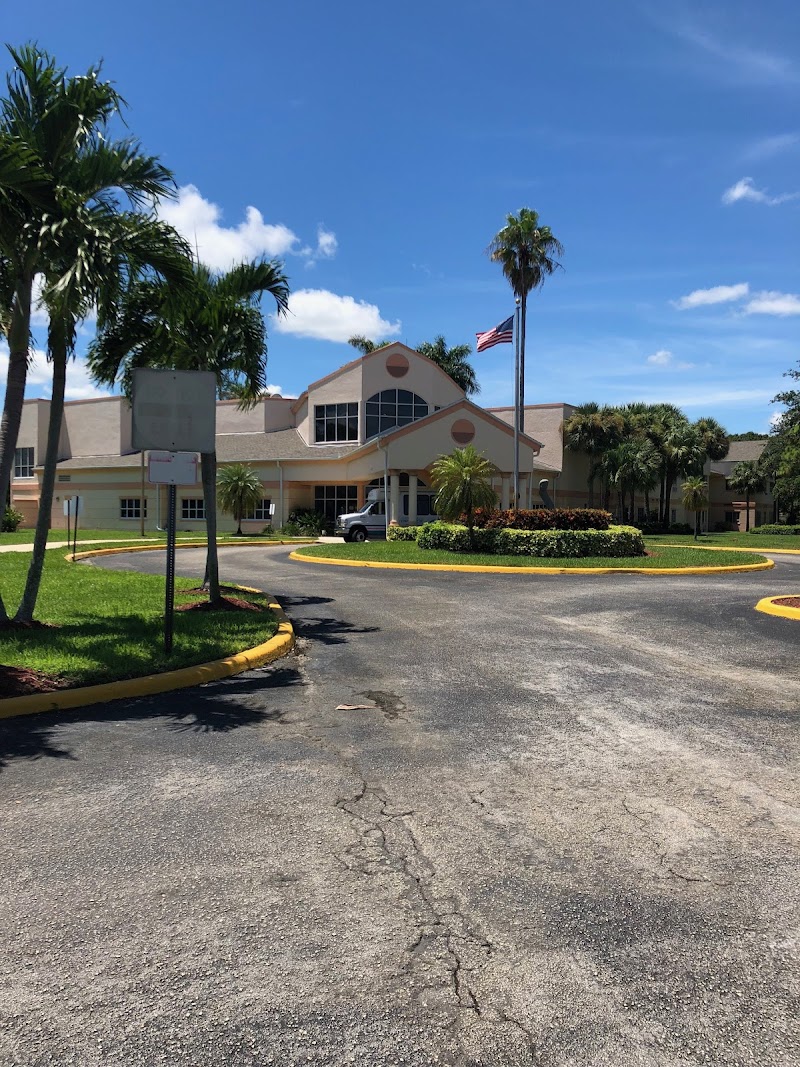
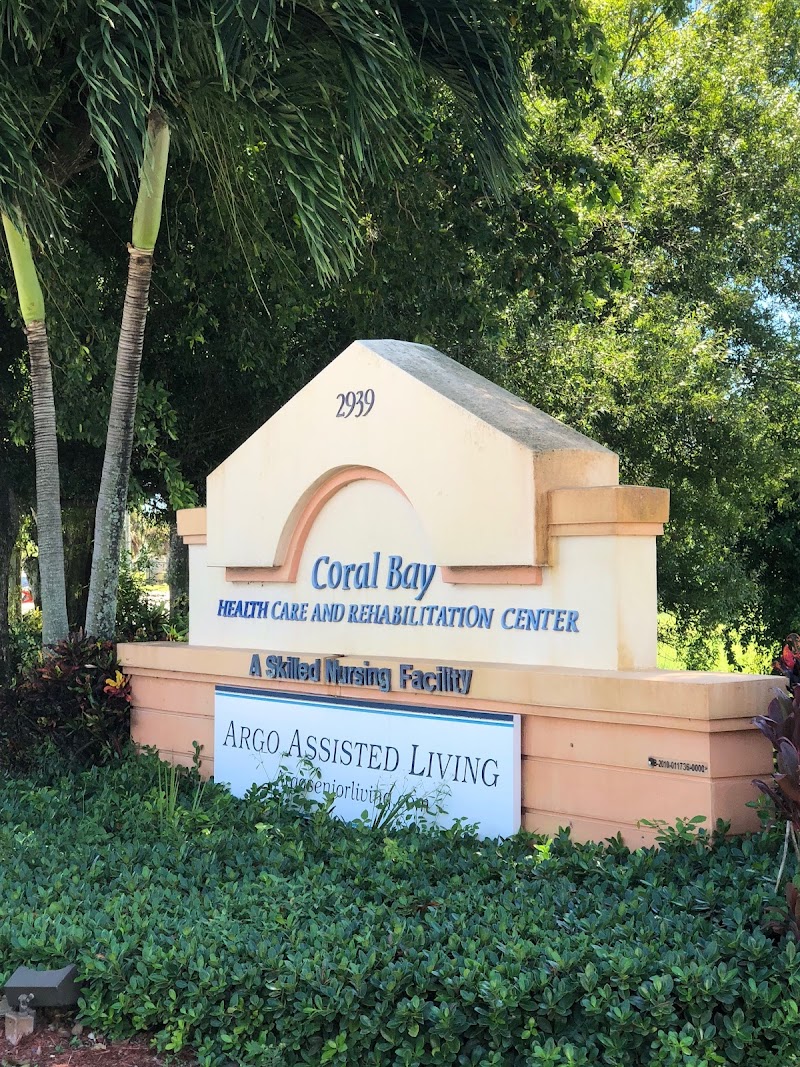
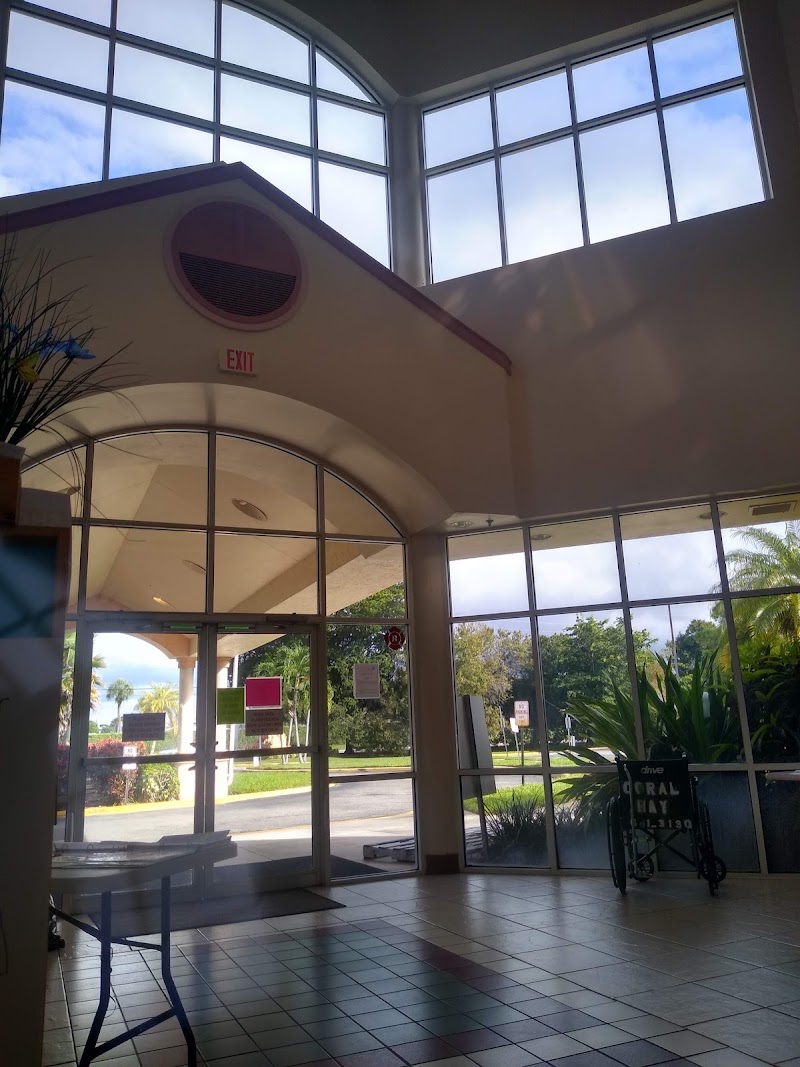
AVIATA AT CORAL BAY

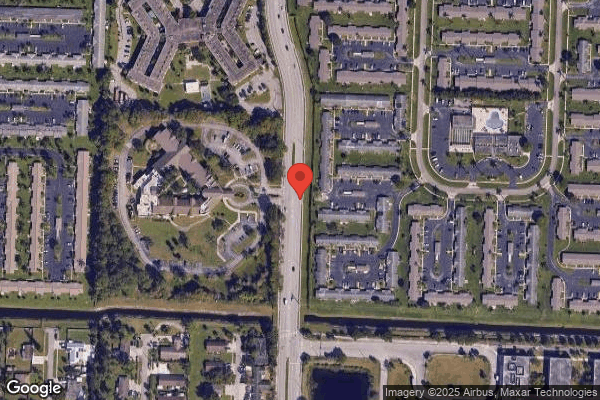
2939 S HAVERHILL RD, WEST PALM BEACH, FL 33415 (561) 641-3130
For profit - Limited Liability company 120 Beds AVIATA HEALTH GROUP Data: November 2025
Trust Grade
43/100
#458 of 690 in FL
Last Inspection: April 2025

Within standard 12-15 month inspection cycle. Federal law requires annual inspections.

Overview

Aviata at Coral Bay has received a Trust Grade of D, indicating it is below average and has some concerns. It ranks #458 out of 690 facilities in Florida, placing it in the bottom half, and #37 out of 54 in Palm Beach County, meaning there are only a few better options nearby. The facility is worsening, with issues increasing from 4 in 2024 to 14 in 2025. Staffing is a strength with a 4 out of 5 stars rating and a turnover rate of 35%, which is lower than the state average, suggesting experienced staff care for residents well. However, the facility has faced $9,770 in fines, which is concerning and indicates some compliance problems. Additionally, there are serious concerns about food safety and sanitation, including issues with meal preparation and unclean equipment, which could impact resident health.

Trust Score
D
43/100
In Florida
#458/690
Bottom 34%
Safety Record
Moderate
Needs review
Inspections
Getting Worse
4 → 14 violations
Staff Stability
○ Average
35% turnover. Near Florida's 48% average. Typical for the industry.
Penalties
○ Average
$9,770 in fines. Higher than 65% of Florida facilities. Some compliance issues.
Skilled Nurses
✓ Good
Each resident gets 47 minutes of Registered Nurse (RN) attention daily — more than average for Florida. RNs are trained to catch health problems early.
Violations
⚠ Watch
44 deficiencies on record. Higher than average. Multiple issues found across inspections.
★★☆☆☆
2.0
Overall Rating
★★★★☆
4.0
Staff Levels
★★★★☆
4.0
Care Quality
★★☆☆☆
2.0
Inspection Score
Stable
2024: 4 issues
2025: 14 issues

The Good

  • 4-Star Staffing Rating · Above-average nurse staffing levels
  • 4-Star Quality Measures · Strong clinical quality outcomes
  • Full Sprinkler Coverage · Fire safety systems throughout facility
  • No fines on record
  • Staff turnover below average (35%)

    13 points below Florida average of 48%

Facility shows strength in staffing levels, quality measures, fire safety.

The Bad

2-Star Overall Rating

Below Florida average (3.2)

Below average - review inspection findings carefully

Staff Turnover: 35%

10pts below Florida avg (46%)

Typical for the industry

Federal Fines: $9,770

Below median ($33,413)

Minor penalties assessed

Chain: AVIATA HEALTH GROUP

Part of a multi-facility chain

Ask about local staffing decisions and management

The Ugly 44 deficiencies on record

1 actual harm
Jul 2025 1 deficiency
CONCERN (D) 📢 Someone Reported This

A family member, employee, or ombudsman was alarmed enough to file a formal complaint

Potential for Harm - no one hurt, but risky conditions existed

Quality of Care (Tag F0684)

Could have caused harm · This affected 1 resident

**NOTE- TERMS IN BRACKETS HAVE BEEN EDITED TO PROTECT CONFIDENTIALITY** Based on record review and interview, the facility failed to provide follow-up care for a surgical wound in a timely manner as e...

Read full inspector narrative →
**NOTE- TERMS IN BRACKETS HAVE BEEN EDITED TO PROTECT CONFIDENTIALITY** Based on record review and interview, the facility failed to provide follow-up care for a surgical wound in a timely manner as evidenced by not attending to follow up surgical appointment and not informing the surgeon of the worsening condition of the resident's wound for 1 of 3 sampled residents (Resident #1).The findings included:Record review revealed Resident #1 was admitted to the facility on [DATE] with diagnoses included Diabetes, Chronic Kidney Disease, and Right Below the Knee Amputation, status post left foot toes amputation. A comprehensive assessment dated [DATE] documented the resident was cognitively intact and required partial/moderate assistance with activities of daily living. A review of Resident #1's care plan revealed the resident did not have a care plan for the left foot surgical wound. A review of Resident #1's orders revealed an order dated 03/10/25 for intravenous (IV) antibiotics for 25 days (until 04/05/25) , and an order dated 03/12/25 to follow up with the surgeon and infectious disease.A review of Resident #1's records did not reveal any documentation of the resident's left foot surgical wound's condition, or any treatment provided from admission on [DATE] until 03/17/25. Further review of Resident #1's orders revealed an order dated 03/17/25 for wound care to cleanse the foot surgical wound with Normal Saline and apply a dry dressing one time only. An order dated 03/19/25 documented for a dressing change to left foot to cleanse with Normal Saline, and apply a wound vacuum-assisted closure (vac) three times a week on Monday, Wednesday, and Fridays. A review of Resident #1's Treatment Administration Record (TAR) revealed that the dressing change and wound vac were applied on 03/21/25. However, there is no documentation indicating that the treatment was performed on 03/24/25 and 03/26/25. Additionally, no explanation was provided for the missed treatments on those dates.Record review revealed an order dated 03/20/25 for an appointment with the surgeon on 03/27/25 at 3:15 PM. An order dated 03/25/25 documented an appointment with infectious disease on 04/01/25 at 2:30 PM. A review of Resident #1's progress notes revealed a note dated 03/27/25 at 8:02 PM that documented Resident #1 went to a doctor visit for his wound today. No new orders received. Resident has a follow up appointment on 04/10/2025 at 2:30 PM. Plan of care ongoing.A review of a progress note dated 04/01/25 at 9:53 PM documented Resident #1 returned from a doctor's appointment. Orders received to continue IV antibiotics until 04/05/25, then remove IV line. A follow up with podiatrist (surgeon) will be necessary.Further record review did not reveal any documentation of the resident's left foot surgical wound's condition, or any treatment provided until 04/26/25. A progress note dated 04/26/25 at 3:32 PM documented Resident #1's left foot wound culture was positive for Pseudomonas, antibiotics were changed and the resident was to continue to follow up with the surgeon. Record review did not provide any evidence that Resident #1 went to his scheduled surgeon appointment on 04/10/25. Furthermore there was no evidence Resident #1's surgeon was notified of a change in the condition of the resident's wound.A review of Resident #1's progress notes dated 04/30/25 revealed the resident had an appointment with infectious disease, and an IV antibiotic was initiated. Again, there was no evidence that Resident #1's surgeon was notified of a change in the resident's wound.A review of a physician progress note dated 05/02/25 at 2:28 PM documented: Wound is reviewed with wound care nurse, wound vac was on place, after removed showed infected tissue, fetid (bad smelling), with bone exposure and discoloration and soft area of bone consistent with osteomyelitis, purulent discharge, foul smell, Meropenen (antibiotic) on IV BID (twice daily) X 10 days, follow up with ID (infectious disease) and foot surgeon will be arranged by nursing.Further record review revealed Resident #1 was transferred to the hospital on [DATE] for evaluation of the left foot wound. Resident #1 returned to the facility on [DATE]. There was no documentation of Resident #1's surgeon being notified of the change in the resident's wound.Record review revealed an order dated 05/05/25 for an appointment with resident #1's surgeon on 05/07/25 at 2:15 PM.A review of Resident #1's progress notes dated 05/07/25 at 3:55 PM documented Resident #1 returned back from the doctor's office with an order to send the resident to the hospital for evaluation.An interview was conducted with the Director of Nursing (DON) on 07/02/25 at 3:00 PM. The DON acknowledged the above.
Apr 2025 13 deficiencies
CONCERN (D)

Potential for Harm - no one hurt, but risky conditions existed

Deficiency F0558 (Tag F0558)

Could have caused harm · This affected 1 resident

**NOTE- TERMS IN BRACKETS HAVE BEEN EDITED TO PROTECT CONFIDENTIALITY** Based on observations, record reviews, and interviews, the facility failed to maintain the call device within reach for 1 of 10 ...

Read full inspector narrative →
**NOTE- TERMS IN BRACKETS HAVE BEEN EDITED TO PROTECT CONFIDENTIALITY** Based on observations, record reviews, and interviews, the facility failed to maintain the call device within reach for 1 of 10 residents observed (Resident #83). The findings included: A record review revealed that Resident #83 was admitted to the facility on [DATE]. Her diagnoses included Chronic Obstructive Pulmonary Disease, Emphysema. The Minimum Data Set assessment dated [DATE] showed Resident #83's BIMS was 00 which indicated that Resident #83 had significant cognitive impairment. During observations on 04/07/25 at 12:00 PM, 04/08/25 at 8:00 AM, 04/08/25 at 5:14 PM, and 04/09/25 at 8:05 AM, the call device was located on the floor beneath Resident #83's bed. The call bell was not within reach of Resident #83. During an interview with Resident #83 on 04/09/25 at 11:30 AM, the surveyor asked the resident if she knew what the white plastic covered piece, the call bell, was used for. The surveyor held it in the surveyor's hand to show it to the resident. The resident answered yes, that's the call bell. When asked if she knew what the call bell was used for Resident #83 answered yes. I press it when I want the nurse to come in. The surveyor asked the resident if she had used it before and the resident answered yes. Multiple interactions with Resident #83 demonstrated that Resident #83 was able to carry on a conversation, and she answered questions appropriately. When Resident #83 was asked if she was comfortable with the head of the bed in the elevated position of approximately 35 degrees, Resident #83 said she preferred it to be higher. When asked if she required assistance in repositioning the head of the bed, Resident #83 said no. She said that she could do it herself. Resident #83 picked up the control for the bed and she elevated the head to the position that she preferred.
CONCERN (D)

Potential for Harm - no one hurt, but risky conditions existed

Grievances (Tag F0585)

Could have caused harm · This affected 1 resident

**NOTE- TERMS IN BRACKETS HAVE BEEN EDITED TO PROTECT CONFIDENTIALITY** Based on record review and interviews the facility failed to file a grievance in a timely manner for 1 of 8 sampled residents, a...

Read full inspector narrative →
**NOTE- TERMS IN BRACKETS HAVE BEEN EDITED TO PROTECT CONFIDENTIALITY** Based on record review and interviews the facility failed to file a grievance in a timely manner for 1 of 8 sampled residents, as evidenced by Resident #55 who had been missing her clothing for almost a month. The findings included: Record review revealed Resident #55 was admitted to the facility on [DATE]. Review of the current Minimum Data Sheet (MDS) dated [DATE], documented the resident had a Brief Interview for Mental Status (BIMS) score of 14, on a 0 to 15 scale, indicating no cognitive impairment. During an interview on 04/07/25 at 9:42 AM, when asked if she was getting everything she needed, Resident #55 stated, I have not gotten any of my clean clothes back in almost a month. When asked how long she had been at the facility, Resident #55 stated, I have been here a little over a month. During an interview on 04/08/25 at 9:51 AM, when Resident #55 was complimented on the dress she was wearing, she stated, It's not mine. I haven't had my laundry back in 3 to 4 weeks. During an interview on 04/08/25 at 10:32 AM, when asked if she knew that Resident #55 had missing clothes, the Regional Social Worker stated, I'm not aware, I will have to look into it and let you know. During an interview on 04/09/25 at 9:36 AM, when asked if she had spoken to Resident #55 about her missing clothes, the Regional Social Worker stated I spoke to the resident regarding her missing clothes. She was missing 5 pairs of pants and 5 shirts. The previous social worker documented that the resident didn't come here with any belongings. I spoke to the social worker, at the sister facility she came from, and she said the resident definitely left the facility with clothing. When asked if there was an inventory sheet done for the resident on admission, the Regional Social Worker stated, I'm not sure yet, that's part of my investigation, but I did start a grievance. During an interview on 04/09/25 at 9:48 AM, when asked where the inventory sheet was kept that is filled out for a resident on admission, the Nursing Supervisor stated, In the chart. Whose inventory sheet are you looking for? The Nursing Supervisor looked in the chart and stated, I don't see one for her, give me a moment. Review of a progress note on 04/09/25 at 10:09 AM, revealed documentation of a conversation dated 04/08/25, that the Regional Social Worker had with social service at Aspire at the Sea in Pompano, where the resident resided prior, indicated that the social service reported that he walked Resident #55 out to the car on the day she was discharged with all of her belongings and none of the resident's belongings were left at the facility. During an interview on 04/10/25 at 9:46 AM, when asked for an update on the grievance for Resident #55, the Regional Social Worker stated, Here is a copy of the grievance I started, but it's not completed as of yet. A copy of the grievance dated 04/8/25 for Resident #55 was provided by the Regional Social Worker.
CONCERN (D)

Potential for Harm - no one hurt, but risky conditions existed

Deficiency F0645 (Tag F0645)

Could have caused harm · This affected 1 resident

**NOTE- TERMS IN BRACKETS HAVE BEEN EDITED TO PROTECT CONFIDENTIALITY** Based on record review and interviews the facility failed to provide a PASRR (Preadmission Screening and Resident Review) Level ...

Read full inspector narrative →
**NOTE- TERMS IN BRACKETS HAVE BEEN EDITED TO PROTECT CONFIDENTIALITY** Based on record review and interviews the facility failed to provide a PASRR (Preadmission Screening and Resident Review) Level 2 when the Level 1 screening indicated the need, for 1 of 24 sampled residents (Resident #57). The findings included: Record review revealed Resident #57 was readmitted to the facility on [DATE]. The current Minimum Data Set, dated [DATE], documented the resident had a Brief Interview for Mental Status (BIMS) score 15, on a 0-15 scale, indicating no cognitive impairment. Review of Resident #57's medical diagnoses on 04/08/25 indicated that she had a history of anxiety disorder (excessive worry about situations) and bipolar disorder (mental illness that causes intense shift in mood). Review of a PASRR Level 1 for Resident #57 dated 05/26/22, did not indicate that Resident #57 had a diagnosis of anxiety disorder. Review of a psychotherapy note dated 08/14/23, documented Resident #57 had a history of depression associated with bipolar disorder due to loss of independence with declining health and functional ability. A second psychotherapy note dated 11/01/23, documented Resident #57 had a diagnosis of bipolar and anxiety. During an interview on 04/08/25 at 10:32 AM, when asked if there was a more current PASRR Level 1 done that indicated Resident #57's current mental disorder diagnosis, the Regional Social Worker stated, She should have a more current one. The Regional Social Worker went to Acentra Health (Florida's provider for PASRR) online and stated Yes, she had a more recent one dated 09/29/23, but it still does not include the bipolar diagnosis. It still indicated that she needed a PASRR Level 2 due to her other diagnosis and it wasn't done. Review of the PASSAR Level 1 for Resident #57 dated 09/29/23, revealed that signs of serious mental illness or a related condition was found and a PASRR Level 2 was needed.
CONCERN (D)

Potential for Harm - no one hurt, but risky conditions existed

Quality of Care (Tag F0684)

Could have caused harm · This affected 1 resident

**NOTE- TERMS IN BRACKETS HAVE BEEN EDITED TO PROTECT CONFIDENTIALITY** Based on observation, interviews and record review; the facility failed to provide Physician ordered wound care post dermatology...

Read full inspector narrative →
**NOTE- TERMS IN BRACKETS HAVE BEEN EDITED TO PROTECT CONFIDENTIALITY** Based on observation, interviews and record review; the facility failed to provide Physician ordered wound care post dermatology procedure for 1 of 1 resident sampled for skin condition (Resident #104). The findings included: Resident #104 was admitted to the facility on [DATE] with diagnoses that included Cerebral Infarction, and Atrial Fibrillation. His Brief Interview for Mental Status (BIMS) score was 14 on the quarterly Minimum Data Set (MDS) with an assessment reference date of 03/08/25. This indicated the resident had intact cognition. On 04/07/25 at 10:19 AM an interview was conducted with Resident #104. He stated he had a [NAME] procedure to his upper back. When he went back to the dermatologist for a follow up visit, the Physician told him he had an infection in the wound because wound care was not done. Record review revealed the resident had a [NAME] (a precise micrograpic surgery to remove skin cancer) procedure on 03/10/25 at a dermatologist's office. The resident returned to the facility with orders to wash biopsy area to upper back with soap and water, apply Vaseline or Mupirocin to the wound, apply Telfa and adhere with paper tape, if severe redness, oozing, pain, fever or chills call the office. This order was not seen on the Medication Administration Record (MAR) or Treatment Administration Record (TAR) when reviewed. An interview was conducted with the Director of Nurses (DON) on 04/09/25 at 11:15 AM. The DON reviewed the resident's orders post [NAME] procedure. She stated the orders were put in the electronic health record but not directed to the MAR or TAR so the treatment was not done. Further record review revealed the resident returned to the dermatologist on 03/25/25 and received a new order to clean area with soap and water. Appy mupirocin once a day. The dermatologist then ordered an antibiotic-Cefadroxil 500mg (milligrams) 1 by mouth twice a day x 7 days, take with food.
CONCERN (D) 📢 Someone Reported This

A family member, employee, or ombudsman was alarmed enough to file a formal complaint

Potential for Harm - no one hurt, but risky conditions existed

Accident Prevention (Tag F0689)

Could have caused harm · This affected 1 resident

**NOTE- TERMS IN BRACKETS HAVE BEEN EDITED TO PROTECT CONFIDENTIALITY** Based on observations, interviews and record reviews, the facility failed to provide supervision to prevent the elopement of 1 o...

Read full inspector narrative →
**NOTE- TERMS IN BRACKETS HAVE BEEN EDITED TO PROTECT CONFIDENTIALITY** Based on observations, interviews and record reviews, the facility failed to provide supervision to prevent the elopement of 1 of 3 residents reviewed for wandering and elopement, Resident #81. The findings included: The facility's policy 'Elopement/Wandering Risk Guideline' with a reference date of 09/21/16 and a revision date of 08/01/20, provided by the facility did not address 1:1 supervision to prevent elopement. Record review for Resident #81 revealed that the resident was admitted to the facility on [DATE]. According to the resident's most recent complete assessment, a Quarterly Minimum Data Set (MDS), dated [DATE], Resident #81 had a Brief Interview for Mental Status (BIMS) score of 01. Progress notes and Interviews with staff confirmed that the resident was alert and oriented and able to make his own decisions for day to day activities. The MDS documented that Resident #81 displayed wandering behaviors each day of the 7-day look back period. The assessment documented that the resident required 'Supervision or touching assistance' for bed mobility and ambulated with minimal assistance. Resident #81's diagnoses at the time of the assessment included: Hypertension, Diabetes Mellitus, , Hip fracture, Seizure disorder, Malnutrition, Anxiety disorder, Depression, Left hip pain, Muscle weakness, Need for assistance with personal care, Cognitive communication deficit, Mood (Affective) disorder, Dependence on renal dialysis. Resident #1's care plan for wandering/elopement, initiated on 05/03/24 and most recently revised on 03/14/25 (upon most recent elopement), documented, Resident is an elopement risk/wanderer related to history of attempts to leave facility unattended. Resident had an elopement 6/19/24 elopement x2 ,7/1/24 attempted to push door open to leave facility, 3/14/25 resident left building unattended and brought back safely. The goal of the care plan was documented as, The resident will not leave facility unattended through the review date. Date Initiated: 05/03/2024 Revision on: 02/25/2025 Target Date: 05/26/2025. Interventions to the care plan included: o (3/14/25): Patient room changed away from exit doors. Continue to monitor frequently his whereabouts Date Initiated: 03/13/2025 Revision on: 03/14/2025 o Assess for elopement risk. Date Initiated: 05/03/2024 Revision on: 10/04/2024 o Constant supervision for safety Date Initiated: 01/01/2025 o Distract resident from wandering by offering pleasant diversions, structured activities, food, conversation, television, book per resident preference Date Initiated: 05/03/2024 Revision on: 10/04/2024 o Electronic monitoring device. Date Initiated: 06/20/2024 Revision on: 10/04/2024 o Identify pattern of wandering: Is wandering purposeful, aimless, or escapist? Is resident looking for something? Does it indicate the need for more exercise? Intervene as appropriate. Date Initiated: 05/03/2024 Revision on: 10/04/2024 o psych consult ordered Lab ordered Date Initiated: 06/19/2024 Resident #81's most recent Elopement Risk Evaluation, dated 01/15/25, documented that the resident was an elopement risk due to the following factors: Resident is cognitively impaired Resident is independently ambulatory Has poor decision making skills Has demonstrated exit seeking behaviors Wanders oblivious to safety needs Has a history of elopement Has the ability to exit the facility On 03/14/25 at approximately 4:15 AM, Resident #81 exited the facility through a door at the end of the 120 unit that was equipped with alarms and was located by facility staff and law enforcement at the entrance to the bus loop of the local high school and returned to the facility 54 minutes later. A progress note, dated 3/14/2025 at 06:56AM , documented, Note Text: Upon his return to the facility, writer conducted a comprehensive head-to-toe assessment on the resident, confirming no new skin impairment, and resident denied pain. During the assessment, writer took the opportunity to remind the resident on the potential dangers of leaving the facility unattended. The resident nodded his head in agreement, and stated, Are you guys ok? I didn't mean to get you guys in trouble, I just want to get to my house, my sister think that I don't have a house, but I do. Resident was seen and evaluated by ARNP, new orders received and implemented. Efforts to contact the resident's sister were made but unfortunately proved unsuccessful, all safety precautions, including 1:1 in place. As documented by the Director of Nursing (DON). During an interview, with Resident #81, on 04/07/25 at 11:53 AM, when asked about exiting the facility, Resident #81 replied, I was trying to go home in Pompano. I was going to take a bus to Dixie Highway (in Lake Worth Beach) and then another bus can take me to Pompano. Resident #81 confirmed that the alarm sounded when he attempted to open the door. Resident #81 further stated, I don't like this place. I would rather be home. I am on dialysis. Resident #81 confirmed he was located by the high school by local law enforcement and facility staff and returned to the facility. Resident #81 was noted with wander guard to left ankle. Review of the nursing assignments for the shift and time that Resident #81 exited the facility revealed documentation that there were supposed to be 4 CNAs on the shift and that one of the CNAs did not call in or show up for the shift. During an interview, on 04/08/15 at 11:57 AM, with Staff I, Assigned LPN, when asked about Resident #81 eloping from the facility, the LPN replied, Basically, the patient eloped and the alarm went off to alert us. When I responded from the hall that I was at - I was a little further down the hall - I saw the CNA sitting with the patient and I left to take care of another patient. While in another room, I heard an alarm go off and when I went out to answer the alarm, there was another resident, and I asked if he pushed the door open and he said 'No'. I noticed that the CNA that was sitting with him was not there and I thought that he might have been in the shower with the CNA or in the courtyard. When I could not find the patient, I used the overhead pager to alert staff and initiate a search. I was working with another nurse, and she went outside to search with another CNA and she found him by the bus loop at the high school. The [NAME] had also responded while they were with the resident after finding him. The LPN further stated, The CNAs were rotating 1:1 each hour and the CNA left to take care of another patient. During an interview, on 04/09/25 at 6:34 AM with Staff J, CNA, when asked about providing 1:1 supervision to Resident #81 and how the resident managed to exit the facility, Staff J replied, I was on his door, my time was up and another CNA relieved me. I went to my regular assignment, we had 19 residents each that night because of a CNA that no call/no showed for the shift, there were 3 when there should have been 4. They were trying to get someone. Everyone takes an hour at a time at the door. He was calm and I left him and his roommate sleeping when I left the door. When I relieved the CNA (referring to Staff J), he was awake and agitated at the beginning of my rotation. During an interview, on 04/09/25 at 6:40 AM, with Staff K, CNA, when asked about the 1:1 supervision provided to Resident #81 and how the resident managed to exit the facility, Staff K replied, I relieved her at 3:00 AM, at 4:00 I left the door, my time was up. The CNA (Referring to Staff L) that was supposed to relieve me was at the nursing station and I went back to my assignment. The nurse called me (referring to Staff I). When I went back to my assignment, I heard the alarm at the door. I went to the other side, and I checked the door to see if it could open. I went to the other door where staff enter and leave. During an interview, on 04/09/25 at 7:10 AM with the DON, when asked about the staff member that did not show and how it was accounted for, the DON replied, I was not notified, the nurse decided on the rotation that night. The CNA that was on rotation was at the nurse's station (Referring to Staff L) she assumed that she was heading there because she was at the nurse's station. If we knew about it, we would have called somebody in. We are in the process of terminating the CNA that did not showup for work. Before the 11-7 supervisor leaves, he is responsible for 1:1 with the resident, Staff J was at the door. When the CNA did not show up for work, Staff I decided to do the hourly rotation, and the CNAs agreed, and everyone was asleep. He (referring to Resident #81) gets up at 5AM every morning, he is aware, he won't try anything if he sees the Administrator or I. We have been trying to find placement for him, but it is hard because of the dialysis and he needs a secured unit. On 04/09/25 at 8:00 AM, a message was left with Staff L, CNA. There was no response from the CNA.
CONCERN (D)

Potential for Harm - no one hurt, but risky conditions existed

Respiratory Care (Tag F0695)

Could have caused harm · This affected 1 resident

**NOTE- TERMS IN BRACKETS HAVE BEEN EDITED TO PROTECT CONFIDENTIALITY** Based on observations, record reviews, policy review, and an interview, the facility failed to provide respiratory care in accor...

Read full inspector narrative →
**NOTE- TERMS IN BRACKETS HAVE BEEN EDITED TO PROTECT CONFIDENTIALITY** Based on observations, record reviews, policy review, and an interview, the facility failed to provide respiratory care in accordance with Professional Standards of Practice for 2 Residents (Residents #61, #54) of 2 residents reviewed for respiratory care. The findings included: According to a review of the Policy and Procedures for Oxygen Therapy, the procedure for oxygen therapy included to start the oxygen flow rate at the prescribed liter flow. 1. Resident #54 was admitted to the facility on [DATE]. Her diagnoses included Heart Failure, Morbid Obesity, and Chronic Obstructive Pulmonary Disease. A review of the Minimum Data Set (MDS) quarterly assessment completed on 02/16/25 revealed that Resident #54 had a Brief Interview for Mental Status score of 14, this indicated that she was cognitively intact. The focus of Resident #54's care plan last revised 02/06/24 said that the resident had respiratory issues related to shortness of breath, and that the resident received oxygen therapy secondary to Congestive Heart Failure. A record review showed Resident #54's care plan had a goal that stated the resident will have no signs and symptoms of poor oxygen absorption through the review date. This care plan was last revised on 08/29/24. An intervention listed said that the oxygen settings should provide oxygen per the (doctor's) order. Resident #54 had a doctor's order dated 07/06/23 to provide oxygen as needed at 2 Liters per minute. During an observation on 04/08/25 at 10:42 AM, the surveyor checked the oxygen concentrator to view the concentration of the oxygen that was being delivered via nasal cannula. The oxygen was delivered at 3 Liters per minute. The directions in the doctor's order specified 2 Liters per minute. On 04/09/25 at 8:00 AM,04/09/25 at 10:45 AM, and 4/10/25 at 11:22 AM, the oxygen level was set at 3.5 Liters per minute. Photographic evidence obtained. During an interview with Staff G (a Licensed Practical Nurse), on 04/10/25 at 11:22 AM, when asked to describe the oxygen level that Resident #54's concentrator was set on, Staff G said it was more than 3. The surveyor asked if it was set at 3.5 Liters per minute, and Staff G agreed with this finding. 2. A record review of Resident #61 revealed that she was admitted to the facility on [DATE]. Her diagnoses included Morbid Obesity, Shortness of Breath, and Generalized Muscle Weakness. A review of the Minimum Data Set (MDS), admission assessment completed on 02/03/25, revealed that Resident #61 had a Brief Interview for Mental Status (BIMS) score of 12. This indicated that she was cognitively intact. A record review showed a doctor's order dated 03/21/25 for oxygen to be administered at 2 Liters per minute via nasal cannula as needed to maintain saturations above 92%. A nursing progress note on 04/07/25 stated that Resident #61 was on continuous oxygen at 2 Liters via nasal cannula. During the initial observation on 04/07/25 at 4:08 PM, Resident #61 was in bed receiving oxygen via nasal cannula. The oxygen concentrator was set between 1-1.5 Liters per minute. The concentrator should have been set on 2 Liters per minute per the doctor's order. Observations on 04/09/25 at 10:25 AM, 04/10/25 at 8:13 AM revealed oxygen levels at 1.5 L. Photographic evidence obtained. During an interview with Staff G (a Licensed Practical Nurse), at 04/10/25 at 11:35 AM, the surveyor viewed the level of oxygen on the concentrator at eye level. The level was set at 1.25 Liters per minute. When Staff G was asked what the level of oxygen was set at, she answered that it was set at less than 2 L. When Staff G was asked if it was set at 1.25 Liters per minute, Staff G agreed with this finding.
CONCERN (D)

Potential for Harm - no one hurt, but risky conditions existed

Deficiency F0700 (Tag F0700)

Could have caused harm · This affected 1 resident

**NOTE- TERMS IN BRACKETS HAVE BEEN EDITED TO PROTECT CONFIDENTIALITY** Based on policy review, observation, record review, and interview, the facility failed to follow proper procedure for providing ...

Read full inspector narrative →
**NOTE- TERMS IN BRACKETS HAVE BEEN EDITED TO PROTECT CONFIDENTIALITY** Based on policy review, observation, record review, and interview, the facility failed to follow proper procedure for providing side rails as evidenced by failure to do an evaluation and get a consent signed prior to installing side rails for 1 of 24 residents observed (Resident #422). The findings included: Review of the policy titled Side Rail/Bed Rail dated 04/19/2018, documented, in part, Procedure: Prior to installation of a side rail/bed rail complete the side rail/bed rail evaluation to evaluate the resident for risk of entrapment. Review the risk and benefits with the resident or representative. Obtain consent from the resident or resident representative. Obtain physician order for side rail/bed rail. Update the care plan and [NAME]. An observation on 04/09/25 at 1:52 PM, revealed bilateral one quarter side rails on Resident #422's bed. During an interview on 04/09/25 at 1:58 PM, when asked when he got the side rails, Resident #422 stated, They put them on this afternoon. The sister of Resident # 422 stated, They put them on today. I requested them, because he keeps falling out of bed and I'm afraid he is going to hurt himself. He had another fall last night. Record review on 04/09/25 and on 04/10/25 at 9:06 AM revealed that there was no documentation of a completed evaluation, prior to the side rails being installed for Resident #422. During an interview on 04/10/25 at 10:10 AM, when asked when the side rails were installed for Resident #422, the DON stated On yesterday because the mother requested them. When asked if the mother signed a consent, the DON stated It's a verbal consent with the mother and it should be in his record. When asked if an assessment was done prior to the side rails being installed for Resident #422, the DON stated, It was done by therapy I will get a copy for you. During an interview on 04/10/25 at 1:10 PM, when asked why she provided a copy of the therapy admission evaluation dated 04/03/25, the DON stated, I thought that's what you needed. When asked if nursing is responsible for doing an assessment as well, the DON stated, I didn't know nursing had to do one when the side rails are requested by the family. The DON then provided a copy of a side rail evaluation that she had completed with the date of 04/10/25 at 10:17AM.
CONCERN (D)

Potential for Harm - no one hurt, but risky conditions existed

Deficiency F0800 (Tag F0800)

Could have caused harm · This affected 1 resident

**NOTE- TERMS IN BRACKETS HAVE BEEN EDITED TO PROTECT CONFIDENTIALITY** Based on observation, interviews, record and policy review, the facility failed to provide a well-balanced diet that meets nutri...

Read full inspector narrative →
**NOTE- TERMS IN BRACKETS HAVE BEEN EDITED TO PROTECT CONFIDENTIALITY** Based on observation, interviews, record and policy review, the facility failed to provide a well-balanced diet that meets nutritional needs and honors residents' preferences for 2 of 5 residents sampled for food preferences (Resident #16 and Resident #51). The findings included: The facility's policy titled Dining and Food Preferences which originated 05/2015 and revised and 10/2022 revealed The Registered Dietician/Nutritionist (RDN) or other clinically qualified nutrition professional will review, and after consultation with the resident, adjust the individual meal plan to ensure adequate fluid volume and appropriate nutritional content for residents/patients that do not consume certain foods or food groups. The individual tray assembly ticket will identify all food items appropriate for the resident/patient based on diet order, allergies and intolerances, and preferences. 1. Resident #51 was admitted to the facility on [DATE] with diagnoses that included Acute and Chronic Respiratory Failure with Hypoxia, Chronic Obstructive Pulmonary Disease with Acute Exacerbation, and Pneumonia. A Brief Interview for Mental Status (BIMS) was done on the admission Minimum Data Set with an assessment reference date of 03/19/25. The BIMS score was 15 which indicated the resident had intact cognition. On 04/07/25 at 9:36 AM an interview was conducted with Resident #51. The resident stated he was given potato chips for supper last night (04/06/25) and a couple of sides but the main dish was chips. He further stated he was a vegetarian and thinks the kitchen does not know what to give him. On 04/07/25 at 12:05 PM an observation of the lunch meal revealed the resident was given fruit and cottage cheese. Record review revealed the resident was on a Regular diet, Regular texture, Regular/Thin Liquids consistency. A review of the resident's meal ticket for 04/06/25 for dinner revealed cottage cheese and fruit plate, 1/2 cup of potato wedges, 1/2 cup of coleslaw, a dinner roll, 8 ounces of milk, 6 ounces of tea of choice and a chocolate chip cookie. Review of the resident's meal ticket for breakfast on 04/09/25 revealed 1 biscuit, 6 ounces of hot cereal, 8 ounces of milk, 6 ounces of coffee or hot tea and 4 ounces of apple or cranberry juice. Review of the resident's meal ticket for lunch on 04/09/25 revealed a cottage cheese and fruit plate, 1/2 cup of parsley noodles, 1/2 cup of honey roasted carrots, 1 dinner roll, 1 slice of brown sugar glazed angel food cake and 6 ounces of tea. Review of the resident's meal ticket for dinner on 04/09/25 revealed cottage cheese and fruit plate, 1/2 cup tater tots, 1/2 cup braised cabbage, 1 dinner roll, 8 ounces of milk, 6 ounces of tea and 1/2 cup of sliced pears. A review of the resident's food preference assessment did not indicate that he was vegetarian. A review of the resident's nutrition assessment form dated 03/19/25 did not reveal he was vegetarian. On 04/10/25 at 11:00 AM an interview was conducted with Staff E, a registered dietitian. Staff E was asked if he was aware that Resident #51 was a vegetarian. He stated he was not aware. He then stated he would make sure his protein needs were met. The surveyor and Staff E then went to Resident #51's room together to interview him. The resident stated he had been a vegetarian since the 1970's. He likes rice, beans and fish. He is enjoying the cottage cheese, yogurt and fruit that is being provided for lunch and dinner but would also like a little variety. He stated last Sunday night he was provided a plate of potato chips for dinner and he was so hungry he ate them all. Staff E stated he would add fish to his diet and bean patties and veggie burgers. The resident was pleased. On 04/10/25 at 2:20 PM an interview was conducted with the kitchen manager who stated there is no diet for Lacto-ovo-vegetarian but she knew his preferences. They do preferences every 3 months of all of the residents but she had been to see him three times already for his preferences. The surveyor informed the kitchen manager that the dietitian was not aware that the resident was a vegetarian until surveyor intervention. 2. Review of the record revealed Resident #16 was admitted on [DATE] with the admitting diagnosis of Intervertebral Disc Displacement, Lumbar Region (a condition where the discs in the lower back push through the tougher outer ring.) Review of the current Minimum Data Set (MDS) assessment dated [DATE] documented Resident #16 had a Brief Interview for Mental Status (BIMS) score of 15, on a 0 to 15 scale, indicating the resident was cognitively intact. Review of the current orders revealed Resident #16 had a Carbohydrate Controlled Diet (CCD) with No Added Salt (NAS), (a dietary approach that focuses on managing carbohydrate intake and limiting sodium.) During an interview on 04/07/25 at 11:12 AM, when asked how the food was, he stated all his food was overcooked and burnt all the time. He described the servings of chicken as stringy and dry. Resident #16 showed the surveyor several pictures of the meals he was upset about. The food is often not edible, I ask myself; how can you send food out of the kitchen that looks like this, Resident #16 stated. When asked If he had told anyone about the concerns, he stated that he had addressed this with the Certified Dietary Manager, (CDM) but they were never fixed. The Resident stated Sunday night he was only served potato chips as an entrée, photographic evidence obtained. He voiced he does not eat pork due to religious reasons and the main entrée included a pork product that night. The Resident was not given an alternative entrée option, leaving him without protein for dinner. Resident #16 was visibly upset during the interview, The food is unacceptable, he stated. During a dining observation on 04/07/25 at 1:06 PM, when asked how lunch was, Resident #16 stated his chicken was moist and cooked right; the Resident compared his meal to restaurant style quality. This is the first time in over a year it is cooked right, its only because you guys are here. Resident #16 stated that it usually never tasted that good and it was upsetting to him because it shows how much potential the kitchen had to put out a good meal. During a follow up dining observation on 04/08/25 at 1:25 PM, when asked how lunch was, Resident #16 stated he had quiche and a bread roll for lunch. I ate the bread because I was still hungry, he voiced. The Resident stated he couldn't eat the brussels sprouts on his meal tray because they were burnt, (photographic evidence obtained.) He stated, How can someone send out food that looks like this. During an interview on 04/10/25 at 09:03 AM, when asked if she was aware of Resident #16's food concerns, the CDM stated the Resident was at the last resident council meeting and he had spoke to her regarding his concerns of burnt food and she had addressed it at that moment. The CDM was shown pictures of Resident #16's meals he was upset about including the picture of the Resident's meal tray with only potato chips as an entree, the CDM acknowledged the findings. She stated that he should have been given another alternative that did not include pork but the meal ticket system did not capture that. During an interview with Resident #16 and the CDM on 04/10/25 at 09:57 AM, the CDM stated to the Resident We talked the last time you came to resident council meeting and had concerns about the food being burnt, have you seen any kind of improvement since? Resident #16 replied, No, it is getting worse. The cooks are putting out food that is poor quality; most of the time the food is not edible. The chicken is so dry and stringy; the noodles are rubbery; some food comes out so greasy and mostly everything else is always burnt. The Resident told the CDM that Monday's lunch was restaurant quality and it was upsetting to him because it showed him the potential the kitchen had to put out a good meal. Resident #16 addressed Sunday night's dinner that included only potato chips as an entrée, the CDM acknowledged his concerns and stated he should not have only been provided potato chips. She stated the Resident should have received an alternative entrée that did not include pork but the meal ticket system did not capture that. The CDM apologized to the Resident for all the concerns he had experienced.
CONCERN (D)

Potential for Harm - no one hurt, but risky conditions existed

Deficiency F0825 (Tag F0825)

Could have caused harm · This affected 1 resident

**NOTE- TERMS IN BRACKETS HAVE BEEN EDITED TO PROTECT CONFIDENTIALITY** 2. Resident #104 was admitted to the facility on [DATE] with diagnoses that included Cerebral Infarction and Atrial Fibrillation...

Read full inspector narrative →
**NOTE- TERMS IN BRACKETS HAVE BEEN EDITED TO PROTECT CONFIDENTIALITY** 2. Resident #104 was admitted to the facility on [DATE] with diagnoses that included Cerebral Infarction and Atrial Fibrillation. His Brief Interview for Mental Status (BIMS) score was 14 on the quarterly Minimum Data Set (MDS) with an assessment reference date of 03/08/25. This indicated the resident had intact cognition. Section O of this assessment revealed the resident had no restorative therapy minutes. On 04/07/25 at 10:19 AM an interview was conducted with Resident #104. The resident stated he was cut off by physical therapy because of documentation. He is only getting restorative some of the time. An interview was conducted with the Director of Nurses on 04/09/25 at 4:24 PM regarding the restorative program. She stated they don't currently have a restorative program in place ; to have a program they need two restorative aides and they currently only have Staff C available who works 3 times a week and provides these services to the residents when she works. They used to have a restorative program in the past. On 04/10/25 at 9:29 AM an interview was conducted with Staff C, identified as the restorative aide. She stated she had 29 residents on restorative therapy but has no documentation on the residents. She is the only one who does restorative. On 04/10/25 at 12:46 PM an interview was conducted with the Director of Physical Therapy regarding Resident #104. The Director stated the resident was discharged from therapy because of insurance coverage. He appealed and he was denied. Therefore, he referred him to restorative on 01/28/25 for 3 times a week restorative therapy. Discussed with Director of Physical Therapy why is he referring residents to restorative when he is aware that the facility does not have a restorative program. He stated that they are working on it. Based on interview and record review, the facility failed to provide restorative therapy as recommended by the Director of Physical Therapy for 2 of 2 sampled residents (Resident #62, and Resident #104.) The findings included: 1. Review of the record revealed Resident #62 was initially admitted on [DATE] with the admitting diagnosis of Paraplegia (the inability to voluntarily move the lower parts of the body.) Review of the current Minimum Data Set (MDS) assessment dated [DATE] documented Resident #62 had a Brief Interview for Mental Status (BIMS) score of 15, on a 0 to 15 scale, indicating the resident was cognitively intact. During an interview on 04/07/25 at 10:23 AM, when asked if he received any kind of therapy, Resident #62 stated he wasn't sure what kind of therapy he received but was pretty sure it was called restorative therapy. When asked how often he received it, he stated it wasn't that often because they don't have a lot of staff available to provide it; but when he received it, it helped. Review of the current orders did not reveal any kind of active therapy orders. During an interview on 04/09/25 at 2:05 PM, when asked if he knew what therapy orders Resident #62 had receivied, the Director of Physical Therapy stated he wasn't sure at the moment and would find out. During a follow up interview on 04/09/25 at 3:53 PM, the Director of Physical therapy, provided the surveyor a document titled Therapy Communication to Restorative Nursing Program (RNP) indicating the resident was part of the program. This document included Resident #62's functional status; problems/needs; and recommendations/approaches, photographic evidence obtained. When asked why there were no orders and what was done to keep track of when it was provided to the Resident, he stated that he was not sure how they kept track of it and that the Director of Nursing (DON) should be asked instead. During an interview on 04/09/25 at 4:24 PM, why Resident #62 did not have a RNP order, the DON stated the facility did not currently have a RNP since they only had one Restorative Certified Nursing Assistant (CNA), Staff C. The DON stated in order to have a program they would need a restorative nurse or an additional restorative CNA. When asked how many Residents were part of the RNP, the DON replied 10-15 residents. When asked how they kept track of what services were being provided to the Residents, the DON stated it should be documented in the electronic medical record. When the DON was made aware there was no documentation of Resident #62'S RNP services, she stated Staff C is supposed to be documenting in the electronic medical record but is aware she isn't documenting. She agreed on the importance of documenting work completed and that it should have been documented. It's a work in progress. she stated. During an interview on 04/10/25 at 09:29 AM, when asked to described Resident #62's RNP, Staff C stated, Leg exercises, all lower body, his upper body is okay. When asked how often he received the RNP and the last time he received it, she replied 3 times a week and Tuesday was the last time he received it, he would receive it later on that day. When asked how the dates are determined for the RNP days she stated she would pick the days she usually worked (Tuesday, Thursday, and Saturday.) Staff C provided the surveyor a list titled Restorative Nursing Program indicating all the current residents that were part of the program. Review of the list revealed 29 residents had current RNP recommendations, the most recent recommendation was on 03/28/25. During a side-by- side review of the list, Staff C was asked how she had time to see everyone, I try but it's hard, sometimes I have to spend less time with them. When asked to provide documentation of Resident #62's RNP services, Staff C stated she had not been documenting it. When asked why she hadn't been documenting, Staff C stated they had not set her up with a kiosk (computer CNAs document in) so she had not been able to put her documentation on it. They told me they would set one up for me but still haven't she stated. When asked if she wrote down what she did by hand, Staff C stated No, I don't write it down; I just keep it in my head and go from room to room. When asked if there was a reason she hadn't documented her work, she stated No, I'm just used to looking at my paper and doing it. She agreed that she should be documenting the work she is performing for the residents.
CONCERN (D)

Potential for Harm - no one hurt, but risky conditions existed

Medical Records (Tag F0842)

Could have caused harm · This affected 1 resident

**NOTE- TERMS IN BRACKETS HAVE BEEN EDITED TO PROTECT CONFIDENTIALITY** Based on observation, interview, and record review the facility failed to accurately document narcotic administration for 2 of 6...

Read full inspector narrative →
**NOTE- TERMS IN BRACKETS HAVE BEEN EDITED TO PROTECT CONFIDENTIALITY** Based on observation, interview, and record review the facility failed to accurately document narcotic administration for 2 of 6 residents reviewed (Resident #79 and Resident #377). The findings included: 1. Review of the record revealed Resident #377 was admitted on [DATE] with a diagnosis of Encephalopathy (a condition where there is brain disease, damage or malfunction). Review of the current Minimum Data Set (MDS) assessment dated [DATE] documented Resident #377 had a Brief Interview for Mental Status (BIMS) score of 11, on a 0 to 15 scale, indicating the Resident had moderate cognitive impairment. Review of the current orders revealed Resident #377 had an active order for Lorazepam 0.5mg tablet one tablet by mouth every 8 hours as needed. 2. Review of the record revealed Resident #79 had an initial admission of 04/04/23 and re-entry on 08/15/24 with a primary diagnosis of Hemiplegia and Hemiparesis following Cerebral Infarction affecting left non-dominant side (a condition where there is paralysis and muscle weakness on one side of the body). Review of the current Minimum Data Set (MDS) assessment dated [DATE] documented Resident #79 had a Brief Interview for Mental Status (BIMS) score of 15, on a 0 to 15 scale, indicating the resident was cognitively intact. Review of the current orders revealed Resident #79 had an active order for Lacosamide 100mg tablet, one tablet by mouth twice daily for seizures. 3. During a medication storage observation on 04/09/25 at 12:30 PM, the medication cart for the 200 unit was checked with Staff H, Licensed Practice Nurse (LPN). The paper documentation form titled Medical Monitoring/Control Record (MMCR) was compared with the electronic Medication Administration Record (MAR) for Resident #79 and Resident #377, who were both receiving narcotics. There were discrepancies for both Residents. The documentation on the MMCR revealed that the Lorazepam for Resident #377 was administered on 04/01/25 at 9:55 AM but was not documented on the MAR. On 04/04/25, this same medication was logged in the MMCR at 20:30 and documented on the MAR at 21:04. The documentation on the MMCR revealed that the medication Lacosamide for Resident #79 was administered three times on 04/06/25 as follows: 9:09 AM, 10:13 AM, and 6:04 PM. and one time on 04/07/25 at 5:30 PM. Review of the MAR computerized documentation revealed two administrations of the medication Lacosamide on 04/06/25 and one administration on 04/07/25. An interview was conducted on 04/09/25 at 12:36 PM, with the Director of Nursing (DON). When asked for clarification on the narcotic discrepancy found for Resident #79, the DON reviewed the MAR and the MMCR for Lacosamide. She stated, The medication cannot be given three times due to it being a scheduled medication. The computer will not let her (the nurse). This has to be a mistake. The DON agreed that the documentation on the MMCR did not match what was documented in the MAR. The DON agreed it should have been documented accurately. When made aware of the 2 discrepancies regarding the Lorazepam documentation for Resident #377, she agreed to the findings and stated she would find the nurse to interview. During an interview on 04/09/25 at 12:56 PM an interview with Staff D, Registered Nurse (RN), the nurse who administered Lorazepam for Resident #377. When asked about the discrepancy, Staff D stated, I made a mistake on the documentation of the date, I wrote 04/01/25 but it was supposed to be 04/02/25. When asked about the time discrepancies on 04/04/25 between the MMCR and the MAR, she admitted the times were off and should have been the same. During a phone interview on 04/09/25 at 1:06 PM, when asked about the medication administration for Lacosamide for Resident #79 on 04/06/25, Staff B, Registered Nurse (RN) stated, I made a mistake on the date I documented on the paper narcotic log. I did not work on 04/06/25, it was suppose to be 04/07/25. The DON who was present for both nurse interviews agreed that the staff should know the importance of documenting accurately especially when it came to narcotics.
CONCERN (D)

Potential for Harm - no one hurt, but risky conditions existed

Deficiency F0883 (Tag F0883)

Could have caused harm · This affected 1 resident

**NOTE- TERMS IN BRACKETS HAVE BEEN EDITED TO PROTECT CONFIDENTIALITY** Based on observation, interview, and record review, the facility failed to provide a pneumococcal vaccination to a resident who ...

Read full inspector narrative →
**NOTE- TERMS IN BRACKETS HAVE BEEN EDITED TO PROTECT CONFIDENTIALITY** Based on observation, interview, and record review, the facility failed to provide a pneumococcal vaccination to a resident who consented to receive the pneumococcal immunization for 1 of 5 residents sampled for immunizations (Resident #32). The findings included: Resident #32 was admitted to the facility on [DATE] with diagnoses that included Dementia, Congestive Heart Failure, and Type 2 Diabetes Mellitus. His Brief Interview for Mental Status (BIMS) score was 2 on the quarterly minimum data set with an assessment reference date of 02/23/25. This indicated the resident had severe cognitive impairment. On 04/09/25 at 4:00 PM an interview was conducted with the Infection Preventionist and the Director of Nurses (DON). A record review was conducted of 5 residents for receiving flu and pneumonia vaccines. A consent to receive a pneumonia vaccine was signed on 09/05/24 for Resident #32. There was no record in the electronic health record (EHR) that this vaccine was administered. The DON and Infection Preventionist stated they would look to see if there was any documentation that it was given that was not entered into the EHR. Discussed with DON on 4/10/25 at 9:15 AM who said she would look into this further and provide further information if she could find it. On 04/10/25 at 2:40 PM the DON provided the surveyor with a new consent for the pneumonia vaccine dated 04/10/25 for Resident #32. She stated the vaccine was ordered and was given today. The DON acknowledged it was not given after the last consent was done.
CONCERN (E)

Potential for Harm - no one hurt, but risky conditions existed

Safe Environment (Tag F0584)

Could have caused harm · This affected multiple residents

**NOTE- TERMS IN BRACKETS HAVE BEEN EDITED TO PROTECT CONFIDENTIALITY** Based on observations, interviews and record reviews, the facility failed to provide maintenance and housekeeping services in a ...

Read full inspector narrative →
**NOTE- TERMS IN BRACKETS HAVE BEEN EDITED TO PROTECT CONFIDENTIALITY** Based on observations, interviews and record reviews, the facility failed to provide maintenance and housekeeping services in a manner to provide a safe, clean, home like environment. The findings included: 1). In the common area inside of the lobby/reception area, at the entrance to the courtyard, it was noted that there were 14 out of 16 lights that did not work and that another light was flashing off and on. 2). In the Main Dining Room on the second floor, the following were noted: A. There was an unidentified residue on the windows and the tint that was applied to the interior of the windows was peeling. B. there was an accumulation of dust in the air vent over the hand washing sink. C. The ceiling inside of the entrance to the second floor was unfinished and needed to be sanded and painted. 3). The frame and the door to the elevator by the Main Dining Room on the first and second floor was noted to have areas of peeling paint and linoleum on the floor in the elevator was peeling and damaged. 4). In the courtyard, the top of a canopy/shelter was torn and in disrepair and there was a screen that had fallen from one of the attached Assisted Living units that had fallen into the courtyard that was left for the duration of the survey. 5). On the second floor units, the following were noted: a. In room [ROOM NUMBER], there were scuff marks on the wall by the wall mounted air conditioning unit. Paint was missing from the corner of the wall exposing what appeared to be rust underneath by the window. The filters in the air conditioning unit were torn, and there was some residue on the left arm of the room chair. b. In room [ROOM NUMBER], there were brown spots on the wall to the left of the window and there was an accumulation of debris in the wall mounted air conditioning unit. c. In room [ROOM NUMBER], the privacy curtain between the beds was stained and the filters in the wall mounted air conditioning unit were dirty. There was a dried fluid on the top of the dresser of Bed A. d. In room [ROOM NUMBER], the over bed table for the B bed was held with a piece of tape and worn to a point that the particle board underneath was exposed. The hand sink in the shared bathroom was constantly running. e. In room [ROOM NUMBER], there was a hole in the door to the shared restroom and the wall to the left of the wall mounted air conditioning unit was damaged where the baseboard was not attached securely to the wall. f. In room [ROOM NUMBER], there were rub marks on the wall on both sides of the A bed dresser. g. In room [ROOM NUMBER], the floor tiles under the wall mounted air conditioning unit were separating and the adhesive was exposed, the exterior of the room entry door was noted to have scratches across the bottom, there was a hole in the exterior of the bathroom door. The baseboard and wall by the entrance to the room (in the corridor) to the right of the door was damaged in a manner that part of the baseboard was missing and there was a hole in the wall. During an environmental tour, on 04/10/25 at 8:14 AM, the Maintenance Director acknowledged the findings. While in the Main Dining Room on the second floor, the Maintenance Director placed his hand on the window and described the surface of the window as 'tacky'.
CONCERN (F)

Potential for Harm - no one hurt, but risky conditions existed

Infection Control (Tag F0880)

Could have caused harm · This affected most or all residents

Based on observations, interviews and policy review, the facility failed to maintain a dryer drum in a sanitary manner for 1 of 3 dryers observed in the laundry room, failed to provide a gown for sort...

Read full inspector narrative →
Based on observations, interviews and policy review, the facility failed to maintain a dryer drum in a sanitary manner for 1 of 3 dryers observed in the laundry room, failed to provide a gown for sorting in the sorting area of the laundry room, failed to keep a broom and pan off of the floor in the laundry room; and failed to properly clean and disinfect a glucometer per facility policy. The findings included: 1. The facility's policy titled Cleaning and Disinfection the Meter with no date, revealed to disinfect: open the towelette container and pull out 1 towelette and close the lid. Wipe the entire surface of the meter 3 times horizontally and 3 times vertically using 1 towelette to clean blood and other body fluids. Carefully wipe around the test strip port by inverting the meter so that the test strip port is facing down. This prevents disinfectant liquid from entering the meter. Properly dispose of the used towelette. Treated surface must remain wet for recommended contact time .do not wrap the meter in a wipe. Once contact time is complete, wipe meter dry. On 04/08/25 at 11:19 AM Staff A, a registered nurse, performed an accucheck on Resident # 109. The blood sugar was taken and no insulin coverage was necessary. After the accucheck was completed, Staff A returned to her medication cart to put away her supplies and clean and disinfect the glucometer. She took one Clorox wipe out of the container and wrapped the glucometer with the wipe. She did not wipe the entire surface of the glucometer horizontally and vertically. She stated she would let the glucometer sit wrapped for 3 minutes. When questioned, she said she will wipe it down after she let it sit for 3 minutes. Discussed with Director of Nurses and regional nurse consultant on 04/08/25 at 1:00 PM who agreed that the glucometer was not cleaned and disinfected properly. 2. An observation of the laundry room was conducted with the Director of Housekeeping on 04/10/25 at 9:29 AM. Walking into the dirty area of the laundry an observation was made of a broom with a pan on the floor. There was no gown for sorting in the dirty area. There are 3 washing machines. There are 3 dryers but 2 are working. Dryer #1 was observed with dry, hard residue stuck on the drum (photographic evidence obtained). An interview was conducted with the Director of Housekeeping who stated it is an old dryer and we want to get a new drum.
Sept 2024 3 deficiencies
CONCERN (D) 📢 Someone Reported This

A family member, employee, or ombudsman was alarmed enough to file a formal complaint

Potential for Harm - no one hurt, but risky conditions existed

Investigate Abuse (Tag F0610)

Could have caused harm · This affected 1 resident

Based on record reviews and interviews, the facility failed to provide evidence that allegations for abuse and neglect were thoroughly investigated. This is evidenced by the facility's failure to prov...

Read full inspector narrative →
Based on record reviews and interviews, the facility failed to provide evidence that allegations for abuse and neglect were thoroughly investigated. This is evidenced by the facility's failure to provide evidence conducting thorough investigations for 2 of 3 sampled residents (Residents #1 and #2). The findings included: Review of the facility's policy titled Abuse, Neglect, Exploitation & Misappropriation, Revision Date 11/16/22, documented regarding investigation: The Abuse Coordinator or his/her designee shall investigate all reports or allegations of abuse, neglect, misappropriation and exploitation. A Social Service representative may be offered in the role of resident advocate during any questioning of or interviewing of residents. Investigations will be accomplished in the following manner. Preliminary Investigation: Immediately upon investigation of abuse or neglect, the suspect(s) shall be segregated from residents pending the investigation of the resident allegation. The nurse or Director of Nursing/designee shall perform and document a through nursing evaluation and notify the attending physician. An incident report shall be filed by the individual in charge who received the report in conjunction with the person who reported the abuse. This report shall be filed as soon as possible in order to provide the most accurate information in a timely fashion, and submitted to the Abuse Coordinator. Investigation: The Abuse Coordinator and/or Director of Nursing shall take statements from the victim, the suspect(s) and all possible witnesses including all other employees in the vicinity of the alleged abuse. He/she shall also secure all physical evidence. Upon completion of the investigation, a detailed report shall be prepared. 1) There were two separate incidents alleging neglect involving Resident #2. One incident occurred on 09/01/24 with Staff A and Staff D, when the resident alleged that Staff A yelled at him and he also had to sit in a soiled brief from 4 PM to 6 PM. The second incident occurred on 09/03/24 on the 3-11 shift with Staff B, alleging no one answered his call light from 9 PM to 11 PM. The resident alleged that he put his light on at 9:00 PM and no one answered his call light and did not provide care to him. There remains multiple questions left unanswered and the investigations lacked pertinent interviews, statements and reviews. Review of the facility's investigation for the first incident revealed the following: a.The 09/01/24 statement from Staff A, the male CNA, documented at 4:30 PM, he went to put Resident # 2 back to bed. The resident was very agitated, refused to go back to bed, saying profanity words to him. The CNA stated he left the resident's room because of agitation. After a half hour, the CNA stated he went back to the room, in front of the nurse, resident kept saying profanity word again to him. He left the room. b.The 09/05/24 statement from Resident #4, the roommate for Resident # 2, documented that the male CNA, Staff A, stripped the bed and Resident # 2 asked for a blanket. Staff A raised his voice and pointed his fingers at the resident. Resident # 2 stated I am not a child. Staff A stated I am just doing you a favor by helping you. Review of the facility's investigation for the second incident revealed: c.The 09/05/24 statement from Staff C, female CNA 11-7, documented another CNA was giving her report on another resident, when this resident was restless and yelling. So they went into the room together and they changed this resident. She stated she went to the pantry for a cup of water for this resident and took it to the resident's room. She left the room and she heard a call light and she noted that it was the call light for the room of Resident # 2 was on. She wrote that she went to the room and the resident reported to her that his light was on since 9 o'clock and no one answered the call light or the CNA came in and he had a bowel movement. She stated she checked his diaper but he did not and he told her he has been easing his body and he felt as if he did. But regardless no one attended to him or answered the call light since 9 o'clock. d.The 09/04/24 statement from Staff B noted that she worked Tuesday 3-11 on 09/03/24. Staff B noted that the resident was sitting in his wheelchair when she made her rounds, the resident asked her to put him in the bed. She went to get the supplies to clean the resident and she put him in the bed. She warmed his food and gave it to the resident, gave him water in his special cup, and put his boots on his feet. Then she went and took care of other residents. At 9:45 PM she went on break. At 9:00 PM she stated she was on the fllor and there were no lights on. When she came on duty on 09/04/24, the DON informed her the resident reported he put his light on at 9 PM on 09/03/24. She restated that there were no lights in the resident's room. An interview was conducted on 09/18/24 at 2:00 PM with the Social Worker, she stated that Resident # 2 reported that Staff A disrespected him. The surveyor reviewed the statements and had multiple questions regarding the yelling incident and the care issues that Social Worker could not answer and the information was not documented in the facility's investigation folder. She stated that the Administrator is the Abuse Coordinator and they are in between Director of Nurses and the other DON would have investigated this. A telephone interview on 09/18/24 at approximately 3:00 PM with the previous DON. She stated that Resident # 2 and his mother came to talk with them on 09/04/24. She said that the resident reported that he didn't feel Staff A gave him respect. He was disrespected and that the staff yelled at him. The DON further stated that the resident didn't have a problem with care. However, the mother stated that if he did that, it may get worse and voiced that the CNA shouldn't care for him. The DON stated that the staff did yell and the resident used profanity. The nurse heard a commotion and the staff said he is cursing. The surveyor asked about the statement from the nurse because there was no statement from the nurse. She was unaware of a statement from the nurse. She further stated that the CNA, Staff A, was reassigned to the first floor and was provided an in-service. The surveyor also asked the DON about follow-up on the statement from the resident's roommate regarding the exchange between the CNA, Staff A, and the resident. She stated she was not aware of the statement from the roommate. The resident also reported a second incident from the following day of staff not providing care for him on 3-11 shift. She stated the aide (Staff B) gave him ice water around 5:30-6:00 PM. The nurse gave meds at 8:45 PM. The surveyor asked the DON, when was the last time the aide provided care to the resident. She was not sure. She further could not confirm if the resident received care or was checked from 9-11:30 PM. The resident reported that no one answered his call light when he put his light on at 9:00 PM. The 11-7 CNA, Staff C said she checked him after she came on at 11 PM. She stated that they suspended the CNA, Staff B, pending investigation and filed a report of neglect. The facility did not file a report regarding the verbal altercation with CNA Staff A. The surveyor asked about who was responsible for reviewing the investigations to ensure the investigation is complete. She stated she could not answer that. An interview was conducted on 09/18/24 at 3:22 PM with the Administrator. He is the person that should verify the investigation is complete. The surveyor asked him regarding the investigations for Resident # 2. He stated he didn't know why there wasn't an interview or statement from the nurse. He thought the nurse no longer worked for them. He stated he was not aware of the statement from the resident's roommate. An interview was conducted on 09/19/24 at 2:45 PM with Resident #2. He stated that Staff A, came in about 3:30-3:45 PM and put 2 blankets on the bed like pads. They had sent his blanket to the laundry. He said he needed a blanket to cover up and the aide said no more blankets. And a discussion between he and the aide and he was told don't touch the blanket and he said Staff A yelled at him. They continued to go back and forth so, he said, f--- you to the aide. The aide left and he said he had his roommate to take the blanket off the bed and put it aside. He said about 4:00 PM he had to go to the bathroom and he said he moved his bowels and had to stay in that BM until the nurse cleaned him up about 6:00 PM. An interview was conducted on 09/19/24 at approximately 2:50 PM with Resident #4. He said Staff A had stripped the bed and put 2 blankets on the bed. The resident had him to take one of the blankets off the bed and put it in the window. The aide came back and Resident # 2 and Staff A were going at it and he heard the aide say something about don't touch the blanket and heard Resident # 2 say I'm not a child and the aide left and said he wasn't doing him. The surveyor asked him did he see anything. He said he heard the commotion, so he got up to go toward Resident # 2 bed and he said the aide pointed his finger at the resident and yelled at him and then left the room. A telephone interview was conducted on 09/23/24 at 3:42 PM with the nurse on duty on 09/01/24, Staff D. She was walking by Resident # 2 room and the resident looked mad and he was talking to his roommate. The resident was ready to be put to bed. There were 2 blankets put on his bed as underpads. She said she would go get him a blanket and Staff A was going to get the Hoyer lift. When she came back with the blanket, They were going at it. Staff A said I'm not going to do him anymore. He said the resident said f--- you to him. The surveyor asked for clarification on her statement, they were going at it. She then stated she didn't hear what was specifically being said but she heard loud sounds of two different voices. Stop yelling and I knew it was about the blanket. She said she later approached Staff A about providing care for the resident and she would assist him but Staff A refused. She stated she had to clean up the resident. She stated she works 7 AM - 7 PM. So she said she reported to the oncoming shift that they needed to get another aide to care for the resident because Staff A refused to. 2) Review of the grievance log revealed a complaint/grievance filed by Resident #1 on 08/29/24, regarding a violation of rights. The resident alleged that the facility's administrator spoke to him in the therapy room about his living arrangements and his bill in front of two other residents and two therapists. A description of the concern noted by the Administrator documented, Resident stated that the Nursing Home Administrator spoke to him in therapy room. RE: resident bill. Event took place approximately 4:00 PM no other residents in room when discussion occurred just therapists. Findings of investigation: Spoke with the OT (Occupational Therapist) to confirm that no other resident was in therapy room at the same time that I spoke with Resident # 1. Results of action taken: Staff educated on giving resident privacy in private areas when speaking to them. The Investigation included a Witness statement from the Administrator and the Occupational Therapist as follows: a. On 08/29/24 approximately 3:45 PM, I approached Resident #1 in the therapy room. He was in the room with the therapist. I asked how he was feeling. Resident #1 complained of his constant pain. I acknowledged his opinion. As it was just us in the therapy room, I asked him about his outstanding balance due to the facility. The outstanding balance and his patient responsibility that we are entitled to under the law. He stated that he needed the money for other personal expenses. He threatened to get outside counsel involved. I said that he has choice and left the therapy room. I provided privacy and confidentiality by taking him into the therapy room. b. A statement by the Occupational Therapist dated 09/04/24 documented Resident #1 was approached in Rehab room by our administrator. They discussed Business. Myself and my COTA (Certified Occupational Therapy Assistant) was in the room only. I left for part of the conversation to get Hot Packs. An interview was conducted on 09/19/24 at 10:30 AM with the Social Worker and she was asked regarding the investigation. She confirmed she did not have statements from the COTA, who was also allegedly present when the above incident occurred. There is also no evidence that the SW followed up with Resident #1 to identify the residents he said were present in the therapy room and once identified, there is no evidence of follow-up with the identied residents.
CONCERN (D) 📢 Someone Reported This

A family member, employee, or ombudsman was alarmed enough to file a formal complaint

Potential for Harm - no one hurt, but risky conditions existed

Deficiency F0697 (Tag F0697)

Could have caused harm · This affected 1 resident

**NOTE- TERMS IN BRACKETS HAVE BEEN EDITED TO PROTECT CONFIDENTIALITY** Based on clinical and administrative record review and interviews, the facility failed to consistently provide effective pain ma...

Read full inspector narrative →
**NOTE- TERMS IN BRACKETS HAVE BEEN EDITED TO PROTECT CONFIDENTIALITY** Based on clinical and administrative record review and interviews, the facility failed to consistently provide effective pain management by failing to obtain pain medication refills in a timely manner to ensure 1 of 3 residents reviewed (Resident #1), did not have extended periods of time without pain medications. The findings included: Review of the clinical record for Resident # 1 revealed that the resident was admitted to the facility on [DATE] with pertinent diagnoses which included: Intervertebral disc displacement lumbar region, pain in left foot, pain in right foot, low back pain, pain in joints of right hand, opioid dependence with other opioid-induced disorder, idiopathic peripheral autonomic neuropathy, peripheral vascular disease, and Diabetes Mellitus with Diabetic Neuropathy. Review of the physician prescriptions revealed that the physician prescribed on 08/08/24 Dilaudid Oral Tablet 8 mg (Hydromorphone HCL) Give 1 tablet by mouth every 8 hours as needed for pain per pain management; and Xtampza ER Oral Capsule ER 18 mg Give 1 capsule by mouth every 12 hours for pain. Then on 08/28/24, the physician prescribed further clarification regarding the as needed medication and prescribed Dilaudid Oral tablet 8 mg (Hydromorphone HCL) Give 1 tablet by mouth every 8 hours as needed for Pain. DO NOT GIVE WITHIN 2 HOURS OF Xtampza 18 mg. Review of the Medication Monitoring/Control Record revealed a control sheet for Xtampza ER Cap 18 mg 1 capsule by mouth every 12 hours. The nurse signed on 08/09/24, 28 tablets was received. The sheet documented every 12 hours the administration of the 28 prescribed medication from 08/09/24 at 10:00 AM until 08/22/24 9:00 PM. The next sheet does not report the prescribed medication was administered until 08/25/24 at 9:00 AM (2 days later). There is no evidence that the resident received the routine every 12 hour medication on 08/23/24 and 08/24/24 (4 doses). Further review of the Medication Monitoring/Control Record for Dilaudid /Hydromorphone tab 8 mg one tablet by mouth every 8 hours as needed for pain revealed that the nurse signed that 30 tablets was received on 08/09/24. The staff documented administering the 30 tablets as needed medication from 08/14/24 at 5:00 AM to 08/24/24 at 5:00 AM. Further review of the distribution of the as needed medication, the resident consistently received three as needed doses everyday during this time period. There is no evidence that the resident received additional doses of the as needed pain medication until 08/26/24 at 04:55 AM. The controlled sheet documented that 25 tablets were received on 08/26/24. Again the resident did not receive pain management medication for two days, 08/24/24 and 08/25/24 (6 possible doses were not available to be administered for those two days). Review of some of the pain monitoring documentation during the above 2 day span, when the resident's pain management medication was unavailable, revealed that the nurses documented the following, on a scale of 1-10, 10 being the worst): 08/22/24 -10:00 PM -5 08/23/24 - 5:00 AM - 5 08/23/24 - 1:40 PM - 8 08/24/24 - 5:00 AM - 5 08/25/24 -1:02 PM - 6 08/26/24 -12:20 PM - 5 08/26/24 - 2:11 PM - 9 An interview was conducted with the Director of Nursing on 09/19/24 at approximately 12 noon, the surveyor reviewed with her, the Medication Monitoring/Control Records and Medication Administration Record discrepancies. She confirmed that the Xtampza is not in the facility's emergency medication kit. Thus, the resident would not have received those doses, despite the nurse signing the Medication Administration Record to document that the medication was administered. Although, the Dilaudid is medication that is available in the emergency medication kit, the nurse would have to contact pharmacy to get approval to take the medication out and complete a form to document this removal, the facility did not provide any evidence that this occurred. An interview was conducted on 09/19/24 at 3:15 PM with Resident #1, who reported that the last few weeks, the staff have run out of his medications. He further stated about 2-3 weeks ago, he went 32 hours without his extended pain medications and 42 hours without his other pain medication. The staff wait until the medication is out before reordering. He further stated he kept asking for pain medication and he was told it was being order, then he later found out that the nurse did not order. He stated he was in so much pain, he was crying and he stated he kept following up with the nurses, and he was told it was ordered. There is no sense of urgency in this building. He stated he is in pain all the time pointing to his legs and stated he also applies ice pack in the area to help try to ease the pain some. Further review of the Resident #1's Minimum Data Set (MDS) Quarterly assessment dated [DATE] documented that the resident's Brief Interview for Mental Status (BIMS) score was 15 (on a scale of 0-15, 15 being alert and oriented and does not identify memory impairment). Pain Management the resident received scheduled pain medication regimen and received PRN (as needed) pain medication. The facility identified a concern on 02/07/24 and the care plan was revised on 03/07/24 as the resident is at risk for pain related to chronic illness, physical impairment. Interventions included Administer analgesia as per orders, notify the MD if pain management is not effective; Anticipate the resident's need for pain relief and respond immediately to any complaint of pain; Evaluate the effectiveness of pain interventions per orders. Review for compliance, alleviating of symptoms, dosing schedules and resident and resident satisfaction with results, impact on functional ability and impact on cognition; Monitor/document for side effects of pain medication; Monitor/record/report to Nurse any s/s (sign and symptoms) of non-verbal pain; Monitor/record/report to Nurse resident complaints of pain or requests for pain treatment.
CONCERN (E) 📢 Someone Reported This

A family member, employee, or ombudsman was alarmed enough to file a formal complaint

Potential for Harm - no one hurt, but risky conditions existed

Pharmacy Services (Tag F0755)

Could have caused harm · This affected multiple residents

Based on clinical and administrative record review and interviews, the facility failed to ensure that the staff consistently implemented the system of medication records that enables periodic accurate...

Read full inspector narrative →
Based on clinical and administrative record review and interviews, the facility failed to ensure that the staff consistently implemented the system of medication records that enables periodic accurate reconciliation and accounting for all controlled medications. Failed to ensure prompt identification of loss or potential diversion of controlled medications and the determination of the extent of loss or potential diversion of controlled medications for 3 of 3 residents (Residents #1, #2 and #3). The findings included: 1) Review of the clinical record for Resident # 1 physician prescriptions revealed that the physician prescribed on 08/08/24 Dilaudid Oral Tablet 8 mg (Hydromorphone HCL) Give 1 tablet by mouth every 8 hours as needed for pain per pain management, and Xtampza ER Oral Capsule ER 18 mg Give 1 capsule by mouth every 12 hours for pain. Review of the Medication Monitoring/Control Record and the corresponding Medication Administration Record (MAR) revealed that the nurses did not consistently document the administration of the Dilaudid/Hydromorphone tab 8 mg one tablet by month every 8 hours as needed for pain on the Medication Administration Record. Further review of the Medication Monitoring/Control Record for Dilaudid /Hydromorphone tab 8 mg 08/01/24 - 08/30/24 the nurses documented they removed 116 doses. However, the corresponding MAR for August revealed that the nurses failed to document 12 doses as follows: 1. 08/08/24 - three doses were not documented at 4:20 AM, 1:00 PM and 6:30 PM 2. 08/12/24 - one doses at 1:00 PM 3. 08/13/24 - two doses at 5:00 AM, 1:00 PM. Additionally another dose was documented as administered at 7:00 PM 6 hours from the last dose signed out as administered on the Control Record. This documentation failure permitted the every 8 hour as needed pain medication to be administered within 6 hours. The nurse at 7:00 PM documented that the resident's pain was at level 5 on a scale of 0-10 with ten being the most severe. 4. 08/14/24 - one dose at 1:00 PM 5. 08/15/24 - one dose at 2:00 PM. Additionally another dose was documented as administered at 7:00 PM, 5 hours from the last dose signed out as administered on the Control Record. Again this documentation failure permitted the every 8 hour as needed pain medication to be administered within 5 hours. The nurse at 7:00 PM documented that the resident's pain was at level 5. 6. 08/20/24 - one dose at 6:30 PM. Additionally another dose was documented as administered at 10:00 PM, 3 1/2 hours from the last dose signed out as administered on the Control Record. Again this documentation failure permitted the every 8 hour as needed pain medication to be administered within 3 1/2 hours. The nurse at 10:00 PM documented that the resident's pain was at level 8. 7. 08/21/24 - one dose at 2:50 PM. 8. 08/23/24 - one dose at 9:00 PM. 9. 08/28/24 - one dose at 1:00 PM. In September, there were 27 doses documented on the Control Record as being administered until 09/17/24. However, the corresponding MAR for September revealed that the nurses failed to document 6 doses as follows: 1. 09/02/24 - one dose at 7:50 AM. 2. 09/04/24 - two doses at 7:00 AM and 3:00 PM 3. 09/07/24 - one dose at 7:00 PM 4. 09/12/24 - one dose at 10:00 PM 5. 09/17/24 - one dose at 2:30 PM 2) Review of the clinical record for Resident #2 revealed that the physician prescribed for the resident to receive Tramadol HCL Oral tablet 50 mg, give 1 tablet by mouth every 12 hours as needed for chronic pain. Further review of the Medication Monitoring/Control Record and the corresponding Medication Administration Record (MAR) revealed that the nurses did not consistently document the administration of the Tramadol on the MAR. The August Control Record documented 61 doses removed. However, the August MAR failed to document seven doses as follows: 1. 08/03/24 - one dose at 10:45 PM 2. 08/04/24 - one dose at 9:00 PM 3. 08/17/24 - one dose at 10:00 PM 4. 08/19/24 - one dose at 10:00 AM 5. 08/20/24 - one dose at 11:00 PM 6. 08/21/24 - one dose at 10:00 PM 7. 08/23/24 - one dose at 10:00 PM The September Control Record documented 31 doses being removed from 09/01-09/17/24. However, the corresponding MAR failed to document five doses as follows: 1. 09/01/24 - one dose at 9:00 PM 2. 09/06/24 - one dose at 9:00 AM 3. 09/0724 - one dose at 10:00 PM 4. 09/08/24 - one dose at 10:00 PM 5.09/17/24 - one dose at 10:54 PM An interview was conducted on 09/19/24 at approximately 12:00 Noon with the Director of Nursing. The DON confirmed that the nurses are to document the removal of the medication on the Control Record and document the administration of the medication on the Medication Administration Record. The surveyor reviewed with her the multiple record discrepancies for Residents #1 and #2. There are discrepancies between the Control Record and the MAR and the nurses failed to consistently document the medication administration on the MAR. 3) Review of the clinical record for Resident #3 revealed that the physician prescribed for the resident to receive Oxycodone HCL Oral tablet 15 mg, give 1 tablet by mouth every 6 hours as needed for pain. The September Control Record documented that the nurses removed 22 doses of the Oxycodone from 09/01/24 - 09/19/24. However, the corresponding MAR for September revealed the nurse failed to document 12 doses on the MAR as follows: 1. 09/06/24 - one dose at 6:00 PM 2. 09/07/24 - one dose at 6:00 AM 3. 09/08/24 - two doses at 6:00 AM and 6:00 PM 4. 09/09/24 - one dose at 12:00 PM 5. 09/14/24 - two doses at 12:00 AM and 6:00 AM 6. 09/15/24 - one dose at 6:00 PM 7. 09/16/24 - one dose at 6:00 PM 8. 09/18/24 - two doses at 12:18 AM and 6:08 AM 9. 09/19/24 - one dose at 6:00 AM An interview was conducted on 09/19/24 at approximately 2:30 PM with the Director of Nursing. The surveyor reviewed with her the continued pattern of the nurses failing to document the administration of medication and the multiple discrepancies between the Control Record and the MAR. The nurses are failing to consistently document the medication administration on the MAR.
Jul 2024 1 deficiency
CONCERN (D) 📢 Someone Reported This

A family member, employee, or ombudsman was alarmed enough to file a formal complaint

Potential for Harm - no one hurt, but risky conditions existed

Accident Prevention (Tag F0689)

Could have caused harm · This affected 1 resident

**NOTE- TERMS IN BRACKETS HAVE BEEN EDITED TO PROTECT CONFIDENTIALITY** Based on record review and interview, the facility failed to provide supervision to prevent an elopement for 1 of 3 resident rev...

Read full inspector narrative →
**NOTE- TERMS IN BRACKETS HAVE BEEN EDITED TO PROTECT CONFIDENTIALITY** Based on record review and interview, the facility failed to provide supervision to prevent an elopement for 1 of 3 resident reviewed for elopement risk (Resident #1). The findings included: Resident #1 was admitted to the facility on [DATE]. Diagnoses included End Stage Renal Disease, Diabetes, Generalized Anxiety Disorder, and Unspecified Mood Disorder. A comprehensive assessment dated [DATE] documented Resident #1 was cognitively intact and required partial/moderate assistance with activities of daily living. The resident was assessed and care planned for at risk for elopement on 05/03/24. The resident had interventions in place. On 06/19/24 at 11:00 AM, Resident #1 exited the facility. The resident was returned to the facility at 12:30 PM by law enforcement. Facility investigation revealed Resident #1 exited the facility at approximately 5:00 AM on 06/19/24. Resident #1 was returned to the facility at 5:15 AM by staff. No additional interventions were put in place. An interview was conducted with the Regional Nurse Consultant (RNC) on 07/08/24 at 1:00 PM. The RNC stated the Nursing Home Administrator and Director of Nursing should have been notified and Resident #1 should have been placed on 1:1 observation. This would have prevented the resident from eloping 6 hours later. Resident #1 will remain on 1:1 observation until the resident can be transferred to a secured unit. The resident was moved to a room closer to the nursing station.
Dec 2023 13 deficiencies 1 Harm
SERIOUS (G)

Actual Harm - a resident was hurt due to facility failures

Tube Feeding (Tag F0693)

A resident was harmed · This affected 1 resident

**NOTE- TERMS IN BRACKETS HAVE BEEN EDITED TO PROTECT CONFIDENTIALITY** 2) Record review for Resident #287 revealed the resident was originally admitted to the facility on [DATE] with the most recent ...

Read full inspector narrative →
**NOTE- TERMS IN BRACKETS HAVE BEEN EDITED TO PROTECT CONFIDENTIALITY** 2) Record review for Resident #287 revealed the resident was originally admitted to the facility on [DATE] with the most recent readmission on [DATE] with diagnoses that included: Parkinson's Disease, Type 2 Diabetes Mellitus, Dependence on Renal Dialysis, Gastrostomy Status, Dementia, and Mild Protein-Calorie Malnutrition. Review of the Minimum Data Set for Resident #287 dated 08/01/23 revealed a Brief Interview of Mental Status score of 4, indicating severe cognitive impairment. Review of Physician's orders for Resident #287 revealed an order dated 12/08/23 as follows: Nepro at 75ml/hr. x 18 hours, start time 2:00 PM, end time 8:00 AM or until total volume is administrated (total volume 1,350 ml daily). Review of Physician's orders for Resident #287 revealed an order dated 12/08/23 as follows: as needed may stop enteral feed to provide ADL care to the resident and resume care to the resident and resume enteral feeding after providing care. On 12/12/23 at 2:30 PM, an observation was made of Resident #287 lying in bed with eyes closed and a bottle of tube feeding Nepro 1.8 (Formulary Type) infusing at 75 milliliters per hour via pump. The tube feeding bottle was labeled as started on 12/12/23 at 2:00 PM. The tube feeding was just below the 1,000 mark out of a 1,000-milliliter capacity bottle. On 12/13/23 at 7:50 AM, an observation was made of Resident #287 lying in bed receiving care by Staff E Certified Nursing Assistant (CNA). There was no tube feeding present. There was an empty bottle of tube feeding with tubing in the garbage. The empty tube feeding bottle in the garbage was labeled as started on 12/12/23 at 2:00 PM. There were no other empty bottles of tube feeding. This would indicate that the resident only received 1,000 milliliter of tube feeding, not the 1,350 milliliter that was ordered. On 12/13/23 at 2:30PM, an observation was made of Resident #287 of resident lying in bed with a bottle of tube feeding Nepro 1.8 infusing at 75 milliliters per hour via pump. The tube feeding bottle was labeled as started on 12/13/23 at 2:00 PM. The tube feeding was just below the 1,000 mark out of a 1,000-milliliter capacity bottle. On 12/14/23 at 7:50 AM, an observation was made of Resident #287 in the dialysis room with a bottle of tube feeding Nepro 1.8 infusing at 75 milliliters per hour via pump. The tube feeding bottle was labeled as started on 12/14/23 at 7:00 AM. The tube feeding was just below the 1,000 mark out of a 1,000-milliliter capacity bottle. This indicated that the resident had received just over 1,000 milliliters of tube feeding in 18 hours, rather than the 1350 ml ordered An interview conducted on 12/13/23 at 7:50 AM with Staff E, CNA who stated she has worked at the facility for 18 years. When asked how long she has been giving care to Resident #287 this morning, she said maybe about 15 minutes. When asked if the tube feeding was already disconnected before she started providing care to Resident #287, she stated there was no tube feeding hanging. During an interview conducted on 12/13/23 at 7:55 AM with Staff A, Registered Nurse (RN) who stated she has been a nurse for about 7 months. When asked what time her shift started today, she said she was here at 7:00 AM. When asked if the tube feeding was running for Resident #287 when she came on duty, she said no the resident gets bolus tube feeding. When asked if there were any tube feeding issues reported by the previous nurse for Resident #287, she said no. Staff A later approached the surveyor to clarify that the resident does not get bolus tube feeding, the resident receives continuous tube feeding from 2:00 PM to 8:00 AM. When asked was the tube feeding running this morning when she came on duty, she said no, the night shift nurse must have taken it down before she came on duty. During an interview conducted on 12/14/23 at 1:00 PM with the Registered Dietitian (RD) who stated he has been working with long term care residents as a RD for about 3 years. When asked when he would be expected to see a resident who was newly admitted or readmitted , he stated within 7 days. When asked if he observes a resident who is receiving tube feeding, he said yes. When asked how often he said when they are admitted /readmitted , have a significant weight loss, and quarterly. When asked if he checks on the tube feeding for the residents, he said he checks to make sure the rate is correct, and it is the right formula. When asked if he verifies the volume infuse, he said he does not. When asked if he checks with the nurse about the total volume of the feeding infused, he said no, he just assumes the total volume ordered is infused. The RD stated he does periodically ask the nurses if the residents are tolerating the tube feeding. Based on observation, interview, record and policy review, the facility failed to ensure care and services for tube feeding for 2 of 2 sampled residents for tube feeding resulting in significant weight loss (Resident #62), and failure to provide tube feeding as ordered (Resident # 287). The findings included: The facility's policy titled Enteral Feeding-Enteral Nutrition Pump effective 11/30/14, and revised 11/12/18, revealed Nurses administer enteral feeding when volume control is indicated and as ordered by physician. The facility's policy titled Weighing the Resident effective 11/30/14, and revised 10/04/21, revealed Residents will be weighed unless ordered otherwise by the physician: . Admission/re-admission x 3 days . Weekly x 4 weeks . Monthly thereafter . As needed Weights will be completed as indicated and documented in the clinical record .When there is a significant variance from the previously recorded weight the scale should be re-balanced and the resident re-weighed and a licensed nurse to validate. Record weight and alert nurse to any significant change. Nurse to notify the physician of any significant weight change, consult with the Director of Dietary Services and/or dietician, notify the Interdisciplinary Team in order to update the care plan. 1) Record review revealed Resident #62 was initially admitted to the facility on [DATE] with diagnoses that included post Cerebral Infarction, Dysphagia, and Aphasia. The admission assessment dated [DATE] revealed the resident was admitted with a PEG tube (Percutaneous Endoscopic Gastrostomy which is a tube that brings nutrition directly into the stomach). His admission weight dated 08/23/22 was 172 pounds, height was 5 foot 5 inches, and the order for his feeding was Jevity 1.5 CAL @ 65ml (milliliters (ml) per hour (hr) x 20 hours. Jevity is a therapeutic nutritional formula for tube feedings. On 05/11/23 a nutritional evaluation was done post hospitalization which revealed the resident was taking Jevity 1.5 @ 60ml/hr x 20 hours. His weight was 170 pounds. On 06/13/23 the resident was sent to the hospital for PEG tube reinsertion and returned the same day. On 06/15/23, post hospitalization, a nutritional evaluation was done. He was on Jevity 1.5 @75ml/hr x 20hrs; Start time: 2:00 PM and End time:10:00 AM or until total volume is administered (total volume 1500 ml/daily). Weight recorded on 06/09/23 was 171.1 pounds. Weight on 07/10/23 was 172 pounds. Weight on 08/04/23 was 172.3 pounds. Weight on 09/07/23 was 172.5 pounds. On 10/11/23 the resident was transferred to the hospital after pulling out his PEG tube and returned to the facility on [DATE] with orders for an abdominal binder every shift for prevention of PEG dislodgement. Nutritional evaluation dated 10/17/23 revealed the resident was recently re-admitted after being discharged to hospital on [DATE] for pulling his PEG tube out, remains NPO (nothing by mouth) with PEG, is tolerating tube feedings, resident is confused, weight dated 09/07/23 is 172.5 pounds. Plan/recommendation-Weigh x4 weeks, Obtain weight per facility protocol. Next weight dated 10/23/23 was 152.4 pounds. On 11/03/23 the electronic health record (EHR) revealed a dietary note written by the Registered Dietitian (RD). Resident has experienced wt (weight) loss, is currently 152.4# (pounds) as of 10/23/23, BMI (Body Mass Index) is 25.4, re-weigh has been requested, continues to tolerate TF Rx (tube feed prescription), Jevity 1.5 @ 75 ml/hr x20 hours w/ 250 ml water flush Q shift (750ml) ~provides 2250 kcal (kilocalories), 96g PRO (protein), and 1840 ml H2O (water) which meets estimated nutritional needs outlined in the Nutrition Evaluation assessment dated [DATE], nutritional needs were estimated according to previous body weight of 171#, weight loss was not anticipated will increase TF rate to 80 ml/hr x20hrs and will decrease flush order to 200 ml every shift (600 ml). Next weight dated 11/07/23 was 146.6 pounds. RD note dated 11/10/23 revealed resident has experienced sig wt (significant weight) loss of 13.8 % in 180 days, is currently 146.6# as of 11/07/23 after being re-weighed to confirm accuracy of weight on 10/23/23 .will continue to have resident re-weighed. Review of the nutritional review dated 11/27/23 revealed Resident #62's UBW (usual body weight) was 170 pounds. Most recent weight dated 11/07/23 was 146.6 pounds. Will continue to have resident re-weighed. Weight for Resident #62 on 12/13/23 per surveyor request was 152.8 pounds. Resident #62 was unable to do the Brief Interview for Mental Status (BIMS) according to the quarterly Minimum Data Set with an assessment reference date of 11/25/23. Observation of Resident #62 on 12/11/23 at 8:32 AM revealed the resident to be sleeping in bed. The tube feeding bag was not set up in the room. The orders for the tube feeding were for the tube feeding to start at 2:00 PM and off at 10:00 AM or until total volume is administered which was 1600ml/daily. Observation of Resident #62 on 12/11/23 at 2:00 PM. Resident in bed with no tube feeding present. On 12/11/23 at 3:00 PM an observation was made of Staff A, a Registered Nurse (RN) preparing the tube feeding and hanging a 1000 milliliter bottle of Jevity 1.5 CAL. The bottle was dated 12/11/23 with no start time. Rate 80 ml/hr for 20 hours. Total volume to be infused 1600 ml/daily. Interview with Staff A at this time who stated she stopped the feeding around 8:00-8:30 AM this morning and there was about 200 ml of Jevity left in the bottle. An observation was conducted on 12/12/23 at 7:29 AM of Resident #62 lying in bed with eyes closed, upon closer observation the resident had a bottle of Jevity 1.5 tube feeding hanging labeled with a start date of 12/11/23 and no start time. The tube feeding was at the 400 mark out of a 1,000-milliliter capacity bottle. This indicated the resident only received 600 milliliters when the resident should have received 1,400 milliliters (photographic evidence obtained). A review of a nursing progress note dated 12/12/23 at 6:00 AM revealed the feeding was held secondary to elevated residual 140ml. MD notified no new order given. On 12/12/23 at 9:54 AM, an observation was made of Staff B, a Licensed Practical Nurse (LPN) taking down the tube feeding. The bottle was at the 250ml mark. In an interview at this time with Staff B she stated the night nurse held the feeding, but she does not know how long the feeding was held. She stated normally the bottle is almost finished and she usually has an empty bottle. The bottle is hung at 2:00 PM and it runs all night and when it is 10:00 AM she takes the bottle down whether or not it is finished. An interview was conducted via telephone on 12/12/23 at 3:44 PM with Staff C, RN, who worked the prior night shift with Resident #62. She stated the residual was high, so she stopped the feeding for 2 hours. She stated she usually hangs a new bottle during the night, but she did not last night. Observation of Jevity feeding for Resident #62 on 12/13/23 at 8:30 AM revealed the bottle had approximately 800 ml of Jevity left in the bottle and was hung on 12/13/23 at 4:30 AM. An Interview was conducted with RD on 12/13/23 at 4:00 PM. The RD stated that he is in the facility 2 days a week usually Monday and Fridays. He has worked in this facility since November, 2022. He enters the weights into the electronic health record (EHR) and if there is significant weight loss he has the restorative aide reweigh the resident. Significant weight loss is 3 % in one week, 7.5% in 90 days and 10% in 180 days. The restorative aide has the previous weights and would know if there was a weight loss so she should be able to re-weigh them. He notifies the Director of Nurses (DON) or the Administrator if he does not get a re-weight on a resident. The RD was asked where the re-weights and weekly weights on Resident #62 were. The RD stated that he requested reweights. He said on 10/23/23 he emailed the DON, ADON (Assistant Director of Nurses) and the Administrator asking for weekly weights for this resident. He stated the restorative aide was new and had challenges on getting the weights on the residents he was requesting. Stated it is his responsibility to know what the residents weigh. For the weight loss, he suspected the restorative aide did not correctly weigh the person. He did not watch this resident being weighed. The RD was asked if he observed the tube feedings when they were hung for accuracy, and he replied that he did not. The RD stated he asked for weekly weights x 4 on Resident #62. He sent an email to the ADON, the DON and the Administrator on 11/10/23 about no re-weights being done. The ADON assured him that it would be done. Neither the Administrator or RD produced any emails. He informed the nurse practitioner (NP), and the NP informed the doctor about the resident's weight loss. The RD stated he does not get together with the DON, ADON and Administrator to discuss weights as a group. On 12/13/23 at 4:42 PM, an interview was conducted with the DON, ADON and Administrator altogether. The Administrator stated in October she was told that if there is a discrepancy in a resident's weight a reweight should be done. The Administrator further stated that whenever the RD needs a reweight, they should be able to get it. She stated her, the DON and the ADON had a meeting about getting reweights in November and had the scales calibrated in November. An Interview was conducted with Staff D, restorative Certified Nursing Assistant (CNA) on 12/14/23 at 11:28 AM, regarding the weight process. She stated the new residents are weighed every week x 4 weeks and long-term residents are weighed every month. If there is a change in weight, the dietitian gives her a list of residents who need to be weighed. She stated not every week is she given a list for weekly weights. When she gets the list for re- weighs, she has no idea of what the person weighed the previous month, she only gets a list of names. She stated she does the weights and gives the weights to the dietitian when she sees him the next time he comes. She has no weights currently that have not been given to the dietitian. Staff D stated she has been with the facility for 10 months and the last 2 months she has been the restorative CNA. An additional interview was conducted with the RD on 12/14/23 at 12:57 PM. He stated he put an intervention in for Resident #62 on 11/03/23 because he was waiting for a re-weight but did not get it. He asked the ADON, DON and Administrator when the last time the scales were calibrated, and they said they would have a technician come out to do that. He stated what he should have done is put interventions in when he saw the weight loss of 10/23/23 instead of waiting for a re-weight. He did not expect the weight to be correct at that point since it was a huge drop.
CONCERN (D)

Potential for Harm - no one hurt, but risky conditions existed

Deficiency F0561 (Tag F0561)

Could have caused harm · This affected 1 resident

**NOTE- TERMS IN BRACKETS HAVE BEEN EDITED TO PROTECT CONFIDENTIALITY** Based on interview and record review the facility failed to honor choices for 3 of 7 sampled residents. The facility failed to p...

Read full inspector narrative →
**NOTE- TERMS IN BRACKETS HAVE BEEN EDITED TO PROTECT CONFIDENTIALITY** Based on interview and record review the facility failed to honor choices for 3 of 7 sampled residents. The facility failed to provide the requested RSV (Respiratory Syncytial Virus) vaccine for Resident #22. The facility failed to provide showers as per resident request and facility schedule for Residents #23 and #24. The findings included: 1) During an interview on 12/11/23 at 12:59 PM, Resident #22 stated he had not received the RSV vaccine that he had requested months ago. When asked who he spoke with, the resident stated the Assistant Director of Nursing (ADON). When asked how she responded, Resident #22 stated someone told him either when it was available or when they have enough people for a batch. Review of the record revealed Resident #22 was admitted to the facility on [DATE]. Review of the current Minimum Data Set (MDS) assessment dated [DATE] documented the resident had a Brief Interview for Mental Status (BIMS) score of 15, on a 0 to 15 scale, indicating the resident was cognitively intact. The current annual MDS dated [DATE] documented it was very important for the resident to be involved in all his daily preferences. On 12/13/23 at 12:51 PM, when asked about the RSV vaccine for Resident #22, the ADON stated that he mentioned he wanted it when available. When asked what they were doing about providing the RSV vaccine, the ADON stated she would need to find out from the DON. During a phone interview on 12/13/23 at 1:59 PM, when asked if the RSV vaccine was available for residents in a facility, the Consultant Pharmacist stated she would check with the pharmacy. During a subsequent phone interview on 12/13/23 at 2:10 PM, the Consultant Pharmacist confirmed the availability and stated the pharmacy customer service representative would be sending the Director of Nursing (DON) a form to request the vaccine. During an interview on 12/13/23 at 3:16 PM, the DON recalled speaking with Resident #22 about the RSV vaccine in September 2023, while they were discussing the annual vaccines. The DON stated she did not document anything in the medical record, but that she had told the resident they would readdress getting the RSV vaccine after completing the annual vaccines. Review of the record revealed Resident #22 had received his annual influenza (flu) vaccine on 10/05/23. The DON agreed Resident #22 requested the RSV vaccine and that a three month wait was not appropriate. 2) During an interview on 12/11/23 at 8:36 AM, Resident #23 stated it had been months since she had received a shower. When asked if staff had offered her a shower, Resident #23 stated, No and rolled her eyes. When asked if she would like a shower, Resident #23 stated, If I could, further explaining that she had a stroke and couldn't walk. When asked how often she would like a shower, Resident #23 stated once a week would be ok. Review of the record revealed Resident #23 was admitted to the facility on [DATE]. Review of the current MDS dated [DATE] documented the resident had a BIMS score of 13, on a 0 to 15 scale, indicating she had minimal cognitive impairment. Review of the current care plan initiated on 02/10/22 documented as of 04/29/22 the resident needed total assistance from staff for her Activities of Daily Living (ADLs). This care plan included the provision of baths and showers, and lacked any documented refusal of ADL care. Review of the ADL documentation from 09/01/23 through 12/12/23 lacked any documented provision of showers. During an interview on 12/13/23 at 3:50 PM, when asked the process for the provision of resident showers, Staff F, Certified Nursing Assistant (CNA) stated they had a shower list that had scheduled showers three times weekly. Staff F confirmed a resident could also request a shower on a different day and she would provide one. When asked what she would do if a resident refused a shower, the CNA stated she would tell the nurse. When asked where she documented the provision of a resident shower, the CNA stated in the computer and on a shower sheet. During a side-by-side review of the shower schedule, Staff F stated Resident #23 was scheduled for a shower every Tuesday, Thursday, and Saturday, on her shift, the 3 PM to 11 PM shift. When asked if she had provided a shower for Resident #23, Staff F stated the resident had always refused a shower for her. The CNA volunteered that yesterday, 12/12/23, Resident #23 refused a shower because of her cough, and that she had told the nurse. Review of the Shower Book that contained the shower sheets lacked any documented showers for Resident #23 since September of 2023. During an interview on 12/13/23 at 4:17 PM, when asked if she was offered a shower yesterday, Resident #23 stated, No ma'am. When asked if she refused a shower yesterday because of her cough, Resident #23 stated, I've had a cough, but did not refuse a shower. I'm also on antibiotics. Is that a reason to not get a shower. Resident #23 denied being offered a shower the previous day. During an interview on 12/14/23 at 11:55 AM, Staff B, Licensed Practical Nurse (LPN), confirmed she had worked on Tuesday, 12/12/23, and did not receive notice that Resident #23 had refused a shower. The LPN stated if she had, she would have found out why and documented it in the computer. Review of the progress notes from 09/01/23 through 12/12/23 lacked any documented refusal of a showers by Resident #23. 3) During an interview on 12/11/23 at 2:59 PM, Resident #24 stated she was not getting her weekly shower. The resident stated she only wanted one every Thursday. Review of the record revealed Resident #24 was admitted to the facility on [DATE]. Review of the current MDS dated [DATE] documented the resident had a BIMS score of 11, on a 0 to 15 scale, indicating she had some cognitive impairment. The annual MDS dated [DATE] documented the resident's BIMS score was 15 at that time, indicating she was cognitively intact, and that it was somewhat important for her to choose between a bath and a shower. Review of the current care plan initiated on 12/27/18 and revised on 12/14/23 documented the resident had a self-care deficit for performance of ADLs, and that she required extensive assist with bathing and showering. This care plan did document the resident refused showers at times. During the continued side-by-side record review and interview on 12/13/23 at 3:50 PM, Staff F, CNA, stated Resident #24 was scheduled a shower on Tuesday, Thursday, and Saturday on the 7 AM to 3 PM shift. The CNA denied any knowledge about the resident's showers, either the provision of or refusal. The CNA could only find two recent shower sheets that documented the provision of showers for Resident #24, one dated 10/14/23 and one dated 10/12/23. Review of the ADL documentation in the computer revealed Resident #24's shower preference as only on Thursdays. Further review of the ADL documentation lacked any documented showers in October, November, or December of 2023. Review of the progress notes from 10/01/23 through 12/12/23 lacked any documented refusal of showers. During an interview on 12/14/23 at 11:58 AM, when asked about the provision of showers for Resident #24, Staff B, LPN stated she only wants a shower on Thursday. The LPN further stated the resident would refuse at times, but that she would put a note in the computer if the resident refused.
CONCERN (D) 📢 Someone Reported This

A family member, employee, or ombudsman was alarmed enough to file a formal complaint

Potential for Harm - no one hurt, but risky conditions existed

Safe Environment (Tag F0584)

Could have caused harm · This affected 1 resident

**NOTE- TERMS IN BRACKETS HAVE BEEN EDITED TO PROTECT CONFIDENTIALITY** Based on observation, record review, interview, and policy review, the facility failed to ensure a safe and comfortable environm...

Read full inspector narrative →
**NOTE- TERMS IN BRACKETS HAVE BEEN EDITED TO PROTECT CONFIDENTIALITY** Based on observation, record review, interview, and policy review, the facility failed to ensure a safe and comfortable environment for 2 of 2 sampled residents. Staff were aware of missing dentures for Resident #18 and their policy was not followed related to loss or theft. Resident #22 requested that his dripping bathroom faucet be fixed, and it was not completed timely. The findings included: 1) Review of the policy Personal Property - loss or theft revised 07/24/17 documented, Process: . 5. An employee receiving a concern regarding lost or missing item(s) from a resident or resident representative will initiate a Complaint/Grievance form or electronic equivalent. During an observation and interview on 12/11/23 at 3:10 PM, Resident #18 was noted with just her upper dentures, as her lower lip was obviously sunken into her mouth. When asked if she had her lower dentures, Resident #18 stated she did not and that she did not recall when she lost them. Review of a written complaint to the State Agency dated 09/14/23, revealed the resident representative documented the resident's dentures were missing again and that she has had to replace them more than once. Review of the grievance log for the past six months lacked any entry for missing items for Resident #18. Review of the record revealed Resident #18 was admitted to the facility on [DATE]. Review of the current MDS dated [DATE] documented Resident #18 had a Brief Interview for Mental Status (BIMS) score of 12, on a 0 to 15 scale, indicating the resident had some cognitive impairment. During an interview on 12/13/23 at 2:41 PM, the Social Services Director (SSD) stated she was unaware of the lost dentures. During a subsequent interview on 12/13/23 at 3:04 PM, the SSD confirmed the missing bottom dentures, stated the resident was not sure when or where she lost them, and stated staff said they were unaware of the missing dentures. During an interview on 12/13/23 at 4:49 PM, Staff H, Certified Nursing Assistant (CNA) for Resident #18, stated the resident had both of her dentures, upper and lower. When told she was missing her lower dentures, the CNA denied any knowledge of the missing dentures, stating the resident takes care of her own dentures. During an interview on 12/14/23 at 1:46 PM, Staff G, Licensed Practical Nurse (LPN), stated Resident #18 originally lost the bottom dentures within a week of getting them, the family replaced them, the resident lost another bottom denture, and believed the daughter replaced them a second time. The LPN was unsure when she lost the most current bottom denture. During a subsequent interview on 12/14/23 at 2:45 PM, the SSD denied any knowledge of the previously missing dentures, and stated there were no grievance regarding any missing dentures. The SSD stated the facility was responsible for the missing dentures. During in interview on 12/14/23 at approximately 4:00 PM the Administrator confirmed they were responsible for replacing the missing dentures. 2) During an interview on 12/13/23 at 4:59 PM, Resident #22 stated he reported to maintenance at least 4 or 5 weeks ago, that his bathroom faucet was leaking. Upon observation of the bathroom faucet, a small stream of water was coming out of the faucet. Upon attempting to turn off the water, the leak did not stop. When asked who he spoke to about the leak, Resident #22 mentioned the name of the now part-time maintenance person, and further stated, And he was not the first person I told. Resident #22 explained that if he doesn't remind the staff to close the bathroom door in the evening, the leaking faucet will keep him awake. Review of the record revealed Resident #22 was admitted to the facility on [DATE]. Review of the current Minimum Data Set (MDS) assessment dated [DATE] documented the resident had a Brief Interview for Mental Status (BIMS) score of 15, on a 0 to 15 scale, indicating the resident was cognitively intact. Resident #22 was legally blind. During an interview on 12/14/23 at 9:31 AM, the Maintenance Director explained maintenance requests were logged in the maintenance books at the nurses' stations, and he checks them daily. When asked if he was aware of the dripping faucet for Resident #22, the Maintenance Director stated he was and that he had ordered a new faucet, but with the change in ownership, orders have been delayed. The Maintenance Director stated he had just received the faucet in the last shipment, he believed, but was unsure when he found out about the leaking faucet. The Maintenance Director was asked to locate and provide any documentation of the maintenance request and evidence of the order and receipt of the faucet. On 12/14/23 at 10:24 AM, the Administrator stated the Maintenance Director actually went down to a local store and paid for the faucet, so they don't have an invoice from their distributor, and he did not have the receipt. During a subsequent interview on 12/14/23 at 10:48 AM, the Administrator provided the maintenance log that revealed the leaking faucet was identified on 09/26/23, and was fixed, as evidenced by the initial of maintenance personnel. During this interview the Maintenance Director stated in September they were able to make some adjustments to the faucet to stop the dripping. During a subsequent interview on 12/14/23 at 1:15 PM, when asked if the faucet had been fixed at any point by some type of adjustment, Resident #22 stated it was never fixed. The resident further stated they would tighten up the faucet, but it would subsequently leak worse, probably because that was messing up the washer in the faucet. Resident #22 again stated they never fixed the leaking faucet, until earlier today. Observation revealed a new faucet in the resident's bathroom. Resident #22 stated, Why did it take them weeks, if not months, to fix it?
CONCERN (D)

Potential for Harm - no one hurt, but risky conditions existed

Assessment Accuracy (Tag F0641)

Could have caused harm · This affected 1 resident

**NOTE- TERMS IN BRACKETS HAVE BEEN EDITED TO PROTECT CONFIDENTIALITY** 3) Resident #81 was admitted to the facility on [DATE]. A comprehensive assessment dated [DATE] documented the resident had a BI...

Read full inspector narrative →
**NOTE- TERMS IN BRACKETS HAVE BEEN EDITED TO PROTECT CONFIDENTIALITY** 3) Resident #81 was admitted to the facility on [DATE]. A comprehensive assessment dated [DATE] documented the resident had a BIMS of 15. A review of Resident #81's Nurses progress notes dated 9/12/23 documented by Staff K' that Resident #81 left the facility AMA (Against Medical Advice) after she told the nurse on 09/12/23 that she wanted to go home. The nurse advised her that it is not safe to leave without a doctors order. Resident #81 called her family and left the facility AMA. A review of Resident #81's discharge assessment dated [DATE] documented that the resident was tranfered to the hospital. On 09/14/23 at 9:10 AM, during an interview with the MDS Coordinator, she acknowledged the discepancy regarding Resident #81's discharge location from the facility. Based on record review and interview, the facility failed to ensure accuracy of the Minimum Data Set (MDS) assessments related to medications for 2 of 5 sampled residents (Resident #18 and #23), and for 1 of 3 sampled resident discharges (Resident #81). The findings included: 1) Review of the record revealed Resident #18 was admitted to the facility 12/18/20. Review of the current MDS assessment dated [DATE] documented Resident #18 received an insulin injection on 7 of 7 days during the look-back period of 10/17/23 through 10/23/23. Review of the corresponding Medication Administration Record (MAR) revealed Resident #18 was ordered Levemir insulin every night at bedtime. Further review revealed the resident did not receive any insulin on 10/20/23. During an interview on 12/14/23 at approximately 4:30 PM, the Regional Nurse Consultant agreed with the findings. 2) Review of the record revealed Resident #23 was admitted to the facility 04/20/18. Review of the current MDS dated [DATE] documented the resident received an insulin injection 3 of 7 days during the look-back period of 09/22/23 through 09/28/23. Review of the corresponding MAR revealed Resident #23 was receiving Regular insulin via a physician ordered sliding scale. Further review of this MAR revealed the resident received insulin on 09/23/23, 09/24/23, 09/25/23, and 09/28/23, indicating the MDS should have been coded as a 4. During an interview on 12/14/23 at 3:16 PM, the MDS Coordinator agreed with the findings.
CONCERN (D)

Potential for Harm - no one hurt, but risky conditions existed

Comprehensive Care Plan (Tag F0656)

Could have caused harm · This affected 1 resident

**NOTE- TERMS IN BRACKETS HAVE BEEN EDITED TO PROTECT CONFIDENTIALITY** Based on observation, record review and interview, the facility failed to develop a care plan for 4 of 23 sampled residents: a r...

Read full inspector narrative →
**NOTE- TERMS IN BRACKETS HAVE BEEN EDITED TO PROTECT CONFIDENTIALITY** Based on observation, record review and interview, the facility failed to develop a care plan for 4 of 23 sampled residents: a resident with an indwelling catheter (Resident #75), residents with oxygen (Resident #14 and #31), and a resident with a Peg tube (Resident #62); and implement a care plan for a resident with a Peg tube (Resident #62). The findings included: 1) Resident #62 was initially admitted to the facility on [DATE] with diagnoses that included post Cerebral Infarction, Dysphagia, and Aphasia. The admission assessment dated [DATE] revealed the resident was admitted with a Peg tube (Percutaneous Endoscopic Gastrostomy which is a tube that brings nutrition directly into the stomach). His admission weight dated 08/23/22 was 172 pounds and his feeding was Jevity 1.5 CAL @ 65ml (milliliters (ml) per hour (hr) x 20 hours. A Brief Interview of Mental Status (BIMS) was not able to be performed per the resident's quarterly Minimum Data Set (MDS) with an assessment reference date (ARD) of 11/25/23. This MDS also revealed the resident had no impairment in range of motion of upper extremities. Resident #62 has continued to be fed through a PEG tube. An observation of the door to Resident #62's room revealed a sign that said Enhanced Barrier Precautions. The sign revealed everyone must clean their hands, including before entering and when leaving the room and Providers and Staff Must Also Wear gloves and a gown for the following High Contact Resident Care Activities. Among those activities is feeding tube device care. Review of policy for enhanced barrier precautions revealed the resident should have an updated care plan. The resident did not have a care plan for enhanced barrier precautions. An interview was conducted with the MDS oordinator on 12/14/23 at 3:54 PM who stated she will look through all of the care plans. She returned and stated that she did not find it on the care plan. 2) On 10/11/23 Resident #62 was transferred to the hospital after pulling out his PEG tube and returned to the facility on [DATE] with orders for an abdominal binder q (every) shift for prevention of Peg dislodgement. On 12/11/23 at 3:00 PM, an observation was made of Staff A, a Registered Nurse (RN) preparing the tube feeding and hanging a 1000 milliliter bottle of Jevity 1.5 CAL. Resident #62 did not have an abdominal binder on at this time. On 12/12/23 at 9:54 AM, an observation was made of Staff B, a Licensed Practical Nurse (LPN) taking down the tube feeding. The resident did not have an abdominal binder on. An interview was conducted with Staff B at that time asking if the resident should be wearing an abdominal binder. She replied that he should be wearing one and it is likely in the wash but he should have another one. Staff B looked for one and could not find another one. A review of Resident # 62's care plan revealed a focus of: Resident has a behavior of pulling at his Peg tube (dated 10/10/23) and interventions included abdominal binder (dated 10/10/23). 3) Observations on 12/11/23 at 10:29 AM, 12/11/23 at 2:38 PM, and on 12/12/23 at 2:13 PM, revealed Resident #14 had an oxygen concentrator and/or was using oxygen. Review of the record revealed Resident #14 was admitted to the facility on [DATE]. Although the record lacked an oxygen order, documentation under the vital sign section revealed Resident #14 began using oxygen on 11/22/23. Further review of the record lacked any care plan related to oxygen use. During an interview on 12/14/23 at 12:45 PM, the MDS Coordinator agreed with the findings. 4) Observations on 12/11/23 at 10:03 AM and 12/12/23 at 2:02 PM revealed a nebulizer machine and oxygen concentrator in the room of Resident #31. Neither machine was in use at the time of the observations, but appeared to have been used as both tubings were stretched out as having been used. Review of the record revealed Resident #31 was admitted to the facility on [DATE]. Review of the current orders revealed oxygen was ordered for Resident #31 as of 07/21/23, for use at 2 to 3 liters/minute to maintain an oxygen saturation of greater than 90%. Review of a progress note by the nurse practitioner dated 07/21/23 documented Resident #31 was oxygen dependent and was utilizing supplemental oxygen at 3 to 5 liters/minute. Review of the current vital signs section documented oxygen use in July and August of 2023 on various dates, and recent use specifically on 11/23/23, 11/24/23, 11/30/23, and 12/06/23. The record lacked any care plan for the use of oxygen. During an interview on 12/14/23 at 12:59 PM the MDS Coordinator agreed with the findings. 5) Review of the record revealed Resident #75 was admitted to the facility on [DATE]. Review of the orders revealed the resident had an indwelling urinary catheter as of 10/31/23. The record lacked any care plan for the use of Enhanced Barrier Precautions for indwelling devices, as per their policy.
CONCERN (D)

Potential for Harm - no one hurt, but risky conditions existed

Quality of Care (Tag F0684)

Could have caused harm · This affected 1 resident

**NOTE- TERMS IN BRACKETS HAVE BEEN EDITED TO PROTECT CONFIDENTIALITY** Based on record review and interview, the facility failed to coordinate hospice services for 1 of 1 sampled resident, after havi...

Read full inspector narrative →
**NOTE- TERMS IN BRACKETS HAVE BEEN EDITED TO PROTECT CONFIDENTIALITY** Based on record review and interview, the facility failed to coordinate hospice services for 1 of 1 sampled resident, after having been treated at the hospital (Resident #14). The findings included: Review of the record revealed Resident #14 was admitted to the facility on [DATE] with hospice services in place. As per the electronic medical record census report, Resident #14 was last readmitted to the facility on [DATE], after a short hospitalization, with the payor source documented as the hospice provider. Review of the current Minimum Data Set (MDS) assessment dated [DATE], revealed Resident #14 was terminal and was receiving hospice services. The MDS overview then documented a discharge assessment was completed on 11/18/23 and an entry assessment was completed on 11/21/23. No other MDS was pending or in progress after 11/21/23. Review of the current orders, both in the electronic and paper records, lacked a current order for hospice services. Review of the progress notes since the readmission date of 11/21/23 revealed only one note related to hospice. This note written by the Social Services Director and dated 11/23/23 documented the resident was readmitted to the facility and remains under hospice care. Current care plans initiated on 10/24/22 and still in effect at the time of readmission, documented Resident #14 was on hospice services with a terminal prognosis. During an interview on 12/14/23 at 10:35 AM, when asked if Resident #14 was receiving hospice services, Staff G, Licensed Practical Nurse (LPN), stated that the resident's daughter told her she was no longer on hospice services because they wanted aggressive treatment at the hospital. The LPN picked up her cell phone and called the resident's previous hospice nurse, who on speaker phone reported Resident #14 was no longer on hospice services as the family revoked services when admitted to the hospital. The hospice nurse stated she left paperwork for the business office manager, with the receptionist just today, related to the lack of hospice services. During an interview on 12/14/23 at 10:46 AM, when asked if a Significant Change MDS assessment should be completed if a resident revokes hospice services, the MDS Coordinator stated yes. When asked if Resident #14 was currently on hospice services, the MDS Coordinator explained the hospice provider did not report the revocation until about 11/30/23, and further stated I thought I opened up a Significant Change MDS assessment at that time. During a side-by-side review of the MDS assessments, the MDS Coordinator agreed to the lack of the Significant Change MDS in progress. During an interview on 12/14/23 at 12:45 PM, the Regional MDS Coordinator stated she asked the Social Services Director (SSD) to call the daughter of Resident #14 for clarification and to determine the family's wishes. The Regional MDS Coordinator explained that during the conversation, the daughter agreed to ongoing hospice services. The SSD called the hospice provider to continue services.
CONCERN (D)

Potential for Harm - no one hurt, but risky conditions existed

Incontinence Care (Tag F0690)

Could have caused harm · This affected 1 resident

**NOTE- TERMS IN BRACKETS HAVE BEEN EDITED TO PROTECT CONFIDENTIALITY** Based on observation, interview, record review, and policy review, the facility failed to ensure proper care and services for 1 ...

Read full inspector narrative →
**NOTE- TERMS IN BRACKETS HAVE BEEN EDITED TO PROTECT CONFIDENTIALITY** Based on observation, interview, record review, and policy review, the facility failed to ensure proper care and services for 1 of 1 sampled resident who had an indwelling urinary catheter (Resident #75). The findings included: Review of the policy Urinary Catheter Care revised 09/05/17 documented, Procedure: . Remove catheter securement device while maintaining connection with drainage tube. Clean catheter tubing with soap and water, starting close to urinary meatus (opening), cleaning in circular motion along its length for about 4 inches, moving away from the body. Rinse well using the same motion. Reattach catheter securement device. Observations on 12/11/23 at 9:36 AM, 12/12/23 at 11:06 AM, and 12/13/23 at 4:14 PM revealed Resident #75 had a urinary drainage device, as the urine collection bag was noted hanging from an open drawer in the resident's nightstand. Observation of the urine in the tubing revealed it was cloudy (Photographic Evidence Obtained). Resident #75 lacked any type of anchoring device during these three observations. Resident #75 stated staff do clean her private area along with the catheter, and she denied any pain or discomfort, although did state that the tubing does pull at times. Review of the record revealed Resident #75 was admitted to the facility on [DATE]. Review of the current orders revealed the use of an indwelling urinary catheter as of 10/31/23. Review of the current Minimum Data Set (MDS) assessment dated [DATE] documented Resident #75 had a Brief Interview for Mental Status (BIMS) score of 15, on a 0 to 15 scale, indicating the resident was cognitively intact. This MDS also documented the use of an indwelling urinary catheter. During an observation on 12/13/23 at 4:31 PM, Staff F, Certified Nursing Assistant (CNA), provided personal care to the resident's front side, then cleaned the tubing from a point about 9 to 12 inches from the insertion area, wiping the catheter tubing toward the resident's body and meatus. The CNA proceeded to rinse the tubing in the same manner. During an interview on 12/13/23 at 4:43 PM, when asked how she cleaned the urinary catheter tubing, Staff F, CNA, demonstrated in the air in front of herself, moving her hand from away from her body toward her body, and stated toward the body. When told the proper technique would be away from the resident's body, the CNA stated, Oh. When asked if there was anything missing from the urinary catheter tubing, the CNA did not respond. When asked if the facility used any type of anchoring or securing device, the CNA stated, You mean the strap to hold it? The CNA then volunteered, She (the resident) is in bed so maybe she doesn't need it. During an interview on 12/13/23 at 4:54 PM, when asked if the facility utilizes any type of urinary catheter anchoring device, Staff B, Licensed Practical Nurse (LPN) stated they have leg straps. When told Resident #75 had not had one this week, the nurse stated, Ok let me see if they have any in supply.
CONCERN (D)

Potential for Harm - no one hurt, but risky conditions existed

Respiratory Care (Tag F0695)

Could have caused harm · This affected 1 resident

**NOTE- TERMS IN BRACKETS HAVE BEEN EDITED TO PROTECT CONFIDENTIALITY** Based on observation, interview, record review, and policy review, the facility failed to ensure proper care and services for 3 ...

Read full inspector narrative →
**NOTE- TERMS IN BRACKETS HAVE BEEN EDITED TO PROTECT CONFIDENTIALITY** Based on observation, interview, record review, and policy review, the facility failed to ensure proper care and services for 3 of 3 sampled residents utilizing oxygen (Residents #14, #23, and #31). The findings included: Upon request of the policy related to oxygen maintenance and use, the Regional Clinical Director provided their Administration of Medication - Oral policy, revised 08/15/19, and stated oxygen is a medication, so should be administered as per physician order and this policy. When asked specifically about oxygen tubing changes, the Regional Clinical Director stated there should be a physician order to follow. 1) During an observation on 12/11/23 at 10:29 AM, Resident #14 was noted in bed. Next to her bed was a running oxygen concentrator, set at about 2 liters/minute, with the tubing running over to the nightstand, and the nasal canula lying directly on top of the nightstand (Photographic Evidence Obtained). The oxygen tubing lacked any date and there was no bag to properly store and document the initial date of usage of the tubing (Photographic Evidence Obtained). During a subsequent observation on 12/11/23 at 2:38 PM, the oxygen was being administered to Resident #14, with the same non-dated tubing. Review of the record revealed Resident #14 was admitted to the facility on [DATE]. Review of the current orders lacked any related to oxygen use. Review of the vital sign section of the electronic medical record revealed Resident #14 had been receiving oxygen since 11/22/23. The photographic evidence of the non-dated oxygen tubing and improper storage of the oxygen was shown to the Assistant Director of Nursing (ADON) on 12/14/23, along with the lack of oxygen order. The ADON agreed with the findings. 2) During an observation on 12/11/23 at 9:03 AM, Resident #23 was in bed, receiving oxygen at about 2 liters per minute via a nasal canula. A sticker on the oxygen tubing attached to the concentrator was dated 11/27/23. A nebulizer machine was noted on the resident's bedside nightstand. A piece of tape attached to the tubing was dated 11/12/23. The nebulizer tubing was running from the machine, into an open drawer in the nightstand, and attached to a mask that was placed directly into the drawer (not in a protective plastic bag). A date written on the tubing near the mask documented 11/06/23 (Photographic Evidence Obtained). When asked if the machine is used currently to get nebulizer treatments, Resident #23 stated she still gets the treatments. Review of the record revealed Resident #23 was admitted to the facility on [DATE]. Review of the current Minimum Data Set (MDS) assessment dated [DATE], documented Resident #23 had a Brief Interview for Mental Status (BIMS) score of 13, on a 0 to 15 scale, indicating she had minimal cognitive impairment. This same MDS documented Resident #23 used oxygen. Review of the current orders revealed Resident #23 had an order for oxygen use as of 09/28/22. Further review revealed an order for an Albuterol nebulizer to be given every 4 hours as needed dated 01/03/23. A current care plan Initiated 02/10/22 documented the resident was at risk for falls with an intervention of oxygen use. A second care plan initiated 02/10/22 documented the resident was at risk for altered respiratory patterns and used oxygen. 3) During an observation on 12/11/23 at 10:03 AM, Resident #31 was in bed. An oxygen concentrator was noted next to the bed with the nasal canula lying over the machine, not properly stored in the plastic bag. There was a well-worn piece of tape on the tubing with an unreadable date. The date on the plastic Set-Up Bag was dated 11/06/23. A nebulizer machine on top of the bedside nightstand, had undated tubing that ran down on the floor, was stuck underneath the bed frame, ran back up and into the nightstand, with a mask hooked up to the tubing and lying directly in the drawer. Review of the record revealed Resident #31 was admitted to the facility on [DATE]. Review of the current orders revealed the resident had oxygen for use as needed since 07/21/23. Review of the December 2023 Medication Administration Record (MAR) documented the oxygen tubing was changed on 12/08/23. (Note the oxygen Set-Up Bag was dated 11/06/23). Further review of the MAR lacked any current order for a nebulizer treatment and lacked any use of the nebulizer for at least the past three months. Review of the documented oxygen saturation level revealed Resident #31 was utilizing oxygen as needed in July and August of 2023, and recently on 11/24/23, 11/30/23, and 12/06/23.
CONCERN (D)

Potential for Harm - no one hurt, but risky conditions existed

Drug Regimen Review (Tag F0756)

Could have caused harm · This affected 1 resident

**NOTE- TERMS IN BRACKETS HAVE BEEN EDITED TO PROTECT CONFIDENTIALITY** Based on observation, interviews and record review, the facility failed to identify and clarify a physician's order for a drug w...

Read full inspector narrative →
**NOTE- TERMS IN BRACKETS HAVE BEEN EDITED TO PROTECT CONFIDENTIALITY** Based on observation, interviews and record review, the facility failed to identify and clarify a physician's order for a drug with no dosage strength during monthly drug regimen review for 1 out of 7 residents observed for medication pass observation (Resident #70). The findings included: Review of the facility's policy titled, Medication Regimen Review (MRR) with a revision date of 08/17/23 included the following: The Consultant Pharmacist will conduct MMRs if required under a Pharmacy Consultant Agreement and will make recommendations based on the information available in the resident's health record. The facility and Consultant Pharmacist will follow guidance outlined in the CMS State Operations Manual Appendix PP and current practice guidelines, for the appropriate provision of pharmaceutical care. Record review for Resident #70 revealed the resident was admitted to the facility on [DATE] with diagnoses that included Type 2 Diabetes Mellitus and Other Sequelae Following Unspecified Cerebrovascular Disease. Review of the Minimum Data Set for Resident #70 dated 09/07/23 Brief Interview of Mental Status score of 11, indicating moderate cognitive impairment. Physician's Orders for Resident #70 revealed an order dated 09/06/23 for Vitamin C Oral Tablet (Ascorbic Acid) Give 2 tablet by mouth one time a day for supplement (no dosage strength indicated). Review of the Medication Administration Record for Resident #70 the months of September, October, November, and December revealed the nurses had documented that the resident had been receiving Vitamin C 2 tabs with no dosage strength. Review of the Consultation Report for Resident #70 from 09/01/23 through 09/30/23 signed by the Consultant Pharmacist and dated 09/18/23 documented no recommendation. Review of the Consultation Report for Resident #70 from 10/01/23 through 10/31/23 signed by the Consultant Pharmacist and dated 10/17/23 documented no recommendation. Review of the Consultation Report for Resident #70 from 11/01/23 through 11/30/23 signed by the Consultant Pharmacist and dated 11/15/23 documented the recommendation as Please remind staff of the importance of administering/holding medication within the parameters ordered. On 12/12/23 at 9:20 AM, a medication pass observation was conducted with Staff I Licensed Practical Nurse (LPN) who was working at med cart 2 on the first floor. The LPN was passing medications for Resident #70 as follows: 1) Docusate sodium 100mg 2) Lamotrigine 200mg 3) Levetiracetam 500mg 4) Lisinopril 10mg 5) Vitamin C 250mg (2 tabs) =500mg During an interview conducted on 12/13/23 at 3:35 PM with the Director of Nursing (DON), she stated she has been working at the facility for 3 months. When asked in general what would be the components of a pharmacy order, she stated resident's name, drug name, dosage, route, frequency, and indication. When asked if a drug/vitamin does not have the dosage listed, she said it needs to be clarified by physician and the correct order needs to be put in as per MD order, and family notified. The DON stated if a medication without a strength of dosage was given to a resident it would be considered a medication error. When asked how the facility reconciles medication orders, she stated that for any new medication order it would be audited the next day by the nurse during the Interdisciplinary Team Morning Meeting team as well as monthly by the Pharmacist. When the DON was shown the order for Vitamin C with no dosage just give 2 pills orally, she acknowledged the order is incomplete and would need to be clarified. When it was pointed out the order was started on 09/06/23 she said that should have been caught by the nurse the next day during the meeting or should have been caught by the Pharmacist doing monthly drug regimen review.
CONCERN (D)

Potential for Harm - no one hurt, but risky conditions existed

Medication Errors (Tag F0758)

Could have caused harm · This affected 1 resident

**NOTE- TERMS IN BRACKETS HAVE BEEN EDITED TO PROTECT CONFIDENTIALITY** Based on observation, record review, and interview, the facility failed to ensure appropriate behavior monitoring for 1 of 5 sam...

Read full inspector narrative →
**NOTE- TERMS IN BRACKETS HAVE BEEN EDITED TO PROTECT CONFIDENTIALITY** Based on observation, record review, and interview, the facility failed to ensure appropriate behavior monitoring for 1 of 5 sampled residents reviewed for unnecessary medications (Resident #18). The findings included: Observations on 12/11/23 and 12/12/23 throughout the day revealed Resident #18 sporadically yelling out. The resident would have intervals of loudly yelling out, sometimes heard through a closed door. At other times the resident would be quiet and appeared content. Review of the record revealed Resident #18 was originally admitted to the facility on [DATE], with a current readmission on [DATE]. Review of the current orders revealed Resident #18 was on Xanax for anxiety, and Olanzapine for a bipolar disorder. Review of the current orders and record lacked any monitoring for behaviors. Further review of the record revealed in October 2023, Resident #18 exhibited behaviors of agitation, calling out, or screaming on 5 of 93 shifts. Interventions for behaviors, to include one-to-one attention, position changes, provision of fluids, and administration of medications, were completed on 41 of the 93 shifts. During a side-by-side review of the record and interview on 12/14/23 at 1:46 PM, Staff G, Licensed Practical Nurse (LPN), agreed with the current lack of behavior monitoring. The LPN explained it may have been missed with the current readmission. Staff G explained Resident #18 had continued behaviors of yelling or screaming out, but they are usually managed with staff interventions. When told the October 2023 behaviors and interventions did not correspond, the LPN agreed for each behavior the nurse should document the intervention, and that the two should match up.
CONCERN (D)

Potential for Harm - no one hurt, but risky conditions existed

Food Safety (Tag F0812)

Could have caused harm · This affected 1 resident

Based on observation and interview, the facility failed to serve food in a sanitary manner. The findings included: On 12/11/23 at 7:37AM, an initial tour was conducted of the main kitchen with the Cer...

Read full inspector narrative →
Based on observation and interview, the facility failed to serve food in a sanitary manner. The findings included: On 12/11/23 at 7:37AM, an initial tour was conducted of the main kitchen with the Certified Dietary Manager. The following was observed: (1) A test of the red bucket revealed that the solution was 150 ppm instead of 200-400 ppm. (2) A fire extinguisher was hanging from the ceiling over a stainless-steel table, the bottom of the extinguisher is rusted. (3) The ceiling tiles in the kitchen are broken and there is black dust all over it. (4) The stove and the oven are dirty with grease and burnt on food. (5) The plate lowerator that clean plates are placed, is dirty with stains of food. On 12/11/23 at 12:20 PM, an interview was conducted with the Certified Dietary Manager to review the findings. She acknowledged the findings. On 12/14/23 at 11:20 AM, a tour of the facility nourishment pantries was conducted with the Certified Dietary Manager. The first-floor pantry had a leak in the ceiling coming from the second-floor pantry refrigerator that is located right above it. The second-floor nourishment pantry microwave is dirty with spills of food. On12/14/23 at 12:20 PM, an interview was conducted with the Certified Dietary Manager, and she acknowledged the findings. .
CONCERN (D)

Potential for Harm - no one hurt, but risky conditions existed

Infection Control (Tag F0880)

Could have caused harm · This affected 1 resident

**NOTE- TERMS IN BRACKETS HAVE BEEN EDITED TO PROTECT CONFIDENTIALITY** 2) Resident #62 was initially admitted to the facility on [DATE] with diagnoses that included post Cerebral Infarction, Dysphagi...

Read full inspector narrative →
**NOTE- TERMS IN BRACKETS HAVE BEEN EDITED TO PROTECT CONFIDENTIALITY** 2) Resident #62 was initially admitted to the facility on [DATE] with diagnoses that included post Cerebral Infarction, Dysphagia, and Aphasia. The admission assessment dated [DATE] revealed the resident was admitted with a Peg tube (Percutaneous Endoscopic Gastrostomy which is a tube that brings nutrition directly into the stomach). Resident #62 has continued to be fed through a PEG tube. An observation of the door to Resident #62's room revealed a sign that said Enhanced Barrier Precautions. There was no cart with gowns in front of the door. The sign revealed everyone must clean their hands, including before entering and when leaving the room and Providers and Staff Must Also: Wear gloves and a gown for the following High Contact Resident Care Activities. Among those activities is feeding tube device care. On 12/11/23 at 3:00 PM, an observation was made of Staff A, a Registered Nurse (RN), entering Resident #62's room. Staff A was observed washing her hands before connecting the tube feeding and donning gloves. She hung and connected a bottle of tube feeding for Resident #62. After the tube feeding was hung, Staff A doffed her gloves and washed her hands. On 12/12/23 at 9:54 AM, an observation was made of Staff B, a Licensed Practical Nurse (LPN), entering Resident #62's room. She washed her hands, donned gloves, then disconnected the tubing from the resident's abdomen and discarded the formula. She then doffed her gloves and washed her hands. On 12/14/23 at 1:45 PM, an interview was conducted with Staff B. Staff B was asked what it means when a resident has a sign for enhanced barrier precautions on their door. She replied that it means you are supposed to wear gloves and a gown if there is exposure to something contagious or when doing a PEG tube feeding. When asked if she put a gown on when stopping PEG tube feedings, she said she does not, nobody does. An interview was conducted with the Director of Nursing on 12/14/23 at 4:30 PM who acknowledged staff are not following the enhanced barrier precautions policy. Based on observation, record review, interview, and policy review, the facility failed to implement their policy for Enhanced Barrier Precautions (EBP) for 2 of 2 sampled residents observed receiving high contact resident care activities (Residents #75 and #62). The facility had 20 current residents on Enhanced Barrier Precautions at the time of the survey. The findings included: Review of the policy Enhanced Barrier Precautions dated 09/01/22 documented, Policy: Enhanced barrier precautions (EBP) is used to reduce the spread of Multidrug-resistant organisms (MDROs) among residents by utilizing gloves and gowns for high contact resident care activities. Definitions: Indwelling medical device - includes but is not limited to central lines, urinary catheter, feeding tube, tracheostomy, and ventilator. High contact care activity - provide opportunities for transfer of MDRO to staff hands and clothing. High contact care activities include: . device care or use, such as . urinary catheter, feeding tube, . 1) During an interview on 12/12/23 at 11:00 AM, Resident #75 was observed in bed. A dressing was noted to the resident's right hip and a urinary drainage device was also noted. Resident #75 stated the staff change her dressing and provide care to the urinary catheter. Review of the record revealed Resident #75 was admitted to the facility on [DATE], with current diagnoses to include Methicillin Resistant Staphylococcus Aureus (MRSA) infection, an MDRO. The current orders revealed Resident #75 had an indwelling urinary catheter since 10/31/23 and the current care plans documented a re-opened right hip pressure injury since 12/09/23. Review of the current Minimum Data Set (MDS) assessment dated [DATE] documented the resident had a Brief Interview for Mental Status (BIMS) score of 15, on a 0 to 15 scale, indicating the resident was cognitively intact. An observation of care for the urinary catheter for Resident #75 was made on 12/13/23 beginning at 4:31 PM with Staff F, Certified Nursing Assistant (CNA). The CNA washed her hands and donned gloves, provided personal care and care for the urinary catheter, and at no time donned a gown, as per their EBP policy.
CONCERN (D)

Potential for Harm - no one hurt, but risky conditions existed

Deficiency F0883 (Tag F0883)

Could have caused harm · This affected 1 resident

**NOTE- TERMS IN BRACKETS HAVE BEEN EDITED TO PROTECT CONFIDENTIALITY** Based on record review and interview, the facility failed to provide the pneumococcal vaccine for 1 of 1 sampled resident, as re...

Read full inspector narrative →
**NOTE- TERMS IN BRACKETS HAVE BEEN EDITED TO PROTECT CONFIDENTIALITY** Based on record review and interview, the facility failed to provide the pneumococcal vaccine for 1 of 1 sampled resident, as requested by Resident #22. The findings included: During an interview on 12/11/23 12:59 PM, Resident #22 stated he had requested to receive the most current pneumonia (pneumococcal) vaccine at the facility months ago. When asked who he spoke with, Resident #22 named the Assistant Director of Nursing (ADON). Review of the record revealed Resident #22 was admitted to the facility on [DATE]. Review of the current Minimum Data Set (MDS) assessment dated [DATE], documented the resident had a Brief Interview for Mental Status (BIMS) score of 15, on a 0 to 15 scale, indicating he was cognitively intact. Review of the most current comprehensive MDS assessment dated [DATE], documented it was very important for Resident #22 to be involved in all his daily preferences. Review of the record lacked any evidence for the provision of the pneumococcal vaccine. During an interview on 12/13/23 at 12:51 PM, when asked about the provision of the pneumococcal vaccine for Resident #22, the ADON stated she would need to follow up with the Director of Nursing (DON). During an interview on 12/13/23 at 3:16 PM, the DON provided a signed consent for Resident #22 dated 09/26/23, that documented the resident wanted the pneumococcal vaccine. This consent had a hand-written note that documented, Patient not sure if done 3 years ago? The DON explained she was unsure when the resident had last received the pneumococcal vaccine but confirmed Resident #22 wanted to receive the most up to date vaccines. When asked if she had checked Florida Shots (a web site that documents the provision of all vaccines), the DON stated she had not, nor had she followed up on the requested pneumococcal vaccine in any other way.
Apr 2023 6 deficiencies
CONCERN (D) 📢 Someone Reported This

A family member, employee, or ombudsman was alarmed enough to file a formal complaint

Potential for Harm - no one hurt, but risky conditions existed

Deficiency F0657 (Tag F0657)

Could have caused harm · This affected 1 resident

Based on interviews and record review the facility failed to update COVID Care Plans for 3 out of 10 residents reviewed who tested positive for COVID (Residents #10, #12, #16). The findings included: ...

Read full inspector narrative →
Based on interviews and record review the facility failed to update COVID Care Plans for 3 out of 10 residents reviewed who tested positive for COVID (Residents #10, #12, #16). The findings included: 1. Record review for Resident #10 revealed the resident tested positive for COVID on 01/03/23. The resident had an unrevised COVID Care Plan with an initiated date of 03/09/22 with no revision date. 2. Record review for Resident #12 revealed the resident tested positive for COVID on 03/29/23. The resident had an unrevised COVID Care Plan with an initiated date of 04/30/21 with a revision date of 03/13/22. 3. Record review for Resident #16 revealed the resident tested positive for COVID on 03/29/23. The resident had an unrevised COVID Care Plan with an initiated date of 07/20/22 with no revision date. During an interview conducted on 04/12/23 at 11:30 AM with the Corporate Infection Preventionist, who was asked when a resident acquires a COVID infection would the Care Plan be updated for the resident, she stated yes.
CONCERN (D) 📢 Someone Reported This

A family member, employee, or ombudsman was alarmed enough to file a formal complaint

Potential for Harm - no one hurt, but risky conditions existed

Infection Control (Tag F0880)

Could have caused harm · This affected 1 resident

Based on interviews and record review the facility failed to implement appropriate Transmission Based Precautions in a timely manner for 1 out of 10 residents reviewed for Covid infection (Resident #1...

Read full inspector narrative →
Based on interviews and record review the facility failed to implement appropriate Transmission Based Precautions in a timely manner for 1 out of 10 residents reviewed for Covid infection (Resident #18). The findings included: Review of the facility's policy titled, Covid-19 Pandemic Plan with a revised date of 09/24/22 included: under section #9 Resident with a confirmed Covid-19 infection, to initiate transmission-based precautions based on CDC guidance, Personal Protective Equipment (PPE)- N95 or higher respirator, eye protection, gown, and gloves. Review for Resident #18 revealed the resident tested positive for Covid on 03/29/23. Review of the Physician's order for Resident #18 revealed an order dated 04/02/23 for isolation maintained for activities, and services brought to room every shift. During an interview conducted on 04/12/23 at 11:30 AM with the Corporate Infection Control Preventionist who when asked when a resident tests positive for Covid are they placed on transmission-based precautions, she said yes. When asked when a Covid positive resident would have an order for transmission-based precautions, she stated immediately.
CONCERN (E) 📢 Someone Reported This

A family member, employee, or ombudsman was alarmed enough to file a formal complaint

Potential for Harm - no one hurt, but risky conditions existed

Assessment Accuracy (Tag F0641)

Could have caused harm · This affected multiple residents

Based on interview and record review the facility failed to assure an assessment for change in condition for 7 out of 10 residents reviewed who tested positive for COVID (#12, #13, #14, #7, #16, #17, ...

Read full inspector narrative →
Based on interview and record review the facility failed to assure an assessment for change in condition for 7 out of 10 residents reviewed who tested positive for COVID (#12, #13, #14, #7, #16, #17, and #18). The findings included: Review of the facility's policy titled, Notification of Change in Condition with a revised date of 12/16/20 included: The center will promptly notify the Patient/Resident, the attending physician, and the Resident Representative when there is a change in the status or condition. The nurse notifies the attending physician and Resident Representative when there is a significant change in the resident' physical, mental, or psychosocial status. The nurse to complete an evaluation of the Resident. Document the evaluation in the medical record. 1 Record review for Resident #12 revealed the resident tested positive for covid on 03/29/23. There was no documentation of an evaluation for change in condition by a nurse for the resident on 03/29/23. 2 Record review for Resident #13 revealed the resident tested positive for covid on 03/29/23. There was no documentation of an evaluation for change in condition by a nurse for the resident on 03/29/23. 3 Record review for Resident #14 revealed the resident tested positive for covid on 03/29/23. There was no documentation of an evaluation for change in condition by a nurse for the resident on 03/29/23. 4 Record review for Resident #7 revealed the resident tested positive for covid on 03/29/23. There was no documentation of an evaluation for change in condition by a nurse for the resident on 03/29/23. 5 Record review for Resident #16 revealed the resident tested positive for covid on 03/29/23. There was no documentation of an evaluation for change in condition by a nurse for the resident on 03/29/23. 6 Record review for Resident #17 revealed the resident tested positive for covid on 03/29/23. There was no documentation of an evaluation for change in condition by a nurse for the resident on 03/29/23. 7 Record review for Resident #18 revealed the resident tested positive for covid on 03/31/23. There was no documentation of an evaluation for change in condition by a nurse for the resident on 03/31/23. During an interview conducted on 04/12/23 at 11:30 AM with the Corporate Infection Preventionist when asked if the nurse needs to do an assessment/change in condition evaluation for a resident who tests positive for covid, she stated yes. She acknowledged there was no assessment/change in condition evaluation completed for Residents #12, #13, #14, #7, #16, #17, and #18.
CONCERN (E) 📢 Someone Reported This

A family member, employee, or ombudsman was alarmed enough to file a formal complaint

Potential for Harm - no one hurt, but risky conditions existed

Deficiency F0688 (Tag F0688)

Could have caused harm · This affected multiple residents

**NOTE- TERMS IN BRACKETS HAVE BEEN EDITED TO PROTECT CONFIDENTIALITY** Based on observation, interview and record review, the facility failed to provide restorative therapy services for 3 of 3 reside...

Read full inspector narrative →
**NOTE- TERMS IN BRACKETS HAVE BEEN EDITED TO PROTECT CONFIDENTIALITY** Based on observation, interview and record review, the facility failed to provide restorative therapy services for 3 of 3 residents reviewed for restorative services (Residents #4, #6, and #8). The findings included: 1). Resident #4 was admitted to the facility on [DATE]. According to the resident's most recent assessment, a Quarterly Minimum Data Set (MDS), dated [DATE], Resident #4 had a Brief Interview for Mental Status (BIMS) score of 15, indicating 'cognitively intact'. The assessment documented that Resident #4 was totally dependent upon staff for Activities of Daily Living (ADLs) and was 'always incontinent' of urine and bowel. Resident #4's diagnoses at the time of the assessment included: Anemia, Neurogenic Bladder, Quadriplegia, Traumatic Brain Injury, Depression, Vitamin D Deficiency, Insomnia, Polyneuropathy, Acute pain due to trauma, Chronic pain syndrome, GERD, Constipation. Resident #4's orders included: Occupational Therapy Evaluate and Treat as indicated - 12/19/22. Physical Therapy Evaluate and Treat as indicated - 12/19/22. A 'Therapy Communication to Restorative Nursing Program' form dated 01/09/23, documented a recommendation from Staff H, Physical Therapy Assistant (PTA) with a recommendation for Resident #4 to receive: PROM (Passive Range of Motion) UEs (Upper Extremities)/shoulders/elbows/wrists/digits all planes as tolerated 3x/wk (3 times per week. Increase time OOB (Out of Bed) for functional tasks/leisure ADLs. PROM for LEs (Lower Extremities) for contractures as tolerated. During an interview, on 04/07/23 at 10:23 AM, Resident #4's family member stated, He (Resident #4) is young and his hands are getting stiffer and more crippled than ever. He has never stood up since his accident. I can't seem to get therapy out of these people and Humana says that he has long term care coverage and includes therapy. When asked about restorative therapy, the family member replied, He has only gotten it once, she was there for 10 minutes last week and that was it. During an interview, on 04/10/23 at 10:04 AM, with a second family member, when asked about Resident #4 receiving restorative therapy, she replied, He is not getting the stretching that he is supposed to be getting and his hands are curling because he is not getting the rehab that he should. He can use one finger and part of his arm. He is totally dependent on staff. They have to lift him out of bed every day, they have to feed him, brush his teeth, change his diaper. During an interview with Resident #4, on 04/10/23 at 9:16 AM, when asked about therapy, Resident #4 replied, I have gotten nothing. Through the insurance, I am supposed to be getting restorative, I haven't seen anybody for therapy, for my hands, arms and my back and my whole body, I want to focus mostly on my hands. When I got here, my left hand wasn't so bad and now it has just gotten worse. Resident #4 was not able to extend his hands from being contracted in towards forearms. During an interview, on 04/10/23 at 3:17 PM, with the Rehabilitation Director, when asked about Resident #4's therapies, the Rehabilitation Director replied, He had OT from 12/20/22 to 01/09/23. Therapeutic activities/exercises as tolerated, and he tolerated 30 minutes 3 days a week. All we can do is prevent further contracture. His Right shoulder flection has improved, and we are trying to prevent further contracture. He is doing passive ROM for upper and lower by the restorative staff 3 times a week is the order. During an interview, on 04/12/23 at 10:04 AM, with Staff J, CNA/Restorative CNA, when asked how often she works on the floor as a CNA, Staff J replied, Anytime someone calls off, I cover. It happens often, almost every day, sometimes 3 or 4 days a week. I'm not going to be able to do Restorative and CNA at the same time when I have 10 - 12 patients to take care of. When asked about Resident #4 receiving restorative therapies, Staff J replied, it should be 3 times a week, on Monday, Wednesday and Friday. Whenever I have the chance, I do the range of motion. I saw him on the day before I left. Before I went on vacation, I was on the floor as a CNA. When I went to the room, he was cursing and I told him whenever you don't see me, I am on the floor. I told the DON that he was upset that he was not getting the therapy. 2). Resident #6 was admitted to the facility on [DATE]. According to the resident's most recent complete assessment, an admission MDS, dated [DATE], Resident #6 had a BIMS score of 15. The assessment documented that Resident #6 was dependent upon staff for all Activities of Daily Living (ADLs). Resident #6's diagnoses at the time of admission included: paraplegia, History of venous thrombosis and embolism, Atrial fibrillation, anxiety disorder, Chest pain, low back pain, Hypotension, Quadriplegia, GERD, Chronic pain syndrome, Muscle weakness, Cellulitis, Depression. Resident #6's orders included: RNP (Restorative Nursing Program) for ROM exercises to BLE (Bilateral Lower Extremity) using omnicycle x 10 min x 3x/wk as tolerated (10 minutes 3 times per week) - 03/10/23. A 'Therapy Communication to Restorative Nursing Program' form, dated 03/09/23, documented recommendations that included: Complete omnicycle with lateral supports and proper w/c (wheelchair) position to reduce the risk of injury. During an interview, on 04/11/23 at 3:48 PM, with Resident #6, when asked about receiving Restorative therapy, Resident #6 replied, I haven't had it in weeks - more than 2 weeks. They told me that my insurance wasn't paying for it anymore. When asked about working with Staff J, Resident #6 replied I have never seen her. I am supposed to get range of motion for my upper body like this (Resident #6 raised his arms and swung in a butterfly motion as an example). During an interview, on 04/12/23 at 9:48 AM, with Staff F, when asked about Resident #6's therapy, Staff F replied, Restorative brings the bike down when it is available, with lateral supports to keep his legs from leaning in. He says it feels really good for him. During an interview, on 04/12/23 at 10:04 AM, with Staff J, CNA/Restorative CNA, when asked about Resident #6's restorative therapies, Staff J replied, I was on the floor when Staff F tried to show me how to do his therapy. I haven't had a chance to see him. 3). Resident #8 was admitted to the facility on [DATE]. According to the resident's most recent complete assessment, a Quarterly MDS, dated [DATE], Resident #8 had a BIMS score of 13. The assessment documented that Resident #8 required, 'extensive assistance' and 'one person physical assist' for Bed Mobility, Transfer, Dressing, Toilet use and Personal Hygiene. The assessment documented that Resident #8 was 'Always incontinent' of urine and bowel. Resident #8's diagnoses at the time of the MDS included: Hypertension, Hemiplegia, Depression, Atrial fibrillation, Chronic embolism and thrombosis, Obesity, Polyneuropathy, GERD, Pain in left shoulder, Muscle weakness, Low back pain, Rhabdomyolysis. Resident #8's orders included: Seated ROM ex to BLE 2 days/wk (Range of Motion exercise to Bilateral Lower Extremities 2 days per week) - 12/01/22 A 'Therapy Communication to Restorative Nursing Program' form, dated 09/27/22, documented recommendations that included: 'Encourage patient to complete supine and seated HEP (exercise program) During an interview, on 04/11/23 at 3:44 PM, with Resident #8, when asked about restorative therapy, Resident #8 replied, I have to get somebody to help me (referring to ambulation). I might do better if somebody exercises me to be able to stand up with my left leg. During an interview, on 04/12/23 at 9:48 AM, with Staff F, when asked about Resident #8's therapy, Staff F replied, Resident #8 needs assistance with left leg to move it. The Restorative would be moving the leg up and down. He can move it a little bit but not very much. He is very good with his right leg. During an interview, on 04/12/23 at 10:04 AM, with Staff J, CNA/Restorative CNA, when asked about Resident #8's restorative therapies, Staff J replied, the day before I left, we did exercise in the chair and in his bed. When asked how therapies provided are documented, Staff J replied, I document in the computer kiosk in the hallway in PCC (Point Click Care - electronic health system), there are some patients not on restorative yet, when we receive the paper, the nurse has to put the resident on the restorative list. There are some names that aren't on it yet. When asked how often she works on the floor as a CNA, Staff J replied, Anytime someone calls off, I cover. It happens often, almost every day, sometimes 3 or 4 days a week. I'm not going to be able to do Restorative and CNA at the same time when I have 10 - 12 patients to take care of. The facility was not able to provide evidence of restorative therapy services being provided to the residents.
CONCERN (E) 📢 Someone Reported This

A family member, employee, or ombudsman was alarmed enough to file a formal complaint

Potential for Harm - no one hurt, but risky conditions existed

Deficiency F0725 (Tag F0725)

Could have caused harm · This affected multiple residents

Based on interviews and record review, the facility failed to have sufficient nursing staff in order for residents to receive all due and necessary care. The lack of sufficient staffing prevented resi...

Read full inspector narrative →
Based on interviews and record review, the facility failed to have sufficient nursing staff in order for residents to receive all due and necessary care. The lack of sufficient staffing prevented residents from receiving restorative therapies as ordered, with the potential to effect all residents in the facility with recommendations and orders for Restorative therapies for 3 of 26 residents (Residents #4, #6, and #8). The census at the time of the investigation was 95 residents with 26 residents listed as being on the Restorative Nursing Program - not including Residents #4 and #6. The findings included: 1). During an interview, on 04/10/23 at 9:16 AM, with Resident #4, with a Brief Interview for Mental Status (BIMS) score of 15, indicating 'cognitively intact', when asked about therapy, Resident #4 replied, I have gotten nothing. I am supposed to be getting restorative, I haven't seen anybody for therapy, for my hands, arms and my back and my whole body, I want to focus mostly on my hands. When I got here, my left hand wasn't so bad and now it has just gotten worse. During an interview, on 04/10/23 at 10:55 AM, with Staff A, LPN, on the 200-unit, Staff A stated that she had 28 Residents, on a good day, there are 5 CNAs and on a bad day there are 4 CNAs. When asked who did the restorative therapy, the LPN replied, Staff J, CNA, but she is on vacation right now. Sometimes we have to pull her from doing restorative to work on the floor when somebody calls out. When asked how often, the LPN replied, It's hard to say, sometimes she works on the first floor and sometimes she works on the second floor. During an interview, on 04/10/23 at 11:14 AM, with Staff C, LPN/Unit Manager, stated that she had 23 residents. Staff C stated that the normal workload was 17-18 residents. When asked who was responsible for restorative therapy, the LPN replied, Staff J, a CNA. When asked how often she is called on to work the floor as a CNA, Staff C replied, When we need help, we pull her from doing restorative. During an interview, on 04/10/23 at 11:53 AM, with Staff D, CNA on the 100 unit, the CNA stated that she had 11 residents to provide care to, today is a good day with 11 patients. Sometimes we have 15-18 patients. When asked about restorative therapy, the CNA stated, there is only one CNA that does the restorative, and she is on vacation. Sometimes we have to use her on the floor. During an interview, on 04/10/23 at 12:27 PM, with Staff E, LPN on the 200-unit, Staff E stated that she was caring for 25 residents, the ratio is usually 30:1. It is a lot, we get help from a Unit Manager. We would prefer to have 5-6 CNAs. When we only have 4, we have to help with feeding and do things out of norms. In the mornings, very often that we only have 4 CNAs. When asked about Restorative therapies, Staff E replied, Staff J is the Restorative. The majority of the time, she is on the schedule (as a CNA) or will be pulled. She can't be doing the floor and restorative at the same time. During an interview, on 04/11/23 at 9:50 AM, with Staff G, CNA, Staff G stated that she had 11 residents, when asked about a typical workload, Staff G replied, it depends on the census, normal workload is between 8-12 residents. When asked of any concerns with the workload, Staff G replied, It is when we are short - lately short a lot, when a CNA calls off and we don't have anybody to replace her or him and we divide up the workload, lately they have been calling off once a week, one CNA on each floor on different days. I am managing and sometimes can get overwhelmed and tired, but I am managing. When asked about Staff J being used as a CNA and not for restorative, the CNA replied, she has been pulled pretty much a lot to replace the CNAs that call off. The CNA further stated that Staff J was used as a CNA twice a week. During an interview, on 04/11/23 at 12:32 PM, with Staff I, CNA, when asked how often Staff J was used as a CNA and not for Restorative therapies, the CNA replied, 3-4 times per week. During an interview with the DON, on 04/11/23 at 12:38 PM, when asked about Staff J being used as a CNA and not as the Restorative CNA, the DON replied, only when we need her, on occasion. This is the first vacation that she has taken since I have been here. The DON stated that Staff K, LPN, oversaw Restorative therapies and was not available. The DON stated that the documentation of restorative therapy is kept as hand written documentation in a pink binder that nobody can find. During an interview, on 04/11/23 at 3:44 PM, with Resident #8, with a BIMS score of 15, when asked about restorative therapy, Resident #8 replied, I have to get somebody to help me (referring to ambulation). I might do better if somebody exercises me to be able to stand up with my left leg. During an interview, on 04/11/23 at 3:48 PM, with Resident #6, with a BIMS score of 13, indicating 'cognitively intact' when asked about receiving Restorative therapy, Resident #6 replied, I haven't had it in weeks - more than 2 weeks. When asked about working with Staff J, Restorative CNA Resident #6 replied I have never seen her. I am supposed to get range of motion for my upper body like this (Resident #6 raised his arms and swung in a butterfly motion as an example). During an interview, on 04/12/23 at 9:48 AM, with Staff F, when asked about Resident #8's therapy, Staff F replied, Resident #8 needs assistance with left leg to move it. The Restorative would be moving the leg up and down. He can move it a little bit but not very much. He is very good with his right leg. When asked Resident #6's therapy, Staff F replied, Restorative brings the bike down when it is available, with lateral supports to keep his legs from leaning in. He says it feels really good for him. Staff F stated that he was not aware of residents receiving the treatments that were recommended. When we make the recommendation, we have the Restorative do what we ask them to do. During an interview, on 04/12/23 at 10:04 AM, with Staff J, CNA/Restorative CNA, when asked how often she works on the floor as a CNA, Staff J replied, Anytime someone calls off, I cover. It happens often, almost every day, sometimes 3 or 4 days a week. I'm not going to be able to do Restorative and CNA at the same time when I have 10 - 12 patients to take care of. When asked about Resident #4 receiving restorative therapies, Staff J replied, it should be 3 times a week, on Monday, Wednesday and Friday. Whenever I have the chance, I do the range of motion. I saw him on the day before I left. Before I went on vacation, I was on the floor as a CNA. When I went to the room, he was cursing and I told him whenever you don't see me, I am on the floor. I told the DON that he was upset that he was not getting the therapy. Staff J further stated, I do weights on Thursday and on Fridays I do ROM and splints. When asked about Resident #6's restorative therapies, Staff J replied, I was on the floor when Staff F tried to show me how to do his therapy. I haven't had a chance to see him. When asked about resident #8's therapies, Staff J replied, the day before I left, we did exercise in the chair and in his bed. When asked how therapies provided are documented, Staff J replied, I document in the computer kiosk in the computer in the hallway in PCC (Point Click Care - electronic health system), there are some patients not on restorative yet, when we receive the paper, the nurse has to put the resident on the restorative list. There are some names that aren't on it yet. .
CONCERN (E) 📢 Someone Reported This

A family member, employee, or ombudsman was alarmed enough to file a formal complaint

Potential for Harm - no one hurt, but risky conditions existed

Deficiency F0886 (Tag F0886)

Could have caused harm · This affected multiple residents

Based on interviews and record review the facility failed to demonstrate the facility conducts testing of residents and staff based on the identification of an individual diagnosed with COVID-19 in th...

Read full inspector narrative →
Based on interviews and record review the facility failed to demonstrate the facility conducts testing of residents and staff based on the identification of an individual diagnosed with COVID-19 in the facility in a manner that is consistent with current standards of practice for conducting COVID-19 testing. The findings included: Review of staff covid testing from 11/01/22 to 04/10/23 revealed the facility was only able to locate testing of staff on 03/29/23, 03/31/23 and 04/03/23. During a review of facility staff testing for covid on 03/29/23 it was revealed that 40 out of 85 staff members were tested. Also revealed was 1 of the 40 staff members tested had no indication of test results. During a review of facility staff testing on 03/31/23 it was revealed that 11 out of 85 staff members were tested. Also revealed was 9 out of 11 staff tested had no indication of test results. During a review of facility staff testing on 04/03/23 revealed 37 out of 85 staff members were tested. Also revealed was 2 out of 37 staff tested had no indication of test results. Review of the facility staff testing documents from 03/29/23 to 04/03/23 included 1 test that was negative but had no date. During an interview conducted on 04/12/23 at 11:00 AM with the Director of Nursing (DON) who stated she started her position as DON on 01/15/23. When asked who oversees the facility infection control, she stated they have a full time Infection Preventionist who is currently out of the facility and unavailable for an interview because he is taking exams. When asked who covers for the Infection Preventionist when he is out of the facility, she stated she would do any testing if needed and they also have access to the Corporate Infection Preventionist. When asked about the records for testing of staff, she stated that she only has records of testing staff since she has been working at the facility (01/15/23). She confirmed the only records for testing staff from 12/30/22 to 04/10/23 included 03/29/23, 03/31/23 and 04/03/23. When asked about recent outbreaks of Covid, she stated she could only confirm that a staff member tested positive on 12/08/22, 12/13/22, 1/03/23, 01/07/23, 01/08/23, 01/09/23, 01/13/23, and 03/31/23 based on the line listing for staff. She could only confirm residents who tested positive for covid included: a resident on 12/30/22, 01/22/23. 01/03/23 and 7 residents on 03/29/23. She stated she was not aware of any testing of staff or residents since she started on 01/15/23. She stated there was no testing of staff in February 2023 and testing of staff began on 03/29/23. She stated the facility does contact tracing for outbreaks and they do not do facility wide testing. When asked what occurred on 03/29/23, she stated that was the week of spring break and many residents had out of town/state visitors and they think one of the visitors must have been positive and infected a resident who spread it to the other 6 residents. When asked if they had inquired with the resident's visitors if anyone had symptoms or tested positive, she stated they did not do that. The DON stated they only tested the residents on the first floor and did not test any residents who reside on the second floor because no residents were symptomatic. When asked if any residents from the second floor go to the patio on the first floor she said yes. They tested all staff that were in the building on 03/29/23 and then tested the remainder of the staff on 03/31/23. When asked how they determine that all staff have been tested, she stated she would have the schedule for that day of the outbreak and test all those employees. She would then have the staffing scheduler print out additional schedules to know which staff to test and Human Resources (HR) would send out an on-shift message to all employees informing them they need to be tested. During an interview conducted on 04/12/23 at 11:30 AM with the Corporate Infection Preventionist, who when asked if she thought the facility should have done contact tracing or facility wide testing for the Covid outbreak on 03/29/23, she stated they should have done facility wide testing since they did not identify a source of how the Covid infection started. When asked who the facility should be testing after an outbreak, she stated all staff and all residents regardless of their vaccination status. When asked how often they should be testing all staff and all residents after a covid outbreak, she stated every 3-7 days until the facility has no covid positive staff or residents for 2 full weeks. In addition, the county Transmission Level for Palm Beach county was High/Red from 01/18/23 to 03//22/23.
Aug 2022 7 deficiencies
CONCERN (D)

Potential for Harm - no one hurt, but risky conditions existed

Notification of Changes (Tag F0580)

Could have caused harm · This affected 1 resident

**NOTE- TERMS IN BRACKETS HAVE BEEN EDITED TO PROTECT CONFIDENTIALITY** Based on interview and record review, the facility failed to act on a change in condition in a timely manner for 3 of 3 resident...

Read full inspector narrative →
**NOTE- TERMS IN BRACKETS HAVE BEEN EDITED TO PROTECT CONFIDENTIALITY** Based on interview and record review, the facility failed to act on a change in condition in a timely manner for 3 of 3 residents reviewed for hospitalizations (Residents #8, #52, and #89). The findings included: A review of the facility's policy and procedure on Notification of Change in Condition, revised 09/21/17, documented: The nurse to notify the attending physician and resident Representative when there is a significant change in the patient. The nurse to complete an evaluation of the patient/resident. Document the evaluation in the medical records. Licensed Practical Nurse (LPN) will notify the Registered Nurse (RN) on shift with a suspected change of condition of a resident observed by that LPN, to complete an assessment. The nurse will contact the physician. In the event that the attending physician does not respond in a reasonable amount of time, the Medical Director may be contacted. If the Medical Director does not respond, call 911 and document in the medical record. 1. Resident #8 was admitted to the facility on [DATE] with diagnoses which included seizures and dementia. A comprehensive assessment dated [DATE] documented the resident as severe cognitive impairment, and required extensive to total two-person assist with activities of daily living. Resident #8 was care planned for a seizure disorder, with interventions included: Post seizure treatment, seizure documentation, and seizure precautions. Record review revealed a progress note dated 08/08/22 at 9:04 AM, that documented the resident was extremely sweaty, eyes closed, skin warm to touch, post seizure, and body flaccid. Vital signs were taken, oxygen was administered. The doctor, assistant director of nursing (ADON), and family notified. Awaiting orders from the doctor. No further documentation of Resident #8's condition was found. A progress note dated 08/08/22 at 6:38 PM (over 8 hours later) documented orders were obtained to transfer Resident #8 to the emergency room for evaluation as family requested. The resident was transferred to the emergency room. An interview was conducted with the ADON on 08/18/22 at 10:00 AM. The ADON acknowledged the lack of documentation of Resident #8's condition/evaluation. The ADON further acknowledged Resident #8's change in condition was not responded to in a reasonable amount of time. 2. Resident #52 was admitted to the facility on [DATE]. A comprehensive assessment dated [DATE] documented the resident was cognitively intact and required extensive to total one to two-person assist with activities of daily living. A record review revealed a physician order to transfer Resident #52 to the hospital on [DATE]. Further review of the records revealed no corresponding progress note or assessment of the resident's condition. The last documentation of the resident was a progress note dated 08/08/22 at 3:00 PM. An interview was conducted with the ADON on 08/18/22 at 10:00 AM. The ADON acknowledged the above. 3. Resident #89 was admitted to the facility on [DATE]. A progress note dated 04/29/22 at 9:53 PM documented the resident was transferred to the hospital around 5:30 PM. Family was notified. Further review of Resident #89's record did not reveal any documentation of the resident's condition or reason for transfer. An interview was conducted with the ADON on 08/18/22 at 10:00 AM. The ADON acknowledged the above.
CONCERN (D)

Potential for Harm - no one hurt, but risky conditions existed

Safe Environment (Tag F0584)

Could have caused harm · This affected 1 resident

**NOTE- TERMS IN BRACKETS HAVE BEEN EDITED TO PROTECT CONFIDENTIALITY** Based on observation and interview, the facility failed to maintain the facility in a clean, comfortable and home like environme...

Read full inspector narrative →
**NOTE- TERMS IN BRACKETS HAVE BEEN EDITED TO PROTECT CONFIDENTIALITY** Based on observation and interview, the facility failed to maintain the facility in a clean, comfortable and home like environment on 1 of 2 units (200 unit). The findings included: An environmental tour was conducted on 08/17/22 at 11:30 AM with the Plant Operations Director and House Keeping Manager. The following was observed: 1. room [ROOM NUMBER] had missing slates on window blinds, bathroom light fixture with debris and insect carcasses, and air conditioner unit with dust and debris. 2. room [ROOM NUMBER] air conditioner unit with dust and debris, bathroom floor border separating. 3. room [ROOM NUMBER] air conditioner unit with dust and debris, paint on wall peeling, bathroom floor border separating, and bathroom paint peeling. 4. room [ROOM NUMBER] air conditioner unit with dust and debris, bathroom floor tiles loose. room [ROOM NUMBER] air conditioner unit with dust and debris, walls with nails and stains. The Plant Operations Director and House Keeping Manager acknowledged the above.
CONCERN (D)

Potential for Harm - no one hurt, but risky conditions existed

ADL Care (Tag F0677)

Could have caused harm · This affected 1 resident

**NOTE- TERMS IN BRACKETS HAVE BEEN EDITED TO PROTECT CONFIDENTIALITY** Based on observation, interview and record review, the facility failed to provide ADL (Activities of Daily Living) Care in the f...

Read full inspector narrative →
**NOTE- TERMS IN BRACKETS HAVE BEEN EDITED TO PROTECT CONFIDENTIALITY** Based on observation, interview and record review, the facility failed to provide ADL (Activities of Daily Living) Care in the form of shower per resident's preference and according to determined schedule for 1 of 4 residents reviewed for ADLs, (Resident #42). The findings included: Resident #42 was admitted to the facility for current stay on 10/19/20. According to a Quarterly Minimum Data Set (MDS), dated [DATE], Resident #42 had a Brief Interview for Mental Status (BIMS) score of 8, indicating 'moderately impaired'. The MDS documented that Resident #42 required Extensive to limited assistance and 'one person physical assist' for Activities of Daily Living (ADLs) with the exception of eating and locomotion on unit. The assessment documented that Resident #42 required 'Physical help in part of bathing activity' with 'One person physical assist' and that the resident was ambulatory with the use of a walker and/or a wheelchair. The assessment documented that Resident #42 was 'always incontinent' of urine and bowel. Resident #42's diagnoses at the time of the assessment included: Anemia, Hypertension, Diabetes Dementia, Chronic Lung disease, Obesity, personal history of UTI, History of falling, Cataract. Resident #42's care plan, initiated on 04/11/22, documented, [Resident #42] has an ADL self-care performance deficit r/t Activity Intolerance, Limited self Mobility, dementia, decreased motivation. s/p Covid. The goals of the care plan were documented as: o Staff will keep resident appropriately groomed & dressed daily w/ pt participation w/ simple tasks, thru next review. 04/11/22 with a target date of 09/12/22 o Maintain balance and current level of strength, (75 feet) through next review date 07/01/22 with a target date of 09/12/22. Interventions to the care plan included: o Ambulatory to bathroom with assist and RW to maintain strength and balance (atleast 3 x week). o Maintain safety & dignity w/ cares. o Side Rails:: 1/4 bilateral upper side rails to promote independence in bed. o BATHING/SHOWERING: Check nail length and trim and clean on bath day and as necessary. Report any changes to the nurse. o BATHING/SHOWERING: Provide sponge bath when a full bath or shower cannot be tolerated. o BATHING/SHOWERING: The resident requires (Extensive assistance) by (1) staff with (bathing/showering) (Schedule/Request) and as necessary. o BATHING/SHOWERING:Per resident requested schedule and routine. o BED MOBILITY: The resident requires (Extensive assistance) by (1) staff to turn and reposition in bed (daily) and as necessary. o TRANSFER: The resident requires (Extensive assistance) by (1) staff to move between surfaces (daily) and as necessary. During an interview with Resident #42, on 08/15/22 at 12:33 PM, when asked about being provided a bath or shower, Resident #42 replied, They said that I had COVID 2 months ago and they put me in another room with another woman that had COVID 19 and I haven't been showered since then. It's been three months at least. They clean me in the bed every morning. I would rather have a tub bath. Resident #42's Shower schedule documented resident's shower days as being every Monday, Wednesday and Friday on the 7-3 shift. On 08/18/22 at 9:27 AM, an observation was made of the shower room on the first floor, located behind the nurse's station with full sized sit in tub. It was noted that, upon turning on the water to tub/shower, the tub basin did not hold and the water only came out of the hand-held shower attachment. During an interview, on 08/18/22 at 9:31 AM, with Staff J, RN/UM and the Director of Nursing (DON) when asked about the concern with the tub, Staff J stated that it is used for showers. The DON stated that they can accommodate tub bath if resident requests. During an interview, on 08/18/22 at 9:37 AM, with the Plant Operations Director, when asked about the tub basin not holding water and water only coming out of the hand-held shower, the Plant Operations Director replied, I was told that they don't use the tub. Since I have been here, it has never been used. The Plant Operations Director stated that he had been working at the facility for 4 years. If they request it, they ask me to plug it to fill it up with water. No resident requested that or they (the nurses and CNAs) would let me know. During an interview, on 08/18/22 at 10:41 AM, with Staff B, CNA, when asked about when Resident #42 was most recently given a bath or shower, Staff B replied, this morning, she was supposed to have one, but she has a doctor's appointment and I will give her a shower when she gets back. Staff B further stated, (she) never asked for tub bath. Tuesday she said the she didn't want a shower. She is one person transfer I have never tried to get her in the tub.
CONCERN (D)

Potential for Harm - no one hurt, but risky conditions existed

Deficiency F0688 (Tag F0688)

Could have caused harm · This affected 1 resident

**NOTE- TERMS IN BRACKETS HAVE BEEN EDITED TO PROTECT CONFIDENTIALITY** On 08/17/22 at 10:33 AM Staff D Licensed Practical Nurse (LPN) was asked who does Restorative Therapy, replied they used to have...

Read full inspector narrative →
**NOTE- TERMS IN BRACKETS HAVE BEEN EDITED TO PROTECT CONFIDENTIALITY** On 08/17/22 at 10:33 AM Staff D Licensed Practical Nurse (LPN) was asked who does Restorative Therapy, replied they used to have someone, but they left. On 08/17/22 at 11:44 AM Staff E LPN stated that they do not have Restorative Therapy. On 08/17/22 at 11:47 AM Staff F CNA stated that Staff H used to do the Restorative Therapy and splints. She stated that sometimes it is too busy to see who is doing the Restorative Therapy and she does not know who does it. On 08/17/22 at 11:50 AM Staff G CNA stated that she does not do Restorative Therapy, Staff H used to. On 08/18/22 at 10:09 AM the Director of Staffing stated that there has not been anyone designated as a Restorative Personnel since January of this year. On 08/18/22 at 11:45 AM Staff B CNA stated that she does not do Restorative Therapy or splints, she believes that Staff H CNA does it. On 08/18/22 at approximately 12:05 PM the Administrator stated that the Restorative Employee left in January of this year and they have not been able to fill the position. 2) On 08/15/22 at 12:51 PM Resident #79 stated he wanted more therapy, but they stopped it. On 08/17/22 at 12:05 PM Resident #79 said he had asked Staff H CNA (certified nursing assistant) for restorative therapy, and she could not do it because there is no more restorative therapy, she is working as a CNA now. On 08/17/22 at 12:10 PM Resident #79 stated he had recently asked Physical Therapy for Restorative Therapy, but nothing ever happened. They told him the insurance was finished and he could not have any more therapy. He said he was worried because he feels he is getting weaker. Record Review for Resident #79 documented an admission date of 11/11/18 with diagnoses that include stroke with left sided paralysis, heart disease and depression. A Minimum Data Set assessment on 07/25/22 documented Resident #79 with moderate cognitive impairment requiring extensive assistance for all activities except locomotion (resident self-propels in wheelchair) and eating (requires set up help). An Occupational Therapy (OT) Evaluation on 04/20/22 documented, Patient demonstrates exacerbation of pain, impaired balance and impaired postural alignment indicating the need for OT to decrease painful condition of UE (upper extremity), minimize safety hazards/barriers, assess and modify environmental hazards and facilitate sitting tolerance and postural control. An Occupational Therapy Discharge summary dated [DATE] documented, Patient required skilled OT services to assess safety and independence with self-care and functional tasks of choice in order to enhance patient's quality of life by improving ability to be able to return to prior level of living. Discharge Recommendations: Home Exercise Program. 3) On 08/15/22 at10:25 AM Resident #20 stated he would like Restorative Therapy and said they do not come any more. He said he asked for therapy, but there isn't anyone that does Restorative Therapy. He stated because he is blind, he used to go for walks with Restorative Therapy. Record review of Resident #20 documented an admission date of 07/16/18 with diagnoses that include Blindness, Diabetes, Heart Disease and Peripheral Vascular Disease of the lower extremities. A Minimum Data Set assessment on 05/23/22 documented Resident #20 as cognitively intact requiring extensive assistance for locomotion in and off the unit. No documentation of Restorative Services was noted on the assessment. A Physical Therapy note dated 07/28/21 documented Resident #20 will be referred to Restorative for ambulation and for maintenance program. On 10/15/2021 Restorative Nursing Progress Note documented, Mr [NAME] remains on restorative for ambulation. Continues to tolerate 200 feet with rolling walker and min assist. Left crow boot in place. Requires verbal and tactile cues during ambulation due to visual deficit. No further documentation entries for Restorative Therapy are noted. 4) On 08/15/22 at 11:00 AM, 1:16 PM and 3:06 PM, no splint was observed on Resident #21's right hand. On 08/16/22 at 10:08 AM, 11:30 AM and 12 Noon, no splint was observed on Resident #21's right hand. On 08/17/22 at 10:32 AM, no splint was observed on Resident #21's right hand. Record review for Resident #21 document a readmission date of 03/25/22 with diagnoses that include Stroke with Right Sided Paralysis, Diabetes, and Pressure Ulcer. A Minimum Data Set Resident assessment dated [DATE] documented Resident #21 with severe cognitive impairment and a functional ability of total dependence on staff for all activities of daily living. A physicians order dated 06/01/22 states resident to wear right resting hand splint for up to 6 hours and or as tolerated for contracture management during the daytime. On 08/17/22 at 10:33 AM the surveyor asked Staff D LPN when does Resident #21 wear her splint. Staff D LPN stated the splint had been missing for more than a month and she had notified Physical Therapy. She said the resident transferred up from the first floor but the splint did not come with her belongings. Occupational Therapy Discharge Summary Notes dated 06/02/22 documented Restorative Splint and Brace Program. Based on observation, interview, and record review, the facility failed to provide restorative services to 4 of 4 residents reviewed for Restorative care (Residents #59, #20, #79, and #21). The findings included: A review of the facility's policy Restorative Nursing Services, revised 08/24/17, documented: Restorative Nursing will be provided to residents as indicated upon evaluation to assist in achieving the highest practicable level of physical functioning as possible. Therapy may refer a resident to restorative upon discharge from therapy services as deemed appropriate. Restorative programs provided by Restorative Nursing Assistants will be documented each time the program is provided on the Restorative Tracking Form. A weekly restorative nursing assistant note will also be completed weekly on the progress of the program on the restorative Tracking Form. Restorative programming will be included in the resident written plan of care. 1.) Resident #59 was admitted to the facility on [DATE] with multiple readmissions. A comprehensive assessment dated [DATE] documented the resident as severely cognitive impaired, and required total two-person assist with activities of daily living (ADL). The assessment further documented Resident #59 had no restorative services and required no braces/splints. Record review revealed Resident #59 was care planned for ADL self-care performance deficit and limited range of motion. An intervention included bilateral knee braces during the day, hip brace at night, and right elbow splint 6 hours a day. Resident #59 was observed on 08/15/22 at 9:30 AM in bed. Right upper extremity was observed contracted. There was no brace/splint in place. Pillows were tucked under the resident's knees. There was no splint or brace in place. Resident #59 was observed on 08/15/22 at 12:30 PM in bed being fed. Right upper extremity was observed contracted. There was no brace/splint in place. Pillows were tucked under the resident's knees. There was no splint or brace in place. Resident #59 was observed on 08/15/22 at 3:00 PM in bed. Right upper extremity was observed contracted. There was no brace/splint in place. Pillows were tucked under the resident's knees. There was no splint or brace in place. Resident #59 was observed on 08/16/22 at 10:00 AM anf 2:00 PM in bed. Right upper extremity was observed contracted. There was no brace/splint in place. Pillows were tucked under the resident's knees. There was no splint or brace in place. Resident #59 was observed on 08/17/22 at 9:30 AM in bed. Right upper extremity was observed contracted. There was no brace/splint in place. Pillows were tucked under the resident's knees. There was no splint or brace in place. An interview was conducted with Staff H, a Certified Nurse Assistant (CNA), on 08/17/22 at 12:00 PM. Staff H stated she used to be restorative CNA, but since the pandemic (03/20) has been pulled to the floor for duties. Staff H stated there was no restorative aid, and as she knew it, it was delegated to the resident's primary care CNA. Staff H stated she does not have an assigned floor or rooms, she floats as needed. Surveyor inquired of any splints/braces required for Resident #59. Staff H stated she remembered the resident had splints at one time, and the resident was able to get up into a wheel chair, but the resident was too contracted to sit up in a wheel chair at this time. Staff H located a splint/brace in the back of a bottom drawer of the resident's room. Staff H stated it was an elbow splint, and stated she would apply. An interview was conducted with the Director of Rehabilitation on 08/17/22 at 4:30 PM. The Director stated it was the resident's primary CNA's responsibility to apply splints/braces. The Director stated Resident #59 was last discharged from physical therapy (PT) services on 09/14/21, and occupational therapy on 09/21/21. The Director further stated Resident #59 was discharged to restorative services for range of motion and splinting. A review of a Therapy Communication to Restorative Nursing Program dated 09/15/21 documented: Current Functional Status- dependent bed mobility and transfers, dependent activities of daily living, dependent feeding, and hoyer lift transfer. Problems/Needs- maintain joint mobility and reduce risks for contractures. Recommendations- apply knee braces throughout daytime and hip brace for night time every day, passive range of motion bilateral upper extremities, passive range of motion bilateral lower extremities, passive range of motion right wrist/hand/elbow, don right resting hand splint for 6 hours a day, don right elbow splint for 6 hours a day. The Director presented an attendance log for training on brace schedule on 09/10/21. The summary stated: Resident #59 was to wear both knee braces throughout the day time and the hip brace throughout night time to avoid increased contractions. Monitor skin throughout day and night and notify nursing if swelling, pain, or skin redness. The attendance log had 4 CNAs and 1 RN's signature (Staff H was in attendance). No documentation of training for Resident #59's right elbow brace. The Director stated she would do an evaluation on the resident for services. Further review of Resident #59's record did not reveal any documentation of any passive range of motion or splints applied since discharge from therapy services to restorative. An interview was conducted with the Director of Rehabilitation on 08/18/22 at 10:00 AM. The Director stated Resident #59 had a significant increase in contractors, and would resume PT and OT services.
CONCERN (D)

Potential for Harm - no one hurt, but risky conditions existed

Deficiency F0692 (Tag F0692)

Could have caused harm · This affected 1 resident

**NOTE- TERMS IN BRACKETS HAVE BEEN EDITED TO PROTECT CONFIDENTIALITY** Based on observation, interview, record review and policy review, the facility failed to provide services to accurately monitor ...

Read full inspector narrative →
**NOTE- TERMS IN BRACKETS HAVE BEEN EDITED TO PROTECT CONFIDENTIALITY** Based on observation, interview, record review and policy review, the facility failed to provide services to accurately monitor weight, feed resident and prevent weight loss for 1 of 3 residents reviewed for nutrition, (Resident #65). The findings included: On 08/15/22 at 12:43 PM, Resident #65 was observed resting in bed with eyes closed. A family member at the bedside said he feeds the resident when he is there. On the same day, preliminary record review showed Resident #65 was admitted to the facility on [DATE] after a stroke. Additional diagnoses included Dementia, Diabetes, Anemia, and Protein-Calorie Malnutrition. The resident's height and weight were documented as 66 tall and 117 pounds on 07/06/22, the day prior to admission. The admission progress note identified +2 (moderate) pitting edema to her arms and +3 (severe) pitting edema to both legs caused by fluid retention. Review of the comprehensive assessments completed on 07/18/22 and 08/11/22 showed BIMS (Brief Interview for Mental Status) exam scores of 13 out of 15 which indicated mild cognitive decline. The functional status section noted the resident needed extensive assistance from one person to eat. The weight loss section to identify a loss of 5% or more in the last month or loss of 10% or more in last 6 months was documented as no or unknown on both assessments. Review of the Initial Nutrition Evaluation dated 07/08/22 documented a different height of 69 tall, and a Usual Body Weight (UBW) of 117 pounds. The Ideal Body Weight (IBW) was calculated as 125 pounds with a range between 113-137 pounds. The evaluation showed the plan and recommendations to include obtain current body weight; and monitor as per facility protocol. Eleven days later, on 07/18/22 the resident's next recorded weight was 103 pounds which indicated a severe weight loss of 13 pounds or 11.8% of her body weight in 12 days. The evaluation also noted assistance with eating was required and possible weight fluctuations due to the fluid retention/edema in the arms and legs. Review of all facility orders did not reveal any use of diuretic medications to reduce fluid buildup nor was she a dialysis patient therefore weight changes did not occur due to fluid loss. On 07/25/22, eight days after the weight loss was documented, the Registered Dietitian (RD) documented the weight loss and wrote Will continue to monitor weight weekly and intervene PRN (as needed) along with other interventions. On 08/17/22 at 4:17 PM, the Registered Dietitian (RD) was interviewed. She stated, The first weight (07/06/22) is from the hospital so we don't know what it really was. She added the policy on admission weights was to weigh weekly for four weeks. To clarify, she was asked again if new residents are supposed to be weighed every week for four weeks. She stated, Yes once the patient got here and with a diagnosis of Malnutrition, that resident should be seen within three days by the RD. She further stated, Once they get here automatically, we need to get the weight and then we add the patient to the weekly or monthly list. She makes the list and gives it to the staff or puts it in the binder at the nurses' station. If there is a weekly list for weights, she tells the unit manager where it is. She wasn't certain who was weighing the residents and deferred that question to the DON or NHA because they assign someone to do them. Review of the facility policy titled Weighing the Resident (N-1525) last revised on 09/05/2017 showed the policy: Residents of the facility shall be weighed upon admission and monthly and as needed unless ordered otherwise by the physician. A policy and procedure for unintended weight loss was requested however the NHA and the RDCO confirmed there was no separate policy or procedure for that. On 08/17/22 at 4:33 PM, the dietitian's list of weekly and monthly weights for July and August were requested from the DON at the nursing station near this resident's room. The July list had a date of 07/14/22 written on the top with the weight of 103.2 written next to Resident #65's name without a date. The August list was reviewed, and Resident #65's name showed a weight of 104 pounds on 08/03 with the word week written next to it. The DON and the UM were unable to locate or provide any other weights for this resident. The DON said weights are not done on any particular day of the week. She added, the Restorative Aide usually obtains weights but they haven't had a restorative aide since April. The DON deferred questions about the restorative program to the NHA. On 08/17/22 at 5:15 PM, the resident was weighed by Hoyer lift with the bed pad, draw sheet, padded boots and lift sling at 102.2 pounds by Staff M and Staff N, both Certified Nursing Assistants (CNA) in the presence of the surveyor. On 08/18/22 at 10:30 AM during an interview with the resident's Power of Attorney (POA) who was also a family member, he said her UBW was about 120 pounds. Resident #65 also said she weighed about 120 pounds before the stroke. On 08/18/22 at 2:43 PM during an interview with Staff L, an LPN, she reported the weight she entered for 07/06/22 was information she received when taking the telephone report from the hospital prior to the actual admission. She added that she enters that weight and then when the resident arrives another weight should be taken and documented. Review of Resident #65's [NAME], which tells the CNAs the specific and personalized care needed for each resident showed under the Eating/Nutrition category: Eating: The resident is able to feed self after set up which conflicts with the MDS assessments and nutrition/dietary assessments. The care plan also showed conflicting interventions under the ADL/Self-Care Deficit Focus under Eating: The resident is able to feed self after set up. Review of the Point of Care responses by CNAs from the previous 30 days showed the resident received less than the Extensive Assistance required to eat for 18 meals. Fourteen meals required more than Extensive Assistance and 13 other meals during the same period were not documented at all.
CONCERN (D)

Potential for Harm - no one hurt, but risky conditions existed

Deficiency F0909 (Tag F0909)

Could have caused harm · This affected 1 resident

Based on observation, interview, policy review and record review, the facility failed to maintain accurate documentation of regular maintenance, compatibility, and areas of entrapment for 3 of 3 resid...

Read full inspector narrative →
Based on observation, interview, policy review and record review, the facility failed to maintain accurate documentation of regular maintenance, compatibility, and areas of entrapment for 3 of 3 residents observed for use of bed rails (Residents #12, #30 and #244). The findings included: On 08/15/22 at 9:24 AM, Resident #12 was noted to have bilateral side rails in the raised position for use on the bed. The side rails were tall, rectangular metal half-rails with multiple gaps between the bars, large enough for a limb to be trapped. On 08/15/22 at 10:37 AM, Resident #244 was observed in bed, with the same half-rails as described above in the raised position for use on the bed. While demonstrating continuous full body movements, the resident was also tightly gripping the right siderail with both hands pulling it toward him. Resident #244 has advanced Parkinsons with Dementia, as well as vision and hearing deficits. On 08/15/22 at 12:06 PM, Resident #30 was noted to have side rails on the bed in the raised position for use, however the rails were one-quarter to one-third the length of the bed with a much lower profile, with fewer and smaller gaps to prevent limb entrapment. On 08/15/22 at 4:05 PM, during an interview with the Director of Nursing (DON) and the Unit Manager (UM), the specific siderails in use on the bed for Resident #244 were discussed due to his increased risk of injury because of his cognitive and sensory deficits with advanced illness. On the morning of 08/16/22 at 11:03 AM, the resident's bed was noted to have much smaller, modern, plastic siderails with fewer and smaller openings, reducing the risk of injury. The DON said the entire bed was changed-out on Monday evening. On 08/18/22 at 12:15 PM, during an interview with the Nursing Home Administrator (NHA) and the Regional Director of Clinical Operations (RDCO), maintenance records for all side-rails in use were requested. Review of the facility policy titled Side Rail/Bed Rail (Name N1282) dated 04/19/18 revealed, Follow the manufacturers' recommendations and specifications for installing and maintaining side rails/bed rails. On 08/18/22 at 3:15 PM, during an interview with the Plant Operations Director (POD), the NHA and the RDCO, documented monthly maintenance checks from the TELS system were provided with a list of tasks to be completed during the maintenance checks. The documentation read: Beds & Mattresses: Inspect Bed Rails with the monthly completion date. The POD said he checks the rails for looseness, makes repairs when needed and measures gaps. There was no documentation available for bed model compatibility with attached siderails since at least three different types of side rails were observed, maintenance performed to either beds or siderails, whether maintenance was performed per manufactures' instructions or verification of the measurements taken. The POD also verified facility use of side rails with specialty air mattresses, which increases the risk of entrapment or injury due to compressibility. The POD, NHA and RDCO all acknowledged the discrepancy between required documentation and what was available.
CONCERN (F)

Potential for Harm - no one hurt, but risky conditions existed

Food Safety (Tag F0812)

Could have caused harm · This affected most or all residents

**NOTE- TERMS IN BRACKETS HAVE BEEN EDITED TO PROTECT CONFIDENTIALITY** Based on observation, interview and record review, the facility failed to provide meals that were prepared and served in a sanit...

Read full inspector narrative →
**NOTE- TERMS IN BRACKETS HAVE BEEN EDITED TO PROTECT CONFIDENTIALITY** Based on observation, interview and record review, the facility failed to provide meals that were prepared and served in a sanitary manner and in a manner to prevent the formation of pathogens that cause foodborne illness. The findings included: 1). During the initial kitchen tour, accompanied by Staff A, Cook, Staff A stated that the Dietary Manager was on vacation and would not be at the facility during the survey and stated that she was the designated person in charge of the kitchen in the absence of the Dietary Manager. The following were noted: a. There was an accumulation of residue on the blade of the can opener. b. The unit that mounted the can opener was noted to be encrusted with food residue. c. There was an accumulation of residue inside of the kettle used for making batches of tea. d. There was an accumulation of debris underneath the tea machine. e. The portion scale was noted to have what appeared to be rust on the platform of the scale as well as the body of the scale. f. Numerous cutting boards were noted to be scored and stained to the point that they were no longer cleanable. g. Inside of the ice machine, there was a strip of plastic that was becoming detached from the inside of the door. h. In the Dry Storage area, the facility was using particle board that had shown signs of wear and were no longer cleanable. Staff A acknowledged understanding of the concerns. 2). During a follow up tour of the kitchen, on 08/17/22 at 10:54 AM, accompanied by Staff A, Staff K, Cook, was observed handling portioned drinks with her bare hands in direct contact with the lip contact surface of the cups that were to be served to the residents. Staff A and Staff K acknowledged understanding of the concern. 3). During an observation of lunch being served on the 100 unit, on 08/17/22 at 11:41 AM, Staff B, CNA, and Staff C, CNA, were observed serving trays to the residents in their rooms. During the observation, none of the residents that were served hamburgers and hot dogs were given an opportunity to perform hand hygiene before eating with their hands. During an interview with Staff B and Staff C, at the time of the observation, Staff B and Staff C acknowledged that they had not given residents an opportunity to perform hand hygiene prior to eating with their hands. It was noted that there was a container mounted to the wall that contained hand sanitizing wipes, however the container was empty. 4). The facility's policy for 'Re-heating Resident Food and Beverages', dated 11/30/14, documented: Policy: To reduce the risk of Resident burns related to hot beverages, liquids and food, and to provide guidance on re-heating resident food and/or liquids. Staff members only are to re-heat resident food and or liquids in the microwave to temperatures that are safe and palatable for residents. Procedure: Locate the dial thermometer available in the re-heating area and wash with soap and running watr to ensure the thermometer is clean. After washing, wipe thermometer with sanitizing wipe or alcohol wipe. When item re-heating is completed, staff member is to use a clean utensil to stir the item or liquid to ensure even heating throughout. The staff member is to use the dial thermometer to ensure the item or liquid reaches 165 degrees F to prevent food borne illnesses. Dietary services will provide thermometers for reheating. During an observation of the 100 unit nutrition pantry, on 08/18/22 at 1:24 PM, accompanied by the Regional Dietary Manager, two residents' lunches, including Resident #42's lunch, were in the reach in cooler. When asked about the trays Staff I, CNA, stated, They are out at a doctor's appointment. When they get back I put it in the microwave when asked how long it would be re-heated, the CNA replied, for a minute or so. Staff J further stated that she did not have a thermometer to ensure that the meal would be properly re-heated to a temperature that would maintain the meal safe. 5.) On 08/16/22 at 9:45 AM, Resident #77 was observed leaving the facility in a wheel chair for dialysis with paper bag [NAME]. Inside the paper bag was an egg salad sandwich, diet gingerale, and graham crackers. There was no cooling pack/component. An interview was conducted with the Registered Dietician (RD) on 08/17/22 at 3:00 PM. The RD acknowledged the above.
Understanding Severity Codes (click to expand)
Life-Threatening (Immediate Jeopardy)
J - Isolated K - Pattern L - Widespread
Actual Harm
G - Isolated H - Pattern I - Widespread
Potential for Harm
D - Isolated E - Pattern F - Widespread
No Harm (Minor)
A - Isolated B - Pattern C - Widespread

Questions to Ask on Your Visit

  • "Can I speak with families of current residents?"
  • "What's your RN coverage like on weekends and overnight?"

Our Honest Assessment

Strengths
  • • 35% turnover. Below Florida's 48% average. Good staff retention means consistent care.
Concerns
  • • 44 deficiencies on record, including 1 serious (caused harm) violation. Ask about corrective actions taken.
  • • Grade D (43/100). Below average facility with significant concerns.
Bottom line: Trust Score of 43/100 indicates significant concerns. Thoroughly evaluate alternatives.

About This Facility

What is Aviata At Coral Bay's CMS Rating?

CMS assigns AVIATA AT CORAL BAY an overall rating of 2 out of 5 stars, which is considered below average nationally. Within Florida, this rating places the facility higher than 0% of the state's 100 nursing homes. A rating at this level reflects concerns identified through health inspections, staffing assessments, or quality measures that families should carefully consider.

How is Aviata At Coral Bay Staffed?

CMS rates AVIATA AT CORAL BAY's staffing level at 4 out of 5 stars, which is above average compared to other nursing homes. Staff turnover is 35%, compared to the Florida average of 46%. This relatively stable workforce can support continuity of care. RN turnover specifically is 58%, which is notably high. RNs provide skilled clinical oversight, so turnover in this role can affect medical care quality.

What Have Inspectors Found at Aviata At Coral Bay?

State health inspectors documented 44 deficiencies at AVIATA AT CORAL BAY during 2022 to 2025. These included: 1 that caused actual resident harm and 43 with potential for harm. Deficiencies causing actual harm indicate documented cases where residents experienced negative health consequences.

Who Owns and Operates Aviata At Coral Bay?

AVIATA AT CORAL BAY is owned by a for-profit company. For-profit facilities operate as businesses with obligations to shareholders or private owners. The facility is operated by AVIATA HEALTH GROUP, a chain that manages multiple nursing homes. With 120 certified beds and approximately 112 residents (about 93% occupancy), it is a mid-sized facility located in WEST PALM BEACH, Florida.

How Does Aviata At Coral Bay Compare to Other Florida Nursing Homes?

Compared to the 100 nursing homes in Florida, AVIATA AT CORAL BAY's overall rating (2 stars) is below the state average of 3.2, staff turnover (35%) is significantly lower than the state average of 46%, and health inspection rating (2 stars) is below the national benchmark.

What Should Families Ask When Visiting Aviata At Coral Bay?

Based on this facility's data, families visiting should ask: "Can I visit during a mealtime to observe dining assistance and food quality?" "How do you handle medical emergencies, and what is your hospital transfer rate?" "Can I speak with family members of current residents about their experience?"

Is Aviata At Coral Bay Safe?

Based on CMS inspection data, AVIATA AT CORAL BAY has a clean safety record: no substantiated abuse findings (meaning no confirmed cases of resident harm), no Immediate Jeopardy citations (the most serious violation level indicating risk of serious injury or death), and is not on the Special Focus Facility watch list (a federal program monitoring the lowest-performing 1% of nursing homes). The facility has a 2-star overall rating and ranks #100 of 100 nursing homes in Florida. While no facility is perfect, families should still ask about staff-to-resident ratios and recent inspection results during their visit.

Do Nurses at Aviata At Coral Bay Stick Around?

AVIATA AT CORAL BAY has a staff turnover rate of 35%, which is about average for Florida nursing homes (state average: 46%). Moderate turnover is common in nursing homes, but families should still ask about staff tenure and how the facility maintains care continuity when employees leave.

Was Aviata At Coral Bay Ever Fined?

AVIATA AT CORAL BAY has been fined $9,770 across 1 penalty action. This is below the Florida average of $33,177. While any fine indicates a compliance issue, fines under $50,000 are relatively common and typically reflect isolated problems that were subsequently corrected. Families should ask what specific issues led to these fines and confirm they've been resolved.

Is Aviata At Coral Bay on Any Federal Watch List?

AVIATA AT CORAL BAY is not on any federal watch list. The most significant is the Special Focus Facility (SFF) program, which identifies the bottom 1% of nursing homes nationally based on persistent, serious quality problems. Not being on this list means the facility has avoided the pattern of deficiencies that triggers enhanced federal oversight. This is a positive indicator, though families should still review the facility's inspection history directly.