SADIE G. MAYS HEALTH & REHABILITATION CENTER
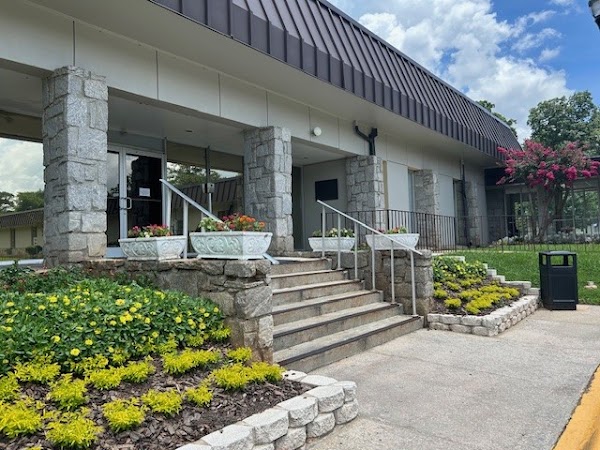
1821 ANDERSON AVENUE NW, ATLANTA, GA 30314 (404) 794-2477
Non profit - Corporation 206 Beds Independent Data: November 2025
Trust Grade
5/100
#331 of 353 in GA
Last Inspection: October 2024

Within standard 12-15 month inspection cycle. Federal law requires annual inspections.

Overview

Sadie G. Mays Health & Rehabilitation Center has received an F trust grade, indicating significant concerns and poor performance. Ranking #331 out of 353 facilities in Georgia places it in the bottom half, and it is the lowest-ranked facility in Fulton County. While the facility shows some signs of improvement, with issues decreasing from 22 in 2024 to 9 in 2025, it still has a high staff turnover rate of 72%, which is concerning compared to the state average of 47%. Additionally, the facility has faced $53,804 in fines, suggesting repeated compliance problems. Specific incidents include a failure to provide proper pain management for residents and administering a medication to one resident without a physician's order, leading to serious health issues. Overall, while there are some strengths, such as an average level of RN coverage, the numerous deficiencies and high turnover raise significant red flags for families considering this nursing home.

Trust Score
F
5/100
In Georgia
#331/353
Bottom 7%
Safety Record
High Risk
Review needed
Inspections
Getting Better
22 → 9 violations
Staff Stability
⚠ Watch
72% turnover. Very high, 24 points above average. Constant new faces learning your loved one's needs.
Penalties
○ Average
$53,804 in fines. Higher than 54% of Georgia facilities. Some compliance issues.
Skilled Nurses
⚠ Watch
Each resident gets only 24 minutes of Registered Nurse (RN) attention daily — below average for Georgia. Fewer RN minutes means fewer trained eyes watching for problems.
Violations
⚠ Watch
48 deficiencies on record. Higher than average. Multiple issues found across inspections.
★☆☆☆☆
1.0
Overall Rating
★☆☆☆☆
1.0
Staff Levels
★★☆☆☆
2.0
Care Quality
★☆☆☆☆
1.0
Inspection Score
Stable
2024: 22 issues
2025: 9 issues

The Good

  • Full Sprinkler Coverage · Fire safety systems throughout facility
  • No fines on record

Facility shows strength in fire safety.

The Bad

1-Star Overall Rating

Below Georgia average (2.6)

Significant quality concerns identified by CMS

Staff Turnover: 72%

25pts above Georgia avg (46%)

Frequent staff changes - ask about care continuity

Federal Fines: $53,804

Above median ($33,413)

Moderate penalties - review what triggered them

Staff turnover is very high (72%)

24 points above Georgia average of 48%

The Ugly 48 deficiencies on record

3 actual harm
Jul 2025 9 deficiencies
CONCERN (D) 📢 Someone Reported This

A family member, employee, or ombudsman was alarmed enough to file a formal complaint

Potential for Harm - no one hurt, but risky conditions existed

Deficiency F0557 (Tag F0557)

Could have caused harm · This affected 1 resident

Based on observation, record review, and interview, the facility failed to maintain the dignity of one out of 21 Resident (R) (R14) reviewed in the sample. Specifically, the facility did not have any ...

Read full inspector narrative →
Based on observation, record review, and interview, the facility failed to maintain the dignity of one out of 21 Resident (R) (R14) reviewed in the sample. Specifically, the facility did not have any urinary drainage bags available and R14 was placed in an adult incontinence brief. This had the potential for the resident to have a diminished quality of life. Findings include:Review of R14 Medical Diagnoses located in the electronic medical record (EMR) tab titled Medical Diagnosis revealed the resident was admitted to the facility with diagnoses that included cerebral infarction (stroke) with left sided hemiplegia and hemiparesis, and chronic kidney disease stage three.Review of R14's quarterly Minimum Data Set (MDS) with an assessment reference date (ARD) of 6/10/2025 located in EMR tab titled MDS revealed the resident has a Brief Interview for Mental Status (BIMS) score of 15 out of 15 which indicated the resident was cognitively intact. The resident was dependent on staff for all activities of daily living (ADLs). The resident was incontinent of the bladder and bowel and wore an external catheter.Review of R14's physician's Orders dated 6/24/2025 located in the EMR tab titled Orders revealed the resident was to wear condom catheter and change daily and monitor skin for changes.During an interview on 6/30/2025 10:18 am with R14 revealed he had complained several times about wearing the adult incontinence brief; that he did not like having that wetness next to his skin which could cause his skin to break down. R14 stated that the physician had left orders for him to wear a condom catheter with a drainage bag. R14 stated that the facility did not have any large urinary drainage bags, only the leg bags. The resident stated the leg bags were not good enough in that urine would back up and cause the condom to leak. R14 further stated that wearing the adult incontinence brief made him feel like he was a baby.During an interview on 7/1/2025 at 8:45 am Licensed Practical Nurse (LPN)4 revealed at one time the facility was out of urinary drainage bags but was unsure if there was still a shortage of drainage bags.During an observation and interview on 7/1/2025 at 11:45 am revealed Certified Nursing Assistant (CNA)4 had finished providing R14's morning care. R14 was observed wearing an adult incontinence brief. CNA4 revealed the facility was out of urinary drainage bags and she did not know when the next supply was to be delivered.During an interview on 7/1/2025 at 1:00 pm the Central Supplier and Scheduler (CSS) revealed the facility was running low urinary drainage bag in fact she only had the leg drainage bag available. CSS stated that she was just made aware of the situation with R14 and had applied a condom catheter with a leg drainage bag. CSS stated that the new delivery was due later today and she would change the leg drainage bag to a bedside drainage bag. CSS stated there was no reason why the resident had to wait that long for urinary drainage bag.
CONCERN (D) 📢 Someone Reported This

A family member, employee, or ombudsman was alarmed enough to file a formal complaint

Potential for Harm - no one hurt, but risky conditions existed

Report Alleged Abuse (Tag F0609)

Could have caused harm · This affected 1 resident

Based on record review, resident and staff interviews, and review of the facility’s policy titled, “Policy and Procedure, the facility failed to timely report allegations of abuse to the r...

Read full inspector narrative →
Based on record review, resident and staff interviews, and review of the facility’s policy titled, “Policy and Procedure, the facility failed to timely report allegations of abuse to the required agencies and physician within the state reporting time frame for two of 21 sampled Residents (R) (R12 and R9). This failure has the potential to increase the risk of abuse. Findings include: Review of the facility’s undated policy titled “Policy and Procedure revealed Abuse and Neglect” directs staff as follows: “…. Notify the shift supervisor immediately upon identification of actual or suspected abuse, neglect, mistreatment, injuries of unknown source, and/or misappropriation of resident property… Report the incident to the Director of Nursing and Administrator immediately, but no later than two hours after the allegation is made, if the events that cause the allegation involve abuse or result in serious bodily injury or not later than 24 hours if the events that cause the allegation do not involve abuse and do not result in serious bodily injury… Report the incident to the State Agency and the adult protective services immediately, but no later than two hours after the allegation is made, if the events that cause the allegation involve abuse or result in serious bodily injury or not later than 24 hours if the events that cause the allegation do not involve abuse and do not result in serious bodily injury per the guidelines established in the state reporting guidelines and any other required agency, including the Ombudsman and local law enforcement as required by law…” 1.Record review of R12’s “Medical Diagnoses” sheet located in the electronic medical record (EMR) tab titled “Medical Diagnoses” revealed the resident admitted to the facility with diagnoses that included but not limited to metabolic encephalopathy, end stage renal disease with dialysis, major depressive disorder, and anxiety disorder. Review of R12’s annual Minimum Data Set (MDS) with an Assessment Reference Date (ARD) of 1/4/2025 located in the EMR tab titled MDS revealed the resident had Brief Interview for Mental Status (BIMS) score of 10 out of 15 points which indicated the resident had moderately impaired cognition. Review of R12’s Nurses Notes dated 2/26/2025 located in the EMR tab titled “Progress Notes” revealed the facility received a call from the Director at the dialysis center stating the resident had voiced a concern about being abused by a staff member at the nursing home. Review of the facility’s grievance form dated 2/26/2025 revealed R12 voiced concerns to the dialysis’s center staff that she was being abused at the facility by a day shift Certified Nursing Assistant (CNA) who put her hand near the resident’s vaginal area. The grievance form was forwarded to the Interim Director of Nursing (DON) for investigation. Review of the facility’s “Incident Report” dated 2/26/2025 completed by the Interim DON revealed the report was completed on 2/27/2025. R12’s responsible party was notified of the incident. However, the local law enforcement and facility’s physician were not notified. The Day One report was submitted to the State Agency 24 hours after the incident was reported to the facility. During an interview on 7/1/2025 at 1:30 pm with the Infection Control Preventionist (IP) who was the Interim DON at the time of the incident, confirmed the local law enforcement agency and facility’s physician were not notified of the incident and the incident was not reported within the two-hour time frame. The IP stated the incident was identified as staff to resident abuse when the report was filed. The IP stated the Day One report was submitted on 2/27/2025. During an interview with the current Administrator on 7/1/2025 at 10:35 am and after she reviewed the grievance investigation dated 2/26/2025 and the incident report dated 2/26/2025 completed by the Interim DON confirmed the incident was not reported timely to the appropriate agencies. 2. Review of the admission Record located in the Profile tab of the EMR revealed R9 was admitted to the facility with diagnoses that included vascular dementia, a stroke, and seizures. Review of the quarterly MDS located in the MDS tab of the EMR with ARD of 6/13/2025 revealed R9 had a BIMS score of eight out of 15 which indicated R9 was moderately impaired in cognition. During an interview on 7/2/2025 at 11:19 am, R9 was observed lying in bed awake. He was asked if anyone had abused him, physically. R9 stated, Yes. R9 was asked if he remembered when the abuse occurred. R9 stated, About six months ago. R9 was asked if he remembered who the person was who physically abused him. R9 stated, It was a lady, I did tell the nurse, I think she was let go. Review of the 12/1/2024 through 2/1/2025 Nursing Progress Notes located in the Progress Notes tab of the EMR showed no documentation of an allegation of staff to resident physical abuse. During an interview on 7/2/2025 at 1:00 pm, the Administrator stated, I reviewed the previous Administrator's records, and this allegation was on the reportable list, but there is no investigation that I can find. We don't even know if the allegation of physical abuse was actually sent to the State or not.
CONCERN (D) 📢 Someone Reported This

A family member, employee, or ombudsman was alarmed enough to file a formal complaint

Potential for Harm - no one hurt, but risky conditions existed

Investigate Abuse (Tag F0610)

Could have caused harm · This affected 1 resident

**NOTE- TERMS IN BRACKETS HAVE BEEN EDITED TO PROTECT CONFIDENTIALITY** Based on record review, interview, and review of facility policy, the facility failed to conduct a thorough investigation of all...

Read full inspector narrative →
**NOTE- TERMS IN BRACKETS HAVE BEEN EDITED TO PROTECT CONFIDENTIALITY** Based on record review, interview, and review of facility policy, the facility failed to conduct a thorough investigation of alleged abuse of two (Residents (R)12 and R9) out of 21 sampled residents. This failure had the potential to provide a safe environment for all residents against abuse. Findings include: A review of the facility’s undated policy titled “Policy and Procedure: Abuse and Neglect” revealed …An Accident/Incident Report will be initiated immediately upon identification of actual or suspected abuse, neglect, mistreatment, injuries of unknown origin, and/or misappropriation of resident property…The Administrator or designee will oversee the internal investigation…the investigative process includes but it not limited to the following: completed accident/incident report, witness statements, assessment of injuries, resident interviews, interview with the alleged perpetrator, interviews with staff, including those on duty at the time of the incident or those who may have significant information or contact with resident during the identified time frame….Abusive acts of sexual nature may warrant a thorough physical examination by the attending physician or an emergency room visit…The results of all investigations must be reported to the Administrator or his/her designee and to other officials, including state Agency, Adult Protective services (APS) and the local ombudsman, in accordance with State law within 5 working days of the incident, and if the alleged violation is verified, appropriate corrective action must be taken… 1.Record review of R12’s “Medical Diagnoses” sheet located in the electronic medical record (EMR) under the tab titled “Medical Diagnoses” revealed the resident was initially admitted to the facility with diagnoses that included but not limited to metabolic encephalopathy, end stage renal disease with dialysis, major depressive disorder, and anxiety disorder. The resident was discharged from the facility 4/29/2024 Review of R12’s annual Minimum Data Set (MDS) with an Assessment Reference Date (ARD) of 1/4/2025 located in the EMR tab titled MDS revealed the resident had Brief Interview for Mental Status (BIMS) score of 10 out of 15, which indicated the resident had moderately impaired cognition. The resident was dependent on staff for activities of daily living (ADLs) and on dialysis. Review of R12’s Nurses Notes dated 2/26/2025 located in the EMR tab titled “Progress Notes” revealed the facility received a call from the Director at the dialysis center stating the resident had voiced a concern about being abused by a staff member at the nursing home. Review of the facility’s grievance form provided by the facility dated 2/26/2025 revealed R12 voiced concerns to the dialysis’s center staff that she was being abused by a facility day shift Certified Nursing Assistant (CNA) who put her hand near the resident’s vaginal area. The grievance form was forwarded to the Interim Director of Nursing (DON) for investigation Review of the facility’s “Incident Report” dated 2/26/2025 completed by the Interim DON revealed the report was completed on 2/27/2025. R12’s responsible party was notified of the incident. However, the local law enforcement and facility physician were not notified. The facility was unable to provide an investigation with witnesses statements and interviews with the residents regarding feeling safe and secure against abuse. During an interview on 7/1/2025 at 1:30 PM with the Infection Control Preventionist (IP) who was the Interim DON at the time of the incident, revealed the local law enforcement agency and facility were not notified of the incident. requirement. The IP stated that statements were obtained from the staff assigned to R12 the day of the alleged sexual abuse. The IP also stated that interviews were conducted with residents in the area to ensure they felt safe. The IP stated that all the documentation she had was turned over to the Interim Administrator and placed in an abuse manual that he maintained in his office. The IP identified CNA1 and CNA2 as being interviewed during the abuse investigation. During an interview on 7/1/2025 at 10:35 AM with the current Administrator on and after she reviewed the grievance investigation dated 2/26/2025 and the incident report dated 2/26/2025 completed by the Interim DON confirmed the investigation was incomplete. The Administrator stated that an Abuse Manual was maintained in the former Administrator’s office. Since the former interim Administrator suddenly resigned, the Abuse Manual had disappeared. An interview on 7/2/2025 at 10:00 AM with CNA2 revealed that she remembered R12 but was not assigned to the resident. CNA2 stated that she was not asked to provide a witness statement even though she heard about the incident. An interview on 7/2/2025 at 10:55 AM with CNA1 revealed that she was not assigned to the resident and had not been interviewed about the abuse incident. 2. Review of the admission Record located in the Profile tab of the EMR revealed R9 was admitted to the facility on [DATE]. Review of the annual MDS located in the MDS tab of the EMR with an ARD of 12/24/24 revealed R9 had a BIMS score of five out of 15, which indicated R9 was severely impaired in cognition. On 6/30/2025 at 3:25 PM, the Administrator was asked to provide the facility investigation on the alleged abuse by a staff member towards R9. During an interview on 7/2/2025 at 11:19 AM, R9 was asked if any staff member had physically abused him. He stated, Yes. R9 was asked if he remembered when the abuse occurred. R9 stated, About six months ago. R9 further stated, It was a lady, and I told the nurse, she was let go. R9 was asked if he felt safe in the facility. He stated, Yes.
CONCERN (D) 📢 Someone Reported This

A family member, employee, or ombudsman was alarmed enough to file a formal complaint

Potential for Harm - no one hurt, but risky conditions existed

Deficiency F0657 (Tag F0657)

Could have caused harm · This affected 1 resident

**NOTE- TERMS IN BRACKETS HAVE BEEN EDITED TO PROTECT CONFIDENTIALITY** Based on observation, record review, staff interview, and review of facility policy, the facility failed to revise the care plan...

Read full inspector narrative →
**NOTE- TERMS IN BRACKETS HAVE BEEN EDITED TO PROTECT CONFIDENTIALITY** Based on observation, record review, staff interview, and review of facility policy, the facility failed to revise the care plans related to falls for four (Residents (R)9, R10, and R15) from a sample of 21 residents. This failure had the potential for residents to continue to fall and possibly result in injuries. Findings include: Review of the facility policy titled Care Plans – Comprehensive Person Centered with a revision date of March 2022 revealed, …Assessments of residents are ongoing, and care plans are revised as information about the residents and the residents' conditions change…The interdisciplinary team reviews and updates the care plan: when there has been a significant change in the resident's condition; when the desired outcome is not met; when the resident has been readmitted to the facility from a hospital stay; and d. at least quarterly, in conjunction with the required quarterly MDS [Minimum Data Set] assessment… 1. Review of R10’s “Medical Diagnosis” located in the EMR tab titled Medical Diagnosis” revealed the resident was re-admitted to the facility on [DATE] with diagnoses that included but not limited to cerebral infarct (stroke) with hemiparesis and hemiplegia, and repeated falls. Review R10’s quarterly MDS with an ARD of 5/15/2025 located in the EMR tab titled MDS revealed the resident has Brief Interview for Mental Status (BIMS) score of 15 out 15, which indicated the resident was cognitively intact. The resident had a limited range of motion of one upper extremity and limited range of motion of both lower extremities. The resident required substantial to maximum assistance with activities of daily living (ADLs); and resident has sustained a fall during the assessment period. Review of R10’s “Care Plan” with an initial date of 11/14/2024 located in the EMR tab titled “Care Plans” identified the resident had actual fall incidents on 12/1/2024 and 1/22/2025. However, the Care Plan did not reflect the incident that occurred on 5/11/2025 due to the resident’s poor balance. Review of R10’s “admission Fall Risk Assessment” dated 5/9/2025 located in the EMR tab titled Assessments” revealed the resident a had a fall risk score of 17, which indicated the resident was a high risk for falls and had not sustained any falls in the past three months. Review of the resident’s Fall Risk Assessment” dated 5/11/2025 revealed the resident had a fall risk score of five and had not sustained any falls in the past three months. Review of R10’s “Nurses Notes” dated 5/11/2025 located in the EMR tab titled Progress Notes documented the resident was found lying face down on the bed after attempting to stand up unassisted. The resident complained of left shoulder pain which was later x-rayed with negative results. The resident’s physician and responsible party were notified. 2. Review of R15’s “Medical Diagnosis” located in the EMR tab titled Medical Diagnosis revealed the resident was admitted to the facility with diagnoses that included but not limited to cerebrovascular disease (stroke) with hemiplegia and hemiparesis, unsteadiness, and difficulty walking. Review of R15’s annual MDS with an ARD of 2/3/2025 located in the EMR tab titled MDS revealed the resident had BIMS score of eight out of 15, which indicated the resident had moderately impaired cognitive function. The resident was assessed to have a limited range of motion of the lower extremities and was dependent on staff for all ADLs. The resident was assessed to have one fall without injury since admission to the facility. Review of R15’s quarterly MDS with an ARD of 5/3/2025 located in the EMR tab titled MDS revealed the resident now had a BIMS score of five out of 15, which indicated the resident’s cognition was severely impaired. During the assessment period the resident sustained one fall without injury and one fall with injury. Review of R15’s “Nurses Notes” dated 12/21/2024 located in the EMR tab titled Progress Notes revealed the resident was found on the floor in the resident’s bathroom with no visible injuries noted. Review of “Nurses Notes” dated 3/31/2025 revealed the resident was lowered to the floor by staff in his room without injury. Review of Nurses Notes dated 4/4/2025 revealed the resident experienced a coughing episode and slipped out of his wheelchair to the floor. The resident complained of some back pain but did not feel it was related to the fall and refused to be sent to the hospital for an examination. Review of R15’s “Care Plan” with an initiation date of 7/27/2023 located in the EMR tab titled Care Plans revealed the resident had an actual fall without injury related to unsteady gait and hemiparesis. However, the care plan did not identify the date of this fall; nor did the Care Plan address the falls that occurred on 3/31/2025 and 4/4/2025. During an interview on 7/2/2025 at 9:30 AM with the Director of Nursing (DON) revealed the MDS nurses were responsible for the care plan development. However, it was an expectation that any floor nurse would revise or update the resident’s care plans and changes in the resident’s condition occurred or new interventions were needed. The DON stated R10 and R15’ care plans should have been updated to reflect the falls as they occurred, and any new interventions were required. 3. Review of the admission Record located in the Profile tab of the EMR revealed R9 was admitted to the facility with a diagnosis that included but not limited to vascular dementia. Review of the quarterly MDS located in the MDS tab of the EMR with an ARD of 6/13/2025 revealed R9 had a BIMS score of eight out of 15, which indicated R9 was moderately impaired in cognition, required substantial/maximum assistance for activities of daily living (ADLs) and had two non-injury falls during the observation period. Review of the 8/13/2023 and revised on 6/9/2025 Falls Care Plan located in the Care Plan tab of the EMR revealed, The resident has had falls. Interventions included, but not limited to: Non-skid footwear (12/24/2024), Encourage resident not to get on floor and scoot to reach other areas (11/4/2024), Frequent check while in bed and provide assistance as needed (6/2/2024), Provide cue for resident to let staff assist him with obtaining foods and going into room (10/4/2023), PT (physical therapy) consult for strength and mobility (8/13/2023), Reinforce frequent checks by staff and offer rest periods as needed (2/17/2024), Reenforce with staff to observe frequently and provide rest period (1/28/2025), Staff to frequently check on resident whereabouts and provide assistance as needed (10/1/2024). During an observation and interview on 7/1/2025 at 10:54 AM, R9 was observed in the dining room during an activity and was reclined with feet up in a Geri chair (a specialized chair). During an interview on 7/2/2025 at 9:20 AM, the Director of Rehab Services (DOR) stated, We put him on Occupational therapy [OT] and Physical therapy [PT] as he was not safe in the wheelchair. We went to a Geri chair (a specialized chair designed for individuals with mobility limitations) as his trunk control was not very good, it is improving. The DOR was asked why the Geri chair was not care planned. He stated, I don't know, but it should have been. The DOR was asked how long has R9 been in the Geri chair. He stated, More than 30 days. During an interview on 7/2/2025 at 11:09 AM, Licensed Practical Nurse (LPN) 1 stated, The Geri chair was an intervention by therapy. LPN 1 was asked who was responsible for updating the care plan. LPN1 stated, Anyone can put interventions in the care plan and the Geri chair should have been in the care plan. It has been a successful intervention, and the falls have decreased.
CONCERN (D) 📢 Someone Reported This

A family member, employee, or ombudsman was alarmed enough to file a formal complaint

Potential for Harm - no one hurt, but risky conditions existed

ADL Care (Tag F0677)

Could have caused harm · This affected 1 resident

The facility failed to ensure activities of daily living (ADLs) were provided for one of three residents (Residents (R)9) who was dependent on staff for assistance with ADLS out of a total sample of 2...

Read full inspector narrative →
The facility failed to ensure activities of daily living (ADLs) were provided for one of three residents (Residents (R)9) who was dependent on staff for assistance with ADLS out of a total sample of 21. This failure placed R9 at risk of a diminished quality of life.Findings include:Review of the admission Record located in the Profile tab of the electronic medical record (EMR) revealed R9 was admitted to the facility with diagnoses that include but not limited to vascular dementia, stroke, and right-sided paralysis.Review of the 6/7/2024 ADLs Care Plan located in the Care Plan tab of the EMR revealed, The resident has an ADL self-care performance deficit r/t (related to) Hemiplegia [paralysis], Limited mobility, Limited ROM [range of motion]. Interventions included, Bathing/Showering: The resident requires assistance by (2) staff with bathing/showering 3 times weekly and as necessary. Dated 6/7/2024.Review of the EMR under the Task tab revealed, a shower was documented in the EMR on 3/7/2025. 3/29/2025, 4/10/2025, and 4/15/2025 (refusal). There was no other documentation in the Task tab for May 2025. The documentation showed that for each shower, R9 was dependent on staff for the task.Review of the June 2025 Bath Book located at the C-Hall nurses station revealed R9 had documentation to show a shower had been given on 6/3/2025, 6/14/2025, and 6/19/2025 and on 6/17/2025 it was documented the resident refused. The Unit Manager (UM) was asked what the policy was regarding showers. She stated, There is a shower schedule at the desk, and the showers are to be given three times a week, either Monday, Wednesday, Friday or Tuesday, Thursday, Saturday. The Certified Nurse Aides (CNAs) are responsible for showering. The UM was shown the four shower sheets that were in the June Bath Book with only the four documented shower sheets. The UM stated, That can't be right, I will check on this. The UM was asked if the CNAs are to document the shower on the Task sheet in the EMR. The UM stated, Well, I think so.The UM did not provide any additional shower sheets for R9 by the time of the exit of the survey.During an interview on 7/2/2025 at 1:58 PM, The Director of Nursing (DON) was asked about the lack of documentation in the Task tab of the EMR and the June Shower Sheets. The DON stated, I spoke to the CNAs [on the phone] and they confirmed that they did not do any shower sheets.
CONCERN (D) 📢 Someone Reported This

A family member, employee, or ombudsman was alarmed enough to file a formal complaint

Potential for Harm - no one hurt, but risky conditions existed

Accident Prevention (Tag F0689)

Could have caused harm · This affected 1 resident

**NOTE- TERMS IN BRACKETS HAVE BEEN EDITED TO PROTECT CONFIDENTIALITY** Based on observation, staff interviews, record review, and review of facility policy, the facility failed to ensure adequate sup...

Read full inspector narrative →
**NOTE- TERMS IN BRACKETS HAVE BEEN EDITED TO PROTECT CONFIDENTIALITY** Based on observation, staff interviews, record review, and review of facility policy, the facility failed to ensure adequate supervision to potentially prevent accidents for two of four residents (Residents (R)9 and R11) reviewed for accidents in a total sample of 21. These failures placed the residents at risk of injury and unmet care needs.Findings include:Review of an undated facility policy titled Falls and Injury Program revealed, .Each resident's care plan will include specific fall prevention and management strategies tailored to their individual needs and risk factors.1. Review of the admission Record located in the Profile tab of the electronic medical record (EMR) revealed R11 was admitted to the facility with diagnoses that included but not limited to Alzheimer's disease, dementia.Review of the quarterly Minimum Data Set (MDS) located in the MDS tab of the EMR with an Assessment Reference Date (ARD) of 1/21/2025 revealed R11 had a Brief Interview of Mental Status (BIMS) score of zero out of 15, which indicated R11 was severely impaired in cognition.Review of a 1/9/2025 Nurses Note located in the Progress Notes tab of the EMR revealed, approximately at 11:45 AM, assigned CNA [certified nurse aide] was in the process of transferring resident out of the room and the crew guy was moving the cabinets. The CNA verbally asked the crew guy to stop for a minute, and he didn't and he put the doors up against the wall, then part of the cabinets fell on the resident's chest and arms. The crew guys removed the doors and the nurse was notified. Nurse assessed the resident [R11] and the provider gave an order for an x-ray of the sternum. The resident's family was notified.Review of an 1/10/2025 Nurses Note located in the Progress Notes tab of the EMR revealed, the on-call physician was notified that the Xray of the resident's sternum was questionable for a dislocation. The physician gave an order to send the resident out for a follow up x-ray. The results revealed the resident did not have a sternum fracture.On 7/1/2025 at 8:00 AM, an attempt to contact Licensed Practical Nurse (LPN)8 regarding the incident was made. No return contact was received.On 7/1/2025 at 8:32 AM, the Administrator was asked to assist in identifying the CNA. However, the Administrator was unable to identify the CNA.During an interview on 7/1/2025 at 12:45 PM, the current Administrator was asked if there was an investigation done at the time of the incident. The Administrator stated she could not find an investigation regarding the accident.During an interview on 7/2/2025 at 11:22 AM, the Maintenance Director stated, At the time of the accident, I was not the Director, but just a maintenance employee. It was the contract company who was working in the room. The Maintenance Director denied being asked for a statement regarding the incident as well as the third party vendor.2. Review of the admission Record located in the Profile tab of the EMR revealed R9 was admitted to the facility on [DATE] with diagnoses that included but not limited to vascular dementia, stroke, and right-sided paralysis.Review of the annual MDS located in the MDS tab of the EMR with an ARD of 12/16/2024 revealed R9 had a BIMS score of five out of 15, which indicated R9 was severely impaired in cognition and had two non-injury falls since the previous assessment.Review of the 8/13/2023 and revised on 6/9/2025 Falls Care Plan located in the Care Plan tab of the EMR revealed, The resident has had falls. Interventions included, but not limited to: Non-skid footwear (12/24/2024), Encourage resident not to get on floor and scoot to reach other areas (11/4/2024), Frequent check while in bed and provide assistance as needed (6/2/2024). Provide cue for resident to let staff assist him with obtaining foods and going into room (10/4/2023), PT (physical therapy) consult for strength and mobility (8/13/2023). Reinforce frequent checks by staff and offer rest periods as needed (2/17/2024), reinforce with staff to observe frequently and provide rest period (1/28/2025), Staff to frequently check on resident whereabouts and provide assistance as needed (10/1/2024).Review of a 1/2/2025 at 3:35 PM Nurses Note located in the Progress Notes tab of the EMR revealed, at 9:00 AM resident was on the floor near his w/c [wheelchair], in his room. No injuries were noted.Review of a 1/10/2025 at 3:04 PM Nurses Note located in the Progress Notes tab of the EMR revealed that the resident was found on the floor without injury.Review of a 1/18/2025 at 6:31 PM Incident Note located in the Progress Notes tab of the EMR revealed the resident used the wall rail to intentionally put himself to the floor. No injuries noted.Review of a01/20/2025 at 3:38 PM Nurses Note located in the Progress Notes tab of the EMR revealed that the nurse was called into the resident's room by a family member. The resident was found on the floor due to falling from his chair. The Nurse notified Nurse Practitioner (NP)2 who gave an order to send the resident to the emergency room (ER) for an evaluation.Review of a 3/8/2025 at 4:20 PM, Nurses Note located in the Progress Notes tab of the EMR revealed, the resident was observed on the floor near the nursing station. He was leaning over trying to get into the shower room. After being told several times to sit down and let the rail go, he slide out of his wheelchair onto the floor. No injuries were noted.Review of a 3/17/2025 at 11:15 AM Nurses Note located in the Progress Notes tab of the EMR revealed that the resident had three witnessed falls this shift at 8:15 AM, 8:22 AM, and 9:45 AM. No visible injuries with the falls. Neuro checks started upon first incident. ROM [range of motion] remains within baseline.Review of a 3/23/2025 at 4:30 PM Incident Note located in the Progress Notes tab of the EMR revealed, the resident was up in his wheelchair at the nurses station. The resident constantly reaches for items on floor that are not there. The resident was observed slouched over with legs folded between foot pedals and forehead on floor.Review of a 3/28/2025 at 4:26 PM Incident Note located in the Progress Notes tab of the EMR revealed, the resident was in his wheelchair around 9:20 AM and was witnessed leaning forward and fell to the floor. Resident did not hit head. No injuries were noted.Review of a 3/31/2025 at 10:06 AM Behavior Note located in the Progress Notes tab of the EMR revealed that the resident was observed lying on his right side in front of the nurses' desk.Review of the 4/2/2025 at 11:10 AM Behavior Note located in the Progress Notes tab of the EMR revealed, the resident was sitting in wheelchair in hallway when he used the handrail on the wall to pull himself out of the wheelchair to the floor. The resident said he wanted to go to bed. Resident has been noted to throw himself to the floor from wheelchair on several occasions in the past.Review of a 5/10/2025 at 2:01 PM Nurses Note located in the Progress Notes tab of the EMR revealed that the resident was sitting at nurse's desk with two nurses. The resident leaned forward in his wheelchair and was redirected several times to sit up, but was unsuccessful. The resident was observed falling out of wheelchair on the right side and said he fell because he wanted to go back to bed.Review of a 5/18/2025 at 1:44 PM Incident Note located in the Progress Notes tab of the EMR revealed that the resident was found in his room on the floor next to the bed on his right side. Resident was noted on the fall mat from the waist down, from the waist up, he was on the bare floor. No apparent injuries noted on body assessment. The resident had no complaints of pain but said he hit his head. The on call NP was notified and gave an order to send the resident to the ER.During an interview on 6/30/2025 at 4:01 PM, the current Administrator confirmed that there were no fall incident reports on R9. The Administrator stated, When a resident has a fall, they are to fill out the incident report and then we will discuss this in our morning stand-up meeting for any needed interventions. The Administrator was asked if these falls were brought to QAPI and if she could provide the documentation. The Administrator stated, Since I have started at the facility, we are doing PAR [patient at risk] meetings more often. No documentation was provided regarding having had these falls brought to QAPI (quality assurance performance improvement) for review by the end of the survey.During an observation on 07/01/25 at 10:54 AM, R9 was observed reclined in a Geri chair [a specialized wheelchair] in the dining room during an activity.During an interview on 7/1/2025 at 1:20 PM the Unit Manager (UM) stated, Leaning over has been a problem for him. The falls were due to him leaning way over and a lack of coordination. He is losing his trunk control which has contributed to this. His falls were related to behaviors also and we implemented having him lay down after meals as he will fall due to getting tired.During an interview on 7/2/2025 at 11:09 AM, LPN1 stated, The Geri chair (specialized seating designed for individuals with limited mobility or specific health needs) was an intervention by therapy. It has been a successful intervention, and the falls have decreased. We do lay him down during the day. He can tell us if he is tired and we do lay him down. The resident had eight falls from his regular wheelchair from 1/2/2025 to 5/10/2025 until the Geri chair was implemented as an intervention.
CONCERN (D) 📢 Someone Reported This

A family member, employee, or ombudsman was alarmed enough to file a formal complaint

Potential for Harm - no one hurt, but risky conditions existed

Incontinence Care (Tag F0690)

Could have caused harm · This affected 1 resident

Based on observation, record review, interview, and review of facility policy, the facility failed to properly position urinary drainage bags to promote adequate drainage and to potentially prevent re...

Read full inspector narrative →
Based on observation, record review, interview, and review of facility policy, the facility failed to properly position urinary drainage bags to promote adequate drainage and to potentially prevent recurring urinary tract infections (UTIs) for two residents (R)16 and R14 from four residents with urinary drainage bags out of a total sample of 21 residents. This failure has the potential for residents to develop recurring UTIs.Findings include:Review of the facility policy titled, Urinary Catheter Care Policy (undated) revealed, .Proper catheter care is essential to prevent infections, promote comfort, and maintain the dignity of residents.Check the resident frequently to be sure he or she is not lying on the catheter and to keep the catheter and tubing free of kinks.The urinary drainage bag must be held or positioned lower than the bladder at all times to prevent the urine in the tubing and drainage bag from flowing back into the urinary bladder.Be sure the catheter tubing and drainage bag are kept off the floor. 1. Review of R16's Medical Diagnosis sheet located in the resident's electronic medical records (EMR) tab titled Medical Diagnosis revealed the resident was admitted to the facility with diagnoses that included but not limited to multiple sclerosis, hemiplegia, hemiparesis, and neuromuscular dysfunction of the bladder.Review of R16's annual Minimum Data Set (MDS) with an Assessment Reference Date (ARD) of 6/4/2025 revealed the resident had a Brief Interview for Mental Status (BIMS) score of three out of 15, which indicated the resident was severely cognitively impaired. The resident was dependent on staff for all activities of daily living (ADLs); incontinent of bladder and bowel and required an indwelling catheter.Review of R16's physician's Orders dated 5/3/2025 located in the resident's EMR tab titled Orders revealed an order for a Suprapubic Foley 20 French five milliliter balloon.During an observation and interview on 6/30/2025 at 11:30 AM revealed R16 was on a stretcher headed for shower. There was a urine odor present. Certified Nursing Assistant (CNA)3 uncovered the resident's urinary catheter to show the resident was wearing a leg strap. However, the resident's urinary drainage bag was flat in the stretcher with the resident; amber colored fluid was backing up in the tubing towards the resident's bladder area. CNA3 confirmed that R16's urinary drainage bag should be positioned below the resident's bladder to prevent urinary tract infections from occurring.During an observation on 7/1/2025 at 9:42 AM revealed R16 was in a low bed with the urinary drainage bag laying flat on the floor. There was a strong urine odor present in the room and the drainage bag was near a puddle of yellow colored liquid on the floor. At 10:05 AM the drainage bag remained on the floor. At 11:16 AM an observation with the Assistant Director of Nursing (ADON) and CNA3 revealed the urinary drainage bag was about an inch above the floor. There was still the strong smell of urine present in the room.During an interview on 7/1/2025 at 11:16 AM, CNA3 verified that she just repositioned the drainage bag from the floor to a higher position. CNA3 also stated that she noticed the drainage port of the drainage bag was not properly clamped off and more urine had spilled on the floor. During the interview, the ADON agreed that the resident's urinary drainage had not been positioned properly to promote drainage and would replace the drainage bag since it was leaking urine.2. Review of R14 Medical Diagnoses located in the resident's EMR tab titled Medical Diagnosis revealed the resident was admitted to the facility with diagnoses that included but not limited to cerebral infarction with left sided hemiplegia and hemiparesis, and chronic kidney disease stage three.Review of R14 quarterly MDS with an ARD of 6/10/2025 located in the resident's EMR tab titled MDS revealed the resident had a BIMS score of 15 out of 15, which indicated the resident was cognitively intact. The resident was dependent on staff for all ADLs. The resident was incontinent of the bladder and bowel and wore an external catheter.Review of R14's physician's Orders dated 6/24/2025 located in the EMR tab titled Orders revealed the resident was to wear condom catheter and change daily and monitor skin for changes.During an observation on 7/2/2025 at 8:45 AM revealed R14 was in a low bed with the urinary drainage bag resting on the floor. At 9:15AM an observation with the Director of Nursing (DON) revealed the resident's urinary drainage remained in the same position. The DON donned (put on) a pair of gloves and repositioned the resident's drainage bag of the floor and adjusted the tubing to promote adequate urinary drainage. The DON confirmed that the resident's drainage was not positioned properly to promote drainage.
CONCERN (E) 📢 Someone Reported This

A family member, employee, or ombudsman was alarmed enough to file a formal complaint

Potential for Harm - no one hurt, but risky conditions existed

Notification of Changes (Tag F0580)

Could have caused harm · This affected multiple residents

Based on staff interview, record review, and review of the facility's policy titled, Administering Medications, the facility failed to ensure the provider and the resident representative were notified...

Read full inspector narrative →
Based on staff interview, record review, and review of the facility's policy titled, Administering Medications, the facility failed to ensure the provider and the resident representative were notified when seven out of 21 sampled Residents (R1, R2, R3, R4, R5, R6, and R7) were not administered their medications, as ordered by the provider. This failure placed the provider and the resident's representatives of potential complications from not receiving their medications.Findings include:Review of the facility's policy titled, Administering Medications, dated 2001 revealed, .Medications are administered in a safe and timely manner, and as prescribed.Medications are administered in accordance with prescriber orders, including any required time frame.1. Review of the admission Record located in the Profile tab of the electronic medical record (EMR) revealed R1 was admitted to the facility with diagnoses that included stroke, diabetes, end-stage renal disease (ESRD) and was dependent on dialysis.Review of the December 2024 Medication Administration Record (MAR) located in the Orders tab of the EMR revealed the following prescribed medications were not documented as administered on 12/26/2025, as ordered:Phenytoin Sodium Extended Capsule 100mg [milligrams] Give 2 capsules by mouth every 12 hours for seizures.Atorvastatin 40 mg. Give 1 tablet by mouth in the evening for hypercholesterolemia [high cholesterol].Buspirone 10mg. Give 1 tablet by mouth two times a day for anxiety.Carvedilol 2025mg. Give 1 tablet by mouth two times a day for hypertension [elevated blood pressure].Clonidine 0.2mg. Give 1 tablet by mouth two times a day for hypertension.Divalproex 500mg. Give 1 tablet by mouth two times a day for behaviors.Eliquis 5mg. Give 1 tablet by mouth every 12 hours for deep vein thrombosis [blood clot prevention].Trazadone 50mg. Give 1 tablet by mouth at bedtime for insomnia.Spironolactone 25mg. Give 1 tablet by mouth at bedtime for hypertension.Hydralazine 100mg. Give 1 capsule by mouth every 8 hours for hypertension.There was no documentation to show that R1's provider and resident representative were notified of the medications that were not administered.2. Review of the admission Record located in the Profile tab of the EMR revealed R2 was admitted to the facility with diagnoses that included Chronic Obstructive Pulmonary Disease (COPD) and chronic pain syndrome.Review of the December 2024 MAR located in the Orders tab of the EMR revealed the following prescribed medication that was not administered on 12/26/2024, as ordered:Gabapentin 100mg. Give 1 capsule by mouth three times a day for chronic pain syndrome.There was no documentation to show that R2's provider and resident representative were notified of the medication that was not administered.3. Review of the admission Record located in the Profile tab of the EMR revealed R3 was admitted to the facility with diagnoses that included COPD, and arthritis.Review of the December 2024 MAR located in the Orders tab of the EMR revealed the following prescribed medications that were not administered on 12/26/2024, as ordered:Famotidine 40mg. Give 1 tablet by mouth at bedtime for acid indigestion.Pravastatin 40mg. Give 1 tablet by mouth at bedtime for increased lipids.There was no documentation to show that R3's provider and resident representative were notified of the medications that were not administered.4. Review of the admission Record located in the Profile tab of the EMR revealed, R4 was admitted to the facility with diagnoses that included cancer, a stroke, and diabetes.Review of the December 2024 MAR located in the Orders tab of the EMR revealed the following prescribed medications that were not administered on 12/26/2024, as ordered:Atorvastatin 80mg. Give 1 tablet by mouth at bedtime for high cholesterol.Carvedilol 12.5mg. Give 1 tablet by mouth every 12 hours for high blood pressure.Tamsulosin 0.4mg. Give 1 capsule by mouth at bedtime for prostate.There was no documentation to show that R4's provider and resident representative were notified of the medications that were not administered.5. Review of the admission Record located in the Profile tab of the EMR revealed R5 was admitted to the facility with diagnoses that included a stroke and depression.Review of the December 2024 MAR located in the Orders tab of the EMR revealed the following prescribed medications that were not administered on 12/26/2024, as ordered.Atorvastatin 10mg. Give 1 tablet by mouth at bedtime for hyperlipidemia [increased lipids].Duloxetine 60mg. Give 1 capsule by mouth at bedtime for depression.There was no documentation to show that R5's provider and resident representative were notified of the medications that were not administered.6. Review of the admission Record located in the Profile tab of the EMR revealed R6 was admitted to the facility with a diagnosis of Alzheimer's dementia.Review of the December 2024 MAR located in the Orders tab of the EMR revealed the following prescribed medication that was not administered on 12/26/2024:Levetiracetam 750 mg. Give 1 tablet twice daily for seizures.There was no documentation to show that R6's provider and resident representative were notified of the medication that was not administered.7. Review of the admission Record located in the Profile tab of the EMR revealed R7 was admitted to the facility with a diagnosis of Alzheimer's dementia.Review of the December 2024 MAR located in the Orders tab of the EMR revealed the following prescribed medications that were not administered on 12/26/2024, as ordered:Memantine 5mg. Give 1 tablet by mouth two times a day related to dementia.Metformin ER 500 mg. Give 1 tablet by mouth two times a day related to diabetes.There was no documentation to show that R7's provider and resident representative were notified of the medications that were not administered.Review of the 12/30/2024 facility investigation revealed the date and time that the medications that were not administered to the residents was 12/26/2025 at 5:00 pm and 9:00 pm. The investigation further stated that the resident representatives and the provider were notified.During an interview on 6/30/2025 at 1:06 pm, the Administrator stated, We did not find any documentation in the previous Director of Nursing's office to show that the resident representative and the provider were notified of the missing medications even though it stated that they were notified on the investigation.
CONCERN (E) 📢 Someone Reported This

A family member, employee, or ombudsman was alarmed enough to file a formal complaint

Potential for Harm - no one hurt, but risky conditions existed

Quality of Care (Tag F0684)

Could have caused harm · This affected multiple residents

**NOTE- TERMS IN BRACKETS HAVE BEEN EDITED TO PROTECT CONFIDENTIALITY** Based on resident and staff interviews, record review, and review of facility policy, the facility failed to ensure medications ...

Read full inspector narrative →
**NOTE- TERMS IN BRACKETS HAVE BEEN EDITED TO PROTECT CONFIDENTIALITY** Based on resident and staff interviews, record review, and review of facility policy, the facility failed to ensure medications were administered per the provider's order for seven of 21 sampled (Residents (R)1, R2, R3, R4, R5, R6, R7 reviewed. This failure placed the residents at risk of health complications and a diminished quality of life.Findings included:Review of the facility policy titled, Administering Medications, dated 2001 revealed, .Medications are administered in a safe and timely manner, and as prescribed.Medications are administered in accordance with prescriber orders, including any required time frame.Medication administration times are determined by resident need and benefit, not staff convenience.1. Review of the admission Record located in the Profile tab of the electronic medical record (EMR) revealed R1 was admitted to the facility with diagnoses that included but not limited to stroke, diabetes, end-stage renal disease (ESRD) and was dependent on dialysis.Review of the discharge-return anticipated Minimum Data Set (MDS) located in the MDS tab of the EMR with an Assessment Reference Date (ARD) of 1/24/2025 revealed, R1 had a Brief Interview of Mental Status (BIMS) score that was assessed by staff of severely impaired in cognition.Review of the December 2024 Medication Administration Record (MAR) located in the Orders tab of the EMR revealed the following prescribed medications that were not administered on 12/26/2025, as ordered:Phenytoin Sodium Extended Capsule 100mg [milligrams] Give 2 capsules by mouth every 12 hours for seizures. Start date: 2/20/2024.Atorvastatin 40 mg. Give 1 tablet by mouth in the evening for Hypercholesterolemia [high cholesterol]. Start dated: 2/20/2024.Buspirone 10mg. Give 1 tablet by mouth two times a day for anxiety. Start Date: 2/20/2024.Carvedilol 25mg. Give 1 tablet by mouth two times a day for Hypertension [elevated blood pressure]. Start Date: 2/20/2024.Clonidine 0.2mg. Give 1 tablet by mouth two times a day for Hypertension. Start Date: 6/7/2024.Divalproex 500mg. Give 1 tablet by mouth two times a day for behaviors. Start Date: 2/20/2024. Eliquis 5mg. Give 1 tablet by mouth every 12 hours for deep vein thrombosis [blood clot prevention]. Start Date: 2/20/2024.Trazadone 50mg. Give 1 tablet by mouth at bedtime for insomnia. Start Date: 2/20/2024.Spironolactone 25mg. Give 1 tablet by mouth at bedtime for Hypertension. Start Date: 2/20/2024.Hydralazine 100mg. Give 1 capsule by mouth every 8 hours for Hypertension. Start Date: 2/20/2024.Per the investigation, the atorvastatin, buspirone, carvedilol, clonidine, divalproex were not administered on 12/26/2025 at 5:00 PM. The hydralazine was not administered on 12/26/2024 at 10:00 PM. The Eliquis, Phenytoin, spironolactone, and Trazadone were not administered on 12/26/2024 at 9:00 PM. The Medication was discovered as not given on 12/30/2024 by the supervisor at 8:30 AM, during a cart check. The investigation further revealed that Licensed Practical Nurse (LPN)7 had signed the medications as administered.2. Review of the admission Record located in the Profile' tab of the EMR revealed R2 was admitted to the facility with diagnoses that included but not limited to chronic obstructive pulmonary disease (COPD) and chronic pain syndrome.Review of the discharge-return anticipated MDS located in the MDS tab of the EMR with an ARD of 12/29/2024 revealed R2 had a BIMS score that staff assessed to be independent in cognition.Review of the December 2024 MAR located in the Orders tab of the EMR revealed the following prescribed medication that was not administered on 12/26/2024, as ordered:Gabapentin 100mg. Give 1 capsule by mouth three times a day for Chronic Pain Syndrome. Start Date: 2/9/2024.Per the facility investigation, the gabapentin was not administered on 12/26/2025 at 8:00 PM. The Medication was discovered as not given on 12/30/2024 by the supervisor at 8:30 AM, during a cart check. The investigation further revealed that LPN7 had signed the medications as administered. During an interview on 6/30/2025 at 1:30 PM, R2 stated, I don't remember anything about this. 3. Review of the admission Record located in the Profile tab of the EMR revealed R3 was admitted to the facility on [DATE] with diagnoses that included but not limited to COPD, and arthritis.Review of the quarterly MDS located in the MDS tab of the EMR with an ARD of 2/4/2024 revealed R3 had a BIMS score of 14 out of 15, which indicated R3 was cognitively intact.Review of the December 2024 MAR located in the Orders tab of the EMR revealed the following prescribed medications that were not administered on 12/26/2024, as ordered:Famotidine 40mg. Give 1 tablet by mouth at bedtime for acid indigestion. Start Date: 1/26/2024.Pravastatin 40mg. Give 1 tablet by mouth at bedtime for increased lipids. Start Date: 8/1/2023.Per the investigation, the famotidine and the pravastatin were not administered on 10/26/2024 at 9:00 PM. The medications were discovered as not given on 12/30/2024 by the supervisor at 8:30 AM, during a cart check. The investigation further revealed that LPN7 had signed the medications as administered.During an interview on 6/30/2025 at 1:37 PM, R3 stated, I don't remember anything about not getting my medications. I don't think I suffered without them.4. Review of the admission Record located in the Profile tab of the EMR revealed, R4 was admitted to the facility with diagnoses that included but not limited to cancer, a stroke, and diabetes.Review of the annual MDS located in the MDS tab of the EMR with an ARD of 10/25/2024 revealed R4 had a BIMS score of five out of 15, which indicated R5 was severely impaired in cognition.Review of the December 2024 MAR located in the Orders tab of the EMR revealed the following prescribed medications that were not administered on 12/26/2024, as ordered:Atorvastatin 80mg. Give 1 tablet by mouth at bedtime for high cholesterol. Start Date: 10/4/2023.Carvedilol 12.5mg. Give 1 tablet by mouth every 12 hours for high blood pressure. Start Date: 10/4/2023.Tamsulosin 0.4mg. Give 1 capsule by mouth at bedtime for prostate. Start Date; 10/4/2023.Per the investigation, the atorvastatin, carvedilol, and the tamsulosin were not administered on 12/26/2024 at 9:00 PM. The medications were discovered not given on 12/30/2024 by the supervisor at 8:30 AM, during a cart check. The investigation further revealed that LPN7 had signed the medications as administered.5. Review of the admission Record located in the Profile tab of the EMR revealed R5 was admitted to the facility with diagnoses that included but not limited to a stroke and depression.Review of the annual MDS located in the MDS tab of the EMR with an ARD of 1/3/2025 revealed R5 had a BIMS score of 11 out of 15, which indicated R5 was moderately impaired in cognition.Review of the December 2024 MAR located in the Orders tab of the EMR revealed the following prescribed medications that were not administered on 12/26/2024, as ordered.Atorvastatin 10mg. Give 1 tablet by mouth at bedtime for hyperlipidemia [increased lipids]. Start Date: 11/29/2023.Duloxetine 60mg. Give 1 capsule by mouth at bedtime for depression. Start Date: 4/18/2024.Per the investigation, the atorvastatin, and the duloxetine were not administered on 12/26/2024 at 9:00 PM. The medications were discovered not given on 12/30/2024 by the supervisor at 8:30 AM, during a cart check. The investigation further revealed that LPN7 had signed the medications as administered.During an interview on 6/30/2025 at 10:08 AM, R5 stated, I remember, oh yes I do. It was around 9:00 PM and I waited and waited for my medication. I thought the nurse was behind, so I ended up dozing off. I woke up around 11:00 PM and realized I did not get my medications, as she had gone home.6. Review of the admission Record located in the Profile tab of the EMR revealed R6 was admitted to the facility with a diagnosis of but not limited to Alzheimer's disease, dementia.Review of the quarterly MDS located in the MDS tab of the EMR with an ARD of 01/08/25 revealed R6 had a BIMS score of six out of 15, which indicated severe cognitive decline.Review of the December 2024 MAR located in the Orders tab of the EMR revealed the following prescribed medication that was not administered on 12/26/2024:Levetiracetam 750 mg. Give 1 tablet twice daily for seizures. Start Date: 3/29/2024.Per the investigation, the levetiracetam was not administered on 12/26/2024 at 5:00 PM. The medication was discovered not given on 12/30/2024 by the supervisor at 8:30 AM, during a cart check. The investigation further revealed that LPN7 had signed the medications as administered.During an interview on 6/30/2025 at 2:10 PM, R6 stated, I don't remember if I have missed any medication, but I know I have not had a seizure since I came here.7. Review of the admission Record located in the Profile tab of the EMR revealed R7 was admitted to the facility with a diagnosis of but not limited to Alzheimer's disease, dementia.Review of the annual MDS located in the MDS tab of the EMR with an ARD of 4/1/2025 revealed R7 had a BIMS score of zero out of 15, which indicated R7 was severely impaired in cognition.Review of the December 2024 MAR located in the Orders tab of the EMR revealed the following prescribed medications that were not administered on 12/26/2024, as ordered:Memantine 5mg. Give 1 tablet by mouth two times a day related to Dementia. Start Date: 8/1/2023.Metformin ER 500mgs. Give 1 tablet by mouth two times a day related to diabetes. Start Date: 8/1/2023.Per the investigation, the memantine and the metformin were not administered on 12/26/2024 at 5:00 PM. The medications were discovered not given on 12/30/2024 by the supervisor, during a cart check. The investigation further revealed that LPN7 had signed the medications as administered.Review of the facility investigation was provided to the survey team by the Administrator revealed the incident occurred on 12/26/2024 at 5:00 PM and 9:00 PM. Assessments were completed on the residents who did not receive their ordered medication. The Resident Representatives (RPs) were in progress of being notified. LPN7 was terminated. In addition, the Unit Manager and Director of Nursing (DON) generated statements from those involved and/or around. An investigation began immediately. Residents were assessed immediately. No new findings identified or significant changes. Families notified. MD notified.During an interview on 6/30/2025 at 1:06 PM, the current Administrator stated, We did not find any more documentation in the previous DONs office regarding this investigation which included statements from those involved and/or around and documentation to show the residents were assessed immediately after identifying the situation.During an interview on06/30/2025 at 2:53 PM, Nurse Practitioner (NP) 1 stated, It's been so long, I don't remember if I was notified or not.During an interview on 6/30/2025 at 2:56 PM, NP2 stated, It's been too long, I don't remember if I was notified or not.During an interview on 6/30/2025 at 3:00 PM, the Consultant Pharmacist was asked if he was aware of any notifications from nursing that medications were not administered, as ordered. The Consultant Pharmacist stated, Actually, yes. I was aware of several patients that had not received their medications and was placed in my consultant report. I identified five but, there may have been ones I missed.
Oct 2024 8 deficiencies
CONCERN (D) 📢 Someone Reported This

A family member, employee, or ombudsman was alarmed enough to file a formal complaint

Potential for Harm - no one hurt, but risky conditions existed

Report Alleged Abuse (Tag F0609)

Could have caused harm · This affected 1 resident

**NOTE- TERMS IN BRACKETS HAVE BEEN EDITED TO PROTECT CONFIDENTIALITY** Based on observations, resident and staff interviews, record review, and review of the facility's policy titled, Abuse, Neglect,...

Read full inspector narrative →
**NOTE- TERMS IN BRACKETS HAVE BEEN EDITED TO PROTECT CONFIDENTIALITY** Based on observations, resident and staff interviews, record review, and review of the facility's policy titled, Abuse, Neglect, Exploitation or Misappropriation - Reporting and Investigating the facility failed to report an alligation of sexual abuse for two of four residents (R10 and R108) reviewed for abuse. Findings included: A review of the facility policy titled Abuse, Neglect, Exploitation and Misappropriation Reporting and Investigating with revised date of September 2022, all reports of resident abuse (including injuries of unknown origin), neglect, exploitation, or theft/misappropriation of resident property are reported to local, state and federal agencies (as required by current regulations) and thoroughly investigated by facility management. Findings of all investigations are documented and reported. If resident abuse, neglect, exploitation, misappropriation of resident property or injury of unknown source is suspected, the suspicion must be reported immediately to the administrator and to other officials according to state law. The administrator or the individual making the allegation immediately reports his or her suspicion to the following persons or agencies: the state licensing/certification agency responsible for surveying/licensing the facility; the local/state ombudsman; the resident's representative; adult protective services (where state law provides jurisdiction in long-term care); law enforcement officials; the resident's attending physician; and the facility medical director. Immediately is defined as: within two hours of an allegation involving abuse or result in serious bodily injury; or within 24 hours of an allegation that does not involve abuse or result in serious bodily injury. A review of the Electronic Medical Record (EMR) revealed that R98 was admitted to this facility on 7/1/2017 with diagnoses of seizure disorder, cerebral vascular accident (CVA), chronic obstructive pulmonary disease (COPD), cognitive communication deficit, hemiplegia, vascular dementia with behavioral disturbance, and mood disorder. A review of the most recent quarterly Minimum Data Set (MDS) assessment dated [DATE] documented that R98 presented with a Brief Interview for Mental Status (BIMS) score of four, indicating severe cognitive impairment. A review of the care plan dated 9/14/2024 indicated R98 has impaired cognitive function related to non-Alzheimer's vascular dementia; a mood problem related to a diagnosis of mood disorder due to known physiological condition with mixed features; and limited physical mobility related to right side hemiplegia. During a review of the nursing progress note dated 8/5/2024 at 2:39 pm documented by Licensed Practical Nurse (LPN) FF revealed that R98 was found rubbing on another resident. The other resident was not identified but noted that she was screaming 'stop'. The nurse further documented that R98 was pulled away from the female resident and told to leave her alone. R98 then went back over to the unidentified female and was pulling her shirt up. The female resident was screaming again, and the nurse separated them by standing in the middle of them with her medication cart. R98 sat there and didn't bother the female resident anymore. During a review of nursing progress note on R98 dated 8/20/2024 at 2:43 pm LPN CC documented that R98 was observed grabbing R10's breast and R10 hit R98 in the face after he grabbed her. Both residents were redirected, and the Social Services Director (SSD) was notified. During an interview via telephone on 10/23/2024 at 11:00 am, LPN FF stated that the incident on 8/5/2024 was in front of the nurse's station. There was a woman at the nurse's station, and R98 came up from behind her. She stated that she did not remember who the woman was and that she did not notify anyone in administration of the incident, but she did pass it in on during report when her shift ended. During an interview on 10/23/2024 at 2:15 pm with the Director of Nursing (DON), she confirmed she is aware of the two-hour window to report any abuse to the state agency. She stated the Abuse Coordinator for the facility is the Administrator and she or the Administrator are both responsible for submitting any abuse allegations. During an interview on 10/23/2024 at 2:45 pm with the Administrator confirmed that she is the abuse coordinator and that that they encourage timely reporting of abuse or misappropriation. We have two hours to report allegations of abuse. She stated that she reports incidents to the DON for investigation. She confirmed that she was aware of the incident documented in R98's medical chart on 8/5/2024 regarding an alleged sexual abuse. She confirmed that this was not reported. She further confirmed that she was aware of the incident on 8/20/2024 documented in R98's medical chart of an allegation of sexual abuse against R10. She was aware of this incident, and she recalled submitting the Facility Reported Incident (FRI) report, conducting the investigation with the then DON, and submitting the 5-day follow up report. She recalled attending a behavioral management meeting on 8/27/2024 wherein the incident was discussed and confirmed that the sexual abuse allegation initial report was sent seven days after the 8/20/2024 incident. During an interview on 10/24/2024 at 11:16 am, R108 stated that she recalled the incident with R98 touching her on 8/5/2024. She stated that she remembered being touched and that she did not like it. She stated that R98 touched her over her blouse once. She said that R98 has not touched her since that incident.
CONCERN (D) 📢 Someone Reported This

A family member, employee, or ombudsman was alarmed enough to file a formal complaint

Potential for Harm - no one hurt, but risky conditions existed

Investigate Abuse (Tag F0610)

Could have caused harm · This affected 1 resident

**NOTE- TERMS IN BRACKETS HAVE BEEN EDITED TO PROTECT CONFIDENTIALITY** Based on observations, resident and staff interviews, record review, and review of the facility's policy titled, Abuse, Neglect,...

Read full inspector narrative →
**NOTE- TERMS IN BRACKETS HAVE BEEN EDITED TO PROTECT CONFIDENTIALITY** Based on observations, resident and staff interviews, record review, and review of the facility's policy titled, Abuse, Neglect, Exploitation or Misappropriation - Reporting and Investigating the facility failed to complete a thorough investigation of abuse for three of four residents (R) (R98, R96, and R3) investigated for abuse. Findings included: A review of the facility policy entitled Abuse, Neglect, Exploitation or Misappropriation - Reporting and Investigating states, dated September 2022, revealed that all reports of resident abuse, neglect, exploitation, or theft/misappropriation of resident property are reported to local, state and federal agencies (as required by current regulations) and thoroughly investigated by facility management. Findings of all investigations are documented and reported. 1. A review of the Electronic Medical Record (EMR) revealed that R98 was admitted to this facility on 7/1/2017 with diagnoses of cognitive communication deficit, hemiplegia, vascular dementia with behavioral disturbance, and mood disorder. A review of the most recent quarterly Minimum Data Set (MDS) assessment dated [DATE] documented that R98 presented with a Brief Interview for Mental Status (BIMS) score of four, indicating severe cognitive impairment. A review of the care plan dated 9/14/2024 indicated R98 has impaired cognitive function related to non-Alzheimer's vascular dementia; a mood problem related to a diagnosis of mood disorder due to a known physiological condition with mixed features. During a review of the nursing progress note dated 8/5/2024 at 2:39 pm documented by a Licensed Practical Nurse (LPN) FF revealed that R98 was found rubbing on another resident. The other resident was not identified (later identified as R108) but noted that she was screaming 'stop'. The nurse further documented that R98 was pulled away from the female resident and told to leave her alone. R98 then went back over to the unidentified female and pulled her shirt up. The female resident was screaming again, and the nurse separated them by standing in the middle of them with her medication cart. During a review of the nursing progress note on R98 dated 8/20/2024 at 2:43 pm, LPN CC documented that R98 was observed grabbing R10's breast and R10 hit R98 in the face after he grabbed her. Both residents were redirected, and the Social Services Director (SSD) was notified. During an interview on 10/23/2024 at 2:15 pm with the Director of Nursing (DON), she stated the Abuse Coordinator for the facility is the Administrator and she or the Administrator are both responsible for investigating abuse allegations. During an interview on 10/23/2024 at 2:45 pm, the Administrator confirmed that she is the abuse coordinator, but she reports incidents to the DON for investigation. She confirmed that she was aware of the incident documented in R98's medical chart on 8/5/2024 and 8/20/2024 regarding alleged sexual abuse. She confirmed that she conducted the investigation with the then DON. She confirmed that they did not complete interviews of cognitive residents or skin assessments of noncognitive residents to identify if there were other victims. There were no written statements presented, or other investigation documentation provided when requested to show that a thorough investigation had been completed. During an interview on 10/24/2024 at 11:16 am, R108 stated that she recalled the incident with R98 touching her on 8/5/2024. She stated that she remembered being touched and that she did not like it. She stated that R98 touched her over her blouse once. She said that R98 had not touched her since that incident. 2. A review of the EMR revealed R96 was admitted on [DATE] and readmitted on [DATE]. A review of the most current MDS assessment dated [DATE] revealed that R96 presented with a BIMS score of nine, indicating moderate cognitive impairment. A review of the facility report revealed that there was a sexual abuse allegation for R96. The facility presented one written statement from staff, reporting out to the state/ police, and viewing video footage. There were no other staff-written statements, no statements from the residents, no interviews with other cognitively intact residents, and no skin assessments of cognitively impaired residents in the investigation documents provided by the facility. During an interview on 10/23/2024 at 2:15 pm, the DON confirmed that the Abuse Coordinator for the facility is the Administrator and she or the Administrator are both responsible for completing the investigation. She stated that the investigation process takes place and involves the social worker, all unit managers, herself, and the assistant director of nursing. She confirmed they interview residents with a high BIMS score as part of their investigation and will review the cameras. She stated that if the investigation is not resolved, then the investigation is handed off to the administrator. 3. A review of the EMR revealed that R3 was admitted to the facility on [DATE] with a diagnosis of mild neurocognitive disorder due to a known physiological condition with behavioral disturbance, and dementia. A review of the most recent quarterly MDS dated [DATE] documented that R3 had a BIMS score of 13 indicating the residents had intact cognition. Further record review revealed he had no behavior. A review of the care plan dated 10/4/2023 documented that R3 had the potential to be verbally and physically aggressive related to mild neurocognitive disorder due to a known physiological condition with behavioral disturbance, agitation, and dementia. A review of a facility report dated 7/19/2024 revealed that R3 reported to the Certified Nursing Assistant (CNA) that he hit his roommate (R138) on the knees with a cane. R3 stated that his roommate was saying he wanted to have sex with him. During an interview on 10/23/2024 at 1:53 pm, R3 confirmed he did hit his previous roommate (R138) with his cane after making several sexual comments to him. A review of the facility investigation revealed there was only one witness statement recorded related to this incident between R3 and R138. There was no further documentation related to the investigation.
CONCERN (D) 📢 Someone Reported This

A family member, employee, or ombudsman was alarmed enough to file a formal complaint

Potential for Harm - no one hurt, but risky conditions existed

Deficiency F0638 (Tag F0638)

Could have caused harm · This affected 1 resident

**NOTE- TERMS IN BRACKETS HAVE BEEN EDITED TO PROTECT CONFIDENTIALITY** Based on record review and staff interview, the facility failed to ensure that Minimum Data Set (MDS) assessments were completed...

Read full inspector narrative →
**NOTE- TERMS IN BRACKETS HAVE BEEN EDITED TO PROTECT CONFIDENTIALITY** Based on record review and staff interview, the facility failed to ensure that Minimum Data Set (MDS) assessments were completed quarterly for two residents (R) (R33) and (R405) of 58 sampled residents. Findings included: A review of the Electronic Medical Records (EMR) revealed that R33 was admitted on [DATE]. There was no updated MDS assessment in the resident clinical record. A review of the EMR revealed that R405 was admitted on [DATE]. There was no updated MDS assessment in the resident clinical record. During an interview on 10/24/2024 at 12:20 pm, the Minimum Data Set Coordinator (MDSC) NN revealed she worked at the facility for 27 years and is responsible for completing the comprehensive MDS assessments. The MDSC confirmed that an updated MDS assessment was not completed for R33 as she overlooked completing it. During an interview on 10/24/2024 at 3:43 pm, MDSC OO revealed she has worked at the facility for 10 years. MDSC OO confirmed that R405 did not have an updated assessment. During an interview on 10/24/2024 at 4:04 pm, the Director of Nursing (DON) revealed that the MDSCs should be completing the MDS assessments quarterly, annually, and if there is a significant change in a resident's status. During an interview on 10/24/2024 at 4:04 pm, the Administrator revealed she expects the MDSCs to complete assessments timely according to federal guidelines. The policy related to MDS assessments was requested but was never provided.
CONCERN (D) 📢 Someone Reported This

A family member, employee, or ombudsman was alarmed enough to file a formal complaint

Potential for Harm - no one hurt, but risky conditions existed

Deficiency F0655 (Tag F0655)

Could have caused harm · This affected 1 resident

**NOTE- TERMS IN BRACKETS HAVE BEEN EDITED TO PROTECT CONFIDENTIALITY** Based on staff interviews, record review, and a review of the facility policy titled Care Plans, Comprehensive Person-Centered, ...

Read full inspector narrative →
**NOTE- TERMS IN BRACKETS HAVE BEEN EDITED TO PROTECT CONFIDENTIALITY** Based on staff interviews, record review, and a review of the facility policy titled Care Plans, Comprehensive Person-Centered, the facility failed to ensure that the baseline care plan was completed for one of 11 residents (R) (R355) admitted with a catheter. Findings included: A review of the facility policy titled Care Plans, Comprehensive Person-Centered with a revised date of March 2022 revealed that a baseline plan of care to meet the resident's immediate health and safety needs is developed for each resident within forty-eight (48) hours of admission. A review of the clinical record for R355 revealed resident was admitted to the facility on [DATE] with diagnoses including, but not limited to, cerebral a neuromuscular dysfunction of bladder, fracture of the right lower leg, subsequent encounter for closed fracture with routine healing age-related nuclear cataract, bilateral dystrophies primarily involving the retinal pigment epithelium, urinary tract infection, and retention of urine. A review of the physician orders revision dated 10/17/2024 revealed an order for Enhanced Barrier Precautions due to a supra-pubic catheter. A review of the baseline care plan dated 10/17/2024 revealed there was not a plan of care developed that included the instructions needed to provide effective and person-centered care for a resident to address the presence of a supra-pubic catheter. During an interview on 10/24/2024 at 6:40 pm, the Minimum Data Set (MDS) Coordinator/Licensed Practical Nurse (LPN) NN confirmed and verified there was no baseline for R355 related to a supra-pubic catheter. During an interview on 10/24/2024 at 6:46 pm, the Director of Nursing (DON) verified and confirmed that R355 did not have a baseline care plan for a supra-pubic catheter. She revealed that she expected the nursing staff to complete a baseline care plan within 48 hours.
CONCERN (D) 📢 Someone Reported This

A family member, employee, or ombudsman was alarmed enough to file a formal complaint

Potential for Harm - no one hurt, but risky conditions existed

Pressure Ulcer Prevention (Tag F0686)

Could have caused harm · This affected 1 resident

**NOTE- TERMS IN BRACKETS HAVE BEEN EDITED TO PROTECT CONFIDENTIALITY** Based on observations, staff interviews, record review, and the facility's policy titled Activities of Daily Living (ADL), Suppo...

Read full inspector narrative →
**NOTE- TERMS IN BRACKETS HAVE BEEN EDITED TO PROTECT CONFIDENTIALITY** Based on observations, staff interviews, record review, and the facility's policy titled Activities of Daily Living (ADL), Supporting, the facility failed to provide preventative care consistent with professional standards of practice for one of 58 sampled residents (R) (R455) at risk for skin breakdown related to repositioning. Findings included: A review of the facility's policy titled Activities of Daily Living (ADL), Supporting, dated 2001 revealed the policy was: Residents will be provided with care, treatment and services as appropriate to maintain or improve their ability to carry out ADL care. Residents who are unable to carry out activities of daily living independently will receive the services necessary to maintain good nutrition, grooming, personal and oral care. A review of the electronic medical record (EMR) revealed R455 was admitted to the facility initially on 6/16/2023 and readmitted on [DATE] with diagnoses of, but not limited to, Alzheimer's Disease, repeated falls, adverse effect of selective serotonin and norepinephrine reuptake inhibitors (SSRIs), diabetes, osteoarthritis of the left knee, vascular dementia severe with other behavioral disturbances, cerebral infarction, cognitive communication deficits. A review of the physicians' orders revealed that R455 was ordered to be turned and positioned every two hours, keeping off sacral area every shift for unstageable pressure ulcer; decubi-vite oral capsule; and weekly skin assessments. The physician Orders included the following: 7/24/2024 (named) Clean Sacrum wound with Dakins Sol 0.25%, apply zinc to peri wound and Alginate and Santyl to wound bed, cover with dry dressing once daily and as needed one time a day for wound. (named) 7/17/2024 (named) Nursing: Turn and reposition every 2 hours keeping off of sacral area every shift for unstageable pressure ulcer 7/17/2024 (named) Prostat one time a day for wound healing provide 30ml protein liquid supplement 7/16/2024 (named) Decubi-Vite Oral Capsule (Multiple Vitamins w/ Minerals) Give 1 capsule by mouth one time a day for Supplement (Capsule can be opened and med placed in pudding or Apple sauce) 7/16/2024 (named) Albumin & Pre-albumin level on next lab draw. An annual Minimum Data Set (MDS) assessment dated [DATE] revealed R455 presented with a Brief Interview for Mental Status (BIMS) score of 00 indicative, indicating that the assessment was not able to be completed; functional status revealed no upper and lower extremity impairment; and mobility was by wheelchair. A review of the care plan dated 7/14/2024 revealed a focus of wound management for the sacrum and coccyx areas, and ADL self-care performance deficit. A review of the documentation titled Bed Mobility: Self-Performance revealed how the resident moves to and from lying position, turns side to side, and positions body while in bed or alternate sleep furniture. The document lists R455 as totally dependent on staff, full performance. It was documented that R455 was turned 59 times out of 96 opportunities dated from 7/3/2024 -8/6/2024. An interview with the Director of Nurses (DON) and the Assistant DON on 10/24/2024 at 5:20 pm revealed they were not able to access the Dependent Turning Schedule on the computer. When presented with the findings, they confirmed that R455 had 96 opportunities for repositioning and was only documented to have been repositioned 59 times.
CONCERN (D) 📢 Someone Reported This

A family member, employee, or ombudsman was alarmed enough to file a formal complaint

Potential for Harm - no one hurt, but risky conditions existed

Deficiency F0919 (Tag F0919)

Could have caused harm · This affected 1 resident

**NOTE- TERMS IN BRACKETS HAVE BEEN EDITED TO PROTECT CONFIDENTIALITY** Based on observations, record reviews, staff and resident interviews, and review of the facility policy titled, Call System, the...

Read full inspector narrative →
**NOTE- TERMS IN BRACKETS HAVE BEEN EDITED TO PROTECT CONFIDENTIALITY** Based on observations, record reviews, staff and resident interviews, and review of the facility policy titled, Call System, the facility failed to ensure that one of 58 sampled residents (R) (R23) had a functioning call light. Findings included: A review of the facility policy titled, Call System dated 7/1/2021 revealed, It is our policy that each resident will have a call light and that call lights are answered. The residents can gain access to staff via the call light system. If the call light system is not operational or if there is an isolated incident involving the call system, team members will make hourly rounds. Maintenance will be notified to assess the call system. A review of the Electronic Medical Record (EMR) revealed that R23 was admitted to the facility on [DATE]. A review of the most recent quarterly Minimum Data Set (MDS) assessment revealed R23 presented with a Brief Interview for Mental Status (BIMS) score of six, indicating sever cognitive impairment; has upper extremities impairment on one side and lower extremities impairment on both sides; uses a wheelchair for mobility; requires supervision or touching assistance with eating; requires partial/moderate assistance with oral hygiene; is dependent on staff for toileting; and requires substantial maximal/assistance for bathing and Activities of Daily Living care. A review of the care plan dated 9/19/2024 revealed that R23 has limited physical mobility related to disease process dementia with a goal that the resident will maintain current level of functioning ability. During an observation on 10/22/2024 at 10:43 am, there was an attempt to activate the nursing call system for R23. When the call light was pressed, it failed to activate the nursing call system, as the wall light and the light outside the residents room door did not light up. The residents assigned Certified Nursing Assistant verified that this was not functional. During an observation on 10/22/2024 at 4:30 pm the Maintenance Director was observed in R23's room testing the call light. The Maintenance Director confirmed the call light did not activate the nursing call system when presses. He stated that his main job is to make sure everything in the facility is in working condition. He revealed a lot of times staff will verbally tell him when something is not in working order then he will go and correct the issue. He confirmed that there is not always documentation to verify what has been fixed in the facility, as the staff do not always use the electronic maintenance system designed to track repairs. During an interview on 10/24/2024 at 5:58 pm, the Director of Nursing (DON) stated that on 10/1/2024, she did an in-service with staff to make sure call lights were working properly and maintenance is supposed to be doing routine checks to make sure the call lights are working. She stated she was unsure how often the routine checks are completed by maintenance, but if it is not working, maintenance staff are supposed to complete the repair. She stated, If a call light is not working, then resident needs cannot be met. During an interview on 10/24/2024 at 7:00 pm, the Maintenance Director stated the maintenance staff checked call lights on a bi-weekly basis that was conducted on a room check log. He continued to reveal they have created a log this week specifically for call lights but prior to the survey they did not keep a log.
CONCERN (F) 📢 Someone Reported This

A family member, employee, or ombudsman was alarmed enough to file a formal complaint

Potential for Harm - no one hurt, but risky conditions existed

Infection Control (Tag F0880)

Could have caused harm · This affected most or all residents

**NOTE- TERMS IN BRACKETS HAVE BEEN EDITED TO PROTECT CONFIDENTIALITY** Based on observations, resident and staff interviews, record reviews, and review of the facility policy titled, Standard Precaut...

Read full inspector narrative →
**NOTE- TERMS IN BRACKETS HAVE BEEN EDITED TO PROTECT CONFIDENTIALITY** Based on observations, resident and staff interviews, record reviews, and review of the facility policy titled, Standard Precautions, Administering Oral Medications, and Glucometer Cleaning, the facility failed to ensure nebulizers were bagged, dated, and labeled for two of three residents (R) (R20, R68); ensure the oxygen concentrator tubing was dated and the filter in the concentrator was clean for one resident (R20); and ensure bed pans were properly bagged, labeled, and stored for one resident (R607); and (5) to properly clean and disinfect the medication cart and provide a clean barrier for accu-checks for one resident (R74). Findings included: A review of the facility policy titled, Standard Precautions revealed under the Policy Statement standard precautions are used in the care of all residents regardless of their diagnosis, or suspected or confirmed infection status. Standard precautions presume that all blood, body fluids, secretions, excretions (except sweat), non-intact skin, and mucous membranes may contain transmissible infectious agents under Policy Interpretation and Implementation. Standard precautions apply to the care of all residents in all situations regardless of the suspected or confirmed presence of infectious diseases. Personnel are trained in the various aspects of standard precautions to ensure appropriate decision-making in various clinical situations. Resident-Care Equipment: a. Resident-care equipment soiled with blood, body fluids, secretions, and secretions are handled to prevent skin and mucous membrane exposure, contamination of clothing, and transfer of microorganisms to other residents and environments. Reusable equipment is not used for the care of more than one resident until it has been appropriately cleaned and reprocessed. Single-use items are properly discarded. Environmental Control. Environmental surfaces, beds, bedrails, bedside equipment, and other frequently touched surfaces are appropriately cleaned. A review of the facility's policy titled Administering Oral Medications dated 2001 revealed the purpose of the procedure is to provide guidelines for the safe administration of oral medications. The Policy's Steps in the Procedure revealed: 1. Wash your hands. 9 E. Prepare the correct dose of medication. For tablets or capsules from a bottle, pour the desired number into the bottle cap and transfer them to the medication cup. For unit dose tablets or capsules, place packaged medications directly into the medication cup. A review of the facility's policy titled Glucometer Cleaning revealed the Glucometers will be cleaned and disinfected according to the current Centers for Disease Control (CDC) recommendations for disinfection and the Occupational Safety and Health Administration (OSHA) bloodborne pathogens standard. The nurse will perform hand hygiene before handling the meter and then don gloves. The nurse will use germicidal disposable wipes to wipe down the glucometer and allow wet time per the wipe manufacturer's recommendation. Place the glucometer on a barrier. 4. This cleaning will be performed after each use of a glucometer. 1. A review of the EMR revealed that R20 was admitted to the facility on [DATE] with a diagnosis that includes acute hypoxemic respiratory failure (AHRF) and pneumonia unspecified organism. A review of the most recent quarterly Minimum Data Set (MDS) assessment dated [DATE] revealed that R20 had a Brief Interview for Mental Status (BIMS) score of five, indicating moderate cognitive impairments. Further review record reveals Section J in the MDS documents R20 has shortness of breath and trouble breathing while lying down. A review of the care plan dated 9/5/2023 documented R20 is at risk for respiratory complications secondary to diagnosis of chronic obstruction pulmonary disease (COPD) and history of respiratory failure, pneumonia, and influenzas. A review of the Physician's Orders dated 9/20/2024 documented Albuterol Sulfate Inhalation Nebulization Solution. One applicator inhales orally via nebulizer every 6 hours for shortness of breath (SOB), congestion, and wheezing. An observation on 10/22/2024 at 11:44 am revealed oxygen concentrator was undated, and filter had a white fuzzy substance covering it. Further, the nebulizer was at the resident's nightstand along with multiple oxygen tubing tangled that were unbagged and undated. During an observation on 10/24/24 at 09:39 am it was observed R20 nebulizer was sitting on the nightstand next to the bed unbagged and undated with tangled tubbing cords attached. 2. A review of the EMR revealed that R68 was admitted to the facility on [DATE] with a diagnosis of personal history of nicotine dependence. A review of the most recent quarterly Minimum Data Set (MDS) dated [DATE] R20 had a Brief Interview for Mental Status (BIMS) Score of 7 indicating moderate cognitive impairments. Further review records reveal that R68 is dependent on activities of daily living (ADL). A review of the care plan documented that R68 has altered respiratory status/difficulty breathing related to complaints of productive purulent cough. A review of Physicians' orders dated 2/8/2024 documented Ipratropium-Albuterol Solution 0.5-2.5 (3) MG (milligrams)/3ML (milliliter). Inhale orally every four hours as needed for shortness of breath or wheezing via nebulizer ipratropium-albuterol solution 0.5-2.5 (3) MG/3ML. During an observation on 10/22/2024 at 11:39 am revealed Nebulizer mask was stored on top of the nightstand not inside a bag or covered at all, tubing was not dated. During an observation on an interview on 10/23/2024 at 11:40 am, R68 stated he does not have asthma or any coughing issues. He stated he does not use the nebulizer that sits on his nightstand, and it was there when he came to the facility. During an interview on 10/23/2024 at 11:38 am with Certified Nurse Assistant (CNA) LL revealed resident who uses oxygen machines or nebulizers require nurse supervision and are educated by the unit manager and director of nursing for proper use of the machines. She continued to state the oxygen machines should be clean and sterilized after use. CNA LL continued to state the machines should be kept in bags free of dust and partials. She further stated she should report any concerns with the unit manager and Director of Nursing (DON). During an interview on 10/24/2024 at 9:47 am with the Licensed Practical Nurse (LPN) MM revealed the oxygen concentrators residents should be monitored by the CNA staff and should be checking on every hour and are supervised by the nurses. She continued to state the nebulizes should be bagged, dated, and labeled for sanitation purposes. LPN MM continued to confirm all staff receive training on the use of nebulizers and h20 concentrators. During an interview on 10/24/2024 at 10:15 am with the DON revealed she expects her staff to be cleaning the nebulizer after treatment. All staff are educated on the basis of the order, they should be following the MAR and proper cleaning afterward. She continued to state the nebulizer should be stored in the nightstand with the oxygen mask bagged separately. 3. During an observation on 10/22/2024 at 11:28 am in the shared bathroom of R607, grey bedpans were found on the floor, stacked, unbagged, and not labeled. One of which is on the left side of the sink on the floor and the other two are stacked, but not directly on top of each other on the right side of the toilet. During an observation on 10/23/2024 at 3:30 pm in the shared bathroom of R607, the following was revealed: three grey bedpans on the floor in the bathroom, one of which is on the left side of the sink on the floor and the other two stacked, but not directly on top of each other on the right side of the toilet; and the bedpans were not bagged or labeled. During an observation on 10/24/2024 at 4:50 pm in the shared bathroom of R607, the following was revealed: one grey bedpan sitting on top of the left side of the sink and a grey toilet seat stacked in other bedpans on the floor in the bathroom to the right of the toilet, and the bedpans nor the toilet seat were bagged or labeled. During an interview on 10/24/2024 at 4:50 pm with Unit Manager D Hall (MM) revealed the bedpans should not be on the floor but she feels the nurses forgot to bag them properly because they had a discharge today. She further revealed they should not be on the floor, and they should be labeled with the residents' names on them. During an interview on 10/24/2024 at 5:42 pm with the DON revealed she has worked at this facility for one and a half weeks. She revealed she has stressed that the urinals and the bedpans must be off the floor in bags and labeled for whose it is. They should be discarded especially if the resident is being discharged . She stated that if it is not handled properly, it can cause a big infection control issue and spread things to other residents. 4. An observation of the medication administration on 10/23/2024 at 7:58 revealed the nurse failed to sanitize her hands and prepare a clean barrier for the resident before performing the Accu check. She placed the glucometer on the resident's bed. She did not clean the community glucometer before and after and used dry time. She did not wash her hands afterward. In addition, the nurse dropped 3 pills on top of the cart and slid them into the cup with a tongue blade that she had sitting on top of the cart. She continued to pour the rest of her solid medication and put those in the cup with the contaminated medication that she had swept from the top of the cart. No clean barrier was established for the top of the cart, and it was not witnessed that she had cleaned the cart prior to pouring the medication. However, she did say that she had cleaned the cart off before she began her med pass, but she had prepared several medications on the cart after she had previously cleaned it off. She had also placed other containers on top of the cart. An interview with the Director of Nursing (DON) on 10/23/2024 at 12:55 pm revealed her expectations for nurses passing medications is that the nurses follow the Five Rights and align the med pass with the policy. She said the skills fair with return demonstration is for all shifts.
CONCERN (F) 📢 Someone Reported This

A family member, employee, or ombudsman was alarmed enough to file a formal complaint

Potential for Harm - no one hurt, but risky conditions existed

Antibiotic Stewardship (Tag F0881)

Could have caused harm · This affected most or all residents

Based on record review, staff interviews, and review of the facility policies titled, Antibiotic Stewardship, Antibiotic Stewardship - Orders for Antibiotics, and Antibiotic Stewardship - Review and S...

Read full inspector narrative →
Based on record review, staff interviews, and review of the facility policies titled, Antibiotic Stewardship, Antibiotic Stewardship - Orders for Antibiotics, and Antibiotic Stewardship - Review and Surveillance of Antibiotic Use the facility failed to maintain review of antibiotic prescribing practices and the documentation of the programs efforts to follow up on antibiotic usage data for all nine months (January 2024 to September 2024) that were reviewed. The deficient practice had the potential to affect any resident who was prescribed an antibiotic. Findings included: A review of the policy titled, Antibiotic Stewardship detailed the Policy Statement Antibiotics will be prescribed and administered to residents under the guidance of the facility's antibiotic stewardship program. The Policy Interpretation and Implementation section details 1. The purpose of our antibiotic stewardship program is to monitor the use of antibiotics in our residents. 4. If an antibiotic is indicated, prescribers will provide complete antibiotic orders including the following elements: a. Drug name b. Dose c. Frequency of administration; d. Duration of treatment: (1) Start and stop date; or (2) Number of days of therapy; e. Route of administration; and f. Indications of use. 8. When a nurse calls a physician/prescriber to communicate a suspected infection, he or she will have the following information available: a. Signs and symptoms; b. When symptoms were first observed; c. Resident's hydration status; d. Current medication list; e. Allergy information f. Infection type; g. Any orders for warfarin and results of last INR; h. Last creatinine clearance or serum creatinine, if available; and i. Time of the last antibiotic dose. A review of the policy titled, Antibiotic Stewardship - Orders for Antibiotics the policy statement details, Antibiotics will be prescribed and administered to residents under the guidance of the facility's antibiotic stewardship program and in conjunction with the facility's general policy for medication utilization and prescribing. The Policy Interpretation and Implementation section details, 4. If an antibiotic is indicated, prescribers will provide complete antibiotic orders including the following elements: a. Drug name b. Dose c. Frequency of administration; d. Duration of treatment: (1) Start and stop date; or (2) Number of days of therapy; e. Route of administration; and f. Indications of use. 8. When a nurse calls a physician/prescriber to communicate a suspected infection, he or she will have the following information available: a. Signs and symptoms; b. When symptoms were first observed; c. Resident's hydration status; d. Current medication list; e. Allergy information f. Infection type; g. Any orders for warfarin and results of last INR; h. Last creatinine clearance or serum creatinine, if available; and i. Time of the last antibiotic dose. A review of the policy titled, Antibiotic Stewardship - Review and Surveillance of Antibiotic Use and Outcomes. The policy statement details, Antibiotic usage and outcome data will be collected and documented using a facility-approved antibiotic surveillance tracking form. The data will be used to guide decisions for improvement of individual resident antibiotic prescribing practices and facility-wide antibiotic stewardship. Under Policy Interpretation and Implementation, it details 1. As part of the facility antibiotic stewardship program, all clinical infections treated with antibiotics will undergo review by the infection prevention, or designee. 2. The IP, or designee, will review antibiotic utilization as part of the antibiotic stewardship program and identify specific situations that are not consistent with the appropriate use of antibiotics. a. Therapy may require further review and possible changes if: (1) the organism is not susceptible chosen; (2) the organism is susceptible to narrower spectrum antibiotic; (3) therapy was ordered for prolonged surgical prophylaxis, or (4) therapy was started awaiting culture, but culture results and clinical findings do not indicate the continued need for antibiotics. 4. All residents antibiotic regimens will be documented on the facility-approved antibiotic surveillance tracking form. The information gathered will include the resident name and medical record number; unit and room number date symptoms appeared; name of antibiotic (see approved surveillance list); start date of antibiotic; pathogen identified (see approved surveillance list); site of infection; date of culture; stop date; total days of therapy; outcome; and adverse events. A review of the tracking and trending form for the facility revealed a document titled, Monthly Healthcare Associated Infection Summary Report. A form for each month in 2024 shows no tracking completed each month. During an interview on 10/23/2024 at 11:43 am, the Infection Control Preventionist revealed she has only worked for the facility since 10/1/2024 and her job duties include rounding the facility first thing in the morning for appropriate personal protective equipment for those residents who are on precautions. will then print the antibiotic report from the Electronic Medical Record (EMR) from what is new to the current day, do a full infection control assessment, and open a case for them in EMR along with a full assessment. She will attach the notes and pertinent assessments and close the case at the appropriate time. Infection control is a part of QAPI and they meet monthly however, this would be her first meeting which is scheduled to happen this week. Depending on the infection staff will do more monitoring such as vital signs, and wounds, documenting what they are seeing and hearing and if the antibiotics are effective. Visitors are made aware of any outbreaks by the receptionist who has been trained by a certified trainer.
Jun 2024 14 deficiencies 3 Harm
SERIOUS (G) 📢 Someone Reported This

A family member, employee, or ombudsman was alarmed enough to file a formal complaint

Actual Harm - a resident was hurt due to facility failures

Quality of Care (Tag F0684)

A resident was harmed · This affected 1 resident

**NOTE- TERMS IN BRACKETS HAVE BEEN EDITED TO PROTECT CONFIDENTIALITY** Based on observation, record review, interviews, and facility policies, the facility failed to ensure two of 19 residents (R) (R...

Read full inspector narrative →
**NOTE- TERMS IN BRACKETS HAVE BEEN EDITED TO PROTECT CONFIDENTIALITY** Based on observation, record review, interviews, and facility policies, the facility failed to ensure two of 19 residents (R) (R6 and R15) weren't provided with nursing care and services to ensure their medical needs were met related to pain management for R6 and R15; administering medication without a physicians order for R15; and a pest infestation of gnats that were on the R6 left leg wound. Further, harm was identified to have occurred when R15 was administered Fluoxetine (Prozac) for forty-eight weeks after it was discontinued on 6/29/2023, resulting in increasing unusual behavior, a low-grade temperature, swelling in bilateral knees, and going from ambulating independently to not being able to ambulate. Findings included: A review of the facility policy titled Administering Medications dated April 2019 that medications are administered in a safe and timely manner, and as prescribed; only persons licensed or permitted by this state to prepare, administer, and document the administration of medications may do so; the Director of Nursing Services supervises and directs all personnel who administer medications and/or have related functions; medications are administered in accordance with prescriber orders, including any required time frame; if a dosage is believed to be inappropriate or excessive for a resident, or medication has been identified as having potentially adverse consequences for the resident or is suspected of being associated with adverse consequences, the person preparing or administering the medication will contact the prescriber, the resident's attending physician or the facility's medical director to discuss the concerns; and the individual administering the medication checks the label three times to verify the right resident, right medication, right dosage, right time, and right method (route) of administration before giving the medication. A review of the facility policy titled Pain Assessment and Pain Management dated October 2022 revealed that the purposes of this procedure are to help the staff identify pain in the resident and to develop interventions that are consistent with the resident's goals and needs and that address the underlying causes of pain. Pain management is a multidisciplinary care process that includes the following: a. Assessing the potential for pain; b. Recognizing the presence of pain; d. Addressing the underlying causes of the pain. Review the resident's clinical record to identify conditions or situations that may predispose the resident to pain, including: a. musculoskeletal conditions: (1) degenerative joint disease; (2) rheumatoid arthritis. Contact the prescriber immediately if the resident's pain or medication side effects are not adequately controlled. A review of the facility policy titled Pressure Ulcer/Skin Breakdown, with a revision date of April 2018, revealed that the physician will assist the staff in identifying the type (for example, arterial or stasis ulcer) and characteristics (presence of necrotic tissue, status of wound bed, etc.) of an ulcer. The physician will help identify and define any complications. A review of the facility policy titled Pest Control dated May 2008 revealed that the facility shall maintain an effective pest control program. Policy Interpretation and Implementation. This facility maintains an on-going pest control program to ensure that the building is kept free of insects and rodents. 1. A review of the admission Record for R15 revealed she was admitted to the facility on [DATE] and diagnoses of, but not limited to major depressive disorder, osteoarthritis, thyrotoxicosis, and unspecified dementia, severe, with other behavioral disturbances. A review of the resident's most recent quarterly Minimum Data Set (MDS) assessment dated [DATE] revealed a Brief Interview for Mental Status (BIMS) was assessed as 00 which indicated severe cognitive impairment; no mood or behavior exhibited; that R15 required supervision/touching assistance with Activities of Daily Living (ADL) care; was independent with mobility requiring no mobility device; was receiving a scheduled pain medication; and not receiving any PRN (as needed) pain medication. A review of the care plan updated 6/4/2024 revealed that R15 is care planned for pain related to left knee diagnosis of osteoarthritis and low back pain. Interventions to be implemented included administering medications for the lower back and left knee as ordered. Monitor and document effectiveness every shift. An observation on 6/18/2024 at 11:25 am revealed R15 lying in bed with the covers bunched up around her waist. The resident was gripping the covers and grimacing. The resident's bilateral knees were observed to be swollen and the resident appeared to be in pain and discomfort. During the observation, the Licensed Practical Nurse (LPN) NN and a family member entered the room. The family member stated that both of R15's knees were swollen on the previous day as well (6/17/2024) and that R15 would not allow the family to touch her knees. The family was observed to ask R15 if she could touch her knees and promised to be gentle and R15 gave permission. The family stated that R15's left knee was warm to the touch. The LPN asked R15 if she would like something for pain and the resident nodded her head up and down. The LPN stated that R15 did not have an as-needed oral pain medication and would call the Nurse Practitioner (NP) regarding R15's pain. During an interview on 6/18/2024 at 11:40 am, LPN NN stated the NP gave an order for Tylenol for R15. The LPN explained to R15 that she had something for the pain. LPN NN was observed to administer two tablets of Tylenol 325 mg (milligrams) to R15 by mouth (PO). The resident took the medication without any problems. During the reconciliation of the medication pass, there was no physician order for Tylenol 325 mg, two tablets. A phone interview on 6/18/2024 at 10:33 am with the family of R15 stated they have filed several grievances with the facility regarding R15's care and services. The family expressed that their most recent concern when they visited R15 on 6/17/2024 was that R15 looked weak, sick, and was moaning and crying. The family stated something was going on with R15 because R15 was usually up walking without any type of assistive device and was usually attending activities. The family stated that R15 had been complaining of knee pain and this was reported to the charge nurse. The family stated the nurse applied Diclofenac Sodium ointment to both knees. The family stated the ointment is routine, the pain in the knees is different and no one bothered to notify the physician asking for something else for pain. The family stated the facility is quick to notify the family when R15 is combative and refusing medication, but no one notified the family that R15 had been in the bed lethargic, with a low-grade temperature (99.0 Fahrenheit), unable to stand or walk, and not her usual self. The family stated the nurse or Certified Nursing Assistant (CNA) should have taken notes, assessed R15, and notified the physician, NP, and/or psychiatrist of R15's change. The family stated there was a meeting with the Social Worker, Unit Manager (UM), and the Psychiatrist but could not give the exact date of the meeting. She stated that the Psychiatrist explained that he would discontinue the Citalopram (Celexa) and start Escitalopram (Lexapro). The family stated he gave the UM instructions during the phone conference to have the nurses document and notify him of any adverse reactions (i.e. overly sedated). The family stated they noticed a change in R15 after the most recent medication change was made by the psychiatrist. She stated that on 6/17/2024 the family visited and R15 appeared to be overly sedated, but the psychiatrist was not notified. The family stated she understood that R15 has dementia but what was going on with her was different and not related to the diagnosis of dementia. An interview on 6/18/2024 at 11:20 am with CNA DDD stated that R15 was usually up, dressed, and attending the facility's activities. She stated that today, R15 was limping when assisted with ADL care. She stated that R15 complained of knee pain. The CNA stated that she did let the charge nurse know that R15 complained of pain but did not give a reason why she did not inform the nurse. An observation of R15's medication administration on 6/20/2024 at 10:19 am with LPN NN the following medications were administered to R15: Amlodipine Besylate (Norvasc) 5 mg 1 Aspirin 81 mg 1 over-the-counter (OTC) Depakote sprinkle 125 mg 1 (placed in water) Diclofenac Sodium External Gel (applied to the right and left knee) Escitalopram (Lexapro) 5mg/5 milliliters (ml) Fluoxetine (Prozac) 10 mg 1 Metformin 500 mg 1 Methimazole 5 mg 1 Metoprolol Succinate Extended Release (ER) 50 mg 1 Multiple Vitamins 1 OTC Omeprazole 20 mg 1 Potassium Chloride ER 10 milliequivalent 1 Prednisone 10 mg 1 The resident looked inside the medication cup before taking the medications and shook her head to the left and right. The nurse explained what was in the cup and with multiple prompts the resident took the medication and drank two 8-ounce glasses of water. During the reconciliation of the medication pass, there was no physician order for Fluoxetine (Prozac) 10 mg. A review of the care plan updated 6/4/2024 revealed that R15 is care planned for depression and insomnia with intervention to administer antidepressant medications as ordered; monitor for a decline in ADL self-care and gait changes; and to notify the physician of the findings. A review of the Physician Order dated 6/29/2023 revealed discontinuation of Fluoxetine (Prozac) 10 mg. Discontinue Order ePrescription sent successfully 6/29/2023 3:25 pm to pharmacy. Ordered signed by the Medical Director. An interview on 6/20/2024 at 2:35 pm with LPN NN confirmed that the Fluoxetine (Prozac) 10 mg capsule is a medication that is in R15's strip pack. The LPN stated on the days that she works Fluoxetine (Prozac) is administered to R15. The LPN, with the assistance of the Assistant Director of Health Services, could not locate a physician order for the medication. The LPN checked the remaining strip packs on the cart and the Fluoxetine (Prozac) is one of the medications in the individual strip packs. The LPN stated she would talk to her Director of Health Services (DHS) immediately. A phone interview on 6/20/2024 at 3:35 pm with the Psychiatrist EEE regarding R15's medication. The Psychiatrist stated it is dangerous to give a person two selective serotonin reuptake inhibitors (SSRIs) due to it causing serotonin syndrome. He stated it can cause insomnia, poor appetite, agitation, or restlessness. He stated that he was called in on consult 6/28/2023 to see R15. He stated that Prozac was discontinued due to being a potentially harmful drug in the elderly. He stated that R15 was started on Escitalopram (Lexapro) on 6/28/2023. He stated because the resident continued to have a decline, he discontinued Escitalopram (Lexapro) and started Citalopram (Celexa). He stated a few weeks ago he had a conference call with the UM and family. He stated the family expressed that R15 was continuing to decline. He stated he discontinued the Citalopram (Celexa) and restarted the Escitalopram (Lexapro). He stated the UM was instructed at that time to notify him of any changes or behaviors R15 may have. The Psychiatrist stated if the Prozac was never stopped that would explain the resident's continued decline. He stated that receiving two SSRIs (Fluoxetine (Prozac) and Escitalopram (Lexapro) is not good. An interview on 6/21/2024 at 12:36 pm with the Pharmacist stated pharmacy has been dispensing a daily dose of Fluoxetine (Prozac) 10 mg from 7/28/2023-6/20/2024. The Pharmacist stated the first time they received an order to discontinue the medicine was on 6/20/2024. The pharmacist confirmed that the Fluoxetine (Prozac) was not on the resident's profile although it is being dispensed. She stated that the pharmacy has started pulling the resident's medication profile and comparing it with the framework of the APP machine that automatically dispenses the medications. She stated that currently, the pharmacy reconciles each patient's profile in the Electronic Medical Record system. She stated the pharmacy department is willing to go to the facility and do a complete cart audit. She stated what happened was not purposely done, it was an accident. An interview on 6/25/2024 at 4:58 pm with UM JJ stated the pharmacy delivers a strip pack of medications approximately every seven days. She stated the medications arrive on the 11: 00 pm to 7:00 am shift. The UM stated it is the responsibility of the nurse to verify the medications in the strip packs with the resident's Medication Administration Record (MAR) before the strip packs of medication are placed on the cart. She stated the physician should be notified for clarification if there are any discrepancies. The UM stated if a medication is in the strip pack and not on the resident's MAR the medication should not be given. She stated the physician should be notified for clarification. An interview on 6/25/2024 with the DHS stated that she expects the nurses to administer medication safely as prescribed by the physician. She stated she has started a skills check-off on medication administration for all the nurses. She stated the nursing staff has also started a facility-wide cart audit. 2. An observation and interview on 5/2/2024 at 11:30 am of R6 who was lying flat in the bed (B), the room was dark. The resident's mood was blunted, affect was sad. An observation of R6's right hand, left hand and fingers has a deformity. The resident had a white sheet covering his waist down to the upper part of his left leg. An observation of black gnats flying around and lying on the left leg. The Resident had a dressing on the left leg from the knee to the ankle dated 5/1/2024. The dressing was covered with a large amount of reddish-brown drainage. The resident was pleasant and agreed to speak with the surveyor. The resident stated he has bad Rheumatoid Arthritis in his fingers and shoulders that are painful. The resident stated he has never been seen by therapy for any type of braces on his hands or fingers. The resident stated he must ask for his pain medication because it is not a regularly scheduled medication. The resident stated the physician or nurse practitioner had never asked if he needed his oral pain medicine scheduled. During the interview, R6 stated he has had a vascular wound on his left leg for a long time. The resident stated gnats have always been a problem in the room. An observation on 5/3/2024, 5/7/2024, and 5/8/2024 of black gnats flying around and lying on R6's left leg. The Resident had a dressing on the left leg from the knee to the ankle the dressing was saturated with a large amount of reddish-brown drainage. A review of R6 admission Record revealed an admission date of 3/25/2021 with multiple diagnoses of, but not limited to, chronic pain, gout, and rheumatoid arthritis (RA). A review of the quarterly MDS assessment dated [DATE] revealed R6 presented with a BIMS score of fifteen, which indicated R6 was cognitively intact. The assessment further indicated the resident had a regularly scheduled pain medication and an as-needed pain medication. A review of the care plan updated 10/31/2024 revealed that R6 was care planned for rheumatoid arthritis. Interventions to be implemented included monitoring, documenting, and reporting to the physician as needed signs and symptoms or complications related to arthritis: joint pain, joint stiffness, contracture formation, and joint shape changes. A review of the Order Summary Report revealed an order for Oxycodone 10 mg every six hours as needed for pain related to chronic pain on 8/1/2023. A review of the Order Summary Report revealed an order for Tylenol 325 mg two every six hours as needed for chronic pain syndrome on 8/1/2023. A review of the Order Summary Report revealed an order for Diclofenac Sodium External Gel 1%. Apply half inch to shoulders topically four times a day, for seropositive rheumatoid arthritis on 3/27/2024. A review of the MAR for 4/1/2024 to 4/30/2024 revealed that R6 had a documented pain level of seven to nine on fifteen occasions. The resident requested and was given Oxycodone 10 mg 57 times. There was no documentation that the physician was notified of the frequency of the pain and administration of the as-needed medication. A review of the MAR for 5/1/2024 to 5/3/2024 revealed that R6 had a documented pain level of five to eight. The resident requested and was given Oxycodone 10 mg five times out of three days. There was no documentation that the physician was notified of the frequency of the pain and administration of the as-needed medication. During an interview on 5/7/2024 at 10:48 am, the Occupational Therapist (OT) stated the therapy department has never had R6 on caseload for hand braces. The OT explained that R6's right hand metacarpophalangeal (MCP) joint, also known as the knuckle, hyper flex, the proximal interphalangeal joint (PIP) that bends and extends the fingers is hyperextended, the distal interphalangeal (DIP) close to the fingernail is hyper flexed. The left-hand MCP is hyper-flexed, the PIP is flexed, and the DIP is hyper-flexed. The Therapist stated that R6 hands/fingers have a lot of inflammation that can be painful and cause discomfort. During an interview and observation on 5/8/2024 at 10:20 am of R6's wound, the Wound Care Physician confirmed the gnats on the resident's left leg dressing and the drainage. He stated the wound had a lot of moisture and that was attracting the gnats to the left leg. The Wound Care Physician stated he had seen gnats in the room on previous visits. During an interview on 5/9/2024 at 11:50 am, LPN OO stated that for the last two years, the facility had been having problems with gnats. LPN OO stated she had never reported the gnats to anyone, and she did not realize they were in R6's room that bad until the surveyor brought it to her attention. During an interview on 5/9/2024 at 11:54 am, UM JJ stated she was not aware of the gnat problem until the surveyor brought it to her attention on 5/2/2024 and 5/3/2024 and that she immediately reported the gnats to the Maintenance Department. During an interview on 5/15/2024, the DHS stated that she expects the nurses to assess the residents and notify the physician as needed. She stated that R6 was more relaxed since his pain medication had been adjusted. A review of the MAR for 4/1/2024 to 4/30/2024 revealed that R6 had a documented pain level of seven to nine on fifteen occasions. The resident requested and was given Oxycodone 10 mg 57 times. There was no documentation that the physician was notified of the frequency of the pain and administration of the as-needed medication. A review of the MAR for 5/1/2024 to 5/3/2024 revealed that R6 had a documented pain level of five to eight. The resident requested and was given Oxycodone 10 mg five times out of three days. There was no documentation that the physician was notified of the frequency of the pain and administration of the as-needed medication. During an interview on 5/7/2024 at 10:48 am, the Occupational Therapist (OT) stated the therapy department has never had R6 on caseload for hand braces. The OT explained that R6's right hand metacarpophalangeal (MCP) joint, also known as the knuckle, hyper flex, the proximal interphalangeal joint (PIP) that bends and extends the fingers is hyperextended, the distal interphalangeal (DIP) close to the fingernail is hyper flexed. The left-hand MCP is hyper-flexed, the PIP is flexed, and the DIP is hyper-flexed. The Therapist stated that R6 hands/fingers have a lot of inflammation that can be painful and cause discomfort. During an interview and observation on 5/8/2024 at 10:20 am of R6's wound, the Wound Care Physician confirmed the gnats on the resident's left leg dressing and the drainage. He stated the wound had a lot of moisture and that was attracting the gnats to the left leg. The Wound Care Physician stated he had seen gnats in the room on previous visits. During an interview on 5/9/2024 at 11:50 am, LPN OO stated that for the last two years, the facility had been having problems with gnats. LPN OO stated she had never reported the gnats to anyone, and she did not realize they were in R6's room that bad until the surveyor brought it to her attention. During an interview on 5/9/2024 at 11:54 am, UM JJ stated she was not aware of the gnat problem until the surveyor brought it to her attention on 5/2/2024 and 5/3/2024 and that she immediately reported the gnats to the Maintenance Department. During an interview on 5/15/2024, the DHS stated that she expects the nurses to assess the residents and notify the physician as needed. She stated that R6 was more relaxed since his pain medication had been adjusted.
SERIOUS (G) 📢 Someone Reported This

A family member, employee, or ombudsman was alarmed enough to file a formal complaint

Actual Harm - a resident was hurt due to facility failures

Pharmacy Services (Tag F0755)

A resident was harmed · This affected 1 resident

**NOTE- TERMS IN BRACKETS HAVE BEEN EDITED TO PROTECT CONFIDENTIALITY** Based on observation, record review, staff interviews, and the facility policy Administering Medications the facility failed to ...

Read full inspector narrative →
**NOTE- TERMS IN BRACKETS HAVE BEEN EDITED TO PROTECT CONFIDENTIALITY** Based on observation, record review, staff interviews, and the facility policy Administering Medications the facility failed to ensure one of forty-three sampled residents (R) (R15) was receiving medications as prescribed by the psychiatrist. The pharmacy continued to dispense Fluoxetine (Prozac) to R15 after it was discontinued on 6/29/2023 by the psychiatrist. Harm was identified to have occurred when R15 was administered Fluoxetine (Prozac) for forty-eight weeks after it was discontinued on 6/29/2023, resulting in increasing unusual behavior, a low-grade temperature, swelling in bilateral knees, and going from ambulating independently to not being able to ambulate. Findings included: A review of the facility policy titled Administering Medications dated April 2019 revealed that medications are administered in a safe and timely manner, and as prescribed. Only persons licensed or permitted by this state to prepare, administer, and document the administration of medications may do so. The Director of Nursing Services (DNS) supervises and directs all personnel who administer medications and/or have related functions. Medications are administered in accordance with prescriber orders, including any required time frame. If a dosage is believed to be inappropriate or excessive for a resident, or a medication has been identified as having potential adverse consequences for the resident or is suspected of being associated with adverse consequences, the person preparing or administering the medication will contact the prescriber, the resident's attending physician or the facility's medical director to discuss the concerns. The individual administering the medication checks the label three times to verify the right resident, right medication, right dosage, right time and right method (route) of administration before giving the medication. During an observation of R15's medication administration on 6/20/2024 at 10:19 am with a Licensed Practical Nurse (LPN) NN, the following medications were observed to be administered to R15: Amlodipine Besylate (Norvasc) 5 milligrams (mg) 1 Aspirin 81 mg 1 over-the-counter (OTC) Depakote sprinkle 125 mg 1 (placed in water) Diclofenac Sodium External Gel (applied to the right and left knee) Escitalopram (Lexapro) 5mg/5 milliliters (ml) Fluoxetine (Prozac) 10 mg 1 Metformin 500 mg 1 Methimazole 5 mg 1 Metoprolol Succinate Extended Release (ER) 50 mg 1 Multiple Vitamins 1 (OTC) Omeprazole 20 mg 1 Potassium Chloride ER 10 milliequivalent 1 Prednisone 10 mg 1 During the reconciliation of the medication pass, there was no physician order for Fluoxetine (Prozac) 10 mg. A review of the admission Record for R15 revealed she was admitted to the facility on [DATE] with diagnoses of, but not limited to, major depressive disorder, osteoarthritis, thyrotoxicosis, and unspecified dementia, severe, with other behavioral disturbances. A review of the Psychiatrist Progress Note dated 6/28/2023 revealed that R15 was seen for initial psych evaluation and ongoing management of symptoms related to cognitive impairment/behaviors. Coordination of Care: Discussed with nursing, discussed with social services, reviewed medications, reviewed chart, discussion of medication side effects. Psychotropic medication (include dosage, frequency): Prozac 10mg by mouth (PO) every am for depression, Trazodone 50mg PO every night for sleep, Melatonin 3 mg PO every night for sleep, Depakote DR 125mg PO twice a day for mood/agitation. Recommendations for Primary Care Physician/Facility Staff: will stop Prozac and start R15 on Lexapro solution 10 mg PO every morning for agitated dysphoria. A review of the Physician Order dated 6/29/2023 revealed discontinuation of Fluoxetine (Prozac) 10 mg. Discontinue Order ePrescription Sent Successfully 6/29/2023 3:25 pm to the pharmacy. The order was signed by the Medical Director. A review of the Pharmacy Medication Regimen Review for July 2023 through May 2024 revealed the pharmacist conducted monthly reviews. There were no pharmacy recommendations for R15 and/or Fluoxetine (Prozac). A review of the Pharmacy Med Room, Med Cart & Nursing Station Inspection Report conducted by the Pharmacy Nurse Consultant from 9/8/2023 to 6/3/2024 revealed the nurse consultant conducted monthly medication cart audits twice a month. There was no documentation of a medication cart audit for R15. During an interview on 6/25/2024 at 1:00 pm, the Executive Director stated in August 2023 the facility was transitioning from one pharmacy to the current pharmacy. She stated that the current pharmacy physically picked up all the resident physician orders on or around 6/23/2023. She stated that the nursing staff were educated to fax all orders after 6/23/2023 to both pharmacies. She stated that R15 order to discontinue the Fluoxetine (Prozac) was on 6/29/2024 and should have been faxed to both pharmacies. The Executive Director stated the pharmacy did not reconcile R15's medication orders. She stated that the facility has started a medication cart audit, and the pharmacy is in the process of also completing a facility-wide medication cart audit. The medication cart audit is to ensure that residents are getting the medications as ordered by the physician. A post-survey telephone interview on 6/27/2024 at 1:00 pm with the Pharmacy Nurse Consultant stated onsite visits to the facility are conducted twice a month. She stated she is responsible for medication cart audits. The Nurse Consultant stated during her visits to the facility she does not audit every resident medication cart. She stated the medication cart audit is randomly selected. She is aware that the pharmacy continued to dispense a medication for R15 that had been discontinued. The Nurse Consultant stated she has not completed a medication cart audit on R15. She stated that the pharmacy has planned to come in on Friday 6/28/2024 and complete a facility-wide medication cart audit on the residents that are currently in the facility. Cross-refer to F-Tag 684 and 757
SERIOUS (G) 📢 Someone Reported This

A family member, employee, or ombudsman was alarmed enough to file a formal complaint

Actual Harm - a resident was hurt due to facility failures

Deficiency F0757 (Tag F0757)

A resident was harmed · This affected 1 resident

**NOTE- TERMS IN BRACKETS HAVE BEEN EDITED TO PROTECT CONFIDENTIALITY** Based on interviews, record review, and review of facility policy titled Administering Medications, the facility failed to ensur...

Read full inspector narrative →
**NOTE- TERMS IN BRACKETS HAVE BEEN EDITED TO PROTECT CONFIDENTIALITY** Based on interviews, record review, and review of facility policy titled Administering Medications, the facility failed to ensure one of two residents (R) (R15) was free from unnecessary psychotropic medications. Resident (R15) was administered Fluoxetine (Prozac) during a medication observation. Harm was identified to have occurred when R15 was administered Fluoxetine (Prozac) for forty-eight weeks after it was discontinued on 6/29/2023, resulting in increasing unusual behavior, a low-grade temperature, swelling in bilateral knees, and going from ambulating independently to not being able to ambulate. Findings included: A review of the admission Record for R15 revealed she was admitted to the facility on [DATE] with diagnoses of, but not limited to, major depressive disorder, osteoarthritis, thyrotoxicosis, and unspecified dementia, severe, with other behavioral disturbances. A review of the resident's most recent quarterly Minimum Data Set (MDS) dated [DATE] revealed a Brief Interview for Mental Status (BIMS) was assessed as 00 which indicated severe cognitive impairment. Section N R15 was assessed as receiving antidepressants in this assessment period. An observation of R15's medication administration on 6/20/2024 at 10:19 am with Licensed Practical Nurse (LPN) NN the following medications were administered to R15: Amlodipine Besylate (Norvasc) 5 milligrams (mg) 1 Aspirin 81 mg 1 (over the counter OTC) Depakote sprinkle 125 mg 1 (placed in water) Diclofenac Sodium External Gel (applied to the right and left knee) Escitalopram (Lexapro) 5mg/5 milliliters (ml) Fluoxetine (Prozac) 10 mg 1 Metformin 500 mg 1 Methimazole 5 mg 1 Metoprolol Succinate Extended Release (ER) 50 mg 1 Multiple Vitamins 1 (OTC) Omeprazole 20 mg 1 Potassium Chloride ER 10 milliequivalent 1 Prednisone 10 mg 1 During the reconciliation of the medication pass, there was no physician order for Fluoxetine (Prozac) 10 mg. A review of the Order Summary Report revealed a physician order dated 1/17/2024 Observe closely for side effects of Antipsychotic medication including dry mouth, constipation, blurred vision, disorientation or confusion, difficulty urinating, hypotension, dark urine, yellow skin, nausea or vomiting, lethargy, drooling, EPS symptoms (tremors, disturbed gait, increased agitation, restlessness, involuntary movement of mouth or tongue) every shift Document: 'Y' if monitored and none of the above observed. 'N' if monitored and any of the above was observed, select chart code 'Other/ See Nurses Notes' and progress note findings. An interview on 6/20/2024 at 2:35 pm with LPN NN confirmed that the Fluoxetine (Prozac) 10 mg capsule is a medication that is in R15's strip pack. The LPN stated on the days that she works Fluoxetine (Prozac) is administered to R15. She confirmed that the Fluoxetine (Prozac) was not listed on R15's Medication Administration Record (MAR). An interview on 6/25/2024 at 10:40 am with LPN NN stated she just started in the role as a nurse in February 2024. The LPN stated all her education/in-services have been provided by the staff in the facility. The LPN stated the facility does provide resources (i.e. Drug Handbooks) on each medication cart. She stated in the future she will make sure she is checking the MAR and the medication in the strip packs for accuracy. She stated if it is a question about the residents medication, she will notify the physician or Nurse Practitioner. The LPN expressed she is open and willing to learn. An interview on 6/25/2024 at 11:00 am with the Director of Health Services (DHS) stated that LPN NN was hired in 2/2024 and has not had a Medication Pass completed. She stated she would schedule a medication pass with the Pharmacy Nurse Consultant for LPN NN. She stated she would also do random medication passes with the nurses in the facility. She stated the staff will be in-service on medication passes and assess residents who are administered psychotropic medication. She stated the facility is in does not have a Staff Educator and is in the process of hiring someone. A post-survey telephone interview on 6/27/2024 at 1:00 pm with the Pharmacy Nurse Consultant stated onsite visits to the facility are conducted twice a month. She stated she is responsible for medication passes with the nursing staff. She stated She will conduct a medication pass with the nursing staff that are working during the time she is in the facility. The Pharmacy Nurse Consultant stated she has not done a medication pass with LPN NN. She stated she and the DHS would arrange to conduct a medication pass with LPN NN. A review of the facility policy titled Administering Medications dated April 2019 revealed that medications are administered in a safe and timely manner, and as prescribed. Only persons licensed or permitted by this state to prepare, administer, and document the administration of medications may do so. The Director of Nursing Services supervises and directs all personnel who administer medications and/or have related functions. Medications are administered in accordance with prescriber orders, including any required time frame. If a dosage is believed to be inappropriate or excessive for a resident, or a medication has been identified as having potential adverse consequences for the resident or is suspected of being associated with adverse consequences, the person preparing or administering the medication will contact the prescriber, the resident's attending physician or the facility's medical director to discuss the concerns. The individual administering the medication checks the label three times to verify the right resident, right medication, right dosage, right time, and right method (route) of administration before giving the medication. Cross Refer to F-tag 684 and 755
CONCERN (D) 📢 Someone Reported This

A family member, employee, or ombudsman was alarmed enough to file a formal complaint

Potential for Harm - no one hurt, but risky conditions existed

Deficiency F0558 (Tag F0558)

Could have caused harm · This affected 1 resident

**NOTE- TERMS IN BRACKETS HAVE BEEN EDITED TO PROTECT CONFIDENTIALITY** Based on observations, resident and staff interviews, and record review, the facility failed to ensure reasonable accommodation ...

Read full inspector narrative →
**NOTE- TERMS IN BRACKETS HAVE BEEN EDITED TO PROTECT CONFIDENTIALITY** Based on observations, resident and staff interviews, and record review, the facility failed to ensure reasonable accommodation of needs was provided for two of 16 sampled residents (R) (R6 and R8) related to providing wheelchair accessibility to accommodate R6 in getting out of bed and related to honor accommodations for bathing for R8. Findings included: 1. A review of the electronic medical Record (EMR) revealed that R6 was admitted to the facility on [DATE] with multiple diagnoses of, but not limited to, chronic pain, gout, and rheumatoid arthritis (RA). A review of the quarterly Minimum Data Set (MDS) assessment dated [DATE] revealed R6 presented with a Brief Interview for Mental Status (BIMS) score of 15, which indicated R6 was cognitively intact. During an observation on 5/2/2024 at 11:30 am, R6 was observed lying flat in the bed, the room was dark with the blinds closed, and the television was off. There was no bed on the side of the room by the door and there was no wheelchair, Geri-chair, or any type of sitting chair observed in the resident's room. A note that was observed on the Packaged Terminal Air Conditioner (PTAC) unit read, Keep at 74 degrees. Thank you. During this observation, an interview was conducted with R6. He stated that last year, he went out for a physician's appointment, and he slipped out of the wheelchair. Since then, transportation would not allow him to be transported in the wheelchair and he was told by facility staff that the wheelchair was not safe. The wheelchair was removed from the room. R6 was asked what he used to sit in when out of bed. The resident stated nothing and that he has not been out of bed since October 2023. The resident stated the television mounted on the wall was his television. The resident stated he had bad rheumatoid arthritis, and it was difficult to use the television with the deformity in his hands and fingers. An observation of R6's right and left hands and fingers revealed deformities. The resident stated the light needed to line up between the remote and the television (the infrared emitter on the remote needs to be positioned so the infrared receiver on the television can receive that light). The resident was asked to turn the television on and then off. The resident positioned the remote on his abdomen and used his fingers to turn the television on. The surveyor counted seven attempts to turn the television on and four to turn the television off. The resident was asked did the facility offer any alternatives for him to use the remote with the television. He stated the facility offered to turn his bed around with the head of the bed positioned to the door with the left side of the bed against the wall. The television would be mounted on the wall next to the window. The resident was asked had he ever wore any type of braces on his hands to help with the distortion of his fingers. The resident stated therapy worked with him for one week in May 2023 and told him that they would recommend that he be moved back to the other side of the room (near the door). During multiple observations between 5/2/2024 and 6/26/2024, R6 remained in bed. A review of the Physical Therapy Plan of Care (Evaluation Only) dated 1/27/2023 R6 presented to therapy with a decline in strength and balance due to multiple medical complications and immobility. It further noted that R6 was having increased difficulty with the resident fitting in his current w/c for two weeks, resulting in decreased safety and an increased need for assistance. It was documented that R6 needed skilled therapy to improve safety and function. It was also recommended for R6 to have a 24-inch wheelchair at regular depth with elevated leg rest. A review of the Occupational Therapy Plan of Care dated 5/26/2023, revealed that R6 was referred to Occupational Therapy due to difficulty manipulating the television remote. It was further noted that R6 would be required to be transferred to the other side of the room so he would be able to use the remote or acquire a large television remote with large buttons. A review of the Activities Director note dated 4/26/2024 revealed that R6 continues to be alert and oriented; he remains verbally responsive and able to make his needs and wants known to staff; he has impaired mobility and uses a wheelchair for mobility to/ from locations of interest. It was further noted that R6 continues to be self-motivated in activities of his interest, and needs reminding, inviting, and encouragement for facility activities of interest. (R6) prefers to stay in his room engaging in independent activities of his interest but does attend some special events, food socials, coffee, choir practice, and happy hours with encouragement from the staff. (R6) will continue to engage in some form of activity that brings him enjoyment as desired through the next review period. Staff will explain the importance of socialization with other residents as needed. Staff will remind him that he may leave activities at any time. Staff will thank him for attendance at activities or events in the facility. We will continue to observe (R6) for any activity needs through the next review period. During an interview on 5/2/2024 at 12:17 pm, Social Worker (SW) YY stated R6 has never initiated any complaints to her personally. The SW was asked if there was a grievance filed regarding the resident not being able to use his hands/fingers to use the TV remote. The SW stated the facility offered to move his bed around and mount the TV on the wall on the left side. The SW stated the R6 did not want his room changed because he was nosy and interfered with his (R6) roommates when they had visitors. The social worker described R6 as aggressive and verbally abusive to staff. The SW was asked why the resident could not be moved to the bed by the door to use his remote for the television and the SW commented that R6 could use his hands. She stated, He (R6) uses his hand with that phone . She then commented that moving to Bed 1(by the door) was not an option due to R6 keeping the room cold. She then commented that R6 wanted a private room, but stated if he wanted a private room, He needs to pay. The SW was asked how the resident would manipulate the thermostat in the room if he needed assistance to get out of the bed and some type of chair to sit in. The SW did not answer. During an interview on 5/2/2024 at 2:15 pm, the Executive Director confirmed that she was aware that R6 had slipped from the w/c once while out at an appointment, but she was not aware that R6 had no chair in his room and was not getting out of bed. The Executive Director stated moving the resident to the other side of the room was not an option but did not explain why it was not an option. 2. An observation and interview on 5/7/2024 at 10:15 am, R8 was observed lying in bed. She stated that her shower/bath days were on Tuesday, Thursday, and Saturday on the 3:00 pm-11:00 pm shift, but the staff only gave her bed baths. The resident stated she did not mind a bed bath sometimes but would prefer to have a shower at least once a week. The resident stated she had spoken to the staff about her wanting to receive a shower at least once a week. A review of R8 EMR admission Record revealed an admission with multiple diagnoses of, but not limited to, anxiety and chronic obstructive pulmonary disease (COPD). A review of the annual MDS assessment dated [DATE] revealed a BIMS score was assessed as fourteen, which indicated R8 was cognitively intact. The section of the assessment related to Preferences for Customary Routines and Activities indicated that it was very important for the resident to choose between tub bath, shower, bed bath, or sponge bath. A review of the Grievance/Complaint Report dated 2/15/2024 revealed that R8 did file a grievance regarding missing her shower for one week. A review of R8's CNA Bath Skin Sheets for February 2023 through April 2023 revealed the Certified Nursing Assistant (CNA) Bath Skin Sheets were completed 14 out of 39 times and noted bed bath on the sheets. During a post-survey interview on 7/1/2024 at 8:08 am, Licensed Practical Nurse (LPN) NN stated that R8's bath days were Tuesday, Thursday, and Saturday on the 3:00 pm-11:00 pm shift. She stated the CNA Bath Skin Sheets should be completed with each shower/bath and the sheets should be provided to the charge nurse who signs off verifying completion.
CONCERN (D) 📢 Someone Reported This

A family member, employee, or ombudsman was alarmed enough to file a formal complaint

Potential for Harm - no one hurt, but risky conditions existed

Employment Screening (Tag F0606)

Could have caused harm · This affected 1 resident

Based on staff interviews, record review, and review of the facility's policies titled Abuse, Neglect, and Exploitation, the policy titled Background Screening Investigations, and the Director of Huma...

Read full inspector narrative →
Based on staff interviews, record review, and review of the facility's policies titled Abuse, Neglect, and Exploitation, the policy titled Background Screening Investigations, and the Director of Human Resource job description, the facility failed to ensure that a criminal background check was conducted for two Registered Nurse's (RN) of ten employee files selected for review (RN GG and RN HH). The facility census was one hundred and fifty residents. Findings include: A review of the facility policy titled Abuse, Neglect, Exploitation or Misappropriation - Reporting and Investigating dated April 2021 revealed that residents have the right to be free from abuse, neglect, misappropriation of resident property and exploitation. The resident abuse, neglect, and exploitation prevention program consists of a facility-wide commitment and resource allocation to support the following objectives: Conduct team member background checks and not knowingly employ or otherwise engage any individual who has been found guilty of abuse, neglect, exploitation, misappropriation of property, or mistreatment by a court of law. A review of the facility policy titled, Background Screening Investigations dated April 2021 revealed that the facility conducts employment background screening checks, reference checks, and criminal conviction investigation checks on all applicants for positions with direct access to residents (direct access team members). The director of human resources or designee conducts background checks, reference checks, and criminal conviction checks (including fingerprinting as required by Georgia law) on all potential direct access team members. Background and criminal checks are initiated within two days of an offer of employment and completed before employment. A review of the Director of Human Resource job description revealed: Conduct pre-employment screening for the Centers for Medicare and Medicaid Services (CMS) disqualification, criminal background check, abuse registry check, and licensure (if applicable) in accordance with state/federal law and facility policies. A review of RN GG employee file revealed a hire date of 9/21/2023 as a full-time RN Supervisor. Further review of the employee's file revealed that there was no documentation that a criminal background check was conducted. A review of RN HH employee file revealed a hire date of 11/3/2023 as a full-time RN Supervisor. Further review of the employee's file revealed that there was no documentation that a criminal background check was conducted. During an interview on 5/17/2024 at 10:47 am, the Human Resources Director (HRD) stated that criminal background checks and fingerprint checks are completed before the employee starts work. The HRD confirmed that RN GG and RN HH did not have a criminal background check conducted. The HRD stated moving forward she will ensure that all staff have the required criminal background check, or the fingerprint check completed prior to employment.
CONCERN (D) 📢 Someone Reported This

A family member, employee, or ombudsman was alarmed enough to file a formal complaint

Potential for Harm - no one hurt, but risky conditions existed

Report Alleged Abuse (Tag F0609)

Could have caused harm · This affected 1 resident

Based on record review, interviews, and review of facility policy titled Abuse, Neglect, Exploitation or Misappropriation - Reporting and Investigating, the facility failed to report a situation invol...

Read full inspector narrative →
Based on record review, interviews, and review of facility policy titled Abuse, Neglect, Exploitation or Misappropriation - Reporting and Investigating, the facility failed to report a situation involving misappropriation of a controlled drug (Oxycodone) to the State Survey Agency (SSA) for two of 18 sampled residents (R) (R17 and R18). Findings included: A review of the facility policy titled, Abuse, Neglect, Exploitation or Misappropriation - Reporting and Investigating dated September 2022 revealed that all reports of resident abuse (including injuries of unknown origin), neglect, exploitation, or theft/misappropriation of resident property are reported to local, state and federal agencies (as required by current regulations) and thoroughly investigated by facility management. Findings of all investigations are documented and reported. Reporting Allegations to the Administrator and Authorities. If resident abuse, neglect, exploitation, misappropriation of resident property or injury of unknown source is suspected, the suspicion must be reported immediately to the administrator and other officials according to state law. Immediately is defined as within two hours of an allegation involving abuse or results in serious bodily injury; or within 24 hours of an allegation that does not involve abuse or result in serious bodily injury. During an interview on 6/7/2024 at 12:20 pm, the Director of Health Services (DHS) stated on 2/2/2024, the day shift nurse reported that two residents (R17 and R18) narcotic count sheet along with the narcotics were missing. She stated that R17 was receiving Oxycodone 10 milligram (mg) daily, and R18 was receiving Oxycodone/APAP 5/325 mg as needed. The DHS stated the facility immediately started investigating. She stated the facility camera was viewed and Licensed Practical Nurse (LPN) RR was observed removing the medications and narcotic count sheets from the medication cart. The DHS stated the police were notified and came to the facility. The nurse was terminated and reported to the state board of nursing. The DHS stated the pharmacy was notified and the medication for R17 and R18 was replaced. The DHS stated she was not aware that the misappropriation of a resident's medicine had to be reported to the SSA. During an interview on 6/7/2024 at 12:30 pm, the Executive Director stated the misappropriation of R17 and R18 medication would be reported immediately to the SSA.
CONCERN (D) 📢 Someone Reported This

A family member, employee, or ombudsman was alarmed enough to file a formal complaint

Potential for Harm - no one hurt, but risky conditions existed

Comprehensive Care Plan (Tag F0656)

Could have caused harm · This affected 1 resident

**NOTE- TERMS IN BRACKETS HAVE BEEN EDITED TO PROTECT CONFIDENTIALITY** Based on observations, staff interviews, record review, and review of the facility policies titled Care Plans, Comprehensive Per...

Read full inspector narrative →
**NOTE- TERMS IN BRACKETS HAVE BEEN EDITED TO PROTECT CONFIDENTIALITY** Based on observations, staff interviews, record review, and review of the facility policies titled Care Plans, Comprehensive Person-Centered and Activities of Daily Living (ADL), Supporting, the facility failed to develop a comprehensive, person-centered care plan for five residents (R) (R3, R7, R8, R9, and R16) of sixteen reviewed for care plan. This failure had the potential for these residents not to receive treatment and/or care according to their needs. Findings included: A review of the facility policy titled Care Plans, Comprehensive Person-Centered, dated March 2022, revealed Policy Statement: A comprehensive, person-centered care plan that includes measurable objectives and timetables to meet the resident's physical, psychosocial and functional needs is developed and implemented for each resident. Policy Interpretation and Implementation: 1. The interdisciplinary team (IDT), in conjunction with the resident and his/her family or legal representative, develops and implements a comprehensive, person-centered care plan for each resident. 2. The comprehensive, person-centered care plan is developed within seven days of the completion of the required MOS assessment (Admission, Annual or Significant Change in Status), and no more than 21 days after admission. 3. The care plan interventions are derived from a thorough analysis of the information gathered as part of the comprehensive assessment. A review of the facility policy titled Activities of Daily Living (ADL), Supporting, revision date of 3/2018, revealed Policy Statement: Residents will be provided with care, treatment, and services as appropriate to maintain or improve their ability to carry out activities of daily living (ADLs). Residents who are unable to carry out activities of daily living independently will receive the services necessary to maintain good nutrition, grooming, and personal and oral hygiene. Policy Interpretation and Implementation: 2. Appropriate care and services will be provided for residents who are unable to carry out ADLs independently, with the consent of the resident and in accordance with the plan of care, including appropriate support and assistance with a. hygiene (bathing, dressing, grooming, and oral care). 1. A review of the admission Record for R3 revealed she was readmitted to the facility on [DATE] with diagnoses of, but not limited to, a disorder of the bone density and displaced spiral fracture of the shaft of the humerus right arm. A review of R3's significant change Minimum Data Set (MDS) assessment dated [DATE] revealed a Brief Interview for Mental Status (BIMS) score of 00, indicating severe cognitive impairment. Section GG was assessed as requiring extensive assistance with all ADLs. Section J documented the Number of Falls Since Admission/Entry or Reentry or Prior Assessment (OBRA or Scheduled PPS) was one with no injury. Falls were triggered as an area of concern on the Care Area Assessment Summary (CAAS). A review of the care plan updated 10/14/2023 revealed no documented ADL, fall, or right arm fracture care plan. A review of the Nurse Practitioner Progress Note dated 9/29/2023 revealed History of Present Illness constitutional: R3 continues with care and management of chronic medical conditions which are all stable at present time. No reports of acute change in condition were reported by the nursing staff. Maintain safety and fall precautions. Will continue to monitor and follow-up for any acute change in condition. A review of the Nurse Practitioner Progress Note dated 10/5/2024 revealed History of Present Illness Constitutional: While on the unit, was informed by nursing staff that R3 will be sent to the hospital for further assessment and evaluation of fracture of right Humerus. The patient was noted with edema and discomfort to the right hand in which an x-ray was done and showed a fracture of the right humerus. A review of R3 Patient Report right shoulder x-ray dated 10/5/2023 revealed Findings: There is an acute displaced overriding fracture of the distal humerus. Degenerative changes of the shoulder joint and AC joint are seen as well as the elbow joint. Impression: Acute fracture of the distal humerus. A review of a Nursing Note dated 11/18/2023 at 11:12 am revealed: Status post fall from 3-11 pm on (11/7/2023) resident continues to be alert and nonverbal no s/s of pain nor distress throughout the shift pt continues to tolerate all po meds well continue appetite to have a great. A review of a Nursing Note dated 8/20/2023 revealed: Resident follow-up fall; no injury noted. Resting quietly in bed this shift. No distress noted. 2. A review of the admission Record for R7 revealed she was admitted to the facility on [DATE] with diagnoses of, but not limited to lack of coordination, other specified disorders of bone density and structure, multiple sites, and repeated falls. A review of R7's most recent comprehensive MDS dated [DATE] revealed a BIMS was assessed as seven, indicating severe cognitive impairment. Section GG was assessed as requiring partial/moderate assistance with transfers. Section J documented the resident had a history of falls before admission. The number of Falls Since Admission/Entry or Reentry or Prior Assessment (OBRA or Scheduled PPS) was one with no injury. Falls were triggered as an area of concern on the CAAS A review of the care plan updated on 9/5/2023 revealed no documented ADL or fall care plan. A review of a Nursing Progress Note dated 9/25/2023 revealed: Resident observed sitting upright on her buttocks on the floor in her room between the bathroom and the bottom of her bed. A review of a Nursing Progress Note dated 9/5/2024 revealed: R7 reported to the staff that she fell. A review of a Nursing Note dated 9/2520/23 revealed: Resident observed sitting upright on her buttocks on the floor in her room between the bathroom and the bottom of her bed. In an interview on 5/14/2024 at 2:03 pm, R7's family stated she resided at the facility for about three months. The family stated on admission they informed the staff that R7 was high risk for falls. The family was told that R7 would have fall mats in place, but the facility did not implement the mats until after R7 had a fall from the bed. The family stated that R7 had two falls while a resident at the facility. 3. An observation and interview on 5/7/2024 at 10:15 am revealed R8 lying in bed with oxygen on at 2 liters per nasal cannula. The resident was pleasant and agreed to speak with the surveyor. The resident stated she does not wear her oxygen all the time. She stated that she went to sleep with the bilevel positive airway pressure (BiPAP) on. She stated that when the BiPAP was removed this morning, the nurse placed the oxygen on her (R8). A review of the admission Record for R8 revealed she was admitted to the facility on [DATE] with diagnoses of, but not limited to chronic obstructive pulmonary disease and sleep apnea. A review of the resident's most recent comprehensive MDS dated [DATE] revealed a BIMS was assessed as fourteen, indicating intact cognition. Section GG was assessed as dependent for toilet hygiene, personal hygiene, and transfers. Section O was assessed for oxygen use. Functional Abilities (Self-Care and Mobility) were triggered as an area of concern on the CAAS. A review of the care plan, updated 2/24/2024, revealed no documented ADL, oxygen use, or BiPAP/continuous positive airway pressure (CPAP) care plan. A review of the Order Summary Report for 5/2024 revealed a physician's order for Oxygen: Oxygen at 2 liters per MIN. May Have continuous positive airway pressure (CPAP) during sleep: Settings 8 CM with H20 at 28 percent with oxygen at 2 liters/min. 4. An observation on 5/3/2024 at 2:19 pm of R9 revealed him propelling himself down Unit A. The resident stopped the surveyor and pointed to his clothing. His speech was not understood. Observation revealed the resident had remnants of food on his pants and shirt. The resident nodded his head up and down when asked if he needed help with changing his clothes. Charge Nurses, KK, and MM were notified that the resident needed assistance with changing clothes. A review of the admission Record for R9 revealed he was readmitted to the facility on [DATE] with diagnoses of, but not limited to, hemiplegia and hemiparesis following cerebral infarction affecting the right dominant side, contracture of muscle right upper arm, contracture of right ankle, and vascular dementia. A review of R9's most recent comprehensive Minimum Data Set (MDS) dated [DATE] revealed Section C (Cognitive Patterns) documented a Brief Interview for Mental Status (BIMS) of 7 (indicating severe cognitive impairment), Section GG (Functional Abilities and Goals) documented R9 required partial/moderate assistance for upper body dressing and substantial/maximal assistance for lower body dressing. Functional Abilities (Self-Care and Mobility) triggered as an area of concern in the Care Area Assessment Summary (CAAS). A review of the care plan, updated on 1/9/2024, revealed no documented ADL care plan. 5. An observation on 6/20/2024 at 11:00 am of R16 lying in the bed with a splint on the left arm. R16 stated he required assistance from the staff with all ADLs. A review of R16's admission Record revealed he was readmitted to the facility on [DATE] with diagnoses of, but not limited to, cerebral infarction, chronic pain syndrome, and end-stage renal disease. A review of the R16's most recent comprehensive MDS dated [DATE] revealed a BIMS was assessed as fifteen, indicating intact cognition. Section GG was assessed as requiring extensive assistance with all ADLs. ADL Functional/Rehabilitation Potential triggered as an area of concern on the CAAS. A review of the care plan, updated on 11/2/2024, revealed no documented ADL care plan. In an interview on 5/7/2024 at 4:10 pm, MDS Coordinator AAA confirmed that R8 did not have a care plan for ADLs, oxygen, or the BiPAP/CPAP machine. MDS Coordinator AAA stated the resident should have a care plan for ADLs, oxygen, and the BiPAP/CPAP machine. In an interview on 6/7/2024 at 11:59 am, MDS Coordinator BBB stated all residents should have a care plan for ADLs and confirmed R9 did not have an ADL care plan. In an interview on 6/11/2024 at 1:15 pm, MDS Coordinator ZZ confirmed the MDS Department had not developed a comprehensive, person-centered care plan for ADLs for R3, R7, R8, R9, and R16, a care plan for fracture for R3, or a care plan for falls for R3 and R7. Cross-Reference F677
CONCERN (D) 📢 Someone Reported This

A family member, employee, or ombudsman was alarmed enough to file a formal complaint

Potential for Harm - no one hurt, but risky conditions existed

ADL Care (Tag F0677)

Could have caused harm · This affected 1 resident

**NOTE- TERMS IN BRACKETS HAVE BEEN EDITED TO PROTECT CONFIDENTIALITY** Based on observations, staff interviews, record reviews, and a review of the facility policy titled Activities of Daily Living (...

Read full inspector narrative →
**NOTE- TERMS IN BRACKETS HAVE BEEN EDITED TO PROTECT CONFIDENTIALITY** Based on observations, staff interviews, record reviews, and a review of the facility policy titled Activities of Daily Living (ADL), Supporting, the facility failed to provide ADL assistance to one of eight residents (R) (R9) reviewed. This failure had the potential to cause R9 to be unclean and feel self-conscious of his appearance. Findings included: A review of the facility policy titled Activities of Daily Living (ADL), Supporting, with a revised date of March 2018 revealed that residents will be provided with care, treatment, and services as appropriate to maintain or improve their ability to carry out activities of daily living (ADLs). Residents who are unable to carry out activities of daily living independently will receive the services necessary to maintain good nutrition, grooming, and personal and oral hygiene. Appropriate care and services will be provided for residents who are unable to carry out ADL care independently, with the consent of the resident, and in accordance with the plan of care, including appropriate support and assistance with hygiene (bathing, dressing, grooming, and oral care). A review of the admission Record for R9 revealed he was readmitted to the facility on [DATE] with diagnoses of, but not limited to, hemiplegia and hemiparesis following cerebral infarction affecting the right dominant side, contracture of muscle right upper arm, contracture of right ankle, and vascular dementia. A review of R9's most recent comprehensive Minimum Data Set (MDS) dated [DATE] revealed a Brief Interview for Mental Status (BIMS) score of seven, indicating severe cognitive impairment. It was further documented that R9 required partial/moderate assistance for upper body dressing and substantial/maximal assistance for lower body dressing. Functional Abilities (Self-Care and Mobility) triggered as an area of concern on the Care Area Assessment Summary (CAAS). An observation on 5/3/2024 at 2:19 pm revealed R9 propelling himself down Unit A. The resident stopped the surveyor and pointed to his clothing. His speech was not understood. Observation revealed the resident had remnants of food on his pants and shirt. The resident nodded his head up and down when asked if he needed help with changing his clothes. Charge Nurse KK and Charge Nurse MM were notified that the resident needed assistance with changing his clothes. An observation on 5/3/2024 at 3:25 pm revealed R9 sitting in a wheelchair in his room. Further observation revealed that R9 stopped Certified Nursing Assistant (CNA) CCC and asked for assistance with changing his clothes and getting in the bed. He was still observed with remnants of food on his pants and shirt. In an interview on 5/3/2024 at 3:30 pm, Unit Manager (UM) JJ confirmed that R9 had food on his shirt and pants and that the charge nurses should have assisted R9 with changing his clothes. She stated the resident should not have had to wait over an hour for assistance. Cross-Reference F656
CONCERN (D) 📢 Someone Reported This

A family member, employee, or ombudsman was alarmed enough to file a formal complaint

Potential for Harm - no one hurt, but risky conditions existed

Deficiency F0839 (Tag F0839)

Could have caused harm · This affected 1 resident

Based on staff interviews, record review, and review of the facility's policies titled Background Screening Investigations and Hiring Process, the facility failed to ensure that one of three staff mem...

Read full inspector narrative →
Based on staff interviews, record review, and review of the facility's policies titled Background Screening Investigations and Hiring Process, the facility failed to ensure that one of three staff members (Registered Nurse (RN) HH) had the required licensure to provide nursing care to the residents. The facility census was 150 residents. Findings included: A review of the facility policy titled Background Screening Investigations dated April 2021, revealed that any licensed professional applying for a position that may involve direct contact with residents, his/her respective licensing board is contacted to determine if any sanctions have been assessed against the applicant's license. A review of the facility policy titled Hiring Process dated 1/21/2024 revealed that this policy provides guidance for the hiring of team members. The Human Resources Director is responsible for overseeing all aspects of the hiring process, which includes: Human Resources will obtain copy of two forms of identification and will verify license or certification prior to an offer being made. A review of the employee files revealed RN HH was hired on 11/3/2023. However, a review of her personnel file revealed the Professional Licensing status of the RN license had lapsed. The lapsed Georgia license was not identified prior to hire by Human Resources staff. A review of RN HH's Team Member Information revealed she was hired as an RN Supervisor. A review of RN HH's Time-Card revealed she worked in the facility on 11/2/2023 for 7.67 hours. In an interview on 5/17/2024 at 10:47 am, the Executive Director, Assistant Executive Director, and Human Resources Director (HRD) revealed the facility was unaware that RN HH's RN license had lapsed at the time of the interview and hire date. The HRD stated the employee only worked one day and did not return. The HRD stated RN HH quit without providing the facility with a notice. The HRD further stated it was her responsibility to conduct the final check of the potential employee's application. She stated she was responsible for checking the applications for completeness, which included initiating the Team Member Information, completing the Employment Eligibility Verification and the I-9 information, verifying professional license and certifications, and ensuring that the criminal background checks and fingerprint records check were completed before the employee began work. The Executive Director stated there were very few controls in place and that the staff that were employed was circumventing the system. She stated that is why the current HRD was hired to put policies and procedures in place to ensure the facility was following State and Federal requirements.
CONCERN (D) 📢 Someone Reported This

A family member, employee, or ombudsman was alarmed enough to file a formal complaint

Potential for Harm - no one hurt, but risky conditions existed

Deficiency F0887 (Tag F0887)

Could have caused harm · This affected 1 resident

Based on record review, staff interviews, and the facility policy titled Coronavirus Disease (COVID-19) - Vaccination of Residents, the facility failed to obtain vaccination consent before administeri...

Read full inspector narrative →
Based on record review, staff interviews, and the facility policy titled Coronavirus Disease (COVID-19) - Vaccination of Residents, the facility failed to obtain vaccination consent before administering COVID-19 vaccines on two of five Residents (R) (R1 and R10) reviewed for vaccination status. Findings included: A review of the policy titled Coronavirus Disease (COVID-19) - Vaccination of Residents with a revised date of May 2023 revealed the following: Each resident is offered the COVID-19 vaccine unless the immunization is medically contraindicated, or the resident is fully vaccinated. The resident's medical record includes documentation that indicates, at a minimum, the following: a. That the resident or resident representative was provided education regarding the benefits and potential risks associated with the COVID-19 vaccine including (1) samples of the educational materials used; (2) the date the education took place; and (3) the name of the individual who received the education. b. Signed consent. 1. A review of R1 Electronic Medical Record (EMR) revealed an admission date of 11/11/2020 with multiple diagnoses of, but not limited to, chronic diastolic (congestive) heart failure and chronic systolic (congestive) heart failure. A further review of R1's EMR revealed a Physician Order Report dated 2/3/2021 noting First and Second dose of COVID vaccine to be given. A review of the Physician Order Report dated 2/24/2021 revealed a second (COVID-19 vaccine) 0.3 milliliters times one dose. A review of the Physician Order Report dated 4/1/2022 revealed (COVID-19 vaccine) 0.3 milliliters intramuscular once. A review of the Immunization Report revealed that R1 received a COVID-19 vaccine on 2/3/2021, 2/24/2021, and 4/1/2022. There was no documentation in R1's EMR that vaccination consent before administering COVID-19 vaccines was obtained. 2. A review of R10 EMR revealed an admission date of 2/10/2016 with multiple diagnoses of, but not limited to, hemiplegia and hemiparesis following cerebral infarction affecting the right dominant side. Further Review of R10 EMR revealed a Physician Order Report on 2/3/2021 (COVID-19 vaccine) 0.3 milliliters administered today. A review of R10 EMR revealed a Physician Order Report on 12/22/2021 (COVID-19 vaccine) 0.3 milliliters intramuscular once. A review of R10 EMR revealed a Physician Order Report on 12/9/2022 (COVID-19 vaccine) 0.3 milliliters intramuscular once. A review of the Preventive Health Care document revealed that R10 received a COVID-19 vaccine on 2/3/2021, 12/22/2021, and 12/9/2022. There was no documentation in the EMR that vaccination consent before administering COVID-19 vaccines was obtained. During an interview on 6/5/2024 at 11:08 am, the Director of Health Services (DHS) stated education should be provided before a resident receives any vaccine. She further stated that after the education is completed, consent should be obtained before administering the vaccine. The DHS confirmed that R1 and R10 did not have a signed consent form for the COVID-19 vaccines that were administered.
CONCERN (E) 📢 Someone Reported This

A family member, employee, or ombudsman was alarmed enough to file a formal complaint

Potential for Harm - no one hurt, but risky conditions existed

Safe Environment (Tag F0584)

Could have caused harm · This affected multiple residents

Based on observation, resident and staff interviews, and review of the facility policies titled, 7 Step Cleaning Process, and Maintenance Service, the facility failed to maintain a safe, clean, and co...

Read full inspector narrative →
Based on observation, resident and staff interviews, and review of the facility policies titled, 7 Step Cleaning Process, and Maintenance Service, the facility failed to maintain a safe, clean, and comfortable, homelike environment in five of 30 sampled resident rooms related to a buildup of dirt and grime inside the air discharge grille of the Packaged Terminal Air Conditioner (PTAC) units; a large hole under the sink in one bathroom; missing sheetrock in one resident's room; and by not ensuring an adequate supply of linen for nine days. Findings included: 1. A review of the undated facility policy titled 7 Step Cleaning Process, revealed the policy was to establish an efficient cleaning process unless noted otherwise and that it can be used as a checklist or guide. It is intended that all these steps be completed during each cleaning process. The purpose of this policy is to educate and guide all staff in daily cleaning procedures. The procedures and guidelines of the policy revealed to dust all horizontal and vertical surfaces including ledges and sills, to inspect the room area, correct deficiencies immediately, and report unsafe conditions to your supervisor immediately. A review of the facility policy titled Maintenance Service, with a revised date of December 2009 revealed that maintenance service shall be provided to all areas of the building, grounds, and equipment. Functions of the maintenance personnel included but were not limited to, maintaining the heat/cooling system, plumbing fixtures, wiring, etc., in good working order. Maintenance personnel shall follow the manufacturer's recommended maintenance schedule. An observation in Room B09 on 5/2/2024 at 11:30 am and on 5/8/2024 at 9:57 am revealed that the PTAC unit air discharge grille had a buildup of dirt and grime. An interview and observation were conducted on 5/2/2024 at 2:39 pm with the Executive Director, Assistant Executive Director (AEVSD), and the Environmental Service Director (EVSD). They confirmed the buildup of dirt and grime inside the air discharge grille of the PTAC unit room B09. An interview on 5/2/2024 at 3:06 pm with the EVSD stated the environmental service staff were only allowed to dust and/or wipe the PTAC unit with a cloth. The EVSD stated he spoke with the Maintenance Director regarding the inside of the air discharge grille of the PTAC unit in B09. He stated the Maintenance Director assured him that the PTAC unit would be cleaned. An interview on 5/8/2024 at 1:57 pm with the Maintenance Director QQ stated he was responsible for cleaning the PTAC unit vent, removable air filter, and the air discharge grille. He stated the air discharge grille was cleaned every three months. He stated the front cover was also removed and the unit was cleaned with soap and water. He stated that the EVSD did speak with him on 5/2/2024 regarding room B09's PTAC unit and the air discharge grille being dirty. The Maintenance Director stated the front panel of the PTAC unit was removed and cleaned and the air discharge grille was cleaned. After the interview, an observation with the Maintenance Director of room B9's PTAC unit and the Maintenance Director confirmed that the air discharge grille was dirty, the front panel was removed, and observation of dirt and debris was also confirmed. An observation was conducted on 5/9/2024 at 12:05 pm in the bathroom shared by Room B14 and B16. The drainpipe from the sink that goes to the wall has a large hole. The ceramic had been chipped away and measured length by width 2.5 inches by 1.5 inches. An interview and observation on 5/9/2024 at 12:30 pm with the Assistant Executive Director of the bathroom shared by B14 and B16. The Assistant Executive Director confirmed the hole under the sink where the drainpipe enters the wall. The Executive Director stated it seemed that some work was being done on the pipes and the person failed to recover the hole. The Executive Director stated he would have the Maintenance Director repair the area as soon as possible. An observation was conducted on 5/14/2024 at 2:44 pm of the bathroom shared by Room B14 and B16. The drainpipe from the sink that goes to the wall had a large hole. The ceramic had been chipped away and measured length by width 2.5 inches by 1.5 inches. An observation was conducted on 5/15/2024 at 11:27 am in Room B22 occupied by two residents. The PTAC unit air discharge grille had a buildup of dirt and grime. An interview on 5/16/2024 at 10:05 am with the Environmental Service Director confirmed the buildup of dirt and grime inside the air discharge grille of the PTAC unit room B22. He stated he would notify the Maintenance Director that the PTAC unit air discharge grille needed to be cleaned. An observation was conducted on 5/18/2024 at 11:25 am in the PTAC unit in room B29. The PTAC unit air discharge grille had a buildup of dirt and grime. An observation on 5/18/2024 at 11:30 am of Room B20 occupied by two residents. The wall above the PTAC unit had a hole measured length by width 1.5 inches by 1.5 inches. 2. Observations on 5/2/2024, 5/3/2024, 5/7/2024, 5/8/2024, 5/9/2024, and 5/14/2024 of the linen carts on Unit A, Unit B, Unit B/C, and Unit C/D, there were no washcloths, towels, or blankets. An Observation on 5/15/2024 at 11:08 am - 11:42 am of the linen closet on Unit B, there were no washcloths, towels, or blankets. Observation of the linen cart on Unit A, Unit B, and Unit B/C, there were no washcloths or towels. Observation of the Linen Closet on Unit C, there were no washcloths or towels. Observation of the linen cart on Unit C/D, there were no washcloths or towels. Observation of the linen closet on Unit D, there were no washcloths, towels, fitted sheets, or blankets. An observation on 5/21/2024 at 10:08 am - 10:26 am of the Linen Closet on Unit B, there were no washcloths or towels. An observation of the linen cart on Unit A, there were no washcloths or towels. An observation of the linen cart on Unit B, there were two towels and no other linen. Observation of the linen cart on Unit B/C, there was no linen. Observation of the linen closet on Unit C, there was no linen. Observation of the linen cart on Unit C/D, there were only two wash cloths and two towels. Observation of the linen closet on Unit D, there were no washcloths and only two towels, two fitted sheets, no flat sheets, and no blankets. An interview and observation on 5/15/2024 at 9:38 am, Laundry Aide WW stated laundry was delivered at 6:45 am, 10:00 am, and 3:00 pm to the three linen closets. She stated three bundles of laundry were left in the nursing office for the 11:00 pm-7:00 am shift. Laundry Aide WW stated the department washes what comes in. She stated the department does not always get in what was delivered to the units. Observation with the Laundry Aide and Environmental Services Director of the three linen closets and six linen carts. The Laundry Aide and Environmental Services Director confirmed the insufficient amount of linen on the carts and in the linen closets. The Environmental Services Director stated he was not responsible for ordering the linen. He stated he only alerted the Assistant Executive Director of the department's needs. An interview and observation on 5/22/2024 at 2:50 pm of Laundry Aide XX filling the linen closets on Unit B, the Aide stated the three linen closets would be stocked with fifteen washcloths, towels, flat sheets, fitted sheets, and pillowcases. The Laundry Aide stated the department washes what was taken in and then divides what they put out by the three laundry closets. The Laundry Aide was asked if she thought fifteen washcloths, towels, flat sheets, fitted sheets, and pillowcases were enough linen for sixty-two residents on the A/B unit. The Laundry Aide responded, No.
CONCERN (E) 📢 Someone Reported This

A family member, employee, or ombudsman was alarmed enough to file a formal complaint

Potential for Harm - no one hurt, but risky conditions existed

Deficiency F0925 (Tag F0925)

Could have caused harm · This affected multiple residents

**NOTE- TERMS IN BRACKETS HAVE BEEN EDITED TO PROTECT CONFIDENTIALITY** Based on observations, interviews, and a review of the facility's policies titled Pest Control and Maintenance Service, the faci...

Read full inspector narrative →
**NOTE- TERMS IN BRACKETS HAVE BEEN EDITED TO PROTECT CONFIDENTIALITY** Based on observations, interviews, and a review of the facility's policies titled Pest Control and Maintenance Service, the facility failed to maintain an effective pest control program on one of four units (Unit B) related to an infestation of black gnats. Findings included: A review of the facility policy titled Pest Control dated May 2008 revealed that it is the facility's policy that it shall maintain an effective pest control program. It is noted that the facility maintains an ongoing pest control program to ensure that the building is kept free of insects and rodents. Maintenance services assist, when appropriate and necessary, in providing pest control services. A review of the facility policy titled Maintenance Service with a revised date of December 2009 states that maintenance service shall be provided to all areas of the building, grounds, and equipment and that the maintenance department will monitor and oversee the pest control program. 1. A review of the quarterly Minimum Data Set (MDS) assessment dated [DATE] revealed that R6 was admitted to the facility on [DATE] and presented with a Brief Interview for Mental Status (BIMS) score of fifteen, indicating that the resident is cognitively intact. During an observation on 5/2/2024 at 11:30 am, a swarm of live black gnats was observed flying around R6's room. The gnats were observed lying on and flying around his left leg. An outlet with a gnat trapper was observed next to R6's bedside dressers. During an interview with R6 at this time, he stated the gnats had been an ongoing problem and that the Maintenance Department installed a gnat trapper. The resident stated he was not sure if the gnat trapper was working properly because the gnats were still a concern. 2. An observation on 5/3/2024 at 2:30 pm revealed a massive amount of live black gnats swarming in room B18. 3. An observation on 5/3/2024 at 3:30 pm revealed a massive amount of live black gnats swarming in room B20. 4. An observation on 5/7/2024 at 10:15 am revealed a massive amount of live black gnats swarming in room B10. 5. During an observation on 5/9/2024 at 12:05 pm of the bathroom shared by Room B14 and B16, a massive amount of live black gnats was observed. During an interview and observation on 5/2/2024 at 2:39 pm with the Executive Director, Assistant Executive Director, and the Environmental Service Director, they all confirmed the plethora of live black gnats on Unit B. During an interview and observation on 5/3/2024 at 2:35 pm with Unit Manager JJ confirmed that she was aware of the enormous number of live black gnats in room B18. She stated she would notify the Director of Health Service and the Maintenance Director immediately. During an interview on 5/8/2024 at 1:57 pm, Maintenance Director QQ stated he oversees the pest control program. He stated the pest control company provides service to the building weekly (Wednesday). The Maintenance Director explained the process of how the staff report pests. He stated each unit has a pest control logbook at the nursing station and the staff are required to place the type of pest and where the problem is in the log. He stated the receptionist also has a book that can be used by staff. He stated that he checks the pest control log books daily and treats problem areas as needed in between technician visits. He stated that when the technician arrives, he will check each book, treats the problem areas, and communicates which areas were treated prior to leaving the building. He stated the facility has no issues with pests and the only pests he has seen in the facility are dead roaches. He stated he was unaware that the facility has gnats and that 5/2/2024 was the very first time he was made aware of the gnats in the facility. He stated the pest control company came out today (5/8/2024) and serviced the building. During an interview on 5/8/2024 at 2:55 pm, Licensed Practical Nurse (LPN) LL stated that she has never heard of a pest control logbook and that she reports all maintenance concerns through the electronic maintenance system. During an interview on 5/9/2024 at 11:50 am, LPN OO stated that the facility had been having problems with gnats for the last two years, but she did not realize it was as bad as it was in R6's room. The LPN also confirmed the live black gnats in the bathroom shared by rooms B14 and B16.
CONCERN (F) 📢 Someone Reported This

A family member, employee, or ombudsman was alarmed enough to file a formal complaint

Potential for Harm - no one hurt, but risky conditions existed

Deficiency F0729 (Tag F0729)

Could have caused harm · This affected most or all residents

**NOTE- TERMS IN BRACKETS HAVE BEEN EDITED TO PROTECT CONFIDENTIALITY** Based on record review, staff interviews, and the State of Georgia Nurse Aide Registry Nurse Aide Certification Renewal the faci...

Read full inspector narrative →
**NOTE- TERMS IN BRACKETS HAVE BEEN EDITED TO PROTECT CONFIDENTIALITY** Based on record review, staff interviews, and the State of Georgia Nurse Aide Registry Nurse Aide Certification Renewal the facility failed to ensure that two Certified Nursing Assistance (CNA) certifications were renewed out of ten employee files selected for review. One CNA TT worked six months with an expired certification and CNA UU worked thirty days with an expired certification. The facility's census was one hundred and fifty-five residents. Findings included: A review of the State of Georgia Nurse Aide Registry Nurse Aide Certification Renewal revealed that to remain on the Registry and to be eligible to work in a licensed Medicaid & Medicare facility, you must meet the requirements for Re-Certification. Failure to return the Application for Renewal as a Certified Nurse Aide will result in your name being removed from the Georgia Nurse Aide Registry and will not be eligible to work as a nurse aide by a licensed Medicaid facility. 1. A review of CNA TT's employee file revealed the original certification date of [DATE]. The employee certification expired on [DATE]. The employee worked twenty-two weeks before the facility identified that the employee's certification had lapsed. The employee certification was not renewed until [DATE]. During an interview on [DATE] at 10:27 am, CNA TT stated that the facility has a person who usually reminds the staff when certification needs to be renewed. The CNA stated she was not sure what happened last year and why she did not receive a reminder. She stated she worked for several months without her certification being renewed and as soon as the facility realized the certification needed to be renewed, it was taken care of. 2. A review of CNA UU's employee file revealed an original certification date of [DATE]. The employee certification expired on [DATE]. The employee worked four weeks before the facility identified that the employee's certification had lapsed. The employee certification was not renewed until [DATE]. During an interview on [DATE] at 12:30 pm, CNU UU confirmed that she did work for about a month without her certification being renewed. She stated as soon as it was discovered the facility assisted her with getting the certification renewed. During an interview on [DATE] at 10:47 am, the Human Resources Director (HRD) confirmed that CNA TT worked for six months without her certification being renewed. She stated CNA UU worked for approximately one month without her certification being renewed. The facility identified that both employees' certifications had lapsed on [DATE]. She stated when the issue was identified, both CNAs were pulled from resident care until their certification was updated. The HRD stated previous Education Coordinator was responsible for ensuring the license and certifications were updated and was not performing their job duties.
CONCERN (F) 📢 Someone Reported This

A family member, employee, or ombudsman was alarmed enough to file a formal complaint

Potential for Harm - no one hurt, but risky conditions existed

Infection Control (Tag F0880)

Could have caused harm · This affected most or all residents

Based on observation, staff interviews, and review of the facility policies titled Cleaning and Disinfection of Resident-Care Items and Equipment, and Administering Medications, the facility failed to...

Read full inspector narrative →
Based on observation, staff interviews, and review of the facility policies titled Cleaning and Disinfection of Resident-Care Items and Equipment, and Administering Medications, the facility failed to maintain infection control standards by not cleaning and disinfecting reusable items between residents, and not performing hand hygiene after assisting a resident and picking paper up off the floor during a medication observation. The facility census was 150 residents. Findings included: A review of the policy titled Cleaning and Disinfection of Resident-Care Items and Equipment with a revised date of September 2022, revealed that resident-care equipment, including reusable items and durable medical equipment, will be cleaned and disinfected according to current Centers for Disease Control and Prevention (CDC) recommendations for disinfection and the OSHA Bloodborne Pathogens Standard. It is further noted that reusable items are cleaned and disinfected or sterilized between residents (e.g., stethoscopes, and durable medical equipment). A review of the policy titled Administering Medications with a revised date of April 2019, revealed that medication is administered in a safe and timely manner, and as prescribed. It is further noted that staff is required to follow established facility infection control procedures (e.g., handwashing, antiseptic technique, gloves, isolation precautions, etc.) during the administration of medications. During a medication administration observation on 6/20/2024 at 9:52 am, Registered Nurse (RN) SS obtained R19's blood pressure with a wrist blood pressure monitor. RN SS then used the same wrist blood pressure monitor and obtained R6 blood pressure. The wrist blood pressure machine was not cleaned and disinfected after use between residents. As the observation continued, RN SS assisted a resident out of the way by touching the wheelchair. The RN did not perform hand hygiene after this encounter and proceeded to pick up R6's medication and enter the room. While in the room, an item fell off the resident's overbed table onto the floor. RN SS picked the item up off the floor, took R6's blood pressure, and administered the resident's medication. The RN did not perform hand hygiene at all during this observation. During an interview on 6/20/2024 at 10:00 am, RN SS stated the wrist blood pressure monitor should have been clean after obtaining R19's blood pressure and confirmed that she did not use appropriate hand hygiene during the medication observation. During an interview on 6/20/2024 at 10:05 am, the Director of Health Services (DHS) stated that the staff should always clean and disinfect resident equipment after use between residents. The DHS stated hand hygiene should be conducted to prevent the spread of germs.
Aug 2022 4 deficiencies
CONCERN (D)

Potential for Harm - no one hurt, but risky conditions existed

Deficiency F0583 (Tag F0583)

Could have caused harm · This affected 1 resident

Based on observations, interviews, and record reviews, it was determined that the facility failed to provide a privacy curtain to ensure personal privacy for two of 45 sampled residents (R) (R#16 and ...

Read full inspector narrative →
Based on observations, interviews, and record reviews, it was determined that the facility failed to provide a privacy curtain to ensure personal privacy for two of 45 sampled residents (R) (R#16 and R#47). Findings included: A review of R#16's most recent Minimum Data Set (MDS) assessment, dated 8/10/22, indicated that R#16 had a Brief Interview for Mental Status (BIMS) score of 11, indicating moderate cognitive impairment. A review of R#47's most recent MDS assessment, dated 7/1/22, indicated that R#47 had a BIMS score of 13, indicating R#47 was cognitively intact. Observation on 8/15/22 at 9:42 a.m. and 3:20 p.m., and on 8/18/22 at 3:21 p.m. revealed the name plate outside the door to the room with two resident names on it (R#16 and R#47). There was no privacy curtain between the A and B beds. In an interview on 8/18/22 at 3:21 p.m., R#16 stated the curtain had been gone forever. The resident could not provide a specific time frame. R#16 stated the maintenance director was aware that the curtain was missing. R#16 stated they would like to have some privacy. In an interview on 8/18/22 at 4:59 p.m., R#47 stated the privacy curtain had been reinstalled sometime that day. R#47 stated the curtain had been gone about three weeks. R#47 stated it caused problems because when R#47 woke up, R#16 would go to the bathroom and need to be cleaned up. R#47 would see the incontinent care and did not want to see it. R#47 stated they were very glad that the privacy curtain was back up. In an interview on 8/19/22 at 9:06 a.m., the Maintenance Director stated the privacy curtain in R#16 and R#47's room had been pulled down about three weeks ago because the track had been pulled off the ceiling and he had reinstalled the curtain track and hooks. He stated he did not hang the curtains; that housekeeping was responsible for hanging the new curtain. He indicated there was no work order in the system, as it had been an emergency situation when he arrived that morning. In an interview on 8/19/22 at 9:25 a.m., Laundry Aide (LA) WW stated the laundry supervisor was not working that day. LA WW stated that laundry did not hang the privacy curtains and that the floor technicians were responsible for hanging the privacy curtains. In an interview on 8/19/22 at 9:45 a.m., the Director of Nursing (DON) stated that it was her expectation that there should be privacy curtains between each resident to maintain their dignity. The DON stated that if a curtain came down, it should be replaced as soon as possible. In an interview on 8/19/22 at 9:49 a.m., the Administrator stated the expectation was that there was a privacy curtain in the room. The Administrator stated that if a curtain was removed for washing or any other reason, it should be back up within the day. The Administrator was not aware that R#16 and R#47's room was without a privacy curtain. The Administrator stated that maintenance and housekeeping were previously under one supervisor, and they had recently divided it up to make it more manageable. The Administrator stated that the housekeeping supervisor had a schedule for washing and rehanging the curtains within the same day.
CONCERN (D)

Potential for Harm - no one hurt, but risky conditions existed

Respiratory Care (Tag F0695)

Could have caused harm · This affected 1 resident

**NOTE- TERMS IN BRACKETS HAVE BEEN EDITED TO PROTECT CONFIDENTIALITY** Based on record review, interviews, observations, and review of the facility's policy titled, Oxygen Administration, it was dete...

Read full inspector narrative →
**NOTE- TERMS IN BRACKETS HAVE BEEN EDITED TO PROTECT CONFIDENTIALITY** Based on record review, interviews, observations, and review of the facility's policy titled, Oxygen Administration, it was determined the facility failed to follow physician orders related to oxygen administration for two of two residents (R) (R#44 and R#134) reviewed with oxygen. Findings include: A review of the facility policy, titled, Oxygen Administration, revised October 2010, revealed, The purpose of this procedure is to provide guidelines for safe oxygen administration. Under Preparation, revealed, 1. Verify that there is a physician's order for this procedure. Review the physician's orders or facility protocol for oxygen administration. 2. Review the resident's care plan to assess for any special needs of the resident. 3. Assemble the equipment and supplies as needed. 1. A review of R#44's Face Sheet revealed the facility admitted the resident with diagnoses that included acute on chronic diastolic (congestive) heart failure, acute respiratory failure with hypoxia, and atherosclerotic heart disease of native coronary artery without angina pectoris. A review of R#44's quarterly Minimum Data Set (MDS), dated [DATE], revealed R#44 was receiving oxygen. For transfers, the resident was total dependence of two+ staff members. For locomotion on unit, the resident was extensive assistance of one staff member. R#44 had upper extremity impairment on one side and impairment on both sides for lower extremities. R#44 had a Brief Interview for Mental Status (BIMS) of two, indicating moderately impaired cognition. A review of the physician orders revealed oxygen orders, dated 7/6/22, for 2 LPM via nasal cannula to keep O2 sat at > 90%. A review of R#44's Medication Administration Record (MAR), dated 7/23/22 through 8/19/22, revealed nursing staff documented per shift that R#44's oxygen was at 2 LPM via nasal cannula to keep oxygen saturation (O2 sat) at greater than (>) 90%. Observation on 8/15/22 at 1:26 p.m. revealed R#44's oxygen concentrator setting was at 3 LPM. Observation on 8/16/22 at 9:10 a.m. revealed R#44's oxygen concentrator setting was at 3 LPM. Observation on 8/17/22 at 9:30 a.m. revealed R#44's oxygen concentrator setting was at 3 LPM. An interview with Licensed Practical Nurse (LPN) TT on 08/16/2022 at 8:30 a.m. revealed the nurses were responsible for monitoring the oxygen settings, and the settings were to be checked daily. An interview with LPN AA on 8/16/22 at 9:25 a.m. revealed the nurses were responsible for monitoring the oxygen settings, and the settings were to be checked daily. An interview with Unit Manager GG on 8/17/22 at 10:15 a.m. revealed R#44's oxygen orders were 2 LPM via nasal cannula. She stated the nurses were responsible for monitoring the oxygen setting, and the settings were to be checked daily. An interview with LPN UU on 8/18/22 at 10:09 a.m. revealed the nurses were responsible for monitoring the oxygen setting, and the settings were to be checked daily. An interview with Director of Staff Development (DSD) on 8/18/22 at 1:54 p.m. revealed the nurses were responsible for monitoring the oxygen setting, and the settings were to be checked daily. An interview with Director of Nursing (DON) on 8/18/22 at 3:17 p.m. revealed she expected the nursing staff to make sure the oxygen settings matched the doctor's orders. The nurses were responsible for monitoring the oxygen setting, and the settings were to be checked daily. An interview with Administrator on 8/19/22 at 10:18 a.m. revealed she expected staff to follow the doctor's orders. The nurses were responsible for monitoring the oxygen settings, and the settings were to be checked daily. 2. A review of R#134's Face Sheet revealed the facility admitted the resident with diagnoses that included chronic diastolic (congestive) heart failure, chronic obstructive pulmonary disease, atherosclerotic heart disease of native coronary artery without angina pectoris, chronic respiratory failure with hypoxia, chronic respiratory failure with hypercapnia, and obstructive sleep apnea. A review of R#134's quarterly MDS, dated [DATE], revealed the resident had oxygen therapy ordered while a resident. R#134 had a BIMS of 15, which indicated the resident was cognitively intact. A review of R#134's progress notes revealed that on 3/11/22 at 6:51 p.m., the resident was admitted receiving oxygen via nasal cannula at 2 LPM. A review of physician orders revealed oxygen orders, dated 3/11/22, for oxygen at 2 LPM via nasal cannula continuously per shift. A review of R#134's Medication Administration Record, dated 7/22/22 through 8/17/22, revealed nursing staff documented per shift that R#134's oxygen was at 2 liters per minute (LPM) via nasal cannula continuously. Observation on 8/16/22 at 9:05 a.m. revealed R#134 was not currently on oxygen and no oxygen concentrator was located in the room. An interview with R#134 on 8/16/22 at 9:05 a.m. revealed the resident was on oxygen when the resident came to the facility in March, and R#134 did not know when the staff took the resident off oxygen. An interview with Certified Nursing Assistant (CNA) RR on 8/17/22 at 9:49 a.m. revealed R#134 did not wear oxygen during the day. Observation on 8/17/22 at 9:59 a.m. revealed R#134's room had no concentrator and R#134 was not on oxygen. An interview with CNA QQ on 8/17/22 at 10:03 a.m. revealed R#134 did not wear oxygen at all. An interview with Unit Manager GG on 8/17/22 at 10:15 a.m. revealed R#134 had oxygen ordered at 2 LPM via nasal cannula but had no oxygen concentrator in the room. She stated the nurses were responsible for monitoring the oxygen setting, and the settings were to be checked daily. She was unaware that R#134 had an order for oxygen at 2 LPM. A follow-up interview with Unit Manager GG on 8/17/22 at 3:40 p.m. revealed that when the facility received a new admit, the nurse was responsible for verifying the orders, including the oxygen orders. She stated that when a new admit was received, the nurse would call and verify the orders with the physician and would put all the orders in the system. An interview with the Administrator on 8/19/22 at 10:18 a.m. revealed she expected staff to follow the doctor's orders.
CONCERN (D)

Potential for Harm - no one hurt, but risky conditions existed

Unnecessary Medications (Tag F0759)

Could have caused harm · This affected 1 resident

**NOTE- TERMS IN BRACKETS HAVE BEEN EDITED TO PROTECT CONFIDENTIALITY** Based on observations, interviews, record reviews, and review of the facility's policy titled, Administering Medications, it was...

Read full inspector narrative →
**NOTE- TERMS IN BRACKETS HAVE BEEN EDITED TO PROTECT CONFIDENTIALITY** Based on observations, interviews, record reviews, and review of the facility's policy titled, Administering Medications, it was determined that the facility failed to maintain a medication error rate of 5% or less. There were two errors out of 27 opportunities, which resulted in a 7.4% medication error rate for two of three residents (R) (R#105 and R#106) observed during medication pass. Findings include: A facility policy, titled, Administering Medications, revised April 2019, indicated, Medications are administered in a safe and timely manner, and as prescribed. 4. Medications are administered in accordance with prescriber orders, including any required time frame. 10. The individual administering the medication checks the label to verify the right resident, right medication, right dosage, right time, and right method (route) of administration before giving the medication. 1. A review of R#106's face sheet revealed the facility admitted R#106 on 12/16/20 with a diagnosis of atherosclerosis of the coronary artery bypass graft and dysphagia. A review of the quarterly Minimum Data Set (MDS), dated [DATE], revealed R#106 has a Brief Interview for Mental Status (BIMS) score of eight out of 15, indicating moderate cognitive impairment and required extensive assistance of two staff members for activities of daily living. A review of the physician orders for R#106 revealed an order on 11/3/21 for aspirin 81mg delayed release one time a day at 9:00 a.m. An observation of medication administration for R#106 on 8/16/22 at 8:25 a.m. revealed Licensed Practical Nurse (LPN) VV administered a chewable aspirin 81 mg. A record review of the Medication Administration Record (MAR) on 8/16/22 at 10:03 a.m. revealed the order for aspirin 81mg was for a delayed release or enteric coated tablet and not a chewable aspirin. During an interview on 8/16/22 at 1:04 p.m., LPN VV was asked to review the physician order for the aspirin. After LPN VV reviewed the order and indicated the order was for enteric coated aspirin and not chewable aspirin. LPN VV documented giving an enteric coated aspirin but was observed to administer a chewable aspirin. 2. A review of R#105's face sheet revealed the facility admitted R#105 on 5/20/20 with diagnoses of osteoarthritis and hypertension. A review of the care plan indicated R#105 had a problem with pain, and medications would be administered per the physician order. A review of the quarterly MDS, dated [DATE], indicated R#105 had a BIMS score of fourteen out of fifteen, indicating cognition was intact and required extensive assistance of two staff with activities of daily living. A review of the physician orders for R#105 revealed an order on 10/28/21 for diclofenac 1%, 4 grams to both knees to be applied four times a day at 9:00 a.m., 1:00 p.m., 5:00 p.m., and 9:00 p.m. An observation of the medication administration, on 8/16/22 at 8:54 a.m. for R#105, revealed Licensed Practical Nurse (LPN) JJ administered one tablet of Eliquis 5mg, one tablet of amlodipine 10mg, and one tablet of colchicine 0.6mg. LPN JJ indicated the medication administration for 9:00 a.m. was completed. A review of R#105's physician orders on 8/16/22 at 10:18 a.m. revealed an order for diclofenac 1% creme/ointment to be applied at 9:00 a.m. to both knees every day. A review of the Medication Administration Record (MAR) revealed LPN JJ signed off that the creme/ointment had been applied to R#105 but was not observed to be applied at the time of the medication observation. During an interview on 8/16/22 at 12:52 p.m., LPN JJ indicated he was aware R#105 had an order for diclofenac creme/ointment but had forgot to apply it to both knees during medication administration. LPN JJ opened the drawer of the medication cart and indicated the creme/ointment was available to use. During an interview on 8/19/22 at 8:51 a.m., the Director of Nursing (DON) indicated it was expected for staff to pass medications according to the doctor's order and if a medication was not available or not appropriate for a resident to inform the doctor and get the order changed if needed. During an interview on 8/19/22 at 9:19 a.m., the Administrator revealed it was expected for medication administration to be done correctly and to follow the orders as they are written.
CONCERN (D)

Potential for Harm - no one hurt, but risky conditions existed

Deficiency F0761 (Tag F0761)

Could have caused harm · This affected 1 resident

Based on interviews, observations, and review of the facility's policy titled, Storage of Medications and Administering Medications, it was determined the facility failed to maintain a secure, locked ...

Read full inspector narrative →
Based on interviews, observations, and review of the facility's policy titled, Storage of Medications and Administering Medications, it was determined the facility failed to maintain a secure, locked medication cart for one out of six medication carts. Findings include: A review of the facility policy, titled, Storage of Medications, revised November 2020, revealed, The facility stores all drugs and biologicals in a safe, secure, and orderly manner. 6. Compartments (including, but not limited to, drawers, cabinets, rooms, refrigerators, carts, and boxes) containing drugs and biologicals are locked when not in use. Unlocked medication carts are not left unattended. A review of the facility policy, titled, Administering Medications, revised April 2019, revealed, 19. During administration of medications, the medication cart is kept closed and locked when out of sight of the medication nurse or aide. The cart must be clearly visible to the personnel administering medications, and all outward sides must be inaccessible to residents or others passing by. Observation on 8/15/22 at 12:39 p.m. revealed an unlocked/unattended medication cart on the unit. A nurse was at the nursing station with her back to the medication cart, talking to other staff members. No staff members were facing the medication cart. The surveyor observed Licensed Practical Nurse (LPN) SS at 12:50 p.m. walk past the unlocked medication cart and lock it. The medication cart was approximately 45 feet from the nurses' station. An interview with LPN SS on 8/15/22 at 12:51 p.m. revealed she thought the medication cart was locked. She said the policy and procedure was to have the medication cart locked at all times. Observation on 8/16/22 at 8:17 a.m. revealed an unlocked medication cart approximately five feet from the nurse's station. Staff members were present at the nursing station, but none were observed facing the medication cart. Residents were noted in close proximity of the unlocked medication cart. The cart was unlocked and unattended from 8:17 a.m. to 8:22 a.m. when LPN TT moved the cart to Room B-6 at 8:23 a.m. Observation on 8/16/22 at 8:23 a.m. revealed an unlocked medication cart outside of Room B-6. The surveyor observed LPN TT go into the room. The door was halfway open, and the curtain was pulled. During the observation, LPN TT was behind the curtain and observed not to be in eyesight of the cart. LPN TT returned to the unlocked cart at 8:27 a.m. but walked away again without locking the cart and returned into Room B-6. LPN TT was observed to go behind the curtain with the resident. An interview with LPN TT on 8/16/22 at 8:30 a.m. revealed the facility's policy stated that if the staff pulled the cart to the door and she could see the cart, the staff did not have to lock the cart. She stated that if residents were around the cart, it should be locked at all times. She stated that when the cart was at the nurses' station, she was in the medication room getting her stuff ready for medication pass and she was not aware that any residents were close to the cart. An interview with LPN UU on 8/18/22 at 10:09 a.m. revealed the staff were to keep the medication carts locked at all times. The risk was that the residents could go by and take things out of the cart if the medication cart was unlocked. An interview with the Director of Nursing (DON) on 8/18/22 at 3:09 p.m. revealed she expected the medication carts to be locked at all times, no exceptions. She stated the facility policy was for the medication carts to be locked. The DON stated it was not acceptable for the cart to be unlocked, even if the staff have the cart in eyesight. The risk was that anybody could go by the unlocked medication cart and pick up anything out of it. During an interview on 8/19/22 at 10:19 a.m., the Administrator revealed she expected medication carts to be secure at all times and make sure the medication carts were in eyesight at all times, even if the carts were locked.
Apr 2019 13 deficiencies
CONCERN (D)

Potential for Harm - no one hurt, but risky conditions existed

Resident Rights (Tag F0550)

Could have caused harm · This affected 1 resident

**NOTE- TERMS IN BRACKETS HAVE BEEN EDITED TO PROTECT CONFIDENTIALITY** Based on resident interview, staff interviews, and review of the facility policy Patient/Resident Voting the facility failed to ...

Read full inspector narrative →
**NOTE- TERMS IN BRACKETS HAVE BEEN EDITED TO PROTECT CONFIDENTIALITY** Based on resident interview, staff interviews, and review of the facility policy Patient/Resident Voting the facility failed to allow one resident (R) A out of 15 residents reviewed to exercise their right to vote in the November 2018 election. Findings included: Review of the policy titled, Patient/Resident Voting with revised date a 1/5/15 indicated: It is the policy of this Healthcare Center for each patient/resident's civil rights to vote be promoted and opportunities will be provided within the healthcare center for patients/resident to exercise this right. 4. Registration for voting will be arranged as needed or desired and provision made for filing absentee ballots by Social Service Department. Record review for R A quarterly MDS assessment dated [DATE] which documented a BIMS summary score of eight, indicating cognitive impairment. Despite a quarterly assessment BIMS score of eight, the resident was alert and oriented times three (people, place and time) and could answer screening questions appropriately. Record review of the Activity Background & Interest Assessment dated 11/24/16 revealed the that R A is a voter. An interview was conducted on 3/31/19 1:01 p.m. with R A revealed the facility refused to let her vote in the last election. Resident also revealed she hopes it does not happen again with the upcoming 2020 presidential election. An interview was conducted on 4/01/19 at 12:02 p.m. with the SS Social Worker (SW) regarding R A exercising their right to vote. The Social Worker revealed she did the required search to see if R A was registered to vote. The SW revealed she could not locate the resident in the system. She also, revealed she completed and sent the application for official Absentee Ballot for R A knowing that the resident was not a registered to voter. The SW revealed she never tried to register the resident and it was her error and she should have informed the resident that she was not registered and give her an opportunity to register to vote. An interview was conducted on 4/2/19 at 5:30 p.m. with the Administrator and the Director of Health Service (DHS) regarding the residents exercising their right to vote. The Administrator and the DHS revealed the necessary paper work should be completed. The resident should be allowed to vote. Durning a follow up telephone interview on 4/19/19 with the Administrator he stated of 16 residents who completed absentee ballots one residen R#A did not get an opportuninity to vote because she was not registered.
CONCERN (D)

Potential for Harm - no one hurt, but risky conditions existed

Deficiency F0558 (Tag F0558)

Could have caused harm · This affected 1 resident

Based on observation, record review, and resident, family, and staff interview, the facility failed to provide scheduled showers for six out of 6 (#73, #79, #83, #89, #110, #126) sampled residents rev...

Read full inspector narrative →
Based on observation, record review, and resident, family, and staff interview, the facility failed to provide scheduled showers for six out of 6 (#73, #79, #83, #89, #110, #126) sampled residents reviewed showers due to the facility not having a functional reclining shower chair or trolley to accommodate the shower needs of these residents. Instead, the facility provided sponge baths to the residents on their scheduled shower days. Findings include: During an interview on 3/31/19 at 3:22 p.m. with a family member of Resident (R) #126, it was revealed that the resident had not received a shower for at least a year because the facility staff said the resident needed the use of a shower bed/trolley and the facility did not have one available. The family member of R#126 also said that staff advised the family that the facility planned to purchase a shower bed/trolley, but the family believed that this planned purchase must not have occurred because the resident was still receiving sponge baths in place of showers. A review of the Annual Minimum Data Set (MDS) assessment of 2/2/19 revealed R#126 was admitted since 12/23/15 and had current diagnoses of dementia, cerebrovascular accident, and hemiplegia. A review of the Certified Nursing Assistant (CNA) Care Intervention Record Form for R#126 revealed the resident was to receive a sponge bath as scheduled and prn. A review of the Shower schedule revealed R#126 was scheduled to receive a shower three times a week, on Mondays, Wednesdays, and Fridays. During an interview on 4/2/19 at 2:53 p.m. with Licensed Practical Nurse (LPN) MM, it was revealed that R#126 received bed baths, not showers because the resident could not use a shower chair and the facility did not currently have a bath trolley. The LPN said she was employed with the facility starting in January 2019 and only recently became aware that there was not an appropriate shower chair or other equipment which would enable the resident to have a shower. The LPN said she immediately reported this concern and, to her knowledge, some bath trolley (s) had been ordered the previous week. During an interview on 4/3/19 at 9:45 a.m. with the central supply clerk, it was revealed that the facility did not currently have a trolley bed that could be used in the shower with residents not able to use the existing shower chairs. She learned from the staff on the units the previous week that a trolley bed was required. She had asked the maintenance staff to measure the shower rooms, and maintenance, after measuring the shower rooms, determined that a trolley bed would not fit those rooms. As a result, she ordered a shower chair that reclines. She had ordered four standard and four deluxe/wide (bariatric) chairs the week before and she was told these would be delivered on Friday 4/5/19. During an interview on 4/3/19 at 9:52 a.m. with CNA NN it was revealed that the staff use shower chairs for residents who are able to sit up with little or no assistance. For residents not able to sit up or sit up without maximum assistance, the staff use recliner shower chairs. The facility did not currently have a reclining shower chair that worked. During an interview on 4/3/19 at 11:49 a.m. with CNA BBB it was revealed that she had worked at facility for at least two years. The CNAs are told that residents who are not able to sit up in the shower chairs to get bed baths. The B unit (on which R#126 resides) did have a shower chair that reclined, but she had not seen that chair for about three or four months. During observation of the shower rooms used by all four resident units on 4/3/19 beginning at 12:41 p.m., it was revealed that the shower chair in each could not be reclined. During an interview on 4/3/19 at 5:20 p.m. with the Maintenance Director it was revealed that he only became aware that there were broken shower chairs in the building on Friday of the previous week (3/29/19) and 8 new shower chairs were immediately ordered on that day. During an interview on 4/3/19 at 5:30 p.m. with CNA OO it was revealed that six residents (#110, #126, #73, #79, #83, and #89) all need a shower trolley or a reclining bath/shower chair to enable them to receive showers. The CNA said R#110 is scheduled to receive a shower on the 3:00 p.m. to 11:00 p.m. shift and she recalls it has been about a year since the resident last received a shower because of a lack of an appropriate shower chair/trolley. R#110 receives a bed bath/sponge bath on her scheduled shower days. A review of the Certified Nursing Assistant (CNA) Care Intervention Record Forms for Residents #73, #79, #83, #89, and #110 revealed all five residents, in addition to R#126, are scheduled to receive sponge baths as scheduled and as needed. During an interview on 4/3/19 at 5:25 p.m. with LPN MM it was confirmed that all six residents (#73, #79, #83, #89 #110 and #126) require a shower trolley or reclining shower chair if they are to receive showers. During a telephone interview on 4/19/19 at 2:00 p.m with the Director of Nursing regarding the shower chair she stated that she did request a reclining shower chair at least twice since November 2018 and did not know the request was not put in.
CONCERN (D)

Potential for Harm - no one hurt, but risky conditions existed

Deficiency F0578 (Tag F0578)

Could have caused harm · This affected 1 resident

**NOTE- TERMS IN BRACKETS HAVE BEEN EDITED TO PROTECT CONFIDENTIALITY** Based on record review, policy review and staff interviews, the facility failed to provide written evidence that the resident wa...

Read full inspector narrative →
**NOTE- TERMS IN BRACKETS HAVE BEEN EDITED TO PROTECT CONFIDENTIALITY** Based on record review, policy review and staff interviews, the facility failed to provide written evidence that the resident was given information on and provided an opportunity to formulate an advance directive for one of four residents reviewed (R) R#127. The sample size was 75. Findings include: Review of the facility policy titled Advance Directives: Georgia revised on [DATE] revealed the policy statement as this healthcare center recognizes the right of the patients/residents to control decisions related to their medical care. Prior to, or upon admission, the patient/resident and/or their responsible party will be asked about the existence of any advance directives. The Advance Directive Checklist, which is in the Georgia admission Packet, will be completed. A review of the clinical record for R #127 revealed resident was admitted to the facility on [DATE] with diagnoses of but not limited to bacteremia, end stage renal disease (ESRD), encephalopathy, weakness, hypertension (HTN), seizures, diabetes (DM), hyperlipidemia, vitamin B12 deficiency, vitamin D deficiency, viral Hepatitis C and myocardial infarction (MI). The resident's most recent Minimum Data Set (MDS) dated [DATE], revealed a Brief Interview for Mental Status (BIMS) was coded as 10, which indicated mild cognitive impairment. Review of a care plan for advanced directives developed [DATE] revealed that R#127 was a full code (which means that the resident wants everything done to prolong their life), and approaches included all staff to be aware of resident's wishes, to review the advance directives with the resident or family quarterly, administer Cardiopulmonary Resuscitation (CPR) in the event of cardiac arrest and notify family and Medical Doctor of any change. Review of Physician's Orders for [DATE] revealed that resident had a Code Status of Full Code. Review of the resident's clinical record revealed that there was no evidence that written information was provided to the resident related to right to formulate an Advance Directives. Interview on [DATE] at 4:04 p.m. with Social Services HH, stated that she discusses advanced directives with the resident and their responsible party during the 48 hour care plan meeting. She stated that residents automatically have a full code status until an Advanced Directive (AD) checklist is completed, indicating what their wishes are. She was asked about who completes the Advanced Directive checklist, and she replied that Admissions department does them. She confirmed that R#127 did not have an Advance Directive checklist in his medical record. She further stated that she was going to start having the Social Services department complete the Advanced Directive checklist, since it has been identified to be a concern with getting the forms completed.
CONCERN (D)

Potential for Harm - no one hurt, but risky conditions existed

Deficiency F0604 (Tag F0604)

Could have caused harm · This affected 1 resident

**NOTE- TERMS IN BRACKETS HAVE BEEN EDITED TO PROTECT CONFIDENTIALITY** Based on observations, staff interviews, and record reviews the facility failed to ensure that one of one sampled residents(R#18...

Read full inspector narrative →
**NOTE- TERMS IN BRACKETS HAVE BEEN EDITED TO PROTECT CONFIDENTIALITY** Based on observations, staff interviews, and record reviews the facility failed to ensure that one of one sampled residents(R#181) was free from physical restraints. Findings include: Review of the Minimum Data Set (MDS) annual assessment dated [DATE] documented R#181 with a Brief Interview for Mental Status (BIMS) score of 99, indicating that the resident had cognitive impairments. Furthermore, Review of resident R#181 minimum data set provided evidence that R#181 required extensive assistance with transfers, mobility and activities of daily living (ADL). There was also no documented evidence that resident R#181 (MDS) reflected use of physical restraints. Further review of resident R#181 clinical records showed that resident (R#181) was not assessed for the use of restraints. Also review of the resident R#181 clinical record shows no evidence that the facility had been monitoring how often the device was being used nor was there any evidence provided to show interventions being used prior to the use of the physical restraint device. Observations were made of resident R#181 with a seatbelt around her torso area while sitting in her wheelchair. On 3/31/19 at 12:30 p.m. Observed resident in wheelchair slouched over with seatbelt around her torso. On 4/2/19 at 1:29 p.m Observed resident in wheelchair in the main dining area with seatbelt around her torso. Resident was not able to demonstrate the ability to self-release seatbelt currently. Staff was present when they attempted to try and have resident release the seatbelt resident was not aware of the seatbelt and could not release it. On 4/3/19 at 5:25 p.m an interview was conducted with the Resident Nurse Consultant she stated that the resident can sometimes release the belt and sometimes she's not aware of how to release the seatbelt. She also stated that R#181 was not assessed for the use of restraints because, the facility did not view the restraint device as an actual restraint and it was being used more for positioning. She also stated that no evaluation was completed on the resident for the use of physical restraints. .
CONCERN (D)

Potential for Harm - no one hurt, but risky conditions existed

Assessment Accuracy (Tag F0641)

Could have caused harm · This affected 1 resident

**NOTE- TERMS IN BRACKETS HAVE BEEN EDITED TO PROTECT CONFIDENTIALITY** 3. Review of resident R#181 clinical record showed resident was admitted to the facility on [DATE] with the following diagnosis:...

Read full inspector narrative →
**NOTE- TERMS IN BRACKETS HAVE BEEN EDITED TO PROTECT CONFIDENTIALITY** 3. Review of resident R#181 clinical record showed resident was admitted to the facility on [DATE] with the following diagnosis: Hypertension, Altered mental status, Depressive disorder, Alcoholic Hepatitis, Erosive gastro esophageal reflux disease, Vitamin B12 deficiency Anemia, Acute Bronchitis. Review of resident plan of care showed no evidence that the resident had a plan of care that directly focused on the use of physical restraints. Review of resident (R#181) Minimum Data Set (MDS) annual assessment dated [DATE]. Section P Restraints under P0100 documented that no physical restraint devices were used on resident (R#181). Observations were made on resident (R#181) with seatbelt around resident torso area. On 3/31/19 at 12:30 p.m. Observed resident (R#181) in wheelchair slouched over with seatbelt around her torso. On 4/2/19 at 1:29 p.m. Observed resident (R#181) in wheelchair in the main dining area with seatbelt around her torso. Resident was not able to demonstrate the ability to self-release seatbelt currently. Staff was present when they attempted to try and have resident release the seatbelt resident was not aware of the seatbelt and could not release it. On 4/3/19 at 5:25 p.m An interview was conducted with the Resident Nurse Consultant she stated that the. She stated that R#181 was not assessed for the use of restraints because, the facility did not view the restraint device as an actual restraint and it was being used more for positioning. She also stated that no evaluation was completed on the resident for the use of physical restraints. 2. Review of the clinical record R#36 was admitted to the facility on [DATE] with a diagnosis Colles' fracture left ulna/radius (wrist/arm). Review of the physician order dated 2/11/19 revealed restorative nursing program as indicated. Review of the Restorative Nursing Flow Form dated March 2019 revealed apply left hand splint in am and remove in pm. The form revealed restorative nursing minutes and initials in the box on the following dates: 11, 12, 13, 14, 19, 20, 21, 22, 28. Record review MDS quarterly assessment dated [DATE] Section O Special Treatment and Programs O0500 Restorative Nursing Program C. Splint or brace assistance no days were documented. An interview was conducted on 4/3/19 at 11:15 a.m. with VV the Case Mix Coordinator regarding the coding for restorative nursing for R#36. The Case Mix Coordinator revealed the resident should have been coded for restorative nursing on the MDS quarterly assessment 3/16/19. Not coding the restorative nursing for R#36 was an error. Based on record review, interviews and facility data, the facility failed to ensure that Minimum Data Set (MDS) assessments for three (3) residents out of 75 reviewed, were accurate, for the following: Preadmission Screening and Resident review (PASRR) Level 2 status for Resident (R) #132, Restorative Nursing Program status for R#36, and use of restraint for R#181. Findings Included: Review of the clinical records for Resident (R) #132 revealed he was admitted on [DATE] with a diagnosis of schizophrenia. Further review of the Preadmission Screening and Resident Review (PASRR) documents for R#132 revealed a Level II PASRR approval dated 5/1/06 which assessed the resident as needing a nursing facility level of care and recommended psychological services to include psychological assessment, individual and/or group counseling, and case management. Review of the Annual Minimum Data Set (MDS) assessment of 10/30/18 documented that R#132 had an active diagnosis of schizophrenia. However, Section A of the assessment documented that resident had not been evaluated for PASSR Level II. During an interview on 4/3/19 at 11:29 a.m. with Social Worker SS, it was revealed that the members of the interdisciplinary team (IDT) are notified of a resident's PASRR status through daily huddles, IDT meetings, and the admission packet which is sent to the team members via e-mail from the admission staff. MDS/Case Mix staff have access to residents PASRR status via all these avenues for accurate information in completing the residents' MDS assessments. During an interview on 4/3/19 at 1:05 p.m. with MDS coordinator, GG, it was revealed that she was not aware that R#132 had a PASRR level II assessment completed and, therefore, she coded the comprehensive assessments she had completed on his behalf to indicate that he was not so assessed.
CONCERN (D)

Potential for Harm - no one hurt, but risky conditions existed

Deficiency F0655 (Tag F0655)

Could have caused harm · This affected 1 resident

**NOTE- TERMS IN BRACKETS HAVE BEEN EDITED TO PROTECT CONFIDENTIALITY** Based on observation, record review, review of the policy titled Care Plans, and staff interviews, the facility failed to comple...

Read full inspector narrative →
**NOTE- TERMS IN BRACKETS HAVE BEEN EDITED TO PROTECT CONFIDENTIALITY** Based on observation, record review, review of the policy titled Care Plans, and staff interviews, the facility failed to complete a baseline care plan for one (1) resident (R), R#1 who was admitted to the facility with decline in Activities of Daily Living (ADL). The sample size was 75. Findings include: Review of the facility policy titled Care Plans with a revised date of 10/5/17 revealed the policy is for each resident to have a person centered baseline care plan followed by a comprehensive care plan developed following completetion of the Minimum Data Set (MDS) and Care Area Assessment (CAA) portions of the comprehensive assessment according to the Resident Assessment Instrument (RAI) Manual and the resident choice. Baseline Care must include the minimum healthcare information necessary to properly care for each patient/resident immediately upon their admission, which would address patient/resident specific health and safety concerns to prevent decline or injury, and would identify needs for supervision, behavioral interventions, and assistance with activities of daily living, as necessary. Upon new admission, a baseline care plan will be developed by the admitting nurse in conjunction with other interdisciplinary team, the resident or resident representative. The baseline care plan should be initiated in 24 hours and will be completed and implemented within 48 hours of admission. Within the few few days of admission, a Post admission Care Conference will be held for update and review of the baseline care plan. The baseline care plan should be updated to reflect changes since baseline care plan implementation. Review of the clinical record for R#1 revealed she was admitted to the facility on [DATE] with diagnoses including but not limited to cerebral vascular accident (CVA) with right hemiplegia, hyperlipidemia, hypertension (HTN), hypothyroidism, dysphagia, seizure disorder, hyponatremia, depression and failure to thrive. There was no data available on Minimum Data Set (MDS) due to new admission status with entry tracking MDS. Review of the baseline care plan dated 3/21/19 revealed there was not a completed plan of care that included the goals and interventions needed to provide effective and person-centered care for a resident to address her concerns identified on admission. Interview on 4/3/19 at 3:27 p.m.with Unit Manager BB, stated that the admitting nurse is responsible for completing baseline care plans on new admissions. She stated she reviews them and each one is discussed in morning meeting, usually the day after the admission. She stated she is not sure why the admitting nurse did not complete the baseline care plan for goals and interventions. She further stated she can't remember if R#1 was discussed in the morning meeting or not. She stated she did not notice that her base line care plan was not complete with goals or interventions. Interview on 4/3/19 at 3:54 p.m., with Registered Nurse Case Mix Coordinator VV, stated when she completes the Comprehensive Assessment, she talks to family members, reviews medical record, interviews resident, interviews staff on floor, reviews therapy notes, hospital discharge paperwork and the baseline care plan created by the admitting nurse when completing assessments. She stated that she has 14 days plus seven days to complete Comprehensive Care plans for residents. She further stated that it is not time for R#1 Comprehensive Assessment, so she was not aware the baseline care plan was not completed.
CONCERN (D)

Potential for Harm - no one hurt, but risky conditions existed

ADL Care (Tag F0677)

Could have caused harm · This affected 1 resident

**NOTE- TERMS IN BRACKETS HAVE BEEN EDITED TO PROTECT CONFIDENTIALITY** Based on observation, record review and staff interviews, the facility failed to ensure that activities of daily living (ADL) wa...

Read full inspector narrative →
**NOTE- TERMS IN BRACKETS HAVE BEEN EDITED TO PROTECT CONFIDENTIALITY** Based on observation, record review and staff interviews, the facility failed to ensure that activities of daily living (ADL) was provided for one out of one dependent resident (R) R#92 related to nail care. The sample size was 75. Findings include: A review of the clinical record for R #92 revealed resident was admitted to the facility on [DATE] with diagnoses of but not limited to insomnia, constipation, diarrhea, hypokalemia, urinary tract infection (UTI), failure to thrive, pyelonephritis and right inguinal hernia. The resident's most recent Minimum Data Set (MDS) dated [DATE], revealed a Brief Interview for Mental Status (BIMS) was coded as 13, which indicated no cognitive impairment. Section G revealed that the resident was assessed for extensive assist for bed mobility, transfers, dressing and personal hygiene. Review of updated care plan for R #53, dated 10/24/18, revealed resident requires assistance with activities of daily living (ADL) care, dressing, bathing, grooming and toileting due to decline in functional status. Approaches to his care include assist with toileting and provide catheter care as indicated, assist with grooming, comb and wash hair, facial and nail care, assist with oral care, observe for changes in oral health, observe for changes in functional status and adjust treatment plan as indicated. Review of Certified Nursing Assistant (CNA) Care Intervention Record Form, revised 1/14/15 under Bath section, revealed to trim fingernails/toenails with bath and nurse to trim nails. Observation on 3/31/19 at 12:44 p.m., 4/2/19 at 8:12 a.m., 4/3/19 at 8:19 a.m., revealed that fingernails on both hands had dark brown material underneath and are long. Interview on 4/3/19 at 10:34 a.m. with Certified Nursing Assistant (CNA) AA stated that she has a daily assignment sheet that lists which residents she is assigned to and what type of specific care needs they have. She stated that some of her duties include bathing, dressing, washing face, shaving, feeding, making beds, passing ice, doing activities, cleaning and trimming nails, assisting with ambulation and transfers. She stated that R#92 does not refuse care and she verified that his nails were dirty and long. Interview on 4/3/19 at 10:46 a.m., with Unit Manager (UM) BB stated that it is her expectation that the staff take care of residents needs, including shaving and nail care, just as if they were taking care of themselves. She verified that R#92 nails were long and dirty and stated that he refuses care at times.
CONCERN (D)

Potential for Harm - no one hurt, but risky conditions existed

Deficiency F0688 (Tag F0688)

Could have caused harm · This affected 1 resident

**NOTE- TERMS IN BRACKETS HAVE BEEN EDITED TO PROTECT CONFIDENTIALITY** 2. Review of resident (R#7) Quarterly Minimum Data Set (MDS) dated [DATE] revealed that resident (R#7) had functional limitation...

Read full inspector narrative →
**NOTE- TERMS IN BRACKETS HAVE BEEN EDITED TO PROTECT CONFIDENTIALITY** 2. Review of resident (R#7) Quarterly Minimum Data Set (MDS) dated [DATE] revealed that resident (R#7) had functional limitations in ROM on one side of the upper extremities and both lower extremities. Resident (R#7) also required total dependence with all activities of daily living including transfers and mobility. Further review of her MDS assessment showed that she was not receiving any rehabilitation services and/or restorative services. Review of resident (R#7) physician's orders revealed no orders for skilled or restorative services, including splint application and range of motion. Further review of resident clinical record revealed that she had a physician order dated on 02/20/2019 which stated discontinue skilled occupational therapy (OT). Review of the occupation therapy discharged summary stated patient discharged to Skilled Nursing Facility with recommendations including Restorative Nursing Program. A restorative therapy referral was completed on 3/21/2019 with recommendations for caregivers to range patient with soft/light mobility to prevent further contractures. Also, caregivers will demonstrate soft splint daily or 3 wks. for 8hrs with supervision for discomfort. Review of the facility restorative log for March 2019 and April 2019 revealed that the resident was not receiving any range of motion services nor was she receiving splinting services at this time. Additionally, Review of resident (R#7) care plans revealed that there was no evidence of documentation that any of the resident's care plans addressed the resident's limitations in range of motion and/or contractures. On 03/31/19 at 12:21 PM observed resident in bedroom area with contracture to the upper right extremities. No splint or hand rolled used at this time. On 04/03/19 at 2:00 PM Observed resident lying in bedroom area with tube feeding in place. No splint device or hand rolled being used at this time. On 04/03/19 at 05:33 PM An interview was conducted with staff RR she stated that the resident does currently have contractures but after the resident was discharged from OT services she was not pick up for restorative after therapist referred resident to restorative therapy. She expressed that right now restorative services are broken in the facility and that's something that they are currently working on in the facility to fix. She also expressed they will put a plan of care in place for range of motion and start resident on restorative services. She also stated that the MDS coordinator is ultimately responsible for making sure the resident has been appropriately care plan for when care areas are triggered in the MDS assessment. Based on observation, record review and staff interviews, the facility failed to provide evidence that restorative services for splinting and range of motion (ROM) were consistently provided for two of two sampled residents (R#36 R#7) reviewed for ROM. Findings include: 1. An interview was conducted on 3/31/19 at 11:54 a.m. with R#36 regarding the swelling and contracture in her left arm/wrist/fingers. The resident revealed she has a splint for her left arm that she wears for three hours a day. The resident also revealed that the splint is applied and removed by the restorative staff. Resident revealed the last time the splint was applied was the past Thursday (3/28/19) or Friday (3/29/18). The resident revealed the splint was the box on the floor. A review of the clinical records R#36 revealed an admission date of 6/20/18 with multiple diagnoses of, but not limited to Colles' fracture left ulna/radius (wrist/arm). Record review MDS quarterly assessment dated [DATE]. Recorded Brief Interview for Mental Status (BIMS) 13 cognitively intact. Section G Functional Status, GO400. Functional limitation in Range of Motion: upper extremity impairment on one side. Further review of her MDS assessment showed that she was not receiving any rehabilitation services and/or restorative services. Record review of the physician orders dated 2/11/19 revealed restorative nursing program as indicated. Review of the Restorative Therapy Referral Form signed on 10/16/18 by therapy and restorative revealed apply resting hand splint to left upper extremity. Review of the Restorative Nursing Flow Record Form revealed the following program: Splint Problem: Decrease in Muscle Strength. Goal: To maintain and prevent further decline. Interventions: Apply left hand splint in am and remove in pm. Reviewed the Restorative Nursing Flow Record Form from October 2018- November 2018, January 2019 - March 2019 7a.m.-3p.m. revealed no documentation for the following days: October 2018: 10/1- 10/31 November 2018: 11/1, 11/2, 11/3, 11/4, 11/5, 11/6, 11/7, 11/8, 11/9, 11/10, 11/12, 11/16, 11/17, 11/18, 11/19, 11/20, 11/21, 11/22, 11/23, 11/24, 11/26, 11/27, 11/29, 11/30. January 2019: 1/1, 1/2, 1/3, 1/4, 1/5, 1/6, 1/7, 1/8, 1/9, 1/10, 1/11, 1/12, 1/13, 1/14, 1/15, 1/16, 1/17, 1/18, 1/19, 1/20, 1/26, 1/27, 1/29, 1/30. February 2019: 2/1, 2/2, 2/3, 2/4, 2/5, 2/6, 2/7, 2/8, 2/9, 2/10, 2/12, 2/15, 2/17, 2/18, 2/19, 2/21, 2/22, 2/23, 2/24, 2/5, 2/26, 2/27, 2/28. March 2019: 3/1, 3/2, 3/3, 3/4, 3/5, 3/6, 3/7, 3/8, 3/9, 3/10,3/15, 3/16, 3/17, 3/18, 3/23, 3/24, 3/25, 3/26, 3/27, 3/29, 3/30, 3/31. An interview was conducted on 4/2/19 at 9:23 a.m. with the Restorative Nursing Assistant (RNA) UU regarding R#36 restorative nursing program. The RNA apply splint for 4-6 hours a day and document the service and minutes on the Restorative Nursing Flow Form. Reviewed the flow forms with the RNA. The RNA confirmed that they flow sheets lack documentation of the restorative service. She also revealed many days she is pulled to the work on the floor as a Certified Nursing Assistant and is unable to perform her assigned restorative duties. An interview was conducted on 4/2/19 at 4:38 p.m. with the Director of Health Services (DHS) and Licensed Particle Nurse (BBB) regarding the restorative nursing program. The Restorative Nursing Flow Record Form reviewed with the staff. The DHS confirmed that the flow sheets were incomplete. She also, revealed she could not answer why the service/documentation was not completed for R#36. LPN BBB revealed it is her responsibility to make sure that the RNA's were providing the service and documenting on the Restorative Nursing Flow Record Form but she was responsible for other jobs in the facility and she could not effectively do all the jobs assigned to her. The DHS revealed the Restorative Program is not cohesive /together and they have recently assigned the Assistant Director of Health Service (ADHS) to start managing the Restorative Program. Review of the policy titled Lippincott procedures-Restorative Nursing Program dated 7/15/16 indicated Documentation for restorative Nursing Service should include 2. Initial daily, in the appropriate space on the flow sheet, those restorative services that were provided. Document exact number of minutes in the appropriate space on the flow sheet. The person performing the restorative service may initial the flow sheet; however, the nurse is ultimately responsible that the service were provided.
CONCERN (D)

Potential for Harm - no one hurt, but risky conditions existed

Accident Prevention (Tag F0689)

Could have caused harm · This affected 1 resident

On 4/1/2019 at 9:30 a.m. Resident (R) #67 was observed for smoking. The resident was seen walking into the smoking area using a rolling walker. A staff member was present and was distributing smoking ...

Read full inspector narrative →
On 4/1/2019 at 9:30 a.m. Resident (R) #67 was observed for smoking. The resident was seen walking into the smoking area using a rolling walker. A staff member was present and was distributing smoking aprons. Resident #67 was observed to have a cigarette in his hand. The staff member did not give the cigarette to R#67. A female resident was observed sitting on the bench in the smoking area and R#67 stood next to her. The female resident was observed to have a cigarette in her right hand and a aqua/blue-colored lighter in her left hand; she proceeded to light her own cigarette while the staff member continued to assist residents with smoking aprons. Resident #67 was observed smoking and it is unknown how R#67 got his cigarette lit. It was not done by the staff member because she continued to distribute the aprons and had not begun to distribute cigarettes, yet. A review of the medical record revealed R#67 has a BIMS score of 13. A review of the care plan for R#67 revealed he is a smoker and should have supervision and all equipment should be managed by the facility, is legally blind, and has a history of falls. A review of the Smoking Observation Form, dated 1/22/19, revealed the resident has a medical diagnosis that would make unsupervised smoking a danger to himself. Based on observation, interview, review of the facility policy titled, Smoke Free Policy, and review of the clinical records, it was determined that the facility failed to provide adequate supervision during a smoke break for two of two residents (#42, and #67) reviewed for smoking from a sample of 75 residents. Specifically, the residents were observed to have smoking materials (cigarettes) in their possession in violation of the facility policy and the staff supervising the residents during the smoke break, not only failed to report this violation to a supervisor, but assisted the residents in lighting such cigarettes. Findings include: Review of the policy titled, Smoke Free Policy last revised 11/5/18 revealed that residents will be assessed for risk/hazards prior to smoking in designated areas and shall be supervised as necessary based on the Smoking Observation Form that is completed for such residents. The policy also stipulated that when a resident is identified as needing supervision during smoking activities, the supervision shall be provided by a staff member who is physically present in the designated area for all residents who need supervision, and at no time should any fire igniting materials (matches/lighters) be in a resident's possession. Resident igniting materials will be maintained at the nurses' station for the safety of smokers; Residents who violate this policy may be discharged from the center immediately and without notice in accordance with state and federal rules and regulations. A review of the Smoking Observation Form revealed it assessed residents' fitness for smoking by assessing areas such as: whether there was a physician's order prohibiting the resident from smoking; whether the resident had a cognitive impairment; and whether the resident was physically able to hold a cigarette or extinguish said cigarette. The Smoking Observation Form referred to the Smoke Free Policy and documented that residents would be assessed on admission/readmission and/or with a significant change in condition. During observation of residents during a smoke break supervised by Certified Nursing Assistant (CNA), PP on 4/01/19 at 9:38 a.m., Resident (R) #42 was observed to be smoking a cigarette and was also observed to have a green and white packet of cigarettes which she placed in the right pocket of her jacket. A family member approached, R#42 placed her unfinished cigarette in a thrash receptacle and left the smoking area accompanied by the family member heading towards the door leading to the dining area of the facility. CNA PP did not address the cigarettes in her possession with the resident nor did the CNA inform the Assistant Director of Health Services (ADHS) who had entered the smoking area during the break. During an interview on 4/1/19 at 9:43 a.m. with the ADHS, it was revealed that residents are not to have smoking materials on their persons or in their rooms. Staff are to have charge of all smoking materials and assist residents with using them at smoking breaks. The ADHS said she was not aware that R#42 had smoking materials on her person and would immediately look into the matter. During an observation on 4/01/19 at 9:44 a.m., R#42 was seen standing in the hallway outside the dining room, removing a green and white cigarette packet from the pocket of her jacket and handing said packet over to the ADHS. During an interview on 04/01/19 09:57 a.m. with CNA PP it was revealed that she was aware that residents were not supposed to have cigarettes or other smoking materials on their persons or in their rooms. The CNA said that staff supervising residents during the smoke breaks are to ensure that residents have smoking aprons, check the box in which smoking materials are kept by staff to see which residents have cigarettes, and then check the smoking list to see which of the residents are cleared/assessed to smoke. Staff are not to give cigarettes to residents who are not on the list to smoke, nor are they to light the cigarettes of residents found with cigarettes on their persons. Cigarettes and lighters are to be kept in a box which is kept in nurses' office and brought by supervising staff to the smoke breaks. The CNA admitted that she had not given R#42 a cigarette from the box during the last smoking break. She said the resident already had a cigarette in her possession which she, the staff, lit. If staff who are supervising the residents during a smoke breaks observe residents with smoking materials on their person, they (staff) are to ask for that resident to turn over said material, educate residents about not having smoking materials in their possession, and inform the nursing supervisor as soon as possible. They are not to assist those residents with lighting cigarettes that were not obtained from the box, nor should the staff supervise the smoking of materials that residents have in their possessions. During an interview on 4/1/19 at 10:08 a.m. with the ADHS it was revealed that current smokers in the facility have been grandfathered in to the facility's smoking program. The residents in the smoking program receive continuous education that smoking materials are to be kept by the nursing staff. If/when residents are found with smoking materials in their possession, the residents and family are reeducated about turning over smoking materials to nursing staff for safe keeping. Residents are always willing to leave smoking material with staff. Staff who supervise residents are only to pass out smoke materials to residents who are eligible for those materials. If the supervising staff sees a resident with smoking materials in their possession, they are to educate resident about the smoking policy and ask to have the resident turn over the material. The supervising staff are to ask other staff for assistance in notifying senior nursing staff if necessary. The ADHS said she was not sure why the CNA supervising the smoke break, earlier, had not taken any of these actions when she became aware of residents with smoking materials in their possession. However, the ADHS said she planned to educate the staff member. During an interview on 4/2/19 2:25 p.m. with CNA QQ, it was revealed she sometimes supervises residents during the smoke breaks. This CNA said that staff who supervise residents during smoke break are to report, as soon as possible, to a supervisor if a resident is observed to have smoking materials such as cigarettes and lighters in their possession. Staff should not assist such a resident with smoking until a supervisor is informed of the situation. Resident are not to have any smoking materials in their possession. A review of the clinical records for R#42 revealed that the Smoking Observation Form was last completed for the resident on 3/29/19. This form documented that the resident was a person with a past history of smoking and was assessed as eligible to smoke. The form also documented that the smoking policy was reviewed with the resident and or legal representative on that date. A further review of the clinical records for R#42 revealed that, based on the resident being observed with smoking materials in her possession that had not been turned in to nursing staff, violation of the smoking policy was explained to the resident and she received counseling related to the giving of a 30-day notice if future violations of the policy occurred. The records also documented that a search of the resident's belongings and room with the social worker and the resident was undertaken, and behavior monitoring from all staff would be ongoing. The resident's family was also informed of these actions.
CONCERN (E)

Potential for Harm - no one hurt, but risky conditions existed

Safe Environment (Tag F0584)

Could have caused harm · This affected multiple residents

Based on observation and interviews, the facility failed to ensure that it was maintained in a safe, clean and comfortable home-like environment in eight resident rooms (rooms A23, B6, D3, D6, D7, D15...

Read full inspector narrative →
Based on observation and interviews, the facility failed to ensure that it was maintained in a safe, clean and comfortable home-like environment in eight resident rooms (rooms A23, B6, D3, D6, D7, D15, D16-2, D18-2) on three of four halls; stained ceiling tiles in dining room. The facility census was 194. Findings include: Observation on 3/31/19 at 12:15 p.m. revealed in room D3, electrical phone jack box loosely hanging on wall at foot of bed. Observation on 3/31/19 at 12:34 p.m. revealed in room D6, air conditioner unit face grill/vent dirty with dark material on vent louvers. Observation on 3/31/19 at 2:43 p.m. revealed multiple ceiling tiles in dining room area: far wall beside two separate ceiling vents, three ceiling tiles with light brown stains approximately seven inches by seven inches spread over three tiles; stained ceiling tile on high beam in center of dining room, approximately 12 inches in diameter, spread over two tiles; stained ceiling tiles in front of bookcase in dining room, approximately four inches by four inches. Observation on 4/1/19 at 11:12 a.m. revealed in room D18-2, bedside night stand missing front panel of top drawer, and door hanging loosely on stand; towel bar in the bathroom loose. Observation on 4/1/19 at 12:09 p.m. revealed in room D7, loose towel bar in bathroom; also, air conditioner face grill/louvers dirty with dark brown material. Observation on 4/1/19 at 1:46 p.m. revealed outside of room D15, stained ceiling tile with four light brown stains approximately one inch by one inch diameter. Observation on 4/1/19 at 2:37 p.m. revealed in room D16-2, two stained ceiling tiles at head of bed, approximately one inch by one inch. Observation on 4/1/19 at 3:00 p.m., revealed in room B6, a portable air conditioner unit with exhaust tube in ceiling tile, that had debris on residents nightstand and floor from drilling work. Observation on 4/3/19 at 10:45 a.m. revealed in room A23, bedside nightstand in corner of room with broken top drawer and and door sitting on floor in front of nightstand. Interview on 4/3/19 at 4:31 p.m. with Maintenance Director, stated that he has two staff members that work in the maintenance department. He stated that staff are supposed to do hand written work orders for Maintenance Department when service or repairs are needed. He also stated that staff report things verbally, but he encourages them to write work orders down so that he has verification when work is complete. He stated that the maintenance staff have required duties each day, such as making walking rounds checking call lights, checking hot water temperatures, lights, televisions, and general observations. He verified the concerns identified during the survey, and stated he would start replacing ceiling tiles today and replace the broken night stands.
CONCERN (E)

Potential for Harm - no one hurt, but risky conditions existed

Comprehensive Care Plan (Tag F0656)

Could have caused harm · This affected multiple residents

**NOTE- TERMS IN BRACKETS HAVE BEEN EDITED TO PROTECT CONFIDENTIALITY** 4. Review of the resident significant change assessment dated [DATE] revealed that resident (R#7) had functional limitations in ...

Read full inspector narrative →
**NOTE- TERMS IN BRACKETS HAVE BEEN EDITED TO PROTECT CONFIDENTIALITY** 4. Review of the resident significant change assessment dated [DATE] revealed that resident (R#7) had functional limitations in range of motion (ROM) in both of lower extremities and upper extremities. Further review of resident MDS assessment also reflected that resident (R#7) required total dependence with transfers, mobility and all areas of activities of daily living (ADL). Review of resident (R#7) care plans revealed that there was no evidence of documentation that any of the resident's care plans addressed the resident's limitations in range of motion and/or contractures. On 4/3/19 at 5:33 p.m. an interview was conducted with staff RR she stated that the resident does currently have contractures but after the resident was discharged from OT services she was not pick up for restorative services after the occupational therapist referred resident to restorative therapy. She expressed that right now restorative services are broken in the facility and that's something that they are currently working on in the facility to fix. She also expressed they will put a plan of care in place for range of motion and start resident on restorative services. She also stated that the MDS coordinator is ultimately responsible for making sure the resident has been appropriately care plan for when care areas are triggered in the MDS assessment. 3. A review of the clinical records R#36 revealed an admission date of 6/20/18 with multiple diagnoses of, but not limited to Colles' fracture left ulna/radius (wrist/arm). Record review of the comprehensive care plan problem on set date 7/9/18 updated 12/20/18 revealed: at risk for impaired skin integrity secondary to impaired mobility. Approaches: splint to left arm/hand during waking hours/day. Review of the physician order dated 2/11/19 revealed restorative nursing program as indicated. Observation on the following dates and times: 3/31/19 at 11:54 a.m., 4/1/19 at 11:06 a.m., 4/2/19 9:07 a.m., 4/2/19 5:36 p.m., 4/3/19 7:55 a.m. the resident was up in wheel chair did not have splint to left arm/hand per the comprehensive care plan. An interview was conducted on 4/2/19 at 9:23 a.m. with the Restorative Nursing Assistant (RNA) UU regarding who is responsible for applying/removing the left arm/hand splint for R#36. She revealed it is the responsibility of the restorative nursing department to apply the splint and remove the splint daily. The RNA revealed the last time the splint was applied on Saturday 3/30/19 but forgot to document on the Restorative Nursing Flow Record Form. Cross refer to F688 2. A review of the clinical record for R #92 revealed resident was admitted to the facility on [DATE] with diagnoses of but not limited to insomnia, constipation, diarrhea, hypokalemia, urinary tract infection (UTI), failure to thrive, pyelonephritis and right inguinal hernia. The resident's most recent Minimum Data Set (MDS) dated [DATE], revealed a Brief Interview for Mental Status (BIMS) was coded as 13, which indicated no cognitive impairment. Section G revealed that the resident was assessed for extensive assist for bed mobility, transfers, dressing and personal hygiene. Review of updated care plan dated 10/24/18, revealed resident requires assistance with activities of daily living (ADL) care, dressing, bathing, grooming and toileting due to decline in functional status. Approaches to his care include assist with toileting and provide catheter care as indicated, assist with grooming, comb and wash hair, facial and nail care, assist with oral care, observe for changes in oral health, observe for changes in functional status and adjust treatment plan as indicated. Observation on 3/31/19 at 12:44 p.m., 4/2/19 at 8:12 a.m., 4/3/19 at 8:19 a.m., revealed that fingernails on both hands had dark brown material underneath and are long. Interview on 4/3/19 at 10:34 a.m. with Certified Nursing Assistant (CNA) AA stated that she has a daily assignment sheet that lists which residents she is assigned to and what type of specific care needs they have. She stated that some of her duties include bathing, dressing, washing face, shaving, feeding, making beds, passing ice, doing activities, cleaning and trimming nails, assisting with ambulation and transfers. She stated that R#92 does not refuse care and she verified that his nails were dirty and long. Interview on 4/3/19 at 10:46 a.m., with Unit Manager (UM) BB stated that it is her expectation that the staff take care of residents needs, including shaving and nail care, just as if they were taking care of themselves. She verified that R#92 nails were long and dirty and stated that he refuses care at times. Cross Refer to F677 Based on observation, record review, and interview, the facility failed to develop a plan of care related to limitation in range of motion for one resident (#7). The facility also failed to follow the plans of care for three residents (#42 related to smoking, #92 related to Activities of Daily living, and #36 related to limitation in range of motion. The sample size was 75. Findings include: 1. Review of the care plan records for Resident (R) #42 revealed a plan of care initiated 1/3/19 for the resident to smoke in the facility. The interventions included: provide supervision with smoke breaks; smoking materials to be kept in the designated location in the facility and dispensed at the scheduled smoke break; and staff to report any violation of the smoking policy to nursing and social services. During observation of residents during a smoke break supervised by Certified Nursing Assistant (CNA), PP on 4/1/19 at 9:38 a.m., R#42 was observed to be smoking a cigarette not supplied by staff from the container held in the staff's possession. The resident was also observed to have a green and white packet of cigarettes which she placed in the right pocket of her jacket. R#42 was later observed to leave the designated smoking area with the cigarettes still in her possession, and there was no attempt by CNA PP, the member of staff supervising the smoke break, to intervene or report the infraction to a supervisor. During an interview on 4/1/19 at 9:43 a.m. with the Assistant Director of Health Services (ADHS), it was revealed that residents are not to have smoking materials on their persons or in their rooms. Staff are to have charge of all smoking materials and assist residents with using them at smoking breaks. During an interview on 4/1/19 at 9:57 a.m. with CNA PP it was revealed that she was aware that residents were not supposed to have cigarettes or other smoking materials on their person or in their rooms. The CNA said that staff supervising residents during the smoke breaks are not to give cigarettes to residents who are not on the list to smoke, nor are they to light the cigarettes of residents found with cigarettes on their persons that were not turned in to staff. If staff who are supervising the residents during a smoke break observe residents with smoking materials in their possession, they (staff) are to ask for those residents to turn over said material, educate residents about not having smoking materials in their possession, and to inform the nursing supervisor as soon as possible. Staff supervising smoke breaks are not to assist those residents with lighting cigarettes that were not obtained from staff, nor should the staff supervise the smoking of materials that residents have in their possessions and bring with them to the smoke break. She should not have assisted R#42 with lighting a cigarette that staff had not supplied during the smoke break, and she should have reported the resident's violation of the smoke policy to the supervisor. Cross Refer to F689
CONCERN (E)

Potential for Harm - no one hurt, but risky conditions existed

Infection Control (Tag F0880)

Could have caused harm · This affected multiple residents

Based on observation and staff interviews, the facility failed to maintain an effective infection control program related to labeling and storage of residents personal care equipment in four (4) resid...

Read full inspector narrative →
Based on observation and staff interviews, the facility failed to maintain an effective infection control program related to labeling and storage of residents personal care equipment in four (4) resident rooms (rooms D2, D3, D12, D15) on one (1) of four (4) units. The facility census was 194 residents. Findings include: Observation on 3/31/19 at 12:06 p.m. revealed in room D2, two (2) un-bagged and un-labeled urinals hanging on the grab bars in the bathroom. One (1) un-bagged and un-labeled bath basin tucked behind the sink in bathroom. Observation on 3/31/19 at 12:45 p.m. revealed in room D3, one (1) un-bagged and un-labeled bedpan and one (1) un-bagged and un-labeled urinal in bathroom. Observation on 4/1/19 at 10:16 a.m. revealed in room D15, two (2) un-bagged and un-labeled bath basins on the bathroom floor; one (1) un-bagged and un-labeled urine measuring hat on bathroom floor. Observation on 4/1/19 at 11:09 a.m. revealed in room D12, two (2) un-bagged and un-labeled bath basin and one (1) bedpan tucked behind sink. Interview on 4/3/19 at 4:19 p.m. with Infection Control Nurse, stated that she makes walking rounds on each unit every day, where she walks in resident rooms, looking for bedpans and urinals that are not bagged. She stated that if she has identified concerns, then she will have the staff member correct the issue right then, in hopes that they will remember the correct procedure. She stated that it is her expectation that staff members label and bag resident personal care equipment with their name and/or room number. She stated that bath basins should be bagged and stored in residents night stand, and bedpans and urinals should be bagged and stored in the bathroom, tied to the grab bars, or behind the sink ledge. During further interview, she stated the facility does not have a policy on labeling and storage of residents personal care equipment.
CONCERN (F)

Potential for Harm - no one hurt, but risky conditions existed

Food Safety (Tag F0812)

Could have caused harm · This affected most or all residents

Based on observation, policy review and staff interviews, the facility failed to ensure opened food items in the dry storage area and coolers were labeled and dated; failed to discard food items by ex...

Read full inspector narrative →
Based on observation, policy review and staff interviews, the facility failed to ensure opened food items in the dry storage area and coolers were labeled and dated; failed to discard food items by expiration date; failed to maintain sanitary conditions in the kitchen by not stacking wet cookware, utilizing proper use of three compartment sink, proper sanitizing temperature for high temperature dish machine and wearing of hair nets. The facility also failed to maintain sanitary condition of the resident diet pantry on two of four units and failed to maintain proper holding temperatures for hot food items at 135 degrees Farenheit (F) or above and 41 degrees F or below for cold food items during meal service. The census was 194. Findings include: 1. Observation during initial tour on 3/31/19 at 11:11 a.m. with Dietary [NAME] DD, revealed to the left of kitchen entrance, a sink well filled with a large quantity of raw chicken, without running water over it. In the walk in cooler, an opened bag of shredded lettuce with no open date or use by date; three bags of opened carrot sticks without open date or use by date, with one bag unsealed; one opened and unsealed bag of celery stalks without an open date or use by date; stainless steel bowl of creamy white salad dressing covered with plastic wrap, without open date or use by date; large stainless steel pan of green spinach leaves, covered with plastic wrap, with use by date 3/11/19; stainless steel pan with unidentified tan meat product on the top shelf with no open date or use by date; one purple insulated lunch bag on shelf next to salad mix (verified to be staff member by Dietary [NAME] DD). Four patches of ice approximately six inches in diameter frozen on the floor, in the walk in freezer. Interview on 3/31/19 at 11:41 a.m., with Dietary [NAME] DD, stated that she had running water on the chicken, but had turned it off just prior to surveyor entering the kitchen. She further stated she did not know why there was opened and undated food items in the walk-in cooler. She verified the concerns identified during the initial tour. 2. Observation on 3/31/19 at 11:34 a.m. with Dietary [NAME] DD, revealed three large flat cookie/cake pans and two stainless steel holding pans stacked together with wet condensation between each of the pans; large black standing oscillating fan with dust build up on the fan grill and fan blades. Review of the facility policy titled Dishroom Sanitation revised 3/22/16, revealed it is the policy of the facility that the dish room be maintained in a clean and sanitary condition. Store all items inverted, covered, or stacked with top dish or tray inverted. 3. Observation on 4/1/19 at 4:39 p.m. with Dietary [NAME] EE, utilization of three-compartment sink, revealed dishes are pre-rinsed and then washed in first compartment with soapy water. They are then placed in second compartment of rinse water. After rinsing, they are placed in the sanitation well. Upon testing the sanitation well for level of Quaternary (Quat) sanitation, test strip indicated zero (0) parts per million (ppm) of Quat solution. Dietary [NAME] EE added more sanitizing solution to the third compartment water, but it only registered 50 PPM. Dietary [NAME] EE drained the sink and started over with refilling the sink. Repeated testing at this time revealed sanitation water tested 300 ppm. Review of the facility policy titled Pot/Pan washing and sanitation revised 4/11/16, it is the policy of the facility that equipment and utensils are cleaned and sanitized appropriately after use to maintain a clean and sanitary environment for food preparation. Pots, pans, and utensils must be sanitized in the sanitizer sink according to the following methods: Quaternary concentration is to be 200-300 ppm's with a water temperature above 75 degrees or as specified by manufacture. Items need to be immersed for 60 seconds in the Quaternary. 4. During observation of steam table temperatures on 4/2/19 at 1:26 p.m., obtained by Dietary [NAME] EE with the facility's calibrated digital thermometer, temperature was below 135 degrees Fahrenheit (F) for Baked Chicken, which was 50 degrees F. Observation of cold food item Ambrosia salad, temperature was 55 degrees F and milk temperature was 45 degrees F. Review of the facility policy titled Food Temperatures revised 3/24/16, revealed the policy of the facility to ensure that all food has reached and maintained proper temperature. All hot foods served from the steam table must be held at or above 135 degrees. All potentially hazardous cold foods must be held at 41 degrees or less. Interview at 4/2/19 at 1:39 p.m., with Dietary [NAME] EE, stated he checked the temperatures prior to beginning of meal service, and everything was fine. He stated that the baked Chicken would be removed from the tray line and ice would be added to the pan holding the ice. He further stated he was not sure why the Ambrosia salad was not in an ice bath, but he would place it on ice. 5. Observation of high temperature dish machine on 4/2/19 at 2:10 p.m., with Dietary Aide FF, revealed him to load the dish racks with dishes that had been pre-rinsed. He loaded several trays and began pushing the trays through the dish machine, instead of letting the conveyor belt pull them through. Temperature range on the high temperature dishwasher reached 167 degrees Farenheit (F) during the wash cycle. The high temperature dishwasher only reached 174 degrees F during the rinse cycle. Dietary Aide FF, rewashed the tray rack of dishes, allowing the dish machine conveyor belt to pull the trays through. The wash cycle reached 167 degrees F and the final rinse cycle reached 174 degrees. Interview on 4/2/19 at 2:15 p.m., with Dietary [NAME] EE, stated that the dish machine technician was at facility today, and did not indicate there were any concerns with the high temperature dishwasher. He further stated that technician did not leave any type of work invoice for the visit. 6. Observation on 4/3/19 at 8:02 a.m. of resident pantry on B Hall, revealed several frozen food items, including a four ounce bag of opened frozen fruit, with resident name on it, a small bowl of frozen yogurt, un-labeled, small pint of vanilla ice cream, a large, approximately 20 ounce plastic cup with ice chips chips and frozen fruit in cup, unlabeled, a 64 ounce bottle of V-8 juice unlabeled and undated stored in the top cupboard, still cold and frozen. The freezer has a pink substance frozen to the floor of the freezer. The refrigerator is dirty on the door shelves as well as the rack shelves. Thermometer inside refrigerator reads 50 degrees Farenheit (F) and the milk stored on the door feels warm to touch. Interview on 4/3/19 at 8:07 a.m. with Unit Manager (UM) Licensed Practical Nurse (LPN) MM, verified the identified concerns in the resident pantry. She stated the UM or the Charge Nurse (CN) will assign one Certified Nursing Assistant (CNA) per shift to be responsible for cleaning out the pantry and refrigerator. She further stated everyone should be doing their part to keep the pantry and refrigerator clean. She stated the night shift nurse should have assigned someone to clean it. She stated she would notify maintenance department to look at the thermostat in the refrigerator. Observation of the C Hall resident pantry on 4/3/19 at 8:10 a.m. revealed one undated and unlabeled eight ounce cup of unidentified frozen substance in the freezer, without a lid on the cup. Microwave oven had dried food particles on the glass tray and on the sides and roof of the microwave. Review of the facility policy titled Patients/Resident's Personal Food revised 11/21/16, revealed the policy of the facility is to maintain patient/resident's personal food items in a clean, health environment to help prevent foodborne illnesses. Food requiring refrigeration must be labeled and dated and will be discarded after 48 hours. Frozen food items must be stored in the nursing unit freezer or the patient/resident personal freezer. Those items stored in the nursing unit freezer must be labeled and dated and will be discarded after 14 days. Nursing personnel will be responsible for the disposal of outdated foods maintained in the nursing unit refrigerators. Interview on 4/3/19 at 2:18 p.m. with Unit Manager (UM) Registered Nurse (RN) ZZ, verified the concerns identified. She stated that all employees are responsible for keeping the pantry clean, but states 11:00 p.m. to 7:00 a.m. shift is responsible for a thorough cleaning each night, where they return dishes to the kitchen, and throw away expired food items. 7. Observation on 4/3/19 at 1:00 p.m. during preparation of test tray, Dietary Aide XX, was observed placing desserts and silverware on the meal trays preparing for delivery. He was observed not to be wearing a hair net or a beard covering his facial hair. Review of the facility policy titled Kitchen Access revised on 3/24/16, revealed it is the procedure that anyone in the food preparation area must have their hair restrained at all times (i.e. hairnet, ball cap, chef/skull cap, and/or beard guard).
Understanding Severity Codes (click to expand)
Life-Threatening (Immediate Jeopardy)
J - Isolated K - Pattern L - Widespread
Actual Harm
G - Isolated H - Pattern I - Widespread
Potential for Harm
D - Isolated E - Pattern F - Widespread
No Harm (Minor)
A - Isolated B - Pattern C - Widespread

Questions to Ask on Your Visit

  • "Why is there high staff turnover? How do you retain staff?"
  • "Can I speak with families of current residents?"
  • "What's your RN coverage like on weekends and overnight?"

Our Honest Assessment

Strengths
  • • Licensed and certified facility. Meets minimum state requirements.
Concerns
  • • Multiple safety concerns identified: 3 harm violation(s), $53,804 in fines. Review inspection reports carefully.
  • • 48 deficiencies on record, including 3 serious (caused harm) violations. Ask about corrective actions taken.
  • • $53,804 in fines. Extremely high, among the most fined facilities in Georgia. Major compliance failures.
  • • Grade F (5/100). Below average facility with significant concerns.
Bottom line: Trust Score of 5/100 indicates significant concerns. Thoroughly evaluate alternatives.

About This Facility

What is Sadie G. Mays Health & Rehabilitation Center's CMS Rating?

CMS assigns SADIE G. MAYS HEALTH & REHABILITATION CENTER an overall rating of 1 out of 5 stars, which is considered much below average nationally. Within Georgia, this rating places the facility higher than 0% of the state's 100 nursing homes. A rating at this level reflects concerns identified through health inspections, staffing assessments, or quality measures that families should carefully consider.
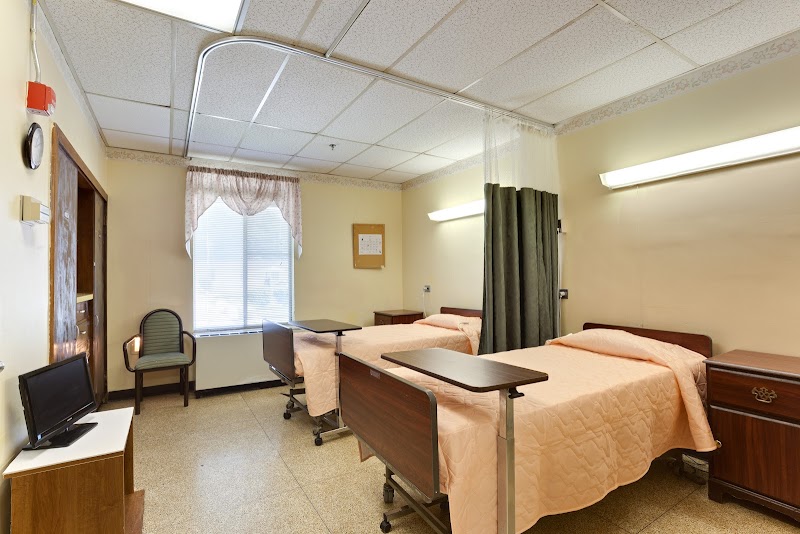
How is Sadie G. Mays Health & Rehabilitation Center Staffed?

CMS rates SADIE G. MAYS HEALTH & REHABILITATION CENTER's staffing level at 1 out of 5 stars, which is much below average compared to other nursing homes. Staff turnover is 72%, which is 25 percentage points above the Georgia average of 46%. High turnover can affect care consistency as new staff learn residents' individual needs. RN turnover specifically is 89%, which is notably high. RNs provide skilled clinical oversight, so turnover in this role can affect medical care quality.

What Have Inspectors Found at Sadie G. Mays Health & Rehabilitation Center?

State health inspectors documented 48 deficiencies at SADIE G. MAYS HEALTH & REHABILITATION CENTER during 2019 to 2025. These included: 3 that caused actual resident harm and 45 with potential for harm. Deficiencies causing actual harm indicate documented cases where residents experienced negative health consequences.
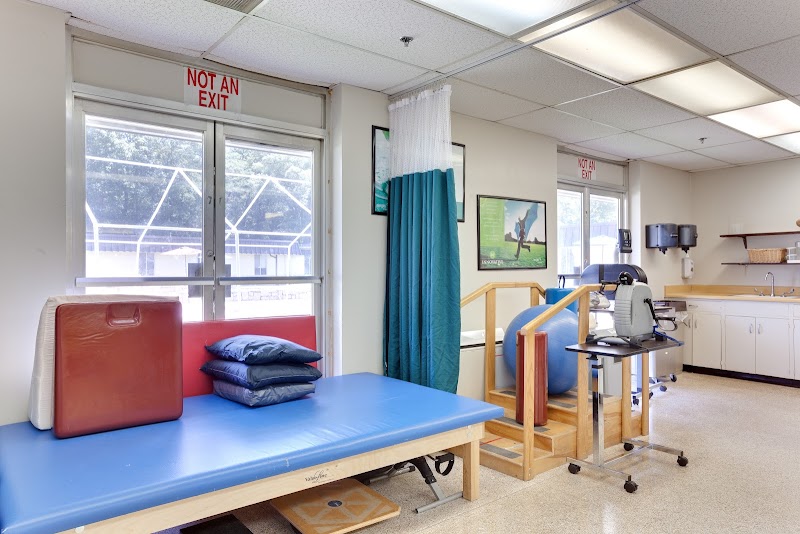
Who Owns and Operates Sadie G. Mays Health & Rehabilitation Center?

SADIE G. MAYS HEALTH & REHABILITATION CENTER is owned by a non-profit organization. Non-profit facilities reinvest revenue into operations rather than distributing to shareholders. The facility operates independently rather than as part of a larger chain. With 206 certified beds and approximately 138 residents (about 67% occupancy), it is a large facility located in ATLANTA, Georgia.
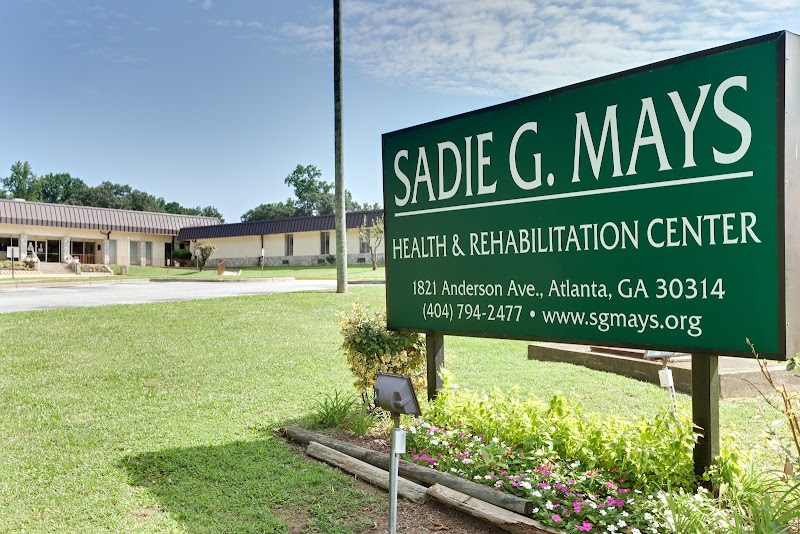
How Does Sadie G. Mays Health & Rehabilitation Center Compare to Other Georgia Nursing Homes?

Compared to the 100 nursing homes in Georgia, SADIE G. MAYS HEALTH & REHABILITATION CENTER's overall rating (1 stars) is below the state average of 2.6, staff turnover (72%) is significantly higher than the state average of 46%, and health inspection rating (1 stars) is much below the national benchmark.

What Should Families Ask When Visiting Sadie G. Mays Health & Rehabilitation Center?

Based on this facility's data, families visiting should ask: "How do you ensure continuity of care given staff turnover, and what is your staff retention strategy?" "Can you walk me through typical staffing levels on day, evening, and night shifts?" "Can I visit during a mealtime to observe dining assistance and food quality?" "How do you handle medical emergencies, and what is your hospital transfer rate?" These questions are particularly relevant given the facility's high staff turnover rate and the below-average staffing rating.

Is Sadie G. Mays Health & Rehabilitation Center Safe?

Based on CMS inspection data, SADIE G. MAYS HEALTH & REHABILITATION CENTER has a clean safety record: no substantiated abuse findings (meaning no confirmed cases of resident harm), no Immediate Jeopardy citations (the most serious violation level indicating risk of serious injury or death), and is not on the Special Focus Facility watch list (a federal program monitoring the lowest-performing 1% of nursing homes). The facility has a 1-star overall rating and ranks #100 of 100 nursing homes in Georgia. While no facility is perfect, families should still ask about staff-to-resident ratios and recent inspection results during their visit.

Do Nurses at Sadie G. Mays Health & Rehabilitation Center Stick Around?

Staff turnover at SADIE G. MAYS HEALTH & REHABILITATION CENTER is high. At 72%, the facility is 25 percentage points above the Georgia average of 46%. Registered Nurse turnover is particularly concerning at 89%. RNs handle complex medical decisions and coordinate care — frequent RN changes can directly impact care quality. High turnover means new staff may not know residents' individual needs, medications, or preferences. It can also be disorienting for residents, especially those with dementia who rely on familiar faces. Families should ask: What is causing the turnover? What retention programs are in place? How do you ensure care continuity during staff transitions?

Was Sadie G. Mays Health & Rehabilitation Center Ever Fined?

SADIE G. MAYS HEALTH & REHABILITATION CENTER has been fined $53,804 across 1 penalty action. This is above the Georgia average of $33,617. Fines in this range indicate compliance issues significant enough for CMS to impose meaningful financial consequences. Common causes include delayed correction of deficiencies, repeat violations, or care failures affecting resident safety. Families should ask facility leadership what changes have been made since these penalties.

Is Sadie G. Mays Health & Rehabilitation Center on Any Federal Watch List?

SADIE G. MAYS HEALTH & REHABILITATION CENTER is not on any federal watch list. The most significant is the Special Focus Facility (SFF) program, which identifies the bottom 1% of nursing homes nationally based on persistent, serious quality problems. Not being on this list means the facility has avoided the pattern of deficiencies that triggers enhanced federal oversight. This is a positive indicator, though families should still review the facility's inspection history directly.