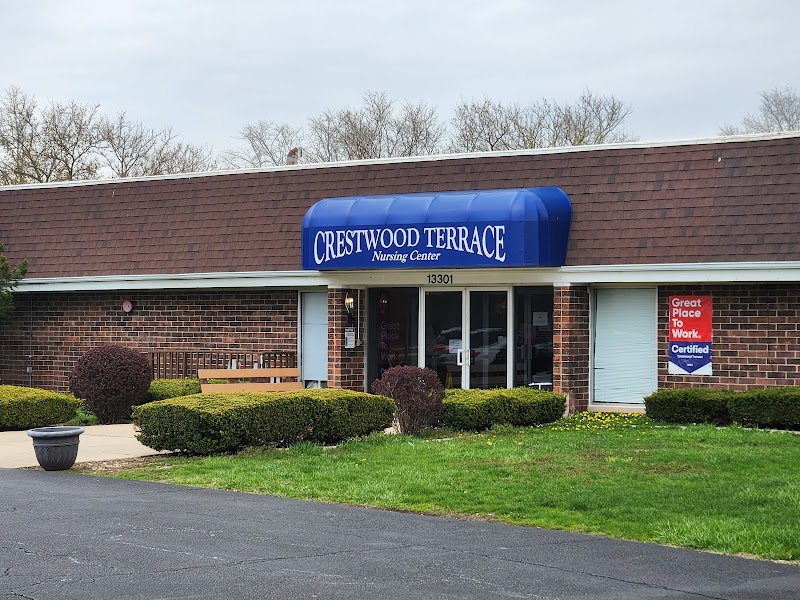
CRESTWOOD TERRACE

13301 SOUTH CENTRAL AVENUE, CRESTWOOD, IL 60445 (708) 597-5251
For profit - Individual 126 Beds Independent Data: November 2025
Trust Grade
13/100
#230 of 665 in IL
Last Inspection: August 2024

Within standard 12-15 month inspection cycle. Federal law requires annual inspections.

Overview

Crestwood Terrace has received a Trust Grade of F, indicating significant concerns about its care quality. In terms of state ranking, it is positioned #230 out of 665 facilities in Illinois, which places it in the top half, but that ranking is overshadowed by the poor trust grade. The facility is improving, having reduced its issues from 11 in 2024 to 3 in 2025, but there are still serious problems. Staffing is a relative strength, with a turnover rate of 34% that is below the state average, and it has good RN coverage, exceeding that of 80% of Illinois facilities. However, there are serious incidents, such as a resident being hospitalized after not receiving proper fluid restrictions and another resident being physically assaulted by a known aggressor, highlighting significant safety concerns despite some positive metrics.

Trust Score
F
13/100
In Illinois
#230/665
Top 34%
Safety Record
High Risk
Review needed
Inspections
Getting Better
11 → 3 violations
Staff Stability
○ Average
34% turnover. Near Illinois's 48% average. Typical for the industry.
Penalties
⚠ Watch
$10,000 in fines. Higher than 98% of Illinois facilities. Major compliance failures.
Skilled Nurses
○ Average
Each resident gets 34 minutes of Registered Nurse (RN) attention daily — about average for Illinois. RNs are the most trained staff who monitor for health changes.
Violations
⚠ Watch
26 deficiencies on record. Higher than average. Multiple issues found across inspections.
★★★☆☆
3.0
Overall Rating
★★☆☆☆
2.0
Staff Levels
★★★★★
5.0
Care Quality
★★☆☆☆
2.0
Inspection Score
Stable
2024: 11 issues
2025: 3 issues

The Good

  • 5-Star Quality Measures · Strong clinical quality outcomes
  • Full Sprinkler Coverage · Fire safety systems throughout facility
  • No fines on record
  • Staff turnover below average (34%)

    14 points below Illinois average of 48%

Facility shows strength in quality measures, fire safety.

The Bad

3-Star Overall Rating

Near Illinois average (2.5)

Meets federal standards, typical of most facilities

Staff Turnover: 34%

11pts below Illinois avg (46%)

Typical for the industry

Federal Fines: $10,000

Below median ($33,413)

Minor penalties assessed

The Ugly 26 deficiencies on record

6 actual harm
Jul 2025 1 deficiency 1 Harm
SERIOUS (G) 📢 Someone Reported This

A family member, employee, or ombudsman was alarmed enough to file a formal complaint

Actual Harm - a resident was hurt due to facility failures

Quality of Care (Tag F0684)

A resident was harmed · This affected 1 resident

**NOTE- TERMS IN BRACKETS HAVE BEEN EDITED TO PROTECT CONFIDENTIALITY** Based on interview and record review, the facility failed to follow hospital orders for a fluid restriction after a resident (R1...

Read full inspector narrative →
**NOTE- TERMS IN BRACKETS HAVE BEEN EDITED TO PROTECT CONFIDENTIALITY** Based on interview and record review, the facility failed to follow hospital orders for a fluid restriction after a resident (R1) was hospitalized for low sodium and failed to complete additional laboratory work for a resident's (R1) low sodium levels for one out of three residents reviewed for improper nursing care in a total sample of three. This failure resulted in R1 suffering a syncopal episode twice within four days and needing to be hospitalized each episode for low sodium and bradycardia. Findings Include: R1 is a [AGE] year old with the following diagnosis: epilepsy, type 2 diabetes, schizoaffective disorder, bradycardia, and syncope/collapse.R1 no longer resides in the facility. A Nursing note dated 5/ 31/ 25 document R1 was found lying on the floor in R1's room. The fall was unwitnessed. Vital signs were within normal limits except the heart rate. The heart rate was 49 (normal heart rate is 60-100 beats per minute). R1 was not able to stand. The doctor was called and ordered to send R1 to the hospital. A call was made later to the hospital to check on R1's status. R1 was admitted with a diagnosis of low sodium. A Nursing note dated 6/2/25 documents R1 returned from the hospital with the discharge diagnosis of low sodium. R1's heart rate upon admission was 68. R1 was able to ambulate with a steady gait. The physician was made aware of R1's return and the medication that was given during the hospital including insulin. No new orders were received.The Hospital Records dated 6/2/25 document R1 was admitted with a diagnosis of low sodium. R1 was ordered a regular diet with a fluid restriction of 800 mL. Sodium levels were 124 on presentation to the emergency room and raised to 131 the next morning after receiving IV fluids overnight. This is consistent to volume depletion which is likely a component of SIDAH (Syndrome of Inappropriate Antidiuretic Hormone Secretion) due to psych medications.Per the National Library of Medicine, an article titled, Clinical management of SIADH, dated 04/2012 documents, Hyponatremia is the most frequent electrolyte disorder and the syndrome of inappropriate antidiuretic hormone secretion (SIADH). SIADH should be treated to cure symptoms. Therapeutic modalities include nonspecific measures and means (fluid restriction, hypertonic saline, urea, demeclocycline), with fluid restriction and hypertonic saline commonly used. (https://pmc.ncbi.nlm.nih.gov/articles/PMC3474650/)A Laboratory note dated 6/13/25 documents the sodium level was 134. All lab levels were reviewed by the physician and no new orders were received. The Laboratory Report dated 6/13/25 documents a sodium level of 134 mEq/L. The reference range for a normal level is 138-147 mEq/L. No other laboratory levels were tested again after this. A Transfer to Hospital note dated 6/25/25 documents R1 was observed having a near syncopal episode in the dining room. R1 was taken back to R1's room and assessed. R1's pulse was 58. The physician ordered to send R1 to the hospital. A Nursing note dated 6/25/ 25 at 8:37 PM documents arrived back to the facility. Vital signs are within normal limits. Diagnosis from the hospital was low sodium and slow heart rate. R1's discharge instructions include wearing a cardiac monitor for seven days continuously then returning it back to the hospital. The physician was called several times and the nurse was not able to get a hold of the physician for any new orders. This will be endorsed to the next shift. A Nursing note dated 6/26/25 documents the physician ordered an electrolyte panel for R1 to follow up on the hyponatremia diagnosis. A Nursing note dated 6/29/25 documents R1 fell in the dining room. Vital signs were within normal limits except heart rate was 38. R1 was picked up off the floor and assisted to a private room to be monitored. The physician was notified in order to send R1 to the hospital. The pulse was rechecked while waiting for the ambulance and R1 was still bradycardic. R1 was admitted to the hospital with a diagnosis of syncope and bradycardia. R1 was admitted for monitoring. There is no documentation that the psychiatrist or primary physician adjusted any medications to address the low sodium levels or that a fluid restriction was ordered.Vital signs from 5/31/25-6/29/25 were reviewed. A heart rate of 46 beats per minute was documented on 5/31/25 and a heart rate of 30 on 6/29/25. Vitals signs are not documented each shift every day per the care plan intervention. The Physician Order Summary was reviewed. There is no order for a fluid restriction, a cardiac monitor for one week, or a medication adjustment in the psychiatric medication. R1 has an order for carbamazepine 100mg three tablets twice a day and one 200mg tablet once a day, phenytoin 100mg two capsules three times a day, invega sustenna 11mg injection once a month, seroquel 300 mg two tablets twice a day, and metformin 500mg tablet once a day. All these medication especially when used in combination can cause SIADH. None of these medications have had dosages lowered within the last six months. On 7/18/25 at 12:37PM, V1 (Nurse) stated V1 received notification that the labs were abnormal so V1 notified the physician. V1 reported the facility uses the reference numbers in the laboratory report to tell if a laboratory level is low, high, or normal. V1 stated all abnormal lab levels must be reported to the physician by a phone call and faxing the numbers over to the physician. V1 stated if no new orders are given by the physician that it must be documented. V1 reported the physician was looking for hyponatremia in this lab draw, and it was a previous issue R1 kept having. V1 stated no new orders were put in for this lab level per the physician's request. V1 reported R1 had a near syncopal episode on 6/25/25 where R1 was dizzy when R1 tried to stand. V1 stated R1 was sent to the hospital by the physician and came back with a cardiac monitor. V1 reported R1 fell again on 6/29/25 after having another syncopal episode. V1 reported R1 did have a low heart rate in the 30s at the time of this fall. V1 stated hospital paperwork is reviewed by the nurses and a medication review as well as any other changes in orders have to be reviewed with the physician when the resident is readmitted . V1 reported all new orders have to be reviewed with the physician so any changes can be made to the current orders at the facility. V1 stated a nurse documents in the computer system that a physician was notified of any new orders or changes from current orders after returning from the hospital. V1 reported if it is not documented, it means it didn't happen. V1 stated a fluid restriction needs to be documented in the computer system as well as an order be put in. V1 was not able to show the surveyor in the computer system where the fluid restriction documentation for R1 was. V1 denied being aware that R1 was on a fluid restriction. On 7/18/25 at 1:07PM, V2 (CNA) stated staff was monitoring R1 due to recent episodes dizziness and falls. V2 denied R1 having a fluid restriction while R1 was at the facility. V2 reported if a resident is on a fluid restriction then it is charted in the computer system.On 7/18/25 at 1:38PM, V3 (ADON/Restorative Nurse) stated it is the admitting nurse's responsibility to review the hospital paperwork and inform the physician of any changes. V3 reported the DON should also be made aware of any changes to the plan of care. V3 stated r1 was having low heart rate and low sodium but was unaware of what was causing it. V3 reported the nurses have to document any conversation with a doctor to let the oncoming staff what is going on with the resident. V3 stated if a resident is on a fluid restriction, staff have to monitor them and document the amount of fluids. V3 reported the CNAs will document in the computer under the meals tab which allow staff to watch how much the resident is drinking. V3 was not sure not if R1 was supposed to be on a fluid restriction. V3 stated if a resident was on a fluid restriction from the hospital then it needs to be continue at the facility. V3 reported the doctor will be called for an order, the dietitian will come to evaluate the resident, and the dietary department will be notified.On 7/18/24 at 2:34PM, V4 (Former Nurse) stated V4 took care of R1 the day of the first fall on 5/31/25. V4 reported R1 was too weak to stand and R1's pulse being low at the time of the fall. V4 stated that R1 was diagnosed with low heart rate and low sodium while at the hospital, but was unaware of the cause. V4 reported when a resident is readmitted from the hospital, orders must be reviewed, and the physician must be called to carry out any new orders. V4 confirmed a fluid restriction must be ordered so everyone knows that a fluid restriction is in place for that resident. V4 stated a fliud restriction must be documented in the computer system so continuing shifts know how much fluid a resident is having throughout the day. V4 denied ever seeing an order for a fliud restriction. V4 reported a physician must be notified of any new orders from the hospital or any changes while the resident was in the hospital so the doctor is aware of the plan of care. V4 denied remembering a fluid restriction was ordered after R1 returned from the first hospitalization. On 7/18/25 at 2:45PM, V5 (Nurse) stated V5 readmitted R1 back to the facility after the second admission to the hospital. V5 confirmed R1 was diagnosed at the hospital with low heart rate and low sodium levels. V5 reported the physician (V7) was called to get orders after R1 arrived, but the physician did not return a call, so this task was endorsed to the next nurse. V5 reported an administrator or DON should notified if the nurses cannot get in contact with the physician. V5 admitted that V5 was busy and probably forgot to notify the administrator or DON that V5 could not get in contact with the physician for any new orders. V5 denied R1 ever being on a fluid restriction. V5 was unaware why R1 would need a fluid restriction. V5 denied being aware that the last sodium level drawn was trending low. On 7/18/25 at 3:13PM, V6 (DON) stated R1 was admitted to the hospital after a fall due to a syncopal episode where R1 was diagnosed with bradycardia as well as low sodium. V6 reported after a resident is readmitted from the hospital, the physician must be notified of their return and makes the physician aware of any new orders from the hospital. V6 stated the nurse must document this conversation and if any orders have changed. V6 reported the nurse is responsible for letting the physician know of any diet change orders. V6 stated R1 did have a redraw of labs to check the sodium level. V6 stated V6 knows the sodium level was low but close within normal range so no additional orders were put in. V6 denied the sodium level was monitored again or any additional orders put in place until R1 went to the hospital on 6/25/25. On 7/18/25 at 7:00PM, V7 (Primary Physician) stated R1 is a diabetic and also takes psych medication and this combination can cause low sodium. V7 reported it is caused by a disturbance in electrolytes due to the hormones being imbalanced. V7 stated a blood test was completed about one week later after the first hospitalization and the sodium level was normal. V7 stated the sodium level was only one point out of normal range at 134. V7 reported V7 did not feel like it needed to be checked again because it was near normal. V7 stated V7 was aware that R1 went out to the hospital a second time for bradycardia and low sodium and was readmitted to the facility with a cardiac monitor. V7 stated V7 told the admitting nurse to continue all treatments from the hospital after each readmission. V7 reported V7 cannot adjust the psychiatric medications so the nurses were informed to get in contact with psych to adjust R1's medication to help with low sodium levels. V7 was unaware why a fluid restriction was done and was unable to explain how a fluid restriction would increase a sodium level. V7 said, Whatever maneuver they used in the hospital to get normal sodium is what they did. V7 stated it is the nurse's responsibility to speak with the psych physician about changing medication. V7 reported V7 was not aware of a third admission for bradycardia and low sodium. On 7/22/25 at 10:26AM, V8 (Psych Nurse Practitioner) stated V8 saw R1 in May and June of this year. V8 reported R1 was not having any new delusions or behaviors so no medication adjustments were needed. V8 stated V8 did not know about R1's low sodium. V8 confirmed psych meds can cause low sodium from SIADH. V8 denied being aware that R1 was ever treated for that condition while at the hospital. V8 stated that low sodium is a medical condition and the medical doctor (V7) would've handled that. V8 reported the medical doctor would've handled this because the medical doctor has access to the laboratory levels. V8 stated low sodium levels can cause generalized weakness and if the sodium gets low enough, it can cause a person to have seizures. V8 reported that condition is usually managed with a fluid restriction before adjusting any medications because adjusting the medications can have a negative effect on behaviors. V8 stated if V8 were told about the low sodium, then it would have been documented in the progress notes in June. The surveyor asked if V8 was aware about the low sodium, what changes to the medication would V8 have made? V8 reported that V8 would have had to have a discussion with the medical physician before making any changes to any medications. On 7/22/25 at 11:14AM, V6 stated if the primary physician and psych physician need to discuss a resident's plan of care then they will communicate with each other. V6 stated that V7 is a medical doctor so V6 was under the impression that V7 was managing the low sodium level. V6 denied V7 ever asking the facility to get psych involved for R1's medication adjustments. V7 denied being aware why a fluid restriction wasn't re-ordered after R1 was readmitted . V6 reported if the facility does not agree with the doctor's orders or feel a resident needs additional orders than another physician can be contacted that sees that resident. V6 denied any other physicians being contacted for R1's low sodium level. The Fall Report dated 5/31/25 documents R1 was found lying on the floor in R1's room. Vital signs were within normal limits except heart rate was low at 49. R1 reported hitting R1's head. R1 was not able to stand on R1's own. An order was received to send R1 to the hospital. There are no predisposing environmental or physiological factors that caused the fall. The Fall Report dated 6/29/25 documents R1 fell in the dining room. R21 reported R1's legs gave out while R1 was going to the bathroom. The physician ordered R1 go to the hospital. R1 was bradycardic. There are no predisposing environmental or physiological factors except change in condition that caused the fall. The Care Plan dated 6/3/25 documents R1 is at risk for falls after sustaining a fall on 5/31/25. An intervention includes to endure R2 drinks water throughout the day. The Care Plan dated 6/26/25 documents R1 present with decreased cardiac output related to a diagnosis of bradycardia as evidenced by near fainting episodes. An intervention includes that R1 will wear a cardiac monitor as ordered by the physician and vital signs will be documented every shift. The Minimum Data Set (MDS) dated [DATE] documents a Brief Interview for Mental Status score as a 12 (Moderate cognitive impairment). There were no hospital records available from the hospitalization on 6/25/25 or 6/29/25.Intake and output or fluid restriction documentation was requested during this survey but none was provided. The policy titled, admission Process, dated 03/2021 documents, .2. When a resident arrives at the facility.utilize accompanying hospital records for detailed information. The policy titled, Change in Condition, dated 03/2021 documents, Guideline: To keep the physician or extender, who is in charge of medical care, responsible party, responsible for health care decisions, informed of the resident's medical condition so they may direct the plan of care as needed. Standard: Notification of the physician, legal representative, or responsible party, should occur when there is a change in the resident's condition. Change in condition is defined as (notify parties immediately in the event of death): an incident or accident that involved the resident which results in injury and requires physician intervention; a change in the resident's physical, mental or psychosocial status; a need to alter treatment; and/ or a decision to transfer or discharge the resident from the facility. The policy titled, Physician Orders - Verbal and Fax, dated 03/2021 documents, .Procedure: 1. Verbal Orders: Verbal orders are those given to the nurse by the physician or extender in person or by telephone, however are not written in the medical record. Follow this process: a) Write the orders verbally given by the prescriber in the medical record.d) The prescriber should sign the according order according two state guidelines. e) Follow through with the orders as required. If the orders are unable to be followed the provider should be made aware and then additional orders received.3. Outside Appointment Orders:.b) If the resident returns with orders from the consulting physician, the orders must be verified with the attending physician before they can be carried out.d) If the attending position is not in agreement with the orders, the consulting physician must be notified by the nurse. e) It is the responsibility of the physicians to come to agreement on which orders are to be followed.
Apr 2025 1 deficiency
CONCERN (D) 📢 Someone Reported This

A family member, employee, or ombudsman was alarmed enough to file a formal complaint

Potential for Harm - no one hurt, but risky conditions existed

Free from Abuse/Neglect (Tag F0600)

Could have caused harm · This affected 1 resident

**NOTE- TERMS IN BRACKETS HAVE BEEN EDITED TO PROTECT CONFIDENTIALITY** Based on interviews and record reviews the facility failed to follow their abuse policy and procedures by restricting a resident...

Read full inspector narrative →
**NOTE- TERMS IN BRACKETS HAVE BEEN EDITED TO PROTECT CONFIDENTIALITY** Based on interviews and record reviews the facility failed to follow their abuse policy and procedures by restricting a resident from returning to their room with their personal items and physically restraining them against their will. This failure applies to one of three residents (R1) reviewed for abuse. Findings include: R1 is a [AGE] year-old male with a diagnoses history of Schizoaffective Disorder, Recurrent Severe Major Depressive Order with Psychotic Symptoms, PTSD, Generalized Anxiety Disorder, Brain Cancer, and Suicidal Ideations who was admitted to the facility 01/14/2025. On 03/31/2025 at 1:00 PM V3 (Psychosocial Services Rehabilitation Services Assistant/Security Guard) stated on 03/19/2025 between approximately 7:15 AM and 7:20 AM during smoke break, he heard social services being paged to the front desk and when he arrived R1 was in the middle of screaming, yelling, and cursing at V5 (Receptionist) and stating no one could check his things and they didn't have a right to check his belongings. V3 stated the delivery driver didn't bring R1's groceries all the way in the facility and had left them in the vestibule area between the front doors of the facility. V3 stated he walked into that area and grabbed the groceries delivered for R1, brought them back near the social services office and asked R1 to give him a second because he didn't have the key to the social services office. V3 stated he turned around briefly and by the time he turned back around R1 had grabbed all the groceries in his hands and was attempting to go back to his room, so he stood in front of him and told him he couldn't go back to his room. V3 stated R1 had a case of pop that was starting to break apart and when he went to grab the can to prevent it from falling R1 thought he was attempting to take it from him and began screaming at him, lunged at him, then physically attacked him. V3 stated when he got up after being attacked by R1, R1 had grabbed all his belongings again, took his belongings to the dining room table and sat there for approximately 10 seconds. V3 stated R1 then attempted to get his belongings again and head to his room but wasn't able to and then became loud and began screaming and yelling at V4 (Psychosocial Services Rehabilitation Services Assistant/Security Guard). V3 stated V4 was in the dining room with R1 during this time he believes attempting communicate with him and keep him calm. V3 stated when R1 began approaching his room V4 stopped him and then R1 became aggressive with V4 and attempted to push his way through him. V3 stated then he and V4 took R1 belongings out of his hands, put him in a CPI hold and took him to the ground. V3 stated he and V4 had R1's arms and took him to the ground. V3 stated he had R1's arms above his head and V4 had his legs, then the police arrived. V3 stated R1 was being held for about 45 seconds to a minute before the police arrived. V3 stated when he no longer felt any resistance from R1 arms he let them go and when V4 no longer felt any resistance with R1 legs he let them go. V3 stated at this point the police were involved, they took some statements and then R1was sent to the hospital. On 03/31/2025 at 1:50 PM V6 (Registered Nurse) stated on 03/19/2025 she observed R1 and V3 (Psychosocial Services Rehabilitation Services Assistant/Security Guard) standing in the hall between the social services office and the nursing station and V3 was explaining to R1 that he needed to check in R1 belongings. V6 stated R1 became upset because he didn't want his belongings checked in while V3 continued to explain the facilities policies. V6 stated she then observed R1 physically attack V3. V6 stated afterwards V4 (Psychosocial Services Rehabilitation Services Assistant/Security Guard) and other staff gathered around and physically separated R1 and V3 and were verbally redirecting R1. V6 stated she next observed R1 on the floor in the dining room but she did not see why he ended up on the floor. V6 stated V4 had restrained R1 because he was attempting to go to his room. V6 stated V4 was in the dining room near R1 and does believe she saw V4 trying to restrain R1. V6 stated V4 had R1 pinned to the floor by his arms. V6 stated the police then arrived. The facility's Final Abuse Investigation report and corresponding witness statements submitted to the state agency on 03/28/2025 regarding an allegation of abuse from R1 against staff on 03/19/2025 documents R1 was involved in a physical altercation with an employee, does not include any witness statements from V3 (Psychosocial Services Rehabilitation Services Assistant/Security Guard) nor any information reported from V6 regarding R1 being restrained. On 03/31/2025 at 3:52 PM V2 (Psychosocial Rehabilitation Services Coordinator) stated residents belongings are searched whenever they place orders for outside packages or food. V2 stated they don't dig through the residents belongings but rather ask to observe their items with their assistance. V2 stated staff doesn't touch the resident's belongings such as their bags and if they receive items that are delivered, they will ask the resident to open the bag and allow them to look inside and explain this is for safety purposes. V2 stated R1's groceries that were delivered on 03/19/2025 needed to be searched for safety purposes. V2 stated the procedure for receiving groceries is to notify the resident that the groceries have arrived which are left with the receptionist. V2 stated the receptionist will page social services staff to come and search the resident's groceries with the resident present. V2 stated once social services staff respond to the page, they then notify the resident that the groceries need to be checked and after checking them offer assistance to bring groceries to their room. V2 stated while searching resident's groceries the residents are asked if any of the items are glass wares or perishable. V2 stated the staff asks the resident to open the grocery bag and they then just look through it. V2 stated R1 did have the right to collect his own groceries they just needed to be checked. V2 stated V3 (Psychosocial Services Rehabilitation Services Assistant/Security Guard) likely grabbed R1's groceries from inside the front doors for safety purposes because of where they were located. V2 stated if R1 insisted he didn't need help collecting his groceries after the items were removed from the doorway, staff should just allow him to collect them as long as he was not attempting to take his belongings to his room without being searched. V2 stated if R1 insisted on collecting his own groceries and continued refusing to have them searched staff should just monitor him and ensure he is not attempting to hurt himself or others. V2 stated no staff should be putting their hands on the resident. V2 stated staff monitoring after a behavioral incident would include speaking to them in a calm manner and checking on them once in a while because the resident may still be upset after a physical altercation and may not even want to speak to anyone. V2 stated staff should not have blocked R1 from getting to his room when attempting to take his groceries to his room after the physical altercation with staff and at that point his bags had been on the floor and all of his belongings would have been observed. V2 agreed there was no reason to physically restrain R1 when attempting to take his groceries to his room. V2 stated if V3 and V4 held R1 down on 03/19/2025 it should have been reported however it wasn't. V2 stated all physical interventions should be a last resort. V2 stated the facility does not even use the term physical restraint to describe handling residents. The facility's Abuse Policy received 03/31/2025 states: This facility affirms the right of our residents to be free from physical abuse or mistreatment. This facility therefore prohibits abuse and mistreatment of residents. Abuse is unreasonable confinement. This assumes that all instances of abuse of residents, even those in a coma, cause physical harm or pain or mental anguish. Unreasonable confinement means the separation of a resident from her/his room against the resident's will.
Mar 2025 1 deficiency 1 Harm
SERIOUS (G) 📢 Someone Reported This

A family member, employee, or ombudsman was alarmed enough to file a formal complaint

Actual Harm - a resident was hurt due to facility failures

Free from Abuse/Neglect (Tag F0600)

A resident was harmed · This affected 1 resident

**NOTE- TERMS IN BRACKETS HAVE BEEN EDITED TO PROTECT CONFIDENTIALITY** Based on interviews and record review, the facility failed to protect a resident's right to be free from physical abuse (R2) fro...

Read full inspector narrative →
**NOTE- TERMS IN BRACKETS HAVE BEEN EDITED TO PROTECT CONFIDENTIALITY** Based on interviews and record review, the facility failed to protect a resident's right to be free from physical abuse (R2) from another resident with known history of aggressive behavior (R3) for one (R2) of five residents reviewed for abuse in a sample of eight. This failure resulted in R2 being physically assaulted and emergently transferred to the hospital for evaluation of facial trauma. Findings include: R1 is a [AGE] year-old female admitted to the facility on [DATE] with diagnosis including but not limited to Schizoaffective Disorder, Bipolar Type; Malignant Neoplasm Of Skin; Morbid (Severe) Obesity Due To Excess Calories; Age-Related Nuclear Cataract, Bilateral; Hypermetropia, Bilateral; Presbyopia; Major Depressive Disorder, Recurrent, Severe With Psychotic Symptoms; Schizophrenia; And Chronic Viral Hepatitis C. According to R1's MDS (Minimum Data Set) assessment dated [DATE] under section C, R1 has BIMS (Brief Interview of Mental Status) score of 14 indicating, indicating intact cognition. R2 is a [AGE] year-old female admitted to the facility on [DATE] with diagnosis including but not limited to Major Depressive Disorder, Recurrent, Severe with Psychotic Symptoms; Other Polyosteoarthritis; Polyp of Colon; Unspecified Hemorrhoids; Unspecified Abdominal Pain; Hypertensive Heart Disease Without Heart Failure; and Other Hyperlipidemia. According to R2's MDS (Minimum Data Set) assessment dated [DATE] under section C, R2 has BIMS (Brief Interview of Mental Status) score of 15 indicating, indicating intact cognition. R2's abuse care plan dated 09/10/2024 reads in part, (R2) is at risk for abuse/neglect based on comprehensive assessment as evidenced by: (R2) has a diagnosis of mental illness. (R2) is not able to make her needs known. Interventions: Assure (R2) that she is in safe and secure environment with caring professionals. Explain psychosocial adjustment is often facilitated by developing a trusting relationship with another person and verbalizing thoughts, needs and feeling. R2's anxiety care plan dated 09/12/2024 reads in part, (R2) has exhibited or has history of anxious behavior such as: Evidenced by Apprehension in response to severe and persistent mental illness. Excessive and persistent daily worry about life circumstances. Concentration difficulty such as losing a train of thought. Persistent and unreasonable fear of a specific object or situation. Interventions: Assist in identifying actual life situations. R3 is a [AGE] year-old female admitted to the facility on [DATE] with diagnosis including but limited to Schizoaffective Disorder, Bipolar Type; Major Depressive Disorder, Recurrent, Severe with Psychotic Symptoms; Hypertensive Heart Disease Without Heart Failure; Morbid (Severe) Obesity Due To Excess Calories; Chronic Obstructive Pulmonary Disease, Unspecified; Suicidal Ideations; and Insomnia, Unspecified. According to R3's MDS (Minimum Data Set) assessment dated [DATE] under section C, R3 has BIMS (Brief Interview of Mental Status) score of 15 indicating, indicating intact cognition. According to R3's MDS (Minimum Data Set) assessment dated [DATE] section E shows R3 has been demonstrating potential indications of psychosis such as hallucinations and delusions, and daily occurrence of threatening and screaming at others. R3's aggression care plan dated 06/26/2024 reads in part, (R3) has a history of aggressive, inappropriate, attention seeking behavior due to Severe mental illness. (R3) becoming physical inappropriate and verbal aggressive with peer. (R3) becoming verbally aggressive with staff when redirected. Interventions: Intervene when any inappropriate behavior is observed. Communicate assertively that (R3) must exercise control over impulses and behavior (Social skills training). R3's delusional statements care plan dated 3/16/2028 reads in part, (R3) has shown evidence of making delusional statements related to diagnosis of severe mental illness. Interventions: Assess ability to maintain reality orientation. Provide reality orientation as needed. Per record review, R2 was discharged from the facility on 01/10/2025 and is not available for observations or interview during this investigation. Per record review, R3 was hospitalized for behavioral evaluation on 12/22/2024 and later discharged the facility and is not available for observations or interview during this investigation. On 03/20/2025 at 1:41 PM V8 (Certified Nurse Assistant) said, I worked 7:00 AM - 3:00 PM on 12/22/2024. R3 was walking and talking to herself, like usual. I was monitoring A wing which is right across from B wing. R3 got to the end of B wing and that's where R2 was. Out of nowhere, R3 grabbed R2 from behind, put her in a choke hold and started punching her head and then face. R2 did not say anything to R3 before R3 attacked her. I was standing maybe 5 feet away from them. There was no other staff there. I was trying to pull R3 off R2, but I couldn't. I started to yell, Help! Help! Help!. After about 5 minutes, V9 (Certified Nurse Assistant) and R4 came up and we were able to pull R3 off R2. R2 was beat up pretty bad. I didn't see any blood and R2 didn't lose consciousness, but it was pretty extreme. After more staff showed up, I had to step away, the incident upset me. R3 attacked R1 a few months prior to December 2024. R1 had a concussion because of the attack. There was nothing special we had to do for R3 as far as monitoring. PRSAs (Psychiatric Rehabilitation Service Aids) is supposed monitor R3, that's what they're there for. R3 was acting like always that day, I didn't see any signs that she might attack someone. On 03/20/2025 at 02:34 PM V11 (Psychiatric Rehabilitation Service Coordinator) said, I worked as a PRSA (Psychiatric Rehabilitation Service Aids) on 12/22/2024. PRSAs are considered security in the facility. I saw the incident between R2 and R3 but didn't see the escalation of it. Code orange was called shortly after lunch. I responded to the code and saw R2 yelling, Get off me! while R3 was pounding on her. Other staff and I separated R2 and R3, and R3 was escorted to the social service office. I think, R2 suffered concussion after the incident. I've never seen R3 to have a behavioral outburst like that, but I heard that she's aggressive. There was nothing special related to R3's monitoring, all I was told was not to come too close to R3 because she might have aggressive behaviors. It was like walking on eggshells around R3. On 03/21/2025 at 10:29 AM V12 (Psychiatric Rehabilitation Service Director) said, I wasn't here at the time of the incident (12/22/2024) because it happened on a Sunday, and I don't work on Sundays. When I came on 12/23/2024, R2 came to talk to me and told me that R3 was talking to herself and thought R2 was talking to R3 and then R3 attacked R2. R2 was in the facility for only 3 months (admitted [DATE]) whereas R3 had been a long-term resident in the facility, admitted in 2018 at the time of the incident. R3 was hospitalized for behavioral evaluation multiple times while in the facility. Surveyor asked about R3's previous physical attack on R3's roommate, V12 (PRSD) said, It might have happened, I don't remember. R3's behavior was always deceitful, she didn't really have escalating behaviors, so it was hard to tell when R3's aggression might escalate. You would ask R3 if everything is ok, and R3 would respond, Yes, everything is fine. Some of the interventions to prevent R3's behavioral escalation were group therapy, 1:1 tele-health program with psychiatrist, and day program. If R3 refused any of the interventions, it was a good indication that she might escalate her aggressive behaviors. On 03/21/2025 at 12:06 PM V14 (Family Nurse Practitioner) said, R3 had delusions at the baseline. R3 was taking psychotropic medications. R3 was often hiding her symptoms or downplayed them, you could tell she's responding to an internal stimulus but when asked, R3 would deny. R3's medications could manage her behaviors unless R3 refused them. R3 didn't refuse her medications often but it happened on occasion, and that's when she would act out. We don't put in an order for behavioral monitoring, the nurses should document in progress notes if any behavioral changes occur. With R3, it was hard to predict behavioral outbursts because she was downplaying her stimuli. R3's more frequent monitoring would be recommended. Staff should definitely place someone like R3 on 1:1 observation if they saw any concerning behaviors. Before a resident with mental illness hits someone, they usually show signs such as pacing and talking to self. Staff should request PRN (as needed) medications from us as well to help manage the symptoms. On 03/21/2025 at 12:20 PM R1 said, In June (2024), R3 punched me in my eye. I didn't do nothing. R3 came up to me while I was sleeping, around 3:00 AM and just hit me. We were roommates at the time. R3 was aggressive. They didn't do anything about it. On 03/21/2025 at 12:28 PM V9 (Certified Nurse Assistant) said, On 12/22/2024, I was in the dining room, on resident's 1:1 monitoring. I heard code orange, so I responded to the code and broke up R2 and R3. I was under the impression V8 (CNA) was getting attacked. R3 always walked up and down the hallway, it was the norm for her. If anything, R3 was talking to herself a little more than usual that day. I don't really know what triggered R3 that day. After the two residents were separated, I walked away and went back to monitoring. On 03/21/2025 at 12:38 PM V6 (Registered Nurse) said, I worked on 12/22/2024. R3 was really quiet, except for when she would have an outburst in her room. R3 usually was yelling and cursing in her room. I don't remember R3 talking excessively or pacing on the day of the incident. The only thing that I remember that day, was seeing R2 sitting at the nursing station and R3 in the social service office. I was told what had just happened. Generally speaking, we document residents' behaviors in progress notes. We document when resident displays abnormal behavior, but it also depends on the nurse. Some nurses document both, abnormal and normal residents' behaviors. R3 was generally compliant with taking her medications and she took her psychotropic medication on the day of the incident (12/22/2025). On 03/21/2025 at 1:09 PM V1 (Administrator/Abuse Prevention Coordinator) said, On 12/22/2024, staff called me and told me that there was an incident, that R3 hit R2. I asked if there was a CNA in a monitoring spot at the time of the incident, I was told that V8 (CNA) was there. I assured that both residents are safe, nobody is hurt, and all staff is monitoring their areas. I asked for V8 (CNA) to talk to me then. V8 (CNA) told me that R2 was walking and R3 came up to her, said something out loud, hit R2 from behind, and pushed R2 to the floor. V8 (CNA) was trying to intervene, and other staff responded to code orange and came to help. The following day (12/23/2024), I interviewed V8 (CNA) and R2. I did speak to few more staff, but they all stated that they came after the escalation. There were no residents who witnessed the incident. I did not have a chance to talk to R3 because she was hospitalized for behavioral evaluation at that time. R2 was hospitalized for medical evaluation and returned to the facility after a few hours. R2 called the police while she was getting assessed by the nurses before facility staff had a chance to do so. R2 came to me after she returned from the hospital and said she wanted to go home for holidays, and she said that she doesn't know why R3 attacked her. R2 said she felt safe in the facility because R3 was not there. The conclusion of the internal investigation was that R2 was hit by R3 as a result of R3 exhibiting symptoms of her mental illness. R3's Medication Administration Record for December 2024 does not show any requests for PRN psychotropic medications for behavioral management. Absent are any progress notes or behavioral assessments to show R3's escalating behaviors that led to an altercation on 12/22/2024. R1's progress note dated 06/26/2024 reads in part, Writer was informed by social service that (R1) was punched on her face by her roommate. Upon assessment (R1) stated that she was on the toilet when roommate walked up to her and punched her on her face, leaving her with left cheekbone swelling. Ice was applied. (R1) room was changed, and MD ordered that resident go to the ER for medical evaluation of her face. R3's progress note dated 06/26/2024 reads in part, This writer was informed that (R3) punched her roommate on the face, and left roommate's face swollen. (R3) stated that roommate was verbally aggressive towards her, and she proceeded to call her names, she ask her to stop but she didn't and she punched her on the face. At this time (R3) was separated from her roommate, roommate is assigned to a new room and her swelling is treated with ice. We will continue to monitor and document. R2's progress note dated 12/22/2024 reads in part, Writer was informed of the altercation between (R2) and (R3). Situation was immediately deescalated, head to toe assessment done. Skin discoloration and a scratch noted to the right side of the face. Vitals are (Blood Pressure) 128/86, (Temperature) 98.3, (Pulse) 82, (oxygen level) 98% on room air. (R2) denied pain. Police called. (Physician) notified. (R2) transferred to (local hospital) via EMS (emergency medical service) for medical evaluation. R3's progress note dated 12/22/2024 reads in part, (R3) was reported for initiating an altercation with another resident. Removed the receiver (R2) of the altercation from the initiator (R3) of the altercation. Writer assessed the initiator (R3) of the altercation for any injuries or cognitive changes. Resident that initiated the altercation (R3) VS's (vital signs) were (Blood Pressure) 156/97, (Respiratory Rate) 18, (Temperature) 97.5 (Oxygen level) 98%, (Pulse) 92. (R3's) eyes were round and equal, normal chest rise, skin intact and warm & dry. No bruising, lacerations, scratches or abrasions. (R3) is verbally responsive. Psychiatric physician was called. Initially, writer was ordered to send the resident to (local hospital). (Local hospital) rejected intake of the initiator (R3) because facility capacity was full. (R3) taken to (another local hospital) via (transport) ambulance. R2's hospital record dated 12/22/2024 reads in part, (R2) presenting for evaluation of physical assault. (R2) report that she was walking down the hallway at (the facility) and got assaulted by another resident. (R2) reports of the resident slammed her face to the ground. (R2) is complaining of pain to the right side of the face and her jaw. Physical exam: (R2) appears anxious but non-toxic; multiple bruises noted to the right side of the face, tenderness to palpation to the right maxilla. Police report requested on 03/20/2025, unable to obtain it during course of the survey. The facility Abuse policy dated 03/2022 reads in part, The facility affirms the right of our consumers to be free from verbal, physical, sexual, mental abuse, neglect, exploitation, misappropriation of property, involuntary seclusion, or mistreatment. This facility therefore prohibits abuse, neglect, exploitation, misappropriation of property, and mistreatment of consumers. In order to do so, the facility has attempted to establish a consumer sensitive a consumer secure environment. The purpose of this policy is to assure that the facility is doing all that is within its control to prevent occurrences of abuse, neglect, exploitation, misappropriation of property and mistreatment of consumers. This will be done by establishing an environment that promotes consumer sensitivity, consumer security, and prevention of mistreatment; identifying occurrences and patterns of potential mistreatment.
Dec 2024 1 deficiency
CONCERN (D) 📢 Someone Reported This

A family member, employee, or ombudsman was alarmed enough to file a formal complaint

Potential for Harm - no one hurt, but risky conditions existed

Accident Prevention (Tag F0689)

Could have caused harm · This affected 1 resident

**NOTE- TERMS IN BRACKETS HAVE BEEN EDITED TO PROTECT CONFIDENTIALITY** Based on interviews and record review, the facility failed to prevent a physical altercation between a resident (R1) with a hist...

Read full inspector narrative →
**NOTE- TERMS IN BRACKETS HAVE BEEN EDITED TO PROTECT CONFIDENTIALITY** Based on interviews and record review, the facility failed to prevent a physical altercation between a resident (R1) with a history of delusions, agitation, and aggressive behavior towards peers, and his roommate (R2) by failing to adequately monitor the two residents inside their room with the door closed, during lunchtime. This lack of supervision resulted in a failed opportunity to identify delusional and aggressive behavior from R1 that led to R1 hitting R2 in the head with his hands, grabbing him by the shirt, and pulling him out of his room. Findings include: R1 is a [AGE] year-old former resident of the facility with diagnosis listed in part, but not limited to, schizoaffective disorder, schizophrenia, suicidal ideations, alcohol abuse, and cannabis abuse. On 12/09/2024 at 10:52 AM, V1 (Administrator) said on 10/20/2024, R1 had an altercation with his roommate, R2. V1 said R2 wanted to use their bathroom, but R1 had placed a sheet on the floor in front of the entrance to the bathroom. V1 said R1 told R2 not to move his sheet; however, R2 picked the sheet up to be able to walk into the bathroom. V1 said R1, then, started to scream at R2 and walk towards him. V1 said when R2 tried to open the bathroom door, R1 hit him, grabbed him by his shirt, and tried to pull him out of their room. V1 added once R1 and R2 were in the hall, staff stopped what they were doing, and ran to break up the altercation. V1 said both residents were separated and placed on increased monitoring. V1 said the facility doctor was notified, and ordered R1 be sent to a local psychiatric hospital for evaluation and R2 be sent to a local hospital for medical evaluation. V1 said when the ambulance arrived, R1 refused to go, and threatened the paramedics, saying, if you touch me, it's not going to end well. V1 said R1, then, opened an emergency exit door, setting off the alarm, and ran out of the facility; but the paramedics had called the police, who were already outside, and were able to subdue R1 and accompany him to a nearby hospital for medical evaluation. On 12/10/2024 at 9:55 AM, R2 said R1 would always get mad after placing a sheet on the floor. R2 said on 10/20/2024, R1 attacked him, straight on, when he tried to go into the bathroom, and hit him on the left side of his face. R2 said he, then, pushed R1 back, and R1 knocked his TV down. R2 said R1 didn't hurt him, but made him mad. R2 said R1 also grabbed him by his shirt, but did not recall if R1 tried to throw him out of the room. R2 said staff stopped the fight when he and R1 were in the hallway. R2 said he ended up with a black eye. Finally, R2 said he felt better at the facility now that R1 was gone. On 12/10/2024 at 11:16 AM, V5 (CNA) said she was there the day of the altercation between R1 and R2. V5 said she and the staff were in the dining room when a staff member went over to let them know there was an altercation between R1 and R2. V5 said she went to the hallway and saw R1 pulling R2 by the shirt in the hallway. V5 said staff separated R1 and R2 and that was it. V5 added R2 looked like he had been in an altercation and R1 was worked up. V5 said she was not sure what caused the altercation. On 12/10/2024 at 10:45 AM, V3 (Psychiatric Rehabilitation Services Coordinator ) said she was at the office on 10/20/2024 when she heard something, and went to investigate. V3 said R1 had put something on the floor, R2 had removed it, they got into an argument, and started to fight. V3 said she and the staff, then, separated R1 and R2, and she called her supervisor. V3 said R2 had a swollen eye, so they sent him to the hospital to have his eye treated. On 12/10/2024 at 2:20 PM, V1 said she was not aware that R1 had a habit of placing a sheet on the floor; had never seen it, herself; and no one had ever reported that type of behavior to her. V1 said she believed it may have been one of the housekeepers delivering laundry that first noticed the altercation between R1 and R2. V1 said the altercation happened on 10/20/2024 during lunchtime. V1 said the laundry lady and V5 were on the floor, and the rest of the staff was helping out with lunch. V1 said R1 and R2's door was closed when they began yelling at each other. V1 said the laundry lady delivering clean clothes to the residents passed by the room where R1 and R2 were fighting, heard them, went to their door, and motioned V5 for help. V1 said she felt that the staff responded quickly, and handled the situation, pretty well, considering that they were passing food at the time. V1 added the two residents were separated, and there was no injury. Finally, V1 said R2 had some redness on the side of his face, but there were no fractures and no new orders from the hospital for R2. Per progress notes in R1's electronic health record, hallucinations, delusions, increased agitation, and aggressive behavior towards peers were noted on 04/21/2024 (involved in altercation with peer); 08/04/2024 (tried to take food from a peer); and 09/29/2024 (physically aggressive towards peer). A facility educational in-service titled, Supervision and Monitoring of Residents, provided to staff members on 11/26/2024 stated, in part, the facility's goal was to prevent any altercation and/or physical contact before it happened; monitor the halls during meals; walk to each room to check residents; and monitor the halls between walking rounds.
Nov 2024 1 deficiency 1 Harm
SERIOUS (G) 📢 Someone Reported This

A family member, employee, or ombudsman was alarmed enough to file a formal complaint

Actual Harm - a resident was hurt due to facility failures

Accident Prevention (Tag F0689)

A resident was harmed · This affected 1 resident

**NOTE- TERMS IN BRACKETS HAVE BEEN EDITED TO PROTECT CONFIDENTIALITY** Based on interview and record review, the facility failed to identify a resident (R1) as a high fall risk after new onset shuffl...

Read full inspector narrative →
**NOTE- TERMS IN BRACKETS HAVE BEEN EDITED TO PROTECT CONFIDENTIALITY** Based on interview and record review, the facility failed to identify a resident (R1) as a high fall risk after new onset shuffling of gait and failed to put interventions on the care plan in regards to the shuffling. This affected one of three residents (R1) reviewed for fall prevention interventions. This failure resulted in R1 getting up unassisted and falling causing a laceration to the forehead that needed repair at the hospital with three to four stitches. Findings include: R1 is a [AGE] year old with the following diagnosis: dementia, schizophrenia, and epilepsy. A Nursing note dated 8/16/24 at 6 AM documents the CNA reported to the nurse that R1 fell in R1's room. R1 stated that R1 lost R1's balance while trying to use the bathroom. R1 had a small laceration to the right forehead. The wound was cleaned and R1 was sent to the hospital via 911. An admission Summary note dated 8/16/24 documents R1 returned from the hospital with 3 to 4 stitches noted and facial bruising. The Hospital After Visit Summary Record dated 8/16/24 documents R1 was seen in the emergency room for a fall from the bed and was diagnosed with a head injury. There was a cut on the forehead. R1 had stitches/tape to repair the laceration. On 11/14/24 at 12:30PM, R1 was sitting in the dining room waiting for the lunch meal. R1 did remember falling but was unable to state the date. R1 was able to report the fall happened at night. R1 stated R1 fell while getting up from bed but was not able to remember why R1 was getting out of bed. R1 reported R1 did have an injury to the head that required stitches. There was a scar about one inch long above R1's right eye brow. R1 confirmed this was from the fall. R1 was not able to remember what happened after that fall except that R1 went to the hospital. R1 stated that R1 walks fine and denied needing any help. R1 reported R1 now uses a wheelchair to get around the facility. R1 then stood up and walked over to the wheelchair. R1 has a shuffled gait. R1's mental status was checked and R1 was alert and oriented times two. R1 stated that date and location correctly but was not able to name the current president. On 11/14/24 at 1:15PM, V2 (Restorative Aide) stated R1 has been in restorative programs for about one year along side with getting therapy on and off. V2 reported R1 moves very slow and has a shuffled gait so R1 is a high fall risk. V2 stated the shuffling is a new development within the past four or five months and that is why therapy has been working with R1. V2 reported R1 walked with a normal gait before the shuffling began. V2 stated the DON is responsible for putting in interventions in the care plan for fall safety and educating staff on the interventions. V2 stated therapy worked with R1 before the falls but V2 denied being aware of any other interventions put in place before the fall on 8/16/24. On 11/14/24 at 1:52PM, V3 (Nurse) stated R1 fell on the overnight shift, but was unable to remember a time. V3 reported checking on R1 around midnight and then one more time before the fall occurred, but could not remember the timeframe of when R1 was last check to the time R1 was found on the ground. V3 stated R1 was sleeping on both occasions during rounds before the fall. V3 reported the CNA (V4) told V3 that R1 fell. V3 stated R1 told V3 that R1 was getting out of bed while trying to use the bathroom. V3 stated this was not a witnessed fall. V3 reported R1 had a cut to the forehead and was sent out to the hospital. V3 stated at the time of the fall R1 could get up and walk around alone, but does have an unsteady gait. V3 was unsure if R1 is a high fall risk and could not state why R1 would be a high fall risk. V3 was unaware of R1 shuffling R1's feet when walking. On 11/14/24 at 2:08PM, V4 (CNA) stated V4 was doing hourly checks and saw R1 on the floor and immediately went to tell the nurse. V4 reported R1 did have some bruises and a cut on the face and was sent to the hospital. V4 stated R1 was found on the ground around 3 or 4 AM. V4 reported checking on R1 around 11 PM and then one more time before R1 was found on the floor but was not able to give an exact timeframe. V4 stated R1 was a high fall risk at the time of the fall because does not walk normal and is not steady. V4 reported R1 is only supervision with assistance and does everything with without much help. V4 was unaware of any interventions put into place before the fall occurred due to the shuffling gate. On 11/14/24 at 2:23PM, V5 (Director of Therapy) stated R1 was picked up on 6/28/24 for physical therapy. V5 reported R1 was referred because R1 presented with decreased standing balance and safety with ambulation. V5 reported R1 was at high risk for falls at the time R1 was admitted to therapy. V5 stated R1 also had occasional shuffling, and therapy worked with R1 so R1 could improve walking patterns and posture as well as increase lower extremity muscle strength. V5 stated R1 was discharged from therapy on 8/15/24 because R1 met R1's goals to the best of R1's ability and was referred to restorative. V5 reported restorative completes their own assessment to see what programs are appropriate. V5 stated R1 was picked up again on therapy on 8/22/24 for the same reasons that R1 was picked up in June. V5 stated R1 is a contact guard assist while, indicating someone should be physically touching R1, but, they are not doing any work. V5 reported staff hold R1 walking in case there is a loss of balance. V5 stated the therapy department is always in communication with staff at the facility to let them know what level the resident is at or what they need. V5 reported upon discharge the facility staff are made aware of any safety concerns with the residents. On 11/14/24 at 2:56PM, V6 (DON) stated the CNA told V6 that R1 was found on the floor while doing rounds. V6 reported interviewing R1 and R1 told V6 that R1 was trying to go to the bathroom. V6 stated R1 is supervision with limited assist for some things. V6 was unable to specify what R1 needed more assistance with. V6 defined limited assist as needing more help and supervision means someone only needs to be watching. V6 reported after the fall on 8/16/24, staff educated R1 to call for assistance before getting up. V6 stated R1 was working with therapy around the time of this fall. V6 reported the fall was caused by R1's shuffling gait. V6 stated this shuffling has been occurring for about four or five months and is the reason R1 was referred to physical therapy. V6 reported putting in an intervention of physical therapy and notifying the physician about the shuffling. V6 stated any new interventions are put on the care plan and staff will be told verbally. V6 reported R1 was not a high fall risk at the time of the fall. V6 stated some risk factors to be considered a high fall risk would be previous falls, taking medication that can increase risk for falls, or any type of change that would affect ambulation. V6 denied putting in any other interventions because R1 continued to ambulate at the same level. On 11/14/24 at 3:09PM, V1 (Administrator) stated nursing completed the investigation for the falls. V1 reported R1 had a fall while getting up to the bathroom unassisted. V1 stated if there is any kind of changing condition, V1 would expect the staff to investigate and find out the reason why there is a change as well as put in interventions to prevent any falls. On 11/15/24 at 10:26AM, V7 (Primary Physician) stated V7 vaguely remembered R1 had a fall and had some type of injury to the head requiring R1 be sent out to the hospital. V7 reported R1 does not walk normally and has some type of knee problem or leg problem but was unable to elaborate any further. V7 stated being aware there was a change in R1's gait, and R1 was referred to physical therapy but denied R1 needing any other fall interventions. V7 reported R1 was a fall risk, but not a high fall risk. When asked what makes a resident a high fall risk, V7 stated problems with walking or an abnormal gait can make someone a high fall risk. V7 reported the gait issue is why R1 was referred to therapy, but no other interventions were needed to prevent falls. The Physical Therapy Evaluation dated 6/28/24 documents R1 was referred to therapy due to new onset shuffle in walking and decrease in lower extremity strength. The Fall Scale dated 7/5/24 documents a total score of 15, indicating R1 is at low risk for falls. Anything higher than a 24 indicates a resident is at high-risk for falls. It is documented incorrectly that R1 has a normal gate. The shuffling of the gait was noted by staff sometime before R1 was referred to therapy on 6/28/24. There is no documentation in the nursing notes as to when the shuffling began. The Physical Therapy Treatment note dated 8/5/24 documents R1 completed a session of physical therapy and is able to perform all functional tasks, however, R1 requires constant cuing for proper foot clearance during ambulation to avoid shuffling gait and increasing risk for falls. The Physical Therapy Treatment note dated 8/9/24 documents R1 completed a session of physical therapy and tolerated treatments well with improved strength noted. R1 remains with shuffling gate during ambulation tasks. The Follow Up Fall note dated 8/16/24 documents R1 experienced a fall and is able to ambulate independently without an assistive device. There is no documentation in this note that R1 has a shuffled gait. The Fall Report dated 8/16/24 documents the CNA reported to the nurse that R1 fell in R1's room. R1 stated that R1 lost R1's balance while trying to use the bathroom. R1 has a small laceration on the right forehead. R1 was transferred to the hospital. No predisposing environmental or physiological factors are checked as contributing to the fall. The Post Fall Observation dated 8/16/24 documents R1 fell on R1's room but this was not a witnessed fall. R1 reported trying to use the bathroom and slid to the floor. R1 was previously lying in bed prior to the fall. It is documented that R1 is able to ambulate independently without an assistive device. R1 continued therapy after the fall on 8/16/24 and continued to show the shuffled gait was an issue when ambulating. The Occupational Therapy Treatment note dated 8/22/24 documents R1 is in the fall prevention group. R1 presents with shuffled walk and was instructed to pick up feet and take bigger steps with 100% carryover. R1 was observed with crossing feet and shuffling small steps when turning. R1 required consistent cues to ensure R1 was not crossing feet and taking bigger steps while turning in the bathroom. The Final Investigation Fall Report dated 8/23/24 documents R1 sustained a small cut to the right forehead as a result of losing R1's balance and falling while walking to the bathroom. The incident was unwitnessed. The floor was checked and noted to be dry. R1 was wearing shoes at the time of the incident. Upon return from the hospital, R1 was placed on increase monitoring for safety. R1 was also counseled to seek assistance from staff as needed. The Care Plan was reviewed and there is no documentation of R1 having a shuffling gait or a care plan and/or interventions addressing safety for the change in gait. The Care Plan dated 8/29/24 documents R1 is at risk for falls due to having a fall on 8/16/24. The only intervention documented on this care plan is to educate R1 on using caution when ambulating and paying attention to surroundings. The Minimum Data Set (MDS) Section GG dated 7/5/24 documents R1 needs supervision or touching assistance with all ADLs, bed mobility, transfers, and walking. The policy titled, Fall Program, dated 04/2020 documents, All residents will be evaluated for falls. The following is the schedule for these evaluations: on admission/readmission, quarterly after admission, change in condition, and after a fall. Upon completion of the fall evaluation, if a resident is identified at risk for falls, the following may occur: a care plan is developed or updated, new fall interventions are reviewed with the resident and/or responsible and applicable staff, and education regarding the resident's risk of falls or interventions to prevent falls is provided.
Oct 2024 1 deficiency
CONCERN (D) 📢 Someone Reported This

A family member, employee, or ombudsman was alarmed enough to file a formal complaint

Potential for Harm - no one hurt, but risky conditions existed

Comprehensive Care Plan (Tag F0656)

Could have caused harm · This affected 1 resident

**NOTE- TERMS IN BRACKETS HAVE BEEN EDITED TO PROTECT CONFIDENTIALITY** Based on interviews and record reviews the facility failed to follow their policy and procedures for developing a comprehensive ...

Read full inspector narrative →
**NOTE- TERMS IN BRACKETS HAVE BEEN EDITED TO PROTECT CONFIDENTIALITY** Based on interviews and record reviews the facility failed to follow their policy and procedures for developing a comprehensive care plan by not updating care plan interventions as needed and not implementing personalized and effective care plan interventions for a resident exhibiting a pattern of increasing anxiety, agitation, and verbal and physical aggression. This failure applies to one of four residents (R4) reviewed for care planning. Findings include: R4 is a [AGE] year-old male with a diagnoses history of Schizoaffective Disorder, Schizophrenia, Suicidal Ideations, Cannabis Abuse, and Alcohol Abuse who was admitted to the facility 03/28/2024 and discharged from the facility against medical advice 10/21/2024. R4's progress note dated 4/9/2024 documents he was observed with loud speech in dining area and came to the nurse's station to asking to be given something to calm him down because he was very anxious and was given a Sedative as prescribed. R4's progress note dated 4/21/2024 documents he was involved in an altercation with a co-peer and reported that co-peer walked up on him from behind and raised his fists at him; R4 exhibited delusional ideations stating that he handles things around here and believed he is a superhero. R4's progress note dated 4/28/2024 documents he became verbally and physically aggressive with staff resulting from attempting to redirect him after he was observed throwing items around his room, and with loud banging noises were coming from his room; R4 refused his prescribed as needed antipsychotic medication and staff were not able to redirect him; R4 was observed with increased agitation with staff and continued aggressive behaviors of throwing items in his room; R4 was then sent to the hospital for a psych evaluation. R4's progress note dated 6/15/2024 documents R4 was observed using marijuana and also exhibited symptoms of anxiety, pacing back and forth and aggressiveness stating he wants to harm himself; R4 was eventually sent to the hospital after resisting going. R4's progress note dated 7/2/2024 documents he came to nurse station in the afternoon with complaints of feeling agitated and when writer asked what caused his symptoms he replied, I really don't know. I feel worked up; R4 was administered his prescribed as needed antipsychotic medication. R4's progress note dated 8/4/2024 documents he was observed engaging in inappropriate behavior of trying to take food from another resident and when redirected by staff redirected became aggressive and threw the laundry down a hallway in the facility, the physician was notified and an order to placed to send him to the hospital for psych evaluation; R4 presented with delusions, hallucinations, characterized by increased agitations, he attempted unauthorized departure from the facility was not yielding to redirection and has no insight into his disorder; R4 refused to go to the hospital and 911 was called for intervention. R4's progress note dated 9/29/2024 documents he presented with mental status changes characterized by hallucinations, delusions and increased agitations; R4 was becoming verbally aggressive and attempted physical aggression with peer. R4's progress note dated 10/20/2024 documents he was observed dragging and hitting another resident in the head, he attacked another resident, refused to go to the hospital when the paramedics arrived and 911 was called he attempted to leave the building through the a back door and was apprehended by the police and staff before he was discharged to the hospital for psychiatric evaluation. R4's Aggression and Violence History and Screening assessment dated [DATE] documents he was physically aggressive toward peers and his Aggression and Violence History and Screening Assessments dated 04/28/2024, 08/04/2024, and 09/29/2024 documents he has a history of aggressive behavior with the assessment dated [DATE] noting his care plan will be updated. R4's current behavior care plan initiated in 03/28/2024 documents he has a history of aggressive, inappropriate , attention-seeking behavior, presented with delusions and became physically aggressive towards a peer on 4/21/2024, and presented with delusions and aggressive behavior toward staff on 4/28/2024 with a target goal of: behaving in a manner consistent with resident conduct policies through the next target review date of 09/24/2024; Interventions implemented 03/28/2024 include conduct a review of his past behavior and evaluating the likelihood for aggressive/inappropriate behavior during the initial assessment process, refer him to a mental health professional, administer his psycho-active medications as ordered and monitor for effectiveness and side effects, and provide supportive intervention as needed by resident. R4's most current activities care plan initiated 06/24/2024 documents he is involved in activities little to none of the time and is disinterested, he has been coming to activities after getting new glasses, he doesn't like crowds, and is starting to participate; Interventions implemented 06/24/2024 include encourage resident to express response to activity after attending. R4's most current behavior care plan initiated 08/04/2024 documents he has a history of aggressive behavior and has exhibited verbally/physically abusive behavior related to and manifested by being challenged by mental illness, Ineffective coping mechanisms, Physically abusive behavior when agitated, Poor verbal skills and inability to express self in more appropriate language., Racial, ethnic, religious, gender slurs, Use of profanity, demeaning statements, verbal threats and yelling at others, verbally abusive behavior when agitated with a target goal of: refraining from verbally and/or physically abusive behavior following staff intervention by next target review date of 09/24/2024; Interventions implemented 08/04/2024 include avoid getting in power struggle with him, Refer to psychosocial group to improve on deficient skills, Utilize the use of behavior contract if needed, and utilize the use of as needed medication for agitation. R4's most current abuse risk care plan initiated 08/04/2024 documents he is at risk for abuse related to historical and current behavior of physical abuse or threatening physical aggression towards others, and having a diagnosis of mental illness; Interventions implemented 08/04/2024 include establish a counseling schedule with him and encourage him to verbalize or share thoughts, anxieties, fears, concerns and general feeling, and provide one to one counseling on boundary issues relating to conflict. On 10/30/2024 at 3:48 PM V1 (Administrator) stated care plans are reviewed every quarter and as needed and if the IDT (Interdisciplinary Team) feels it is necessary, the care plan will be updated. V1 stated if interventions are in place for a resident and it's felt they are not effective the care plan will be updated as well. V1 stated R4 was observed using marijuana in June 2024. V3 (Psychosocial Rehabilitation Services Director) agreed residents do have an increased risk for violence with the use of substances. V3 stated care plans are updated within 24 hours of a behavior happening such as exhibiting verbal or physical aggression, substance use, and increased agitation and/or anxiety which leads to aggression which will also prompt an aggression assessment to be completed. V3 stated if R4 does not get his way he will become frustrated and aggressive. V3 stated R4 also likes to control others even behaving as if he is staff and will attempt to tell others what to do. V3 stated R4 likes money and once it's spent, he would become agitated. V1 stated R4's family would leave him with money and the facility would encourage him not to spend all his money, however he would spend it up. V3 stated these behavioral triggers should be a part of R4's care plan and believed they were currently included in his care plan. V3 stated care planned interventions for R4 included money management group. V1 stated R4 likes computers, phones, video games, technology, and is very intelligent and you would never know he would become verbally or physically aggressive because he doesn't present that way. V1 stated she didn't feel at any given moment R4 would become aggressive because he did not typically present that way and would respond appropriately to interventions such as his ordered as needed medications and redirection. V3 and V1 agreed that R4's medical records including documentation of mood and behaviors from April - October 2024 that indicated there was a pattern of increasing behaviors including agitation and aggression. R4's most current care plan does not include updated interventions for his exhibited behaviors of anxiety, agitation, verbal and physical aggression documented in his medical records on 04/09/2024, 04/21/2024, 04/28/2024, 06/15/2024, 07/02/2024, and 09/29/2024; does not include information or personalized interventions regarding reported behavioral triggers of not getting his way and wanting to be in charge or control, or difficulty managing money; and does not include personalized activity interventions involving his preference for technology related activities. The facility's Care Plan Development Policy received 10/31/2024 states: Guideline: A person-centered care plan that includes measurable objectives and timeframes to meet the resident's medical, nursing, mental and psychosocial needs, that are identified in the evaluation process, is developed and implemented for each resident. Care plan interventions are designed after critical consideration of the relationship between the resident/patients problem area and their causes. Identifying problem areas and their causes, and developing interventions that are targeted and meaningful to the resident are interdisciplinary processes that require data gathering, sequencing of events and clinical decision making. Evaluations of the resident are ongoing and care plans are reviewed and revised by the interdisciplinary team after each evaluation including both the comprehensive and quarterly reviews and as information about the resident condition changes. The Care Planning/Interdisciplinary Team is responsible for the reviews and updating of care plans; when the desired outcome is not met, when the resident has been readmitted to the facility from the hospital stay, and at least quarterly.
Oct 2024 2 deficiencies
CONCERN (D) 📢 Someone Reported This

A family member, employee, or ombudsman was alarmed enough to file a formal complaint

Potential for Harm - no one hurt, but risky conditions existed

Deficiency F0757 (Tag F0757)

Could have caused harm · This affected 1 resident

**NOTE- TERMS IN BRACKETS HAVE BEEN EDITED TO PROTECT CONFIDENTIALITY** Based on interview and record review, the facility failed to address the pharmacist recommendation for a gradual dose reduction ...

Read full inspector narrative →
**NOTE- TERMS IN BRACKETS HAVE BEEN EDITED TO PROTECT CONFIDENTIALITY** Based on interview and record review, the facility failed to address the pharmacist recommendation for a gradual dose reduction of anti-depressant medication and failed to ensure the pharmacist recommendations were readily available to review in the resident's electronic health record. This failure applied to one (R1) of three residents reviewed for unnecessary medications. Findings include: R1 is [AGE] years old and admitted to the facility 5/15/23 with diagnoses that include but are not limited to Schizoaffective disorder, Major Depressive Disorder, Bipolar Disorder and Epilepsy. R1 transferred from the facility on 5/20/24 as a Resident initiated discharge. On 10/7/24 at 1:04PM R1 was interviewed and said they believed the facility was overdosing R1 with medications while living in the facility. The monthly Medication Regiment Review (MRR) conducted by V4 Pharmacy Consultant 2/20/24 was not located in the electronic health record, however, was available on request. The report for R1 on this day recommended a dose reduction of trazodone 100mg (milligrams) to 75mg every night. On 10/9/24 at 1:31pm V4 said, all the facility's residents are reviewed for drug interactions, appropriate laboratory orders associated with medication management and compliance with regulatory standards. V4 said residents are also reviewed for gradual dose reductions every six months, particularly if there have been no medication changes. V4 said there are occasions when the facility does not address the recommendations and V4 regularly works with the facility to increase the percentage of responsiveness by providing a report with the monthly reviews. On 10/9/24 at 3:01pm V3 Psychiatrist said that the MRR should be accessible in the Resident's Health Record to be easily reviewed. V3 said they typically visit the residents and conduct assessments monthly. When V3 comes to the facility, V3 relies on the nursing staff to provide the MRRs to be reviewed and signs them once reviewed. V3 determines whether they the Pharmacist's recommendations for a gradual dose reduction are agreeable, or if they deem the recommendation as a contraindication based on the Resident's condition at the time of assessment and review medication changes within six months. V3 said that regardless of the decision to reduce or maintain the medications if available to review, the MRR is addressed in V3's Physician Progress Note at the time of the assessment. Progress Notes reviewed for R1 indicate that R1 was not assessed by the Psychiatrist until 4/28/24- two months after the recommendation was made by V4 to decrease trazodone. The progress note does not mention that the recommendation was reviewed, and no changes were made R1's medication regiment. The facility was also unable to provide a copy of the R1's February MRR signed by V3. Facility Policy Psychotropic Medication Use (no revision) states in part; Guideline: 2. To avoid the use of unnecessary drugs. Standard: II. e) The consultant Pharmacist may be consulted to assist with utilization of the appropriate medications, and the appropriate geriatric dosages. F) The interdisciplinary team should review the resident's response to treatment and consult with the attending physician or extender as needed. G) Psychotropic medication reductions should be attempted unless the reduction is clinically contraindicated. III Reduction: a) Gradual dose reductions, and behavioral interventions, should be utilized in an attempt to discontinue the use of these drugs, unless clinically contraindicated. B) Clinically contraindicated means the resident NEED NOT undergo a gradual dosed reduction or behavioral interventions if certain conditions exist. Clinical contraindications for reduction should be documented by the physician or extender in the medical record.
CONCERN (E) 📢 Someone Reported This

A family member, employee, or ombudsman was alarmed enough to file a formal complaint

Potential for Harm - no one hurt, but risky conditions existed

Free from Abuse/Neglect (Tag F0600)

Could have caused harm · This affected multiple residents

**NOTE- TERMS IN BRACKETS HAVE BEEN EDITED TO PROTECT CONFIDENTIALITY** Based on interview and record review, the facility failed to prevent an employee from engaging in verbal abuse with a resident a...

Read full inspector narrative →
**NOTE- TERMS IN BRACKETS HAVE BEEN EDITED TO PROTECT CONFIDENTIALITY** Based on interview and record review, the facility failed to prevent an employee from engaging in verbal abuse with a resident and failed to follow their abuse policy of immediately reporting abuse to the abuse coordinator. This failure affects two (R4 and R5) of four residents reviewed for verbal abuse and has the potential to affect all 109 residents currently in the facility. Findings include: Facility provided Census upon entrance that documents 109 residents currently in the building. R4 is [AGE] years old, has been residing in the facility since 8/22/13. R4 has diagnoses that include but are not limited to schizoaffective disorder. According to the electronic health record, R4 is alert oriented and does not have any documented cognitive deficits. R5 is [AGE] years old and was recently readmitted to the facility 8/15/24 with diagnoses that include schizoaffective disorder bipolar type. An interview was attempted with R5 during this investigation, however R5 refused to interact with the surveyor. R4 was interviewed 10/8/24 at 1:57pm and said one night a few weeks ago, R4 was siting in the social services office to use the telephone. V6 and V7 are PRSCs (Psychosocial Rehabilitation Services Coordinator) and were in the office at this time. R4 said, V6 PRSC told R4 to get out of the office, and R4 responded by calling V6 a bitch. R4 said V6 responded by saying your mother is a bitch and when R4 got up to leave slammed the door closed. V7 PRSC was interviewed on 10/8/24 at 3:19pm and said they witnessed the altercation as R4 described during the evening of 9/4/24. V7 said they went to check on R4 after the incident, however R4 was so upset in their bedroom, that R4 refused to talk to V7. V7 did not notify V1 the abuse coordinator or supervisor of the incident. On 9/4/24 V7 said they wrote a statement the following day when asked to do so by V1 Administrator. On 10/9/24 at 1:03pm, V8 PRSC said they were getting ready to leave for the day when V8 heard the verbal exchange between R4 and V6 the evening of 9/4/24. V8 said they heard V6 yelling and being disrespectful to R4, that this has happened before and R8 believed it was verbal abuse. V8 also said if they witnessed abuse or a resident alleged abuse occurred, they should immediately inform their supervisor- V5 PRSD (Psychosocial Rehabilitation Services Director) or V1 Administrator. V8 said usually when V6 yells at R4 or other residents V8 tells V6 that (staff) don't need to yell at the residents. V8 said when they left the facility V6 was still in the facility. V1 Administrator was interviewed on 10/8/24 at 3:32pm and said R4 came to the administrator's office on 9/5/24 to inform V1 about the altercation that occurred between R4 and V6. V1 said they were not notified by any staff member that the allegation occurred 9/4/24. According to V1, when R4 brought the allegation, R4 was not clear on when the incident occurred. V1 said they consulted with V5 PRSD (Psychosocial Rehabilitation Services Director) to determine how to initiate investigating R4's allegation and while discussing the issue, another resident (R5) approached V1 to complain about a verbal altercation that occurred on the smoking patio immediately prior. R5 said to V1 '(V6) don't know how to talk to people'. V1 said V6 was suspended pending additional investigation and was ultimately terminated after substantiating the allegation of verbal abuse. V6 PRSC was interviewed on 10/9/24 at 1:44pm and denied any allegation of verbal abuse. V6 said they were in the social services office the evening of 9/4/24, when R4 came to the door and said 'she called my mom the B word'. V6 said it was unknown who R4 was referring to, and did not investigate any further. V6 said although R4 was not on V6's case load, V6 interacts with all of the residents in the facility. V6 said they worked the rest of the shift and returned the following day as scheduled on 9/5/24. V6 said on 9/5/24 during smoking break with the residents on the patio, V6 had words with R5 related to opening a new pack of cigarettes. V6 was soon after called to the Administrators office and was suspended pending an allegation of verbal abuse. V6 said the following week on 9/10/24 V1 called to terminate V6 after substantiating the allegations. Witness statement written by V7 PRSC on 9/5/24 notes that V7 witnessed the employee (V6) being disrespectful to the resident (R4) on 9/4/24 at about 9:00pm. V8 PRSC wrote: 'the resident (R4) came to the office to ask for something or questions. The staff (V6) yelled at (R4) to go to the dining room or come back when we are less busy. The staff (V6) sometimes yells at residents in order for them to listen.' According to time sheet report, V6 PRSC left the faciity on 9/4/24 at 9:27pm and worked on 9/5/24 from 12:33pm to 4:32pm. Employee Report dated 9/10/24 stated Employee (V6) displayed discourteous behavior toward a resident (unprofessional behavior). (V6) was suspended pending investigation. Based on the facility's investigation, the allegation was substantiated. Consequently, the employee is hereby terminated per rule No. 19 of the employee crew book (handbook). This report was signed by V1 Administrator. The facility's employee handbook was review and states in part; The following shall qualify as Discharge upon 1st Offense: 8. Physical, mental, sexual, or verbal abuse, neglect, or attempting to injure resident/residents or other persons, including any other Crew, supervisor, or manager. 19. Unprofessional Behavior. The facility's abuse policy effective 4/20/20 (no revision) states in part; This facility affirms the right of our residents to be free from verbal, physical, sexual, mental abuse, neglect, exploitation, misappropriation of property, involuntary seclusion, or mistreatment. This facility therefore prohibits abuse, neglect, exploitation, misappropriation of property, ad mistreatment of resident. In order to do so, the facility has attempted to establish a resident sensitive and resident secure environment. The purpose of this policy is to assure that the facility is doing all that is within its control to prevent occurrences of abuse, neglect, exploitation, misappropriation of property and mistreatment of resident. This will be done by: orienting and training employees on how to deal with stress and difficult situation, and how to recognize ad report occurrences of abuse neglect, exploitation, and misappropriation of property. Establishing an environment that promotes resident sensitivity, resident security and prevention of mistreatment. Identifying occurrences and patterns of potential mistreatment. Immediately protecting resident involved in identified reports of possible abuse, neglect, exploitation, mistreatment, and misappropriation of property. Implementing systems to promptly and aggressively investigate all report and allegations of abuse, neglect, exploitation, misappropriation of property and mistreatment, and making the necessary changes to prevent future occurrences. Verbal Abuse is the use of oral, written, or gestured language that willfully includes disparaging and derogatory terms to residents or families, or within their hearing distance, regardless of a individual's age, ability to comprehend, or disability. Examples of verbal abuse include, but are not limited to, threats of harm, saying things to frighten a resident, such as telling a resident that he/she will never be able to see his/her family again. Procedures: Internal Reporting Requirements and Identification of Allegations: (V) Employees are required to report any incident, allegation or suspicion of potential abuse, neglect, exploitation, mistreatment or misappropriation of resident property they observe, hear about, or suspect to the administrator immediately, to an immediate supervisor who must then immediately report it to the administrator or to a compliance hotline or compliance officer. In the absence of the administrator, reporting can be made to an individual who has been designated to act in the administrator's absence. Supervisors shall immediately inform the administrator or person designated to act in the administrator's absence of all reports of incidents, allegations or suspicion of potential abuse, neglect, exploitation, mistreatment or misappropriation of resident property. Upon learning of the report, the administrator or a designee shall initiate an incident investigation. Employees of this facility who have been accused of abuse, neglect, exploitation, mistreatment or misappropriation of resident property will be removed from resident contact immediately. The employee shall not be permitted to return to work until the results of the investigation have been reviewed by the administrator and it is determined that any allegation of abuse, neglect, exploitation, mistreatment or misappropriation of resident property is unsubstantiated.
Aug 2024 4 deficiencies
CONCERN (D)

Potential for Harm - no one hurt, but risky conditions existed

Transfer Notice (Tag F0623)

Could have caused harm · This affected 1 resident

Based on interview and record review, the facility failed to follow their policy in notifying the residents' family when the resident was sent out to the hospital. This failure affected one (R63) of f...

Read full inspector narrative →
Based on interview and record review, the facility failed to follow their policy in notifying the residents' family when the resident was sent out to the hospital. This failure affected one (R63) of four residents in the sample of 23 reviewed for discharge. Findings include: On 3/16/2024, R63 was sent out to the hospital. Review of R63 nurses note did not show any documentation as to the residents' transfer to the hospital. On 8/22/2024 at 1:00 PM, V29 (RN) said that when a resident is sent out to the hospital after receiving the order from the doctor, the nurse is supposed to notify the administrator, and the residents' family. On 8/21/2024 at 12:54 PM, V25 (Assistance Director of Nursing) said that when the nurses send a resident out to the hospital, the nurse is expected to notify the administrator, director of nursing, and residents' family. On 8/22/2024 at 12:54 PM, V2 (Director of Nurses/DON) said that the nurses are expected to notify the administrator, DON, and the residents' families when residents are sent out to the hospital. Guidelines: Emergency transfers should occur only for medical reasons, or for the immediate safety and welfare of a resident, or other residents. Procedure: 1. The nurse will assess the injury or change in condition and determine whether it is an emergency medical situation or a non-emergency situation. a. Notify the family, and physician or extender of change in medical condition and hospital transfer.
CONCERN (D) 📢 Someone Reported This

A family member, employee, or ombudsman was alarmed enough to file a formal complaint

Potential for Harm - no one hurt, but risky conditions existed

Deficiency F0760 (Tag F0760)

Could have caused harm · This affected 1 resident

Based on observation, interview, and record review the facility failed to ensure residents are free of any significant medication error. This deficiency affects 1 (R55) of 6 residents in a sample of 2...

Read full inspector narrative →
Based on observation, interview, and record review the facility failed to ensure residents are free of any significant medication error. This deficiency affects 1 (R55) of 6 residents in a sample of 23 reviewed for medication administration. Findings include: On 8/20/2024 at 8AM during medication pass, V12 (Registered Nurse) stated R55 will be given scheduled Insulin medication later when morning tray is available. R55 ate breakfast in the room. Surveyor followed up multiple times regarding insulin administration. On 8/20/2024 at 11:25AM, Surveyor was informed by V12 that R55 morning scheduled insulin was not administered as ordered and recorded as a missed dose. V12 stated that insulin medication was not given to R55 because medication was not available in her medication cart. On 8/20/2024 at 11:33AM, V2 (Director of Nursing) stated medication should be given as scheduled per physician order. Medication Review Report: Diagnoses: Type 2 Diabetes Mellitus Without Complications Order Summary: Admelog Injection Solution 100Unit/ML (Insulin Lispro) Inject 10 unit subcutaneously with meals. Care Plan: Focus: R55 has a dx of Diabetes Mellitus and is risk for complications. Interventions: Diabetes medication as ordered by doctor. Policy Name: Medication Administration, 4/2020 Guideline: To ensure that administration of medications is performed in a safe manner to prevent medications errors. Standard: Medications are administered according to state and federal law. Medications are only administered with an order. Procedure: 5. Follow special directions (take with food, before meals, after meals, sitting upright, etc.)
CONCERN (E)

Potential for Harm - no one hurt, but risky conditions existed

Deficiency F0657 (Tag F0657)

Could have caused harm · This affected multiple residents

Based on observation, interview, and record review the facility failed to update care plan of residents with COVID infection. This deficiency affects all six (R1, R14, R16, R53, R54 and R89) residents...

Read full inspector narrative →
Based on observation, interview, and record review the facility failed to update care plan of residents with COVID infection. This deficiency affects all six (R1, R14, R16, R53, R54 and R89) residents in the sample of 23 reviewed for Care plan revision. Findings include: On 8/20/24 at 7:55AM to 9:23AM, Rounds made to the units with V20 Infection Preventionist and V8 PRSD ( Psych Rehab Service Director). Observed R1, R14, R16, R53, R54 and R89 were on droplet precaution due to COVID infection. Review medical records of R1, R14, R16, R53, R54 and R89. No care plan intervention developed for all residents with COVID infections. R89 tested positive for COVID infection on 8/12/24 while R1, R14, R16, R53 and R54 acquired on 8/13/24. On 8/20/24 at 10:18AM, Informed V20 Infection Preventionist that all six (R1, R14, R16, R53 and R54) residents did not have care plan developed for COVID infection. On 8/20/24 at 10:27AM, V2 DON (Director of Nursing) said that MDS (Resident Assessment) Care plan coordinator updates the care plan. Care plan is updated when there are changes in resident conditions such as having COVID infection because resident must on isolation precaution and add appropriate nursing interventions to prevent spread of COVID infection. Informed V2 that all the above six residents did not have an updated care plan. On 8/20/24 at 12:20PM, V1 Administrator said that Care plan coordinator is not available for interview because she is on vacation. Facility's policy on Care plan development effective 4/2020 indicates: Guidelines: A person-centered care plan that includes measurable objectives and timeframes to meet the resident's medical, nursing, mental and psychosocial needs that are identified in the evaluation process, is developed, and implemented for each resident. Procedure: 9. The Care planning team is responsible for the review and updating of care plans: * When there has been a significant change of condition.
CONCERN (E)

Potential for Harm - no one hurt, but risky conditions existed

Infection Control (Tag F0880)

Could have caused harm · This affected multiple residents

Based on observation interview and record review the facility failed to implement infection control protocol for resident with COVID infection and implementation of COVID surveillance in the facility....

Read full inspector narrative →
Based on observation interview and record review the facility failed to implement infection control protocol for resident with COVID infection and implementation of COVID surveillance in the facility. This deficiency affects all ten (R1, R6, R14, R16, R41, R50, R53, R54, R89 and R103) residents in the sample of 23 reviewed for Infection Control Prevention Program. Findings include: On 8/20/24 at 7:55AM, Rounds made to D unit with V20 Infection Preventionist (IP). Observed R14, R53, R54 and R1 were on droplet precaution due to COVID infection. V20 went inside of these rooms to check for isolation bin without wearing gloves, gown, and facial shield. On 8/20/24 at 8:20AM, V20 Infection Preventionist said that staff should wear N95 mask, face shield, mask and gloves when entering the room of resident with COVID (+). V20 said that they should have red plastic bag inside the isolation room. On 8/20/24 at 8:53AM, Rounds made to B and E units with V8 PRSD (Psych Rehab Service Director). Observed R89 and R16 were on droplet precaution due to COVID infection. Review medical records of R1, R14, R16, R53, R54 and R89. No droplet precaution order in written in active physician order sheet for all six residents with COVID infections. R89 tested positive for COVID infection on 8/12/24 while R1, R14, R16, R53 and R54 tested positive on 8/13/24. On 8/20/24 at 10:18AM, Informed V20 Infection Preventionist that all six (R1, R14, R16, R53, R54 and R89) residents with COVID infections did not have order for droplet precaution order in their chart. V20 IP said that they don't need to have a written order, they have a standing order for isolation. Requested for policy. On 8/20/24 at 10:27AM, Informed V2 DON (Director of Nursing) that all six residents (R1, R14, R16, R53 and R54) with COVID infections did not have order for droplet precaution in chart. On 8/21/24 at 11:00AM, Review facility's policy on Infection Control: Isolation initiation with V20 Infection Preventionist. V20 said that the nurse should enter the order in resident chart for the type of isolation precaution needed. On 8/22/24 at 10:56AM, V20 Infection Preventionist and V25 ADON (Assistant DON) said that residents on COVID infection were monitored daily, and assessment were documented on nursing COVID screener form in resident's e-chart (electronic chart). Review all six residents (R1, R14, R16, R53 R54 and R89) medical records with V20 and V25. Observed daily monitoring and assessment were not done consistently. R1 was not done on 8/10 to 8/12/24. R14 was not done on 8/10 to 8/12/24. R16 was not done on 8/10 to 8/12 and 8/18/24. R53 was not done on 8/10 to 8/13, 8/15 to 8/19/24. R54 was not done on 8/10 to 8/12 and 8/18/24. R89 was not done on 8/9 to 8/11/24. V20 and V25 said that they do COVID testing for all non-COVID positive residents twice a week. Both said that COVID testing is documented in resident's e-chart under nursing COVID screener form. Review random non COVID residents- R6, R41, R50 and R103 with V20 and V25. Observed COVID testing twice a week is not done consistently. R6 last done on 8/16/24. R41 was only done once on 8/17/24 for the week of 8/11 to 8/17/24. R50 was only done once on 8/17/24 for the week of 8/11 to 8/17/24. R103 last done on 8/17/24. Both presented generic policy on infection outbreak not specific for COVID outbreak. Both said that this is what their nursing consultant gave to them and this what they have. Surveyor suggested to refer to COVID CDC, CMS and IDPH guidelines. On 8/22/24 at 12:15PM, Informed V2 DON of above concerns of implementation of COVID surveillance in the facility. On 8/23/24 at 10:46AM, V25 ADON and V20 Infection Preventionist provided Guidelines from CDC effective date 11/1/23: Residents confirmed with COVID 19. V25 said that they should be following the guidelines listed such as monitoring resident with COVID every 4 hours for clinical worsening. Both said that they started monitoring all residents daily beginning 8/7/24 because one of the residents was sent out to the hospital tested positive for COVID and some residents presenting respiratory symptoms. Both said that they don't have COVID surveillance monitoring/tracking log/contact tracing log. Both said that they don't have documentation of COVID testing plan for both residents and employees to investigate for their COVID outbreak. Facility's policy on Infection Control: Isolation initiation effective date: 4/2020 indicates: Guidelines: To provide guidance to licensed nurses regarding the initiation of isolation. Procedure: Initiating: 2. The nurse should enter the order in the resident record for the type of isolation precaution needed. Facility's policy on Outbreak effective date 8/2022 indicates: Guideline: To provide a process of an outbreak in the facility. Process: 1. Once a new case of any contagious disease is identified, the resident is isolated per policy regarding the organism 2. The facility will utilize information from the local and state health department as well as facility policy regarding the organism to determine the step to take. Facility's policy on Infection Control and Surveillance Program indicates: Program goals and oversight: The IPCP emphasizes the prevention and management of infections. Program oversight involves establishing goals and priorities for the program, planning, and implementing strategies to achieve the goals, monitoring the implementation of the program (including the IDT infection control practices), and responding to errors, problems pt other issues. This is done by the Infection Preventionist and approved by the IDT QAPI committee including the Medical Director. Components of an Infection Control Program: 2. Program oversight including planning, organizing, implementing, operating, monitoring, and maintaining all the elements of the program and ensuring that the facility's IDT is involved infection prevention and control. 3. Surveillance, including process and outcome surveillance, monitoring, date analysis, documentation, and communicable disease reporting (as required by State and Federal law and regulation) CDC guidelines for COVID 19 effecting date 11/1/23 indicates: Out break testing: Facility can choose to investigate an outbreak using contact tracing or a broad based. Abroad based approach includes the unit, floor, or other specific area of the facility where the positive COVID 19 case was identified (this could be where the resident resides or where the facility should follow a broad-based approach. 15. Testing plan: the facility has written testing plan which provided initial whole house testing and subsequent follow up testing determined by IDPH. CMS, and the local health department. Residents confirmed with COVID19: *Monitor the residents every 4 hours for clinical worsening. Include an assessment of symptoms, vital signs, oxygen saturation via pulse oximetry and respiratory exam to identify and to quickly manage serious infections. * Staff must wear full PPE (N95 respirator, gown, gloves, eye protector) when providing care.
Mar 2024 2 deficiencies 1 Harm
SERIOUS (G) 📢 Someone Reported This

A family member, employee, or ombudsman was alarmed enough to file a formal complaint

Actual Harm - a resident was hurt due to facility failures

Quality of Care (Tag F0684)

A resident was harmed · This affected 1 resident

**NOTE- TERMS IN BRACKETS HAVE BEEN EDITED TO PROTECT CONFIDENTIALITY** Based on interview and record review, the facility failed to ensure a lab draw for an antiseizure medication was completed as or...

Read full inspector narrative →
**NOTE- TERMS IN BRACKETS HAVE BEEN EDITED TO PROTECT CONFIDENTIALITY** Based on interview and record review, the facility failed to ensure a lab draw for an antiseizure medication was completed as ordered for two residents (R1, R2) out of three reviewed for physician orders in a total sample of five. This failure resulted in R2 suffering a seizure and being sent to the hospital where the antiseizure medication level was low. Findings Include: R2 is a [AGE] year old with the following diagnosis: idiopathic epilepsy and paranoid schizophrenia. On 3/13/24 at 12:00PM, R2 was unable to remember when R2 went to the hospital last, but reported it was due to having a seizure while at the facility. R2 stated R2 was born with seizures and R2 has to take medications to control them. R2 was not aware of any missed blood draws. R2 does not remember the last time R2's blood was drawn at the facility. R2 was unaware if any seizure medication levels were low. On 3/14/24 at 11:29AM, V10 (Nurse) was not able to remember a date but stated one day R2 was not responding and staring off while sitting in the dining room. V10 reported 911 was called for R2 having a seizure longer than one minute. V10 denied being aware of any missed laboratory work for R2. V10 was not aware the last time R2 had laboratory work completed for Dilantin levels. V10 stated a physician will put in an order for what date the laboratory work should be completed and then a requisition should be sent over to the outside laboratory company so they know what to draw when they come to the facility. V10 reported the outside laboratory company comes to the facility every Wednesday and Friday and collects from the residents that are on the collection list. V10 stated if the physician ordered the laboratory work then the order must be followed. On 3/14/24 at V11 (Primary Physician) stated the Dilantin level is usually drawn every three months. V11 reported Dilantin is a very sensitive medication that must be tested to see if it is within normal limits. V11 stated the laboratory works must be completed so they know how to treat the seizures. V11 stated V11 had over 50 residents in the facility and was unable to report when R2's Dilantin level should have been drawn. V11 reported it is the responsibility of the nurse to keep track of orders in the system and complete them. V11 stated if the Dilantin level was tested as ordered and low then V11 would have treated the abnormal value. The Physician Order Summary documents an order for Dilantin (anti-seizure medication) laboratory blood work on 10/20/23 and 1/20/24. Both of these orders were placed on 10/19/23. The Laboratory Report dated 10/20/23 documents the Dilantin level was 14.8 ug/mL (normal is 10.0-20.0 ug/mL). There is no Dilantin level laboratory work documented after this date. A Daily note dated 1/21/24 documents the nurse observed R2 with seizure activity this morning. R2 was unresponsive in the day room in a wheelchair. R2 was assisted to the floor and placed on the left side. R2 had seizure activity for about five minutes. 911 was called and R2 was transported to the hospital. The Hospital Discharge summary dated [DATE] documents the reason for visit was a seizure reevaluation and the diagnosis was seizure. The Dilantin level was measured while in the hospital and is documented as 2.6 ug/mL. This level is low. R2 was given an injection of Dilantin and sent back to the facility. The Care Plan dated 8/23/23 documents R2 has seizures/an epilepsy disorder and is it risk for complications. An intervention for this care plan is documented to obtain and monitor lab/diagnostic work as ordered. Report results to MD and follow up as indicated. R1 is a [AGE] year old with the following diagnosis: schizophrenia disorder, bipolar disease, and epilepsy with seizures. On 3/13/24 at 11:46AM, R1 reported R1 takes an antiseizure medication (Dilantin) to manage the seizures. R1 reported at the hospital R1's blood was taken and the Dilantin level was low but R1 did not know what the level was. R1 stated the hospital gave Dilantin via IV and sent R1 back to the facility. R1 was unaware how frequently the Dilantin levels need to be tested. R1 does not remember when R1 was last tested before being at the hospital. On 3/13/24 at 12:35PM, V5 (Nurse) stated V5 was not aware how often a Dilantin level should be checked. V5 reported all the orders the nurses need to follow are in the POS (Physician Order Summary) and will tell you what labs need to be drawn when. V5 stated the facility uses an outside laboratory company and a requisition must be sent to the company so the resident will have the lab draw completed. V5 reported this medication level must be checked to make sure it is therapeutic. V5 stated a resident could have a seizure if the medication is not within range. On 3/13/24 at 12:52PM, V2 (Interim DON) stated R1's antiseizure medication levels are monitored through laboratory work ordered by the physician. V2 reported Dilantin levels are measured every three months. V2 stated R1 had Dilantin levels drawn in 10/2023 and other labs were ordered but did not have a result for 01/2024. V2 reported V2 nurses are responsible for checking and carrying out all the orders in the system. V2 denied being aware why these labs were not collected. On 3/13/24 at 1:35PM, V7 (Nurse) stated all orders must be completed as the physician order requires. V7 denied being aware of any missing laboratory works for R1. V7 stated the importance of checking the laboratory work is to see what is going on with a resident. On 3/13/24 at 1:49PM, V8 (Nurse) stated R1 is on Dilantin for seizures. V8 reported the level of this medication must be checked to make sure it is not too high or too low. V8 stated nurses must check the order sheet every day to ensure no new orders were placed on any residents. V8 denied being aware of any missed laboratory work for R1. V8 stated if any laboratory work is missed on the date it is to be collected then the physician should be notified. On 3/13/24 at 4:37PM, V9 (Primary Physician) stated R1 has a history of seizures and takes Dilantin. V9 reported that medication level needs to be collected every three to six months depending on what the previous levels were at. V9 stated the levels for this medication must be checked so make sure they are within a therapeutic range to prevent any seizures from occurring. V9 reported if there are no results for the lab that was ordered in 01/2024 then that means it was not completed. V9 denied being aware that R1's Dilantin levels were low while R1 was in the hospital. The Physician Order Summary documents an order for laboratory work to be collected on 10/20/23 and 1/20/24. Both of these orders were placed on 10/19/23. A Physician note dated 10/20/23 documents R1 was assessed on this day by the physician. A blood test was ordered for a Dilantin level on this day. The Laboratory Report dated 10/20/23 documents R1 had a Dilantin level drawn on this day and it is documented at 7.8 ug/mL which is considered low (normal is 10-20 ug/mL). There is no documentation the facility provided to the surveyor during this survey that any lab work was drawn on 1/20/24 as ordered. A Nursing note dated 3/9/24 documents an ambulance was called per request of R1's family. The ambulance attendants arrived to the facility around 9:45 AM to transfer R1 to the hospital. R1 denied any complaints of pain and had no signs or symptoms of distress upon transfer. The Hospital Records dated 3/9/24 documents R1 present of the emergency department for evaluation of possible seizure. R1 had a Dilantin level drawn while at the hospital. The Dilantin level was 8.1 ug/mL which is considered low. R1 was given Dilantin via an injection to bring the level to normal and sent back to the facility. The Care Plan date 5/15/23 documents R1 has a seizure disorder related to disease process and is at risk for complications. In intervention documents to obtain and monitor lab/diagnostic work as ordered. Report results to MD and follow up as indicated. The policy, titled, Laboratory and Diagnostic Testing, dated 04/2020 documents, Guideline: To accurately report and monitor laboratory and diagnostic testing. Standard: Laboratory and diagnostic testing are performed according to the order; Testing is based upon the resident condition and/or to monitor therapeutic blood levels for medication management. Oversight in coordination is completed by the Director of Nursing or designee .Procedure: 1. The nurse receives the order for laboratory or diagnostic testing, and; c) Completes requisitions according to the date the test is to be completed. Laboratory requisitions are filed in designated accordion folder . 2. Laboratory and diagnostic results are received and reviewed by the licensed nurse. 3. The nurse receiving the laboratory or diagnostic results a) The nurse documents in the medical record communication with the physician and/or extender regarding results.
CONCERN (D) 📢 Someone Reported This

A family member, employee, or ombudsman was alarmed enough to file a formal complaint

Potential for Harm - no one hurt, but risky conditions existed

Notification of Changes (Tag F0580)

Could have caused harm · This affected 1 resident

**NOTE- TERMS IN BRACKETS HAVE BEEN EDITED TO PROTECT CONFIDENTIALITY** Based on interview and record review, the facility failed to report to the physician a low lab level for an antiseizure medicati...

Read full inspector narrative →
**NOTE- TERMS IN BRACKETS HAVE BEEN EDITED TO PROTECT CONFIDENTIALITY** Based on interview and record review, the facility failed to report to the physician a low lab level for an antiseizure medication for one resident (R1) out of three reviewed for physician notification in a total sample of five. Findings Include: R1 is a [AGE] year old with the following diagnosis: schizophrenia disorder, bipolar disease, and epilepsy with seizures. On 3/13/24 at 11:46AM, R1 stated R1 takes an antiseizure medication (Dilantin) to manage seizures. R1 denied being aware R1 had a low level of Dilantin when R1 had laboratory work on 10/20/24. R1 reported R1 went to the hospital on 3/9/24 and then R1 discovered R1 had a low level Dilantin after the hospital completed laboratory work. R1 stated R1 was giving an injection of Dilantin in the hospital before returning to the facility. On 3/13/24 at 12:35PM, V5 (Nurse) stated all abnormal labs must be called into a physician so they are aware. V5 reported based on the labs the physician could put in more orders for a resident. V5 denied being aware of any abnormal labs that were not reported to a physician for R1. On 3/13/24 at 12:52PM, V2 (Interim DON) stated when the lab results come back then the nurse must call the physician and fax over the results to be reviewed. V2 reported the facility follows this practice so if a lab level is abnormal a physician can put in a new order if needed. V2 stated a low level of this medication could cause a resident to have a seizure. V2 denied being aware R1 had a low Dilantin level until R1 printed the laboratory report from 10/20/2023. On 3/13/24 at 1:35PM, V7 (Nurse) stated nurses are responsible for calling the physician after the laboratory results come in. V7 reported the physician needs to be notified so an order can be put in place for what to do next. On 3/13/24 at 4:37PM, V9 (Primary Physician) stated V9 does not remember if V9 was notified of the 10/20/23 laboratory results for R1 but reported the facility should either call in the results to the physician or fax them over. V9 confirmed a Dilantin level of 7.8 ug/mL is on the low end. V9 reported if a lab level is abnormal then a physician should be notified immediately. V9 stated if the Dilantin level is subtherapeutic then an extra dose or an adjust to the medication is made with a follow up laboratory work. A Physician note dated 10/20/23 documents R1 was assessed on this day by the physician. A blood test was ordered for a Dilantin level on this day. The Laboratory Report dated 10/20/23 documents R1 had a Dilantin level drawn, and it is documented at 7.8 ug/mL which is considered low (normal is 10-20 ug/mL). There is no documentation that a physician was notified of this low lab value. The Care Plan date 5/15/23 documents R1 has a seizure disorder related to disease process and is at risk for complications. In intervention documents to obtain and monitor lab/diagnostic work as ordered. Report results to MD and follow up as indicated. The policy titled, Change in Condition, dated 04/2020 documents, Guidelines: To the physician or extender, who is in charge of medical care, responsible party, responsible for healthcare decisions, informed of the resident's medical conditions, so they may direct the plan of care as needed. Standard: Notification of the physician or extender, legal representative, or responsible party, should occur when there is a change in the resident's condition. Changing condition is defined as: . A need to alter treatment. The policy, titled, Laboratory and Diagnostic Testing, dated 04/2020 documents, Guideline: To accurately report and monitor laboratory and diagnostic testing. Standard: Laboratory and diagnostic testing are performed according to the order; Testing is based upon the resident condition and/or to monitor therapeutic blood levels for medication management. Oversight in coordination is completed by the Director of Nursing or designee .Procedure: 1. The nurse receives the order for laboratory or diagnostic testing, and; c) Completes requisitions according to the date the test is to be completed. Laboratory requisitions are filed in designated accordion folder . 2. Laboratory and diagnostic results are received and reviewed by the licensed nurse. 3. The nurse receiving the laboratory or diagnostic results a) The nurse documents in the medical record communication with the physician and/or extender regarding results.
Sept 2023 2 deficiencies
CONCERN (D)

Potential for Harm - no one hurt, but risky conditions existed

Accident Prevention (Tag F0689)

Could have caused harm · This affected 1 resident

Based on observation, interview and record review, the facility failed to assess and develop a care plan for residents currently smoking for two of nine residents (R8, R23) reviewed for smoking in a s...

Read full inspector narrative →
Based on observation, interview and record review, the facility failed to assess and develop a care plan for residents currently smoking for two of nine residents (R8, R23) reviewed for smoking in a sample of 25. Findings include: On 09/12/2023 at 1:40PM during observation, R8 was observed on the patio smoking. At 1:50PM during limited record review, no smoking assessment was noted on R8's electronic medical records. On 09/13/2023 at 11:34AM during observation with V8 (Social Service), no smoking assessment was observed on R8's electronic medical record. On 09/14/2023 at 9:50AM during observation with V8 of R8's care plan, no smoking care plan was noted. On 09/13/2023 at 11:34AM, V8 said that smoking assessments should be done every 3 months. On 09/14/2023 at 9:40AM, V5 (Social Service Director) stated that all residents who smokes should have a smoking care plan. On 09/14/2023 at 9:50AM, V8 said that there should be a smoking care plan for R8. R8's order summary report dated 09/14/2023 indicated admission date 07/13/2013 and diagnoses including schizophrenia, bipolar disorder, and extrapyramidal and movement disorder. R8's Minimum Data Set Section J dated 07/04/2023 indicated current tobacco use. R8's care plan initiated on 07/25/2022 indicated multiple socially inappropriate and maladaptive behavioral concerns. Facility policy: Title: Smoking Effective Date: 4/2020 General: To provide a safe and healthy living environment with respect for the health and well-being needs of each resident staff member and visitor. Guidelines: 11. Residents will be educated upon admission, about the smoking policy and those that smoke will be assessed upon admission (within the first 72 hours), quarterly, annually, episodically if unsafe smoking behaviors occur or cognitive decline that affects smoking behaviors occur, to determine their ability to comply with safety rules. On 9/14/23 at 9:00am during limited record review, no smoking care plan was observed in R23's care plan and at 1:30pm R23 was observed smoking on the smoking patio with other residents. On 9/14/23 at 9:50am, both V5(social service) and V8 (Social Service Director) stated that R23's smoking assessment should be documented in the care plan. On 9/14/23 at 10:30am, V16 (CAN) stated that R23 goes out during smoking hours (7:00am, 9:00am, 1:30pm, 4:00pm, 6:30pm and 8:30pm) every day. On 9/14/23 at 12:30pm during record review, no smoking care plane was note in R23 electronic clinical record.
CONCERN (F)

Potential for Harm - no one hurt, but risky conditions existed

Food Safety (Tag F0812)

Could have caused harm · This affected most or all residents

Based on observation, interview and record review, the facility failed to follow the Manual Ware Washing Policy by not ensuring the Bleach (Chlorine) was 50-100 ppm in the sanitizing machine. This fai...

Read full inspector narrative →
Based on observation, interview and record review, the facility failed to follow the Manual Ware Washing Policy by not ensuring the Bleach (Chlorine) was 50-100 ppm in the sanitizing machine. This failure has the capacity to affect all 112 residents with oral diets. Findings include: On 9-12-23 at 10:22 AM, surveyor and V4 (Dietary Manager) went to observe the sanitizer machine. Dietary manager attempted to run a test strip thru the sanitizer however, the strip was lost during the sanitizing process. Strip was unable to be found. Surveyor asked the Dietary Manager to test the sanitizing solution and the test strip indicated 10 ppm. The Dietary Manager said the test should indicate 100 ppm. Surveyor noted the sanitizer was not currently being used at that moment. On 9-12-23 at 12:00 PM, surveyor observed V6 (Vendor) working on the sanitizing machine. Surveyor observed the vendor re-connecting tubing and running the sanitizing machine. Surveyor spoke to vendor V6 (Vendor) said he replaced the tubing and he adjusted the settings so the chlorine (bleach) settings will be above 100 ppm. at 12:30 PM, surveyor observed V6 test the sanitizing solution with a reading of 100 ppm on the test strips. On 9-13-23 at 12:25 PM, V4 (Dietary Manager) said the facility uses a low temperature sanitizer. V4 said the dietary aides and dietary manager are responsible for recording the sanitizing temps and testing chlorine levels every day. The purpose of checking the bleach is to make sure all items are sanitized properly. V4 said the vendor adjusted the hoses which can affect the amount of bleach being used. Manual Ware Washing Policy (No date) documents: What should be used? Bleach (Chlorine): 50-100 ppm. Concentrations below these levels are not effective and concentrations above these levels can be toxic. To ensure the the correct amount, always read the label directions and use test strips to check the concentrations.
Aug 2023 1 deficiency 1 Harm
SERIOUS (G) 📢 Someone Reported This

A family member, employee, or ombudsman was alarmed enough to file a formal complaint

Actual Harm - a resident was hurt due to facility failures

Accident Prevention (Tag F0689)

A resident was harmed · This affected 1 resident

**NOTE- TERMS IN BRACKETS HAVE BEEN EDITED TO PROTECT CONFIDENTIALITY** Based on interview and record review, the facility failed to provided a resident (R1) with proper footwear to prevent or reduce ...

Read full inspector narrative →
**NOTE- TERMS IN BRACKETS HAVE BEEN EDITED TO PROTECT CONFIDENTIALITY** Based on interview and record review, the facility failed to provided a resident (R1) with proper footwear to prevent or reduce the risk of a fall incident. This affected one of three residents (R1) reviewed for fall prevention interventions. This failure resulted in R1 falling in the hallway and sustaining a fracture to the right arm. Findings Include: R1 is a [AGE] year old with the following diagnosis: paranoid schizophrenia, alcohol abuse, and fracture of shaft of right humerus. On 8/9/23 11:53AM, R1 was interviewed. When asked why R1's arm was in a sling R1 stated R1 fell to the floor and broke R1's arm. R1 endorsed being sent to the hospital after that. R1 was not able to give any other details what happened after the fall. R1 then endorsed that 2 other staff were present but was not able to give any names. R1 endorsed staff gave R1 a pair of shoes without any laces when R1 returned to the facility. On 8/9/23 at 12:39PM, V2 (Nurse) stated that V3 (CNA) and V4 (Manager on Duty/Director of Housekeeping) said R1 fell down because R1's shoe laces were untied. After R1 tripped, the facility got R1 new shoes and always make sure they are now tied. The facility makes sure R1 has the appropriate footwear when R1 is up and walking. V3 endorsed that R1 doesn't wants to tie the shoes so R1 just leaves them undone. On 8/9/23 at 12:47PM, V3 stated V3 was on the D wing doing rounds and was near the end of the hallway. V3 heard a whine and turned around. R1 was on the floor when V3 turned around. When V3 walked over to R1, R1's shoe laces were untied and V3 just assumed that R1 fell over the shoe laces. V3 doesn't think R1 can tie the shoes alone. R1 walks around with the shoe laces undone a lot. V3 reported staff tells R1 to tie them or ask R1 to tie them and R1 just keeps walking. On 8/9/23 at 12:57PM, V4 stated the fall was after lunch and V4 was doing rounds on the D wing. V4 endorsed being was in the middle of the hall and R1 at the doorway when you come down the hall. V4 stated it happened so fast but all of the sudden I just saw R1 go down. V4 reported another V3 and V4 walked up to R1 to see what happened and R1 was on the floor on R1's right side. V4 endorsed R1 had red gym shoes on and both of them were untied. V4 stated R1 must have tripped and fell over R1's shoes that time. V4 stated R1 always has them untied though. V4 reported R1 gets the shakes sometimes so V4 doesn't think R1 can tie them without assistance. V4 endorsed V1 asked V4 to get him a pair of shoes out of storage without any laces. The facility had some in there so I know R1 was given shoes without laces in them since R1 has a hard time tying them. On 8/9/23 at 3:09PM, V1 (Administrator) stated V1 got a call on the weekend saying that a fall occurred with R1. V1 then spoke with the nurse and was sending R1 to the hospital because R1 was having pain in the right arm. V1 endorsed staff told V1 that R1 stepped on R1's shoelace and fell. R1 had x-rays taken at the hospital that noted a fracture. V1 stated for this fall, the facility got R1 shoes that did not have any laces. V1 endorsed R1 can tie them, but it requires extra time and queuing. Sometimes R1 would tell staff that R1 does not want the shoes tied. Staff would tie them when they noticed they were undone. V1 stated R1 didn't have any issues regarding falls and R1's shoes being untied before this fall. On 8/9/23 at 3:33PM, V6 (MDS Coordinator/Fall Team) stated this fall was related to R1 tripping on R1's shoes because the shoelaces weren't done. After the fall, the facility got R1 shoes without shoestrings. V6 endorsed staff try to encourage R1 to wear the shoes without laces. V6 reported R1 also had a fall in February that was due to poor coordination where he tripped. V6 stated staff gives the same amount of monitoring to everyone in the facility because no one is considered a high fall risk. V6 endorsed staff do basic interventions for everyone that hasn't had a fall like watching their gait to make sure residents are steady and making sure they have on appropriate footwear. Having appropriate footwear on can reduce your chance of falling. Like in this case, if R1 had R1's shoelaces tied, maybe R1 would not have fallen. A Nursing note dated 6/10/23 at 2:57 PM documents the manager on duty (V4) came to the nurse's station and reported R1 fell on the right side. The nurse (V2) assessed R1 and noted slight swelling in the right hand and arm. R1 complained of pain to the upper right shoulder. An x-ray was ordered to the right arm STAT. A Nursing noted at 6/11/23 documents R1 returned back to the facility after the hospital visit with a fracture to the right lower humerus. R1 is currently wearing a sling immobilizer with slight swelling. R1 is ordered to follow up with a general orthopedic physician. The Fall Report dated 6/10/23 documents R1 fell onto the right side. R1 reported pain when being assessed with slight swelling noted to the right hand. The physician was called and ordered x-rays to the right arm. It is incorrectly documented that there are no predisposing situation factors. Improper footwear should have been documented as a pre-disposing situation factor to this fall. The Hospital Records were requested but were not received in time. The Final Investigation Report dated 6/10/23 documents R1 was in the hall attempting to get in line for smoke break when R1 stepped on R1's shoelace and tripped and fell to the floor. As a result of the fall, R1 sustained a fracture to the right lower humerus. R1 reported that R1 fell while walking in the hall towards the patio for smoking. The fall was witnessed by staff. Staff reported that R1 was walking towards the patio while in line and R1 was wearing shoes with shoelaces untied at the time of the fall. R1 was sent to the hospital for medical evaluation and return with a splint to the right hand in a sling. R1 had follow up orthopedic appointments scheduled. R1's shoes have been replaced with slip on style without tie up laces. The Care Plan dated 4/6/23 documents R1 is at risk for falls related to psychoactive drug use and other underlying medical conditions. On 4/13/23, R1 slid to the ground while in the dining room, but had no injuries. Interventions were placed after this fall. There is no intervention addressing R1 ambulating with shoes untied. The Care Plan dated 6/26/23 documents R 1 sustained a fall on 6/10/23 with an injury. An intervention placed on this date documents that R1 will wear appropriate footwear and shoes will be tied when ambulating.
Apr 2023 1 deficiency 1 Harm
SERIOUS (G) 📢 Someone Reported This

A family member, employee, or ombudsman was alarmed enough to file a formal complaint

Actual Harm - a resident was hurt due to facility failures

Free from Abuse/Neglect (Tag F0600)

A resident was harmed · This affected 1 resident

Based on interviews and record reviews, the facility failed to follow its abuse policy to prevent a resident-to-resident physical assault. This affected 2 of 3 residents (R2, R3) reviewed for physical...

Read full inspector narrative →
Based on interviews and record reviews, the facility failed to follow its abuse policy to prevent a resident-to-resident physical assault. This affected 2 of 3 residents (R2, R3) reviewed for physical abuse. This failure resulted in R2 being assaulted by R3. R3 hit R2 in the face multiple times causing R2 to sustain facial lacerations and facial fractures. Findings include: On 4/13/23 at 3:50pm, V7 CNA (certified nurse aide) stated that V7 worked on 4/6/23 from 3:00pm to 11:30pm. V7 stated that R2 will occasionally curse at staff or peers if R2 does not like what the person is saying to R2. V7 denied R2 involved in any resident-to-resident physical altercations previously. V7 stated that R2 uses a cane and can ambulate with some difficulty. V7 stated that R2 usually goes between R2's room and dining room. V7 stated that R3 was being very vocal on 4/6/23. On 4/14/23 at 7:41am, V10 (nurse) stated that V10 worked 11:00pm 4/6 to 7:30am 4/7. V10 stated that V10 did not witness the event involving R2 and R3. V10 stated that V10 was at the nurses' station getting ready to pass medications. V10 stated that R2 was moving around a lot that night in his wheelchair. V10 stated that the last time she saw R2 was at 2:30am. V10 stated that the CNA during rounds, saw what happened and came and got her. V10 stated that she went to room immediately with the CNA. V10 stated that V10 observed R2 sitting on R2's bed with blood on face, cuts to left eyebrow and below left eye. V10 stated that R3 was standing not far from R2's bed; appearance was threatening. V10 stated that R3 was next to R2's bed, directly facing the door, and smiling with fists clenched at sides of his body. V10 stated that it was difficult to get into room to assess R2's injuries. V10 stated that V10 called EMS (emergency medical services) 911 requesting police and ambulance services. V10 stated that police came and took control of the situation. V10 stated that the police officers had to barricade R3 against the wall with R3's bed so paramedics could get to R2. V10 stated that V10 asked R2 what happened, R2 responded 'he did it' pointing at R3. When V10 asked R3 what happened, R3 just smiled. V10 stated that the paramedics took R2, and the police officers took R3 out of the building at the same time. On 4/14/23 at 8:10am, V11 CNA stated that she worked on D wing on 4/6/23 from 11:00pm to 7:30am. V11 stated that R2 was awake all night, self-propelling in wheelchair from R2's room to dining room. V11 stated that V11 did hourly rounding on all residents in D wing. V11 stated that R3 was in bed awake all night. V11 stated that V11 was assigned three residents to assist with their showers. V11 stated that she got these residents starting at 4:30am. At that time, R2 was coming from dining room to his room. V11 stated that after showers were completed, V11 rounded on residents; between 5:30am and 6:00am. V11 stated that before she did rounds at 6:00am, V11 informed V12 CNA on adjacent wing she was going to the bathroom. V11 stated that V12 found R2 bleeding during that time. V11 stated that V11 heard overhead page for code white and ran to R2 and R3's room. V11 stated that R3 appeared mean, and no staff could get into room to assist R2. V11 stated that when the police arrived, they had to barricade R3 against wall using R3's bed in order to get to R2. On 4/14/23 at 8:20am, V12 CNA stated that V12 worked on the E wing, which is adjacent to D wing on 4/6/23. V12 stated that on night of 4/6, R2 didn't sleep. V12 stated that R3 remained in R3's room all night. V12 stated that V12 observed R2 bleeding during code white. V12 stated that V12 rounded on all residents on D and E wing at 6:00am. R2: Review of R2's medical record notes R2 was admitted to this facility on 9/9/2022 with diagnoses including schizoaffective disorder-bipolar type, major depressive disorder, borderline personality disorder, and schizophrenia. Review of R2's risk for abuse screening, dated 4/13/23, notes R2 is at risk for abuse as evidenced by mental illness diagnoses and requiring extensive assistance with ADLs (activities of daily living). Review of R2's BIMS (brief interview of mental status) score, dated 3/2/23, notes R2's score is 14 out of 15. R2 is able to make needs known. Review of R2's hospital medical record, dated 4/7/23, notes R2 presented to the emergency room with complaints of headache after an assault. R3 assaulted R2. R2 was being punched with R3's fists. R2 is normally alert and oriented x 4 at baseline but currently disoriented. Complaining of diffuse headache. Assessment noted multiple lacerations to face with associated swelling and bruising. Nose swollen and bruised. Eyes with conjunctival bleeding. Left eyebrow laceration is 9cm (centimeters) and was sutured. Right eyebrow laceration is 4cm and was sutured. Left cheek laceration is 1cm and was sutured. CT (computed tomography) of R2's head and face noted displaced fractures of the left orbital floor, left lateral orbital wall and left lamina papyracea (medial orbital wall) with extraconal soft tissue gas and bleeding in the inferior left orbit. Associated bleeding is also seen in the left maxillary sinus. Mildly displaced bilateral nasal bone fractures are seen. R2 was admitted to the hospital for further evaluation. R3: Review of R3's medical record notes R3 was admitted to this facility on 3/14/23 with diagnoses including schizoaffective disorder-bipolar type, schizophrenia, psychosis, and alcohol abuse. R3 was hospitalized 3/21-4/3 for psychiatric evaluation. Review of R3's medical record notes: On 3/15/23, R3 walked around facility during most of the shift. R3 had to be redirected repeatedly. On 3/21/23, R3 displayed behaviors of yelling/ screaming, hallucinations, delusions, verbally threatening, responding to internal stimuli, and rejection of care. Interventions attempted: R3 was re-directed, assisted to office, and removed from situation. R3's behaviors continued and rejected redirection. R3 then attempted to kill himself - tied a linen around his neck with a knot standing behind the door thereby attempting to commit suicide. On assessment, R3 states that he is fine and wasn't planning on harming himself. R3 was placed on 1:1 until he was transported to the hospital for psychiatrist evaluation. EMS (emergency medical services) reported R3 became highly suicidal during transport and needed to be re-routed to the closest hospital due to R3's acuity. On 4/4, nurse noted R3 needs to be continuously redirected before R3 follows directions. On 4/7 at 6:15am, V10 (nurse) was called by the CNA into R2's room while passing medication. Nurse noted R3 standing very close to R2 holding the room curtain and pacing. V10 asked R3 what happened, no verbal response. R2 was noted bleeding from the face; no initial explanation was received from either R2 or R3. Review of this facility's abuse policy, dated 04/2020, notes this facility affirms the right of our residents to be free from physical abuse. Physical abuse is the infliction of injury on a resident that occurs other than by accidental means and that requires medical attention.
Apr 2023 1 deficiency
CONCERN (D) 📢 Someone Reported This

A family member, employee, or ombudsman was alarmed enough to file a formal complaint

Potential for Harm - no one hurt, but risky conditions existed

Free from Abuse/Neglect (Tag F0600)

Could have caused harm · This affected 1 resident

**NOTE- TERMS IN BRACKETS HAVE BEEN EDITED TO PROTECT CONFIDENTIALITY** Based on interview and record review, the facility failed to prevent a resident from being physically abused by another resident...

Read full inspector narrative →
**NOTE- TERMS IN BRACKETS HAVE BEEN EDITED TO PROTECT CONFIDENTIALITY** Based on interview and record review, the facility failed to prevent a resident from being physically abused by another resident. This failure applied to two (R1 and R2) of three residents reviewed for abuse. Findings include: According to Facility Reported Incident dated 2/24/23, R1 attacked R2 unprovoked and was subsequently sent to the hospital for psychiatric evaluation. R1 has not returned to the facility and was discharged [DATE] according to census report reviewed from R1's electronic health record. R1 is a [AGE] year old female admitted to the facility 6/20/22 with diagnosis that included Schizoaffective disorder, Major Depressive Disorder and psychotic disorder. R1 was discharged from the facility on 2/25/23. R2 is a [AGE] year old female who was admitted to the facility 6/17/22 with diagnoses that include schizophrenia, schizoaffective disorder, and major depressive disorder. R2 was observed on 3/31/23 at 11:47AM and is alert and oriented. R2 said, I had confronted R1 about having sex with my boyfriend who was another resident at the time. We were arguing in the dining room, and somebody came to tell us to stop. Then I went to the front and was waiting on my food that I ordered. While I was waiting, R1 had went to her room, put on her prosthetic leg and walked up to where I was at the front desk. Then she hit me, and I fell, and we started fighting. They broke us up and I had a scratch that was bleeding under my right eye. I went to the hospital later and they sent me home. I didn't need any stitches or anything. I didn't see R2 after that because she went to the hospital too. On 3/31/23 at 12:02PM V3 CNA (Certified Nursing Assistant) said, I was on my way to leave for my break, and I heard R2 and R1 verbally fighting. I removed R2 and left her with the security guard then exited the building. On 3/31/23 at 3:30PM V8 Security Guard said, right before R1 came to hit R2, they were in the dining room, and I was at the front desk. I heard R1 get loud and went to see what was going on. I don't really know what they were arguing about. R2 said she had ordered a pizza and I told her that she could wait with me at the front. About 10-15 minutes later, R1 came back, wearing her prosthetic leg and just hit R2 in the head. They started tussling on the floor and I called a code white (behavioral emergency) over the intercom to get some help from staff and then I separated them. I didn't inform the nurse of the verbal altercation I witnessed. There was a nurse on duty but they were in the nurse's station with the door closed. On 3/31/23 at 3:38PM V9 LPN (Licensed Practical Nurse) said, I was the nurse on duty, and I was at the nurse's station which is behind the security desk when I heard the code. I know that earlier that day, they were fighting over a guy, but I didn't hear or know about R1 and R2 arguing right before the fight. They would usually tell me but no one told me about that. I responded to the code and put R1 and R2 on 1:1 while getting orders from the doctor and I sent R1 out for a psych evaluation. Later, the police and fire department arrive saying they are for R2. R2 had called using her cellphone saying she was scared something was wrong with her and she was afraid that R1 might come back and attack her in her sleep. R1 didn't come back after that. On 3/31/23 at 3:50PM V1 Administrator said, I would have expected the staff to notify the nursing staff in the building about the verbal incident. Then they should have monitored both R1 and R2 to know where they were at all times after it was determined they were having a verbal altercation. It could have possibly prevented a physical altercation from occurring. R1 and R2's health records were reviewed. Care plans indicate that both residents were at risk of abuse. The verbal altercation was not documented for either resident. Progress note dated 2/24/2023: [R1] attacked a co resident in the front lobby across the receptionist desk. She pushed her down and jumped on her. They both started punching each other. They were separated. Resident told writer, the reason why she attacked her co resident is because she was accused of sleeping with a boyfriend. The resident was redirected to her room and was put on one on one monitoring. Doctor was informed about the incident and ordered resident to be sent out on petition to for psych evaluation. Progress note dated 2/24/2023: [R2] was attacked and pushed down to the floor and jumped on per peer. She was involved in exchanging blows with her attacker. Resident was separated from her attacker and redirected to her room and put on one and one monitoring. Facility Abuse policy dated 4/20/20 states in part; The purpose of his policy is to assure hat the facility is doing all that is within its control to prevent occurrences of abuse, neglect, exploitation, misappropriation of property and mistreatment of residents. This will be done by: orienting and training employees on how to deal with stress and difficult situation, and how to recognize ad report occurrences of abuse neglect, exploitation, and misappropriation of property; establishing an environment that promotes resident sensitivity, resident security and prevention of mistreatment; identifying occurrences and patterns of potential mistreatment; immediately protecting residents involved in identifies reports of possible abuse, neglect, exploitation, mistreatment, and misappropriation of property.
Jun 2022 7 deficiencies
CONCERN (D)

Potential for Harm - no one hurt, but risky conditions existed

Deficiency F0692 (Tag F0692)

Could have caused harm · This affected 1 resident

**NOTE- TERMS IN BRACKETS HAVE BEEN EDITED TO PROTECT CONFIDENTIALITY** Based on observation, interview, and record review, the facility failed to follow a resident's care plan interventions related t...

Read full inspector narrative →
**NOTE- TERMS IN BRACKETS HAVE BEEN EDITED TO PROTECT CONFIDENTIALITY** Based on observation, interview, and record review, the facility failed to follow a resident's care plan interventions related to unplanned weight loss by not providing the resident with cueing and encouragement during mealtimes. This failure applied to one (R88) of one resident reviewed for nutrition. Findings include: On 06/28/22 08:20 AM Observed R88 sitting in the dining room without a tray. R88 stated his legs are small and he eats twice a day. Observed R88's arms and legs to appear to be emaciated and/or apparent muscle wasting. Observed R88 appeared very thin. On 06/28/22 at 08:33 AM Observed R88 sitting at table after staff requested a tray for him in response to surveyor asking if he ate. Observed R88's breakfast tray did not include his meal ticket and consisted of two biscuits, a bowl of cereal, and a serving of scrambled eggs. Observed R88 eating cereal without supervision. Observed no staff cue or encourage R88 to eat during his meal. On 06/28/22 at 08:36 AM Observed R88 left the dining area. Observed R88's breakfast tray with two biscuits and one serving of scrambled eggs remaining and all his cereal eaten. Observed R88 ate less than 25% of his meal. Observed R88's breakfast tray being thrown away by staff. V5 (Certified Nursing Assistant) stated R88 ate his cereal. On 06/28/22 from 12:45 PM - 1:00PM Observed R88 sitting at the table with his meal without any supervision or cueing. Observed R88 ate less than 10% of his meal which included a baked sweet potato with the skin on, mixed vegetables, canned peaches, and a slice of baked turkey with gravy. Observed R88 left the table in the dining area without any staff attempting to encourage him or cue him to eat more. R88's Current nutrition care plan documents he has an alteration in nutrition related to unplanned/unexpected weight loss of 17.8 pounds in 6 months with interventions including alert dietitian if consumption is poor for more than 48 hours, monitor and record food intake at each meal, and offer substitutes as requested or indicated. R88's Nutrition progress note dated 3/24/2022 documents R15 is a [AGE] year-old male. Weight history shows weight stable in 1 - 3 months with significant 21.9-pound (13%) weight loss in 6 months. Previous weight fluctuation/loss likely related to possible scaler error, oral intakes, activity level and possible side effects of medications. Weight stability is desired. Will monitor. Continue present management. R88's point of care task records for Amount Eaten from 06/15/2022 - 06/25/2022 documents he ate 75-100% of all his meals on 06/28/2022; and he eats 75-100% percentage of most of his meals. R88's Point of Care Tasks records for Eating from 06/15/2022 - 06/29/2022 documents he receives supervision, oversight, encouragement, or cueing for all meals daily. On 06/30/22 at 02:24 PM V22 (Dietitian) stated she comes to the facility twice monthly. V22 stated she works on a referral basis. V22 stated each times she comes to the facility she sees any residents who went out to the hospital and came back and addresses weight changes or any issues with altered skin integrity that she becomes aware of. V22 stated she also maintains a list of residents she sees when they request to see her. V22 stated she regularly evaluates new admits, readmits, and conducts annual assessments consistently but otherwise works on a referral basis. V22 stated she last evaluated R88 in March to address a weight loss which was for a 6-month period at that time. V22 stated R88's weight has been looking pretty good lately and his appetite has been really good. V22 stated she would need to see R88 again if he has any weight changes, any changes in appetite, or upon referral. V22 stated she becomes aware of meal intake changes from verbal staff report when she's at the facility and will receive an email at times asking for her to see a resident. V22 stated she observes the resident's meal intake when she comes in twice a month as well. V22 stated she last observed R88 06/10/2022 to be eating well. V22 stated R88 usually moves around a lot so he may not stay at the table during his entire meal. V22 stated R88 occasionally needs cueing and encouragement to eat. V22 stated staff will encourage him to go back and eat more if he gets up during meals. V22 stated R88 is not currently at risk for unplanned weight loss. V22 stated she reviews progress notes, speaks with staff, observes residents, and uses the meal intake information to assess the residents. V22 stated, R88's normal meal intake is not 10-25%. V22 stated she does take the meal intake documentation into consideration however she also uses her own observations and staff reports. 06/30/22 03:26 PM V2 (Director of Nursing) stated the CNA (Certified Nursing Assistant) who is assigned to work with R88 should be monitoring him during his meals and recording his intake. V2 stated R88 is supposed to be receiving cueing and encouraging to eat during his meals. V2 stated R88 needs these interventions because he was observed not eating well. V2 stated some of the residents need to be encouraged to come out of the room and eat and R88 is one of them. V2 stated if staff are not accurately reporting R88's meal intake the facility will believe he is consuming more food than he actually is. V2 stated , R88's meal intake needs to be reported accurately to ensure he is being nourished properly. V2 stated if R88 does not receive cueing and encouragement to eat his meals it may lead to malnutrition. The facility's Weight Management Policy reviewed 06/30/2022 states: Report triggers need for additional follow up/assessment such as changes in intake.
CONCERN (D)

Potential for Harm - no one hurt, but risky conditions existed

Deficiency F0805 (Tag F0805)

Could have caused harm · This affected 1 resident

On 6/27/22 during lunch dining observation from 12:33PM to 1:45PM, residents were observed to receive meals from the open kitchen prepared at the steam table. No trays were prepared during service to ...

Read full inspector narrative →
On 6/27/22 during lunch dining observation from 12:33PM to 1:45PM, residents were observed to receive meals from the open kitchen prepared at the steam table. No trays were prepared during service to have mechanically altered food items. Protein served was a pork chop cutlet along with steams vegetables and au gratin potato. On 6/28/22 from 12:30PM to 1:30PM lunch observation was conducted. No residents were noted to receive any mechanically altered diets. Protein served was oven roasted turkey with vegetables and baked sweet potato with skin. Reviewed dietary cards for two resident's that indicated mechanical soft textures for their plates (R73 and R97). On 6/27/22 at 3:44PM V27 (Dietary Manager) said, we have residents who receive mechanical soft textured diets. The usually will have an order for different textures if they are having trouble swallowing or can't chew. We don't have a grinder or blender to make it, so we cut the food up for them. I can't say that the meats are cut in the proper texture of mechanical soft but we try to cut it up as small as we can. Based on observations, interviews, and record reviews the facility failed to follow their policy and protocol for providing therapeutic diets by not acquiring the necessary equipment to prepare mechanical soft diets and not following physician orders and dietitian recommendations for providing mechanical soft diets. This failure applied to two (R73 and R97) residents in a total sample of 21 residents reviewed for food preparation. Findings include: The facility's Resident Census and Conditions of Resident report dated 06/27/2022 documents there are two residents receiving mechanically altered diets including pureed and all chopped food (not only meat). On 06/28/22 at 12:54 PM Observed R97 eating a regular textured meal which included a slice of baked ham, baked sweet potato with the skin on, peaches, and mixed vegetables. R97's meal ticket reviewed 06/28/2022 documents she receives a mechanical soft diet. R97's current physician order sheet documents an active order effective 09/14/2021 for mechanical soft texture, regular diet. R97's Nutrition progress note dated 10/21/2021 documents she is on a mechanical soft diet. On 06/30/22 at 02:24 PM V22 (Dietitian) stated R97 has issues with being able to eat certain foods and has been on a mechanical soft diet for quite some time due to dentition issues and difficulty chewing meat. The facility's Therapeutic Diets Policy reviewed 06/30/2022 states: Therapeutic diets are prescribed by the attending Physician or extender to support the resident's treatment and plan of care. A therapeutic diet is considered a diet ordered by a physician, to alter the texture of a diet.
CONCERN (E)

Potential for Harm - no one hurt, but risky conditions existed

Safe Environment (Tag F0584)

Could have caused harm · This affected multiple residents

**NOTE- TERMS IN BRACKETS HAVE BEEN EDITED TO PROTECT CONFIDENTIALITY** 06/27/22 at 10:45 AM observed R44's bedroom with a large pile of white towels in the corner of bedroom floor and a second pile o...

Read full inspector narrative →
**NOTE- TERMS IN BRACKETS HAVE BEEN EDITED TO PROTECT CONFIDENTIALITY** 06/27/22 at 10:45 AM observed R44's bedroom with a large pile of white towels in the corner of bedroom floor and a second pile on window sill. [NAME] towels and linens were visibly soiled and old. Room had bad odor at this time. Interviewed V2 (Director of Nursing) as to why these towels were there, stated R44 has behaviors but they should not be there. At 10:50 AM, observed door to room E4 to be very difficult to close. Door seems to be off hinges or getting stuck when attempting to close. Noted Maintenance Request for 4/30/2022 that E4 door is off the hinge and unable to close properly. Noted V10 (Maintenance Supervisor) to have signed document that it was completed 5/10/2022 however issue is still happening. At 11:20 AM, observed R42 and roommate's R37 television to be displaying static. R42 stated this happens multiple times a day. Roommate R37 stated this happens when the facility doesn't pay the bill. This doesn't just happen to our televisions, it happens to everybody's. Also, observed R37's bedside table to be leaning toward one side. R42 stated This has been broken for a while, someone put something too heavy on it. Noted bedside table to have crumbs and stains, visibly dirty. At 11:32 AM, observed R27 to have pile of dirty, white towels and linens on the floor in the bedroom corner as well as under the bed. Observed linens on bed to have multiple stains and be discolored. Observed cooler in corner of room. At 12:05 PM, requested V15 (Housekeeper) to open cooler. Noted to be a couple inches of water with opened potato salad container, multiple plastic bags, and dirty plastic cutlery. Noted strong odor from cooler. V15 stated, This is nasty. 06/28/2022 at 9:52 AM, observed cooler to still be present in R27's room. Requested V6 (Certified Nursing Assistant) to open cooler. Cooler noted to still be containing items from previous day. V6 stated, Looks like there's melted ice and old food in there. 06/29/2022 at 1:00 pm, Resident Council meeting was held. All residents within resident council meeting stated they periodically have problems with their television and sometimes the televisions will be out for multiple days in a row. Facility Policy titled Lines includes: General: Soiled laundry/bedding shall be handled in a manner that prevent gross microbial contamination of the air and persons handling the linen. Facility Job Description of Housekeeping and Laundry/Guest Services Associate includes the following: General Job Description: The primary purposes of the job position are to provide housekeeping services so that a clean, orderly and home-like environment is maintained and accordance with current federal, state and local regulations. Facility Job Description of Maintenance Associate - Environmental Services Associate states in part but not limited to the following, General Job Description: The primary purpose of the job position is to perform general maintenance and repairs for assigned equipment and facilities including plumbing, electrical, basic carpentry, heating and cooling, and other building systems to respond to safety concerns. Duties and Responsibilities: Inspects and identifies equipment and machines in need of repair and completes repair. The facility's Monthly Maintenance Inspection Log Policy reviewed 06/29/2022 states: The policy is The facility will follow an effective plan to maintain a clean, safe, and orderly environment. The policy's purpose is To assure that all noted areas are in good repair. Report to administrator any item that does not pose an immediate threat but still requires repair in order to plan future maintenance projects. R17 is a [AGE] year-old-female admitted to the facility on [DATE] with diagnosis including but not limited to Schizoaffective Disorder, Type 2 Diabetes Mellitus, Seizures, Asthma, and Atherosclerosis. According to MDS (Minimum Data Set) dated 04/07/2022 under section C, R1 has BIMS (Brief Interview of Mental Status) score of 15 indicating intact cognition 06/27/2022 at 10:48 AM surveyor observed nightstand with a missing drawer, missing vertical blinds, and baseboard coming off the wall in room A08. 06/27/22 11:20 AM Surveyor was approached by R17 during initial resident screening process. R17 complained of a clogged toilet. Surveyor observed that toilet adjacent to the R17's room, doesn't flush. Resident stated that this has been an issue for a while now and she was told to use a bucket with warm water to flush it. Surveyor noted bucket underneath the sink. 06/27/22 at 12:06 PM Surveyor interviewed V10 (Maintenance Supervisor) in regard to clogged toilet in R17's room, V10 stated I noticed that toilet in the room has been clogged for about a week and a half. I have been checking it every day and told residents to use a bucket filled with water to flush the toilet in the meantime. Residents put in paper towels, masks, and I even found a bra at one time in that toilet. I figured, I will install a new toilet to prevent this from happening since this is a repetitive issue; however, I have to wait for a budget approval. The Administrator approves the budget on the 1st of each month. 06/28/22 01:43 PM (R17's) toilet remained clogged upon observation 06/29/2022 at 02:50 PM surveyor interviewed V1 (Administrator). Surveyor asked for clarification of maintenance budget approval, V1 stated, As I become aware of certain needs, I send requests to corporate office and wait for their further approval. FACILITY Environment 06/29/22 01:54 PM [NAME], [NAME] (44570) - Environment Based on observations, interviews and record reviews, the facility failed to follow their maintenance and housekeeping policies and procedures to maintain a safe, clean, and homelike environment by not keeping furniture, equipment, and resident rooms in good repair and by not keeping rooms in a clean, sanitary condition. This failure applied to nine (R11, R17, R27, R35, R37, R42, R44, R57, and R68) of nine residents in a sample of 21 reviewed for environment. Findings include: On 06/28/22 at 09:45 AM in R57's room observed a hole in room wall, multiple gnats flying around the room, multiple gnats flying around leftover food crumbs on a small stand near the window, strong urine odor in bathroom urine odor, toilet tank cover missing, bathroom ceiling vent dusty, wall surrounding sink faucets warped and water stained, floor of bathroom doorway heavily soiled with buildup, base of toilet and bathroom walls soiled, holes in wall next to bathroom mirror, and room floors heavily soiled. On 06/28/22 at 09:58 AM in R11's room observed room door frame cracked, missing drawer in bedroom closet, vent above door extremely dusty and soiled, room floor sticky, hole in bathroom door plugged with tissue, multiple holes in bathroom door, floor of bathroom doorway heavily soiled, base of floor around toilet soiled, bathroom ceiling vent soiled and with a black mold like substance around border, baseboard bathroom tile hanging loose from wall, bed frame with heavy buildup and rust. R11 stated he wished to have all these issues fixed. R11 stated his room is homelike but its nasty. R11 shares a bathroom with R68. On 06/28/22 at 10:12 AM in R68's room observed a hole in wall between closet and bathroom door, door frame cracked, floor of room sticky. door frame facing hall cracked, room door not securely attached to frame. On 06/28/22 at 10:54 AM V24 (Family Member/Representative) stated R57's room is terrible. On 06/28/22 at 11:35 AM in R35's room observed room door frame missing above door, hole in wall above room door, dresser drawer in room hanging out of place, floor in room doorway with heavy buildup, cracked tile, sticky floor, floor vent bent and raised out of floor, walls underneath window soiled. floor in bathroom doorway with heavy buildup, toilet tank cover too large and not covering tank, bathroom floor sticky. bathroom dusty. On 06/30/22 09:35 AM V4 (Housekeeper) stated the bathroom sinks and toilet bowls should be cleaned by housekeeping. V4 stated housekeeping is responsible to clean the buildup on the floors in the room doorways. V4 stated housekeeping should clean the walls. V4 stated the walls are cleaned on Wednesdays. V4 stated high dusting is performed on Wednesdays and the bathroom vents on the ceiling should be cleaned during that time. V4 stated if housekeeping observes any black build up around the vents they should inform maintenance. On 06/29/22 01:36 PM V10 (Maintenance Director) stated if he had enough materials he would be better able to maintain the cleanliness and condition of the residents rooms. V10 stated some of the holes in the resident's room doors are too big to patch and the doors may need to be replaced. V10 stated he has observed and is aware of the damages and unclean conditions of the residents rooms on Unit D. V10 stated as soon as he makes repairs the residents often repeat the damage due to their behaviors. V10 agreed that the despite these issues he should be able to ensure the residents rooms are in good repair and condition.
CONCERN (F)

Potential for Harm - no one hurt, but risky conditions existed

Menu Adequacy (Tag F0803)

Could have caused harm · This affected most or all residents

Based on observation, interview, and record review, the facility failed to serve food portions as listed on the menu spreadsheets; failed to follow daily spread sheet menus and failed to offer foods f...

Read full inspector narrative →
Based on observation, interview, and record review, the facility failed to serve food portions as listed on the menu spreadsheets; failed to follow daily spread sheet menus and failed to offer foods from the always available menu. This failure applies to all 101 residents currently residing in the facility. Findings include: On 6/27/22 lunch was served as marinated pork chops, au gratin potato, mixed vegetables and canned fruit cocktail. According to week 2 menu buttered noodles and watermelon should have been served. On 6/27/22 at 3:44PM V27 said, I figure out the menu daily and post it in the dining room for the residents to see. They don't know what the meals are in advance beyond the current day. I am unaware of any concerns about getting the same food items. The menu has a variety, but I make changes often and it can be some of the same foods. The cooks should be following the spreadsheets when preparing all the meals. The substitution menu is not posted in the kitchen or for the residents to see. But they know that they can always ask for a peanut butter and jelly sandwich or a grilled cheese. I don't have a reason as to why we don't provide the foods on the substitution menu. I can say that we don't have enough space, but not of the coolers or freezers are full at the moment. Facility provided Always available menu that had selections that included: chicken nuggets, cottage cheese, deli sandwich, cheeseburger, grilled chicken patty and meatloaf. On 6/27/22 lunch served was baked turkey, baked sweet potato, mixed vegetable and fruit cocktail. According to week 2 menu residents should have been served capri vegetables and frosted yellow cake. On 6/27/22 at 12:55PM V26 [NAME] said, the recipe and menu call for the residents to get 1 baked sweet potato, but because they are so big, some of them are cut in half. We don't have a scale so I don't know exactly how much the portion size is. If someone should have double portions they can come back if they want some more food. I made extra cut up sweet potato just in case we run out of baked potatoes. At 3:50PM, V27 (Dietary Manager) said, we usually follow the menu but have to make changes based on the food received from the supplier. I am not sure why the menu was not followed for buttered noodles as the starch yesterday and why fruit cocktail was used instead of the fresh watermelon. We have those items available. I'm not sure why the melon was cut and not used for service. Today the residents were served fruit cocktail again for dessert but they should have been served yellow cake. I expect for the kitchen staff to let me know of any changes that need to be made during meal preparation. The residents don't have any concerns that I am aware of from Resident Council. Resident Council Meeting Minutes dated 5/26/22 stated concerns in Dietary as: Residents are requesting more food and more selections. On 6/27/22 R102 said, we keep getting the same foods all the time with no variety. I wish they would give us more options for all the meals. Facility policy titled Menu Substitutions (2017) reviewed. Policy titled Menu Planning states in part; 1. Menu planning will be completed by the facility at least 2 weeks in advance of service ad menus kept on file for a minimum of 90 days. 4. Menus will be posted in areas, and at heights where all individuals can easily view them; 5. Temporary changes in the menu will be noted on the menu substitution sheets and posted for the staff's benefit.
CONCERN (F)

Potential for Harm - no one hurt, but risky conditions existed

Food Safety (Tag F0812)

Could have caused harm · This affected most or all residents

Based on observation, interview and record review, the facility failed to maintain food within temperature range to prevent spoilage of products in the pantry; failed to secure milk and food products ...

Read full inspector narrative →
Based on observation, interview and record review, the facility failed to maintain food within temperature range to prevent spoilage of products in the pantry; failed to secure milk and food products in an outside storage area; failed to monitor and maintain an adequate supply of emergency food items; failed to maintain kitchen equipment to be clean and in good working condition; failed to keep coolers and freezers free of personal food items; failed to thaw raw food items separately from pasteurized or ready to eat foods; failed to prevent cross contamination of raw foods while preparing ready to eat foods; and failed to provide kitchen environment free of old food items on the floor, dust over prep area, leaking sinks, standing water, and black matter on walls and piping. These failures affect all 101 residents who receive dietary services in this facility. Findings include: On 06/27/22 at 11:05AM Kitchen/Dietary Services Review Next to the handwashing sink, is a rusted, standing floor mixer, partially blocking soap dispenser. There is no garbage to dispose of soiled paper towels. V27 said, we use the large garbage can to dispose. There should be a covered can here that we don't have to touch. At 11:07 AM V27 Dietary Manager, said the mixer should be covered, but it is also broken, and we haven't been able to use it. It shouldn't be in the kitchen, and it is going to be removed. Meal trays located under the work bench on top of cleaning products by the dishwashing area. V27 says, these are extra trays that weren't used this morning. I can remove them because they shouldn't be next to the chemicals. Dust and debris on lower work bench on the same surface as clean bowls. V27 said, these bowls were used this morning for breakfast. There is some dirt and crumbs down here and there shouldn't be, next to clean dishware. Dishwashing sink has a pressure rinse and garbage disposal installed in the sink. A black container is observed on the floor under the sink with cloudy white standing water. V27 said, the food disposal doesn't work and sometimes leaks on the floor. That is why we keep the bucket there. I don't know how long it has been leaking and I don't know if maintenance is aware of the issue. Surveyor noted food items in the corner wall next to the steam table. V27 got a broom and moved the utility rack to sweep. V27 said, I expect for the staff to clean the surfaces and sweep and mop the floors daily during their shift. V27 said, there is a cup of pickles and debris including a plastic knife, and condiments on the floor. I can't be sure, but I believe pickles were served 3 days ago with sandwiches. Walk in cooler #2 was observed with food matter on the outside of the door. V27 got a wash rag and began removing the debris. V27 said, we are not using this as a cooler right now because it is not working. We use it as a hotbox to store food while it is cooling. It hasn't been able to keep temperature since earlier this month. Someone came out and looked at it. They came and defrosted it and it was working but then went out again. When that happened, we immediately took the food out. Inside of the cooler, a personal 2Liter bottle of lemonade was located on the shelf. The cooler is not in working order, is dark, smells rancid and has some particulate matter on the floor. Temperature log on the door of the cooler indicated that cooler temperature began to decline on 6/03/22 at 12:12PM, with recoded temperature of 45 degrees Fahrenheit. Entries were missing on the temperature log for 6/6/22, 6/10/22, 6/13/22and 6/17/22. 6/11/22 at 12:02PM 42 degrees 6/14/22 at 12:05PM 43 degrees 6/15/22 at 6:05AM 48 degrees; 12:40PM 53 degrees 6/16/22 at 6:00AM 70 degrees; 12:30PM 70 degrees 6/17/22 at 6:30AM 70 degrees 6/18/22 at 6:30AM 70 degrees Cooler #1 reviewed. Cooked ham dated 6/25 in a zip bag, Pasta salad in an aluminum pan dated 6/26, raw chicken in zip bag dated 6/26, container of sour cream received 6/23 with no open date. Toaster oven uncovered and not in use with dried food matter on the machine and breadcrumbs. V27 said, the toaster should be cleaned after each use. Freezer #2- 2 Liter personal soda in a black plastic bag hanging on the back wall. V27 removed the bag and said, it should not be in there. Gallon zip bag containing raw chicken not dated. V25 [NAME] said, I was tidying up and threw the box away to make room. I will label the bag now, I forgot to do that. Cooler #3 (Pantry)- Frozen whole ham is thawing on top of individual milk cartons. Ground beef chub is thawing on top of liquid eggs. Pantry- Floors have visible dirt. There is water on the floor in the doorway, mop and mop bucket just inside the door. Black liquid in the mop bucket. At 11:45AM V27 said, we keep the emergency food items in the corner of the pantry so that it is not mistaken for items that are to be used. We should have 3-4 days' worth of food on hand in the event of an emergency. These items should not be opened. Observed 1 can of peanut butter, 2 cans of pineapple tidbits, 3 cans of tomato sauce, 1 can of black beans, 3 cans of pork and beans. [NAME] crackers and marshmallows. V27 said, I don't have a particular inventory for the emergency stock. As we clean off the main shelves, any dry food that we have left over that wasn't used for meals during the week is placed in the emergency food area. V27 observed removing opened bag of graham cracker crust that was not dated, and opened bag of Nacho chips that was not dated. In the main storage area, dried boxes of pasta spaghetti, penne and rotini were found opened, not labeled and not tightly secured from air. 1 box of raisins and 1 bag of mashed potato opened with no open date. 2 bottles of lighter fluid observed on the pantry rack with pasta. Surveyor inquired about bread storage as only a limited amount of bread was observed in the pantry. V27 said, it get's hot back here in this room and the bread molds fast, so we keep in outside in the milk cooler. Surveyor observed one package of cinnamon bagels with fuzzy black spots and 1 package of hot dog buns with fuzzy green spots on the bread cart. V27 said, the temperature in the pantry should not be above 70 degrees F in order to maintain the safety of the food items. 12:00PM ice scoop is kept on top of the utility cart in a blue cover. V27 removes the cover and shows surveyor that it is broken and filthily covered in black. V27 says, this should be washed daily and dried, but it is also broken, so it shouldn't be in use at all. At the prep table, thick coat of dust is observed on a spout wheel protruding from the wall. A partially cut watermelon is on the table. An empty box once containing food was observed under the food prep sink. V27 removed the box with difficulty as it was wedge underneath the pipes. 12:05PM V26 is observed preparing fresh tossed salad on the same prep table as a thawing whole uncooked turkey and two boxes of uncooked bratwurst. Upon questioning, V26 removed the raw food items. At 12:10PM V10 (Maintenance Director) came into the pantry with a thermometer and said that the temperature was 76.6 degrees F. V10 said, we use two portable air conditioner units in the kitchen to keep it cool because it gets really hot and the vented fan doesn't blow strong enough. The portable units are not plugged up right now. It is brown because it was sprayed by coffee and hasn't been cleaned. At 12:15PM V27 showed surveyor the milk cooler which is located outside of the building. The door to the milk cooler did not have a securement device. V27 said, the milk man comes Tuesdays and Fridays. There is a place to have a lock on the door but we leave it open because they come so early in the morning before kitchen staff. Internal temperature in the milk cooler is 41 degrees F. At 12:25PM in the kitchen, V21 was observed entering the kitchen, did not wash hands and began moving food items and clean dishes from the counter. On 6/28/22 at 11:45 AM, Dietary services observed with V27 Dietary Manager. A black plunger observed beside the dishwasher machine. Dishwashing sink is leaking water from the bottom of the sink onto the floor and wall. V27 said there is some black stuff on the wall that is probably there from the water leaking. The plunger is here because sometimes the sink gets clogged from the food going down the drain. The garbage disposal doesn't work, and we don't use it. At 11:50AM Cooler #1 had a plastic zip bag of meat that was not dated or labeled. V27 said, those are the leftover pork chops from yesterday. They should be labeled and dated before putting in the cooler. At 11:55AM, V21 Dietary Aid was observed to touching garbage can and lid after removing gloves. Without washing hands, V21 continued to prepare napkins and flat trays for meal service. At 11:57AM, Cooler #3 was observed with V27 to have an uncovered pail of butter. The top was resting on thawing ground meat. V27 took the lid and returned it to the top of the butter without cleaning or sanitizing. A carton of orange juice unopened was resting on the same tray as the thawing meat. V27 took the carton and placed it with the other juices on the top shelf. Ground turkey observed thawing directly on top of liquid egg product. On 6/29/22 at 2:55PM V1 (Administrator) said, I was unaware of the sink leaking in the kitchen. I know that the cooler was down for maintenance, and I am unsure of what is needed at this time. I know that someone came to look at it and I thought the issue was resolved. The outside cooler has been there since I have worked at this building. It should be locked when not in use to prevent anyone from tampering with the food items. On 6/30/22 at 2:40PM V22 (Dietician) said, when I came to the facility 6/24/22, I did a sanitation report and gave it to the administrator and the dietary manager. I noted that the sink was leaking onto the floor and the walk in cooler was off and not in use. Facility policy titled General Sanitation Practices states in part; The kitchen will be maintained in a clan and sanitary condition. The best way to prevent contamination of food or food surfaces is to frequently wash hands. Hands should be washed before starting work and after handling garbage. Hairnets or hair coverings will be worn ar all times. Unused food will be covered, timed, labeled, and dated with their content. Policy titled safe food preparation and handling states in part; The kitchen will be neat and orderly; food service equipment will be cleaned, rinsed, and sanitized after each use; Food will be properly defrosted. Policy titled Storage of Food and Supplies states in part: Food and supply storage areas shall be maintained in a clean, safe, and sanitary manner. Acceptable storage are temperatures: Dry storage 50 degrees to 70 degrees F; All foods will be covered, labeled and dated. Items should be stored in original packaging. All packaging and containers should be labeled with the name of the food and expiration date; Refrigerators and freezers will be equipped with an internal thermometer and monitored; toxic chemicals and pesticides, including soaps, detergents, and cleaning compound, will be in kept and stored in a separate area away from food. Facility provided Maintenance request for walk in cooler that was malfunctioning dated 6/14/22. Maintain ace director indicated that cooperate maintenance was notified of the issue and would come to address. Maintenance work order dated 6/23/22 reviewed which stated, found blocked condenser coil. Flushed coil. Tightened connections on all components. Cleaned coils on all refrigeration equipment in kitchen.
CONCERN (F)

Potential for Harm - no one hurt, but risky conditions existed

Infection Control (Tag F0880)

Could have caused harm · This affected most or all residents

At12:38 PM, V7 CNA observed putting on gloves without performing hand hygiene. At 12:48 PM, V6 Lead CNA (Certified Nurse Assistant) set up resident tray wearing gloves, then wiped off the table with a...

Read full inspector narrative →
At12:38 PM, V7 CNA observed putting on gloves without performing hand hygiene. At 12:48 PM, V6 Lead CNA (Certified Nurse Assistant) set up resident tray wearing gloves, then wiped off the table with a bleach cleaning wipe. V6 continued to pass lunch trays. He did not dispose of the gloves and perform hand hygiene. At 12:55 PM, V6 CNA picked up a dirty cup from the floor wearing gloves, threw cup away. He continued to pass lunch trays. He did not dispose of the gloves and perform hand hygiene. V2 was told during lunch observation a staff member wearing gloves assisted a resident with their lunch tray, then cleaned the table with a bleach cleaning wipe, threw it away and continued to pass and set up resident lunch trays. V2 stated, Gloves shouldn't be used while passing lunch trays, if they do they should take the gloves off and wash their hands. That shouldn't be done. That's cross contamination. V2 was told during a lunch observation a staff member wearing gloves assisted a resident with their lunch tray, then picked up a used cup from the floor and continued to pass and set up resident lunch trays. V2 stated, After picking up the cup from the floor the gloves should be discarded, and they should do hand washing. they mush hand wash before assisting with trays. All the staff have been educated on hand hygiene and PPE use. The Covid-19 Reopening plan dated 3/24/22 states in part: 18. Universal Source Control and Hand Hygiene: A. All staff are trained in proper hand hygiene. C. When caring for residents not suspected to have Covid-19 HCP (Healthcare Personnel) must wear the following: -When community transmission levels are substantial or high well fitting face mask and eye protection while in patient care area. D. Everyone entering the facility must wear face masks or respirators as appropriate and additional PPE (Personal Protective Equipment) as appropriate except during breaks in designated areas. The 4/2020 Infection Control Hand Hygiene policy states in part: Guideline: All personnel are responsible for hand hygiene. Wash hands with soap and water when hands are visibly soiled or when working with a resident with a spore producing organism (c-diff). If hands are not visibly soiled, use an alcohol-based waterless antiseptic agent for routinely decontaminating hands. The American Hospital Association and the Center for Disease Control recommend: -Between contact with different patients. -After removal of gloves (use of gloves does not negate the need for hand hygiene). Based on observation, interview, and record review, the facility failed to follow their policy on infection control regarding hand hygiene while distributing lunch trays to residents. This failure has the potential to affect all 101 residents currently in the facility. Findings include: 06/27/22 at 12:39 PM Observed V7 (Certified Nursing Assistant) adjusting her hairnet with gloved hands and continue serving meal trays in the dining room without performing hand hygiene. Observed V7 adjust her hairnet with bare hands then don gloves without performing hand hygiene and continue grabbing meal trays to serve in the dining room. Observed V4 (Housekeeping Supervisor) walking through the dining area without eyewear. 06/27/22 at 1:00 PM Observed V6 (Lead Certified Nursing Assistant) picking up a cup off floor with gloved hands, throw the cup in a garbage bin, and adjust his face mask with then continue serving trays without removing gloves or performing hand hygiene.
CONCERN (F)

Potential for Harm - no one hurt, but risky conditions existed

Deficiency F0925 (Tag F0925)

Could have caused harm · This affected most or all residents

On 06/26/22 at 11:32 AM was making observations of R27's room. Observed a pile of dirty towels and linens on the floor in the bedroom corner and under bed. Upon walking up to pile of linens in corner ...

Read full inspector narrative →
On 06/26/22 at 11:32 AM was making observations of R27's room. Observed a pile of dirty towels and linens on the floor in the bedroom corner and under bed. Upon walking up to pile of linens in corner of room, large bug looking like a cockroach scurried across the ground in bedroom. On 06/29/2022 at 1:00 PM, attended Resident Council Meeting in which multiple residents stated they have a problem with ants in their rooms, especially in their rooms by the window sill. Reviewed Resident Council Meeting minutes from 04/29/22. Resident in room A3 stating that they are having issues with ants in their room and on the window sill. Reviewed Maintenance Requests from 04/29/2022 stating in part but not limited to the following, Description of Work Order Requested: Extermination of Ants; The room has ants in the drawers, on the floor, and on the bed. Reviewed Service Inspection Report for 06/23/2022 noted (local pest control company) to treat Kitchen, Social Services, Human Resources, and Book Keeper office as well as resident room A8 with Nibor-D material to treat for roaches. Also treated resident rooms A-1, 2, 4, 6, 12, C-4, D-6, 7,10, and 12 for preventative maintenance of pests. Facility Policy titled Pest Control states in part but not limited to the following: Guideline: The facility shall maintain an effective pest control program. Process: This facility maintains an on-going pest control program to ensure that the building is kept free of insects and rodents. Based on observations, interviews, and record review, the facility failed to have an effective pest control program in place to ensure that the facility remains free of pests. This failure applied to three (R8, R27, and R57) residents reviewed for environment and has the potential to affect all 101 residents currently in the facility. Findings include: On 06/27/22 at 11:31 AM Observed multiple gnats flying around the hallway of unit of rooms in the facility. On 06/28/22 at 09:45 AM In R57's room observed multiple gnats flying around the room, multiple gnats flying around leftover food crumbs on a small stand near the room window. On 06/29/22 at 01:08 PM R8 stated he still gets gnats and a lot of residents have reported ant problems.
Understanding Severity Codes (click to expand)
Life-Threatening (Immediate Jeopardy)
J - Isolated K - Pattern L - Widespread
Actual Harm
G - Isolated H - Pattern I - Widespread
Potential for Harm
D - Isolated E - Pattern F - Widespread
No Harm (Minor)
A - Isolated B - Pattern C - Widespread

Questions to Ask on Your Visit

  • "What safeguards are in place to prevent abuse and neglect?"
  • "Can I speak with families of current residents?"
  • "What's your RN coverage like on weekends and overnight?"

Our Honest Assessment

Strengths
  • • 34% turnover. Below Illinois's 48% average. Good staff retention means consistent care.
Concerns
  • • Multiple safety concerns identified: Federal abuse finding, 6 harm violation(s), Payment denial on record. Review inspection reports carefully.
  • • 26 deficiencies on record, including 6 serious (caused harm) violations. Ask about corrective actions taken.
  • • Grade F (13/100). Below average facility with significant concerns.
Bottom line: This facility has a substantiated abuse finding. Extreme caution advised. Explore alternatives.

About This Facility

What is Crestwood Terrace's CMS Rating?

CMS assigns CRESTWOOD TERRACE an overall rating of 3 out of 5 stars, which is considered average nationally. Within Illinois, this rating places the facility higher than 99% of the state's 100 nursing homes. This mid-range rating indicates the facility meets federal standards but may have areas for improvement.

How is Crestwood Terrace Staffed?

CMS rates CRESTWOOD TERRACE's staffing level at 2 out of 5 stars, which is below average compared to other nursing homes. Staff turnover is 34%, compared to the Illinois average of 46%. This relatively stable workforce can support continuity of care.

What Have Inspectors Found at Crestwood Terrace?

State health inspectors documented 26 deficiencies at CRESTWOOD TERRACE during 2022 to 2025. These included: 6 that caused actual resident harm and 20 with potential for harm. Deficiencies causing actual harm indicate documented cases where residents experienced negative health consequences.

Who Owns and Operates Crestwood Terrace?

CRESTWOOD TERRACE is owned by a for-profit company. For-profit facilities operate as businesses with obligations to shareholders or private owners. The facility operates independently rather than as part of a larger chain. With 126 certified beds and approximately 108 residents (about 86% occupancy), it is a mid-sized facility located in CRESTWOOD, Illinois.

How Does Crestwood Terrace Compare to Other Illinois Nursing Homes?

Compared to the 100 nursing homes in Illinois, CRESTWOOD TERRACE's overall rating (3 stars) is above the state average of 2.5, staff turnover (34%) is significantly lower than the state average of 46%, and health inspection rating (2 stars) is below the national benchmark.

What Should Families Ask When Visiting Crestwood Terrace?

Based on this facility's data, families visiting should ask: "What safeguards and monitoring systems are in place to protect residents from abuse or neglect?" "Can you walk me through typical staffing levels on day, evening, and night shifts?" "Can I visit during a mealtime to observe dining assistance and food quality?" "How do you handle medical emergencies, and what is your hospital transfer rate?" These questions are particularly relevant given the substantiated abuse finding on record and the below-average staffing rating.

Is Crestwood Terrace Safe?

Based on CMS inspection data, CRESTWOOD TERRACE has documented safety concerns. The facility has 1 substantiated abuse finding (meaning confirmed case of resident harm by staff or other residents). The facility has a 3-star overall rating and ranks #1 of 100 nursing homes in Illinois. Families considering this facility should ask detailed questions about what corrective actions have been taken since these incidents.

Do Nurses at Crestwood Terrace Stick Around?

CRESTWOOD TERRACE has a staff turnover rate of 34%, which is about average for Illinois nursing homes (state average: 46%). Moderate turnover is common in nursing homes, but families should still ask about staff tenure and how the facility maintains care continuity when employees leave.

Was Crestwood Terrace Ever Fined?

CRESTWOOD TERRACE has been fined $10,000 across 1 penalty action. This is below the Illinois average of $33,179. While any fine indicates a compliance issue, fines under $50,000 are relatively common and typically reflect isolated problems that were subsequently corrected. Families should ask what specific issues led to these fines and confirm they've been resolved.

Is Crestwood Terrace on Any Federal Watch List?

CRESTWOOD TERRACE is not on any federal watch list. The most significant is the Special Focus Facility (SFF) program, which identifies the bottom 1% of nursing homes nationally based on persistent, serious quality problems. Not being on this list means the facility has avoided the pattern of deficiencies that triggers enhanced federal oversight. This is a positive indicator, though families should still review the facility's inspection history directly.