

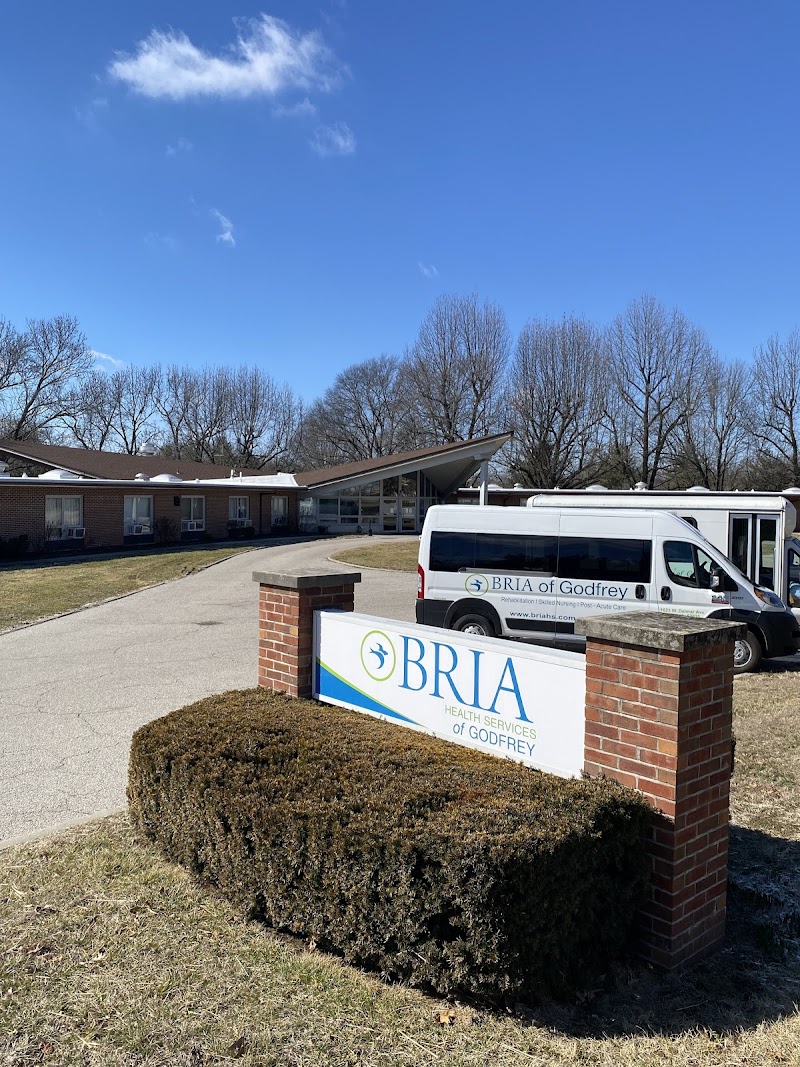
BRIA OF GODFREY

1623 29 WEST DELMAR, GODFREY, IL 62035 (618) 466-0443
For profit - Limited Liability company 68 Beds BRIA HEALTH SERVICES Data: November 2025 1 Immediate Jeopardy citation
Trust Grade
0/100
#473 of 665 in IL
Last Inspection: August 2024

Within standard 12-15 month inspection cycle. Federal law requires annual inspections.

Overview

BRIA OF GODFREY has received a Trust Grade of F, indicating significant concerns about the quality of care provided. Ranking #473 out of 665 facilities in Illinois places them in the bottom half, and they are #9 out of 17 in Madison County, meaning there are only eight local options considered better. The facility is showing an improving trend, reducing their issues from 13 in 2024 to 7 in 2025. However, staffing is a major weakness, with a poor rating of 1 out of 5 stars and an alarming turnover rate of 74%, which is much higher than the state average. Additionally, the facility faces a concerning $258,385 in fines, indicating repeated compliance problems, and while RN coverage is average, more registered nurses could enhance care. Specific incidents include a resident who eloped from the facility twice, once being found near a busy roadway, highlighting issues with supervision, and a serious medication error that led to a hospital admission for accidental drug overdose. Overall, while there are improvements in some areas, families should be cautious due to serious past incidents and ongoing staffing challenges.

Trust Score
F
0/100
In Illinois
#473/665
Bottom 29%
Safety Record
High Risk
Review needed
Inspections
Getting Better
13 → 7 violations
Staff Stability
⚠ Watch
74% turnover. Very high, 26 points above average. Constant new faces learning your loved one's needs.
Penalties
✓ Good
$258,385 in fines. Lower than most Illinois facilities. Relatively clean record.
Skilled Nurses
○ Average
Each resident gets 33 minutes of Registered Nurse (RN) attention daily — about average for Illinois. RNs are the most trained staff who monitor for health changes.
Violations
⚠ Watch
48 deficiencies on record. Higher than average. Multiple issues found across inspections.
★☆☆☆☆
1.0
Overall Rating
★☆☆☆☆
1.0
Staff Levels
★★★★☆
4.0
Care Quality
★★☆☆☆
2.0
Inspection Score
Stable
2024: 13 issues
2025: 7 issues

The Good

  • 4-Star Quality Measures · Strong clinical quality outcomes
  • Full Sprinkler Coverage · Fire safety systems throughout facility
  • No fines on record

Facility shows strength in quality measures, fire safety.

The Bad

1-Star Overall Rating

Below Illinois average (2.5)

Significant quality concerns identified by CMS

Staff Turnover: 74%

27pts above Illinois avg (46%)

Frequent staff changes - ask about care continuity

Federal Fines: $258,385

Well above median ($33,413)

Significant penalties indicating serious issues

Chain: BRIA HEALTH SERVICES

Part of a multi-facility chain

Ask about local staffing decisions and management

Staff turnover is very high (74%)

26 points above Illinois average of 48%

The Ugly 48 deficiencies on record

1 life-threatening 13 actual harm
Aug 2025 1 deficiency
CONCERN (D) 📢 Someone Reported This

A family member, employee, or ombudsman was alarmed enough to file a formal complaint

Potential for Harm - no one hurt, but risky conditions existed

Accident Prevention (Tag F0689)

Could have caused harm · This affected 1 resident

**NOTE- TERMS IN BRACKETS HAVE BEEN EDITED TO PROTECT CONFIDENTIALITY** Based on observation, interview, and record review, the facility failed to provide adequate supervision and interventions to pre...

Read full inspector narrative →
**NOTE- TERMS IN BRACKETS HAVE BEEN EDITED TO PROTECT CONFIDENTIALITY** Based on observation, interview, and record review, the facility failed to provide adequate supervision and interventions to prevent falls for 1 of 3 residents (R2) reviewed for falls. Findings include:R2's undated face sheet documented she was admitted to the facility on [DATE], with diagnoses including anxiety, hyperlipidemia, hypertension, altered mental status, and dementia.R2's Minimum Data Set (MDS), dated [DATE], documented she has memory problems and is moderately cognitively impaired. The MDS documented R2 requires set-up assistance for eating and requires staff supervision for all other activities of daily living (ADL's). R2's care plan, dated 7/15/25, documented R2 is a currently at a high risk for falls with a goal that she will remain free of falls. Her interventions for this care plan include: encourage appropriate use of wheelchair, evaluate multiple falls to determine any patter, fall risk assessment quarterly and as needed, keep bed in lowest position, keep frequently used items within reach, monitor for changes in gait or ability to ambulate, move resident to room with optimal visual access from nurses station, notify medical doctor (MD) and family of any new fall, promote placement of call light within reach, provide proper, well maintained footwear, provide resident with night light, restorative care as appropriate, rounding at a minimum of every two hours, staff to assist as needed and therapy to evaluate and treat as indicated.R2's care plan, updated on 7/31/25, documented bed to be placed in lowest position when in bed. R2's care plan was updated 8/4/25 after a fall with the interventions including therapy to screen for strengthening and position and send to local hospital emergency room (ER) for evaluation. On 8/5/25 at 1:48 am, after another fall, the only intervention added to the care plan was to send to local hospital ER. There was no other intervention added for this fall. On 8/5/25 at 9:47 pm, R2 had a third fall with the intervention added to send to local hospital ER for evaluation and floor mat to open side of the bed. On 8/2/25 at 9:45 am, V1 (administrator) and V13 (MDS director) stated R2's only intervention for her second fall on 8/5/25 at 1:48 am was to send R2 to hospital ER. There was not an intervention added that would keep her safe from falling again. On 8/4/25 at 8:19 pm, R2's progress note documented R2 was observed lying supine on floor in front of the nurse's station. A small skin tear to the outer right elbow is noted, no other visible injuries. R2 was transported to local hospital via emergency medical services (EMS).On 8/18/25 at 3:55 pm, V8, Licensed Practical Nurse (LPN), stated on 8/4/25 in the evening, R2 had been sitting in front of the nurse's desk in her wheelchair for close observation, when V8 went to assist another resident urgently. When V8 came back up to the nurse's station, R2 was lying on the floor. V8 stated that the cameras were reviewed and looked like she had slid out of the wheelchair on her buttocks. V8 saw no injuries, but due to her receiving blood thinners, R2 was sent out to the hospital. V8 stated prior to R2 falling, she was on fall precautions and staff were checking on her frequently. On 8/20/25 at 9:10 am, V1 stated the timing of frequent monitoring varies depends on each situation and could be every 15 minutes, every hour, or every two hours.R2's fall investigation, undated, or the fall on 8/4/24 at 8:09 pm, documented interdisciplinary team (IDT) met and documented upon investigation, it was found the fall is the result of R2 attempting to get up from the wheelchair without help. The interventions include sending R2 to evaluation and treatment. Upon return physical therapy is to screen for strengthening and positioning. On 8/18/25 at 11:15 am, V3, Registered Nurse, (RN) stated R2 returned to the facility on 8/5/35 at 12:49 am, and the EMS attendant placed R2 in bed. V3 stated she was at the facility about an hour and fell out of bed again. V3 stated V4, Certified Nursing Assistant (CNA) was the CNA working that night and was sitting in the hallway across from R2's room to keep a close eye on her. When V4 went into her room, R2 was lying on the floor. V3 stated she assessed R2 had a laceration in the back of her head, and due to R2 receiving blood thinners, V3 sent R2 out to the hospital again. V3 stated R2 was alert to self and described her as impulsive.On 8/5/25 at 12:49 am, R2's progress notes by V3 documented R2 returned to the facility per EMS, who assisted R2 in bed and call light placed in reach. No new orders received from local ER at time of return to the facility. V3 documented range of motion (ROM) and Neuro checks within normal limits (WNL) for R2. CNA staff aware of the need to frequently to monitor resident post-fall. On 8/20/25 at 9:21 am, V4 stated on 8/5/25 during her night shift, she was sitting in the hallway outside of R2's room, a little to the right of the doorway across the hall. She stated from that vantage point she could not directly visualize R2, but was able to get up often and check on R2, along with all of her other residents on the hallway. V4 stated she kept going back and forth checking on R2 frequently. V4 stated she didn't think about sitting at her doorway because she was also thinking of being available for all her other residents on the hall. V4 stated she did not see or hear her fall, but on one of her checks, R2 was lying on the ground.On 8/5/25 at 1:48 am, progress note by V3 documented she called to R2's room by CNA staff and R2 observed laying on floor next to bed with head towards wall and bilateral lower extremities (BLE) extended outward toward bathroom. Call light not activated at time of fall. V3 noted blood on the floor under R2's head. Raised hematoma noted to back of head with laceration noted to area. CNA staff remained with resident. At 1:52 am, V3 documented call placed to 911 for transfer back to local hospital ER for another assessment due to second fall.On 8/5/25 at 2:08 am, V3 documented EMS arrived at the facility and R2 assisted on the stretcher by EMS staff and transported to local hospital ER. R2's fall investigation undated fall investigation for the fall on 8/5/24 at 1:48 am documented Interdisciplinary Team (IDT) met and documented upon investigation, it was found that the fall was the result of R2 rolling out of bed. The intervention is sending R2 to evaluation and treatment. On 8/5/25 at 2:26 pm, R2's progress notes documented she returned from local hospital via EMS and was transferred from stretcher to bed.On 8/5/25 at 9:47 pm, R2's progress note documented CNA alerted nurse at 9:15 pm that R2 was on the floor. When nurse arrived at R2's room, she was on the floor on her left side with blood noted around her head. Nurse controlled the bleeding to R2's head and then contacted 911 for transfer to local hospital ER for further observation. On 8/19/25 at 12:33 pm, V12, LPN, stated R2 was already in the facility when she arrived for her evening shift on 8/5/25. V12 added all the staff were aware a close eye needed to be kept on R2. V12 stated R2's bed was in the lowest position, and her call light was in reach when R2 returned to her room. V12 stated the CNA had just left the room about ten minutes prior to R4, (R2's roommate) coming out and stating R2 was trying to get up. V12 stated she went into the room, R2 was lying on the floor.On 8/18/25 at 12:08 pm, V5, ER supervisor, stated R2 was in the ER on [DATE] from 8:51 pm until 8/5/25 12:24 am, due to an unwitnessed ground level fall. V5 stated R2 then returned to the ER again on 8/5/25 at 2:32 am for a fall, was admitted for observation, and was discharged at 2:54 am. V5 stated R2 was once again admitted to ER on [DATE] at 10:05 pm for an unwitnessed fall and then discharged on 8/6/25 at 3:51 pm to a different facility.Fall Prevention and Management policy, dated 5/2015, with last revision date of 1/2024, documented the facility is committed to maximizing each resident's physical, mental and psychosocial well-being. While preventing all falls is not possible, the facility will identify and evaluate those residents at risk for falls, plan for preventative strategies, and facilitate as safe an environment as possible. All resident falls shall be reviewed, and the resident's existing plan of care shall be evaluated and modified as needed. Facility guideline following a fall incident are to evaluate the resident for any injury and notify the physician and resident responsible party. Complete a fall incident report in the EMR risk management portal. A fall risk evaluation is completed by the nurse. A score of 10 or greater indicates the resident is at high risk for fall. Care plan to updated with a new intervention based on root cause analysis after each fall occurrence.
Jun 2025 1 deficiency
CONCERN (D) 📢 Someone Reported This

A family member, employee, or ombudsman was alarmed enough to file a formal complaint

Potential for Harm - no one hurt, but risky conditions existed

Deficiency F0917 (Tag F0917)

Could have caused harm · This affected 1 resident

Based on observation, interview, and record review, the Facility failed to ensure each resident had a closet with shelf space for 1 of 6 residents (R2) reviewed for closet space in the sample of 6. F...

Read full inspector narrative →
Based on observation, interview, and record review, the Facility failed to ensure each resident had a closet with shelf space for 1 of 6 residents (R2) reviewed for closet space in the sample of 6. Findings include: On 6/5/2025 at 12:48 PM, V8, Family of R2, stated, (R2)'s room was at the end of the hall. There was a small space, but no actual closet, and from the ceiling the facility had a PVC pipe running from one end to the other then forming a box, that I guess that was where my mom was supposed to hang her clothes. There was no shelving, and we went out and bought her a curtain and put it on tension rod, so it would be more homelike for her. It was not homelike before that, trust me on that one. (R2) had a single room but there was no closet, just this space with the PVC pipe. There was no portable wardobe just the PVC pipe for the clothes. On 6/5/2025 at 1:14 PM, R2's former room did not contain a built in wardrobe. There was a small space boxed in a square, with white PVC pipe running all the way across the ceiling. At one end of the PVC pipe was a square made out of additional pieces of PVC pipe. Behind the PVC pipe was a metal stand consisting of two upright metal bars and two metal bars running across with wheels on the bottom of it. The metal clothes hanging rack was portable. There were no shelves present. On 6/5/2025 at 1:18 PM, V1, Administrator, stated, (R2) was located on the 100 halls at the end of the hall, but the room is empty now. There used to be a clothing wardrobe in the room, but it was removed. When (R2) was at the facility there was no wardrobe, and maintenance had hung the PVC pipe. There were no shelves. The Resident Right Policy, dated 10/2003, documents, The objective of the accommodation of resident needs and preferences is to create an individualized, home-like environment to maintain and/or achieve independent functioning, dignity, and well-being to the extent possible in accord ance with the resident's own needs and preference. Facility will provide sufficient individual closet space for each resident.
Apr 2025 1 deficiency 1 Harm
SERIOUS (G) 📢 Someone Reported This

A family member, employee, or ombudsman was alarmed enough to file a formal complaint

Actual Harm - a resident was hurt due to facility failures

Deficiency F0760 (Tag F0760)

A resident was harmed · This affected 1 resident

Based on interview and record review, the facility failed to prevent a significant medication error in 1 of 6 residents (R3) when reviewed for medication administration in the sample of 6. This failur...

Read full inspector narrative →
Based on interview and record review, the facility failed to prevent a significant medication error in 1 of 6 residents (R3) when reviewed for medication administration in the sample of 6. This failure resulted in R3 being admitted to the hospital with a principal problem of Accidental Drug Overdose. Findings Include: R3's Progress Note, dated 4/17/25 at 6:59 PM, documents the following: This Nurse recognized that I administered a wrong medication to the resident. Res. (Resident) has NKA (No Known Allergies). Res sent to ER (Emergency Room) for evaluation. NP (Nurse Practitioner, Administrator, and D.O.N (Director of Nurses) all made aware. ER MD (Medical Doctor) aware. R3's Progress Note, dated 4/18/25 at 5:50 PM, documents the following: Update resident admitted with hypoglycemia and medication error. Resident stable and alert at this time. R3's Progress Note, dated 4/20/25 15:02 PM, documents the following: Resident returned to facility via ambulance at 14:55 (2:55 PM). R3's Medication Error Report, dated, 4/17/25, documents the following: Occurred on 4/17/25 at 6:50 PM, discovered 4/21/25 at 6:50 PM by V8, RN (Registered Nurse). Medication Involved: Clozaril (Clonzipine) 150 mg (milligrams). Description: resident came to nurse requesting meds while nurse was preparing meds for another resident and accidentally gave R3 the other resident's (R5) medication. Medication Error Type: wrong resident, wrong drug. Contributing factors: lack of staff concentration. Symptoms experienced: lethargy, sent to ER and admitted for observation. MD, pharmacy and family notified. Results of investigation: Sent to ER for further evaluation. ER admitted for 24 hours and returned to facility with no other adverse effects. Interventions: DON completed medication administration competency with V8, RN, and completed medication administration in-services with the nurses. R3's ED (Emergency Department: Provider Notes, dated 4/17/25, document the following: Patient here for lethargy, somnolence, history of diabetes. Nursing home called and said he was given a medication in error at 4:30 PM, 150 mg of Clozaril. Nursing home staff gave 22 units for his sugar of 330. Final diagnosis: Accidental drug overdose, Hypoglycemia, AMS (Altered Mental Status). Critical care was necessary to treat or prevent imminent or life-threatening deterioration of the following conditions: Hypo/Hyper Glycemic Control, Acute Ingestion. Poison control was contacted, unfortunately there is no reversal agent, recommended supportive measures, monitor for dystonia and seizures (control with benzos if needed), treat Hypotension with fluids and pressors as needed to protect the airway and admit for observation. R3's blood sugar in the emergency room was 85. R3's Post-Acute Transfer Report, dated 4/20/25, document R3's Principal Problem was an accidental drug overdose. R3's Physician Order Sheets (POS) were reviewed with no orders for Clozaril. R5's POS was reviewed with an order for Clozapine (Clozaril) 100 mg, give 1.5 tablets by mouth twice daily. On 4/22/25 at 1:23 PM, V8, RN, stated she was at the medication cart, getting medications ready for another resident (R5) when R3 came up to her and asked for his medication, and she accidentally gave R3 R5's medication, Clozaril, and about 15 - 20 minutes later, she realized what she had done. V8 stated R3 was very lethargic, the Nurse Practitioner was notified, and R3 was sent to the hospital. V8 stated R3 was admitted to the hospital for a few days. On 4/22/25 at 1:30 PM, V10, Pharmacist, stated she reviewed R3's medication, and there were none of his medications that would have interacted with the Clozaril/Clozapine. V10 stated receiving one dose of this medication, would not have made R3 fatigued or lethargic. V10 stated when it is given regularly some common side effects can be lethargy, blurred vision, etc. from it building in their system with multiple doses, it would not normally be caused by just one dose. On 4/22/25 at 2:45 PM, V2, DON, stated she was not here when the medication error with R3 took place, she was called at home by V8, RN, and V8 had already notified R3's physician and called EMS, and R3 was sent to the hospital. R2 stated, (R3) did not have any adverse reaction from the medication; he is a severe brittle diabetic, his blood sugars quickly go high to low. V2 stated she was told by the hospital R3 was hypoglycemic upon arrival to the ER and was admitted . V2 stated prior to R3 going to the hospital, R3's blood sugar was 300 and he was given 22 units of insulin, and depending on when the insulin was given and he ate, could have caused his blood sugar to drop quickly, which is normal for R3. V2 stated they have changed his insulin and accu-check times to make sure when he is high and needs insulin, that he eats right then and doesn't wait. V2 stated R3 knows when his blood sugar is low and will get peanut butter cups and juice. V2 stated she is a diabetic and hypoglycemia can cause lethargy. V2 stated when a nurse is administering medications, she would expect them to follow the rights of medication administration, right medication, right person, right time, right frequency, etc. On 4/22/25 at 2:55 PM, R3 stated he doesn't remember anything about the incident on 4/17/25, or for a couple of days after. R3 stated he woke up in the hospital and was told they thought he had been given the wrong medication, but that is all he was told. R3 stated his blood sugar goes up and down quickly, and now he doesn't take his insulin until he eats so it won't drop. R3 stated he knows when his blood sugar is low and he will get some candy to raise it. R3 stated when his blood sugar is low, he feels bad and sometimes will black out. The Clozaril Information from Drugs.com documents the following: It is an anti-psychotic used to treat Schizophrenia after other treatments have failed, works by changing chemical reactions in the brain. Also used for reduce the risk of suicidal behavior in adults with Schizophrenia or similar disorders. Clozaril can affect your immune system, can cause seizures when given in high doses, cause heart problems. Overdose symptoms may include drowsiness, confusion, fast heartbeats, feeling light-headed, weak or shallow breathing, drooling, choking, or seizure. The Medication Administration Policy, dated 6/2015, documents the following: All medications are administered safely and appropriately to aid in residents to overcome illness, relieve and prevent symptoms, and help in diagnosis. Check medication administration record prior to administering medication for the right medication, dose, route, patient/resident, and time.
Apr 2025 1 deficiency
CONCERN (D) 📢 Someone Reported This

A family member, employee, or ombudsman was alarmed enough to file a formal complaint

Potential for Harm - no one hurt, but risky conditions existed

Pharmacy Services (Tag F0755)

Could have caused harm · This affected 1 resident

Based on interview and record review, the facility failed to administer medications as ordered by the physician in 2 of 4 residents (R2, R3) reviewed for pharmacy services in the sample of 4. Findings...

Read full inspector narrative →
Based on interview and record review, the facility failed to administer medications as ordered by the physician in 2 of 4 residents (R2, R3) reviewed for pharmacy services in the sample of 4. Findings include: 1. On 4/8/25 at 11:55 AM, V5, R2's Daughter, stated R2 had not been receiving her daily medications. R2's Face sheet, undated, documents R2 has the following diagnoses: Three Part Fracture of the Left Humerus, COPD (Chronic Obstructive Pulmonary Disease), Neuropathy, MDD (Major Depressive Disorder), CHF (Congestive Heart Failure), Cardiac Pacemaker and Defibrillator, History of Falling, Arthropathy, Gout, HTN (Hypertension), Low Back Pain, and Chronic A. Fib (Atrial Fibrillation). R2's MAR (Medication Administration Record), dated 4/1/25 through 4/30/25, documents the following physician orders, dated 4/1/25: Spironolactone Oral Tablet 25 MG (Milligrams) give 0.5 tablets by mouth one time a day for High Blood Pressure; Sertraline HCl (Hydrochloride) Oral Tablet 25 MG give 1 tablet by mouth one time a day for Depression; Furosemide Oral Tablet 40 MG give 1 tablet by mouth one time a day for Cardiac Failure; Empagliflozin Oral Tablet 10 MG give 1 tablet by mouth one time a day for Heart Failure; Neurontin Oral Capsule 100 MG give 1 capsule by mouth one time a day for Neuropathy; Protonix Tablet Delayed Release 40 MG give 1 tablet by mouth one time a day for GERD; Clopidogrel Bisulfate Tablet 75 MG give 1 tablet by mouth one time a day for blood clot prevention; - Atorvastatin Calcium Oral Tablet 40 MG give 1 tablet by mouth one time a day; and Amiodarone HCl Oral Tablet 200 MG give 1 tablet by mouth one time a day for Atrial Fibrillation. The MAR goes on to document those medications were not administered on 4/2/25 or 4/3/25. R2's Progress Notes, dated 4/2/25 and 4/3/25, document these medications were not administered due to not on hand. 2. On 4/8/25 at 8:00 AM, R3 stated she is supposed to get 4 calcium carbonates after meals, and they were out for a while, so she wasn't getting them. R3's Face sheet, undated, documents R3 has a diagnosis of GERD (Gastro-Esophageal Reflux Disease). R3's MAR, documents an order, dated 3/22/25, for Calcium Carbonate Oral Tablet Chewable 500 MG (Antacid) give 4 tablets by mouth three times a day for supplement. R3's MAR goes on to document that R3 did not receive her medication as ordered on 3/22/25, 3/23/25, 3/24/25, 3/25/25, 3/26/25, and 3/27/25; therefore, missing a total of 8 doses. R3's MDS (Minimum Data Set), dated 3/29/25, documents R3 has a BIMS (Brief Interview of Mental Status) score of 14, indicating R3 is cognitively intact. R3's Care plan, dated 3/24/25, documents R3 has a diagnosis of GERD and is at risk for complications related to hyperacidity with an intervention to administer medications as ordered. On 4/8/25 at 4:44 PM, V2, Director of Nurses, stated medications are to be given as ordered by the physician. The Medication Administration Policy, dated 6/2015, documents all medications are to be administered safely and appropriately to aid the residents to overcome illness, relieve and prevent symptoms and help in diagnosis.
Mar 2025 1 deficiency
CONCERN (D) 📢 Someone Reported This

A family member, employee, or ombudsman was alarmed enough to file a formal complaint

Potential for Harm - no one hurt, but risky conditions existed

Transfer Requirements (Tag F0622)

Could have caused harm · This affected 1 resident

**NOTE- TERMS IN BRACKETS HAVE BEEN EDITED TO PROTECT CONFIDENTIALITY** Based on interview and record review, the facility failed to ensure a resident's discharge was complete, including housing, Dura...

Read full inspector narrative →
**NOTE- TERMS IN BRACKETS HAVE BEEN EDITED TO PROTECT CONFIDENTIALITY** Based on interview and record review, the facility failed to ensure a resident's discharge was complete, including housing, Durable Medical Equipment (DME), and medications needed prior to discharging the resident to the hospital, and then failing to accept the resident back to the facility upon hospital discharge for 1 of 4 residents (R2) reviewed for transfer and discharge requirements. This failure resulted in R2 having to find a place to live, not having appropriate DME, and not having medications available as needed. The findings include: R2's admission Record, dated 3/26/25, documents R2 was admitted to the facility on [DATE], and was discharged to the hospital on 3/5/25. R2's diagnosis include: Spinal stenosis cervicothoracic region, Type 2 Diabetes Mellitus (DM), nicotine dependence, rhabdomyolysis, suicidal behavior, major depressive disorder, alcohol use, hypothyroidism, hypertension (HTN), bipolar disorder, mood affective disorder, encephalopathy, spondylosis with myelopathy, and osteoarthritis. R2's Care Plan, dated 12/27/24, documents R2 requires assist with daily care needs, R2 has alteration in comfort, R2 requires the use of Psychotropic medication to assist with managing mood and behavior, R2 has a self-care deficit in dressing and grooming, R2 is a high risk for falls, R2 is a high risk for skin complications related to dependence on staff for toileting, transfers, and repositioning activities of daily living (ADL). R2's Minimum Data Set (MDS), dated [DATE], documents R2 was cognitively intact, and was dependent on staff for transfers and toileting. R2 required substantial/maximal assistance for bathing. On 3/24/25 at 2:38 PM, V12, Registered Nurse (RN), stated I am an emergency room (ER) nurse at the (local hospital) and was working when (R2) came to our ER from the facility due to behaviors. The facility assumed that (R2) was going to be admitted , but once he was evaluated by the physician, (R2) did not meet criteria for admission, and when we tried sending (R2) back to the facility, the facility refused, and stated that (R2) was discharged and not allowed to return. I know that (R2) was a difficulty patient and I was told that (R2) was to be discharged to an apartment, but that apartment was not ready, and we needed to send (R2) back to the facility because he had no place to go. On 3/25/25 at 3:55 PM, R2's Community Social Worker, stated, I worked with (R2) in getting senior housing, or an apartment. (R2's) apartment lease was signed, and it was ready on 2/28/25 for him, however, his daughter was supposed to coordinate with a moving crew to get all his belongings from his original home to his apartment, and she did not do that. (R2) did not have any furniture or belongings in his apartment when the facility discharged him. Also, the facility sent the DME request to a medical supply store, and did not do it correctly, and (R2) did not have any DME set up at his apartment. I called the store, and they said it was an incomplete referral form that they could not approve or fill. I was contacted by the Social Worker from the hospital (R2) was in because (R2) was supposed to be discharged , but did not have any place to go, because the facility refused to take him back. It just so happened that I am neighbors with (R2's) daughter and friends of his family, and I have a B&B (Bed and Breakfast) that was open for the weekend, so I let (R2) stay there until Monday (3/10/25). (R2's) daughter had everything ready for him on that Monday, so he moved into his apartment that day. (R2) didn't even have any of his medications from the facility, so he is working with his physician to get his medications. On 3/25/25 at 12:45 PM, V1, Administrator, stated, I was called on 3/5/25 for (R2) being loud, throwing things, screaming, pinning staff against wall, and threatening suicide-- at times indicating he was going to hurt himself. (R2) was putting all the staff and other residents at risk for harm because he was going everywhere in the facility doing these things. (R2) had other residents scared. We contacted the Psych Nurse Practitioner (NP) who gave the order to put in an Involuntary admission to (local regional hospital). The staff had the Police and Emergency Medical Service (EMS) trying to help them. (R2) had a discharge order, dated 2/27/25, to discharge home. On 3/25/25 at 12:50 PM, V3, Social Service Director, stated, (R2) was scheduled to be discharged from the facility to his home the next day. I worked almost daily with (V7, R3's community Social Worker) about (R2's) discharge and plans. I had follow-up appointments, DME, and Home Health set up for (R2) and he was to go to his physician appointments where (local home health) would get their orders. I thought (R2) had an apartment ready to go once he was discharged from the facility, but when he had his episode, (R2) was sent to the hospital and should have been discharged to his home from there. I was not aware of (R2's) apartment was not ready for him. I have many emails regarding (R2's) DME, and I was never told that it was not filled or that it was declined. An email from V7 to V3, dated 3/5/25 at 9:10 AM, documents some confusion as to if the DME has been ordered or approved. R2's Social Service Note, dated 3/7/25 at 2:12 PM, documents, Writer sent DME signed notes from nurse prac (Nurse Practitioner) and patient, to continue with getting (R2) the equipment he needs for home. This was two days after R2 was discharged . On 3/25/25 at 2:50 PM, V3 stated, I spoke with (V7) who helped (R2) get his apartment set up, and according to (V7), (R2's) apartment move-in date was on 2/28/25. I was sent (R2's) apartment lease indicating his apartment move-in date was 2/28/25. On 3/25/25 at 3:25 PM, V1, Administrator, stated, (R2) was supposed to be discharged on 2/28/25, and when that date came, (R2) decided he didn't want to go and wanted to stay for more therapy. Then when therapy tried to work with him, he declined, and refused to work with them. Each time he was scheduled to leave, he changed his mind. When he had the incident, we had to do the involuntary psych admit/eval and we all thought, and I was even told, that the hospital would admit (R2) and then get treated and be discharged home from there. I assumed that (R2) would be admitted , and did not even think he would be discharged that same day. I called my boss and was told to go ahead and discharge him from the facility, and let the hospital discharge him to his home. Everyone from the EMS guys to my boss told me that (R2) would be admitted for a psych eval due to the involuntary form that we filled out. I was not aware until now that (R2) was not admitted , and I assumed that he was discharged to his apartment from the hospital after his stay. I would never put anyone out on the streets with nowhere to live, and would have absolutely let (R2) come back to the facility if I would have known that. I did not even think of (R2's) psychiatric status that day and his ability to go home by himself, because I assumed he was going to be admitted , and the hospital would treat him and help him with his discharge home. Normally on a Resident Initiated Discharge, the resident signs a discharge packet and the nurse will go over all their medications with them and they sign it off together. Then each interdisciplinary department signs off on what is recommended for that resident. Since (R2) was discharged to the hospital and not home, the nurse did not go over his medications with (R2) because they thought the hospital would do that. (R2) has hard scripts for his medications that were sent with his paperwork. I guess I learned something today, that an involuntary psych eval does not necessarily mean that person would be admitted . We probably should have waited until we found out his status, and then discharged him. R2's NP Psych Note, dated 2/28/25, documents, Findings in Patient ' s Room: Upon entry, it was discovered that the patient was in possession of a vape containing THC (tetrahydrocannabinol). The administrator addressed this issue with the patient, explaining that this is a violation of facility regulations. The patient became rude and demanding, insisting that he needed a day pass. Discussion and Facility Policy Violation: The patient was informed that his actions violated facility policies, potentially endangering both himself and other residents. Despite this, he continued to debate the issue and demonstrated a lack of insight into the consequences of his actions. I explained to him that a day pass is not an urgent or emergency matter and that further evaluation of his safety and the well-being of other residents is necessary. Discharge Planning and Additional Concerns: Discussed discharge planning with the patient, but he does not appear to have a clear or definitive plan for placement at this time. Given the situation, I am ordering a urine drug screen (UDS) to further assess for substance use. If the patient experiences a significant change in condition that poses a risk to himself or others, I recommend sending him to the ER for further evaluation. R2's Social Service Note, dated 2/27/25 at 12:30 PM, documents, (3/5/25) Late Entry: Note Text: Discharge Plan: Resident signed lease for d/c (discharge) with daughter/his own social services (V7). Resident plans to leave facility Tuesday 3/4/25 to discharge home. R2's Nurses Note, dated 3/3/25 at 1:52 PM, documents This nurse presented (R2) with a NOMNC (Notice of Medicare Non-Coverage) for last covered Medicare-A day as of 3/5/25. He doesn't wish to appeal at this time, and still plans on returning home with community care giver assistance. He is aware he is able to appeal the decision and has to do so before noon on 3/4/25. He did sign the NOMNC at this time. R2's NOMNC, dated 3/3/25, documents R2's last day covered was 3/5/25. R3 signed this document on 3/3/25. R2's Nurses Note, dated 3/5/25 at 12:10 PM, documents, Note Text: at 1130 (11:30 AM) resident came out of room being aggressive combative and screaming threats to staff demanding meds. He has already been informed by the night nurse and me that the Oxy (Oxycodone) he is requesting is on order with pharmacy and that they will deliver tonight or tomorrow morning. he was given his last dose of Oxy last night at 2100 (9:00 PM) and educated by night nurse that was his last dose until the other is delivered via pharmacy. All morning meds were given to resident this morning except for the Oxy which was explained to him numerous times as to why it wasn't given to him. 911 called. When the police arrived resident yelled at them also stating that is the only way to get things done around here. He also stated he didn't care if he was getting sent out for a psych eval regarding his actions. Police and EMS are currently with resident while he is talking to his daughter on the phone. Resident's daughter is currently his POA (power of attorney). EMS refused to take resident stating it is non-medical. Resident is currently in room screaming in an uproar. This nurse has spoken with resident's daughter regarding situation and has referred her to speak to management r/t (related to) her having multiple questions for management. This nurse has relayed message to contact her regarding her concerns. R2's Nurses Note, dated 3/5/25 at 1:08 PM, documents, At this time I received an order as follows due to resident spitting on others, stating he wanted to harm himself, assaulting staff members and refusing to go to the hospital for evaluation. Send resident as an Involuntary admission to (Local Regional Hospital) via Psychiatric Nurse Practitioner, related to diagnoses of personal history of suicidal behavior, bipolar disorder and major depressive disorder for a psychiatric evaluation. Order noted. R2's Nurses Note, dated 3/5/25 at 2:37 PM, documents, After sheriff and EMS left they were called back to facility for resident r/t him becoming suicidal. He threw glass across room causing it to break. Resident taken to (local regional hospital) at 1345 (1:45 PM). NP called for involuntary discharge to be initiated per Admin. Resident is not to be accepted back to facility per Admin. POA has been made aware regarding situation. R2's Nurses Note, dated 3/5/25 at 6:28 PM, documents, (V12), RN from (local regional hospital) was asking why we won't take resident back, This Nurse gave (V12), RN, (V1, Administrator's) phone number. Explained to not yell at this writer and to get a hold of the Administrator regarding this issue. R2's Administrator's Note, dated 3/5/25 at 6:31 PM, documents, Writer was called around 12:30 (12:30 PM) by the Social Services Director (SSD) to inform me that this resident came out of his room being combative, yelling, threatening staff, spitting on staff, throwing glass and breaking it in his room, going to the dining room where other residents were just to yell and curse which made many residents uncomfortable. (R2) also cornered a staff member on the hall causing her not to be able to get around him. I was told this resident stated he was suicidal but when asked if he was suicidal or if he had a plan he would laugh at the police and EMT and say he was just playing. Because of this, I asked that (R2) be added to 1:1 to ensure the safety of him and other residents. Resident continued to yell and show aggressive behavior so I then called (local hospital) EMT (Emergency Medical Technician) department to ask why they would not transport this resident out. I made the EMT manager at (local hospital) aware of all that was going on and he asked to call me back. When he did, he stated that we needed to have an involuntary admission form filled out. I then called psych NP for guidance and approval to have this form filled out and signed. She agreed. I was informed that any RN could sign this form since she was not in the facility. I then called the Social Services Director and the Nurse Manager to assist them in filling this form out. While speaking to them the EMT Manager had come to the facility to see exactly what was going on. He again stated that they needed the involuntary admission form because he was witnessing how this resident was acting but because this resident was A&OX4 (alert and oriented to person, place, time, and event) and refusing to go and had not broken the law his team could not take him without the form. I told him they were in the process of filling it out. To my knowledge this form was given to (EMS manager) along with (R2's) discharge order and documents. Shortly after this resident was taken by EMT. I called his POA and daughter to update her on everything and that her father had been sent out to (local regional hospital) in (area town) with an involuntary admission form and his discharge order. This resident planned to be discharged from this facility on 3/4 or 3/5 of this week to his home. It was discussed that (R2) was discharged from our facility and would return home after his hospital stay at (local regional hospital). POA was at work and not happy that her father was unhappy and having these behaviors. She wasn't happy that she was being called numerous times concerning this. She stated that nobody ever called her before this to update her on her father's care. I reminded her that she requested a care plan meeting, and a date and time were set and agreed to, and she never showed up or called us. I also told her our SSD had tried to reach her but (R2) had given the wrong number for his daughter and then asked that she not be called by anyone other than him. R2's Administrator Note, dated 3/5/25 at 7:17 PM, documents, Writer was called by the facility nurse to update me that she had spoken with (local regional hospital) Nurse and was told they were sending this resident back to (this facility). I informed this nurse that we were not to readmit this resident because he was discharged to the hospital, and after he is discharged from the hospital, he will then go to his home. She asked if she could have this nurse call me and I agreed. Shortly after I spoke with the (local regional hospital) nurse she stated that (R2) did not have an IVD (involuntary discharge) form. I told her he did not need one. He was to be admitted to them with the involuntary admission form and he has discharge orders. That after his visit with them, he will return to him home. His Social Worker who he has had out in the community is aware of this discharge to his home as they have been working on this for weeks. This community social worker has also updated his daughter on his plan to be discharged . R2's Social Service Note, dated 3/5/25 at 12:30 PM, documents, (R2) was in the hall 300 today being disruptive screaming very loudly and being aggressive, in staffs face spitting on staff while yelling, saying verbal threats along with calling staff disrespectful names. (R2) was asked to quiet down he was informed that he was being disruptive towards other residents living in the facility and staff working. (R2) responded screaming back towards staff saying F**k you B**ch, I'm going to cause hell today. Resident was asked to not use profanity multiple times. Staff began to redirect (R2) multiple times back to his room to talk quietly, he then began cornering a staff member up against the wall grabbing onto the hall rail blocking her against the wall screaming in her face. Nurse called police. (R2) was then asked to calm down and was informed that police have been called he then started to scream at the residents in the dining room very loudly saying Hey everybody, this is a F**king sh*t hole, hey everybody I'm going to scream all day if I have to. Police then arrived to facility, writer walked them down to his hall (R2) was sitting in the hall with staff still screaming when police arrived, he was then asked by police to calm down he refused he then stated that if police took him he would love to see it because he will kick, push, and throw his hands and put up a fight. Police then got him to his room EMT arrived they placed him in his bed they began asking him what his concerns and issues was he screamed This is a sh*t hole. EMT then mentioned resident made a suicidal remark but quickly laughed about it and said he was joking he knows the game and he will play it EMT mentioned to writer if it is not medical emergency they cannot take him. EMT left the facility stating that police deal with the situation since it is not medical. Police told writer resident is A&Ox4 and they cannot take him if he is not willing to consent to go to hospital for a psych eval, stated he was refusing to go. I then began to call POA of Healthcare for (local) County police there was no answer, voicemail was full. At this time Police did take resident out of facility, police sat outside of facility before they could leave, they were aware of a 911 call from (R2) calling inside the facility off his own personal cell phone. (local) County Police stated they were going to let residents know that if he calls 911 giving false accusations over 4 times he will then be charged with a felony. While resident was speaking with police and under 1:1 observation by CNA, supervisor writer then was told to assist in completing an Involuntary Admissions Form to (local regional) Hospital for a psych eval by the administrator per her conversation with NP. This form was giving to the Manager of (local) Hospital EMT along with d/c orders and proper documentation. R2's Physician Order, dated 2/27/25, documents May discharge patient to Home. R2's Physician Order, dated 2/28/25, documents May discharge home with all medications and continue as ordered, standard measure wheelchair of 18x16 with swing away footrest and swing back arm rests, PT (physical therapy)/OT (occupational therapy) and home health nursing services. R2's Physician Order, dated 3/5/25, documents Send resident as an Involuntary admission to (Local Regional Hospital) via Psychiatric Nurse practitioner related to diagnoses of personal history of suicidal behavior, bipolar disorder and major depressive disorder for a psychiatric evaluation. R2's Discharge Plan Assessment located in Forms in his Electronic Medical Record (EMR), dated 2/27/25, is blank and has not been completed. R2's Discharge Instructions located in Forms in his EMR, dated 2/27/25, is blank and has not been completed. There was no Bed Hold located for R2's discharge to the hospital on 3/5/25. On 3/31/25 at 1:25 PM, V1 stated, I will be going over the discharge policy with those people and departments involved to reeducate them on their part of the discharge process. The policy clearly states what should be done and to follow-up to make sure things have been done. I'm using this as a learning process for all of us and going forward, I will expect the staff involved to ensure things have been set up prior to a resident's discharge. The Facility's Discharges Policy, dated 9/2017, documents, Guideline: Discharge to Home: 1. Discharge potential is assessed by Social Service on admission. 2. When the IDT, in conjunction with the resident/patient and family determine that a resident/patient is ready to be discharged , the physician is contacted for an order. 3. Social Services will meet with the resident/patient and/or family to set up outside services and equipment. 4. A Discharge Instruction Form is initiated by Social Services or Discharge Planner and finished by the IDT. 5. If medication is to be sent with the resident, a physician order is necessary. 6. Teaching will be done with the resident/patient/family on any dressings or special tasks. This will be documented in the medical record. 7. If necessary, dietary will provide any special diet instructions. 8. If necessary, Therapy will provide any necessary instructions. 9. On the day of discharge, the nurse will review the discharge instruction form, as well as the medications with the resident/patient and/or representative. 10. The patient/resident and/or representative must sign the Discharge Instruction form. A copy of the signed form is given to the family and a copy of the signature sheet is scanned into the EMR. 11. The nurse will have the patient/resident or responsible party sign the current Medication Summary Sheet/Discharge Medication form or the designated pharmacy form for the facility. A Signed copy will be given to the patient/resident or representative. A Signed copy will be scanned into the patient's EMR. 15. The Social Service Department will enter a Discharge Summary Progress Note into the patient's EMR upon planned discharge from the facility. 16. The Discharge Summary Progress Note is to include a summary of the patient/resident stay while in the facility. The Discharge Summary Progress Note should include where the patient/resident was admitted from, reason patient/resident was admitted , services received during patient's/resident's stay, patient's/resident's goals during facility stay, whether the goals were met during the facility stay, and discharge disposition. Hospital Transfer: 1. Notify the physician regarding a change in resident/patient status and obtain an order for transfer to the hospital. This may be a direct admit or an emergency room admission. 2. If attending physician is not available, contact the medical director. 3. Arrange transportation, either paramedics or ambulance depending on the status of the resident/patient. 4. Inform the resident/patient and the resident's/patient's responsible party of the transfer. 5. Prepare an eINTERACT transfer form. 6. Document in the progress notes the condition of the resident/patient, who was notified of the transfer, where the resident/patient is going, mode of transportation, disposition of resident/patient belongings and medications, notification to all parties of the discharge.
Mar 2025 1 deficiency 1 Harm
SERIOUS (G) 📢 Someone Reported This

A family member, employee, or ombudsman was alarmed enough to file a formal complaint

Actual Harm - a resident was hurt due to facility failures

Tube Feeding (Tag F0693)

A resident was harmed · This affected 1 resident

**NOTE- TERMS IN BRACKETS HAVE BEEN EDITED TO PROTECT CONFIDENTIALITY** Based on observation, interview, and record review, the facility failed to ensure enteral gastrointestinal feedings and care wer...

Read full inspector narrative →
**NOTE- TERMS IN BRACKETS HAVE BEEN EDITED TO PROTECT CONFIDENTIALITY** Based on observation, interview, and record review, the facility failed to ensure enteral gastrointestinal feedings and care were provided as ordered for 3 of 3 (R2, R1, R3) residents reviewed for enteral feeding management. This failure resulted in R2 requiring hospitalization for treatment of aspiration pneumonia related to food regurgitation. Findings include: 1. R2 was admitted to the facility on [DATE], with diagnoses of diffuse traumatic brain injury with loss of consciousness, severe protein-calorie malnutrition, dysphagia, and acute respiratory failure. R2's Minimum Data Set (MDS), dated [DATE], documented he is severely cognitively impaired and dependent on staff to assist with all mobility. R2's Care Plan, dated 5/30/24, documented R2 is at risk for complications related to tube feeding with a goal to remain free of aspiration pneumonia throughout next review. Interventions for this care plan are documented to be, in part, administer tube feedings as ordered. R2's Progress notes on 2/20/25 at 7:33 PM documented, (R2) returned from hospital via ambulance with 2 attendants. (R2) is alert per his baseline. G-tube (gastrostomy tube) was replaced, BS (bowel sounds) in all 4 quadrants, abdomen is soft. A surgical incision is present to the midline of the lower abdomen. A drain is present to the left lower quadrant. Urinary catheter is patent. LCTA (lungs clear to auscultation). Edema is noted to the RUE (right upper extremity), including the hand. Some shearing is noted to the buttock. Feedings are 1.5 at 45mL/hr (milliliters per hour) with 120 mL water flushes every 4 hours. R2's hospital discharge orders, dated 2/20/25, documented to start tube feedings at 10mL/hr, advance by 10mL/hr q(every) 6hr to goal of 45mL/hr. An additional hospital discharge order listed included, Scopolamine 1 mg over 3 days patch 3 day place 1 patch on the skin every third day. This is documented as last given on 2/17/25 at 4:01 PM at hospital. R2's facility orders, dated 2/20/25 at 6:30 PM, documented every 24 hours Enteral Feeding Formula 1.5 Rate 45 mL/hr. R2's Medication Administration Record documented V7 started administration of R2's Enteral Feeding at a rate of 45mL/hr at 9:34 PM. R2's Progress note, dated 2/20/2025 at 9:45 PM, documented, Scopolamine Transdermal Patch 72 Hour Apply 1 mg (milligram) transdermally every 72 hours for nausea unavailable. R2's Progress Note, dated 2/21/25 at 8:30 AM, documented, (R2) has what appears to be tube feeding coming from his trach (tracheostomy) and having large emesis that appears to be tube feeding. (R2) being transferred to the hospital for evaluation. The phone numbers listed for the resident's emergency contact are not in service. The documenter unable to reach POA (Power of Attorney) via telephone to update her on the resident's status. R2's Progress note, dated 2/21/25 at 3:54 PM, documented, This Nurse called local hospital. (R2) is being admitted with aspiration pneumonia r/t (related to) food regurgitation. On 3/4/25 at 11:49 AM, V7, Licensed Practical Nurse (LPN), stated R2 was doing okay when he returned from the hospital on 2/20/25, but she remembers he had swelling to his right arm and hand. V7 stated she put in R2's orders as written in his hospital discharge paperwork. V7 stated she started R2 at 45mL of tube feeding not too long after he returned back from the hospital. V7 stated R2 was also having mucus coming from his tracheostomy that was thick and tan. V7 stated Scopolamine patches were ordered and can help with secretions and with nausea, but it wasn't available. V7 stated she did not call for the doctor for alternative orders. V7 stated R2 was not aspirating while she was at the facility, it happened after she left, and she doesn't know exactly what happened. On 3/4/25 at 9:10 AM, V6, Certified Nursing Assistant (CNA), stated R2 did not verbalize how he was feeling while he was in the facility. V6 stated she was not sure what happened, but he was having trach issues on 2/21/25 before R2 went back to the hospital, although she did not specify what the occurrance was which made her say he was having issues. On 3/4/25 at 11:05 AM, V3, CNA, stated R2 had something coming out of his tracheostomy the morning of 2/21/25 when he was sent back out to the hospital. On 3/4/25 at 12:27 PM, V8, Nurse Practitioner, stated R2 could have had abdominal distention, nausea, and vomiting if his tube feedings were not titrated as recommended. V8 stated starting R2's tube feedings at 45mL/hr could have been too much for him, causing him to aspirate. V8 stated if the Scopolamine patches weren't available, an alternative medication could have been requested to help prevent nausea and vomiting. The patch is also used to help with secretions in patients with tracheostomies. V8 stated she would recommend keeping a resident elevation for at least 30-60 minutes after a tube feeding to prevent aspiration. 2. R1 admitted to the facility on [DATE], with diagnoses of female intestinal-genital tract fistulae, Methicillin resistant staphylococcus aureus infection, and dysphagia. R1's MDS, dated [DATE], documented she is severely cognitively impaired and dependent on assistance with feeding and all mobility tasks. R1's Care Plan, dated 1/15/25, documented R1 is at risk for complications related to presence of a feeding tube. R1 is allowed to have a regular mechanical soft diet and regular liquids for pleasure feedings as ordered; keep HOB (head of bed) raised 30 degrees; elevate the head of the bed 30-45 degrees during feeding, check tube placement by auscultating air injection every shift; check placement of G-tube (gastrointestinal tube) using auscultation before administering food/medications/fluids, check feeding tube residual as ordered; cleanse stoma site daily with soap and water during routine care; may be done by nursing assistant if no open areas; keep HOB raised 30 degrees; and elevate the head of the bed 30-45 degrees during feeding. R1's orders, dated 1/14/25, documented check placement of Gtube using auscultation before administering food/medications/fluids. R1's orders, dated 1/14/25, also documented cleanse stoma site daily with soap and water during routine care; may be done by nursing assistant if no open areas. R1's orders, dated 1/14/25, continued to document monitor enteral tube site for signs and symptoms of infection every shift for skin. On 3/3/25 at 11:03 AM, R1 stated, Sometimes the nurses will give me tube feedings while I'm flat. R1 stated the staff clean her stoma every once in a while. On 3/3/25 at 12:33 PM, V3, CNA, assisted R1 with her fruit cup for lunch. R1 stated she did not like the main dish and would like a substitute, if available. V3 placed an order for grilled cheese as a substitute, mechanically soft. On 3/3/25 at 2:03 PM, R1 stated she would like her tube feeding bolus because she didn't have a large meal. V4, Registered Nurse, provided R1 her tube feeding bolus and water flush, without checking for residual or auscultating to check for placement of the feeding tube. The dressing on R1's G-tube site was dated 2/27/25. R1's G-tube stoma site had tender reddened skin surrounding it. As V4 cleansed R1's G-tube stoma site, R1 stated oww every time it was touched. V4 applied skin prep to the stoma before covering it with split gauze. R1's tube feeding was completed at 2:35 PM. V4 stated she would need to notify the provider to see if they would like to add any new treatment to it. On 3/4/25 at 2:19 PM, R1 was observed as having same dressing from day prior, dated 3/3/25 in place. V9, Licensed Practical Nurse, stated she was not told in report that there were any concerns seen yesterday for R1's stoma site, and did not look at it today since R1 did not require a bolus feeding. V9 left the soiled dressing in place and did not remove it to assess the skin, despite R1 reported it being tender. 3. R3 was admitted to the facility on [DATE], with diagnoses of spastic quadriplegic cerebral palsy, unspecified severe protein-calorie malnutrition, and chronic hepatic failure. R3's MDS, dated [DATE], documented she is rarely/never understood, is dependent on assistance with eating and requires substantial/maximal assistance with rolling left and right on the bed, sitting to lying on the bed and lying to sitting on the bed. R3's Care Plan, dated 1/24/25, documented tube feeding: R3 is at risk for complications related to gastrostomy tube placement due to history of BMI (body mass index) of 9.0, recent weight loss and diagnosis of severe malnutrition; check feeding tube residual as ordered; check tube placement by auscultating air injection every shift; keep HOB (Head of Bed) raised 30 degrees. R3's active orders, dated 10/23/2024 at 10:00 PM, documented, Cleanse stoma site daily with soap and water during routine care. May be done by nursing assistant if no open areas. Apply antibacterial cleanser to a 2x2 drain sponge. Allow to set for 10 minutes or longer. Using a cotton tip applicator, apply cream twice daily and PRN (as needed). R3's active orders, dated 10/23/24 at 8:58 PM, documented: check placement of G-tube using auscultation before administering food/medication/fluids. On 3/3/25 at 3:31 PM, V5, LPN, went to R3's room to administer her enteral tube feeding that was due at 2:00 PM. V2, Director of Nursing (DON) was present during the treatment. V5 did not gown up while administering R3's tube feeding. V5 did not auscultate to check for placement of R3's Gtube prior to administering her bolus. V2 stated R3 is on Enhanced Barrier Precautions (EBP) for having a G-tube. R3 did not have a dressing on her G-tube stoma site. At 3:40 PM, V2 stated the day shift nurse didn't have time to apply another dressing to R3's site while they were here. V5 is supposed to do that during her shift, at some point. V2 stated she expects a dressing to be in place on R3's stoma site. V2 stated she expects any staff with direct contact to a resident on EBP to be gowned and gloved up while providing care. On 3/4/25 at 2:05 PM, V9, LPN, administered a bolus of tube feeding to R3 without auscultating to check for placement. On 3/4/25 at 2:30 PM, V1, Administrator, stated, (R2) was admitted to the hospital with pneumonia, and he will not be returning to the facility. I saw firsthand, (R2) had tube feeding coming out of his trach (tracheostomy) and mouth the morning of 2/21/25. I expect the nurses to follow discharge orders as recommended, and absolutely notify a provider if a prescription isn't available to see if an alternative medication can be given. V1 stated she expects her nurses to check for placement of G-tubes prior to administering anything, either by auscultation or checking for residual, but always to find a way. V1 stated she expects staff to be following EBP while providing tube feeding care and to be providing care as ordered/written in their charts and per facility policy. The facility's Tube Feeding Policy, dated 9/2024, documented the following guidelines: check tube placement by aspiration or air insertion, head of the bed should be elevated 30-45 degrees unless ordered differently, check for placement using auscultation prior to flushing, the site is cleansed with soap and water during daily care, turn on pump, set prescribed rate and start feeding, and the CNA will clean the tube site during routine care; should there be any issues with the site, the CNA will notify the nurse who will communicate with the health care provider. The facility's Enhanced Barrier Precautions Policy dated 10/16/23, documented, Our facility employs the use of Enhanced Barrier Precautions (EBP) to reduce transmission of MDROs (multi-drug resistant organisms) to staff hands and clothing that employs targeted gown and glove use during high-contact resident care activities. Staff utilize gown and gloves for high-contact resident care activities when residents require EBP; high contact activities may include Device care or use: central line, urinary catheter, feeding tube, tracheostomy/ventilator.
Feb 2025 1 deficiency 1 Harm
SERIOUS (G) 📢 Someone Reported This

A family member, employee, or ombudsman was alarmed enough to file a formal complaint

Actual Harm - a resident was hurt due to facility failures

Deficiency F0697 (Tag F0697)

A resident was harmed · This affected 1 resident

**NOTE- TERMS IN BRACKETS HAVE BEEN EDITED TO PROTECT CONFIDENTIALITY** Based on observation, interview, and record review, the facility failed to have physician prescribed narcotic pain medication fo...

Read full inspector narrative →
**NOTE- TERMS IN BRACKETS HAVE BEEN EDITED TO PROTECT CONFIDENTIALITY** Based on observation, interview, and record review, the facility failed to have physician prescribed narcotic pain medication for 1 of 3 residents (R2) reviewed for pain. This failure resulted in the resident experiencing severe pain, becoming incontinent of bowel and bladder, and displaying agressive behaviors. Findings include: R2's Undated Face Sheet documents he was admitted to the facility on [DATE], with diagnoses including spinal stenosis, pain thoracic spine, low back pain, and chronic pain syndrome. R2's Care Plan documents, focus pain alteration in comfort related to the advanced disease process, chronic physical or psychological disability, musculoskeletal, neurological issues due to diabetic neuropathy and osteoarthritis of the right hip. Goal: resident will not experience a decline in overall function r/t (related to) pain through next review. Will maintain adequate levels of comfort as evidence by no s/s (signs or symptoms) of unrelieved pain or distress, verbalizing satisfaction or expressing with relief and comfort throughout next review. Interventions: administer pain meds, assess effectiveness of pain medication, assess pain characteristics: duration, location, quality. R2's admission Pain Evaluation, dated 12/26/2024, documents pain diagnoses spinal stenosis, myelopathy and right hip pain. Hurts a whole lot describes pain as radiating, stabbing, tightness and tingling. Other comments: has a history of threatening suicide when experiencing pain. R2's Quarterly Minimal Data Set (MDS) documents he is alert and had pain. R2's Physician's Order Sheet (POS), dated 1/2025, documents 1/6/2025 Oxycodone 20 mg every eight hours. R2's Medication Administration Record (MAR), dated 1/2025, documents 9 other see nurse's note for the following dates and times: 1/30/2025 at 2:00 PM and 10:00 PM and on 1/31/2025 at 6:00 AM. R2's Nurse Progress Note, dated 1/30/2025, had no documentation regarding narcotic pain medication for 2:00 PM and 10:00 PM. R2's Nurse Progress Note, dated 1/31/2025 at 1:31 PM, V3, Registered Nurse (RN), documented, resident c/o nausea and several stools today. He has not had his pain medicine-prob side effect of that. Explained to resident with understanding verbalized. R2's Nurse Progress Note, dated 1/31/2025 at 3:40 PM, V3 documented, 2:30 PM Resident up to desk yelling, demanding his pain medicine which we did not have but were ordered. He could not be redirected or calmed regarding situation becoming louder and throwing things. 911 called however resident refused to go to hospital. DON (Director of Nursing) trying to get his pain medicine sooner. On 2/28/2025 at 9:33 AM, V5, Certified Nurse Aide (CNA), stated, (R2) uses a urinal and a bed side commode for bowel movements; he is not incontinent, and he is up in his wheelchair self-propelling about the facility most of the day. On 2/28/2025 at 9:50 AM, V6, CNA, stated R2 is continent of bowel and bladder and is usually up in his wheelchair, but at the end of January 2025, she was working and was assigned to (R2), and he was very upset that he didn't have his pain medication. He was incontinent of bowel and bladder and was curled up in bed at that time. On 2/28/2025 at 9:58 AM, V7, CNA, stated, (R2) is continent of bowel and bladder and he is usually up in his wheelchair. On 2/27/2025 at 2:45 PM V3, RN stated she recalled R2's narcotic pain medication wasn't available at the end of January 2025, but it was on the way to the facility, and she told him. He was really mad and was having side effects from not having the medication, which was incontinent loose stools that day due to the pain he was experiencing. On 2/27/2025 at 11:48 AM, R2 stated he uses the urinal for bladder, and a bed side commode for bowel moments and is up in his wheelchair self-propelling about the facility. (R2) stated he went several days without his narcotic pain medication at the end of January 2025. Because he didn't have it, he was curled up in the fetal position s****ing all over himself all day. The nurse (name unknown) came in and told him he was feeling so bad because the facility didn't have his narcotic pain medication, and it was on the way from the pharmacy in (city). He was very upset he didn't have his narcotic pain medication available at that time. He stated he went through h*** those two days because he was in such pain; his body was breaking down, and it takes what feels like forever to get out of that severe pain because the pain is so severe it takes several doses of his narcotic pain medication to catch up in his body to start to relive the pain again. On 2/27/2025 at 1:10 PM, V2, Director of Nurses (DON), stated she wasn't aware any residents, including (R2), missed three consecutive doses of narcotic pain medication because it wasn't available at the facility. She expected staff to call her so she could work on getting the narcotic pain medication delivered to the facility as soon as possible. The nurse should have notified the pharmacy, and if the facility had a signed prescription on file, then the pharmacy would have sent a code and the facility staff could have accessed the medication in the emergency kit. On 2/27/2025 at 3:30 PM, V2 stated R2 is alert and is usually continent of bowel and bladder. V2 recalled the day R2 missed a few doses of his narcotic pain medication because he was up at the nurse's station calling her a f****** b**** and everything but a white woman. At that time, she wasn't aware R2 missed three doses of his narcotic pain medication and he was out of control. Facility staff called the police because R2 was so upset, cursing and yelling at everyone. R2 usually contacts her when he is out of his narcotic pain medication, and she was shocked he didn't come to her sooner and let her know he was out of it. V2 stated when staff realized he was out of narcotic pain medication on 1/30/2025, they printed a prescription and put it in the folder for the Nurse Practitioner to sign on 1/31/2025, but she didn't come to the facility that day, so the prescription wasn't signed. 1/31/2025 was the day R2 snapped on the staff and she got the pharmacy to send her a code, and she got a dose of R2's narcotic pain medication from the emergency medication kit. R2 calmed down after receiving the pain medication. On 2/27/2025 at 12:20 PM, V4, Nurse Practitioner, stated she expected all physician ordered medication to be available at the facility, and she expected staff to follow facility policies on medication administration. On 2/28/2025 at 9:00 AM, V4, Nurse Practitioner, stated she wasn't aware R2 went without narcotic pain medication for three doses at the end of January 2025. Although he has a lot of comorbidities including spinal stenosis, which is very painful, if he was usually continent of bowel and bladder and up in his wheelchair propelling about the facility then became incontinent of bowel and bladder and in the fetal position in bed due to not having pain medication, that could potentially cause these side effects due to not having the narcotic pain medication. The Facility's Medication Administration Policy, revised 5/2017, documents, if medication is not given as ordered, document the reason on the MAR and notify the Health Care Provider if required. if medication is ordered, but not present, check to see if it was misplaced and then call the pharmacy to obtain the medication. If available, obtain it from the contingency or convenience box.
Nov 2024 2 deficiencies
CONCERN (E) 📢 Someone Reported This

A family member, employee, or ombudsman was alarmed enough to file a formal complaint

Potential for Harm - no one hurt, but risky conditions existed

Deficiency F0740 (Tag F0740)

Could have caused harm · This affected multiple residents

**NOTE- TERMS IN BRACKETS HAVE BEEN EDITED TO PROTECT CONFIDENTIALITY** Based on interview and record review, the facility failed to assess 4 of 4 residents (R2, R3, R11, R12) for risks of self-harm u...

Read full inspector narrative →
**NOTE- TERMS IN BRACKETS HAVE BEEN EDITED TO PROTECT CONFIDENTIALITY** Based on interview and record review, the facility failed to assess 4 of 4 residents (R2, R3, R11, R12) for risks of self-harm upon their admission to the facility. This failure has the potential to affect those residents from self- harm. Findings include: 1.R2's Face Sheet undated documents he was admitted to the facility 7/26/24, with diagnoses of Major Depressive Disorder, Cerebral, Infarction, Unspecified, Restless and Agitation, Vascular Dementia, Unspecified Severity, without Behavioral Disturbance, Psychotic Disturbance, Mood disturbance and Anxiety, and Vascular Dementia, Unspecified Severity, with Agitation. R2's Minimum Data Set (MDS), dated [DATE], documents R2 has moderate cognitive impairment, reports 12-14 days (nearly every day) of feeling bad about himself or that he is a failure or that he has let his family down; is feeling down, depressed, or hopeless. R2's Psychiatric Progress note, dated 8/27/24, from the area psychiatric services documents R2's family reported R2 threatens family and threatens suicide when upset. R2's electronic nursing home records do not document a suicide assessment risk upon admission. On 11/7/24 at 2:45 PM, V4, niece of R2, stated he (R2) wanted to die, twice. 2. R3's Face Sheet undated documents he was admitted to the facility 9/11/2020, with diagnoses of Other Schizophrenia, Major Depressive Disorder, Post-traumatic Stress Disorder (PTSD), Unspecified, and Insomnia, Unspecified. R3's Minimum Data Set (MDS), dated [DATE], documents R3 has moderate cognitive impairment, reports 7-11 days (half or more of the days) of feeling down, depressed or hopeless; Never or 1 day of thoughts that he would be better off dead or of hurting himself. R3's medical records for nursing home placement, dated 7/4/2019, documents a past medical history of Suicidal Ideation (5/16/2019). R3's electronic nursing home records do not document a suicide assessment risk upon admission. 3. R11's Face Sheet undated documents she was admitted to the facility 1/20/24, with diagnoses of Cerebral Palsy, Chronic Obstructive Pulmonary Disease (COPD), Anxiety Disorder, Epilepsy Unspecified, Not intractable without Status Epilepticus, Malignant Neoplasm of Unspecified Site of Left Female breast, Schizoaffective Disorder, Bipolar Type, Major Depressive Disorder, Recurrent Severe without Psychotic features, Suicidal Ideations (6/19/24) Vascular Dementia, Unspecified Severity, without Behavioral Disturbance, Psychotic Disturbance, Mood disturbance, and Anxiety. R11's Minimum Data Set (MDS), dated [DATE], documents R11 has moderate cognitive impairment, reports 12-14 days (nearly every day) of feeling bad about herself or that she is a failure or that she has let her family down; is feeling down, depressed or hopeless; Has never or 1 day of thoughts that you would be be better off dead, or of hurting yourself in some way. R11's electronic nursing home records do not document a suicide assessment risk upon admission. 4.R12's Face Sheet undated documents she was admitted to the facility 12/8/22, with diagnoses of Hydrocephalus, Anxiety Disorder, Major Depressive Disorder, Recurrent Unspecified, Non-Suicidal Self-Harm (12/7/22), Factitious Disorder Imposed on Self with Predominantly Physical signs and Symptoms. R12's Minimum Data Set (MDS), dated [DATE], documents R12 is cognitively intact, reports 7-11 days (half or more of the days) feeling down, depressed or hopeless. 12-14 days (nearly every day) of feeling bad about herself or that she is a failure or that she has let her family down; is feeling down, depressed or hopeless; Has never or 1 day of thoughts that you would be be better off dead, or of hurting yourself in some way. R13's electronic nursing home records do not document a suicide assessment risk upon admission. On 11/12/24 at 2:45 PM, V1, Administrator, stated, The facility's protocol is to assess residents upon admission if we are aware of a diagnosis or history of suicidal ideation or suicide attempts. That assessment can be done by the nurse or the Social Worker. The facility's policy Suicide Assessment with a review date of 8/2024 documents, The facility social worker or designee will conduct a medical record review of the resident to identify any risk factors that have been identified. Trauma Assessment and Suicide Assessment will be completed. Protective factors will be explored with the resident as well. a. Risk factors include, but are not limited to: i. History of prior suicide attempts or self-injurious behaviors. ii. Current or past psychiatric disorder(s) and/or recent change in psychiatric treatment (change in medication/treatment/provider or recent discharge from inpatient psychiatric setting). iii. Symptoms such as hopelessness, helplessness, anxiety/panic, and impulsivity.
CONCERN (E) 📢 Someone Reported This

A family member, employee, or ombudsman was alarmed enough to file a formal complaint

Potential for Harm - no one hurt, but risky conditions existed

Deficiency F0760 (Tag F0760)

Could have caused harm · This affected multiple residents

**NOTE- TERMS IN BRACKETS HAVE BEEN EDITED TO PROTECT CONFIDENTIALITY** Based on interview and record review, the facility failed to administer 4 of 4 residents ( R2, R3, R5, R13) medications as presc...

Read full inspector narrative →
**NOTE- TERMS IN BRACKETS HAVE BEEN EDITED TO PROTECT CONFIDENTIALITY** Based on interview and record review, the facility failed to administer 4 of 4 residents ( R2, R3, R5, R13) medications as prescribed and according to the facility's policy and procedures. This failure resulted in residents receiving their medications two hours or more after the scheduled times. Findings include: 1. R2's Face Sheet undated documents he was admitted to the facility 7/26/24, with pertinent diagnoses of Major Depressive Disorder, Cerebral, Infarction, Unspecified, Restless and Agitation, Vascular Dementia, Unspecified Severity, without Behavioral Disturbance, Psychotic Disturbance, Mood disturbance and Anxiety, and Vascular Dementia, Unspecified Severity, with Agitation. R2's Minimum Data Set (MDS), dated [DATE], documents R2 has moderate cognitive impairment, reports 12-14 days (nearly every day) of feeling bad about himself or that he is a failure or that he has let his family down; is feeling down, depressed or hopeless. R2's Physician Order Summary, dated October 2024, documents R2's m/edications as Donzepril (Aricept) 10 mg 1 tablet at bedtime related to Vascular Dementia , Unspecified, Start date: 8/1/24 R2's Medication Audit Report, dated 11/12/24, documents R2 received 5 doses out of 31 doses of Aricept 10 mg greater than 2 hours after the scheduled time of 9:00 PM. R2's Physician Order Summary, dated October 2024, documents R2's medications as Seroquel 25 mg 1 tablet every 12 hours related to Delirium due to known physiological condition. Start date: 10/21/24 R2's Medication Audit Report, dated 11/12/24, documents R2 received 5 doses out of 21 doses of Seroquel 25 mg greater than 2 hours after the scheduled times of 8:00 AM and 8:00 PM. R2's Physician Order Summary, dated October 2024, documents R2's medications as Depakote 125 mg Delayed Release (DR) BID related to Major Depressive Disorder. Start date: 9/12/24. R2's Medication Audit Report, dated 11/12/24, documents R2 received 19 doses out of 62 doses of Depakote 125 mg Delayed Release (DR) greater than 2 hours after the scheduled times of 8:00 AM and 9:00 PM. R2's Physician Order Summary, dated October 2024, documents R2's medications as Synthroid 150 mcg 1 tablet in the morning. Start date: 7/27/24. R2's Medication Audit Report, dated 11/12/24, documents R2 received 3 doses out of 31 doses of Synthroid 150 mcg greater than 2 hours after the scheduled time of 8:00 AM R2's Physician Order Summary, dated October 2024, documents R2's medications as Xarelto 15 mg 1 tablet in the morning for Prophylaxis. Start date 7/27/24. R2's Medication Audit Report, dated 11/12/24, documents R2 received 5 doses out of 31 doses of Xarelto 15 mg greater than 2 hours after the scheduled time of 8:00 AM. R2's Physician Order Summary, dated October 2024, documents R2's medications as Metoprolol Extended Release (ER) 25 mg 1 capsule in the morning related to Essential (Primary Hypertension). Start date: 7/27/24. R2's Medication Audit Report, dated 11/12/24, documents R2 received 9 doses out of 31 doses of Metoprolol ER 25 mg greater than 2 hours after the scheduled time of 8:00 AM R2's Physician Order Summary, dated October 2024, documents R2's medications as Paroxetine 40 mg 1 tablet for Major Depressive Disorder. Start date: 8/28/24. R2's Medication Audit Report dated 11/12/24 documents R2 received 6 doses out of 31 doses of Paroxetine 40 mg greater than 2 hours after the scheduled time of 8:00 AM. R2's Physician Order Summary, dated October 2024, documents R2's medications as Losartan Potassium 75 mg 1 tablet related to Essential (Primary Hypertension) Start date: 8/14/24. R2's Medication Audit Report, dated 11/12/24, documents R2 received 6 doses out of 31 doses of Losartan Potassium 75 mg greater than 2 hours after the scheduled time of 8:00 AM. R2's Medication Audit Report, dated 11/12/24, documents R2 received 17 doses out of 122 doses of Hydroxyzine greater than 2 hours after the scheduled time of 8:00 AM. On 11/7/24 at 2:45 PM, V4, niece of R2, stated R2 did not get his 8:00 AM meds on 10/30/24 until after 10: 45 AM. On 11/12/24 at 2:45 PM, V1, Administrator, stated, My night nurse stayed over because the day nurse called off. To my understanding, she was completing a med pass. Medications can be administered 1 hour before and up to 1 hour after the scheduled administration time. On 11/13/24 at 1:15 PM, V16, Licensed Practical Nurse (LPN), stated she was the night shift nurse that stayed over until the agency nurse arrived. V16 stated she was instructed by V1, Administrator, to just do the blood fingersticks to help out. V16, LPN, stated she did pass medications to residents on the 200 Hall, but could not recall who they were. 2. R3's Face Sheet undated documents an admittance date of 9/11/2020, with pertinent diagnoses as Other Schizophrenia, Post Traumatic Stress Disorder (PTSD), Chronic Obstructive Pulmonary Disorder (COPD), Essential (Primary) Hypertension, and Major Depressive Disorder, Recurrent, unspecified. R3's Physician Order Summary, dated October 2024, documents R3's medications as Lidoderm Patch 5% for pain. Start date: 4/23/22 R3's Medication Audit Report, dated 11/12/24, documents R3 received 12 doses out of 31 doses of Lidoderm Patch 5% 2 hours or more after the scheduled time of 8:00 AM. R3's Physician Order Summary, dated October 2024, documents R3's medication Acetaminophen 500 mg TID related to pain. Start date: 5/27/24 R3's Medication Audit Report, dated 11/12/24, documents R3 received 13 doses out of 93 doses of Acetaminophen 500 mg 2 hours or more after the scheduled time of 8:00 AM, 12:00 PM and 5:00 PM. R3's Physician Order Summary, dated October 2024, documents R3's medication Aspirin 81 mg for Heart Health. Start date: 1/6/22. R3's Medication Audit Report, dated 11/12/24, documents R3 received 8 doses out of 31 doses of Aspirin 2 hours or more after the scheduled time of 8:00 AM. R3's Physician Order Summary, dated October 2024, documents R3's medication Metoprolol ER 50 mg for Essential (Primary) Hypertension. Start date: 2/20/22 R3's Medication Audit Report, dated 11/12/24, documents R3 received 14 doses out of 31 doses of Metoprolol 50 mg 2 hours or more after the scheduled time of 8:00 AM. R3's Physician Order Summary, dated October 2024, documents R3's medication Bupropion ER 300 mg-dose 450 mg for Major Depressive Disorder. Start date: 9/6/24 R3's Medication Audit Report, dated 11/12/24, documents R3 received 9 doses out of 31 doses of Bupropion ER 300 mg 2 hours or more after the scheduled time of 8:00 AM. R3's Physician Order Summary, dated October 2024, document's R3's medication Clozapine 100 mg (1.5 tab) BID for Other Schizophrenia. Start date:7/15/24. R3's Medication Audit Report, dated 11/12/24, documents R3 received 28 doses out of 62 doses of Clozapine 100 mg (1.5 tablets) 2 hours or more after the scheduled time of 8:00 AM and 9:00 PM. R3's Physician Order Summary, dated October 2024, documents R3's medication Fluoxetine 40 mg (take 2 tabs) Daily for Major Depression Start date: 10/24/24 R3's Medication Audit Report, dated 11/12/24, documents R3 received 8 doses out of 8 doses of Fluxoetine 60 mg 2 hours or more after the scheduled time of 8:00 AM. R3's Physician Order Summary, dated October 2024, documents R3's medication for Lisinopril 40 mg Daily for Hypertension. Start date: 2/20/22 R3's Medication Audit Report, dated 11/12/24, documents R3 received 12 doses out of 31 doses of Lisinopril 25 mg 2 hours or more after the scheduled time of 8:00 AM. R3's Physician Order Summary, dated October 2024, documents R3's medication Amlodipine 5 mg (2 tabs) for Hypertension. Start date: 2/20/22. R3's Medication Audit Report, dated 11/12/24, documents R3 received 15 doses out of 31 doses of Amlodipine 5 mg 2 hours or more after the scheduled time of 8:00 AM. R3's Physician Order Summary, dated October 2024, documents R3's medication Vraylar capsule 4.5 mg related to Other Schizophrenia. Start date: 1/30/22 R3's Medication Audit Report, dated 11/12/24, documents R3 received 11 doses out of 31 doses of Vraylar capsule 4.5 mg 2 hours or more after the scheduled time of 8:00 AM. R3's Physician Order Summary, dated October 2024, documents R3's medication Olanzapine 5 mg 1 tab at bedtime for Schizophrenia. Start date: 8/28/24. R3's Medication Audit Report, dated 11/12/24, documents R3 received 10 doses out of 31 doses of Olanzaprine 25 mg 2 hours or more after the scheduled time of 8:00 AM. R3's Physician Order Summary, dated October 2024, documents R3's medication Donepezil 10 mg 1 tab at bedtime for cognition. Start date: 2/19/12. R3's Medication Audit Report, dated 11/12/24, documents R3 received 16 doses out of 31 doses of Donzepril 2 hours or more after the scheduled time of 8:00 AM. 3. R5's Face Sheet undated documents his admittance date as 4/7/23, with pertinent diagnoses as Unspecified Nondisplaced Fracture of Fifth Cervical Vertebrae, subsequent encounter for Fracture with routine healing, Hypokalemia, Fusion of Spine, Cervical Region, Wedge Compression Fracture of the Fourth Thoracic Vertebrae, subsequent encounter for fracture with routine healing. Major Depressive Disorder, single episode, unspecified other low back pain, and Neuromuscular Dysfunction of Bladder, unspecified. R5's Physician Order Summary, dated October 2024, documents R5's medications as Norco 10/325 mg BID related to Low back pain. Start date: 5/27/24 R5's Medication Audit Report, dated 11/12/24, documents R5 received 7 doses out of 62 doses of Norco 10/325 mg 2 hours or more after the scheduled time of 8:00 AM and 9:00 PM. R5's Physician Order Summary, dated October 2024, documents R5's medications as Morphine Extended Release (ER) 15 mg BID related to Unspecified Nondisplaced Fracture of Fifth Cervical Vertebrae, subsequent encounter for Fracture with routine healing. Start date: 5/27/24. R5's Medication Audit Report, dated 11/12/24, documents R5 received 22 doses out of 62 doses of Morphine Sulfate Extended Release (ER) 2 hours or more after the scheduled times of 8:00 AM and 9:00 PM. R5's Physician Order Summary, dated October 2024, documents R5's medications as Lyrica 25 mg 1 tablet every 12 hours related to Central Cord Start Date: 4/18/24. R5's Medication Audit Report, dated 11/12/24, documents R5 received 15 doses out of 62 doses of Lyrica 25 mg 2 hours or more after the scheduled time of 8:00 AM and 8:00 PM. R5's Physician Order Summary, dated October 2024, documents R5's medications as Gabapentin 400 mg TID related to Low back pain. Start date: 4/18/24. R5's Medication Audit Report, dated 11/12/24, documents R5 received 28 doses out of 93 doses of Gabapentin 2 hours or more after the scheduled time of 8:00 AM, 12:00 PM and 9:00 PM. R5's Physician Order Summary, dated October 2024, documents R5's medications as Lasix 20mg 40 mg Daily - Diuretic. Start date: 4/18/24. R5's Medication Audit Report, dated 11/12/24, documents R5 received 2 doses out of 31 doses of Lasix 20 mg 2 hours or more after the scheduled time of 8:00 AM. R5's Physician Order Summary, dated October 2024, documents R5's medications as Duloxetine 40 mg 1 capsule BID related to Major Depressive Disorder. Start date: 4/10/24. R5's Medication Audit Report, dated 11/12/24, documents R5 received 6 doses out of 31 doses of Duloxetine 40 mg 2 hours or more after the scheduled time of 8:00 AM. R5's Physician Order Summary, dated October 2024, documents R5's medications as Lopressor 50 mg BID for Hypertension. Start date: 4/15/23. R5's Medication Audit Repor,t dated 11/12/24, documents R5 received 25 doses out of 62 doses of Lopressor 2 hours or more after the scheduled time of 8:00 AM and 9:00 PM. 4. R13's undated Face Sheet documents her admittance date as 4/10/23, with the pertinent diagnoses as Unspecified Sequelae of Cerebral Infarction, Dementia in other disease classified elsewhere Unspecified Severity, without Behavioral Disturbances, Psychotic Disturbances, Mood Disturbance and Anxiety, Bipolar Disorder, current episode, Manic Severe with Psychotic features, Anxiety Disorder, Post Traumatic Stress Disorder (PTSD), and Major Depressive Disorder, Unspecified. R13's Physician Order Summary, dated October 2024, documents R13's medications as Mirtazapine 30 mg 1 tablet a bedtime related to Major Depressive Disorder. Start date: 11/2/24. R13's Medication Audit Report, dated 11/12/24, documents R13 received 3 doses out 31 doses of Mirtazapine 30 mg 2 hours or more after the scheduled time of 9:00 PM. R13's Physician Order Summary, dated October 2024, documents R13's medications as Prozac Capsules 3 Capsules in the morning related to Major Depressive Disorder. Start date: 11/12/24. R13's Medication Audit Report, dated 11/12/24, documents R13 received 8 doses out 31 doses of Prozac 10 mg 2 hours or more after the scheduled time of 8:00 AM. R13's Physician Order Summary, dated October 2024, documents R13's medications as Hydroxyzine 25 mg BID related to Bipolar Disorder. Start date: 9/12/24. R13's Medication Audit Report, dated 11/12/24, documents R13 received 26 doses out 62 doses of Hydroxyzine 25 mg 2 hours or more after the scheduled times of 8:00 AM and 9:00 PM. R13's Physician Order Summary, dated October 2024, documents R13's medications as Metoprolol 50 mg BID related to Essential (Primary) Hypertension. Start date: 9/5/24. R13's Medication Audit Report, dated 11/12/24, documents R13 received 17 doses out of 29 doses of Metoprolol 50 mg 2 hours or more after the scheduled time of 8:00 AM and 9:00 PM. R13's Physician Order Summary, dated October 2024, documents R13's medications as Glucophage (Metformin)1000 mg tablet BID related to Diabetes Mellitus Type 2. Start date: 6/30/24. R13's Medication Audit Report, dated 11/12/24, documents R13 received 25 doses out of 62 doses of Metformin 1000 mg 2 hours or more after the scheduled times of 8:00 AM and 9:00 PM. R13's Physician Order Summary, dated October 2024, documents R13's medications as Trulicity 1.5 mg Subcutaneous 1 a day every 7 days related to Diabetes Mellitus with Diabetic Polyneuropathy. Start date: 5/10/24. R13's Medication Audit Report, dated 11/12/24, documents R13 received 1 doses out of 4 doses of Trulicity 1.5 mg 2 hours or more after the scheduled time of 8:00 AM. R13's Physician Order Summary, dated October 2024, documents R13's medications as Gabapentin 100 mg tablet TID for Prophylaxis. Start date: 1/22/24 R13's Medication Audit Report, dated 11/12/24, documents R13 received 27 doses out of 86 doses of Gabapentin 100 mg 2 hours or more after the scheduled times, of 8:00 AM 12:00 PM and 9:00 PM R13's Physician Order Summary, dated October 2024, documents R13's medications as Lisinopril 20 mg tablet Daily for Prophylaxis. Start date: 1/22/24. R13's Medication Audit Report, dated 11/12/24, documents R13 received 10 doses out of 31 doses of Lisinopril 20 mg 2 hours or more after the scheduled time of 8:00 AM. On 11/13/24 at 1:15 PM, V12, Nurse Practitioner, stated she had not been notified medications were not being administered in a timely manner, and does not believe it has caused harm, but it could affect the prescrbing of medications, especially if the provider thought an increase is warranted. The facility's policy Medication Administration, with a review date of 4/2024, documents verify that the medication is being administered at the proper time, in the prescribed dose and by the correct route; document as each medication is prepared on the MAR; if the physician's order cannot be followed for any reason, the physician should be notified in a timely manner (depending on the situation), and a note should reflect the situation in the resident's medical records.
Aug 2024 2 deficiencies
CONCERN (D) 📢 Someone Reported This

A family member, employee, or ombudsman was alarmed enough to file a formal complaint

Potential for Harm - no one hurt, but risky conditions existed

Pressure Ulcer Prevention (Tag F0686)

Could have caused harm · This affected 1 resident

**NOTE- TERMS IN BRACKETS HAVE BEEN EDITED TO PROTECT CONFIDENTIALITY** 2. R35's Face Sheet documents her diagnoses to include Multiple Sclerosis, Contractures of Bilateral Knees and Pressure Ulcer of...

Read full inspector narrative →
**NOTE- TERMS IN BRACKETS HAVE BEEN EDITED TO PROTECT CONFIDENTIALITY** 2. R35's Face Sheet documents her diagnoses to include Multiple Sclerosis, Contractures of Bilateral Knees and Pressure Ulcer of Left Buttock. R35's Care Plan, dated 10/9/23, documents: SKIN: (R35) was admitted to the facility with actual skin complications r/t (related to) pressure injuries of the left buttock, left heel and right heel. She often refuses staff to turn and reposition her or will say she was already repositioned. She has a history of refusal of repositioning in another facility. The goal for this care plan documents: Will remain free of further skin complications throughout next review. Interventions for this care plan include: Treatment as ordered to left buttock wound (admitted with) as per POS/TAR (Physician Order Sheet/Treatment Administration Record) until resolved. R35's Physician Order Summary Report, dated 8/15/24, documents the order dated 8/14/24: Cleanse area to left buttock with wound cleanser, apply collagen, calcium alginate, and bordered foam daily and prn (as needed). R35's Minimum Data Set (MDS), dated [DATE], documents R35 is alert and oriented. The assessment documents R35 has one unhealed unstageable pressure ulcer that was present on admission. R35's Wound Consultant report, dated 8/1/24, documents the measurements of her Stage 4 pressure ulcer as 3 cm by 2.5 cm by 0.2 cm with 100 % granulation. R35's Wound Consultant report, dated 8/8/24, documents her wound as a Stage 4 Pressure Ulcer that is improving with delayed wound closure. It documents the wound measurements as 1.6 centimeters (cm) by 2.5 cm by 0.2 cm. It documents there is 100% granulation with periwound intact. On 8/13/24 at 3:24 PM, R35 stated she has a pressure ulcer on her upper right thigh that they have been treating for a while and stated it is getting better. On 8/15/24 at 4:40 AM, observed V17, Certified Nursing Assistant (CNA), and V19, CNA, provide incontinent care for R35. When turning R35 to her right side, there was a quarter sized pressure ulcer on her left ischium with no dressing on it. V17 checked the wet adult diaper that she had just removed and there was no old dressing in the diaper. V17 stated she was not sure if there was a treatment on the pressure ulcer when she changed R35 at about 2:45 AM. She stated she did not let the nurse know that there was not a treatment on R35's pressure ulcer. On 8/15/24 at 8:15 AM, V2, Director of Nursing (DON), V3, Registered Nurse /Minimum Data Set (MDS) Coordinator, and V22, Wound Nurse, provided pressure ulcer treatment for R35. V2 stated she did not know if the nurse was informed by the CNAs who took care of R35 this morning that her pressure ulcer dressing was not in place as ordered. She stated she did not know if the nurse did the treatment after R35 was changed. V2 stated if a CNA notices a treatment has fallen off of a resident's pressure ulcer they should inform the nurse so the treatment can be replaced so pressure ulcer is not exposed to urine and feces. When they rolled R35 to her side, there was still no dressing on her pressure ulcer on her left ischial pressure ulcer. V22 hand sanitized and donned gloves and cleansed the wound with wound cleanser. V22 then hand sanitized and donned gloves and applied a new treatment of collagen powder, calcium alginate, and bordered gauze to the wound. The wound was dry with dry edges with granulation and a large area of scar tissue noted around the wound. V3 stated the wound had gotten much smaller than when R35 was first admitted . The facility's Skin Management: Pressure Injury Treatment/General Wound Treatment policy, dated 4/2024, documents All Nursing Staff Responsible. Implement prevention protocol according to residents needs. Treatment Guidelines for stage 1 pressure injuries Do Not massage over bony prominence, Avoid the use of donut-type devices, consider applying a moisture barrier consider applying a transparent film or hydrocolloid dressing to protect fragile skin. Perform the Treatment as ordered using proper techniques of infection prevention and control. Based on interview, observation, and record review, the facility failed to utilize physician ordered pressure relieving devices and or treatments for two of three residents (R3, R35) reviewed for pressure ulcers in the sample of 31. Findings Include: 1. R3's Minimum Data Set (MDS), dated [DATE], documents R3 is severely cognitively impaired. R3's MDS also documents need substantial to maximum assistance in rolling from left to right. R3's Braden Scale, dated 6/28/24, documents R3 has a moderate risk of developing pressure ulcers. R3's Physician Order Sheet (POS), dated 7/28/24, documents, (pressure Relieving boots) to bil (bilateral) feet when in bed, for sore heels. R3's Skin Care Plan intervention documents protect heels initiated on 2/28/24. On 08/13/24 at 2:20 PM, R3 was laying in bed and her heels were directly on the bed. On 8/15/24 at 2:20 PM while watching catheter care, R3 did not have on pressure relieving boots and her bilateral heels were red. R3's heels were lying flat on the bed. On 8/15/24 at 3:15 PM, V2, Director of Nursing, stated, She usually has the boots on, and they are in her room on her chair. V2 stated a standing order for skin prep would be initiated to R3's heels.
CONCERN (D)

Potential for Harm - no one hurt, but risky conditions existed

Accident Prevention (Tag F0689)

Could have caused harm · This affected 1 resident

**NOTE- TERMS IN BRACKETS HAVE BEEN EDITED TO PROTECT CONFIDENTIALITY** Based on observation, interview, and record review, the facility failed to ensure progressive fall interventions were implemente...

Read full inspector narrative →
**NOTE- TERMS IN BRACKETS HAVE BEEN EDITED TO PROTECT CONFIDENTIALITY** Based on observation, interview, and record review, the facility failed to ensure progressive fall interventions were implemented for 2 of 6 residents (R1, R4) reviewed for falls in the sample of 31. Findings include: 1-R1's Face Sheet documents R1 was admitted to the facility on [DATE], with diagnoses including bipolar disorder, weakness, unsteadiness on feet, other abnormalities of gait and mobility, and tremor. R1's Minimum Data Set (MDS), dated [DATE], documented R1 was moderately cognitively impaired and ambulated with supervision. R1's Care Plan, initiated 7/17/20, documents R1 is at risk for falls related to balance issues, tremors, marching gait, osteoporosis, and psychoactive drug use. R1's Fall Risk Assessment, dated 6/27/24, documents R1 is at high risk for falls. The Facility's Incident Log documents R1 had falls on 11/20/23, 1/1/24, 2/19/24, 2/20/24, 2/21/24, 3/1/24, and 6/19/24. R1's 2/19/24 Fall Investigation documents R1 lost her balance and fell when trying to use the restroom. The fall intervention added was therapy evaluation. On 8/15/24 at 1:00 PM, V4, Administrator in Training (AIT), stated she checked with the Therapy Department, and no evaluation was completed for R1's 2/19/24 fall intervention. 2-R4's Face Sheet documents R4 was admitted to the facility on [DATE], with diagnoses including respiratory failure, type 2 diabetes mellitus, unsteadiness on feet, and weakness. R4's MDS, dated [DATE], documented R4 was severely cognitively impaired and dependent for transfers. R4's Care Plan, initiated 7/20/20, documents R4 is at high risk for falls due to needing extensive assistance with ADL's (Activities of Daily Living), having a history of falls, and taking medications that could have adverse reactions after falls. R4's Fall Risk Evaluation, dated 7/9/24, documents R4 is at high risk for falls. The Facility's Incident Log documents R4 had falls on 4/6/24 and 6/9/24. R4's 4/6/24 Fall Investigation documents V28, Licensed Practical Nurse (LPN), was called to R4's room where V27, CNA, was attempting to transfer R4 from the bed to wheelchair by herself. V27 stated R4 was not pivoting and was unable to hold her up, so she had to lower her to the floor. The Root Cause was determined to be V27 was attempting a one person transfer that should have been a mechanical lift transfer. (R4's MDS dated [DATE] documents R4 was dependent for transfer.) R4's 6/9/24 Fall Report documents R4 was yelling for help and was found sitting on her buttocks in her room. R4 was sent to the emergency room (ER) for evaluation and was found to have a fracture. The Root Cause was determined to be R4 self-transferred when she should be a mechanical lift transfer with maximal assistance. The progressive fall interventions added included keeping R4's bed in the lowest position and adding a floor mat to the open side of her bed. On 8/14/24 at 4:00 PM, R4 was sleeping in bed in her room. The right side of R4's bed was pushed against the wall, and there was a bedside table to R4's left side. There was no floor mat on the open (left) side of her bed, and the bed was raised to standard height. On 8/14/24 at 4:13 PM, V21, Licensed Practical Nurse/LPN, stated R4 is a fall risk, but was unsure of her specific fall interventions. V21 reviewed R4's Care Plan, then entered R4's room, lowered her bed, and stated she would place a floor mat in her room right away. On 8/14/24 at 4:17 PM, V20, CNA, stated she has been working with R4 in the facility for a few months and was not aware she was a fall risk. V20 stated she had never seen any floor mats in R4's room. On 8/16/24 at 12:15 PM, V4, Administrator in Training (AIT), stated she expects progressive fall interventions to remain in place unless discontinued. The Facility's Fall Prevention and Management Policy, reviewed 9/2023, documents, This facility is committed to maximizing each resident's physical, mental and psychosocial well-being. While preventing all falls is not possible, the facility will identify and evaluate those residents at risk for falls, plan for preventative strategies, and facilitate as safe and environment as possible. All resident falls shall be reviewed, and the resident's existing plan of care shall be evaluated and modified as needed. Facility Guideline following a fall incident: Care plan to be updated with a new intervention based on root cause analysis after each fall occurrence.
Jun 2024 1 deficiency 1 Harm
SERIOUS (G) 📢 Someone Reported This

A family member, employee, or ombudsman was alarmed enough to file a formal complaint

Actual Harm - a resident was hurt due to facility failures

Accident Prevention (Tag F0689)

A resident was harmed · This affected 1 resident

Based on interview and record review, the facility failed to assure appropriate fall interventions were in place and supervise 1 of 4 (R3) residents reviewed for falls and safety in the sample of 4. T...

Read full inspector narrative →
Based on interview and record review, the facility failed to assure appropriate fall interventions were in place and supervise 1 of 4 (R3) residents reviewed for falls and safety in the sample of 4. This failure resulted in R28 sustaining multiple falls, bruising of varies stages of healing, and a laceration to R3's head. Finding includes: 1. R3's admission Record, not dated, documents R3's admission date 5/30/2024. It also documents Hemiplegia and Hemiparesis following Cerebral Infarction Affecting left non-dominant side, Type 1 Diabetes Mellitus with other specified complication, Dysphagia following cerebral infarction, Cerebral Infarction, unspecified, Chronic Obstructive Pulmonary Disease, unspecified, Difficulty in walking, not elsewhere classified, weakness, unsteadiness on feet, Displaced Intertrochanteric Fracture of Right femur, Chronic pain syndrome, Unspecified History of falling, and polyneuropathy, unspecified, listed as diagnoses. R3's Baseline Care Plan, dated 5/30/2024, documents R3 is at high risk for falls. It continues, Interventions: A. Call light within reach B. Provide clutter-free environment C. Encourage use of assistive device D. Provide proper, well-maintained footwear. It also documents, Fracture 1. Focus: A. Resident (res) has limited mobility related to fracture 2. GOAL: A. Resident's mobility status will return to pre-fracture status 3. INTERVENTIONS: A. Assist with repositioning as needed B. Do not lay resident on affected side C. Do not allow resident to cross legs if he/she has a hip fracture 4.Comments: right hip fracture, recent surgical repair. R3's Fall Risk Assessment, dated 5/30/2024, documents R3 has decreased mobility (stiffness, limitation in ROM (range of motion), contractures, amputation). R3 has Predisposing HTN (hypertension), CVA (cerebral vascular accident), Parkinson's, Hypotension, Seizure, Osteoporosis. R3 has Impaired memory or judgement, History of falls in the past 1-6 months, S/P Fall and/or Fracture in past 6 months and Drugs that have a diuretic effect or increase GI (gastro instestinal) motility. Drugs that affect the thought process (i.e. sedatives, hypnotics, narcotics, analgesics). Drugs that create a hypotensive effect (newly ordered or dosage adjustment). R3's Nurses Notes, dated 5/30/2024 2:35 PM, documents, Note Text: Patient admitted (Facility) from (Regional Hospital) transported by EMS (emergency medical service). Patient arrived by stretcher and patient is alert and oriented times three. Patient is able to make her needs known. Patient is a one assist while transferring and requires a wheelchair. Patient had no complaints of pain and abdomen was non distended. Bowel sounds were heard in all four quadrants. Patient is a regular diet with regular liquids. Patient last BM (bowel movement) was 5/30/24. No complaints of SOB (shortness of breath) and no oxygen required. Lungs clear. Patient is a smoker and wanted to smoke while getting off the stretcher, but Nurse educated patient that she had to be evaluated by therapy first. Skin is warm and dry, no bruises or injuries. Nurse has educated patient on how to use call light and bed remote. Patient is now in bedroom with hydration available and call light accessible. R3's Progress notes, dated 5/30/2024 7:19 PM, documents, Nurses Notes Note Text: Res (resident) fell in room and hit head. Res alert no visible injuries. Blood pressure is 161/88, pulse 89 resp 20 non labored blood sugar 277. Res (resident ) c/o (complain of) right hip pain r/t (related to) post op (operation). Res transferred via ambulance to (local hospital) eval and treatment. Attempted to notify POA (power of attorney) ,wrong number. Attempted to notify POA (Power of Attorney) #2 no answer. Report called to (local hospital). R3's Incident report, dated 5/30/24 10:49 PM, documents R3 was found on back in her room on floor no visible injuries. Oriented to person, place, time and situation. Predisposing Factors: gait imbalance, impaired memory , admitted within last 72 hours, during transfer. It also documents that R3 had recently fracture of right femur, resident newly admitted to facility. No root cause analysis was identified. R3's Physician Order Sheet, dated 6/1/24-6/30/24, documents Resident is placed on enhanced supervision. Every shift for safety. R3's Care Plan, dated 6/4/2024, documents, FALL: (R3) is at high risk for falls r/t (related to) having a history of repeated falls, diagnoses of CVA (stroke), right hemiparesis, schizoaffective disorder, bipolar disorder, psychosis, and anemia. She takes blood thinners, antidepressants, and seizure medications. She has poor short-term memory and poor safety awareness. It continues, 5/30/24-Was sent to (Local Hospital emergency room) for evaluation due to use of blood thinners. 6/2/24-Placed on enhanced supervision with 15 minute checks. 6/4/24-Residents room moved closer to the nurse's station upon return from hospital. 6/4/24-send to (local hospital emergency room) for evaluation due to use of a blood thinner. FSBS (fingerstick blood sugars), Vitals, Head to toe assessment with neuro checks and Resident not moved, and staff remained by her side until EMTs (emergency technician) arrived to transport to hospital. Educate resident on the importance of complying with safety measures. Document residents understanding of education and instances of noncompliance. Evaluate multiple falls to determine commonalities or patterns. R3's Progress Notes, dated 6/4/2024 at 7:38 PM, documents, Nurses Notes, Note Text: During shift change resident had a fall. Went down to assess the resident she states she was trying to get from her wheelchair to the bathroom and she fell. per assessing the resident, she did have a laceration to the back of her head and the right side of her leg. Resident was sent to (local Hospital) a x-ray and ct (computed tomography) scan everything was negative. Resident was sent back with no new order besides pain, Which was set to NP (nurse practitioner) and pharmacy. R3's Progress Notes, dated 6/6/2024 at 7:30 PM, documents, Nurses Notes, Note Text: visitor came to desk and said he seen a resident on the floor as he was walking past. this nurse and CNA (Certified Nursing Assistant) went to room and noted resident inside door of her room. resident in w/c, w/c laying on its side with resident in it. her head resting against the bathroom door. Resident able to move all extremities and denied any injury. this nurse and CNA assisted resident to standing position and back into upright w/c (wheelchair). (V10) N.P. (Nurse Practitioner) and DON (Director of Nursing) notified. (local Hospital) ambulance notified of need for transport. report called to (local hospital emergency room) nurse for eval post fall. resident left at this time per (local hospital) ambulance. resident alert and oriented x2. skin w/d (warm and dry). resp nonlabored on room air. R3's Incident report, dated 6/6/2024 at 7:00pm, documents the nurse was alerted by visitor that the resident on floor. Upon the nurse and CNA entering room noted resident on floor inside door of room. Resident in wheelchair laying on side with resident in it. head resting against bathroom door. Resident able to move all extremities and denied any injury. Resident stated that she was trying to go in the bathroom. It also documents that R3 is confused/forgetful. Oriented to person and place. Redisposing factors noncompliant with safety guidance, gait imbalance, impaired memory. No root cause analysis provided. On 6/11/2024 4:00 PM, requested R3's Enhanced Supervision Monitoring Tool every 15minutes documentation. As of 6/18/2024 at 3:00 PM, the facility has not provided the Enhanced Supervision 15-minute documentation for 6/4/2024. On 6/11/2024 at 4:20 PM, observed V7, CNA, and V11, RN, assist R3 with applying the lift pad. R3's pant legs were raised revealing large discolorations in various stages of healing ranging from yellow, green, blue, purple, and black in color. On 6/12/2024, a review of R3's Electronic Health Record revealed there was not a Fall Risk Assessment performed on 6/4/2024. On 6/12/2024 at 11:00 AM, requested R3's fall investigations. The facility was unable to provide R3's investigation for 6/4/2024. At 4:40 PM, V2, Director of Nursing, provided R3's incident report for 6/4/2024 incident that was completed 6/12/2024. No root cause analysis identified. On 6/12/2024 at 3:00 PM, V2, Director of Nursing, stated she completed the incident report for 6/4/2024, today, (6/12/2024), and used the nurses note in the computer. As of 6/12/2024 at 4:00 PM, R3's medical record does not document bruising to R3's legs, and arms. On 6/11/2024 at 4:50 PM, R3 stated she has fallen at the facility. R3 stated she fell and broke her leg prior to being at the facility. R3 stated she was trying to go to the bathroom. R3 stated she likes to do things herself. R3 stated it takes so long for them to come and help. R3 stated she doesn't want to go on herself. R3 stated she pulls the cord, but they never come. On 6/13/2024 at approximately 1:30 PM, V13, Wound Nurse/LPN, stated she was at the facility when R3 fell on 6/4/2024. V13 stated she was notified that R3 fell. V13 stated she went to the room and saw R3 lying on floor with blood coming from her head. V13 stated the nurse was an agency nurse. V13 stated because R3 was bleeding, R3 was sent to the hospital. V13 stated R3 is at high risk for falls. V13 stated R3 requires increased supervision and was placed on enhanced supervision because R3 was trying to transfer self. V13 stated R3 is alert and able to verbalize her needs and have an alert conversation. V13 stated she was aware of R3's bruises and scratches. R3 stated on the day of the fall, it was not clear as to where the blood was coming from, and R3 was sent to the hospital. V13 stated ]she completed the documentation in the computer yesterday (6/12/2024). On 6/12/2024 at 3:10 PM, V4, Registered Nurse (RN), stated she has cared for R3. V4 stated R3 requires supervision and should not be in her room unattended, unless in bed. V4 stated R3 has had multiple falls, a fracture and multiple comorbidities that would put her at risk for falls. V4 stated R3 makes multiple attempts to transfer herself. V4 stated they try to keep R3 out front by the nurse's station. V4 stated R3 can move the chair and move around in the facility. V4 stated she was the nurse on 6/6/24 when R3 fell. V4 stated R3 was in her room in her wheelchair prior to the fall. V4 stated a visitor informed her R3 was on the floor. V4 stated she went to the room and R3 was lying on the floor inside her wheelchair, with her head against the bathroom. V4 stated the chair was folded on its side with R3 inside. V4 stated she was worried R3 would have hit her head because she may have not been able to brace herself. On 6/12/2024 at 3:15 PM V5, Licensed Practical Nurse (LPN), stated she is familiar with R3. V5 stated R3 is at high risk for falls. V5 stated R3 has had multiple falls since being at the facility. V5 stated she was present for 2 of R3's falls. V5 stated R3 was in her room alone at time of falls. V5 stated R3 was responding to toileting. V5 stated they try to keep R3 out of her room and near the nurse's station or in activities because R3 will try to transfer herself. V5 stated R3 is alert and able to express herself. V5 stated R3 has not had any injuries. V5 stated R3 was placed on 15-minute checks. The facility's Fall Prevention and Management policy, dated 9/2023, documents, The facility Is committed to maximizing each resident's physical, mental and psychosocial well-being. While preventing all falls is not possible, the facility will identify and evaluate those residents at risk for falls, plan for preventive strategies, and facilitate as safe an environment as possible. All resident falls shall be reviewed, and the residents existing plan of care shall be evaluated and modified as needed. Upon admission a fall risk evaluation will be completed on admission, readmission and quarterly, significant change and after each fall. Residents at risk for fall will have fall risk identified on the interim plan of care ant the ISP with interventions implemented to minimize fall risk. the facility guidelines following a fall incident are listed 1. Evaluate for injury and notify physician and emergency contact. 2. Complete a fall incident report in PCC risk management portal. 3. a fall risk evaluation is completed by the nurse. A score of 10 or greater indicates the resident is at high risk for falls; a score of less that 10 indicates at risk for falls. 4. Care plan to be updated with new intervention based on root cause analysis after each fall occurrence. 5. Complete follow up monitoring form every shift for 72 hours.
May 2024 2 deficiencies
CONCERN (D) 📢 Someone Reported This

A family member, employee, or ombudsman was alarmed enough to file a formal complaint

Potential for Harm - no one hurt, but risky conditions existed

Pressure Ulcer Prevention (Tag F0686)

Could have caused harm · This affected 1 resident

**NOTE- TERMS IN BRACKETS HAVE BEEN EDITED TO PROTECT CONFIDENTIALITY** Based on interview and record review, the facility failed to assess and treat pressure wounds for 1 of 3 residents (R2) reviewed...

Read full inspector narrative →
**NOTE- TERMS IN BRACKETS HAVE BEEN EDITED TO PROTECT CONFIDENTIALITY** Based on interview and record review, the facility failed to assess and treat pressure wounds for 1 of 3 residents (R2) reviewed for pressures ulcers in the sample of 5. Findings include: 1. R2's ELH (electronic health record) encounter for orthopedic aftercare for surgical amputation; type 2 diabetes mellitus without complications; unspecified severe protein calorie malnutrition; elevated white blood cells; major depressive disorder; vitamin d deficiency; anxiety; vitamin b12 deficiency, anemias; adult failure to thrive; acquired above the left knee amputation; personal history of diseases of the skin and subcutaneous tissue; pulmonary hypertension unspecified; peripheral vascular disease; hyperlipidemia. R2's ELH dated 05/06/24 documents that the resident was admitted into the facility. R2's MDS (Minimum Data Set), dated 515/2024, documents alert and oriented to self and place. BIMS (Brief Interview for Mental Status) indicates a score of 3; severe cognitive impairment. Dependent upon assistance of ADLs (activities of daily living), has bilateral AKA (above the knee amputation), atrial fibrillation and other dysrhythmias, and congestive heart failure, and indwelling urinary catheter. R2's Braden scale, dated 5/6/2024, documents a high risk for pressure ulcers and requires assistance with turning and repositioning. R2's care plan, dated 5/7/2024, documents dietary supplements as indicated. Monitor areas for s/s(signs/symptoms) of infection: odor, drainage, color, or size. 2)use pressure redistribution surface if bed/chair bound. 3)skin assessment weekly. 4)treatment as ordered. R2's POS (physician order sheet) ordered 5/14/2024 to start 5/15/2024; Santyl ointment (collagenase) apply to verbal per additional directions topically every day shift for wound care, wound cleanser, then apply Santyl and calcium alginate to coccyx wound daily, cover with Opti foam. R2's Nurses Note dated 05/06/24 at 5:15 PM documents The resident arrived via Ems (Emergency Medical Services), placed in room [ROOM NUMBER]. Vitals were obtained, body assessment completed, order from 2L of oxygen. The resident has pressure wound to coccyx, bruising to left groin, left forearm, and surgical site from left above the knee amputation. (R2) a&o (Alert and Oriented) 1-2, regular diet, and (mechanical lift). She's now in bed with call in reach, bed in low position. The hospital records, dated on 5/18/2020 through 5/22/2024, documents from US (Ultrasound) right AKA (above the knee amputation) soft tissue edema throughout without hypervascularity. There is a hypoechoic fluid collection along the medial aspect of the night lower extremity stump, inferior to the skin staples measuring at 0.9 x 0.8 x 4.8 cm. Pictures show yellow drainage from the incision site of the stapled area. The CT (Computed Tomography) sacral area soft tissues overlying the sacrum are slightly thickened. Decubitus sacral ulcer necrotic tissue noted. Started on empiric antibiotics due to Sepsis of the decubitus sacral ulcer. Please correlate clinically for decubitus ulcer reported in history. TAR (treatment administration record) documents wound care on 5/15,5/16, and 5/18; no documentation of wound care from admission 5/6/2024 to 5/14/2024, nor 5/17/2024. No indwelling catheter care documented on the TAR. On 5/22/2024 at 11:25 AM, V4, Registered Nurse/RN stated R2 arrived at the ER (emergency room) via stretcher 5/18/24 late night until Sunday, then transferred from the ER to the ICU (intensive care unit). V4 stated R2 was alert to self and place. V4 stated R2 came because the facility said she had an elevated WBCs (white blood cells) urine catheter looked nasty and filthy. The catheter looked like (R2) had no catheter care, and it was removed and replaced upon arrival in the ER. Upon her arrival, (R2) had two wounds stage 3/4; pictures were taken of the sacral area. V4 stated R2 was in the hospital around the beginning of May, about the 3rd. She had pictures taken at that time of the sacrum with a barely stage 1 of the left gluteal; Stage 3, and stage 1/2 bilateral aka (above knee amputation). V4 stated right AKA (above the knee amputation) dressing was crusted and dried on that it had to be wet down to remove. (R2) had an infection in the surgcial site, had to be drained by doctor. V4 stated R2's dressings were not being changed and she can't do it herself. V4 stated R2 is alert to self only. V4 stated blood cultures, wound cultures and labs were obtained with urine culture in the ER. On 5/28/2024 at 9:00 AM, V11, Nurse Practitioner/NP, stated, The notification of any resident admitted with a wound (pressure wound) should occur within the shift of the nurse on duty that has admitted the resident. It also depends on the orders. Facility's Policy SKIN MANAGEGMNT: Pressure Injury Treatment/General Wound Treatment, revised 4/2024, documents: General: The following treatment guidelines have been developed to serve as a general protocol for selecting the type of treatment or dressing to be used. However, the facility recognizes that the selection of treatment protocols is individualized based on the resident condition and Health Care Provider practice patterns. Therefore, these are only guidelines and not all inclusive. An order is required for all treatment orders. Responsible Party: All Nursing Staff General Treatment Guidelines: 1. Review the physicians order in the EHR and place all necessary supplies in treatment cart. 2. Perform the treatment as ordered using proper techniques of infection prevention. 3. Document routine and PRN treatments in the treatment administration record of the EHR. Document all significant observations in the Nursing Progress Notes. 4. Mobility turn and reposition every 2 hours and PRN using a person centered approach.
CONCERN (D) 📢 Someone Reported This

A family member, employee, or ombudsman was alarmed enough to file a formal complaint

Potential for Harm - no one hurt, but risky conditions existed

Incontinence Care (Tag F0690)

Could have caused harm · This affected 1 resident

**NOTE- TERMS IN BRACKETS HAVE BEEN EDITED TO PROTECT CONFIDENTIALITY** Based on interview and record review, the facility failed to perform catheter care for 3 of 3 residents ( R2, R3, R4) reviewed f...

Read full inspector narrative →
**NOTE- TERMS IN BRACKETS HAVE BEEN EDITED TO PROTECT CONFIDENTIALITY** Based on interview and record review, the facility failed to perform catheter care for 3 of 3 residents ( R2, R3, R4) reviewed for catheter care in the sample of 5. Findings Include: 1. R2's Minimum Data Set (MDS), dated [DATE], documents R2 is severely cognitively impaired. R2's Care Plan, dated 5/7/24, documents R2 requires use of indwelling catheter related to Obstructive Uropathy and Urinary Retention. R2's Care Plan did not document to clean the catheter as an intervention. R2's Local Hospital Notes, dated 5/18/24, documents the nurse noted R2 had a contaminated catheter. On 5/18/24, R2's (Indwelling) catheter was changed. R2's Treatment Administration Records (TAR) for the months of March and April did not document any catheter care. The TAR for the month of May did not document any catheter care until 5/22/24. 2. R3's MDS, dated [DATE], documents R3 is moderately cognitively impaired. R3's Electronic Health Record diagnosis, dated 1/12/23, documents Obstructive and Reflex Uropathy Unspecified. R3's Care Plan, dated 4/3/24, documents R3 requires the use of an indwelling catheter R/T (related to) Neurogenic Bladder from Central Cord Syndrome and Obstructive Uropathy. On 5/24/24 at 9:55 AM, V2, Director of Nursing (DON), stated, I don't see why he is on contact and droplet isolation. I spoke with the treatment nurse and she stated the Nurse Practitioner (V11) put him on Isolation. We just collected a UA (Urinalysis) today to see if it cleared. On 5/24/24 at 10:10 AM, V11, Nurse Practitioner, stated, He is on isolation for Acineboacter Baumanii in his urine, and it is a Multidrug Resistant Organism. R3's Nurses Note, dated 4/24/24 at 1:18 PM, documents, resident has a new order for Bactrim DS for a bladder infection. R3's Nurses Note, dated 1/20/24 documents, UA results sent to NP , resd (R3) is started on Ciprofloxacin 500mg PO q12H (by mouth every 12 hours) x 7 days, NP( Nurse Practitioner) would like to be notified with sensitivity in case there is a change needed. Sensitivity will be available 1/22-1/23. R3's Treatment Administration Record (TAR) for the months of March and April did not document indwelling catheter care. R3's TAR for the month of May did not document catheter care until 5/22/24. On 5/23/24 at 10:15 AM, V6, Certified Nursing Assistant (CNA,) took no rinse peri-wipe cloths and cleansed on each side of the suprapubic catheter with a different wipe. She also cleansed the area around his opening of the suprapubic and down the tubing. No issues with this catheter care. 3.R4's Electronic Health Record Diagnosis, dated 3/8/24, documents R4 has a diagnosis of Obstructive and Reflex Neuropathy. R4's Care Plan, dated 5/14/24, documents Enhanced Barrier Precautions due to a indwelling catheter. R4's Care Plan does not address the cleaning and care of the indwelling catheter. R4's MDS, dated [DATE], documents R4 is moderately cognitively impaired. R4's TAR for the months of March and April does not document catheter care. R4's TAR for the month of May does not document catheter care until 5/22/24. On 5/23/24 at 10:15 AM, V6, CNA, stated, We are doing the catheter care today. On 5/23/24 at 10:17 AM, V7, CNA, stated, We are starting to do catheter care today. On 5/23/24 12:30 PM, V9, CNA, stated, No I haven't done catheter care here. On 5/23/24 at 1:00PM V8, CNA, stated, This is my first day back here. No I haven't done any catheter care. The Facility Policy Foley Catheter Care, dated 4/2019, documents Daily and PRN (as needed) catheter care will be done to promote comfort and cleanliness.
May 2024 1 deficiency
CONCERN (D) 📢 Someone Reported This

A family member, employee, or ombudsman was alarmed enough to file a formal complaint

Potential for Harm - no one hurt, but risky conditions existed

Pressure Ulcer Prevention (Tag F0686)

Could have caused harm · This affected 1 resident

Based on interview and record review, the facility failed to complete wound treatments as ordered by the physician in 1 of 3 residents (R2) reviewed for pressure ulcers in the sample of 4. Findings In...

Read full inspector narrative →
Based on interview and record review, the facility failed to complete wound treatments as ordered by the physician in 1 of 3 residents (R2) reviewed for pressure ulcers in the sample of 4. Findings Include: R2's Face Sheet, undated, documents R2 has the following diagnoses: Multiple Sclerosis, Local Infection of the Skin and Subcutaneous Tissue, Protein-Calorie Malnutrition, Need for Assistance with Personal Care, Paraplegia, Anemia, Urge Incontinence and Pressure Ulcer of the Left Buttock. R2's MDS (Minimum Data Set), dated 4/24, documents R2 has a BIMS (Brief Interview of Mental Status) score of 12, which indicates R2 has moderate cognitive impairment, and has an unstageable pressure ulcer present upon admission. R2's Care Plan, dated 10/9/23, documents R2 was admitted to the facility with actual skin complications related to pressure injuries of the left buttock, left heel and right heel with an intervention to provide treatment as ordered to the left buttock wound as per POS (Physician Order Sheet) / TAR (Treatment Administration Record) until resolved. R2's Wound Evaluation & Management Summary, dated 4/30/24, documents R2 has a stage 4 pressure ulcer to the left buttock that is greater than 298 days duration. Wound measures 3.2 cm (centimeters) x 5 cm x 0.3 cm. R2's POS, documents an order dated 2/1/24, to cleanse the area to the left buttock with normal saline or wound cleanser. Apply Silvadene, collagen, calcium alginate and cover with a silicone foam bordered gauze every day for wound care. R2's TAR, dated 2/2024, fails to document R2's wound care was completed 4 times. R2's TAR, dated 3/2024, fails to document R2's wound care was completed 17 times. R2's TAR, dated 4/2024, fails to document R2's wound care was completed 5 times. On 5/9/24 at 7:50 AM, V2, DON (Director of Nurses) stated R2's pressure ulcer is stable and not getting any worse. V2 stated the nurses document the treatment administration on the TAR. If it is blank for that day, it could be that it wasn't done or they forgot to sign it off. V2 stated this happens mostly with agency staff and when it happens, she tries to contact them to ensure they have completed the treatment as ordered. On 5/7/24 at 1:55 PM, R2 stated she was admitted to the facility with a pressure ulcer on her buttocks. R2 stated the nurses are to change the dressing daily, but she has went up to 3 days before they have changed it. R2 stated the wound isn't worsening, but it's not getting any better. The Skin Management: Pressure Injury Treatment/General Wound Treatment policy, dated 6/2015, documents the following: Document routine and PRN (As Needed) treatments in the treatment administration record of the EHR (Electronic Health Record). Document all significant observations in the Nursing Progress Note.
Apr 2024 5 deficiencies
CONCERN (D) 📢 Someone Reported This

A family member, employee, or ombudsman was alarmed enough to file a formal complaint

Potential for Harm - no one hurt, but risky conditions existed

Incontinence Care (Tag F0690)

Could have caused harm · This affected 1 resident

**NOTE- TERMS IN BRACKETS HAVE BEEN EDITED TO PROTECT CONFIDENTIALITY** Based on interview, observation, and record review, the facility failed to provide perineal care and adhere to infection control...

Read full inspector narrative →
**NOTE- TERMS IN BRACKETS HAVE BEEN EDITED TO PROTECT CONFIDENTIALITY** Based on interview, observation, and record review, the facility failed to provide perineal care and adhere to infection control practices to prevent infections in 2 of 3 residents (R1, R5) reviewed for UTIs (Urinary Tract Infection) in the sample of 5. Findings include: 1. R1's Face Sheet, undated, documents the following diagnoses: Acute Cystitis, Polyuria, Alzheimer's Disease and Need for Assistance with Personal Care. R1's MDS (Minimum Data Set), dated 4/1/24, documents R1 is dependent with toileting and incontinent of bowel and bladder. R1's Care Plan, dated 1/1/24, documents R1 has an ADL (Activities of Daily Living) deficit. R1's Progress Note, dated 4/17/24 at 1:19 PM, documented, Resident difficult to arouse, resident did not eat breakfast or lunch, resident did take her medication, Vital signs were WNL (within normal limits), except oxygen was between 70-60's, oxygen placed at 2 L (liters) per N/C (nasal cannula), oxygen now at 95%, MD (medical doctor) assessed resident, new order received to send out for evaluation and treatment, daughter will meet resident at the hospital. R1's Progress Note, dated 4/17/24 at 8:27 PM, documented that R1 was admitted to the hospital for UTI. R1's Progress Note, dated 4/20/2024 at 3:30 PM, documented, re-admitted from the hospital, to room [ROOM NUMBER] A at 12:30. Arrived per ambulance. Diagnosis of UTI. Alert, rambling, and confused. Skin warm and dry, respirations non labored on room air. Noted several small bruises to both forearms, possible venipunctures. No other skin issues noted at this time. R2's Post Acute Transfer Record, dated 4/17/24, documented R1 was admitted to the hospital on [DATE] with a primary problem of Acute Cystitis with Hematuria. On 4/25/24 at 11:35 PM, perineal care was observed on R1 with V4, CNA (Certified Nurses Assistant), and V6, CNA, with the following noted: V4 came into R1's room with gloves on. No hand hygiene was performed and gloves were not changed during perineal care. V4 touched the inside of the clean incontinence brief and then grabbed clean wipes. V4 pulled down the front of R1's incontinence brief, which was soiled with urine and feces. V4 then took 1 wipe and wiped down the center of R1's labia. V4 and V6 then turned R1 onto her left side, used the soiled incontinence brief, V4 wiped downward towards R1's urethra and then removed the brief. V4 then took a clean wipe, wiped downward towards R1's urethra then disposed of the wipe. V4 did this several times. V4 and V6 then turned R1 onto her back and using a clean wipe, wiped down the center of the labia and then disposed of the wipe. V4 and V6 then placed the clean brief on R1 before cleansing the rest of R1's perineal area, leaving R1 still soiled with urine and feces. 2. R5's Face Sheet, undated, documented R5 had a diagnosis of Obstructive and Reflux Uropathy and Retention of Urine. R5's MDS, dated [DATE], documented R5 was dependent with toileting and has an indwelling urinary catheter. R5's Care Plan, dated 2/19/24, documented R5 required assistance with ADLs, requires the use of an indwelling urinary catheter and is at risk for infection. R5's Progress Note, dated 3/8/24 at 8:55 AM, documented, Resident very confused, hard to arouse, resident normally A&O (alert and oriented) times 3-4. Resident A&O to self at this time, resident vital signs taken, and are as follows Temperature 96.8, Oxygen saturation 97%, Pulse 67, Blood Pressure 146/82, resident currently on antibiotic related to pneumonia, more edema noted to BLE (bilateral lower extremities), NP made aware with orders for UA (Urinalysis), CBC (Complete Blood Count), and CMP (Comprehensive Metabolic Panel) on 3/11/24. R5's Progress Note, dated 3/8/24 at 8:29 PM, documented, Resident returned from ER (Emergency Room) via ambulance with 3 attendants. Resident returned with a diagnosis of Weakness, UTI, Urinary retention and an indwelling urinary catheter. New order for Macrobid 100 mg (milligrams) capsule by mouth twice daily for 5 days. Caregiver also present in room with resident. DON (Director of Nurses) made aware. Resident resting in bed with call light within reach. R5's Progress Note, dated 4/1/24 at 12:09 PM, documented, UA reported to MD (Medical Doctor), N.O (new order) for Cipro 500mg BID (twice daily) 5 days for UTI. R5's Progress Note, dated 4/2/24 at 1:00 PM, documented, NP (Nurse Practitioner) here and reviewed urine culture. Changed antibiotic from Cipro, to Macrobid. Order processed. Residents contact person notified. R5's Progress Note, dated 4/16/24 at 1:14 PM, documented, Call received from urology in regards to urine culture, N.O for cefdinir 300mg BID for 7 days, NP made aware, culture results will be faxed to our facility. R5's Urine culture, dated 3/28/24, documented, (R5) was positive for Citrobacter freundii and Enterococcus faecalis VRE (Vanomycin Resistance Enterococcus) in the urine. R5's After Visit Summary, dated 3/8/24, documented R5 was diagnosed with a UTI. On 4/26/24 at 10:50 AM, catheter/perineal care was observed on R5 with V14, CNA, and V15, Restorative CNA, with the following noted: V14 and V15 washed their hands and donned gloves. V14 then went to R5, began moving the blankets off of R5 and then took the bed remote and adjusted the bed. V14 then took wipes out of the package, placing them on the bed with no barrier. V14 then took the wipe and performed catheter care. V14 did not maintain clean/dirty field while performing care. V14 did not change gloves or perform hand hygiene until catheter/perineal care was completed the clean incontinence brief was applied. On 4/26/27 at 7:45 AM, V11, LPN (Licensed Practical Nurse), the facility has a lot of UTIs, and she isn't sure if it is because of not being properly cleaned or different reasons. On 4/26/24 at 7:55 AM, V2, DON, stated they have UTIs every once in a while, and denied concerns. The Perineal Care policy, dated 6/2015, documented, Perineal care is provided to clean the perineum, prevent infection and odors, and provide comfort. The Incontinence Care policy, dated 5/2015, documented, Incontinence care is provided to keep residents as dry, comfortable and odor free as possible. Cleansing should always be from front to back.
CONCERN (D) 📢 Someone Reported This

A family member, employee, or ombudsman was alarmed enough to file a formal complaint

Potential for Harm - no one hurt, but risky conditions existed

Pharmacy Services (Tag F0755)

Could have caused harm · This affected 1 resident

Based on interview and record review, the facility failed to administer pain medication as ordered by the physician in 1 of 3 residents (R2) reviewed for pharmacy services in the sample of 5. Findings...

Read full inspector narrative →
Based on interview and record review, the facility failed to administer pain medication as ordered by the physician in 1 of 3 residents (R2) reviewed for pharmacy services in the sample of 5. Findings include: R2's Face Sheet, undated, documented R2 had a diagnosis of Chronic Pain. R2's Physician Order Sheet, documented the following order, 4/18/24 Hydrocodone/Acetaminophen 10/325mg (milligrams), give one tablet by mouth every 4 hours. R2's MAR (Medication Administration Record), dated February 2024, documented the following order, 2/9/24 through 2/20/24 - Hydrocodone/Acetaminophen 10/325mg, give on tablet by mouth 4 times a day and every 6 hours as needed for pain. R2's MAR, dated April 2024, documented the Hydrocodone/Acetaminophen was not administered 4 times as ordered. R2's MDS (Minimum Data Set), dated 2/16/24, documented R2 had a BIMS (Brief Interview for Mental Status) score of 15 which indicates that R2 was cognitively intact. R2's Care Plan, dated 2/12/24, documented, (R2) has an alteration in comfort. R2's Progress Note, dated 2/10/24 at 1:26 PM, documented, Medication Administration Note - New admit, awaiting medication from pharmacy. R2's Progress Note, dated 2/13/24 at 1:04 PM, documented, Pharmacy contacted about res Norco (Hydrocodone/Acetaminophen) prescription. Needs a hard script from NP (Nurse Practitioner)/MD (Medical Doctor) to fulfill order. NP made aware via phone. Awaiting script to be sent to pharmacy. R2's Progress Note, dated 4/9/24 at 6:30 PM, documented, At 6:00 PM, this nurse informed resident that a call was placed to pharmacy regarding medication order for Norco (Hydrocodone/Acetaminophen). Per pharmacy, medication to be delivered on 4-9-2024 during evening run. Per resident I can wait until it comes. No other concerns at this time. R2's Progress Note, dated 4/9/24 at 9:07 PM, documented, 8:30 this evening, resident yelling and screaming out at staff regarding his pain medication. This nurse entered residents room and informed resident medication to be delivered this evening. Per resident I been waiting all f***** day. This nurse, with pharmacy assistance, removed Norco (Hydrocodone/Acetaminophen) 10/325mg from emergency kit and administered it to resident at 8:50 PM resident complaining of pain to legs and back. Results pending. On 4/25/24 at 7:50 AM, R2 stated when he came to the facility, he didn't get any medications for a week and they ran out of his pain medication. R2 stated the nurse told him they were sending them in, but the pharmacy wasn't refilling them. On 4/26/24 at 7:55 AM, V2, DON (Director of Nurses), stated, If a resident is out of a pain medication, they call the NP (Nurse Practitioner) to get a written prescription and then send it to pharmacy. If they have the medication available in the Pyxis (emergency medication kit), they can get it from there. V2 stated, All the nurses have access to the Pyxis system, if they don't already have a password/code, they can call the pharmacy to get one 24/7. The Medication Administration policy, dated 6/2015, documented, All medications are administered safely and appropriately to aid residents to overcome illness, relieve and prevent symptoms and help in diagnosis. Document as each medication is being prepared on the MAR. If a medication is ordered, but not present, check to see if it was misplaced and then call the pharmacy to obtain the medication. If available, obtain it from the contingency or convenience box.
CONCERN (D) 📢 Someone Reported This

A family member, employee, or ombudsman was alarmed enough to file a formal complaint

Potential for Harm - no one hurt, but risky conditions existed

Deficiency F0804 (Tag F0804)

Could have caused harm · This affected 1 resident

**NOTE- TERMS IN BRACKETS HAVE BEEN EDITED TO PROTECT CONFIDENTIALITY** Based on interview and record review, the facility failed to provide quality and good tasting food to 3 of 3 residents (R2, R3, ...

Read full inspector narrative →
**NOTE- TERMS IN BRACKETS HAVE BEEN EDITED TO PROTECT CONFIDENTIALITY** Based on interview and record review, the facility failed to provide quality and good tasting food to 3 of 3 residents (R2, R3, R4) reviewed for food palatability, in the sample of 5. Findings include: 1. On 4/25/23 at 7:55 AM, R2 stated he doesn't get a full meal, and it tastes horrible. R2 also stated this happens more for the evening meal. R2's MDS (Minimum Data Set), dated 2/16/24, documented R2 had a BIMS (Brief Interview of Mental Status) of 15, indicating R2 was cognitively intact. R2's Grievance, dated 3/26/24, documented R2 filed a grievance in reference to the unsatisfactory food here. The summary was that R2 was educated on the always available menu items and substitutions are available upon request. 2. On 4/25/24 at 12:45 PM, R4 stated the food quality was terrible, tasted bad, and sometimes the portions weren't big enough. R2 stated some nights she goes to bed still hungry. R4's MDS, dated [DATE], documented R4 had a BIMS score of 13, indicating R4 was cognitively intact. 3. On 4/25/24 at 12:50 PM, R3 stated the food quality and taste is horrible. R3's MDS, dated [DATE], documented R3 had a BIMS score of 14, indicating R3 wa cognitively intact. The Resident Council Note, dated 3/22/24, documented, Dietary, issues/concerns with quality and variety of food, no meat for breakfast and the residents don't want the same meal 3 days in a row. On 4/25/24 at 3:40 PM, V9, RN (Registered Nurse), stated the residents complain about the taste/quality of food and the portion sizes. On 4/26/24 at 7:45 AM, V11, LPN (Licensed Practical Nurse), stated some of the residents complain about the food, but they eat it. On 4/26/24 at 8:55 AM, V1, Administrator, stated the portion sizes at meals are good. V1 stated the menu options aren't the greatest, but they do have a new menu coming out with more meat and potatoes, hearty meals, because that is what the residents are requesting. V1 also stated some residents also like to order out, and the facility has grilled cheese, hamburger, cottage cheese; things like that are always available. On 4/26/24 at 10:00 AM, V13, Dietary Manager, stated she has not had any complaints brought to her attention regarding the food. V13 stated they follow the menu and production guide for guidance. V11 stated the production guide, documents the scoop size to be utilized to ensure the proper portions are being served. On 4/26/24 at 10:10 AM, V3, SSD (Social Services Director), stated she has had residents complain about the food presentation, taste, stating its slop lately. V3 also stated the food has been an issue for the past year. The facility was unable to provide a policy for Food Palatability when requested.
CONCERN (D) 📢 Someone Reported This

A family member, employee, or ombudsman was alarmed enough to file a formal complaint

Potential for Harm - no one hurt, but risky conditions existed

Infection Control (Tag F0880)

Could have caused harm · This affected 1 resident

**NOTE- TERMS IN BRACKETS HAVE BEEN EDITED TO PROTECT CONFIDENTIALITY** Based on observation, interview, and record review, the facility failed to adhere to infection control practices to prevent infe...

Read full inspector narrative →
**NOTE- TERMS IN BRACKETS HAVE BEEN EDITED TO PROTECT CONFIDENTIALITY** Based on observation, interview, and record review, the facility failed to adhere to infection control practices to prevent infections in 2 of 3 residents (R1, R5) reviewed for Infection control in the sample of 5. Findings include: 1. R1's Face Sheet, undated, documented the following diagnoses: Acute Cystitis, Polyuria, Alzheimer's Disease and Need for Assistance with Personal Care. R1's MDS (Minimum Data Set), dated 4/1/24, documented R1 was dependent with toileting and incontinent of bowel and bladder. R1's Care Plan, dated 1/1/24, documented R1 had an ADL (Activities of Daily Living) deficit. R1's Progress Note, dated 4/17/24 at 1:19 PM, documented, Resident difficult to arouse, resident did not eat breakfast or lunch, resident did take her medication, Vital signs were WNL (within normal limits), except oxygen was between 70-60's, oxygen placed at 2 L (liters) per N/C (nasal cannula), oxygen now at 95%, MD (medical doctor) assessed resident, new order received to send out for evaluation and treatment, daughter will meet resident at the hospital. R1's Progress Note, dated 4/17/24 at 8:27 PM, documented R1 was admitted to the hospital for UTI. R1's Progress Note, dated 4/20/2024 at 3:30 PM, documented the following: re-admitted from the hospital, to room [ROOM NUMBER] A at 12:30. Arrived per ambulance. Diagnosis of UTI. Alert, rambling, and confused. Skin warm and dry, respirations non labored on room air. Noted several small bruises to both forearms, possible venipunctures. No other skin issues noted at this time. R1's Post Acute Transfer Record, dated 4/17/24, documented R1 was admitted to the hospital on [DATE] with a primary problem of Acute Cystitis with Hematuria. On 4/25/24 at 11:35 PM, perineal care was observed on R1 with V4, CNA (Certified Nurses Assistant), and V6, CNA, with the following noted: V4 came into R1's room with gloves on. No hand hygiene was performed and gloves were not changed during perineal care. V4 touched the inside of the clean incontinence brief and then grabbed clean wipes. V4 pulled down the front of R1's incontinence brief, which was soiled with urine and feces. V4 then took 1 wipe and wiped down the center of R1's labia. V4 and V6 then turned R1 onto her left side, used the soiled incontinence brief, V4 wiped downward towards R1's urethra and then removed the brief. V4 then took a clean wipe, wiped downward towards R1's urethra then disposed of the wipe. V4 did this several times. V4 and V6 then turned R1 onto her back and using a clean wipe, wiped down the center of the labia and then disposed of the wipe. V4 and V6 then placed the clean brief on R1 before cleansing the rest of R1's perineal area, leaving R1 still soiled with urine and feces. 2. R5's Face Sheet, undated, documented R5 had a diagnosis of Obstructive and Reflux Uropathy and Retention of Urine. R5's MDS, dated [DATE], documented R5 was dependent with toileting and has an indwelling urinary catheter. R5's Care Plan, dated 2/19/24, documented R5 required assistance with ADLs, required the use of an indwelling urinary catheter and is at risk for infection. R5's Progress Note, dated 3/8/24 at 8:55 AM, documented the following: Resident very confused, hard to arouse, resident normally A&O (alert and oriented) times 3-4. Resident A&O to self at this time, resident vital signs taken, and are as follows Temperature 96.8, Oxygen saturation 97%, Pulse 67, Blood Pressure 146/82, resident currently on antibiotic related to pneumonia, more edema noted to BLE (bilateral lower extremities), NP made aware with orders for UA (Urinalysis), CBC (Complete Blood Count), and CMP (Comprehensive Metabolic Panel) on 3/11/24. R5's Progress Note, dated 3/8/24 at 8:29 PM, documented the following: Resident returned from ER (Emergency Room) via ambulance with 3 attendants. Resident returned with a diagnosis of Weakness, UTI, Urinary retention and an indwelling urinary catheter. New order for Macrobid 100 mg (milligrams) capsule by mouth twice daily for 5 days. Caregiver also present in room with resident. DON (Director of Nurses) made aware. Resident resting in bed with call light within reach. R5's Progress Note, dated 4/1/24 at 12:09 PM, documented the following: UA reported to MD (Medical Doctor), N.O (new order) for Cipro 500mg BID (twice daily) 5 days for UTI. R5's Progress Note, dated 4/2/24 at 1:00 PM, documented the following: NP (Nurse Practitioner) here and reviewed urine culture. changed antibiotic from Cipro, to Macrobid. Order processed. Residents contact person notified. R5's Progress Note, dated 4/16/24 at 1:14 PM, documented the following: Call received from urology in regards to urine culture, N.O for cefdinir 300mg BID for 7 days, NP made aware, culture results will be faxed to our facility. R5's Urine culture, dated 3/28/24, documented R5 was positive for Citrobacter freundii and Enterococcus faecalis VRE (Vanomycin Resistance Enterococcus) in the urine. R5's After Visit Summary, dated 3/8/24 documented R5 was diagnosed with a UTI. On 4/26/24 at 10:50 AM, catheter/perineal care was observed on R5 with V14, CNA, and V15, Restorative CNA, with the following noted: V14 and V15 washed their hands and donned gloves. V14 then went to R5, began moving the blankets off of R5 and then took the bed remote and adjusted the bed. V14 then took wipes out of the package, placing them on the bed with no barrier. V14 then took the wipe and performed catheter care. V14 did not maintain clean/dirty field while performing care. V14 did not change gloves or perform hand hygiene until catheter/perineal care was completed the clean incontinence brief was applied. On 4/26/27 at 7:45 AM, V11, LPN (Licensed Practical Nurse), stated the facility has a lot of UTIs and she isn't sure if it is because of not being properly cleaned or different reasons. On 4/26/24 at 7:55 AM, V2, DON, stated they have UTIs every once in a while, and denied concerns. The Hand Hygiene policy, dated 6/2015, documented, Proper hand hygiene is necessary for the prevention and the transmission of infectious disease. The Perineal Care policy, dated 6/2015, documented, Perineal care is provided to clean the perineum, prevent infection and odors, and provide comfort.
CONCERN (F) 📢 Someone Reported This

A family member, employee, or ombudsman was alarmed enough to file a formal complaint

Potential for Harm - no one hurt, but risky conditions existed

Deficiency F0725 (Tag F0725)

Could have caused harm · This affected most or all residents

Based on interview and record review, the facility failed to provide adequate CNA (Certified Nursing Assistant) coverage for residents reviewed for staffing. This failure has the potential to affect a...

Read full inspector narrative →
Based on interview and record review, the facility failed to provide adequate CNA (Certified Nursing Assistant) coverage for residents reviewed for staffing. This failure has the potential to affect all 45 residents residing in the facility. Findings include: On 4/25/24 at 7:50 AM, R2 stated, Sometimes, on the weekend or evening/night time they only have 1 nurse and 1 CNA working. On 4/25/24 at 12:50 PM, R3 stated, They need more CNAs and nurses in the evening and at night. On 4/25/24 at 12:45 PM, R4 stated, They need more CNAs and nurses in the evening and at night. On 4/25/24 at 3:00 PM, V7, CNA, stated she was the only CNA working evenings tonight that is employed by the facility. V7 also stated there were two agency CNAs working and two nurses. V7 stated they are short all the time in the evening. On 4/25/24 at 3:40 PM, V9, RN (Registered Nurse), stated, They need more CNAs; it varies but they need more help on the evening shift. On 4/25/24 at 3:45 PM, V9, LPN (Licensed Practical Nurse), stated during the day, they have enough CNAs and nurses, but she thinks they need more CNAs during the evening and night time. On 4/26/24 at 7:55 AM, V2, DON (Director of Nurses), stated the nurses and CNAs work 8 hour shifts and she staffs as follows each shift: Day shift 2 Nurses, 4 CNAs; Evening shift 2 Nurses, 3 CNAs; Night shift 1 Nurse and 2 CNAs. V2 also stated they are currently using agency and trying to recruit nurses and CNAs. V2 stated they are getting a plan in place to go to the local colleges that offer the CNA and nursing programs to recruit new graduates. V2 also stated if they have a CNA or nurse that calls off or doesn't show up for their shift, first she will reach out to her own staff, if no one agrees to come in, she will call agency for coverage and then if that doesn't work, she'll post a premium and that will get them here. On 4/26/24 at 8:55 AM, V1, Administrator, stated in January and February 2024, their CNA and nurse staffing was great, now they have more call offs. V1 also stated she uses a staffing grid that is based off of their census to know how many CNAs and nurses to schedule. V1 stated they are approved based off of their census for the following: Days - 2 Nurses, 5 CNAs (1 of those CNAs are on light duty); Evenings - 2 Nurses, 3 CNAs; Nights - 1 Nurse and 2 CNAs. V1 continued to state that they also have 3 nurse managers and if they can't get a shift covered, they will come in and work. On 4/26/24 at 10:10 AM, V3, SSD (Social Services Director), stated staffing was a concern, they had a lot of staff leave within a week to go to other facilities for a higher pay rate. V3 stated they do use agency for staffing, and she (V3) was also a CNA, so she has worked the floor many times. The Daily Staffing Sheets were reviewed from 4/1/24 - 4/25/24 with the following noted: 4/14/24 - Days - 1 LPN, 1 RN, 2 CNAs, Evenings - 1 LPN, 1 RN, 1 Nurse in training, 2 CNAs; 4/13/24 - Evenings - 1 LPN, 1 RN, 2 CNAs; 4/7/24 - Evenings - 1 LPN, 1 RN, 2 CNAs. The Staffing policy, dated 6/2015, documented, The facility is to have appropriate numbers of staff available to meet the needs of the residents. The Midnight Census Report, dated 4/25/24, documented there were 45 residents residing in the facility.
Aug 2023 1 deficiency
MINOR (C) 📢 Someone Reported This

A family member, employee, or ombudsman was alarmed enough to file a formal complaint

Minor Issue - procedural, no safety impact

Safe Environment (Tag F0584)

Minor procedural issue · This affected most or all residents

Based on observation, interview, and record review, the facility failed to provide linens to bathe/shower and showers rooms that are clean and clutter free. This failure has the potential to affect al...

Read full inspector narrative →
Based on observation, interview, and record review, the facility failed to provide linens to bathe/shower and showers rooms that are clean and clutter free. This failure has the potential to affect all 45 residents in this facility. The findings include: On 8/1/23 at 8:40 AM, V3, Maintenance Director, stated, The Administrator and I are the ones who order some supplies. We had an issue a couple weeks ago and for some reason, we ran out of linen. I have no idea what happened to all of our towels and washcloths, but they said they didn't have any. I know (V1) and myself ordered three cases of what we thought were washcloths on 7/5/23. With those we ordered five dozen incontinent pads for the beds, and five dozen towels. When we got the washcloths, they were hand towels and not washcloths. I believe the staff were using disposable wipes while they were out. I believe a CNA (Certified Nursing Assistant), was cutting up towels to use as washcloths. On 8/1/23 at 2:00 PM, V2, Director of Nursing (DON), stated, We only have someone working in laundry from 8:00 AM until 4:00 PM every day. I believe they couldn't keep up with all the soiled linen. I'm not sure if all the linen was soiled and sitting downstairs or if it was clean sitting down there and no one brought it up to the linen closet. On 8/1/23 at 2:05 PM, V4, Laundry Supervisor, stated, (V1) ordered some towels and hand towels instead of washcloths. The towels were put into circulation and the hand towels are still in cases and not used. I noticed that our supply was getting low and notified both my boss (V5) and (V1). I believe the staff ran out of disposable wipes and someone cut up a bath towel and used as washcloths because it came back down to laundry in pieces. On 8/1/23 at 2:10 PM, V5, District Manager of (facility laundry company), stated, Since the recent shortage, we doubled down our staff and now we have someone at the facility doing laundry until 6:00 PM every night to get more linen to the floors. The issue that was found was some staff was hoarding and hiding linen so they would have some to use on their shifts. We did a search and found some linen and put them back into circulation. I became aware of the low linen on 6/28/23 and told (V1) that we needed some more. I believed he ordered some after that. Our normal shift is one person does 8:00 AM until 4:00 PM and one person does 7:00 AM until 3:00 PM. Before they leave, they will bring all clean linen up to the floors and put into the linen closet. If it all doesn't fit in the linen closet, we will store it downstairs. We count every piece of linen that we wash, and we account for each piece that is brought up to the floors. On 8/1/23 at 2:30 PM, V6, CNA, stated, I know that some linen and washcloths get thrown in the trash because they are so soiled. Our shower rooms are always cluttered like this, and I have to move things around in the room in order to make room for residents to take showers. On 8/1/23 at 2:45 PM, V7, CNA, stated, We never have enough towels and washcloths to use. I know someone cut up a bath blanket to use as washcloths because we didn't have any. At one point, we were using anything and everything we had to clean the residents. I know we all have told (V2) about it and I think it goes in one ear and out the other. On 8/7/23 at 8:57 AM, V8, Ombudsman, stated, I'm the Ombudsman for the facility and on Monday 7/31/23, I was in the facility talking to a resident (R2) who was complaining of not being able to get into the shower room and that there was no washcloths or towels for her to take a shower. I checked and there were no towels or washcloths available, the staff were cutting up bath blankets to use. (R2) said the material, when wet, was rough to the skin. I tried it, and it was indeed rough on your skin. I went to look at the shower and there were two large trash cans filled with soiled linen that were blocking the shower. I saw one resident using a walker try to get into the shower and she could not possibly move those soiled linen cans by herself. The shower door would not even open all the way due to all the stuff. When I talked to the Administration, they told me that was the only place to store the soiled linen cans and other stuff. I disagree with this and feel it is not right for the residents, so reported it to the State. On 8/7/23 at 11:08 AM, R2 stated, I talked to (V8) because I was concerned with getting showers. There were times that the shower room was so cluttered that I couldn't even get the door open. I use a walker to get around and most of the time, the staff have to move stuff around in the shower room in order for me to get in to take a shower. The staff were cutting up something to use as washcloths and towels because they didn't have any for us to use. I didn't like them, didn't feel right and was rough on my skin. On 8/7/23 at 11:35 AM, R1, stated, I use the shower room and at times they have to move things around before I can get in. They have a shower bed that is big, two barrels of dirty linen, and things like that stored in there. I think they pull things out of the shower room when we have to use it. Recently I was having to use a regular towel to shower with because they were out of washcloths. I would rather have a washcloth. I think it is getting better lately. On 8/7/23 at 11:40 AM, V9, RN, stated, The staff use the shower room as a storage room until someone needs to get a shower, then they pull everything out and line it in the hall. On 8/7/23 at 11:45 AM, R4, stated, I have been using big towels to shower with because they were out of washcloths. By the time I get to the shower room, most of the stuff is already out of the room and in the halls. On 8/7/23 at 12:52 PM, V1, Administrator, stated, After the first order was incorrect, I reordered the washcloths. For whatever reason, that order did not show up either. I went on vacation and instructed (V3, Maintenance Director) to do a daily inventory to make sure that there was enough linen supply. When I came back (8/2/23), I heard that (facility's laundry company) had somehow gotten more washcloths and towels to get our inventory back to normal. The shower rooms are being used for storing some items. I think this is just a habit of staff. Medical equipment should not be stored in the shower rooms. We can use the soiled utility room for the soiled linen cans, and we can put things downstairs if we need to. I think that is a convenience thing to just put them in the shower rooms. On 8/8/23 at 9:20 AM, V5, District Manager for (facility's laundry company), stated, The monthly linen inventory form totals the number of actual items we have on hand, then we multiply two, three, or eight times the census, then that total gives us a par level for each item. So, for the 7/28/23 Monthly Linen Inventory sheet, we were short 298 washcloths, and 162 bath blankets, according to the par level for that census. On 8/1/23 at 2:25 PM, The 100-hall shower room was full of clutter. The room had a linen cart, trash can, sit-to-stand device, 2 dirty linen containers, large shower chair, normal shower chair, and a small supply cart with shower amenities (i.e., soaps, shampoo, etc.). On 8/1/23 at 2:40 PM, The Facility's Linen Closet had two large wire metal racks with linen, including bed linen. There was only 12 washcloths and two piles of towels with approximately 20 towels seen on any shelves. On 8/1/23 at 2:50 PM, The 200-hall shower room was also full of clutter. The room had a large shower bed, two trash cans, a reclining geriatric chair, two shower chairs, three 3-drawer storage containers (empty), two bedside tables, and an office type chair, walker, and a w/c. V3, Maintenance Director, was in the room as well and stated, This room is a mess and should not be like this. On 8/7/23 at 7:55 AM, 200-Hall Shower room, approximately 12 feet X 12 feet, appears cluttered and could hardly get the door opened. A sit-to-stand, two large trash cans/soiled linen cans, one small trash can, a wheelchair, wheelchair feet rests, a folding chair, a bedside table, a shower chair - regular size, and a shower chair - large size, a clean linen cart with 10 washcloths and numerous towels, and a five-shelf storage cart with bath supplies was seen in the room. On 8/7/23 at 8:00 AM, 100-Hall Shower room, approximately 12 feet X 12 feet, appears cluttered and had to move items to get the door opened. A wheelchair, a reclining geriatric chair, a full body mechanical lift, two large trash cans/soiled linen cans, a regular size shower chair, a shower bed, and a linen cart with 33 washcloths and no towels was seen in the room. The Facility's Monthly Linen Inventory, dated 7/28/23, documents a par level for washcloths as 368, a par level for towels as 138, and a par level for bath blankets as 368. This inventory documents the facility had a count of 70 washcloths, 147 towels, and 206 bath blankets on hand. It continues to document the facility was short 298 washcloths, and 162 bath blankets. The Facility's Laundry System Policy, undated, documents A linen par is the amount of linen needed to satisfy the daily needs of each and every resident. Established linen pars allows us to provide nursing with the linens they need in the proper amounts and at the proper time. Linen pars also allow the laundry to schedule work in an efficient and cost-effective manner. There must always be agreed upon pars, along with regularly scheduled delivery times. The linen inventory should be a specific amount times your par (the amount of linen) needed to satisfy the daily needs of each and every resident, and a greater amount times par for wash cloths. Facilities will be in danger of receiving an F-Tag if linen pars are not maintained at this minimum. The Facility's Physical Environment: Space and Equipment Policy, undated, documents The facility will provide sufficient space and equipment in dining, health services, recreation, and program areas to enable staff to provide residents with needed services. Sufficient space means the resident can access the area, it is not functionally off-limits, and the resident's functioning is not restricted once access to the space is gained. 2. Routine rounding will include observations of the facility to determine whether the areas are large enough to comfortably accommodate the needs of the residents who usually occupy the space. Considerations include but are not limited to: a. Space for accommodating the wheelchairs, walkers, and other ambulating aids. c. Space and equipment to meet the needs of the residents' therapy requirements. e. Resident equipment (wheelchairs, canes, walkers, etc.) may be stored in the resident's room when not in use. The Facility's Resident Rights Policy, dated 9/2022, documents The objective of the accommodation of resident needs and preferences is to create an individualized, home-like environment to maintain and/or achieve independent functioning, dignity, and well-being to the extent possible in accordance with the resident ' s own needs and preference. It is the policy of the facility to identify and provide reasonable accommodation of resident needs and preferences except when to do so would endanger the health or safety of the resident or other residents. Residents have the right to retain and use personal possessions to promote a homelike environment and to support each resident in maintaining their independence. The facility will provide a safe, clean, comfortable, and homelike environment, allowing the resident to use his or her personal belongings to the extent possible. The resident ' s environment will be maintained in a homelike manner. The Facility's Resident Census and Conditions of Residents form, CMS 672, dated 8/8/23, documents there were 45 residents residing in the facility.
Jul 2023 8 deficiencies 4 Harm
SERIOUS (G)

Actual Harm - a resident was hurt due to facility failures

ADL Care (Tag F0677)

A resident was harmed · This affected 1 resident

**NOTE- TERMS IN BRACKETS HAVE BEEN EDITED TO PROTECT CONFIDENTIALITY** 3. R23's admission Record, undated, documents R23 was admitted to the facility on [DATE]. R23's Electronic Medical Record, docu...

Read full inspector narrative →
**NOTE- TERMS IN BRACKETS HAVE BEEN EDITED TO PROTECT CONFIDENTIALITY** 3. R23's admission Record, undated, documents R23 was admitted to the facility on [DATE]. R23's Electronic Medical Record, documents R23's Diagnoses include: Chronic Obstructive Pulmonary Disorder, (COPD), Emphysema, Type 2 DM, (Diabetes Mellitus), Cerebral Infarction, Lumbago with Sciatica, Gastrostomy, Convulsions, Major Depressive Disorder, Malignant Neoplasm of lung, Atherosclerotic Heart Disease, (ASHD), Anemia, Adult Failure to Thrive, Myocardial Infarction, (MI), Hypertension, (HTN), Hyperlipidemia, and Malignant Neoplasm of Pelvic Bones, Sacrum, and Coccyx. R23's Care Plan, dated 6/5/23, documents, (R23) requires assist with daily care needs r/t, (related to), weakness from Lung Cancer, Sacral Cancer Lumbago and Emphysema. Interventions: Assist resident with ADLs, (Activities of Daily Living), encourage/Assist with turning and repositioning every two hours and as needed. Keep clean and dry after each incontinent episode, monitor skin integrity during routine care and report abnormal findings. It continues, (R23) has a self-care deficit in dressing and grooming r/t weakness/pain. It continues, (R23) is at risk for skin complications r/t dx, (diagnosis), of type 2 DM, protein-calorie malnutrition, malignant lung neoplasm. Interventions: Assess and document of progress of areas weekly, Assist and encourage resident to turn and reposition every one to two hours and PRN, (as needed), educate resident on MD, (Medical Doctor), orders for wound care, monitor area for s/s, (signs/symptoms), of infection: odor, drainage, color, size, observe and assess regularly, skin assessment weekly. It continues, (R23) is at risk for skin complications r/t dx of type 2 DM, protein-calorie malnutrition, malignant lung neoplasm. R23's MDS, dated [DATE], documents R23 has a moderate cognitive impairment, with a Basic Interview for Mental Status, (BIMS) of 11. R23 requires extensive assistance from one staff member for personal hygiene and dressing, total dependence of one staff member for toileting, and limited assistance from one to two staff members for all other ADLs. R23 is always incontinent of both bowel and bladder. R23's Skin Monitoring: Comprehensive CNA (Certified Nursing Assistant) Shower Review only documents one shower being done on 7/5/23. The Facility's Shower Schedule, undated, documents, R23 was scheduled for a shower/skin checks on Wednesday and Saturday Days. On 7/17/23 at 9:13 AM, R23 was lying in bed, appeared very unkempt with his hair messy, unshaven with long facial hair, and has a smell of body and/or urine odor. R23 stated, I haven't had a shower lately, it's been a long time ago. They don't give me a bed bath either. On 7/18/23 at 9:13 AM, R23 was lying in bed, remained with an unkempt appearance with body odor; facial hair had been cut, but he still had long facial hair stubbles. R23 stated, They shaved me with an electric shaver that did not do a very good job. I was not bathed yesterday, and have not been cleaned up today yet. On 7/19/23 at 8:18 AM, R23 was lying in bed with very messy hair with dry flakes seen in hair, remains unshaven, with body and/or urine odor. R23 stated, I have not been bathed or showered in a while. Can't remember the last time. On 7/19/23 at 10:56 AM, V13, CNA, stated, My residents get bathed when they are scheduled. I actually have residents come to me after my day off and ask me to give them a bath because they did not get theirs while I was off. On 7/19/23 at 2:15 PM, V31, CNA, stated, When we do a shower or bed bath, we are supposed to document it on the shower sheets, along with a skin assessment, and not anything with the skin on that sheet. 4. R41's admission Record, undated, documents, R41 was admitted to the facility on [DATE]. R41's Electronic Medical Record, documents R41's Diagnoses include: Type 2 DM, Morbid Obesity, Fracture of fifth cervical vertebra, Displaced fracture of fourth vertebra, Compression fracture of thoracic vertebra, Central Cord Syndrome, Rhabdomyolysis, HTN, Major Depressive Disorder, Obstructive and Reflux Uropathy, and neuromuscular Dysfunction of bladder. R41's Care Plan, dated 5/8/23, documents, (R41) requires assist with daily care needs r/t recent fracture of the cervical and thoracic spine and requires the use of a cervical collar at all times. He receives PT, (physical therapy), and OT, (occupational therapy), therapy services and requires assistance with all ADLs. He has an indwelling catheter that the nursing staff/CNAs care for. Interventions: Assist resident with ADLs, Encourage/Assist with turning and repositioning every two hours and as needed. He prefers his call light cord be tied to the bed rail per his choice, (full body mechanical lift) with two assists for transfers. Keep clean and dry after each incontinent episode, monitor skin integrity during routine care, two person assist for transfers with a (full body mechanical lift). It continues, (R41) has a self-care deficit in bed mobility r/t decreased ability to position or reposition self in bed. Interventions: Position and reposition resident in bed for comfort, joint support and skin integrity. It continues, (R41) has a self-care deficit in dressing and grooming r/t cervical fx, (fracture). It continues, (R41) requires use of an indwelling catheter r/t neurogenic bladder from central cord syndrome and obstructive uropathy and is at risk for of infection. Intervention: Keep draining bag covered to promote privacy. It continues, (R41) is at risk for skin complications r/t being admitted with multiple open areas to the skin. He is to see our (wound company) wound specialist and has DX of Type 2 DM, morbid obesity, Fracture of 5th cervical vertebrae and thoracic vertebrae. He requires assistance with the transfers. Interventions: Low air loss mattress in place, assist and encourage resident to turn and reposition every one to two hours and PRN, ensure proper body alignment, resident education on risk of not turning and repositioning approximately every two hours. It continues, (R41) risk for skin complications r/t dx of type 2 DM, morbid obesity, fracture of 5th cervical vertebra and thoracic vertebra, requires assists with transfers and is non-compliant. Interventions: Assess and document of progress of areas weekly, Observe and assess regularly, protect elbows and heels if being exposed to friction, protect heels, skin assessment weekly. R41's MDS, dated [DATE], documents R41 is cognitively intact, with a BIMS of 14. R41 requires extensive assistance from one staff member for all ADLs. R41 has a urinary catheter in place, and is always incontinent of bowel. R41's Skin Monitoring: Comprehensive CNA Shower Review only documents one shower being done on 7/12/23. The Facility's Shower Schedule, undated, documents R41 is scheduled for a shower/skin checks on Wednesday and Saturday Evenings. On 7/17/23 at 9:26 AM, R41 was lying in bed, appeared unshaven, unkempt, with his hair messy. R41 stated he broke his neck and was basically paralyzed, but he can now use his arms, but his legs aren't working yet. R41 stated he gets maybe one shower a week, and gets incontinent care while in bed. On 7/18/23 at 9:16 AM, R41 was seen lying in his bed, and stated he has not been bathed or showered this week yet. On 7/19/23 at 8:25 AM, R41 was seen lying in his bed. R41 stated he gets a shower on Wednesdays, and should be getting one today. 5. R45's admission Record, undated, documents, R45 was admitted to the facility on [DATE]. R45's Care Plan, dated 6/5/23, documents, (R45) requires assist with daily care needs r/t weakness from lung cancer, sacral cancer, lumbago and emphysema. Interventions: Assist resident with ADLs, encourage/Assist with turning and repositioning every two hours and as needed, keep clean and dry after each incontinent episode, monitor skin integrity during routine care and report abnormal findings, one person assist for transfers. It continues, (R45) has a self-care deficit in dressing and grooming r/t weakness/pain. R45's MDS, dated [DATE], documents R45 is cognitively intact with a BIMS of 14. R45 requires extensive assistance from one to two staff members for all ADLs. R45 is always incontinent of bladder and frequently incontinent of bowel. There was no Shower Sheet completed for R45, indicating that a shower or bath was given. The Facility's Shower Schedule, undated, documents R45 is scheduled for a shower/skin checks on Monday and Thursday Days. On 7/17/23 at 9:06 AM, R45 was lying in bed and appeared to have greasy, messy hair, with his mouth extremely dry, with dry flakes on his tongue and lips. R45's teeth appeared very brown and decaying. R45 stated he's been here around 20 days or so, and he does not get any showers. On 7/18/23 at 9:07 AM, R45 stated he was already cleaned up (incontinent care) this morning; still appeared unshaven, hospital gown on. R45's mouth appears to be very dry, with his lips dry and flaky, his tongue is still very dry. R45's teeth are dry with particles visible. R45 stated they do not do any oral care on him. On 7/18/23 at 11:35 AM, V14, LPN (Licensed Practical Nurse), was administering medications to R45 via g-tube, and when finished, V14 did not provide any oral care to R45 when his mouth was visibly dry and flaky. On 7/19/23 at 8:21 AM, R45 was lying in bed and appeared unkempt with messy hair, unshaven, and his mouth extremely dry with flakes on tongue, and particles on teeth. R45 stated it has been about two weeks since his last shower/bed bath. On 7/19/23 at 4:18 PM, V30, Regional Director of Operations, was advised of R45's dry and flaky mouth and tongue. V30 checked for herself and stated, He does have a very dry mouth. I will have someone do some oral care right away. V30 sent a staff member to swab R45's mouth and provide some gel for his lips. The Facility's Activities of Daily Living Policy, dated 9/2022, documents, A program of activities of daily living is provided to prevent disability and return or maintain residents at their maximal level of functioning based on their diagnosis. Procedure: A. Resident self-image is maintained, Resident is positioned at sink or bedside with all necessary equipment within reach, Privacy is provided for resident, Equipment and instruction for oral care are provided, showers or baths are scheduled, and assistance is provided when required. Based on observation, interview, and record review, the facility failed to meet the residents' need for assistance with personal care, bathing, showers, and oral care, and failed to ensure residents were provide an effective way to call for help for 5 of 7 (R23, R41, R45, R150, R151) residents reviewed for ADLs (Activities of Daily Living) in the sample of 34. This failure resulted in R151 feeling frightened and scared. Findings include: 1. R151's admission Record, not dated, documents R151 was admitted on [DATE], and lists Type 2 Diabetes with diabetic Polyneuropathy, Hemiplegia, and Hemi paresis following Cerebral Infarction affecting Left Non-Dominant Side as diagnoses. R151's Interim Baseline Care Plan, effective date 7/12/23, documents, B. Falls, 3. Intervention Call light within reach. R151's admission Observation, effective date 7/12/23, documents R151 is responding to environment, alert to person, place, and time. R151's Call light Ability Screen, effective date 7/12/2023, documents R151 is able to use the call light. On 7/18/2023 at 11:23 AM, R151 was sitting in a wheelchair at the foot of the bed. Call light was tied to the handrail at the head of the bed. R151 stated he could not reach his call light. R151 stated he is unable to use the call light system at the facility, and is unable to call for help. R151 stated he yells out at his roommate, and his roommate pulls the call light. R151 stated his hands are numb and that he can't feel anything with his hands. R151 stated, It is scary not being able to call for help. If my roommate is not in the room, I can't get help and I must wait. I am concerned and not sure what to. I don't want to get anyone in trouble, but I worry if I need help will anyone be there? That this is frightening. On 7/18/2023 at 11:28 AM, R13 stated he has to call for help for his roommate. R13 stated R151 tells him, and he pulls it. R13 stated his roommate needs help. 2. R150's admission Record, not dated, documents R150 was admitted [DATE], and lists Methicillin Resistant Staphylococcus Aureus Infection, Diabetes Mellitus, Morbid (Severe) Obesity, Local infection of Skin, Open wound, Right Thigh, Elevated [NAME] blood Cell Count, Hypokalemia, Leg with Necrosis of the bone, Left Leg Above the Knee Absence as diagnoses. R150's MDS, dated [DATE], documents R150 is dependent for showers/bath. The facility's 24-hour Shift Report Form documents R150 is scheduled for a shower/Skin Checks on Monday and Thursday. R150's Electronic Health Records does not document R150 received or refused showers and or baths. On 7/17/2023 at 10:50 AM, R150 was lying in bed on his back. Multiple gnats were on R150's face and chest. A fly was on R150's chest and flying around R150. R150's hair was greasy, face with stubble, not shaven. R150 had a strong foul smelling body odor. R150 stated he is new to the facility, and has been there for about a week and a half. R150 stated he has not had a shower since being at the facility. R150 stated he knows he is big, and it may be a problem with him getting into the shower. R150 stated he doesn't get a bed bath either. R150 stated he would like a bath because he is large, and has multiple wounds that smell. R150 stated the staff come in and clean him when he has an accident. On 7/20/23 at 9:00 AM, V2 stated she was not aware of the residents not getting showers or baths. V2 stated she has a form the staff utilize with the shower dates listed. V2 stated when the staff complete the showers they document on the Skin Monitoring: Comprehensive, CNA Shower Review for showers and refusals, and place them in the shower binder. V2 stated the documentation for the showers given and refused would be in that binder. As of 7/20/23 at 1:00 PM, the facility was unable to provide documentation of R150's shower or bath, or refusals on 7/10/2023, and 7/13/2023.
SERIOUS (G)

Actual Harm - a resident was hurt due to facility failures

Pressure Ulcer Prevention (Tag F0686)

A resident was harmed · This affected 1 resident

**NOTE- TERMS IN BRACKETS HAVE BEEN EDITED TO PROTECT CONFIDENTIALITY** Based on interview, observation, and record review, the facility failed to provide wound care, including changing dressings, and...

Read full inspector narrative →
**NOTE- TERMS IN BRACKETS HAVE BEEN EDITED TO PROTECT CONFIDENTIALITY** Based on interview, observation, and record review, the facility failed to provide wound care, including changing dressings, and failed to perform skin and wound assessments for 3 of 6 residents (R23, R32, R150) reviewed for pressure ulcers in the sample of 34. This failure caused R23 to develop an unstageable pressure sore on his left heel, that went unnoticed by the staff, with no Physician Orders or treatment. Findings include: 1. R23's admission Record, undated, documents R23 was admitted to the facility on [DATE]. R23's Electronic Medical Record, documents R23's Diagnosis include: COPD (Chronic Obstructive Pulmonary Disease), Emphysema, Type 2 DM (Diabetes Mellitus), Cerebral Infarction, Lumbago with Sciatica, Gastrostomy, Convulsions, Major Depressive Disorder, Malignant Neoplasm of lung, ASHD (Atherosclerotic Heart Disease), Anemia, Adult Failure to Thrive, MI (Myocardial Infarction), HTN (Hypertension), Hyperlipidemia, and Malignant Neoplasm of Pelvic Bones, Sacrum, and Coccyx. R23's Care Plan, dated 6/5/23, documents, (R23) requires assist with daily care needs r/t, (related to), weakness from Lung Cancer, Sacral Cancer, Lumbago, and Emphysema. Interventions: Assist resident with ADLs, (Activities of Daily Living), Encourage/Assist with turning and repositioning every two hours and as needed, keep clean and dry after each incontinent episode, monitor skin integrity during routine care and report abnormal findings. It continues, (R23) has a self-care deficit in dressing and grooming r/t weakness/pain. It continues, (R23) is at risk for skin complications r/t dx, (diagnosis), of type 2 DM, protein-calorie malnutrition, malignant lung neoplasm. Interventions: Assess and document of progress of areas weekly, assist and encourage resident to turn and reposition every one to two hours and PRN, (as needed) Educate resident on MD, (Medical Doctor), orders for wound care, monitor area for s/s, (signs/symptoms), of infection: odor, drainage, color, size, Observe and assess regularly, Skin assessment weekly. It continues, (R23) is at risk for skin complications r/t dx of type 2 DM, protein-calorie malnutrition, malignant lung neoplasm. R23's Minimum Data Set (MDS), dated [DATE], documents R23 has a moderate cognitive impairment, with a BIMS (Basic Interview for Mental Status) of 11. R23 requires extensive assistance from one staff member for personal hygiene and dressing, total dependence of one staff member for toileting, and limited assistance from one to two staff members for all other ADLs. R23 is always incontinent of both bowel and bladder. R23's Braden Scale for Predicting Pressure Sore Risk, dated 6/2/23, documents R23 is a Moderate Risk for Pressure Sores, with a score of 14. A score of 15-18 is At Risk, 13-14 is Moderate Risk, 10-12 is High Risk, and 9 or below is Very High Risk. R23's Physician order, dated 11/25/22, and discontinued, on 3/24/23, documents, Left heel: Apply betadine and leave OTA. Prevlon boots when in bed, every day and evening shift for prophylaxis; Skin care. R23's Physician Order, dated 3/24/23, and discontinued on 4/19/23, documents, Betadine External Solution 10 %, Apply to Left heel topically every day and evening shift for wound Cleanse Left heel with NS, (Normal Saline), or WC, (Wound Cleanser), apply Betadine and leave OTA, (open to air), monitor for s/s of infection and notify MD if present. R23's Wound Evaluation and Management Summary, dated 4/11/23, documents, Wound of the left heel: Resolved on 4/11/23. R23's Progress Note, dated 4/19/23, documents, (V18) in facility to see resident on 4/18/23, area to LLE, (left lower extremity), resolved. R23's only Skin and Wound Assessment, dated 5/5/23, documents R23 had a wound to his left heel. The wound is slow to heal or stalled but stable, little/no deterioration. In-House Acquired. Size of wound: Area: 0.2 CM, (centimeters), X Length: 0.7 CM, X Width: 0.5 CM. There were no other weekly skin and wound assessments completed until 7/19/23, when (V10 Wound Nurse) was informed of the wound. R23's Physician Order, dated 6/7/23, documents, Weekly Skin Check, everyday shift, every Wednesday for skin integrity. On 7/17/23 at 9:12 AM, R23 was lying in bed and stated he doesn't get out of bed because his legs don't work. R23 stated he has a sore on his left heel. On 7/18/23 at 9:13 AM, R23's legs continued to be elevated with a pillow. No dressing or wound care was done. On 7/19/23 at 8:18 AM, R23's legs were seen elevated with a pillow. No dressing or wound care was done. On 7/19/23 at 10:05 AM, V10, Wound Nurse, stated, I don't know anything about (R23's) wounds. He was not on my list to see. The staff are supposed to do skin assessments and if a wound is found, they let me know and I get an order to treat it. I see that there are no skin assessments completed on (R23) in the computer. On 7/19/23 at 10:06 AM, V10, Wound Nurse, assessed R23's left heel, which showed a small wound that has not been treated or addressed. V10 stated, I will contact the Physician to get an order to treat the wound. At a minimum, we should be putting Betadine on it. On 7/19/23, V10, Wound Nurse, documented R23's Skin and Wound Assessment, Pressure Wound, Unstageable, Slough and/or eschar, In-House Acquired, Wound Size: Area 0.7 CM, Length 2.3 CM, Width 0.5 CM. R23's Nurses Note, dated 7/19/23 at 11:18 AM, documents, New orders to residents left heel to cleanse left heel, apply betadine BID, (twice a day), and PRN, monitor for s/s of infection and notify MD if present. POA, (Power of Attorney), and Physician notified. On 7/19/23 at 10:56 AM, V13, CNA, (Certified Nursing Assistant), stated, I check on my residents probably less than every two hours. I try to get in and turn them when I check on them. I do skin assessments when I do a shower/bath. I circle on the picture of a person if I find anything on their skin and will tell the nurse. On 7/19/23 at 10:42 AM, V2 DON (Director of Nursing), stated I would expect the staff to be turning and repositioning the residents at least every two hours. I would expect the staff to perform skin assessments weekly. The nurses need to do their own skin assessment each week and document it in the medical record. The CNAs need to be doing a skin assessment while giving the resident a shower or bath. 2. R150's Care Plan, dated 7/19/2023, documents, skin: (R150) requires extensive assistance with the bed mobility is always incontinent, of bowel and has multiple stage 3 and 4 pressure injuries and several unstageable pressure injuries he was admitted with. He has diagnoses of Type 2 DM, MRSA (Methycillin-Resistant Staphylococcus Aureus) of wound, Peripheral vascular disease and morbid obesity with a BMI of 40. He often puts off getting his treatments done and needs much education as to not refuse treatment. R150's MDS, dated [DATE], documents R150 is cognitively intact. R150's Treatment Administration Record, dated 7/1/23 to 7/31/23, documents: 1. Start Date: 7/15/2023 6AM Ca (Calicium) Alginate everyday shift for wound cleanse wound to right inner thigh, left proximal and distal thigh with NS (normal saline) or WC (Wound cleanser), apply [NAME] and calcium alginate cover with a dry dressing daily. monitor for s/s of infection and notify md if present. 7/15, 7/16 were blank. 2. wet to dry dressing every day and evening shift for wound Cleanse right glute/hip wounds with NS or WC, pack with moistened gauze and cover with ABD (abdominal) pads and secure with tape BID (twice daily) and prn (as needed) when wound vac not in place awaiting supplies. Monitor for s/s of infection and notify md (medical doctor) if present. -Start Date- 07/15/2023 0600. 7/15 and 7/16 blank. On 7/17/2023 at 10:50 AM, V13, Certified Nursing Assistant (CNA), and V12, CNA, assisted R150 with incontinent care. During incontinent care, V13 and V12 assisted R150 over onto his left side, revealing a pressure ulcer to R150's back, with a large amount of dark brown foul-smelling drainage to R150's back and fitted sheet. R150's pressure ulcer did not have a dressing in place. R150's dressings to right leg were detached, and a large amount of foul-smelling brown, red drainage observed on R150's right hip and right buttocks. On 7/17/2023 at 11:00 AM, V4, LPN, stated there should be a dressing in place to the pressure ulcer on R150's back. On 7/17/2023 at 12:30 PM, V10, Wound Nurse, stated she works at this facility helping to train the new wound nurse. V10 stated she worked last Thursday and Friday, and did wounds. V14 stated when R150 came from the hospital he had an order for a wound vac. V14 stated the hospital did not send the correct supplies to perform the treatment. V14 stated the cord for the machine was correct, and the supplies were not enough to perform the treatment. She notified V18, Wound Doctor, and received orders for wet to dry dressings on the 14th until the supplies came in. V14 stated the supplies had not came in as of yet, but she was following up on it today. 3. R32's care plan, dated 12/14/2021, documents has actual impairment to skin integrity related to fragile skin, cognitive deficits, history of falling and anemic. Intervention dated 12/14/2021 documents follow treatment protocols for treatment of injury. R32's MDS, dated [DATE], documents R32 requires extensive assistance and one plus physical assistance for bed mobility. R32's Physician Orders, dated 7/14/2023, documents, apply to Coccyx topically every day and evening shift for Wound Cleanse coccyx with NS or WC. Apply Silvadene, Ca Alginate, collagen and silicone foam bordered gauze bid and PRN. Betadine External Solution, (Povidone-Iodine), apply to affected areas topically every day and evening shift for wound Cleanse right glute, R heel, L heel, R hip with NS or WC, apply Betadine BID and prn, monitor for s/s of infection and notify md if present. On 7/17/2023 at 1:45PM, V10, Wound Nurse, stated R32 gets betadine to bilateral heel and right hip, and left open to air. V10 stated treatment to sacral area was calcium alginate, Silvadene, and collagen powder, and cover with border dressing. Prior to treatment, R32 had dressing present to right hip, and dressing to sacral wound, dated 7/15/2023. V10 removed dressings and treated wounds as ordered. Wound Nurse cleansed wounds and provided treatment. V10 stated, Since wound on right hip is now open, it will need a change in treatment. (R32's) treatments are to be done twice daily. Treatments are to be done as ordered by Physician. Wound to right hip was noted with layer of skin missing and bloody. Bilateral heel eschar, sacral wound stage 2, no drainage or foul odor. On 7/19/23 at 10:41AM, V2, Director of Nursing/DON, stated she would expect staff to provide treatments for wound as ordered. The Facility's Skin Management: Pressure Injury Treatment Policy, dated 9/2017, documents, Implement prevention protocol according to resident needs. Activity: turn at least every two hours, reposition in chair, provide appropriate pressure redistribution devices.
SERIOUS (G)

Actual Harm - a resident was hurt due to facility failures

Accident Prevention (Tag F0689)

A resident was harmed · This affected 1 resident

**NOTE- TERMS IN BRACKETS HAVE BEEN EDITED TO PROTECT CONFIDENTIALITY** 3. R30's admission Record, undated, documents R30 was originally admitted to the facility on [DATE]. R30's Care Plan, dated 6/2...

Read full inspector narrative →
**NOTE- TERMS IN BRACKETS HAVE BEEN EDITED TO PROTECT CONFIDENTIALITY** 3. R30's admission Record, undated, documents R30 was originally admitted to the facility on [DATE]. R30's Care Plan, dated 6/2/23, documents, (R30) requires extensive assistance with bed mobility, transfers, dressing, toileting, personal hygiene and supervision with eating and locomotion. She has weakness and has cognitive issues. Interventions: Assist resident with ADLs, (Activities of Daily Living), Encourage/Assist with turning and repositioning every two hours and as needed, keep clean and dry after each incontinent episode, provide wheelchair for mobility, two person assist for transfers. It continues, (R30) is at high risk for falls r/t, (related to), poor cognitive status, she requires assistance with ADLs and has a propensity to wander about the facility. She has dementia and is unable to express her needs appropriately. Interventions: 1/12/23 brightly colored visual cue reminding to call for assistance with transfers or ambulation, 2/2/23-Mat on floor on open side of bed when in bed, 5/1/23-Environmental survey performed and we applied non-skid strips on floor in front of recliner chair, sink and toilet, encourage appropriate use of wheelchair, encourage use of and provide a reacher as needed to assist resident with getting items from hard reach areas, keep bed in lowest position, promote placement of call light within reach and assess residents ability to use. R30's MDS, dated [DATE], documents R30 has a severe cognitive impairment with a Basic Interview for Mental Status (BIMS) of 3. R30 requires limited assistance of one staff member for transfers and extensive assistance of one staff member for toileting, dressing, and personal hygiene. R30 is occasionally incontinent of urine and always continent of bowel. R30's Nurses Note, dated 5/5/23 at 12:03 PM, documents, Resident was observed as being on her floor next to her bed. She states that she was attempting to get into her wheelchair. Resident states that she did hit her head on her left side. DON, (Director of Nursing)/Management, notified. Neuro checks are initiated. Nurse called POA, (Power of Attorney), and left a message to return the Nurses phone call. Medical Provider called and message left. Resident has no complaints of acute pain or distress noted at this time. Will make 2nd call to notify POA. Vital signs are 118/74, 18, 72, 97.2, 97% on RA, (room air). Resident is now at the Nurse's Station on close observation to keep safety intact. R30's Nurses Note, dated 5/1/23 at 5:00 PM, documents, Resident found in floor of bathroom by (V8, MDS Nurse). Resident was seen lying on her left lateral side. Resident states, she walked from her recliner to the bathroom then lost her balance standing up from the toilet and fell onto the floor. Resident denies known head trauma or LOC, (loss of consciousness). Reports only her back is uncomfortable from her position on the cold floor. Resident VS, (vital signs), taken and WNL, (within normal limit), (BP 142/88, HR 87, T 97.5, RR 16, SPO2 (oxygen saturation) 97% on RA/room air.) history obtained, and full head to toe physical assessment performed. Resident assisted to wheelchair and neuro checks initiated due to poor historian and unwitnessed fall. Physical exam as follows: Pt (patient) is CAO, (conscious, alert oriented), x1 per baseline. Normocephalic without lesions or tenderness. Trachea midline, Airway clear, handling own secretions, Respirations even non labored, Lungs CTA, (clear to auscultate), throughout anteriorly and posteriorly. No JVD, (jugular vein distention), noted. GCS, (Glasgow coma score), 15. Pupils PEARRL, (pupils equal and round, reactive to light). No focal deficits noted. Skin PWD, (pink warm dry), no abnormalities, lesions, or rashes noted. Abdomen SNT, (soft non-tender), non-distended. No obvious injuries or bony deformities. No midline spinal tenderness. No cervical step offs palpated. [NAME], (moves all extremities). NAD, (no acute distress), noted. On 7/1723 at 10:18 AM, R30 was sitting in her wheelchair talking with her family. A fall mat was seen by her bed, and a sign Don't forget to use your call light for assist. seen on the wall. On /17/23 at 10:22 AM, V28, R30's daughter, stated, Mom fell when she first got here, she was confused and tried to get up on her own to her wheelchair from her bed and fell. She broke some ribs and spent some time at (Regional Hospital). On 7/17/23 at 11:18 AM, R30 was seen being assisted to her wheelchair by V5, CNA, who was holding onto R30's pants, and had R30 stand up and pivot to her wheelchair. There was no gait belt used. On 7/17/23 at 11:20 AM, R30's Daughter, stated, They usually just hold onto her pants, so she doesn't fall and get her up. They don't usually use a belt around her. The facility policy Gait Belts, dated 6/2015 and reviewed 9/2017, documents gait belts are used to help prevent injury of staff or residents during transfers and ambulation. The policy documents gait belts should be used by all staff when ambulating or transferring a resident. The facility Fall prevention and management policy, dated reviewed 7/2022, documents the facility is committed to maximizing each resident's physical and psychosocial wellbeing. While preventing all falls is not possible, the facility will identify and evaluate those residents at risk for falls, plan for preventative strategies, and facilitate as safe an environment as possible. All resident falls shall be reviewed, and the resident's existing plan of care shall be evaluated and modified as needed. The policy documents care plan to be updated with a new intervention based on root cause analysis after each fall occurrence. Based on observation, interview, and record review, the facility failed to provide safe transfers and progressive interventions for 3 of 4 residents (R30, R32, and R35) reviewed for falls in the sample of 34. This failure resulted in R32 falling and fracturing his right hip requiring surgical repair. Findings include: 1. R35's electronic medical record documents R35 has had 5 falls from 2/1/2023-6/25/2023. Fall report, dated 2/1/2023, documents, At 18:15 PM, (R35) was getting off the toilet and had pulled up his (incontinence brief), pants still down to knee, he fell and was lying on right side in doorway of bathroom. He stated he did not hit his head. No injury noted. Interdisciplinary Team (IDT) meeting, 2/9/202, documents, RCA (root cause analysis) resident on toilet and fell pulling up pants, all previously care planned intervention in place and adding education staff to stay with resident while using restroom. Care plan reviewed and updated. R35's record documents R35 had a fall 3/10/232023 at 21:52 PM, Notified on floor in dining room. Fall report documents, IDT met and discussed incident. IDT meeting to discuss and update (R35's) care plan. Fall report, dated 5/1/2023 at 12:55PM, documents, (R35) ground level fall during lunch. Resident was positioned on the floor on his buttocks directly in front of his chair. (R35) stated he was eating his lunch in his recliner and slid off the front edge landing on buttocks in a seated position on the floor, direct in front of the recliner. No head trauma. Report documents, 5/2/2023 IDT meeting to discuss incident on 5/1, staff reapplied a new (anti-slip pad), no skid surface refer to therapy PT (physical therapy), OT (occupational therapy), all other Care Plan interventions to remain in place Care Plan reviewed and updated. Fall report, dated 5/31/2023 at 12:21 PM, documents, While passing medication, Therapy informed the nurse, that the resident was on the floor in the bathroom. Nurse went to resident bathroom and witnessed R35 laying on right side, body halfway in hallway, in the bathroom and other resident room. Nurse went to get Certified Nursing Assistants (CNAs) for assistance and resident was assessed from head to toe, no visible injuries noted. Resident was assisted into chair. (R35) c/o (complaining of) pain to right hip and leg pain at this time. Resident stated he slipped but did not hit anything. Guardian notified, and (R35) sent to the emergency room for evaluation. R35's x-ray report, dated 5/31/2023 at 15:14 PM, documents minimally displaced intertrochanteric right femur fracture. Fall report, dated 6/23/2023 at 22:30 PM, documents, CNA came to the Nurse and said while she was cleaning him up, he rolled off the bed. The fall report documents, Nurse entered (R35's) room and resident was laying on the floor, on right side between the bed and the wall, the bed was in high position, nurse put pillow under resident head, resident moaning out 911 called. Report documents, IDT meeting to discuss incident on 6/23/23. Staff will ensure bed is in low position, bed against the wall, fall mat on the floor next to the bed. All other Care Plan interventions to remain in place. Care Plan reviewed an updated. Fall report, dated 6/25/2023 at 10:51AM, documents, Resident had legs hanging off bed, physically observed no injuries noted, resident denies pain. 6/26/2023, IDT meeting to discuss incident 6/25/23. Staff provided low air loss mattress and staff to offer bedpan/toileting when repositioning. All other Care Plan intervention to remain in place. Care Plan reviewed and updated. On 7/19/2023 at 10:40 AM V2, Director of Nursing/DON stated, The reason report documents reapply (anti-slip pad) is because the (anti-slip pad) becomes soiled and then does not provide no skid surface. The facility is trying to do something different because (anti-slip pad) is not effective. The investigation of R35's fall did not include witness statement or last time R35 was toileted, and fall occured in bathroom. R35's fall out of bed, did not document any type of staff training. V2 stated, There should always be staff education. V2 was asked, Would you have expected staff to be providing more assistance since (R35) fractured his right hip on 5/31? V2 stated, The CNA should have requested additional assistance. 2. R32's Minimum Data Set, (MDS), dated [DATE], documents R32 requires extensive assistance for bed mobility and transfer and one-person physical assistance. R32's Care Plan, dated 12/14/2021, documents, is at high risk for fall r/t confusion, gait, balance problems poor communicating and comprehension. Psychoactive drug use, unaware of safety need, history of falling at his home, history of intentionally lowering himself to the floor from his wheelchair, from the bed to mattress on floor. Intervention dated, 12/16/2021, documents, keep water pitcher in reach when in bed. 12/14/2021 documents, be sure resident call light in reach and encourage the resident to use it to call for assistance as needed. The resident needs prompt response to all requested assistance. On 07/17/23 at 10:50 AM during transfer from chair to bed, V11, Certified Nursing Assistant (CNA), and V5, CNA, both placed an arm under R32's armpit and transfered from chair to bed. No gait belt was utilized. R32 had pressure relieving boots on from foot to below knee; they were removed prior to transfer. V11 and V5, CNAs, stood R32 up, and R32 was unable to pivot. V11 and V5 did a complete lift from the chair to bed. V11, CNA, also lifted R32 by grasping pants around R32's waist. On 7/19/2023 at 10:40AM, V2, DON, stated, (R32) is a (Mechanical lift) transfer and up lift to be toileted. He does not like to use fracture pan. (R32) needs to be up during the day. V2 verified R32 was not up all day yesterday, as she worked on that hall. On 7/19/23 at 11:03 AM, V2 stated she would expect staff to use gait belt during transfers. V2 stated R32 should have had the boots removed prior to transferring to chair.
SERIOUS (G)

Actual Harm - a resident was hurt due to facility failures

Incontinence Care (Tag F0690)

A resident was harmed · This affected 1 resident

**NOTE- TERMS IN BRACKETS HAVE BEEN EDITED TO PROTECT CONFIDENTIALITY** 3. R23's admission Record, undated, documents R23 was admitted to the facility on [DATE]. R23's Electronic Medical Record, docu...

Read full inspector narrative →
**NOTE- TERMS IN BRACKETS HAVE BEEN EDITED TO PROTECT CONFIDENTIALITY** 3. R23's admission Record, undated, documents R23 was admitted to the facility on [DATE]. R23's Electronic Medical Record, documents, R23's Diagnosis include; Chronic Obstructive Pulmonary Disease, (COPD), Emphysema, Type 2 DM (Diabetes Mellitus), Cerebral Infarction, Lumbago with Sciatica, Gastrostomy, Convulsions, Major Depressive Disorder, Malignant Neoplasm of lung, Atherosclerotic Heart Disease, (ASHD), Anemia, Adult Failure to Thrive, Myocardial Infarction, (MI), Hypertension, (HTN), Hyperlipidemia, and Malignant Neoplasm of Pelvic Bones, Sacrum and Coccyx. R23's Care Plan, dated 6/5/23, documents, (R23) requires assist with daily care needs r/t, (related to), weakness from Lung Cancer, Sacral Cancer, Lumbago, and Emphysema. Interventions: Assist resident with ADLs, (Activities of Daily Living), Encourage/Assist with turning and repositioning every two hours and as needed, keep clean and dry after each incontinent episode, monitor skin integrity during routine care and report abnormal findings. It continues, (R23) has a self-care deficit in dressing and grooming r/t weakness/pain. It continues, (R23) is at risk for skin complications r/t dx, (diagnosis), of type 2 DM, protein-calorie malnutrition, malignant lung neoplasm. Interventions: Assess and document of progress of areas weekly, assist and encourage resident to turn and reposition every one to two hours and PRN, (as needed) Educate resident on MD, (Medical Doctor), orders for wound care, monitor area for s/s, (signs/symptoms), of infection: odor, drainage, color, size, Observe and assess regularly, Skin assessment weekly. It continues, (R23) is at risk for skin complications r/t dx of type 2 DM, protein-calorie malnutrition, malignant lung neoplasm. R23's Minimum Data Set (MDS), dated [DATE], documents R23 has a moderate cognitive impairment with a BIMS (Basic Interview for Mental Status) of 11. R23 requires extensive assistance from one staff member for personal hygiene and dressing, total dependence of one staff member for toileting, and limited assistance from one to two staff members for all other ADLs. R23 is always incontinent of both bowel and bladder. On 7/17/23 at 9:12 AM, R23 was lying in bed, appeared very unkempt, hair messy, unshaven with long facial hair; smell of body odor and/or urine odor noted. On 7/17/23 at 9:15 AM, R23 stated, I don't get out of bed because my legs don't work. I just go in my bed. I can't tell them when I'm wet or need cleaned up, because I can't find my call light, so I just have to sit in it for a long time. I don't remember if someone came in this morning to clean me up or not. On 7/18/23 at 9:13 AM, R23 was lying in bed, remained unkempt appearance, with body odor and/or urine odor. R23's facial hair had been cut, but he still has long facial stubbles. On 7/18/23 at 9:15 AM, R23 stated, I think the last time I was cleaned up down there was around 3:00 AM or 4:00 AM this morning. I think I am wet now but, I can't reach my call light. R23's call light was seen still hanging on the bottom of the left side rail, with cord dangling on the floor and out of R23's reach. On 7/18/23 at 11:00 AM, R23 was still lying in bed. R23 stated he has not been checked yet. R23's call light is still out of his reach. On 7/18/23 at 11:40 AM, R23 was still lying in bed. No staff member has checked on him. R23 stated he's still wet. On 7/18/23 at 11:58 AM, V2, DON (Director of Nursing) was notified of R23 still waiting to be cleaned up. V2 was told of R23's call light being out of his reach. V2 found R23's call light tangled with the remote cord to the bed and was not within reach and not usable. V2 stated she would send CNAs, (Certified Nursing Assistants), in to clean him up immediately. On 7/18/23 at 12:10 PM, R23 stated, They were just in and cleaned me up. On 7/19/23 at 8:18 AM, R23 was lying in bed, with very messy hair with dry flakes, appeared unshaven, with a body odor and/or urine odor. R23 stated he had incontinence care done by the night shift, and has not been check yet this morning. R23 stated he is wet already this am, and is waiting for someone to clean him up. On 7/19/23 at 10:56 AM, V13, CNA, stated, I check on my residents probably less than every two hours. On 7/19/23 at 12:35 PM, R23 stated, Someone came in around 10:30 or so and cleaned me up. I think I am dry right now. On 7/19/23 at 10:41 AM, V2, DON, stated, I expect the staff to be checking on the residents for incontinence every two hours and providing timely and complete incontinent care to the residents. 4. R41's admission Record, undated, documents R41 was admitted to the facility on [DATE]. R41's Electronic Medical Record, documents R41's Diagnoses include: Type 2 DM, Morbid Obesity, Fracture of fifth cervical vertebra, Displaced fracture of fourth vertebra, Compression fracture of thoracic vertebra, Central Cord Syndrome, Rhabdomyolysis, HTN, Major Depressive Disorder, Obstructive and Reflux Uropathy, and neuromuscular Dysfunction of bladder. R41's Care Plan, dated 5/8/23, documents, (R41) requires assist with daily care needs r/t recent fracture of the cervical and thoracic spine and requires the use of a cervical collar at all times. He receives PT, (Physical Therapy), and OT, (Occupational Therapy), therapy services and requires assistance with all ADLs. He has an indwelling catheter that the nursing staff/CNAs care for. Interventions: Assist resident with ADLs, Encourage/Assist with turning and repositioning every two hours and as needed, He prefers his call light cord be tied to the bed rail per his choice, (full body mechanical lift) lift with two assist for transfers, Keep clean and dry after each incontinent episode, Monitor skin integrity during routine care, Two person assist for transfers with a full body mechanical lift. It continues, (R41) has a self-care deficit in bed mobility r/t Decreased ability to position or reposition self in bed. Interventions: Position and reposition resident in bed for comfort, joint support and skin integrity. It continues (R41) has a self-care deficit in dressing and grooming r/t cervical fx. It continues, (R41) requires use of an indwelling catheter r/t neurogenic bladder from central cord syndrome and obstructive uropathy and is at risk for of infection. Intervention: Keep draining bag covered to promote privacy. It continues, (R41) is at risk for skin complications r/t being admitted with multiple open areas to the skin. He is to see our (wound company) wound specialist and has DX of Type 2 DM, morbid obesity, Fracture of 5th cervical vertebrae and thoracic vertebrae. He requires assistance with the transfers. Interventions: Low air loss mattress in place, assist and encourage resident to turn and reposition every one to two hours and PRN, ensure proper body alignment, Resident education on risk of not turning and repositioning approximately every two hours. It continues, (R41) risk for skin complications r/t dx of type 2 DM, morbid obesity, fracture of 5th cervical vertebra and thoracic vertebra, requires assists with transfers and is non-compliant. Interventions: Assess and document of progress of areas weekly, Observe and assess regularly, protect elbows and heels if being exposed to friction, Protect heels, Skin assessment weekly. R41's MDS, dated [DATE], documents R41 is cognitively intact with a BIMS of 14. R41 requires extensive assistance from one staff member for all ADLs. R41 has a urinary catheter in place and is always incontinent of bowel. On 7/17/23 at 1:45 PM, V5, CNA, entered to provide incontinence care to R41. V5 carried in one pack of disposable wipes and one incontinent brief. V5 donned gloves and emptied urine from catheter. V5 donned new gloves. V5 unfastened R41's incontinence brief, and a very large amount of liquid stool was seen, covering R41's entire groin and suprapubic area, including R41's penis and urinary catheter. V5 sprayed peri-wash onto R41's penis/groin area and began wiping. V5 noticed she forgot a trash can, and went to R41's roommate's side and took his, and threw soiled wipes in that trash can. V5 wiped R41's left groin and doffed her soiled gloves, then donned clean gloves with no hand hygiene. V5 then wiped R41's left groin again, and had visible feces on her gloves and on her wrist (skin). V5 used the same soiled gloves to get the peri-wash spray bottle and again spray R41's groin area. After wiping several times with the same soiled gloves, V5 doffed her gloves, and did not perform hand hygiene before donning new gloves. V5 then began wiping R41's right groin, and with feces all over her gloves, continued to get more wipes out of the container and began to wipe R41's penis and pubic area. V5 left the room twice to obtain more wipes and incontinence briefs, with no hand hygiene after doffing her gloves, before leaving the room, or again before resident care. V5 continued wiping feces and using the soiled gloves, then performed catheter care by wiping the urinary catheter and penis. V5 did not dry R41 at any time during incontinence care. V5 doffed her gloves and used her bare hands to push the soiled linen under R41, and apply a new pad onto the bed. V5 then, without gloves on, pushed the soiled wipes and trash down into the trash can and tied the bag up and left the room, with no hand hygiene completed. On 7/18/23 at 9:16 AM, R41 seen lying in bed and stated he was last cleaned up late last night, and no one has checked him this am. R41 stated when (V10, Wound Care Nurse) changed his dressings this morning, all she did was unfasten his brief to get to his penis wound, and did not check him or clean him up. On 7/18/23 at 9:19 AM, V27, CNA, entered R41's room with one incontinence brief, and placed it on R41's bedside table and stated she would be back. On 7/18/23 at 9:58 AM, V27, CNA, entered R41's room and dropped off an incontinence pad on R41's bedside table and left the room without checking R41. On 7/18/23 at 11:15 AM, R41 was lying in bed and stated the CNA brought the stuff in twice to clean him up, and she said she would be right back, but hasn't come back in yet. On 7/18/23 at 11:58 AM, V2, DON, was notified of R41 still waiting to be cleaned up, and has been waiting all morning. V2 went into R41's room with the clean incontinent brief and pad still lying on the bedside table. R41 stated the CNA said she would come back and did not. V2 stated she would send CNAs in to clean him up immediately. On 7/18/23 at 12:15 PM, R41 stated, They just left here and cleaned me up. I was dirty and didn't even know it. I guess she should have checked me earlier. On 7/19/23 at 8:25 AM, R41, lying in bed, stated he gets a shower on Wednesdays and should be getting one today, but will see. R41 stated he was last checked and cleaned for incontinence from the night shift before they left, and no one has checked him yet today. The Wound Nurse changed his bandages this am, but they did not check him or clean him up. R41 is unsure if he is soiled or not. 5. R45's admission Record, undated, documents R45 was admitted to the facility on [DATE]. R45's Care Plan, dated 6/5/23, documents, (R45) requires assist with daily care needs r/t weakness from Lung Cancer, Sacral Cancer Lumbago and Emphysema. Interventions: Assist resident with ADLs, Encourage/ Assist with turning and repositioning every two hours and as needed, keep clean and dry after each incontinent episode, monitor skin integrity during routine care and report abnormal findings, One Person Assist for transfers. It continues (R45) has a self-care deficit in dressing and grooming r/t weakness/pain. R45's MDS, dated [DATE], documents R45 is cognitively intact with a BIMS of 14. R45 requires extensive assistance from one to two staff members for all ADLs. R45 is always incontinent of bladder and frequently incontinent of bowel. 7/17/23 at 9:06 AM, R45 stated, I just go to bathroom in my bed and the staff will check me at some point. On 7/18/23 at 9:07 AM, R45 stated, I was cleaned up, (incontinent care), early this morning by the night shift. On 7/18/23 at 10:05 AM, R45 remains as he was earlier. There has not been any staff member check on him and/or provide incontinent care. On 7/18/23 at 11:35 AM, V14, Licensed Practical Nurse/LPN, entered R45's room to give R45 a medication via G-Tube, and when she finished, V14 started to walk out of the door, when this surveyor asked her to check R45 for incontinence. When she did, R45's incontinence brief was saturated in urine. V14 stated she will have a CNA come and clean him up. On 7/18/23 at 11:47 AM, V15, CNA, came in to do peri-care for R45. V15 donned gloves and used bleach wipes to clean bedside table. V15 changed her gloves, with no hand hygiene completed. V15 only donned one glove, as that was all she had with her, when V10, Wound Nurse, walked in and brought V15 a box of gloves. V15 donned a pair of gloves, with no hand hygiene completed. V15 unfastened R45's brief, which appeared to be soaked in urine, with a small amount of feces noted. V15 wiped R45's anal area, and using the same soiled gloves wiped R45's groins, briefly around R45's penis, and did not wipe R45's scrotum. V15 did not dry R45 at any point during incontinence care. V15 fastened the clean incontinence brief, pulled R45 up in bed, and covered R45 up, all while using the same soiled gloves. V15 doffed her gloves and left the room with no hand hygiene completed. The Facility's Incontinence Care Policy, dated 3/2022, documents Incontinence care is provided to keep residents as dry, comfortable and odor free as possible. It also helps in preventing skin breakdown. Guideline: 1. Incontinent residents are evaluated for a bowel and bladder program and placed on one if appropriate. 2. Perform hand hygiene and don gloves. 3. Provide privacy for resident. 4. Remove soiled clothing and linen. 5. Clean peri area with appropriate cleanser and dry. Appropriate cleanser can mean soap and water, peri-wash, etc. Cleansing should always be from front to back. 6. If resident needs more cleansing, then above, a bath or shower may be given. 7. Apply barrier cream if appropriate. 8. Apply clean clothing and linen. 9. Notify housekeeping if floor is wet. 10. Dispose of soiled clothes and linen in appropriate areas. 11. Perform hand hygiene. 12. Notify nurse if areas of red skin or breakdown so that the Health Care Provider may be notified for further orders. Based on observation, interview, and record review, the facility failed to provide timely and complete incontinence and catheter care for 5 of 5 (R23, R41, R42, R45, 150) residents reviewed for incontinent care in a sample of 34. This failure resulted in R42 feeling angry, sad, alone, and like no one wants to take care of her. Findings include: 1. R42's Care Plan, dated 5/25/23, documents, skin: (R42) has potential for skin integrity issues such as pressure ulcers/injuries as she always is incontinent of bowel and bladder and requires limited assistance with the bed mobility ADL. She has diagnoses of DM type 2, anemia, and morbid obesity due to excess calories. R42's Minimum Data Set, (MDS), dated [DATE], documents R42 is cognitively intact, always incontinent of bowel and bladder, and is totally dependent on 1 staff for toileting. On 7/18/2023 at 12:50 PM, V2, Director of Nursing, and V5, Restorative Aide, assisted R42 with incontinent care. R42 was incontinent of urine and bowel. V5 opened R42's incontinent brief and revealed a large amount of loose stool. Using premoistened wipes, V5 wiped each side of R42's groin. V5 did not cleanse R42's inner and outer labia. V2 and V5 then assisted R42 onto her right side and partially cleansed R42's left buttock and anal area. V2 and V5 turned R42 over to her right side, and V2 partially cleansed R42's left buttock. V2 and V5 then turned R42 onto her back. V2 then left the room, and V5 wiped R42's inner thighs leaving stool on legs. V2 and V5 did not cleanse R42 entire buttocks, leaving bowel on the upper left buttock. On 7/18/2023 at 12:45 PM, R42 stated she has been wet since last night. R42 stated the staff do not come in and check on her every 2 hours. She has been wet for hours. R42 stated she pulls her call light, but it takes a long time to answer her light, if it is answered at all. They are supposed to check every 2 hours, but they don't. R42 stated it makes her angry. R42 stated she does not have family and friends in the area. R42 stated it makes her feel sad, alone, and like no one wants to take care of her. 2. R150's Care Plan, dated 7/14/23, documents (Indwelling catheter): (R150) requires use of an indwelling catheter size 16/30ml, (milliliters), r/t, (related to), Obstructive uropathy, wounds and bladder retention and is at risk for infection of the bladder. R150's Interim Baseline Care Plan, dated 7/10/2023, documents, Catheter Care per orders. R150's admission Observation, dated 7/7/2023, documents R150 is Responding to environment, oriented to person, place, time, and frequently incontinent of bowel. On 7/17/2023 at 10:50 AM, V13, Certified Nurse Assistant (CNA), and V12, CNA, assisted R150 with incontinent care. R150 was incontinent of urine and bowel. V13, using premoistened wipes, wiped R150's groin. V13 cleansed R150's penis and wiped R150's urinary catheter. V13's catheter had dark brown drainage on it that remained after V13 wiped the catheter. V13 and V12 then rolled R150 over onto his left side. V13 then, using a premoistened wipe, cleansed bowel from R150's anal area, and right buttock. V13 and V12 assisted R150 onto his right side and removed the soiled incontinent undergarment and incontinent pad from beneath R150. V13 and V12 then assisted R150 onto his back. V12 stated they were finished with incontinent care, and covered R150 with a sheet. V12 and V13 did not retract R150s skin and cleanse penis, did not cleanse R150's scrotum, and did not cleanse R150's left buttock. On 7/17/2023 at 11:10 AM, V13 stated she was not going to put an incontinent brief on R150 because he needed to air out. The facility's Foley Catheter Care Policy, dated 04/2019, documents, Policy: Daily and PRN catheter care will be done to promote comfort and cleanliness. Responsible Party: RN, LPN, C.N.A. It further documents Procedure: 1. Wash your hands before beginning the procedure. 2. Assemble all equipment and supplies that will be necessary to perform the procedure. 3. Knock before entering the room. 4. Arrange the supplies so they can be easily reached. 5. Identify yourself. Explain procedure to resident. 6. If visitors are present, ask them to wait outside unless the resident allows visitor (s) to remain in the room. 7. Close the door. 8. Pull the cubicle curtain around the bed for privacy. 9. Position resident in semi-Fowlers position if tolerated. 10. Put gloves on. 11. Cleanse area of catheter insertion site, using soap and water or pre-moistened wipes. Being careful not to pull on catheter or advance further into urethra. 12. Wash catheter itself by holding on to catheter at insertion site, wash with one stroke downward, suing same procedure for rinsing. 13. Secure and anchor the catheter by utilizing a leg strap or other device. 14. Position resident for comfort. 15. Remove and discard gloves. Wash hands. 16. Catheter bag to be emptied at the end of every shift, and PRN. Make sure to record output.
CONCERN (D)

Potential for Harm - no one hurt, but risky conditions existed

Resident Rights (Tag F0550)

Could have caused harm · This affected 1 resident

**NOTE- TERMS IN BRACKETS HAVE BEEN EDITED TO PROTECT CONFIDENTIALITY** Based on interview, observation, and record review, the facility failed to maintain residents' dignity for 4 of 5 residents (R14...

Read full inspector narrative →
**NOTE- TERMS IN BRACKETS HAVE BEEN EDITED TO PROTECT CONFIDENTIALITY** Based on interview, observation, and record review, the facility failed to maintain residents' dignity for 4 of 5 residents (R14, R31, R41) reviewed for dignity in the sample of 34. Findings Include: 1. R31's admission Record, undated, documents R31 was originally admitted to the facility on [DATE]. R31's Electronic Medical Record, documents R31's diagnoses include: Asthma, Chronic Obstructive Pulmonary Disease, (COPD), Anxiety Disorder, COVID-19, Major Depressive Disorder, Acute Kidney Failure, Diabetes Mellitus, (DM) and Hypertension, (HTN). R31's Care Plan, dated 6/5/23, documents, (R31) demonstrates significant mood distress/depression related to placement. Interventions: Aid the resident in decreasing feelings of hopelessness by: Promoting resident responsibility and decision making, provide positive feedback for decision making. It continues (R31) presents with moderate to extreme anxiety related to being in facility long term. Interventions: Evaluate the potential factors contributing to feelings of anxiety. Work with the resident to use coping skills to eliminate anxiety. It continues, (R31) has potential for nutritional deficits, related to dx, (diagnosis), of morbid obesity and DM. He was admitted with a diagnosis of depression. His current weight is 396. He is currently on a LCS, (Low Concentrated Sweet), regular texture, thin liquid consistency diet. Interventions: Provide staff intervention & attention, as needed. R31's Minimum Data Set, (MDS), dated [DATE], documents R31 is cognitively intact with a Basic Interview for Mental Status (BIMS) of 15. R31 is independent on all Activities of Daily Living (ADLs). The Facility's Resident Rights Investigation, dated 6/30/23, documents, On June 30, 2023, it was reported to the Administrator that (R31) was not happy with Activity Director, (V7), who said something in the presence of others that he was big. Findings: (V7) stated, that the resident needed a larger T-shirt and the resident felt disrespected. (V7) apologized on 7/3/23. Conclusion: The resident felt he was disrespected. The comment was made in the process of giving out T-shirts and was not derogatory. On 7/17/23 at 11:28 AM, R31 stated, I was participating in an activity group and the guy who was running the group (V7, Activity Director) was discussing getting T-shirts for everyone, and he looked at me and said, I'm probably going to have to find a big size for you. I was embarrassed and uncomfortable in front of the whole group. It hurt my feelings because no one has ever talked to me like that here. It ruined my entire weekend. I spoke with someone, who told me it wasn't right, then I spoke with (V17, Social Service Director) and she talked to (V1, Administrator) and made (V7) apologize to me. On 7/18/23 at 7:57 AM, V1, Administrator, stated, That incident with (R31) was an unintentional comment made by (V7). He was just saying that he needed to buy some bigger shirts but didn't mean to hurt anyone's feelings. On 7/19/3 at 10:14 AM, V17, Social Service Director, stated, (R31) came into my office and talked to me and said that the Activity Director (V7) said a comment to him about his weight and it made him feel very uncomfortable, and that he quit going to that program because of it. (R31) said he knows he's big but doesn't need anyone to tell him that. I know he told a couple other staff members, and they reported it to (V1). (R31) told me that (V7) did apologize, but it still hurt his feelings. I told him he had the right to file a complaint. On 7/19/23 at 10:18 AM, V9, Medical Records Director, stated, (R31) came to me and said he was in a group that was talking about T-shirts and the Activity Director (V7) made him feel uncomfortable and shameful and felt like he was getting made fun of. (R31) had tears in his eyes when he was telling me this. I told (V1) about this incident. On 7/19/23 at 10:22 AM, V7, Activities Director, stated, We were planning on going fishing and we wanted everyone going to be wearing the same T-shirt, and had plans to put a [NAME] on it. I was going through the sizes, and I looked up and said, Hey we have to get (R31) a bigger size. He told me that I looked at him with a strange look when I said that it was a sensitive moment. I apologized to him after this happened. I just wanted to accommodate him. I didn't mean any disrespect or harm. 2. R41's admission Record, undated, documents R41 was admitted to the facility on [DATE]. R41's Electronic Medical Record, documents R41's diagnoses include: Type 2 DM, Morbid Obesity, Fracture of fifth cervical vertebra, Displaced fracture of fourth vertebra, Compression fracture of thoracic vertebra, Central Cord Syndrome, Rhabdomyolysis, HTN, Major Depressive Disorder, Obstructive and Reflux Uropathy, and Neuromuscular Dysfunction of bladder. R41's Care Plan, dated 5/8/23, documents, (R41) requires assist with daily care needs r/t, (related to), recent fracture of the cervical and thoracic spine and requires the use of a cervical collar at all times. He receives PT, (Physical Therapy), and OT, (Occupational Therapy), therapy services and requires assistance with all ADLs. He has an indwelling catheter that the nursing staff/CNAs, (Certified Nursing Assistant), care for. (R41) has a self-care deficit in bed mobility r/t decreased ability to position or reposition self in bed. Interventions: Position and reposition resident in bed for comfort, joint support and skin integrity. It continues, (R41) has a self-care deficit in dressing and grooming r/t cervical fx, (fracture). It continues, (R41) requires use of an indwelling catheter r/t neurogenic bladder from central cord syndrome and obstructive uropathy and is at risk for of infection. Intervention: Keep draining bag covered to promote privacy. He requires assistance with the transfers. Reposition every one to two hours and PRN, (as needed), ensure proper body alignment, resident education on risk of not turning and repositioning approximately every two hours. R41's MDS, dated [DATE], documents R41 is cognitively intact, with a BIMS of 14. R41 requires extensive assistance from one staff member for all ADLs. R41 has a urinary catheter in place and is always incontinent of bowel. On 7/17/23 at 9:26 AM, R41 had a urinary catheter in place, with cloudy yellow urine with the bag hanging off the bed rail, uncovered and exposed to doorway. On 7/19/23 at 8:25 AM, R41 was lying in bed with his urinary catheter hanging off his bed rail and uncovered, exposed to the open doorway. On 7/17/23 at 9:26 AM, R41 stated, Yesterday, (7/16/23) at 6:30 AM, I had a major issue. I was sitting in poop and didn't want to say anything, until I got my pain pill at 8:30 AM. After the nurse gave me my pain pill, I told the nurse that I was dirty, and she sent in two CNAs (Certified Nursing Assistants) to clean me up. One of the CNA's had an attitude when she came in, and just said, Roll over. She took off my sheets and blanket and unfastened my (incontinence brief) to clean me up. When I told her not to be so rude, she said I was rude, and they both walked out of the room and left me with my (incontinence brief) unfastened and the covers off me. My roommate, (R39), came over and covered me back up. I put my call light back on, and the two gals finally came back in and cleaned me up with no conversation. On 7/18/23 at 7:55 AM, V1, Administrator, stated, We just did a reportable about a resident who complained that a CNA left him in the middle of incontinent care. That CNA will no longer be working here, and I am doing an investigation. The Facility-Reported Incident Form, dated 7/17/23, documents, Date and Time when the alleged incident occurred: 7/16/23 at 9:00 AM. Location: Resident's room. Immediate Actions: Evaluation of whether the alleged victim feels safe - resident states he feels safe, notified family of complaint, Agency CNA - no shifts scheduled at this time, Staff education on abuse/neglect, call light response, and resident dignity, resident will be followed by Social Service, Care Plan reviewed and revised as needed. 3. R14's Care Plan, dated 7/14/23, documents (indwelling catheter): (R14) requires the use of an indwelling catheter 16/10ml r/t, (related to), diagnosis of obstructive uropathy is at risk for infections and skin integrity issues. It also documents, Interventions: Keep draining bag covered to promote privacy. R14's MDS, dated [DATE], documents R14 has a catheter. On 07/19/23 at 1:03 PM and on 7/18/2023 at 10:00 AM, R14 was lying in bed, with catheter drainage bag on the bed. The drainage bag was not covered to promote privacy. On 7/18/2023 at 9:43 AM, R14 lying in bed with catheter drainage bag attached to R14's bed. The drainage bag was not covered to promote privacy. The facility's Resident Rights for People in Long Term Care, dated 11/18, documents Your rights to dignity and respect and must care for you in a manner that promotes your quality of life.
CONCERN (D)

Potential for Harm - no one hurt, but risky conditions existed

Investigate Abuse (Tag F0610)

Could have caused harm · This affected 1 resident

Based on observation, interview, and record review, the facility failed identify and asses an injury of unknown origin for 1 of 3 (R42) residents reviewed for abuse in a sample of 34. Findings includ...

Read full inspector narrative →
Based on observation, interview, and record review, the facility failed identify and asses an injury of unknown origin for 1 of 3 (R42) residents reviewed for abuse in a sample of 34. Findings include: R42's Nursing admission Observation, dated 7/8/2023, documents, skin condition normal. It also documents, Indicate any bruises, lesions, surgical wounds, scars, open areas, rash: Coccyx superficial excoriated areas to upper inner buttock. skin protectant oint, (ointment), with every incont, (incontinent), episode. redness to buttock noted. R42's Progress Note, dated 7/8/2023 at 12:45 PM, documents, Resident arrived via (local) ambulance stretcher from (local hospital) admitted to (resident room number), denies pain no distress, meds confirmed and verified, resting in bed quietly call light in reach. As of 7/18/2023 at 2:30 PM, R42's medical record does not document bruising to R42's abdomen. On 7/18/2023 at 12:50 PM, V2, Director of Nursing, and V5, Restorative Aide, assisted R42 with incontinent care. V5 lifted R42's gown up over her abdomen revealing a large discoloration in various stages of healing, ranging from yellow, green, blue, purple, and black in color. On 7/18/2023 at 12:53 PM, V2 stated she was not aware of the bruise, and did not know how the bruise occurred. V2 stated R42 was not receiving insulin or injections at the facility that would have caused bruising to R42's abdomen. V2 stated R42 had a recent hospitalization, but was unsure if the bruising occurred there. On 7/18/2023 at 12:55 PM, V5 stated she was not aware of the bruise, and did not know how it occurred. On 7/18/2023 at 12:56 PM, R42 stated she did not know how the areas happened. R42 did respond she had a recent hospitalization. R42 stated she did not know where the areas came from. On 7/19/2023 at 10:39 AM, when asked if they had found out how R42 obtained the discoloration to her abdomen? V2 stated they did not know how the bruising occurred to R42, and R42 did not know either. On 7/19/2023 at 11:05 AM V14, Licensed Practical Nurse/LPN, stated she was not aware of R42 having bruised to her stomach. V14 stated she would expect her staff to notify her of the bruising. V14 stated if she was notified of the bruising, she would have reported it to V2 immediately. On 7/19/2023 at 11:09 AM, V13, CNA, stated she works with R42. V13 stated she got R42 up this morning. V13 stated she was not aware of any bruising on R42. V13 stated she has not given R42 a shower. On 7/19/2023 at 3:38 PM, V29, LPN, stated she admitted R42 upon her return from the hospital on 7/8/2023. V29 stated she did a check on R42's skin. V29 stated she saw the area on R42's coccyx, and if she would have seen the bruises, she would have documented them. The facility's Abuse Prevention Program, 7/11/23, documents 1. The nursing staff is responsible for reporting the appearance of suspicious bruises, lacerations, or other abnormalities of an unknown origin as soon as it is discovered. The report is to be documented on a facility incident report and provided to the nursing supervisor, administrator, or designated individual. following the discovery of any suspicious bruises, lacerations or other abnormalities of an unknown source, the nurse shall complete a full assessment of the resident for other bruises, laceration, or pain. As used herein unknown source shall mean an injury when both of the following conditions are met: The source of the injury was not observed by any person or the source of the injury could not be explained by the resident and the injury is suspicious because of the extent of the injury, or location of the injury, or the number of injuries observed at one particular point in time or the incidence of injury over time.
CONCERN (E)

Potential for Harm - no one hurt, but risky conditions existed

Infection Control (Tag F0880)

Could have caused harm · This affected multiple residents

**NOTE- TERMS IN BRACKETS HAVE BEEN EDITED TO PROTECT CONFIDENTIALITY** 3. R41's admission Record, undated, documents R41 was admitted to the facility on [DATE]. R41's Electronic Medical Record, docum...

Read full inspector narrative →
**NOTE- TERMS IN BRACKETS HAVE BEEN EDITED TO PROTECT CONFIDENTIALITY** 3. R41's admission Record, undated, documents R41 was admitted to the facility on [DATE]. R41's Electronic Medical Record, documents R41's Diagnosis include: Type 2 DM (diabetes mellitus), Morbid Obesity, Fracture of fifth cervical vertebra, Displaced fracture of fourth vertebra, Compression fracture of thoracic vertebra, Central Cord Syndrome, Rhabdomyolysis, Hypertension (HTN), Major Depressive Disorder, Obstructive and Reflux Uropathy, and neuromuscular Dysfunction of bladder. R41's Care Plan, dated 5/8/23, documents, (R41) requires assist with daily care needs r/t recent fracture of the cervical and thoracic spine and requires the use of a cervical collar at all times. He receives PT, (Physical Therapy), and OT, (Occupational Therapy), therapy services and requires assistance with all ADLs, (Activities of Daily Living). He has an indwelling catheter that the nursing staff/CNAs, (Certified Nursing Assistants), care for. Interventions: Assist resident with ADLs, Encourage/Assist with turning and repositioning every two hours and as needed, he prefers his call light cord be tied to the bed rail per his choice, (full body mechanical lift) with two assist for transfers, keep clean and dry after each incontinent episode, monitor skin integrity during routine care, two person assist for transfers with a full body mechanical lift. It continues (R41) has a self-care deficit in bed mobility r/t, (related to), decreased ability to position or reposition self in bed. Interventions: Position and reposition resident in bed for comfort, joint support and skin integrity. It continues, (R41) has a self-care deficit in dressing and grooming r/t cervical fx, (fracture). It continues, (R41) requires use of an indwelling catheter r/t neurogenic bladder from central cord syndrome and obstructive uropathy and is at risk for of infection. Intervention: Keep draining bag covered to promote privacy. It continues, (R41) is at risk for skin complications r/t being admitted with multiple open areas to the skin. He is to see our (wound company) wound specialist and has Dx of Type 2 DM, morbid obesity, fracture of 5th cervical vertebrae and thoracic vertebrae. He requires assistance with the transfers. Interventions: Low air loss mattress in place, assist and encourage resident to turn and reposition every one to two hours and PRN, (as needed), ensure proper body alignment, resident education on risk of not turning and repositioning approximately every two hours. It continues (R41) risk for skin complications r/t dx of type 2 DM, morbid obesity, fracture of 5th cervical vertebra and thoracic vertebra, requires assists with transfers and is non-compliant. Interventions: Assess and document of progress of areas weekly, observe and assess regularly, protect elbows and heels if being exposed to friction, protect heels, skin assessment weekly. R41's MDS, dated [DATE], documents R41 is cognitively intact with a Basic Interview for Mental Status (BIMS) of 14. R41 requires extensive assistance from one staff member for all ADLs. R41 has a urinary catheter in place and is always incontinent of bowel. On 7/17/23 at 1:45 PM, V5, CNA, (Certified Nursing Assistant), entered to provide incontinence care to R41. V5 carried in one pack of disposable wipes and one incontinent brief. V5 donned gloves and emptied urine from catheter. V5 donned new gloves. V5 unfastened R41's incontinence brief, and a very large amount of liquid stool was seen covering R41's entire groin and suprapubic area, including R41's penis and urinary catheter. V5 sprayed peri-wash onto R41's penis/groin area and began wiping. V5 noticed she forgot a trash can, and went to R41's roommate's side, and took his and threw soiled wipes in that trash can. V5 wiped R41's left groin and doffed her soiled gloves, then donned clean gloves, with no hand hygiene. V5 then wiped R41's left groin again and had visible feces on her gloves and on her wrist (skin). V5 used the same soiled gloves to get the peri-wash spray bottle and again spray R41's groin area. After wiping several times with the same soiled gloves, V5 doffed her gloves and did not perform hand hygiene before donning new gloves. V5 then began wiping R41's right groin, and with feces all over her gloves, continued to get more wipes out of the container and began to wipe R41's penis and pubic area. V5 left the room twice to obtain more wipes and incontinence briefs with no hand hygiene after doffing her gloves, before leaving the room, or again before resident care. V5 continued wiping feces, and using the soiled gloves, then performed catheter care by wiping the urinary catheter and penis. V5 did not dry R41 at any time during incontinence care. V5 doffed her gloves and used her bare hands to push the soiled linen under R41 and apply a new pad onto the bed. V5 then without gloves on, pushed the soiled wipes and trash down into the trash can and tied the bag up and left the room with no hand hygiene completed. 4. R45's admission Record, undated, documents R45 was admitted to the facility on [DATE]. R45's Care Plan, dated 6/5/23, documents (R45) requires assist with daily care needs r/t weakness from Lung Cancer, Sacral Cancer Lumbago and Emphysema. Interventions: Assist resident with ADLs, Encourage/Assist with turning and repositioning every two hours and as needed, keep clean and dry after each incontinent episode, monitor skin integrity during routine care and report abnormal findings, One Person Assist for transfers. It continues, (R45) has a self-care deficit in dressing and grooming r/t weakness/pain. R45's MDS, dated [DATE], documents R45 is cognitively intact with a BIMS of 14. R45 requires extensive assistance from one to two staff members for all ADLs. R45 is always incontinent of bladder and frequently incontinent of bowel. On 7/18/23 at 11:47 AM, V15, CNA, entered to do peri-care for R45. V15 donned gloves and used bleach wipes to clean bedside table. V15 changed her gloves, with no hand hygiene completed. V15 only donned one glove, as that was all she had with her, when V10, Wound Nurse, walked in and brought V15 a box of gloves. V15 donned a pair of gloves, with no hand hygiene completed. V15 unfastened R45's brief, which appeared to be soaked in urine with a small amount of feces noted. V15 wiped R45's anal area, and using the same soiled gloves wiped R45's groins, briefly around R45's penis, and did not wipe R45's scrotum. V15 did not dry R45 at any point during incontinence care. V15 fastened the clean incontinence brief, pulled R45 up in bed, and covered R45 up, all while using the same soiled gloves. V15 doffed her gloves and left the room with no hand hygiene completed. Based on observation, interview, and record review, the facility failed to ensure infection control and technique was maintained by not disinfecting a multi-resident glucose meter for 2 of 2 residents (R3, R44), and not doing proper hand hygiene and glove changes for 4 of 4 residents (R23, R32, R41, R45) reviewed for infection control in a sample of 34. 1. R3's Face Sheet, print date of 07/20/23, documents R3 has a diagnosis of Type II Diabetes Mellitus. R3's Physician's Orders, order date of 02/21/23, documents blood glucose monitoring four times a day for diabetes. On 07/17/23 at 12:13 PM, V4, Licensed Practical Nurse (LPN) was observed taking the blood glucose meter from on top of the medication cart and entering R3's room and used the blood glucose meter to obtain R3's blood sugar level. V4 then returned to the medication cart, laid the blood glucose meter on top of the medication cart, and moved on to R44's room. V4 failed to disinfect the glucose meter after it was used. 2. R44's Face Sheet, print date of 07/20/23, documents R44 has a diagnosis of Type II Diabetes Mellitus. R44's Physician's Orders, order date of 06/19/23, documents blood glucose monitoring four times a day for Type II Diabetes. On 07/17/23 at 12:20 PM, V4, Licensed Practical Nurse/LPN, was observed taking the blood glucose meter that had not been disinfected and entered R44's room to obtain his blood sugar level. V4 then returned to the medication cart and laid the used blood glucose monitor on top of the medication cart without disinfecting it. R6, R11, R13, R22, and R150 all reside on the 100 hallway, and all receive blood glucose monitoring. On 07/17/23 12:25 PM, V4, LPN, stated, The residents don't have their own blood glucose meters, everyone uses the same one. On 07/20/23 at 09:55 AM, V30, Regional Director of Operations, stated, The glucose meter is to be cleaned after each use and placed on a clean surface. 5. On 07/17/23 at 10:50 AM, during incontinent care on R32, V11, CNA, with gloves removed cap from zinc oxide cream tube and placed cream on rectal area with gloved hand. V11 did not remove gloves or sanitize hands. V11 then placed lid back on tube with same gloves she had applied the cream to R32's rectal area, then with the same gloves, put the lid on with and place the cream in the nightstand. Then with the same gloves, she assisted positioning on R32. V11, with same gloves, handled the cover for R32, and covered him up. The facility policy Hand hygiene, reviewed 1/2023, documents proper hand hygiene is necessary for the prevention and the transmission of infectious disease. The policy documents: #1 hand hygiene is done before and after resident contact, before and after any procedure, when hands are obviously soiled. The facility policy blood glucose machine cleaning, reviewed 9/2022, documents the purpose is to provide guidance on how to clean the glucometer machine between residents. The policy documents, obtain bleach or disinfectant wipes, apply gloves, take a pre-moistened disinfectant wipe and clean the entire surface of glucose monitor. Inspect to ensure all areas are clean, allow product to remain on glucose meter according to manufacturer's recommendations, remove and discard gloves. Sanitize hands, repeat process between resident use. The Facility's Incontinence Care Policy, dated 3/2022, documents Guideline: 2. Perform hand hygiene and don gloves. 11. Perform hand hygiene.
CONCERN (F)

Potential for Harm - no one hurt, but risky conditions existed

Deficiency F0761 (Tag F0761)

Could have caused harm · This affected most or all residents

Based on observation, interview, and record review, the facility failed to ensure medications were properly stored, and labeled with expiration dates. This failure has the potential to affect all 51 r...

Read full inspector narrative →
Based on observation, interview, and record review, the facility failed to ensure medications were properly stored, and labeled with expiration dates. This failure has the potential to affect all 51 residents residing in the facility. On 07/17/23 at 09:35 AM, the medication storage room was inspected. The unlocked refrigerator, located in the medication storage room, contained the following: 1. An open, multi dose vial of tuberculosis, (TB), solution not labeled with an open date on the box or the vial. 2. One opened box of influenza vaccine with 2 doses in the box, and 6 doses scattered on the bottom of the refrigerator, with an expiration date of 06/30/2023. 3. Two unopened boxes of influenza vaccines, with the expiration date of 06/30/2023. 4. An opened box of Hydrocortisone Acetate 25mg rectal suppositories, with an expiration date of 10/2022. On 07/17/23 9:45 AM, V4, Licensed Practical Nurse, (LPN), stated, There should be an open date on the TB solution. She said she normally dates it when she opens it. V4 said she takes them to the Director of Nursing (DON), and they will dispose of the expired medications. On 07/17/23 10:27 AM, V4 stated, The TB solution is a stock medication and used on everyone who comes in, unless they have an allergy to it. The open date should be on the box; the open date is used to know the expiration date. On 07/17/23 09:50 AM, the 100-hallway medication cart was inspected The medication care contained the following: 1. R3's open multi does Novolin R vial of insulin not labeled with an open date. 2. R3's open multi dose Lantus insulin pen not labeled with an open date on it. 3. R6's open multi dose Novolog Flex pen not labeled with an open date on it. 4. R44's open multi dose Humalog pen not labeled with an open date on it. 5. R44's open multi dose Lantus pen not labeled with an open date on it. 6. R13's open multi dose Novolog pen not labeled with an open date on it. On 07/17/23 at 10:05 AM, V4, LPN stated the insulin pens, and the insulin vials, should be dated when they were opened. On 07/20/23 at 09:55 AM, V30, Regional Director of Operations, stated the nurses are to follow the policy of dating the insulin pens and medication vials when opening them. She said the only policy they have is the Storage of Medications. The facility policy and procedure for Storage of Medications, revision date of 09/2017, documents General: To provide the staff with guidance on the proper storage of medications. Responsible party: RN, LPN, Protocol: Storage of Medications: 1. Medications and biological's must be stored safely, securely, and properly, following manufacture's recommendations or those of the supplier. The medication supply should only be accessible to licensed nursing personnel, pharmacy personnel, or staff members lawfully authorized to administer medication. It further documents 8. Over the counter medications will use the manufacture expiration date unless otherwise clinically indicated. It also documents 10. Refrigerated medications should be kept in closed labeled containers, with internal and external medications separated. It further documents 11. Outdated, contaminated, or deteriorated medications- and those in containers, that are cracked, soiled or without secure closures should be immediately removed from stock and disposed of according to medication disposal procedure. If necessary, medications should be reordered from the Pharmacy.
Jul 2023 3 deficiencies 1 Harm
SERIOUS (G) 📢 Someone Reported This

A family member, employee, or ombudsman was alarmed enough to file a formal complaint

Actual Harm - a resident was hurt due to facility failures

Deficiency F0692 (Tag F0692)

A resident was harmed · This affected 1 resident

**NOTE- TERMS IN BRACKETS HAVE BEEN EDITED TO PROTECT CONFIDENTIALITY** Based on interview and record review, the facility failed to monitor and implement nutritional interventions to prevent weight l...

Read full inspector narrative →
**NOTE- TERMS IN BRACKETS HAVE BEEN EDITED TO PROTECT CONFIDENTIALITY** Based on interview and record review, the facility failed to monitor and implement nutritional interventions to prevent weight loss for 1 of 3 residents (R2) reviewed for nutrition in the sample of 8. This failure resulted in R2 sustaining a 51-pound (lbs.) weight loss (24.51%) from 2/10/23 through 3/24/23. Findings include: R2's Face Sheet documents she was admitted to the facility on [DATE]. R2's Progress Note, dated 1/16/2023 at 4:35 PM, documents R2 was on contact isolation for being COVID positive. R2's Care Plan dated, 1/20/2023, Focus Area: (R2) is on a regular diet and is consuming 75-100% of all meals. She feeds herself with no difficulties. She is alert and verbal and is able to make her needs known. Current weight is 194 pounds. She has a diagnosis of SIADA, Hypertension, Diabetes type II, hyperlipidemia, constipation and carcinoma. R2's Care Plan Intervention addressing weight, dated 7/8/2022, documents, Monitor weight and report significate gain/loss to Medical Doctor and family. R2's Care Plan Intervention for Dietary, dated 7/8/2022, documents, Monitor labs as ordered and report results to the Physician. R2's Weight and Vitals Summary Report documented on 2/10/22, R2 weighed 208 pounds (lbs.). R2's Dietary Nutrition at Risk Form Initial visit, dated 2/10/2023 at 12:56 PM, documented Resident is triggering for weight gain. Recently COVID positive, 8/4/2022 203.5 pounds. 9/7/2022 196 pounds. Had a period of weight loss, now with gain. R2's Dietary Nutrition at Risk Form Initial visit, dated 2/24/2023 at 1:00 PM, documented Resident is triggering for weight gain, Recently COVID positive. 2/10/2023 208 had period of weight loss, now with gain. Continue Regular diet and weekly weight monitoring. Will follow. R2's Weight and Vitals Summary Report documented R2's weight on 3/2/2023 at 11:34 AM, was 169 pounds. This was 39 lbs. weight loss in one month or 18.75%. R2's Dietary Nutrition at Risk Form Initial visit, dated 3/3/2023 at 12:12 PM, Resident is triggering for weight gain, Recently COVID positive and started eating all meals in her room. Had period of weight loss, now with gain. Drinks up to 7 regular (soda)/day and doesn't want to get up. Plan to start encouraged to dining room with meals. Continue regular diet and weekly weight monitoring. Will follow. This form did not address R2's weight loss noted in the Weight and Vital Summary Report. R2's Dietary Nutrition at Risk Form Initial visit, dated 3/10/2023 at 11:48 AM, 169 pounds (will request re-weigh). Recently COVID positive and started eating all meals in her room. Drinks up to 7 regular (soda)/day and doesn't want to get up. Plan to start encouraged to dining room with meals. Continue regular diet and weekly weight monitoring. R2's Weight and Vitals Summary Report documented R2 continued to lose weight and on 3/14/2023 at 1:57 PM, R2's weight was documented as 168.2 pounds. R2's Dietary Nutrition at Risk Form Initial visit, dated 3/17/2023, 169 pounds. Recently COVID positive and started eating all meals in her room. Drinks up to 7 regular (soda)/day and doesn't want to get up. Plan to start encouraged to dining room with meals. History of diabetes. Did not find any recent blood glucose levels or A1C, Rec to obtain. Weight loss may be due to uncontrolled blood sugars. Will follow. R2's Weight and Vitals Summary Report dated 3/24/2023 at 2:30 PM, documented R2 weighed 157 pounds. This was 51 lbs., or 24.51% weight loss from 2/10/23 to 3/24/23. R2's Dietary Nutrition at Risk Form Initial visit, dated 3/24/2023, 157 pounds. Recently COVID positive and started eating all meals in her room. Drinks up to 7 regular (soda)/day and doesn't want to get up. Plan to start encouraged to dining room with meals. History of diabetes. Did not find any recent blood glucose levels or A1C, Record to obtain. Weight loss may be due to uncontrolled blood sugars. Will follow. R2's Progress Notes, dated 3/24/2023 at 11:23 AM, Late Entry: Note Text: Psychosocial Note SSD, (Social Service Director), Met with (R2) to discuss her decline in weight and overall health. She stated that she was not depressed however she missed her family and husband. She stated that her daughter comes to visit her all the time. SSD asked (R2) if she would like to get up, get dressed and come to activities, she stated no. (R2) is experiencing major isolation and depression symptoms. She has been refusing meals and activities. However, when trying to address her isolation and depression she denies both. SSD told her that we would follow up Monday to see if she is doing better. R2's Nurse's Notes, dated 3/24/2023 at 1:14 PM, documents, Resident has refused meals throughout shift today. Resident refused breakfast and lunch. DON and SS, (Director of Nursing and Social Service Director), aware. Resident continues to feel nauseated. Informed resident she should try to eat, education provided when refusing meals. R2's Note does not document the Dietician or family member was contacted regarding R2 refusing meals. R2's Nurse's Notes, dated 3/24/2023 at 2:13 PM, Late Entry: Note Text NP aware of refusal of meals and medication. New Order for CBC (Complete Blood Count), UA (urinalysis) C/S (culture and sensitivity) and Psych referral. R2's Nurse's Notes, dated 3/27/2023 at 11:54 AM, documented Weight Warning, Value 157.0 pounds. -5% change over 30 days; -10.0% change over 180 days, RD, MD, resident/family aware. R2's Nurse's Notes, dated 3/27/2023 at 2:11 PM, documents, (R2) refused all meals and most medications throughout shift. (R2) was educated on the importance of eating and taking her medication. Resident continues to refuse. R2's Nurse's Notes does not document the Doctor of the family was contacted regarding R2 refusing to eat or take her medication. R2's Comprehensive Metabolic Panel Lab Report Collection Date of 3/27/2023 at 9:45 AM documented that R2's albumin level was 3.2 (normal 3.5-5.5 g/dl). R2's Nurse's Notes, dated 3/28/2023 at 6:28 AM, Resident went to (hospital) about 11:30 AM. Resident was admitted to hospital for UTI, (urinary tract infection), and N/V, (Nausea and vomiting). R2's Nurse's Note, dated 3/30/23, documented R2 was readmitted to the facility with diagnoses of Pyelonephritis. R2's Dietary Nutrition at Risk Form Initial visit, dated 3/31/2023 at 1:35 PM, Recently COVID positive and started eating all meals in her room. hospitalized last week 2/2 (secondary to) UTI, (urinary tract infection), N/V (nausea/vomiting). PICC (peripherally inserted central catheter) and antibiotics, refusing meals and medication. NP, (Nurse Practitioner), aware, will add sugar free health shakes with meals. Continue to encourage by mouth intake. R2's Care Plan was not updated after January 2023 and does not reflect her refusing meals, or weight loss. R2's April 2023 Physician Order Sheet (POS) documents diagnoses of dementia, type 2 diabetes mellitus without complications, hypertension and schizophrenia, psychotic disturbance, mood disturbance and anxiety, and acute kidney failure. R2's POS documents she is on a regular texture diet, thin liquids consistency, and sugar free health shakes three times day; Blood glucose per finger stick as needed for signs/symptoms if hyperglycemia/hypoglycemia. The POS also documents R2 has an order for Glucophage tablet 1000 milligrams (MG), give 1 tablet by mouth two times a day related to type 2 diabetes mellitus without complications; Sitagliptin phosphate tablet 100 mg, give 1 tablet one a day for diabetes; and Trulicity Solution Pen Injector .75 MG/0.5 ML (dulaglutide) inject 1 applicatorful subcutaneously one time a day every Monday related to type 2 diabetes mellitus without complications. No other Dietary Nutrition at Risk Form was provided by the facility after 3/31/2023. R2 left the faciity on 4/16/2023. No Dietary Forms were found. On 7/6/2023 at 2:34 PM, V17, Corporate Traveling Nurse stated, These are all of the Dietary Notes we have on (R2). I know we were in the middle of replacing our former Dietician (V17), but I will have to get back to you. R2's Nurse's Note dated 4/16/23 documented R2 was sent to hopsital for change of condition. On 6/30/2023 at 3:35 PM, V2, Director of Nursing, (DON), stated, I have only been the DON here since February. (R2) was independent and was able to transfer herself without staff assistance from her wheelchair to the bathroom. I know she was confused at times. We would tell her to call for assistance, but she did not always do that, and she wanted to be independent, but she got so sick back in April. She was going in out of the hospitals, and she was declining in her health, and losing weight. (R2) was not eating, and not wanting to come out of her room before she went out to the hospital. On 7/11/2023 at 9:43 PM, V22, Licensed Practical Nurse, (LPN), stated, I remember (R2). She was a patient here for a long time. She stopped eating and refusing her medication. Back in April, she was in out of the hospital. I remember sending her out at least three times. On 7/8/2023 at 12:00 PM, V20, Dietician, stated, I was going into the facility every Friday once a week. The facility would provide me a list of residents with their weights. I would review resident's weights and make recommendations. I would look at what they provided and make my recommendations. If the residents' weight was not on the sheet, then I was not aware of any weight loss. I did not become aware of (R2's) weight loss until 3/10/2023. At that time, I went from four buildings to eight buildings, and that facility we were having issues with the scale. We had discussed this at a meeting, and the facility had then made a charge nurse responsible for the weights and they were going to have one person in charge of getting the weights. As far as I know, they were fixing the scale as well. When I saw (R2's) weight loss, I asked for the facility to reweigh her, which I was not provided until the following week. I saw that (R2) had a diagnosis of diabetes and they told me she was drinking 7 (soda brand) a day, and I was concerned about her sugar levels, but there were no labs for me to review and I was concerned, and I was pushing for her labs to get try to get a better understanding of what was going on. I did not see any labs before 3/27/2023. Normally, when a resident is taking oral diabetic medication, our labs are drawn every 3 months. Then at that time, (R2) was sent out to the hospital and I know her labs were off. The Weight Change Policy, with a review date of 9/2022, documents, It is the policy of this facility to monitor the nutritional status of all residents, including all significant or trending patterns of weight change.
CONCERN (D) 📢 Someone Reported This

A family member, employee, or ombudsman was alarmed enough to file a formal complaint

Potential for Harm - no one hurt, but risky conditions existed

Notification of Changes (Tag F0580)

Could have caused harm · This affected 1 resident

**NOTE- TERMS IN BRACKETS HAVE BEEN EDITED TO PROTECT CONFIDENTIALITY** Based on interview and record review, the facility failed to notify the Dietician and family of a significant weight loss for 1 ...

Read full inspector narrative →
**NOTE- TERMS IN BRACKETS HAVE BEEN EDITED TO PROTECT CONFIDENTIALITY** Based on interview and record review, the facility failed to notify the Dietician and family of a significant weight loss for 1 of 3 residents (R2) reviewed for notification in the sample of 8. Findings include: R2's Face sheet documents she was admitted to the facility on [DATE]. R2's April Physician Order Sheet (POS) documents diagnoses of dementia, type 2 diabetes mellitus without complications, hypertension and schizophrenia, psychotic disturbance, Mood disturbance and anxiety, and acute kidney failure. R2's POS documents she is on a regular texture diet, thin liquids consistency, and sugar free health shakes three times day; Blood glucose per finger stick as needed for signs/symptoms if hyperglycemia/hypoglycemia. The POS also documents, R2 has an order for Glucophage tablet 1000 milligrams, (MG), give 1 tablet by mouth two times a day, related to type 2 diabetes mellitus without complications; Sitagliptin phosphate tablet 100 mg, give 1 tablet one a day for diabetes; and Trulicity Solution Pen Injector 0.75 MG/0.5 ML, (dulaglutide) inject, 1 applicatorful subcutaneously, one time a day every Monday, related to type 2 diabetes mellitus without complications. R2's Care Plan, dated 1/20/2023, Focus Area (R2) is on a regular diet and is consuming 75-100% of all meals. She feeds herself with no difficulties. She is alert and verbal and is able to make her needs known. Current weight is 194 pounds. She has a diagnosis of SIADA, (Syndrome of inappropriate hormone secretion), Hypertension, Diabetes type II, hyperlipidemia, constipation and carcinoma. (R2's Care Plan was not updated after January 2023 and does not reflect her refusing meals, or weight loss.) R2's Care Plan Intervention addressing weight, dated 7/8/2022, documents, Monitor weight and report significate gain/loss to Medical Doctor and family. R2's Care Plan undated documents, She is at increased risk for altercation in skin integrity related to, diabetes. Currently skin is intact. (R2) was admitted to facility from hospital. She has long term memory loss and has makes statements that she is going home next week, which has no validity. She has a diagnosis of schizoaffective disorder, depression, type cause by the loss of her husband, she is pleasant and can be non-complaint with care. She is able to walk but, chooses to use wheelchair and pre pale herself, she will tell staff she cannot walk. Her daughter does not visit often which can upset her. Dietary: (R2) has experienced unplanned weight loss related to, acute illness, hospitalization, lack of appetite. Goal, (R2) will not have further weight loss. Interventions: Monitor weights weekly, Obtain and review labs. R2's Care Plan does not have a focus, goal or intervention for her diagnosis of diabetes mellitus. R2's Progress Notes, dated 3/24/2023 at 11:23 AM, Late Entry: Note Text: Psychosocial Note SSD, (Social Service Director), Met with (R2) to discuss her decline in weight and overall health. She stated that she was not depressed however she missed her family and husband. She stated that her daughter comes to visit her all the time. SSD asked (R2) if she would like to get up, get dressed and come to activities, she stated, no. (R2) is experiencing major isolation and depression symptoms. She has been refusing meals and activities. However, when trying to address her isolation and depression she denies both. SSD told her that we would follow up Monday to see if she is doing better. R2's medical records does not document R2's family was notified of the weight loss or refusing to eat. R2's Nurse's Notes, dated 3/24/2023 at 1:14 PM, documents, Resident has refused meals throughout shift today. Resident refused breakfast and lunch. DON and SS, (Director of Nursing and Social Service Director), aware. Resident continues to feel nauseated. Informed resident she should try to eat, education provided when refusing meals. R2's Dietary Nutrition at Risk Form, Initial visit dated 3/31/2023 at 1:35 PM, Recently COVID positive and started eating all meals in her room. hospitalized last week 2/2 (secondary to) UTI, (urinary tract infection), N/V (nausea/vomiting). PICC (peripherally inserted central catheter) and antibiotics, refusing meals and medication. NP, (Nurse Practitioner aware), will add sugar free health shakes with meals. Continue to encourage by mouth intake. On 6/30/2023 at 3:35 PM, V2, Director of Nursing (DON), stated, (R2) was able to feed herself but, she started staying in her room more and refusing medication and food. (R2) just became sicker and sicker. On 7/11/2023 at 9:43 PM, V22, Licensed Practical Nurse, (LPN), stated, I remember (R2). She was a patient here for a long time. She stopped eating and refused her medication. Back in April, (R2) was in and out of the hospital; I remember sending her out at least three times. On 6/23/2023 at 4:04 PM, V7, POA, (Power of Attorney), for R2 stated, This has been very difficult for me because I had no idea that my mom was declining in health, and the facility never contacted me, just once to let me know that my mom was not eating. If I would have known, I would have went there and got her to eat. They never told me she was refusing medications or that she was not eating. Nobody told me that, and the nursing home just told me my mom had a change in behavior and her mental state. It broke my heart seeing the decline in my mom's health. I feel like if they just would have reached out to me then my mom would still be alive today. On 7/8/2023 at 12:00 PM, V20, Dietician, stated, I was going into the facility every Friday once a week. The facility would provide me a list of residents with their weights. I would review resident's weights and make recommendations. I would look at what they provided and make my recommendations. If the residents' weight was not on the sheet, then I was not aware of any weight loss. I did not become aware of (R2's) weight loss until 3/10/2023. At that time, I went from four building to eight building, and that facility was having issues with the scale. We had discussed this at a meeting, and the facility had then made a charge nurse responsible for the weights and they were going to have one person in charge of getting the weights. As far as I know, they were fixing the scale as well. When I saw (R2's) weight loss, I asked for the facility to reweigh her, which I was not provided that information until the following week. I saw that (R2) had a diagnosis of diabetes and they told me she was drinking 7 sodas (brand name) a day, and I was concerned about her sugar levels, but there were no labs for me to review and I was concerned, and I was pushing for her labs, to get a better understanding of what was going on. I did not see any labs before 3/27/2023. Normally, when a resident is taking oral diabetic medication, our labs are drawn every 3 months. Then at that time, (R2) was sent out to the hospital, and I know her labs were off. There was a delay in informing me of (R2's) weight loss. On 7/11/2023 at 9:09 AM, V2, Director of Nursing, (DON), stated, I would expect all Physician Orders to be followed. I was not here when (R2) was in the facility, as I did not start until April 2023. I am not seeing any labs done until 3/27/2023, and the lab work before that was 7/9/2022 (eight months later). I see the POS documents; labs are to be done every 3 months. I would expect the family be notified of any change of condition and or weight loss. The Weight Change Policy, with a review date of 9/2022, documents, It is the policy of this facility to monitor the nutritional status of all residents, including all significant or trending patterns of weight change. The Change in Resident Condition Policy, with a review date of 9/2022, documents, It is the policy of the facility, except in a medical emergency, to alert the resident, resident's physician and resident's responsible part of a change in condition. Nursing will notify the resident's physician or nurse practitioner when: There is a pattern of refusing treatment or medication. Once the physician has been notified and a plan developed, the nursing or social service staff will alert the resident and family of the issues and any physician orders. Communication with the resident and their responsible party as well as the physician will be documented in the resident's medical record or other appropriate documents. The Resident care plan will be updated as appropriate.
CONCERN (D) 📢 Someone Reported This

A family member, employee, or ombudsman was alarmed enough to file a formal complaint

Potential for Harm - no one hurt, but risky conditions existed

Quality of Care (Tag F0684)

Could have caused harm · This affected 1 resident

**NOTE- TERMS IN BRACKETS HAVE BEEN EDITED TO PROTECT CONFIDENTIALITY** Based on interview and record review, the facility failed to obtain laboratory tests/results to monitor and assess diabetes to m...

Read full inspector narrative →
**NOTE- TERMS IN BRACKETS HAVE BEEN EDITED TO PROTECT CONFIDENTIALITY** Based on interview and record review, the facility failed to obtain laboratory tests/results to monitor and assess diabetes to maintain the highest practicable physical well-being for 1 of 3 residents (R2) reviewed for quality of life in the sample of 8. Findings include: R2's Face sheet documents she was admitted to the facility on [DATE]. R2's April Physician Order Sheet (POS) documents diagnoses of dementia, type 2 diabetes mellitus without complications, hypertension, schizophrenia, psychotic disturbance, Mood disturbance and anxiety, and acute kidney failure. R2's POS documents she is on a regular texture diet, thin liquids consistency, and sugar free health shakes three times day; Blood glucose per finger stick as needed for signs/symptoms if hyperglycemia/hypoglycemia. The POS also documents R3 has an order for Glucophage tablet 1000 milligrams (MG), give 1 tablet by mouth two times a day related to type 2 diabetes mellitus without complications; Sitagliptin phosphate tablet 100 mg, give 1 tablet one a day for diabetes; and Trulicity Solution Pen Injector 0.75 MG/0.5 ML (dulaglutide) inject 1 applicatorful subcutaneously one time a day every Monday related to type 2 diabetes mellitus without complications. R2's POS also, documents, HGBA1C, (hemoglobin A1C, HbA1c, glycosylated hemoglobin, and glycated hemoglobin) every 3 months, with a start date of 11/3/2022. R2's Care Plan undated documents, (R2) is alert and orientated with some confusion. She is a type 2 diabetic. She is able to make her needs and wants known to the staff. She loves (Soda brand) and is always stating that someone is to buy her one, which is not accurate, and she will get upset if she is not given one and will at times settle for iced tea. Intervention: If she gets upset about having (Soda brand) try offering iced tea. (R2) is receiving metformin. Intervention: Obtain labs as directed by the Medical Doctor. R2's Dietary Nutrition at Risk Form Initial visit, dated 3/3/2023 at 12:12 PM, Resident is triggering for weight gain, Recently COVID positive and started eating all meals in her room. Had period of weight loss, now with gain. Drinks up to 7 regular (soda)/day and doesn't want to get up. Plan to start encouraged to dining room with meals. Continue regular diet and weekly weight monitoring. Will follow. (3/2/2023 at 11:34 AM, R2 was at 169 pounds = (39-pound weight loss in 1 month, significant weight loss). R2's Dietary Nutrition at Risk Form Initial visit, dated 3/10/2023 at 11:48 AM, 169 pounds (will request re-weigh). Recently COVID positive and started eating all meals in her room. Drinks up to 7 regular (soda)/day and doesn't want to get up. Plan to start encouraged to dining room with meals. Continue regular diet and weekly weight monitoring. R2's Dietary Nutrition at Risk Form Initial visit, dated 3/24/2023, 157 pounds. Recently COVID positive and started eating all meals in her room. Drinks up to 7 regular (soda)/day and doesn't want to get up. Plan to start encouraged to dining room with meals. History of diabetes. Did not find any recent blood glucose levels or A1C, Record to obtain. Weight loss may be due to uncontrolled blood sugars. Will follow. R2's Progress Notes dated 3/24/2023 at 1:14 PM, Resident has refused meal throughout shift today. Resident refused breakfast and lunch. Director of Nursing and Social Service aware. Resident continues to feel nauseated informed resident she should try to eat, education provided when refusing meals. R2's Nurse's Notes, dated 3/27/2023 at 2:11 PM, documents, (R2) refused all meals and most medications throughout shift. (R2) was educated on the importance of eating and taking her medication. Resident continues to refuse. R2's Nurse's Notes does not document the Doctor or the family was contacted regarding R2 refusing to eat or take her medication. R2's Progress Notes dated Late entry 3/24/2023 at 1:14 PM, NP (nurse Practitioner) aware of refusal of meals. New Order for CBC, CMP, UA, (urinary analysis), C/S, (Culture and Sensitivity) and Psych referral. R2's Medical Records document her most current Lab Report Collection Date of 3/27/2023 at 9:45 AM. R2's last lab work before 3/27/2023 was documented as being 7/9/2022 (eight months later). The POS documents lab work to be done every 3 months. R2's Progress Notes dated 3/28/2023 at 6:28 AM, Note Text: Resident went to (hospital) about 11:30 PM. Called at 7:20 AM, and resident was admitted to hospital for UTI, (urinary tract infection and N/V nausea and vomiting). R2's Hospital Records, dated 3/29/2023 at 9:14 AM, document, The patient is feeling somewhat better, she is not had any further fever spikes. She is still complaining of bilateral flank pain. The CT (Computerized Topography) scan of the abdomen yesterday was in favor of Pyelonephritis. Hospital Plan: 1-Pyelonephritis. This is the triggering factor of the rest of her symptoms. She is receiving IV ceftriaxone. 2-Hypovolemic hyponatremia and hypochloremia. IV fluid resuscitation is being given with normal saline. We will follow the evolution. Hypomagnesemia, Treated with magnesium supplements. Mild microcytic anemia. R2's Hospital Lab Work, dated 3/30/2023, sodium level of 127 (low) normal 135-145; calcium 7.8 (low) normal 8.5-10.3; albumin 3.4 (low) normal 3.5-5.0; and chloride 98 (low) normal 97-110. R2's Nursing Notes, dated 3/30/2023 at 4:30 PM, Note Text: Resident arrived per unit after a brief admission at (Hospital) for a diagnosis of Pyelonephritis. She is transported to her via wheelchair to her room. She is assisted to her bed. Resident has a PICC line, (Peripheral inserted Central Catheter), in left ac, (antecubital Cubiti), she will receive IV, (intravenous), [NAME], (antibiotics), times 9 days. On 7/7/2023 at 4:12 PM, V22, Nurse Practitioner stated, If a resident has a diagnosis of diabetes mellitus without complications I would expect staff to be checking their blood glucose levels twice a day, and A1C and lab work to be drawn every three months and POS orders to be followed. On 7/7/2023 at 1:35 PM, V21, Pharmacist stated, It is a new diabetic drug (Trulicity) and there are no recommended glucose monitoring. A lot of it depends on how stable the diabetic is, and if they are stable 6 months would typically be when the blood work would be drawn every six months. If they are having issues sooner than I would expect labs earlier. The side effects of the drug are nausea, decreased appetite, indigestion, and kidney problems can worsen. On 7/8/2023 at 12:00 PM, V20, Dietician stated, I did not become aware of (R2's) weight loss until 3/10/2023. At that time, I went from four building to eight building, and that facility we were having issues with the scale. We had discussed this at a meeting, and the facility had then made a charge nurse responsible for the weights, and they were going to have one person in charge of getting the weights. As far as I know, they were fixing the scale as well. When I saw (R2's) weight loss, I asked for the facility to reweigh her, which I was not provided that information until the following week. I saw that (R2) had a diagnosis of diabetes and they told me she was drinking 7 (soda brand) a day and I was concerned about her sugar levels, but there were no labs for me to review, and I was concerned, and I was pushing for her labs to get try to get a better understanding of what was going on. I did not see any labs before 3/27/2023. Normally, when a resident is taking oral diabetic medication, our labs are drawn every 3 months. Then at that time, (R2) was sent out to the hospital, and I know her labs were off. There was a delay in informing me of (R2's) weight loss and no labs available to compare or know what exactly was going on with (R2). On 7/11/2023 at 9:09 AM, V2, Director of Nursing, (DON), stated, I would expect all Physician Orders to be followed. I was not here when (R2) was in the facility as I did not start until April 2023. I am not seeing any labs done until 3/27/2023, and the lab work before that was 7/9/2022 (eight months later). I see the POS documents labs are to be done every 3 months. I would expect the family be notified of any change of condition and or weight loss. On 7/11/2023 at 10:55 AM, V2, Stated, We switched lab companies so I cannot tell you what day (R2) was positive for COVID. I know we have nothing in the computer, and she was negative for COVID for the month of March 2023. On 7/11/2023 at 12:12 PM, V22, Nurse Practitioner stated, If a resident has a diagnosis of diabetes mellitus without complications, I would expect staff to be checking their blood glucose levels twice a day, and A1C and lab work to be drawn every three months, and for the POS orders to be followed. If we have an order for labs for every 3 months, then we would expect the facility to follow up on those orders and ensure the patient is receiving those treatments. On 7/11/2023 at 1:05 PM, V1 stated, We do not have a policy on requirements for ordering and following orders for diagnostic tests.
May 2023 1 deficiency 1 IJ (1 affecting multiple)
CRITICAL (K) 📢 Someone Reported This

A family member, employee, or ombudsman was alarmed enough to file a formal complaint

Immediate Jeopardy (IJ) - the most serious Medicare violation

Accident Prevention (Tag F0689)

Someone could have died · This affected multiple residents

**NOTE- TERMS IN BRACKETS HAVE BEEN EDITED TO PROTECT CONFIDENTIALITY** Based on interview and record review, the facility failed to provide supervision to prevent elopement for 1 of 9 residents (R3) ...

Read full inspector narrative →
**NOTE- TERMS IN BRACKETS HAVE BEEN EDITED TO PROTECT CONFIDENTIALITY** Based on interview and record review, the facility failed to provide supervision to prevent elopement for 1 of 9 residents (R3) reviewed for supervision to prevent accidents in the sample of 15. This failure resulted in an Immediate Jeopardy when R3 exited the facility twice, once found standing next to a busy roadway in the rain, and once found ambulating around a nearby neighborhood. This failure has the potential to not only affect R3, but R2, R4, R7, R8, R9, R10, R11, and R12, who have been identified as a high risk for elopement by the facility. The Immediate Jeopardy began on 3/24/23 at 6:50 PM, when R3 eloped from the facility, and was found out in the rain by a busy street. The staff was unaware of R3's had exited the facility, and failed to check on the door alarm. Again on 4/18/23 between 7:00 PM and 7:15 PM, R3 eloped from the facility and was found in a nearby neighborhood, with the staff unaware of R3's exit. The staff reset the door alarm without investigating the outside perimeter. R3 was brought back to the facility by persons who lived in the nearby neighborhood around 7:45 PM. V1, Administrator, V2, Director of Nursing, and V3, Regional Clinical Nurse ,were notified of Immediate Jeopardy on 5/3/23 at 4:04 PM. The surveyor confirmed by record review and interview the Immediate Jeopardy was removed on 5/4/23 but noncompliance remains at Level Two because additional time is needed to evaluate the implement and effectiveness of the in-service training. Findings include: 1. R3's admission Record, undated, documents R3 was admitted to the facility on [DATE]. R3's Electronic Medical Record, documents R3's diagnoses include Alzheimer's Disease, Dementia, Anxiety Disorder, Major Depressive Disorder, Multiple Sclerosis, and Asthma. R3's Minimum Data Set (MDS), dated [DATE], documents R3 has a severe cognitive impairment and requires Supervision to Limited Assistance from one staff member for all her Activities of Daily Living (ADLs) including ambulation. R3's Care Plan Focus, dated 2/24/23, documented R3 is at risk for falls due to her cognitive deficit, history of falls, and poor balance. R3's Care Plan, updated 3/17/23, documents, (R3) is at high risk for elopement r/t (related to) exit seeking behavior. The Care Plan Interventions to address this focused problems documented with the initiation dates are as follows: 3/17/23 Allow concerns to be expressed, monitor whereabouts as needed or PRN (as needed) when she is compliant; 3/17/23 Praise resident when cooperative; 3/24/23 When wandering increases, redirect into common areas, encourage reminiscing with resident; 4/18/23 MD (Medical Doctor) notification PRN; 4/18/2023 enhanced supervision; and 4/19/23 Enhanced Supervision with 1:1. R3's Care Plan focused area, dated 3/17/23, documents, (R3) Demonstrates significant mood distress/depression related to wanting to leave facility. The Interventions to address this focus problem were as follows with the following initiation dates: 3/17/23, Communicate care, empathy, sensitivity, and compassion for the resident and what he/she is going through while educating the person on the stages of grief and loss, discuss factors that interfere with the above in counseling. It continues, (R3) is under the services of (Local Hospice) care due to a terminal diagnosis. It continues, (R3) is at high risk for falls r/t dx (diagnosis) of Alzheimer's, being unsteady on feet and forgetting to use wheelchair at times. Interventions: Monitor for changes in gait or ability to ambulate, keep bed in lowest position, floor mats while in bed, fall risk assessment quarterly and as needed, encourage resident to keep room free of obstacles/ clutter; 4/11/23: Attempt to redirect resident when near inaccessible areas. It continues, (R3) has a self-care deficit in ambulation r/t weakness. Interventions: 1. Explain procedure to (R3). 2. Apply gait belt. 3. Lock wheelchair brakes. 4. Assist to standing position. 5. Supervise (R3) to ambulate from room to dining room to meals three times a day. 6. Encourage to ambulate full distance. 7. Allow for periods of rest if needed or appears tired. 8. May pull w/c (wheelchair) behind for safety. 8. Praise all efforts. R3's Elopement Evaluation, dated 2/22/23, documents R3 has a No Risk for Elopement. R3's Nurse's Note, dated 3/13/23 at 1:45 PM, documents Administrator: Resident very confused. Making multiple attempts to exit building. Staff are remaining 1:1 with resident. Calls made to family to update them about resident exit seeking and becoming angry and aggressive. Daughter states that she is notable to return until Wednesday and she does not think that it is a good idea for her mom to call and talk to her husband. Resident attempted to pull the fire box off the wall. she pinched Admin hand. Unable to redirect resident. Resident safety is priority. R3's Nurse's Note, dated 3/13/23 at 2:48 PM, documents, Resident had increased behaviors this shift, resident was trying to escape building, pull fire alarm, and was sticking her nails into staff skin, hospice, notified with N.O. (new order) for Zyprexa 5 MG (milligram) BID (twice a day) and 5 MG daily PRN mid-day. R3's Nurse's Note, dated 3/16/23 at 9:08 PM, documents, Resident has been up all shift, not easily to redirect. She is currently in bed, resting, call light in reach. R3's Nurse's Note, dated 3/18/23 at 9:26 PM, documents, Resident continues with (Local Hospice), alert with confusion. Resident requiring redirection and 1 to 1 care most of evening. Medication compliant with no other issues, resting in bed with call light in reach. R3's Nurse's Note, dated 3/24/23 at 9:58 PM, documents, Around 6:50 PM resident escaped out back door on 200-hall with her wheelchair and a diaper on her head in the rain. Retrieved resident and brought her back in facility. No injuries noted. Notified administrator. On 5/2/23 at 7:45 PM, V7, Certified Nurse's Aide (CNA), stated, I was here when (R3) eloped on 3/24/23 around 6:40 PM. I was at the front door because my fiancé brought me a delivery, it was raining so we were standing at the front door waiting for it to lighten up, when I happened to look outside and saw (R3) standing at the street corner holding her wheelchair and a clean (incontinence brief) on top of her head to keep the rain off her. I grabbed the Nurse that night and we ran out and got her back in. When I got back inside, I was hearing the door alarm still going off, and no one had checked it. I think we were short staffed that night. The next morning, I told the DON who said she knew nothing about it. Nobody even asked me anything else about it. I know everyone knew about it because people were laughing at the fact that she had a (incontinence brief) on her head. R3's Nurse's Note, dated 3/24/23 at 9:59 PM, documents, Resident remains on (Local Hospice). She went to bed before 8:00 PM and did not take her evening medicine. Will give if she wakes up. She is exit seeking and needs constant observation. There were no documented changes to R3's Care Plan until 3/17/23, with R3 having exit seeking behaviors documented on 3/13/23 and 3/16/23. There was no elopement risk assessment completed after R3's multiple attempts to exit, until R3 eloped from the facility on 3/24/23. R3's Elopement Evaluation, dated 3/24/23, documents R3 as a High Risk for elopement, although there is documentation in R3's Nurse's Notes, dated 3/13/23, that she was exit seeking. R3's Nurse's Note, dated 4/11/23 at 6:16 PM, documents, At around 5:35 PM, resident was pushing her wheelchair into the kitchen and fell just inside the door. ROM (Range of Motion) X four WNL (within normal limit), eyes PERRLA (Pupils Equal Round Reactive Light and Accommodation). She states her right hand and fingers hurt, but she has arthritis also. She is confused and wanders constantly. Notified NP (Nurse Practitioner), who ordered X-ray of right hand and fingers. X-ray order put in. Notified her family member. R3's Nurse's Note, dated 4/15/23 at 2:01 AM, documents, Resident remains on (Local Hospice). Resident was up walking earlier in shift going in and out of other rooms and trying to take their stuff and trying to exit out the front door. Finally settled down and went to bed. Call light within reach. R3's Nurse's Note, dated 4/16/23 at 10:03 PM, documents, Resident remains on (Local Hospice). She is up and down all shift, wandering about the facility. She is exit seeking and needs to be watched. R3's Nurse's Note, dated 4/17/23 at 00:16 AM, documents, Resident continues on (Local Hospice). Up walking the halls. No complaints or concerns at this time. R3's Nurse's Note, dated 4/17/23 at 11:46 AM, documents, Resident continues hospice care. Hospice nurses in facility today to see resident. No new orders received at this time. Resident continues to be non-compliant with ambulation status and is encouraged to ambulate with assistance. Resident denies pain or discomfort at this time. pleasant and cooperative with staff and care. Will continue to monitor. R3's Nurse's Note, dated 4/18/23 at 6:58 PM, documents, Resident wanders around facility. Redirection and reassurance is given. Hospice care continues. Frequent contact for ensured patient safety. There is no further documentation in R3's Nurse's Notes that identified R3 eloped from the facility on 4/18/23. The Facility's Incident Report, dated 4/18/23, documents, Nursing Description: Resident exiting facility unauthorized. Resident wearing long sleeve sweater, blue jeans, and pink slippers. Outside temperature was approximately 63 degrees and dry. Resident Description: I went for a walk, no I didn't, I was with the people that help me. Immediate Action Taken: Resident assessment: skin, pain, and psychosocial completed. MD and family notified. Initiating enhanced supervision. This Incident Report did not document where R3 was found, who found R3, and at what time she was found. V6's, Registered Nurse/RN, written statement, dated 4/18/23, documented, I heard an alarm go off. I stood up from my seat to further hear where the sound was coming. I noticed 2 CNAs on 200 side of the building and asked them to check the door and reset the alarm. This was around 19:15. I heard the alarm shortly after, and again request the CNAs on my hall to check and reset the alarm. I also requested them to make sure the door wasn't ajar. Around 19:45 PM, a couple arrived @ (at the front door. They were escorting (R3). The couple stated 'We found her sitting in our car. She was talking to our friend in front of our mom's condo.' On 5/2/23 at 7:10 PM, V6 stated, I was here when (R3) eloped. I had two CNAs working on that hall that night. One CNA was sitting in a chair in the hall and the other was with a resident at that time. (R3) wandered around a lot so we made her a one-on-one. The staff were all aware to keep an eye on her. At around 7:15 PM on 4/18/23, I heard a door alarm going off, both CNAs were on the hall, so I figured they had it under control. I had to yell down the hall for them to check the door. One CNA reset the code. Then the door alarm went off again and I asked them if they pulled the door shut, so they did and reset the alarm again. I don't know how they didn't see (R3), or hear the alarm if they were down the hall. I was relying on the CNAs to keep an eye on her. Nobody knew that (R3) was gone until around 7:45 PM, when a couple showed up at the front door with (R3) and stated that (R3) was at their condo. (R3) had on jeans, a long sleeve sweater, and pink slippers. (R3) had the remote to her television in one hand and her roommates lunch slip in the other hand. I think that is how the couple knew she came from here. No one, including myself, went outside to do a perimeter check to look for a resident until the managers showed up. Then we all did a resident check. The CNAs are always on their phone with earbuds in, so that may be the reason they didn't hear the alarm. I feel like we had enough staff that night, however, the staff that were here were not doing their jobs, and no one is holding them responsible. I do know that the one-on-one for (R3) is happening 24 hours a day now, including nights. (R3) always walks around the facility, and I know that she got out about two to three weeks ago (3/24/23) while it was raining, and staff went out and brought her back in. V23's, CNA, written statement, undated, documented, I was working 2:30-10 PM shift, where resident, (R3) got out the building. She was not assigned to my group, but eyes were kept on her until around 7p. During that time, I was assisting my residents to bathroom and to bed when this incident occurred. V25's, CNA, written statement, dated 4/18/23, documents, I (V25) was on 100 hall putting resident to bed. So, I was in their rooms when the alarm was going off. I couldn't hear because their TV is always on, and you cannot hear the alarm. So I was doing my job. (R3) is a fast lady she gets around she is to [sic] much to handle when you have a group to do she need to be a 1 on 1, but I am sorry for what happened but I am glad she is ok and made if back safe. V24's, CNA, written statement, dated 4/18/23, documents, I was helping another CNA put a resident to bed. I heard the alarm go off constantly so after I was done helping I went to put the code in and turned it off. As I was into another resident's room, the alarm went off again, I did the same think and turned it off but this time, I pulled the door all the way up. I also went out the same door going for my break but I never seen a resident outside. V26's, RN, written stated, dated 4/18/23, documents I (V26), was working on April 18, 2023 when resident (R3) eloped. I took my break after I finished my first med pass and documentation at approximately 1900. I finished my break and came back inside approximately 1915 through the front door. As I walked in, I got to the nurses' station and a CNA asked 'Where's the alarm coming from?' It sounded like two alarms were going off. I checked the front door and found I had not latched the door all the way so I looked outside for anyone, didn't see anyone outside and closed the door fully and reset the alarm. I walked back to my assigned hall (100) after hearing the staff members on 200 were addressing a door alarm at the end of that hallway. I began my med pass, checking that all my resident were present and accounted for they were. I continued with my med pass. At approximately 1945, I was notified that there was an elopement on the 200 hall. Resident, (R3) was brought to the nurses' station to being enhanced monitoring. On 5/2/23, V4, Neighbor, at 11:02 AM, stated, I live in the subdivision next to the nursing home, and I have a Ring camera that points toward the nursing home. V4 stated, When I looked at it, I saw a little old lady walking around by herself. Then approximately thirty minutes later, I saw some residents from the subdivision walking her back to the nursing home. I couldn't see where exactly she went or how far she got, but I did see them walking her back. I called the nursing home after I saw the video, and no one answered the phone. I called the nursing home hotline, which is what the answering machine said to do. V4 stated she was concerned as this is a busy road if she would have gotten out on the main road, she could have been killed. On 5/2/23 at 1:30 PM, V5, Certified Nursing Assistant (CNA), stated, I was here when (R3) got out. We all heard alarms going off, but couldn't figure out where they were coming from. I first went to the 300-hall, but that wasn't it, so by time I got to the 200-hall, the CNA who was working that hall shut off the alarm, but then it came back on. I think the door was not closed all the way. I used the restroom, and when I got out, they told me that (R3) got out and then some people brought her back. The Maintenance man is the one who told me that he watched the facility's video from the camera in the hall, and it looked like (R3) had punched in some numbers on the keypad and pushed the door open. She may have thought she was putting in the correct code and went on out. There was not a room to room search for residents until the management team arrived. I was told that (R3) had on her slippers but not sure about a coat or anything else. On 5/2/23 at 3:32 PM, V2, Director of Nursing (DON), stated, I was called in that night, and I know when I got here, we did a room-to-room search of all residents. I cannot say if it was done prior to my arrival. On 5/2/23 at 3:50 PM, V5, CNA, stated, (R3) went out the door at the end of her hall. The managers watched it on the camera and saw her enter a code and exited the door. They said (R3) must have watched a staff member enter the codes and either memorized it, or knew that the code would open the door, and when no one was around, she attempted to put the code in and then exited. All the big shots came in and investigated it. We all got in-serviced on elopements, and they changed all the combinations on every door. Now (R3) is a one-on-one for elopement risk. On 5/4/23 at 2:35 PM, V14, Maintenance Director, stated, I was called in on 4/18/23 after that lady (R3) got out. I checked all the doors, and that door (R3) went out seemed to be faulty. That door alarm worked when opened, but I believe the magnetic lock was faulty, and once the door closed, it would quit chirping. If the door didn't close all the way, the alarm would still sound. I have since fixed this issue. I check all the doors in the facility every day. I have nothing documented that I checked the doors prior to 4/18/23, but now I have a form to complete every day to document things like that. I started in April 2023 so cannot speak if drills were done prior to 4/18/23. I have been doing elopement drills just about every day. I did one on the evening (4/18/23) that lady got out and we have been doing them since. I can tell you that there is still a lot of work to be done yet. On 5/4/23 at 12:25 PM, V2 stated, I would expect all staff to respond to any door alarm and to follow the facility's policy on elopement. I would expect all staff to check the perimeter of the building, inside and out, if a door alarm goes off without visibly seeing a resident exit the building. On 5/3/23, the facility provided the following information which identified the residents who were at risk for elopement: -R2's Elopement Evaluation, dated 4/18/23, documented R2 was at high risk for elopement. -R4's Elopement Evaluations, dated 11/23/22 and 4/18/23, documented R4 was at high risk for elopement. -R7's Elopement Evaluation, dated 2/24 and 4/18/23, documented R7 was at high risk for elopement. -R8's Elopement Evaluation, dated 4/18 and 5/2/23, documented R8 was at high risk for elopement. -R9's Elopement Evaluation, dated 3/22 and 4/18/23, documented R9 was at high risk for elopement. -R10's elopement Evaluation, dated 3/1/23, documented R10 was at high risk for elopement. -R11's Elopement Evaluations, dated 4/18 and 5/2/23, documented R11 was at high risk for elopement. -R12's Elopement Evaluation, dated 12/19/22, documented R12 was at high risk for elopement. The Facility's Elopement Policy, dated 4/2023, documents Elopement occurs when a resident leaves the premises or a safe area without authorization and/or any necessary supervision to do so. This does not include alert and oriented residents who handle themselves outside the facility and choose to leave the facility, even if against medical advice and sometimes, common on sense. While presenting different care challenges, these alert residents are not in the same category of potential danger as the residents with impaired cognition trying to leave the facility, and their absences from the facility are not considered to be an elopement. Residents who are at risk to elope are closely supervised to keep them safe in their environment, while allowing them to move freely about the safe environment. 1. Any resident identified as an elopement risk will have pictures available, one kept at the reception desk and the others in a facility-designated area. 4. Residents at risk to elope will be closely monitored. 6. Access doors on some units are alarmed so that staff can secure the environment rather than the resident and can intercede when a resident wants to leave the unit or safe area. When possible, staff is advised to walk with the resident off the unit or area, rather than restrict him from leaving. 7. All staff are responsible for responding to a door/elevator alarm immediately. This response will include visual check on the immediate vicinity surrounding the door/elevator that tripped the alarm, including the stairwells and outside area. 11. If someone identified at risk to elope is discovered missing from the unit, the Resident Elopement Plan is followed. The Facility's Elopement Policy, updated 5/2023, documents Elopement occurs when a resident leaves the premises or a safe area without authorization (i.e., an order for discharge or leave of absence) and/or any necessary supervision to do so. A resident who leaves a safe area may be at risk of (or has the potential to experience) heat or cold exposure, dehydration and/or other medical complications, drowning, or being struck by a motor vehicle. This does not include alert and oriented residents who handle themselves outside the facility and choose to leave the facility, even if against medical advice and sometimes, common sense. While presenting different care challenges, these alert residents are not in the same category of potential danger as the residents with impaired cognition trying to leave the facility, and their absences from the facility are not considered to be an elopement. Procedure: 1. Upon admission, designated facility staff will complete the elopement observation. 2. Any resident identified at risk to elope will be reviewed every 90 days or with significant change in condition. 3. If a resident not determined to be a risk for elopement, and at a later date develops elopement behaviors, then the resident will be reviewed at the time and then quarterly until they are no longer an elopement risk. General: Residents who are at high risk to elope are placed on enhanced supervision to keep them safe in their environment, while allowing them to move freely about the safe environment. Guideline: 1. Any resident identified as an elopement risk will have pictures available, one kept at the Reception Desk and the others in a facility-designated area. 2. Any resident identified at risk to elope upon admission will have the Elopement Risk identified and included in the Interim Plan of Care. A comprehensive elopement prevention plan of care will be developed at the first care plan meeting. The plan will be reviewed at least every 90 days or more often if necessary. 3. There will be a Master List of all residents at risk to elope. The Social Service Department or designated staff will update the list as additional residents are determined to be at risk to elope and it will be reviewed weekly. The list will be available at the nurses' stations and reception area. 4. Residents at risk to elope will be closely monitored. 5. The Activity and Nursing staff together provide a variety of programs and items designed to help redirect residents into safe areas. 6. Access doors on some units are alarmed so that staff can secure the environment rather than the resident and can intercede when a resident wants to leave the unit or safe area. When possible, staff is advised to walk with the resident off the unit or area, rather than restrict him from leaving. 7. All facility staff are responsible for responding to a door alarm immediately. This response will include visual check of the immediate vicinity surrounding the door that tripped the alarm, including the stairwells and outside area. 8. If a cause for the alarm sounding cannot be immediately determined, a head count on all residents is completed utilizing a resident roster. 9. If the cause of the alarm is the resident attempting to leave the unit, the following measures will be taken: a. Resident will be redirected to the unit b. Additional monitoring of the resident as determined by the IDT. c. Update care plan as appropriate. The facility took the following actions to remove the Immediacy: A. Identification of Residents Affected or Likely to be Affected: 1. R3 was assessed on 3/24/2023 and on 4/18/2023 by V3, RN, Regional Nurse Consultant, and on 5/3/2023 by V2, RN, DON. Resident remains in facility with implementation of enhanced supervision on 4/18/2023. 2. All residents were assessed for elopement risk by V27, LPN (Licensed Practical Nurse), Wound/IP Nurse ,and reassessed by V19, SSD (Social Service Director), V37, RN/MDS (Minimum Data Set) coordinator, and V27 on 5/3/2023, to be ongoing for new residents will be assessed for elopement risk and residents with newly identified exit seeking behaviors will be reassessed for elopement risk. 3. Enhanced monitoring orders which include monitoring residents 1:1, every 15 minutes, every 30 minutes, every hour, or as otherwise determined by the IDT (Interdisciplinary Team)/physician were obtained by V3 for any residents identified to be at moderate or high risk for elopement on 4/18/2023, and to be ongoing for any newly identified exit seeking behavior and new admissions with identified exit seeking behavior. 4. Care plans were updated with interventions to address identified risks by V3 on 4/18/2023, and to be ongoing to include all new residents and as needed for newly identified exit seeking behaviors. B. Actions to Prevent Occurrence/Recurrence: 1. The corporate and leadership team V3, V28, Corporate, V29, Corporate, V30, Corporate, and V2 reviewed elopement policy and procedures on 4/18/2023, and revised elopement policy on 5/3/2023. Revisions made to tailor building specific needs such code color updated to yellow, removal of electronic monitoring devices, and response required when cause of alarm is not immediately identified including an immediate whole house head count. 2. The interdisciplinary team including V1/Administrator, V2, V19, V17 (Office Manager), V31, V27, V32, V33, V14, V34, V21 (medical records), V35, admission Coordinator, and V12(CNA/Staffing Director) will provide training to all staff related to the above-mentioned policy to be completed on 4/18/2023 and 5/3/2023, to be ongoing for new hires and agency staff. 3. The training will also include providing supervision/monitoring to prevent elopements and recognizing when a resident exits the facility or has newly identified exit seeking behaviors to be ongoing to include new hires and agency staff. 4. All agency staff and new hires will be educated on the above policies prior to beginning their shift by V1, V2, and V12, to be ongoing. 5. Safety checks of all potential exits daily to ensure they are secure. This will be done by the maintenance supervisor, V14, to be ongoing. 6. V14 will conduct elopement drills at least three (3) times a month, at different shifts to ensure compliance to be ongoing. 7. The elopement drill will be evaluated by the Administrator, V1, and any identified concern will be addressed. Additional staff training will be completed on an ongoing basis. 8. An Ad-Hoc QAPI meeting will be held weekly for four (4) weeks by the QAPI team to discuss this removal plan and identify if additional interventions are necessary to be ongoing. 9. Monitoring/auditing of ongoing education of staff for elopement policy and procedures, daily safety checks of all potential exits, and elopement drills and ongoing assessments of new residents and residents with newly identified issues regarding elopement by V36, Sister facility's Administrator/Corporate, will continue for a minimum of three months to be ongoing and will part of the QAPI process. Date Facility Asserts Likelihood for Serious Harm No Longer Exists: 5/4/2023 On 5/4 and 5/8/23, the surveyors validated the removal of the abatement by observations of all exit doors to ensure they were in operating order and alarmed. The surveyors reviewed all in-services. The last day in-services were provided to staff were on 5/4/23, and were completed by V1. The surveyors reviewed the facility's policies and Code Yellow response list. Surveyors observed V22 doing walking rounds to ensure whereabouts of residents at risk for elopement and documenting these observations. The Enhanced Supervision Form monitoring tool was reviewed for all residents at risk for elopement and included times of observations. Surveyors reviewed care plans of those residents who have been identified at risk for elopement and verified they had been updated. Employees were interviewed to ensure that they were aware of current policies and procedures and had been in-serviced.
Apr 2023 4 deficiencies
CONCERN (D) 📢 Someone Reported This

A family member, employee, or ombudsman was alarmed enough to file a formal complaint

Potential for Harm - no one hurt, but risky conditions existed

Deficiency F0760 (Tag F0760)

Could have caused harm · This affected 1 resident

Based on interview and record review, the facility failed to prevent significant medication errors for 3 of 4 residents (R4, R5 and R7) reviewed for significant medication error in the sample of 9. Fi...

Read full inspector narrative →
Based on interview and record review, the facility failed to prevent significant medication errors for 3 of 4 residents (R4, R5 and R7) reviewed for significant medication error in the sample of 9. Findings include: 1. On 4/18/2023 at 8:34 AM, V2, Director of Nursing (DON), stated that medications were not passed on the 100-hall on 4/9/2023 because the agency nurse did not pass any medications prior to leaving, and when V7, Registered Nurse/Minimum Data Set Coordinator, came in she started on the 200-hall, and used nursing judgement and did not pass the 8:00 AM or 12:00 PM medications because it was too close to the next time. On 4/19/2023 at 12:40 PM, V2 reported to surveyor she had the wrong date. V2 confirmed the 8:00 AM and 12:00 PM medications were not administered on 4/8/2023. V2 stated the facility only had one nurse on the day shift, and residents did not get medication on 100 and 300- hall at 8:00AM and 12:00PM. 2. R7's Face Sheet, dated 4/17/2023, documents R7 has diagnoses of Bipolar disorder, age related osteoporosis, essential hypertension, generalized anxiety disorder and major depressive disorder. R7's April 2023 Medication Administration Record (MAR) documents R7 was to receive the following medications on 4/8/23: Hydrochlorothiazide 25 Milligrams (MG), give one table by mouth one time a day for edema at 9:00 AM; and Propranolol 20mg give one tablet by mouth two times a day related to primary hypertension at 9:00 AM. For all medications that were to be administered at 8:00AM and 9:00AM number 9 was entered in the time frame of 8:00AM and 9:00AM. R7's MAR documents chart code #9 =other see nurses notes. There was no documentation in R7's Nurse's Note as to why R7 did not receive R7's 8:00 AM and 9:00 AM medications on 4/8/23. 3. R4's Face Sheet dated 4/17/2023 documents, in part, R4 has diagnoses of Cerebral infarction, COPD, Hemiplegia, and Emphysema. R4's April 2023 MAR documents R4 was to be administered the following medications at 8:00AM on 4/8/23: Amlodipine Besylate 10mg tablet; give one tablet by mouth one time a day for Hypertension; Aspirin oral capsule 81mg, give one capsule by mouth once a day for anticoagulant; Clopidogrel Bisulfate 75mg, one table daily for anticoagulant; Furosemide 40mg tablet, give one tablet daily for edema; Klor-CON 10 meq (milliequivalent) one time a day for supplement; and Metoprolol Succinate ER extended release 24 hour 100mg, give one tablet daily for hypertension. For all medications that were to be administered at 8:00AM,the number 9 was entered in the time frame of 8:00AM and 12:00PM. R4's MAR documents chart code #9 =other see nurses notes. There was no documentation in R4's Nurse's Notes as to why R4 did not receive medications at 8:00 AM and 12:00 PM on 4/8/23. 4. R5's Face Sheet, dated 4/17/2023 documents in part R5 has diagnoses of COPD, Type 2 Diabetes Mellitus with Diabetic neuropathy, Acute Diastolic congestive heart failure, Acute kidney failure and peripheral vascular disease. R5's April 2023 MAR documents R5 was to receive the following medications on 4/8/23: Amlodipine Besylate 10mg tab, give 0.5mg by mouth one time a day related to essential hypertension at 8:00 AM; Clopidogrel Bisulfate tablet 75mg, give one tablet by mouth one time a day for blood clot prevention at 8:00 AM; Furosemide tablet 40mg, give 40mg tablet by mouth in the morning at 8:00 AM for edema and acute diastolic heart failure; Lisinopril 2.5mg, give 2.5 mg by mouth one time a day at 8:00 AM for acute diastolic heart failure; Metoprolol Succinate ER tablet extended release 24 hour 50MG give 50mg by mouth one time a day at 8:00 AM related to essential hypertension; Novolog Flex Pen Solution pen injector 100 unit/ml and 12:00PM inject 30 units SQ (subcutaneous) with meals related to Type 2 Diabetes Mellitus at 8:00 AM and 12:00PM. For all medications that were to be administered at 8:00AM and 12:00PM the number 9 was entered in the time frame of 8:00AM and 12:00PM. R5's MAR documents chart code #9 =other see nurses notes. There was no documentation in R5's medical record as to why R5 did not receive medications at 8:00 AM and 12:00 PM on 4/8/23. On 4/19/2023 at 1:47PM, V25, Consultant Pharmacist, stated it is important residents receive insulins, seizure, and cardiac medications at the prescribed time. V25 stated residents should get medications as prescribed by physician. On 4/19/2023 at 3:53PM, V2, DON, stated she would expect meds to be administered as ordered. On 4/20/2023 at 10:10AM V24, Physician, stated he was not made aware of residents did not receive their medication on 4/8/2023 at 8:00AM and 12:00PM. V24 stated it a significant medication error as diabetics need their insulin, and medication need be administered as ordered. V24 stated he would have expected the facility to notify him. The facility policy Medication Administration, dated 9/2020 documents all medications are administered safely and appropriately to aid residents to overcome illness, relieve and prevent symptoms and help diagnosis. The policy documents if the medication is not given as ordered, document reason why on Medication Administration Record (MAR) and notify the health care provider if required. If the physician's order cannot be followed for any reason, the physician should be notified in a timely manner (depending on the situation), and a note should reflect the situation in the resident's record.
CONCERN (E) 📢 Someone Reported This

A family member, employee, or ombudsman was alarmed enough to file a formal complaint

Potential for Harm - no one hurt, but risky conditions existed

Notification of Changes (Tag F0580)

Could have caused harm · This affected multiple residents

Based on interview and record review, the facility failed to notify the physician of medications not being administered for 4 of 4 residents (R2, R4, R5 and R7) reviewed for physician notification in ...

Read full inspector narrative →
Based on interview and record review, the facility failed to notify the physician of medications not being administered for 4 of 4 residents (R2, R4, R5 and R7) reviewed for physician notification in the sample of 9. Findings include: R2's April 2023 Medication Administration Record (MAR), documents R2 did not receive the following 8:00 AM medications on 4/8/2023: Polyethylene Glycol powder, 3350 NF (National Formulary and Drug Standards Laboratory); Lasix 40 milligrams (mg), Sertraline 50 mg, vitamin with iron supplement, Vitamin D2, 25 micrograms, Buspirone HCl 10 mg, and Vitamin C, 250 mg. There was no documentation in R2's Nurse's notes R2's physician was notified of these missed medications. 2. R4's April 2023 MAR documents R4 did not receive the following medications at 8:00 A-25 MCG, Clopidogrel Bisulfate 75 mg, Furosemide 40 mg, Klor-CON 10 milliequivalent (meq), Metoprolol Succinate ER (extended release) 100 mg, Amlodipine Besylate 10mg tablet, Aspirin 81mg, Breo Ellipta inhalation aerosol powder breath activated 100-25mcg, Sertraline 50mg, Doxycycline Hydrate 100mg, Probiotic Oral capsule, Quetiapine Fumarate 25mg, and Gabapentin 800mg. There was no documentation in R4's Nurses' Notes R4's physician was notified of these missed medications. 3. R5's April 2023 MAR, documents R5 should have received the following 8:00 AM and 12:00 PM medications on 4/8/23: Amlodipine Besylate 10mg, Anoro Elipta Aerosol Powder Breath Activated 62.5-25 MCG/ inhalation, Ascorbic Acid tablet 500 mg, Aspirin Enteric Coated (EC) tablet delayed release, Clopidogrel Bisulfate tablet 75mg, Ferrous Sulfate 325mg, Furosemide 40mg, Lisinopril 2.5mg, Metoprolol Succinate ER tablet extended release 24 hour 50MG, Multiple Vitamin with minerals, Omeprazole delayed release 40mg, Doxycycline Monohydrate 100mg, Iron 65 mg, and Novolog insulin. There was no documentation in R5's Nurse's note the physician was notified on 4/8/23 R5 did not receive those medications at 8:00 AM and 12:00 PM. 4. R7's April 2023 MAR documents R7 did not receive the following medications at 8:00 AM and 9:00 AM on 4/8/23: Hydrochlorothiazide 25 (mg), Lithium Carbonate 300 mg, Namzaric 28-10mg, Paliperidone Tab Extended Release (ER) 3mg, Polyethylene Glycol Powder 3350 NF, Vitamin D3 50 MicroGram, Benztropine Mesylate 1mg, Lorazepam 0.5 mg, Oyster shell calcium 500 mg, and Propranolol 20 mg. On 4/19/2023 at 3:35PM, V2, Director of Nursing (DON) stated she would expect staff to notify physician of a change in condition. On 4/20/2023 at 10:10 AM, during a telephone interview, V24, Physician, stated he was not made aware residents did not receive their medication on 4/8/2023 at 8:00AM and 12:00PM. V24 stated he would have expected the facility to notify him. The facility's Medication Administration policy, dated 9/2020 documents all medications are administered safely and appropriately to aid residents to overcome illness, relieve and prevent symptoms and help diagnosis. The policy documents if the medication is not given as ordered, document reason why on Medication Administration Record (MAR) and notify the health care provider if required. The Policy documented If the physician's order cannot be followed for any reason, the physician should be notified in a timely manner (depending on the situation), and a note should reflect the situation in the resident's record. The Facility's Policy Change of Condition, dated revised 2/2013, documents the facility will notify the resident's physician and the resident's representative whenever: there is a significant change in the resident's health, mental or psychosocial status; there is a change in the resident's condition that although not significant is prudent to report using good nursing judgment; there is a need to significantly alter or discontinue treatment because of adverse consequences; there is an accident/incident or unusual occurrence, such as fall incident, medication error, new or worsening pressure injury, new or worsening behavior, and resident to resident altercation
CONCERN (E) 📢 Someone Reported This

A family member, employee, or ombudsman was alarmed enough to file a formal complaint

Potential for Harm - no one hurt, but risky conditions existed

Pharmacy Services (Tag F0755)

Could have caused harm · This affected multiple residents

Based on interview and record review, the facility failed to administer medications per physician's orders for 4 of 4 residents (R2, R4, R5, and R7) reviewed for pharmacy services in the sample of 9. ...

Read full inspector narrative →
Based on interview and record review, the facility failed to administer medications per physician's orders for 4 of 4 residents (R2, R4, R5, and R7) reviewed for pharmacy services in the sample of 9. Findings include: 1. On 4/19/2023 at 12:40 PM, V2, Director of Nursing, stated 8:00 AM and 12:00 PM, medications were not administered on 4/8/2023. V2 stated the facility only had one nurse on the day shift, and residents did not get medication on 100 and 300- hall at 8:00AM and 12:00PM. The facility roster documents R2, R4, R5 and R7 reside on 100/300 halls. 2. R2's Face Sheet, dated 4/17/2023, documents R2 has diagnoses of cognitive disorder and Dementia, major depressive disorder. R2's April 2023 Medication Administration Record (MAR) documents R2 is to be administered the following medications at 8:00AM: Polyeth (Polyethylene) Glyc (Glycol) powder 3350 NF (National Formulary and Drug Standards Laboratory) ); give 17 grams daily for constipation, Furosemide 40 milligrams (mg) for edema, Sertraline 50 mg one and a half tab for major depressive disorder, Tab a vite with iron supplement, Vitamin D3 25 micrograms (mcg) (1000iu) supplement, Buspirone HCl 10 mg for anxiety, and Vitamin C 250 mg supplement. For all medications that were to be administered at 8:00AM, the number 9 was entered in the time frame of 8:00AM on this MAR. R2's MAR documents chart code #9 =other see nurses notes on 4/8/2023. R2's Nurse's Note did not document why R2's medications were not administered on 4/8/2023. 3. R7's Face Sheet, dated 4/17/2023, documents diagnoses of bipolar disorder, age related osteoporosis, Essential Hypertension, generalized anxiety disorder and major depressive disorder. R7's April 2023 MAR documents the following medications should be given at the following times: Lithium Carbonate 300 mg, give one capsule by mouth one time a day related to schizoaffective disorder, at 9:00 AM; Namzaric, 28-10 milligrams, give one capsule one time a day for cognition at 9:00AM; Paliperidone Tab Extended Release (ER) 3 mg, give one tablet by mouth one time a day related to schizoaffective disorder, bipolar type, at 8:00 AM; Polyeth Glyc Powder 3350NF, give 17 GM by mouth one time a day for constipation, dissolve in 8 ounces of water at 8:00 AM; Vitamin D3, 50 MicroGram (MCG), one capsule by mouth one time a day due to age related osteoporosis without current pathological fracture; Benztropine Mesylate 1mg give one table by mouth two times a day related to tremor at 9:00AM; Lorazepam 0.5mg give one table by mouth two times a day related to generalized anxiety at 9:00 AM; and Oyster shell calcium 500 mg, give one tablet by mouth two times a day age related osteoporosis without current pathological fracture at 9:00 AM; For all medications that were to be administered at 8:00AM and 9:00AM, the number 9 was entered in the time frame of 8:00AM and 9:00AM. R7's MAR documents a chart code #9 which indicates other see nurses notes on 4/8/2023. R7's Nursing notes fails to document why R7 did not receive medications on 4/8/2023. 3. R4's Face Sheet, dated 4/17/2023, documents, in part, R4 has diagnoses of Cerebral infarction, COPD, Hemiplegia, and Emphysema. R4's April 2023 MAR documents R4 is to be administered the following medications at 8:00AM: Breo Ellipta inhalation aerosol powder breath activated 100-25 MCG, one puff inhale orally one time a day for asthma; Sertraline 50mg, one tablet daily for depression; Doxycycline Hydrate 100mg tablet, give one tablet two times a day for cellulitis Left lower extremity (4/14/23 order); Probiotic Oral capsule; Quetiapine Fumarate 25mg, for bipolar disorder; and Gabapentin 800mg for nerve pain. The MAR documented R4 was to receive Gabapentin 800mg for nerve pain at 12:00 PM. For all medications that were to be administered at 8:00AM and 12:00PM, the number 9 was entered in the time frame of 8:00AM and 12:00PM. R4's MAR documents chart code #9 =other see nurses notes on 4/8/2023. R4's Nursing notes fail to document why R4's medication was not administered on 4/8/23. 4. R5's Face Sheet, dated 4/17/2023, documents, in part, R5 has diagnoses of chronic obstructive pulmonary disease (COPD), Type 2 diabetes mellitus with diabetic neuropathy, acute diastolic congestive heart failure, acute kidney failure and peripheral vascular disease. R5's April 2023 MAR documents R5 should have received the following medications at 8:00 AM: Anoro Elipta Aerosol Powder Breath Activated 62.5-25 MCG/ inhalation, one puff finale orally one time a day related to Chronic Obstructive Pulmonary Disease (COPD); Ascorbic Acid tablet 500mg, give one table by mouth one time daily to promote wound healing; Ferrous Sulfate 325mg tablet, give one tablet by mount one time a day for anemia; Multiple Vitamin with minerals, give 1 Tablespoon by mouth in the morning to promote wound healing; Omeprazole capsule delayed release 40mg, give one capsule by mouth one time a day related to gastro-esophageal reflux disease; Doxycycline Monohydrate 100mg tablet, give one table two times a day for hidradenitis suppurative; Iron oral tablet 65 mg, give one tablet two times a day related to iron deficiency anemia; For all medications that were to be administered at 8:00AM the number 9 was entered in the time frame of 8:00AM. R5's MAR documents chart code #9 =other see nurses notes on 4/8/2023. R5's Nursing notes fail to document why R5 did not receive medications on 4/8/2023. On 4/19/2023 at 1:47PM, V25, Consultant Pharmacist, stated residents should get medications as prescribed by physician. On 4/19/2023 at 3:53PM, V2, DON (Director of Nursing), stated she would expect meds to be administered as ordered. On 4/20/2023 at 10:10AM, during a telephone interview, V24, Physician, stated he was not made aware residents did not receive their medication on 4/8/2023 at 8:00AM and 12:00PM. V24 stated medications need be administered as ordered. V24 stated he would have expected the facility to notify him. The facility policy Medication Administration, dated 9/2020 documents all medications are administered safely and appropriately to aid residents to overcome illness, relieve and prevent symptoms and help diagnosis. The policy documents if the medication is not given as ordered, document reason why on Medication Administration Record (MAR) and notify the health care provider if required. The Policy documented If the physician's order cannot be followed for any reason, the physician should be notified in a timely manner (depending on the situation), and a note should reflect the situation in the resident's record.
CONCERN (F) 📢 Someone Reported This

A family member, employee, or ombudsman was alarmed enough to file a formal complaint

Potential for Harm - no one hurt, but risky conditions existed

Deficiency F0725 (Tag F0725)

Could have caused harm · This affected most or all residents

Based on record review and interview, the facility failed to provide sufficient staffing on 4/8/2023 and 4/9/2023 to assist with resident's activities of daily living needs and medication administrati...

Read full inspector narrative →
Based on record review and interview, the facility failed to provide sufficient staffing on 4/8/2023 and 4/9/2023 to assist with resident's activities of daily living needs and medication administration. This failure has the potential to affect all 45 residents at the facility. Findings include: 1.The facility's daily staffing sheet, dated 4/8/2023, documents V19, Licensed Practical Nurse (LPN) was the only nurse working day shift, and was on duty until 2:30 PM. The Daily Staffing sheet documented no nurse was covering the 100/300 hall. On 4/8/23, R2, R4, R5 and R7 reside on 100/300 halls per the facility roster. R2's April 2023 Medication Administration Record (MAR) documents R2 was to be administered the following medications at 8:00AM: Polyeth (Polyethylene) Glyc (Glycol) powder 3350 NF (National Formulary and Drug Standards Laboratory), give 17 grams daily for constipation; Furosemide 40 milligrams (mg) for edema; Sertraline 50 mg one and a half tab for major depressive disorder; Tab a vite with iron supplement; Vitamin D3 25 micrograms (mcg) (1000iu) supplement; Buspirone HCl 10 mg for anxiety, and Vitamin C 250 mg supplement. For all medications that were to be administered at 8:00AM, the number 9 was entered in the time frame of 8:00AM on this MAR. R2's MAR documents chart code #9 =other see nurses notes on 4/8/2023. The MAR documents R2 did not receive the above medications on 4/8/23. R4's April 2023 MAR documents R4 was to receive Amlodipine Besylate 10mg tablet, Aspirin 81mg, Breo Ellipta inhalation aerosol powder breath activated 100-25 MCG, Clopidogrel Bisulfate 75mg, Furosemide 40mg, Klor-CON 10 meq (milliequivalent), Metoprolol Succinate ER extended release 24 hour 100mg, y, Sertraline 50mg, Doxycycline Hydrate 100mg, Probiotic Oral capsule, Quetiapine Fumarate 25mg, and Gabapentin 800mg. R4's MAR documents R4 did not receive those medications on 4/8/2023. R7's April 2023 MAR documents R7 should receive Hydrochlorothiazide 25 (mg), Lithium Carbonate 300 MG, Namzaric 28-10mg, Paliperidone Tab Extended Release (ER) 3mg, Polyethylene Glycol Powder 3350NF, Vitamin D3 50 MicroGram, Benztropine Mesylate 1mg, Lorazepam 0.5mg, Oyster shell calcium 500MG, and Propranolol 20mg. R7's MAR documents R7 did not receive those medications on 4/8/2023. R5's April 2023 MAR documents R5 should receive Amlodipine Besylate 10mg, Anoro Elipta Aerosol Powder Breath Activated 62.5-25 MCG/ inhalation, Ascorbic Acid tablet 500mg, Aspirin Enteric Coated (EC) tablet delayed release, Clopidogrel Bisulfate tablet 75mg, Ferrous Sulfate 325mg, Furosemide 40mg, Lisinopril 2.5mg, Metoprolol Succinate ER tablet extended release 24 hour 50MG, Multiple Vitamin with minerals, Omeprazole delayed release 40mg, Doxycycline Monohydrate 100mg, Iron 65 mg, and Novolog insulin. R5's MAR documents R5 did not receive those medications on 4/8/2023. On 4/19/2023 at 12:40 PM, V2, Director of Nursing (DON), reported to surveyor she had the wrong date that the 8:00 am and 12:00Pm medications were not administered. V2 stated the date was 4/8/2023. V8 stated the facility only had one nurse on the day shift, and residents did not get medication on 100 and 300 halls. 2.The facility's daily staffing sheet, dated 4/9/2023, documents V18, Agency Registered Nurse (RN), was on duty at the facility until 10:15AM. The (Nursing Staffing Agency) who employees V18, provided an email, dated 4/19/2023 at 10:03AM, which documents V18, RN, worked a double shift at the facility in 4/8/2023. The email documents V18 clocked in at 2:58PM on 4/8/2023, and clocked out of the facility at 6:30AM on 4/9/2023, although the daily staffing sheet documented she was at the facility until 10:15 AM. The facility daily staffing sheet, dated 4/9/2023, documents V7, RN, on duty at 10:15AM. The facility Nurse Manager Cart Hours undated documents V7, RN, worked from 10:15AM-11:00PM . The sheet documents reason for working as no nursing coverage. On 4/17/2023 at 9:30AM, V7, RN/Minimum Data Set (MDS) Coordinator, stated the facility does not have enough staff because the staff that are scheduled do not report to work. V7 stated on 4/9/2023, she was the only nurse on duty for the building when she reported to work at 10:15AM. V7 stated there was not a nurse at the facility when she reported to work. V7 stated she reported to work because the facility was in a crisis. V7 stated she worked until 10:30PM, and V3, LPN (Licensed Practical Nurse), worked part of the evening shift on 4/9/2023. On 4/17/2023 at 9:21AM, V6, Certified Nurse's Aide (CNA,) stated there is a problem with staffing. V6 stated on Easter (4/9/2023), the nurse scheduled to work the day shift did not show up, and there was not a nurse available at the facility until 11:00AM. 3. The Daily Staffing Sheet, dated 4/9/23, documented the following CNAs were to work the day shift. V23, V5, V22, V21 and V16. The sheet documented V21 and V16 called off. On 4/18/2023 at 8:14 AM, V5, CNA, stated on 4/9/2023, the day shift started out with 4 CNAs, and 3 of the CNAs left. V5 stated she remained on duty until 2:30PM. V5 stated the staff consisted of her, V7, RN, and an activity person. The facility time edit request forms, dated 4/9/2023, documents V22 and V23, CNAs, did not work a full day shift, and only worked from 6:30AM-9:30AM. On 4/17/2023 at 3:00PM, V9, R8's daughter, stated on Easter, 4/9/23, there was only one CNA, V5, on duty at the facility. V5 stated there were 4 CNAs, but 3 of them left. V9 stated the Executive Director would not answer the phone. V9 stated V7, RN, did come in mid-morning. V9 stated she called 911 and was told not a true emergency. V9 stated the nurse scheduled to work did not show up. On 4/18/2023 at 8:34 AM, V2, Director of Nursing, stated there has been issues with staffing. V2 stated one weekend, V2 thinks Easter, there was only one nurse at the facility. V2 stated there were 4 CNAs scheduled, and 2 of them did leave. V2 stated she was sick and did not come in. V2 stated the MDS nurse came in because agency nurse did not want to stay any longer. V2 stated V1, Administrator, was aware of scheduling problem. On 4/18/2023 at 2:00 PM, V1 stated there are no specific issues with staffing. When questioned regarding Easter Sunday, 4/9/23, V1 stated the nurse scheduled to work called off, and the agency nurse agreed to stay until V7, RN, could get to the facility. V1 stated the facility started out with 4 CNAs on days, and 2 CNAs left, leaving 2 CNAs, . He confirmed there were two CNAs in the facility during the day shift on 4/9/23. On 4/19/2023 at 3:35PM, V2 stated she would expect the facility to provide sufficient staffing at the facility. The facility's Nursing Staffing policy, dated November 2017, documents the facility must have sufficient nursing staff with the appropriate competencies and skill sets to provide nursing and related services to assure resident safety and attain or maintain the highest practicable physical , mental, and psychosocial wellbeing of each resident as determined by resident assessments and individual plans of care and considering the number, acuity and diagnoses of the facility resident population in accordance with the facility assessment. The policy documents the facility must employ registered nurses, including registered nurse who perform administrative and supervisory skills. Licensed Practical Nurses, including practical nurses who perform administrative and supervisory duties. The Facility's Resident Census and Conditions of Residents, CMS 672, dated 4/18/2023 documents a census of 45 residents. The CMS 672 documents 22 residents are occasionally or frequently incontinent of bladder and 22 residents are on urinary toileting program. The CMS 672 documents under special care the facility has 5 residents receiving hospice care, 1 dialysis resident, 1 IV therapy, and 4 respiratory treatments.
Feb 2023 3 deficiencies 1 Harm
SERIOUS (G) 📢 Someone Reported This

A family member, employee, or ombudsman was alarmed enough to file a formal complaint

Actual Harm - a resident was hurt due to facility failures

Deficiency F0697 (Tag F0697)

A resident was harmed · This affected 1 resident

**NOTE- TERMS IN BRACKETS HAVE BEEN EDITED TO PROTECT CONFIDENTIALITY** Based on interview and record review, the facility failed to assess and manage pain by ensuring pain medication was administered...

Read full inspector narrative →
**NOTE- TERMS IN BRACKETS HAVE BEEN EDITED TO PROTECT CONFIDENTIALITY** Based on interview and record review, the facility failed to assess and manage pain by ensuring pain medication was administered as prescribed for 1 of 3 residents (R3) reviewed for pain management in a sample of 9. This failure resulted in R3 experiencing uncontrolled pain that resulted in hospital visit, increased anxiety, increased behaviors, and feelings of helplessness. Findings include: R3's Care Plan, dated 1/17/2023, documents PAIN: (R3) has an alteration in comfort due to recent C6 (cervical spine) fracture due to trauma from an assault prior to coming to the facility. He receives pain medication as ordered. It continues Interventions: Administer pain meds (medication) and treatments as ordered. It also documents (R3) displays difficult behaviors when dealing with staff concerning med pass and housekeeping. It continues Intervention: Give medication as ordered. R3's Minimum Data Set, dated [DATE], documents R3 is cognitively intact. R3's Discharge Instructions from a (metropolitan) area hospital, dated 1/16/2023, documents R3 was in the hospital because: C6 Fracture, Trauma. Prescriptions/Home Medications: Medications to Continue with No Changes, Printed Prescriptions Tramadol (Tramadol 50 mg oral tablet) 1 tab(s) Oral Every six (6) hours as needed Pain - Moderate. Refills: 0. Patient instructions: Next dose due at 3 PM if needed. R3's admission Assessment, dated 1/16/2023 at 3:45 PM, documents R3 was experiencing pain at time of assessment. R3's Physician Order Sheet, Active Orders as of : 2/9/2023, documents 1/16/2023 Tramadol HCl Tablet 50 MG *Controlled Drug Give 50 mg by mouth every 6 hours as needed (PRN) for pain take by mouth 50mg every 6 hours PRN. The facility Manifest, dated 1/17/2023, documents R3's Tramadol was delivered on 1/17/2023 at 5:44 PM. R3's Medication Administration Record, dated 1/1/2023-1/31/2023, documents 1/16/2023 3:23 PM, Tramadol HCl Tablet 50 MG by mouth every 6 hours as needed for pain take by mouth 50mg every 6 hours PRN. It continues R3 received the first dose of Tramadol on 1/18/2023 at 7:00 PM. It also documents, 1/16/2023 Monitor and document pain level every shift. It continues with 1/25/2023 at 10 PM, first documentation of a pain assessment. R3's Nurses Notes, dated 1/16/2023 at 3:50 PM, documents. Note Text: Resident is a [AGE] year old white male admitted to room (number) from (Regional Medical Center). Alert and oriented x 4. Vision and hearing is WNL (within normal limits). Does not wear glasses or hearing aide. Owns all teeth. Heart sounds regular and loud. Lung sounds clear bilaterally. No cough noted. Respiratory even and non labored. Bowel sounds positive in all four quadrants. Able to ambulate independently. Refused to let this nurse perform a skin assessment since resident is tired from transferring. States he would like to be left alone for a while so that he can be settled in. Has a service dog. Denies being in any pain other than his 'typical' spinal pain. admitted to SNF (skilled nursing facility) with a diagnosis of C6 fracture. Orders noted to wear his Miami J Collar at all times. Regular diet for food and drinks. VS (vital signs) WNl. Medication list only has order for Tramadol. This nurse called and spoke with (V11, Nurse Practitioner/NP). This nurse faxed pharmacy Tramadol script. Awaiting medication. Resident is in his room at this time. Oriented to call light. R3's Nurses Notes, dated 1/17/2023 at 12:51 PM, documents, Note Text: The resident asked the CNA (Certified Nursing Assistant) to inform the nurse that he wanted pain meds at 10 am. this nurse got in report he was given pain meds at 6 am this morning. the nurse called the pharmacy and verified his order for Tramadol 50 mg, we was informed that it was out for delivery and should arrive sometime today. The resident did not have any other (order) for pain meds. this nurse called the doctor and got an order for Tylenol. (V12, Physician) okay the order for every 6 hour prn. resident was not happy with this nurse. this nurse tried to explain to him what was going on he told me he did not want to hear what I had to say because he got what he wanted all day yesterday and I was holding his meds. this nurse went to get another staff member so he could talk to them about his issue. social service and (V13, Previous Director of Nursing/DON) notified. Resident also stated he will walk to the store to get meds if he has to. R3's Nurses Notes, dated 1/18/2023 at 9:53 AM, documents, Note Text: Resident c/o tingling down left arm, nausea, was sitting up on side of bed. Laid back down by self and called nurse, who checked V/S stable, requesting to go to hospital. R3's Local emergency room Record, dated 1/18/2023, documents [AGE] year old with C-6 fracture who presents with pain in left shoulder after not receiving consistent pain medicine the last several days. Differential includes exacerbation of pain secondary to healing fracture and to Aspen collar. It also documents R3 presented to the hospital due to left shoulder/arm pain. R3 states since arriving at the (Nursing Facility), he has been asking for meds, but have not received, and has had a flare and pain. He is wearing an Aspen Collar and states they do not seem to care. He is upset and can't stand the pain. He does not have any weakness. No symptoms of illness. It also documents, Pain Assessment: 0-10 Pain Score: 9 Pain Type: Acute pain. It continues to document that R3 received Medication Hydromorphone (DILAUDID) injection 1 mg, lidocaine (LIDODERM) 5 % patch 1 patch transdermal, and tramadoL tablet 100 mg oral. The After Visit Summary Visit report from (Local Hospital), dated 1/18/2023, documents Instructions: Continue to wear Aspen Collar, When patient request his p.r.n. meds please give them to him. Medications as prescribed. R3's Nurses Note, created date 1/19/2023 at 7:25 PM, documents Late Entry: 1/18/2023 at 2:45 PM Note Text: returned from (Local) ER (Emergency Room) visit. no new orders noted. resident requesting Acet (Acetaminophen/ Tylenol) and Ibuprofen to be given in alternating doses every 3 hours. (V11) notified per Celo (secure messaging system for healthcare) of request. On 2/8/2023 at 10:15 AM, R3 stated he is having problems with his pain being under control, and that this has been going on since his admission to the facility. R3 stated when he was in the hospital, he was receiving Tylenol, ibuprofen, and Tramadol given at staggered times to help control his pain. R3 stated he would still have some pain, but it would be manageable. R3 stated he came to the facility with a prescription for Tramadol, gave it to the nurse, and told her his medication was given a certain way at the hospital, and he would like to continue it that way at the facility. R3 stated he spoke with the admitting nurse, and she told him his medication would be in that night. R3 stated he knew that it would take some time for him to be processed, and accepted the nurse's answer. R3 stated as long as he knew it would be there that night. R3 stated he went back later that night and asked for his pain medication because he was starting to feel more pain. R3 stated he was told again that his pain medication was not there, and they were waiting on his medication. R3 stated he asked multiple times during the night, and the medication was not there, and he did not receive anything for pain. R3 stated this continued the next day as well. R3 stated his pain was getting worse and worse. R3 stated he was told he did not have any pain medication ordered other than the Tramadol that was not there. R3 stated the nurse did get him some Tylenol, but by then the pain was horrible, and the Tylenol didn't touch the pain. R3 stated that he was in so much pain that his arms were getting numb and he felt tingling in his fingers. R3 stated he had asked and asked and asked for his medication and had not received it. R3 stated he has a broken neck and the pain was horrible. R3 stated he requested to go to the hospital to get some pain relief. R3 stated he can't get his pain medication properly to help manage his pain. R3 stated, It's horrible. R3 stated he was homeless prior to his injury, and doesn't know if that plays a part in this. R3 stated, It's not like it's medication that you can get high off. I just want my pain medication and not to be in pain. R3 stated his anxiety is through the roof because this is a daily battle, and he knows every day he will be in pain and have to fight to get his pain medication. R3 stated when you don't get the medication, then the pain is more and by the time they give it to you it doesn't do s***. R3 stated, I have to fight for myself. Because no one else will. I get angry and yell and curse the staff. It's the only way they will do something. It's Horrible. What do I have to do to get help? I went to the nurse, admission lady, head of the facility and nothing. I feel helpless. On 2/9/2022 at 2:10 PM, V17, Pharmacist, stated R3's script for Tramadol was received at the facility on 1/17/2023. R3 stated the medication was delivered to the facility on 1/17/2023 at 5:44 PM. V17 stated the Cubex was accessed for him on 1/17/2023. V17 stated the (medication dispensing system) is a system in the facility that houses multiple medications that can be accessed by the facility if needed. V17 stated if the medication is in the (medication dispensing system), the nursing staff can use it. V17 stated with Tramadol, a prescription is required. V17 stated if the script is sent in to the pharmacy, then the pharmacy sends a code to the facility, and the medication can be accessed. On 2/9/2023 at 2:30 PM, V14, Licensed Practical Nurse (LPN), stated she admitted R3 to the facility. V14 stated she remembers him because he was young. V14 stated she was an agency employee, and this was her first time doing an admission at this facility. V14 stated R3 arrived at the facility later than she was originally told he would get there. V14 stated when R3 came in, he asked for time to allow him to get settled. V14 stated she was ok with that. V14 stated she worked a double that night, and is not sure when she got done with his orders, but that she did verify them and sent them to pharmacy. V14 stated later in the day, R3 did ask about his medication and if they were available for him. V14 stated she told him she had sent the script over to the pharmacy, and they should be in that night. V14 stated R3 seemed to be ok with that answer. V14 stated R3 did request his medication before she left the shift, and she was not able to give him any because it was not here. V14 stated they checked the emergency medication box, and there was not any Tramadol in there. V14 stated they had pulled the last one. V14 stated she has worked at the facility since, but has not been his nurse. On 2/9/2023 at 3:50 PM, V15, Registered Nurse (RN), stated depending what time the admission comes in, depends on how she does her admission process. V15 stated if the resident comes before the medication pass, then she has time put everything in and send to pharmacy. V15 stated you want to get it in as soon as you can so that the medication comes in that night. V15 stated the pharmacy is in Chicago, and if you get it in late, then the medication doesn't come in until the next day. V15 stated sometimes they get admissions that come in during the medication pass, and the medication pass has to be continued. V15 stated upon completion of the medication pass, then the medication is put in and sent to the pharmacy. V15 stated this causes the medication to come out the next day. V15 stated they use the (medication dispensing system) and if the medication is in there, they use it. V15 stated sometimes the dose ordered is different than what's available, or it may not be any there. On 2/14/2023 at 3:10 PM, V16, RN, stated there was a problem with R3's medication. V16 stated she was not sure of the exact reason, but that it did take some time for the medication to come in. V16 stated R3 is alert, able to voice his needs, and can walk independently. V16 stated R3 usually comes to the nurses station and ask for his medications. V16 stated she attempted to get R3 a Tramadol from the (medication dispensing system) on 1/17/203, because the medication was not here and was not able to. V16 stated the Tramadol was empty. V16 stated recently she came in, and was notified of R3 having a behavior and yelling and screaming at the staff. V16 stated she spoke with R3 about it, and was told he had been asking for his medication for 2 hours, and the nurse would not give it to him. V16 stated she checked, and R3 had not received the requested pain medication, and gave it to him. V16 stated R3 is alert, knows what's going on, and she has not experienced R3 to lie. On 2/15/2023 2:40 PM, V2, Director of Nursing, stated if a resident has an order for medication, she would expect the staff to give the medication. On 2/15/2023 at 2:40 PM, V10, Nurse Practitioner, stated R3 not receiving his pain medication caused him to experience an increase in pain. V10 stated this is significant because who wants to be in pain and wait until their pain is at certain level and ask for it and then wait to receive it? V10 stated she has seen R3 today and made some changes to his medication regimen to better manage his pain. V10 stated R3 is demanding and needs attention. V10 stated she has instructed the staff at the facility to give R3 his medication. V10 stated R3 was not under her care upon his admission to the facility. R3 stated R3 is under her care now, and she will be managing his pain from now on. V10 stated if R3 had an order for medication, she would expect that medication to be given. The Facility's Pain Manage Policy documents General: To facilitate and provide guidance on pain observations and management. To facilitate resident independence, promote resident comfort and preserve resident dignity. This will be accomplished through effective pain management program, independence, and enhance dignity and life involvement. Guideline: The pain management program is based on a facility-wide commitment to resident comfort. Pain is defined as whatever the experiencing person says it is and exists whenever he or she says it does. Pain management is defined as the process of alleviating the resident's pain to a level that is acceptable to the resident and is based on his or her clinical condition and established treatment goals. Policy: 2. Pain will be assessed at least once every shift and documented in the EMAR (Electronic Medication Administration Record) using the pain scale appropriate for the patient.
CONCERN (E) 📢 Someone Reported This

A family member, employee, or ombudsman was alarmed enough to file a formal complaint

Potential for Harm - no one hurt, but risky conditions existed

Resident Rights (Tag F0550)

Could have caused harm · This affected multiple residents

**NOTE- TERMS IN BRACKETS HAVE BEEN EDITED TO PROTECT CONFIDENTIALITY** Based on observation, interview, and record review, the facility failed to answer call lights in a timely manner for 4 of 9 resi...

Read full inspector narrative →
**NOTE- TERMS IN BRACKETS HAVE BEEN EDITED TO PROTECT CONFIDENTIALITY** Based on observation, interview, and record review, the facility failed to answer call lights in a timely manner for 4 of 9 residents (R1, R2, R3, R9) reviewed for resident rights in the sample of 9. Findings include: 1. The Facility's Resident Council, dated 11-18-22, documents call lights are being turned off and the staff are not coming back. 2. R2's Minimum Data Set (MDS), dated [DATE], documents R2 has some moderately impairment cognitively. No short term or long term memory loss identified. R2's Grievance, dated 2/6/23, documents on 2/5/2023, he put on his call light at 12:00 AM to empty his urinal. Response was at 3:00 AM, and the urinal was filled to the near opening. On 2/14/2023 at 3:50 PM, R2 stated he has problems with the staff not answering the call lights. R2 stated it takes hours for the staff to answer. R2 stated he pulled his call light at midnight, and it took until 3 AM before anyone came. R2 stated he needed his urinal emptied. R2 stated the urinal was close to spilling and overflowing. R2 stated he filed a grievance about it, and it was a little better. R2 stated now they come in and turn the light off and say they will be back, and don't come. 3. R1's admission Assessment documentsR1 is alert and oriented to person, place, time and responding to environment. On 2/9/2023 at 11:15 AM, R1 was lying in bed. Call light on floor. On 2/9/2023 at 11:20 AM, R1 stated she knows how to use her call light. R1 stated the problem is not that she can't use it or reach it. The problem is that when she puts on the call light, it takes a long time for them to answer the call light. R1 stated she has waited up to an hour. R1 stated sometimes she needs help, and sometimes she is in pain. 4. R9's MDS, dated [DATE], documents R9 is cognitively intact. On 2/14/2023 at 4:08 PM, R9 stated it has taken over two hours for his call light to be answered. R9 stated he turned his call light on and waited. R9 stated he has pain in his right leg from his wound and the swelling. R9 stated he was in pain and could not go to sleep because of it. R9 stated it took hours for them to come and answer the light and find out what he needed. R9 stated then they left, and it took about another hour for them to come back. R9 stated he requested his medication around midnight and got it close to 3 or 4 AM. 5. R3's MDS, dated [DATE], documents R3 is cognitively intact. On 2/8/2023 at 10:15 AM, R3 stated he takes pain pills for pain. R3 stated the nurses get bothered when he goes to the desk and asks for his pain pill. R3 stated he decided to put his call light on and ask for his pain pill. R3 stated he thought if he did that way it wouldn't be a problem. R3 stated it took an hour for his call light to get answered. R3 stated then he told then staff what he needed, and it took another 2 hours before he received his medication. On 2/15/2023 at 2:35 PM, V2, Director of Nursing, stated it is her expectation that the call lights are answered as soon as possible. V2 stated any staff can answer the call light. V2 stated if that person can't assist the resident, they are to find someone that can. The facility's Call Light Response policy, dated 2/2017, documents Protocol: 3. Ensure call light is within resident's reach at all times. 6. Answer the patient or resident's call as soon as possible. 11. After meeting the patient/resident's needs, turn off the call light.
CONCERN (F) 📢 Someone Reported This

A family member, employee, or ombudsman was alarmed enough to file a formal complaint

Potential for Harm - no one hurt, but risky conditions existed

Deficiency F0925 (Tag F0925)

Could have caused harm · This affected most or all residents

**NOTE- TERMS IN BRACKETS HAVE BEEN EDITED TO PROTECT CONFIDENTIALITY** Based on observation, interview, and record review, the facility failed to provide a pest and rodent free living area. This has ...

Read full inspector narrative →
**NOTE- TERMS IN BRACKETS HAVE BEEN EDITED TO PROTECT CONFIDENTIALITY** Based on observation, interview, and record review, the facility failed to provide a pest and rodent free living area. This has the potential to affect all 46 residents who reside in the building. Findings include: 1. R3's Minimum Data Set, dated [DATE], documents that R3 is cognitively intact. On 2/9/2023 at 2:10 PM, V7, admission Coordinator, stated she was in the room with R3. V7 stated he did show her a lump of hair and mice droppings. V7 stated she notified housekeeping, and they came to the room immediately and cleaned the dresser. On 2/9/2023 at 2:30 PM, V5, Housekeeping Supervisor, stated when R3 first got here, he removed his drawers, and there were mice droppings. V5 stated \she could not say if they were fresh or not. V5 stated she and her floor tech vacuumed the droppings out of the dresser and cleaned it. V5 stated they did not check any other rooms for mice because this was the only room there were complaints. On 2/9/2023 at 9:11 AM, V9, Maintenance Director, stated he was not at the facility when the mice droppings were identified. V9 stated he was notified they were old, and no other areas were checked. V9 stated they have a pest control company that comes out monthly. On 2/9/2023 at 9:20 AM, V8, Pest Control Representative, stated the pest control company serviced the facility on 1/3/2023 and 2/7/23 for monthly pest control. V8 stated rooms were not identified for need of treatment. V8 stated the rodent stations outside the facility were checked and refilled, due to rodent activity. V8 stated they have not been called out between service dates. V8 stated the company did not treat any resident rooms, and was not notified of the need to treat any rooms. V8 stated they treated for bugs in common the areas, but again, was not notified of need to treat any residents' rooms for rodents, but would come out to do so if needed. The Pest Control Service Inspection Report, dated 1/3/2023, documents, Target Pests: ants, spiders, roaches, occasional invaders, Areas Applied at the Nursing Home: Nursing/Residential Care; Restrooms, Offices, Kitchen, Utility Room, Storage Area, and Basement. It also documents Nursing Home -> Exterior: Treat basement hallways, boiler and unlocked storage closets. Treat staff break room, thresholds for exterior entry doors and resident vending areas. Treated full kitchen area. Saw no pest issues. No reports of pest issues in resident rooms. Serviced rodent stations today on exterior. The Pest Control Service Inspection Report, dated 2/7/2023, documents Treated kitchen, hallways, common areas, basement, storage, and laundry for spiders and general insects and checked rodent control and refilled as needed. 2. R5's MDS, dated [DATE], documents R5 is cognitively intact. R5's Face Sheet, not dated, lists Unspecified Asthma, uncomplicated and Shortness of Breathe as diagnosis. On 2/8/2023 at 9:40 AM, there were 6 shiny and dark brown, approximately the size of a grain of rice, with a grain of rice appearance mice droppings on the floor of R5's closet. On 2/8/2023 at 9:42 AM, R5 stated she has a lot of things. R5 stated the closet is full of her things. R5 stated the closet and drawers are filled because she has a lot of things. R5 stated housekeeping does come in her room and clean. R5 stated they do not move her things around. R5 stated she has not seen any mice. R5 stated she has not noticed any mouse poop in her closets or drawers, but she does not move stuff around, and the girls just grab what's on top.
Sept 2022 8 deficiencies 3 Harm
SERIOUS (G)

Actual Harm - a resident was hurt due to facility failures

Pressure Ulcer Prevention (Tag F0686)

A resident was harmed · This affected 1 resident

**NOTE- TERMS IN BRACKETS HAVE BEEN EDITED TO PROTECT CONFIDENTIALITY** Based on interview, observation, and record review, the facility failed to prevent the formation of pressure ulcers, failed to t...

Read full inspector narrative →
**NOTE- TERMS IN BRACKETS HAVE BEEN EDITED TO PROTECT CONFIDENTIALITY** Based on interview, observation, and record review, the facility failed to prevent the formation of pressure ulcers, failed to treat pressure ulcers as ordered by the physician and failed to provide pressure relief for residents with pressure ulcers for 2 of 2 residents (R39, R33) reviewed for pressure ulcers in the sample of 26. This failure has resulted in R39 developing an unstageable, pressure ulcer to the right knee. Findings include: 1. R39's admission Record, documents R39 was admitted on [DATE], with diagnoses of: pressure ulcer right hip, displace avulsion fracture of left ilium, nondisplaced zone I fracture of sacrum and, nondisplaced fracture of shaft of right clavicle. R39's Care Plan, dated 6/28/22, documents (R39) has both potential for and actual impairment to skin integrity r/t (related to) fragile skin, combative behaviors and was admitted with a non-blanchable discoloration to the right hip area which was noted to be a Stage one pressure injury. He was seen by the wound specialist and he noted it was an unstageable pressure injury on 7/5/22. He requires extensive assistance with bed mobility and is always incontinent of his bowels and has an indwelling urethral catheter. Returned from the hospital on 8/25/22 with new left lateral ankle Unstageable DTI (deep tissue injury). It continues 9/27/2022 DTI to right inner knee. 9/27/2022 MASD (moisture associated dermatitis) to coccyx. R39's Care Plan Interventions document 6/21/22- Treat right hip wound as per POS/TAR (Physician's Order Sheet/Treatment Administration Record). 8/25/22-Treat the left lateral ankle wound as per POS/TAR. R39's undated Care Plan Intervention documents (R39) needs staff to apply protective incontinent briefs and he wears (Pressure relieving) boots bilaterally to lower extremities when in bed. R39's September 2022 POS, documents 9/2022 Left lateral ankle: Apply betadine and calcium alginate. Cover with bordered dressing. every day shift for To Promote Wound Healing. It also documents 9/20/2022 Right hip: Apply betadine and leave OTA (open to air) every day and evening shift To Promote Wound Healing. It continues: Right inner knee: Apply betadine and leave OTA every day and evening shift for To Promote Wound Healing. R39's Skin and Wound Evaluation, dated 9/27/2022, documents New Facility Acquired Pressure Ulcer. Deep Tissue Injury: Persistent non-blanchable deep red, maroon or purple discoloration to right knee. On 9/26/22 at 7:40 AM, R39 was lying in bed on his left side in fetal position with his knees pressed together, no pressure relieving between his legs or knees. On 9/26/22 at 10:20 AM, V15, Registered Nurse (RN)/Wound Nurse, performed treatment to R39's pressure ulcers. R39 was lying in bed with pressure relieving boot on left foot and wedge between the outside of R39's left knee and the mattress. R39 had nothing between his legs and/or knees. R39's knees were pressing together, skin on skin. V15 removed the old dressing, dated 9/25/2022, from R39's right hip. The dressing contained a border dressing and calcium alginate. The dressing had a dark brown drainage to the dressing with a foul odor present. V15 then performed the treatment to the wound, leaving the wound open to air. V15 did not clean the wound bed prior to performing treatment. V15 then removed the old dressing to R39's left ankle, dated 9/24/2022. V15 then applied performed treatment and applied betadine, calcium alginate and border dressing. V15 did not clean the wound. On 9/27/2022 at 1:50 PM, when asked what is the plan for R39's wounds, V22, Wound Doctor, stated, The facility needs to stop using the wrong treatment. V22 stated he has put new orders in place today. V22 stated he would expect the nurses to follow the orders written, and would expect the nurses to clean the wound when performing the treatment. On 9/28/2022 at 10:50 AM V24, Certified Nursing Assistant (CNA), and V25, CNA, assisted R39 into the bed. V24 and V25 assisted R39 onto his back. There was no pressure relieving device between R39's knees. R39 had a 2 centimeter (cm) by (x) 2 cm purple and black discolored circular unstageable pressure ulcer to R39's right inner knee. The pressure ulcer was intact with black wound edges and approximately 1cm of dark purple, and black discoloration to the top and left side of the wound bed. V24 stated the pressure ulcer to R39's inner leg was new. V24 stated R39 obtained the wound due to his legs being pressed together. On 9/28/2022 at 12:00 PM V2, Director of Nursing (DON), stated she expects the staff to follow the physician orders. V2 stated she would expect the nurse to perform the correct treatment for the wound, and for it to be done as ordered. On 9/28/2022 at 1:30 PM, V2 stated the facility had no other pressure ulcer/wounds and/treatment policy other than what was previously given. On 9/29/2022 at 10:10 AM, V15 stated R39 does not move around in the bed. V15 stated the only movement she is aware of is when he is not on his left side, he will flip over to that side. V15 stated R39 has fragile skin and will get wounds and pressure ulcers quickly. V15 stated R39 is dependent on staff for care. V15 stated the pressure ulcer to R39's knee is new. V15 stated R39 is supposed to always have something in between his knees. V15 stated this has always been the case. V15 stated the pressure ulcer to R39's knee is because of his knees being pressed together. The Facility's Skin Management: Monitoring of wounds and documentation, dated 1/2022, documents, It is important that the facility have a system in place to assure that the protocols for daily monitoring and for periodic documentation of measurements, terminology, frequency of assessment, and documentation are implemented consistently throughout the facility. 2. R33's Care Plan, dated 8/18/2022, documented, Treat the Left buttock wound as per (Physician Order Sheet/Treatment Administration Record). R33's Physician Order sheet, dated 9/29/2022 documented, Cleanse with wound cleanser. Left buttock: Apply Santyl, Gentamicin oint (ointment), crushed flagyl, and calcium alginate. Cover with dry dressing, everyday shift for To Promote Wound Healing related to PRESSURE ULCER OF LEFT BUTTOCK, STAGE 4 (L89.324) AND as needed. On 9/28/2022 at 8:25 AM, V15, removed R33's old dressing. After she took a picture of the open pressure sore, V15 then applied the medication, calcium alginate and the bordered gauze dressing, without cleansing the wound. On 9/28/2022 at 10:19 AM, V2 stated R33's pressure ulcers should have been cleansed before applying R33's treatment.
SERIOUS (G)

Actual Harm - a resident was hurt due to facility failures

Accident Prevention (Tag F0689)

A resident was harmed · This affected 1 resident

**NOTE- TERMS IN BRACKETS HAVE BEEN EDITED TO PROTECT CONFIDENTIALITY** 2. R196's Care Plan, dated 9/27/2022, documents FALL: (R196) is at risk for falls related to cognitive deficits, Poor Balance an...

Read full inspector narrative →
**NOTE- TERMS IN BRACKETS HAVE BEEN EDITED TO PROTECT CONFIDENTIALITY** 2. R196's Care Plan, dated 9/27/2022, documents FALL: (R196) is at risk for falls related to cognitive deficits, Poor Balance and Visual Impairment. It also documents ADL: (R196) has ADL functional deficits due to corneal ulcer affecting her visual status, weakness from CHF and she requires extensive assistance with bed mobility, transfers, locomotion, toileting, personal hygiene and supervision with eating and limited assistance with the dressing ADL. She is currently on AROM (active range of motion), Bed mobility, dressing and grooming programs. She is currently receiving PT, OT (occupational therapy) and ST therapy services. She will improve bed mobility status by the next review date. It continues Monitor for changes with daily care abilities and provide more or less assist if needed. R196's Event Report, dated 9/26/2022 at 12:45 PM, documents R196 was found on the floor on her left side. C/o (complaining of) right side of cheek and right arm pain. R196's Nurse's Note, dated 9/26/2022 at 1:05 PM, documents Resident found lying on the right side of her body, along the side of the bed. Stated 'Yes' to hitting head, C/O right side of her cheek. C/O right arm hurting from fall but denies feeling like it is broken. ROM WNL (within normal limits) for resident's baseline. C/O left arm with ROM but states It's been that way, nothing new. Stated I fell out of bed, I was yelling for help, nobody came. Staff assisted her into sitting position, put gait belt on and 2 assisted her into wheelchair. Partial body assessment completed, more to be assessed after into bed. Will follow up with a note later. Only a couple of slightly red areas to right arm noted at this time. No noted call light on outside of resident's room. Vital signs being taken for follow up [NAME] checks. Socks on feet, no shoes, staff applied shoes before transfer. Bed in normal position. On 9/27/2022 from 11:30AM to 11:55 AM R196 was yelling out for help. R196's door to room was closed. No staff responded to R39 yelling. On 9/27/2022 from 12:00 PM to 12:20 PM R196 was yelling out for help. R196's door to room closed. No staff responded to R196 yelling. On 9/27/2022 from 12:30 PM to 12:40 PM R196 was yelling out for help. R196's door to room closed. No staff response. On 9/27/2022 at 12:50 PM, R196 observed on the floor. On 9/27/2022 at 12:55 PM R196 stated she tried to get up out of the bed. R196 stated she called for help, and no one came. On 9/28/2022 at 12:00 PM V2, DON, stated she would expect the staff to respond as soon as possible to a resident's yell for help. Based on interview, observation, and record review, the facility failed to provide assistance, supervision, and implement progressive interventions to prevent falls for 2 of 6 residents (R38, R196) reviewed for falls in the sample of 26. This failure resulted in R38 falling and sustaining a laceration to the back of the head, requiring 5 staples. Findings include: 1. R38's admission Profile, print date of 9/28/22, documents R38 was admitted on [DATE], and has diagnoses of: difficulty walking, unsteadiness on feet, repeated falls, Dementia, and Parkinson's Disease. R38's Fall Risk Evaluations, dated 8/24/22, 8/27/22, 8/31/22 and 9/5/22, all document R38 is a high fall risk. R38's Minimum Data Set (MDS), dated [DATE], documents R38 is severely cognitively impaired and requires limited assistance of 2 staff members for bed mobility, extensive assistance of 2 staff members for transfer and toilet use, limited assistance of 1 staff member for walking in room and on the unit and extensive assistance of 1 staff member for locomotion in a wheelchair. This MDS also documents R38 is not steady and only able to stabilize with staff assistance. R38's MDS, dated [DATE], documents R38 is severely cognitively impaired, requires supervision and set up for bed mobility, limited assistance of one staff member for transfer, walking in room and on the unit, is totally dependent on one staff member for locomotion in a wheelchair. R38's Care Plan, revision date 9/26/22, documents, FALL: (R38) is at high risk for falls as evidenced by Cognitive deficits, Functional Deficits, History of Falls and Parkinson's disease. She takes Psychotropic medication which cause potential for adverse reactions. She also isn't able to communicate her basic needs at times. R38 had the following undated care plan interventions: Assess pattern for sleeping and encourage resident per patter/preference; Document s/sx (signs/symptoms) of adverse effects of medication on resident; Encourage appropriate use of Assistive Device; Encourage resident to keep room free of obstacles/clutter; Fall risk assessment quarterly and as needed; Keep frequently used items within reach; Monitor for any changes in condition; Orient resident to surrounding frequently, including location of bathroom, dining room, bedroom and activity locations; Promote placement of call light within reach and assess residents ability to use; Rounding at a minimum of q (every) 2 hours and prompt or assist for changing in position, toilet, offer fluids, and ensure resident is warm and dry. R38's Nurse's Note, dated 8/26/22 at 2:04 PM, documents, Resident several times today has attempted to stand up and walk- Sat down on floor next to nurses' station today- Stated, 'I wanted to sit down.' Then several moments later, resident was crawling out of bed while it was in lowest position. Mat/mattress to be placed for safety measures. Appetite was fair today. Requires assist with all ADLs (activities of daily living)- Incont (incontinent) of bowel and bladder. R38's Care Plan Intervention, dated 8/26/22, documents 8/26/22 Keep bed in lowest position. R38's Nurse's Note, dated 8/27/22 at 1:59 PM, documents, Called to dining room per family member- Resident had stood up out of wheelchair that was at table for resident lunch. She stood up, climbed over w/c (wheelchair), started ambulating towards kitchen. Resident then tried to sit on floor, bumping her head on a chair. Small knot felt with no injury. R38's Fall Investigation, dated 8/27/22, documents, Upon investigation, resident was witness by visitor, to stand from w/c in dining room, take a few steps away from table and fell to knees. RCA (Root Cause Analysis) - attempting to leave dining room. Staff to assist resident to dining room when meal service has begun and remove promptly to high traffic area at completion of resident meal. R38's Care Plan Intervention, dated 8/27/22, documents 1:30pm Take to Main dining room when meal service has begun and remove from dining room and place in a visible/high traffic area when meal is finished. R38's Fall Investigation, dated 8/27/22, documents, Investigation revealed resident attempted to get up from bed unassisted, resulting in fall. RCA- resident attempted to ambulate from bed. Was not responding to a toileting need. resident with advanced dementia, delusions and hallucinations. Staff to place pillow for support/ positioning on open side of bed to serve as boundary. R38's Care Plan Intervention, dated 8/27/22 documents 10:30PM - use pillows to help for support/positioning on the open side of bed when in bed. R38's Nurse's Note, dated 8/28/22 at 2:03 AM, documents, Resident found on floor by CNA (Certified Nurse Assistant) with resident self reporting she fell. VS (vital signs)- 97.0 (temperature)-60 (pulse)-18 (respirations)-135/68 (blood pressure) sats (oxygen saturation)- 97% on RA. 2 dime sized skin tears/abrasions sl (slight) bleeding noted to LFA (Left forearm) with a re-opened skin tear to L (left) elbow. Areas cleansed with wound cleaner and bandages applied. No complaints of pain. Neuro (neurological) check completed. Called son for resident and informed him of the incident and resident spoke to him for a while. Resident was assisted to bed. Call light in reach. R38's Social Service Note, dated 8/31/22 at 3:44 PM, documents, (R38) and I were playing BINGO and she stated that she needed to use the restroom, another CNA (Certified Nursing Assistant) took her to her room, she then refused to be toileted, and they brought her back to the nurse's station at that she was agitated and got up from her chair several times and refused redirection. I offered for her to come with me as a means to calm her down she agreed but then she became physically and verbally aggressive to the point I had to call her son. (V23, R38's son) came to the facility, she was still worked up but eventually calmed down. Myself and the (V2, Director of Nurses) explained to (V23) that since being admitted (R38) has been needing 1:1 supervision to keep her safe and that a locked dementia unit would be better suitable for her. He agreed and said that he was going to look into other facilities and let me know where to send a referral once a decision was made. R38's Nurse's Note, dated 8/31/22 at 9:32 PM, documents, CNA in room next to this resident. heard a loud 'thud'. noted that resident had fallen in bathroom. She immediately notified this nurse. This nurse went to resident's bathroom and noted that she was laying flat on her back with plate size diameter thick dk (dark) red clotty blood. resident alert and oriented to self. Resident stated 'I got dizzy and fell backward.' Placed towel under her head, then placed thick stack of 4X4s (with wound cleanser on them), to backside of head, then wrapped with kling. Careful to not move her head/neck, was log rolled slightly onto her right side. Other nurse called 911. Fire dept (department) arrived within a few minutes, sat resident up in sitting position, then resident immediately had yellow liquid emesis. Within a few more minutes the ambulance staff arrived and stood resident up, to ambulate her, to sit on stretcher. at 7:55 PM resident left per ambulance to go to (local) ER (emergency room). R38's Fall Investigation, dated 8/31/22, documents, Upon investigation, resident attempted independent ambulation to bathroom. Staff to assist to bathroom before and after meals and at bedtime as resident will allow. therapy screen, restorative program for toileting, falling star program, mattress lowered to the floor with mat next to the open side of the bed. (R38) has a preference to be on the floor. R38's Nurse's Note, dated 8/31/22 at 10:35 PM, documents, Report received from (local) ER nurse; resident to return to facility, received 5 staples to back of head (left open to air), to monitor concussion. R38's Care Plan Interventions, dated 8/31/22 document Assist to toilet before and after meals and at bedtime as resident will allow. Therapy screen, restorative program for toileting, falling star program, mattress lowered to the floor with mat next to the open side of the bed. (R38) has a preference to be on the floor. R38's Nurse's Note, dated 9/3/22 at 1:37 PM, documents, Resident is up per wheelchair- Staples are intact to back of head. She is alert to herself only- No impulse control- High fall risk- She is with staff most of day for safety. Mattress on floor, mat near by also for safety. Neuro check was wnl (within normal limits). She requires hands on assist with all ADLs (activities of daily living). In high traffic areas. R38's Nurse's Note, dated 9/5/22 at 3:55 PM, documents, Resident sitting in w/c (wheel chair) near nurse desk. This nurse at nurse desk. Seen resident scoot to end of w/c seat and onto floor. No injury noted. Placed resident in a tilt back w/c. R38's Fall Investigation, dated 9/5/22, documents, Upon investigation, resident attempting independent ambulation, impulsive, lack of safety awareness. Resident positioned in reclining high back w/c for comfort. R38's Care Plan Intervention, dated 9/5/22, documents 3:30PM Placed resident in a wheelchair with a reclining back for comfort and positioning. R38's Nurse's Note, dated 9/5/22 at 4:45 PM, documents, Resident sitting in w/c (wheelchair) across from nurse desk. CNA sitting to the left of her in regular chair. Resident got up out of w/c and walked a few steps to the right, then fell onto the w/c scale. This nurse jumped up from the nurse desk when CNA said she was getting up; I did not get to her quick enough to stop the fall. assisted back into w/c. not injury noted at this time. spoke with D.O.N. (Director of Nurses) about assigning a sitter for the evening, she approved. R38's Fall Investigation, dated 9/5/22, documents, Upon investigation, resident with increased anxiety/ agitation. Repeated attempts to stand/ ambulate unassisted. Staff member placed 1:1 with resident until sx (symptoms) subsided. R38's Care Plan Intervention, dated 9/5/22, documents 4:30 PM charge nurse assigned a sitter to be with resident through this evening shift. R38's Nurse's Note, dated 9/5/22 at 7:25 PM, documents, Now has two small light purple areas to left mid rib cage area that is 4cm (centimeters) X 2cm and to left lower shoulder blade area that is 10cm X 3cm. denies pain at this time. no swelling or redness noted. On 9/26/22 at 10:35 AM, R38 was laying on a mattress on the floor next to the bed. On 9/26/22 at 12:30 AM, R38 is laying with her head on mattress on the floor and her legs are on the bed. R38's Care Plan Intervention, dated 09/26/2022, documents scoop mattress to minimize injury relating to resident rolling off the bed. On 9/27/2022 at 3:50 PM, R38 was sitting in her wheelchair at the nurse's station, unattended. R38 then stood up and with a wobbly gait, walked over to a resident, who was in a reclining geriatric chair, and grabbed onto his chair. She then turned and stumbled pass her empty wheelchair and tripping over the front wheels causing a wavering gait towards the nurse's station. She then grabbed onto the nurses' stations counter. R38 let go of the nurses' stations counter and walked towards the surveyor, with a very unsteady, wobbly gait. R38 then grabbed the surveyor's hands tightly and held on to the surveyor until staff came to assist her. There were no staff at the nurse's station or in the high traffic area. On 9/26/22 at 11:20 AM, V23 stated, She falls, and I guess this extra mat on the floor is so she doesn't get hurt. She crawls out of bed. I don't like the fact that she is on the floor. My dog sleeps on the floor. I don't want to see my mom on the floor, but she crawls out of bed, I guess. She fell in the bathroom not too long ago and split her head open she needed staples. I think they keep her at the nurse's station often. On 9/26/22 at 12:18 PM, V26, Registered Nurse (RN), stated, She wanders, and she falls. The mattress on the floor is in her care plan because she falls and crawls out of bed. On 9/28/22 at 2:48 PM, V19, RN, stated, (R38) is very impulsive and quick. She gets agitated and gets very combative. She will fall asleep in her wheelchair and then wake up after a few minutes and try to get up. You can put her to bed, and she will be asleep and the next thing you know she is in the hall walking using the handrails. She is very wobbly. You will see her, and you try to get to her quickly, but you can't run to her because you're afraid you will startle her. When she fell into the wheelchair scale the CNA was sitting right next to her. (R38) just got up that fast. The CNA tried to grab her, but she wasn't fast enough. The night that she fell in the bathroom, I am not sure what she was doing in there and I can't tell you when she was seen last, but she is so fast. She will be asleep and then she is awake trying to walk. We take turns looking after her. She doesn't have an assigned sitter most of the time. A CNA will watch her and then a nurse so we do the best we can but we have other things we need to do. I think the only thing that will keep her from falling is to have an assigned sitter just for her. On 9/28/22 at 9:45 AM, V2, Director of Nurses (DON), stated, We have been trying our best to keep her safe. The aides and the nurses will take turns watching her. We have tried to get family involvement so our staff can get a break. She really needs to be in a dementia unit, but the son was not real receptive to that. Realistically with the staffing crisis that we have today, I just don't have staff to dedicate just to her. V2 agrees R38 needs a 1 to 1 sitter to remain safe. The policy Fall Prevention and Management, dated 7/22, documents, General: This facility is committed to maximizing each resident's physical, mental and psychosocial well-being. While preventing all falls is not possible, the facility will identify and evaluate those residents at risk for falls, plan for preventive strategies, and facilitate as safe an environment possible. All resident falls shall be reviewed, and the resident's existing plan of care shall be evaluated and modified as needed.
SERIOUS (G)

Actual Harm - a resident was hurt due to facility failures

Deficiency F0692 (Tag F0692)

A resident was harmed · This affected 1 resident

**NOTE- TERMS IN BRACKETS HAVE BEEN EDITED TO PROTECT CONFIDENTIALITY** Based on observation, interview, and record review, the facility failed to assist with feeding, monitor weights, and implement p...

Read full inspector narrative →
**NOTE- TERMS IN BRACKETS HAVE BEEN EDITED TO PROTECT CONFIDENTIALITY** Based on observation, interview, and record review, the facility failed to assist with feeding, monitor weights, and implement progressive interventions to prevent weight loss for 1 of 3 residents (R40) reviewed for weight loss in a sample of 26. This failure resulted in R40 having a significant weight loss of 10% in 1 month and 17 % in 3 months. Findings include: R40's admission record, dated 09/29/2022, documented an admission date of 6/07/2022, with diagnoses of stroke, dysphagia, other lack of coordination, and major depressive disorder. R40's Care plan, dated 06/23/2022, documented, Provide one-to-one staff intervention to promote proper nutritional intake. It continues, Offer between meal snacks & meal substitutions, as appropriate. Offer the resident a bedtime snack. R40's Minimum Data Set (MDS), dated [DATE], documented her cognition was moderately impaired, and she required limited assistance of 1 staff member for eating. R40's Dietary Evaluation, dated 08/30/2022, V18, Dietician, documented, 85 (year old) resident with significant weight loss June-August. The facility was unable to provide any further Dietary Evaluations prior to 08/30/2022. R40's Physician's order sheet, dated 9/29/2022, documented a diet order on 7/06/2022, (Carbohydrate Consistency Diet. Diet (Mechanical)/SOFT texture, THIN LIQUIDS consistency, Health shake with all meals; May take meds whole one at a time in applesauce. It continued to document, , Mirtazapine Tablet 7.5 MG Give 1 tablet by mouth at bedtime for (weight) loss. On 9/27/2022 at 12:30 PM, R40 was served her lunch tray. A Certified Nursing Assistant (CNA) prepared it by opening containers and then walked away. R40 had a partitioned plate containing cooked cabbage, beef, bread and butter, and a health shake. On 9/27/22 at 12:45 PM, R40 fed herself approximately 2 bites of a sweet potato, and drank some of her health shake. V6, CNA, was sitting at the table, but was assisting 2 other residents. V8, Licensed Practical Nurse, (LPN) walked up, spoke to R40, but didn't provide and verbal cues or assistance. V8 then walked away and returned at 12:50 PM. At that time, V8 was standing up as she assisted R40 with a few bites and drinks, and then she walked away and assisted another resident. At 1:00 PM, R40 stated the sweet potato was really good. R40 consumed approximately 40% of it. Her bread was covering her cabbage, and no beef was consumed. R40's Weights and Vitals summary, dated 09/29/2022, documented on 6/10/2022, her weight was 140.0 pounds (LB) and on 07/01/2022, R40's weight was 125.7 LB. This was a 14.3 lb. weight loss, or a 10.1% weight loss. The summary documents on 8/11/2022, R40's weight was 117.5 LB. , a 17% weight loss in 3 months. R40's Care Plan was not revised with progressive interventions after her August 2022 weight loss. R40's Physicians Order Sheet, dated 9/27/2022, documented an order dated 9/26/2022, Admit to (local) Hospice. On 9/28/2022 at 12:15 PM, V2, Director of Nurses (DON) stated weekly weights should have been done starting on admission, and they should have weighed her (R40) on admission instead of 3 weeks later. V2 continued to state they used R40's hospitals discharge weight. On 9/28/2022 at 12:25 PM, V18, Dietician, stated R40 has had a significant weight loss, and she required assistance from staff to eat. On 9/28/2022 at 2:49 PM, V19, Registered Nurse, stated R40 requires staff to hand her food and encourage her to eat. The facility's policy, Activities of Daily Living, dated 01/2021, documented, C. Adaptive equipment, assistance and instruction are given as required. The facility's policy, Weight Change Policy, dated 09/2022, documented, 2. Upon identification of a newly significant weight change, complete NAR's weekly review tool. 3. Notify Dietician, physician and resident representative. 4. Dietician will review and provide recommendations.
CONCERN (E)

Potential for Harm - no one hurt, but risky conditions existed

Incontinence Care (Tag F0690)

Could have caused harm · This affected multiple residents

**NOTE- TERMS IN BRACKETS HAVE BEEN EDITED TO PROTECT CONFIDENTIALITY** 3. R6's Care Plan, dated 9/17/22, documents R6 is at high risk for falls r/t diagnosis of CVA (stroke), antidepressant use and f...

Read full inspector narrative →
**NOTE- TERMS IN BRACKETS HAVE BEEN EDITED TO PROTECT CONFIDENTIALITY** 3. R6's Care Plan, dated 9/17/22, documents R6 is at high risk for falls r/t diagnosis of CVA (stroke), antidepressant use and fall prior to admission to this facility. R6 has Narcolepsy, weakness and also is incontinent of bladder. On 9/28/22 at 8:30 AM, upon entering R6's room, R6 was hanging off the side of the bed with a soiled incontinent brief. V14, Medical Records, and V16, CNA, then assisted R6 with dressing and transferring into a chair. V14 and V16 did not check and or assist R6 with incontinent care. 4. R199's Care Plan does not address R199's toileting and or incontinence. R199's Nursing admission Observation, dated 9/21/22, documents R199 is always incontinent. On 9/26/2022 at 11:50 AM, V25, CNA, and V6, CNA, transferred R199 to the toilet. R199 was incontinent of a small amount of stool in R199's incontinent brief. V25 and V6 assisted R199 into standing position, and V25 cleansed R199's buttocks. V25 did not cleanse any other areas of incontinence. On 9/28/202 at 1:30 PM V2, DON, stated if a resident was incontinent she would expect the staff to perform incontinent care, even if the staff placed the resident on the toilet. V2 stated she would expect the staff to cleanse all areas. The facility's Incontinence Care Guideline, dated 3/2022, documents Guidelines: 5. Clean peri area with appropriate cleanser and dry. Appropriate cleanser can mean soap and water, periwash,etc. Cleansing should always be from front to back. Based on observation, interview, and record review, the facility failed to provide, timely and complete incontinence care for 4 of 5 residents (R6, R9, R33 and R199) reviewed for incontinent care in a sample of 26. Findings include: 1. R33's Minimum Data Set (MDS), dated [DATE], documented she is always incontinent of bladder, and was not rated on bowel incontinence. R33's Care Plan, dated 8/23/2022, documents Assist and encourage resident to turn and reposition every one to two hours and PRN and Provide skin care after each incontinent episode. On 09/27/2022 at 12:00 PM V6, Certified Nursing Assistant (CNA) and V7, CNA, turned and repositioned, and offered fluids to R33, but did not check her adult incontinent brief to see if she was incontinent. On 9/27/2022 at 1:15 PM, R33 was incontinent of stool while lying in bed. On 9/28/2022 at 3:30 PM, V20, CNA stated when she turns and repositions a resident, she checks the adult incontinence brief. On 9/28/2022 at 3:34 PM, V21, CNA stated when he turns and repositions a resident, he checks the adult incontinence brief. On 9/28/2022 at 10:16 AM, V2, Director of Nurses (DON), stated the staff should have checked R33's adult incontinent brief. 2. R9's admission Profile, print date of 9/28/22, documents R9 was admitted on [DATE] and has a diagnosis of urinary incontinence. R9's MDS, dated [DATE], documents R9 is severely cognitively impaired, is totally dependent on 2 staff members for toileting and personal hygiene, and is always incontinent of bowel and bladder. R9's Care Plan, dated 12/14/21, documents, (R9's) has an ADL (Activities of Daily Living) Self Care Performance Deficit r/t (related to) Confusion, Dementia, Impaired balance, Limited Mobility, Stroke causing visuospatial and spatial deficits. He has had multiple falls at home prior to admission. Intervention: TOILET USE: The resident requires 2 CNA staff participation to use toilet. On 9/28/22 at 10:00 AM, V16, CNA, stated R9 was last changed when he got up before breakfast. On 9/28/22 at 10:15 AM, V16 and V17 Physical Therapy Assistants (PTAs) entered R9's room to transfer him from his wheelchair to his bed. R9 was assisted to stand and pivot to the bed. The seat of R9's pants were saturated with urine. R9's shirt was wet with urine on the right side and back. The wheelchair seat was wet with urine. R9 was assisted to lay on the bed. V16 removed R9's saturated pants. V19 removed R9's brief which was saturated with urine and a large amount of feces. V16 cleansed the lower buttocks, scrotum and the penis. V16 did not cleanse the pubic area, upper buttocks, back, hips or R9's sides. V16 and cleaned the wheelchair seat. On 9/28/22 at 12:07 PM, V2, Director of Nurses (DON), stated staff should cleanse all soiled parts during incontinent care.
CONCERN (E)

Potential for Harm - no one hurt, but risky conditions existed

Respiratory Care (Tag F0695)

Could have caused harm · This affected multiple residents

Based on observation, interview, and record review, the failed to utilize infection control practices during oxygen use, obtain physician's order for respiratory care and develop interventions to addr...

Read full inspector narrative →
Based on observation, interview, and record review, the failed to utilize infection control practices during oxygen use, obtain physician's order for respiratory care and develop interventions to address respiratory care for 4 of 4 residents (R6, R11, R30 and R33) reviewed for respiratory therapy in a sample of 26. Findings include: 1. R6's Care Plan, undated, documented, (R6) has Oxygen Therapy ordered at 3L per nasal cannula as needed related to diagnosis of respiratory failure. Has a BIPap at (Hour of Sleep). He is noted to have shortness of breath when lying flat at night and must have the head of bed elevated. He does wear his BIPap at (Hour of Sleep). It continues, OXYGEN SETTINGS: The resident has O2 via nasal prongs at 3L PRN for signs and symptoms of dyspnea. R6's Physician's Order sheet, dated 9/28/2022, does not document an order for oxygen at 3 liters/minute per nasal cannula. It documents a diagnosis of Chronic Pulmonary Obstruction Disease On 9/26/2022 at 8:40 AM, R6 was sitting on the side of his bed and his oxygen nasal cannula tubing was dated 9/20/2022 and was lying on the floor. R6 stated he wears his oxygen at night. There was no oxygen signage on R6's door. On 9/29/2022 at 9:12 AM, R6's nasal cannula tubing was dated 9/20/2022. R6 was wearing his cannula, and the oxygen was being administered at3 liters per minute. There was no oxygen signage on R6's door. 2. R11's Physician's order sheet, dated 9/29/2022, documents a diagnosis of Chronic Obstructive Pulmonary Disease but does not document a physicians order for oxygen usage. R11's Care Plan, dated 9/29/2022, does not document interventions for the use of oxygen. On 9/26/2022 at 9:00 AM, R11's oxygen nasal cannula was lying on the floor, and his oxygen nasal tubing cannula was dated 9/20/2022. There was no oxygen in use signage on his door. R11 stated he wears it at night. On 9/28/2022 at 2:46 PM, R11's oxygen nasal cannula a tubing was dated 9/20/2022, and there was still no signage was on R11's door. On 9/29/2022 at 10:05 AM, R11 stated he used his oxygen last night. His oxygen nasal cannula was still dated 9/20/2022. 3. R30's Physician's order sheet, dated 9/29/2022, documented an order, 2 liters O2 continuously every shift for (Chronic Obstructive Pulmonary Disease), R30's Care Plan, dated 6/13/2022, documented, Oxygen therapy as ordered. On 9/26/22 at 3:18 PM, R30 did not have an oxygen in use sign on her room door. 4. R33's Physicians Order Sheet, dated 9/29/2022, documented, Oxygen at 4 LPM per nasal cannula every shift. It continues to document a diagnosis of Dyspnea. R33's Care Plan, dated 9/29/2022, does not document interventions for Oxygen use. On 9/27/2022 at 12:00 PM, R33 did not have oxygen signage on her door. On 9/28/2022 at 10:15 AM, V2, Director of Nursing (DON), stated there should be orders for oxygen for the residents who use it, oxygen signage on the door for residents who use it, and that the oxygen nasal cannula tubing should be changed weekly. On 9/28/2022 at 2:48 PM, V19, Registered Nurse (RN) stated there should be oxygen signage on the door of residents who use it, and the night shift changes the tubing. The facility's policy, Oxygen Therapy, dated 9/2022, documented 1. Residents who require oxygen therapy will have a physician order in their medical record which includes amount of O2, to be administered, route of administration and indication of use.
CONCERN (E)

Potential for Harm - no one hurt, but risky conditions existed

Infection Control (Tag F0880)

Could have caused harm · This affected multiple residents

3. R39's Care Plan, dated 6/28/22, documents (R39) has both potential for and actual impairment to skin integrity r/t (related to) fragile skin, combative behaviors and was admitted with a non-blancha...

Read full inspector narrative →
3. R39's Care Plan, dated 6/28/22, documents (R39) has both potential for and actual impairment to skin integrity r/t (related to) fragile skin, combative behaviors and was admitted with a non-blanchable discoloration to the right hip area which was noted to be a Stage one pressure injury. He was seen by the wound specialist, and he noted it was an unstageable pressure injury on 7/5/22. He requires extensive assistance with bed mobility and is always incontinent of his bowels and has an indwelling urethral catheter. Returned from the hospital on 8/25/22 with new left lateral ankle Unstageable DTI (deep tissue injury). On 9/26/22 at 10:20 AM, V15, Registered Nurse (RN)/Wound Nurse, performed treatment to R39's pressure ulcers to his right hip and left ankle. V15 gathered her treatment supplies and entered the room. V15 then pulled back the covers revealing R39 lying in bed on left side with right hip exposed. V15 then placed the treatment supplies on the bed. V15 then removed the old dressing. V15 picked up supplies and placed them on cart outside of room. V15 obtained a plastic bag, and then reentered the room again, placing the treatment supplies on the bed. V15 then proceeded to perform R39's treatment. On 9/28/2022 at 12:10 PM, V2 stated the facility did not have a wound treatment policy. 4. On 9/28/2022 at 8:25 AM, V15, Registered Nurse (RN), Wound Nurse, was at the treatment cart gathering up items for R33's wound treatment. She crushed R33's medication, did not clean the pill crusher afterwards, and placed it back into the top drawer of the treatment cart. V15 gathered up all her supplies for the dressing change, entered R33's room. and sat the dressings, electronic device and hand sanitizer on the residents bed, without a barrier. Once treatment was complete, V15 then fastened R33's adult incontinent brief, removed her gloves, gathered up her trash, bottle of Alcohol Based Hand Rub (ABHE) and electronic device, and placed the ABHR and electronic device back on her treatment cart, without wiping the surface of the ABHR or electronic device down. On 9/28/2022 at 10:19 AM V2, Director of Nursing, stated V15, RN/Wound Nurse should have cleaned the pill crusher after use, and she should have not put any wound care supplies on the residents bed during a treatment. Based on observation, interview, and record review, the facility failed to perform hand hygiene, failed to perform wound care in a manner which prevents infection, and failed to cleanse resident equipment used during medication administration to prevent cross contamination for 5 of 16 residents (R9, R30, R33, R39) reviewed for infection control in the sample of 26. Finding include: 1. On 9/28/22 at 10:15 AM, V16 and V17, Physical Therapy Assistants (PTAs), entered R9's room to transfer him from his wheelchair to his bed. V16 and V17 both donned gloves without hand hygiene. On 9/28/22 at 12:07 PM, V2, Director of Nurses (DON), stated staff should wash their hands before putting on gloves and in between glove changes. 2. On 9/26/22 at 11:15 AM, V26, Registered Nurse (RN), entered R30's room to apply a fentanyl patch. V26 donned gloves without hand hygiene. V26 removed the old patch, threw away gloves and patch at medication cart, applied new gloves with no hand hygiene, dated the new patch, and applied it to R30's left upper arm. The facility policy Hand Hygiene, dated 1/22, documents, 1. Hand hygiene is done before and after resident contact, before and after any procedure, after using Kleenex or the rest room, before eating or handling food, when hands are obviously soiled and regardless of glove use.
CONCERN (F)

Potential for Harm - no one hurt, but risky conditions existed

Food Safety (Tag F0812)

Could have caused harm · This affected most or all residents

Based on observation, interview, and record review, the facility failed to ensure food preparation areas are protected from dirt and debris and hair restraints are worn in the kitchen to prevent poten...

Read full inspector narrative →
Based on observation, interview, and record review, the facility failed to ensure food preparation areas are protected from dirt and debris and hair restraints are worn in the kitchen to prevent potential food contamination. This failure has the potential to affect all 47 residents living in the facility. Finding include: On 9/26/22 at 9:53 AM, V11, Cook, was operating the dish machine. V11 was not wearing a hair net. On 9/27/22 at 11:52 AM, the kitchen was toured. The south wall of the kitchen has an air duct running up the wall, which comes from the air conditioner located on the outside of the building. The air duct goes up approximately 14 feet from the floor, and at the top of the vent duct it has a large vent box that has a total of 3 air vents, one on the front of the vent box, and one on each side. All three of these vents are 3/4 of the way covered with a mixture of black grease, dust, dirt, and cobwebs. This combination of debris also covers about 3 feet of the wall and ceiling on all sides of the vent box. The walls are also noted to have paint that is peeling and cracking. This vent duct is approximately 4 feet away from the steam table, which holds all the meals for meal service. When the air blows from this vent, it has the potential to blow the dirt debris over the steam table and potentially fall into the food. On 9/27/22 at 12:30 PM, V10, Dietary Manager, stated she thinks cleaning of the vent duct and vents is the responsibility of the maintenance department, and the last time it was cleaned was at the first of the year. V10 also agreed the debris could fall into the food on the steam table. At this time, V10 was wearing a hair net, but the hair net was only covering her hair bun and not her entire head. On 9/27/22 at 3:20 PM, V1, Administrator, stated he expects all kitchen staff to always wear a hair net properly while in the kitchen. The policy General Food and Nutrition Services, dated 9/1/21, documents, All food preparation areas, food service areas, and dining areas will be maintained in a clean and sanitary condition. Guideline. 1. The Dining Services Director will ensure that the kitchen is maintained in a clean and sanitary manner, including floors, walls, ceilings, lighting and ventilation. The policy Cleaning and Sanitizing, dated 9/1/21, documents, Employees must wear a hair restraint in food preparation areas. The facility's Resident Census and Conditions of Residents, CMS 672, dated 9/26/22 documents that the facility has 47 residents living in the facility.
CONCERN (F)

Potential for Harm - no one hurt, but risky conditions existed

Safe Environment (Tag F0921)

Could have caused harm · This affected most or all residents

Based on observation, interview, and record review, the facility failed to maintain walls, doors, electrical outlets, and floors in good repair. This has the potential to affect all 47 residents livin...

Read full inspector narrative →
Based on observation, interview, and record review, the facility failed to maintain walls, doors, electrical outlets, and floors in good repair. This has the potential to affect all 47 residents living in the facility. Findings include: 1. On 9/28/2022 at 10:20 AM In R39's and R14's room, the window ledge, window sill, and door to the entrance of the room were in disrepair. The window ledge and sill were broken, with large pieces of hard material, approximately 2 inches thick, broken and crumbled on floor and in the window sill. R39's was observed lying in the bed with bed pushed against the ledge. The side of the door facing the hall has an area, approximately 4ft by 4ft, of thin wood that has pulled away from the door on three sides, leaving sharp, jagged and rough edges that a resident could injure themselves on. On 9/29/2022 at 10:10 AM V4, Licensed Practical Nurse (LPN), stated the sill to the window has been broken for some time. V4 stated she was not sure how long the facing has been like that on the door. V14 stated the facing was sharp and could cause an injury. V4 stated R14 moves around in his wheelchair independently. On 9/29/2022 at 10:10 AM, V24, Certified Nursing Assistant (CNA), verified the broken ledge and hanging forward into the doorway. 2. On 9/29/2022 at 8:00 AM on 100 Hall, there were wires with a protective covering over them, with the covering broken in 3 areas, exposing wires to the hallway. 3. On 9/26/2022 at 10:30 AM, there was a weight scale in front of the nurse's station. A large hole, approximately 2ft x 1ft, observed on the wall behind the scale. On 9/29/2022 at 10:12 AM V26, RN (Registered Nurse), stated the scale is used for all residents. On 9/29/2022 at 12:52 PM V7, CNA, stated the scale is not moved and stays in the same area. 4. The facility provided a list indicating R6 was independent with ambulation. R6's north wall of room has a hole in the wall surrounding the electrical outlet. R6's bathroom has multiple floor tiles missing, causing a potential trip hazard. 5. R42's room has the door off the hinge in the closet. The west wall has a large hole, with the electrical junction box on the floor. On 9/29/2022 at 9:20 AM, V1, Administrator, stated the facility has a bid to do repairs, and he is not aware of a timeline for the completion. On 9/29/2022 at 9:45 AM, V1 stated he does not have a policy for maintenance of building. 6. On 9/26/22 at 11:25 AM, R38's room was observed. R38 sleeps in a low bed with no headboard. At the head of the bed, there is an area of the wall approximately 3 feet (ft) 3 ft that has been scratched and picked at. This area is extremely rough. There are multiple different areas that the wall paint has been scratched off or is peeling. On the east wall, there are wires that have a protective covering over them. The cover is broken in 3 areas exposing wires that lead to an electrical outlet. On 9/26/22 at 11:25 PM, V23, (R38's son) stated, Her room has been this way since she moved into it. I am worried she is going to scratch herself because the walls are so rough here (pointing to the head of the bed area). On 9/29/22 at 9:52 AM, V2, Director of Nursing, agreed the wall by the head of the bed is rough, and R38 could be scratched by it. On 9/29/22 at 1:45 PM, V1 stated he would have the maintenance man fix R38's electrical wires immediately.
Understanding Severity Codes (click to expand)
Life-Threatening (Immediate Jeopardy)
J - Isolated K - Pattern L - Widespread
Actual Harm
G - Isolated H - Pattern I - Widespread
Potential for Harm
D - Isolated E - Pattern F - Widespread
No Harm (Minor)
A - Isolated B - Pattern C - Widespread

Questions to Ask on Your Visit

  • "What changes have you made since the serious inspection findings?"
  • "Why is there high staff turnover? How do you retain staff?"
  • "Can I speak with families of current residents?"
  • "What's your RN coverage like on weekends and overnight?"

Our Honest Assessment

Strengths
  • • Licensed and certified facility. Meets minimum state requirements.
Concerns
  • • Multiple safety concerns identified: 1 life-threatening violation(s), 13 harm violation(s), $258,385 in fines, Payment denial on record. Review inspection reports carefully.
  • • 48 deficiencies on record, including 1 critical (life-threatening) violation. These warrant careful review before choosing this facility.
  • • $258,385 in fines. Extremely high, among the most fined facilities in Illinois. Major compliance failures.
  • • Grade F (0/100). Below average facility with significant concerns.
Bottom line: Trust Score of 0/100 indicates significant concerns. Thoroughly evaluate alternatives.

About This Facility

What is Bria Of Godfrey's CMS Rating?

CMS assigns BRIA OF GODFREY an overall rating of 1 out of 5 stars, which is considered much below average nationally. Within Illinois, this rating places the facility higher than 0% of the state's 100 nursing homes. A rating at this level reflects concerns identified through health inspections, staffing assessments, or quality measures that families should carefully consider.

How is Bria Of Godfrey Staffed?

CMS rates BRIA OF GODFREY's staffing level at 1 out of 5 stars, which is much below average compared to other nursing homes. Staff turnover is 74%, which is 27 percentage points above the Illinois average of 46%. High turnover can affect care consistency as new staff learn residents' individual needs. RN turnover specifically is 69%, which is notably high. RNs provide skilled clinical oversight, so turnover in this role can affect medical care quality.

What Have Inspectors Found at Bria Of Godfrey?

State health inspectors documented 48 deficiencies at BRIA OF GODFREY during 2022 to 2025. These included: 1 Immediate Jeopardy (the most serious level, indicating potential for serious harm or death), 13 that caused actual resident harm, 33 with potential for harm, and 1 minor or isolated issues. Immediate Jeopardy findings are rare and represent the most serious regulatory concerns. They require immediate corrective action.

Who Owns and Operates Bria Of Godfrey?

BRIA OF GODFREY is owned by a for-profit company. For-profit facilities operate as businesses with obligations to shareholders or private owners. The facility is operated by BRIA HEALTH SERVICES, a chain that manages multiple nursing homes. With 68 certified beds and approximately 54 residents (about 79% occupancy), it is a smaller facility located in GODFREY, Illinois.

How Does Bria Of Godfrey Compare to Other Illinois Nursing Homes?

Compared to the 100 nursing homes in Illinois, BRIA OF GODFREY's overall rating (1 stars) is below the state average of 2.5, staff turnover (74%) is significantly higher than the state average of 46%, and health inspection rating (2 stars) is below the national benchmark.

What Should Families Ask When Visiting Bria Of Godfrey?

Based on this facility's data, families visiting should ask: "What changes have been made since the serious inspection findings, and how are you preventing similar issues?" "How do you ensure continuity of care given staff turnover, and what is your staff retention strategy?" "Can you walk me through typical staffing levels on day, evening, and night shifts?" "Can I visit during a mealtime to observe dining assistance and food quality?" These questions are particularly relevant given the facility's Immediate Jeopardy citations, the facility's high staff turnover rate, and the below-average staffing rating.

Is Bria Of Godfrey Safe?

Based on CMS inspection data, BRIA OF GODFREY has documented safety concerns. Inspectors have issued 1 Immediate Jeopardy citation (the most serious violation level indicating risk of serious injury or death). The facility has a 1-star overall rating and ranks #100 of 100 nursing homes in Illinois. Families considering this facility should ask detailed questions about what corrective actions have been taken since these incidents.

Do Nurses at Bria Of Godfrey Stick Around?

Staff turnover at BRIA OF GODFREY is high. At 74%, the facility is 27 percentage points above the Illinois average of 46%. Registered Nurse turnover is particularly concerning at 69%. RNs handle complex medical decisions and coordinate care — frequent RN changes can directly impact care quality. High turnover means new staff may not know residents' individual needs, medications, or preferences. It can also be disorienting for residents, especially those with dementia who rely on familiar faces. Families should ask: What is causing the turnover? What retention programs are in place? How do you ensure care continuity during staff transitions?

Was Bria Of Godfrey Ever Fined?

BRIA OF GODFREY has been fined $258,385 across 6 penalty actions. This is 7.2x the Illinois average of $35,663. Fines at this level are uncommon and typically indicate a pattern of serious deficiencies, repeated violations, or failure to correct problems promptly. CMS reserves penalties of this magnitude for facilities that pose significant, documented risk to resident health or safety. Families should request specific documentation of what issues led to these fines and what systemic changes have been implemented.

Is Bria Of Godfrey on Any Federal Watch List?

BRIA OF GODFREY is not on any federal watch list. The most significant is the Special Focus Facility (SFF) program, which identifies the bottom 1% of nursing homes nationally based on persistent, serious quality problems. Not being on this list means the facility has avoided the pattern of deficiencies that triggers enhanced federal oversight. This is a positive indicator, though families should still review the facility's inspection history directly.