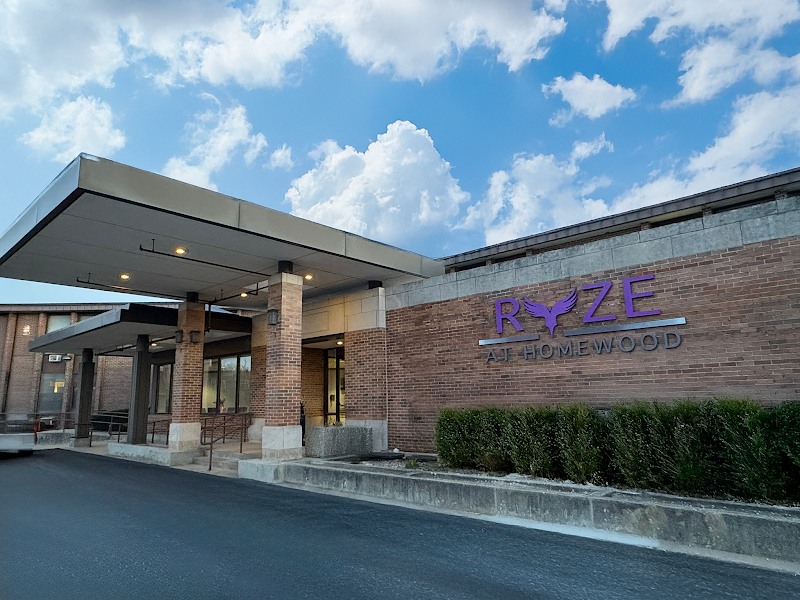
RYZE AT HOMEWOOD

19000 SOUTH HALSTED, HOMEWOOD, IL 60430 (708) 957-9200
For profit - Limited Liability company 259 Beds Independent Data: November 2025 1 Immediate Jeopardy citation
Trust Grade
0/100
#621 of 665 in IL
Last Inspection: December 2024

Within standard 12-15 month inspection cycle. Federal law requires annual inspections.

Overview

Ryze at Homewood has received a Trust Grade of F, which indicates significant concerns regarding the quality of care provided. Ranking #621 out of 665 facilities in Illinois places it in the bottom half, and #192 out of 201 in Cook County shows that there are only a few local options that rank lower. While the facility is trending toward improvement, with issues decreasing from 20 in 2024 to 4 in 2025, it still faces serious challenges. Staffing is a major concern, with a low rating of 1 out of 5 and a high turnover rate of 60%, which is above the state average. Notably, the facility has incurred fines totaling $386,963, which is alarming and suggests ongoing compliance problems. There are some strengths, such as average RN coverage, but families should be aware of significant incidents, including a critical failure to supervise a cognitively impaired resident who exited the facility and was found a half-mile away by police. Additionally, there were serious incidents of resident-to-resident abuse, resulting in physical harm, and a failure to monitor a dependent resident's fluid intake, leading to severe dehydration and hospitalization. Overall, while there are efforts to improve, serious weaknesses remain that families should consider when researching this nursing home.

Trust Score
F
0/100
In Illinois
#621/665
Bottom 7%
Safety Record
High Risk
Review needed
Inspections
Getting Better
20 → 4 violations
Staff Stability
⚠ Watch
60% turnover. Above average. Higher turnover means staff may not know residents' routines.
Penalties
⚠ Watch
$386,963 in fines. Higher than 89% of Illinois facilities, suggesting repeated compliance issues.
Skilled Nurses
⚠ Watch
Each resident gets only 27 minutes of Registered Nurse (RN) attention daily — below average for Illinois. Fewer RN minutes means fewer trained eyes watching for problems.
Violations
⚠ Watch
61 deficiencies on record. Higher than average. Multiple issues found across inspections.
★☆☆☆☆
1.0
Overall Rating
★☆☆☆☆
1.0
Staff Levels
★★★☆☆
3.0
Care Quality
★★☆☆☆
2.0
Inspection Score
Stable
2024: 20 issues
2025: 4 issues

The Good

  • Full Sprinkler Coverage · Fire safety systems throughout facility
  • No fines on record

Facility shows strength in fire safety.

The Bad

1-Star Overall Rating

Below Illinois average (2.5)

Significant quality concerns identified by CMS

Staff Turnover: 60%

14pts above Illinois avg (46%)

Frequent staff changes - ask about care continuity

Federal Fines: $386,963

Well above median ($33,413)

Significant penalties indicating serious issues

Staff turnover is elevated (60%)

12 points above Illinois average of 48%

The Ugly 61 deficiencies on record

1 life-threatening 11 actual harm
Sept 2025 1 deficiency 1 Harm
SERIOUS (G) 📢 Someone Reported This

A family member, employee, or ombudsman was alarmed enough to file a formal complaint

Actual Harm - a resident was hurt due to facility failures

Free from Abuse/Neglect (Tag F0600)

A resident was harmed · This affected 1 resident

**NOTE- TERMS IN BRACKETS HAVE BEEN EDITED TO PROTECT CONFIDENTIALITY** Based on interview and record review, the facility failed to keep two residents (R3 and R5) free from resident-to-resident physi...

Read full inspector narrative →
**NOTE- TERMS IN BRACKETS HAVE BEEN EDITED TO PROTECT CONFIDENTIALITY** Based on interview and record review, the facility failed to keep two residents (R3 and R5) free from resident-to-resident physical abuse after R3 was punched in the right eye by another resident (R4), and R5 was slapped on the head by another resident (R1) for two out of five residents reviewed for abuse in a total sample of nine. This failure resulted in R3 sustaining blunt head trauma and a swollen, black eye.Findings Include:1.R3 is a [AGE] year-old female resident admitted in the facility on 5/1/2024. R3 is assessed to be alert, able to make needs known, forgetful at times.R4 is a [AGE] year-old male resident admitted in the facility on 7/8/2025.On 9/16/2025 at 12:07 PM, R3 observed in her room lying in bed. R3 was able to answer questions appropriately, but noted forgetful at times. There was slight purplish discoloration around the right eye observed. R3 was able to remember there was a guy who punched her hard on the face.On 9/16/2025 at 12:10 PM, R3 stated she remembers there was a guy who hurt her on the face. R3 stated R4 punched me hard on the face and was kind of hard while I was standing in the kitchen. It hurt me right here pointing to the right side of her face. R3 stated she feels safe here.On 9/17/2025 at 11:39 AM, V2 (Social Service Director) stated, If the residents are assessed to be at risk for abuse, then they need to be protected. The care plan should be put in place with interventions to prevent abuse. When V2 was asked about the incident that led to R3's injury on 8/25/2025, V2 stated she was not in the facility at that time, but the incident was physical abuse. V2 stated R3 should have been immediately removed from the area and should have been frequently monitored. V2 agreed R3 should have been protected.During a telephone interview on 9/18/2025 at 10:44 am, V8 (Activity aide) stated she was present and was doing pumpkin faces activity in the dining room with residents when the incident happened on 8/25/2025. V8 said she was paying attention to the crafts the residents were doing at that time. There were a lot of people in the room, and music was playing. R3 and R4 were both sitting in the same table across each other. V8 said she was the only activity aide present at the time. V8 said she did not witness the whole incident. V8 said she just saw in her periphery when R4 was coming towards R3, and it was quick and fast. V8 said R4 hit R3, and it was fast. V8 said they disengaged them after the incident and took R3 to the nursing station.On 9/18/2025 at 12:07 PM, V1 (Administrator) stated she is the one who investigated and sent the final report of the incident to IDPH (Illinois Department of Public Health). V1 stated R3 and R4 were both in the activity room when the incident happened on 8/25/2025. R4 was sitting on the opposite side of the table from R3. R4 got up and swung at R3 and hit R3 on the side of her face. The activity aide was sitting right next to R3, the activity aide reported, (R4) was coming towards (R3) so she went to get (R3), but she couldn't grab (R3). (R4) was still able to swing at her and hit her on the side of her face. There was only 1 activity aide at that time. V1 stated, (R4) was very upset and ranting at that time, and we did not know what he is ranting about. V1 also stated R4 was so irritated and not redirectable so the facility had to petition him out, and R4 left the following day. V1 also said they reported it to (local) Police department.R3's Social service care plan on Abuse, initiated on 6/11/2024 states that R3 may be At risk for abuse due to confusion, memory loss, wandering and lack of safety awareness. R3's care plan goal on abuse sates that R3 will be free of abuse/neglect daily through next review.R4's Social service care plan on Abuse, initiated on 7/9/2025 states R4 is At risk for abuse. R4's care plan goal states, Staff will monitor well-being of others. Resident will have zero episodes of abuse and neglect throughout next review.On 8/25/2025, Nursing notes states R3 was sent out to the emergency department (ED) for further treatment after R4 struck her on the face. ED report stated, (R3) had blunt head trauma resulting to right eye blunt injury after being assaulted by another resident.On 8/27/2025' Nurse Practitioner's subsequent visit notes states R3 was recently seen at an acute care hospital on 8/25/25 and returned back to facility on 8/26/25 for Blunt Head Trauma. Blunt head trauma was sustained by another demented resident that punched her in the right side of her face. R3 was transferred to the Emergency Department immediately afterwards and underwent a Computed Tomography (CT) scan of facial bones and Head CT, both without contrast and both resulted negative for acute changes.This incident was reported by R3's daughter to (local) Police Department (H25-14043). The police report stated R3's daughter said she was notified by the facility on 8/25/2025 that R3 was involved in a battery and was transferred to the hospital via private ambulance. R3's daughter said she noticed R3 had sustained a swollen, black eye.R3's facility reported abuse incident to IDPH, dated 9/2/2025, states R3 was struck on the face by R4. The final report stated R4 abruptly walked around the table and swung at R3 before staff could intervene. R4 struck her on the right side of her face. R3 was sent out to the hospital for further evaluation due to blunt head trauma.Record review of R4's Social service assessment are as follows:R4's Behavior Assessment, dated on 8/25/2025, states R4 observed being verbally and physically aggressive towards another resident. Responding to internal stimuli R4 remains unable to be redirected.R4's Behavior Assessment, dated 8/25/2025, states in his Behavioral symptoms include physical aggression towards self/others, and verbal aggression. R4's Response to Interventions states that R4's behavior increased/escalated, and that R4 did not respond to interventions successfully.R4's Potential for Abuse and Neglect Assessment, dated 8/26/2025, stated R4's Mental/Emotional Challenges said R4 has persistent anger, fear and/or anxiety, poor judgment skills, and psychotic symptoms such as hallucinations or delusions. R4's Behavioral Challenges include history of aggressive, combative or abusive physical behaviors, and history of verbally threatening or verbally obnoxious behaviors.2. R1 is a [AGE] year old with the following diagnosis: type 2 diabetes, alcohol dependence, cocaine use, and intervertebral disc displacement in the lumbar region.R5 is a [AGE] year old with the following diagnosis: cerebral infarction and type 2 diabetes.R1 no longer resides in the facility.On 9/16/25 at 12:01PM, R5 stated R5's previous roommate (R1) slapped R5 in the head about one week ago. R5 reported R5 got up from bed, walked into the bathroom, and closed the door. R5 stated R1 began yelling and opened the door on R5 then slapped R5 on top of the head. R5 reported R5 then yelled at R1 to stop touching R5 and staff came into separate them. R5 stated R1 began yelling that R1 was going to use the bathroom and that is when R1 opened the door and slapped R5. R5 reported R1 was lying in R1's bed and said nothing to R5 while R5 walked to the bathroom. R5 said, I had no idea he needed to use the bathroom until he was screaming at me after I closed the door. R5 stated R1 has been verbally aggressive with R5 before but never physical until 9/11/25. R5 reported R1 would tell R5 that R5 was messy and make a big deal out of little stuff such as a paper towel left on the floor. R5 stated R1 would call R5 a slob. On 9/17/25 at 11:25AM, V2 (Social Service Director) stated a nurse texted V2 that R1 hit R5. V2 reported R1 was going to be petitioned out to the hospital for a psych evaluation but R1 left the facility against medical advice instead. V2 stated R1 is normally verbally aggressive and manipulative. V2 reported staff will redirect R1's behavior when possible but R1 cannot be redirected every time. V2 stated the police came to the facility and gave R1 a citation. V2 reported R5 told V2 that R5 went to the bathroom which is connected to R1's room and when R5 closed the door to R1's room, R1 opened the bathroom door and slapped R5 on top of the head with an open head. V2 stated this incident would be considered physical abuse because R1 made physical contact with R5 that was unwanted by R5.On 9/17/25 at 1:17PM, V4 (LPN) stated V4 overheard R1 and R5 arguing so V4 went to see what happened. V4 reported R1 told V4 that R1 was going to the bathroom and left out to get a hand towel when R5 came in to use the bathroom when R1 wasn't done. V4 stated the CNA then reported that R5 told the CNA that R1 hit R5 on the head. V4 reported R1 has been verbally aggressive in the past so staff know how to redirect R1's behavior. V4 stated the police showed up to talk with both residents. V4 reported this incident would be considered physical assault.On 9/17/25 at 1:55PM, V5 (Director of Nursing/DON) stated the nurse reported R1 and R5 got into an altercation. V5 reported V5 explained to R1 that R1 would have to go to the hospital for a psych evaluation but R1 refused. V5 stated R1 told staff that R1 was using the bathroom and left to grab something out of R1's room when R5 entered the bathroom and shut R1's door. V5 reported R1 then told R5 that R1 wasn't finished in the bathroom and R5 grabbed something off the sink that belonged to R1 so R1 grabbed R5's arm. V5 stated R1 admitted to tussling with R5. V5 defined tussling as pushing back and forth. V5 reported R1 told V5 that the tussling continued until R5 called out for help. V5 stated that V5 wasn't exactly sure R5's side of the story but R5 did corroborate that R1 got physical with R5. V5 reported the police came to the facility to issue R1 a citation. V5 stated this incident would be considered physical abuse.On 9/18/25 at 12:00PM, V1 (Administrator) stated R5 reported R1 hit R5 on the top of the head and R1 reported R1 physically moved R5 out of the doorway. V1 reported the police were called at the request of R5 and they issued R1 a citation for slapping R5 without any legal justification.A Nursing note, dated 9/11/25, documents R1 presented with physical aggressive behavior towards a peer. R1 was not receptive to staff redirection. Social services attempted to petition R1 to the hospital for a psych evaluation. R1 refused to go to the hospital and wanted to sign out against medical advice (AMA) instead.A Nursing note, dated 9/11/25 documents R5 informed the nurse that R1 struck R5 on the head. The nurse assessed R5 and R5 was stable with no changes. The physician and emergency contact were notified.A Social Service note, dated 9/11/25, documents Social Services met with R5 following the altercation. R5 discussed with events leading up to the altercation with R1. Police were made aware.The Initial Incident Report, dated 9/11/25, documents R5 reported R1 slapped R5 on top of the head without justification. Residents were separated. Body assessment was completed with no injuries noted. R1 was put on 1:1 monitoring until R1 discharged . Police were notified. An investigation was initiated.The Ordinance Violation from the police, dated 9/11/25, documents R1 slapped R5 on top of the head without any legal justification. R1 must appear for an administrative hearing.The Potential for Abuse and Neglect Form, dated 9/11/25, documents R1 has poor judgement skills, a history of physical abuse, history of being verbally threatening, and history of being aggressive. R1 also has a history of substance abuse and alcoholism. R1 was involved in a physical altercation with a peer.R5's Potential for Abuse and Neglect Assessment, dated 9/11/25, documents R5 is at risk for abuse due to using a wheelchair.R1's Care Plan, dated 8/18/25, documents R1 is at risk for abuse. R1 was involved in a physical altercation with a peer on 9/11/25. This care plan also documents R1 presents with behavioral symptoms by becoming verbally aggressive with staff. R1 is not receptive to redirection. The Care Plan dated 9/9/25 documents R1 presents with manipulative behaviors and make false allegations regarding staff. The Care Plan dated 9/11/25 documents R1 present with physically aggressive behavior. R1 was involved in a physical altercation with a peer on this day. R5's Care Plan, dated 9/11/25, documents R5 is at risk for abuse and neglect. R5 was involved in a physical altercation with a peer on this day.R1's Minimum Data Set (MDS), dated [DATE], documents a Brief Interview for Mental Status Score (BIMS) as a 15 (no cognitive impairment). Section E documents R1 has exhibited verbally aggressive behavior within one to three days from this assessment.The Minimum Data Set for R5 dated 8/22/25 documents a Brief Interview for Mental Status score as 15 (no cognitive impairment). A policy titled, Abuse Policy and Prevention Program, dated 10/2022 documents, This facility affirms the right of our residents to be free from abuse, neglect, exploitation, misappropriation of property, and mistreatment of residents. This facility therefore prohibits abuse, neglect, exploitation, misappropriation of property, and mistreatment of residents.Abuse means any physical or mental injury or sexual assault inflicted upon a resident other than by accidental means. Abuse is the willful infliction of injury, unreasonable confinement, intimidation, or punishment with resulting physical harm, pain, or mental anguish to a resident.Physical abuse is the infliction of injury on a resident that occurs other than by accidental means and that requires medical attention. Physical abuse includes hitting, slapping, pinching, kicking, and controlling behavior through corporal punishment.
Jun 2025 1 deficiency
CONCERN (F) 📢 Someone Reported This

A family member, employee, or ombudsman was alarmed enough to file a formal complaint

Potential for Harm - no one hurt, but risky conditions existed

Deficiency F0802 (Tag F0802)

Could have caused harm · This affected most or all residents

Based on observation, interview, and record review, the facility failed to have a Dietary Manager available to ensure daily Dietary services were performed appropriately and efficiently resulting in r...

Read full inspector narrative →
Based on observation, interview, and record review, the facility failed to have a Dietary Manager available to ensure daily Dietary services were performed appropriately and efficiently resulting in residents not receiving meals according to their preferences, requests, needs, or the facility's menu; residents not being served in a timely and consistent manner; residents not receiving food at an appetizing temperature; and dry food not being stored under sanitary conditions. These failures applies to all 131 residents receiving food from the facility. Findings include: On 06/12/2025 at 9:51 AM, R1 stated, Yesterday, (Wednesday), they were serving fish for lunch. I asked for a cheeseburger instead and was still served the fish. I was told 'sorry we missed your nam'e, even though they have a list. R1 stated the food sometimes is served lukewarm. The facility's lunch menu for Wednesday (06/11/2025) of the week three menu cycle included: Fried Fish. On 06/12/2025 at 10:22 AM, R2 stated yesterday he requested a salad for lunch. They had him marked as no salad, although salad was not a part of the menu and he did not receive it. He requested a cheeseburger, and was told there were none, although they had cheese because they were making grilled cheeses and had burgers. He wanted the dinner being served, which was biscuits and gravy; they had him marked as wanting a burger, and the only reason he received the regular meal is because they were out of burgers. R2 stated, You never know what you'll be served until you receive it. R2 has asked them why even bother telling them what is being served. R2 stated food is sometimes warm and sometimes cold. R2 stated sometimes breakfast items are missing, such as being served cereal with no milk. On 06/12/2025 at 11:15, AM R3 stated the food served is not hot and is lukewarm. She was getting cold cereal for a while, but hasn't in the past week or so, she informed them she prefers yogurt for breakfast and was receiving it, but hasn't been getting yogurt because they're out of it. On 06/12/2025 at 12:39 PM, R3's lunch tray included a sloppy joe sandwich, fries, and sliced carrots. R3 had not touched her meal, and stated she was expecting pork for lunch and instead received her current meal. The facility's lunch menu for Thursday (06/12/2025) of the week three menu cycle includes Pork Chop with Gravy, Pinto Beans, Mixed Vegetables, and a Dinner Roll. On 06/12/2025 from 12:39 PM - 1:35 PM, eight meal trays were covered in plastic wrap with no lids on them, sitting on food carts that were covered in plastic covers. V10 (Certified Nursing Assistant) stated, Those trays are for residents who eat in their rooms, and the trays normally have lids on them. Three meal trays were covered in plastic wrap with no lids and no meal tickets sitting on food cart. A steam table in the dining room not in use. V10 stated, The steam table is fairly new, they used to serve food from the steam tables months ago. R1's meal tray arrived 20 minutes after meal service began, and two other residents sharing the table with him had already received their meals. V10 stated, (R1's) meal tray just arrived and confirmed dining service has had some challenges since the Dietary Manager left. R4's and R1's meal tickets stated cheeseburger, and they received a hamburger. R1 and R4 stated they were supposed to get a cheeseburger. V5 (Dietary Regional Consultant) stated they do have cheese in the kitchen, and she isn't sure why R1 and R4 did not get cheese on their burgers. At 1:14 PM, a test tray was delivered to the 2nd floor dining area by V5. The fries, carrots and sloppy joe on the test tray were not warm or hot, and were nearly cold, and therefore not appetizing. At 1:27 PM, V5 stated this week's menus are from the third week in the monthly menu cycle; they had to change the menu from the original pork based meal because the pork had just come in. On 06/16/2025 from 8:29 AM - 9:30 AM, V7 (Head Cook) stated the breakfast meal was supposed to include toast, however, they are out of toast and biscuits were served instead. Meal trays being prepared with biscuits. 3-4 plates at a time were prepared by V8 (Dietary Aide) with bacon, eggs, and a biscuit sitting on a side prep table for up to a minute before being covered and placed on a tray cart by V9 (Dietary Aide). V6 (Cook) and V8 stated, The trays without tickets last Thursday were for newly admitted residents, they didn't have anyone to enter the dietary information for those residents. V6, V8, and V9 stated Dietary duties have been challenging without a Dietary Manager, and there hasn't been one in two weeks, and all emphasized they really need the assistance of a Dietary Manager. V6 and V8 stated they ran out of tray lids last Thursday. V6 stated maintaining inventory has been more challenging without a Dietary Manager, and they have run out of items. V6 stated, There is only one hot box for meal trays which is used for the locked unit. Having a Dietary Manager helps ensure everything gets done efficiently and properly in the kitchen. V9 left the kitchen multiple times during tray prep. V6 stated, (V9) went to deliver the trays, there's usually another staff available to assist with that. V9 re-entered the kitchen with plastic cups and supplies during tray prep. V8 was waiting with multiple uncovered prepared plates for V9 to return to the kitchen. V8 stated a Dietary Manager helps ensure tickets are prepared and ready for meal service. V9 stated having a Dietary Manager ensures they have everything they need and don't have any disruptions in their duties, such as tray lids, silverware, coffee etc. V8 stated she believes they are about to run out of dish soap. V6, V8, and V9 all expressed the Dietary Manager typically ensures all of the Dietary supplies are available so they can perform their duties efficiently, and this has been difficult to maintain since no longer having a Dietary Manager. V8 stated the Dietary Manager also ensures other kitchen duties such as cleaning is done, so they can focus on other duties and make sure they are performed efficiently. V9 stated, Bread is stored on the bread rack; typically it comes in on Saturdays, however, we had not received a shipment this Saturday, which is why there is not really any bread on the bread rack. 4 loaves of bread and one large pack of hot dog buns were sitting on the bread rack. V8 stated when they had a Dietary Manager, everything was stocked. During tray preparation, the lid of the storage bin with oatmeal in it was left open when not in use. A scoop was lying in the sugar stored in the bulk bin. A scoop was left sitting on top of the rice storage bin. No holders for the scoops were near or inside the bulk bins. V5 (Dietary Regional Consultant) did not arrive to the kitchen at any time during tray preparation for breakfast. The facility's breakfast menu for Monday (06/14/2025) of the week four menu cycle includes Choice of Hot or Cold Cereal, Bacon, Scrambled Eggs, and Toast. On 06/16/2025 at 9:43 AM, R4's breakfast meal ticket notes included double portions at breakfast meal. R4's meal tray had one biscuit, two servings of eggs, multiple slices of bacon, and one bowl of grits. On 06/16/2025 at 9:31 AM, R3's Meal Ticket notes included two bowls of cold cereal/yogurt/fruit. R3's breakfast included one bowl of cold cereal, one bowl of hot super cereal/oatmeal, and no yogurt or fruit. R3 confirmed she was supposed to have two bowls of cold cereal. On 06/16/2025 at 9:45 AM, R2 was in the lobby area after breakfast waiting to be transported for an appointment. R2 stated during breakfast his bacon was cold, but it always is. On 06/16/2025 at 1:29 PM, V5 (Dietary Regional Consultant) stated she believes yogurt is served upon request, and confirmed yogurt is stored in the cooler and there was none currently. Observed there was no yogurt in the kitchen cooler. V8 (Dietary Aide) stated she noticed the scoops stored inside the sugar bulk bin and on top of the rice bulk bin; they shouldn't be there, everyone is just moving too fast. V8 confirmed staff are overwhelmed and overlooking things without a Dietary Manager. On 06/16/2025 at 2:51PM, V5 (Dietary Regional Consultant) stated she came in to the facility last Monday (06/09/2025) to assist since they let the Dietary Manager go. V5 stated V5 had concerns as well about the staff using plastic wrap to cover the meal trays; they were used because of the limited space on the top of the speed racks used for transporting meals. V5 stated she was only concerned about staff wasting plastic wrap, but didn't have any food safety concerns because the aides pass the trays very quickly. V5 stated a steam table is normally used for meal service ,however, the one in the dining area has the wrong voltage, so they are waiting for it to be replaced. V5 stated the steam table keeps the food nice and warm. V5 stated the speed racks don't hold temps as well as the hotbox, however they are passed out really quickly. V5 stated food temps should be palatable; it is subjective. V5 stated, If there is no holder inside the dry storage bins they should get a clean scoop every time. Technically, if the scoop handle is up, it's ok to store it inside the bulk bins, but it should not be sitting on top of the bin, and the bulk bin lid needs to be closed. When asked what might have contributed to staff making these errors in Dietary practices, V5 stated, I'm guessing they're in a hurry, not paying attention, and if the Dietary Manager observed these things, they would do in-services. V5 stated this last week has been kind of tumultuous because they lost a staff member and manager. V5 stated, I assume the Dietary meal tickets should be prepared right away after admission; this is done by nursing staff. If a resident was supposed to receive double portions for breakfast, this would include double portions of all meal items, so they should have had two biscuits, double the bacon portion, double the egg portion, and a double cereal portion of cereal, which includes two bowls. On 06/16/2025 at 3:55 PM, V1 (Administrator) informed that V14's (Former Dietary Manager) last working day was 06/04/2025. On 06/16/2025 at 5:47 PM, V1 (Administrator) reported the facility has total of 131 residents who are served food from the facility, and a total of 4 residents who do not receive foods orally. On 06/17/2025 at 2:33 PM, V5 (Dietary Regional Consultant) stated the notes section on a meal ticket is for general information such as double portions, likes and dislikes. V5 stated the Dietary staff needs the oversight of a Dietary Manager for kitchen operations, which is different from the medical side of signing diet orders. When asked what Dietary operations require the Dietary Manager's oversight, V5 replied, For example, I am filling in as a Dietary Manager, which includes ordering food supplies and dishware, monitor inventory and ordering these supplies as needed, making staff schedules, general day to day kitchen inspections including, ensuring general cleanliness is taken care of, food is stored correctly, menus and meal tickets are being followed, and making sure meals are served at an appropriate temperatures. V5 confirmed substitutions are listed on the meal tickets. The facility's Dietary Manager Job Description, received 06/17/2025, states: The CDM (Certified Dietary Manager) is responsible fore the daily operations of dietary department in accordance with facility policy and procedures as well as federal and sate regulations. They provide leadership and guidance to ensure that food quality, safety standards, and client expectations are satisfactorily met. They also maintain records of food, supplies, inventory levels, and equipment. These duties are also listed under the Essential Functions section of the Dietary Managers job duties. Food Service Management duties include: Inspect meals and ensure that standards for palatability, temperature, and serving times are met. Assure that foods are prepared according to menus. Sanitation and Food Safety duties include: Manage staff to ensure compliance with safety and sanitation regulations including safe storage of food. The Facility's Competency Check List for Dietary Manager, received 06/16/2025, includes: Ensures dietary staff are performing assigned tasks appropriately. Ensures dietary staff follow established infection control guidelines and food safety regulations. Ensures alternate meals are available upon request. Supervises the preparation and service of regular and therapeutic diets. Ensures foods served are palatable, and at the appropriate temperature. Ensures nutrition documentation/data collection is timely, accurate, appropriate, and in accordance with company guidelines and state requirements. The facility's Dry Food Storage Policy, received 06/16/2025, states: The purpose of the policy is To ensure dry food is stored in a safe, sanitary manner to provide the best food quality. Bins for food storage (flour, cornmeal, etc.) should be with tight fitting lids to prevent contaminations. No scoops are to be stored with food bins. The facility's Holding Foods Policy received, 06/16/2025, states: In part, Foods should be held at proper temperatures while remaining palatable. The facility's Resident Dining Services Policy, received 06/16/2025, states: The purpose of the policy is To ensure foods are appropriate temperatures, and meet the individual resident's needs. Residents seated together should receive meals at the same time (served by table) so that they may dine together.
Jun 2025 1 deficiency 1 Harm
SERIOUS (G) 📢 Someone Reported This

A family member, employee, or ombudsman was alarmed enough to file a formal complaint

Actual Harm - a resident was hurt due to facility failures

Deficiency F0692 (Tag F0692)

A resident was harmed · This affected 1 resident

**NOTE- TERMS IN BRACKETS HAVE BEEN EDITED TO PROTECT CONFIDENTIALITY** Based on interview and record review, the facility failed to monitor and document a dependent resident's fluid intake for all me...

Read full inspector narrative →
**NOTE- TERMS IN BRACKETS HAVE BEEN EDITED TO PROTECT CONFIDENTIALITY** Based on interview and record review, the facility failed to monitor and document a dependent resident's fluid intake for all meals that required one to one supervision during meals and failed to assess for signs and symptoms of dehydration. This affected one of four residents (R1) reviewed improper nursing care and dehydration. This failure resulted in R1 being emergently transferred to the hospital and diagnosed with severe hypernatremia (excessively high sodium level in the blood) and AKI (Acute Kidney Injury). R1 was hospitalized for 5 days requiring intravenous fluids and antibiotic treatment. Findings include: R1 is [AGE] years of age. Current diagnoses include but are not limited to Cerebral Infarction, Dementia, Type 2 Diabetes Mellitus, Hypertension, Hypernatremia, Epilepsy, and Hyperlipidemia. R1's comprehensive assessment section C cognitive patterns, dated 3/31/25, documents a Brief Interview for Mental Status score of 9 out of 15. R1 had moderate cognitive impairment. R1 was initially admitted to the facility on [DATE]. R1's lab results from 4/7/25 indicate a sodium level of 158 H (high). R1's diet order, dated 3/31/25, states: Low Concentrated Sweets Diet Mechanical Soft texture, Thin consistency, 1:1 supervision at all meals. R1's progress notes document him being seen by V11, Nurse Practitioner on 4/17/25. There were no concerns documented regarding the elevated sodium level. There is no area in the electronic charting to document the amount of fluid being consumed by each resident. R1 does not have any fluid intake documentation in his electronic documentation upon review. R1's care plan states: R1 has Alzheimer's Dementia and may display moods/behaviors related to diagnosis. Interventions state: do not rush resident. Provide adequate time during resident care and meals. R1 is as risk for alteration in fluid volume related to disease progression. Interventions state: Encourage fluid intake. Monitor resident for early signs and symptoms of dehydration: thirst, loss of appetite, dry skin, dark colored urine, fatigue. R1's progress notes from 4/20/25 at 6:55 AM state: Contact person made aware of the change in health condition and transfer to the hospital. R1's progress note on 4/20/25 at 7:29 AM states: The resident was lethargic around 6:48 am when the staff went to clean him up. On assessment, BP (blood pressure) 124/93, H (heart rate) 133, R (respirations) 24, T (temperature) 98.6, SP02 (pulse oximetry) 94 RA (room air). Plan to send resident to ER (emergency room) for further evaluation. R1's progress note on 4/20/25 at 10:16 AM states: Per ER (emergency room) RN (Registered Nurse) resident is being admitted for sepsis, acute kidney injury, elevated WBC (white blood cell count) 13.9 and abnormal labs (Sodium 177, BUN 60, Lactic acid 2.1, and Creatine 2.65). R1 was admitted to the hospital with severe hypernatremia (excessively high sodium level in the blood), AKI (Acute Kidney Injury) lab values- creatinine 2.65 suspected secondary to dehydration. (Creatinine is a waste product of muscle metabolism that is normally filtered out of the blood by the kidneys. A high level may suggest kidney damage.) Abnormal laboratory values, elevated troponin level in the blood (damage to the heart muscle), pyuria (presence of abnormally high number of white blood cells or pus in the urine) and hematuria (presence of blood in the urine). Patient initiated on IVF (intravenous fluid) rehydration and IV antibiotics and will be admitted for further workup and management with nephrology on consult. R1's 4/20/25 nephrology consult states: assessment/plan- AKI Acute Kidney Injury secondary to relative hypotension and poor po (oral) water intake. R1 was hospitalized for 5 days. He returned to the facility on 4/25/25, with physician orders to continue oral antibiotics for another 14 days. R1 died in the facility on 5/14/25. On 6/2/25 at 10:43 AM, the secured unit was observed. There was a water station set up with a large container with iced water and cups. Multiple residents were seated at the tables during a coloring and music activity, and only a few have cups of water. On 6/2/25 at 10:46 AM, V3, CNA/Certified Nurse Assistant, was asked about providing hydration. V3 said, Activities does hydrate the residents with juice, snacks, and coffee. We give out water throughout the day. The resident's swallow precautions are on the meal plan and on our charting. V3 was asked about providing care for R1. V3 said, (R1) was on a pureed diet with regular liquids. He had a hard time seeing, so we had to feed it to him. He would spill liquids and make a mess with his food, so we started helping him. His family would come in 2-3 times a week and help with feeding him. I didn't notice him decline when he was sent to the hospital. On 6/2/25 at 11:01 AM, V4, Activity Assistant, was asked about providing hydration. V4 said, I provide snacks and water throughout the day. V4 was asked about R1's hydration. V4 said, (R1) needed help because he couldn't see it all the way. How much he drank would depend on the day and who was helping him at the time. Some people leave if he stopped eating or drinking. I try to come back and finish helping him because sometimes he may forget he has something to drink or eat. I'm a CNA too, for 47 years. He declined a little before he went to the hospital. On 6/2/25 at 12:14 PM, lunch was being served. The meal was meatballs, rice, broccoli, cookie, and 4 oz fruit punch. Water was not provided by staff during the lunch meal to any of the residents eating in the dining room. Each resident's lunch tray was provided a 4 ounce cup of fruit punch. On 6/3/25 at 9:07 AM, V7 said, Most cups are 8 ounces. With breakfast, the residents get 8 ounces of juice and a 8 ounce carton of milk. About 10AM, we pass out ice water. Most of the residents drink whatever we give them. Some drink coffee. The residents that need assistance, I try to sit them close together so it's easier to get to them. We have to stay with them and make sure they drink their cup. We pick up their trays and see much they eat. I've been here 10 years. I remember what they eat. If they don't eat their usual, I know something's going on. We have to pay attention to them. We have to chart it in the computer. On 6/3/25 at 9:27 AM, V8, LPN Licensed Practical Nurse, was asked about resident hydration and intake documentation. V8 said, Most residents on this unit have Dementia or Alzheimer's, and some have high behaviors. They need assistance with ADL's (activities of daily living). We have a few residents who need to be fed. We have staff in the dining room monitoring every 30 minutes. They do activities and provide snacks and beverages. We have a water pitcher, and we give them water every 2 hours. The CNA's (Certified Nurse Assistant) have to monitor how much the resident's intake and chart it. The feeder residents need more attention with meals, and staff is responsible for making sure they're drinking between meals. The nurse makes sure the CNAs charting is done. We have unit managers that come check daily. I come in and assist them when the trays come down. The trays have a ticket with the resident's name and diet to make sure each resident gets the right tray. The aide would have to remember what each resident ate and drank. I don't know about their charting; you'd have to ask a CNA. V8 was asked about R1's hydration and documentation. V8 said, Some days (R1) needed encouragement and other times he'd need to be fed. Most of the CNA's got him up in the dining room. He had vision issues, so we'd have to give him his spoon and tell him where things were on his tray. Someone would have to put his cup in his hand and tell him he had a cup with something to drink. We had to get close to him so he could hear us because his hearing wasn't that good. Before he went to the hospital, he needed more assistance with feeding, and he was talking less. On 6/3/25 at 10:25 AM, V4, Activity Assistant, and V9 passed out 4oz cups of water to the residents in the dining room. At 10:45 AM, residents are seated at the table with water in front of them. Staff were not encouraging residents to drink water. On 6/3/25 at 10:54 AM, V10, Restorative CNA, was asked about resident hydration and intake documentation. V10 said, We can do the meal percent of what they eat for each meal. There should be a way to document the fluid intake. I haven't used the system in a while. On 6/3/25 at 11:25 AM, V7 was asked about documenting a resident's fluid intake. V7 said, There's no place to document the fluids, it's only the amount of food eaten. It's a new charting system since January when the new company took over. On 6/3/25 at 11:27 AM in the dining room, V7, CNA, asked V9, CNA, if there was a place to document the resident's fluid intake in the electronic charting. V9 said, No. On 6/3/25 at 12:12 PM, lunch arrived. The meal was smothered pork chop, carrots or corn, baked potato, Jello, and 4 ounces of juice. Water was not provided by staff during the lunch meal to any of the residents eating in the dining room. On 6/3/25 at 1:19 PM, V5, Registered Nurse, was asked about R1's condition and care. V5 said, I've been working there 2 years, but I don't have a set unit. It was my first time working with (R1). The CNA called me to his room. I don't remember who it was. The CNA said his upper arms were very warm and his legs were cold, so I went in to assess him. I found him tachycardic. The CNA said he wasn't the same as he usually was. I called the doctor, but couldn't get a hold of him right away. I raised his head of bed and did all the vital signs. All the other vitals were OK. I called the Director of Nursing and told her what was going on, and she said it was OK to send him out. I notified the family and called the ambulance. I felt something was going on because his heart rate was so high, so I sent him out for further evaluation. On 6/3/25 at 2:15 PM, V12, CNA, was asked about assisting R1 with care, hydration, and meals prior to him being hospitalized on [DATE]. V12 said, I remember (R1). I helped clean him up that morning before he went out. He was really tired. I got him up and he ate a little breakfast, not too much. He ate just a little at lunch too. It was almost change of shift, and (V14, Family Member) helped me put him in bed. (V14) was there when I changed him. He was wet with urine. He was different than his normal, really tired. (V14) said the same thing. He definitely had some changes that day. He usually has a good appetite, he'll eat everything. He was a total assist with everything, so I fed him. I think he was blind. I'd have to hold the spoon and cup for him. He'd follow commands and respond if he didn't like something. On 6/4/25 at 10:59 AM, V15, Dietician, was asked about fluid intake monitoring and R1's diet. V15 said, I started working with (R1) in May related to his wounds. I only followed him for one week before he died. He was diabetic and had dementia that was progressing. He was underweight, so I ordered a sugar free supplement. He was on a mechanical soft diet with thin liquids. His order was supervision at all meals, but I had just started working with him so I'm not quite sure when it was ordered. Staff should record the percentage of food eaten after each meal, the same with fluids too. It's important because residents with impaired cognition have PO (oral) intake that varies with each meal. Documentation is important because there is a risk for dehydration. Residents forget to drink; they have a decreased instinct to drink water. Staff should encourage and set out hydration. I wasn't aware the facility wasn't documenting fluid intake. On 6/4/25 at 11:52 AM, V2, Acting Director of Nursing, was asked about fluid intake monitoring, documentation, and R1's diet order. V2 said, I am the nurse consultant for the facility. I'm filling in until the new Director of Nursing starts. I'm not familiar with (R1). The CNAs are to monitor how much the residents are eating and report to the nurse if they aren't drinking. They can use the meal ticket to document how much they ate and transcribe it to (electronic documentation). I'll have to check the CNA charting, I'm not sure what they can chart. The facility policy on meal and fluid intake and documentation was requested. V2 did not provide a facility policy for review. The facility assessment is uesd to determine what resources are necessary to care for residents competently during daily operations and emergencies. The updated December 2024 facility assessment states:( the facility is licensed to care for residents with the following) diseases/conditions, physical and cognitive disabilities - Alzheimer's Dementia, Hypertension, Seizures (Epilepsy), Diabetes. General Care- Nutrition: Specific Care or Practices: individualized dietary requirements, fluid monitoring. Assistance with activities of daily living: eating (independent, assist of 1-2 staff, and dependent residents). Staff type: Nursing services (DON, ADON, RN Supervisors, RN, LPN, CNA, etc.). Food and Nutrition Services (Director, support staff, Consultant Registered Dietician). Training topics: Licensed nursing staff: identification of resident changes in condition- identify medical issues appropriately, how to determine if symptoms represent problems in need of intervention, how to identify when medical interventions are causing rather than helping relieve suffering and improve quality of life. Non-licensed nursing staff- care of resident with Dementia. Competencies: Non licensed nursing staff: measurements- recording intake. The undated Registered Nurse/ Licensed Practical Nurse job description states: Basic function: under the direction of the physician, is responsible for total nursing care to all residents on assigned unit during the assigned shift including responsibility for delegation of duties, resident nursing care, staff performance and adherence by staff members to facility policies and procedures. Essential duties: 2. Implement total nursing care plan through assessment, planning, and evaluation. 9. Recognize significant changes in the condition of residents and take necessary action. The undated Certified Nurse Aide job description states: Basic function: To provide assigned residents with routine daily nursing care in accordance with established nursing care procedures, state, and federal guidelines, and as directed by your supervisor. Essential Duties: 19. Observe and report any physical or emotional changes observed in the residents including any complaints or grievances made by the resident. 20. Prepare resident for meals, assist serving food trays or feed as necessary and record/or report residents' intake or acceptance of food.
Feb 2025 1 deficiency 1 Harm
SERIOUS (G) 📢 Someone Reported This

A family member, employee, or ombudsman was alarmed enough to file a formal complaint

Actual Harm - a resident was hurt due to facility failures

Quality of Care (Tag F0684)

A resident was harmed · This affected 1 resident

**NOTE- TERMS IN BRACKETS HAVE BEEN EDITED TO PROTECT CONFIDENTIALITY** Based on interview and record review, the facility failed to ensure physician orders for daily wound care treatments were comple...

Read full inspector narrative →
**NOTE- TERMS IN BRACKETS HAVE BEEN EDITED TO PROTECT CONFIDENTIALITY** Based on interview and record review, the facility failed to ensure physician orders for daily wound care treatments were completed as ordered; failed to ensure daily monitoring of a wound for presence of possible complications such as signs of increasing area of ulceration or signs of soft tissue infection; and failed to ensure care plan interventions for alteration in skin integrity were implemented for one (R1) of four residents reviewed for wound care. These failures resulted in R1 developing a worsening coccyx pressure ulcer and require transfer to a local hospital with a diagnosis of septic shock due to pressure wound infection requiring admittance to the intensive care unit for five days. Findings include: R1 is [AGE] years of age. Current diagnoses include but are not limited to Cerebral Infarction, Pressure Ulcer of Sacral Region, Obesity, Type 2 Diabetes Mellitus, and Hypertension. R1 was originally admitted to the facility from the hospital on 1/8/25. R1's admission assessment documents a community acquired sacral wound. R1's comprehensive assessment section C cognitive status dated 1/15/2025 documents a brief interview for mental status score of 15 out of 15. A score of 13-15 indicates the person is cognitively intact. Review of R1's records document the following: R1 was admitted to the facility on [DATE] from the hospital. R1's admission assessment documents a sacral wound. The MDS section M documents R1's unstageable sacral wound. R1's 1/9/25 lab results for the WBC (White Blood Cell) count was 13.62 (H) High. The white blood cell count is a measure of the number of white blood cells circulating in the blood stream. [NAME] blood cells are essential for the immune system, playing a crucial role in fighting infections and other threats in the body. The reference (normal) range for adults per the lab result is 4.80 - 10.80. A high white blood cell count also known as leukocytosis, can occur due to a number of possible reasons, including infections, inflammation, or bone marrow disease. R1's care plan states: R1 has alteration in skin integrity to coccyx- unstageable. Date initiated: 01/09/2025. Goal: R1 will be free from complications through next review date. Interventions: Assess wound with each dressing change. Date initiated: 01/09/2025. Monitor for infection: Peri-wound erythema (redness)- Increased drainage and odor- Increase pain- Peri-wound swelling- Exposed bone- Pressure wound deterioration. Date initiated: 01/09/2025. Treat as ordered by MD. Date initiated: 01/09/2025. V9 Wound Physician's 1/21/25 wound evaluation and summary states in part: stage: unstageable DTI (deep tissue injury) within and around wound, wound size (Length x Width x Depth): 15.5 x 20 x 0.1) cm centimeters, exudate: light sero-sanguinous (wound drainage secreted by an open wound in response to tissue damage), wound progress: exacerbated due to generalized decline of patient. Additional wound details: patient with significant wound decline, patient with poor po (by mouth) intake, concern for possible skin failure, if no plans for aggressive interventions i.e. g-tube (gastrostomy/ stomach tube) etc., would consider hospice referral. On 1/10/25, V3, Wound Care Nurse, documents an unstageable coccyx wound measuring 5.0 cm x 1.0 cm x undetermined with light serous drainage. Wound has 75% slough. The wound care order documents clean sacrum with normal saline cover with dry dressing q shift, every day shift for open area and as needed for when wet. V10, NP/Nurse Practitioner's, 1/11/25 progress note states: Patient is compliant with care, dietary, and medication regime. Labs 13.62. Assessment/Plan- monitor labs as ordered. V9, Wound Physician's, note from 1/14/25 states: unstageable coccyx full thickness wound. Etiology (cause): pressure. Noted to be present on admission per staff. R1 underwent a surgical excisional debridement procedure (surgical procedure that involves removing dead or infected tissue from a wound). Dressing treatment plan: Leptospermum honey apply once daily for 30 days. Gauze island with border apply daily for 30 days. V11 Physician's 1/15/25 progress note states: Labs reviewed. Skin: see wound care note for assessment. V8, RN's, 1/21/25 at 11:36 AM, progress note documents, writer received resident in bed resting. Resident was drowsy, responsive to tactile stimuli only, tachycardia noted, hypoxic, and sacral wound has purulent drainage. Primary physician was contacted for recommendation. Resident was sent to hospital via transportation escorted by two EMT (Emergency Medical Technicians). Last vitals, BP blood pressure 140/68, HR heart rate 105, BS blood sugar 133, O2 (oxygen) on 2L (liters) nasal canal 94%. On 1/21/25 R1 was sent to the hospital emergency department and was admitted for septic shock due to a sacral pressure wound infection. R1 was admitted to the ICU (Intensive Care Unit) until 1/26/25 (5 days). V2, Director of Nursing/DON provided R1's 1/1/25 - 1/31/25 electronic treatment administration record. There is no documentation of R1 receiving the prescribed wound care treatments from 1/8/25 through 1/12/25. There is no documentation of the wound care treatment being completed on Saturday 1/18/25. V3, Wound Care Nurse, documented completing R1's treatment on Wednesday 1/22/25, while R1 was admitted to the hospital intensive care unit. R1 was sent to the hospital on 2/8/25 by family request, and did not return to the facility during the investigation. On 2/18/25 at 1:46 PM, V3, Wound Care Nurse, said, I think she came from the hospital with her wound. She admitted here with an unstageable wound to her coccyx area. I did her wound care Monday through Friday. The floor nurses did it on the weekend. On 2/18/25 at 3:10 PM, V6, LPN/Licensed Practical Nurse, said, I work every other weekend. If (V3, Wound Care Nurse) isn't here we're responsible for our resident's wound care. (V3) stocks all the wound care supplies in the carts on Friday. I try to do the dressings changes during the CNA(Certified Nurse Assistant) rounds. On 2/19/25 at 12:03 PM, V8, RN/Registered Nurse, said, I had (R1) for day shift. I float through the building, so I wasn't familiar with her. I didn't get anything concerning in report about her that morning. She was tachycardic (fast heart rate) and her blood pressure was up. Her vitals were accurate as I documented. The aide said she wasn't eating well. She was drowsy. Her wound looked to have some infection; the drainage was thick, yellowish color. I can't recall if it had any odor. (R1) didn't complain of any pain. On 2/19/25 at 12:38 PM, V3, Wound Care Nurse, said, I think she was admitted on [DATE]th sometime that evening. When I came in January 9th, I pulled the admission report to see if we had any new admissions. I went to see her, and she refused. I thought I charted it, but it's not there. January 10th, she allowed me to do a skin assessment. She had a unstageable wound with slough. I don't recall it having any purulent drainage or odor. V3 was asked what were R1's admission orders for wound treatment? V3 said, Clean with normal saline and cover with a dry dressing. V3 was asked where were R1's wound treatments documented? Why is the treatment administration record blank from 1/8/25 - 1/12/25? V3 said, It's supposed to be documented in the TAR (treatment administration record). When a treatment is done it's supposed to be documented. Not sure what happened. V3 said, I'm with the doctor when she comes on Tuesdays. The next day the doctor would have seen her was on January 14th. The treatment ordered was Medi honey with a bordered gauze daily. She had a debridement; the doctor removed the layer of slough from the wound. (R1) tolerated the procedure. V3 was asked about the assessment of R1's wound on 1/21/25. V3 said, The wound care doctor was here and saw R1 that day. The wound declined. There was light serous exudate (wound drainage). When did you become aware of R1 being hospitalized and what was her admission diagnosis? V3 said, I don't know when (R1) went to the hospital. What did you assess during R1's wound treatments from 1/15/25 - 1/21/25? V3 said, I think she had a change in size and appearance. If a wound is infected, you'd see peri wound changes, purulent drainage, heat around peri wound, redness. I didn't see any of this in her wound. V3 confirmed the TAR for 1/1/25 to 1/31/25 was missing documentation of R1's wound care treatments. R1's wound care treatments were not performed as ordered by the physician. V3 and nursing staff did not monitor R1's wound for the presence of possible complications or presence of infection. On 2/19/25 at 1:21 PM, V2, Director of Nursing/DON, was asked about the policy regarding following physician orders for wound care treatments. V2 said, You get the order from the doctor and carry it out per they physician order. I sign out the order that it's completed on the TAR (treatment administration record). Documenting confirms that the treatment was done. There's no signature on the yellow spaces on the TAR. No one signed the treatment out. It's not completed. V2, DON, continued, (R1) had labs done when she was admitted , and her WBC (White Blood Cells) were elevated already. The in house NP, (Nurse Practitioner, V10) and (V11, Physician) saw (R1) that week and said to monitor (R1) since she was asymptomatic. (V10's, NP), 1/11/25 note she documented (R1's) leukocytes as 13.62, she only put continue to monitor in her assessment. (V3) told me (R1) had some slough and (V9, Wound Physician) did a debridement. She had poor intake, and she was refusing wound care multiple times. V2 was asked about documentation of refusing wound care. V2 said, It should be in the progress notes. V2 was asked who is responsible for completing the wound care treatments when V3 is not in the facility? V2 said, The nurses are assigned the treatments per the treatment schedule and it's posted on the dash board in PCC (point click care electronic medical record). The nurses are to complete the treatments and document. V2 confirmed R1's TARs were documented, and the wound treatments were not performed as ordered by the physician. V2, DON, provided 36 pages of R1's progress notes from 1/8/25 - 1/23/25. There was no documentation of R1 refusing wound care treatment multiple times. V2 provided a care plan, initiated for R1 on 2/3/25, documenting refusal of care after her hospitalization for septic shock due to sacral pressure wound infection. On 2/19/25 at 3:00 PM, V9, Wound Physician, said, She had a wound on her bottom with clinical decline. She needed a debridement. I wasn't aware of her elevated WBC (White Blood Cells- lab value). I wasn't informed because I didn't order them. Her wound was significantly larger, much bigger than my debridement and the tissue looked different. It was a deep purple color. I don't remember it having drainage. She wasn't very responsive about having pain. When I saw her on January 14th, I wanted them to contact her primary doctor because she looked different. It wasn't necrotic, it was a deep dark purple color. When I see a wound declining that means something else is going on inside, something clinically was going on with her because her wound had a dramatic change. Everything was documented in the notes. On 2/20/25 at 1:37 PM, V1 was asked about the expectation of the wound care and nursing staff when a resident has physician orders for wound care treatment. V1 said, For the wound care nurse and nursing staff to carry them out and chart the documentation. It's important because it's a part of the resident's medical record and shows that we completed the physician's orders. The 1/2024 reviewed Skin Management: Monitoring of Wounds and Documentation policy states: General: It is important that the facility have a system in place to assure that the protocols for daily monitoring and for periodic documentation of measurements, terminology, frequency of assessment, and documentation are implemented consistently throughout the facility. Responsible party: All nursing staff General Guidelines: An evaluation of the PU (pressure ulcer)/ PI (pressure injury) if no dressing present; An evaluation of the status of the dressing, if present (whether it is intact and whether drainage, if present, is or is not leaking); The status of the area surrounding, the PU/PI (that can be observed without removing the dressing); The presence of possible complications, such as signs of increasing area of ulceration or soft tissue infection (for example: increased redness or swelling around the wound or increased drainage from the wound); and whether pain, if present, is being adequately controlled. General Monitoring Guidelines: With each dressing change or at least weekly (and more often when indicated by wound complications or changes in wound characteristics), an evaluation of the PU/PI should be documented. At a minimum, documentation should include the date observed and: location and staging; size (perpendicular measurements of the greatest extent of length and width of the PU/PI, depth; and the presence, location and extent of any undermining or tunneling/sinus tract; exudate, if present: type (such as purulent/serous), color, odor, and approximate amount; Pain, if present: nature and frequency (e.g. whether episodic or continuous); Wound bed: color and type of tissue/character including evidence of healing (e.g. granulation tissue), or necrosis (slough or eschar); and description of wound edges and surrounding tissue (e.g. rolled edges, redness, hardness/induration, maceration) as appropriate.
Dec 2024 13 deficiencies
CONCERN (D)

Potential for Harm - no one hurt, but risky conditions existed

Deficiency F0554 (Tag F0554)

Could have caused harm · This affected 1 resident

Based on observation, interview, and record review, the facility failed to determine self-administration of medication was appropriate for a resident whose medication was left at the bedside for the r...

Read full inspector narrative →
Based on observation, interview, and record review, the facility failed to determine self-administration of medication was appropriate for a resident whose medication was left at the bedside for the resident to self-administer for one of one resident (R20) reviewed for self-administration of medications in sample of 26. Findings include: An order summary report, dated 12/3/2024, indicates R20 has diagnoses of atrial fibrillation, mood disorder, Hypertensive heart and chronic kidney disease, Cardiopulmonary disease, asthma, chronic respiratory failure, major depressive disorder, GERD, diabetes mellitus, and peripheral vascular disease. R20's has medication orders for sodium bicarbonate 650mg, tamsulosin cap 0.4mg, torsemide 20mg, tums chewable 500mg, omeprazole 20mg, citalopram hydrobromide 20mg, Eliquis 5mg, farxiga 10mg, finasteride 5mg, carvedilol 6.25mg, multivitamin with minerals. R20's care-plan, dated 7/18/2024, indicates an intervention to give medications as ordered by a physician and monitor and document for side effects and effectiveness. On 12/3/2024 at 11:00 AM, R20 said, I didn't take my medication because I do not want to take my water pill. I have some business to take care of this morning. I always ask them to leave it I'll take my medication as soon as my business is completed. On 12/3/2024 at 11:05 AM, V8 (Licensed Practical Nurse-LPN) said, I should have stayed until (R20) consumed his medication and (R20) should be assessed for medication-administration. On 12/3/2024 at 11:10 AM, V9 (Unit Manager) said R20's medication should not be at the bedside without a medication assessment completed indicating R20 can self-medicate. On 12/5/2024 at 10:30 AM, V2(Director of Nursing-DON) said, I expect all residents that have medication at the bedside to have a self-administration assessment completed. Facility Policy: Self-Administration of Medications - Effective 10/25/2014 Policy: To maintain the resident's highest level of independence residents who desire to self-administer medications are permitted to do so if the facility's interdisciplinary team has determined that the practice would be safe for the resident and other residents of the facility and there is prescriber; s order to self-administer. Procedure: If the resident desires to self-administer medications, an assessment is conducted by the interdisciplinary team of the resident cognitive (including orientation to time), physical, and visual ability to carry out this responsibility during the care planning process.
CONCERN (D)

Potential for Harm - no one hurt, but risky conditions existed

Deficiency F0558 (Tag F0558)

Could have caused harm · This affected 1 resident

**NOTE- TERMS IN BRACKETS HAVE BEEN EDITED TO PROTECT CONFIDENTIALITY** Based on observation, interview, and record review, the facility failed to ensure resident call light was within reach. This def...

Read full inspector narrative →
**NOTE- TERMS IN BRACKETS HAVE BEEN EDITED TO PROTECT CONFIDENTIALITY** Based on observation, interview, and record review, the facility failed to ensure resident call light was within reach. This deficiency affects two (R46, R72) of three residents in the sample for 26 reviewed for accommodation of needs. Findings include: 1. R72 was admitted on [DATE], with diagnoses listed in part but not limited to cerebral infarction, covid-19, unspecified asthma, history of falling. R72 has a focus care plan for at risk for falls related to cerebral infarction, asthma, congestive heart failure. Intervention dated 8/19/24 -Be sure the resident's call light is within reach and encourage the resident to use it for assistance as needed. The resident needs prompt response to all requests for assistance. On 12/03/24 at 10:23 AM, R72 observed in room, in bed, and call light observed on floor behind privacy curtain. On 12/03/24 at 10:29 AM, V16 (Certified Nurse Aide) verified the call light was not within reach, and said R72 should have it next to her in bed in case she needs assistance to call for help. 2. R46 was admitted on [DATE], with diagnoses listed in part but not limited to unspecified asthma, syncope and collapse, congestive heart failure. R46's has a focus care plan of falls related to lymphedema, congestive heart failure, asthma, headache, chronic kidney disease, syncope and collapse, renal failure impaired vision with intervention dated 7/29/24- Be sure the resident's call light is within reach and encourage the resident to use it for assistance as needed. The resident needs prompt response to all requests for assistance. On 12/04/24 at 10:59 AM, R46 observed in bed, alert, able to communicate needs, observed call light was behind bed on the floor. On 12/04/24 at 11:04 AM, V6 (Licensed Practical Nurse) said, (R46) is totally dependent on staff, she is unable to ambulate. If she needs assistance then she can pull call light for assistance. V6 entered room and verified call light was not within reach of the resident. V6 said she will need call light within reach in case she needs help, since she is in her room and away from staff. On 12/04/24 at 1:07 PM, V2 (Director of Nursing) said all call lights should be placed within resident reach for assistance, and all call lights should be answered timely. Facility's policy on Answering the Call light revised 8/2008. Purpose: The purpose of this procedure is to respond to the resident's requests and needs. 4. Be sure that all call light is plugged in at all times. 5. When the resident is in bed or confined to a chair be sure the call light is within easy reach of the resident. 8. Answer the resident's call as soon as possible.
CONCERN (D)

Potential for Harm - no one hurt, but risky conditions existed

Abuse Prevention Policies (Tag F0607)

Could have caused harm · This affected 1 resident

Based on interview and record review, the facility failed to implement written policies and procedures that prohibits prevention of resident abuse. This deficient practice 3 of 5 residents (R29, R41, ...

Read full inspector narrative →
Based on interview and record review, the facility failed to implement written policies and procedures that prohibits prevention of resident abuse. This deficient practice 3 of 5 residents (R29, R41, R123) reviewed for abuse prevention program in a sample of 26. Findings include: On 12/5/2024 at 11:45 AM, R29 was noted with admission date of 11/13/2024 and Criminal History Information Response Process was initiated on 11/20/2024. R41 was noted with admission date of 11/1/2024 and Criminal History Information Response Process was initiated on 11/4/2024. R123 was noted with admission date of 11/2/2024 and Criminal History Information Response Process was initiated on 11/4/2024. On 12/5/2024 at 12:24 PM, V18 (Admissions) stated Criminal History Information Response Process (Background check) is done within 72 hours of admission, and is impossible to do within 24 hours, because V18 does not work after hours and on weekends. V18 said they have no policy on running and checking Criminal History Information Response Process. On 12/5/2024 at 02:15 PM, V1 (Administrator) stated all new admissions need to have the Criminal History Information Response Process completed within 24 hours of admission. On 12/6/2024 at 12:10 PM, V1 stated Admissions is responsible for ensuring Criminal History Information Response Process (Background check) was done within 24 hours of admission. V1 also stated failure to complete screening on a timely manner on admission puts other residents at risk for danger. Review of undated policy and procedure, titled: Abuse Policy and Prevention Program indicated Pre-admission Screening of Potential Residents - Illinois only, This facility shall check the criminal history background for any resident seeking admission to the facility in order to identify previous criminal convictions. This facility will request a Criminal History background Check within 24 hours after admission of a new resident.
CONCERN (D)

Potential for Harm - no one hurt, but risky conditions existed

PASARR Coordination (Tag F0644)

Could have caused harm · This affected 1 resident

**NOTE- TERMS IN BRACKETS HAVE BEEN EDITED TO PROTECT CONFIDENTIALITY** Based on record review and interview, the facility failed to submit information for preadmission screening and resident review f...

Read full inspector narrative →
**NOTE- TERMS IN BRACKETS HAVE BEEN EDITED TO PROTECT CONFIDENTIALITY** Based on record review and interview, the facility failed to submit information for preadmission screening and resident review for level l Preadmission screening and Resident Review (Preadmission screening resident review PASRR) and for a level ll evaluation for 1 of 4 resident's (R20) reviewed for PASRR in a sample of 26. Findings include: An order Summary Report indicates R20 has diagnoses of Post traumatic stress disorder, Unspecified Mood (Affective) Disorder, insomnia due to other mental disorder, major depressive disorder. On 12/5/2024 at 12:10 PM, V23 (Unit Manager) said, (R20) has very manipulative behavior. On 12/5/2024 V1 (Administrator) said, I do not have a Level 1 or a Level ll (PASRR) screening for (R20). I know all residents under [AGE] years of age should have a screening, and if indicated a level ll, but I do not have it. On 12/6/2024, V18 (Admissions Director) said, I am responsible for obtaining a preadmission screening and (R20) was grandfathered in. I was not aware I had to do a PASRR level ll (two). On 12/6/2024, V24 (Social Services Director-SSD) said, I did not know (R20) had a mental illness diagnosis. I will immediately request a PASRR ll (two) and provide the correct services needed. He does have very manipulative behavior and I will care plan and notify the staff to chart behaviors. Facility Policy: PAS Screening 1/20/2024 General: I n accordance with Illinois regulatory standards and recommended practices, this organization requests level l (one) and Level 2 (two, where applicable) Pre-admission screening documents prior to the individual's at the facility. Procedure: 1. A facility representative shall request the complete screening packet from appropriate screening agency/referral source.
CONCERN (D)

Potential for Harm - no one hurt, but risky conditions existed

Pressure Ulcer Prevention (Tag F0686)

Could have caused harm · This affected 1 resident

**NOTE- TERMS IN BRACKETS HAVE BEEN EDITED TO PROTECT CONFIDENTIALITY** Based on observation, interview, and record review, the facility failed to follow manufacturer's recommendation in using low air...

Read full inspector narrative →
**NOTE- TERMS IN BRACKETS HAVE BEEN EDITED TO PROTECT CONFIDENTIALITY** Based on observation, interview, and record review, the facility failed to follow manufacturer's recommendation in using low air loss mattress to resident who has stage 4 pressure ulcer. This deficiency affects one (R6) of three resident in the sample of 26 reviewed for Pressure ulcer Management. Findings include: R6 was admitted on [DATE], with admitting diagnoses of Dementia, Type 2 Diabetes mellitus, Peripheral Vascular Disease, Acquired absence of left leg below knee. R6's active physician sheet indicated: Resident to have alternating pressure air mattresses to promote wound healing. Right hip- cleanse with normal saline, pat dry, apply xeroform and cover with a bordered gauze 3 times a week and PRN (as needed). Right buttocks- cleanse with normal saline, pat dry, apply xeroform and cover with a bordered gauze 3 times a week and PRN. R6's comprehensive care plan indicated: She has re-opened stage 4 pressure ulcer on right hip and right buttocks related to history of pressure ulcers and immobility. R6's admission Braden scale assessment for prediction of pressure sore risk, dated 8/4/24, and most recently done 10/2/24, indicates that she is at risk. R6's most recent wound assessment done by wound care physician, dated 12/3/24, indicated Stage 4 pressure wound of right hip full thickness and non-pressure wound of right lateral buttocks with partial thickness. On 12/4/24 at 9:59AM, R6 was lying in bed on low air loss (LAL) mattress. V17, Licensed Practical Nurse (LPN), said \R6 has pressure ulcers on Right buttocks and right hip. V17 lifted the top linen and observed a cloth pad and flat sheet over the LAL mattress. R6 was wearing disposable adult brief. V17 said R6 should only be on flat sheet over the LAL mattress. On 12/4/24 at 11:50AM, V4, Wound Care Nurse, performed wound care treatment to R6's stage 4 pressure ulcer on right hip and right buttocks. V4, WCN, said residents on low air loss mattress should only be on flat sheet over the mattress, as manufacturer's recommendation of avoiding multiple layers of linen of the mattress. The multilayers of linen will impede the purpose of the LAL mattress. On 12/4/24 at 1:00PM, V4, WCN, said they don't have manufacturer's literature recommendation for using low air loss mattress. On 12/5/24 at 9:28AM, V2, Director of Nursing (DON), said residents on LAL mattress should only have flat sheet over the mattress as manufacturer's recommendation. Facility's policy on Mattress use, reviewed January 2024, indicates: General: To provide a statement on the types of mattresses that are standard in the facility. Guideline: 3. Information regarding the mattresses is based on the manufacturer's literature. Facility's policy on Skin care prevention, reviewed January 2024, indicated: General : All residents will receive appropriate care to decrease the risk of skin breakdown. Guidelines: 15. For residents who are bed bound or chair bound, a chair cushion and pressure reducing mattress is needed.
CONCERN (D)

Potential for Harm - no one hurt, but risky conditions existed

Accident Prevention (Tag F0689)

Could have caused harm · This affected 1 resident

**NOTE- TERMS IN BRACKETS HAVE BEEN EDITED TO PROTECT CONFIDENTIALITY** 2. R21's diagnosis indicates R21 has a history of repeated falls. R21's care plan focus, dated 7/22/2024, indicates R21 is at r...

Read full inspector narrative →
**NOTE- TERMS IN BRACKETS HAVE BEEN EDITED TO PROTECT CONFIDENTIALITY** 2. R21's diagnosis indicates R21 has a history of repeated falls. R21's care plan focus, dated 7/22/2024, indicates R21 is at risk for falls related to pain, hemiplegia, and hemiparesis, seizures, and hypertension, and an intervention to provide a floor mat while in bed. On 12/3/2024 at 11:35 AM, R21 was in bed, and his fall mat was between the clothes cabinet, and not on the floor next to the bed. On 12/3/2024 at 11:37 AM, V8, LPN, said, (R21) is a fall risk and had a fall recently. (R21's) fall mat should be on the floor beside his bed. On 12/5/2024, V2 (Director of Nursing-DON) said R21 is a fall risk and should have a fall mat next to his bed, and she expects the staff to follow the fall interventions for each resident. Facility's policy on Managing Falls and Fall risk revised August 2008 indicated: Policy statement: Based on previous evaluation and current data, the staff will identify interventions related to the resident's specific risks and causes to try to prevent the resident from falling and to try to minimize complications from falling. Prioritizing approaches to managing falls and fall risk. 1. The staff with the input of the attending physician, will identify appropriate interventions to reduce the risk of falls. 6. Staff will identify and implement relevant interventions to try to minimize serous consequences of falling. Based on observation, interview, and record review ,the facility failed to implement fall preventive measures for a resident who has history of falls. This deficiency affects two (R21 and R56) of three residents in the sample of 26 reviewed for Fall prevention management. Findings include: 1. R56 was admitted on [DATE], with diagnoses listed in part but not limited to Chronic Obstructive pulmonary disease (COPD), Cognitive communication deficit, adult failure to thrive, Difficulty walking. R56's admission Fall assessment and most recent assessment dated [DATE], indicated she is at risk for fall. R56's comprehensive care plan indicated she is at risk for falls related to COPD, Respiratory failure. R56's unwitnessed fall incident, dated 11/26/24 at 6:50 PM, indicated: The resident was found lying on the floor on the side of her bed. She stated that she was getting up to use the bathroom. She was sent to the hospital for evaluation. Fall investigation/Root cause analysis was done. New care plan intervention in placed was applying bilateral floor mat when she is in bed to prevent from injury. On 12/3/24 at 11:20AM, R56 was lying in a side lying position, closer to the edge of right side of the bed. The bed was not in lowest position. The bed was approximately 30 inches from the floor. The left side of the bed was pushed to the wal,l and the right side of the bed has a floor mat. V17, Licensed Practical Nurse/LPN, said R56 is high risk for falls due to recent falls. V17 said R56's bed should be in the lowest position as part of fall prevention measures. V17 adjusted the bed to its lowest position using the bed control located at the foot part of the bed. On 12/4/24 at 9:37AM, V2 Director of Nursing (DON) said residents with floor mats should have their bed on the lowest position as part of fall prevention measures.
CONCERN (D)

Potential for Harm - no one hurt, but risky conditions existed

Respiratory Care (Tag F0695)

Could have caused harm · This affected 1 resident

**NOTE- TERMS IN BRACKETS HAVE BEEN EDITED TO PROTECT CONFIDENTIALITY** Based on observation, interview, and record review, the facility failed to followa a physician's order for oxygen administration...

Read full inspector narrative →
**NOTE- TERMS IN BRACKETS HAVE BEEN EDITED TO PROTECT CONFIDENTIALITY** Based on observation, interview, and record review, the facility failed to followa a physician's order for oxygen administration. This deficiency affects one (R96) of three residents in the sample of 26 reviewed for oxygen management. Findings include: R96 was admitted on [DATE], with diagnoses listed in part but not limited to chronic obstructive pulmonary disease, unspecified asthma, unspecified chronic bronchitis, hypoxemia, dependence on supplemental oxygen. Active physician order sheet indicates: Change oxygen tubing weekly every night shift, Oxygen @ 4LPM (liters per minute) per nasal cannula, continuously. On 12/03/24 at 10:42 AM, R96 was observed in dining area, sitting in wheelchair with oxygen concentrator @ 6LPM (liters per minute) via nasal cannula, and no date or label on oxygen tubing. On 12/03/24 at 10:45 AM, V13 (Registered Nurse) verified R96 was receiving oxygen at 6LPM (liters per minute) via nasal cannula. V13 verified R92's physician order states R96 should be receiving oxygen at 4LPM (liters per minute) via nasal cannula. V13 also said oxygen tubing should be changed weekly and dated to verify when the last time it was changed. On 12/05/24 at 1:07 PM, V2 (Director of Nursing) said R96 can potentially be at risk for carbon dioxide levels to be high when administering higher levels of oxygen. V2 said her expectations for all nurses is to follow physician's orders for oxygen administration, and to change oxygen tubing as ordered with date and label on tubing. Facility's policy on Oxygen Administration- Revised 3/2024. Purpose The purpose of this procedure is to provide guidelines for safe oxygen administration. 1. Verify that there is a physician's order for this procedure. Review the physician's orders or facility protocol for oxygen administration. Steps in the Procedure 5. Start the flow of oxygen as ordered. 18. Make sure the oxygen humidifier jar is labeled properly.
CONCERN (D)

Potential for Harm - no one hurt, but risky conditions existed

Drug Regimen Review (Tag F0756)

Could have caused harm · This affected 1 resident

**NOTE- TERMS IN BRACKETS HAVE BEEN EDITED TO PROTECT CONFIDENTIALITY** Based on observation, interview, and record review, the facility failed to act upon and implement medication recommendations in ...

Read full inspector narrative →
**NOTE- TERMS IN BRACKETS HAVE BEEN EDITED TO PROTECT CONFIDENTIALITY** Based on observation, interview, and record review, the facility failed to act upon and implement medication recommendations in a timely manner. This deficiency affects two (R56 and R114) in the sample of three residents in the sample of 26 reviewed for Pharmacy medication review. Findings include: 1. R114 was admitted on [DATE], with diagnoses listed in part but not limited to Alzheimer's disease, Fracture of right femur, Abnormality of gait and mobility, Repeated falls. R114's active physician order sheet indicated Aricept (Donepezil HCl) tablet 5mg give 1 tab by mouth one time a day for dementia ordered date 10/25/24. November 2024 indicated Aricept 5mg (Donepezil) 1 tablet by mouth given at 9AM daily. R114's Pharmacist drug regimen review, dated 11/11/24, indicated: Please take the following action described below. See report. R114's Pharmacist recommendation note to attending physician, dated 11/11/24, indicated, This resident has an order of Aricept (Donepezil) at 9am. Aricept should be dosed at bedtime per the manufacturer and can cause syncope, dizziness and fatigue which can contribute to falls as well as other adverse events. Please consider giving Aricept (donepezil) at bedtime. The physician response marked agreed, dated 12/4/24. On 12/3/24 at 11:08AM, R114 was observed up in wheelchair by the nursing station. R114 was closely supervised due to high risk for fall. 2. R56 was admitted on [DATE], with diagnoses listed in part but not limited to Chronic obstructive pulmonary disease, Cognitive communication deficit, adult failure to thrive, Unsteadiness on feet, Difficulty walking. R56's active physician order sheet indicated Aricept (Donepezil HCl) tablet 5mg give 1 tab by mouth one time a day for dementia, ordered 8/23/24. November 2024 indicated Aricept 5mg (Donepezil) 1 tablet by mouth given at 9AM daily. R56'sPharmacist drug regimen review, dated 11/11/24, indicated: Please take the following action described below. See report. R56's Pharmacist recommendation note to attending physician, dated 11/11/24, indicated, This resident has an order of Aricept (Donepezil) at 9am. Aricept should be dosed at bedtime per the manufacturer and can cause syncope, dizziness and fatigue which can contribute to falls as well as other adverse events. Please consider giving Aricept (donepezil) at bedtime. The physician response marked agreed, dated 12/4/24. On 12/3/24 at 11:16AM, R56 was observed lying in bed, not in lowest position. Floor mat on right side of the bed. On 12/4/24 at 9:37AM, V2, Director of Nursing (DON), said the Pharmacist comes on a monthly basis to conduct residents medication record review. The recommendations made were given to DON on the day the review was conducted. The DON then will give to the unit managers to notify resident's physician of pharmacist recommendation and implement as ordered. They should act upon it within the same day. Requested for Pharmacist recommendation response for R56 and R114, dated 11/12/24. On 12/4/24 at 1:00PM, V2, DON ,provided copy of pharmacist recommendation response for both R56 and R114. On 12/4/24 at 1:24PM, V2, DON, said, It was not acted upon immediately. Both (R56's) and (R114's) primary care physician were notified of pharmacist recommendation when surveyor follow up for the recommendation made last 11/11/24. Facility's policy on Documentation and communication of consultant pharmacist recommendations effective date 10/25/14 indicates: Policy: The consultant pharmacist works with the facility to establish a system whereby the consultant pharmacist observations and recommendations regarding residents' medication therapy are communicated to those with authority and or responsibility to implement the recommendations and responded to an appropriate and timely fashion. Procedures: A. A record of the consultant pharmacist's observation and recommendations is made available in an easily retrievable form to nurses, physicians, and the care planning team. This should include: 1) Documentation of the date each medication regimen review is completed on appropriate form and notation of the findings in the medical record or other designated site. 3) The consultant pharmacist documents potential or actual medication-related problems, irregularities and other medication regiment review findings appropriate for prescriber and or nursing review. B. Comments and recommendations concerning medication therapy are communicated in a timely fashion. C. Recommendations are acted upon and documented by the facility staff and or the prescriber.
CONCERN (D)

Potential for Harm - no one hurt, but risky conditions existed

Medication Errors (Tag F0758)

Could have caused harm · This affected 1 resident

**NOTE- TERMS IN BRACKETS HAVE BEEN EDITED TO PROTECT CONFIDENTIALITY** Based on observation, interview, and record review, the facility failed to have appropriate diagnosis for resident receiving ant...

Read full inspector narrative →
**NOTE- TERMS IN BRACKETS HAVE BEEN EDITED TO PROTECT CONFIDENTIALITY** Based on observation, interview, and record review, the facility failed to have appropriate diagnosis for resident receiving anti-psychotic medications. This deficiency affects one (R110) of three residents reviewed for Psychotropic medication management. Findings include: R110 was admitted on [DATE], with diagnoses listed in part but not limited to Hemiplegia and hemiparesis following non traumatic intracerebral hemorrhage affecting right dominant side, Aphasia, Vascular dementia with agitation, Anxiety disorder, Depression. R110's active physician order sheet indicates Risperdal (Risperidone) oral tablet 0.5mg give 1 tablet by mouth one time a day for Vascular Dementia for agitation, ordered 10/11/24. R110's comprehensive care plan did not address the anti-psychotic medication R110 is receiving. No care plan formulated for usage of anti-psychotic (Risperdal). No qualifying diagnosis. R110's AIMS (Abnormal Involuntary Movement Scale) was completed by Unit Manager/Psychotropic Nurse dated 12/4/24, after surveyor requested documentation. No admission baseline AIMS assessment was done upon admission. R110's most recent Physician assistant psychotropic note, dated 9/19/24, indicated follow up for Depression and Anxiety. No indication of addressing usage of anti-psychotic medication (Risperdal) in the psychiatrist notes and no GDR (gradual dose reduction) documentation. No behavioral symptoms monitoring documented in medical records. On 12/3/24 at 11:30AM, R110 was lying in bed. He was alert and responsive, with slurred speech. V110 keeps verbalizing Ohio during conversation. V17, LPN ( Licensed Practical Nurse), said R110 is from Ohio, and was transferred here to Illinois closer to his family. On 12/4/24 at 12:46PM, V9, Unit Manager /Psychotropic Nurse, said she is responsible for residents on psychotropic medications. V9 said V21, MDS Coordinator, is responsible for the appropriate diagnosis for usage of specific anti-psychotropic medications and development of care plan. V9 said AIMS assessment is done for prior to start of resident on anti-psychotic as baseline assessment. On 12/4/24 at 1:31PM, V21, MDS/Resident Assessment Coordinator, said R110 does not have qualifying diagnoses for usage of anti-psychotic (Risperdal). The qualifying diagnoses for using Risperdal (anti-psychotic medication) are Schizophrenia and Psychosis. V21 said she just uses the diagnosis listed in R110's medical records and MDS/resident assessment, which is non-Alzheimer's dementia, Anxiety and Depression. On 12/5/24 at 12:05PM, requested behavioral symptoms monitoring for the usage of anti-psychotropic medication (Risperdal) as indicated in the policy. V2 said they just revised their policy last September, and it has not been implemented yet. Facility's policy on Behavior and Psychotropic Medication Management Guidelines revised 9/2024 indicates: Purpose: To promote and provide the highest practicable quality of life and a safe environment for residents and staff. Procedure: a. If psychotropic medications are needed when behaviors are harmful to self and others or interfere with function or care, complete a risk and benefits to review with the resident and or resident representative. b. Baseline assessment for abnormal involuntary movements, completed every 6 months and with each dose reduction and cessation of psychotherapeutic medication: AIMS c. If gradual dose reductions are not deemed clinically appropriate documentation regarding contraindication is completed and updates as required using this form in PCC 7. a. Complete behavior program review to document for each resident.
CONCERN (D)

Potential for Harm - no one hurt, but risky conditions existed

Deficiency F0849 (Tag F0849)

Could have caused harm · This affected 1 resident

**NOTE- TERMS IN BRACKETS HAVE BEEN EDITED TO PROTECT CONFIDENTIALITY** Based on observation, interview, and record review, the facility failed to ensure hospice coordinated communication and plan of ...

Read full inspector narrative →
**NOTE- TERMS IN BRACKETS HAVE BEEN EDITED TO PROTECT CONFIDENTIALITY** Based on observation, interview, and record review, the facility failed to ensure hospice coordinated communication and plan of care are available and accessible to facility staff. This deficiency affects one (R177) of three residents in the sample of 26 reviewed for Hospice care services. Finding include: R177 was admitted on [DATE], with diagnoses listed in part but not limited to Alzheimer's disease, Malignant neoplasm of stomach. Active physician order sheet indicates that she is on hospice care upon admission. R177's comprehensive care plan indicates she is receiving end of life services with admitting diagnosis of Malignant neoplasm of stomach. No intervention was written in care plan. On 12/3/24 at 11:16AM, R177 was lying in bed, with oxygen via nasal cannula at 3 liters per minute (LPM). She has an indwelling catheter. She was confused, and needs total care with activity of daily living and transfers. V17, Licensed Practical Nurse, said she is on hospice care. On 12/4/24 at 10:12AM, V19, Social Service (SS), said Social Services, Admissions, and the clinical/nursing team coordinates with hospice services. V19 said they have hospice binder for R177. Review R177's hospice binder only had nursing. No other documents observed. V19 said she does not know why the hospice documentation was not available in R177's hospice binder. V19 said she will follow up with hospice services. On 12/4/24 at 10:20AM, V20, Medical records, said she has not uploaded any documents from hospice services for R177 to her electronic medical records. On 12/4/24 at 11:00AM, V1, Administrator, R177's hospice binder should have referral/admission packet, Hospice consent/agreement, Hospice certification, Plan of care, Level of care, and medication list. On 12/4/24 at 1:20PM, V2, Director of Nursing, provided copies of facility's hospice policy and hospice provider agreement contract to the facility. The hospice service provider representative did not sign the contract, only V1, Administrator, signed the contract, dated 12/1/24. Per facility's policy, both hospice representative and facility's representative should sign the contract before hospice care is provided. Facility's policy on Hospice Care, revision date 1/2024, indicates: General: To provide guidance on how hospice services will be administered within the facility. A written agreement with the hospice that is signed by an authorized representative of the hospice provider and an authorized representative of the LTC facility before hospice care is furnished. Purpose: Ensure that the hospice services meet the professional standards and principles that apply to individuals providing services in the facility and to the timeliness of the services. Protocol: 2. The hospice's responsibilities for determining the appropriate hospice plan of care 3. The Services the LTC facility will continue to provide based on each resident's plan of care. 4. A communication process, including how the communication will be documented between the facility and the hospice provider, to ensure that the needs of the resident are addressed and met 24 hours per day. Agreement to provide hospice services to facility residents, dated 12/1/24, indicates: I. Hospice Services: Hospice shall provide the following services in a safe and effective manner through qualified personnel to facility resident who are eligible for services in accordance with the IDT plan of care and CMS regulations and who elect to receive services from hospice, in accordance with the following: F. Hospice shall provide facility with a copy of Resident's plan of care and the hospice RN shall coordinate its implementation with the facility staff.
CONCERN (D)

Potential for Harm - no one hurt, but risky conditions existed

Infection Control (Tag F0880)

Could have caused harm · This affected 1 resident

**NOTE- TERMS IN BRACKETS HAVE BEEN EDITED TO PROTECT CONFIDENTIALITY** Based on observation, interview, and record review, the facility failed to ensure infection control practices, such as hand hygi...

Read full inspector narrative →
**NOTE- TERMS IN BRACKETS HAVE BEEN EDITED TO PROTECT CONFIDENTIALITY** Based on observation, interview, and record review, the facility failed to ensure infection control practices, such as hand hygiene and used of personal protective equipment (PPE), were performed during enteral feeding assessment, and failed to ensure the urinary catheter tubing and drainage bag was not touching the floor for infection control. This deficient practice has the potential to affect 1 of 3 residents reviewed for enteral feeding procedure (R51) and 1 of 2 residents reviewed for urinary catheter management (R177) in a sample of 26. Findings include: 1. R1's records indicate: Order Summary Report: Diagnoses: Gastrostomy Status, Dysphagia, Oropharyngeal Phase Order date 6/20/2024: Enteral Feed order every shift. Care Plan: Focus: R51 requires Enhanced Barrier Precaution d/t G-tube. On 12/4/2024 at 9:47 AM, V9 (Licensed Practical Nurse) entered R51's room, which displayed signage for Enhanced Barrier Precautions (EBP). V9, without performing hand hygiene, put her gloves on and proceeded to the room without wearing the required PPE gown. V9 assessed R51's tube feeding stoma and its surrounding area, directly touching R51 skin. After the assessment, V9 removed her gloves then exited the room, without performing hand hygiene despite a hand sanitizer dispenser being available on the wall in the hallway. On 12/4/2024 at 10:35 AM, V2 (Director of Nursing/DON) stated, PPE should be worn in an EBP room and when providing direct care like enteral feeding (Gastrostomy/G-tube) assessment. Hand hygiene should be done before and after care. On 12/5/2024 at 10:32 AM, V3 (Infection Preventionist) stated, EBP is an extra precaution used for residents with invasive lines like G-tube. Staff need to wear PPE- gown and gloves and should perform hand hygiene before donning and after removing PPE. Policy and Procedure: Hand-Washing/Hand Hygiene Policy, Effective Date: March 2020 Policy: It is the policy of the facility to assure staff practice recognized hand-washing/hand hygiene procedures as a primary means to prevent the spread of infections among residents, personnel, and visitors. Alcohol based hand rubs (ABHR) can be used for hand hygiene when hands are not visibly soiled or contaminated with blood or bodily fluids. Policy Specifications: 4. When hands are not visibly soiled, employees may use an alcohol-based hand rub (foam, gel, liquid) containing at least 60% alcohol in all of the following situations: a. before direct contact with residents b. after direct contact with a resident but prior to direct contact with another resident c. before donning gloves h. before and after putting on and upon removal of PPE, including gloves i. after contact with resident's intact skin k. after contact with objects such as medical devices or equipment in the immediate vicinity of a resident that may be potentially contaminated m. after removing gloves. Review of the Centers for Disease Control, dated 7/12/22, titled Implementation of Personal Protective Equipment (PPE) Use in Nursing homes to prevent Spread of Multidrug-resistant organisms (MDROs) indicated Enhanced Barrier Precautions expand the use of PPE and refer to the use of gown and gloves during high-contact resident care activities .Examples of high-contact resident care activities requiring gown and glove use for Enhanced Barrier Precautions include: Device care or use: central line, urinary catheter, feeding tube, tracheostomy/ventilator. 2. R177 was admitted on [DATE], with diagnosis listed in part but not limited to Alzheimer's disease, Malignant neoplasm of stomach. R177's active physician order sheet indicates indwelling catheter Fr16 10cc balloon for Gastric Cancer. On 12/3/24 at 11:16AM, R177 was lying in bed, with indwelling catheter drainage bag and tubing touching the floor. V17, Licensed Practical Nurse/LPN said the urinary catheter tubing and drainage bag should not be touching the floor for infection control. On 12/4/24 at 9:37AM, V2, Director of Nursing, said,For infection control protocol, the urinary drainage bag and tubing should not be touching the floor. Facility's policy on Urinary Catheter Care, revised September 2005, indicates: Purpose: The purpose of this procedure is to prevent infection of the resident's urinary tract. General Guidelines: 11. Be sure the catheter tubing and drainage bag are kept off the door.
CONCERN (E)

Potential for Harm - no one hurt, but risky conditions existed

Deficiency F0658 (Tag F0658)

Could have caused harm · This affected multiple residents

**NOTE- TERMS IN BRACKETS HAVE BEEN EDITED TO PROTECT CONFIDENTIALITY** 5. R108 is a 61 year male admitted with diagnoses not limited to hypotension, pulmonary hypertension, anemia, major depression, ...

Read full inspector narrative →
**NOTE- TERMS IN BRACKETS HAVE BEEN EDITED TO PROTECT CONFIDENTIALITY** 5. R108 is a 61 year male admitted with diagnoses not limited to hypotension, pulmonary hypertension, anemia, major depression, psychotic disturbance, mood disturbance, and anxiety. Care Plan, dated 8/16/2024, indicated R108 was care planned for oxygen therapy administration. On 12/3/2024 at 10:45AM, R108 was lying in bed. R108 was on oxygen via nasal cannula at the rate of 3 liters per minute. On 12/4/2024 at 11:00 AM, V8 (Licensed Practical Nurse) noted R108 was on oxygen via nasal cannula at the rate of 3 liters per minute. On 12/4/2024 at 11:02 AM, reviewed R108's physician order sheet (POS) with V8, and no oxygen order was indicated. V8 said R108 should have oxygen order before R108 receives oxygen therapy. On 12/4/2024 at 12:22 PM, V2 (Director of Nursing/DON) said R108 should have order for oxygen administration. On 12/4/24 at 9:37AM, V2 Director of Nursing (DON) said they administer medication as prescribed by the physician according to professional standards. V2 added no medication is left at bedside unless ordered by physician. On 12/5/24 at 9:28AM, V2, DON, said residents on enhance barrier precaution and oxygen usage should have a written physician order as a standard of practice. Facility's policy on Storage of Medications effective, dated 10/25/14, indicates: Policy: Medications and biologicals are stored safely, securely, and properly, following manufacturer's recommendations or those of the supplier. The medication supply is accessible only by licensed nursing personnel, pharmacy personnel or staff members lawfully authorized to administer medications. Facility's policy on Medication Administration policy, effective date March 2014, indicated: Policy specification: 1. Drugs will be administered in accordance with orders of licensed medical practitioners of the State in which the facility operates. 2. All licensed nurses assigned the responsibility of administering and recording of medications must meet the requirements of the state in which the facility operates. Facility's policy on Medication and treatment order policy, effective date [DATE], indicates: Policy: To establish guidelines for ordering drugs and biologicals. Policy specifications: 6. Order of medications must include: a. Name of physician giving the order b. Date and time the order was received c. Signature of licensed personnel receiving/transcribing the order d. Name and strength of the drug e. Dosage and frequency of administration f. Form or route of administration Facility's Oxygen Administration, revised March 2024, indicates: Purpose: The purpose of this procedure is to provide guidelines for safe oxygen administration Preparation: 1. Verify that there is a physician's order for this procedure. Review the physician's orders of facility protocol for oxygen administration. Facility's policy on Enhanced barrier precautions, revised 3/21/24, indicated: Guideline: It is the practice of this facility to implement enhanced barrier precautions for the prevention of transmission of multidrug-resistant organism. Enhanced Barrier precautions refer to the us of gown and gloves for use during high contact resident care activities for residents known to be colonized or infected with MDRO as well as those at increased risk of MDRO acquisition (e.g., residents with wounds or indwelling medical devices) Based on observation, interview, and record review, the facility failed to obtain a physician order for the administration of medication, oxygen and enhance barrier precautions. This deficiency affects all five (R14, R41, R56, R108, and R177) residents in the sample of 26 reviewed for Professional Standards of Practice. Findings include: 1. R177 wass admitted on [DATE], with diagnoses listed in part but not limited to Alzheimer's disease, Malignant neoplasm of stomach. Active physician order sheet indicated EBP (Enhanced barrier precaution) due to urinary catheter, dated 12/3/24. Order was written after surveyor inquired. On 12/3/24 at 11:00AM, R177 was on enhanced barrier precaution (EBP) set up. V17, LPN (Licensed Practical Nurse), said R177 is on EBP due to indwelling catheter. On 12/4/24 at 10:06AM, R177 was lying in bed. She was confused. Observed medication ointment placed on 30ml medication cup, not labeled, at bedside. V17, LPN, said, It's probably barrier cream left by treatment nurse. No medication should be left at bedside. 2. R14 was admitted on [DATE], with diagnoses listed in part but not limited to Hemiplegia and hemiparesis following cerebral infarction affecting left non-dominant side, Contractures on left hand and elbow, Dysphagia, Dementia, Need for assistance with personal care. Active physician order sheet does not indicate order for Polyethylene glycol 400 1% lubricant eye drop solution. On 12/3/24 at 11:10AM, R14 was lying in bed with entire right arm brace/splint applied. Observed R14 with right periorbital edema. Observed eye medication at bedside tray table indicated Dry eye. Polyethylene glycol 400 1% lubricant eye drop solution. R14 said he used the medication for dryness and irritation. He called the nurse to apply the medication to his both eyes. V17, LPN, said they give the medication whenever R14 requests it. V17 also stated R14 does not have order for it, so they don't need to document it. V17 said, It is okay to have eye medication at bedside, but not oral medication. V17 said R14 has multiple glaucoma eye medications for his eye. They keep those medications with physician orders in the medication cart, and document when they give it. 3. R56 was admitted on [DATE], with diagnoses listed in part but not limited to Chronic obstructive pulmonary disease, Asthma with acute exacerbation, adult failure to thrive. Active physician order sheet indicated order for oxygen at 3LPM via nasal cannula as needed may be administered for SOB (Shortness of breath) or oxygen saturation below 92 % ordered on 12/3/24, after surveyor inquired. On 12/3/24 at 11:20AM, R56 was lying in bed with oxygen via nasal cannula at 3LPM (liters per minute). 4. R41 was admitted on [DATE], with admitting diagnoses listed in part but not limited to Cerebral infarction, Dysphagia, Dementia, Gastrostomy, Congestive heart failure, Acute Kidney failure. Active physician order sheet indicated order for enhanced barrier precaution related to gastric tube and oxygen at 2 LPM per nasal cannula, both ordered on 12/3/24, after surveyor inquired. On 12/3/24 at 11:30AM, R41 was observed on enhanced barrier precaution. He was lying in bed with enteral feeding of Nepro 1.8 at 55ml /hr. He was on oxygen via nasal cannula at 3 LPM (liters per minute). V17, LPN, said R41 was on EBP due to enteral/Gastric feeding.
CONCERN (F)

Potential for Harm - no one hurt, but risky conditions existed

Deficiency F0865 (Tag F0865)

Could have caused harm · This affected most or all residents

Based on interview and record review, the facility failed to ensure its Quality Assurance Performance Improvement (QAPI) program effectively identified quality deficiencies and described how the facil...

Read full inspector narrative →
Based on interview and record review, the facility failed to ensure its Quality Assurance Performance Improvement (QAPI) program effectively identified quality deficiencies and described how the facility would evaluate the effectiveness of corrective actions and performance improvement activities to address repeated deficiencies regarding infection control. This deficient practice had the potential to affect all residents residing in the facility. Findings include: Review of the facility survey history, documented in Casper Report 003D Provider History Profile, updated on 11/19/2024, revealed repeated non-compliance at Federal tag F880, infection control for 11/2021, 10/2022, and 9/2023. The facility's corrective actions following these deficiencies included re-educating nursing staff on infection control, and requiring the Director of Nursing (DON) or designee to conduct facility-wide infection control audits to ensure staff adherence to proper practices. Further review of training and education documentation, dated 9/26/2023, indicated facility staff were provided education on infection control. Additionally, facility's Infection Control Report for QA October 2024 included an action plan to Continue to educate staff on hand hygiene and donning/doffing PPE upon hire and annually, with surveillance rounds implemented weekly. On 12/4/2024 at 9:47 AM, V9 (Licensed Practical Nurse) entered R51's room, which displayed signage for Enhanced Barrier Precautions (EBP). V9, without performing hand hygiene, put her gloves on and proceeded to the room without wearing the required PPE gown. V9 assessed R51's tube feeding stoma and its surrounding area, directly touching R51 skin. After the assessment, V9 removed her gloves then exited the room without performing hand hygiene, despite a hand sanitizer dispenser being available on the wall in the hallway. On 12/5/2024 at 10:32 AM, V3 (Infection Preventionist/IP) stated periodic spot checks are conducted to monitor staff adherence to hand hygiene protocols. On 12/5/2024 at 1:15 PM, V2 (Director of Nursing/DON) acknowledged her expectation was for staff to adhere to infection control practices. V2 explained ongoing education should be provided through in-service training, and monitoring and auditing staff compliance should be implemented, with results reported during QA meetings. V2 also indicated V3 should conduct regular surveillance rounds and educate staff on proper infection control practices, either in one-on-one or group settings. On 12/3/24 at 11:16AM, R177 was observed lying in bed with indwelling catheter drainage bag and tubing in contact with the floor. V17 (Licensed Practical Nurse) confirmed urinary drainage bags and tubing should not touch the floor as part of infection control protocols. On 12/5/2024 at 2:15 PM, V1 (Administrator) stated the QAPI Committee should review and evaluate the corrective actions related to infection control concerns. Review of the facility's undated policy, titled Quality Assurance Performance Improvement Program and Plan revealed Each LTC (Long-Term Care) facility .must develop, implement, and maintain an effective, comprehensive, data driven QAPI program .demonstrate evidence of its ongoing QAPI program .maintain documentation and demonstrate evidence of its ongoing QAPI program that meets the requirements of this section. This may include but is not limited to systems and reports demonstrating systematic identification, reporting, investigation, analysis, and prevention of adverse events; and documentation demonstrating the development, implementation, and evaluation of corrective actions or performance improvement activities .A facility must design its QAPI program to be ongoing, comprehensive, and to address the full range of care and services provided by the facility. It must (1) address all systems of care and management practices. (2) Include clinical care, quality of life, and resident choice.
Nov 2024 1 deficiency 1 Harm
SERIOUS (G) 📢 Someone Reported This

A family member, employee, or ombudsman was alarmed enough to file a formal complaint

Actual Harm - a resident was hurt due to facility failures

Quality of Care (Tag F0684)

A resident was harmed · This affected 1 resident

**NOTE- TERMS IN BRACKETS HAVE BEEN EDITED TO PROTECT CONFIDENTIALITY** Based on interview and record review, the facility failed to immediately notify the physician and obtain an order to transport a...

Read full inspector narrative →
**NOTE- TERMS IN BRACKETS HAVE BEEN EDITED TO PROTECT CONFIDENTIALITY** Based on interview and record review, the facility failed to immediately notify the physician and obtain an order to transport a resident with an acute change in mental status and respiratory status to the hospital. This affected one of three residents (R1) reviewed for acute change in condition. This failure resulted in R1 experiencing an acute change in condition at on 10.13.24 at approximately 7:00am, and the facility staff not notifying the physician or calling EMS until 10:44am. R1 was admitted to the hospital with a diagnosis of aspiration pneumonia and sepsis secondary to pneumonia. Findings include: R1's EMS (Emergency Medical Services) run sheet, dated [DATE], notes EMS 911 was notified at 10:44AM for an unresponsive resident. Emergency crew was dispatched and arrived at R1's bedside at 10:54AM. R1 remained unresponsive to verbal and painful stimuli throughout transport to the hospital. R1's heart rhythm showed atrial fibrillation with rapid ventricular response. R1's lung sounds with rhonchi (gurgling) throughout right and left lungs. R1's hospital medical record, dated [DATE], notes per facility staff, R1 was eating at 8:30AM and was alert and oriented x 2, R1's baseline. R1 wears oxygen at 2 liters per nasal cannula, oxygen saturation was 85% on oxygen. R1 only responded to painful stimuli. R1 presented to the emergency room with a chief complaint of unresponsiveness and respiratory distress. EMS crew reports that they found R1 with vomit on clothes and mouth, unresponsive, and in respiratory distress. Initial work up in the emergency room revealed opacification throughout the entire right lung with some opacification in the left lung most concerning for aspiration. On initial assessment by the intensive care team, R1 is minimally responsive with audible gurgling with breathing. Per heart monitor, R1 in atrial fibrillation with rapid ventricular response, heart rate 120s-130s. R1 with elevated troponin level (protein found in the heart muscle which leaks into the bloodstream when the heart muscle is damaged resulting in increased level) due to demand ischemia (when the heart's need for oxygen is greater the body's ability to supply it. Initially R1's troponin level was 202 (normal range is less than 52); worsened to 240. CT (computed tomography) scan noted anasarca (severe buildup of fluid in the tissues of several parts of the body). On re-evaluation, R1's gurgling significantly worse, R1 even less responsive than previous with minimal movement to painful stimuli and evident respiratory distress. The intensive care physician expressed concern to R1's family that R1 is unlikely to survive this event and that antibiotics are likely futile given the severity of R1's illness and current medical condition. R1's code status was changed to DNR (Do Not Resuscitate) and R1 was placed in hospice on comfort measures only. R1 expired on [DATE]. R1's medical record, dated [DATE] at 10:55am, V4, RN, noted V14 alerted by staff that R1 was experiencing a change in condition. Further assessment revealed R1 was lethargic unresponsive to verbal and tactile stimuli. Adventitious (abnormal) lung sounds noted. Head of bed elevated to promote effective breathing. Physician made aware. R1 sent to hospital for further evaluation. R1's SBAR (situation, background, appearance, and review and notify) form, dated [DATE], notes the change in condition, symptoms, or signs observed and evaluated is/are: altered mental status, tired, weak, confused, or drowsy, and shortness of breath. The vital signs documented, temperature 97.1 degrees Fahrenheit, pulse 80 beats/minute, respirations 18/minute, blood pressure 128/72, and oxygen saturation level 98%. It notes R1's physician was not notified. R1's family was not notified until 11:00AM. R1's e-Interact form, dated [DATE], notes R1's most recent vital signs were obtained at 6:57AM: temperature 97.1, pulse 80, respirations 18, blood pressure 128/72, and oxygen saturation level 98% on room air. There is no documentation found in R1's medical record noting R1's vital signs were obtained at the time of this event. On [DATE] at 2:00PM, V4, CNA (Certified Nurse Aide) stated R1 did not feel well on [DATE]. V4 stated R1 did not eat breakfast due to not feeling well. V4 stated R1 was short of breath. V4 stated R1 had oxygen on, but was still trying to catch her breath. V4 stated R1 looked different, not usual self, at the start of V4's shift that day; V4 works 7:00AM-3:00PM. V4 stated she let nurse/unit manager know right away of R1's condition. On [DATE] at 9:25AM, V6, CNA, stated she was working on [DATE] on day shift. V6 stated she was not assigned to R1 that day, but is familiar with R1. V6 stated breakfast is served on the 500 and 600 nursing units between 8:00AM and 8:30AM. V6 stated V6 was charting at the nurses' station shortly after breakfast time, when V4 asked V6 to come look at R1, because R1 did not look good. V6 stated V6 observed R1's eyes closed, not responding to verbal stimuli, and heard rattling noises in R1's chest. V6 stated V6 left R1's room and sat at the nurses' station while V4 went to find a nurse. V6 stated there were no nurses present on the 500 and 600 nursing units at the time of this event. V6 stated V4 went to get V14 (nurse), who was working on the 800 nursing unit. V6 stated V10 (non-clinical manager on duty) was called. V6 stated when V10 saw what was going on with R1, V10 immediately called for V14. On [DATE] at 9:40AM, V7, CNA, stated she was at the nurses' station after breakfast when V4 CNA told her to look at R1. V7 stated V7 observed R1's eyes were closed, R1 was not talking, non-responsive to verbal stimuli, and with rapid breathing. V7 stated V7 left R1's room after seeing R1. On [DATE] at 9:50AM, V8, RN (Registered Nurse) stated this facility's change in condition protocol is to perform a head-to-toe assessment, obtain vital signs, and call the physician or nurse practitioner and get orders to treat the resident in this facility or send resident out to the hospital. On [DATE] at 10:50AM, V9, ADON (Assistant Director of Nursing) stated she was the clinical MOD (manager on duty) on 10/13. V9 stated V9 was notified after breakfast by V14, RN (Registered Nurse). V9 stated V14 informed her R1 did not look well, had vomited, and was not responding like R1 normally does, only responding to sternal rub. V9 stated V14 performed a head-to-toe assessment and obtained vital signs prior to calling V9. V9 stated she was en route to the facility, but not close enough to assess R1 herself, and instructed V14 to send R1 out to the hospital. V9 stated breakfast is served on the 500 and 600 nursing units at 8:45AM or 9:00AM. V9 stated V9 believes it was 9:30AM or 9:45AM when V14 called her. V9 stated V9 arrived at this facility at 10:15AM or 10:30AM. V9 stated R1 was transported to the hospital prior to V9's arrival to facility. On [DATE] at 11:00AM, V10 (non-clinical manager on duty) stated the CNAs, V4 and V7, told her R1 did not look well. V10 stated V10 went to the 800 nursing unit and got V14, RN, to come assess R1. V10 stated V10 went in with V14 to see R1. V10 stated V10 observed R1 still breathing, V14 checked her and then immediately called EMS 911 to transport R1 to the hospital. On [DATE] at 9:50AM, V14, RN (Registered Nurse), stated staff got her about 10:30AM on [DATE]. V14 stated she was informed by V10 (non-clinical MOD) that R1 was experiencing a change in condition, and was asked if she would go assess R1. V14 stated V14 observed R1 to be non-responsive to verbal and tactile stimuli and with adventitious lungs sounds. V14 stated V14 obtained R1's vital signs and checked R1's blood sugar just in case non-responsiveness was due to hypoglycemia (low blood sugar). V14 stated V14 does not recall what R1's vital signs or blood sugar results; would have to defer to her charting from [DATE]. V14 stated V14 elevated R1's head of bed to promote effective breathing and then called EMS 911. V14 stated V14 did not call the physician because it is a medical emergency when a resident is non-responsive. V14 stated V14 did not ask where R1's nurse was, just did what she was asked to do. On [DATE] at 11:46pm, V15, LPN (Licensed Practical Nurse), stated V15 stayed over from the night shift to work on the 500 nursing unit due to a nurse calling off. V15 stated she worked until a replacement nurse took over her assignment. When questioned where V15 was when V4, CNA, was looking for her after breakfast regarding R1, V15 stated she was passing medications to residents in the dining room. When questioned reason V4 did not find V15 in the dining room, V15 stated she was in residents' rooms. V15 stated she last saw R1 at 9:30AM, and R1 was fine and was talking. V15 stated she left the facility at 10:00AM after giving verbal report to V9, ADON, who was taking over her assignment. On [DATE] at 9:15AM, V9, ADON, stated V15 left this facility prior to her arrival. V9 stated V15 did not provide a verbal report on residents, nor R1's change in condition. V9 stated V9 called V15 for a couple of days, without success. V9 stated V9 was trying to interview her regarding the event that took place on 10/13 with R1. V9 stated when she finally spoke with V15, V15 informed her R1 did not look good, and she reported R1's condition to V19 prior to leaving facility. V9 stated the off-going nurse is expected to stay on the nursing unit until the on-coming nurse arrives and takes over the assignment. V9 stated the nurse is expected to assess the resident, obtain vital signs, and notify the physician immediately when there is a change in resident's condition. V9 acknowledged R1 was not fine at 9:30AM, based on staff interviews. This facility's notification of change policy, dated [DATE], notes the requirement for notification of resident, resident representative, and the physician is when there is a significant change in the resident's physical, mental, or psychological status. A significant change includes deterioration in health in either life-threatening conditions or clinical complications.
Oct 2024 2 deficiencies 2 Harm
SERIOUS (G) 📢 Someone Reported This

A family member, employee, or ombudsman was alarmed enough to file a formal complaint

Actual Harm - a resident was hurt due to facility failures

Free from Abuse/Neglect (Tag F0600)

A resident was harmed · This affected 1 resident

**NOTE- TERMS IN BRACKETS HAVE BEEN EDITED TO PROTECT CONFIDENTIALITY** Based on interview and record review, the facility failed to prevent an incident of resident-to-resident physical assault. This ...

Read full inspector narrative →
**NOTE- TERMS IN BRACKETS HAVE BEEN EDITED TO PROTECT CONFIDENTIALITY** Based on interview and record review, the facility failed to prevent an incident of resident-to-resident physical assault. This affected two of three residents (R9, R10) reviewed for physical abuse. This failure resulted in R10 pushing R9 to the ground unprovoked, and R9 sustaining an extensive intraparenchymal and subarachnoid hemorrhages from hemorrhagic contusions and extensive skull fractures extending from the vertex anteriorly and posteriorly. Findings include: R9 was admitted to the facility on [DATE], with diagnosis of dementia without behavioral disturbances, hypertension, dysphagia, and cognitive communication deficit. R9 brief interview for mental status, dated 7/23/24, documents should not be conducted because resident is never /rarely understood. R10 was admitted to the facility on [DATE], with a diagnosis of dementia without behavioral disturbances, cognitive communication deficit, and major depressive disorder. R10's Brief Interview for Mental Status score, dated 7/8/24, documents a 13/15, which indicates cognitively intact. R9's facility reportable, dated 9/24/24, documents: R10 was ambulating in the dining room area. R9 was standing in the pathway of R10. R10 pushed R9 out of the way. R9 fell back and hit her head on the floor. A moderate amount of blood was noted from posterior scalp, first aid rendered. R9 denied any pain and level of consciousness within normal baseline. R9 sent to hospital for further evaluation. R9 admitted to hospital for fractured skull. Under resolution: R10 was ambulating in the dining room as she approached two residents standing in her pathway. R10 pushed R9 out of her way. R10 continued to ambulate and sit down at a nearby table. R9 fell back and hit her head on the floor. R9 was sent to local hospital and admitted for fractured skull. R10 was assessed and said she was looking for something. R10 was calm cooperative and easily redirected. One to one monitoring initiated by staff. R9 and R10 had no previous interactions prior to incident. There was no previous behavior noted by R10. Plan of care updated. No concerns noted. R9's incident report, dated 9/24/24, documents: Resident was standing up when another resident pushed her. The resident fell backwards. Resident was assessed and noted with laceration to the back of her head and two skin tears to the left elbow. Resident alert with confusion. Under statements: V19(Certified Nursing Assistant/CNA) and V22(CNA) I was monitoring the dining room when one resident walked up and pushed another resident down. I was unable to stop it. I notified the nurse. Under notes: Resident was standing in dining room when another resident pushed her, she fell down to floor and to the back of her head. No previous behaviors noted from either resident, Resident was sent out to emergency room and noted with a fractured skull. R9's hospital record, dated 9/24/24, documents under diagnosis subarachnoid hemorrhage, intraparenchymal hemorrhage of the brain, contusion of cerebrum, closed fracture of the skull. Under history: Patient arrived from nursing home with scalp laceration after witnessed fall when patient was pushed by another resident. Under physical exam: Approximate two-centimeter laceration to posterior scalp, skin tear left elbow. Under CT head impression: Extensive intraparenchymal and subarachnoid hemorrhages from hemorrhagic contusions, intraventricular hemorrhages as described with bilateral frontal lobes from the vertex to the anterior skull base. Extensive skull fractures extending from the vertex anteriorly and posteriorly as described. R9's hospital record, dated 9/25/24, documents: trauma transfer. Glasgow coma scale score of 7 (Severe brain injury). Ambulance run report, dated 9/24/24, documents: crew dispatched to local hospital for subarachnoid hemorrhage. Upon arrival resident was found in supine in bed. Patient is responsive to touch but is non-verbal. Per nurse patient was pushed down at the nursing home resulting in multiple fractures to the head and a subarachnoid bleed. Patient is to be transferred to another hospital for further care and treatment. R10's progress note, dated 9/25/24, documents: the writer asked resident why she pushed peer and resident stated there was no reason. Writer informed the resident of the risk of physical aggression. R9's abuse care plan, dated 10/3/24, documents R9 is at risk for abuse. Interventions, dated 10/3/24, documents: Assess for abuse risk quarterly and as needed; Observe for signs and symptoms of abuse; Report all instances of alleged abuse to the abuse coordinator. On 10/9/24 at 10:48AM, V19(CNA) said she was in the dining room when incident occurred between R9 and R10. V19 said she saw R10 was at one table and R9 was at another table and staff was getting ready to serve dinner. R10 and R9 had no previous interactions prior to incident. They both got up and were walking towards each other between table and chairs. V19 said there was enough space for both residents to pass each other. R10 just pushed R9 to the ground and did not say anything and kept walking. On 10/10/24 at 11:59AM, V2(DON) said she spoke to R10 after the incident, and R10 reported she pushed someone but didn't know why, and was looking for something. On 10/10/24 at 4:25pm, V1 (Administrator) said she reviewed the video footage of R9's incident and said R10 was ambulating towards the window in dining room. There were two other residents standing in path of R10. R9 was standing to the right, and R10 used her hands and pushed R9 out of the way and continued towards the window. R9 fell backwards to the ground. Facility's abuse prevention policy undated documents: The facility affirms the right to our residents to be free from abuse, neglect, exploitation, misappropriation of property, deprivation of goods and services by staff or mistreatment. This facility therefore prohibits abuse, neglect, exploitation, misappropriation of property, deprivation of goods and services by staff or mistreatment. Abuse means any physical or mental injury or sexual assault inflicted upon a resident other than accidental means. Abuse is the willful infliction of injury with resulting harm, pain or mental anguish to a resident. Physical abuse is the infliction of injury on a resident that occurs other than by accidental means and that requires medical attention.
SERIOUS (G) 📢 Someone Reported This

A family member, employee, or ombudsman was alarmed enough to file a formal complaint

Actual Harm - a resident was hurt due to facility failures

Accident Prevention (Tag F0689)

A resident was harmed · This affected 1 resident

Based on interview and record review, the facility failed to ensure safety measures were in place to prevent avoidable resident accidents. This affected two of three (R7, R8) reviewed for safety. This...

Read full inspector narrative →
Based on interview and record review, the facility failed to ensure safety measures were in place to prevent avoidable resident accidents. This affected two of three (R7, R8) reviewed for safety. This failure resulted in R7 wheelchair not being secured in a medivan, R7 sliding out of the wheelchair sutaining a comminuted transversely impacted fracture of the right tibial (shin bone) and fibula (long slender bone in the lower leg that run alongside the tibia) requiring surgical intervention and the application of a long leg cast and a left proximal tibia fracture with hemarthrosis (bleed into joint space) requiring aspiration and application of long-leg splint; and facility staff not applying foot/leg support to R8's wheelchair resulting in R8 feet hitting the ground abruptly stopping and falling forward while being pushed by staff. R8 sustained a laceration to the left eye which required four sutures. Findings Include: 1. R7's progress note, dated 9/9/24, documents: Resident returned from emergency room. Per the previous nurse, resident was sent to the hospital from the dialysis center due to complaint of leg pain. Upon assessment, the right knee looks swollen, and resident complained of pain more to the right leg. emergency room diagnosis states Acute Pain of both knees. Knee pain of uncertain cause. Patient Incident Report Form, dated 9/9/24, documents: While transporting R7, V26 turned around to check on R7, V26 noticed R7 sliding out of the wheelchair. V26 preceded to pull the van over to park safely. V26 went to help position R7 a little better in the chair and moved his leg on the leg rest. The leg rest on his wheelchair was not fully functioning. V26 could only do so much. V26 couldn't fully move him alone. Before proceeding to R7's appointment, V26 asked R7 several times was he ok. R7 responded the first time and said yes but my leg. V26 asked R7 if he was positioned ok now R7 said yes. The second time V26 asked him, he said yes do you have some candy?. V26 chuckled and said no. Once V26 arrived at dialysis to drop R7 off, V26 asked for someone's help to make sure R7 was sitting up properly before removing R7 from the van. They came to help and brought him inside. When V26 returned for pick up, the front desk told V26 they were getting R7 ready. While in the waiting room thirty minutes went by and the ambulance grabbed R7. V26 was then told R7 was not feeling well and complaining about his leg and V26 can V26 return his wheelchair to the rehabilitation center. V16's witness statement not dated documents: asked R7 what happened? R7 said the driver didn't strap him in and they almost had an accident and he flew out of his wheelchair. Fall report, dated 9/9/24, documents: Resident (R7) injury was a result of a fall that occurred during transport to dialysis center. Pain assessment. dated 9/9/24. documents: pain intensity ten (10) out of ten (10), verbal descriptor scale: severe. Staff assessment for pain documents: non-verbal sounds (e.g., crying, whining, gasping, moaning or groaning), Facial expression (e.g., grimaces, winces, wrinkled forehead, furrowed brow, clenched teeth or jaw) and Protective body movements or postures e.g., bracing, guarding, rubbing or massaging a body part/area, clutching or holding a body part during movement). Frequency with which resident complains or show evidence of pain or possible pain documents indicators of pain (1 to 2 days). Dialysis noted, dated 9/9/24, documents: Patient (R7) arrived to the center with transportation/ Transporter requested help to get him out of the vehicle, she stated he had moved while in route. Patient complained of leg pain while he was being removed from the van via his wheelchair. Patient complained of leg pain throughout treatment. Will call 911 to route him to emergency department (ED) for evaluation. Transportation crew stated, 'he kinda slipped down in his wheelchair during route so he might have hurt his leg. Hospital paperwork, dated 9/9/24, documents: R7 presents for bilateral knee pain. Apparently his chair was unlocked and he was rolling around. He denies any trauma. When he presented here he was complained of pain and even more so on the right. Per emergency medical service (EMS) R7 here for bilateral lower extremely (BLE) pain/soreness. EMS reports on the way to dialysis the patient was not locked in and he was rolling around. Pt states he did not hit his legs but has soreness to bilateral lower extremities (BLE.) Hospital paperwork, dated 9/10/2024, documents: chief complaint: Fall- Other closed fracture of proximal end of right tibia, initial encounter (primary). Per EMS and nursing report, patient fell while being assisted by NH (nursing home) staff who were attempting to get patient into wheelchair. Patient fell to right leg. Musculoskeletal: Positive for joint swelling. XR TIBIA FIBULA 2 VIEWS RIGHT (Final result) Result time 09/10/24 Multiple views of the right tibia and fibula demonstrates a comminuted, predominantly transversely oriented fracture involving the proximal tibial metadiaphysis. ED Triage Notes Pt from nursing home due to right knee pain and swelling. Per staff, patient was getting into wheelchair with staff assistance and fell onto right knee. R7's Nurse Practitioner Narrative/Physician Assistant progress note, dated 9/10/24, documents: Seen today because of subsequent complaint of right knee pain and swelling. He reports that while on his way to dialysis, he was not securely placed in the transportation cart, and when the driver hit the brakes, he fell forward, injuring his right knee. The patient rates his pain as 5 out of 10 and states that she was prescribed 1000 mg of Tylenol every 6 hours for pain management. Orthopedic Surgery service date 9/17/24 documents: Right proximal tibia fracture closed reduction and application of cast. Preoperative diagnosis: Left proximal tibia metaphyseal fracture. Procedure Performed: right knee proximal tibia fracture closed reduction and application of a long-leg cast. Left knee aspiration of hemartrosis and application of long leg splint for treatment of proximal tibial fracture. Facility reportable, dated 9/18/24, documents: R7 complained of right leg pain during outpatient dialysis. Dialysis nurse called facility to notify of transfer to emergency department. R7 transferred back to facility from ED where he was treated for pain but still complained of pain upon return. Nurse assessed R7, observed right knee swollen warm and pain upon touch. R7 sent to hospital for further evaluation. R7 was admitted for tibia fracture of the right knee. Occurrence resolution documents: Investigation revealed that R7 began to slide out of wheelchair during transportation to outpatient dialysis center. Transportation professional pulled over, repositioned resident and removed leg rest from wheelchair. R7 complained of pain to right leg at that time. Hospital records indicated R7 was admitted . X-ray of right knee demonstrates a comminuted, predominantly transversely oriented impact fracture of the proximal tibial matadiaphysis. R7 returned with a cast on right leg. On 10/09/24 at 10:31am, R7 was assessed to be alert and oriented to name only. R7 was observed with a cast to right lower leg and a leg immobilizer in place to left lower leg. R7 was unable to report what happened to his legs. On 10/09/24 at 2:56pm, V23 (dialysis nurse) said, (R7) complained of leg pain. (R7) could not rate his pain level. (R7) always complained of leg pain, but this day was different. (R7) did not want to his leg to be touched. (R7's) legs are usually moved around when he is positioned into the dialysis chair. (R7 )is moved from the wheelchair to the dialysis chair via a mechanical lift. (V26, transportation personnel) asked for help with (R7). (V26) reported she was afraid (R7) slipped out of his wheelchair. On 10/09/24 at 3:07pm, V24 (dialysis clinical manager) said, (V26) came into the dialysis facility and asked for help with (V7). Dialysis does not usually help transfer residents out of the transportation vehicle. (V26) reported that (R7) was almost out of his wheelchair. I went outside to the transportation vehicle. (R7) was almost out of his wheelchair. (R7's) mechanical sling was all over the place. (R7's) back was in the middle of the seat portion of his wheelchair. (R7's) buttock was off the wheelchair. (R7) did not have a seat belt or foot rest on his wheelchair. (R7's) legs were pressed against the back of the driver and passenger seats. The seats were holding (R7) up from completely being on the vehicle floor. I believe (R7) slipped from his wheelchair due to having the sling underneath him. On 10/09/24 at 3:43pm, V2 (Director of Nursing/DON) said, (R7) was sent to dialysis with the mechanical left sling underneath him so he could be transferred to the dialysis chair via their mechanical lift. (R7) used a wheelchair for mobility. (R7's) wheelchair did not have a seat belt. (R7) was secured to the transportation vehicle by the driver. Facility staff does not secure any resident to transportation vehicles. (R7's) dialysis nurse called to report (R7) was complaining of leg pain more than usual. (R7) would be transported to the hospital from dialysis. (R7) came back from the hospital with pain patches. (R7's) receiving nurse completed a body assessment noting (R7) with a swollen/warm knee. (R7) was sent to back to the hospital. The second hospitalization reported (R7) had fractures in both legs, with one leg requiring surgery. V2 said she was informed by the transportation company that R7 fell in the transportation vehicle in route to dialysis. On 10/11/24 at 212pm, V26 (transportation driver) said she went to pick up R7 for dialysis, and he was complained of leg pain, which is normal. (R7's) leg are weak. (R7) could not hold his legs in position. It was hard for (R7) to keep his leg up right on the foot rest which was usual. (R7) was secured to the van. V26 said she drove off, constantly looking back to check on R7, because he normally had an escort with him, but he didn't for dialysis. V26 said she came to a stop, and R7 was sliding out of the wheelchair. V26 said,she was not sure how R7 was sliding out of the wheelchair because she was driving. V26 said she pulled over to reposition R7 back into his chair. (R7's) legs pop out. (R7) has no control of legs. (R7) was a heavy big man. (R7'a) legs slips off the foot rest all the time. V26 said she asked R7 if he was ok; R7 said he was ok, then R7 said 'but my leg' and asked for some candy. V26 said she was driving and did not see why/how R7 slipped. R7's knee was bent. V26 said she didn't want to say R7's buttock was completely out of the wheelchair, she just remembered getting R7 back into the seat. V26 said, There is a high step inside the van. (R7's) knees were on the high step. Normally his feet are on the high step. 2. R8 has diagnoses of Alzheimer's disease, anxiety disorder, disorder of muscle, abnormal posture, lack of coordination and unspecified psychosis. R8's brief interview for mental status dated 8/28/24 documents a score of 3/15 which indicate severe cognitive impairment. Height summary dated 7/9/24 documents: seventy (70) inches lying down. R8's plan of care, initiated 9/5/24, documents: R8 presents with wandering behaviors, wandering with or without a purpose. On 9/23/24 resident presented with wandering behaviors in evidence by wandering into other residents' rooms. Nurse attempted to redirect resident out of patient's room and the resident was not receptive. Resident pushed his feet into the floor to stop the wheelchair from moving which caused the resident to fall. Interventions: Staff will assess for elopement. Date Initiated: 09/05/2024; Staff will provide opportunities for safe wandering throughout the unit. Date Initiated: 09/05/2024; Staff will provide redirection when resident is observed wandering into unsafe areas or situations. Date Initiated: 09/05/2024. V18's witness statement, dated 9/22/24, documents: Resident(R8) fell out of the chair by placing feet forward and hit head on the floor above his left eyebrow. R8's progress note, dated 9/22/24, documents: resident observed being mobile down the hallway staff attempted to re-direct resident back to nursing station for close monitoring when the resident fell from chair by placing feet down to stop chair movement and hit his head above left eyebrow. Care rendered to skin injury; laceration about 1 inch noted to the left eyebrow. Ice applied for comfort with gauze to secure bleeding, and tape to secure. Paramedics arrived to transfer resident to hospital further evaluation. R8's incident report, dated 9/22/24, documents under description: resident observed being mobile down the hallway staff attempted to re-direct resident back to nursing station for close monitoring when the resident fell from chair by placing feet down to stop chair movement and hit his head above left eyebrow. Resident unable to give description. Immediate action: R8 hit head laceration noted to the left eyelid, clean with normal saline, gauze and ice applied with pressure, staff stayed with resident until paramedics arrived. Resident transferred to local hospital for further evaluation. Under injury laceration. Mental status: oriented to person. Predisposing physiological factors: confused, noncompliant with safety guidance. Under predisposing situation factors: using a wheelchair, wanderer. Under notes: upon investigation, the root cause was related to resident putting his feet down while being pushed in the wheelchair. Referral made to therapy to evaluate for appropriate wheelchair/footrest. R8's hospital records, dated 9/22/24: R8 presents for evaluation after falling out of his chair at nursing home. He hit his head and caused laceration to left eyebrow. He is alert and oriented x1 at baseline. Under laceration repair left eyebrow, two centimeters length; four sutures. Facility reportable, dated 9/23/24, documents: R8 was observed wandering down unit hallway attempting to go in other resident's room. When verbally redirected by nurse. R8 was noncompliant. Nurse went to assist R8 back to the nurse's station, while mobilizing R8 in wheelchair he placed both feet firmly on the floor abruptly stopping the wheelchair and falling forward. R8's physical therapy note, dated 9/25/24: Patient will benefit with a custom wheelchair to provide proper fitting and increase safety during mobility. Patient was using a regular wheelchair which is short/small for his physique. Staff education needed in using wheelchair leg rests if transporting patient secondary to patients decreased ability to maintain knee in extension. On 10/9/2024 at 10:20am, V17 (Certified Nursing Assistant/CNA) said R8 was able to self-propel in the wheelchair, but required assistance when instructed to go to specific locations. V17 said, (R8) tends to stick out his leg when being wheeled by staff. If you ask (R8) to lift his legs, sometimes (R8) will lift his legs up, and other times (R8) will keep his feet planted on the ground. On 10/9/24 at 10:56am, R8 was observed in bed. A high back specialized wheelchair with no foot rest was observed in R8's room. Foot rest was observed on the floor near R8's wardrobe cabinet. V2 (Director of Nursing/DON) said, That is (R8's) high back wheelchair. V2 said she was not sure if the foot rest on the floor belonged to R8's new wheelchair. V2 said physical therapy assessed R8 after his fall. R8 was given a high back wheelchair with foot rest. R8 had a standard wheelchair prior to the fall. R8 was given a high back wheelchair due to the way R8 positioned himself in the standard wheelchair with his feet dragging the ground. (R8) was holding his feet up while being pushed by (V18, Nurse). (R8) put his feet down resulting in a fall. Staff had access to foot rest. (R8) typically self-propels and did not have foot rest on his previous wheelchair when he was being pushed. On 10/9/24 at 11:06am, V18 (nurse) said, (R8) was in the doorway of another resident's room on the opposite hall. I went to get (R8) after I heard the other resident scream. I pulled (R8's) wheelchair back out of the doorway, turned, pivoted and pushed (R8's) wheelchair forward. (R8) put his feet down to stop his wheelchair. (R8) fell forward hitting the floor. (R8) had a laceration to the left eye. (R8) should have had foot rest on his wheelchair when he was being pushed. On 10/9/24 at 2:28pm, V20 (physical therapy) said, (R8) had a standard wheelchair that was too small and too short for his height. During my assessment, (R8) was asked to raise his legs to assess muscle strength. (R8) was weak. Ideally, leg rest should be used when a resident can't propel themselves. (R8) was given leg rest related to his decreased level of cognition, so if staff need to transport or push (R8) in the wheelchair on weak days, it could be done safely.
Sept 2024 1 deficiency 1 IJ
CRITICAL (J) 📢 Someone Reported This

A family member, employee, or ombudsman was alarmed enough to file a formal complaint

Immediate Jeopardy (IJ) - the most serious Medicare violation

Accident Prevention (Tag F0689)

Someone could have died · This affected 1 resident

**NOTE- TERMS IN BRACKETS HAVE BEEN EDITED TO PROTECT CONFIDENTIALITY** Based on observation, interview, and record review, the facility failed to ensure the supervision of one cognitively impaired re...

Read full inspector narrative →
**NOTE- TERMS IN BRACKETS HAVE BEEN EDITED TO PROTECT CONFIDENTIALITY** Based on observation, interview, and record review, the facility failed to ensure the supervision of one cognitively impaired resident while in the dining room, failed to follow their policy and determine the cause of what triggered a door alarm on the memory care unit, and lacked an effective plan to ensure the outside gate was locked after landscapers/vendors exits. These failures affected one of three residents (R1) reviewed for supervision and elopement. These failures resulted in R1 exiting the locked memory unit and being found nearly one-half mile, after dark, from the facility by local police. The Immediate Jeopardy began on 08/01/2024 when R1 exited the facility unauthorized thru the locked memory care door. V8 (Administrator) was notified of the Immediate Jeopardy on 09/04/2024 at 1035am. The surveyor confirmed by observation, record review, interview that the Immediate Jeopardy was removed on 09/04/2024, but noncompliance remains at Level Two because additional time is needed to evaluate the implementation and effectiveness of the in-service training. Findings include: R1 is [AGE] year old with diagnosis including, but not limited to Neurocognitive Disorder with Lewy Bodies, Chronic Kidney Disease, Major Depressive Disorder, Schizophrenia, Cognitive Communication Deficit, Hypertension, and Gout. R1's Cognitive assessment, dated 7/22/24, notes R1 has a score of 3, severely impaired cognition. R9's Wandering Risk Scale score is 9, at risk to wander on 7/29/24. On 7/1/24, R1 was identified a High Risk for elopement and identified to have a security bracelet placed. On 8/1/23, the facility reported R1 exited the facility at approximately 7:00PM. R1 was located and transported to local hospital for evaluation. Upon investigation, R1 exited the facility through dining room door. Door alarm triggered, staff arrived to area, no resident visualized in the area. Staff reset the alarm. Code Pink initiated when R1 was not present. An undated written statement presented for V6, Certified Nursing Assitant/CNA, indicates, I was informed by (V7) that we had a resident missing. No alarms were going off prior to my arrival and no alarms were going off at the time I was notified. A written statement presented for V7, Certified Nursing Assistant, dated 8/1/24, indicates, today between 6:45PM and 7:00PM I was asked for the code to the alarm in the 300/400 dining room. I was halfway to the dining room when alarm stopped on its own. I shared the code with (V10). The last time I saw (R1) was before I started my last evening shower. A written statement presented for V11, CNA, dated 8/1/24, indicates, I sat and watched residents until 7:00PM and then I went on my lunch break. I clocked out and came to eat in the unit breakroom. V6 asked me if I have seen (R1), I said no. A written statement presented for V10, CNA, dated 8/1/24, indicates, the last I saw (R1) was in the dining room around closing time. We were assisting everyone out. I asked (V7) to come get (R1) and I walked off. R1's care plan identifies he may not access community independently related to cognitive impairment and evidence of diagnosis of Traumatic Brain Injury. R1's physician orders 6/1/24 to 8/31/24 identify R1 has an independent community pass privileges. A time line provided by V8, Administrator, indicates V4, Director of Nursing, was notified of a code pink at 8:27PM. V4 notified V8 of a code pink at 8:29PM. V4 arrived to the facility at 8:45PM and notified R1's family and local police. R1 was located at a neighboring facility at 9:53PM. [V8 was notified of the code pink approximately 90 minutes after V6 and V7 were aware R1 was missing. The police were called at 45 minutes after V4 was notified of the code pink.] V7's time card dated 8/1/24 has her out at 7:00PM and in at 7:30PM. V11's time card, dated 8/1/24, has her out at 7:00PM and in at 7:30PM. [Both CNAs were on lunch at the same time.] V10's time card has her in at 3:25PM and out at 10:58PM, no other punches are listed for 8/1/24. On 9/1/24 V4 said the out and in punches on the time cards are lunch times when the staff punches out and back in. R1's facility provided hospital record, dated 8/1/24, notes he arrived at 10:26PM and was discharged at 11:52PM on 8/1/24. No labs or imagining were indicated at this time. Review of the facility Door, Locks, and Alarms test, dated 6/6/24 - 8/30/24, notes weekly checks conducted of all doors, including the 300 Dining Room door. No documentation was presented to confirm the gates were locked that lead to the community. On 8/31/24 at 10:30AM, V3, Assistant Maintenance, walked out the dining room door in the Dementia Unit with the surveyor. The alarm sounded. V3 and surveyor walked outside, observed the large yard is fenced in, and one padlock and red wire locked gait observed. V3 said, On 8/1/24, we came in, maintenance walked around and checked all the doors. All locks and alarms were working when checked. V3 and surveyor walked outside towards the south side of the building. Sidewalk led to a short stairwell, approximately 5 feet in height ,and a fence gate with a padlock was observed, locked. V3 said it is not new to lock this gate. A person would need to bend down to get to the gate and walk past it. Past the gate, the facility large lawn that dips down before a hill leading to the road. V3 said, On 8/1/24, the lawn people had left the gate open. Off the 400 unit exit door, there was a gate to side of building. There was no lock on the gate, only a latch. At 11:07AM, V3 said we do door checks weekly. At 11:47AM, V3 said, I just put locks on both gates outside of the 300 and 400 units. On 8/31/24 at 9:45AM, V2, Certified Nursing Assistant/CNA, said, (R1) requires a set up or extensive assist for cares. (R1) can walk. (R1) got out of the facility, it was a while ago. The sidewalk around the back of the building leads to the parking lot. On 8/31/24 at 1:05PM, V7, CNA, said, On 8/1/24, there was a lot going on. I was the only regular CNA on the unit. I heard the dining room alarm, but I am not sure of the time. The other aides pointed out the alarm to me. That alarm, the dining room door, goes off all the time. It goes off if it's too windy. We used to do head counts, but we stopped. This has gone on for a couple of years. The other CNAs asked me for the code. When they asked for the code, I went with the other aides and we turned it off. I did not go outside that time. It was late, after dinner, between 5:30PM -6:00PM. At that time, we take all the residents out of the dining room. I had seen (R1) was sitting in the corner, looking tired, and he was alone. When we turned off the alarm, I did not go outside that time. Then the sliding doors to the unit alarm was going off, and I went there. I stayed with that resident who was trying to open the door. We did not do a head count at that time. Then about 40 minutes later, after I had finished showers, I went looking for (R1). I didn't see him. Then I remembered the door; I was panicking and told the nurse. I couldn't even talk when I was telling her. Then I went to the dining room door, I went outside and looked, and we couldn't find (R1). I told the nurse we had to do a head count and what was going on. The nurse didn't know about it. (R1) walks really slow and he has a limp. On 9/1/24 at 10:26AM, V11, CNA, said after V7 said the alarm was off, she notified the nurse, V6. V11 said, I didn't hear the alarm, I went for break around sevenish. During my break, I remained on the unit in the breakroom, behind nurses' station. During my break I heard the door alarm; I came out and saw a female resident at the unit door. I stayed with her and then I did rounds and was in a resident room. I did clock out for lunch and I forgot to clock back in. Then I saw (V7) and she said the dining room door alarm was going off, she asked me if I heard it, I said no. (V7) asked me if I had seen (R1). (V7) went outside by the door looking for (R1), and I remained with the other residents. (V7) came back inside and (V6) called the code pink. After dinner, the residents were out of the dining room sitting at the nurses' station. When we left the dining room, (R1) was dozing off in his normal chair out of the dining room. The last time I saw (R1) was before I went to break. That dining room door had been setting off (sic). In the past, the wind has triggered the alarm on that dining room door. At night, the entrance doors to the dining room are closed, but they are not locked. We closed the doors when we got everyone out that evening. On 9/4/24 at 9:46AM, V10, CNA, said, When I came back from break, I noticed the dining room door alarm was going off. I went to the door, but I was using the wrong code. I did not look outside to see if anyone was out there, I didn't know that people can do that (get out). I went to get (V7) because I didn't know the code. We started a head count because we didn't see (R1) anywhere. It was maybe around 7:00PM, it was dark outside. It was after dinner, the dining room was cleared out. (V7) was in the shower room when I found her, it took 2-3 minutes to get her. I think (R1) walked back into the dining room. Rhere was another aide sitting at the nurse station. The nurses were doing shift change and the nurses were in the room. I checked (R1's) room, then I checked all rooms, then we checked the entire building, and then a code pink was called. It took about a half hour to do all that. On 8/31/24 at 11:04AM, V4, Director of Nursing, said, (V6, Licensed Practical Nurse/LPN), called me and said code pink was initiated, for elopement. I came to the facility, I called the police, the hospitals, and the family. (V6) reported (R1) had not been visualized for maybe 20 minutes. I got here within 15 minutes of her calling me. (V6) said (R1) had not returned when I got here. Between 10:30 and 10:50PM, (R1) was observed by local police at a center located to the south of us. (R1's) shirt was wet, he was tired, he was sitting, and did not complain of any distress. When I arrived to the location, (R1) was sitting on a cement structure on their property in the parking lot. (R1) was located at a distance of about 2 blocks from the facility. (R1) was wearing a red, long sleeve, thermal top, black fleece pajamas, and house shoes. (R1) is hard of hearing. (R1) pushed through the back doors, on the memory unit. The door leads to patio back yard, there is a fence with a lock; I believe on both sides. The fence was not locked due to landscapers leaving it open. The door alarms went off. Staff reported the door often triggers from weather and movement. Staff said they looked around the back and didn't see anything. Staff reported to the nurse that the alarm was triggered, and the door was slightly cracked. This initiated the missing resident search and staff did a head count. About 2 hours had passed before (R1) was located. It was pretty dark outside when we initiated the search, it was between dusk and darkness. It was a warm night. Once (R1) was found, he was taken to the hospital. On 8/31/24 at 2:18PM, V4 said she had watched the camera recording footage for 8/1/24. V4 said, I did see (V7) walk into the dining room to reset the door alarm, and I saw she did a visual. Then I saw (V7) went back to the dining room. I saw (V7) walk out the dining room door and I saw her looking outside. I could not see how far out she went looking. I remember watching dinner trays being passed between 5:00PM and 6:00PM. We continued to watch past dinner trays. There were glitches in between. (V7) was in the dining room more than just that one time. I can't recall how much time went by when (V7) was seen on the camera. The police did not ask for footage. When staff hears an alarm, they are expected to make sure no one has triggered it. Sometimes the residents will walk to the door. If no one is present when the alarm triggers, then staff should figure out how the door was triggered and see what may have possibly set it off. If it's windy the dining room alarm will go off. If staff cannot determine the cause of the trigger, then they should do a head count to rule out it wasn't a resident. I'm not sure if it was windy on 8/1/24. On 8/31/24 at 1:33PM, V6, Licensed Practical Nurse, said, The CNA said she turned off the alarms to the dining room door. The CNA checked the immediate area and did not see anyone. I said we need to do a head count. That is when we noticed we could not find (R1). I called the code pink, I called the DON, and let her know we could not find (R1). Someone was outside checking the area, since the alarm went off, (R1) may be outside. The search increased to the outside of the facility and we walked the parking lot. The DON called the family and police and hospitals. The police found (R1) a couple blocks down from the facility. The police told us they had him and sent (R1) to the hospital. (R1) may have been at the hospital about 2 hours before I got report that he was coming back to the facility. (R1) had never left the facility before, but he walks to the doors and pushes them. (R1) needs constant redirections. (V7) and (V10), both CNAs, told me about the alarm. They only told me that one time. I don't know how long (R1) had been gone before we called a code pink. The door alarm goes off if a door is pushed. I am not sure of the time when they said the alarm was reset. I was passing medications to the residents sitting across from the nurses' station when they notified me. I started my shift at 7:00PM. The code pink was called around between 7:00PM and 8:00PM. On 9/1/224 at 1:05PM V1, LPN, said, On 8/1/24 at about 6:30PM, I last saw (R1), he was in the dining room, I gave him his medications. (R1) was sitting under the TV area at a table. The CNAs were moving everyone out of the dining room at that time. I was not here anymore when they noticed (R1) was missing. I left shortly after 7:00PM. I gave (V6) report in the nurse's office. When I went to leave, I don't recall seeing (R1) in the hall, I left out the main doors. I was not aware the dining room door alarm went off that day from 3:00PM - 7:00PM; I had not heard it. On 8/31/24 at 2:41PM, V9, Maintenance Director, said, When the landscapers get here, they called maintenance, and we unlocked the gate for them that day. Usually they get here around 3:00PM - 4:00PM, mid-afternoon. I don't know the time they got here on 8/1/24. I always leave the facility at about 4:30PM. I couldn't tell you when they leave the facility. When they are done, they lock the gate. The gates have a padlock and there are always locks on both sides. There are two gates locked because they have access to the community. The camera footage cuts in and out. I saw (R1) walk to the door and the camera stopped recording. It started again when (R1) got up; it was hard to see when he opened the door. There are time stamps on the footage. It was around 6:30PM -7:00PM when the CNAs, a lot of them and the nurses, came on the video looking around. We went back to like 4:00PM that night (8/1/24) watching. About 25 minutes had passed from the first time someone shut the alarm off until I seen everyone there looking. The camera footage is kept for about 30 days. On 8/31/24 at 1:54PM V8, Administrator, said, There were no issues with the doors prior to that time (8/1/24), to my knowledge. On 8/1/24, (R1) went out the dining room door. I had landscapers here that day and they had accessed the gate on the south side of the facility. When I looked outside, I saw foot prints in the mud from the rain earlier in the day. I saw the foot prints around the corner of the building, not in the back of the facility. (R1) would have had to go under the stair to get past the gait. The DON reviewed the camera footage. The camera goes to the back door only. At 3:09PM, V8 said, The footage is gone, we are past the 30 days. On 9/4/24 at 9:33AM, V4 said, It took 45 minutes to call police for the code pink, because the staff was waiting for my arrival. I had to be the one to call police, to make sure everything was done properly. To reside on the memory care unit, the resident has a diagnosis of dementia, is identified to wander, and is an elopement risk. (R1) wanders and is an elopement risk. Because of (R1's) elopement risk he had a monitor device on him. The device was not effective in preventing his elopement. The monitoring alarm is not triggered when exiting those (dining room memory care) doors. The purpose of the unit, a locked unit, is that all doors have a locked door or code, alarms will go off if the handle is pressed or the door open for too long. It is not possible that (R1) knew the code; it is not shared and I don't think he could remember the code. On 9/4/24 at 2:19PM V14, Doctor, said, I remeber a conversation about the police regarding (R1) being missing from the facility. V14 said (R1) has a diagnosis of Neurocognitvie Disorder with Lewy Bodies is a form of Dementia. I remeber (R1) had eloped. (R1) is not safe in the communuty. Risk to (R1) in the community include 1. he wanders 2. he probably would get in the fight with people, he punches people, and this may cause danger for him. (R1's) ambulation is ok, he is not fast, but slow and steady. The facility Elopement and Search (Code Pink) Policy, dated February 2014, states residents are not permitted to leave the building alone, unless a physician order is present. Facility exit door alarm are checked daily for function. All personal are responsible for promptly going to the location and determining the cause of the activated audible door alarm. The Immediate Jeopardy that began on 08/01/2024 was removed on 09/04/2024 when the facility took the following actions to remove the immediacy: Corrective Actions for Affected Residents: Staff were immediately educated on elopement policy and how to respond to a door alarm. R1 has been provided with a musical instrument from family to keep resident engaged. Care Plan updated with the interventions including access to musical instrument and one to one activity. The Director of Nursing has moved her office to the memory unit for additional support/supervision. A schedule of supervision was implemented for the memory unit dining room at intervals of 30 minutes, assigned to CNA staff. Identifying Residents at Potential Risk: Director of Nursing, Social Service Director and Nurse Managers have conducted a comprehensive review to identify other residents who may be at risk for elopement. This review includes interviews of residents, staff observation and review of medical records. Review of assessments and orders, care plan updates, confirmation of device and functional status. These reviews will occur regularly upon admission, readmission and change of condition, quarterly and annually. Review completed 9/4/24. Systemic Changes to Prevent Recurrence: Staff have been reeducated by the Director of Nursing on the Elopement and Search Guidelines Policy including, immediate response to both electronic monitoring alarms and door alarm, immediate search of resident, immediate notification of nurse, Administrator & Director of Nursing, initiating an immediate head count and determining the cause of what triggered the alarm. Outside company tested and confirmed all exit doors are engaged and triggering properly. Licensed staff were educated on the process for monitoring residents on the memory unit. A schedule was implemented assigning a staff member to monitor the dining room on the memory unit. CNA staff will monitor the dining room in 30 minutes intervals per the assigned schedule. Initiated 9/4/24. Staff Training and Re-Education: Reeducation/training has been initiated on 9/4/2024 and will be completed 9/5/24 for all staff, including agency regarding Elopement and Search Guidelines Policy including reeducation on the importance of immediately determining the cause of what triggered alarm, initiation of immediate head count, notification of nurse, Administrator and Director of Nursing and police notification. New hires will be educated during the core orientation process, prior to starting. If unable to reach the employee, the employee will not be allowed to return to work until reeducation is completed. PRN staff on vacation or medical leave will receive training before they start their shift. Agency education will be ongoing prior to start of shift. Staff understanding of education will be confirmed/validated through elopement drills and their response to the drill. Further education as needed. Maintenance/Front Desk Staff and Evening EVS staff educated on process of securing gates and protocol for vender access. Securing gates will be added to their preventative maintenance schedule. Education completed 9/4/2024. Quality assurance 1.DON/Designee will conduct Elopement drills and review of the process will be conducted weekly x 2 months on alternating shifts. 2. DON/Designee will audit will be completed 3x week x 2 months of the memory unit to ensure staff are supervising residents 3. Administrator/Designee will audits will be completed 2x daily for 8 weeks of both North and South Gates to ensure gates are locked.
Aug 2024 2 deficiencies 1 Harm
SERIOUS (G) 📢 Someone Reported This

A family member, employee, or ombudsman was alarmed enough to file a formal complaint

Actual Harm - a resident was hurt due to facility failures

Accident Prevention (Tag F0689)

A resident was harmed · This affected 1 resident

**NOTE- TERMS IN BRACKETS HAVE BEEN EDITED TO PROTECT CONFIDENTIALITY** 2. R7 is an [AGE] year old female admitted to the facility 1/11/24, with diagnoses including but not limited to Hypertension, ip...

Read full inspector narrative →
**NOTE- TERMS IN BRACKETS HAVE BEEN EDITED TO PROTECT CONFIDENTIALITY** 2. R7 is an [AGE] year old female admitted to the facility 1/11/24, with diagnoses including but not limited to Hypertension, ipolar, respiratory failure, Rhabdomyolysis, hypothyroidism, celiac artery compression syndrome, and diverticulitis. R7 was admitted to hospice on 05/10/24. On 07/26/24, R7 had a fall requiring transfer to local hospital emergency room to repair laceration requiring 16 sutures. Report reads R7 slid off side of bed during Activity of Daily living. on 07/27/24 report sent to the Illinois Department of Health. On the (MDS) Minimum Data Set assessment of 06/19/24 section C the BIMS (Brief Interviewed Mental Status) score was 14/15. On MDS of 07/29/24 GG section R7 is dependent except for eating. Resident does none of the effort to complete the activity. Or the assistance of two or more helpers is required for the resident to complete the activity. On 07/30/24 at 11:32 AM, R7 was in a recliner in the dining room, with right side of the face yellowish/bluish bruises, and a dressing on forehead. R7 was watching television. R7 said, I fell a couple days ago. The Certified Nursing Assistant was assisting me to change, and I was a too far at the edge of the mattress and I rolled out bed. Usually, I get two Certified Nursing Assistants, but I only had one the day of my fall. I was on the floor, and I bleed a lot. I went to the hospital and needed around 16-20 stitches. I was told that it is a V shape. On 07/31/2024 at 12:45 PM, V9 (Unit Manager) said, (R7) requires two staff assist for ADL's (Activity of daily living) and getting up from bed using a lift. Residents have a care card inside their closet door with information for Certified Nursing Assistants to use to obtain information about ADL's and how to get out of bed. Certified Nursing Assistants can also look up under EMR (electronic medical record) under the resident information index. On 08/1/24 at 2:05 PM, V27 (Certified Nursing assistant) said, I was helping (R7) to change on 07/26/24. During the fall, (R7) had a bowel movement. (R7) was at the edge of the bed and (R7) rolled out bed with the head down first. (R7) is extensive assist and requires two nursing assistants during brief changing and repositioning. Because (R7) has an air mattress, I was supposed to have assistance to help (R7), but I didn't have it. I looked for assistance but everyone was busy and my nurse was passing her medications. On 08/05/2024 at 9:55AM, V28 (Licensed Practical Nurse) said, I came in at 7:00 PM to work and the Nursing Assistants start at 3:00PM. I completed my rounds at 7:25PM. (V27) came back from her break and went down to provide care to (R7). (V27) called me and notified me (R7) rolled out of bed during care. I expected (V27) to call for assistance when providing care to (R7). (R7) is on the air mattress and the air can fluctuate and the resident can go all to one side and fall out of the bed. On 08/05/24 at 12:11 V2 (Director of Nursing) said, I expect the Nursing Assistants to use the care cards or resident information system in the EMR to look up how much assistance each resident requires. (R7) requires two person staff assists when receiving care and she is on an air mattress. Facility presented policy titled, Fall Protocol (undated), includes: Assessment and Recognition. As part of the initial assessment the physician will help identify individuals with a history of falls and risk factors for Subsequent falls Treatment and management. Based on previous assessment, the staff and physician will identify pertinent intervention to try to prevent subsequent falls and to address risk of serious falls. Facility presented policy titled, Activities of Daily Living (ADL) (dated 02/2023), includes: Our collaborative professional team, together with the resident and or resident representative: 1. Will recognize and evaluate an inability to perform ADL's or risk for decline any ability to perform ADLs. 2. Develop and implement in the accordance of with resident's evaluated needs, goals and care, and preferences and will address the identified limitations in ability to perform ADLs. Based on interview and record review, the facility failed to adequately supervise a resident in the locked unit who was assessed as high fall risk (R1) and failed to ensure two staff were used when providing care for a resident (R7) per the resident's plan of care. These failures affected two (R1, R7) of four residents reviewed for falls and resulted in R1 sustaining a laceration to her head that required treatment for scalp laceration and R7 sustaining a head laceration. Findings include: 1. R1 is a [AGE] year-old female admitted to the facility on [DATE]. Past medical history includes, but not limited to: unspecified dementia, major depressive disorder, anxiety disorder, vitamin D deficiency, unspecified psychosis not due to a substance or known psychological condition, vitamin B deficiency, and cognitive communication deficit. Fall care plan, dated 9/1/1023, stated R1 is at risk for falls d/t (due to) use of antipsychotic medications and weakness. Interventions include, provide proper, well-maintained footwear, provide resident an environment free of clutter, Observe frequently and place in supervised area when out of bed. Minimum Data Set (MDS) assessment, dated 5/16/2024 section GG (functional abilities and goals), coded R1 as requiring partial/moderate assist to supervision /touching assist for all ADL cares, including waling 10 to 50 feet. Facility reported incident, dated 6/01/2024 at 6:41PM, documented R1 expressed discomfort during shower when her hair was being washed. CNA noticed bleeding on resident's hair and called the nurse. R1 was noted with an open area and moderate amount of bleeding from the crown on the right side. R1 was sent to the local hospital emergency room for further evaluation. Hospital emergency room record, dated 6/1/2024, states the chief complaint as head injury with unknown LOC (level of consciousness). The same record states, [AGE] year-old female. Patient unable to provide history, called facility and they said that the aid noticed a head laceration, unsure where the laceration came from, unsure if patient fell. R1 underwent a repair for a laceration measuring 2cm x1cm with five staples. On 7/30/2024 at 12:10PM, R1 was observed in the dining room walking around with a staff trying to redirect R1. She was noted wearing a pair of socks only, no shoes. On 7/31/2024 at 1:10PM, R1 was observed again walking around in the dining room. About 20 residents were in the dining room, not engaged in any activities. One CNA (Certified Nursing Assistant) was in the room at this time. R1 was observed with a sock on one foot and one shoe that looked too big for her on the other foot. Four residents were observed walking up and down the hallway with no staff in sight; one of the residents was entering different rooms and coming out. There were no activities going on in the unit. On 7/31/2024 at 1:15PM, V10 (CNA) said there are three CNA's assigned to the locked unit; she is the only one in the dining room now because one CNA is picking trays in the hallway and the other CNA is assisting a resident. V10 said the nurses were supposed to be monitoring the hallways. All the residents in the unit are fall risk and all require constant supervision. On 7/31/2024 at 1:25PM, V11 (LPN) said she is the only nurse assigned to the locked unit, and all the residents require constant monitoring and supervision. We do the best we can with the number of staff we have, I think the unit needs more staff but was told that one nurse and three CNA's is enough. V11 added sometimes she does not take a break, but when she does, she makes sure all the three CNA's are around, or sometimes someone from activities will be in the unit. I am working with what I am provided. V11 added R1's injury was not witnessed. It was discovered during ADL (activities of daily living) care and R1 requires constant monitoring and supervision. V11 was not sure how R1 sustained the injury. On 7/31/2024 at 4:06PM, V13 (CNA), said, (R1) walks around all the time and requires constant supervision. She is a fall risk and wears nonskid socks. She doesn't usually wear a shoe because she removes them. On 8/4/2024 at 12:16PM, V2 (Director of Nursing/DON) said, (R1) is a fall risk and requires constant supervision. Someone should have known the source of her injury.
CONCERN (D) 📢 Someone Reported This

A family member, employee, or ombudsman was alarmed enough to file a formal complaint

Potential for Harm - no one hurt, but risky conditions existed

Transfer Notice (Tag F0623)

Could have caused harm · This affected 1 resident

**NOTE- TERMS IN BRACKETS HAVE BEEN EDITED TO PROTECT CONFIDENTIALITY** Based on interview and record review, the facility failed to notify the resident's representative of a resident discharge from t...

Read full inspector narrative →
**NOTE- TERMS IN BRACKETS HAVE BEEN EDITED TO PROTECT CONFIDENTIALITY** Based on interview and record review, the facility failed to notify the resident's representative of a resident discharge from the facility, including the reasons for the move in writing, and failed to have a record that the local Ombudsman was notified of the discharge. This failure affected one (R3) of three residents reviewed for discharge. Findings include: R3 is a [AGE] year-old male admitted to the facility on [DATE], past medical history includes: Abdominal aortic aneurysm without rupture, essential primary hypertension, diabetes, other lack of coordination, need for assistance with personal care, alcohol abuse, history of falling, etc. Physician order. dated 6/11/2024. states: Discharge Home with Home Health, RN, Wound Care RN, Ok to Take Medication from facility. Progress note, dated 7/5/2024, states as follows: Resident discharged with belongings and medication. Transferred to community living home. Social service progress note, dated 7/2/2024, reads: (R3) is scheduled to discharge on [DATE] at 1PM. Staff from Independent living program will provide transportation. (R3) has a follow-up app (appointment) with his PCP (Primary Care Physician) in the community on 7/10/24 at 11AM, IDT (Interdisciplinary Team) made aware. There is no documentation any family member, POA (Power of Attorney) or Ombudsman was notified of R3's discharge. On 7/31/2024 at 3:56PM, V12 (Social Services) said when R3 was admitted to the facility from the hospital, R3 wanted to leave. The facility sent out referrals and resident was accepted in one community living place. V12 said she was not aware R3 had a State Guardian. V12 said they tried to reach family members of R3, but were unable. The staff from the community living that he went to came to pick him up, and R3 went with all his belongings. The facility has since not followed up with the resident; they don't usually do that. On 8/1/2024 at 12:05PM, V12 said, The place (R3) was discharged to does not provide any medical care. (R3) was appropriate because he does not need any medical care; the wounds he was admitted with were healed before he was discharged . (R3) was going to have a room and access to a kitchen. The facility was supposed to assist him with clothing and other needs in the community. On 8/01/2024 at 9:59AM, V17 (Social Service Director) said she recalls R3, but had just started working at the facility before he was discharged . V17 said she had a conversation with V16 (State Guardian), who called and asked about the resident; she told him that the resident discharged . V16 informed her the resident had a State Guardian. V17 looked through resident's documents and did not see any documentation of V16 being a State Guardian. V17 said that she brought it up in the morning meeting and no one was aware; the information may not be uploaded in the EMR (electronic medical record) and V17 does not have access to previous EMR system. On 8/1/2024 at 9:33AM, V16 (State Guardian) said R3 was appointed to Office of State Guardian (OSG) temporarily on 4/29/2024, then on 5/10/2024, the OSG guardianship became permanent. R3 was at the hospital and was transferred to the facility for placement, the hospital communicated to the facility through the social worker that resident was a ward of the State, the information was included in the referral packet. V16 added the resident is now in a different facility; he was discharged to a community setting that provided no medical care; resident cannot make his own decision. V16 added he visited the resident at the facility in May and introduced himself. On 8/3/2024 at 1:26PM, V32 (Hosp Social Worker) said the facility was aware R3 is a ward of the state because it was specified in the referral letter that was sent to the facility. V32 stated she spoke to the facility liaison who confirmed the facility is aware that resident has a state guardian. On 8/5/2024 at 9:00AM, V1 (Administrator) said she spoke to V16 (OSG) and she told the records department to look for any documentation of R3's guardianship when he was at the facility. V1 later presented documentation from the facility stating R3 was a ward of the state. V1 said OSG should have been notified of resident's discharge. Facility transfer and discharge policy, dated September 2016 ,states in its policy, to assure resident transfers and discharges will be conducted in accordance with residents' rights, physician orders, and in such a manner as to maintain continuity of care. Under policy specifications, the policy states in item 2, When the facility transfers or discharges a resident under any circumstance, the resident/authorized legal representative must be notified verbally and in writing at least thirty (30) days prior to the intended discharge.
Apr 2024 1 deficiency
CONCERN (E) 📢 Someone Reported This

A family member, employee, or ombudsman was alarmed enough to file a formal complaint

Potential for Harm - no one hurt, but risky conditions existed

Safe Environment (Tag F0921)

Could have caused harm · This affected multiple residents

**NOTE- TERMS IN BRACKETS HAVE BEEN EDITED TO PROTECT CONFIDENTIALITY** Based on observation, interview, and record review, the facility failed to maintain the environment in good repair and failed to...

Read full inspector narrative →
**NOTE- TERMS IN BRACKETS HAVE BEEN EDITED TO PROTECT CONFIDENTIALITY** Based on observation, interview, and record review, the facility failed to maintain the environment in good repair and failed to maintain a clean and sanitary environment. These failures have the potential to affect all thirty residents residing on the fifth floor of the facility. Findings include: On 4/26/2024, V1 (Administrator) presented the facility's Daily Census document, which shows the resident census on the fifth floor was 30. On 4/26/2024 between 2:30 PM and 3:15 PM during facility rounds with V1, Administrator and V4, Maintenance Director, the following environmental conditions were observed: room [ROOM NUMBER] has some peeling paint on the wall; there are things all around the room that are in disarray; there are clean clothes and clean towels placed on top of the chair with other dirty clothes underneath; several disposable wipes are laying on top of the bedside table; the wall fan has a lot of dust and debris; the overbed light has a lot of dust and debris; there is a shoe horn and hanger in the middle of the room; the glass window is full of dust and sticky substance. Surveyor pointed out the glass window to V1, who stated, There's a film on it, it's dirty. room [ROOM NUMBER]'s door has some peeling wood on the lower part of the door room [ROOM NUMBER]'s door has some peeling wood on the lower part of the door room [ROOM NUMBER]'s door has some peeling wood on the lower part of the door room [ROOM NUMBER]'s door has some peeling wood on the lower part of the door room [ROOM NUMBER]'s door has some peeling wood on the lower part of the door room [ROOM NUMBER]'s door has some peeling wood on the lower part of the door On 4/26/2024 at 3:08 PM, inside the fifth floor dining room, an accumulated grayish black sticky substance covered parts of the dining room floor; there are scattered brownish liquid in other parts of the dining room floor. Shoes stuck to the floor when walked on. V1 stated, Housekeeping usually mops the floor after meals, but they didn't do a good job of cleaning the floors. I'll have them clean it right now. I'm not sure if they mop every day. All the residents are allowed to enter this dining room. V1 presented an undated policy titled Housekeeping Services Policy, which documents, It is the policy of this facility to maintain a clean, order free, comfortable and orderly environment in all healthcare and public areas, which meet the sanitation needs of the facility and residents' rights for a safe, clean, comfortable home-like environment.
Dec 2023 2 deficiencies 1 Harm
SERIOUS (G) 📢 Someone Reported This

A family member, employee, or ombudsman was alarmed enough to file a formal complaint

Actual Harm - a resident was hurt due to facility failures

Accident Prevention (Tag F0689)

A resident was harmed · This affected 1 resident

**NOTE- TERMS IN BRACKETS HAVE BEEN EDITED TO PROTECT CONFIDENTIALITY** Based on interview and record review, the facility failed to provide two staff assistance while providing incontinence care. Thi...

Read full inspector narrative →
**NOTE- TERMS IN BRACKETS HAVE BEEN EDITED TO PROTECT CONFIDENTIALITY** Based on interview and record review, the facility failed to provide two staff assistance while providing incontinence care. This failure applied to one (R1) of three residents reviewed for falls, and resulted in R1 having a fall while being provided care from one staff member, and subsequently had to be transferred to the local hospital for evaluation and treatment of laceration; R1 required sutures with a skin closure device. The past noncompliance occurred from 10/24/23 to 10/25/23. Findings include: R1's face sheet documents R1 is a [AGE] year old female with diagnoses that include stroke, diabetes, and weakness. R1's facility assessment, dated 8/23/23, documents R1 is severely cognitively impaired and in need of two person extensive assist for bed mobility, transfers, and toileting. R1's fall risk assessment, dated 10/24/23, show R1 was high risk for falls. R1's progress notes, dated 10/24/23, document, observed resident to the floor with face forward and on the floor. Per CNA, she was changing resident when she fell out of bed and hit her face to the floor. Resident was noticed to have open wound to her forehead and was bleeding profusely, 911 was called immediately, pressure applied to site to control bleeding. R1's Facility Incident Report, dated 10/24/23, documents R1 was alert but non verbal. The assigned Nurse on the unit was called by the assigned CNA. Upon entering the resident's room, R1 was observed lying on the floor. R1 noted with injury to her forehead, bleeding was controlled, R1 was sent to the emergency department. R1's After Visit Summary Emergency Department (ED) document, dated 10/24/23, documents R1 had a head injury, laceration, and would require skin closure device removal (handwritten-note remove in 7-10 days). R1 Facility Reported Incident (FRI) final, dated 10/31/23 (date of incident 10/24/23), reads: during ADL (Activities of Daily Living) care, (R1) experienced a fall .(R1) was subsequently sent to ED (Emergency Department) for evaluation and treatment. (R1) returned to the facility with sutures in place. On 12/8/23 at 11:00 AM, V11 (R1's son) said he got a call from the facility early morning on 10/24/23 that R1 fell out of bed. V11 said he was upset and was wondering how it happened, since he knew his mom (R1) was total care and cannot move by herself. V11 said he brought R1 home as he does not trust the facility taking care of R1. On 12/8/23 at 11:45 AM, V13 (Certified Nursing Assistant-CNA) said on 10/24/23 at approximately 3:30 AM, R1 had a large bowel movement. V13 (CNA) said she knew R1 needed two staff during care, but she thought she could do it herself. V13 said she went ahead and provided incontinence care to R1. V13 said as she turned R1 to her side, R1 rolled out of bed and landed on the floor. V13 said she then called the nurse; R1's forehead was bleeding and R1 was sent to the hospital. V13 said she learned her lesson, that R1 was a two staff assist. On 12/8/23 at 11:20 AM, V5 (Wound Nurse) said R1 returned from the hospital after her fall with a laceration (to R1's forehead) 5.5cm in length with 5 skin closure devices (part of laceration skin closure system). On 12/8/23 at 12:00 PM, V2 (Director of Nursing) said, (R1) was a 2 staff assist for all care. (V13) should have provided care with 2 staff- one on each side of the bed to ensure (R1's) safety and prevented her from falling out of bed. Prior to the survey date of 12/8/23, the facility had taken the following action to correct the noncompliance: 1. On October 25, 2023, the facility developed a plan of correction for the October 24, 2023 incident. 2. On October 25, 2023, the facility educated staff on the importance of following individual plans of care and 2 person assists. 3. On October 25, 2023, the DON/designee conducted random observations of 10 residents requiring assistance with bed mobility (repositioning) to be completed 3 times per week for 3 months to ensure individual plans of care are being followed. 4. On October 31, 2023, V13 (CNA) completed competencies on proper turning and postioning techniques. 5. A monthly summary of all audit results will be completed and submitted to the Quality Assurance Process Improvement (QAPI) committee for review. The commitee will determine if further monitoring is warranted, and the time deemed necessary. 6. On November 16, 2023, R1 was discharged from the facility.
CONCERN (D) 📢 Someone Reported This

A family member, employee, or ombudsman was alarmed enough to file a formal complaint

Potential for Harm - no one hurt, but risky conditions existed

Quality of Care (Tag F0684)

Could have caused harm · This affected 1 resident

**NOTE- TERMS IN BRACKETS HAVE BEEN EDITED TO PROTECT CONFIDENTIALITY** Based on observation, interview, and record review, the facility failed to identify and regularly assess a resident for arterial...

Read full inspector narrative →
**NOTE- TERMS IN BRACKETS HAVE BEEN EDITED TO PROTECT CONFIDENTIALITY** Based on observation, interview, and record review, the facility failed to identify and regularly assess a resident for arterial ulcers, who then developed necrosis to the right heel and right great toe. This failure applied to one (R3) of three residents reviewed for nursing care. Findings include: R3's Physician's Order Sheet, printed on 12/8/23, shows R3 was admitted to the facility on [DATE], with diagnoses including Right Femur Fracture, Dementia, and Peripheral Vascular Disease. R3's Nurse's Notes, dated 11/10/2,3 states, Writer informed per CNA (Certified Nursing Assistant) resident had drainage on his sock upon removal, assessment done resident had brown drainage note on resident his sock great toe area, great noted with thick toenail, dry skin no visible open area noted, observed small amount of brown drainage from right great toe, nail bed, denies any pain or discomfort, ROM WNL (Range of Motion within normal limits), first aid rendered, dry dressing applied . On 12/8/23 at 12:20 PM, V5 (LPN- Wound Care) was asked about the drainage on R3's right toe in November. V5 stated, There was never any drainage when I saw him. R3's Duplex Scan, lower extremity arteries/arterial bypass graft (Doppler), dated 11/9/23, states, Marked peripheral arterial disease, CT (Computed Tomography) recommended. R3's CT (Computed Tomography) of the right foot, dated 11/17/23, states, 1. Questionable posterior heel soft tissue ulceration versus bandage . 2 Chronic appearing erosions in the 1st metatarsal head medially are nonspecific . On 12/8/23 at 11:55 AM, V5 (LPN- Wound Nurse) stated, He has a vascular appointment on 12/13. We were rounding with the wound doctor (V19) and she found the wounds. He has a history of his feet being crusty and the CNAs wanted me to check them out. V5 proceeded with R3's dressing change. R3's right foot was extremely dry and with white/yellow thick calloused skin covering the heal and ball of his foot. There was a half-dollar sized black eschar (devitalized tissue) with yellow dry flaky- looking skin around the wound on the right posterior heel. There was also a small pen point black eschar area to the top of R3's right great toe. V5 stated, A doppler was done in the last month. On 12/8/23 at 2:45 PM, V19 (Wound Medical Doctor/MD) stated, I was not surprised at all that he developed the wounds. It could have gone unnoticed to the untrained eye. He has very dry and calloused feet and they may not have known that it was a wound. They may have thought that is was just part of his dry skin. Earlier intervention is always better, but the course of action would have been the same. He has no signs of active infection. May need an angiogram or stent. He needs to see the Vascular surgeon and I have no idea what they are going to say. R3's Progress Notes, dated 12/1/23 (2 weeks after the CT scan), states, Skin is warm and dry. There is a wound to resident's right posterior heel related to PVD (Peripheral Vascular Disease) measuring 3.0 cm 3.0 cm x und (Unable to determine), no drainage. R3's Progress Notes, dated 12/6/23, states, While rounding with In-House Wound Care MD resident was noted with an arterial wound to right 1st toe measuring 0.8 cm x 0.8 cm x und, no drainage. R3's Initial Wound Management Detail Report, dated 12/1/23, shows a wound assessment, dated 12/5/23, showing R3 has a 4 cm x 3 cm, 100% eschar, arterial wound to his right heel. This same document shows R3 also has an arterial wound to his right big toe measuring 0.8 cm x 0.8 cm and described as 100% Thick black necrotic tissue. R3's Wound Evaluation and Management Summary, dated 12/5/23, states, Patient LTC (Long Term Care) resident per chart review patient had dopplers done 11/9 that showed marked PAD (Peripheral Artery Disease). CT was recommended and completed 11/17/23 , no results found on chart. Vascular referral made 11/13/23 per NP (Nurse Practitioner), unclear if patient was evaluated by vascular at that time, per chart patient presented with drainage from 1st toe the resolved, presents now with heel wound, in house wound MD now requested to evaluate while in house. On exam patient with necrotic heel wound, also note crusting and callus debrided from right first toe revealing underlying wound . On 12/8/23 at 2:55 PM, V2 (Director of Nursing) stated, With 137 residents there is no way that (V5) can go around and check everyone's feet every night. I know he is higher risk, so maybe we could look at him a little more often. I think he has had bad feet for a long time- I don't think this is anything new. The girls just like to lather him up with lotion.
Sept 2023 7 deficiencies 1 Harm
SERIOUS (G)

Actual Harm - a resident was hurt due to facility failures

Accident Prevention (Tag F0689)

A resident was harmed · This affected 1 resident

**NOTE- TERMS IN BRACKETS HAVE BEEN EDITED TO PROTECT CONFIDENTIALITY** Deficienices at this level require 2 Deficient Practice Statements. A. Based on observation, interview, and record review, the ...

Read full inspector narrative →
**NOTE- TERMS IN BRACKETS HAVE BEEN EDITED TO PROTECT CONFIDENTIALITY** Deficienices at this level require 2 Deficient Practice Statements. A. Based on observation, interview, and record review, the facility failed to adequately supervise a resident (R43) with elopement behaviors for residents reviewed for elopement. This failure resulted in R43 eloping and being found unresponsive in the community, sustaining a traumatic muscle injury, and being hospitalized . B. Based on observation, interview, and record review, the facility failed to follow their policy and procedures for accident prevention by not providing adequate staff assistance for a resident who requires two-person assist for bed mobility and transfers, and not providing a cognitively impaired and agitated resident who was refusing care with adequate time to perform activities of daily living, for 2 residents (R20 and R71) reviewed for supervision and accidents Findings include: A.1. R43 is a [AGE] year-old male admitted to the facility on [DATE] with diagnoses including but not limited to Chronic Kidney Disease, Stage 3 unspecified; Schizoaffective Disorder, unspecified; Unspecified Intellectual Disability; Major Depressive Disorder, recurrent, unspecified; and Anxiety Disorder, unspecified. According to MDS (Minimum Data Set), dated 07/14/2023, under section C, R43 has a BIMS (Brief Interview of Mental Status) score of 15, indicating a high level of cognitive functioning. Section G reads R43 requires supervision and set up across all Activities of Daily Living. R43's Elopement Risk Review, dated 05/07/2022, reads in part, Score: 3. A score of 4 or more indicates risk and requires interventions/plan. R43's Elopement Risk Review, dated 10/14/2022, reads in part, Score: 5. A score of 4 or more indicates risk and requires interventions/plan. R43's Elopement care plan, dated 10/14/2022, reads, (R43) presents with wandering/attempted elopement risky behavior symptoms, wandering with a purpose. On 8/1 (2023) (R43) eloped from the facility. Approach: (R43) is an elopement risk and for safety precautions he wears Wander Guard; social service will assess (R43) for elopement quarterly and as needed; social service will post (R43's) picture in the lobby; staff will provide (R43) opportunities for safe wandering throughout the unit; staff will provide redirection when (R43 )is observed wandering into unsafe areas or situations. Per record review, R43 eloped on 10/14/2022, by running out of the facility's front entrance, and on 08/01/2023, by jumping out of the second floor window. Progress note, dated 10/14/2022 at 7:05 AM written by V19 (Licensed Practical Nurse) reads in part, (R43) noted running out of the facility, police notified, staff was able to safely return (R43) to the facility. Progress note, dated 08/01/2023 at 9:45 AM written by V11 (Licensed Practical Nurse), reads in part, At around 7:20 AM, (R43) was noticed to be missing from his room. The window was seen to have been forced opened. Hospital returned call and stated that (R43) was at their facility. (R43) kept at the hospital for further evaluation. Police report, dated 08/01/2023 at 7:56 AM, reads in part, On 08/01/2023 at 7:56 AM, I was dispatched to (the facility) in reference to a missing person. (R43) left from a window roughly 30 minutes ago. At 10:01 AM (dispatch) confirmed that (area) hospital confirmed that (R43) was admitted . The charge nurse (stated) that (R43) was found in the community unconscious, laying in the grass, with his clothing completely soaked. Paramedics administered (narcotic overdose treatment). Hospital record, dated 08/01/2023, reads in part, Arrival date/time 08/01/2023 at 8:12 AM. (R43) presents to emergency department for agitation. (R43) was found outside of a woman's house, yelling. She called 911. Upon paramedics arrival, he was not making sense. (R43) had pinpoint pupils, so they gave (narcotic overdose treatment). (R43) on arrival states I'm not ok. (R43) doesn't know why he's here. Reason for hospitalization: Rhabdomyolysis. Discharge diagnosis: Rhabdomyolysis likely due to hypovolemia with history of extreme physical activity. Progress note, dated 08/08/2023 at 4:17 PM written by V11 (Licensed Practical Nurse), reads in part, (R43's) readmission from the hospital. Hospital diagnosis: rhabdomyolysis. On 09/19/23 at 3:17 PM, V1 (Administrator) was interviewed regarding R43's elopement on 08/01/2023, V1 stated, Was this reportable? We found him right away; is this elopement? I did not report it to the Illinois Department of Public Health; V1 further stated: Staff was aware that (R43) was missing but we didn't find him, police called and told us that (R43) was found. To clarify, V1 was asked, Would you consider this an elopement? V1 stated, Yes. V1 continued: (R43) jumped out from the second floor window. (R43) might have been harmed but, because he walked away from the property, that means he wasn't harmed. We called the police as soon as we were aware that (R43) was missing. On 08/01/2023 at 08.30 AM, the floor nurse called me to notify me that (R43) was gone. Code Pink was called, staff initiated search in and outside of the building. That's also when the police, family, and the doctor was called. While all this was being done, around 10:00 AM, the hospital called the facility to notify us that (R43) was found and brought to them. (R43) was admitted to the hospital for a week or so. When he returned, he was placed on elopement precautions. (R43's) window was secured with one screw before the elopement. Now, all facility windows have 2 screws and (R43's) window has an alarm. On 09/19/23 at 3:54 PM, V11 (Licensed Practical Nurse) stated: I worked on day shift the day of (R43's) elopement (08/01/2023). (R43) was in a different room back then. (R43) was placed on precautions since the incident (08/01/2023), so now he is across from the nursing station, his window has an alarm, and we round more frequent on him. (R43) never displayed elopement behaviors before, so we didn't have any precautions for him. On 08/01/2023, I found out about (R43) being gone around 7:15 AM. Night shift nurse said that he was missing at around 7:06 AM. She was notified by (V15, Certified Nursing Assistant) who assisted him about 10 minutes earlier. At around 7:25 AM, we called Code Pink - that's when everyone stops everything they're doing to look for a missing person. We checked the entire building. We then noticed that (R43's) window was slightly opened and that's when we realized he might have eloped through the window, which is located on the second floor. Next, we notified (V1), and he told us to call 911. We also notified family and the doctor. (R43's) family got here right away. They were hysterical. When police arrived, they took (R43's) description, and we provided them with (R43's) picture. At that time, the police received notification through the radio that (R43) was found and is at the hospital. The resident has privilege pass to leave the facility accompanied by the family. (R43) wasn't leaving the facility often; the family was picking him up less and less. When I talked to (R43) after elopement incident, (R43) said that he wanted to see his family. (R43) was admitted to the hospital after elopement for rhabdomyolysis and came back with ordered antibiotics. On 09/20/2023 at 1:23 PM, V12 (Social Service Case Manager), stated: I have known (R43) since he was admitted (on 05/02/2022). (R43) is quiet, he used to keep to himself, but lately he interacts more with other residents and staff. (R43) is close to his family. He has privilege pass to go out with them. Initially, (R43) wasn't going out often at first, but more recently, he was going out every two weeks or so. For safety reasons, (R43) has to be assisted by somebody because of some mental issues and confusion. (R43) has had two elopement incidents during his stay at the facility, one on 10/14/2022 and on 08/01/2023. After incident on 10/14/2022, (R43) was evaluated by psychology and started wearing elopement prevention device. I talked to (R43) after the incident on 08/01/2023. (R43) said he just wanted to leave. (R43) should be always wearing his elopement prevention device. It was placed on his ankle. When (R43) returned from the hospital 8/8/23, his elopement prevention device was gone, so we gave him a new one that he wears on his wrist now. (R43) was able to elope because of the way he exited which was through the window; the elopement prevention device would alarm if (R43) would attempt to exit through the breezeway by the main entrance. On 09/20/2023 at 2:02 PM, V13 (Medical Doctor/MD), stated: I'm (R43's) primary physician. Rhabdomyolysis is a breakdown of the muscle. It could be caused by multiple reasons, such as trauma to the muscle. On 09/20/2023 at 2:45 PM, V14 (Maintenance Director), stated: I've been a Maintenance Director since May of 2023. The elopement incident happened on 08/01/2023. As staff was searching for the resident, we reinforced every window in the facility. Previously, windows had screws that were screwed into window frame, whereas now, there are brackets that wrap around window frame that are secured with two screws. Brackets are installed to allow to open a window by 2-3 inches, same as before. (R43) was so strong that he broke the screw out and was able to open a window completely. On 09/21/2023 at 2:38 PM, V14 (Maintenance Director) measured the distance of R43's window from the ground; the measurement is 12 feet. R43's picture was not observed to be posted in the lobby throughout the course of the survey. On 09/20/2023 at 1:43 PM, R43 was wearing elopement prevention device on left wrist. Elopement and Search (Code Pink) policy, dated February 2014, reads in part, All personnel are responsible for Knowing the whereabouts of residents for which they are assigned; Employees are instructed in elopement prevention and search protocol during initial orientation and throughout the year. Code Pink drills are conducted by qualified facility staff throughout the year. B. 1. R20 is a [AGE] year-old male with a diagnoses history of Quadriplegia as of admission [DATE]. R20's quarterly Minimum Data Set, dated [DATE], documents he requires total dependence on two people for transfers and extensive two person assistance for bed mobility. R20's Fall Risk Evaluation, dated 08/01/2023, documents he does not walk, he is paralyzed at all body parts, he is unable to turn in bed on his own and requires assistance. Current care plan started 02/05/2023 documents, (R20) had actual fall related laying to close to edge of bed by way of wiggling himself with interventions including Wing tip overlay applied to air mattress, Bilateral floor mats bed in lowest position. bed locked, Keep call light in reach at all times. Resident's ability to perform ADLs and mobility is impaired related to quadriplegia with interventions including Follow Physical/Occupational Therapy recommendations to complete activities of daily living and assist with mobility. R20's progress note, dated 08/15/2023 07:05 PM, documents while receiving care he had a change of plane. Abrasion noted to left cheek. First aid completed by writer. Transferred to (local) hospital. On 09/18/23 at 10:05 AM, R20 stated he went to hospital recently because he fell out of bed when staff was changing him, and hit the bedside dresser. R20 stated his dresser is still broken from the fall, and asked surveyor to look at the dresser. Observed R20's bedside dresser drawers broken. R20 stated there was only one staff changing him when he fell. On 09/21/23 at 10:18 AM V2 (Assistant Director of Nursing) stated only V24 (Certified Nursing Assistant) was present and providing care for R20 when he fell 08/15/2023. V2 stated V24 was in- serviced because R20 can't hold on and can slide during care; there should be two people providing care. B.2. R71 is a [AGE] year-old male with a diagnoses history of Parkinson's Disease, Dementia, Paranoid Schizophrenia, Abnormalities of Gait and Mobility, Abnormal Posture, Lack of Coordination, Difficulty in Walking, Muscle Wasting, Need for Assistance with Personal Care, Unsteadiness on Feet, and Repeated Falls who was admitted to the facility 12/18/2019. R71's Current care plan, initiated 12/10/2019, documents, (R71) is at risk for deterioration in activities of daily living (bed mobility, transfer, walking in room, walking in corridor, locomotion on unit, locomotion off unit, dressing, eating, toilet use, personal hygiene) related to comorbidities with interventions including do not rush (R71). Allow extra time to complete activities of daily living. Care plan, initiated 03/19/2020, documents, (R71) displays behavioral symptoms directed toward others as evidenced by (verbal aggression towards staff, bizarre behavior, physical/verbal aggression towards peers) with interventions including staff will provide (R71) diversional activities to reduce behavioral symptoms, staff will attempt to anticipate (R71's) needs in order to decrease behavioral symptoms. Care plan, initiated 06/26/2021, documents, (R71) displays a rejection of care with interventions including, Staff will provide education if possible on the risks and consequences of their refusal of care, Social Services to provide support, Staff will provide reassurance to the resident when they are displaying anxiety regarding receiving care. Care plan, initiated 12/06/2022, documents, (R71) at risk for falling related to repeated falls and weakness. Care plan, initiated 02/16/2023, documents, (R71) is at risk for falling related to psychotropic medication use and antihistamine drug use. R71's Fall Risk Observation, dated 08/07/2023, documents he is disoriented times three, has a visual impairment, takes antidepressants and antipsychotics/Neuroleptics Confined To Chair, Totally Unable To Ambulate Without Assist; Wheelchair For Locomotion, has Decreased Muscular Coordination, has had one or two falls in the past three months, has a risk score of 18, and is at high risk for falls. Fall log, dated 04/18/2023 - 09/18/2023, documents R71 had a fall at 9:30 AM on 05/27/2023, a fall at patient sitting area on 05/27/2023 at 1:50 PM, and an unwitnessed fall in the dining room on 09/17/2023 at 3:13 PM. Resident was sitting upright in wheelchair upon last assessment 20 minutes prior to fall. Resident denies pain at the time of assessment. No redness, swelling, or bruising at this time. On 09/18/23 at 12:11 PM, R71 was in his room with V20 (Certified Nursing Assistant) agitated, cursing, and refusing care. V20 repeatedly said over the course of the interaction (R71) get up. Loud scuffling and thumping sounds were heard coming from R71's room. V20 came out of R71's room [ROOM NUMBER]-20 seconds later. V20 stated she was getting R71 ready for lunch, and he just kind of slid out of his chair. R71 was laying on floor in front of his wheelchair with his head on the front wheel of the chair. V20 returned to R71's room with V21 (Registered Nurse). V21 stated to V20 she could have come to get her, and she would have assisted her. V21 assisted V20 with raising R71 off the floor and assisted him to the dining area and sat him at a table. V21 stated to V20 she'll let someone know R71 is weak in the legs. V21 began feeding R71. No head to toe assessment or vitals were taken. On 09/18/23 at 12:31 PM, V10 (Nurse Practitioner) stated he came to check R71 because it was reported to him that he was on the floor. V20 (Certified Nursing Assistant) told V10 as R71 was getting dressed he slid to the floor. V21 (Registered Nurse) stated R71 can become rigid and stiff when receiving care and sometimes needs two people to assist him. V20 reported to V10 (R71) didn't hit his head or anything. On 09/18/23 at 12:36 PM, V20 (Certified Nursing Assistant) stated she was getting R71 dressed when he started to slide down. V20 stated she was getting R71 to stand up so she could button his clothes. V20 stated R71 had a bowel movement and she was changing him. R71's pants did not have a button. R71's progress note, dated 09/18/2023 at 10:55 AM, documents Bilateral hip X-rays done today and results pending. R71's progress note, dated 09/18/2023 at 1:34 PM, documents, (R71) slid from edge of bed during care and assisted to floor per certified nursing assistant at 1:00PM. (R71) was assisted to feet per staff. Head to toe done and no injuries noted. Vital signs within normal limits. In-house nurse practitioner made aware. R71's Nurse Practitioner Progress note, dated 09/18/2023 at 9:58 PM, documents [Recorded as Late Entry on 09/19/2023 09:58 PM] Chief Complaint: Seen post Assisted Fall; Nature of Presenting Illness: (R71) is a [AGE] year-old male who was seen on 9/18/23 post assisted fall. Resident was seen sitting at the table eating lunch with one assistant. Per the nursing staff, (R71) slid from the edge of the bed with certified nursing aide assistance to the floor. No injuries were reported. The resident has continuous nonsensical speech with intermittent yelling and vowel language. No injury, swelling, bruises, or bleeding were noted from all visible sites. On 09/20/23 at 1:22 PM, V2 (Assistant Director of Nursing) stated, If a resident is agitated or resistant during care sometimes you just need to leave them alone for a few minutes and reapproach them, or sometimes ask for assistance. If none of these options are effective, staff can have Social Services check on the resident to find out why they're resistant to care. Sometimes another staff may be able to encourage the resident to be compliant. (V20 (Certified Nursing Assistant)) may have continued to attempt to provide care to (R71) on 09/18/2023 when being resistant and agitated because he's like that all the time, every day, and always resistant to care with all staff. V2 (R71) responds to internal stimuli. Sometimes (R71) is not resistant to care. (R71) needs to be encouraged a lot to receive care, go to the dining room for meals, to be changed etc. and he will be compliant eventually if you're attentive. If staff continue to provide care when residents are resistant, they could become more agitated. (V20) could have decided to come back and attempt to provide care to (R71) later, and she could have informed someone (R71) wouldn't allow her to dress him and have someone come in and assist her. V2 stated she wouldn't say get up to a resident when attempting to provide care, but would say it's time to get up. V2 stated she wouldn't use the phrase get up because whenever you're addressing a resident or anyone, you should find better ways of communicating. V2 stated she attempts to train staff to be approachable and kind to residents. On 09/20/23 at 2:07 PM. V10 (Nurse Practitioner) stated, According to the nurses, (R71) can fight and become agitated. V10 stated he asked the facility why they called him if he just slid to the floor and did not fall. V10 stated, (V20 (Certified Nursing Assistant)) reported she was trying to dress (R71), and he was resistant, and slid to the floor because he did not want to be handled or something. V10 stated when he asked V21 (Registered Nurse), V21 reported R71 was on sitting on the floor on his knees leaning forward with his hands in front of him on the floor, when she observed him after the incident. V10 stated according to V20, R71 just slid from edge of bed. V10 stated V20 reported she grabbed R71 and assisted him to the floor after he began sliding to the floor, because he was resistant to being dressed. On 09/20/23 2:54 PM, V20 (Certified Nursing Assistant) stated, (R71 )slid off the side of the bed on 09/18/2023. (R71) was sitting on the side of the bed when I was attempting to dress him. (R71) was sitting on the edge of the bed, and I wanted to stand him up, so I could finish buttoning his pants, which I started doing when he was laying down after I performed incontinence care. V20 stated she wanted to stand him up to ensure his pants were fully up before buttoning up. V20 stated when her and V21 (Registered Nurse) stood him up and continued to try to raise his pants, is when she realized he didn't have a button. V20 stated she didn't find a button on R71's pants when he was lying on his bed towards the edge of the bed after providing incontinence care. V20 stated she then decided to stand R71 up and look for a button. V20 stated R71 was resistant to receiving incontinence care, and during the whole process of attempting to dress him. V20 stated usually if R71 is resistant he would become a two person assist but she was the only staff there at the time. She anticipated R71 would resist care. V20 stated she was going to attempt to change R71 standing up in the bathroom, but needed assistance and could not find any other staff to assist her. V20 stated R71 needed to be changed because it was time for lunch, and it was past time for him to receive incontinence care. V20 stated, When (R71) fusses, he's not talking to us, he's talking to people in his head. (R71 regularly attempts to sit down as if there is a chair behind him, so we encourage him to get up. When in the process of raising (R71) from the edge of the bed, he was partially raised, and sat back down, but missed the bed, and slid the whole way down to the floor because she never let him go. V20 stated a way to encourage R71 to stand up is get up (R71) just get up. V20 stated telling someone to get up is not a way to encourage them, however, she does not feel this is inappropriate. V20 stated a way to encourage a resident to get up may be to ask them to get up. V20 stated neither R71 or her came into contact with any objects when he was sliding to the floor. V20 could not explain the loud scuffling and thumping sounds heard when sliding R71 to the floor. V20 stated she moved R71's fall mat because she was about to stand him up, and he needs the fall mat while in bed. On 09/21/23 at 10:18 AM, V2 (Assistant Director of Nursing) stated she can't say if it would have put R71 at risk for a fall if V20 (Certified Nursing Assistant) was continuing to stand him up when he was resisting care. The facility's Refusal of Treatment Policy, reviewed 09/21/2023, states: Our facility shall honor a resident's request not to receive care routines outlined on the resident's assessment and plan of care.
CONCERN (D) 📢 Someone Reported This

A family member, employee, or ombudsman was alarmed enough to file a formal complaint

Potential for Harm - no one hurt, but risky conditions existed

Incontinence Care (Tag F0690)

Could have caused harm · This affected 1 resident

**NOTE- TERMS IN BRACKETS HAVE BEEN EDITED TO PROTECT CONFIDENTIALITY** Based on observation, interview, and record review, the facility failed to promptly address a resident's urinary catheter care n...

Read full inspector narrative →
**NOTE- TERMS IN BRACKETS HAVE BEEN EDITED TO PROTECT CONFIDENTIALITY** Based on observation, interview, and record review, the facility failed to promptly address a resident's urinary catheter care needs by allowing the resident to continue the use of the same catheter that was leaking, while the resident was experiencing adverse symptoms, for a resident with a history of urinary tract infection (UTI). This failure applied to one (R78) of five residents reviewed for catheter care/UTI. Findings include: R78 is [AGE] years old, admitted to the facility on [DATE] with past medical history of type two diabetes, recent left BKA, end stage renal disease, chronic kidney disease stage 3, atrial fibrillation, hypertension, hypokalemia, iron deficiency anemia, and history of falling. On 09/08/2023 at 1:07 PM, Nurse practitioner note documented the following: HPI (History of Present Illness): Resident is a [AGE] year-old male, being seen in a follow up for Bacteriuria. Seen s/p (status post) recent hospitalization for two amputations on left leg, with the 2nd being a left BKA (below knee amputation). He was stabilized and discharged back to the facility. Noted with urinary catheter for underlying fluid retention. UA (uninalysis) noted with cloudy urine, leuk, protein and many bacteria as well as dysuria. Culture on 8/12 was positive for E Coli - greater than 100,000 colonies/ml (milliliter)Patient was started on Bactrim. Wound care following. Resident completed Bactrim on 8/20. Urinalysis result, dated 9/12/2023, indicated a dark yellow cloudy urine with specific gravity of 1.013, PH 5.0, glucose 30, trace of ketones, large leukocytes, high white blood cells, and many bacteria. Result was initialed with a note to wait for culture. Urine culture, dated reported 9/14/2023, indicated 50-100,000 colonies of Escherichia coli, was initialed and no ABT (antibiotic) written on the result. On 9/18/23 at 12:10 PM, R78 was observed in his room, awake and alert, and stated he has been having problem with his urinary catheter for a while now; it was leaking since last week when he went for an appointment, and it is still leaking. Resident stated his penis is very painful, and this has been going on for some time now. Resident's urinary catheter was observed to be wet, with brownish colored liquid; some yellowish/cloudy urine noted draining into the urinary catheter bag via gravity. On 9/18/2023 at 12:28PM, this observation was presented to V16 (RN), the assigned nurse for R78, who also checked the incontinence brief and confirmed it was wet. V16 said she will ask the CNA (Certified Nursing Assistant) to change resident; she added the catheter was changed last Friday when resident returned from his appointment, due to the same complaint of urine leakage. V16 said she is not sure why the catheter is leaking, and it might be the wrong size, and she is not sure what size resident has right now. On 9/18/2023 at 1:52PM, V10 (Nurse Practitioner) said he just checked R78's urinary catheter, and it is not leaking, the wetness in the diaper appears to be a discharge from his penis, and that might be due to irritation. V10 confirmed the resident told him of his urinary catheter leaking, and he believed it was on Friday, because that was the same day they changed his urinary catheter. V10 is not sure what size resident had earlier because he got it at the hospital. Resident currently has a 10c /16 French, maybe he needs a bigger size, the plan is to make a follow up appointment with urology, get a culture of the discharge and take it from there. Resident had a urine culture recently and is not being treated because he has less than 100,000 microorganisms. V10 said that they are going to fix the problem. On 9/19/2023 at 1:50PM, V10 (Nurse practitioner) said he was not looking back in resident's record, another NP was following the resident, antibiotics were not started for the resident because the bacteria in his urine culture was 50,000 to 100,000 colonies, and resident was not having any symptoms. When V10 noticed the discharge from resident's penis, he contacted the nephrologist who recommend to increase resident's current antibiotic treatment for Left BKA to twice daily for an additional 5 days. V10 stated he did not initial the urine culture result and did not write no ABT on them. Residents are treated with antibiotics if they have 50,000 to 100,000 colonies of bacteria in their urine culture, but for residents who have a urinary catheter catheter and have issues with UTI (urinary tract infection), it will probably be better to start antibiotics right away to prevent the infection from getting worse. Resident's physician order shows an order for Augmentin (amoxicillin-pot-clavulanate) 500-125mg, 1 tablet twice a day for infection at LBKA x 10days and for UTI 5 days. Care plan, initiated 9/18/2023, stated: resident on antibiotic therapy related to urinary tract infection. Resident also has the following orders: urinary catheter catheter care every shift and as needed, change urinary catheter catheter system for blockage ad/or leakage, document procedure and urine characteristics under progress note, sign with date, time and initial on urinary drainage bag. Review of resident's medical record did not show any documentation of urinary catheter catheter care in resident's progress note as ordered. On 9/21/2023 at 8:20AM, V17 (Nurse Practitioner) said she recalls the resident, but must look in his records to recall all that happened. V17 stated she does not treat residents for UTI if they have only 50,000 to 100,000 colonies, even if they have a urinary catheter catheter. V17 said she was informed the resident's urinary catheter was leaking and nursing reported that they changed it; she cannot recall if resident complained of pain in his penis to her. On 9/19/2023 at 2:42PM, V3 (Infection Prevention Nurse) said R78 had a urinalysis and culture because he was complaining of fullness and retention; his antibiotics was daily initially for his left BKA wound, and now the doctor ordered for it to be given twice daily for additional 5 days for UTI. Urinary catheter care policy, revised September 2005, stated its purpose as to prevent infection of the resident's urinary tract. Under general guideline, it documents, to report to the supervisor any complaints the resident may have of burning, tenderness, or pain in the urethral area. Under documentation, the policy states that the following information should be recorded in the resident's medical record: the date and time that catheter care was given, the name and title of individual (s) giving the catheter care. Any problem noted at the catheter-urethral junction during perineal care such as drainage, redness, bleeding, irritation, crusting or pain.
CONCERN (D)

Potential for Harm - no one hurt, but risky conditions existed

Deficiency F0697 (Tag F0697)

Could have caused harm · This affected 1 resident

**NOTE- TERMS IN BRACKETS HAVE BEEN EDITED TO PROTECT CONFIDENTIALITY** Based on observation, interview, and record review, the facility failed to follow their policy and procedures for pain managemen...

Read full inspector narrative →
**NOTE- TERMS IN BRACKETS HAVE BEEN EDITED TO PROTECT CONFIDENTIALITY** Based on observation, interview, and record review, the facility failed to follow their policy and procedures for pain management by not regularly assessing and monitoring a resident's complaints of pain and by not communicating resident pain to a provider in a timely manner following a fracture. This failure applied to one (R7) of one resident reviewed for pain management. Findings include: R7 is a [AGE] year old male with a diagnoses history of Quadriplegia, Parkinson's Disease, Epilepsy, Anxiety Disorder, Major Depressive Disorder, Cognitive Communication Deficit, and Osteoarthritis, who was admitted to the facility 04/02/2019. R7's progress note dated 09/13/2023 02:46 PM documents during repositioning R7 complained pain. Relief received, will continue to monitor. R7's progress note, dated 09/17/2023 at 11:16 AM, documents he was received in bed quietly with eyes open. R7's lower left extremity shows swelling and is warm to touch. Pain meds administered and became effective at this time. Nurse Practitioner paged. Writer awaiting call back for further orders. R7's progress note, dated 09/17/2023 at 07:41 PM, documents R7 received x-ray of lower left extremity via in house x-ray. Results pending at this time. On 09/18/23 at 10:38 AM, R7 stated his left leg was in pain and he needed assistance. Call light pad pressed on dresser three feet from bed. R7 stated it could take a couple of hours for staff to respond. V25 (Certified Nursing Assistant) responded to the call light, and asked R7 what was wrong with his knee. V25 stated they are waiting on transportation to come and get him. R7 stated but they never do. V11 (Licensed Practical Nurse) stated R7 complained of pain over the weekend, and his Nurse Practitioner was notified, rather than the in house Nurse Practitioner. V11 stated R7 is being sent out due to an abnormal x-ray. R7's progress note, dated 09/18/2023 at 10:41 AM, documents writer reported x-ray results to V23 (Nurse Practitioner). V23 stated she will look over R7's history and physical to conclude if fractures are new, and to renew his previous pain medication order for pain in the meantime. R7's progress note, dated 09/18/2023 at 3:17 PM, documents received new orders from V23 (Nurse Practitioner) to send resident to (local) Hospital d/t fracture to LLE. (Ambulance) ETA is 60 minutes. R7's Hospital Discharge Summary Report, dated 09/18/2023, documents he was seen for ankle pain and injury with a diagnoses of closed fracture of left tibia and fibula initial encounter. R7's Hospital X Ray documents his bones appear diffusely demineralized, suggesting osteopenia/osteoporosis. Impression, nondisplaced distal tibial and fibular fractures. On 09/18/23 at 3:40 PM, V22 (Unit Manager/ Licensed Practical Nurse) stated, (R7's) Nurse Practitioner wanted to come in and examine him regarding his fractures. However, it was just decided (R7) would be sent out to the hospital based on discussion and decision by herself, V2 (Assistant Director of Nursing), and V1 (Administrator). (R7) was x-rayed Sunday because he had some swelling and pain to his left lower extremity. V22 stated she believes this was R7's ankle. V22 stated, All abnormal results are reported to Nurse Practitioner and physician, and we follow their instructions. Abnormal X rays must be reported immediately. X-ray results takes a few hours. I received (R7's) X-ray results when I arrived this morning, and she reported to work at 9AM. V22 stated she spoke with V23 (Nurse Practitioner) and informed her they felt it was in R7's best interest to send him to the hospital because it was reported that he has a fracture to his left lower extremity. V22 stated V23 agreed to this recommendation. On 09/19/23 at 09:46 AM, V23 (Nurse Practitioner) stated she saw R7 yesterday around 12:30 -1:00 PM. V23 stated she observed R7's left ankle with yellow discoloration suggesting the area was in the healing stages. V23 stated V26 (Family Member) contact number is disconnected, so since they were unable to update his plan of care and confirm she's ok with what they were doing, she just decided to send him to the hospital for his acute fractures. On 09/20/23 at 4:23 PM, V2 (Assistant Director of Nursing) stated, If new pain is presented such as with (R7) on 09/13/2023, staff should assess pain each shift or as needed for at least 72 hours and it should be documented whether the pain continues or is resolved. This information should be documented in the nurses notes. On 09/21/23 at 2:48 PM, V2 (Assistant Director of Nursing) stated, As soon as the results of an x-ray are received revealing a fracture, the physician would be notified. (R7')s x-ray results revealing he had a fracture were received in the morning. If the physician cannot be reached, we would do what's in the best interest of the resident. If (R7) complained of pain after his fracture was identified, the nurse would provide him with medication, call the doctor, and most likely the doctor would order for him to be sent out to the hospital. R7's September 2023 medication administration record does not document pain medication administration until 09/18/2023, and does not include pain levels on 09/13/2023. R7's medical records from 09/01/2023 to 09/13/2023 do not document complaints of pain, and his medical records from 09/13/2023 - 09/18/2023 do not document a 72-hour pain assessment, and do not document R7 was communicating pain to V25 on 09/18/2023, after a fracture was identified and reported to his physician. The facility's Pain Policy reviewed 09/21/2023 states: Identify individuals who have pain: This includes a review of know diagnoses or conditions that commonly cause or predispose residents to pain; It also includes a review for any treatments that the resident is currently receiving for pain; Such assessments should occur at any time pain is suspected. Evaluate how pain is affecting mood, activities of daily living, and sleep. The staff will reassess the individual's pain and consequences of pain at regular intervals. The staff will discuss significant changes in levels of comfort with the attending physician who will adjust interventions accordingly. Resident's physician should be notified of significant changes pertaining to resident's pain level.
CONCERN (D)

Potential for Harm - no one hurt, but risky conditions existed

Pharmacy Services (Tag F0755)

Could have caused harm · This affected 1 resident

**NOTE- TERMS IN BRACKETS HAVE BEEN EDITED TO PROTECT CONFIDENTIALITY** Based on observation, interview, and record review, the facility failed to ensure medications were available during medication a...

Read full inspector narrative →
**NOTE- TERMS IN BRACKETS HAVE BEEN EDITED TO PROTECT CONFIDENTIALITY** Based on observation, interview, and record review, the facility failed to ensure medications were available during medication administration per physician orders for one (R135) of five residents reviewed during medication administration observation. Findings include: R135 is [AGE] years of age. Current diagnoses include but are not limited to: Hemiplegia and hemiparesis following other nontraumatic intracranial hemorrhage affecting right dominant side, Essential (primary hypertension, Age related nuclear cataract, bilateral, Presbyopia, and Myopia, bilateral. On 09/19/23 at 8:26 PM, medication administration was observed with V5, RN/Registered Nurse, on unit 100. V5 prepared medications for R135, and the following medications were not available for administration per the physician's order: *Lubricant Eye drop (carboxymethylcellulose-glycerin) 0.5%-0.9% administer 2 drops to each eye twice a day due to dry eyes. V5, RN, stated, I'm not seeing it (eye drops) here, I'll have to reorder it. The medication was not administered. *Sertraline 25 mg give one tablet a day. (Depression/Anxiety medication). V5, RN, stated, I don't see this (Sertraline) here either, I'll have to reorder it. The medication was not administered. On 09/21/23 at 10:03 AM, V2, ADON Assistant Director of Nursing, was asked, During medication administration, what is the expectation when the nurse prepares to administer medications regarding medication availability? V2 stated, Medication should be available for medication pass. We also have a pyxis (medication storage system) it has a list of additional medications. The Medication Administration Policy, dated March 2014, states: Policy: To authorize licensed nursing personnel (RN, LPN) and Qualified Medication Aides (QMA) to prepare and administer drugs and biologicals. 1. Drugs will be administered in accordance with orders of licensed medical practitioners of the State in which the facility operates.
CONCERN (D)

Potential for Harm - no one hurt, but risky conditions existed

Unnecessary Medications (Tag F0759)

Could have caused harm · This affected 1 resident

**NOTE- TERMS IN BRACKETS HAVE BEEN EDITED TO PROTECT CONFIDENTIALITY** Based on observation, interview, and record review, the facility failed to have a five percent (5%) or lower medication error ra...

Read full inspector narrative →
**NOTE- TERMS IN BRACKETS HAVE BEEN EDITED TO PROTECT CONFIDENTIALITY** Based on observation, interview, and record review, the facility failed to have a five percent (5%) or lower medication error rate. There were three medication errors out of 25 medication opportunities resulting in a 12% medication error rate. This failure applied to two (R110, R135) residents reviewed during the medication administration task. Findings include: R135 is [AGE] years of age. Current diagnoses include but are not limited to: Hemiplegia and hemiparesis following other nontraumatic intracranial hemorrhage affecting right dominant side, Essential (primary hypertension, Age related nuclear cataract, bilateral, Presbyopia, and Myopia, bilateral. R110 is [AGE] years of age. Current diagnoses include but are not limited to: Glaucoma and Type 2 diabetes mellitus with other diabetic ophthalmic complication. On 09/19/23 at 8:26 PM, medication administration was observed with V5, RN/Registered Nurse, on unit 100. V5 prepared medications for R135 and the following medications were not available for administration per the physician's order. *Lubricant Eye drop (carboxymethylcellulose-glycerin) 0.5%-0.9% administer 2 drops to each eye twice a day due to dry eyes. V5, RN, stated, I'm not seeing it (eye drops) here, I'll have to reorder it. The medication was not administered. *Sertraline 25 mg give one tablet a day. (Depression/Anxiety medication). V5, RN, stated, I don't see this (Sertraline) here either, I'll have to reorder it. The medication was not administered. At 8:39 AM, V5 prepared medication for R110, and the following medication was not administered per the physician's order due to lack of verification. *Timoptic (Timolol Maleate) drops 0.5 % give 1 drop; ophthalmic (eye) twice a day. (Antiglaucoma Agents). Review of R110's electronic medication administration record does not indicate directions for which eye the medication is to be administered into. V5 stated, (R110) is alert and oriented, he told me he was doing it at home and was putting one drop in each eye. I've been giving him 1 drop in each eye. I'll check with the doctor. V5 administered the Timoptic to R110 before receiving clarification of administration directions. On 09/21/23 at 10:03 AM, V2, ADON Assistant Director of Nursing, was asked, During medication administration, what is the expectation when the nurse prepares to administer medications regarding medication availability? V2 stated, Medication should be available for medication pass. We also have a (medication storage system) it has a list of additional medications. At 12:13 PM, V2 was asked about V5, RN, administering R110's Timoptic eye drops after review of R110's electronic medication administration record that did not indicate directions for which eye the medication is to be administered into. V2 stated, The nurse should have resolved the order with the doctor prior to administration. The Medication Administration Policy, dated March 2014, states: Policy: To authorize licensed nursing personnel (RN, LPN) and Qualified Medication Aides (QMA) to prepare and administer drugs and biologicals. 1. Drugs will be administered in accordance with orders of licensed medical practitioners of the State in which the facility operates. 19. The medication administration record (MAR) will be verified against physician's orders. 28. Clarifications and/or questions related to administering medications will be directed to the next highest authority in nursing service, and if needed the attending physician or pharmacist.
CONCERN (E)

Potential for Harm - no one hurt, but risky conditions existed

Deficiency F0583 (Tag F0583)

Could have caused harm · This affected multiple residents

**NOTE- TERMS IN BRACKETS HAVE BEEN EDITED TO PROTECT CONFIDENTIALITY** Based on observation, interview, and record review, the facility failed to ensure a resident was provided personal privacy durin...

Read full inspector narrative →
**NOTE- TERMS IN BRACKETS HAVE BEEN EDITED TO PROTECT CONFIDENTIALITY** Based on observation, interview, and record review, the facility failed to ensure a resident was provided personal privacy during a physical assessment by a medical provider, and failed to ensure residents were provided privacy during blood glucose monitoring and insulin administration. These failures applied to six (R49, R71, R84, R94, R101, and R112) of six residents reviewed for nursing care in the sample of 33 residents. Findings include: R49 is [AGE] years of age. Current diagnoses include but are not limited to: Type 2 Diabetes Mellitus, Dementia and Chronic Kidney Disease. R71 is [AGE] years of age. Current diagnoses include but are not limited to: Parkinson's Disease, Paranoid Schizophrenia, Dementia and Cognitive Communication Deficit. R84 is [AGE] years of age. Current diagnoses include but are not limited to: Type 2 Diabetes Mellitus, Dementia and Schizophrenia. R94 is [AGE] years of age. Current diagnoses include but are not limited to: Alzheimer's Disease, Hypertension, Type 2 Diabetes Mellitus and Metabolic Encephalopathy. R112 is [AGE] years of age. Current diagnoses include but are not limited to: Type 2 Diabetes Mellitus, Pneumonia, and Neurocognitive disorder with Lewy bodies. On 09/18/23 at 12:42 PM, V10, NP/Nurse Practitioner, is in the common area across from the nurse's station performing a body assessment on R71 while he is sitting in a chair at a table. V10, NP, proceeded to lift up R71 shirt exposing his chest and back area. V10, NP, then kneeled down and lifted R71's pants legs on both legs exposing his legs from the knees to his ankles. There are residents seated at two tables in the common area and staff are walking by in full view of V10, NP, and R71. V10, NP, was asked about his assessment of R71 while in the common area. V10 NP stated, I checked his arms, back, and his legs. I don't see any concerns with (R71). On 09/19/23 at 11:23 AM, V7, RN/Registered Nurse, performed blood glucose monitoring for R94 while she was seated at a table in the common area of the unit across from the nurse's station. R94 is seated at a table with R101 and R138. R53 and R103 are seated at the table behind R94's table within view. At 11:28 AM, V7, RN, lifted R94's shirt and administered nine units of Novolog insulin to R94's exposed abdomen while she is seated at the table with R101 an R138. At 11:32 AM, V7, RN/Registered Nurse, performed blood glucose monitoring for R101 while she was seated at a table in the common area of the unit across from the nurse's station. R101 is seated at a table with R94 and R138. R53 and R103 are seated at the table behind R94's table in view. At 11:50 AM, V7 RN Registered Nurse performed blood glucose monitoring for R49 while she was seated at a table in the dining room with other residents and staff present. V7 lifted R49's shirt and administered six units of Novolog insulin to R94's exposed abdomen while she is seated at the dining room table. At 11:54 AM, V7, RN/Registered Nurse performed blood glucose monitoring for R84 while she was seated at a table in the dining room with other residents and staff present. V7 lifted R84's shirt and administered ten units of Novolog insulin to R94's exposed abdomen while she is seated at the dining room table. At 11:57 AM, V7, RN /Registered Nurse, performed blood glucose monitoring for R112 while she was seated at a table in the dining room with other residents and staff present. V7 lifted R112's shirt and administered five units of Novolog insulin to R94's exposed abdomen while she is seated at the dining room table. At 12:05 PM, V7, RN, was asked about performing blood glucose monitoring and administering insulin for residents in the common area and dining room. V7 stated, It should be in the resident's room for privacy. On 09/20/23 at 2:07 PM, V10 (Nurse Practitioner) stated he did not do a full head to toe assessment for R71 after his fall on 09/18/2023, but did check on all visible areas and whatever he could check. V10 stated he reviewed R71's skin, head, neck, back, sacral area, legs, checked his range of motion in legs and arms, and did not show any signs of injury. V10 stated he felt it was necessary to perform an assessment on R71 directly where he was. V10 stated R71 could have been walked back to his room to perform an assessment. V10 stated it was reported to him R71 was resistant to care. V10 stated according to the nurses, R71 can fight and become agitated. V10 stated he would never assess in a non-private area, other than being concern about R71's safety. V21, RN, and V20, CNA/Certified Nursing Assistant, were observed walking R71 from his room after his fall incident up to the common area across from the nurse's station and sit him in a chair at the table. V21 did not perform an assessment. V21, RN, was instructed to call V10 to evaluate R71. Nurse Practitioner Progress note, dated 09/18/2023 at 9:58 PM, documents [Recorded as Late Entry on 09/19/2023 09:58 PM] Chief Complaint: Seen post Assisted Fall; Nature of Presenting Illness: (R71) is a [AGE] year-old male who was seen on 9/18/23 post assisted fall. Resident was seen sitting at the table eating lunch with one assistant. Per the nursing staff, (R71) slid from the edge of the bed with certified nursing aide assistance to the floor. No injuries were reported. The resident has continuous nonsensical speech with intermittent yelling and vowel language. No injury, swelling, bruises, or bleeding were noted from all visible sites. The undated Resident Rights Statement states: All residents have a right to a dignified existence, self- determination, and communication with and access to persons and services inside and outside the facility. This facility will protect and promote the rights of each resident, including each of the following rights: 19. The resident has the right to personal privacy and confidentiality of his or her personal and clinical records. Personal privacy includes accommodations, medical treatment, written and telephone communications, personal care, visits, and meetings of family and resident groups, but this does not require the facility to provide a private room for each resident. The Medication Administration Policy, dated March 2014, states: Policy: To authorize licensed nursing personnel (RN, LPN) and Qualified Medication Aides (QMA) to prepare and administer drugs and biologicals. 27. Residents shall be provided privacy during the administration of medications such as injections and treatments.
CONCERN (E)

Potential for Harm - no one hurt, but risky conditions existed

Infection Control (Tag F0880)

Could have caused harm · This affected multiple residents

**NOTE- TERMS IN BRACKETS HAVE BEEN EDITED TO PROTECT CONFIDENTIALITY** Based on observation, interview, and record review, the facility failed to follow their policy for infection control related to ...

Read full inspector narrative →
**NOTE- TERMS IN BRACKETS HAVE BEEN EDITED TO PROTECT CONFIDENTIALITY** Based on observation, interview, and record review, the facility failed to follow their policy for infection control related to glucometer cleaning after resident use; failed to ensure that reusable equipment (wrist blood pressure cuff) was cleaned between use of residents; failed to perform hand hygiene prior to putting on PPE (Personal Protective Equipment) and after performing blood glucose monitoring; and failed to ensure infection control was maintained during tracheostomy care for a resident. These failures applied to four (R38, R101, R110, and R135) of four residents reviewed for nursing care in a sample of 29 residents. Findings include: R38 is [AGE] years of age. Current diagnoses include but are not limited to: Paraplegia, Tracheostomy status. R110 is [AGE] years of age. Current diagnoses include but are not limited to: Glaucoma and Type 2 diabetes mellitus with other diabetic ophthalmic complication. R135 is [AGE] years of age. Current diagnoses include but are not limited to: Hemiplegia and hemiparesis following other nontraumatic intracranial hemorrhage affecting right dominant side, Essential (primary hypertension, Age related nuclear cataract, bilateral, Presbyopia, and Myopia, bilateral. R101 is [AGE] years of age. Current diagnoses include but are not limited to: Type 2 Diabetes Mellitus and Metabolic Encephalopathy. On 09/19/23 at 8:16 AM, V5, RN/Registered Nurse, performed blood glucose monitoring for R135. Upon exiting R135's room and returning to the medication cart, V5, RN, set the blood glucose monitor in the top of the cart, and did not clean or wrap the monitor with a bleach wipe. V5, RN, checked R135, R110, and R38's blood pressure with a wrist blood pressure cuff prior to administering blood pressure medications. Upon leaving each resident's room, V5, RN, set the wrist blood pressure cuff on top of the medication cart, and did not clean it with a bleach wipe after using it. V5 did not clean the wrist blood pressure cuff between use with each resident. V5, RN, prepared medication for R110, who is on contact isolation. There is a contact isolation sign posted on the front of R110's room door. There is a bin next to R110's door with PPE (Personal Protective Equipment). V5 donned an isolation gown and entered R110's room without performing hand hygiene. V5, RN, had a container of hand sanitizer on the medication cart in front of R110's room. At 8:30 AM, V6, CNA/Certified Nurse Assistant, entered R110's room without putting on a isolation gown. V6 spoke with V5, RN, and stepped out of R110's room back into the hallway. V6, CNA, took an isolation gown from the PPE (Personal Protective Equipment) bin next to R110's room, and put it on without performing hand hygiene. There are hand sanitizer dispensers on the wall in the hallway next to R110's room, and there is a container of hand sanitizer on V5, RN's, medication cart that is directly in front of R110's door. At 8:56 AM, V5, RN, put on gloves and performed suctioning for R38,, who has a tracheostomy (surgically created hole in the windpipe as an alternative for breathing). V5, RN, then cleaned a moderate amount of mucus from R38's oxygen collar with a gauze dressing. V5, RN, opened a sterile gauze dressing and placed it under R38's oxygen collar and tracheostomy while wearing the same gloves she used to suction and clean R38's tracheostomy and oxygen collar. V5, RN, did not discard the gloves she used to suction and clean R38's tracheostomy and oxygen collar. V5 did not wash or sanitize her hands and put on a clean pair of gloves prior to placing a clean gauze dressing under R38's oxygen collar and tracheostomy. At 9:10 AM, V5, RN, stated, It (glucometer) should be wiped with a bleach wipe and cover it with the wipe for a few minutes. I just forgot; I did know it needed to be done. V5, RN, was asked about what should be done when using medical equipment such as a wrist blood pressure cuff between residents. V5 RN stated, It (blood pressure cuff) should be wiped with a bleach wipe. V5, RN, was asked about steps to be performed prior to donning PPE (Personal Protective Equipment). V5, RN, stated, Wash my hands or use hand sanitizer before putting on the gown. V5, RN, was asked about using the same gloves to suction and clean R38's tracheostomy and oxygen collar then apply a clean gauze dressing. V5 stated, I should have changed my gloves and washed my hands before I put the dressing on. At 11:16 AM, V6, CNA, was asked about entering a room with a contact isolation sign and using PPE. V6, CNA, stated, The sign on the door was to make sure I gown up before going in. I should wash my hands or sanitize them before I put it (isolation gown) on. There are hand sanitizer dispensers on the walls. At 11:34 AM, V7, RN, was wearing the gloves she performed R101's blood glucose monitoring while documenting on the laptop computer on the medication cart. On 09/20/23 at 10:30 AM, V1, Administrator, provided the PPE Personal Protective Equipment Competency for V5, RN, and V6 ,CNA. V5's competency was completed on 1/29/29. V6's competency was completed on 8/10/23. On 09/21/23 at 10:03 AM, V2, ADON Assistant Director of Nursing, stated, The nurse should clean the glucometer with the appropriate bleach wipe. Wipe it down and wrap it and allow it to sit for the appropriate amount of time. Nursing staff have been trained. V2 was asked what step should be completed prior to putting on PPE (Personal Protective Equipment)? V2 stated, Wash their hands or use hand sanitizer before putting on PPE. When asked about using medical equipment such as a wrist blood pressure cuff between residents, V2 stated, The blood pressure cuff should be wiped down with the appropriate disinfectant between residents. V2, ADON, was asked about V5, RN, being observed using the same gloves to suction and clean R38's tracheostomy and oxygen collar then apply a clean gauze dressing. V2 stated, The nurse should throw away the gloves, wash her hands or use hand sanitizer then place the clean dressing on. V2, ADON, was asked about V7, RN, wearing the gloves she performed R101's blood glucose monitoring while documenting on the laptop computer on the medication cart. V2 stated, The nurse should have taken off the gloves before touching anything because she could have been in contact with blood. The 01/20/2015 Glucometer Cleaning Policy states: 1. The glucometer/ accu-check machines MUST be cleaned between every use. 2. Use Germicidal/Antimicrobial Disposable Wipe. 3. Prepare a barrier surface such as placing a paper towel on the medication cart. 4. Put on gloves. 5. Unfold the clean wipe and clean the glucometer. 6. Thoroughly wet the surface. 7. Allow the machine to remain visibly wet for a full 2 minutes (You can wrap the machine in the wipe). Set a timer. 8. If the glucometer machine does not remain visibly wet for a full 2 minutes, repeat number 3-5 of this procedure. 9. Throw wipe away. DO NOT REUSE WIPES. 10. DO NOT SUBSTITUTE THIS PROCEDURE WITH ANOTHER WIPE. All nurses are required to utilize this procedure. All nurses should be able to recite this procedure. The undated Standard Precaution Policy states: Resident Care Equipment- Infection Control b. Ensure that reusable equipment is not used for the care of another resident until it has been appropriately cleaned and single use items are properly discarded. The Hand Washing/ Hand Hygiene Policy, dated March 2020, states: Policy: It is the policy of the facility to assure staff practice recognized hand-washing/hand hygiene procedures as a primary means to prevent the spread of infections among residents, personnel, and visitors. Alcohol based hand rubs (ABHR) can be used for hand hygiene when hands are not visibly soiled or contaminated with blood or bodily fluids. 1. All personnel shall be educated on recognized hand-washing/hand hygiene procedures and shall follow such procedures. 4. When hands are not visibly soiled, employees may use an alcohol based hand rub (foam, gel, liquid) containing at least 60% alcohol in all of the following situations: c. before donning gloves; f. before handling clean or soiled dressing, gauze pads, etc.; g. before moving from a contaminated body site to a clean body site during resident care; h. before and after putting on and upon removal of PPE, including gloves; j. after handling used dressings, potentially contaminated equipment, etc.; k. after contact with objects such as medical devices or equipment in the immediate vicinity of a resident that may be potentially contaminated; m. after removing gloves. 5. Dispense enough ABHR hand rub to cover all surfaces of your hands. Rub your hands together until they feel dry. This should take around 20 seconds.
Sept 2023 3 deficiencies
CONCERN (E) 📢 Someone Reported This

A family member, employee, or ombudsman was alarmed enough to file a formal complaint

Potential for Harm - no one hurt, but risky conditions existed

Notification of Changes (Tag F0580)

Could have caused harm · This affected multiple residents

**NOTE- TERMS IN BRACKETS HAVE BEEN EDITED TO PROTECT CONFIDENTIALITY** Based on interview and record review, the facility failed to notify a physician about residents not receiving their ordered medi...

Read full inspector narrative →
**NOTE- TERMS IN BRACKETS HAVE BEEN EDITED TO PROTECT CONFIDENTIALITY** Based on interview and record review, the facility failed to notify a physician about residents not receiving their ordered medications for four (R3, R4, R5, R6) of six reviewed for physician notification. Findings Include: 1. R3 is a [AGE] year old with the following diagnosis: type 2 diabetes, hypertension, and transient ischemic attacks. The Medication Administration Record, dated 08/2023, documents on 8/20/23, R3 did not receive the following ordered medications: Aspirin 81 milligrams (mg) - 1 tablet at 9AM; Insulin glargine 100 units/milliliter (mL) - 32 units at 9PM; Metformin 500 mg - 2 tablets at 9PM; Metoprolol 25 mg - 1 tablet at 9AM; Insulin NPH 100 unit/mL - 2 units at 4PM and 11PM; and Xarelto 2.5mg - 1 tablet at 9AM. Aspirin and Xarelto prevent blood clot formation, Insulin and Metformin help control blood sugar levels, and Metoprolol helps control high blood pressure. 2. R4 is a [AGE] year old with the following diagnosis: quadriplegia, adult failure to thrive, hypertension, chronic embolism/thrombosis of the veins, and idiopathic epilepsy. On 8/23/23 at 3:08PM, R4 stated during the morning one day over the past weekend, R4 did not receive any scheduled medications. R4 endorsed asking a CNA (Certified Nursing Assistant) where the nurse was, but the CNA was not able to answer. R4 stated R4 takes a medication for blood clots and anxiety every day, and those medications should not be missed. The Medication Administration Record, dated 08/2023, documents on 08/20/23 R4 did not receive the following ordered medications: Eliquis 5 mg - 1 tablet at 9AM; Metoprolol 50 mg - 1 tablet at 9AM; and Lorazepam 0.5mg - half a tablet at 9AM and 1 PM. Eliquis prevents blood clot formation, Metoprolol help control high blood pressure, and Lorazepam help control anxiety. 3. R5 is a [AGE] year old with the following diagnosis: congestive heart failure, type 2 diabetes and hypertension. On 8/23/23 at 3:47PM, R5 stated R5 did not get scheduled medication over the weekend, but was unable to say what day. When asked how often this happens, R5 endorsed about 2 or 3 times per month. R5 reported missing 1 dose of an anti-tremor medication, and a medication for mood stability. The Medication Administration Record, dated 08/2023, documents on 08/20/23 R5 did not receive the following ordered medications: Amlodipine 5 mg - 2 tablets at 9AM; Benzotropine 0.5mg - 2 tablets at 9AM; Coreg 25 mg - 1 tablet at 8AM; Depakote 250mg - 1 tablet at 9AM; Hydralazine 100mg - 1 tablet at 9AM; Januvia 100mg - 1 tablet at 9AM; Lasix 40mg - 1 tablet at 9AM; and Metformin 500mg - 1 tablet at 9AM. Amlodipine, Coreg, and Hydralazine help control high blood pressure; Januvia and Metformin help control blood sugar levels, Lasix prevents fluid overload; Depakote helps stabilize mood and a certain level of the medication needs to be in the body to be most effective; and Benzotropine is used to help prevent tremors. 4. R6 is a [AGE] year old with the following diagnosis: hemiplegia following a cerebral infarction, cognitive communication deficit, chronic kidney disease, and hypertensive heart failure. The Medication Administration Record dated 08/2023 documents on 8/20/23 R6 did not receive the following ordered medications: Eliquis 5 mg - 1 tablet at 9AM and 9PM; Keppra 100mg/mL - 7.5 mL at 9AM and 9PM; Lasix 20 mg - 1 tablet at 9AM; Lisinopril 20 mg - 1 tablet at 9AM; Metoprolol 100mg - 1 tablet at 9PM; and spironolactone 25 mg - 1 tablet at 9AM. Eliquis prevents blood clot formation, Keppra helps prevent seizures, Lasix and Spironolactone helps prevent fluid overload, and Lisinopril and Metoprolol help control high blood pressure. R3 and R6 were interviewed during this investigation, but were not able to remember if they missed any ordered medications within the last week. On 8/29/23 at 12:16PM, V8 (Nurse) stated some of the residents were not able to get their medications on the night shift of 8/20/23 due to being so short staffed. On 8/29/23 at 2:05PM, V10 (Nurse) stated, If the medication is not being given, then staff must call the physician. The physicians need to be aware that the ordered medication is not being given. On 8/29/23 at 2:40PM, V12 (Nurse) stated, If a nurse is not going to give the ordered medication, then they need to let the physician know. On 8/30/23 at 1:16PM, V2 (Assistant Director of Nursing/ADON) stated if the medications are not going to be given, then the physician needs to be notified. V2 stated, That is our protocol. V2 endorsed staff would call the physician to get extra guidance. On 8/30/23 at 2:07PM, V18 (Director of Nursing/DON) stated the physician needs to be called if medication is not going to be given that is prescribed. V18 endorsed the physician needs to be called because they were the one to prescribe the medication, so they need to know what's going on with the resident. On 8/30/23 at 5:34PM, V19 (Medical Director) stated, A physician needs to be notified about medications not being given if they are ordered. That is general policy with all buildings; to notify the physician. V19 endorsed physicians need to understand the reason why the medication is not being given, or why is being missed, to see if there is an alternative method to giving it. V19 reported when a resident misses a significant medication, the impact can vary case to case. Some residents might not be bothered what other residents have a reaction or a decline in vital signs for missing a medication. On 8/31/23 at 12:29PM, V1 (Administrator) stated if a medication is missed, then staff needs to call the physician and follow up on any further orders. There is no documentation of any physician notification for missed medication doses on 8/20/23 for R3, R4, R5, or R6. The policy titled, Medication Administration Policy,, dated 03/2014, documents, Policy Specifications: . 25. Medications not received from a pharmacy and/or not administered within 24 hours from the order time to be administered will be considered a medication incident. The attending physician shall be notified in a facility designated from initiated. The policy titled, Medication and Treatment Physician Order Policy,, dated 02/2014, documents, Policy Specifications: . 16. Interruptions in the delivery schedule will be communicated to the prescribing physician.
CONCERN (E) 📢 Someone Reported This

A family member, employee, or ombudsman was alarmed enough to file a formal complaint

Potential for Harm - no one hurt, but risky conditions existed

Deficiency F0725 (Tag F0725)

Could have caused harm · This affected multiple residents

**NOTE- TERMS IN BRACKETS HAVE BEEN EDITED TO PROTECT CONFIDENTIALITY** Based on interview and record review, the facility failed to replace two open nursing shifts on day shift (7AM - 7 PM), and thre...

Read full inspector narrative →
**NOTE- TERMS IN BRACKETS HAVE BEEN EDITED TO PROTECT CONFIDENTIALITY** Based on interview and record review, the facility failed to replace two open nursing shifts on day shift (7AM - 7 PM), and three open nursing shifts on night shift (7PM - 7AM) on 8/20/23, leaving two units during the day and three units during the night without a scheduled nurse, affecting 69 residents. Findings Include: R3 is a [AGE] year old with the following diagnosis: type 2 diabetes, hypertension, and transient ischemic attacks. R4 is a [AGE] year old with the following diagnosis: quadriplegia, adult failure to thrive, hypertension, chronic embolism/thrombosis of the veins, and idiopathic epilepsy. R5 is a [AGE] year old with the following diagnosis: congestive heart failure, type 2 diabetes and hypertension. R6 is a [AGE] year old with the following diagnosis: hemiplegia following a cerebral infarction, cognitive communication deficit, chronic kidney disease, and hypertensive heart failure. R6 was interviewed during this investigation, but was not able to remember if the facility was short staffed or if R6 needed to wait longer than normal for care. On 8/23/23 at 3:08PM, R4 stated hearing the staff speak about working short shift over the past weekend (08/19 and 08/20), but R4 could not remember what day the facility was short staffed. R4 stated during the morning one day over the past weekend, R4 did not receive any scheduled medications. R4 endorsed asking a CNA (Certified Nursing Assistant) where the nurse was, but the CNA was not able to answer. R4 stated R4 takes a medication for blood clots and anxiety every day and those medications should not be missed. On 8/23/23 at 3:35PM, R3 endorsed the call light response time will reach 30 - 40 minutes about 1 -2 times a month. On 8/23/23 at 3:47PM, R5 stated R5 did not get scheduled medication over the weekend, but was unable to say what day. When asked how often this happens, R5 endorsed about 2 or 3 times per month. R5 reported missing 1 dose of an anti-tremor medication and a medication for mood stability. V5 (CNA) worked on 8/20/23 on the 11PM - 7AM shift on the 700 unit. On 8/23/23 at 11:09AM, V5 stated other nurses were talking about another nurse that was supposed to be coming in, but that nurse never showed up. V5 endorsed usually there's one nurse for each side of each unit. V5 stated, I can't remember how many there were that night, but I do know that we were short at least two nurses. V5 reported having the nurses from the different units come up and check on the residents for the units that didn't have a nurse. V8 (Nurse) worked on 8/20/23 on the 7PM - 7AM shift on the 600 unit. On 8/29/23 at 12:16PM, V8 stated that night there was multiple call offs for nurses, and the nurses at the facility had to split four units. V8 endorsed only having three nurses there that night. V8 reported, When call offs happen, staff will try to split whatever sets are left over. Normally nurses have 26 to 28 residents, but that night it was just too many residents to split. V8 endorsed just making rounds on the residents on the units that didn't have a nurse. V8 stated V18 (Director of Nursing) or the manager on duty that weekend were aware of how the facility was staffed. V18 denied agency showing up to the building that night. V8 stated, I think they had someone scheduled to come, but they didn't show up from what I remember. That night we did what we could. V8 denied any management coming in that night. V8 stated some of the residents were not able to get their medications on the night shift of 8/20/23 due to being so short staffed. V9 (CNA) worked on 8/20/23 on the 3PM - 11PM shift on the 800 unit. On 8/29/23 at 12:23PM, V9 stated the 800 unit had a nurse until 7 PM, but after that, no nurse replaced the nurse that left. V9 endorsed the nurse from the 500 unit was coming up to the 800 unit to make sure everyone was OK. V9 reported being short nurses for that shift, but was unaware how many they were short. V9 stated V9 left around 11PM, and no nurse came to the 800 unit when V9 left. On 8/30/23 at 12:06PM, V16 (Staffing Coordinator) stated V16 was not involved in the staffing issues that occurred on 8/20/23, because it was a weekend. V16 endorsed a manager on duty is responsible of the staffing concerns over the weekend. V16 reported V18 (DON) was manager on duty that weekend. V16 stated, If we're not able to get any agency or other staff to come in, then we have nurse managers that will come in and work the cart. They will fill in. We have three unit managers, a DON, an ADON (Assistant Director of Nursing), and seven or eight other managers that are nurses. On 8/30/23 at 1:16PM, V2 (ADON) stated if staffing issues arise on a weekend, then the manager on duty should try to reach out to others for support. V2 endorsed the manager on duty should call other staff to come in, and if no one comes in, then V2 or V18 should be made aware. On 8/30/23 at 2:07PM, V18 (DON) stated on 8/20/23, there were a couple call offs. V18 endorsed requesting agency to come. V18 denied being aware of agency showed up to the facility. V18 denied coming to the facility. V18 stated, I was exhausted from working all week so I wasn't able to make it in. V18 endorsed using agency for both day shift and night shift for nurses. V18 reported on day shift, the facility works with six nurses, and night shift the facility should have six nurses as well, but staff can get by with five nurses. V18 stated, If the manager on duty is not at the facility, the nurse should call me and let the manager know that they are short staffed. V18 stated whoever is on call needs to go in if the staffing is not replaced. V18 stated, Either a manager on duty, myself, or the ADON need to go in. You can take time off during the week if you have to go in on the weekend. On 8/31/23 at 12:29PM, V1 (Administrator) stated, Staff rotates every other weekend, and some weekends are just harder to make sure we have all the staff here. When no staff can pick up, the facility resorts to agency for those shifts. On the weekends, a manager on duty and nurse on duty are in the building. The nurse on duty will communicate with the manager on duty about staffing issues. If there's any call offs, the nurse manager on duty will find staff to pick up and if they can't, then they would reach out to agency. V1 stated, I know for this particular day there were a few last-minute call offs, so they were difficult to find replacements. It was discussed with the CNAs to tell the RNs (Registered Nurses) on other units if there were any issues. The other nurses that were there were supposed to pass meds on the other units to help out. Even if we are short, I still expect the medication to be passed as they are ordered. I always tell my staff to do the best that you can with what you have. V1 endorsed being notified about being short staffed due to call offs, but managers were trying to get other staff in to cover. V1 reported the census usually is around 140. V1 stated, Because the call us were so last minute we weren't able to fill their spots, and other nurses were just instructed to help out on the other units. The Medication Administration Record, dated 08/2023, documents on 8/20/23, R3 did not receive the following ordered medications: Aspirin 81 milligrams (mg) - 1 tablet at 9AM; Insulin glargine 100 units/milliliter (mL) - 32 units at 9PM; Metformin 500 mg - 2 tablets at 9PM; Metoprolol 25 mg - 1 tablet at 9AM; Insulin NPH 100 unit/mL - 2 units at 4PM and 11PM; and Xarelto 2.5mg - 1 tablet at 9AM. Aspirin and Xarelto prevent blood clot formation, Insulin and Metformin help control blood sugar levels, and Metoprolol helps control high blood pressure. The Medication Administration Record, dated 08/2023, documents on 08/20/23, R4 did not receive the following ordered medications: Eliquis 5 mg - 1 tablet at 9AM; Metoprolol 50 mg - 1 tablet at 9AM; and Lorazepam 0.5mg - half a tablet at 9AM and 1 PM. Eliquis prevents blood clot formation, Metoprolol help control high blood pressure, and Lorazepam help control anxiety. The Medication Administration Record, dated 08/2023, documents on 08/20/23, R5 did not receive the following ordered medications: Amlodipine 5 mg - 2 tablets at 9AM; Benzotropine 0.5mg - 2 tablets at 9AM; Coreg 25 mg - 1 tablet at 8AM; Depakote 250mg - 1 tablet at 9AM; Hydralazine 100mg - 1 tablet at 9AM; Januvia 100mg - 1 tablet at 9AM; Lasix 40mg - 1 tablet at 9AM; and Metformin 500mg - 1 tablet at 9AM. Amlodipine, Coreg, and Hydralazine help control high blood pressure; Januvia and Metformin help control blood sugar levels, Lasix prevents fluid overload; Depakote helps stabilize mood and a certain level of the medication needs to be in the body to be most effective; and Benzotropine is used to help prevent tremors. The Medication Administration Record, dated 08/2023, documents on 8/20/23, R6 did not receive the following ordered medications: Eliquis 5 mg - 1 tablet at 9AM and 9PM; Keppra 100mg/mL - 7.5 mL at 9AM and 9PM; Lasix 20 mg - 1 tablet at 9AM; Lisinopril 20 mg - 1 tablet at 9AM; Metoprolol 100mg - 1 tablet at 9PM; and spironolactone 25 mg - 1 tablet at 9AM. Eliquis prevents blood clot formation, Keppra helps prevent seizures, Lasix and Spironolactone helps prevent fluid overload, and Lisinopril and Metoprolol help control high blood pressure. The Census Report, dated 8/20/23, documents a total of 145 residents are in the facility. Twelve residents reside on the 300 unit, 23 residents reside on the 400 unit, nine residents reside on the 700 unit, and 25 residents reside on the 800 unit. The Nursing Staffing Assignment, dated 8/20/23, documents there were no nurses scheduled for the 600 or 700 unit for the 7 AM to 7 PM shift. There also were no nurses scheduled for the 300/400 unit, 700 unit, and 800 unit for 7PM to 7AM. The Timecard Report, dated 8/19/23 and 8/20/23, documents only three nurses were clocked in for the 7 PM to 7 AM shift on this day.
CONCERN (E) 📢 Someone Reported This

A family member, employee, or ombudsman was alarmed enough to file a formal complaint

Potential for Harm - no one hurt, but risky conditions existed

Deficiency F0760 (Tag F0760)

Could have caused harm · This affected multiple residents

**NOTE- TERMS IN BRACKETS HAVE BEEN EDITED TO PROTECT CONFIDENTIALITY** Based on interview and record review, the facility failed to ensure the administration of medication as ordered by the physician...

Read full inspector narrative →
**NOTE- TERMS IN BRACKETS HAVE BEEN EDITED TO PROTECT CONFIDENTIALITY** Based on interview and record review, the facility failed to ensure the administration of medication as ordered by the physician. This affected four of four residents (R3-R6) reviewed for medication error, omission and medication administration. findings Include: 1. R3 is a [AGE] year old with the following diagnosis: type 2 diabetes, hypertension, and transient ischemic attacks. The Medication Administration Record. dated 08/2023. documents on 8/20/23. R3 did not receive the following ordered medications: Aspirin 81 milligrams (mg) - 1 tablet at 9AM; Insulin glargine 100 units/milliliter (mL) - 32 units at 9PM; Metformin 500 mg - 2 tablets at 9PM; Metoprolol 25 mg - 1 tablet at 9AM; Insulin NPH 100 unit/mL - 2 units at 4PM and 11PM; and Xarelto 2.5mg - 1 tablet at 9AM. Aspirin and Xarelto prevent blood clot formation, Insulin and Metformin help control blood sugar levels, and Metoprolol helps control high blood pressure. 2. R4 is a [AGE] year old with the following diagnosis: quadriplegia, adult failure to thrive, hypertension, chronic embolism/thrombosis of the veins, and idiopathic epilepsy. The Medication Administration Record, dated 08/2023, documents on 08/20/23, R4 did not receive the following ordered medications: Eliquis 5 mg - 1 tablet at 9AM; Metoprolol 50 mg - 1 tablet at 9AM; and Lorazepam 0.5mg - half a tablet at 9AM and 1 PM. Eliquis prevents blood clot formation, Metoprolol help control high blood pressure, and Lorazepam help control anxiety. On 8/23/23 at 3:08PM, R4 stated during the morning one day over the past weekend, R4 did not receive any scheduled medications. R4 endorsed asking a CNA (Certified Nursing Assistant) where the nurse was, but the CNA was not able to answer. R4 stated R4 takes a medication for blood clots and anxiety every day and those medications should not be missed. 3. R5 is a [AGE] year old with the following diagnosis: congestive heart failure, type 2 diabetes and hypertension. The Medication Administration Record, dated 08/2023, documents on 08/20/23, R5 did not receive the following ordered medications: Amlodipine 5 mg - 2 tablets at 9AM; Benzotropine 0.5mg - 2 tablets at 9AM; Coreg 25 mg - 1 tablet at 8AM; Depakote 250mg - 1 tablet at 9AM; Hydralazine 100mg - 1 tablet at 9AM; Januvia 100mg - 1 tablet at 9AM; Lasix 40mg - 1 tablet at 9AM; and Metformin 500mg - 1 tablet at 9AM. Amlodipine, Coreg, and Hydralazine help control high blood pressure; Januvia and Metformin help control blood sugar levels, Lasix prevents fluid overload; Depakote helps stabilize mood and a certain level of the medication needs to be in the body to be most effective; and Benzotropine is used to help prevent tremors. On 8/23/23 at 3:47PM, R5 stated R5 did not get scheduled medication over the weekend, but was unable to say what day. When asked how often this happens, R5 endorsed about 2 or 3 times per month. R5 reported missing 1 dose of an anti-tremor medication and a medication for mood stability. 4. R6 is a [AGE] year old with the following diagnosis: hemiplegia following a cerebral infarction, cognitive communication deficit, chronic kidney disease, and hypertensive heart failure. The Medication Administration Record, dated 08/2023, documents on 8/20/23, R6 did not receive the following ordered medications: Eliquis 5 mg - 1 tablet at 9AM and 9PM; Keppra 100mg/mL - 7.5 mL at 9AM and 9PM; Lasix 20 mg - 1 tablet at 9AM; Lisinopril 20 mg - 1 tablet at 9AM; Metoprolol 100mg - 1 tablet at 9PM; and spironolactone 25 mg - 1 tablet at 9AM. Eliquis prevents blood clot formation, Keppra helps prevent seizures, Lasix and Spironolactone helps prevent fluid overload, and Lisinopril and Metoprolol help control high blood pressure. R3 and R6 were interviewed during this investigation but were not able to remember if they missed any ordered medications within the last week. On 8/29/23 at 12:16PM, V8 (Nurse) stated some of the residents were not able to get their medications on the night shift of 8/20/23, due to being so short staffed. On 8/29/23 at 2:40PM, V12 (Nurse) stated V12 might not have had time to chart the medications V12 gave while V12 was in the process of giving them. V12 stated, Sometimes you just give them and move onto the next person. V12 endorsed staff should chart the medication as it is being given because that's the correct way to pass medications, but sometimes there is no time to chart. V12 stated, In nursing school, they teach you if you didn't chart it then it means you didn't do it. On 8/30/23 at 1:16PM, V2 (Assistant Director of Nusing/ADON) stated a nurse should always give scheduled medications. V2 endorsed if the medication is in the building, then it needs to be administered. V2 stated, There is no instance that I could think of where residents shouldn't get their medications if they are ordered. On 8/30/23 at 5:34PM, V19 (Medical Director) stated when a resident misses a significant medication, the impact can vary case to case. Some residents might not be bothered what other residents have a reaction or a decline in vital signs for missing a medication. On 8/31/23 at 12:29PM, V1 (Administrator) stated, Even if we are short, I still expect the medication to be passed as they are ordered. I always tell my staff to do the best that you can with what you have. The policy titled, Medication Administration Policy, dated 03/2014, documents, Policy Specifications: . 19. The medication administration record (MAR) will be verified against physicians orders. 20. Medication shall be recorded on the MAR promptly after each administration by the individual who administered the drug . 2525. Medications not received from a pharmacy and/or not administered within 24 hours from the order time to be administered will be considered a medication incident. The attending physician shall be notified in a facility designated from initiated.
Jan 2023 2 deficiencies
CONCERN (D) 📢 Someone Reported This

A family member, employee, or ombudsman was alarmed enough to file a formal complaint

Potential for Harm - no one hurt, but risky conditions existed

Accident Prevention (Tag F0689)

Could have caused harm · This affected 1 resident

**NOTE- TERMS IN BRACKETS HAVE BEEN EDITED TO PROTECT CONFIDENTIALITY** Based on interviews and record reviews, the facility failed to develop and implement appropriate interventions to prevent falls ...

Read full inspector narrative →
**NOTE- TERMS IN BRACKETS HAVE BEEN EDITED TO PROTECT CONFIDENTIALITY** Based on interviews and record reviews, the facility failed to develop and implement appropriate interventions to prevent falls for one resident (R5) of 3 residents reviewed for falls in a sample of 12. The failure resulted in R5 falling inside of his room. Findings include: Review of R5's face sheet documents a [AGE] year old male admitted to the facility on [DATE], and also includes the following diagnoses: Demenita, repeated falls (Admission), Weakness and Malaise. R5's incident report, dated 12/28/2022, documents R5's BIMS (Brief Interview for Mental Status) as 8 out of 15, which denotes moderately impaired cognition. R5's MDS (Minimum Data Set) section C, dated 11/13/22, documents BIMS of 8 out of 15. R5's MDS section G, dated 11/13/22, documents R5 requires 2 person physical assist with bed mobility, walking, toileting, hygiene and transfers. Review of R5's fall risk observation report, dated 12/22/2022, documents R5 as a High Risk for falls based on a risk score of 11.0 On 1/4/2023 at 2:00 PM, V4 (Certified Nurisng Assistant/CNA) stated, (R5) is normally restless, and can't be redirected all the time. On 1/5/2023 at 12:40 PM, V6 (CNA) stated R5 is a fall risk, and up with 1 assist. V6 stated someone is always with him. V6 stated R5 isn't steady standing. On 1/5/2023 at 12:23PM, V15 (Licensed Practical Nurse/LPN) stated R5 is not easy to redirect. V15 stated, (R5) refuses care, and he needs care because he is incontinent and has unsteady gait. (R5) is a high fall risk and doesn't do what he is supposed to do. On 1/6/2023 at 2:00 PM, V15 stated they don't put R5 to bed during the day because he doesn't stay in bed. The day of his fall on 1/3/2023, V15 stated when she received R5 in the morning he was still sleeping. V15 stated she had given R5 his medication and R5 went back to sleep. V15 stated this was about 8:30 AM, and she told the agency CNA to make sure she monitors him so he will not get up and fall on the floor. V15 stated later the CNA found R5 on the floor. V15 stated she is not sure if R5 was care planned for falls out of bed. There were no floor mats on R5's floor. V15 stated R5 walks small distance with assistance only. V15 stated, The other day, (R5's) legs just gave out like noodles from walking a short distance. V15 stated they had to physically lift him and put in a chair. V15 stated R5 is transfer with 1 assist. V15 stated R5 tries to get up and walk when he shouldn't. Review of Progress notes, dated 1/3/20223, documents after the fall, R5 was complaining of hitting his head. R5 was sent to the emergency room and returned the same day. Review of the R5's progress notes and care plans, documents 4 falls: On 11/24/22 - R5 found on the floor in hallway. On 11/25/2022- R5 lost his balance while ambulating in his room. On 1/1/2023, R5 lost balance and fell. Nursing note dated 1/1/2023 at 11:00 AM states CNA told R5 to sit down before he falls and resident attempted to get up without assistance anyway. Resident fell before CNA could reach him. On 1/3/2023 -Nursing note documents. Resident found by staff in his room laying supine at the foot of the bed. Resident complained of head pain. R5's nursing progress note by V15, dated 12/8/2022, documents: R5 continues to try to stand and walk but is unsteady. Requires frequent observation due to high fall risk. Review of R5's Care plans document the following: Falls: Dated 11/24/2023, Resident was noted on the floor in the hallway. Stated he lost his balance. Approach: Resident counselled to ask for assistance when he needs assistance. Falls: Dated 11/25/2023, Resident has unsteady gait. Resident lost his balance while ambulating in his room. Approach refer to rehab. Risk for falls: Dated 12/6/2022, Resident at risk for falling related to history of frequent falls, weakness and abnormal gait. Behavioral Symptoms: Dated 12/8/2022, R5 presents with wandering behaviors, wandering with or without a purpose. Falls: Dated 1/2/2023, Resident lost balance and tipped chair over. Approach: Remind resident he needs assistance to stand up. Restorative: Dated 1/2/2023 Resident requires restorative walking program due to his limitations walking related to decreased safety awareness, balance, and comorbidities. The facility's Managing Falls and fall Risk policy, dated August 2008, documents the following; Based on previous evaluations and current data, the staff will identify interventions related to the resident's specific risks and causes to try to prevent the resident from falling and to try to minimize complications from falling. 4. If falling recurs despite initial interventions, staff will implement additional or different interventions, or indicate why the current approach remains relevant. 6. Staff will identify and implement relevant interventions to try to minimize serious consequences of falling.
CONCERN (E) 📢 Someone Reported This

A family member, employee, or ombudsman was alarmed enough to file a formal complaint

Potential for Harm - no one hurt, but risky conditions existed

Safe Environment (Tag F0584)

Could have caused harm · This affected multiple residents

Based on interview and record review, the facility failed to ensure that 4 residents (R4, R7, R10 and R11), who are on the dementia secure unit and ambulatory, have adequate lighting to safely ambulat...

Read full inspector narrative →
Based on interview and record review, the facility failed to ensure that 4 residents (R4, R7, R10 and R11), who are on the dementia secure unit and ambulatory, have adequate lighting to safely ambulate in their rooms. This failure effects 4 residents (R4, R7, R10 and R11) of 4 residents reviewed for lighting in a sample of 12. On 1/4/2023 between 11:40 AM and 12:30 PM, a tour of the facility was conducted and surveyor observed none of the room entry wall light switches were working in the facility. On 1/6/2023 at 2:00 PM, V15, Licensed Practical Nurse, stated, On the 300/400 unit about 7 and eight people go back and fourth from their rooms all day. On 1/5/2023 at 10:39 AM, V12 (Maintenance Director) stated none of the resident room entry lights work in the entire facility. V12 stated there is no power to the lights. While going from room to room on the secure unit, V12 stated, The rooms (that have the shades down and the above the head lights off) are dark and the shades should be open. There were 9 rooms in total that were very dark and difficult to see in the rooms. R4, R7, R10 and R11's rooms were all observed to be dark and difficult to see inside once you crossed the entrance into the room. Residents would have to walk approximately 15-21 feet into the room before they are able to turn on a light. R4, R7, R10, R11 are all on the dementia secure unit and are ambulatory.
Nov 2022 2 deficiencies 1 Harm
SERIOUS (G) 📢 Someone Reported This

A family member, employee, or ombudsman was alarmed enough to file a formal complaint

Actual Harm - a resident was hurt due to facility failures

Free from Abuse/Neglect (Tag F0600)

A resident was harmed · This affected 1 resident

**NOTE- TERMS IN BRACKETS HAVE BEEN EDITED TO PROTECT CONFIDENTIALITY** Based on interviews and record reviews, the facility failed to keep a resident free from sexual abuse by not having effective in...

Read full inspector narrative →
**NOTE- TERMS IN BRACKETS HAVE BEEN EDITED TO PROTECT CONFIDENTIALITY** Based on interviews and record reviews, the facility failed to keep a resident free from sexual abuse by not having effective interventions in place including monitoring and supervision, for a resident with known wandering behaviors and who was exhibiting an increase in behaviors related to dementia diagnoses. This failure applied to one (R2) of one resident reviewed for abuse, and resulted in R2 wandering into another residents room and being sexually assaulted. Findings include: R2 is a [AGE] year-old female, with diagnoses of Vascular Dementia Severe with other Behavioral Disturbance, COVID 19, Schizoaffective Disorder, Delusional Disorders, Major Depressive Disorder - Recurrent, Protein Calorie Malnutrition, and weakness. R2 was admitted to the facility 09/27/2022. R2's admission abuse risk review 09/28/2022 documents she is at risk of abuse due to her exhibited history of elopement and her exhibited lack of safety awareness; risk factors include serious mental illness, wandering, and impulse control issues. R2's current care plan documents: R2 is at risk of abuse due to her severe mental illness, impulse control issues, minimalizing circumstance, exhibited history of elopement and exhibited lack of safety awareness. R2's progress note, dated 10/10/2022 at 07:29 PM, documents R2 was observed in other resident's rooms three times and was returned to her room by the nurse during night shift. CNA (Certified Nursing Assistant) also reported that resident wanders the halls during 1st shift and often found on a different unit. Will continue to monitor; at 07:32 PM, R2 was found in other resident's room during the writer's first round and day shift CNA reported that resident again was near elevator, and also on a different unit frequently. R2's progress note, dated 10/30/2022 at 11:49 AM, documents R2 noted with odd behavior. Walking on unit and standing in one spot falling asleep. R2 redirected to room and will rest but gets up again and walks through out unit. Physician called and made aware of behavior. Antipsychotic 5mg twice daily decreased to at bedtime only and monitor behavior. Will continue to observe resident for any changes. R2's progress note, dated 11/05/2022 at 10:00 AM, [Recorded as Late Entry on 11/06/2022 04:15 PM] documents R2 incoherent and unable to follow simple commands. Generalized weakness noted. Physician made aware at 07:15AM and new orders to send R2 to nearest hospital emergency room for evaluation; at 10:35 PM [Recorded as Late Entry on 11/06/2022 10:49 PM] Received R2 from local hospital via stretcher accompanied by 2 emergency transportation personnel, discharge diagnosis of Delirium. R2's progress note, dated 11/06/2022 at 10:30 PM, documents R2 was observed in bed with a blood clot to her left forehead, painful to touch when asked what happened resident stated she did not fall she bumped her head on the wall a couple of days ago, placed call to physician to give update; at 10:45 PM Placed call to ambulance service was informed there were no transportation available at this time. Place call to 911 for transportation. On 11/11/22, R2's interventions included: Staff will provide redirection to R2 to ensure her safety and well-being needs are being met daily and as needed; social service will assess R2 for abuse risk quarterly and as needed; staff will observe R2 for signs and symptoms of abuse daily and as needed to ensure her safety; abuse care plan initiated 11/12/2022. R2 presents with exhibited history of elopement risky behavioral symptoms with interventions including: Staff will provide opportunities for R2 safe wandering throughout the unit daily; Staff will provide redirection when R2 is observed exhibiting wandering into unsafe areas or situations and/or elopement risky behavioral symptoms as needed. R2's progress note, dated 11/11/2022 at 4:58 PM, documents R2 was eating supper in room and appetite good; at 09:14 PM, R2 noted in male resident's room while CNA (Certified Nursing Assistant) was completing scheduled rounds. R2 noted in the bed with male resident on top of her. Staff members interceded and notified appropriate parties. Message left for Physician on answering service line. R2 transported via 911 to local hospital for examination. R2's Incident Investigation Report, dated 11/11/2022, documents: CNA Witnessed R2 in R3's room, observed both residents in the bed undressed, police were called. Physician and families notified. R2 was sent to the hospital for evaluation. R3 was petitioned out to the hospital for Psych evaluation. Police Report, dated 11/11/2022, documents R3 was observed by staff engaging in sexual intercourse with R2 against her will. On 11/11/22 at 8:43PM, police responded to the facility in reference to a criminal sexual assault. Upon arrival, the responding officer spoke with floor nurse who informed that staff were conducting room checks when they noticed R2 was not in her room and began to look for her. V7 (Certified Nursing Assistant) and V6 (Certified Nursing Assistant) then told the nurse they found R2 in the bed of R3 engaged in sexual intercourse with vaginal penetration. R2 could be heard telling R3 to stop, and both V7 and V6 told R3 to stop also. R3 refused to stop, forcing the staff to pull R2 from underneath R3. R3 then admitted he pulled R2's leggings off of her. The nurse advised all patients housed in the unit suffer from dementia, and both R3 and R2 suffer from various forms of dementia and other mental and physical health conditions. Both V7 and V6 agreed with the nurses statements. The responding officer spoke with R2 who advised she was watching a movie with R3 when she willingly walked to the rear of the room where R3's bed was. R2 could not give any more information of what else occurred except she told R3 to stop multiple times. The responding officer spoke with R5 who reported R2 was in the room watching a movie when she went towards the rear of the room with R3. R5 then heard R2 telling R3 to stop multiple times but he did not see what was happening. R2's Hospital Record, dated 11/11/2022, documents R2 is a [AGE] year-old female with a past medical history of schizophrenia, dementia, and delusional disorders who presented to the hospital emergency room from the facility for evaluation after a witnessed sexual assault. R2 reports last night she wandered into a male resident's room voluntarily and went to sleep. R2 reported the next thing she knew the CNA's (Certified Nursing Assistants) at the facility were pulling the male patient off of her after he forced himself onto her without her consent. Alleged sexual assault was witnessed by two Certified Nursing Assistants from facility. Emergency Medical Services reports that the patient wandered into another patients room voluntarily, but he forced himself onto her without consent. R2's progress notes, dated 11/12/2022 7:38 AM, documents: Resident returned from hospital alert and oriented to self. No pain or distress noted at this time. New order for two HIV antivirals to be started to be taken until November 15. R2's physician progress note, dated 11/12/2022 at 1:33 PM, documents: R2 is a [AGE] year-old African American female who presented to a hospital for bizarre behavior. She was diagnosed with paranoia and schizoaffective disorder with paranoid exacerbation. R2 was admitted to the facility on [DATE] to the secure unit. R2 was seen today for follow up to emergency hospital room visit on 11/11 due to alleged sexual assault. Per nursing and notes, R2 was found in male room pinned under him. R2 was sent to emergency hospital room for assessment and sent back this morning with new orders for two HIV antivirals until 12/13. She appears calm and is confused. She does not want to discuss feelings today. On 11/14/2022 from 1:03PM - 1:27PM, a large bump was on the left side of R2's forehead. R2 stated she bumped her head up against the frame of the wall in front of her bathroom. Observed the frame of R2's bathroom while she showed the surveyor where she bumped her head. R2 stated it happened early one morning when she was on her way to the bathroom and still half asleep. R2 stated the nurse did examine her and she was sent out to the hospital. R2 stated she was watching a movie with R3, and he climbed on top of her. R2 stated she asked R3 multiple times to stop and get up, but he would not get off of her. R2 stated when R3 climbed on top of her she was confused about what he was trying to do. R2 stated she was sent to the hospital after this incident. On 11/14/2022 from 2:04PM - 2:09PM, V3 (Registered Nurse/Nurse Manager) stated she wasn't in the building during R2's alleged sexual assault, but was the manager on duty. V3 stated on 11/11/2022, she received a call the CNA (Certified Nursing Assistant) found R2 in another residents room and was partially unclothed, and didn't know what to do. V3 stated since R2 can't consent to having sex, they sent her out via 911 to be evaluated for potential abuse. V3 stated R3 was monitored by a police officer who sat in the hallway, until it was determined what to do with him. V3 stated the CNA explained to her during rounds around 6:30PM, she observed R2 in her bed in her room appearing to be settled in for the night then continued rounds. V3 stated when the CNA began the next round around 8-8:30PM, she noticed R2 wasn't in her room, and found her in R3's room next door. V3 stated R2 was living in a room directly next door to R3 at the time of the incident. V3 stated she had R2 sent to hospital to be evaluated. On 11/14/2022 at 4:34PM, V6 (Certified Nursing Assistant) stated she has worked for the facility for seven years. V6 stated she has worked with R2 and R3 often. V6 stated on 11/11/2022, she observed R2 in her room at 5:30PM while collecting dinner trays. V6 stated she and V7 (Certified Nursing Assistant) were conducting rounds on 11/11/2022 at approximately 6PM, and observed R2 was not in her room. V6 stated she and V7 checked all rooms and bathrooms on the locked unit, and when she entered R3's room at 6:30PM or close to 7PM, she looked around the curtain and saw R2 and R3 in R3's bed having sex. V6 stated R2 and R3 were having full intercourse. V6 stated she and V7 instructed R3 to get off of R2 and he refused. V6 stated R3 just gave her and V7 a mean look and continued. V6 stated she stayed in the room while V7 went to go get other CNA's and Nurses to assist getting R3 off of R2. V6 stated she, a nurse, and two agency CNA's all redirected R3 to get off of R2, and after numerous requests he finally complied. V6 stated R2 was taken to her room, her pants, and a clean pull up were placed on her, and they had her sit at the nurses station. V6 stated R3 remained in his room, and 5 minutes later came out into the hall and asked where R2 was. V6 stated after that, R3 went back in his room and remained until the police arrived. V6 stated the police stayed with R3 once they arrived. V6 stated the police asked staff and R2 what happened. V6 stated when R2 was asked what happened, she reported she wandered into R3's room, sat on his bed, they began talking, he then pushed her back onto his bed, pulled down her pull up and pants, and began having intercourse with her. V6 stated R2 reported when she told R3 to stop he wouldn't stop. V6 stated R2 reported she told R3 to stop, and he just kept going. V6 stated R2 typically roamed sometimes, but in the last couple of weeks had been roaming around a lot in and out of people's rooms. V6 stated the nurses and V2 (Registered Nurse/Assistant Director of Nursing) were aware of R2's behavior. V6 stated the facility's instructions on interventions for R2's wandering is to redirect her, have her come to the dining room, and provide her with a snack or coloring material or something like that. V6 stated R2 and R3 did not interact much prior to this incident. V6 stated R2 sometimes hallucinates and is sometimes confused. V6 stated R2 has not engaged in any other sexual activity prior to this incident. V6 stated R3's roommate R5 was in the room when the incident took place. V6 stated R2 and R3's rooms were right next to each other during this incident. On 11/15/2022 from 3:17PM - 4:45PM, V2 (RN/Assistant Director of Nursing) stated most of the memory care residents sit in the dining room for supervision, and this is also where they participate in activities and watch television. V2 stated if R2 was noted to be going in and out of residents rooms, and if it was observed to be an ongoing behavior, it should be reported to social services and the supervisors. V2 stated the nurse and the staff should be informed of this behavior so R2 can be supervised and redirected by the nursing staff. V2 stated if this behavior is ongoing, R2 should be in a supervised area or constantly or frequently supervised by the staff. V2 stated the CNA (Certified Nursing Assistant) would be instructed to monitor R2 and make sure they know her whereabouts. V2 stated she would try not to have a resident with the behavior of wandering into other resident's rooms out of sight. V2 stated at all times the nursing staff should be aware of where residents who are wandering are located. On 11/16/2022 from 12:10PM - 12:48PM, V1 (Administrator) stated abuse risk assessments are completed through social services on admission and as needed. V1 stated the abuse care plan interventions would be implemented based on the admissions policy, abuse policy, care policy, and results of standard assessments. V1 stated the residents abuse care plan should be personalized based on their specific needs. V1 stated increased safety concerns for R2 should have been reevaluated each time she returned from the hospital after a change in her condition. V1 stated determination of a dementia residents decision making ability would be completed with the interdisciplinary team including the physician and she is not certain how this assessment would be completed. V1 stated she would refer to social services on how this assessment would be completed. On 11/16/2022 from 4:56PM - 5:26PM, V5 (Social Services Director) stated she is aware R2 wanders the unit, however, she had not received any information R2 had been wandering into resident's rooms. V5 stated if R2 was wandering into residents rooms, there would be increased location monitoring and frequent rounds to make sure she is safe and secure. Review of medical record does not show there was any change to R2's plan of care or increased monitoring based on increasing behaviors demonstrated by R2. The facility's abuse prevention policy (October 2022) reviewed 11/16/2022 states: The facility affirms the right of our residents to be free from abuse. This facility therefore prohibits abuse. In order to do so, the facility has attempted to establish a resident sensitive and resident secure environment. The purpose of this policy is to assure that the facility is doing all that is within its control to prevent occurrences of abuse; This will be done by: establishing an environment that promotes resident security and prevention of mistreatment. Sexual abuse includes but is not limited to sexual assault including non-consensual or non-competent to consent sexual activity. As part of the resident's life history on the admission assessment, comprehensive care plan, and MDS (Minimum Data Set) assessments, staff will identify residents with increased vulnerability for abuse. Through the care planning process, staff will identify any problems, goals, and approaches, which would reduce the chances of abuse. Staff will continue to monitor the goals and approaches on a regular basis and update as necessary. Supervisors will monitor the ability of the staff to meet the needs of residents, including that assigned staff have knowledge of individual resident care needs. The facility's Resident Rights Policy reviewed 11/16/2022 states: The resident has the right to be free from sexual abuse. Residents will be cared for in a manner and in an environment that promotes maintenance or enhancement of each residents quality of life, dignity, and aspect in full recognition of his or her individuality. The facility's Dementia Care policy reviewed 11/16/2022 states: Many individuals with a recent hospitalization will still have delirium for some time after discharge. Delirium may be especially problematic in individuals with underlying dementia. The staff and physician will jointly define the decision-making capacity of someone with dementia, including the extent to which the individual can participate in making everyday decisions. Individuals with dementia can also have a personality disorder, mental illness, psychosis, delirium, or other conditions causing or contributing to impaired cognition and problematic behavior. The facility's Care Plan Policy reviewed 11/16/2022 states: Each resident's comprehensive care plan has been designed to: Incorporate identified problem areas. Reflect treatment goals and objectives in measurable outcomes. Collaborate with the resident, family and friends of the resident to identify and implement individualized interventions. Care plans are revised as changes in the resident's condition dictates.
CONCERN (D) 📢 Someone Reported This

A family member, employee, or ombudsman was alarmed enough to file a formal complaint

Potential for Harm - no one hurt, but risky conditions existed

Quality of Care (Tag F0684)

Could have caused harm · This affected 1 resident

**NOTE- TERMS IN BRACKETS HAVE BEEN EDITED TO PROTECT CONFIDENTIALITY** Based on observation, interview, and record review, the facility failed to schedule a follow-up orthopedic appointment for a res...

Read full inspector narrative →
**NOTE- TERMS IN BRACKETS HAVE BEEN EDITED TO PROTECT CONFIDENTIALITY** Based on observation, interview, and record review, the facility failed to schedule a follow-up orthopedic appointment for a resident who suffered a leg fracture following treatment received from the emergency room, and the facility failed to communicate the change in condition related to the new fracture and cast placement to the resident's primary care physician. This failure affected one (R1) of one resident reviewed for improper nursing care. Findings include: R1 is a [AGE] year old female, who was admitted to the facility on [DATE], with diagnoses listed that include Alzheimer's, Anemia, Cognitive communication deficit, dysphagia, Dementia and Hypertension. R1 was admitted to hospice services on 9/12/22. Care plan, dated 9/13/22, indicated R1 has a cast in place with the following interventions: Assessment of fractured limb will be provided per facility policy, R1 will receive follow-up x-rays, R1 will be assessed according to the facility policy. On 11/15/22 at 12:45PM, R1 was noted in bed, alert and oriented, and yelling out. She denied any pain while at rest, but yelled at staff for touching the left leg upon assessment. The left lower leg was noted to be immobilized in a soft cast and wrapped with an elastic bandage. V24 (Licensed Practical Nurse/LPN) said, I didn't know that she had a cast on the leg. I am not familiar with any orders to the leg that have to be done by nursing. I don't know how long the cast has been on or when it is coming off. Nursing progress notes, dated 9/12/22-9/13/22, documents emergency room reports and facility investigation; R1 suffered a pathological fracture of the left tibia. R1 was sent to the emergency room and had a soft cast placed. R1 returned to the facility on 9/14/22 with orders to follow-up with an orthopedic surgeon within a week. The facility was able to schedule a follow-up appointment for 9/29/22. On 11/16/22 at 11:00AM, V1 (Administrator) said, (R1) was sent to the Orthopedist on 9/29/22, but when she got there, the provider determined that they would not take her insurance. The visit would have cost the facility over $600, which we were not authorized to pay, so she came back without being seen. As far as I can tell, (R1) has not received any follow-up care from an orthopedic provider and doesn't have any appointments scheduled. V2 (ADON) said, There are no orders in the Physician Order Sheets that indicate (R1) has a cast. On 11/16/22 at 2:15PM, V25 (Medical Doctor of R1) said, I don't recall when the last time I saw (R1) was and was unaware that she has a leg fracture with a cast since September. The nurses didn't tell me about the fracture or not being able to follow up with the orthopedic doctor. Now that I am aware, I will get an Xray now, and follow up with ortho and move forward from there to take the cast off. After assessing R1, at 4:18PM on 11/16/22, V25 (Medical Doctor) said, I see that (R1) has had the cast on for over 6-8 weeks, this is not particularly a long time to have a cast, but (R1) should have followed up with the specialist by now. The toes are warm and have good circulation, but I will send her to the ER now for evaluation since she has not been able to see the orthopedist. I don't think there is an immediate issue with the cast being in place, but I would want to send for an evaluation just in case. R1 was sent to a local hospital emergency room for evaluation of left lower leg at 3:40PM on 11/16/22. Progress note, dated 11/17/22 at 8:56AM, listed R1 in the emergency room and would be admitted with a diagnosis of closed fracture tibia fibula. At 10:00AM, V26 (emergency room Nurse) said R1 had not received any new orders while in the ER and was still waiting to be seen by an Orthopedic specialist. There was no evidence of blood clots or further deformity of the left leg as noted by X-rays and scans. No follow-up x-rays were ordered according to Physicians order Sheets viewed from 9/13/22 to current. Facility policies regarding cast care and assessments, scheduling outpatient appointments/follow-ups were requested and not received during the course of this survey.
Oct 2022 21 deficiencies 1 Harm
SERIOUS (G)

Actual Harm - a resident was hurt due to facility failures

Deficiency F0692 (Tag F0692)

A resident was harmed · This affected 1 resident

Based on interview and record review, the facility to follow their weight loss policy to develop a plan to reduce an insideous unplanned weight loss and failed to notify the physician of a significant...

Read full inspector narrative →
Based on interview and record review, the facility to follow their weight loss policy to develop a plan to reduce an insideous unplanned weight loss and failed to notify the physician of a significant weight loss. This affected 1 of 3 residents (R126) in a sample of 133. This failure resulted in R126 having a 11.7% weight loss in 30 days. Findings include: R126's weight variance report, dated 7/1/22-09/12/22, documents: 09/12/2022 Weight: 147.6 lbs 08/07/2022 Weight: 167.2 lbs 07/08/2022 Weight: 170.0 lbs On 10/18/22 at 12:58 PM, V23 (Dietitian) said, I saw (R126) on 9/13/22 for a weight loss of 11.7% decrease since 8/7/22. The full reason of (R126's) weight loss was unclear. (R126) denied any change in eating habits and reported only having four working teeth. (R126) was on a regular diet. I increased (R126's) health shakes to 4ounces twice a day. I ordered weekly weights. The weekly weights were not done. I did not see any weekly weights . If I had seen (R126's) weights, I would have written a progress note. I don't have any progress notes for (R126) related to the weekly weights. (R126's) weight on 9/12/22 was re-weight. On 10/18/22 at 2:30pm, V2 (don) said, weekly weight are done to determine the effectiveness of the intervention, view further weight loss and a new to implement a new interventions. On 10/19/22 at 1:51 PM, V29 (Medical Doctor) said, I expected the Dietitian recommendations to be followed. The weekly weight should have be completed. They would have documented further weight loss. I don't recall be notified of (R126's) weight loss. If I had been notified of (R126's) weight loss, I would have orders some labs, such as a complete blood count (CBC), basic metabolic panel (BMP), and possibly a carcinoembryonic antigen (CEA). On 10/19/22 at 2:51 PM, V3 (Assistant Director of Nursing/ADON) said, (R126's) weight on 9/12/22 was a reweight. I refer to the Dietitian. (R126) did not have an order or labs for CBC, BMP and or CEA in the month of September. I'm not sure if the doctor or nurse practitioner was notified. Let me check. On 10/19/22 at 4:15 PM, V29 (Medical Doctor) said, I talked to (R126) today. (R126) reported a loss of appetite. I just ordered some labs. On 10/19/22 at 4:20 PM, V3 (ADON) did not present any document related to doctor/nurse practitioner notification for R126's weight loss. R126 did not have a an order for CBC, BMP or CEA for September 2022 written by the doctor, nurse practitioner or nurse. Weight Assessment and Intervention 8/2008 Policy: Any weight changes of greater than or less than five pounds within 30 days will be retaken for confirmation. If the weight is verified and triggers a significant weight change, the physician will be notified. #4 dietitian will determine if addition interventions are warranted. #5 significant weight changes are defined as more or less than 5% within 30 days.
CONCERN (D)

Potential for Harm - no one hurt, but risky conditions existed

Deficiency F0558 (Tag F0558)

Could have caused harm · This affected 1 resident

**NOTE- TERMS IN BRACKETS HAVE BEEN EDITED TO PROTECT CONFIDENTIALITY** Based on observation, interview, and record review, the facility failed to follow their call light policy for 1 of 1 (R39) by no...

Read full inspector narrative →
**NOTE- TERMS IN BRACKETS HAVE BEEN EDITED TO PROTECT CONFIDENTIALITY** Based on observation, interview, and record review, the facility failed to follow their call light policy for 1 of 1 (R39) by not ensuring the call light within reach. Findings include: R39's Minimum Data Set (MDS), dated [DATE] section C (cognitive pattern), documents a score of fourteen, which indicates cognitively intact. Section G (functional status) documents limited assistance with one person physical assist for toilet use and personal hygiene. No impairment to the upper extremities. Section H (bowel continence) documents frequently incontinent. On 10/16/22 at 11:30 AM, R39 was observed in bed. R39 said, I had a bowel movement. I need assistance to be changed. I don't know where my call light is located. R39's call light was observed on the floor out of reach, near the base of R39's head board. V8 (MDS Coordinator) said, (R39's) call light should be in reach. On 10/16/22 at 4:48 PM, V3 (Assistant Director of Nursing/ADON) said, The call light should be within reach. Answering the call light, revised 2008, documents: #5 when the resident is in bed or confined to a chair be sure the call light is within easy reach of the resident.
CONCERN (D)

Potential for Harm - no one hurt, but risky conditions existed

Deficiency F0578 (Tag F0578)

Could have caused harm · This affected 1 resident

Based on interview and record review, the facility failed to follow their policy for Advance Directives. The facility failed to put an order for a resident with a change of Advance Directives (Code St...

Read full inspector narrative →
Based on interview and record review, the facility failed to follow their policy for Advance Directives. The facility failed to put an order for a resident with a change of Advance Directives (Code Status). This deficient practice affects one resident (R1) of three residents reviewed for Advance Directives. Findings Include: R1's initial facility admission was dated 1/4/22. R1's Face Sheet, documents : There is no Advanced Directives selected for this resident. R1's DO-NOT-RESUSCITATE (DNR) PRACTITIONER ODERS FOR LIFE-SUSTAINING TREATMENT (POLST) FORM, documents R1 would like to be DNR (Do Not Resuscitate); R1's signature, dated 9/15/22, Social Service Director (V12) signature, dated 9/15/22 and Nurse Practitioner's signature, dated 9/20/22. R1's Physician Order Report for Active Orders shows there is no order for Code status stating R1 is on DNR code status. On 10/19/22 at 10:59 AM, V12 (Social Service Director) stated, We get doctor's order to become a DNR. R1 requested to change R1's code status from full code to DNR. Form was completed by me and with Nurse practitioner. Advance Directives Policy with an effective date of November 2016, reads in part: To assure resident is provided written information on advance directives in accordance with State Laws, including facility's policies for implementing these requirements. Social Service and/or the interdisciplinary care plan team will review the resident's advance directive status as documented in the resident's record at the time of initial care plan conference and reconfirm that no changes in status are desired. The team will also conduct such reviews and reconfirmations at the time of every scheduled care plan conference. If changes or revisions are required, the care plan team will initiate the necessary processed to modify the status changes in the resident's record, including contact of the resident's attending physician so that appropriate orders to reflect these status changes are secured.
CONCERN (D)

Potential for Harm - no one hurt, but risky conditions existed

Safe Environment (Tag F0584)

Could have caused harm · This affected 1 resident

Based on observation, interview, and record review, the facility failed to follow their hot water policy and ensure the water temperatures in the resident room was between 105 and 115 Fahrenheit for 2...

Read full inspector narrative →
Based on observation, interview, and record review, the facility failed to follow their hot water policy and ensure the water temperatures in the resident room was between 105 and 115 Fahrenheit for 2 residents in the sample of 133 residents reviewed for water temperatures. Findings include: On 10/16/22 at 11:42 AM, R119 said the water is cold when the staff gives him a bed bath. On 10/18/22 at 2:02 PM, during tour to check water temperature, R113's room water temperature was noted to be 69.9 degrees Fahrenheit, shower room temp was noted to be 102.8; R119's room water temp was noted to be 104.5 degrees Fahrenheit. On 10/18/22 at 2:02 PM, V30 (Maintenance Supervisor) said the water temperature should be 106-107 degrees Fahrenheit. Facility policy no titled noted shows in-part to ensure patient room water temperature are between 105 and 115.
CONCERN (D)

Potential for Harm - no one hurt, but risky conditions existed

Transfer Requirements (Tag F0622)

Could have caused harm · This affected 1 resident

**NOTE- TERMS IN BRACKETS HAVE BEEN EDITED TO PROTECT CONFIDENTIALITY** Based on interview and record review, the facility failed to follow their transfer and discharge policy by not providing a safe ...

Read full inspector narrative →
**NOTE- TERMS IN BRACKETS HAVE BEEN EDITED TO PROTECT CONFIDENTIALITY** Based on interview and record review, the facility failed to follow their transfer and discharge policy by not providing a safe discharge from the facility. This affected 1 of 3 residents (R132) reviewed for discharge and transfer. Findings include: R132 facility face sheet shows R132 has diagnosis of other seizures, hypothyroidism, essential hypertension, intraspinal abscess, pressure ulcer, end stage renal disease, anemia, personal history of venous thrombus, depression, history myocardial infraction, congestive heart failure, anxiety, GERD, vertigo, osteoporosis, chronic pain, and diabetes mellitus. R132's discharge MDS (Minimum Data Set), dated 9/29/22, shows discharged , return not anticipated, discharged to community. BIMS (Brief Interview for Mental Status) ( cognitive status) is blank, cognitive skills for daily decision making is 2 moderately impaired; other behavior not directed toward others, rejection of care. Section G for functional status shows R132 needs extensive assist with bed mobility, transfers, locomotion on and off unit, dressing, and toilet use and personal hygiene, walking in room and in corridor did not occur, and R132 requires supervision with eating. Section H shows R132 has indwelling catheter. Section I shows diagnosis of seizures, anemia in chronic kidney disease, depression, intraspinal abscess and granuloma, pressure ulcer, osteomyelitis of vertebra thoracic region, end stage renal disease. Section N shows medications received in last 7 days are antidepressants, anticoagulants. On 10/17/22 at 3:59 PM, R132 said the social worker at the facility asked her if they could search her belongings, and she signed consent for the search. R132 said when searching her belongings, the facility said they found drugs in her belongings. R132 said that's when she told them they could no longer search her things because she knew she did not have drugs, and she did not know what they was talking about. R132 said she did not have any drugs in her belongings. R132 said the facility found 2 or 3 prescription pills in her belongings. R132 said once she asked them to stop searching her things, the social worker then said to her, if we can't search your things, you have to leave and you already signed an AMA (Against Medical Advice). R132 said she did sign for the facility to search her things, she was not aware she was really signing AMA. R132 said that's when she called her boyfriend and told him what was going on, and asked him to come to the facility because the facility is saying she had drugs in her belongings. R132 said as she was on the phone with her boyfriend and the social worker continued to persist that she had drugs; she said fine I will leave than. R132 said she didn't have anywhere else to go. R132 said she has bedsores, she's on dialysis, she has bad back pain, and she can't walk. R132 said she can't see well out of her right eye, R132 said that's why her signature on scribbled on her documents, because her vision is not good in the right eye. R132 said when her boyfriend arrived at the facility, two CNA's put her in a wheelchair and escorted her out the facility front door. R132 said her boyfriend called his aunt to pick them up, but she could not fit in the vehicle, and that's when she called 911 and the paramedics came and took her to the hospital. R132 said the facility did not give her R132's medications. The facility did not review her medical diagnosis with her, the facility did not call the medical doctor that she is aware of, the facility did not give her any paperwork, the facility did not review with her the risk of leaving against medical advice. R132 said the facility did not give her a 30 day notice of plan to discharge. R132's AMA document requested and reviewed. V12's and V13's names are noted as a witness. R132's signature is noted to be scribbled on the document. On 10/17/22 at 12:14 AM, V13 (Social Services Assistant) said R132 was found with drugs during a search of her belongings. V13 said R132 was presenting with altered mental status, and the team discussed the matter, and thought a search of R132 belonging should be conducted. V13 said during the search, V12 (social service director) found 3 pills in R132's bag. V13 said the pills were in the foil package, it was 2 white pills and a yellow pill. V13 said the pills were given to the nurse, who informed her and V13 the medication was R132's prescription medication. V13 said she heard V12 tell R132 if the facility can not search her belongings that she would have to sign AMA (Against Medical Advice). V13 then said R132 wanted to leave. She heard R132 tell her boyfriend to come and pick her up. V13 said V12 initiated the conversation about R132 signing out AMA, first. V13 was asked why she used the word drugs if they knew the medication was prescription medication that was prescribed to R132. V13 said she was just there to witness. V13 then said R132's boyfriend had a history of bring drugs to the facility. V13 said she is not aware of any incidents or complaints of R132's boyfriend bring illicit drugs to the facility. V13 said she is not aware of R132's medical background, and she does not know if R132 is on any medical conditions that would alter R132's mental status. V13 continued to say she was there just to witness; she was not involved in the situation. On 10/17/22 at 12:41 PM, V12 (Social Service Director) said R132 was on her caseload, and on 9/29/22, she was made aware R132 was drug seeking (meaning R132 was asking for pain meds that was outside of the time frame to be given), and R132 had altered mental status. V12 said she obtained consent from R132 to search her belongings, and during the search, drugs were found. V12 said the nurse (V28) identified the drugs as medication prescribed to R132. V12 said R132 is not supposed to have any medication in her possession, and this was reviewed with R132 on admission. V12 said she did not find illicit drugs in R132's possession. V12 said she did not see R132 using illicit drugs during her stay at the facility. V12 said R132 was on the phone with her boyfriend during the search, and she heard R132 tell her boyfriend she wanted to leave the facility. V12 said that's when she gave R132 the AMA paperwork to sign, because R132 was saying she wanted to leave. V12 said she had the AMA document with her when she entered R132's room; she carries the document around with her. V12 was asked if R132 wanted to leave for a little while or for good. V12 continue to say R132 wanted to leave the facility. V12 said R132 was admitted to the facility for dialysis, and R132 was calling 911 to take her to the hospital once for pain. V12 said R132 has medical conditions, but she is not entirely familiar with all R132 conditions. V12 said V2 (Director of Nursing) informed her she talked to the Medical Director and the Medical Director told them to search R132's room. V12 said she is not aware if R132 had medical condition that would cause R132 to have altered mental status. V12 said she doesn't know if R132 could walk. V12 said R132's BIMS score was 15, and with a BIMs score of 15, the resident is allowed to sign AMA. V12 said she did not review the risk and benefits of signing AMA with R132. V12 said R132 was admitted to the facility for skilled care. V12 was asked if she was aware R132 had a central line, was receiving dialysis and had a dialysis catheter, was receiving pressure ulcer treatment, and R132 said she could not walk. V12 was asked if R132 needed any referrals upon discharging. V12 said she is not aware of all of R132's medical conditions, and R132 was able to sign AMA because her BIMS score was 15. V12 said she is unaware of R132's current location. On 10/17/22 at 2:53 PM, V28 (Nurse supervisor) said she was the supervisor on duty on 9/29/22. V28 said sometime after lunch, she was informed R132 was requesting a pain medication that was not prescribed to her. V28 said when she spoke to R132, she informed R132 the medication was not prescribed, and so that's when she got the social service department involved with counseling R132. V28 said she was not involved in the AMA/discharge process for R132. V28 said V12 made her aware they found pills in R132's possession when they searched R132's room and belongings. V28 said V12 showed her the pills, it was 3 pills, a blood thinner, a Benadryl, and a hypertension medication. V28 said the medication was in its package, and she was able to read the name of the medication. V28 said the medication was R132's prescription medication( prescribed meds not facility provided) . V28 said when V12 approached her with the pills, that's when she informed her R132 signed out AMA. V28 said she did not see the document; she did not review the document. V28 said she did not review the AMA document or policy with R132. V28 said she did not review R132's medical diagnosis with her; she did not review R132's medical conditions with her. V28 said she did not contact the physician regarding the AMA situation with R132. V28 said she did not give R132 her medications from the facility. V28 said she assumed V12 talked to R132 about the risk and benefits of signing against medical advice. V28 said the nurse assigned to R132 was from the agency, and she doesn't know if the agency nurse is familiar with the facility AMA policy and practice. V28 said she does not know if the agency nurse reviewed the AMA policy and protocol with R132. V28 said she is unaware of R132's current location. On 10/18/22 at 11:40 Am, V2 (DON- Director of Nursing) said she did not want to admit R132 to the facility and she informed the facility of this. V2 said she did not want to admit R132 because R132 was trouble, and she knew R132 from a previous facility. V2 said the Medical Director did not give her an order to search R132's room/belongings. V2 said she was in communication with the Medical Director days prior to 9/29/22, and they discussed R132's behavior. V2 said R132 was confused when communicating with the nurse, and her behavior was different after R132's boyfriend had visited, but she does not know the dates. V2 said V12 made her aware she searched R132's room and drugs were found. V2 said the drugs were a empty pill bottle, one narcotic pill. V2 said she can't remember what the other pill was. V2 said she destroyed the pill and threw the pill bottle away. V2 said she does not remember what the alleged narcotic was that she destroyed. V2 continued to say she never wanted R132 to be admitted to the facility. V2 said she did not document what drugs that she destroyed. During the interview with V13, she was certain there was only 3 pills found in R132's room during the search. During the interview with V12, V12 only mentioned finding 3 pills and stated she took those pills to the nurse. V12 never mentioned taking any pills to V2, nor did she mention finding a empty pill bottle. On 10/18/22 at 10:45 AM, V11 (Medical Doctor) said R132 was under his care at the facility, and someone did contact him and inform him R132 signed out AMA and she was leaving, and drugs were found and R132 had drugs in her possession. V11 said no one at the facility informed him R132 had a central line, or R132 was receiving wound care for pressure ulcers. He did not know R132 had vision disturbance to the right eye, and he was not aware R132 could not ambulate independently and used a wheelchair for mobility. V11 said he was aware R132 was receiving dialysis. V11 was made aware that during this survey, no staff at the facility said R132 was observed taking any drugs; no one at the facility mentioned they saw R132 attempt to take extra medication. V11 said R132 should not have medication in her possession, since R132 have a history of substance abuse. V11 said he's not familiar with the facility AMA policy/ practice and the facility has a team of people that handles the AMA process. V11 said if he would have been made aware of R132 entire clinical picture and all the circumstance surrounding the alleged AMA, he would have disagreed with the discharge and have R132 sent to the hospital for further care if she wanted to leave. On 10/19/22 at 12:33 PM, V27 (Nurse) said she was the assigned nurse for R132 on 9/29/22, and she's an agency nurse. V27 said the facility did not provide training to her for AMA or discharging residents. V27 said she was not involved in the AMA/ discharge process for R132. V27 said she did not review the AMA risk and benefits with R132, she did not review R132's medical conditions with her, she did not review R132's medications with her, and she did not give R132 her medications when she left the facility. V27 said she did call the V11 (Medical Doctor) and informed him R132 had signed out AMA, and R132 was leaving the facility. V11 said the physician did not give any orders. V27 said she did not review R132's current condition with V11, she did not review R132's medical history with V11, she did not review with the physician that R132 had a central line, a dialysis line, pressure ulcers, or R132's ambulation status. V27 said she does not know if R132 could walk. V27 said she assumed the medical doctor knew of R132's medical condition because he said, the one that's on dialysis. V27 said she does not know where R132 went, but someone at the facility told her they saw a fire truck outside the facility that evening. V27 said the hospital called the facility and she informed them R132 signed out AMA. V27 said she did not see the AMA document for R132. On 10/18/22 at 12:12 PM, V4 (CNA- Certified Nursing Assistant) said she was the aide assigned to R132 on 9/29/22, and R132 left the facility around dinner time, around 530pm-6:00pm. V4 said she remembers this because she told R132 and her boyfriend she would escort R132 after they pass out the dinner trays, but they left the facility. V4 said she was told R132 had to go. V4 said that's what the staff told her. V4 declined to give the name of the staff that said R132 had to go. V4 said R132 was crying and saying, I did not have any drugs. V4 said she gathered R132 things for her. R132 progress notes, dated 9/29/22 at 4:53 PM, completed by V28, shows in-part, resident signed out Against Medical Advice. Paperwork was signed. Resident had violated terms of stay and continues to use vulgar language. Transport to hospital offered due to complaint of severe pain and was refused. Resident states boyfriend is on his way to pick her up. Writer explained importance of going to seek medical assistance due to medical complexities, but resident continues to refuse. Resident has central venous access in place as well as dialysis port. Per resident, she does not want to go to hospital to have CVC ( central venous line) removed. Resident states I don't want to be here and nobody wants me anywhere and everyone is so unfair. Further teaching ineffective. R132 progress notes, dated 9/29/22 at 4:45 PM completed by V27, shows in part, Called and spoke with V11 (medical doctor) made him aware that R132 was leaving AMA and that she had signed the paperwork to confirm. No new orders received. R132's community access observation, dated 9/26/22 completed by V12, shows R132 is unable to participate in this community access observation attributed to her exhibited impaired mobility status and exhibited ongoing substance abusive behavioral symptoms, R132 requires proper supervision while accessing the community. Score is 2- resident may not access the community independently related to recent change in medical status. R132's psychosocial assessment, dated 9/27/22 completed by V12, shows in-part, the resident goals while admitted to this facility-R132 has goals to ensure her diagnosed chronic medical health condition are stabilized and maintained approximately by skilled staff daily. Resident project duration of stay- long term care. What is the resident attitude about discharge- does not desire to be discharged . R132's care plan with problem start date ranging from 9/20/22 to 9/26/22 shows in part, R132 is at risk for falls R/T(related to) impaired mobility, R132 is at risk for abuse due to her exhibited impaired mobility status and ongoing substance abusive behavioral symptoms, R132 may not access community independently attributed to her exhibited impaired mobility status and exhibited ongoing substance abusive behavioral symptoms, and R132 plans to stay at the facility for long term care, R132 needs will be anticipated and met daily through next review, staff will attempt to anticipate R132 care and service needs daily to ensure they are being met, staff will encourage R132 to participate in facility structured programming weekly, staff will invite R132 and her family to quarterly care conferences. R132 is at risk for pain R/T Dx (diagnosis) of multiple wounds. R132's hospital note, dated 9/30/22, shows in part, [AGE] year-old patient with past medical history of t12-L osteomyelitis on long-term antibiotics from nursing home, chronic abdominal pain, chronic opioid-induced constipation, prescription opioid dependence, chronic pain syndrome, depression, seizure disorder, hypothyroidism, GERD, dyslipidemia, diastolic heart failure, ESRD on dialysis, hypertension, sacral stage 4 wound. Patient states she was kicked out the nursing home, however, per Nursing Home patient left AMA. Patient called ambulance from the nursing home outside and presented to ED at (hospital name). Assessment and plan, osteomyelitis with concerns for abscess on IV antibiotics, sacral stage 4 wound, right hip pressure injury stage 3, ESRD on HD (hemodialysis) hypertension, chronic diastolic heart failure, diabetic retinopathy bilateral eyes, right eye vitreous, history of CVA (stroke), bilateral leg weakness, physical debility, chronic abdominal pain, mood disorder, seizure disorder. Patient Nursing home is refusing to take her back. Review of R132's progress notes shows there is no documentation noted for the date and time the discharge was made, the name and title of the individual who assisted in the discharge, all assessments data obtained during the procedures; if applicable, how the resident tolerated the procedures; if applicable, if the resident refused the discharged , the reason why and the interventions taken, the signature and title of the person recording the data. There is no documentation noted prior to R132 leaving, that the facility informed the resident and/ or the legal representative, in terms he or she can understand, of the resident current treatment regimen including, but not limited to treatment for skin conditions, assistance with ambulating, transfer, toileting, feeding and bathing. Whether outside services are provided such as dialysis, chemotherapy, radiation therapy, respiratory, physical, occupational, and speech therapy and special dietary, needs, if any. If the resident or legal representative refuses information, the facility should mail information if an address is provided. There is no documentation that the Information given regarding the facility policy was recorded in the resident's clinical record and given to the resident or their representative in writing. There is no documentation noted that a facility representative request the resident or legal representative to provide information on where the resident is going: the address and telephone number. Facility resident rights policy, dated 11/2018 show,s in part, you have a right to make your own choices, your facility must treat you with dignity and respect and must care for you in a manner that promotes your quality of life, your facility must ensure that you are free from retaliation and discrimination in exercising your right, your facility must provide services to keep your physical and mental health at their highest practical levels, you have the right to request, refuse, and discontinue any treatment, if you refuse treatment, your facility must tell you what may happen because of your refusal and tell you of other possible treatments, you have the right to keep living in your facility, you must be given written notice if your facility wants you to move from the facility, the reason for asking you to leave must only be for the following reason; you are a danger to yourself or others, your needs cannot be met by the facility, your health has improved and you no longer need the services of a long term care facility, you have not paid your bill after reasonable notice, and your facility closes, the notice must tell you why your facility wants you to move, tell you how to appeal the decision to the Illinois department of public health, provide a stamped and addressed envelope for you to mail your appeal in, and be received 30 days prior to the day they want you to move from Medicare or Medicaid certified facility, be received 21 days prior to the day they want you to move from a state licensed facility. Before your facility can transfer or discharge you, it must prepare you to be sure that the discharge is safe and appropriate. Facility policy titled Transfer and discharges, effective date of 9/2016, shows in part, to assure resident transfer and discharges will be conducted in accordance with residents' rights, physician orders, and in such manner as to maintain continuity of care for the resident. The facility shall permit all residents to remain in the facility and not transfer or discharge except in those circumstances outlined in the residents rights and in according with state-outlined involuntary relocation procedures, when the facility transfer or discharge a resident under any circumstance, the resident/ authorized legal representative must be notified verbally and in writing at least 30 days prior to the intended discharge unless the resident waives the notification period or in an emergency situation( including situations where the safety of other residents may be compromised). The facility must also notify and receive an order from the resident's physician regarding transfer/ discharge. Include in the written notice to the resident/ authorized legal representative the following: reason for transfer/ discharge, effective date of transfer/ discharge, location to which the resident will be transferred/ discharged , a statement that the resident has the right to appeal the action to the state. Social service personnel will coordinate development and implementation of the resident's discharge plan within 21 days of admission. Prior to voluntary discharge A licensed nurse shall evaluate the resident functional abilities and identify strengths, weakness and post discharge resident or care takers teaching needs and social services personnel shall evaluate the resident economic, psychological and social resources needs. In the event a resident or authorized legal representative request discharge against medical advice (AMA), a licensed nurse is responsible for informing the resident of the possible consequence of not following the physician orders. The facility designee will be request of the resident or spouse to sig all discharge records including AMA form. The attending physician and authorized legal representative will be promptly notified when a resident request to leave AMA. For any resident who leaves the facility AMA, medications shall be released to the resident/ authorized legal representative when ordered by the physician. Facility policy Titled Discharge Against Medical Advice, dated 3/2019, shows in part, It is the policy of this facility that a resident has the right to sign themselves out of the facility without the consent of or an order from their attending physician. If the resident exercise this right, he or she will discharge from facility against medical advice (AMA). To define the facility responsibilities when a resident voluntary discharge himself or herself from the facility without the consent of an order from his/ her attending physician. The resident and or legal representative has the right to discharge the resident without consent of or an order from the attending physician and against the attending physician medical advice. Any resident or legal representative removing the resident from the facility without the consent of or an order from the attending physician, will be requested to sign the AMA form. Prior to leaving the facility the resident or the legal representative will be informed, in terms he or she can understand, the resident current medical condition, including diagnosis. Before leaving the facility, the resident or legal representative will be informed in terms he or she can understand, of the resident medication regimen including medication name, reason/use of medication, dosage and administration times. Medication may be given to the resident or their legal representative if the attending physician or medical director is willing to provide an order to do so. The facility should follow medication disposition procedures for any remaining medication. Prior to leaving the facility the facility should attempt to inform the resident and/ or the legal representative, in terms he or she can understand, of the resident current treatment regimen including, but not limited to treatment for skin conditions, assistance with ambulating, transfer, toileting, feeding and bathing. Whether outside services are provided such as dialysis, chemotherapy, radiation therapy, respiratory, physical, occupational, and speech therapy and special dietary, needs, if any. If the resident or legal representative refuses information, the facility should mail information if an address id provide. Information given regarding 4, 5, and 6 will be recorded in the resident's clinical record and given to the resident or their representative in writing. A facility representative will request the resident or legal representative to provide information on where the resident is going: the address and telephone number. Facility policy titled Discharging the resident, dated 8/2008, shows in part, The procedures is to provide guidelines for the discharge process, the resident should be consulted about the discharge, discharge can be frightening to the resident, approach the discharge in a positive manner, assess and document residents condition at discharge, including skin assessment, if medical condition allows. The following should be recorded in the residents medical records, the date and time the discharge was made, the name and title of the individual who assisted in the discharge, all assessments data obtained during the procedures, if applicable, how the resident tolerated the procedures, if applicable, if the resident refused the discharged , the reason why and the interventions taken, the signature and title of the person recording the data.
CONCERN (D)

Potential for Harm - no one hurt, but risky conditions existed

Transfer Notice (Tag F0623)

Could have caused harm · This affected 1 resident

**NOTE- TERMS IN BRACKETS HAVE BEEN EDITED TO PROTECT CONFIDENTIALITY** Based on interview and record review, the facility failed to follow their transfer and discharge policy and give a 30 day notice...

Read full inspector narrative →
**NOTE- TERMS IN BRACKETS HAVE BEEN EDITED TO PROTECT CONFIDENTIALITY** Based on interview and record review, the facility failed to follow their transfer and discharge policy and give a 30 day notice of plan to discharge to 1 resident (R132) reviewed for discharge notice in a sample of 133. Findings Include: R132 face sheets documents R132 has diagnosis of other seizures, hypothyroidism, essential hypertension, intraspinal abscess, pressure ulcer, end stage renal disease, anemia, personal history of venous thrombus, depression, history myocardial infraction, congestive heart failure, anxiety, GERD, vertigo, osteoporosis, chronic pain, and diabetes mellitus. On 10/17/22 at 3:59 PM, R132 said the social worker at the facility asked her if they could search her belongings, and she signed consent for the search. R132 said when searching her belongings, the facility said they found drugs in her belongings. R132 said that's when she told them they could no longer search her things, because she knew she did not have drugs, and she did not know what they was talking about, R132 said she did not have any drugs in her belongings. R132 said the facility found 2 or 3 prescription pills in her belongings. R132 said once she asked them to stop searching her things, the social worker then said to her, If we can't search your things you have to leave and you already signed an AMA (Against Medical Advice). R132 said she did sign for the facility to search her things; she was not aware she was really signing AMA. R132 said that's when she called her boyfriend, and told him what was going on, and asked him to come to the facility because the facility is saying she had drugs in her belongings. R132 said as she was on the phone with her boyfriend, the social worker continued to persist that she had drugs, she said fine I will leave then. R132 said she didn't have anywhere else to go. R132 said she has bedsores, she's on dialysis, she has bad back pain, and she can't walk. R132 said she can't see well out of her right eye. R132 said that's why her signature on scribbled on her documents, because her vision is not good in the right eye. R132 said when her boyfriend arrived at the facility, two CNA's put her in a wheelchair and escorted her out the facility front door. R132 said her boyfriend called his aunt to pick them up, but she could not fit in the vehicle, and that's when she called 911 and the paramedics came and took her to the hospital. R132 said the facility did not give her R132's medications. The facility did not review her medical diagnosis with her, the facility did not call the medical doctor that she is aware of, the facility did not give her any paperwork, and the facility did not review with her the risk of leaving against medical advice. R132 said the facility did not give her a 30 day notice of plan to discharge. Review of R132's progress notes, shows there is no documentation noted for 30 day notice of plan to discharge. R132's hospital notes, dated 9/30/22, shows in part, [AGE] year-old patient with past medical history of t12-L osteomyelitis on long-term antibiotics from nursing home, chronic abdominal pain, chronic opioid-induced constipation, prescription opioid dependence, chronic pain syndrome, depression, seizure disorder, hypothyroidism, GERD, dyslipidemia, diastolic heart failure, ESRD on dialysis, hypertension, sacral stage 4 wound. Patient states she was kicked out the nursing home, however per Nursing Home patient left AMA. Patient called ambulance from the nursing home outside and presented to ED at (hospital name). Assessment and plan, osteomyelitis with concerns for abscess on IV antibiotics, sacral stage 4 wound, right hip pressure injury stage 3, ESRD on HD (hemodialysis) hypertension, chronic diastolic heart failure, diabetic retinopathy bilateral eyes, right eye vitreous, history of CVA (stroke), bilateral leg weakness, physical debility, chronic abdominal pain, mood disorder, seizure disorder. Patient Nursing home is refusing to take her back. On 10/17/22 at 12:41 PM, V12 (Social Service Director) denied giving R132 a 30 notice of plan to discharge. Facility policy titled Transfer and discharge; regular or 30 day IDT shows in -part when the facility transfer or discharge a resident under any circumstance, the resident/ authorized legal representative must be notified verbally and in writing at least 30 days prior to the intended discharge unless the resident waives the notification period or in an emergency situation( including situations where the safety of other residents may be compromised). The facility must also notify and receive an order from the resident's physician regarding transfer/ discharge.
CONCERN (D)

Potential for Harm - no one hurt, but risky conditions existed

Assessment Accuracy (Tag F0641)

Could have caused harm · This affected 1 resident

Based on interview and record review, the facility failed to ensure resident assessments accurately reflect the resident's current status for 1 resident (R99) out of 3 reviewed for special treatments ...

Read full inspector narrative →
Based on interview and record review, the facility failed to ensure resident assessments accurately reflect the resident's current status for 1 resident (R99) out of 3 reviewed for special treatments and programs in a sample of 133. Findings include: On 10/17/22 3:05 PM, V14 (Minimum Data Set/MDS coordinator) stated resident assessments are completed upon admission, quarterly, and with any significant change. V14 stated she reviews the resident's medical record for hospice orders. V14 stated she also receives an updated list of all residents in facility receiving hospice care from social services. V14 stated she does not recall if R99 is currently on hospice care. R99's MDS (Minimum Data Set), dated 9/1/22, was reviewed with V14. V14 stated it notes R99 is receiving hospice care. R99's POS reviewed with V14. V14 stated R99's order for hospice was discontinued on 3/10/22. V14 stated she will need to complete a modification of R99's assessments to remove hospice services. On 10/17/22 3:15 PM V12 (Director of Social Services) stated she has a binder with list of all residents currently receiving hospice care. V12 stated R99 is not currently receiving hospice services. V12 stated R99 was receiving hospice services from 6/2/21 until 9/24/21. Review of R99's MDS (Minimum Data Set), dated 12/1/2021, 3/2/22, 6/2/22, and 9/1/22, notes R99 is receiving hospice services. Review of R99's discontinuation of hospice services document is dated 9/24/2021.
CONCERN (D)

Potential for Harm - no one hurt, but risky conditions existed

Comprehensive Care Plan (Tag F0656)

Could have caused harm · This affected 1 resident

**NOTE- TERMS IN BRACKETS HAVE BEEN EDITED TO PROTECT CONFIDENTIALITY** Based on interview and record review, the facility failed to develop a comprehensive care plan to incliude fall interventions an...

Read full inspector narrative →
**NOTE- TERMS IN BRACKETS HAVE BEEN EDITED TO PROTECT CONFIDENTIALITY** Based on interview and record review, the facility failed to develop a comprehensive care plan to incliude fall interventions and the use of psychopharmacologic medications. This affects 3 residents (R2, R90, and R99) out of three residents reviewed for care plans in a sample of 133. Findings include: 1. Review of R2's medical record, dated 8/18/22, notes R2 slid out of wheelchair onto floor. Review of R2's falls care plan, dated 5/6/22, notes R2 is at risk for falls related to abnormalities of gait and mobility. Intervention identified: R2 will be protected from injury/trauma. Review of R2's medical record, dated 6/7/22, notes R2 developed a wound on right distal first toe, full thickness. There is no documentation found in R2's medical record noting a care plan was developed related to R2's right toe wound or ADLs (activities of daily living). 2. Review of R99's medical record, dated 2/18/22, notes R99 was observed lying on the floor; unwitnessed fall. Review of R99's falls care plan, dated 6/9/22, notes R99 is at risk for falls related to diagnosis of abnormalities of gait and mobility. Intervention identified: R99 will be protected. On 10/17/22 3:20 PM, V2 DON (Director of Nursing) stated the nurse completes the fall assessments on residents; V14 (MDS coordinator) is responsible for falls care plans. R99's fall care plan reviewed with V2. When asked to clarify what the intervention '(R99) will be protected' means, V2 responded that she does not know what it means. V2 stated that this is not an appropriate intervention. 3. R90 was admitted to the facility on [DATE] with a diagnosis of unspecified dementia and psychosis. R90's care plan does not document any care plan for psychopharmacologic drug use. On 10/19/22 at 2:24 PM, V3, ADON (Assistant Director of Nursing) stated residents receiving an antipsychotic medication should have a care plan specific for that medication. V3 stated this facility does not have a system in place to monitor resident's behavior to determine the effectiveness of the medication. V3 stated any problem areas, wound(s), identified should be addressed on the resident's care plan. Review of this facility's comprehensive care plan policy, updated 04/2015, notes the facility's care planning/interdisciplinary team, in coordination with the resident, his/her family or his/her representative, develops and maintains a comprehensive care plan for each resident. Each resident's comprehensive care plan has been designed to: incorporate identified problem areas, reflect treatment goals and objectives in measurable outcomes. Review of this facility's psychopharmacologic drug use procedure, undated, notes psychopharmacologic drug usage must be addressed in the care plan and reassessed at least every 90 days.
CONCERN (D)

Potential for Harm - no one hurt, but risky conditions existed

Deficiency F0660 (Tag F0660)

Could have caused harm · This affected 1 resident

**NOTE- TERMS IN BRACKETS HAVE BEEN EDITED TO PROTECT CONFIDENTIALITY** Based on interview and record review, the facility failed to develop, coordinate, and initiate a safe discharge for a vulnerable...

Read full inspector narrative →
**NOTE- TERMS IN BRACKETS HAVE BEEN EDITED TO PROTECT CONFIDENTIALITY** Based on interview and record review, the facility failed to develop, coordinate, and initiate a safe discharge for a vulnerable dependent resident. This affected 1 of 3 residents (R132) reviewed for safe discharge. Findings include: R132's facility face sheet shows R132 has diagnosis of other seizures, hypothyroidism, essential hypertension, intraspinal abscess, pressure ulcer, end stage renal disease, anemia, personal history of venous thrombus, depression, history myocardial infraction, congestive heart failure, anxiety, GERD, vertigo, osteoporosis, chronic pain, and diabetes mellitus. R132's discharge MDS (Minimum Data Set), dated 9/29/22, shows, discharged , return not anticipated, discharged to community, BIMS ( cognitive status) is blank, cognitive skills for daily decision making is 2 moderately impaired, other behavior not directed toward others, rejection of care. Section G for functional status shows R132 needs extensive assist with bed mobility, transfers, locomotion on and off unit, dressing, and toilet use and personal hygiene, walking in room and in corridor did not occur, and R132 requires supervision with eating. Section H shows R132 has indwelling catheter. Section I shows diagnosis of seizures, anemia in chronic kidney disease, depression, intraspinal abscess and granuloma, pressure ulcer, osteomyelitis of vertebra thoracic region, end stage renal disease. Section N shows medications received in last 7 days are antidepressants, anticoagulants. Review of R132's care plan shows there is no plan of care noted for discharge planning. Review of R132's assessments show there were no discharge plans noted for R132. On 10/17/22 at 3:59 PM, R132 said the social worker at the facility asked her if they could search her belongings, and she signed consent for the search. R132 said when searching her belongings, the facility said they found drugs in her belongings. R132 said that's when she told them they could no longer search her things, because she knew she did not have drugs, and she did not know what they was talking about. R132 said she did not have any drugs in her belongings. R132 said the facility found 2 or 3 prescription pills in her belongings. R132 said once she asked them to stop searching her things, the social worker then said to her, If we can't search your things you have to leave and you already signed an AMA (Against Medical Advice). R132 said she did sign for the facility to search her things; she was not aware she was really signing AMA. R132 said that's when she called her boyfriend and told him what was going on, and asked him to come to the facility, because the facility is saying she had drugs in her belongings. R132 said as she was on the phone with her boyfriend, the social worker continued to persist that she had drugs; she said fine I will leave than. R132 said she didn't have anywhere else to go. R132 said she has bedsores, she's on dialysis, she has bad back pain, and she can't walk. R132 said she can't see well out of her right eye. R132 said that's why her signature is scribbled on her documents, because her vision is not good in the right eye. R132 said when her boyfriend arrived at the facility, two CNA's put her in a wheelchair and escorted her out the facility front door. R132 said her boyfriend called his aunt to pick them up, but she could not fit in the vehicle, and that's when she called 911 and the paramedics came and took her to the hospital. R132 said the facility did not give her, her medications. The facility did not review her medical diagnosis with her, the facility did not call the medical doctor that she is aware of, the facility did not give her any paperwork, the facility did not review with her the risk of leaving against medical advice. R132 said the facility did not give her a 30 day notice of plan to discharge. On 10/17/22 at 12:41 PM, V12 (Social Service Director) said R132 she did not develop a discharge plan for R132. V12 said she does not know the where R132 is currently located. Review of R132's progress notes shows there is no documentation noted for the date and time the discharge was made, the name and title of the individual who assisted in the discharge, all assessments data obtained during the procedures, if applicable, how the resident tolerated the procedures, if applicable, if the resident refused the discharged , the reason why and the interventions taken, the signature and title of the person recording the data. There is no documentation noted prior to R132's leaving the facility that the facility informed the resident and/ or the legal representative, in terms he or she can understand, of the resident current treatment regimen including, but not limited to treatment for skin conditions, assistance with ambulating, transfer, toileting, feeding and bathing. Whether outside services are provided such as dialysis, chemotherapy, radiation therapy, respiratory, physical, occupational, and speech therapy and special dietary, needs, if any. If the resident or legal representative refuses information, the facility should mail information if an address is provide. There is no documentation that the Information given regarding the facility policy was recorded in the resident's clinical record and given to the resident or their representative in writing. There is no documentation noted that a facility representative request the resident or legal representative to provide information on where the resident is going: the address and telephone number. R132's hospital note, dated 9/30/22, shows in part, [AGE] year-old patient with past medical history of t12-L osteomyelitis on long-term antibiotics from nursing home, chronic abdominal pain, chronic opioid-induced constipation, prescription opioid dependence, chronic pain syndrome, depression, seizure disorder, hypothyroidism, GERD, dyslipidemia, diastolic heart failure, ESRD on dialysis, hypertension, sacral stage 4 wound. Patient states she was kicked out the nursing home, however per Nursing Home patient left AMA. Patient called ambulance from the nursing home outside and presented to ED at (hospital name). Assessment and plan, osteomyelitis with concerns for abscess on IV antibiotics, sacral stage 4 wound, right hip pressure injury stage 3, ESRD on HD (hemodialysis) hypertension, chronic diastolic heart failure, diabetic retinopathy bilateral eyes, right eye vitreous, history of CVA (stroke), bilateral leg weakness, physical debility, chronic abdominal pain, mood disorder, seizure disorder. Patient Nursing is refusing to take her back. Facility policy discharging the resident, dated 8/2008, shows in part, the procedures is To provide guidelines for the discharge process, the resident should be consulted about the discharge, discharge can be frightening to the resident, approach the discharge in a positive manner, assess and document residents condition at discharge, including skin assessment, if medical condition allows. The following should be recorded in the residents medical records, the date and time the discharge was made, the name and title of the individual who assisted in the discharge, all assessments data obtained during the procedures, if applicable, how the resident tolerated the procedures, if applicable, if the resident refused the discharged , the reason why and the interventions taken, the signature and title of the person recording the data.
CONCERN (D)

Potential for Harm - no one hurt, but risky conditions existed

Deficiency F0661 (Tag F0661)

Could have caused harm · This affected 1 resident

**NOTE- TERMS IN BRACKETS HAVE BEEN EDITED TO PROTECT CONFIDENTIALITY** Based on interview and record review, the facility failed to follow their discharge policy and supply the resident a discharge s...

Read full inspector narrative →
**NOTE- TERMS IN BRACKETS HAVE BEEN EDITED TO PROTECT CONFIDENTIALITY** Based on interview and record review, the facility failed to follow their discharge policy and supply the resident a discharge summary and or discharge records for continuity of care. This affects 1 resident (R132) reviewed for discharge summary. Findings nclude: Review of R132's care plan shows there is no plan of care noted for discharge planning. Review of R132's assessments shows there were no discharge plans noted for R132. R132's facility face sheet shows R132 has diagnosis of other seizures, hypothyroidism, essential hypertension, intraspinal abscess, pressure ulcer, end stage renal disease, anemia, personal history of venous thrombus, depression, history myocardial infraction, congestive heart failure, anxiety, GERD, vertigo, osteoporosis, chronic pain, and diabetes mellitus. R132's discharge MDS (Minimum Data Set), dated 9/29/22, shows discharged , return not anticipated, discharged to community, BIMS (Brief Interview for Mental Status) ( cognitive status) is blank, cognitive skills for daily decision making is 2 moderately impaired, other behavior not directed toward others, rejection of care. Section G for functional status shows R132 needs extensive assist with bed mobility, transfers, locomotion on and off unit, dressing, and toilet use and personal hygiene, walking in room and in corridor did not occur, and R132 requires supervision with eating. Section H shows R132 has indwelling catheter. Section I shows diagnosis of seizures, anemia in chronic kidney disease, depression, intraspinal abscess and granuloma, pressure ulcer, osteomyelitis of vertebra thoracic region, end stage renal disease. Section N shows medications received in last 7 days are antidepressants, anticoagulants. On 10/17/22 at 3:59 PM, R132 said the social worker at the facility asked her if they could search her belongings, and she signed consent for the search. R132 said when searching her belongings, the facility said they found drugs in her belongings. R132 said that's when she told them they could no longer search her things because she knew she did not have drugs, and she did not know what they were talking about. R132 said she did not have any drugs in her belongings. R132 said the facility found 2 or 3 prescription pills in her belongings. R132 said once she asked them to stop searching her things, the social worker then said to her, If we can't search your things you have to leave and you already signed an AMA (Against Medical Advice). R132 said she did sign for the facility to search her things; she was not aware she was really signing AMA. R132 said that's when she called her boyfriend and told him what was going on, and asked him to come to the facility because the facility is saying she had drugs in her belongings. R132 said as she was on the phone with her boyfriend, the social worker continued to persist that she had drugs, she said fine I will leave than. R132 said she didn't have anywhere else to go. R132 said she has bedsores, she's on dialysis, she has bad back pain, and she can't walk. R132 said she can't see well out of her right eye. R132 said that's why her signature is scribbled on her documents, because her vision is not good in the right eye. R132 said when her boyfriend arrived at the facility, two CNA's put her in a wheelchair and escorted her out the facility front door. R132 said her boyfriend called his aunt to pick them up, but she could not fit in the vehicle, and that's when she called 911 and the paramedics came and took her to the hospital. R132 said the facility did not give her R132's medications. The facility did not review her medical diagnosis with her, the facility did not call the medical doctor that she is aware of, the facility did not give her any paperwork, the facility did not review with her the risk of leaving against medical advice. R132 said the facility did not give her a 30 day notice of plan to discharge. On 10/17/22 at 12:41 PM, V12 (Social Service Director) said she did not develop a discharge plan for R132. V12 omitted developing, documenting, and giving R132 a discharge summary/records. V12 said she does not know the where R132 is currently located. On 10/17/22 at 2:53 PM, V28 (Nurse supervisor) said she did not complete a discharge summary for R132; she did not give R132 any discharge records. On 10/19/22 at 12:33 PM, V27 (Nurse) said she did not complete a discharge summary for R132. V27 said she did not give R132 any discharge records. V27 said she did not have any involvement with the discharge except for notifying the physician. R132's hospital notes, dated 9/30/22, shows in part, [AGE] year-old patient with past medical history of t12-L osteomyelitis on long-term antibiotics from nursing home, chronic abdominal pain, chronic opioid-induced constipation, prescription opioid dependence, chronic pain syndrome, depression, seizure disorder, hypothyroidism, GERD, dyslipidemia, diastolic heart failure, ESRD on dialysis, hypertension, sacral stage 4 wound. Patient states she was kicked out the nursing home, however per Nursing Home patient left AMA. Patient called ambulance from the nursing home outside and presented to ED at (hospital name). Assessment and plan, osteomyelitis with concerns for abscess on IV antibiotics, sacral stage 4 wound, right hip pressure injury stage 3, ESRD on HD (hemodialysis) hypertension, chronic diastolic heart failure, diabetic retinopathy bilateral eyes, right eye vitreous, history of CVA (stroke), bilateral leg weakness, physical debility, chronic abdominal pain, mood disorder, seizure disorder. Patient Nursing home is refusing to take her back. Review of R132's progress notes shows there is no documentation noted for the date and time the discharge was made, the name and title of the individual who assisted in the discharge, all assessments data obtained during the procedures; as applicable, how the resident tolerated the procedures; as applicable, if the resident refused the discharged , the reason why and the interventions taken, the signature and title of the person recording the data. There is no documentation noted prior to R132's leaving the facility that the facility informed the resident and/ or the legal representative, in terms he or she can understand, of the resident current treatment regimen including, but not limited to treatment for skin conditions, assistance with ambulating, transfer, toileting, feeding and bathing. Whether outside services are provided such as dialysis, chemotherapy, radiation therapy, respiratory, physical, occupational, and speech therapy and special dietary, needs, if any. If the resident or legal representative refuses information, the facility should mail information if an address id provide. There is no documentation that the Information given regarding the facility policy was recorded in the resident's clinical record and given to the resident or their representative in writing. There is no documentation noted that a facility representative request the resident or legal representative to provide information on where the resident is going: the address and telephone number. Facility policy titled Discharging the resident, dated 8/2008, shows in part the procedures is To provide guidelines for the discharge process, the resident should be consulted about the discharge, discharge can be frightening to the resident, approach the discharge in a positive manner, assess and document residents condition at discharge, including skin assessment, if medical condition allows. The following should be recorded in the residents medical records, the date and time the discharge was made, the name and title of the individual who assisted in the discharge, all assessments data obtained during the procedures, if applicable, how the resident tolerated the procedures, if applicable, if the resident refused the discharged , the reason why and the interventions taken, the signature and title of the person recording the data. Facility policy titled Transfer and discharges, effective date of 9/2016, shows in part To assure resident transfer and discharges will be conducted in accordance with residents' rights, physician orders, and in such manner as to maintain continuity of care for the resident. The facility shall permit all residents to remain in the facility and not transfer or discharge except in those circumstances outlined in the residents rights and in according with state-outlined involuntary relocation procedures, when the facility transfer or discharge a resident under any circumstance, the resident/ authorized legal representative must be notified verbally and in writing at least 30 days prior to the intended discharge unless the resident waives the notification period or in an emergency situation( including situations where the safety of other residents may be compromised). The facility must also notify and receive an order from the resident's physician regarding transfer/ discharge. Include in the written notice to the resident/ authorized legal representative the following: reason for transfer/ discharge, effective date of transfer/ discharge, location to which the resident will be transferred/ discharged , a statement that the resident has the right to appeal the action to the state. Social service personnel will coordinate development and implementation of the resident's discharge plan within 21 days of admission. Prior to voluntary discharge a licensed nurse shall evaluate the resident functional abilities and identify strengths, weakness and post discharge resident or care takers teaching needs and social services personnel shall evaluate the resident economic, psychological and social resources needs. social services shall evaluate the resident economic, psychological and social resource needs. At the time of discharge, the post discharge plan will be presented both orally and in writing to the resident/ authorized legal representative in terms they understand. The post discharge plan shall be maintained in the clinical records and shall include the following: previously identified resident needs after discharge and plan for providing care/ services, resident or caregivers education needs and pro visions for instruction, community services required, referrals to services as needed and current information relative to the diagnosis, prior treatment, rehabilitation potential and progress towards goals. Physician will be requested to provide prescription for residents going home with new medication orders. Medication shall be released to discharged residents only when ordered by a physician. In the event a resident or authorized legal representative request discharge against medical advice (AMA), a licensed nurse is responsible for informing the resident of the possible consequence of not following the physician orders. The facility designee will be request of the resident or spouse to sign all discharge records including AMA form. The attending physician and authorized legal representative will be promptly notified when a resident request to leave AMA. For any resident who leaves the facility AMA, medications shall be released to the resident/ authorized legal representative when ordered by the physician. Facility policy Titled Discharge Against Medical Advice, dated 3/2019, shows in part It is the policy of this facility that a resident has the right to sign themselves out of the facility without the consent of or an order from their attending physician. If the resident exercise this right, he or she will discharge from facility against medical advice (AMA). To define the facility responsibilities when a resident voluntary discharge himself or herself from the facility without the consent of an order from his/ her attending physician. The resident and or legal representative has the right to discharge the resident without consent of or an order from the attending physician and against the attending physician medical advice. Any resident or legal representative removing the resident from the facility without the consent of or an order from the attending physician, will be requested to sign the AMA form. Prior to leaving the facility the resident or the legal representative will be informed, in terms he or she can understand, the resident current medical condition, including diagnosis. Before leaving the facility, the resident or legal representative will be informed in terms he or she can understand, of the resident medication regimen including medication name, reason/use of medication, dosage and administration times. Medication may be given to the resident or their legal representative if the attending physician or medical director is willing to provide an order to do so. The facility should follow medication disposition procedures for any remaining medication. Prior to leaving the facility the facility should attempt to inform the resident and/ or the legal representative, in terms he or she can understand, of the resident current treatment regimen including, but not limited to treatment for skin conditions, assistance with ambulating, transfer, toileting, feeding and bathing. Whether outside services are provided such as dialysis, chemotherapy, radiation therapy, respiratory, physical, occupational, and speech therapy and special dietary, needs, if any. If the resident or legal representative refuses information, the facility should mail information if an address id provide. Information given regarding 4, 5, and 6 will be recorded in the resident's clinical record and given to the resident or their representative in writing. A facility representative will request the resident or legal representative to provide information on where the resident is going: the address and telephone number.
CONCERN (D)

Potential for Harm - no one hurt, but risky conditions existed

Quality of Care (Tag F0684)

Could have caused harm · This affected 1 resident

**NOTE- TERMS IN BRACKETS HAVE BEEN EDITED TO PROTECT CONFIDENTIALITY** Based on observation and record review, the facility failed to follow physician orders for one residents (R93) wound treatment f...

Read full inspector narrative →
**NOTE- TERMS IN BRACKETS HAVE BEEN EDITED TO PROTECT CONFIDENTIALITY** Based on observation and record review, the facility failed to follow physician orders for one residents (R93) wound treatment for a diabetic heel ulcer for one of three residents reviewed for wounds. Findings include: R93 was admitted to the facility on [DATE], with a diagnosis of type II diabetes, end stage renal disease and hypertension. R93 physician order, dated 10/4/22, documents: cleanse wound with normal saline. Apply calcium alginate and wrap with (gauze dressing) three times a week. R93 wound care note, dated 10/11/22, documents: diabetic wound to left heel measuring 0.5x1.2x0.1cm. Dressing treatment plan continue alginate calcium three times a week. On 10/16/22 at 11:56 AM, V10(Nurse) removed gauze dressing from R93 left heel. V10 said there was no other treatment to site. V10 said she applied gauze dressing to left heel on 10/15/22, but did not have access to any wound care supplies, and just wrapped the foot with gauze dressing.
CONCERN (D)

Potential for Harm - no one hurt, but risky conditions existed

Deficiency F0688 (Tag F0688)

Could have caused harm · This affected 1 resident

Based on observation, interview, and record review, the facility failed to follow physician's orders for splint application and failed to develop interventions to reduce or prevent the decline in mobi...

Read full inspector narrative →
Based on observation, interview, and record review, the facility failed to follow physician's orders for splint application and failed to develop interventions to reduce or prevent the decline in mobility. This affected 2 of residents (R81, R2) reviewed for range of motion. Findings include: 1. R81 Physician orde,r dated 12/15/202,1 documents: Apply left hand splint daily as tolerated. On in AM off in PM. On 10/16/22 at 11:35 AM, R81 was observed with a left contracted hand. R81's fingers were closed in a fist. R81, who was assessed to be alert and oriented, said, I am supposed to have a carrot in my hand. On 10/16/22 at 4:43 PM, V9 (Restorative Nurse) said, (R81) has a splint for his hand. We follow the doctors orders. (R81's) splint should have been in place. 2. On 10/18/22 12:20 PM, V15, PTA (Physical Therapy Assistant) stated R2 is not currently receiving skilled therapy. V15 stated R2 was discharged from skilled therapy because R2 had plateaued in therapy. V15 stated skilled therapy provides recommendations in writing to restorative therapy, as well as a copy is given to medical records department. V15 stated R2 was discharged from skilled therapy on 8/18/22. V15 presented this surveyor with the referrals from physical therapy and occupational therapy to restorative therapy. V15 stated occupational therapy recommended active range of motion exercises. V15 stated physical therapy recommended bed mobility and therapeutic exercises to maintain R2's current level of function. On 10/18/22 at 1:07 PM, V9 (Restorative Nurse) stated restorative therapy is responsible for assessing residents ROM (range of motion), determining which restorative programs would be best for residents, and recommendations from skilled therapy for continued therapy. V9 stated a functional analysis is completed quarterly and annually on residents. V9 stated it is important for the resident to receive restorative programs to prevent further decline in ADL functional abilities. V9 stated R2's functional assessment completed on 10/4 is an error because R2 should be receiving AROM (active range of motion) and bed mobility programs. V9 stated V9 does not have any documentation noting R2 has been receiving restorative programs since 8/18/22, when R2 was discharged from skilled therapy. Review of R2's POS (physician order sheet), dated 8/18/22, occupational therapy discharge order/discontinue skilled occupational therapy services as R2 referred to restorative program. Review of R2's ADL (activities of daily living) functional assessment, dated 10/4/22, V9 (Restorative Nurse) noted R2 requires extensive assistance of 1-2 staff members with bed mobility, transfers, dressing, toileting, and bathing. Restorative nursing program recommendations: none.
CONCERN (D)

Potential for Harm - no one hurt, but risky conditions existed

Respiratory Care (Tag F0695)

Could have caused harm · This affected 1 resident

Based on observations, interviews, and record reviews, the facility failed to follow their Oxygen Administration Policy by not administering oxygen rate as ordered by the physician. This affects one r...

Read full inspector narrative →
Based on observations, interviews, and record reviews, the facility failed to follow their Oxygen Administration Policy by not administering oxygen rate as ordered by the physician. This affects one resident (R95) out of three residents reviewed for Respiratory Program. Findings Include: 1. R95's physician order includes Oxygen order with a start date of 3/12/22 reads: Oxygen: Trach Rate 6 liters per minute. Humidity 35%. Continuous: and Oxygen: Change tubing and mask weekly and PRN (as needed) (Label). On 10/16/22 at 10:45 AM, R95 was in bed. There was an Oxygen concentrator in room reading 5 liters per minute. On 10/16/22 at 10:50 AM, confirmed with V26 (Nurse) Oxygen level for R95 was at 5 liters per minute. V26 stated R95 was supposed to be on 6 liters per minute, as ordered by the attending physician. V26 observed adjusting oxygen concentrator from 5 liters per minute to 6 liters per minute. 2. R29's physician orders includes Oxygen order with a start date of 1/4/22 reads: Oxygen: Nasal Cannula, Rate Oxygen 3 liters per minute; And Oxygen: change tubing and mask weekly and PRN (as needed) (Label). On 10/16/22 at 11:45 AM, R29 is on oxygen administering at 3 liter per minute. Oxygen concentration in room, water bottle (bubbler) has no date and is almost empty. Oxygen tubing dated 9/28/22. On 10/16/22 at 12:45 PM, R29 called for assistance. V26 came to R29's room and R29 asked for the bottle to be change and the oxygen tubing. Confirmed with V26 the written date on the oxygen tubing was 9/28/22. On 10/18/22 at 1:58 PM, V2 (Director of Nursing) stated, The facility does weekly oxygen tubing and nebulizer tubing change. I am not sure how often we change Humidifier bottle (bubbler). If the bubbler is not working or dirty, it needs to be changed also. We change the suction machine kit (container and tubing) when they get dirty and after each use. We don't want to leave used suction canister with something in it, because it would harbor bacteria, and for good infection control practices, we have to change it after each use. Equipment Change Schedule Policy: Nasal Cannula, on admission and weekly (Monday) and PRN. Bubblers, on admission and weekly (Monday) and PRN. Oxygen Administration Policy with a revised date of March 2004, reads in part: The purpose of this procedure is to provide guidelines for safe oxygen administration. Start the flow of oxygen as ordered. Adjust the oxygen delivery so that it is comfortable for the residents and the proper flow of oxygen is being administered. Make sure the oxygen humidifier jar is labeled properly.
CONCERN (D)

Potential for Harm - no one hurt, but risky conditions existed

Pharmacy Services (Tag F0755)

Could have caused harm · This affected 1 resident

Based on observation, interview, and record review, the facility failed to reconcile controlled medication for 3 of 3 (R78, R79 and R94) reviewed for labeling and storage. Findings Include: On 10/17/...

Read full inspector narrative →
Based on observation, interview, and record review, the facility failed to reconcile controlled medication for 3 of 3 (R78, R79 and R94) reviewed for labeling and storage. Findings Include: On 10/17/22 at 3:57PM, V24 (nurse), said, I gave (R79's) lorazepam 1mg tablet by mouth at 2pm. I forgot to sign the medication out of the controlled drug receipt form. Its twenty-five pills in (R79's) bingo pack. (R79's) controlled drug form documents twenty-six pills left. The amount written on the controlled drug receipt form and the actual pills in the bingo card should be the same number. On 10/17/22 at 4:03 PM, during medication cart review with V24, R78 was observed with twenty pills of clonazepam 0.5mg in the bingo card. R78's controlled drug receipt form documents nineteen pills left. R94 was observed with five pills of lorazepam 0.5mg pills in the bingo card. R94's controlled drug form document six pill left. On 10/17/22 at 4:25 PM, V3 (Assistant Director of Nursing/ADON) said, Pills should be signed out as given. The controlled drug receipt should match the same number of bills in the bingo cards. Controlled Substance Storage Policy, dated 10/25/14, documents: medication included in the drug enforcement administration (DEA) classification as controlled substances are subject to special handling, storage, disposal and recordkeeping in the facility in accordance with federal, state and other applicable laws and regulations.
CONCERN (D)

Potential for Harm - no one hurt, but risky conditions existed

Medication Errors (Tag F0758)

Could have caused harm · This affected 1 resident

Based on interviews and record reviews, this facility failed to obtain informed consent noting diagnosis or reason for medication, dosage, frequency, side effects, and benefits/risks prior to initiati...

Read full inspector narrative →
Based on interviews and record reviews, this facility failed to obtain informed consent noting diagnosis or reason for medication, dosage, frequency, side effects, and benefits/risks prior to initiating psychotropic medication usage and monitor the effectiveness or adverse consequences of psychotropic medications by monitoring AIMS (Abnormal Involuntary Movement Scale) every 6 months. This affected 1 of 4 residents (R94) reviewed for psychotropic medication usage in a sample 133 Findings include: Review of R94's medical record notes R94 with diagnoses including major depressive disorder, anxiety disorder, and schizophrenia. On 10/17/22 3:20 PM, V2 DON (Director of Nursing) stated psychotropic medication consents are obtained by the nurse prior to the initiation of any psychotropic medications. V2 stated the completed consents are uploaded into the resident's electronic medical record. On 10/18/22 at 2:00 PM, V19 (nurse supervisor) stated psychotropic medication consents are obtained from the family or resident, if alert enough, prior to administering psychotropic medications. V19 stated the medication, dosage, frequency, intended uses, and side effects are explained to the family/resident. V19 stated the nurse cannot administer a psychotropic medication without the consent signed. V19 stated the nurse can obtain verbal consent from family representative via the telephone, as long as two nurses witness the consent. V19 stated the signed consent is uploaded into the resident's electronic medical record. Review of R94's POS (physician order sheet), dated 11/19/2021, notes an order for bupropion 150mg (milligrams) oral daily. Review of R94's MAR (medication administration record) notes R94 has been receiving bupropion 150mg oral daily. Review of R94's medical records does not note a psychotropic consent was obtained prior to initiating bupropion on 11/19/2021. Review of R94's medical record notes R94's last AIMS (Abnormal Involuntary Movement Scale) assessment was completed on 1/7/22. R94's medical record notes this assessment is to be completed every 6 months. Review of R94's psychosocial well-being care plan, dated 12/18/2021, notes R94 has a history of depression and has reported experiencing the following depressive symptoms (little interest, feeling down, trouble sleeping, feeling tired, and trouble concentrating). Intervention identified: observe for signs and symptoms of depression. Review of R94's behaviors care plan, dated 3/25/2021, notes R94 displays verbal behavior symptoms directed towards others as evidenced by verbal aggression towards peer, yelling and screaming. Intervention identified: refer for behavior management as needed. Review of this facility's psychopharmacologic drug use procedure, undated, notes AIMS testing must be done on all residents receiving antipsychotic drugs at initiation of the therapy and at least every 6 months thereafter. Documentation of behaviors and conditions requiring the use of these medications must be done on a routine basis including resident response to the medication.
CONCERN (D)

Potential for Harm - no one hurt, but risky conditions existed

Dental Services (Tag F0791)

Could have caused harm · This affected 1 resident

Based on interview and record review, the facility failed to ensure there was a plan in place for a resident to recieve dental services. This affected 1 resident (R10) reviewed for dental services in ...

Read full inspector narrative →
Based on interview and record review, the facility failed to ensure there was a plan in place for a resident to recieve dental services. This affected 1 resident (R10) reviewed for dental services in a sample of 133. Findings include: On 10/16/22 at 11:01 AM, R49 was observed with broken lower bottom teeth, R49 said she has not seen the dentist. R49 said she would like to see the dentist. On 10/18/22 at 12:29 PM, V3 (Assistant Director of Nursing/ADON) said R49 has not seen the dentist and R49 is on the list to see the dentist. Request was made to review the facility dental list. V3 presented with a document, dated 10/18/22, showing the facility intends to see patients including R49, as monthly visits will be scheduled via our clinical scheduling department, and relayed to (facility) appointed dental contact people in social service. During this survey, the facility did not present any documentation or a schedule showing a date R59 is scheduled to see the dentist. R49 census shows R49 was admitted to facility on 1/28/2021. On 10/19/22 at 5:00 PM, V31 (Resident Liaison) said she is responsible for ensuring the residents are seen by the ancillary departments, which are the eye doctor, ear doctor, foot doctor and the dentist. V31 said the current dental company is new to the facility, and they signed a contract in August 2022. V31 said the dental company has their own list of residents they see. V31 said she is not involved in the decision on who the dentist will see when they come to the facility. V31 said the residents should been seen by the dentist annually, or as needed when there's a dental emergency. V31 was asked when was the last time R49 was seen by the dentist; V31 said she does not know. V31 was asked if surveyor could review the list of residents that will be seen by the dentist on the next visit. V31 said the last list provided was in August 2022; V31 was informed the surveyor would like to review the list. V31 then said, Oh the list is on my computer I have to find it. V31 was asked how she ensures all residents are seen by the dentist annually or as requested. V31 said the dentist generates their own list. All new admissions should to be seen, and the facility should send the dental company a list of the newly admitted residents. V31 said the facility did not have a dental company in place prior to August 2022.
CONCERN (D)

Potential for Harm - no one hurt, but risky conditions existed

Deficiency F0806 (Tag F0806)

Could have caused harm · This affected 1 resident

Based on observation, interview, and record review, the facility failed to follow food preference of a resident. This affects one resident (R6) out of three residents reviewed for dietary services. F...

Read full inspector narrative →
Based on observation, interview, and record review, the facility failed to follow food preference of a resident. This affects one resident (R6) out of three residents reviewed for dietary services. Findings Include: On 10/16/22 at 12:30 PM, R6's lunch tray was served. R6's lunch tray had broccoli on R6's plate. R6 stated, They always give me broccoli, green beans or cauliflower with my meals, and it says on my diet card No Broccoli I swear, the staff don't read my diet card. On 10/16/22 at 12:32 PM, dietary ticket on R6's lunch tray had R6's name, room number, and diet orders written on it. Also written in the bottom portion of the dietary ticket, *No Broccoli-Cauliflower-Green Beans*. On 10/18/22 at 1:40 PM, V16 (Dietary Supervisor) stated, Dietary tickets will show resident's food preferences. Dietary ticket is placed on the meal tray of each residents for each meal. During tray line food preparation in the kitchen, dietary aide will review the dietary ticket prior to setting the meal tray. Dietary aide needs to follow what is written on the dietary ticket. A couple of dietary aides will review the ticket prior to loading the tray in the food cart. Also, the facility has several new kitchen employees and everybody is in training. We fixed the problem or concern as we see it. Staff are constantly being educated and reminded to take food tray preparation slowly and read the dietary ticket to make sure the tray is correctly prepared. Dietary Services Policy reads in part: To define the facility's responsibilities for the provision of resident meal service and adequate nutrition. Other foods, when necessary, shall be served to satisfy individual appetites, including a variety of flavorful meals, which meet caloric and nutrient needs of the residents. Attention shall be given to reasonable food preferences and respect for religious practices. The facility shall not impose any religious dietary practices or laws upon residents. Should residents refuse food served, appropriate substitute of similar nutritive value will be offered. A tray identification system is established and a cardex file maintained to ensure compliance with physician's orders.
CONCERN (D)

Potential for Harm - no one hurt, but risky conditions existed

Infection Control (Tag F0880)

Could have caused harm · This affected 1 resident

3. R126's physical order, dated 10/14/22, documents: Isolation for Organism: ESBL (Extended spectrum beta-lactamases) of the urine. Isolation Type: Contact On 10/16/22 at 12:02 PM, R126 was observed i...

Read full inspector narrative →
3. R126's physical order, dated 10/14/22, documents: Isolation for Organism: ESBL (Extended spectrum beta-lactamases) of the urine. Isolation Type: Contact On 10/16/22 at 12:02 PM, R126 was observed in the bed; no isolation signage was posted on R126's door, no plastic storage bin with personal protective equipment was observed outside of R126's room, and no red trash can in was inside R126's room. On 10/16/22 at 1:02 PM, R126's room was observed with a contact isolation sign posted on his door, plastic storage bin with personal protective equipment was observed outside R126's room, and a red trash can was R126's room. V5 (nurse) said, (R126) did not have an isolation set up (bin for personal protective equipment, signage or a red trash bin) this morning. (R126) is on isolation for ESBL of the urine. On 10/16/22 at 1:07 PM, V4 (Certified Nusing Assistant/CNA) said, (R126) isolation bins were set up after I passed the lunch trays. I just found out (R126) was on isolation. (R126) is on contact isolation. On 10/16/22 at 1:30 PM, V7 (Housekeeping Director) said, I just put the isolation bins out twenty minutes ago for (R126). On 10/17/22 at 3:15 PM, V5 (nurse) said, I administered (R126's) morning medication without personal protective equipment on. There wasn't a sign on (R126's) door related to isolation precaution. Isolation -categories of transmission-based precautions, dated 3/3/20, documents: Appropriate precautions shall be used either at all time (standard precautions) or for individuals who are documented or suspected to have infections or communicable disease that can be transmitted to other (transmission-based precautions). 4. On 10/18/22 at 5:30 PM - 5:44 PM, V10 (Nurse) used the glucometer to check R93's blood glucose. V10 placed the glucose machine on top of the medication cart and then placed it inside of medication cart top drawer without cleaning it. On 10/28/22 at 5:45 PM, V10 said, I was supposed to clean the glucometer with bleach wipes but I got distracted. On 10/19/22 at 10:12 AM, V2 (Director of Nursing) said, The glucometer must be clean after each use whether or not the machine will be used for another resident. Glucometer cleaning procedure, dated 1/20/2015, documents: the glucometer/accu-check machines must be cleaned between every use. Based on observation, interview, and record review, the facility failed maintain an effective infection control practice by not following their Equipment Change Schedule Policy for Oxygen equipment, isolation policy, and glucometer cleaning policy. This affected 4 residents (R95, R29,R126, R93) reviewed for infection control in a sample of 133. Findings Include: 1. R95's physician order reports for active orders reviewed. Oxygen order, with a start date of 3/12/22 reads: Oxygen: Trach Rate 6 liters per minute. Humidity 35%. Continuous: and Oxygen: Change tubing and mask weekly and PRN (as needed) (Label). On 10/16/22 at 10:45 AM, R95 was in bed. Oxygen concentrator was in room. Oxygen water bottle (bubbler) connected to the oxygen concentrator machine does not have date written on it. Oxygen tubing connected to the bubbler to trach set up for R95 shows a written date of 9/28/22. On 10/16/22 at 10:50 AM, confirmed with V26 (Nurse) the date written on oxygen tubing was 9/28/22. 2. R29's physician order reports for active orders reviewed. Oxygen order, with a start date of 1/4/22 reads: Oxygen: Nasal Cannula, Rate Oxygen 3 liters per minute; And Oxygen: change tubing and mask weekly and PRN (as needed) (Label). On 10/16/22 at 11:45 am, R29 is on oxygen administering at 3 liter per minute. Oxygen concentration in room, Water bottle (bubbler) with no date and almost empty. Oxygen tubing dated 9/28/22. On 10/16/22 at 12:45 PM, R29 called for assistance. V26 came to R29's room and R29 asked for the bottle to be change and the oxygen tubing. Confirmed with V26 the written date on the oxygen tubing was 9/28/22. On 10/18/22 at 1:58 PM, V2 (Director of Nursing) stated, The facility does weekly oxygen tubing and nebulizer tubing change. I am not sure how often we change Humidifier bottle (bubbler). If the bubbler is not working or dirty, it needs to be change also. We change the suction machine kit (container and tubing) when they get dirty and after each use. We don't want to leave used suction canister with something in it, because it would harbor bacteria, and for good infection control practices, we have to change it after each use. Equipment Change Schedule Policy: Nasal Cannula, on admission and weekly (Monday) and PRN. Bubblers, on admission and weekly (Monday) and PRN. Oxygen Administration Policy, with a revised date of March 2004, reads in part: Make sure the oxygen humidifier jar is labeled properly.
CONCERN (E)

Potential for Harm - no one hurt, but risky conditions existed

Deficiency F0625 (Tag F0625)

Could have caused harm · This affected multiple residents

**NOTE- TERMS IN BRACKETS HAVE BEEN EDITED TO PROTECT CONFIDENTIALITY** Based on interview and record review, the facility failed to follow their bed hold policy by not providing bed hold notice at ti...

Read full inspector narrative →
**NOTE- TERMS IN BRACKETS HAVE BEEN EDITED TO PROTECT CONFIDENTIALITY** Based on interview and record review, the facility failed to follow their bed hold policy by not providing bed hold notice at time of transfer for 4 of 4 (R32, R281, R2, R121) residents reviewed for bed hold. Findings Include: 1. R32 progress note, dated 10/12/22, documents: Resident is desaturating due to noncompliance and states she wants to go to the hospital. Resident was 72% pulse ox without oxygen and 90% pulse ox with oxygen. Doctor made aware family made aware new order carried out to transfer resident to ER. Review of R32's medical record does not document any bed hold notice given to resident. 2. R281 progress note, dated 6/14/22, documents R281 was transferred to local hospital due to change in condition. There is no documentation of bed hold notice given to resident. Review of R281's medical record does not document any bed hold notice given to resident. 3. Review of R2's medical record, dated 9/3/22, notes R2 was transported and admitted to the local hospital. There is no documentation found in R2's medical record noting R2 received bed hold policy upon transferring to the hospital on 9/3/22. 4. Review of R121's medical record, dated 7/11/22 and 10/8/22, notes R121 was transported and admitted to the local hospital. Review of this facility's discharge nurse's note, dated 7/11/22 and 10/8/22, notes no bed hold policy given. There is no documentation found in R121's medical record noting bed hold policy given prior to R121 being transported and admitted to the hospital on [DATE] or 9/14/22. On 10/18/22 at 1:20 PM, V18(Admissions) said she is not responsible for informing residents or representatives of bed hold notice. On 10/18/22 at 1:04P M, V2(Director of Nursing/DON) said nursing is not responsible for bed hold notices. Facility bed hold policy dated 11/2016 documents: Residents or representative will be informed of this policy at time of admission and at time of transfer to the hospital. The facility provides written notification at time of transfer as included in designated state form. The notice to the resident or representative will specify the facility policy, duration of the state bed hold policy and the reserve bed payment policy. In the event of an emergency hospitalization the resident shall be notified by telephone or in person of this policy within 24 hours. The staff member making the call or explaining the policy may accept verbal determination as to whether the resident desires bed hold and shall document same in the medical record an in the progress note.
CONCERN (E)

Potential for Harm - no one hurt, but risky conditions existed

Food Safety (Tag F0812)

Could have caused harm · This affected multiple residents

Based on observation, interview, and record review, the facility failed to follow their policy for dietary services to ensure its canned goods are dent free to prevent contamination of meals served to...

Read full inspector narrative →
Based on observation, interview, and record review, the facility failed to follow their policy for dietary services to ensure its canned goods are dent free to prevent contamination of meals served to its residents. This failure has the potential to affect all 133 residents that consume meals prepared by this facility. Findings include: A review of the current CMS 672 shows there are 133 residents residing in the facility. On 10/17/22 at 9:30 AM, this surveyor completed an initial tour of this facility's food storage room with V16 (Dietary Manager). There were (3) 106-ounce cans of spaghetti sauce and (1) 5 pound 10 ounce can of pizza sauce observed on the storage shelf to be deeply dented. On 10/17/22 at 9:30 AM, V16 (Dietary Manager) stated dented cans should not be accepted on delivery. V16 stated the dented cans should not have been placed on shelf to be used. V16 stated these cans should be thrown out to ensure not used for resident meals. V16 removed the dented cans from shelf and placed on a table. On 10/17/22 at 12:15 PM, this surveyor observed the 4 dented cans still in the storage room on table; not disposed of to prevent being used in food preparation. Review of this facility's dietary services policy, undated, notes the supply of staple food shall be maintained to adhere to dietary standards. All food products shall comply with federal, state, and local food regulations. Per the USDA's (United States Department of Agriculture) website notes to discard deeply dented cans. A deep dent is one that you can lay your finger into. Dented cans can lead to botulism, a deadly form of food poisoning.
MINOR (C)

Minor Issue - procedural, no safety impact

Deficiency F0838 (Tag F0838)

Minor procedural issue · This affected most or all residents

Based on interview and record review, the facility failed to develop a facility assessment for the facility. This has the potential to affect all 133 residents at the facility. Findings include: A rev...

Read full inspector narrative →
Based on interview and record review, the facility failed to develop a facility assessment for the facility. This has the potential to affect all 133 residents at the facility. Findings include: A review of the current CMS 672 shows there are 133 residents residing in the facility. On 10/18/22 2:30 PM , V1(Administrator) reviewed documents presented for facility assessment on 10/16/22. V1 confirmed the documents reviewed were an outline for how to complete facility assessment and not the facility's current assessment. On 10/18/22 at 3:15 PM, V1(Administrator) presented facility assessment, dated 2018, with no current updates. On 10/19/22 at 9:14 AM, V1 (Administrator) said they are supposed to have a facility assessment. Facility assessment tool undated documents: Nursing facilities will conduct, document and annually review a facility-wide assessment, which includes both their resident population and the resources the facility needs to care for their residents. The intent of the facility assessment is for the facility to evaluate its resident population and identify the resources needed to provide the necessary person-centered care and services the resident require.
Understanding Severity Codes (click to expand)
Life-Threatening (Immediate Jeopardy)
J - Isolated K - Pattern L - Widespread
Actual Harm
G - Isolated H - Pattern I - Widespread
Potential for Harm
D - Isolated E - Pattern F - Widespread
No Harm (Minor)
A - Isolated B - Pattern C - Widespread

Questions to Ask on Your Visit

  • "What changes have you made since the serious inspection findings?"
  • "What safeguards are in place to prevent abuse and neglect?"
  • "Why is there high staff turnover? How do you retain staff?"
  • "Can I speak with families of current residents?"
  • "What's your RN coverage like on weekends and overnight?"

Our Honest Assessment

Strengths
  • • Licensed and certified facility. Meets minimum state requirements.
Concerns
  • • Multiple safety concerns identified: Federal abuse finding, 1 life-threatening violation(s), 11 harm violation(s), $386,963 in fines, Payment denial on record. Review inspection reports carefully.
  • • 61 deficiencies on record, including 1 critical (life-threatening) violation. These warrant careful review before choosing this facility.
  • • $386,963 in fines. Extremely high, among the most fined facilities in Illinois. Major compliance failures.
  • • Grade F (0/100). Below average facility with significant concerns.
Bottom line: This facility has a substantiated abuse finding. Extreme caution advised. Explore alternatives.

About This Facility

What is Ryze At Homewood's CMS Rating?

CMS assigns RYZE AT HOMEWOOD an overall rating of 1 out of 5 stars, which is considered much below average nationally. Within Illinois, this rating places the facility higher than 0% of the state's 100 nursing homes. A rating at this level reflects concerns identified through health inspections, staffing assessments, or quality measures that families should carefully consider.

How is Ryze At Homewood Staffed?

CMS rates RYZE AT HOMEWOOD's staffing level at 1 out of 5 stars, which is much below average compared to other nursing homes. Staff turnover is 60%, which is 14 percentage points above the Illinois average of 46%. High turnover can affect care consistency as new staff learn residents' individual needs. RN turnover specifically is 61%, which is notably high. RNs provide skilled clinical oversight, so turnover in this role can affect medical care quality.

What Have Inspectors Found at Ryze At Homewood?

State health inspectors documented 61 deficiencies at RYZE AT HOMEWOOD during 2022 to 2025. These included: 1 Immediate Jeopardy (the most serious level, indicating potential for serious harm or death), 11 that caused actual resident harm, 48 with potential for harm, and 1 minor or isolated issues. Immediate Jeopardy findings are rare and represent the most serious regulatory concerns. They require immediate corrective action.

Who Owns and Operates Ryze At Homewood?

RYZE AT HOMEWOOD is owned by a for-profit company. For-profit facilities operate as businesses with obligations to shareholders or private owners. The facility operates independently rather than as part of a larger chain. With 259 certified beds and approximately 138 residents (about 53% occupancy), it is a large facility located in HOMEWOOD, Illinois.

How Does Ryze At Homewood Compare to Other Illinois Nursing Homes?

Compared to the 100 nursing homes in Illinois, RYZE AT HOMEWOOD's overall rating (1 stars) is below the state average of 2.5, staff turnover (60%) is significantly higher than the state average of 46%, and health inspection rating (2 stars) is below the national benchmark.

What Should Families Ask When Visiting Ryze At Homewood?

Based on this facility's data, families visiting should ask: "What changes have been made since the serious inspection findings, and how are you preventing similar issues?" "What safeguards and monitoring systems are in place to protect residents from abuse or neglect?" "How do you ensure continuity of care given staff turnover, and what is your staff retention strategy?" "Can you walk me through typical staffing levels on day, evening, and night shifts?" These questions are particularly relevant given the facility's Immediate Jeopardy citations, the substantiated abuse finding on record, the facility's high staff turnover rate, and the below-average staffing rating.

Is Ryze At Homewood Safe?

Based on CMS inspection data, RYZE AT HOMEWOOD has documented safety concerns. The facility has 1 substantiated abuse finding (meaning confirmed case of resident harm by staff or other residents). Inspectors have issued 1 Immediate Jeopardy citation (the most serious violation level indicating risk of serious injury or death). The facility has a 1-star overall rating and ranks #100 of 100 nursing homes in Illinois. Families considering this facility should ask detailed questions about what corrective actions have been taken since these incidents.

Do Nurses at Ryze At Homewood Stick Around?

Staff turnover at RYZE AT HOMEWOOD is high. At 60%, the facility is 14 percentage points above the Illinois average of 46%. Registered Nurse turnover is particularly concerning at 61%. RNs handle complex medical decisions and coordinate care — frequent RN changes can directly impact care quality. High turnover means new staff may not know residents' individual needs, medications, or preferences. It can also be disorienting for residents, especially those with dementia who rely on familiar faces. Families should ask: What is causing the turnover? What retention programs are in place? How do you ensure care continuity during staff transitions?

Was Ryze At Homewood Ever Fined?

RYZE AT HOMEWOOD has been fined $386,963 across 8 penalty actions. This is 10.5x the Illinois average of $36,948. Fines at this level are uncommon and typically indicate a pattern of serious deficiencies, repeated violations, or failure to correct problems promptly. CMS reserves penalties of this magnitude for facilities that pose significant, documented risk to resident health or safety. Families should request specific documentation of what issues led to these fines and what systemic changes have been implemented.

Is Ryze At Homewood on Any Federal Watch List?

RYZE AT HOMEWOOD is not on any federal watch list. The most significant is the Special Focus Facility (SFF) program, which identifies the bottom 1% of nursing homes nationally based on persistent, serious quality problems. Not being on this list means the facility has avoided the pattern of deficiencies that triggers enhanced federal oversight. This is a positive indicator, though families should still review the facility's inspection history directly.