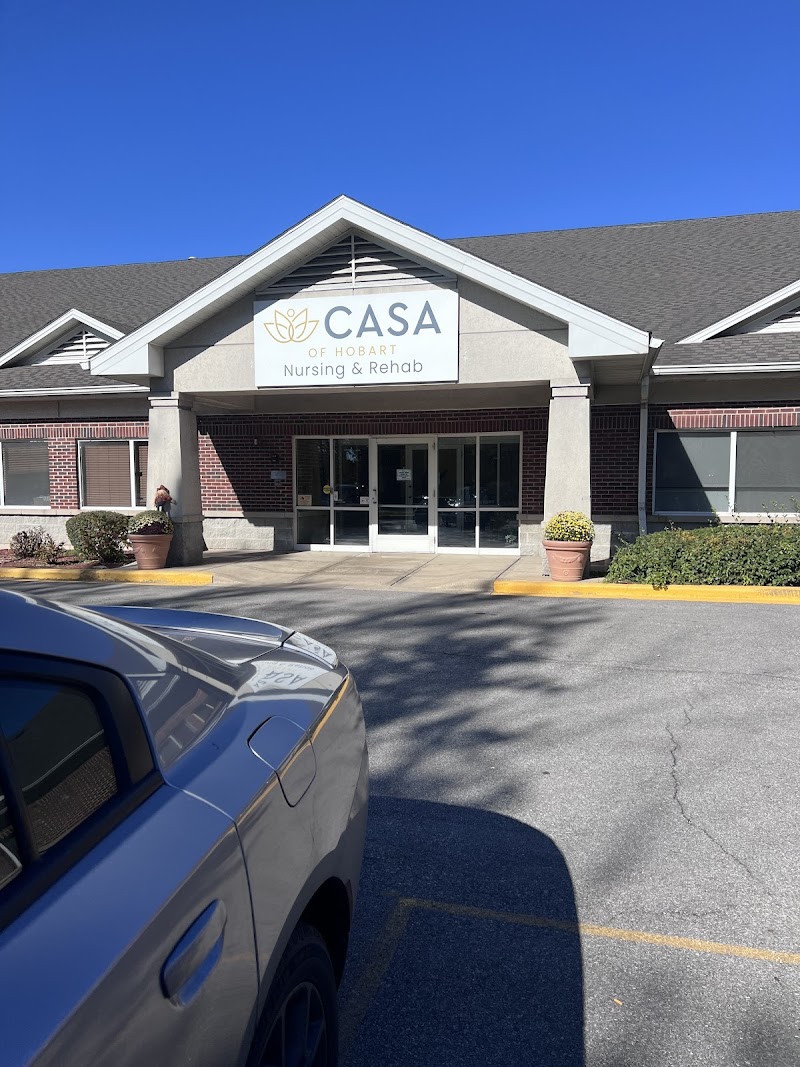
CASA OF HOBART

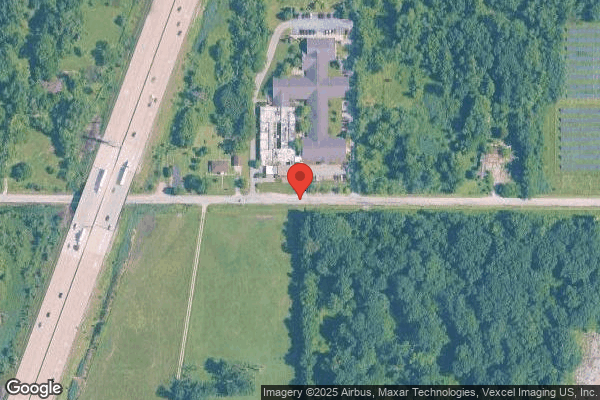
4410 W 49TH AVE, HOBART, IN 46342 (219) 947-1507
Government - County 138 Beds CASA CONSULTING Data: November 2025 1 Immediate Jeopardy citation
Trust Grade
1/100
#439 of 505 in IN
Last Inspection: January 2025

Within standard 12-15 month inspection cycle. Federal law requires annual inspections.

Overview

Casa of Hobart has received a Trust Grade of F, indicating poor performance and significant concerns regarding care quality. With a state rank of #439 out of 505, it falls in the bottom half of Indiana facilities, and at #10 out of 20 in Lake County, only one local option ranks lower. The facility is worsening, with issues increasing from 23 in 2024 to 25 in 2025. Staffing is a notable concern, with a low rating of 1 out of 5 stars and a turnover rate of 54%, which is similar to the state average but still indicates instability. Additionally, the facility has incurred $14,433 in fines, which is higher than 83% of Indiana facilities, raising questions about compliance. Specific incidents highlight serious care deficiencies, including a resident who died due to improper positioning during a tube feeding, leading to labored breathing and unresponsiveness. Another resident developed a serious pressure ulcer due to inadequate care, necessitating surgical intervention. While the facility does have some RN coverage, it is less than 91% of Indiana facilities, potentially compromising resident care. Overall, families should be cautious when considering this nursing home due to its significant weaknesses and troubling incidents.

Trust Score
F
1/100
In Indiana
#439/505
Bottom 14%
Safety Record
High Risk
Review needed
Inspections
Getting Worse
23 → 25 violations
Staff Stability
⚠ Watch
54% turnover. Above average. Higher turnover means staff may not know residents' routines.
Penalties
✓ Good
$14,433 in fines. Lower than most Indiana facilities. Relatively clean record.
Skilled Nurses
⚠ Watch
Each resident gets only 20 minutes of Registered Nurse (RN) attention daily — below average for Indiana. Fewer RN minutes means fewer trained eyes watching for problems.
Violations
⚠ Watch
101 deficiencies on record. Higher than average. Multiple issues found across inspections.
★☆☆☆☆
1.0
Overall Rating
★☆☆☆☆
1.0
Staff Levels
★★☆☆☆
2.0
Care Quality
★☆☆☆☆
1.0
Inspection Score
Stable
2024: 23 issues
2025: 25 issues

The Good

  • Full Sprinkler Coverage · Fire safety systems throughout facility
  • No fines on record

Facility shows strength in fire safety.

The Bad

1-Star Overall Rating

Below Indiana average (3.1)

Significant quality concerns identified by CMS

Staff Turnover: 54%

Near Indiana avg (46%)

Higher turnover may affect care consistency

Federal Fines: $14,433

Below median ($33,413)

Minor penalties assessed

Chain: CASA CONSULTING

Part of a multi-facility chain

Ask about local staffing decisions and management

The Ugly 101 deficiencies on record

1 life-threatening 1 actual harm
Jun 2025 2 deficiencies
CONCERN (D) 📢 Someone Reported This

A family member, employee, or ombudsman was alarmed enough to file a formal complaint

Potential for Harm - no one hurt, but risky conditions existed

ADL Care (Tag F0677)

Could have caused harm · This affected 1 resident

Based on record review and interview, the facility failed to ensure activities of daily living (ADLs) were completed for dependent residents related to showers for 2 of 3 residents reviewed for ADLs. ...

Read full inspector narrative →
Based on record review and interview, the facility failed to ensure activities of daily living (ADLs) were completed for dependent residents related to showers for 2 of 3 residents reviewed for ADLs. (Residents D and B) Findings include: 1. The record for Resident D was reviewed on 6/17/25 at 10:11 a.m. Diagnoses included, but were not limited to epilepsy, psychotic disorder with delusions, high blood pressure, and alcohol dementia. The Quarterly 5/15/25 Minimum Data Set (MDS) assessment indicated the resident was not cognitively intact for daily decision making and was dependent on staff for bathing. The Care Plan, revised on 2/13/24, indicated the resident required assistance with ADLs. The showers in the CNA Task Section indicated the resident was to receive a shower on Wednesday and Saturday evenings. The resident did not receive a shower on 4/2, 4/5, 5/17, 5/28, and 6/7/25. During an interview on 6/17/25 at 11:55 a.m., the Director of Nursing indicated the resident was to receive at least two showers a week. 2. Resident B's record was reviewed on 6/17/25 at 9:05 a.m. The diagnoses included, but were not limited to, osteomyelitis (infection of bone and muscle), diabetes, COPD, asthma, and hypertension (high blood pressure). The 4/9/25 admission Minimum Data Set (MDS) assessment indicated the resident was cognitively intact for daily decision making and was dependent on staff for bathing, toileting, personally hygiene and oral hygiene. The Care Plan, dated 4/9/25, indicated the resident required assistance with ADLs including bathing. Interventions were to assist with bathing as needed, offer a shower at least 2 times daily, and offer a full/partial bed bath on non-shower days or refusals. The shower documentation in the CNA Task Section indicated the resident did not receive a shower on the following dates. 4/15/25 4/16/25 4/17/25 4/18/25 4/19/25 4/20/25 4/26/25 4/27/25 4/28/25 4/29/25 4/30/25 5/1/25 5/2/25 5/6/25 5/7/25 5/8/25 5/9/25 5/10/25 5/11/25 There were no documented refusals or offered attempts on the missed showers dates. During an interview on 6/17/25 at 11:48 a.m., the Nurse Consultant indicated she understood the concern and there were no shower sheets for the resident. During an interview on 6/17/25 at 11:55 a.m., the Director of Nursing (DON) indicated the resident was to receive at least two showers a week. This Citation relates to Complaint IN00460159. 3.1-38(a)(2)(A)
CONCERN (D) 📢 Someone Reported This

A family member, employee, or ombudsman was alarmed enough to file a formal complaint

Potential for Harm - no one hurt, but risky conditions existed

Infection Control (Tag F0880)

Could have caused harm · This affected 1 resident

Based on observation, interview, and record review, the facility failed to ensure infection control practices were in place and implemented related to the opening of a medication capsule without glove...

Read full inspector narrative →
Based on observation, interview, and record review, the facility failed to ensure infection control practices were in place and implemented related to the opening of a medication capsule without gloves during medication administration for a random observation for infection control. Finding includes: On 6/16/25 at 12:07 p.m., medication administration was observed with LPN 1 for Resident G. The resident received his medication crushed. LPN 1 opened a Gabapentin (given for nerve pain or anticonvulsant) 300 mg capsule with her bare hands and emptied the powder contents inside the medication cup with another crushed medication. During an interview on 6/16/25 at 12:17 p.m., the Assistant Director of Nursing (ADON) indicated she understood the concern and had no further information to provide. During an interview on 6/16/25 at 1:10 p.m., the Director of Nursing (DON) indicated she understood the concern and would re-educate the staff. She indicated LPN 1 thought it was okay to touch the outside capsule since she did not touch the inside contents. This Citation relates to Complaint IN00460159. 3.1-18(b)
May 2025 6 deficiencies
CONCERN (D) 📢 Someone Reported This

A family member, employee, or ombudsman was alarmed enough to file a formal complaint

Potential for Harm - no one hurt, but risky conditions existed

Notification of Changes (Tag F0580)

Could have caused harm · This affected 1 resident

Based on record review and interview, the facility failed to ensure the resident's physician was notified of medication being held for 1 of 1 resident reviewed for notification of change. (Resident T)...

Read full inspector narrative →
Based on record review and interview, the facility failed to ensure the resident's physician was notified of medication being held for 1 of 1 resident reviewed for notification of change. (Resident T) Finding includes: The record for Resident T was reviewed on 5/14/23 at 12:33 p.m. Diagnoses included, but were not limited to, kidney failure, hypotension (low blood pressure), and heart failure. The admission Minimum Data Set (MDS) assessment, dated 3/31/25, indicated the resident was cognitively intact for daily decision making. A Physician's Order, dated 3/25/25, indicated the resident was to receive Midodrine (medication that increases blood pressure) 5 milligrams (mg) three times a day for hypotension. A Nurses Note, dated 5/2/25 at 8:10 a.m., indicated a medication administration note documented a blood pressure (BP) of 156/86. A Nurses Note, dated 5/2/25 at 1:14 p.m., indicated a medication administration note documented a blood pressure of 155/92. A Nurses Note, dated 5/12/25 at 9:07 a.m., indicated a medication administration note documented a blood pressure of 156/86. The Medication Administration Record (MAR) indicated Midodrine was held on the following dates: 5/2/25 - am dose held 5/2/25 - mid day dose held 5/12/25 - am dose held There was no documentation of the resident's physician being notified the medication was held on 5/2/25 and 5/12/25. During an interview on 5/12/25 at 2:13 p.m., during a medication pass observation, RN 1 indicated the resident's BP was 112/74 and she was unsure if she was going to give the medication. She was debating whether or not she should hold the dose because the medication did not have parameters. She indicated she held Resident T's Midodrine pill that morning because his BP was in the 150s. During an interview on 5/13/25 at 3:51 p.m., the DON indicated she understood the concern and had no additional information to provide. 3.1-5(a)(2)
CONCERN (D) 📢 Someone Reported This

A family member, employee, or ombudsman was alarmed enough to file a formal complaint

Potential for Harm - no one hurt, but risky conditions existed

ADL Care (Tag F0677)

Could have caused harm · This affected 1 resident

Based on observation, record review and interview, the facility failed to assist a dependent resident with incontinent care in a timely manner related to a delay in answering the call light for 1 of 5...

Read full inspector narrative →
Based on observation, record review and interview, the facility failed to assist a dependent resident with incontinent care in a timely manner related to a delay in answering the call light for 1 of 5 residents reviewed for activities of daily living (ADLs). (Resident J) Finding includes: During an observation on 5/12/25 at 5:15 a.m., the call light for Resident J's room was activated. At 5:47 a.m., the Director of Nursing (DON) responded to the call light and indicated Resident J had reported he had a bowel movement and needed care. At 5:49 a.m., CNA 2 entered the resident's room and began care. The resident had been incontinent of bowel. Resident J's record was reviewed on 5/14/25 at 8:04 a.m. The diagnoses included, but were not limited to, end stage renal disease with dialysis required and stroke. A Care Plan, dated 1/31/25, indicated there was a risk for skin breakdown. The intervention included assistance with incontinent care would be provided. A Quarterly Minimum Data Set (MDS) assessment, dated 3/14/25, indicated a moderately impaired cognitive status and was dependent for toileting, dressing, bathing, hygiene, and transfers, and was always incontinent of bowel and bladder. During an interview on 5/13/25 at 4:30 p.m., the Director of Nursing indicated care was provided soon after the call light was answered. She had no further information to provide after being informed what time the call light was activated and the length of time until it was answered. This citation relates to Complaints IN00457998 and IN00458693. 3.1-38(a)(3)
CONCERN (D) 📢 Someone Reported This

A family member, employee, or ombudsman was alarmed enough to file a formal complaint

Potential for Harm - no one hurt, but risky conditions existed

Quality of Care (Tag F0684)

Could have caused harm · This affected 1 resident

Based on record review and interview, the facility failed to ensure residents received appropriate treatment and care to meet their needs related to blood sugars not monitored, insulin not administere...

Read full inspector narrative →
Based on record review and interview, the facility failed to ensure residents received appropriate treatment and care to meet their needs related to blood sugars not monitored, insulin not administered, treatment not given for a low blood sugar, and a blood pressure medication not held as ordered for low blood pressure for 3 of 3 residents reviewed for medications/diabetic care. (Residents D, K, and L) Findings include: 1. Resident D's record was reviewed on 5/12/25 at 10:51 a.m. The diagnoses included, but were not limited to, diabetes mellitus. A Care Plan, dated 6/19/24, indicated a risk for complications related to insulin depended diabetes mellitus. The interventions included, signs and symptoms of hyperglycemia and hypoglycemia were to be monitored. A Physician's Order, dated 11/22/24, indicated the blood sugar (BS) level was to be checked at 8 a.m. and 8 p.m. The physician was to be notified if the BS was below 70 or above 400. A Physician's Order, dated 11/22/24, indicated lantus insulin 35 units was to be administered two times a day for diabetes mellitus. A Physician's Order, dated 1/24/25, indicated novolog insulin 18 units was to be administered three times a day for diabetes mellitus. The novolog was not to be given if the blood sugar was less than 100 and the physician was to be notified. A Quarterly Minimum Data Set (MDS) assessment, dated 3/8/25, indicated an moderately intact cognitive status, received an insulin injection daily in the past seven days and received a hypoglycemic medication. The Medication Administration Record (MAR), dated March 2025, indicated the lantus insulin was to be administered in the a.m. and at HS (bedtime). Documentation indicated the following blood sugars, lantus insulin and physician notification status: - 3/19/25: the a.m. dose had no blood sugar result documented and was marked as out of parameters and insulin was not given. - 3/29/25: the HS blood sugar result was 121 and was marked as out of parameters and the insulin was not given. There were no Nurses' Progress Notes dated March 19 and 29, 2025 that indicated why the blood sugar had not been done and why the insulin had not been given. The MAR, dated March 2025, indicated the novolog insulin was to given in the a.m., mid-day (MD), and HS. Documentation indicated the following blood sugars, novolog insulin and physician notification status: - 3/15/25 at MD: there was no blood sugar result documented and no insulin was administered. There was no Nurses' Progress Notes, that indicated the reason for the insulin not being administered. - 3/19/25 at MD: there was no blood sugar result and no insulin administered. There was no documentation in the Nurses' Progress Notes. - 3/19/25 at HS: the blood sugar was 85, the insulin was held, and there were no Nurses' Progress Notes that indicated the physician had been notified. - 3/24/25 at HS: the blood sugar was 100 and the insulin had not been administered. There were no Nurses' Progress Notes that indicated why the insulin had not been given. - 3/25/25 at MD: there was no blood sugar result documented and the insulin had not been administered. There were no Nurses' Progress Notes that indicated why the insulin had not been given. - 3/26/25 at MD: there was no blood sugar result documented and the insulin had not been administered. There were no Nurses' Progress Notes that indicated why the insulin had not been given. - 3/27/25 at MD: the blood sugar was 116. The insulin had not been administered and was marked as out of parameters. - 3/27/25 at HS: the blood sugar was 76, the insulin had not been administered. There was no documentation the Physician had been notified. - 3/28/25 at MD: there was no blood sugar result documented and the insulin had not been administered. There were no Nurses' Progress Notes that indicated why the insulin had not been given. - 3/29/25 at HS: the blood sugar was 121. The insulin had not been given and was marked out of parameter. The Medication Administration Record (MAR), dated April 2025, indicated the lantus insulin was to administered in the a.m. and HS. Documentation indicated the following blood sugars, insulin and physician notification status: - 4/17/ at HS: the blood sugar level was 97 and the insulin was not marked as administered. - 4/21/25 at HS: the blood sugar level was 90 and insulin had not been administered and marked out of parameters. - 4/28/25 at HS: the blood sugar level was not documented and the insulin had not been given. There were no Nurses' Progress Notes that indicated why the insulin had not been administered. The Medication Administration Record (MAR), dated April 2025, indicated the novolog insulin was to given in the a.m., mid-day (MD), and HS. Documentation indicated the following blood sugars, insulin and physician notification status: - 4/1/25 at HS: the blood sugar result was not documented and the insulin had not been given due to out of parameters. There was no documentation the physician had been notified. - 4/2/25 at MD: there was no blood sugar result documented and no insulin administered. There was no documentation in the Nurses' Progress Notes that indicated why the insulin had not been administered. - 4/6/25 at MD & HS: there was no blood sugar documented and insulin was not administered. It was marked out of parameters. - 4/7/25 at MD: the blood sugar was 96 and the insulin was not administered and was marked out of parameters. There was documentation that indicated the physician had been notified. - 4/10/25 at MD: the blood sugar was 65 and the insulin had not been administered. There was no documentation the low blood sugar had been treated, rechecked, and the physician had been notified. - 4/14/25 at MD: the blood sugar result had not been documented and the insulin had not been given. There was no documentation in the Nurses' Progress Notes why the insulin had not been administered. - 4/17/25 at MD: the blood sugar result had not been documented and the insulin had not been given. There was no documentation in the Nurses' Progress Notes why the insulin had not been administered. - 4/17/25 at HS: the blood sugar level was 97 and the insulin was not marked as administered. There was no documentation the physician had been notified. - 4/18/25 at MD: the blood sugar result had not been documented and the insulin had not been given and was marked out of parameters. There was no documentation in the Nurses' Progress Notes why the insulin had not been administered. - 4/21/25 at HS: the blood sugar was 90. The insulin had not been administered. There was no documentation that indicated the physician had been notified. - 4/26/25 at MD: the blood sugar was 101. The insulin had not been administered. There was no documentation that indicated why the insulin had not been administered. - 4/28/25 at HS: the blood sugar was not documented and the insulin had not been given. There were no Nurses' Progress Notes that indicated why the insulin had not been administered. The MAR, dated May 2025, indicated the following: - 5/5/25 at HS: the blood sugar was 140 and the insulin had not been administered. It was marked out of parameters. - 5/6/25 at HS: the blood sugar was 140 and the insulin had not been administered. It was marked out of parameters. - 5/10/25 at MD: the blood sugar result was not documented and the insulin had not been given. There were no Nurses' Progress Note that indicated why the insulin had not been administered. During an interview on 5/13/25 at 11:42 a.m., the Director of Nursing (DON) acknowledged the missing blood sugar results, the insulin not administered as ordered, the physician not notified and a lack of treatment for a low blood sugar. An undated facility guideline for hypoglycemia, received as current from the DON as current on 5/13/25 at 12:00 p.m., indicated the physician was to be contacted if the blood sugar was below 60 unless there were specific call parameters. The findings, interventions, and physician contact was to be documented in the clinical record 2. Resident K's record was reviewed on 5/14/25 at 8:25 a.m. The diagnoses included, but were not limited to, diabetes mellitus. A Care Plan, dated 11/1/24, indicated a risk for complications related to diabetes mellitus. The interventions included medications would be administered as ordered and blood sugars would be checked as ordered. A Physician's Order, dated 3/11/25, indicated Aspart insulin was to be administered three times a day after the blood sugar level was checked. The amount of insulin administered depended on the results of the blood sugar (sliding scale). The blood sugar was to be checked three times a day and the physician was to be notified for a blood sugar level over 400. A Quarterly Minimum Data Set (MDS) assessment, dated 3/26/25, indicated an intact cognition, received and received insulin for 5 days. The MAR, dated April 2025, indicated the midday (MD) blood sugars were not checked on April 2, 9, 17, 18, and 21, 2025 and there was no insulin administered. There was no documentation in the Nurses' Progress Notes that indicated why the insulin had not been given. During an interview on 5/14/25 at 10:40 a.m., the DON acknowledged there were no blood sugars obtained and the insulin had not been given. 3. Resident L's record was reviewed on 5/14/25 at 10:13 a.m. The diagnoses included, but were not limited to, hypotension. A Physician's Order, dated 10/25/24, indicated sacubitril-valsartan 24-26 mg (milligrams) (treatment of chronic heart failure), one tablet two times a day. Hold if the blood pressure was less than 110. The Medication Administration Record (MAR), dated April 2025, indicated on April 10, 2025 at 8 a.m., the blood pressure was 106/66 and the sacubitril-valsartan was administered. On April 11, 2025 at 8 p.m., the blood pressure was 104/64 and the sacubitril-valsartan was administered. The MAR, dated May 2025, indicated on May 3, 2025, the blood pressure was 103/63 at 8 a.m. and the sacubitril-valsartan was administered. On May 7, 2025, the blood pressure was 102/70 at 8 a.m. and the sacubitril-valsartan was administered. During an interview on 5/14/25 at 12:27 p.m., the DON indicated the medication should not have been administered. A medication administration policy, dated 11/3/14 and received from the DON as current, indicated medications were to be administered in accordance with the written orders of the prescriber. This citation relates to Complaints IN00458519 and IN00458693. 3.1-37(a)
CONCERN (D) 📢 Someone Reported This

A family member, employee, or ombudsman was alarmed enough to file a formal complaint

Potential for Harm - no one hurt, but risky conditions existed

Deficiency F0761 (Tag F0761)

Could have caused harm · This affected 1 resident

Based on observation and interview, the facility failed to ensure medications were properly labeled and stored for 1 of 3 medication carts observed. (Cherry Lane medication cart). Finding includes: On...

Read full inspector narrative →
Based on observation and interview, the facility failed to ensure medications were properly labeled and stored for 1 of 3 medication carts observed. (Cherry Lane medication cart). Finding includes: On 5/12/25 at 2:15 p.m., the Cherry Lane Medication Cart was observed with RN 1. The following medications were not labeled or stored properly: a. There were 9 Albuterol sulfate inhalation packets that were stored in the bottom drawer; there was no label on any of the 9 packets. During an interview at the time, RN 1 indicated she did not know to which residents the Albuterol packets belonged. b. There were 2 inhalers in the top drawer that had no name or label. c. There was an inhaler in the top drawer with Resident U's name and room number listed, but there were no administration instructions. d. There was an Albuterol Sulfate Inhalation packet in the top drawer with no label. During an interview at the time, RN 1 indicated she was unsure why the medications were not labeled because the medication cart had been audited recently. During an interview on 5/12/25 at 2:30 p.m., the Director of Nursing (DON) indicated the pharmacy had just audited all of the medication carts. She understood the concern and had no further information to provide. This citation relates to Complaint IN00456268. 3.1-25(j)
CONCERN (D) 📢 Someone Reported This

A family member, employee, or ombudsman was alarmed enough to file a formal complaint

Potential for Harm - no one hurt, but risky conditions existed

Deficiency F0773 (Tag F0773)

Could have caused harm · This affected 1 resident

Based on record review and interview, the facility failed to ensure a urinalysis (UA) was collected as ordered for 1 of 1 resident reviewed for infections. (Resident M) Finding includes: The record fo...

Read full inspector narrative →
Based on record review and interview, the facility failed to ensure a urinalysis (UA) was collected as ordered for 1 of 1 resident reviewed for infections. (Resident M) Finding includes: The record for Resident M was reviewed on 5/13/25 at 11:17 a.m. The diagnoses included, but were not limited to, cellulitis, diabetes, and heart failure. The Quarterly Minimum Data Set (MDS) assessment, dated 3/5/25, indicated the resident was cognitively intact for daily decision making. A Nurse's Note, dated 4/27/25 at 11:30 p.m., indicated the Resident's daughter had called and explained her mother was confused and thought she had to go to work. The resident's daughter indicated she believed she had a urinary tract infection (UTI). A Nurse's Note, dated 4/28/25 at 10:19 a.m., indicated the resident was exhibiting increased intermittent confusion. Labs and a UA were ordered. A Physician's Order, dated 4/29/25, indicated to obtain a urinalysis related to altered mental status. A Physician's Order, dated 5/1/25, indicated to obtain a lab urinalysis with reflex culture for increased confusion. A Nurse's Note, dated 5/1/25 at 3:30 p.m., indicated the resident was educated on the need for a urine sample. The resident refused a straight cath but was agreeable to use bedpan when able. A Nurse's Note, dated 5/1/25 at 6:01 p.m., indicated the UA attempt was unsuccessful due to a bedpan spill. A Nurse's Note, dated 5/1/25 at 9:42 p.m., indicated the resident refused to have a straight cath performed to obtain a urine sample. A Nurse's Note, dated 5/2/25 at 10:28 p.m., indicated the writer notified the physician of the resident's refusal of a straight cath. A Nurses Note, dated 5/8/25 at 7:04 p.m., indicated the resident was admitted to the hospital with a primary diagnosis of acute cystitis. There were no further documented attempts, refusals or notifications related to obtaining a urine sample from 4/28 - 5/1/25 and from 5/3 - 5/8/25. During an interview on 5/13/25 at 3:51 p.m., the Director of Nursing (DON) indicated Resident M's refusals were not well documented, and she did not document the education she provided to Resident M. She understood the concern and had no additional information to provide. This citation relates to Complaint IN00459297. 3.1-49(f)(1)
CONCERN (E) 📢 Someone Reported This

A family member, employee, or ombudsman was alarmed enough to file a formal complaint

Potential for Harm - no one hurt, but risky conditions existed

Infection Control (Tag F0880)

Could have caused harm · This affected multiple residents

Based on observation, record review, and interview, the facility failed to provide a safe and sanitary environment to help prevent the potential for transmission of communicable diseases and infection...

Read full inspector narrative →
Based on observation, record review, and interview, the facility failed to provide a safe and sanitary environment to help prevent the potential for transmission of communicable diseases and infections related to a glucometer (blood sugar monitor) not sanitized after it was used for 1 of 2 glucometer tests observed. (LPN 3, Resident S) This had the potential to affect 5 residents with glucometer orders assigned to the nurse. The facility also failed to ensure correct Personal Protective Equipment (PPE) was used by a staff member (CNA 4) when providing care to a resident (Resident F) who was in Enhanced Barrier Precautions (EBP) for 1 random observation for infection control. Findings include: 1. During an observation on 5/12/25 at 8:07 a.m., LPN 3, entered Resident S's room and performed a glucometer test. After the test was completed, LPN 3 removed her gloves and exited the room and placed the glucometer in the top drawer of the medication cart with sanitizing the monitor. During an interview on 5/12/25 at 8:15 a.m., LPN 3 indicated the glucometer was to be sanitized after each use. A facility glucometer cleaning policy, dated 9/1/20, and received from the Director of Nursing (DON) as current, indicated the glucometer was to be cleaned and disinfected between each resident test. 2. During an observation on 5/12/25 at 4:25 a.m., CNA 4 entered Resident F's room to provide care. There was a sign on the resident's room door that indicated EBP was required. CNA 4 indicated the resident was in need of incontinence care due to having had a bowel movement. She donned gloves. When CNA 4 was asked which resident in the room required EBP, she indicated she was unsure and continued to provide incontinence care to Resident F without the required PPE of a gown. Resident F's record was reviewed on 5/13/25 at 11:08 a.m. The diagnoses included, but were not limited to, end stage renal disease and dialysis. An Annual Minimum Data Set (MDS) assessment, dated 3/7/25, indicated an intact cognitive status, required moderate assistance with toileting, dressing, hygiene, and bed mobility and maximum assistance with bathing and transfers. She was always incontinent of bowel and bladder and was receiving dialysis. A Care Plan, dated 3/31/25, indicated hemodialysis was required. The interventions included to check the dialysis access site and EBP was to be utilized. A Physician's Order, dated 4/30/25, indicated EBP was required related to dialysis. The interventions included an EBP sign would be posted outside of the room and a gown and gloves were required for high contact resident care activities. The Director of Nursing (DON) was informed of the above observation on 5/12/25 at approximately 6:30 a.m. and had no further information to provide. A facility EBP protocol, undated, received from the DON as current, and reviewed on 5/12/25 at 3:00 p.m., indicated EBP was required with dressing or bathing and other high-contact resident care activities. 3.1-18(b)
Jan 2025 17 deficiencies
CONCERN (D)

Potential for Harm - no one hurt, but risky conditions existed

Deficiency F0554 (Tag F0554)

Could have caused harm · This affected 1 resident

Based on observation, record review, and interview, the facility failed to ensure a resident was assessed to self-administer medications and had Physician's Orders to self-administer for 1 of 1 reside...

Read full inspector narrative →
Based on observation, record review, and interview, the facility failed to ensure a resident was assessed to self-administer medications and had Physician's Orders to self-administer for 1 of 1 resident reviewed for self-administration of medication. (Resident G) Finding includes: During random observations on 1/21/25 at 11:28 a.m. and 2:56 p.m., on 1/22/25 at 9:45 a.m., 1:31 p.m. and 3:10 p.m., and on 1/23/25 at 5:45 a.m., an Albuterol hand-held inhaler was observed on Resident G's over bed table. During an interview on 1/21/25 at 11:30 a.m., the resident indicated she used the inhaler for rescue breathing at least daily. The record for Resident G was reviewed on 1/22/25 at 4:23 p.m. Diagnoses included, but were not limited to COPD (Chronic Obstructive Pulmonary Disease), acute respiratory failure, Alzheimer's disease, anxiety disorder, high blood pressure, and bipolar disorder. The 11/14/24 Quarterly Minimum Data Set (MDS) assessment indicated the resident was cognitively intact for daily decision making. The resident's vision was adequate and she wore glasses. A Care Plan, revised on 5/14/24, indicated the resident was at risk for complications including shortness of breath experienced while lying flat and upon exertion secondary to COPD. The approaches were to administer aerosol or bronchodilators as ordered. A Physician's Order, dated 8/19/24, indicated Albuterol Sulfate HFA Inhalation Aerosol Solution 108, administer inhale one puff orally every 6 hours as needed for wheezing. There was no self-administration assessment or a physician's order for the resident to self-administer her own inhaler. During an interview on 1/23/25 at 10:05 a.m., the Director of Nursing had no additional information to provide. The current 2/15/21 Self-Administration of Medications-Clinically Appropriate policy, provided by Nurse Consultant 1 on 1/23/25 at 11:45 a.m., indicated a resident may only self-administer medications after the IDT has determined which medications may be self-administered. The IDT will determine at a minimum if the resident had the capacity to follow directions, the resident's cognitive status was evaluated, and the resident's ability to understand and store medication securely. 3.1-11(a)
CONCERN (D)

Potential for Harm - no one hurt, but risky conditions existed

Deficiency F0583 (Tag F0583)

Could have caused harm · This affected 1 resident

Based on observation and interview, the facility failed to ensure a resident's privacy was maintained related to a Nurse Practitioner (NP) completing an assessment of a peg tube (a tube inserted direc...

Read full inspector narrative →
Based on observation and interview, the facility failed to ensure a resident's privacy was maintained related to a Nurse Practitioner (NP) completing an assessment of a peg tube (a tube inserted directly into the stomach for nutrition) in a common area for 1 of 1 resident reviewed for tube feeding. (Resident C) Finding includes: During a random observation on 1/28/25 at 11:34 a.m., a CNA removed Resident C from the dining room when the lunch trays had arrived, due to the resident being NPO (nothing my mouth). The resident was placed in the hallway right outside of the room. At that time, an NP entered the memory care unit and asked the Infection Prevention Nurse for a pair of gloves. The NP donned the pair of gloves and lifted up the resident's shirt to observe the peg tube (a tube inserted directly into the stomach for nutrition) in the middle of the hallway. She did not take the resident to a private area to make her assessments. The resident's stomach and peg tube were exposed for all to see. The record for Resident C was reviewed on 1/27/25 at 2:03 p.m Diagnoses included, but were not limited to, peg tube, falls, dysphagia (difficulty swallowing), type 2 diabetes, palliative care, Parkinson's disease, psychotic disorder, severe dementia with agitation, high blood pressure, restlessness and agitation. The 12/24/25 Significant Change Minimum Data Set (MDS) assessment indicated the resident was not cognitively intact for daily decision making and was dependent on staff for most of his activities of daily living, including bathing. The resident had a feeding tube and received 51% or more of his nutrition through the tube and 501 cubic centimeters (cc) of fluids through the tube. During an interview on 1/28/25 at 11:50 a.m., the NP had no additional information to provide. During an interview on 1/28/25 at 4:15 p.m., the Director of Nursing indicated she had called the NP's physician supervisor and informed him of her concerns. She had no additional information to provide. 3.1-3(p)(4)
CONCERN (D)

Potential for Harm - no one hurt, but risky conditions existed

Grievances (Tag F0585)

Could have caused harm · This affected 1 resident

Based on record review, and interview, the facility failed to file a grievance form, thoroughly investigate, and resolve grievances for missing personal items that were reported to staff for 1 of 1 re...

Read full inspector narrative →
Based on record review, and interview, the facility failed to file a grievance form, thoroughly investigate, and resolve grievances for missing personal items that were reported to staff for 1 of 1 resident reviewed for grievances. (Resident 23) Finding includes: During an interview on 1/21/25 at 9:52 a.m., Resident 23 indicated she was missing a teal blue outfit and had told many people about the issue. The outfit had been missing for over 2 months and nothing was done about it. On 1/27/25 at 10:23 a.m., The resident was observed in her wheelchair watching she television. She indicated she had not filed a grievance for the missing clothing. She indicated she spoke with laundry staff and she had no follow up. The record for Resident 23 was reviewed on 1/27/25 at 10:00 a.m. Diagnoses included, but were not limited to, hemiplegia (paralysis on one side of the body), hypertension (high blood pressure), depression, anemia (low iron), and stroke. The Quarterly Minimum Data Set (MDS) assessment, dated 10/27/24, indicated the resident was cognitively intact. The resident had impairment on one side of the upper and lower extremity and used a wheelchair. There was no grievance/concern form filed for the resident's first missing clothing. During an interview on 1/27/25 at 2:48 p.m., Laundry Aide 1 indicated she was aware of the missing teal outfit. She indicated she had personally labeled the outfit and knew exactly what was missing. She had not been able to locate the clothing for a while and had not filed a grievance to replace the resident's personal belongings. During an interview on 1/28/25 at 9:51 a.m., the Director of Nursing (DON) indicated she understood a grievance should have been filed for the missing items. 3.1-7(a)(2)
CONCERN (D)

Potential for Harm - no one hurt, but risky conditions existed

Deficiency F0657 (Tag F0657)

Could have caused harm · This affected 1 resident

Based on record review and interview, the facility failed to ensure residents were involved in decisions about their care related to informing them of new medications for 1 of 7 residents reviewed for...

Read full inspector narrative →
Based on record review and interview, the facility failed to ensure residents were involved in decisions about their care related to informing them of new medications for 1 of 7 residents reviewed for participation in care planning. (Resident D) Finding includes: During an interview on 1/21/25 at 2:49 p.m., Resident D indicated the staff did not always tell or inform him of new medications or new physician's orders. The record for Resident D was reviewed on 1/22/25 at 4:10 p.m. Diagnoses included, but were not limited to, acute respiratory failure, COPD (Chronic Obstructive Pulmonary Disease) type 2 diabetes mellitus (DM), heart failure, high blood pressure, chronic kidney disease, osteoarthritis, and depression. The 12/2/24 Quarterly Minimum Data Set (MDS) assessment indicated the resident was cognitively intact for daily decision making and needed substantial to maximal assistance with bathing and/or showering. A Physician's Order, dated 12/4/24, indicated Amlodipine 10 milligrams (mg), give one tablet in the morning for high blood pressure. Physician's Orders, dated 1/9/25, indicated Losartan Potassium Oral Tablet 100 mg, give one tablet in the morning for high blood pressure and Tamiflu Oral Capsule 75 mg, give one capsule one time a day for 14 days for prophylactic for the flu. There was no documentation in the clinical record the resident was made aware of the new medication regime for his high blood pressure and for the flu. During an interview on 1/27/25 at 3:30 p.m., the Unit Manager indicated the resident was to be made aware of new medications. During an interview on 1/28/25 at 4:00 p.m., the Director of Nursing indicated there was no documentation the resident was made aware of the newly ordered medications. 3.1-35(d)(2)(B)
CONCERN (D) 📢 Someone Reported This

A family member, employee, or ombudsman was alarmed enough to file a formal complaint

Potential for Harm - no one hurt, but risky conditions existed

ADL Care (Tag F0677)

Could have caused harm · This affected 1 resident

Based on observation, record review, and interview, the facility failed to ensure activities of daily living (ADLs) were completed for dependent residents related to receiving showers and assistance w...

Read full inspector narrative →
Based on observation, record review, and interview, the facility failed to ensure activities of daily living (ADLs) were completed for dependent residents related to receiving showers and assistance with eating for 3 of 9 residents reviewed for ADLs. (Residents D, C, and E) Findings include: 1. During an interview on 1/21/25 at 2:44 p.m., Resident D indicated he was not getting showers on Saturdays. He indicated his showers were supposed to be Wednesdays and Saturdays in the evening time. The record for Resident D was reviewed on 1/22/25 at 4:10 p.m. Diagnoses included, but were not limited to, acute respiratory failure, COPD (Chronic Obstructive Pulmonary Disease) type 2 dm, heart failure, high blood pressure, chronic kidney disease, osteoarthritis, and depression. The 12/2/24 Quarterly Minimum Data Set (MDS) assessment indicated the resident was cognitively intact for daily decision making and needed substantial to maximal assistance with bathing and/or showering. The resident did not receive a shower at least two times a week for the months of 10/2024, 11/2024, and 1/2025. There was no shower or completed bed bath documented on 10/1/24, 11/20/24, 1/4/25, 1/8/25, 1/15/25, and 1/25/25. During an interview on 1/28/25 at 4:15 p.m., the Unit Manager indicated the resident should have a shower at least two times a week. 2. The record for Resident C was reviewed on 1/27/25 at 2:03 p.m Diagnoses included, but were not limited to, peg tube, falls, dysphagia (difficulty swallowing), type 2 diabetes, palliative care, Parkinson's disease, psychotic disorder, severe dementia with agitation, high blood pressure, restlessness and agitation. The 12/24/25 Significant Change Minimum Data Set (MDS) assessment indicated the resident was not cognitively intact for daily decision making and was dependent on staff for most of his activities of daily living, including bathing. A Care Plan, revised on 1/14/25, indicated the resident required assistance with ADLs due to dementia. The resident was to receive a shower on Wednesdays and Saturdays evenings. There was no shower documented at least 2 times a week on 11/2, 11/9, 11/13, and 1/22/25 During an interview on 1/28/25 at 4:15 p.m., the Assistant Director of Nursing indicated the resident should have least two showers a week. 3. On 1/23/25 at 8:30 a.m. and 8:48 a.m., Resident E was observed sitting up in bed and eating a bowl of cereal. The bowl was tipped in the opposite direction of the resident and milk was dripping out of the bowl onto her gown. The resident had a plastic spoon positioned backwards in her mouth and was making a gagging noise. The restorative nursing aide was walking by the resident's room and was immediately notified. During an interview at the time, Restorative CNA 1 indicated the resident was normally a set up for meals and that something must be wrong with the resident. The record was reviewed for Resident E on 1/23/25 at 10:04 a.m. Diagnoses included but were not limited to, depression, muscle weakness, age related cataract, and encephalopathy. A Quarterly Minimum Data Set (MDS) assessment, dated 10/20/24, indicated the resident was cognitively intact for daily decision making. The resident required supervision/touching assistance for eating . Oral hygiene required partial to moderate assistance, and toileting hygiene, shower/bathing, upper and lower body dressing required substantial/maximum assistance. A Care Plan, revised on 1/20/24, indicated the resident had impaired visual function related to cataracts and glaucoma. A Care Plan, revised on 1/20/24, indicated the resident required assistance with Activities of Daily Living (ADLs) including bed mobility, eating, transfers, toileting and bathing related to weakness and diagnosis of osteoarthritis. Interventions were to assist with meal consumption, eating and drinking as needed, and assist with oral and personal hygiene as needed. A Physician's Order, dated 1/22/25, indicated to administer 1 gram of Ceftriaxone (antibiotic) intravenously (IV) daily for a Urinary Tract Infection (UTI) for 10 days. Nurses' Notes, dated 1/22/2025 at 10:08 a.m., indicated the resident was experiencing increased confusion. Nurses' Notes, dated 1/21/2025 at 9:00 p.m., indicated the resident had spit out medication, had been yelling and screaming, refused meals, and refused care. The Physician was notified and new orders were received for a midline IV (intravenous) access and IV antibiotic. During an interview on 1/24/25 at 11:12 a.m., the Director of Nursing indicated the resident should have had supervised meal consumption. This citation relates to Complaints IN00450254 and IN00451800. 3.1-38(a)(3)
CONCERN (D)

Potential for Harm - no one hurt, but risky conditions existed

Quality of Care (Tag F0684)

Could have caused harm · This affected 1 resident

**NOTE- TERMS IN BRACKETS HAVE BEEN EDITED TO PROTECT CONFIDENTIALITY** Based on observation, record review, and interview, the facility failed to ensure non-pressure areas were monitored, assessed, a...

Read full inspector narrative →
**NOTE- TERMS IN BRACKETS HAVE BEEN EDITED TO PROTECT CONFIDENTIALITY** Based on observation, record review, and interview, the facility failed to ensure non-pressure areas were monitored, assessed, and bandages were changed for 1 of 1 resident reviewed for skin conditions non-pressure related, blood pressure parameters were followed for 1 of 1 resident reviewed for dialysis, and a resident was assessed and monitored post cataract surgery for 1 of 1 resident reviewed for vision and hearing. (Residents G and 82) Findings include: 1. During an interview 1/21/25 at 11:28 a.m., Resident G indicated her double vision was back and she had told the staff about it. She indicated she had cataract surgery a couple of months prior and was afraid something else was wrong. The record for Resident G was reviewed on 1/22/25 at 4:23 p.m. Diagnoses included, but were not limited to, COPD (Chronic Obstructive Pulmonary Disease), acute respiratory failure, Alzheimer's disease, anxiety disorder, high blood pressure, and bipolar disorder. The 11/14/24 Quarterly Minimum Data Set (MDS) assessment indicated the resident was cognitively intact for daily decision making. The resident's vision was adequate and she wore glasses. There was no Care Plan for vision. A referral, dated 7/11/24, indicated the resident was to schedule for cataract surgery. The appointments were made for the right eye on 8/26/24 at 12:30 p.m. and the left eye on 9/17/24 at 10:30 a.m. There was no documentation in the clinical record the resident had the cataract surgery. There were Physician's Orders, dated 9/11/24, for Prednisone eye drops and for Polytrim antibiotic eye drops post cataract surgery. There was no assessment or monitoring of the resident documented after she returned from having cataract eye surgery on 9/11/24. Physician's Orders, dated 9/18/24, indicated orders for Prednisone and Polytrim eye drops again for post cataract surgery. There was no documentation in the clinical record the resident left the facility to have cataract surgery for the other eye, nor was there an assessment or any kind of monitoring when the resident returned. During an interview on 1/27/25 at 3:30 p.m., the Unit Manager, indicated she would expect nursing staff to document in the clinical record when a resident left for an appointment and compete an assessment after the resident returned from having cataract surgery. During an interview on 1/28/25 at 4:15 p.m., the Unit Manager had no additional information to provide The current 10/1/2020 Change in Condition Assessment policy provided by the Director of Nursing (DON) on 1/29/25 at 10:45 a.m., indicated resident assessment was to be completed upon admission, re-admission, and with change in condition. When a change in resident condition was identified, the RN/LPN must complete an assessment including vital signs and any complaints of pain. Resident assessment was to documented in the resident's medical record. 2. During an observation on 1/23/25 at 6:52 a.m., Resident 82 was sitting on the side of the bed with his shirt off. There was a soiled, foul smelling bandage located on his lower back. The bandage had dried brown drainage noted and was crinkled and rolling down. There was also another clear bandage with a gauze observed just above the soiled one. There was a drainage bag filled with liquid coming from a drain under the foul smelling and soiled bandage. On 1/23/25 at 2:40 p.m., the Unit Manager was observed in the resident's room and was asked to look at the bandages on his back. She was able to lift the bandage with the drain and observed the area. There was a very strong, foul smelling odor coming from the bandage. During an interview at that time, she indicated the bandage was dirty and there was a strong odor coming from it. She was unsure if the bandage had ever been changed since he had returned with the drain. At 2:45 p.m., the Wound Nurse removed the bandage from the drain site. At that time, there was a white flange and drain observed. There was a large amount of dried brown drainage on the flange and drain. The Wound Nurse had to use several normal saline pouches and gauze pads to remove the substance that was adhered to the flange and drainage tube. The soiled gauze pad was rank and had a large amount of dried brown drainage noted. The Wound Nurse then attempted to remove the clear bandage and it took several attempts because it was adhered to the resident's back. During an interview with the Wound Nurse at that time, indicated he had never changed either one of the bandages prior to 1/23/25. The treatment was scheduled prn (as needed), so it was not on his list to do. The record for Resident 82 was reviewed on 1/23/25 at 6:17 a.m. The resident was admitted to the facility on [DATE]. Diagnoses included, but were not limited to, acute myocardial infarction, renal and perinephric abscess, renal dialysis, anemia, chronic kidney disease, depression, and, end stage renal disease. The 12/24/24 Quarterly Minimum Data Set (MDS) assessment, indicated the resident was moderately impaired for daily decision making and had an indwelling Foley catheter. A Care Plan, dated 12/9/24, indicated the resident had a drain in place due to a renal abscess. A Physician's Order, dated 1/7/25, indicated to monitor the renal abscess drain site (right accordion drain site) every shift and report any abnormalities to the doctor. May cleanse with wound cleanser or normal saline and cover the drainage site with gauze island with border. May change if soiled or may be removed as needed. The Medication Administration Records (MAR), dated 12/2024 and 1/2025, indicated the right accordion drain site (renal abscess) was not signed out as being monitored on the following days: - Day shift: 12/26 and 12/27, 1/1, 1/4, 1/5, 1/6, 1/8, 1/9, 1/10, 1/12, 1/13, and 1/20/25 - Evening shift: 12/27 and 12/29, 1/7, 1/8, 1/10, 1/16, 1/18, 1/21, 1/22/25 The right accordion drain site bandage to be changed prn was not signed out at all on the 1/2025 MAR/TAR. A Physician's Order, dated 12/10/24, indicated Midodrine (a medication to raise the blood pressure) 10 milligrams (mg), give two tablets by mouth three times a day for hypotension. Hold if systolic (top number) blood pressure was greater than 140 or Diastolic (bottom number) blood pressure was greater than 80. The 1/2025 MAR indicated the Midodrine was administered on the following days: 1/2/25 a.m. dose and the blood pressure was 128/87 1/2/25 mid day dose and the blood pressure was 145/76 1/2/25 hs (bedtime) dose and the blood pressure was 113/83 1/18/25 hs dose and the blood pressure was 127/89 1/20/25 a.m. dose and the blood pressure was 122/81 During an interview on 1/23/25 at 3:00 p.m., the Director of Nursing (DON) was made aware of the condition of the foul smelling bandage over the renal abscess area. During an interview on 1/28/24 at 4:00 p.m., the Unit Manager had no additional information to provide regarding the blood pressure medication administration. The current 9/1/2020 Skin Condition Assessment and Monitoring Pressure and Non-Pressure policy, provided by the DON as current on 1/28/25 at 5:00 p.m., indicated non-pressure skin conditions will be assessed for healing progress and signs of complications or infection weekly. Dressings which were applied to pressure ulcers, skin tears, wounds, lesions, or incisions shall include the date of the licensed nurse who performed the procedure. The dressing will be checked daily for placement, cleanliness, and signs and symptoms of infection. 3.1-37(a)
CONCERN (D) 📢 Someone Reported This

A family member, employee, or ombudsman was alarmed enough to file a formal complaint

Potential for Harm - no one hurt, but risky conditions existed

Pressure Ulcer Prevention (Tag F0686)

Could have caused harm · This affected 1 resident

**NOTE- TERMS IN BRACKETS HAVE BEEN EDITED TO PROTECT CONFIDENTIALITY** Based on record review and interview, the facility failed to ensure pressure ulcer treatments were completed as ordered and IV (...

Read full inspector narrative →
**NOTE- TERMS IN BRACKETS HAVE BEEN EDITED TO PROTECT CONFIDENTIALITY** Based on record review and interview, the facility failed to ensure pressure ulcer treatments were completed as ordered and IV (intravenous) antibiotics for a wound infection were administered as ordered for 1 of 1 resident reviewed for pressure ulcers. (Resident F) Finding includes: On 1/21/25 at 10:15 a.m., Resident F was observed lying in bed. At that time, he was observed with a PICC (peripherally inserted central catheter) in his right upper arm. There were no IV antibiotics infusing at that time. From 10:15 a.m. until 11:40 a.m., there was no IV antibiotic administered to the resident. On 1/22/25 at 9:45 .a.m., the resident was observed in bed. At that time, there was an IV antibiotic bag hanging on the pole that had already infused. The medication was Meropenem with 1/22/25 at 5:00 a.m. handwritten on the label. During a random observation on 1/23/25 at 6:55 a.m. of the medication room on the main station, there were 2 IV antibiotic bags of Vancomycin in one plastic bag that had arrived to the facility on 1/21/25. The record for Resident F was reviewed on 1/22/25 at 1:35 p.m. Diagnoses included, but were not limited to, sepsis, osteomyelitis, arthritis, anxiety, major depressive disorder, pressure ulcer, paraplegia, schizophrenia, and neuromuscular of the bladder. The 10/10/24 Quarterly Minimum Data Set (MDS) assessment indicated the resident was cognitively intact for daily decision making and had a Foley (urinary) catheter. The resident had one stage 3 (full-thickness skin loss where the underlying fatty tissue (subcutaneous fat) was visible within the wound, but the bone, tendon, or muscle was not exposed) pressure ulcer and one stage 4 pressure ulcer that were present on admission. The Care Plan, revised on 1/22/25, indicated the resident had actual skin impairments to the right and left hips and the right ischium. The approaches were to administer treatments as ordered and monitor for effectiveness. The Care Plan, dated 1/22/25, indicated the resident required IV medication and had a PICC line. The approaches were to administer IV antibiotics as ordered by the physician. The Wound Physician Notes, dated 1/20/25, indicated the resident had a Stage 3 pressure ulcer to the right hip that measured 7.5 centimeters (cm) in length by 4.7 cm in width by 0.6 in depth that was 100% granulation tissue (a new, pink or red, moist tissue that forms at the site of a wound as it heals) with undermining (a condition where tissue damage creates a pocket under the wound surface, making the wound appear larger than it actually was) of 6 cm at 3 o'clock. There was another Stage 3 pressure ulcer to the left hip that measured 10.5 cm in length by 6.2 cm in width by 4.5 cm depth with 100% granulation tissue. There was undermining of 2.5 cm at 9 o'clock. There was a Stage 3 pressure ulcer to the right ischium that measured 5.5 cm in length by 5.7 cm in width by 1 3 cm in depth. There was 100% granulation tissue with undermining at 3 o'clock. All three wounds were present on admission but just had not healed. The resident was admitted to the hospital on [DATE] with septic shock and returned back to the facility on 1/9/25 with IV antibiotics for a wound infection. Physician's Orders, dated 11/24/24, indicated to cleanse the right and left hips with normal saline, pat dry, apply Dakin's moistened kerlix to the wound bed, cover with an ABD pad and secure with tape two times a day every a.m. and hs (bedtime). The Treatment Administration Record (TAR) for the month of 11/2024 indicated the treatment for the right and left hips were blank for the hs shift on 11/1, 11/2, 11/4, 11/6, 11/17, 11/18, and 11/24/24. Physician's Orders, dated 12/23/24, indicated to cleanse the right and left hips with normal saline, pat dry, apply gauze roll kerlix moistened with 0.9 saline to the wound bed with alginate calcium with sliver, cover with ABD pad and secure with tape every day and evening shifts. The right ischium was to be cleansed with normal saline, pat dry, apply gauze roll kerlix with sodium hypochlorite gel (anasept) to the wound bed, cover with an ABD pad and secure with tape every day and evening shift. The 12/2024 TAR indicated the treatment for the left and right hips were not signed out as being completed for the evening shift on 12/26, 12/27 and 12/30/24. The 12/2024 TAR indicated the right ischium treatment was not signed out as being completed on 12/26 and 12/27/24 for the evening shift. Physician's Orders, dated 1/9/25, indicated to cleanse the left and right hips with normal saline, pat dry, and apply gauze roll kerlix moistened with 0.9 saline to the wound bed with alginate calcium with sliver, cover with an ABD pad and secure with tape every day and evening shift. The 1/2025 TAR indicated the treatments for the left and right hips were not signed out as being completed on 1/10/25 for the day shift and on 1/9, 1/10, and 1/11/25 for the evening shift. A Physician's Order, dated 1/10/24, indicated Vancomycin HCl Intravenous Solution Reconstituted 1 gram infuse two times a day every a.m., and hs. The Medication Administration Record (MAR) for 1/2025 indicated the Vancomycin was not signed out as being administered on 1/10/25 for both a.m. and hs, and on 1/12/25 for the hs dose. A Physician's Order, dated 1/13/25, indicated Vancomycin HCl Intravenous Solution Reconstituted 1 gram, infuse two times a day at 8:00 a.m. and 8:00 p.m. A Physician's Order, dated 1/13/25, indicated Meropenem Intravenous Solution Reconstituted 1 gram infuse three times a day. The 1/2025 MAR indicated the Vancomycin was not signed out as being administered on 1/18/25 for the 8:00 p.m. dose and 1/20/25 for the 8:00 a.m. dose. The Meropenem was not signed out as being administered on 1/13 at 5 a.m., 1/17 and 1/18 at 9:00 p.m., 1/20 at 1:00 p.m. and 9:00 p.m., and 1/21/24 at 5:00 a.m. and 9:00 p.m. A Physician's Order, dated 1/20/25, indicated Vancomycin HCl Intravenous Solution (Vancomycin HCl) 750 mg intravenously every 12 hours for wound infection. The 1/2025 MAR indicated the Vancomycin was not signed out as being administered on 1/20 and 1/21/25 for the 9:00 p.m. dose. During an interview on 1/23/25 10:37 a.m., the Wound Nurse indicated treatments were to be completed as ordered by the doctor. He worked from 5:00 a.m. until 3:00 p.m., and was not in the facility during the evening times. During an interview on 1/27/25 at 3:30 p.m., the Unit Manager, indicated the treatments were to completed as ordered and IV antibiotics were to be administered as ordered by the physician. The current 9/1/2020 Skin Condition Assessment and Monitoring Pressure and Non-Pressure policy, provided by the DON as current on 1/28/25 at 5:00 p.m., indicated physician-ordered treatments shall be initialed by the staff on the electronic TAR after each administration. This citation relates to Complaint IN00450254. 3.1-40(a)(2)
CONCERN (D)

Potential for Harm - no one hurt, but risky conditions existed

Deficiency F0687 (Tag F0687)

Could have caused harm · This affected 1 resident

Based on observation, record review, and interview, the facility failed to ensure the resident received the necessary treatment and foot care related to podiatry visits for 1 of 1 resident reviewed fo...

Read full inspector narrative →
Based on observation, record review, and interview, the facility failed to ensure the resident received the necessary treatment and foot care related to podiatry visits for 1 of 1 resident reviewed for podiatry care. (Resident 69) Finding includes: On 1/22/25 at 2:37 p.m., Resident 69 indicated he wanted his toe nails cut down and they were too long. He had told every staff member who entered his room this request multiple times. On 1/23/25 at 2:30 p.m., Resident 69 was observed lying in bed watching television. He indicated again that he wanted his toes nails cut and felt his request was going unheard. He indicated he was not senile, his mind was sharp, and he knew what he needed and wanted. Resident 69's toe nails were observed to be long and unkempt looking. He indicated the podiatrist had not cut his nails in months and the staff would not cut his toe nails either. The record for Resident 69 was reviewed on 1/23/25 at 1:39 p.m. Diagnoses included, but were not limited to, end stage renal disease, dependence on renal dialysis, and type 2 diabetes mellitus with diabetic nephropathy. The Quarterly Minimum Data Set (MDS) assessment, dated 1/4/25, indicated the resident was cognitively intact for daily decision making. The Care Plan, dated 1/4/25, indicated to avoid scratching and keep hands and body parts from excessive moisture. Keep fingernails short. The last Podiatry Assessment, dated 9/20/24 indicated Resident's 69's toenail length was 2 mm (millimeters). The podiatrist performed a comprehensive pedal exam, reviewed the medical history, and trimmed and debrided the toe nails to the resident's tolerance. There were no signs of infection and the note indicated non-professional treatment would be hazardous to the patient. Recall as medically necessary, but no sooner than 60 days. There were no visits from the podiatrist in January 2025 for Resident 69. During an interview on 1/24/25 at 9:56 a.m., the Social Service Consultant indicated she had no documentation of a missed podiatry appointment in January of 2025 or a rescheduled appointment noted. They would make sure to rescheduled the resident for podiatry services for 2/4/25. 3.1-47(a)(7)
CONCERN (D) 📢 Someone Reported This

A family member, employee, or ombudsman was alarmed enough to file a formal complaint

Potential for Harm - no one hurt, but risky conditions existed

Accident Prevention (Tag F0689)

Could have caused harm · This affected 1 resident

Based on observation, record review, and interview, the facility failed to ensure smoking materials were locked in a safe place and not in the residents' rooms for 2 of 2 residents reviewed for smokin...

Read full inspector narrative →
Based on observation, record review, and interview, the facility failed to ensure smoking materials were locked in a safe place and not in the residents' rooms for 2 of 2 residents reviewed for smoking and halos were on a resident's bed as ordered for 1 of 1 resident reviewed for falls. (Residents G, F and H) Findings include: 1. During a random observation on 1/21/25 at 11:18 a.m., Resident G was sitting on the side of the bed. At that time, there was a vape (electronic cigarette) laying on the bed next to her. During an interview at that time, the resident indicated she kept the vape with her at all times, but only used it when she went outside to smoke. The record for Resident G was reviewed on 1/22/25 at 4:23 p.m. Diagnoses included, but were not limited to COPD (Chronic Obstructive Pulmonary Disease), acute respiratory failure, Alzheimer's disease, anxiety disorder, high blood pressure, and bipolar disorder. The 11/14/24 Quarterly Minimum Data Set (MDS) assessment indicated the resident was cognitively intact for daily decision making. A Care Plan, revised on 10/23/23, indicated the resident was a smoker. The approaches were to explain the consequences outlined in the policy for smoking and noncompliance. The 10/3/24 Smoking Risk Assessment indicated the resident actively smoked and preferred to continue. The facility needed to store the resident's cigarettes and lighter. During an interview on 1/23/25 at 9:45 a.m., the Unit Manager indicated the vape should not be in the resident's room During an interview on 1/23/24 at 10:30 a.m., the Director of Nursing had no further information to provide. 2. During random observations on 1/21/25 at 10:47 a.m., 1:23 p.m. and 3:10 p.m., Resident F was observed in bed. At those times, the top drawer to his night stand was open. There were two vapes, three packs of cigarettes and two lighters inside the drawer. During an interview at that time, the resident indicated he was not currently smoking because it was too cold outside. The record for Resident F was reviewed on 1/22/25 at 1:35 p.m. Diagnoses included, but were not limited to, sepsis, osteomyelitis, arthritis, anxiety, major depressive disorder, pressure ulcer, paraplegia, schizophrenia, and neuromuscular of the bladder. The 10/10/24 Quarterly Minimum Data Set (MDS) assessment indicated the resident was cognitively intact for daily decision making. There was no Care Plan regarding smoking. A 10/4/24 Smoking Risk Assessment indicated the resident actively smoked and preferred to continue. The resident needed the facility to store the lighter and cigarettes. A 10/30/24 Smoking Risk Assessment, indicated the resident actively smoked and preferred to continue. The resident needed the facility to store the lighter and cigarettes. A 1/9/25 Smoking Risk Assessment indicated the resident did not smoke currently. During an interview on 1/23/25 at 9:45 a.m., the Unit Manager indicated the cigarettes, lighters, and vapes should not be stored in the resident's room. During an interview on 1/23/24 at 10:30 a.m., the Director of Nursing had no further information to provide. The current 9/2022 Resident Smoking policy, provided by Nurse Consultant 1, indicated possessing, carrying, or holding materials used to smoke (including, but not limited to, cigarettes, cigars, loose tobacco, pipes, lighters, and matches) by residents who required supervision was prohibited inside the building. Residents must give smoking materials to staff when they enter the building even if the resident has been assessed to be independent in carrying such materials when off the premises. 3. On 1/22/25 at 2:42 p.m., Resident H was in the bathroom. The resident's bed was observed in the low position and there were no halos (bed mobility assist device) on the resident's bed. On 1/24/25 at 9:26 a.m., Resident H was lying in bed watching television. The bed was in the low position. No bed halos were observed on the resident's bed. The resident indicated he had slid out of the bed several times. Resident H's record was reviewed on 1/22/25 at 3:10 p.m. Diagnoses included, but were not limited to, repeated falls, vascular dementia, moderate without behavioral distance, psychotic disturbance, mood disturbance, and anxiety. The Quarterly Minimum Data Set (MDS) assessment, dated 12/17/24, indicated the resident was cognitively intact. A Progress Note, dated 1/22/25, indicated the interdisciplinary team (IDT) met to review the incident that occurred on 1/2/2025. The root cause of the fall was the resident slid out of the bed. Interventions and the care plan were updated. All care planned interventions were in place at time of the incident. New interventions, dated 1/22/25, included implementing halos bilaterally. During an Interview with the Director of Nursing on 1/24/25 at 11:25 a.m., she indicated the intervention of halos to the bed should have been in place for the resident to prevent falls. This citation relates to Complaint IN00450652. 3.1-45(a)(2)
CONCERN (D)

Potential for Harm - no one hurt, but risky conditions existed

Incontinence Care (Tag F0690)

Could have caused harm · This affected 1 resident

**NOTE- TERMS IN BRACKETS HAVE BEEN EDITED TO PROTECT CONFIDENTIALITY** 2. During an interview on 1/21/25 at 2:23 p.m., Resident 49 indicated the staff does not drain his catheter bag all night or day...

Read full inspector narrative →
**NOTE- TERMS IN BRACKETS HAVE BEEN EDITED TO PROTECT CONFIDENTIALITY** 2. During an interview on 1/21/25 at 2:23 p.m., Resident 49 indicated the staff does not drain his catheter bag all night or day, he had to call 911 to get his catheter exchanged, and they do not flush or clean his catheter. On 1/21/25 at 3:39 p.m., the resident had lifted his shirt to show his stomas site and catheter. The catheter was dirty and dried crusted blood around insertion site. On 1/22/25 at 2:58 p.m., the resident indicated no one had cleaned his catheter site today, and they did not flush his catheter yet. The resident lifted his shirt to show his catheter. The catheter was dirty and dried crusted blood remained around the insertion site. The record was reviewed for Resident 49 on 1/22/24 at 2:11 p.m. Diagnoses included, but were not limited to, depression, chronic obstructive pulmonary disease (COPD), quadriplegia, muscle wasting and anxiety. The Quarterly (MDS) assessment, dated 12/18/24, indicated the resident was cognitively intact for daily decision making. Resident had an indwelling catheter. The resident required supervision or touching assistance with toileting hygiene and shower and bathing. A Care Plan dated 7/9/24, indicated the resident required assistance with ADLs including bed mobility, eating, transfers, toileting and bathing related to decreased mobility and weakness. Interventions were to assist with personal hygiene as needed and assist with toileting care as needed. A Care plan dated 7/9/24 indicated the resident was at risk for complications secondary to requiring use of a suprapubic catheter. Interventions were to, check tubing for kinks routinely each shift, monitor for pain, and signs and symptoms of a urinary tract infection. A Physician's Order, dated 10/18/24, indicated to perform catheter care every shift. A Physician's Order, dated 10/18/24, indicated the resident had a 16 fr (French) suprapubic catheter with a balloon size of 10 ml (milliliters) and to change every ____ and as needed for dislodgement, leaking or blockage. A Physician's Progress, note dated 1/14/25 indicated the resident called 911 last week due to bladder pain. The resident was sent out to the hospital and returned few hours later. His catheter was exchanged due to obstruction. The Treatment Administration Record (TAR) indicated the order to clean the insertion site was signed out on the TAR as completed on 1/21/25 and 1/22/25. During an interview on 1/22/24 at 3:39 p.m., the Director of Nursing (DON) indicated she understood the concern that the resident's insertion site should be cleaned as ordered and the physician's order should be clear regarding catheter exchange. No further information was provided. 3.1-41(a)(1) Based on observation, record review, and interview, the facility failed to ensure Foley catheter bags and tubing were kept off of the floor, Enhanced Barrier Precautions (EBP) were maintained and suprapubic catheter site care was completed for 2 of 2 residents reviewed for catheters. (Residents 82 and 49) Findings include: 1. During random observations on 1/22/25 at 9:44 a.m., 1:25 p.m., and 2:06 p.m., and on 1/27/25 at 9:49 a.m., Resident 82 was observed sitting in his wheelchair with a Foley catheter bag hooked on the arm of the wheelchair, making the bag above the resident's waist. During a random observation on 1/23/25 at 6:52 a.m., the resident was sitting on the side of the bed, and the indwelling Foley catheter tubing was on the floor and the drainage bag was hanging on the trash can. CNA 1 was in the resident's room and was going to empty the Foley catheter. The CNA donned a pair of clean gloves to both hands and started to look for the urinal to empty the urine, she could not find one, so she removed the gloves and left the room. She came back to the room with a pink wash basin, and indicated she could not find anymore urinals so she grabbed the basin and was going to empty the urine into it. She donned a pair of clean gloves to both hands, without performing hand hygiene and placed a paper towel on the floor and put the pink wash basin on top of the towel. She picked up the resident's Foley catheter and emptied the urine into the basin. She took the basin into the bathroom and emptied the contents into the toilet. She rinsed out the basin in the sink and with a paper towel she begun to dry the inside. After drying the basin, she opened the resident's drawer and put the basin into the closet. She removed her gloves and left the room. During an interview at that time, CNA 1 indicated she was not aware she was supposed to wear an isolation gown when emptying the urinal. The record for Resident 82 was reviewed on 1/23/25 at 6:17 a.m. The resident was admitted to the facility on [DATE]. Diagnoses included, but were not limited to, acute myocardial infarction, renal and perinephric abscess, renal dialysis, anemia, chronic kidney disease, depression, and, end stage renal disease. The 12/24/24 Quarterly Minimum Data Set (MDS) assessment, indicated the resident was moderately impaired for daily decision making and had an indwelling Foley catheter. A Care Plan, dated 1/22/25, indicated the resident required contact isolation precautions due to ESBL (Extended-Spectrum Beta-Lactamase) in the urine. The approaches were to provide proper PPE and maintain contact isolation precautions. A Care Plan, revised on 1/12/25, indicated the resident was at risk for complications secondary to a Foley catheter. The resident preferred to position the Foley drainage bag on wheelchair arm rest at times. The approaches were to maintain enhanced barrier precautions, and educate the resident on the risks of not following the catheter drainage bag recommendations related to the positioning. A Physician Order, dated 12/9/24, indicated Foley catheter, size 16 French with a balloon size of 10 milliliters (ml) for neurogenic bladder. A Physician Order, date 12/18/24, indicated Enhanced Barrier Precautions (EBP) for infection control intervention to reduce transmission of multi drug resistant organisms (MDROs). Enhanced barrier precautions involve gown and glove use during high-contact resident care activities for residents known to be colonized or infected with MDRO as well as those at increased risk of MDRO acquisition (e.g., residents with wounds or indwelling medical devices.). A Physician Order, dated 1/22/25, indicated contact isolation related to ESBL in the urine. An urinalysis with a culture and sensitivity, dated 1/22/25, indicated the resident had an urinary tract infection with Klebsiella Pneumoniae (ESBL) that was greater than 100,000 colonies. A Physician Order, dated 1/22/25, indicated Invanz injection solution reconstituted 1 gram. Use 500 milligrams (mg) intravenously every evening shift for an UTI for 10 days. During an interview on 1/23/25 at 7:09 a.m., the Director of Nursing indicated an isolation gown was to be worn due to the resident being in contact isolation because he had ESBL in the urine. During an interview on 1/27/25 at 3:30 p.m., the Unit Manager, indicated the resident had a care plan that he preferred the Foley catheter on the arm rest of the wheelchair. The catheter bag and tubing should not have been on the floor. The current 9/1/2020 Urinary Catheter Care policy, provided by Nurse Consultant 2, indicated catheters shall be positioned to maintain a downhill flow of urine to prevent back flow of urine into the bladder or tubing, during transfer, ambulation and body positioning. Urinary drainage bags and tubing shall be positioned to prevent either from touching the floor directly. The current 9/1/2020 Infection Prevention and Control Program provided by Nurse Consultant 2 on 1/23/25 at 1:30 p.m., indicated the facility followed CDC protocols for transmission based precautions (TBP). Residents with known or suspected infections were placed on appropriate TBP.
CONCERN (D)

Potential for Harm - no one hurt, but risky conditions existed

Deficiency F0692 (Tag F0692)

Could have caused harm · This affected 1 resident

**NOTE- TERMS IN BRACKETS HAVE BEEN EDITED TO PROTECT CONFIDENTIALITY** Based on observation, record review and interview, the facility failed to ensure food consumption logs and supplements were comp...

Read full inspector narrative →
**NOTE- TERMS IN BRACKETS HAVE BEEN EDITED TO PROTECT CONFIDENTIALITY** Based on observation, record review and interview, the facility failed to ensure food consumption logs and supplements were completed for residents with a history of weight loss for 2 of 3 residents reviewed for nutrition. (Residents F and 82) Findings include: 1. During an interview on 1/21/25 at 10:51 a.m., Resident F indicated he had lost a lot of weight. He was supposed to receive double portions for all the meals, but breakfast was skimpy at times. He had only received 1 serving of scrambled eggs for breakfast that morning. The record for Resident F was reviewed on 1/22/25 at 1:35 p.m. Diagnoses included, but were not limited to, sepsis, osteomyelitis, arthritis, anxiety, major depressive disorder, pressure ulcer, paraplegia, schizophrenia, and neuromuscular of the bladder. The 10/10/24 Quarterly Minimum Data Set (MDS) assessment indicated the resident was cognitively intact for daily decision making and had a Foley (urinary) catheter. The resident had no oral problems, weighed 118 pounds with no significant weight loss. The resident had one stage 3 pressure ulcer and one stage 4 pressure ulcer that were present on admission. The Care Plan, revised on 1/14/25, indicated the resident was at risk for impaired nutritional status. The approaches were to provide diet and supplements as ordered. The Care Plan, revised on 1/22/25, indicated the resident had actual skin impairments to the right and left hips and the right ischium. The approaches were to monitor nutritional status, serve diet as ordered, monitor intake and record. The resident weighed 112 pounds on 12/2/24 and weighed 92 pounds on 1/20/25. A Physician Order, dated 1/15/25, indicated double portions at meals. The meal consumption logs indicated there was no breakfast documented on 11/12, 11/28, 12/7, 12/8, 12/29/24, 1/12, and 1/14/25. There was no lunch documented on 10/6, 12/29 , 10/9, 10/11, 10/15, 10/18, 10/19, 10/20, 10/27, 10/30, 11/2,11/3, 11/4, 11/10, 11/12, 11/13, 11/16, 11/18, 11/19, 11/22, 11/23, 11/24, 11/27, 11/28, 11/29, 12/2, 12/4, 12/7, 12/8, 12/19, 12/20, 12/28, 12/29/24, 1/12, 1/14, and 1/15/25. There was no dinner documented on 10/6, 10/8, 10/10, 10/11, 10/12, 10/14, 10/21, 10/25, 12/18, 12/29/24, 1/9, 1/11, 1/18/25. During an interview on 1/27/25 at 3:30 p.m., the Unit Manager indicated meal consumptions should be documented after every meal. 2. During an observation on 1/23/25 at 2:10 p.m., Resident 82 was observed in his room. At that time, his lunch tray was observed on the dresser covered and untouched. He was served meat, potatoes, vegetable and dessert. The record for Resident 82 was reviewed on 1/23/25 at 6:17 a.m. The resident was admitted to the facility on [DATE]. Diagnoses included, but were not limited to, acute myocardial infarction, renal and perinephric abscess, renal dialysis, anemia, chronic kidney disease, depression, and, end stage renal disease. The 12/24/24 Quarterly Minimum Data Set (MDS) assessment indicated the resident was moderately impaired for daily decision making and weighed 161 pounds. The resident received a therapeutic diet. A Care Plan, revised on 12/10/24, indicated the resident was at risk for impaired nutritional status due to dialysis. The approaches were to provide the diet and supplements as ordered. A Physician Order, dated 12/11/24, indicated liberal renal diet and a renal liquid supplement in the morning, give one can of Nepro every day. The resident weighed 160 pounds on 12/9/24 and 163 pounds on 1/7/25. The meal consumption logs indicated there was no breakfast documented on 12/7, 12/8/24, 1/12, and 1/14/25. There was no lunch documented on 12/7, 12/8, 12/19, 12/28, 12/31/24, 1/1, 1/12, 1/14, 1/15, 1/19, and 1/23/25. There was no dinner documented on 11/1, 11/4, 11/6, 12/18, 12/28/24, 1/2, 1/12, 1/14, 1/18, 1/25, and 1/27/25 The Medication Administration Record (MAR) for 12/2024 and 1/2025 indicated the renal liquid supplement was signed out as being administered, but lacked documentation of how much was consumed by the resident. During an interview on 1/27/25 at 3:30 p.m., the Unit Manager indicated food consumptions were to be documented after every meal and the amount of renal supplement should also have documented in the clinical record. The current and revised 1/13/25 Nutritional Monitoring policy, provided by Nurse Consultant 2 on 1/29/25 at 9:35 a.m., indicated monitor each meal intake to include food, hydration, and supplement consumption. Record the intake as follows on the medical records: 100%, 75% or more, between 50-75%, between 25-50% and less than 25% 3.1-46(a)(1)
CONCERN (D)

Potential for Harm - no one hurt, but risky conditions existed

Deficiency F0698 (Tag F0698)

Could have caused harm · This affected 1 resident

**NOTE- TERMS IN BRACKETS HAVE BEEN EDITED TO PROTECT CONFIDENTIALITY** Based on record review and interview, the facility failed to monitor a fluid restriction for 1 of 1 resident reviewed for dialys...

Read full inspector narrative →
**NOTE- TERMS IN BRACKETS HAVE BEEN EDITED TO PROTECT CONFIDENTIALITY** Based on record review and interview, the facility failed to monitor a fluid restriction for 1 of 1 resident reviewed for dialysis. (Resident 82) Finding includes: The record for Resident 82 was reviewed on 1/23/25 at 6:17 a.m. The resident was admitted to the facility on [DATE]. Diagnoses included, but were not limited to, acute myocardial infarction, renal and perinephric abscess, renal dialysis, anemia, chronic kidney disease, depression, and, end stage renal disease. The 12/24/24 Quarterly Minimum Data Set (MDS) assessment, indicated the resident was moderately impaired for daily decision making. He had an indwelling Foley catheter and received dialysis on admission and while a resident. A Care Plan, revised on 12/18/24, indicated the resident was at risk for altered fluid balance related to dialysis and fluid restriction. A Physician Order, dated 12/8/24, indicated for the resident to only have 1200 cubic centimeters (cc) of fluids per day for chronic kidney disease: dietary 780 cc and nursing 420 cc every shift. There was no documentation on the 12/2024 and 1/2025 Medication Administration or Treatment Administration Records to indicate the fluid restriction was being monitored or accounted for by nursing staff. During an interview on 1/29/25 at 10:45 a.m., the Director of Nursing indicated there was no documentation in the clinical record regarding for any monitoring of the fluid restriction. The 10/7/2020 Fluid Restriction policy indicated management of fluid intake was critical to specific residents, therefore a physician order for fluid restriction would be maintained. Dietary and other departments would be notified of the fluid restriction so they can communicate any fluid given. 3.1-37(a)
CONCERN (D)

Potential for Harm - no one hurt, but risky conditions existed

Dental Services (Tag F0791)

Could have caused harm · This affected 1 resident

Based on observation, record review, and interview, the facility failed to ensure a resident received routine dental services related to decayed and broken teeth for 1 of 3 residents reviewed for dent...

Read full inspector narrative →
Based on observation, record review, and interview, the facility failed to ensure a resident received routine dental services related to decayed and broken teeth for 1 of 3 residents reviewed for dental services. (Resident 73) Finding includes: During an interview on 1/21/25 at 2:57 p.m., Resident 73 indicated the facility was supposed to follow up with the dentist after she cracked her tooth. She had seen a dentist over a year ago and he indicated she needed an extraction. There had been no follow up since. The record for Resident 73 was reviewed on 1/22/25 at 1:55 p.m. Diagnoses included, but were not limited to, anxiety disorder, depression, kidney failure, and hypertension (high blood pressure). The Quarterly Minimum Data Set (MDS) assessment, dated 12/24/24, indicated the resident was cognitively intact. The resident had no cracked, loosed, or chipped teeth. There was no dental care plan. A Dental Note, dated 11/22/23, indicated the resident required an oral surgeon for extraction of #14 and #16 root tips. A Social Service Note, dated 12/7/2023 at 11:59 a.m., indicated the writer was waiting to hear back from the Oral Surgeon regarding the resident's appointment. During an interview on 1/23/25 at 3:18 p.m., the Social Service Director indicated she did not find any documentation that the resident had seen the dentist or had a follow up appointment with the oral surgeon for 2024. During an interview on 1/23/25 at 3:48 p.m., the Director of Nursing indicated she understood the concern and had no additional information to provide. 3.1-24(a)(1)
CONCERN (E)

Potential for Harm - no one hurt, but risky conditions existed

Deficiency F0761 (Tag F0761)

Could have caused harm · This affected multiple residents

Based on observation, record review and interview, the facility failed to ensure proper medication storage related to medications prepared in advance, pre-filled saline syringes used to flush PICC (pe...

Read full inspector narrative →
Based on observation, record review and interview, the facility failed to ensure proper medication storage related to medications prepared in advance, pre-filled saline syringes used to flush PICC (peripherally inserted central catheter) lines and not stored securely, medications and keys left unattended, insulin pens not labeled when opened, and loose pills observed in the medication carts for 1 of 2 units (The Main Station Unit) This had the potential to affect all residents receiving medications from LPN 2. Findings include: 1. During a random observation on 1/23/25 at 5:29 a.m., an unattended medication cart was observed on the Main Station unit. There were seven pre-poured medications in plastic cups on the top of the medication cart with the resident's first name on each of the cups. The medication cart keys were on top of the cart, as well as a box of Ciprofloxacin eye drops, and two bingo (punch out) cards of 30 pills each of Losartan (a medication used to lower the blood pressure) and Finasteride (a medication used for prostate enlargement). During an interview on 1/23/25 at 5:34 a.m., LPN 2 indicated he was in the bathroom and left the items on top of the cart because he was going to put them away, but just had not done that yet. The LPN stated, I know better not to pre-pour the resident's medications. During an interview on 1/23/25 at 10:00 a.m., the Director of Nursing indicated the nurse was not allowed to pre-pour resident medication. 2. During random observations on 1/21/25 at 10:57 a.m. and 3:01 p.m., on 1/22/25 at 9:45 a.m., 1:23 p.m., and 3:10 p.m., and on 1/23/24 at 6:39 a.m., there was a bag full of pre-filled saline syringes hanging on the IV pole in Resident F's room. During an interview on 1/23/25 at 9:10 a.m., the Director of Nursing indicated the pre-filled saline syringes should not have been stored in the resident's room. The current 9/1/2020 Medication Storage policy provided by Nurse Consultant 1 on 1/23/25 at 11:45 a.m., indicated the facility should ensure all medications were stored in a locked cart. 3. During an observation of the medication cart for Apple Lane on 1/28/25 at 9:10 a.m. with the Wound Nurse, the following was observed: - There were five pills in a medication cup with a first name written on it. - A Lovenox syringe with no resident label was loose in the top drawer. - There were 2 Lantus Insulin pens with no resident label or date when opened. - There was a Basaglar insulin pen that was opened with no date. - There were seven loose pills in the second drawer and six loose pills as well as two plastic vials of Refresh eye drops that had no resident name on it in the third drawer. During an interview on 1/28/25 at 9:20 a.m., the Director of Nursing (DON) indicated all loose pills/unlabeled injectables found needed to be disposed of. Insulin pens should be labeled with the resident name and date opened. The current 9/1/2020 Medication Storage policy provided by Nurse Consultant 1 on 1/23/25 at 11:45 a.m., indicated once a medication was opened, the facility should follow manufacture guidelines with respect to expiration dates. Facility staff should record the date opened on the medication container. The facility should ensure that all medications were each resident were stored in the containers in which they were originally received. 3.1-25(j) 3.1-25(k)
CONCERN (E)

Potential for Harm - no one hurt, but risky conditions existed

Infection Control (Tag F0880)

Could have caused harm · This affected multiple residents

**NOTE- TERMS IN BRACKETS HAVE BEEN EDITED TO PROTECT CONFIDENTIALITY** Based on observation, record review and interview, the facility failed to ensure infection control practices were in place and i...

Read full inspector narrative →
**NOTE- TERMS IN BRACKETS HAVE BEEN EDITED TO PROTECT CONFIDENTIALITY** Based on observation, record review and interview, the facility failed to ensure infection control practices were in place and implemented related to a Nurse Practitioner (NP) failing to perform hand hygiene after glove removal, enhanced barrier precautions (EBP) not followed while emptying an indwelling Foley catheter and for a resident with a peripherally inserted central catheter (PICC), disposal of a lancet in the garbage can, and glove use in the hallway during random infection control observations. (Residents 82, C, 12, and F) Findings include: 1. During a random observation on 1/22/25 at 1:25 p.m., Resident 82 was observed in his room getting dressed. At 1:30 p.m., an Intravenous (IV) nurse entered the room to insert a PICC line so the resident could start his IV antibiotic therapy for an Urinary Tract Infection. At 1:33 p.m., the IV nurse walked out of the room wearing gloves to both of his hands and continued to walk all the way down the hallway to the nurses' station. At 1:35 p.m., he walked back into the room wearing the same gloves to both hands. At 2:03 p.m., the IV nurse walked out of the room wearing soiled bloody gloves to both hands. He walked all the way down to the nurses' station and then he removed his gloves and threw them away in the garbage can. During an interview on 1/22/25 at 2:04 p.m., Restorative CNA 1 indicated, He can't do that, referring to the gloves in the hallway, and she was going to let the Unit Manager know right away. The record for Resident 82 was reviewed on 1/23/25 at 6:17 a.m. The resident was admitted to the facility on [DATE]. Diagnoses included, but were not limited to, acute myocardial infarction, renal and perinephric abscess, renal dialysis, anemia, chronic kidney disease, depression, and, end stage renal disease. The 12/24/24 Quarterly Minimum Data Set (MDS) assessment indicated the resident was moderately impaired for daily decision making and had an indwelling Foley (urinary) catheter. A Care Plan, dated 1/22/25, indicated the resident required contact isolation precautions due to ESBL (Extended-Spectrum Beta-Lactamase) in the urine. The approaches were to provide proper PPE and maintain contact isolation precautions. A Physician Order, dated 1/22/25, indicated contact isolation related to ESBL in the urine. An urinalysis with a culture and sensitivity, dated 1/22/25, indicated the resident had an urinary tract infection with Klebsiella Pneumoniae (ESBL) that was greater than 100,000 colonies. During an interview on 1/28/25 at 10:00 a.m., the Director of Nursing indicated she was made aware from her staff of the nurse leaving the resident's room with the soiled gloves. The current 9/1/2020 Infection Prevention and Control Program provided by Nurse Consultant 2 on 1/23/25 at 1:30 p.m., indicated personal protective equipment was appropriately discarded after resident care prior to leaving the room. 2. During a random observation on 1/28/25 at 11:34 a.m., a CNA removed Resident C from the dining room when the lunch trays had arrived, due to the resident was NPO (nothing my mouth). The resident was placed in the hallway right outside of the room. At that time, an NP entered the memory care unit and asked the Infection Prevention Nurse for a pair of gloves. The NP donned the pair of gloves, without performing hand hygiene, and lifted up the resident's shirt to observe the peg tube (a tube inserted directly into the stomach for nutrition). She touched the peg tube with her gloved hands and then pulled down his shirt, removed the gloves and threw them away on the side of the medication cart. She then asked the Infection Prevention Nurse some questions about the resident as well as other residents. She did not perform hand hygiene after glove removal. During an interview at that time, the NP indicated she could not find any hand sanitizer to perform hand hygiene and had no additional information to provide. During an interview on 1/28/25 at 3:30 p.m., the Director of Nursing had no additional information to provide. The current 9/1/2020 Infection Prevention and Control Program policy, provided by Nurse Consultant 2 on 1/23/25 at 1:30 p.m., indicated gloves were to be changed and hand hygiene performed before moving from a contaminated body site to a clean site. 3. During medication pass on 1/23/25 at 11:34 a.m., LPN 1 was preparing to check Resident 12's blood sugar with a glucometer. The LPN gathered the supplies and entered the resident's room. She washed her hands with soap and water, donned a pair of gloves to both hands, and wiped the resident's finger with an alcohol pad. She pricked the resident's finger with a blue lancet, obtained the blood and placed it on the strip that was inside the glucometer. After checking the blood sugar level, she placed the used lancet, the alcohol pad and the used bloody test strip into one of her gloved hands and removed the glove with all of the supplies inside, removed the other glove and rolled them into a ball and threw everything away into the garbage can inside the resident's room. She walked out of the room and performed hand hygiene at the medication cart. She drew up the resident's scheduled insulin and administered it in her abdomen. Before leaving the room, the LPN was asked where she disposed of the used lancet, she indicated she put it in the sharp's container on the side of the medication. She was then asked to look into the garbage can in the resident's room, where the blue lancet could be visibly seen inside the rolled glove in the trash can. During an interview at that time, the LPN indicated she was aware used lancets should be disposed of into the sharp's container. During an interview on 1/23/25 at 11:45 a.m., the Director of Nursing (DON) indicated the used lancet should have been disposed of in the sharp's container. The current 10/25/2014 Syringe and Needle Disposal policy provided by the DON on 1/28/25 at 2:00 p.m., indicated, immediately after use, syringes and needles will be placed into a puncture resistant one way container (sharps) specifically designed for that purpose. 4. During a random observation on 1/23/25 at 6:39 a.m., LPN 2 entered Resident F's room to disconnect the intravenous (IV) antibiotic from the resident's PICC line. The LPN donned clean gloves to both hands and did not perform hand hygiene first, disconnected the IV from the PICC line, and flushed the port of the PICC line with a saline flush. The LPN removed his gloves and left the room. CNA 1 entered the room shortly thereafter to empty the resident's Foley catheter. She donned a clean mask over her mouth and gloves to both hands. She did not put on an isolation gown. She removed the urinal from the bathroom and emptied the urine from the catheter bag into the urinal. Afterwards she poured the urine into the toilet, removed her gloves and performed hand hygiene. The record for Resident F was reviewed on 1/22/25 at 1:35 p.m. Diagnoses included, but were not limited to, sepsis, osteomyelitis, arthritis, anxiety, major depressive disorder, pressure ulcer, paraplegia, schizophrenia, and neuromuscular of the bladder. The 10/10/24 Quarterly Minimum Data Set (MDS) assessment indicated the resident was cognitively intact for daily decision making and had a Foley (urinary) catheter. The resident had no oral problems, weighed 118 pounds with no significant weight loss. The resident had one stage 3 pressure ulcer and one stage 4 pressure ulcer that were present on admission. A Care Plan, dated 1/22/25, indicated the resident was in contact isolation. A Care Plan, dated 1/22/25, indicated the resident required IV medication and had a PICC line. A Physician Order, dated 1/9/25, indicated Enhanced Barrier Precautions (EBP) for infection control intervention to reduce transmission of multi drug resistant organisms (MDROs). Enhanced barrier precautions involve gown and glove use during high-contact resident care activities for residents known to be colonized or infected with MDRO as well as those at increased risk of MDRO acquisition (e.g., residents with wounds or indwelling medical devices.). A Physician Order, dated 1/2025, indicated Vancomycin 750 milligrams (mg) IV for a wound infection. During an interview on 1/23/25 at 7:09 a.m., the Director of Nursing indicated an isolation gown was to be worn due to the resident being on EBP for the wounds, PICC line and Foley catheter. During an interview on 1/27/25 at 3:30 p.m., the Unit Manager indicated the resident was in EBP and proper precautions should be followed. 3.1-18(b)
CONCERN (E) 📢 Someone Reported This

A family member, employee, or ombudsman was alarmed enough to file a formal complaint

Potential for Harm - no one hurt, but risky conditions existed

Safe Environment (Tag F0921)

Could have caused harm · This affected multiple residents

**NOTE- TERMS IN BRACKETS HAVE BEEN EDITED TO PROTECT CONFIDENTIALITY** Based on observation and interview, the facility failed to keep the resident's environment clean and in good repair related to m...

Read full inspector narrative →
**NOTE- TERMS IN BRACKETS HAVE BEEN EDITED TO PROTECT CONFIDENTIALITY** Based on observation and interview, the facility failed to keep the resident's environment clean and in good repair related to marred walls, marred and dirty floors, marred and dirty heat registers, missing toilet paper holders, feces on bed linen, feces on a shared room divider, cracked ceiling tile, a call light not working, and hot water temperatures above 120 degrees on 5 of 5 units throughout the facility. (Cherry Lane, Cherry Court, Blueberry Lane, Apple Lane and Bakersfield Lane). Findings include: During the Environmental tour with the Maintenence Director on 1/29/25, the following was observed: 1. Cherry Lane a. room [ROOM NUMBER]: The room divider between the resident beds had smeared feces on it. The divider was shared between 2 residents. b. room [ROOM NUMBER]-2: The residents bed linen had visible feces stains on them. The resident asked multiple times for clean bed linen and was not granted clean bed linen. Two residents shared this room. c. room [ROOM NUMBER]-2: The room had marred walls along the bed. 2. Cherry Court a. room [ROOM NUMBER]-1: The wardrobe closet was marred and the bathroom walls were marred. 3. Apple Lane a. room [ROOM NUMBER]: On 1/21/25 at 2:53 p.m., the hot water temperature was checked by the Maintenence Director and registered 122 degrees in the resident's bathroom. b. room [ROOM NUMBER]: On 1/21/25 at 2:53 p.m., the hot water temperature was checked by the Maintenence Director and registered 122 degrees in the resident's bathroom. The Maintenence Director indicated at that time, the hot water heater was set at 118 and he was going to turn it down now. The day before, a pipe burst in the kitchen and they had turned up the boosters. 4. Blueberry Lane a. room [ROOM NUMBER]: On 1/21/25 at 2:30 p.m., the hot water temperature was checked by the Maintenence Director and registered 123 degrees in the resident's bathroom. b. room [ROOM NUMBER]-1: There were marred walls in the resident's room. c. room [ROOM NUMBER] -2: There were marred walls in the resident's bathroom. d. room [ROOM NUMBER]-1-2: The wall behind the head of beds 1 and 2 were scratched and marred, the front of the heat register was discolored with a black substance at the base, the walls were marred in the room and the bathroom. 5. Bakersfield Lane a. room [ROOM NUMBER]: The heat register was marred in the bathroom. b. room [ROOM NUMBER]-2: There were marred walls and cracked ceiling tile outside of the bathroom door. The bathroom walls were marred and there was no toilet paper holder. One resident use this bathroom. c. room [ROOM NUMBER]-2: The heat register was marred, the wall behind the head of the bed was marred, and there was no toilet paper holder in the bathroom. Two residents shared the room and four residents used the bathroom. d. room [ROOM NUMBER]-1: The walls were marred next to the bed. The call light was not working. The heat register was marred. There were no toilet paper holder in the bathroom. The wall underneath the mirror by sink was marred. One resident resided in the room and used the bathroom. e. room [ROOM NUMBER]-1: The toilet paper holder was broken in the bathroom. The nuns cap (urine collection cup) laying on the heat register in bathroom was not contained. There was debris behind the bed and dirt against the wall behind the bed. Three residents shared the bathroom. During an interview with the Maintenance Director on 1/29/25 at 9:31 a.m., he indicated the areas of concern should have been cleaned and/or repaired and he would take care of it. This citation tag relates to Complaint IN00450254 and IN00451800. 3.1-19(f)
MINOR (C)

Minor Issue - procedural, no safety impact

Deficiency F0679 (Tag F0679)

Minor procedural issue · This affected most or all residents

**NOTE- TERMS IN BRACKETS HAVE BEEN EDITED TO PROTECT CONFIDENTIALITY** Based on observation, record review, and interview, the facility failed to provide a personalized activity program for cognitive...

Read full inspector narrative →
**NOTE- TERMS IN BRACKETS HAVE BEEN EDITED TO PROTECT CONFIDENTIALITY** Based on observation, record review, and interview, the facility failed to provide a personalized activity program for cognitively impaired and dependent residents related to ongoing stimulation and being invited to activities for 1 of 1 resident reviewed for activities. (Resident 81) Finding includes: On 1/21/25 at 10:13 a.m., Resident 81 was observed sitting in her wheelchair. She was crying and rocking herself back and forth in her chair. There was no television on or music playing. On 1/21/25 at 3:50 p.m., the resident was observed awake in her wheelchair with her head down. The television was not on. During a family interview on 1/22/24 at 9:49 a.m., the resident's niece indicated she walked in and her aunt was screaming and hollering out. She indicated the television was not on when she got there. On 1/22/25 at 1:35 p.m. and 2:51 p.m., the resident was observed lying awake in bed. The television was not on and there was no music playing. On 1/23/25 at 8:30 a.m. and at 8:48 a.m., the resident was observed sitting up in bed, the television was not on. On 1/24/25 at 8:39 a.m., the resident was observed in her room. She was awake lying in bed staring straight ahead at the television. The television was off and there was no music playing. On 1/24/25 at 9:00 a.m., the Activity Director was observed delivering the daily chronicle to the resident. She placed the chronicle on her bedside table and walked back out. During an interview at the time, the Activity Director [NAME] indicated the resident receives one on ones. She indicated she had had only been in her role for 1 month and would try and locate documentation. On 1/24/25 at 9:03 a.m., the Activity Director went to check if the resident had her television on, and asked the resident if she would like the daily chronicle read for her, or if she wanted music played. The record for Resident 81 was reviewed on 1/23/25 at 10:04 a.m. Diagnoses included, but were not limited to, depression, muscle weakness, age related cataract, and encephalopathy. A Quarterly Minimum Data Set (MDS) assessment, dated 10/20/24, indicated the resident was cognitively intact for daily decision making. The resident required supervision/touching assistance for eating . Oral hygiene required partial to moderate assistance, and toileting hygiene, shower/bathing, upper and lower body dressing required substantial/maximum assistance. A Care Plan, revised on 1/20/24, indicated the resident had impaired visual function related to cataracts and glaucoma. There was no activity care plan. Activity one-on-one documentation indicated the last one-on-one visit for the resident was on 1/18/25. During an interview on 1/27/25 at 2:11 p.m., the Director of Nursing indicated she understood the concern and music or the television should have been on for the resident. 3.1-33(a)
Dec 2024 3 deficiencies
CONCERN (D) 📢 Someone Reported This

A family member, employee, or ombudsman was alarmed enough to file a formal complaint

Potential for Harm - no one hurt, but risky conditions existed

Deficiency F0552 (Tag F0552)

Could have caused harm · This affected 1 resident

Based on observation, record review, and interview, the facility failed to ensure a resident was given the opportunity to participate in their treatment, including understanding the risks and benefits...

Read full inspector narrative →
Based on observation, record review, and interview, the facility failed to ensure a resident was given the opportunity to participate in their treatment, including understanding the risks and benefits of proposed care, of treatment and treatment alternatives or treatment options and to choose the alternative or option he or she prefers, related to medication administration for 1 of 4 residents observed during medication administration. (Resident F) Finding includes: On 12/18/24 at 8:25 a.m., LPN 1 was observed preparing medications for Resident F. She prepared five tablets and gave them to the resident. She did not have the resident's inhaler. She exited the room and signed the medications out on the electronic medication record. She indicated at that time he did not get his inhaler, as he always refused it. The resident's record was reviewed on 12/18/24 at 9:15 a.m. A Physician's Order indicated to give Anora Ellipta (medication used to treat chronic obstructive pulmonary disease) 62.5/25 micrograms one inhalation daily. During an interview on 12/18/24 at 9:50 a.m., the Director of Nursing (DON) indicated the inhaler should at least have been offered to the resident. This citation relates to Complaint IN00449105. 3.1-3(n)(2) 3.1-3(u)(1)
CONCERN (D) 📢 Someone Reported This

A family member, employee, or ombudsman was alarmed enough to file a formal complaint

Potential for Harm - no one hurt, but risky conditions existed

Deficiency F0740 (Tag F0740)

Could have caused harm · This affected 1 resident

**NOTE- TERMS IN BRACKETS HAVE BEEN EDITED TO PROTECT CONFIDENTIALITY** Based on record review and interview, the facility failed to ensure a resident with ongoing sexual behaviors was monitored and b...

Read full inspector narrative →
**NOTE- TERMS IN BRACKETS HAVE BEEN EDITED TO PROTECT CONFIDENTIALITY** Based on record review and interview, the facility failed to ensure a resident with ongoing sexual behaviors was monitored and behaviors were documented for 1 of 3 residents reviewed for abuse. (Resident C) Finding includes: An Indiana State Department of Health Reportable Event, dated 10/24/24, indicated Resident C had entered Resident B's room and displayed inappropriate sexual behaviors. Resident B alerted staff and Resident C left the area. The Physician was contacted and orders were received to send Resident C out for psychiatric monitoring and stabilization. The resident was hospitalized from [DATE] to 11/5/24. The record for Resident C was reviewed on 12/17/24 at 2:10 p.m. Diagnoses included, but were not limited to, multiple sclerosis, tachycardia and mood disorder. The Quarterly Minimum Data Set assessment, dated 11/15/24, indicated the resident was cognitively intact and required supervision for toileting, eating and bed mobility. No behaviors were noted. A Physician's Order, dated 11/13/24, indicated to give Naltrexone (an opioid agonist medication) 50 milligrams (mg) twice daily for abnormal sexual function. This was previously ordered for 50 mg once daily and increased on 11/13/24. A Physician's Order, dated 11/6/24, indicated to give medroxyprogesterone acetate (a hormone drug) oral tablet 5 mg once daily in the morning for abnormal sexual function. A Psychiatry Progress Note, dated 10/7/24, indicated for nursing to monitor for obscene gesturing, touching or hugging another person, exposing body parts or disrobing and masturbating in public. A Behavior Observation, dated 10/25/24, indicated Resident B had notified nursing staff that Resident C had entered her room. He proceeded to pull out his penis in front of her. He then pulled out some lotion and began to ejaculate. Resident B told him to get out and put the call light on, the resident quickly left. A Social Service Note, dated 12/16/24, indicated the Interdisciplinary Team (IDT) had met and reviewed the resident's behaviors of masturbating in common areas. IDT did not feel Abilify (an antipsychotic medication) was contributing to improvement of behaviors and would be decreased. The resident would continue to receive redirection/education when behaving inappropriately. A Psychiatry Progress Note, dated 12/16/24, indicated staff reported the resident continued with sexual inappropriate behaviors but it has decreased overall. Nursing was to monitor for obscene gestures, touching or hugging another person, exposing body parts, disrobing and masturbating in public. During an interview on 12/18/24 at 9:45 a.m., QMA 1 indicated the resident had sexually inappropriate behaviors almost daily. He would also refuse medications that affected his sexual performance. During an interview on 12/18/24 at 11:32 a.m., LPN 2 indicated Resident C displayed sexually inappropriate behaviors weekly. When a behavior occurred, staff were to complete a Behavior Observation and notify the Physician and responsible party. The resident would also take inappropriate pictures of staff. During an interview on 12/18/24 at 10:40 a.m., the Regional Nurse Consultant indicated behavior charting should be documented in the Medication Administration Record (MAR) or in Nursing Notes. During an interview on 12/18/24 at 12:15 p.m., the Director of Nursing indicated the behaviors were charted in the aides POC charting. The POC charting, from 11/5/24 to 12/18/24, had only one entry related to Resident C being sexually inappropriate. There were no Nursing Notes related to behaviors since readmission. There was no documentation in the MAR related to behaviors. There were only two Behavior Observations entered in 2024 on 6/21/24 and 10/25/24. This citation relates to Complaint IN00449105. 3.1-43(a)(1)
CONCERN (D) 📢 Someone Reported This

A family member, employee, or ombudsman was alarmed enough to file a formal complaint

Potential for Harm - no one hurt, but risky conditions existed

Pharmacy Services (Tag F0755)

Could have caused harm · This affected 1 resident

Based on observation, record review, and interview, the facility failed to ensure medications were ordered and available timely, including staff being aware of stocked backup medications for 2 of 4 re...

Read full inspector narrative →
Based on observation, record review, and interview, the facility failed to ensure medications were ordered and available timely, including staff being aware of stocked backup medications for 2 of 4 residents observed during medication administration. (Residents G and H) Findings include: 1. On 12/18/24 at 8:39 a.m., QMA 1 was observed preparing medications for Resident G. She indicated the resident was out of the prednisone 5 milligram (mg) tablet. She indicated she would notify the nurse. During an interview on 12/18/24 at 9:50 a.m., LPN 2 indicated prednisone 5 mg was in the Capsa (automated device that stores routine medications) machine. She was made aware Resident G had not received the prednisone and indicated she would give it at that time. A Medication Note, dated 12/18/24 at 8:59 a.m., was created at 10:00 a.m. by the DON. The note indicated prednisone 5 mg had been ordered from the pharmacy and would be delivered stat (asap). The Physician had been notified and indicated to give the medication when it arrived. During an interview on 12/18/24 at 9:50 a.m., the DON indicated she had been made aware the medication was not available for the resident and had ordered it. She was going to check the Capsa but had not done so yet. 2. On 12/18/24 at 8:50 a.m., QMA 1 was observed preparing medications for Resident H. She indicated the resident was out of Miralax and she would notify the nurse. During an interview on 12/18/24 at 9:50 a.m., LPN 2 indicated they normally kept house stock of Miralax in the medication room which could be used. The DON was present at the time and indicated the Miralax should be resident specific. Miralax was not stocked in the Capsa machine. A Medication Note, dated 12/18/24 at 10:02 a.m. by the DON, indicated the medication was not available and the Physician had been notified and it was okay to give upon arrival. The current policy, Medication Administration, indicated, .21 .If a drug is unavailable, either in the med cart or the emergency medication box, notification of attending physician, resident, and responsible party will occur This citation relates to Complaint IN00449105. 3.1-25(g)(3)
Sept 2024 1 deficiency
CONCERN (D) 📢 Someone Reported This

A family member, employee, or ombudsman was alarmed enough to file a formal complaint

Potential for Harm - no one hurt, but risky conditions existed

Transfer Requirements (Tag F0622)

Could have caused harm · This affected 1 resident

Based on record review and interview, the facility failed to ensure a resident-initiated discharge was documented in the resident's medical record and appropriate information was given to the resident...

Read full inspector narrative →
Based on record review and interview, the facility failed to ensure a resident-initiated discharge was documented in the resident's medical record and appropriate information was given to the resident for continuation of care, related to a list of medications the resident received at the facility not sent with a resident and no documentation of the resident's status at the time of discharge. Finding includes: Resident B's record was reviewed on 9/16/24 at 9:12 a.m. The diagnoses included, but were not limited to, anterior cervical discectomy and fusion of the cervical 5-6 and 6-7 discs. The facility admission date was 8/28/24. A Social Service Assessment, dated 8/29/24, indicated an intact cognitive status. A Release of Responsibility for Discharge Against Advice form, signed by the resident on 9/5/24, indicated the resident assumed full responsibility for being discharged against the advice of the Attending Physician and Facility Administration. The resident was informed of the risks involved in discharging AMA. The signed form released the Attending Physician and the facility from all responsibility. The Social Service Director (SSD) witnessed the resident signing the form. There was no documentation that indicated the physician had been notified of the resident's request for the AMA discharge. There was no documentation that indicated the resident had discharged from the facility, with whom the resident left the facility, and if current medication orders were provided to the resident for continuation of care. During an interview on 9/16/24 at 10:53 a.m., the Director of Nursing (DON) indicated there was no documentation of the resident's AMA request and status of the resident upon leaving the facility in the Progress Notes. The Physician had not been notified of the impending AMA and no Physician's Orders or other information had been given to the resident. The resident requested the AMA on 9/5/24 and had discharged from the facility on 9/6/24. The DON indicated she spoke with LPN 1, the nurse on duty at the time of the discharge, and was informed Unit Manager (UM) 2 had indicated she would document the discharge. During an interview on 9/16/24 at 11:30 a.m., UM 2 indicated she had no interaction with the resident and had never said she would document the discharge. During an interview on 9/16/24 at 11:41 a.m., LPN 1 indicated she was not informed of the AMA discharge until 9/6/24 and UM 2 had indicated she would take care of everything. When a resident requested to leave AMA, no paperwork or medications were usually sent with them. The Physician had not been notified of the impending AMA discharge nor asked if the Physician would give a discharge order. During an interview on 9/16/24 at 12:00 p.m., the DON indicated she remembered the Physician had come into the facility on 9/6/24 and was informed of the AMA discharge. The Physician was unable to recall what was said to him and the response he gave. There was no documentation that indicated he was notified or the response after the notification. The Discharge Against Medical Advice policy, dated 9/14/20 and received from the Administrator as current, indicated the resident had a right to sign themselves out of the facility without the consent or order from the physician and would be discharged AMA. An AMA form must be signed. Once the resident has left the facility AMA, the facility is under no further obligation to the resident. All medications were to be returned to the pharmacy. This citation relates to Complaint IN00442760. 3.1-12(a)(3)
Aug 2024 7 deficiencies
CONCERN (D) 📢 Someone Reported This

A family member, employee, or ombudsman was alarmed enough to file a formal complaint

Potential for Harm - no one hurt, but risky conditions existed

Resident Rights (Tag F0550)

Could have caused harm · This affected 1 resident

Based on observation, record review, and interview, the facility failed to ensure each resident's dignity was maintained related to foley catheter drainage bags not being covered for 1 of 2 residents ...

Read full inspector narrative →
Based on observation, record review, and interview, the facility failed to ensure each resident's dignity was maintained related to foley catheter drainage bags not being covered for 1 of 2 residents with urinary catheters. (Resident H) Finding includes: On 8/13/24 at 11:55 a.m., 2:00 p.m., and 4:25 p.m., Resident H was observed in their room in bed. The resident's foley catheter drainage bag contained yellow urine and the bag was visible from the doorway. On 8/14/24 at 8:30 a.m., 9:37 a.m., and 10:38 a.m., the resident was observed in their room in bed. The resident's foley catheter drainage bag contained yellow urine and the bag was visible from the doorway. On 8/15/24 at 8:29 a.m. and 11:03 a.m., the resident was observed in their room in bed. The resident's foley catheter drainage bag contained yellow urine and the bag was visible from the doorway. The record for Resident H was reviewed on 8/14/24 at 10:21 a.m. Diagnoses included, but were not limited to, chronic kidney disease and pressure ulcer of the sacrum (a triangular bone at the base of the spine). The Quarterly Minimum Data Set (MDS) assessment, dated 6/1/24, indicated the resident was moderately impaired for daily decision making and had an indwelling catheter. A Care Plan, dated 5/9/24, indicated the resident was at risk for complications secondary to requiring the use of a foley catheter related to having a pressure ulcer to the sacrum. A Physician's Order, dated 7/6/24, indicated the resident had a 16 french/10 cubic centimeter (cm) urinary catheter. On 8/15/24 at 8:30 a.m., Nurse Consultant 1 was asked to observe the resident's foley catheter drainage bag. During an interview at that time, Nurse Consultant 1 indicated the resident's foley catheter drainage bag should have been covered with a dignity bag (a bag that covers the drainage bag so the urine would not be visible). 3.1-3(t)
CONCERN (D) 📢 Someone Reported This

A family member, employee, or ombudsman was alarmed enough to file a formal complaint

Potential for Harm - no one hurt, but risky conditions existed

Deficiency F0554 (Tag F0554)

Could have caused harm · This affected 1 resident

Based on observation, record review, and interview, the facility failed to ensure a Physician's Order for self administration of medications and an assessment to self-administer medications was comple...

Read full inspector narrative →
Based on observation, record review, and interview, the facility failed to ensure a Physician's Order for self administration of medications and an assessment to self-administer medications was completed, for 1 of 1 resident reviewed for self-administration of medications. (Resident B) Finding include: On 8/13/24 at 1:16 p.m., LPN 1 was observed leaving a medicine cup with 14 white circular pills on the bedside table in the room with Resident B. LPN 1 walked out of Resident B's room. Resident B began to administer their own medications. During an interview at that time, the resident indicated the pills were Methadone and they always took the medication independently. During an interview on 8/13/24 at 1:19 p.m., LPN 1 indicated she walked away from the resident while administering her medication, she had no reason and was aware the resident did not have a self administration order. Resident B's record was reviewed on 8/13/24 at 9:45 a.m. Diagnoses included, but were not limited to, end stage renal disease, diabetes, hypertension, and renal dialysis. The admission Minimum Data Set (MDS) assessment, dated 6/5/24, indicated the resident was cognitively intact. A Physician's Order, dated 7/10/24, indicated to give Methadone HCl (narcotic pain medication) Oral Tablet 10 mg (milligrams) - Controlled Drug, give 140 mg (14 tablets) by mouth in the morning for pain. There were no orders for self-administration of the medications. There were no assessments completed for self-administration of the medications. A facility policy, titled, Self -Administration of Medication, provided by the Director of Nursing on 8/15/24 at 3:05 p.m. as current, indicated, . A resident may only self administer medications after the IDT [Interdisciplinary Team] has determined which medications may be self-administered 3.1-11(a)
CONCERN (D) 📢 Someone Reported This

A family member, employee, or ombudsman was alarmed enough to file a formal complaint

Potential for Harm - no one hurt, but risky conditions existed

ADL Care (Tag F0677)

Could have caused harm · This affected 1 resident

Based on observation, record review, and interview, the facility failed to ensure residents who were dependent on staff for activities of daily living (ADL's) received assistance with incontinence car...

Read full inspector narrative →
Based on observation, record review, and interview, the facility failed to ensure residents who were dependent on staff for activities of daily living (ADL's) received assistance with incontinence care in a timely manner for 1 of 3 residents reviewed for ADL's. (Resident G) Finding includes: During an interview on 8/13/24 at 1:19 p.m., Resident G indicated they were not checked or changed every 2 hours and they had not been changed all day. LPN 2 and CNA 1 entered the resident's room on 8/13/24 at 1:35 p.m. to provide incontinence care. CNA 1 indicated the resident's assigned CNA was giving a bed bath so she was going to provide care. The resident's brief was saturated with urine and the bath blanket underneath the resident was wet as well. At the completion of incontinence care, the resident indicated that was the first time they were changed for the day and the last time was around 2:00 a.m. During an interview on 8/13/24 at 1:56 p.m., CNA 3, who was assigned to the resident, indicated she had not provided incontinence care for the resident because the resident would tell her when they needed to be changed. During an interview on 8/13/24 at 2:25 p.m., CNA 1 indicated the resident's brief was soiled with urine and the bath blanket underneath the resident was also wet. The record for Resident G was reviewed on 8/14/24 at 8:55 a.m. Diagnoses included, but were not limited to, morbid obesity, cellulitis (a bacterial skin infection), and heart failure. The Quarterly Minimum Data Set (MDS) assessment, dated 7/2/24, indicated the resident was cognitively intact. The resident was dependent on staff for toilet transfers and was frequently incontinent of bladder and bowel. A Care Plan, dated 3/18/24 and reviewed on 6/13/24, indicated the resident required assistance with ADL's including bed mobility, eating, transfers, toileting, and bathing related to weakness and decreased mobility. Interventions included, but were not limited to, assist with toileting care as needed. During an interview on 8/15/24 at 1:58 p.m., the Director of Nursing (DON) indicated the resident should have been provided incontinence care in a more timely manner. The facility policy titled, Activities of Daily Living (ADL's)/Maintain Abilities was provided as current by the DON on 8/15/24 at 3:15 p.m. The policy indicated a resident who was unable to carry out activities of daily living would receive the necessary services to maintain good nutrition, grooming, and personal and oral hygiene. The facility would also provide care and services for toileting/elimination. This citation relates to Complaints IN00438030 and IN00438757. 3.1-38(a)(3)(A)
CONCERN (D) 📢 Someone Reported This

A family member, employee, or ombudsman was alarmed enough to file a formal complaint

Potential for Harm - no one hurt, but risky conditions existed

Quality of Care (Tag F0684)

Could have caused harm · This affected 1 resident

Based on observation, record review, and interview, the facility failed to ensure treatments were completed as ordered for non-pressure skin conditions for 1 of 3 residents reviewed for non-pressure s...

Read full inspector narrative →
Based on observation, record review, and interview, the facility failed to ensure treatments were completed as ordered for non-pressure skin conditions for 1 of 3 residents reviewed for non-pressure skin conditions. (Resident G) Finding includes: During an observation of incontinence care on 8/13/24 at 1:35 p.m., Resident G had a hydrocolloid (a bandage used to treat uninfected wounds) bandage in place to the left ischial area (the lower hip bone area). During an interview at that time, CNA 1 indicated the dressing was dated 8/12/24. LPN 2, who was also in the room, indicated the dressing was a hydrocolloid dressing and it was dated 8/12/24. The record for Resident G was reviewed on 8/14/24 at 8:55 a.m. Diagnoses included, but were not limited to, morbid obesity, cellulitis (a bacterial skin infection), and heart failure. The Quarterly Minimum Data Set (MDS) assessment, dated 7/2/24, indicated the resident was cognitively intact. The resident was dependent on staff for toilet transfers and was frequently incontinent of bladder and bowel. A Physician's Order, dated 8/7/24, indicated the resident's left ischium was to be cleansed with normal saline or wound cleanser, pat dry, apply betadine (a topical antiseptic), and leave open to air daily. The August 2024 Treatment Administration Record (TAR), indicated the treatment to the left ischium had been signed out as being completed on 8/12/24. There was no treatment order for the hydrocolloid dressing. A Wound Physician Progress Note, dated 8/7/24, indicated the wound to the left ischium was non-pressure and resulted from trauma or injury. The wound measured 1 centimeter (cm) by 1 cm by 0.1 cm. Betadine was to be applied to the wound once daily. During an interview on 8/14/24 at 9:15 a.m., the Wound Nurse indicated the resident was seen by the Wound Physician that morning and he was waiting to see if any orders had changed. A Wound Physician Progress Note, dated 8/14/24, indicated a new treatment order for hydrocolloid, apply 3 times per week for 30 days. During an interview on 8/15/24 at 1:58 p.m., the Director of Nursing indicated the resident's treatment should have been completed as ordered on 8/12/24. This citation relates to Complaint IN00438757. 3.1-37(a)
CONCERN (D) 📢 Someone Reported This

A family member, employee, or ombudsman was alarmed enough to file a formal complaint

Potential for Harm - no one hurt, but risky conditions existed

Accident Prevention (Tag F0689)

Could have caused harm · This affected 1 resident

Based on observation, record review, and interview, the facility failed to ensure fall interventions were in place for a resident with a history of falls related to the bed being in a low position for...

Read full inspector narrative →
Based on observation, record review, and interview, the facility failed to ensure fall interventions were in place for a resident with a history of falls related to the bed being in a low position for 1 of 3 residents reviewed for falls. (Resident H) Finding includes: On 8/14/24 at 8:30 a.m., Resident H was observed in their room in bed eating a piece of toast. The bed was in a high position and a floor mat was present on the left side of the bed. At 9:37 a.m. and 10:38 a.m., the resident remained in bed. The bed was positioned at a medium height and was not low to the floor. On 8/15/24 at 8:29 a.m., the resident was in their room in bed. The resident's breakfast was on the over bed table and they were asking to be repositioned. The resident's bed was at a medium height at the time. CNA 2 entered the resident's room to provide assistance. During an interview at that time, CNA 2 indicated the resident's bed could go lower. She then demonstrated how low the bed could go, then indicated she didn't want to lower the bed all the way to the floor, otherwise the resident's foley catheter drainage bag would be touching the ground. The CNA also indicated the resident would adjust the height of the bed on their own. The record for Resident H was reviewed on 8/14/24 at 10:21 a.m. Diagnoses included, but were not limited to, cognitive communication deficit and schizophrenia. The Quarterly Minimum Data Set (MDS) assessment, dated 6/1/24, indicated the resident was moderately impaired for daily decision making and was dependent on staff for transfers and bed mobility. A Care Plan, dated 1/22/24 and reviewed on 6/1/24, indicated the resident was at risk for falls with major injury. Interventions included, but were not limited to, place the bed in the lowest position. A Fall Risk assessment, dated 7/5/24, indicated the resident was a moderate risk for falls. An Interdisciplinary Team (IDT) Note, dated 7/29/24, indicated the resident was reaching for the trash can and fell out of bed. Nurses' Notes, dated 8/3/24 at 5:23 a.m., indicated the resident was found on the floor by the left side of the bed. A one inch laceration was found next to the left eyelid. The resident was sent to the emergency room for evaluation. The resident received 3 sutures while at the hospital. During an interview on 8/15/24 at 8:30 a.m., Nurse Consultant 1 indicated the resident's bed should be in a low position and the care plan would be updated to reflect the resident adjusting the bed height on their own. This citation relates to Complaint IN00440433. 3.1-45(a)(2)
CONCERN (D) 📢 Someone Reported This

A family member, employee, or ombudsman was alarmed enough to file a formal complaint

Potential for Harm - no one hurt, but risky conditions existed

Incontinence Care (Tag F0690)

Could have caused harm · This affected 1 resident

Based on observation, record review, and interview, the facility failed to ensure urinary catheter drainage bags were not placed on the floor for a resident with a history of urinary tract infections ...

Read full inspector narrative →
Based on observation, record review, and interview, the facility failed to ensure urinary catheter drainage bags were not placed on the floor for a resident with a history of urinary tract infections for 1 of 2 residents reviewed for urinary catheters. (Resident F) Finding includes: On 8/14/24 at 8:28 a.m., Resident F was observed in their room in bed. During an interview at that time, the resident indicated to look at their urinary catheter drainage bag. The drainage bag was observed on the floor next to the bed and in need of emptying. The resident indicated the midnight shift did not empty the drainage bag or pick the bag up off of the floor. Resident B had requested a wash basin to put their drainage bag in so it wouldn't rest on the floor but was told that wasn't allowed. On 8/14/24 at 10:30 a.m., the resident's catheter drainage bag had been emptied but remained on the floor. On 8/15/24 at 8:27 a.m., the resident was again observed in bed. The catheter drainage bag was full and on the floor next to the bed. At 8:31 a.m., Nurse Consultant 1 was brought to Resident F's room and shown the catheter drainage bag on the floor. During an interview at that time, Nurse Consultant 1 indicated the resident's drainage bag would be emptied and removed from the floor. The record for Resident F was reviewed on 8/15/24 at 10:51 a.m. Diagnoses included, but were not limited to, acute pyelonephritis (kidney infection), neuromuscular dysfunction of the bladder, and artificial opening of urinary tract status. The admission Minimum Data Set (MDS) assessment, dated 7/16/24, indicated the resident was cognitively intact and had an indwelling catheter. A Care Plan, dated 7/11/24, indicated the resident was at risk for complications secondary to requiring the use of a suprapubic catheter (a surgically created connection between the urinary bladder and the skin used to drain urine from the bladder in individuals with obstruction of normal urinary flow). Interventions included, but were not limited to, position catheter bag and tubing below the level of the bladder and away from entrance room door. There was no care plan related to the resident placing the catheter drainage bag on the floor. A Physician's Order, dated 7/10/24, indicated the resident had a 16 french/10 cubic centimeter (cm) supra pubic catheter. A Physician's Order, dated 7/10/24, indicated the resident was to receive Meropenem (an antibiotic), use 1 gram intravenously (IV) three times a day for 6 days for an infection in the urine. Nurses' Notes, dated 8/15/24 at 10:58 a.m., indicated during rounds the resident's foley bag was observed on the floor, this was immediately after his bag had been drained and placed on his bed. The resident was asked how it got on the floor and the resident stated he took it down and put it on the floor because he felt like it drained better. The resident was educated as to why being on the floor was improper. The resident then requested if his foley bag could be placed on the floor inside of wash basin. Spoke with Clinical and his preference was granted and the care plan was updated. During an interview on 8/15/24 at 1:58 p.m., the Director of Nursing indicated there had been no documentation of the resident putting the foley bag on the floor and wanting a wash basin for the drainage bag prior to 8/15/24. 3.1-41(a)(2)
CONCERN (D) 📢 Someone Reported This

A family member, employee, or ombudsman was alarmed enough to file a formal complaint

Potential for Harm - no one hurt, but risky conditions existed

Medical Records (Tag F0842)

Could have caused harm · This affected 1 resident

Based on record review and interview, the facility failed to ensure clinical records were complete and accurately documented related to insulin administration for 1 of 3 residents reviewed for insulin...

Read full inspector narrative →
Based on record review and interview, the facility failed to ensure clinical records were complete and accurately documented related to insulin administration for 1 of 3 residents reviewed for insulin use. (Resident L) Finding includes: The record for Resident L was reviewed on 8/15/24 at 10:10 a.m. Diagnoses included, but were not limited to, type 2 diabetes and vascular dementia. The Annual Minimum Data Set (MDS) assessment, dated 7/20/24, indicated the resident was moderately impaired for daily decision making and was receiving insulin. A Care Plan, reviewed on 7/14/24, indicated the resident was at risk for complications related to the diagnosis of diabetes mellitus. Interventions included, but were not limited to, diabetes medication as ordered by the physician. Monitor/document for side effects and effectiveness. A Physician's Order, dated 7/14/24, indicated the resident was to receive Lantus insulin 10 units at bedtime. The July 2024 Medication Administration Record (MAR) indicated the insulin was not signed out as being given on 7/14, 7/22, 7/27, and 7/31/24. During an interview on 8/15/24 at 2:30 p.m., the Director of Nursing (DON) indicated a QMA had been working the hall and she could not administer the insulin. The nurse on duty who administered the insulin for the above dates did not sign it out on the MAR. The facility policy, titled, Medication Administration was provided by the DON as current on 8/15/24 at 3:15 p.m. The policy indicated the individual administering the medication would initial the resident's MAR on the appropriate line after giving each medication and before administering the next one. This citation relates to Complaint IN00439881. 3.1-50(a)(1) 3.1-50(a)(2)
Jul 2024 4 deficiencies
CONCERN (D) 📢 Someone Reported This

A family member, employee, or ombudsman was alarmed enough to file a formal complaint

Potential for Harm - no one hurt, but risky conditions existed

Accident Prevention (Tag F0689)

Could have caused harm · This affected 1 resident

Based on observation, interview, and record review, the facility failed to ensure care planned interventions to prevent falls were in place, related to anti-roll brakes not initiated in a timely manne...

Read full inspector narrative →
Based on observation, interview, and record review, the facility failed to ensure care planned interventions to prevent falls were in place, related to anti-roll brakes not initiated in a timely manner for 1 of 4 residents reviewed for falls and accidents. (Resident D) Finding includes: During an observation on 7/1/24 at 3 p.m., Resident D was sitting in her wheelchair in activities. There were no anti-roll back brakes on the wheelchair. During an observation on 7/2/24 at 5:04 a.m., the resident was in bed. The wheelchair was beside the bed and there were no anti-roll back brakes on the wheelchair. During an observation on 7/2/24 at 6:13 a.m., there were no anti-roll back brakes on the wheelchair. RN 8 was in the room and acknowledged the anti-roll back brakes were not on the wheelchair. During an interview on 7/2/24 at 6:15 a.m., the Director of Nursing (DON) indicated the Fall Care Plan indicated the anti-roll back brakes would be used when available and they had been ordered. She presented an e-mail, dated 6/26/24 that indicated the brakes had been requested. The e-mail, dated 7/1/24 indicated the facility was to call the Supplier. The invoice had not indicated the anti-roll back brakes had been ordered. Resident D's record was reviewed on 7/1/24 at 1:14 p.m. The diagnoses included, but were not limited to, fracture of the left femur. An Annual Minimum Data Set assessment, dated 5/28/24, indicated an intact cognitive status, no impairment of the upper and lower extremities, was independent with wheelchair mobility, required moderate assistance with bed mobility and transfers, and had no falls. A Nurse's Progress Note, dated 6/14/24 at 7:32 a.m., indicated the resident was found on the floor between the two nightstands in the room. She was unsure how she had ended up on the floor. She denied pain or injury and was assisted into the wheelchair. A Nurse's Progress Note, dated 6/14/24 at 6:09 p.m., indicated the resident complained of left hip and leg pain. The Nurse Practitioner was notified and an X-ray of the left hip was ordered. The X-ray of the left hip and pelvis, dated 6/14/24 at 10:06 p.m., indicated the bones were osteopenic with degenerative changes of the lower lumbar spine and sacroiliac joint. No acute fractures or dislocations seen. The left leg X-ray indicated mildly osteopenic bones and no fractures were seen. A Care Plan, dated 8/25/2, indicated the resident was a risk for falls. The interventions included a fall occurred on 6/14/24 and the intervention of anti-roll back brakes would be applied when available was added on 6/15/24. An Interdisciplinary Team Progress Note,dated 6/17/24 at 10:41 a.m., indicated the wheelchair not locked prior to a transfer was the root cause of the fall. The intervention and care plan updated, indicated anti-roll back brakes were put into place. A Nurse's Progress Note, dated 6/18/24 at 9:21 a.m., indicated the resident continued to complain of pain to the left hip. A Nurse's Progress Note, dated 6/18/24 at 9:38 a.m., indicated a Physician's Order to transfer the resident to the emergency room was obtained. A hospital X-ray of the left hip, dated 6/18/24, indicated a left femoral neck fracture. A Nurse's Progress Note, dated 6/25/24 at 6:51 p.m., indicated the resident returned to the facility post surgical repair of the left femoral neck fracture. During an interview on 7/2/24 at 2 p.m., the DON indicated the facility was able to get the anti-roll back brakes from another facility and they were now on the resident's wheelchair. This citation relates to Complaints IN00437100 and IN00437564. 3.1-45(a)(2)
CONCERN (D) 📢 Someone Reported This

A family member, employee, or ombudsman was alarmed enough to file a formal complaint

Potential for Harm - no one hurt, but risky conditions existed

Incontinence Care (Tag F0690)

Could have caused harm · This affected 1 resident

**NOTE- TERMS IN BRACKETS HAVE BEEN EDITED TO PROTECT CONFIDENTIALITY** Based on record review and interview, the facility failed to ensure a resident who was admitted with a urinary catheter had a co...

Read full inspector narrative →
**NOTE- TERMS IN BRACKETS HAVE BEEN EDITED TO PROTECT CONFIDENTIALITY** Based on record review and interview, the facility failed to ensure a resident who was admitted with a urinary catheter had a correct assessment of the catheter, physician orders for the catheter, and a documented reason for the catheter. The facility failed to ensure urinary catheter care was completed and the urinary catheter was monitored, for 1 of 2 residents reviewed for urinary catheter care. (Resident G) Finding includes: Resident G's closed record was reviewed on 7/1/24 at 3:12 p.m. The diagnoses included, but were not limited to, cellulitis of the left lower limb and benign prostatic hyperplasia (BPH). A Hospital Discharge summary, dated [DATE], indicated the resident would be discharged with a urinary catheter. An admission Nursing Assessment, dated 6/5/24 at 10:55 p.m., completed by LPN 1, indicated the resident was continent of urine and a toilet and incontinent briefs were used. The resident's urine was clear and the resident did not have a urinary catheter. The Baseline Care Plan, dated 6/5/24, indicated one person assistance was required for toileting. There was no care plan that indicated the resident had an urinary catheter. The admission Nurse's Progress Note, dated 6/5/24 at 5:29 p.m., and completed by LPN 1 indicated the Physician had been notified of the admission and the medication orders from the hospital were to be continued. There was no documentation that indicated the resident had a urinary catheter. The Physician's Orders, dated 6/5/24 through 6/11/24, indicated there were no Physician's Orders for the urinary catheter, the reason for the urinary catheter, or the care of the urinary catheter. There were no Nursing Progress Notes from 6/5/24 to 6/11/24 at 1:27 p.m., that indicated the resident had a urinary catheter or the urine and catheter was being monitored. A Nurse's Progress Note, dated 6/11/24 at 1:27 p.m., indicated a family member requested the resident be transferred to the hospital due to blood being present in the urine on 6/10/24. The Nurse indicated the urine was yellow and without blood on 6/11/24. There was no documentation that indicated a urinary catheter was present. A Physician's Order, dated 6/11/24, indicated the resident was to be transferred to the Hospital emergency room for an evaluation and treatment. The CNA urinary status documentation indicated: On 6/6/24 the day and night shift indicated there was a urinary catheter present On 6/7/24, the night shift indicated a urinary catheter was present. On day shift the resident was incontinent and on evening shift the resident continent. On 6/8/24 the day shift indicated a condom urinary catheter was used, the evening and night shift indicated the resident was continent. On 6/9/24 the day shift indicated a urinary catheter was present and on the night shift the resident was continent. On 6/10/24 the night and day shift indicated the resident was continent and the evening shift indicated a urinary catheter was present. On 6/11/24 the night and day shift indicated the resident had a urinary catheter. The resident was no longer in the facility on evening shift. During an interview on 7/2/24 at 11 a.m., the Director of Nursing (DON) indicated she was unable to determine if the resident had a urinary catheter. During an interview on 7/2/24 at 11:09 a.m., LPN 2 indicated he was pretty sure a urinary catheter was present. During an interview on 7/2/24 at 11:13 a.m., LPN 3 (discharging nurse) indicated she could not remember if a urinary catheter was present. During an interview on 7/2/24 at 11:15 a.m., LPN 4 indicated a urinary catheter was present and she had removed the leg bag due to the urine flowed back into the bladder and placed a regular drainage bag on the tubing. During an interview on 7/2/24 at 11:31 a.m., LPN 1 (admission nurse) indicated the resident had a urinary catheter. She acknowledged she had not documented the catheter on the admission Assessment. She indicated the CNA's completed rounds every two hours and should know when they see the urinary catheter that the bag should be emptied and catheter care needed completed. During an interview on 7/2/24 at 11:35 a.m., the DON indicated output is not completed on the residents with urinary catheters. A facility policy for urinary catheter care, dated 9/1/20, and received from the DON as current, indicated catheter drainage bags would be emptied one time on each shift or as needed. This citation relates to Complaint IN00437524. 3.1-41(a)(1)
CONCERN (E) 📢 Someone Reported This

A family member, employee, or ombudsman was alarmed enough to file a formal complaint

Potential for Harm - no one hurt, but risky conditions existed

Report Alleged Abuse (Tag F0609)

Could have caused harm · This affected multiple residents

Based on record review and interview, the facility failed to ensure employees (Confidential Interview 2 and Terminated Employee 6) reported allegations of abuse by an employee (Employee 7) toward resi...

Read full inspector narrative →
Based on record review and interview, the facility failed to ensure employees (Confidential Interview 2 and Terminated Employee 6) reported allegations of abuse by an employee (Employee 7) toward residents of the Memory Care Unit to the Administrator. This had the potential to affect 18 residents who resided on the Memory Care Unit. Finding includes: During an interview, Confidential Interview 5 indicated Employee 7 would make fun of the residents and would call the residents by derogatory names. They had never seen physical harm done to the residents. They indicated this had been going on but it had not been reported. They felt when abuse was reported nothing was ever done and the facility didn't care. The Administrator was immediately notified and indicated this was the first time she had been made aware of this allegation. During an interview on 7/2/24 at 11:51 a.m., Terminated Employee 6 indicated Employee 7 had told her she would hit the resident when no one could see her. Terminated Employee 6 was unable to provide names of residents. Employee 7 would threaten other staff if they reported her, she would get them all fired. Terminated Employee 6 indicated Employee 7 would use foul language, call residents names and tell them their family members did not like them. She would cuss in front of the residents and would refuse to provide care to the residents. Terminated Employee 6 indicated she reported this to the DON, her hours were cut and the facility took away her holiday pay. She indicated when she attempted to tell the Administrator she was told to report it to the DON. During an interview with the DON on 7/2/24 at 1:53 p.m., she indicated Terminated Employee 6 had never reported allegations of abuse and her hours had never been decreased. She indicated when abuse was reported to her, the allegations would have been reported to the Administrator, the Indiana Department of Health and an investigation would have been initiated. During an interview with the Administrator on 7/2/24 at 2:24 p.m., she indicated Terminated Employee 6 had just reported the allegation and a full investigation had been initiated. She had not been informed of the allegation at any prior time from the employee. The Corporate Regional [NAME] President and Corporate Nurse Consultant were made aware of the allegations from Terminated Employee 6 on 7/2/24 at 2:56 p.m. The facility abuse policy, dated 9/1/20, and received as current from the Administrator, indicated employees were required to report any incident, allegation or suspicion of abuse to the administrator immediately. The employees, without fear of retaliation, may also independently report the abuse to the state survey agency. This citation relates to Complaints IN00437067, IN00437119, and IN00437564. 3.1-28(c)
CONCERN (E) 📢 Someone Reported This

A family member, employee, or ombudsman was alarmed enough to file a formal complaint

Potential for Harm - no one hurt, but risky conditions existed

Infection Control (Tag F0880)

Could have caused harm · This affected multiple residents

Based on observation, interview, and record review, the facility failed to ensure correct Personal Protective Equipment (PPE) was used by a staff members (RN 8), when providing care to a resident (Res...

Read full inspector narrative →
Based on observation, interview, and record review, the facility failed to ensure correct Personal Protective Equipment (PPE) was used by a staff members (RN 8), when providing care to a resident (Resident D) who was in Enhanced Barrier Precautions (EBP). This had the potential to affect 21 residents who reside on the Blueberry Lane Unit ( 1 of 5 Units) Finding includes: During an observation on 7/1/24 at 10:02 a.m., Resident D was observed lying in bed #2 in the room. The resident had an indwelling urinary catheter and the drainage bag was covered. There was a sign on the door that indicated the resident was in EBP and PPE was to be worn during care. There was PPE located next to the door outside of the room. Resident D's record was reviewed on 7/1/24 at 1:14 p.m. The diagnoses included, but were not limited to, fracture of the left femur. A Physician's Order, dated 6/28/24 at 4:24 p.m., indicated a urinary catheter was present and was to be changed every month and as needed for leakage or blockage. During an observation on 7/2/24 at 6:13 a.m., RN 8 was standing next to the resident's bed. She was holding a clear garbage bag. The bag contained the indwelling urinary catheter and drainage bag. RN 8 indicated she had just taken the urinary catheter out. She indicated she wore gloves but not a gown because the resident was not in isolation. RN 8 then acknowledged the EBP sign on the resident's door. A Physician's Order, dated 7/2/24, indicated the urinary catheter was to be discontinued. The facility policy for EBP, dated 3/20/24 and received from the Administrator as current, indicated EPB (gown and gloves) was to be used if the resident had an indwelling medical device (urinary catheters). 3.1-18(b)
May 2024 5 deficiencies
CONCERN (D) 📢 Someone Reported This

A family member, employee, or ombudsman was alarmed enough to file a formal complaint

Potential for Harm - no one hurt, but risky conditions existed

Deficiency F0557 (Tag F0557)

Could have caused harm · This affected 1 resident

Based on observation, record review, and interview, the facility failed to ensure a resident was treated with respect and dignity related to not assisting the resident to the bathroom upon request, fo...

Read full inspector narrative →
Based on observation, record review, and interview, the facility failed to ensure a resident was treated with respect and dignity related to not assisting the resident to the bathroom upon request, for 1 of 6 residents reviewed for respect and dignity. (Resident G) Finding includes: During an observation on 5/29/24 at 8:02 a.m., Resident G had activated the call light. On 5/29/24 at 8:09 the call light was observed not on. During an observation and interview on 5/29/24 at 8:12 a.m., Resident G had activated the call light. The resident was sitting on the side of the bed and the wheelchair was next to the bed. She indicated she needed to use the bathroom. Human Resources entered the room and asked the resident if she needed help and was informed by the resident she needed to use the bathroom. Human Resources left the call light on and informed the resident she would get a staff member to help her and left the room. The resident then indicated a man had came into her room earlier and she informed him she needed to use the bathroom. He had informed her she would have to wait because they were passing breakfast trays and turned the call light off. She indicated she had not wanted to make a mess in the bed and had tried to get into the chair by herself and fell back onto the bed. At 8:17 a.m., Restorative CNA 3 entered the room and assisted the resident to the wheelchair with minimal assistance and assisted the resident to the bathroom. During an interview on 5/29/24 at 8:22 a.m., the Director of Nursing indicated the resident should have been assisted to the bathroom when she first requested assistance. Resident G's record was reviewed on 5/29/24. The diagnoses included, but were not limited to, stroke. The Baseline Care Plan, dated 5/24/24, indicated one staff member was required for transfers and toilet use. The resident was alert and cognitively intact and was always continent of bowel and bladder. An Occupational Therapy Progress Note, dated 5/28/24, indicated moderate assistance was required for toileting and the sitting and standing balance was fair. This citation relates to Complaint IN00432283. 3.1-3(t)
CONCERN (D) 📢 Someone Reported This

A family member, employee, or ombudsman was alarmed enough to file a formal complaint

Potential for Harm - no one hurt, but risky conditions existed

ADL Care (Tag F0677)

Could have caused harm · This affected 1 resident

Based on observation, record review, and interview, the facility failed to ensure a resident who required maximum to dependent care received incontinent care in a timely manner, for 1 of 3 residents r...

Read full inspector narrative →
Based on observation, record review, and interview, the facility failed to ensure a resident who required maximum to dependent care received incontinent care in a timely manner, for 1 of 3 residents reviewed for incontinent care. (Resident D) Finding includes: During an observation and interview with Resident D on 5/28/24 at 8:27 a.m., she was lying on her back in bed wearing a hospital gown. The head of the bed was elevated. She indicated the facility staff checked her 2-3 times a day for incontinence of bowel and bladder. Resident D's record was reviewed on 5/28/24 at 12:19 p.m. The diagnoses included, but were not limited to, vascular dementia and bilateral above the knee amputations. A Quarterly Minimum Data Set (MDS) assessment, dated 4/8/24, indicated an intact cognition, no behaviors, impairment of the bilateral lower extremities, dependent for transfers, required maximum assistance for toileting, and was always incontinent of bowel and bladder. A Care Plan, revised on 1/22/24, indicated the resident had bowel and bladder incontinence. The interventions indicated the resident would be checked and incontinent care would be provided on care rounds and as needed. During an observation and interview on 5/28/24 at 1:25 p.m., the resident remained in bed, lying on her back. The head of the bed remained elevated. Resident D indicated no one had been in her room all day to check her for incontinence and she needed to go to the bathroom. She then activated the call light. The Wound Nurse entered the room and indicated he would need to find someone to assist him with here care, then turned the call light off and left the room. At 1:30 p.m., the facility staff had not returned to the room. A family member entered the room and the resident informed the family member she needed to go to the bathroom. The family member went to the door of the room and saw the Wound Nurse. He informed the family member he was still looking for someone to assist him. The Administrator was standing in the hallway outside the room and the family member informed her the Wound Nurse was looking for someone to help him with the resident's care. The Administrator indicated the CNA on the hallway was on break. The Wound Nurse and CNA 1 began the incontinent care at 1:33 p.m. Upon removing the cover sheet, there was dried bowel movement on the outside of the incontinent brief. There was dried yellow liquid on the bottom sheet, and on and under the cloth incontinent pad under the resident. The resident indicated again no one had been in to change her all day. After the incontinent care was completed, CNA 2 entered the room and identified herself as the resident's assigned CNA. She indicated she had checked the resident prior to the lunch being served. An Incontinence Policy, dated 2/12/21 and received from the Director of Nursing as current, indicated a resident who was incontinent would receive appropriate treatment and services. This citation relates to Complaint IN00432283. 3.1-38(a)(3)
CONCERN (D) 📢 Someone Reported This

A family member, employee, or ombudsman was alarmed enough to file a formal complaint

Potential for Harm - no one hurt, but risky conditions existed

Quality of Care (Tag F0684)

Could have caused harm · This affected 1 resident

Based record review and interview, the facility failed to ensure a resident received treatment and care in accordance with professional standards of practice, related to a fracture after a fall not in...

Read full inspector narrative →
Based record review and interview, the facility failed to ensure a resident received treatment and care in accordance with professional standards of practice, related to a fracture after a fall not investigated thoroughly for 1 of 6 residents reviewed for quality of care. (Resident E) Finding includes: Resident E's record was reviewed on 5/29/24 at 8:39 a.m. The diagnoses included, but were not limited to fractured left femur 4/11/24 and falls. A Significant Change MDS assessment, dated 4/18/24, indicated a severely impaired cognitive status, required moderate assistance with bed mobility and maximum assistance with transfers, and had no falls since re-admission into the facility. A Nurse's Progress Note, dated 4/4/24 at 10:30 p.m., indicated the resident was observed laying on the floor in front of the wheelchair. Emergency Medical Services (EMS) were notified. There were no obvious signs of injury. The level of consciousness was at baseline. The resident denied hitting her head. There was limited range of motion to the bilateral upper extremities and range of motion was tolerated to the bilateral lower extremities. The resident complained of pain to the left hip. There was no discoloration, bruising, swelling, shortening, rotation, or deformities observed. The Nurse Practitioner was notified and ordered diagnostic imaging of the left shoulder and hip. The resident refused to be transferred to the hospital. The X-Rays of the left shoulder and bilateral hips were completed on 4/5/24. There were no fractures observed. The Post Fall Follow-up assessments, dated 4/5/24 at 10:34 a.m. and 6:41 p.m., 4/6/24 at 10:01 a.m. and 8:02 p.m., 4/7/24 at 4:02 a.m. and 8:03 p.m., and 4/8/24 at 4:04 a.m., indicated there was no signs or symptoms of injury such as swelling or bruising, no change the activities of daily living status, and no change in the resident's mental status. A Nurse's Progress Note, dated 4/8/24 at 5:10 a.m., indicated the resident complained of pain to the left hip during incontinent care by the CNA. The Physician was notified and orders were received to X-Ray the left hip and leg. The X-Ray of the left hip was completed on 4/8/24 and indicated an acute impacted left hip fracture. A Nurse's Progress Note, dated 4/8/24 at 1:06 p.m., indicated the resident was transferred to the hospital due to the left hip fracture. A CT scan (Computerized Tomography - medical imaging technique used to obtain detailed internal images of the body) report of the left hip from the hospital indicated an impacted fracture of the intertrochanteric region of the left femur, osteopenia, and moderate to severe osteoarthritis of both hips. The hospital left hip X-Ray indicated a left hip fracture and osteopenia. During an interview on 5/29/24 at 10:53 a.m., the Administrator indicated the fracture was from the fall on 4/4/24. She acknowledged the X-Ray on 4/5/24 was negative for a hip fracture and had not completed a further investigation to rule out other causes of injury or to support the finding of the fall causing the fracture after the X-Ray on 4/8/24 indicated a fractured left hip. A facility fall prevention policy, dated 9/1/20 and identified as current by the Director of Nursing, indicated a resident would be assessed for the risk of falls and appropriate interventions to provide necessary assistive devices would be implemented. This citation relates to Complaints IN00432283 and IN00434490. 3.1-37
CONCERN (D) 📢 Someone Reported This

A family member, employee, or ombudsman was alarmed enough to file a formal complaint

Potential for Harm - no one hurt, but risky conditions existed

Accident Prevention (Tag F0689)

Could have caused harm · This affected 1 resident

Based on observation, interview, and record review, the facility failed to ensure care planned interventions to prevent injuries due to a fall were in place, related to floor mats not in place next to...

Read full inspector narrative →
Based on observation, interview, and record review, the facility failed to ensure care planned interventions to prevent injuries due to a fall were in place, related to floor mats not in place next to the bed and anti-roll brakes not on the wheelchair. The facility also failed to ensure an intervention initiated to prevent further falls was completed related to a urinalysis not obtained, for 2 of 3 residents reviewed for falls. (Residents D and E) Findings include: 1. During observations on 5/28/24 at 8:27 a.m. and 1:25 p.m., Resident D was lying in bed with the head of the bed elevated. The bed was elevated approximately two and a half feet off the ground. There was no mat on floor next to the bed. Resident D's record was reviewed on 5/28/24 at 12:19 p.m. The diagnoses included, but were not limited to, vascular dementia and bilateral above the knee amputations. A fall risk assessment, dated 4/3/24, indicated a high risk for falls. A Quarterly Minimum Data Set (MDS) assessment, dated 4/8/24, indicated an intact cognition, no behaviors, impairment of the bilateral lower extremities, dependent for transfers and wheelchair mobility, and had no falls since the last assessment was completed. A Care Plan, revised on 1/22/24, indicated the resident has had falls and there was a risk for future falls. The interventions included, anti-roll back brakes were to be used on the wheelchair and on 5/2/24, a floor mat was to be placed on the open side of the bed due to a fall on 5/1/24. A Nurse's Progress Note, dated 5/1/24 at 3:31 a.m., indicated the resident was found sitting on the floor next to her bed. The resident indicated she thought it was 6 a.m. and had rolled out of bed to use the bathroom. An Interdisciplinary Team (IDT) Progress Note, dated 5/1/24 at 2:05 p.m., indicated the resident had intermittent confusion and had attempted to take herself to the bathroom. The root cause of the fall was due to a roll from the bed. The intervention initiated was a floor mat to be placed next to the bed. During an observation on 5/29/24 at 8:07 a.m., Resident D was sitting in a wheelchair in the Dining Room. There were no anti-roll brakes on the wheelchair. During an interview on 5/29/24 at 8:11 a.m., CNA 1 indicated there were no anti-roll brakes on the wheelchair. 2. Resident E's record was reviewed on 5/29/24 at 8:39 a.m. The diagnoses included, but were not limited to fractured left femur 4/11/24 and falls. A Significant Change MDS assessment, dated 4/18/24, indicated a severely impaired cognitive status, required moderate assistance with bed mobility and maximum assistance with transfers, and had no falls since re-admission into the facility. A Care Plan, revised on 4/26/24, indicated she was a risk for future falls. An intervention was added on 4/4/24 and indicated a urinalysis (UA) and culture and sensitivity (C&S) was to be obtained. A Post Fall Observation form, dated 4/4/24 at 10:30 p.m., indicated the resident had fallen from the wheelchair in her room. She indicated she had fallen asleep. An IDT Progress Note, dated 4/5/24 at 11:46 a.m., indicated the resident had fallen asleep in her chair and slid to the floor from the wheelchair. The intervention initiated indicated an urinalysis would be obtained. There was no documentation that indicated the UA had been obtained or ordered. There was no UA result located in the record. During an interview on 5/29/24 at 10 a.m., the Director of Nursing (DON) and the Corporate Nurse Consultant indicated the UA had not been completed. This citation relates to Complaints IN00432283 and IN00434490. 3.1-45(a)(2)
CONCERN (E) 📢 Someone Reported This

A family member, employee, or ombudsman was alarmed enough to file a formal complaint

Potential for Harm - no one hurt, but risky conditions existed

Infection Control (Tag F0880)

Could have caused harm · This affected multiple residents

Based on observation, interview, and record review, the facility failed to ensure correct Personal Protective Equipment (PPE) was used by staff members (CNA 1 and Wound Nurse), when providing care to ...

Read full inspector narrative →
Based on observation, interview, and record review, the facility failed to ensure correct Personal Protective Equipment (PPE) was used by staff members (CNA 1 and Wound Nurse), when providing care to a resident who was in Enhanced Barrier Precautions (EBP), and failed to remove soiled gloves before touching clean surfaces for 1 of 1 random observations for infection control. (Resident D) This had the potential to affect the residents on 4 of 5 Units (Cherry, Blueberry, Apple, and Cherry Lane) and 18 residents who received wound care where staff should use EBP. Finding includes: During an observation on 5/28/24 at 8:27 a.m., Resident D had a sign on the outside of the entry door to her room, which indicated Enhanced Barrier Precautions (EBP) were to be used when providing care. The sign indicated the EBP was to be used for Bed 1 and 2. There was a storage cart with the PPE in the hallway outside of the entry door. Resident D's record was reviewed on 5/28/24 at 12:19 p.m. The diagnoses included, but were not limited to, end stage kidney disease with hemodialysis. A Quarterly Minimum Data Set (MDS) assessment, dated 4/8/24, indicated an intact cognition, no behaviors, impairment of the bilateral lower extremities, dependent for transfers, required maximum assistance for toileting, showers, hygiene, and was always incontinent of bowel and bladder. A Care Plan, revised on 1/22/24, indicated assistance was required for bed mobility, transfers, toileting, and bathing. The interventions indicated the staff would assist with all activities of daily living. During an observation and interview on 5/28/24 at 1:33 p.m., The Wound Nurse and CNA 1 donned gloves and were starting incontinent care. They were stopped prior to care beginning and asked about EBP precautions and the sign on the door. CNA 1 indicated a gown was required. CNA 1 and the Wound Nurse then donned a gown to provide care to the resident. The resident had been incontinent of bowel movement and had menstrual/uterine bleeding. CNA provided incontinent care. While still wearing the gloves used for the incontinent care, he began looking for a bottom sheet in the room and opened and closed the resident's closet, drawers, and touched the wheelchair handle with the soiled gloves. He then entered the roommate's area and was stopped before he touched any surface. He then doffed the gloves and gown, completed hand hygiene and exited the room to obtain linens for the bed change. During an interview on 5/28/24 at 2:10 p.m., the Director of Nursing (DON) indicated they room would be wiped down with disinfectant. She also indicated the staff had all been trained in EBP requirements. Review of the in-house trainings for EBP, dated 5/9/24 and 5/17/24 and received from the DON on 5/29/24 at 8:30 a.m., indicated the staff were educated on EBP, which included a gown and gloves were to be used during high-contact resident care activities. Signage would be on the door with the number of the bed who required EBP. The undated facility's EBP Guidelines, received as current from the DON on 5/29/24 at 8:30 a.m., indicated the use of gown and gloves during high-contact resident care activities was required. EBP was to be used with transfers or during bathing assistance and when close physical contact is present. 3.1-18(b)
Mar 2024 3 deficiencies 1 Harm
SERIOUS (G) 📢 Someone Reported This

A family member, employee, or ombudsman was alarmed enough to file a formal complaint

Actual Harm - a resident was hurt due to facility failures

Pressure Ulcer Prevention (Tag F0686)

A resident was harmed · This affected 1 resident

Based on observation, record review and interview, the facility failed to ensure services to prevent the development of pressure injuries were effectively provided to Resident D, who was admitted to t...

Read full inspector narrative →
Based on observation, record review and interview, the facility failed to ensure services to prevent the development of pressure injuries were effectively provided to Resident D, who was admitted to the facility without a pressure ulcer and developed a facility-acquired unstageable pressure ulcer (pressure ulcer known but not stageable due to coverage of wound bed by slough and/or eschar) and also failed to ensure services were provided to Resident E, who developed a facility-acquired stage three (full thickness tissue loss) pressure ulcer, in accordance with the physician orders, for 2 of 3 residents reviewed for pressure ulcers. This deficient practice resulted in Resident D developing a facility-acquired wound initially identified by the facility as an unstageable pressure injury on the sacrum, that required surgical debridement after re-admission into the hospital. Findings include: 1. Resident D's closed record was reviewed on 3/25/24 at 2:02 p.m. The diagnoses included, but were not limited to, pneumonia, respiratory failure, and dementia. The resident was re-admitted from the hospital on 2/8/24. A Quarterly Minimum Data Set assessment, dated 11/18/23, indicated a severely impaired cognitive status, dependent for all activities of daily living, was a risk for pressure ulcers, and had not pressure ulcers. A Care Plan, dated 8/11/23, indicated a potential for alteration in skin integrity. The interventions, last dated 10/4/23, included to avoid scratching and keep hands and body parts from excessive moisture, keep fingernails short, educate the resident/family/caregivers of causative and measures to prevent skin injury, follow facility protocols for treatment of injury, identify/document potential causative factors and eliminate/resolve where possible, keep skin clean and dry, use lotion on dry skin, use a draw sheet or lifting device to move the resident, weekly treatment documentation to include measurement of each area of skin breakdown's width, length, depth, type of tissue and exudate and any other notable changes or observations. The Nurse's re-admission Assessment, dated 2/8/24 indicated no skin impairment was observed. A Weekly Skin Assessment, dated 2/9/24, indicated the skin was intact and there were no concerns. The CNA Bathing Task form, indicated bathing had been completed by the staff on February 9, 10, 11, 12, 13, and 14, 2024. The CNA Skin Condition Task Form, dated 2/10/24 at 10:59 p.m., indicated, red area, discoloration, open area was found and the nurse had been notified. The CNA Skin Condition Task Forms did not include documentation to indicate a red discolored open area was observed on February 11, 12, 13, and 14, 2024. A Nurse Practitioner (NP) Progress Note, dated 2/13/24 at 9:08 a.m., indicated the NP observed Resident D lying in a soiled bed with an unstageable pressure ulcer on the coccyx. The note indicated the NP notified the Wound Care Nurse and Director of Nursing (DON), and the resident was placed on a low air loss bed. The area was described by the NP as a bruising wound. There were no measurements or further description of the area documented and no treatment orders given. A NP Progress Note, dated 2/14/24 at 12:37 p.m., indicated the Administrator had informed her the resident had been declining. The resident was assessed as cachectic (wasting with loss of muscle mass) and was unresponsive to verbal stimuli. The blood pressure was 84/53 and temperature was 101.9 and the resident had a new pressure area. An order was received to transfer him to the emergency room for an evaluation. The clinical record did not include documentation to indicate an assessment of the open area had been completed by a licensed nurse between 2/10/24 when it was observed by staff and 2/13/24 when the area was observed and documented by the Nurse Practitioner. The clinical record did not include documentation to show treatment orders for the unstageable coccyx wound were received from the NP or the physician between 2/10/24 when an open area was first documented by facility staff and 2/14/24 when the resident was sent to the hospital for a change in condition. A Significant Change Minimum Data Set (MDS) assessment, dated 2/14/24, indicated a severely impaired cognitive status, no behaviors, dependent for all activities of daily living, was always incontinent of bowel and bladder, dependent on tube feedings, and had one unstageable pressure ulcer that was not present on admission. There was no updated Pressure Ulcer Care Plan which included interventions to provide complete pressure relief to the coccyx wound. An emergency room Physician's Note, dated 2/14/24, indicated Resident D was evaluated at 1:23 p.m. The resident's blood pressure measurement was 114/95 mm/Hg, the heart rate measurement was 102 bpm (beats per minute), and the temperature measurement was 98.5 degrees Fahrenheit. The resident was assessed to have bilateral pneumonia and was admitted for antibiotic treatment and also debridement of a pressure ulcer on the sacrum (coccyx). Hospital Wound Care Notes, dated 2/14/24. indicated the wound was assessed as a full thickness wound, stage 4 (full thickness tissue loss with exposed bone, tendon, or muscle) with palpable bone palpable. The wound measured 15.0 centimeters (cm) L (length) by 10.0 cm W (width). There was no depth documented. The note indicated the wound had no drainage and the the peri-wound was fragile. The Debridement Procedure Notes of the sacral wound, dated 2/19/24, indicated the preoperative diagnosis was unstageable sacral decubitus ulcer and postoperative diagnosis was a stage four sacral decubitus ulcer. A scanned photograph of the area from the hospital, dated 2/14/24, was reviewed on 3/28/24. The photograph indicated the wound was a large area with a blackened/brown covering on the sacrum/coccyx skin area, with a reddened partial thickness loss area on the left buttock under the blackened/brown area. The Hospital Wound Care Notes indicated the area on the coccyx was debrided on 2/19/24 and a wound vacuum was placed. During an interview, on 3/27/24 at 1:15 p.m., the Nurse Consultant indicated the facility had determined the Wound Program was not being implemented correctly and had made some changes to improve the program. She had not realized it was that bad. During an interview, on 3/27/24 at 2:25 p.m., the Administrator indicated the NP had asked her to come to the resident's room to look at the wound. The Administrator acknowledged she was not a nurse and was unable to assess the area. The Nurse Consultant indicated the resident's health was declining and acknowledged skin areas were not being assessed at that time and the Director of Nursing was responsible for ensuring the pressure areas were assessed. The Director of Nursing and the Wound Nurse at the time were no longer employed at the facility. During an interview, on 3/27/24 at 3 p.m., the Administrator indicated the CNA who had found the skin concern on 2/10/24, was no longer employed at the facility. A facility skin condition policy, dated 9/1/20, and received as current from the Nurse Consultant, indicated a wound assessment would be initiated and documented in the resident's record when pressure and/or other non-pressure skin conditions were identified by a licensed nurse. 2. During an observation on 3/27/24 at 9:15 a.m., CNA 1 was observed repositioning Resident E onto the left side so the Wound Nurse could perform a treatment to a pressure ulcer on the sacrum. The Wound Nurse was observed to remove the bandage from the resident's sacral area, and the pressure ulcer was noted to be red with minimal drainage. The record for Resident E was reviewed on 3/27/24 at 11:15 a.m. Diagnoses included but were not limited to, type 2 diabetes, weakness, anemia, anxiety, and high blood pressure. The 12/27/23 Quarterly Minimum Data Set (MDS) assessment, indicated the resident was cognitively intact for daily decision making and had no pressure ulcers. The resident needed partial to moderate assistance with rolling to the left and the right, and was at risk for pressure ulcers, however there were none. A Skin/Wound Note, dated 3/14/24 at 8:16 a.m., indicated the resident was observed with a facility-acquired pressure wound to the sacrum with blanchable erythema (redness of the skin) covering 10% of the area and 90% of the wound was noted with slough (necrotic tissue) that was non-adherent. A Wound Assessment Details Report, dated 3/14/24, indicated the resident experienced a facility-acquired stage three (Stage 3: Full thickness tissue loss. Subcutaneous fat may be visible, but bone, tendon, or muscle is not exposed. Slough may be present but does not obscure the depth of tissue loss. May include undermining and tunneling.) injury to the sacrum that measured 0.8 centimeters (cm) L (length) by 0.5 cm (width) by unknown depth. The report indicated the wound contained 90% slough. Physician's Orders, dated 3/14/24, indicated a new order was received to cleanse the facility-acquired sacral wound with wound cleanser and pat dry, apply a thin layer of Medi Honey (a debriding agent indicated for dry to moderately exuding wounds such as: pressure ulcers (partial- and full-thickness) to the wound bed, and cover with a dry dressing in the morning every Monday, Wednesday and Friday. There was no documentation on the March 2024 Treatment Administration Record (TAR), for 3/14, 3/15, and 3/18/24 to indicate the Medi Honey treatment was completed as ordered to the sacral pressure ulcer. A Care Plan, revised on 3/26/24, indicated the resident had impaired skin breakdown to the sacrum, related to mobility and weakness. The approaches were to administer treatments as ordered and monitor for effectiveness. During an interview, on 3/27/24 at 2:30 p.m., the Nurse Consultant indicated the treatment of the Medi Honey was not transcribed onto the TAR, so the nurses could not sign it out after it had been completed. She was unable to provide any documentation to show the treatment was completed in accordance with the physician's orders. The current and reviewed 11/1/23 Skin Condition Assessment and Monitoring Pressure and Non-Pressure policy, provided by the Nurse Consultant on 3/27/24 at 2:50 p.m., indicated physician ordered treatments shall be initialed by the staff on the electronic Treatment Administration Record after each administration. Other measurements not involving medications shall be documented in the weekly wound assessment or nurses notes. This citation relates to Complaint IN00430628. 3.1-40(a)(2)
CONCERN (D) 📢 Someone Reported This

A family member, employee, or ombudsman was alarmed enough to file a formal complaint

Potential for Harm - no one hurt, but risky conditions existed

Deficiency F0554 (Tag F0554)

Could have caused harm · This affected 1 resident

Based on observation, record review, and interview, the facility failed to ensure a resident had Physician's Orders and an assessment to self-administer medication, for 1 of 1 resident reviewed for se...

Read full inspector narrative →
Based on observation, record review, and interview, the facility failed to ensure a resident had Physician's Orders and an assessment to self-administer medication, for 1 of 1 resident reviewed for self-administration of medications. (Resident C) Finding includes: During an observation, on 3/25/24 at 1:22 p.m., Resident C was observed in bed in her room. There was a canister of fluticasone propionate and salmeterol (inhaler for difficulty breathing) 100 mcg (micrograms)/50 mcg on her over the bed table in front of her. She indicated that she self-administered the inhaler. During an observation, on 3/27/24 9:27 a.m., the resident was in bed. There was a canister of fluticasone propionate and salmeterol on the over the bed table. She indicated she self-administered the inhaler twice a day and it was her own personal medication brought from home. The record for Resident C was reviewed on 3/27/24 at 10:05 a.m. Diagnoses included, but were not limited to, type 2 diabetes mellitus and asthma. The Quarterly Minimum Data Set (MDS) assessment, dated 3/13/24, indicated the resident was cognitively intact and able to make decisions. There was no Physician's Order to self-administer medications. There was no self-administration of medication assessment completed for the resident. During an interview with the Nurse Consultant, on 3/27/24 at 1:12 p.m., she indicated there should have been an assessment and order for this resident to self-administer medication. The current 2/15/21 Self- Administration of Medication Program policy, provided by the Nurse Consultant, indicated If a resident requested to self-administer medications, it is the responsibility of the IDT (Interdisciplinary Team) to determine that it was safe, before the resident may self-administer medications. This citation relates to Complaint IN00430302. 3.1-11(a)
CONCERN (D) 📢 Someone Reported This

A family member, employee, or ombudsman was alarmed enough to file a formal complaint

Potential for Harm - no one hurt, but risky conditions existed

Notification of Changes (Tag F0580)

Could have caused harm · This affected 1 resident

Based on record review and interview, the facility failed to ensure a resident's Responsible Party was notified of a change in condition, related to pressure sores, for 1 of 3 residents reviewed for n...

Read full inspector narrative →
Based on record review and interview, the facility failed to ensure a resident's Responsible Party was notified of a change in condition, related to pressure sores, for 1 of 3 residents reviewed for notification of family/Responsible Party. (Resident D) Finding includes: Resident D's closed record was reviewed on 3/25/24 at 2:02 p.m. The diagnoses included, but were not limited to, pneumonia, respiratory failure, and dementia. The resident was re-admitted from the hospital on 2/8/24. Cross reference F686. A Nurse Practitioner (NP) Progress Note, dated 2/13/24 at 9:08 a.m., indicated the resident was observed in a soiled bed and an unstageable pressure ulcer was observed on the coccyx. The Wound Care Nurse and Director of Nursing were notified and the resident was placed on a low air loss bed. The area was described by the NP as a bruising wound. There was no documentation that indicated the family/Responsible Party had been notified of the new pressure ulcer. A facility skin condition policy, dated 9/1/20 and received as current from the Nurse Consultant, indicated, at the earliest sign of a pressure injury, the resident and Responsible Party would be notified. A facility undated Change of Condition policy, received as current from the Nurse Consultant on 3/27/24 at 3:07 p.m., indicated the resident's family member/Responsible Party were to be informed of a significant change in status upon the identified change in condition. This citation relates to Complaint IN00430628. 3.1-5(a)(2)
Dec 2023 1 deficiency 1 IJ
CRITICAL (J) 📢 Someone Reported This

A family member, employee, or ombudsman was alarmed enough to file a formal complaint

Immediate Jeopardy (IJ) - the most serious Medicare violation

Tube Feeding (Tag F0693)

Someone could have died · This affected 1 resident

**NOTE- TERMS IN BRACKETS HAVE BEEN EDITED TO PROTECT CONFIDENTIALITY** Based on record review and interview, the facility failed to implement measures to ensure a moderately impaired dependent reside...

Read full inspector narrative →
**NOTE- TERMS IN BRACKETS HAVE BEEN EDITED TO PROTECT CONFIDENTIALITY** Based on record review and interview, the facility failed to implement measures to ensure a moderately impaired dependent resident was not lying flat in bed while an enteral (administered into the gastrointestinal tract) tube feeding was infusing, which led to labored breathing, audible crackle lung sounds, projectile vomiting, unresponsiveness, intubation, and ultimately death for 1 of 3 residents reviewed for tube feeding. (Resident B) The immediate jeopardy began on November 11, 2023 when the resident was observed several times by staff during the early and late morning hours with the head of bed flat and the enteral tube feeding infusing. Later that day at 11:15 a.m., the resident was observed with labored breathing, crackles upon auscultation (listening with stethoscope), gurgling and severe projectile vomiting which required suctioning. The resident became unresponsive, was intubated, and transported to the emergency room (ER) where she died. The Administrator, [NAME] President of Operations, and both Nurse Consultants were notified of the immediate jeopardy at 2:30 p.m. on December 11, 2023. The immediate jeopardy was removed on December 12, 2023, but noncompliance remained at the lower scope and severity level of actual harm that is not immediate jeopardy. Finding includes: During a phone interview on 12/11/23 at 10:58 a.m. with Resident B's mother, she indicated her daughter had just come back from the hospital the day before. The family member indicated she visited her daughter every day and arrived at the facility between 10:30 a.m. and 11:00 a.m. She entered her daughter's room and observed her breathing very hard and loud the bed was completely flat. The mother indicated she even knew the head of the bed could not be flat when someone had a feeding tube running. She immediately turned the call light on, and kept calling her daughter's name, but she was not responding. She knew her daughter was gone dead. She went out into the hall to get help, but could not find anyone, so she called for help, and CNA 1 came towards her. She told the CNA the head of the bed was flat and her daughter was breathing very hard and she needed help. The CNA entered the room and raised the head of the bed. The resident's mother indicated after her head was raised, all the fluid came out, she threw up everything and it had been built up in there for a long time. There was no suction machine in the room to help her daughter. The nurse RN 1 came into the room and asked her to leave the room so they could work on her. The mother was not aware if her daughter was suctioned or not, but did see the nurses bring in a machine to do that. She was also not aware if they initiated CPR while at the facility in her room. The paramedics came into the room and when they took her out, they worked on her for a long time in the parking lot. She said they pronounced her dead in the ER. The closed record for Resident B was reviewed on 12/11/23 at 10:40 am. The resident was admitted to the facility on [DATE]. Diagnoses included, but not were not limited to, dementia, stroke, bipolar disorder, high blood pressure, multiple sclerosis, schizophrenia, dysphagia, pressure sore, peg tube (a tube in the stomach which was used for nutrition), hemiplegia, type 2 dm, and Candida sepsis. The resident was discharged to the hospital on [DATE] and readmitted back to the facility on [DATE]. The Modification of the admission Minimum Data Set (MDS) assessment, dated 9/26/23, indicated the resident was moderately impaired for decision making and was an extensive assist with a 2 person physical assist for bed mobility. The resident had swallowing issues such as food running out of her mouth and holding food in her mouth. She received 51% of her nutrition through enteral feedings. A Care Plan, dated 8/4/23, indicated the resident was at risk for complications secondary to requiring a tube feeding. The approaches were the head of the bed was to elevated to 30 to 45 degrees. A Care Plan, dated 9/21/22 and revised on 11/13/23, indicated the resident was at risk for impaired nutritional status due to being NPO, peg tube feedings and weight loss. The approaches were to ensure all staff were informed of the resident's special dietary and safety needs. Physician's Orders, dated 11/10/23, indicated NPO (Nothing By Mouth) and Jevity 1.5 (enteral feed)via the peg tube at 50 cubic centimeters (cc) per hour. The resident was also in isolation for Candida Auris. The Medication Administration Record for the month of 11/2023 indicated the enteral feeding was signed out as being turned on and infusing on the midnight shift on 11/10 and the day shift for 11/11/23. Nurses' Notes, dated 11/10/23 at 11:09 p.m., indicated the resident was alert and oriented with some confusion. She returned to the facility tonight with a picc line to the left upper arm, a foley (urinary)catheter, and was to be in isolation for Candida Auris. The resident also had a wound to the sacral area. The Physician and family were notified. Nurses' Notes, dated 11/11/23 at 11:51 a.m., indicated, Resident sent to ER due to unresponsive to stimuli vigorous shake on multiple attempts, crackle noted on auscultation. feeding paused, resident was suctioned. HOB [head of bed] elevated. POA [power of attorney] at bedside, MD notified. Nurses' Notes, dated 11/11/23 at 3:26 p.m., indicated the hospital had called to let the facility know the resident was deceased . A Hospital Note, dated 11/11/23 at 11:59 a.m., indicated the patient presented with cardiac arrest and EMS was called to the nursing home for difficulty breathing. EMS reported the patient was supine with agonal breathing, and went into pulseless electrical activity upon arrival to ER and ACLS (advanced cardiac life support) therapy was initiated. EMS intubated the patient in the field, however, no life saving medications were administered. A physical exam indicated the patient was ill and toxic appearing and her pupils were dilated at 6 millimeter bilaterally. There was no palpable pulse or heart sounds heard with auscultation and breath sounds were heard with bagging bilaterally. The patient's critical condition was discussed with the mother and the decision was made to take her off life support. The patient was pronounced dead at 12:11 p.m. A written time line of events, provided by Nurse Consultant 2, indicated on Friday 11/10/23 the resident was readmitted to the facility at 7:00 p.m. At 10:00 p.m., 2 staff members indicated the head of the bed was elevated. On Saturday 11/11/23 at 12:00 a.m., LPN 1 indicated the resident was lying flat in bed, but the peg tube was not running. The head of the bed was elevated and the peg tube was infusing again. At 5:00 a.m., LPN 1 indicated she had checked on the resident but did not recall if the bed was flat or elevated. On 11/11/23 at 9:00 a.m., the Admissions Director was the manager on duty and observed the resident's head of the bed flat and the enteral feeding was infusing. At that time, she notified RN 1 of the situation. At 10:00 a.m., RN 1 observed the resident's head of bed was flat and the tube feeding was infusing, he raised the head of the bed up at that time. At 11:15 a.m., the resident's mother alerted CNA 1 to come to the room due to the head of bed was flat again and the tube feeding was infusing. At 11:25 a.m., 911 was called and at 11:51 a.m., the resident was sent to the ER. The following interviews were conducted as part of the facility investigation: A statement from the Admissions Director on 11/14/23, indicated she was the manager on duty that day. She walked down to the resident's room at 9:00 a.m. She noticed there were no isolation gowns available so she told RN 1 about that and he filled the bin right away. She looked in the room and observed the resident lying flat in bed and could see she was breathing. She informed RN 1 the resident was a tube feeding and should not be lying flat in bed. A telephone statement from CNA 1 on 11/14/23, indicated she was walking down Blueberry hall and noticed the resident's mother coming out of the room and wanting to know who her daughter's CNA was and stated Anyone who knows anything about tube feeds knows they can't lie flat. She donned ppe and raised the head of the bed. CNA 1 went to wash her hands with soap and water and heard the resident's mother say Oh my god, my baby is going to die! She came out of the bathroom and observed the resident throwing up large amounts of her tube feeding. LPN 2 entered the room with the suction machine and started to suction her mouth. A telephone statement from LPN 2 on 11/14/23, indicated she was at the nurses' station and overheard the resident's mother yelling. She saw CNA 1 enter the room and heard her say help me! When she arrived to the room the resident was throwing up and she listened to her breathing and knew she needed to be suctioned. RN 1 grabbed the suction machine and gave it to her and she started to suction immediately. The resident's mother was in the hallway and could be heard saying, She shouldn't been laying flat. He don't know what he is doing. EMS arrived and continued to suction the resident and she was still breathing when she left the facility. She could hear the paramedics say, Sounds like she has been like this for a couple of days. A telephone statement from RN 1 on 11/17/23 indicated he was the day shift nurse assigned to the resident. He observed the resident lying flat in bed around 10:00 a.m. He raised the head of the bed at that time with no additional concerns. He indicated around 11:00 a.m., the resident had a change in condition and was sent to the ER. There was no written statement from CNA 2 or any of the midnight shift CNAs who had worked the early morning hours on 11/11/23. An inservice, (no date or time), indicated Attention all Nurses, ensure the resident's head of bed is elevated (minimum of 30 degrees) when providing water flush, medication, and feeding via gastric tube. Check placement of gastric tube prior to administering feeding, medication, or water flush. Be sure to start and stop tube feeding per physician orders. Always administer tube feeding and water flush per physician orders .The inservice was signed by the Director of Nursing (DON), Assistant Director of Nursing, the Wound Care Nurse and a QMA. The next page indicated Peg tube HOB elevated at least 30 degrees. The inservice was signed by 5 day shift CNAs, the DON, ADON, Wound Nurse, 3 day shift nurses, 1 day shift QMA, and 1 evening shift CNA. During an interview on 12/11/23 at 11:30 a.m., RN 1 indicated he was the nurse on duty and was taking care of the resident. He arrived to work late around 7:30 a.m. and received report from the midnight nurse, The resident had come back from the hospital the night before and was now on IV antibiotics, and in isolation for Candida. He indicated her medications were not in from pharmacy so he had nothing to give her that morning. RN 1 indicated he started med pass and around 8:15 a.m., he had some blood sugars to do and other medications to give. He observed the resident sometime after that and the head of bed was flat while the enteral feeding was infusing, so he raised it up to 35 degrees and left the room, as he did not have her medications yet. Around 10:45 a.m., he was finished with med pass, and was seated at the nursing station, when the resident's mother came in and asked who her daughter's nurse was, he told her he was. She then walked down to her room and minutes later, CNA 1 came to nursing station and told him the resident was vomiting. LPN 2 and himself went to the room together to assess the situation and 911 was called. They could not get her to respond after shaking her. He also suctioned about 100 cc of tube feeding out of her mouth, and her breathing was very bad as he heard crackles. The paramedics arrived and she left to go to the hospital. He indicated he could not find the resident's CNA at that time, the one who was assigned to her. During an interview on 12/11/23 at 11:35 a.m., CNA 1 indicated she was working the other hall and stepped out of a room and heard the resident's mom yelling for help. She went to see what she needed and when she entered the room the resident was lying flat in bed and the tube feeding was infusing. The resident was breathing very hard and did not look like she was responding. She raised the head of the bed and started to leave the room to get the nurse and at that time, the resident's mom yelled, she turned around and the resident was vomiting tube feeding from her mouth, like projectile vomiting. She got the nurse and they brought the suction machine in and started to suction her. CNA 1 indicated CNA 2 was her aide that day, but she thinks she might have been in another room taking care of someone else. During an interview on 12/11/23 at 1:07 p.m., the Admissions Director indicated she was the manager on duty on 11/11/23 came in around 8:15 a.m., started doing her rounds in the facility, making sure staffing was ok and the residents were ok. At 9:00 a.m., she checked on the resident and observed her from the hallway, the head of the bed was flat and the tube feeding was infusing. She informed RN 1 right away, who was across the hall passing medications. She did not stay to make sure RN 1 raised the head of the bed immediately, she walked away. During an interview on 12/11/23 at 1:20 p.m., the Director of Nursing (DON) indicated CNA 2 was interviewed and she had not even entered the resident's room from the start of her shift to when the resident left the facility with EMS. During an interview on 12/11/23 at 1:30 p.m., the [NAME] President of Operations (VPO) indicated she was aware of the incident and was told by her clinical team the investigation was being taken care of. The Administrator who investigated the incident was no longer employed at the facility. During an interview on 12/12/23 at 10:42 a.m., CNA 2 indicated she had asked RN 1 why the resident was in isolation and he threw his hands up in the air, suggesting he did not know. She told him she was uncomfortable taking care of the resident not knowing what kind of infection she had. She saw Restorative CNA and RN 1 talking about the care for the resident so she assumed the Restorative CNA would be taking care of the resident that day. She did not enter the resident's room at any point during the day on 11/11/23. The American Nurse Association (ANA) website www.myamericannurse.com information, titled, Tube Feeding Aspiration and dated 3/12/19, indicated .Acute aspiration of tube feeding can result in a respiratory emergency A Memorial [NAME] article found at www.mskcc.org/cancer-care/patient-education/how-prevent-aspiration#section-1 and titled, How to Prevent Aspiration, dated 12/12/22, indicated signs of aspiration include: coughing, choking, gagging, throat clearing, vomiting, trouble breathing, wheezing, painful breathing A policy titled, Enteral Tube Feeding via pump dated 2/15/21, provided by Nurse Consultant 2, indicated it was the policy of the facility to provide enteral feeding via pump, as ordered by the physician, to ensure adequate nutrition for residents who were unable to maintain their nutrition orally. The head of the bed should be positioned to 30 to 45 degrees unless medically contraindicated. The immediate jeopardy that began on 11/11/23 was removed on 12/12/23 when the facility completed an all nursing staff inservice regarding feeding tubes, positioning of the resident in bed while the feeding tube was infusing, identifying signs and symptoms of aspiration, and educating nurses to make sure to find the root cause when the head of the bed was flat more than once, but the noncompliance remained at the lower scope and severity of actual harm that is not immediate jeopardy because the resident was lying flat in bed while the feeding was infusing through the peg tube which led to labored breathing, projectile vomiting, aspiration, unresponsiveness, intubation, pulseless, and ultimately death. This citation relates to Complaint IN00421764. 3.1-44(a)(2)
Nov 2023 16 deficiencies
CONCERN (D)

Potential for Harm - no one hurt, but risky conditions existed

Deficiency F0554 (Tag F0554)

Could have caused harm · This affected 1 resident

**NOTE- TERMS IN BRACKETS HAVE BEEN EDITED TO PROTECT CONFIDENTIALITY** 2. During an interview with Resident 195 on 10/29/23 at 1:26 p.m., the resident was observed with an over the counter bottle of ...

Read full inspector narrative →
**NOTE- TERMS IN BRACKETS HAVE BEEN EDITED TO PROTECT CONFIDENTIALITY** 2. During an interview with Resident 195 on 10/29/23 at 1:26 p.m., the resident was observed with an over the counter bottle of nasal spray on his over bed table. He indicated he had brought it with him from the hospital. During random observations on 10/30/23 at 9:36 a.m. and on 10/31/23 at 8:25 a.m., the bottle of nasal spray was still on his over bed table. The record for Resident 195 was reviewed on 10/31/23 at 9:36 a.m. The resident was admitted to the facility on [DATE]. Diagnoses included, but were not limited to, difficulty walking, infection of the left knee, hypertensive kidney disease, gout, diverticulosis of the large intestine, osteoarthritis, heart failure, atrial fibrillation, and contusion of the left knee. The admission Minimum Data Set (MDS) assessment, dated 10/29/23, indicated the resident was cognitively intact and was independent with his activities of daily living. There were no Physician's Orders for the nasal spray and there were no orders for the resident to self administer his own medications. There was no Self Administration of Medication assessment completed for the resident. Interview with Nurse Consultant 2 on 11/1/23 at 2:00 p.m., indicated there was no order for the nasal spray and there was no self administration of medication assessment completed for the resident. The current 2/15/21 Self-Administration of Medication policy, provided by Nurse Consultant 1 on 11/1/23 at 4:51 p.m., indicated a resident may only self-administer medications after the IDT (Interdisciplinary Team) had determined which medications may be self-administered. 3.1-11(a) Based on observation, record review, and interview, the facility failed to ensure residents had Physician's Orders for medications and an assessment to self-administer their own medications for 2 of 2 residents reviewed for self-administration of medication. (Residents 76 and 195) Findings include: 1. During a random observation on 10/29/23 at 1:45 p.m., a bottle of Milk of Magnesia (MOM) was observed on Resident 76's bedside stand. Interview with the resident at that time, indicated he took the MOM once or twice a week for constipation. During random observations on 10/30/23 at 2:21 p.m. and 3:30 p.m., the MOM remained on the resident's bedside stand. During random observations on 10/31/23 at 9:58 a.m., 11:25 a.m., and 2:05 p.m., the MOM remained on the resident's bedside stand. During random observations on 11/1/23 at 9:20 a.m. and 11:15 a.m., the MOM remained on the resident's bedside stand. The record for Resident 76 was reviewed on 11/1/23 at 11:01 a.m. Diagnoses included, but were not limited to, type 2 diabetes and end stage renal disease. The Significant Change Minimum Data Set (MDS) assessment, dated 8/1/23, indicated the resident was cognitively intact. The October 2023 Physician's Order Summary (POS), indicated there was no order for the resident to receive Milk of Magnesia. The resident had no Physician's Order for self administering medications and no Self-Administration of Medication assessment had been completed. Interview with Nurse Consultant 1 on 11/1/23 at 3:30 p.m., indicated the resident needed an order for the medication and a Self-Administration of Medication assessment needed to be completed.
CONCERN (D) 📢 Someone Reported This

A family member, employee, or ombudsman was alarmed enough to file a formal complaint

Potential for Harm - no one hurt, but risky conditions existed

Notification of Changes (Tag F0580)

Could have caused harm · This affected 1 resident

Based on record review and interview, the facility failed to ensure the resident's Responsible Party was notified of medication changes for 1 of 1 residents reviewed for notification of change. (Resid...

Read full inspector narrative →
Based on record review and interview, the facility failed to ensure the resident's Responsible Party was notified of medication changes for 1 of 1 residents reviewed for notification of change. (Resident B) Finding includes: The record for Resident B was reviewed on 10/31/23 at 2:46 p.m. Diagnoses included, but were not limited to, stroke, history of falls, and legally blind. The Quarterly Minimum Data Set (MDS) assessment, dated 7/13/23, indicated the resident was cognitively impaired for daily decision making. A Physician's Order, dated 6/17/23, indicated the resident was to receive Haloperidol Lactate Concentrate (an antipsychotic medication) 2 milligrams (mg) per milliliter (ml), give 2.5 mg daily. There was no documentation of the resident's Responsible Party being notified of the new medication order. A Physician's Order, dated 7/4/23, indicated the resident was to receive Zoloft (an antidepressant) 25 mg daily for major depression. There was no documentation of the resident's Responsible Party being notified of the new medication order. Interview with Nurse Consultant 2 on 11/2/23 at 1:50 p.m., indicated there was no documentation indicating the resident's Responsible Party was notified of the new medications that were initiated. This citation relates to Complaint IN00417794. 3.1-5(a)(2)
CONCERN (D)

Potential for Harm - no one hurt, but risky conditions existed

Deficiency F0657 (Tag F0657)

Could have caused harm · This affected 1 resident

**NOTE- TERMS IN BRACKETS HAVE BEEN EDITED TO PROTECT CONFIDENTIALITY** 3. On 10/29/23 at 10:01 a.m., Resident 61 indicated that he had not been invited to a care plan conference. The record for Resi...

Read full inspector narrative →
**NOTE- TERMS IN BRACKETS HAVE BEEN EDITED TO PROTECT CONFIDENTIALITY** 3. On 10/29/23 at 10:01 a.m., Resident 61 indicated that he had not been invited to a care plan conference. The record for Resident 61 was reviewed on 10/30/23 at 11:19 a.m. Diagnoses included, but were not limited to, dementia, hyperlipidemia (high cholesterol), bipolar, anxiety, seizure disorder and schizophrenia. The resident was admitted to the facility on [DATE]. The Quarterly Minimum Data Set (MDS) assessment, dated 10/7/23, indicated the resident was cognitively intact for daily decision making. The resident had a Care Plan dated 8/4/23. There was no documentation indicating the resident had been invited to the care planning conference. Interview with Nurse Consultant 1 on 11/1/23 at 4:10 p.m., indicated the resident should have been invited to his care conferences. 3.1-35(d)(2)(B) 2. During an interview on 10/29/23 at 9:37 a.m., Resident 17 indicated he had not been invited or attended a Care Plan conference. The record for Resident 17 was reviewed on 10/31/23 at 3:35 p.m. The resident was admitted to the facility on [DATE]. Diagnoses included, but were not limited to, sepsis, type 2 diabetes, pressure ulcer, adult failure to thrive, renal dialysis, colostomy, high blood pressure, major depressive disorder, and neuromuscular dysfunction of the bladder. The Quarterly Minimum Data Set (MDS) assessment, dated 9/16/23, indicated the resident had some moderate impairment for decision making. A Social Service Progress Note, dated 3/23/23 at 1:45 p.m., indicated the initial Care Plan conference was held with the resident and his family. There were no other Care Planning conferences held with the resident or family. Interview with the Social Service Director on 11/1/23 at 1:30 p.m., indicated the resident has had only 1 care conference since admission. Based on record review and interview, the facility failed to ensure residents were invited to attend and participate in care planning conferences for 3 of 4 residents reviewed for participation in care planning. (Residents 76, 17, and 61) Findings include: 1. Interview with Resident 76 on 10/29/23 at 1:45 p.m., indicated he did not recall being invited to his care conference. The record for Resident 76 was reviewed on 11/1/23 at 11:01 a.m. Diagnoses included, but were not limited to, type 2 diabetes, and end stage renal disease. The Significant Change Minimum Data Set (MDS) assessment, dated 8/1/23, indicated the resident was cognitively intact. Social Service Progress Notes, dated 8/1/23 at 2:19 p.m., indicated the staff member met with the resident to discuss his annual assessment. There was no documentation about inviting the resident to his care conference. Social Service Progress Notes, dated 12/21/22 at 10:37 a.m., indicated the resident's plan of care was reviewed with him and his Power of Attorney (POA) over the phone. There was no documentation after 12/21/22 of the resident being invited to attend his care conference. Interview with Nurse Consultant 1 on 11/2/23 at 1:25 p.m. indicated there was no documentation related to the resident being invited to attend his care conference after 12/21/22.
CONCERN (D)

Potential for Harm - no one hurt, but risky conditions existed

ADL Care (Tag F0677)

Could have caused harm · This affected 1 resident

**NOTE- TERMS IN BRACKETS HAVE BEEN EDITED TO PROTECT CONFIDENTIALITY** Based on observation, record review, and interview, the facility failed to ensure dependent residents were provided assistance w...

Read full inspector narrative →
**NOTE- TERMS IN BRACKETS HAVE BEEN EDITED TO PROTECT CONFIDENTIALITY** Based on observation, record review, and interview, the facility failed to ensure dependent residents were provided assistance with activities of daily living (ADL's) related to assistance with shaving for 1 of 6 residents reviewed for ADL's. (Resident 85) Finding includes: On 10/29/23 at 1:05 p.m., Resident 85 was observed sitting in a broda chair in his room. He was unshaven. Interview with the resident at that time, indicated he could use a shave and he liked to be clean shaven. On 10/31/23 at 8:30 a.m., 2:00 p.m., and on 11/1/23 at 7:45 a.m., the resident was observed unshaven. The record for Resident 85 was reviewed on 10/30/23 at 2:20 p.m. The resident was admitted to the facility on [DATE]. Diagnoses included, but were not limited to, stroke, end stage renal disease, sepsis, renal dialysis, high blood pressure, chronic kidney disease, and left leg below the knee amputation. The admission Minimum Data Set (MDS) assessment, dated 8/24/23, indicated the resident was moderately impaired for decision making. The resident needed extensive assist with 1 person physical assist for personal hygiene. A Care Plan, revised on 8/20/23, indicated the resident required assistance with ADL's. The approaches were to assist with personal hygiene including dressing and grooming as needed. The resident received a shower on 10/25 and 10/27/23 and there was no documentation he was shaved. Interview with Nurse Consultant 2 on 11/1/23 at 2:00 p.m., indicated the resident should be offered a shave and if refused, then that should be documented. 3.1-38(a)(3)(D)
CONCERN (D)

Potential for Harm - no one hurt, but risky conditions existed

Deficiency F0685 (Tag F0685)

Could have caused harm · This affected 1 resident

**NOTE- TERMS IN BRACKETS HAVE BEEN EDITED TO PROTECT CONFIDENTIALITY** 2. During an interview with Resident 61 on 10/29/23 at 10:06 a.m., he indicated he needed to see the eye doctor. He had signed t...

Read full inspector narrative →
**NOTE- TERMS IN BRACKETS HAVE BEEN EDITED TO PROTECT CONFIDENTIALITY** 2. During an interview with Resident 61 on 10/29/23 at 10:06 a.m., he indicated he needed to see the eye doctor. He had signed the consent and had not been seen since 2021 when his glasses were ordered. The record for Resident 61 was reviewed on 10/30/23 at 11:19 a.m. Diagnoses included, but were not limited to, dementia, hyperlipidemia (high cholesterol), bipolar, anxiety, seizure disorder and schizophrenia. The Quarterly Minimum Data Set (MDS) assessment, dated 10/7/23, indicated the resident was cognitively intact for daily decision making. A Physician's Order, dated 9/11/23, indicated the resident could receive services of the Eye Care physician, Audiologist, Dentist and Podiatrist. On 8/30/21, the resident signed an eye service agreement with the contracted company. The resident was seen by the eye consultants on 3/9/22. Findings indicated the resident had dry eyes and secondary cataracts in both eyes. The plan was to obtain a surgical consultation and a referral was left with the facility. There was no documentation the resident had been seen for his follow up surgical eye consultation. Interview with the Social Service Director (SSD) on 11/1/23 at 10:26 a.m., indicated there was no documentation indicating that Resident 61 was scheduled or seen for his surgical consultation appointment. 3.1-39(a)(1) Based on record review and interview, the facility failed to ensure residents were able to see the Audiologist and Optometrist on a regular basis and referrals had follow up completed for 2 of 2 residents reviewed for communication and sensory. (Residents 17 and 61) Findings include: 1. During an interview on 10/29/23 at 9:42 a.m., Resident 17 indicated he had seen the eye doctor, however, he had not received his glasses. He also indicated he had trouble hearing but had not seen anyone for that issue. The record for Resident 17 was reviewed on 10/31/23 at 3:35 p.m. The resident was admitted to the facility on [DATE]. Diagnoses included, but were not limited to, sepsis, type 2 diabetes, pressure ulcer, adult failure to thrive, renal dialysis, colostomy, high blood pressure, major depressive disorder, and neuromuscular dysfunction of the bladder. The Quarterly Minimum Data Set (MDS) assessment, dated 9/16/23, indicated the resident had some moderate impairment for decision making. His hearing and vision were adequate and he did not wear a hearing aid or have corrective lens. A Social Service Note, dated 5/23/23 at 11:56 a.m., indicated referrals were faxed to assist with eye care, audiology, and podiatry services. A Social Service Note, dated 6/27/23 at 11:21 p.m., indicated the resident was seen by the Optometrist on 6/27/23. An Optometry Progress Note, dated 6/27/23, indicated the plan was for new bifocals as he had none currently. The resident was to use his new glasses full time for distance and reading. New glasses were recommended and would be delivered upon approval. The Audiologist was scheduled to come to the facility on [DATE], however, they canceled. There were no other visits from the Audiologist for 2023. Interview with the Administrator on 11/1/23 at 4:32 p.m., indicated the Audiologist had rescheduled for 12/20/23. They switched companies in the summer, and there had been no Audiologist in the facility thus far for 2023. Interview with the Social Service Director on 11/2/23 at 10:30 a.m., indicated the resident had not received his glasses as of today.
CONCERN (D)

Potential for Harm - no one hurt, but risky conditions existed

Respiratory Care (Tag F0695)

Could have caused harm · This affected 1 resident

Based on random observations, record review, and interview, the facility failed to ensure oxygen humidification canisters were changed weekly for 1 of 2 residents reviewed for oxygen. (Resident 41) Fi...

Read full inspector narrative →
Based on random observations, record review, and interview, the facility failed to ensure oxygen humidification canisters were changed weekly for 1 of 2 residents reviewed for oxygen. (Resident 41) Finding includes: During random observations on 10/29/23 at 1:10 p.m. and 3:00 p.m., Resident 41 was observed in bed wearing oxygen at 2 liters with a humidification bottle on the concentrator. The bottle was dated 10/5/23. The record for Resident 41 was reviewed on 10/31/23 at 2:30 p.m. Diagnoses included, but were not limited to, chronic kidney disease, high blood pressure, angina, Parkinson's disease, atrial fibrillation, and anorexia. The 8/24/23 Modification of the Annual Minimum Data Set (MDS) assessment, indicated the resident rarely understood or understands and was severely impaired for decision making. He used oxygen as a resident of the facility. A Care Plan, revised on 8/21/23, indicated the resident required oxygen therapy. Physician's Orders, dated 7/6/23, indicated oxygen via nasal cannula at 2 liters per minute continuously. Change Oxygen tubing, mask, or cannula one time a day every Sunday. The Treatment Administration Record (TAR) dated 10/2023, indicated the canister change was signed out as being completed on 10/29/23 at 6:00 a.m. Interview with Nurse Consultant 2 on 11/1/23 at 2:00 p.m., indicated the canister was to be changed every week. The current 9/20/21 Oxygen Therapy policy provided by the Administrator on 11/2/23 at 10:02 a.m., indicated change oxygen tubing weekly and as needed. 3.1-47(a)(6)
CONCERN (D)

Potential for Harm - no one hurt, but risky conditions existed

Deficiency F0697 (Tag F0697)

Could have caused harm · This affected 1 resident

**NOTE- TERMS IN BRACKETS HAVE BEEN EDITED TO PROTECT CONFIDENTIALITY** 2. Interview with Resident 12 on 10/29/23 at 10:01 a.m., indicated she was always in pain. The record for Resident 12 was revie...

Read full inspector narrative →
**NOTE- TERMS IN BRACKETS HAVE BEEN EDITED TO PROTECT CONFIDENTIALITY** 2. Interview with Resident 12 on 10/29/23 at 10:01 a.m., indicated she was always in pain. The record for Resident 12 was reviewed on 10/31/23 at 8:58 a.m. Diagnoses included, but were not limited to, fibromyalgia (widespread muscle pain and tenderness), vascular dementia, type 2 diabetes mellitus, and scoliosis (curvature of the spine). The Annual Minimum Data Set (MDS) assessment, dated 9/1/23, indicated the resident was moderately impaired for daily decision making. The resident was on a scheduled pain medication regimen and had received opioids in the last 7 days. The Care Plan, dated 9/1/23, indicated the resident was at risk for pain. Interventions included, but were not limited to, administer analgesia as per orders. A Physician's Order, dated 6/13/23, indicated the resident was to receive Norco (a pain medication) 7.5-325 milligrams (mg) 1 tablet, four times a day for pain management. The October 2023 Physician's Order Summary (POS), indicated the resident was to receive Soma (a musculoskeletal therapy medication) 250 mg two times a day for pain management. A Nurse's Note, dated 10/29/23 at 2:06 p.m., indicated the resident needed a new prescription for the Norco tablets and the Physician was notified. A Nurse's Note, dated 10/29/23 at 10:12 a.m., indicated the resident needed a new prescription for the Soma tablets and the Physician was notified. The October 2023 Medication Administration Record (MAR), indicated the Norco 7.5-325 mg was not signed out as being given on the following dates and times: - 10/7/23 at 9:00 p.m. - 10/8/23 at 1:00 p.m., 6:00 p.m., and 9:00 p.m. - 10/29/23 at 8:00 a.m. and 1:00 p.m. - 10/30/23 at 6:00 p.m. The October 2023 MAR indicated the Soma 250 mg was not signed out as being given on the following dates and times: - 10/10/23 at 8:00 a.m. - 10/24/23 at 8:00 a.m. - 10/25/23 at 8:00 a.m. - 10/26/23 at 8:00 a.m. - 10/28/23 at 8:00 a.m. and 8:00 p.m. - 10/29/23 at 8:00 a.m. Interview with the Main Unit Manager on 11/1/23 at 4:35 p.m., indicated the physician needed to sign the prescriptions. He was going to call the pharmacy to see when the medication would be delivered. Interview with Nurse Consultant 1 on 11/1/23 at 4:45 p.m., indicated she would look into the medication issue. 3.1-37(a) Based on observation, record review, and interview, the facility failed to ensure pain medications were available when requested, side effects were monitored, and the medication was signed out on the Medication Administration Record (MAR) as being administered for 2 of 2 residents reviewed for pain. (Residents 195 and 12) Findings include: 1. During an interview with Resident 195 on 10/29/23 at 1:26 p.m., he indicated he had a lot of pain in his left knee due to a fall and infection. When he first arrived at the facility, they told him they did not have his pain medication. He was not able to get any pain medication until 10/25/23 (3 days after admission). He also indicated he had not had a bowel movement in 3 days. On 10/31/23 at 8:30 a.m. the medication cart was observed with QMA 1. She removed the Oxycodone (a narcotic pain medication) blister pack from the locked box. The date on the medication was 10/25/23 (arrival to the facility) and there were 14 pills gone and there were 16 left in the card. The record for Resident 195 was reviewed on 10/31/23 at 9:36 a.m. The resident was admitted to the facility on [DATE]. Diagnoses included, but were not limited to, difficulty walking, infection of the left knee, hypertensive kidney disease, gout, diverticulosis of the large intestine, osteoarthritis, heart failure, atrial fibrillation, and contusion of the left knee. The admission Minimum Data Set (MDS) assessment, dated 10/29/23, indicated the resident was cognitively intact and was independent with his activities of daily living. He received as needed pain medication and had occasional pain that interfered with his activities in the last 5 days. The resident indicated his pain level was a 7 out of 10. The resident received opioid medications. A Care Plan, dated 10/22/23, indicated the resident was at risk for pain. The approaches were to anticipate the resident's need for pain relief and respond immediately to any complaint of pain. A Care Plan, dated 10/22/23, indicated the resident was at risk for complications secondary to constipation. The approaches were to follow the facility bowel protocol for bowel management and record his bowel movement pattern each day. The resident arrived to the facility on [DATE] at 2:09 p.m. Nurses' Notes, dated 10/22/23 at 2:21 p.m., indicated the resident had orders for narcotics. The hospital nurse was called for the prescription. The Physician indicated he would send an e-script to the pharmacy for the resident's medication. The admission Clinical Observation Assessment, dated 10/22/23 at 2:45 p.m., indicated the resident had acute pain. Physician's Orders, dated 10/22/23, indicated Oxycodone (a narcotic) tablet 10-350 milligrams (mg), 1 tablet by mouth every 4 hours as needed for pain and Docusate Sodium (a stool softener)100 mg daily. The Medication Administration Record (MAR) for 10/2023, indicated the Oxycodone was only signed out as being administered on 10/29/23 at 6:51 p.m. and on 10/30/23 at 5:49 p.m. The narcotic sheet for the Oxycodone indicated 30 pills arrived to the facility on [DATE]. The Oxycodone was administered on 10/25, 10/26, 10/27, 10/28, 10/29, 10/30, and 10/31/23, however, only the above mentioned dates of 10/29 and 10/30/23 were documented on the MAR. The bowel movement record, indicated the resident had no bowel movement on 10/23, 10/26, 10/28, 10/29, and 10/30/23. Interview with Nurse Consultant 2 on 11/1/23 at 3:45 p.m., indicated the physician had seen the resident on 10/30/23 and did not have any issues with the resident's abdomen. She indicated the resident may be having bowel movements, but they were not being documented. Nursing staff were to make sure and ask the resident if he had a bowel movement. Interview with Nurse Consultant 1 on 11/1/23 at 4:15 p.m., indicated the hospital did not send the script for the Oxycodone, therefore it was not available. If there were no scripts from the hospital for the narcotic then they would not be able to get the medication out of the EDK (Emergency Drug Kit) box as well. The medication was not signed out on the MAR for most of the administrations, just the narcotic sheet.
CONCERN (D)

Potential for Harm - no one hurt, but risky conditions existed

Deficiency F0757 (Tag F0757)

Could have caused harm · This affected 1 resident

**NOTE- TERMS IN BRACKETS HAVE BEEN EDITED TO PROTECT CONFIDENTIALITY** Based on record review and interview, the facility failed to manage medications appropriately related to not administering Ambie...

Read full inspector narrative →
**NOTE- TERMS IN BRACKETS HAVE BEEN EDITED TO PROTECT CONFIDENTIALITY** Based on record review and interview, the facility failed to manage medications appropriately related to not administering Ambien (a hypnotic) and not obtaining labs to monitor an anticoagulant medication for 1 of 5 residents reviewed for unnecessary medications. (Resident 195) Finding includes: The record for Resident 195 was reviewed on 10/31/23 at 9:36 a.m. The resident was admitted to the facility on [DATE]. Diagnoses included, but were not limited to, difficulty walking, infection of the left knee, hypertensive kidney disease, gout, diverticulosis of the large intestine, osteoarthritis, heart failure, atrial fibrillation, and contusion of the left knee. The admission Minimum Data Set (MDS) assessment, dated 10/29/23, indicated the resident was cognitively intact. The resident received anticoagulant and opioid medications. A Care Plan, dated 10/23/23, indicated the resident was at risk for complications, such as bleeding or bruising, secondary to anticoagulant therapy. The approaches were to obtain labs as ordered. Physician's Orders, dated 10/22/23, indicated Zolpidem (Ambien) 5 milligrams (mg) 1 tablet by mouth at bedtime for difficulty sleeping and Warfarin Sodium (an anticoagulant) 2.5 mg, 1 tablet by mouth in the morning for blood clot prevention. Please monitor INR (international normalized ratio (INR) - blood test to determine how long it takes the blood to clot). PT/INR (Protime) one time a day every Monday for monitoring. A PT/INR, dated 10/31/23 at 12:22 p.m., indicated the PT was high at 26.7 (12-15 normal range) and the INR was 2.6 (normal). The results were reported to the facility at 1:57 p.m. on 10/31/23. The Medication Administration Record (MAR) for 10/2023, indicated the Zolpidem was not signed out as being administered on 10/22/23 and 10/24/23. A 5 was coded on 10/23/23 which indicated to hold and to see nurses notes. Nurses' Notes, dated 10/23/23 at 9:08 p.m., indicated the Zolpidem was pending delivery from the pharmacy. Interview with Nurse Consultant 2 on 11/1/23 at 3:45 p.m., indicated the lab had missed the PT/INR blood draw on Monday 10/30/23 and it was ordered stat (immediately) on 10/31/23. Interview with Nurse Consultant 1 on 11/1/23 at 2:45 p.m., indicated the hospital did not send the prescriptions for the Zolpidem, therefore it was not administered. 3.1-48(a)(3)
CONCERN (D)

Potential for Harm - no one hurt, but risky conditions existed

Deficiency F0761 (Tag F0761)

Could have caused harm · This affected 1 resident

Based on observation, record review, and interview, the facility failed to ensure medications were labeled correctly related to inhalers and an antacid bottle for 1 of 4 medication carts observed. (Bl...

Read full inspector narrative →
Based on observation, record review, and interview, the facility failed to ensure medications were labeled correctly related to inhalers and an antacid bottle for 1 of 4 medication carts observed. (Blueberry Lane Medication Cart) Findings include: On 10/30/23 at 10:59 a.m., the Blueberry Lane Medication Cart was observed with LPN 2. The following medications were found in the cart: a. Albuterol Sulfate HFA Inhalation Aerosol Solution (an inhaler) 108 (90 Base) microgram (MCG) was labeled with the resident's name but no administration orders were listed on the inhaler. b. There was a Spiriva HandiHaler Inhalation Capsule 18 MCG (inhaler) in a drawer with no label. c. There was a bottle of Calcium Carbonate (tums) that was labeled with a first name only. There was no physician name or last name of the resident listed on the bottle. Interview at the time with LPN 2, indicated she was unaware the medication required the physician's name on the tums bottle and directions for use on the inhalers. Interview with the [NAME] President of Operations on 11/1/23 at 1:40 p.m., indicated the medication should have been properly labeled. 3.1-25(j) 3.1-25(k)(1) 3.1-25(k)(2) 3.1-25(k)(5)
CONCERN (D)

Potential for Harm - no one hurt, but risky conditions existed

Dental Services (Tag F0791)

Could have caused harm · This affected 1 resident

2. During an interview with Resident 61 on 10/29/23 at 10:07 a.m., he indicated he told social service that he needed to see the dentist. He had signed the consent and had not been seen by a Dentist i...

Read full inspector narrative →
2. During an interview with Resident 61 on 10/29/23 at 10:07 a.m., he indicated he told social service that he needed to see the dentist. He had signed the consent and had not been seen by a Dentist in 5 years. The record for Resident 61 was reviewed on 10/30/23 at 11:19 a.m. Diagnoses included, but were not limited to, dementia, hyperlipidemia (high cholesterol), bipolar, anxiety, seizure disorder and schizophrenia (psychiatric disorder). The Quarterly Minimum Data Set (MDS) assessment, dated 10/7/23, indicated the resident was cognitively intact for daily decision making. A Care Plan, updated 8/4/23, indicated the resident was at risk for oral/dental health problems. Interventions included, but were not limited to, coordinate arrangements for dental care and transportation as needed and as ordered. Physician's Orders, updated 9/11/23, indicated the resident could receive services of the Eye Care physician, Audiologist, Dentist and Podiatrist. On 9/29/21, a dental service agreement was signed by the resident for contracted dental services. Interview with the Social Service Director (SSD) on 11/1/23 at 10:26 a.m., indicated there was no documentation indicating Resident 61 had been seen by a Dentist. The resident was added to the dental list. 3.1-24(a)(1) Based on observation, record review, and interview, the facility failed to ensure a resident was seen by the dentist for routine dental services for 2 of 3 residents reviewed for dental services. (Residents 63 and 61) Findings include: 1. During an interview with Resident 63 on 10/29/23 at 8:52 a.m., he indicated he requested to see the dentist and he had not heard anything else about it. Some of the resident's teeth were observed to be missing and broken. The record for Resident 63 was reviewed on 11/1/23 at 10:30 a.m. Diagnoses included, but were not limited to, type 2 diabetes mellitus, chronic obstructive pulmonary disease, anxiety disorder, and schizoaffective disorder. The Quarterly Minimum Data Set (MDS) assessment, dated 9/21/23, indicated the resident was moderately impaired for daily decision making. Interview with the Social Service Director on 11/1/23 at 9:44 a.m., indicated that he would put the resident on the list for the dentist. He indicated the dentist usually came to the facility every three months. Interview with the Administrator on 11/1/23 at 2:10 p.m., indicated the resident had stated that he didn't want to see the dentist. Interview with Nurse Consultant 1 on 11/2/23 at 10:40 a.m., indicated the resident had never been seen by the dentist.
CONCERN (D)

Potential for Harm - no one hurt, but risky conditions existed

Medical Records (Tag F0842)

Could have caused harm · This affected 1 resident

Based on record review and interview, the facility failed to maintain clinical records that were complete and accurately documented related to monitoring food consumption for 1 of 1 residents reviewed...

Read full inspector narrative →
Based on record review and interview, the facility failed to maintain clinical records that were complete and accurately documented related to monitoring food consumption for 1 of 1 residents reviewed for nutrition. (Resident 76) Finding includes: The record for Resident 76 was reviewed on 11/1/23 at 11:01 a.m. Diagnoses included, but were not limited to, type 2 diabetes and end stage renal disease. The Significant Change Minimum Data Set (MDS) assessment, dated 8/1/23, indicated the resident was cognitively intact. The resident required supervision with eating and he received a mechanically altered, therapeutic diet. He had no weight issues during the assessment reference period. The current Care Plan, indicated the resident was at risk for impaired nutritional status due to a therapeutic diet, mechanically altered diet, and was at risk for malnutrition. Interventions included, but were not limited to, offer a substitute if less than 50% of his meal was consumed. The October 2023 Food Consumption record indicated there was no documentation of the resident's food consumption on the following dates: - 10/3 no breakfast documented - 10/8 no lunch documented - 10/3, 10/6, 10/7, 10/8, 10/9, 10/11, 10/14, 10/16,10/18, 10/19, 10/22,10/23, 10/27, and 10/28/23 no dinner documented - All 3 meals were not documented on 10/4 and 10/12/23 Interview with Nurse Consultant 2 on 11/2/23 at 2:15 p.m., indicated the resident's food consumption should have been documented. 3.1-50(a)(1) 3.1-50(a)(2)
CONCERN (D)

Potential for Harm - no one hurt, but risky conditions existed

Infection Control (Tag F0880)

Could have caused harm · This affected 1 resident

**NOTE- TERMS IN BRACKETS HAVE BEEN EDITED TO PROTECT CONFIDENTIALITY** 2. On 10/30/23 at 8:34 a.m., LPN 1 was observed preparing Resident 56's medication. The LPN opened the medication cart, pulled o...

Read full inspector narrative →
**NOTE- TERMS IN BRACKETS HAVE BEEN EDITED TO PROTECT CONFIDENTIALITY** 2. On 10/30/23 at 8:34 a.m., LPN 1 was observed preparing Resident 56's medication. The LPN opened the medication cart, pulled out a medication card, and prepared the resident's medication. The LPN entered the resident's room and handed the medication and a cup of water to the resident. The resident swallowed the medication and handed the medication and water cup back to the LPN. The cups were disposed of and the LPN proceeded back to the medication cart. LPN 1 did not complete hand hygiene before or after the medication administration. LPN 1 proceeded with the medication pass and pulled another resident's medication card from the medication cart. Hand hygiene was not observed between the residents during medication administration. Interview with the Regional [NAME] President of Operations on 11/1/23 at 1:50 p.m., indicated the nurse should have completed hand hygiene during the medication pass. 3. On 10/30/23 at 9:34 a.m., a wash basin with a resident's sponge and a roll of toilet paper stored inside was observed on top of the bathroom trash can uncovered in room [ROOM NUMBER]. Two residents resided in the room. Interview with Nurse Consultant 1 on 11/2/23 at 1:59 p.m., indicated the basin needed to be covered due to a shared environment. 3.1-18(b) Based on observation and interview, the facility failed to provide a sanitary and comfortable environment to help prevent the development and transmission of communicable diseases and infections related to disinfecting a mattress for 1 of 4 treatments observed and the storage of wash basins on 1 of 5 units. The facility also failed to ensure hand hygiene was completed after direct resident contact for 1 of 6 residents observed for medication administration. (Residents 34, 56, and Apple Lane) Findings include: 1. On 11/1/23 at 10:00 a.m., the pressure ulcer treatment for Resident 34 was observed with the Wound Nurse. The resident's left heel boot was removed. The Wound Nurse hand sanitized, donned gloves, and removed the dressing to the resident's left heel. Once the dressing was removed, the resident's heel started bleeding and blood was dripping onto the resident's low air loss mattress. The Wound Nurse removed her gloves, hand sanitized, and donned new gloves. The area was cleansed with normal saline and the Wound Nurse indicated once she applied the Calcium Alginate to the wound bed, the area would stop bleeding. At the completion of the treatment, the Wound Nurse wiped up the blood with gauze pads. She did not use a disinfecting wipe. Interview with Nurse Consultant 2 on 11/2/23 at 11:55 a.m., indicated the area of the mattress where the blood had dripped should have been disinfected after being cleaned up by the nurse.
CONCERN (E)

Potential for Harm - no one hurt, but risky conditions existed

Pressure Ulcer Prevention (Tag F0686)

Could have caused harm · This affected multiple residents

**NOTE- TERMS IN BRACKETS HAVE BEEN EDITED TO PROTECT CONFIDENTIALITY** 3. On 10/29/23 at 2:07 p.m., Resident 17 was observed sitting on his rollator in his room. At that time, he indicated he had a p...

Read full inspector narrative →
**NOTE- TERMS IN BRACKETS HAVE BEEN EDITED TO PROTECT CONFIDENTIALITY** 3. On 10/29/23 at 2:07 p.m., Resident 17 was observed sitting on his rollator in his room. At that time, he indicated he had a pressure ulcer on his butt and stood up and pulled down his pants for it to be observed. The bandage was dated 10/27/23. On 11/1/23 at 8:16 a.m., the Wound Nurse was observed performing the treatment for the resident. The old bandage was removed and the pressure sore was observed. The area was deep and clean with pink tissue. The record for Resident 17 was reviewed on 10/31/23 at 3:35 p.m. The resident was admitted to the facility on [DATE]. Diagnoses included, but were not limited to, sepsis, type 2 diabetes, pressure ulcer, adult failure to thrive, renal dialysis, colostomy, high blood pressure, major depressive disorder, and neuromuscular dysfunction of the bladder. The Quarterly Minimum Data Set (MDS) assessment, dated 9/16/23, indicated the resident had some moderate impairment for decision making. He had 1 unhealed Stage 4 (full thickness tissue loss with exposed bone, tendon, or muscle) pressure ulcer that was present on admission. A Care Plan, revised on 7/28/23, indicated the resident had a pressure ulcer to the coccyx. The approaches were to provide weekly treatment documentation which was to include a measurement of each area of the skin breakdown's width, length, depth, type of tissue and exudate (drainage) and any other notable changes or observations. Physician's Orders, dated 8/22/23, indicated cleanse the sacrum with normal saline and pat dry. Pack the wound bed with 1/2 inch of iodofoam gauze and cover with a dry dressing one time a day. The August and September 2023 Treatment Administration Records (TARs), indicated the treatment was not signed out as being completed 8/22-8/31/23, 9/2, 9/3, 9/5, 9/8, 9/10, 9/16, 9/17, 9/19, and 9/23/23. Physician's Orders, dated 9/26/23, indicated Santyl Ointment (a debriding agent), apply to the sacrum topically every day shift for wound care after cleansing the sacrum with normal saline. Apply Santyl to the wound base and pack the wound with alginate rope and cover with a dry dressing. The September and October 2023 TARs indicated the treatment was blank and not completed on 9/26, 9/29, 10/4, 10/10, and 10/11/23. Physician's Orders, dated 10/17/23, indicated oil emulsion apply once weekly for 23 days; Alginate calcium apply once weekly for 23 days; Skin substitute application apply once weekly for 7 days: Do Not Remove or disturb the wound bed. Change the secondary dressing with care every day shift. The 10/2023 TAR, indicated the treatment was not signed out as being completed on 10/28 and coded with a 9 (see nurses' notes) on 10/29/23. The Wound Physician was seeing the resident on a weekly basis, however, he was absent for 4 weeks due to an illness. A Wound Physician Note, dated 8/21/23, indicated the Stage 4 coccyx pressure ulcer measured 1 centimeter (cm) by 1.8 cm by 3.0 cm and was 70% granulation tissue with 30% slough. The facility Wound Nurse had documentation for the coccyx pressure ulcer on 8/30, 9/3, 9/15, and 9/20/23. The wound measurements were all the same with the exact same information as the Wound Physician's last Progress Note on 8/21/23 before he got sick. All of the dates indicated the exact measurements and same documentation of 1 cm by 1.8 cm by 3.0 cm and was 70% granulation tissue with 30% slough. A 9/25/23 Wound Physician Progress Note, indicated the coccyx measured 2 cm by 1.8 cm by 3.2 cm and had 90% granulation and 10% slough. The last documented and most recent Wound Physician Progress Note, dated 10/30/23, indicated the pressure ulcer measured 1.4 cm by 1.3 cm by 3 cm and was 100% granulation tissue. Interview with the Wound Nurse on 11/1/23 at 8:16 a.m., indicated the Wound Doctor had put a skin graft in place on 10/23/23 and it was not to be changed for 1 week. The outer border gauze bandage was to be changed every day due to a lot drainage. She indicated when the Wound Doctor came in and they changed the bandages on 10/30/23, she saw the outer border gauze bandage was dated 10/27/23, which was the last time she had changed it herself. Interview with Nurse Consultant 1 on 11/1/23 at 2:00 p.m., indicated the treatments were to be completed by staff as ordered by the Physician. While the Wound Physician was off, the facility's Wound Nurse was supposed to be measuring the area each week. The wound measurements documented during the absence of the Wound Doctor were all the same. 4. On 11/1/23 at 8:04 a.m., Resident 41 was observed lying in bed. At that time, the Wound Nurse was going to change the resident's bandage on his coccyx. The old bandage was removed and the pressure ulcer was pink with no drainage. The record for Resident 41 was reviewed on 10/31/23 at 2:30 p.m. Diagnoses included, but were not limited to, chronic kidney disease, high blood pressure, angina, Parkinson's disease, atrial fibrillation, and anorexia. The 8/24/23 Modification of the Annual Minimum Data Set (MDS) assessment, indicated the resident rarely understood or understands and was severely impaired for decision making. The resident had unhealed pressure ulcers that were not present on admission. The Care Plan, revised on 10/12/23, indicated the resident had a pressure ulcer. The approaches were to administer treatments as ordered and monitor for effectiveness. Physician's Orders, dated 9/8/23, indicated to cleanse the coccyx with wound cleanser, apply Medihoney (a debriding agent), and 4 by 4 comfort form border dressing to the coccyx. The facility nurse was to change every shift. The Treatment Administration Record (TAR) for 10/2023, indicated the treatment was not signed out as being completed on 10/8 and 10/12 for the night shift, 10/9 and 10/26 for the day shift, and 10/28/23 for the evening shift. Interview with the Wound Nurse on 11/1/23 at 8:10 a.m., indicated the treatment should have been completed as ordered by the Physician. 5. On 10/29/23 at 1:05 p.m., Resident 85 was observed sitting in a broda chair. At that time, he had a large black necrotic pressure ulcer noted to his right foot. Interview with the resident at that time, indicated the nurses did not put the iodine on his heel every day like they used to. On 11/1/23 at 7:45 a.m., the Wound Nurse was observed performing the treatment to the resident's right heel. She washed her hands with soap and water and donned clean gloves to both hands. She then opened the betadine swabs and used them on the pressure ulcers to the right ankle and right outer foot. She then poured the betadine solution onto a gauze sponge and applied it to the right heel. She did not clean any of the wounds prior with normal saline or wound cleanser. The record for Resident 85 was reviewed on 10/30/23 at 2:20 p.m. The resident was admitted to the facility on [DATE]. Diagnoses included, but were not limited to, stroke, end stage renal disease, sepsis, renal dialysis, high blood pressure, chronic kidney disease, and left leg below the knee amputation. The admission Minimum Data Set (MDS) assessment, dated 8/24/23, indicated the resident was moderately impaired for decision making. The resident was at risk for pressure ulcers. A Care Plan, revised on 9/1/23, indicated the resident had actual skin impairment to the right heel. The approaches were to render the treatment as per physician orders. Physician's Orders, dated 9/12/23, indicated to cleanse the right heel with normal saline, pat dry, and paint the right heel with betadine one time a day. Physician's Orders, dated 8/18/23 and discontinued on 10/17/23, indicated to cleanse the right heel with normal saline, pat dry and apply skin prep to the area and leave open to air. The Treatment Administration Record (TAR), indicated the skin prep treatment was signed out as being completed 9/1-10/17/23. The TAR indicated there was no documentation the betadine treatment was completed 9/12/23 through 10/29/23. The last measurement of the right heel was on 10/30/23 by the Wound Physician. The pressure ulcer was 6.5 centimeters (cm) by 3.5 cm and was 100% thick adherent black necrotic tissue (eschar). Interview with the Wound Nurse on 11/1/23 at 8:00 a.m., indicated she was to complete his treatment on Monday, Wednesday and Friday. At times, she would complete the treatment and tell the nurse to sign it out for her. She did not realize the order for the betadine was not on the Treatment or Medication Administration records. She put in a new order for the betadine on 10/30/23 for the right ankle and heel. She had no idea the order for the skin prep was being signed out the month of October after the Wound Doctor had discontinued it. She was supposed to clean the wound with normal saline prior to administering the betadine. Interview with Nurse Consultant 2 on 11/1/23 at 8:35 a.m., indicated there was no documentation of the treatment of betadine being completed every day since 9/2023. The treatment was not transcribed onto the treatment record. interview with Nurse Consultant 2 on 11/1/23 at 2:00 p.m., indicated the treatment should have been completed as ordered by the doctor. 3.1-40(a)(2) Based on observation, record review, and interview, the facility failed to ensure a resident with pressure ulcers received the treatment and services necessary to promote healing related to completing treatments as ordered and obtaining weekly measurements for 5 of 5 residents reviewed for pressure ulcers. (Residents 34, 46, 17, 41, and 85) Findings include: 1. On 10/30/23 at 2:20 p.m., Resident 34 was observed in his room in bed. The resident was positioned on a low air loss mattress and he had bilateral heel boots in place. The record for Resident 34 was reviewed on 10/31/23 at 10:04 a.m. Diagnoses included, but were not limited to, mild intellectual disabilities, history of behavioral disorder, schizophrenia, and palliative care. The Significant Change Minimum Data Set (MDS) assessment, dated 7/17/23, indicated the resident was cognitively impaired for daily decision making. He required extensive assistance with bed mobility and he was admitted to the facility with 2 Stage 4 (full thickness tissue loss with exposed bone, tendon, or muscle) pressure areas. A Care Plan, dated 7/28/23 and reviewed on 10/17/23, indicated the resident had impaired skin breakdown to the left heel and coccyx due to a history of ulcers and immobility. Interventions included, but were not limited to, administer treatments as ordered and monitor for effectiveness. Assess, record, and monitor wound healing as per facility policy. Measure length, width, and depth where possible. Assess and document the status of the wound perimeter, wound bed, and healing progress. Report improvements and declines to the Physician. A Physician's Order, dated 8/2/23, indicated Betadine External Solution 10% (a topical antiseptic) was to be applied to the resident's left heel and sacrum one time daily. The areas were to be cleansed with normal saline or wound cleanser, pat dry, cover the wound bed with betadine soaked dressing, and cover with a dry dressing. The October 2023 Treatment Administration Record (TAR), indicated the treatment to the left heel and sacrum had not been signed out as being completed on 10/2, 10/3, 10/9, 10/16, 10/19, and 10/26/23. The weekly Wound Assessment Details report, dated 9/4, 9/18, 10/13, 10/21, and 10/27/23, indicated the area to the resident's sacrum measured 9 centimeters (cm) x 7.5 cm x 1.0 cm. The weekly Wound Assessment Details report, dated 9/4, 9/18, 10/21, and 10/27/23, indicated the area to the resident's left heel measured 4.5 cm x 6 cm x und (undetermined). On 10/30/23, the resident was seen by the Wound Physician. The area to the sacrum was a Stage 4 that measured 8 cm x 9 cm x 1 cm. The area to the left heel was a Stage 4 that measured 3.5 cm x 1.7 cm x 0.3 cm. Interview with Nurse Consultant 1 on 11/1/23 at 3:30 p.m., indicated the resident's treatments should have been signed out as ordered and weekly measurements should have been obtained. 2. On 10/30/23 at 11:16 a.m., Resident 46 was observed in her room in bed. She was positioned on a low air loss mattress and a wound vac was observed on her over bed table. The wound vac was set at 125 millimeters (mm) of mercury (Hg) The record for Resident 46 was reviewed on 10/31/23 at 11:46 a.m. Diagnoses included, but were not limited to, dementia without behavioral disturbance, schizoaffective disorder, stroke, and stage 4 sacral pressure ulcer. The admission Minimum Data Set (MDS) assessment, dated 9/26/23, indicated the resident was moderately impaired for daily decision making and she required extensive assistance with bed mobility. She had 1 Stage 4 (full thickness tissue loss with exposed bone, tendon, or muscle) pressure area. A Care Plan, dated 8/23/23, indicated the resident had a pressure area and was at risk for further skin break down due to incontinence of bowel and bladder and decreased mobility. Interventions included, but were not limited to, provide wound care per treatment order. A Physician's Order, dated 10/18/23, indicated to check the placement of the wound vac to the sacrum every shift to ensure there were no leaks in the dressing, the tubing was patent, and no alarms were noted. The October 2023 Treatment Administration Record (TAR), indicated the wound vac placement was not signed out as being checked on the following dates and times: - 10/18/23 evening and night shift - There was no documentation for all 3 shifts on 10/19, 10/20, 10/21, and 10/22/23 - 10/26/23 day shift - 10/28/23 evening shift - 10/30/23 day shift The resident had no order for the wound vac on the October 2023 Physician's Order Summary (POS) or on the October 2023 TAR. A Wound Physician Progress Note, dated 10/16/23, indicated negative pressure wound therapy was to be applied three times per week for 30 days, setting of 125 VAC intermittent. Interview with Nurse Consultant 1 on 11/2/23 at 8:47 a.m., indicated there should have been a treatment order for the wound vac.
CONCERN (E)

Potential for Harm - no one hurt, but risky conditions existed

Food Safety (Tag F0812)

Could have caused harm · This affected multiple residents

Based on observation, record review, and interview, the facility failed to store food under sanitary conditions related to outdated food in the reach in cooler and walk in cooler, clean lids stacked o...

Read full inspector narrative →
Based on observation, record review, and interview, the facility failed to store food under sanitary conditions related to outdated food in the reach in cooler and walk in cooler, clean lids stacked on top of each other, and a dirty griddle and convection ovens for 1 of 1 kitchens. (The Main Kitchen) This had the potential to affect the 91 residents who received food from the kitchen. Findings include: During the initial kitchen sanitation tour with [NAME] 1 on 10/29/23 at 8:47 a.m., the following was observed: a. The griddle was dirty with grease on the sides. All the convection oven doors were dirty on the inside as well crumbs on the top of the ovens. b. There were 4 homemade pizzas dated 10/24/23, 9 cheese sandwiches, and 8 peanut butter and jelly sandwiches dated 10/25/23 in the reach in cooler. c. There were containers of puree bread, cheese soup, and tossed salad all dated 10/24/23 in the walk in cooler. Interview with [NAME] 1 at that time, indicated they should have been discarded after 3 days. d. There were 50 clean dome lids that were stacked wet on top of each other. Interview with the Dietary Food Manager on 11/1/23 at 9:30 a.m., indicated all of the above were in need of cleaning and leftover food was to be discarded after 3 days. The current 2020 Handling Leftover Food policy, provided by the Dietary Food Manager on 11/1/23 at 10:30 a.m., indicated leftover food stored in the refrigerator shall be wrapped, dated, labeled with a use by date that was no more than 72 hours from the time of first use. Refrigerated leftovers stored beyond 72 hours shall be discarded. 3.1-23(i)(3)
CONCERN (E) 📢 Someone Reported This

A family member, employee, or ombudsman was alarmed enough to file a formal complaint

Potential for Harm - no one hurt, but risky conditions existed

Safe Environment (Tag F0921)

Could have caused harm · This affected multiple residents

**NOTE- TERMS IN BRACKETS HAVE BEEN EDITED TO PROTECT CONFIDENTIALITY** 2. During the Environmental Tour on 11/2/23 at 11:15 a.m., with the Directors of Environmental Services and Maintenance, the fol...

Read full inspector narrative →
**NOTE- TERMS IN BRACKETS HAVE BEEN EDITED TO PROTECT CONFIDENTIALITY** 2. During the Environmental Tour on 11/2/23 at 11:15 a.m., with the Directors of Environmental Services and Maintenance, the following was observed: Cherry Lane: a. In room [ROOM NUMBER], the bathroom door was marred and the grout in between the floor tiles was dirty. There was a cracked tile along the base of the wall in the bathroom. Two residents resided in the room. Apple Lane: a. In room [ROOM NUMBER], the floor was scuffed in several areas and the walls were marred. There were 2 residents who resided in the room. Blueberry Lane: a. In room [ROOM NUMBER], the blinds were broken. Two residents resided in the room. b. In room [ROOM NUMBER], there was a red stain on the privacy curtain next to bed 1. There were 2 residents who resided in the room. c. In room [ROOM NUMBER], there was no blind on the left window. Two residents resided in the room. d. In room [ROOM NUMBER], the window blinds were broken. Two residents resided in the room. e. In room [ROOM NUMBER], there was no bedside table in the room and there was a foot boot positioned on the shower chair uncovered. There were 2 residents who used the bathroom and resided in the room. Bakersfield: a. In room [ROOM NUMBER], there was a marred wall next to bed 1. Two residents resided in this room. Interview with the Director of Environment on 11/2/23 at 11:40 a.m., indicated that he would make a schedule to fix the floors and would change the stained curtain out. Interview with the Director of Maintenance on 11/2/23 at 11:44 a.m., indicated he would take measurements today and order the window blinds. He would make a schedule to start fixing the marred areas. Interview with Nurse Consultant 1 on 11/2/23 at 1:59 p.m., indicated she was aware the facility needed new blinds for some residents and that there were concerns with scuffed floors and marred walls. This citation relates to Complaint IN00415423. 3.1-19(f) Based on observation and interview, the facility failed to maintain a sanitary, safe, and homelike environment related to greasy kitchen pipes, rusty equipment, adhered dirt on floors, marred walls, scuffed doors and floors, cracked tile and missing window blinds for 1 of 1 kitchens and on 4 of 5 halls. (Main Kitchen, and Cherry, Apply, Blueberry and Bakersfield Hallways) Findings include: 1. During the initial kitchen sanitation tour with [NAME] 1 on 10/29/23 at 8:47 a.m., the following was observed: a. There was a large amount of lime build up on the faucet in the hand washing sink. b. The pipes behind the food equipment had a large amount of caked on grease and grime. c. The steamer was observed with rusty and broken knobs. d. There were rust spots on the shelf below the steamer and there was adhered dirt under the food prep tables and under the dish machine. Interview with the Dietary Food Manager on 11/1/23 at 9:30 a.m., indicated all of the above was in need of cleaning and/or repair.
CONCERN (F)

Potential for Harm - no one hurt, but risky conditions existed

QAPI Program (Tag F0867)

Could have caused harm · This affected most or all residents

Based on record review and interview, the facility failed to identify unresolved quality deficiencies, some of which had been cited on previous surveys, and ensure actions were developed and implement...

Read full inspector narrative →
Based on record review and interview, the facility failed to identify unresolved quality deficiencies, some of which had been cited on previous surveys, and ensure actions were developed and implemented to attempt to correct the deficiencies through the quality assessment and assurance (QAA) process, as evidenced by the number of repeated deficiencies cited for pressure ulcers related to not completing treatments as ordered and not completing weekly wound assessments. This deficient practice had the potential to affect 94 of 94 residents residing in the facility. Finding includes: Interview with the Administrator on 11/2/23 at 2:05 p.m., indicated the Quality Assessment and Assurance (QAA) Committee had a meeting on 10/19/23 and the committee consisted of the Medical Director, the Administrator, the Director of Nursing (DON), Infection Control Nurse, the Minimum Data Set (MDS) Nurse, the Food Sanitation Supervisor, the Social Service Director, the Activity Director and Maintenance. The Department Heads also met on a monthly basis. The Quality Assurance and Performance Improvement (QAPI) plan was a general outline of how to set up a QAPI committee and what the committee should do. The QAPI plan was a data driven, proactive approach for improving the quality of life, care and services in long term care. The activities of QAPI involved members at all levels of the organization to identify opportunities for improvement, address gaps in systems or processes, develop and implement and improvement or corrective plan and continuous monitoring of interventions. The following deficiency was cited on this survey at a pattern scope with potential for more than minimal harm and had been cited previously: - F686 Treatment and Services to Prevent/Heal Pressure Ulcers was previously cited on Complaint surveys dated 7/6/23 and 4/19/23 and on the Annual with Complaints survey on 9/27/22. Cross reference F686. There was no evidence the facility had identified, developed, or implemented action plans and/or continued to monitor any corrective actions taken when these deficiencies were cited previously. Interview with the Administrator on 11/2/23 at 2:15 p.m., indicated the current Wound Nurse was being transitioned to the Infection Preventionist role. Pressure ulcers were discussed at the 10/19/23 QAPI meeting and it was determined the Wound Nurse was not inputting the treatment orders into the computer as she should have, however, a Performance Improvement Plan (PIP) was not put into place. He indicated a PIP would be implemented and discussed at the November meeting. 3.1-52(b)(2)
Jul 2023 5 deficiencies
CONCERN (D) 📢 Someone Reported This

A family member, employee, or ombudsman was alarmed enough to file a formal complaint

Potential for Harm - no one hurt, but risky conditions existed

ADL Care (Tag F0677)

Could have caused harm · This affected 1 resident

**NOTE- TERMS IN BRACKETS HAVE BEEN EDITED TO PROTECT CONFIDENTIALITY** 3. On 7/5/23 at 10:10 a.m.,11:50 a.m., and 2:45 p.m., Resident G was observed lying in bed. His left and right hand were both no...

Read full inspector narrative →
**NOTE- TERMS IN BRACKETS HAVE BEEN EDITED TO PROTECT CONFIDENTIALITY** 3. On 7/5/23 at 10:10 a.m.,11:50 a.m., and 2:45 p.m., Resident G was observed lying in bed. His left and right hand were both noted to be contracted and he had long fingernails. Resident G's record was reviewed on 7/5/23 at 11:41 a.m. The resident was admitted to the facility on [DATE]. Diagnoses included, but were not limited to, cerebral palsy, hydronephrosis (excess fluid in the kidney), and contractures of the left and right hand. The admission Minimum Data Set (MDS) assessment, dated 6/22/23, indicated the resident was severely cognitively impaired. The resident required total dependence with one person physical assist for bed mobility, dressing, toilet use, and bathing. There was no Care Plan related to ADL (activities of daily living) care. There was no documentation the resident had received nail care since admission. Interview with the Director of Nursing (DON) on 7/5/23 at 3:19 p.m., indicated the CNA's were supposed to document nail care on the shower sheets, however, the resident did not have any filled out since admission. They were documenting showers using the CNA Tasks for documentation of showers, which did not have a section to document nail care completed. This Federal tag relates to Complaints IN00411679 and IN00412121. 3.1-38(a)(3)(E) 3.1-38(b)(2) Based on observation, record review, and interview, the facility failed to provide ADL (activities of daily living) assistance to dependent residents related to showers and nail care for 3 of 3 residents reviewed for ADL care. (Residents D, E, and G) Findings include: 1. The closed record for Resident D was reviewed on 7/5/23 at 1:58 p.m. The resident was admitted to the facility on [DATE]. Diagnoses included, but were not limited to, displaced fracture of the fifth and sixth cervical vertebra, gastrostomy status (an opening into the stomach from the abdominal wall for feeding), and dysphagia (difficulty swallowing). The admission Minimum Data Set (MDS) assessment, dated 6/2/23, indicated the resident was cognitively intact and he required extensive assistance with bed mobility and transfers. He was dependent on staff for bathing. There was no care plan related to ADL (activities of daily living) care. The June 2023 Bath and Skin Report sheet, indicated the resident's shower days were Wednesday and Saturday. Documentation on 6/7/23, indicated the resident refused. There was no other documentation on the sheet. Documentation on the June 2023 Task Report related to bathing, indicated there was no documentation on the following dates: Day shift: 6/2-6/4, 6/6, 6/8-6/13, 6/15-19, 6/21, and 6/25-6/28/23. On 6/5, 6/7, and 6/29/23, n/a was coded. Evening shift: 6/2-6/9, 6/11-6/12, 6/16-6/20, 6/23-6/26, and 6/28/23. On 6/10, 6/13, 6/14, 6/15, 6/21, 6/22, and 6/27/23, n/a was coded. Interview with the Director of Nursing (DON) on 7/6/23 at 5:22 p.m., indicated the resident's showers were not documented. 2. Interview with Resident E on 7/6/23 at 2:35 p.m., indicated he couldn't remember the last time he had a shower. The record for Resident E was reviewed on 7/5/23 at 1:21 p.m. The resident was admitted to the facility on [DATE]. Diagnoses included, but were not limited to, stroke, end stage renal disease, and rhabdomyolysis (a breakdown of muscle tissue). The 6/15/23 admission Minimum Data Set (MDS) assessment, indicated the resident was cognitively intact. He required extensive assistance with bed mobility and transfers and was totally dependent for bathing. A Care Plan, dated 6/22/23, indicated the resident required assistance with ADL's including bed mobility, eating, transfers, toileting, and bathing. There were no interventions listed. The June 2023 Bath and Skin Report Sheet, indicated the resident's shower days were Wednesday and Saturday. Documentation on 6/14/23 indicated the resident had a bed bath. There was documentation indicating the resident would need an actual shower on 6/17/23. There was no other documentation related to bathing and/or showers. Documentation on the June 2023 Task Report related to bathing, indicated the resident received a bed bath on 6/14, 6/20, 6/22, and 6/23/23. The resident received a shower on 6/22/23. There was no further documentation related to bathing on the Task Report. Interview with the Director of Nursing (DON) on 7/6/23 at 5:22 p.m., indicated the resident's showers were not documented.
CONCERN (D) 📢 Someone Reported This

A family member, employee, or ombudsman was alarmed enough to file a formal complaint

Potential for Harm - no one hurt, but risky conditions existed

Pressure Ulcer Prevention (Tag F0686)

Could have caused harm · This affected 1 resident

Based on observation, record review, and interview, the facility failed to ensure weekly wound measurements were completed for 1 of 3 residents reviewed for pressure ulcers. (Resident H) Finding inclu...

Read full inspector narrative →
Based on observation, record review, and interview, the facility failed to ensure weekly wound measurements were completed for 1 of 3 residents reviewed for pressure ulcers. (Resident H) Finding includes: On 7/6/23 at 3:04 p.m., Resident H was observed in bed. She had a dressing in place to her coccyx. The dressing was clean, dry, intact, and appeared new. There was no date on the dressing. Interview with CNA 1 at that time, indicated hospice changed the resident's dressing. The record for Resident H was reviewed on 7/6/23 at 2:57 p.m. Diagnoses included, but were not limited to, type 2 diabetes, stroke, and chronic kidney disease. The admission Minimum Data Set (MDS) assessment, dated 6/2/23, indicated the resident was moderately impaired for daily decision making and required extensive assistance with bed mobility. The resident had no pressure ulcers. There was no care plan related to the pressure ulcer to the coccyx. A Physician's Order, dated 6/22/23, indicated the area to the resident's coccyx was to be cleansed with normal saline, pat dry, apply Medihoney (a debriding ointment), and cover with a foam dressing every Monday, Wednesday, and Friday and as needed (prn). The June and July 2023 Treatment Administration Records (TAR's) indicated the treatment was signed out as ordered. There were no weekly wound measurements available for review. Interview with the Director of Nursing (DON) on 7/7/23 at 3:54 p.m., indicated the resident's Power of Attorney (POA) wanted hospice to complete the treatment. She indicated facility staff should not have been signing out the treatment if they didn't complete it. The hospice notes for the month of June 2023 identified the area as a stage 2 coccyx wound. There were no weekly wound measurements. Additional interview with the DON at 5:30 p.m., indicated measurements were not done weekly because hospice was taking care of the wound per the POA's request. She indicated that should have been documented in the nursing progress notes. This Federal tag relates to Complaint IN00412151. 3.1-40(a)(2)
CONCERN (D) 📢 Someone Reported This

A family member, employee, or ombudsman was alarmed enough to file a formal complaint

Potential for Harm - no one hurt, but risky conditions existed

Incontinence Care (Tag F0690)

Could have caused harm · This affected 1 resident

Based on observation and interview, the facility failed to ensure a resident with a history of urinary tract infections (UTI) received appropriate treatment and services for a foley catheter related t...

Read full inspector narrative →
Based on observation and interview, the facility failed to ensure a resident with a history of urinary tract infections (UTI) received appropriate treatment and services for a foley catheter related to a catheter drainage bag located on the floor and catheter care orders not obtained timely for 2 of 3 residents reviewed for foley catheters. (Residents G and L) Findings include: 1. On 7/5/23 at 10:10 a.m. and 11:50 a.m., Resident G was observed lying on his bed. His catheter drainage bag was noted to be sitting on the floor near the window. The tubing contained yellow urine with no sediment noted. Resident G's record was reviewed on 7/5/23 at 11:41 a.m. Diagnoses included, but were not limited to, cerebral palsy, hydronephrosis (excess fluid in the kidney), and history of urinary tract infection (UTI). The admission Minimum Data Set (MDS) assessment, dated 6/22/23, indicated the resident was severely cognitively impaired. The resident required total dependence with one person physical assist for bed mobility, toilet use, and bathing. He had an indwelling catheter and an ostomy. A Care Plan, dated 7/5/23, indicated the resident had a foley catheter and left nephrostomy tube. Interventions included, but were not limited to, check tubing for kinks routinely each shift and position catheter bag and tubing below the level of the bladder and away from the entrance room door. Interview with the Director of Nursing on 7/5/23 at 3:19 p.m., indicated the catheter bag should not be touching the floor. The facility policy titled Urinary Catheter Care was provided by the Administrator on 7/6/23 at 4:41 p.m. The policy indicated urinary drainage bags and tubing shall be positioned to prevent touching the floor directly. 2. On 7/5/23 at 12:15 p.m., Resident L was observed in his wheelchair seated near the lobby. The resident had a foley catheter in place. The record for Resident L was reviewed on 7/5/23 at 2:27 p.m. Diagnoses included, but were not limited to, neuromuscular dysfunction of the bladder and dependence on renal dialysis. The Quarterly Minimum Data Set (MDS) assessment, dated 5/2/23, indicated the resident was cognitively intact and he had an indwelling catheter. The current Care Plan, indicated the resident required an indwelling urinary catheter related to end stage renal disease and neuromuscular dysfunction of the bladder. Interventions included, but were not limited to, avoid obstruction in drainage, change the catheter per the Physician's order, position drainage bag below the level of the bladder, and report signs and symptoms of urinary tract infection (UTI). A Physician's Order, dated 6/23/23, indicated the resident was to have a 14 French Coude catheter with a 10 cc (cubic centimeter) bulb. The catheter was to be changed as needed for blockage. A Physician's Order, dated 7/5/23, indicated the resident was to have catheter care every shift. Interview with the Director of Nursing (DON) on 7/6/23 at 4:41 p.m., indicated the resident was readmitted from the hospital on 6/23/23 and the orders for catheter care were not carried over. This Federal tag relates to Complaint IN00411679. 3.1-41(a)(2)
CONCERN (D) 📢 Someone Reported This

A family member, employee, or ombudsman was alarmed enough to file a formal complaint

Potential for Harm - no one hurt, but risky conditions existed

Tube Feeding (Tag F0693)

Could have caused harm · This affected 1 resident

**NOTE- TERMS IN BRACKETS HAVE BEEN EDITED TO PROTECT CONFIDENTIALITY** Based on record review and interview, the facility failed to ensure gastrostomy tube site orders were obtained for cleansing for...

Read full inspector narrative →
**NOTE- TERMS IN BRACKETS HAVE BEEN EDITED TO PROTECT CONFIDENTIALITY** Based on record review and interview, the facility failed to ensure gastrostomy tube site orders were obtained for cleansing for 1 of 3 residents reviewed for gastrostomy tubes. (Resident D) Finding includes: The closed record for Resident D was reviewed on 7/5/23 at 1:58 p.m. The resident was admitted to the facility on [DATE]. Diagnoses included, but were not limited to, displaced fracture of the fifth and sixth cervical vertebra, gastrostomy status (an opening into the stomach from the abdominal wall for feeding), and dysphagia (difficulty swallowing). The admission Minimum Data Set (MDS) assessment, dated 6/2/23, indicated the resident was cognitively intact and he required supervision with eating. There was no care plan related to the resident's gastrostomy tube site. A Physician's Order, dated 5/18/23, indicated the gastrostomy tube was to be flushed every shift with 100 cc's (cubic centimeters) of water. There were no orders for care to the gastrostomy site. Nurses' Notes, dated 6/26/23 at 2:21 p.m., indicated the Physician and the resident's family were at the bedside. The family reported the gastrostomy tube was infected and requested the resident be sent to the emergency room. Orders were received and the resident was transported to the emergency room for evaluation. There was no documentation in the Nurses' Notes or on the eINTERACT transfer form of what the gastrostomy site looked like. Interview with the Director of Nursing (DON) on 7/6/23 at 4:13 p.m., indicated that she and the Physician assessed the tube site and no redness or infection was noted. The resident was sent to the emergency room based on the family's request. The resident returned to the facility that evening with the gastrostomy tube in place. He was treated for constipation and not a tube site infection. The DON indicated the assessment should have been documented and the resident should have had orders for gastrostomy tube site care. The facility policy titled, Gastrostomy/Jejunostomy Site Care was received from the Administrator on 7/6/23 at 4:41 p.m. The policy indicated site care was to be completed using gauze pads and soap and water. The area surrounding the tube was to be gently cleansed in an outward circular motion. Pat dry after cleansing and do not place a dressing over the site unless otherwise ordered. This Federal tag relates to Complaint IN00411679. 3.1-44(a)(2)
CONCERN (D) 📢 Someone Reported This

A family member, employee, or ombudsman was alarmed enough to file a formal complaint

Potential for Harm - no one hurt, but risky conditions existed

Safe Environment (Tag F0921)

Could have caused harm · This affected 1 resident

**NOTE- TERMS IN BRACKETS HAVE BEEN EDITED TO PROTECT CONFIDENTIALITY** Based on random observations and interview, the facility failed to keep the residents' environment clean and in good repair rela...

Read full inspector narrative →
**NOTE- TERMS IN BRACKETS HAVE BEEN EDITED TO PROTECT CONFIDENTIALITY** Based on random observations and interview, the facility failed to keep the residents' environment clean and in good repair related to marred walls, hard water stains on faucets, tiles lifting, trash cans with no garbage bag, dirty floors, and trim falling off of the walls for 2 of 5 units. (Apple Lane and Cherry Court) Findings include: 1. During random observations on Apple Lane, the following was observed: a. On 7/6/23 at 1:59 p.m., room [ROOM NUMBER] bed 1 was observed. The resident's family was at the beside and the room was clean, the resident's sister said they just swept the floor and cleaned up because the floors were dirty with dried wipes, crumbs, and trash. The bathroom faucet had hard water stains and the sink was dirty. There was no garbage bag in the garbage can next to the resident's bed. There were two residents in the room. b. On 7/6/23 at 2:09 p.m., room [ROOM NUMBER] bed 1 was observed. The trim behind the resident's bed was loose. The wall behind bed 2 was marred, and a tile was lifting off of the floor under the air conditioner. There were two residents who resided in the room. 2. During random observations on Cherry Court, the following was observed: a. On 7/6/23 at 2:14 p.m., room [ROOM NUMBER] was observed with dirty floors. There were two residents residing in the room. Interview with the Maintenance Supervisor on 7/6/23 at 2:33 p.m., indicated he was aware the walls were marred and needed to be repainted. He said Blueberry Hall was just remodeled and Cherry Hall was next. This Federal tag relates to Complaint IN00411679. 3.1-19(f)
Apr 2023 8 deficiencies
CONCERN (D) 📢 Someone Reported This

A family member, employee, or ombudsman was alarmed enough to file a formal complaint

Potential for Harm - no one hurt, but risky conditions existed

Report Alleged Abuse (Tag F0609)

Could have caused harm · This affected 1 resident

Based on record review and interview, the facility failed to ensure an allegation of physical abuse was reported timely to the State Survey Agency for 1 of 3 allegations of abuse reviewed. (Resident R...

Read full inspector narrative →
Based on record review and interview, the facility failed to ensure an allegation of physical abuse was reported timely to the State Survey Agency for 1 of 3 allegations of abuse reviewed. (Resident R) Finding includes: The record for Resident R was reviewed on 4/19/23 at 10:25 a.m. Diagnoses included, but were not limited to, chronic obstructive pulmonary disease (COPD) and anxiety disorder. The Annual Minimum Data Set (MDS) assessment, dated 3/1/23, indicated the resident was moderately impaired for daily decision making. A Behavior Note, dated 4/8/23 at 7:53 p.m., indicated the resident claimed someone hit her in her head after receiving medication from the writer while her eyes were closed. The resident indicated someone came in behind the writer. No one entered the room after the writer left the room. The resident was resting comfortably in bed. She denied any pain at that time. Will continue to monitor. The next entry was a Psychosocial Note, dated 4/10/23 at 12:14 p.m. The entry indicated the Social Service Director (SSD) met with the resident on 4/10/23 to inquire about the incident that was reported over the weekend. The resident informed the SSD that she was fine and that she believed she was having a bad dream. The resident appeared to be in a happy mood and was not currently exhibiting any signs or symptoms at that time. SSD will continue to follow up. An Incident Report, dated 4/10/23, indicated it was discovered in a Nurses' Note, dated 4/8/23, that the resident notified a staff nurse that someone hit her in the head while her eyes were closed after her medication administration. The nurse stated in her note that no one entered the room after the nurse did. On 4/10/23, an investigation was initiated related to the allegation. The Physician and POA were made aware of the situation and had no concerns. On 4/17/23, the investigation was complete. Interview with the resident indicated she was having a bad dream. Staff reported that no one came in the resident's room behind the nurse after administering her medications. Interview with the Director of Nursing (DON) and the Assistant Director of Nursing (ADON) on 4/19/23 at 10:37 a.m., indicated during the investigation it was determined the resident had a bad dream. Follow up interview with the ADON on 4/19/23 at 11:55 a.m., indicated the incident happened on the weekend and when she came in on Monday she ran a 72 hour report for all the residents and that was when she found the documentation regarding the alleged physical abuse. The nurse who documented the incident has already been inserviced regarding abuse and reporting. This Federal tag relates to Complaint IN00405500. 3.1-13(g)(1) 3.1-28(c)
CONCERN (D) 📢 Someone Reported This

A family member, employee, or ombudsman was alarmed enough to file a formal complaint

Potential for Harm - no one hurt, but risky conditions existed

Deficiency F0624 (Tag F0624)

Could have caused harm · This affected 1 resident

Based on record review and interview, the facility failed to ensure a resident was provided education related to medication use prior to discharge for 1 of 3 residents reviewed for discharge planning....

Read full inspector narrative →
Based on record review and interview, the facility failed to ensure a resident was provided education related to medication use prior to discharge for 1 of 3 residents reviewed for discharge planning. (Resident K) Finding includes: The closed record for Resident K was reviewed on 4/19/23 at 11:39 a.m. Diagnoses included, but were not limited to, type 1 diabetes mellitus, chronic kidney disease, major depressive disorder, bipolar, anxiety, and hypertensive kidney disease. The resident was discharged from the facility on 4/8/23. The Quarterly Minimum Data Set (MDS) assessment, dated 3/28/23, indicated the resident was cognitively intact and had received insulin injections, antipsychotics, antidepressants, and opioids within the last 7 days. A Physician's Order, dated 4/5/23, indicated it was okay to discharge the resident home and home health was to evaluate and treat. A Nurses' Note, dated 4/7/23 at 2:14 p.m., indicated the resident was discharging home with her daughter. The resident was educated on how to check her blood sugar and a return demonstration had been completed. There was no further documentation related to medication education. A Nurses' Note, dated 4/8/23 at 1:58 p.m., indicated the resident was discharged . There was no other documentation in the entry. The Discharge Planning Review, dated 4/5/23 at 9:13 a.m., indicated the resident's medications were sent with her. Interview with the Assistant Director of Nursing on 4/19/23 at 3:15 p.m., indicated the resident was discharged on 4/8/23. She also indicated the resident was discharged with her medications, however, there could have been more documentation related to medication administration education. This Federal tag relates to Complaints IN00403601 and IN00406294. 3.1-12(a)(3)
CONCERN (D) 📢 Someone Reported This

A family member, employee, or ombudsman was alarmed enough to file a formal complaint

Potential for Harm - no one hurt, but risky conditions existed

Pressure Ulcer Prevention (Tag F0686)

Could have caused harm · This affected 1 resident

**NOTE- TERMS IN BRACKETS HAVE BEEN EDITED TO PROTECT CONFIDENTIALITY** Based on record review and interview, the facility failed to ensure residents with pressure ulcers received the necessary treatm...

Read full inspector narrative →
**NOTE- TERMS IN BRACKETS HAVE BEEN EDITED TO PROTECT CONFIDENTIALITY** Based on record review and interview, the facility failed to ensure residents with pressure ulcers received the necessary treatment and services related to following updated Physician's Orders for 2 of 3 residents reviewed for pressure ulcers. (Residents E and G) Findings include: 1. Resident E's closed record was reviewed on 4/18/23 at 9:39 a.m. The resident was admitted to the facility on [DATE] and discharged on 1/2/23. The diagnoses included, but were not limited to, dementia without behavioral disturbance, heart failure, and type 2 diabetes mellitus. The Quarterly Minimum Data Set (MDS) assessment, dated 11/23/22, indicated the resident was severely cognitively impaired. She required extensive assistance for bed mobility and toilet use and required total dependence with two persons physical assist for transfers. A Physician's Order, dated 12/2/22, indicated to clean the coccyx wound with normal saline, pat dry, and apply calcium alginate to the wound bed and cover with a foam dressing every Monday, Wednesday, Friday, and as needed. A Wound Care Note, dated 12/21/22, indicated the resident had an unstageable full thickness coccyx wound that measured 3.0 x 3.0 x 5.0 centimeters with moderate purulent exudate (white, yellow, or brown fluid that could be a sign of infection) and 75% granulation tissue. The treatment plan included the application of santyl ointment mixed with a 1 to 1 ratio of mupiricin (antibiotic) ointment. Interview with the Assistant Director of Nursing on 4/19/23 at 11:39 a.m., indicated the treatment orders were not updated per the treatment plan from the wound care doctor on 12/21/22. 2. Resident G's closed record was reviewed on 4/18/23 at 2:07 p.m. He was admitted to the facility on [DATE] and discharged on 1/10/23. The diagnoses included, but were not limited to, fracture of the right femur, arthritis, stroke, and heart failure. The Discharge Minimum Data Set (MDS) assessment, dated 1/12/23, indicated the resident's memory was okay and he was independent in regards to making decisions for tasks of daily life. He required extensive assistance for bed mobility, dressing, toilet use, and personal hygiene. He had 1 unstageable pressure ulcer due to coverage of the wound bed by slough and/or eschar that was present upon admission/entry or reentry. A Physician's Order, dated 12/20/22, indicated to cleanse the coccyx wound with normal saline, pat dry, apply hydrafera blue to the wound bed, and cover with a dry dressing every Monday, Wednesday, Friday, and as needed for soiled or dislodged dressings. A Wound Care Note, dated 12/21/22, indicated the resident had an unstageable deep tissue injury (DTI - a purple or maroon localized area of discolored intact skin or blood filled blister due to damage of underlying soft tissue from pressure and/or shear) to the coccyx measuring 3.0 x 1.5 centimeters. The treatment plan included a gauze island dressing with border gauze, apply three times per week for 30 days and discontinue the hydrafera blue (a wound dressing). A Wound Care Note, dated 1/12/23, indicated the resident had an unstageable DTI to the coccyx measuring 5.5 x 4.0 x 3.0 centimeters with moderate serous exudate, 20% necrotic tissue, 20% slough, 30% granulation tissue and it had deteriorated since the last assessment. The treatment plan included santyl application once daily for 30 days with aliginate calcium once daily for 30 days with a bordered gauze dressing applied. Interview with Assistant Director of Nursing on 4/19/23 at 11:39 a.m., indicated the hydrafera blue order was not updated and discontinued on 12/21/22 per the Wound Care Note. This Federal tag relates to Complaints IN00403395 and IN00404937. 3.1-40(a)(2)
CONCERN (D) 📢 Someone Reported This

A family member, employee, or ombudsman was alarmed enough to file a formal complaint

Potential for Harm - no one hurt, but risky conditions existed

Incontinence Care (Tag F0690)

Could have caused harm · This affected 1 resident

Based on record review and interview, the facility failed to ensure residents with urinary tract infections (UTI) received the necessary treatment and services related to prompt treatment for 1 of 3 r...

Read full inspector narrative →
Based on record review and interview, the facility failed to ensure residents with urinary tract infections (UTI) received the necessary treatment and services related to prompt treatment for 1 of 3 residents reviewed for urinary tract infections. (Resident P) Finding includes: Resident P's record was reviewed on 4/19/23 at 10:11 a.m. Diagnoses included, but were not limited to, type 2 diabetes mellitus, vascular dementia without behavioral disturbance, and chronic kidney disease. The Quarterly Minimum Data Set (MDS) assessment, dated 3/3/23, indicated the resident was cognitively intact for daily decision making. She required limited assistance with one person physical assist for bed mobility, transfers, and toilet use. She was occasionally incontinent of bladder and always continent of bowel. A Nurses' Note, dated 1/5/23 at 10:19 a.m., indicated the Infectious Disease Nurse Practitioner ordered Ertapenem Sodium solution (IV antibiotic) for treatment for a UTI and discontinued the order for Keflex (an antibiotic). A Nurses' Note, dated 1/5/23 at 7:44 p.m., indicated the pharmacy was going to deliver the Ertapenem Sodium solution during the scheduled evening delivery time. A Nurses' Note, dated 1/6/23 at 12:00 p.m., indicated the pharmacy delivered the Ertapenem Sodium solution and the infusion would be started at bedtime. A Physician's Order, dated 1/5/23, indicated Ertapenem Sodium solution (antibiotic) reconstituted 1 gram intravenously at bedtime for ten days. The January 2023 Medication Administration Record (MAR), indicated the Ertapenem medication was not marked as administered on 1/5/23, 1/9/23, 1/12/23, and 1/13/23 at 9:00 p.m. Interview with the Assistant Director of Nursing on 4/19/23 at 1:56 p.m., indicated the order for the antibiotic was put in on the night shift of 1/5/23, however, the pharmacy would not run it that late so she had called it in as a stat medication and it was delivered on 1/6/23. The resident missed the dose on 1/9/23 due to insurance reasons and there was not a follow-up, which should have occurred. They should have continued the medication for the full 10 doses. This Federal tag relates to Complaint IN00403395. 3.1-41(a)(2)
CONCERN (D) 📢 Someone Reported This

A family member, employee, or ombudsman was alarmed enough to file a formal complaint

Potential for Harm - no one hurt, but risky conditions existed

Deficiency F0692 (Tag F0692)

Could have caused harm · This affected 1 resident

**NOTE- TERMS IN BRACKETS HAVE BEEN EDITED TO PROTECT CONFIDENTIALITY** Based on record review and interview, the facility failed to ensure a fluid restriction was followed per Physician's Orders rela...

Read full inspector narrative →
**NOTE- TERMS IN BRACKETS HAVE BEEN EDITED TO PROTECT CONFIDENTIALITY** Based on record review and interview, the facility failed to ensure a fluid restriction was followed per Physician's Orders related to fluid intake monitoring not documented for 1 of 3 residents reviewed for hydration. (Resident G) Finding includes: Resident G's closed record was reviewed on 4/18/23 at 2:07 p.m. He was admitted to the facility on [DATE] and discharged on 1/10/23. The diagnoses included, but were not limited to, fracture of the right femur, arthritis, stroke, and heart failure. The Discharge Minimum Data Set (MDS) assessment, dated 1/12/23, indicated the resident's memory was okay and he was independent in regards to making decisions for tasks of daily life. A Physician's Order, dated 12/20/22, indicated a 1500 cc (cubic centimeter) fluid restriction with a total of 780 cc for nursing daily (330 cc for day shift, 330 cc for evening shift, and 120 cc for night shift). The December and January Medication Administration Record (MAR) indicated the following: - 12/23/22: 120 cc were consumed on day shift, 700 cc on evening shift, and there was no documentation for the night shift -12/25/22: there was no documentation for night shift fluid consumption - 1/2/23: 780 cc were consumed on the day shift, 330 cc on evening shift, and 120 cc on night shift. Interview with the Assistant Director of Nursing on 4/19/23 at 11:39 a.m., indicated the fluid intakes were not completed for each meal. This Federal tag relates to Complaints IN00399022 and IN00404937. 3.1-46(b)
CONCERN (E) 📢 Someone Reported This

A family member, employee, or ombudsman was alarmed enough to file a formal complaint

Potential for Harm - no one hurt, but risky conditions existed

Quality of Care (Tag F0684)

Could have caused harm · This affected multiple residents

**NOTE- TERMS IN BRACKETS HAVE BEEN EDITED TO PROTECT CONFIDENTIALITY** 4. Resident F's closed record was reviewed on 4/18/23 at 11:51 a.m. The resident admitted to the facility on [DATE] and discharg...

Read full inspector narrative →
**NOTE- TERMS IN BRACKETS HAVE BEEN EDITED TO PROTECT CONFIDENTIALITY** 4. Resident F's closed record was reviewed on 4/18/23 at 11:51 a.m. The resident admitted to the facility on [DATE] and discharged on 2/24/23. The diagnoses included, but were not limited to, hemiplegia/hemiparesis (one sided muscle weakness) following stroke and heart disease with heart failure. The Discharge Minimum Data Set (MDS) assessment, dated 2/24/23, indicated the resident's memory was ok, and he had modified independence for making decisions regarding tasks of daily life. He required extensive assistance for bed mobility, transfer, dressing, toilet use, and personal hygiene. A Post Fall Observation, dated 2/21/23 at 2:45 p.m., indicated the resident had an unwitnessed fall in his room. The resident stated he was sitting in the wheelchair and was reaching for his urinal but lost his balance and fell out of his wheelchair. A Neuro Check Assessment, dated 2/21/23 at 2:40 p.m., was initiated with vital signs and checks completed for initial, 3-15 minute checks, 2-30 minute checks, 6-1 hour checks, and 2 shifts. The last four shifts were left incomplete. Interview with the Assistant Director of Nursing on 4/19/23 at 11:39 a.m., indicated the neuro checks should have been completed. This Federal tag relates to Complaints IN00399243 and IN00403601. 3.1-37(a) 2. The closed record for Resident C was reviewed on 4/18/23 at 2:10 p.m. Diagnoses included, but were not limited to, breast cancer, anemia, gastro-esophageal reflux disease (GERD), and major depressive disorder. The Quarterly Minimum Data Set (MDS) assessment, dated 11/15/22, indicated the resident was cognitively intact. Nurses' Notes, dated 10/31/22 at 7:00 a.m., indicated results were received from the resident's KUB (a kidney, ureter, and bladder x-ray) and abdominal imaging studies. The results were sent to the Nurse Practitioner (NP) and she gave orders to have the resident sent to the emergency room for evaluation of a possible abdominal fistula and pelvic mass. The resident returned to the facility on [DATE]. Nurses' Notes, dated 11/8/22 at 11:19 a.m., indicated the resident had an oncology appointment for 11/14/22 at 3:00 p.m. and transportation had been arranged. The resident and her daughter had been made aware. At 11:37 a.m., documentation indicated the resident's oncology appointment had been rescheduled for 11/9/22 at 2:30 p.m. Staff were attempting to coordinate transportation for the appointment. There were no Nurses' Notes dated 11/9/22 indicating the resident left for her appointment. A Nurses' Note, dated 11/11/22 at 12:57 p.m., indicated the resident was scheduled for surgery on 12/2/22 at 10:30 a.m. Bowel prep would need to be completed prior to the surgery. A Nurses' Note, dated 12/2/22 at 9:00 a.m., indicated a nurse who worked at the hospital where the resident was having surgery was informed the resident had been NPO (nothing by mouth), had received the ordered prep for surgery, and she was waiting on transportation. Transportation had not arrived and the resident had the potential of having to reschedule the surgery. The resident's daughter was waiting for her at the receiving facility and was aware of the concern with transportation. The Physician was notified as well. The writer attempted to schedule alternate transportation who informed the writer there were no availabilities. In addition, another transport company was contacted and 1:30 p.m. was the only time available. The nurse at the hospital was informed of this and indicated the resident would need to reschedule. At 12:33 p.m., the resident's daughter was at the facility and information regarding the surgery and transportation was reiterated. The resident's daughter requested to speak with the Administrator at that time. Nurses' Notes, dated 12/6/22 at 10:10 a.m., indicated the outpatient surgery center was contacted to discuss rescheduling the resident's surgery. The surgery center instructed the facility to contact the resident's physician. At 10:13 a.m., the Physician's office was contacted about rescheduling the surgery and they indicated they would call the facility back. At 11:16 a.m., the nurse from the Physician's office contacted the facility about rescheduling the surgery. The Physician wanted clarification on why the appointment was missed on 12/2/22 and it was explained to them that it was a transportation issue that was out of their hands. The nurse at the Physician's office indicated they would see what they could do and get back to the facility. Nurses' Notes, dated 12/9/22 at 1:58 p.m., indicated the resident's surgery had been rescheduled for 12/16/22 at 11:00 a.m. and she would need to be at the hospital at 8:00 a.m. The resident would also need to complete the bowel prep again prior to surgery. Transportation was arranged at that time. The resident left the faciity on [DATE] for her surgery and she did not return afterwards. Interview with the Director of Nursing (DON) and Assistant Director of Nursing (ADON) on 4/19/23 at 10:37 a.m., indicated the resident did not get to her appointment on 11/9/22 due to transportation issues, however, there was no documentation in the nursing notes to disclose that information. The resident went out to the physician's office on 11/11/22 and surgery was scheduled for 12/2/22. The ADON indicated transportation was set up with (name of transport company) due to her payor source and they did not show up that day. She indicated they called other transportation companies and were not able to get her a ride to the surgery that day. The ADON indicated there was no documentation in nursing notes which indicated the resident missed her appointment on 11/9/22 due to transportation issues, and there was no documentation the resident even left the facility for the appointment on 11/11/22. 3. The closed record for Resident M was reviewed on 4/19/23 at 8:45 a.m. Diagnoses included, but were not limited to, type 2 diabetes mellitus, cellulitis of the left lower limb, gangrene, neuropathy, and end stage renal disease. The resident was admitted to the facility on [DATE] and discharged on 2/16/23. The admission Minimum Data Set (MDS) assessment, dated 2/2/23, indicated the resident was cognitively intact. Nurses' Notes, dated 1/27/23 at 2:51 a.m., indicated the resident had a wound vacuum present to her left foot due to gangrene and partial amputation of her foot. The wound vac could be removed and discarded on 1/30/23. Nurses' Notes, dated 2/10/23 at 3:20 p.m., indicated the resident was having pain and swelling to her left lower extremity. The Physician was made aware and orders were received for a STAT (immediate) doppler (a test to rule out a blood clot) and x-ray to the left lower extremity. The resident was made aware of the orders. Physician's Orders, dated 2/10/23, indicated the resident was to have a doppler of the left lower extremity STAT due to swelling and an x-ray of the left lower leg. The left femur and knee x-ray was completed on 2/11/23 and the left leg doppler was completed on 2/13/23. There was no further documentation in the Nurses' Notes after 2/10/23 related to the swelling and pain in the left lower leg. There was also no documentation of the Physician being notified the x-ray and doppler were not completed STAT as ordered. A Radiology Note, dated 2/13/23 at 8:51 a.m., indicated the radiology results from 2/11/23 had been reviewed and discussed with the Physician, no new orders were obtained at that time. The resident and her family were made aware. Interview with the Assistant Director of Nursing (ADON) on 4/19/23 at 10:37 a.m., indicated there was no documentation in the Nurses' Notes regarding the pain and swelling after 2/10/23. She indicated the contracted x-ray company could not get anyone to the facility for the STAT views of the leg and the doppler on 2/10/23, they had 4 hours for a STAT procedure to be completed, and there was no documentation of the Physician being notified the x-ray and doppler were not completed STAT as ordered. Based on record review and interview, the facility failed to ensure neurological checks were initiated following a fall for 2 of 3 residents reviewed for falls. The facility also failed to ensure transportation was provided for appointments and an ongoing assessment as well as timely treatment was completed related to leg edema for 2 of 3 residents reviewed for a change in condition. (Residents N, C, M, and F) Findings include: 1. The record for Resident N was reviewed on 4/19/23 at 1:45 p.m. Diagnoses included, but were not limited to, hemiplegia (muscle weakness) following a stroke, history of traumatic brain injury, and vascular dementia without behavior disturbance. The Quarterly Minimum Data Set (MDS) assessment, dated 2/28/23, indicated the resident was cognitively intact. The resident required moderate assist with bed mobility and transfers. He had one fall with an injury (not major) since the last assessment. A Fall Interdisciplinary Team (IDT) Progress Note, dated 4/14/23 at 5:00 p.m., indicated the resident was found on the floor in his room on his right side in a cradle position. The resident indicated he slipped from his chair. He had an open area to the right eye/eyebrow area with a moderate amount of blood noted. The Physician was notified and orders were obtained to send the resident to the emergency room for evaluation. The resident returned to the facility at 10:18 p.m. with 4 sutures to the right eye/eyebrow area. A Physician's Order, dated 4/14/23, indicated the resident was to have sutures removed from his right eye/eyebrow in 7 days. The area was to be monitored for infection every shift. The Neuro Check Assessment, dated 4/14/23, indicated an initial neuro check was completed, 15 minute checks were completed times 3, and a 30 minute neuro check was completed once. There was no further documentation on the assessment sheet. Interview with the Assistant Director of Nursing on 4/19/23 at 3:15 p.m., indicated the neuro checks should have been resumed when the resident returned from the hospital.
MINOR (B) 📢 Someone Reported This

A family member, employee, or ombudsman was alarmed enough to file a formal complaint

Minor Issue - procedural, no safety impact

Resident Rights (Tag F0550)

Minor procedural issue · This affected multiple residents

Based on record review and interview, the facility failed to ensure registered voters residing in the facility had the opportunity to vote in the last general election. This had the potential to affec...

Read full inspector narrative →
Based on record review and interview, the facility failed to ensure registered voters residing in the facility had the opportunity to vote in the last general election. This had the potential to affect 25 of 25 registered voters residing in the facility. (Resident D) Finding includes: Interview with Resident D on 4/18/23 at 12:00 p.m., indicated he was not offered to vote in the election last year. The record for Resident D was reviewed on 4/18/23 at 1:30 p.m. Diagnoses included, but were not limited to, type 2 diabetes and high blood pressure. The 3/13/23 Quarterly Minimum Data Set (MDS) assessment, indicated the resident was cognitively intact. Interview with the Activity Director on 4/18/23 at 1:30 p.m., indicated the last time anyone was there for the residents to vote was April 2022. She indicated the travel board sent out the packet for the residents to vote and it arrived late to the facility for the election in November 2022, therefore the residents didn't get to vote. When she contacted the board about the packet being late, they indicated some other facilities had that issue as well but nothing could be done since it was well after the election. The Activity Director provided a list of 25 registered voters currently residing in the facility. This Federal tag relates to Complaint IN00399594. 3.1-3(a)(1)
MINOR (C) 📢 Someone Reported This

A family member, employee, or ombudsman was alarmed enough to file a formal complaint

Minor Issue - procedural, no safety impact

Deficiency F0804 (Tag F0804)

Minor procedural issue · This affected most or all residents

Based on observation, record review, and interview, the facility failed to ensure food temperatures were documented for 1 of 1 meals observed. This had the potential to affect the 93 of 96 residents w...

Read full inspector narrative →
Based on observation, record review, and interview, the facility failed to ensure food temperatures were documented for 1 of 1 meals observed. This had the potential to affect the 93 of 96 residents who received their food from the kitchen. Finding includes: On 4/19/23 at 11:52 a.m., the lunch meal was being served from the steam table in the kitchen. At that time, the Dietary Food Manager (DFM) was asked to see the food temperatures that were taken prior to the start of the tray line. She proceeded to look through the binder that contained the food temperatures. The sheet dated 4/19/23 was blank. The DFM proceeded to ask [NAME] 1 where the temperatures were and the [NAME] indicated they were in her car and she wrote them down while she was on her break. The [NAME] left the kitchen and indicated she needed to go to her car, when she returned several minutes later, she had the temperatures written on a piece of paper. The temperatures were only for lunch and there was no documentation in the binder or on the sheet of paper of breakfast temperatures. Interview with the DFM at that time, indicated the food temperature sheets were to be kept in the binder. This Federal tag relates to Complaint IN00406294. 3.1-21(a)(2)
Dec 2022 1 deficiency
CONCERN (E) 📢 Someone Reported This

A family member, employee, or ombudsman was alarmed enough to file a formal complaint

Potential for Harm - no one hurt, but risky conditions existed

Deficiency F0804 (Tag F0804)

Could have caused harm · This affected multiple residents

Based on observation, record review, and interview, the facility failed to serve 1 of 1 meal observed at a safe and appetizing temperature, related to a lunch meal served with temperatures of the food...

Read full inspector narrative →
Based on observation, record review, and interview, the facility failed to serve 1 of 1 meal observed at a safe and appetizing temperature, related to a lunch meal served with temperatures of the food under 135 degrees and 5 of 7 residents interviewed indicated the food was cold. (Residents E, G, J, K, and L) Finding includes: During an interview on 12/28/22 at 3 p.m., the Regional [NAME] President indicated the sprinkler pipes had burst in the facility's kitchen and service hall on 12/25/22. They were unable to utilize the facility's kitchen at this time. The facility meals were being cooked and prepared at a sister facility and were delivered to the facility in heated containers. During an observation on 12/28/22 at 3:11 p.m. with the Director of Nursing (DON) and the Assistant Director of Nursing (ADON), the Activity Room was being used as a storage room for the kitchen. There were empty trays set up on the food carts in the room with dietary cards and covered utensils on the trays. The ADON indicated paper products were being used and the meals arrived from the other facility already set up and they were then placed on each tray. During a lunch meal observation on 12/29/22 at 11:46 a.m., the trays arrived and were being delivered immediately by the staff to the residents who resided on the Cherry Lane Unit. The meal was on paper plates and covered with tin foil. Resident E was observed eating his meal of spaghetti at 11:46 a.m. He indicated his food was cold. During an observation of the Activity Room on 12/29/22 at 11:55 a.m., there were food pans set up on a table, there were containers of Sterno (canned heat) under the pans, though there were no flames from the Sterno containers. [NAME] 2 was preparing plates of the spaghetti and sauce from the pans, [NAME] 1 was sitting on chair on the other side of the table. there were 17 prepared trays with tin foil covered food on the cart ready to be delivered. Cook 1 checked the temperature of the spaghetti at the time of the observation and the temperature was 110.8 F. The pasta sauce temperature was 90.3 F. Cook 2 indicated the flames on the Sterno containers had gone out approximately 10 minutes prior to the observation. During an interview on 12/29/22 at 12:13 p.m., the Regional [NAME] President indicated the food arrived at the facility in the pans, in a heated container, and the staff were to serve the food at the correct temperature. During an interview on 12/29/22 at 12:13 p.m., [NAME] 1 and [NAME] 2 indicated they had not checked the temperatures of the food prior to serving. Resident's G, J, K, and L had received their lunch meal and were interviewed between 12:19 p.m. and 12:29 p.m. They all indicated their lunch meal was cold. During an interview on 12/29/22 at 1:27 p.m., the Dietary Manager indicated he checked the temperature of the food when it left the other facility and when it arrived at this facility. The food was to be kept hot with the use of the Sterno containers. He had not been informed the facility was out of the Sterno containers until today. The Cooks were to check the temperatures of the food before serving and during the serving. If the temperatures were not correct, they were to re-heat the food using the stove and oven located in the Kitchenette in the Activity Room. A facility policy for safe food handling, dated 9/1/20 and received from the Regional [NAME] President as current, indicated all hot foods would be held at greater than 135 degree temperatures. This Federal tag relates to Complaint IN00398016. 3.1-21(a)(2)
Sept 2022 22 deficiencies
CONCERN (D)

Potential for Harm - no one hurt, but risky conditions existed

Deficiency F0554 (Tag F0554)

Could have caused harm · This affected 1 resident

Based on observation, record review, and interview, the facility failed to ensure residents had Physician's Orders for medications and an assessment to self-administer their own medications for 1 of 1...

Read full inspector narrative →
Based on observation, record review, and interview, the facility failed to ensure residents had Physician's Orders for medications and an assessment to self-administer their own medications for 1 of 1 residents reviewed for self-administration of medication. (Resident M) Finding includes: During a random observation on 9/21/22 at 10:43 a.m., Resident M was in her room in bed sleeping. At that time, two medication cups were observed on the over bed table. One medication cup contained multiple pills and the other cup had a liquid substance. The record for Resident M was reviewed on 9/26/22 at 2:01 p.m. Diagnoses included, but were not limited to, COVID-19, chronic obstructive pulmonary disease (COPD), and dementia without behavior disturbance. The admission Minimum Data Set (MDS) assessment, dated 8/8/22, indicated the resident was moderately impaired for daily decision making. The resident had no Physician's Order for self administering medications and no Self-Administration of Medication assessment had been completed. Interview with the Director of Nursing on 9/26/22 at 4:00 p.m., indicated the medications should not have been left at the resident's bedside. 3.1-11(a)
CONCERN (D)

Potential for Harm - no one hurt, but risky conditions existed

Deficiency F0561 (Tag F0561)

Could have caused harm · This affected 1 resident

Based on record review and interview, the facility failed to honor a resident's preference related to the number of showers per week for 1 of 1 residents reviewed for choices. (Resident 86) Finding in...

Read full inspector narrative →
Based on record review and interview, the facility failed to honor a resident's preference related to the number of showers per week for 1 of 1 residents reviewed for choices. (Resident 86) Finding includes: During an interview with Resident 86 on 9/20/22 at 10:18 a.m., he indicated he would like to take a shower every day. Currently, he was assigned to take a shower 2 times a week. The record for Resident 86 was reviewed on 9/22/22 at 3:52 p.m. Diagnoses included, but were not limited to, type 1 diabetes, ulcerative pancolitis, exocrine pancreatic insufficiency, bipolar disorder with psychotic features, and acute kidney failure. The 8/31/22 Quarterly Minimum Data Set (MDS) assessment indicated the resident was cognitively intact. The resident was totally dependent on staff for bathing. In the last 7 days, the resident had received 7 injections of Insulin. There was no Care Plan for preferences. An Activity Assessment, dated 5/26/22, indicated under the section of bathing preference the resident preferred a shower and would like to bathe daily. The shower log indicated the resident received a shower on 8/26, 8/27, 8/31, 9/1, 9/5, 9/8, 9/13, 9/16, 9/17, 9/18, 9/20, and 9/22/22. Interview with the Director of Nursing on 9/27/22 at 10:45 a.m., indicated the resident's preference was to be bathed every day. 3/1-3(u)(3)
CONCERN (D)

Potential for Harm - no one hurt, but risky conditions existed

Assessment Accuracy (Tag F0641)

Could have caused harm · This affected 1 resident

Based on observation, record review and interview, the facility failed to ensure the Minimum Data Set (MDS) comprehensive assessment was accurately coded related to range of motion and enteral feeding...

Read full inspector narrative →
Based on observation, record review and interview, the facility failed to ensure the Minimum Data Set (MDS) comprehensive assessment was accurately coded related to range of motion and enteral feeding for 2 of 27 MDS assessments reviewed. (Residents 6 and 83) Findings include: 1. During an interview with Resident 6 on 9/20/22 at 10:10 a.m., she indicated she was blind, however she was able to walk with her walking stick. At that time, she was observed moving all her extremities without any range of motion difficulty. She did not have any physical limitations. The record for Resident 6 was reviewed on 9/22/22 at 10:20 a.m. Diagnoses included, but were not limited to, stroke, hemiplegia, major depressive disorder, and cortical blindness right side of brain. The Quarterly Minimum Data Set (MDS) assessment, dated 3/9/22 indicated the resident was cognitively intact and had no impairment in range of motion to both upper and lower extremities. The Quarterly MDS assessment, dated 6/9/22, indicated the resident had range of motion impairment to one side for both upper and lower extremities. The Annual MDS assessment, dated 9/9/22, indicated the resident had range of motion impairment to one side for both upper and lower extremities. A telephone interview with the MDS Coordinator on 9/27/22 at 11:55 a.m., indicated she had not physically been into the facility to look at or assess any of the residents. She made her assessments from the information provided by point click care. She was unaware the resident had no physical impairment from the diagnoses of hemiplegia. 2. On 9/20/22 at 1:37 p.m., Resident 83 was observed in bed. At that time and enteral feeding was infusing by the way of a peg tube (a tube inserted directly into the stomach for nutrition). The record for Resident 83 was reviewed on 9/26/22 at 4:05 p.m. Diagnoses included, but were not limited to, gastrostomy status. The admission Minimum Data Set (MDS) assessment, dated 8/29/22, indicated the resident was receiving parental IV feedings. Physician's Orders, dated 8/24/22, indicated enteral feed Jevity 1.5 at 65 cubic centimeters (cc) per hour times 20 hours. There were no Physician's Orders for parental fluids. A telephone interview with the MDS Coordinator on 9/27/22 at 11:55 a.m., indicated a dietary staff member inaccurately coded the information regarding the enteral feeding. 3.1-31(i)
CONCERN (D)

Potential for Harm - no one hurt, but risky conditions existed

PASARR Coordination (Tag F0644)

Could have caused harm · This affected 1 resident

**NOTE- TERMS IN BRACKETS HAVE BEEN EDITED TO PROTECT CONFIDENTIALITY** Based on record review and interview, the facility failed to ensure a resident with a significant change in diagnoses and/or psy...

Read full inspector narrative →
**NOTE- TERMS IN BRACKETS HAVE BEEN EDITED TO PROTECT CONFIDENTIALITY** Based on record review and interview, the facility failed to ensure a resident with a significant change in diagnoses and/or psychotropic medication received a new Level 1 PASARR (Preadmission Screening and Resident Review) for 1 of 1 residents reviewed for PASARR. (Resident 14) Finding includes: The record for Resident 14 was reviewed on 9/22/22 at 2:14 p.m. The resident was initially admitted to the facility on [DATE]. Diagnoses included, but were not limited to, chronic obstructive pulmonary disease, diabetes mellitus, non-Alzheimer's dementia, anxiety, depression, and psychotic disorder. The Quarterly Minimum Data Set (MDS) assessment, dated 6/30/22, indicated the resident was not cognitively intact and needed extensive assistance with 1 person physical assist for dressing, toileting, personal hygiene. A Care Plan, revised on 9/8/22, indicated the resident received an antidepressant medication related to the diagnosis of major depression disorder. A Care Plan, revised on 9/8/22, indicated the resident had a diagnosis of major depressive disorder and anxiety disorder. A PASARR Level 1 screening was completed on 2/22/16 and indicated no level 2 was needed due to no diagnoses of major mental illness. Physician's Orders, dated 12/16/21, indicated Sertraline HCl (an antidepressant medication) tablet 25 milligrams (mg.) Give 1 tablet by mouth one time a day for depression. Physician's Orders, dated 12/16/21, indicated Olanzapine (an antipsychotic medication that is used to treat psychotic conditions) tablet 2.5 mg. Give one tablet by mouth two times a day for psychosis associated with dementia. Interview with the Director of Nursing on 9/23/22 at 10:18 a.m., indicated there was not an updated PASARR assessment completed for this resident since admission. The resident should have had an assessment completed with a change in diagnoses and addition of antipsychotic medications. Interview with the Social Service Director on 9/26/22 at 1:34 p.m., indicated she was aware the resident needed an updated PASARR assessment completed because of the change in diagnoses and current medications. 3.1-16(d)(1)(A)
CONCERN (D)

Potential for Harm - no one hurt, but risky conditions existed

ADL Care (Tag F0677)

Could have caused harm · This affected 1 resident

Based on observation, record review, and interview, the facility failed to ensure dependent residents were provided assistance with activities of daily living (ADL's) related to nail care and shaving ...

Read full inspector narrative →
Based on observation, record review, and interview, the facility failed to ensure dependent residents were provided assistance with activities of daily living (ADL's) related to nail care and shaving for 2 of 5 residents reviewed for ADL's. (Residents 6 and 29) Findings include: 1. On 9/20/22 at 10:08 a.m., Resident 6 was observed with facial hair on her chin and neck. Interview with the resident at that time, indicated she could not see to take care of it herself as she was blind. She would like it trimmed as she does not want facial hair and that should be something the CNAs look at while helping her every day. On 9/26/22 at 11:30 a.m., the resident was observed sitting in the dining room participating in activities. The facial hair was still visible on her chin and neck. The record for Resident 6 was reviewed on 9/22/22 at 10:20 a.m. Diagnoses included, but were not limited to, stroke, hemiplegia, major depressive disorder, and cortical blindness right side of brain. The Annual MDS assessment, dated 9/9/22, indicated the resident was cognitively intact and needed limited assist with 1 person physical assist with personal hygiene. A Care Plan, dated 4/5/22, indicated the resident required assistance with ADLs related to hemiplegia, stroke, and blindness. The approaches included, but were not limited to, assist with person hygiene including dressing/ grooming as needed. Interview with the Director of Nursing on 9/26/22 at 2:40 p.m., indicated personal hygiene was to be completed as needed. 2. On 9/20/22 at 1:33 p.m., Resident 29 was observed sitting in a wheelchair in his room. He was unshaven with dried food on his face. He had very long and dirty nails to both hands. On 9/21/22 8:43 a.m. and 10:48 a.m., the resident was observed sitting in a wheelchair. He was unshaven with dried food on his face. He had very long and dirty nails to both hands. There was a black substance under his fingernails on the left hand. On 9/22/22 at 10:08 a.m., and 1:10 p.m., the resident was observed sitting in a wheelchair. He had very long and dirty nails to both hands. There was a black substance under his fingernails on the left hand. The record for Resident 29 was reviewed on 9/22/22 at 2:20 p.m. Diagnoses included, but were not limited to, stroke, hemiplegia, dysphagia, major depressive disorder, high blood pressure, aphasia, reduced mobility, and vascular dementia. The Annual Minimum Data Set (MDS) assessment, dated 7/16/22, indicated the resident was not cognitively intact. The resident was an extensive assist with a 1 person physical assist for personal hygiene. He had a limitation in range of motion impairment on one side for both upper and lower extremities. The resident had no oral problems and weighed 142 pounds with no significant weight loss. A Care Plan, revised on 9/7/22, indicated the resident was limited in ADLs. The approaches were to assist as needed. Interview with CNA 1 on 9/26/22 at 9:10 a.m., indicated nail care and shaving were to be done when needed. Interview with the Director of Nursing on 9/26/22 at 2:40 p.m., indicated personal hygiene was to be done as needed, and not necessarily waiting for shower days. The resident's fingernails should have been trimmed and cleaned and he should have been shaved. 3.1-38(a)(3)(D) 3.1-38(a)(3)(E)
CONCERN (D)

Potential for Harm - no one hurt, but risky conditions existed

Pressure Ulcer Prevention (Tag F0686)

Could have caused harm · This affected 1 resident

2. During an interview with Resident 10 on 9/20/22 at 11:16 a.m., she indicated her bandages for the pressure sore were not getting changed as ordered. On 9/20/22 at 2:31 p.m., the resident was observ...

Read full inspector narrative →
2. During an interview with Resident 10 on 9/20/22 at 11:16 a.m., she indicated her bandages for the pressure sore were not getting changed as ordered. On 9/20/22 at 2:31 p.m., the resident was observed on the toilet. CNA 2 was present and assisted the resident to a standing position with the sit to stand lift. At that time, there was 1 pressure sore observed to the back of the resident's right thigh The area was beefy red and there was no bandage observed on the wound. On 9/26/22 at 9:42 a.m., the Wound Nurse was going to change the resident's bandage to the right thigh. CNA 1 assisted the resident to a standing position with the sit to stand lift and pulled down her pants. There was no bandage on the pressure sore. The open area was beefy red and clean. There was no bandage observed in her pants that might had fallen off. Interview with the Wound Nurse at that time, indicated she was unaware the bandage was not on pressure ulcer. The record for Resident 10 was reviewed on 9/21/22 at 3:40 p.m. Diagnoses included, but were not limited to, stroke, hemiplegia, muscle spasm, and, high blood pressure. The Quarterly Minimum Data Set (MDS) assessment, dated 6/23/22, indicated the resident was moderately impaired for cognition. She had a range of motion impairment on one side for both upper and lower extremities. The resident had 1 stage 3 pressure ulcer. A Care Plan, dated 9/15/22, indicated the resident had a Stage 3 pressure ulcer to the right posterior thigh. The approaches were to provide wound care per treatment order. Physician's Orders, dated 6/27/22, indicated right posterior thigh, cleanse with normal saline, pat dry, apply collagen powder, Anasept gel, and cover with dry dressing every Monday, Wednesday and Friday and prn. Physician's Orders. dated 9/12/22, indicated to cleanse right posterior lower thigh with normal saline and pat dry. Cut Hydrofera blue dressing to size and place to area and cover with dry dressing one time a day and prn. The Treatment Administration Record (TAR) for the month of 8/2022, indicated the treatment to the right thigh was blank and not signed out as completed on 8/5, 8/12, 8/15, 8/17, 8/19, 8/24, 8/26, and 8/29/22. The TAR for the month of 9/2022, indicated the treatment dated 6/27/22 was never discontinued when the new treatment of the Hydrofera blue was ordered, therefore staff were signing out both treatments as being completed and there was only 1 pressure ulcer to the right thigh. The Wound Physician Progress Note, dated 9/12/22, indicated the right thigh ulcer was a Stage 3 measuring .5 centimeters (cm) by 1.2 cm by 0.2 cm with a 100% granulation. The treatment was to continue Hydrofera Blue Foam three times a week. Interview with the Wound Nurse on 9/22/22 at 11:30 a.m., indicated she had been working the floor the last couple of days and was unaware there was no bandage on the resident's pressure sore on 9/20/22. The resident was being seen the Wound Doctor on Mondays, however, he was ill and did not come in this past Monday. Resident 10 had 2 treatment orders for the same area and the order from June 2022 should have been discontinued. The Hydrofera Blue treatment was not entered correctly in the computer. The treatment was to be completed three times a week not daily. Interview with the Director of Nursing on 9/26/22 at 2:40 p.m., indicated the treatments should have been completed as ordered by the Physician. 3.1-40(a)(2) Based on observation, record review, and interview, the facility failed to ensure treatments were completed as ordered and weekly measurements were obtained for 2 of 2 residents reviewed for pressure ulcers. (Residents F and 10) Findings include: 1. On 9/22/22 at 11:44 a.m., Resident F was observed in her room in bed. There was no visible dressing to her left foot and her foot was resting directly on the fitted sheet. At 1:20 p.m., there was no visible dressing to the resident's left foot and her foot was resting directly on the fitted sheet. At 2:55 p.m., the Wound Nurse completed a skin assessment. The resident had no dressing in place to the left foot and her foot was resting directly on the fitted sheet. The resident was observed with an open area to her left heel and some drainage was noted. The Wound Nurse indicated the resident had a pressure area, she had attempted to change the dressing yesterday as ordered but the resident refused. On 9/26/22 at 10:30 a.m., the resident was again observed in bed with no dressing to her left foot and her foot was resting directly on the fitted sheet. The record for Resident F was reviewed on 9/22/22 at 1:08 p.m. Diagnoses included, but were not limited to, cellulitis of the left and right lower limbs and pressure ulcer of the left heel stage 3. The admission Minimum Data Set (MDS) assessment, dated 8/1/22, indicated the resident was cognitively intact for daily decision making and required extensive assistance for bed mobility. No pressure ulcers were identified. A Care Plan, dated 9/15/22, indicated the resident had skin breakdown to her left heel. Interventions included, but were not limited to, administer treatments as ordered and monitor for effectiveness as well as weekly treatment documentation to include measurement of each area of skin breakdown's width, length, depth, type of tissue and exudate. A Physician's Order, dated 9/12/22, indicated to cleanse the left heel with normal saline, pat dry, cut Hydrofera blue foam dressing to size, and cover with a dry dressing one time a day on Monday, Wednesday, and Friday and as needed (prn) for wound care. Nurses' Notes, dated 9/21/22 at 12:03 p.m., indicated the Wound Nurse attempted to provide wound care and the resident refused and started being combative. The September 2022 Treatment Administration Record (TAR) indicated the treatment was signed out as being completed on 9/21 and 9/23/22. Interview with the Wound Care Nurse on 9/26/22 at 11:00 a.m., indicated the treatment had been signed out by an Agency Nurse even though it had not been completed on 9/21 and 9/23/22. Interview with the Director of Nursing on 9/27/22 at 11:10 a.m., indicated documentation should not have been completed by the Agency Nurse if the treatment had not been completed. She also indicated attempts should have made to cover the resident's heel or place something underneath her feet. Interview with the Nurse Consultant on 9/27/22 at 11:59 a.m., indicated if the resident refused weekly measurements, it should have been documented in the progress notes.
CONCERN (D)

Potential for Harm - no one hurt, but risky conditions existed

Accident Prevention (Tag F0689)

Could have caused harm · This affected 1 resident

Based on observation, record review, and interview, the facility failed to ensure fall interventions were in place for residents who were at risk for falls for 1 of 4 residents reviewed for falls. (Re...

Read full inspector narrative →
Based on observation, record review, and interview, the facility failed to ensure fall interventions were in place for residents who were at risk for falls for 1 of 4 residents reviewed for falls. (Resident L) Finding includes: On 09/20/22 at 9:54 a.m., Resident L was observed in bed. The resident's upper body was on the bed while the lower body was on a mattress on the floor next to the bed. The mattress was not affixed to the floor to prevent sliding. There was a bright orange sign posted on the wall to remind the resident to use the call light for assistance before getting out of bed. On 9/20/22 at 1:56 p.m., the resident was observed sitting on the floor at the door in the room. On 9/21/22 at 9:51 a.m., the resident was observed standing by and rummaging in a wardrobe closet in the room. No staff were in the room at that time. Moments later a loud, smacking noise was heard, and the resident was observed lying on the floor with her head near the roommate's bed. The resident indicated she had hit her head by making hand motions around the right side of their face. A red area was noted to their head. On 9/27/22 at 9:32 a.m., the resident was observed on the floor in the dining room. Another resident informed staff that the resident hit her head when she fell. There was no staff observed in the dining room during the fall. There was no non-slip liner on the seat of the wheelchair. On 9/27/22 at 2:15 p.m., the resident was observed in bed. There was no non-slip liner in the seat of the wheelchair. At 3:00 p.m., a staff member found the non-slip liner in the drawer. The record for Resident L was reviewed on 9/22/22 at 2:30 p.m. Diagnoses included, but were not limited to, Stroke (CVA), schizophrenia, non-Alzheimer's dementia,and psychotic disorder. The Quarterly Minimum Data Set (MDS) assessment, dated 7/6/22, indicated the resident was not cognitively intact and was unsteady but can stabilize without staff assist. A Care Plan, revised on 11/29/21, indicated the resident had a history of falls prior to admission and was at further risk for future falls related to impaired balance during transition and cognitive impairment with fluctuating cognitive status resulting in poor safety awareness. A Fall Risk Assessment, dated 8/29/21, indicated the resident was a fall risk. A Fall IDT (Interdisciplinary Team) Progress Note, dated 9/22/22 at 3:18 p.m., indicated they met to discuss the resident's fall on 9/18/22 and strategies to reduce future falls. The resident was noted sitting on floor in hallway. No injury was noted and Hospice was made aware for a medication review. Signs were posted in the bedroom to request assistance before transferring. A non-slip liner was put in place to the resident's wheelchair. Interview with the resident's sister on 9/22/22 at 2:00 p.m., indicated a concern with how often the resident had fallen since Sunday 9/18/22. The sister indicated she had purchased a rolling walker for the resident to use while in the room. Interview with the Assistant Director of Nursing (ADON) on 9/26/22 at 2:00 p.m., indicated the facility had implemented fall precautions such as a mattress on the floor next to the bed, rubber soled shoes, and reminders posted in the room to use the call light, but the resident often would get out of bed without calling for help. This Federal tag relates to Complaint IN00390783. 3.1-45(a)(2)
CONCERN (D)

Potential for Harm - no one hurt, but risky conditions existed

Incontinence Care (Tag F0690)

Could have caused harm · This affected 1 resident

**NOTE- TERMS IN BRACKETS HAVE BEEN EDITED TO PROTECT CONFIDENTIALITY** Based on observation, record review, and interview, the facility failed to ensure indwelling foley catheter tubing was kept off ...

Read full inspector narrative →
**NOTE- TERMS IN BRACKETS HAVE BEEN EDITED TO PROTECT CONFIDENTIALITY** Based on observation, record review, and interview, the facility failed to ensure indwelling foley catheter tubing was kept off the floor and catheter care was signed out as completed for a resident with an urinary tract infection (UTI) for 1 of 1 residents reviewed for catheters. (Resident H) Finding includes: On 9/20/22 at 1:55 p.m. Resident H was observed sitting in a wheelchair. The indwelling foley catheter tubing was observed on the ground under the chair. At 2:36 p.m., a member from the therapy department was pushing the resident in the wheelchair with the catheter tubing dragging on the ground. On 9/21/22 at 11:10 a.m., and 9/22/22 at 1:58 p.m., the resident was observed sitting in the wheelchair and the foley catheter tubing was on the floor. The record for the resident was reviewed on 9/22/22 at 3:00 p.m. The resident was admitted to the facility on [DATE]. Diagnoses included, but were not limited to, myocardial infarction, Parkinson's disease, adult failure to thrive, cystitis, and urine retention. The Minimum Data Set (MDS) assessment was still in progress. Physician's Orders, dated 9/12/22, indicated to change urinary drainage bag and may irrigate foley catheter with 30- 50 milliliters of water for blockage. Complete catheter care every shift. Physician's Orders, dated 9/14/22, indicated Augmentin (an antibiotic) Tablet 875-125 milligrams (mg). Give 1 tablet by mouth two times a day for Cystitis for 8 Days until 9/22/22. Physician's Orders, dated 9/20/22, indicated foley catheter size 16 french with a balloon size of 10 ml. Change the catheter as needed for dislodgement, leaking or blockage. The 9/2022 Medication Administration (MAR), indicated the Augmentin was blank and not signed out as being administered on 9/14 at 8 p.m., 9/15 at 8 a.m., and coded with a 9 (see nurses' notes) on 9/15 at 8 p.m. The antibiotic was discontinued on 9/22/22. The 9/2022 Treatment Administration Record (TAR), indicated catheter care was not signed out as being completed for the evening shift on 9/13, 9/17, and 9/19/22 and on the midnight shift on 9/12, 9/14, 9/15, 9/16, and 9/20/22. An Infectious Disease Nurse Practitioner Note, dated 9/14/22 at 10:13 a.m., indicated the resident had cystitis and was placed on the antibiotic of Augmentin to be completed at the long term care facility. A Nurse's Note, dated 9/15/22 at 7:28 p.m., indicated the facility was waiting delivery of the Augmentin. There was no Care Plan for the indwelling foley catheter or the UTI. Interview with the Director of Nursing on 9/26/22 at 2:40 p.m., indicated the antibiotic Augmentin was in the EDK (Emergency Drug Kit) and could have been accessed to administer to the resident. The foley catheter tubing should not have been on the floor and catheter care was to be done every shift as ordered by the Physician. 3.1-41(a)
CONCERN (D)

Potential for Harm - no one hurt, but risky conditions existed

Deficiency F0697 (Tag F0697)

Could have caused harm · This affected 1 resident

Based on record review and interview, the facility failed to ensure a resident with complaints of pain received scheduled medication to relieve the pain for 1 of 1 residents reviewed for pain. (Reside...

Read full inspector narrative →
Based on record review and interview, the facility failed to ensure a resident with complaints of pain received scheduled medication to relieve the pain for 1 of 1 residents reviewed for pain. (Resident 90) Finding includes: Interview with Resident 90 on 9/20/22 at 10:30 a.m., indicated she was having a lot of back pain and the medications they had given her were not helping. The record for Resident 90 was reviewed on 9/22/22 at 3:06 p.m. Diagnoses included, but were not limited to, type 2 diabetes mellitus, fibromyalgia (widespread musculoskeletal pain), scoliosis (a sideways curvature of the spine), myalgia (muscle pain), tremor, thyroid disorder, and depression. The admission Minimum Data Set (MDS) assessment, dated 9/2/22, indicated the resident was moderately cognitively impaired for daily decision making. The resident was on a scheduled pain medication regimen and had received opioids in the last 7 days. The Care Plan, dated 8/25/22, indicated the resident was at risk for pain. Interventions included, but were not limited to, administer analgesia as per orders. A Physician's Order, dated 8/24/22, indicated Norco (a pain medication) 7.5-325 milligrams (mg) four times a day for severe pain. A Nurse's Note, dated 9/2/22 at 3:52 p.m., indicated the resident needed a new prescription for the Norco tablets and the Physician was notified. The Director of Nursing (DON) provided the Controlled Drug Receipt/Record/Disposition Form on 9/23/22 at 12:18 p.m. The form indicated the Norco tablets were dispensed as ordered on 8/24/22 to 8/31/22 and 9/14/22 to 9/22/22. The DON was unable to produce the record for the medication being dispensed from 9/1/22-9/13/22. Interview with the DON on 9/26/22 at 2:15 p.m., indicated there was a problem with the pharmacy getting medications to the facility timely and there should have been documentation of a follow up with the pharmacy. 3.1-37(a)
CONCERN (D)

Potential for Harm - no one hurt, but risky conditions existed

Deficiency F0698 (Tag F0698)

Could have caused harm · This affected 1 resident

2. Interview with Resident 67 on 9/20/22 at 9:50 a.m., indicated the staff did not assess or monitor his dialysis access site. Resident 67's record was reviewed on 9/23/22 at 9:39 a.m. Diagnoses incl...

Read full inspector narrative →
2. Interview with Resident 67 on 9/20/22 at 9:50 a.m., indicated the staff did not assess or monitor his dialysis access site. Resident 67's record was reviewed on 9/23/22 at 9:39 a.m. Diagnoses included, but were not limited to, stroke, renal insufficiency, high blood pressure, and hemiplegia (muscle weakness affecting one side). The admission Minimum Data Set (MDS) assessment, dated 8/11/22, indicated the resident was cognitively impaired for daily decision making. He required supervision for bed mobility, transfers, dressing, toilet use, and personal hygiene. He had functional limitation in range of motion affecting upper and lower extremities on one side. The resident was dependent on renal dialysis. A Physician's order, dated 9/6/22, indicated assess for arteriovenous fistula (a connection made between an artery and a vein for dialysis access) bruit/thrill every shift. If either was absent, notify the Physician. The record lacked documentation of the access site being monitored per the Physician's Order. Interview with the Director of Nursing (DON) on 9/26/22 at 1:14 p.m., indicated the order was entered incorrectly so it did not show up on the Medication Administration Record (MAR) for nursing to document their assessment of the fistula. 3.1-37(a) Based on record review and interview, the facility failed to ensure a fluid restriction was monitored and a dialysis access site was assessed for 2 of 3 residents reviewed for dialysis. (Residents M and 67) Findings include: 1. The record for Resident M was reviewed on 9/26/22 at 2:01 p.m. Diagnoses included, but were not limited to, dementia without behavior disturbance and end stage renal disease. The admission Minimum Data Set (MDS) assessment, dated 8/8/22, indicated the resident was moderately impaired for daily decision making. The resident required supervision with eating and received a mechanically altered/ therapeutic diet. A Physician's Order, dated 9/16/22, indicated the resident had a 1200 cubic centimeter (cc) daily fluid restriction. The resident also received in house dialysis every Monday, Wednesday, and Friday. There was no documentation related to the fluid restriction on the September 2022 Medication or Treatment Administration Records. The Monitor Intake section in the Task portion of the resident's record indicated the following: - No documentation of fluid intake on 9/16, 9/21, 9/22, and 9/25/22. - On 9/17/22 at 9:30 a.m., a 4 was coded. No other entries had been completed. - On 9/18/22 at 10:48 a.m., a 24 was coded. No other entries had been completed. - On 9/19/22 at 11:12 a.m., 240 cc's was coded. No other entries had been completed. - On 9/20/22 at 8:03 p.m., 240 cc's was coded. No other entries had been completed. - On 9/23/22 at 2:59 p.m., 240 cc's was coded. No other entries had been completed. - On 9/24/22 at 10:55 p.m., 320 cc's was coded. No other entries had been completed. Interview with the Director of Nursing on 9/27/22 at 11:10 a.m., indicated the resident's fluid intake should have been monitored and documented.
CONCERN (D)

Potential for Harm - no one hurt, but risky conditions existed

Deficiency F0726 (Tag F0726)

Could have caused harm · This affected 1 resident

Based on record review, and interview, the facility failed to ensure a QMA's (Qualified Medication Aide) record of annual inservice training was available for review for 1 of 10 employee records revie...

Read full inspector narrative →
Based on record review, and interview, the facility failed to ensure a QMA's (Qualified Medication Aide) record of annual inservice training was available for review for 1 of 10 employee records reviewed. (QMA 1) Finding includes: QMA 1's employee record was reviewed on 9/22/22 at 1:30 p.m. QMA 1 was hired on 7/14/16. The file lacked any record of annual inservice training completed for 2021. Interview with the Administrative Consultant on 9/22/22 at 2:10 p.m., indicated there was no documentation of the QMA's annual training. 3.1-14(j)
CONCERN (D)

Potential for Harm - no one hurt, but risky conditions existed

Deficiency F0740 (Tag F0740)

Could have caused harm · This affected 1 resident

**NOTE- TERMS IN BRACKETS HAVE BEEN EDITED TO PROTECT CONFIDENTIALITY** Based on observation, interview, and record review, the facility failed to ensure behavioral health services were obtained for 1...

Read full inspector narrative →
**NOTE- TERMS IN BRACKETS HAVE BEEN EDITED TO PROTECT CONFIDENTIALITY** Based on observation, interview, and record review, the facility failed to ensure behavioral health services were obtained for 1 of 3 residents reviewed for mood and behavior. (Resident F) Finding includes: On 9/21/22 at 8:43 a.m., Resident F denied entry to her room. On 9/22/22 at 11:44 a.m., 1:20 p.m., and 2:55 p.m., the resident was observed in her room in bed. She was awake and staring straight ahead. She would not speak when spoken to. On 9/26/22 at 8:30 a.m., 10:30 a.m., and 12:10 p.m., the resident was observed in her room in bed. She was awake and staring straight ahead. She would not speak when spoken to. The record for Resident F was reviewed on 9/22/22 at 1:08 p.m. Diagnoses included, but were not limited to, major depressive disorder and schizophrenia. The admission Minimum Data Set (MDS) assessment, dated 8/1/22, indicated the resident was cognitively intact for daily decision making and had episodes of feeling down, depressed, or hopeless. No behaviors had occurred during the assessment reference period. A Care Plan, dated 9/18/22, indicated the resident had the potential to be physically aggressive towards staff related to anger, dementia, and poor impulse control. She may become physically combative with other individuals. Interventions included, but were not limited to, administer medications as ordered and provide physical and verbal cues to alleviate anxiety, give positive feedback, assist verbalization of source of agitation, assist to set goals for more pleasant behavior, and encourage seeking out of staff member when agitated. A Physician's Order, dated 7/29/22, indicated an order for psychiatric services to evaluate and treat. A Physician's Order, dated 9/9/22, indicated the resident was to receive Ziprasidone (an antipsychotic medication) 80 milligrams (mg) twice a day for mood and Zoloft (an antidepressant) 50 mg four times a day for depression. A Physician's Order, dated 9/22/22, indicated the resident was to receive Zoloft 50 mg daily. Nurse's Notes, dated 9/11/22 at 8:44 p.m., indicated the resident refused all of her medications and she refused to communicated. She was noted squeezing her eyes shut while the writer attempted to talk with her. Nurse's Notes, dated 9/12/22 at 3:27 p.m. and 8:44 p.m., indicated the resident was refusing her medications and meals. Nurse's Notes, dated 9/13/22 at 5:06 p.m., indicated the resident was alert and refusing meals and medications at times. The resident was nonverbal during the room visit but she was aware of the writer's presence. The resident's Physician visited on 9/12/22 and was made aware of the changes. Nurse's Notes, dated 9/16/22 at 12:28 p.m., indicated the resident was aggressive, combative and attempting to hit staff, she refused all care and all medications and was now refusing to allow staff to keep her from falling off the edge of the bed. Orders were received from the Nurse Practitioner (NP) to send out for a psych evaluation. The resident returned to the facility at 9:24 p.m., with no new orders. Nurse's Notes on 9/17, 9/18, 9/19, and 9/20/22, indicated the resident continued to have episodes of refusing medications and meals. Nurse's Notes, dated 9/20/22 at 11:15 a.m., indicated while the writer was assisting a CNA with cleaning and changing the resident, the resident smiled at the nurse writer then unexpectedly used a closed fist and punched the nurse writer on the left side of the head. The writer redirected the resident and told her that hitting staff was not allowed and to please keep her hands to herself. The resident allowed the writer and the CNA to finish cleaning her and repositioning her with no further issues. A Physician's Order, dated 9/21/22, indicated it was okay to send the resident out for a Psychiatric evaluation. A Social Service Progress Note, dated 9/26/22 at 3:03 p.m., indicated a fax had been sent to the Neuro Psych hospital as requested by the Physician. Social Service was to continue to follow up with the referral. Interview with the Wound Nurse on 9/22/22 at 2:55 p.m., indicated the resident had changed since her readmission on [DATE]. Prior to the resident going to the hospital, she would let staff do her treatments. Now she had been refusing her treatments at times along with having other behaviors. Interview with the Director of Nursing on 9/26/22 at 4:00 p.m., indicated she would have to follow up with Social Services to see if the initial order from July for Psych services was carried out. She also indicated when the resident was sent out for psych evaluations, she would be sent right back to the facility. Interview with the Social Service Director on 9/27/22 at 1:45 p.m., indicated when the resident was first admitted , she was alert and oriented and refused consent for psych services. She also indicated the resident had been sent out for psych evaluations but she kept getting sent right back to the facility despite having behaviors. The Social Service Director indicated since the resident's cognition had changed, she was going to reach out to the resident's husband for consent for psych services. She also indicated the resident's refusal for psych services should have been documented. 3.1-43(a)(1)
CONCERN (D)

Potential for Harm - no one hurt, but risky conditions existed

Deficiency F0757 (Tag F0757)

Could have caused harm · This affected 1 resident

Based on record review and interview, the facility failed to ensure insulin was administered as ordered by the physician for 1 of 5 residents reviewed for unnecessary medications. (Resident 86) Findi...

Read full inspector narrative →
Based on record review and interview, the facility failed to ensure insulin was administered as ordered by the physician for 1 of 5 residents reviewed for unnecessary medications. (Resident 86) Finding includes: During an interview with Resident 86, on 9/20/22 at 10:22 a.m., he indicated he does not always receive his insulin as ordered, which was 5 times a day. The record for Resident 86 was reviewed on 9/22/22 at 3:52 p.m. Diagnoses included, but were not limited to, type 1 diabetes, ulcerative pancolitis, exocrine pancreatic insufficiency, bipolar disorder with psychotic features, and acute kidney failure. The 8/31/22 Quarterly Minimum Data Set (MDS) assessment indicated the resident was cognitively intact. The resident was totally dependent on staff for bathing. In the last 7 days, the resident had received 7 injections of insulin. There was no Care Plan for diabetes or the administration of insulin. Physician's Orders, dated 7/8/22, indicated check blood sugar four times a day with meals and at night. Use the transmitter to read the blood glucose level, stay near the resident and press the button. The resident has been educated as well and can use it on himself to read the blood glucose. Physician's Orders, dated 7/1/22, indicated Humalog Solution 100 unit/ml (milliliter) (Insulin Lispro. Inject as per sliding scale: if 0 - 150 = 0, 151 - 200 = 1 unit; 201 - 250 = 2 unit; 251 - 300 = 3 units; 301 - 350 = 4 units; 351 - 400 = 5 units. GIve subcutaneously three times a day. Physician's Orders, dated 6/23/22, indicated Insulin Glargine Solution 100 unit/ml. Inject 20 units subcutaneously two times a day. The Medication Administration Record (MAR), dated 9/2022, indicated the Humalog sliding scale insulin was to administered at 7:30 a.m., 11:30 a.m., and 5:30 p.m. The Glargine 20 units of insulin was to be administered at 7:30 a.m. and 8:00 p.m. The Glargine insulin was not signed out as being administered on 9/10, 9/13, 9/19, and 9/21/22 at 8:00 p.m. The Humalog sliding scale insulin was not signed out as being administered on 9/13 and 9/19/22 at 5:30 p.m. Interview with the Director of Nursing on 9/27/22 at 10:45 a.m., indicated the insulin was not signed out as being administered. 3.1-48(a)(3)
CONCERN (D)

Potential for Harm - no one hurt, but risky conditions existed

Medication Errors (Tag F0758)

Could have caused harm · This affected 1 resident

Based on record review and interview, the facility failed to ensure a gradual dose reduction (GDR) was attempted for 1 of 7 residents reviewed for unnecessary medications. (Resident 14) Finding includ...

Read full inspector narrative →
Based on record review and interview, the facility failed to ensure a gradual dose reduction (GDR) was attempted for 1 of 7 residents reviewed for unnecessary medications. (Resident 14) Finding includes: The record for Resident 14 was reviewed on 9/22/22 at 2:14 p.m. Diagnoses included, but were not limited to, chronic obstructive pulmonary disease, diabetes mellitus, non-Alzheimer's dementia, anxiety, depression, and psychotic disorder. The Quarterly Minimum Data Set (MDS) assessment, dated 6/30/22, indicated the resident was not cognitively intact and needed extensive assistance with 1 person physical assist for dressing, toileting, personal hygiene. The resident received an antipsychotic medication and an antidepressant medication in the last 7 days. Antipsychotic medications were given on a routine basis and there had not been any GDR attempts. A Care Plan, revised on 9/8/22, indicated the resident received an antidepressant medication related to the diagnosis of major depression disorder. A Care Plan, revised on 9/8/22, indicated the resident had a diagnosis of major depressive disorder and anxiety disorder. Interventions included, but were not limited to, administer medications as ordered by the Physician and monitor for side effects. Physician's Orders, dated 12/16/21, indicated Sertraline HCl (an antidepressant medication) tablet 25 milligrams (mg.) Give 1 tablet by mouth one time a day for depression. Physician's Orders, dated 12/16/21, indicated Olanzapine (an antipsychotic medication) tablet 2.5 mg. Give one tablet by mouth two times a day for psychosis associated with dementia. A Pharmacy Recommendation, dated 7/19/22, indicated to decrease the Olanzapine from 2.5 mg twice a day to 2.5 mg once a day. The record lacked documentation of the Physician's response with rationale for continuing the current dosage. Interview with the Director of Nursing on 9/27/22 at 4:31 p.m., indicated the resident should have had a GDR attempted as recommended by the consultant pharmacist. 3.1-48(b)(2)
CONCERN (D)

Potential for Harm - no one hurt, but risky conditions existed

Deficiency F0887 (Tag F0887)

Could have caused harm · This affected 1 resident

Based on record review and interview, the facility failed to ensure the residents' medical records included documentation the resident or resident representative was provided education on the benefits...

Read full inspector narrative →
Based on record review and interview, the facility failed to ensure the residents' medical records included documentation the resident or resident representative was provided education on the benefits and potential risks associated with the COVID-19 vaccination and documentation why the vaccine was not administered, for 2 of 5 residents reviewed for COVID-19 vaccinations. (Residents F and E) Findings include: 1. Resident F's record was reviewed on 9/22/22 at 1:08 p.m. The diagnoses included, but were not limited to, cellulitis of the right and left lower limb, hypothyroidism, atrial fibrillation (irregular heart beat), heart failure, major depressive disorder, and schizophrenia. The COVID-19 vaccination had not been documented as administered. There was no documentation education on the benefits and potential risks of the COVID-19 vaccine had been provided to the resident or the Representative. 2. Resident E's record was reviewed on 9/22/22 at 2:49 p.m. The diagnoses included, but were not limited to, hemiplegia (muscle weakness affecting one side of the body), traumatic brain injury, and dementia. The COVID-19 vaccination had not been documented as administered. There was no documentation education on the benefits and potential risks of the COVID-19 vaccine had been provided to the resident or the Representative. During an interview on 9/27/22 at 3:09 p.m., the Assistant Director of Nursing (ADON) indicated there was no proof of the vaccination offered upon admission and there was no declination form available in the records. The ADON and the Infection Preventionist were responsible for ensuring the residents were offered the COVID-19 vaccination.
CONCERN (E)

Potential for Harm - no one hurt, but risky conditions existed

Quality of Care (Tag F0684)

Could have caused harm · This affected multiple residents

**NOTE- TERMS IN BRACKETS HAVE BEEN EDITED TO PROTECT CONFIDENTIALITY** 7. During an observation of Resident K on 9/20/22 at 1:28 p.m., the resident was in a wheelchair in her room and there were two ...

Read full inspector narrative →
**NOTE- TERMS IN BRACKETS HAVE BEEN EDITED TO PROTECT CONFIDENTIALITY** 7. During an observation of Resident K on 9/20/22 at 1:28 p.m., the resident was in a wheelchair in her room and there were two quarter sized bruises noted to her right forearm. The resident was unable to explain how she obtained the bruises and indicated staff had not been monitoring them. On 9/22/22 at 10:08 a.m., two bruises were still noted to the resident's right forearm. Resident K's record was reviewed on 9/22/22 at 1:09 p.m. Diagnoses included, but were not limited to, stroke, hemiplegia affecting the right side (muscle weakness on one side), high blood pressure, non-Alzheimer's dementia, anxiety disorder, bipolar disorder, and psychotic disorder. A Physician's Order, dated 11/10/21, indicated skin assessment weekly. Document new skin issues per protocol every Wednesday on the evening shift. The September 2022 Medication and Treatment Administration Record, indicated the skin assessment on 9/14/22 and 9/21/22 were not completed as ordered. There was no documentation related to the bruises on the right forearm. Interview with the Director of Nursing on 9/27/22 at 11:45 a.m., indicated the staff should have assessed the resident weekly for new skin conditions as per the Physician's order. This Federal tag relates to Complaint IN00390783. 3.1-37(a) 3. On 9/22/22 at 9:00 a.m., Resident C was observed lying in bed and wearing a hard cervical neck collar. The record for Resident C was reviewed on 9/26/22 at 10:05 a.m. Diagnoses included, but were not limited to, COPD, chronic kidney disease, dependence on renal dialysis, high blood pressure, altered mental status, right femur fracture, history of falling and dementia. The resident was admitted to the facility on [DATE]. The resident was admitted to the hospital on [DATE] and returned to the facility on 9/17/22. The Quarterly Minimum Data Set (MDS) assessment, dated 8/12/22, indicated the resident was not alert and oriented. The resident needed extensive assist with 1 person physical assist for bed mobility, and extensive assist with 2 person physical assist for transfers and required supervision with 1 person assist for eating. There was no history of falls since the last assessment. The resident weighed 118 pounds with a weight gain. A Care Plan, revised on 5/6/22, indicated the resident was at risk for falls. A Post Fall Observation, dated 9/7/22 at 5:47 p.m., indicated the resident had an unwitnessed fall in the resident's room. The resident was sitting in a wheelchair prior to the fall. Nurses' Notes, dated 9/8/22 at 3:43 p.m., indicated the resident was alert to name and moved all extremities. A Fall Interdisciplinary Team (IDT) Progress Note, dated 9/9/22 at 11:33 a.m., indicated the team met to discuss the resident's fall and strategies to reuse for future falls. The resident was noted on the floor in the bedroom by staff. The resident was unable to give a description of the fall. No injury noted upon observation reported by the nurse. The resident was assessed by the nurse and a non-slip liner was placed in the seat of the wheelchair. Nurses' Note, dated 9/13/22 at 2:35 p.m., indicated new orders received to x-ray neck for complaints of pain to neck by the resident. Physician's Orders, dated 9/13/22, indicated x-ray of neck for pain. A Nurses' Note, dated 9/13/22 at 2:41 p.m., indicated all stat called for x-ray to neck. The cervical spine x-ray, dated 9/13/22 at 5:34 p.m. and reported back to the facility at 9:09 p.m., indicated the exam was limited to a single view. There was mild motion artifact. The bones were osteopenic. An acute cervical compression fracture was not excluded. Moderate multilevel degenerative changes were seen. No foreign bodies were identified. A Nurses' Note, dated 9/14/22 at 2:03 p.m.(17 hours after the results had been received), indicated x-ray of spine, cervical 2-3 was conducted as ordered. The results were scanned to the attending Physician and awaiting response. A Nurse's Note, dated 9/14/22 at 2:25 p.m., indicated orders were received to send the resident to the hospital for a Cat Scan (CT) without contrast to the cervical spine to rule out a fracture. Transportation has been arranged and estimated arrival was 30-40 minutes. A Nurse's Note, dated 9/15/22 at 11:29 a.m., indicated the resident had been admitted to the hospital for a cervical neck fracture. A CT scan report, dated 9/15/22, indicated the resident had a traumatic type 2 odontoid fracture following a mechanical trip with resultant closed neck injury. The Fall Follow Up Assessment indicated the following: - 9/8/22 at 2:47 a.m., vital signs obtained on 9/8/22 at 10:16 p.m. and a pain assessment was obtained on 9/8/22 at 10:18 p.m. - 9/8/22 at 10:47 a.m., vital signs obtained on 9/9/22 at 7 a.m. - 9/8/22 at 6:47 p.m., vital signs obtained on 9/8/22 at 3:30 p.m. - 9/9/22 at 2:47 a.m., vital signs obtained on 9/9/22 at 2:14 a.m. - 9/9/22 at 10:47 a.m. vital signs obtained on 9/9/22 at 7 a.m. - 9/9/22 at 6:47 p.m., vital signs obtained on 9/9/22 at 7 a.m. and a pain assessment completed on 9/9/22 at 7:58 a.m. - 9/10/22 at 2:47 a.m. vita signs obtained on 9/10/22 at 10:43 p.m. and a pain assessment completed on 9/10/22 at 10:44 p.m. - 9/10/22 at 10:47 a.m., vital signs obtained on 9/12/22 at 8 a.m. and a pain assessment completed on 9/13/22 at 10:00 p.m. - 9/10/22 at 6:47 p.m. and vital signs obtained on 9/12/22 at 8 a.m. and a pain assessment completed on 9/13/22 at 10:00 p.m. All of the above assessments were competed by the same nurse and the vital signs and pain assessment had been completed on different days other than the assessment day. Interview with the Director of Nursing (DON) on 9/26/22 at 2:40 p.m., indicated the nurse who worked that evening probably did not see or look for the final report of the cervical spine x-ray. The report was read and sent to the Physician the next day. Interview with the DON on 9/27/22 at 10:45 a.m., indicated she reviewed the x-ray the next morning. The fall follow up assessments were completed by the same person and at the same time of the day. The vital signs and pain assessments on the fall follow up were not obtained on the day of the actual assessments. 4. During an interview with Resident J on 9/21/22 at 8:10 a.m., indicated the areas to the left and right legs were not being treated. There was a bandage observed to the left inner lower leg with no date noted on the bandage. The resident's lower left leg was dry with a large scaly patch area with very dry and flaking skin in the center. There were no bandages except for the small one on left inner leg. On 9/21/22 at 3:30 p.m., and on 9/22/22 at 10:08 a.m., there were no bandages observed to either leg. The record for Resident J was reviewed on 9/21/22 at 4:25 p.m. Diagnoses included, but were not limited to, type 2 diabetes, high blood pressure, congestive heart failure, peripheral vascular disease, anxiety, and major depressive disorder. The Annual Minimum Data Set (MDS) assessment, dated 8/22/22, indicated the resident was cognitively intact. The resident had 1 arterial ulcer. Physician's Orders, dated 7/25/22, indicated left lateral shin, left lower calf, and right lower medial shin: cleanse with normal saline, pat dry, apply xeroform, and cover with dry dressing every day shift on Monday, Wednesday, and Friday and prn. The Treatment Administration Record (TAR) for the month of 8/2022, indicated the left lateral shin treatment was not signed out as being completed on 8/8, 8/12, 8/15, 8/17, and 8/19/22. The left lower lateral calf was not signed out as being completed on 8/5, 8/8, 8/12, 8/15, 8/17, and 8/19/22. The right lower medial shin was not signed out as being completed on 8/5, 8/8, 8/12, 8/15, 8/17, and 8/19/22. The 9/2022 TAR indicated all the treatments were signed out as being completed through 9/22/22 The last documented wound assessment, completed by the Wound Physician, was dated 8/8/22. The venous wound to the left lower calf was resolved. The wound to the left lateral shin measured 4.5 centimeters (cm) by 1.7 cm. The xeroform was to be discontinued and Hydrofera Blue Foam with gauze bandage was to begin three times a week. There were no Physician's Orders for the Hydrofera Blue Foam to begin on 8/8/22. There were no more weekly wound measurements after 8/8/22. Interview with the Wound Nurse on 9/26/22 at 9:30 a.m., indicated she had just finished a skin assessment to both of his lower extremities. She took a picture of the resident's areas to the legs and sent it to the Wound Doctor who was still sick and was not coming in today to assess the resident. She had not completed any of the treatments to either leg last week. Interview with the Director of Nursing on 9/26/22 at 2:40 p.m., indicated the treatments should have been done as ordered by the Physician. Interview with the Wound Nurse on 9/26/22 at 3:30 p.m., indicated the Wound Doctor had given new treatment orders for the resident's legs. 5. Interview with Resident G on 9/20/22 at 10:30 a.m., indicated the bandages to the forehead and abdomen were not always changed. At that time, there was a bandage on the left forehead that was dated 9/18/22. There was also an open area to the abdomen. Agency LPN 1 entered the room and pulled back the bed linens and removed the resident's brief. At that time, she lifted up the resident's abdomen and there was a bloody open area observed. The wound was not treated or covered. On 9/21/22 at 8:15 a.m., the resident was observed in bed. There was a bandage on the forehead dated 9/18/22. The record for the Resident G was reviewed on 9/22/22 at 11:08 a.m. Diagnoses included, but were not limited to, dementia without behaviors, heart failure, type 2 diabetes, high blood pressure, and dysphagia. The Annual Minimum Data Set (MDS) assessment, dated 8/27/22, indicated the resident was cognitively intact and needed supervision with set up help only for eating. The resident weighed 168 pounds with a significant weight loss. There were no open areas identified. The Care Plan, revised on 5/26/22, indicated the resident has impairment to skin integrity. The approaches were to provide the treatment as ordered. Physician's Orders, dated 9/12/22, indicated to cleanse area to lower abdomen with normal saline and pat dry. Cut Hydrofera Blue Foam dressing to size and cover with dry dressing every Monday, Wednesday, and Friday. There were no Physician's Orders for the wound on the forehead. Wound Physician Progress Notes, dated 9/12/22, indicated the wound of the lower abdomen was full thickness and measured 0.8 centimeters (cm) by 1.5 cm by 0.3 cm and was 100% granulation tissue. Continue the treatment of Hydrofera Blue Foam apply three times per week for 9 days. A post surgical wound to upper face was full thickness and measured 1.4 cm by 1.1 cm by 0.3 cm and was thick adherent devitalized necrotic tissue of 30%, 20% slough, and 50% granulation tissue. The treatment plan was Hydrofera Blue Foam apply three times per week for 30 days. Discontinue the skin prep treatment. The Treatment Administration Record (TAR) for the month of 9/2022 indicated there was no documentation of any of the treatments being completed. There was no treatment order for the skin prep that was to be applied to the forehead lesion before the Hydrofera Blue Foam treatment. Interview with the Wound Nurse on 9/22/22 at 11:30 a.m., indicated she had been working on the floor and tried to make sure the treatments were being done. She was unaware the treatment for the forehead was not on the treatment sheet. Interview with the Director of Nursing on 9/26/22 at 2:40 p.m., indicated the treatments should be done as ordered by the Physician. All treatments should be documented as completed on the TAR. 6. The record for Resident H was reviewed on 9/22/22 at 3:00 p.m. The resident was admitted to the facility on [DATE]. Diagnoses included, but were not limited to, myocardial infarction, Parkinson's disease, adult failure to thrive, cystitis, and urine retention. The Minimum Data Set (MDS) assessment was still in progress. There was no Care Plan for the open areas on the resident's feet. An admission Clinical Observation, dated 9/12/22, indicated there was no documentation regarding any impairment to the feet. Physician's Orders, dated 9/13/22, indicated Triple Antibiotic Ointment (Neomycin-Bacitracin-Polymyxin). Apply to left anterior and right anterior 2nd toes topically every day shift for pressure area and cover with a bandaid. A Skin Assessment, dated 9/12/22, indicated the resident had open lesions on both feet on the 2nd toe. A Skin Assessment, dated 9/16/22, indicated open sores on the left anterior 2nd toe and right anterior 2nd toe. A Skin Assessment, dated 9/18/22, indicated left and right anterior 2nd toe pressure sore from left and right great toenails. The Skin and Wound Evaluation, dated 9/23/22 and was still in progress and not completed, indicated the right foot second toe measured 0.8 cm by 0.5 cm. There was no description of the open area. There was no measurement or assessment of the left anterior 2nd toe. Interview with the Director of Nursing on 9/27/22 at 1:55 p.m., indicated the right foot was the only open area that was measured. She indicated both open areas should have been measured at the time of observation and weekly thereafter. Based on observation, record review, and interview, the facility failed to ensure residents were sent out for evaluation timely after a fall and fall follow up was completed for 2 of 4 residents reviewed for falls. The facility also failed to ensure areas of bruising and excoriation were assessed and monitored, treatments were completed as ordered, treatment orders were obtained, and weekly skin assessments with measurements were completed for 6 of 7 residents reviewed for skin conditions, non-pressure related. (Residents E, F, C, J, G, H, and K) Findings include: 1. On 9/20/22 at 11:40 a.m., Resident E was observed in his room seated on the side of his bed. The resident had a sling in place to his right arm. He indicated he had fallen and broken his arm. The resident proceeded to remove the sling and remove his tee shirt. A large area of yellow/greenish bruising was observed to the resident's right upper arm and chest area. The record for Resident E was reviewed on 9/22/22 at 2:49 p.m. Diagnoses included, but were not limited to, hemiplegia (muscle weakness) following a stroke and vascular dementia without behavior disturbance. The admission Minimum Data Set (MDS) assessment, dated 8/4/22, indicated the resident was moderately impaired for daily decision making and he required limited assistance with bed mobility and transfers. The resident had one fall since admission or the prior assessment with no injury. Nurses' Notes, dated 9/11/22 at 9:41 p.m., indicated the resident was found on the floor in his room in front of his wheelchair next to his bed. No changes in range of motion (ROM) were noted. The resident indicated he hit his shoulder when he landed. No redness or discoloration was noted. The resident indicated he lost his balance and fell when he was trying to get into his chair. A Post Fall Observation assessment had been completed on 9/11/22. There were no additional Post Fall Observation assessments available for review. A Physician's Order, dated 9/12/22, indicated the resident was to have an x-ray of his right shoulder due to shoulder pain post fall. Nurses' Notes, dated 9/12/22 at 2:27 p.m., indicated the resident had an acute distal fracture to the right shoulder. The Physician was notified and orders were received to send the resident to the hospital for further evaluation and treatment. A Fall Interdisciplinary Team (IDT) progress note was completed on 9/12/22 at 3:36 p.m. Nurses' Notes, dated 9/12/22 at 9:22 p.m., indicated the resident returned from the hospital with a right clavicle (collarbone) fracture. The next entry in the Nurses' Notes related to the resident's fall/fracture was dated 9/16/22 at 6:00 a.m., and indicated the resident had a quiet night and he slept without any issues. He had a sling in place with no swelling noted to the extremity and no complaints of pain. The next entry related to the resident's fall/fracture was a Physician's Progress Note, dated 9/19/22 at 6:48 p.m., which indicated the resident had a closed non-displaced fracture of the right clavicle due to a recent fall and he had a sling. The next entry in the Nurses' Notes related to the resident's fall/fracture was dated 9/21/22 at 5:13 p.m., and indicated the resident had a pained look to his face. He pointed to his right shoulder and indicated it bothered him when he was asked. The resident was given a pain pill. He was wearing a sling at that time and bruises to his right shoulder were still visible but healing. This was the first documented entry about the bruising. The resident had no order to monitor the bruising and his last weekly skin observation assessment was dated 9/1/22. The resident had no Care Plan related to the fracture and bruising. Interview with the Director of Nursing on 9/27/22 at 11:10 a.m., indicated the area of bruising to the resident's right upper arm and chest area should have been monitored and follow up documentation should have been completed after the resident's fall. 2. On 9/22/22 at 1:20 p.m., Resident F was observed in her room in bed. Dried blood was observed on the sheet next to the resident's right leg. Areas of scratch marks were noted on both of the resident's calves. At 2:55 p.m., the Wound Nurse completed a skin assessment. An undated gauze dressing was in place to the back of the resident's right calf. The dressing was soiled with areas of dried blood. Both legs had areas of redness and scratch marks. Interview with the Wound Nurse at that time, indicated she did not know who applied the dressing. On 9/26/22 at 10:30 a.m., the resident did not have a dressing in place to the back of the right calf. The record for Resident F was reviewed on 9/22/22 at 1:08 p.m. Diagnoses included, but were not limited to, cellulitis of the left and right lower limbs and pressure ulcer of the left heel stage 3. The admission Minimum Data Set (MDS) assessment, dated 8/1/22, indicated the resident was cognitively intact for daily decision making and required extensive assistance for bed mobility. A Care Plan, dated 9/15/22, indicated the resident had a potential for impaired skin integrity. Interventions included, but were not limited to, avoid scratching and keep hands and body parts from excessive moisture and keep fingernails short. The Weekly Skin Observation assessment, dated 9/19/22, indicated the resident had pruritis (itching) to her bilateral legs. The rear left thigh and the front of the right thigh had scratch marks. The right lower leg (rear) was identified but no description was provided. The September 2022 Physician's Order Summary (POS), indicated there was no order for any treatment to the back of the resident's right calf. Interview with the Director of Nursing on 9/27/22 at 11:10 a.m., indicated a treatment order for the right calf area would be clarified.
CONCERN (E)

Potential for Harm - no one hurt, but risky conditions existed

Deficiency F0688 (Tag F0688)

Could have caused harm · This affected multiple residents

**NOTE- TERMS IN BRACKETS HAVE BEEN EDITED TO PROTECT CONFIDENTIALITY** 4. During an observation of Resident K on 9/20/22 at 1:28 p.m., the resident was in her wheelchair in her room and there was no ...

Read full inspector narrative →
**NOTE- TERMS IN BRACKETS HAVE BEEN EDITED TO PROTECT CONFIDENTIALITY** 4. During an observation of Resident K on 9/20/22 at 1:28 p.m., the resident was in her wheelchair in her room and there was no splint noted on her right hand. On 9/22/22 at 10:08 a.m., the resident was not wearing a splint to her right hand. On 9/23/22 at 9:06 a.m., the resident was not wearing a splint to her right hand. On 9/26/22 at 2:20 p.m., the resident was not wearing a splint to her right hand. Resident K's record was reviewed on 9/22/22 at 1:09 p.m. Diagnoses included, but were not limited to, stroke, hemiplegia affecting the right side (muscle weakness on one side), high blood pressure, non-Alzheimer's dementia, anxiety disorder, bipolar disorder, and psychotic disorder. The Quarterly Minimum Data Set assessment, dated 7/29/22, indicated the resident was moderately cognitively impaired. The resident required extensive assistance with one person physical assist for toilet use and personal hygiene. The resident had a functional limitation in range of motion the upper and lower extremity on one side. A Physician's order, dated 9/30/21, indicated nursing staff to apply splint to right hand every day in the morning, and remove at night. Assess skin/circulation before and after application two times a day for prevention of a contracture. A Care Plan, dated 6/28/21, indicated the resident had a splint to the right hand related to hemiplegia and required a restorative splint/brace program. Interventions included, but were not limited to, application of splint to the right hand and assess skin and circulation under the splint. Interview with QMA 2 on 9/26/22 at 10:52 a.m., indicated she had never seen the resident wear a hand splint and was unsure if she was supposed to have one on. The record had no documentation related to the splint being applied and skin assessments being completed twice a day. Interview with the Director of Nursing on 9/27/22 at 1:58 p.m., indicated the resident was being screened again by therapy to determine if the splint was needed at this time. 3.1-42(a)(1) 3.1-42(a)(2) 2. On 9/20/22 at 11:24 a.m., Resident 10 was observed in the wheelchair. The right hand was flaccid and contracted, and the resident had to use the left hand to open it. Interview with the resident at that time, indicated there was no restorative therapy anymore and her splint does not get put on every day. There was no hand splint observed on her right hand. On 9/21/22 at 3:27 p.m., the resident was observed in the wheelchair. There was no hand splint in her right hand. The right hand was flaccid and contracted. On 9/22/22 at 9:20 a.m., and 4:40 p.m., and on 9/26/22 at 9:02 a.m., and 9:42 a.m., the resident was observed in the wheelchair. There was no hand splint in her right hand. On 9/26/22 at 9:12 a.m., CNA 1 entered the resident's room and the resident informed the CNA the splint was in the closet. The CNA opened the doors and the splint was located exactly where the resident indicated it was. The hand splint was donned to the right hand at that time. The record for Resident 10 was reviewed on 9/21/22 at 3:40 p.m. Diagnoses included, but were not limited to, stroke, hemiplegia, muscle spasm, and, high blood pressure. The Quarterly Minimum Data Set (MDS) assessment, dated 6/23/22, indicated the resident was moderately impaired for cognition. She had a range of motion impairment on one side for both upper and lower extremities. The Care Plan, revised on 9/8/22, indicated the resident had a splint to the right hand due to hemiplegia. The approaches were to apply the splint per Physician's Orders. Physician's Orders, dated 9/9/21, indicate nursing to apply resting hand splint to right hand daily. Put on in the morning and off in the evening. Under the task section, there was no documentation in the last 30 days of the splint being applied. There was no documentation on the 9/2022 Treatment Administration Record (TAR) or Medication Administration Record (MAR) for the hand splint whether it had been donned and doffed. Interview with CNA 1 on 9/26/22 at 9:12 a.m., indicated she had thought the resident wore a hand splint but not all the time. Interview with the Director of Nursing on 9/26/22 at 2:40 p.m., indicated the splint should have been on as ordered by the Doctor. 3. On 9/20/22 at 1:33 p.m., Resident 29 was observed sitting in a wheelchair. His right hand was in the shape of fist and there was no hand splint or any device noted to the hand. On 9/21/22 at 8:43 a.m., 10:48 a.m., and 3:28 a.m., the resident's right hand was in the shape of fist and there was no hand splint or any device noted to the hand. On 9/22/22 at 10:08 a.m., and 1:10 p.m., on 9/23/22 at 3:04 p.m., and on 9/26/22 at 9:00 a.m., and 12:10 p.m., the resident's right hand was in the shape of fist and there was no hand splint or any device noted to the hand. The record for Resident 29 was reviewed on 9/22/22 at 2:20 p.m. Diagnoses included, but were not limited to, stroke, hemiplegia, dysphagia, major depressive disorder, high blood pressure, aphasia, reduced mobility, and vascular dementia. The Annual Minimum Data Set (MDS) assessment, dated 7/16/22, indicated the resident was not cognitively intact. The resident was an extensive assist with a 1 person physical assist for personal hygiene. He had a limitation in range of motion impairment on one side for both upper and lower extremities. The resident had no oral problems and weighed 142 pounds with no significant weight loss. The Care Plan, revised on 9/27/21, indicated the resident has a splint to the right arm related to hemiplegia. The approaches were for the splint to be on in the a.m. and off in the p.m. daily. Physician's Orders, dated 9/24/21, indicated splint to be on in the a.m. and off in the p.m. daily. There was no documentation on the 9/2022 Treatment Administration Record (TAR) or Medication Administration Record (MAR) regarding the hand splint whether it had been donned and doffed. Interview with CNA 1 on 9/26/22 at 9:10 a.m., indicated she was unaware the resident was to wear a splint to his right hand. Interview with the Director of Nursing on 9/26/22 at 2:40 p.m., indicated if there were orders for the splint, then the resident should have been wearing the hand splint. Based on observation, record review, and interview, the facility failed to ensure residents were monitored and assessed for the development of contractures and splints were applied as ordered for 4 of 6 residents reviewed for limited range of motion (ROM). (Residents 4, 10, 29, and K) Findings include: 1. On 9/21/22 at 8:25 a.m., Resident 4 was observed in her room seated in a recliner. The resident's ring finger on her left hand was in a bent position. When asked, she was able to extend all of her fingers except for her ring finger. The resident did not have a splint or any other type of anti-contracture device in use. On 9/22/22 at 10:25 a.m., the resident was seated in her recliner in her room. There were no anti-contracture devices in place to the left hand. At 11:44 a.m., the resident remained in the recliner and she was feeding herself using her right hand. There were no anti-contracture devices in place to the left hand. On 9/26/22 at 8:25 a.m., the resident was in her room eating breakfast. The resident was feeding herself with her right hand. There were no anti-contracture devices in place to the left hand. The record for Resident 4 was reviewed on 9/22/22 at 10:37 a.m. Diagnoses included, but were not limited to, memory deficit following a stroke and stiffness of unspecified joint. The Quarterly Minimum Data Set (MDS) assessment, dated 9/8/22, indicated the resident was cognitively impaired for daily decision making and she required extensive assistance with bed mobility. The resident had no functional limitation in her range of motion (ROM) to her upper and lower extremities. No physical or occupational therapy as well as restorative services were received during the assessment reference period. A Care Plan, dated 5/4/21, indicated the resident needed some encouragement at times to engage in structured programs, related to the resident having limited use of her hands at that time due to her health. There were no other Care Plans related to limited ROM. There was no documentation of ROM exercises being provided by staff in the Task section of the record. A Physician's Order, dated 3/18/22, indicated the resident was to continue skilled Occupational Therapy (OT) services 3-5 times a week for 4 weeks for therapeutic exercises, therapeutic activities, and self-care retraining. OT services were discontinued on 4/8/22. The OT Discharge summary, dated [DATE], did not indicate the resident had a limited range of motion to the ring finger on her left hand. There were no discharge orders for ROM or splinting. Interview with the Director of Nursing on 9/27/22 at 1:55 p.m., indicated OT staff stated the resident did not have a contracture when she was on their previous case load. The contracture to the finger was new and the resident was going to be evaluated. Nurses' Notes, dated 9/27/22 at 1:39 p.m., indicated OT to screen due to contracted finger noted to the resident's left hand. Physician made aware. A Physician's Order, dated 9/27/22, indicated OT to screen due to contracted finger to left hand.
CONCERN (E)

Potential for Harm - no one hurt, but risky conditions existed

Deficiency F0692 (Tag F0692)

Could have caused harm · This affected multiple residents

**NOTE- TERMS IN BRACKETS HAVE BEEN EDITED TO PROTECT CONFIDENTIALITY** 3. The record for Resident 29 was reviewed on 9/22/22 at 2:20 p.m. Diagnoses included, but were not limited to, stroke, hemipleg...

Read full inspector narrative →
**NOTE- TERMS IN BRACKETS HAVE BEEN EDITED TO PROTECT CONFIDENTIALITY** 3. The record for Resident 29 was reviewed on 9/22/22 at 2:20 p.m. Diagnoses included, but were not limited to, stroke, hemiplegia, dysphagia, major depressive disorder, high blood pressure, aphasia, reduced mobility, and vascular dementia. The Annual Minimum Data Set (MDS) assessment, dated 7/16/22, indicated the resident was not cognitively intact. The resident was an extensive assist with a 1 person physical assist for personal hygiene. He had a limitation in range of motion impairment on one side for both upper and lower extremities. The resident had no oral problems and weighed 142 pounds with no significant weight loss. A Care Plan, revised on 9/7/22, indicated the resident was limited in functional status in regards to eating. The approaches included, but were not limited to, monitor and record intake of food. A Care Plan, revised 9/7/22, indicated the resident was nutritionally at risk for weight loss. The approaches included, but were not limited to, monitor intake and record every meal. The resident's most recent weights were as follows: 8/9/22 152 pounds 9/2 136 pounds 9/8 133 pounds 9/19 135 pounds A Registered Dietitian's (RD) Progress Note, dated 9/6/22 at 7:21 p.m., indicated the resident's weight was 136 pounds which was a 11.1% weight loss in the last 30 days. Physician's Orders, dated 9/8/22, indicated house shake daily and regular pureed texture diet with nectar consistency fluids. Double portions at all meals and a 4 ounce house shake at breakfast. The meal consumption logs for the month of 9/2022, indicated breakfast was not documented on 9/3, 9/16, 9/19, 9/20. Lunch was not documented on 9/3, 9/7, 9/10, 9/19, 9/20 and dinner was not documented on 9/2, 9/6, 9/7, 9/13, 9/16, 9/20, and 9/21/22. Interview with the Director of Nursing on 9/26/22 at 2:40 p.m., indicated food consumption should be completed after every meal. 4. On 9/22/22 at 11:52 a.m., Resident C was observed in bed wearing a cervical collar. At that time, lunch was served and the resident received a pureed diet with thickened liquids. The CNA stayed in the room to feed the resident. The record for Resident C was reviewed on 9/26/22 at 10:05 a.m. Diagnoses included, but were not limited to, COPD, chronic kidney disease, dependence on renal dialysis, high blood pressure, altered mental status, right femur fracture, history of falling and dementia. The resident was admitted to the facility on [DATE]. The Quarterly Minimum Data Set (MDS) assessment, dated 8/12/22, indicated the resident was not alert and oriented. The resident needed extensive assist with 1 person physical assist for bed mobility, and extensive assist with 2 person physical assist for transfers. They required supervision with 1 person assist for eating. There was no history of falls since the last assessment. The resident weighed 118 pounds with a weight gain. A Care Plan, revised on 9/20/22, indicated the resident was at risk for malnutrition. The resident weighed 130 pounds on 8/1/22 and 118 pounds on 9/2/22. The most recent weight, obtained on 9/17/22, indicated the resident weighed 116 pounds. A Registered Dietitian's (RD) Progress Note, dated 9/20/22 at 1:39 p.m., indicated the resident had a 7.6% weight loss in the last 30 days. Physician's Orders, dated 7/6/22, indicated renal liquid supplement two times a day for supplement. Give 1 can/carton of Nepro twice a day. Physician's Orders, dated 8/21/22, indicated liberal renal diet with pureed texture and nectar thick consistency for liquids. Double portions at all meals. The meal consumption logs for 9/2022 indicated breakfast was not documented on 9/24 and 9/25/22. Lunch was not documented on 9/12, 9/24, and 9/25/22 and dinner was not documented on 9/1, 9/3, 9/7, 9/12, 9/13, 9/17, 9/18, 9/20, 9/21, 9/24, and 9/25/22. Interview with the Director of Nursing on 9/26/22 at 2:40 p.m., indicated meal consumption logs were to be completed after each meal. 5. During an interview with Resident G on 9/20/22 at 10:40 a.m., they indicated they did not always receive supplements with meals. On 9/26/22 at 8:55 a.m., the resident was observed in bed, with their eyes closed. The breakfast meal was untouched and there was no health shake on the tray. The record for the Resident G was reviewed on 9/22/22 at 11:08 a.m. Diagnoses included, but were not limited to, dementia without behaviors, heart failure, type 2 diabetes, high blood pressure, and dysphagia. The Annual Minimum Data Set (MDS) assessment, dated 8/27/22, indicated the resident was cognitively intact and needed supervision with set up help only for eating. The resident weighed 168 pounds with a significant weight loss. There were no open areas identified. A Care Plan, revised on 5/26/22, indicated the resident was limited in functional status with eating and drinking. The approaches were to monitor and record intake of food. The resident weighed 185 pounds on 7/5/22 and 167 pounds on 9/2/22. A Registered Dietician (RD) Progress Note, dated 8/9/22 at 10:49 p.m., indicated the resident had a cancerous lesion to the forehead and a lesion to the lower abdomen. A weight gain was noted in the last 30 days. The RD recommended adding a 4 ounce health shake daily and weekly weights. A RD Progress Note, dated 8/23/22 at 12:41 p.m., indicated the resident was noted with a 11.6% weight loss in the last 30 days. The RD recommended to increase 4 ounce health shake twice a day. Physician's Orders, dated 4/21/22, indicated regular diet and double portions with breakfast. Physician's Orders, dated 8/10/22, indicated house shake one time a day for supplement, to be provided by dietary. Physician's Orders, dated 8/24/22, health shake increase to 2 times a day for supplement at breakfast and lunch, to be provided by dietary. The meal consumption logs for the month of 9/2022, indicated breakfast not documented on 9/7, 9/20, and 9/21/22. Lunch was not documented on 9/7, 9/12, 9/20, and 9/21/22 and dinner was not documented on 9/1, 9/3, 9/7, 9/12, and 9/13/22. Interview with the Nurse Consultant on 9/27/22 at 8:40 a.m., indicated the resident's food consumption was to be completed after every meal and health shakes were to be given to the resident as ordered by the Physician. The Food and Nutrition Services policy, provided by the Nurse Consultant on 9/27/22 at 10:00 a.m., indicated nursing personnel, with the assistance of the food and nutrition service staff, will evaluate and document food and fluid intake of residents with or at risk for significant nutritional problems. 3.1-46(a)(1) Based on observation, record review, and interview, the facility failed to ensure supplements were provided as ordered and meal consumption was monitored for residents with a history of weight loss and/or were at nutritional risk for 5 of 8 residents reviewed for nutrition. (Residents F, M, 29, C and G) Findings include:: 1. On 9/26/22 at 8:30 a.m., Resident F was in her room eating breakfast. She did not receive a health shake with her meal. The record for Resident F was reviewed on 9/22/22 at 1:08 p.m. Diagnoses included, but were not limited to, cellulitis of the left and right lower limbs and pressure ulcer of the left heel stage 3. The admission Minimum Data Set (MDS) assessment, dated 8/1/22, indicated the resident was cognitively intact for daily decision making and required supervision with eating. A Care Plan, dated 9/13/22, indicated the resident was at risk for impaired nutritional status due to therapeutic diet, class 3 obesity, refusal of meals, and was at risk for malnutrition. Interventions included, but were not limited to, offer substitute if less than 50% of meal consumed and provide nutritional supplements as ordered. A Physician's Order, dated 9/9/22, indicated the resident was to receive a NAS (No Added Salt) diet, regular texture, regular (thin) consistency and a 4 ounce house shake at breakfast and lunch. A Physician's Order, dated 9/14/22, indicated the resident was to receive a house shake two times a day for a supplement, 4 ounce house shake at breakfast and lunch, provided by dietary. The Registered Dietitian (RD) Progress Note, dated 9/13/22 at 4:51 p.m., indicated the resident's estimated nutritional needs were . based on adjusted body weight to preserve lean body mass without over feeding less active adipose tissue. Resident with poor-fair oral intake, resident will refuse meals. Resident was previously receiving double protein at meals, however, will not recommend to add back due to poor intake of meals. Resident received therapeutic diet due to prior medical history. Resident received multivitamin that would aid in healing. Resident is at risk for malnutrition due to impaired skin integrity as well as refusal of meals. Resident may benefit from adding additional protein for nutritional support. Recommend 30 cubic centimeters (cc's) Prostat (a protein supplement) twice a day (BID) and a 4 ounce house shake BID. Will continue to follow as needed. On 7/26/22 the resident weighed 352 pounds and on 9/19/22, the resident weighed 322 pounds. The Food Consumption log from 9/9 - 9/26/22, indicated the following: - No breakfast or lunch was documented on 9/10 and 9/25/22 - No lunch was documented on 9/11/22 - No dinner was documented on 9/17, 9/18, and 9/23/22 - No meal consumption was documented on 9/13, 9/16, 9/21, and 9/22/22 Interview with the Director of Nursing on 9/27/22 at 11:10 a.m., indicated the resident's food consumption logs should have been completed and she should have received her health shakes. 2. The record for Resident M was reviewed on 9/26/22 at 2:01 p.m. Diagnoses included, but were not limited to, COVID-19, chronic obstructive pulmonary disease (COPD), and dementia without behavior disturbance. The admission Minimum Data Set (MDS) assessment, dated 8/8/22, indicated the resident was moderately impaired for daily decision making. The resident required supervision with eating and received a mechanically altered/ therapeutic diet. A Care Plan, dated 9/20/22, indicated the resident was at risk for impaired nutritional status due to new admission to facility, mechanically altered diet, body mass index (BMI) <22.0, history of weight gain and at risk for malnutrition. Interventions included, but were not limited to, offer substitute if less than 50% of meal is consumed. The September 2022 Physician's Order Summary (POS), indicated the resident received a Consistent Carbohydrate (CCHO) and No added Salt (NAS) diet, Mechanical Soft texture, Regular (thin) consistency. No tomato, potato, banana, oranges, or orange juice. The Food Consumption log from 9/1 - 9/26/22, indicated the following: - No breakfast or lunch documented on 9/1, 9/20, and 9/24/22. - No lunch or dinner documented on 9/8/22. - No dinner documented on 9/2, 9/17, 9/18, 9/19, and 9/23/22. - No meal consumption documented on 9/6, 9/7, 9/16, 9/21, 9/22, and 9/25/22. Interview with the Director of Nursing on 9/26/22 at 4:00 p.m., indicated the resident's food consumption should have been monitored and documented.
CONCERN (E)

Potential for Harm - no one hurt, but risky conditions existed

Food Safety (Tag F0812)

Could have caused harm · This affected multiple residents

Based on observation, record review, and interview, the facility failed to ensure food was served and stored under sanitary conditions related to dirty food equipment, uncovered food, and food not lab...

Read full inspector narrative →
Based on observation, record review, and interview, the facility failed to ensure food was served and stored under sanitary conditions related to dirty food equipment, uncovered food, and food not labeled and dated for 1 of 1 kitchens. This had the potential to affect the 96 residents who received food from the main kitchen or Main Units. (Main Kitchen, Main Unit) Findings include: 1. During the Initial Kitchen Sanitation tour on 9/20/22 at 8:57 a.m., with Dietary [NAME] 1, the following was observed: a. The food prep table had an accumulation of debris as well as a dried film on the surface. The shelf underneath the food prep table also had debris and a discoloration was noted. b. In the dry storage area, a plastic bin of raisin bran cereal was uncovered. Gnats were observed in the area. Interview with the [NAME] at that time, indicated the cereal should have been covered. c. A bag of sausage crumbles and a bag containing pita bread located in the walk in cooler was not dated. 2. During the Kitchen Sanitation tour, on 9/26/22 at 9:44 a.m., with the Dietary Food Manager (DFM) from a sister facility, the following was observed: a. The bottom shelf of the food prep table was discolored with a white residue. b. Three cups of chocolate pudding in the reach in cooler were not dated and the plastic lids were not secured. Interview with the DFM at that time, indicated the food should have labeled as well as the food items on the initial tour and the cereal bin covered. 3. Observation of the nutritional pantry on the Main Unit on 9/27/22 at 11:18 a.m., indicated the following: a. A plastic bag of food in the bottom drawer was dated 7/21. Facility staff in the pantry at that time, indicated the food had belonged to a resident that had passed away and it needed to be discarded. b. Two other plastic bags containing resident food items were not dated. The bags contained a sandwich from McDonald's and multiple food items wrapped in aluminum foil. The facility staff member indicated if the food wasn't dated, it needed to be discarded. Interview with the Administrative Consultant at 11:45 a.m., indicated the food should have been discarded since it wasn't dated. The facility policy titled, Food Brought into the Facility by Family or Visitors dated 3/21/21, indicated the following: 2. All food items that are already prepared by the family or visitor brought in will be labeled with name and dated. b. The prepared food must be consumed within 3 days. c. If not consumed within 3 days, food will be thrown away. 3.1-21(i)(3)
CONCERN (E)

Potential for Harm - no one hurt, but risky conditions existed

Infection Control (Tag F0880)

Could have caused harm · This affected multiple residents

**NOTE- TERMS IN BRACKETS HAVE BEEN EDITED TO PROTECT CONFIDENTIALITY** 5. During a random observation of room [ROOM NUMBER] on 9/20/22 at 10:04 a.m., there was a toothbrush laying on the bathroom sin...

Read full inspector narrative →
**NOTE- TERMS IN BRACKETS HAVE BEEN EDITED TO PROTECT CONFIDENTIALITY** 5. During a random observation of room [ROOM NUMBER] on 9/20/22 at 10:04 a.m., there was a toothbrush laying on the bathroom sink uncontained. Two residents resided in the room and shared the bathroom. 6. During a random observation of room [ROOM NUMBER] on 9/20/22 at 10:17 a.m., there were two dirty towels and wash cloths on the hand rail and an uncontained plastic cylinder on the floor. Two residents resided in the room and shared the bathroom. 7. During a random observation of room [ROOM NUMBER] on 9/20/22 at 11:04 a.m., there was a wash basin on the floor in the bathroom filled with a package of incontinent briefs and another mouth basin on the bathroom sink with a toothbrush inside it. Two residents resided in the room and shared the bathroom. 8. During a random observation of room [ROOM NUMBER] on 9/20/22 at 1:23 p.m., there were six dirty washcloths and one towel on the hand rails in the bathroom. An uncontained plastic cylinder was found on the floor. Two residents resided in the room and shared the bathroom. 9. The record for Resident M was reviewed on 9/26/22 at 9:50 a.m. A Lab Note, dated 9/19/22 at 3:05 p.m., indicated the resident had tested positive for COVID-19. The 14 day isolation period had been started. A Physician's Order, dated 9/19/22, indicated isolation precautions: droplet/contact isolation related to positive COVID-19 status. Nursing assessment to be completed daily. A Physician's Order, dated 8/1/22, indicated to assess the resident's temperature and oxygen saturation every shift. A Physician's Order, dated 8/2/22, indicated to monitor for signs and symptoms of COVID-19 daily. The Treatment Administration Record (TAR), dated 9/2022, indicated the resident had her temperature and oxygen saturation assessed every shift. Interview with the Nurse Consultant on 9/26/22 at 3:30 p.m., indicated the resident should have had a respiratory assessment, vital signs, oxygen saturation, and assessment of symptoms completed every shift. The Indiana Department of Health Long-term Care COVID-19 Clinical Guidance, dated 2/8/22, indicated, . Assessment of residents. Increase monitoring of residents with suspected or confirmed COVID-19, including assessment of symptoms, vital signs, oxygen saturation via pulse oximetry, and respiratory exam, to at least three times daily to identify and quickly manage serious infection . This Federal tag relates to Complaint IN00387879. 3.1-18(b) 4. On 9/26/22 at 10:20 a.m., Resident G was observed in bed. At that time, the Wound Nurse was going to change the resident's bandages to the abdomen and forehead lesions. The Wound Nurse performed hand hygiene and donned a clean pair of gloves to both hands. She removed the old bandage from the abdomen and threw it away. She cleaned the area with normal saline and patted it dry. The lesion was red with a moderate amount of bloody drainage. She removed the gloves and donned a clean pair of gloves to both hands and did not perform hand hygiene. The Wound Nurse cut the Hydrofera Blue to fit the wound and placed it in the center of the lesion and covered with a loose gauze bandage. She removed her gloves and performed hand hygiene and donned a clean pair of gloves to both hands. She removed the bandage from the resident's forehead and threw it away. She cleaned the area with normal saline and removed her gloves and donned a clean pair of gloves to both hands without performing hand hygiene. She completed the treatment and removed the gloves and performed hand hygiene. Interview with the Wound Nurse on 9/26/22 at 10:30 a.m., indicated she was aware she was supposed to perform hand hygiene after glove removal. Interview with the Director of Nursing on 9/26/22 at 2:40 p.m., indicated the Wound Nurse should have performed hand hygiene after doffing gloves. The current and updated 2/8/22, COVID-19 Infection Control Guidance in Long-term Care Facilities, indicated hand hygiene [use of alcohol-based hand rub (ABHR) was preferred]: Adherence to strict hand hygiene must continue for all, particularly HCP, including when entering the facility and before and after resident care.Based on observation, record review, and interview, the facility failed to ensure infection control guidelines were in place and implemented, including those to prevent and/or contain COVID-19, related to monitoring for COVID-19 signs and symptoms while COVID positive for 1 of 1 residents. The facility also failed to ensure hand hygiene was completed after glove removal for 1 of 2 treatments observed. The facility also failed to ensure personal protective equipment (PPE) was worn correctly in isolation rooms, masks were worn correctly, and wash basins, toothbrushes, and linens were stored correctly for random observations for infection control. (Residents C, N, G, and M) Findings include: 1. During a random observation on 9/21/22 at 8:43 a.m., CNA 3 was observed in Resident C's bathroom. She was wearing a face shield and surgical mask. The CNA was not wearing an isolation gown. The sign on the resident's door indicated he was in Contact/Droplet precautions. The sign on the door indicated prior to entering the room, a gown, gloves, N95 mask, and eye protection needed to be donned. At 11:43 a.m., CNA 4 entered the resident's room to deliver his lunch tray, she was wearing a gown, gloves, a face shield, and surgical mask. On 9/22/22 at 11:43 a.m., CNA 4 entered the resident's room. She was wearing a gown and an N95 mask. No eye protection was in use. Interview with the Director of Nursing on 9/26/22 at 4:00 p.m., indicated the CNA's should have donned the correct PPE (personal protective equipment) prior to entering the room. 2. During a random observation on 9/21/22 at 8:48 a.m., LPN 1 entered Room N's room to administer medications. No PPE was worn except for a surgical mask. The sign on the resident's door indicated she was in Contact/Droplet precautions. The sign on the door indicated prior to entering the room, a gown, gloves, N95 mask, and eye protection needed to be donned. Interview with the Director of Nursing on 9/26/22 at 4:00 p.m., indicated the LPN should have donned the correct PPE prior to entering the room. 3. During random observations on 9/21/22 at 3:34 p.m. and 3:44 p.m., a music/ singing activity was taking place in the main dining room. The Activity Director and the residents were positioned in a circle. The Activity Director had her mask pulled down below her chin at the above times. Interview with the Director of Nursing on 9/26/22 at 4:05 p.m., indicated the Activity Director should have been wearing her mask correctly.
CONCERN (E)

Potential for Harm - no one hurt, but risky conditions existed

Safe Environment (Tag F0921)

Could have caused harm · This affected multiple residents

**NOTE- TERMS IN BRACKETS HAVE BEEN EDITED TO PROTECT CONFIDENTIALITY** 3. During the environmental tour with the Director of Maintenance and the Director of Housekeeping on 9/27/22 at 1:40 p.m., the ...

Read full inspector narrative →
**NOTE- TERMS IN BRACKETS HAVE BEEN EDITED TO PROTECT CONFIDENTIALITY** 3. During the environmental tour with the Director of Maintenance and the Director of Housekeeping on 9/27/22 at 1:40 p.m., the following was observed: a. Cherry Lane: - room [ROOM NUMBER] had no pillow case on the pillow, the peach colored plastic cover on the pillow was torn in sections. The closet doors and drawers were scuffed and marred in places. - room [ROOM NUMBER] had a malodorous smell. Two residents resided in the room. - room [ROOM NUMBER]-2 had a broken tray table. Two residents resided in the room. b. Apple Lane: - room [ROOM NUMBER]-1 had marred bedroom walls behind the bed. Two residents resided in the room. - room [ROOM NUMBER] had marred walls by behind and near both beds. The flooring was scuffed and the bathroom ceiling vent was dusty and dirty. Two residents resided in the room and shared the bathroom. - room [ROOM NUMBER] had marred walls and a dirty/dusty bathroom ceiling vent. Two residents resided in the room and shared the bathroom. c. Blueberry Lane: - room [ROOM NUMBER] had dirty and sticky flooring. The room had a malodorous smell. One resident resided in the room. d. Bakersfield: - room [ROOM NUMBER] had a toilet seat that was rusted on the hinge. One resident resided in the room. - room [ROOM NUMBER] had marred walls behind the chair and a loose cable wire lying across the floor. One resident resided in the room. Interview with the Director of Maintenance and the Director of Housekeeping indicated they were not aware of the conditions noted and would be cleaning and repairing them as soon as possible. This Federal tag relates to Complaint IN00387879. 3.1-19(f) Based on observation and interview, the facility failed to ensure the residents' environment as well as the kitchen area was clean and in good repair related to dirty floors, marred walls and doors, food build up on the baseboards, lime build up on pipes, dirty floor tile, rusty hinges, dusty ceiling vents, and odors in 1 of 1 kitchen areas and on 4 of 4 Lanes. (The Main Kitchen and Cherry Lane, Apple Lane, Blueberry Lane, and Bakersfield) Findings include: 1. During the Initial Kitchen Sanitation tour on 9/20/22 at 8:57 a.m., with Dietary [NAME] 1, the following was observed: a. An accumulation of lime build up was observed on the pipes underneath the steam table as well as the bottom shelf. b. An accumulation of lime build up was observed on the pipes underneath the dishwasher. 2. During the Kitchen Sanitation tour, on 9/26/22 at 9:44 a.m., with the Dietary Food Manager (DFM) from a sister facility, the following was observed: a. The baseboard in the dish area had an accumulation of dried food spillage. b. The tile grout in the dish area was discolored as well as the tile. c. The floor tile in the dry storage room was dirty and discolored in sections. d. The floor tile near the steam table was discolored in sections. Interview with the DFM at that time, indicated all of the above needed to be cleaned.
MINOR (C)

Minor Issue - procedural, no safety impact

Staffing Information (Tag F0732)

Minor procedural issue · This affected most or all residents

Based on observation and interview, the facility failed to post in a timely manner the daily staffing sheet which indicated how many staff were working in the facility and the facility census. This ha...

Read full inspector narrative →
Based on observation and interview, the facility failed to post in a timely manner the daily staffing sheet which indicated how many staff were working in the facility and the facility census. This had the potential to affect the 97 residents who resided in the facility. Finding includes: On 9/20/22 at 8:35 a.m., the daily staffing sheet located in the foyer was dated 9/16/22. At 9:43 a.m., the daily staffing sheet was still dated 9/16/22. On 9/26/22 at 8:21 a.m., the daily staffing sheet located in the foyer was dated 9/24/22. Interview with the Administrator on 9/27/22 at 3:00 p.m., indicated the staffing sheets were to be updated daily at the beginning of the day shift.
Understanding Severity Codes (click to expand)
Life-Threatening (Immediate Jeopardy)
J - Isolated K - Pattern L - Widespread
Actual Harm
G - Isolated H - Pattern I - Widespread
Potential for Harm
D - Isolated E - Pattern F - Widespread
No Harm (Minor)
A - Isolated B - Pattern C - Widespread

Questions to Ask on Your Visit

  • "What changes have you made since the serious inspection findings?"
  • "Can I speak with families of current residents?"
  • "What's your RN coverage like on weekends and overnight?"

Our Honest Assessment

Strengths
  • • Licensed and certified facility. Meets minimum state requirements.
Concerns
  • • Multiple safety concerns identified: 1 life-threatening violation(s), Special Focus Facility, 1 harm violation(s). Review inspection reports carefully.
  • • 101 deficiencies on record, including 1 critical (life-threatening) violation. These warrant careful review before choosing this facility.
  • • $14,433 in fines. Above average for Indiana. Some compliance problems on record.
  • • Grade F (1/100). Below average facility with significant concerns.
Bottom line: This facility is on CMS's Special Focus list for poor performance. Consider alternatives strongly.

About This Facility

What is Casa Of Hobart's CMS Rating?

CMS assigns CASA OF HOBART an overall rating of 1 out of 5 stars, which is considered much below average nationally. Within Indiana, this rating places the facility higher than 0% of the state's 100 nursing homes. A rating at this level reflects concerns identified through health inspections, staffing assessments, or quality measures that families should carefully consider.

How is Casa Of Hobart Staffed?

CMS rates CASA OF HOBART's staffing level at 1 out of 5 stars, which is much below average compared to other nursing homes. Staff turnover is 54%, compared to the Indiana average of 46%. RN turnover specifically is 64%, which is notably high. RNs provide skilled clinical oversight, so turnover in this role can affect medical care quality.

What Have Inspectors Found at Casa Of Hobart?

State health inspectors documented 101 deficiencies at CASA OF HOBART during 2022 to 2025. These included: 1 Immediate Jeopardy (the most serious level, indicating potential for serious harm or death), 1 that caused actual resident harm, 95 with potential for harm, and 4 minor or isolated issues. Immediate Jeopardy findings are rare and represent the most serious regulatory concerns. They require immediate corrective action.

Who Owns and Operates Casa Of Hobart?

CASA OF HOBART is owned by a government entity. Government-operated facilities are typically run by state, county, or municipal agencies. The facility is operated by CASA CONSULTING, a chain that manages multiple nursing homes. With 138 certified beds and approximately 95 residents (about 69% occupancy), it is a mid-sized facility located in HOBART, Indiana.

How Does Casa Of Hobart Compare to Other Indiana Nursing Homes?

Compared to the 100 nursing homes in Indiana, CASA OF HOBART's overall rating (1 stars) is below the state average of 3.1, staff turnover (54%) is near the state average of 46%, and health inspection rating (1 stars) is much below the national benchmark.

What Should Families Ask When Visiting Casa Of Hobart?

Based on this facility's data, families visiting should ask: "What changes have been made since the serious inspection findings, and how are you preventing similar issues?" "Can you walk me through typical staffing levels on day, evening, and night shifts?" "Can I visit during a mealtime to observe dining assistance and food quality?" "How do you handle medical emergencies, and what is your hospital transfer rate?" These questions are particularly relevant given the facility's Immediate Jeopardy citations and the below-average staffing rating.

Is Casa Of Hobart Safe?

Based on CMS inspection data, CASA OF HOBART has documented safety concerns. Inspectors have issued 1 Immediate Jeopardy citation (the most serious violation level indicating risk of serious injury or death). The facility is currently on the Special Focus Facility watch list (a federal program monitoring the lowest-performing 1% of nursing homes nationwide). The facility has a 1-star overall rating and ranks #100 of 100 nursing homes in Indiana. Families considering this facility should ask detailed questions about what corrective actions have been taken since these incidents.

Do Nurses at Casa Of Hobart Stick Around?

CASA OF HOBART has a staff turnover rate of 54%, which is 7 percentage points above the Indiana average of 46%. Moderate turnover is common in nursing homes, but families should still ask about staff tenure and how the facility maintains care continuity when employees leave.

Was Casa Of Hobart Ever Fined?

CASA OF HOBART has been fined $14,433 across 1 penalty action. This is below the Indiana average of $33,223. While any fine indicates a compliance issue, fines under $50,000 are relatively common and typically reflect isolated problems that were subsequently corrected. Families should ask what specific issues led to these fines and confirm they've been resolved.

Is Casa Of Hobart on Any Federal Watch List?

CASA OF HOBART is currently an SFF Candidate, meaning CMS has identified it as potentially qualifying for the Special Focus Facility watch list. SFF Candidates have a history of serious deficiencies but haven't yet reached the threshold for full SFF designation. The facility is being monitored more closely — if problems continue, it may be added to the official watch list. Families should ask what the facility is doing to address the issues that led to this status.