ZIONSVILLE MEADOWS

675 S FORD RD, ZIONSVILLE, IN 46077 (317) 873-5205
Non profit - Corporation 185 Beds AMERICAN SENIOR COMMUNITIES Data: November 2025
Trust Grade
60/100
#318 of 505 in IN
Last Inspection: December 2024

Within standard 12-15 month inspection cycle. Federal law requires annual inspections.

Overview

Zionsville Meadows has a Trust Grade of C+, indicating a decent level of care that is slightly above average but not exceptional. It ranks #318 out of 505 facilities in Indiana, placing it in the bottom half, and #5 out of 6 in Boone County, suggesting limited local options for better care. The facility is improving, with issues decreasing from 8 in 2024 to 3 in 2025. Staffing is a concern, with only 2 out of 5 stars and RN coverage lower than 78% of Indiana facilities, but the turnover rate of 43% is better than the state average of 47%. While there have been no fines, which is a positive sign, there are specific issues to note: for instance, many residents in the memory care unit were not receiving needed dental care, and the facility did not consistently respond to resident council concerns about food temperatures and staff conduct. Overall, there are both strengths and weaknesses to consider when evaluating this nursing home for loved ones.

Trust Score
C+
60/100
In Indiana
#318/505
Bottom 38%
Safety Record
Low Risk
No red flags
Inspections
Getting Better
8 → 3 violations
Staff Stability
○ Average
43% turnover. Near Indiana's 48% average. Typical for the industry.
Penalties
✓ Good
No fines on record. Clean compliance history, better than most Indiana facilities.
Skilled Nurses
⚠ Watch
Each resident gets only 25 minutes of Registered Nurse (RN) attention daily — below average for Indiana. Fewer RN minutes means fewer trained eyes watching for problems.
Violations
⚠ Watch
33 deficiencies on record. Higher than average. Multiple issues found across inspections.
★★★☆☆
3.0
Overall Rating
★★☆☆☆
2.0
Staff Levels
★★★★★
5.0
Care Quality
★★☆☆☆
2.0
Inspection Score
Stable
2024: 8 issues
2025: 3 issues

The Good

  • 5-Star Quality Measures · Strong clinical quality outcomes
  • Full Sprinkler Coverage · Fire safety systems throughout facility
  • No fines on record
  • Staff turnover below average (43%)

    5 points below Indiana average of 48%

Facility shows strength in quality measures, fire safety.

The Bad

3-Star Overall Rating

Near Indiana average (3.1)

Meets federal standards, typical of most facilities

Staff Turnover: 43%

Near Indiana avg (46%)

Typical for the industry

Chain: AMERICAN SENIOR COMMUNITIES

Part of a multi-facility chain

Ask about local staffing decisions and management

The Ugly 33 deficiencies on record

Aug 2025 3 deficiencies
CONCERN (D) 📢 Someone Reported This

A family member, employee, or ombudsman was alarmed enough to file a formal complaint

Potential for Harm - no one hurt, but risky conditions existed

Accident Prevention (Tag F0689)

Could have caused harm · This affected 1 resident

Based on observation, interview, and record review, the facility failed to ensure all aerosol disinfectant sprays and medications were secured in the resident rooms, for 3 random observations for pote...

Read full inspector narrative →
Based on observation, interview, and record review, the facility failed to ensure all aerosol disinfectant sprays and medications were secured in the resident rooms, for 3 random observations for potential accidents (Residents H, M, and N). Findings include:On 8/20/25 at 12:48 p.m., during the initial facility tour observations included, a. Resident H, residing on the secured memory care unit, had a large can of generic disinfectant spray. The disinfectant spray was visible from the hallway door sitting on the top shelf of an open closet. The can's caution label indicated, store preferably under lock. Hazardous if absorbed through the skin or inhaled. b. Resident M, who had a roommate, had a large can of Febreze spray, an odor eliminator. The spray can was sitting on top of a dresser, visible from the hallway. The can's caution label indicated, do not spray toward face, if eye contact occurred, rinse well with water and seek medical attention as needed. c. Resident N, had a bottle of selenium sulfide lotion 2.5 %, an antifungal medicated shampoo. The bottle with the top missing was observed sitting on top of a dresser, visible from the hallway. The resident's clinical record lacked documentation of an order for may keep medications at bedside. d. Resident N, who was in the hospital, had an opened bottle of Pepto Bismol liquid, a medication used to treat digestive ailments. The bottle was observed sitting on her bedside stand and had no prescription label with the resident's name or direction for use. The resident's clinical record lacked documentation of an order for Pepto Bismol or for an order for may keep medications at bedside. On 8/21/25 at 10:45 a.m., a second observation of the aerosol sprays in the resident rooms and medication at bedside with the Executive Director, who indicated the items had not been stored properly. On 8/21/25 at 9:45 a.m., the Executive Director provided a Safety - Cleaning Products policy, dated 8/17, and indicated the policy was the one currently being used by the facility. The policy indicated, All cleaning chemicals must be kept in locked storage rooms when not in use.Cleaning chemicals in remote locations, i.e. activity room, shower/spa rooms, nurse's stations, public areas, etc.should be in locked storage when not in use.On 8/21/25 at 11:35 a.m., the Director of Nursing Services (DNS) provided a Medication Storage and Expiration Policy, dated 11/2024, and indicated the policy was the one currently being used by the facility. The policy indicated, Medications including treatment items should be stored in a locked cabinet/cart or locked medication room that is inaccessible by residents and visitors.20. Facility should not provide medications without a Physician's order.21. Bedside medications should be stored in a locked compartment within the resident's room.This citation relates to Intake 2588701.3.1-45(a)(1)
CONCERN (D) 📢 Someone Reported This

A family member, employee, or ombudsman was alarmed enough to file a formal complaint

Potential for Harm - no one hurt, but risky conditions existed

Safe Environment (Tag F0921)

Could have caused harm · This affected 1 resident

Based on observation, and interview, the facility failed to maintain a clean, safe, and sanitary environment on 1 of 4 hallways (Auguste's Cottage - a secured memory care unit) observed for cleanlines...

Read full inspector narrative →
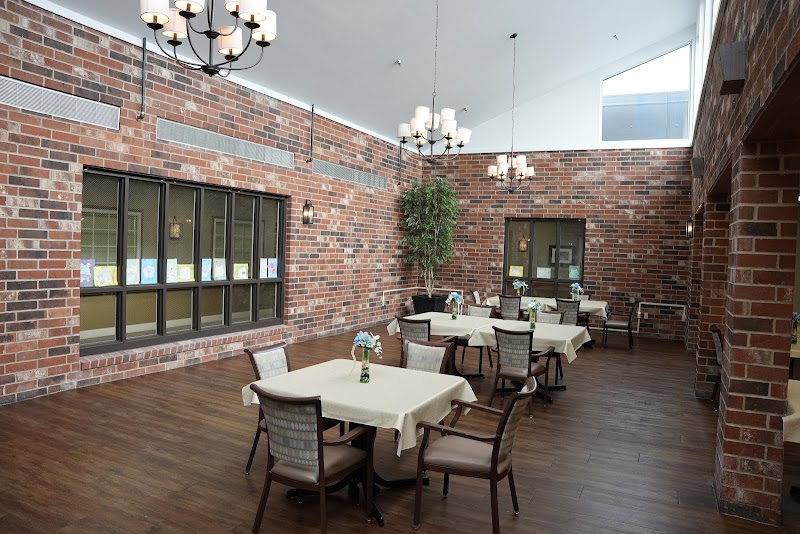
Based on observation, and interview, the facility failed to maintain a clean, safe, and sanitary environment on 1 of 4 hallways (Auguste's Cottage - a secured memory care unit) observed for cleanliness. Findings include:On 8/20/25 at 12:48 p.m., during the initial facility tour observations included:a. A PTAC heating and cooling unit in the memory care unit dining room, was observed in the wall under the dining room window. The plaster board base under the PTAC unit was chipped, pealing, and white debris was observed on the floor. b. A cove base strip of trim that had been installed where the wall met the floor, was pulled from the wall, exposing chipped paint to the wall. An approximate 3 foot of cove base, still attached to the wall on one end, was observed laying on the floor near dining room tables where residents walked to be seated for meals and activities. b. An electrical outlet with a missing face plate was observed in the hallway on the front side of the nurse's desk. The exposed outlet was observed to be approximately 1 foot from the floor, and within sight and reach of anyone ambulating by or seated in a wheelchair. On 8/20/25 at 12:56 p.m., observation of a supply storage area located in the back hallway of the secured memory care unit. Supplies were observed to be disorganized, some boxes on the floor versus pallets, and packages of oxygen tugging and boxes of bandages on the floor in the aisle. An environmental safety policy was not received during the survey process. This citation relates to Intake 2588701.3.1-19(f)(5)
CONCERN (E) 📢 Someone Reported This

A family member, employee, or ombudsman was alarmed enough to file a formal complaint

Potential for Harm - no one hurt, but risky conditions existed

ADL Care (Tag F0677)

Could have caused harm · This affected multiple residents

**NOTE- TERMS IN BRACKETS HAVE BEEN EDITED TO PROTECT CONFIDENTIALITY** Based on observation, interview, and record review, the facility failed to ensure residents residing on the secured memory care ...

Read full inspector narrative →
**NOTE- TERMS IN BRACKETS HAVE BEEN EDITED TO PROTECT CONFIDENTIALITY** Based on observation, interview, and record review, the facility failed to ensure residents residing on the secured memory care unit, who were dependent on staff for dental care, received those services for 7 of 9 residents reviewed for Activities of Daily Living (ADL) assistance (Residents B, D, F, J, G, P, and H).Findings include:An anonymous concern during the survey indicated, a resident representative did not believe staff were brushing the residents' teeth.1. On 8/20/25 at 12:25 p.m., Resident B was observed sitting at a dining room table among her peers. The resident's natural bottom teeth were barely visible when she spoke, and unable to determine if the teeth looked recently brushed/cleaned. Resident B's clinical record was reviewed on 8/20/25 at 1:30 p.m. Diagnoses on Resident B's profile included dementia. A nursing progress note, dated 8/1/25 at 12:59 p.m., indicated Resident B was seen by the dental hygienist on 7/31/25. Continue with the current plan of care.A dentist's progress note, dated 8/18/25, indicated tissues were red and inflamed, had heavy plaque, and poor oral hygiene.A nursing progress note, dated 8/20/25 at 11:39 a.m., indicated Resident B was seen by the dentist on 8/18/25. The resident had gross decay and areas too large to restore teeth #9, #10, and #12. Continue with the current plan of care. 2. Resident D's clinical record was reviewed on 8/21/25 at 9:30 a.m. Diagnoses on Resident D's profile included dementia and psychotic disorder with delusions. A nursing progress note, dated 8/20/25 at 11:42 a.m., indicated Resident D was seen by the dentist on 8/18/25. Procedures performed included he scaled implants and polished. Continue with current plan of care. A dental exam report, dated 8/18/25, indicated the resident was edentulous with implants at #22 and #27. Area for implant retained the lower denture. Full upper and lower appliance. Tissues were red and inflamed, had heavy plaque, and poor oral hygiene. Oral hygiene instructions included, remove dentures nightly and soak. 3. On 8/20/25 at 11:45 a.m., random observation of residents included, a. Resident F, broken front natural teeth with dark discoloration. b. Resident J, build-up of plaque on the bottom front natural teeth. On 8/20/25 at 12:34 p.m., during the initial facility tour observations included,a. Resident G had no oral supplies in her room.b. Resident J had no oral supplies in his room.c. Resident P had a toothbrush and tube of toothpaste stored in a wash pan on a closet shelf, stored under clothing. d. Resident D had a toothbrush and tube of toothpaste in a wash pan on a closet shelf, stored under a blanket and 2 pillows, and among personal items to include a pair of [NAME] socks and a shoe insole. e. Resident H had a tube of toothpaste in a wash pan on a closet shelf, stored with a pair of socks. There was no toothbrush in his room. During an interview on 8/20/25 at 11:58 a.m., Licensed Practical Nurse 9 indicated she worked full time on the secured memory care unit. There were currently 21 residents residing in the unit, and they all received assistance with care from the staff. The residents' bathing supplies and toiletries were stored in the resident rooms. During an interview on 8/20/25 at 12:59 p.m., Certified Nursing Assistant (CNA) 10 indicated the residents were washed up daily in their rooms and received a shower in the shower room on assigned days. Oral care was provided daily as part of the resident's morning care.During the exit conference on 8/20/25 at 11:40 a.m., the DNS indicated there was a large quantity of bathing and oral supplies stored on the secured memory care unit. The supplies were within easy access to staff providing care to residents on the unit. There were shower/bathing sheets that documented the residents were receiving routine baths and oral care. The DON indicated she had observed supplies for bathing and oral care in the resident's rooms and believed they had been taking care of. On 8/21/25 at 9:45 a.m., the Executive Director provided an AM Care Nursing Skills Competency check list, dated 3/2023. The procedure steps indicated, .7. Assist resident with oral hygiene [including denture care if applicable] On 8/21/25 at 9:45 a.m., the Executive Director provided a HS/PM Care Nursing Skills Competency check list, dated 3/2023. The procedure steps indicated, .8. Assist resident with oral hygiene [including denture care if applicable] This citation relates to Intake 2588701.3.1-38(a)(3)
Dec 2024 7 deficiencies
CONCERN (D)

Potential for Harm - no one hurt, but risky conditions existed

ADL Care (Tag F0677)

Could have caused harm · This affected 1 resident

Based on observation, interview, and record review, the facility failed to ensure a resident received requested and desired nail trimming and shaving for 1 of 9 residents reviewed for nail trimming an...

Read full inspector narrative →
Based on observation, interview, and record review, the facility failed to ensure a resident received requested and desired nail trimming and shaving for 1 of 9 residents reviewed for nail trimming and shaving (Resident 135). Findings include: On 12/6/24 at 9:46 a.m., Resident 135's record was reviewed. His diagnoses included, but were not limited to, mild cognitive impairment (difficulties with thinking, learning, remembering, and making decisions), glaucoma (eye disease causes blindness), and a history of myocardial infarction (heart attack). His care plan, dated 11/25/24, indicated he required assistance and/or monitoring for morning (AM) and afternoon (PM) care, nutrition, hydration, and elimination. The goal indicated he would have his activities of daily living (ADLs) needs met. An Approach indicated his PM care included bathing, dressing, hair combing, and oral care. His care plan, dated 12/5/24, indicated he required assistance with activities of daily living (ADL)s due to history of TIA (stroke), left sided weakness, glaucoma (eye disease that causes blindness), obesity, and impaired mobility. A nursing care approach indicated to assist with bathing as needed per resident preference. Another approach was to assist with dressing, grooming, and hygiene as needed. During an interview, on 12/3/24 at 9:47 a.m., Resident 135 indicated he only had two showers since he arrived at the facility, one last week and one this week. He indicated he had asked staff to cut his fingernails and toenails, he really needed his toenails cut, especially on his right foot. His right foot toenails were observed to be discolored and long to the end of his toes and just past his toes. During an interview, on 12/6/24 at 9:24 a.m., the Regional Nursing Consultant (RNC) indicated nail care was part of the resident receiving a shower. During an interview, on 12/6/24 at 10:02 a.m., Resident 135 indicated he wanted to be shaved and have his fingernails and toenails cut. He told Certified Nursing Aide (CNA) 25 during his shower and she did not do it. He was observed with fingernails to the ends of his fingers and had noticeably visible facial hair. During an interview, on 12/6/24 at 10:06 a.m., CNA 25 indicated she did not provide nail cutting when providing a shower, but she should have shaved him. During an interview, on 12/6/24 at 10:38 a.m., Registered Nurse (RN) 26 indicated during resident's showers the CNAs should look for any skin issues, bathe, shampoo, and trim their nails. Sometimes the nurses cut the residents' toenails. The CNAs did shave the residents during the shower. If there was a delay and they could not shave the resident during the shower, they should not wait until the next shower, but should do it the same day as the shower. If residents wanted to go to activities, ADL care should be done after that activity. On 12/6/24 at 10:56 a.m., the RDC provided Resident 135's shower sheets, dated 11/26, 11/29, and 12/3/24. The showers sheets dated 11/26 and 12/3/24 indicated Resident 135 was not shaved. The shower sheets for 11/26 and 11/29/24 indicated no nail care was provided. A current policy, titled, Resident Rights, dated 10/23, was provided by the RDC, on 12/2/24, after the entrance conference. A review of the policy indicated, .Respect and Dignity .The resident has the right to .reside and receive services in the facility with reasonable accommodation of resident needs and preferences .Self-Determination .A resident has the right to: .Make choices about aspects of his or her life in the facility that are significant such as schedules, including but not limited to sleeping, waking, eating, and bathing 3.1-38(a)(3)(d) 3.1-38(a)(3)(e)
CONCERN (D)

Potential for Harm - no one hurt, but risky conditions existed

Accident Prevention (Tag F0689)

Could have caused harm · This affected 1 resident

3. On 12/2/24 at 10:00 a.m., Resident 27 was observed sitting on the side of the bed. The Resident's face was bruised from underneath both eyes to her hairline and on her bilateral knees and shins. He...

Read full inspector narrative →
3. On 12/2/24 at 10:00 a.m., Resident 27 was observed sitting on the side of the bed. The Resident's face was bruised from underneath both eyes to her hairline and on her bilateral knees and shins. Her bed was in a low position with a regular mattress on the frame, her oxygen concentrator was by the bedside approximately 1 foot from the Resident. A call before you fall sign was not observed in her room. The resident indicated she had recently become very off balance and that she had fallen out of bed twice and hit her face on the oxygen concentrator next to her bed causing the bruising to her face. On 12/3/24 at 11:02 a.m., Resident 27 was observed sitting on the side of her bed, with her oxygen concentrator pushed up against the right side of the bedframe. There was a normal mattress on the bed frame. A call before you fall sign was not observed in the room. On 12/4/24 at 1:50 p.m., The Director of Nursing Services (DNS) and the Assistant Director of Nursing services (ADNS) were observed talking to Resident 27 in her room. After the DNS and ADNS left the room, the Resident was observed sitting on the side of the bed with her call light and glasses on the floor partially under the bed. There was a normal mattress on the bed frame, the bed was approximately 1 to 2 feet away from the wall. and there was no A call before you fall sign was not observed in the room. On 12/05/24 2:15 p.m., Resident 27 was observed lying in bed with her eyes closed. The resident was lying on the edge of the right side of the bed, her oxygen concentrator was approximately 6 inches from the right side of the bed and her call light was on the floor. Qualified Medication Aide (QMA) 6 was asked to check on Resident 27. QMA 6 was observed pulling Resident 27 over to the middle of the bed, QMA 6 asked the Resident if she needed anything else and then left the room. The Residents call light remained on the floor and her oxygen concentrator was not moved away from the side of the bed. On 12/04/24 at 10:10 a.m., Resident 27s medical record was reviewed. She was a long-term care resident whose diagnoses included, but were not limited to, end stage renal disease, dependance on renal dialysis, generalized muscle weakness, and unsteadiness on her feet. A nursing progress note, dated 10/27/24 at 4:13 a.m., indicated an unknown CNA found Resident 27 lying on the floor next to her bed, and the Resident indicated that she had hit her head on the oxygen concentrator. An IDT progress note, dated 10/27/24 at 4:20 a.m., indicated that the cause of the fall was poor bed boundaries, weakness, unsteady gait, and unaware of physical limitations. The note also indicated that the intervention put in place was a call before you fall sign in the resident's room. A nursing progress note, dated 11/21/24 at 6:54 a.m., indicated that Resident 27 was found lying beside the bed and that the Resident indicated that she fell asleep sitting on the side of the bed. An IDT progress note, dated 11/21/24 at 6:26 a.m., indicated that the cause of the fall was poor bed boundaries and weakness. The note also indicated that the interventions put in place were nonskid strips next to the bed and a scoop mattress. A physician order, dated 11/21/24, indicated for a scoop mattress to be placed on her bed. A care plan, initiated on 7/17/24, indicated that she was at risk for falls. Interventions for this plan of care included but were not limited to: scoop mattress to the Residents bed and call before you fall sign in the Residents room. During an interview on 12/05/24 at 2:50 p.m., The DNS and ADNS indicated that resident call lights should always be placed within reach of the resident. They indicated that in order to change out mattresses, the nurse who received the order for a new mattress should contact maintenance and then they would change the beds out. They indicated that they did not know why her mattress wasn't changed but agreed that Resident 27 should have a scoop mattress on her bed. They indicated that oxygen concentrators should be placed far enough away from the bed so that resident could not fall onto them. 3.1-45(a)(1) Based on observations, interviews and record review, the facility failed to prevent the potential for accidents by ensuring bed rail/mobility devices were appropriately monitored/adjusted to reduce the risk of entrapment for 2 of 5 residents reviewed for accidents (Residents 67 and 32), and failed to ensure fall interventions were in place for 1 of 5 residents reviewed for accidents, (Resident 27). Findings include: 1. On 12/2/24 at 10:26 a.m., Resident 67 was observed in her room on the secured memory care unit. She was seated in a regular wheelchair; her bed was neatly made. Bilateral side rails observed installed to the frame of her bed. There was a large gap between the edge of the mattress and the side rail. On 12/2/24 at 3:35 p.m., Resident 67's bed frame and side rails were observed with the Maintenance Director. He measured the gap between the edge of the mattress to the rail. The Maintenance Director indicated without measuring, he could tell the gap was too large and failed visual inspection. After measuring, he indicated the gap was 5 inches wide and needed to be adjusted to meet the bed zone requirements. The Maintenance Director indicated it was important to ensure there was not too large of a gap to prevent the potential for entrapment. On 12/2/24 at 3:45 p.m., the Maintenance Director provided a copy of the current procedure for bed rail safety checks. The Maintenance Director indicated the problem area on Resident 67's bed was zone 3, between rail and mattress which should not measure greater than 4 and 3/4 inches. On 12/3/24 at 11:51 a.m., Resident 67's medical record was reviewed. She was a long-term care resident who resided on the secured memory care unit with diagnoses which included, but were not limited to, dementia (a degenerative brain disease which affects memory and cognitive function), glaucoma (a progressive eye disease which causes vision loss), muscle weakness, and anxiety. She had a current physician's order, dated 9/11/23, for two half side rails to enhance her bed mobility. A care plan, dated 9/12/23, indicated Resident 67 required assistance with activities of daily living (ADLs) which included bed mobility and an intervention for this plan of care included, but was not limited to, bilateral half side rails. The care plan lacked implementation and/or revision to include routine ongoing assessments and/or monitoring of the side rails for safety and appropriateness. A Bed Rail Notification, observation was created on 8/7/24 at 7:32 p.m. The notification was not signed by the resident and/or their representative to acknowledge the potential hazards of the use of side rails as stated on the notification; I have been informed and understand the potential hazards that may occur with the use of bed rail (s) as follows: Potential hazards may include: decreased independence with getting in and out of bed, potential for bruising, potential for skin tears, potential for entrapment causing serious injury or death, and increased distance of falling if resident climbs over bed rails with possibility of greater injury. The record lacked any ongoing assessments and/or monitoring of the side rails for safety. 2. On 12/4/24 at 9:26 a.m., Resident 32 was observed. He was reclined in his bed and a large gap was observed from the edge of his mattress to the bilateral mobility bars. On 12/4/24 at 2: 47 p.m., Resident 32 remained in bed. He indicated the mobility bars were too far away for him to reach by himself, but he used them to hold on to when he was turned in bed to get cleaned up or for bed baths. On 12/5/24 at 9:25 a.m., Resident 32's bed frame was observed with the Maintenance Director who measured the gap. The Administrator (ADM) was also present at that time. The Maintenance Director indicated the gap on the right side of the bed was 5 and a half inches, and the gap on the left side was 4 and one quarter inches. The Maintenance Director indicated he was aware Resident 32 had the mobility bars installed on his bed, but it appeared that nursing had switched his mattress and not notified the Maintenance Director to come and inspect them and/or adjust to the appropriate measurement. The Maintenance Director indicated the gap on the right side was too wide, and he would adjust the bars immediately. On 12/5/24 at 1:52 p.m., Resident 32' medical record was reviewed. He was a long-term care resident with a diagnosis which included but was not limited to Parkinson's disease (a chronic, progressive brain disorder that affects the nervous system and causes movement problems). His record lacked documentation of the mobility bars initial and/or ongoing assessments for safety and appropriateness. On 12/3/24 at 9:30 a.m., the Regional Nurse Consultant, (RNC) provided a copy of current facility policy titled, Restraints: Bed Rail Safety Check, updated 8/2021. The policy indicated, Purpose: to ensure bed rails utilized in the facility are safely and appropriately secured to the bed. A bed rail safety check will be completed on all beds that have any type of rail. The bed rail safety check will be completed upon initiation or change of any bed rail, mattress and or bed frame, and at least annually thereafter. The bed rail safety check form will be completed with each safety check and will be maintained at the facility for 10 years
CONCERN (E)

Potential for Harm - no one hurt, but risky conditions existed

Deficiency F0565 (Tag F0565)

Could have caused harm · This affected multiple residents

**NOTE- TERMS IN BRACKETS HAVE BEEN EDITED TO PROTECT CONFIDENTIALITY** Based on observations, interviews, and record review, the facility failed to ensure repeated grievances brought to the attention...

Read full inspector narrative →
**NOTE- TERMS IN BRACKETS HAVE BEEN EDITED TO PROTECT CONFIDENTIALITY** Based on observations, interviews, and record review, the facility failed to ensure repeated grievances brought to the attention of the facility by the resident council were responded to for 7 of 12 months of resident council reviewed. Findings include: On 12/3/24 at 1:10 p.m., the Activity Director (AD) provided the Resident Council Minutes for review. On 12/3/24 at 1:15 p.m., the Resident Council Minutes were reviewed. Repeated concerns for the previous 12 months included, but were not limited to: food temperatures, availability and/or access to adequate amounts of linens, staff attitude and/or body language, and staff use of cell phones and ear buds. 1. Cold Food: a. Concerns related to cold food were discussed during the months of: January, February, June, July, September, October (two meetings), and November. b. Responses to concerns related to food temperatures were not found for the months of: February, June, July or September. 2. Quantity/quality and/or access to/availability of linens: a. Concerns related to linens were discussed during the months of: January, June, August (times two meetings), September, and October (two meetings). b. Responses to concerns related to linens were not found for the months of: August (for 8/26/24 meeting) or October (for the 10/14/24 meeting). 3. Staff attitude/body language and use of cell phones/ear buds: a. Concerns related to staff attitude and/or the use of phones were discussed during the months of: January, February, March, July, August, September, and October (two meetings). b. Responses to concerns related to staff attitude and/or the use of phones were not found for the months of: February, March, July, and August. On 12/4/24 at 12:08 p.m., a Resident Council meeting was conducted with 6 residents who regularly participated in Resident [NAME]. The residents indicated there were still ongoing concerns and complaints related to cold food, access to and the amount of linens available, and staff attitude. When responses were provided from previous meetings, they were often the same answers and over time if the issue was fixed for a couple of weeks, it would come back around again. Overall concerns were not resolved, and residents were often told, we'll look into it. The residents indicated they still had complaints about food, it was, cold, cold, cold. The residents indicated they still had complaints about access to linens but felt that it had been better the previous month. The residents indicated they still had concerns regarding staff attitudes and body language that made them feel, devalued. During an interview on 12/4/24 at 12:49 p.m., the AD indicated, it was sometimes a struggle to get resident council responses back from each department, and that sometimes the responses had not been accepted by Resident Council, especially if the concerns were repeated. Common or repeated issues were always related to food being too cold, staff use of their personal cell phone or ear buds, and trying to get enough linens. The AD indicated he had seen some staff on their phone or ear buds and had to stop them and remind them to remove the earbuds because the residents deserved undivided attention. The issues related to staff attitude and body language were often discussed as a cultural and language barrier between some residents and some staff who have immigrated from [NAME], but the AD did not know if that had been addressed with the nursing staff. On 12/4/24 at 1:22 p.m., an unidentified Dietary Aide was observed as she left the main dining room with a 4-wheeled rolling cart. The cart had two shelves and was not enclosed and uninsulated. There were 7 lunch trays stacked on the cart. On 12/4/24 at 1:24 p.m., a blue, insulated room tray cart was observed on the back hall. The cart did not have a door. An unidentified Certified Nursing Assistant (CNA) who assisted with meal delivery indicated, the cart had not had a door for a long time and maybe that was why residents complained about cold food. On 12/5/24 at 9:26 a.m., the blue insulated room tray cart was observed on the back hall as breakfast trays were delivered. The cart remained in disrepair as the door was missing. During an interview on 12/5/24 at 9:13 a.m., the Housekeeping (HK) Supervisor indicated linen supply was a constant complaint, and the HK department spent on average $1,000.00 a month on a linen budget. HK staff were to empty soiled laundry rooms and restock linen supply closets every 2 hours. On 12/5/24 at 9:15 a.m., the linen supply closet for the skilled long-term care halls was observed with the Housekeeping Supervisor (HKS). The shelves were not empty, but the linens were not stocked to the fullest (designated by brightly colored tape on the wall). There was only one stack of washcloths on the labeled shelf, with empty space for two additional stacks. The HKS indicated there was an ample supply at that time, and HK would come around soon to restock. On 12/5/24 at 9:20 a.m., the linen supply closet for the secured memory care unit was observed with the HKS. The shelves were not empty, but the linens were not stocked to the fullest. There were only 5 towels. The HKS opened two towels, which were thin, worn, and not larger than an average bathmat rug. The HKS indicated that HK staff would stock the closet again. The HKS indicated missing linen may have been misplaced, or nursing staff used many wash clothes to clean residents and probably threw them away. During an interview on 12/5/24 at 2:00 p.m., with the Dietary Manager (DM) and Clinical Regional Dietician (CRD) present, the DM indicated she was aware of continued resident complaints about cold food, and it had been an ongoing issue as long as she had worked at the facility. The CRD indicated a new heat on demand system had replaced an outdated pellet warmer, and staff were educated on how to use the system. On 12/6/24 at 12:45 p.m., the Regional Nurse Consultant (RNC) provided a copy of the current facility policy titled, Resident Council, revised 2/2020. The policy indicated, The facility will promote and support the residents' right to participate and organize resident council. The Council will be used to communicate concerns, give suggestions for future programming and events, and otherwise participate in and guide facility life . concerns or suggestions from the meeting will be addressed by the appropriate department. The Executive Director will review all minutes and concern to ensure thorough resolution of concerns . the facility responses to concerns/grievances will be reviewed by the Resident Council President and the resident council on their next meeting On 12/6/24 at 12:45 p.m., the RNC provided a copy of the current facility policy titled, Resident Concerns and Grievances, revised 9/2024. The policy indicated, .the Executive Director/Grievance Official shall review all complaints and agree with the actions taken towards resolution. Responses to resident, representative and/or family shall be made as soon as possible and preferably immediately. Actions taken to resolve the complaint shall be made within 72 hours from the time the concern/Grievance form was received unless there is a compelling reason for delay. Actions taken include contacting the resident, representative and/or family with an explanation of the steps the facility will take to resolve the complaint and to ensure their satisfaction . all concerns/grievances will be trended monthly by the Grievance Official or designee and reported in summary form to the QAPI committee 3.1-3(l) 3.1-3(m)
CONCERN (E)

Potential for Harm - no one hurt, but risky conditions existed

Transfer Notice (Tag F0623)

Could have caused harm · This affected multiple residents

**NOTE- TERMS IN BRACKETS HAVE BEEN EDITED TO PROTECT CONFIDENTIALITY** Based on interview and record review, the facility failed to ensure the Ombudsman received end-of-the month hospital discharges ...

Read full inspector narrative →
**NOTE- TERMS IN BRACKETS HAVE BEEN EDITED TO PROTECT CONFIDENTIALITY** Based on interview and record review, the facility failed to ensure the Ombudsman received end-of-the month hospital discharges information for 4 of 4 hospitalization discharges (Resident 14) and the Ombudsman did not receive hospitalization discharges from October 26, 2023, until October 24, 2024, for 21 of 34 residents. The deficient practice was corrected on October 24, 2024, prior to the start of the survey, and was therefore past noncompliance. Findings include: On 12/6/24 at 9:53 a.m., Resident 14's record was reviewed. He was admitted on [DATE]. His diagnoses included, but were not limited to, chronic obstructive pulmonary disease (lung disease with constriction of airways and difficulty breathing), emphysema (chronic lung disease that damages the air sacs in the lungs), and dysphagia (difficulty swallowing). He had four recent hospitalizations: from 1/30 to 2/6/24 because his nephrostomy tube (a thin tube that drains urine from the kidney to a bag outside of the body) was pulled out, from 2/29 to 3/8/24 because his nephrostomy tube was pulled out, from 3/27 to 3/29/24 due to abdomen pain and tenderness, and from 8/27 to 9/3/24 due to low sodium levels. During an interview, on 12/5/24 at 2:52 p.m., the Regional Director of Clinicals (RDC) indicated she was unable to provide Resident 14's Ombudsman hospital discharge notifications because the facility did not send the end-of-the-month hospital discharge information to the Ombudsman. The facility found this deficiency in August 2024 and started the action plan in October 2024. During an interview, on 12/6/24 at 11:36 a.m., the Social Services Director (SSD) indicated the facility conducted an internal survey in September 2024 and did not find any Ombudsman notifications of hospital discharges. On October 24, 2024, all previously unsent hospital discharge notifications were sent to the Ombudsman. On 12/6/24 at 11:53 a.m., the SSD provided documentation of all total discharge and hospital discharges since October 26, 2023. The SSD indicated since October 26, 2023, there had been a total of 34 residents discharged from the facility with 21 residents having a hospital discharge. He indicated the Ombudsman had not notified of the hospital discharges at the end-of-the-month of their discharges. A current policy, titled, Emergency Transfer Notifications, dated 4/18, was provided by the Regional Director of Clinicals (RDC), on 12/6/24 at 10:50 a.m. A review of the policy indicated, .Purpose of Policy: Provide guidance regarding notification requirements to the ombudsman when an emergency transfer occurs to an acute care setting .The Census Activity Report will be faxed or mailed to the state Ombudsman each month The deficient practice was corrected by October 24, 2024, after the facility implemented a systemic plan that included the following actions: auditing all discharges of residents, education of staff, notification of the ombudsman, and a system to monitor compliance. 3.1-1(r)(6)(A)(iv)
CONCERN (E)

Potential for Harm - no one hurt, but risky conditions existed

Deficiency F0804 (Tag F0804)

Could have caused harm · This affected multiple residents

Based on observation, interview, and record review, the facility failed to ensure food was hot when served to a resident for 1 of 1 test tray temperature checked and for 7 of 12 months of resident cou...

Read full inspector narrative →
Based on observation, interview, and record review, the facility failed to ensure food was hot when served to a resident for 1 of 1 test tray temperature checked and for 7 of 12 months of resident council minutes reviewed. Findings include: On 12/3/24 at 1:15 p.m., the Resident Council Minutes were reviewed. Repeated concerns for the previous 12 months included but were not limited to: cold food temperatures for hot foods. Concerns related to cold food were discussed during the months of: January, February, June, July, September, October (two meetings) and November. Responses to the concerns related to cold food temperatures were not found for the months of: February, June, July or September. Facility responses and interventions included repeated staff in-services, repeated assurance that plate warmers were being used, and assurance that test trays would be sampled by staff members. On 12/4/24 at 12:08 p.m., a Resident Council meeting was conducted with 6 residents who regularly participated in Resident Council. The residents agreed there was still ongoing concerns and complaints related to cold food. When responses were provided from previous meetings, they were often the same answers and over time if the issue was fixed for a couple of weeks, it would come back around again. The residents agreed, overall concerns were not resolved, and residents were often told, we'll look into it. The residents indicated they still had complaints about food, and it was, cold, cold, cold. During an interview, on 12/4/24 at 12:49 p.m., the Activity Director (AD) indicated, it was sometimes a struggle to get Resident Council responses back from each department. On 12/4/24 from 1:04 to 1:33 p.m., the 200 hall meal cart was observed to be left open while lunch trays were being delivered on the 200 hall. On 12/4/24 at 1:33 p.m., the Certified Dietary Manager (CDM) was present on the 200 hall to check the temperature of the last tray removed from the 200 hall meal cart for Resident 16. She indicated the tuna casserole was 123 degrees Fahrenheit (F), the green beans were 113 degrees F, and the applesauce should have been 34 - 35 degrees F, but the applesauce temperature was 57 degrees F. She indicated the hot foods should have been above 140 degrees F. On 12/4/24 at 1:38 p.m., the CDM indicated she needed to provide Resident 16 another lunch from the kitchen. During an interview on 12/5/24 at 2:00 p.m., with the Dietary Manager (DM) and Clinical Regional Dietician (CRD) present, the DM indicated she was aware of continued resident complaints about cold food, and it had been an ongoing issue as long as she had worked at the facility. The CRD indicated a new heat on demand system had replaced an outdated pellet warmer, and staff were educated on how to use the system. During a Quality Assurance Performance Improvement (QAPI) interview, the Executive Director (ED) indicated the QAPI team met every other month and consisted of many department heads, but not the dietary manager because she was new to the facility. A review of the employee records indicated the CDM started on 9/13/24. Regarding the cold food complaints from the residents, some of it was repetitive from certain residents. The ED indicated the kitchen got new carts to help with the food temperatures. The facility used Dynex hot plate bases that were heated to help with temperatures. The ED indicated she wanted to get residents out of their rooms and coming back to the dining room. She wanted to work with the Certified Nursing Aides (CNA) and the Social Services Director (SSD) to encourage residents to get out of their rooms. A current policy, titled, Food Temperatures, dated 6/23, was provided by the RNC, on 12/6/24 at 10:50 a.m. A review of the policy indicated, .All hot and cold food items will be served to the resident at a temperature that is considered palatable at the time the resident receives the food .Hot food will be held at or above 135 degrees F. If minimum temperature requirements are not maintained, food will need to be reheated to a minimum of 165 degrees F for 15 seconds before serving .Cold food will be held at or below 41 degrees F. If cold food temperature is not maintained, food item will need to be chilled to less than or equal to 41 degrees F before serving This citation relates to Complaint IN00444032. 3.1-21(a)(2)
CONCERN (E)

Potential for Harm - no one hurt, but risky conditions existed

Food Safety (Tag F0812)

Could have caused harm · This affected multiple residents

Based on observation, interview, and record review, the facility failed to ensure drinks were covered while providing lunch trays on the 200 hall for 4 of 10 resident reviewed (Resident 6, 34, 40, and...

Read full inspector narrative →
Based on observation, interview, and record review, the facility failed to ensure drinks were covered while providing lunch trays on the 200 hall for 4 of 10 resident reviewed (Resident 6, 34, 40, and 135). Findings include: On 12/2/24 at 1:01 p.m., Certified Nursing Aide (CNA) 7 was observed carrying a lunch tray to Resident 40's room, the coffee cup was uncovered. On 12/4/24 at 1:06 p.m., CNA 7 was observed carrying a lunch tray to Resident 6's room, her coffee and orange drink were uncovered. On 12/4/24 at 1:06 p.m., the Activity Director was observed carrying a lunch tray to Resident 34's room, his orange drink was uncovered. The lunch tray was carried to the Assisted Dining room. On 12/4/24 at 1:06 p.m., CNA 7 was observed carrying a lunch tray to Resident 135's room, his orange drink was uncovered. A current policy, titled, Meal Service and Distribution, dated 4/24, was provided by the Regional Nursing Consultant (RNC), on 12/3/24 at 9:15 a.m. A review of the policy indicated, .Prepared food will be transported to other areas either covered or in covered container/enclosed carts. Food and beverage items should be covered when being taken a distance such as down a hall or to another unit 3.1-21(i)(2)
CONCERN (E)

Potential for Harm - no one hurt, but risky conditions existed

Infection Control (Tag F0880)

Could have caused harm · This affected multiple residents

**NOTE- TERMS IN BRACKETS HAVE BEEN EDITED TO PROTECT CONFIDENTIALITY** C. On 12/4/24 at 12:52 p.m., RN 20 was observed cleaning a blood glucometer meter. She wiped the meter with a Chlorox Bleach Ger...

Read full inspector narrative →
**NOTE- TERMS IN BRACKETS HAVE BEEN EDITED TO PROTECT CONFIDENTIALITY** C. On 12/4/24 at 12:52 p.m., RN 20 was observed cleaning a blood glucometer meter. She wiped the meter with a Chlorox Bleach Germicidal wipe and sat it on a paper towel to dry. She did not allow the meter to remain wet with contact from the wipe for at least 3 minutes. On 12/9/24 at 1:22 p.m., the Assistant Director of Nursing (ADNS) was interviewed. She indicated the glucometer needed to remain wet for 3 minutes. A skills competency procedure was provided by the Regional Nurse Consultant (RCS) on 12/4/24 at 1:10 p.m. It indicated, .Wipe entire external surface of the blood glucometer meter wipe (Clorox Bleach Germicidal Wipes) and allow the surface of the meter to remain wet for 3 minutes. When using Clorox Bleach Germicidal wipes in the individual packet, it is best to squeeze out excess solution into a trash container or plastic cup to be disposed of 3.1-18(b)(1) B. On 12/5/24 at 9:30 a.m., the facility's laundry service and processing rooms were observed with the Housekeeping Supervisor (HKS) present. Upon initial observation on 12/5/24 at 9:30 a.m., the laundry room was dimly lit, paint was peeled/chipped away from the walls in various areas, the overhead vents had clumps of dark debris and dust stuck to the grates. There was an empty unidentified plastic bottle on the floor behind the washing machines. The remainder of the floors behind the washing machines were littered with dust, lint and other unidentified debris. The tubes which carried detergent/sanitizer and other laundry chemicals from their containers to the machines, were observed to have a film of and clumps of the chemicals that had spilled down. The metal wire-baskets in which the chemicals were stored were rusted and the paint had chipped/peeled off. The soiled linen closet was observed. There were 9 large plastic trash can barrels lined with clear plastic bags. Two lids had been secured in place, three lids were on top of the can, but not secured closed, and four barrels were open to air as the clear plastic bags were not tied shit, and there were no lids on top of the barrels. There was a door between the soiled linen closet, and the main washing/drying areas which remained open. There were no hand sanitizers/hand hygiene stations for entrance/exit of the laundry area or within the laundry area. During an interview on 12/5/24 at 9:33 a.m., with the HKS, HK/laundry Aides (HKA) 30 and 31 present, HKS 30 and 31 indicated, they knew there was a COVID-19 outbreak in the facility at that time. There was no special way they were supposed to collect and sanitize COVID-19 positive soiled linens from regular, everything was treated the same. HKA 31 indicated, when COVID-19 was first around, the facility had utilized a color-coded trash bag system, so that staff would know which clothes or linen came from the COVID-19 positive rooms, so it could be stored and washed separately. HKA 30 and 31 did not know what temperatures were required to sterilize the linen, they did not know if linen was sterilized with chemicals, heat, or a combination of both. On 12/5/24 at 9:38 a.m., HKA 31 was observed as she demonstrated the wash cycle procedure. Without performing hand hygiene or donning personal protective equipment (PPE) she put on a pair of translucent surgical gloves and entered the soiled side. She retrieved a barrel and rolled it to a washing machine. On top of the pile of clothes in the barrel was a soiled pair of green flannel pants. There was a large smeared and crusted blotchy stain. HKA 31 indicated it was poop that the CNAs were supposed to rinse off in the Hoppers which were located in the soiled utilities room. HKS 31 grabbed an armful of soiled clothes, which included the soiled flannel pants smeared with poop, and dumped the items into the washing machine. As she continued to grab armfuls of laundry, the items brushed against the bare skin of her forearms, as she wore a short-sleeved shirt. As the barrel became empty, HKA 31 needed to bend over, into the barrel to retrieve the rest of the items. Without PPE in place, the edge and side of the soiled barrel came into direct contact with the front of her scrub shirt. When all the items were in the machine, HKA 31 did not remove her gloves before she pressed a series of buttons to begin the wash cycle. When the machine started, HKA 31 removed her gloves, without performing hand hygiene, she went to the clean laundry area and resumed folding clean clothes. During an interview on 12/5/24 at 9:45 a.m., the HKS indicated, HKA 31 should have worn a yellow gown which was reusable and hung on the back of the laundry room door. The purpose of the gown was to protect the staff member from potential contamination while in contact with soiled items and help prevent the spread of infection. On 12/5/24 at 9:47 a.m., the soiled linen closet on Pine Hall (where the majority of COVID-19 positive residents resided) was observed with the HKS present. There was a large industrial plastic bin. The lid of the bin was left open and leaned backwards against the wall. Inside the bin there were several clear plastic bags of soiled laundry. Two of the bags were observed untied and open to the air. The HKS indicated the soiled linen in plastic bags should be tied and sealed up and the lid on the bin should remain closed. On 12/5/24 at 9:57 a.m., the Float Infection Preventionist, (F-IP) indicated, it was the policy of the facility that all soiled linen and laundry should be considered contaminated and standard Infection Prevention procedures should be in effect. During an interview on 12/5/24 at 10:29 a.m., with the Facility's Infection Preventionist (IP) and F-IP present. The F-IP indicated staff should wear a PPE gown and gloves when they handled soiled linens to prevent contaminated items from coming in contact with their person. After handling soiled items, staff were expected to perform hand hygiene. Soiled closets should be kept tidy, and the bins lids should be closed. During an interview on 12/6/24 at 12:02 p.m., the Corporate HK Consultant indicated all staff who assisted with laundry should follow standard precautions. Contaminated laundry should be securely contained from the source. Staff would then execute procedures to handle contaminated items in a manner that protected the employee and precluded the contamination of clean linen. On 12/5/24 at 10:10 a.m. the F-IP provided a copy of the current facility policy titled, Laundry/Linen, revised 12/2021. The policy indicated, .Purpose of the policy to ensure the proper care and handling of linen and laundry to prevent the spread of infection . all linen in use is contaminated. All linen, including that from a resident with a diagnosed infection is treated the same way except a resident who is under transmission-based precautions for C-Diff . soiled linen, carry away from body to prevent soiling uniform . containers in soiled linen room should be labeled, lined with will-fitted lids . keep soiled linen covered in container until ready to load in machine . before removing or touching clean laundry, perform hand hygiene A. Based on observation, interview, and record review, the facility failed to ensure staff wore personal protective equipment (PPE) appropriately for 11 of 11 observations of PPE, and failed to ensure the facility had a thorough process for contact tracing of infections for 2 of 2 months of infection tracking reviewed. B. Based on observations, interview and record review, the facility failed to ensure appropriate infection prevention procedures for laundry/linen services were followed to prevent the potential for the spread of germs and infection for 1 of 1 observation of the laundry room. This deficient practice had the potential to affect 82 of 82 residents who received laundry services from the facility. C. Based on observation, interview, and record review, the facility failed to ensure staff cleaned a blood glucose glucometer properly for 1 of 1 observation of glucometer cleaning. Findings include: A1. On 12/2/24 at 10:24 a.m., a sign was noted on Resident 4's door indicating he was on enhanced barrier precautions (EBP). The sign indicated staff were to wear gowns and gloves when providing activities of daily living (ADL) care and specified personal protective equipment (PPE) was to be worn during care that involved changing briefs, dressing, transferring, and bathing/showering. During an interview, on 12/2/24 at 10:25 a.m., Certified Nursing Aide (CNA) 7 indicated she helped Resident 4 get up for the day which included assisting with dressing him. She indicated she did not wear a gown or gloves or PPE while assisting him because the resident had been there a long time and was not the resident under enhanced barrier precautions. The resident in isolation was his roommate, a new admission. During an interview, on 12/2/24 at 11:54 a.m., the Infection Preventionist (IP) indicated Resident 4 was on EBP and the staff should have worn gown and gloves when providing direct care because he had a feeding tube. A2. On 12/3/24 at 9:33 a.m., Housekeeper 23 was observed not wearing a mask while cleaning floor near the 200 hall where there were COVID-19 positive residents. On 12/3/24 at 11:11 a.m., Qualified Medication Aide (QMA) 6 was observed wearing a surgical mask. Before she entered Resident 25's COVID-19 positive room, she placed on N95 on top of her surgical mask. She exited wearing the same surgical mask. She subsequently went into Resident 33's COVID-19 positive room, still wearing her surgical mask and placed an N95 mask on top of it. During an interview on 12/3/24 at 11:30 a.m., the IP indicated the facility had a COVID-19 outbreak. Staff members who tested COVID-19 positive on 12/2/24 were the Executive Director (ED), Payroll Director (PD), Guest Relations (GR), and the facility Bus Driver (BD). She indicated she talked with the staff to figure out who they were around and would test those residents. All staff should be wearing surgical masks in the facility. For source control, she indicated the surgical mask must be removed before using an N95. During an interview, on 12/3/24 at 11:30 a.m., the Director of Nursing Services (DNS) indicated the facility's COVID-19 outbreak included 4 cases, two residents and two staff would be reported to the Health Department. Their source control was N95 masks, and they were available. On 12/3/24 at 11:35 a.m., Housekeeper 24 was observed not wearing a mask while cleaning the 200 hall shower room. On 12/3/24 at 11:50 a.m., Resident 22 was reported to be positive for COVID-19. On 12/3/24 at 12:00 p.m., Housekeeper 24 was observed in the hallway, near the Sunshine lunchroom, with a visible hole in his surgical mask. On 12/3/24 01:17 p.m., QMA 22 was observed with a beard. He put an N95 mask on top of a surgical mask before entering Resident 136's COVID-19 positive room to provide his lunch tray. QMA 22 indicated he did not know if it was acceptable to wear an N95 mask on top of a surgical mask, but he would ask the DNS. A Covid in-service was completed on 12/3/24 at 3:30 p.m. by the DNS. It included handwashing, PPE, double masking, COVID-19, alcohol-based hand rub, and donning and doffing of PPE. The in-service signature sheet showed 18 attendees, and included QMA 6 and QMA 22. The LTC (Long Term Care) Respiratory Surveillance Line List, dated 12/2024, was provided by the Executive Director (ED), on 12/4/24 at 1:59 p.m. A review indicated: a. Resident 81 was symptomatic on 11/26/24 and was tested on the same day. The testing result was COVID-19 positive. b. The ED was symptomatic on 11/27/24 and was tested on [DATE]. The testing result was COVID-19 positive. She returned to work on 12/2/24. c. Resident 57 was symptomatic on 11/29/24 and was tested on the same day. The testing result was COVID-19 positive. d. The Bus Driver (BD) was symptomatic on 12/2/24 and was tested on the same day. The testing result was COVID-19 positive. e. The Payroll Director (PD) was symptomatic on 12/2/24 and was tested on the same day. The testing result was COVID-19 positive. f. Receptionist 27 was symptomatic on 12/2/24 and was tested on the same day. The testing result was COVID-19 positive. g. Resident 238 was symptomatic on 12/2/24 and was tested on the same day. The testing result was COVID-19 positive. h. Resident 136 was symptomatic on 12/2/24 and was tested on the same day. The testing result was COVID-19 positive. i. Resident 54 was symptomatic on 12/2/24 and was tested on the same day. The testing result was COVID-19 positive. j. Resident 33 was symptomatic on 12/3/24 and was tested on the same day. The testing result was COVID-19 positive. k. Resident 12 was symptomatic on 12/3/24 and was tested on the same day. The testing result was COVID-19 positive. l. Resident 25 was symptomatic on 12/3/24 and was tested on the same day. The testing result was COVID-19 positive. m. CNA 28 was symptomatic on 12/4/24 and was tested on the same day. The testing result was COVID-19 positive. n. CNA 29 was symptomatic on 12/4/24 and was tested on the same day. The testing result was COVID-19 positive. On 12/4/24 at 10:30 a.m., the IP indicated Resident 45 and Resident 65's COVID-19 tests result were positive. On 12/4/24 at 1:04 p.m., Resident 22's door was observed with an isolation sign, it indicated to keep the door closed, to perform hand hygiene, wear a gown, N95 mask, eye protection, and disposable gloves before entering the room. QMA 22 put on a gown, face shield, and disposable gloves. He was observed already wearing a surgical mask. He did not wear an N95 mask. He entered Resident 22's COVID-19 positive room. He left the residents door open and after delivering his lunch tray, came out without his surgical mask. He gelled his hands and put on a new surgical mask. Her door hanger was observed with both N95 and surgical masks. On 12/4/24 at 1:09 p.m., Resident 12's door was observed with an isolation sign. QMA 22 was already wearing a surgical mask, he put on a gown, face shield, and disposable gloves. He did not wear an N95 mask. He left the resident door open and after delivering her lunch tray, came out without his surgical mask. He gelled his hands and put on a new surgical mask. Her door hanger was observed with both N95 and surgical masks. On 12/4/24 at 1:14 p.m., Resident 136's door was observed with an isolation sign. QMA 22 was already wearing a surgical mask, he put on a gown, face shield, and disposable gloves. He did not wear an N95 mask. He left the resident door open and after delivering his lunch tray, came out without his surgical mask. He gelled his hands and put on a new surgical mask. Her door hanger was observed with both N95 and surgical masks. On 12/4/24 at 1:19 p.m., Resident 54's door was observed with an isolation sign. QMA 22 was already wearing a surgical mask, he put on a gown, face shield, and disposable gloves. He did not wear an N95 mask. He left the resident door open and after delivering his lunch tray, came out without his surgical mask. He gelled his hands and put on a new surgical mask. His door hanger was observed with both N95 and surgical masks. On 12/4/24 at 1:25 p.m., Resident 81's door was observed with an isolation sign. QMA 22 was already wearing a surgical mask, he put on a gown, face shield, and disposable gloves. He did not wear an N95 mask. He left the resident door open and after delivering her lunch tray, came out without his surgical mask. He gelled his hands and put on an N95 mask. Her door hanger was observed with both N95 and surgical masks. During an interview, on 12/4/24 at 1:30 p.m., QMA indicated he did not know which mask to wear in a COVID-19 positive room, but he just put on an N95 mask because he needed to go into Resident 16's room to assist him with eating and his roommate, Resident 22, was COVID-19 positive During an interview, on 12/5/24 at 10:50 a.m., the IP indicated QMA 22 would have needed a good seal with his N95 mask for it to work properly and he would be unable to accomplish it with a beard. He should not have entered the COVID-19 positive room without a seal on his N95 mask. During an interview, on 12/4/24 at 2:53 p.m., the Regional Nurse Consultant (RNC) indicated QMA 22 would be tested for COVID-19. During an interview, on 12/5/24 at 10:30 a.m., the IP indicated she became IP certified on 2/24/24 and became the facility's IP person at that time. She had been using the facility's transmission-based precautions and the COVID-19 outbreak policy as resources to guide her through the current outbreak. During an interview, on 12/5/24 at 10:44 a.m., the IP indicated Resident 59 and Resident 64 were COVID-19 positive. Also, the Charge Nurse 30 from the 100 hall was Covid positive. She indicated she was aware of the breaks in the COVID-19 policy and procedure and had been rounding more. During an interview, on 12/5/24 at 10:56 a.m., the IP indicated since the COVID-19 outbreak started she was doing contact tracing and would provide documentation. She indicated she documented where she observed the COVID-19 residents. During the contact tracing interview, on 12/6/24 at 11:30 a.m., the IP provided the, Covid-19 Outbreak Investigation Contact Tracing Form, for COVID-19 positive residents. Four Covid positive residents were reviewed: a. Resident 81 tested positive on 11/26/24. The resident indicated a friend visited, no date or contact information was provided. No information if the friend was contacted. The section, Identify Close Contacts, and the Outbreak Testing Plan were observed blank. b. Resident 57 tested positive on 11/29/24. The section for the Outbreak Testing Plan was observed blank. c. Resident 238 tested positive on 12/2/24. The resident was in the therapy gym, but IP did not add other residents or staff who were also in the therapy gym to complete contact tracing. The section, Identify Close Contacts, and the Outbreak Testing Plan were observed blank. d. Resident 136 tested positive on 12/2/24. The resident was in the therapy gym and visited with family, but IP did not add other residents or staff who were also in the therapy gym or contact the family to complete contact tracing. The section, Identify Close Contacts, and the Outbreak Testing Plan were observed blank. During an interview, on 12/5/24 at 3:12 p.m., the IP indicated COVID-19 began in the facility at the end of November with Resident 81 as the first case and on 11/26/24 and Resident 57 on 11/29/24. She indicated there were signs on the doors, use of PPE, and we were trying to use dedicated staff for the 100 hall. The ED was symptomatic on 11/27/24 and tested positive on 11/29/24. During a review of the IP's tracking and trending, on 12/5/24 at 3:22 p.m., she indicated the COVID-19 positive cases were not tracked on the November color coded map. There was a cluster of urinary tract infections (UTI) noted on her November map. She did not follow-up with staff education regarding the UTIs or was aware of any further cluster of UTI near those resident rooms. She indicated she would compile the December infection information later. The analysis of infection was determined by looking at the color-coded map. During an interview, on 12/5/24 at 3:22 p.m., the Float IP indicated the facility did not graph infections to gather more information. The pharmacy provided an antibiotics analysis. A job description, titled, Infection Preventionist Position Description, dated 7/2020, was provided by the DNS, on 12/6/24 at 1:54 p.m. A review of the IP job description indicated, .The Infection Preventionist is responsible for assessing and educational needs of staff, coordinating programs based upon identified needs, and ensuring compliance with all State and Federal guidelines for infection prevention and control, in-service education A current procedure, titled, Personal Protective Equipment (PPE) Donning and Doffing, dated 7/2023, was provided by the Director of Nursing Services (DNS), on 12/3/24 at 3:30 p.m. A review of the policy indicated, .fit the mask to the face so it [sic] snug to face and below chin, if N-95 respirator A current policy, titled, Covid-19 Policy, dated 7/2023, was provided by the IP, on 12/3/24 at 11:46 a.m. A review of the policy indicated, .Routine Infection Prevention and Control Practice .residents and visitors will be offered education about the importance of receiving the Covid-19 vaccine .Staff to follow appropriate PPE use according to the Standard and Transmission Based Precautions policy .Source control option for HCP [health care providers] include: .A well-fitting facemask .When evaluating the need for source control, the Infection Preventionist will use multiple sources to make an informed decision when recommending source control including, but not limited to, respiratory virus transmission in the local community, respiratory virus transmission in the facility including staff date, local SARS-CoV-2 hospital admission data form the CDC COVID Data Tracker, and risk of current population served A current policy, titled, Standard and Transmission-Based Precautions (Isolation) Policy, dated 4/24/24, was provided by the RNC, on 12/2/24 at 4:01 p.m. A review of the policy indicated, .Personal Protective Equipment (PPE) refers to protective items or garments worn to minimize exposure to hazards that cause injuries and illnesses .Respirator includes a fit-tested NIOSH-approved N95 or higher-level respirator for healthcare personnel when indicated .Covid-19, which includes the use of N-95 respiratory .residents suspected or confirmed with Covid-19 should remain in their current location .Use of Personal Protective Equipment HCP should wear an N95 or higher-level respirator, eye protection (i.e. goggles or a face shield that cover the front and sides of the face), gloves, and gown when care for these resident
May 2024 1 deficiency
CONCERN (D) 📢 Someone Reported This

A family member, employee, or ombudsman was alarmed enough to file a formal complaint

Potential for Harm - no one hurt, but risky conditions existed

Deficiency F0744 (Tag F0744)

Could have caused harm · This affected 1 resident

**NOTE- TERMS IN BRACKETS HAVE BEEN EDITED TO PROTECT CONFIDENTIALITY** Based on observation, interview, and record review, the facility failed to adequately manage, supervise, monitor, and initiate i...

Read full inspector narrative →
**NOTE- TERMS IN BRACKETS HAVE BEEN EDITED TO PROTECT CONFIDENTIALITY** Based on observation, interview, and record review, the facility failed to adequately manage, supervise, monitor, and initiate interventions for a dementia resident with a known history of aggressive behaviors for 1 of 3 dementia residents reviewed for incidents (Residents L, K, N). Findings include: An Indiana State Department of Health Survey Report System report, dated 4/30/24 at 10:45 a.m., indicated Resident L made contact with Resident K. Resident L had a skin tear on his left hand and Resident K had a skin tear on her left forearm. Root cause was to be determined regarding resident engagement. A 5/3/24 follow -up indicated Resident L's care plan was updated with a new intervention of a sign on his door to redirect other residents from entering his room. 1. Resident L's record was reviewed on 5/15/24 at 2:45 p.m. Diagnoses on Resident L's profile included, but were not limited to, Alzheimer's disease, and dementia with severe mood disturbance (verbal and physical aggression and wandering) and psychotic disturbance (can become aggressive at times and have trouble regulating emotions). A hospital Discharge summary, dated [DATE], indicated Resident L had recently completed a 14 day in-patient stay at a psychiatric hospital for psychosis and agitation. The day after his return to the facility, he had an aggressive episode with a female resident who was sitting near the nurse's station and grabbed her left arm and was yelling at her. Resident L was sent back to the in-patient psychiatric hospital for an additional 12 day stay, and the family was told to seek alternate placement. A Memory Care Initial Admissions Guidelines Checklist, dated 3/7/24, indicated the resident had a diagnosis of an irreversible form of Alzheimer's or dementia and met guidelines to be placed on the secured unit. The assessment did not document the resident having just been discharged from 2 back to back in-house psychiatric stays for physical aggression against his peers at his last facility. On 5/16/24 at 11:25 a.m., Resident L was observed being brought out of his room in a wheelchair (wc) propelled by Certified Nursing Aide (CNA) 10. The resident was placed at a table with another male peer, he was not observed to engage with others. On 5/17/24 at 9:37 a.m., Resident L was observed propelling himself in a wc with his feet into the activity/dining room among 5 peers. A physician's order, dated 3/11/24, indicated the resident resided on a secured unit, and his activity level was to be up as he wanted with assistance and use of a walker. The resident record lacked documentation a person centered care plan was initiated upon admission for a history of aggressive behaviors towards others, root cause of aggressive behaviors, or interventions initiated to assist staff in caring for the resident. A physician's progress note, dated 03/20/24 at 12:44 a.m., indicated Resident L was seen for his initial history and physical. The patient was status post hospitalization for increased agitation and aggressive episodes. He had medication adjustments completed with improvement in his behaviors. He was unable to return to his assisted living apartment due to requiring more supervision. A progress notes, dated 4/10/24 at 1:03 p.m., indicated the resident continued to attempt to stand independently. When staff attempted to assist the resident to either sit down or ambulate with his walker, he declined to use the walker even though he was unsteady standing. Resident L became agitated at times and hit a staff member during unsuccessful attempts at redirection. A care plan dated 4/11/24 indicated Resident L became aggressive with staff when trying to redirect to activity. The goal was for him to not become agitated. Approaches included administering medications as needed, redirect resident to activity of choice, assess resident for unmet needs, and labs will be drawn. A progress notes, dated 4/15/24 at 10:07 p.m., the resident had an agitated afternoon. He refuses to sit on several occasions and attempted to hit staff sometimes. A behavior review note, dated 4/16/24 at 1:36 p.m., indicated the resident refused to be redirected, to stay in his wheelchair, and continued to wander throughout the memory care unit. A behavior review note, dated 5/1/24 at 3:41 p.m., indicated 2 female residents (Residents K and L) entered the resident's room. Resident L became agitated and used part of his wheelchair to make contact with Resident K's left lower arm. A progress notes, dated 5/9/24 at 10:32 a.m., Resident L was passing through the dining room at the end of breakfast. He passed very close to Resident K and grabbed her by her left arm and held on. She yelled out from the contact and Resident L responded by yelling as well. The nurse came from behind the care station and a CNA came out of another resident's room. A therapist was also nearby and helped. Staff needed additional attempts to have Resident L release his grip on Resident K's arm when staff separated them. Resident K was taken to her room to finish her breakfast. Resident L was placed on one on one (1:1) supervison with staff after the event. He continued to move about the hallways in his wheelchair. A progress notes, dated 5/09/24 at 11:09 a.m., indicated Resident L grabbed Resident K by the arm during breakfast time and threatened to harm her. He was moving around in his wheelchair, he then became aggressive towards Resident K thinking her chair was in his way, so he grabbed her by the left elbow area. The staff rushed there to separate them, Resident L was removed from the area and redirected. A progress notes, dated 5/14/24 at 2:43 p.m., indicated Resident L was observed to be agitated shortly after getting up that morning. He was wheeling his wc down the hallway, using the handrail to pull himself along, and when he came close to Resident N banged his wheelchair into hers instead of going around her. Resident N who was positioned half in her doorway and half out, was upset at this action and raised her voice at Resident L. He did not change direction, so staff immediately helped him move around stationary Resident N. Several times the day staff had to provide additional redirects for Resident L as he was easily agitated by others who would not move for him. An admission Minimum Data Set (MDS) assessment, completed 3/18/24, assessed Resident L as having the ability to sometimes make himself understood and to sometimes understand others. A Brief Interview for Mental Status (BIMS) score 4/15 indicated severe cognitive impairment. The resident had signs and symptoms of delirium to include evidence of an acute change in mental status from the resident's baseline, inattention, and disorganized thinking. The resident had no behavior to include physical or verbal symptoms towards others, rejection of care, or wandering. Mobility devices included a wheelchair and a walker. Partial assistance was needed for transfers, mobility, and ambulation. A care plan, dated 5/2/24, indicated Resident L experienced physical aggression, he made contact with another resident, and had a diagnosis of dementia with behaviors. The goal was for the resident not to experience lasting distress, not cause distress to others, and not cause harm to self or others. Approaches included the resident was to have a sign on his doorway to redirect others from entering his room, and staff were to assure the sign was in place as much as possible. Provide activities of interest, a psychiatric consultation, notify the NP/MD (nurse practitioner, physician), address any immediate needs (hunger, thirst, pain, boredom, loneliness, tiredness, etc.), and remove from immediate area to further evaluate needs. During an interview on 5/16/24 at 11:04 a.m., the Executive Director (ED) and Director of Nursing (DON) indicated the MDS Coordinator had completed the pre-admission assessment for Resident L to be admitted into the secured memory care unit, but she had made her determination by completing a review of the resident's prior records. There was no written information to show to others. The ED indicated Resident L liked to move down the hallway multiple times daily pulling himself with the railing, and Resident N liked to sit in the doorway of her room. On 5/14/24 Resident N was sitting in her doorway and in Resident L's way and he banged his wc wheel into her wc wheel. Resident N yelled at Resident L but there had not been any physical contact. The DON indicated Resident L had been admitted from an in-house psych unit, but she would have to look at his chart to determine what was put into place upon his admission. The ED and DON indicated there were currently 19 residents residing on the secured memory care unit, the resident record had been no care plan put into place upon Resident L's admission to protect other residents on the unit from Resident L's history of physical aggression. During an interview on 5/16/24 at 12:30 p.m., Licensed Practical Nurse (LPN) 8 indicated Resident L would make laps around the secured unit in his wc by pulling himself using the handrail. Recently he got upset and bumped into Resident N as he was pulling himself along and she was sitting in the doorway of her room with her legs out into the hallway. LPN 8 indicated, she did not think Resident L had anything against Resident N, she was just in his way. During an interview on 5/16/24 at 12:32 p.m., CNA 7 indicated Resident L could be easily diverted unless he was already mad when they got to him, then she would push him in his wc around the unit several times until he calmed. During an interview on 5/17/24 at 9:47 a.m., LPN 14 indicated, Resident L required total care with ADLs, except he could transfer with assistance and feed himself. The resident would propel himself in a wc with his feet, and he liked to propel himself in the hallways by grabbing the railing. Resident L displayed behaviors when he was agitated like when staff repeatedly encouraged him to sit down and not fall. To help calm the resident, the staff either let him roll around in the hallway, used conversation to divert him, give him a snack or drink, or put him at a table with things for him to handle and rummage through, it did not take a lot to distract and calm him. LPN 14 indicated in her opinion it was mostly about how others approached him. 2. An Indiana State Department of Health Survey Report System report, dated 5/12/24 at 6:32 p.m., indicated the nurse noted swelling and pain of Resident K's left arm. The NP ordered a stat (as soon as possible) x-ray and x-ray results indicated a fracture of the left ulnar shaft (the longer of the two bones in the forearm - helps to move the arm, wrist, and hand). Resident K was sent to the ER (emergency room) per the NP's orders. Root cause to be determined. A follow-up dated 5/16/24 indicated investigation continues. On 5/16/24 at 11:20 a.m., Resident K was observed seated in the dining room at a table with another female peer, her wc was positioned in the aisle with other residents passing in the narrow space behind her. Resident L was observed being propelled out of his room in a wc by an CNA 10, they passed behind Resident K on the way to seating him with a table between the two residents. Resident K and L's rooms were observed to be side by side within 6 feet of the dining room. On 5/16/24 at 11:25 a.m., Resident K was observed in the dining room at 1 of 5 tables within 15 feet of the doorway to her room. A white hard cast was observed on her left arm from below the elbow to mid fingers and around the thumb. A skin tear and purple discoloration were observed above and below her left elbow. Resident K pointed to the cast and indicated, it's swelled up and hurts in there. Resident K's record was reviewed on 5/16/24 at 2:00 p.m. Diagnoses on Resident K's profile included, but were not limited to, 4/1/24 unspecified dementia without behavior disturbance. Diagnoses added after identification of the ulna fracture included 5/13/24 other specified disorders of bone density and structure, unspecified site (osteopathies [disease of the bone] or chondropathy [disease or disorder that affects the cartilage in the body]), 5/14/24 unspecified fracture of lower end of left ulna, and 5/15/24 pain. A progress notes, dated 4/30/24 at 5:10 p.m., Resident K was walking in the hallway with Resident M this morning and followed her into Resident L's room. Resident L became agitated with them in his room and exhibited a physical behavior toward Resident K by using part of his wc and made contact to her left arm causing a skin tear. Staff did not witness the event. An initial wound review, dated 5/01/24 at 12:15 p.m., indicated Resident K had a skin tear on her left forearm that measured 6.0 centimeters (cm) x (by) 2.0 cm, with bruising surround the area measuring 4 cm x 4 cm, caused from physical contact with a wc arm. The resident's care plan was updated for intrusive wandering. A progress notes, dated 5/09/24 at 12:05 p.m., indicated Resident K was grabbed by Resident L who became aggressive thinking this resident's wheelchair was in his way. No new skin areas noted, previous bruises remain and skin tear with steri strips intact to left lower arm. Complaint of pain and slight discomfort to dressing sight, Tylenol given with positive effect at this time. A progress notes, dated 5/09/24 at 12:35 p.m., indicated Resident K was seated at a table eating her breakfast when Resident L tried to pass by her in his wheelchair. He grabbed her left arm and tried to move behind her. Resident K yelled at him to let go and he then yelled back at her but did not release his grip. Staff immediately came to separate residents and needed extra time to redirect male resident to let go. Resident K was taken to her room to finish breakfast and to be checked by the nurse, and Resident L left the dining room in his wheelchair and moved down the hallway. An intervention was added that Resident K would be seated on the window side of the table where there was no pass-through for wheelchairs. A progress notes, dated 5/12/24 at 1:31 p.m., indicated Resident K's left arm had swelling especially to the wrist and forearm. The NP gave new orders to x-ray the arm stat. A radiology results notification, dated 5/12/24 at 9:15 p.m., indicated the left forearm had soft tissue swelling, and an acute left distal ulnar shaft fracture (on the pinky side of the arm and above the wrist). A physician's order, dated 5/15/24, give acetaminophen tablet (analgesic) 500 milligrams (mg) 2 tablets (1000 mg) by mouth three times daily for pain. A progress notes, dated 5/12/24 at 10:49 p.m., indicated the resident was observed with a clean dressing on her left forearm. There was swelling of the fingers and left hand, and the resident complained of pain in the left hand which worsens with movement. An X-ray done on the left hand showed the presence of a fracture at this level. The resident was referred to the hospital for better care, and left by ambulance at 10:35 p.m. A progress notes, dated 5/13/24 at 3:32 a.m., indicated the resident returned to the facility from the hospital with a splint on her left arm for comfort. No new orders given. Resident was to follow up with an orthopedic clinic within 3-5 days. A progress notes, dated 5/13/24 at 3:06 p.m., the resident's splint and sling were intact, the dressing was changed, and the steri-strips were intact. Limited range of motion, and increased assistance was required with ADL's (activities of daily living - i.e. bathing, dressing, eating, toilet use). A progress notes, dated 5/15/24 at 2:17 p.m., indicated the resident returned from her orthopedic appointment with a cast to the left forearm. The radiology report indicated the resident had an acute left distal ulnar shaft fracture. A progress notes by the NP 15, dated 5/15/24, indicated Resident K was seen for evaluation and management of her left ulnar fracture and pain. She had complaints of increased pain, swelling and decreased range of motion to her left wrist over the weekend. An x-ray was completed that showed an acute left distal ulnar shaft fracture with mild displacement. She was sent to the ER for evaluation. She had a brace and sling placed with orders to follow up with orthopedics, scheduled for today. She was at high risk for fracture due to her advanced age and osteopenia. She was observed up in a wc, she did endorse discomfort with her left wrist. She was not currently on any scheduled pain relief. New orders were given to start Tylenol 1000 mg by mouth three times daily. An orthopedic MD history and physical, signed off 5/16/24, indicated this was a [AGE] year old patient who was in a group home. Another patient from the group home grabbed her hair and twisted the arm. Apparently, he was very aggressive. The patient after that started to have pain in the left upper extremity. Also, she had skin wounds in the proximal aspect of the forearm with a cut that was more superficial. She had basically a fracture of the distal 3rd of the ulna. There were some concerns of a possible fracture in the elbow. Procedure: A left fiberglass short arm cast with regular padding was applied and appropriately molded to maintain satisfactory alignment. The skin laceration that she had was glued with a wound glue to protect the area. An annual MDS review assessment completed on 3/13/24, assessed the resident as having the ability to make herself understand and to understand others. A BIMS score of 6/13 indicated severe cognitive impairment. No falls since prior assessment 12/15/23. During an interview on 5/16/24 at 11:00 a.m., the ED indicated Resident K was [AGE] years old with brittle bones. Staff had not reported a fall until the day before when the resident attempted to toilet independently and staff assisted her off the bathroom floor. The ED indicated she had no idea how Resident K obtained the ulnar fracture, the pain and swelling had not manifested until over the weekend. During an interview on 5/16/24 at 12:00 p.m., CNA 7 indicated the first encounter between Residents K and L happened on 5/1/24 when another resident entered Resident L's room thinking it was her room and Resident K followed her into the room. There was yelling but no physical contact among the residents. On 5/9/24 she was working but not within sight of resident's K and L when she heard yelling. She circled around the dining area to where she could see them and observed a therapist attempting to get Resident L's hands off of Resident K, he was holding tightly with both hands on her left forearm, one hand at the wrist and one hand below the elbow. CNA 7 indicated it took her and the therapist to pry Resident L's hands loose, and when they got his hands off her arm, there were red marks on Resident K's arm. CNA 7 indicated, staff attempted to keep an eye on Resident L when he was out of his room and used a lot of diversion as needed when he encountered other residents, he could get upset quickly when he perceived others to be in his way or bothering his things in his room. During an interview on 5/16/24 at 3:40 p.m., Occupational Therapist (OT) 11 indicated, on 5/9/24 she was in the memory care unit dining room during breakfast working, when she was alerted to a situation between Residents K and L. OT 11 indicated, she was the only staff member in the dining room at the time, so she got up and immediately went to the residents to see what was happening. OT 11 observed Resident L was holding Resident K's left lower forearm. Both residents were screaming at each other non-sensicle verbiage but there was no real conversation happening between them. OT 11 indicated she got behind Resident K and tried to get Resident L to let go but he would not. The whole situation happened so fast, and OT 11 was focused on keeping Resident K's arm as straight as possible, so it was stabilized, as Resident K was attempting to get her arm away, and both residents were pulling in opposite directions. Soon after a CNA and a nurse approach, came around on her other side facing Resident L, and staff finally got Resident L to let go, and the residents were separated. During a phone interview on 5/16/24 at 5:15 p.m., Resident K's attending physician indicated he had not yet seen the final notes from the orthopedic specialist finalized that date. He indicated, NP 15 had seen Resident K on 5/9/24 soon after the altercation with the male resident, and at that time the resident had no obvious injury. However, that did not rule out an injury as anyone with dementia dependent on the day might not comprehend there was pain or an injury. A few days later when Resident K had symptoms of decreased mobility, pain, and edema in the left arm, x-rays were ordered with a return diagnosis of an ulna fracture. The attending physician indicated, it was hard to tell how the fracture happened, but if the final report from the orthopedic specialist documented a spiral fracture, he could not rule out the resident's injury was related to the altercation with the male resident. On 5/17/24 at 11:02 a.m., the Executive Director provided a policy, titled, Behavior Management & Monitoring Program, dated 8/22. The policy indicated, It is the policy of [facility name] to provide behavior interventions for residents with problematic or distressing behaviors. Interventions provided are both individualized and non-pharmacological and part of a supportive physical and psychosocial environment that is directed towards preventing, relieving, and/or accommodating a resident's behavioral expressions. Procedure: 1. Care plans shall be initiated for any behavioral expression that is problematic or distressing to the resident, other resident, or caregivers. Care plan interventions should include individualized and non-pharmacological interventions which address both proactive and responsive interventions. 2. Care plans should be initiated when a resident is receiving psychotropic medication used to treat either mood or behavior. The care plan should clearly identify the specific mood, thought process or behavioral expression which the prescriber has identified as the indication for use of the psychotropic medication .7. Direct care staff will be educated as to the interventions for residents reviewed by the IDT [interdisciplinary team] On 5/17/24 at 11:02 a.m., the Executive Director provided a document, titled, Resident Rights, dated 11/15. The policy indicated, a facility must treat each resident with respect and dignity and care for each resident in a manner and in an environment that promotes maintenance or enhancement of his or her quality of life, recognizing each resident's individuality. The facility must protect and promote the rights of the resident, and all residents shall be free from mental and physical abuse. The resident has a right to a safe, clean, comfortable, and homelike environment, including but not limited to receiving treatment and support for daily living safety. 3.1-37(a)
Oct 2023 6 deficiencies
CONCERN (D)

Potential for Harm - no one hurt, but risky conditions existed

ADL Care (Tag F0677)

Could have caused harm · This affected 1 resident

Based on observation, interview, and record review, the facility failed to ensure a resident did not have tangled and matted hair (tangled into a dense mass) for 1 of 4 residents reviewed for activiti...

Read full inspector narrative →
Based on observation, interview, and record review, the facility failed to ensure a resident did not have tangled and matted hair (tangled into a dense mass) for 1 of 4 residents reviewed for activities of daily living (ADL) care (Resident 47). Findings include: On 10/19/23 at 12:10 p.m., Resident 47 was observed in her bed with her hair not brushed. Her hair was severely tangled and standing up on its ends. She was unwilling to show the back of her hair at this time. Her lunch had just arrived, and she was agitated with questioning. On 10/19/23 at 8:45 p.m., a family interview was completed. Her daughter indicated Resident 47's hair had not been brushed in weeks. It was so tangled now that she could not brush it out. The resident's preference was to have her hair brushed into a bun on top of her head with a head band at her hairline. Her hair had been extremely tangled for several weeks. Her daughter indicated she wanted Resident 47 to have clean and detangled hair. On 10/20/23 at 2:35 p.m., Resident 47 indicated the staff didn't brush her hair. Her hair was observed to be severely tangled in its ends, but the top layer of her hair had been lightly smoothed out and a purple decorative comb (used to hold hair back) had been pressed into the tangles. On 10/23/23 at 2:31 p.m., Resident 47 indicated her hair was matted and she could not comb it. Some of the staff had taken advantage of the fact that sometimes she did not know what was going on. A very large mat of hair was observed on the back of the resident's head encompassing all of the hair on the back of her head. The front and both sides of her hair was further smoothed over the tangles with the purple comb in it. On 10/23/23 at 3:13 p.m., the Director of Nursing Services (DNS) indicated she was not aware of the large mat on the back of Resident 47's head. She indicated the nursing staff should have been aware of this issue since they did weekly skin checks. Her shower sheets were requested at this time, but not received by the end of the survey. On 10/24/23 at 9:51 a.m., Resident 47's record was reviewed. Her diagnoses included, but were not limited to, Alzheimer's disease (brain disorder with memory loss), chronic obstructive pulmonary disease (COPD), and heart failure. A behavioral care plan, dated 9/22/23, indicated she sometimes refused to have ADLs completed such as showers and hair brushing. The interventions were to assess the resident for unmet needs, provided an alternate caregiver, and re-approach at a later time. An ADL care plan, dated 10/13/23, indicated she required assistance with ADLs. The interventions included to assist with bathing as needed per resident preference and assist with dressing, grooming, and hygiene. A cognitive care plan, dated 10/13/23, indicated she exhibited cognitive impairment with a Brief Interview for Mental Status (BIMS) score fluctuations. The interventions were to give resident choices throughout the day regarding decisions as able, provide resident with prompts and cues as needed, and provide simple instructions and repeat as needed. On 10/24/23 at 10:34 a.m., the Executive Director (ED) indicated the facility staff were able to get the large mat out of Resident 47's hair last night. They had to use a lot of de-tangler. On 10/24/23 at 12:01 p.m., Registered Nurse (RN) 14 indicated she sometimes worked with Resident 47. She did not refuse care all the time, but sometimes she refused care. If the staff talked with her a lot, it would help with her cooperation. If she refused care, she could call another RN and talk with her about it. She was unaware whether Resident 47 took showers or bed baths. On 10/24/23 at 12:05 p.m., RN 13 indicated she usually worked on Resident 47's hall and the resident sometimes refused ADL care. If she refused, she would talk to her a couple of times and call her daughter to try to get cooperation. Resident 47 would usually get a bed bath but would sometimes scream with it. Her plan was to give the resident a scheduled pain pill (Tylenol or Tramadol) prior to the bed bath to prevent screaming. She was aware of the large mat on the back of her head from lying in bed but did not document it anywhere in her medical chart. It should have been possible to prevent the large mat on the back of her head if the Certified Nursing Aides (CNA) had been brushing her hair. On 10/24/23 at 12:14 p.m., CNA 15 indicated Resident 47 refused everything and started screaming. She refused to wake-up in the morning when sleeping, refused to eat, and refused bed bath and showers. When she got her up, the resident allowed her to wash her face and arm pits. Then, she said the resident allowed bed baths twice a week but refused her to touch her hair. She was aware of large mat on back of her head and reported to the nurse. She refused care to everyone on staff and was asked to leave her alone. If she called the nurse, the resident still refused. She agreed with changing her disposable brief and washing her face. CNA 15 indicated she did not know how the facility could prevent her hair from matting, but she never tried to use detangler on her hair. On 10/24/23 at 12:24 p.m., Resident 47 was observed in bed with her eyes closed. Her visible hair was pulled back into fabric blue (shower-like) cap. The rest of her hair was unobserved due to her sleeping. CNA 15 indicated Resident 47 usually slept during the day. On 10/25/23 at 11:26 a.m., the DNS indicated Resident 47's care plan indicated she doesn't allow staff to brush her hair. The intervention to re-approach the resident was not always accessible. The facility had a shower cap shampoo available and a silk cap to help prevent issues with her hair. The facility had been trying to brush her hair. On 10/25/23 at 11:26 a.m., the DNS indicated the facility would provide documentation of the resident's preferences for her grooming. This document was not provided. A current document titled, AM Care, dated 2/2010, was provided by the Regional Nurse Consultant (RNC), on 10/25/23 at 12:23 p.m. A review of the procedure indicated to, .comb and style resident's hair per preference 3.1-38(b)(3)
CONCERN (D)

Potential for Harm - no one hurt, but risky conditions existed

Accident Prevention (Tag F0689)

Could have caused harm · This affected 1 resident

**NOTE- TERMS IN BRACKETS HAVE BEEN EDITED TO PROTECT CONFIDENTIALITY** Based on observation, interview, and record review, the facility failed to ensure a resident who admitted to the facility for re...

Read full inspector narrative →
**NOTE- TERMS IN BRACKETS HAVE BEEN EDITED TO PROTECT CONFIDENTIALITY** Based on observation, interview, and record review, the facility failed to ensure a resident who admitted to the facility for rehabilitation with a history of falls, received timely fall follow up to prevent falls for 1 of 4 resident reviewed for falls (Resident 38). Findings include: On 10/19/23 at 10:22 a.m., Resident 38 was observed as she laid in bed. A protective medical boot was observed on her right foot. When asked what happened, Resident 38 indicated she had broken her ankle when she fell in her bathroom. It had been her 4th fall in a span of 5 days. She indicated she had just started falling more and more as her legs would get weak and give out, which was what happened that day. She had gone to the bathroom with the assistance of an aide. As she started to back up toward the toilet, she felt her legs get weak, but because her walker was in front of her, and the aide was on the other side of the walker, there was no way the aide could have reached her or assisted her to the floor in a different position. Her legs buckled and the weight of her body collapsing onto her ankle was what caused it to break. Resident 38 indicated she was upset about the fall and her fracture because it had caused her to lose all the progress she had made. She was not longer able to get out of bed by herself, she was no longer able to use the bathroom by herself, and all her transfers had to be completed with a Hoyer lift. She felt embarrassed that she could no longer use the bathroom and had to mess herself in a brief, and now relied to wait on staff to come clean her up. She was afraid this would lead to bed sores, and she became tearful as she indicated, now I'm afraid I'll never walk again. On 10/24/23 at 2:28 p.m., Resident 38's medical record was reviewed. She admitted to the facility with diagnoses which included, but were not limited to, idiopathic peripheral autonomic neuropathy (damage of the peripheral nerves where cause cannot be determined and there are often symptoms that affect the feet) lack of coordination, muscle weakness, unsteadiness on feet and abnormalities of gait/mobility. The most recent comprehensive assessment, as an admission Minimum Data Set (MDS) assessment dated [DATE]. The MDS indicated Resident 38 was cognitively intact and required limited to extensive assistance of at least one staff member for her Activities of Daily Living, (ADLs). Specially, she required extensive assistance to transfer and use the toilet. Resident 38 received physical therapy (PT) rehabilitation services between 2/28/23 to 5/4/23 and her corresponding PT discharge summary indicated the following: a. At the beginning/baseline of therapy on 2/28/23, she required 70% moderate assistance for sit-to-stand from varied surfaces. Upon discharge she had reached her goal and was only required stand by assistance. b. She was discharged from therapy and placed on a restorative nursing ambulation program in order to maintain her ability to walk up to 200 feet with her front-wheeled-walker and stand by assistance. A nursing progress note dated 3/31/23 at 6:00 a.m., indicated, Resident 38 was heard screaming for help. Staff entered the room to find her sitting on the floor. She indicated she bent over to pick something up off the floor and lost her balance. She required the use of a Hoyer lift to transfer back into bed. At the time of the fall, was reminded to use her call light for assistance. An Interdisciplinary Team (IDT) progress note dated 3/31/23 indicated a Reacher was provided for Resident 38 to use to pick items up off the floor. A nursing progress note dated 4/11/23 at 9:05 p.m., indicated, Resident 38 sustained a second fall as she ambulated back from the restroom. She called for help, and upon assessment she complained of feeling lightheaded, dizzy and had heart palpation. She was pale, diaphoresis (sweating) and had periods of shortness of breath. The NP was notified and gave a new order for a STAT (immediate) lab to include a BMP and CBC (which were received an unremarkable). The record lacked documentation of an IDT fall follow up, and no root cause intervention was placed. Resident 38's Medicare charting/progress notes from the time of her admission to the time of her discharge on [DATE] indicated, she required extensive assistance with her ADLs and transfers. A quarterly MDS assessment, dated 5/30/23, indicated, her ADL self-performance abilities had improved to only require limited assistance for transfers (even though her Medicare charting indicated extensive assistance). A nursing progress note dated 8/5/23 at 9:26 p.m., indicated, Resident 38 experienced a 3rd unwitnessed fall. She was found in her room sitting on her buttocks with her back on the side of her bed. She indicated she tried to sit down on her recliner, but she fell short and tried to sit on the bed instead to prevent a fall, but was unable to, and fell to the floor. She required the assistance of three staff members and the Hoyer lift to get her back into her recliner. She complained of bearable soreness in her left leg. At the time of the fall, she was reminded to ask staff and use her call light for assistance. An Interdisciplinary Team (IDT) progress note, dated 8/7/23 at 3:07 p.m., indicated, Occupational Therapy (OT) was referred to ask for an evaluation for transfers. The record lacked documentation that a therapy referral had been placed. A NP progress note, dated 8/9/23 at 1:41 p.m., indicated, the resident was reviewed for recent labs. The evaluation did not include a review of her 8/7 fall. A nursing progress note dated 9/19/23 at 12:38 a.m., indicated, Resident 38 had an unwitnessed fall, (4th in total) She was found sitting on the floor and indicated she went to the bathroom but lost her balance as she went back to her chair. She indicated she hit the back of her head but had no bumps or pain. She was transferred back to her recliner with a Hoyer lift. The intervention put in place at the time of her fall was to remind her to call staff for assistance. An IDT progress note, dated 9/19/23 at 10:54 a.m., indicated the root cause analysis of her fall had been weakness during ambulation which resulted in a fall, so the IDT placed a referral to PT for evaluation. A nursing progress note, dated 9/20/23 4:04 p.m., indicated, Resident 38 had an unwitnessed fall, (5th in total). She was found sitting on the floor of her bathroom with both legs stretched out in front of her. She denied hitting her head and did not complain of any pain at that time. It took 5 staff members and a Hoyer lift to get her up and back into her recliner. The interventions put in place at the time of the fall was to remind Resident 38 to ask staff for help. An IDT progress note dated 9/21/23 at 3:29 p.m., indicated, the root cause determination of her fall had been weakness and the follow up intervention was to review her medications and place an OT referral. Although she was seen by the NP that same day and some medication adjustments had been ordered, the record lacked documentation that a PT and/or OT eval could be conducted before she sustained another fall on 9/22/23, (her 6th in total). A PT referral had been placed on 9/19/23, she was not evaluated until 9/28/23 after her return from the hospital on 9/22/23 with a fractured tibia. A nursing progress note dated 9/22/23 at 2:44 a.m., indicated, Resident 38 followed instructions to ask staff for assistance and put her call light on to go to the bathroom. She became weak in the knees and was lowered to the floor. When the nurse arrived, she observed Resident 38 to be on her knees holding onto the grab bar. The mechanical lift was unable to be fitted into the bathroom to assist her up, and 911 was called for assistance to get her up and out of the bathroom. She complained of pain in her ankles and requested the EMTs take her to the hospital. A corresponding hospital Discharge summary, dated [DATE] indicated, Resident 38 returned from the hospital. She was diagnosed with another UTI and had sustained a right malleolar (ankle) fracture. During an interview on 10/25/23 at 9:58 a.m., the Director of Therapy Services (DTS) indicated, in her review of the Resident 38th therapy referrals, no referral had been placed after the 8/5/23 fall. She also indicated that a PT referral should have been requested instead of an OT referral, but there had been no follow up to clarify and/or complete the referral at that time. During an interview on 10/25/23 at 12:28 p.m., PT Assistant (PTA) 18 indicated, typically a new therapy referral would be followed up by the next business day but was variable due to the case load and/or situation. During an interview on 10/25/23 at 2:06 p.m., the DTS indicated, referral follow up should be completed within 7-10 days after the referral but depended on the situation and case load. The DTS indicated, at the time the referral had been placed she was on persona leave. During an interview on 10/25/23 at 3:15 p.m., the Director of Nursing Services (DNS) indicated, ideally if the nursing department made a referral to therapy, she would expect them to be seen within 1-2 days but would defer to the therapy department depending on their schedules. On 10/25/23 at 12:15 p.m., the Regional Nurse Consultant (RNC) provided a copy of current facility policy titled, Fall Management Policy, revised 8/2022. The policy indicated, It is the policy of American Senior Communities to ensure residents residing within the facility receive adequate supervision and or assistance to prevent injury related to falls . Post Fall . 5. A fall event will be initiated as soon as the resident has been assessed and cared for. The report must be completed in full in order to identify possible root causes of the fall and provide immediate interventions. 6. All falls will be discussed by the interdisciplinary team at the 1st IDT meeting after the fall to determine root cause and other possible interventions to prevent future falls On 10/25/23 at 12:15 p.m., the RNC provided a copy of current facility policy titled, Nursing Referrals to Therapy, dated 5/2018 (with no revision date). The policy indicated, To ensure there is standardized communication to the therapy department when a screen is being requested. When a change in resident functional status is noted a member of the nursing team will open up and complete a Nursing Referral to Therapy Observation, in Matrix EMR for therapy communication. The Director of Therapy/Designee will run the Matrix Observation Report daily to identify any new referrals from nursing to therapy 3.1-45 3.1-37
CONCERN (D)

Potential for Harm - no one hurt, but risky conditions existed

Deficiency F0698 (Tag F0698)

Could have caused harm · This affected 1 resident

Based on observation, interview, and record review, the facility failed to ensure a dialysis resident's strict fluid restrictions were followed, STAT labs were completed as ordered, dialysis care plan...

Read full inspector narrative →
Based on observation, interview, and record review, the facility failed to ensure a dialysis resident's strict fluid restrictions were followed, STAT labs were completed as ordered, dialysis care plans and assessments were for the correct site, and transportation to dialysis was not missed for 1 of 1 resident reviewed for dialysis (Resident 44). Finding include: On 10/23/23 at 9:00 a.m., Resident 44 was observed with his eyes closed and appeared to be asleep. There was a plastic kitchen cup beside him on the bed which was observed to have water in it. On 10/23/23 at 11:07 a.m., Resident 44 was not in his room, as it was his scheduled Dialysis day. On 10/24/23 at 9:16 a.m., Resident 44 was observed in the activity lounge. He held a plastic cup full of water and drank it as staff walked by. During an interview on 10/24/23 at 9:38 a.m., Resident 44 indicated he was on Dialysis and went every Monday, Wednesday, and Friday. His access site was on his left forearm and he pulled up the sleeve to show that it was active, and no concerns were noted at that time. He indicated he used to have a port for access in his chest, but that had been closed off for a long time. Resident 44 indicated because his kidneys were so bad, he was also on a strict fluid restriction and was only allowed three cups a day. It was hard to manage the fluid restriction because he found himself to always feel thirsty. He also went out a lot to different activities and moved through the facility on his own and that often made him even more thirsty. Staff remind him when he could not have more water, but did not offer any other options like gum, or mints, or suckers, or something else just to satisfy his craving. If he did have too much water or fluid overload, his symptoms made him feel short of breath, and feeling like he couldn't breathe made him anxious. One night her remembered he was going up and down the halls looking for help when he started to feel off. He could not find anyone, and he was afraid he was going to die, so he called 911 himself and had to go to the hospital. During an interview on 10/24/23 at 11:36 a.m., the Director of Nursing Services, (DNS) indicated Resident 44 was very non-compliant with his fluid restriction, so much so that at one point he was taken off the restriction, but after his last hospitalization he was put back on. When he had too much to drink his symptoms were shortness of breath, that would often make him feel anxious. She indicated he did also have some mental illness and would often refuse to use supplemental oxygen. He was alert and oriented, and able to make his needs know, especially when he's had too much to drink, he could tell by his symptoms. During an interview on 10/24/23 at 12:58 p.m., Qualified Medication Aid (QMA) 19 indicated, sometimes Resident 44 was really good about his fluid restriction and went to dialysis faithfully. Sometimes he would ask for more water or sneak water without letting staff know. QMA 19 indicated he usually asked for more water in the evenings when he was alone and board in his room. She indicated sometimes he would keep the cup of water from the morning medication pass and refill it at the water stations throughout the day. Staff would remind him not to, but that was all they could do. During an interview on 10/24/23 at 1:00 p.m., the Activity Director (AD) indicated Resident 44 was very active in the activity program and liked to go on outings and go to group activities. The AD and his staff were aware of his fluid restriction, and they should remind him not to drink too much if he asked, but that was hard to do sometimes since many of the activities included snacks and drinks. During an interview on 10/25/23 at 9:36 a.m., with the DNS and Regional Nurse Consultant (RNC) present, the DNS indicated although Resident 44 was alert and oriented and could make his needs and wants known, he had a mental illness and often was not able to understand that by drinking too much water, it could be harmful. When asked what some other options for someone of a fluid restriction were because just reminding him not to drink too much, the RNS indicated maybe he could have some sugar free mints, because he was also a diabetic. On 10/25/23 at 10:00 a.m., Resident 44's room was observed (he was out to Dialysis at that time). There were three plastic cups thrown away in the trashcan at the foot of his bed. There was an empty plastic kitchen cup beside his recliner on the bed. On 10/25/23 at 10:01 a.m., Resident 44's room was observed with QMA 19. She indicated it could potentially be a problem to throw his medication water cups away in his room because he could pick them out and use them. She suggested maybe the nursing staff should take the medication water cups out of the room when they passed meds instead of throwing them away in his room. During an interview on 10/25/23 at 10:03 a.m., Certified Nursing Assistant (CAN) 20 indicated sometimes Resident 44 was noncompliant with his fluid restriction but when he had too much to drink he was able to tell them. When asked what staff should do when he was found to be drinking more than he should, she indicated the only thing they could do was just to remind him not to drink too much. During an interview on 10/25/23 at 10:05 a.m., Infection Preventionist (IP) 9 indicated Resident 44 sometimes sneaked cups of water or other beverages when he knew he shouldn't have them. Staff were not supposed to keep water at his bedside, and she was unaware that his medication pass cups were being left in his room. On 10/23/23 at 9:05 a.m., Resident 44's medical record was reviewed. He was a long-term care resident with diagnoses which included, but were not limited to, end stage renal disease, chronic obstructive pulmonary disease (COPD), schizophrenia, unspecified anxiety, and type II diabetes. He had a physician's order for his Dialysis access site on his left forearm, but he also still had an active order for an access site on his right upper chest. He had a physician's order for a 1500 ml (milliliter) fluid restriction. A nursing progress note, dated 3/14/23 at 6:58 p.m., indicated, Resident 44 was very anxious. He was given a nebulizer treatment for shortness of breath, but it had not been effective. Supplemental oxygen was offered, but he did not wear it, and his oxygen saturations ranged between 75%-95%. Although the note indicated, resident placed on MD list to be assessed in the a.m. the record lacked documentation the physician had been notified of his change of condition at that time. A Dialysis Run Log dated 3/15/23 indicated, Resident 44 complained of Shortness of breath when he laid down and had swelling in his lower legs at 4+ pitting edema. Both his ankles and lower legs were noted to with 4 to 6 millimeters (mm) indent noticeably deep, lasts more than 1 minute, extremity swollen. A Nurse Practitioner (NP) progress note dated 3/15/23 indicated, Resident 44 had been seen that day for follow up for his hypoxia, and .resident is being seen today for complaints of increased anxiousness. Per reports of the facility's staff, residents sats ranged between 75-95% . Upon physical assessment, he was noted to have trace edema to his right lower extremity, and 2+ edema to his left lower extremity. A STAT (immediately or as soon as possible) lab order was placed on 3/15/23 at 11:56 a.m. The record lacked documentation of nursing follow up to obtain the STAT labs. The lab was not collected until 3/16/23 at 1:10 p.m., (approximately 26 hours after the order was placed). An Event note, dated 3/15/23 at 11:59 a.m., indicated Resident 44 was placed on a 15000 ml fluid restriction, labs were ordered and he was to have a repeat Dialysis session the following day. An NP visit and treatment note, dated 3/15/23, indicated, .per the nursing staff, patient was having shortness of breath last night with increase restlessness- saturation maintained after patient was placed on 2 liters of oxygen. Spoke with nephrologist and nursing while he was in the dialysis- patient has fluid overload and needs extra Dialysis- scheduled for dialysis tomorrow morning at 6:00 a.m. An NP visit and treatment note, dated 3/16/23, indicated, .he missed dialysis this morning at 6:00 a.m. related to transportation issue- as per the nursing transportation was arranged for 5:30 a.m., but no one showed up to take the patient to dialysis . Plan: .chest x-ray completed that showed moderate CHF [congestive heart failure] with small bilateral pleural effusion- results communicated with nephrologist- 'OK' to monitor patient today since he is doing ok with saturation and will see him in the dialysis tomorrow. Spoke with dialysis nurse and requested longer dialysis tomorrow if possible and check schedule for any chair on Saturday if any chair is available in case patient needs additional days of dialysis . consider sending patient to the hospital for increase shortness of breath and saturation not maintained at 4-6 liters A nursing progress note, dated 3/16/23 at 10:37 p.m., indicated, Resident 44 removed his oxygen tubing and started yelling and screaming, nurse! Nurse! oxygen saturation between 78-88% without oxygen. The nurse replaced his oxygen nasal cannula and saturation up to 95%, medications and breathing treatments given as ordered and Resident was encouraged to take deep breaths and relax. The note lacked documentation of physician notification. A nursing progress note, dated 3/17/23 at 5:22 p.m., indicated, Resident 44's Dialysis center contacted the facility and informed the nurse he had been transferred to the hospital from dialysis due to fluid overload. The corresponding Hospital admission report dated, 3/17/23 at 7:33 p.m., indicated, .presented to the ED [emergency department] yesterday with fluid overload. He started out the week at 15 kg [kilograms] over his DW [dry weight] and despite best efforts by hemodialysis center he remains 5-6 kg over his dry weight. The nursing home is unable to provide him transportation for extra treatments, and yesterday after dialysis he was still requiring 4L of 02 to maintain 02 sats 88-90% It was decided he would probably not make it through the weekend without additional dialysis, so he was brought to the ED for further Eval Resident 44 had a comprehensive care plan initiated on 4/4/19 and indicated, he was at risk for fluid imbalance due to: Dialysis, his need for assistance with food/fluid and was on a fluid restriction. Despite staff education and encouragement for resident to follow potassium restricted diet as well as decrease fluid intake to prevent fluid overload; resident continues to eat foods outside his diet order and drink fluids throughout the day without always consulting with staff . Interventions for this plan of care included, to record intakes, provide labs as scheduled, document and notify MD of signs and symptoms of fluid volume deficit . and to administer medications. On 3/23/23, after he returned from the hospital, a new intervention was added to for his fluid restriction to have no water at bedside. A nursing progress note, dated 6/13/23 at 2:40 p.m., indicated, Resident 44 came to the nurses' station and reported not feeling well. His vital signs were taken and his blood pressure was high. The NP gave a new order to give him hydralazine (a blood pressure medication). A nursing progress note, dated 6/17/23 at 9:59 p.m., indicated, Resident 44 came to the nurses' station around 8 p.m., and was noted to be anxious, was shouting and verbalized I'm feeling horrible and terrible! He was given a dose of hydralazine at 8:11 p.m., and encouraged to relax and was offered a snack. Resident came in again and verbalized he felt better but still felt anxious. NP on call spoke with the Resident via phone and ordered a one time dose of Pepto-Bismol and hydroxyzine 25 mg. A nursing progress note, dated 6/18/23 at 3:56 a.m., indicated Resident 44 continued to complain that he did not feel well between 2:00-3:00 a.m. He acted restless, felt hot and was on edge. His blood pressure was 179/90 and his as needed hydralazine was given, but resident after 10 minutes he started to yell out and asked to be sent to hospital. The NP ordered the as needed blood pressure medication and to give him Tylenol for general comfort. A nursing progress note, dated 6/19/23 at 2:40 a.m., indicated, Resident 44 continued to complain of feeling that something is wrong. He was anxious, restless and could not settle down. The Nurse encouraged oxygen, but Resident 44 called 911 and went to the hospital. The corresponding hospital summary, dated 6/19/23, indicated, .presented today from his nursing facility with complaints of shortness of breath that began last night. He reports drinking too much fluid this weekend and began to have dyspnea yesterday evening for which he was placed on 3L of oxygen at his facility. He does not typically use oxygen at home. He reports minimal improvement with oxygen and called EMS at 1:30 a.m. Upon arrival to the ER he complaint of continued shortness of breath despite utilization of 3L oxygen and saturation level found to be 88% . Upon interview today patient is laying comfortably in bed and anxiously asks about when he will receive dialysis. He was scheduled to undergo dialysis today as an outpatient at 10:00 a.m. but reports being unable to wait due to continued shortness of breath. Chest x-ray obtained shows findings indicative of volume overload/congestive heart failure with pulmonary edema . patient also found to have blood pressure 222/101 during interview but denied chest pain, headaches, nausea or vomiting Upon his return from the hospital, an intervention was added to his comprehensive care plan, noted above, on 7/25/23 to encourage resident to be compliant with fluid restriction. On 10/24/23 at 3:30 p.m., the DON provided a copy of current facility policy titled, Labs and Diagnostics, dated 11/2017. The policy indicated, It is the policy of American Senior Communities to provide or obtain laboratory and diagnostic services to meet the needs of its residents. The facility is responsible for the quality and timeliness of the services . the facility must have contracts in place if they are utilizing vendors to provide radiology and laboratory services The corresponding vendor contract, Exhibit B, Statement of Work, was provided by the RNC on 10/25/23 at 2:45 p.m. The contract indicated, .C. Vendor provides STAT (life threatening situation) services 24 hours per day, 365 days per year. Laboratory STAT testing will be reported within four (4) hours . Vendor shall respond to an ASC Location's request for STAT services within 30 minutes On 10/25/23 at 12:15 p.m., the RNC provided a copy of current facility policy titled, Resident Change of Condition Policy, revised, 11/2018. The policy indicated, It is the policy of this facility that all changes in resident condition will be communicated to the physician and family/responsible party, and that appropriate, timely, and effective intervention takes place . Acute Medical Change: a. any sudden or serious change in a resident's condition manifested by a marked change in physical or mental behavior will be communicated to the physician . During an interview on 10/25/23 at 12:15 p.m., the RNC indicated there was not a policy which addressed fluid restrictions, only a policy for hydration management. The policy was provided at this time. It was titled, Hydration Management, revised 11/2017. The policy indicated, .fresh water or other preferred beverages will be passed to all residents, unless medically contraindicated but did not address fluid restriction and/or alternative methods/interventions/approaches for residents who required a fluid restriction. On 10/25/23 at 12:15 p.m., the RNC provided a copy of current facility policy titled, IDT Comprehensive Care Plan Policy, revised, 8/2023. The policy indicated, It is the policy of this facility that each resident will have an interdisciplinary comprehensive person-centered care plan developed and implemented based on Resident Assessment Instrument (RAI) process. The Care plan must include measurable goals and resident specific interventions based on resident needs and preferences to promote the resident's highest level of functioning including medical, nursing, mental and psychosocial well-being 3.1-37
CONCERN (D)

Potential for Harm - no one hurt, but risky conditions existed

Deficiency F0760 (Tag F0760)

Could have caused harm · This affected 1 resident

Based on observation, interview, and record review, the facility failed to ensure extended-release medications were not crushed to prevent significant medication errors for 1 of 2 residents reviewed w...

Read full inspector narrative →
Based on observation, interview, and record review, the facility failed to ensure extended-release medications were not crushed to prevent significant medication errors for 1 of 2 residents reviewed who had gastric tubes (tube inserted in stomach to receive nutrition and medication) in place (Resident 6). Findings include: The record for Resident 6 was reviewed on 10/23/23 at 9:45 a.m., diagnoses included, but were not limited to, dysphagia following cerebral infarction (difficulty swallowing following a stroke), gastrostomy status (tube inserted in stomach to receive nutrition and medication), hemiplegia and hemiparesis following cerebral infarction affecting right dominant side (partial paralysis), aphasia (inability to swallow), and hypertensive (high blood pressure) heart disease with heart failure. Progress note, dated 8/17/2023 at 11:38 a.m., indicated resident now NPO (nothing by mouth) with gastrostomy. Tube feeding and water flushes only for nutrition. Physician order, dated 8/12/23, indicated to administer Metoprolol succinate (beta-blocker that treats high blood pressure) 25 milligram (mg) extended release (ER), one tablet daily through gastric tube. Physician order, dated 8/12/23, indicated staff may crush appropriate medications and administer per G-tube (gastric tube). Special instructions indicated to dissolve each crushed medication in at least 10 milliliter (ml) to 30 ml of water. Physician order, dated 10/23/23, indicated to administer Metoprolol tartrate (beta-blocker that treats high blood pressure) 25 mg tablet, one tablet daily through the gastric tube. The record lacked documentation of new progress notes after 10/20/23. On 10/23/23 at 3:15 p.m., in an interview with the Director of Nursing Services (DNS), she indicated Resident 6 did not take anything by mouth and received everything through his G-tube. On 10/25/23 at 10:32 a.m., Registered Nurse (RN) 13 indicated Resident 6 received all his medications through his g-tube and that all his medications that were pill form were crushed and dissolved before given through the g-tube. The MAR was observed with RN 13 for the medications Resident 6 received that morning. Medications included, but was not limited to, Metoprolol tartrate (treats blood pressure and irregular heartbeats). The medications Resident 6 located inside the medication cart were observed with RN 15, and she read the label as Metoprolol tartrate 25 mg. This was observed to be regular release and scored. She indicated it was ordered on 10/23/23 and that he was not receiving any medications that were not supposed to be crushed. She looked up the order history, prior to the change on 10/23/23, Resident 6 was receiving Metoprolol succinate 25 mg ER. RN 13 indicated that Metoprolol ER was able to be crushed and was not sure why the order was changed. On 10/25/23 at 12:32 p.m., received medication administration record (MAR) for last thirty days from Regional Nurse Consultant (RNC) indicating Metoprolol succinate tablet, extended release 24-hour tablet, was ordered to be administered via gastric tube once daily, started on 8/12/23 and was discontinued on 10/23/23. It had been given every day on the thirty-day report between 9/25/23-10/23/23. The MAR indicated that a new order for Metoprolol tartrate tablet 25 mg, was to be administered via gastric tube, order began 10/23/23. On 10/25/23 at 2:28 p.m., in an interview with the RNC, she indicated the medication Metoprolol succinate 25 mg ER was changed to regular release medication because ER medications were not to be crushed. She indicated they also discontinued the omega 3 (supplement) as well because it was gel capsule and they had to puncture it and squeeze out the contents to administer it. On 10/23/23 at 10:00 a.m., the DNS provided a list from the facility pharmacy titled, Common Oral Dosage Forms That Should Not Be Crushed, and deemed it as current. The list of do not crush medications included, .metoprolol succinate .Reason, extended release 3.1-48(c)(2)
CONCERN (D)

Potential for Harm - no one hurt, but risky conditions existed

Deficiency F0761 (Tag F0761)

Could have caused harm · This affected 1 resident

**NOTE- TERMS IN BRACKETS HAVE BEEN EDITED TO PROTECT CONFIDENTIALITY** Based on observation and interview, the facility failed to date eye drops, remove expired eye drops for 2 of 2 residents observe...

Read full inspector narrative →
**NOTE- TERMS IN BRACKETS HAVE BEEN EDITED TO PROTECT CONFIDENTIALITY** Based on observation and interview, the facility failed to date eye drops, remove expired eye drops for 2 of 2 residents observed to receive eye drops (Residents 59 and 39), and failed to label and date the insulin for 1 of 1 resident observed with insulin during medication administration (Resident 218). Findings include: On [DATE] at 10:18 a.m., during the medication storage observation, Resident 59 had a bottle of latanoprost (an eye drop used to treat glaucoma). The bottle was opened and lacked a date indicating when it was opened. Resident 59 had a bottle of ofloxacin 0.3% (antibiotic) on the medication cart. The bottle was dated opened on [DATE]. The manufacturer's directions indicated, .You should expect that the eye drops will be stable long enough to finish your treatment. For example, if you're using an antibiotic eye drop like ofloxacin the duration is usually 14 days or less. So, the bottle should be stable for at least 14 days Resident 39 had a bottle of latanoprost 0.05% on the medication cart. It lacked a date the bottle was opened. It was sent from the pharmacy on [DATE]. Resident 218 had a Lantus insulin pen on the cart. His name was on the pen. The pen lacked directions for use and lacked a date it was opened. A policy titled, LTC (Long Term Care) Facility's Pharmacy Services and Procedures Manual, indicated, .Facility staff should enter the date opened on the label of medications with shortened expiration dates (e.g., insulins, irrigation solutions, etc.) 3.1-25(j) 3.1-25(m) 3.1-25(n)
CONCERN (E)

Potential for Harm - no one hurt, but risky conditions existed

Food Safety (Tag F0812)

Could have caused harm · This affected multiple residents

Based on observation, record review, and interview, the facility failed to ensure that kitchen equipment was free from disrepair, ensure appropriate low temperature dishwasher chemical sanitization le...

Read full inspector narrative →
Based on observation, record review, and interview, the facility failed to ensure that kitchen equipment was free from disrepair, ensure appropriate low temperature dishwasher chemical sanitization levels, and failed to ensure food was stored at appropriate temperatures for 2 of 2 days of kitchen observation. This issue had the potential to affect 64 of 66 residents who resided in the facility and received dietary services from the kitchen. Findings include: 1. On 10/19/23 at 10:15 a.m., the Dietary Manager (DM) sent a rack of bowls through the dishwashing machine. One bowl was left right side up to collect water during the cycle. When the cycle was completed, the DM tested for chemical sanitization levels using Hydrion QT 40 chemical test strips. He dipped the test strip into the bowl that had filled during the cycle, read the result to be zero parts per million (ppm). He repeated the chemical sanitization testing process a second time, he read the result was still zero ppm. At 10/19/23 at 10:17 a.m., the DM refilled a jug above the dishwashing machine with a yellow substance labeled Eco-San, he indicated it was the sanitizing solution that went into the dishwashing machine. He indicated it was not empty, he filled it up to be sure that was not the problem. On 10/19/23 at 10:18 a.m., the DM repeated the chemical sanitization testing process for a third time, he read results to be zero ppm and indicated it was supposed to be above 50 ppm and less than 200 ppm. On 10/19/23 at 10:20 a.m., the DM repeated the chemical sanitization testing process for a fourth time, he read result to be zero ppm. He indicated he would try different strips. On 10/19/23 at 10:21 a.m., the DM repeated the chemical sanitization testing process for a fifth time, with new strips, he read the result to be zero ppm. He indicated he was going to drain and refill the dishwashing machine. On 10/19/23 at 10:24 a.m., the DM used the chemical test strips to check the chemical levels in the quaternary (sanitizing solution) buckets that were near dish machine and read the result to be 150 ppm. He indicated the test strips were working. On 10/19/23 at 10:27 a.m., the DM repeated the chemical sanitization testing process for a sixth time after the machine had refilled. He read the results at 10 ppm. On 10/19/23 at 10:29 a.m., the DM repeated the chemical sanitization process for a seventh time. He read the results to be 100 ppm and that it was supposed to be between 50 ppm -100 ppm. He indicated staff tested and recorded the results daily after breakfast. On 10/24/23 at 9:00 a.m., the ED provided a document titled, Product Specification Document, Eco-San, undated, and indicated this was the user guide currently being used by the facility. The document indicated . liquid chlorine sanitizer and destainer specifically formulated for use in low temperature chemical warewashing machines .tableware sanitizer and destainer for mechanical spray warewashing machines. For sanitizing tableware in low temperature warewashing machines, inject Eco-San into the final rinse water at a concentration of 100 ppm available chlorine. Do not exceed 200 ppm. To ensure that available chlorine concentration does not fall below 50 ppm, periodically test the rinse solution with a suitable test kit and adjust the dispensing rate accordingly 2. On 10/19/23 at 10:09 a.m., hotbox (used to heat up food) observed with DM to be on and in use with cooked mashed potatoes and puree burgers inside. The temperature gauge on the outside was not functioning, no thermometer was located on the inside. DM indicated a thermometer was normally inside the hotbox, he did not know how long it had been broken. He removed a thermometer from inside another oven and placed it inside the hotbox. On 10/23/23 at 10:26 a.m., second observation of the hotbox with the DM, the hotbox external temperature gauge was not functioning, no internal thermometer located inside. On 10/24/23 at 9:06 a.m., the Executive Director (ED) indicated she had the hotbox removed from the kitchen and she did not know why they used it in the first place. On 10/24/23 at 10:10 a.m., the DM indicated they got rid of the hotbox because the thermometer did not work, there was not a plan to replace it. On 10/25/23 at 12:02 p.m., the ED indicated no one had reported the hotbox as being in disrepair prior to it being removed. On 10/24/23 at 9:00 a.m., the ED provided a policy dated 3/23 of unknown year titled, Kitchen Safety Guidelines, indicated the policy was the one currently being used by the facility. The policy indicated, . 2. All employees will report defective equipment, unsafe conditions, acts, or safety hazards to the supervisor and/or the maintenance department . 12. The maintenance department is responsible for routine inspections and repair of fans, vents, and equipment . 3.1-21(i)(3)
Jul 2022 16 deficiencies
CONCERN (D)

Potential for Harm - no one hurt, but risky conditions existed

Resident Rights (Tag F0550)

Could have caused harm · This affected 1 resident

**NOTE- TERMS IN BRACKETS HAVE BEEN EDITED TO PROTECT CONFIDENTIALITY** Based on observation, interview, and record review, the facility failed to ensure a resident (Resident 46) had the right to a di...

Read full inspector narrative →
**NOTE- TERMS IN BRACKETS HAVE BEEN EDITED TO PROTECT CONFIDENTIALITY** Based on observation, interview, and record review, the facility failed to ensure a resident (Resident 46) had the right to a dignified existence when she was not fully dressed before participation in a group activity, repeatedly scolded by the activity assistant, and startled several times by the activity assistant during the activity for 1 of 2 residents reviewed for dignity. Findings include: During a random, continuous observation on 7/22/22 from 10:15 a.m., until 10:30 a.m., the following was observed: A group of residents began to gather, and/or were assisted to the Pine Hall activity lounge for a group activity. Resident 46 sat in front of the television (TV). She was in a reclined broad chair with an alarm attached to her shoulder that rang if she were to lean too far forward. She was wearing a blue button up shirt, grey non-skid socks, and there was a folded sheet draped across her lap. As the residents gathered for the activity the lounge became crowded and Resident 46, who had been calm and quiet, began to appear restless. She began to lean forward repeatedly, as if to pick items off the floor, and she also began to remove her socks. She pulled at the blanket across her lap and twisted the bottom of her shirt. The Activity Assistant finished gathering supplies and began the group activity. The goal of the game was to bat an inflated balloon back and forth to each other with pool noodles. As the activity began, Resident 46 was not given a pool noodle for participation. She continued to appear restless as she began pushing the blanket off her legs. At that time, it became evident Resident 46 was not wearing pants, so that when she removed the sheet form her lap, her thighs and incontinent brief were visible. Her brief was unfastened. An unidentified Resident in the activity indicated, there she goes! which alerted the Activity Assistant. The Activity Assistant readjusted the blanket over Resident 46's lap and indicated, don't do that, stay covered. The activity continued until the balloon popped. This startled Resident 46 as she gave a start. She continued to remove the blanket form her lap, and then started to try and pull her shirt off. At that time, it became evident, Resident 46 was not wearing a bra, or undershirt, so that as she pulled her shirt up, her bare breasts were exposed. Several other residents in the activity, laughed, and pointed which alerted the Activity Assistant to Resident 46. The Activity Assistant pulled Resident 46's shirt back down and tucked the blanket back over her lap and indicated, no, this is private! Stay covered. The Activity Assistant, and other surrounding staff did not offer any additional interventions to keep Resident 46 covered. As the activity continued, Resident 46 was unable to participate. She repeatedly continued to lean forward and fidget with her clothes. She removed one of her socks, which dropped to the floor. The Activity Assistant picked the sock up and tossed it onto Resident 46's lap. Resident 46 continued to remove the blanket from her lap. At one point, the balloon fell behind Resident 46's chair. When the Activity Assistant turned to retrieve the balloon, she saw that Resident 46 had removed the blanket from her lap again. The Activity Assistant approached Resident 46, she raised the pool noodle she had been using, and brought it down on Resident 46's bare thigh, so that it made a pop sound. This appeared to startle Resident 46 as she gave a start and looked up at the Activity Assistant with wide eyes. The Activity Assistant put the balloon back in play. She squatted down in front of Resident 46, covered her thighs with the blanket and briskly tucked the blanket behind her back and under her legs. Then the Activity Assistant pressed both her hands on top of Resident 46's thighs and shook her legs back and forth as she indicated, No, no, no! You can't do this! The activity continued. Resident 46 continued to attempt to undress. The Activity Assistant put on music, which Resident 46 softly sang along to until the second balloon popped. This again, startled Resident 46, as well as several other residents, and staff that had gathered to watch. This time, Resident 46 covered her face with her shirt and began to cry. Certified Nursing Assistant (CNA) 23 and another unidentified CNA sympathetically, indicated, awwwwww that scared her. The Activity Assistant asked if Resident 46 wanted to go lay down, but the CNAs indicated they had just gotten her up and did not want to put her back to bed. A second unidentified CNA helped assist Resident 46 out of the group activity, into the quiet dining room to sit with her one on one. During an interview on 7/22/22 at 10:30 a.m., Physical Therapist (PT) 24 indicated it appeared that Resident 46 was unable to participate in the activity. She kept trying to remove her clothing and the Activity Assistant was having a hard time keeping her engaged. During an interview on 7/22/22 at 10:32 a.m., CNA 23 indicated Resident 46 had just been assisted up and brought to activities for supervision because she fell a lot. She did not know why the resident did not have pants on, but it looked like she did not like to have the blanket on since she kept removing it. During an interview on 7/22/22 at 10:45 a.m., with the Administrator and Activity Director (AD) present, the AD indicated it had been an unusually crowded activity, which was probably overwhelming for Resident 46. The AD indicated there was a bit a language and cultural barrier between the residents and the Activity Assistant probably intended the interaction between her and Resident 46 to be playful. The Administrator indicated Resident 46 should have been fully dressed before participating in an activity especially since Resident 46 had known behaviors of attempting to undress. The Administrator indicated the Activity Assistant should not have used the pool noodle to make contact with Resident 46 because she did not have the capacity to understand what was intended to be a joke. On 7/25/22 at 11:25 a.m., Resident 46's medical record was reviewed. She had recently admitted to Hospice with diagnoses which included, but were not limited to cancer, restlessness/agitation, anxiety, and repeated falls. The most recent comprehensive assessment was a significant change Minimum Data Set (MDS) assessment dated [DATE]. The MDS indicated Resident 46 was severely cognitively impaired, and rarely able to understand others or make herself understood. She had a recent change in mental status which resulted in continuous behaviors of inattention and disorganized thinking. However, the MDS indicated the resident had been interviewed for her daily routine and preferences. A comprehensive care plan, initiated 6/24/22, indicated Resident 46 undressed herself throughout the day and may attempt to come out her room naked. The intervention for this plan of care was to encourage her to keep her clothes on and when she attempted to remove them, offer her a gown. If she attempted to remove the gown, attempt other interventions to keep her comfortable while also maintaining her privacy and preventing her from exposing her body to others when not in her room. A comprehensive care plan, initiated 6/14/22, indicated Resident 46 was at risk for signs and symptoms of anxiety, restlessness, and agitation. Interventions for this plan of care included but were not limited to maintaining a calm environment or move to quiet areas as needed. A comprehensive care plan, initiated 6/11/22, indicated Resident 46 required assistance with Activities of Daily Living (ADLs). Interventions for this plan of care included, but were not limited to assist her with dressing, grooming, and hygiene as needed. On 7/22/22 at 1:20 p.m., the Administrator provided a copy of current facility policy titled, Activities, revised 1/2006. The policy indicated, It is the policy of this facility to provide for an ongoing program of activities designed to [NAME] to the interests and the physical, mental, and psychosocial well-being of each resident in accordance with the comprehensive assessment On 7/22/22 at 1:20 p.m., the Administrator provided a copy of current, but undated facility policy titled, Resident Rights. The policy indicated, . you have the right to a dignified existence . you have a right to be treated with respect and dignity 3.1-3(a)
CONCERN (D)

Potential for Harm - no one hurt, but risky conditions existed

Deficiency F0557 (Tag F0557)

Could have caused harm · This affected 1 resident

Based on observation, record review, and interviews, the facility failed to ensure a resident's dignity for a homelike environment was maintained when he was placed in isolation for 7 days despite bei...

Read full inspector narrative →
Based on observation, record review, and interviews, the facility failed to ensure a resident's dignity for a homelike environment was maintained when he was placed in isolation for 7 days despite being up to date on the COVID-19 vaccinations for 1 of 5 residents reviewed for transmission based precautions (Resident 262). Findings include: On 7/20/22 at 7:42 a.m., Resident 262 was observed with the door to his room shut. Signs were posted for droplet isolation on the outside of his door. A container was hanging from the door with personal protective equipment (PPE) inside. Upon entering the room, Resident 262 was observed sitting on the side of bed. His brief was hanging on his right leg and touching the floor. He was asking for his urinal that was out of his reach. Resident 262 pressed his call light Certified Nursing Assistant (CNA) 5 entered the room without Personal Protective Equipment (PPE) to answer his call light. CNA 5 indicated that she thought Resident 262 may have fallen. CNA 5 left to put on PPE and returned to assist Resident 262. During an interview at that time, Resident 262 indicated that he had received the COVID-19 vaccinations to include a second booster. On 7/20/22 at 3:00 p.m., a chart review was conducted. Resident 262 had the following diagnoses, but not limited to secondary malignant neoplasms of genital organs, weakness, depression, hyperlipidemia, hypertension, muscle weakness, and history of falls. Resident 262's preventative medication section of the electronic medication record (EMR) lacked documentation of Resident 262 having received any COVID vaccinations. Resident 262 had orders, dated 7/13/22 (date of admission), resident to be in contact/droplet isolation for 10 days or until criteria has been met for removal r/t [related to] new admission. A care plan, dated 7/14/22, with a problem of resident is restricted to their room, in droplet + isolation for 10 days related to potential exposure to COVID 19 prior to admission/readmission. Interventions included to address psychosocial needs as needed and droplet + precautions for at least 10 days with all services provided in the room. On 7/21/22 at 1:41 p.m., an interview was conducted with the Infection Preventionist (IP) and Director of Nursing (DON) regarding Resident 262 in isolation. The IP indicated she would figure out what was going on with Resident 262's vaccination status. The DON indicated sometimes residents admitted and they did not have their COVID vaccination status, therefore, they were placed in transmission-based precautions like they do for other residents who admitted and were unvaccinated. On 7/21/22 at 2:49 p.m., interview with the IP and the DNS revealed that Resident 262 was up to date with his COVID-19 vaccinations to include a second booster. The Infection Prevention (IP) section of his electronic medical record was updated, orders for contact/droplet isolation were discontinued and Resident 262 was taken out of isolation. IP indicated that she had access to obtain resident's vaccination status. On 7/21/22 at 2:24 p.m., the Executive Director (ED) provided a policy titled, COVID-19 admission Policy (formerly ASC COVID-19 admission Criteria), dated 4/3/20 with a revision date of 3/14/22. The policy indicated, .residents that are up to date and residents within 90 days of a SARS-CoV-2 infection do not need to be placed in quarantine 3.1-9(a)
CONCERN (D)

Potential for Harm - no one hurt, but risky conditions existed

Safe Environment (Tag F0584)

Could have caused harm · This affected 1 resident

**NOTE- TERMS IN BRACKETS HAVE BEEN EDITED TO PROTECT CONFIDENTIALITY** Based on observations, interview, and record review, the facility failed to maintain a clean, comfortable, homelike environment ...

Read full inspector narrative →
**NOTE- TERMS IN BRACKETS HAVE BEEN EDITED TO PROTECT CONFIDENTIALITY** Based on observations, interview, and record review, the facility failed to maintain a clean, comfortable, homelike environment in resident rooms, common showers rooms, and hallways. This deficient practice had the potential to effect 66 of 66 residents residing in the facility. Findings include: On 7/20/22 the following was observed: a. At 6:32 a.m., a live ant was observed on the floor with food debris near the nurses' station across from room [ROOM NUMBER]. b. At 7:58 a.m., an active spider web was observed in the Sycamore dining room window and dead insects were observed in the window frame. c. At 8:56 a.m., Resident 6's room was observed. The room smelled like feces and there was a pile of fecal matter observed on the floor underneath Resident 6's bed. d. At 9:52 a.m., a Housekeeping Assistant was observed as she cleaned Resident 6's room. With gloved hands, she used a plastic bag to pick up the feces, then continued to clean and disinfect the floor. f. At 10:45 a.m., a large fly was observed on the door frame of room [ROOM NUMBER]. g. At 10:47 am., a dead brown beetle was observed on the floor outside of room [ROOM NUMBER]. h. At 10:50 a.m., a dead, squashed grasshopper was observed in the middle of the hallway outside of room [ROOM NUMBER]. On 7/21/22 at 3:38 p.m., a dead, squashed spider was observed on the floor outside of room [ROOM NUMBER]. On 7/22/22 the following was observed: a. At 9:30 a.m., a dead beetle was observed on the floor outside of room [ROOM NUMBER]. b. At 9:31 a.m., an active spider web was observed with a live spider hanging from the potted plant decoration outside of room [ROOM NUMBER] and there was a dead spider, and dead beetle on the floor beneath the web. c. At 9:40 a.m., a dead beetle was observed on the floor outside of 116 and dead flying insect was observed stuck to handrail outside of 116. d. At 10:35 a.m., a large, alive house centipede was observed on the floor of the hallway outside of room [ROOM NUMBER]. e. At 11:08 a.m., a dead spider was observed on the baseboard outside of the Sycamore shower room, and there were 2 dead beetles on the floor outside of the courtyard exit. On 7/22/22 at 10:00 a.m., the Resident Council Minutes were reviewed. a. In July of 2021, the Resident Council complained of, slippery, moldy shower rooms. There was no resident council response. b. In September of 2021, the Resident Council complained that there had not been resolution to the slippery/moldy showers, and now there were bugs. The Housekeeping department submitted a response to the Resident Council that indicated, Housekeeping is cleaning showers daily and I will get with maintenance and nursing to see what can be done. c. In June of 2022, the Resident Council noted general housekeeping and cleaning concerns. The Housekeeping response was submitted and indicated, .we are trying to accommodate everyone on the cleaning and personals, we are very short staffed but will try and get things better soon On 7/22/22 at 11:05 a.m., the shared shower/spa rooms were observed with the Infection Preventionist Nurse (IP). The Pine Hall Spa room was observed first. When the door was opened a pungent sewer smell overwhelmed the senses. When the IP nurse entered the shower room, she agreed the odor smelled like sewage and indicated, wow, that smells awful. She did not know where the smell was coming from. Additionally, the toilet was observed with brown water. There was a folding chair attached the wall in front of a large mirror. The chair was folded up so that the bottom was observed with unidentifiable red/brown, stains. There was a large tub in the center of the shower room, but it was piled high with random and various resident care items and equipment. The IP nurse indicated there were some residents who used this shower room, but only the standing show as the tub was obviously unusable. On 7/22/22 at 11:17 a.m., the Sycamore Spa room was observed. Upon entrance into the shower room, there were 3 mechanical lifts stored at the counter where there was a salon chair and hair washing sink. There was a random detached closet door that rested against the wall beside the supply closet, and on the floor behind the door there was a pile of debris which included several dead insects. There were several areas on the floor/baseboard are of the shower room where the tile had been cracked, broken, and crumbled. The ceiling exhaust vent above the shower was coated with copious built-up debris. During an interview on 7/22/22 at 11:20 a.m., Certified Nursing Assistant (CNA) 23 indicated, the shower rooms definitely needed to be cleaned. At that time there were only two working shower rooms, and most residents preferred to use the one on Sycamore, since the shower room on Pine smelled so bad. On 7/22/22 at 11:45 a.m. an environmental tour was conducted with the Housekeeping Supervisor (HKS). The above observations were reviewed and observed with the HKS. She indicated she was both the housekeeping and laundry supervisor. She indicated the departments were short staffed, and only had one housekeeper, and a couple laundry aids. The issue was not about pest control because they had someone who came out regularly to spray for insects, but the problem was there was not enough staff to regularly sweep and mop the floor to get rid of the dead bugs. The HKS indicated the facility really needed a floor tech, because she did not have enough time to get to it as often as needed. When asked about the feces that had been observed on Resident 6's floor, the HKS indicated nursing staff are supposed to remove bodily waste and then alert Housekeeping to come and disinfect the area, but no one had told them. The HK Assistant 26 had just found it, so there was no telling how long it had been there. During an interview on 7/22/22 at 1:42 p.m., the Administrator indicated, the facility had some plumbing issues that had recently been address on the 100 hall, but he was not sure why or how long the Pine Shower room had smelled so bad. Additionally, he indicated shower rooms should not be used for storage, of mechanical lifts or other random supplies. During an interview on 7/25/22 at 1:03 p.m., the Regional Director of Clinical Services indicated it was the facilities expectations that CNAs should clean up excrement if a resident had an accident. Then they should alert housekeeping staff to come and clean/disinfect as needed. On 7/22/22 at 1:20 p.m., the ADM provided a copy of current facility policy titled, Maintenance, dated, 811/2015. The policy indicated, .The community premises shall be well kept and in good repair . the interior of the building including walls, ceilings, floors, windows, window covering, doors, plumbing, and electrical fixtures shall be in good repair On 7/22/22 at 1:20 p.m., the ADM provided a copy of current facility policy and procedure titled, Deep Cleaning Practice, dated, 8/2017. The policy indicated, .Deep cleaning of resident rooms and common areas shall be scheduled by and maintained by the housekeeping supervisor and/or Environmental Service Supervisor The procedure indicated, . clean corners, edging, and baseboards/cover base . spot clean walls and door . follow the restroom cleaning procedure . sweep flooring including corners, edges, under beds and under furniture On 7/22/22 at 1:20 p.m., the ADM provided a copy of current, but undated facility policy titled, Resident Rights. The policy indicated, .you have a right to a safe, clean, comfortable and homelike environment 3.1-19(f)(5)
CONCERN (D)

Potential for Harm - no one hurt, but risky conditions existed

Deficiency F0655 (Tag F0655)

Could have caused harm · This affected 1 resident

**NOTE- TERMS IN BRACKETS HAVE BEEN EDITED TO PROTECT CONFIDENTIALITY** Based on record review and interview, the facility failed to ensure a baseline care plan that was initiated was completed for 1 ...

Read full inspector narrative →
**NOTE- TERMS IN BRACKETS HAVE BEEN EDITED TO PROTECT CONFIDENTIALITY** Based on record review and interview, the facility failed to ensure a baseline care plan that was initiated was completed for 1 of 5 residents reviewed for new admission baseline care plans (Resident 164). Findings include: A comprehensive record review was completed on 7/26/22 at 12:00 p.m. for Resident 164. Resident 164 was admitted to the facility on [DATE] at 1:15 p.m. He had diagnoses of the following, but not limited to cancer, left femur fracture, diabetes mellitus, myalgia (muscle aches and pain), pain, neuromuscular dysfunction of the bladder (the nerves that back and forth from the brain to the bladder do not work properly) requiring a supra-pubic catheter (a catheter that is inserted in a surgical hole made in the abdomen and inserted into the bladder), and history of urinary tract infections and ileus (a temporary lack of normal muscle contractions of the intestines). An admission observation, completed on 7/7/22 at 3:02 p.m., indicated that Resident 164 had three surgical incisions, located on his left hip, upper left quadrant of abdomen, and left lower quadrant. Resident 164 had a fall prior to admission requiring surgical intervention of his left femur. He had a fall on 7/8/22. The intervention was to remind resident to use his call light for assistance. An interview with the Therapy Supervisor on 7/26/22 at 1:14 p.m., indicated Resident 164 was a little lethargic upon admission and mostly dependent with his Activities of Daily Living (ADLs). A baseline care plan lacked identification of resident's goals and interventions relative to his health and safety needs, including his need for wound care intervention and fall intervention. During an interview, on 7/27/22 at 12:36 p.m., regarding Resident 164's baseline care plan, the Minimum Data Set (MDS) Nurse indicated that she opened Resident 164's baseline care plan but was off work until after Resident 164 discharged on 7/14/22. The MDS Nurse indicated she usually completed the care plans for new admissions and that anybody could complete the baseline care plan. During an interview, on 7/7/22 at 1:00 p.m., regarding the baseline care plan of Resident 164, the Social Services Director (SSD) indicated Resident 164's baseline care plan was not reviewed with the resident or family representative(s), and they were not provided a copy. During an interview, on 7/27/22 at 1:56 p.m., the MDS Nurse provided a copy of the Resident 164's comprehensive care plan. The MDS Nurse stated that after Resident 164 admitted , she was off work until after he was discharged . When she returned, she completed his care plan. A policy and procedure provided by the Regional Clinical Nurse Specialist (RCNS) titled, IDT Baseline Care Plan, dated 10/2017 with a revision date of 4/2018, indicated, .It is the policy of this facility that each resident will have an interdisciplinary baseline care plan developed with 48 hours of admission .resident and/or resident's representative will participate in the development of the resident-centered baseline care plan to the extent possible .A summary of the baseline care plan will be provided to and reviewed with the resident and/or representative during the Road to Recovery, or other scheduled IDT meeting following admission to the facility 3.1-35(a)
CONCERN (D)

Potential for Harm - no one hurt, but risky conditions existed

ADL Care (Tag F0677)

Could have caused harm · This affected 1 resident

**NOTE- TERMS IN BRACKETS HAVE BEEN EDITED TO PROTECT CONFIDENTIALITY** 2. On 7/25/22 at 10:04 a.m., during an interview, Resident 13 indicated staff did not brush her teeth and that she had a bad tas...

Read full inspector narrative →
**NOTE- TERMS IN BRACKETS HAVE BEEN EDITED TO PROTECT CONFIDENTIALITY** 2. On 7/25/22 at 10:04 a.m., during an interview, Resident 13 indicated staff did not brush her teeth and that she had a bad taste in her mouth frequently. If staff would set up her oral hygiene items for her, she would do it herself. Resident 13 was observed to have broken teeth in the top front of her mouth. On 7/25/22 at 10:09 a.m., Certified Nursing Aide (CNA) 8 was asked to locate oral hygiene items (toothbrush, toothpaste, mouthwash) in Resident 13's room. CNA 8 looked in Resident 13's room including drawers and could not locate any oral hygiene items to complete oral care for Resident 13. CNA 8 indicated that she was agency and was not assigned to care for Resident 13. CNA 8 indicated that residents received oral care with morning care and evening care. On 7/25/22 at 10:39 a.m., during an interview, Registered Nurse (RN) 9 indicated they were unaware of Resident 13's needs with oral care. During an interview, on 07/25/22 at 11:31 a.m., CNA 5 indicated oral care should have been given two times per day and that she gave oral care daily when she was at the facility. On 7/25/22 at 1:44 p.m., a comprehensive record review was completed for Resident 13. Resident 13 had diagnoses of, but not limited to cerebral palsy, repeated falls, chronic obstructive pulmonary disease (COPD), rheumatoid arthritis, contracture of muscles, shortness of breath, restless leg syndrome, congestive heart failure, muscle weakness and poor posture. Resident 13's care plans included a problem, .resident has possible caries, broken off or missing teeth; at risk for poor oral hygiene, nutritional intake, pain, and discomfort, dated 11/10/19. Interventions to address the problem indicated, assist resident with oral care. Another care plan dated 11/10/19 include a problem, .requires assistance and/or monitoring AM/PM care, nutrition, hydration and elimination with a goal of resident will have ADL (activities of daily living) needs met, along with an intervention, .tasks: AM care including bathing, dressing, hair combing and oral care, and tasks : PM care including bathing, dressing, hair combing, and oral care On 7/25/22 at 11:55 a.m., the Director of Nursing (DON) provided a copy of a facility procedure titled, A.M. Care, dated 2/2010 and revised 2/2012. At this time the DON indicated, A.M. Cares were usually completed by CNAs, but could be completed by any certified nursing staff which included ADLs like oral care. If tasks could not be completed it should be charted and a reason given why. The procedure was reviewed and indicated, . 7. Assist resident with oral hygiene, including denture care if applicable 3.1-38(a)(3)(C) Based on observation, interview, and record review, the facility failed to ensure residents (Resident 6 and 13) received ADL (Activities of Daily Living) oral care for 2 of 2 residents reviewed for dental care. Findings include: 1. On 7/20/22 at 10:38 a.m., Resident 6 was observed in her wheelchair as she independently ambulated up the hallway outside of her room. At this time, Resident 6 stopped to talk. Her teeth were observed to be thickly coated with debris. A copious amount of an unidentified white substance was observed. She was missing several teeth, and the remainder of her teeth were grey in color, coated with built up residue. When asked if she was perhaps chewing a piece of gum, she shook her head no and used her tongue to rub around her moth, as she did, bits of the substance dissolved and broke off. Her tongue was also noted to be thickly coated with the white substance. At this time, she rolled into her room and gave permission to look for a toothbrush. At this time there was no toothbrush, toothpaste, or other oral care items observed in her bathroom, in her bedside dresser or other drawers. Resident 6 shrugged her shoulder and indicated, I don't know. On 7/21/22 at 1:33 p.m., Resident 6 was observed laying in her bed with her eyes closed. Certified Nursing Aide (CNA) 25 was in the room and indicated she had given Resident 6 a shower earlier but had not completed oral care since that was the regularly scheduled CNA's responsibility. She was merely helping complete showers. On 7/21/22 at 1:41 p.m., Registered Nurse (RN) 14 entered the room. Resident 6 easily aroused as he called her name and answered yes/no question. When asked about the status of Resident 6's mouth, her teeth in particular, RN 14 indicated it appeared that she needed to have her teeth brushed as there was a lot of unidentified build up and there was a foul odor from her mouth. He would let the CNA know as it was the CNA's responsibility to complete and chart on resident daily care. On 7/25/22 at 10:25 a.m., Resident 6's bathroom was observed to have a brand-new tube of toothpaste. There was a toothbrush on her bedside table that appeared new, as the bristles were clean and straight, and the head of the brush had no residue. On 7/25/22 at 10:24 a.m., Resident 6's medical record was reviewed. She had active diagnoses which included but were not limited to dementia without behavioral disturbances. The most recent comprehensive assessment was an annual Minimum Data Set (MDS) assessment dated [DATE]. The MDS indicated Resident 6 was severely cognitively impaired, and had no recent behaviors coded in the 7-day look back period (to include any refusal of care and treatment). She required extensive assistance with personal hygiene from at least one staff member. The dental status was coded as none of the above were present (which included, but was not limited to, D. obvious or likely cavity, or broken natural teeth). Resident 6's POC (point of Care) report indicated A.M. cares had been checked off as completed, and not refused on 7/20/22 and 7/21/22. A comprehensive care plan, initiated 1/7/21 and revised 7/20/22, indicated Resident 6 required assistance with ADLs which included, but was not limited to bed mobility, eating, transfers and toileting, and that she will at times refused oral care. Interventions for this plan of care included but was not limited to assist with oral care at least two times daily but did not specify any interventions for her refusal of oral care. A comprehensive care plan, initiated 1/7/21, indicated Resident 6 was at risk for impaired dental hygiene, pain or discomfort because she had missing teeth and the remainder of her teeth were in poor to fair conditions. Interventions for this plan of care included but were not limited to assist with oral care. The record lacked documentation of Resident 6 refusing oral care. On 7/25/22 at 11:55 a.m., the Director of Nursing (DON) provided a copy of a facility procedure titled, A.M. Care, dated 2/2010 and revised 2/2012. At this time the DON indicated, A.M. Cares were usually completed by CNAs, but could be completed by any certified nursing staff which included ADLs like oral care. If tasks could not be completed it should be charted and a reason given why. The procedure was reviewed and indicated, . 7. Assist resident with oral hygiene, including denture care if applicable
CONCERN (D)

Potential for Harm - no one hurt, but risky conditions existed

Quality of Care (Tag F0684)

Could have caused harm · This affected 1 resident

Based on interview and record review, the facility failed to ensure a resident needing consistent one on one staffing due to behavioral concerns who had an unwitnessed fall had physical and neurologic...

Read full inspector narrative →
Based on interview and record review, the facility failed to ensure a resident needing consistent one on one staffing due to behavioral concerns who had an unwitnessed fall had physical and neurological assessments and notification of the physician, Director of Nursing (DON), and family post fall for 1 of 1 resident reviewed for nursing monitoring (Resident 53). Findings include: On 7/21/22 at 2:11 p.m., Resident 53's record was reviewed. A Nursing Progress Note, dated 2/15/22 at 12:19 p.m., indicated Resident 53 had been spitting everywhere as he was pacing throughout the hall with increased restlessness and agitation. He did respond for short periods of time with re-direction but interventions were not effective for long. The resident's mother had been notified and she was going to try and make it to the facility to sit with the resident. A Nursing Progress Note, dated 2/15/2022 at 3:23 p.m., indicated Resident 53's mother was at the facility helping with 1:1 observations of her son. She was informed that the psychiatric hospital had accepted him for an inpatient psychiatric evaluation and treatment. A Nursing Progress Note, dated 2/15/2022 at 4:45 p.m., indicated Resident 53's father called and gave verbal consent for the resident to be admitted for an inpatient psychiatric stay. He also faxed over the Power of Attorney (POA) paperwork and copy was placed in chart. On 2/15/22 at 6:36 p.m., an Inter-Disciplinary Team (IDT) behavior review note indicated Resident 53 was constantly pacing and wandering hallways with little rest. He exhibited intrusive wandering into others resident rooms. He was trying to open up all doors to get out. He was spitting on the floors and furniture and flailing his arms at staff. The immediate intervention was to put him on 1:1 (one on one) with staffing. He had dementia and was unable to express his wants or needs. Resident had limited cognition and unable to acknowledge surroundings. Resident had been easily redirected with interventions until recently when interventions were not effective. On 2/18/22 at 11:41 a.m., the following progress note was recorded as a late entry: On 2/15/22 at 7:58 p.m., Resident 53 was observed quickly ambulating through hallways despite repeated attempts at education regarding improved safety awareness and judgement by nursing staff. Resident 53 experienced an unwitnessed fall at approximately 7:50 p.m., in the Pine hallway. A staff nurse witnessed the resident on his right side and he was beginning to recover from the unwitnessed fall without assistance. As nurse arrived, the resident began quickly ambulating again and would not cease movement for vital sign evaluation. Resident was non-verbal and not replying to assessment questions despite repeated attempts to ensure absence of pain. His cognitive impairment was noted in his chart. Resident 53 resumed irregular, unbalanced ambulation throughout the hallways despite attempts at redirection. After the Resident 53's unwitnessed fall on 2/15/22 at 7:58 p.m., the resident's record lacked documentation of the following: progress note, assessment or vital signs, neuro checks, and indication that family, facility management, and/or the physician was called at the time of Resident 53's unwitnessed fall on 2/15/22 at 7:58 p.m. A progress note, dated 2/16/22 at 12:59 a.m., no behaviors were noted at this time, one on one (1:1) with staff continues. A progress note, dated 2/16/22 at 10:02 a.m., staff provided 1:1 in room with resident. The resident was showing no signs or symptoms of psychosocial distress. Neurological Assessment, dated 2/16/22, was started at 10:30 a.m. for the 2/15/22 fall at 7:58 p.m. The right eye assessment indicated Resident 53's eye was swollen shut. No right eye assessment was completed prior. The neurology (neuro) check documents were provided by the Minimum Data Set Coordinator (MDSC) on 7/25/22 at 12:18 p.m. There were 4 neuro checks, 15 minutes apart, ending on 11:15 a.m. The neuro checks were started 14 hours and 32 minutes after his unwitnessed fall. On 2/16/22 at 12:57 p.m., Resident 53 was assessed this morning. He had a fever of 100.3 Fahrenheit (F). He was agitated, attempted to get up, and resistive with care. Ativan (anti-anxiety) was given and was helpful. Neuro checks within normal limits with the exception of his right eye. His vital signs were taken and were blood pressure 138/76, heart rate 76, and respirations at 18. Notified the Nurse Practitioner (NP) of the resident's condition and fever. She gave new orders to send him to the emergency room (ER) for evaluation. The Director of Nursing (DON) was made aware, and he would notify the family. Resident left at 11:38 a.m., by ambulance. A physician's order, dated 2/16/22, indicated to send Resident 53 to the emergency room (ER). On 2/17/22 at 5:47 a.m., the resident returned from the ER via ambulance at 3:20 a.m. He had a splint on his right upper extremity because he had fractures of fingers 4 and 5. The resident was to continue for 1 on 1 for safety. Hospital discharge notes, dated 2/16/22, indicated Resident 53 was diagnosed with right hand fingers 4 and 5 fractured, head injury, and facial contusion (bruise). Additional instructions indicated to follow-up with orthopedic surgeon as surgery was required. Computer Tomography (CT) (medical imaging) of Resident 53's head and brain indicated right periorbital (around the eye) and right pre-zygomatic (around the cheek bone) with soft tissue swelling. CT of the maxillofacial (area of the jaw and face) area showed right frontal hematoma (bruise), right frontal scalp soft tissue swelling, and premolar (around the cheek) soft tissue swelling. A physician order, dated 2/17/22, to transfer Resident 53 to psychiatric hospital for psychiatric evaluation. On 2/17/22 at 5:00 p.m., Resident 53 transferred to psychiatric hospital per ambulance. The physician and family were notified. No neuro checks were completed for the 13 hours and 40 minutes Resident 53 was at the facility. On 2/18/22 at 7:36 p.m., a Fall Event was documented for Resident 53's fall on 2/15/22. It indicated it was an unwitnessed fall. The resident had been ambulating quickly throughout multiple hallways and unable to be redirected. On 2/21/22 at 9:15 a.m., IDT Fall Review Note indicated Resident 53 fell on 2/15/2022 at 7:58 p.m. He had an unwitnessed fall in the hallway and was discovered laying on his right side. He had been noted to be walking very quickly. Staff attempted to intervene and redirect and encourage him to slow his pace. The resident was noted with increased agitation and behaviors on the date of his fall. The immediate intervention was to provide increased supervision. He was offered a snack and was assisted with toileting. He was nonverbal and cannot voice what he was attempting to do or what his needs were at that time. Neuro checks were within normal limits. Resident was noted with swelling to his right side of his face and knee. He was sent to the hospital the following day after the physician assessed him. During the hospital visit, he was noted to have fractures to 2 of his fingers on his right hand. No signs of pain at the time of fall. He returned with a splinted right upper extremity. Psychiatric hospital was made aware of his injuries. On 7/26/22 at 10:37 a.m., the DON indicated they began doing 1:1 with Resident 53 when he arrived at the facility. They stopped it about a month ago. There was no physician's order for 1:1 with staff, it was a nursing intervention. With a physician order, we do a checklist. With a nursing intervention, we did not keep records like with a physician's order. We did the 1:1 when they had an extra CNA staff. The DON was not able to provide detailed records of when Resident 53 had 1:1 supervision. After his unwitnessed fall on 2/15/22, the physician and DON should have been notified and neuro checks should have started right away. When Resident 53 came back from the local hospital and before going to psychiatric hospital, the nursing staff should have done the neuro checks. On 7/26/22 at 11:22 a.m., the Executive Director (ED) indicated Resident 53 fell on 2/15/22. They tried to assess him for pain, but he was unable to express his pain because he was non-verbal. They were able to see the swelling the next day, so he was sent to the hospital for an evaluation. That was how we found out the resident had fractures of his hand. A current policy, titled, Fall Management Program, dated 11/2017, was provided by the ED, on 7/27/22 at 9:05 p.m. A review of the policy indicated, .to ensure a resident residing within the facility received adequate supervision and or assistance to prevent injury related to falls .Any resident experiencing a fall will be assessed immediately by the charge nurse for possible injuries and necessary treatment will be provided. A neurological assessment will be initiated on all un-witnessed falls .If the resident experienced an injury from the fall, contact facility DNS/ED per facility policy .physician will be contacted immediately .the family will be notified immediately by the charge nurse of fall with injury 3.1-37(a)
CONCERN (D)

Potential for Harm - no one hurt, but risky conditions existed

Tube Feeding (Tag F0693)

Could have caused harm · This affected 1 resident

Based on observation, interview, and record review, the facility failed to ensure enteral feeding (food entered directly into the stomach) and water pouch were labeled and dated according to standard ...

Read full inspector narrative →
Based on observation, interview, and record review, the facility failed to ensure enteral feeding (food entered directly into the stomach) and water pouch were labeled and dated according to standard of care for 1 of 2 residents reviewed for enteral feeding (Resident 113). Findings include: On 7/20/22 at 7:46 a.m., Resident 113's enteral feeding of Jevity 1.5 was observed without the resident's name, room number or start date. The hanging plastic bag of water was not labeled, and the tubing was undated. On 7/21/22 at 9:16 a.m., Resident 113's Jevity 1.5 was labeled with his name and today's date. The water bag had no information. The tubing was not dated. On 7/21/22 at 1:33 p.m., a different bottle of Jevity was observed hanging in his room. This bottle had no name, room number or start and finish dates. The water pouch was not labeled, and the tubing had no date. On 7/22/22 at 7:44 a.m., Resident 113's Jevity 1.5 was observed without the resident's name, room number or start date. The hanging plastic bag of water was not labeled, and the tubing was undated. On 7/22/22 at 11:34 a.m., Resident 113's medical record was reviewed. His diagnoses included, but were not limited to, acute respiratory failure with hypoxia (lack of oxygen), cerebral infarction (stroke), and gastrostomy status (opening in his stomach for feeding). A care plan, dated 7/8/22, indicated he needed assistance with his g-tube (feeding tube) status and to assist with eating and drinking as needed. A care plan, dated 7/8/22, indicated he was at risk for complications related to enteral feeding with a goal he will be free from complications related to enteral feeding A physician's order indicated it was ok to use Jevity 1.5 until Jevity 1.2 arrived. On 7/22/22 at 11:44 a.m., the Director of Nursing (DON) indicated Resident 113's Jevity and water bag should have been labeled and dated, and tubing should have been dated. On 7/25/22 at 1:03 p.m., the Regional Director of Clinical Services (RDCS) indicated the enteral feeding should be labeled with the resident's name and date, but the tubing did not need to be dated. On 7/26/22 at 3:25 p.m., the RDCS indicated there was not a specific policy for labeling enteral feeding and tubing, but it was a standard of care. A current policy, titled, Storage and Expiration Dating of Medications, Biologicals, dated 7/21/22, was provided by the ED on 7/25/22 at 12:53 p.m. A review of the policy indicated, .Facility should ensure that infusion therapy labels include .date and time of administration 3.1-25(j)
CONCERN (D)

Potential for Harm - no one hurt, but risky conditions existed

Respiratory Care (Tag F0695)

Could have caused harm · This affected 1 resident

2. During an observation of Resident 261 on 7/20/22 at 7:24 a.m., Resident 261 was sitting up in bed with her eyes closed. Resident 261 had oxygen via a concentrator with the volume set to 4 liters pe...

Read full inspector narrative →
2. During an observation of Resident 261 on 7/20/22 at 7:24 a.m., Resident 261 was sitting up in bed with her eyes closed. Resident 261 had oxygen via a concentrator with the volume set to 4 liters per minute and being delivered to her through nasal cannula tubing. The humidifier and oxygen tubing were undated. Resident 261 had a nebulizer machine on her nightstand. An undated and unbagged mask and tubing were connected to the nebulizer machine. During an observation of Resident 261 on 7/20/22 at 10:20 a.m., her nebulizer mask was unbagged. Resident 261's nasal cannula, nebulizer mask and humidified water were undated. During an observation of Resident 261 on 7/22/22 at 10:00 a.m., her nebulizer mask was unbagged. Resident 261's nasal cannula tubing, mask and humidified water bottle were undated. During an observation of Resident 261 on 7/25/22 at 11:10 a.m., Resident 261's nebulizer mask was unbagged. Resident 261's nasal cannula, nebulizer mask and humidified water were undated. A comprehensive chart review was completed on 7/25/22 at 2:20 p.m. Resident 261 had the following diagnoses, but not limited to chronic respiratory failure, asthma, hypertension, heart failure, hyperlipidemia, acute kidney failure, weakness, and insomnia. Resident 261 had physician's orders dated 7/9/22 for oxygen at 4 liters per minute per nasal cannula, albuterol nebulizer treatments, and change respiratory equipment weekly. Resident 261 had a care plan problem, resident to have adequate respiratory function with interventions to administer oxygen as ordered and nebulizer treatments as ordered. 3. During an observation of Resident 13 on 7/20/22 at 10:59 a.m., Resident 13 had her nasal cannula (oxygen) tubing laying on her sheets. Resident 13 indicated that her nose was dry. Resident 13 was using an oxygen concentrator. The concentrator lacked humidified water. The filter to the concentrator had dust collected on it. The oxygen tubing lacked a date to indicate when it was last changed. During an observation on 7/25/22 at 10:07 a.m., Resident 13 had her oxygen tubing in her nose. Resident 13 continued to lack humidified water attached to her oxygen concentrator. Resident 13 indicated that the staff used to provide water for her oxygen. Resident 13 complained that her nose was dry. The tubing was undated. The oxygen concentrator filter had dust on it. During an observation on 7/25/22 at 11:58 a.m., Resident 13 had her oxygen tubing lying on her bed. She did not have humidified water attached to her oxygen concentrator. Resident 13's oxygen tubing was undated. The oxygen concentrator filter had dust on it. A comprehensive chart review of Resident 13 was completed. Resident 13 had the following diagnoses, but not limited to cerebral palsy, repeated falls, chronic obstructive pulmonary disease (COPD), rheumatoid arthritis, contracture of muscles, shortness of breath, restless leg syndrome, congestive heart failure, muscle weakness and poor posture. Resident 13 had physician's orders, dated 11/10/19, for oxygen at 2 liters per minute per nasal cannula as needed and to change respiratory equipment weekly. Resident 13 had a care plan with a problem of being at risk for impaired gas exchange related to chronic obstructive pulmonary disease with shortness of breath while lying flat. Interventions included, .oxygen at 2 liters per minute per nasal cannula to keep oxygen saturation greater than 92%, elevate head of bed and nebulizer treatments as ordered 4. During an observation of Resident 9 on 7/20/22 at 7:30 a.m., her CPAP (Continuous Positive Airway Pressure) mask was on the floor. During an observation of Resident 9 on 7/21/22 at 9:46 a.m., her CPAP mask was uncovered and sitting on her nightstand. A comprehensive chart review was completed on 7/21/22 at 11:30 a.m. for Resident 9. Resident 9 had the following diagnoses, but not limited to dementia, chronic obstructive pulmonary disease, schizophrenia, acute and chronic respiratory failure, obstructive sleep apnea, shortness of breath and cough. Resident 9 had orders for CPAP when sleeping. There were no settings for the CPAP in the order. Resident 9 had a care plan with a problem as being at risk for impaired gas exchange related to diagnoses of obstructive sleep apnea, history of COVID-19, history of acute/chronic respiratory failure, dyspnea (difficulty breathing), COPD (chronic obstructive pulmonary disease) with shortness of breath while lying flat. Resident utilizes a CPAP machine. Interventions included CPAP on at HS (hours of sleep) with settings at 6.0 and nebulizer treatments as ordered. An undated policy titled Aerosolized Medication Therapy, Handheld Nebulizer, indicated, .Disassemble device, Place entire unit in a bag (labeled with the resident's name and date) to be maintained in the resident's room. Dispose of equipment every 24-48 hours An undated policy titled Oxygen and Devices, indicated, .nasal cannula, change out weekly and PRN (as needed), place in a labeled bag when not in use 3.1-18(a) The facility failed to provided a nebulizer treatment, which had been discontinued, then failed to assist the resident to use the nebulizer or remove the equipment from the bed for 1 of 4 residents reviewed for respiratory (Resident 28). The facility failed to ensure respiratory tubing and equipment was labeled, changed, and stored appropriately for 3 of 4 residents reviewed for resipratory (Residents 261, 13, and 9). Findings include: 1. On 7/20/22 at 10:08 a.m., during an interview and observation, Resident 28 was observed in her bed wearing oxygen in her nose per nasal canula. The tubing was connected to a concentrator, at the bedside. A round blue disk with clear tubing and a mouthpiece attached were laying on top of the covers, below the resident's abdomen. Resident 28 indicated the nurse gave it to her to use (inhale treatment) but it was not working properly, and she could not get anything (medication) out of it. The device did not contain a label or any dispensing information. On 7/20/22 at 10:12 a.m., during an interview and observation of Resident 28, Licensed Practical Nurse (LPN) 18 indicated she was an agency nurse. She had not worked this hall before and was not familiar with Resident 28. She did not know what that device was and had never seen one like it before. She had not given it to the resident on her shift. She removed it from the room and put it in the medication cart. On 7/20/22 at 10:13 a.m., during an interview at the medication cart with LPN 18 and LPN 17, LPN 17 indicated she worked at the facility and was familiar with Resident 28. She thought the device was an inhaler or nebulizer. It appeared to be battery operated but she was not familiar with that type. On 07/22/22 at 12:04 p.m., the medical record for Resident 28 was reviewed. The diagnoses included, but were not limited to, COPD (chronic obstructive pulmonary disease), diabetes, respiratory failure, heart disease, and dementia. A quarterly MDS (minimum data set) assessment, dated 6/3/22, indicated Resident 28's BIMS (brief interview for mental status) score was 11 and was moderately impaired cognition. The physician orders included, but were not limited to, oxygen at 2 liters per nasal cannula. Albuterol sulfate HFA aerosol inhaler; 90 mcg/actuation, administer 2 puffs inhalation every 6 Hours PRN (as needed). There were no current orders for nebulizer treatments or any additional inhalation treatments. There was no order for a nebulizer or inhaler to be left at the bedside. On 7/25/22 at 11:50 a.m., during a random observation of the medication cart, on the 200 Hall, with Qualified Medication Aide (QMA) 10, she indicated she was agency staff. She was not familiar with the residents on that hall. Resident 28 only had an albuterol inhaler in the medication cart. She removed a small white inhaler inside a plastic bag that was labeled with the resident's name and prescribing information. On 7/25/22 at 12:00 p.m., during an interview, with the Director of Nursing (DON), related to Resident 28, he indicated he was not familiar with it either (the blue inhalation device) but staff said it was some kind of nebulizer, he would check on it. On 7/25/22 at 12:09 p.m., during an interview, the Regional Director of Clinical Services (RDCS) indicated the device was a nebulizer. The resident previously had an order for treatments, which was discontinued on June 30, 2022. She did not know why it had been available in the resident's medication drawer for use. On 7/25/22 at 12:25 p.m., the DON provided a current undated policy, titled Respiratory Care: Competency Assessment Form. He indicated this was the only policy for respiratory/ nebulizer care and treatments. This document indicated Verify the physician order .identify the resident .once the treatment is complete have the resident wash their mouth out with water or mouthwash and spit it out .return the MDI [metered dose inhaler] to the medication storage unless there is an order from the physician to leave it at bedsde.
CONCERN (D)

Potential for Harm - no one hurt, but risky conditions existed

Deficiency F0698 (Tag F0698)

Could have caused harm · This affected 1 resident

Based on observation, record review, and interview, the facility failed to complete pre and post dialysis events for 1 of 1 resident (Resident 16) reviewed for dialysis care. Findings include: On 7/2...

Read full inspector narrative →
Based on observation, record review, and interview, the facility failed to complete pre and post dialysis events for 1 of 1 resident (Resident 16) reviewed for dialysis care. Findings include: On 7/20/22 at 7:30 a.m., during an interview with Resident 16, he indicated that he went to dialysis on Monday, Wednesday, and Friday. He left at 9:30 a.m. and returned later in the afternoon on the same day. On 7/22/22 at 10:24 a.m., during an interview with Registered Nurse (RN) 9 regarding Resident 16 and his dialysis event and communication sent with him for dialysis that morning, RN 9 indicated she did not know Resident 16 had left the building for dialysis. On 7/22/22 at 11:36 a.m., a record review was completed. Resident 16 had the following diagnoses, but not limited to end stage renal disease requiring dialysis, schizophrenia, and history of falls. Resident 16 had physician's orders, dated 11/17/21, that indicated staff were to complete the bottom portion of dialysis event upon return on Monday, Wednesday, and Friday. Staff were to open and complete the top portion of dialysis event on Monday, Wednesday, and Friday. Resident 16 was to receive dialysis at a local dialysis center per order, dated 11/16/21, and dialysis days were Monday, Wednesday, and Friday. Resident 16's dialysis events for the following dates were not found in his electronic medical record. These events were requested from the Director of Nursing Services (DNS) on 7/22/22 at 1:58 p.m. Missing dialysis events were from 4/1/22, 4/15/22, 4/20/22, 4/27/22, 5/6/22, 5/13/22, 5/23/22, 6/1/22, 6/22/22, 6/24/22, 6/27/22, 6/29/22, 7/1/22, 7/4/22, 7/6/22, 7/8/22, 7/11/22, 7/13/22, 7/15/22, 7/20/22, and 7/22/22. During an interview with the DNS on 7/25/22 at 11:36 a.m., he indicated a pre and post dialysis event should have been completed on Resident 16's dialysis days. The DNS could not provide the dialysis events for the dates requested. A policy was provided by the DNS on 7/26/22 at 9:24 a.m., titled, Dialysis Care, with a date of 2/03 and a revision date of 11/2017. This current policy indicated .the nurse in charge at time of transfer to dialysis will provide the resident will all appropriate paperwork as required by the dialysis center .the nurse in charge at the time of return will review paperwork for new orders and/or notes accompanying the resident .a dialysis event will be initiated in the electronic medical record (EMR) to include time of transfer and completed upon return to the unit 3.1-37(a)
CONCERN (D)

Potential for Harm - no one hurt, but risky conditions existed

Deficiency F0726 (Tag F0726)

Could have caused harm · This affected 1 resident

**NOTE- TERMS IN BRACKETS HAVE BEEN EDITED TO PROTECT CONFIDENTIALITY** Based on observation, interview, and record review the facility failed to ensure a nurse had a current nursing license who worke...

Read full inspector narrative →
**NOTE- TERMS IN BRACKETS HAVE BEEN EDITED TO PROTECT CONFIDENTIALITY** Based on observation, interview, and record review the facility failed to ensure a nurse had a current nursing license who worked in the capacity of a nurse for 1 of 17 nurses reviewed for unlicensed staff (Registered Nurse 14). Findings include: On [DATE] on 11:12 a.m., Registered Nurse (RN) 14's license was reviewed. He had a temporary nursing license from [DATE] to [DATE]. His temporary license expired on [DATE]. His RN license started on [DATE]. He was unlicensed from [DATE] to [DATE]. On [DATE] at 11:58 a.m., the Director of Nursing (DON) provided the nursing schedules from [DATE] to [DATE]. RN 14 was scheduled to work as a nurse and had the responsibility of working a medication cart. On [DATE], he was responsible for the residents on the Sycamore Hall and worked the Sycamore medication cart for 2 shifts, from 7:00 a.m. to 11:00 p.m. On [DATE], he was responsible for the residents on the Pine Hall and worked the Pine medication cart for 2 shifts, from 7:00 a.m. to 11:00 p.m. On [DATE], he was responsible for the residents on the Sycamore Hall and worked the Sycamore medication cart for 1 shift from 7:00 a.m. to 3:00 p.m. On [DATE], he was responsible for the residents on the Sycamore Hall and worked the Sycamore medication cart from 7:00 a.m. to 3:00 p.m. On [DATE], he was responsible for the residents on the Sycamore Hall and worked the Sycamore medication cart for 1 shift from 7:00 a.m. to 3:00 p.m. On [DATE], he was responsible for the residents on the Pine Hall and worked the Pine medication cart for 2 shifts, from 7:00 a.m. to 11:00 p.m. On [DATE] at 1:21 p.m., the DON indicated when RN 14 arrived from a foreign country. He was aware RN 14 had a temporary nursing license. On [DATE] at 1:26 p.m., the Executive Director (ED) indicated RN 14 was from a foreign country. They did not want to hurt him financially, so we let him work. But he was not supposed to be on a medication cart after his license expired and before he got his RN license. The ED indicated he told the DON, the scheduler, and the nursing management staff not to schedule RN 14 to work as a nurse. On [DATE] at 2:18 p.m., the ED indicated the facility found out RN 14 was working without a current license on [DATE]. After that date, he worked 3 additional shifts as a nurse. The ED indicated RN 14 was aware he did not have a license. ED confirmed RN 14 was here and responsible for residents and medication carts on 5/9, 5/10, 5/12, 5/13, 5/15, and [DATE]. A current policy titled, Storage and Expiration Dating of Medications, Biologicals, dated [DATE], was provided by the ED, on [DATE] at 12:53 p.m. It indicated, .Facility should ensure that only authorized Facility staff, as define by Facility, should have possession of the keys, access cards, electronic codes, or combinations which open medication storage areas The Indiana State Board of Nursing's Compilation of the Indiana Code and Indiana Administrative Code, the 2013 edition, was reviewed. It indicated, Any person who practices or offers to practice nursing as either a registered or licensed practical nurse in Indiana shall hold a current Indiana license as proof of their legal authorization to practice. (b) The Indiana board of nursing (board) shall be responsible for the following . Assuring that imposters are not functioning in roles normally assumed by the licensed nurse 3.1-14(j) 3.1-14(s) 3.1-25(b)(1)
CONCERN (D)

Potential for Harm - no one hurt, but risky conditions existed

Unnecessary Medications (Tag F0759)

Could have caused harm · This affected 1 resident

Based on observation, interview, and record review, the facility failed to ensure less than 5% medication errors were observed during medication administration for 2 of 5 residents reviewed for medica...

Read full inspector narrative →
Based on observation, interview, and record review, the facility failed to ensure less than 5% medication errors were observed during medication administration for 2 of 5 residents reviewed for medication administration (Resident 24 and 18). 7.69% Findings include: 1. On 7/22/22 at 7:54 a.m., Registered Nurse 14 did not wash or sanitize his hands. He put on gloves and removed the glucometer from the medication cart. He did not clean it. He walked over to the Resident 24 in the Sycamore/Pine living room and placed the glucometer on an unclean bookshelf. He did not clean it before he used it on Resident 24 and did not clean it before he put it in the alcohol swab box and placed it back in the medication cart. He removed the Novolog (insulin) pen from the medication cart and dialed in 8 units per the physician's order. He did not prime the insulin needle before he injected the resident. He did not wash or sanitize his hands before or after using the glucometer and giving Resident 24 his insulin. On 7/22/22 at 8:09 a.m., the Director of Nursing (DON) provided RN 14 with a Medication Pass Procedure skills validation checklist and laid it on the medication cart. RN 14 did not review it before he continued with medication administration. 2. On 7/22/22 at 8:28 a.m., RN 14 did not wash or gel his hands and pulled 11 medications for Resident 18. He removed the Basaglar (insulin) pen from the medication cart and dialed in 27 units per the physician's order. He did not prime the insulin needle before he injected the resident. RN 14 provided the medications to Resident 18, and she swallowed them. On 7/22/22 at 8:42 a.m., RN 14 indicated he cleaned the glucometer with alcohol wipes when it was dirty. He should have cleaned it before and after using it. He indicated he should have washed or gelled his hands between residents. For the insulin pen priming, he indicated by leaving the needle in the skin for a few seconds after injection, all the insulin was delivered. On 7/22/22 at 1:33 p.m., the Director of Nursing (DON) indicated during medication administration the nursing staff should have washed their hands between residents, the glucometer should have been cleaned before and after resident use, and insulin needles should have been primed. On 7/22/22 at 9:15 a.m., Executive Director (ED) indicated during medication administration, staff should have washed their hands between residents and insulin administration included cleaning the glucometer before and after use and insulin needles should have been primed before insulin was given. On 7/27/22 at 9:58 a.m., the DON provided the initial nursing skills and validation check off lists for RN 14's orientation and education to the facility. Ten separate nursing skills and validation check off lists were provided. No check off list for nursing skills and validation was provided for giving insulin. A nursing skills and validation check off list, titled, Glucose Meter Cleaning and Testing, dated 4/11/22, was signed off as completed by Licensed Practical Nurse (LPN) 7 and RN 14. It indicated RN 14's skills were validated to complete glucometer cleaning and testing. It specifically indicated to wipe the entire external surface of the glucometer with a germicidal wipe for 3 minutes and let it air dry on a clean surface before and after residential use. A nursing skills and validation check off list, titled, Hand Hygiene, dated 4/12/22, was signed off as completed by LPN 7 and RN 14. It indicated RN 14's skills were validated to complete appropriate hand hygiene. It specifically indicated there were times for hand hygiene; before and after touching a resident and their surroundings, before a clean or aseptic procedure, and after body fluid exposure risk. A current policy, titled, Hand Hygiene Policy, dated 3/2018, was provided by the ED, on 7/22/22 at 1:55 p.m. A review of the policy indicated, .Unless hands are visibly soiled, an alcohol-based hand rub is preferred over soap and water in most clinical situations .Indications for Hand-rubbing [sic] but not limited to .Before the starting a medication preparation A current policy, titled, Blood Glucose Meter Cleaning/Disinfecting and Testing, dated 5/2021, was provided by the ED, on 7/22/22 at 1:55 p.m. A review of the policy indicated, .Perform hand hygiene. Place a paper towel, plastic cup, or other clean barrier on hard surface. [NAME] gloves. Obtain germicidal wipe approved for the glucometer approved for use on glucometer .Clorox Bleach Germicidal Wipes .DO NOT use alcohol preps to clean glucometer, as they are not effective in killing bloodborne pathogens .Proceed to resident room with cleaned meter A current policy, titled, Insulin Pen Administration, dated 6/2018, was provided by the ED, on 7/22/22 at 1:20 p.m. A review of the policy indicated, .Prime the insulin pen by dialing 2 units. Push the end of the pen to push out the 2 units. (A small drop of insulin should be visible. If insulin does not appear, repeat) 3.1-18(a)
CONCERN (D)

Potential for Harm - no one hurt, but risky conditions existed

Deficiency F0761 (Tag F0761)

Could have caused harm · This affected 1 resident

Based on observation, interview, and record review, the facility failed to ensure a medication cart was locked at all times for 1 of 1 random observation, medications were not stored in resident rooms...

Read full inspector narrative →
Based on observation, interview, and record review, the facility failed to ensure a medication cart was locked at all times for 1 of 1 random observation, medications were not stored in resident rooms for 2 of 2 random observations (Resident 113 and 46), unqualified personnel did not have access to the medication room for 1 of 1 random observation, pharmacy labels were complete on medications (Resident 6) for 1 of 2 medication carts observed, medication refrigerators were storing a medication at the proper temperature for 1 of 2 medication rooms observed, and medication refrigerator temperature logs were consistently updated for 1 of 2 medication rooms observed. Findings include: 1. On 7/20/22 at 8:12 a.m., the Maple Hall medication cart was observed unlocked. At 8:24 a.m., the Director of Nursing (DON) was observed to lock the medication cart. A current policy, titled, Medication Pass Procedure, dated 12/2016, was provided by the Executive Director (ED) on 7/22/22 at 11:59 a.m. A review of the policy indicated, .Med room and med/tx (treatment) carts locked when unattended 2. On 7/20/22 at 7:46 a.m., Resident 113 had an unsealed bottle of chlorhexidine 0.12% rinse (prescription antiseptic mouthwash) on a small dresser. The pharmacy label indicated to use 15 mL, mucus membranes, two times a day. There was an open jar of Vaseline, with no lid and no pharmacy label on a different small dresser. These two items remained in his room throughout several observation over several days: 7/21/22 at 9:16 a.m., 7/21/22 at 1:33 p.m., 7/21/22 at 1:43 p.m., and 7/22/22 at 7:44 a.m. On 7/22/22 at 1:31 p.m., the DON indication the chlorhexidine 0.12% should have been stored in the medication cart. On 7/25/22 at 1:23 p.m., Resident 113's physician orders were reviewed. He did not have an order to self-administer any medications. He was unable to administer medications, but the Executive Director (ED) indicated his wife helped with his care. On 7/21/22 at 9:24 a.m., Resident 46 had an open tub of hydrocortisone cream 2.5% (treats skin conditions) on her dresser. It had no lid on it. On 7/25/22 at 11:36 a.m., the ED indicated Resident 46 did not have a physician's order to self-administer any medications. On 7/21/22 at 2:11 p.m., Resident 53's chart was reviewed for wandering behaviors. On 2/15/22 at 6:36 p.m., an Interdisciplinary Team (IDT) Behavior Review Note indicated Resident 53 was constantly pacing and wandering hallways, intrusively wandering into other's rooms. He was trying to open up all the doors or get out. A current policy, titled, Storage and Expiration Dating of Medication, Biologicals, dated 7/21/22, was provided by the ED on 7/25/22 at 12:53 p.m. A review of the policy indicated, .Facility should ensure that all medications and biologicals, including treatment items are securely stored in a locked cabinet/cart or locked medication room that in inaccessible by residents and visitors 3. On 7/25/22 at 10:05 a.m., the Scheduler/CNA (Certified Nursing Aide) was observed exiting the Sycamore medication room with cleaning equipment. She indicated LPN 12 opened the room for her. She was not aware she should not have been in there without a licensed, authorized staff person with her. On 7/25/22 at 10:11 a.m., the DON indicated he was not sure if the Scheduler/CNA was authorized to be in the medication storage room alone. On 7/25/22 at 10:13 a.m., LPN 12 indicated the CNA was just going to sweep and floor to she let her in the Sycamore medication storage room. A current policy, titled, Storage and Expiration Dating of Medication, Biologicals, dated 7/21/22, was provided by the ED on 7/25/22 at 12:53 p.m. A review of the policy indicated, .Store all drugs and biologicals in locked compartments .permitting only authorized personnel to have access 4. On 7/25/22 at 11:55 a.m., the Sycamore Medication Cart was observed with RN 9. Medications were observed for Resident 6 with half of the pharmacy label missing. RN 9 indicated she did not know if the pharmacy label should have been complete. She indicated Resident 6 received medications from the missing label bottles. The medications were sertraline (antidepressant) and 2 bottles of pantoprazole sodium DR (treats heartburn). A current policy, titled, Storage and Expiration Dating of Medication, Biologicals, dated 7/21/22, was provided by the ED on 7/25/22 at 12:53 p.m. A review of the policy indicated, .Facility should ensure that medications and biologicals that .have an expired date on the label 5. On 7/25/22 at 9:52 a.m., an observation of the PINE medication storage room with LPN 13 showed the medication refrigerator temperature to be at 54 degrees Fahrenheit (F). Stored in the warm refrigerator was Apisol (for tuberculous skin testing). A review of the Food and Drug Administration (FDA) package insert for Apisol, it indicated to keep the drug between 36 - 46 degrees F. A current policy, titled, Storage and Expiration Dating of Medication, Biologicals, dated 7/21/22, was provided by the ED on 7/25/22 at 12:53 p.m. A review of the policy indicated, .Refrigeration: 36 degrees - 46 degrees F 6. On 7/25/22 at 10:09 a.m., LPN 13 provided a copy of the PINE medication room's incomplete refrigerator temperature log. The last temperature logged was 7/20/22. On 7/25/22 at 10:20 a.m., the Sycamore medication refrigerator temperature log was reviewed. The temperature was not logged on 7/21/22. A current policy, titled, Storage and Expiration Dating of Medication, Biologicals, dated 7/21/22, was provided by the ED on 7/25/22 at 12:53 p.m. A review of the policy indicated, .Facility should monitor the temperature of medication storage areas at least once a day 3.1-25(k) 3.1-25(m)
CONCERN (D)

Potential for Harm - no one hurt, but risky conditions existed

Infection Control (Tag F0880)

Could have caused harm · This affected 1 resident

**NOTE- TERMS IN BRACKETS HAVE BEEN EDITED TO PROTECT CONFIDENTIALITY** Based on observation, interview, and record review the facility failed to ensure staff followed routine infection control measur...

Read full inspector narrative →
**NOTE- TERMS IN BRACKETS HAVE BEEN EDITED TO PROTECT CONFIDENTIALITY** Based on observation, interview, and record review the facility failed to ensure staff followed routine infection control measures for medication administration, failed to ensure hand washing was completed between residents, failed to ensure staff did not touch the resident medication with bare unwashed hands, failed to replace medication that had dropped on the medication cart, and failed to ensure the glucometer was cleaned before and after use for a resident for 5 of 5 residents reviewed for medication administration (Resident 24, 15, 52, 30, and 18). Findings include: 1. On 7/22/22 at 7:54 a.m., Registered Nurse 14 did not wash or sanitize his hands. He put on gloves and removed the glucometer from the medication cart. He did not clean it. He walked over to the Resident 24 in the Sycamore/Pine living room and placed the glucometer on an unclean bookshelf, in the Sycamore/Maple living room. He did not clean it before he used it on Resident 24 and did not clean it before he put it in the alcohol swab box and placed it back in the medication cart. He removed the Novolog insulin pen from the medication cart and dialed in 8 units per the physician's order. He did not prime the insulin needle before injecting the resident. He did not wash or sanitize his hands before or after using the glucometer and giving Resident 24 his insulin. 2. On 7/22/22 at 8:00 a.m., RN 14 did not wash or gel his hands prior to setting up Resident 15's medications. He popped the medication directly into his bare, unwashed hand. a. Daily-vite (vitamin) 400 mcg (micrograms) was popped into his bare, unwashed hand and placed in the medication cup. b. Metformin (anti-diabetic) 500 mg was popped into his bare, unwashed hand and placed in the medication cup. c. Prozac (anti-depressant) 20 mg was popped into his bare, unwashed hand and placed in the medication cup. d. Trajenta (anti-diabetic) 5 mg was popped into his bare, unwashed hand and placed in the medication cup. e. Vitamin D3 (supplement) 400 units x 2 pills were popped into his bare, unwashed hand and placed in the medication cup. At 8:07 a.m., RN 14 provided the medications to Resident 15 and he swallowed them. He did not wash or sanitize his hands before he was observed removing tape and a cotton ball from Resident 15's antecubital (inner elbow) area and indicated it was from an earlier blood draw. On 7/22/22 at 8:09 a.m., the Director of Nursing (DON) provided RN 14 with a Medication Pass Procedure skills validation checklist and laid it on the medication cart. RN 14 did not review it before he continued with medication administration. 3. On 7/22/22 at 8: 09 a.m., RN 14 gelled his hands and pulled the medications for Resident 51. He did not have all the medications. He was missing lisinopril/hydrochlorothiazide 20/25 mg (milligram) and acetaminophen 650 mg. He pulled the remaining medications. a. Gabapentin (for nerve pain) 600 mg was popped into his bare, unwashed hand and placed in the medication cup. b. Metformin (anti-diabetic) 500 mg in his bare, unwashed hand and placed it in the medications cup. c. Sertraline (anti-depressant) 25 mg was popped from the blister card and dropped on the medication administration cart, RN 14 picked it up with his bare, unwashed hand and placed in the medication cup. At 8:16 a.m., Resident 51 was offered her medications, RN 14 indicated two medications were missing. She indicated she did not want to take partial medications. She would wait until he had all the medications together. RN 14 took the medication cup back to the medication cart, after placing her name on the medication cup, he placed it in the top drawer and indicated he would give it to her later. 4. On 7/22/22 at 8:18 a.m., RN 14 did not wash or gel his hands and pulled medications for Resident 30. a. Bupropion (anti-depressant) 100 mg was popped into his bare, unwashed hand and placed in the medication cup. b. Carvedilol (antihypertensive) 6.25 mg was popped into his bare, unwashed hand and placed in the medication cup. c. Fluticasone (seasonal allergies) nasal spray, 2 sprays in each nostril was removed from the medication cart with his unwashed hands. d. Lasix (diuretic) 40 mg was popped into his bare, unwashed hand and placed in the medication cup. e. Lipitor (for high cholesterol) 40 mg was popped into his bare, unwashed hand and placed in the medication cup. f. Losartan (antihypertensive) 100 mg was popped into his bare, unwashed hand and placed in the medication cup. g. Potassium ER (mineral supplement) 20 mEq (milliequivalents) was popped into his bare, unwashed hand. He broke the pill into 2 pieces and placed in the medication cup. h. Iron (mineral supplement) 9 mg was popped into his bare, unwashed hand and placed in the medication cup. i. Tylenol (pain reliever) 325 mg x 2 pills were popped into his bare, unwashed hand and placed in the medication cup. At 8:26, [NAME] indicated the resident liked the potassium broken into 2 pieces. 5. On 7/22/22 at 8:28 a.m., RN 14 did not wash or gel his hands and pulled medications for Resident 18. a. Tylenol 325 mg x 2 pills were popped into his bare, unwashed hand and placed in the medication cup. b. Allegra (for season allergies) 180 mg was popped into his bare, unwashed hand and placed in the medication cup. c. Aspirin (antiplatelet) 81 mg was popped into his bare, unwashed hand and placed in the medication cup. d. Calcium and Vitamin D3 (supplements) 600/400 mg was popped into his bare, unwashed hand, he broke the pill into 2 pieces, and placed in the medication cup. e. Vitamin D3 (supplement) 2000 units was popped into his bare, unwashed hand and placed in the medication cup. f. Clonidine (antihypertensive) 0.1 mg was popped into his bare, unwashed hand and placed in the medication cup. g. Desvenlafaxine (antidepressant) 25 mg was popped into his bare, unwashed hand and placed in the medication cup. h. Metformin 500 mg was popped into his bare, unwashed hand and placed in the medication cup. i. Lisinopril (antihypertensive) 30 mg was popped into his bare, unwashed hand and placed in the medication cup. j. Norvasc (antihypertensive) 10 mg was popped into his bare, unwashed hand and placed in the medication cup. k. Basaglar (insulin) 27 units was dialed into the insulin pen. He did not prime the needle before injecting the resident with insulin. On 7/22/22 at 8:42 a.m., RN 14 indicated he cleaned the glucometer with alcohol wipes when it was dirty. He should have cleaned it before and after using it. He indicated he should have washed or gelled his hands between residents and should not have popped the resident pills in his bare hands. On 7/22/22 at 1:33 p.m., the DON indicated during medication administration the nursing staff should have washed their hands between residents, Glucometer should have been cleaned before and after resident use, medications should have been dropped into the medication cup after being pushed out of the blister packet, not in the nursing staff hand, and if a pill was dropped on the medication cart it should have been destroyed. On 7/22/22 at 9:15 a.m., Executive Director (ED) indicated during medication administration, staff should have washed their hands between residents, the resident's pills should not have been popped into the nurse's hand from the medication blister pack, pills dropped on the medication cart should have been replaced. Insulin administration included cleaning the glucometer before and after use. On 7/27/22 at 9:58 a.m., the DON provided the initial nursing skills and validation check off lists for RN 14's orientation and education to the facility. Ten separate nursing skills and validation check off lists were provided. No check off list for nursing skills and validation was provided for giving insulin. A nursing skills and validation check off list, titled, Glucose Meter Cleaning and Testing, dated 4/11/22, was signed off as completed by Licensed Practical Nurse (LPN) 7 and RN 14. It indicated RN 14's skills were validated to complete glucometer cleaning and testing. It specifically indicated to wipe the entire external surface of the glucometer with a germicidal wipe for 3 minutes and let it air dry on a clean surface before and after residential use. A nursing skills and validation check off list, titled, Medication Pass Procedure, dated 4/11/22, was signed off as completed by LPN 7 and RN 14. It indicated RN 14's skills were validated to administer medications to residents. It specifically indicated to open medications without contaminating them and to destroy any dropped pills. A nursing skills and validation check off list, titled, Hand Hygiene, dated 4/12/22, was signed off as completed by LPN 7 and RN 14. It indicated RN 14's skills were validated to complete appropriate hand hygiene. It specifically indicated there were times for hand hygiene; before and after touching a resident and their surroundings, before a clean or aseptic procedure, and after body fluid exposure risk. A current policy, titled, Hand Hygiene Policy, dated 3/2018, was provided by the ED, on 7/22/22 at 1:55 p.m. A review of the policy indicated, .Unless hands are visibly soiled, an alcohol-based hand rub is preferred over soap and water in most clinical situation .Indications for Hand-rubbing [sic] but not limited to .Before the starting a medication preparation A current policy, titled, Medication Pass Procedure, dated 12/2016, was provided by the ED, on 7/22/22 at 9:15 a.m. A review of the policy indicated, .Medications are opened without contaminating .dropped medication destroyed properly and documented per policy A current policy, titled, Blood Glucose Meter Cleaning/Disinfecting and Testing, dated 5/2021, was provided by the ED, on 7/22/22 at 1:55 p.m. A review of the policy indicated, .Perform hand hygiene. Place a paper towel, plastic cup, or other clean barrier on hard surface. [NAME] gloves. Obtain germicidal wipe approved for the glucometer approved for use on glucometer .Clorox Bleach Germicidal Wipes .DO NOT use alcohol preps to clean glucometer, as they are not effective in killing bloodborne pathogens .Proceed to resident room with cleaned meter 3.1-18(a) 3.1-25(b)(1)
CONCERN (D)

Potential for Harm - no one hurt, but risky conditions existed

Deficiency F0883 (Tag F0883)

Could have caused harm · This affected 1 resident

Based on record review and interview, the facility failed to ensure a resident (Resident 18) was offered a pneumococcal vaccination for 1 of 5 residents reviewed for immunizations. Findings include: ...

Read full inspector narrative →
Based on record review and interview, the facility failed to ensure a resident (Resident 18) was offered a pneumococcal vaccination for 1 of 5 residents reviewed for immunizations. Findings include: On 7/25/22 at 12:08 p.m., Resident 18's medical record was reviewed. She had admitted to the facility in 2018 and remained a long-term care resident with active diagnoses which included, but were not limited to Schizophrenia, Type II Diabetes (an impairment in the way the body regulates and uses blood sugar), and age-related osteoporosis (a medical condition in which the bones become brittle and fragile). She had been offered and accepted the influenza vaccination each year since her admission. The record lacked documentation of consent for pneumococcal vaccination. During an interview on 7/25/22 at 1:00 p.m., the Regional Director of Clinical Services indicated she had double checked the resident's record and could not find documentation that the pneumococcal vaccination had been offered or given. At that time, she indicated it was facility policy to offer each resident the influenza and pneumococcal vaccination upon admission, annual, and as needed. 3.1-13(a)
CONCERN (D)

Potential for Harm - no one hurt, but risky conditions existed

Deficiency F0919 (Tag F0919)

Could have caused harm · This affected 1 resident

Based on observation and interview, the facility failed to ensure that 2 of 15 residents reviewed for functioning call lights (Resident 13 and Resident 261) had call lights that were within reach and ...

Read full inspector narrative →
Based on observation and interview, the facility failed to ensure that 2 of 15 residents reviewed for functioning call lights (Resident 13 and Resident 261) had call lights that were within reach and functioning. Findings include: 1. On 7/20/22 at 7:25 a.m., Resident 261 was observed as she sat in bed with her eyes closed. Her call light was out of her reach and was on the floor. On 7/20/22 at 10:26 a.m., during a random observation, Resident 261's call light was on the floor. Resident 261 was unable to reach her call light to request assistance. A comprehensive review of Resident 261's clinical record indicated that she had the following diagnoses, but not limited to chronic respiratory failure, chronic obstructive pulmonary disease, asthma, hypertension, heart failure, acute kidney failure, difficulty in walking, history of falling, pain in left ankle and joints of left foot, muscle weakness, and lack of coordination. Resident 261's care plan revealed a problem of risk for falls, dated 7/11/22, with an intervention of call light in reach, dated 7/11/22. 2. During an observation and interview of Resident 13 on 7/20/22 at 7:25 a.m., the call light was pulled out of the wall outlet and was laying on the floor between the wall and bed. Resident 13 indicated the facility knew that it did not light up in the hallway. She would have her husband (Resident 12), who resided in the same room, and push his call light when she needed assistance. During an observation of Resident 13 on 7/20/22 at 10:29 a.m., the call light continued to lay on the floor between the wall and bed. During an observation of Resident 13 on 7/21/22 at 3:00 p.m., the call light remained on the floor. During an interview with the Director of Nursing Services (DNS) regarding the call light, at that time, the DNS indicated that Resident 13 should have had a working call light and should not have had to depend on Resident 12 to request assistance for her by initiating his call light. He would request to have Resident 13's call light addressed immediately. During an observation of Resident 13 on 7/22/22 at 9:27 a.m. Her call light was within reach and was functioning. The light in the hallway came on when the call button was pushed. On 7/22/22 at 11:00 a.m., a comprehensive review of Resident 13's medical record revealed the following diagnoses, but not limited to cerebral palsy, repeated falls, chronic obstructive pulmonary disease (COPD), rheumatoid arthritis, contracture of muscles, shortness of breath, restless leg syndrome, congestive heart failure, muscle weakness, and poor posture. Resident 13's care plan indicated a problem, at risk for falls, with an initiation date of 11/10/2019, and an intervention keep call light within reach, with a date of 1/21/20. On 7/26/22 at 11:20 a.m., the Director of Nursing (DON) indicated the facility did not have a policy for call lights. All residents should have had functioning call lights within the reach of residents. 3.1-19(u)
CONCERN (E)

Potential for Harm - no one hurt, but risky conditions existed

Food Safety (Tag F0812)

Could have caused harm · This affected multiple residents

Based on observation and interviews, the facility failed to serve food at adequate temperatures to 1 of 1 resident (Resident 5) observed during tray service and failed to ensure equipment temperatures...

Read full inspector narrative →
Based on observation and interviews, the facility failed to serve food at adequate temperatures to 1 of 1 resident (Resident 5) observed during tray service and failed to ensure equipment temperatures were monitored for the dishwasher, freezer, and two refrigerators (coolers) in the kitchen (produce cooler and dairy cooler) for 1 of 1 month reviewed. Findings include: 1. On 7/20/22 at 8:08 a.m., a large metal cart was observed on the hallway. Multiple staff were opening and closing the cart doors to obtain resident room trays from the cart. On 7/20/22 at 8:43 a.m., the Director of Nursing (DON) was requested to test the last tray on the cart. The tray belonged to Resident 5. On the tray was a sausage patty, a piece of French toast and a small bowl of oatmeal. The DON placed the thermometer into the sausage patty. The temperature was 81.3 degrees, oatmeal was 129 degrees, and the French toast was 79.9 degrees. The DON indicated he was unaware of what the temperatures of the food should have been, and the facility did not have a dietary manager. A policy titled, Food Temperatures, dated 2/02, with a revision date of 6/21, provided by the Executive Director (ED) on 7/22/22 at 11:59 a.m., indicated, hot food will be held at or above 135 degrees Fahrenheit. If minimum temperature requirements are not maintained, food will need to be reheated to a minimum of 165 degrees Fahrenheit before serving. 2. During a kitchen tour with Dietary Aide (DA) 6, on 7/20/22 at 6:35 a.m., observed produce cooler temperature with the last documented temperature on the log for 7/14/22 at 7:00 p.m. at which time the temperature was recorded as 40 degrees. The dairy cooler temperature log was observed. The temperature was last documented on 7/14/22 at 7:00 p.m. The temperature documented was 40 degrees. The freezer temperature log was observed. The temperature was last documented on 7/14/22 at 7:00 p.m. It was documented at zero degrees. The dishwasher temperature log was observed. The last temperatures for the dishwasher were obtained on 7/15/22. Dietary Aide (DA) 6 checked the temperatures. The temperature was 170 degrees. DA 6 indicated the temperatures should have been obtained two times daily for the equipment and that sometimes people forgot, on the weekends too. A policy titled Cleaning Dishes and Dish Machine, with a date of 10/17, provided by the ED on 7/26/22 at 10:40 a.m., indicated, .Check the temperature and pressure. Follow manufacturers' recommendations (see chart below) . There was no mention of how often to obtain and document the temperatures of the dishwasher. A policy titled, Food Storage, with a date of 2/02 with a revision date of 6/21, indicated, Thermometers should be checked utilizing an internal thermometer at least two times each day. 3.1-21(i)(l)
Understanding Severity Codes (click to expand)
Life-Threatening (Immediate Jeopardy)
J - Isolated K - Pattern L - Widespread
Actual Harm
G - Isolated H - Pattern I - Widespread
Potential for Harm
D - Isolated E - Pattern F - Widespread
No Harm (Minor)
A - Isolated B - Pattern C - Widespread

Questions to Ask on Your Visit

  • "Can I speak with families of current residents?"
  • "What's your RN coverage like on weekends and overnight?"

Our Honest Assessment

Strengths
  • • No major safety red flags. No abuse findings, life-threatening violations, or SFF status.
  • • No fines on record. Clean compliance history, better than most Indiana facilities.
  • • 43% turnover. Below Indiana's 48% average. Good staff retention means consistent care.
Concerns
  • • 33 deficiencies on record. Higher than average. Multiple issues found across inspections.
Bottom line: Mixed indicators with Trust Score of 60/100. Visit in person and ask pointed questions.

About This Facility

What is Zionsville Meadows's CMS Rating?

CMS assigns ZIONSVILLE MEADOWS an overall rating of 3 out of 5 stars, which is considered average nationally. Within Indiana, this rating places the facility higher than 0% of the state's 100 nursing homes. This mid-range rating indicates the facility meets federal standards but may have areas for improvement.

How is Zionsville Meadows Staffed?

CMS rates ZIONSVILLE MEADOWS's staffing level at 2 out of 5 stars, which is below average compared to other nursing homes. Staff turnover is 43%, compared to the Indiana average of 46%. This relatively stable workforce can support continuity of care.

What Have Inspectors Found at Zionsville Meadows?

State health inspectors documented 33 deficiencies at ZIONSVILLE MEADOWS during 2022 to 2025. These included: 33 with potential for harm.

Who Owns and Operates Zionsville Meadows?

ZIONSVILLE MEADOWS is owned by a non-profit organization. Non-profit facilities reinvest revenue into operations rather than distributing to shareholders. The facility is operated by AMERICAN SENIOR COMMUNITIES, a chain that manages multiple nursing homes. With 185 certified beds and approximately 84 residents (about 45% occupancy), it is a mid-sized facility located in ZIONSVILLE, Indiana.

How Does Zionsville Meadows Compare to Other Indiana Nursing Homes?

Compared to the 100 nursing homes in Indiana, ZIONSVILLE MEADOWS's overall rating (3 stars) is below the state average of 3.1, staff turnover (43%) is near the state average of 46%, and health inspection rating (2 stars) is below the national benchmark.

What Should Families Ask When Visiting Zionsville Meadows?

Based on this facility's data, families visiting should ask: "Can you walk me through typical staffing levels on day, evening, and night shifts?" "Can I visit during a mealtime to observe dining assistance and food quality?" "How do you handle medical emergencies, and what is your hospital transfer rate?" "Can I speak with family members of current residents about their experience?" These questions are particularly relevant given the below-average staffing rating.

Is Zionsville Meadows Safe?

Based on CMS inspection data, ZIONSVILLE MEADOWS has a clean safety record: no substantiated abuse findings (meaning no confirmed cases of resident harm), no Immediate Jeopardy citations (the most serious violation level indicating risk of serious injury or death), and is not on the Special Focus Facility watch list (a federal program monitoring the lowest-performing 1% of nursing homes). The facility has a 3-star overall rating and ranks #100 of 100 nursing homes in Indiana. While no facility is perfect, families should still ask about staff-to-resident ratios and recent inspection results during their visit.

Do Nurses at Zionsville Meadows Stick Around?

ZIONSVILLE MEADOWS has a staff turnover rate of 43%, which is about average for Indiana nursing homes (state average: 46%). Moderate turnover is common in nursing homes, but families should still ask about staff tenure and how the facility maintains care continuity when employees leave.

Was Zionsville Meadows Ever Fined?

ZIONSVILLE MEADOWS has no federal fines on record. CMS issues fines when nursing homes fail to meet care standards or don't correct problems found during inspections. The absence of fines suggests the facility has either maintained compliance or corrected any issues before penalties were assessed. This is a positive indicator, though families should still review recent inspection reports for the full picture.

Is Zionsville Meadows on Any Federal Watch List?

ZIONSVILLE MEADOWS is not on any federal watch list. The most significant is the Special Focus Facility (SFF) program, which identifies the bottom 1% of nursing homes nationally based on persistent, serious quality problems. Not being on this list means the facility has avoided the pattern of deficiencies that triggers enhanced federal oversight. This is a positive indicator, though families should still review the facility's inspection history directly.