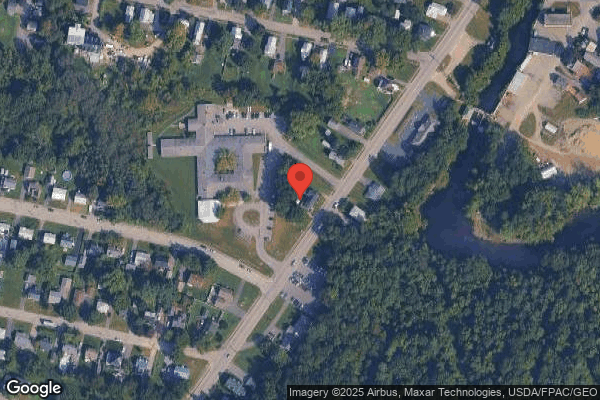




OAK GROVE CENTER

27 COOL ST, WATERVILLE, ME 04901 (207) 873-0721
For profit - Corporation 90 Beds GENESIS HEALTHCARE Data: November 2025 1 Immediate Jeopardy citation
Trust Grade
1/100
#70 of 77 in ME
Last Inspection: March 2025

Within standard 12-15 month inspection cycle. Federal law requires annual inspections.

Overview

Oak Grove Center in Waterville, Maine has received a Trust Grade of F, indicating significant concerns about the quality of care provided. Ranked #70 out of 77 facilities in the state, they are in the bottom half, and #6 out of 7 in Kennebec County, meaning only one local option is worse. Although the facility is improving, as the number of issues decreased from 32 in 2024 to 18 in 2025, the high staffing turnover rate of 64% is alarming, significantly above the state average. Recent inspections revealed serious concerns, including a large hole in the dining room ceiling with dirty water nearby, creating safety hazards for residents, and inadequate cleaning standards in the kitchen, which could affect food safety. While the facility does have average RN coverage, the overall situation raises serious red flags for families considering care options.

Trust Score
F
1/100
In Maine
#70/77
Bottom 10%
Safety Record
High Risk
Review needed
Inspections
Getting Better
32 → 18 violations
Staff Stability
⚠ Watch
64% turnover. Above average. Higher turnover means staff may not know residents' routines.
Penalties
✓ Good
$14,056 in fines. Lower than most Maine facilities. Relatively clean record.
Skilled Nurses
✓ Good
Each resident gets 54 minutes of Registered Nurse (RN) attention daily — more than average for Maine. RNs are trained to catch health problems early.
Violations
⚠ Watch
63 deficiencies on record. Higher than average. Multiple issues found across inspections.
★☆☆☆☆
1.0
Overall Rating
★★☆☆☆
2.0
Staff Levels
★☆☆☆☆
1.0
Care Quality
★☆☆☆☆
1.0
Inspection Score
Stable
2024: 32 issues
2025: 18 issues

The Good

  • Full Sprinkler Coverage · Fire safety systems throughout facility
  • No fines on record

Facility shows strength in fire safety.

The Bad

1-Star Overall Rating

Below Maine average (3.0)

Significant quality concerns identified by CMS

Staff Turnover: 64%

18pts above Maine avg (46%)

Frequent staff changes - ask about care continuity

Federal Fines: $14,056

Below median ($33,413)

Minor penalties assessed

Chain: GENESIS HEALTHCARE

Part of a multi-facility chain

Ask about local staffing decisions and management

Staff turnover is elevated (64%)

16 points above Maine average of 48%

The Ugly 63 deficiencies on record

1 life-threatening
Mar 2025 18 deficiencies
CONCERN (D)

Potential for Harm - no one hurt, but risky conditions existed

Deficiency F0578 (Tag F0578)

Could have caused harm · This affected 1 resident

Based on record reviews and interviews, the facility failed to ensure that the resident and/or resident representative were provided with written information concerning the right to accept or refuse m...

Read full inspector narrative →
Based on record reviews and interviews, the facility failed to ensure that the resident and/or resident representative were provided with written information concerning the right to accept or refuse medical or surgical treatment and/or formulate an advanced directive, was completed for 2 of 22 residents reviewed for advanced directives. (Residents #27, and #79) Findings: 1. Resident #27 was admitted to the facility in 10/2024. A review of the entire medical record lacked evidence that the facility offered or reviewed with the resident and/or resident representatives or that the resident and/or resident representatives were provided with written information concerning the right to formulate an advanced directive. On 3/19/25 at 11:56 a.m., in an interview, the Market Clinical Advisor confirmed that medical records lacked evidence that the facility offered or reviewed with the residents and/or resident representatives or that the residents and/or resident representatives were provided with written information concerning the right to formulate an advanced directive. 2. Resident #79 was admitted in February 2025. Social Services assessment, dated 2/14/25, states, .Resident Rights/Healthcare Decision Making/Advance Directives .Resident unable to hear or communicate with staff, trying to reach spouse Further review of the clinical record lacked evidence that the facility offered or reviewed with the resident and/or resident representative, or that the resident and/or resident representative were provided, written information concerning the right to formulate an advanced directive. On 3/18/25 at 9:02 a.m., during an interview, Resident #79 stated he/she is severely hard of hearing, even with hearing aids in, and cannot read well. On 3/19/25 at 11:32 a.m., during an interview, the finding was reviewed with the Market Clinical Advisor. On 3/19/25 at 12:47 p.m., during an interview, the Director of Social Services stated he might have spoken to Resident #79's spouse a couple weeks ago about formulating an advanced directive but did not document the conversation. Further review of Resident #79's clinical record lacked evidence of the conversation.
CONCERN (D)

Potential for Harm - no one hurt, but risky conditions existed

PASARR Coordination (Tag F0644)

Could have caused harm · This affected 1 resident

**NOTE- TERMS IN BRACKETS HAVE BEEN EDITED TO PROTECT CONFIDENTIALITY** Based on record review and interview, the facility failed to ensure that the State mental health authority for Pre-admission Scr...

Read full inspector narrative →
**NOTE- TERMS IN BRACKETS HAVE BEEN EDITED TO PROTECT CONFIDENTIALITY** Based on record review and interview, the facility failed to ensure that the State mental health authority for Pre-admission Screening and Resident Review (PASRR) Level II was implemented for 1 of 6 sampled residents reviewed for PASRR (Resident #20, (R20). Findings: 1.Review of R20's PASRR Level II, dated 2/25/25, indicated R20 was approved for specialized services to include Initial psychiatric evaluation to determine diagnosis and develop plan of care. Review of R20's care plan, updated 2/16/25 states: Resident/Patient meets PASRR II Level of care with diagnosis of Bipolar and Anxiety: Serious Mental Illness: Resident/Patient will receive appropriate specialized services as indicated on PASRR Level II thru next review date. Resident will be offered/engage with behavioral health services. Resident will engage/ be offered counseling services to develop coping skills. Review of Resident #20's current orders, dated 3/2025 lacked evidence that an order was placed for Medi tele (psyche services). During an interview on 3/20/25 at 3:3:24 p.m., the [NAME] Unit Manger (JUM) reviewed R20's active orders and confirmed there was no order placed for psyche services, and R20 was not taking any psychotropic medicines. During an interview on 3/21/25 at 12:48 p.m., the Licensed Social Worker (LSW) states he has been working at the facility since November 2024 and recently realized his predecessor did not follow through with PASRR's. The LSW stated the Unit Manager(JUM) for Long Term Care does the referrals, and he uploaded her PASRRII on 3/4/25. The LSW stated he did not follow up with (JUM) to see if this was done. During an interview on 3/21/25 at 1:25 p.m., the Director of Nursing provided a surveyor with a progress note dated 3/20/25 stating This nurse approached the pt[patient] about Medi Tele services and educated the patient on the service. This nurse asked the pt[patient] if they would like to be seen by Medi Tele and receive services. The pt[patient] agreed and gave this nurse verbal consent to complete the referral form. The referral was completed and sent. DNS further stated, she could not find, and documentation indicated R20 was previously offered/refused Psyche Services.
CONCERN (D)

Potential for Harm - no one hurt, but risky conditions existed

Deficiency F0657 (Tag F0657)

Could have caused harm · This affected 1 resident

Based on interviews and record review, the facility failed to review and revise the care plan by an interdisciplinary team (IDT), that included, to the extent possible, participation of the resident a...

Read full inspector narrative →
Based on interviews and record review, the facility failed to review and revise the care plan by an interdisciplinary team (IDT), that included, to the extent possible, participation of the resident and/or his/her representative after each Minimum Data Set (MDS) assessment for 1 of 4 residents reviewed for care planning (Resident #41). Finding: Review of Resident #41's clinical record revealed a Minimum Data Set (MDS) Quarterly Assessment was completed on 1/6/25. Further review of the clinical record lacked evidence that an interdisciplinary team (IDT) meeting was held within 7 days following the assessment. During an interview on 3/24/25 at 8:37 a.m., the Director of Social Services confirmed Resident #41's last IDT meeting was held 11/13/24 and that Resident #41's clinical record lacked evidence that an IDT meeting was held within 7 days of the MDS Quarterly assessment.
CONCERN (D)

Potential for Harm - no one hurt, but risky conditions existed

Accident Prevention (Tag F0689)

Could have caused harm · This affected 1 resident

**NOTE- TERMS IN BRACKETS HAVE BEEN EDITED TO PROTECT CONFIDENTIALITY** Based on observations, interviews, and a review of Safety Data Sheets (SDS), the facility failed to ensure that the resident's e...

Read full inspector narrative →
**NOTE- TERMS IN BRACKETS HAVE BEEN EDITED TO PROTECT CONFIDENTIALITY** Based on observations, interviews, and a review of Safety Data Sheets (SDS), the facility failed to ensure that the resident's environment was free of accident hazards relating to the storage of an unlabeled medicated cream and chemicals being properly secured for 2 of 2 observations for 1 of 4 days of survey. (3/18/25) Findings: The Safety Data Sheet for Clinical Silicone Cream noted the following: 4. First Aid Measures: Eye Contact: Flush eyes with large amounts of water for at least 15 minutes. Remove contact lenses, if worn. If irritation, seek medical attention. Skin Contact: If irritation develops, wash area with water. Get medical attention if irritation persists. Inhalation: Remove victim to fresh air and keep at rest in a position comfortable for breathing. Seek medical attention if discomfort continues or if you feel unwell. Ingestion: Never give anything by mouth to an unconscious person. Consult a physician if necessary. The Safety Data Sheet for FunkAway Beads Odor Eliminator noted the following: 4. First Aid Measures: Eye Contact: Rinse cautiously with water for several minutes. Remove contact lenses, if present and easy to do. Continue rinsing. If eye irritation persists, get medical advice/attention. Skin Contact: Wash skin with plenty of water. Inhalation: Remove person to fresh air and keep comfortable for breathing. Ingestion: If swallowed, rinse mouth with water(only if the person is conscious). Do not induce vomiting. Obtain emergency medical attention. . On 3/18/25 at 9:19 a.m., a surveyor observed of room [ROOM NUMBER] ([NAME] Unit) an unlabeled medicated cream and a chemical sitting on a small table in the shared bathroom between resident rooms [ROOM NUMBERS]. One was a 12-ounce container of FunkAway Odor elimination beads and the other one was a 4-ounce tube of Clinical Silicone Cream. On 3/18/25 at 9:35 a.m., the Market Clinical Advisor observed the chemicals with the surveyor and confirmed that the unlabeled medicated cream and the chemical should not have been in the bathroom and it was an accident hazard.
CONCERN (D)

Potential for Harm - no one hurt, but risky conditions existed

Medication Errors (Tag F0758)

Could have caused harm · This affected 1 resident

Based on clinical record review and interview, the facility failed to demonstrate evidence of monitoring for mood, behavior, and side effects of psychotropic medications for 1 of 5 residents reviewed ...

Read full inspector narrative →
Based on clinical record review and interview, the facility failed to demonstrate evidence of monitoring for mood, behavior, and side effects of psychotropic medications for 1 of 5 residents reviewed for unnecessary medications (#10). Findings: A review of Resident #10's clinical, Physician orders included the following medications: Risperidone (an antipsychotic) 2 mg (milligrams) by mouth one time a day; Lithium carbonate (used as a mood stabilizer) 300 mg by mouth twice daily; Lamotrigine (an anticonvulsant used as a mood stabilizer) 250 mg by mouth twice daily, and Trazodone (an antidepressant) 100 mg once daily to treat insomnia. Resident #10's care plan, last revised 2/6/25, identified the risk for complications related to the use of psychotherapeutic medication. Interventions included Monitor for side effects and consult physician and/or pharmacist as needed. Report the continued need of medication as related to behavior and mood. Also identified, Resident #10 exhibits or is at risk for distressed/fluctuating mood symptoms. Interventions included, Observe for signs/symptoms of worsening sadness/depression/anxiety/fear/anger/agitation. Observe for worsening signs/symptoms of existing psychiatric disorder. Notify physician/advanced practice practitioner as needed. Further review of the clinical record revealed monitoring for mood, behaviors and side effects of the psychotropic medication use was not initiated until 3/12/25. Additionally, Resident #10 was noted to have a DHHS (Department of Health and Human Services) appointed guardian. The record contained a psychotherapeutic informed consent form for the above medications which was not dated and had been signed by Resident #10. On 3/21/25, at 1:15 p.m., the surveyor discussed the findings with the Director of Nursing.
CONCERN (E)

Potential for Harm - no one hurt, but risky conditions existed

Safe Environment (Tag F0584)

Could have caused harm · This affected multiple residents

**NOTE- TERMS IN BRACKETS HAVE BEEN EDITED TO PROTECT CONFIDENTIALITY** Based on observations and interviews, the facility failed to adequately provide housekeeping and maintenance services necessary ...

Read full inspector narrative →
**NOTE- TERMS IN BRACKETS HAVE BEEN EDITED TO PROTECT CONFIDENTIALITY** Based on observations and interviews, the facility failed to adequately provide housekeeping and maintenance services necessary to maintain the building in a sanitary, orderly, and comfortable environment on 3 of 3 units ([NAME] Unit, [NAME] Unit and [NAME] Unit) and the laundry room for 1 of 1 facility tour. Findings: On 3/20/25 from 11:00 a.m. to 11:30 a.m., a surveyor conducted an Environmental Tour with the Senior Maintenance Director, Administrator and the Maintenance Directo in which the following findings were observed: [NAME] Unit - Resident room [ROOM NUMBER] - The bathroom had urine around the base of the toilet and had a very strong odor of urine. - Resident room [ROOM NUMBER] - The sink countertop had chipped/missing laminate on the front edge. The sink overflow drain hole was broken open and rusty. The right side drawers under the sink were off-track and wouldn't close. The entire bathroom floor was dirty and dirty around the base of the toilet. The walls behind the head of the beds had paint that was chipped/gouged and missing, creating uncleanable surfaces. - Resident room [ROOM NUMBER] - There was a bed pan on the floor behind the toilet and a urine hat on top of glove box and both were unlabeled and unbagged. [NAME] Unit - Resident room [ROOM NUMBER] - The room wall, by the thermostat, had chipped/missing paint and was gouged exposing sheetrock which created an uncleanable surface. [NAME] Unit - The dining room walls had chipped/missing paint and were marred with black marks. - Resident room [ROOM NUMBER] - The baseboard heater had chipped/missing paint. The floor was dirty around the base of the toilet. There was dust and debris in the bathroom light lens. - Resident room [ROOM NUMBER] - The baseboard heater had chipped/missing paint and was broken apart with metal hanging down. - Resident room [ROOM NUMBER] - There was dust and debris in the bathroom light lens. The room baseboard heater had chipped/missing paint creating an uncleanable surface. There was an unlabeled urinal on the floor by the toilet and an unlabeled urinal on the toilet tank in the shared bathroom. There was a dirty plunger on the floor next to the toilet. - Resident room [ROOM NUMBER] - The room entrance door frame had chipped/missing paint. The baseboard heater had chipped/missing paint. The walls around the room had chipped/missing paint and had black marks on them. This created uncleanable surfaces. Laundry - There were 3 laundry carts with wheels that had untreated wooden bases creating uncleanable surfaces. - There was a cracked/broken 4-foot ceiling light lens. - There were 2 ceiling lights that were missing their 4-foot ceiling light lenses. On 03/20/25 at 11:30 a.m., in an interview, the Senior Maintenance Director, the Administrator and the Maintenance Director confirmed the findings.
CONCERN (E) 📢 Someone Reported This

A family member, employee, or ombudsman was alarmed enough to file a formal complaint

Potential for Harm - no one hurt, but risky conditions existed

Comprehensive Care Plan (Tag F0656)

Could have caused harm · This affected multiple residents

**NOTE- TERMS IN BRACKETS HAVE BEEN EDITED TO PROTECT CONFIDENTIALITY** Based on record review, observations, interviews, and facility policy, the facility failed to implement a care plan for 3 of 4 s...

Read full inspector narrative →
**NOTE- TERMS IN BRACKETS HAVE BEEN EDITED TO PROTECT CONFIDENTIALITY** Based on record review, observations, interviews, and facility policy, the facility failed to implement a care plan for 3 of 4 sampled residents (Resident (R20, R21, and R66). Findings: Review of the Person-Centered Care Plan policy dated 10/24/22 states a comprehensive person-centered care plan must be developed for each patient and must describe the following: .any specialized services or specialized rehabilitative services the Center will provide as a result of PASRR recommendations Care plans will be: . Reviewed and revised by the interdisciplinary team after each assessment, including both the comprehensive and quarterly review assessments, and as needed to reflect the response to care and changing needs and goals . 1. During an interview on 3/18/25 at 7:53 a.m., R20 stated his/her dental bridge fell out a while ago and is still waiting for it to be replaced. At this time R20 opened his/her mouth and a surveyor observed multiple missing teeth and what appeared to be a broken bridge on the inside of his/her mouth. R20 stated his/her gums were really sore. Review of R20's Physician progress note dated 2/12/25 states We saw [R20] for an emergency apt concerning [his/her] missing bridge. [R20] wanted bridge recemented inside [his/her] mouth. Had to explain, the patient had teeth removed and thus the bridge no longer fits and will never fit. Referred pt[patient] to dentist to start partial denture process. Review of R20's care plan updated 2/25/25 lacked evidence that a care plan was established for dental. During an interview on 3/20/25 at 3:24 p.m., the [NAME] Unit Manger (JUM) reviewed and confirmed R20's care plan did not include goals and interventions in the area of dental. During an interview on 3/20/25 at 3:30 p.m., the above was discussed with the Director of Nursing (DON). 2. Review of R21's care plan updated 1/7/24 states Self administration of medication, saline nasal spray, seasonal allergies. Patient will correctly and safely: self-administer medication. Ensure availability/adequate supply of medication(s) for self administration. To Ensure patients ongoing functional and cognitive skills permit continued safe medication self-administration. Observe for indications of the patient skipping doses or refusing to take medication. During an interview on 3/20/25 at 12:09 p.m., JUM reviewed and confirmed R21's clinical record did not contain evidence he/she was assessed for use of duo neb or inhaler per care plan intervention. 3. Review of R66 Provider orders active for March 2025 revealed he/she was taking a diuretic medication: Lasix for congestive heart failure (CHF), opioid medication: Tramadol for pain, and anticoagulant medication: Clopidogrel Bisulfate for blood clot prevention, and has 3 stage II wounds on the left lower extremity (left lower leg). Review of R66's care plan updated 2/11/25 lacked evidence that goals and interventions were put into place for the use of diuretics, opioid, or anticoagulant use, and stage II pressure sores on the left lower extremity. During an interview on 3/20/25 at 3:20 p.m., JUM reviewed and confirmed R66's care plan did not reflect above concerns, stating I will update the care plan. The above was discussed with DON 3/20/25 at 3:28 p.m.
CONCERN (E)

Potential for Harm - no one hurt, but risky conditions existed

Respiratory Care (Tag F0695)

Could have caused harm · This affected multiple residents

**NOTE- TERMS IN BRACKETS HAVE BEEN EDITED TO PROTECT CONFIDENTIALITY** Based on observations, record reviews, interviews and facility policy, the facility failed to provide a sanitary environment to ...

Read full inspector narrative →
**NOTE- TERMS IN BRACKETS HAVE BEEN EDITED TO PROTECT CONFIDENTIALITY** Based on observations, record reviews, interviews and facility policy, the facility failed to provide a sanitary environment to help prevent the development and transmission of disease and infection related to respiratory care for 4 of 5 residents reviewed for respiratory care (Resident [R] R13, R21, R46 and R65). Findings: Review of policy Nebulizer: Small Volume dated 11/1/23 states: .Upon completion of the treatment, .Rinse SVN, mouthpiece, and T piece with sterile water and dry. Place in treatment bag labeled with patient name and date . 1. On 3/19/25 at 8:41 a.m., observation of room [ROOM NUMBER], 3/19/25 at 7:30 a.m., and 11:39 a.m. revealed nebulizer located on top of Resident R13's side table with tubing attached with/to nebulizer pipe which is resting/stored on top of a stuffed animal without a barrier between the nebulizer pipe and the stuffed animal allowing potential cross contamination. On 3/19/25 at 11:30 a.m. observation and interview with Licensed Practical Nurse (LPN), she confirmed nebulizer tubing was not bagged, and stated she does not know why the nebulizer was in the room because R13 only needed it for an exacerbation and hadn't used it in over a week. Review of R13's orders active March 2025 revealed [he/she] last used the nebulizer on 3/13/25. On 3/19/25 at 11:47 a.m. the above was discussed with Director of Nursing. 2. On 3/18/25 at 8:24 a.m., and 3/19/25 at 7:38 a.m., observation of room [ROOM NUMBER]-1, a nebulizer was observed on R21's nightstand with tubing attached to pipe which is resting/stored on top of dresser without a barrier between the nebulizer pipe and the side table allowing potential cross contamination. During an interview on 3/19/25 at 7:34 a.m., the Licensed Practical Nurse (LPN) confirmed the above findings. 3. On 3/18/25 08:23 a.m., and 3/19/25 at 7:45 a.m., and on 3/20/25 at 11:45 a.m., observations of a Nebulizer on top of R46's tv stand tubing attached to mask dated 3/16 - stored in top draw and resting on personal items without a barrier between the nebulizer mask and personal items allowing potential for cross contamination. During an observation of R46 on 3/20/25 at 11:45 a.m. with [NAME] Unit Manager (JUM), she confirmed above findings. 4. On 3/19/25 at 8:19 a.m., during an observation, Resident #65's unbagged continuous positive airway pressure (CPAP) mask was lying on the floor underneath his/her bed. On 3/19/25 at 8:30 a.m., during an interview, Registered Nurse (RN) #6 stated when CPAP masks are not in use, they are stored in a plastic drawstring bag or sometimes the original device packaging. On 3/19/25 at 8:40 a.m., during an observation with a surveyor the [NAME] Unit manager confirmed the finding for Resident #65.
CONCERN (E)

Potential for Harm - no one hurt, but risky conditions existed

Deficiency F0699 (Tag F0699)

Could have caused harm · This affected multiple residents

**NOTE- TERMS IN BRACKETS HAVE BEEN EDITED TO PROTECT CONFIDENTIALITY** 3. Resident #27 was admitted to the facility on [DATE] to include a diagnosis of PTSD. On 3/21/25, a review of Resident #27 's c...

Read full inspector narrative →
**NOTE- TERMS IN BRACKETS HAVE BEEN EDITED TO PROTECT CONFIDENTIALITY** 3. Resident #27 was admitted to the facility on [DATE] to include a diagnosis of PTSD. On 3/21/25, a review of Resident #27 's clinical record, in the Minimum Data Set (MDS) 3.0, Section I, Active Diagnoses, Psychiatric/Mood Disorder, I6100 was coded to indicate Resident #27 had an active diagnosis for PTSD. The surveyor was unable to find information in the clinical record that indicates what Resident #27 's PTSD was caused by, what trigger(s) might cause re-traumatization, and measures to avoid trigger(s) that might cause re-traumatization. On 3/21/25 at 3:15 p.m., in an interview, the Market Clinical Advisor confirmed that Resident 27's care plan lacked what indicated what Resident #27 's PTSD was caused by, what trigger(s) might cause re-traumatization, and measures to avoid trigger(s) that might cause re-traumatization. Based on record review and interview, the facility failed to identify a resident's current diagnosis of Post-Traumatic Stress Disorder (PTSD)/trauma to determine what trigger(s) might cause re-traumatization for 3 of 3 sampled resident reviewed with a current diagnosis of PTSD (Resident #(R)15, R27 and R35). Findings: 1. Resident (R) 35 was admitted in 2024 and has diagnoses to include post-traumatic stress disorder. Review of R35's care plan updated 1/22/25 lacked evidence that a trauma informed care plan was established to include triggers for this resident's PTSD diagnoses. Review of R35's admission Minimum Data Set (MDS) 3.0, Section I, Active Diagnoses, Psychiatric/Mood Disorder, I6100 was coded to indicate R35 had an active diagnosis for Post Traumatic Stress Syndrome (PTSD). The surveyor was unable to find information in the clinical record that indicated what R35's PTSD was caused by or what events might cause re-traumatization. During an interview with 4 surveyors on 3/21/25 at 3:00 p.m., Market Clinical Advisor confirmed Resident #35 did not have a trauma informed care plan. 2. Resident #15 was recently admitted and has diagnoses to include Post-Traumatic Stress Disorder. Review of Resident #15's admission Minimum Data Set (MDS), Section I, 16100. Post Traumatic Stress Disorder (PTSD), indicated Resident #15 has an active diagnosis of PTSD. Review of Resident #15's care plan, revised 3/18/25, includes, Focus: PASSR Level II: Diagnosed with PTSD . but lacked evidence that a trauma informed care plan was established to include Resident #15's trigger(s) for PTSD. During an interview on 3/21/25 at 3:10 p.m., the Market Clinical Advisor confirmed Resident #15 did not have a trauma informed care plan.
CONCERN (E)

Potential for Harm - no one hurt, but risky conditions existed

Deficiency F0725 (Tag F0725)

Could have caused harm · This affected multiple residents

**NOTE- TERMS IN BRACKETS HAVE BEEN EDITED TO PROTECT CONFIDENTIALITY** Based on observations, interviews, and record reviews, the facility failed to ensure sufficient direct care staff were scheduled...

Read full inspector narrative →
**NOTE- TERMS IN BRACKETS HAVE BEEN EDITED TO PROTECT CONFIDENTIALITY** Based on observations, interviews, and record reviews, the facility failed to ensure sufficient direct care staff were scheduled and on duty to meet the needs of residents that reside on 3 of 3 units. Findings: 1. On 3/18/25 at 8:45 a.m., in an interview with a surveyor, RN5 stated the facility had changed to primary nursing and had taken away the medication technician position approximately 1 month ago. This change has resulted in nurses having to administer their own medications and treatments, often up to an hour late. On this day, the nurse had a discharge scheduled at 9:00 a.m., as well as an IV antibiotic to administer. RN5 stated wound care would be provided late due to lack of staffing. 2. On 3/20/25 at 11:20 a.m., a surveyor requested to observe wound care for Resident #9. LPN2 stated he/she would not be able to get to the twice daily wound care until 1:30 - 2:00 p.m. due to the workload and tasks to be completed. LPN2 stated he/she usually tries to complete the wound care before lunch, but today, he/she is unable to complete the wound care on time as there are only 2 licensed nurses, and 2 CNA's (Certified Nursing Assistants) on the unit. There are 2 admissions, and 2 discharges scheduled today, and on LPN2's assignment, 1 extensive wet to dry dressing change, Resident #9's dressing change, Resident #50's dressing change, and a new resident requiring care for 2 draining fistulas. LPN2 stated he/she also was responsible for all medication administration, blood glucose testing and insulin administration. 3. Review of Payroll Based Journal staffing report revealed the facility triggered for low weekend staffing during the first quarter of 2025 (October 1, 2024 - December 31, 2024). On 3/19/25 at 3:00 p.m., during an interview, Resident #10 stated the primary concern at Resident Council meetings is lengthy call bell response times and that when staff come in to answer a call bell, they do not ask the other resident in the room if they need anything. On 3/20/25 at 11:05 a.m., during an interview Registered Nurse (RN) #4 stated the unit manager does not work the floor on the [NAME] unit and only does direct care if staff really needs help. RN #4 then stated that under the new staffing model, the medication tech (MT) goes home at 2:00 p.m., and the nurse takes over and administers all medications and treatments between 2:00-6:00 p.m. and then, the MT comes back from either 5:00-9:00 p.m. or 6:00-10:00 p.m. RN #4 then stated that last night, a resident fell at 3:30 p.m., and she had barely finished admitting another resident, when a third resident fell, all while she should be giving medications because the MT left. On 3/24/25 between 9:43 -10:15 a.m., during an interview, a surveyor reviewed weekend staffing for October 1, 2024 through December 31, 2024 with the Staffing Coordinator, and the Director of Nursing (DON). The DON stated she was aware of the shortages in the first quarter and confirmed the facility did not have enough staff to meet resident needs on the weekends.
CONCERN (E)

Potential for Harm - no one hurt, but risky conditions existed

Pharmacy Services (Tag F0755)

Could have caused harm · This affected multiple residents

**NOTE- TERMS IN BRACKETS HAVE BEEN EDITED TO PROTECT CONFIDENTIALITY** Based on record reviews, observations and interviews, the facility failed to establish a system of records of receipt and dispos...

Read full inspector narrative →
**NOTE- TERMS IN BRACKETS HAVE BEEN EDITED TO PROTECT CONFIDENTIALITY** Based on record reviews, observations and interviews, the facility failed to establish a system of records of receipt and disposition of all controlled drugs in sufficient detail to enable an accurate reconciliation by failing to ensure that two people who are authorized to administer medications signed the Shift Count page indicating that they counted all controlled substances at the change of shift for multiple shifts, on 1 of 3 units reviewed ([NAME]). Findings: A review of the facility's policy and procedure: Controlled Drugs: Management Of, State of Maine, last revised 7/1/24, page 6, Section 5. Ongoing Inventory of Controlled Substances (Shift Count): 5.1 stated, Follow the Index Page to perform a complete count of all Schedule II to IV controlled substances at the change of shifts or at any time in which narcotic keys are surrendered from one licensed nursing staff to another. 5.1.3. Both medication nursing staff members participating in the count must: 5.1.3.3. Sign the shift count page in the 'Controlled Substances Book' to acknowledge a correctly reconciled count. On 3/20/25 at approximately 12:30 p.m., during a medication storage observation of the [NAME] unit medication cart, a surveyor reviewed the Controlled Substance Books and Shift Counts which indicated the facility counts at the change of each shift, approximately 3 times a day. The person authorized to administer medications coming on duty or the person authorized to administer medications going off duty both failed to sign the Shift Count page of the Controlled Substances Book that indicated the controlled substances count was completed on multiple days. At this time, the findings were discussed and confirmed with (Registered Nurse) RN #3 and RN #4. On 3/20/25 at 12:50 p.m., in an interview with the Director of Nursing and the Market Clinical Advisor, the surveyor discussed that multiple days on the [NAME] unit were missing staff signatures for verification and completion of the controlled medication count on the following dates: 11/25/24, 11/26/24, 11/29/24, 2/3/25, 2/4/25, 2/24/25, 2/25/25 (a.m. and p.m.), 3/6/25 (a.m. and p.m.), 3/7/25 (a.m. and p.m.), 3/11/25, 3/12/25, 3/18/25, and 3/19/25.
CONCERN (E)

Potential for Harm - no one hurt, but risky conditions existed

Deficiency F0761 (Tag F0761)

Could have caused harm · This affected multiple residents

**NOTE- TERMS IN BRACKETS HAVE BEEN EDITED TO PROTECT CONFIDENTIALITY** 3. On 3/18/25 at 9:45 a.m., during a medication storage observation of Medication Cart B on [NAME] Unit, the following topical m...

Read full inspector narrative →
**NOTE- TERMS IN BRACKETS HAVE BEEN EDITED TO PROTECT CONFIDENTIALITY** 3. On 3/18/25 at 9:45 a.m., during a medication storage observation of Medication Cart B on [NAME] Unit, the following topical medications were observed undated when opened and stored in a drawer with oral medications: Therahoney, Anasep wound gel, zinc oxide skin protectant cream, Diclofenac gel, Prevent silicone cream. Oral medications stored among the topical medications included: Lactulose oral solution and Guaifenesin liquid. Also observed with these medications was a bottle of antifungal powder prescribed to Resident #9. (Registered Nurse) RN #1 stated the medication had been discontinued a while ago. Another bottle of antifungal powder had the pharmacy label torn off and was open and available for use. A review of the provider orders for Resident #9 noted the order for antifungal powder had been discontinued on 3/5/25. 4. On 3/20/25 at 9:00 a.m., during a medication administration observation on the [NAME] Unit, a surveyor observed an Insulin Lispro Kwik-Pen prescribed to Resident #4, in use and undated when opened stored in Medication Cart B. The surveyor brought this to the attention of the RN who threw it away at this time. 5. On 3/20/25 at 12:00 p.m., during an observation of the nurse treatment cart on the [NAME] Unit, a surveyor observed the following 7 insulin pens that were all prescribed to current residents and were open and available for use: > 2 - Undated when opened Insulin glargine-yfgn (U100) > Insulin Lispro Kwikpen (U100) labeled as opened on 2/16/25 (expired) > Undated Insulin Lispro Kwikpen (U100) > Insulin Lispro Kwikpen (U100) labeled as opened on 1/27/25 (expired) > Undated Insulin Glargine Solostar pen > Undated Basaglar Kwikpen (U100) On 3/20/25 at 12:05 p.m., the surveyor brought the above insulin pens to the JUM ([NAME] Unit Nurse Manager). 6. On 3/20/25 at 12:10 p.m., during an observation of the [NAME] Unit Medication Room with RN #2, a surveyor observed the emergency stock of intravenous antibiotic medications, stored in 3 plastic boxes with compartments. The following were noted: > 2 vials of Zosyn (piperacillin 3 grams/tazobactam 0.375 grams) - expired 1/25 > 2 vials of Cefazolin 1 gram - expired 11/24 7. The small medication refrigerator located on the floor was observed to have a large ice buildup. A stack of insulin pens were observed stored next to the ice buildup. At this time, the surveyor brought the expired antibiotics to the JUM and notified him/her of the ice buildup in the medication refrigerator. 8. On 3/20/25 at approximately 12:30 p.m., during an observation of the treatment cart on [NAME] Unit with RN #3, a surveyor observed 3 vials of single dose Shingrix vaccine stored in a plastic bag with a sticker which stated Keep Refrigerated. RN #3 removed the vaccines from use at this time. On 3/20/25 at 12:50 p.m., the surveyor discussed the above findings with the Director of Nursing and the Market Clinical Advisor. Based on observations, interviews and record reviews, the facility failed to ensure medications and treatments were stored properly, including removal of expired medications from available supply, on 3 of 5 days of survey (3/18/25, 3/19/25, 3/20/25). Additionally, the facility failed to obtain physician orders for medications located at a resident's bedside, for 2 of 2 sampled resident (Resident #65 and #79). Findings: Review of policy Medication Self-Administration, revised 10/15/2024, states, Patients who wish to self-administer medications will be evaluated for safe and clinically appropriate capability .If it is determined that the patient is able to self-administer: A physician/advanced practice provider (APP) order is required .Self-administration and medication self-storage must be care planned .patient must be provided with a secure, locked area to maintain medications . Review of policy, Bedside Medication Storage, dated 1/2024, states, The interdisciplinary team (IDT) will review and approve resident competencies and understanding prior to permission of bedside storage of medications .A written order for the bedside storage of medications is present in the resident's medical record .Bedside storage of medications is indicated on the resident medication administration record (MAR) .the manner of storage prevents access by other residents. Lockable drawers or cabinets are required . The facility's policy, titled 4.1 Storage of Medication, dated 1/25, stated, Procedures 4. Medications should be stored so that various routes of administration are separated. Internally administered medications are stored separately from medications used externally, such as lotions, creams, ointments, and suppositories. Section 12 stated, Insulin products should be stored in the refrigerator until opened. Note the date on the label for insulin vials and pens when first used. The opened insulin vial may be stored in refrigerator or at room temperature. (Refer to specific product labeling for additional detail). Opened insulin pens should be stored at room temperature. Do not freeze insulin. If insulin has been frozen, do not use. Section 14 stated, Outdated, contaminated, discontinued or deteriorated medications and those in containers that are cracked, soiled, or without secure closures are immediately removed from stock, disposed of according to procedures for medication disposal. According to the Institute for Safe Medication Practices website, Safety Tips for Storing Insulin, states Write the date you open the insulin on the product. On the day you open the insulin vial, pen, or cartridge, or start keeping it outside the refrigerator, write the date on the label. This will help you remember when to stop using it. Insulin expires 28 days after it is opened. 1. On 3/18/25 at 7:50a.m., during an observation of Resident #65's room, a Fluticasone/Salmeterol 250mcg-50mcg inhalation device was located on Resident #65's over-the-bed table. Review of Resident #65's clinical record lacked evidence of an order to self-administer medications. Further review of the clinical record lacked evidence of an IDT assessment. On 3/18/25 at 2:39 p.m., during an interview, Registered Nurse (RN) #1 stated she left Resident #65's Advair inhaler at the bedside so he/she could take his/her dose after breakfast. At this time, RN #1 stated medications should not be left at the bedside, and that Resident #65 does not have an order to self-administer medications. During an interview on 3/18/25 at 2:45 p.m., the finding was reviewed with the [NAME] Unit Manager. 2. On 3/19/25 at 8:24 a.m., during an observation of Resident #79's room, a 1.5 fluid ounce bottle of Deep Sea Premium Saline 0.65% nasal moisture spray was located on the windowsill next to Resident #79's recliner. At this time, Resident #79 stated he/she was given the medication in the hospital and uses the medication a couple times a day. Review of Resident #79's active orders lacked evidence of a physician order for the saline nasal spray and lacked evidence of an order to self-administer medications. Further review of the clinical record lacked evidence of an IDT assessment. On 3/19/25 at 8:40 a.m., a surveyor and the [NAME] Unit Manager observed the nasal spray on Resident #79's windowsill. At this time, the Unit Manager stated residents who self-administer medications must have an assessment to determine if it is safe to self-administer, an order to self-administer, a physician order for the medication, and the medication must be stored in a lock box. On 3/19/25 at approximately 11:00 a.m., the above findings were discussed with the Market Clinical Advisor.
CONCERN (E)

Potential for Harm - no one hurt, but risky conditions existed

Garbage Disposal (Tag F0814)

Could have caused harm · This affected multiple residents

Based on observations and interviews, the facility failed to maintain garbage storage areas in a sanitary condition to prevent the harborage and feeding of pests for 1 of 3 dumpsters for 1 of 4 days(3...

Read full inspector narrative →
Based on observations and interviews, the facility failed to maintain garbage storage areas in a sanitary condition to prevent the harborage and feeding of pests for 1 of 3 dumpsters for 1 of 4 days(3/18/24) and 1 of 3 dumpsters for 3 of 4 days of survey. (3/18/25, 3/19/25, and 3/20/25) Findings: 1. On 3/18/25 at 6:30 a.m., a surveyor observed 1 dumpster with the right-side slide door open exposing trash. Additionally, there was trash/debris on the ground. Another dumpster had a right-side top cover that was broken and open exposing trash. 2. On 3/19/25 at 8:00 a.m., a surveyor observed a dumpster had a right-side top cover that was broken and open exposing trash. 3. On 3/20/25 at 8:00 a.m., a surveyor observed a dumpster had a right-side top cover that was broken and open exposing trash. On 3/19/25 at 7:45 a.m., during an interview, the [NAME] stated the dumpsters are always supposed to be closed, but one of them has had a broken flap for a couple of weeks and she's not sure what they are doing about it. On 3/20/25 at 1:00 p.m., in an interview, the Administrator confirmed the findings.
CONCERN (E)

Potential for Harm - no one hurt, but risky conditions existed

Medical Records (Tag F0842)

Could have caused harm · This affected multiple residents

**NOTE- TERMS IN BRACKETS HAVE BEEN EDITED TO PROTECT CONFIDENTIALITY** Based on record reviews and interviews, the facility failed to ensure that clinical records were complete and contained accurate...

Read full inspector narrative →
**NOTE- TERMS IN BRACKETS HAVE BEEN EDITED TO PROTECT CONFIDENTIALITY** Based on record reviews and interviews, the facility failed to ensure that clinical records were complete and contained accurate information for 5 of 7 sampled residents reviewed for respiratory (Resident #[R] R15, R20, R21, R41 and R44). Findings: 1. Review of R20's Preadmission Screening and Resident Review (PASRR) level II dated 2/25/25 revealed [he/she] has a Mental health disability and is qualified for Specialized services: You will need to be provided the following specialized services: Service or Support: Initial psychiatric evaluation to determine diagnosis and develop plan of care. Review of R20's clinical record lacked evidence this was done. Review of R20s clinical record revealed order with start date of 2/13/25 states. Is resident free from side effects of psychotherapeutic medications? (if no, document side effects in PN) every shift AND as needed. Review of R20's care plan updated 2/13/25 states is at risk for complications related to the use of psychotropic drugs Medication as ordered. Resident will have the smallest most effective dose without side effects for 90 days. Monitor for side effects and consult physician and/or pharmacist as needed Review of R20's medication orders lacked evidence that R20 had any psychotropic medication orders. During an interview on 3/20/25 at 3:3:24 p.m., the [NAME] Unit Manger (JUM) reviewed R20's active orders and confirmed there was no order placed for psyche services, and R20 was not taking any psychotropic medicines. 2. Review of R21's active provider orders for March 2025 revealed order with start date of 10/30/24 to Please give patient 4 duo nebs to room daily for his own QID use every day shift. And order with start date of 4/17/24 for Albuterol Sulfate HFA Inhalation Aerosol Solution 108 (90 Base) MCG/ACT (Albuterol Sulfate) 2 puff inhale orally two times a day for sob Ok to have inhaler by bedside. Review of R21's Self -Administration of Medications Evaluation dated 9/20/23 states: What type(s) of medications has the patient requested to self-administer? :Nasal Saline Further review of clinical record lacked evidence that a self-administration evaluation was completed for R21 for the use of duo nebs or inhaler. Review of R21's care plan updated 1/7/24 states Self-administration of medication, saline nasal spray, seasonal allergies. Patient will correctly and safely. Self-administer medication. Ensure availability/adequate supply of medication(s) for self-administration. Ensure patients ongoing functional and cognitive skills permit continued safe medication self-administration. Observe for indications of the patient skipping doses or refusing to take medication. Review of clinical record lacked evidence that R21 was assessed to self-administer duo nebs or inhaler. During an observation on 3/20/25 at 12:00 p.m., Resident R21 was observed in [his/her] room, and was holding a nebulizer pipe in [his/her] lap. At this time R21stated he/she keeps [his/her] duo nebs and inhaler in [his/her] desk and uses them when [he/she] needs to. At this time R21 opened his/her desk draw and pointed to [his/her] medications. R21 stated the last time [he/she] used the inhaler was this morning and just finished a nebulizer treatment. When asked how long [he/she] has kept the medications in [his/her] room R21 replied It's been a while. During an interview on 3/20/25 at 12:09 p.m., the [NAME] Unit Manger (JUM) reviewed R21's clinical record and confirmed it did not contain evidence he/she was assessed for use of duo neb or inhaler. The above was discussed with the Market Clinical Advisor (MCA) on 3/20/25 at approximately 1:00 p.m. Review of Falls Management policy, revised 3/15/24, states, . in the event a fall occurs, an assessment will be completed to determine possible injury . Document circumstances of the fall, post-fall assessment, and patient outcome . 3. Resident #44 has diagnoses to include repeated falls. Review of Resident #44's clinical record revealed he/she sustained a fall on 11/14/24, 11/22/24, and 3/8/25 and lacked evidence that a post-fall fall risk assessment was completed following the falls. During an interview on 3/20/25 at 11:05 a.m. Registered Nurse (RN) #4 stated after a resident falls, a post-fall risk assessment is completed. During an interview on 3/21/25 at 1:38 p.m., the finding was discussed with the Director of Nursing, the Administrator, and the Market Clinical Advisor. At this time, the Director of Nursing reviewed Resident #44's entire clinical record and confirmed that it lacked evidence of a post-fall fall risk assessment for the above falls. 4. Resident #15 diagnoses include anxiety, Bipolar disorder, and psychotic disturbance. Review of Resident #15's active physician orders revealed: -Order with a start date of 3/18/25 for Seroquel 100mg oral tablet, give 1 tablet by mouth one time a day for bipolar d/o [disorder] with agitation - Order with a start date of 2/1/25 for Quetiapine Fumarate Oral Tablet 300mg, give 1 tablet by mouth at bedtime for psychosis Review of Review of Resident #15's Care plan, updated on 2/25/25, revealed, Resident is at risk for complications related to the use of psychotropic meds .Monitor for side effects . Further review of the clinical record lacked evidence of monitoring for side effects for the above medications. 5. Resident #41 has diagnoses to include End Stage Renal Disease (ESRD) and is dependent on dialysis. Review of Resident #41's Care Plan, updated 2/26/25 includes, Central tunneled jugular dialysis catheter for ESRD and dialysis Review of Resident #41's active physician orders revealed: -Order with a start date of1 2/10/24 for, Transfer to hemodialysis unit .on MWF [Monday, Wednesday, Friday] for treatment -Order with a start date of 2/25/25, Do not shower while still on tunneled dialysis catheter in place. Record review revealed a nursing progress note, dated 3/15/25, states, Patient had shower today. Skin assessment done . Review of Resident #41's bathing task revealed he/she received a shower on 3/10/25 and resident refused a shower on 3/15/25. Review of the nursing documentation on the March 2025 Treatment Administration Record (TAR) indicates Resident #41 has not received a shower during the month of March. During an interview on 3/21/25 at 1:42 p.m., the above findings were confirmed with the Director of Nursing.
CONCERN (E)

Potential for Harm - no one hurt, but risky conditions existed

QAPI Program (Tag F0867)

Could have caused harm · This affected multiple residents

Based on record review and interview, the facility's Quality Assurance Committee failed to ensure that the Plan of Correction for identified deficiencies from the Annual Long Term Care Survey Process ...

Read full inspector narrative →
Based on record review and interview, the facility's Quality Assurance Committee failed to ensure that the Plan of Correction for identified deficiencies from the Annual Long Term Care Survey Process for Federal Recertification dated 2/1/24, were effective. The Federal citations F584, F625, F656, F689, F725, F842 and F880 were cited again during the annual Long Term Care Recertification Survey dated 3/24/25. Findings: During the Annual Long Term Care Survey Process for Federal Recertification dated 3/24/25, it was determined that F584, F625, F656, F689, F725, F842 and F880 would be recited for the same reasons: F584 for failure to adequately provide housekeeping and maintenance services necessary to maintain the building in a sanitary, orderly, and comfortable environment; F625 failure to issue a written bed hold notice to include cost of care to the Resident and/or resident representative; F656 for failure to implement a comprehensive person-centered care plan; F689 for failure to ensure that the resident's environment was free of accident hazards relating to the storage of chemicals being properly secured; F725 for failure to ensure sufficient direct care staff were scheduled and on duty to meet the needs of residents; F842 for failure to ensure that clinical records were complete and contained accurate information and F880 for failure to maintain an infection prevention and control program designed to help prevent the development and transmission of communicable diseases. On 3/24/25 at 12:28 p.m., during an interview, the above findings were discussed with the Administrator.
CONCERN (E)

Potential for Harm - no one hurt, but risky conditions existed

Infection Control (Tag F0880)

Could have caused harm · This affected multiple residents

Based on observations, interviews, clinical record review, and facility policy review, the facility failed to maintain an infection prevention and control program designed to help prevent the developm...

Read full inspector narrative →
Based on observations, interviews, clinical record review, and facility policy review, the facility failed to maintain an infection prevention and control program designed to help prevent the development and transmission of communicable diseases for residents requiring Enhanced Barrier Precautions (Resident #33) on 1 of 3 facility units. Findings: On 3/18/25 at 1:20 p.m., a surveyor observed 2 CNAs (Certified Nursing Assistants) wearing gloves enter Resident #33's room with a mechanical hoyer lift. The resident's door was posted with a Contact Precautions sign which included a picture of a person wearing a gown, gloves, mask and face shield. The instructions stated Perform hand hygiene before and after patient contact, contact with environment and after removal of PPE (personal protective equipment). Wear N95/approved KN-95 respirator, gown, face shield and gloves upon entering this room. Change gown after EACH patient contact (written in red). Keep room door closed. Patient must wear a face mask when out of room and maintain social distancing. Perform all procedures/tests in patient room, if able. Pull curtain between roommates. Please do not remove dedicated or single use disposable equipment from this room. When dedicated equipment is not possible, disinfect shared patient equipment with EPA-approved disinfectant. The surveyor observed Resident #33 had a foley catheter hanging from the bed. One CNA picked up the foley catheter and placed it across the resident's legs while the other CNA was hooking the hoyer pad to the hoyer lift. At this time the surveyor requested to speak with both CNAs and asked them what type of PPE they should be wearing. One CNA stated gloves. The surveyor noted the posted sign and asked if the resident required the PPE as per the posted precautions. The CNA stated the resident was on Advanced Barrier Precautions, and that only when staff provide foley or pericare is a gown required, otherwise, only gloves are required. On 3/18/25 at 1:25 p.m., the surveyor asked LPN #1, what type of precautions Resident #33 required. LPN #1 stated the resident had ESBL (Extended-Spectrum Beta-Lactamase) in the urine, and an SP (supratubic) tube. The LPN stated when providing care for the foley (SP tube), we gown up. On 3/18/25 at 1:30 p.m., in an interview with the surveyor, the Unit Manager (JUM) stated Resident #33 had a history of ESBL which had been treated in November, 2024. However, the resident had been treated in the emergency department (ED) over the weekend and was diagnosed with a urinary tract infection (UTI). The JUM stated he/she was not sure what kind of precautions the resident was currently on. A review of Resident #33's record noted a provider note, dated 3/18/25, which stated recent ED visit with diagnosis of UTI - per culture and sensitivity - Pseudomonas aeruoginosus, Serratia marcescens. Resident #33's care plan, last revised 3/18/25, stated the resident required Enhanced Barrier Precautions. On 3/19/25 at 10:25 a.m., a surveyor observed Resident #33's door with the same Contact Precautions sign. On 3/19/25 at 11:30 a.m., in an interview with the surveyor, the Director of Nursing (DON) and the Market Clinical Advisor stated Resident #33 was previously on Enhanced Barrier Precautions for ESBL in the urine and use of an indwelling urinary catheter. At some point, the signage on the door was changed to Contact Precautions. The resident was seen in the ED over the weekend and was currently undergoing treatment for an active UTI. The DON stated Resident #33 required Enhanced Barrier Precautions at the present time and confirmed that staff were not following correct precautions as posted when observed yesterday. The Market Clinical Advisor stated staff received education last night on proper procedures for use of Enhanced Barrier Precautions. The facility's policy regarding Enhanced Barrier Precautions, with a revision date of 12/16/24, stated In addition to Standard Precautions, Enhanced Barrier Precautions (EBP) will be used (when Contact Precautions do not otherwise apply) for novel or targeted multi-drug resistant organisms (MDROs). Section 4, Implement Contact Precautions versus EBP per following table, stated under Patient Status: Has a wound or indwelling medical device without secretions or excretions that are unable to be covered or contained and not known to be infected or colonized. United States Centers for Disease Control and Prevention (CDC) recommendations poster for use of EBP's, dated 7/31/22, stated, Providers and staff must also wear gloves and a gown for the following high contact resident-care activities: dressing, bathing/showering, transferring, changing linens, providing hygiene, changing briefs or assisting with toileting, device care or use: central line, urinary catheter, feeding tube, tracheostomy, wound care: any skin opening requiring a dressing.
MINOR (B)

Minor Issue - procedural, no safety impact

Transfer Notice (Tag F0623)

Minor procedural issue · This affected multiple residents

**NOTE- TERMS IN BRACKETS HAVE BEEN EDITED TO PROTECT CONFIDENTIALITY** 2. Review of [R10]'s clinical record revealed he/she was transferred to an acute hospital on [DATE]. The clinical record lacked ...

Read full inspector narrative →
**NOTE- TERMS IN BRACKETS HAVE BEEN EDITED TO PROTECT CONFIDENTIALITY** 2. Review of [R10]'s clinical record revealed he/she was transferred to an acute hospital on [DATE]. The clinical record lacked evidence that the facility issued a written discharge/transfer notice to include appeal rights to the resident and/or resident representative. During an interview on 3/18/25 at 10:56 a.m., Resident [R10] stated he/she was sent to the hospital after sustaining falls for 2 days in a row, diagnosed with pneumonia and treated with antibiotics. He/she did not remember if the facility provided a written notice of transfer/discharge at the time. On 3/21/25 at 10:00 a.m., in an interview with a surveyor, the Director of Nursing confirmed she was unable to locate a transfer/discharge notice from 11/16/25. Based on record reviews, and interviews, the facility failed to issue a written transfer/discharge notice to a resident or their legal representative for a facility-initiated transfer/discharge for 2 of 6 Resident's reviewed for hospitalization (Resident # [R66] and [R10]). Findings: 1. Review of [R66]'s clinical record revealed he/she was transferred to an acute care hospital and subsequently admitted from 2/11/25 through 2/18/25 and from 3/9/25 through 3/15/25. The clinical record lacked evidence that the facility issued a written discharge/transfer notice to include appeal rights to the resident and/or resident representative. During an interview on 3/21/25 at 8:20 a.m., Resident [R66] stated he/she remembered going to the hospital clearly each time, but state he/she was not provided with a written transfer notice. During an interview with Director of Nursing and Market Clinical Advisor (MCA) on 3/21/25 at 8:25 a.m., the MCA stated they have been doing audits to make sure the transfer notices are filled out but have not been making sure they are provided in writing, but will make sure they start to look at that as well.
MINOR (B)

Minor Issue - procedural, no safety impact

Deficiency F0625 (Tag F0625)

Minor procedural issue · This affected multiple residents

**NOTE- TERMS IN BRACKETS HAVE BEEN EDITED TO PROTECT CONFIDENTIALITY** 2. Review of [R10] clinical record revealed he/she was transferred to an acute care hospital on [DATE]. The clinical record lack...

Read full inspector narrative →
**NOTE- TERMS IN BRACKETS HAVE BEEN EDITED TO PROTECT CONFIDENTIALITY** 2. Review of [R10] clinical record revealed he/she was transferred to an acute care hospital on [DATE]. The clinical record lacked evidence that the facility issued a written bed hold notice that included cost of care for these hospitalizations. During an interview on 3/18/25 at 10:56 a.m., [R10] stated he/she was sent to the hospital and diagnosed with pneumonia. [R10] did not remember if the facility informed him/her if the bed would be held or if a written bed hold notice was provided. On 3/21/25 at 10:00 a.m., in an interview with a surveyor, the Director of Nursing confirmed she was unable to locate a bed hold notice from 11/16/25. Based on record review and interview, the facility failed to issue written bed hold notices to include cost of care to the resident and /or legal representative for 2 of 5 sampled residents reviewed for transfer to an acute care hospital. (Resident #10[R10] and #66[R66]). Findings: 1.Review of [R66] clinical record revealed he/she was transferred to an acute care hospital and subsequently admitted from 2/11/25 through 2/18/25 and from 3/9/25 through 3/15/25. The clinical record lacked evidence that the facility issued a written bed hold notice that included cost of care for these hospitalizations. During an interview on 3/21/25 at 8:20 a.m. [R66] stated he/she remembered going to the hospital clearly each time, but state he/she was not provided with a written bed hold notice that included cost of care. During an interview with Director of Nursing and Market Clinical Advisor (MCA) on 3/21/25 at 8:25 a.m., the MCA stated they have been doing audits to make sure the bed hold notices are filled out but have not been making sure they are provided in writing, but will make sure they start to look at that as well.
May 2024 16 deficiencies 1 IJ (1 affecting multiple)
CRITICAL (K) 📢 Someone Reported This

A family member, employee, or ombudsman was alarmed enough to file a formal complaint

Immediate Jeopardy (IJ) - the most serious Medicare violation

Accident Prevention (Tag F0689)

Someone could have died · This affected multiple residents

**NOTE- TERMS IN BRACKETS HAVE BEEN EDITED TO PROTECT CONFIDENTIALITY** Based on observations and interviews, the facility failed to ensure a safe environment by allowing access to a potentially unsaf...

Read full inspector narrative →
**NOTE- TERMS IN BRACKETS HAVE BEEN EDITED TO PROTECT CONFIDENTIALITY** Based on observations and interviews, the facility failed to ensure a safe environment by allowing access to a potentially unsafe environment on 1 of 3 units observed for ([NAME] House). Findings: On 5/28/24 at 8:21 a.m., During an initial observation of [NAME] small dining room, 2 surveyors observed a large hole in the ceiling with an obvious leak. A yellow plastic wet floor sign was under the hole. A yellow mop bucket was approximately 4 feet away from the sign containing about 4 inches of dirty water. There were no barriers noted to prevent access to this area. Follow-up observations of [NAME] House small dining room on 5/28/24 between 9:45 a.m., and 3:45 p.m. revealed the following: -On 5/28/24 at 9:45 a.m., during a follow up facility, Ombudsman indicated the ceiling in [NAME] small dining room has been leaking for quite some time and she is not aware of the current plan for repair. At this time Resident #6 was observed self-ambulating in wheelchair and grabbing yellow mop bucket containing dirty water and Resident #7 was observed using walker wandering around in [NAME] small dining room, walking under the hole in the ceiling. Multiple staff walking under hole to refrigerator. -Observation 5/28/24 at 11:42 a.m., Resident #6 was observed self-ambulating in his/her wheelchair in [NAME] small dining room, under hole in ceiling. Review of quarterly Minimum Data Set (MDS) dated [DATE] revealed Resident #6 had a Brief Interview for Mental Status (BIMS) 5 of 15 indicating severe cognitive impairment. -Observation 5/28/24 at 11:45 a.m., Resident #7 was observed self-ambulating with walker in [NAME] Small dining room. Review of quarterly MDS revealed BIMS of 0 of 15 indicating he/she had severe cognitive impairment. -Observation on 5/28/24 at approximately 3:45 p.m., Resident #7 was again observed wandering in [NAME] small dining room under the hole in the ceiling, Multiple staff members were observed to be walking under it past the yellow hazard sign to go into refrigerator. During an interview on 5/28/24 at 8:17 a.m., Clinical Research Coordinator (MDS) indicated the leak has been there for quite a while and they are getting estimates to have it fixed. MDS further indicated they have not been allowing residents in the dining room for safety reasons. During an interview on 5/28/24 at 8:52 a.m., Maintenance Director indicated that the leak has been there since January 2-24 and the company is making him get 3 estimates, they currently have 2 and have been having a difficult time getting a third. Maintenance Director confirmed there were no barriers put into place to prevent access to this area. During an interview on 5/28/24 at 3:56 p.m., Registered Nurse (RN)2 was asked if there was a reason why the dining room was deemed not safe for residents to eat in it, but they continued be able to sit or walk under the hole/leak or why staff continued to use the refrigerator in that area. RN2 indicated that it had been that way for quite a while and confirmed that it was unsafe for residents and staff to go in that area. At this time RN2 and another staff member made an effort to block the area. During an interview on 2/28/24 at 3:50 p.m., Director of Nursing (DON) indicated that the hole/leak had been there for approximately 6 weeks, and they were in the process of getting bids to repair it. DON further indicated that they had discussed blocking the area off but thought that the residents with dementia wouldn't understand and would try to get through it, which could potentially cause an accident.
CONCERN (D) 📢 Someone Reported This

A family member, employee, or ombudsman was alarmed enough to file a formal complaint

Potential for Harm - no one hurt, but risky conditions existed

Deficiency F0557 (Tag F0557)

Could have caused harm · This affected 1 resident

**NOTE- TERMS IN BRACKETS HAVE BEEN EDITED TO PROTECT CONFIDENTIALITY** Based on interviews and record review, the facility failed to protect and promote a resident's dignity for 1 of 4 resident sampl...

Read full inspector narrative →
**NOTE- TERMS IN BRACKETS HAVE BEEN EDITED TO PROTECT CONFIDENTIALITY** Based on interviews and record review, the facility failed to protect and promote a resident's dignity for 1 of 4 resident sampled for hygiene (Resident #1). Findings: Resident #1 was admitted to facility on 9/6/22 with diagnoses to include Alzheimer's disease. Review of Resident #1 Minimum Data Set (MDS) dated [DATE] revealed Resident had a Brief Interview for Mental Status (BIMS) of 8 of 15 indicating he/she had moderate cognitive impairment. Further review of MDS revealed Resident was dependent of staff for her activities of daily living (ADL's). Review of Resident#1's care plan initiated 9/6/22 revealed [Resident #1] is at risk for decreased ability to perform ADL(s) in grooming, personal hygiene, requires 1 person extensive assist with bathing, and grooming . During observation of breakfast meal on [NAME] House on 5/28/24 at 8:20 a m., Resident #1 was observed sitting at dining room table with a significant amount of facial hair that appeared to be approximatley 1/2 inch in length. During an interview on 5/28/24 at 8:22 a.m., a family member indicated that if his/her mother/father wasn't so impaired he/she would be very upset to be out in public with chin hair. During an interview on 5/28/24 at 1:46 p.m., Certified Nursing Assistant (CNA)1 confirmed Resident #'1 facial [NAME] had not been shaved and it should have been before he/she was taken out to breakfast. During an interview on 5/29/24 at 7:35 a.m. the above concern was discussed with Director of Nursing Services.
CONCERN (D) 📢 Someone Reported This

A family member, employee, or ombudsman was alarmed enough to file a formal complaint

Potential for Harm - no one hurt, but risky conditions existed

Deficiency F0558 (Tag F0558)

Could have caused harm · This affected 1 resident

Based on interviews and observations, the facility failed to ensure that accommodations were made for residents that included call bell and telephone being within reach for a resident that is capable ...

Read full inspector narrative →
Based on interviews and observations, the facility failed to ensure that accommodations were made for residents that included call bell and telephone being within reach for a resident that is capable of using a call bell and telephone for 1 of 1 resident observed for accommodations (Resident #2). Findings: Observations of Resident #2 between 5/28/24 at 8:10 a.m., through 5/29/24 at 7:35 a.m., revealed the following: -On 5/28/24 at 8:10 a.m., Resident #2 was observed in bed with with his/her side table positioned over the bed. A piece of paper was noted with large print indicating names and phone numbers. Residents #2's telephone was noted lying on a wheelchair cushion located to left of resident and not in reach. Call bell was observed to be dangling from Resident #2's right bedside rail, not in reach. -On 5/28/24 at 10:02 a.m., Resident #2 was observed in bed with with his/her side table positioned over the bed. A piece of paper was noted with large print indicating names and phone numbers. Residents #2's telephone was noted lying on a wheelchair cushion located to left of resident and not in reach. Call bell was observed to be dangling from Resident #2's right bedside rail, not in reach. When asked, Resident #2 indicated that if he/ she needs help, he/she would use the call button but can never seem to find it, so he/she waits for someone to come in the room. Resident #2 further indicated that his/her family calls to check on him/her, but the phone is in the wheelchair and his/she can't reach it. -On 5/28/24 at 11:42 a.m., Resident #2 was observed in bed with with his/her side table positioned over the bed. A piece of paper was noted with large print indicating names and phone numbers. Residents #2's telephone was noted lying on a wheelchair cushion located to left of resident and not in reach. Call bell was observed to be dangling from Resident #2's right bedside rail, not in reach. -On 5/28/24 at 1:40 p.m., Certified Nursing Assistant (CNA1) was observed leaving Resident #2's room. At this time a surveyor entered Resident #2's room where Resident #2 was observed in bed with with his/her side table positioned over the bed. Residents #2's telephone was noted lying on a wheelchair cushion located to left of resident and not in reach. Call bell was observed to be dangling from Resident #2's right bedside rail, not in reach. During an interview on 5/28/24 at 1:45 p.m., Certified Nursing Assistant (CNA1) indicated Resident #2 is able to make his/her needs known and has the ability to use the call bell and likes his/her phone in reach to call his/her family or receive calls. At this time CNA1 confirmed residents call bell and phone were not in reach. -On 5/28/24 at 2:15 p.m., Resident #2 was observed in bed with with his/her side table positioned over the bed. Residents #2's telephone was noted lying on a wheelchair cushion located to left of resident and not in reach. Call bell was observed to be dangling from Resident #2's right bedside rail, not in reach. -On 5/29/24 at 7:18 a.m., Resident #2 was observed in bed with with his/her side table positioned over the bed. Residents #2's telephone was noted lying on a wheelchair cushion located to left of resident and not in reach. Call bell was observed to be dangling from Resident #2's right bedside rail, not in reach. On 5/29/24 at 7:35 at a.m., Director of Nursing and a surveyor observed Resident lying in bed, side table was positioned over the be, phone was noted on Residents left side on wheelchair, not in reach. Call bell dangling from right side bar not in reach.
CONCERN (D) 📢 Someone Reported This

A family member, employee, or ombudsman was alarmed enough to file a formal complaint

Potential for Harm - no one hurt, but risky conditions existed

Safe Transfer (Tag F0626)

Could have caused harm · This affected 1 resident

**NOTE- TERMS IN BRACKETS HAVE BEEN EDITED TO PROTECT CONFIDENTIALITY** Based on record review, and interview, the facility failed to ensure provider documentation of resident needs that cannot be met...

Read full inspector narrative →
**NOTE- TERMS IN BRACKETS HAVE BEEN EDITED TO PROTECT CONFIDENTIALITY** Based on record review, and interview, the facility failed to ensure provider documentation of resident needs that cannot be met and facility attempts to meet those needs during a facility initiated discharge for 1 of 2 residents reviewed for discharge (Resident #4). Finding: On 5/10/24 the Department of Licensing & Certification received a complaint indicating on 5/9/24 Resident #4 was transferred to an acute care hospital and the facility refused to take [him/her] return, because they are unable to provide the appropriate level of care for this resident. Review of Resident #4's medical record reveals he/she was admitted to the facility on [DATE] with diagnoses including dementia and encephalopathy. Review of intake Minimum Data Set (MDS) dated [DATE] revealed Brief Interview for Mental Status (BIMS) score of 3 of 15 indicating Resident #4 was significantly impaired. Review of Resident #4's clinical record revealed progress note dated 5/9/24 stating: ''It was brought to my attention from upper management that I had a resident leaving the building. I was informed that [he/she] disengaged the alarm which lets staff know of elopement. It was unsafe for [him/her] to keep the door alarm disengaged. resident was transported for safety concerns for himself and other residents with wandergaurds.'' During and interview with Respiratory Therapist (RT) on 5/28/24 at 2:14 p.m. it was revealed that the resident did have a reputation to be handsy with staff and there had been multiple assaults on staff. RT recalled that the facility was attempting to move the resident to a locked facility and that the Resident #4 was known to tamper with items such as heaters or his/her wander guard which were safety concerns to the facility. Review of Resident #4's entire clinical record lacked evidence that a provider participated/was consulted in facility's decision to not allow Resident #4 to return to the facility. During an interview on 5/29/24 at 2:27 p.m., with two surveyors, Director of Nursing (DON), indicated that the facility had been trying to transfer Resident #4 to another facility for some time because he/she posed a safety risk to himself/herself and other residents due to his/her behaviors. At this time DON confirmed a provider was not involved in the decision to refuse Resident #4 to return to the facility.
CONCERN (D) 📢 Someone Reported This

A family member, employee, or ombudsman was alarmed enough to file a formal complaint

Potential for Harm - no one hurt, but risky conditions existed

Deficiency F0646 (Tag F0646)

Could have caused harm · This affected 1 resident

Based on record review and interview, the facility failed to notify the physician of significant change in condition for 2 of 2 residents reviewed for significan change in condition (Residents #2 and ...

Read full inspector narrative →
Based on record review and interview, the facility failed to notify the physician of significant change in condition for 2 of 2 residents reviewed for significan change in condition (Residents #2 and #3). Findings: 1.On 2/20/24 at 9:08 a.m., the Department of Licensing received a complaint indicating Resident #2 had been complaining about abdominal pain all day. After family intervention Resident #2 was transferred to an acute care hospital and underwent surgery for a perforated bowel and splenectomy. Resident #2 was admitted to facility on 3/13/23 with diagnoses to include morbid severe obesity, constipation, and history of small bowel obstruction with resection in 2011. Review of Resident #2's clinical record revealed Nursing Documentation dated 1/27/24 at 4:45 p.m., stating Patient complaining of abdominal pain in the morning. Patient received [Malox] and had a large BM. Patient still complaining of pain. Given tums. Patient did not eat lunch. VSS. [Borborgamy] [ rumbling sounds] in all four quadrants. Daughter and daughter in law came in and requested patient go to ED for evaluation. This nurse called on call [agreeded] with sending patient. Further review of Resident #2's clinical record lacked evidence that a provider was notified of Residents change in condition. During an interview on 5/29/24 at 10:26 a.m., Registered Nurse (RN)1 indicated Resident #2 had been having loose stool for a while was eating less and less. Had been a little withdrawn. At this time RN1 reviewed clinical records and confirmed residents record lacked evidence that a provider was notified of these concerns. RN1 further indicated that there are normally providers onsite daily until 5 p.m., when the on call provider would take over. During an interview on 5/29/24 at 2:18 p.m., Licensed Practical Nurse (LPN)1 indicated that Resident #2 had been complaining of abdominal pain all morning, saying my belly hurts. LPN 1 gave [him/her] Maalox and [he/she] had a very large bowel movement, but still complained of abdominal pain so LPN 1 gave [him/her] tums with no effect. LPN 1 further indicated that Resident #2's family member came in later in the day and said they wanted [him/her] to go to the hospital for evaluation. When asked if LPN1 contacted the provider to notify them of Resident #2's ongoing complaints of abdominal pain even after having a BM, LPN1 indicated that she did not attempt to contact the provider, who was probably in the building and is not sure why. During a telephone interview on 5/29/24 at 3:54 p.m., Certified Nursing Assistant (CNA) #4 indicated that Resident #2 had been having very loose stools for a few days prior to being sent out and she had notified the nurse on duty. During an interview 5/29/24 at 12:32 p.m., Marketing Clinical Advisor confirmed residents clinical record lacked evidence that a provider was notified of Resident #2's change in condition. 2.On 2/13/24 the Division of Licensing and Certification received a complaint, which indicated Resident #3 choked on food during lunch on 2/5/24 necessitating the Heimlich maneuver to be provided by nursing staff. Resident #3 was originally admitted to facility on 9/25/23 with diagnoses to include William's Syndrome. Review of facility Incident and Audit Report dated 2/5/24 states CNA [Certified Nursing Assistant] alerted nursing staff that Resident #3 was choking in the dining room at lunch time. Registered Nurse (RN) performed Heimlich Maneuver with positive results and Resident #3 was assessed by the RN with no additional complaints. Review of Resident #3's entire clinical record lacked evidence that the medical provider was notified/consulted at the time of above incident. Review of facility policy titled Accidents/Incidents last revised 3/1/24 states The nurse will: Create an event in PCC [Point Click Care] Risk Management Portal. Events should be entered .no later than end of the shift in which the event occurred .Documentation will include .notifications .Notify the physician/APP of the accident/incident, report the physical findings and extent of injuries, and obtain orders if indicated. During an interview on 5/29/24 at 12:28 p.m., Marketing Clinical Advisor (MCA) confirmed that Resident #3's clinical record lacked evidence that the provider was informed of choking incident.
CONCERN (D) 📢 Someone Reported This

A family member, employee, or ombudsman was alarmed enough to file a formal complaint

Potential for Harm - no one hurt, but risky conditions existed

Comprehensive Care Plan (Tag F0656)

Could have caused harm · This affected 1 resident

Based on record reviews, interviews the facility failed to update/implement a care plan in the area of constipation for 1 of 1 care plan reviewed (Resident #2). Findings: Resident #2 was admitted to f...

Read full inspector narrative →
Based on record reviews, interviews the facility failed to update/implement a care plan in the area of constipation for 1 of 1 care plan reviewed (Resident #2). Findings: Resident #2 was admitted to facility on 3/13/23 with diagnoses to include severe morbid obesity, constipation, and history of small bowel obstruction with restriction in 2011. Review of Residents 2's care plan initiated 3/5/23 lacked evidence that goals and interventions were put in place for constipation. During an interview 5/29/24 at 12:32 p.m., Marketing Clinical Advisor and a surveyor reviewed Resident #2's care plan and confirmed no goals /interventions were put in place for constipation.
CONCERN (D) 📢 Someone Reported This

A family member, employee, or ombudsman was alarmed enough to file a formal complaint

Potential for Harm - no one hurt, but risky conditions existed

Medical Records (Tag F0842)

Could have caused harm · This affected 1 resident

Based on record reviews, interviews, and facility policy, the facility failed to ensure that clinical records were complete and contained accurate information for 4 of 5 residents reviewed for documen...

Read full inspector narrative →
Based on record reviews, interviews, and facility policy, the facility failed to ensure that clinical records were complete and contained accurate information for 4 of 5 residents reviewed for documentation (Resident's #1 and #2, #3 & #5). Findings: Review of facility policy titled Activities of Daily Living (ADL's) dated 5/1/23 states Documentation of ADL care is recording in the medical record and is reflective of the care provided by nursing staff. ADL care will be documented in real time . ADL care is documented every shift by the nursing assistant. 1. Review of Resident #1's clinical record Tasks dated May 2024 lacked evidence that Resident #1 received assistance with toileting during the day shift on 5/6/24, 5/11/24 or 5/28/24,during the evening shift on 5/10/24 and 5/28/24 or during the night shift on 5/1/24, 5/5/24, 5/10/24 5/18/24 or 5/24/24. Further review of Resident #1's Task dated May 2024 lacked evidence that Resident #1 received hygiene assistance during the day shift on 5/6/24, 5/11/24, or 5/28/24. During the evening shift on 10/10/24, or during the night shift on 5/1/24, 5/2/24, 5/4/24, 5/5/24, 5/8/24, 5/9/24, 5/10/24, 5/12/24, 5/13/24, 5/15/24, 5/16/24, 5/17/24, 5/18/24, 5/20/24, 5/21/24, 5/22/24, 5/23/24, 5/24/24, 5/25/24 or 5/27/24. 2. Review of Resident # 2 Tasks record dated May 2024 laced evidence that Resident #2 received assistance with toileting during the day shift on 56/24, 5/11/24 or 5/28/24. During the evening shift on 5/10/24. Or during the night shift on 5/2/24, 5/2/24, 5/4/24, 5/5/24, 5/6/24, 5/8/24, 5/9/24, 5/10/24, 5/12/24, 5/13/24, 5/14/24, 5/16/24, 5/17/24, 5/18/24, 5/20/24, 5/22/24, 5/23/24, 5/24/24, 5/25/24, 5/26/24 or 5/27/24. 3. Review of Resident #3's clinical record Tasks dated May 2024 lacked evidence that Resident #3 received assistance with toileting during the day shift on 5/9/24 or 5/15/24; during the evening shift on 5/6/24, 5/13/24, and 5/27/24; or during the night shift on 5/3/24, 5/6/24, 5/8/24 5/15/24, 5/24/24 or 5/25/24. Further review of Resident #3's Tasks dated May 2024 lacked evidence that Resident #3 received hygiene assistance during the day shift on 5/9/24 or 5/15/24; during the evening shift on 5/13/24; or during the night shift on 5/3/24, 5/6/24, 5/8/24 5/15/24, 5/24/24 or 5/25/24. 4. Review of Resident #5's clinical record Tasks dated February 2024 lacked evidence that Resident #5 received assistance with toileting during the day shift on 2/2/24, 2/3/24 or 2/4/24 during the evening shift on 2/3/24, 2/8/24 and 2/12/24; or during the night shift on 2/4/24, 2/5/24, 2/6/24 or 2/12/24. Further review of Resident #5's Task dated February 2024 lacked evidence that Resident #5 received hygiene assistance during the day shift on 2/3/24 or 2/4/24; during the evening shift on 2/3/24, 2/8/24 and 2/12/24; or during the night shift on 2/4/24, 2/5/24, 2/6/24 or 2/12/24. During an interview on 5/29/24 at 10:11 a.m., Certified Nursing Assistant (CNA) #3 indicated that direct care staff have access to tablets for real time documentation. During an interview on 2/28/24 at 2:45 a.m., Certified Nursing Assistant (CNA)1 indicated that they do not normally document anything until the end of their shift, but they should definitely document. During an interview on 5/29/24 at 7:35 a.m., the above concern was discussed with Director of Nursing Services. During an interview on 5/29/24 at approximately 3:00 p.m., two surveyors confirmed the inaccurate records with the Marketing Clinical Advisor and Director of Nursing.
CONCERN (D) 📢 Someone Reported This

A family member, employee, or ombudsman was alarmed enough to file a formal complaint

Potential for Harm - no one hurt, but risky conditions existed

Deficiency F0843 (Tag F0843)

Could have caused harm · This affected 1 resident

Based on interview, the facility failed to demonstrate a good faith effort to secure a written transfer agreement with a local hospital to ensure the safe and orderly transfer of residents for care an...

Read full inspector narrative →
Based on interview, the facility failed to demonstrate a good faith effort to secure a written transfer agreement with a local hospital to ensure the safe and orderly transfer of residents for care and treatment. Finding: On 8/20/24 at 1:50 p.m., in an interview with a surveyor, the Administrator stated she was unable to locate a written transfer agreement with the local hospital which was approved for participation in the Medicare and Medicaid programs. The Administrator stated she had contacted the office of the hospital's President and was told there was no written transfer agreement and that it was not needed by the hospital. The Administrator confirmed that she was told there had only been a verbal agreement between the facility and the hospital for the transfer of residents. The local hospital was noted to be 1.2 miles from the facility. The Administrator provided a copy of the transfer agreement with the next closest hospital, 17 miles away from the facility.
CONCERN (D) 📢 Someone Reported This

A family member, employee, or ombudsman was alarmed enough to file a formal complaint

Potential for Harm - no one hurt, but risky conditions existed

Infection Control (Tag F0880)

Could have caused harm · This affected 1 resident

**NOTE- TERMS IN BRACKETS HAVE BEEN EDITED TO PROTECT CONFIDENTIALITY** Based on observations and interviews, the facility failed to maintain a sanitary environment related to the storage of personal ...

Read full inspector narrative →
**NOTE- TERMS IN BRACKETS HAVE BEEN EDITED TO PROTECT CONFIDENTIALITY** Based on observations and interviews, the facility failed to maintain a sanitary environment related to the storage of personal toiletries, and urine collection devices for 1 of 3 units observed ([NAME] House). Findings: On 5/28/24 at 8:20 a.m., 11:12 a.m. and 5/29/24 at 7:15 a.m., observervations of room [ROOM NUMBER] shared bathroom belonging to Resident's #3 and #8 revealed a wooden shelf containing an unlabeled and unbagged bedpan, 1 opened and unlabeled bottle of body lotion,1 unlabeled bottle of men's 3 in 1 wash, and 1 opened and unlabeled bottle of mouthwash available for use. On 5/28/24 at 11:43 a.m., and 5/29/24 at 7:16 a.m., shared bathroom belonging to Rooms 45/46: contained unlabeled, unbagged bed pan on floor behind toilet, visible debris around toilet base, 8 oz bottle of cleansing spray, and 2.5 oz bottle of hand cream observed on shelf, available for use. During an interview on 5/28/24 at 11:45 a.m., Registered Nurse (RN)1 indicated that resident personal belongings should be labeled and stored appropriately, and bedpans should be labeled and bagged. During a tour of [NAME] Hall on 5/29/24 at 7:35 a.m., the Director of Nursing confirmed personal belongings and bed pan unlabeled and available for use and debris around toilet.
CONCERN (D) 📢 Someone Reported This

A family member, employee, or ombudsman was alarmed enough to file a formal complaint

Potential for Harm - no one hurt, but risky conditions existed

Deficiency F0949 (Tag F0949)

Could have caused harm · This affected 1 resident

Based on record review and interview, the facility failed to ensure that 1 of 5 employee files reviewed (#2) contained evidence of training to meet the residents' behavioral health care needs. Finding...

Read full inspector narrative →
Based on record review and interview, the facility failed to ensure that 1 of 5 employee files reviewed (#2) contained evidence of training to meet the residents' behavioral health care needs. Finding: A review of the Facility Assessment for 2024-2025, noted its population profile includes a high frequency of residents admitted with neurological, cognitive, and psychiatric/mood conditions. Functional care requirements for mental health states manage the medical conditions and medication-related issues causing psychiatric symptoms and behavior, identify and implement interventions to help support individuals with issues such as dealing with anxiety, care of someone with cognitive impairment, care of individuals with depression, trauma/PTSD, other psychiatric diagnoses, intellectual or developmental disabilities. A review of the facility's policy, Behaviors: Management of Symptoms, with a revision date of 7/1/24, stated Center staff, including contracted staff and volunteers, shall receive education to ensure appropriate competencies and skill sets for meeting behavioral health needs of patients. Education shall be based on the role of the staff member and patient needs identified through the facility assessment. A review of employee #2's education file lacked evidence that training in behavioral health care needs had been provided. On 8/20/24 at 3:50 p.m., in an interview with two surveyors, the Administrator and Director of Nursing confirmed the finding.
CONCERN (E) 📢 Someone Reported This

A family member, employee, or ombudsman was alarmed enough to file a formal complaint

Potential for Harm - no one hurt, but risky conditions existed

Deficiency F0865 (Tag F0865)

Could have caused harm · This affected multiple residents

**NOTE- TERMS IN BRACKETS HAVE BEEN EDITED TO PROTECT CONFIDENTIALITY** Based on observations, review of the plan of correction, and interviews, the facility's Quality Assurance Committee failed to en...

Read full inspector narrative →
**NOTE- TERMS IN BRACKETS HAVE BEEN EDITED TO PROTECT CONFIDENTIALITY** Based on observations, review of the plan of correction, and interviews, the facility's Quality Assurance Committee failed to ensure that the plan of correction for identified deficiencies from the Annual Long Term Care Survey Process for Federal Recertification on 2/1/24 was effective. The deficiencies, F689 (Free of Accident Hazards/ Supervision/Devices) was again identified during the 8/14/24 and 8/15/24 Revisit Survey. Findings: During the Annual Long Term Care Survey Process for Federal Recertification survey, dated 2/1/24, a deficiency was cited at F689 (Free of Accident Hazards/ Supervision/Devices) for failure to ensure that the residents environment was free from the potential risk of accidents relating to unsecured faux wood flooring for 1 of 3 units([NAME]) for 1 of 1 observations. The facility's Plan of Correction for F689, with a completion date of 3/13/24, indicated that an audit will be conducted for the remaining units to ensure all flooring is secured down, The floor flooring will be inspected monthly for the next three months and The findings will be reported to the QAPI meeting for further review and recommendations. During the Revisit Survey on 8/14/24 and 8/15/24, F689 was again cited for failure to follow their Plan of Correction to ensure that the residents environment was free from the potential risk of accidents relating to laminate plank type flooring and to ensure all flooring is secured down for 3 of 3 units([NAME], [NAME] and [NAME]) for 2 of 2 days of survey. (8/14/24 and 8/15/24). On 8/14/24 at 10:20 a.m., two surveyors observed all 3 units and took approximate measurements of the three unit's flooring that was loose and coming up. [NAME] Unit Hallway: a 4 foot long x 2 foot wide Section, a 40 foot long x 4 foot wide Section, a 55 foot long x 4 foot wide Section and a 15 foot long x 4 foot wide Section. [NAME] Unit Hallway: a 15 foot long x 2 foot wide Section, a 32.5 foot long x 4 foot wide Section, a 50 foot long x 4 foot wide Section and a 25 foot long x 2 foot wide Section [NAME] Unit Hallway: a 4 foot long x 2 foot wide section by room [ROOM NUMBER] and a 4 foot long x 2 foot wide section by nurses station On 8/14/24 at 10:28 a.m., in an interview, the surveyors discussed the approximate measurements with the Senior Maintenance Director who confirmed the findings that all the units hallway floors had loose and unsecured sections of laminate plank type flooring which made them an accident hazard.
CONCERN (E) 📢 Someone Reported This

A family member, employee, or ombudsman was alarmed enough to file a formal complaint

Potential for Harm - no one hurt, but risky conditions existed

Deficiency F0868 (Tag F0868)

Could have caused harm · This affected multiple residents

Based on review of the quarterly Quality Assurance Performance Improvement/Quality Assurance Assessment (QAPI/QAA) Committee meeting attendance sheets and interview, the facility failed to ensure that...

Read full inspector narrative →
Based on review of the quarterly Quality Assurance Performance Improvement/Quality Assurance Assessment (QAPI/QAA) Committee meeting attendance sheets and interview, the facility failed to ensure that the Medical Director attended 3 of 4 quarterly meetings. Finding: A review of the quarterly QAPI/QAA meeting attendance sheets indicate that the Medical Director did not attend the 9/25/23, 12/20/23, and 3/14/24 quarterly meetings. A review of the facility's policy, Center Quality Assurance Performance Improvement process, with a revision date of 10/24/22, stated, Process. 2. The QAA Committee: 2.1. Functions under the authority of the Administrator and the governing Body and is composed of 2.1.1 Administrator, 2.1.2 Director of Nursing, 2.1.3 Medical Director, 2.1.4 Infection Preventionist, or designee, 2.1.5 Consultant Pharmacist (recommended), 2.1.6 Patient and/or family representatives (if appropriate), 2.1.7 Three (3) additional staff representatives, including, but not limited to department heads, certified nursing assistants, rehabilitation services, hospice, home health, etc. 2.2 Meets at least quarterly. On 8/20/24 at 3:50 p.m., in an interview with the surveyor, the Administrator and Director of Nursing confirmed that the Medical Director did not attend 3/14/24 quarterly committee meeting.
CONCERN (E) 📢 Someone Reported This

A family member, employee, or ombudsman was alarmed enough to file a formal complaint

Potential for Harm - no one hurt, but risky conditions existed

Safe Environment (Tag F0921)

Could have caused harm · This affected multiple residents

**NOTE- TERMS IN BRACKETS HAVE BEEN EDITED TO PROTECT CONFIDENTIALITY** Based on observations and interviews the facility failed to provide a safe, comfortable homelike environment on 2 of 3 units obs...

Read full inspector narrative →
**NOTE- TERMS IN BRACKETS HAVE BEEN EDITED TO PROTECT CONFIDENTIALITY** Based on observations and interviews the facility failed to provide a safe, comfortable homelike environment on 2 of 3 units observed during complaint investigations ([NAME] and [NAME] House). Findings: Observations of [NAME] House between [DATE] at 8:21 a.m. and [DATE] at 10:26 a.m., revealed the following: On [DATE] at 8:21 a.m., during an initial tour two surveyors noted a very strong odor resembling a litter box in the hall starting at the Beauty Parlor located at the end of the main corridor and continuing onto all halls of the [NAME] and [NAME] Houses. On [DATE] at 9:45 a.m., during a facility tour Regional Ombudsman (OMB), indicated that both [NAME] and [NAME] Houses have had a very strong urine odor and [NAME] has also had a strong musty odor for quite some time At this time OMB further indicated she's asked the facility management multiple times what their plan was to fix it and never received an answer. During an interview on [DATE] at 8:17 a.m., Clinical Research Coordinator (MDS) indicated that the strong musty odor is coming from the leaky roof and it's been there for quite a while. MDS further indicated the facility is getting estimates to have it fixed. MDS went on to confirm that both [NAME] and [NAME] Houses' have a strong urine odor. During an interview on [DATE] at 8:52 a.m., Maintenance Director (MD) indicated they were aware of the strong urine odor on both [NAME] and [NAME] Houses, as well as the musty odor on [NAME] House. At this time MD indicated he believed the urine odors on [NAME] and [NAME] are likely coming from in between the floor and subfloor. MD also confirmed the must odor was more than likely coming from the ceiling and it should be remedied once the roof and ceiling are repaired. During an interview on [DATE] at 12:56 p.m., with 2 surveyors, Housekeeping Manager (HM) and Regional Maintenance Director, HM indicated he was aware of strong urine odors on [NAME] and [NAME] units, as well as musty odor on all of Jewet House, and they had been ongoing. HM further indicated he did not believe it was a housekeeping issue, as he felt it because nursing staff leave soiled briefs in the trashcans in resident rooms. During an interview on [DATE] at 10:15 a.m., Certified Nursing Assistant -Medication Technician (CNA)5 indicated that [NAME] and [NAME] both smell like a cat box most days and it is worse when is humid outside. CNA5 further indicated that [NAME] has had a very moldy smell for quite a while. During an interview on [DATE] at 10:26 a.m., Registered Nurse (RN)1 indicated that [NAME] and [NAME] always smells like a cat box, stating I guess it's been so long I'm just used to it. During an interview on [DATE] at 3:50 p.m., the above concerns were discussed with Director of Nursing.
CONCERN (E) 📢 Someone Reported This

A family member, employee, or ombudsman was alarmed enough to file a formal complaint

Potential for Harm - no one hurt, but risky conditions existed

Deficiency F0941 (Tag F0941)

Could have caused harm · This affected multiple residents

Based on record reviews and interview, the facility failed to ensure that all direct care staff received training in effective communication skills reflecting the needs of the resident population serv...

Read full inspector narrative →
Based on record reviews and interview, the facility failed to ensure that all direct care staff received training in effective communication skills reflecting the needs of the resident population served, for 2 of 5 employee education records reviewed (#2, #5) Finding: A review of the Facility Assessment for 2024-2025, revealed the facility frequently provides care to residents with cognitive impairments, neurological and psychiatric conditions, as well as sensory impairments. The assessment stated the facility strives to provide person-centered care and psychosocial, spiritual support so that the needs of emotional and mental well-being, (and) support for helpful coping mechanisms are met. A review of staff education records for the past year lacked evidence that employees #2 and #5 had received training regarding effective communication. On 8/20/24 at 3:50 p.m., in an interview with two surveyors, the Administrator and Director of Nursing confirmed the finding.
CONCERN (E) 📢 Someone Reported This

A family member, employee, or ombudsman was alarmed enough to file a formal complaint

Potential for Harm - no one hurt, but risky conditions existed

Deficiency F0944 (Tag F0944)

Could have caused harm · This affected multiple residents

Based on record review and interview, the facility failed to ensure staff received mandatory training on it's Quality Assurance and Performance Improvement Program (QAPI), which included the staff's r...

Read full inspector narrative →
Based on record review and interview, the facility failed to ensure staff received mandatory training on it's Quality Assurance and Performance Improvement Program (QAPI), which included the staff's role and communication with the program, for 2 of 5 employee files reviewed (#2, #5). Finding: Review of the facility's Center Quality Assurance Performance Improvement Process policy, with a revision date of 10/24/22, stated Process. 2.11 The QAA (Quality Assurance and Assessment) Committee promotes full employee participation in identifying and improving key processes. 2.11.1 Ensures education for all staff to facilitate understanding of QAPI program and processes, and systems to engage staff in participation in identifying improvement opportunities and participating in PI (Performance Improvement) teams. 2.11.2 Assures QAPI program and processes are presented at staff orientation and at annual mandatory inservice programs. A review of employee education files lacked evidence that employees #2 and #5 received annual mandatory training regarding the facility's QAPI program. On 8/21/24 at 3:50 p.m., in an interview with two surveyors, the Administrator and Director of Nursing confirmed the finding.
CONCERN (E) 📢 Someone Reported This

A family member, employee, or ombudsman was alarmed enough to file a formal complaint

Potential for Harm - no one hurt, but risky conditions existed

Deficiency F0946 (Tag F0946)

Could have caused harm · This affected multiple residents

Based on record reviews and interview, the facility failed to ensure it's standards, policies and procedures for it's Compliance and Ethics program were communicated to all staff, for 2 of 5 employee ...

Read full inspector narrative →
Based on record reviews and interview, the facility failed to ensure it's standards, policies and procedures for it's Compliance and Ethics program were communicated to all staff, for 2 of 5 employee files reviewed (#2, #4). Finding: A review of employee education files lacked evidence that employees #2 and #4 received annual mandatory training regarding the facility's Compliance and Ethics program. On 8/21/24 at 3:50 p.m., in an interview with two surveyors, the Administrator and Director of Nursing confirmed the finding.
Feb 2024 1 deficiency
CONCERN (E) 📢 Someone Reported This

A family member, employee, or ombudsman was alarmed enough to file a formal complaint

Potential for Harm - no one hurt, but risky conditions existed

Infection Control (Tag F0880)

Could have caused harm · This affected multiple residents

**NOTE- TERMS IN BRACKETS HAVE BEEN EDITED TO PROTECT CONFIDENTIALITY** Based on record review, observations and interviews the facility failed to maintain an Infection Control Program designed to hel...

Read full inspector narrative →
**NOTE- TERMS IN BRACKETS HAVE BEEN EDITED TO PROTECT CONFIDENTIALITY** Based on record review, observations and interviews the facility failed to maintain an Infection Control Program designed to help prevent cross contamination and/or development of infection by maintaining a safe and sanitary environment related linen handling, urinary collection devices and sharps/needle safety for 1 of 1 days of survey on 1 of 3 units ([NAME] House). Findings: On 2/27/24 at 8:43 a.m., during observation of [NAME] House, the following was observed: 1. Observation of a Laundry Aid delivering linens to the [NAME] house dining room using an uncovered wire cart. She removed the tablecloths and placed them into the [NAME] in the dining room. At this time, she confirmed she was delivering clean tablecloths stating, now that I'm thinking about it, I should've covered it with a sheet. Review of the facility policy, Linen Handling, revised 5/1/23 states, All linen will be handled, stored, transported, and processed to contain and minimize exposure to waste products. Instructions to: Keep clean linen covered and Transport clean linen in covered carts or bags. 2. Observation of Resident #3's Foley catheter bag with yellow urine visible from the hallway, the catheter bag was lying on the floor underneath the resident's wheelchair. At 8:51 a.m., the Register Nurse (RN) entered Resident #3's room. Approx. 2 minutes later the RN exited the room. At this time the surveyor confirmed the Foley catheter bag was lying on the floor. Both the surveyor and the RN walked towards the treatment cart by the nurse's station, when the RN pulled out an insulin syringe/needle with an exposed needle from her scrub top stating, it must not have locked, she then engaged the protective sleeve over the exposed needle. The Surveyor immediately intervened and asked why an insulin needle was in her pocket, questioning sharps safety. The RN stated, I don't have time to be safe, that's why I resigned, I normally don't do that. Review of the facility policy, Needle Handling and Sharps Injury Prevention, revised 4/15/23 states, To prevent the risk of injury and transmission of infectious disease from needlestick injuries. The safety mechanism of each disposable syringe with needle product and any other sharp items capable of causing injury will be used or activated after use and Sharps Disposal: Contaminated sharps will be discarded immediately in appropriate disposal containers. On 2/27/24 at 10:47 a.m., during an interview, the above was confirmed with the Regional Administrator.
Feb 2024 15 deficiencies
CONCERN (D)

Potential for Harm - no one hurt, but risky conditions existed

Comprehensive Care Plan (Tag F0656)

Could have caused harm · This affected 1 resident

Based on record review, observation and interviews, the facility failed to develop or implement the care plan interventions for the residents' current needs for residents requiring transmission-based ...

Read full inspector narrative →
Based on record review, observation and interviews, the facility failed to develop or implement the care plan interventions for the residents' current needs for residents requiring transmission-based precautions (TBPs) for 1 of 3 residents reviewed (#31). Finding: 0n 1/30/24, a review of the clinical record revealed Resident #31 had a current physician order that noted: contact precautions for urine only. staff should wear gloves with attends changes and goggles should splash from a bed pan or commode be possible. ESBL[Extended Spectrum Beta-Lactamase] in urine. Other Active 10/30/2023 0n 1/30/24 at 2:00 p.m., a surveyor observed Resident #31's room and there was no personal protective equipment (PPE) station and no sign informing those entering the room that enhanced barrier precautions were required. A review of Resident #31's current care plan did not include enhanced barrier precautions for Extended Spectrum Beta-Lactamase(ESBL). 0n 1/30/24 at 2:30 p.m., in an interview, the Director of Nursing and the Marketing Clinical Advisor confirmed that Resident #31 had ESBL and there should be an enhanced barrier precaution sign on the door and PPE available for staff use. Additionally, they both confirmed that the care plan did not include enhanced barrier precautions required for ESBL and that a urine culture had never been obtained to indicate the acute urinary tract infection for Resident #31 had been resolved.
CONCERN (D)

Potential for Harm - no one hurt, but risky conditions existed

Accident Prevention (Tag F0689)

Could have caused harm · This affected 1 resident

**NOTE- TERMS IN BRACKETS HAVE BEEN EDITED TO PROTECT CONFIDENTIALITY** Based on observations and interviews, the facility failed to ensure that the residents environment was free from the potential r...

Read full inspector narrative →
**NOTE- TERMS IN BRACKETS HAVE BEEN EDITED TO PROTECT CONFIDENTIALITY** Based on observations and interviews, the facility failed to ensure that the residents environment was free from the potential risk of accidents relating to faux wood flooring for 1 of 3 units([NAME]) for 1 of 1 observations. Findings: On 1/30/24 at 8:15 a.m., on the [NAME] Unit, a surveyor observed the faux wood flooring moving and coming up when carts were pushed down the hallway and staff were walking down the hallway. On 1/30/24 at 8:30 a.m., observations were made on the [NAME] Unit by a surveyor, the Interim Administrator and the Regional Maintenance Director to observe the flooring. The Administrator confirmed that there were ambulating residents on the unit and that the loose and moving sections of flooring were not secured to the floor, were definitely an accident hazard for residents and staff. Both the Interim Administrator and the Regional Maintenance Director were able to pick different sections of the flooring up which were loose and not secured down. Further observation of the [NAME] Unit by a surveyor, the Interim Administrator and the Regional Maintenance Director revealed many sections of the flooring were loose, not secure to the floor and what looked like shrinking leaving gaps in the floor. On 1/30/24 at 8:30 a.m., in an interview, both the Interim Administrator and the Regional Maintenance Director confirmed this was an immediate accident hazard.
CONCERN (D)

Potential for Harm - no one hurt, but risky conditions existed

Deficiency F0692 (Tag F0692)

Could have caused harm · This affected 1 resident

Based on record review and interview, the facility failed to recognize and address a potential significant weight change for 1 of 8 sampled residents reviewed for nutritional status (#52). Finding: A ...

Read full inspector narrative →
Based on record review and interview, the facility failed to recognize and address a potential significant weight change for 1 of 8 sampled residents reviewed for nutritional status (#52). Finding: A review of the facility's policy for Weights and Heights, stated Patients are weighed upon admission and/or re-admission, then weekly for four weeks and monthly thereafter. Hospital weight will not serve as admission or re-admission weight. A review of Resident #52's electronic clinical record indicated an admission date of 12/6/23. Resident #52's weight on 12/6/23 was recorded as 254 pounds. On 12/25/23, nineteen days later, Resident #52's weight was recorded as 224 pounds, revealing a potential 30-pound weight loss. Further review of Resident #52's clinical record lacked evidence of weekly weight monitoring for 12/13/23 and 12/20/23. There was no evidence staff followed up on Resident #52's potential 30-pound weight loss. On 1/31/24 at 10:24 a.m., in an interview with a surveyor, the Marketing Clinical Advisor confirmed that staff did not follow the facility's policy by using the hospital weight as Resident #52's admission weight. In addition, the Marketing Clinical Advisor confirmed weekly weights for 12/13/23 and 12/20/23 were not obtained, and the facility failed to follow up on a significant weight loss for Resident #52.
CONCERN (D)

Potential for Harm - no one hurt, but risky conditions existed

Deficiency F0698 (Tag F0698)

Could have caused harm · This affected 1 resident

Based on interview and record review, the facility failed to ensure that a resident who requires dialysis receive such services, consistent with the professional standards of practice in the area of m...

Read full inspector narrative →
Based on interview and record review, the facility failed to ensure that a resident who requires dialysis receive such services, consistent with the professional standards of practice in the area of monitoring a dialysis catheter site from 10/4/2023 to 2/1/24, for 1 of 1 resident receiving dialysis (#69). Finding: On 2/1/24 at 11:15 a.m., during an interview with a surveyor, Resident #69 stated that he/she goes to dialysis on Monday, Wednesday, and Friday. The surveyor observed Resident #69 with a dressing to the left chest. Resident #69 stated that is what they use for dialysis right now but he/she will be getting a fistula soon. A review of Resident #69's clinical record revealed diagnoses which included, Congestive Heart Failure, Diabetes Mellitis, and Chronic Kidney Disease, Stage 5. Documentation on Resident #69's hospital Discharge Documentation dated 10/2/23, indicated that on 9/28/23, Resident #69 had a placement of a tunneled dialysis catheter. A review of Resident #69's current care plan was completed. There is no mention that the resident has a tunneled dialysis catheter. There are no interventions for the care of the dialysis catheter or emergency care of the catheter. On 2/1/24 at approximately 11:00 a.m., the surveyor discussed the above findings with the Marketing Clinical Advisor.
CONCERN (D)

Potential for Harm - no one hurt, but risky conditions existed

Deficiency F0947 (Tag F0947)

Could have caused harm · This affected 1 resident

Based on record review and interview, the facility failed to implement and maintain an effective training program which includes, at a minimum, training on abuse, resident rights and dementia manageme...

Read full inspector narrative →
Based on record review and interview, the facility failed to implement and maintain an effective training program which includes, at a minimum, training on abuse, resident rights and dementia management by failing to ensure that 1 of 5 Certified Nursing Assistant's (CNA) employed, completed the required annual training (CNA #1). Findings: On 1/31/24, during a review of employee personnel records, the following was noted: 1. CNA #1's employee personnel record lacks evidence of mandatory abuse, resident rights and dementia training within the last twelve months. On 1/31/24 at 1:15 p.m., during an interview with a surveyor, the Marketing Clinical Advisor confirmed that there was no facility documentation to show that CNA #1 received the mandatory abuse, resident rights and dementia training within the last twelve months.
CONCERN (E)

Potential for Harm - no one hurt, but risky conditions existed

Safe Environment (Tag F0584)

Could have caused harm · This affected multiple residents

**NOTE- TERMS IN BRACKETS HAVE BEEN EDITED TO PROTECT CONFIDENTIALITY** Based on observations and interview, the facility failed to adequately provide housekeeping and maintenance services necessary t...

Read full inspector narrative →
**NOTE- TERMS IN BRACKETS HAVE BEEN EDITED TO PROTECT CONFIDENTIALITY** Based on observations and interview, the facility failed to adequately provide housekeeping and maintenance services necessary to maintain the building in good repair and in a sanitary condition for 3 of 3 Units ([NAME] House, [NAME] House & [NAME] House) and the Laundry Findings: On 2/1/24, from 2:10 p.m. to 3:00 p.m., a surveyor did an environmental tour with the Interim Administrator, the Regional Maintenance Director, and the Housekeeper Supervisor in which the following findings were was observed: [NAME] House > The resident Hoyer lift had chipped/missing paint on the legs creating uncleanable surfaces. > The resident sit-to-stand lift has dried food and dirt/debris in the foot base. >Resident room [ROOM NUMBER] - The cove base was dirty and marred with black marks. The closet door, to the left and right of the sink was marred with black marks. The heater was marred with black marks. The floor around the base of the toilet was dirty. There was a commode bucket on the bathroom floor. > Resident room [ROOM NUMBER] - The cove base was dirty and marred with black marks. The closet door, to the left and right of the sink was marred with black marks. The heater was marred with black marks. There was debris in bathroom ceiling light. > Resident room [ROOM NUMBER] - The sink and bathroom were dirty and unclean. > Resident room [ROOM NUMBER] - The cove base was dirty and marred with black marks. The floor around the base of the toilet was dirty. The heater was marred with black marks. The closet door, to the left and right of the sink was marred with black marks. The sink and bathroom were dirty and unclean. > Resident room [ROOM NUMBER] - The cove base was dirty and marred with black marks. The closet door, to the left and right of the sink was marred with black marks. The heater was marred with black marks. The floor around the base of the toilet was dirty. There was a urinal hanging on the trash can. > Resident room [ROOM NUMBER] - The bathroom had a soiled, unlabeled urinal hanging on a wall faucet. unlabeled with yellow dried on it. The floor around the base of the toilet was dirty. > Resident room [ROOM NUMBER]- The bathroom had an unmarked bed pan on the floor beside the toilet. > Resident room [ROOM NUMBER] - The bathroom had a soiled, unlabeled urinal resting on the trash can. [NAME] House > Resident room [ROOM NUMBER]- The cove base was dirty and marred with black marks. The floor around the base of the toilet was dirty. [NAME] House > The resident Hoyer lift had chipped/missing paint on the legs creating uncleanable surfaces. > The entire hallway had gaps in the flooring sections. > Resident room [ROOM NUMBER] - There were bugs and debris in the bathroom ceiling light. The floor around the base of the toilet was dirty. He bathroom walls had chipped/missing paint and were marred with black marks. > Resident room [ROOM NUMBER] - The floor around the base of the toilet was dirty. The bathroom floor had a black substance all over it. The bathroom walls were marred with black marks and had chipped/missing paint creating an uncleanable surface. The toilet seat and surrounding area behind the seat were dirty with debris and dried urine. The bathroom ceiling light had bugs and debris in it. > Resident room [ROOM NUMBER] - There were several broken and dirty/stained floor tiles around the base of the toilet. > Resident room [ROOM NUMBER] - The wall to the left of the bathroom door was marred with black marks and had chipped/missing paint creating an uncleanable surface. There were 3 floor tiles by the room entrance that had large gaps in them. > Resident room [ROOM NUMBER] - The room floor entrance was missing the transition strip. The floor was dirty around the base of the toilet. There was a broken floor tile by the sink. Laundry > The cement floor between and behind the washing machines has chipped/missing paint creating uncleanable surfaces. > The floor was built up with dirt and dry chemical residue. > The floor mat was ripped/torn and had edges that were raised and uneven. On 2/01/24 at 3:00 p.m., in an interview, the Interim Administrator, the Regional Maintenance Director and the Housekeeper Supervisor confirmed the findings.
CONCERN (E)

Potential for Harm - no one hurt, but risky conditions existed

Deficiency F0655 (Tag F0655)

Could have caused harm · This affected multiple residents

**NOTE- TERMS IN BRACKETS HAVE BEEN EDITED TO PROTECT CONFIDENTIALITY** Based on interview's and record review's, the facility failed to ensure a baseline care plan was developed and implemented withi...

Read full inspector narrative →
**NOTE- TERMS IN BRACKETS HAVE BEEN EDITED TO PROTECT CONFIDENTIALITY** Based on interview's and record review's, the facility failed to ensure a baseline care plan was developed and implemented within 48 hours that included the instructions needed to provide minimum healthcare information necessary to properly care for 2 of 39 sampled residents (#22, #52). Findings: 1. Resident #22 was admitted to the facility on [DATE]. A review of Resident #22's clinical record included a diagnoses of congestive heart failure, cardiomyopathy, diabetes, chronic kidney disease, prostate cancer with urinary retention which required an indwelling urinary catheter. Resident #22's baseline care plan, initiated 12/29/23 only addressed the resident's need for assistance with mobility. The interventions specified the need for the head of bed to be elevated, and physical and occupational therapy screens. No other information was provided. On 1/3/24 and 1/4/24, the care plan was updated to address Resident #22's needs regarding activities of daily living, risk for cardiovascular complications, indwelling urinary catheter, risk of falls, diabetes, pain, medications, and indwelling urinary catheter. On 2/1/24 at 1:55 p.m., in an interview with a surveyor, the Marketing Clinical Advisor confirmed the baseline care plan did not accurately reflect Resident #22's care needs. 2. Resident #52 was admitted to the facility on [DATE] for skilled services from an acute care hospital with a diagnosis to include diabetes, seizure disorder, congestive heart failure and presence of a Gastrostomy tube (G-Tube). As of 1/31/24, Resident #52's clinical record lacked evidence of a baseline care plan and comprehensive care plan that included the instructions necessary to properly care for Resident #52's G-Tube. On 1/31/24 at 2:13 p.m. a surveyor confirmed that Resident #52's clinical record lacked evidence of a baseline care plan and comprehensive care plan that included the instructions necessary to properly care for Resident #52' G-Tube with the Marketing Clinical Advisor.
CONCERN (E)

Potential for Harm - no one hurt, but risky conditions existed

Deficiency F0679 (Tag F0679)

Could have caused harm · This affected multiple residents

Based on interviews and record review, the facility failed to provide residents with a continuous resident centered activities program. This failure has the potential to affect all residents that woul...

Read full inspector narrative →
Based on interviews and record review, the facility failed to provide residents with a continuous resident centered activities program. This failure has the potential to affect all residents that would normally participate in activities. Findings: On 2/1/24 at 11:30 a.m., in an interview with a surveyor, Activities Staff stated no scheduled activities were provided on weekends since September/October of 2023, when the weekend activities staff position was eliminated. Staff stated if there is a special occasion, they will flex their weekday hours and work 1-2 hours on a weekend day for a special event. Otherwise, no group activities, including church services, are held on weekends. The Activities Staff stated they set up recreation carts with self-directed activities available in the dining room of each unit. Staff stated there are no activities, other than tv, for residents who cannot participate independently. A review of the February 2024 Activities Calendar revealed the only weekend activity scheduled was a 2-hour Superbowl social on 2/11/24. On 2/1/24 at 11:45 a.m., the finding was discussed with the Marketing Clinical Advisor.
CONCERN (E) 📢 Someone Reported This

A family member, employee, or ombudsman was alarmed enough to file a formal complaint

Potential for Harm - no one hurt, but risky conditions existed

Deficiency F0725 (Tag F0725)

Could have caused harm · This affected multiple residents

**NOTE- TERMS IN BRACKETS HAVE BEEN EDITED TO PROTECT CONFIDENTIALITY** Based on observations, interviews, and record reviews, the facility failed to ensure sufficient direct care staff were scheduled...

Read full inspector narrative →
**NOTE- TERMS IN BRACKETS HAVE BEEN EDITED TO PROTECT CONFIDENTIALITY** Based on observations, interviews, and record reviews, the facility failed to ensure sufficient direct care staff were scheduled and on duty to meet the needs of residents that reside on 3 of 3 units. (#3, #7, #14, #27, #29, #52, #55, #69, #79 & #291) Findings: 1. On 1/29/24 at approximately 12:15 p.m., in an interview with a surveyor Resident #3 indicated that he/she does not receive his/her showers as requested for Fridays. A review of the shower schedule showed that Resident #3 was scheduled for showers or whirlpool baths on Fridays. A review of CNA documentation for October 2023 - January 2023 indicated that he/she only received a shower on Saturday 11/18/23, Tuesday, 11/28/23, and Saturday 1/20/24. 2. On 1/29/24 at 11:31 a.m., during an interview with Resident #7. Surveyor asked do you get the help you need without waiting a long time? Resident #7 stated No, there's not enough staff. I've been going without baths and can't recall the last time I had a shower. A review of ADL documentation indicates that Resident #7's scheduled shower/tub day is every Wednesday. The Certified Nursing Assistant (CNA) documentation reviewed from October 2023, December 2023 to January 2024 indicated that Resident #7 did not receive scheduled showers on 10/18/23, 11/8/23, 11/22/23, 11/29/22, 12/6/23, 12/13/23, 12/20/23, 12/27/23, 1/3/24, 1/17/24 and 1/24/24. 3. On 1/30/24 at 10:39 a.m., in an interview with a surveyor, Resident #14 stated he/she had only had one bath since admission and was told he/she could have one per week. Resident #14 stated he/she had not received a shower, but had received one whirlpool bath and would like another. A review of the [NAME] Unit's shower schedule showed that Resident #14's was scheduled to receive a shower or whirlpool bath on Wednesdays. A review of Resident #14's CNA (Certified Nursing Assistant) documentation for January, 2024, noted Resident #14 received a whirlpool bath only on 1/2/24 and 1/8/24. A review of CNA documentation for December, 2023, revealed Resident #14 refused showers on 3 days, however, multiple days were missing documentation of care provided. 4. Resident #27 was admitted to the facility on [DATE]. A review of Activities of Daily Living (ADL) documentation indicate that Resident #27s scheduled shower/tub day is every Monday. The Certified Nursing Assistant (CNA) documentation reviewed from December 2023 to January 2024 indicated that Resident #27 did not receive scheduled showers on 12/11/23, 12/18/23, 12/25/23, 1/1/24, 1/8/24, 1/15/24, 1/22/24, and 1/29/24. 5. On 1/30/24 at 10:11 a.m., in an interview a surveyor, Resident #29 stated he/she had received only one bath since being at the facility and would like to receive a bath at least once per week. A review of the [NAME] Unit's shower schedule showed that Resident #29's room was scheduled to receive a shower or whirlpool bath on Tuesdays. A review of Resident #29's CNA documentation for January, 2024, showed Resident #29 received a whirlpool bath on 1/16/24 only. A review of CNA documentation for December, 2023, revealed Resident #29 received no showers or whirlpool baths during the month. 6. Resident #52 was admitted to the facility on [DATE]. A review of ADL documentation indicates that Resident #52s scheduled shower/tub day is every Wednesday. The CNA documentation reviewed from December 2023 to January 2024 indicated that Resident #52 did not receive scheduled showers on 12/13/23, 12/20/23, 12/27/23, 1/3/24, 1/10/24, 1/17/24, and 1/31/24. 7. On 1/30/24 at approximately 12:51 p.m., in an interview with a surveyor, Resident #55 indicated he gets a bed bath but does not get a shower or a whirlpool. A review of the shower schedule showed that Resident #55 was scheduled for showers or whirlpool baths on Tuesday evenings. A review of Resident #55's Certified Nurses Aid (CNA) documentation for October 2023 - January 2024 indicated he/she only received a shower on Tuesday, 10/17/23, Wednesday, 10/18/23 and Tuesday, 10/31/23. 8. A review of ADL documentation indicates that Resident #69s scheduled shower/tub day is every Monday. The CNA documentation reviewed from October 2023 to January 2024 indicated that Resident #69 did not receive scheduled showers 10/2/23, 10/9/23, 10/16/23, 10/23/23, 10/30/23, 11/6/23, 11/13/23, 11/20/23, 11/27/23, 12/4/23, 12/11/23, 12/18/23, 12/25/23, 1/1/24, 1/8/24, 1/15/24, 1/22/24 and 1/29/24. Resident #69 received a shower on 10/10/23. 9. On 1/29/24 at approximately 1:15 p.m., in an interview with a surveyor, Resident #79 indicated I haven't received a shower or a whirlpool since I've been here. There is not enough help, and as of today I was never offered a choice whether I wanted a shower or a whirlpool. Resident #79 was admitted on [DATE]. A review of CNA documentation for November 11, 2023 - January 2024 indicated he/she only received bed baths. 10. On 1/29/24 at 4:12 p.m., in an interview with a surveyor, Resident #291's Power of Attorney (POA) indicated that the resident did not receive showers because there wasn't enough staff. Further the POA indicated that Resident #291 was not given a choice whether he/she wanted a shower or a whirlpool. Resident #291 was admitted on [DATE] and discharged on 10/5/23. A review of CNA documentation for September 14, 2023 - October 5, 2023, indicated the shower schedule showed that he only received bed baths. 11. On 1/31/24 at 11:40 a.m., in an interview with a surveyor, the Resident Council President stated call bells regularly take up to an hour to be answered, and if a resident has requested a snack or a drink, it takes an excessively long time to receive it. A review of the Resident Council Minutes from July, 2023, through January, 2024, revealed the following concerns of the group: 1/17/24, CNA staffing a concern. Would like 4 aides per unit during the day and two at night. Call bells not answered in a timely manner. 12/20/23, Call bells being answered in a timely manner still a concern. CNA's responding to bells and saying they will return and not returning to assist resident. 11/15/23, Call bells not being answered in a timely manner still a concern. No consistency with CNA's working the same units. CNA's walking past rooms with call bells on and not responding. 10/17/23, Long [NAME] (unit) not getting regular showers. Response to call bells still a concern. 9/12/23, Residents being told things are taking too long because of staffing shortage. 8/16/23, Showers not getting done regularly. Aides not always in dining rooms during meals. Aides working longer shifts are being ugly to residents. 7/19/23, Residents are concerned with staffing issues. Call bells are not being answered in a timely manner. On 1/31/24 at 11:40 a.m., 3 surveyors discussed with the Corporate Market Clinical Advisor that residents were not receiving whirlpool baths or showers as scheduled, and confirmed documentation of care provided by direct care staff was missing.
CONCERN (E)

Potential for Harm - no one hurt, but risky conditions existed

Deficiency F0730 (Tag F0730)

Could have caused harm · This affected multiple residents

Based on performance evaluations and interview, the facility failed to complete annual performance evaluations at least every 12 months for 3 of 5 sampled Certified Nursing Assistants (CNA #1, CNA #3,...

Read full inspector narrative →
Based on performance evaluations and interview, the facility failed to complete annual performance evaluations at least every 12 months for 3 of 5 sampled Certified Nursing Assistants (CNA #1, CNA #3, and CNA #5). Findings: 1. CNA #1 was hired on 12/20/21. CNA #1's last performance evaluation was completed in 2022. The facility was unable to provide evidence of a completed annual performance evaluation for 2023. 2. CNA #3 was hired on 6/29/21. CNA #3's last performance evaluation was completed in 2022. The facility was unable to provide evidence of a completed annual performance evaluation for 2023. 3. CNA #5 was hired on 4/4/16. CNA #5's last performance evaluation was completed in 2022. The facility was unable to provide evidence of a completed annual performance evaluation for 2023. On 2/01/24 at 8:25 a.m., in an interview, the Interim Administrator confirmed that the facility lacked documentation of 2023 yearly performance evaluations for CNAs #1, #3 and #5.
CONCERN (E) 📢 Someone Reported This

A family member, employee, or ombudsman was alarmed enough to file a formal complaint

Potential for Harm - no one hurt, but risky conditions existed

Medical Records (Tag F0842)

Could have caused harm · This affected multiple residents

Based on record reviews and interview, the facility failed to ensure that clinical records were complete and contained accurate information for 12 of 39 residents reviewed for activities of daily livi...

Read full inspector narrative →
Based on record reviews and interview, the facility failed to ensure that clinical records were complete and contained accurate information for 12 of 39 residents reviewed for activities of daily living (#7, #14, #22, #27, #28, #29, #30, #32, #43, #52 & #69), and for 2 of 39 residents reviewed for medication and treatment administration (#14, #22). Findings: 1. A review of Resident #7's Certified Nursing Assistant (CNA) documentation of activities of daily living (ADLs) for October 2023 - January 2024, revealed multiple days lacking documentation on multiple shifts as follows: October 2023 Bed Mobility: 11 out of 31 days Eating: 11 out of 31 days Bathing: 11 out of 31 days November 2023 Bathing: 20 out of 30 days December 2023 Bathing: 24 out of 31 days Eating: 21 out of 31 days January 2024 Bathing: 16 out of 29 days 2. Resident #14's clinical record revealed an admission date of 12/6/23. A review of Resident #14's CNA documentation of ADL's for December 2023 and January 2024, revealed multiple days lacking documentation on multiple shifts as follows: December 2023 Bathing - 21 out of 25 days Bed Mobility - 21 out of 25 days Dressing - 21 out of 25 days Hygiene - 20 out of 25 days Toileting - 21 out of 25 days Transferring - 22 out of 25 days Eating - 13 out of 25 days January 2024 Bathing - 23 out of 31 days Bed Mobility - 24 out of 31 days Dressing - 23 out of 31 days Hygiene - 23 out of 31 days Toileting - 23 out of 31 days Transferring - 24 out of 31 days Eating - 16 out of 31 days On 1/31/24 at 11:40 a.m., in an interview with 3 surveyors, the Marketing Clinical Advisor confirmed the above findings. 3. A review of Resident #14's Nursing Treatment Administration Record (TAR) documentation for January 2024, noted a lack of documentation for the following treatments: - A provider's order, dated 12/21/23 Right lateral heel/foot incision: clean with vashe, adaptic one layer over incision, cover with dry gauze. Wrap with bulky roll gauze, secure with tape. Documentation indicating the treatment was completed was lacking for 1/20/24 and 1/24/24. - A provider's order, dated 12/14/23, Tubigrips on in the a.m. and off in the p.m., every morning and at bedtime for edema. Documentation indicating the treatment was completed was lacking for 1/24/24 and 1/28/24. - A provider's order, dated 12/7/23, Voltaren gel 1%, apply to affected area topically two times a day for pain, 2 gram dose. Documentation indicating the treatment was completed was lacking for 1/24/24 and 1/28/24. - A provider's order, dated 12/6/23, Miconazole Nitrate Powder 2%, apply to affected area topically two times a day for skin. Documentation indicating the treatment was completed was lacking for 1/24/24. - A provider's order, dated 12/29/23, Left medial arch/foot: moisturize daily and apply sock. Documentation indicating the treatment was completed was lacking for 1/20/24, 1/24/24, and 1/28/24. On 1/31/24 at 12:55 p.m., in an interview with the Marketing Clinical Advisor, a surveyor discussed the lack of documentation on Resident #14's TAR. 4. Review of Resident #22's clinical record revealed an admission date of 12/29/23. Diagnoses included Congestive Heart Failure and Cardiomyopathy. A review of provider orders revealed Resident #22 was treated with a diuretic for fluid overload. Resident #22 had an indwelling urinary catheter. A provider's order, dated 1/15/24, instructed nursing staff to record urinary output every shift. A review of Resident #22's Medication and Treatment Administration Record (MAR/TAR) lacked documentation of urinary output as follows: 1/16/24 Night Shift 1/19/24 Night Shift 1/20/24 Day Shift 1/20/24 Night Shift 1/22/24 Day Shift 1/22/24 Night Shift 1/25/24 Day Shift 1/26/24 Night Shift 1/28/24 Night Shift On 2/1/24 at 2:44 p.m., the finding was confirmed with the Marketing Clinical Advisor. 5. A review of Resident #27's CNA documentation of ADL's for December 2023 and January 2024, revealed multiple days lacking documentation on multiple shifts as follows: December 2023 Bathing: 19 out of 31 days January 2024 Bathing: 18 out of 29 days 6. A review of Resident #28's Certified Nursing Assistant (CNA) documentation of activities of daily living (ADLs) for December 2023 - January 2024, revealed multiple days lacking documentation on multiple shifts as follows: December 2023 Bed Mobility: 20 out of 31 days Bathing: 20 out of 31 days Bed Mobility: 20 out of 31 days Hygiene - 20 out of 31 days Toileting - 20 out of 31 days Transferring - 18 out of 31 days January 2024 Mobility: 15 out of 31 days Bathing: 6 out of 9 days Bed Mobility: 11 out of 31 days Hygiene - 15 out of 31 days Toileting - 17 out of 31 days Transferring - 17 out of 31 days 7. A review of Resident #28's Certified Nursing Assistant (CNA) documentation of activities of daily living (ADLs) for December 2023 - January 2024, revealed multiple days lacking documentation on multiple shifts as follows: December 2023 Bed Mobility: 20 out of 31 days Bathing: 20 out of 31 days Bed Mobility: 20 out of 31 days Hygiene - 20 out of 31 days Toileting - 20 out of 31 days Transferring - 18 out of 31 days January 2024 Mobility: 15 out of 31 days Bathing: 6 out of 9 days Bed Mobility: 11 out of 31 days Hygiene - 15 out of 31 days Toileting - 17 out of 31 days Transferring - 17 out of 31 days 8. Resident #29's clinical record revealed a readmission from the hospital on 1/8/24. A review of Resident #29's CNA documentation of ADL's for January 8-31, 2024, revealed multiple days lacking documentation on multiple shifts as follows: Bathing - 21 out of 23 days Bed Mobility - 21 out of 23 days Dressing - 21 out of 23 days Hygiene - 21 out of 23 days Toileting - 21 out of 23 days Transferring - 21 out of 23 days Eating - 12 out of 23 days 9. A review of Resident #30's CNA documentation of ADL's for October 2023 - January 2024 revealed multiple days lacking documentation on multiple shifts as follows: October 2023 Bathing: 12 out of 31 days November 2023 Bathing: 20 out of 30 days December 2023 Bathing: 17 out of 31 days January 2024 Bathing: 21 out of 29 days 10. A review of Resident #32's Certified Nursing Assistant (CNA) documentation of activities of daily living (ADLs) for December 2023 - January 2024, revealed multiple days lacking documentation on multiple shifts as follows: December 2023 Bed Mobility: 19 out of 31 days Behavior Monitoring & Interventions: 19 out of 31 days Eating: 18 out of 26 days Bathing: 20 out of 31 days Bed Mobility: 20 out of 31 days Hygiene - 19 out of 31 days Toileting - 16 out of 31 days Transferring - 19 out of 31 days January 2024 Bed Mobility: 15 out of 31 days Behavior Monitoring & Interventions: 16 out of 31 days Bathing: 16 out of 31 days Bed Mobility: 16 out of 31 days Hygiene - 17 out of 31 days Toileting - 16 out of 31 days Transferring - 16 out of 31 days 11. A review of Resident #43's CNA documentation of ADL's for October 2023 - January 2024, revealed multiple days lacking documentation on multiple shifts as follows: October 2023 Bathing 14 out of 31 days Bed Mobility: 12 out of 31 days Eating: 12 out of 31 days November 2023 Bathing: 20 out of 30 days December 2023 Bathing: 22 out of 31 days January 2024 Bathing: 17 out of 29 days 12. A review of Resident #50's CNA documentation of ADL's for October 2023 - January 2024, revealed multiple days lacking documentation on multiple shifts as follows: October 2023 Bathing: 11 out of 31 days November 2023 Bathing: 19 out of 30 days December 2023 Eating: 18 out of 31 Bathing: 22 out of 31 days January 2024 Bathing: 5 out of 29 days 13. A review of Resident #52's CNA documentation of ADL's for December 2023 January 2024, revealed multiple days lacking documentation on multiple shifts as follows: December 2023 Bathing: 14 out of 31 days January 2024 Bathing: 17 out of 29 days 14. A review of Resident #69's Certified Nursing Assistant (CNA) documentation of activities of daily living (ADLs) for October 2023 - January 2024. revealed multiple days lacking documentation on multiple shifts as follows: October 2023 Bed Mobility: 19 out of 31 days Bathing: 19 out of 31 days November 2023 Bathing: 23 out of 30 days December 2023 Bathing: 18 out of 31 days Eating: 16 out of 31 days January 2024 Bathing: 17 out of 29 days On 1/31/24 at 11:40 a.m., in an interview with 3 surveyors, the Marketing Clinical Advisor confirmed the findings above.
CONCERN (E)

Potential for Harm - no one hurt, but risky conditions existed

Infection Control (Tag F0880)

Could have caused harm · This affected multiple residents

3. On 1/30/24 at approximately 11:30 a.m., a surveyor observed outside of Resident #198's room, a personal protective equipment (PPE) station and a sign informing those entering the room that enhanced...

Read full inspector narrative →
3. On 1/30/24 at approximately 11:30 a.m., a surveyor observed outside of Resident #198's room, a personal protective equipment (PPE) station and a sign informing those entering the room that enhanced barrier precautions were required. The surveyor asked LPN #1 why precautions were needed. LPN #1 searched Resident #198's electronic record and was unable to determine why the precautions were necessary. The LPN stated he/she would ask the nurse manager. Within a few minutes, LPN #1 returned and stated Resident #198 had ESBL (Extended Spectrum Beta Lactamase, a multidrug resistant organism) in his/her urine. On 1/30/24 at 11:40 a.m., a surveyor asked CNA#2 why Resident #198 required transmission-based precautions. The CNA stated Resident #198 had a virus in his/her urine, something like you get if you eat raw chicken. A review of the clinical record revealed Resident #198 was admitted from an acute care hospital on 1/18/24 and was receiving treatment for acute cystitis. Urine culture results had confirmed the presence of ESBL and CRE (carbapenem-resistant Enterobacterales) Klebsiella, another multi-drug resistant organism. On 1/30/24 at 2:30 p.m., the surveyor discussed the observations and interviews with the Director of Nursing (DON). The DON confirmed further staff education regarding Enhanced Barrier Precautions was needed, as well as a more effective method to communicate a resident's need for TBP's to staff. Based on observations, interviews and record reviews, the facility failed to implement appropriate infection control standards for residents requiring transmission-based precautions (TBPs) for 3 of 3 residents reviewed (#31, #35, #198), and failed to ensure staff received appropriate education regarding TBPs. 1. 0n 1/30/24, a review of the clinical record revealed Resident #31 had a current physician order that noted: contact precautions for urine only. staff should wear gloves with attends changes and goggles should splash from a bed pan or commode be possible. ESBL[Extended Spectrum Beta-Lactamase] in urine. Other Active 10/30/2023 0n 1/30/24 at 2:00 p.m., a surveyor observed Resident #31's room and there was no personal protective equipment (PPE) station and no sign informing those entering the room that enhanced barrier precautions were required. 0n 1/30/24 at 2:30 p.m., in an interview, the Director of Nursing and the Marketing Clinical Advisor confirmed that Resident #31 had ESBL and there should be an enhanced barrier precaution sign on the door and PPE available for staff use. 0n 1/31/24 at 08:53 a.m., in an interview, the Marketing Clinical Lead confirmed that the only documentation of a urine culture shows the resident had ESBL and that a urine culture had never been obtained to indicate that enhanced barrier precautions were no longer needed for Resident #31. 2. On 1/29/24 at approximately 11:58 a.m., a surveyor observed outside of Resident #35's room, a personal protective equipment (PPE) station and a sign informing those entering the room that standard plus contact precautions were required. The surveyor observed CNA #1 enter the room of Resident #35 without donning PPE. CNA #1 then exited the room and a surveyor asked if he/she knew why Resident #35 was on precautions. CNA #1 stated that he/she was not aware that Resident #35 was on precautions stating that he/she did not receive report this morning. CNA #1 stated that he/she would ask the nurse. Within a few minutes CNA #1 returned and stated that Resident #35 was on precautions for E-coli in the urine. Surveyor showed CNA #1 the sign above the PPE cart that clearly stated Standard to Contact Precautions. CNA #1 stated that the sign is misleading and that he/she would only need to wear a gown and gloves when assisting the resident with toileting. CNA #1 then entered the room again without PPE. On 1/29/24 at 12:30 p.m. during an interview with the Clinical Marketing Lead, a surveyor discussed the discrepancy of signage outside residents room and that staff demonstrated a need for additional education regarding Enhanced Barrier Precautions.
CONCERN (E)

Potential for Harm - no one hurt, but risky conditions existed

Room Equipment (Tag F0908)

Could have caused harm · This affected multiple residents

Based on observations, interviews and he facility's Dish Machine Logs, the facility failed to ensure that the kitchen high temperature dish washing machine was maintained in good repair and in safe op...

Read full inspector narrative →
Based on observations, interviews and he facility's Dish Machine Logs, the facility failed to ensure that the kitchen high temperature dish washing machine was maintained in good repair and in safe operating condition for 1 of 1 kitchen tours (1/29/24). From October 2023 to February 2024, the kitchen high temperature dish washing machine was no consistently reaching proper wash and rinse/sanitizing temperatures. Findings: The facility's Dish Machine Logs state at the bottom under Standards: high temp: wash: 150 to 160°F, rinse: 180°F. If temperature or chemical concentration does not meet parameters, stop washing and alert a manager or designee. 0n 1/29/24 between 9:15 a.m. to 9:40 a.m., during an initial kitchen tour, a surveyor asked dietary aides #1 and #2 please run the dish machine 3 times in a row. The first wash was 140 degrees Fahrenheit(F.) and the rinse was 160 degrees F. The second wash was 144 degrees F. and the rinse was 162 degrees F. The third wash was 144 degrees F. and the rinse was 160 degrees F. The surveyor asked dietary aide #1 and dietary aide #2 if they knew what the temperature is were for the high dishwashing machine for washing and rinsing. They both stated that they did not know what the proper wash temperature was for the dishwashing machine and that they would not know that when it was below 150 degrees Fahrenheit it should be reported to their supervisor and they should stop using it. On 1/29/24 at 9:40 a.m., in an interview, the Acting Food Service Director confirm that the dish machine was not washing and rinsing slash sanitizing at the proper temperatures. Additionally, she stated that the dish machine had been acting up for many, many months and that an outside contractor has been in many times to work on it and try to fix it. She stated that bleach has been hooked up to the rinse cycle to help sanitize dishes because the dish machine will not always reach 180° Fahrenheit. On 1/30/24 at 8:40 a.m., in an interview, the Regional Food Service Director and the Interim Administrator spoke to a surveyor about the dishwasher not washing and rinsing to temperature. The Regional Food Service Director stated that he had spoken with the facility's dish machine chemical company at 7:00 PM last evening and they assured him that the dish machine was hooked up to bleach and was sanitizing and working properly. The surveyor explained that the facility's dish machine was observed not washing at 150° degrees Fahrenheit that was also a problem. At this point, the Interim Administrator confirmed that the high temperature dishwashing machine was not washing and rinsing at proper temperatures and that this was an issue that needed to be rectified immediately. The Interim Administrator confirmed that the dish machine was not being used as of 1/29/24 when the problem was brought to their attention by the surveyor. On 1/30/24 at 11:00 a.m., a surveyor reviewed and discussed the dish washer temperature logs with the Interim Administrator. > The high temperature dish washing machine was unable to reach and maintain the wash cycle temperature of 150 degrees Fahrenheit and the rinse cycle temperature of 180 degrees Fahrenheit after numerus times running the machine. The Dish Machine Logs revealed the following: October 2023: Dish machine temperatures not reaching 150° Fahrenheit for washing. Breakfast - 1, 4, 5, 12, and 18. Lunch - 1, 2, 5, and 8. Dinner - 2, 3, 9, 15, 16, 17, 20, 21, 24-26, Dish machine temperatures not reaching 180° Fahrenheit for rinsing/sanitizing. Breakfast - 2, 4, 5, 7, 8, 9, 12, 18, 19, 21, 23, 24, 25 and 27-31. Lunch - 1, 4-6, 10, 11, 13, 14, 16, 23, 24 and 27-30. Dinner - 1-3, 9, 10, 13-18, 20, 21, 24-27, 29 and 30. November 2023: Dish machine temperatures not reaching 150° Fahrenheit for washing. Breakfast - 2, 4-7, Lunch - 2, 19, Dinner - 3, 9, 12, 14, 19, 22, 24-26 and 30. Dish machine temperatures not reaching 180° Fahrenheit for rinsing/sanitizing. November 2023: Breakfast - 1, 2, 4, 7-14, 19, 20 and 27-29. Lunch - 2-4, 7-14, 18, 24, 25, Dinner - 2-4, 8, 12-14, 19, 21-25 and 27. December 2023: Dish machine temperatures not reaching 150° Fahrenheit for washing. Breakfast - 7, 12, 16, 18, 23, 26, 28 and 30. Lunch - 1, 2, 5, 10, 14, 16, 17, 20, 21, 25, 27 and 31. Dinner - 3, 5, 11, 13, 26 and 27. Dish machine temperatures not reaching 180° Fahrenheit for rinsing/sanitizing. December 2023: Breakfast - 10, 12, 14, 16, 18, 23, 25 and 27. Lunch - 1, 5, 11, 14, 17, 26, 27, Dinner - 27 January 2024: Dish machine temperatures not reaching 150° Fahrenheit for washing. Breakfast - 11, Dinner - 1, 4-9, 12, 13, 15, 17, wasn't documented 20 and 21, 22, 23, wasn't documented 24-26, 27, Dish machine temperatures not reaching 180° Fahrenheit for rinsing/sanitizing. January 2024: Breakfast - 1-29 Lunch - 1, 2, 4, 6-8, 10, 12, 15, 17, 26 and 27. Dinner - 1, 3, 7, 8, 11-14, 16, wasn't documented 19-21, 22, 23, wasn't documented 24-26, 27 and 28. On 1/30/24 at 11:03 a.m., in an interview, the Interim Administrator confirmed that the dish washer temperatures were documented on some dates in 0ctober 2023, November 2023, December 2023 and January 2024 as to low for proper washing and rinsing/sanitizing of dishes and that some temperatures were not taken at all. On 2/1/24 at 10:00 a.m., in an interview, the Regional Maintenance Director informed a surveyor that a contractor had been in the evening before and found a problem with a hot water valve supplying hot water to the dish machine. Apparently, there was a stuck valve and it needed to be fixed and or replaced. The Regional Maintenance Director stated that this was some of the problem with the dishwasher but not the total problem. He stated that the dish machine had been hooked up to bleach because the water booster would not consistently heat the water above 180° F. The Regional Maintenance Director informed the surveyor that the dish machine had been worked on many times in the past and it appeared that it needs a new water booster.
CONCERN (F)

Potential for Harm - no one hurt, but risky conditions existed

Food Safety (Tag F0812)

Could have caused harm · This affected most or all residents

Based on observations, interviews, the facility's Dish Machine Logs, Food Storage-Cold Goods Policy and Procedure last revised 4/2018, Food Storage-Dry Goods Policy and Procedure last revised 9/2017, ...

Read full inspector narrative →
Based on observations, interviews, the facility's Dish Machine Logs, Food Storage-Cold Goods Policy and Procedure last revised 4/2018, Food Storage-Dry Goods Policy and Procedure last revised 9/2017, and Refrigerated/Frozen Storage Policy and Procedure last revised 6/15/18, the facility failed to ensure the kitchen was maintained in a clean and sanitary manner for air conditioning units, vents, a mixer, the ice machine, shelving, a reach-in freezer, a walk-in refrigerator and dry storage for 1 of 1 kitchen tour. In addition, the facility failed to ensure that the dish machine was maintaining proper temperature ranges for proper cleaning and sanitizing. This has the potential to effect all residents. Findings: The facility's Dish Machine Logs state at the bottom under Standards: high temp: wash: 150 to 160°F, rinse: 180°F. If temperature or chemical concentration does not meet parameters, stop washing and alert a manager or designee. The facility's Food Storage: cold foods revised 4/2018 states under Procedures: 5. All foods will be stored wrapped in or covered containers, labeled and dated, and arranged in a manner to prevent cross contamination. The facility's Food Storage: dry goods policy revised 9/2017 state under Procedures: 5. All packaged and canned food items will be kept clean, dry, and properly sealed. 6. Storage areas will be neat, arranged for easy identification, and date marked as appropriate. The facility's Refrigerated/Frozen Storage policy states under Process: 1.4 All foods are labeled with the name of the product and date received and used by date once open. Manufacturer used by dates are used until opened. 1.5 Prepared foods are labeled and dated with the name of product, date open, and use by date. On 1/29/24 from 9:15 a.m. to 9:40 a.m., an initial kitchen our was completed with the Acting Food Service Director in which the following findings were observed: > There were 2 ceiling air conditioning units, 1 over the microwave and 1 over the stove, that were dusty/dirty. > The ceiling vent by the stove was dirty and rusty. > There was dried food residue on the mixer arms and base. > The ice machine filter covers were heavily soiled with dust. > The dish room wooden shelving had chipped/missing paint creating uncleanable surfaces > Reach-in freezer #2 had a previously opened bad of cookie dough that was not labeled. > The walk-in refrigerator had three, 16 ounce bags of whipped topping that had no thaw date. The product directions read good for 14 days once refrigerated/thawed. Additionally, there were 2 previously opened packages of cheese slices that were not labeled. > The dry storage room had a previously opened package of saltine crackers that was not dated and labeled. On 1/29/24 at 9:40 a.m., in an interview, the Acting Food Service Director confirmed the findings. On 1/30/24 at 11:00 a.m., a surveyor reviewed and discussed the dish washer temperature logs with the Interim Administrator. > The high temperature dish washing machine was unable to reach and maintain the wash cycle temperature of 150 degrees Fahrenheit and the rinse cycle temperature of 180 degrees Fahrenheit after numerus times running the machine. The Dish Machine Logs revealed the following: October 2023: Dish machine temperatures not reaching 150° Fahrenheit for washing. Breakfast - 1, 4, 5, 12, and 18. Lunch - 1, 2, 5, and 8. Dinner - 2, 3, 9, 15, 16, 17, 20, 21, 24-26, Dish machine temperatures not reaching 180° Fahrenheit for rinsing/sanitizing. Breakfast - 2, 4, 5, 7, 8, 9, 12, 18, 19, 21, 23, 24, 25 and 27-31. Lunch - 1, 4-6, 10, 11, 13, 14, 16, 23, 24 and 27-30. Dinner - 1-3, 9, 10, 13-18, 20, 21, 24-27, 29 and 30. November 2023: Dish machine temperatures not reaching 150° Fahrenheit for washing. Breakfast - 2, 4-7, Lunch - 2, 19, Dinner - 3, 9, 12, 14, 19, 22, 24-26 and 30. Dish machine temperatures not reaching 180° Fahrenheit for rinsing/sanitizing. November 2023: Breakfast - 1, 2, 4, 7-14, 19, 20 and 27-29. Lunch - 2-4, 7-14, 18, 24, 25, Dinner - 2-4, 8, 12-14, 19, 21-25 and 27. December 2023: Dish machine temperatures not reaching 150° Fahrenheit for washing. Breakfast - 7, 12, 16, 18, 23, 26, 28 and 30. Lunch - 1, 2, 5, 10, 14, 16, 17, 20, 21, 25, 27 and 31. Dinner - 3, 5, 11, 13, 26 and 27. Dish machine temperatures not reaching 180° Fahrenheit for rinsing/sanitizing. December 2023: Breakfast - 10, 12, 14, 16, 18, 23, 25 and 27. Lunch - 1, 5, 11, 14, 17, 26, 27, Dinner - 27 January 2024: Dish machine temperatures not reaching 150° Fahrenheit for washing. Breakfast - 11, Dinner - 1, 4-9, 12, 13, 15, 17, wasn't documented 20 and 21, 22, 23, wasn't documented 24-26, 27, Dish machine temperatures not reaching 180° Fahrenheit for rinsing/sanitizing. January 2024: Breakfast - 1-29 Lunch - 1, 2, 4, 6-8, 10, 12, 15, 17, 26 and 27. Dinner - 1, 3, 7, 8, 11-14, 16, wasn't documented 19-21, 22, 23, wasn't documented 24-26, 27 and 28. On 1/30/24 at 11:03 a.m., in an interview, the Interim Administrator confirmed that the dish washer temperatures were documented on some dates in 0ctober 2023, November 2023, December 2023 and January 2024 as to low for proper washing and rinsing/sanitizing of dishes and that some temperatures were not taken at all.
MINOR (B)

Minor Issue - procedural, no safety impact

Deficiency F0625 (Tag F0625)

Minor procedural issue · This affected multiple residents

**NOTE- TERMS IN BRACKETS HAVE BEEN EDITED TO PROTECT CONFIDENTIALITY** Based on record review and interviews, the facility failed to issue a bed hold notice for a facility initiated transfer/discharg...

Read full inspector narrative →
**NOTE- TERMS IN BRACKETS HAVE BEEN EDITED TO PROTECT CONFIDENTIALITY** Based on record review and interviews, the facility failed to issue a bed hold notice for a facility initiated transfer/discharge to a resident, or his/her legal representative, for 2 of 6 sampled residents transferred to an acute care facility (#7, #191). Findings: 1. Documentation in Resident #7s clinical record indicated that he/she was transferred to an acute hospital and admitted on [DATE], and returned to the facility on 1/15/24. The clinical record lacked evidence that the facility issued a written bed hold policy/notice to the resident and/or legal representative for the transfer. On 2/1/24 at 1:55 p.m., in an interview with a surveyor, the Marketing Clinical Advisor confirmed that a bed hold notice was not provided at the time of transfer to the hospital. 2. Documentation in Resident #191's clinical record indicated that he/she was transferred to an acute hospital and admitted on [DATE], and returned to the facility on 1/26/24. The clinical record lacked evidence that the facility issued a written bed hold policy/notice to the resident and/or legal representative for the transfer. On 1/30/24 at 3:45 p.m., in an interview with a surveyor, the facility's social worker confirmed that a bed hold notice was not provided at the time of transfer to the hospital.
Jun 2023 3 deficiencies
CONCERN (D) 📢 Someone Reported This

A family member, employee, or ombudsman was alarmed enough to file a formal complaint

Potential for Harm - no one hurt, but risky conditions existed

Transfer Notice (Tag F0623)

Could have caused harm · This affected 1 resident

**NOTE- TERMS IN BRACKETS HAVE BEEN EDITED TO PROTECT CONFIDENTIALITY** Based on record reviews and interviews, the facility failed to notify the resident and/or the resident's representative in writi...

Read full inspector narrative →
**NOTE- TERMS IN BRACKETS HAVE BEEN EDITED TO PROTECT CONFIDENTIALITY** Based on record reviews and interviews, the facility failed to notify the resident and/or the resident's representative in writing of the transfers/discharges to an acute care hospital for 2 of 3 residents sampled for hospitalizations (Resident 's #1 & #2). Findings: 1. Resident #1 was admitted to the facility on [DATE] with diagnoses to include a history of suicidal ideation, severe morbid obesity, major depression, anxiety, and left humorous fracture. Review of Resident #1's clinical record revealed progress note, dated 6/18/23, indicating Resident #1 was transferred to an acute care hospital and subsequently admitted . The clinical record lacked evidence that Resident #1 and/or the resident representative were provided with a written transfer/discharge notice. 2. Resident #2 was originally admitted to facility on 5/17/23 with diagnoses to chronic heart failure (CHF) and chronic obstructive pulmonary disease (COPD). Review of Resident #2's clinical record revealed progress note, dated 5/26/23, indicated that Resident #2 was transferred to an acute care hospital and subsequently admitted . The clinical record lacked evidence that Resident #2 and/or the resident representative were provided with a written transfer/discharge notice. During an interview on 6/6/23 at 1:37 p.m. Corporate Operations confirmed Resident's #1 and #2 were not provided a written transfer/discharge notice.
CONCERN (D) 📢 Someone Reported This

A family member, employee, or ombudsman was alarmed enough to file a formal complaint

Potential for Harm - no one hurt, but risky conditions existed

Deficiency F0625 (Tag F0625)

Could have caused harm · This affected 1 resident

**NOTE- TERMS IN BRACKETS HAVE BEEN EDITED TO PROTECT CONFIDENTIALITY** Based on record review and interview, the facility failed to issue a bed hold notice which included the daily bed hold cost, to ...

Read full inspector narrative →
**NOTE- TERMS IN BRACKETS HAVE BEEN EDITED TO PROTECT CONFIDENTIALITY** Based on record review and interview, the facility failed to issue a bed hold notice which included the daily bed hold cost, to a resident, known family member or legal representative for 2 of 3 residents sampled for hospitalizations. (Residents #1 & #2). Findings: 1. Resident #1 was admitted to the facility on [DATE] with diagnoses to include a history of suicidal ideation, severe morbid obesity, major depression, anxiety, and left humorous fracture. Review of Resident #1's clinical record revealed progress note, dated 6/18/23, indicating Resident #1 was transferred to an acute care hospital and subsequently admitted . The clinical record lacked evidence that Resident #1 and/or the resident representative were provided with a written bed hold notice. 2. Resident #2 was originally admitted to facility on 5/17/23 with diagnoses to chronic heart failure (CHF) and chronic obstructive pulmonary disease (COPD). Review of Resident #2's clinical record revealed progress note, dated 5/26/23, indicated that Resident #2 was transferred to an acute care hospital and subsequently admitted . The clinical record lacked evidence that Resident #2 and/or the resident representative were provided with a written bed hold notice. During an interview on 6/6/23 at 1:37 p.m., Corporate Operations confirmed Resident's #1 and #2 were not provided a written bed hold notice.
CONCERN (D) 📢 Someone Reported This

A family member, employee, or ombudsman was alarmed enough to file a formal complaint

Potential for Harm - no one hurt, but risky conditions existed

Safe Transfer (Tag F0626)

Could have caused harm · This affected 1 resident

**NOTE- TERMS IN BRACKETS HAVE BEEN EDITED TO PROTECT CONFIDENTIALITY** Based on record review, interviews, and facility policy the facility failed to provide in writing a discharge notice including n...

Read full inspector narrative →
**NOTE- TERMS IN BRACKETS HAVE BEEN EDITED TO PROTECT CONFIDENTIALITY** Based on record review, interviews, and facility policy the facility failed to provide in writing a discharge notice including notice of appeal rights after refusing to take back a resident from the hospital emergency department/hospital for 1 of 1 resident reviewed for discharge (Resident #1). Finding: On 5/26/23 the Department of Licensing & Certification received a complaint indicating on 5/18/23 Resident #1 was transferred to an acute care hospital and the facility refused to take [him/her] back, indicating they are unable to provide the appropriate level of care for this resident. Resident #1 was admitted to the facility on [DATE] with diagnoses to include a history of suicidal ideation, severe morbid obesity, major depression, anxiety, and left humorous fracture. Review of Resident #1's clinical record revealed that on 6/18/23 [Resident #1] was transferred to an acute care hospital and subsequently admitted . Further review of the clinical record lacked documentation by a physician to indicate the specific resident needs that the facility could not meet, facility efforts to meet those needs; and the specific services any receiving facility will provide to meet the needs of Resident #1 that cannot be met at Oak Grove Center. Review of facility polity Discharge and Transfer dated 11/15/22 states .for unplanned, acute transfers for the patient must be permitted to return to the Center . the patient and patient representative will be notified verbally followed by written notification using the Notice of Hospital Transfer or state specific transfer form. Copies of notices for emergency transfers must also be sent to the Ombudsman . for the Center to initiate discharge while the patient is in the hospital following transfer, the Center must have evidence that the patients status at the time the patient seeks to return to the Center (not at the time the patient was transferred for acute care) meets on of the discharge criteria .When the Center initiates discharge of a patient who has been transferred to the hospital or other acute care setting, the patient and/or patient representative will be notified verbally followed by written notification using the NOID [Notice of Involuntary Discharge] or state specific discharge form. Written notice must also be provided to the Ombudsman or other required state agency using the NOID or state specific discharge form. A Discharge Transition Plan will also be given to the patient/patient representative. A copy of the NOID and Discharge Transition Plan are placed in the patient medical record. Physician documentation will be included per federal and/or state regulation . During an interview on 6/6/23 at 1:37 p.m., Corporate Operations confirmed the above.
Apr 2023 1 deficiency
CONCERN (D) 📢 Someone Reported This

A family member, employee, or ombudsman was alarmed enough to file a formal complaint

Potential for Harm - no one hurt, but risky conditions existed

Deficiency F0561 (Tag F0561)

Could have caused harm · This affected 1 resident

Based on record review and interviews, the facility failed to ensure that a resident's choice in the area of bathing was being followed for 1 of 3 sampled residents (#1). Finding: On 4/11/23 at appro...

Read full inspector narrative →
Based on record review and interviews, the facility failed to ensure that a resident's choice in the area of bathing was being followed for 1 of 3 sampled residents (#1). Finding: On 4/11/23 at approximately 9:15 a.m., during an interview with a surveyor, Resident # 1, when asked if he/she was getting a bath, Resident #1 stated, I would like to have a shower. One woman thinks I've had a shower every day. I'm on my third week. Surveyor stated, You haven't had a shower? Resident #1 responded, They take the shower person off. I'm supposed to have a shower today, but she hasn't showed up yet. Review of Resident #1's electronic medical record showed that the medical provider ordered a weekly bath, every Saturday evening. The record showed that from 3/13/23 through 04/10/23 the resident had a documented shower on 03/21/23 and 03/28/23. The record did not show that the resident refused any showers. On 04/11/23 at approximately 4:00 p.m., these findings were discussed with the Director of Nursing and Administrator.
Mar 2022 9 deficiencies
CONCERN (D)

Potential for Harm - no one hurt, but risky conditions existed

Abuse Prevention Policies (Tag F0607)

Could have caused harm · This affected 1 resident

Based on facility policy review, personnel files review, and interviews, the facility failed to follow its own policies to ensure a Maine background check was completed for new employees before they a...

Read full inspector narrative →
Based on facility policy review, personnel files review, and interviews, the facility failed to follow its own policies to ensure a Maine background check was completed for new employees before they are permitted to work for 1 of 6 sampled employees (Employee #1). Findings: The facility's 2.0 Abuse Prohibition Policy, revised 8/1/16 states that, The Facility shall screen potential employees for a history of abuse, neglect, exploitation or mistreating residents . On 3/16/22, a surveyor requested and received 6 randomly sampled employee personnel files to review from the Center Nurse Executive. On 3/16/22, Employee #1's personnel record was reviewed by a surveyor. The personnel record lacked evidence that a Maine background check was completed. Employee #1's date of hire is 2/28/22. On 3/16/22 at 2:45 p.m., a surveyor confirmed with the Workforce Manager that a Maine background check was not completed for Employee #1 until 3/16/22, 16 days after hire date. The Workforce Manager stated, a Maine background check is done prior to being hired and, this was a transfer from another facility, and it slipped my mind.
CONCERN (D)

Potential for Harm - no one hurt, but risky conditions existed

Report Alleged Abuse (Tag F0609)

Could have caused harm · This affected 1 resident

Based on the facility's Abuse Prohibition Policy, record review and interview, the facility failed to ensure that an alleged violation of resident abuse/neglect was reported to the state agency within...

Read full inspector narrative →
Based on the facility's Abuse Prohibition Policy, record review and interview, the facility failed to ensure that an alleged violation of resident abuse/neglect was reported to the state agency within 24 hours when an incident occurred for 1 of 2 residents reviewed for abuse/neglect. (#33). Findings: On 10/20/21, the facility made a report to Licensing and Certification that indicated the following: On 10/16/21 at 7:00 a.m., a Certified Nursing Assistant (CNA) reported Resident #33 was complaining of pain. The Certified Nursing Assistant (CNA) asked the Certified Nursing Assistant/Medication Technician (CNA/M) if Resident #33 could have as needed (PRN) pain medication. The CNA/M asked the charge nurse if Resident #33 could have as needed pain medication. The CNA/M and the charge nurse returned to Resident #33's room. There, the charge nurse stated that it would be best if the resident waited for his/her scheduled pain medication due at 9:00 a.m. The resident was alert and oriented at that time. The report indicated that Resident #33 appeared to be in a lot of pain at that time. The report further indicated that the PRN pain medication was withheld and the 9:00 a.m. dose was given when due. A review of the facility's Abuse Prohibition Policy, revised on 8/1/16, page 2, under Section #5: 5.1 - Anyone who witnesses an incident of suspected abuse, neglect, exploitation, involuntary seclusion, or misappropriation of resident property is to tell the abuser to stop immediately and report it to the Center Executive Director(CED) or designee immediately. 5.1.1 - The employee alleged to have committed the act of abuse shall be immediately removed from duty, pending investigation. 5.1.3 - All cases of suspected abuse, neglect, or exploitation require mandatory reporting within one working day to the Department of Health and Human Services . On 3/14/22 at 1:00 p.m., in an interview, Certified Nursing Assistant, CNA #2 stated that on the morning of 10/16/21, she had come into work and Resident #33 appeared in pain and stated he/she needed some pain medication. The CNA asked the Medication Technician (med tech) for the resident to be medicated and the med tech asked the charge nurse. The charge nurse entered Resident #33's room and refused the medication to the resident and was rude, abrupt and she felt this was abuse/neglect. CNA #2 did not report this incident to the facility until 10/18/21. On 3/15/22 at 10:50 a.m., in an interview, Certified Nursing Assistant/Medication Technician (CNA/M) stated that on 10/16/21, at approximately 7:00 a.m., he was approached by a CNA with a request to give pain medication to Resident #33. He asked the charge nurse and she stated Resident #33 could wait until his/her 9:00 a.m. scheduled pain medication pass. The CNA/M stated he felt this was abuse/neglect. He further stated that he did not report this to the appropriate supervisors or the state agency. On 3/16/22 at 8:53 a.m., in an interview, the Center Nurse Executive(CNE) stated that the facility was not made aware of the alleged incident until 10/18/21. The facility reported the alleged incident to the state agency on 10/20/21. At this time, the CNE confirmed that the staff did not follow the facility's Abuse Prohibition policy for reporting alleged abuse and did not report the alleged incident to the state agency until 4 days after the alleged incident.
CONCERN (D)

Potential for Harm - no one hurt, but risky conditions existed

Comprehensive Care Plan (Tag F0656)

Could have caused harm · This affected 1 resident

**NOTE- TERMS IN BRACKETS HAVE BEEN EDITED TO PROTECT CONFIDENTIALITY** Based on record review and interview , the facility failed to ensure that a comprehensive care plan was initiated, developed and...

Read full inspector narrative →
**NOTE- TERMS IN BRACKETS HAVE BEEN EDITED TO PROTECT CONFIDENTIALITY** Based on record review and interview , the facility failed to ensure that a comprehensive care plan was initiated, developed and completed based on the comprehensive assessment in the areas of Cognitive Loss/Dementia, ADL Functional/Rehab Potential, Urinary Incontinence, Psychosocial Well-Being, Falls, Nutritional Status, Dental Care, Pressure Ulcer/Injury and Psychotropic Drug Use for 1 of 13 sampled (#21). Findings: Documentation on Resident #21's Minimum Data Set (MDS) 3.0 admission assessment dated [DATE], under Care Area Assessment Summary, noted Resident #21 would be care planned for Cognitive loss/Dementia, ADL's, Communication, Incontinence, Psychosocial Well-Being, Falls, Nutritional Status, Dental Care, Pressure ulcer and Psychotropic Drug use. As of 3/16/22, Resident #21's medical record lacked evidence of a Comprehensive Care plan being initiated, developed and completed. On 3/16/22 at 11:25 a.m., in an interview, the Center Nurse Executive(CNE) confirmed that a comprehensive care plan had not been initiated, developed and completed for Resident #21.
CONCERN (D)

Potential for Harm - no one hurt, but risky conditions existed

Deficiency F0657 (Tag F0657)

Could have caused harm · This affected 1 resident

Based on record review and interview, the facility failed to update a resident's current care plan to reflect the resident's Physician order/intervention to monitor restricted fluid intake for 1 of 2 ...

Read full inspector narrative →
Based on record review and interview, the facility failed to update a resident's current care plan to reflect the resident's Physician order/intervention to monitor restricted fluid intake for 1 of 2 sampled residents with fluid restriction (Resident #31). Finding: Documentation in Resident #31's clinical record, in the Physician order section, stated the resident had an order, dated 3/1/22, to Monitor Daily Fluid Restriction Total 2000 ml (must match diet order); Breakfast tray 480 ml; Free Fluids day shift 220 ml; Lunch tray 480 ml; Free Fluids Evening Shift 220 ml; Dinner tray 480 ml; Free Fluids Night Shift 120 ml. A review of Resident #31's current care plan, dated 1/9/22 was done. Under the care plan problem of Resident at risk for fluid volume excess, there was no intervention addressing the Physician's order to monitor fluid intake. On 3/16/22 at 12:45 p.m., in an interview with the Center Nurse Executive, she confirmed with the surveyor that she was unable to find evidence that monitoring of the residents fluid intake was added as an intervention on the care plan.
CONCERN (D)

Potential for Harm - no one hurt, but risky conditions existed

Quality of Care (Tag F0684)

Could have caused harm · This affected 1 resident

**NOTE- TERMS IN BRACKETS HAVE BEEN EDITED TO PROTECT CONFIDENTIALITY** Based on record review and interviews, the facility failed to follow a Physician order for fluid intake restriction for 1 of 2 s...

Read full inspector narrative →
**NOTE- TERMS IN BRACKETS HAVE BEEN EDITED TO PROTECT CONFIDENTIALITY** Based on record review and interviews, the facility failed to follow a Physician order for fluid intake restriction for 1 of 2 sampled residents on a fluid restriction (Resident #31) Finding: A review of Resident #31's clinical record, in the Physician order section, stated the resident had an order, dated 3/1/22, to Monitor Daily Fluid Restriction Total 2000 ml (must match diet order); Breakfast tray 480 ml; Free Fluids day shift 220 ml; Lunch tray 480 ml; Free Fluids Evening Shift 220 ml; Dinner tray 480 ml; Free Fluids Night Shift 120 ml. On 3/16/22 at 12:04 p.m., in an interview with Resident #31, he/she stated staff do not keep track of his/her fluid intake and that he/she just kind of knows how much he/she can have. On 3/16/22 at 12:20 p.m., in an interview with the [NAME] Unit Charge Nurse, she stated she was unable to find any evidence that Resident #31's fluids had been monitored. She stated there was no documentation on the Treatment Administration Record or the Medication Administration Record. She also stated that there was no Certified Nurse Assistant (C.N.A.) documentation for daily total fluid intake. The Charge Nurse confirmed there was no evidence that Resident #31's fluid intakes were being monitored. On 3/16/22 at 12:45 p.m., in an interview with the Center Nurse Executive, she confirmed that she was unable to find evidence that Resident #31's Physician order for restricted fluid intake was being followed.
CONCERN (D)

Potential for Harm - no one hurt, but risky conditions existed

Deficiency F0810 (Tag F0810)

Could have caused harm · This affected 1 resident

**NOTE- TERMS IN BRACKETS HAVE BEEN EDITED TO PROTECT CONFIDENTIALITY** Based on observations, interviews, and record reviews the facility failed to provide an adaptive utensil, a small red curved spo...

Read full inspector narrative →
**NOTE- TERMS IN BRACKETS HAVE BEEN EDITED TO PROTECT CONFIDENTIALITY** Based on observations, interviews, and record reviews the facility failed to provide an adaptive utensil, a small red curved spoon, for a Resident during 2 of 3 meals observed (3/14/22, and 3/16/22) (Residents #57). Findings: 1. On 3/14/22 at 12:19 p.m., Resident #57 was observed by a surveyor eating a pureed meal. The resident was using his/her knife to scoop up and eat the food. A surveyor asked Certified Nursing Assistant #1 (CNA #1) about the resident eating with a knife, and she said she would go and check on him/her. Resident #57's Nutritional assessment dated [DATE] stated, Resident #57 receiving adaptive equipment (small, curved spoon) to aid self-feeding. Resident #57's Care plan, updated on 2/22/22 stated under interventions, Provide rehab eating devices during meals. 2. On 3/16/22 at 12:22 p.m., Resident #57 was observed by a surveyor eating a pureed meal. The resident was using his/her knife to scoop up and eat the food. A surveyor asked CNA #1 where the adaptive utensil was for the resident. The CNA #1 stated she was unaware that the resident was supposed to have adaptive equipment. On 3/16/22 at 12:22 p.m., the tray tag sheet for Resident #57 was located by CNA #1 and the sheet stated, Please send small RED curved spoon. The resident did not have adaptive equipment on his/her tray and the finding was confirmed with a surveyor and CNA #1 at this time. On 3/16/22 at 12:45 p.m. in an interview with the Center Nurse Executive, a surveyor confirmed that Resident #57 was not receiving adaptive equipment to assist with eating his/her food.
CONCERN (D)

Potential for Harm - no one hurt, but risky conditions existed

Food Safety (Tag F0812)

Could have caused harm · This affected 1 resident

Based on observation and interview, the facility failed to ensure the kitchen was maintained in a clean and sanitary manner for a wall fan, an ice scoop/ice machine, air conditioners and plate covers....

Read full inspector narrative →
Based on observation and interview, the facility failed to ensure the kitchen was maintained in a clean and sanitary manner for a wall fan, an ice scoop/ice machine, air conditioners and plate covers. This was for 1 of 1 kitchen tours on 1 of 4 days of survey (3/14/22). Findings: On 3/14/22 from 11:15 a.m. to 11:45 a.m., a tour of the kitchen was conducted with the District Manager for HealthCare Services for food related services in which the following findings were observed: > The dish room wall fan by the dish washer was dusty/dirty. > The ice scoop was stored in the ice inside the ice machine bin. > The ceiling mounted air conditioner unit over the 3 bay pot sink was dusty/dirty. > The ceiling mounted air conditioner unit over a food preparation area was dusty/dirty. > There were 2 stacks of plates covers, approximately 10 in each stack, that had been wet stacked. On 3/14/22 at 11:45 a.m., in an interview, the District Manager for HealthCare Services for food related services confirmed the findings.
CONCERN (E)

Potential for Harm - no one hurt, but risky conditions existed

Safe Environment (Tag F0584)

Could have caused harm · This affected multiple residents

**NOTE- TERMS IN BRACKETS HAVE BEEN EDITED TO PROTECT CONFIDENTIALITY** Based on observations and interviews, the facility failed to adequately provide housekeeping and maintenance services necessary ...

Read full inspector narrative →
**NOTE- TERMS IN BRACKETS HAVE BEEN EDITED TO PROTECT CONFIDENTIALITY** Based on observations and interviews, the facility failed to adequately provide housekeeping and maintenance services necessary to maintain the building in good repair and in a sanitary condition, on 3 of 3 Units ([NAME], [NAME] and [NAME]) and in the laundry room, for 1 of 1 environmental tour. Findings: On 3/17/22 from 8:20 a.m. to 8:50 a.m., an Environmental Tour was done with the Interim Center Executive Director, the Maintenance Director, the Director of Senior Maintenance of Health Care Service Group(HCSG) and the Maintenance Assistant in which the following were observed: [NAME] Unit: > The hallway ceiling, outside the nurse's station, had a large patch on it with a hole directly next to the patch. There was also a hole in the ceiling about 1 foot from the patch. [NAME] Unit: > The whirlpool room, across from the clean linen closet, had a dirty/dusty ceiling exhaust vent and had a dirty floor around the base of the toilet. > The whirlpool room near room [ROOM NUMBER] had a dirty/dusty ceiling exhaust vent and had a dirty floor around the base of the toilet. > Resident room [ROOM NUMBER] - The privacy curtains were missing hooks and hanging down. > Resident room [ROOM NUMBER] - The electrical receptacle, behind the head of Bed 1, was missing plaster around it creating a hole in the wall and an uncleanable surface. > Resident room [ROOM NUMBER] - The wall by Bed 1 closet had gouged/missing plaster exposing sheetrock and creating an uncleanable surface. > Resident Rooms 10 - The privacy curtains were missing hooks and hanging down. The paint was chipped/missing on the walls in the bathroom. The floor was dirty around the base of the toilet. > Resident Rooms 12 - The privacy curtains were missing hooks and hanging down. > Resident room [ROOM NUMBER] - Bed 2's privacy curtain was missing hooks and hanging down. The floor was dirty around the base of the toilet. The bathroom exhaust vent was dirty/dusty. > Resident room [ROOM NUMBER] - Bed 2's bottom right dresser drawer was broken and not closing properly. > Resident room [ROOM NUMBER] - The privacy curtains were missing hooks and hanging down. [NAME] unit > Resident room [ROOM NUMBER] - The floor was dirty around the base of the toilet and the bathroom exhaust vent was dirty/dusty. >The laundry room floor was soiled with dirt/debris. There were 3 ceiling vents that were dirty/dusty and rusty. On 3/17/22 at 8:50 a.m., in an interview, the Interim Center Executive Director, the Maintenance Director, the Director of Senior Maintenance of Health Care Service Group(HCSG) and the Maintenance Assistant confirmed the findings.
CONCERN (E)

Potential for Harm - no one hurt, but risky conditions existed

Infection Control (Tag F0880)

Could have caused harm · This affected multiple residents

Based on record review and interviews, the facility failed to implement Infection Control Contact Precautions for a resident diagnosed with an antibiotic resistant bacteria for 1 of 3 sampled resident...

Read full inspector narrative →
Based on record review and interviews, the facility failed to implement Infection Control Contact Precautions for a resident diagnosed with an antibiotic resistant bacteria for 1 of 3 sampled resident receiving an antibiotic. Finding: On 3/15/22, a review of documentation in Resident #120's clinical record, in the nurse's note section, stated the resident had an indwelling Foley catheter. On a Physician progress note, dated 3/10/22, the Physician stated the resident had hematuria (blood in the urine) and was treated with the antibiotic-Augmentin. The facility was waiting for a culture and sensitivity of the urine. A review of the nurse's note, dated 3/11/22 at noon, stated Resident #120's urine culture results showed Extended Spectrum Beta-Lactamase (ESBL), a germ that produces an enzyme that makes it harder to treat with antibiotics. The Physician Assistant was contacted for new orders. Documentation on the nurse's note, dated 3/11/22 at 1:00 p.m., the Augmentin was discontinued and Resident #120 was started on a new medication, Cipro 500 milligrams (mg) give one tablet by mouth two times a day for Extended Spectrum Beta-Lactamase (ESBL). On 3/14/22 at approximately 12:20 p.m. and on 3/15/22 at 11:45 a.m., there was no Contact Precaution sign observed outside of Resident #120's room. A review of the facility's Resistant Bacteria policy and procedure stated when caring for any resident having ESBL, Standard and Contact Precautions will be followed. On 3/15/22 at 1:15 p.m., in an interview with the Center Nurse Executive (CNE), she stated the facility's Resistant Bacteria: Policy and Procedure stated if a resident has the bacteria, ESBL, the resident was to be placed on Contact Precautions (procedure to prevent the spread of infectious agents) as well as Standard Precautions (set of infection control practices to prevent spread of diseases that can be acquired by contact). The CNE confirmed that Contact Precautions were not put in place on 3/11/22 when ESBL was identified and treatment started. The CNE stated Standard Precautions are in place at all times and are implemented by staff. On 3/15/22 at 1:30 p.m., Resident #120 stated in an interview with the surveyor that staff always wore face masks, face shields and gloves when providing personal care, but did not wear a protective gown. On 3/15/22 at 2:00 p.m., Contact Precautions were implemented for Resident #120. Staff were observed wearing the appropriate personal protective equipment: face mask, face shield/goggles, gown, and gloves prior to high contact care.
Understanding Severity Codes (click to expand)
Life-Threatening (Immediate Jeopardy)
J - Isolated K - Pattern L - Widespread
Actual Harm
G - Isolated H - Pattern I - Widespread
Potential for Harm
D - Isolated E - Pattern F - Widespread
No Harm (Minor)
A - Isolated B - Pattern C - Widespread

Questions to Ask on Your Visit

  • "What changes have you made since the serious inspection findings?"
  • "Why is there high staff turnover? How do you retain staff?"
  • "Can I speak with families of current residents?"
  • "What's your RN coverage like on weekends and overnight?"

Our Honest Assessment

Strengths
  • • Licensed and certified facility. Meets minimum state requirements.
Concerns
  • • Multiple safety concerns identified: 1 life-threatening violation(s), Special Focus Facility, Payment denial on record. Review inspection reports carefully.
  • • 63 deficiencies on record, including 1 critical (life-threatening) violation. These warrant careful review before choosing this facility.
  • • $14,056 in fines. Above average for Maine. Some compliance problems on record.
  • • Grade F (1/100). Below average facility with significant concerns.
Bottom line: This facility is on CMS's Special Focus list for poor performance. Consider alternatives strongly.

About This Facility

What is Oak Grove Center's CMS Rating?

CMS assigns OAK GROVE CENTER an overall rating of 1 out of 5 stars, which is considered much below average nationally. Within Maine, this rating places the facility higher than 0% of the state's 100 nursing homes. A rating at this level reflects concerns identified through health inspections, staffing assessments, or quality measures that families should carefully consider.

How is Oak Grove Center Staffed?

CMS rates OAK GROVE CENTER's staffing level at 2 out of 5 stars, which is below average compared to other nursing homes. Staff turnover is 64%, which is 18 percentage points above the Maine average of 46%. High turnover can affect care consistency as new staff learn residents' individual needs. RN turnover specifically is 56%, which is notably high. RNs provide skilled clinical oversight, so turnover in this role can affect medical care quality.

What Have Inspectors Found at Oak Grove Center?

State health inspectors documented 63 deficiencies at OAK GROVE CENTER during 2022 to 2025. These included: 1 Immediate Jeopardy (the most serious level, indicating potential for serious harm or death), 59 with potential for harm, and 3 minor or isolated issues. Immediate Jeopardy findings are rare and represent the most serious regulatory concerns. They require immediate corrective action.

Who Owns and Operates Oak Grove Center?

OAK GROVE CENTER is owned by a for-profit company. For-profit facilities operate as businesses with obligations to shareholders or private owners. The facility is operated by GENESIS HEALTHCARE, a chain that manages multiple nursing homes. With 90 certified beds and approximately 80 residents (about 89% occupancy), it is a smaller facility located in WATERVILLE, Maine.

How Does Oak Grove Center Compare to Other Maine Nursing Homes?

Compared to the 100 nursing homes in Maine, OAK GROVE CENTER's overall rating (1 stars) is below the state average of 3.0, staff turnover (64%) is significantly higher than the state average of 46%, and health inspection rating (1 stars) is much below the national benchmark.

What Should Families Ask When Visiting Oak Grove Center?

Based on this facility's data, families visiting should ask: "What changes have been made since the serious inspection findings, and how are you preventing similar issues?" "How do you ensure continuity of care given staff turnover, and what is your staff retention strategy?" "Can you walk me through typical staffing levels on day, evening, and night shifts?" "Can I visit during a mealtime to observe dining assistance and food quality?" These questions are particularly relevant given the facility's Immediate Jeopardy citations, the facility's high staff turnover rate, and the below-average staffing rating.

Is Oak Grove Center Safe?

Based on CMS inspection data, OAK GROVE CENTER has documented safety concerns. Inspectors have issued 1 Immediate Jeopardy citation (the most serious violation level indicating risk of serious injury or death). The facility is currently on the Special Focus Facility watch list (a federal program monitoring the lowest-performing 1% of nursing homes nationwide). The facility has a 1-star overall rating and ranks #100 of 100 nursing homes in Maine. Families considering this facility should ask detailed questions about what corrective actions have been taken since these incidents.

Do Nurses at Oak Grove Center Stick Around?

Staff turnover at OAK GROVE CENTER is high. At 64%, the facility is 18 percentage points above the Maine average of 46%. Registered Nurse turnover is particularly concerning at 56%. RNs handle complex medical decisions and coordinate care — frequent RN changes can directly impact care quality. High turnover means new staff may not know residents' individual needs, medications, or preferences. It can also be disorienting for residents, especially those with dementia who rely on familiar faces. Families should ask: What is causing the turnover? What retention programs are in place? How do you ensure care continuity during staff transitions?

Was Oak Grove Center Ever Fined?

OAK GROVE CENTER has been fined $14,056 across 1 penalty action. This is below the Maine average of $33,219. While any fine indicates a compliance issue, fines under $50,000 are relatively common and typically reflect isolated problems that were subsequently corrected. Families should ask what specific issues led to these fines and confirm they've been resolved.

Is Oak Grove Center on Any Federal Watch List?

OAK GROVE CENTER is currently an SFF Candidate, meaning CMS has identified it as potentially qualifying for the Special Focus Facility watch list. SFF Candidates have a history of serious deficiencies but haven't yet reached the threshold for full SFF designation. The facility is being monitored more closely — if problems continue, it may be added to the official watch list. Families should ask what the facility is doing to address the issues that led to this status.