ALLIANCE HEALTH AT WEST ACRES

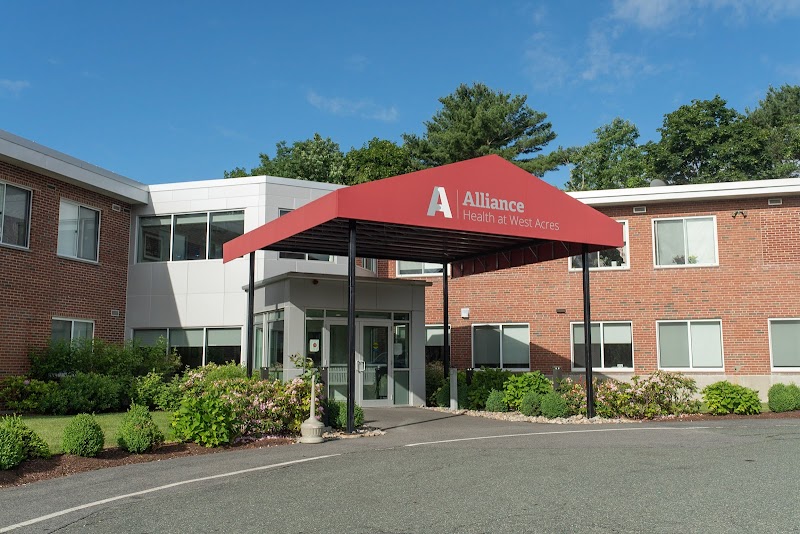
804 PLEASANT STREET, BROCKTON, MA 02301 (508) 583-6000
Non profit - Corporation 138 Beds ALLIANCE HEALTH & HUMAN SERVICES Data: November 2025
Trust Grade
75/100
#67 of 338 in MA
Last Inspection: August 2024

Within standard 12-15 month inspection cycle. Federal law requires annual inspections.

Overview

Alliance Health at West Acres in Brockton, Massachusetts, has a Trust Grade of B, indicating it is a good choice for families looking for a nursing home. It ranks #67 out of 338 facilities in Massachusetts, placing it in the top half, and #9 out of 27 in Plymouth County, meaning only a few local options are better. The facility is improving, with issues decreasing from 10 in 2023 to just 2 in 2024. However, staffing is a concern, rated at 2 out of 5 stars, with RN coverage lower than 92% of state facilities, which could impact the quality of care. While there have been no fines, which is positive, there were specific incidents where infection control measures were not properly implemented during a COVID-19 outbreak, and a resident was not wearing required protective gear, raising concerns about adherence to care plans. Overall, while the facility shows promise with its improving trend and lack of fines, families should consider the staffing challenges and address the specific care incidents noted.

Trust Score
B
75/100
In Massachusetts
#67/338
Top 19%
Safety Record
Low Risk
No red flags
Inspections
Getting Better
10 → 2 violations
Staff Stability
○ Average
30% turnover. Near Massachusetts's 48% average. Typical for the industry.
Penalties
✓ Good
No fines on record. Clean compliance history, better than most Massachusetts facilities.
Skilled Nurses
⚠ Watch
Each resident gets only 19 minutes of Registered Nurse (RN) attention daily — below average for Massachusetts. Fewer RN minutes means fewer trained eyes watching for problems.
Violations
⚠ Watch
20 deficiencies on record. Higher than average. Multiple issues found across inspections.
★★★★☆
4.0
Overall Rating
★★☆☆☆
2.0
Staff Levels
★★★★☆
4.0
Care Quality
★★★★☆
4.0
Inspection Score
Stable
2023: 10 issues
2024: 2 issues

The Good

  • 4-Star Quality Measures · Strong clinical quality outcomes
  • Full Sprinkler Coverage · Fire safety systems throughout facility
  • No fines on record
  • Staff turnover below average (30%)

    18 points below Massachusetts average of 48%

Facility shows strength in quality measures, fire safety.

The Bad

Staff Turnover: 30%

15pts below Massachusetts avg (46%)

Typical for the industry

Chain: ALLIANCE HEALTH & HUMAN SERVICES

Part of a multi-facility chain

Ask about local staffing decisions and management

The Ugly 20 deficiencies on record

Aug 2024 2 deficiencies
CONCERN (D)

Potential for Harm - no one hurt, but risky conditions existed

Deficiency F0658 (Tag F0658)

Could have caused harm · This affected 1 resident

Based on interview and record review, the facility failed to ensure residents were provided care in accordance with professional standards of practice for one Resident (#49), out of a sample of 23 res...

Read full inspector narrative →
Based on interview and record review, the facility failed to ensure residents were provided care in accordance with professional standards of practice for one Resident (#49), out of a sample of 23 residents. Specifically, the facility failed to ensure a medication to increase blood pressure was administered to the Resident as ordered by the physician. Findings include: Review of the Massachusetts Board of Registration in Nursing Advisory Ruling on Nursing Practice, dated as revised 4/11/18, indicated but was not limited to: Nurse's Responsibility and Accountability: Licensed nurses accept, verify, transcribe, and implement orders from duly authorized prescriber that are received by a variety of methods (i.e., written, verbal/telephone, standing orders/protocols, pre-printed order sets, electronic) in emergent and non-emergent situations. Licensed nurses in a management role must ensure an infrastructure is in place, consistent with current standards of care, to minimize error. Review of the facility's policy titled Medication Administration - General Guidelines, undated, indicated but was not limited to the following: - Medications are prepared only by licensed nursing, medical, pharmacy or other personnel authorized by state laws and regulations to prepare and administer medications. - Medications are administered in accordance with written orders of the prescriber. Resident #49 was admitted to the facility in September 2023 with diagnoses including paraplegia and hypertension. Review of Resident #49's active Physician's Orders indicated but was not limited to: - 9/18/23: Midodrine (used to treat low blood pressure) 2.5 milligram (MG) tablet, one tablet twice daily, hold for systolic blood pressure (SBP) over 130. Review of the July 2024 Medication Administration Record (MAR) indicated the Midodrine was given outside of physician prescribed parameters on the following days: - 7/20/24, 9:00 A.M. dose: Blood Pressure (BP) 132/76 - 7/20/24, 2:00 P.M. dose: BP 132/76 Review of the August 2024 MAR indicated the Midodrine was given outside of physician prescribed parameters on the following days: - 8/10/24, 9:00 A.M. dose: BP 136/82 - 8/10/24, 2:00 P.M. dose: BP 132/76 During an interview on 8/29/24 at 10:38 A.M., Resident #49 said he/she receives a BP medication twice a day. Resident #49 said he/she receives the medication to make sure his/her BP does not go too high or low when getting out of bed. During an interview on 8/29/24 at 10:45 A.M., the Assistant Director of Nursing (ADON) said Resident #49 receives Midodrine twice daily to ensure his/her BP values are stable when changing positions throughout the day. The ADON said the medication has parameters to ensure the Resident's BP does not increase too much during position changes. The ADON reviewed Resident #49's medical record and said the medication was given outside of parameters on 7/20/24 and 8/10/24. The ADON said she would expect the medication to be held if the SBP was greater than 130.
CONCERN (E)

Potential for Harm - no one hurt, but risky conditions existed

Infection Control (Tag F0880)

Could have caused harm · This affected multiple residents

**NOTE- TERMS IN BRACKETS HAVE BEEN EDITED TO PROTECT CONFIDENTIALITY** Based on observation, interview, and document review, the facility failed to maintain an infection prevention and control progra...

Read full inspector narrative →
**NOTE- TERMS IN BRACKETS HAVE BEEN EDITED TO PROTECT CONFIDENTIALITY** Based on observation, interview, and document review, the facility failed to maintain an infection prevention and control program designed to provide a safe, sanitary, and comfortable environment, and to help prevent the development and potential transmission of communicable diseases and infections when the facility was currently experiencing an outbreak of COVID-19 infection. Specifically, the facility failed to: 1. Perform a COVID-19 related investigation and conduct contact tracing for a single new resident case to prevent, to the extent possible, the onset and spread of infection and ensure staff and resident COVID-19 surveillance line listings were maintained; 2. Ensure proper COVID-19 outbreak testing procedures were implemented for four of four facility staff members reviewed representing two (Station 1 Unit and Station 3 Unit, both COVID-19 affected units) out of three units; 3. Ensure staff rapid antigen COVID-19 testing (BinaxNOW) was conducted in a manner that is consistent with current standards of practice and manufacturer's instructions for use for one of one staff member observed; and 4. Ensure staff performed appropriate hand hygiene and implemented appropriate use of personal protective equipment (PPE) for the care of a COVID-19 positive resident to prevent unnecessary exposure and the potential spread of COVID-19 infection. Findings include: During an interview on 8/26/24 at 2:12 P.M., the Assistant Director of Nursing (ADON) said the Infection Preventionist (IP) would not be present during the survey period, but she had a certificate of training and could speak to infection control policies and procedures in the IP's absence. The ADON said the facility used Massachusetts Department of Public Health (DPH), Centers for Disease Control and Prevention (CDC), and Centers for Medicare and Medicaid Services (CMS) guidance. Review of the current outbreak documentation (handwritten by the IP) provided by the ADON on 8/26/24 at 4:05 P.M. indicated the facility had 15 residents on the Station 1 Unit (short-term rehab) who were currently COVID-19 positive and one resident on the Station 3 Unit (long-term care) who had recovered on 8/23/24. The Station 2 Unit (long-term care) was unaffected. The documentation also indicated nine total staff members had tested positive for COVID-19. During an interview on 8/27/24 at 3:50 P.M. with the Administrator, Director of Nursing (DON), ADON, and Consulting Staff #1, the ADON said the facility was currently experiencing a COVID-19 outbreak which started on 8/15/24 on the Station 3 Unit when a resident had tested positive. They said all residents and staff on the Station 3 Unit were being tested as part of outbreak testing procedures. They said the Station 1 Unit became affected on 8/18/24 after a staff member had tested positive. The DON said unit-based testing was initiated on 8/19/24 and included all Station 1 residents, staff, and rehabilitation staff. She said outbreak testing for staff and residents was being conducted on the affected units starting within 48 hours after the potential exposure, then every 48 hours thereafter until the facility goes seven days without a new COVID-19 case. She said the Station 3 Unit completed outbreak testing on 8/20/24 with no new positives, however, the Station 1 Unit had not met the criteria yet. She said any resident or staff who had recovered from COVID-19 in the past 30 days were exempt from outbreak testing as long as they were asymptomatic. 1. Review of CDC guidance titled Interim Infection Prevention and Control Recommendations for Healthcare Personnel During the Coronavirus Disease 2019 (COVID-19) Pandemic, revised May 2023, indicated but was not limited to the following: -Healthcare facilities should have a plan for how SARS-CoV-2 exposures in a healthcare facility will be investigated and managed and how contact tracing will be performed. -A single new case of SARS-CoV-2 infection in any healthcare personnel (HCP) or resident should be evaluated to determine if others in the facility could have been exposed. -Perform testing for all residents and HCP identified as close contacts or on the affected unit(s) if using a broad-based approach, regardless of vaccination status. Review of Massachusetts DPH Memorandum titled Update to Infection Prevention and Control Considerations When Caring for Long-Term Care Residents, including Visitation Conditions, Communal Dining, and Congregate Activities, dated 5/10/23, indicated but was not limited to the following: -Close contact means being within 6 feet for 15 minutes or more (in a 24-hour period), of someone diagnosed with COVID-19, while that individual was potentially infectious. During an interview on 8/26/24 at 4:15 P.M., the surveyor reviewed handwritten documentation on an August 2024 calendar and on a separate piece of paper provided by the ADON stating it was the IP's notes as it pertained to the current COVID-19 outbreak in the facility. The documentation was unclear as to the events that had occurred at the start of the outbreak with the first case dated as 8/14/24 when a resident had tested positive on the Station 1 Unit. The documentation did not indicate a proper investigation or contact tracing for the new COVID-19 resident case was conducted to determine if any staff or residents were potentially exposed. The documentation also failed to indicate that a COVID-19 tracking report had been maintained for each staff and resident who were either symptomatic or positive to include symptoms and the date of onset or follow up. The ADON said the resident who had tested positive on 8/14/24 on the Station 1 Unit was admitted the day prior from the hospital into a private room but did not have an admitting diagnosis of COVID-19 so was not placed on isolation precautions until the day after when he/she had tested positive. The ADON said the facility did not do contact tracing to identify any potential staff that may have been exposed while the resident was potentially infectious prior to his/her diagnosis but would confirm with the IP over the phone. The ADON further said the documentation provided to the surveyor did not reflect an adequate COVID-19 line listing as the documentation was unclear as to the names listed, there were no symptoms listed for any of the staff or residents, if any, and there were no dates of onset or follow up. She said it was not proper surveillance for the current outbreak. The surveyor requested additional documentation pertaining to the current outbreak including surveillance line listings. During an interview on 8/26/24 at 4:53 P.M., the ADON and DON said they spoke to the IP who said the documentation provided to the surveyor was her line listing and there was nothing else. She said she just wrote it down on the calendar and piece of paper and did not list any symptoms or dates on onset. The ADON and DON said they could not answer if any of the COVID-19 positive residents or staff were symptomatic and, if so, when the symptoms began and could not speak to any follow up from looking at the documents provided. They said the documentation was not maintained to reflect a true surveillance line listing. During an interview on 8/28/24 at 10:31 A.M., the Administrator, ADON, DON, and Consulting Staff #1 said the start of the current COVID-19 outbreak at the facility was on 8/15/24 on the Station 3 Unit, not on 8/14/24 as that resident case was assumed to be hospital acquired. They said once positive on 8/14/24, the resident was placed on isolation precautions and staff were notified. They said they identified two rehab staff that may have been exposed but one always wore a surgical mask and the other tested negative that day at their other job, so they were not concerned. They said they did not do contact tracing for any other staff or residents who may have been identified as a close contact. They said at the time, staff were not wearing source control so there could have been potential exposure. They further said they could not speak to specific staff members that may have been potentially exposed and had nothing to show to indicate an investigation had been conducted or what the plan was. 2. Review of the Massachusetts DPH Memorandum titled Update to Infection Prevention and Control Considerations When Caring for Long-Term Care Residents, Including Visitation Conditions, Communal Dining, and Congregate Activities, dated 5/10/23, indicated but was not limited to the following: - Long-term care facilities are required to perform outbreak testing of residents and staff as soon as possible when a case is identified. - If the long-term care facility identifies that the resident or staff member's first exposure occurred less than 24 hours ago, then they should wait until 24 hours after any exposure, if known. -Once a new case is identified in a facility, following outbreak testing, long-term care facilities should test exposed residents and staff at least every 48 hours on the affected unit until the facility goes seven days without a new case unless the DPH epidemiologist directs otherwise. -Residents and staff who are recovered from COVID-19 in the last 30 days can be excluded from this testing. Review of the facility's policy titled Rapid Antigen Point of Care COVID-19 Testing, revised March 2023, indicated but was not limited to the following: Purpose: -To promptly identify potentially positive COVID-19 individuals and initiate swift treatment. Rapid antigen testing kits should be used for testing symptomatic staff and residents in the LTC facility, testing asymptomatic staff and residents at the facility as part of the required outbreak testing, and testing staff who feel they are at increased risk of exposure. -Once a new case is identified in the facility, following the requisite outbreak testing, the facility is required to test all residents and staff every 48 hours on the affected unit until the facility goes seven days without a new case or assigned epidemiologist directs otherwise. In addition, facilities should immediately test any symptomatic resident, staff member, or newly exposed resident or staff member. -Residents and staff who have recovered from COVID-19 in the last 30 days can be excluded from testing. -During an outbreak situation, testing is required every 48 hours until seven days without a positive case and then once a week until the facility goes fourteen days without a new case unless DPH epidemiology directs otherwise. On 8/27/24 at 4:19 P.M., the surveyor reviewed timecards and schedules worked with the ADON for four randomly sampled direct care staff (Staff #1, Staff #2, Staff #3, and Staff #4) who worked on the affected COVID-19 units and were to be included in the facility's current COVID-19 outbreak testing protocol. The staff were as follows: a. Review of Staff #1's August 2024 timecard indicated that he/she had worked on the following days since the start of the current COVID-19 outbreak that occurred on 8/15/24 on the Station 3 Unit after a resident had tested positive: -August 16th, August 17th, August 19th, on the Station 3 Unit Review of the staff August 2024 Testing Logs failed to indicate Staff #1 conducted COVID-19 outbreak testing as required for any of the dates worked. During an interview on 8/27/24 at 4:19 P.M., the DON said Staff #1 was eligible for outbreak testing and there were no test results for the days worked. She said Staff #1 did not complete outbreak testing as required. b. Review of Staff #2's August 2024 timecard indicated that he/she had worked on the following days since the start of the current COVID-19 outbreak that occurred on 8/18/24 on the Station 1 Unit after a direct care staff member had tested positive with the first resident testing positive on 8/19/24: -August 21st, August 22nd, August 23rd, August 26th, and August 27th, on the Station 1 Unit Review of the staff August 2024 Testing Logs failed to indicate Staff #2 conducted COVID-19 outbreak testing as required for any of the dates worked. During an interview on 8/27/24 at 9:23 A.M., Staff #2 said he/she tested that morning at the facility before the start of the shift but didn't document the results and was negative. Staff #2 said he/she doesn't usually document results and would go retest and document the results. During an interview on 8/27/24 at 4:22 P.M., the ADON said staff could test at home or at the facility, but the process was to document on the log if testing was done at the facility. She said staff will only notify them if they tested positive at home but there was no oversight to ensure home testing was being done or the results of the testing. The ADON said no one was keeping track. She said Staff #2 was eligible for outbreak testing and it was not done per protocol. c. Review of Staff #3's August 2024 timecard indicated that he/she had worked on the following days since the start of the current COVID-19 outbreak that occurred on 8/18/24 on the Station 1 Unit after a direct care staff member had tested positive with the first resident testing positive on 8/19/24: -August 18th and August 23rd, on the Station 1 Unit Review of the staff August 2024 Testing Logs failed to indicate Staff #3 conducted COVID-19 outbreak testing as required for the dates worked. During an interview on 8/27/24 at 4:25 P.M., the ADON said Staff #3 was eligible for outbreak testing and there was no documentation by Staff #3 on the testing logs to indicate that he/she had completed outbreak testing as required. d. Review of Staff #4's August 2024 timecard indicated that he/she had worked on the following days since the start of the current COVID-19 outbreak that occurred on 8/18/24 on the Station 1 Unit after a direct care staff member had tested positive with the first resident testing positive on 8/19/24: -August 22nd, August 23rd, and August 26th, on the Station 1 Unit Review of the staff August 2024 Testing Logs failed to indicate Staff #4 conducted COVID-19 outbreak testing as required for the dates worked. During an interview on 8/27/24 at 4:26 P.M., the DON said Staff #4 was eligible for outbreak testing and worked on the short-term rehab unit. She said Staff #4 did not test per protocol. 3. Review of the [NAME] BinaxNOW COVID-19 Ag Card product insert, revised April 2021, indicated but was not limited to the following: -The BinaxNOW COVID-19 Ag Card is a lateral flow immunoassay for the qualitative detection of the nucleocapsid protein antigen to SARS-CoV-2 directly from the anterior nasal (nares) swab specimens collected from individuals who are suspected of COVID-19 by their healthcare provider within seven days of the onset of symptoms. Precautions: -Proper sample collection, storage, and transport are essential for correct results. -Inadequate or inappropriate sample collection, storage, and transport may yield false test results. Test Procedure: -Read result in the window 15 minutes after closing the card. In order to ensure proper test performance, it is important to read the result promptly in 15 minutes, and not before. Results should not be read after 30 minutes. On 8/27/24 at 6:54 A.M., the surveyor observed Certified Nursing Assistant (CNA #1, orientee) perform COVID-19 outbreak testing prior to her shift at the testing station in the main lobby of the facility. CNA #2 was assisting. At 6:58 A.M., the surveyor observed CNA #1 insert her sample into the bottom hole of the testing card then seal the test card. CNA #1 did not label the card with her name, date, or time. A timer was observed on top of the testing cart but was not utilized. CNA #1 sat in the chair waiting for her results while CNA #2 left the testing area. At 7:07 A.M., nine minutes later, CNA #2 returned to the testing station and documented CNA #1's negative test result onto the testing log then disposed of the test card. During an interview on 8/27/24 at 7:07 A.M., CNA #1 said the test was done because there was a control line there and didn't know she had to wait 15 minutes. CNA #2 said they should have waited the full 15 minutes before reading the results. During an interview on 8/27/24 at 4:13 P.M., the ADON said the test should have been read at 15 minutes and not prior. 4. Review of the Massachusetts DPH Memorandum titled Comprehensive Personal Protective Equipment (PPE) Guidance, dated May 2023, indicated but was not limited to the following: -DPH recommends that a fit-tested N95 filtering facepiece respirator or alternative and eye protection be used when caring for patients with suspected or confirmed COVID-19. If there is any contact with potentially infectious material, an isolation gown and gloves should also be used. Review of the facility's policy titled Use of PPE- Post PHE, revised May 2023, indicated but was not limited to the following: -Appropriate PPE will be used to care for the residents during the various stages of their infectious disease process, this includes facemasks. -Staff will be required to use full PPE upon room entry (gown, gloves, facemask, eye protection). N95 filtering respirator should be used for residents who are presumed or confirmed infected with COVID-19. Review of the facility's policy titled The Infection Prevention Program, dated August 2017, indicated but was not limited to the following: When to Wash Hands: -Before and after entering isolation, precaution setting On 8/27/24 at 1:32 P.M., the surveyor observed Rehabilitation Services Staff (RSS) #1 enter a COVID-19 positive resident's room wearing a gown, gloves, face shield, and surgical facemask. An isolation contact/droplet precaution sign was posted outside the resident's room indicating that staff were required to wear eye protection, a gown, an N95 facemask, and gloves prior to entering the room. RSS #1 did not don (put on) an N95 respirator prior to entering the room. A PPE cart was located directly outside the resident's room stocked with N95 respirators. During an observation with interview on 8/27/24 at 1:35 P.M., the surveyor observed RSS #1 exit the resident's room still wearing the surgical facemask. RSS #1 did not perform hand hygiene upon exiting the room and did not change his surgical face mask before starting to proceed down the hallway. When stopped by the surveyor, RSS #1 said he had transferred the resident from the wheelchair to the bed and should have worn an N95 facemask in the room and should have changed his facemask and sanitized his hands upon exiting the room. During an interview on 8/27/24 at 3:50 P.M. with the Administrator, ADON, DON, and Consulting Staff #1, the ADON said full PPE with N95 facemask was required prior to entering COVID-19 positive resident rooms. She said all PPE should be doffed (taken off) inside the room at the entryway prior to exiting. The ADON said RSS #1 should have had an N95 facemask on, changed his surgical mask, and sanitized his hands when exiting the room. The Administrator said the facility was fully stocked with PPE.
Jul 2023 10 deficiencies
CONCERN (D)

Potential for Harm - no one hurt, but risky conditions existed

Resident Rights (Tag F0550)

Could have caused harm · This affected 1 resident

Based on observation, policy review, and interview, the facility failed to ensure a dignified dining experience for one Resident (#11), out of a total sample of 25 residents. Findings include: Review ...

Read full inspector narrative →
Based on observation, policy review, and interview, the facility failed to ensure a dignified dining experience for one Resident (#11), out of a total sample of 25 residents. Findings include: Review of the facility's policy titled Resident's [NAME] of Rights, revised 1/10/2022, indicated the following: *The Resident has the right to a dignified experience *The Resident has the right to be treated with respect and dignity Resident #11 was admitted to the facility in August 2022 and had diagnoses that included Alzheimer's disease and dysphagia (difficulty chewing and swallowing). Review of the most recent Minimum Data Set (MDS) assessment, dated 5/3/23, indicated Resident #11 scored 3 out of 15 on the Brief Interview for Mental Status exam, indicating severely impaired cognition. The MDS further indicated Resident #11 had no behaviors and required one person assistance with eating. On 7/25/23 at 8:57 A.M., the surveyor observed Resident #11 asleep at a table among peers in the unit's Main Dining Room (MDR). A staff person placed a plate of food in front of him/her, then without waking up Resident #11 walked away and continued passing out trays to other residents. The surveyor continued to make the following observations: * At 9:00 A.M., Resident #11 woke up, used a fork to pick up a piece of pancake and then dropped the food off the fork into his/her lap. * At 9:01 A.M., Resident #11 tried using the fork to spear food in his/her lap. * At 9:02 A.M., Resident #11 gave up attempts to use the fork and used his/her hands to pick up the food in his/her lap and feed self the wet and syrup covered pancakes with his/her hands. * At 9:06 A.M., Resident #11 stuck his/her hand and fork in food and tried to pick up food unsuccessfully. On 7/26/23 at 12:08 P.M., the surveyor observed Resident #11 seated in the dining room at a table with two tablemates. Both tablemates were served lunch and Resident #11 watched, waited and looked around the room as others were served. The surveyor continued to make the following observations: * At 12:14 P.M., Resident #11 reached for a tablemate's food, then sat back when he/she couldn't reach it. Resident #11 then began looking around the room, watching others eat. 15 of 18 residents in the room had been served. * At 12:20 P.M., a lunch was delivered to Resident #11, 12 minutes after his/her tablemates had been served their meal. All others in the room had been served. On 7/27/23 at 8:40 A.M., the surveyor observed Resident #11 seated in the dining room at a table with two tablemates. The Resident's tablemate was served lunch and Resident #11 watched, waited, and looked around the room as others were served. The surveyor continued to make the following observations: *at 8:44 A.M., Resident #11 reached over attempting to grab items off of his/her tablemate's meal tray. *at 8:55 A.M., the Resident's other tablemate received a meal tray *at 8:58 A.M., a lunch was delivered to Resident #11, 18 minutes after his/her tablemate had been served their meal. Resident #11's tablemate had already finished eating by the time the Resident received his/her lunch. During an interview on 7/27/23 at 10:12 A.M., Certified Nursing Assistant (CNA) #4 said when passing meal trays, all residents sitting together should be served at the same time. CNA #4 also said if residents are observed struggling with meals the CNAs would help the resident. During an interview on 7/27/23 at 10:20 A.M., Nurse #4 said during mealtimes all residents sitting together should be served at the same time to avoid residents having to watch their neighbors eat while not having access to food themselves. Nurse #4 said if a resident is struggling with meals, she would expect staff to intervene, even if the resident is not on that staff member's assignment. During an interview on 7/27/23 at 11:41 A.M., the Director of Nursing (DON) said she would expect staff to serve residents sitting together during mealtimes at the same time to avoid residents having to watch their neighbors eat while not having access to food themselves. The DON also said if a resident is struggling with meals, she would expect staff to intervene.
CONCERN (D)

Potential for Harm - no one hurt, but risky conditions existed

Deficiency F0604 (Tag F0604)

Could have caused harm · This affected 1 resident

Based on observations, interviews, and record review, the facility failed to complete a restraints assessment for one Resident (#94), out of a sample of 25 residents. Specifically, the facility failed...

Read full inspector narrative →
Based on observations, interviews, and record review, the facility failed to complete a restraints assessment for one Resident (#94), out of a sample of 25 residents. Specifically, the facility failed to assess therapeutic devices (two pillows and two block floor mats) as restraints. Findings include: Review of the facility's policy titled 'Restraints' with a revision date of 1/1/21 indicated the following: *Therapeutic use of a device used as a restraint may be used when all other interventions or alternatives to a restraint are not effective. *If a restraint is used a licensed therapist and/or a nurse will assess the resident for appropriate interventions and a plan of care will be developed, documentation within the medical record will include verification that the resident has medical symptoms for which the restraint has been determined to achieve or maintain the highest level of mental, physical, and psychological well-being. *Rehab and Nursing will complete the assessment for the use of therapeutic devices form. *Nursing has informed the resident and/or their representative of the risk and benefits of the device and has completed the 'Restraints utilization informed consent'. Resident #94 was admitted to the facility in November 2022 with diagnoses including dementia and a history of falls. Review of the most recent Minimum Data Set (MDS) assessment, dated 6/28/23, indicated a Brief Interview for Mental Status (BIMS) score of 6 out of 15 indicating severe cognitive impairment. On 7/25/23 at 8:49 A.M., the surveyor observed Resident #94 lying in a low positioned bed with two pillows tucked in on the left and right side, and two block floor mats on both sides of the bed at the same level with the low bed. Resident #94 was trying to swing his/her legs over the left side of the bed telling the surveyor he/she wanted to get out of bed; he/she was stuck. Review of progress notes, dated 7/14/23, indicated the following: *Resident with increased restlessness throughout the shift, Resident states isn't comfortable and I'm stuck. Further review of a Fall Incident Report, dated 2/24/23, indicated the following interventions: *Block mat placed at bedside to minimize attempts to get out of bed by self. On 7/26/23 at 6:46 A.M., the surveyor observed the Resident in a low positioned bed with two pillows tucked underneath both sides of his/her bed, and two block mats on both sides of his/her bed. He/she told the surveyor he/she wanted to get out of bed. On 7/27/23 at 6:43 A.M., the surveyor observed the Resident in a low positioned bed with two pillows tucked underneath both sides of his/her bed, and two block mats on both sides of his/her bed. He/she told the surveyor he/she wanted to get out of bed and was stuck. During an interview on 7/27/23 at 8:29 A.M., Certified Nurse's Assistant (CNA) #3 said the Resident can get very restless, the overnight staff tuck in pillows on both sides to try to stop him/her from getting out of bed. During an interview on 7/27/23 at 8:33 A.M., Unit Manager (UM) #3 said the overnight staff are trying to prevent the Resident from getting out of bed by tucking in the pillows on both sides of his/her bed. She said the block fall mats are an intervention for safety purposes and not to prevent the Resident from getting out of bed as indicated in the fall incident report dated 2/24/23. UM #3 said no restraints assessments have been completed for the two pillows or the two block fall mats. During an interview on 7/27/23 at 8:51 A.M., the Director of Nurses said pillows should not be tucked in the Resident's bed to prevent him/her from getting out of bed. She said the intention of the block fall mats are to keep him/her safe and not to prevent him/her from getting out of bed as indicated in the 2/24/23 fall incident report. The DON said restraints assessments should have been completed for both the two pillows and the two block fall mats to rule out the concerns of restraining the Resident's movements while in bed.
CONCERN (D)

Potential for Harm - no one hurt, but risky conditions existed

ADL Care (Tag F0677)

Could have caused harm · This affected 1 resident

Based on observation, policy review, and interview, the facility failed to provide supervision during meals for one Resident (#8), out of a total sample of 25 residents. Findings include: Resident #8...

Read full inspector narrative →
Based on observation, policy review, and interview, the facility failed to provide supervision during meals for one Resident (#8), out of a total sample of 25 residents. Findings include: Resident #8 was admitted to the facility in July 2018 and had diagnoses that include dementia and dysphagia (difficulty chewing and swallowing). Review of the most recent Minimum Data Set (MDS) assessment, dated 7/5/23, indicated that Resident #8 was assessed by staff to have severely impaired cognition. Review of Resident #8's Activities of Daily Living Care Plan indicated the following intervention: *Resident #8 requires continual supervision (Ratio 1:8) with all meals. *Recliner with assist, assisted to meals and activities. Review of the current Certified Nursing Assistant (CNA) Care card (a staff reference which provides resident-specific care instructions) indicated the following: * Eating: cues, supervision. Review of the Palliative Care assessment, dated 6/14/23, indicated Resident #8 requires cueing for meals. On 7/25/23 at 8:32 A.M., the surveyor observed Resident #8 seated in a chair in the Resident's room which was reclined at a 45-degree angle. The Resident was attempting to lean his/her head forward to be able to see the food on the tray table in front of him/her. No staff were present to supervise or assist the Resident. On 7/25/23 at 12:33 P.M., the surveyor observed Resident #8 in his/her room. The Resident's recliner was positioned at a 45-degree angle and the Resident's food was on the tray table directly in front of him/her. No staff were present to supervise or assist the Resident. On 7/26/23 at 8:10 A.M., the surveyor observed two staff enter Resident #8's room. One had a Hoyer lift (mechanical lift) and the other a breakfast tray. The surveyor continued to make the following observations: * At 8:17 A.M., the nurse/cna left the Resident in the room alone with the breakfast tray directly on front of him/her. The Resident was eating breakfast and no staff were present to supervise the meal. On 7/26/23 at 11:53 A.M., the surveyor observed staff delivering lunch to Resident #8 in his/her room. The lunch was set-up on a tray table directly in front of the Resident and then the CNA left the room, leaving Resident #8 unsupervised. On 07/27/23 at 8:31 A.M., the surveyor observed Resident #8 eating in his/her room; no staff were present to supervise or assist the Resident. On 07/27/23 at 08:42 A.M., the surveyor observed Resident #8 coughing while eating in his/her room; no staff were present to supervise or assist the Resident. During an interview on 7/27/23 at 10:12 A.M., Certified Nursing Assistant (CNA) #4 said the CNAs will ask the nurses what level of assistance residents require for feeding. During an interview on 7/27/23 at 10:17 A.M., CNA #1 said CNAs get report from the nurses regarding the required level of assistance residents require for eating. CNA #1 said Resident #8 requires supervision with meals, and occasionally needs help. During an interview on 7/27/23 at 10:20 A.M., Nurse #4 said residents should receive the level of assistance outlined in their care plans. Nurse #4 also said if a resident requires continuous supervision, that resident must be supervised by staff from the moment the tray is delivered, until the resident is done eating. During an interview on 7/27/23 at 11:41 A.M., the Director of Nursing (DON) said the CNAs should reference the care cards to determine the level of assistance a resident needs, and that nurses should defer to the care plan to determine the level of assistance a resident needs. The DON said the care provided to residents should be consistent with their care plans, and that if a resident requires continuous supervision the resident must be supervised by staff throughout the entire meal period.
CONCERN (D)

Potential for Harm - no one hurt, but risky conditions existed

Deficiency F0698 (Tag F0698)

Could have caused harm · This affected 1 resident

Based on observations, record review, policy review, and interviews, the facility failed to ensure for one Resident (#312), who required dialysis, he/she received such services consistent with profess...

Read full inspector narrative →
Based on observations, record review, policy review, and interviews, the facility failed to ensure for one Resident (#312), who required dialysis, he/she received such services consistent with professional standards of practice and the comprehensive person-centered care plan, out of 25 sampled residents. Specifically, the facility failed to ensure nursing implemented a physician's order for emergency equipment at the Resident's bedside (pressure dressing and clamp). Findings include: Review of the facility's policy titled Hemodialysis, dated as revised 12/15/22, indicated to provide transportation and comprehensive care to residents that received hemodialysis treatments at an outside dialysis center. -pressure dressing and non-serrated clamp are to be kept at the bedside. Resident #312 was admitted to the facility in July 2023 with diagnoses including end stage renal disease and diabetes. Review of the Minimum Data Set (MDS) assessment, dated 7/18/23, indicated Resident #312 had a Brief Interview for Mental Status (BIMS) score of 15 out of 15, indicating he/she was cognitively intact. The MDS indicated Resident #312 required dialysis. Review of the Physician's Order, dated 7/12/23, indicated: -Set up emergency equipment at bedside (pressure dressing and clamp) check placement every shift -Dialysis Fistula: if bleeding occurs from fistula, apply pressure dressing and call 911 On 7/25/23 at 9:09 A.M., 7/26/23 at 6:53 A.M., 7/26/23 at 8:26 A.M., 7/26/23 at 11:04 A.M., 7/26/23 at 1:11 P.M., and 7/27/23 at 8:39 A.M., the surveyor was unable to locate the physician's ordered emergency equipment at Resident #312's bedside. Review of the Medication Administration Record, dated July 2023, indicated nursing verified the emergency equipment was at the bedside on: 7/25/23: 11:00 P.M. to 7:00 A.M., 7:00 A.M. to 3:00 P.M. and 3:00 P.M. to 11:00 P.M. 7/26/23: 11:00 P.M. to 7:00 A.M., 7:00 A.M. to 3:00 P.M. and 3:00 P.M. to 11:00 P.M. During an interview on 7/27/23 at 8:39 A.M., Unit Manager #1 met the surveyor in Resident #312's room; there was no emergency equipment at the Resident's bedside. Unit Manager #1 said that there should be emergency equipment at the bedside. During an interview on 7/27/23 at 11:54 A.M., the Director of Nursing said nursing should have implemented emergency equipment at Resident #312's bedside.
CONCERN (E)

Potential for Harm - no one hurt, but risky conditions existed

Comprehensive Care Plan (Tag F0656)

Could have caused harm · This affected multiple residents

3a. Resident #8 was admitted to the facility in July 2018 and had diagnoses that included dementia and repeated falls. Review of the most recent MDS assessment, dated 7/5/23, indicated that Resident #...

Read full inspector narrative →
3a. Resident #8 was admitted to the facility in July 2018 and had diagnoses that included dementia and repeated falls. Review of the most recent MDS assessment, dated 7/5/23, indicated that Resident #8 was assessed by staff to have severely impaired cognition. Review of Resident #8's current Physician's Orders indicated the following: * Geri-sleeves to BUE at all times, may remove for hygiene and skin checks, initiated 7/29/22. Review of Resident #8's medical record indicated the following care plan: *Geri-sleeves to bilateral upper extremities to minimize bruising. Staff to ensure placement and compliance. On 7/25/23 at 8:14 A.M., the surveyor observed Resident #8 in bed. The Resident's skin appeared fragile and he/she was not wearing Geri-sleeves on his/her arms. On 7/26/23 at 7:34 A.M., the surveyor observed Resident #8 dressed for the day. Resident #8 was wearing a short sleeve shirt and there were no Geri-sleeves in place. On 7/26/23 at 8:10 A.M., the surveyor observed a CNA and a Nurse entering Resident #8's room. One had a Hoyer lift (mechanical lift) and the other a breakfast tray. The surveyor continued to make the following observations: * At 8:17 A.M., the CNA and Nurse left the room and the Resident remained in a short sleeve shirt and was not wearing Geri-sleeves. On 7/26/23 at 11:49 A.M., the surveyor observed Resident #8 seated in a recliner chair in his/her room, wearing a short sleeve shirt, and no Geri-sleeves. On 7/26/23 at 11:53 A.M., the surveyor observed a CNA delivering lunch to Resident #8 in his/her room, then exiting the room. The Resident remained without Geri-sleeves on. On 7/27/23 at 8:04 A.M., the surveyor observed Resident #8 sleeping in bed without Geri-sleeves on. On 7/27/23 at 8:53 A.M., the surveyor observed two CNAs entering the Resident's room to transfer Resident #8 into a reclining chair. A third CNA entered the room to deliver Resident #8's breakfast tray. The Resident remained without Geri-sleeves on. During an interview on 7/27/23 at 10:59 A.M., Nurse #4 was unfamiliar with the term Geri-sleeves and was unaware of the physician order for Geri-sleeves to be worn at all times. During an interview on 7/27/23 at 11:04 A.M., Unit Manager (UM) #3 said the Resident has a long-standing behavior of removing and refusing Geri-sleeves, however, she would expect staff to replace the sleeves if they observe the Resident without them on. UM #3 said refusals should be documented but was unable to locate any documentation for refusal in the Resident's medical record. UM #3 said a care plan was developed to address this behavior today, but this should have been developed earlier as this behavior is not new. During an interview on 7/27/23 at 11:41 A.M., the DON said she would expect physician's orders and care plans to be implemented, and that Resident refusals should be documented. b. Review of the facility's policy titled Fall Management Program, revised 10/13/2022, indicated the following: *Residents identified at high risk for falls (score of 10 or higher on the assessment) will have an appropriate fall prevention care plan developed, implemented, and revised as necessary. Record review on 7/25/23 at 9:27 A.M., indicated the following: * A current Physician's Order, started 7/29/22, for: Fall mat to the right side of the bed when in bed, every shift, days evenings and nights. * A current care plan Resident at risk for falling R/T hx [history] of falls, poor safety awareness, anxiety, and use of high risk medication. The care plan included the following interventions: -Floor mats to right side of bed -Low Bed * The current CNA Care card (provides resident-specific care instructions) indicated the following: -Floor mats to (R) side when in bed -Special consideration: fall risk (checked as yes) and Geri-sleeves to R and L (right and left). * A Fall Risk Assessment, dated 7/3/23, indicated Resident #8 scored a 15, (score of 10 or higher indicates high risk for falls). * A nursing progress note, dated 7/19/23, indicated Resident screaming, yelling at staff, trying to get OOB [out of bed] multiple times. Ativan PRN given at 8:00Pm with no effect. CNA assigned did one-to-one observation to maintain client safety. Patient compliant with med administration. Fair appetite & Po intake. Call light in reach. We'll keep monitoring for safety. On 7/25/23 at 8:14 A.M., the surveyor observed Resident #8 lying in bed with his/her legs dangling toward the side of the bed. The bed was at a regular height and there was no fall mat in place. On 7/26/23 at 7:34 A.M., the surveyor observed Resident #8 alone in his/her room in bed. The bed was at a regular height, and there was no fall mat in place. On 7/27/23 at 8:07 A.M., the surveyor observed Resident #8 alone in his/her room in bed. The bed was at a regular height, and there was no fall mat in place. On 7/27/23 at 10:26 A.M., the surveyor observed Resident #8 alone in his/her room in bed. The bed was at a regular height, and there was no fall mat in place. During an interview on 7/27/23 at 10:27 A.M., Nurse #4 said Resident #8 is at a high risk for falls and that the Resident sometimes swings his/her legs out of bed. Nurse #4 said she would expect the care plan to be implemented, and that fall mats should be in place any time the Resident is in bed. During an interview on 7/27/23 at 11:41 A.M., the DON said she would expect interventions outlined in the resident's care plans to be followed, and that not implementing interventions for falls places the Resident at risk for major injury. 2. Resident #55 was readmitted to the facility in June 2023 with diagnoses including peripheral vascular disease, heart failure, and anemia. Review of the MDS assessment, dated 5/2/23, indicated Resident #55 had a BIMS score of 15 out 15 indicating he/she was cognitively intact. The MDS indicated Resident #55 required assistance with dressing. Review of the Physician's Order, dated 6/26/23, indicated: - Geri-sleeves to both arms at all times, may remove for hygiene and skin checks. Review of the plan of care related to skin tears, dated 6/26/23, indicated: - Geri-sleeves to BUE (bilateral upper extremities) at all times, may remove for hygiene and skin checks. Review of the Medication Administration Record, dated July 2023, indicated nursing applied the Geri-sleeves on: - 7/25/23: 11:00 P.M to 7:00 A.M., 7:00 A.M. to 3:00 P.M., and 3:00 P.M. to 11:00 P.M. - 7/26/23: 11:00 P.M to 7:00 A.M., 7:00 A.M. to 3:00 P.M., and 3:00 P.M. to 11:00 P.M. On 7/25/23 at 8:16 A.M., 7/25/23 at 12:41 P.M., 7/26/23 at 6:53 A.M., 7/26/23 at 7:53 A.M., 7/26/23 at 8:29 A.M., 7/26/23 at 1:19 P.M., 7/27/23 at 6:59 A.M., the surveyor observed Resident #55 without his/her physician's ordered Geri-sleeves. During an interview on 7/27/23 at 8:42 A.M., Resident #55 said she has not worn his/her Geri-sleeves in a few days but would if he/she had a pair. Resident #55 said the Geri-sleeves are down in the wash. During an interview on 7/27/23 at 8:44 A.M., CNA #2 said the nurse will apply the Geri-sleeves. During an interview on 7/27/23 at 8:43 A.M., Nurse #5 said that Resident #55 should wear his/her Geri-sleeves. During an interview on 7/27/23 at 10:14 A.M., Unit Manager #1 said that nursing should have implemented the Geri-sleeves. During an interview on 07/27/23 at 11:54 A.M., the DON said nursing should have applied the Geri-sleeves. Based on observations, record review, and staff interviews, the facility failed to implement care plans for three Residents (#7, #55, and #8), out of a sample of 25 residents. Specifically, the facility failed: 1. For Resident #7, to implement a nose picking behavior care plan; 2. For Resident #55, to apply Geri-sleeves (a device that helps protect extremities from abrasion, bruises, and skin tears), as ordered; and 3. For Resident #8, a. to apply Geri-sleeves, and b. to implement a fall mat (a device used to reduce risk of injury from impact) on the floor as ordered and ensure the Resident's bed was in a low position. Findings include: 1. Review of the facility's policy titled 'Skin management Program' revised October 2022 indicated the following: *Certified Nursing Assistants will inspect the skin of each resident during daily care and whenever skin care is provided and report to the Licensed Nurse any changes to the resident's skin. *A care plan will be developed, implemented and revised as necessary. Resident #7 was admitted to the facility in August 2020 with diagnoses including dementia and schizoaffective disorder. Review of the Minimum Data Set (MDS) assessment, dated 6/28/23, indicated a Brief Interview for Mental Status (BIMS) score of 3 out of 15 indicating severe cognitive impairment. On 7/25/23 at 9:15 A.M., the surveyor observed Resident #7 in his/her room with a purple bruise at the tip of his/her nose. During an interview on 7/26/23 at 11:06 A.M., Certified Nurse's Assistant (CNA) #1 said the Resident has a history of picking the tip of his/her nose causing it to bruise. During an interview on 7/26/23 at 11:07 A.M., Unit Manager #1 said Resident #7 has a history of picking the tip of his/her nose off and on. She said this behavior should be personalized in the Resident's skin care plan. Review of the behavior care plan, edited on 6/26/23, did not indicate that the Resident's history of nose picking was care planned. During an interview with Social Workers #1 and #2 on 7/26/23 at 11:24 A.M., they both said the Resident's nose picking behavior should be personalized in the behavior care plan. During an interview with the Director of Nurses (DON) on 7/27/23 at 9:21 A.M., she said a personalized care plan detailing the Resident's nose picking should be added.
CONCERN (E)

Potential for Harm - no one hurt, but risky conditions existed

Deficiency F0658 (Tag F0658)

Could have caused harm · This affected multiple residents

3. Review of the facility's policy titled Physician' Order Review, dated 3/21/18, indicated a review of the orders will be done on the 11:00 P.M. to 7:00 A.M., shift to ensure new orders are recognize...

Read full inspector narrative →
3. Review of the facility's policy titled Physician' Order Review, dated 3/21/18, indicated a review of the orders will be done on the 11:00 P.M. to 7:00 A.M., shift to ensure new orders are recognized and transcribed appropriately and that necessary follow through has been initiated. Resident #37 was admitted to the facility in July 2023 with diagnoses including hypertension and gastro-esophageal reflux disease without esophagitis. Review of the MDS assessment, dated 7/14/23, indicated Resident #37 had a BIMS score of 15 out of 15 indicating intact cognition. Review of the Physician's Order, dated 7/24/23, indicated: - increase Norvasc (blood pressure medication) to 10 milligrams (mg) by mouth daily; - Dulcolax (medication for constipation) two tablets for one dose; and - Zofran (medication for nausea) 4 mg by mouth every morning for 1 week. On 7/26/23, the surveyor reviewed the Medication Administration Record (MAR), dated July 2023, and there was no documentation to support nursing implemented the physician's orders from 7/24/23. During an interview on 7/26/23 at 7:43 A.M., Unit Manager #1 said that the physician's orders were not implemented from 7/24/23 but they should have been. During an interview on 7/27/23 at 11:52 A.M., the DON said the physician's orders should have been implemented and the physician's order review policy should have been implemented. 4. Resident #312 was admitted to the facility in July 2023 with diagnoses including end stage renal disease and diabetes. Review of the MDS assessment, dated 7/18/23, indicated Resident #312 had a BIMS score of 15 out of 15 indicating he/she was cognitively intact. The MDS indicated Resident #312 required extensive assistance of one for dressing. Review of the Physician's Order, dated 7/14/23, indicated: -ace wrap to right ankle daily, remove at HS (bedtime) Review of the MAR, dated July 2023, indicated nursing applied Resident #312's physician's ordered ace wrap on: - 7/25/23 at 9:00 A.M. - 7/26/23 at 6:00 A.M. On 7/25/23 at 9:09 A.M., the surveyor observed Resident #312 out of bed participating with therapy and he/she was not wearing an ace wrap to the right foot. The ace wrap was on Resident #312's nightstand. On 7/26/23 at 8:26 A.M., the surveyor observed Resident #312 not wearing an ace wrap on his/her right foot. The ace wrap was on Resident #312's nightstand. On 7/26/23 at 11:04 A.M., the surveyor observed Resident #312 out of bed walking with therapy. Resident #312 was not wearing an ace wrap on his/her right foot. The ace wrap was on Resident #312's nightstand. During an interview with observation on 7/26/23 at 1:11 P.M., the surveyor observed Resident #312 not wearing an ace wrap to his/her right foot. Resident #312 said that staff do not put an ace wrap on his/her foot. The ace wrap was on Resident #312's nightstand. During an interview on 7/27/23 at 8:39 A.M., Unit Manager #1 said nursing should have implemented the physician's ordered ace wrap. During an interview on 7/27/23 at 11:56 A.M., the DON said nursing should have implemented the physician's ordered ace wrap. 2. Review of the facility's policy titled 'Skin management Program', revised October 2022, indicated the following: *Based on comprehensive assessment of the resident the facility will ensure that the resident receives care consistent with professional standards of practice. *The purpose is to minimize the development of any type of ulcer or other additional skin concerns through the systematic and regular inspection of the resident's skin. *Certified Nursing Assistants will inspect the skin of each resident during daily care and whenever skin care is provided and report to the Licensed Nurse any changes to the Resident's skin. *The Licensed Nurse will respond to reports of skin problems and assess the Resident's skin as soon as possible. Resident #7 was admitted to the facility in August 2020 with diagnoses including dementia and schizoaffective disorder. Review of the MDS assessment, dated 6/28/23, indicated a Brief Interview for Mental Status (BIMS) score of 3 out of 15 indicating severe cognitive impairment. On 7/25/23 at 9:15 A.M., the surveyor observed Resident #7 in his/her room with a purple bruise at the tip of his/her nose. Review of the July 2023 Physician's Orders indicated the following: *Weekly skin check Thursday 3-11 Review of the weekly skin checks, dated 7/20/23, 7/13/23, 7/6/23, and 6/29/23, did not indicate that the purple bruise on the tip of the Resident's nose was identified by staff. During an interview on 7/26/23 at 11:06 A.M., Certified Nurse's Assistant (CNA) #1 said CNAs are supposed to report new bruises they identify during care to the nurse. During an interview on 7/26/23 at 11:07 A.M., Unit Manager #1 said the CNAs are supposed to report any new skin concerns to the nurse, and the nurses are expected to complete the weekly skin assessments accurately. During an interview on 7/27/23 at 9:21 A.M., the Director of Nurses (DON) said the CNAs should be reporting any new skin concerns to the nurse, she expects the weekly skin assessments to be documented accurately by the nurses. Based on observations, record review, and interviews, the facility failed to ensure four Residents (#60, #7, #37, and #312), out of a sample of 25 residents received care consistent with professional standards of practice. Specifically, the facility failed: 1. For Resident #60, to implement a physician's order not to have straws; 2. For Resident #7, to document weekly skin checks accurately; 3. For Resident #37, to ensure nursing implemented new physician's orders and implemented the physician's order review policy as required; and 4. For Resident #312, to implement a physician's order for an ace wrap. Findings include: 1. Resident #60 was admitted to the facility in April 2022 with diagnoses including dysphagia (difficulty swallowing foods or liquids) and cerebral infarctions. Review of the most recent Minimum Data Set (MDS) assessment, dated 5/31/23, indicated Resident #60 had severe cognitive impairment and was dependent on staff for hygiene, bathing, dressing, transfers, and bed mobility. Review of Resident #60's Physician's Order indicated the following: -order dated 4/11/22 for aspiration precaution -order dated 6/19/23 for puree diet, regular liquid, and no straws On 7/25/23 at 11:10 A.M., the surveyor observed Resident #60 in his/her room sitting in wheelchair with a large Styrofoam cup containing water with a straw in it. On 7/26/23 at 12:05 P.M., the surveyor observed Resident #60 in his/her room, sitting in a wheelchair with a large Styrofoam cup containing water with a straw in it. During an interview on 7/26/23 at 12:32 P.M., Unit Manager #2 said that nursing staff provides hydration to the residents by giving them cups of water. She said that Resident #60 is on aspiration precaution and should not be using straws with his/her drink. She said that she was not aware that the nursing staff had given Resident #60's water with straws.
CONCERN (E)

Potential for Harm - no one hurt, but risky conditions existed

Unnecessary Medications (Tag F0759)

Could have caused harm · This affected multiple residents

Based on observations, records reviewed, policy review, and interviews, the facility failed to ensure it was free from a medication error rate of greater than 5% when 2 out of 3 nurses observed made 4...

Read full inspector narrative →
Based on observations, records reviewed, policy review, and interviews, the facility failed to ensure it was free from a medication error rate of greater than 5% when 2 out of 3 nurses observed made 4 errors out of 33 opportunities resulting in a medication error rate of 12.12%. Those errors impacted two Residents (#68 and #53), out of three residents observed. Findings include: Review of the facility's policy titled Medication Administration, dated as revised December 2019, indicated medications are administered as prescribed. 4. Five rights- Right Resident, right drug, right dose, right route and right time. Administration D. Documentation 1. The individual who administers the medication dose records the administration on the residents medication administration record directly after the medication is given. 1. For Resident #68, the facility failed to ensure Nurse #3 administered the correct form of aspirin (anti-platelet medication) and Bupropion hcl (anti-depressant medication). On 7/26/23 at 9:09 A.M., the surveyor observed Nurse #3 prepare and administer medications to Resident #68 including: -aspirin 81 milligrams (mg) enteric coated (absorbed in the small intestine), one tablet -Bupropion hcl 75 mg (regular release), two tablets Review of the Physician's Order, dated 11/1/18, indicated: -aspirin 81 mg chewable (absorbed in the stomach), one tablet by mouth daily Review of the Physician's Order, dated 6/5/19, indicated: -Bupropion hcl SR (sustained-release, slow release form of medication) tablet 150 mg, one tablet by mouth daily During an interview on 7/26/23 at 1:38 P.M., Nurse #3 said that she administered the incorrect form of aspirin and incorrect form of Bupropion. During an interview on 7/26/23 at 1:43 P.M., Unit Manager #2 said Nurse #3 should have administered the correct form of aspirin and Bupropion. 2. For Resident #53, the facility failed to ensure Nurse #4 administered acetaminophen and saccharomyces boulardii (probiotic). On 7/26/23 at 9:26 A.M., the surveyor observed Nurse #4 prepare and administer medications to Resident #53. Review of the Physician's Orders, dated 6/7/23, indicated: - Saccharomyces boulardii 250 mg, administer one capsule twice a day. - Acetaminophen 500 mg, administer two tablets once a day. On 7/26/23 at 9:40 A.M., during the medication reconciliation the surveyor observed that acetaminophen and saccharomyces boulardii were not administered. Review of the Medication Administration Record, dated July 2023, indicated Nurse #4 administered the acetaminophen and saccharomyces boulardii, but she did not. During an interview on 7/26/23 at 9:45 A.M., Nurse #4 said that Resident #53 did not receive his/her physician's ordered acetaminophen and saccharomyces boulardii. Nurse #4 said she should not have documented these medications as administered. During an interview on 7/26/23 at 11:30 A.M., Unit Manager #3 said that Nurse #4 should not have documented acetaminophen and saccharomyces boulardii as administered. During an interview on 7/27/23 at 11:58 A.M., the Director of Nursing said Nurse #3 should have followed the physician's orders and administered the correct aspirin and Bupropion. The DON said Nurse #4 should not have documented the acetaminophen and saccharomyces boulardii as administered.
CONCERN (E)

Potential for Harm - no one hurt, but risky conditions existed

Deficiency F0761 (Tag F0761)

Could have caused harm · This affected multiple residents

Based on observation, interview, and policy review, the facility failed to ensure medications were stored (refrigerated), and dated once opened, according to manufacturer's guidelines in 2 out of 3 me...

Read full inspector narrative →
Based on observation, interview, and policy review, the facility failed to ensure medications were stored (refrigerated), and dated once opened, according to manufacturer's guidelines in 2 out of 3 medication carts. 1. On 7/25/23 at 1:00 P.M., the surveyor and Nurse #1 made the following observations of the Station 2, B medication cart: - one bottle of Latanoprost Ophthalmic eye drops, opened and undated - one bottle of Dorzolamide / Timolol eye drops, opened and undated - one bottle of Timolol Ophthalmic eye drops, opened and undated - one bottle of Latanoprost Ophthalmic eye drops, unopened and undated. Review of the packaging indicated keep refrigerated until opened. During an interview on 7/25/23 at 1:07 P.M., Nurse #1 said that the eye drops should be dated once opened and the eye drops should have been stored in the refrigerator until opened. 2. On 7/25/23 at 1:17 P.M., the surveyor and Nurse #2 made the following observations of the Station 1 medication cart 2: - one bottle of Prosource Plus, opened and undated. Review of the manufacturer's recommendations indicated discard once opened. During an interview on 7/25/23 at 1:21 P.M., Nurse #2 said that the Prosource Plus should have been dated once opened. During an interview on 7/27/23 at 12:00 P.M., the Director of Nursing said nursing should have dated the eye drops and Prosource once opened and should have kept the eye drops in the refrigerator.
CONCERN (E)

Potential for Harm - no one hurt, but risky conditions existed

Food Safety (Tag F0812)

Could have caused harm · This affected multiple residents

Based on observation, policy review, and interview, the facility failed to store and handle food in accordance with professional standards for food service safety. Findings include: Review of the fa...

Read full inspector narrative →
Based on observation, policy review, and interview, the facility failed to store and handle food in accordance with professional standards for food service safety. Findings include: Review of the facility's policy titled Food Storage, revised February 2023, indicated the following: *Dry Storage: -Storerooms and pantry areas are kept organized and clean. Food shall be protected from excessive dust, flies, and rodents. Review of the 2013 Food Code (a model for safeguarding public health and ensuring food is unadulterated and honestly presented when offered to the consumer) indicated If used, SINGLE-USE gloves shall be used for only one task such as working with READY-TO-EAT FOOD or with raw animal FOOD, used for no other purpose, and discarded when damaged or soiled, or when interruptions occur in the operation. On 7/25/23 at 7:22 A.M., the surveyor made the following observations in the kitchen: *Four trays of cookies on sheet trays, partially covered by parchment paper, unlabeled and undated, in the dry storage area. There were small black flies landing directly onto the cookies. *Two trays of brownies on sheet trays, uncovered, unlabeled and undated in the dry storage area. There were small black flies landing directly onto the brownies. On 7/26/23 at 7:44 A.M. through 8:00 A.M., the surveyor observed staff working on the tray line during breakfast service as follows: *The cook contaminated his gloves by touching the bottom of bowls, the bottom of two sheet trays, and by grabbing various utensils. Using the same contaminated gloves the cook grabbed breakfast pastries and placed them directly onto residents' plates to be served. Breakfast pastries were included in the regular breakfast so the majority of resident meals observed were contaminated. During an interview on 7/26/23 at 1:07 P.M., the Food Service Director (FSD) said all food items should be covered, labeled, and dated. The FSD also said for items that are cooling, such as baked goods, the entire rack should be either covered or stored in the walk-in refrigerator to avoid contamination.
MINOR (B)

Minor Issue - procedural, no safety impact

Assessment Accuracy (Tag F0641)

Minor procedural issue · This affected multiple residents

Based on record review and interview, the facility failed to accurately complete the Minimum Data Set (MDS) assessment for one Resident (#97), out of a total sample of 25 residents. Specifically, for ...

Read full inspector narrative →
Based on record review and interview, the facility failed to accurately complete the Minimum Data Set (MDS) assessment for one Resident (#97), out of a total sample of 25 residents. Specifically, for Resident #97, the facility failed to ensure that staff coded the use of Oxygen on the Minimum Data Set (MDS) assessment. Findings include: Resident #97 was admitted to the facility in June 2023 with diagnoses including chronic obstructive pulmonary disease with (acute) exacerbation and generalized anxiety disorder. Review of the MDS assessment, dated 7/7/23, indicated Resident #97 had a Brief Interview for Mental Status (BIMS) score of 15 out of 15 indicating intact cognition. The MDS indicated Resident #97 did not utilize Oxygen. Review of the Physician's Order, dated 7/1/23, indicated: -O2 at 3LPM (oxygen at 3 liters per minute) via nasal cannula continuously. During an interview on 7/26/23 at 10:00 A.M., the MDS Nurse said that Resident #97 required Oxygen and she coded the MDS assessment incorrectly. During an interview on 7/26/23 at 12:35 P.M., the Director of Nursing said Resident #95 uses Oxygen and the the MDS assessment was coded incorrectly.
Jan 2020 8 deficiencies
CONCERN (D)

Potential for Harm - no one hurt, but risky conditions existed

Deficiency F0554 (Tag F0554)

Could have caused harm · This affected 1 resident

**NOTE- TERMS IN BRACKETS HAVE BEEN EDITED TO PROTECT CONFIDENTIALITY** Based on observations, interviews, and record review, the facility failed to ensure that 2 residents (#11 and #109) were assesse...

Read full inspector narrative →
**NOTE- TERMS IN BRACKETS HAVE BEEN EDITED TO PROTECT CONFIDENTIALITY** Based on observations, interviews, and record review, the facility failed to ensure that 2 residents (#11 and #109) were assessed determined clinically appropriate by the Interdisciplinary Team (IDT) for the self administration of medications, in a total sample of 24 residents. Findings include: Review of the facility policy titled, Medication: Self-Administration, from the application titled, Alliance Health Management Services, revised 5/22/19, included the following: -Residents may administer their own medications, if requested, once the Alliance Health Management Services, IDT determines that this practice is safe. -The resident must meet the following criteria: a. The resident must be able to read the administration label on all medications. b. A score of 13 or greater must be obtained on the Brief Interview for Mental Status (BIMS) exam. c. The resident must be able to demonstrate an ability to dispense the medications from the receptacle. d. The resident must pass the Self-Administration Medication Assessment. -Once the desire is requested to self-administer medications, the above assessment must be completed with results documented in the medical record. This assessment is updated on a quarterly basis. -Documentation of the administered drugs, and location of administered drugs will be noted in the resident's care plan. -Medications must remain secured at the nursing station. -Self-administration of medications should be addressed in the care plan with an established plan for continuing to monitor ability to self-administer drugs and need for continued education on an on-going basis, including reliability in following the program and a reassessment of functional ability. Education includes the resident's and family's responsibilities in the resident care and how to safely and effectively use medication. The IDT may withdraw right of self-administration if the resident becomes unable to carry out safely. 1. For Resident #11, the facility failed to ensure the resident continued to be clinically appropriate to self administer nasal saline solution (a solution containing sodium chloride delivered to help moisturize dry or irritated nostrils). Resident #11 was admitted to the facility in July of 2018 with diagnoses including a history of dementia without behavioral disturbance, anxiety, and specified disorders of the nose and nasal sinuses. Review of the most recent quarterly Minimum Data Set (MDS), with a reference date of 9/25/19, indicated Resident #11 had moderate cognitive impairments as evidenced by a score of 12 out of 15 on the BIMS exam. He/she received limited to extensive assistance with all Activities of Daily Living (ADL's), except was independent with eating. During an interview with Resident #11 on 1/8/20 at 11:31 A.M., the surveyor observed two bottles of nasal saline solution on the resident's bedside table. One of the bottles had an expiration date written across the label which indicated an expiration date of 8/21/19. During an observation on 1/9/20 at 10:00 A.M., the surveyor observed Resident #11 in their room seated in a chair beside their bed. One bottle of nasal saline solution was observed on the resident's bedside table. During an interview on 1/15/20 at 11:19 A.M., the surveyor observed Resident #11 seated beside her/his bed. The surveyor observed a bottle of nasal saline solution located on the resident's bedside table. Resident #11 told the surveyor she/he administers the medication herself/himself many times throughout the day as it helps her/him breathe. Clinical record review indicated that the resident was initially assessed on 7/2/19 (completion date 8/2/19), for self-administration of nasal saline spray. The assessment indicated the medication would be stored in the med cart, until the resident requested self administration. Review of the most current physician's order dated 4/16/19, indicated the following order for nasal saline (sodium chloride) 0.65 percent 1 spray to each nare as needed for nasal dryness/congestion every 4 hours as needed, may keep at bedside. There were no current physician's order indicating that the resident could self administer. The facility policy and procedure indicated that documentation of the determination to deem the resident clinically appropriate for self administration of medication should be reviewed by the IDT with a quarterly assessment. The documentation should also include a physician's order for self administration and a care plan addressing the resident's self administration During an interview with Unit Manager #2 on 1/15/20 at 3:44 P.M., the manager said the resident self administer's the nasal saline independently in her/his room as needed. The surveyor asked if Resident #11 was recently assessed to meet the criteria for self administering medications. Unit Manager #2 located a self administration of medication assessment dated [DATE] (completion date 8/2/19), and said the nursing staff failed to complete an assessment since that date/ or quarterly, per facility policy. The facility policy also indicated that residents must score 13 or greater on the BIMS exam to meet criteria to self administer medication. As of the most recent MDS assessment listed above, Resident #11 scored a 12 on the BIMS exam. Furthermore, Resident #11 did not have a current care plan or physician's order for the resident to self administer medications. 2. For Resident #109, the facility failed to determine if self-administration of medication was clinically appropriate and that the medication was secured safely in between use. Resident #109 was admitted to the facility in June of 2010 with diagnoses that included dementia. The record indicated Resident #109 had a court appointed guardian. Review of the most recent Quarterly Minimum Data Set (MDS) assessment, dated 9/11/19, indicated the Resident scored a 13 out of 15 on his Brief Interview of Mental Status (BIMS), which indicated Resident #109 was cognitively intact. During an observation of Resident #109's unit on 1/8/20 (beginning at 8:30 A.M.), a bottle of TUMS, was observed on a small table in the resident's room. The medication TUMS, is an over the counter brand name antacid medication that relieves heartburn. Resident #109 was asleep in bed at the time of the observation. Review of the medical record indicated that there was no physician order and no interdisciplinary assessment for self administration of the TUMS. On 1/9/2020 at 10:00 A.M., Resident #109 was observed in a wheelchair in the hall. Unit Manager #3 said Resident #109 spent much of his/her time in room and often self transferred in and out of bed. Unit Manager #3 said the resident could usually understand and made themselves understood. The bottle of TUMS was observed on the table in the resident's room and was positioned in a different spot from the previous observation on 1/8/2020. The TUMS were observed on 1/10/2020 and on 1/15/2020. During each observation the bottle of TUMS was observed on a small table in the resident's room. The TUMS were visible and not secured safely in the room. During interview on 1/15/2020 at 1:00 P.M., the surveyor shared the observations with Unit Manager #3. She said that the resident's family were known to bring in medication not prescribed. Unit Manager #3 said that on 1/3/2020, the family had been observed attempting to give a medication that was not prescribed to the resident. She said that the facility had educated the family. Unit Manager #3 said the facility procedure for a resident to self administer medications, required a physician's order, an assessment, a care plan and the medication should be secured safely between use. Record review indicated that none of these procedures had been done for Resident #109, including determination by the IDT that it was clinically appropriate for Resident #109 to self administer medications.
CONCERN (D)

Potential for Harm - no one hurt, but risky conditions existed

Comprehensive Care Plan (Tag F0656)

Could have caused harm · This affected 1 resident

**NOTE- TERMS IN BRACKETS HAVE BEEN EDITED TO PROTECT CONFIDENTIALITY** Based on observations, interview and record review, the facility failed to ensure for 1 resident (#109), that a comprehensive ca...

Read full inspector narrative →
**NOTE- TERMS IN BRACKETS HAVE BEEN EDITED TO PROTECT CONFIDENTIALITY** Based on observations, interview and record review, the facility failed to ensure for 1 resident (#109), that a comprehensive care plan was developed and consistently implemented to address the resident's needs from a total sample of 24 residents. Findings include: For Resident #109, the facility failed to implement a comprehensive care plan related to seizures, a pacemaker and psychotropic medication use. Resident #109 was admitted to the facility in June of 2010 with diagnoses that included schizophrenia, dementia, seizures and anxiety. Review of the most recent Quarterly Minimum Data Set (MDS) assessment, dated 9/11/19, indicated the Resident scored a 13 out of 15 on his Brief Interview of Mental Status (BIMS), which indicated that he/she was cognitively intact. A. The Resident was hospitalized from [DATE] through 2/5/19, due to bradycardia (a slow heart rate) and a urinary tract infection. Review of the hospital records, dated 2/5/19, indicated a pacemaker was implanted into Resident #109. A pacemaker is a device that can be placed in the chest or the abdomen to help control abnormal heart rhythms. There was no plan of care developed and implemented for the care and services for the pacemaker. B. Review of the medical record indicated Resident #109 has diagnoses of schizo-affective disorder, dementia and anxiety. Resident #109 has been hospitalized twice for mental health issues in July of 2019 and December of 2019. The Resident's medications included ativan (anti-anxiety medication) 0.5 mg, twice daily, Remeron (anti-depressant medication) 7.5 mg, once a day and Olanzapine (antipsychotic medication) 2.5 mg, twice daily. There was no plan of care developed and implemented for use of the psychoactive medications. C. Record review indicated Resident #109 was hospitalized in June 2019 for an unwitnessed seizure. The hospital record indicated the Resident was started on Keppra, an anticonvulsant medication. On 8/11/19, the Resident had a seizure and was evaluated at the emergency room. On 8/30/19, the Resident was evaluated by his/her neurologist. The evaluation indicated he followed the Resident for seizures, stroke, Parkinson's with tremor, and somnolence/ confusion. The neurologist indicated that the Keppra appeared to cause significant mood impairments and that included psychiatric hospitalization. The neurologist indicated that given the worsening mood with Keppra, he/she recommended starting titration up of the medication Lamictal (anticonvulsant)and weaning off the Keppra. The neurologist provide a 15 week schedule that included dose increases of the Lamictal and reduction of the Keppra. According to the schedule the medication changes should have been completed in mid December 2019. The medication orders were as follows: -Weeks 1 and 2: Lamictal 25 mg daily. -Weeks 3 and 4: Lamictal 50 mg daily. -Weeks 5: Lamictal 100 mg daily. -Weeks 6: Lamictal 100 mg twice a day. -Weeks 7: Lamictal 150 mg twice a day. -Weeks 8: Lamictal 200 mg twice a day. -Weeks 9: Lamictal 200 mg twice a day, decrease Keppra 750 twice a day. -Weeks 11: Lamictal 200 mg twice a day, decrease Keppra 500 twice a day and obtain a Lamictal laboratory level this week and provide to neurologist. -Weeks 13: Lamictal 200 mg twice a day, decrease Keppra 250 twice a day. -Weeks 15: Lamictal 200 mg twice a day and off Keppra. Review of the January 2020, physician orders indicated the Resident was administered Lamictal 200 mg, twice a day and Keppra 250 mg, twice a day. There was no plan of care developed and implemented for the seizures and medication titration. During interview on 1/15/2020 at 1:00 P.M., Unit Manager #3 said she was not aware that there were no care plans developed and implemented for the pacemaker, the psychotropic medications and for the seizure disorder.
CONCERN (D)

Potential for Harm - no one hurt, but risky conditions existed

Deficiency F0658 (Tag F0658)

Could have caused harm · This affected 1 resident

Based on record review and staff interview, the facility failed to meet professional standard for the care of one Resident (#109) by not ensuring the physician orders for dextrose included instruction...

Read full inspector narrative →
Based on record review and staff interview, the facility failed to meet professional standard for the care of one Resident (#109) by not ensuring the physician orders for dextrose included instructions and failed to follow the neurologist's orders for increasing and/or decreasing 2 anticonvulsant medications. The total sample included 24 residents. Findings include: Resident #109 was admitted to the facility in June of 2010 with diagnoses that included diabetes, dementia, seizures and anxiety. Review of the most recent Quarterly Minimum Data Set (MDS) assessment, dated 9/11/19, indicated the Resident scored a 13 out of 15 on his Brief Interview of Mental Status (BIMS), which indicated that he/she had some minimal memory loss. Review of the January physician orders included the following: a. The orders included a protocol to address a blood sugar of less than 70 mg/DL. - Step 1 - less than 70, give 120 ml of orange juice, or 5 saltines or 2 graham crackers, then recheck blood sugar in 15 minutes. -Step 2 - after Step 1, recheck blood sugar, if still less than 70, give 15 ml glucose gel (dextrose used to treat low blood sugar), by mouth and call the physician. Proceed to Step 2b if unable to swallow. - Step 2b - if blood sugar less than 70 and the resident unable to swallow, give Glucagon 1 mg/ml intramuscularly, and call the physician. In addition the orders included: - Glucose gel (dextrose used to treat low blood sugar), 40% 1 tube oral, every 4 hours. - Glucose gel 40%, give 15 mg every 4 hours. There were no additional instructions with these 2 orders clarifying when to administer the glucose gel. During interview on 1/15/20 at 1:00 P.M., Unit Manager #3 said she agreed that the orders did not make sense and that they did not include any instructions for the Glucose gel. She said she did not know why there no orders for blood sugars that were elevated. The Unit Manager said it may be an editing problem. b. Record review indicated Resident #109 was hospitalized in June 2019 for an unwitnessed seizure. The hospital record indicated the Resident was started on Keppra, an anticonvulsant medication. On 8/11/19, the Resident had a seizure and was evaluated at the emergency room. On 8/30/19, the Resident was evaluated by his/her neurologist. The evaluation indicated he followed the Resident for seizures, stroke, Parkinson with tremor, and somnolence/ confusion. The neurologist indicated that the Keppra appeared to cause significant mood impairments and that included psychiatric hospitalization. The neurologist indicated that given the worsening mood with Keppra, he/she recommended starting up titration of the medication Lamictal (anticonvulsant)and weaning off the Keppra. The neurologist provide a 15 week schedule that included dose increases of the Lamictal and reduction of the Keppra. According to the schedule the medication changes should have been completed in mid December 2019. The medication orders were as follows: -Weeks 1 and 2: Lamictal 25 mg daily. -Weeks 3 and 4: Lamictal 50 mg daily. -Weeks 5: Lamictal 100 mg daily. -Weeks 6: Lamictal 100 mg twice a day. -Weeks 7: Lamictal 150 mg twice a day. -Weeks 8: Lamictal 200 mg twice a day. -Weeks 9: Lamictal 200 mg twice a day, decrease Keppra 750 twice a day. -Weeks 11: Lamictal 200 mg twice a day, decrease Keppra 500 twice a day and obtain a Lamictal laboratory level this week and provide to neurologist. -Weeks 13: Lamictal 200 mg twice a day, decrease Keppra 250 twice a day. -Weeks 15: Lamictal 200 mg twice a day and off Keppra. Review of the January 2020, physician orders indicated the Resident was administered Lamictal 200 mg, twice a day and Keppra 250 mg, twice a day. During interview on 1/15/2020 at 1:00 P.M., Unit Manager #3 said Resident #109 was followed by his/her neurologist, but had not been back because of multiple hospitalizations. She said that there had been no follow-up by the facility and that the Resident remained on the 2 anticonvulsant because of all the hospitalizations and not being back to neurologist. She said that no one from the facility had contacted the neurologist.
CONCERN (D)

Potential for Harm - no one hurt, but risky conditions existed

Deficiency F0661 (Tag F0661)

Could have caused harm · This affected 1 resident

Based on interview, and record review, the facility failed to ensure that for 1 of 3 closed records, (Resident #122) contained the recapitulation of the resident's stay. Findings include: Resident #12...

Read full inspector narrative →
Based on interview, and record review, the facility failed to ensure that for 1 of 3 closed records, (Resident #122) contained the recapitulation of the resident's stay. Findings include: Resident #122 was admitted to the facility on October/2019 with diagnoses of post status atrial fibrillation internal pacemaker, and required rehabilitation. Review of Resident #122's medical record indicated that he/she was discharged approximately 10 days later to his/her home with Home Health services. There was no documentation in the medical record to indicate the recapitulation of Resident 122's treatment course during his/her stay at the facility. During an interview on 1/14/20 at 12:30 P.M. with the Medical Record's staff member, she reviewed the contents of the medical record and was not able to find the required documentation for Resident #122. She said that she has not seen discharges/recapitulation in any of the closed records. On 1/14/20 at 12:40 P.M., the Medical Record's staff member provided the Surveyor with a check list of all items that a closed record would contain. There was an item documented as Discharge Summary, which was not checked as being in the closed record. The Medical Record's staff member said that there is no Discharge Summary/recapitulation in Resident's 122's medical record.
CONCERN (D)

Potential for Harm - no one hurt, but risky conditions existed

Deficiency F0694 (Tag F0694)

Could have caused harm · This affected 1 resident

**NOTE- TERMS IN BRACKETS HAVE BEEN EDITED TO PROTECT CONFIDENTIALITY** Based on clinical record review, and staff interview, the facility failed to ensure that care and treatment of a PICC (Periphera...

Read full inspector narrative →
**NOTE- TERMS IN BRACKETS HAVE BEEN EDITED TO PROTECT CONFIDENTIALITY** Based on clinical record review, and staff interview, the facility failed to ensure that care and treatment of a PICC (Peripherally Inserted Central Catheter) was provided in accordance with professional standards of practice for 1 Resident (#222), in a total sample of 24 Residents. Findings include: For Resident #222 the facility failed to document the measurement of the external catheter length with each dressing change and failed to change the dressing every 7 days as per the facility protocol/policy Resident #221 was admitted to the facility in December 2019 with diagnoses including urinary tract infection and bacteremia requiring Intravenous antibiotics via a PICC line (placed at the hospital on [DATE]). Facility policy/protocol indicated the following: -The transparent dressings are changed every 7 days or sooner if the integrity of the dressing is compromised. If at the time of admission if the transparent dressing is clean, dry, intact, dated and not due to be changed, it is not necessary to change the dressing at that time. If the PICC is newly inserted and the transparent dressing is clean, dry, intact and dated, it is not necessary to change the dressing 24 hours after insertion.- - The external catheter site is measured from catheter exit site to the 0 mark on the catheter, or if no 0 mark is present, to the suture flange. Each line is measured as 1 centimeter. -Documentation should include procedure performed, including antiseptic agent and type of dressing, Catheter assessment, including the external catheter length and the Resident's response to the procedure. Any instructions provided to the resident or family member. Clinical record review indicated that an initial dressing change was completed on 12/31/18. Further clinical record review indicated that although the dressing change had been completed on 12/31/19 there were no documented measurements of the external catheter length within the medical record. The external length of the catheter is measure to ensure there is no migration (movement) of the catheter tip. The PICC line tip must be in the distal vena cava, a vein just above the heart. The catheter length is measured in the same manner each time so that the measurements are consistent and accurate. The next dressing change should have been scheduled for 1/7/20 which was 7 days after the previous dressing change. The next dressing change was completed on 1/9/20 which was 9 days after the previous dressing change and there was no documented measurements of the external catheter length within the medical record as per policy/protocol. Documentation should be present within the medical record so that any catheter migration can be accurately assessed by the nurse who is responsible for the next dressing change and external catheter length measurement. The Staff Development coordinator came to speak with the surveyor as she had located an admission Checklist (a facility audit tool that is not a part of the medical record) that had the external catheter length documented as 0.5 centimeters. This measurement was obtained verbally from the nurse who had changed the dressing 24 hours after admission by the nurse completing the audit tool. However there were no measurements documented in the actual medical record by the nurse who changed the dressing on both 12/21/19 and 1/9/20 as per facility policy/protocol. On 1/13/20 at 11:26 AM , the Director of Nursing (DON) said that the order for the PICC line dressing change had been inadvertently edited off the treatment administration record resulting in the dressing being changed 9 days after the previous dressing change and not 7 days as per facility policy/protocol. During interview on 01/13/20 at 11:30 A.M., the DON said that the measurements had not been documented within the medical record by the nurse who completed the dressing changes as per facility policy/protocol and that the dressing had not been changed every 7 days as per facility policy/protocol.
CONCERN (D)

Potential for Harm - no one hurt, but risky conditions existed

Deficiency F0801 (Tag F0801)

Could have caused harm · This affected 1 resident

Based on staff interview, the facility administration failed to designate a person who met the minimum qualifications to serve as the Director of Food and Nutrition Services to ensure the function of ...

Read full inspector narrative →
Based on staff interview, the facility administration failed to designate a person who met the minimum qualifications to serve as the Director of Food and Nutrition Services to ensure the function of the dietary department. Findings include: During an interview with the Food Service Director (FSD) on 1/13/20 at 7:31 A.M., she confirmed she was in charge of all dietary staff in the facility. The FSD said the facility dietitian works two days per week, on a part time basis. If a facility does not employ a full-time Registered Dietitian, the Director of Food and Nutrition Services must have the Certified Dietary Manager credential; or is a Certified Food Service Manager; or has a similar national certification for Food Service Management and Safety from a national certifying body or; has an associate's or higher degree in Food Service Management or in Hospitality, if the course study includes food service or restaurant management, from an accredited institution of higher learning. During an interview on 1/13/20 at 8:14 A.M., the FSD said she was hired as the Director of Food and Nutrition Services about a year ago and is serve safe certified, but said she did not have a Certified Dietary Manager's certification or an associates degree or higher in Food Service Management or Hospitality. The FSD said she is currently enrolled in an online course to receive required Certified Dietary Manager credentials. However, at this time she has not completed the 90 hour food service program to become eligible to sit for the Certified Dietary Managers State Exam. During an interview on 1/15/20 at 4:15 P.M., the Administrator said he was unaware that the FSD did not meet the current requirements to serve as the Director of Food and Nutrition Services.
CONCERN (E)

Potential for Harm - no one hurt, but risky conditions existed

Accident Prevention (Tag F0689)

Could have caused harm · This affected multiple residents

**NOTE- TERMS IN BRACKETS HAVE BEEN EDITED TO PROTECT CONFIDENTIALITY** Based on observation, documentation review and staff interview, the facility failed to ensure water temperatures were maintained...

Read full inspector narrative →
**NOTE- TERMS IN BRACKETS HAVE BEEN EDITED TO PROTECT CONFIDENTIALITY** Based on observation, documentation review and staff interview, the facility failed to ensure water temperatures were maintained at safe and comfortable levels for the residents on 3 of 3 units. Findings include: The survey team observed fluctuations in hot water temperatures that posed a potential hazard for scalding. On 1/15/20 at 12:40 P.M. the surveyor entered the staff/facility bathroom and washed her hands. After approximately 10 seconds, the Surveyor observed the hot water temperature in the bathroom sink becoming hot and her hand becoming reddened by the hot water. Surveyor then checked the temperature of the water, which was 130 degrees Fahrenheit (F). The water temperature was checked again with another surveyor, and it registered 135.6 F. The following temperatures were immediately obtained by the surveyors in the following resident care areas and were as follows: -Hairdresser's sink-121.6 degrees F (the hairdresser was present when the temperature of the hot water was obtained and she said to the surveyors that the water gets really hot) - room [ROOM NUMBER]: sink temp 123.7 degrees F - room [ROOM NUMBER]: sink temp 121 degrees F - Resident Unit Bathroom:sink temp across from room [ROOM NUMBER]: 120 degrees F -Country kitchen area (3rd Unit-accessible to all residents)129.7 degrees F -Country kitchen area (2nd Unit-accessible to all residents) 108.7 degrees F The Administrator and the Director of Nursing were advised of the temperatures of the water at 12:50 P.M., and the surveyor requested to speak to the Director of Maintenance . The Administrator then went into the Director of Maintenance's office and obtained the Infrared thermometer (*Brand-Ranger ST) to check the temperature of the water along with the surveyor. The staff bathroom was used, just as an indication of how hot the water had become and what had triggered the survey team to investigate further. The water temperature was taken by the surveyor with a probe thermometer and the Administrator used the Infrared thermometer (that the Administrator indicated was used routinely used to check the hot water temperatures throughout the building, by pointed the infrared laser at the water as it streamed from the faucet. A discrepancy was noted between the surveyor's reading and the Administrator's reading. The surveyor's reading was 140 degrees F with the thermometer probe and the Administrator's reading was 110 degrees F with the Infrared thermometer. The infrared thermometer measures the surface temperature of the water and not the internal temperature, thus the discrepancy. Information and the manufactures guidelines for the Infrared thermometer(Ranger ST) were obtained and reviewed. the guidelines included: Guidance For Excessive Hot Water Temperatures: The type of thermometer most available, appropriate, and practical for checking the hot water is a dial stem-type food thermometer. This thermometer usually has a temperature range from 0 F to 220 F. If digital thermometers are used, be careful not to completely immerse in water or liquid. Note: Electronic infrared (IR) thermometers are difficult to use for this. Instructions require the liquid to first be poured into a container, such as an aluminum can, with a strip of duct tape or electrical tape applied to the side of the container in order to get an accurate reading. This makes it impractical for readily testing running water temperature. The Administrator then told the surveyor that the facility had incorrect thermometer readings as the Infrared thermometer that the facility had been using only measured surface area temperatures resulting in inaccurate readings. At 1:10 P.M. the Director of Maintenance returned to the facility and the surveyor spoke with him regarding the hot water temperature concerns and the Infrared thermometer. The surveyor and the Director went to room [ROOM NUMBER] so that the surveyor could demonstrate the concern of the hot water and obtained a water temperature reading of 124.6 degrees F. The Director proceeded to tell the surveyor that he was using the same Infrared thermometer gun that had been used by the previous Director and that he was performing the hot water temperatures as the previous Director had instructed him to do. He further stated that when the building was going through renovations new sinks (unit 2-26, unit 3-20 and one on unit 1) were put into each residents' bathrooms on Unit 2 and 3 with individual mixing valves on each sink. Unit 1 had been renovated by a consultant plumber except for room [ROOM NUMBER], which the Director stated to surveyor that the plumber must have missed it. The Director stated that the individual mixing valves were set between 90 to 110 degrees F by himself and the former Director. He said that since the mixing valves were placed (approximately 1.5 years ago) that he checked them every three months to ensure that they were working correctly, and he would replace them as needed. The surveyor asked the Director to provide documentation of the mixing valve checks for review. The Director said that he did not have any documentation and did not know when the next check was due. He said that he uses a paper calendar to schedule the checks. However, the calendar from 2019 had been discarded, and he had not scheduled anything in 2020. The surveyor then reviewed the facility hot water temperature logs from 10/24/19 through 1/14/20 which indicated that all the temperatures taken never went below 102 or above 110 degrees F in resident care areas. During interview on 1/15/20 at 5:30 P.M., the Administrator said that the facility failed to properly monitor the temperature of the hot water that was accessible to the residents, and failed to identify the potential hazard for harm due to the elevated hot water temperatures.
MINOR (B)

Minor Issue - procedural, no safety impact

Respiratory Care (Tag F0695)

Minor procedural issue · This affected multiple residents

Based on observation, interview, and record review, the facility failed to consistently follow a physician's order to administer oxygen for 1 resident (#73), from a total sample of 24 residents. Find...

Read full inspector narrative →
Based on observation, interview, and record review, the facility failed to consistently follow a physician's order to administer oxygen for 1 resident (#73), from a total sample of 24 residents. Findings include: During an observation on 1/14/20 at 10:32 A.M., the surveyor observed Resident #73's oxygen tank in their room against the wall. The tubing was tightly coiled and tucked off to the side. The oxygen machine was turned off, and the resident was not in their room. Unit Manager #1 said Resident #73 is attending an activity in the day room. The surveyor observed Resident #73 participating in an exercise activity in the day room at 10:35 A.M., he/she did not have a portable oxygen tank applied or attached to their wheelchair. Resident #73 was admitted to the facility in April of 2017 with diagnoses including a history of chronic respiratory failure and dependence on supplemental oxygen. Review of the most recent quarterly Minimum Data Set (MDS), with a reference date of 11/20/19, indicated Resident #73 had severe cognitive impairments, as evidenced by a Brief Interview for Mental Status (BIMS) score of 6 out of 15. Resident #73 received extensive assistance with all Activities of Daily Living (ADL's), except was independent with eating. During an observation on 1/15/20 at 11:45 A.M., the surveyor observed Resident #73 out of their room in the day room on unit 3. Resident #73 was not receiving oxygen at this time. During an interview with Nurse #3 he said the resident should have oxygen applied as ordered, but sometimes he/she refuses to allow the nurse to apply the oxygen when he/she leaves the room for an activity. Review of the medical record indicated two open-ended orders for oxygen therapy as follows: 1.) O2 at 2 liters per minute via nasal cannula to maintain saturation above 90 percent, continuous. The order was written on 12/19/19 2.) O2 at 2 liters per minute via nasal cannula to maintain saturation above 88 percent, as needed (PRN). The order was written on 12/19/19 During an interview with Unit Manager #1 on 1/14/20 at 10:46 A.M., the surveyor inquired why the resident was observed out of their room with no oxygen applied, and had an active order for continuous oxygen at 2 liters per minute via nasal cannula. Unit Manager #1 said the order for continuous oxygen should have been discontinued, since the resident now receives as needed (PRN) oxygen therapy only.
Understanding Severity Codes (click to expand)
Life-Threatening (Immediate Jeopardy)
J - Isolated K - Pattern L - Widespread
Actual Harm
G - Isolated H - Pattern I - Widespread
Potential for Harm
D - Isolated E - Pattern F - Widespread
No Harm (Minor)
A - Isolated B - Pattern C - Widespread

Questions to Ask on Your Visit

  • "Can I speak with families of current residents?"
  • "What's your RN coverage like on weekends and overnight?"

Our Honest Assessment

Strengths
  • • No major safety red flags. No abuse findings, life-threatening violations, or SFF status.
  • • No fines on record. Clean compliance history, better than most Massachusetts facilities.
  • • 30% turnover. Below Massachusetts's 48% average. Good staff retention means consistent care.
Concerns
  • • 20 deficiencies on record. Higher than average. Multiple issues found across inspections.
Bottom line: Generally positive indicators. Standard due diligence and a personal visit recommended.

About This Facility

What is Alliance Health At West Acres's CMS Rating?

CMS assigns ALLIANCE HEALTH AT WEST ACRES an overall rating of 4 out of 5 stars, which is considered above average nationally. Within Massachusetts, this rating places the facility higher than 99% of the state's 100 nursing homes. This rating reflects solid performance across the metrics CMS uses to evaluate nursing home quality.

How is Alliance Health At West Acres Staffed?

CMS rates ALLIANCE HEALTH AT WEST ACRES's staffing level at 2 out of 5 stars, which is below average compared to other nursing homes. Staff turnover is 30%, compared to the Massachusetts average of 46%. This relatively stable workforce can support continuity of care.

What Have Inspectors Found at Alliance Health At West Acres?

State health inspectors documented 20 deficiencies at ALLIANCE HEALTH AT WEST ACRES during 2020 to 2024. These included: 18 with potential for harm and 2 minor or isolated issues.

Who Owns and Operates Alliance Health At West Acres?

ALLIANCE HEALTH AT WEST ACRES is owned by a non-profit organization. Non-profit facilities reinvest revenue into operations rather than distributing to shareholders. The facility is operated by ALLIANCE HEALTH & HUMAN SERVICES, a chain that manages multiple nursing homes. With 138 certified beds and approximately 117 residents (about 85% occupancy), it is a mid-sized facility located in BROCKTON, Massachusetts.

How Does Alliance Health At West Acres Compare to Other Massachusetts Nursing Homes?

Compared to the 100 nursing homes in Massachusetts, ALLIANCE HEALTH AT WEST ACRES's overall rating (4 stars) is above the state average of 2.9, staff turnover (30%) is significantly lower than the state average of 46%, and health inspection rating (4 stars) is above the national benchmark.

What Should Families Ask When Visiting Alliance Health At West Acres?

Based on this facility's data, families visiting should ask: "Can you walk me through typical staffing levels on day, evening, and night shifts?" "Can I visit during a mealtime to observe dining assistance and food quality?" "How do you handle medical emergencies, and what is your hospital transfer rate?" "Can I speak with family members of current residents about their experience?" These questions are particularly relevant given the below-average staffing rating.

Is Alliance Health At West Acres Safe?

Based on CMS inspection data, ALLIANCE HEALTH AT WEST ACRES has a clean safety record: no substantiated abuse findings (meaning no confirmed cases of resident harm), no Immediate Jeopardy citations (the most serious violation level indicating risk of serious injury or death), and is not on the Special Focus Facility watch list (a federal program monitoring the lowest-performing 1% of nursing homes). The facility has a 4-star overall rating and ranks #1 of 100 nursing homes in Massachusetts. While no facility is perfect, families should still ask about staff-to-resident ratios and recent inspection results during their visit.

Do Nurses at Alliance Health At West Acres Stick Around?

ALLIANCE HEALTH AT WEST ACRES has a staff turnover rate of 30%, which is about average for Massachusetts nursing homes (state average: 46%). Moderate turnover is common in nursing homes, but families should still ask about staff tenure and how the facility maintains care continuity when employees leave.

Was Alliance Health At West Acres Ever Fined?

ALLIANCE HEALTH AT WEST ACRES has no federal fines on record. CMS issues fines when nursing homes fail to meet care standards or don't correct problems found during inspections. The absence of fines suggests the facility has either maintained compliance or corrected any issues before penalties were assessed. This is a positive indicator, though families should still review recent inspection reports for the full picture.

Is Alliance Health At West Acres on Any Federal Watch List?

ALLIANCE HEALTH AT WEST ACRES is not on any federal watch list. The most significant is the Special Focus Facility (SFF) program, which identifies the bottom 1% of nursing homes nationally based on persistent, serious quality problems. Not being on this list means the facility has avoided the pattern of deficiencies that triggers enhanced federal oversight. This is a positive indicator, though families should still review the facility's inspection history directly.