CONCERN
(D)
Potential for Harm - no one hurt, but risky conditions existed
Resident Rights
(Tag F0550)
Could have caused harm · This affected 1 resident
Based on observation, interview, and review of pertinent facility documents, it was determined that the facility failed to ensure residents were served their meals in a dignified manner during meal se...
Read full inspector narrative →
Based on observation, interview, and review of pertinent facility documents, it was determined that the facility failed to ensure residents were served their meals in a dignified manner during meal services. This deficient practice was identified on 1 of 3 nursing units (Second-Floor), and was evidenced by the following:
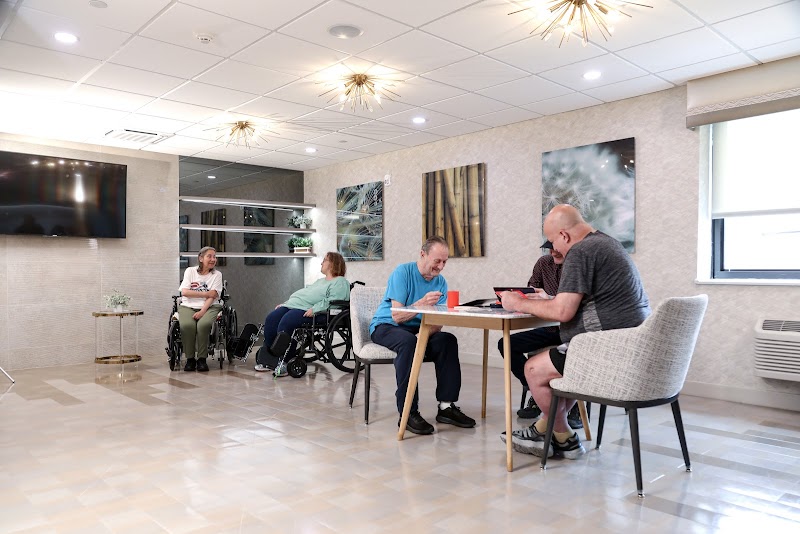
On 2/27/24 from 12:18 PM to 12:49 AM, the surveyor made the following meal observations in the Second- Floor dining room:
On 2/27/24 at 12:19 PM, the food truck arrived to the Second-Floor nursing unit. There were sixteen residents observed seated in the dining room at five different tables. The Certified Nursing Aide (CNA #1) placed a tray in front of Resident #30 and walked away. Resident #30's tablemate proceeded to take Resident #30's tray and removed the dome from the tray. The surveyor observed that CNA #2 from the opposite side of the dining room addressed the resident in a raised voice stating, Leave it alone [Resident's name] [he/she] is feeder.
On 2/27/24 at 12:29 PM, the surveyor observed the staff did not serve residents by tables. The surveyor observed sixteen residents were sitting in the dayroom for lunch. Seven out of the sixteen residents received their meal trays and were eating lunch. The other nine residents sat at the tables and watched their tablemate's eat. The LPN/UM stated that the other residents' meal trays were on a separate truck. At that time, the surveyor observed the LPN/UM yell out to the staff who were in the dayroom that Resident #30 was a feeder.
At 12:31 PM, the surveyor observed CNA #3 spoke in a raised voice as she informed staff in the dayroom that Resident #30 was a feeder and that someone needed to feed him/her. At that time, CNA #3 stated that she would feed Resident #30. The surveyor observed that CNA #3 fed Resident #30 at a table where the other residents were feeding themselves.
At 12:37 PM, the second food truck arrived on the Second-Floor nursing unit. The surveyor observed staff deliver the trays to residents in their rooms and other residents who ate in the dining room. The surveyor observed that meals were being served to both residents in the dining room and in their rooms from both dining carts. The last resident in the dining room was served at 12:42 PM.
On 2/28/24 at 12:11 PM, the surveyor interviewed the Unit Manager/Licensed Practical Nurse (UM/LPN) who stated that the residents should be served by tables; staff should not refer to a resident as a feeder and that residents dependent on staff for feeding should be seated separately from residents who were independent with their meals.
On 3/4/24 at 12:01 PM, the surveyor interviewed CNA #3 who acknowledged she should not have used a raised voice when she informed other staff that Resident #30 needed to be fed as it was a dignity issue. CNA #3 further acknowledged that Resident #30 should have been seated at a table where other residents also needed feeding assistance and that residents should be served by tables but that the trays don't come up that way.
A review of the Mealtimes list provided by the Licensed Nursing Home Administrator (LNHA) from the entrance conference reflected that lunch on the Second-Floor nursing unit was served at 11:55 AM; 12:15 PM, and 12:30 PM. The paper indicated the delivery of meals may be fifteen minutes early or fifteen minutes late.
On 3/7/24 at 11:15 AM, the LNHA acknowledged that residents should be served by tables, staff should not have discussed a resident's status publicly in the dining room where other residents and visitors were within hearing distance, and that residents who were dependent on staff should not have been seated at the same table as residents who were able to feed themselves.
A review of the facility's undated Serving of Food policy included residents who cannot feed themselves will be fed with attention to safety, comfort, and dignity.
A review of the facility's undated Resident Rights policy included the facility must care for you in a manner that enhances your quality of life; the facility will treat you with dignity and respect in full recognition of your individuality .
N.J.A.C. 8:39-27.1(a)
CONCERN
(D)
📢 Someone Reported This
A family member, employee, or ombudsman was alarmed enough to file a formal complaint
Potential for Harm - no one hurt, but risky conditions existed
Deficiency F0558
(Tag F0558)
Could have caused harm · This affected 1 resident
Complaint #NJ160540
Based on observation, interview, and review of pertinent facility documents, it was determined that the facility failed to a.) provide a wheelchair for resident use when out of bed...
Read full inspector narrative →
Complaint #NJ160540
Based on observation, interview, and review of pertinent facility documents, it was determined that the facility failed to a.) provide a wheelchair for resident use when out of bed(Resident #43); b.) maintain the call bell within reach of the resident (Resident #58); and c.) accommodate a resident whose preference was to smoke without getting wet during inclement weather (Resident #31). This deficient practice was identified for 3 of 28 residents reviewed for accommodation of needs (Resident #31, #43, and #58), and was evidenced by the following:
1. On 2/28/24 at 9:15 AM, the surveyor observed Resident #43 in bed and there was no wheelchair observed in the room.
On 2/29/24 at 12:04 PM, the surveyor observed the resident in bed with head of bed elevated, eyes closed. The resident did not respond to surveyor inquiry. There was no observed wheelchair noted in the room.
On 2/29/24 at 12:09 PM, the surveyor interviewed the resident's primary Certified Nurse Aide (CNA #1), who stated the resident needed complete care and she wanted to get the resident out of bed, but she did not have a wheelchair. CNA #1 stated she borrowed a wheelchair from other residents to get the resident out of bed, that it had been a month since she was able to get the resident out of bed with their own wheelchair. At this time, the CNA reported that the resident's skin was intact.
On 2/29/24 at 12:23 PM, the surveyor interviewed the resident's Licensed Practical Nurse #1 (LPN #1) who stated this was the third time she was taking care of Resident #43, but to her knowledge the resident did not have a wheelchair; that they were usually kept by the resident's bed, and she had not seen one.
On 2/29/24 at 12:32 PM, the surveyor interviewed the Unit Manager/LPN (UM/LPN) who stated all residents should have a way to get out of bed and that Resident #43 would need a reclining wheelchair instead of a traditional wheelchair to do so. LPN/UM #1 further stated she had been the UM/LPN on the Second-Floor nursing unit for a week, and had not once seen the resident out of bed and acknowledged she had not observed a reclining wheelchair in the resident's room.
On 3/4/24 at 11:41 AM, the surveyor observed Resident #43 dressed and well-groomed in a reclining wheelchair being wheeled into the Second-Floor dayroom. The surveyor observed the chair had been labeled with the resident's name. At that time CNA #1 stated to the surveyor they got [him/her their] own chair smiling.
On 3/5/24 at 11:48 AM, the surveyor interviewed the Director of Rehabilitation Services (DRS) who stated every resident should have a chair, either a wheelchair, or reclining chair unless they refused to get out of bed. The DRS stated the resident was last evaluated on 2/29/24, as a result she had been initiated for therapy services for sitting tolerance. DRS explained that sitting tolerance was getting a resident into a wheelchair to see how they tolerated sitting, and if any positioning devices were needed for support.
The surevyor reviewed the medical record for Resident #44.
A review of the admission Record face sheet reflected the resident was admitted to the facility with diagnoses which included dementia, hypertension, and dysphagia (difficulty swallowing).
A review of the most recent quarterly Minimum Data Set (MDS), assessment tool, reflected the resident had a brief interview of mental status (BIMS) score of 00; which indicated severely impaired cognition. According to section GG Functional Abilities and Goals, the resident had functional limitations in range of motion including impairment on both sides of their upper extremities and impairment on one side of their lower extremities. For mobility devices used in the last seven days, it was indicated none of the above, meaning the resident did not use a cane/crutch, walker, wheelchair, or limb prosthesis for mobility.
On 3/6/24 at 10:46 AM, the surveyor interviewed the Regional Director of Nursing (RDON) who stated each resident should have a chair in their room based on functional ability and based on therapy approval would expect the facility to provide the resident with a reclining wheelchair.
2. On 2/27/24 at 10:55 AM, the surveyor observed Resident #58 in bed with their eyes closed; the resident did not respond to the surveyor's greeting. The surveyor observed the resident's call bell (bell used to summon staff for assistance) wrapped around the circadian alert circuit (a system used to monitor resident vital signs and movement). The call bell was affixed to the top of the wall near the ceiling and was not within Resident #58's reach.
On 2/28/24 at 11:52 AM, the surveyor observed Resident #58 in their bed with the call bell wrapped around the circadian alert system, not within Resident #58's reach.
On 2/28/24 at 12:04 PM, the surveyor interviewed LPN #2 who stated that she had no idea what the circle on the wall was (the circadian alert system), but acknowledged that the call bell should not have been tied around it.
On 2/28/24 at 12:11 PM, the surveyor accompanied by the UM/LPN entered Resident #58's room, and they observed the call bell wrapped around the circadian alert system, not within Resident #58's reach. The UM/LPN stated that the circadian alert system was used to monitor the resident's vital signs and that the call bell should not have been tied around the circadian alert system. The UM/LPN further stated that she needed to get someone taller who could reach up the wall to unwrap the call bell from the circadian alert unit.
The surveyor reviewed the medical record for Resident #58.
A review of the admission Record face sheet reflected that the resident was admitted to the facility with diagnoses which included but were not limited to cardiac arrest, seizures, hypoxic-ischemic encephalopathy (a type of brain damage caused by a lack of oxygen to the brain), chronic respiratory failure, tracheostomy status (a surgical opening in the neck to the windpipe to allow air to fill the lungs) and gastrostomy status (a surgical opening into the stomach used for feeding).
A review of the most recent quarterly Minimum Data Set indicated the resident had severe cognitive impairment, and was dependent on staff for all activities of daily living (ADLs).
On 3/7/24 at 11:52 AM, the Licensed Nursing Home Administrator (LNHA) in the presence of the RDON, Clinical Chief Officer, and survey team acknowledged call bells should be within reach of all residents in their rooms.
3. On 2/28/24 at 9:33 AM, the surveyor observed Resident #31 seated in an electric wheelchair outside in the facility's designated smoking area.
At this time, the surveyor interviewed the Activity Assistant who stated that the residents complained that there was not enough room in the designated smoking area to allow them to smoke during a rain storm without getting wet.
On 2/28/24 at 9:53 AM, the surveyor interviewed Resident #31 in their room. The resident stated that the designated smoking area did not accomidate the resident to smoke while it was raining outside without getting wet.
On 3/1/24 at 9:40 AM, the surveyor interviewed the Director of Activities (DOA) who stated that it was the Activity departments responsibility to monitor the residents in the designated smoking area to ensure they were smoking safely and responsibly. The DOA stated that the residents often complain that when it rained, there was not enough room for them to smoke without getting wet.
On 3/7/24 at 11:52 AM, the LNHA in the presence of the RDON, Chief Clinical Officer, and survey team stated that the designated smoking area use to accomidate all the residents to smoke in inclement weather without getting wet because there was only two or three residents who smoked. The LNHA stated there was now twenty resident who went out at one time during the designated smoking times, so residents were getting wet during inclement weather.
A review of the facility's undated Resident Rights policy included the facility must care for you in a manner that enhances your quality of life; treat you with dignity and respect in full recognition of your individuality; you have the right as a resident to receive services with reasonable accommodations to individual needs and preferences .
A review of the facility's undated Smoking Policy included .it is the policy to provide a safe environment for our residents, staff and visitors by defining and enforcing safe smoking practices .
NJAC 8:39- 31.8 (c)(9)(10)
CONCERN
(D)
Potential for Harm - no one hurt, but risky conditions existed
Deficiency F0602
(Tag F0602)
Could have caused harm · This affected 1 resident
Based on observation, interview, and review of pertinent facility documents, it was determined that the facility failed to ensure a resident was free of exploitation and misappropriation of resident p...
Read full inspector narrative →
Based on observation, interview, and review of pertinent facility documents, it was determined that the facility failed to ensure a resident was free of exploitation and misappropriation of resident property. The deficient practice was identified for 1 of 6 residents reviewed for abuse (Resident #47), and was evidenced by the following:
On 2/28/24 at 12:14 PM, the surveyor interviewed Resident #47 who stated he/she had an issue with a Certified Nursing Aide (CNA #1) who no longer worked at the facility. The resident stated he/she developed a bond with CNA #1, and the aide would ask the resident to borrow money which he/she provided. The resident continued CNA #1 always paid them back the borrowed money, and there were multiple financial transactions, but CNA #1 stopped paying the resident back the money she borrowed. The resident stated he/she transferred the money using money applications (app) on their phone, and CNA #1 owed him/her around $330 that was never paid back. The resident stated the facility's Director of Quality Experience (DQE) and current Licensed Nursing Home Administrator (LNHA) spoke to the resident and took pictures of the transactions on the money app, but the DQE and LNHA never did anything further. The resident stated that CNA #1 no longer worked at the facility.
On 2/29/24 at 10:00 AM, a request was made to the LNHA to provide all investigations and grievances for Resident #47.
On 3/4/24 at 9:08 AM, the surveyor interviewed the Director of Nursing (DON) who stated allegations of abuse were immediately investigated.
On 3/4/24 at 12:16 PM, the LNHA confirmed the surveyor had all the investigations for the resident.
A review of the investigations did not include the abuse allegation made by the resident.
On 3/5/24 at 11:50 AM, the surveyor interviewed the Director of Nursing (DON) and asked if the resident ever informed the facility he/she was missing anything. The DON stated there was a time there was missing money or a cell phone that she could not speak to that involved CNA #1 who no longer worked here.
On 3/5/24 at 12:27 PM, the surveyor interviewed the LNHA who stated there was money exchanged with a former employee (CNA #1), and CNA #1 had not paid back Resident #47 per the resident. The LNHA stated the facility only completed a grievance since the resident was alert and oriented. The surveyor requested the grievance form.
A review of the facility's undated Abuse Policy & Procedure included when an incident or suspected incident of resident abuse, neglect, misappropriation of resident property, or injury of unknown source is reported, the Administrator/Director of Nursing will immediately be notified. They will appoint a staff member to investigate the incident .The investigation shall consist of: a review of the complete Resident Abuse form for facility and F.R.I.D.A.Y. and Reportable Event Record Report for Department of Health [DOH]; interviews with the person(s) reporting the incident; interviews with any witnesses to the incident; an interview with the resident; an interview with staff members (on all shifts) having contact with the resident during the period of alleged incident; interviews with resident's roommate, family members, and visitors if applicable; interviews with other residents to which the accused employee provided care or services (if applicable); a review of circumstances surrounding the incident; review of pertinent emails. Witness statements shall be in writing. Witness will be required to sign and date such statements.
A review of the Grievance Summaries dated reported 10/13/23 and resolved 10/17/23, included the following:
Grievance details: resident stated [he/she] had been exchanging money via a [money] app for personal items with [CNA #1]; resident states that [he/she] has not seen the CNA, she was not responding to calls or messages and the CNA owes [him/her] money.
Summary of investigation: resident reported that [he/she] had been exchanging money with an employee for them to purchase [him/her] personal items and that the employee was not responding to [his/her] calls or texts.
Summary findings: resident was alert and oriented and has been sending money to now a former employee to buy [him/her] things. According to the resident, the individual owes [him/her] money and was no longer responding to [his/her] calls or texts.
Summary of actions taken: Administration reached out to the former employee via phone who stated she did not owe the resident any money or items and confirmed [Resident #47] had been sending her money. She also stated when she was not able to get [him/her] the item, she would give the money back to the resident. Resident was made aware of the conversation with the employee and resident stated [he/she] made their attorney aware.
The grievance did not include any witness statements from the resident, employee, other staff members, and residents; as well as no facility completed Resident Abuse Form per facility policy.
The surveyor reviewed the medical record for Resident #47.
A review of the admission Record face sheet (an admission summary) reflected the resident was admitted to the facility with diagnoses which included multiple sclerosis, major depressive disorder, insomnia, and anxiety.
A review of the most recent comprehensive Minimum Data Set (MDS), an assessment tool dated 2/20/24, reflected the resident had a brief interview for mental status score of a 15 out of 15; which indicated a fully intact cognition.
A review of the individual comprehensive care plan included a focus area dated initiated 9/28/21, I sometimes lend my money to other residents despite education against it. Interventions included to educate resident not to lend money to other residents and to encourage resident to inform staff if [he/she] feels pressured to give someone money. The care plan did not include the resident gave money to staff.
A review of the Progress Notes did not include any documentation on the incident.
On 3/6/24 at 8:51 AM, the surveyor re-interviewed Resident #47 who stated he/she loaned CNA #1 money for the aide's personal use; that CNA #1 had never nor was ever asked to purchase the resident personal items. The resident further stated CNA #1 would take his/her personal items like shampoo and hair gel to give to other residents. The resident continued that CNA #1 told the resident the facility did not have direct deposit for their paychecks so when she needed money and did not have her paycheck yet, she would borrow money from the resident that she was at one point paying the resident back. The resident stated he/she asked CNA #1 for the money owed, and CNA #1 kept saying tomorrow. The resident stated CNA #1 used to take good care of me doing personal grooming that other aides would not, and the resident stated they felt that if [he/she] did not give CNA #1 the money, they would no longer go above and beyond with care. The resident stated that the Director of Social Services (DSS) informed him/her that staff should be giving him/her that care, and the resident should never have to give staff money for that level of care.
On 3/6/24 at 9:59 AM, the surveyor interviewed the DSS and asked if she had spoken to the resident regarding any grievances with staff, and the DSS stated the only issue she recalled was from this past January where the resident and a staff member shared a phone plan, and the staff owed the resident money. The DSS stated she thought the incident involved CNA #1 who was no longer at the facility, but the LNHA, DON, and law enforcement were aware.
On 3/6/24 10:19 AM, the surveyor interviewed the DQE who stated she was the person residents made their complaints to; and then she communicated it to the LNHA and DON. The DQE stated back in October or November, Resident #47 reported that a CNA (CNA #1) owed them money; and I reported it to the LNHA and DON. The DQE stated she did no investigations.
On 3/6/24 at 10:46 AM, the surveyor interviewed the LNHA who stated the types of abuse were physical, verbal, mental, financial, emotional, and that all residents were at risk for abuse in the facility.
On 3/6/24 at 2:29 PM, the surveyor re-interviewed the LNHA who stated since Resident #47 was alert and oriented and gave CNA #1 the money, the facility did not investigate it as abuse since we did not feel it was misappropriation of funds. The LNHA confirmed it was not facility policy for staff to accept money from residents; it would be inappropriate. The LNHA stated CNA #1 was terminated from the facility not for accepting the resident's money, but for refusing to come into the facility to provide a statement on the incident. The LNHA stated that CNA #2 had a cell phone that Resident #47 paid the bill for that the aide stopped paying the resident for, but the resident reported this to staff in January of 2024, and CNA #2 stopped working for the facility in February of 2023. The LNHA stated law enforcement was called, but CNA #2 was no longer their employee at the time of the complaint.
On 3/6/24 at 3:53 PM, the surveyor asked Resident #47 who purchased their personal belongings, and the resident stated their family member; that the facility never purchased personal items for them.
On 3/6/24 at 3:48 PM, the surveyor interviewed the Activities Director (AD), who stated if a resident needed personal items purchased, the resident made an individual request, and the resident's social worker received consent from the business office who released the resident's funds. The items were then purchased, and the business office was given a receipt to track the purchase. The AD continued that staff was not allowed to purchased personal items for residents; that it was against facility policy and to avoid financial issues which would be considered exploitation.
On 3/7/24 at 11:52 AM, the LNHA in the presence of the Regional DON, Chief Clinical Officer, and survey team confirmed the incident was never investigated. The LNHA also stated that the activities staff and social worker were the staff who purchased resident's personal needs if their families could not.
A review of the facility's undated Abuse Policy and Procedure policy included all reports of resident abuse, neglect, misappropriation of resident property, and injuries of unknown source shall be promptly and thoroughly investigated .
NJAC 8:39-4.1(a)5
CONCERN
(D)
Potential for Harm - no one hurt, but risky conditions existed
Abuse Prevention Policies
(Tag F0607)
Could have caused harm · This affected 1 resident
Based on observation, interview, and review of pertinent facility documents, it was determined that the facility failed to a.) develop an abuse policy that was in accordance with regulatory guidelines...
Read full inspector narrative →
Based on observation, interview, and review of pertinent facility documents, it was determined that the facility failed to a.) develop an abuse policy that was in accordance with regulatory guidelines and b.) implement their abuse policy for an allegation of misappropriation of resident property. This deficient practice was identified for 1 of 6 residents reviewed for abuse (Resident #47), and was evidenced by the following:
During entrance conference on 2/27/24 at 10:13 AM, the surveyor requested and provided the Licensed Nursing Home Administrator (LNHA) and Director of Nursing (DON) with the Centers for Medicare & Medicaid Services (CMS) Entrance Conference Worksheet which indicated in section 32. Abuse Prohibition Policy and Procedures to be provided to the surveyor for the next day.
On 2/28/24 at 9:00 AM, the surveyor reviewed the facility's undated Abuse Policy and Procedure which did not include how the facility would protect residents from abuse through screening, training, preventing, identification, and protecting. The policy included investigation and reporting. The reporting indicated that the facility had one business day to report to the New Jersey State Department of Health any suspected allegation of abuse, which was not in accordance with the regulation of two hours.
On 2/28/24 at 10:00 AM, the surveyor asked the LNHA if the facility had any additional abuse policies, and the LNHA stated she would check.
On 2/28/24 at 10:40 AM, the LNHA provided the surveyor with the facility's undated Abuse Investigations policy, and stated she believed the two abuse policies provided was all the facility had.
On 2/28/24 at 1:51 PM, the LNHA provided the surveyor with the facility's undated Abuse - Identifying policy, and stated the facility had three abuse policies that were provided by the facility.
On 3/4/24 at 9:08 AM, the surveyor asked the DON if she could confirm that the survey team had all the facility's abuse policies, and the DON stated she would find out.
On 3/4/24 at 12:16 PM, the LNHA confirmed the facility had three abuse policies and they were all provided to the surveyor.
On 3/5/24 at 10:52 AM, the surveyor interviewed the LNHA regarding how the facility prevented abuse, and the LNHA responded by educating staff; and performing background checks for any history of abuse. The surveyor asked the LNHA if she reviewed all the facility's policies including the abuse policy and the LNHA confirmed she had. The surveyor asked the LNHA if she knew the components that needed to be included in the abuse policy and she stated break down of abuse the physical emotional, financial. reporting. At this time the surveyor produced the facility's Abuse Policy and Procedure provided to the survey team, and the LNHA confirmed it was the facility's abuse policy. The surveyor asked the LNHA to identify the screening section, and the LNHA stated this policy was the in-house policy so it would not be included in there. The surveyor asked for the training portion and the LNHA confirmed was not included. The surveyor asked for the prevention section and the LNHA confirmed it was s not there. The LNHA confirmed the identification of abuse was a separate policy that was already provided to the surveyor. The LNHA stated she was aware all those elements should be in the abuse policy, and the survey team had the main abuse policy, but the facility also had additional policies.
On 3/6/24 at 10:46 AM, the surveyor reviewed the facility's abuse policy with the LNHA which indicated the facility had one business day to notify the DOH of abuse, and the LNHA confirmed the facility had one day to notify.
On 3/6/24 at 2:45 PM, the LNHA provided the surveyor with the facility's Abuse Prevention - Policy & Procedure Manual which included a Key Components of Systemic Approach to Prevent Abuse and Neglect which included the seven components the abuse policy needed to contain. The policy and procedure manual indicated the facility had to report allegations of abuse to the NJDOH immediately.
On 3/7/24 at 10:30 AM, the LNHA stated the Abuse Prevention - Policy & Procedure Manual was used to in-service staff on abuse.
2. On 2/28/24 at 12:14 PM, the surveyor interviewed Resident #47 who stated he/she had an issue with a Certified Nursing Aide (CNA #1) who no longer worked at the facility. The resident stated he/she developed a bond with CNA #1, and the aide would ask the resident to borrow money which he/she provided. The resident continued CNA #1 always paid them back the borrowed money, and there were multiple financial transactions, but CNA #1 stopped paying the resident back the money she borrowed. The resident stated he/she transferred the money using money applications (app) on their phone, and CNA #1 owed him/her around $330 that was never paid back. The resident stated the facility's Director of Quality Experience (DQE) and current Licensed Nursing Home Administrator (LNHA) spoke to the resident and took pictures of the transactions on the money app, but the DQE and LNHA never did anything further. The resident stated that CNA #1 no longer worked at the facility.
On 3/5/24 at 11:50 AM, the surveyor interviewed the Director of Nursing (DON) and asked if the resident ever informed the facility he/she was missing anything. The DON stated there was a time there was missing money or a cell phone that she could not speak to that involved CNA #1 who no longer worked at the facility.
On 3/5/24 at 12:27 PM, the surveyor interviewed the LNHA who stated there was money exchanged with a former employee (CNA #1), and CNA #1 had not paid back Resident #47 per the resident. The LNHA stated the facility only completed a grievance form since the resident was alert and oriented. The surveyor requested the grievance form.
A review of the facility's undated Abuse Policy & Procedure included when an incident or suspected incident of resident abuse, neglect, misappropriation of resident property, or injury of unknown source is reported, the Administrator/Director of Nursing will immediately be notified. They will appoint a staff member to investigate the incident .The investigation shall consist of: a review of the complete Resident Abuse form for facility and F.R.I.D.A.Y .
A review of the Grievance Summaries dated reported 10/13/23 and resolved 10/17/23, included the following:
Grievance details: resident stated [he/she] had been exchanging money via a [money] app for personal items with [CNA #1]; resident states that [he/she] has not seen the CNA, she was not responding to calls or messages and the CNA owes [him/her] money.
Summary of investigation: resident reported that [he/she] had been exchanging money with an employee for them to purchase [him/her] personal items and that the employee was not responding to [his/her] calls or texts.
Summary findings: resident was alert and oriented and has been sending money to now a former employee to buy [him/her] things. According to the resident, the individual owes [him/her] money and was no longer responding to [his/her] calls or texts.
Summary of actions taken: Administration reached out to the former employee via phone who stated she did not owe the resident any money or items and confirmed [Resident #47] had been sending her money. She also stated when she was not able to get [him/her] the item, she would give the money back to the resident. Resident was made aware of the conversation with the employee and resident stated [he/she] made their attorney aware.
The grievance did not include any witness statements from the resident, employee, other staff members, and residents; as well as no facility completed Resident Abuse Form per facility policy.
On 3/6/24 at 8:51 AM, re-interviewed Resident #47 who stated he/she loaned CNA #1 money for the aide's personal use; that CNA #1 had never nor was ever asked to purchase the resident personal items. The resident continued that CNA #1 told the resident the facility did not have direct deposit for their paychecks so when she needed money and did not have her paycheck yet, she borrowed money from the resident. Resident #47 stated CNA #1 was paying back the borrowed money, but then the aide stopped paying back the resident. The resident stated he/she asked CNA #1 for the money owed, and CNA #1 who tell the resident Tomorrow. The resident stated CNA #1 used to take good care of me doing personal grooming that other aides would not, and the resident felt that he/she did not give CNA #1 the money, they would no longer go above and beyond with care.
On 3/6/24 at 10:46 AM, the surveyor asked the LNHA what the types of abuse were, and the LNHA responded physical, verbal, mental, financial, emotional. The surveyor asked the LNHA who was susceptible to abuse in the facility and the LNHA stated all residents were at risk for abuse in the facility. The LNHA stated at first Resident #47's complaint was CNA #1 would not return his/her phone calls, and then the facility was informed CNA #1 owed the resident money. The LNHA sated CNA #1 refused to come in to provide a statement, so she was terminated, and the grievance was the resident's statement.
On 3/6/24 at 11:33 AM, the surveyor requested a copy of the facility's Resident Abuse Form from the facility's abuse policy, and the LNHA stated the facility did not have that form. The surveyor asked about the F.R.I.D.A.Y. in the abuse policy, and the LNHA stated that was a state form that the facility reported to.
On 3/6/24 at 2:29 PM, the surveyor re-interviewed the LNHA who stated since Resident #47 was alert and oriented and gave CNA #1 the money, the facility did not investigate it as abuse since we did not feel it was misappropriation of funds. The LNHA confirmed it was not facility policy for staff to accept money from residents; it would be inappropriate. The LNHA stated CNA #1 was terminated from the facility not for accepting the resident's money, but for refusing to come into the facility to provide a statement.
On 3/7/24 at 11:52 AM, the LNHA in the presence of the Regional DON, Chief Clinical Officer, and survey team confirmed the incident was never investigated, and the incident was not reported to any state agencies. The LNHA also stated that the activities staff and social worker were the staff who purchased residents' personal needs if their families could not.
Refer F602; F609; F610
NJAC 8:39-4.1(a)5
CONCERN
(D)
Potential for Harm - no one hurt, but risky conditions existed
Assessment Accuracy
(Tag F0641)
Could have caused harm · This affected 1 resident
**NOTE- TERMS IN BRACKETS HAVE BEEN EDITED TO PROTECT CONFIDENTIALITY** Based on observation, interview, and review of pertinent facility documents, it was determined that the facility failed to accur...
Read full inspector narrative →
**NOTE- TERMS IN BRACKETS HAVE BEEN EDITED TO PROTECT CONFIDENTIALITY** Based on observation, interview, and review of pertinent facility documents, it was determined that the facility failed to accurately complete the Minimum Data Set (MDS) assessment for 1 of 5 residents reviewed for unnecessary medications (Resident #80), and was evidenced by the following:
On 2/29/24 at 11:50 AM, the surveyor observed Resident #80 in a wheelchair in the hallway self-propelling using their feet.
The surveyor reviewed the medical record for Resident #80.
A review of the admission Record face sheet (an admission summary) reflected that Resident #80 was admitted to the facility with diagnoses that included schizophrenia, bipolar disorder, cerebral infarction (stroke- parts of the brain become damaged or die).
A review of the Psychiatric Progress Noted dated 2/12/24 included under diagnosis and plan that the resident had a current diagnosis of schizoaffective disorder- depressed type, insomnia, and Post Traumatic Stress Disorder (PTSD).
A review of the resident's most recent comprehensive MDS, an assessment tool dated 12/6/23, reflected a brief interview for mental status (BIMS) score of 15 out of 15; which indicated a fully intact cognition. A further review in Section I- Active Diagnoses did not include PTSD.
On 3/6/24 at 9:32 AM, the surveyor interviewed the MDS Coordinator who stated she gathered information to complete the assessments from interviews with the resident and family, review of the resident's medical record including physician's progress. At that time, the surveyor reviewed with the MDS Coordinator the Physician Progress Note dated 2/12/24, that included the diagnosis of PTSD and the most recent MDS dated [DATE]. The MDS Coordinator acknowledged the MDS should have included the PTSD diagnosis in Active Diagnoses, and that she needed to modify the MDS to include the diagnosis.
On 3/6/24 at 12:41 PM, the surveyor interviewed the Licensed Nursing Home Administrator (LNHA) who acknowledged the MDS Coordinator had just updated the MDS to include the diagnosis of PTSD, but should have been included on the most recent comprehensive MDS.
A review of the facility's undated MDS submission Timeframes policy did not include the process for completing a MDS assessment.
NJAC 8:39-33.2 (d)
CONCERN
(D)
Potential for Harm - no one hurt, but risky conditions existed
Comprehensive Care Plan
(Tag F0656)
Could have caused harm · This affected 1 resident
**NOTE- TERMS IN BRACKETS HAVE BEEN EDITED TO PROTECT CONFIDENTIALITY** Based on observation, interview, and review of pertinent facility documents, it was determined that the facility failed to devel...
Read full inspector narrative →
**NOTE- TERMS IN BRACKETS HAVE BEEN EDITED TO PROTECT CONFIDENTIALITY** Based on observation, interview, and review of pertinent facility documents, it was determined that the facility failed to develop and implement a comprehensive person-centered care plan that identified services to attain or maintain the resident's highest practical physical, mental, and psychosocial well-being. This deficient practice was identified for 3 of 28 residents reviewed for comprehensive care plans (Resident #45, #80, and #102), and was evidenced by the following:
1. On 2/28/24 at 10:18 AM, the surveyor observed Resident #45 sleeping in bed on his/her right side.
The surveyor reviewed the medical record for Resident #45.
A review of the admission Record face sheet (an admission summary), Resident #45 was admitted to the facility with diagnoses including, but not limited to, osteomyelitis (infection of the bone) of left femur, pressure ulcer (Stage 4) left hip, and heart failure.
A review of the admission Minimum Data Set (MDS), an assessment tool reflected that the resident was not able to complete the brief interview for mental status (BIMS). A further review of Section M Skin Conditions identified that the resident was admitted with one stage 4 pressure ulcer (wound that extends past the fat layer into deep tissues including muscle, tendon, and ligament).
A review of the Order Summary Report identified the following active physician's order (PO): Monitor Resident for urine output [every] shift. Notify [doctor] if no urine output [over] eight hours for urinary retention; document in progress notes how many wet briefs resident has per shift with a start date of 1/24/24.
A review of the corresponding February 2024 Medication Administration Record (MAR) and Treatment Administration Record (TAR) the PO was located, and the nurses signed with a check mark and their initials. A Further review of the TAR identified wound treatment orders.
A review of individualized comprehensive care plan did not include the interventions regarding the monitoring of urine output; documentation of wet diapers; or the stage 4 wound care orders.
On 3/5/24 at 12:58 PM, the surveyor interviewed LPN #2, who stated that a care plan should promote resident's current health status and dictated their overall care. LPN #2 confirmed that the resident's intervention for urinary retention, along with the wound and its intervention, should be identified on the care plan.
On 3/6/24 at 9:48 AM, the surveyor spoke with Unit Manager/Licensed Practical Nurse (UM/LPN #1) who confirmed that the resident's interventions, including regarding the documentation of wet diapers and contact the physician regarding urinary retention, should be identified on the care plan. UM/LPN #1 further acknowledged that the resident's wound and its treatments should be identified on the care plan. Upon review of Resident #45's care plan, UM/LPN #1 verified that these focus areas were not included.
On 3/7/24 at 11:32 AM, the surveyor interviewed the Licensed Nursing Home Administrator (LNHA), in the presence of Regional Director of Nursing (RDON) and Chief Clinical Officer, who acknowledged that a care plan should be updated as needed to include relevant interventions.
2. On 2/29/24 at 11:50 AM, the surveyor observed Resident #80 in a wheelchair in the hallway self-propelling using their feet.
The surveyor reviewed the medical record for Resident #80
A review of the admission Record face sheet reflected the resident was admitted to the facility with diagnoses that included schizophrenia, bipolar disorder, cerebral infarction (stroke- parts of the brain become damaged or die).
A review of the Psychiatric Progress Noted dated 2/12/24, included under diagnosis and plan a current diagnosis of schizoaffective disorder- depressed type, insomnia, and Post Traumatic Stress Disorder (PTSD).
A review of the resident's most recent comprehensive MDS dated [DATE], reflected a BIMS score of 15 out of 15; which indicated a fully intact cognition. A further review in Section I- Active Diagnoses, PTSD was not indicated.
A review of the individual comprehensive care plan did not include any focuses, goals or interventions related to the resident's diagnosis of PTSD.
On 3/6/24 at 9:32 AM, the surveyor interviewed the MDS Coordinator who stated she gathered information to complete the assessments from interviews with the resident and family and review of the resident's medical record including physician's progress notes. At this time, the surveyor reviewed with the MDS Coordinator the Physician Progress Note dated 2/12/24, that included the diagnosis of PTSD and the most recent MDS dated [DATE]. The MDS Coordinator acknowledged the MDS should have reflected the PTSD diagnosis and that she would need to modify the MDS.
On 3/06/24 at 10:36 AM, the surveyor reviewed with the Regional Director of Nursing (RDON) the resident's current diagnoses, which now included PTSD. The RDON stated she expected that PTSD would be addressed in the care plan, since the purpose of the care plan was to share information to take the best care of the patient possible. The surveyor and the RDON then reviewed the resident's current care plan, and she acknowledged it did not include a focus, goal or intervention to address resident's PTSD diagnosis.
On 3/6/24 at 12:41 PM, the surveyor interviewed the Licensed Nursing Home Administrator (LNHA) who acknowledged the care plan should have included the resident's diagnosis of PTSD.
A review of the facility provided Baseline Care Plan Completion and Ongoing Care Plan Updates policy, dated 11/17/17, included .The comprehensive care plan will described the following: The services that are to be furnished to attain or maintain the resident's highest practicable physical, mental, and psychosocial wellbeing .Nursing staff will update the care plan related to physician's orders and/or changes in care needs follow a uniform process for the comprehensive care plan upon Care Area Assessment(CAA) completion, and ensuring care plans are updated to reflect the resident's status . Ongoing updates to care plans: nursing staff will update the care plan related to physician's orders and/or changes in care needs . update acute care plans for the resident as they are warranted.
A review of the facility provided undated LPN Nurse Job Position document included .Review care plans daily to ensure that appropriate care is being rendered. Inform the Nursing Supervisor of any changes that need to be made on care plan. Ensure that your nurses' notes reflect that the care plan is being followed when administering care or treatment .Ensure that your assigned [CNAs] are aware of the resident care plans. Ensure that the CNA's refer to the resident's care plan prior to administering daily care to the resident .
A review of the facility provided undated Unit Manager Nurse Job Position document included .Adjusts care plan when indicated. Care plans can and should be updated by the Unit Manager as situations present.
NJAC 8:39-11.2(e) thru (i); 27.1(a),(d)
CONCERN
(D)
Potential for Harm - no one hurt, but risky conditions existed
Deficiency F0657
(Tag F0657)
Could have caused harm · This affected 1 resident
**NOTE- TERMS IN BRACKETS HAVE BEEN EDITED TO PROTECT CONFIDENTIALITY** 2. On 2/28/24 at 12:14 PM, the surveyor interviewed Resident #47 who stated he/she had an issue with a Certified Nursing Aide (C...
Read full inspector narrative →
**NOTE- TERMS IN BRACKETS HAVE BEEN EDITED TO PROTECT CONFIDENTIALITY** 2. On 2/28/24 at 12:14 PM, the surveyor interviewed Resident #47 who stated he/she had an issue with a Certified Nursing Aide (CNA #1) who no longer worked at the facility. The resident stated he/she developed a bond with CNA #1, and the aide asked the resident to borrow money which he/she provided. The resident continued CNA #1 always paid them back the borrowed money, and there were multiple financial transactions, but CNA #1 stopped paying the resident back the money she borrowed. The resident stated he/she transferred the money using money applications (app) on their phone, and CNA #1 owed him/her around $330 that was never paid back. The resident stated the facility's Director of Quality Experience (DQE) and current Licensed Nursing Home Administrator (LNHA) spoke to the resident and took pictures of the transactions on the money app, but the DQE and LNHA never did anything further. The resident stated that CNA #1 no longer worked at the facility.
On 3/5/24 at 11:50 AM, the surveyor interviewed the Director of Nursing (DON) and asked if the resident ever informed the facility he/she was missing anything. The DON stated there was a time there was missing money or a cell phone that she could not speak to that involved CNA #1 who no longer worked here.
On 3/5/24 at 12:27 PM, the surveyor interviewed the LNHA who stated there was money exchanged with a former employee (CNA #1), and CNA #1 had not paid back Resident #47 per the resident. The LNHA stated the facility only completed a grievance since the resident was alert and oriented. The surveyor requested the grievance form.
A review of the Grievance Summaries dated reported 10/13/23 and resolved 10/17/23, included the following:
Grievance details: resident stated [he/she] had been exchanging money via a [money] app for personal items with [CNA #1]; resident states that [he/she] has not seen the CNA, she was not responding to calls or messages and the CNA owes [him/her] money.
Summary of investigation: resident reported that [he/she] had been exchanging money with an employee for them to purchase [him/her] personal items and that the employee was not responding to [his/her] calls or texts.
Summary findings: resident was alert and oriented and has been sending money to now a former employee to buy [him/her] things. According to the resident, the individual owes [him/her] money and was no longer responding to [his/her] calls or texts.
Summary of actions taken: Administration reached out to the former employee via phone who stated she did not owe the resident any money or items and confirmed [Resident #47] had been sending her money. She also stated when she was not able to get [him/her] the item, she would give the money back to the resident. Resident was made aware of the conversation with the employee and resident stated [he/she] made their attorney aware.
The surveyor reviewed the medical record for Resident #47.
A review of the admission Record face sheet reflected the resident was admitted to the facility with diagnoses which included multiple sclerosis, major depressive disorder, insomnia, and anxiety.
A review of the most recent comprehensive MDS dated [DATE], reflected the resident had a brief interview for mental status score of a 15 out of 15; which indicated a fully intact cognition.
A review of the individual comprehensive care plan included a focus area dated initiated 9/28/21, I sometimes lend my money to other residents despite education against it. Interventions included to educate resident not to lend money to other residents and to encourage resident to inform staff if [he/she] feels pressured to give someone money. The care plan did not include the resident gave money to staff.
On 3/7/24 at 9:00 AM, the surveyor interviewed UM/LPN #2 who stated care plans were completed by nursing staff as needed, upon admission, and quarterly upon review. UM/LPN #2 continued care plans included diagnoses, medications, behaviors, treatments, and anything pertinent to that resident. UM/LPN #2 confirmed after an investigation care plans were updated; as well as any time a new intervention needed to be added.
On 3/7/24 at 11:52 AM, the LNHA in the presence of the Regional DON, Chief Clinical Officer, and survey team confirmed the resident's care plan was not updated to reflect giving money to staff as well, and it should have been. The LNHA stated care plans were updated by the nurse, but usually by the unit managers.
A review of the undated facility's Baseline Care Plan Completion and Ongoing Care Plan Updates policy included ongoing updates to care plans nursing staff will update the care plan related to physician's orders and/or changes in care needs; the nursing staff will initiate and/or update acute care plans for the resident as they are warranted.
NJAC 8:39-11.2(e-i); 27.1(a);(d)
Based on observation, interview, and review of pertinent documents, it was determined that the facility failed to a.) revise a comprehensive care plan and for pressure wounds and b.) revise a care plan to include a resident gave staff money. This deficient practice was identified for 2 of 27 residents reviewed for care plans revisions (Resident #47 & Resident #79) and was evidenced by the following:
1. On 2/28/24 at 11:50 AM, the surveyor observed the resident seated in a high-back wheelchair with foot pedals.
The surveyor reviewed the medical record for Resident #79.
A review of the admission Record face sheet (an admission summary) reflected that the resident had a diagnosis that included but was not limited to anemia, fracture of the right femur, and hypertension.
A review of the most recent quarterly Minimum Data Set (MDS), an assessment tool dated 2/6/24, reflected the resident had a cognitive mental status of memory problems with severe impairment. Further review revealed the resident had a stage III pressure ulcer and an unstageable pressure wound.
A review of the Progress Note included a Skin/Wound Note dated 1/19/24 at 11:32 AM, which indicated the resident had a stage III pressure ulcer. New treatment was ordered, and the resident would be seen by the wound Nurse Practitioner (NP).
A review of the Progress Note included a Nutrition/Dietary Note indicating an unstageable pressure ulcer to coccyx and stage III pressure ulcer to sacrum.
A review of Resident #79's individual comprehensive care plan (ICCP) included a focus area dated 11/12/21, for skin integrity with no updated focus area and interventions to address two developed pressure ulcers.
On 3/7/24 at 10:30 AM, the surveyor interviewed the Unit Manager/Licensed Practical Nurse (UM/LPN #1), who stated that it would be the unit manager that updated care plans to reflect the wounds. She further noted that a care plan reflected goals with interventions to prevent wounds from happening again, but the actual wounds should have been care planned.
CONCERN
(D)
Potential for Harm - no one hurt, but risky conditions existed
Quality of Care
(Tag F0684)
Could have caused harm · This affected 1 resident
Based on observation, interview, and review of pertinent facility documents, it was determined that the facility failed to a.) assist a resident out of bed daily with the use of a hoyer lift as ordere...
Read full inspector narrative →
Based on observation, interview, and review of pertinent facility documents, it was determined that the facility failed to a.) assist a resident out of bed daily with the use of a hoyer lift as ordered by the physician. This deficient practice was identified for 1 of 28 residents reviewed for quality of care (Resident #102), and was evidenced by the following:
On 2/29/24 at 12:00 PM, the surveyor observed Resident #102 in bed. The resident stated that he/she was waiting for their lunch meal and that he/she needed assistance getting out of bed and wished that the staff would get him/her out of bed. Resident #102 stated that he/she had not been out of bed for over a week.
On 3/1/24 at 12:45 PM, the surveyor observed Resident #102 in bed eating their lunch. Resident #102 stated that he/she still had not been assisted out of bed.
The surveyor reviewed the medical record for Resident #102.
A review of admission Record face sheet (an admission summary) reflected that the resident was admitted to the facility with diagnoses which included but were not limited to peripheral vascular disease, obstructive uropathy (a disorder of the urinary tract that occurs due to obstructed flow of urine), and muscle weakness.
A review of the most recent quarterly Minimum Data Set (MDS), an assessment tool dated 12/23/23, reflected the resident had a brief interview for mental status score of 15 out of 15; which indicated a fully intact cognition.
A review of the Physician Order Summary Report (POS) reflected an active order dated 12/8/23, for the patient to be hoyered daily at 11:00 AM, to the geriatric chair (geri chair; a large padded chair with wheeled bases).
On 3/6/24 at 12:20 PM, the surveyor interviewed Resident #102's Certified Nursing Aide (CNA #1) who stated that the resident only got out of bed three times per week on Mondays, Wednesdays, and Fridays and that she would not be transferring the resident from the bed to their chair today. The surveyor asked the CNA why not if today was Wednesday, and the CNA did not answer. The surveyor then asked where the resident's geri chair was stored, and CNA #1 replied that therapy took the resident's chair back to the therapy room. Another CNA (CNA #2) overheard the conversation, and instructed CNA #1 to check the shower room. At that time, the surveyor accompanied by CNA #1 went to the shower room and observed Resident #102's geri chair there.
On 3/6/24 at 12:37 PM, the surveyor interviewed the Unit Manager/Licensed Practical Nurse (UM/LPN) who stated that the resident, gets out of bed whenever [he/she] wants to. The surveyor asked the UM/LPN where their geri chair was stored as it had not been observed in Resident #102's room throughout the entire survey. The UM/LPN replied that the geri chair was broken. The surveyor asked the UM/LPN if she had informed the rehab department or maintenance about the chair being broken, and the UM/LPN responded, maybe it's not broken, I don't know.
At that time, the surveyor reviewed the POS with the UM/LPN which reflected a PO to hoyer lift the resident out of bed every day at 11:00 AM. The UM/LPN then stated, I guess [he/she] should be gotten out of bed every if he wants to. The surveyor stated that the resident has expressed that he/she would like to be assisted out of bed daily as per the physician's order.
On 3/6/24 at 12:58 PM, the surveyor interviewed the Director of Rehabilitation (DOR) who stated that she had not been informed that Resident #102's geri chair had been broken and if she had been notified, she would have ordered a temporary replacement until the chair was repaired. The DOR stated that it would take one to two days for the rental chair to be delivered to the facility. The DOR stated that the geri chair should be stored in the resident's room or just outside in the hallway for easy access.
At that time, the DOR stated that Resident #102 received rehab from 12/8/23-1/5/24 and then was discharged to the Restorative Nursing Program. The DOR provided the surveyor with a copy of the Physical Therapy Recommendations To Restorative Nursing which reflected that Resident #102 was discharged from therapy with the recommendations .to be hoyer lifted daily to the geri chair. The DOR further stated that she made two copies of the form and provided one to the Director of Nursing and one to the Certified Nursing Assistant who provided care to the resident.
A review of the facility provided undated Certified Nursing Assistant Job Position document, included .Perform restorative and rehabilitative procedures as instructed .
On 3/6/24 at 4:02 PM, the survey team met with the Licensed Nursing Home Administrator (LNHA) and Regional Director of Nursing and discussed the above observations and concerns.
On 3/7/24 at 11:52 AM, the LNHA in the presence of the Regional Director of Nursing, Clinical Chief Officer, and survey team acknowledged that the resident should have been out of bed daily per the physician's order, and if the geri chair was broken, the DOR should have been notified.
NJAC 8:39-27.1 (a)
CONCERN
(D)
Potential for Harm - no one hurt, but risky conditions existed
Deficiency F0688
(Tag F0688)
Could have caused harm · This affected 1 resident
Based on observation, interview, and review of pertinent facility documents, it was determined that the facility failed to ensure that a resident with limited range of motion of the right hand receive...
Read full inspector narrative →
Based on observation, interview, and review of pertinent facility documents, it was determined that the facility failed to ensure that a resident with limited range of motion of the right hand received appropriate services to prevent further decrease in range of motion. This deficient practice was identified for 1 of 3 residents reviewed for positioning/mobility (Resident #6), and was evidenced by the following:
On 2/27/24 at 12:44 PM, the surveyor interviewed Resident #6 who stated that they had a contracture to the right hand. When asked if he/she was supposed to wear a brace, the resident opened their dresser drawer to show the surveyor a brace. Resident #6 stated that they do not wear it because it hurts. The resident stated that he/she had told the nursing staff, but nothing had been done.
On 2/29/24 at 11:21 AM, the surveyor observed Resident #6 dressed and seated in their wheelchair. The resident did not have the brace applied.
On 3/4/24 at 10:53 AM, the surveyor observed Resident #6 dressed and seated in their wheelchair. The resident did not have the brace applied.
The surveyor reviewed the medical record for Resident #6.
A review of the admission Record face sheet (an admission summary) reflected the resident was admitted to the facility with diagnoses including, but not limited to, rhabdomyolysis (breakdown of skeletal muscle) and acute respiratory failure.
A review of the most recent quarterly Minimum Data Set (MDS), an assessment tool, reflected that the resident had a brief interview for mental status (BIMS) score of 15 out of 15; which indicated a fully intact cognition.
A review of the Order Summary Report identified the following active physician's orders (PO): right resting hand splint with a start date of 9/20/23.
A review of the corresponding February 2023 Medication Administration Record (MAR) and Treatment Administration Record (TAR) the order could not be identified.
A review of the Resident's Occupational Therapy Encounter notes included the following:
On 9/20/23 at 6:10 PM, spoke with physician regarding script for resting hand splint and called orthotic company to order.
On 9/21/23 at 2:39 PM, resting hand splint applied to right hand; trained nursing staff on donning (putting on)/doffing (taking off) and skin checks: optimal position is obtained and patient with no [complaints of] pain.
A review of Resident #6 individualized comprehensive care plan did not include the resident's right-hand contracture or the PO for the splint.
On 3/5/24 at 10:40 AM, the surveyor interviewed Certified Nursing Aide (CNA #1) who identified that he/she was familiar with Resident #6. When asked if they were responsible for applying any splints, CNA #1 denied. CNA #1 stated that Physical Therapy (PT) or Occupational Therapy (OT) was responsible for applying braces to residents according to physician's orders. The surveyor asked CNA #1 how a brace should fit a resident, the CNA confirmed that it should never hurt and if a resident reported pain, the CNA would let the nurse know who entered a referral to PT/OT. The surveyor asked the process for patient refusals, and CNA #1 advised that all refusals should be documented and not just for braces or splints but every time a patient refuses. CNA #1 reported that they notified the nurse about the refusal who documented in the chart.
On 2/29/24 at 12:57 PM, the surveyor interviewed Licensed Practical Nurse (LPN #1) who advised that there was not one specific person who was responsible for entering PO and both the physicians and nursing could enter an order. LPN #1 confirmed that nursing was responsible for ensuring that the PO was accurate and correctly entered into the system. LPN #1 confirmed that contractures, along with the interventions like braces, should be identified on the care plan. When asked why that was important to identify, LPN #1 stated that care plans promoted independence and health but also directed resident care. LPN #1 confirmed that an orthotic should never be painful and if he/she were notified that a resident was complaining of pain while wearing an orthotic, they would let the unit manager know. The surveyor inquired about how the nursing staff was aware of residents that required orthotics, and LPN #1 responded that it would be identified on the MAR/TAR and therapy communicated that with nursing. When asked who was responsible for ensuring that residents were wearing their orthotics, LPN #1 responded, nursing. The surveyor directly inquired about Resident #6, and LPN #1 was not aware that she/he was ordered to wear a brace. LPN #1 reviewed the PO and confirmed the active order. LPN #1 proceeded to Resident #6's MAR/TAR and could not locate the order. When asked if Resident #6 should be wearing the orthotic, LPN #1 confirmed. When asked if the order should be identified on the MAR/TAR, LPN #1 confirmed. LPN #1 further agreed that Resident #6's refusal of wearing the splint and its corresponding pain should be documented and supervisor made aware.
On 3/6/24 at 9:48 AM, the surveyor spoke with Unit Manager/Licensed Practical Nurse (UM/LPN) who confirmed care plans should be updated as needed and with special interventions. Upon review of Resident #6's PO, the UM/LPN confirmed the active order for the right hand splint. The UM/LPN agreed that the resident's contracture and interventions for the splint should be identified on the care plan. The UM/LPN indicated that if the resident complained of pain from the splint, the facility should have tried to find out why it hurt. The UM/LPN indicated that she would have consulted therapy and requested a PT evaluation.
On 3/6/24 at 12:25 PM, the surveyor interviewed the Director of Rehabilitation (DOR) who confirmed that any issues regarding pain while wearing an orthotic would be reported to PT/OT for further evaluation. At this time, the DOR was unaware of any issues or concerns with Resident #6's orthotic. The DOR confirmed, based upon their documentation, that the resident was wearing the orthotic for up to five hours while in therapy without concerns. The DOR further advised that her expectation would be that Resident #6 continued wear the orthotic on regular a basis. When the DOR reviewed the current active order, the DOR stated that this was an incomplete order since it did not specify when or how long the orthotic was to be worn.
On 3/7/24 at 11:32 AM, the surveyor interviewed the Licensed Nursing Home Administrator (LNHA), in the presence of Regional Director of Nursing (RDON) and Chief Clinical Officer, who acknowledged that Resident #6 was not wearing the brace, lack of documentation regarding the resident's refusal to wear the brace, and that the care plan did not identify the resident's contracture and interventions. Furthermore, the LNHA confirmed that the resident should have been referred to PT/OT.
A review of the facility provided undated Certified Nursing Assistant Job Position document included .Perform restorative and rehabilitative procedures as instructed .
A review of the facility provided undated LPN Nurse Job Position document included .Review care plans daily to ensure that appropriate care is being rendered. Inform the Nursing Supervisor of any changes that need to be made on care plan. Ensure that your nurses' notes reflect that the care plan is being followed when administering care or treatment .Ensure that your assigned [CNAs] are aware of the resident care plans. Ensure that the CNA's refer to the resident's care plan prior to administering daily care to the resident . Review the resident's chart for specific treatments, medication order, diets, etc, as necessary .Implement and maintain established nursing objectives and standards .Ensure that your nurses' notes reflect that the care plan is being followed when administering care or treatment.
A review of the facility provided undated Unit Manager Nurse Job Position document included .Adjusts care plan when indicated. Care plans can and should be updated by the Unit Manager as situations present . Responsible for the proper transcription and executing of physician's orders, accurate documentation, maintenance of the clinical record completeness [ .] Directly supervises staff nurses to ensure their completion of duties as well as the direct supervision of CNAs.
A review of the facility provided Baseline Care Plan Completion and Ongoing Care Plan Updates policy, dated 11/17/17, included .the comprehensive care plan will describe the following: the services that are to be furnished to attain or maintain the resident's highest practicable physical, mental, and psychosocial well being .nursing staff will update the care plan related to physician's orders and/or changes in care needs .
A review of the facility's undated Charting and Documentation document included .all observations, medications administered, services performed, etc., must be documented in the resident's clinical record .
A review of the facility's undated Splinting document included .Once the wearing schedule is established, the physician's clarification order should specify the type of splint, where it is to be applied, and the wearing schedule. Written instructions should be left available to the nursing staff. This may be placed in the medical record per the facility policy, on the nursing unit, or other designated area.
A review of the facility's undated Refusal of Medications and Treatments, Documentation of document included .If a resident refuses his or her medications and/or treatments, nursing staff will document such refusal in the resident's medical record .Repeated refusals shall be reported to the Director of Nursing Services and Attending Physician after 3 continued refusals .
NJAC 8.39-27.1(a); 27.2(m)
CONCERN
(D)
Potential for Harm - no one hurt, but risky conditions existed
Accident Prevention
(Tag F0689)
Could have caused harm · This affected 1 resident
Based on observation, interview, and review of pertinent facility documents, it was determined that the facility failed to ensure that a resident was assessed and the comprehensive care plan was updat...
Read full inspector narrative →
Based on observation, interview, and review of pertinent facility documents, it was determined that the facility failed to ensure that a resident was assessed and the comprehensive care plan was updated post fall with safety interventions for a resident with a history of falls. This deficient practice was identified for 1 of 7 residents reviewed for falls (Resident #79), and was evidenced by the following:
On 2/28/24 at 11:50 AM, the surveyor observed the resident seated in a high-back wheelchair with foot pedals in the dining area.
The surveyor reviewed the medical records for Resident # 79.
A review of the admission Record face sheet (an admission summary) reflected the resident was admitted to the facility with diagnoses that included anemia, fracture of the right femur, and hypertension.
A review of the most recent quarterly Minimum Data Set (MDS), an assessment tool dated 2/6/24, reflected a cognitive mental status of memory problems with severe impairment. Further review of Section I Active Diagnoses reflected a fall diagnosis.
A review of the Progress Note included a Health Status Note dated 11/26/23 at 3:40 PM, which indicated that the resident had a fall in activities. The writer notified the Nurse Practitioner to assess the resident, who ordered an x-ray of the right knee, hip, and leg.
A review of the Progress Note included a Health Status Note dated 11/26/23 at 9:30 PM, that indicated the x-ray result of the right femur and right hip was acute right femoral neck fracture: age-indeterminate inferior pubic ramus fracture, two screws fixating right hemipelvis, and osteopenia. The physician was notified and ordered to be sent to the hospital.
A review of the incident report provided by the Director of Nursing (DON) for a fall that occurred on 11/26/23, included that the resident was seated in a wheelchair while attending activities and fell onto the floor. A review of the Certified Nursing Aide's (CNA) statement included the resident was in activities and slipped out of wheelchair. Further review of the Individual Statement Forms from Activity Aides revealed that the resident was watching a movie in their wheelchair; and the Activity Aides heard a noise, and the resident was observed on the floor. Further review of a Post Fall Huddle revealed the safety interventions in place: any resident who uses footrests on their wheelchairs should have them on the wheelchair.
A review of Resident #79's individual comprehensive care plan (ICCP) dated 11/19/21, included a focus areas that the resident was at risk for falls with regards to gait/balance problems with actual falls on 4/26/22, 5/6/23, and a witness fall on 11/26/23. Interventions included to anticipate and meet the resident's needs; to educate the resident/family/caregivers about safety reminders and what to do if a fall occurs; ensure that the resident is wearing appropriate footwear when ambulating or mobilizing in wheelchair; follow facility fall protocol; resident requires supervision in the dayroom; resident needs activities to minimize the potential for falls while providing diversion and distraction. No further interventions were updated at that time to address the prevention of a fall using footrests.
On 2/28/24 at 12:20 PM, the surveyor interviewed the Certified Nursing Assistant (CNA #1), who stated she was the resident's permanent day shift CNA. She further stated that the resident had fallen from the wheelchair in the activity room on a day that she was not working and fractured her leg.
On 2/29/24 at 11:26 AM, the surveyor interviewed the Director of Rehabilitation (DOR), who stated that when the resident returned to the facility, they were evaluated for hip fracture and seen by the Physical Therapist.
On 2/29/24 at 11:40 AM, the surveyor interviewed the Physical Therapist (PT), who stated she evaluated the resident after returning from the hospital. Since the resident was the same as their baseline and dependent on staff, no further services were needed.
On 3/5/24 at 9:45 AM, the surveyor interviewed the Recreation Aid (RA), who stated that when Resident #79 fell, the resident was seated in a wheelchair with no footrests next to him. The RA continued that he turned to assist another resident and heard a noise, and when he turned, the resident was on the floor. He stated that he and another recreation aide lifted the resident back into the wheelchair and brought the resident to the nurse. The RA stated that he knew he should not have picked the resident up off the floor, but he reacted and felt that he had to get the resident off the floor.
On 3/5/24 at 10:20 AM, the surveyor interviewed the Director of Nursing (DON), who stated that when a fall occurred, the unit managers completed and summarized the conclusions on the interdisciplinary team (IDT) notes. The DON stated that all activity staff were educated not to move a resident when they fell.
On 3/5/24 at 12:45 PM, the Licensed Nursing Home Administrator (LNHA) stated that when there was a fall, there was an IDT meeting, and they discussed and documented it in the electronic medical records or on the incident report. The LNHA further stated that the root cause of the fall was not having footrests on the wheelchair, so the facility added the intervention of a footrest post fall.
On 3/6/24 at 10:45 AM, the surveyor interviewed the Unit Manager/Licensed Practical Nurse (UM/LPN) who stated that if a resident was required to have footrests when in a wheelchair, it should be care planned.
On 3/7/24 at 10:30 AM, the surveyor interviewed the UM/LPN, who stated that the unit manager would update care plans to reflect the wounds and fall interventions. She further noted that a care plan reflects goals with interventions to prevent further falls from happening again.
A review of the facility's undated Assessing Falls and Their Causes policy included that after a fall, the nursing staff will evaluate for possible injuries before moving the resident . perform post-fall evaluation .apply new interventions .
NJAC 8:39-27.1(a)
CONCERN
(D)
Potential for Harm - no one hurt, but risky conditions existed
Pharmacy Services
(Tag F0755)
Could have caused harm · This affected 1 resident
Based on observation, interview, and review of pertinent facility documents, it was determined the facility failed to accurately document the administration of a controlled medication for 1 sampled re...
Read full inspector narrative →
Based on observation, interview, and review of pertinent facility documents, it was determined the facility failed to accurately document the administration of a controlled medication for 1 sampled resident (Resident #171) identified upon inspection of 1 of 3 medication carts (low-cart Second-Floor), and was evidenced by the following:
On 3/4/24 at 10:47 AM, the surveyor in the presence of the Licensed Practical Nurse (LPN) inspected the Second-Floor nursing unit low-side medication cart. A review of the narcotics located in the secured and locked narcotic box and reconciled to the controlled drug administration record, a declining inventory sheet, revealed Resident #171's tramadol 50 milligram (mg) tablet, a medication used to relieve pain, did not match. The blister packs contained 36 tablets and the declining inventory sheet indicated there should be 37 tablets remaining. The LPN stated she had administered the medication earlier and she had forgotten to sign the declining inventory sheet for the dose she had administered. The LPN further stated the declining inventory sheet should be signed when the medication was removed from the packaging.
On 3/4/24 at 11:43 AM, the surveyor interviewed the Second-Floor nursing unit's Unit Manager/LPN (UM/LPN). The UM/LPN acknowledged the LPN should have signed the declining inventory sheet immediately after removing the medication from the packaging. She further acknowledged this was the process to ensure the accurate inventory of all controlled medications.
On 3/6/24 at 10:50 AM, the surveyor interviewed the Regional Director of Nursing (RDON), in the absence of the facility's DON who stated as soon as medication was removed from the packaging, the nurse must sign the declination sheet. This was the process to ensure accountability and ensure the medication counts were correct.
A review of the undated facility Controlled Substance policy revealed AristaCare at Cherry Hill shall comply with all laws, regulations and other requirements related to handling, storage, disposal, and documentation of Schedule II and other controlled medications .
A review of the facility's undated Administering Medications policy did not include the process for documenting administration of controlled medications using a declining inventory sheet.
NJAC 8:39- 29.2(d), 29.7(c)
CONCERN
(D)
Potential for Harm - no one hurt, but risky conditions existed
Deficiency F0804
(Tag F0804)
Could have caused harm · This affected 1 resident
Based on observation, interview, and review of pertinent facility documentation, it was determined that the facility failed to ensure safe and appetizing temperatures of food for 2 of 2 regular textur...
Read full inspector narrative →
Based on observation, interview, and review of pertinent facility documentation, it was determined that the facility failed to ensure safe and appetizing temperatures of food for 2 of 2 regular texture meals observed during 1 of 1 meal observations (lunch) on 1 of 3 nursing units (Second-Floor). This deficient practice was evidenced by the following:
On 2/29/24 at 10:33 AM, the surveyor conducted a Resident Council meeting which included five residents (Resident #18, #19, #51, #65, and #73). Four of the five residents informed the surveyor during the meeting that the meals served at the facility were cold; room temperature if lucky.
On 3/1/24 at 11:22 AM, the surveyor informed the Director of Dietary (DD) they wanted to observe the lunch meal for the day including food temperatures. The surveyor asked the DD to calibrate the facility's digital thin probe thermometer in their presence; which the DD completed using an ice bath, and the thermometer reached 33 degrees Fahrenheit (F). The surveyor completed the same process, and their thermometer reached 32 F.
On 3/1/24 at 11:40 AM, the surveyor asked the DD what the minimum temperatures hot and cold food should be served at, and the DD responded 135 F and 41 F respectively. At this time the DD obtained the following food temperatures for the regular texture meal (fish cake, sweet potato, squash) and the alternate regular texture meal (beef tips, chopped carrots, and squash) which were as follows:
Fish cake 191 F
Sweet potato 172 F
Squash 190 F
Beef tips 171 F
Chopped carrots 203 F
On 3/1/24 at 11:45 AM, the [NAME] started plating the first meal cart. The surveyor observed the facility utilized a plate warmer, a device used to heat the plates prior to serving, and plastic insulated domes and bases.
On 3/1/24 at 12:36 PM, the surveyor observed the [NAME] start plating the fourth dining cart. At this time, the surveyor requested test trays of the regular texture meal and the alternate regular meal texture to be plated first.
On 3/1/24 at 12:46 PM, the surveyor observed the [NAME] plate the last resident tray for the fourth cart, and at 12:48 PM, the Dietary Aide left the kitchen with the cart headed to the Second-Floor nursing unit.
On 3/1/24 at 12:50 PM, the dining cart arrived to the Second-Floor nursing unit, and the nurse checked the trays to ensure accuracy.
On 3/1/24 at 12:52 PM, the DD tested the temperatures of the test trays utilizing the thermometer calibrated to 32 F, and obtained the following temperatures below 135 F:
Regular texture meal:
Fish cake 131 F
Squash 124 F
Sweet potato 127 F
Regular alternate texture meal:
Beef tips 119 F
Chopped carrots 123 F
Squash 123 F
At the time of the observation, the DD confirmed that the hot food should be at 135 F, and acknowledged none of the food on the test trays was at that temperature.
On 3/1/24 form 1:00 PM to 1:16 PM, the surveyor interviewed sampled residents from the Second-Floor nursing unit to see if their lunch meal was hot and received the following responses:
At 1:00 PM, Resident #104 stated that his/her beef was warm at best and preferred it to be hot; breakfast was always cold.
At 1:10 PM, Resident #102 stated that his/her fish was cold
At 1:14 PM, Resident #31 stated the beef was warm, but he/she preferred it to be hot.
At 1:16 PM, Resident #18 stated beef tips were warm, but he/she preferred it hot and coffee was semi-warm.
On 3/7/24 at 11:52 AM, the Licensed Nursing Home Administrator (LNHA) in the presence of the Regional Director of Nursing, Chief Clinical Officer, and survey team acknowledged the cold food temperatures.
NJAC 8:39-17.4(a)(2)
CONCERN
(E)
Potential for Harm - no one hurt, but risky conditions existed
Report Alleged Abuse
(Tag F0609)
Could have caused harm · This affected multiple residents
**NOTE- TERMS IN BRACKETS HAVE BEEN EDITED TO PROTECT CONFIDENTIALITY** Based on observation, interview, and review of pertinent facility documents, it was determined that the facility failed to repor...
Read full inspector narrative →
**NOTE- TERMS IN BRACKETS HAVE BEEN EDITED TO PROTECT CONFIDENTIALITY** Based on observation, interview, and review of pertinent facility documents, it was determined that the facility failed to report to the New Jersey Department of Health within two hours for a.) an allegation of exploitation and misappropriation of resident property and b.) an allegation of verbal abuse. This deficient practice was identified for 2 of 4 incidents of abuse reviewed (Resident #47), and was evidenced by the following:
1. On 2/28/24 at 12:14 PM, the surveyor interviewed Resident #47 who stated he/she had an issue with a Certified Nursing Aide (CNA #1) who no longer worked at the facility. The resident stated he/she developed a bond with CNA #1, and the aide asked the resident to borrow money which he/she provided. The resident continued CNA #1 always paid them back the borrowed money, and there were multiple financial transactions, but CNA #1 stopped paying the resident back the money she borrowed. The resident stated he/she transferred the money using money applications (app) on their phone, and CNA #1 owed him/her around $330 that was never paid back. The resident stated the facility's Director of Quality Experience (DQE) and current Licensed Nursing Home Administrator (LNHA) spoke to the resident and took pictures of the transactions on the money app, but the DQE and LNHA never did anything further. The resident stated that CNA #1 no longer worked at the facility.
The surveyor reviewed the medical record for Resident #47.
A review of the most recent comprehensive Minimum Data Set (MDS), an assessment tool dated 2/20/24, reflected the resident had a brief interview for mental status score of a 15 out of 15; which indicated a fully intact cognition.
On 2/29/24 at 10:00 AM, a request was made to the LNHA to provide all investigations and grievances for Resident #47.
On 3/4/24 at 9:08 AM, the surveyor interviewed the Director of Nursing (DON) who stated allegations of abuse were immediately investigated and reported to the Department of Health (DOH) within two hours.
On 3/4/24 at 12:16 PM, the LNHA confirmed the surveyor had all the investigations for the resident.
A review of the investigations did not include the abuse allegation made by the resident.
On 3/5/24 at 11:50 AM, the surveyor interviewed the Director of Nursing (DON) and asked if the resident ever informed the facility he/she was missing anything. The DON stated there was a time there was missing money or a cell phone that she could not speak to that involved CNA #1 who no longer worked at the facility.
On 3/5/24 at 12:27 PM, the surveyor interviewed the LNHA who stated there was money exchanged with a former employee (CNA #1), and CNA #1 had not paid back Resident #47 per the resident. The LNHA stated the facility only completed a grievance form since the resident was alert and oriented. The surveyor requested the grievance form.
A review of the Grievance Summaries dated reported 10/13/23 and resolved 10/17/23, included the following:
Grievance details: resident stated [he/she] had been exchanging money via a [money] app for personal items with [CNA #1]; resident states that [he/she] has not seen the CNA, she was not responding to calls or messages and the CNA owes [him/her] money.
Summary of investigation: resident reported that [he/she] had been exchanging money with an employee for them to purchase [him/her] personal items and that the employee was not responding to [his/her] calls or texts.
Summary findings: resident was alert and oriented and has been sending money to now a former employee to buy [him/her] things. According to the resident, the individual owes [him/her] money and was no longer responding to [his/her] calls or texts.
Summary of actions taken: Administration reached out to the former employee via phone who stated she did not owe the resident any money or items and confirmed [Resident #47] had been sending her money. She also stated when she was not able to get [him/her] the item, she would give the money back to the resident. Resident was made aware of the conversation with the employee and resident stated [he/she] made their attorney aware.
The grievance did not include any witness statements from the resident, employee, other staff members, and residents; as well as no facility completed Resident Abuse Form per facility policy.
On 3/6/24 at 8:51 AM, re-interviewed Resident #47 who stated he/she loaned CNA #1 money for the aide's personal use; that CNA #1 had never nor was ever asked to purchase the resident personal items. The resident continued that CNA #1 told the resident the facility did not have direct deposit for their paychecks so when she needed money and did not have her paycheck yet, she would borrow money from the resident. The resident stated CNA #1 was paying them back, but then stopped. The resident stated he/she asked CNA #1 for the money owed, and CNA #1 kept telling the resident Tomorrow. The resident stated CNA #1 used to take good care of me doing personal grooming that other aides would not, and the resident felt that he/she did not give CNA #1 the money, they would no longer go above and beyond with care.
On 3/6/24 at 10:46 AM, the surveyor asked the LNHA what the types of abuse were, and the LNHA responded physical, verbal, mental, financial, emotional. The surveyor asked the LNHA who was susceptible to abuse in the facility and the LNHA stated all residents were at risk for abuse in the facility. At this time, the surveyor reviewed the facility's abuse policy with the LNHA which indicated the facility had one business day to notify the DOH of abuse, and the LNHA confirmed the facility had one day to notify.
On 3/6/24 at 2:29 PM, the surveyor re-interviewed the LNHA who stated since Resident #47 was alert and oriented and gave CNA #1 the money, the facility did not investigate it as abuse since we did not feel it was misappropriation of funds. The LNHA confirmed it was not facility policy for staff to accept money from residents; it would be inappropriate. The LNHA stated CNA #1 was terminated from the facility not for accepting the resident's money, but for refusing to come into the facility to provide a statement. The LNHA confirmed the facility did not report the incident to the DOH.
On 3/7/24 at 11:52 AM, the LNHA in the presence of the Regional DON, Chief Clinical Officer, and survey team confirmed the incident was never investigated or reported to the DOH or any other authority. The LNHA also stated that the activities staff and social worker were the staff who purchased residents' personal needs if their families could not.
2. On 2/28/24 at 12:14 PM, the surveyor observed Resident #47 in bed, the resident was alert and oriented and able to be interviewed.
The surveyor reviewed the medical record for Resident #47.
A review of the admission Record face sheet (an admission summary) reflected the resident was admitted to the facility with diagnoses which included multiple sclerosis, major depressive disorder, insomnia, and anxiety.
A review of the most recent comprehensive MDS dated [DATE], reflected the resident had a brief interview for mental status score of a 15 out of 15; which indicated a fully intact cognition.
On 2/29/24 at 10:00 AM, a request was made to the LNHA to provide all investigations and grievances for Resident #47.
A review of the Grievance Summaries dated 10/13/23 and resolved 10/13/23, included the following:
Grievance details: resident states 11:00 PM to 7:00 AM (11- 7) shift [CNA #2] yelled at [him/her] saying you ring your call bell like we are your slaves and that's why everyone talks about you. Resident states that [he/she] asked for ice water and [CNA #2] said there is no ice you have to wait. Resident states that [he/she] told the [CNA #2] that [his/her] boots on [his/her] feet are hurting [him/her] and the CNA stated you slept all night with them on and now all the sudden they hurt you then took the straps off the boots to loosen them. Resident states that CNA left [his/her] light on, curtain open and door open and [he/she] had to ring [his/her] bell again for someone to close the door and turn the lights off.
Summary of investigation: resident reported the aide on the 11-7 was disrespectful to [him/her] and yelled at [him/her].
Summary of findings: resident was upset by the interaction [he/she] had with the staff member. [He/she] did not know the employee's name but was able to describe her. Resident was not able to give any information on who answered [his/her] call light to turn the light off or close the door.
Summary of actions taken: employee was removed from schedule and was educated.
On 3/4/24 at 9:08 AM, the surveyor interviewed the Director of Nursing (DON) who stated allegations of abuse were immediately investigated and reported to the Department of Health (DOH) within two hours.
On 3/6/24 at 1:21 PM, the surveyor asked Resident #47 if he/she ever had any issues with a CNA, and the resident stated that CNA #2 who no longer worked at the facility. Resident #47 stated that he/she rang their call bell during the 11-7 shift because they wanted the air conditioner temperature changed, ice, and their catheter bag emptied. CNA #2 stated there was no ice; changed the catheter bag; and went into the hallway and said to someone [he/she] runs us like slaves. When CNA #2 returned to the room, the resident reported asking the aide why she would say that, and CNA #2 stated because you run us like slaves and everyone talks about you. The resident stated it was the night shift and he/she was usually asleep and not ringing the call bell. The resident stated CNA #2 was always nasty.
On 3/6/24 at 2:29 PM, interviewed the LNHA regarding the grievance and the LNHA stated it was not investigated or reported to the DOH since CNA #2 speaks very loud, and the resident did not feel like CNA #2 was yelling at him/her. The LNHA stated initially it was looked at as abuse, but abuse was ruled out.
On 3/7/24 at 11:52 AM, the LNHA in the presence of the Regional DON, Chief Clinical Officer and survey team confirmed this incident was not reported to the DOH.
A review of the facility's undated Abuse Policy & Procedure included the administrator or designee will notify the Office of the ombudsman and the State Department of Health and Senior Services when abuse is suspected. Notification shall be documented within one business day and followed within 72 hours with written confirmation
NJAC 8:39-4.1(a)5
CONCERN
(E)
Potential for Harm - no one hurt, but risky conditions existed
Investigate Abuse
(Tag F0610)
Could have caused harm · This affected multiple residents
Based on observation, interview, and review of pertinent facility documents, it was determined that the facility failed to thoroughly investigate a.) an allegation of exploitation and misappropriation...
Read full inspector narrative →
Based on observation, interview, and review of pertinent facility documents, it was determined that the facility failed to thoroughly investigate a.) an allegation of exploitation and misappropriation of resident property and b.) an allegation of verbal abuse. This deficient practice was identified for 2 of 4 incidents of abuse reviewed (Resident #47), and was evidenced by the following:
1. On 2/28/24 at 12:14 PM, the surveyor interviewed Resident #47 who stated he/she had an issue with a Certified Nursing Aide (CNA #1) who no longer worked at the facility. The resident stated he/she developed a bond with CNA #1, and the aide asked the resident to borrow money which he/she provided. The resident continued CNA #1 always paid them back the borrowed money, and there were multiple financial transactions, but CNA #1 stopped paying the resident back the money she borrowed. The resident stated he/she transferred the money using money applications (app) on their phone, and CNA #1 owed him/her around $330 that was never paid back. The resident stated the facility's Director of Quality Experience (DQE) and current Licensed Nursing Home Administrator (LNHA) spoke to the resident and took pictures of the transactions on the money app, but the DQE and LNHA never did anything further. The resident stated that CNA #1 no longer worked at the facility.
On 2/29/24 at 10:00 AM, a request was made to the LNHA to provide all investigations and grievances for Resident #47.
On 3/4/24 at 9:08 AM, the surveyor interviewed the Director of Nursing (DON) who stated allegations of abuse were immediately investigated.
On 3/4/24 at 12:16 PM, the LNHA confirmed the surveyor had all the investigations for the resident.
A review of the investigations did not include the abuse allegation made by the resident.
On 3/5/24 at 11:50 AM, the surveyor interviewed the Director of Nursing (DON) and asked if the resident ever informed the facility he/she was missing anything. The DON stated there was a time there was missing money or a cell phone that she could not speak to that involved CNA #1 who no longer worked at the facility.
On 3/5/24 at 12:27 PM, the surveyor interviewed the LNHA who stated there was money exchanged with a former employee (CNA #1), and CNA #1 had not paid back Resident #47 per the resident. The LNHA stated the facility only completed a grievance form since the resident was alert and oriented. The surveyor requested the grievance form.
A review of the facility's undated Abuse Policy & Procedure included when an incident or suspected incident of resident abuse, neglect, misappropriation of resident property, or injury of unknown source is reported, the Administrator/Director of Nursing will immediately be notified. They will appoint a staff member to investigate the incident .The investigation shall consist of: a review of the complete Resident Abuse form for facility and F.R.I.D.A.Y. and Reportable Event Record Report for Department of Health [DOH]; interviews with the person(s) reporting the incident; interviews with any witnesses to the incident; an interview with the resident; an interview with staff members (on all shifts) having contact with the resident during the period of alleged incident; interviews with resident's roommate, family members, and visitors if applicable; interviews with other residents to which the accused employee provided care or services (if applicable); a review of circumstances surrounding the incident; review of pertinent emails. Witness statements shall be in writing. Witness will be required to sign and date such statements.
A review of the Grievance Summaries dated reported 10/13/23 and resolved 10/17/23, included the following:
Grievance details: resident stated [he/she] had been exchanging money via a [money] app for personal items with [CNA #1]; resident states that [he/she] has not seen the CNA, she was not responding to calls or messages and the CNA owes [him/her] money.
Summary of investigation: resident reported that [he/she] had been exchanging money with an employee for them to purchase [him/her] personal items and that the employee was not responding to [his/her] calls or texts.
Summary findings: resident was alert and oriented and has been sending money to now a former employee to buy [him/her] things. According to the resident, the individual owes [him/her] money and was no longer responding to [his/her] calls or texts.
Summary of actions taken: Administration reached out to the former employee via phone who stated she did not owe the resident any money or items and confirmed [Resident #47] had been sending her money. She also stated when she was not able to get [him/her] the item, she would give the money back to the resident. Resident was made aware of the conversation with the employee and resident stated [he/she] made their attorney aware.
The grievance did not include any witness statements from the resident, employee, other staff members, and residents; as well as no facility completed Resident Abuse Form per facility policy.
On 3/6/24 at 8:51 AM, re-interviewed Resident #47 who stated he/she loaned CNA #1 money for the aide's personal use; that CNA #1 had never nor was ever asked to purchase the resident personal items. The resident continued that CNA #1 told the resident the facility did not have direct deposit for their paychecks so when she needed money and did not have her paycheck yet, she borrowed money from the resident. The resident stated CNA #1 was paying back the money loaned, but then stopped. The resident stated he/she asked CNA #1 for the money owed, and CNA #1 kept telling the resident Tomorrow. The resident stated CNA #1 used to take good care of me doing personal grooming that other aides would not, and the resident felt that he/she did not give CNA #1 the money, they would no longer go above and beyond with care.
On 3/6/24 at 10:46 AM, the surveyor asked the LNHA what the types of abuse were, and the LNHA responded physical, verbal, mental, financial, emotional. The surveyor asked the LNHA who was susceptible to abuse in the facility and the LNHA stated all residents were at risk for abuse in the facility. The LNHA stated at first Resident #47's complaint was CNA #1 would not return his/her phone calls, and then the facility was informed CNA #1 owed the resident money. The LNHA sated CNA #1 refused to come in for a statement, so she was terminated, and the grievance was the resident's statement.
On 3/6/24 at 2:29 PM, the surveyor re-interviewed the LNHA who stated since Resident #47 was alert and oriented and gave CNA #1 the money, the facility did not investigate it as abuse since we did not feel it was misappropriation of funds. The LNHA confirmed it was not facility policy for staff to accept money from residents; it would be inappropriate. The LNHA stated CNA #1 was terminated from the facility not for accepting the resident's money, but for refusing to come into the facility to provide a statement.
On 3/7/24 at 11:52 AM, the LNHA in the presence of the Regional DON, Chief Clinical Officer, and survey team confirmed the incident was never investigated. The LNHA also stated that the activities staff and social worker were the staff who purchased residents' personal needs if their families could not.
2. On 2/28/24 at 12:14 PM, the surveyor observed Resident #47 in bed, the resident was alert and oriented and able to be interviewed.
The surveyor reviewed the medical record for Resident #47.
A review of the admission Record face sheet (an admission summary) reflected the resident was admitted to the facility with diagnoses which included multiple sclerosis, major depressive disorder, insomnia, and anxiety.
A review of the most recent comprehensive Minimum Data Set (MDS), an assessment tool dated 2/20/24, reflected the resident had a brief interview for mental status score of a 15 out of 15; which indicated a fully intact cognition.
On 2/29/24 at 10:00 AM, a request was made to the LNHA to provide all investigations and grievances for Resident #47.
A review of the Grievance Summaries dated 10/13/23 and resolved 10/13/23, included the following:
Grievance details: resident states 11:00 PM to 7:00 AM (11- 7) shift [CNA #2] yelled at [him/her] saying you ring your call bell like we are your slaves and that's why everyone talks about you. Resident states that [he/she] asked for ice water and [CNA #2] said there is no ice you have to wait. Resident states that [he/she] told the [CNA #2] that [his/her] boots on [his/her] feet are hurting [him/her] and the CNA stated you slept all night with them on and now all the sudden they hurt you then took the straps off the boots to loosen them. Resident states that CNA left [his/her] light on, curtain open and door open and [he/she] had to ring [his/her] bell again for someone to close the door and turn the lights off.
Summary of investigation: resident reported the aide on the 11-7 was disrespectful to [him/her] and yelled at [him/her].
Summary of findings: resident was upset by the interaction [he/she] had with the staff member. [He/she] did not know the employee's name but was able to describe her. Resident was not able to give any information on who answered [his/her] call light to turn the light off or close the door.
Summary of actions taken: employee was removed from schedule and was educated.
On 3/4/24 at 9:08 AM, the surveyor interviewed the Director of Nursing (DON) who stated allegations of abuse were immediately investigated and reported to the Department of Health (DOH) within two hours.
On 3/6/24 at 1:21 PM, the surveyor asked Resident #47 if he/she ever had any issues with a CNA, and the resident stated that CNA #2 who no longer worked at the facility. Resident #47 stated that he/she rang their call bell during the 11-7 shift because they wanted the air conditioner temperature changed, ice, and their catheter bag emptied. CNA #2 stated there was no ice; changed the catheter bag; and went into the hallway and said to someone [he/she] runs us like slaves. When CNA #2 returned to the room, the resident reported asking the aide why she would say that, and CNA #2 stated because you run us like slaves and everyone talks about you. The resident stated it was the night shift and he/she was usually asleep and not ringing the call bell. The resident stated CNA #2 was always nasty.
On 3/6/24 at 2:29 PM, interviewed the LNHA regarding the grievance and the LNHA stated it was not investigated or reported to the DOH since CNA #2 speaks very loud, and the resident did not feel like CNA #2 was yelling at him/her. The LNHA stated initially it was looked at as abuse, but abuse was ruled out.
On 3/7/24 at 11:52 AM, the LNHA in the presence of the Regional DON, Chief Clinical Officer and survey team confirmed this incident was not reported to the DOH.
A review of the facility's undated Abuse Investigations policy included all reports of resident abuse, neglect, misappropriation of resident property, and injuries of unknown source shall be promptly and thoroughly investigated .
NJAC 8:39-4.1(a)5
CONCERN
(E)
Potential for Harm - no one hurt, but risky conditions existed
Deficiency F0658
(Tag F0658)
Could have caused harm · This affected multiple residents
**NOTE- TERMS IN BRACKETS HAVE BEEN EDITED TO PROTECT CONFIDENTIALITY** 4. On 2/28/24 at 10:18 AM, the surveyor observed Resident #45 sleeping in bed on his/her right side. The resident did not wake u...
Read full inspector narrative →
**NOTE- TERMS IN BRACKETS HAVE BEEN EDITED TO PROTECT CONFIDENTIALITY** 4. On 2/28/24 at 10:18 AM, the surveyor observed Resident #45 sleeping in bed on his/her right side. The resident did not wake upon entrance of room and when the surveyor called his/her name.
The surveyor reviewed the medical record for Resident #45.
A review of the admission Record face sheet reflected the resident was admitted to the facility with diagnoses including but not limited to osteomyelitis (infection of the bone) of left femur, pressure ulcer (stage 4) left hip, and heart failure.
A review of the admission Minimum Data Set (MDS), an assessment tool, reflected that the resident was not able to complete the brief interview for mental status (BIMS). A further review in Section H completed for incontinence, identified the resident of being incontinent of bowel and bladder
A review of the Order Summary Report identified the following active physician's order (PO) dated 1/24/24, monitor resident for urine output every shift; notify physician if no urine output for eight hours for urinary retention. Document in progress notes how many wet briefs resident had per shift.
A review of the corresponding February 2024 Medication Administration Record (MAR) and Treatment Administration Record (TAR) the PO was reflected with a check mark and initials.
A review of the Progress Notes from 1/24/24 to current, included the following entries:
1/24/24 at 2:41 PM, reported that resident's certified nursing assistant (CNA) that resident did not urinate entire shift .
1/24/24 at 3:14 PM, brief was removed it was completely saturated with urine .
1/24/24 at 10:40 PM, resident urinated in [his/her] diaper at the end of the shift at 11:00 PM.
1/25/24 at 11:41 PM, resident did urinate during this shift .
No additional entries were identified from 1/25/24 to 3/1/24.
On 2/28/24 at 12:47 PM, the surveyor interviewed Certified Nursing Assistant (CNA #1) who stated that residents were to be checked every two hours for incontinence rounds.
On 2/29/24 at 12:57 PM, the surveyor interviewed Licensed Practical Nurse (LPN #2) who advised that the CNA completed incontinence rounds every two hours, and anyone who remained dry during the shift, the nurse should be notified. LPN #2 also confirmed that a resident care plan would identify any wounds, its staging, and their interventions.
On 3/5/24 at 10:40 AM, the surveyor interviewed CNA #2 who confirmed that urinary retention (inability to voluntarily empty the bladder) was not normal and was something that should be reported to the nurse. CNA #2 further stated that they were responsible for documenting baseline resident functions and anything abnormal which included, not urinating for eight hours, should be reported to the nurse and documented by the nurse.
On 3/5/24 at 12:58 PM, the surveyor interviewed LPN #3 regarding their documentation policy. LPN #3 advised that the expectations for physician's order was that they were to be completed in its entirety. LPN #3 stated that if the order required a nursing entry it would be located in the Progress Notes. When asked what kind of additional information would be identified in the Progress Notes, LPN #3 responded, anything out of the resident's baseline. LPN #3 further indicated that any resident with a history of urinary retention would be monitored for urinary output. When asked regarding Resident #45 PO, LPN #3 indicated that the staff were aware of the order, and had been documenting accordingly. Upon reviewing the Progress Notes, LPN #3 confirmed that there was no documentation from the end of January to current.
On 3/6/24 at 1:37 PM, the surveyor spoke with the UM/LPN who confirmed that there were no entries in the Progress Notes documenting the amount of wet briefs and physician contact. The UN/LPN acknowledged that it was the facility's expectation that physicians orders be completed in full and any additional documentation requested by the physician would also be completed.
On 3/7/24 at 11:32 AM, the surveyor interviewed the Licensed Nursing Home Administrator (LNHA), in the presence of Regional Director of Nursing (RDON) and Chief Clinical Officer, who acknowledged that the order was not completed to the fullest since the supplementary documentation of the wet diapers was missing.
A review of the facility provided undated Bowel and Bladder Elimination policy included .CNA's must report any concerns, changes, or irregularities in resident's elimination pattern and stool to the nurse or charge nurse immediately.
A review of the facility's undated Charting and Documentation policy included .all observations, medications administered, services performed, etc., must be documented in the resident's clinical record .
A review of the facility provided undated LPN Nurse Job Position document, included .review the resident's chart for specific treatments, medication order, diets, etc, as necessary .implement and maintain established nursing objectives and standards .ensure that your nurses' notes reflect that the care plan is being followed when administering care or treatment.
A review of the facility provided undated Unit Manager Nurse Job Position document, included .responsible for the proper transcription and executing of physician's orders, accurate documentation, maintenance of the clinical record completeness .directly supervises staff nurses to ensure their completion of duties as well as the direct supervision of CNAs.
NJAC 8:39-27.1(a)
Complaint NJ #162587; 163869
Based on interview, review of medical records and other facility documentation, it was determined that the facility failed to a.) administer medications within scheduled parameters on various shifts for two residents (Resident #38 & Resident #42); b.) complete the dialysis communication book for a resident on dialysis (Resident #37); and c.) follow a for physician's order to monitor a resident for urinary retention in accordance with professional standards of practice. This deficient practice was identified for 4 of 27 residents reviewed for professional standards of practice (Resident #37, #38, #42, & #45).
Reference: New Jersey Statutes, Annotated Title 45, Chapter 11. Nursing Board. The Nurse Practice Act for the state of New Jersey states: The practice of nursing as a registered professional nurse is defined as diagnosing and treating human responses to actual or potential physical and emotional health problems, through such services as case finding, health teaching, health counseling and provision of care supportive to or restorative of life and wellbeing, and executing medical regimes as prescribed by a licensed or otherwise legally authorized physician or dentist.
Reference: New Jersey Statutes, Annotated Title 45, Chapter 11 Nursing Board, The Nurse Practice Act for the State of New Jersey state: The practice of nursing as a licensed practical nurse is defined as performing tasks and responsibilities within the framework of case finding; reinforcing the patient and family teaching program through health teaching, health counseling and provision of supportive and restorative care, under the direction of a registered nurse or licensed or otherwise legally authorized physician or dentist.
The evidence was as follows:
1. On 2/29/24 at 11:01 AM, the surveyor observed the Resident #38 in bed watching television. The resident stated in the past, their medications were administered not on time, but lately only during the weekend shifts were their medications administered late.
On 3/5/24 at 11:44 AM, the surveyor interviewed the Director of Nursing (DON) who stated that medication ordered for 9:00 AM with no parameters was administered at the time ordered or an hour before or after the scheduled time in accordance with professional standards of practice. If the medications were going to be administered late for the day, the physician would have needed to be contacted.
The surveyor reviewed the medical record for Resident #38.
A review of the admission Record face sheet (an admission summary) reflected that the resident was admitted to the facility with diagnoses that included morbid obesity, generalized anxiety disorder, and major depressive disorder.
A review of the April 2023 Medication Administration Record (MAR) revealed the resident had the following physician's orders (PO) to be administered:
At 8:00 AM (8 AM), a PO dated 6/17/22, levothyroxine sodium tablet 25 microgram (mcg); give one tablet by mouth one time a day for hypothyroidism and a PO dated 6/21/22, metformin hcl tablet 500 milligram (mg); give one tablet by mouth two times a day for diabetes mellitus (DM).
At 9:00 AM (9 AM):
PO dated 5/19/22, colchicine tablet 0.6 mg; give one tablet by mouth one time a day for gout.
PO dated 6/16/22, Mobic tablet 15 mg (meloxicam); give one tablet by mouth one time a day related to idiopathic gout.
PO dated 5/21/22, multivital-M (multiple vitamins-minerals); give one tablet by mouth one time a day for supplement.
PO dated 5/19/22, potassium chloride Crys extended release tablet extended release 20 milliequivalent (MEq); give two tablets by mouth one time a day for supplement.
PO dated 5/19/22, prednisone tablet 5 mg; give three tablets by mouth one time a day for inflammation.
PO dated 5/19/22, Zyloprim tablet 100 mg (allopurinol); give three tablets by mouth one time a day for gout.
PO dated 5/24/22, Colace capsule 100 mg (docusate sodium); give one capsule by mouth two times a day for constipation.
PO dated 5/20/22, cranberry-vitamin C capsule 450-125 mg; give one capsule by mouth two times a day for supplement.
PO dated 5/24/22, metoprolol tartrate tablet 25 mg; give one tablet by mouth two times a day for hypertension (HTN).
PO dated 5/23/22, Baleen tablet 10 mg; give one tablet by mouth three times a day for muscles.
PO dated 5/23/22, hydrolyzing hcl tablet 25 mg; give one tablet by mouth three times a day for itching.
At 1:00 PM (1 PM), a PO dated 5/23/22, Baleen tablet 10 mg; give one tablet by mouth three times a day for muscles and a PO dated 5/23/22, hydrolyzing hcl tablet 25 mg; give one tablet by mouth three times a day for itching.
At 5:00 PM (5 PM):
PO dated 5/20/22, cranberry-vitamin C capsule 450-125 mg; give one capsule by mouth two times a day for supplement.
PO dated 6/21/22, metformin hcl tablet 500 milligram (mg); give one tablet by mouth two times a day for DM.
PO dated 5/24/22, meteorology triturate tablet 25 mg; give one tablet by mouth two times a day foot HTN.
PO dated 5/23/22, Baclofen tablet 10 mg; give one tablet by mouth three times a day for musculoskeletal.
PO dated 5/23/22, hydroxyzine hcl tablet 25 mg; give one tablet by mouth three times a day for itching.
At 6:00 PM (6 PM), a PO dated 5/24/22, Colace capsule 100 mg (Docusate Sodium); give one capsule by mouth two times a day for constipation.
A review of the corresponding April 2023 Medication Admin Audit Report reflected the following:
On 4/1/23, 9 AM and 1 PM doses were administered at 2:21 PM; the 5 PM and 6 PM doses were administered at 7:39 PM.
On 4/2/23, the 8 AM doses were administered at 9:32 AM; the 5 PM and 6 PM doses were administered at 7:57 PM.
On 4/4/23, the 8 AM doses were administered at 9:18 AM.
On 4/6/23, the 5 PM doses were administered at 7:05 PM.
On 4/7/23, the 5 PM doses were administered at 6:53 PM.
On 4/8/23, the 8 AM and 9 AM doses were administered between 12:06 PM and 12:13 PM; the 1 PM doses were administered at 3:41 PM.
On 4/9/23, the 8 AM and 9 AM doses were administered at 1:25 PM.
On 4/10/23, the 5 PM doses were administered at 6:37 PM
On 4/12/23, the 5 PM and 6 PM doses were administered at 8:58 PM.
On 4/14/23, the 5 PM and 6 PM doses were administered at 7:33 PM.
On 4/15/23, the 8 AM and 9 AM doses were administered at 12:56 PM; the 1 PM doses were administered at 4:39 PM, the 5 PM doses were administered at 6:23 PM.
On 4/16/23, the 8 AM doses were administered at 9:45 AM; the 9 AM doses were administered at 10:11 AM.
On 4/17/23, the 5 PM doses were administered at 8:21 PM.
On 4/18/23, the 5 PM doses were administered at 6:47 PM.
On 4/19/23, the 5 PM doses were administered at 6:42 PM.
On 4/20/23, the 5 PM doses were administered at 6:14 PM.
On 4/21/23, the 5 PM doses were administered at 7:09 PM.
On 4/22/23, the 5 PM and 6 PM doses were administered at 11:30 PM.
On 4/23/23, the 8 AM doses were administered at 9:27 AM.
On 4/24/23, the 5 PM doses were administered at 6:35 PM.
On 4/28/23, the 5 PM doses were administered at 6:30 PM.
On 4/29/23, the 8 AM and 9 AM doses were administered at 11:45 AM; the 1 PM doses were administered at 2:45 PM; the 5 PM and 6 PM doses were administered at 11:42 PM, 11:45 PM.
On 4/30/23, the 8 AM and 9 AM doses were administered at 11:08 AM; the 1 PM doses were administered at 2:21 PM the 5 PM and 6 PM doses were administered at 7:31 PM.
On 3/6/24 at 11:38 AM, the surveyor reviewed with the Chief Clinical Officer (CCO) the resident's April 2023 Medication Admin Audit Report. The CCO acknowledge there were multiple dates and times medications had been administered past the time of scheduled administration.
2. On 2/29/24 at 10:30 AM, the surveyor observed Resident #42 sitting in their wheelchair in the entranceway to their room. The resident in a non-English language stated the words blood and medicine while pointing to their right forearm. The surveyor was unable to interview the resident at the time for further information.
At this time, the surveyor observed Licensed Practical Nurse (LPN #1) at their medication cart in the hallway at a resident's room near Resident #42's room. The surveyor asked LPN #1 if she was still administering 9:00 AM medications, and the LPN replied she was administering 10:00 AM medications. The surveyor asked if Resident #42 received any insulin (blood sugar medication) or medication for blood, and the LPN stated the resident was not on any insulin but received a blood pressure medication; that she was unsure of the name. The surveyor asked if the resident had received their medications that morning, and LPN #1 stated that Resident #42 was to receive their medications next.
The surveyor reviewed the medical record for Resident #42.
A review of the admission Record face sheet reflected that the resident was admitted to the facility with diagnoses that included Parkinson's Disease, depression, and gastro-intestinal reflux disease.
A review of the February 2024 Order Summary Report revealed the resident had the following physician's orders (PO) to be administered at 9:00 AM:
PO dated 1/8/24, for artificial tear solution 1.4%; instill one drop in both eyes one time a day for corneal scarring in both eyes.
PO dated 1/10/24, for aspirin oral tablet chewable 81 milligram (mg); give one tablet by mouth in the morning for coronary artery disease.
PO dated 1/9/24, for bisacodyl rectal suppository 10 mg; insert 10 mg rectally one time a day for laxative.
PO dated 1/9/24, for bumetanide oral tablet 1 mg; give one tablet by mouth one time a day for high blood pressure.
PO dated 1/8/24, for Icy Hot external patch 5%; apply to right shoulder topically one time a day for pain.
PO dated 1/9/24, polyethylene glycol 3350 oral powder 17 grams per scoop; give 17 grams by mouth one time per day for laxatives.
PO dated 1/9/24, vitamin D3 tablet 1000 unit; give one tablet by mouth one time a day for vitamin supplement.
PO dated 1/9/24, for gabapentin oral capsule 300 mg; give one capsule by mouth three times a day for neurological pain.
PO dated 1/9/24, for carbidopa-levodopa extended release oral tablet 25-100 mg; give one tablet by mouth four times a day for Parkinson.
A review of the February 2024 Medication Admin Audit Report reflected that all nine of the above medications ordered for 9:00 AM administration were signed administered on 2/29/24 at 10:31 AM by LPN #1. The resident had no medications that were ordered to be administered at 10:00 AM as informed by LPN #1 that she was administering 10:00 AM medications.
On 2/29/24 at 1:11 PM, the surveyor interviewed LPN #1 who stated she started administering morning medications around 8:00 AM after checking residents' vital signs and blood sugars. LPN #1 stated she had one hour before the medication was ordered and one hour after the medication was ordered to administer that medication. LPN #1 confirmed for a medication that was ordered to be administered at 9:00 AM, should be administered between 8:00 AM and 10:00 AM. LPN #1 acknowledged Resident #42's 9:00 AM medications were administered late that morning because she was observing a wound care treatment with the wound nurse. LPN #1 stated that she typically administered resident treatments at the same time she administered their medications if the treatment was only a topical treatment or bandage and not a lengthy procedure. LPN #1 stated she started the wound observation around 10:00 AM that morning, and then continued to administer 9:00 AM medications afterwards.
On 3/4/24 at 11:27 AM, the surveyor interviewed the Unit Manger/LPN (UM/LPN) who stated medications were to be administered at the time ordered, or one hour before or one hour after the ordered time. The UM/LPN confirmed 9:00 AM medication administration should be completed by 10:00 AM. The UM/LPN stated LPN #1 should not have administered treatments and medications at the same time, since medications were ordered for a specific time and treatments were ordered for the shift; medications would not be administered on time if you administered together. The UM/LPN acknowledged LPN #1 administered medications late on 2/29/24 for Resident #42, and there were no adverse outcomes.
On 3/5/24 at 11:44 AM, the surveyor interviewed the Director of Nursing (DON) who stated that medication ordered for 9:00 AM with no parameters were administered at the time ordered or an hour before or after the scheduled time in accordance with professional standards of practice. If the medications were going to be administered late for the day, the physician would have needed to be contacted. The DON stated medications and treatments should not be administered at the same time because it would put the nurse behind on medication administration; that all medications should be administered to the residents prior to treatments.
On 3/7/24 at 11:52 AM, the Licensed Nursing Home Administrator (LNHA) in the presence of the Regional DON, Chief Clinical Officer, and survey team acknowledged that medications should be administered at the time ordered, and that treatments should not be administered during morning medication pass.
A review of the facility's undated Administering Medications policy included medications must be administered in accordance with the orders, including the required timeframes .
3. On 2/28/24 at 9:21 AM, the surveyor observed Resident #37 in their room. The resident was with the Nurse Practitioner (NP) and was unable to be interviewed.
On 2/28/24 at 12:05 PM, the surveyor observed the resident in their room meditating, and they were unable to be interviewed at the time.
The surveyor reviewed the medical record for Resident #37.
A review of the admission Record face sheet reflected that the resident was admitted to the facility with diagnoses that included end stage renal disease; dependence on renal dialysis; and type II diabetes mellitus.
A review of the Medication Review Report included a physician's order (PO) dated 11/13/21, for hemodialysis every Tuesday, Thursday, and Saturday; pick-up at 9:30 AM with a chair time of 10:30 AM to 2:00 PM for end stage renal disease. An additional PO dated 9/13/23, to please ensure dialysis communication book/binder is filled out and accompany resident to dialysis; if resident is non-compliant with having book/binder filled out, please document refusal.
A review of the most recent quarterly Minimum Data Set (MDS) dated [DATE], reflected the resident had a brief interview for mental status score of 15 out of 15; which indicated a fully intact cognition. A further review of the MDS indicated the resident had end stage renal disease and received dialysis treatments while in the facility.
On 3/4/24 at 11:27 AM, the surveyor interviewed the UM/LPN who stated the dialysis communication books were stored at the nurse's station, and filled out by the nurse prior to the resident leaving for the dialysis center. The UM/LPN stated that the dialysis center completed the communication log while the resident was at treatment, and then the cart nurse reviewed the communication book upon the resident's return to note any changes.
The surveyor reviewed Resident #37's dialysis communication book and observed the following blanks in documentation:
There was no signature of staff reviewing the sheet upon return on: 1/23/24; 2/3/24; 2/8/24; 2/10/24; 2/22/24; 2/29/24; and 3/5/24.
There were no vital signs from the facility on: 2/1/24; 2/8/24; 2/15/24; 2/17/24; 2/27/24; and 3/5/24.
There were no vital signs post dialysis on 2/27/24 and 2/29/24.
During a follow-up interview with the surveyor on 3/5/24 at 2:05 PM, the UM/LPN acknowledged the missing signatures and vital signs from the resident's dialysis binder. The UM/LPN stated it was the dialysis center's staff who completed the post dialysis vital signs portion.
On 3/7/24 at 11:52 AM, the LNHA in the presence of the Regional DON, Chief Clinical Officer, and survey team acknowledged the missing documentation in the resident's dialysis communication book.
A review of the facility's undated Hemodialysis Communication policy included nurses to ensure upon return to the facility that the resident has their communication binder with them and filled out completely to include pre and post dialysis weights, vitals, and any medications provided during treatments .
CONCERN
(E)
📢 Someone Reported This
A family member, employee, or ombudsman was alarmed enough to file a formal complaint
Potential for Harm - no one hurt, but risky conditions existed
Deficiency F0727
(Tag F0727)
Could have caused harm · This affected multiple residents
Based on interview, review of Nurse Staffing Report sheets, and other pertinent facility documents, it was determined that the facility failed to ensure a Registered Nurse worked seven days a week for...
Read full inspector narrative →
Based on interview, review of Nurse Staffing Report sheets, and other pertinent facility documents, it was determined that the facility failed to ensure a Registered Nurse worked seven days a week for at least eight consecutive hours a day for 5 of 16 weekends reviewed. This deficient practice was evidenced by the following:
During entrance conference on 2/27/24 at 10:13 AM, the surveyor asked the Licensed Nursing Home Administrator (LNHA) and Director of Nursing (DON) how the facility's staff was, and the LNHA stated that staffing was good; that the facility primarily utilized agency staff for certified nursing aides (CNA); the facility did have callouts. At this time, the surveyor requested the Nurse Staffing Report to be completed for the following weeks: 1/1/23 through 1/7/23; 2/12/23 through 2/18/23; 2/19/23 through 2/25/23; 3/12/23 through 3/18/23; 5/21/23 through 5/27/23; 5/28/23 through 6/3/23.
The surveyor reviewed the Nurse Staffing Reports which revealed there was no Registered Nurse (RN) to work eight consecutive hours on the following dates:
1. No RN on 1/7/23; the last RN was scheduled on the 3:00 PM to 11:00 PM (3-11) shift on 1/6/23.
2. No RN on 2/18/23; the last RN was scheduled on the 3-11 shift on 2/17/23.
3. No RN on 2/25/23; the last RN was scheduled on the 11:00 PM to 7:00 AM (11-7) shift on 11/24/23.
4. No RN on 3/18/23; the last RN was scheduled on the 7:00 AM to 3:00 PM (7-3) shift on 3/17/23.
5. No RN on 5/27/23 and 5/28/23; the last RN was scheduled on the 3-11 shift on 5/26/23.
A review of the corresponding nursing staffing sheets verified the following:
During the 3-11 shift on 1/6/23, there was a RN scheduled, and the next RN scheduled to work on 1/7/23.
During the 3-11 shift on 2/17/23, there was a RN scheduled, and the next RN scheduled to work was on the 3-11 shift on 3/19/23.
During the 11-7 shift on 2/24/23, there was a RN scheduled, and the next RN scheduled to work was on the 11-7 shift on 2/26/23.
During the 7-3 shift on 3/17/23, there was a RN scheduled, and the next RN scheduled to work was on the 3-11 shift on 3/19/23.
During the 7-3 shift on 5/26/23, there was a RN scheduled, and the next RN scheduled to work was on the 3-11 shift on 5/29/23.
On 3/6/24 at 12:23 PM, the surveyor interviewed the Staffing Coordinator who stated she scheduled staff according to state and federal regulations; that there should be a RN scheduled daily. The Staffing Coordinator stated it did not matter which shift the RN was scheduled for; as long as there was a RN scheduled for one shift a day. The Staffing Coordinator stated the facility had difficulty scheduling a RN from the beginning of the year in 2023 until approximately May of 2023, when the facility had permanent RN scheduled for the weekend shifts. The facility did their best to reach out to agency staff for RN coverage, but they had not always been able to obtain.
On 3/7/24 at 11:52 AM, the LNHA in the presence of the Regional DON, Chief Clinical Officer, and survey team acknowledged the facility had days where there were no RNs scheduled for eight consecutive hours.
A review of the facility's undated Staffing policy included this facility maintains adequate staffing on each shift to ensure that our resident's needs and services are met. Licensed registered nursing and licensed nursing staff are available to provide and monitor the delivery of resident care services .
NJAC 8:39-25.2(h)
CONCERN
(E)
Potential for Harm - no one hurt, but risky conditions existed
Deficiency F0761
(Tag F0761)
Could have caused harm · This affected multiple residents
Based on observation, interview, and review of pertinent facility documents, it was determined that the facility failed to a.) properly label and date medication in accordance with manufacturer recomm...
Read full inspector narrative →
Based on observation, interview, and review of pertinent facility documents, it was determined that the facility failed to a.) properly label and date medication in accordance with manufacturer recommendations and b.) maintain a medication refrigerator temperature log to ensure safe medication storage. This deficient practice was observed in 1 of 2 medication storage rooms (Second-Floor) and 1 of 3 medication carts (low cart- Second-Floor) inspected, and was evidenced by the following:
1. On 3/4/24 at 10:47 AM, the surveyor in the presence of the Licensed Practical Nurse (LPN) inspected the Second-Floor nursing unit's low cart and observed the following multi-dose medications had been opened and undated:
Incruse Ellipta 62.5 microgram (mcg) inhaler (medication used for symptoms of chronic obstructive pulmonary disease, COPD) dated opened 1/14. Instructions on the package were discard the inhaler six weeks after opening the moisture-protective foil tray .
Advair HFA 230 mcg/21 mcg inhaler (medication used for asthma or COPD, opened and undated. Instructions on the package were discard 30 days after foil pouch opened.
Spiriva Respimat 2.5 mcg/actuation inhaler (medication used for COPD) two inhalers opened and undated. Instructions on the package were discard three months after insertion of the cartridge into inhaler. Both inhalers had the cartridges inserted.
Fluticasone propionate and salmeterol inhaler 113 mcg/21 mcg inhaler (medication used for asthma and COPD) opened and undated. Instructions on the package were discard inhaler . 30 days after removal from the foil pouch .
Latanoprost 0.005% opthalmic solution (medication used for glaucoma) opened and undated. Instructions on label were discard after six weeks
Insulin glargine vial 100 units/milliliter (medication used for diabetes) opened, and bag dated 2/1/24, vial was undated. Instruction on packaging were discard after 28 days.
Insulin glargine vials 100 units/milliliter- 2 vials opened, and bag was dated, but the vial was not dated. Instructions on packaging were discard after 28 days.
On 3/4/24 at 11:33 AM, the LPN stated the vials, eye drops and inhalers should have all been dated when they were opened.
2. On 3/4/24 at 11:57 AM, the surveyor in the presence of the Second-Floor nursing unit's Unit Manager/LPN (UM/LPN) inspected the Second-Floor medication room. In the medication refrigerator, the surveyor observed an opened and undated bottle of lorazepam 2 milligrams per 1 milliliter (mg/ml) concentrated oral solution in active inventory. The product label instructed Discard opened bottle after 90 days. The LPN acknowledged that neither the medication bottle nor the medication box had been dated when opened or when to be discarded. The surveyor also noted the refrigerator temperature log had not been completed for 3/2/24. The UM/LPN stated there should be no blanks in the log; that the evening nurses should be checking the temperature of the refrigerators and recording them in the log.
On 3/4/24 at 11:43 AM, the UM/LPN stated to the surveyor medications such as eye drops, and inhalers should be dated when opened. Insulin vials however, it was enough to date the bag, the vials did not have to also be dated.
On 3/6/24 at 10:50 AM, the surveyor interviewed the Regional Director of Nursing (RDON) in the absence of the facility Director of Nursing (DON) who stated all medications should be dated when opened and discarded per manufacturer's instructions and that nurses should be monitoring the refrigerator temperatures to make sure temperatures are within safe range for medication storage.
A review of the facility's undated Storage of Medications policy indicated AristaCare at Cherry Hill shall store all drugs and biologicals in a safe, secure, and orderly manner .nursing staff shall be responsible for maintaining medication storage.
A review of the facility's undated Refrigerators and Freezers policy did not include medication refrigerators, but did include AristaCare at Cherry Hill will ensure safe refrigeration and freezer maintenance, temperatures and sanitation . monthly tracking sheets for all refrigerators and freezers will be posted to record temperatures .
A review of the undated facility Controlled Substance policy revealed AristaCare at Cherry Hill shall comply with all laws, regulations and other requirements related to handling, storage, disposal, and documentation of Schedule II and other controlled medications .
NJAC 8:39-29.4(h), 29.7(c)
CONCERN
(E)
Potential for Harm - no one hurt, but risky conditions existed
Menu Adequacy
(Tag F0803)
Could have caused harm · This affected multiple residents
2. On 2/27/24 at 1:17 PM, the surveyor observed Resident #21 in bed with their food tray on their bedside table. Resident #21 stated that they do not receive their coffee; that staff will sometimes ge...
Read full inspector narrative →
2. On 2/27/24 at 1:17 PM, the surveyor observed Resident #21 in bed with their food tray on their bedside table. Resident #21 stated that they do not receive their coffee; that staff will sometimes get them their requested coffee when asked. The surveyor reviewed Resident #21's dietary slip that included coffee eight ounces (8 oz).
On 2/29/24 at 9:32 AM, the surveyor observed Resident #21 in bed with food tray in front of them without coffee.
The surveyor reviewed the medical record for Resident #21.
A review of the admission Record face sheet (an admission summary) reflected that the resident was admitted to the facility with diagnoses including but not limited to acute pancreatic, hip infection, and muscle weakness.
A review of the most recent quarterly Minimum Data Set (MDS), an assessment tool reflected that the resident had a brief interview for mental status (BIMS) score of 15 out of 15, which indicated a fully intact cognition.
On 3/5/24 at 10:40 AM, the surveyor interviewed Certified Nursing Aide (CNA #1) who stated that nursing was responsible for checking the trays to make sure that everything on the dietary slip was delivered to the residents. When asked if there was an issue with the resident's coffee, CNA #1 responded yes, it happens all the time.
On 3/5/24 at 12:58 PM, the surveyor interviewed Licensed Practical Nurse (LPN #1) who stated that tray accuracy was teamwork, and everyone should ensure that the dietary slip matched what was on the tray. When asked if there has been an issue with residents and their coffee, LPN #1 confirmed that the nursing staff often obtained it for the residents since it was not on their meal tray.
On 3/5/24 at 1:28 PM, the surveyor interviewed the RD who stated that a resident's meal ticket should identify everything that they want, and confirmed that what was on the ticket should be on the tray. When asked who was responsible for ensuring that coffee was on resident's tray, the RD stated that the kitchen had a person at the end of the tray line that would ensure tray accuracy.
On 3/6/24 at 12:39 PM, the surveyor interviewed the DD who stated that there was not enough coffee cups for the facility. The kitchen had a list of names who would like coffee and, as cups become available throughout the service, they would be washed, filled, and brought out to the residents.
On 3/7/24 at 11:23 AM, the surveyor met with the LNHA in the presence of the RDON, Chief Clinical Officer and survey team, and the LNHA confirmed that residents should be receiving their meals based on their preferences. The LNHA also stated she was unaware the kitchen did not have enough coffee cups.
3. On 2/27/24 at 1:17 PM, the surveyor observed Resident #6 seated in wheelchair with lunch tray in front of them. The resident stated that they requested coffee with their lunch, but did not receive it. When asked if this happened often, Resident #6 agreed. The surveyor reviewed Resident #6's dietary slip that included coffee 8 oz.
On 2/29/24 at 9:33 AM, Resident #6 informed the surveyor they just woke for the morning. The resident's breakfast tray was observed on the bedside table without coffee. Resident #6 stated that coffee was something that they enjoyed every morning, and it made them upset that they cannot have it.
The surveyor reviewed the medical record for Resident #6.
A review of the admission Record face sheet reflected the resident was admitted to the facility with diagnoses including but not limited to handsomely (breakdown of skeletal muscle) and acute respiratory failure.
A review of the most recent quarterly MDS reflected that the resident had a BIMS score of 15 out of 15, which indicated a fully intact cognition.
On 3/5/24 at 10:40 AM, the surveyor interviewed CNA #1 who stated that nursing was responsible for checking the trays to ensure that everything on the dietary slip was delivered to the residents. When asked if there was an issue with the resident's coffee CNA #1 responded yes, it happens all the time.
On 3/5/24 at 12:58 PM, the surveyor interviewed LPN #1 who stated that tray accuracy was teamwork, and everyone should ensure that the dietary slip matched what was on the tray. When asked if there has been an issue with residents and their coffee, LPN #1 confirmed that the nursing staff often obtained it for the residents since it was not on their meal tray.
On 3/5/24 at 1:28 PM, the surveyor interviewed the RD who stated that a resident's meal ticket should identify everything that they want, and confirmed that what was on the ticket should be on the tray. When asked who was responsible for ensuring that coffee was on resident's tray, the RD stated that the kitchen had a person at the end of the tray line that would ensure tray accuracy.
On 3/6/24 at 12:39 PM, the surveyor interviewed the DD who stated that there was not enough coffee cups for the facility. The kitchen had a list of names who would like coffee and, as cups become available throughout the service, they would be washed, filled, and brought out to the residents.
On 3/7/24 at 11:23 AM, the surveyor met with the LNHA in the presence of the RDON, Chief Clinical Officer and survey team, and the LNHA confirmed that residents should be receiving their meals based on their preferences. The LNHA also stated she was unaware the kitchen did not have enough coffee cups.
4. On 2/28/24 at 12:18 PM, the surveyor observed Resident #99 seated in reclining chair in the dining room. The surveyor inquired about their meal, and the resident stated that they told the facility that they do not eat pork, but still continued to be served pork products. The surveyor reviewed Resident #99's dietary slip which included ham steak with pineapple glaze. Resident #99 stated that they asked the nursing staff for sandwiches. At 12:26 PM, the surveyor observed Resident #99 was removed from the dining area and returned to their room where medications were administered; their lunch tray remained in the dining room. At 12:31 PM, the surveyor observed Resident #99 in their room, without their tray, while the resident's roommate ate their lunch. At 12:33 PM, the surveyor observed CNA #2 enter the room with Resident #99's tray from the dining room. As CNA #2 cut Resident #99's ham, the resident informed them that they do not eat pork. CNA #2 responded, it's not pork. The resident stopped the CNA and stated, Yes, it is; it's ham. Resident #99 stated that they requested sandwiches.
On 2/28/24 at 12:39 PM, the surveyor interviewed with the Unit Manager/Licensed Practical Nurse (UM/LPN) who confirmed that Resident #99's preference for a non-pork lunch should have been honored and taken off their tray.
The surveyor reviewed the medical record for Resident #99.
A review of the admission Record face sheet reflected the resident was admitted to the facility with diagnoses including but not limited to cerebral infarction (stroke), chenille (paralysis) and empress (weakness).
A review of the most recent quarterly MDS reflected that the resident had a BIMS score of 14 of 15, which indicated a fully intact cognition.
On 3/5/24 at 1:28 PM, the surveyor interviewed the RD regarding food preferences for Resident #99 who stated that they updated the resident's food preferences on 2/16/24. The RD continued that the resident used to be a vegetarian, but consumed some meat. The RD thought the resident did not prefer ham. When provided with a picture of Resident #99's dietary slip, the RD confirmed that ham was identified. After the RD reviewed the online system, it was confirmed preferences were updated upon surveyor inquiry.
On 3/7/24 at 11:23 AM, the surveyor met with the LNHA in the presence of the RDON, Chief Clinical Officer, and survey team, and the LNHA confirmed that residents should be receiving their meals based on their preferences.
A review of the facility provided undated Tray Identification document included .1. To assist in setting up and serving the correct food trays/diets to residents, the Food Services Department will use appropriate identification (computer generated diet cards) to identify the various diets. 3. Nursing staff shall check each food tray for the correct diet before serving the residents.
NJAC 17.2(b); 17.4(a)3;(e)
Based on observation, interview, and review of pertinent facility documents, it was determined that the facility failed to a.) ensure residents who received the standard serving of the main entree for a regular texture lunch meal was adequate in protein based on the nutritional needs of the residents; b.) ensure the menu was followed; c.) ensure the facility's Registered Dietitian reviewed the menus for nutritional adequacy; and d.) ensure that residents received food and beverage in accordance with their preferences (Resident #6, #21, and #99) This deficient practice was identified for 1 of 2 regular texture meals observed and 3 of 6 residents reviewed for food (Resident #6, #21, & #99), and was evidenced by the following:
1. During entrance conference on 2/27/24 at 10:13 AM, the surveyor requested from the Licensed Nursing Home Administrator (LNHA) and Director of Nursing (DON) the facility's menus for the survey period which included that week and the following week.
A review of the menu provided titled S/S Week 3 which was identified by the LNHA for the week of 2/25/24 through 3/2/24, revealed the following for the regular texture meal for Friday 3/1/24:
Herb baked fish serving size two ounces (2 oz)
Summer vegetable medley serving size 1/2 cup
Baked sweet potato serving size 1 individual
On 3/1/24 between 11:45 AM and 12:48 PM, the surveyor observed the dietary staff serve the above lunch meal, and made the following observations:
The surveyor observed the [NAME] plate the first lunch entree where he placed one fish cake (not herb baked fish) on a plate, proceeded to take a knife to the sweet potato and the Director of Dietary (DD) asked what he was doing, the potato was already cut. The surveyor observed slits on the top of the sweet potatoes on the steam table. The DD then demonstrated how the lunch plate should be plated which included one fish cake, one whole sweet potato, a 1/2 cup scoop of summer vegetable medley (green and yellow squash), and an individual portion cup of cinnamon and sugar that was placed next to the sweet potato. The surveyor observed the [NAME] plate the serving for the regular entree meal for the first dining cart.
The surveyor observed during the plating of the second dining cart, the [NAME] began to cut the sweet potato in half and proceeded to serve half a sweet potato as a serving. At this time, the surveyor asked the DD what the serving size was for the meal, and the DD explained for the regular meal, it was one fish cake, a half sweet potato, and 1/2 cup scoop of vegetables. The DD continued if the resident requested double or large portions, the resident received two fish cakes and a whole sweet potato.
On 3/4/24 at 10:52 AM, the surveyor interviewed the Registered Dietitian (RD) who stated she was a fulltime employee who started working at the facility last June. The RD stated she was a contracted employee and the nutrition vendor [name redacted] who employed her was creating new menus for the facility. The RD stated the menus that the facility was currently using was an older menu that she did not sign off on, but has looked at the menus. The surveyor asked what were the components each meal should have, and the RD stated generally quarter of the plate protein, half the plate fruits and vegetables, and a quarter of the plate starch. The RD continued that some resident's had a preference of larger portions, which would be double the entree portion, and some residents may also request double portions of the sides which would be communicated to the kitchen. The surveyor asked what the serving size for the meal was, and the RD stated the kitchen would have that on the menu, and she would get back to the surveyor.
On 3/4/24 at 12:27 PM, the RD in the presence of the Regional RD informed the surveyor that the facility was utilizing an old menu that was signed off by the previous dietitian. The RD stated the typical portion size was 3 oz meat which would yield 24 grams of protein; 4 oz vegetable; and 4 oz of starch. At this time, the surveyor reviewed the menu from Friday with the RD and Regional RD who both stated there should be 3 oz of fish served and not 2 oz, and they both thought the sweet potato would be a whole sweet potato unless it was large in size. The RD and Regional RD stated they would have to ask the DD the size of the sweet potato. The surveyor also requested the product specifications of the fish cake.
On 3/4/24 at 1:01 PM, the RD and the Regional RD provided the surveyor with the recipe for fish cakes which indicated portion size two cakes which yielded 34 grams of protein. The surveyor asked both dietitians if the kitchen made the fish cakes and if, so why were they only providing one cake if the portion size was two cakes? The Regional RD stated that some fish cakes were smaller so they served two fish cakes. The surveyor informed the dietitians they observed only residents who received larger or double portions received two fish cakes, and asked if the recipe indicated portion size of two fish cakes, why was the kitchen not following the recipe? The RD and Regional RD could not speak to this and stated they needed to speak to the DD.
On 3/4/24 at 1:30 PM, the surveyor interviewed the LNHA who stated it was the RD's responsibility to look at the menus, and the previous dietitian signed off on the current menu. The LNHA continued the portion size was in the facility's electronic meal system which was approved by the previous dietitian, and the kitchen served that portion. At this time, the LNHA provided the surveyor with [name redacted] 2 oz fish cakes ten-pound case, which the LNHA confirmed was served to the residents for Friday's lunch. The surveyor requested the product specifications which included serving size and nutrition information.
On 3/4/24 at 1:39 PM, the surveyor interviewed the DD in the presence of the RD and Regional RD who confirmed the fish cakes served for Friday's lunch were the 2 oz commercially bought fish cakes. The DD also stated all the potatoes were 8 oz whole, so the kitchen cut in half to serve 4 oz portions. The surveyor asked if the menu for Friday was herb baked fish, why the kitchen served fish cakes, and the DD stated that the vendor could not provide the herb baked fish, so she substituted with the fish cake. The surveyor asked the RD if the 2 oz fish cake was adequate protein served and the RD confirmed no. The surveyor requested the delivery invoice or product specifications for the sweet potatoes.
On 3/5/24 at 10:08 AM, the surveyor interviewed the RD in the presence of the DD who stated she was unaware of the fish cake substitution for Friday's meal and confirmed a 2 oz cake was an inadequate amount for protein. The RD also confirmed she did not review last week's menu that indicated the serving size for the herb baked fish was 2 oz. The DD stated the only information she was able to obtain for the sweet potatoes was she received one forty-pound case, and it did not specify each sweet potato was 8 oz. The surveyor asked the RD and DD if everyone on the sub-acute unit who received the first dining cart with whole sweet potatoes was on larger or double portions, and the RD confirmed no. The RD acknowledged if the sweet potatoes were 8 oz whole and 4 oz cut in half, then some residents received double portions of starch instead of a single portion. The RD acknowledged that the kitchen should be serving the portions indicated on the menu to ensure nutrition adequacy.
On 3/5/24 at 10:34 AM, the surveyor reviewed the facility's dietary manual in the presence of the LNHA, RD, and DD. The surveyor asked the RD to review the dietary manual and asked if there were any concerns with the manual. The RD stated the manual was not current since it was based on the 2000 Nutrition Guidelines and followed the Food Pyramid and not My Plate. The RD stated she would follow-up on with what the current nutrition guideline dates were.
On 3/5/24 at 10:41 AM, the surveyor re-interviewed the LNHA who stated the menus were reviewed by the previous dietitian, and the expectation was for the kitchen to follow the menu and portion size since a dietitian approved it. The LNHA stated any changes to the menu, the RD typically made the substitution, and the residents were made aware. The LNHA stated the nurses made the residents as well as the Resident Council President aware of any menu changes.
On 3/5/24 at 11:35 AM, the surveyor interviewed Resident #18 who stated he/she was not informed of the menu change last Friday from herb baked fish to fish cakes. Resident #18 further stated that no one ever informed him/her there would be a menu change that he/she usually was not served what they ordered.
On 3/5/24 at 11:40 AM, the surveyor interviewed Resident #65 who stated no one informed them of the menu change from last Friday, nor do they inform him/her when they change the menu. The resident continued that he/she no longer completed their menu request, since he/she never receive what they ordered.
On 3/6/24 at 10:41 AM, the RD informed the surveyor that the current nutrition guidelines were the 2020-2025 recommendations.
On 3/7/24 at 11:52 AM, the LNHA in the presence of the Regional Director of Nursing (RDON), Chief Clinical Officer, and survey team acknowledged these concerns.
During a post survey review on 3/13/24 at 4:04 PM, the LNHA provided the surveyor via email with the product specifications for the fish cakes. According to the manufacturer's Nutrition Facts, a serving size was two 2 oz fish cakes which yield 4 oz and six grams (6 gm) of protein per serving. The RD during survey stated the protein source should yield 24 grams of protein, so this was 18 grams less protein than what was recommended.
A review of the undated facility's Menu Substitutions policy included food substitutions will be made as appropriate or necessary; the Food Services Manager, in conjunction with the Clinical Dietitian, may make food substitutions as appropriate or necessary .the Food Service Manager will maintain an exchange list. When in doubt about an appropriate substitution, the Food Services Manager will consult the Dietitian prior to making the substitution .all substitutions are noted on the menu and filed in accordance with established dietary policies. Notations of substitutions must include the reason for the substitution .the Food Services Manager or designee will ensure the residents' are made aware of changes.
CONCERN
(E)
Potential for Harm - no one hurt, but risky conditions existed
Deficiency F0809
(Tag F0809)
Could have caused harm · This affected multiple residents
Based on observation, interview, and review of pertinent facility documents, it was determined that the facility failed to serve residents a nourishing snack when there was more than a fourteen-hour s...
Read full inspector narrative →
Based on observation, interview, and review of pertinent facility documents, it was determined that the facility failed to serve residents a nourishing snack when there was more than a fourteen-hour span of time between the dinner and breakfast mealtimes. This deficient practice was identified for five of five residents sampled for bedtime snacks (Resident #18, #19, #51, #65, and #73), and was evidenced by the following:
On 2/29/23 at 10:33 AM, the surveyor conducted a Resident Council meeting which included five residents (Resident #18, #19, #51, #65, and #73). All five residents informed the surveyor during the meeting that bedtime (HS) snacks were not offered every night. They further stated that they had to ask for a snack and if there were any snacks left in the bins kept under the nurses station, they were given chips, pretzels, or cookies. All residents stated it would be nice if the facility automatically provided each resident with an HS snack. The residents confirmed dinner was served between 4:30-5:00 PM on the First-Floor nursing unit and breakfast between 8:00-8:45 AM.
The surveyor reviewed the Mealtimes provided by the facility upon entrance conference, which indicated the first dinner cart was served to the Chapel nursing unit first floor at 4:15 PM, and the first breakfast cart was served to the Chapel nursing unit at 7:40 AM. This was a fifteen-hour and twenty-five-minute period between dinner and breakfast.
On 3/4/24 at 11:20 AM, the surveyor interviewed the Registered Dietitian (RD) who stated she did not oversee the snacks that the residents received. The RD stated that the Director of Dietary (DD) ordered them and delivered the snacks to the units. The surveyor asked the RD how often the snacks were delivered, and the RD replied that she was not sure. The RD stated that breakfast was delivered between 8:30-9:00 AM, lunch was delivered between 12:00-1:00 PM, but she was not sure what time dinner was delivered. When asked what a nourishing snack was, the RD responded snacks could not be anything perishable since they were kept in the bins at the nurse's station. The RD stated that nutritious snacks could be pretzels or peanut butter crackers, there was no definition of a nourishing snack or what would be considered a sufficient snack at night. The RD stated that she was not aware of what snacks the diabetic residents received at night, but that they would probably be carbohydrate controlled and that the DD took care of that.
On 3/4/24 at 12:15 PM, the surveyor interviewed the Unit Manager/Licensed Practical Nurse (UM/LP) who stated there were no snacks since the kitchen did not send them up. The UM/LP further stated that snacks were only provided to the residents upon request.
On 3/4/24 at 1:01 PM, the surveyor interviewed the DD who acknowledged that the time frame from when a resident was provided dinner and breakfast should be no longer than fourteen hours and acknowledged that the residents in the facility were between 15-16 hours. The DD further acknowledged that each resident should be provided a nutritious snack at HS because of the extended length of time between dinner and breakfast. The DD confirmed that snacks were available upon request only, residents were not automatically served a snack and the first dinner cart was served at 4:15 PM, and the first breakfast cart was served at 7:40 AM.
On 3/7/24 at 11:02 AM, the Licensed Nursing Home Administrator (LNHA) in the presence of the Regional Director of Nursing, Chief Clinical Officer, and survey team confirmed that all residents should have been provided nutritious snacks because of the extended time between dinner and breakfast. The LNHA acknowledged that a nourishing snack was considered a food that contained protein such as a sandwich, yogurt, fruit, nuts, and not just a cookie or a bag of chips.
A review of the facility's undated Serving of Food policy did not include their procedure for providing nourishing HS snacks to all residents if the period between the dinner and breakfast meal was greater than fourteen hours.
NJAC 8:39-17.2 (f)(1)(i-ii)
CONCERN
(E)
Potential for Harm - no one hurt, but risky conditions existed
Food Safety
(Tag F0812)
Could have caused harm · This affected multiple residents
Based on observation, interview, and review of pertinent facility documents, it was determined that the facility failed to a.) store, label, and date potentially hazardous foods to prevent food-borne ...
Read full inspector narrative →
Based on observation, interview, and review of pertinent facility documents, it was determined that the facility failed to a.) store, label, and date potentially hazardous foods to prevent food-borne illness; b.) discard potentially hazardous foods past their date of expiration; and c.) maintain storage areas in a sanitary manner. This deficient practice was evidenced by the following:
On 2.27/24 at 10:42 AM, the surveyor toured the kitchen with the Director of Dietary (DD) and observed the following:
1. In the walk-in refrigerator, one five-pound container of sour cream dated opened 2/1/24. The container had a manufacturer printed expiration date of 5/24/24, but the DD was unsure how many days the sour cream could be used for once opened.
2. In the walk-in refrigerator, one five-pound container of cottage cheese dated opened 2/13/24, with an expiration date of 2/24/24.
3. In the walk-in refrigerator, one gallon of mayonnaise opened. The container had no opened date or when to use by; the DD stated mayonnaise was good for one month after opened.
4. In the walk-in freezer, the vinyl strip curtains located in the entrance to the freezer were missing three strip curtains on the outer sides of the doorway. These curtains protect the inside of the freezer from outside dust particles as well as keep the cold air from escaping the freezer when the door was opened.
5. In dry storage, seven 108-ounce (oz) cans of rice pudding; five 105-oz cans of whole peeled tomatoes; eight six-pound cans of sliced apples all with visible white particles, debris, and dust on the can lids. The DD stated staff do not dust the cans in dry storage; that she would add to the cleaning list.
6. In dry storage, one forty-pound bucket of chicken flavored base. The lid of the bucket was heavily soiled.
7. In reach-in milk box #2 which contained juice, the right latch did not close which kept the side ajar.
8. In the ice cream freezer, built up accumulation of ice.
On 3/7/24 at 11:52 AM, the Licensed Nursing Home Administrator in the presence of the Regional Director of Nursing, Chief Clinical Officer, and the survey team acknowledged these concerns.
A review of the undated facility provided Labeling and Dating System Protocol policy included follow manufacturer's expiration date on all un-opened product. If there is no printed manufacturer's date on product following below dating protocol . refrigerated items opened [mayonnaise], garlic, dressing, salsa thirty days .cottage cheese, ricotta, cream cheese one week from opened date .
A review of the undated facility's Food Storage policy included food storage areas shall be maintained in a clean, safe, and sanitary manner; Food Services, or other designated staff, will maintain clean food storage areas at all times .all packaged food, canned foods, or food items will be kept clean and dry at all times .
NJAC 8:39-17.2(g)
CONCERN
(E)
📢 Someone Reported This
A family member, employee, or ombudsman was alarmed enough to file a formal complaint
Potential for Harm - no one hurt, but risky conditions existed
Deficiency F0836
(Tag F0836)
Could have caused harm · This affected multiple residents
Complaint NJ# 162587
Based on interview and review of pertinent facility documents, it was determined the facility failed to maintain the required minimum direct care staff-to-resident ratios as manda...
Read full inspector narrative →
Complaint NJ# 162587
Based on interview and review of pertinent facility documents, it was determined the facility failed to maintain the required minimum direct care staff-to-resident ratios as mandated by the state of New Jersey for 75 out of 105 day shifts reviewed.
This deficient practice was evidenced by the following:
Reference: New Jersey Department of Health (NJDOH) memo, dated 01/28/2021, Compliance with N.J.S.A. (New Jersey Statutes Annotated) 30:13-18, new minimum staffing requirements for nursing homes, indicated the New Jersey Governor signed into law P.L. 2020 c 112, codified at N.J.S.A. 30:13-18 (the Act), which established minimum staffing requirements in nursing homes. The following ratio(s) were effective on 02/01/2021:
One Certified Nurse Aide (CNA) to every eight residents for the day shift.
One direct care staff member to every 10 residents for the evening shift, provided that no fewer than half of all staff members shall be CNAs, and each direct staff member shall be signed in to work as a CNA and shall perform nurse aide duties: and
One direct care staff member to every 14 residents for the night shift, provided that each direct care staff member shall sign in to work as a CNA and perform CNA duties.
During entrance conference on 2/27/24 at 10:13 AM, the surveyor asked the Licensed Nursing Home Administrator (LNHA) and Director of Nursing (DON) how the facility's staff was, and the LNHA stated that staffing was good; that the facility primarily utilized agency staff for certified nursing aides (CNA); the facility had callouts. At this time, the surveyor requested the Nurse Staffing Report to be completed for the following weeks: 11/20/22 to 11/26/22; 11/27/22 to 12/3/22; 1/1/23 to 1/7/23; 1/14/23 to 1/20/23; 1/21/23 to 1/27/23; 2/12/23 to 2/18/23; 2/19/23 to 2/25/23; 3/12/23 to 3/18/23; 3/19/23 to 3/25/23; 4/2/23 to 4/8/23; 4/9/23 to 4/15/23; 5/21/23 to 5/22/23; 5/28/23 to 6/3/23; 2/11/24 to 2/17/24; and 2/18/24 to 2/24/24.
The surveyor reviewed the facility completed Nurse Staffing Reports which revealed the following:
1. For the two weeks of staffing from 11/20/22 to 12/03/2022, the facility was deficient in CNA staffing for residents on 10 of 14 day shifts as follows:
11/20/22 had 8 CNAs for 121 residents on the day shift, required at least 15 CNAs.
11/21/22 had 14 CNAs for 121 residents on the day shift, required at least 15 CNAs.
11/22/22 had 10 CNAs for 121 residents on the day shift, required at least 15 CNAs.
11/25/22 had 10 CNAs for 121 residents on the day shift, required at least 15 CNAs.
11/26/22 had 12 CNAs for 121 residents on the day shift, required at least 15 CNAs.
11/27/22 had 12 CNAs for 121 residents on the day shift, required at least 15 CNAs.
11/28/22 had 9 CNAs for 121 residents on the day shift, required at least 15 CNAs.
11/29/22 had 13 CNAs for 120 residents on the day shift, required at least 15 CNAs.
12/3/22 had 13 CNAs for 114 residents on the day shift, required at least 14 CNAs.
2. For the week of staffing from 1/1/2023 to 1/7/2023, the facility was deficient in CNA staffing for residents on 5 of 7 day shifts as follows:
1/1/23 had 8 CNAs for 118 residents on the day shift, required at least 15 CNAs.
1/2/23 had 10 CNAs for 117 residents on the day shift, required at least 15 CNAs.
1/3/23 had 12 CNAs for 117 residents on the day shift, required at least 15 CNAs.
1/6/23 had 14 CNAs for 117 residents on the day shift, required at least 15 CNAs.
1/7/23 had 10 CNAs for 117 residents on the day shift, required at least 15 CNAs.
3. For the two weeks of staffing from 1/14/23 to 1/27/23, the facility was deficient in CNA staffing for residents on 14 of 14 day shifts as follows:
1/14/23 had 14 CNAs for 125 residents on the day shift, required at least 16 CNAs.
1/15/23 had 11 CNAs for 125 residents on the day shift, required at least 16 CNAs.
1/16/23 had 11 CNAs for 125 residents on the day shift, required at least 16 CNAs.
1/17/23 had 11 CNAs for 125 residents on the day shift, required at least 16 CNAs.
1/18/23 had 11 CNAs for 125 residents on the day shift, required at least 16 CNAs.
1/19/23 had 11 CNAs for 125 residents on the day shift, required at least 16 CNAs.
1/20/23 had 12 CNAs for 125 residents on the day shift, required at least 16 CNAs.
1/21/23 had 11 CNAs for 131 residents on the day shift, required at least 16 CNAs.
1/22/23 had 9 CNAs for 129 residents on the day shift, required at least 16 CNAs.
1/23/23 had 11 CNAs for 127 residents on the day shift, required at least 16 CNAs.
1/24/23 had 11 CNAs for 127 residents on the day shift, required at least 16 CNAs.
1/25/23 had 12 CNAs for 127 residents on the day shift, required at least 16 CNAs.
1/26/23 had 9 CNAs for 125 residents on the day shift, required at least 16 CNAs.
1/27/23 had 14 CNAs for 122 residents on the day shift, required at least 16 CNAs.
4. For the two weeks of staffing from 1/12/23 to 2/25/23, the facility was deficient in CNA staffing for residents on 13 of 14 day shifts as follows:
2/12/23 had 8 CNAs for 122 residents on the day shift, required at least 15 CNAs.
2/13/23 had 11 CNAs for 119 residents on the day shift, required at least 15 CNAs.
2/14/23 had 10 CNAs for 118 residents on the day shift, required at least 15 CNAs.
2/15/23 had 13 CNAs for 118 residents on the day shift, required at least 15 CNAs.
2/16/23 had 14 CNAs for 118 residents on the day shift, required at least 15 CNAs.
2/17/23 had 9 CNAs for 118 residents on the day shift, required at least 18 CNAs.
2/18/23 had 10 CNAs for 118 residents on the day shift, required at least 15 CNAs.
2/19/23 had 9 CNAs for 117 residents on the day shift, required at least 15 CNAs.
2/20/23 had 9 CNAs for 117 residents on the day shift, required at least 15 CNAs.
2/21/23 had 10 CNAs for 117 residents on the day shift, required at least 15 CNAs.
2/22/23 had 14 CNAs for 117 residents on the day shift, required at least 15 CNAs.
2/23/23 had 11 CNAs for 117 residents on the day shift, required at least 15 CNAs.
2/25/23 had 12 CNAs for 120 residents on the day shift, required at least 15 CNAs.
5. For the two weeks of staffing from 3/12/23 to 3/25/23, the facility was deficient in CNA staffing for residents on 13 of 14 day shifts as follows:
3/12/23 had 9 CNAs for 124 residents on the day shift, required at least 15 CNAs.
3/13/23 had 10 CNAs for 122 residents on the day shift, required at least 15 CNAs.
3/14/23 had 12 CNAs for 122 residents on the day shift, required at least 15 CNAs.
3/15/23 had 12 CNAs for 122 residents on the day shift, required at least 15 CNAs.
3/16/23 had 12 CNAs for 122 residents on the day shift, required at least 15 CNAs.
3/17/23 had 10 CNAs for 122 residents on the day shift, required at least 15 CNAs.
3/18/23 had 11 CNAs for 123 residents on the day shift, required at least 15 CNAs.
3/19/23 had 10 CNAs for 123 residents on the day shift, required at least 15 CNAs.
3/20/23 had 10 CNAs for 121 residents on the day shift, required at least 15 CNAs.
3/21/23 had 11 CNAs for 120 residents on the day shift, required at least 15 CNAs.
3/22/23 had 14 CNAs for 118 residents on the day shift, required at least 15 CNAs.
3/23/23 had 13 CNAs for 118 residents on the day shift, required at least 15 CNAs.
3/25/23 had 14 CNAs for 117 residents on the day shift, required at least 15 CNAs.
6. For the two weeks of staffing from 4/2/23 to 4/15/23, the facility was deficient in CNA staffing for residents on 10 of 14 day shifts as follows:
4/2/23 had 11 CNAs for 115 residents on the day shift, required at least 14 CNAs.
4/3/23 had 11 CNAs for 115 residents on the day shift, required at least 14 CNAs.
4/4/23 had 13 CNAs for 114 residents on the day shift, required at least 14 CNAs.
4/8/23 had 14 CNAs for 119 residents on the day shift, required at least 15 CNAs.
4/9/23 had 7 CNAs for 116 residents on the day shift, required at least 14 CNAs.
4/10/23 had 12 CNAs for 116 residents on the day shift, required at least 14 CNAs.
4/11/23 had 11 CNAs for 113 residents on the day shift, required at least 14 CNAs.
4/13/23 had 13 CNAs for 111 residents on the day shift, required at least 14 CNAs.
4/14/23 had 8 CNAs for 111 residents on the day shift, required at least 14 CNAs.
4/15/23 had 11 CNAs for 110 residents on the day shift, required at least 14 CNAs.
7. For the two weeks of staffing from 5/21/23 to 6/3/23, the facility was deficient in CNA staffing for residents on 6 of 7 day shifts as follows:
5/21/23 had 10 CNAs for 108 residents on the day shift, required at least 13 CNAs.
5/22/23 had 10 CNAs for 108 residents on the day shift, required at least 13 CNAs.
5/23/23 had 10 CNAs for 108 residents on the day shift, required at least 13 CNAs.
5/24/23 had 12 CNAs for 108 residents on the day shift, required at least 13 CNAs.
5/25/23 had 12 CNAs for 112 residents on the day shift, required at least 14 CNAs.
5/27/23 had 11 CNAs for 112 residents on the day shift, required at least 14 CNAs.
5/28/23 had 11 CNAs for 110 residents on the day shift, required at least 14 CNAs.
6/1/23 had 11 CNAs for 106 residents on the day shift, required at least 13 CNAs.
6/2/23 had 10 CNAs for 111 residents on the day shift, required at least 14 CNAs.
8. For the two weeks of staffing prior to survey from 2/11/24 to 2/24/24, the facility was deficient in CNA staffing for residents on 4 of 14 day shifts as follows:
2/11/24 had 12 CNAs for 116 residents on the day shift, required at least 14 CNAs.
2/15/24 had 14 CNAs for 119 residents on the day shift, required at least 15 CNAs.
2/18/24 had 14 CNAs for 119 residents on the day shift, required at least 15 CNAs.
2/19/24 had 14 CNAs for 121 residents on the day shift, required at least 15 CNAs.
On 3/6/24 at 12:23 PM, the surveyor interviewed the Staffing Coordinator who stated she scheduled staff according to state and federal regulations; 1 to 8 CNAs to residents for the 7:00 AM to 3:00 PM shift (day shift); 1 to 10 CNAs for the 3:00 PM to 11:00 PM shift (evening shift); and 1 to 15 CNAs to residents for the 11:00 PM to 7:00 AM shift (night shift). The Staffing Coordinator stated she tried her best to schedule per the required ratio, but the facility did fall short at times. The facility used two agency staff companies for callouts or lack of facility staff. The Staffing Coordinator stated she was a CNA and had to at times work on the floor when the facility was short staffed.
On 3/7/24 at 11:52 AM, the LNHA in the presence of the Regional DON, Chief Clinical Officer, and survey team acknowledged the facility had days where the staffing requirements did not meet state ratios.
A review of the facility's undated Staffing policy included this facility maintains adequate staffing on each shift to ensure that our resident's needs and services are met. Licensed registered nursing and licensed nursing staff are available to provide and monitor the deliver of resident care services; certified nursing assistants are available each shift to provide the needed care and services of each resident as outlined on the resident's comprehensive care plan .this facility continues to strive to meet the guidance from the DOH .
NJAC 8:39-5.1(a)
CONCERN
(E)
📢 Someone Reported This
A family member, employee, or ombudsman was alarmed enough to file a formal complaint
Potential for Harm - no one hurt, but risky conditions existed
Infection Control
(Tag F0880)
Could have caused harm · This affected multiple residents
7. On 3/1/24 from 7:57 AM through approximately 8:10 AM, the surveyor during Medication Pass observation with LPN #3 made the following observations:
LP #3 stated she needed to take Resident #52's blo...
Read full inspector narrative →
7. On 3/1/24 from 7:57 AM through approximately 8:10 AM, the surveyor during Medication Pass observation with LPN #3 made the following observations:
LP #3 stated she needed to take Resident #52's blood pressure (BP) before she could administer his/her medication. LPN #3 brought the BP machine into the resident's room, proceeded to take the resident's BP. When LP #3 was finished, she used ABHR on her hands and proceeded to remove the BP machine from the resident's room, and placed it back into the hallway. LPN #3 then returned to the medication cart, prepared the resident's medications; administered the medications; and signed for the administration in the resident's electronic medical record (eMR). The surveyor then asked LPN #3 if she had she completed the medication pass for Resident #52, and the nurse responded yes. The surveyor did not observe LPN #3 sanitize the BP machine after use on Resident #52.
On 3/1/24 at 11:18 AM, the surveyor interviewed LPN #3 who confirmed when she was finished with using the BP machine, it should have been cleaned prior to moving on to the next resident.
On 3/1/24 from 8:16 AM through approximately 8:45 AM, the surveyor during Medication Pass observation of LPN #3 made the following observations:
As the surveyor approached LPN #4 at her medication cart, she removed a wipe from a container of germicidal wipes and proceeded to wipe the BP cuff on the portable BP cart. The nurse then immediately entered Resident #74's room to take their blood pressure without allowing the disinfectant to dwell. After taking the BP, the nurse again wiped the BP cuff with the germicidal wipe, and used ABHR on her hands. LPN #4 then proceeded to the medication cart to prepare the medications for Resident #74, and placed the prepared medication cup on the back of a clipboard that she utilized as a tray without sanitizing the clipboard. LPN #4 then proceeded into the resident's room and placed the clipboard directly on the resident's overbed table, administered the medications, then took the clipboard and placed it on her medication cart. The surveyor did not observe LPN #4 sanitize the clipboard or resident's overbed table.
On 3/1/24 at 11:22 AM, the surveyor interviewed LPN #4 who acknowledged she should have waited for the BP cuff to dry and allowed for the dwell time to complete before using the cuff. LPN #4 further stated she should not have brought the clipboard into the room without sanitizing it and should not have placed it on the resident's overbed table, that once she was finished administering the medications, she should have gone back to the resident's room and sanitized the overbed table.
On 3/1/24 at 11:30 AM, the surveyor interviewed the IP/RN who stated LPN #3 should disinfected the BP cuff and any tubing or equipment that could have touched the resident to avoid cross contamination. The IP/RN further stated LPN #4 should have waited for the dwell time to complete before using the cuff and she should have wiped down all the equipment before and after using each item, including the clipboard, the overbed table and the top of the medication cart to prevent cross contamination.
On 3/6/24 at 10:50 AM, the surveyor interviewed the RDON who stated after each use of equipment such as BP cuff the nurse should be cleaning with a bleach wipe or acceptable alternative such as a germicidal wipe cloth to clean the cuff. The RDON further stated the nurse should not have used her clipboard as a tray to bring medications into a resident's room and should not have placed it on the overbed table; that would be an infection control issue.
NJAC 8:39-19.4 (a-c)(k)(n); 27.1 (a)
6. On 2/28/24 at 1:21 PM, the surveyor observed Resident #83 with a family member at the bedside. The resident was in bed with the head of the bed elevated with a feeding pump was on a pole by the him/her.
The surveyor reviewed the medical record for Resident #83.
A review of the admission Record face sheet (an admission summary) reflected the resident was admitted to the facility with diagnoses that included seizures (sudden burst of electrical activity in the brain), cerebral infarction (a process that results in disrupted blood flow to the brain) and atrial fibrillation (abnormal heart rhythm).
A review of the most recent quarterly Minimum Data Set (MDS), an assessment tool dated 12/3/23, reflected the resident had a brief interview for mental status (BIMS) score of 1 out of 15, which indicated a severe cognitive impairment. A review of Section K Swallowing/Nutrition Status included the resident had a feeding tubing to provide nutrition.
On 2/29/24 at 10:17 AM, the surveyor observed Resident #83 in bed with the head of the bed elevated. The surveyor observed the feeding pump and pole were soiled with a dried beige/brown substance on the front of the feeding pump, at the base of the pole, and on the floor around the base of the pole.
On 2/29/24 at 12:06 PM, the surveyor showed LPN #2 the feeding pump, pole, and floor, who stated that it was the CNAs and the housekeepers responsibility to maintain cleanliness of the room.
On 2/29/24 at 12:11 PM, the surveyor interviewed UM/LPN #1, who stated that anyone can keep the feeding pole and the feeding pump clean. UM/LPN #1 further stated the area should have been clean.
On 3/5/24 at 1:28 PM, the surveyor interviewed the Director of Housekeeping (DH) who stated that when medical equipment like a tube feeding pump and pole were soiled, the nurses requested another pole, and the pole would be switched out so the housekeepers could clean the dirty pole. The DH stated that she was made aware that the pole and feeding pump were soiled, and she did not know why the nurses did not switch the pole out.
On 3/6/24 at 4:00 PM, the LNHA was informed of the surveyor's findings.
A review of the undated Cleaning and Disinfection of Resident-Care Items and Equipment policy included resident-care equipment, including reusable items and durable medical equipment, which will be cleaned and disinfected according to current CDC recommendations.
Complaint # NJ161584
Based on observation, interview, and review of pertinent facility documentation, it was determined that the facility failed to ensure that infection control practices were followed by a.) ensuring appropriate personal protective equipment was worn for residents on enhanced barrier precautions; b.) maintaining and storing medical supplies and tubing in a sanitary manner to prevent infection; c.) ensure medical equipment and privacy curtains were maintained in a sanitary manner to prevent infection; d.) ensure proper and hygiene was performed prior to dining; and e.) infection control practices were followed during medication observation. This deficient practice was identified on 2 of 3 nursing units (First and Second-Floor) and was evidenced by the following:
1. On 2/27/24 at 10:55 AM, the surveyor observed outside Resident #58's room, a sign that indicated the resident was on Enhanced Barrier Precautions which instructed before entering and exiting the room, you must perform hand hygiene; wear (don) a gown for high contact resident care activities which included .dressing, bathing, showering, transferring, changing linens, providing hygiene, changing briefs or assisting with toileting, device care or use including central line, urinary catheter, feeding tube, tracheostomy; wound care including any skin opening requiring a dressing. The surveyor did not observe any readily available personal protective equipment (PPE) which included but not limited to isolation gowns or disposable gloves.
On 2/28/24 at 11:28 AM, the surveyor observed Licensed Practical Nurse (LPN #1) without an isolation gown, reposition Resident #58 and readjusted their corrugated oxygen tubing.
On 3/5/24 at 9:45 AM, the surveyor observed LPN #1 without an isolation gown, administer Resident #58's nutrition formula via their gastrostomy tube (a surgical opening into the stomach).
On 3/5/24 at 9:47 AM, the surveyor observed Unit Manager/LPN (UM/LPN #1) enter Resident #58's room without performing hand hygiene using an alcohol-based hand rub (ABHR).
At that this time, the surveyor interviewed LPN #1 who acknowledged that she should have put on an isolation gown prior to administering Resident #58's nutrition formula via the gastrostomy tube. The surveyor also interviewed UM/LPN #1 who acknowledged that she should have performed hand hygiene utilizing an ABHR prior to entering Resident #58's room. UM/LP #1 stated that she was not aware that staff should be wearing isolation gowns for high-contact resident care.
On 3/5/24 at 10:05 AM, the surveyor observed the Infection Preventionist/Registered Nurse (IP/RN) provide readily accessible PPE supplies outside of Resident #58's room. At this time, the surveyor interviewed the IP/RN who acknowledged that the PPE was not readily accessible to staff, but should have been since Resident #58 was on enhanced barrier precautions.
On 3/5/24 at 2:16 PM, the surveyor interviewed the IP/RN who confirmed that Resident #58 was on enhanced barrier precautions, and staff were expected to perform hand hygiene using ABHR prior to entering and exiting the room. The IP/RN also confirmed that staff should have been wearing isolation gowns and gloves as instructed by the sign on the door when touching the resident and their environment.
On 3/7/24 at 11:52 AM, the Licensed Nursing Home Administrator (LNHA) in the presence of the Regional Director of Nursing (RDON), Chief Clinical Officer, and survey team confirmed that the staff should be wearing PPE as instructed by the signage on the door.
2. On 2/27/24 at 10:55 AM, the surveyor observed outside Resident #58's room, a sign that indicated the resident was on Enhanced Barrier Precautions which instructed before entering and exiting the room, you must perform hand hygiene; wear (don) a gown for high contact resident care activities which included .dressing, bathing, showering, transferring, changing linens, providing hygiene, changing briefs or assisting with toileting, device care or use including central line, urinary catheter, feeding tube, tracheostomy; wound care including any skin opening requiring a dressing.
At this time, the surveyor observed Resident #58 in bed with their eyes closed. The surveyor observed that Resident #58 had a tracheostomy (a surgical opening through the neck into the windpipe to allow air to fill the lungs), and was receiving oxygen via a concentrator. The surveyor observed that the corrugated tubing that was attached to the oxygen concentrator and tracheostomy was on the floor between the bed frame and the floor mat.
On 2/28/24 at 9:40 AM, the surveyor observed Resident #58 in bed with the corrugated oxygen collar detached from their tracheostomy and on the floor.
On 2/28/24 at 9:44 AM, the surveyor accompanied by UM/LPN #1 entered Resident #58's room, and they observed the resident's corrugated tubing on the floor. The surveyor asked UM/LP #1 if the corrugated tubing should be on the floor, and the UM/LPN acknowledged the tubing should not for infection control reasons. At this time, UM/LPN #1 asked the Cardiac Wound Nurse (CWN) to assist her with Resident #58's care and positioning. The CWN picked the corrugated oxygen collar off the floor and connected it the resident's tracheostomy collar, then UM/LPN #1 and the CWN repositioned Resident #58. The surveyor observed that both UM/LPN #1 and the CWN did not don isolation gowns prior to providing Resident #58's care.
On 3/5/24 at 2:16 PM, the surveyor interviewed the IP/RN who confirmed that if Resident #58's corrugated tubing was on the floor, it should have been discarded and new tubing obtained to prevent infection. The IP/RN confirmed that Resident #58 was on enhanced barrier precautions, and that staff should have worn isolation gowns when touching the resident's medical equipment and performing care such as turning and repositioning the resident.
On 3/7/24 at 11:52 AM, the LNHA in the presence of the RDON, Chief Clinical Officer, and survey team acknowledged that staff needed to be re-educated on appropriate infection control practices.
3. On 2/27/24 at 10:55 AM, the surveyor entered Resident #58's room and observed a soiled suction machine (a medical device used to suction oral secretions) on the resident's bedside table, a soiled privacy curtain, and a box of tracheostomy supplies stored on the floor.
On 2/28/24 at 9:40 AM, the surveyor entered Resident #58's room and observed a soiled suction machine on the resident's bedside table, a soiled privacy curtain, and a box of tracheostomy supplies stored on the floor.
On 2/29/24 at 1:12 PM, the surveyor accompanied by the IP/RN entered Resident #58's room, and they observed the resident's tracheostomy supplies on the floor; the suction machine heavily soiled with debris and dust; and the privacy curtain soiled with several brown stains. The IP/RN confirmed that the tracheostomy supplies should have been stored off the floor for infection prevention; the suction machine needed to be changed out for a new clean one; and the privacy curtain should be taken down and replaced with a new clean curtain.
On 3/7/24 at 11:52 AM, the LNHA in the presence of the RDON, Chief Clinical Officer, and survey team stated that staff needed to re-educated on appropriate infection control practices.
4. On 2/29/24 at 12:00 PM, the surveyor observed outside Resident #102's room, a sign that indicated the resident was on Enhanced Barrier Precautions which instructed prior to entering and exiting the room, you must perform hand hygiene; wear a gown for high contact resident care activities which included .dressing, bathing, showering, transferring, changing linens, providing hygiene, changing briefs or assisting with toileting, device care or use including central line, urinary catheter, feeding tube, tracheostomy; wound care including any skin opening requiring a dressing. The surveyor did not observe any readily available PPE which included but not limited to isolation gowns or disposable gloves. At that time, the surveyor observed Resident #102's urinary drainage bag and catheter tubing directly on the floor.
On 3/1/24 at 12:45 PM, the surveyor observed Resident #102's urinary catheter drainage bag and catheter tubing directly on the floor.
On 3/1/24 at 12:48 PM, the surveyor accompanied by the IP/RN entered Resident #102's room, and they observed the resident's urinary catheter drainage bag and tubing on the floor. The IP/RN stated the drainage bag and tubing should not be on the floor, and proceeded to pick up the tubing without donning an isolation gown as instructed by the sign on the door.
On 3/5/24 at 2:16 PM, the surveyor asked the IP/RN if they needed to wear a gown to touch the resident's urinary catheter tubing, and the IP/RN acknowledged that she should have put on a gown before touching the tubing. The IP/RN further acknowledged that the PPE should have been readily accessible, but had not been until surveyor inquiry.
On 3/7/24 at 11:52 AM, the LNHA in the presence of the RDON, Chief Clinical Officer, and survey team stated that staff needed to re-educated on appropriate infection control practices.
A review of the facility's Isolation Steps-Categories of Transmission Based Precautions policy and procedure updated 5/19/20, included .Enhanced Barrier Precautions (EBP) are an infection control prevention designed to reduce transmission of resistant organisms that employs targeted gown and glove use during high contact resident care activities.
A review of the facility's undated Infection Prevention and Control Program policy included .The infection prevention and control program is coordinated and overseen by an infection prevention specialist. Important facets of infection prevention include: educating staff and ensuring that they adhere to proper techniques and procedures; implementing appropriate isolation precautions when necessary; following established general and disease-specific guidelines such as those of the Centers for Disease Control (CDC); those with potential direct exposure to blood or body fluids are trained in and required to use appropriate precautions and personal protective equipment; the facility provides personal protective equipment . checks for its proper use.
A review of the facility's undated Cleaning and Disinfection of Resident-Care Items and Equipment policy included .Resident care equipment .including durable medical equipment will be cleaned and disinfected according to CDC recommendations for disinfection and the OSHA Bloodborne Pathogens Standard. The Infection Preventionist will be included on the decision making of the products used and purchased .
A review of the facility's undated Catheter Care, Urinary policy included the purpose of this procedure is to prevent infection of the resident's urinary tract .be sure the catheter tubing and drainage bag are kept off the floor .
5. On 3/1/24 at 11:53 AM, the surveyor observed ten residents seated in the Second-Floor dining room preparing for their lunch meal.
On 3/1/24 at 12:15 PM, the surveyor observed Certified Nursing Aide (CNA #1) assisted the residents with their hand hygiene. The surveyor observed CNA #4 cleaned a resident's hands with hand wipes and without performing hand hygiene, CNA #1 handed hand wipes to three other residents.
On 3/1/124 at 12:21 PM, the surveyor interviewed CNA #1 who acknowledged that she should have performed hand hygiene after she wiped the resident's hands with the hand wipe and before handing wipes to other residents.
On 3/7/24 at 11:52 AM, the LNHA in the presence of the RDON, Chief Clinical Officer, and survey team stated that staff needed to re-educated on appropriate infection control practices.
CONCERN
(E)
Potential for Harm - no one hurt, but risky conditions existed
Antibiotic Stewardship
(Tag F0881)
Could have caused harm · This affected multiple residents
Based on interview and review of pertinent documents, it was determined that the facility failed to implement an adequate antibiotic stewardship program. This deficient practice was identified during ...
Read full inspector narrative →
Based on interview and review of pertinent documents, it was determined that the facility failed to implement an adequate antibiotic stewardship program. This deficient practice was identified during a review of the last three months of antibiotic use and conducted surveillance from November 2023 through February 2024, and was evidenced by the following:
This deficient practice was evidenced by the following:
On 3/5/24 at 8:54 AM, the surveyor requested the facility's surveillance for the facility's Antibiotic Stewardship Program. At that time, the Infection Preventionist (IP) met with the surveyor, but the IP could not provide surveillance documentation for antibiotics used. The IP stated that the nurses filled out blue forms on the units for antibiotic use, and she reviewed them during the morning meeting. She stated that she had a spreadsheet that she documented and prepared a monthly report for the Director of Nursing (DON).
At that time, the surveyor requested the forms and the spreadsheet from the IP, but the IP could not provide the forms.
On 3/6/24 at 1:06 PM, the Chief Clinical Officer Licensed Nursing Home Administrator (CCO/LNHA) provided April 2023 through October 2023 Antibiotic tracking sheets that were found. She stated that no further tracking sheets after October 2023 were to be provided.
On 3/7/24 at 11:16 AM, the LNHA acknowledged that the facility had no further documentation for antibiotic tracking.
A review of the facility's undated Infection Control Program Overview dated 8/1/19, included surveillance of infections, ongoing monitoring of infections among residents and personnel, and subsequent documentation of infections .the IP monitors the residents' infection cases, and they complete the line listing of infections and the monthly reports .
NJAC 8:39-19.4 (d)
CONCERN
(E)
Potential for Harm - no one hurt, but risky conditions existed
Safe Environment
(Tag F0921)
Could have caused harm · This affected multiple residents
**NOTE- TERMS IN BRACKETS HAVE BEEN EDITED TO PROTECT CONFIDENTIALITY** Based on observations, interviews, and review of pertinent facility documents, it was determined that the facility failed to a.)...
Read full inspector narrative →
**NOTE- TERMS IN BRACKETS HAVE BEEN EDITED TO PROTECT CONFIDENTIALITY** Based on observations, interviews, and review of pertinent facility documents, it was determined that the facility failed to a.) maintain a resident bathroom sink (Resident room [ROOM NUMBER]) in a sanitary working condition and b.) maintain resident rooms and common area in a safe, sanitary, and comfortable environment for 1 of 3 nursing units (Second-Floor). The evidence was as follows:
1. During a water temperature tour on 2/29/24 at 10:50 AM, the surveyor observed in the presence of the Maintenance Director (MD) in Resident room [ROOM NUMBER]'s bathroom, the sink did not operate properly, that the water dripped out. The MD stated at the time of the observation, that he was unaware that Resident room [ROOM NUMBER]'s bathroom sink was not working. The MD stated all maintenance work that needed to be done was entered into the electronic work order system [name redacted]. At this time the surveyor requested the electronic work order system [name redacted] report for the year.
On 2/29/24 at 12:09 PM, the surveyor interviewed Certified Nursing Aide (CNA #1) who was assigned to Resident room [ROOM NUMBER] for the day, who stated she had not used the resident's bathroom today for care, but stated she was aware that the water pressure in the bathroom sink was off; meaning only a thin amount of water came out of the waterspout. CNA #1 stated she told the MD at the time, and she thought she entered it into the electronic work order system [name redacted].
On 2/29/24 at 12:14 PM, the surveyor interviewed CNA #2 who stated she routinely cared for the residents in Resident room [ROOM NUMBER], and she did not provide care for the residents in their bathroom because the water in the sink did not work. CNA #2 thought the water in the sink did not work for maybe one month. CNA #2 thought she informed the nurse the water did not work; that the nurse entered maintenance requests in the electronic work order system [name redacted].
On 2/29/24 at 12:32 PM, the surveyor reviewed the electronic work order system [name redacted] report for the year, and Resident room [ROOM NUMBER]'s bathroom sink was not on the report.
On 3/1/24 at 1:22 PM, the surveyor interviewed the MD who stated he fixed the faucet in Resident room [ROOM NUMBER]; that faucet completely did not work, and he had to replace it. The MD confirmed no work order was ever entered into the system.
On 3/7/24 at 11:52 AM, the Licensed Nursing Home Administrator (LNHA) in the presence of the Regional Director of Nursing, Chief Clinical Officer, and survey team acknowledged that the sink in Resident room [ROOM NUMBER] should have been reported by staff so it could be repaired and maintained in working condition.
2. On 2/28/24 at 12:30 PM, the surveyor conducted a tour of the Second-Floor nursing unit and observed the following:
1. Resident room [ROOM NUMBER], a hole in the wall behind door handle.
2. Resident room [ROOM NUMBER] wallpaper along the bottom left wall in room's entrance way peeling off.
3. Resident room [ROOM NUMBER] panel of wallpaper missing from the right entranceway wall.
4. Resident room [ROOM NUMBER] wallpaper was missing right entranceway.
5. In the Second-Floor day room there was paint peeling from the walls, holes in the walls of the bottom left side walls; a section of floorboard missing under a resident table that measured approximately four feet long by one foot wide.
On 2/29/24 at 10:53 AM, the surveyor and the MD conducted water temperature observations on the Second-Floor. The MD acknowledged the missing wallpaper in Resident room [ROOM NUMBER], and stated that there was wallpaper missing throughout the floor as well as the Second-Floor day room needed the walls repaired and new flooring.
On 3/7/24 at 11:52 AM, the LNHA in the presence of the Regional Director of Nursing, Chief Clinical Officer, and survey team acknowledged that there should not be holes in the walls or missing wallpaper in residents rooms as well as the day room.
A review of the facility's undated Homelike Environment policy included residents are provided with a safe, clean, comfortable and homelike environment .the facility and management shall maximize, to the extent possible, the characteristics of the facility that reflect a personalized, homelike setting. These characteristics include: a. clean, sanitary, and orderly environment .
NJAC 8:39-31.4(a)
MINOR
(B)
Minor Issue - procedural, no safety impact
MDS Data Transmission
(Tag F0640)
Minor procedural issue · This affected multiple residents
Based on interview and review of pertinent facility documents, it was determined that the facility failed to complete discharge Minimum Data Set (MDS) assessments, an assessment tool, as required for ...
Read full inspector narrative →
Based on interview and review of pertinent facility documents, it was determined that the facility failed to complete discharge Minimum Data Set (MDS) assessments, an assessment tool, as required for 2 of 2 system selected for residents with a MDS record over 120 days reviewed (Resident #13 and Resident #111), and was evidenced by the following:
On 3/6/24 at 11:00 AM, the surveyor reviewed the system selected MDS record over 120 days which revealed Resident #13 and Resident #111 were overdue for a MDS assessment.
On 3/6/24 at 11:45 AM, the surveyor interviewed the MDS/Registered Nurse (RN) who stated MDS assessments were completed upon admission, quarterly, annually, any significant changes in status, or at discharge. The MDS/RN continued that the assessments were completed within ninety-four days of the previous quarterly assessment or within fourteen days of discharge. At this time, the surveyor asked the MDS/RN when the last completed MDS assessments were for Resident #13 and Resident #111, and the MDS/RN revealed the following:
Resident #13 was discharged from the facility on 11/4/23, and no discharge MDS assessment was completed. The discharge MDS should have been completed by 11/18/23.
Resident #111 was discharged from the facility on 10/30/23, and no discharge assessment was completed. The discharge MDS should have been completed by 11/14/23.
The MDS/RN stated she began working at the facility in January, so she could not speak to why the assessments were not completed.
On 3/7/24 at 9:08 AM, the surveyor interviewed the MDS Coordinator who confirmed the two MDS discharge assessments were not completed. The MDS Coordinator stated at the time, there was someone assisting with quarterly assessments, but she should have completed both of the MDS discharge assessments for the two residents. The MDS Coordinator stated she had fourteen days from discharge to complete the assessment and an additional fourteen days to submit the assessment.
On 3/7/24 at 11:52 AM, the Licensed Nursing Home Administrator (LNHA) in the presence of the Regional Director of Nursing, Chief Clinical Officer, and survey team confirmed the MDS assessments should have been completed for both residents' discharges.
A review of the Centers for Medicare & Medicaid Services' (CMS) Resident Assessment Instrument (RAI) Version 3.0 Manual dated October 2019, provided by the MDS Coordinator, included 09. Discharge Assessment-Return Not Anticipated must be completed when the resident is discharged from the facility and the resident is not expected to return to the facility within 30 days; must be completed within 14 days after the discharge date ; must be submitted within 14 days after the MDS completion date .
A review of the facility's undated MDS Submission Timeframes policy, included the facility will conduct and submit resident assessments in accordance with current federal and state submission timeframes .
NJAC 8:39- 11.1