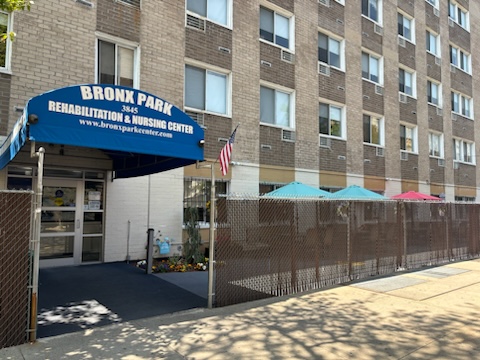
BRONX PARK REHABILITATION & NURSING CENTER
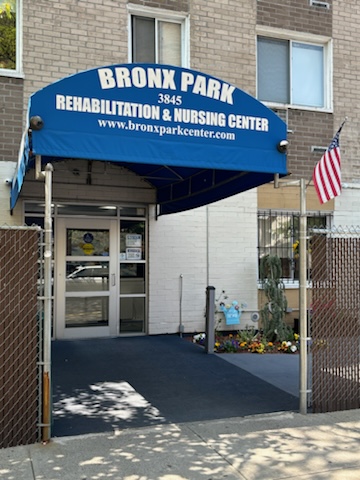
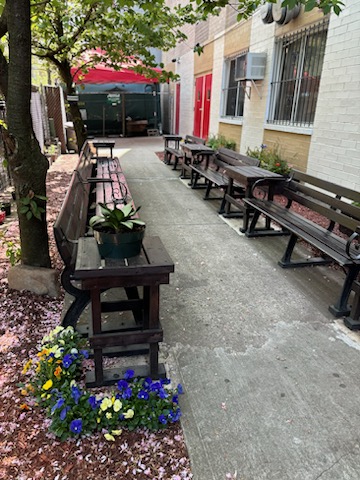
3845 CARPENTER AVE, BRONX, NY 10467 (718) 798-1100
For profit - Corporation 240 Beds Independent Data: November 2025
Trust Grade
85/100
#142 of 594 in NY
Last Inspection: September 2024

Within standard 12-15 month inspection cycle. Federal law requires annual inspections.

Overview

Bronx Park Rehabilitation & Nursing Center has a Trust Grade of B+, which means it is above average and generally recommended for families considering care options. It ranks #142 out of 594 facilities in New York, placing it in the top half of the state, and #14 out of 43 in Bronx County, indicating only a few local options are better. However, the facility's trend is worsening, with issues increasing from 1 in 2022 to 4 in 2024. Staffing is a concern, receiving a 2-star rating, but with a turnover rate of 24%, it is better than the state average of 40%. There have been no fines reported, which is a positive sign. Despite these strengths, some weaknesses were noted during inspections. For example, residents were not provided timely notifications regarding the termination of skilled services, and some residents did not receive their baseline care plans. Additionally, food served to residents was not maintained at appetizing temperatures, leading to discomfort during meals. Overall, while Bronx Park has commendable aspects, families should weigh these concerns carefully.

Trust Score
B+
85/100
In New York
#142/594
Top 23%
Safety Record
Low Risk
No red flags
Inspections
Getting Worse
1 → 4 violations
Staff Stability
✓ Good
24% annual turnover. Excellent stability, 24 points below New York's 48% average. Staff who stay learn residents' needs.
Penalties
✓ Good
No fines on record. Clean compliance history, better than most New York facilities.
Skilled Nurses
⚠ Watch
Each resident gets only 27 minutes of Registered Nurse (RN) attention daily — below average for New York. Fewer RN minutes means fewer trained eyes watching for problems.
Violations
✓ Good
Only 5 deficiencies on record. Cleaner than most facilities. Minor issues only.
★★★★☆
4.0
Overall Rating
★★☆☆☆
2.0
Staff Levels
★★★★☆
4.0
Care Quality
★★★★☆
4.0
Inspection Score
Stable
2022: 1 issues
2024: 4 issues

The Good

  • 4-Star Quality Measures · Strong clinical quality outcomes
  • Low Staff Turnover (24%) · Staff stability means consistent care
  • Full Sprinkler Coverage · Fire safety systems throughout facility
  • No fines on record
  • Staff turnover is low (24%)

    24 points below New York average of 48%

Facility shows strength in quality measures, staff retention, fire safety.

The Bad

No Significant Concerns Identified

This facility shows no red flags. Among New York's 100 nursing homes, only 1% achieve this.

The Ugly 5 deficiencies on record

Sept 2024 4 deficiencies
CONCERN (D)

Potential for Harm - no one hurt, but risky conditions existed

Deficiency F0582 (Tag F0582)

Could have caused harm · This affected 1 resident

Based on record review and interview conducted during the Recertification survey from 09/16/2024-09/23/2024, the facility did not ensure a resident, or their designated representative was provided app...

Read full inspector narrative →
Based on record review and interview conducted during the Recertification survey from 09/16/2024-09/23/2024, the facility did not ensure a resident, or their designated representative was provided appropriate notification at the termination of skilled services. Specifically, the facility did not provide the Notice of Medicare Non-Coverage for Medicare Part A at least two calendar days before Medicare covered services ended as required, did not ensure that notices were mailed on the same day telephone notification was made, and did not provide the Skilled Nursing Facility Advance Beneficiary Notice of Non-Coverage form for residents who were remaining in the facility after discharge from skilled services. This was evident for 2 (Resident #89 and Resident #14) of 3 residents reviewed for Beneficiary Notification out of 38 sampled residents. The findings are: The facility policy titled Medicare Beneficiary Notice for Non-Coverage of Service dated 2/18/23 states that the purpose is to have a notification process that complies with the Medicare regulations and the notification used was the Notice of Medicare Non-Coverage (NOMNC) CMS-10123. The policy also stated that residents/representatives are notified in writing when a decision of Medicare non-coverage is made a minimum of two days' notice before the last covered Medicare day. The policy did not include any reference to the Skilled Nursing Facility Advance Beneficiary Notice of Non-Coverage form. The Form Instructions for the Notice of Medicare Non-Coverage (NOMNC) CMS-10123 states that the form must be delivered at least two calendar days before Medicare covered services end and included the requirement that notification of changes in coverage for an institutionalized beneficiary/enrollee who is not competent be made to a representative. The instructions also stated that if the provider is personally unable to deliver a Notice of Medicare Non-Coverage to a person acting on behalf of an enrollee, then the provider should telephone the representative to advise them when the enrollee's services are no longer covered. The date of the conversation is the date of the receipt of the notice. Confirm the telephone contact by written notice mailed on that same date. The instructions also state that when direct phone contact cannot be made, the notice should be sent to the representative by certified mail, return receipt requested. The Form Instructions Skilled Nursing Facility Advanced Beneficiary Notice of Non-coverage (SNF ABN) Form CMS-10055 (2024) states that Medicare requires Skilled Nursing Facilities to provide the notice to original Medicare patients prior to providing care that Medicare usually covers but may not pay for because the care is not medically reasonable and necessary; or considered custodial. 1. Resident# 89 was discharged from skilled services on 04/26/2024 with 66 days remaining and remained in the facility. The Notice of Medicare Non-Coverage form documented that the last day for Medicare Part A service was 04/26/2024. The Notice of Medicare Non-Coverage form also documented that Resident #89 was notified and their guardian received telephone notification of termination of coverage from the Social Services director on 4/25/24 which was one day before covered services were to end. There was no documented evidence that the notice was mailed on the same day that telephone notification was made. In addition, there was no documented evidence that the facility provided Resident #89 and/or their guardian with the Skilled Nursing Facility Advance Beneficiary Notice of Non-Coverage notice at the termination of skilled services. 2. Resident #14 was discharged from skilled services on 8/15/24 with 44 days remaining and remained in the facility. The Notice of Medicare Non-Coverage form documented the last day for Medicare Part A service was 8/15/24. The Notice of Medicare Non-Coverage form also documented that Resident #14 was made aware, however was unable to sign. A telephone call was made to Resident #14's representative and a message was left on voicemail on 8/12/24. There was no documented evidence that the Notice of Medicare Non-Coverage form was sent by certified mail when direct telephone contact was not made. In addition, there was no documented evidence that the facility provided Resident #14 with the Skilled Nursing Facility Advance Beneficiary Notice of Non-Coverage form at the termination of Medicare coverage. On 09/17/2024 at 3:23 PM, the Director of Social Services was interviewed and stated they work with the Rehabilitation Director to give the Notice of Medicare Non-Coverage notices to residents, families, or legal guardians. The Director of Social Services also stated that if the resident is confused, they will document it on the form and then inform the resident's family or legal guardian. The Director of Social Services further stated that they usually provide the letter two days before Medicare services are terminated and is not sure why one of the notices was given only one day before. The Director of Social Services Social Services Director stated they were not aware of the Skilled Nursing Facility Advance Beneficiary Notice of Non-Coverage notice and provides the notices that are given to them by the Director of Rehabilitation. On 09/17/2024 at 3:35 PM, the Director of Rehabilitation was interviewed and stated they prepare the Notice of Medicare Non-Coverage notices with the date included and then gives the letters to the Director of Social Services who then gives the notification to the resident, family member, or legal guardian. The Director of Rehabilitation also stated that the Notice of Medicare Non-Coverage notice must go out at least two to three days before Medicare services are terminated in order to allow the resident time to appeal the decision. The Director of Rehabilitation further stated that they were unaware that if a voicemail had been left for a family member that a copy of the notice should be sent by certified mail. In addition, the Director of Rehabilitation stated that they had no knowledge of the Skilled Nursing Facility Advance Beneficiary Notice of Non-Coverage form. On 09/17/2024 at 3:59 PM, the Administrator was interviewed and stated that they are not involved in the beneficiary notification process as this is handled by the Director of Rehabilitation and the Director of Social Services. 10 NYCRR 415.3(g)(2)(i)
CONCERN (D)

Potential for Harm - no one hurt, but risky conditions existed

Deficiency F0655 (Tag F0655)

Could have caused harm · This affected 1 resident

**NOTE- TERMS IN BRACKETS HAVE BEEN EDITED TO PROTECT CONFIDENTIALITY** Based on record review and staff interviews conducted during the Recertification Survey from 09/16/2024 to 09/23/2024, the facil...

Read full inspector narrative →
**NOTE- TERMS IN BRACKETS HAVE BEEN EDITED TO PROTECT CONFIDENTIALITY** Based on record review and staff interviews conducted during the Recertification Survey from 09/16/2024 to 09/23/2024, the facility did not ensure that residents' and their representatives were provided with a summary of the baseline care plan. This was evident in 1 (Resident #76) of 3 reviewed for Urinary Catheter, 1 (Resident #92) of 1 resident reviewed for Pain, and 1 (Resident #220) of 2 residents reviewed for Behavioral/Emotional out of 38 total sampled residents. Specifically, residents or their representatives did not receive a copy of their baseline care plan. The findings include but are not limited to: The facility's policy and procedure titled Baseline Care Plan, last revised on 04/10/2024, documented that a baseline plan of care to meet the resident's immediate health and safety needs is developed for each resident within 48 hours of admission. The resident and representative are verbally informed of their baseline care plan and provided with a written statement. 1. Resident #76 was admitted to the facility with diagnoses that included Urinary Tract Infection and Acute Kidney Failure. The admission Minimum Data Set assessment dated [DATE] documented that Resident #76 had moderately impaired cognition. Section Q of the assessment documented that Resident #76 and family participated in the assessment and goal setting. On 09/18/2024 at 10:14 AM, Resident #76 was interviewed and stated that they did not remember if they received a copy of the baseline care plan. A Baseline Care Plan form dated 07/30/2024 and 07/31/2024 was completed for Resident #76 with signatures of interdisciplinary staff. There was no documented evidence that Resident #76 or a family representative was provided with a written copy of the baseline care plan. 2. Resident #92 was admitted to the facility with diagnoses that included Malignant Neoplasm of the Tongue and Hypertension. The admission Minimum Data Set assessment dated [DATE] documented that Resident #92 had intact cognition. Section Q documented that Resident #92 participated in the assessment and goal setting. On 09/20/2024, at 11:47 AM, Resident #92 was interviewed and stated they had not received a copy of their baseline care plan. A Baseline Care Plan form dated 07/03/2024, 07/04/2024 and 07/07/2024 was completed for Resident #92 with signatures of interdisciplinary staff. There was no documented evidence that Resident #76 received a written copy of the baseline care plan. 3. Resident #220 was admitted to the facility with the diagnosis that include Anxiety Disorder and Diabetes Mellitus. The admission Minimum Data Set assessment dated [DATE] documented that Resident #220 has severely impaired cognition and never/rarely made decisions. Section Q documented that Resident #220 family participated in the assessment and goal setting. A Baseline Care Plan form dated 05/28/2024 and 05/29/2024 was completed for Resident #220 with signatures of interdisciplinary staff. There was no documented evidence that Resident #220's family representative was provided with a written copy of the baseline care plan. On 09/23/2024 at 11:04 AM, Unit Manager #1 was interviewed and stated that the baseline care plan is initiated on admission. Unit Manager #1 also stated that the former Assistant Director of Nursing was responsible for informing the family about the baseline care plan. Unit Manager #1 further stated that they did not know if a copy was provided to the residents and the family representatives. On 09/23/2024 at 8:51 AM, the Director of Social Service was interviewed and stated the baseline care plan is completed within 48 hours of admission. The Social Service staff reviews the baseline care plan and explains the care and goals to the family. The Director of Social Service also stated that nursing is responsible for providing a copy of the baseline care plan to the residents and family representatives. The Director of Social Service further noted that the previous Assistant Director of Nursing informed the family of the baseline care plan, and the facility had no evidence that a copy had been provided to residents or their representatives. On 09/20/2024 at 12:39 PM, the Director of Nursing was interviewed and stated that a baseline care plan is initiated for all new admissions. All departments are required to complete the baseline care plan in 48 hours. The Director of Nursing also stated that they discuss the baseline care plan with cognitively intact residents and family representatives but do not provide them with a copy. The Director of Nursing further stated that the facility policy states they must explain the baseline care plan to the resident and family and give them a copy. The Director of Nursing did not explain why this was not being done. 10 NYCRR 415.11 (c)
CONCERN (D)

Potential for Harm - no one hurt, but risky conditions existed

Deficiency F0804 (Tag F0804)

Could have caused harm · This affected 1 resident

**NOTE- TERMS IN BRACKETS HAVE BEEN EDITED TO PROTECT CONFIDENTIALITY** Based on observation, interview, and record review conducted during the Recertification Survey from 09/16/2024 to 09/23/2024, th...

Read full inspector narrative →
**NOTE- TERMS IN BRACKETS HAVE BEEN EDITED TO PROTECT CONFIDENTIALITY** Based on observation, interview, and record review conducted during the Recertification Survey from 09/16/2024 to 09/23/2024, the facility did not ensure that food was served at an appetizing temperature during meal service. This was evident for 1 (Resident #203) of 3 residents reviewed for Food out of 38 total sampled residents. Specifically, food served during lunch meal service was not maintained at palatable and appetizing temperatures. The findings are: The facility's policy and procedure titled Hot Food Holding Policy dated October 2022, documented hot foods should be 135 degrees Fahrenheit or above at the time food is served to the residents. Resident #203 had diagnoses which included Diabetes Mellitus, Hypertension, and Heart Failure. The Quarterly Minimum Data Set, dated [DATE] documented that Resident #203 had intact cognition. On 09/16/2024 at 10:56 AM, Resident #203 stated meals are delivered to their room and the food is routinely served cold. On 09/23/2024 at 12:42 PM, the food delivery truck arrived on Unit 6. Staff distributed trays to residents located in the dining room and then distributed meal trays to residents located in their rooms. On 09/23/2024 at 12:59 PM, a test tray was conducted and revealed the following temperatures: soup 125.2 degrees Fahrenheit, jerk chicken 124.3 degrees Fahrenheit, rice 106 degrees Fahrenheit, and zucchini and squash 110.8 degrees Fahrenheit. On 09/18/24 at 10:37 AM, Certified Nursing Assistant #3 was interviewed and stated sometimes Resident #203 reports their grilled cheese sandwich is not warm enough and requests that staff heat it up. Certified Nursing Assistant #3 also stated that no other residents on the unit have complained of cold food. On 09/23/2024 at 1:09 PM, the Director of Dining Services was interviewed and stated the food temperatures should be above 135 degrees Fahrenheit. The Director of Dining Services also stated that test tray temperatures are monitored once per week, and they have found no issues. The Director of Dining further stated the food truck, and the insulated plate covers are supposed to keep the food temperatures above 135 degrees Fahrenheit. 10 NYCRR 415.14(d)(1)(2)
CONCERN (D)

Potential for Harm - no one hurt, but risky conditions existed

Infection Control (Tag F0880)

Could have caused harm · This affected 1 resident

**NOTE- TERMS IN BRACKETS HAVE BEEN EDITED TO PROTECT CONFIDENTIALITY** Based on observation, record review, and interviews conducted during the Recertification Survey from 09/16/2024 to 09/23/2024, t...

Read full inspector narrative →
**NOTE- TERMS IN BRACKETS HAVE BEEN EDITED TO PROTECT CONFIDENTIALITY** Based on observation, record review, and interviews conducted during the Recertification Survey from 09/16/2024 to 09/23/2024, the facility did not ensure that infection control prevention practices and procedures were maintained to provide a safe and sanitary environment to help prevent the development and transmission of communicable diseases and infections. This was evident for 2 (Resident #112 and Resident #181) of 3 residents reviewed for Skin Conditions (non-pressure) out of 38 sampled residents. Specifically, the Physician Assistant and Registered Nurse #5 failed to comply with infection control protocols during wound care. The findings are: The facility policy titled Wound Care, revised 01/31/2024, documented that the treatment in the facility of various types of wounds, is performed to ensure optimal healing and prevention of complications. The policy also documented that one key responsibility is to ensure compliance with infection control protocols and safety standards in wound care practices. The facility policy titled General Infection, revised 02/15/2024, documented that it is the policy of the facility to comply with the Center for Disease Control and other government agencies infection disease related recommendations as appropriate. 1. Resident #112 was admitted to the facility with diagnoses that include Peripheral Vascular Disease and Diabetes Mellitus. The Minimum Data Set assessment dated [DATE], documented that Resident #112 had moderately impaired cognitive skills for daily decision making and one venous or arterial ulcer present. The Physician Treatment Order dated 09/13/2024, documented twice a day wound care as: Cleanse left foot and right leg abrasions with normal saline solution. Apply 1% Silvadene Cream topically to the left foot and right leg abrasions. Cover with bordered gauze dressing. During a wound treatment observation on 09/19/2024 at 11:03 AM, the Physician Assistant was observed performing wound care for Resident #112. The Physician Assistant used one cotton swab to apply 1% Silvadene cream to three separate wounds (left foot abrasion, and two right leg abrasions). After the Physician Assistant applied the cream, Registered Nurse #5, who was assisting the Physician Assistant, opened packages of gauze and placed the packages on the sheet of Resident #112's bed without first setting up a clean field. The gauze pads and bordered gauze dressings were then applied to Resident #112's left foot and right leg open wounds by the Physician Assistant. 2. Resident #181 was admitted to the facility with diagnoses that include a Non-Pressure Chronic Ulcer of the Left Lower Leg and Non-Alzheimer's Dementia. The Minimum Data Set assessment dated [DATE], documented that Resident #181 had moderately impaired cognitive skills for daily decision making and one venous or arterial ulcer present. The Physician Treatment Order dated 09/19/2024 documented twice a day wound care as: Cleanse left lower extremity with normal saline solution. Apply 1% Silvadene Cream topically to the left lower extremity and cover with Kerlix wrap. During a wound treatment observation on 09/19/2024 at 11:19 AM, Registered Nurse #5 was observed assisting the Physician Assistant. Registered Nurse #5 opened packages of gauze with kerlix rolls and placed the packages on the sheet of Resident #181's bed sheet without first setting up a clean field. The gauze and Kerlix dressings were then applied to Resident #181's left lower extremity wound by the Physician Assistant. On 09/19/2024 at 11:10 AM, the Physician Assistant was interviewed and stated that they had not done dressing changes for a while as they are usually assisted by a wound nurse who is no longer employed by the facility. The Physician Assistant also stated that they should have used a separate swab for each wound. The Physician Assistant further stated that Registered Nurse #5 did not set up a barrier before placing the gauze pads and bordered gauze on Resident #112's and Resident #181's bed sheet. On 09/19/24 at 3:33 PM, the Infection Control Nurse was interviewed and state that Registered Nurse #5 was recently hired and was not yet in-serviced on wound care. The Infection Control Nurse also stated that in-services had been rescheduled as the facility was being surveyed this week. On 09/19/2024 at 4:09PM, Registered Nurse #5 was interviewed and stated that they felt rushed while assisting the Physician Assistant and therefore they made many errors during the wound treatments for Resident #112 and Resident #181. Registered Nurse #5 also stated that they placed dressings on Resident #112's and Resident #181's bed and should have set up a clean field for dressings on the bedside table. On 09/19/24 at 04:33 PM, the Director of Nursing was interviewed and stated that the Physician Assistant cross contaminated the wound by not using a separate swab for each wound. The Director of Nursing also stated that the previous Assistant Director of Nursing would complete the wound care with the Physician Assistant, but they are no longer employed at the facility. The Director of Nursing further stated that Registered Nurse #5 will be the new wound care nurse, but they had not been oriented to that role yet and the Physician Assistant had been instructed not to have Registered Nurse #5 assist them with wound treatments until they were trained. 10 NYCRR 415.19 (a)(1-3)
Jun 2022 1 deficiency
CONCERN (D)

Potential for Harm - no one hurt, but risky conditions existed

Pressure Ulcer Prevention (Tag F0686)

Could have caused harm · This affected 1 resident

**NOTE- TERMS IN BRACKETS HAVE BEEN EDITED TO PROTECT CONFIDENTIALITY** Based on observations, record review, and interviews conducted during the recertification survey, the facility did not ensure a ...

Read full inspector narrative →
**NOTE- TERMS IN BRACKETS HAVE BEEN EDITED TO PROTECT CONFIDENTIALITY** Based on observations, record review, and interviews conducted during the recertification survey, the facility did not ensure a resident received necessary care and services to prevent pressure ulcers. This was evident for 1 (Resident #52) of 2 residents reviewed for Position, Mobility/Limited Range of Motion, out of a total sample of 39 residents. Specifically, Resident #52 was ordered to wear a Multipodus boot (MB) on the left foot and was observed on several occasions without the MB in place. The findings are: The facility policy titled Special Devices last revised 01/2022 documented devices are to be used as ordered by physician. On 06/13/22 at 12:36 PM, 06/14/22 at 12:16 PM, 06/16/22, between 09:40 AM and 1:30 PM, and 06/17/22 between 9:30 AM and 12:02 PM, Resident #52 was observed sitting in a reclining wheelchair in the day room. A MB was not observed on Resident #52's left foot. Resident #52 had diagnoses of coronary artery disease, arthritis, and Alzheimer's disease. The Minimum Data Set 3.0 (MDS) dated [DATE] documented Resident #52 was moderately cognitively impaired, was totally dependent upon staff to perform activities of daily living (ADL), was at high risk for developing pressure ulcers, and had skin and ulcer treatments including a pressure reducing device for chair and bed. The Comprehensive Care Plan (CCP) related to devices dated 3/16/2022 documented Resident #52 was at high risk for developing a pressure ulcer and had a history of pressure ulcers. Documented interventions included providing a MB, a pressure relieving device, to the left foot. Physician's order dated 5/27/22 documented Resident #52 was ordered to wear a left foot MB from 9AM to 9PM. The MB was ordered removed during hygiene, ADL care, and to check Resident #52's skin. On 06/17/22 at 10:47 AM, Certified Nursing Assistant (CNA) #1 was interviewed and stated the evening shift applies the MB to Resident #52's foot when Resident #52 is transferred to bed at night. CNA #1 has been assigned to Resident #52 for 6 months and was unaware the MB was ordered to be applied from 9AM to 9PM. On 06/17/22 at 11:58 AM, Unit Manager/Registered Nurse (RN) #1 was interviewed and stated Resident #52 has a Physician's order to wear the MB on their left foot from 9AM to 9PM. The CNA is responsible for placing the MB on the resident's foot and RN #1 did not notice Resident #52 has not been wearing the MB as ordered. On 06/17/22 at 02:46 PM, the Rehabilitation Director (RD) was interviewed and stated Resident #52 was ordered the MB to improve foot mobility and pressure relief. Once there is a Physician's order in place, the CNA Accountability is updated with the order, inservice is given to the staff on the unit re: application of MB, and the Rehabilitation Aide makes rounds every morning to ensure the device is in the resident's room. RD stated they were not aware Resident #52 was observed without the MB in place according to Physician order. On 06/22/22 at 09:15 AM, RN #2 was interviewed and stated they supervisor Resident #52's unit on the evening shift and did not know whether the MB was being applied to Resident #52's left foot as ordered by the Physician. On 06/22/22 at 09:43 AM, the Assistant Director of Nursing (ADNS) was interviewed and stated the RN Supervisors are responsible for making rounds to ensure devices are applied appropriately and according to Physician order. The ADNS was unable to explain the reason Resident #52 was observed without their MB on their left foot. 415.12(c)1
Understanding Severity Codes (click to expand)
Life-Threatening (Immediate Jeopardy)
J - Isolated K - Pattern L - Widespread
Actual Harm
G - Isolated H - Pattern I - Widespread
Potential for Harm
D - Isolated E - Pattern F - Widespread
No Harm (Minor)
A - Isolated B - Pattern C - Widespread

Questions to Ask on Your Visit

  • "Can I speak with families of current residents?"
  • "What's your RN coverage like on weekends and overnight?"

Our Honest Assessment

Strengths
  • • Grade B+ (85/100). Above average facility, better than most options in New York.
  • • No major safety red flags. No abuse findings, life-threatening violations, or SFF status.
  • • No fines on record. Clean compliance history, better than most New York facilities.
  • • Only 5 deficiencies on record. Cleaner than most facilities. Minor issues only.
Concerns
  • • No significant concerns identified. This facility shows no red flags across CMS ratings, staff turnover, or federal penalties.
Bottom line: Generally positive indicators. Standard due diligence and a personal visit recommended.

About This Facility

What is Bronx Park Rehabilitation & Nursing Center's CMS Rating?

CMS assigns BRONX PARK REHABILITATION & NURSING CENTER an overall rating of 4 out of 5 stars, which is considered above average nationally. Within New York, this rating places the facility higher than 99% of the state's 100 nursing homes. This rating reflects solid performance across the metrics CMS uses to evaluate nursing home quality.
How is Bronx Park Rehabilitation & Nursing Center Staffed?

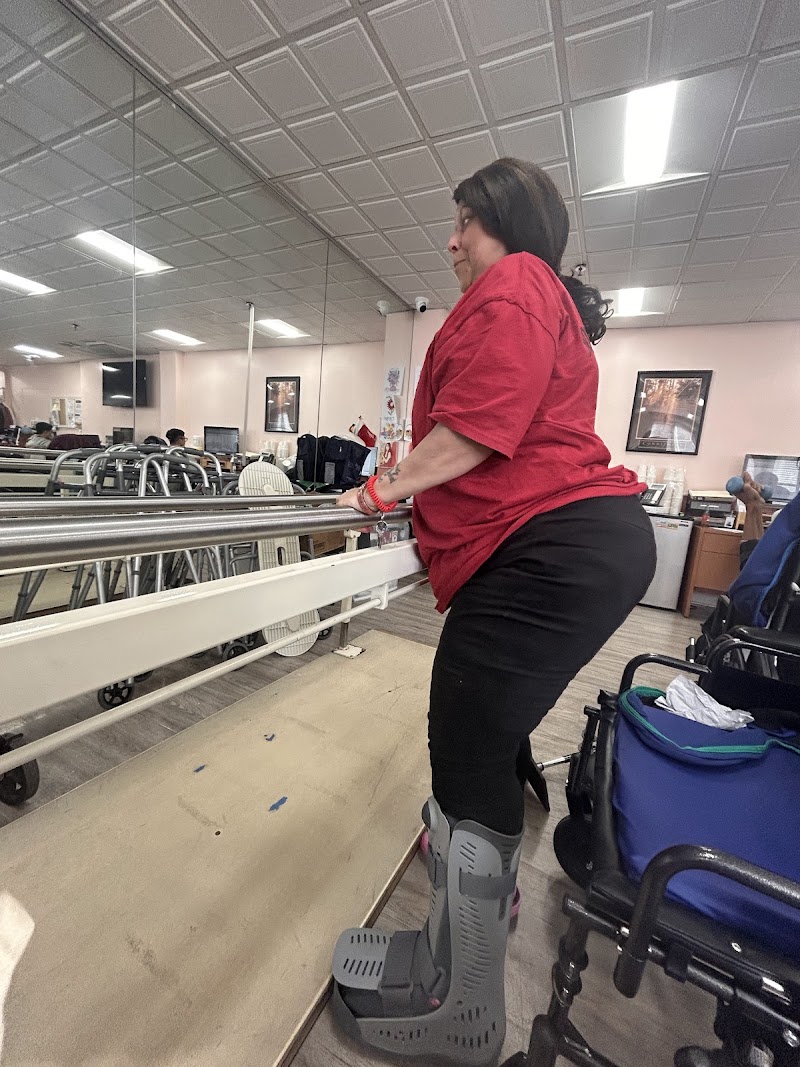
CMS rates BRONX PARK REHABILITATION & NURSING CENTER's staffing level at 2 out of 5 stars, which is below average compared to other nursing homes. Staff turnover is 24%, compared to the New York average of 46%. This relatively stable workforce can support continuity of care.

What Have Inspectors Found at Bronx Park Rehabilitation & Nursing Center?

State health inspectors documented 5 deficiencies at BRONX PARK REHABILITATION & NURSING CENTER during 2022 to 2024. These included: 5 with potential for harm.
Who Owns and Operates Bronx Park Rehabilitation & Nursing Center?

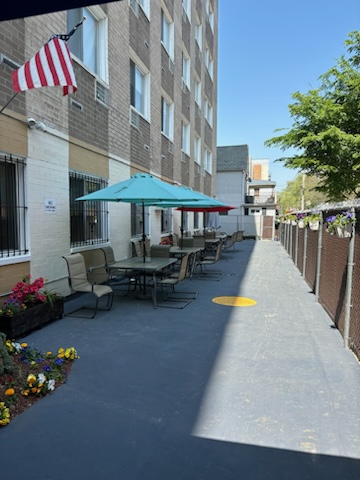
BRONX PARK REHABILITATION & NURSING CENTER is owned by a for-profit company. For-profit facilities operate as businesses with obligations to shareholders or private owners. The facility operates independently rather than as part of a larger chain. With 240 certified beds and approximately 234 residents (about 98% occupancy), it is a large facility located in BRONX, New York.
How Does Bronx Park Rehabilitation & Nursing Center Compare to Other New York Nursing Homes?

Compared to the 100 nursing homes in New York, BRONX PARK REHABILITATION & NURSING CENTER's overall rating (4 stars) is above the state average of 3.1, staff turnover (24%) is significantly lower than the state average of 46%, and health inspection rating (4 stars) is above the national benchmark.

What Should Families Ask When Visiting Bronx Park Rehabilitation & Nursing Center?

Based on this facility's data, families visiting should ask: "Can you walk me through typical staffing levels on day, evening, and night shifts?" "Can I visit during a mealtime to observe dining assistance and food quality?" "How do you handle medical emergencies, and what is your hospital transfer rate?" "Can I speak with family members of current residents about their experience?" These questions are particularly relevant given the below-average staffing rating.

Is Bronx Park Rehabilitation & Nursing Center Safe?

Based on CMS inspection data, BRONX PARK REHABILITATION & NURSING CENTER has a clean safety record: no substantiated abuse findings (meaning no confirmed cases of resident harm), no Immediate Jeopardy citations (the most serious violation level indicating risk of serious injury or death), and is not on the Special Focus Facility watch list (a federal program monitoring the lowest-performing 1% of nursing homes). The facility has a 4-star overall rating and ranks #1 of 100 nursing homes in New York. While no facility is perfect, families should still ask about staff-to-resident ratios and recent inspection results during their visit.

Do Nurses at Bronx Park Rehabilitation & Nursing Center Stick Around?

Staff at BRONX PARK REHABILITATION & NURSING CENTER tend to stick around. With a turnover rate of 24%, the facility is 22 percentage points below the New York average of 46%. Low turnover is a positive sign. It means caregivers have time to learn each resident's needs, medications, and personal preferences. Consistent staff also notice subtle changes in a resident's condition more quickly.

Was Bronx Park Rehabilitation & Nursing Center Ever Fined?

BRONX PARK REHABILITATION & NURSING CENTER has no federal fines on record. CMS issues fines when nursing homes fail to meet care standards or don't correct problems found during inspections. The absence of fines suggests the facility has either maintained compliance or corrected any issues before penalties were assessed. This is a positive indicator, though families should still review recent inspection reports for the full picture.

Is Bronx Park Rehabilitation & Nursing Center on Any Federal Watch List?

BRONX PARK REHABILITATION & NURSING CENTER is not on any federal watch list. The most significant is the Special Focus Facility (SFF) program, which identifies the bottom 1% of nursing homes nationally based on persistent, serious quality problems. Not being on this list means the facility has avoided the pattern of deficiencies that triggers enhanced federal oversight. This is a positive indicator, though families should still review the facility's inspection history directly.