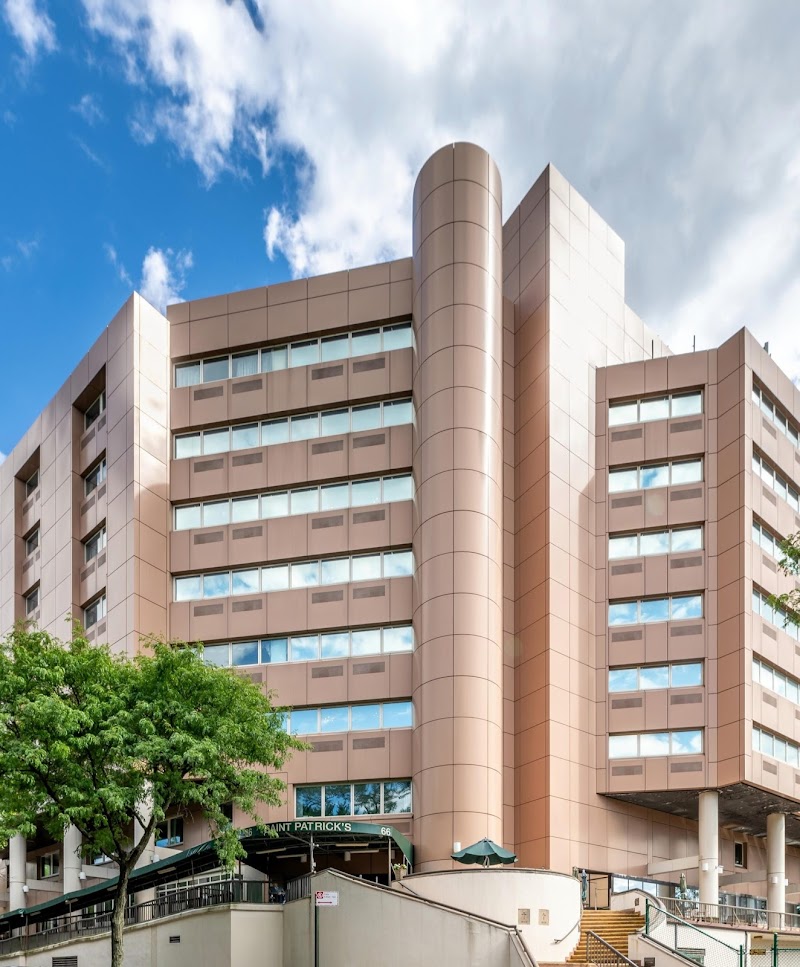
ST PATRICKS HOME

66 VAN CORTLANDT PARK SOUTH, BRONX, NY 10463 (718) 519-2800
Non profit - Church related 264 Beds CARMELITE SISTERS FOR THE AGED & INFIRM Data: November 2025
Trust Grade
75/100
#105 of 594 in NY
Last Inspection: February 2024

Within standard 12-15 month inspection cycle. Federal law requires annual inspections.

Overview

St. Patrick's Home has received a Trust Grade of B, indicating it is a good choice, but not without areas for improvement. It ranks #105 out of 594 facilities in New York, placing it in the top half, and #10 out of 43 in Bronx County, meaning only nine local options are better. The facility's trend is stable, as it has maintained the same number of issues since 2021, but it has faced $51,500 in fines, which is higher than 83% of New York facilities, suggesting ongoing compliance challenges. Staffing is a concern, rated at 2 out of 5 stars, with a turnover rate of 33%, slightly better than the state average, but less RN coverage than 91% of state facilities could impact resident care. Specific incidents include a failure to sanitize medical equipment between uses, which risks infection, and a lack of regular reviews of advance directives for residents, indicating potential gaps in communication and care planning.

Trust Score
B
75/100
In New York
#105/594
Top 17%
Safety Record
Moderate
Needs review
Inspections
Holding Steady
4 → 4 violations
Staff Stability
○ Average
33% turnover. Near New York's 48% average. Typical for the industry.
Penalties
✓ Good
$51,500 in fines. Lower than most New York facilities. Relatively clean record.
Skilled Nurses
⚠ Watch
Each resident gets only 23 minutes of Registered Nurse (RN) attention daily — below average for New York. Fewer RN minutes means fewer trained eyes watching for problems.
Violations
⚠ Watch
15 deficiencies on record. Higher than average. Multiple issues found across inspections.
★★★★★
5.0
Overall Rating
★★☆☆☆
2.0
Staff Levels
★★★★★
5.0
Care Quality
★★★★☆
4.0
Inspection Score
Stable
2021: 4 issues
2024: 4 issues

The Good

  • 5-Star Quality Measures · Strong clinical quality outcomes
  • Full Sprinkler Coverage · Fire safety systems throughout facility
  • No fines on record
  • Staff turnover below average (33%)

    15 points below New York average of 48%

Facility shows strength in quality measures, fire safety.

The Bad

Staff Turnover: 33%

13pts below New York avg (46%)

Typical for the industry

Federal Fines: $51,500

Above median ($33,413)

Moderate penalties - review what triggered them

Chain: CARMELITE SISTERS FOR THE AGED & IN

Part of a multi-facility chain

Ask about local staffing decisions and management

The Ugly 15 deficiencies on record

Feb 2024 4 deficiencies
CONCERN (D) 📢 Someone Reported This

A family member, employee, or ombudsman was alarmed enough to file a formal complaint

Potential for Harm - no one hurt, but risky conditions existed

Report Alleged Abuse (Tag F0609)

Could have caused harm · This affected 1 resident

**NOTE- TERMS IN BRACKETS HAVE BEEN EDITED TO PROTECT CONFIDENTIALITY** 2) Resident #149 had diagnoses of Dementia and Chronic Obstructive Pulmonary Disease. The Minimum Data Set 3.0 assessment dated...

Read full inspector narrative →
**NOTE- TERMS IN BRACKETS HAVE BEEN EDITED TO PROTECT CONFIDENTIALITY** 2) Resident #149 had diagnoses of Dementia and Chronic Obstructive Pulmonary Disease. The Minimum Data Set 3.0 assessment dated [DATE] documented Resident #149 was severely cognitively impaired. The Nursing Note dated 4/14/2023 documented Resident #149 was found on the floor in the dayroom by the Certified Nursing Assistant and was bleeding from the back of their head. The facility's Full Quality Assurance Report initiated 4/14/2023 documented Resident #149 had an unwitnessed fall and was sent to the hospital for evaluation due to a hematoma to the back of their head. The report documented that no abuse occurred in the conclusion dated 4/19/2023. There was no documented evidence the facility reported Resident #149's unwitnessed incident, resulting in a hematoma to the back of their head and hospital transfer, to the New York State Department of Health within 2 hours of occurrence. On 2/15/2024 at 1:05 PM, the Director of Nursing was interviewed and stated Resident #149's incident on 4/14/2023 was not reported to the New York Stated Department of Health. 10 NYCRR 415.4(b)(2) Based on record review and interviews conducted during the recertification and abbreviated (NY00316167) survey from 2/8/2024 to 2/15/2024, the facility did not ensure all alleged violations involving an injury of unknown origin were reported immediately, but not later than 2 hours after the allegation was made, to the New York State Department of Health. This was evident for 2 (Resident #34 and #149) of 39 total sampled residents. Specifically, 1) Resident #34 was found to have a left upper arm fracture of unknown origin that was not reported to the New York State Department of Health, and 2) the facility did not report an unwitnessed incident resulting in a hematoma to Resident #149's head to the New York State Department of Health. The findings are: The facility policy titled Prevention, Identification, and Reporting of Abuse, Neglect, Mistreatment or Exploitation of a Resident dated 8/2023 documented the facility will report alleged violations immediately but not later than 2 hours if the alleged violation involved abuse or resulted in serious bodily injury. 1) Resident #34 had diagnoses of coronary artery disease and Dementia. The Minimum Data Set 3.0 assessment dated [DATE] documented Resident #34 had severely impaired cognition. The Nursing Note dated 10/16/2023 documented Resident #34 was observed in their recliner in the hallway grimacing in pain with discoloration and swelling to their left upper arm. The Physician's Order dated 10/16/2023 documented stat x-ray of the Resident #34's left shoulder. The Nursing Note dated 10/17/2023 documented stat x-ray of Resident #34's left shoulder was done. Radiology Report dated 10/17/2023 documented x-ray of Resident #34's left shoulder revealed an acute comminuted humeral neck fracture. The facility Full Quality Assurance Report initiated 10/16/2023 documented Resident #34 had an injury of unknown origin to their left upper arm that was found to be a fracture. The conclusion of the report was dated 10/23/2023 and determined no abuse had occurred. There was no documented evidence the facility reported Resident #34's fracture of unknown origin to the New York State Department of Health within 2 hours of occurrence. On 2/15/2024 at 12:40 PM, the Director of Nursing was interviewed and stated they, along with the Administrator and Assistant Director of Nursing, were responsible for reporting alleged violations involving injury of unknown origin to the New York State Department of Health. Resident #34's left upper arm fracture should have been reported and the Director of Nursing stated they did not know why the case was not reported as it should have been. On 2/15/2024 at 1:15 PM, the Administrator was interviewed and stated Resident #34's fracture of unknown origin should have been reported to the New York State Department of Health.
CONCERN (D)

Potential for Harm - no one hurt, but risky conditions existed

Deficiency F0657 (Tag F0657)

Could have caused harm · This affected 1 resident

**NOTE- TERMS IN BRACKETS HAVE BEEN EDITED TO PROTECT CONFIDENTIALITY** Based on record review and interview conducted during the Recertification survey from 2/8/2024 to 2/15/2024, the facility did no...

Read full inspector narrative →
**NOTE- TERMS IN BRACKETS HAVE BEEN EDITED TO PROTECT CONFIDENTIALITY** Based on record review and interview conducted during the Recertification survey from 2/8/2024 to 2/15/2024, the facility did not ensure that resident comprehensive care plans were reviewed and revised after each assessment. This was evident for 2 (Resident #106 and #160) of 39 total sampled residents. Specifically, 1) the care plan related to Resident #106's pain management was not reviewed and revised upon assessment, and 2) the care plan related to Resident #160's anticoagulant use was not reviewed and revised upon assessment. The findings are: The facility policy titled Care Plans - Comprehensive dated 10/2019 documented assessments of residents are ongoing and care plans are revised as information about the residents and their condition changes. 1) Resident #106 had diagnoses of heart failure and renal failure. The Minimum Data Set 3.0 assessment dated [DATE] documented Resident #106 was cognitively intact, received pain medication, and should have a pain assessment conducted. The Comprehensive Care Plan related to pain initiated 01/19/2023 and last revised on 6/14/2023 documented Resident #106 experienced pain and had a history of fracture. There was no documented evidence Resident #106's care plan related to pain was reviewed and revised upon assessment dated [DATE]. 2) Resident #160 had diagnoses of Hypertension and Cerebrovascular accident. The Minimum Data Set 3.0 assessment dated [DATE] documented Resident #160 was moderately cognitively impaired and received an anticoagulant. The Comprehensive Care Plan related to anticoagulant therapy initiated 06/06/2022 documented Resident #160 received aspirin 81mg as a deep vein thrombosis prophylaxis. There was no documented evidence Resident #160's care plan related to anticoagulant use was reviewed and revised upon assessment dated [DATE]. On 02/14/2024 at 11:06 AM, an interview was conducted with Registered Nurse #2 who stated they were responsible for reviewing and revising residents' care plans. The Minimum Data Set 3.0 assessment triggered the care plans that required review during the resident's assessment period. Registered Nurse #2 was unable to provide a reason Resident #106's and #160's care plans were not reviewed and revised upon Minimum Data Set 3.0 assessment. On 02/14/2024 at 11:49 AM, an interview was conducted with the Director of Nursing who stated they were aware there were some Comprehensive Care Plans that had not been reviewed or revised because the facility changed their electronic medical record provider, and the care plans were not carried over to the new system. 415.11(c)(2)(i-iii)
CONCERN (E) 📢 Someone Reported This

A family member, employee, or ombudsman was alarmed enough to file a formal complaint

Potential for Harm - no one hurt, but risky conditions existed

Accident Prevention (Tag F0689)

Could have caused harm · This affected multiple residents

**NOTE- TERMS IN BRACKETS HAVE BEEN EDITED TO PROTECT CONFIDENTIALITY** 2) Resident #149 had diagnoses of Dementia and Chronic Obstructive Pulmonary Disease. The Minimum Data Set 3.0 assessment dated...

Read full inspector narrative →
**NOTE- TERMS IN BRACKETS HAVE BEEN EDITED TO PROTECT CONFIDENTIALITY** 2) Resident #149 had diagnoses of Dementia and Chronic Obstructive Pulmonary Disease. The Minimum Data Set 3.0 assessment dated [DATE] documented Resident #149 was severely cognitively impaired and did not have any recent falls. The Comprehensive Care Plan related to fall risk created 4/15/2022 documented Resident #149 was at risk for falls due to cognitive impairment, sudden unsafe moves, and no safety awareness. Interventions included to anticipate early waking, anticipate sudden unsafe moves, assist out of bed when awake, observe for restlessness, refer to rehab, refer to psychiatry, provide floor mats, reposition when restless, call light placed within reach, maintain a safe environments, be mindful of cognitive limitations, do not leave unattended in the shower room, offer toileting, account for resident's location at the end of each shift, and apply a wander guard alarm. The Comprehensive Care Plan related to Resident #149's cognitive impairment related to dementia was initiated on 4/15/2022 and documented interventions included anticipate needs of Resident #149. The Comprehensive Care Plan related to wandering initiated 4/15/2022 documented Resident #149 was at risk for elopement and interventions included confirming resident's location at specified times and keeping the resident's location within line of sight when out of bed. Nursing Note dated 2/5/2023 documented Resident #49 was found on the floor in their room next to their bed. No injury was noted. Nursing Note dated 2/17/2023 documented Resident #149 was found kneeling on their room floor and required assistance of 2 people to place them back in their wheelchair. Nursing Note dated 3/28/2023 documented Resident #149 began ambulating in the hallway and attempted to grab the Certified Nursing Assistant and fell to the floor. The Comprehensive Care Plan related to Resident #149's risk for falls was revised on 3/31/2023 to include interventions of close monitoring of resident whereabouts, anticipate resident's needs, and refer resident to rehab. Nursing Note dated 4/1/2023 documented Resident #149 was found on the floor by the nursing station. Nursing Note dated 4/14/2023 documented Resident #149 was found on the floor in the dayroom bleeding from the back of the head. Nursing Notes dated 8/6/2023, 8/25/2023, 9/23/2023, and 9/29/2023 documented Resident #149 had fall incidents. There was no documented evidence Resident #149's Comprehensive Care Plan related to falls risk was reviewed and revised up on resident's fall on 2/5/2023, 2/17/2023, 4/1/2023, 4/14/2023, 8/6/2023, 8/25/2023, 9/23/2023, and 9/29/2023. There was no documented evidence Resident #149's fall risk assessment was completed following falls on. 2/5/2023, 2/17/2023, 3/28/2023, 4/1/2023, 4/14/2023, 8/6/2023, 8/25/2023, 9/23/2023, and 9/29/2023. There was no documented evidence a facility investigation was completed to determine root cause analysis and individualized interventions to address Resident #149's frequent falls on 2/5/2023, 2/17/2023, 3/28/2023, and 4/1/2023. There was no documented Resident #149 received the supervision necessary to prevent frequent reoccurring falls. On 2/14/2024 at 11:18 AM, Certified Nursing Assistant #10 was interviewed and stated Resident #149 had no safety awareness and would randomly get out of the wheelchair. Resident #149 was cognitively impaired, unable to verbalize their needs, required toileting every 2-3 hours, and had floor mats near their low bed to reduce injury risk. On 2/14/2024 at 10:17 AM, Licensed Practical Nurse #6 was interviewed and stated Resident #149 had multiple falls, was restless, not sleeping at night, and had no safety awareness. Resident #149 tried to get out of bed without assistance. Resident #149 got out of their wheelchair and fell to the floor on 4/14/2023. Staff always monitored the dining room especially if there was a resident present who was at high risk for falls. There was no staff present when Resident #149 fell in the dining room on 4/14/2023. Staff were supposed to communicate coverage of the dining room but did not. On 2/15/2024 at 11:54 AM, Registered Nurse #1 was interviewed and stated Resident #149 had multiple falls last year, but they were not aware of every incident occurred for this resident. They reviewed the fall assessments and care plan related to Resident #149's fall risk in the electronic medical record and confirmed the assessments and care plan were not reviewed or revised after every fall incident. Registered Nurse #1 was not able to explain why there were no new interventions implemented for Resident #149 after recurrent falls. 10 NYCRR 415.12(h)(1) Based on record review and interviews conducted during the recertification and complaint (NY00310433 and NY00316167) survey from 2/8/2024 to 2/15/2024, the facility did not ensure residents received adequate supervision to prevent accidents. This was evident for 2 (Resident #11 and #149) of 6 residents reviewed for accidents out of 39 total sampled residents. Specifically, 1) Resident #11, who is cognitively impaired with agitated behaviors, sustained a laceration on the left lower and upper leg when being transferred from chair to bed; 2) Resident #149, a cognitively impaired resident, did not receive adequate supervision and interventions to prevent seven falls in eight months. The findings are: The facility policy titled Accident-Incident dated 7/2023 documented all accidents, incidents, and adverse events occurring on the facility premises which is not consistent with the routine operation of the facility or care of a particular resident are monitored and evaluated. The occurrence may be a fall, skin tear, bruise, or a new pressure ulcer and may involve abuse, neglect, misappropriation, or an injury of unknown origin. The facility policy titled Fall Prevention and Management dated 12/2023 documented the interdisciplinary team identifies and implements appropriate interventions to reduce the risk of falls or injuries while maximizing dignity and independence. 1) Resident #11 had diagnoses of Dementia and Cerebrovascular Accident. The Minimum Data Set 3.0 assessment dated [DATE] documented Resident #11 was severely cognitively impaired, required extensive assistance of 1 person to transfer, and exhibited behavior of rejecting care. The Nursing Note dated 8/29/2022 documented the Licensed Practical Nurse assisted the Certified Nursing Assistant in changing Resident #11 and putting the resident to bed. Resident #11 became agitated and combative when staff attempted to remove the resident from the wheelchair. Resident #11 began banging their legs against the wheelchair as they were transferred to bed. Staff observed Resident #11 sustained a skin tear to their left leg after the resident was transferred to bed. The Nursing Note dated 9/1/2022 documented Resident #11 was sent to the hospital on 8/29/2022 after the Medical Doctor was informed the resident required sutures. The facility Investigation Report dated 8/29/2022 documented Resident #11 exhibited behaviors and was agitated at the time of their transfer from wheelchair to bed. Two staff attempted to transfer the resident and Resident #11 began kicking and biting staff. Resident #11 was at high risk of injury. On 2/15/2024 at 8:30 AM, the Certified Nursing Assistant #14 was interviewed and stated that Resident #11 did not want to go to bed. The assigned certified nursing assistant and the licensed practical nurse tried to put the resident back to bed, and the resident sustained a laceration. Certified Nursing Assistant #14 stated Resident #11 sat on the bed and would hold the bed rail and lay down when the resident was calm. On 2/15/2024 at 8:38 AM, Licensed Practical Nurse #11 was interviewed and stated that Resident #11 refused to be transferred back to bed but 2 staff members transferred the resident, and the resident began to kick their feet. Resident #11's left leg sustained a cut. On 2/15/2024 at 12:22 PM, the Director of Nursing was interviewed and stated that they were not working at the facility at the time the incident occurred with Resident #11. The staff should have left the resident to calm down before putting the resident to bed to prevent the injury.
CONCERN (E)

Potential for Harm - no one hurt, but risky conditions existed

Infection Control (Tag F0880)

Could have caused harm · This affected multiple residents

Based on observation, record review, and staff interviews conducted during the recertification/complaint survey, the facility did not ensure infection control practices and procedures were maintained ...

Read full inspector narrative →
Based on observation, record review, and staff interviews conducted during the recertification/complaint survey, the facility did not ensure infection control practices and procedures were maintained to provide a safe and sanitary environment to help prevent the development and transmission of communicable diseases and infections. This was evident for 2 (8th and 5th Floors) of 6 resident units. Specifically, 1) Licensed Practical Nurse #2 did not sanitize a blood pressure cuff in between resident use, and 2) Licensed Practical Nurse #6 did not sanitize a glucometer in between resident use. The findings are: The facility policy titled Equipment - Cleaning and Disinfecting dated 01/2023 documented resident care equipment, including reusable items, will be cleaned and disinfected. The glucometer should be disinfected after use on each patient. On 02/09/2024 at 8:34 AM, Licensed Practical Nurse #2 was observed on the 8th Floor using a blood pressure cuff on Resident #29's arm, then placing the cuff on a chair next to the resident while gathering medication. After administering medication to Resident #29, Licensed Practical Nurse #2 placed the blood pressure cuff on the blood pressure machine and wheeled it to Resident #133's room. Licensed Practical Nurse #2 did not sanitize the blood pressure cuff and applied the cuff to Resident #33's arm to take a blood pressure reading. On 02/09/2024 at 09:00 AM, Licensed Practical Nurse #2 was interviewed and stated the blood pressure cuff should have been sanitized in between use with Resident #29 and Resident #133. The blood pressure cuff was supposed to be sanitized before and after each resident use. 2) On 02/12/2024 at 11:37 AM, Licensed Practical Nurse #6 was observed on the 5th Floor with a glucometer checking the fingerstick blood sugar reading for Resident #161. Licensed Practical Nurse #6 did not sanitize the glucometer and used the same glucometer to check Resident #82's fingerstick blood sugar reading. Licensed Practical Nurse #6 did not sanitize the glucometer after use with Resident #82 and used the same glucometer on Resident #9. On 02/12/2024 at 11:59 AM, Licensed Practical Nurse #6 was interviewed and stated they were supposed to sanitize the glucometer in between each resident use but they became nervous and forgot to sanitize in between Resident #161, #82, and #9. 02/14/2024 at 11:55 AM, an interview was conducted with the Infection Preventionist who stated resident care equipment is supposed to be sanitized in between each resident use. They provided ongoing surveillance and education to staff to ensure compliance with infection control standards. 02/14/2024 at 11:59 AM, the Director of Nursing was interviewed and stated the Infection Preventionist made rounds every shift to ensure staff were practicing proper infection prevention protocol. Resident shared care equipment should be sanitized in between each resident use. 10 NYCRR 415.19(b)(4)
Nov 2021 4 deficiencies
CONCERN (D)

Potential for Harm - no one hurt, but risky conditions existed

Deficiency F0568 (Tag F0568)

Could have caused harm · This affected 1 resident

**NOTE- TERMS IN BRACKETS HAVE BEEN EDITED TO PROTECT CONFIDENTIALITY** Based on record review and staff interviews conducted during the Recertification survey, the facility did not ensure that indivi...

Read full inspector narrative →
**NOTE- TERMS IN BRACKETS HAVE BEEN EDITED TO PROTECT CONFIDENTIALITY** Based on record review and staff interviews conducted during the Recertification survey, the facility did not ensure that individual financial records were available to the resident through quarterly statements. Specifically, a resident did not receive quarterly statements in July 2021 and October 2021. This was evident for 1 out of 1 residents reviewed for Personal Funds out of a sample of 31 residents. (Resident # 32). The finding is: The facility policy Patient Trust Funds, revised January 2019, documented quarterly statements of resident's funds will be distributed to the resident's responsible party. The policy documented it is the responsibility of the administrator and executive director to ensure the resident trust accounts are in compliance with corporate and regulatory policy. Resident # 32 was admitted to the facility with diagnoses that included Parkinson's Disease, Malnutrition, and Unspecified Dementia without behavioral disturbance. The Quarterly Minimum Data Set (MDS) 3.0 assessment dated [DATE] documented that resident had intact cognition. On 11/10/2021 at 10:36 AM, the resident was interviewed. The resident stated the facility has not provided quarterly statements of their patient bank account. There was no documented evidence that the resident or resident's designated family member were provided with the quarterly statements for the period of 7/2021 and 10/2021. On 11/16/21 at 03:17 PM, the Finance Coordinator (FC) of personal funds was interviewed. I did not send resident or resident's designated family member quarterly statements because resident has a temporary account. Normally I hand deliver residents their quarterly statements and then have them sign for it. A certified letter is sent to the responsible family member for those residents who cannot sign for their statement. I have a list of residents who signed for their statements and this resident is not on this list. Also, I did not mail a certified letter with statement enclosed to this resident's designated family member. There is no documented evidence that this resident signed for their statement or that a designated family member received the resident's statement. I should have hand delivered quarterly statements to this resident. I can't think of a reason why I did not send this resident their statement. On 11/17/21 at 10:10AM, a follow up interview was conducted with FC. The FC stated resident's family member set up their bank account and deposited $100 on 6/10/21. Resident has not received a statement because I haven't had a chance to provide one to the resident. If the resident requested a statement, it could be provided. Usually when someone sets up an account, I provide statements quarterly. I would hope the family member would let the resident know when they deposited money in their account. It isn't normal protocol for me to notify the resident that their family member deposited money in their account. 11/17/21 at 02:14PM, a follow up telephone interview was conducted with FC who stated this resident should have received a statement in July 2021 and October 2021. All residents or a family member get a quarterly statement in the months of April, July, October, and December. I go up and hand deliver the residents their statements and have them sign for it. If a resident can't sign, then I send it certified to the designated family member. 11/17/21 at 02:40 PM, the Administrator (Adm) was interviewed and stated, I oversee the finance department and this resident should have received a quarterly statement from finance in July 2021 and October 2021. This resident is able to sign for their statement. I do not understand why FC stated this resident has a temporary account. 415.26(h)(5)
CONCERN (D)

Potential for Harm - no one hurt, but risky conditions existed

Comprehensive Care Plan (Tag F0656)

Could have caused harm · This affected 1 resident

**NOTE- TERMS IN BRACKETS HAVE BEEN EDITED TO PROTECT CONFIDENTIALITY** Based on observation, interviews and record reviews conducted during a recertification survey the facility did not ensure that a...

Read full inspector narrative →
**NOTE- TERMS IN BRACKETS HAVE BEEN EDITED TO PROTECT CONFIDENTIALITY** Based on observation, interviews and record reviews conducted during a recertification survey the facility did not ensure that a person-centered, comprehensive care plan was developed and implemented to meet a resident's concerns and address the resident's medical, physical, mental and psychosocial needs. Specifically, a resident had a physician order for a Wander Guard but no current care plan in place to address wandering or elopement. This was evident for 1 out of 1 residents reviewed for wandering/elopement out of a sample of 34 residents. (Resident # 66). The findings are: The facility's policy and procedure entitled Comprehensive Care Plan states that whenever a problem or concern is identified that is not self-limiting (a condition that would normally resolve without further intervention), it is the responsibility of the discipline involved to develop a care plan and alert other disciplines of the interventions affecting them. Resident #66 was admitted to the facility on [DATE] with diagnoses including Dementia, History of Falls, Anxiety Disorder and Acute Kidney Failure. A review of the most recent Annual Minimum Data Set 3.0 (MDS) dated [DATE] documented that the resident's cognitive status was moderately impaired and the resident used a wander guard. A review of Resident #66's physician orders dated 04/20/2021 documented- Staff to Check Wander Guard if working every night shift every Monday, Wednesday and Friday for risk of elopement. A review of Resident #66's Comprehensive Care Plan (CCP) revealed that a Wandering and Elopement Care Plan was not developed for this resident. In addition, a review of the Certified Nursing Assistant (CNA) Accountability Record did not indicate that the resident is wearing a wander guard. On 11/12/2021 at 2:38PM, Resident #66 was observed in the unit day room participating passively in a Happy Hour recreation program. The resident was noted with a Wander Guard device to the wheelchair. On 11/16/2021 at 3:21 PM, the Registered Nurse Supervisor (RN #1) was interviewed. The Supervisor stated that the charge nurses and supervisors are responsible for care planning for each resident on their assigned floors. Prior to quarterly and annual care plan meetings they are expected to update the care plans. When asked about the Wandering/Elopement care plan for Resident #66, the Supervisor stated that neither they nor the present charge nurse on the 7th floor had been assigned to the unit during the previous quarter and that the charge nurse had in fact only begun working on the unit a few days previously. On 11/16/21 at 4:03PM, the Director of Nursing (DON) was interviewed. During the interview, the DON was given the opportunity to check the CCP to indicate if there was a care plan to address wandering and elopement. None could be found. On 11/17/2021 at 11:24AM the DON was interviewed and stated that there had been a care plan for the Wander Guard but that it was not active and that as of 11/16/2021, there was no active care plan for the Wander Guard in place. The DON stated I have updated Resident #66's plan of care as of the present date. 483.21(b)(1)
CONCERN (D)

Potential for Harm - no one hurt, but risky conditions existed

Accident Prevention (Tag F0689)

Could have caused harm · This affected 1 resident

**NOTE- TERMS IN BRACKETS HAVE BEEN EDITED TO PROTECT CONFIDENTIALITY** Based on observation, interviews and record reviews conducted during a recertification survey the facility did not ensure that a...

Read full inspector narrative →
**NOTE- TERMS IN BRACKETS HAVE BEEN EDITED TO PROTECT CONFIDENTIALITY** Based on observation, interviews and record reviews conducted during a recertification survey the facility did not ensure that a resident received adequate supervision to prevent accidents. Specifically, a Certified Nursing Assistant (CNA) did not follow the plan of care for a resident to provide necessary supervision during toileting. The CNA left the resident, who was confused and had a known history of falls, alone on the toilet, and the resident subsequently fell. This was evident in 1 of 4 residents reviewed for Accidents out of a sample of 34 residents. (Resident #66). The findings are: The facility's policy and procedure titled, Fall Prevention, last reviewed 08/2019, documented that the facility will identify those at risk for falls, monitor their safety, provide a safe environment and employ the least restrictive interventions to allow maximum mobility, dignity and independence for all residents. Residents will be reminded to use call bells if they need assistance. The facility's policy and procedure titled, Prevention, Identification, Investigation and Reporting of Abuse, Neglect, Mistreatment or Exploitation of a Resident or Misappropriation of Resident Property, last reviewed 09/15/2019, documents that the facility provides an environment for residents that is safe and free from abuse, neglect, exploitation, mistreatment and misappropriation. The facility will investigate all allegations and types of incidents as listed above in accordance with facility procedure. Upon notification of an incident, the nursing supervisor will conduct a nursing assessment of the resident and document the findings in the resident's medical record and on the incident/accident form. Resident #66 was admitted to the facility on [DATE] with diagnoses including Dementia, History of Falls, Anxiety Disorder and Acute Kidney Failure. The Annual Minimum Data Set 3.0 (MDS) dated [DATE] documented that the resident had moderately impaired cognition with short and long-term memory impairment. The MDS documented that the resident required extensive assist of one person for transfers and toileting and had had 2 or more falls since admission without injury. A Falls Care Plan was initiated for Resident #66 on 11/14/2016 and last reviewed on 11/09/2021 due to non-compliance, especially transferring self, despite reminders to call for assistance and being offered toileting assistance during rounds. Interventions included, monitoring the resident for unsafe transfers, offering toileting during rounds and re-educating the resident secondary to non-compliance with their plan of care. A Falls Risk assessment dated [DATE] documents that Resident #66 had last sustained a fall on 08/17/2021, had unsteady balance, and scored the resident at 16, denoting a high risk for falls. The CNA Accountability Record (CNAAR) dated 11/16/2021 documents that Resident #66 requires extensive assistance by 1 staff during transfers in and out of toilet and changing pads. The resident uses yellow briefs. The CNA Assignment Sheet dated 11/09/2021 documents that CNA #1 was assigned to the 7th floor. A Nursing Note dated 11/09/2021 documents, that around 1:49 PM, the resident requested to use the toilet. CNA #2 was assigned to the task because the resident's assigned caregiver was on their lunch break. At 1:52 PM the nurse was called by staff and observed the resident lying on the bathroom floor fully dressed in a supine position with their feet stretched toward the door and their head toward the sink. The wheelchair was in the bathroom at the door. The Supervisor was called and assessed the resident who had a laceration measuring 3 cm x 0.7 cm to the left occipital. There were no changes in level of consciousness noted and the resident denied pain. The laceration was cleansed and covered. The resident's family was notified of the fall. The resident was placed in staff's line of sight and their care plan was updated. An Occurrence Report dated 11/09/2021 documents that as per CNA #2, brought Resident #66 to the bathroom without preparing a fresh brief for the resident as per the CNAAR. When the CNA #2 transferred the resident to the toilet, they noticed that the resident's brief was wet and they left the bathroom to obtain a fresh brief. Upon return, they observed the resident on the bathroom floor. The resident stated, I was trying to get up. The conclusion to the follow-up investigation was that the resident rose from the toilet and fell when left alone due to poor safety awareness. The recommendation was made not to leave the resident unattended on the toilet, and the CNAAR was updated to stress that the resident should never be left alone on the toilet. A 1:1 in-service entitled Brief Changed and Toileting was provided to CNA #2 emphasizing that residents should not be left alone during care and that when toileting a resident, all supplies must be ready and within reach. On 11/12/2021 at 2:38PM, Resident #66 was observed in the unit day room participating passively in a Happy Hour recreation program. The resident appeared contented and did not attempt to get up from the wheelchair. When the recreation worker concluded the program, a CNA sat down in the day room to observe the residents. On 11/12/2021 at 9:12AM, Licensed Practical Nurse (LPN) #1 was interviewed and stated that Resident #66 has impaired balance but often tries to use the bathroom without assistance. Staff consistently tell the resident to ask someone for help, but the resident has very limited safety awareness. On 11/09/2021 the resident was in the unit day room where they could receive constant supervision, but the resident asked to use the bathroom when the resident's assigned CNA was on their lunch break and CNA #2 was asked to fill in. CNA #2 went to grab a brief and when they returned the resident was already on the floor. In retrospect the CNA should have brought a fresh brief with them to the bathroom or should have called for assistance rather than leaving the resident on the toilet to obtain a fresh brief. After the fall, CNA #2 was re-educated. On 11/12/2021 at 3:50 PM, CNA #1, Resident #66's evening aide, was interviewed. The CNA stated that the resident is on 15-minute monitoring at this time and is asked about needing to use the bathroom every 2 hours whether the resident expresses a need or not. These interventions are documented in the CNAAR. The resident is aware of the call bell and knows how to use it but will continually get up and try to transfer without assistance. The resident will want to go look for their money or go to the bank or change the channel on the TV or something in addition to attempting to toilet, and if not assisted by a staff member, will very likely fall. On 11/15/2021 at 11:25 AM, CNA #2 was interviewed and stated that on 11/09/2021, the nurse asked them to place Resident #66 on the toilet, although the CNA had not been assigned to this resident on that day and was a floater to the unit. Upon placing the resident on the toilet, the CNA noted that the resident was already wet, so they went to get a diaper and upon their return to the room saw the resident on the floor. The CNA stated that because the resident was on a toileting schedule, they assumed that the resident would not be wet and had not prepared a fresh diaper in advance. The CNA instructed the resident to use the call bell when they were ready to come off the toilet and left the bathroom to get a fresh brief. The CNA stated that residents who are fall risks should not be left alone on the toilet but stated not to have been aware that Resident #66 was a fall risk. The CNA stated that they last had an in-service on falls prevention about a year ago and that they were in-serviced 1:1 following Resident #66's fall. On 11/16/2021 at 9:47AM, the Director of Nursing (DON) was interviewed and stated that upon admission, all residents are assessed for falls risk and preventive measures are put in place. If a resident has a fall, a new assessment is done, ensuring that the risk factors and interventions are reassessed and updated. For residents who are cognitively intact and who are adamant in spite of their limitations, staff strongly encourage them to comply with their plan of care and monitor them. For those with cognitive impairments, continuous monitoring must be done day to day. In the case of Resident #66, CNA #2 should have put together their supplies prior to toileting the resident and not have left the resident unattended or should have called for assistance by activating the call bell. On 11/16/2021 at 3:21 PM, the Nursing Supervisor for the 7th floor was interviewed and stated that one of their roles is to investigate incidents and accidents on the floor. The protocol is that as soon as an incident occurs, the supervisor assesses the residents involved and then huddles with the staff to go over how it happened and why. Then the team reviews staff statements to assess whether any abuse or neglect took place. In the case of Resident #66's incident on 11/09/2021, the resident was able to state what had happened so that it was clear that no abuse had taken place. The CNA was spoken to and counseled that if they were unsure whether a resident was a possible fall risk, that resident was never to be left unattended on the toilet. The CNA should have brought all their supplies into the bathroom or used the call bell for assistance and reteaching focused on this point. 415.12(h)(1)
CONCERN (D)

Potential for Harm - no one hurt, but risky conditions existed

Deficiency F0726 (Tag F0726)

Could have caused harm · This affected 1 resident

**NOTE- TERMS IN BRACKETS HAVE BEEN EDITED TO PROTECT CONFIDENTIALITY** Based on observations, record review and staff interviews conducted during a recertification survey the facility did not ensure ...

Read full inspector narrative →
**NOTE- TERMS IN BRACKETS HAVE BEEN EDITED TO PROTECT CONFIDENTIALITY** Based on observations, record review and staff interviews conducted during a recertification survey the facility did not ensure that a nurse's aide was able to demonstrate competency in skills and techniques necessary to care for a resident's needs as identified through resident assessment and described in the plan of care. Specifically, a Certified Nursing Assistant (CNA #2) who had received training in falls prevention was assisting a resident with toileting and left the resident alone on the toilet without ensuring the resident's safety. The resident fell and sustained a minor injury. This was evident in 1 of 1 residents reviewed for Staff Competency out of a total sample of 34 residents. (Resident #66). The findings are: The facility's policy and procedure titled, Fall Prevention, last reviewed 08/2019, documents that the facility will identify those at risk for falls, monitor their safety, provide a safe environment and employ the least restrictive interventions to allow maximum mobility, dignity and independence for all residents in the facility. The elements to be considered in the assessment of risk will include but are not limited to diagnosis, mental status, history of falls and frequency of urination/diarrhea. Resident #66 was admitted to the facility on [DATE] with diagnoses including Dementia, Repeated Falls, Anxiety Disorder and Acute Kidney Failure. The Annual Minimum Data Set 3.0 (MDS) dated [DATE] documented that the resident had moderately impaired cognition with short and long-term memory impairment. The MDS documented that the resident required extensive assist of one person for transfers and toileting and had had 2 or more falls since admission without injury. A Falls Care Plan was initiated for Resident #66 on 11/14/2016 and last reviewed 11/09/2021 due to non-compliance with transfers despite reminders. The resident was noted to self-transfer despite ongoing reminders and being offered toileting during rounds. Interventions included maintaining a safe environment, providing assistance with functional deficits and monitoring for unsafe transfers. A Falls Risk assessment dated [DATE] scores Resident #66 at 16, denoting a high risk of falls due to having fallen in the previous 90 days; ability to balance only with physical assistance; advanced age of 85 or older; medical risk factors; and medications with potential impact on balance taken within the past 7 days. Staff education was reviewed for CNA #2 and revealed that the CNA attended a mandatory in-service on falls prevention on 02/19/2021. The CNA Accountability Record (CNAAR) for Resident #66 documents that the resident requires extensive assistance for toileting and wears yellow briefs. A Nursing note dated 11/09/2021 documents that at around 1:49 PM, CNA #2 was assigned to toilet Resident #66 because the resident's usual CNA was on their lunch break. At 1:52 PM the nurse was called by staff and observed the resident lying on the bathroom floor fully dressed in a supine position with their feet stretched toward the door and their head toward the sink. Their wheelchair was in the bathroom at the door. The resident was noted to have a laceration measuring 3 cam x 0.7 cm to the occipital area. An Occurrence Report dated 11/09/2021 states that CNA #2 brought Resident #66 to the bathroom without preparing a fresh brief and noticed upon transferring the resident onto the toilet that their brief was wet. The CNA then left the resident unsupervised on the toilet and went to get a new brief. When the CNA returned to the bathroom, the resident was noted lying on the floor. A 1:1 in-service titled, Brief Changed and Toileting was conducted on 11/09/2021 with CNA #2 and the Nursing Supervisor. Learning objectives were to understand that residents were not to be left alone during care; when toileting residents, all supplies were to be ready and within reach; and that residents at risk for falls were not to be left unattended for safety. Minutes of a High Risk Management Meeting dated 11/11/2021 were reviewed and revealed that Nursing and Rehab personnel attended to discuss the incident with Resident #66. Based on recommendations made at the meeting, the CNAAR for Toilet Use for Resident #66 was revised to include a directive of DO NOT LEAVE UNATTENDED ON TOILET. On 11/15/2021 at 11:25AM, CNA #2 was interviewed and stated that on 11/09/2021, the nurse asked them to place Resident #66 on the toilet, although I had not been assigned to this resident on that day and was a floater to the unit. Upon placing the resident on the toilet, the CNA noted that the resident was already wet, so they went to get a diaper and upon their return to the bathroom they found the resident on the floor. The CNA stated that because the resident was on a toileting schedule, they had assumed that the resident would not be wet and had not prepared a fresh diaper in advance. The CNA told the resident to press the call bell when ready to get up and left the room. The CNA stated that residents who are fall risks should not be left on the toilet alone but that they were not aware that Resident #66 was a fall risk. The CNA stated that they had last done a training in falls prevention early in the year and had been retrained 1:1 following the fall incident. On 11/16/2021 at 9:47AM, the Director of Nursing (DON) was interviewed and stated that all CNAs are in-serviced in falls prevention at hire and in yearly mandatory trainings as well as during brief huddles when an occurrence takes place on their units. The emphasis is always on maintaining the residents' safety and it is understood that nursing staff will do their utmost to ensure that safety is maintained during care. In the situation with Resident #66, CNA #2 acted thoughtlessly and was counseled and re-educated on the understanding that such a situation must never recur. 415.26(c)(1)(iv)
Sept 2019 7 deficiencies
CONCERN (D)

Potential for Harm - no one hurt, but risky conditions existed

Deficiency F0582 (Tag F0582)

Could have caused harm · This affected 1 resident

**NOTE- TERMS IN BRACKETS HAVE BEEN EDITED TO PROTECT CONFIDENTIALITY** Based on record review and interview conducted during the Recertification Survey, the facility did not ensure that residents rec...

Read full inspector narrative →
**NOTE- TERMS IN BRACKETS HAVE BEEN EDITED TO PROTECT CONFIDENTIALITY** Based on record review and interview conducted during the Recertification Survey, the facility did not ensure that residents received proper notification prior to being discharged from skilled services. Specifically, a Skilled Nursing Facility Advanced Beneficiary Notice (SNF ABN) {Form CMS-10055} was not provided to the resident prior to termination of services. This was evident for 1 of 3 residents reviewed for the Skilled Nursing Facility (SNF) Beneficiary Protection Notification Review out of a sample of 38 residents. (Resident #203). The findings are: The facility's policy titled Notification of Medicare Resident No Longer Requiring Skilled Care-NOMNC dated 9/19/19 documented the facility should utilize the CMS 10123-NOMNC and CMS 10055-SNF ABN (attached); and the SNF ABN (CMS 10055) can be given at the same time as the NOMNC or 24 hours before the covered service ends. Resident #203 was admitted to the facility on [DATE]. Skilled Nursing Facility (SNF) Beneficiary Protection Notification Review form documented the last covered day of Part A Service was 3/15/19 and resident remained in the facility. Notice Of Medicare Non-Coverage (NOMNC) form documented the last day of covered services as 3/15/19. The form was signed by the resident and dated 3/12/19. There was no documented evidence that an SNF ABN Form CMS-10055 was provided to the resident. On 09/19/19 at 2:15 PM, an interview was conducted with the Resident Personal Accounts (RPA) staff member. The RPA stated that he is responsible for providing the NOMNC and Form CMS-10055 to residents. The RPA also stated that he is not familiar with the SNF ABN Form CMS-10055 and did not know he was supposed to provide the resident with another form. 415.3(g)(2)(i)
CONCERN (D)

Potential for Harm - no one hurt, but risky conditions existed

Deficiency F0604 (Tag F0604)

Could have caused harm · This affected 1 resident

**NOTE- TERMS IN BRACKETS HAVE BEEN EDITED TO PROTECT CONFIDENTIALITY** Based on observation, record review and interview conducted during the recertification survey, the facility did not ensure a res...

Read full inspector narrative →
**NOTE- TERMS IN BRACKETS HAVE BEEN EDITED TO PROTECT CONFIDENTIALITY** Based on observation, record review and interview conducted during the recertification survey, the facility did not ensure a resident was free from physical restraints. Specifically, a resident was observed multiple times, sitting on a wheel chair with a long table in front of her, close to a wall that prevented the resident from rising out of the chair. This was evident for 1 of 1 resident reviewed for Physical Restraints out of a sample of 38 residents. (Resident # 94) The finding is: The facility policy titled Restrictive Devices/Equipment (Formerly known as Physical Restraint) dated 06/18/1998 documented a restrictive device/equipment shall be used without disregard for the resident's dignity, comfort, the capacity to perform a useful physical function, the ability to participate in a recreational or psychosocial stimulation, and the need to be safeguarded from injury. It shall not be used for staff convenience or a substitute for direct care. It shall be utilized only as an ultimate recourse when other less restrictive alternatives are unavailable. The policy further documented the following as types of physical restraint: Bed rails-two full siderails, Trunk- seatbelt, vest, Limbs-mittens, Chair-Geri-chairs with or without a locked lap board, a wheelchair, or a go-chair with locked lap board or tray. Resident #94 was admitted to the facility on [DATE]. The quarterly Minimum Data Set (MDS) assessment dated [DATE] documented active diagnoses which included Anxiety, Depression and Psychosis Disorder. The MDS also documented that the resident's cognitive status is severely impaired, and that the resident required total assistance with toileting, bathing, eating, and personal hygiene. On 09/17/19 at 12:30 PM, the resident was observed in the dining area, sitting on a Geri-Chair recliner. The resident was sitting straight upright at approximately a 90-degree angle. The chair was placed close to a long table in front of resident and the table was placed against a wall. There was no food on the table at the time of this observation. The resident was positioned facing the wall with her back to the other residents who were watching television. The resident attempted to get up from the chair on several occasions but was prevented from doing so by the table. On 09/17/19 at 3:00 PM, the resident was observed in the day room, sitting on a recliner chair. There was a long table in front of the resident, which was close to a wall that prevented the resident from rising out of the chair. The resident had her back to the other residents in the day room while the staff was performing activities with the residents. The resident was observed moving around in the chair involuntary, attempting to get out of the chair but prevented from doing so by the table. On 09/18/19 at 9:58 AM, the resident was observed in her room, alert and awake. The resident was calm and smiled when called by her name. On 09/18/19 at 3:25 PM, the resident was observed in the Geri Chair in the day room. The resident was seated in the center of the day room with a Certified Nurse's Aide (CNA) # 1 sitting beside the resident. The resident made repeated attempts to lean forward and get out of the chair. Each time, the CNA repositioned the resident and prevented the resident from getting out of the chair. CNA#1 was immediately interviewed and stated that she is doing 1:1 monitoring for the resident as the resident will fall if left alone. On 09/20/19 at 11:21 AM, Resident #94 was observed in the day room seated in a reclining position in a Geri Chair. She was calm and there was no staff present at her side. The resident smiled when called by her name. Physician orders dated 9/05/19 documented the following: Lorazepam Tablet 1 milligram (MG). Give 1 tablet by mouth two times a day for Anxiety. Seroquel Tablet 100 MG (Quetiapine Fumarate). Give 1 tablet by mouth two times a day for Dementia with Behavioral Disturbance. Depakote Sprinkles Capsule Delayed Release Sprinkle 125 MG (Divalproex Sodium). Give 500 mg by mouth two times a day for Mood. Lexapro Tablet 5 MG (Escitalopram Oxalate). Give 1 tablet by mouth one time a day for Anxiety. Social Worker note dated 5/10/19 documented that the resident has been noted to be more aggressive and agitated towards staff. She is followed by the Psychiatrist and is on medications as directed for her Dementia and behavior. Medications have been adjusted and staff will continue to monitor and intervene. Staff will continue to remain available as needed to resident and family. Comprehensive Care Plan (CCP) for episodes of behavior problems dated 2/11/19 and revised on 8/6/19 documented the following: the resident has episodes of behavior problems (rejection of care, verbal abusiveness, banging table with her hands, shouting, sudden laughing and crying, sliding up and down the chair, grabbing staff's arms and squeezing hands/cups, biting spoon). Interventions included: anticipate needs, recognize patterns to convey discomfort or distress, approach calmly, introduce self, notify of an activity, give a choice, make a request rather than a command, change location as necessary to prevent or reduce outburst, do not confirm or feed into preoccupied behavior symptoms, provide reality orientation within mental faculties, if behavior infringes on health and/or safety towards self or others, notify MD, if too agitated or engaged in an activity of interest, modify an approach rather than insist on an activity, interrupt behavior promptly without rebuking actions and encourage to calm down, refocus behavior. Daily Behavioral Notes dated 6/01/19 to 9/17/19 consistently documented that the resident has periods of yelling out, sudden outbursts of laughing, kicking the tables, banging hands on the table, sliding down on in the Geri Chair, turning around in bed several times, repositioned and safety maintained, snack and fluids given. Notes also documented that the resident was redirected, provided with padding to the table and music therapy. On 09/18/19 at 10:51 AM, CNA #1 was interviewed. CNA #1 stated that she has been familiar with the resident since 2016 and the resident is confused. CNA#1 also stated that the resident is calm in the morning, then throughout the day the resident yells, screaming, banging and cannot be left alone or else she will slide down. Someone has to stay with resident at all time. If no one is sitting beside her, she will slide down in the chair and attempt to get up from the chair. CNA#1 further stated that it is safe to position the resident at that location with the table in front of her. That is what we have been doing in order to get work done. Everyone knows about it. On 09/18/19 at 3:19 PM, CNA #2 was interviewed. CNA#2 stated the resident has some behavioral problems, screaming, yelling, trying to kick people. CNA #2 also stated the resident cannot be left alone and that is why the resident is positioned in front of the table, close to the wall. CNA #2 further stated the resident is positioned like that for safety purposes. On 09/18/19 at 3:35 PM, RN #2 was interviewed. RN #2 stated he is fully aware that the staff were using the table to prevent falls but never had a written plan in the medical record about the use of the table. RN #2 stated other efforts such as providing music and redirection did not work to prevent falls. On 09/18/19 at 3:40 PM, the Director of Nursing (DON) was interviewed. The DON stated the facility is a restraint free facility and there is no one at the facility for whom physical restraints are used. The DON also stated that she was not aware that the resident was being positioned in this manner and the table was being used as a form of safety measure. On 09/20/19 at 1:02 PM, CNA # 3 was interviewed. CNA #2 stated that she is assigned to the 4th floor parlor where recreation programs are provided for residents with Dementia. CNA #4 also stated the resident is often bending forward, yells, bangs the table and the behavior is unpredictable. CNA #4 further stated that she would not be able to run the program unless she positioned the resident in that corner so she can sit with her. CNA#4 stated the resident is disruptive to other residents and used to pace around but after a fall a few months back, she can no longer walk. On 09/23/19 at 2:36 PM, the Staff Educator (SE) was interviewed. The SE stated the annual in-service conducted in January 2019 included education on physical restraints. The SE also stated that use of a table as a restraint was not discussed. The SE further stated that the facility management met and discussed the issue and did not realize that the table could be used as a physical restraint. On 09/23/19 at 3:51 PM, the Attending Physician (AP) was interviewed. The AP stated that he has provided care for the resident for the past 3 years and the resident has behaviors such as speaking in Spanish to herself, flailing her hands, loud outbursts, and banging her hands on the table. The AP stated that the resident has Dementia, and her behavior is unpredictable, so it is difficult for staff to manage her at times. Since a fall in February 2019 the resident is no longer able to walk unassisted. The AP further stated that her flailing behavior places her at risk for falls and he is aware that staff have been positioning the residents and using the table for safety precautions but never thought it could be considered a restraint. 415.4 (a)(2-7)
CONCERN (D)

Potential for Harm - no one hurt, but risky conditions existed

Assessment Accuracy (Tag F0641)

Could have caused harm · This affected 1 resident

**NOTE- TERMS IN BRACKETS HAVE BEEN EDITED TO PROTECT CONFIDENTIALITY** Based on observation, record review, and interview conducted during the recertification survey, the facility did not ensure that...

Read full inspector narrative →
**NOTE- TERMS IN BRACKETS HAVE BEEN EDITED TO PROTECT CONFIDENTIALITY** Based on observation, record review, and interview conducted during the recertification survey, the facility did not ensure that the assessment accurately reflected the resident's status. Specifically, a Level 2 Preadmission Screening and Resident Review (PASRR) for serious mental illness was not documented in the Minimum Data Set (MDS) assessment. This was evident of 1 out of 1 residents reviewed for PASRR out of a sample of 38 residents. (Resident #57). The findings are: The facility policy entitled MDS RAI Process last reviewed 8/1/2019 documented under the heading procedure: accurate MDS coding is based on documentation in the medical record including but not limited to disciplines notes and assessments; clinical assessments and flow sheets, including C.N.A. flow sheets; therapy assessment progress notes, physician notes and orders; laboratory and other tests results, observation of the resident ; communication with the resident/patient and family members, CNAs' and staff and resident. Resident #57 was admitted to the facility on [DATE] with diagnoses that included Unspecified Dementia with Behavioral Disturbance, Anxiety Disorder, Schizophrenia, and Bipolar Disorder. The Annual Minimum Set Data (MDS) dated [DATE] documented the resident is cognitively intact. New York State SCREEN Forms DOH (Department of Health)-695 dated 12/11/2018 documented in section Level I Review for Possible Mental Illness (MI) item #23 a yes answer for question does this person have a serious mental illness Hand written on the document were the words Schizophrenia and Bipolar Disorder. The Preadmission Screening and Resident Review completed by the ASCEND agency on 12/19/2018 documented based on information provided in this Level II assessment, resident meets PASRR inclusion criteria for Serious Mental Illness with a diagnosis of Schizophrenia. The review documented services and support that would be required by the resident. Section A Identification Information of the Annual MDS dated [DATE] did not document that resident was considered by the state Level II PASRR process to have a serious mental illness. On 09/23/19 at 11:07 AM, an interview was conducted the MDS Coordinator. The MDS Coordinator stated that the Level II PASRR is only placed on the MDS if a significant change occurred during the resident's stay, and then resident will require a Level II assessment. MDS Coordinator also stated that on admission facility staff review the Level I screen to see that resident was appropriately placed in the nursing home facility. The MDS Coordinator further stated he was aware that a Level II was completed for the resident but did not think that he needed to document it on the MDS. The MDS Coordinator reviewed the manual and reviewed the Annual MDS and stated that the section had been coded incorrectly and he would modify the MDS. 415.11(b)
CONCERN (D)

Potential for Harm - no one hurt, but risky conditions existed

Comprehensive Care Plan (Tag F0656)

Could have caused harm · This affected 1 resident

**NOTE- TERMS IN BRACKETS HAVE BEEN EDITED TO PROTECT CONFIDENTIALITY** Based on observation, interviews and record review conducted during the recertification survey, the facility did not ensure that...

Read full inspector narrative →
**NOTE- TERMS IN BRACKETS HAVE BEEN EDITED TO PROTECT CONFIDENTIALITY** Based on observation, interviews and record review conducted during the recertification survey, the facility did not ensure that comprehensive person-centered care plans, that included measurable objectives and timeframes to meet a resident's medical, nursing, and mental and psychosocial needs were developed. Specifically, comprehensive care plans were not developed for residents receiving comfort care. This was evident for 2 of 2 residents reviewed for Hospice and End of Life out of 38 sampled residents. (Resident #158 & 124). The facility's policy and procedure titled Comprehensive Care Plans documented whenever a problem or a concern is identified that is not self-limiting (a condition that will normally resolve without further intervention), it is the responsibility of the discipline involved to develop or revise a care plan and alert other disciplines of the interventions affecting them. The findings are: 1. Resident #158 was admitted to the facility on [DATE] with diagnoses that included Unspecified Dementia without Behavioral Disturbance, Hypertension, and Anemia. The Quarterly Minimum Data Set 3.0 (MDS) assessment dated [DATE] documented the resident had severely impaired cognition. The Medical Orders for Life-Sustaining Treatment MOLST updated on 12/12/18 documented treatment guidelines as Comfort measures only. Physician Orders dated 09/23/2019 documented resident Comfort Measures only (MOLST) every shift with start date 12/02/2018. Review of medical records revealed that there was no comprehensive person-centered care plan that addressed care of a resident receiving comfort care measures. On 09/23/19 at 12:35 PM, an interview was conducted with Registered Nurse (RN #2). RN#2 stated he is not aware that a care plan is needed for comfort care and stated there is not care plan for comfort care for resident #158. The RN#2 stated his duties include developing and revising care plans. On 09/23/19 at 12:47 PM, an interview was conducted with the Social Worker (SW#1). SW#1 stated she would document in progress notes if comfort measures are taken, and the MOLST is reviewed by the physician on a monthly basis with the family. SW#1 also stated that she would write notes about advanced directives but did not develop a care plan. The SW further stated comfort care measures are discussed with the resident's family during quarterly and annual meetings. 2. Resident #124 was admitted to the facility on [DATE]. The Minimum Data Set (MDS) assessment dated [DATE] documented active diagnoses which included Dementia, Depression, and Hypertension. The MDS also documented the resident had severely impaired cognition and required extensive one-person assistance with toileting, dressing, and personal hygiene. Physician's order dated 7/10/16, renewed on 9/10/19 documented the following: Comfort measures only, may use antibiotics, no feeding tube, trial of IV Fluids, Do Not Intubate (DNI), and Do Not Resuscitate (DNR). The Medical Orders for Life Sustaining Treatment (MOLST) form dated 8/23/10 documented the following; DNR, limited medical intervention, DNI, no feeding, use antibiotic. A further review of the MOLST form indicated that comfort measures only was added on 09/17/13. Social Service note dated 5/15/19 documented that quarterly plan of care review was held on 5/13/19. The note also documented the resident's niece was unavailable for the scheduled conference call. The Nurse Supervisor reviewed/discussed all the resident's current medications, resident's overall condition remains stable. MOLST form reflects wishes. There was no documented evidence that comprehensive care plans that addressed advance directive and comfort care were developed for the resident. On 09/19/19 at 11:46 AM, an interview was conducted with SW #2. SW #2 stated if resident was admitted with comfort care, then the whole disciplinary team is alerted, and they discuss with the resident. SW #2 also stated that care plan meetings are held every quarter to review if there are any changes to the plan of care. SW #2 further stated that it is the nursing staff that would develop advance directive care plans. On 09/20/19 at 10:03 AM, an interview was conducted with RN # 2. RN #2 stated that he is the Charge Nurse and is responsible for care planning. RN #2 stated that he creates care plans every quarter and is fully aware the resident is on comfort care. RN #2 further stated that the comfort care and advanced directives care plans were overlooked for the resident. 415.11(c)(1)
CONCERN (D)

Potential for Harm - no one hurt, but risky conditions existed

Deficiency F0711 (Tag F0711)

Could have caused harm · This affected 1 resident

**NOTE- TERMS IN BRACKETS HAVE BEEN EDITED TO PROTECT CONFIDENTIALITY** Based on record review and staff interviews, the facility did not ensure that the attending physicians reviewed the residents to...

Read full inspector narrative →
**NOTE- TERMS IN BRACKETS HAVE BEEN EDITED TO PROTECT CONFIDENTIALITY** Based on record review and staff interviews, the facility did not ensure that the attending physicians reviewed the residents total program of care on each visit that is required by this regulation. Specifically, the attending physician, did not identify the practice of positioning the resident at a table in a way that restricted movement as a physical restraint and did not provide evaluations of ongoing restraint use for a resident. This was evident for 1 of 1 resident reviewed for Physical Restraints out of a sample of 38 residents. (Resident # 94) The finding is: The facility policy titled Restrictive Devices/Equipment (Formerly known as Physical Restraint) dated 06/18/1998 documented a restrictive device/equipment shall be used without disregard for the resident's dignity, comfort, the capacity to perform a useful physical function, the ability to participate in a recreational or psychosocial stimulation, and the need to be safeguarded from injury. It shall not be used for staff convenience or a substitute for direct care. It shall be utilized only as an ultimate recourse when other less restrictive alternatives are unavailable. Resident #94 was admitted to the facility on [DATE]. The quarterly Minimum Data Set (MDS) assessment dated [DATE] documented active diagnoses which included Anxiety, Depression and Psychosis Disorder. The MDS also documented that the resident's cognitive status is severely impaired, and that the resident required total assistance with toileting, bathing, eating, and personal hygiene. On 09/17/19 at 12:30 PM, the resident was observed in the dining area, sitting on a Geri-Chair recliner. The resident was sitting straight upright at approximately a 90-degree angle. The chair was placed close to a long table in front of resident and the table was placed against a wall. There was no food on the table at the time of this observation. The resident was positioned facing the wall with her back to the other residents who were watching television. The resident attempted to get up from the chair on several occasions but was prevented from doing so by the table. On 09/17/19 at 3:00 PM, the resident was observed in the day room, sitting on a recliner chair. There was a long table in front of the resident, which was close to a wall that prevented the resident from rising out of the chair. The resident had her back to the other residents in the day room while the staff was performing activities with the residents. The resident was observed moving around in the chair involuntary, attempting to get out of the chair but prevented from doing so by the table. On 09/18/19 at 9:58 AM, the resident was observed in her room, alert and awake. The resident was calm and smiled when called by her name. On 09/18/19 at 3:25 PM, the resident was observed in the Geri Chair in the day room. The resident was seated in the center of the day room with a Certified Nurse's Aide (CNA) # 1 sitting beside the resident. The resident made repeated attempts to lean forward and get out of the chair. Each time, the CNA repositioned the resident and prevented the resident from getting out of the chair. CNA#1 was immediately interviewed and stated that she is doing 1:1 monitoring for the resident as the resident will fall if left alone. On 09/20/19 at 11:21 AM, Resident #94 was observed in the day room seated in a reclining position in a Geri Chair. She was calm and there was no staff present at her side. The resident smiled when called by her name. Social Worker note dated 5/10/19 documented that the resident has been noted to be more aggressive and agitated towards staff. She is followed by the Psychiatrist and is on medications as directed for her Dementia and behavior. Medications have been adjusted and staff will continue to monitor and intervene. Staff will continue to remain available as needed to resident and family. Comprehensive Care Plan (CCP) for episodes of behavior problems dated 2/11/19 and revised on 8/6/19 documented the following: the resident has episodes of behavior problems (rejection of care, verbal abusiveness, banging table with her hands, shouting, sudden laughing and crying, sliding up and down the chair, grabbing staff's arms and squeezing hands/cups, biting spoon). Daily Behavioral Notes dated 6/01/19 to 9/17/19 consistently documented that the resident has periods of yelling out, sudden outbursts of laughing, kicking the tables, banging hands on the table, sliding down on in the Geri Chair, turning around in bed several times, repositioned and safety maintained, snack and fluids given. Notes also documented that the resident was redirected, provided with padding to the table and music therapy. Review of physician progress notes revealed no documented evidence that the Attending Physician identified the use of a table to restrict resident's movements as a restraint. There was no documented evidence that an evaluation for use of restraints was completed and use of the table to restrict resident movement was determined to be medically necessary and parameters for restraint use indicated. On 09/18/19 at 10:51 AM, CNA #1 was interviewed. CNA #1 stated that she has been familiar with the resident since 2016 and the resident is confused. CNA#1 also stated that the resident is calm in the morning, then throughout the day the resident yells, screaming, banging and cannot be left alone or else she will slide down. Someone has to stay with resident at all time. If no one is sitting beside her, she will slide down in the chair and attempt to get up from the chair. CNA#1 further stated that it is safe to position the resident at that location with the table in front of her. That is what we have been doing in order to get work done. Everyone knows about it. On 09/18/19 at 3:19 PM, CNA #2 was interviewed. CNA#2 stated the resident has some behavioral problems, screaming, yelling, trying to kick people. CNA #2 also stated the resident cannot be left alone and that is why the resident is positioned in front of the table, close to the wall. CNA #2 further stated the resident is positioned like that for safety purposes. On 09/18/19 at 3:35 PM, RN #2 was interviewed. RN #2 stated he is fully aware that the staff were using the table to prevent falls but never had a written plan in the medical record about the use of the table. RN #2 stated other efforts such as providing music and redirection did not work to prevent falls. On 09/20/19 at 1:02 PM, CNA # 3 was interviewed. CNA #2 stated that she is assigned to the 4th floor parlor where recreation programs are provided for residents with Dementia. CNA #4 also stated the resident is often bending forward, yells, bangs the table and the behavior is unpredictable. CNA #4 further stated that she would not be able to run the program unless she positioned the resident in that corner so she can sit with her. CNA#4 stated the resident is disruptive to other residents and used to pace around but after a fall a few months back, she can no longer walk. On 09/23/19 at 3:51 PM, the Attending Physician (AP) was interviewed. The AP stated that he has provided care for the resident for the past 3 years and the resident has behaviors such as speaking in Spanish to herself, flailing her hands, loud outbursts, and banging her hands on the table. The AP stated that the resident has Dementia, and her behavior is unpredictable, so it is difficult for staff to manage her at times. Since a fall in February 2019 the resident is no longer able to walk unassisted. The AP further stated that her flailing behavior places her at risk for falls. He was aware that staff had been positioning the resident and using the table as a safety precautions but did not consider this use of a restraint. 415.15(b)(2)(iii)
CONCERN (D)

Potential for Harm - no one hurt, but risky conditions existed

Medication Errors (Tag F0758)

Could have caused harm · This affected 1 resident

**NOTE- TERMS IN BRACKETS HAVE BEEN EDITED TO PROTECT CONFIDENTIALITY** Based on observation, record reviews, and staff interviews conducted during the recertification survey, the facility did not ens...

Read full inspector narrative →
**NOTE- TERMS IN BRACKETS HAVE BEEN EDITED TO PROTECT CONFIDENTIALITY** Based on observation, record reviews, and staff interviews conducted during the recertification survey, the facility did not ensure a resident was free from unnecessary psychotropic medications. Specifically, a resident with diagnoses of Dementia and no history of psychiatric diagnoses, was prescribed psychotropic drugs without an appropriate indication. This was evident for 1 of 5 residents reviewed for Unnecessary Medications out of a sample of 38 residents. (Resident #94) The findings are: The undated facility policy and procedure related to Psychotropic Medications documented that psychotropic medications, including anxiolytics and sedative/hypnotics will be used in accordance with the standard set forth in F 329 of the State Operations Manual. The policy further documented that the psychotropic drugs to be used for specific condition, the prescriber shall monitor and assess for efficacy, tolerability and side effects and adjust dose as necessary. The prescriber shall order and obtain a psychiatry consult as necessary. The prescriber shall attempt a gradual dose reduction unless contraindicated, in accordance with the standards published in F329 and current practice. FDA ALERT [6/16/2008]: FDA is notifying healthcare professionals that both conventional and atypical antipsychotics are associated with an increased risk of mortality in elderly patients treated for dementia related psychosis. In April 2005, FDA notified healthcare professionals that patients with dementia-related psychosis treated with atypical antipsychotic drugs are at an increased risk of death. Since issuing that notification, FDA has reviewed additional information that indicates the risk is also associated with conventional antipsychotics. Antipsychotics are not indicated for the treatment of dementia-related psychosis. Resident #94 was admitted to the facility on [DATE]. The most recent quarterly Minimum Data Set (MDS) assessment dated [DATE] documented active diagnoses which included Anxiety, Depression and Psychotic Disorder. The MDS also documented that the resident's cognitive status is severely impaired, and the resident required total assistance with toileting, bathing, eating and personal hygiene. The Patient Review Instrument (PRI) dated 4/9/16 documented that the resident had a diagnosis of Alzheimer's Dementia. The PRI also documented the following medications: Oyster Calcium 500 D mg 1 tab daily, Vitamin B- 12 1 mg -1 tablet orally daily, Multivitamin 1 tab orally daily, Donepezil HCL 23 mg 1 tab orally daily. There was no documented evidence that the resident was admitted with a psychiatric diagnosis. The admission Minimum Data Set (MDS) dated [DATE] documented the resident was admitted with diagnoses that included Alzheimer's Disease and Non-Alzheimer's Dementia. The MDS also indicated that the resident's cognitive status is severely impaired. Section N on the MDS indicated that the resident did not receive psychotropic medications during the last 7 days or since admission/entry into the facility. Psychiatry consult dated 8/14/16 documented the following: The resident said to be calmer and more cooperative. On interview, the resident is alert, in chair, cordial, calm. No evidence of aggression, irritability, tearfulness, no suicidal ideation/no hallucination. Impression: Dementia with Behavioral Disturbance and likely psychosis: improved with Risperdal. Recommendation was to continue Risperdal 0.25 mg bid, Aricept 23 mg daily and Namenda XR 14 mg daily Psychiatry consult dated 11/29/16 documented the following: The resident said to be calmer and more cooperative. On interview, the resident is alert, in chair, cordial, calm. No evidence of aggression, irritability, tearfulness, no suicidal ideation (SI)/no homicidal ideation (HI). Impression: Dementia with Psychosis: now with Insomnia and Extra Pyramidal Symptoms (EPS). Risperdal has been very helpful with psychosis. Recommendation is to add Cogentin 0.5 mg at bedtime. Continue Risperdal, Aricept, Namenda. The Annual MDS dated [DATE] documented the resident had the following diagnosis Dementia, Depression and Psychosis. The MDS also documented that the resident's cognitive status is severely impaired. Psychiatry consult dated 5/7/19 documented the following: continues yelling, aggressive towards staff. Now on Seroquel. On interview, in bed, alert, yelling and irritable. No tearfulness, No evidence of SI/HI. Declines EPS exam, but no overt tremor or dyskinesia. Impression: Dementia with Behavioral Disturbance: still problematic, as above. Recommendation: Increase Seroquel to 750mg bid and stop Trilafon. Continue other psychotropic agents as ordered. Psychiatry consult dated 7/7/19 documented the following: disruptive screaming noted. On interview, in bed, alert, calm. No evidence of aggression, tearfulness, SI/HI. No EPS/TD (Tardive Dyskinesia). Impression: Dementia with Behavioral Disturbance: still with behavioral issues. Recommendation: Increase Seroquel to 750mg bid and continue other psychotropic medications as ordered. Psychiatry consult dated 8/26/19 documented the following: still with periods of yelling and banging table with less anger overall. On interview, in bed, calm, smiles, paucity of thought content. No tearfulness, aggression, SI/HI. Sl EPS: Mild cognitive. Impression: Dementia with Behavioral Disturbance: has improved on current psychopharmacologic regimen, but still with unprovoked yelling. Recommendation: Increase Seroquel to 100 mg bid. Continue other agents as ordered. Psychiatry consult dated 9/10/19 documented the following: asked to consider Lexapro reduction. Still with periods of laughing and crying and yelling. On interview, in bed, alert, calm. No evidence of aggression, tearfulness, SI/HI. Sl EPS: mild inc tone and cognition. No rigidity. The Psychiatrist documented the resident's diagnosis as Dementia with Behavioral Disturbances. However, during the interview and during the review of the psychiatric consults the Psychiatrist did not report or document the resident had delusions or hallucinations. Physician orders dated 9/05/19 documented the following: Lorazepam Tablet 1 milligram (MG). Give 1 tablet by mouth two times a day for Anxiety. Seroquel Tablet 100 MG (Quetiapine Fumarate). Give 1 tablet by mouth two times a day for Dementia with Behavioral Disturbance. Depakote Sprinkles Capsule Delayed Release Sprinkle 125 MG (Divalproex Sodium). Give 500 mg by mouth two times a day for Mood. Lexapro Tablet 5 MG (Escitalopram Oxalate). Give 1 tablet by mouth one time a day for Anxiety. Daily behavioral notes dated 6/01/19 to 9/17/19 consistently documented that the resident has periods of yelling out, sudden outbursts of laughing, kicking the tables, banging hands on the table, sliding down in the Geri Chair, turning around in bed several times, repositioned and safety maintained, snack and fluids given. Notes also documented that the resident was redirected, provided with padding to the table and music therapy. Comprehensive Care Plan for resident is confused, /restless and exhibits shakiness, rigid hands and arm movements; disruptive behaviors (yelling, screaming, banging on the table, sliding from chair) secondary to advanced Alzheimer's/Dementia was initiated on 2/7/19 and revised on 7/23/19. Interventions included: communicate in simple words/sentences (Spanish preferably), escort resident to day room for sensory stimulation programs, if behavior infringes on safety of self or others, notify Nursing staff promptly, if resident is too agitated, modify an approach rather than insist on an activity, provide emotional support, use touch to calm resident, reduce excessive noise in activity area. The facility did not provide evidence that the use of the antipsychotic medication was used to treat psychosis. The review of the resident's medical record and the interviews with medical or nursing staff did not reveal observations of hallucinations or delusions. The interviews with the medical staff and the review of the medical record revealed the resident had episodes of agitation and restlessness. A review of the medical record reveals no prior psychotic behavior documented or reported by staff before the resident was started on Seroquel. A review of the medical record revealed no documented evidence of psychosis behavior for this resident. It was also determined that the behavior identified by staff are Dementia-related. On 09/18/19 at 10:51 AM, CNA #1 was interviewed. CNA #1 stated that she has been familiar with the resident since 2016 and the resident is confused. CNA#1 also stated that the resident is calm in the morning, then throughout the day the resident yells, screams, bangs on the table and cannot be left alone. Someone has to stay with resident at all time. If no one is sitting beside her, she will slide down in the chair and attempt to get up from the chair. On 09/18/19 at 3:19 PM, CNA #2 was interviewed. CNA#2 stated the resident has some behavioral problems, screaming, yelling, trying to kick people. CNA #2 also stated the resident cannot be left alone and that is why the resident is positioned in front of the table, close to the wall. On 09/20/19 at 1:02 PM, CNA # 3 was interviewed. CNA #3 stated that she is assigned to the 4th floor parlor where recreation programs are provided for residents with Dementia. CNA #3 also stated the resident is often bending forward, yelling, banging on the table and the behavior is unpredictable. On 9/23/19 at 2:46 PM, the Psychiatrist was interviewed. The Psychiatrist stated the resident yells and is aggressive toward staff. The Psychiatrist also stated that he is aware that Seroquel is an antipsychotic medication which can be used Bipolar, Delusional and Schizophrenia. The facility had tried to avoid it, and we tried to do some non-pharmacological interventions, but the resident has severe agitation. The behavior is severe. The Psychiatrist further stated the resident's dementia has progressed to behavioral problems which includes screaming, calling for people who are not present, banging on the table, pushing the table and is destructive to other residents and is difficult to redirect. On 09/23/19 at 3:51 PM, the Attending Physician (AP) was interviewed. The AP stated the resident has been known to him for the past 3 years. The AP also stated the resident has behaviors such as speaking in Spanish to herself, flailing her hands, loud outbursts, and banging her hands on the table. The AP stated that the resident has Dementia, cannot hold a conversation and he has observed her in bed, alert and calm. The AP further stated the medication prescribed to her has been an issue and as her behavior is unpredictable, it is difficult for staff to manage her outbursts without medications. 415.12(l)(2)(i)
CONCERN (E)

Potential for Harm - no one hurt, but risky conditions existed

Deficiency F0578 (Tag F0578)

Could have caused harm · This affected multiple residents

**NOTE- TERMS IN BRACKETS HAVE BEEN EDITED TO PROTECT CONFIDENTIALITY** Based on record review and interviews conducted during the recertification survey, the facility did not ensure that advance dire...

Read full inspector narrative →
**NOTE- TERMS IN BRACKETS HAVE BEEN EDITED TO PROTECT CONFIDENTIALITY** Based on record review and interviews conducted during the recertification survey, the facility did not ensure that advance directives were provided to residents and their families. Specifically, Advance Directives were not reviewed periodically with residents or family representatives. This was evident for 4 of 4 residents reviewed for Advanced Directives (Resident #69, #225, #97 and #188) The findings are: The facility policy and procedure titled Advance Directives revised 11/2015 documented the facility shall review the Advance Directive instructions periodically as part of the comprehensive care planning process on whether the resident wishes to change or continue the instructions. Included is a periodic assessment of the residents for decision-making capacity in order to determine if the health care agent or legal representative if the resident should be activated if it is determined that the resident does not have decision-making capacity. 1. Resident #69 was admitted to the facility on [DATE] with diagnoses that included Hypertension, Diabetes and Dementia- Non-Alzheimer's related. The Annual Minimum Data Set 3.0 (MDS) assessment dated [DATE] documented the resident had cognitive loss and dementia. Medical Orders for Life Sustaining Treatment (MOLST) form was initiated on [DATE] and updated by the Medical Doctor on [DATE]. The MOLST form documented that resident is CPR (full code). 2. Resident #225 was admitted to the facility on [DATE] with a diagnosis that include Dementia- Non-Alzheimer's related, Psychotic Disorder, Diabetes, and Hypertension. The Annual Minimum Data Set 3.0 (MDS) assessment dated [DATE] documented the resident had cognitive loss and dementia. The MOLST form was initiated on [DATE] and updated by the Medical Doctor (MD) on [DATE]. Resident is CPR (full Code). 3. Resident # 97 was admitted to the facility on [DATE] with diagnoses that included Dementia- Non-Alzheimer's related, Hypertension and Seizure disorder. The Annual Minimum Data Set 3.0 (MDS) assessment dated [DATE] documented the resident has cognitive loss and dementia. The MOLST form was initiated on [DATE] and updated by the Medical Doctor on [DATE]. Resident is a DNR. Social Work progress notes in the medical record contained no documented evidence that advance directives were reviewed periodically with the resident/family member or representative. On [DATE] at 01:58 PM, the Director of Social Services (DSS) was interviewed. The DSS stated that upon admission residents who are cognitively intact are informed that they have a right to complete an Advance Directive. The DSS also stated that the MOLST form is reviewed or updated for the resident as needed, upon change in resident's condition, monthly and quarterly by the whole team. The DSS further stated this is documented in Social Service section of the Electronic Medical Record and on the MD orders for the resident. 4. Resident #188 was admitted to the facility on [DATE] with diagnoses that included Unspecified Dementia without Behavioral Disturbance, Hypertension, and Anemia. The Quarterly Minimum Data Set 3.0 (MDS) assessment dated [DATE] documented the resident had severely impaired cognition. The Medical Orders for Life-Sustaining Treatment (MOLST) documented CPR order: Attempt Cardio-Pulmonary Resuscitation, No limitations on medical interventions. Quarterly Social Service assessment dated [DATE] documented no change to the current plan of care, advance directives, change in condition, palliative care. The comments section documented son to attend the 2nd Quarter care plan review on [DATE] via phone conference. The Social Worker (SW) Plan of Care note dated [DATE] documented SW will continue to remain available as needed to resident and family-they continue to visit often and are involved in her care. Advanced directives are noted on MOLST. The Comprehensive Care Plan meeting held on [DATE] documented the resident's designee participated via teleconference. Quarterly Social Service assessment dated [DATE] documented no change to the current plan of care, advance directives, change in condition, palliative care. The comments section documented son to attend the 3rd Quarter Comprehensive Care Plan review on [DATE] via phone conference. Advanced Directives are noted on MOLST. The SW Plan of Care note dated [DATE] documented Advanced Directives are noted on MOLST. The Comprehensive Care Plan meeting held on [DATE] documented the resident's designee participated via teleconference. The SW Plan of Care note dated [DATE] documented Advanced Directives are noted on MOLST. Family continues to visit and is involved in her care. On [DATE] at 01:09 PM. an interview was conducted with the Social Worker (SW#2). SW#2 stated on [DATE] advanced directives were discussed with the resident's family member which included current MOLST and whether there were any changes, or concerns. SW#2 stated advance directives are addressed with the family quarterly, annually and when there is a significant change with the resident. SW#2 was not able to provide State Agent with documentation that advanced directives had been reviewed and stated it is reviewed at each assessment and at the care plan meeting. SW#2 referred to the [DATE] quarterly assessment and plan of care note as evidence of what was discussed with the family member, but also stated that assessments are completed prior to the care plan meeting where the family member is actually in attendance. SW#2 stated Advanced directives are noted on MOLST means documentation on the MOLST has not changed. 415.3(e)(1)(ii)
Understanding Severity Codes (click to expand)
Life-Threatening (Immediate Jeopardy)
J - Isolated K - Pattern L - Widespread
Actual Harm
G - Isolated H - Pattern I - Widespread
Potential for Harm
D - Isolated E - Pattern F - Widespread
No Harm (Minor)
A - Isolated B - Pattern C - Widespread

Questions to Ask on Your Visit

  • "Can I speak with families of current residents?"
  • "What's your RN coverage like on weekends and overnight?"

Our Honest Assessment

Strengths
  • • 33% turnover. Below New York's 48% average. Good staff retention means consistent care.
Concerns
  • • 15 deficiencies on record. Higher than average. Multiple issues found across inspections.
  • • $51,500 in fines. Extremely high, among the most fined facilities in New York. Major compliance failures.
Bottom line: Generally positive indicators. Standard due diligence and a personal visit recommended.

About This Facility

What is St Patricks Home's CMS Rating?

CMS assigns ST PATRICKS HOME an overall rating of 5 out of 5 stars, which is considered much above average nationally. Within New York, this rating places the facility higher than 99% of the state's 100 nursing homes. This rating reflects solid performance across the metrics CMS uses to evaluate nursing home quality.

How is St Patricks Home Staffed?

CMS rates ST PATRICKS HOME's staffing level at 2 out of 5 stars, which is below average compared to other nursing homes. Staff turnover is 33%, compared to the New York average of 46%. This relatively stable workforce can support continuity of care.

What Have Inspectors Found at St Patricks Home?

State health inspectors documented 15 deficiencies at ST PATRICKS HOME during 2019 to 2024. These included: 15 with potential for harm.

Who Owns and Operates St Patricks Home?

ST PATRICKS HOME is owned by a non-profit organization. Non-profit facilities reinvest revenue into operations rather than distributing to shareholders. The facility is operated by CARMELITE SISTERS FOR THE AGED & INFIRM, a chain that manages multiple nursing homes. With 264 certified beds and approximately 258 residents (about 98% occupancy), it is a large facility located in BRONX, New York.

How Does St Patricks Home Compare to Other New York Nursing Homes?

Compared to the 100 nursing homes in New York, ST PATRICKS HOME's overall rating (5 stars) is above the state average of 3.1, staff turnover (33%) is significantly lower than the state average of 46%, and health inspection rating (4 stars) is above the national benchmark.

What Should Families Ask When Visiting St Patricks Home?

Based on this facility's data, families visiting should ask: "Can you walk me through typical staffing levels on day, evening, and night shifts?" "Can I visit during a mealtime to observe dining assistance and food quality?" "How do you handle medical emergencies, and what is your hospital transfer rate?" "Can I speak with family members of current residents about their experience?" These questions are particularly relevant given the below-average staffing rating.

Is St Patricks Home Safe?

Based on CMS inspection data, ST PATRICKS HOME has a clean safety record: no substantiated abuse findings (meaning no confirmed cases of resident harm), no Immediate Jeopardy citations (the most serious violation level indicating risk of serious injury or death), and is not on the Special Focus Facility watch list (a federal program monitoring the lowest-performing 1% of nursing homes). The facility has a 5-star overall rating and ranks #1 of 100 nursing homes in New York. While no facility is perfect, families should still ask about staff-to-resident ratios and recent inspection results during their visit.

Do Nurses at St Patricks Home Stick Around?

ST PATRICKS HOME has a staff turnover rate of 33%, which is about average for New York nursing homes (state average: 46%). Moderate turnover is common in nursing homes, but families should still ask about staff tenure and how the facility maintains care continuity when employees leave.

Was St Patricks Home Ever Fined?

ST PATRICKS HOME has been fined $51,500 across 1 penalty action. This is above the New York average of $33,594. Fines in this range indicate compliance issues significant enough for CMS to impose meaningful financial consequences. Common causes include delayed correction of deficiencies, repeat violations, or care failures affecting resident safety. Families should ask facility leadership what changes have been made since these penalties.

Is St Patricks Home on Any Federal Watch List?

ST PATRICKS HOME is not on any federal watch list. The most significant is the Special Focus Facility (SFF) program, which identifies the bottom 1% of nursing homes nationally based on persistent, serious quality problems. Not being on this list means the facility has avoided the pattern of deficiencies that triggers enhanced federal oversight. This is a positive indicator, though families should still review the facility's inspection history directly.