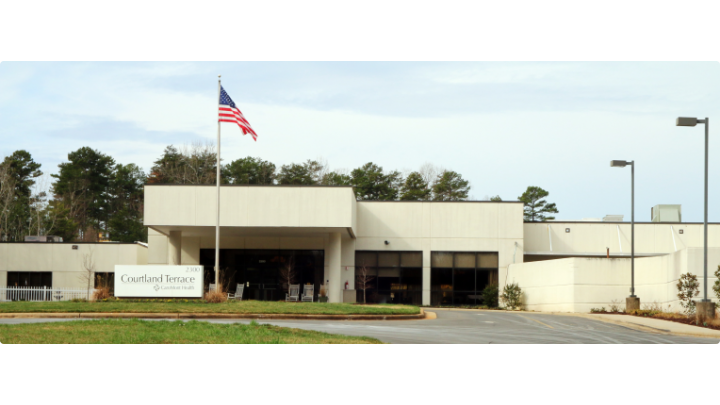


Courtland Terrace

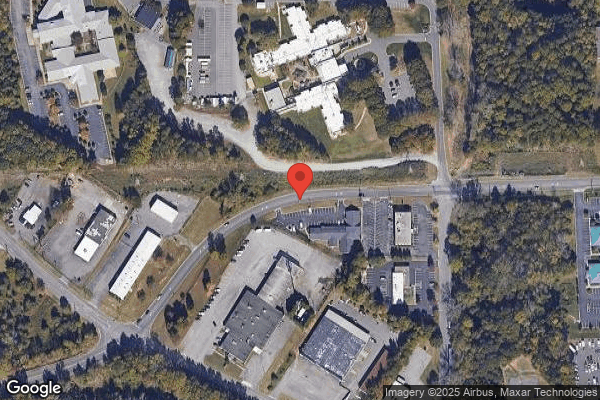
2300 Aberdeen Boulevard, Gastonia, NC 28054 (704) 834-4800
Non profit - Corporation 77 Beds Independent Data: November 2025
Trust Grade
80/100
#93 of 417 in NC
Last Inspection: October 2024

Within standard 12-15 month inspection cycle. Federal law requires annual inspections.

Overview

Courtland Terrace in Gastonia, North Carolina has a Trust Grade of B+, indicating it is above average and recommended for families considering care options. It ranks #93 out of 417 facilities in the state, placing it in the top half, and #4 out of 10 in Gaston County, meaning only three local facilities are rated higher. The facility is improving, with issues decreasing from six in 2023 to just one in 2024. Staffing is a strength, with a rating of 4 out of 5 stars and a low turnover rate of 32%, which is significantly better than the state average. Notably, there have been no fines reported, indicating good compliance. However, there are some concerns, including a recent incident where the kitchen equipment was found dirty, posing a risk of cross-contamination. Additionally, a resident was not given adequate privacy while receiving podiatry care in a common area, which raises issues about personal dignity. Despite these weaknesses, the facility maintains good RN coverage, exceeding 77% of other facilities in the state, which is beneficial for resident care.

Trust Score
B+
80/100
In North Carolina
#93/417
Top 22%
Safety Record
Low Risk
No red flags
Inspections
Getting Better
6 → 1 violations
Staff Stability
○ Average
32% turnover. Near North Carolina's 48% average. Typical for the industry.
Penalties
✓ Good
No fines on record. Clean compliance history, better than most North Carolina facilities.
Skilled Nurses
✓ Good
Each resident gets 53 minutes of Registered Nurse (RN) attention daily — more than average for North Carolina. RNs are trained to catch health problems early.
Violations
⚠ Watch
12 deficiencies on record. Higher than average. Multiple issues found across inspections.
★★★★☆
4.0
Overall Rating
★★★★☆
4.0
Staff Levels
★★☆☆☆
2.0
Care Quality
★★★★☆
4.0
Inspection Score
Stable
2023: 6 issues
2024: 1 issues

The Good

  • 4-Star Staffing Rating · Above-average nurse staffing levels
  • Full Sprinkler Coverage · Fire safety systems throughout facility
  • No fines on record
  • Staff turnover below average (32%)

    16 points below North Carolina average of 48%

Facility shows strength in staffing levels, fire safety.

The Bad

Staff Turnover: 32%

14pts below North Carolina avg (46%)

Typical for the industry

The Ugly 12 deficiencies on record

Oct 2024 1 deficiency
CONCERN (D)

Potential for Harm - no one hurt, but risky conditions existed

Deficiency F0583 (Tag F0583)

Could have caused harm · This affected 1 resident

**NOTE- TERMS IN BRACKETS HAVE BEEN EDITED TO PROTECT CONFIDENTIALITY** Based on observation, record review, Guardian, Podiatrist, and staff interviews, the facility failed to provide personal privacy...

Read full inspector narrative →
**NOTE- TERMS IN BRACKETS HAVE BEEN EDITED TO PROTECT CONFIDENTIALITY** Based on observation, record review, Guardian, Podiatrist, and staff interviews, the facility failed to provide personal privacy for Resident #28 when the Podiatrist cut her toenails in the facility's day room visible to other residents. This deficient practice was for 1 of 1 resident reviewed for personal privacy (Resident #28). The findings included: Resident #28 was admitted to the facility on [DATE] with diagnoses that included dementia with mood disturbance and cognitive communication deficit. The quarterly Minimum Data Set (MDS) assessment dated [DATE] revealed that Resident #28 was severely cognitively impaired and exhibited no behaviors or rejections of care during the assessment period. An observation conducted in the facility's day room on 10/30/24 at 12:00 PM revealed there were 10 residents seated at tables around the room. Resident #28 sat in her wheelchair in the center of the room and the Podiatrist sat on the floor in front of her and cut her toenails. There was no privacy curtain or shield in place around Resident #28. Nurse Aide (NA) #1 knelt beside Resident #28 and held her hand. An interview was conducted with NA #1 on 10/30/24 at 2:10 PM. NA #1 indicated when she was assigned to make rounds with the Podiatrist, they went to the residents' rooms to provide foot care. NA #1 revealed on 10/30/24 Resident #28 was in the day room with other residents. She stated she went into the day room with the Podiatrist, and he cut Resident #28's toenails. NA #1 indicated the Podiatrist was not concerned that there were other residents in the room, so she did not think it was an issue. NA #1 revealed that she should have taken Resident #28 to her room or a private area to have her toenails cut. A phone interview was conducted with the Podiatrist on 10/30/24 at 3:30 PM. He indicated that he had been providing podiatry services to the facility for 2 years. He stated during his scheduled visits he made rounds with a staff member and provided foot care in the residents' rooms. The Podiatrist revealed on 10/30/24 NA #1 brought him to the day room where Resident #28 was sitting with other residents. He stated NA #1 did not offer to take Resident #28 to her room, so he tried to be discreet and cut Resident #28's toenails in the day room. The Podiatrist further stated he preferred residents to be in a private area that was not visible to others when he provided foot care. A telephone interview was conducted with Resident #28's Guardian on 10/31/24 at 9:23 AM. She revealed that Resident #28 had always taken pride in her appearance and was very put together when she went out in public. She stated that Resident #28 would not have wanted to receive foot care in an area that was visible to others. The Guardian further stated if Resident #28 was cognitively intact and able to communicate her needs she would have requested to go to her room or a private area to have her toenails cut. An interview was conducted with the Director of Nursing (DON) on 10/30/24 at 2:00 PM. The DON indicated that the facility contracted with an outside company to provide podiatry services. She revealed a staff member was assigned to make rounds with the Podiatrist on the day he was scheduled to visit, and he provided foot care in the residents' rooms. She stated NA #1 was assigned to make rounds with the Podiatrist on 10/30/24. The DON revealed that she was aware Resident #28 received foot care in the day room, visible to other residents. She stated the Podiatrist and NA #1 should have taken Resident #28 to her room to cut her toenails. The DON indicated resident foot care should be provided in a private area that was not visible to others. An interview was conducted with the Administrator on 10/31/24 at 1:07 PM. She stated the facility had a contract with an outside company that provided podiatry services to the residents. She revealed on the day the Podiatrist was scheduled to visit he made rounds with an assigned staff member and foot care was provided in the residents' rooms. The Administrator indicated she was aware that the Podiatrist cut Resident #28's toenails in the day room visible to other residents. She stated Resident #28 should have been taken to her room or a private area to have her toenails cut.
Jun 2023 6 deficiencies
CONCERN (D) 📢 Someone Reported This

A family member, employee, or ombudsman was alarmed enough to file a formal complaint

Potential for Harm - no one hurt, but risky conditions existed

Report Alleged Abuse (Tag F0609)

Could have caused harm · This affected 1 resident

Based on staff interviews, and record reviews, the facility failed to submit the 5-day investigation report to the state survey Agency for 1 of 3 sampled residents (Resident #119) reviewed for abuse. ...

Read full inspector narrative →
Based on staff interviews, and record reviews, the facility failed to submit the 5-day investigation report to the state survey Agency for 1 of 3 sampled residents (Resident #119) reviewed for abuse. The Findings included: Review of the facility policy revised on 10/22 read as: B. Report must be made on all alleged violations involving abuse, neglect, exploitation or mistreatment, including injuries of unknown source and misappropriation of resident property. C. Complete investigation in 5 working days. Fax 5-Day report from and result of investigation to NCDHHD. (North Carolina Department of Health and Human Division). Review of the Facility 24-Hour Initial Report dated 9/30/22 documented the facility reported to the State Agency that Resident #119 reported she had been abused. There was no documentation to indicate the facility reported the 5-day investigation report to the State Agency. An interview with the Administrator on 6/27/23 at 4:11 pm, revealed that he was not the Administrator at the time and was not aware Resident #119 had reported abuse. He indicated they had looked and could not find the 5-day investigative report. An interview with the Social Worker on 6/28/23 at 4:17 pm, she revealed she was not aware Resident #119, reported she had been abused. She revealed staff were trained to report any incident or resident concern related to abuse to the administrative staff. She indicated a 5-day investigation report should have been sent to the State agency.
CONCERN (D)

Potential for Harm - no one hurt, but risky conditions existed

Comprehensive Care Plan (Tag F0656)

Could have caused harm · This affected 1 resident

**NOTE- TERMS IN BRACKETS HAVE BEEN EDITED TO PROTECT CONFIDENTIALITY** c. Resident #5 was admitted to the facility on [DATE] with diagnoses that included peripheral vascular disease and osteomyelitis...

Read full inspector narrative →
**NOTE- TERMS IN BRACKETS HAVE BEEN EDITED TO PROTECT CONFIDENTIALITY** c. Resident #5 was admitted to the facility on [DATE] with diagnoses that included peripheral vascular disease and osteomyelitis (infection of bone) of the lumbar (lower back) region. An admission assessment dated [DATE] revealed Resident #5 was admitted with a stage 3 pressure ulcer to the lumbar region. The 5-day Minimum Data Set (MDS) assessment dated [DATE] revealed Resident #5 was cognitively intact, required limited assistance from 1 staff member to complete activities of daily living, and was coded as having an unhealed stage 3 pressure ulcer. A review of the Care Area Assessments (CAA) for the 5-day MDS assessment indicated he had a pressure wound to his lumbar region. The CAA for pressure ulcer indicated he was at risk for developing further ulcers. The CAA worksheet for pressure ulcers contained a checkmark to indicate that pressure ulcers would be addressed in the Resident's care plan. The care plan for Resident #5 created on 5/1/23 noted the potential for skin breakdown but there was no entry or reference to the presence of a wound to the lumbar region or of any interventions in place. An interview was completed on 6/28/23 at 11:23am with the MDS Nurse. The Nurse indicated she was responsible for the creation of all care plans but the wound care plan. She stated the Wound Nurse was responsible for creating a resident's wound care plan. An interview was completed on 6/28/23 at 11:27am with the Director of Nursing (DON). She revealed there was confusion among management nursing staff who was responsible for creating a resident's wound care plan. The DON stated the MDS Nurse was responsible for creating the initial wound care plan and the Wound Nurse updated the care plan accordingly. An interview was completed on 6/28/23 at 11:32am with the Wound Nurse. The Nurse stated the MDS Nurse creates the intial wound care plan and she updates accordingly. An interview was completed on 6/28/23 at 6:40pm with the facility Administrator. He stated management staff were aware of incomplete comprehensive care plans and were attempting to update all resident's care plans to reflect their current medical diagnoses. 2a. Resident #4 was admitted to the facility on [DATE] with diagnoses that included Rheumatoid arthritis. Review of the Annual Minimum Data Set (MDS) assessment dated [DATE] revealed Resident #9 was cognitively intact and had a Stage III pressure ulcer injury. Review of the Wound Evaluation and Management assessment dated [DATE] revealed Resident #4 had a Stage IV pressure ulcer to her coccyx that measured 3.0 centimeters (cm) X 2.7 cm X 1.0 cm. Review of the Dressing Treatment Plan dated 6/22/23 revealed an order to wash wound with Dakins Solution, Apply three times a week for sixteen days. Negative Pressure Wound Therapy apply three times per week for sixteen weeks 125mmHG; Continuous. Collagen sheets apply three times per week for thirty days. Skin prep-Apply three time per week for 16 days. Review of the care plan initiated 10/24/22 revealed a focus of resident was at risk for pressure ulcer related to immobility. There was no entry or reference to the presence of a wound to the coccyx or interventions. b. Resident #9 was admitted to the facility on [DATE]. Review of the 5 Day Minimum Data Set (MDS) Assessment revealed Resident #9 was cognitively intact and at risk for pressure ulcer injuries. There was no documentation of a pressure ulcer. Review of the Wound Evaluation and Management assessment dated [DATE] revealed Resident #9 had a Stage III pressure ulcer of the left posterior heel that measured 0.2 centimeters (cm) X 0.2 cm X 0.1 cm. Review of the Dressing Treatment Plan dated 6/22/23 revealed a dressing order for calcium alginate with silver apply once daily for nine days. Apply Sterile gauze sponge once daily for thirty days. Apply Foam without boarder to heel once weekly for thirty days. Apply Kerlix dressing once daily for thirty days. Review of the care plan dated 3/4/23 revealed a focus of resident was at risk for pressure ulcer related to immobility. There was no entry or reference to the presence of a wound to the left heel or interventions. Based on record review and staff interviews the facility failed to develop care plans in the areas of suprapubic catheter (Resident #45) and pressure ulcers (Residents #4, #9, and #5) for 4 of 4 residents reviewed for care planning. The findings included: 1. Resident #45 was admitted to the facility on [DATE] with diagnoses that included benign prostatic hyperplasia (BPH) obstructive uropathy. A physician note dated 11/3/22 indicated an indwelling urinary catheter had been placed this day. Review of the admission Minimum Data Set, dated [DATE] revealed Resident #45 had an indwelling urinary catheter. Review of the Resident #45's Comprehensive Care Plan dated 11/8/22 contained no information or interventions regarding suprapubic catheter care. An interview was conducted with the Minimum Data Nurse on 6/28/23 at 4:32 PM. She revealed Resident #45's catheter should have been care planned. An interview was conducted with the Director of Nursing (DON) 6/28/23 at 4:40 PM. The DON stated Resident #45's care plan chould have been updated to the indwelling urinary catheter.
CONCERN (D)

Potential for Harm - no one hurt, but risky conditions existed

Deficiency F0761 (Tag F0761)

Could have caused harm · This affected 1 resident

Based on observation and staff interview the facility failed to discard an expired medications for 1 of 1 medication room reviewed for medication storage. The findings included: 1.During an observat...

Read full inspector narrative →
Based on observation and staff interview the facility failed to discard an expired medications for 1 of 1 medication room reviewed for medication storage. The findings included: 1.During an observation of the medication room for medication storage on 6/28/23 at 12:02 PM, 1 multidose vial of opened and accessed Tuberculin Purified Diluted (Aplisol) was in the medication refrigerator. The vial had an opened date of 4/15/23. A review of the manufacturer ' s instruction label on the box indicated the medication should be discarded 30 days from the date medication was opened. During an interview with the Director of Nursing on 6/28/23 at 12:10 PM, she stated it was the night shift nurses responsibility to check the refrigerators and medication carts for expired medication. The DON stated the expired medications should have been discarded or returned to the pharmacy. 2. An observation of the medication storage room conducted on 6/28/23 at 12:02 PM revealed 2 bags of Vancomycin 750 milligrams(mg)/ in 250 milliliters (ml) of normal saline with an expiration date of 6/12/23 was in the medication refrigerator. The instructions read Infuse intravenously (IV) over 90 minutes at 175ml/hour(hr) every 12 hours until 6/12/23. During an interview with the Director of Nursing on 6/28/23 at 12:10 PM, she stated it was the night shift nurses responsibility to check the refrigerators and medication carts for expired medication. The DON stated the expired medications should have been discarded or returned to the pharmacy. An interview was conducted with the Administrator on 6/28/23 at 8:44 AM. The Administrator indicated that he expected expired medications would be discarded per manufacturer ' s instruction.
CONCERN (D)

Potential for Harm - no one hurt, but risky conditions existed

QAPI Program (Tag F0867)

Could have caused harm · This affected 1 resident

Based on record reviews and staff interviews, the facility's Quality Assessment and Assurance (QAA) Committee failed to maintain implemented procedures and monitor interventions the committee put in p...

Read full inspector narrative →
Based on record reviews and staff interviews, the facility's Quality Assessment and Assurance (QAA) Committee failed to maintain implemented procedures and monitor interventions the committee put in place following the recertification and complaint survey conducted on 7/9/21. This was for a recited deficiency on the current recertification and complaint survey in the area of development and implementation of comprehensive care plans. The continued failure during two surveys shows a pattern of the facility's inability to sustain an effective QAA program. The findings included: This tag is cross referenced to: F656: Based on record review and staff interviews the facility failed to develop care plans in the areas of suprapubic catheter (Resident #45) and pressure ulcers (Residents #4, #9, and #5) for 4 of 4 residents reviewed for care planning. During the recertification survey on 7/9/21 the facility was cited for failing to develop a comprehensive care plan in the areas of indwelling catheter usage and anticoagulant, diuretic, and opioid medication usage. An interview was complete on 6/28/23 at 6:23pm with the Administrator, Director of Nursing (DON), and Director of Patient Care. The Administrator indicated the QAA committee met monthly to discuss the facility's ongoing performance improvement plans. The DON indicated there were no current monitoring plans for the development and implementation of comprehensive care plans.
CONCERN (E)

Potential for Harm - no one hurt, but risky conditions existed

Food Safety (Tag F0812)

Could have caused harm · This affected multiple residents

Based on observation, record review and staff interview the facility failed to maintain the kitchen equipment clean and in a sanitary condition to prevent cross contamination by failing to clean the u...

Read full inspector narrative →
Based on observation, record review and staff interview the facility failed to maintain the kitchen equipment clean and in a sanitary condition to prevent cross contamination by failing to clean the undershelf of one of one steamtables. The findings included: Review of the Equipment Cleaning Log week of June 18th there was no mention of the steamtable under splash area to be cleaned. An observation of the steamtable undershelf on 6/27/23 at 10:04 AM revealed the steamtable to have splatters of dark black dried food particles covering the under-splash area of the top shelf directly above the food wells. During the meal temperature observation on 6/28/23 at 8:28 AM revealed the 5 well steamtable was observed on and pans of food were in the steamtable ready to serve. The steamtable was observed to have splatters of dark black dried food particles covering the under-splash area of the top shelf directly above the steaming food wells. In an interview on 6/28/23 at 8:39 AM the Operations Manager stated the steamtable should have been cleaned. In an interview on 6/28/23 at 8:45 AM the kitchen manager revealed staff should have cleaned the splash area and they would clean the area immediately.
MINOR (C)

Minor Issue - procedural, no safety impact

Transfer Notice (Tag F0623)

Minor procedural issue · This affected most or all residents

**NOTE- TERMS IN BRACKETS HAVE BEEN EDITED TO PROTECT CONFIDENTIALITY** Based on record review and staff interview the facility failed to provide written notice of reason for discharge to hospital to ...

Read full inspector narrative →
**NOTE- TERMS IN BRACKETS HAVE BEEN EDITED TO PROTECT CONFIDENTIALITY** Based on record review and staff interview the facility failed to provide written notice of reason for discharge to hospital to the resident and/or resident representatives and to provide the Ombudsman with a copy of the written notice for 2 of 2 residents reviewed for hospitalization. (Resident #9, Resident #39) The findings included: 1. Resident #9 was readmitted to the facility on [DATE]. A review of the 5 Day Medicare Minimum Data Set (MDS) dated [DATE] revealed Resident #9 was cognitively intact. Review of a physician ' s order dated 4/1/23 revealed an order to send to hospital for follow up of abnormal critical lab and abnormal computed tomography (CT) imaging. The medical record included no evidence that Resident #9 or her resident representative were provided with written notice that included the reason for discharge to the hospital on 4/1/23. During an interview with Resident #9 on 6/26/23 at 9:18 AM. the resident indicated she had no recollection of receiving written notice that explained the reason for his discharge to the hospital that occurred on 4/1/23. A phone interview was attempted with the Ombudsman on 6/27/23 at 3:18 PM An interview was conducted with the Social Worker (SW) on 6/27/23 at 4:40 PM. The Social Worker stated she was not aware that she was supposed to send out a written notice of discharge to the resident or resident representative and the Ombudsman. The SW stated she had been documenting the follow up phone call in the electronic medical record. During an interview with the Administrator and Senior Director of Patient Care on 6/28/23 at 8:44 AM. The Administrator indicated the Social Worker was responsible for providing the written notice of transfer/discharge to the hospital and notifying the Ombudsman. He revealed that during this survey he realized the Social Worker had not been completing this responsibility and that written notice of discharge/transfer had not been provided to the resident, resident representative, or the Ombudsman for any transfer/discharge to the hospital. The Administrator was unsure of how long the facility had not been providing these notices. Immediate education was provided to the Social Worker on discharge notices. 2. Resident #39 was readmitted to the facility on [DATE]. A review of the 5 Day Medicare Minimum Data Set (MDS) Assessment revealed the Resident #39 had severe cognitive impairment. Review of a physician ' s order dated 5/18/23 revealed an order to send to hospital for evaluation and treatment of lethargy and decreased blood pressure. The medical record included no evidence that Resident #39 ' s resident representative was provided with written notice that included the reason for discharge to the hospital on 5/18/23. A phone interview was attempted with the Ombudsman on 6/27/23 at 3:18 PM An interview was conducted with the Social Worker (SW) on 6/27/23 at 4:40 PM. The Social Worker stated she was not aware that she was supposed to send out a written notice of discharge to the resident or resident representative and the Ombudsman. The SW stated she had been documenting the follow up phone call in the electronic medical record. During an interview with the Administrator and Senior Director of Patient Care on 6/28/23 at 8:44 AM. The Administrator indicated the Social Worker was responsible for providing the written notice of transfer/discharge to the hospital and notifying the Ombudsman. He revealed that during this survey he realized the Social Worker had not been completing this responsibility and that written notice of discharge/transfer had not been provided to the resident, resident representative, or the Ombudsman for any transfer/discharge to the hospital. The Administrator was unsure of how long the facility had not been providing these notices. Immediate education was provided to the Social Worker on discharge notices.
Jul 2021 5 deficiencies
CONCERN (D)

Potential for Harm - no one hurt, but risky conditions existed

Assessment Accuracy (Tag F0641)

Could have caused harm · This affected 1 resident

**NOTE- TERMS IN BRACKETS HAVE BEEN EDITED TO PROTECT CONFIDENTIALITY** Based on record review, observations, and staff interviews the facility failed to code the Minimum Data Set (MDS) assessments ac...

Read full inspector narrative →
**NOTE- TERMS IN BRACKETS HAVE BEEN EDITED TO PROTECT CONFIDENTIALITY** Based on record review, observations, and staff interviews the facility failed to code the Minimum Data Set (MDS) assessments accurately in the areas of restraints (Resident #6), pressure ulcers (Resident #33), falls (Resident #33, #175), and for the use of a non-invasive mechanical ventilator (Resident#49) for 4 of 20 residents reviewed for accuracy. The findings included: 1. Resident #6 was admitted to the facility on [DATE] with diagnoses which included vascular dementia and major depressive disorder. Review of the quarterly MDS dated [DATE] for physical restraints used in bed revealed a restraint identified as other was used less than daily. Observations revealed on 7/8/21 at 10:31 AM revealed Resident #6 sitting upright in a wheelchair covered with a blanket. A second observation on 7/8/21 at 2:32 PM revealed Resident #6 resting in bed. There were no bed rails in place. The bed was low to the floor with 1 side against the wall. An interview conducted on 7/08/21 at 3:43 PM with the Physical Therapist (PT) revealed she worked at the facility for approximately 2 years and stated it was restraint free. The facility didn't use wrist or lap boards, quarter, or full-length bed rails, or bed and chair alarms. During an interview on 7/9/21 at 2:46 PM MDS Coordinator #1 explained it was an error to code Resident #6's quarterly MDS for the use of physical restraints. MDS Coordinator #1 explained the facility didn't use restraints. During an interview the on 7/9/21 at 6:10 PM the Administrator confirmed the facility didn't use restraints and the quarterly MDS dated [DATE] for Resident #6 was inaccurate. The Administrator indicated a modification would be done to reflect restraints weren't used for Resident #6. 2. a. Resident #33 was admitted to the facility on [DATE]. Diagnoses for Resident #33 included displaced fracture of right femur with routine healing and Alzheimer's disease. A wound evaluation and management summary dated 3/11/21 identified a stage 3 pressure wound of the right heel. Based on the evaluation the duration of the wound was greater than 19 days measuring 0.5 centimeters (cm) in length and 3 cm in width and 0.1 cm in depth and had improved. Review of the quarterly MDS dated [DATE] assessed Resident #33 as having no unhealed pressure ulcers. The skin and ulcer/injury treatments included a pressure reducing device for the bed and chair and applications of ointments and/or medications. During an interview on 7/9/21 at 2:44 PM MDS Coordinator #1 revealed the quarterly MDS dated [DATE] should've coded the presence of an unhealed pressure ulcer based on the wound evaluation dated 3/11/21. MDS Coordinator #1 revealed the quarterly MDS dated [DATE] was inaccurate for pressure ulcer and was a coding error. An interview was conducted on 7/9/21 at 5:42 PM with the Administrator. The Administrator confirmed the quarterly MDS dated [DATE] was coded inaccurately and explained during weekly meetings residents at risk were discussed for wound care and pressure ulcers. The MDS Coordinators currently didn't attend those meetings but it would be good for them to start to ensure they were aware of residents with wounds. 2. b. Resident #33 was admitted to the facility on [DATE]. Diagnoses for Resident #33 included displaced fracture of right femur with routine healing and Alzheimer's disease. A review of the incident report dated 3/30/21 revealed Resident #33 had a witnessed fall when attempting to stand unassisted and step over the leg rest of the wheelchair. The incident report explained Resident #33 fell to the floor landing on her left side. The quarterly MDS dated [DATE] was coded as there had been no falls since the previous assessment. The previous MDS assessment was a quarterly dated 3/13/21. During an interview on 7/9/21 at 2:49 PM MDS Coordinator #1 explained not coding a fall occurred was an error; therefore, the MDS was inaccurate. During an interview on 7/9/21 at 5:47 PM the Administrator confirmed the MDS should reflect a fall occurred. The Administrator explained the MDS Coordinator was new to the position and more training would be done to help clarify how to document falls on the MDS. 3. Resident #175 was admitted to the facility on [DATE] with diagnoses which included traumatic subdural hemorrhage and unspecified fall. Review of the incident report dated 6/26/21 revealed Resident #175 was observed on floor in her room. The admission MDS dated [DATE] was coded as there had been no falls since Resident #175's admission to the facility. During an interview on 7/9/21 at 2:49 PM MDS Coordinator #1 explained not coding a fall occurred was an error; therefore, the MDS was inaccurate. During an interview on 7/9/21 at 5:47 PM the Administrator confirmed the MDS should reflect a fall occurred. The Administrator explained the MDS Coordinator was new to the position and more training would be done to help clarify how to document falls on the MDS. 4. Resident #49 was admitted to the facility 06/01/21 with diagnoses that included diabetes, emphysema (lung condition that causes shortness of breath) and pneumonia. The admission Minimum Data Set (MDS) dated [DATE] assessed Resident #49 with severe cognitive impairment. The MDS noted he used a BiPAP (Bilateral Positive Airway Pressure)/CPAP (Continuous Positive Airway Pressure) (type of devices that help with breathing) while a resident. An observation conducted on 07/08/21 at 8:38 AM of Resident #49's room revealed no evidence of a CPAP or BiPAP device. During an interview on 07/09/21 at 1:11 PM, MDS Coordinator #2 confirmed she coded Section O, Special Treatment on the admission MDS dated [DATE] for Resident #49. MDS Coordinator #2 explained she had coded use of BiPAP/CPAP for Resident #49 based on the hospital discharge summary which noted he used it at bedtime. She verified Resident #49 did not have a BiPAP/CPAP in his room and there was no physician order for use of BiPAP/CPAP device or evidence he had used one since his admission to the facility. MDS Coordinator #2 stated Resident #49's use of a BiPAP/CPAP while a resident was incorrectly coded on the MDS assessment dated [DATE] and a modification would be submitted. During an interview on 07/09/21 at 5:38 PM, the Administrator explained MDS Coordinator #2 was new to the position and just made an error coding Resident 49's admission MDS dated [DATE]. The Administrator stated a modification would be submitted to reflect Resident #49 did not use a non-invasive mechanical ventilator while a resident at the facility.
CONCERN (D)

Potential for Harm - no one hurt, but risky conditions existed

Comprehensive Care Plan (Tag F0656)

Could have caused harm · This affected 1 resident

**NOTE- TERMS IN BRACKETS HAVE BEEN EDITED TO PROTECT CONFIDENTIALITY** Based on record review and staff interviews, the facility failed to develop a comprehensive, individualized care plan that addre...

Read full inspector narrative →
**NOTE- TERMS IN BRACKETS HAVE BEEN EDITED TO PROTECT CONFIDENTIALITY** Based on record review and staff interviews, the facility failed to develop a comprehensive, individualized care plan that addressed the areas: indwelling catheter and anticoagulant, diuretic and opioid medication use for 1 of 5 sampled residents reviewed for unnecessary medications (Resident #35). Findings included: Resident #35 admitted to the facility on [DATE] with multiple diagnoses that included heart disease, diabetes, hypertension, localized edema (swelling due to excess fluid accumulation in the body tissues), pain, and dysuria (painful or difficult urination). The quarterly Minimum Data Set (MDS) dated [DATE] coded Resident #35 with moderate impairment in cognition and the presence of an indwelling catheter. The MDS noted she received the following medications daily during the MDS assessment period: anticoagulant (blood thinner), diuretic (medication used to help the body get rid of extra fluid and salt), and opioid (pain medication). Review of Resident #35's Medication/Treatment Administration Records for the months of June 2021 and July 2021 revealed the following physician orders: • 04/13/21: Tramadol (pain medication) 50 milligrams (mg) every 6 hours as needed. Discontinued on 06/14/21. • 04/30/21: Change indwelling catheter monthly on the 29th. • 04/30/21: Perform catheter care every shift and as needed. • 05/07/21: Gabapentin (pain medication) 100 mg twice a day. • 06/17/21: Eliquis (anticoagulant) 2.5 milligrams (mg) twice a day with instructions to stop Eliquis on 06/21/21 in anticipation of surgery. • 06/21/21: Eliquis 2.5 mg twice a day. • 06/27/21: Hydrocodone-acetaminophen (pain medication) 5-325 mg every 6 hours as needed. • 07/07/21: Torsemide (diuretic) 20 mg once a day. Review of Resident #35's active care plans, last reviewed/revised 05/26/21, revealed no care plans that addressed catheter care, anticoagulant, diuretic or pain medication use. During an interview on 07/09/21 at 1:11 PM, MDS Coordinator #2 explained she was new to the MDS position and was not trained to develop specific care plans, such as an indwelling catheter or anticoagulant medication use; however, the problem areas would be addressed under the category they triggered on the MDS assessment. MDS Coordinator #2 confirmed there were no care plans that addressed Resident 35's indwelling catheter or her use of anticoagulant, diuretic and pain medications and stated those areas should have been addressed. During a telephone interview on 07/09/21 at 2:37 PM, MDS Coordinator #1 explained both she and MDS Coordinator #2 were new to the MDS position and confirmed comprehensive care plans were developed based off the triggers from the Care Area Assessment (CAA) of the MDS. She added they still had a lot to learn and the only explanation she could provide was it was an error on their part that Resident #35's indwelling catheter and use of anticoagulant, diuretic and pain medications were not addressed in her comprehensive care plan. During an interview on 07/09/21 at 5:38 PM, the Administrator explained the MDS Coordinators were new to the positions and likely did not know that specific care plans could be developed when the problem area did not trigger on the MDS. She added more training would be provided to the MDS Coordinators related to developing comprehensive care plans.
CONCERN (D)

Potential for Harm - no one hurt, but risky conditions existed

Deficiency F0657 (Tag F0657)

Could have caused harm · This affected 1 resident

**NOTE- TERMS IN BRACKETS HAVE BEEN EDITED TO PROTECT CONFIDENTIALITY** Based on record review and staff interviews, the facility failed to revise and update a care plan related to an upgraded diet fo...

Read full inspector narrative →
**NOTE- TERMS IN BRACKETS HAVE BEEN EDITED TO PROTECT CONFIDENTIALITY** Based on record review and staff interviews, the facility failed to revise and update a care plan related to an upgraded diet for 1 of 18 sampled residents (Resident #49). Findings included: Resident #49 was admitted to the facility on [DATE] with diagnoses that included dysphagia (difficulty swallowing food or liquid). The baseline care plan initiated on 06/01/21 noted under the eating section that Resident #49 had a feeding tube (medical device used to provide nutrition to people who cannot obtain nutrition by mouth, are unable to swallow safely, or need nutritional supplementation) and under the diet section was noted NPO (no solids or fluids by mouth), feeding tube and at risk for weight loss. The admission Minimum Data Set (MDS) dated [DATE] coded Resident #49 with severe cognitive impairment. The MDS noted he required extensive staff assistance with eating and received 51 percent or more of total calories through a feeding tube. Review of Resident #49's active care plans, initiated on 06/10/21, revealed a nutrition care plan in place that read in part he was at risk for weight loss due to dysphagia and NPO status. The care plan noted his nutritional needs were provided through a feeding tube. Review of Resident #49's medical record revealed a physician's order dated 06/27/21 read, Diet: puree and nectar thick liquids. During an interview on 07/09/21 at 1:11 PM, MDS Coordinator #2 reviewed the physician's order dated 06/27/21 and could not explain why Resident #49's nutrition care plan was not updated to reflect the change in his diet. MDS Coordinator #2 stated she thought it would be the responsibility of dietary to revise the care plan with changes in diet or inform her and MDS Coordinator #1 so they could update the care plan. During a telephone interview on 07/09/21 at 2:37 PM, MDS Coordinator #1 explained both she and MDS Coordinator #2 were new to the MDS position and was not sure who was ultimately responsible for revising/updating care plans. She added they still had a lot to learn and the only explanation she could provide was it was an error and part of the learning process. During an interview on 07/09/21 at 5:38 PM, the Administrator explained the MDS Coordinators currently did not attend the weekly meetings where residents at risk were discussed and felt it would be good to start including them in the meetings so they would be aware of changes and new orders for the resident care plans to be updated/revised accordingly.
CONCERN (E)

Potential for Harm - no one hurt, but risky conditions existed

Deficiency F0655 (Tag F0655)

Could have caused harm · This affected multiple residents

**NOTE- TERMS IN BRACKETS HAVE BEEN EDITED TO PROTECT CONFIDENTIALITY** 2. Resident #232 was admitted to the facility 06/14/21 with diagnoses including non-Alzheimer's dementia and respiratory failure...

Read full inspector narrative →
**NOTE- TERMS IN BRACKETS HAVE BEEN EDITED TO PROTECT CONFIDENTIALITY** 2. Resident #232 was admitted to the facility 06/14/21 with diagnoses including non-Alzheimer's dementia and respiratory failure. The 5-day Minimum Data Set (MDS) dated [DATE] revealed Resident #232 was cognitively intact and required extensive assistance with bed mobility, transfers, dressing, and toilet use. Review of the computerized baseline care plan initiated 06/14/21 revealed the areas of occupational history, bed mobility, transfer, walking, toileting, high risk black box medication, locomotion, bathing, isolation precautions, eating, grooming/hygiene, equipment, relocation stress, treatments/therapies, and Preadmission Screening and Resident Review (PASRR) recommendation, signatures of the interdisciplinary team (IDT), and signature of the resident or responsible party were blank. An interview with Clinical Manager on 07/08/21 at 04:15 PM revealed a Registered Nurse (RN) must initiate the baseline care plan and complete the baseline care plan. She explained once the baseline care plan was initiated any member of the IDT could document on the baseline care plan. The Clinical Manager stated there was no staff member assigned to ensure completion of baseline care plans within 48 hours of admission. A joint interview with Social Worker (SW) #1 and SW#2 on 07/09/21 at 02:57 PM revealed an IDT meeting was conducted with the resident and/or responsible party usually 7 to 10 days after admission to review the plan of care. They explained a copy of the baseline care plan was provided to the resident or the responsible party during the care plan meeting if the baseline care plan was marked as complete. An interview with the Administrator on 07/09/21 at 05:42PM revealed she expected the baseline care plan to be completed within 48 hours of admission and the IDT should be documenting on the baseline care plan. The Administrator stated the process for completing the baseline care plan within 48 hours needed to be revamped. 3. Resident #240 was admitted to the facility 06/29/21 with diagnoses including heart failure, diabetes, and back pain. The admission MDS for Resident #240 was opened but had not been completed at the time of the survey. The baseline care plan for Resident #240 initiated 06/30/21 was completely blank. An interview with Clinical Manager on 07/08/21 at 04:15 PM revealed a Registered Nurse (RN) must initiate the baseline care plan and complete the baseline care plan. She explained once the baseline care plan was initiated any member of the IDT could document on the baseline care plan. The Clinical Manager stated there was no staff member assigned to ensure completion of baseline care plans within 48 hours of admission. A joint interview with Social Worker (SW) #1 and SW#2 on 07/09/21 at 02:57 PM revealed an IDT meeting was conducted with the resident and/or responsible party usually 7 to 10 days after admission to review the plan of care. They explained a copy of the baseline care plan was provided to the resident or the responsible party during the care plan meeting if the baseline care plan was marked as complete. An interview with the Administrator on 07/09/21 at 05:42PM revealed she expected the baseline care plan to be completed within 48 hours of admission and the IDT should be documenting on the baseline care plan. The Administrator stated the process for completing the baseline care plan within 48 hours needed to be revamped. 4. Resident #3 was admitted to the facility 06/30/21 with diagnoses including cancer, heart failure, and a wound infection. The 5-day MDS dated [DATE] for Resident #3 was opened but had not been completed at the time of the survey. Review of Resident #3's baseline care plan initiated 06/30/21 revealed occupational history, PASRR recommendation, signatures of IDT members, and signature of the resident or responsible party were blank. An interview with Clinical Manager on 07/08/21 at 04:15 PM revealed a Registered Nurse (RN) must initiate the baseline care plan and complete the baseline care plan. She explained once the baseline care plan was initiated any member of the IDT could document on the baseline care plan. The Clinical Manager stated there was no staff member assigned to ensure completion of baseline care plans within 48 hours of admission. A joint interview with Social Worker (SW) #1 and SW#2 on 07/09/21 at 02:57 PM revealed an IDT meeting was conducted with the resident and/or responsible party usually 7 to 10 days after admission to review the plan of care. They explained a copy of the baseline care plan was provided to the resident or the responsible party during the care plan meeting if the baseline care plan was marked as complete. An interview with the Administrator on 07/09/21 at 05:42PM revealed she expected the baseline care plan to be completed within 48 hours of admission and the IDT should be documenting on the baseline care plan. The Administrator stated the process for completing the baseline care plan within 48 hours needed to be revamped. 5. Resident #4 was admitted to the facility 06/30/21 with a diagnosis of diabetes. The admission MDS dated [DATE] for Resident #4 was opened but had not been completed at the time of the survey. Review of Resident #4's baseline care plan initiated 06/30/21 revealed occupational history, grooming/hygiene, social services, PASRR recommendation, signatures of IDT members, and signature of the resident or responsible party were blank. An interview with Clinical Manager on 07/08/21 at 04:15 PM revealed a Registered Nurse (RN) must initiate the baseline care plan and complete the baseline care plan. She explained once the baseline care plan was initiated any member of the IDT could document on the baseline care plan. The Clinical Manager stated there was no staff member assigned to ensure completion of baseline care plans within 48 hours of admission. A joint interview with Social Worker (SW) #1 and SW#2 on 07/09/21 at 02:57 PM revealed an IDT meeting was conducted with the resident and/or responsible party usually 7 to 10 days after admission to review the plan of care. They explained a copy of the baseline care plan was provided to the resident or the responsible party during the care plan meeting if the baseline care plan was marked as complete. An interview with the Administrator on 07/09/21 at 05:42PM revealed she expected the baseline care plan to be completed within 48 hours of admission and the IDT should be documenting on the baseline care plan. The Administrator stated the process for completing the baseline care plan within 48 hours needed to be revamped. 6. Resident #226 was admitted to the facility 06/25/21 with a diagnosis of peripheral vascular disease (a circulatory condition which reduces blood flow to the limbs). The admission MDS dated [DATE] for Resident #226 was opened but not completed at the time of the survey. Review of Resident #226's baseline care plan initiated 06/26/21 revealed occupational history, anticoagulation therapy, high risk black box medications, treatments/therapies, discharge planning, social services, PASRR recommendation, signatures of IDT members, and signature of the resident or responsible party were blank. An interview with Clinical Manager on 07/08/21 at 04:15 PM revealed a Registered Nurse (RN) must initiate the baseline care plan and complete the baseline care plan. She explained once the baseline care plan was initiated any member of the IDT could document on the baseline care plan. The Clinical Manager stated there was no staff member assigned to ensure completion of baseline care plans within 48 hours of admission. A joint interview with Social Worker (SW) #1 and SW#2 on 07/09/21 at 02:57 PM revealed an IDT meeting was conducted with the resident and/or responsible party usually 7 to 10 days after admission to review the plan of care. They explained a copy of the baseline care plan was provided to the resident or the responsible party during the care plan meeting if the baseline care plan was marked as complete. An interview with the Administrator on 07/09/21 at 05:42PM revealed she expected the baseline care plan to be completed within 48 hours of admission and the IDT should be documenting on the baseline care plan. The Administrator stated the process for completing the baseline care plan within 48 hours needed to be revamped. Based on record review, family and staff interviews, the facility failed to complete baseline care plans in conjunction with the Interdisciplinary Team (IDT), resident and/or responsible party and failed to provide the resident or their responsible party with a written summary of the baseline care plan for 6 of 11 sampled residents reviewed (Resident #49, #3, #4, #226, #232, and #240). Findings included: 1. Resident #49 was admitted on [DATE] with multiple diagnoses that included nontraumatic intracranial hemorrhage (occurs when a blood vessel in the brain ruptures and causes bleeding inside the brain), diabetes, emphysema, aphasia (loss of ability to understand or express speech, caused by brain damage), repeated falls, and dysphagia (trouble swallowing). The admission Minimum Data Set (MDS) dated [DATE] coded Resident #49 with severe cognitive impairment for daily decision making. The MDS noted he required extensive to total staff assistance with all activities of daily living and received oxygen therapy during the MDS assessment period. The computerized baseline care plan initiated on 06/01/21 noted Resident #49 was admitted for short-term rehab to improve function and contained preprinted sections with boxes to check that indicated the sections were reviewed and/or completed by members of the IDT. Further review revealed the following sections had no boxes checked or comments noted: discharge planning, social services, or signature of resident and/or Responsible Party (RP). Additionally, there was no documentation included on the form in the areas for staff in attendance to list their names, department, or their signature. The baseline care plan had no completion date or evidence a copy was provided to the resident and/or RP. During a telephone interview on 07/07/21 at 12:20 PM, Resident #49's RP stated she met with the IDT to discuss his plan of care and discharge goals but was not provided a written summary of the baseline care plan. During an interview on 07/09/21 at 4:08 PM, the Clinical Manager (CM) explained a Registered Nurse (RN) must initiate the baseline care plan but once initiated, any member of the IDT could fill in the information. The CM stated the information included in a baseline care plan was based on the admission assessment and level of care exhibited by the resident during the first 48 hours of their stay. She added it was her understanding that the information included in the baseline care plan provided a snapshot of the resident's care needs until they were thoroughly assessed and a comprehensive care plan developed. The CM was not sure when the initial care plan meeting was held with the resident and/or RP or when they were given a written summary of the care plan and stated she personally never provided the resident or their RP a copy of the baseline care plan. The CM stated there was no staff member assigned to ensure baseline care plans were completed within 48 hours of admission. During a joint interview, Social Worker (SW) #1 and SW #2 explained the IDT met with the resident and/or their RP within 7 to 10 after the resident's admission to review the plan of care at which time they also received a copy of the completed baseline care plan; however, they stated if the baseline care plan was not marked complete, then the resident and/or their RP were not provided a copy. During an interview on 07/09/21 at 5:38 PM, the Administrator stated she would expect for the baseline care plans to include input from IDT, be completed within 48 hours of the resident's admission and a written summary of the care plan provided to the resident and/or their responsible party.
MINOR (C)

Minor Issue - procedural, no safety impact

Grievances (Tag F0585)

Minor procedural issue · This affected most or all residents

Based on record review and staff interviews, the facility failed to develop a grievance policy that included: the residents' right to receive a written summary of the grievance resolution, the name an...

Read full inspector narrative →
Based on record review and staff interviews, the facility failed to develop a grievance policy that included: the residents' right to receive a written summary of the grievance resolution, the name and contact information of the designated grievance official and the contact information of independent entities with whom grievances may also be filed such as pertinent State agency, State Long Term Care Ombudsman or Quality Improvement Organization. Findings included: Review of the facility's grievance policy, with a revised date of 11/04/17 and provided by the Administrator, specified in part the facility would provide residents, resident's responsible party or representatives an opportunity for resolution of a concern, complaint, grievance, or ethical issue that may arise during a resident's stay without fear of reprisal in any form. Further review revealed the grievance policy did not include the name, business address or email of the Grievance Official or the contact information of independent entities with whom grievances may also be filed. In addition, the grievance policy specified a written response of the grievance resolution would be provided to the resident or responsible party upon request. During an interview on 07/08/21 at 5:25 PM, the Administrator explained residents, or their responsible party, did not receive a copy of the grievance resolution unless requested. She confirmed the grievance policy, with a revised date of 11/04/17 and review date of 05/2020, was the most current policy. The Administrator was not familiar with the federal regulation related to grievances and acknowledged the facility's current grievance policy did not contain all the required components as outlined in the regulation and would need to be updated.
Understanding Severity Codes (click to expand)
Life-Threatening (Immediate Jeopardy)
J - Isolated K - Pattern L - Widespread
Actual Harm
G - Isolated H - Pattern I - Widespread
Potential for Harm
D - Isolated E - Pattern F - Widespread
No Harm (Minor)
A - Isolated B - Pattern C - Widespread

Questions to Ask on Your Visit

  • "Can I speak with families of current residents?"
  • "What's your RN coverage like on weekends and overnight?"

Our Honest Assessment

Strengths
  • • Grade B+ (80/100). Above average facility, better than most options in North Carolina.
  • • No major safety red flags. No abuse findings, life-threatening violations, or SFF status.
  • • No fines on record. Clean compliance history, better than most North Carolina facilities.
  • • 32% turnover. Below North Carolina's 48% average. Good staff retention means consistent care.
Concerns
  • • 12 deficiencies on record. Higher than average. Multiple issues found across inspections.
Bottom line: Generally positive indicators. Standard due diligence and a personal visit recommended.

About This Facility

What is Courtland Terrace's CMS Rating?

CMS assigns Courtland Terrace an overall rating of 4 out of 5 stars, which is considered above average nationally. Within North Carolina, this rating places the facility higher than 99% of the state's 100 nursing homes. This rating reflects solid performance across the metrics CMS uses to evaluate nursing home quality.

How is Courtland Terrace Staffed?

CMS rates Courtland Terrace's staffing level at 4 out of 5 stars, which is above average compared to other nursing homes. Staff turnover is 32%, compared to the North Carolina average of 46%. This relatively stable workforce can support continuity of care.

What Have Inspectors Found at Courtland Terrace?

State health inspectors documented 12 deficiencies at Courtland Terrace during 2021 to 2024. These included: 10 with potential for harm and 2 minor or isolated issues.

Who Owns and Operates Courtland Terrace?

Courtland Terrace is owned by a non-profit organization. Non-profit facilities reinvest revenue into operations rather than distributing to shareholders. The facility operates independently rather than as part of a larger chain. With 77 certified beds and approximately 71 residents (about 92% occupancy), it is a smaller facility located in Gastonia, North Carolina.

How Does Courtland Terrace Compare to Other North Carolina Nursing Homes?

Compared to the 100 nursing homes in North Carolina, Courtland Terrace's overall rating (4 stars) is above the state average of 2.8, staff turnover (32%) is significantly lower than the state average of 46%, and health inspection rating (4 stars) is above the national benchmark.

What Should Families Ask When Visiting Courtland Terrace?

Based on this facility's data, families visiting should ask: "Can I visit during a mealtime to observe dining assistance and food quality?" "How do you handle medical emergencies, and what is your hospital transfer rate?" "Can I speak with family members of current residents about their experience?"

Is Courtland Terrace Safe?

Based on CMS inspection data, Courtland Terrace has a clean safety record: no substantiated abuse findings (meaning no confirmed cases of resident harm), no Immediate Jeopardy citations (the most serious violation level indicating risk of serious injury or death), and is not on the Special Focus Facility watch list (a federal program monitoring the lowest-performing 1% of nursing homes). The facility has a 4-star overall rating and ranks #1 of 100 nursing homes in North Carolina. While no facility is perfect, families should still ask about staff-to-resident ratios and recent inspection results during their visit.

Do Nurses at Courtland Terrace Stick Around?

Courtland Terrace has a staff turnover rate of 32%, which is about average for North Carolina nursing homes (state average: 46%). Moderate turnover is common in nursing homes, but families should still ask about staff tenure and how the facility maintains care continuity when employees leave.

Was Courtland Terrace Ever Fined?

Courtland Terrace has no federal fines on record. CMS issues fines when nursing homes fail to meet care standards or don't correct problems found during inspections. The absence of fines suggests the facility has either maintained compliance or corrected any issues before penalties were assessed. This is a positive indicator, though families should still review recent inspection reports for the full picture.

Is Courtland Terrace on Any Federal Watch List?

Courtland Terrace is not on any federal watch list. The most significant is the Special Focus Facility (SFF) program, which identifies the bottom 1% of nursing homes nationally based on persistent, serious quality problems. Not being on this list means the facility has avoided the pattern of deficiencies that triggers enhanced federal oversight. This is a positive indicator, though families should still review the facility's inspection history directly.