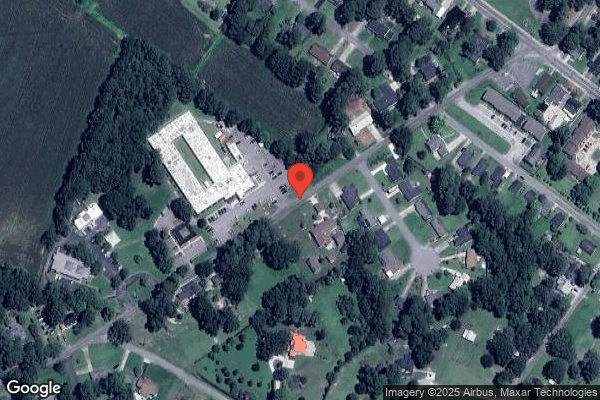
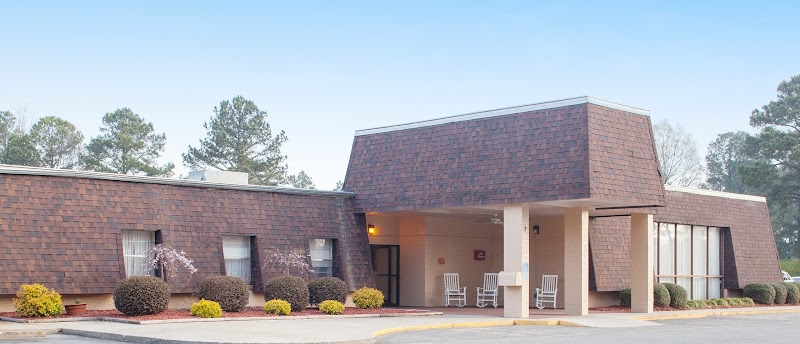
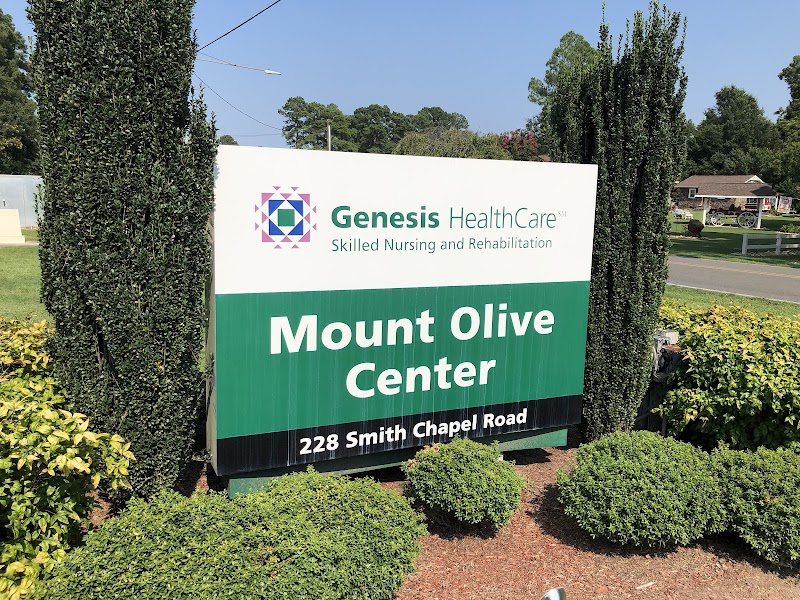
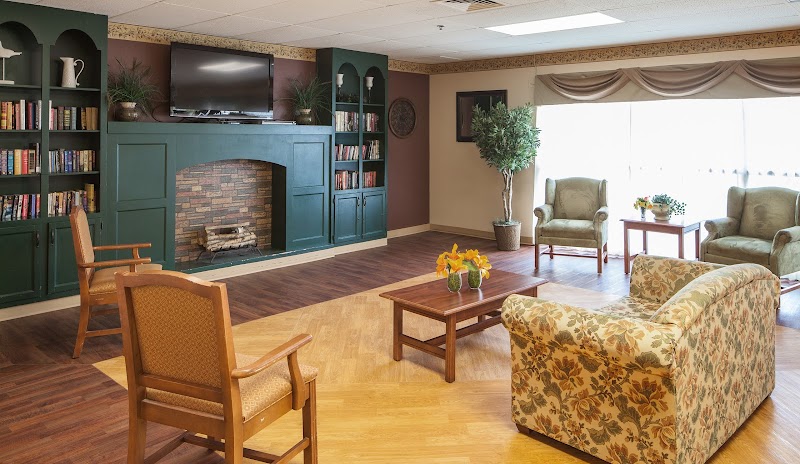
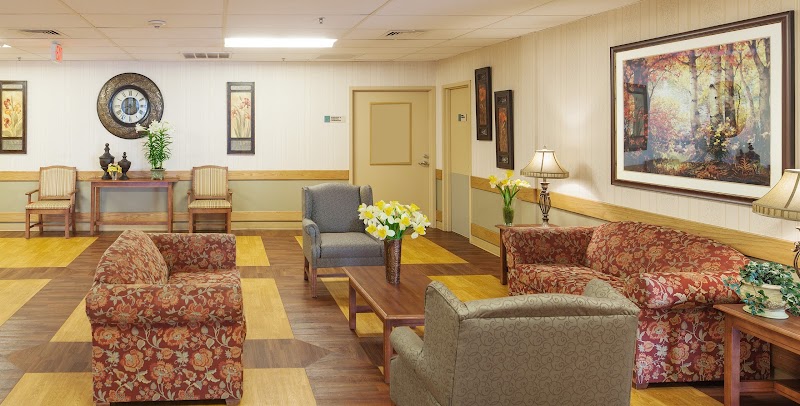
Mount Olive Center

228 Smith Chapel Road, Mount Olive, NC 28365 (919) 658-9522
For profit - Limited Liability company 150 Beds GENESIS HEALTHCARE Data: November 2025 4 Immediate Jeopardy citations
Trust Grade
0/100
#362 of 417 in NC
Last Inspection: June 2024

Within standard 12-15 month inspection cycle. Federal law requires annual inspections.

Overview

Mount Olive Center has received a Trust Grade of F, indicating significant concerns about the quality of care provided, which is the lowest rating possible. Ranking #362 out of 417 facilities in North Carolina places it in the bottom half, and #3 out of 4 in Wayne County means only one local option is better. While the facility shows an improving trend with a reduction in issues from 14 in 2024 to 5 in 2025, it still faces serious challenges, including a high staff turnover rate of 72%, which is concerning compared to the state average of 49%. Additionally, the facility has incurred $105,495 in fines, higher than 80% of North Carolina facilities, indicating ongoing compliance problems. There are serious issues highlighted in recent inspections, including critical incidents where a resident was not assessed for self-administration of enteral feedings and was seen engaging in unsafe behaviors with her feeding tube, which could lead to serious health risks. Another resident exhibited concerning symptoms, including severe rash and altered mental status, yet staff failed to communicate effectively, resulting in the resident being hospitalized in septic shock, where he unfortunately passed away. While there are some strengths, such as average quality measures, these severe deficiencies raise significant red flags for families considering this nursing home.

Trust Score
F
0/100
In North Carolina
#362/417
Bottom 14%
Safety Record
High Risk
Review needed
Inspections
Getting Better
14 → 5 violations
Staff Stability
⚠ Watch
72% turnover. Very high, 24 points above average. Constant new faces learning your loved one's needs.
Penalties
✓ Good
$105,495 in fines. Lower than most North Carolina facilities. Relatively clean record.
Skilled Nurses
⚠ Watch
Each resident gets only 15 minutes of Registered Nurse (RN) attention daily — below average for North Carolina. Fewer RN minutes means fewer trained eyes watching for problems.
Violations
⚠ Watch
42 deficiencies on record. Higher than average. Multiple issues found across inspections.
★☆☆☆☆
1.0
Overall Rating
★☆☆☆☆
1.0
Staff Levels
★★★☆☆
3.0
Care Quality
★☆☆☆☆
1.0
Inspection Score
Stable
2024: 14 issues
2025: 5 issues

The Good

  • Full Sprinkler Coverage · Fire safety systems throughout facility
  • No fines on record

Facility shows strength in fire safety.

The Bad

1-Star Overall Rating

Below North Carolina average (2.8)

Significant quality concerns identified by CMS

Staff Turnover: 72%

26pts above North Carolina avg (46%)

Frequent staff changes - ask about care continuity

Federal Fines: $105,495

Well above median ($33,413)

Significant penalties indicating serious issues

Chain: GENESIS HEALTHCARE

Part of a multi-facility chain

Ask about local staffing decisions and management

Staff turnover is very high (72%)

24 points above North Carolina average of 48%

The Ugly 42 deficiencies on record

4 life-threatening 3 actual harm
Oct 2025 3 deficiencies 1 IJ
CRITICAL (J) 📢 Someone Reported This

A family member, employee, or ombudsman was alarmed enough to file a formal complaint

Immediate Jeopardy (IJ) - the most serious Medicare violation

Accident Prevention (Tag F0689)

Someone could have died · This affected 1 resident

**NOTE- TERMS IN BRACKETS HAVE BEEN EDITED TO PROTECT CONFIDENTIALITY** Based on observations, record review, and resident, staff, Nurse Practitioner, (NP) Psychiatric NP and Medical Director intervie...

Read full inspector narrative →
**NOTE- TERMS IN BRACKETS HAVE BEEN EDITED TO PROTECT CONFIDENTIALITY** Based on observations, record review, and resident, staff, Nurse Practitioner, (NP) Psychiatric NP and Medical Director interviews, the facility failed to assess a resident for self-administration of her enteral feedings (a method of delivering nutrition directly into the gastrointestinal tract, typically through a feeding tube, for individuals who cannot consume food orally) and to put effective interventions in place after Resident #13 was repeatedly observed by staff putting unidentified liquids in her gastronomy tube (g-tube [provides nutrition via a liquid formula delivered through a flexible tube that is surgically placed through the abdomen into the stomach]); rummaging through the trash for food /liquids; chewing and spitting out food items into the trash can; obtaining food as a prize for bingo; and disconnecting herself from her g-tube pump and removing the tube feeding formula bag during continuous feedings. Resident #13 had a diagnosis of vascular dementia and had an order for NPO (nothing by mouth) status due to dysphagia (difficulty swallowing). She was determined to have impaired insight and judgement by the Psychiatric NP. On 9/15/25 Resident #13 was observed by the surveyor administering to herself via bolus (administration of a limited volume of formula through a feeding tube over brief periods of time) the contents of a bottle labeled Jevity (tube feeding formula) dated 9/12/25 that contained a light tan milk-like liquid. The Medical Director indicated Resident #13 self-administering her tube feedings put Resident #13 at risk of serious injury/harm from aspiration (accidental inhalation of foreign substances, such as food, liquid, or air, into the lung which can lead to aspiration pneumonia), overfeeding, and infection. The deficient practice occurred for 1 of 1 resident reviewed for tube feeding Resident #13).Immediate Jeopardy began on 9/15/25 when Resident #13 was observed self-administering via her g-tube the contents of a bottle labeled Jevity dated 9/12/25 that contained a light tan milk-like liquid. Immediate Jeopardy was removed on 9/20/25 when the facility implemented an acceptable credible allegation of Immediate Jeopardy removal. The facility remains out of compliance at a lower scope and severity of D (no actual harm with potential for more than minimal harm that is not immediate jeopardy) to ensure education and monitoring systems put into place are effective.The findings included:A hospital Discharge summary dated [DATE] stated Resident #13 had a g-tube placement in 2015 secondary to a stroke. The discharge summary stated Resident #13 was admitted on [DATE] due to a swelling in her left hand and upper left extremity. She was diagnosed with left internal jugular vein thrombosis (a medical condition where a blood clot forms in a blood vessel and stops blood flow) and pneumonia. Her g-tube dislodged on 3/6/25 and she was treated for hypoglycemia (a condition where the blood sugar drops below normal) which was resolved after initiation of tube feeds. She was discharged to the facility on 3/8/25.Resident #13 was admitted to the facility on [DATE] with diagnoses that included dysphagia (difficulty swallowing) and gastrostomy (opening of the stomach) for enteral feedings, malnutrition and vascular dementia. Review of Resident #13's face sheet indicated Resident #13 was her own responsible party.A physician's order dated 3/8/25 read Jevity 1.5 Cal administer continuously via pump at 60 milliliters (ml) per hour 24 hours per day or until total nutrient delivered.The manufacturer's instructions for Jevity indicated careful handling was required to prevent potential for microbial contamination. Microbial contamination can lead to serious harm and/or death. All medical foods, regardless of type of administration system, require careful handling because they can support microbial growth.A physician's order dated 3/9/25 read NPO.Resident #13's care plan had a focus of tube feeding dated 3/12/25 which stated, Resident had an enteral feeding tube to meet nutritional needs r/t (related to) an inability to consume sufficient calories and/or nutrients by mouth safely due to NPO status, Gastrostomy, Vascular Dementia, CVA, Hemiplegia Affecting Left Nondominant Side, Dysphagia, Cachexia, Severe Protein-Calorie Malnutrition. Interventions included flush tube with 15 milliliters of water before and after each medication pass, flush tube with 15 milliliters of water with each medication, flush tube with 15 milliliters of water between each medication, check placement of tube daily and before administering feedings and medications, check for clogs in tube daily and before administering feedings and medications, check for gastric residual volume prior to feeding or medication administration, and monitor labs.A physician's order dated 3/14/25 specified to flush tube with 50 ml of water every 4 hours during continuous tube feeding.A Nurse Practitioner (NP) progress note dated 4/4/25 stated it had been reported by nursing that Resident #13 has been taking herself off tube feeding and had a blood sugar of 44 on 4/3/25 due to it not running. She was also observed by the NP taking gauze, tape and supplies off a nursing cart. When asked to return the supplies she did so. Resident was further noted to have a cup of water which she stated was to flush her feeding tube. She did not have a syringe. Resident received education that she cannot swallow properly and so she needs to be more careful and not to attempt to eat or drink.A NP progress note dated 4/7/25 stated Resident #13 had lost weight since admission since she had been disconnecting her tube feeding at times. The note further stated Resident #13's blood sugars were less than 100 when not running her tube feeding continuously. There was no mention of educating the resident within the note. A nursing progress note written by Nurse #9 dated 4/10/25 stated Resident #13 repeatedly stopping tube feeding, turning off pump, disconnecting tube, clamping off tube frequently throughout shift. She was trying to be off continuous feed more than she is allowing it to infuse throughout the course of the shift. Resident #13 was also getting up in wheelchair and going into other residents' rooms. She also was digging through the trash can in the day room more than once. She asked to keep partially used feeding bottles and flush bag when replaced daily. It was explained that once it had been accessed for 24 hours bacterial growth begins. It was further explained that only unpunctured bottles are shelf stable. Resident #13 continued to be found getting the bottles out of the trash and trying to store them in her closet.Nurse #9 was not interviewed.A physician's order dated 4/11/25 read Jevity 1.5 Cal. Administer continuous via pump 65 ml per hour 24 hours per day. A progress note written by Nurse #10 dated 4/14/25 revealed Resident #13 continued to pause her continuous feeding. The nurse spoke to Resident #13 about stopping her feeding without informing the nurse. The note also stated Resident #13 had to go to a local emergency department to have her g-tube replaced due to giving herself a bath. When her glucose was checked her range was 58/34. Resident #13 was given sugar water, med pass with sugar and a glucose injection in her right arm. Blood glucose was rechecked and her level increased to 101. The note additionally stated when resident is not on her feeding her glucose level decreases and education was provided.Nurse #10 was not interviewed.A speech therapist note dated 4/22/25 indicated speech therapy services were not indicated at this time. There were no other speech therapy assessments completed.A progress note dated 5/8/25 written by the NP revealed Resident #13 had been hoarding anything she could find in the facility and had developed a large pile of things by her bed. She stated they were her things and did not want them touched. The note further revealed the NP placed an order for a psychiatric consult due to paranoia, hoarding and anxiety. A nursing progress note written by Nurse #11 dated 5/21/25 read that Resident #13 had turned off her tube feeding and unhooked her g-tube to go out of her room for short periods of time. Resident #13 was educated that she is on continuous feedings at this time and is at risk for weight loss. An initial psychiatric evaluation by the Psychiatric NP dated 5/22/25 revealed Resident #13 was diagnosed with hoarding disorder and other specified anxiety disorders. She was referred due to paranoia and signs of hoarding and anxiety. During this evaluation, Resident #13 was noted to have multiple snacks in her wheelchair. She also was noted to have excessive oral secretions and had a cup in her wheelchair to spit in. Resident #13 was noted to exhibit extreme hoarding tendencies, often collecting medical items and belongings from others in her room. She had no explanation for doing this. Resident #13 was assessed as having limited insight and poor judgement. Her cognition was intact. Resident #13 was ordered fluoxetine (antidepressant that treats depression, anxiety and other disorders) 20 mg (milligrams) each morning for anxiety and hoarding. Follow-up included psychiatric follow-up for management of anxiety, hoarding and adjustment on a regular basis.A physician's order dated 5/23/25 read every day and night shift until 5/25/25 administer continuous Jevity 1.5 Cal via pump at 70 ml per hour. Increase by 20 ml per hour every four hours, until goal rate of 130 ml per hour. On at 8:00 PM and off at 8:00 AM. A physician's order dated 5/24/25 instructed staff to flush tube with 120 milliliters of water before each feeding and flush tube with 120 milliliters of water after each feeding.A medical provider order was written on 5/24/25 for fluoxetine 20 milligrams (mg) via g-tube once a day for anxiety and hoarding behaviors.A physician's order dated 5/25/25 specified Jevity 1.5 Cal administer every day and night shift via pump at 130 ml per hour 12 hours per day. On at 8:00 PM and off at 8:00 AM. Review of Resident #13's medical record revealed no assessments or physician orders for self-administration of her tube feedings. A follow-up psychiatric evaluation by the Psychiatric NP dated 6/5/25 revealed Resident #13 exhibited fair insight and judgement during this session.Resident #13's care plan dated 7/2/25 reflected behaviors such as retrieving items out of trash cans to include food items; self-administering water, soda, and enteral feeding in her g-tube; and putting food items in her mouth, chewing them up, and spitting them out. Interventions included: educate and remind resident that according to her physician's orders she is NPO status and cannot eat or drink by mouth and she can only receive 100% nutrition/medications/water via G-tube via nurses and notify physician/family as indicated. Another focus of the care plan dated 7/2/25 was physical behaviors related to poor impulse control as well as going into other patients' rooms and taking items. Interventions included: remind resident she cannot go in other rooms and take things, psych (psychiatric) consult as needed, seek staff support, and Social Service visits. An additional focus of the care plan dated 7/18/25 stated Resident #13 had a decline in cognitive function or impaired thought processes related to dementia. Interventions included: observe for changes in cognitive status, allow resident to make choices about care and explain all interventions. Resident #13's significant change Minimum Data Set (MDS) assessment dated [DATE] revealed she was assessed as having moderate cognitive impairment with no behaviors. Her assessment reflected the use of a feeding tube for 51% or more of her total calories. The assessment reflected Resident #13 needed extensive assistance from one person-assist for eating. Resident #13 utilized a wheelchair for mobility.A follow-up psychiatric evaluation by the Psychiatric NP dated 7/22/25 revealed reports that Resident #13 continued to take items that do not belong to her and store them in her room along with her own belongings that she has piled in her room. Resident #13 was assessed as having limited insight and poor judgement.A progress note dated 7/29/25 written by the NP revealed she was informed by nursing staff Resident #13 continued to roll around the unit taking things and placing them in her room. A physician's order dated 8/9/25 specified Jevity 1.5 Cal to be administered at 120 ml per hour, 12 hours per day. On at 8:00 PM and off at 8:00 AM.A follow-up psychiatric evaluation by the Psychiatric NP dated 8/19/25 revealed Resident #13 continued to take items that did not belong to her and couldn't explain why. Cognitive behavioral strategies were attempted but she was not cognitively able to participate. Evaluation further read, although she is fairly alert and oriented on basic cognition, screening, her insight and judgement are so impaired that I do not feel that psychotherapy is ‘sticking' from visit to visit.During an interview with the Psychiatric Nurse Practitioner on 9/17/25 at 10:07 AM she reported Resident #13 had no insight or judgement about her behaviors and how they may be harmful. She reported when Resident #13 was questioned about going through the trash she stated she was looking for something to use to make crafts for her grandchildren.A nursing progress note written by Unit Manager #1 dated 9/3/35 stated Resident #13 was found outside engaged in self-feeding with a syringe via g-tube utilizing several bottles of sports drink and juice to flush the tube. Resident #13 was educated about physician orders, the feeding process and safety measures. A review of Resident #13's September 2025 MAR recorded a Jevity 1.5 enteral feeding was started at 8:00 PM on 9/12/2025 by Nurse #6. There was no allotted time and/or space on the MAR to document when the second bottle of Jevity 1.5 enteral feeding bottle was started for Resident #13. Therefore, there was no documentation on the MAR when Nurse #6 started a second bottle of Jevity 1.5 enteral feeding for Resident #13 on 9/12/2025.A phone interview was conducted with Nurse #7 on 9/16/25 at 10:03 AM who stated Resident #13's tube feeding stayed on the pole of the tube feeding pump after it was turned off in the morning on 9/13/2025. She stated either Resident #13 unhooked herself or the night shift nurse did this. Nurse #7 stated on 9/13/25 at 7:00 AM when she assumed care Resident #13 was unhooked from the feeding pump and dressed. She reported she had caught Resident #13 with water in a sports drink bottle approximately one month ago. She stated Resident #13 used the water to flush her tube. Nurse #7 stated she stopped Resident #13 from flushing her tube and disposed of the sports drink bottle. She indicated this occurred only once and she provided education to the resident. During an observation on 9/14/25 at 9:30 AM as the survey team was entering the facility, Resident #13 was observed in a wheelchair to the left of the facility's front entrance on the concrete sidewalk. She was observed holding her gastrostomy tube (g-tube) with her left hand and holding a milk-like substance in a clear bottle in her right hand. Resident #13 was observed on 9/15/25 at 7:10 AM self-propelling herself via wheelchair into the room leading outside into the smoking area. A black bag was observed on the back of the wheelchair with two bottles of clear liquid and a bottle with a milk-like substance with no labels on the bottles observed.A continuous observation occurred on 9/15/25 from 7:20 AM until 7:30 AM of Resident #13 in a wheelchair in the living room that had the door that led out to the smoking area. She was positioned between a drink machine and a table with three clear plastic bottles on the table. Two of the bottles were small, unlabeled and filled with a clear liquid and one labeled (could not read the label) medium sized bottle that contained a light tan milk-like liquid. Resident #13 was observed connecting a syringe (60 milliliters) to the g-tube opening and turning the lock on the g-tube. She held her g-tube in her left hand and reached for one of the bottles with clear liquid with her right hand and filled the syringe with the clear liquid substance. Resident #13 then filled the syringe full of the light tan milk-like liquid while holding the g-tube upright and allowed the liquid to infuse by gravity. She followed with another syringe full of light tan milk-like liquid and used the piston of the syringe to push the remainder of the liquid into the g-tube. Resident #13 then filled the syringe with the clear liquid from one of the clear unlabeled plastic bottles to infuse via gravity. She continued and filled the syringe with the light tan colored milk-like liquid to infuse via gravity into the g-tube followed by a second syringe full of light tan milk-like liquid. She was observed using the piston to push the last syringe of the milky liquid into the g-tube. Resident #13 then filled the syringe full of clear liquid to flow via gravity into the g-tube. She then pushed the lock of the g-tube and placed the bottles that had the clear liquid into the black bag on the back of her wheelchair. She returned the syringe and piston into a plastic bag. The syringe and piston was observed in a plastic bag that was not labeled with the date and placed it in the black bag on the back of her wheelchair. The medium sized bottle was observed on the table and was labeled Jevity 1.5 with a label dated 9/12/25 0500 (5:00 AM) 130 ml/hr and there was approximately 100 milliliters left in the bottle. There was no expiration date observed on the bottle of Jevity 1.5. Resident #13 stated it was her bottle, and it came from her house. While the surveyor was addressing Resident #13 about the bottle of milky liquid Unit Manager #3 walked in and asked if there was a problem. Unit Manager #3 was shown the label of the bottle and informed the surveyor was attempting to identify the liquid Resident #13 was observed inserting in her g-tube and the surveyor returned the bottle to the table.In an interview with Unit Manager #3 on 9/15/2025 at 8:07 pm, she stated she had started at the facility a couple weeks ago and Resident #13 was a resident that did her own thing at the facility self-propelling through the hallways. She stated she had never seen Resident #13 self-administer an enteral feeding through the g-tube and on the morning of 9/15/25 she only recalled seeing Resident #13 with the Jevity bottle and the milk-like liquid in the Jevity bottle on the table in the living room.An interview was conducted with Resident #13 on 9/16/25 at 11:00 AM. She reported she did not get her tube feeding on 9/14/25 because it was never hooked up. She reported she was hungry and that was the reason she was observed giving herself a tube feeding the previous morning (9/15/25). Resident #13 stated she gave herself 3 tube feedings daily and sometimes she received tube feeding continuously at night. She further stated she disconnected her tube feeding to go to smoke and to use the bathroom at night. She reported the tube feeding solution she was using on 9/15/25 came from her home. Resident #13 indicated she would dig in the trash cans in order to use the items she found to make crafts for her grandchildren. She was not aware of the amount of formula she was ordered and could not articulate dangers of administering more tube feeding than ordered. A telephone interview was conducted with Nurse #6 on 9/15/25 at 6:55 PM who reported she was familiar with Resident #13. She stated Resident #13 had turned her tube feeding off when not asleep. Nurse #6 stated Resident #13 often does what she wants to do. She reported that she hung a bottle of tube feeding solution at 5:00 AM on 9/12/25. Nurse #6 stated Resident #13 must have taken the bottle down from the pole for the bottle dated 9/12/25 to be in Resident #13's possession. She further stated staff had discussed among themselves to not leave trash in Resident #13's room. Nurse #6 stated some nights Resident #13 had been caught self-administering her tube feeding and she would redirect her. She further stated Resident #13 would steal tube feeding solution from the top of the medication carts. Nurse #6 stated she had witnessed Resident #13 taking another resident's tube feeding off the medication cart and retrieved it from Resident #13. She stated she had not witnessed Resident #13 going through trash cans. Nurse #6 indicated Resident #13 kept empty bottles in her room and filled the empty bottles with water from the bathroom sink. She stated she had never seen Resident #1 get bottles out of the trash, but suspected Resident #13 was going through the trash to obtain them. Nurse #6 reported she would stop Resident #13 from filling the empty bottles with water. On 9/15/25 at 8:45 am a 1000 milliliter bottle of Jevity 1.5 with 1000 milliliters observed hanging on the pump for continuous feedings in Resident #13's room. A syringe packet was observed which was dated 9/15/25, the Jevity 1.5 bottle was labeled 9/14/25 2000 (8:00 PM) and a water bag was dated 9/13/25 0500 (5:00 AM). The tip of the tubing connected to the tube feeding formula and water was observed hanging downward from the pump with no end cover. When the tube feeding pump was turned on the settings were observed cleared. There was no flush or tube feeding infusion rate set on the pump. Resident #13 was not present in the room at the time of the observation.Review of Resident #13's September 2025 Medication Administration Record (MAR) revealed the 9/14/25 feeding was signed off at 8:00 PM by Nurse #1. The order specified for Jevity 1.5 Cal to be administered every day and night shift continuous via pump at 130 milliliters per hour. 12 hours per day (On at 8:00 PM and off at 8:00 AM). A telephone interview was conducted with Nurse #1 on 9/15/25 at 6:36 PM who stated 9/14/25 was her first time working with Resident #13. She reported that she worked from 7:00 PM to 7:00 AM on 9/14/25. She stated she was told in report by Nurse #7 that Resident #13 administered her own tube feeding. When Nurse #1 was asked if Resident #13 self-administered enteral feedings through the g-tube, Nurse #1 stated she was unaware if Resident #13 had an order for self-administration for tube feeding. Nurse #1 stated she was told Resident #13 gets up out of bed and disconnects the tube feeding. She stated she was also told that Resident #13 turned the pump on and off when she got up and at night. Nurse #1 stated Resident #13 was already hooked up to her tube feeding when she entered the room on 9/14/25 at 8:00 PM. Nurse #1 could not explain why there was still 1000 ml in the tube feeding formula bottle on 9/15/25 at 8:45 am. An interview was conducted with Unit Manager #1 on 9/15/25 at 3:03 PM who stated she had removed the Jevity and water bottle from Resident #13's room that morning. She reported the Jevity bottle was dated 9/14/25 at 8:00 PM and the water flush was labeled 9/13/25. Unit Manager #1 stated she removed the items because she observed there was no cover on the tip of the tubing that was inserted into the g-tube. Unit Manager #1 stated she could not recall how much tube feeding formula was in the Jevity bottle when she removed the bottle from the pole on 9/15/2025. An interview and observation were conducted with Resident #13 on 9/15/25 at 8:53 AM who stated sometimes she administered her tube feeding and sometimes the facility did it. She further stated she administered her tube feedings when she lived at home. Resident #13 indicated it was not a continuous feeding. Resident #13 stated she was not able to swallow and spit her saliva into a cup. She was observed with a cup to spit her saliva in during the interview and observation.During an observation on 9/15/25 at 4:30 PM Resident #13 was observed leaning into the trash can at the front entrance of the facility. Unit Manager #2 was observed outside at this time. Resident #13 was not observed taking anything out of the trash can. An interview was conducted with Unit Manager #2 on 9/16/25 at 12:00 PM who stated she was outside on 9/15/25 but did not see Resident #13 take anything out of the trash can. She reported she did not see Resident #13 at the trash can. During an observation of Nurse #4 hanging Resident #13's the tube feeding on 9/15/25 at 8:20 PM, an empty Jevity 1.5 bottle enteral feeding bottle labeled 9/15/2025 2000 (8:00pm) at 50 ml/hr was observed in the trash can, a 12-ounce unopened soda can was observed on the floor and a small 8-ounce apple juice bottle that was 1/2 full of a cloudy yellow substance was observed on the bedside table. Resident #13 stated the drinks were not hers. Nurse #4 started the tube feeding after the tube feeding solution was hung. At the end of the observation Nurse #4 left the room without emptying the trash which contained an empty Jevity 1.5 bottle or remove the bottle of apple juice and the can of soda.During an interview with Nurse #4 at 9/15/25 at 8:45 pm, she stated she was unaware of Resident #13's behavior of rummaging through the trash; however, she stated she was aware of Resident #13's behaviors concerning turning her enteral feeding pump on and off throughout the night. Nurse #4 reported she turns the pump back on when she hears the pump beeping which means it is not running. During an interview with the Activities Director on 9/15/25 at 8:15 PM she reported she was advised by the Speech Therapist last week that Resident #13 could not swallow. She stated the Speech Therapist asked her to consider other prizes other than food for bingo. The Activities Director stated she was not aware that Resident #13 could not have any nutrition or fluids by mouth. She reported this information was never reported to her. The Activities Director stated Resident #13 had received food prizes for winning bingo beginning 7/15/25. She stated the prizes consisted of oatmeal cakes, toaster pastries, and peanut-butter and cheese crackers. The Activities Director stated she had never seen the resident consume any food or fluids. A telephone interview was conducted with Speech Therapist on 9/17/25 at 11:20 AM. She reported Resident #13 was unable to swallow. Speech Therapist #1 stated she spoke with the Activities Director the previous week about considering other prizes other than food for bingo. Resident #13 liked to go to bingo and should not be given food prizes. The Speech Therapist stated there is a risk of choking if Resident #13 attempted to eat food and there was a risk of aspiration as she was not able to swallow. The Speech Therapist stated she was not working with Resident #13 and Resident #13 had never been on her caseload because the resident was not able to swallow. She reported Resident #13 had come to her on several occasions and asked to be evaluated to eat again. She reported that she had told Resident #13 when she was able to swallow her saliva they could work on an evaluation to eat again. The Speech Therapist further stated she had given Resident #13 ice chips when Resident #13 would come to her and discuss receiving nutrition by mouth and Resident #13 would have to spit them out because she could not swallow. She stated she had been made aware by staff that Resident #13 had food in her room but didn't take any action. She reported she felt the food couldn't be removed because it was the resident's property. The Speech Therapist stated she did not document when she gave Resident #13 ice chips.A telephone interview was conducted with Registered Dietician (RD) #1 on 9/17/25 at 11:44 PM who stated speech therapy was working with Resident #13 on her ability to eat so she had not addressed changing her feedings. She stated she reviews resident charts from home and does not work within the facility. The ST stated the resident had never been on caseload. She reported she was unaware of any concerns related to Resident #13 eating, self-administration of tube feeding or going through trash cans. She stated she could not address concerns related to swallowing but there was potential for infection due to cross contamination from self-administration of tube feeding and using items from the trash in her tube feeding. A phone interview was conducted with Registered Dietician #2 on 9/17/25 at 12:03 PM. She stated she was not aware that Resident #13 had disconnected her tube feedings and a concern with Resident #13 disconnecting her tube feedings was not knowing how much tube feeding solution she was receiving. Registered Dietician #2 further stated it would be important to monitor Resident #13's blood sugar to ensure it does not drop. Registered Dietician #2 stated another concern would be fluid overload. She stated she was unsure if she had ever met Resident #13 because she is only in the facility one or two days a week. She reported Register Dietician #1 was responsible for reviewing charts and she (RD #2) attends care plan meetings and meets with new admissions.During an interview with the DON on 9/15/25 at 8:37 PM, she was informed Nurse #4 was observed exiting Resident #13's room and leaving an empty tube feeding bottle in the trash can, a half of a bottle of cloudy apple juice and a canned drink in Resident #13's room. The DON stated Resident #13 was care planned for retrieving items from the trash and reported Nurse #4 was an agency nurse and was not aware to remove the bottles and trash from Resident #13's room. DON stated she would educate Nurse #4 on Resident #13's care plan for behaviors. The DON stated staff, including agency staff, were educated on Resident #13's behaviors including rummaging through trash but could not provide specifics and did not provide documentation. During an interview with the Director of Nursing (DON) on 9/15/25 at 4:48 PM she reported Resident #13 could not swallow liquids or food. She reported she was aware that the resident would go through the trash, ask other residents for drinks and would disconnect her tube feeding at times. The DON was also aware Resident #13 would chew food items and spit them out. She reported the resident had been educated about the dangers of these behaviors by the staff members when they made the observation. The DON indicated that the resident had not been assessed for self-administration of her tube feeding. The DON stated she was not aware the Activities Director was giving food for bingo prizes to Resident #13. The DON acknowledged the dangers of all these behaviors and stated staff members would redirect Resident #13 when they observed the behaviors. An interview was conducted with the facility Nurse Practitioner (NP) on 9/17/25 at 12:25 PM. She reported it was dangerous for Resident #13 to self-administer her tube feedings. She stated Resident #13 had low blood sugars in the past from not receiving her tube feedings because she disconnected herself from the pump. NP further stated she was aware of Resident #13 self-administering her tube feeding and putting sports drink in her g-tube. She further stated she had seen Resident #13 in the trash and had witnessed her steal items such as gauze, gloves and briefs from the nurse's cart and she convinced Resident #13 to return the items. The NP stated the Registered Dietician needs to be aware of a deviation in the amount of tube feeding solution Resident #13 received in order to adjust tube feeding to ensure Resident #13 receives an adequate number of calories. She stated she was not aware the Registered Dietitian had not been informed about Resident #13 disconnecting her tube feedings and she had not discussed this with the physician. The NP stated that Resident #13 was going to do what she was going to do and that she did not have time to call the physician every time Resident #13 had behaviors. She stated she had talked with Resident #13 about the dangers of not getting her full amount of tube feeding but Resident #13 voiced compliance but then would continue the behaviors.During an interview with the Medical Director on 9/18/25 at 11:10 AM he stated Resident #13 self-administering her tube feedings put Resident #13 at risk of serious injury/harm from aspiration, overfeeding, and infection. He stated he was not made aware of this behavior or the behaviors such as digging in the trash and chewing/spitting out food. and had he been made aware he would have recommended 100% supervision during Resident #13's tube feedings.The Administrator was notified of Immediate[TRUNCATE
CONCERN (E) 📢 Someone Reported This

A family member, employee, or ombudsman was alarmed enough to file a formal complaint

Potential for Harm - no one hurt, but risky conditions existed

Deficiency F0760 (Tag F0760)

Could have caused harm · This affected multiple residents

**NOTE- TERMS IN BRACKETS HAVE BEEN EDITED TO PROTECT CONFIDENTIALITY** Based on record review and staff, Pharmacy Consultant #1 and Nurse Practitioner and Cardiologist interviews, the facility failed...

Read full inspector narrative →
**NOTE- TERMS IN BRACKETS HAVE BEEN EDITED TO PROTECT CONFIDENTIALITY** Based on record review and staff, Pharmacy Consultant #1 and Nurse Practitioner and Cardiologist interviews, the facility failed to prevent a significant medication error when a resident was administered blood pressure medication with a blood pressure recorded below the parameters ordered by the physician for 1 of 6 residents whose medication regimens were reviewed (Resident #113). Finding included: Resident #113 was admitted to the facility on [DATE] with diagnoses including hypertension (high blood pressure) and heart failure. Resident #113 was discharged from the facility on 9/2/2025. A review of Resident #113's blood pressure recorded in the electronic medical record from 6/6/2025 to 7/31/2025 ranged from 101/50 mmHg to 164/43 mmHg. The admission Minimum Data Set (MDS) assessment dated [DATE] indicated Resident #113 was cognitively intact and was coded for hypertension. Resident #113's quarterly MDS dated [DATE] was coded for orthostatic hypotension (sudden drop in blood pressure when a person stands up after sitting or lying down that can cause dizziness). Resident #113's care plan dated reviewed last on 6/18/2025 included a focus for a risk for cardiovascular symptoms or complications. Interventions included administering medications as ordered, assessing for effectiveness and reporting abnormalities to the physician and assessing and monitoring vital signs as ordered and reporting abnormalities to the physician. Nursing documentation dated 7/15/2025 by Unit Manager #2 recorded Resident #113 blood pressure was 86/50 and the Nurse Practitioner was notified. Nurse Practitioner (NP) progress notes dated 7/15/2025 recorded while Resident #113 was having a therapy session, Resident #113 became lightheaded, dizzy and a drop in blood pressure. The NP recorded with Resident #113 positioned in bed with feet elevated, Resident #113 vital signs improved. NP rechecked on Resident #113 also later in the evening of 7/15/2025 with Resident #113 reporting she was feeling better and discussing with therapy Resident #113 needs and monitoring in therapy. NP progress notes further recorded Resident #113 had discussed with the NP that the cardiologist had recommended changing her medications and Resident #113 was scheduled to follow up with the cardiologist the following week. A review of the occupational therapy notes recorded on 7/15/2025 Resident #113 complained of feeling lightheaded during the therapy session and nursing was notified. On 7/17/2025 occupation therapy notes recorded Resident #113 decline sitting on the edge of the bed or getting out of the bed due to concerns of her blood pressure dropping when upright and nursing staff were notified. A review of the physical therapy notes on 7/15/2025 and 7/22/2025 recorded Resident #113 experienced dizziness and a drop in her blood pressure. On 7/15/2025, Resident #113's blood pressure was recorded as 84/69 mmHg after standing for therapy and on 7/22/2025 the blood pressure was recorded as 84/54 mmHg. Resident #113 was transferred back to bed and nursing staff notified. The physical therapy notes recorded no other complaints of dizziness or reports of drops in Resident #113's blood pressure during therapy session that were discontinued on 8/14/2025. The Cardiology Provider progress notes dated 7/24/2025 recorded Resident #113 had recent episodes of dizziness upon standing/positioning that were likely due to reduced heart function, inactivity and possible autonomic neuropathy from diabetes. Treatment plan included Midodrine (a medication used to treat low blood pressure that cases severe dizziness) 5 milligrams (mg) 30 minutes before therapy to stabilize blood pressure and prevent drops in Resident #113's blood pressure, monitor Resident #113's blood pressure twice daily and record blood pressure readings and hold Coreg if systolic (first number in blood pressure reading) blood pressure was less than 150 millimeters of mercury (mmHg). Physician's orders dated 7/25/2025 included Coreg 12.5mg twice a day for blood pressure; hold for systolic blood pressure (top reading of a blood pressure) less than 150 mmHg and Midodrine HCL 5mg once a day for orthostatic hypotension. The Medication Administration Record (MAR) for July 2025, August 2025 and September 2025 for Resident # 113 were reviewed. Midodrine 5mg was administered daily as ordered. Coreg 12.5mg was scheduled on the MAR twice a day at 9:00 AM and 9:00 PM for blood pressure with a parameter recorded to hold for systolic blood pressure less than 150 mmHg. In July 2025 from 7/25/2025 to 7/31/2025, 3 out of the 14 scheduled doses of Coreg 12.5mg were recorded on the MAR as administered to Resident #113 when the blood pressure was recorded less than 150 systolic.On 7/26/2025 with a blood pressure reading recorded as 132/75 mmHg.On 7/27/2025 with a blood pressure reading recorded as 144/69 mmHg.On 7/28/2025 with a blood pressure reading recorded as 142/78mmHg. Review of the occupational therapy note recorded on 7/28/2025 Resident #113 reported feeling dizzy with transfer to the bathroom. Nurse was notified and blood pressure was within the normal range. In the month of August 2025, 37 out of the 62 scheduled doses of Coreg 12.5mg were recorded on the MAR as administered to Resident #113 when the blood pressure was recorded less than 150 mmHg systolic:On 8/2/2025 with a blood pressure reading recorded as 142/63 mmHg. On 8/3/2025 with a blood pressure reading recorded as 146/66 mmHg. On 8/4/2025 with a blood pressure reading recorded as136/78 mmHg and140/76 mmHg.On 8/5/2025 with a blood pressure reading recorded as 128/62 mmHg.On 8/6/2025 with a blood pressure reading recorded as 146/70 mmHg.On 8/7/2025 with a blood pressure reading recorded as 126/76 mmHg. On 8/8/2025 with a blood pressure reading recorded as 125/80 mmHg and 142/78 mmHg.On 8/9/2025 with a blood pressure reading recorded as 144/75 mmHg and 144/75 mmHg.On 8/10/2025 with a blood pressure reading recorded as 123/67 mmHg and 135/79 mmHg.On 8/11/2025 with a blood pressure reading recorded as 135/79 mmHg.On 8/12/2025 with a blood pressure reading recorded as 128/64 mmHg. On 8/13/2025 with a blood pressure reading recorded as 117/61 mmHg. On 8/14/2025 with a blood pressure reading recorded as 104/60 mmHg and 129/76 mmHg.On 8/15/2025 with a blood pressure reading recorded as 128/61 mmHg and 133/63 mmHg. On 8/16/2025 with a blood pressure reading recorded as 143/70 mmHg.On 8/17/2025 with a blood pressure reading recorded as 143/70 mmHg and 135/69 mmHg.On 8/18/2025 with a blood pressure reading recorded as 120/68 mmHg.On 8/21/2025 with a blood pressure reading recorded as 121/76 mmHg.On 8/22/2025 with a blood pressure reading recorded as 100/71 mmHg and 135/59 mmHg.On 8/24/2025 with a blood pressure reading recorded as 138/58 mmHg.On 8/26/2025 with a blood pressure reading recorded as 122/74 mmHg and 131/75 mmHg.On 8/27/2025 with a blood pressure reading recorded as 133/72 mmHg.On 8/28/2025 with a blood pressure reading recorded as 127/70 mmHg and 129/74 mmHg.On 8/29/2025 with a blood pressure reading recorded as 129/74 mmHg and 130/72 mmHg.On 8/30/2025 with a blood pressure reading recorded as 122/79 mmHg and 117/65 mmHg. Review of the occupational therapy note recorded on 8/1/2025, Resident #113 was able to tolerate the therapy session but complained of dizziness during the therapy session with Resident #113's blood pressure recorded as 110/53. There were no other reports of Resident #113 experiencing dizziness or drops in blood pressure during therapy sessions. In September 2025 from 9/1/2025 to 9/3/2025, 1 out of the 3 scheduled doses of Coreg 12.5mg were recorded on the MAR as administered to Resident #113 when the blood pressure was recorded less than 150 systolic.On 9/2/2025 with a blood pressure reading recorded as 132/77 mmHg. The monthly Pharmacy Consultant's Medication Regimen Reviews dated 7/31/2025 and 8/30/2025 recorded Coreg was given and should have been held for systolic blood pressure less than 150 mmHg on 7/26/2025, 8/2/2025, 8/3/2025, 8/4/2025, 8/5/2025, 8/6/2025, 8/7/2025, 8/8/2025, 8/9/2025, 8/10/2025, 8/11/2025, 8/12/2025, 8/13/2025, 8/14/2025, 8/15/2025, 8/16/2025, 8/17/2025, 8/18/2025, 8/20/2025, 8/21/2025, 8/22/2025, 8/24/2025 and 8/26/2025. There was no documentation that the recommendations on MRRs dated 7/31/2025 and 8/30/2025 for Coreg were addressed by a medical provider or nursing staff. In an interview on 9/19/2025 at12:16 PM, the Certified Occupational Therapy Assistant stated Resident #113's had experienced some episodes of dizziness with a drop in her blood pressure during therapy. She explained Resident #113 was started on a medication to treat orthostatic hypotension that was administered to Resident #113 before therapy sessions and Resident #113 was able to participate more in therapy with decrease complaints of dizziness. In an interview on 9/17/2025 at 5:09 PM. Nurse #7 reviewed Resident #113's August 2025 and September 2025 MAR and stated based on her documentation on the MARs she administered Coreg to Resident #113 on 8/26/2025, 8/14/2025 and 9/2/2025. Nurse #7 stated based on the physician order on the August 2025 and September 2025 MARs to hold for systolic blood pressure less than 150 mmHg, the medication Coreg should not have been administered to Resident #113 when the blood pressure was recorded less than 150 mmHg. Nurse #7 explained she checked Resident #113 blood pressure before giving the medication and did not read the order completing before administering the mediation. In an interview on 9/17/2025 at 5:33 PM, when Medication Aide #1 read Resident #113 order for Coreg on the August 2025 MAR, she stated Resident #113's systolic blood pressure was less than 150 mmHg and asked what was wrong in administering Resident #113 the medication. When Medication Aide #1 re-read the physician order for Coreg administration, she stated based on the physician order on the August 2025 MAR, she shouldn't have administered the medication on 8/8/2025, 8/9/2025, 8/10/2025 and 8/22/2025 to Resident #113 based on the blood pressure recordings were less than 150 mmHg. Medication Aide #1 stated she did not know why she administered Resident #113 the medication with the order to hold the medication for blood pressure less than 150 mmHg. In a phone interview on 9/19/2025 at 9:41 AM, Nurse #8, who recorded administering 12 doses of Coreg to Resident #113 when the systolic blood pressure was recorded less than 150 mmHg, stated the documentation on the July 2025 and August 2025 MAR was incorrect. Nurse #8 could not explain why she had recorded on the MAR that the medication Coreg was administered on 7/27/2025, 8/2/2025, 8/3/2025, 8/8/2025, 8/9/2025, 8/10/2025, 8/15/2025, 8/16/2025, 8/17/2025, 8/22/2025, 8/24/2025 and 8/30/2025 but insisted Resident #113 knew what medications were administered and Resident #113 would not have allowed her to administer the medication. In an interview on 9/17/2025 at 5:50 PM, the Director of Nursing recalled Resident #113 experiencing some orthostatic hypotension with therapy sessions that was treated with medication. After reviewing the August 2025 MAR for Coreg administration, she explained if the nurses did not scroll down the MAR to view the entire medication order, the nurses may have not seen the hold order for the medication Coreg. She stated she did not know why the nurses did not hold the medication when the systolic blood pressure was recorded less than 150 mmHg and stated the medication; Coreg should have been held per the physician's order when Resident #113 systolic blood pressure was recorded less than 150 mmHg. The DON further stated she did not recall any negative side effects due to Resident #113 receiving the medication when the systolic blood pressure was recorded less than 150 mmHg. In an interview on 9/19/2025 at 4:02 PM, the Pharmacy Consultant stated receiving Midodrine HCL daily prevented Resident #113 from becoming hypotensive (less than 90/60 mmHg). In an interview on 9/17/2025 at12:42 PM, the Nurse Practitioner explained Resident #113 was on Coreg to conserve her heart function to alleviate the possibility of heart surgery. Resident #113 was experiencing some orthostatic hypertension, and the Cardiologist ordered the Coreg to be held when systolic blood pressure was less than 150. She stated she was not aware or notified that Resident #113 had been administered Coreg when Resident#113's systolic blood pressure was recorded less than 150. She explained that the Cardiologist had ordered Midodrine HCL that would have worked opposite of the Coreg medication and Resident #113's symptoms of orthostatic hypotension improved. In a phone interview with the Cardiologist on 9/19/2025 at12:20 PM, she stated Resident #113 was seen in July 2025 for orthostatic hypotension. She explained Resident #113 reported she was not able to stand up and participate in therapy because of feeling dizzy when standing. She stated she ordered parameters to hold Resident #113's blood pressure medication if systolic blood pressure was less than 150 and started Resident #113 on Midodrine HCL 5mg a day for the orthostatic hypotension. She explained she had not seen Resident #113's July 2025, August 2025 or September 2025 Medication Administration Records that indicated the blood pressure medication was given when a blood pressure was recorded less than 150. She explained Midodrine HCL was medication that Resident #113 received daily to elevate Resident #113's blood pressure and therefore, when Coreg was administered when Resident #113's systolic blood pressure was less than 150mmHg, Resident #113's blood pressure was able to remain in the normal range for blood pressures.
CONCERN (E) 📢 Someone Reported This

A family member, employee, or ombudsman was alarmed enough to file a formal complaint

Potential for Harm - no one hurt, but risky conditions existed

Medical Records (Tag F0842)

Could have caused harm · This affected multiple residents

**NOTE- TERMS IN BRACKETS HAVE BEEN EDITED TO PROTECT CONFIDENTIALITY** Based on record review, observation, and staff interviews, the facility failed to maintain an accurate medical record in documen...

Read full inspector narrative →
**NOTE- TERMS IN BRACKETS HAVE BEEN EDITED TO PROTECT CONFIDENTIALITY** Based on record review, observation, and staff interviews, the facility failed to maintain an accurate medical record in documenting the administration of oxygen reviewed (Resident #39, and Resident #91) and medications (Resident #113) for 3 of 15 residents whose medical records were reviewed.1. Resident #113 was admitted to the facility on [DATE] with diagnoses including hypertension (high blood pressure) and heart failure. Physician's orders dated 7/25/2025 included Coreg 12.5 milligrams (mg) twice a day for blood pressure; hold for systolic less than 150 millimeters of mercury (mmHg). A review of Resident #113's July and August 2025 Medication Administration Record recorded Nurse #8 administered Coreg 12.5 mg with a blood pressure recording less than 150 mmHg: on 7/27/2025 with a blood pressure reading of 144/69 mmHg, 8/2/2025 with a blood pressure reading of142/63 mmHg, 8/3/2025 with a blood pressure reading of 146/66 mmHg, 8/8/2025 with a blood pressure reading of 142/78 mmHg, 8/9/2025 with a blood pressure reading of 144/75 mmHg, 8/10/2025 with a blood pressure reading of 135/79 mmHg, 8/15/2025 with a blood pressure reading of 133/63 mmHg, 8/16/2025 with a blood pressure reading of143/70 mmHg, 8/17/2025 with a blood pressure reading of 135/69 mmHg, 8/22/2025 with a blood pressure reading of135/59 mmHg, 8/24/2025 with a blood pressure reading of138/58 mmHg and 8/30/2025 with a blood pressure reading of 117/65 mmHg. In a phone interview on 9/19/2025 at 9:41 AM, Nurse #8, stated the documentation on the July 2025 MAR and August 2025 MAR was incorrect. Nurse #8 could not explain why she had recorded that the medication Coreg was administered on 7/27/2025, 8/2/2025, 8/3/2025, 8/8/2025, 8/9/2025, 8/10/2025, 8/15/2025, 8/16/2025, 8/17/2025, 8/22/2025, 8/24/2025 and 8/30/2025 and stated she did not document administration of the medication correctly. She explained Resident #113 would not have allowed her to administer the medication if her blood pressure was less than 150 mmHg. Nurse #8 stated the Resident's July MAR and August MAR reflected an inadequate record. In an interview on 9/19/2025 at 5:07 PM, the Director of Nursing stated Nurse #8 should not have documented the medication, Coreg, was administered to Resident #113 if not administered when the blood pressure was less than 150 mmHg. Therefore, Resident #113's July and August 2025 Medication Administration Records did not reflect an accurate record of Resident #113's medication administration. In an interview on 9/19/2025 at 7:00 PM, the Administrator stated Nurse #8 should have documented the administration accurately to ensure Resident #113's record was an adequate record. Findings included: 2. Resident #39 was admitted to the facility on [DATE] with diagnoses which included acute respiratory failure with hypoxia (a medical condition where the lungs are unable to adequately provide oxygen to the body, resulting in a dangerously low level of oxygen in the blood), severe persistent asthma with acute exacerbation, acute bronchitis and hypoxemia. Resident #39's Physician order dated 7/24/25 included an order for oxygen at 3 liters per minute to maintain 90% and above oxygen saturation via nasal cannula. A review of Resident #39's September 2025 Medication Administration Record (MAR) recorded Resident #39 received 3 liters of oxygen via nasal cannula on 9/15/25 and recorded oxygen saturation was 97 percent (%) documented by Medication Aide #1 Observation on 9/15/25 at 8:44 am Resident #39 was in his room lying in bed wearing a nasal cannula and his oxygen concentrator on 4 liters per minute. During an interview with Medication Aide #1 on 9/15/25 at 1:15 pm, she stated she was the medication aide for Resident #39 on day shift (7:00 am until 3:00 pm) for 9/15/25. Medication Aide #1 further stated the oxygen concentrator read 4 liters per minute and she documented at 4 liters per minute. During an interview on 9/15/25 at 2:02 pm with the Director of Nursing (DON), she stated the nursing staff should be reading the physician orders and checking the oxygen concentrators for the correct liters per minute setting every shift for accurate documentation. 3. Resident #91 was admitted to the facility on [DATE] with diagnoses which included chronic obstructive pulmonary disease (COPD), altered mental status, chronic systolic heart failure, and wheezing. Resident #91's Physician order dated 7/5/24 for oxygen at 2 liters per minute via nasal cannula for hypoxia. A review of Resident #91's September 2025 Medication Administration Record (MAR) recorded Resident #91 received 2 liters of oxygen via nasal cannula each shift on 9/14/25 and recorded oxygen saturations of 97 percent (%) documented by Nurse #2. Observations on 9/14/25 at 9:22 am and 9/14/25 at 1:45 pm revealed Resident #91 was in his room lying in bed wearing a nasal cannula and his oxygen concentrator on 6 liters per minute. In a phone interview with Nurse #2 on 9/17/25 at 4:15 pm, she stated she was the nurse for Resident #91 during the night shift (7:00 pm to 7:00 am). Nurse #2 further stated she documented Resident #91 was on 2 liters per minute in the MAR. During an interview on 9/15/25 at 2:02 pm with the Director of Nursing (DON), she stated the nursing staff should be reading the physician orders and checking the oxygen concentrators for the correct liters per minute setting every shift for accurate documentation.
Mar 2025 1 deficiency 1 Harm
SERIOUS (G) 📢 Someone Reported This

A family member, employee, or ombudsman was alarmed enough to file a formal complaint

Actual Harm - a resident was hurt due to facility failures

Quality of Care (Tag F0684)

A resident was harmed · This affected 1 resident

**NOTE- TERMS IN BRACKETS HAVE BEEN EDITED TO PROTECT CONFIDENTIALITY** Based on record review, and resident, staff, Nurse Practitioner (NP), surgical specialist's staff and Medical Director interview...

Read full inspector narrative →
**NOTE- TERMS IN BRACKETS HAVE BEEN EDITED TO PROTECT CONFIDENTIALITY** Based on record review, and resident, staff, Nurse Practitioner (NP), surgical specialist's staff and Medical Director interviews, the facility failed to administer the bowel preparation (the process of cleaning out the intestines) on two separate occasions. The first was for a scheduled colonoscopy (an exam used to look for changes in the large intestine) on 12/17/24 and the second was for a limited sigmoid colon (part of the large intestine that is close to the rectum) resection (the process of cutting out tissue or part of an organ) for a suspicious colon polyp (small growths on the lining of the large intestine) scheduled on 2/24/25. Review of the hospital Discharge summary dated [DATE] revealed Resident #4 was placed under general anesthesia and the abdominal incisions had been made when the surgeon observed the colon was full of stool and aborted the surgery. The incisions were closed with sutures and a liquid topical skin adhesive and the resident returned to the facility. Resident #4 will require another colonoscopy before the surgery can be rescheduled. This was for 1 of 3 residents reviewed for professional standards in the provision of medical care (Resident # 4). The findings included: Resident #4 was admitted to the facility on [DATE] with diagnoses which included gastrointestinal hemorrhage, benign neoplasm of colon, peptic ulcer, and colon polyp. Review of Resident #4's consultation report dated 12/5/24 completed by the Gastroenterologist (a medical doctor who specializes in the treatment of the gastrointestinal tract) revealed a recommendation for a colonoscopy and provided the bowel preparation orders with instructions. Review of Resident #4's quarterly Minimum Data Set (MDS) dated [DATE] revealed Resident #4 as cognitively intact. a. Review of Resident #4's physician orders dated 12/10/24 revealed the following: - Colonoscopy scheduled on 12/17/24 - Resident nothing by mouth (NPO) after midnight on 12/16/24 - On 12/16/2024: Add water to the Fill To level mark of the prep container. SHAKE until everything is completely dissolved. Okay to add [NAME] Light flavoring to the solution. When reconstituted, the solution should be used within 48 hours. Starting at 5:00pm, rapidly drink 8 ounces every 20 minutes UNTIL ALL THE SOLUTION IS GONE. Continue drinking clear liquids until bedtime - At 6:00 pm on 12/15/24 mix 2 capfuls of Polyethylene Glycol in 16 ounces of liquid and drink every 5 to 10 minutes. Take 2 Bisacodyl tablets. - At 7:00 pm on 12/15/24, mix 2 capfuls of Polyethylene Glycol in 16 ounces of liquid and drink over 5 to 10 minutes. Take 2 Bisacodyl tablets. - Clear liquid diet the day before procedure (No solid foods) Review of Resident #4's Medication Administration Record (MAR) for December 2024 revealed the follow: - bowel preparation to be given on 12/16/24 at 5:00 was not initialed as administered - bowel preparation to be given at 6:00 pm on 12/15/24 had an X in the signature block was not administered. - bowel preparation to be given at 7:00 pm on 12/15/24 was not entered on the MAR for administration - nothing by mouth (NPO) order showed a start date of 12/17/24 on December MAR A progress noted dated 12/17/24 completed by the previous Director of Nursing (DON) revealed Resident #4 was unable to attend the colonoscopy appointment scheduled for 12/17/24 because he drank a ½ can of soda and had not completed the bowel preparations. The previous DON called the provider's office to get the procedure rescheduled. The procedure was rescheduled for 1/7/25. It was noted the provider would send new prescriptions for the bowel preparations needed for the colonoscopy procedure. During a phone interview with the previous DON on 3/20/25 at 9:33 am, she stated she was made aware this incident on 12/17/24 by Nurse #1. Nurse #1 first reported to the previous DON that Resident #4 did not have orders for bowel preparations but later admitted that she did not give the bowel preparations to Resident #4. The previous DON further explained she called the provider's office and rescheduled the colonoscopy and notified Resident #4's family of the situation. Attempts were made to interview Nurse #1 via phone but were unsuccessful. Nurse #1 no longer worked at the facility. During an interview with the Nurse Practitioner (NP) on 3/19/25 at 10:36 am, she stated she reviewed and approved Resident #4's 12/5/24 gastroenterology consultation report on 12/6/25. The NP further stated the consultation report included the bowel preparation orders for the scheduled colonoscopy on 12/17/24 and expected the nursing staff to administer the bowel preparation for Resident #4 prior to his colonoscopy scheduled on 12/17/24. b. Review of Resident #4's consultation note dated 1/16/25 completed by the Gastroenterologist revealed a colon polyp that was eating into the colon lining and a referral to a surgeon for a partial colectomy (surgical procedure where part of the large intestine is removed) was recommended. Review of Resident #4's surgical consultation note dated 1/29/25 completed by the surgeon revealed the colonoscopy was completed on 1/7/25 and revealed a 20 cm (centimeter) x 15 cm polypoid lesion (small, raised growth that protrudes from the lining of an organ or cavity such as the intestines) that was very suspicious for adenocarcinoma (a type of cancer that starts in the glands that line the organs). The surgeon's assessment and plan was Resident #4 required a limited sigmoid colon (part of the large intestine that is close to the rectum) resection (the process of cutting out tissue or part of an organ). The date for the surgery and the bowel preparation instructions were not included on the consultation report dated 1/29/25. Review of Resident #4's physician order dated 2/5/25 revealed an order for nothing by mouth (NPO) after midnight on 2/23/25 for surgery scheduled on 2/24/25. During an interview with the Scheduler on 3/18/25 at 3:20 pm, she stated she did not remember when Resident #4 returned from his surgical consultation appointment on 1/29/25. She further stated she did not receive any paperwork from the surgeon's office from Resident #4. The Scheduler indicated she reviewed the consultation report and the consultation report did not note any bowel preparation orders. She further indicated she did not recall receiving any telephone orders from the surgeon's office. The Scheduler did not follow up with the surgeon's office to inquire if any paperwork had been given to Resident #4. An interview was conducted with Medication Aide #1 on 3/18/25 at 1:30 pm. Medication Aide #1 explained she worked on 1/29/25 and remembered Resident #4 going to his appointment. Medication Aide #1 did recall if Resident #4 returned from his appointment with any paperwork. She further stated if Resident #4 had returned with any paperwork she would have given the paperwork to Unit Manager #1. A phone interview with Unit Manager (UM) #1 was conducted on 3/18/25 at 6:38 pm. UM #1 stated she was not employed at the facility during January 2025. During an interview with Resident #4 on 3/19/25 at 9:05 am, he stated he did not remember his appointment on 1/29/25 and does not remember if he was given any instructions at that appointment. Resident #4 further stated he did not have any fears of returning to the hospital for the surgical procedure. Review of the Nurse Practitioner's (NP) note dated 2/4/25 revealed Resident #4's surgery was scheduled for 2/14/25 but was rescheduled to 2/24/25 for a robotic (surgical technique that uses a computer-controlled system of robotic arms to assist surgeons) sigmoid colon resection. The NP's note documented Resident #4's current orders were reviewed. During an interview with the Nurse Practitioner (NP) on 3/19/25 at 10:36 am, she stated she did not know why the surgery date changed from 2/14/25 to 2/24/25. The NP indicated she did not remember receiving or seeing any bowel preparation orders for Resident # 4's surgery scheduled on 2/24/25. The NP further stated the Scheduler emailed her on 2/5/25 and requested an order for NPO for Resident #4 after midnight on 2/23/25 and she entered the order in the computer. When asked why she did not question if Resident #4 needed bowel preparations prior to the surgery scheduled on 2/24/25, the NP explained she felt it was the surgeon's office responsibility to follow up with the facility about bowel preparations needed prior to the surgery. Review of Resident #4's February 2025 Medication Administration Record (MAR) revealed no order for nothing by mouth (NPO) for 2/23/25. A progress note dated 2/21/25 completed by the Scheduler documented the family was made aware of Resident #4's surgery was scheduled for 2/24/25 for a colon polyp removal and Resident #4 would be held overnight for observation. During a phone interview with UM #2 on 3/19/25 at 7:42 pm, she stated she was not employed at the facility in January 2025. UM #2 further stated she started working at the facility in February 2025. The UM #2 indicated she never received any bowel preparation instructions for Resident #4 for his scheduled surgery on 2/24/25. She does not know for sure if UM #1 was given the paperwork from this appointment or if Resident #4 received any paperwork. The UM #2 indicated she did not follow up with the surgeon's office. A progress note dated 2/24/25 at 9:11 am completed by UM #1 documented she received call from the general surgeon who inquired if Resident #4 had received bowel preparation prior to the procedure this morning. She notified provider that an order was not received from his office to give bowel preparation and Resident #4 did not receive a bowel prep. A phone interview with Unit Manager (UM) #1 was conducted on 3/18/25 at 6:38 pm, she stated Resident #4 did not have an order for bowel preparation for scheduled surgery on 2/24/25. She did not follow up with surgeon's office to inquire about any bowel preparation instructions. A progress noted dated 2/24/25 at 3:44 pm completed by UM #1 documented Resident #4 returned from hospital from having laparoscopy procedure on the right side of abdomen; noted with 5 surgical wounds closure with glue. The areas were noted with mild redness, no discharge, no swelling. Resident #4 denied nausea and rated his pain a 5 out of 10. UM #1 called the surgical center to receive surgical discharge orders due to no paperwork received on return. Resident #4's vitals signs were within normal limits. Review of the surgical Discharge summary dated [DATE] revealed the information was faxed to the facility at 1:27 pm which included the instructions for medication changes and post operative instructions for general anesthesia care and laparoscopy care instructions. The NP initialed she received and reviewed this discharge summary at 3:00 pm on 2/24/25. During an interview with the Surgical Specialist's nurse on 3/19/25 at 8:15 am, she stated she remembered Resident #4 and indicated the standardized list of instructions which included bowel preparation instructions was given to Resident #4 at this consultation appointment scheduled on 1/29/25. The Surgical Specialist's nurse further explained that these standardized instructions were given to Resident #4 even though the surgery had not been scheduled on the day of his appointment. During an interview with the Surgical Specialist's scheduler on 3/19/25 at 11:33 am, she stated Resident #4 was given the standardized surgical instructions which included bowel preparation instructions on 1/29/25 at his surgical consultation visit. She further stated the surgical procedure could not be completed on 2/24/25 because the tattoo ink markings (temporary or permanent ink marks placed in the colon to help surgeons locate specific areas or lesions during procedures) were not visible, and Resident #4 had not completed the bowel preparation prior to the surgery. The surgery had not been rescheduled according to the surgeon's office and Resident #4 would need another colonoscopy prior to scheduling the second surgery. Review of the hospital Discharge summary dated [DATE] completed by the general surgeon revealed Resident #4 was placed under general anesthesia, urinary catheter placed, arterial line in left arm placed, abdominal incisions made for placement of robotic arms. The summary further revealed no evidence of any tattoo ink markings visible and noted the colon was full of stool. The general surgeon called the facility and inquired if Resident #4 had received bowel preparations over the weekend as had been ordered by surgeon's office and was informed Resident #4 did not have bowel preparations. The procedure was aborted at that time. The instruments were removed from the abdomen. The abdomen was cleaned and dried and incisions were closed with suture and Dermabond. Resident #4 returned to the facility. An attempt to interview the general surgeon on 3/19/25 was unsuccessful as he was out of the office on vacation. During an interview with the Director of Nursing (DON) on 3/20/25 at 11:45 am, she stated she has been employed at the facility since 2/13/25. The DON stated she was aware of the surgery scheduled for Resident #4 and offered the explanation of a communication breakdown as to why Resident #4 did not receive the bowel preparation prior to the surgery. The DON further stated going forward that any resident going out for an appointment, the facility will look at the cognitive level of the resident and make a decision if the resident needs a staff member to accompany them to the appointment. The DON indicated that she would meet with the Scheduler after the outside appointments and discuss any information and/or orders received. She stated her expectations of the nursing staff were to follow the provider's orders and follow up or ask questions with the provider's offices in regard to any paperwork and/or instructions given to the residents. The DON further indicated discussions with the nursing staff pertaining to the importance of documentation would be done. During an interview with the Assistant Administrator on 3/20/15 at 12:15 pm, she stated the consultation paperwork was sent with Resident #4 with preoperative instructions but did not have the bowel preparation instructions. The Assistant Administrator further stated the general surgeon's office called the facility and gave the bowel preparation instructions to the Scheduler but was unsure what happened with those bowel preparation instructions. The Assistant Administrator explained her expectations of the nursing staff were to follow up with the provider's offices to ensure instructions were given and followed. In a phone interview with the Medical Director on 3/20/25 at 1:41 pm, he stated he was aware that Resident #4 needed to have a colon polyp removed and was scheduled for surgery. The Medical Director was unaware the surgical procedure could not be completed due to Resident #4 not having his bowel preparations prior to the surgery. The Medical Director further explained that he expected the nursing staff to follow up with provider's offices on any instructions given to the residents but especially with any colonoscopy or procedures which involved the colon a bowel preparation would need to be completed and the nursing staff should have followed up with the general surgeon's office.
Feb 2025 1 deficiency
CONCERN (D) 📢 Someone Reported This

A family member, employee, or ombudsman was alarmed enough to file a formal complaint

Potential for Harm - no one hurt, but risky conditions existed

Accident Prevention (Tag F0689)

Could have caused harm · This affected 1 resident

**NOTE- TERMS IN BRACKETS HAVE BEEN EDITED TO PROTECT CONFIDENTIALITY** Based on record review, and resident and staff interviews the facility failed to ensure cognitively intact residents who were as...

Read full inspector narrative →
**NOTE- TERMS IN BRACKETS HAVE BEEN EDITED TO PROTECT CONFIDENTIALITY** Based on record review, and resident and staff interviews the facility failed to ensure cognitively intact residents who were assessed as unsafe smokers were supervised while smoking and did not have smoking materials in their possession for 2 out of 4 residents reviewed for smoking (Residents #1 and #2). Findings included: 1. Resident #1 was admitted to the facility on [DATE] with medical diagnoses which included Huntington's disease and ataxia (lack of muscle coordination and control). Resident #1's care plan updated on 8/25/23 revealed that he may smoke while supervised per the smoking evaluation due to a history of unsafe smoking habits. Interventions: Ensure that appropriate cigarette/e-cigarette device(s) disposal receptacles are available in smoking areas, lighters/lighter fluid or matches must be maintained by center staff, e-cigarette charging must occur at the nurses station, educate patient/health care decision maker on the facility's smoking policy, inform family and significant others that the patient needs supervision while smoking, inform and remind patient of location of smoking areas and times, monitor patients compliance to smoking policy, maintain patients smoking materials at nurses' station, and provide education/material regarding smoking cessation as needed and as resident will allow. A smoking evaluation dated 10/9/24 revealed that Resident #1 required supervision when smoking due to unsafe smoking habits (has a history of sharing/selling smoking material). Resident #1 was educated on the facility's smoking policy and outcomes of the smoking evaluation. Failure to comply with the smoking rules could result in termination of the smoking privileges and/or initiation of a discharge plan. The 12/16/24 quarterly Minimum Data Set (MDS) assessment revealed Resident #1 had no cognitive impairments and was independent with all activities of daily living (ADL). An incident report dated 12/22/24 at 6:39 PM and completed by the Nurse Supervisor revealed that Resident #1 inappropriately extinguished a cigarette with his shoe, and he had loose frayed jeans. Nurse Aide (NA) #4 observed Resident #1 standing in the smoking area alone. He did not have a cigarette in his hand, but she saw smoke and flames at the bottom of his pants and shoes. The flames were around the bottom 1 inch hem of his pants that were noted to be ragged and frayed. NA #4 stomped out the pants that were dragging on the ground and Resident #1 was trying to assist. NA #4 saw a smoldering cigarette on the ground and extinguished it with her foot and took Resident #1 inside. NA #5 was noted to come up the hall and accompanied Resident #1 back to his room. NA #5 noted some additional smoke and tossed a cup of water from Resident #1's bedside onto the hem area of his pants. NA #5 assisted Resident #1 with removal of his pants, shoes, and socks as NA #4 went to get the nurse. The shoe heels were damaged and the hem of his pants. There were no obvious signs of injury. The Nurse Supervisor entered the room, assessed Resident #1, and did not identify any trauma. As NA #5 was assisting Resident #1 looking for socks, she discovered approximately 30 lighters. NA #5 notified Nurse #3 lighters. The lighters were confiscated and locked up for safekeeping. A skin assessment was completed by (Nurse #3) and there were no injuries noted. (Resident #1) also denied injuries. The Maintenance Assistant entered the building at 6:55 PM to verify safety measures were in place. There was a fire blanket and an updated fire extinguisher available in the smoking area. The ashtrays were emptied, and the red smother can was available. A nursing progress note dated 12/22/24 at 8:58 PM by the previous DON revealed #1 had on frayed, loose jeans and inappropriately extinguished a cigarette using his shoe instead of the designated area. Resident #1 was noted by Nurse Aide (NA) #4 to have a small flame coming from bottom of his right pant leg. When the flame was observed, per staff, NA #4 extinguished the flame immediately for safety. Nursing performed a head-to-toe assessment with no noted injuries. A skin check assessment dated [DATE] of Resident #1 revealed that he had no skin issues, and a foot evaluation was completed. During a phone interview with Nurse #3 on 2/12/25 at 10:46 AM, she revealed that on 12/22/24 NA #4 reported that she had seen Resident #1 out in the smoking area with his pants on fire. He was then accompanied back to his room by the NA #4 and NA #5. Nurse #3 stated that she then notified the Nurse Supervisor, and both went to evaluate him. She was told by NA #5 that Resident #1's pants were still singed when she attempted to take his pants off. There were no injuries, burns, or open skin areas. Resident #1 was then put on 1:1 supervision for the rest of the day without being able to go outside to smoke. He then needed to be evaluated by the previous DON to be cleared for future smoking activity. Nurse #3 stated that there was a mass number of lighters in his room, which were collected and put in a secure area for the previous DON to review. Nurse #3 indicated that she had worked at the facility as a short contract agency nurse and could not speak to Resident #1's past. She believed that he was a supervised smoker prior to 12/22/24. A phone interview attempt was made with NA #4 to discuss the events on 12/22/24, however, the NA was unable to be reached during the investigation. NA #5 was interviewed via telephone on 2/12/25 at 3:54 PM. She revealed that Resident #1signed himself out of the building on 12/22/24. He returned to the facility, went to the smoking area, and NA #4 noticed that his pants were on fire. NA #4 brought him back in the facility, and NA #5 helped escort him to his room. That was when she noticed that his pant leg was still partially on fire. NA #4 went to notify the nurse. She noticed that Resident #1 was not acting right, and with Resident #1's permission, she looked through his drawers for socks and found around 20 lighters. Before the event on 12/22/24, she just assumed Resident #1 was an unsupervised smoker because she saw him in the smoking area on his own many times before. There was a list of smokers located with the smoking materials bin that was updated multiple times, but she could not provide a when the last time it was updated. A phone interview was conducted with the Nurse Supervisor on 2/12/25 at 4:03 PM. She revealed that on 12/22/24, NA #4 notified her Resident #1 was smoking and he was on fire, which she had to put out. When the Nurse Supervisor asked Resident #1 about the incident, he said that he could not remember he was smoking and on fire. In his room, he had a lot of lighters that were confiscated. She explained that he often left the facility and went to the store. She was also told by NA #4 and NA #5 that his pant leg was still smoking when he was brought inside the facility. His pants were taken off, and she performed a skin check without any injuries noted. Resident #1 was then put on 1:1 supervision. Resident #1 was interviewed via telephone on 2/12/25 at 11:31 AM. He stated that about a month ago, his pants caught on fire when he was outside in the smoking area and that was when his smoking privileges were reduced to being supervised. During an interview with the Assistant Administrator on 2/12/25 at 2:58 PM, she revealed that a staff member (unknown) contacted her on 12/22/24 about Resident #1's pants were on fire. She came to the facility to assess the situation. The Assistant Administrator stated that she had observed Resident #1 was not injured or harmed. Maintenance came out the same day to evaluate the safety of the smoking area, and Resident #1 was also educated. Resident #1 was a supervised smoker at the time of the 12/22/24 incident. The Assistant Administrator could not say how Resident #1 retrieved a lighter or cigarette. Resident #1 would leave the facility and go to the store, and what he purchased was unknown. Resident #1 was alert and oriented and was considered an unsafe smoker prior to 12/22/24 due to the history of sharing cigarettes. A phone interview was conducted with the previous DON on 2/12/25 at 11:57 AM, and she revealed that on 12/22/24 Resident #1 was outside in the smoking area, and he put a cigarette out with his foot. She stated that the bottom of his jeans was frayed. A staff member was not outside with him in the smoking area at the time. After that day, Resident #1 was then determined to be a supervised smoker. The previous DON indicated that she was unaware Resident #1 was a supervised smoker since 10/23/23. The previous interim Administrator was interviewed via telephone on 2/12/25 at 12:21 PM. He revealed that he heard what had happened with Resident #1 on 12/22/24 from the Assistant Administrator. She told him that a bag of lighters were found in Resident #1's room during the search. She told him that the fringe on his pants caught fire when he was putting out a cigarette in the outside smoking area. The previous interim Administrator could not recall whether Resident #1 was a supervised or unsupervised smoker prior to 12/22/24. All other details related to this incident; the previous interim Administrator stated that he could not recall. He indicated that he came in on the tail end of the situation and nursing performed all necessary research on the issue. During an interview with the Administrator on 2/12/25 at 5:05 PM, he revealed that Resident #1 was smoking unsupervised and retained smoking materials from an unknown source. Resident #1 should not have received any smoking materials from any source, and he should have been supervised while out in the smoking area during a designated smoking time. 2. Resident #2 was admitted to the facility on [DATE] and readmitted to the facility on [DATE] with medical diagnoses which included chronic obstructive pulmonary disease (COPD), congestive heart failure, and absence of right and left fingers. Resident #2's 01/12/23 care plan revealed that he acted in a problematic way by inappropriate smoking related to decreased safety awareness. The smoking interventions included: Nursing staff to assist resident to the designated smoking area during established/predetermined facility smoking times, not to leave resident unattended while smoking, supervise resident while smoking, document episodes of inappropriate smoking or potential smoking policy violations and report observations to Administrator and/or administrative staff, place smoking materials at nurses' station for storage, provide resident education on smoking policy, and provide a smoking apron for resident. The smoking evaluation dated 10/9/24 for Resident #2 revealed that he was an unsafe smoker and required direct supervision while smoking. He was re-educated on the smoking policy and was given a copy of the policy. The 11/11/24 significant change Minimum Data Set (MDS) assessment revealed Resident #2 had no cognitive impairments, had impairment on both sides of the upper limbs, and used a walker as a mobility device. He was also coded with current tobacco use. An incident report dated 1/8/25 at 1:45 PM completed by Nurse #1 revealed that Resident #2 came to Nurse #1 to re-wrap the bandage on his left hand. The bandage was visibly burnt. There was no damage to the skin, no burns, redness, or open areas noted. Resident #2 stated that he was outside smoking. He was not smoking during supervised smoking times, and no staff were there monitoring him. Resident #2 stated: It's no big deal. Resident #2 did not have any fingers on either hand. Nurse #1 was interviewed via telephone on 2/11/25 at 12:00 PM. She revealed that on 1/8/25 around 1:00 PM, she was walking down the hallway and noticed Resident #2's left hand bandage was burnt. Resident #2 asked Nurse #1 to change his bandages, which were covered by self-adherent wrap. He told her that he was outside smoking and dropped ashes on the bandage. He said it was no big deal, and he was reminded that he could not smoke unsupervised. Nurse #1 asked Resident #2 to come back to the unit where she was assigned, so that she could rewrap his hands. Resident #2 then went to Nurse #2 to rewrap the bandages. Only the left hand self-adherent wrap was burnt, and the right bandage looked like it was chewed. There were no injuries noted to either hand. Nurse #1 then notified the previous Director of Nursing (DON) and the previous interim Administrator about Resident #2's bandages and smoking unsupervised. She did not observe who gave or lit Resident #2's cigarette, but he told her that Resident #2 lit the cigarette for him. Nurse #1 indicated that supervised smokers get their cigarettes from a locked bin at nurses' station 3 behind a locked door. The assigned NA at each designated smoking time usually brought the bin outside, and the supervised smokers got one cigarette at a time. She was unsure about the process for unsupervised smokers, but only supervised smokers went out at the designated times. Resident #2 was interviewed on 2/11/25 at 1:05 PM, and he revealed that he did not smoke outside without being supervised on 1/8/25. He was outside with staff and when he ashed his cigarette, it singed his bandage and he could not feel it due to neuropathy. He said he did not get the cigarette from a resident, and he received it from staff during a designated smoking time. Attempts to interview by phone Nurse #2 were made, but he was unable to be reached during the investigation. NA #1, who was assigned to the smoking area at 7:30 AM on 1/8/25, was interviewed via telephone on 2/11/25 at 1:45 PM. She heard about the incident on 1/8/25 when Resident #2 was outside, someone caught him, and his bandage was singed. She had no idea how he got the cigarette or who lit it for him. NA #2, who was assigned to the smoking area at 10:30 AM on 1/8/25, was interviewed via telephone on 2/11/25 at 1:10 PM. He stated he was unaware that Resident #2 was smoking unsupervised on 1/8/25. There was a list of smokers on the smoking bin that held the cigarettes. Cigarettes were dispersed 1 at a time during designated smoking times, so that residents did not have any smoking materials in their possession. NA #2 stated he assisted the supervised smokers as needed, but he had never seen Resident #2 smoke on his own. NA #3, who was assigned to the smoking area on 1/8/25 at 2:30 PM, was contacted via telephone during the investigation, but she did not return the call. An interview with the Assistant Administrator was conducted on 2/11/25 at 11:18 AM. She revealed that she was called to the facility by a staff member (unknown) on 1/8/25 around 1:00 PM and reported that Resident #2 was outside smoking unsupervised. His hands were wrapped with bandages, he had no fingers, and he held the cigarette in between his palms. Resident #2 was supposed to use a special apparatus to assist him with smoking. After she arrived at the facility, she met with Resident #2. It looked like there was a small, singed area on one of his dressings (left), but she did not observe any open areas or exposure of any skin. The Assistant Administrator asked Resident #2 about the smoking incident earlier that day, but he could not remember who gave him the cigarette or who lit it for him. When she asked him why he went out on his own, he did not give any explanation and shrugged his shoulders and said: I won't do it again. The Assistant Administrator stated that she spoke to other residents outside, including Resident #1, and they stated they did not give Resident #2 a cigarette nor did they light it for him. It was explained to Resident #2 that due to his willful neglect of the smoking policy, his smoking privileges would be revoked, or he would be given a 30-day discharge notice if he were caught smoking unsupervised again. The Assistant Administrator stated that she, the previous interim Administrator, and previous DON spoke with Resident #2 and his family member on a conference call about his failure to abide by the smoking rules. The family member urged Resident #2 to follow the rules. The Assistant Administrator further stated, to her knowledge, that Resident #2 did not previously smoke unsupervised. However, in the past, he handed out cigarettes to other residents and refused to wear the smoking apron. The previous DON was interviewed via telephone on 2/11/25 at 12:37 PM. She revealed that she was out of the building on 1/8/25. She stated that Nurse #1 notified her about what happened on 1/8/25 when Resident #2 was allegedly caught smoking unsupervised without the required adaptive smoking device. She was involved on the phone during the conference call with Resident #2's family member after he was found smoking unsupervised on 1/8/24. The Assistant Administrator warned Resident #2 about the 30-day discharge notice because Resident #2 was caught smoking unsupervised. She could not recall how Resident #2 got the cigarette or lighter, but stated it was probably from one of the unsupervised smokers. The previous DON indicated that the smoking materials were kept locked up at nurses' station 3. There were bins that held smoking materials for all smokers, including unsupervised smokers, and were labeled with the residents' names. She believed Resident #2's unsafe smoking habits were related to him not having any fingers, otherwise, she was not aware of any other unsafe smoking habits. During a follow-up phone interview with the previous DON on 2/12/25 at 10:23 AM, she recalled that when Resident #2 was asked how he got the cigarette and lighter on 1/8/25, he said he found them on the ground. Often the smokers said I don't remember to any incriminating question related to smoking because they chose not to snitch on each other. Cameras were installed at the smoking area a week before she left the facility, which was 2/6/25. The previous interim Administrator was interviewed via telephone on 2/11/25 at 12:53 PM. He revealed that he could not recall the incident involving Resident #2 on 1/8/25. He stated that Resident #2 could smoke, but he needed an apparatus to assist that could fit in his hand. The previous interim Administrator indicated that the Assistant Administrator handled all situations with the smokers. During an interview with the Administrator on 2/12/25 at 5:02 PM, he revealed that Resident #2 was smoking unsupervised on 1/8/25 and retained smoking materials from an unknown source. He stated that Resident #2 should not have held smoking materials from any source, and he should have been supervised while out in the smoking area during a designated smoking time.
Oct 2024 6 deficiencies 2 IJ
CRITICAL (J) 📢 Someone Reported This

A family member, employee, or ombudsman was alarmed enough to file a formal complaint

Immediate Jeopardy (IJ) - the most serious Medicare violation

Notification of Changes (Tag F0580)

Someone could have died · This affected 1 resident

**NOTE- TERMS IN BRACKETS HAVE BEEN EDITED TO PROTECT CONFIDENTIALITY** Based on record review, and interviews with staff, medical physician, responsible party, nurse practitioner and paramedic, the f...

Read full inspector narrative →
**NOTE- TERMS IN BRACKETS HAVE BEEN EDITED TO PROTECT CONFIDENTIALITY** Based on record review, and interviews with staff, medical physician, responsible party, nurse practitioner and paramedic, the facility failed to ensure staff notified the physician when a resident (Resident # 13) was observed by nurse aides to be zonked, talking out of his head, not eating any of his supper meal and complaining of being tired in conjunction with a new rash observed on multiple areas of his body by multiple staff members. Additionally, one staff member referenced the rash as a death rash and thought the physician had already been notified. The resident was transferred to the hospital by emergency services when staff called 911 the following day. The resident was identified to be in septic shock and expired while hospitalized . (Sepsis occurs when an individual's immune system has a wide spread reaction to an infection which can lead to multi system organ failure and is considered life threatening. Septic shock is the last stage of sepsis and results in a low blood pressure). Additionally, the facility failed to notify the responsible party when Resident # 6 had a change in her narcotics. This was for two of five residents who were reviewed for change in condition and or treatment orders (Resident #13 and Resident #6). The findings included: Immediate jeopardy began on [DATE] when Resident # 13 was observed to have a rash, which was described by one staff member as a death rash, on multiple areas of his body in conjunction with a change in his mental status and eating habits without the physician being notified. Immediate jeopardy was removed on [DATE] when the facility implemented an acceptable credible allegation of immediate jeopardy removal. The facility will remain out of compliance at a lower scope and severity level of D to ensure education is completed and monitoring systems put in place are effective. The facility is being cited at a scope and severity level of D for example # 2 regarding Resident # 6. 1. Resident # 13 was admitted to the facility on [DATE]. Review of Resident # 13's [DATE] hospital discharge summary. The [DATE] hospital discharge summary listed the following diagnoses at the time of hospital discharge: proctocolitis (inflammation of the colon and rectum), failure to thrive, hyponatremia, emphysema, lung lesion, abdominal aortic aneurysm, aneurysm of the iliac artery, trochanteric avulsion fracture of the femur, external iliac artery occlusion, compression fracture of thoracic vertebra, compression fracture of lumbar vertebra with delayed healing, and urinary retention. He was discharged to the facility for rehabilitation on [DATE]. Review of physician orders revealed the resident was a full code. This order remained as an active order until the resident was discharged . Nurse # 5 had cared for Resident # 13 on [DATE] from 7:00 AM to 7:00 PM. Nurse # 5 was interviewed on [DATE] at 1:40 PM and again on [DATE] at 12:15 PM. Nurse # 5 reported the following information. The resident had been voiding and going to the bathroom on [DATE]. He did not recall any problems with the resident on his shift. Supper trays did not arrive till the end of the shift or after his shift, and he did not recall anyone mentioning to him that Resident #13 was having problems. He knew the resident was planning to go home. NA # 10 had cared for Resident # 13 on the 7:00 AM to 3:00 PM shift on [DATE]. NA # 10 was interviewed on [DATE] at 1:14 PM and reported the resident was fine on her [DATE] shift and he was excited because he was planning to go home. There were no nursing progress narrative notes for the date of [DATE] or any documentation the physician was consulted about changes in the resident's status. The next nursing narrative in the record was documented on [DATE] at 8:47 AM by Nurse # 5 who documented, Resident sent out to hospital via EMS on a stretcher. Resident presented with altered mental status only responding to name being called with eyes opening. Vitals: 74/41, 42, 97.7, 30 breaths/min (minutes), O2 (oxygen) saturation was undetectable with absent bilateral radial pulses. Rapid, shallow breathing with use of accessory muscles. Resident is full code, notified (provider) at approximately 0805 (8:05 AM) about residents condition and plan to send out to {name of hospital} O2 administered at 3 Liters and monitored with AED (automated external defibrillator) at bedside until EMS arrived at approximately 0815 (8:15 AM). ). ( A systolic blood pressure reading of less than 90 or a diastolic blood pressure reading of less than 60 is considered hypotension (low). A normal pulse is 60 to 100. Normal respirations are 12-20.) Nurse Aide (NA) # 8 cared for Resident # 13 from 3:00 PM to 11:00 PM on [DATE]. NA # 8 was interviewed on [DATE] at 12:44 PM and reported the following information. The resident had a rash on his body during her shift. It was on his arms, his back, his stomach, and top of his legs. She had never seen the rash on Resident # 13 before when she took care of him, and it was a new problem. He was also zonked like, not himself and did not want to eat. She was able to get him to drink some for supper but he ate nothing at all for his supper meal which was not like him. He usually would eat. The RN Supervisor (Nurse # 9) and Medication Aide (MA) # 1 came into the room to look at the rash that evening before Nurse #8 came on duty. One of them called his name trying to get him to respond. He did look up at that point and they asked him if he itched or was in pain. The resident was able to say no. She thought that someone put him on the physician's board to be seen. Near the end of the shift he livened up some. Medication Aide # 1 was interviewed on [DATE] at 1:44 PM and reported the following. She had been called by a Nurse Aide to look at Resident # 13 on the evening shift of [DATE]. He had a rash all over his body in various places. When she looked at the rash a thought process went through her head that it looked like what she had seen before as ringworm, but it was not raised. It was beyond her scope of practice to know what to do and therefore the Nursing Supervisor (Nurse # 9) was called. The resident wanted to be left alone. Nurse #9 was interviewed initially on [DATE] at 2:42 PM and reported she worked all over the facility as the evening shift (3:00 to 11:00 PM supervisor) and did not recall the resident well. She planned to review the record. Nurse #9 did report at that time that if there was something that needed to be communicated to a physician they could call and face time after business hours with a provider. If it was not deemed important, then it could be placed on a physician's communication board for a resident to be seen when they arrived at the facility the next time. Nurse # 9 was interviewed again on [DATE] at 12:41 PM and reported after looking at the resident's record she recalled the following information. On the evening of [DATE] the resident had a rash that appeared as red circles and white in the middle. To her it did not look like mottling ((discolored patches of skin which can result from a lack of blood flow to the skin). It was on his legs, arms and chest. The resident was sleepy. He did not carry on a conversation but he was able to answer questions. She did not know his baseline well. She did recall someone saying the rash was a death rash but she did not recall who said it or when it was said. She felt NA # 8 was a good Nurse Aide. She (Nurse #9) did not recall NA #8 mentioning that the resident did not eat or was zonked on the evening shift. According to Nurse #9 that did not mean that NA # 8 did not tell her. She (Nurse #9) could have been told and was not remembering. When she (Nurse #9) looked at Resident # 9's rash she did not take the resident's vital signs. She did not know if others had done so. She did not call the physician on her shift. On [DATE] at 2:39 AM Nurse # 8 documented a skilled evaluation which noted the following information. The resident's skin was warm and pink with brisk capillary refill. He was alert and oriented. His pulse registered 70 at 10:52 PM on [DATE], respirations16 at 10:52 PM on [DATE], oxygen level 100 % at 10:52 PM on [DATE]. The resident was documented to have brusing on his left forearm and brusing on his left wrist. There was no information in the nursing entry regarding any type of rash on the resident's body. Nurse # 8 had cared for Resident # 13 from 7 PM on [DATE] until 7:00 AM on [DATE]. Nurse # 8 was interviewed on [DATE] at 9:44 AM and reported the following information about caring for Resident # 13 on her shift. The resident had a rash on her shift which Nurse # 8 referred to as a death rash while being interviewed by the surveyor. When she arrived for work at 7 PM she thought the rash had already been reported to the physician and that the resident had already been checked by the physician. The rash was circular and showed up as redness on his skin. It appeared on his legs and his stomach. When interviewed by the surveyor what the plan was for the death rash, Nurse # 8 was not sure about that. She did not call the physician about further treatment orders concerning the death rash. She reported that the resident was stable and she checked his oxygen saturations which were okay. The Nurse Aide (Nurse Aide # 9) who had worked with him during the night shift had also said he was okay. Then at change of shift at 7:00 AM on [DATE] when she and another nurse (Nurse # 5), who had come into work at 7:00 AM, were counting controlled substances, a nurse aide approached them. She did not recall which nurse aide. The nurse aide let them know Resident # 13 was awake but would not say anything. She and Nurse # 5 went to the room. She grabbed a crash cart. The resident was still pink when they went into the room and they sent him out to the hospital. NA # 9 had cared for Resident # 13 from 11:00 PM on [DATE] until 7:00 AM on [DATE]. NA # 9 was interviewed on [DATE] at 10:00 AM. NA # 9 reported the following information. The resident was not doing too well. On rounds through the night, he would say he was okay but would complain of being tired and needing sleep. She checked on him each round and would encourage him to get some sleep. He also had a rash. She had never seen anything like it before and remembered asking herself, What kind of rash is this? It appeared as big splotches of red. The rash also appeared as squiggly, squiggly lines and it was on the resident's stomach, his buttocks and his scrotum. During her last rounds on night shift she asked him if he wanted water and he said nuh uh and nothing further. NA # 10 had cared for Resident # 13 on the 7:00 AM to 3:00 PM shift on [DATE]. NA # 10 was interviewed on [DATE] at 1:14 PM and reported the following information. She did rounds with the night shift NA (NA # 9) when she got to work. They looked in on Resident # 13 during that time. He was not talking at that point. NA #9 said he had not been like that during the night. According to NA # 10 at times the resident did not wake up and talk always and she continued the rounding with NA # 9. Around 8:00 AM she took Resident # 13 his breakfast tray and he would not wake up at that point and eat. She immediately went and got Nurse # 5. Nurse # 10 was assigned to care for Resident # 13 on the 7 AM to 7 PM shift of [DATE]. Nurse # 10 was interviewed on [DATE] at 11:03 AM and reported [DATE] was her second day working at the facility as an agency nurse. Nurse # 10 reported the following information. During report at 7:00 AM, Nurse # 8 had reported that Resident # 13 had a rash since the day before. That was all that was said about the rash. There was nothing said that would signify the resident's physician needed to be contacted right away. There was no mention that the rash was a death rash. After report, a Nurse Aide went to Nurse # 5. (Nurse # 5 was working on the hall, was a routine nurse at the facility, and knew the resident). The Nurse Aide let Nurse # 5 know that something was not right with Resident # 13. She and Nurse # 5 both went in the room. She (Nurse # 10) saw that the resident's breathing was wacky and his respirations were in the 40s. Nurse # 5, who routinely worked at the facility knew what to do and called 911. They (she and Nurse # 5) stayed with the resident until EMS arrived. The resident also had mottling on his legs, arms, and chest. Nurse # 8 had not left the facility while she and Nurse # 5 were waiting with the resident and she came into the room. Nurse # 10 reported that it was verified that what Resident # 8 had reported as a rash and had been seeing on the previous shift appeared as mottling to her. Nurse # 10 reported it was very evident the resident was mottled. During the interviews with Nurse # 5 on [DATE] at 1:40 M and again on [DATE] at 12:15 PM, Nurse # 5 reported the following information. He had already started his medication pass when a Nurse Aide came to get him. He did not recall which Nurse Aide. When he went to check the resident, the resident had mottling on all his extremities. The mottling was very noticeable. His breathing was rapid. The resident was not responding to a sternal rub. His vital signs were very low. He checked his code status and called 911. Review of EMS records revealed the following information. They were called at 8:05 AM on [DATE]. They were at the facility at 8:14 AM and at the resident's side at 8:17 AM. At 8:17 AM the paramedic documented the resident was nonresponsive. His blood pressure was 89/59, heart rate 121 and respirations 28. They were unable to get a good oxygen reading on him due to his fingers being cold. The paramedic documented in part, The nurse in the room stated that normally the patient is talkative is cussing them out however in the last hour he has become non-responsive and starting to breath fast. The patient does not normally wear O2. When I called the resident's name he would flutter his eyes but no other responses. He was very skinny and all of his ribs were showing. He was barrel chested. His skin was pink and looked like it began to model (mottle) on his legs, arms and the lower half of his stomach. The paramedic, who responded on [DATE], was interviewed on [DATE] at 4:04 PM and reported the following. Upon her assessment she found Resident # 13 to have mottling on his legs, arms, hands and feet. She described the mottling as blotchy skin, circular, reddish blue. There was no other rash that she saw on the resident's body. The only response he was making was that he would blink his eyes a little to his name. Otherwise he was nonresponsive. He was very thin and looked very sick to her. The hospital ER records, dated [DATE], noted the following information. The resident's skin was mottled upon arrival and he was nonresponsive. His systolic blood pressure was in the 70s and they were unable to obtain an oxygen level on him. Fluids, which had been started by EMS, were continued and lab work was done. The resident was intubated (a tube was placed down the resident's airway to facilitate breathing) soon after arrival (9:30 AM on [DATE]). Labs and diagnostic tests were performed. A central line (a long catheter for intravenous fluids which goes to a vein near an individual's heart) was placed at 11:40 AM. The resident was admitted to the Intensive Care Unit (ICU)for care. The resident's admitting ICU note indicated the resident's principle problem was septic shock which was secondary to pneumonia. The resident's chest x-ray showed multilobar bilateral pulmonary nodular opacity superimposed on emphysema, likely multilobar pneumonia although a component of neoplasm is not excluded. A review of the resident's hospital discharge summary included the following information. The resident expired at the hospital on [DATE]. While hospitalized his blood cultures had grown MRSA (Methicillin Resistant Staphylococcus Aureus). Sputum cultures had grown staph and pseudomonas. His urine specimen had grown staph and strep. By [DATE] he had minimal urine output and remained on full mechanical ventilation. Family was consulted by the hospital staff and the decision was made to make the resident comfort measure only. He was withdrawn from mechanical ventilation and his time of death was listed as 10:05 PM on [DATE]. The Director of Nursing was interviewed on [DATE] at 4:20 PM, [DATE] at 10:17 AM, and [DATE] at 1:25 PM and reported the following. It had not been called to her attention that the resident had a death rash on [DATE] or any problems related to his care before he was transferred out to the hospital. After hours the facility had a telehealth provider who could be called if needed for acute changes in condition. She had looked into the situation after the surveyor brought to her attention that the nurse was reporting the resident had a death rash on the evening prior to him being transferred to the hospital. She had found that no one had contacted the provider on [DATE] or on the morning of [DATE] before the resident was in an emergency situation. Resident # 13's medical physician, who served as the facility's medical director, was interviewed on [DATE] at 2:12 PM and again on [DATE] at 2:11 PM and reported the following. During the interview, the surveyor shared with the physician the interviews provided by the nursing staff as it related to how the resident's rash had been described in conjunction with what NA # 8 had observed on [DATE]. The medical director, reported the following. A rash by itself does not warrant immediate urgency or notification to the physician. A rash in conjunction with a change in mental status, change in vitals, any decline can be a red flag and can escalate the need to act. A death rash or mottling would indicate someone was in critical condition. If he had been called and told the resident had a rash on the evening of [DATE] as described by Nurse # 9, Nurse # 8, NA # 8, and NA # 9 along with information that the resident had been noted by NA #8 not to eat anything for supper, was talking out of his head, and zonked then he would have expected them to do a critical assessment of the resident to determine if fluids needed to be started and he would have had the resident sent out to the hospital. He had reviewed the record also and the vital signs noted in the facility record on [DATE] when EMS was summoned would have indicated the resident was in shock at the time EMS was called. Shock can happen quickly as sepsis occurs. The resident was very thin and his baseline indicated he was possibly immunocompromised and did not have the reserves a robust person to fight the infection and sepsis. Therefore, he did not feel the outcome would have been different for the resident if they had called the evening prior to [DATE]. The facility was notified of immediate jeopardy on [DATE] at 5:02 PM. The facility submitted the following immediate jeopardy removal plan: Identify those recipients who have suffered, or are likely to suffer, a serious adverse outcome as a result of the noncompliance F-580- Notification of Change in Condition: The facility failed to notify the Physician of a change of condition for Resident #13 in a timely manner and failed to have effective systems in place for Nursing staff to know what changes need to be reported and what needs to be reported immediately. The Director of Nurses and/or designee conducted a 30 day look back to review other residents identified with a change in condition to verify Physician and/or Provider was notified in a timely manner. This review was completed by the Assistant Director of Nursing (ADON) on [DATE] and consisted of a thorough review of change of condition assessments. A change of condition is identified as a significant change in the patient's physical, mental, or psychosocial status (that is, a deterioration in health, mental, or psychosocial status in either life-threatening conditions or clinical complications) Change of Condition assessments are located in our electronic medical record under the user defined assessments in Point Click Care. No additional concerns were identified. Specify the action the entity will take to alter the process or system failure to prevent a serious adverse outcome from occurring or recurring, and when the action will be complete The Nurse Practice Educator (NPE) and/or designee re-educated Licensed Nurses on facility policy Change of Condition: Notification of and Physician/Advanced Practice provider (APP) Notification with emphasis on changes that require immediate physician notification and documentation by [DATE]. Changes requiring prompt notification include a significant change in resident physical, mental, or psychosocial status, an accident involving the resident that results in injury or the potential for requiring physician intervention, a need to alter treatment significantly, and a decision to transfer or discharge the resident. Additionally, re-education was completed with Certified Nursing Assistants on early identification of changes in condition and prompt notification of changes to the Licensed Nurse by [DATE]. The E-Interact Stop and Watch tool/alert was introduced as an early warning tool to be utilized by direct care givers as another mechanism to communicate changes in condition to the Licensed Nurse. The Director of Nursing and/or Nurse Practice Educator will track and verify that employees with scheduled time off, on leave of absence (FMLA), vacation, agency staff or PRN staff will be re-educated prior to returning to duty. New hires will be educated by the Nurse Practice Educator during the orientation process. Effective [DATE], the Director of Nursing and/or designee will review changes in condition by reviewing the change in condition assessments, and stop and watch alerts in the morning Clinical Meeting to verify prompt and/or immediate notification is communicated to the Physician and/or Provider. Removal of Immediate Jeopardy is [DATE]. Onsite validation of the immediate jeopardy removal plan was completed on [DATE]. Interviews confirmed that all staff were educated on significant changes in resident physical, mental, or psychosocial status, an accident involving the resident that results in injury or the potential for requiring physician intervention, a need to alter treatment significantly, and a decision to transfer or discharge the resident. Nurse aides indicated they would notify the nurse about any changes in condition of a resident. Additionally, re-education was completed with Certified Nursing Assistants on early identification of changes in condition and prompt notification of changes to the Licensed Nurse. Training was completed on the E-Interact Stop and Watch tool/alert and passed post testing required. The Stop and Watch tool/alert was successfully used for one resident who experienced shortness of breath. Verification was completed for all staff scheduled to work on [DATE] were re-educated prior to returning to duty. Review of documentation revealed 1 resident had a change in condition on [DATE] related to a fall; all facility policy and procedures were followed, MD/NP notified, no injury sustained requiring hospitalization. The immediate jeopardy removal date of [DATE] was validated. 2. Resident #6 had diagnoses of history of dementia, left femur fracture, chronic pain syndrome, and neuropathy. Documentation on the most recent quarterly Minimum Data Set assessment dated [DATE] revealed Resident #6 was coded as having severe cognitive impairment with scheduled pain medication and receiving opioid pain medication for frequent moderate pain. Documentation in the physician orders for Resident #6 revealed an order dated as initiated on [DATE] and discontinued on [DATE] for 10 milligrams (mg) of Oxycodone Hydrochloride (HCL) extended release (ER) to be administered as 1 tablet by mouth every 12 hours for pain. Documentation in the physician order for Resident #6 revealed an order dated as initiated on [DATE] for 15 milligrams of Morphine Sulfate ER to be administered as 1 tablet by mouth every 12 hours for pain. This order was renewed and continued [DATE] through [DATE] for Resident #6. Documentation in a Nurse Practitioner (NP) #1 progress note dated as initiated on [DATE] and signed [DATE] revealed Resident #6 had an order placed on [DATE] to discontinue the Oxycodone ER and change to Morphine ER for the treatment of chronic pain. An interview was conducted with NP #1 on [DATE] at 9:21 AM. NP #1 revealed the Responsible Party (RP) for Resident #6 was very involved her care and emailed and communicated with the facility on a regular basis her concerns and questions. NP #1 indicated a month prior to the change of Oxycodone ER to Morphine ER for Resident #6, the pharmacy let her know that the medication Oxycodone was requiring prior authorization, and the medication Oxycodone would no longer be covered under her insurance. NP #1 stated she ordered the equivalent of pain medication strength in Morphine for Resident #6 so that she could be kept comfortable. NP #1 stated she puts the orders into the electronic medical record, but it was the responsibility of the nursing staff to notify the RP for Resident #6 of the change in medication. NP #1 did not feel like the medication change had altered Resident #6 in any way other than perhaps making her feel more comfortable allowing her to get more rest. The RP for Resident #6 was interviewed on [DATE] at 1:11 PM. The RP for Resident #6 provided the following information. Resident #6 had a slow healing femur fracture and had been taking 10 mg of Oxycodone ER twice a day since November of 2023 with no problems. The RP noted a change in Resident #6 in [DATE] in that she was sleepier and not as alert. The RP was notified by the Director of Nursing (DON) on [DATE] via an email Resident #6 had a change in medication from 10 mg Oxycodone ER twice a day to 15 mg Morphine ER twice a day on [DATE]. The RP for Resident #6 was not notified of this change in medication until the DON sent her the email after the RP raised concerns. Nurse #2, the Unit Manager for 100 and 200 halls, was interviewed on [DATE] at 3:05 PM. Nurse #2 stated it was her responsibility to confirm orders written by NP #1 and to notify the RP of any changes in the medication to include discontinuation of a medication and new medication orders. Nurse #2 stated she may have overlooked informing the RP of Resident #6 of a medication order change. The DON was interviewed on [DATE] at 1:36 PM. The DON stated she received an email on [DATE] from the RP of Resident #6 inquiring about what medications she was on because Resident #6 seemed drowsier. The DON stated she at that point discovered the RP had not been notified of the medication change from Oxycodone to Morphine for Resident #6. The DON revealed this was an oversight on the part of Nurse #2 and one on one education was provided to Nurse #2. The DON confirmed the facility received notice from the pharmacy the medication Oxycodone was no longer covered by insurance, and they recommended the equivalent of the medication in Morphine ER twice a day for Resident #6. The DON confirmed the RP should be notified of all changes in medication to include dosage, form, and frequency when the change occurs.
CRITICAL (J) 📢 Someone Reported This

A family member, employee, or ombudsman was alarmed enough to file a formal complaint

Immediate Jeopardy (IJ) - the most serious Medicare violation

Quality of Care (Tag F0684)

Someone could have died · This affected 1 resident

**NOTE- TERMS IN BRACKETS HAVE BEEN EDITED TO PROTECT CONFIDENTIALITY** Based on record review, and interviews with staff, physician, and paramedic, the facility failed to ensure staff recognized the ...

Read full inspector narrative →
**NOTE- TERMS IN BRACKETS HAVE BEEN EDITED TO PROTECT CONFIDENTIALITY** Based on record review, and interviews with staff, physician, and paramedic, the facility failed to ensure staff recognized the need for communication amongst themselves and with the physician to ensure a resident received medical services to address an emergency situation (Resident # 13). Resident # 13 reportedly had a death rash in conjunction with nurse aides' observations of him being zonked, talking out of his head, not eating any of his supper meal and complaining of being tired. The morning following these observations, which were noted by staff members on the previous evening and night shift, the resident was found by the morning shift staff nurses to be without a detectable radial pulse, without a detectable oxygen level, mottled skin (discolored patches of skin which can result from a lack of blood flow to the skin), and not responding to a sternal rub. The resident required emergency transfer to the hospital where he was identified to be in septic shock. (Sepsis occurs when an individual's immune system has a wide spread reaction to an infection which can lead to multi system organ failure and is considered life threatening. Septic shock is the last stage of sepsis and results in a low blood pressure). The resident's blood, sputum, and urine cultures were positive for bacterial growth, and he expired on 9/9/24. The facility also failed to ensure that a resident (Resident # 2) who had sustained a head injury following a fall was assessed by a licensed nurse prior to the resident being moved. This was for two of five sampled residents reviewed for professional standards of practice (Resident #13 and Resident #2). The findings included: Immediate jeopardy began on 9/3/24 when Resident # 13 was observed to have a rash, which was described by one staff member as a death rash on multiple areas of his body in conjunction with a change in his mental status and eating habits observed by a nurse aide without staff taking action to ensure the resident received medical care. Immediate jeopardy was removed on 10/2/24 when the facility implemented an acceptable credible allegation of immediate jeopardy removal. The facility will remain out of compliance at a lower scope and severity D to ensure education is completed and monitoring systems put in place are effective. Example # 2, which relates to Resident # 2, is cited at a scope and severity level of D. 1. Resident # 13 was admitted to the facility on [DATE]. Review of Resident # 13's 8/5/24 hospital discharge summary revealed prior to being admitted to the facility, the resident had been hospitalized from [DATE] to 8/5/24 after being found at home in poor living conditions by social services. The hospital discharge summary also contained the following information. Upon hospital admission on [DATE] the resident was found to be alert and oriented times three and reported to hospital staff he had not seen a primary physician in 20 years. The resident further reported he had been losing weight for the past year, had not been having a good appetite, and was falling more. He also reported he had been having some fecal incontinence over the past two to three days prior to going to the hospital on 8/1/24. The hospital summary also noted the resident was severely malnourished, weighed 88 pounds, was 5'10 in height, and had chronic alcoholism. A CT (computerized tomography) scan conducted while the resident was hospitalized showed he had left upper cavitary interstitial scaring and a soft tissue density and nodularity in the right posterior upper lobe. There was no discrete solid pulmonary nodules bilaterally and it was recommended that he have a repeat CT scan in three months to evaluate the scaring in his lungs. Also, according to the hospital discharge summary, the vertebrae compression fractures were mostly chronic, and the left trochanteric fracture was considered acute but of unknown origin date. The resident was deemed to need protected weight bearing for his leg and a walker upon discharge. The 8/5/24 hospital discharge summary listed the following diagnoses at the time of hospital discharge: proctocolitis (inflammation of the colon and rectum), failure to thrive, hyponatremia, emphysema, lung lesion, abdominal aortic aneurysm, aneurysm of the iliac artery, trochanteric avulsion fracture of the femur, external iliac artery occlusion, compression fracture of thoracic vertebra, compression fracture of lumbar vertebra with delayed healing, and urinary retention. He was discharged to the facility for rehabilitation on 8/5/24 with an indwelling catheter for his urinary retention. On 8/7/24 Resident # 13 was seen by Nurse Practitioner (NP) who noted the following information. The resident appeared cachetic (appearance of weight loss and muscle mass loss) and denied any pain or discomfort. He knew he was at the facility for rehabilitation and told the NP he was looking forward to getting stronger. He was aware he had declined before his recent hospitalization of 8/1/24 and reported there had been someone getting groceries for him while he had been at home, but the person did not stay with him all the time. He drank alcohol on a regular basis and did not eat much because he was not hungry. Resident # 13's admission MDS (Minimum Data Set Assessment, dated 8/12/24, coded the resident as cognitively intact and able to independently roll in bed. He was able to walk 10 feet with supervision and or touching. He was independently able to go from a lying in bed to a sitting position. He required partial to moderate assistance with his bathing and hygiene needs. Review of physician orders revealed the resident was a full code. This order remained in effect through the resident's discharge. On 8/14/24 Resident # 13 was seen again by the NP who noted the following information. He reported feeling well and was attending therapy which he knew would help him get stronger. He reported he had been eating and drinking better since admission. He was afebrile and his heart rate and blood pressure were stable. The Nurse Practitioner was interviewed on 10/2/24 at 3:52 PM and reported the following. She had never seen a resident with such a low BMI (body mass index) reading and felt that signified he was not a well person. The last time she assessed Resident # 13 was on 8/14/24 and he indicated he was trying to eat better and get stronger. It was only about two weeks into his stay and it was too soon to determine how he would progress. Weight records for Resident # 13 included in part the following information showing the resident gained weight since admission up until 8/28/24. 8/5/24-88 pounds 8/21/24-94 pounds 8/22/24-94.1 pounds 8/23/23-94 pounds 8/28/24-97.2 pounds On 8/30/24 at 5:44 PM Nurse # 4 documented Resident # 13 was complaining of his catheter feeling weird during the shift of 7AM to 7PM. He had been found to have some swelling in his groin which he reported had happened before. The catheter was deflated and removed, and the resident refused to have the catheter reinserted. He was voiding in a urinal. The physician had been contacted and reported to monitor the resident and send him out if he had pain or problems voiding. Following Nurse # 4's note, there was no order entered into the electronic record to discontinue the catheter. There were no nursing progress notes documenting voiding patterns or problems with the resident's groin. On 9/3/24 at 4:24 PM the social worker entered a progress note documenting that she made a phone call to the resident's first family contact to set up discharge for the resident and left a voice mail. The facility social worker was interviewed on 10/2/24 at 3:49 PM and reported the following information. The resident's insurance had changed and he was wanting to go home on 9/5/24. He had not completed his therapy goals yet and the facility felt it would be against medical advice. They wanted him to be completely independent before going home. He was walking with a walker but was unsteady. Prior to his hospitalization he had some home health services a few times per week. She had placed a phone call to the resident's family member on 9/3/24 to talk about the resident's choice to discharge on [DATE]. He had informed the facility staff that he was able to go home alone and no longer wanted to stay. There were no nursing progress narrative notes for the date of 9/3/24. Nurse # 5 had cared for Resident # 13 on 9/3/24 from 7:00 AM to 7:00 PM. Nurse # 5 was interviewed on 9/26/24 at 1:40 PM and again on 9/30/24 at 12:15 PM. Nurse # 5 reported the following information. The resident had been voiding and going to the bathroom on 9/3/24. He did not recall any problems with the resident on his shift. Supper trays did not arrive until the end of the shift or after his shift, and he did not recall anyone mentioning to him that Resident #13 was having problems. He knew the resident was planning to go home. NA # 10 had cared for Resident # 13 on the 7:00 AM to 3:00 PM shift on 9/3/24. NA # 10 was interviewed on 9/30/24 at 1:14 PM and reported the resident was fine on her 9/3/24 shift and he was excited because he was planning to go home. Physical Therapist # 1 was interviewed on 9/27/24 at 1:56 PM and reported the following information. The resident participated in therapy on 9/3/24 by doing leg kicks while sitting on the side of the bed. He had a chronic cough. She did not do any exercises that would aggravate his cough. He would do chin to chest posturing to compensate for any breathing problems and therefore he tolerated his rehab session okay. He was able to converse during his therapy session on 9/3/24. The resident was wearing a hospital gown and she could see his legs. There was no rash on his legs or discoloration during the therapy session. Nurse Aide (NA) # 8 cared for Resident # 13 from 3:00 PM to 11:00 PM on 9/3/24. NA # 8 was interviewed on 9/27/24 at 12:44 PM and reported the following information. The resident had a rash on his body during her shift. It was on his arms, his back, his stomach, and top of his legs. She had never seen the rash on Resident # 13 before when she took care of him, and it was a new problem. He was also zonked like, not himself and did not want to eat supper. She was able to get him to drink some for supper but he ate nothing at all for his supper meal which was not like him. He usually would eat. The RN Supervisor (Nurse # 9) and Medication Aide (MA) # 1 came into the room to look at the rash that evening before Nurse #8 came on duty. One of them called his name trying to get him to respond. He did look up at that point and they asked him if he itched or was in pain. The resident was able to say no. She thought that someone put him on the physician's board to be seen. Medication Aide # 1 was interviewed on 9/27/24 at 1:44 PM and reported the following. She had been called by a Nurse Aide on the evening of 9/3/24 to look at Resident # 13 on the evening shift of 9/3/24. He had a rash all over his body in various places. When she looked at the rash a thought process went through her head that it looked like what she had seen before as ringworm, but it was not raised. It was beyond her scope of practice to know what to do and therefore the Nursing Supervisor (Nurse # 9) was called. The resident wanted to be left alone. Nurse #9 was interviewed initially on 9/27/24 at 2:42 PM and reported she worked all over the facility as the evening shift (3:00 to 11:00 PM supervisor) and did not recall the resident well. She planned to review the record. Nurse #9 did report at that time that if there was something that needed to be communicated to a physician they could call and face time after business hours with a provider. If it was not deemed important, then it could be placed on a physician's communication board for a resident to be seen when they arrived at the facility the next time. Nurse # 9 was interviewed again on 9/30/24 at 12:41 PM and reported after looking at the resident's record she recalled the following information. On the evening of 9/3/24 the resident had a rash that appeared as red circles and white in the middle. To her it did not look like mottling. It was on his legs, arms and chest. The resident was sleepy. He did not carry on a conversation but he was able to answer questions. She did not know his baseline well. She did recall someone saying the rash was a death rash but she did not recall who said it or when it was said. She felt NA # 8 was a good Nurse Aide. She (Nurse #9) did not recall NA #8 mentioning that the resident did not eat or was zonked on the evening shift. According to Nurse #9 that did not mean that NA # 8 did not tell her. She (Nurse #9) could have been told and was not remembering. When she (Nurse #9) looked at Resident # 9's rash she did not take the resident's vital signs. She did not know if others had done so. She did not call the physician on her shift. On 9/4/24 at 2:39 AM Nurse # 8 documented a skilled evaluation which noted the following information. The resident's skin was warm and pink with brisk capillary refill. He was alert and oriented. His pulse registered 70 at 10:52 PM on 9/3/24, respiratons16 at 10:52 PM on 9/3/24, oxygen level 100 % at 10:52 PM on 9/3/24. The resident was documented to have brusing on his left forearm and brusing on his left wrist. The nurse also entered the resident's catheter was intact (which was incorrect given that the resident's catheter had been removed and never replaced). There was no information in the nursing entry regarding any type of rash on the resident's body. There was no blood pressure reading documented within this entry. Nurse # 8 had cared for Resident # 13 from 7 PM on 9/3/24 until 7:00 AM on 9/4/24. Nurse # 8 was interviewed on 9/27/24 at 9:44 AM and reported the following information about caring for Resident # 13 on her shift. The resident had a rash on her shift which Nurse # 8 referred to as a death rash while being interviewed by the surveyor. When she arrived for work at 7 PM she thought the rash had already been reported to the physician and that the resident had already been checked by the physician. The rash was circular and showed up as redness on his skin. It appeared on his legs and his stomach. When interviewed by the surveyor what the plan was for the death rash, Nurse # 8 was not sure about that. She knew he was very malnourished and they were supposed to try to get him to eat. He typically would eat things like oatmeal cakes and kool-aid rather than nutritious food. Through the night he was stable and she checked his oxygen saturations which were okay. The Nurse Aide who had worked with him during the night shift had also said he was okay. NA # 9 had cared for Resident # 13 from 11:00 PM on 9/3/24 until 7:00 AM on 9/4/24. NA # 9 was interviewed on 9/27/24 at 10:00 AM. NA # 9 reported the following information. The resident was not doing too well. On rounds through the night, he would say he was okay but would complain of being tired and needing sleep. She checked on him each round and would encourage him to get some sleep. He also had a rash. She had never seen anything like it before and remembered asking herself, What kind of rash is this? It appeared as big splotches of red. The rash also appeared as squiggly, squiggly lines and it was on the resident's stomach, his buttocks and his scrotum. During her last rounds on night shift she asked him if he wanted water and he said nuh uh and nothing further. NA # 10 had cared for Resident # 13 on the 7:00 AM to 3:00 PM shift on 9/4/24. NA # 10 was interviewed on 9/30/24 at 1:14 PM and reported the following information. She did rounds with the night shift NA (NA # 9) when she got to work. They looked in on Resident # 13 during that time. He was not talking at that point. NA #9 told NA #10 he had not been like that during the night. According to NA # 10 at times the resident did not wake up and talk always and she continued the rounding with NA # 9. Around 8:00 AM she took Resident # 13 his breakfast tray and he would not wake up at that point and eat. She immediately went and got Nurse # 5. Nurse # 10 was assigned to care for Resident # 13 on the 7 AM to 7 PM shift of 9/4/24. Nurse # 10 was interviewed on 9/30/24 at 11:03 AM and reported 9/4/24 was her second day working at the facility as an agency nurse. Nurse # 10 reported the following information. During report at 7:00 AM, Nurse # 8 had reported that Resident # 13 had a rash since the day before. That was all that was said about the rash. There was nothing said that would signify the resident was in need of urgent medical attention. There was no mention that the rash was a death rash. After report, a Nurse Aide went to Nurse # 5. (Nurse # 5 was working on the hall, was a routine nurse at the facility, and knew the resident). The Nurse Aide let Nurse # 5 know that something was not right with Resident # 13. She and Nurse # 5 both went in the room. She (Nurse # 10) saw that the resident's breathing was wacky and his respirations were in the 40s. She could not recall how responsive he was. Nurse # 5, who routinely worked at the facility knew what to do and called 911. They (she and Nurse # 5) stayed with the resident until EMS arrived. The resident also had mottling on his legs, arms, and chest. Nurse # 8 was still at the facility and had not gone home yet when Nurse # 5 and Nurse # 10 assessed Resident # 13. Nurse # 8 came into the room after Nurse # 10 and Nurse # 5 were in the room. Nurse # 10 reported what Nurse # 8 had reported as a rash on the previous shift appeared as mottling to her. Nurse # 10 reported it was very evident the resident was mottled. The next nursing narrative in the record was documented on 9/4/24 at 8:47 AM by Nurse # 5 who documented, Resident sent out to hospital via EMS on a stretcher. Resident presented with altered mental status only responding to name being called with eyes opening. Vitals: 74/41, 42, 97.7, 30 breaths/min (minutes), O2 (oxygen) saturation was undetectable with absent bilateral radial pulses. Rapid, shallow breathing with use of accessory muscles. Resident is full code, notified (provider) at approximately 0805 (8:05 AM) about residents condition and plan to send out to {name of hospital} O2 administered at 3 Liters and monitored with AED (automated external defibrillator) at bedside until EMS arrived at approximately 0815 (8:15 AM). ( A systolic blood pressure reading of less than 90 or a diastolic blood pressure reading of less than 60 is considered hypotension (low). A normal pulse is 60 to 100. Normal respirations are 12-20.) During the interview with Nurse # 8 on 9/27/24 at 9:44 AM the nurse reported the following information about the end of her shift which ended on 9/4/24 at 7:00 AM. At change of shift at 7:00 AM on 9/4/24 when she and another nurse (Nurse # 5), who had come into work at 7:00 AM, were counting controlled substances, a Nurse Aide approached them. She did not recall which Nurse Aide approached them. The Nurse Aide let them know Resident # 13 was awake but would not say anything. She and Nurse # 5 went to the room. She grabbed a crash cart. The resident was still pink when they went into the room and they sent him out to the hospital. During the interviews with Nurse # 5 on 9/26/24 at 1:40 PM and again on 9/30/24 at 12:15 PM, Nurse # 5 reported the following information. He was working the dayshift on 9/4/24. He had already started his medication pass when a Nurse Aide came to get him. He did not recall which Nurse Aide. When he went to check the resident, the resident had mottling on all his extremities. The mottling was very noticeable. His breathing was rapid. From the extent of the mottling, he (Nurse # 5) was not sure how it had gone undetected during the night shift. The night shift had reported that there was nothing wrong with the resident. The resident was not responding to a sternal rub. His vital signs were very low. He checked his code status and called 911. Nurse # 8 had her bag and was headed out the door. She did get the crash cart for him and Nurse # 10 before she left. He and Nurse # 10 stayed with the resident until EMS arrived. Night shift had reported to dayshift that the resident had been okay during the night. Review of EMS records revealed the following information. They were called at 8:05 AM on 9/4/24 (which was an hour and five minutes after the change of shift from night shift to day shift). They were at the facility at 8:14 AM and at the resident's side at 8:17 AM. At 8:17 AM the paramedic documented the resident was nonresponsive. His blood pressure was 89/59, heart rate 121 and respirations 28. They were unable to get a good oxygen reading on him due to his fingers being cold. The paramedic documented in part, The nurse in the room stated that normally the patient is talkative is cussing them out however in the last hour he has become non-responsive and starting to breath fast. The patient does not normally wear O2. When I called the resident's name he would flutter his eyes but no other responses. He was very skinny and all of his ribs were showing. He was barrel chested. His skin was pink and looked like it began to model (mottle) on his legs, arms and the lower half of his stomach. Patient was placed on 15L O2 NRB (oxygen by nonrebreather). The patients' vitals were obtained along with a BGL (blood glucose level). BGL was normal limits but the patient was hypotensive. I asked the patient staff at [name of facility} have they noticed anything new about the patient's daily life with them and they stated that he has not been wanting to eat or drink hardly and yesterday when they needed to place a {indwelling} catheter in him because he was not producing urine he refused. 12 lead (heart monitoring leads) placed on the patient and it read Afib. (a type of heart arrhythmia) 20 gauge IV (intravenous) obtained in the patient's right AC (anticubital). Patient was then moved with a drawsheet to the stretcher and secured. His respirations slowed down and he started to belly breath. Patient then taken to the ambulance where he was loaded and secured. Lactated Ringers (a type of intravenous fluid) started on the patient, wide open. The patient began snoring respirations again. Vitals obtained and his blood pressure went lower . According to the paramedic's report they transferred care to the hospital staff at 9:03 AM on 9/4/24. The paramedic, who responded on 9/4/24, was interviewed on 10/1/24 at 4:04 PM and reported the following. Upon her assessment she found Resident # 13 to have mottling on his legs, arms, hands and feet. She described the mottling as blotchy skin, circular, reddish blue. There was no other rash that she saw on the resident's body. The only response he was making was that he would blink his eyes a little to his name. Otherwise he was nonresponsive. He was very thin and looked very sick to her. The hospital ER records, dated 9/4/24, further noted the following information. The resident's skin was mottled upon arrival and he was nonresponsive. His systolic blood pressure was in the 70s and they were unable to obtain an oxygen level on him. Fluids, which had been started by EMS, were continued and lab work was done. The resident was intubated (a tube is placed down their airway to facilitate breathing) soon after arrival (9:30 AM on 9/4/24). Labs and diagnostic tests were performed. A central line (a long catheter for intravenous fluids which goes to a vein near an individual's heart) was placed at 11:40 AM. The resident was admitted to the Intensive Care Unit (ICU) for care. The resident's admitting ICU note indicated the resident's principle problem was septic shock which was secondary to pneumonia. The resident's chest x-ray showed multilobar bilateral pulmonary nodular opacity superimposed on emphysema, likely multilobar pneumonia although a component of neoplasm is not excluded. A review of the resident's hospital discharge summary included the following information. The resident expired at the hospital on 9/9/24. While hospitalized his blood cultures had grown MRSA (Methicillin Resistant Staphylococcus Aureus). Sputum cultures had grown staph and pseudomonas. His urine specimen had grown staph and strep. By 9/8/24 he had minimal urine output and remained on full mechanical ventilation. Family was consulted by the hospital staff and the decision was made to make the resident comfort measure only. He was withdrawn from mechanical ventilation and his time of death was listed as 10:05 PM on 9/9/24. The Director of Nursing was interviewed on 9/27/24 at 4:20 PM, 9/30/24 at 10:17 AM, and 9/30/24 at 1:25 PM and reported the following. It had not been called to her attention that the resident had a death rash on 9/3/24 or any problems related to his care before he was transferred out to the hospital. After hours the facility had a telehealth provider who could be called if needed for acute changes in condition. She had looked into the situation after the surveyor brought to her attention that the nurse was reporting the resident had a death rash on the evening prior to him being transferred to the hospital. She had found that no one had contacted the provider on 9/3/24. The information that he had a rash had been put in the binder where information is left for the provider to request a resident be seen when they next come. She had talked to Nurse # 8 who reported that she did not see anything life threatening on the night shift of 7 PM to 7 AM beginning on 9/3/24. The DON had questioned Nurse # 8 about why she had used the term death rash to describe the rash she saw to the surveyor. After thinking more Nurse #8 thought maybe she had later heard after the resident was transferred to the hospital that what he had been experiencing was a death rash. Resident # 13's medical physician, who served as the facility's medical director, was interviewed on 9/30/24 at 2:12 PM and again on 10/1/24 at 2:11 PM and reported the following. During the interview, the surveyor shared with the physician the interviews provided by the nursing staff as it related to how the resident's rash had been described in conjunction with what NA # 8 had observed on 9/3/24. The medical physician reported the following. A rash by itself does not warrant immediate urgency or notification to the physician. A rash in conjunction with a change in mental status, change in vitals, any decline can be a red flag and can escalate the need to act. A death rash or mottling would indicate someone was in critical condition. The medical director was interviewed about actions that would have been taken if he had been called and told the resident had a rash on the evening of 9/3/24 as described by Nurse # 9, Nurse # 8, NA # 8, and NA # 9 along with information that the resident had been noted by NA #8 not to eat anything for supper, was talking out of his head, and zonked. The medical director reported he would have expected them to do a critical assessment of the resident to determine if fluids needed to be started and he would have had the resident sent out to the hospital. The medical director further reported the following information. He had reviewed the record also and the vital signs noted in the facility record on 9/4/24 when EMS was summoned would have indicated the resident was in shock at the time EMS was called. Shock can happen quickly as sepsis occurs. The resident was very thin and his baseline indicated he was possibly immunocompromised and did not have the reserves a robust person to fight the infection and sepsis. Therefore, he did not feel the outcome would have been different for the resident if they had called the evening prior to 9/4/24. The facility was notified of immediate jeopardy on 9/30/24 at 5:02 PM. The facility submitted the following immediate jeopardy removal plan: Identify those recipients who have suffered, or are likely to suffer, a serious adverse outcome as a result of the noncompliance F-684- Quality of Care: Nursing staff failed to recognize when a resident experienced a change in condition warranting immediate action. The Licensed Nurses and/or designee completed a head to toe assessment to include vital signs on all residents by October 1, 2024. No additional residents were identified with an emergent change of condition that would require immediate medical attention. Specify the action the entity will take to alter the process or system failure to prevent a serious adverse outcome from occurring or recurring, and when the action will be complete The Nurse Practice Educator and/or designee will provide education to Licensed Nurses on how to complete a focused physical assessment to include a thorough skin assessment with vital signs, to include any changes that would require immediate medical attention to include but not limited to; deterioration in health, mental, or psychosocial status in either life-threatening conditions or clinical complications by October 1, 2024. A post-test has been created and is in progress to validate knowledge and/or comprehension of education. The Director of Nursing, Assistant Director of Nursing and/or Nurse Practice Educator will ensure that the post-test have been completed. The Director of Nursing/Assistant Director of Nursing and/or Nurse Practice Educator will track and verify no Licensed Nurse (s) will be allowed to return to work with scheduled time off, on leave of absence (FMLA), vacation, agency nurses or PRN until they have successful completed the education/training and post-test. Starting 10/2/2024, no licensed nurse will be permitted to work until required education is completed prior to the start of their shift. New hires will be educated by the Nurse Practice Educator during the orientation process. The Nurse Practice Educator and/or designee will educate Licensed Nurses on the importance of conducting a thorough skin assessment, documenting the assessment, and on specific measures to take if a new skin condition is identified; notifying the Physician/Provider by October 1, 2024. The Director of Nursing and/or Nurse Practice Educator will track and verify Licensed Nurses with scheduled time off, on leave of absence (FMLA), vacation, agency nurses, or PRN staff will be re-educated prior to returning to duty. Starting 10/2/2024, no licensed nurse will be permitted to work until required education is completed prior to the start of their shift. New hires will be educated by the Nurse Practice Educator during the orientation process. The Nurse Practice Educator and/or designee re-educated Certified Nursing Assistants on early identification of changes in condition and prompt notification of changes to the Licensed Nurse by October 1, 2024. The E-Interact Stop and Watch tool/alert was introduced as an early warning tool to be utilized by direct care givers as another mechanism to communicate changes in condition to the Licensed Nurse. The Director of Nursing and/or Nurse Practice Educator will track and verify that employees with scheduled time off, on leave of absence (FMLA), vacation, agency staff, or PRN staff will be re-educated prior to returning to duty. Starting 10/2/2024, no certified nurse aide will be permitted to work until required education is completed prior to the start of their shift. New hires will be educated by the Nurse Practice Educator during the orientation process. Effective October 1, 2024, the Director of Nurses and/or designee will review changes in condition by reviewing the change in condition assessments, in the morning Clinical Meeting to verify a thorough assessment has been completed.  [TRUNCATED]
SERIOUS (G) 📢 Someone Reported This

A family member, employee, or ombudsman was alarmed enough to file a formal complaint

Actual Harm - a resident was hurt due to facility failures

Accident Prevention (Tag F0689)

A resident was harmed · This affected 1 resident

**NOTE- TERMS IN BRACKETS HAVE BEEN EDITED TO PROTECT CONFIDENTIALITY** Based on record review, and interviews with staff, Responsible Party, Nurse Practitioner and Medical Director the facility faile...

Read full inspector narrative →
**NOTE- TERMS IN BRACKETS HAVE BEEN EDITED TO PROTECT CONFIDENTIALITY** Based on record review, and interviews with staff, Responsible Party, Nurse Practitioner and Medical Director the facility failed to 1) ensure staff were providing transfer assistance as care planned for a resident (Resident # 1) identified as at risk for injuries due to osteoporosis and 2) ensure mats were at the bedside to prevent injuries for a resident with a history of falls (Resident # 2). Resident # 2 sustained a large hematoma and fractured nose when she was found on the floor without a fall mat in place. This was for two of three sampled residents reviewed for accidents (Resident #1 and Resident #2). The findings included: 1. Resident # 1 was admitted to the facility on [DATE]. The resident had multiple diagnoses which in part included osteoporosis, osteoarthritis, spinal stenosis, chronic pain, dementia, hypertension, diabetes, a history of hip replacement surgery, and polyneuropathy. The resident also had a history of vertebrae fracture due to osteoporosis. Resident # 1's quarterly Minimum Data Set assessment, dated 8/5/24, coded the resident as severely cognitively impaired. The resident was also assessed to be totally dependent on staff for hygiene, bathing, and mobility needs. The resident was not assessed to have falls since the last assessment MDS assessment. Review of nursing notes from 8/5/24 to 8/11/24 revealed no falls or accidents. Review of Resident # 1's care plan, updated on 8/25/24, revealed the staff identified the resident was at risk for fractures due to her osteoporosis. This had been added to the care pan on 1/22/20 and remained part of the resident's active care plan. Staff were directed on the care plan to avoid pushing and pulling on her extremities and to also observe for signs of pain or discomfort. Additionally, staff members were directed on the care plan to use a mechanical lift with full body sling for all transfers. This intervention had added to the care plan on 4/5/20 and remained part of the resident's active care plan. On 8/2/24 at 3:14 PM Nurse # 7 documented the following information in a nursing entry. The resident was having some pain in her left knee. The knee was noted to have a little swelling. The Nurse Practitioner was notified and ordered the resident to have an ice pack as needed and an x-ray of the left knee. A family member was contacted at that time who was agreeable to the orders. Review of the x-ray report, dated 8/2/24, revealed the following information. The resident had marked degenerative spurring. The bones appeared diffusely demineralized with marked osteoarthritis. There was an old fracture of the tibia and fibula noted, but no acute fracture or dislocation was seen. On 8/7/24 the Nurse Practitioner (NP) saw the resident and documented the following information. The resident was having increased knee pain. The 8/2/24 x-ray had shown osteoarthritis and no acute fracture. The resident was calm, relaxed, and appeared comfortable. She was able to say she had left knee pain but was not able to say if she had bumped her knee or what had occurred. The NP noted the resident's pain appeared to be a worsening chronic pain and she was already receiving pain medication. The NP further noted she would order a topical analgesic cream to be applied four times per day. NA # 6 was interviewed on 9/25/24 at 5:00 PM and reported the following information. Prior to Resident # 1 being found with a fracture she and another Nurse Aide would stand and pivot the resident to bed. She (NA # 6) would work on second shift and there would be no lift pad underneath the resident when they came in. She did not understand how the other Nurse Aides were using a lift either if there had been no lift pad underneath her. Therefore, they lifted her in bed when they would find no lift pad beneath her. She (NA # 6) was not aware of any particular incident or transfer that had caused injury to the resident's leg. She had not complained after any specific transfer of more pain than usual. On 8/11/24 at 10:12 AM a telehealth visit was conducted for Resident # 1's complaint of pain all over. The provider noted the following information. The resident was seen for generalized pain and not acting herself. While on the telehealth call, the provider ordered a COVID test which was done and showed a positive result. At the time of the telehealth assessment, the resident repeated pain to the provider and that she need hospital. The provider further noted the resident would be sent to the hospital per her request for evaluation. A review of hospital emergency department records revealed an x-ray was completed for a second time on 8/11/24 while the resident was being evaluated at the hospital. This x-ray showed the resident had an acute fracture of the left distal femur involving the metaphysis with mild impaction and no displacement. There was also chronic deformity of the lateral tibial plateau suggesting a chronic healed fracture. There was also a chronic healed fracture of the proximal fibula. There was moderate to marked medial and lateral compartment osteoarthritis and osteopenia. (The distal femur, which was where the fracture was located, is right above the knee.) On 8/11/24 the resident returned to the facility without admission to the hospital. According to orthopedic records following the identification of the fracture, the resident was to wear a splint for immobilization to the knee. On 8/11/24 at 8:37 PM Physician # 2 documented the following note. Chart reviewed. Resident was complaining of left knee pain on 8/2. No h/o (history of) trauma. X-ray was obtained at that time which showed osteoarthritis with no acute fracture. Today was seen in ED with left distal femur fracture on x-ray, but also noted osteopenia, bone demineralization. Resident has h/o (history of) osteoporosis, on Alendronate. Resident has also been on pain medication throughout. Probable that fracture was of low energy 'pathological' type, given lack of trauma. It is also likely that resident had a hairline fracture that x-ray of 8/2/24 did not pick up, but became pronounced over the course of the week and was now apparent on x-ray from today. (Alendronate is a medication used to treat osteoporosis). Resident # 1's Responsible Party (RP) was interviewed on 9/24/24 at 1:10 PM and reported the following information. The resident had some swelling in her knee near the end of July and near the first of August. She underwent an x-ray of her knee at the facility, but even prior to that date the resident seemed to be having more pain and problems with her knee than usual. The RP could not recall an exact date that the change was noted. When the x-ray came back negative on 8/2/24, she continued to have problems. The resident was seen in the hospital ED (emergency department) because she was not acting right on 8/11/24. At that time, he (the RP) asked the hospital staff to also x-ray the resident's knee. The hospital x-ray showed the knee fracture. He was under the impression that the staff had been using a mechanical lift to transfer the resident, and he did not know how she could have broken her leg. The rehab director was interviewed on 9/26/24 at 10:30 AM and reported the following information. Resident #1 had been evaluated by the rehab department for the mode of transfer staff were to use for transfers. Prior to Resident # 1's fracture being identified the resident had been deemed to need a mechanical lift for safe transfers. It had not been safe to transfer her by standing and pivoting. She had brittle bones. Also, in order to use a sit to stand mechanical lift, a resident was required to be able to support a certain percentage of their weight or that type of lift would put too much pressure on their legs. Resident # 1 was not able to use the sit to stand mechanical lift either. For safety reasons, the staff were to use the total mechanical lift. The facility's medical director was interviewed on 9/25/24 at 5:10 PM and reported the following information. Resident # 1 had bone density problems in addition to advanced age. Due to the extent of her bone fragility and advanced age, the fracture she had sustained could have happened if the staff had been using a mechanical lift, turning and positioning her, and doing everything correctly. Her osteoporosis placed her at greater risk for the injury. Just because staff at times had transferred her by standing and pivoting her, did not indicate that the fracture occurred during that particular type of transfer. 2. Resident # 2 resided at the facility from 11/30/16 until her final discharge on [DATE]. The resident in part had diagnoses which included stroke, atherosclerotic heart disease, osteoporosis, dementia with behavioral disturbance, contracture of the left and right leg, history of hallucinations, and anxiety. Resident # 2's quarterly MDS (Minimum Data Set) assessment, dated 8/16/24, coded the resident as rarely/never understood and unable to complete an interview for cognition. The resident was coded as being totally dependent on staff for bathing, dressing, and hygiene needs. The resident was also coded as needing total staff assistance to turn in bed, go from a sitting to lying position, and for transfers. Since the last MDS assessment, the resident was not coded as having falls. Review of Resident # 2's care plan, dated 8/30/24 revealed staff had identified the resident was at risk for falls. This had been added to the care plan on 9/13/19 and remained as part of the resident's active care plan up until her discharge date . One of the care plan interventions directed that the resident was to have fall mats to both sides of her bed. This showed on the care plan as initiated on 5/20/24 and remained part of the resident's active care plan up until time of discharge. Review of Resident # 2's record revealed a SBAR (situation, background, appearance, and review) progress note form completed by Nurse # 8 on 9/4/24 at 7:07 AM. The situation was noted to be a fall on 9/4/24. There was not a specific time of the fall. The nurse documented, Upon hearing a loud noise like a fall, the CNA found the resident on the floor at her bedside. Resident was assessed and assisted back to bed. Resident had a large bump on her forehead and a skin tear on both right and left leg. Nurse # 8 further noted the resident's vital signs were as follows: blood pressure 117/63, pulse 76, respirations 18, and temperature 97.4. Nurse # 4 documented the provider was notified on 9/4/24 at 6:05 AM with orders to send the resident to the ER (emergency room). NA # 7 had cared for Resident # 2 on the shift which began at 11:00 PM on 9//3/24 and which ended at 7:00 AM on 9/4/24. NA # 7 was interviewed on 9/24/24 at 3:22 PM and reported the following information. Prior to the resident falling she had provided care to the resident around 3:00 AM when she changed her brief. She left the resident on her back in the middle of the bed in a safe position. She had been assigned to the resident a few times before the night of the fall. It had been her experience that the resident could use her upper body some. She had never seen any fall mats in the resident's room, and there were no fall mats in place at the time of the fall. The resident had resided in a room where she was close to the air and heating unit. Around 5:30 AM she was making rounds and found the resident on the floor. The resident was on the floor near the air and heating unit. Her head was in a pool of blood. There were two skin tears to her legs which appeared to not be new but had reopened. NA # 7 was interviewed regarding anything she had seen that might have contributed to the fall or injuries. NA # 7 reported the resident could move her arms from side to side and forwards and backwards. At times when care was being provided, the resident would make baby swats at the staff members. The NA thought the resident had moved her whole body somehow out of bed when she moved her upper body. At the time, she could not find another staff member to help her. Therefore, she picked Resident # 2 up from the floor and put her in the bed. About 20 minutes later, Medication Aide (MA) # 1 came into the room and got Nurse # 8. MA # 1 was interviewed on 9/24/24 at 4:45 PM and reported the following information. She had been assigned to Resident # 2 when the resident had sustained a fall. She had walked into the room to administer medications to Resident # 2's roommate. At the time, the curtain was partially closed and she (MA # 1) could only see Resident # 2's legs when she entered the room. She could see blood on the resident's leg. She walked completely around the curtain to Resident # 2's side of the room. She (MA # 1) also saw a towel with blood on it and the resident had a head injury. NA # 7 reported, I found her like this. She (MA # 1) did not ask NA # 7 if she found the resident in the bed or on the floor. When she saw blood, she knew it was beyond her scope of practice and she went to get the Nurse (Nurse #8) who was covering for her. Nurse # 8 called 911 and bandaged Resident # 2's head so that it would not bleed further. MA # 1 was interviewed about any factors which might have contributed to the fall and injury. MA # 1 further reported the following information. Earlier in the night the resident had been okay, but she did have confusion. The resident had been talking about going to get something. The resident also had the ability to move side to side some. It had been her (MA # 1's) experience that sometimes dementia residents could do things which were unexpected. The side on which she fell had the heating and air unit by the bed. On the unit there was additional plexiglass installed to vent the air. MA # 1 reported that if she had hit the plexiglass during the fall, it would also have hurt her. Review of a written statement by MA # 1, which was part of the facility's investigation into the fall and which was dated 9/5/24, revealed in part the following information. As they were preparing Resident # 2 for transport to the hospital following the fall, Resident # 2 continued talking about going somewhere, walking, seeing specific people (calling them by name.) Nurse # 8 was the nurse covering for MA # 1 on the night from 7:00 PM to 7:00 AM. Nurse # 8 was interviewed on 9/24/24 at 8:20 PM and reported the following information. MA # 1 had asked her to check Resident # 2 on the date of the incident. When she entered the room, she asked NA # 7 what had happened, and NA # 7 said she found the resident on the floor. NA # 7 had also placed the resident back in bed. She (Nurse # 8) had last seen the resident around 2:00 AM and she was in bed and okay. The resident would wiggle slightly and they tried to keep her in the center of the bed. At the time of her (Nurse #8's) assessment, the resident had a little blood on her forehead and an open skin tear to her right and left leg. She (Nurse #8) applied dressings, obtained vitals, and sent the resident to the hospital. She did not recall seeing a floor mat in place where NA # 7 had reported the resident had fallen. Review of hospital ER records, dated 9/4/24, revealed the following documentation. The resident was presenting from her nursing facility after fall. Patient is hemodyamically stable and nontoxic-appearing on arrival. She has significant trauma to the face including significant ecchymosis and periorbital ecchymosis and abrasions of the right foot and we will x-ray those was well. Following testing on 9/4/24, the ER physician noted the following information. Patient's lab work and CT imaging showed no traumatic injuries other than a nasal bone fracture. Patient will be given ENT (ears, nose, throat) follow up. She does have significant brusing and edema of the face. Steri-strips were placed over a skin abrasion on the forehead. Patient otherwise remained at baseline. According to the hospital record, Resident # 2 was discharged to another facility. On 9/4/24 the Nurse Practitioner made a progress note documenting the following information. According to the nursing notes the resident had fallen out of bed and sustained a large bump to her head and a skin tear to both her right and left leg. The resident had been evaluated at the hospital and the family had requested that the resident to be transferred to another facility in order to be closer to the family. Resident # 2's family member was interviewed on 9/24/24 at 12:10 PM and reported the following information. He visited about twice per week. He did not understand how the resident had fallen because her legs were crossed and she could not turn herself in bed. The DON (Director of Nursing) was interviewed on 9/24/24 at 2:50 PM and reported the following information. Although the resident had not had falls since her last MDS assessment, she had fallen earlier in the current year and the staff were to follow her care plan to prevent falls. The resident could move the top part of her body some. The resident had been found earlier in the year with her top part of her body partially hanging down from the bed onto the floor mat. Her lower body had still been in the bed at the time. The facility had investigated the incident which had occurred on 9/4/24. NA # 7 had reported that she had found the resident on the floor during last rounds. According to the DON, there was no witness to say how the fall had actually occurred. The facilty had done a plan of correction following the incident. The Administrator was interviewed on 9/25/24 at 2:25 PM and reported the following information. They had investigated Resident # 2's fall following the accident and injury. He spoke to NA # 7 and asked her to be honest, and if she had accidentally turned the resident out of bed while providing care, then he encouraged her to say so. NA # 7 had remained consistent in her interviews that she had found the resident on the floor. Resident # 2 resided with a resident who was cognitively impaired and could not report any information related to the circumstances of Resident # 2. The Nurse Practitioner was interviewed on 9/25/24 at 9:22 AM and reported the following information. She had often seen Resident # 2. She personally had witnessed the resident to have the capability to move some although she had contractures. The resident was very stiff. When the head of the bed was left up at any given angle, the resident at times would push her upper body back against the bed. Due to stiffness, her body did not completely conform to the bed mattress if the head of the bed was elevated. As she moved her upper body, her body would angle itself in the bed. She could become twisted in the bed and she (the NP) had witnessed this herself. A review of the facility's investigative files regarding Resident # 2's fall and injuries included a statement from the former Medical Director (Physician # 2). Physician # 2 wrote he had reviewed the resident's medical record and some photographs of her injuries. The physician further wrote, I see no evidence of direct trauma to the resident's face other than to her forehead. As I understand , she also sustained a nasal fracture. The ecchymosis surrounding her eyes extending down to her face and neck is likely due to 'tracking' or bleeding from the original trauma (in this case her forehead) which flows subcutaneously via gravity to the rest of her face. This should fully resolve over time. The physician further wrote, The resident has a history of falls with serious injuries and a history of osteoporosis. It was reported that she fell out of bed, an event that was unavoidable, and sustained the trauma then. Resident # 2's physician, who served as the facility's current medical director, also had submitted a note in regards to the resident's fall during the investigation. The physician noted Resident # 2 had a history of neurocognitive disorder secondary to Alzheimer's dementia with a history of behavioral disturbance, hallucinations, depression, and anxiety. The Medical Director further wrote, This resident historically has had history of fall from bed level with episode of agitation and disorientation. Reports in the past have indicated the resident intermittently gets aggressive with staff during patient care. A history of Alzheimer's dementia with major neurocognitive disorder associated with behavioral disturbance certainly increases risk of agitation, confusion, disorientation, disruptive behavior, falls and injuries in this patient population. In addition, specifically with underlying bone density disorder such as osteopenia, osteoporosis, general frailty related to advanced age, this patient population are significantly prone to major injuries with minor trauma and ground level fall. The physician further wrote, This resident of note is non ambulatory at baseline due to contractures of the lower extremities with muscle atrophy however these factors historically had not precluded falls from bed in these patient populations. The facility's Medical Director was interviewed on 9/25/24 at 5:10 PM and reported the following information. It would be difficult to say how exactly Resident # 2 had fallen. From his personal experience, he knew there were paraplegics and residents with contractures who had slid out of bed. This had historically occurred on multiple occasions. Just because a resident was unable to move their lower body and/or had contractures did not indicate they were not at risk for falling out of bed. He had reviewed Resident # 2's injuries she sustained from 9/4/24 and the injuries were consistent with a fall. The DON was further interviewed on 9/26/24 at 1:00 PM and reported the following information. Following Resident # 1's injury the facility had completed an investigation and assessed residents on the Unit where Resident # 1 resided to determine if there were any other injuries. They had also completed inservice training about transfers and conducted competency checks. Following Resident # 2's fall, they also did an investigation and another plan of correction. Their corporate office was involved after Resident # 2 fell. The facility initiated their own plan of correction and then also incorporated components into their plan of correction as requested by their corporate office. According to the DON, the combined plan of correction addressed all factors to ensure residents were safely transferred by their plan of care and that staff were following care plans to prevent accidents. The DON provided the plan of correction: Corrective Action for affected residents Resident #1 was sent to the ER for evaluation and treatment as indicated due to complaint of pain to left knee on 8/11/24. Resident had x-ray of left knee 1 or 2 views, which revealed the following conclusion; Marked osteoarthritis of the left knee. No definite acute fracture. XR Knee 3 views Left, was obtained during ER visit at the hospital, which revealed the following: Findings: Marked regional osteopenia. Lower thigh subcutaneous edema and soft tissue swelling. There is an acute distal femoral fracture involving the metaphysis, with mild impaction laterally but no significant displacement or angulation. During residents' investigative review, interviews of staff were conducted by Director of Nursing (DON), as well as review of resident record. Upon review of resident record, there were no trauma and/or accident identified prior to resident having swelling or identification of fracture. 8/11/24, resident record was reviewed by attending physician, which revealed, Probable that fracture was of low energy pathologic type, given lack of trauma. During investigative interview with nursing staff, it was revealed that an NA transferred resident from wheelchair to bed via stand pivot. Resident's care plan reflects the transfer status as a mechanical lift. Since 8/11/24, staff have been following resident plan of care and transferring resident by mechanical lift. Resident #2 sustained a fall with injury on 09/04/24 while residing in the facility. Resident transferred to the hospital for evaluation and treatment as indicated. Upon review of resident medical record obtained from the hospital, resident had a CT of Facial Bones WO Contrast completed. Per image impression, it is noted; Questionable left nasal bone non-displaced fracture. Resident no longer resides at this facility. It was noted during facility investigation, that bilateral fall mats were not in place at time of fall per resident's care plan, due to history of falls. Others having the potential to be affected All residents have the potential to affected. Skin checks completed on residents located on the 100/200 halls of the facility by the Nurse Administrative Team on residents who are not alert and oriented with a BIMS of less than 12. Skin checks completed and reviewed by Director of Nursing (DON) on 8/16/24. Pain assessments completed on residents located on the 100/200 halls of the facility by the Nurse Administrative Team. Residents who rated their pain 7-10 on a scale of 0-10, with 10 being the highest level, were communicated with the facility Nurse Practitioner. Pain assessments reviewed by Director of Nursing (DON). All assessments completed by 8/16/24. A whole house audit was completed by the DON to ensure fall mats were in place per resident plan of care, as related to fall interventions on 9/4/24. An audit was initiated by the DON and/or designee on 9/18/24 of falls for the past 30 days to ensure that facility policy NSG215 Falls Management was followed properly with visual observation/validation of the fall interventions according to the residents plan of care are in place to include fall mats as applicable, as well as mode of transfer being followed per resident plan of care. Audit completed 9/23/24. 100% audit of Fall Risk Evaluations completed by DON and/or designee to ensure each resident currently residing in the facility has an updated evaluation completed with the residents plan of care reviewed to ensure proper interventions are in place to potentially prevent falls. Audits completed 9/23/24. What measures will be put in place or what systemic changes Education provided to all licensed/certified nursing staff to include; RN/LPN/CMA/CNA, on facility policies; NSG234 Safe Resident Handling/Transfer Equipment which included competency check offs and OPS300 Abuse Prohibition by the Nurse Practice Educator (NPE) and/or designee to be completed by 8/16/24. No licensed and/or certified nursing staff shall be permitted to work until education has been received. Education provided to all licensed/certified nursing staff to include; RN/LPN/CMA/CNA, on facility policies; NSG215 Falls Management, NSG234 Safe Resident Handling/Transfer Equipment as relates to falls management, and OPS100 Accidents/Incidents by the Nurse Practice Educator (NPE) and/or designee to be completed by 9/23/24. No licensed and/or certified nursing staff shall be permitted to work until education has been received. Monitoring of Corrective action Facility administration met with the corporate office on 9/18/24 and reviewed their action plan which included the quality assurance monitoring with plans made to move forward. DON and/or designee will audit 5 random transfers daily x2 weeks (starting 8/19/24), then 5 random transfers bi-weekly x2 weeks, then 10 random transfers per month x1 month, to ensure that transfers are being executed properly per resident transfer status as care planned. DON and/or designee will audit falls daily x4 weeks (starting 9/23/24), then 5x/week (Monday - Friday) x2 months to ensure that facility policy NSG215 Falls Management has been initiated and properly executed to ensure facility policy/protocol was followed as indicated, to include ensuring resident fall interventions are in place as resident's care plan reflects. Results of these audits will be brought before the Quality Assurance and Performance Committee for any additional monitoring or modification of this plan monthly for 3 months. The Quality Assurance and performance Improvement Committee can modify this plan to ensure the facility remains in compliance. The Director of Nursing will be responsible for implementation of the plan. Date of Compliance: 09/23/24. The facility's plan of correction was validated by the following: Beginning on 9/24/24 at 9:05 AM a tour of the facility was conducted. Multiple residents were interviewed and the interviews did not reveal a lack of supervision to prevent accidents. There were no residents observed with extensive injuries which might signify traumatic accidents. Beds were observed to be in the low positions for unattended residents and staff were supervising residents. Multiple staff members were interviewed and reported they utilized a total mechanical lift to transfer Resident # 1. Staff also reported they had received inservice education about fall prevention as outlined by the facility in their plan of correction, and were knowledgeable they were to follow the plan of care for residents. The facility presented evidence of audits and inservice training per their plan of correction. The facility's compliance date of 9/23/24 was validated on 9/26/24.
CONCERN (D) 📢 Someone Reported This

A family member, employee, or ombudsman was alarmed enough to file a formal complaint

Potential for Harm - no one hurt, but risky conditions existed

Deficiency F0685 (Tag F0685)

Could have caused harm · This affected 1 resident

**NOTE- TERMS IN BRACKETS HAVE BEEN EDITED TO PROTECT CONFIDENTIALITY** Based on observation, and interviews with staff and Responsible Party the facility failed to follow up with an audiologist's rec...

Read full inspector narrative →
**NOTE- TERMS IN BRACKETS HAVE BEEN EDITED TO PROTECT CONFIDENTIALITY** Based on observation, and interviews with staff and Responsible Party the facility failed to follow up with an audiologist's recommendation when one of Resident # 5's hearing aids was lost and the other broken. This was for one of one sampled resident with hearing loss (Resident #5). The findings included: Resident # 5 was admitted to the facility on [DATE]. The resident had diagnoses in part which included stroke and dementia. The resident's quarterly Minimum Data Set assessment, dated 7/30/24, coded the resident as cognitively impaired, having impaired hearing, and as wearing no hearing aids. The resident's care plan, updated on 8/2/24, included the problem that the resident had impaired hearing. The care plan also included the information that Resident # 5's RP (Responsible Party) had reported the resident had hearing aids, but they were not working. This had been initially added to the care plan on 1/30/24 and remained part of the resident's active care plan. Review of the interventions on the care plan revealed staff were directed on the care plan in ways to communicate with the resident, but there were no interventions related to steps needed to take about the resident's malfunctioning hearing aids. Review of an audiology report, dated 9/6/24, revealed Resident # 5 was seen for a hearing aid check. The audiologist noted, The patient stated that the right one is lost, and the left one doesn't work. Under the audiologist evaluation detail, the following information was documented. Left hearing aid is intermittent. The receiver is damaged. Unsure of warranty of devices. Does it have a warranty? Could it get repaired and could they file loss/damage claim with company for a new right device? Directions on the consult indicated there needed to be follow up with the family to determine what the warranty information and repair information was for the hearing aid that was lost and the one that was damaged. Review of the record revealed no documentation the follow up had been conducted since 9/6/24. Resident # 5's RP (Responsible Party was interviewed on 9/24/24 at 8:38 PM and reported the following information. The resident had one hearing aid but that one did not help her hear. She used to have both hearing aids, but at some point, one of them became missing. The missing one was the one that she needed most to hear. It had been around 3 to 4 months since one of them had been lost. She (the RP) had talked to someone in the front office and it was her understanding that the facility was supposed to be checking on getting the resident new hearing aids. She (the RP) had been told that the resident would qualify for new hearing aids, but there had been no follow through, and the resident still had no hearing aids she could use. On 9/25/24 at 3:35 PM the ADON (Assistant Director of Nursing) was accompanied to Resident # 5's room. Resident # 5 was observed to be hard of hearing. In order for the resident to hear, the speaker had to talk very loudly to the resident and face the resident. The ADON located one hearing aide in the resident's room and the other was missing. The ADON was unaware about the steps being taken about the missing hearing aid. The facility social worker was interviewed on 9/26/24 at 2:30 PM and reported the following information. She (the social worker) had begun work in May 2024 and was still somewhat new. She was responsible for setting up hearing clinics at the facility. Resident # 5 had a care plan meeting in August 2024, and the RP mentioned the resident had hearing problems and needed hearing aids. The first hearing clinic that she (the social worker) had arranged since being employed was in September 2024. She had informed the RP that a consult would be set up and the resident would be seen in the hearing aid clinic. The Administrator and Director of Nursing were interviewed on 9/25/24 at 3:20 PM and reported they were unaware of problems with the resident's hearing aids. They indicated they would check on what had occurred. A follow up interview was conducted with the Administrator on 9/26/24 at 8:30 AM and the Administrator reported the following information. The audiologist had filed their consult with the recommendations directly into Resident # 5's facility electronic record without letting any of the staff know. Therefore, they had been unaware follow up needed to be done about warranty information until the issue had been brought to their attention on 9/25/24 by the surveyor that there had been a problem with the resident's hearing aids.
CONCERN (D) 📢 Someone Reported This

A family member, employee, or ombudsman was alarmed enough to file a formal complaint

Potential for Harm - no one hurt, but risky conditions existed

Deficiency F0725 (Tag F0725)

Could have caused harm · This affected 1 resident

**NOTE- TERMS IN BRACKETS HAVE BEEN EDITED TO PROTECT CONFIDENTIALITY** Based on record review, and interviews with staff the facility failed to provide sufficient staff to ensure a resident (Resident...

Read full inspector narrative →
**NOTE- TERMS IN BRACKETS HAVE BEEN EDITED TO PROTECT CONFIDENTIALITY** Based on record review, and interviews with staff the facility failed to provide sufficient staff to ensure a resident (Resident # 2) received an assessment prior to being moved following a fall with a head injury. This was for one of two residents identified not to receive medical services on the night shift which began on 9/3/24 at 11:00 PM. The findings included: Resident # 2 resided at the facility from 11/30/16 until her final discharge on [DATE]. The resident had diagnoses which included stroke, atherosclerotic heart disease, osteoporosis, dementia with behavioral disturbance, contracture of the left and right leg, history of hallucinations, and anxiety. Resident # 2's quarterly MDS (Minimum Data Set) assessment, dated 8/16/24, coded the resident as rarely/never understood and unable to complete an interview for cognition. NA # 7 was one of the Nurse Aides working on Station 1 and had cared for Resident # 2 on the shift which began at 11:00 PM on 9/3/24 and which ended at 7:00 AM on 9/4/24. NA # 7 was interviewed on 9/24/24 at 3:22 PM and reported the following information. Around 5:30 AM she was making rounds and found the resident on the floor. The resident was on the floor near the air and heating unit. Her head was in a pool of blood. There were two skin tears to her legs which appeared to not be new but had reopened. There were only five Nurse Aides in the facility that night. NA # 7 looked and could find no one to help her with the resident when she initially found her. She did not want to leave the resident lying there. She therefore picked the resident up and placed her back in the bed. She was with her for about 20 minutes when MA (medication aide) # 1 came in the room. MA # 1 was interviewed on 9/24/24 at 4:45 PM and reported the following information. She had been assigned to Resident # 2 when the resident had sustained a fall. She had walked into the room to administer medications to Resident # 2's roommate and had found NA # 7 caring for Resident # 2. The resident had blood on her and was already back in bed. Prior to the incident, MA # 1 had been busy giving medications that night and had been in another resident's room. Review of Resident # 2's record revealed a SBAR (situation, background, appearance, and review) progress note form completed by Nurse # 8 on 9/4/24 at 7:07 AM. The situation was noted to be a fall on 9/4/24. There was not a specific time of the fall. The nurse documented, Upon hearing a loud noise like a fall, the [Nurse Aide] found the resident on the floor at her bedside. Resident was assessed and assisted back to bed. Resident had a large bump on her forehead and a skin tear on both right and left leg. Nurse # 8 documented the provider was notified on 9/4/24 at 6:05 AM with orders to send the resident to the ER (emergency room). Nurse # 8 was the nurse covering for Medication Aide (MA) # 1 on the night from 7:00 PM to 7:00 AM. Nurse # 8 was interviewed on 9/24/24 at 8:20 PM and reported the following information. She thought she may have been busy in a room when the resident had fallen. MA # 1 had asked her to check Resident # 2 on the date of the incident. When she entered the room, she asked NA # 7 what had happened, and NA # 7 said she found the resident on the floor. NA # 7 had also reported she had placed the resident back in bed. During further interviews with Nurse # 8 on 9/27/24 at 9:44 AM and again on 10/3/24 at 2:42 PM the nurse reported the following information. It had been a busy night that night. She also had a resident who had what she referred to as a death rash and for whom she was responsible. She was the only licensed nurse on Station 1. When there were only two nurse aides on Station 1 at night she tried to answer call lights as well as give her medications, do her assessments, and cover for the medication aide. When call outs occurred, the nurses that were on duty tried to call and get staff to come to work while they were also responsible for doing their job duties. She did think if there had been more staff it might have made a difference in her being available for Resident # 2. According to Nurse # 8 that would have given more ears and eyes on the unit to see and hear what was going on. The Station was a long hall and if you were on one end, it was a long way to the other end where things might be happening. She did not know exactly how many residents each Nurse Aide had or what the census was that night. Review of hospital ER records, dated 9/4/24, revealed the following documentation. The resident had significant trauma to the face including significant ecchymosis and periorbital ecchymosis and abrasions of the right foot and we will x-ray those was well. Following testing on 9/4/24, the ER physician noted the following information. Patient's lab work and [computed tomography] imaging showed no traumatic injuries other than a nasal bone fracture. Review of staffing sheets for the night shift which began on 9/3/24 at 11:00 PM revealed there were seven Nurse Aides who had been scheduled to work and two Nurse Aides had called out, thereby leaving five Nurse Aides for the entire facility. A review of staffing sheets revealed there were two Nurse Aides (NAs) assigned to Station # 1 where Resident # 2 resided, a Nurse, and a Medication Aide. (Resident # 2 had resided on Station # 1). NA # 9 was the other Nurse Aide assigned to Station 1 on the 11:00 PM to 7:00 AM shift which began on 9/3/23. NA # 9 was interviewed on 9/25/24 at 9:19 AM and reported the following information. She had been busy with her own residents during the night Resident # 2 fell. She did not know what had occurred. She was in a room. According to the facility's schedule, the night shift nursing supervisor (Nurse # 3) had an assignment on the night of 9/3/24. Nurse #3 was interviewed on 9/25/2024 at 7:28 AM and provided the following information. Nurse #3 explained she was the nursing supervisor for the night shift that began at 11:00 PM on 9/3/2024 and ended at 7:00 AM on 9/4/2024. Nurse #3 was also serving as the nurse for station 3 on the medication cart. She had started to work at 7:00 PM as a floor nurse before also assuming responsibility as facility supervisor at 11:00 PM. Nurse #3 explained she was passing out medications and assisting the one nurse aide for the hallway monitor residents. Nurse #3 further explained she had a resident who fell at approximately 9:30 PM and needed to be continuously monitored until she was ultimately sent to the hospital at approximately 11:00 PM. Nurse #3 stated she had paperwork to complete for the resident who fell as well as additional charting to do for the other residents. Nurse #3 stated it was hard to recall the specific times and events of the evening of 9/3/2024 going into the morning of 9/4/2024 because she was so busy. Nurse #3 knew the facility had 5 nurse aides after 11:00 PM on 9/3/2024 and she did the best she could to take care of her assigned residents. Nurse #3 did recall that Resident #2 also had a fall in the morning of 9/4/2024 but could only say she saw her after EMS arrived to transport her. On 10/3/24 at 11:31 AM an interview was held with a new Administrator (Administrator # 2) and a new interim DON (Director of Nursing) DON # 2 as of the date of 10/3/24. According to these new administrative staff members, the staff member who was responsible for making out the schedule and staffing was not available for interview.
CONCERN (D) 📢 Someone Reported This

A family member, employee, or ombudsman was alarmed enough to file a formal complaint

Potential for Harm - no one hurt, but risky conditions existed

Medical Records (Tag F0842)

Could have caused harm · This affected 1 resident

**NOTE- TERMS IN BRACKETS HAVE BEEN EDITED TO PROTECT CONFIDENTIALITY** 2. Resident # 13 was admitted to the facility on [DATE]. On 8/30/24 at 5:44 PM Nurse # 4 documented Resident # 13 was complaini...

Read full inspector narrative →
**NOTE- TERMS IN BRACKETS HAVE BEEN EDITED TO PROTECT CONFIDENTIALITY** 2. Resident # 13 was admitted to the facility on [DATE]. On 8/30/24 at 5:44 PM Nurse # 4 documented Resident # 13 was complaining of his catheter feeling weird during the shift of 7AM to 7PM. He had been found to have some swelling in his groin which he reported had happened before. The catheter was deflated and removed, and the resident refused to have the catheter reinserted. He was voiding in a urinal. The physician had been contacted and reported to monitor the resident and send him out if he had pain or problems voiding. A review of the record revealed the catheter was never reinserted prior to the resident's discharge on [DATE]. The order remained in the resident's electronic medical record for him to have a catheter. Nurse # 5 had cared for Residednt # 13 on 9/3/24 from 7:00 AM to 7:00 PM. Nurse # 5 was interviewed on 9/26/24 at 1:40 M and again on 9/30/24 at 12:15 PM. Nurse # 5 reported the resident had been voiding and going to the bathroom on 9/3/24. He no longer had a catheter. Nurse # 8 had cared for Resident # 13 from 7 PM on 9/3/24 until 7:00 AM on 9/4/24. Nurse # 8 was interviewed on 9/27/24 at 9:44 AM and reported the following information about caring for Resident # 13 on her shift. The resident had a rash on her shift which Nurse # 8 referred to as a death rash while being interviewed by the surveyor. The rash was ciruclar and showed up as redness on his skin. It appeared on his legs and his stomach. On 9/4/24 at 2:39 AM Nurse # 8 documented a skilled evalution which was incomplete in that it did not mention any type of rash Nurse # 8 reported the resident had. It was also inaccurate in that it noted the resident had a catheter which he did not have. The Nurse Practitioner (NP) was interviewed on 10/2/24 at 3:52 PM. During this time the NP was interviewed about the accuracy of Resident # 13's record as it related to his condition. The NP reported she referenced the nursing notes when evaluating residents and complete information was helpful to have. Based on record review and nurse practitioner and staff interview, the facility failed to accurately document health status information in the medical record for two (Resident #3 and Resident #13) of three residents reviewed for accuracy of the medical record. Findings included: 1. Resident #3 was admitted on [DATE]. Documentation in a hospital transfer form dated 9/6/2024 revealed Resident #3 was transferred to the hospital at 8:30 AM at the request of the responsible party. Documentation in a Nursing Advanced Skilled Nursing Evaluation dated 9/6/2024 at 2:43 PM written by Nurse #11 revealed Resident #3 had a temperature of 98.0 degrees Fahrenheit at 2:44 PM on her forehead, blood pressure of 100 systolic/72 diastolic at 2:44 PM, and pulse of 76 beats per minute taken at 2:44 PM. The same skilled evaluation revealed documentation of pain, neurologic, mood, behavior, cardiovascular, gastrointestinal, nutrition, and skin condition of Resident #3. Resident #3 did not return to the facility and was not at the facility on 9/6/2024 at 2:44 PM. Documentation in a general progress note dated 9/6/2024 at 3:43 PM revealed a follow-up phone call to the hospital was made and Resident #3 was admitted for acute kidney injury and septic shock. Nurse #11 was interviewed on 10/3/2024 at 9:10 AM. Nurse #11 revealed she was a travel nurse whose contract ended with the facility. Nurse #11 stated she did not recall Resident #3 as she was rotated around to various units in the facility when she worked there. Nurse #11 stated if the documentation she wrote was after the resident left for the hospital, then it was documentation she made in error. An interview was conducted with Nurse Practitioner (NP) #1 on 9/25/2024 at 8:48 AM. NP #1 revealed she reviewed the record of Resident #3. NP #1 stated she relied on the documentation the nurses provided in the medical record and that the nursing documentation should accurately represent the status of the resident in the medical record.
Jun 2024 8 deficiencies
CONCERN (D)

Potential for Harm - no one hurt, but risky conditions existed

Deficiency F0553 (Tag F0553)

Could have caused harm · This affected 1 resident

**NOTE- TERMS IN BRACKETS HAVE BEEN EDITED TO PROTECT CONFIDENTIALITY** 2. Resident #125 was admitted to the facility on [DATE]. The Minimum Data Set (MDS) quarterly assessment dated [DATE] revealed R...

Read full inspector narrative →
**NOTE- TERMS IN BRACKETS HAVE BEEN EDITED TO PROTECT CONFIDENTIALITY** 2. Resident #125 was admitted to the facility on [DATE]. The Minimum Data Set (MDS) quarterly assessment dated [DATE] revealed Resident #125 was cognitively intact. The care plan dated 2/20/24 revealed Resident #125 was admitted for skilled short-term stay and Resident #125 would have an ongoing discharge plan that provided for a safe and effective discharge. Review of the care plan meeting sign in sheet dated 6/07/24 revealed the Social Service Director and the MDS Nurse #1 conducted Resident #125's care plan meeting. The sign in sheet was noted by the Social Service Director that Resident #125 was not able to come due to care, and Resident #125's Power of Attorney (POA) was called, and message was left. The sign in sheet further reported Resident #125 was communicated later of care plan. Review of the social service note dated 6/10/24 at 9:40 am by the Social Service Director revealed a care plan meeting was held for Resident #125 in which goals, challenges, and concerns were discussed. An interview was conducted on 6/24/24 at 11:17 am with Resident #125 who revealed he had not participated in a care plan meeting at the facility. Resident #125 stated he did not get out of bed, and no one had come to his room to have a care plan meeting with him or review his plan of care. During an interview on 6/25/24 at 3:44 pm with the Social Service Director she revealed Resident #125's care plan meeting was conducted on 6/10/24 and was planned to be held in the conference room but when she went to his room the door was closed and care was being provided so she did not have Resident #125 participate in his care plan meeting. The Social Service Director stated she could have waited and held the meeting with Resident #125 after the care was provided but she did not. She stated Resident #125 should have been present for the care conference meeting. A telephone interview was conducted on 6/25/24 at 7:12 pm with Resident #125's POA who revealed she did not receive a telephone call or have any telephone messages from the Social Service Director on 6/07/24 or 6/10/24 to participate in Resident #125's care plan meeting. A follow-up interview was conducted with the Social Service Director on 6/26/24 at 10:10 am who revealed the care plan meeting for Resident #125 was held on 6/07/24 not 6/10/24 as previously reported. She stated she called Resident #125's POA twice on 6/07/24 to participate. She stated she was unable to leave a message the first time because it was not set up or something, but she was able to leave a message the second time about the care conference. The Social Service Director stated she was new to the position and still learning and had so many care plan meetings that she could not remember exactly what happened with Resident #125's care conference meeting. An interview was conducted with the Director of Nursing (DON) on 6/26/24 at 4:07 pm who revealed the care plan meeting schedule was reviewed in the morning team meeting and invitations were placed in resident rooms, so the resident knew when the meeting was. She stated the normal attendees for a care conference meeting would include the Resident, nursing, activities department, social services, and if possible, the nurse aide. The DON stated Resident #125 should have been present at the care conference meeting. Based on record review, staff and resident interviews, and Power of Attorney interview, the facility failed to invite the resident and/or resident representative to participate in the care planning process for 3 of 32 residents whose care plans were reviewed (Resident #69, Resident #125 and Resident #108). 1. Resident #69 was admitted to the facility on [DATE]. The most recent admission Minimum Data Set (MDS) assessment dated [DATE] revealed Resident #69 had been assessed as severely cognitively intact. Review of Resident #69's care plan revealed it had been reviewed and revised on 5/30/24, but there was no indication that the resident or RP had participated in the care plan meeting. During a telephone interview on 6/25/24 at 7:52 PM, Resident #69's RP revealed that he was never invited to a care plan meeting. The Social Services Director (SSD) was interviewed on 6/25/24 at 3:20 PM, and she revealed that she did not work at the facility prior to 5/20/24. She stated that the Assistant Administrator covered the social services duties prior to her arrival. The Assistant Administrator was interviewed on 6/25/24 at 3:50 PM. She revealed that she was covering social services responsibilities from end of March 2024 until 5/20/24 when the new SSD started at the facility. She stated the initial care plan meeting was usually held via telephone within 72 hours of admission. If family members could not be reached or could not attend, a conference call would be offered. The Assistant Administrator stated that care plan meetings were documented and stored in the facility shared drive. She indicated she could not find Resident #69's care plan meeting documentation after completion of the admission MDS assessment. The Assistant Administrator stated she could not find that the initial care plan meeting was conducted, which was due to human error. During an interview with the Director of Nursing (DON) on 06/26/24 at 2:59 PM, she revealed that the initial care plan meeting should be held within 72 hours of admission. The previous SSD left 4/24/24 and the Assistant Administrator took over the responsibility of coordinating care plan meetings. The DON stated that Resident #69 and her RP should have been invited to a care plan meeting. An interview was conducted with the Administrator on 6/26/24 at 3:08 PM, and he revealed Resident #69, and her RP should have been invited to a care plan meeting after the completion of the admission MDS assessment. 3. Resident # 108 was admitted to the facility on [DATE]. The 5-day admission Minimum Data Set (MDS) assessment dated [DATE] indicated Resident #108 was cognitively intact. Resident #108's comprehensive care plan was dated completed on 5/20/2024. There was no documentation in Resident's #108's electronic medical record of an interdisciplinary care plan meeting with Resident #108 or Resident #108's Representative after admission to the facility. On 6/24/2024 at 10:13 am in an interview with Resident #108, she stated she had not been invited to a care plan meeting or attended a care plan meeting since admission to the facility. On 26/2024 at 3:31 pm in an interview with MDS Nurse #2, she stated interdisciplinary care plan meetings were scheduled and held by the Social Worker Director. She stated the Social Worker Director was new to the position at the time Resident #108 was admitted and was adjusting on learning the process to conduct interdisciplinary care plan meetings. On 6/25/2024 at 3:44 pm in an interview with the Social Worker Director, she stated she started employment with the facility on 5/20/2024 and was responsible for notifying the resident and/or resident representative to set up the interdisciplinary care plan conference meeting. She explained Resident #108 was admitted to the facility prior to her employment, and the Assistant Administrator was scheduling resident interdisciplinary care plan meetings prior to her employment. The Social Worker Director could not locate documentation that Resident #108 or Resident #108's Representative was notified of an interdisciplinary care plan meeting or that an interdisciplinary care plan meeting had been scheduled for Resident #108. She said there should have been an interdisciplinary care plan conference meeting with Resident #108 and Resident #108 or Resident #108's Representative should have been invited. On 6/25/2024 at 4:16 pm in an interview with the Assistant Administrator, she explained she was scheduling care plan meetings while the facility was seeking employment for a new Social Worker Director. She said she was unable to locate documentation where Resident #108 was invited or that an interdisciplinary care plan meeting was held for Resident #108. She stated Resident #108 should have had an interdisciplinary care meeting and could not provide an answer as to why Resident #108 did not have an care interdisciplinary plan meeting.
CONCERN (D) 📢 Someone Reported This

A family member, employee, or ombudsman was alarmed enough to file a formal complaint

Potential for Harm - no one hurt, but risky conditions existed

Deficiency F0658 (Tag F0658)

Could have caused harm · This affected 1 resident

**NOTE- TERMS IN BRACKETS HAVE BEEN EDITED TO PROTECT CONFIDENTIALITY** Based on record review, observations and staff interviews, the facility failed to discontinue the use of a wander guard for a re...

Read full inspector narrative →
**NOTE- TERMS IN BRACKETS HAVE BEEN EDITED TO PROTECT CONFIDENTIALITY** Based on record review, observations and staff interviews, the facility failed to discontinue the use of a wander guard for a resident based on a physician's order and the elopement assessment on 1/30/2024. The resident was observed with a wander guard on the left ankle with no physician's order for the use of a wander guard for elopement prevention and no documentation of the monitoring of the use of the wander guard for 1 of 7 residents reviewed for accidents (Resident #120). Findings included: Resident #120 was admitted to the facility on [DATE]. Diagnoses included hypertension and heart failure. The physician order written on 10/24/2024 read to check placement and location every shift of a wander guard/wander elopement device used due to poor safety awareness. Resident #120's care plan dated 10/24/23 indicated Resident #120 was a risk for elopement. Interventions included monitoring Resident #120's location, conducting regular frequent visual checks and utilizing and monitoring the wander guard device. Resident #120 was discharged from the facility to the hospital on [DATE]. A physician order to discontinue the wander guard was written on 12/20/2023. Resident #120 was re-admitted to the facility on [DATE]. An elopement evaluation dated 1/30/2024 was conducted by Nurse #1. All answers on the elopement assessment were marked as no and indicated Resident #120 was not an elopement risk. The quarterly Minimum Data Set (MDS) assessment dated [DATE] indicated Resident #120 was severely cognitively impaired with no behaviors recorded. The use of a wander guard was not marked on the MDS assessment. There was no nursing documentation in Resident #120's electronic medical record (EMR) reporting behaviors of elopement for Resident #120 since admission to the facility. There was physician documentation in Resident #120's EMR reporting behaviors of elopement for Resident #120 since admission to the facility. A review of the physician's orders for Resident #120 indicated no current physician order for the use of a wander guard. There was no nursing documentation of monitoring the location of Resident #120's wander guard device on his June 2024 Treatment Administration Record. On 6/24/2024 at 11:03 am, Resident #120 was observed using a walker in the hallway walking from the facility's designated smoking area toward his room with a wander guard on his left ankle. On 6/26/2024 at 2:40 pm in an interview with Resident #120, he raised his left pant leg and stated the device (wander guard) on his leg ankle had been there since before his admission to the hospital (12/18/23). Resident #120 was not able to explain why the wander guard was on his left ankle. He said the wander guard device bothered him being there. On 6/27/2024 at 10:14 am in an interview with Nurse #1, she stated she did not know why Resident #120 was wearing a wander guard. She explained Resident #120 walked the hallways at night when he was unable to sleep, and she had not observed Resident #120 trying to exit the facility or entering other residents' rooms. She further stated all doors exiting the facility were locked at the facility. On 6/26/2024 at 2:45 pm in an interview with Unit Manager #2, she stated Resident #120 was wearing a wander guard because Resident #120 was disoriented at times and wandered around in the facility. Unit Manager #2 was unable to recall any incidents of Resident #120 trying to elope from the facility. She said she was not aware there was not a physician order for Resident #120's wander guard and explained nursing was to monitor placement of the wander guard when in use. On 6/26/2024 at 4:30 pm in an interview with the Receptionist, she stated the front entrance doors were always locked. She explained when Resident #120 was near the front entrance door with the wander guard on, she was unable to unlock the front door from the Receptionist's desk and an alarm would activate when Resident #120 was near the unlocked or open front door entrance door that required someone to deactivate the alarm at the keypad near the front entrance door. The Receptionist recalled no incidents of Resident #120 attempting to exit the facility. On 6/26/2024 at 5:00 pm in an interview with the Director of Nursing, she stated she was not aware that Resident #120 had a wander guard device on his left ankle. She explained the use of a wander guard for Resident #120 was based on how the questions were answered on the elopement evaluation and behaviors exhibited and any score greater than zero indicated the resident was at risk for elopement. She said Resident #120 should have been reassessed for an elopement risk when readmitted to the facility and every three months afterwards. She stated nursing staff should have obtained a physician order for the use of the wander guard and monitored placement of the wander guard.
CONCERN (D) 📢 Someone Reported This

A family member, employee, or ombudsman was alarmed enough to file a formal complaint

Potential for Harm - no one hurt, but risky conditions existed

Deficiency F0825 (Tag F0825)

Could have caused harm · This affected 1 resident

**NOTE- TERMS IN BRACKETS HAVE BEEN EDITED TO PROTECT CONFIDENTIALITY** Based on record review and Nurse Pracitioner and staff interviews, the facility failed to provide speech therapy services as ord...

Read full inspector narrative →
**NOTE- TERMS IN BRACKETS HAVE BEEN EDITED TO PROTECT CONFIDENTIALITY** Based on record review and Nurse Pracitioner and staff interviews, the facility failed to provide speech therapy services as ordered for 1 of 1 resident reviewed for therapy services (Resident #287). The findings included: The hospital Speech Therapy Swallow assessment dated [DATE] revealed Resident #287 was determined to be a moderate risk for aspiration and was recommended for a puree diet with moderately thick liquids. Resident #287 was admitted to the facility on [DATE] with diagnosis which included stroke with left side hemiplegia (paralysis) and dysarthria (weakened or paralyzed muscles which make it difficult to control tongue or voice box). A physician order dated 8/26/23 for speech therapy evaluation and treatment as recommended. A physician order dated 8/26/23 for puree diet with honey thick liquids. The care plan dated 8/28/23 revealed Resident #287 required assistance for eating with an intervention for speech therapy treatment as ordered by the physician. The Minimum Data Set (MDS) discharge return not anticipated assessment dated [DATE] revealed Resident #287 was cognitively intact and required supervision with eating. Resident #287 was not coded for speech therapy minutes. An interview was conducted on 6/25/24 at 12: 54 pm with the Rehabilitation Director who revealed the normal process for a newly admitted resident with diagnosis of stroke and on a puree diet would include a speech therapy screen or evaluation and that would determine the speech therapy plan of care including how many days of therapy and goals. She stated speech therapy services were used for cognition, swallowing needs, and diet upgrades. The Rehabilitation Director stated Resident #287 had a speech therapy screen completed on 8/28/23 and it was determined that Resident #287 was not a candidate for speech therapy services. During a follow-up interview on 6/25/24 at 2:06 pm with the Rehabilitation Director she revealed she was unable to locate documentation that Resident #287 had been provided a speech therapy screen while at the facility. The Rehabilitation Director stated she previously reported that Resident #287 had the speech therapy screen completed on 8/28/23 because it looked like it had been completed in the medical record, but she confirmed Resident #287 did not received any speech therapy services. The Rehabilitation Director stated the facility went several months without a speech therapist, but she was unable to recall if that was at the time Resident #287 was at the facility. She stated the facility did have a per diem (as needed) speech therapist that would come occasionally, and she completed speech therapy evaluations during that time. The Rehabilitation Director stated she was also out of work for several weeks on medical leave at the same time the facility was without a speech therapist so that may have been when Resident #287 was at the facility, but she was unable to state for certain why Resident #287 did not receive speech therapy services while at the facility. An interview was conducted with the Director of Nursing (DON) on 6/26/24 at 3:55 pm who revealed she was not aware Resident #287 was not seen by speech therapy at the facility. A telephone interview was conducted on 6/27/24 at 9:47 am with the Nurse Practitioner (NP) who revealed she did not recall Resident #287, but she believed she was aware that the facility was without a speech therapist for a time. The NP stated she was unable to recall if she was notified that speech therapy services were not provided for Resident #287. An interview was conducted on 6/27/24 at 9:51am with the Administrator who revealed he was aware that for a brief period the facility did not have a speech therapist in the building, but he stated the Rehabiliation Director was helping with the speech therapy needs. The Administrator stated he did not recall Resident #287 so he would have to speak to the Rehabilitation Director to state why the speech therapy services were not provided.
CONCERN (E) 📢 Someone Reported This

A family member, employee, or ombudsman was alarmed enough to file a formal complaint

Potential for Harm - no one hurt, but risky conditions existed

Resident Rights (Tag F0550)

Could have caused harm · This affected multiple residents

**NOTE- TERMS IN BRACKETS HAVE BEEN EDITED TO PROTECT CONFIDENTIALITY** 3. Resident #87 was admitted to the facility on [DATE]. Resident #87's Minimum Data Set (MDS) dated [DATE] revealed he was seve...

Read full inspector narrative →
**NOTE- TERMS IN BRACKETS HAVE BEEN EDITED TO PROTECT CONFIDENTIALITY** 3. Resident #87 was admitted to the facility on [DATE]. Resident #87's Minimum Data Set (MDS) dated [DATE] revealed he was severely cognitively impaired, had no speech and did not understand others, and had an indwelling urinary catheter. Review of Resident #87's comprehensive care plan initiated 7/6/22 revealed he required an indwelling Foley catheter due to urinary retention and neuromuscular dysfunction of his bladder. One intervention listed was to provide a privacy bag for the urine collection bag. Observations on 06/24/24 at 10:29 A.M., 06/25/24 at 12:29 P.M., 06/26/24 at 3:37 P.M, and 06/27/24 at 12:07 P.M. revealed Resident #87's Foley catheter collection bag hanging on the left side of his bedframe, which was towards the door. The urine in the collection bag was visible. In an interview on 06/27/25 at 12:10 P.M., Nurse Aide (NA) #2 said she had been assigned to take care of Resident #87 on the day shifts that week. She confirmed the catheter collection bag did not have a privacy cover. NA #2 said she knew that residents who were up in their wheelchair needed to have a cover over their collection bags but was not sure if residents who stayed in bed, like Resident #87, needed to have one or not. She said she would have to get that clarified so she would know. In an interview on 06/27/24 at 12:57 P.M., the Director of Nursing said catheter collection bags should be covered for both residents in a wheelchair and in bed for resident privacy and dignity. Based on record review, observation, and interviews with residents, staff, Ombudsman, Nurse Practitioner, and Medical Director, the facility failed to ensure that the resident could exercise his rights without reprisal from the facility when the facility continued a 1:1 (one-to-one) observation for 30 days after being cleared by the medical provider (Resident #67), failed to empty a half-full urinal from a resident's bedrail during the lunch meal (Resident #43), and failed to maintain dignity when a resident had an uncovered urinary drainage bag with urine visible for public view from the hallway. The reasonable person concept was applied as individuals have the expectation of being treated with dignity and would not want their urine visible to visitors, staff, and other residents (Resident #87). This deficient practice was for 3 of 4 residents reviewed for dignity. The findings included: 1. Resident #67 was admitted to the facility on [DATE] with diagnoses which included stroke and depression. The social service note dated 12/28/23 at 4:29 pm written by the previous Social Worker revealed Resident #67 was issued a 30-day notice of discharge from the facility. Resident #67 was noted to report he would find a way to hurt himself so he would meet the level of care required to remain at the facility. The note further noted that Resident #67 was placed on a 1:1 observation for safety. Review of the 30-day discharge notice dated 12/28/23 revealed Resident #67 no longer met the skilled nursing facility (SNF) level of care needs due to the health improvement. Resident #67 was noted for pending discharge on or before 1/27/24. A physician order dated 12/28/23 for Resident #67 to be placed on 1:1 supervision for 30 days for safety. The Nurse Practitioner (NP) encounter note dated 12/29/23 revealed Resident #67 was seen by the NP for follow-up to the threat to harm self. The NP noted that Resident #67 reported he had no intention or plan to harm himself and he stated the reaction was based on the receipt of the 30-day discharge notice he received from the facility. The NP further noted that Resident #67's did not require 1:1 observation monitoring as he was not a threat to himself or others. The NP further noted that the facility allowed Resident #67 to sign out of the building without 1:1 monitoring and that if Resident #67 was to harm self he would do it at any time when left alone. A telephone interview was conducted on 6/27/24 at 9:47 am with the Nurse Practitioner (NP) who revealed she saw Resident #67 on 12/29/23 and determined he did not require the 1:1 observation because he was not a harm to himself or others. The NP stated she notified the facility, and the facility received her documentation from her visit with Resident #67 on 12/29/23 and would have been able to read her note that also stated the 1:1 observation was not needed. The NP stated she was later told by the facility that Resident #67's 1:1 observation was more or less a safety measure and she left the decision up to the facility but wanted it understood that Resident #67 did not require the 1:1 observation. She stated Resident #67 had a history of behaviors that would come and go with increased depression at times, so he was closely followed by psychiatric services weekly and she stated he was not a harm to himself or others. The Minimum Data Set (MDS) quarterly assessment dated [DATE] revealed Resident #67 was cognitively intact and was not coded for behaviors. Resident #67 had a Patient Health Questionnaire 9 (a tool used to measure the severity of depression) score of 0 (no depression symptoms). The Psychiatric Follow-up Evaluation note dated 1/05/24 revealed Resident #67 was seen by the Psychiatric NP related to recent expression of suicidal ideation. The Psychiatric NP noted that Resident #67 had an on-call provider visit on 12/29/23 that cleared Resident #67 of the 1:1 observation but he remained on 1:1 observation at the time of the visit. The Psychiatric NP reported Resident #67 seemed frustrated and demoralized with poor eye contact, less talkative than previous visits, and appeared to have been crying. The Psychiatric NP further noted Resident #67 reported he felt the process of discharge was retaliation for complaints that he (Resident #67) made and that he had made some enemies at the facility. The Psychiatric NP noted Resident #67 denied any plans to harm himself and denied suicidal or homicidal ideation. The Psychiatric NP noted the treatment plan was discussed with nursing home staff. Review of the Interdisciplinary Team (IDT) meeting notes dated 1/09/24 and completed by the previous Assistant Director of Nursing revealed Resident #67 was reported to have verbal behaviors towards staff and the 1:1 observation would continue for safety and behaviors. The IDT note did not list any self-harm or suicidal ideation by Resident #67. The Psychiatric Follow-up Evaluation note dated 1/11/24 revealed the Psychiatric NP met with Resident #67 who denied any thoughts or plans of self-harm or harming others. The Psychiatric NP noted she would follow-up in one week. The Psychiatric NP noted the treatment plan was discussed with nursing home staff. The nursing progress note dated 1/14/24 at 5:43 pm by Nurse #8 revealed Resident #67 reported he felt he was unfairly made to keep sitter and had no plans to harm self. An attempt to interview Nurse #8 on 6/27/24 at 8:53 am was unsuccessful. The IDT meeting notes dated 1/16/24 and completed by the previous Assistant Director of Nursing revealed Resident #67 was noted for verbal and aggressive behavior towards staff and was determined 1:1 observation would continue. The IDT note did not list any self-harm or suicidal ideation by Resident #67. The Social Service note dated 1/18/24 revealed the facility rescinded the 30-day discharge notice for Resident #67. Review of the 30-day discharge rescind notice dated 1/18/24 Resident #67's 30-day discharge was rescinded due to ineligibility to qualify for special assistance Medicaid. An attempt to interview the previous Social Worker on 6/27/24 at 8:57 am was unsuccessful. The Psychiatric follow-up evaluation visit note dated 1/19/24 revealed Resident #67 was seen for routine follow-up and at request of Ombudsman for increased depression and poor sleep reported by Resident #67. The Psychiatric NP noted that Resident #67 was still being monitored 1:1 per facility administration after making threat to harm self when initially presented with the 30-day discharge notice. The Psychiatric NP reported Resident #67 denied any thoughts suicidal or homicidal ideation, denies plans of self-harm, and verbally contracts for safety. The Psychiatric NP noted the treatment plan was discussed with nursing home staff. The Psychiatric follow-up visit note dated 1/27/24 revealed Resident #67 was seen by the Psychiatric NP and was noted that Resident #67 denied any thoughts or plans of self-harm and verbally contracted for safety. The Psychiatric NP noted the treatment plan was discussed with nursing home staff. An attempt to interview the Psychiatric NP on 6/27/24 at 10:36 am was unsuccessful. The facility reported they were unable to provide contact information for the previous Assistant Director of Nursing, so an interview was unable to be conducted. Reivew of the nursing progress notes dated 12/28/23 through 1/29/24 revealed no documentation that Resident #67 had voiced any thoughts or desire to harm himself. Review of the 1:1 observation records dated 12/28/29 through 1/29/24 revealed Resident #67 did not express suicidal ideation or any reports to harm self. The physician order for Resident #67's 1:1 supervision was discontinued on 1/29/24. During an interview on 6/24/24 at 2:10 pm Resident #67 revealed he was upset by the facility giving him a 30-day discharge notice and he said things he should not have said. Resident #67 stated after he made the statement that he would harm himself he was put on 1:1 observation with a staff member sitting outside his door 24 hours a day for 30 days. Resident #67 stated he was frustrated because the staff watched everything he did and followed him around the facility which made him feel like he had no privacy, and he was being treated like a child when he was a grown man. Resident #67 stated when he asked the Administrator when the 1:1 observation would be removed, he stated the Administrator spoke to him in a rude manner and told him he would not come off the 1:1 observation until he was discharged from the facility. Resident #67 stated he felt the facility kept the 1:1 observation for the entire 30 days out of spite and because he was vocal about issues at the facility which he stated made the Administrator mad. Resident #67 stated he felt like he was being punished by the Administrator because he would not allow him to come off the 1:1 observation because he wanted him to discharge. Resident #67 stated he called the Ombudsman and she met with him about the 30-day discharge notice and 1:1 observation. Resident #67 stated the Ombudsman went and talked to the Administrator, but nothing changed with the 30-day discharge notice or the 1:1 observation. Resident #67 reported the facility allowed him to go out of the facility by himself as normal without 1:1 observation, but he did not like that he was constantly being watched by staff when he was in the facility. Resident #67 stated he felt disrespected by the Administrator for speaking his (Resident #67) opinions about things he did not think were right at the facility. A telephone interview was conducted on 6/27/24 at 10:22 am with the Ombudsman who revealed she spoke with Resident #67 after he made the statement (unable to recall the date at this time) that he would harm himself and Resident #67 stated he only said that so they would not discharge him. The Ombudsman stated she believed Resident #67's threat to harm himself was not a serious threat and that Resident #67 was in a very bad situation which he felt he had very little control over when he received the 30-day discharge notice. The Ombudsman stated she believed Resident #67's report that the facility kept Resident #67 as a 1:1 observation so he would agree to discharge from the facility. The Ombudsman stated Resident #67 reported increased depression with 1:1 observation in place and she discussed with Resident #67 a need for a visit with the psychiatric provider to discuss the situation and he agreed. The Ombudsman stated she met with the Administrator and requested psychiatric services to see resident an additional time due to Resident #67's reported increased depression due to the 1:1 observation, but she felt the Administrator was not accepting of her concerns regarding Resident #67's mental health. A telephone interview was conducted on 6/27/24 at 11:07 am with the Medical Director who revealed he did not see Resident #67, but he approved the 1:1 observation order based on the recommendation of the facility due to report of self-harm by Resident #67. The Medical Director stated that he did not recall if he was notified that the NP cleared Resident #67 from the 1:1 observation on 12/29/23 but stated the NP had the authority to remove the 1:1 observation. The Medical Director stated he did not have to personally give permission for the facility to remove the 1:1 observation order when it was determined by the NP to be no longer needed. The Medical Director stated if the NP notified the facility in writing or verbal that Resident #67 no longer required the 1:1 observation the facility should have discontinued the order. An interview was conducted on 6/26/24 at 3:32 pm with the Director of Nursing (DON) who revealed Resident #67 was given the information that he was going to be transferred and he did not want to leave so he made the threat to harm himself to stay at the facility. She stated he was placed on a 30-day 1:1 observation to match his 30-day discharge notice so he would be safe until he discharged . The DON stated Resident #67 reported to her that he did not like staff sitting with him because he did not need the 1:1 observation, but the DON stated the 1:1 observation was required for his safety due to his verbalization to hurt himself. She stated Resident #67 was able to come and go from the facility as he desired without supervision because he signed himself out when he left the facility, and he was able to leave his room when he wanted. The DON stated she did not recall seeing the NP visit note of 12/29/23 when he was cleared from the 1:1 observation and she did not recall speaking to the NP about it. The DON stated she may not have been at the building at that time so the NP may have spoken to the previous Assistant Director of Nursing (ADON). The DON stated she did not recall reviewing the Psychiatric NP visit notes that Resident #67 denied feelings of self-harm until this surveyor asked about the note. The DON stated she recalled seeing the note about the 30-day discharge notice being rescinded but she was unable to state when she saw the note or why the 1:1 observation was not discontinued at that time since Resident #67 was no longer being transferred. The DON confirmed there was no documentation during the 1:1 observation period that Resident #67 made statements of self-harm and confirmed staff did not verbally report any concerns regarding self-harm from Resident #67. The DON stated the decision to keep Resident #67 on the 1:1 observation for the 30-day period was for his safety even though there was no further documentation or reports regarding self-harm Resident #67 still had behaviors towards staff like yelling and cursing. The DON stated she did not re-evaluate or ask for the Medical Director to re-evaluate the need for the 1:1 observation to continue for Resident #67 during the 30-day period. During an interview with the Administrator on 6/27/24 at 9:56 am he revealed when Resident #67 asked about how long the 1:1 observation would last he told Resident #67 it would be in place until he discharged from the facility. The Administrator stated he did not feel he was rude to Resident #67, but just stated the information clearly. The Administrator stated he was aware Resident #67 did not like being on the 1:1 observation but stated he did not make the clinical decision for Resident #67 to remain on the 1:1 observation since he was not clinical. The Administrator stated it was not reported to him at that time that the NP stated Resident #67 did not require the 1:1 observation but he stated the Medical Director was responsible for making that decision not the NP. The Administrator stated he was sure he was eventually told about the 1:1 observation not being needed for Resident #67, but he was not sure who told him or when. The Administrator stated that the NP and the Psychiatric NP were like consultations that gave recommendations, and the Medical Director ultimately made the care decisions. The Administrator was unable to say if the Medical Director was notified of the NP and the Psychiatric NP visit notes which Resident #67 was determined not to be at risk for self-harm. 2. Resident #43 was admitted to the facility on [DATE] with diagnoses that included hypertension, spinal stenosis (the space inside the backbone is too small) and lymphedema (a chronic condition that causes localized swelling in the body due to a buildup of lymph fluid). Resident #43's most recent Minimum Data Set assessment dated [DATE], a quarterly assessment revealed he was cognitively intact. He was assessed as requiring substantial assistance for bed mobility and transfers. During an observation and interview on 6/24/24 at 12:05 PM a half-full open urinal was observed on Resident #43's right bed rail. A urine smell was present. Resident #43 stated his urinal was not emptied as often as he would like. He reported that he feels the urinal has the potential to attract pests and he can smell the urine. Resident #43 stated he uses the urinal without assistance. An observation and interview were conducted on 6/24/24 at 1:03 PM. There was a open half-full urinal on the right bed rail of Resident #43's bed. There was a urine smell present in the room. Resident #43 was eating his lunch while sitting up in bed. He reported it was not appetizing to eat his lunch while being able to smell the urine in the urinal. An interview was conducted with Nurse Aide #3 on 6/24/24 at 1:19 PM. She stated Resident #43's urinal should have been emptied prior to his lunch tray being delivered. NA #3 stated she did not deliver Resident #43's lunch tray and was unfamiliar with the staff member who did so. She emptied Resident #43's urinal. During an interview with Nurse #9 on 6/24/24 at 1:20 PM she stated Resident #43's urinal should have been emptied prior to delivery of Resident #43's meal tray. During an interview with the facility Bookkeeper on 6/24/24 at 1:20 PM she stated she delivered Resident #43's lunch tray. She stated she was unaware that urinals should be removed from bedrails and emptied prior to the delivery of meal trays. During an interview with the facility Administrator on 6/24/31 at 1:31 PM he reported urinals should be emptied prior to the delivery of meal trays. He stated the facility Bookkeeper should have ensured Resident #43's urinal was emptied prior to delivering his meal tray. The Administrator stated he would ensure all facility staff who deliver meal trays are educated on the need for urinals to be emptied prior to the delivery of meal trays.
CONCERN (E) 📢 Someone Reported This

A family member, employee, or ombudsman was alarmed enough to file a formal complaint

Potential for Harm - no one hurt, but risky conditions existed

Food Safety (Tag F0812)

Could have caused harm · This affected multiple residents

Based on observation and staff interviews, the facility failed to allow cooking pans and dome lids to completely dry prior to assemblage and stacking for two of two observations. These practices had t...

Read full inspector narrative →
Based on observation and staff interviews, the facility failed to allow cooking pans and dome lids to completely dry prior to assemblage and stacking for two of two observations. These practices had the potential to affect food served to residents. The findings included: An observation of the kitchen and interview with the Registered Dietitian (RD) was conducted on 6/24/24 at 9:57 AM. Thirty-three meal trays were observed to be stacked wet and ready for reuse on a cart next to the tray line. The RD stated the meal trays should be air dried before meal service. She then instructed kitchen staff to rewash, and air dry the trays that were stacked wet. An observation of the kitchen and interview with the RD was conducted on 6/24/24 at 10:16 AM and revealed twenty dinner plates were stacked wet ready for reuse next to the tray line. The RD stated the plates should have been air dried. The Administrator was interviewed on 6/26/24 at 3:15 PM. He stated that kitchen staff should have air dried the meal trays and dinner plates.
CONCERN (E) 📢 Someone Reported This

A family member, employee, or ombudsman was alarmed enough to file a formal complaint

Potential for Harm - no one hurt, but risky conditions existed

Deficiency F0925 (Tag F0925)

Could have caused harm · This affected multiple residents

**NOTE- TERMS IN BRACKETS HAVE BEEN EDITED TO PROTECT CONFIDENTIALITY** 2a. Resident #113 was admitted to the facility on [DATE]. The Minimum Data Set (MDS) quarterly assessment dated [DATE] revealed...

Read full inspector narrative →
**NOTE- TERMS IN BRACKETS HAVE BEEN EDITED TO PROTECT CONFIDENTIALITY** 2a. Resident #113 was admitted to the facility on [DATE]. The Minimum Data Set (MDS) quarterly assessment dated [DATE] revealed Resident #113 was cognitively intact. During an observation and interview on 6/25/24 at 12:55 pm Resident #113 was observed to be sitting in her wheelchair eating lunch with a fly swatter on her bed next to her meal tray. Multiple flies were observed in the room. Resident #113 stated she had to kill flies all the time in her room. b. Resident #24 was admitted to the facility on [DATE]. The Minimum Data Set (MDS) quarterly assessment dated [DATE] revealed Resident #24 was cognitively intact. An observation and interview were conducted on 6/25/24 at 1:08 pm with Resident #24. Resident #24 was observed sitting in bed with the finished meal tray on the bedside table and a fly swatter on the bed. Multiple flies were observed in the room. Resident #24 stated the flies were bad so he keeps a fly swatter with him so he can kill the flies in his room. c. During an observation of medication administration on 6/26/24 at 8:21 am on Hall 100 flies were observed to be flying around the open container of pudding and the water pitcher located on the top of the medication cart while Nurse #4 prepared to administer medications. An observation of medication administration was conducted on 6/26/24 at 8:43 am with Nurse #4 on Hall 100. Nurse #4 entered the room to administer medications to Resident #102 and multiple flies were observed to be flying around the Resident #102's head, uneaten breakfast meal tray, and Nurse #4's head. Nurse #4 was observed to use her hand to swat at the flies around the meal tray. An interview was conducted with Nurse #4 on 6/26/24 at 8:47 am who revealed she had only been working at the facility for a few weeks but stated the flies have been bad since she started working. Nurse #4 reported she was not sure if it was normal for this time of year to have this many flies because they were so bad. d. During an observation and of medication administration on 6/26/24 at 9:08 am on Hall 300 multiple flies were observed flying around the medication cart and Nurse #6 while she prepared to administer medications. Nurse #6 was observed to swat her hand at flies during the observation. An interview was conducted on 6/26/24 at 9:12 am with Nurse #6 who revealed the flies were bad in the facility. She stated the facility put up blue lights (fly attraction lights) in the hall about one week ago, but she stated she did not see any improvement yet with the number of flies in the facility. During an interview on 6/27/24 at 8:30 am the Maintenance Director revealed he installed blue lights in the halls last week and felt the lights have helped with the fly problem. He stated he had previously placed small blue lights in resident rooms but when the new pest control company started recently they recommended removal of the blue lights from resident rooms to attract the flies outside of the rooms. He stated the facility had air curtains (machine hung above the entrance/exit doors which blows a controlled stream of air when the door opened to keep pests like flies from entering the building) at the exit and entrance doors but he stated that the main lobby doors had worn out gaskets which he replaced during the past week so the flies may have entered through the main door entrance. The Maintenance Director stated he had not received any complaints recently about flies in resident rooms. An interview was conducted with the Administrator who revealed the previous pest control company had removed the blue lights from the facility when the new company was hired. The Administrator stated he believed the Maintenance Director was working on the recommendations the new pest control company had given. Based on observations, resident interviews, staff interviews, and record review, the facility failed to maintain an effective pest control program as evidenced by observations of fly activity in the kitchen, in resident rooms (Resident #113, Resident #24, and Resident #102), and on the 100 and 300 halls. Additionally, the facility failed to utilize insect light traps (installed to trap flies) and implement recommendations made by the pest control service provider to prevent reoccurring pest activity in the kitchen area. This deficient practice had the potential to affect residents in the facility. The findings included: 1. Review of the Pest Control Terms and Conditions contract dated 4/4/24 revealed common small and large flies were covered by the contract. Review of service maintenance invoices from 5/7/24 through 6/22/24 revealed that new recommendations for the kitchen/cafeteria area were made by the pest control company on 5/7/24. These recommendations included: repair cracks or damage to wall to prevent pest access, repair cracks or damage to floor to prevent pest entry, fill in gaps where pipes extend through wall to prevent pest entry, and remove accumulation of food product from damaged goods to prevent attraction by pests. No fly activity was noted. An observation of the kitchen and interviews with the Registered Dietitian (RD) and Dietary Manager (DM) was conducted on 6/24/24 at 10:00 AM. There were 2 flies seen flying around the area of the tray line. The RD stated that those flies were not present prior to that moment. The DM stated there were 2 fly trapping machines in the cook's area located at the back of the kitchen on either wall installed by maintenance recently, but they were not turned on yet. An observation of the dry storage area and interview with the DM took place on 6/24/24 at 10:10 AM. There were 3 fruit flies seen in the area, and a cereal bag was left open to air. The DM stated the cereal bag was not used, and staff only opened the end of the bag. However, it should have been wrapped properly. The DM stated that bananas used to be kept in dry storage, which caused the fruit flies to appear, but now the bananas were kept in the kitchen area. Review of work orders by the Maintenance Director for pest control recommendations dated 6/24/24 revealed the work was initiated at 12:02 PM and were resolved by 4:50 PM the same day. An observation and interviews with the Director of Operations and DM was conducted on 6/26/24 at 11:47 AM. A fly was observed to land on the ice machine. The Director of Operations confirmed the fly presence. The fly trapping machines in the back of the kitchen on either wall were not turned on. The DM stated she was not sure why they were not turned on yet, and maintenance was responsible for the fly trapping machines. It was observed that there was not a lid on top of the trash receptacle located in the dish area. The Director of Operations retrieved the lid and stated she had to sanitize it first. On 6/26/24 at 10:02 AM, the Maintenance Director was interviewed. When he first started at the facility, the previous pest control company was replaced with the current one because they were not compliant with the contract. There was one fly trapping machine that was installed by the previous pest control company, so he replaced that with 2 new ones in the back of the kitchen. No staff in the kitchen had complained to him about flies in the kitchen. He indicated that one of the problems he noticed was that kitchen staff left the back door open at times. The Maintenance Director stated he installed a new fly curtain at the kitchen back door about 5 months ago because the curtain was blowing in the wrong direction; however, the staff continued to leave the back door open. The Maintenance Director indicated that he has educated kitchen staff numerous times to keep the door closed. He stated he had implemented most recommendations from the pest control company, but he did not observe any holes/cracks in the walls. However, the areas were sealed around the pipes in the walls anyway. The Maintenance Director stated he did not know that the recommendations were included in the invoices because they were supposed to be emailed to him. He was emailed documents by the pest control company, but the display was coding and not words. He stated he had not yet contacted the company about the documentation issue. During an interview with the Administrator on 6/26/24 at 3:12 PM, he revealed that the fly trapping machines in the kitchen needed to be relocated because an outlet was not located close enough to turn them on. He stated the pest program was effective because the pest presence had improved within the last 2 months. The Administrator indicated that a pest control program was considered effective if there was continuous improvement.
MINOR (C) 📢 Someone Reported This

A family member, employee, or ombudsman was alarmed enough to file a formal complaint

Minor Issue - procedural, no safety impact

Deficiency F0576 (Tag F0576)

Minor procedural issue · This affected most or all residents

Based on resident and staff interviews the facility failed to provide residents the right to receive mail when delivered on Saturday. This had the potential to affect 127 of 127 residents residing in ...

Read full inspector narrative →
Based on resident and staff interviews the facility failed to provide residents the right to receive mail when delivered on Saturday. This had the potential to affect 127 of 127 residents residing in the facility. Findings included: During an interview with Resident #43 on 6/23/24 at 2:30 PM he reported mail was not received in the facility on Saturdays. An interview with members of the Resident Council on 6/27/24 at 9:34 AM indicated at times they did not receive their mail on Saturday. Residents stated they only got mail on Saturdays if the Activities Director or front office staff were present. An interview was conducted with the Business Office Manager on 6/27/24 at 11:32 AM who stated the receptionist got the mail and separated it between facility and resident mail. She reported if the mail was for a resident, it would be left at the front desk until Monday when the Activity Director returned to work. The Business Office Manager stated if the mail appeared to be a birthday card or something similar the receptionist took it to the resident but otherwise the mail waited until Monday. The Activities Director was unavailable for interview. During an interview with the Administrator on 6/27/24 at 1:14PM he stated the weekend receptionist should be delivering resident mail on Saturday. He stated the Activities Director was present every other weekend, but the weekend receptionist was responsible for delivering the mail.
MINOR (C)

Minor Issue - procedural, no safety impact

Staffing Information (Tag F0732)

Minor procedural issue · This affected most or all residents

Based on staff interviews and record review, the facility failed to post nurse staffing information at the beginning of each shift for 2 of 4 days during the survey and failed to post nurse staffing i...

Read full inspector narrative →
Based on staff interviews and record review, the facility failed to post nurse staffing information at the beginning of each shift for 2 of 4 days during the survey and failed to post nurse staffing information for 47 of 57 days reviewed from 5/1/24 through 6/26/24. The findings included: 1. An observation conducted on 6/26/24 at 2:04 PM revealed nurse staffing information posted in the lobby was dated 6/24/24. The Director of Nursing (DON) was interviewed on 6/26/24 at 2:08 PM. She revealed that she and the Administrator were responsible for posting nurse staffing information at that time because the new scheduler was still in training after being hired on 6/21/24. She indicated that the staff posting for 6/25/24 was completed but not displayed, and she forgot to do the staff posting for 6/26/24. An interview was conducted with the Administrator on 6/27/24 at 11:45 AM, and he stated nurse staffing information should be accurate and posted daily. 2. A review of the posted nurse staffing information sheets from 5/1/24 through 6/26/24 revealed that there was not any documentation of staff postings from 5/1/24 - 6/16/24. The DON was interviewed on 6/27/24 at 11:40 AM, and she revealed that within the last 2 months, she only had staff postings for 6/17/24 - 6/26/24. She stated during the month of May 2024, she was assisting another building and did not know the staff postings were not being completed. She stated they hired a new scheduler, and the responsibilities of staff postings were split between the DON and the Administrator. The Administrator was interviewed on 6/27/24 at 11:45 AM. He revealed the scheduler at that time did not complete the task of staff postings consistently, and the DON was trying to keep them current. However, the staff postings should be completed in a timely manner.
Feb 2023 8 deficiencies 1 Harm
SERIOUS (G) 📢 Someone Reported This

A family member, employee, or ombudsman was alarmed enough to file a formal complaint

Actual Harm - a resident was hurt due to facility failures

Quality of Care (Tag F0684)

A resident was harmed · This affected 1 resident

**NOTE- TERMS IN BRACKETS HAVE BEEN EDITED TO PROTECT CONFIDENTIALITY** 2. Record review revealed Resident # 7 was admitted on [DATE]. His diagnoses in part included lymphedema, venous insufficiency, ...

Read full inspector narrative →
**NOTE- TERMS IN BRACKETS HAVE BEEN EDITED TO PROTECT CONFIDENTIALITY** 2. Record review revealed Resident # 7 was admitted on [DATE]. His diagnoses in part included lymphedema, venous insufficiency, and a history of cellulitis. Resident # 7's quarterly Minimum Data Set assessment, dated 1/5/23, coded Resident # 7 as being cognitively intact. Resident # 7's care plan, updated 1/18/23, noted Resident # 7 had an abrasion to his right thigh. Staff were directed on the care plan to provide treatment as ordered. A nursing note, dated 11/28/22, noted Resident # 7 had psoriasis to both lower extremities and he had developed abrasions to the back of his legs. Review of Resident # 7's orders revealed an order, dated 11/29/22, to daily cleanse the right lower posterior thigh with normal saline and apply calcium alginate silver. The wound was then to be covered with a dry dressing. Resident #7's January and February 2023 TARs (Treatment Administration Records) revealed the order to cleanse the right lower posterior thigh with normal saline and apply calcium Alginate with silver had not been signed as completed on the following dates: 1/6/23; 1/8/23; 1/9/23; 1/10/23; 1/16/23 and 1/23/22. On 2/2/23, Nurse # 6 signed she had completed the dressing change. On 2/3/23 at 1:25 PM Resident # 7 was interviewed and reported no one had changed his dressing the previous day (2/2/23) and that had not been the first time he had missed dressing changes. On 2/6/23 the facility provided a list of nurses who had been responsible for the dressing changes that had not been signed as completed. The list was as follows: 1/6/23-Nurse # 6 1/8/23-Nurse # 4 1/9/23 Nurse # 6 1/10/23 Nurse # 6 1/16/23 Nurse # 4 1/23/23 Nurse # 6 Nurse # 6 was interviewed on 2/6/23 at 4:05 PM via phone and reported the following. On 2/2/23 she had not done Resident # 7's dressing change although she had signed that she had. She had inadvertently signed for Resident # 7's dressing change when she had been doing Resident # 7's roommate's dressing change. At the end of her shift, she usually checked everything to make sure there were no flags of tasks she had not done. Resident # 7's dressing change had not flagged on the TAR as something that still needed to be done since she had signed for it. Therefore, she had not caught that she had not done it. She could not recall the specific details of the January dressing changes that were not signed as done by her. She typically documented if she did do a dressing change or reported to another nurse it had not been done. Given Nurse # 6 had signed for something she had not done without recognizing it, she was interviewed further about her workload. She reported that things were very busy on 2/2/23. She had 28 to 30 residents to medicate, was responsible for a tracheostomy resident, and another resident who needed help with his ostomy multiple times per day. According to the nurse she was rushed and had not recognized the error of the missed dressing change she had signed for. Nurse # 4 was interviewed on 2/6/23 at 4:30 PM via phone and reported the following. If she had done a treatment for Resident # 7, she would have signed for it, but she had not known that it was her responsibility to have done the dressing changes. She thought the facility usually had a treatment nurse. The ADON (Assistant Director of Nursing) was interviewed on 2/4/23 at 11:20 AM and reported the following. Resident # 7's wound area was a result of developing a small area of skin breakdown where he formally had psoriasis. Treatments were typically the responsibility of the treatment nurse and if the treatment nurse was not present, then they were the responsibility of the floor nurses. There had been changes in who was responsible for treatments in recent months. She (the ADON) had been doing treatments in December 2022 and then had transitioned into the role of the ADON. The facility had hired a treatment nurse, but the new treatment nurse was not present on the date of 2/2/23 when Resident # 7's dressing change was missed. The new treatment nurse had been in training at another facility on 2/2/23. A review of Resident # 7's most recent assessments by the facility wound NP (Nurse Practitioner) revealed a notation on 1/24/23 that the wound was stable and improving. The NP again noted on 1/31/23 that the wound was stable. Based on record review and staff interview the facility failed to communicate, follow care planned interventions, and physician orders regarding bowel movements (Resident #5) and failed to provide wound care as ordered (Resident #7) for 2 of 4 residents reviewed for receiving care according to professional standards, care plans and residents' choice. Findings included: 1. Resident #5 had multiple diagnoses some of which included dementia, diabetes mellitus, intellectual disability and a motor disability. Documentation in annual wellness visit note written by Nurse Practitioner #1 dated 12/27/2022 revealed Resident #5 was seen in the emergency department of the hospital on [DATE] for abdominal pain and treated for constipation. The note also revealed Resident #5 was seen in the emergency department of the hospital on [DATE] for abdominal pain and treated for fecal impaction. Resident #5 had the following physician orders for treatment of constipation. Initiated on 5/7/2022 Glycolax powder to be administered by mouth as 17 grams mixed with 4 to 8 ounces of liquid one time a day. Initiated on 5/7/2022 Linzess to be administered as one 290 microgram capsule in the morning by mouth one time a day. Initiated 5/7/2022 Senna-Docusate Sodium to be administered as two tablets of 8.6-50 micrograms each by mouth on time a day. Initiated 6/20/2022 Milk of Magnesia suspension to be administered as 30 milliliters of 400 milligram/5 milliliters by mouth on an as needed basis at bedtime if no bowel movement in three days. Initiated 6/20/2022 A Dulcolax suppository to be administered as 10 milligrams inserted rectally as needed for constipation if no result from the milk of magnesia by the next shift. Initiated 6/20/2022 Fleet Enema to be administered as one dose of 7-19 grams/milliliters inserted rectally as needed if no result from the Dulcolax within 2 hours. If no result from the Fleet enema, call the medical doctor/advanced practice provider for further orders. Documentation on the annual Minimum Data Set assessment dated [DATE] revealed Resident #5 had moderately impaired cognition, was dependent for all activities of daily living (ADL) and had range of motion impairment on both sides of her upper and lower extremities. Documentation in the care plan for Resident #5, dated as last reviewed on 1/3/2023, revealed a focus area for a risk for gastrointestinal symptoms or complications related to constipation and gastroesophageal reflux disease. Some of the interventions included observation for complaints of abdominal pain and distention, administration of medications as ordered and observation for effectiveness and side effects, monitoring and recording bowel movements, assessment of symptoms of constipation, and documentation of frequency and consistency of stools. Documentation on the same care plan dated 1/3/2023 for Resident #5 revealed additional focus areas for exhibiting verbal behaviors related to uncontrollable crying that different family members are dead, symptoms of deficits in cognitive function, and potential for alteration in communication. Review of the documentation on the Medication Administration Record (MAR) for January 2023 revealed Resident #5 received the Glyolax powder, Linzess, and Senna-Docusate Sodium as ordered for that month. The MAR documentation for January 2023 also revealed Resident #5 did not receive any doses of Milk of Magnesia, Dulcolax suppository, or Fleet Enema. Documentation in a nursing alert note dated 1/26/2023 at 10:52 AM Resident #5 had a large bowel movement. Documentation in the electronic medical record under the nurse aide tasks revealed Resident #5 had a small soft/loose stool on 1/26/2023 at 7:36 PM. Documentation on a handwritten ADL (activity of daily living) record revealed Resident #5 was incontinent of bowel on 1/27/2023 with no notation of size, consistency, or number. There was no documentation on the paper ADL record or the electronic medical record of any bowel movements for Resident #5 on 1/28/2023, 1/29/2023, or 1/30/2023. Documentation in the electronic medical record under the nurse aide tasks revealed Resident #5 had a small soft/loose stool on 1/31/2023 at 2:56 AM. Documentation in a general nursing note dated 2/1/2023 at 6:25 PM written by Nurse #7 stated, Resident sent to [emergency room] per in-house PA (physician assistant) [due to] [altered mental status] and uncontrollable crying. [Responsible party] made aware. Will follow up with the hospital for update. An interview was conducted with Nurse #7 on 2/6/2023 at 1:40 PM. Nurse #7 revealed the following information. Nurse #7 stated NA # 1 came to her at approximately 8:00 AM on 2/1/2023 and stated Resident #5 did not look like her normal self. Nurse #7 stopped what she was doing and went to assess Resident #5 and take her vital signs. Nurse #7 indicated she went to get the unit supervisor to assess Resident #5. Nurse #7 revealed Resident #5 was yelling and crying a lot. Nurse #7 revealed Resident #5 had periods where she would calm down, but she continued to cry and yell all morning. Nurse #7 stated, When the PA came in he sent her out. He said he didn't know what was going on so ordered us to send her out. Nurse #7 stated she asked the unit supervisor to look to see when the last time Resident #5 had a bowel movement but the nursing system is different then where the nurse aides chart bowel movements. Nurse #7 indicated the unit supervisor might have forgotten because the unit supervisor never got back to her about when Resident #5 had her last bowel movement. NA #1 was interviewed on 1/6/2023 at 2:08 PM. NA #1 indicated she was usually assigned to care for Resident #5 and was very familiar with her care needs. NA #1 stated she was not working at the facility on 1/31/2023 so she did not know how Resident #5 was the day prior to Resident #5 going to the emergency room. NA #1 stated on the morning of 2/1/2023 Resident #5 did not want to eat her breakfast and she kept on crying. NA #1 said she couldn't get Resident #5 to tell her what was wrong, so she went to get help from the nurse. NA #1 stated she knew that Resident #5 was not having an issue with her bowel movements because on 1/30/2023 Resident #5 had a solid bowel movement and it had not been three days. NA #1 said the documentation of the bowel movements of the residents was on paper and then it switched to the electronic medical record recently. NA #1 stated, She would have told me if her stomach was bothering her. The unit supervisor, Nurse #10, was interviewed on 2/6/2023 at 2:15 PM. The unit supervisor acknowledged Nurse #7 came to her on the morning of 2/1/2023 and told her Resident #5 was not acting right. Nurse #10 stated Resident #5 usually gave correct feedback when she was asked questions. Nurse #10 said Resident #5 had a runny nose and her eyes were crusty, so she thought maybe she had a cold. Nurse #10 stated Resident #5 denied being in pain. Nurse #10 stated she called the doctor and was told the PA would be into the facility that day and would assess Resident #5 when he arrived. Nurse #10 revealed when the PA came in to assess her, he wanted her to be sent to the hospital because he didn't know what else to do. Nurse #10 denied being asked by Nurse #7 to look when Resident #5 last had a bowel movement. An interview was conducted with Nurse Practitioner #1 on 2/4/2023 at 10:15 AM. Nurse Practitioner #1 stated Resident #5 was not a patient of the doctor she worked for, and she would only see this resident if nursing needed support. The Physician Assistant (PA #1) was interviewed on 2/6/2023 at 11:31 AM. PA #1 revealed he came to the building and was asked to assess Resident #5 on 2/1/2023. PA #1 stated he sent Resident #5 out to the hospital for crying and altered mental status. PA #1 indicated that altered mental status could mean anything from a stroke or a cardiac event so, he felt the best course of action was to send her to the emergency room because someone who was crying uncontrollably needed to be evaluated immediately. PA #1 stated that x-rays in the facility are not obtained quickly and if Resident #5 needed an x-ray the results would be obtained faster in the emergency room. PA #1 revealed he was not aware of her last bowel movement at the time of his assessment of Resident #5 on 2/1/2023. Review of the hospital emergency room provider notes for Resident #5 dated 2/1/2023 at 3:56 PM revealed the following information. Staff from the nursing home had contacted [emergency medical services] stating that the patient seemed more fatigued, had been crying excessively, and had possible abdominal distention. She does have a long history of constipation issues due to being bedbound, her contractures, and [motor disability]. Patient has been evaluated in the emergency department several times for fecal impaction.According to the patients MAR it does appear that she received Linzess, Docusate, and Dulcolax today. She also has several other constipation relief type medications that can be provided as needed. It is unknown when the patient last had a bowel movement. Review of the hospital discharge summary for Resident #5 dated 2/3/2023 revealed an x-ray in the emergency room revealed a stool impaction. Resident #5 received a milk of molasses enema and received the medication Lactulose with multiple bowel movements. A repeat x-ray suggested Resident #5 had an ileus (painful obstruction) but then tolerated a diet, denied any abdominal pain, and had present bowel sounds. An interview with the Interim Director of Nursing (IDON) was conducted on 2/4/2023 at 3:50 PM. The IDON stated the facility was working on a bowel protocol so that residents who are not having bowel movements can be recognized and treated prior to being sent to the emergency room. The IDON stated the facility NA's were using paper ADL sheets for documentation and she was teaching them to use the electronic system for recording ADLs to include documentation of bowel movement so it can be tracked easier.
CONCERN (D) 📢 Someone Reported This

A family member, employee, or ombudsman was alarmed enough to file a formal complaint

Potential for Harm - no one hurt, but risky conditions existed

Deficiency F0602 (Tag F0602)

Could have caused harm · This affected 1 resident

Based on record review and staff interview the facility failed to prevent misappropriation of a controlled medication for one (Resident #2) of 4 residents reviewed for accountability of controlled sub...

Read full inspector narrative →
Based on record review and staff interview the facility failed to prevent misappropriation of a controlled medication for one (Resident #2) of 4 residents reviewed for accountability of controlled substance medication. Findings included: Resident #2 had a physician order initiated on 12/23/2022 for Hydrocodone-Acetaminophen (Norco) 7.5-325 mg (milligrams) to be administered as one tablet by mouth three times a day for pain management. This order was put on hold from 1/9/2023 to 1/11/2023. Documentation in the nursing notes dated 1/8/2022 revealed Resident #2 was sent to the emergency room at the request of her responsible party. Documentation on hospital emergency room notes revealed Resident #2 arrived in the emergency department at 6:28 PM on 1/8/2023. Documentation on the Controlled Medication Utilization Record (CMUR) dated 1/8/2022 revealed one dose of Norco was removed from the narcotic card for Resident #2 on 1/8/2022 at 9:00 PM. Documentation on the Medication Administration Record (MAR) revealed Resident #2 was not documented as receiving the dose of Norco on 1/8/2022 at 9:00 PM but was documented as in the hospital by Nurse #5. Nurse #5 was interviewed on 2/4/2023 at 3:29 PM. Nurse #5 stated she did not remove the Norco dose from the medication cart on 1/8/2023 at 9:00 PM because Resident #2 was in the hospital at that time. Nurse #5 stated it was not her signature on the CMUR on 1/8/2023 at 9:00 PM. Nurse #5 stated she documented on the MAR the medications to be administered to Resident #2 on 1/8/2023 at 9:00 PM with the initials HO indicating the resident was in the hospital. Nurse #5 stated when she went over the counting of the narcotic medications for accountability at the end of her shift with another nurse on 1/8/2023 at 11:15 PM, she was certain the signature for the Norco on the CMUR dated 1/8/2023 at 9:00 PM was not there. Documentation on the nursing daily staffing sheet dated 1/8/2023 revealed Nurse #2 was working on the same hallway as Nurse #5 for the 6:45 PM to 7:15 AM shift. Nurse #2 was interviewed on 2/5/2023 at 3:54 PM. Nurse #2 stated she was sharing a medication cart with Nurse #5 on 1/8/2023 but that she never had the keys to the front medication cart where the medications for Resident #2 were kept. Nurse #2 also stated Nurse #5 always wanted to have the keys for the narcotic box for the front cart on the hallway and the shared medication cart on the same hallway on 1/8/2023. Documentation on the nursing daily staffing sheet dated 1/8/2023 revealed Nurse #4 was assigned from 6:45 AM to 3:15 PM for the medication cart and hallway where Resident #2 resided prior to her discharge to the hospital. Nurse #4 was interviewed on 2/6/2023 at 11:53 AM. Nurse #4 stated she was not in the building at 9:00 PM on 1/8/2023 and she did not sign out a Norco for Resident #2 at that time. Nurse # 6 was interviewed on 2/6/2023 at 12:57 PM. Nurse #6 confirmed she went over the controlled medication count with Nurse #5 on 1/9/2023 at the start of her shift at 7:15 AM. Nurse #6 stated there was an accurate accounting of the medications on the morning of 1/9/2023 when she received the keys to the medication cart for the hallway for which Resident #2 had resided so she would not have noticed any discrepancies. Nurse #6 stated she did not sign out a Norco for Resident #2 on 1/8/2023 at 9:00 PM because Resident #2 was in the hospital at the start of her shift on 1/9/2023 at 7:15 AM. An interview was conducted with the Interim Director of Nursing (IDON) on 2/4/2023 at 3:50 PM. The IDON stated that she reported the missing Norco to the authorities and the state after it was brought to her attention. The IDON stated it was the policy of the facility to return narcotic medication to the pharmacy after a resident was gone for 24 hours but this was not done for Resident #2, whose narcotic medications stayed on the cart until her return to the facility on 1/12/2023. The IDON stated she was in the process of investigating the missing Norco for Resident #2.
CONCERN (D) 📢 Someone Reported This

A family member, employee, or ombudsman was alarmed enough to file a formal complaint

Potential for Harm - no one hurt, but risky conditions existed

Pressure Ulcer Prevention (Tag F0686)

Could have caused harm · This affected 1 resident

**NOTE- TERMS IN BRACKETS HAVE BEEN EDITED TO PROTECT CONFIDENTIALITY** Based on resident interview, record review, and staff interview the facility failed to assess a pressure sore for a resident who...

Read full inspector narrative →
**NOTE- TERMS IN BRACKETS HAVE BEEN EDITED TO PROTECT CONFIDENTIALITY** Based on resident interview, record review, and staff interview the facility failed to assess a pressure sore for a resident who preferred to have his dressing changes done at night rather than the day when facility assessments were routinely done. This was for one (Resident # 11) of two sampled residents reviewed for pressure sores. The findings included: Record review revealed Resident # 11 was most recently admitted to the facility on [DATE]. The resident's diagnoses in part included a stroke, peripheral vascular disease, diabetes, and chronic kidney disease. Resident # 11's quarterly Minimum Data Set assessment, dated 1/16/23 revealed Resident # 11 was cognitively intact and needed extensive assistance with his bed mobility and hygiene needs. He was also coded on this Minimum Data Set assessment as having a Stage II pressure sore. Resident # 11's care plan, dated 1/27/23, noted Resident # 11 refused care and treatments at times. The care plan also noted he had a sacral pressure sore and there were instructions to perform weekly assessments if the resident would allow. Resident # 11's last Sacral pressure sore order was dated 12/19/22. The order included instructions to clean the pressure sore and apply medihoney and a foam dressing daily. Review of Resident # 11's January and February TARs (treatment administration records) revealed the treatment was transcribed to be done by the night shift nurses. A review of these TARS on 2/4/23 revealed the nurses had documented they had performed the pressure sore wound care 24 times in January, 2023 and 2 times in February as of the record review date of 2/4/23. A review of Resident # 11's record revealed no measurements or assessments of the pressure sore since the last order of 12/19/22. There was no documentation that the pressure sore had been resolved. The Assistant Director of Nursing (ADON) was interviewed on 2/4/23 at 1:45 PM and reported the following. Resident # 11 was an early riser and stayed up during the day. Resident # 11 refused care during the day of the pressure sore and his dressing changes were being done by the night nurses. According to the ADON, day shift was the typical time assessments of wounds were done. The ADON stated she could not find measurements of the pressure sore or assessments. She was unsure of the current stage of the pressure sore. According to the ADON, the assessments of the pressure sore should be being done. Resident # 11 was interviewed on 2/4/23 at 3:15 PM and reported the staff changed his Sacral pressure sore dressing every other day. He reported that the facility staff told him it was getting better. During a follow up interview with the ADON on 2/7/23 at 11:12 AM the ADON reported that since the date of 2/4/23 she had talked to several night shift nurses who dressed Resident # 11's pressure sore and they had reported to her that the area had closed and it was scar tissue. She also reported that Resident # 11 had agreed to go back to bed during the current day (2/7/23) so that the Nurse Practitioner could assess his pressure sore. Nurse # 8 was one of the night shift nurses who had signed on Resident # 11's TAR that she had administered wound care to the pressure sore in January and February, 2023. Nurse # 8 was interviewed on 2/7/23 at 4:45 PM and reported the following. At times Resident # 11 would let the nurses change his pressure sore dressing and other times he would not. The last time she had looked at the pressure sore it was scar tissue and not open. During a follow up interview with the ADON on 2/7/23 at 3:42 PM, the ADON reported the following. The pressure sore had been evaluated that day (2/7/23) and was open. There was a small fingernail tip sized area that had not closed. The skin tissue was scarred and fragile. Prior to her role as the ADON, she had been responsible for treatments in December, 2022 and had not been aware he had a pressure sore. Then she saw a report by the dietician that included the names of residents with pressure sores and Resident # 11's name was on the list. That was approximately a week and a half ago, and that was when she became aware he had a pressure sore that was not being assessed. She had tried again to find assessments of the pressure sore but had just found that the nurses were documenting he had a pressure sore with a treatment in place. The ADON felt the pressure sore might be healing and reopening but there was no assessment to reflect this.
CONCERN (D) 📢 Someone Reported This

A family member, employee, or ombudsman was alarmed enough to file a formal complaint

Potential for Harm - no one hurt, but risky conditions existed

Deficiency F0697 (Tag F0697)

Could have caused harm · This affected 1 resident

**NOTE- TERMS IN BRACKETS HAVE BEEN EDITED TO PROTECT CONFIDENTIALITY** Based on observation, record review, staff interviews, and a responsible party interview the facility failed to administer and c...

Read full inspector narrative →
**NOTE- TERMS IN BRACKETS HAVE BEEN EDITED TO PROTECT CONFIDENTIALITY** Based on observation, record review, staff interviews, and a responsible party interview the facility failed to administer and communicate missed doses of scheduled pain medication giving the potential for break through pain for 1 (Resident #2) of 3 residents reviewed for pain management. Findings included: Resident #2 was readmitted to the facility on [DATE] with the multiple diagnoses some of which included arthritis, dementia, and osteoarthritis. Documentation on an annual Minimum Data Set assessment dated [DATE] coded Resident #2 as having severely impaired cognition, moderately impaired vision, and moderately impaired hearing. Resident #2 was not coded as having any moods or behaviors. The documentation also revealed Resident #2 was receiving scheduled pain medication and as needed pain medication. Documentation on the care plan dated 1/4/2023 revealed a focus area for Resident #2's risk for alteration in comfort related to chronic pain syndrome and generalized discomfort relative to osteoarthritis. One of the interventions was to medicate Resident #2 as ordered for pain, monitor for effectiveness, monitor for side effects, and report to the physician as indicated. Resident #2 had a physician's order initiated on 1/12/2023 for Hydrocodone-Acetaminophen (Norco) 7.5-325 mg (milligrams) to be administered as one tablet by mouth three times a day for pain management. Resident #2 also had a physician's order initiated on 1/13/2023 for Acetaminophen to be administered by mouth as 2 tablets of 325 mg each every 4 hours as needed for general discomfort. The physician/midlevel provider was to be notified if the discomfort persisted. Documentation on a Nurse Practitioner (NP #1) progress note dated 1/13/2023 for Resident #2 under the history of the present illness stated in part, She gets scheduled Norco three times a day, but I discussed with nursing that she needs a [as needed] dose of Acetaminophen now to see if it will help alleviate her discomfort. She says she has pain all over, I have arthritis and can not give me a specific area that hurts her more. Documentation on the Medication Administration Record for 1/13/2023 at 5:37 PM revealed Resident #2 was administered as needed Acetaminophen as ordered for pain and it was noted to be effective. Documentation on the Medication Administration Record (MAR) revealed the dose of Norco to be administered on 1/21/2023 at 9:00 PM to Resident #2 was left blank. There was no documentation on the Controlled Medication Utilization Record (CMUR) to indicate Norco was removed from the medication cart to administer to Resident #2 on 1/21/2023 at 9:00 PM. There was no documentation of notification of the physician or an order to hold the medication. Documentation on the MAR revealed no doses of as needed Acetaminophen were administered on 1/21/2022. Documentation on the MAR revealed a dose of Norco to be administered on 1/22/2023 at 6:00 AM was administered by Nurse #11 to Resident #2. Documentation on the CMUR revealed Norco was not removed from the medication cart for Resident #2 on 1/22/2023 at 6:00 AM. Documentation on the MAR revealed a dose of Acetaminophen was administered on 1/22/2023 at 1:48 PM and was unknown if it was effective. Documentation on the MAR revealed a dose of Norco to be administered on 1/23/2022 at 6:00 AM was not administered by Nurse #11 because Resident #2 was sleeping. There was no documentation of notification of the physician or an order to hold the medication. Nurse # 11 was interviewed on 2/7/2023 at 10:55 AM. Nurse #11 confirmed she was assigned to care for Resident #2 on 1/21/2023 from 6:45 PM to 1/22/2022 at 7:15 AM. Nurse #11 did not have an explanation and did not recall why she did not administer the pain medication to Resident #2 on 1/21/2022 at 9:00 PM. Nurse #11 did not know why she documented on 1/22/2023 at 6:00 AM that the Norco was administered to Resident #2 when there was no documentation on the CMUR of her removing the Norco from the medication cart. Nurse #11 explained that it was likely Resident #2 was asleep on those occasions just as she had documented on 1/23/2022 at 6:00 AM. Nurse #11 stated she did not notify the physician on any of those occasions when Resident #2 did not receive the ordered doses of Norco but did pass on the information to the next nurse in report about the resident sleeping. Documentation on the MAR revealed no other doses of as needed Acetaminophen were administered in the month of January 2023 except for on 1/27/2023 at 4:32 PM with effective results. An observation of Resident #2 was made on 2/2/2023 at 2:03 PM. Resident #2 was rolling around from her doorway to her room, into the hallway and then back again. Resident #2 was repetitively saying, Pain, Pain, Pain. Documentation on the MAR revealed no doses of as needed Acetaminophen were administered on 2/2/2023. An interview was conducted with the responsible party for Resident #2 on 2/2/2023 at 3:15 PM. The responsible party stated that when ever he visits, Resident #2 was complaining of pain despite the fact she was supposed to get pain medication on a scheduled basis and as needed basis. The responsible party was concerned Resident #2 was not getting her pain medication every time she was ordered to do so. An interview was conducted with Nurse #4 on 2/4/2023 at 1:54 PM. Nurse #4 stated she was very familiar with Resident #2. Nurse #4 stated Resident #2 complains about pain all day every day and that was her normal routine. Nurse #4 stated Resident #2 received Norco around the clock. An interview was conducted with NP #1 on 2/6/2023 at 10:15 AM. NP #1 confirmed Resident #2 was constantly complaining of pain and confirmed her responsible party was concerned Resident #2 was not getting her pain medication. NP #1 stated that if the nurses are holding her pain medication or not giving her the pain medication NP #1 should be notified by the nursing staff. NP #1 confirmed she was not notified of any doses of Norco that were missed for Resident #2. NP #1 stated Resident #2 needed her pain medication on a scheduled basis and if she was not receiving her pain medication as scheduled it could likely be the cause of break through pain for her.
CONCERN (D) 📢 Someone Reported This

A family member, employee, or ombudsman was alarmed enough to file a formal complaint

Potential for Harm - no one hurt, but risky conditions existed

Unnecessary Medications (Tag F0759)

Could have caused harm · This affected 1 resident

Based on observation, record review, and staff interview the facility failed to assure their medication error rate was less than five percent. Two nurses were observed administering medications. Two e...

Read full inspector narrative →
Based on observation, record review, and staff interview the facility failed to assure their medication error rate was less than five percent. Two nurses were observed administering medications. Two errors were detected out of twenty- six opportunities for error. This resulted in a medication error rate of 7.69 percent. The findings included: Record review revealed Resident # 13 had an order, dated 7/22/22, to apply Aspercream 10 % from a jar to his feet twice per day for pain. Nurse # 10 was observed on 2/3/23 at 8:55 AM as she prepared and administered medications to Resident # 13. Nurse # 10 was observed to apply Aspercreme Lidocaine 4% patches to the bottom of both of Resident # 13's feet. On 2/3/23 at 1:15 PM Nurse # 10 was interviewed about the discrepancy of the percentage of Aspercreme she had applied versus what was ordered. Nurse # 10 reported that was all the Aspercreme Lidocaine that they had. Nurse # 10 looked through her medication cart at the time and showed the surveyor that the 4% Aspercreme Lidocaine patches were the only thing available on her cart. This constituted the first error. Record review revealed Resident # 14 had an order, dated 1/15/23, for Acetaminophen extra strength 500 mg (milligrams) 2 every eight hours as needed for pain. Nurse # 10 was observed on 2/3/23 at 9:30 AM as she prepared and administered medications for Resident # 14. Nurse # 10 reported Resident # 14 had complained of pain a short time before and she was going to administer her Acetaminophen with her other scheduled morning medications. Nurse # 10 was observed to administer two pills of Acetaminophen 325 mg (regular strength) from stock medication. Nurse # 10 signed she administered by Resident # 14's extra strength Acetaminophen order. Nurse # 10 was interviewed on 2/3/23 at 1:15 PM about the discrepancy in using regular strength versus extra strength Acetaminophen and acknowledged she had signed by the extra strength Acetaminophen order but given the regular strength Acetaminophen. Nurse # 10 stated that there was a standing order that could be initiated for all residents to have regular strength Acetaminophen if needed. According to Nurse #10 she had not realized Resident #14 had an order for the extra strength Acetaminophen.
CONCERN (E) 📢 Someone Reported This

A family member, employee, or ombudsman was alarmed enough to file a formal complaint

Potential for Harm - no one hurt, but risky conditions existed

Pharmacy Services (Tag F0755)

Could have caused harm · This affected multiple residents

**NOTE- TERMS IN BRACKETS HAVE BEEN EDITED TO PROTECT CONFIDENTIALITY** 3. A record review of Resident #9's Medication Administration Records (MARs) and Control Medication Declining Count Sheets (CMDC...

Read full inspector narrative →
**NOTE- TERMS IN BRACKETS HAVE BEEN EDITED TO PROTECT CONFIDENTIALITY** 3. A record review of Resident #9's Medication Administration Records (MARs) and Control Medication Declining Count Sheets (CMDCS) found discrepancies in recording of doses given to the resident. There were numerous incidences of medications being recorded as given on the CMDCS but not documented on the MAR, and medications being documented as given on the MAR but not recorded on the CMDCS. The following are examples of the MAR and CMDCS not matching an order for Resident # 9 for Morphine Sulfate (Concentrate) Oral Solution 100 mg/5 mls (milliliters), to give 0.5ml by mouth every 4 hours for pain or can be given via Gtube (gastrostomy tube). This medication was recorded as being administered on December 24, 2022 @ 8:00pm on the MAR but not recorded on the CMDCS. The medication was recorded as being administered on December 26, 2022 @ 12:00pm but not recorded on the CMDCS. The medication was not recorded being administered on December 30, 2022 @ 12:00 pm on the MAR but was recorded as given on the CMDCS. The medication was recorded as being administered on January 2, 2023 @ 8:00 am but not recorded on the CMDCS. The medication was recorded as being administered on January 19, 2023 @ 4:00 pm but not recorded on the CMDCS. The medication was recorded as being administered on January 22, 2023 @ 4:00 am but was not recorded as being administered on the CMDCS. The medication was recorded as being administered on January 27, 2023 @ 12 am, 4 am, 8 am, 12 pm, 4 pm, 8 pm, but were not recorded on the CMDCS for 12 am, 4 am, and twice recorded for 7:23 pm & 8:00 pm. The medication was recorded as being administered on January 28, 2023 @ 12:00 am but was not recorded on the CMDCS. The medication was recorded on CMDCS as being given on January 30, 2023 @ 11:15 am but was not documented on the MAR as being given. Example #2 of the MAR and CMDCS not matching include an order for Resident #9 of Diazepam 5 mg, to take one table via tube twice a day. The medication was documented as being given on January 1, 2023 @ 10:00 am on the January MAR but was not recorded on the CMDCS. The medication was documented as being given on January 4, 2023 @ 10:00 pm on the January MAR but was not recorded on the CMDCS. An interview with the Interim Director of Nursing (IDON) was held on February 7, 2023 @ 1:51 pm. She stated that documentation for the Control Medication Declining Count Sheets (CMDCS) and Medication Administration Records were all over the place. She stated that education has been given to staff, but they needed to be more diligent in how they did things. She stated that this especially pertained to the wing where Resident #9 was living. An interview with the Assistant Director of Nursing (ADON) was conducted on February 7, 2023 @ 2:10 pm. She spoke to the state of the CMDCS and how the milliliters left in the bottle did not correspond to the countdown amount on the sheet for the Morphine Sulfate (Concentrate) for Resident #9. She attributed that to staff had not measured properly, poor math skills, or had not read the syringe correctly. She also stated that two bottles of the same medication had both been open, which could have caused the discrepancy. Based on record review and staff interviews the facility failed to consistently follow established procedures for the accounting of controlled substance medication and administration (Resident, #2, #4, and #9), provide pain assessment prior to administration for an as needed controlled substance medication (Resident #4), and administer controlled substance medication with a physician's order to do so (Resident #4) for 3 of 4 residents reviewed for pharmaceutical services for controlled substance medications. The findings included: 1. Resident #4 was admitted to the facility on [DATE] and had multiple diagnoses some of which included chronic respiratory failure with hypoxia, sleep apnea, congestive heart failure, neuropathy, and left knee pain. Documentation on a nurse practitioner (NP) progress note dated 1/27/2023 written by NP #1 indicated Resident #4 was being seen for the first time after admission for a review of her chronic medical problems. The documentation explained Resident #4 had severe pain with and without touching her left knee. In the plan portion of the note NP #1 documented, [Left] knee pain with osteoarthritis - chronic with worsening, attempting to be controlled with Acetaminophen, Gabapentin, and Tizanidine. Her opioids were held during her hospitalization due to respiratory suppression. Order placed for Aspercreme patch daily. Documentation in a nursing note dated 1/28/2023 at 3:18 PM stated, Resident verbalized pain to unit nurse on this AM. Resident stated that [as needed] Tylenol was not resolving pain. Resident stated, I take Oxy (Oxycodone) at home. Resident [history and physical] stated to continue Oxycodone as needed for diabetic peripheral neuropathy. Resident was not sent with a hard script for Oxycodone. Third eye called, physician ordered/e-scribed 7.5/325 mg (milligrams) Oxy [every] 6 [as needed] pain x 3 days until attending physician reevaluates. Medications called in; medications arrived. Medication administered per MD order. Resident verbalized relief from pain medication. Will continue with current plan of care. Documentation in the electronic medical record of Resident #4 revealed a physician's order was placed with the pharmacy on 1/28/2023 at 9:56 AM for Hydrocodone-Acetaminophen 7.5 -325 mg (Norco), a narcotic, to be administered as one tablet by mouth every 6 hours on an as needed basis for pain. Documentation on a Controlled Medication Utilization Record (CMUR) revealed Nurse #1 removed one dose of Hydrocodone-Acetaminophen 7.5 - 325 mg (Norco) at 1:00 PM on 1/28/2023 from the medication cart for Resident #4. Documentation on the Medication Administration Record (MAR) for Resident #4 revealed the Norco order was not started until 1/29/2023 at 9:30 AM. There was no documentation of the Norco being administered to Resident #4 on the MAR on 1/28/2023 at 1:00 PM. Documentation on the CMUR and the MAR revealed Nurse #1 administered a dose of Norco to Resident #4 on 1/29/2023 at 10:13 AM. Documentation on the CMUR revealed Nurse #1 removed 1 dose of Norco for Resident #4 on 1/29/2023 at 5:26 PM. There was no documentation on the MAR to indicate the dose of Norco was administered to Resident #4 on 1/29/2023 at 5:26 PM. An interview was conducted with Nurse #1 on 2/4/2023 at 12:42 PM. Nurse #1 explained she was the nurse working at the medication cart on 1/28/2023 when Resident #4 requested narcotic pain medication for her knee pain. Nurse #1 further explained she called the nurse practitioner (NP #1) who instructed her to call Third Eye. Nurse #1 stated she was not familiar with the on- call service the facility used called Third Eye because she was a travel nurse from another state and new to the facility. Nurse #1 stated she asked for help from the unit supervisor who was working at the desk and who obtained the order for Norco from the physician from Third Eye. Nurse #1 explained the narcotic medication came to the facility from the pharmacy within 45 minutes and she administered it to Resident #4 because she was in pain. Nurse # 1 explained there was no order on the MAR yet so she did not document the Norco as administered on 1/28/2023. Nurse #1 stated she did administer a second dose of the narcotic to Resident #4 on 1/29/2023 but did not document it on the MAR. Nurse #1 explained she was later educated she was supposed to have an order on the electronic MAR before she administered the narcotic to the resident so that it can be documented as administered. Nurse #1 stated she was educated that all narcotic medications must be documented on the MAR and the CMUR at the time of the administration. Documentation on the CMUR and the MAR revealed a Medication Aide (Med Aide #1) administered a dose of Norco to Resident #4 on 1/30/2023 at 9:48 AM. Documentation on the CMUR revealed Nurse #4 removed a dose of Norco from the narcotic storage on 1/31/2023 at 5:42 PM for Resident #4. There was no documentation on the MAR to indicate Norco was administered to Resident #4 on 1/31/2023 at 5:42 PM. Nurse #4 was interviewed on 11:17 AM on 2/4/2023. Nurse #4 stated that it was her first-time hearing there was no documentation on the MAR for Resident #4's Norco on 1/31/2023 at 5:42 PM. Nurse #4 stated she was usually very careful about the accurate documentation of narcotics. Nurse #4 stated she did administer the Norco to Resident #4 on 1/31/2023 but might have failed to put it on the MAR. Documentation on the CMUR revealed Nurse #3 removed a dose of Norco from the narcotic storage on 1/31/2023 at 11:15 PM. The order for Norco was discontinued on the MAR on 1/31/2023 at 9:33 PM and there was no documentation of Norco being administered on the MAR on 1/31/2023. Nurse #3 was interviewed on 2/4/2023 at 3:37 PM. Nurse #3 explained that around 9:00 PM or 9:30 PM on 1/31/2023 Resident #4 was complaining of pain and requested pain medication. Nurse #3 stated she removed a dose of Norco for Resident #4 from the narcotic storage on the medication cart and looked at the CMUR realizing it was too soon to give the Norco to Resident #4 as ordered. Nurse #3 explained that at the time she removed the Norco from the medication cart, Resident #4 had an active order for the pain medication. Nurse #3 stated she stored the Norco until she administered it to Resident #4 at 11:15 PM but then realized the Norco had been discontinued at that point so she could not document on the MAR that she gave the medication to Resident #4. Nurse #3 stated she did receive education that she was to look at the medication order first before removing the medication from the medication cart and sign after administration of the medication. Documentation on the CMUR revealed Med Aide #1 removed a dose of Norco for Resident #4 from the narcotic storage on 2/1/2023 at 9:34 AM. There was no order on the MAR and no documentation on the MAR for Norco for Resident #4 on 2/1/2023. Med Aide #1 was interviewed on 2/4/2023 at 1:41 PM. Med Aide #1 stated on 2/1/2023 she was administering medications to residents in the morning and Resident #4 requested a pain pill. Med Aide #1 stated she removed the Norco from the medication cart and documented she did so. She revealed that she then put the Norco in with the other medications to be administered to Resident #4 that morning and administered medications to Resident #4. Med Aide #1 stated she then went to document on the MAR that she administered the Norco, but she discovered there was no longer an order for the medication. Med Aide #1 revealed she notified the Interim Director of Nursing (IDON). Med Aide #1 confirmed she did receive education on how it is out of her scope of practice to assess residents for pain and that she must check the orders before administering a narcotic to a resident. Documentation in the nursing notes dated 2/1/2023 at 11:24 PM revealed the following information. Resident #4 was complaining of knee pain. She was notified by the nursing staff the order for Norco was discontinued. Resident #4 did not think the Tylenol she had ordered would be strong enough for her pain and requested to go to the hospital. Within 30 minutes of her request for pain medication she left the facility with paramedics at 9:00 PM. An interview was conducted with the NP #1 on 2/6/2023 at 10:15 AM. NP #1 stated it was brought to her attention that some of the travel nurses are not familiar with Third Eye and how and when to contact her versus Third Eye. NP #1 explained that Third Eye was used as an on-call service for the facility. NP #1 explained Resident #4 did not come from the hospital with orders for Norco because it stated in the hospital record there was a concern it would suppress her already compromised respiratory ability. NP #1 confirmed there was no history and physical from the hospital recommending narcotic pain medication for the relief of diabetic neuropathy for Resident #4. NP #1 further explained an order was obtained through Third Eye for a 3-day supply of Norco to be given on an as needed basis to Resident #4. NP #1 explained when she looked at the MAR for Resident #4, she noted that only two doses of Norco had been administered so, on the third day, 1/31/2023, she discontinued the Norco in the evening. NP #1 stated she did not look at the CMUR and did not realize Resident #4 was being administered Norco more frequently. NP #1 figured the nurses would call if Resident #4 needed more Norco, but Resident #4 requested to go to the hospital before an order for more Norco could be obtained by the nursing staff. An interview was conducted with the IDON on 2/3/2023 at 4:02 PM. The IDON revealed it was brought to her attention on 2/1/2023 that the CMUR did not match the MAR for Resident #4. The IDON stated Nurse #1 received education while Nurse #3 and Med Aide #1 were educated and disciplined about always checking the MAR before administering medication so there can be an accurate administration and accounting of the narcotic medication. The IDON also explained Med Aide #1 was reeducated on having a licensed nurse perform a pain assessment prior to administration for a resident requesting narcotic pain medication administered on an as needed basis. The IDON revealed the facility was in the process of seeing if any other residents were affected by a similar situation and providing education to the rest of the nursing staff. 2. Resident # 2 had multiple diagnoses some of which included arthritis, dementia, and osteoarthritis. Resident #2 had a physician order initiated on 12/23/2022 for Hydrocodone-Acetaminophen (Norco) 7.5-325 mg (milligrams) to be administered as one tablet by mouth three times a day for pain management. This order was put on hold on 1/9/2023 to 1/11/2023. Documentation in the nursing notes dated 1/8/2022 revealed Resident #2 was sent to the emergency room at the request of her responsible party. Documentation on hospital emergency room notes revealed Resident #2 arrived in the emergency department at 6:28 PM on 1/8/2023. Documentation on the Controlled Medication Utilization Record (CMUR) dated 1/8/2022 revealed one dose of Norco was removed from the narcotic card for Resident #2 on 1/8/2022 at 9:00 PM. Documentation on the Medication Administration Record (MAR) revealed Resident #2 was not documented as receiving the dose of Norco on 1/8/2022 at 9:00 PM but was documented as in the hospital by Nurse #5. Nurse #5 was interviewed on 2/4/2023 at 3:29 PM. Nurse #5 stated she did not remove the Norco dose from the medication cart on 1/8/2023 at 9:00 PM because Resident #2 was in the hospital at that time. Nurse #5 stated it was not her signature on the CMUR on 1/8/2023 at 9:00 PM. Nurse #5 stated she documented on the MAR the medications to be administered to Resident #2 on 1/8/2023 at 9:00 PM with the initials HO indicating the resident was in the hospital. Nurse #5 stated when she went over the counting of the narcotic medications for accountability at the end of her shift with another nurse on 1/8/2023 at 11:15 PM, she was certain the signature for the Norco on the CMUR dated 1/8/2023 at 9:00 PM was not there. An interview was conducted 2/3/2023 at 4:02 PM with the Interim Director of Nursing (IDON). The IDON revealed the facility did not realize one of the Norco doses for Resident #2 was not accounted for because the count was correct, meaning when the amount of medication left on the medication card matched the documented amount signed for by the nurses. The IDON did not know who signed for the Norco on the CMUR for Resident #2. The IDON stated that the only way to know if the accurate number of narcotics were on the cart was to audit every CMUR for the residents versus the MAR of each resident with narcotics.
CONCERN (E) 📢 Someone Reported This

A family member, employee, or ombudsman was alarmed enough to file a formal complaint

Potential for Harm - no one hurt, but risky conditions existed

Medical Records (Tag F0842)

Could have caused harm · This affected multiple residents

Based on record review and staff interview the facility failed to accurately document wound treatments (Resident #1), and accurately document controlled substance medication on the Medication Administ...

Read full inspector narrative →
Based on record review and staff interview the facility failed to accurately document wound treatments (Resident #1), and accurately document controlled substance medication on the Medication Administration Record (Resident #2) for 2 of 4 residents reviewed for accurate documentation in the medical record. Findings included: 1. Resident #1 had a physician's treatment order initiated on 12/26/2022 for the left hallux to be cleansed with normal saline, calcium alginate applied, and covered with a dry dressing every day shift for wound care. Documentation on the Treatment Administration Record (TAR) revealed there were blank spaces where the completion of the treatment would have been documented for Resident #1 on 12/21/2022, 12/22/2022, and 12/26/2022. An interview with the Interim Director of Nursing on 2/3/2023 at 9:40 AM revealed Nurse #2 was assigned the responsibility of performing the treatments for Resident #1 on 12/21/2022, 12/22/2022, and 12/26/2022. An interview was conducted with Nurse #2 on 2/3/2022 at 9:44 AM. Nurse #2 stated she recalled 12/21/2022 and 12/22/2022 detailing her responsibilities on both those days. Nurse #2 confirmed she did complete the treatments for Resident #1 but did not document on the TAR. Nurse #2 did not recall 12/26/2022 but stated she completed the treatment as ordered but did not document she did so. 2. Resident #2 had an order initiated on 1/12/2023 for Hydrocodone-Acetaminophen (Norco) 7.5-325 milligrams to be administered as one tablet by mouth three times a day for pain management. Documentation on the Medication Administration Record (MAR) revealed Nurse #11 administered a dose of Norco to Resident #2 on 1/22/2023 at 6:00 AM. Documentation on the Controlled Medication Utilization Record (CMUR) revealed Nurse #11 did not remove a Norco dose from the medication cart on 1/22/2023 at 6:00 AM. Nurse #11 was interviewed on 2/7/2023 at 10:55 AM. Nurse #11 stated she made a documentation error on 1/22/2023 on the MAR because she would have documented on the CMUR if she had administered the Norco to Resident #2 at 6:00 AM.
CONCERN (E) 📢 Someone Reported This

A family member, employee, or ombudsman was alarmed enough to file a formal complaint

Potential for Harm - no one hurt, but risky conditions existed

QAPI Program (Tag F0867)

Could have caused harm · This affected multiple residents

Based on observation, record review, family, resident, and staff interview the facility's Quality Assessment and Assurance (QAA) Committee failed to maintain implemented procedures and monitor the int...

Read full inspector narrative →
Based on observation, record review, family, resident, and staff interview the facility's Quality Assessment and Assurance (QAA) Committee failed to maintain implemented procedures and monitor the interventions that the committee put in place following the recertification survey 3/18/2022, complaint investigation completed 10/27/2022, and the complaint investigation 12/1/2022. This was one repeated deficiency in the areas of professional standards, pressure sore care, pharmacy services, and medication error rate originally cited during a recertification survey and complaint investigations. The continued failure of the facility during a recertification survey and 3 complaint surveys showed a pattern of the facilities inability to sustain an effective QAA program. The findings included: This citation is cross referenced to: F684: During the complaint investigation completed 2/8/2023 the facility failed to communicate, follow care planned interventions, and physician orders regarding bowel movements (Resident #5) and failed to provide wound care as ordered (Resident #7) for 2 of 4 residents reviewed for receiving care according to professional standards, care plans and residents' choice. During the recertification survey completed 3/18/2022 the facility failed to complete non-pressure wound dressing changes as ordered by the physician for 1 of 2 residents reviewed for wound care. F686: During the complaint investigation completed 2/8/2023 the facility failed to assess a pressure sore for a resident who preferred to have his dressing change done at night rather than the day when the facility assessments were routinely done. This was for one (Resident #11) of two sampled residents reviewed for pressure sores. During the recertification survey completed 3/18/2022 the facility failed to complete dressing changes for 1 of 2 residents reviewed for pressure ulcers. F755: During the complaint investigation completed 2/8/2023 the facility failed to consistently follow established procedures for the accounting of controlled substance medication and administration (Resident, #2, #4, and #9), provide pain assessment prior to administration for an as needed controlled substance medication (Resident #4), and administer controlled substance medication with a physician's order to do so (Resident #4) for 3 of 4 residents reviewed for pharmaceutical services for controlled substance medications. During a complaint investigation facility completed 10/27/2022 the facility failed to assure 2 of 2 sampled residents received their medications. The facility failed to consistently follow established procedures for the accounting of controlled substance medications administered to 2 of 2 residents reviewed who received a controlled substance medication on an as needed (PRN) basis. F759: During the complaint investigation completed 2/8/2023 the facility failed to assure their medication error rate was less than five percent. Two nurses were observed administering medications. Two errors were detected out of twenty- six opportunities for error. This resulted in a medication error rate of 7.69 percent. During a complaint investigation completed at the facility on 12/1/2022 the facility failed to assure their medication error rate was less than 5 percent. Four nurses were observed administering medications. Two errors were detected out of twenty-six opportunities for error. This resulted in a medication error rate of 7.69 percent. An interview was conducted with the facility Administrator and the Interim Director of Nursing (IDON) on 2/8/2023 at 9:23 AM. The IDON indicated the facility was continuing to audit and provide training on many concerns to include areas that were previously cited on previous surveys to include pharmacy services, medication pass error rate, wound care, and professional standards. The IDON stated that the facility pharmacist was involved in the QA process and that ongoing audits were being completed for both F755 and F759. The IDON stated that medication pass observations were performed by the facility pharmacy. The IDON revealed the QA process did not reveal any ongoing issues or concerns with pharmacy services or the medication pass observations. The IDON stated that the high turn over rate of the agency nursing staff created an issue of continued training required for pharmacy issues. The facility Administrator added that having a state surveyor watching the medication pass made the nursing staff nervous and it was up to the individual nurse being observed at the time. The Administrator stated the facility would be looking at the recited concerns from a different angle in the QA process of the facility so that more consistent improvement can be made.
Dec 2022 1 deficiency
CONCERN (D) 📢 Someone Reported This

A family member, employee, or ombudsman was alarmed enough to file a formal complaint

Potential for Harm - no one hurt, but risky conditions existed

Unnecessary Medications (Tag F0759)

Could have caused harm · This affected 1 resident

Based on observation, record review, and staff interview the facility failed to assure their medication error rate was less than five percent. Four nurses were observed administering medications. Two ...

Read full inspector narrative →
Based on observation, record review, and staff interview the facility failed to assure their medication error rate was less than five percent. Four nurses were observed administering medications. Two errors were detected out of twenty- six opportunities for error. This resulted in a medication error rate of 7.69 percent. The findings included: 1a. Record review revealed Resident # 12 had a diagnosis of anemia and a current order to administer Vitamin B 12 100 micrograms every day. Nurse # 1 was observed on 11/30/22 at 8:40 AM to administer Vitamin B 12 1000 micrograms to Resident # 12. Nurse # 1 obtained this Vitamin B 12 from a stock medication bottle located in the top drawer of the cart. b. Record review revealed Resident # 13 had a current order for Vitamin B 12 500 micrograms to be administered daily due to a history of family deficiency. Nurse # 1 was observed on 11/30/22 at 8:50 AM to administer Vitamin B 12 1000 micrograms to Resident # 13. Nurse # 1 obtained this Vitamin B 12 from a stock medication bottle located in the top drawer of the medication cart. On 11/30/22 at 11:00 AM these errors were brought to the attention of the Director of Nursing. (DON). The DON stated that both Resident # 12 and Resident # 13 had individualized medication cards with the correct Vitamin B 12 dosage, and Nurse # 1 should have obtained the Vitamin B 12 from their medication cards instead of the stock medication. The DON was observed to go to the medication cart, find the Vitamin B 12 medication cards for both Resident # 12 and Resident # 13, and show Nurse # 1 where they were located.
Mar 2022 14 deficiencies 1 IJ
CRITICAL (J)

Immediate Jeopardy (IJ) - the most serious Medicare violation

Accident Prevention (Tag F0689)

Someone could have died · This affected 1 resident

**NOTE- TERMS IN BRACKETS HAVE BEEN EDITED TO PROTECT CONFIDENTIALITY** 3. Review of the facility's smoking policy reviewed 11/4/19 indicated that the admitting nurse would conduct a Smoking Evaluatio...

Read full inspector narrative →
**NOTE- TERMS IN BRACKETS HAVE BEEN EDITED TO PROTECT CONFIDENTIALITY** 3. Review of the facility's smoking policy reviewed 11/4/19 indicated that the admitting nurse would conduct a Smoking Evaluation on all persons wishing to smoke, the person would only be able to smoke with direct supervision until evaluated by the interdisciplinary team, smoking status would be documented in the Care Plan, and if deemed independent, the resident would not be able to maintain own cigarettes and lighters unless the facility chose to provide a lock box. Resident #108 was admitted to the facility on [DATE] with diagnoses that included cancer and lung disease. Resident #108's admission Minimum Data Set (MDS) indicated she was cognitively intact and independent for transfers, locomotion on and off unit, and other activities of daily living. Her MDS did not indicate tobacco use. A Nursing admission assessment dated [DATE] revealed Resident #108 used tobacco products daily or almost daily for the past year. A Quarterly Recreation Progress Note dated 3/1/22 indicated that Resident #108 enjoyed smoking. Record review for Resident #108 did not reveal a Smoking Evaluation. Record review of Resident #108's Care Plan did not indicate she used tobacco. During an observation on 3/16/22 at 10:25 AM, Resident #108 were observed smoking in the designated smoking area of the courtyard. During an interview on 3/16/22 at 10:30 AM, Resident #108 revealed she was able to smoke independently, and she kept her cigarettes and lighter in her room in her drawer or her jacket pocket. She indicated she received instruction from the other residents not to share cigarettes with other residents. She had not received instructions from staff or been asked about her smoking. During an interview on 3/16/22 at 11:10 AM, the Director of Nursing (DON) indicated that independent smokers were encouraged to provider lighters to staff to put into a lock box. She revealed residents are asked at admission if they smoked and the admitting nurse would complete a Smoking Evaluation. During an interview on 3/18/22 at 9:20 AM, Nurse #1 revealed when she had filled out the admission Nursing Assessment, Resident #108 said she was going to quit smoking since she had been in the hospital for so long. Nurse #1 indicated she did not fill out the Smoking Evaluation because Resident #108 said she was not going to smoke. She further revealed she did not know when Resident #108 started smoking again because she no longer worked on that floor. During an interview on 3/18/22 at 9:25 AM, Resident #108 revealed she had been smoking in the facility since the day after she arrived. She indicated she had not had an intention to quit smoking. During an interview on 3/18/22 at 9:50 AM, the Administrator indicated most residents did not have the lock boxes in their room and were able to keep the cigarettes in their room but were encouraged to give lighters to staff. She further revealed the smoking policy likely needed to be revised to better fit the facility. The administrator revealed that Resident #108 had only recent started smoking again and that was why she did not have Smoking Evaluation completed. 2. Resident #112 was admitted to the facility on [DATE] with diagnoses which included chronic kidney disease, cerebral vascular infarction with hemiplegia (CVA), diabetes mellitus and hypertension. Resident #112 had a history of falls. The Annual Minimum Data Set (MDS) dated [DATE] revealed Resident #112 was cognitively intact and demonstrated no moods or behaviors. He required extensive assistance with 1 staff physical assistance with bed mobility related to one-side impairment for upper and lower body, transfer, dressing and toileting. A review of the care plan dated 03/02/2022 revealed Resident #112 was at risk for falls related to CVA with hemiplegia, lack of safety awareness, a history of falls, and required 1 staff assist with transfers. Interventions included a floor mat to the left side of his bed. A review of the facility falls incident report dated 03/06/2022 revealed Resident #112 attempted to transfer from his bed to electric wheelchair and the wheelchair was not locked. The wheelchair rolled backward, and Resident #112 fell on the floor. Education was provided to Resident #112 to make sure his wheelchair is turned off and locked before transferring to and from the wheelchair. The report also revealed there was not a fall mat beside his bed at the time of the fall. An interview with Resident #112 on 03/15/2022 at 11:55 am revealed he remembered his fall on 03/06/2022 when he tried to get in his electric wheelchair from his bed. He stated he thought he could do it himself, but he didn't make it. An interview with Nurse #3 on 03/15/2022 at 12:06 pm revealed Resident #112 had a recent fall on 03/06/2022 after he attempted to transfer to his electric wheelchair from his bed, the wheelchair rolled out from under him, and he fell. Nurse #3 stated there was not a fall mat beside Resident #112's bed at the time of the fall. Interview with Nurse #6 on 03/17/2022 at 9:09 am revealed Resident #112 had moved rooms on 03/11/2022 and his fall mat didn't make it to his new room and was aware he was care planned to have a fall mat beside his bed. Interview with the Director of Nursing (DON) on 03/17/2022 at 9:17am revealed Resident #112 should have had a fall mat beside his bed as outlined in his care plan. The DON stated nursing is responsible for making sure the care plans are followed. Based on observation, record review, police interview, and staff interviews the facility failed to prevent a resident with cognitive impairment and exit seeking behaviors from exiting the facility unsupervised on two occasions. On 1/30/21 Resident #125 exited the building from a first floor window and was found in a bush. This second incident on 5/21/21 resulted in Resident #125 being brought back to the facility by law enforcement after being found approximately a quarter of a mile from the facility. The facility also failed to implement the fall risk intervention of a fall mat at bedside (Resident #112), and to assess a resident (Resident #108) for safe smoking prior to allowing independent smoking and keeping smoking materials in her room. This was for 3 of 4 residents reviewed for accidents. Immediate Jeopardy began on 1/30/21 when Resident #125 exited the facility unsupervised through a first floor window. Immediate Jeopardy was removed on 9/1/21 when the facility implemented a credible allegation of Immediate Jeopardy removal. The facility remains out of compliance at a lower scope and severity of D (no actual harm with potential for more than minimal harm that is not immediate jeopardy) to ensure interventions implemented are effective. Examples #2 and #3 were cited at scope and severity of D. Findings included: 1. Resident #125 was admitted to the facility on [DATE] with diagnoses that included dementia. Resident #125 ' s admission Minimum Data Set assessment dated [DATE] revealed she was moderately cognitively impaired with no behaviors. She was independent for bed mobility, transfers, walking, and locomotion on and off the unit. She was not coded for wandering. A nurse ' s progress note completed by Nurse #5 dated 1/24/21 revealed wandering occurred daily or almost daily. A wanderguard (an electronic alert system that alarms and locks the facility exit doors when cognitively impaired residents with wandering behaviors attempt to exit the building) was ordered on 1/24/21. There was no plan developed for Resident #125 for wandering when the wanderguard was initiated on 1/24/21. There were no elopement risk assessments completed for Resident #125 on admission or after the wanderguard was implemented on 1/24/21. 1a. A progress note written by Nurse #5 on 1/30/21 at 10:40 AM stated Resident #125 was seen at breakfast at approximately 8:30 AM on 1/30/21. When Nurse #5 went to administer medications at approximately 9:10 AM to Resident #125 she was not in her room. Nurse #5 did a sweep of the building twice and couldn ' t locate Resident #125. At that time Nurse #5 alerted her supervisor and an elopement alert (an elopement alert was when a building-wide alarm was activated notifying staff that a resident was unable to be located. All staff were to assist in searching the facility and grounds to locate the resident) was activated. Resident #125 was found outside of the window in the back of the building by Nurse #4. An event summary report completed by Nurse #4 for an incident on 1/30/21 read in part, Resident states she was going to her car to go home. Staff assisted her back inside facility, full body assessment completed. Resident placed on 1:1 observation due to elopement and resident had cut off wander guard prior to exiting facility. Compassionate care visit to be completed by family to assist in increased anxiety due to isolation from family [related to] COVID protocols. The report indicated during a full body assessment, scratches to lower extremities and hands were discovered. The event summary report also indicated Resident #125 was discovered missing at 9:10 AM on 1/30/21 and was found at 9:40 AM. Observation on 3/15/22 at 11:30 AM of the area behind the building where Resident #125 exited out of on 1/30/21 revealed an approximate two-foot drop from the window to the ground. The bushes outside the window were below the windowsill. The reported temperature on 1/30/21 was 35 degrees Fahrenheit at 9:00 AM (www.wunderground.com). The medical records department was approximately 25 feet from Resident #125 ' s room at the time. An interview was conducted with Nurse #4 on 3/15/22 at 11:20 AM who stated Resident #125 was found under a window in the back of the building. She reported the window was open. Nurse #4 stated Resident #125 was wearing a blouse and pants. Resident #125 had socks and shoes on. She reported Resident #125 ' s pants were pushed up to her knees as is the resident ' s usual preference. A phone interview was conducted with Nurse #5 on 3/15/22 at 1:52 PM who stated Resident #125 had attempted to exit the building since she was admitted to the facility on [DATE]. Nurse #5 stated she could not recall any details regarding Resident #125 being found in the bushes outside the back of the building. During an interview with the Corporate Maintenance Director (CMD) on 3/15/22 at 11:30 AM he stated a contractor was replacing some of the windows in the building on 1/30/21. He stated the windows in the Medical Records office had been replaced that day. The CMD reported when the contractor left, he zipped up the zip wall that had been placed at the door of Medical Records. Based on the investigation conducted by the facility it was determined Resident #125 entered the zip wall, opened the window, and pushed the window screen out to exit the building. She was found in the bushes under the window and the screen was ajar with the window raised. He reported locks were placed on the windows in the facility to ensure they are not able to be raised higher than six inches. The care plan for Resident #125 had a focus area initiated 1/30/21 for wandering and at risk for elopement related to expressions of a desire to leave the facility and resident has made one or more attempts to leave the facility. Interventions included monitor resident ' s location with visual checks encourage participation in activity preferences, utilize and monitor security bracelet, and utilize diversional techniques to redirect resident when she verbalizes or exhibits the desire to leave the facility. During an interview with the Receptionist #1 on 3/16/22 at 10:01 AM she stated Resident #125 tried to exit the building daily since her admission. An interview was conducted with Receptionist #2 on 3/16/22 at 4:06 PM who stated she was familiar with Resident #125 and she did wander frequently. 1b. An event summary report prepared by Nurse #5 for an incident that occurred on 5/21/21 read in part, Dinner trays were served, and resident [Resident #125] was not able to be located for dinner. Resident had been refusing to be in her room for most of the day. Resident wanting to hang out in front lobby throughout the day. Resident last seen sitting in lobby on the couch. Staff completed a search throughout the building and notified proper authorities. Resident was located by local authorities and brought back to the facility. There were no injuries. A phone interview was conducted with Nurse #5 on 3/15/22 at 1:52 PM. She stated she recalled the resident had eloped and was brought back to the facility by the police on one occasion. Nurse #5 stated she could not recall any additional details about e the 5/21/21 incident. An interview was conducted with the facility Social Worker on 3/16/22 at 9:35 AM. She reported she observed Resident #125 on the afternoon of 5/21/21. She stated Resident #125 attempted to exit the building via the front door but was unable to do so due to her wander alarm at approximately 5:30 PM. She revealed she had not informed any other staff members that Resident #125 attempted to exit through the front door. The social worker indicated the receptionist was present and the wander alarm prevented her from opening the door so was not concerned at that time. The Social Worker stated she was in her office at approximately 5:55 PM and received a phone call from the kitchen staff regarding the alarm going off on one of the dining room doors. She stated she went to the dining room and found the door ajar and turned the alarm off. She stated she looked out the door but did not see anyone so returned to her office. The Social Worker stated she immediately recalled Resident #125 had been at the front door. The Social Worker stated she did not see Resident #125 so she asked the charge nurse to help locate her at 5:56 PM. Resident was unable to be found in the facility or on the grounds so local law enforcement was contacted. Resident #125 was returned to the facility at 6:33 PM by local law enforcement. The Social Worker stated she was advised by local law enforcement Resident #125 was located at the intersection of a nearby street. The resident was confirmed to be absent from the facility grounds for 38 minutes. She revealed the law enforcement indicated the location Resident #125 was found was across the highway. When measured by the corporate Maintenance Director the likely path taken by Resident #125 measured 1,407 feet (0.26 miles). Observation on 3/16/22 at 9:30 AM of the facility revealed the facility front door faced a two-lane highway with a speed limit of 35 miles per hour. The recorded temperature on 5/21/21 at 6:00 PM was 81 degrees Fahrenheit (www.wunderground.com). During an interview with a former kitchen staff member on 3/16/22 at 7:00 PM she stated she recalled Resident #125 leaving the building on 5/21/21. She reported Resident #125 tried to enter the kitchen several times on that day. The kitchen staff member stated they locked the door to prevent Resident #125 ' s entry. She reported she was unaware of Resident #125 ' s exit from the building until the social worker contacted her after Resident #125 was discovered absent from the facility. She further stated the alarm on the dining room door was not her responsibility and was unaware Resident #125 exited from that door. The former kitchen staff member stated she did not advise anyone of Resident #125 ' s had attempts to enter the kitchen on 5/21/21. An interview with the local law enforcement agency on 3/15/22 at 4:05 PM revealed no report was filed by the agency and no one recalled the incident. The Administrator was notified of Immediate Jeopardy on 3/16/22 at 3:48 PM. On 3/18/22 the facility provided an acceptable credible allegation of Immediate Jeopardy removal that included: Identify those recipients who have suffered, or are likely to suffer, a serious adverse outcome as a result of the noncompliance: Facility failed to prevent Resident # 125 from exiting the facility unsupervised on 1/30/21 and 5/21/21. A. On 1/30/21, Resident #125 exited the facility through an open window in an unlocked office on Wing 3 that had been under construction. The window had been removed during construction and the construction crew working on this room had left the office door unsecured. Resident # 125 had last been seen at breakfast approximately 8:30 a.m. Nurse went to give a.m. medications and noted resident was not in room. Search initiated, unable to locate resident in the facility, search expanded to exterior and Elopement Code (overhead announcement of an elopement for all staff to respond according to policy to search for missing resident). called at 9:10 a.m. Staff members looked for resident and supervisor found resident outside in a bush behind the building outside of window, all belongings including clothes, walker and cane were outside as well. Resident assessed outside to determine if any major injuries incurred, resident able to move all extremities with no issue no gross injuries noted, resident escorted back inside, resident had total body check performed to further determine no injuries incurred, resident noted to have 2 scratches to right hand, 2 scratches to left hand and smaller scratches noted to bilateral lower extremities. ADON (Assistant Director of Nursing), DON (Director of Nursing) and administrator notified, family notified. Immediate Action for the 1/30/21 unsupervised exit included: An Immediate plan of correction was initiated on 1/30/21 which included placing resident # 125 on 1:1 supervision, followed by implementation of 15 minute checks. Resident #125 had an updated Elopement Assessment completed on 1/30/21 and Wander Guard alert bracelet was placed on resident. Facility leadership completed a head count on 1/30/21 of all current residents and all residents were accounted for. The office door was locked to prevent further egress. Maintenance completed an egress audit on 1/30/21 to ensure all doors and windows were secure. Windows were secured with metal locking tabs. B. On 5/21/21 Resident # 125 resident exited the center through the dining room door. The dining room door alarmed at approximately 5:55 pm and the Director of Social Services responded, turned off the alarm, she then asked a nurse for assistance. At 5:58 Elopement Code was called and search initiated. Resident was unable to be located at the facility and the local Police Department as notified at 6:10 p.m. of a missing resident. Resident was found by the police and returned to the facility at approximately 6:33 p.m. Immediate Action for the 5/21/21 unsupervised exit included: On 5/21/21 Immediate plan of correction started and education initiated. On the evening of 5/21/21 the Maintenance Director came into the facility to inspect the dining room door and found the door plunger was malfunctioning and provided an immediate repair to the door. While in the facility on the evening of 5/21/21 the Maintenance Director completed an audit of all doors to ensure secure/function. On 5/21/21 Facility leadership completed a head count of all current residents and all residents were accounted for. Resident # 125 remains in the center and has had no Elopements since 5/21/21. Resident # 125 remains an Elopement Risk and has a Wander Guard alert bracelet. All residents who wander and those identified at risk for Elopement have potential to be effected. Specify the action the entity will take to alter the process or system failure to prevent a serious adverse outcome from occurring or recurring, and when the action will be complete. On 1/30/21 Maintenance Director added Window checks to the TELs system to ensure that windows are checked monthly. TELs system is an electronic system that maintenance work orders are entered into and routine maintenance assigned tasks are entered into and documented for compliance by the facility Maintenance Director. On 02/01/21 Education was completed on Elopement, by the Assistant Director of Nursing. This education included a review of the Elopement Policy and Procedure which includes: ensuring a heightened awareness with all staff of the residents at risk for elopement and the systemic measures to prevent unsupervised exits. Policy/ Procedure also includes monitoring and supervising residents who wander. Wander Guard Audit completed on 1/30/21 and 5/21/21 by nursing leadership on residents identified at risk to ensure that the Wander Guard was on per order and that it was properly functioning, no concerns noted. On 5/21/21 Education was completed with dietary staff on responding immediately to alarms sounding, by the Assistant Director of Nursing. On 5/21/21 Re-Education was initiated on Elopement Policy, by the Assistant Director of Nursing for all staff to include full time, part time, as needed (PRN), and contracted staff. This education was a review of the Elopement Policy and Procedure which includes ensuring a heightened awareness with all staff of the residents at risk for elopement and the systemic measures to prevent unsupervised exits. Policy/ Procedure also includes monitoring and supervising residents who wander. Education completed on 5/28/21. Alleged Date of immediate jeopardy removal: 5/29/21 The credible allegation of immediate jeopardy removal was verified on 3/18/22 by onsite validation. During the verification process it was revealed training was not fully completed until 8/31/21. Staff were interviewed and confirmed they received training from the Assistant Director of Nursing and Corporate Maintenance Director pertaining to elopements. An observation on 3/18/22 at 9:00 AM revealed Resident #125 interacted with staff in the hallway. An interview was conducted with the Administrator on 3/17/22 at 5:15 PM who stated the last of the employees were educated on 8/31/21 by the Corporate Maintenance Director when an elopement drill was conducted. An interview was conducted with Maintenance Worker #1 on 3/18/22 at 9:23 AM. He confirmed he received education regarding elopements on 8/31/21 from the Corporate Maintenance Director. The facility ' s immediate jeopardy removal date was determined to be 9/1/21 based on the validation.
CONCERN (D)

Potential for Harm - no one hurt, but risky conditions existed

Resident Rights (Tag F0550)

Could have caused harm · This affected 1 resident

**NOTE- TERMS IN BRACKETS HAVE BEEN EDITED TO PROTECT CONFIDENTIALITY** Based on resident and staff interviews and record review the facility failed to treat a resident in a dignified manner when assi...

Read full inspector narrative →
**NOTE- TERMS IN BRACKETS HAVE BEEN EDITED TO PROTECT CONFIDENTIALITY** Based on resident and staff interviews and record review the facility failed to treat a resident in a dignified manner when assistance was requested with toileting resulting in the resident feeling angry and frustrated for 1 of 6 resident reviewed for dignity (Resident #61). The findings included: Resident #61 was admitted to the facility on [DATE]. Resident #61 ' s admission Minimum Data Set (MDS) assessment dated [DATE] revealed she was cognitively intact and was assessed as total dependence with activities of daily living including toilet use, locomotion, and personal hygiene. Review of a statement written by Nurse #2 on 3/17/22 revealed she overheard NA #3 tell Resident #61 to back it up in a very disrespectful manner on 3/17/22 at 4:30 PM. An interview was conducted with Resident #61 on 3/18/22 at 8:41 AM who stated on 3/17/22 at approximately 4:00 PM she requested assistance from Nurse Aide #3 (NA) to use the bedpan. NA #3 told her she would have to wait until she came back from her break. Resident #61 reported she saw NA #3 sitting at the nurse ' s station and she asked again to use the bedpan. The resident stated NA #3 got a lift and told Resident #61 to come on. The resident stated as NA #3 attempted to use the lift it was dangling in her face, and she was almost hit in her face and Resident #96 asked her to stop. She stated then NA #3 began to have a bad attitude and she asked for someone else to help her. Resident #61 called for Nurse #2 to help her. She reported she saw NA #3 go into Resident #387 ' s room and overhead her yelling and cursing at Resident #387. She reported she was angry and frustrated at the treatment she received from NA #3 but stated she was fine after the nurse aide left the building. During an interview with NA #3 she stated Resident #61 was in her doorway asking for a bed pan. She reported the resident stated two people were needed to assist. NA #3 stated someone walked by and she asked for her assistance. She further stated she asked Resident #61 to back up so she could get in the room. She added that she knew Resident #61 was able to push herself back. NA #3 stated Resident #61 told her she was unable to back up and that she didn ' t need to be so snappy. NA #3 stated she told Resident #61 to let it go. She further stated Nurse #2 told her that she was disrespectful when talking with Resident #61. NA #3 stated she was then asked to leave. Attempts to interview Nurse #2 were unsuccessful on 3/18/22 at 9:00 AM, 10:30 AM and 1:00 PM. During an interview with NA #4 on 3/18/22 at 9:05 AM she stated she was asked by NA #3 to assist with Resident #61 on 3/17/22. She stated NA #3 was moving the lift around and overhead NA #3 tell the resident I am not going to go back and forth either get in bed and stay or not. She reported that she left the room at that point and went to the nurse ' s station. NA #4 stated she told Nurse #2 that NA #3 was talking rudely to the resident. She reported that after speaking with the nurse she pushed Resident #61 to the front of the building at Resident #61 ' s request. She reported she was present when Resident #61 described the incident and gave a statement as well to the Senior Nurse Aide. An interview was conducted with the Senior Nurse Aide on 3/18/22 at 10:10 AM she reported Resident #61 approached her at approximately 5:30 PM on 3/17/22 and told her that NA #3 talked rudely to her and behaved aggressively. She reported she asked for assistance with the bedpan and NA #3 told her she would have to wait until she went off break. She further stated Resident #61 indicated NA #3 became upset when she was not able to move her wheelchair. An interview was conducted with the Administrator on 3/18/22 at 8:30 AM. She reported an agency nurse aide spoke disrespectfully to a resident on 3/17/22 at 4:30 PM. She indicated it was reported and an investigation was begun. The Administrator stated the nurse aide had just started that day and was escorted out of the building after the incident.
CONCERN (D)

Potential for Harm - no one hurt, but risky conditions existed

Report Alleged Abuse (Tag F0609)

Could have caused harm · This affected 1 resident

**NOTE- TERMS IN BRACKETS HAVE BEEN EDITED TO PROTECT CONFIDENTIALITY** Based on record review and resident and staff interviews, the facility failed to submit a 2-hour and a 5-day report to the Stat...

Read full inspector narrative →
**NOTE- TERMS IN BRACKETS HAVE BEEN EDITED TO PROTECT CONFIDENTIALITY** Based on record review and resident and staff interviews, the facility failed to submit a 2-hour and a 5-day report to the State Agency and failed to investigate allegations of sexual abuse by males in the facility due to being grabbed in the crotch area for 1 of 2 residents (Resident #23) reviewed for abuse. Findings Included: Resident #23 was admitted to the facility on [DATE] with diagnoses which included lack of oxygen to the brain, heart failure, type II diabetes and anxiety disorder. A review of the admission Minimum Data Set (MDS) dated [DATE] revealed Resident #23 had moderate cognitive impairment and highly impaired vision. He understood others and was able to make himself understood. He had no behaviors directed towards others and no rejection of care. The assessment also revealed he required total assistance with two-person assist for transfers. A review of Resident #23's medical record revealed he was transferred from the facility to the hospital for complaints of chest pain on December 11, 2021. He was readmitted to the facility on [DATE] at 5:32 pm. A review of the hospital record dated 12/12/2021 revealed an Adult Protective Services (APS) report was filed by a hospital nurse to Department of Social Services (DSS) on 12/12/2021 regarding Resident #23's abuse allegations. A review of the facility Admissions Director's email sent to the Administrator, DON and Social Worker (SW) dated 12/17/2021 at 12:29 pm revealed details regarding the specific abuse allegations and Resident 23's unwillingness to return to the facility. An interview with Resident #23 on 03/15/2022 at 9:29 am revealed he remembered waking up one morning and heard males talking (unsure how many or names) in his room and they were grabbing his crotch area. Resident #23 stated he was legally blind, new to the facility and was not familiar with staff names. Resident #23 continued by stating he yelled for the nurse and heard the males leave his room. Resident #23 stated the nurse came into his room much later, (wasn't sure how much time had passed) asked the nurse if he could see the doctor and informed her about the males grabbing his crotch. Resident #23 stated the nurse told him he would not be able to see the doctor that day and stated she would let the doctor and administration know what happened. Resident #23 stated no one else at the facility had discussed or spoken with him about the incident. Resident #23 stated he was sent to the emergency room for having chest pain but wasn't sure of the exact date, but he knew it was after this incident occurred. Resident #23 continued and stated he told the hospital staff what happened at the facility and that he didn't want to go back there. He stated a hospital Social Worker spoke to him about his concerns regarding the facility staff grabbing his crotch area. Resident #23 stated he was sent back to the facility after his chest pain resolved. The nurse indicated by Resident #23 that was told about the incident was unable to be identified. An interview with the Director of Nursing (DON) on 03/16/22 at 09:13 am revealed the Admissions Director verbally informed her about the abuse allegations made by Resident #23 before he came back to the facility from the hospital. The DON further stated that since the allegations were made at the hospital and not at this facility, she thought the facility did not have to report or investigate the allegations. An interview with the Admissions Director on 03/16/2021 at 9:52 am revealed she learned of the abuse allegations from a nurse that called to give report and details about Resident #23. The Admissions Director stated after hearing the abuse allegations and the request that Resident #23 did not wish to return to the facility, she verbally told the DON about the allegations prior to Resident #23 coming back to the facility. She also stated she sent an email on [DATE], at 12:29 pm to the DON, Administrator and the facility's Social Worker notifying them of the abuse allegations. The Admissions Director stated that due to the allegations being made at the hospital and not at the facility, she thought the hospital had taken care of reporting the incident. In an interview with the facility Social Worker (SW) at 03/16/22 10:54 am, the SW revealed she went to the DON (unsure of the date and time) and discussed the abuse allegations and made the decision that the allegations were not credible, and she did not further investigate or report the abuse allegations. The SW also stated the abuse policy and protocol was to report and investigate all abuse allegations. An interview was conducted with the DSS Adult Protective Services worker on 03/16/2021 at 11:42 am and revealed an on-site visit was made to Resident #23 on 12/28/2021 to begin an investigation into the abuse allegations. The APS worker stated the investigation was completed and closed on 01/11/2022 and the allegations were unsubstantiated due to lack of evidence. An interview with the Administrator on 03/16/22 04:26 PM revealed the facility did not report or investigate the allegations because of the significant psychiatric history of Resident #23 and the abuse allegations were reported to a hospital during an emergency room visit instead of the being reported at the facility. The Administrator stated she read the allegations in Resident #23's paperwork when he returned to the facility and took no further action. The Administrator also stated she felt as if the facility dropped the ball on abuse reporting by not investigating the allegations.
CONCERN (D)

Potential for Harm - no one hurt, but risky conditions existed

Assessment Accuracy (Tag F0641)

Could have caused harm · This affected 1 resident

**NOTE- TERMS IN BRACKETS HAVE BEEN EDITED TO PROTECT CONFIDENTIALITY** Based on record review and staff interviews, the facility failed to accurately code a quarterly Minimum Data Set (MDS) assessmen...

Read full inspector narrative →
**NOTE- TERMS IN BRACKETS HAVE BEEN EDITED TO PROTECT CONFIDENTIALITY** Based on record review and staff interviews, the facility failed to accurately code a quarterly Minimum Data Set (MDS) assessment in the section of for vision for 1 of 57 residents reviewed for MDS accuracy (Resident #3). Findings Included: 1. Resident #3 was admitted on [DATE] with current diagnoses which included glaucoma and bilateral cataracts. Review of the quarterly Minimum Data Set (MDS) dated [DATE] revealed Resident #3 was cognitively intact and was not coded for impaired vision. Section B of Resident #3's MDS assessment was coded for adequate vision. An observation of Resident #3 on 03/14/2022 at 12:55 pm revealed a nursing assistant (NA) feeding him at bedside. An interview with Resident #3 on 03/14/2022 at 2:25 pm revealed he had a vision impairment due to his cataracts. Resident #3 stated could only see blurry images and described it as knowing something is there but can't make out what it is. He sated he required staff's assistance for Activities of Daily Living (ADLs) including eating, dressing and toileting. An interview with the MDS nurse on 03/15/22 at 11:17 am revealed Resident #3's quarterly MDS dated [DATE] should have been coded for severely impaired vision and the mistake was an oversight on her part. The MDS nurse stated she would edit Resident #3's MDS and make the correction. An interview with the Administrator on 03/15/2022 at 3:26 pm revealed all MDS assessments should be correctly coded according to resident status.
CONCERN (D)

Potential for Harm - no one hurt, but risky conditions existed

Comprehensive Care Plan (Tag F0656)

Could have caused harm · This affected 1 resident

**NOTE- TERMS IN BRACKETS HAVE BEEN EDITED TO PROTECT CONFIDENTIALITY** Based on observations, record review and staff interview, the facility failed to follow care plan interventions for a resident w...

Read full inspector narrative →
**NOTE- TERMS IN BRACKETS HAVE BEEN EDITED TO PROTECT CONFIDENTIALITY** Based on observations, record review and staff interview, the facility failed to follow care plan interventions for a resident with a history of falls for 1 of 3 residents reviewed for accidents, (Resident #112). Resident #112 had a history of fall with major injury. Findings included: Resident #112 was admitted to the facility on [DATE] with diagnoses which included cerebral vascular infarction with hemiplegia (CVA). The Annual Minimum Data Set (MDS) dated [DATE] revealed Resident #112 was cognitively intact and demonstrated no moods or behaviors. He required extensive assistance with 1 staff physical assistance with bed mobility, transfer, dressing and toileting. Resident #112 was coded for falls prior to admission. A review of the care plan revised 03/12/2022 revealed Resident #112 was at risk for further falls related to CVA with hemiplegia, history of falls, and transfer with interventions to include a floor mat to the left side of his bed. An observation was made on 03/16/2022 at 10:45 am. Resident #112 was observed lying in bed. No floor mat was observed on the floor next to the bed. Another observation was made on 03/17/2022 at 9:05 am. Resident #112 was observed lying in bed. No floor mat was observed on the floor next to the bed. Interview with Nurse #6 on 03/17/2022 at 9:09 am revealed Resident #112 had moved rooms on 03/11/2022 and the fall mat didn't make it to his new room and she was aware he was care planned to have a fall mat beside his bed. Interview with the Director of Nursing (DON) on 03/17/2022 at 9:17am revealed Resident #112 should have had a fall mat beside his bed as outlined in his care plan. The DON stated nursing is responsible for making sure the care plans are followed.
CONCERN (D)

Potential for Harm - no one hurt, but risky conditions existed

Deficiency F0657 (Tag F0657)

Could have caused harm · This affected 1 resident

**NOTE- TERMS IN BRACKETS HAVE BEEN EDITED TO PROTECT CONFIDENTIALITY** Based on observations, record review, resident representative interview and staff interviews, the facility failed to update the ...

Read full inspector narrative →
**NOTE- TERMS IN BRACKETS HAVE BEEN EDITED TO PROTECT CONFIDENTIALITY** Based on observations, record review, resident representative interview and staff interviews, the facility failed to update the care plan to address range of motion recommendations by physical therapy for 1 of 1 resident (Resident #79) reviewed for position and mobility. Findings included: Resident #79 was admitted to the facility on [DATE]. His diagnoses included brain stem stroke syndrome. The quarterly assessment dated [DATE] indicated no change in Resident #79's cognitive state and continued to require total assistance with all activities of daily living due to impairments to both upper and lower extremities. Resident #79's s care plan dated 2/3/2022 revealed a care plan focus for providing total care for all activities of daily living(ADLs), and interventions included assisting with bed mobility and mechanical transfers. A review of the Interdisciplinary Physical Therapy screening dated 2/16/2022 revealed Resident #79 had no functional movement and was dependent on nursing for movement. Treatments consisted of range of motion (ROM), functional motor movement and transfers, and nursing was educated on performing passive ROM while performing ADLs and repositioning in bed. Range of motion was not listed as a task in the resident care card on the electronic medical record for the nursing assistants to performed for Resident #79. Resident #79 was observed on 3/15/2022 at 3:48 p.m. lying on his right side with head of bed elevated. Both arms were observed extended straight at the elbows and rolled hand towels were positioned in both hands. Both lower extremities were extended straight at the knees and the feet were flexed in the downward position. On 3/15/2022 at 4:13 p.m. in an interview with Nurse #3, he stated the nursing staff did not have an order to perform range of motion on Resident #79, and he had not been informed by physical therapy to conduct passive range of motion for Resident #79. On 3/15/2022 at 4:30 p.m. in an interview with the Director of Nursing, she stated a recommendation from physical therapy for passive ROM would need an order and would be communicated to the nursing staff on the resident care card. She stated passive ROM was not listed on Resident #79's care card and was not on his care plan. She stated physical therapy should had informed the MDS nurse of the recommendation for passive range of motion to be added to Resident #79's plan of care. On 3/16/2022 at 12:37a.m. in an interview with Nurse Aide(NA) #1, she stated she had performed range of motion on Resident #79 during his bath. She stated she had been a NA for over ten years and knew to perform ROM when residents were unable to move themselves. She stated ROM was not part of Resident #79 ' s care card, and she was not able to document in Resident #79 ' s electronic medical record ROM was conducted. On 3/18/2022 at 9:03 am in an interview with MDS Nurse #1, she stated physical therapy (PT) was unable to update resident care plans, and PT notified the MDS Nurse to update care plans. She stated she was not notified of the recommendation for ROM for Resident #79. She stated Resident #79 needed ROM, and ROM should had been added to his care plan as an intervention with ADLs.
CONCERN (D)

Potential for Harm - no one hurt, but risky conditions existed

Quality of Care (Tag F0684)

Could have caused harm · This affected 1 resident

**NOTE- TERMS IN BRACKETS HAVE BEEN EDITED TO PROTECT CONFIDENTIALITY** Based on record review and staff interviews the facility failed to complete non-pressure wound dressing changes as ordered by th...

Read full inspector narrative →
**NOTE- TERMS IN BRACKETS HAVE BEEN EDITED TO PROTECT CONFIDENTIALITY** Based on record review and staff interviews the facility failed to complete non-pressure wound dressing changes as ordered by the physician for 1 of 2 residents reviewed for wound care (Resident #33). The findings included: Resident #33 was admitted to the facility on [DATE] with a diagnosis of venous insufficiency and lymphedema. The quarterly Minimum Data Set, dated [DATE] revealed Resident #33 was cognitively intact, and he was independent with activities of daily living. He had no pressure ulcers/injuries but was at risk for developing them. Resident #33 ' s care plan updated on 1/21/22 revealed he was care planned for chronic venous stasis, dermatitis of both lower extremities and risk for further skin breakdown related to limited mobility, shearing, and friction. A review of the physician orders for Resident #33 revealed the following order dated 3/9/22: cleanse wounds to left and right posterior thigh with wound cleanser, pat dry, apply a wound barrier to the surrounding tissue, apply a wound dressing to the wound bed and secure with gauze and a transparent dressing every day shift and as needed. A review of the Treatment Administration Record (TAR) revealed Resident #33 ' s dressing change was not documented as being completed on 3/15/22 and 3/16/22. On 3/14/22 at 10:00 AM an interview was conducted with Resident #33. He stated his dressing changes were not getting completed. On 3/17/22 at 10:37 AM an interview was conducted with Nurse #1 who worked with Resident #33 on 3/16/22. She stated she did not do the dressing change for Resident #33. She stated she ran out of time and didn ' t tell anyone his dressing needed changing. On 3/17/22 at 11:26 AM an interview was conducted with Nurse #2 who worked 3/15/22 and was caring for Resident #33. He stated he did not complete the dressing change for Resident #33. He stated he did not have time to do the dressing change and didn ' t recall if he let anyone know Resident #33 ' s dressing needed to be changed. A second interview was conducted with Resident #33 on 3/18/22 at 10:10 AM. He stated his wound care was completed on 3/17/22. An interview was conducted with the Director of Nursing on 3/18/22 at 10:36 AM. She stated she expected dressing changes to be completed as ordered and documented in the TAR.
CONCERN (D)

Potential for Harm - no one hurt, but risky conditions existed

Incontinence Care (Tag F0690)

Could have caused harm · This affected 1 resident

**NOTE- TERMS IN BRACKETS HAVE BEEN EDITED TO PROTECT CONFIDENTIALITY** Based on observations, staff interviews and record review the facility failed to prevent a urinary catheter bag from being in co...

Read full inspector narrative →
**NOTE- TERMS IN BRACKETS HAVE BEEN EDITED TO PROTECT CONFIDENTIALITY** Based on observations, staff interviews and record review the facility failed to prevent a urinary catheter bag from being in contact with the floor for 1 of 1 resident reviewed for urinary catheter care (Resident #96) . The finding included: Resident #96 was admitted to the facility on [DATE] with diagnoses which included unspecified neuromuscular dysfunction of the bladder, dementia, and cognitive communication deficit. The quarterly Minimum Data Set (MDS) dated [DATE] revealed Resident #20 was severely cognitively impaired. He required extensive to total assistance with activities of daily living. He had an indwelling catheter and was incontinent of bowel. The care plan dated 4/28/21 addressed Resident #96 had an indwelling catheter related to neurogenic bladder A continuous observation on 3/15/22 at 3:24 PM until 3:39 PM revealed Resident #96 was sitting in front on the nurse ' s station and the Resident's urinary catheter drainage bag was attached to the left side of her wheelchair. The urinary catheter drainage bag was touching the floor with the tubing on the floor near the left wheel of her wheelchair. NA #2 was observed walking by Resident #96 three times during the observation. An interview was conducted with Nurse Aide #2 on3/15/22 at 3:39 PM. She reported that Resident #96 ' s catheter bag should not be touching the floor. She adjusted the bag so it was not touching the floor and the tubing so it would not be run over by her wheelchair. During an interview with the Director of Nursing on 3/15/22 at 4:10 PM she reported catheter bags should not be touching the floor.
CONCERN (D)

Potential for Harm - no one hurt, but risky conditions existed

Tube Feeding (Tag F0693)

Could have caused harm · This affected 1 resident

**NOTE- TERMS IN BRACKETS HAVE BEEN EDITED TO PROTECT CONFIDENTIALITY** Based on record reviews, observation and staff interviews, the facility failed to flush a resident's feeding tube between the ad...

Read full inspector narrative →
**NOTE- TERMS IN BRACKETS HAVE BEEN EDITED TO PROTECT CONFIDENTIALITY** Based on record reviews, observation and staff interviews, the facility failed to flush a resident's feeding tube between the administration of medications as ordered by the physician for 1 of 1 resident reviewed for feeding tube (Resident #84). Findings included: Resident #84 was admitted to the facility on [DATE] with diagnoses which included gastrostomy and cerebral infarction. A review of Resident #84's physician order dated 11/05/2021 revealed to flush feeding tube with 30 milliliters (MLs) of water between each medication. A review of the Quarterly Minimum Data Set (MDS) dated [DATE] revealed Resident #84 had severe cognitive impairment. The MDS also revealed Resident #84 was coded to have consumed 51% or more of his nutrition via feeding tube. A review of Resident #84's care plan last revised on 03/01/2022 revealed resident had an enteral feeding tube to meet his nutritional needs due to dysphagia with an intervention that included checking patency and placement of tube daily and before administering feedings and medications. An observation of Nurse #7 on 03/14/2022 at 10:32 am revealed she administered 4 of Resident #84's scheduled medications, apixaban 5mg, levetiracetam 500mg, lisinopril 20mg and paroxetine 10mg, without flushing in between each medication. An interview with Nurse #7 on 03/14/2022 at 11:06 am revealed she knew Resident #84's orders were to flush 30 MLs of water in between each medication but she didn't want to overload him with fluid. Nurse #7 stated she should have followed the physician order. An interview with the Director of Nursing on 03/18/22 at 12:13 PM revealed the physician orders should have been followed by flushing 30 MLs of water between each medication.
CONCERN (D)

Potential for Harm - no one hurt, but risky conditions existed

Infection Control (Tag F0880)

Could have caused harm · This affected 1 resident

**NOTE- TERMS IN BRACKETS HAVE BEEN EDITED TO PROTECT CONFIDENTIALITY** 2. A review of the facility ' s COVID-19 Prevention Program updated July 2021 stated all employees, visiting healthcare personne...

Read full inspector narrative →
**NOTE- TERMS IN BRACKETS HAVE BEEN EDITED TO PROTECT CONFIDENTIALITY** 2. A review of the facility ' s COVID-19 Prevention Program updated July 2021 stated all employees, visiting healthcare personnel and visitors must be screened prior to entry into the facility. On 3/14/22 at 9:20 a.m., Physician Assistant #1 (PA) was observed entering the facility without wearing a face mask or eye protective wear, walking past the screening area in the lobby and down the resident care hallway passing resident rooms #11, #12, #13, #14, and #15. On 3/14/2022 at 11:23 a.m., an interview was conducted with the PA #1. He stated he knew he was supposed to enter the facility with a face mask on and was to perform a COVID-19 screening prior to entering the hallway into the resident care areas. He stated he didn ' t perform the COVID-19 screening because there were a lot of people standing in the lobby, and he didn ' t know what was going on. He stated he put his face mask on when he arrived at nurse ' s station #2 which was located across from resident room [ROOM NUMBER]. On 3/18/2022 at 10:36 a.m., an interview was conducted with the Director of Nursing. She stated everyone, including healthcare workers, who entered the facility were expected to complete a COVID-19 screening. Based on observations, record review and staff interviews, the facility that was located in a county with a high COVID-19 transmission level failed to implement their infection control policy and procedures and the Center for Disease Control and Prevention Guidance for COVID-19 when (1) Nurse #3 failed to wear a N-95 mask, gown and eye protective wear when performing tracheostomy suctioning and care and failed to perform hand hygiene after removing gloves for 1 of 1 resident (Resident #79) reviewed for respiratory care and (2) when COVID-19 screening was not performed for Physician Assistant #1 prior to entering the resident care area. This occurred during a COVID-19 pandemic. Findings included: 1. The Center for Disease Control and Prevention Infection Control Guidance dated February 2, 2022 stated if SARS-CoV-2 infection was not suspected in a patient presenting for care, the healthcare personnel (HCP) should follow standard precautions, and if working in facilities located in counties with a substantial or high COVID -19 transmission level, the HCP should also use a NIOSH approved N-95 or equivalent or higher level respirators should be used for all aerosol-generating procedures, and eye protection should be worn during all patient care encounters. The Center for Disease Control and Prevention Recommendations for Application of Standard Precautions for the Care of all Patients in all Healthcare Settings dated 2007 recommended use of gown, gloves, mask and eye protection during procedures when secretions were anticipated. The facility's Tracheostomy Care policy dated revised 7/15/2021 stated supplies included personal protective equipment (PPE) as indicated and gloves. The policy also stated cleansing the hands after removing gloves. On 3/15/2022 at 3:48p.m., Nurse #3 was observed providing Resident #79's suctioning and tracheostomy care wearing a surgical face mask, his personal eyeglasses and sterile gloves. Nurse #3 was observed conducting tracheostomy suctioning at three different intervals due to Resident #79 experiencing coughing episodes after suctioning was performed and removing sterile gloves four different times while performing suctioning and tracheostomy care on Resident #79 and not performing hand sanitation before applying a new pair of sterile gloves. On 3/15/2022 at 4:13 p.m. in an interview with Nurse #3, he stated he had received education on the use of personal protective equipment and when performing aerosol procedures on Resident #79, a gown, gloves, eye protective wear and N-95 mask were required. He stated he did not wear a gown, eye protective wear or N-95 mask because Resident #79 did not leave the room and had tested negative for COVID-19. Nurse #3 also stated hand sanitation was required when changing gloves and he did not perform hand sanitation when removing his gloves every time. On 3/15/2022 at 4:30 p.m. in an interview with the Director of Nursing/Interim Infection Preventionist, she stated hand sanitation or hand washing was required between changing gloves. On 3/16/2022 at 6:06 a.m. in an interview with the Director of Nursing/Interim Infection Preventionist, she stated Nurse #3 should had worn full PPE (gown, gloves, N-95 mask and eyewear protection) when providing tracheostomy care and suctioning.
CONCERN (E)

Potential for Harm - no one hurt, but risky conditions existed

Pressure Ulcer Prevention (Tag F0686)

Could have caused harm · This affected multiple residents

**NOTE- TERMS IN BRACKETS HAVE BEEN EDITED TO PROTECT CONFIDENTIALITY** Based on observation, record review and resident and staff interviews, the facility failed to complete dressing changes for 1 of...

Read full inspector narrative →
**NOTE- TERMS IN BRACKETS HAVE BEEN EDITED TO PROTECT CONFIDENTIALITY** Based on observation, record review and resident and staff interviews, the facility failed to complete dressing changes for 1 of 2 residents (Resident #23) reviewed for pressure ulcers. Findings Included: Resident #23 was admitted to the facility on [DATE] with diagnoses which included lack of oxygen to the brain, heart failure, type II diabetes and stage IV sacral pressure ulcer. A review of the admission Minimum Data Set (MDS) dated [DATE] revealed Resident #23 had moderate cognitive impairment and highly impaired vision. He understood others and was able to make himself understood. He had no behaviors directed towards others and no rejection of care during the look back period. The MDS assessment also revealed Resident #23 was admitted to the facility with a stage 4 sacral pressure ulcer. The assessment also revealed he required total assistance with two-person assist for transfers. A review of Resident #23's care plan last revised on 01/17/2022 revealed Resident #23 was care planned for being dependent for Activities of Daily Living (ADL) care for bathing, grooming, personal hygiene, dressing, eating, bed mobility, transfer, locomotion, and toileting related to limited mobility, anoxic brain injury, muscle spasms and severe muscle deconditioning. Resident #23 was also cared planned for increased nutrient needs related to wound healing of his pressure ulcer and decreased ability to feed himself. A review of the physician orders revealed an order was written on 12/22/2021 for Resident #23 to cleanse sacral pressure ulcer wound with skin integrity wound cleanser, apply calcium alginate to wound bed and secure with dry dressing every day on the 7a-3p shift. A review of Resident #23's Treatment Administration Record (TAR) for the month of December 2021 revealed the following dates were not documented as being completed: December 2, 2021 December 9, 2021 A review of Resident #23's Treatment Administration Record (TAR) for the month of January 2022 revealed the following dates were not documented as being completed: January 05, 2022 January 19, 2022 January 20, 2022 A review of the sacral would assessments for the months of December 2021 and January 2022 revealed the sacral pressure ulcer remained a stage IV. A review of the staff assignment sheets for the months of December 2021and January 2022 revealed Nurse #10 was assigned to Resident #23 on December 02, 2021, December 09, 2021 and January 5, 2022. Nurse #8 was assigned to Resident #23 on January 19, 2022 and January 20, 2022. An observation of a pressure ulcer dressing change on 03/18/2022 at 1:30 pm revealed physician orders were followed, and no concerns were identified. Attempts were made to reach Nurse #8 and Nurse #10 via phone but were unsuccessful because they no longer work at the facility and the phone numbers on record had been changed or unable to receive voice messages. An interview with Resident #23 on 03/15/2022 at 3:15 pm at 9:29 am revealed there were a few times when the nurses did not change his pressure ulcer dressing. Resident #23 stated he wasn't sure of the exact dates, but knew it was in late December and a few times in January. Resident #23 also stated he felt like the dressing changes had been getting done each day since then. An interview with the Director of Nursing (DON) on 03/17/2:09 PM revealed the nurses are responsible for completing the pressure ulcer dressing changes per physician order and documenting on the TAR that the dressing changes have been completed. The DON added the TARs for Resident #23 for the months of December 2021 and January 2022 indicated the pressure ulcer changes were not performed and stated, In nursing, if it's not documented it's not done.
CONCERN (E)

Potential for Harm - no one hurt, but risky conditions existed

Deficiency F0761 (Tag F0761)

Could have caused harm · This affected multiple residents

Based on observations, staff interviews and record review, the facility failed to date insulin vials and pens when opened, to maintain the required potency guidelines, and failed to dispose of a bottl...

Read full inspector narrative →
Based on observations, staff interviews and record review, the facility failed to date insulin vials and pens when opened, to maintain the required potency guidelines, and failed to dispose of a bottle of vitamins when they were expired on one of two medication carts inspected (Station 3 cart). Findings included: On 3/15/2022 at 4:30 PM the medication cart for Station 3 was checked for expired and undated medications. One bottle of Geri One Daily Multi Vitamin with iron and an expiration date of 10/20. Three vials of Humalog insulin (Diabetes medication) open and not dated. Two vials of Novolin R insulin (Diabetes medication) open and not dated. Two vials of Humulin N insulin (Diabetes medication) open and not dated. One vial of Lantus insulin (Diabetes medication) open and not dated. One vial of Glargine insulin (Diabetes medication) open and not dated. Two Basaglar insulin pens (Diabetes medication) open and not dated. Three Glargine insulin pens (Diabetes medication) open and not dated. Nurse #2 was interviewed on 3/15/2022 at 4:45 PM, and stated she thought the 11:00 PM to 7:00 AM shift of nursing was responsible for checking for expired medications on the carts. Nurse #2 said she only checked when she was giving a medication. On 3/15/2022 at 4:55 PM, the Director of Nursing stated she expected all nurses to date medications when they are opened and check the dates when the medications are given.
CONCERN (E)

Potential for Harm - no one hurt, but risky conditions existed

Garbage Disposal (Tag F0814)

Could have caused harm · This affected multiple residents

Based on observation and staff interviews the facility failed to maintain the area surrounding the dumpster free from trash and debris. This was evident in 2 of 2 observations of the dumpster area. Th...

Read full inspector narrative →
Based on observation and staff interviews the facility failed to maintain the area surrounding the dumpster free from trash and debris. This was evident in 2 of 2 observations of the dumpster area. The findings included: An observation on 3/16/2022 at 10:00 AM of the dumpster area revealed there were numerous pieces of paper, latex gloves, empty trash bags, styro foam cups, drink cans and a plastic flowerpot on the ground surrounding the three trash dumpsters. During the same observation, plastic drink straws, small pieces of cardboard, latex gloves and styro foam cups were observed surrounding the 1 cardboard dumpster. An observation on 3/18/2022 at 10:40 AM of the dumpster area revealed 4 pieces of plastic, 5 cigarette butts, a clear plastic cup, a clear plastic cup lid, a paper plate and 8 pieces of paper on the ground area around the trash dumpsters. Staff interview on 3/16/2022 at 1:30 PM with the dietary manager revealed although numerous departments contributed to the trash collected in the dumpsters, the ultimate responsibility to keep the area clean belonged to the dietary department. Staff interview on 3/16/2022 at 2:15 PM with the administrator revealed she thought the dietary department was responsible for keeping the area clean, but her expectation was that if any staff member was taking a bag of trash to the dumpster and trash spilled on the ground, the staff would be expected to pick up the trash and dispose of it.
MINOR (C)

Minor Issue - procedural, no safety impact

Staffing Information (Tag F0732)

Minor procedural issue · This affected most or all residents

Based on record review and staff interviews, the facility failed to complete daily nurse staffing sheets for 20 of 170 days reviewed for posted daily nurse staffing sheets. (9/29/2021 through 10/11/20...

Read full inspector narrative →
Based on record review and staff interviews, the facility failed to complete daily nurse staffing sheets for 20 of 170 days reviewed for posted daily nurse staffing sheets. (9/29/2021 through 10/11/2021 and 2/1/2022 through 2/7/2022) Findings included: A review of the posted daily nurse staffing sheets from 9/29/2021 to 3/17/2022 revealed no daily nurse staffing sheet had been completed on the days dated 9/29/2021 to 10/11/2021 and dated 2/1/2022 to 2/7/2022. On 3/17/2022 at 4:28 p.m. in an interview with the Central Scheduling Manager, she stated nursing schedules were prepared thirty days in advance and daily census was obtain either during the leadership morning meeting or from the lead nursing assistant. She stated from 9/29/2021 to 10/11/2021 and from 2/1/2022 to 2/7/2022 she was out of work, and advance nursing schedules were given to the Director of Nursing (DON). She stated the DON or Workforce Management were responsible for completing and posting the daily nurse staffing sheets in her absence, and she did not have the daily nurse staffing sheets for the dates she was absence. On 3/17/2022 at 4:37 p.m. in an interview with Workforce Management, she stated she or the DON posted the daily nurse staffing sheet when the Central Scheduling Manager was absent and did not have the daily nurse staffing sheets posted from 9/29/2021 to 10/11/2021 and from 2/1/2022 to 2/7/2022. On 3/17/2022 at 4:39 p.m. in an interview with the Director of Nursing, she stated Workforce Management posted the daily nurse staffing sheets in the absence of the Central Scheduling Manager and would have the posted sheets. The DON stated she did not have the posted daily nurse staffing sheets from 9/29/2021 to 10/11/2021 and from 2/1/2022 to 2/7/2022 and did not know where they were located.
Understanding Severity Codes (click to expand)
Life-Threatening (Immediate Jeopardy)
J - Isolated K - Pattern L - Widespread
Actual Harm
G - Isolated H - Pattern I - Widespread
Potential for Harm
D - Isolated E - Pattern F - Widespread
No Harm (Minor)
A - Isolated B - Pattern C - Widespread

Questions to Ask on Your Visit

  • "What changes have you made since the serious inspection findings?"
  • "Why is there high staff turnover? How do you retain staff?"
  • "Can I speak with families of current residents?"
  • "What's your RN coverage like on weekends and overnight?"

Our Honest Assessment

Strengths
  • • Licensed and certified facility. Meets minimum state requirements.
Concerns
  • • Multiple safety concerns identified: 4 life-threatening violation(s), 3 harm violation(s), $105,495 in fines, Payment denial on record. Review inspection reports carefully.
  • • 42 deficiencies on record, including 4 critical (life-threatening) violations. These warrant careful review before choosing this facility.
  • • $105,495 in fines. Extremely high, among the most fined facilities in North Carolina. Major compliance failures.
  • • Grade F (0/100). Below average facility with significant concerns.
Bottom line: This facility has 4 Immediate Jeopardy findings. Serious concerns require careful evaluation.

About This Facility

What is Mount Olive Center's CMS Rating?

CMS assigns Mount Olive Center an overall rating of 1 out of 5 stars, which is considered much below average nationally. Within North Carolina, this rating places the facility higher than 0% of the state's 100 nursing homes. A rating at this level reflects concerns identified through health inspections, staffing assessments, or quality measures that families should carefully consider.

How is Mount Olive Center Staffed?

CMS rates Mount Olive Center's staffing level at 1 out of 5 stars, which is much below average compared to other nursing homes. Staff turnover is 72%, which is 26 percentage points above the North Carolina average of 46%. High turnover can affect care consistency as new staff learn residents' individual needs. RN turnover specifically is 86%, which is notably high. RNs provide skilled clinical oversight, so turnover in this role can affect medical care quality.

What Have Inspectors Found at Mount Olive Center?

State health inspectors documented 42 deficiencies at Mount Olive Center during 2022 to 2025. These included: 4 Immediate Jeopardy (the most serious level, indicating potential for serious harm or death), 3 that caused actual resident harm, 32 with potential for harm, and 3 minor or isolated issues. Immediate Jeopardy findings are rare and represent the most serious regulatory concerns. They require immediate corrective action.

Who Owns and Operates Mount Olive Center?

Mount Olive Center is owned by a for-profit company. For-profit facilities operate as businesses with obligations to shareholders or private owners. The facility is operated by GENESIS HEALTHCARE, a chain that manages multiple nursing homes. With 150 certified beds and approximately 125 residents (about 83% occupancy), it is a mid-sized facility located in Mount Olive, North Carolina.

How Does Mount Olive Center Compare to Other North Carolina Nursing Homes?

Compared to the 100 nursing homes in North Carolina, Mount Olive Center's overall rating (1 stars) is below the state average of 2.8, staff turnover (72%) is significantly higher than the state average of 46%, and health inspection rating (1 stars) is much below the national benchmark.

What Should Families Ask When Visiting Mount Olive Center?

Based on this facility's data, families visiting should ask: "What changes have been made since the serious inspection findings, and how are you preventing similar issues?" "How do you ensure continuity of care given staff turnover, and what is your staff retention strategy?" "Can you walk me through typical staffing levels on day, evening, and night shifts?" "Can I visit during a mealtime to observe dining assistance and food quality?" These questions are particularly relevant given the facility's Immediate Jeopardy citations, the facility's high staff turnover rate, and the below-average staffing rating.

Is Mount Olive Center Safe?

Based on CMS inspection data, Mount Olive Center has documented safety concerns. Inspectors have issued 4 Immediate Jeopardy citations (the most serious violation level indicating risk of serious injury or death). The facility has a 1-star overall rating and ranks #100 of 100 nursing homes in North Carolina. Families considering this facility should ask detailed questions about what corrective actions have been taken since these incidents.

Do Nurses at Mount Olive Center Stick Around?

Staff turnover at Mount Olive Center is high. At 72%, the facility is 26 percentage points above the North Carolina average of 46%. Registered Nurse turnover is particularly concerning at 86%. RNs handle complex medical decisions and coordinate care — frequent RN changes can directly impact care quality. High turnover means new staff may not know residents' individual needs, medications, or preferences. It can also be disorienting for residents, especially those with dementia who rely on familiar faces. Families should ask: What is causing the turnover? What retention programs are in place? How do you ensure care continuity during staff transitions?

Was Mount Olive Center Ever Fined?

Mount Olive Center has been fined $105,495 across 3 penalty actions. This is 3.1x the North Carolina average of $34,134. Fines at this level are uncommon and typically indicate a pattern of serious deficiencies, repeated violations, or failure to correct problems promptly. CMS reserves penalties of this magnitude for facilities that pose significant, documented risk to resident health or safety. Families should request specific documentation of what issues led to these fines and what systemic changes have been implemented.

Is Mount Olive Center on Any Federal Watch List?

Mount Olive Center is not on any federal watch list. The most significant is the Special Focus Facility (SFF) program, which identifies the bottom 1% of nursing homes nationally based on persistent, serious quality problems. Not being on this list means the facility has avoided the pattern of deficiencies that triggers enhanced federal oversight. This is a positive indicator, though families should still review the facility's inspection history directly.