CONCERN
(D)
Potential for Harm - no one hurt, but risky conditions existed
Resident Rights
(Tag F0550)
Could have caused harm · This affected 1 resident
**NOTE- TERMS IN BRACKETS HAVE BEEN EDITED TO PROTECT CONFIDENTIALITY** Based on medical record review, observation, staff interview and review of facility policy, the facility failed to treat residen...
Read full inspector narrative →
**NOTE- TERMS IN BRACKETS HAVE BEEN EDITED TO PROTECT CONFIDENTIALITY** Based on medical record review, observation, staff interview and review of facility policy, the facility failed to treat residents with dignity. This affected one (#30) resident reviewed for dignity. The facility census was 53.
Findings include:
Review of Resident #30's medical record revealed an admission date of 01/12/17. Diagnoses included unspecified dementia without behavioral disturbance; hemiplegia and hemiparesis following cerebral infarction; atherosclerotic heart disease of native coronary artery without angina pectoris; and open-angle glaucoma.
Review of the quarterly Minimum Data Set (MDS), dated [DATE], revealed Resident #30 was moderately cognitively impaired and had highly impaired vision.
Review of the plan of care, revised on 02/06/19, revealed Resident #30 had an activities of daily living (ADL's) self care performance deficit due to her limited mobility, left sided weakness and impaired vision due to her diagnosis of cardiovascular accident (CVA) and glaucoma. Interventions included introduce self and title with every interaction. Additionally, Resident #30 was at risk for a psychosocial well being problem related to her behavior problems and communication deficits and has a vision deficit and will frequently want to reassure herself that there are people around her and that she is not alone. Interventions included introduce yourself and explain all tasks being initiated.
Observation on 08/31/21 at 7:53 A.M. of State Tested Nurse Aide (STNA) #345 revealed the STNA responded to Resident #30's call light. STNA #345 was observed to enter Resident #30's room, lift headphones from the Resident's head, and asked Resident #30 what she wanted. STNA #345 did not identify herself to Resident #30.
Interview on 08/31/21 at 8:12 A.M. of STNA #345 verified she did not introduce herself to Resident #30 when she responded to the call light. STNA #345 stated it had just been hectic morning and she would typically introduce herself so the resident would know who was entering.
Review of facility policy titled Quality of Life - Dignity, revised February 2020, revealed each resident shall be cared for in a manner that promotes and enhances his or her sense of well-being, level of satisfaction with life, feeling of self-worth and self-esteem.
CONCERN
(D)
Potential for Harm - no one hurt, but risky conditions existed
Deficiency F0561
(Tag F0561)
Could have caused harm · This affected 1 resident
**NOTE- TERMS IN BRACKETS HAVE BEEN EDITED TO PROTECT CONFIDENTIALITY** Based on medical record review, observation, resident and staff interview, and review of facility policy, the facility failed to...
Read full inspector narrative →
**NOTE- TERMS IN BRACKETS HAVE BEEN EDITED TO PROTECT CONFIDENTIALITY** Based on medical record review, observation, resident and staff interview, and review of facility policy, the facility failed to ensure residents choices were honored. This affected one (#13) of three reviewed for choices. The facility census was 53.
Findings include:
Review of Resident #13's medical record revealed an admission date of 02/19/21. Diagnoses included Alzheimer's disease, cognitive communication deficit, dysphagia, major depressive disorder, insomnia, anxiety disorder, and dementia.
Review of Resident #13's Minimum Data Set (MDS) dated [DATE] revealed a Brief Interview for Mental Status (BIMS) score of eight out of 15 indicating Resident #13 was moderately cognitively impaired. Resident #13 required extensive assistance with bed mobility, transfer, dressing, eating, toilet use and personal hygiene.
Review of Resident #13's care plan revised 07/10/21 revealed supports and interventions for risk for wandering/elopement, risk for decrease in socialization, confusion, communication problem, and self-care deficit.
Observation on 08/30/21 at 11:11 A.M. revealed staff were propelling Resident #13 down the hallway. Resident #13 stated he wanted to go to bed. State Tested Nursing Assistant (STNA) #302 said no it was almost time for lunch and she was taking him to the dining room. Resident #13 stated he was tired and wanted to lay down. STNA #302 pushed Resident #13 in his wheelchair to a dining table outside the nurses station.
Interview on 08/30/21 at 11:15 A.M. with Resident #13 revealed the resident wanted to nap but they told him it was time to eat. He said they put him there until lunch came.
Interview on 08/30/21 at 11:17 A.M. with STNA #302 verified Resident #13 requested to go to bed and he was taken to the dining table. She stated Resident #13 would be transferred to bed after lunch because he needed to eat lunch first. STNA #302 stated Resident #13 required assistance with eating.
Observation on 08/30/21 at 11:31 A.M. revealed the meal cart arrived to the hallway. Resident #13 waited 20 minutes sitting in his wheelchair at the dining table when he had requested to be in bed.
Observation on 08/31/21 at 11:46 A.M. revealed Resident #13 asked STNA #305 for butter and jelly. STNA #332 told Resident #13 the bread was garlic bread and it was not to have butter and jelly on it. STNA #332 then went and assisted another resident.
Observation on 08/31/21 at 12:00 P.M. revealed Resident #13 seated at the dining room table with his lunch meal in front of him. Resident #13 was observed taking bites of his garlic bread and drinking his juice. Resident #13's ravioli, salad, and dessert were untouched. Coinciding interview with Resident #13 revealed he wanted butter and jelly for his garlic bread and didn't like ravioli. He said he didn't want this and had told STNA #332. Resident #13 said he was waiting for his jelly and butter.
Observation on 08/31/21 at 12:21 P.M. of Resident #13 found Resident #13 saying he was hungry. Resident #13 used his fork and took a bite of the ravioli on the plate. Resident #13 made a face and put the fork down. He said out loud I want butter and jelly.
Interview on 08/31/21 at 12:23 P.M. with STNA #332 verified Resident #13 had asked her for jelly and butter like he had on his morning toast. STNA #305 stated he had garlic bread and butter and jelly did not go on that. STNA #305 verified she had not offered him an alternative and did not request the butter and jelly from the kitchen. STNA #305 was then observed asking Resident #13 if he wanted something different. Resident #13 repeated he wanted butter and jelly.
Observation on 08/31/21 at 12:32 P.M. revealed Resident #13's jelly and butter arrived along with fresh toast. STNA #332 assisted Resident #13 with buttering new bread. Resident #13 stated he had bread and he didn't want new bread. He said he didn't care it had garlic on it and wanted the jelly and butter on the garlic bread. STNA #332 did not respond to Resident #13 and was observed buttering and putting jelly on the new toast. Resident #13 looked at STNA #332 when she handed him the new toast but then ate the new toast he was provided.
Review of the facility policy titled, Resident Rights, revised December 2016 revealed employees shall treat all residents with kindness, respect and dignity. Residents had the right to self-determination.
CONCERN
(D)
Potential for Harm - no one hurt, but risky conditions existed
Notification of Changes
(Tag F0580)
Could have caused harm · This affected 1 resident
**NOTE- TERMS IN BRACKETS HAVE BEEN EDITED TO PROTECT CONFIDENTIALITY** Based on medical record review, observation, staff interview, and review of facility policy, the facility failed to notify the p...
Read full inspector narrative →
**NOTE- TERMS IN BRACKETS HAVE BEEN EDITED TO PROTECT CONFIDENTIALITY** Based on medical record review, observation, staff interview, and review of facility policy, the facility failed to notify the physician or resident representative regarding of resident change in condition involving skin tears, falls and/or resident noncompliance with medical devices. This affected two (#1 and #25) of three residents reviewed for notification. The facility census was 53.
Findings include:
1. Review of the medical record for Resident #1 was admitted on [DATE]. Diagnoses included multiple fractures of ribs, right side, subsequent encounter for fracture with routine healing, anxiety disorder, muscle weakness, gastro-esophageal reflux, overactive bladder, atrial fibrillation, major depressive disorder, essential hypertension and weakness.
Review of the quarterly Minimum Data Set (MDS) dated [DATE], revealed Resident #1 had a Brief Interview Mental Status score of nine out of 15 indicating moderate cognitive impairment. Resident #1 required extensive assist with one person assist for bed mobility, transfers, walking in room and corridor, toilet use, personal hygiene was total dependence for bathing with one person physical assist. Resident #1 has had any falls since admission/entry or reentry or the prior assessment, whichever is more recent. The number of falls since admission or prior assessment-no injury, two or more. The number of falls since admission or prior assessment-injury one, number of falls since admission or prior assessment-none. Resident #1 had no pressure ulcers, but was at risk for pressure ulcers, has skin tears. Resident has a pressure reducing device for chair.
Review of the care plan dated 02/04/21, revealed Resident #1 was at risk for injury related to falls due to deconditioning, incontinence, psychoactive drug use. Resident #1 has a history of falls in community. Interventions-dry erase board to help remind resident to call for assistance, encourage resident to lie down after meals for a nap, keep my walker in reach, room modifications, signs placed as reminders of when to use walker and wheelchair, physical therapy evaluate and treat as ordered or as needed, be sure call light is within reach when the resident is in his/her room, encourage resident to use it before attempting transfer, ensure the resident is wearing appropriate footwear when out of bed and make sure that my floor/path is clutter free and properly lighted. There was no care plan for skin tears.
Review of the medical record review of a fall investigation dated 07/27/21 revealed Resident #1 was found on the floor with her back to the front of the wheelchair. Resident #1 did not hit her head and was sitting when the fall occurred. No behaviors prior to fall. The family and nurse manager was notified, but the physician was not notified.
Review of the physician orders revealed an order dated 08/31/21, apply foam dressing to right wrist and right forearm change every three days and as needed, may use bordered gauze.
Review of the progress note dated 08/30/21 at 2:23 P.M. revealed the nurse rounded today during wound care and noticed that there were new wounds noted to the right forearm. The PCP (primary care physician) was notified and a call was placed to the daughter she did not answer. The staff nurse was updated. There was no documentation regarding the date the new wound developed.
Observation on 08/30/21 at 10:14 A.M. revealed Resident #1 had a foam bordered dressing to her right wrist and right forearm dated 08/26/21.
Interview on 08/30/21 at 10:14 A.M. with Registered Nurse (RN) #309 revealed Resident #1 had bumped her arm and she bleeds easily. RN #309 verified Resident #1 had a bordered foam dressing to her right wrist and right forearm and there were no physician orders or notification to the physician or family of Resident #1 having the skin tears to the right forearm. RN #309 confirmed the skin tear on Resident #1 happened on 08/26/21 but there's no documentation in the chart about the area.
Interview on 09/7/21 at 11:34 A.M. with the Director of Nursing (DON) verified the physician was not notified when Resident #1 had a fall on 07/27/21.
2. Review of Resident #25's medical record revealed an admission date of 04/26/18. Diagnoses included multiple sclerosis, chronic obstructive pulmonary disease, dementia without behavioral disturbance, pulmonary hypertension, obstructive sleep apnea, and chronic respiratory failure.
Review of Resident #25's MDS assessment dated [DATE] revealed the resident had intact cognition. Further review of the assessment listed the resident as receiving oxygen.
Review of Resident #25's care plan revealed the resident had altered respiratory status related to sleep apnea and chronic respiratory failure. Interventions included to provide continuous oxygen and bilevel positive airway pressure (BiPAP) settings as ordered.
Review of Resident #25's physician order dated 01/06/21 revealed an order to apply BiPAP every evening and when napping.
Review of Resident #25's Treatment Administration Record (TAR) dated August 2021 listed the resident as refusing the BiPAP every night for the month of August.
Review of Resident #25's nurse's notes dated August 2021 revealed no documentation of notification to the physician of the resident's refusal to use the BiPAP.
Interview on 09/01/21 at 9:10 A.M. with Resident #25 stated she did not use her BiPAP last night and stated, she forgot to use it and would try and remember to put it on tonight.
Interview on 09/02/21 at 9:53 A.M. with Resident #25 stated she did not use her BiPAP last night and stated she will try tonight to use it.
Interview on 09/02/21 at 10:01 A.M. with Licensed Practical Nurse (LPN) #362 stated she comes on duty at 6:00 A.M. and Resident #25's BiPAP is always off. LPN #362 stated the resident does not take a nap during the day shift and does not wear the BiPAP during the day.
Interview on 09/02/21 at 10:46 A.M. with Assistant Director of Nursing (ADON) #354 verified Resident #25's physician had not been notified of the resident's refusal to use the ordered BiPAP. ADON #354 stated the order was not discontinued because the resident wants it in her room.
Review of facility policy titled Change in a Resident's Condition or Status dated February 2021, revealed the nurse will notify the resident's attending physician or physician on call when there has been a refusal of treatment or medications two or more consecutive times.
CONCERN
(D)
Potential for Harm - no one hurt, but risky conditions existed
Transfer Notice
(Tag F0623)
Could have caused harm · This affected 1 resident
**NOTE- TERMS IN BRACKETS HAVE BEEN EDITED TO PROTECT CONFIDENTIALITY** 2. Review of Resident #28's medical record revealed an admission date of 02/19/16 and a discharge date of 04/03/21 with a readmi...
Read full inspector narrative →
**NOTE- TERMS IN BRACKETS HAVE BEEN EDITED TO PROTECT CONFIDENTIALITY** 2. Review of Resident #28's medical record revealed an admission date of 02/19/16 and a discharge date of 04/03/21 with a readmission date of 04/05/21 and a discharge date of 06/24/21. Diagnoses included unspecified fracture of sacrum, subsequent encounter for fracture with routine healing, unspecified dementia without behavioral disturbance, hypothyroidism, urgency of urination, Alzheimer's Disease, anxiety disorder, major depressive disorder, recurrent, rheumatoid arthritis with rheumatoid factor of multiple sites without organ or systems involvement and gastro-esophageal reflux without esophagitis.
Review of the quarterly MDS dated [DATE] revealed Resident #28 had a BIMS score of three out of 15, indicating severe cognitive impairment.
Review of Resident #28's progress notes revealed no documentation of a written notice given to the resident or resident representative for the reason the two discharges/transfer to the hospital on [DATE] and 06/24/21.
Interview on 09/07/21 at 1:00 P.M. with the Assistant Director of Nursing (ADON) #354 verified the facility did not provide a written notice to the resident and resident representative of the reason for the discharge/transfer to the hospital on [DATE] and 06/24/21.
Review of the undated facility policy titled, Transfer or Discharge Notice revealed the facility would notify the resident and their representative in writing of the reason for transfer, the date of transfer, and the location the resident was being transferred along with the residents appeal rights. A copy of the notice was to be sent to the ombudsman.
Based on medical record review, staff interview, and review of facility's policy, the facility failed to provided written notification of hospital transfer and discharge to the resident, the resident representative, and the ombudsman. This affected two (#204 and #28) of four residents reviewed for transfer and discharge. The facility census was 53.
Findings include:
1. Review of Resident #204's medical record revealed an admission date of 01/29/19 and a discharge date of 04/09/20. Diagnoses included cellulitis, heart failure, anxiety disorder, lymphedema, and major depressive disorder.
Review of Resident #204's Minimum Data Set (MDS) dated [DATE] revealed a Brief Interview for Mental Status (BIMS) score 12 out of 15 indicating Resident #204 was moderately cognitively impaired. Resident #204 required extensive assistance with bed mobility, transfer, dressing, toilet use and personal hygiene.
Review of Resident #204's progress notes revealed on 03/31/20 Resident #204 was transferred and admitted to the hospital with a fever of 103 degrees Fahrenheit, and a cough.
Review of Resident #204's documents found on 04/07/20 Resident #204's representative was notified of the bed hold policy in writing.
Further review found no documentation of notification to the Resident #204's representative or the ombudsman of Resident #204's transfer to the hospital.
Interview on 09/07/21 at 11:01 A.M. with Licensed Social Worker (LSW) #333 revealed a bed hold notice was provided but due to the transfer being an emergency a written notification was not provided to the resident or representative and the ombudsman was also not notified of the transfer.
Review of the undated facility policy titled, Transfer or Discharge Notice revealed the facility would notify the resident and their representative in writing of the reason for transfer, the date of transfer, and the location the resident was being transferred along with the residents appeal rights. A copy of the notice was to be sent to the ombudsman.
CONCERN
(D)
Potential for Harm - no one hurt, but risky conditions existed
Deficiency F0625
(Tag F0625)
Could have caused harm · This affected 1 resident
**NOTE- TERMS IN BRACKETS HAVE BEEN EDITED TO PROTECT CONFIDENTIALITY** Based on medical record review, staff interview and policy review, the facility failed to provide written notice of the bed hold...
Read full inspector narrative →
**NOTE- TERMS IN BRACKETS HAVE BEEN EDITED TO PROTECT CONFIDENTIALITY** Based on medical record review, staff interview and policy review, the facility failed to provide written notice of the bed hold policy prior to transfer to the hospital. This affected one (#28) of two sampled residents reviewed for hospitalization. The facility census was 53.
Findings include:
Review of Resident #28's medical record revealed an admission date of 02/19/16 and a discharge date of 04/03/21 with a readmission date of 04/05/21 and a discharge date of 06/24/21. Diagnoses included unspecified fracture of sacrum, subsequent encounter for fracture with routine healing, unspecified dementia without behavioral disturbance, hypothyroidism, urgency of urination, Alzheimer's Disease, anxiety disorder, major depressive disorder, recurrent, rheumatoid arthritis with rheumatoid factor of multiple sites without organ or systems involvement and gastro-esophageal reflux without esophagitis.
Review of the quarterly Minimum Data Set (MDS) dated [DATE] revealed Resident #28 had a BIMS score of 03, indicating severe cognitive impairment.
Review of Resident #28's progress notes revealed that Resident #28's representative received a notice of bed hold when leaving the facility and notice that was signed on 04/05/21. Additional review revealed there was no documentation of Resident #28 or their representative of receiving a bed hold notice for the discharge on [DATE].
Interview on 09/07/21 at 1:00 P.M. with the Assistant Director of Nursing (ADON) #354 verified Resident #28 and their representative did not receive a bed hold notice for the discharge/transfer to the hospital on [DATE].
Review of the policy titled Bed of Bed Hold and Return, revised 12/05/16, revealed on the first business day after a resident with Medicaid Benefits is admitted or transferred to a hospital or the resident goes on therapeutic leave, the Business Office will provide written information to the resident or resident representative of their rights regarding their bed-hold option and the number of remaining bed-hold days.
CONCERN
(D)
Potential for Harm - no one hurt, but risky conditions existed
Assessment Accuracy
(Tag F0641)
Could have caused harm · This affected 1 resident
Based on medical record review and staff interview, the facility failed to accurately reflect resident hospice status in the Minimum Data Set (MDS) assessment. This affected one (#18) of two residents...
Read full inspector narrative →
Based on medical record review and staff interview, the facility failed to accurately reflect resident hospice status in the Minimum Data Set (MDS) assessment. This affected one (#18) of two residents reviewed for accuracy of assessments. The facility census was 53.
Findings include:
Review of Resident #18's medical record revealed an admission date of 11/09/20. Diagnoses included Alzheimer's disease, malignant neoplasm of unspecified site of left female breast, atrial fibrillation, acute kidney failure and pulmonary hypertension.
Review of the quarterly Minimum Data Set (MDS) dated , 06/30/21, revealed Resident #18 was moderately cognitively impaired. The MDS did not reflect Resident #18 received hospice services.
Review of the plan of care, revised on 06/30/21, revealed Resident #18's family planned for the resident to remain at the facility for long term care services and the resident was utilizing Hospice Agency #1.
Interview on 09/01/21 at 10:29 A.M. of the Director of Nursing (DON) verified the MDS did not correctly reflect Resident #18's status for receiving hospice services. The DON stated she was unsure why the MDS was not coded correctly as Resident #18 had been on hospice services since her admission to the facility.
CONCERN
(D)
Potential for Harm - no one hurt, but risky conditions existed
Deficiency F0657
(Tag F0657)
Could have caused harm · This affected 1 resident
**NOTE- TERMS IN BRACKETS HAVE BEEN EDITED TO PROTECT CONFIDENTIALITY** Based on medical record review, staff interview and policy review, the facility failed to ensure a residents care plan was revie...
Read full inspector narrative →
**NOTE- TERMS IN BRACKETS HAVE BEEN EDITED TO PROTECT CONFIDENTIALITY** Based on medical record review, staff interview and policy review, the facility failed to ensure a residents care plan was reviewed and revised when a resident experienced multiple fall. This affected one (#1) out of 22 sampled residents care plans reviewed. The facility census was 53.
Findings include:
Review of the medical record revealed Resident #1 was admitted on [DATE]. Diagnoses included multiple fractures of ribs, right side, subsequent encounter for fracture with routine healing, anxiety disorder, muscle weakness, gastro-esophageal reflux, overactive bladder, atrial fibrillation, major depressive disorder, essential hypertension and weakness.
Review of the quarterly Minimum Data Set (MDS) dated [DATE] revealed Resident #1 had moderate cognitive impairment with a BIMS of nine out of 15. Resident required extensive assist with one person assist for bed mobility, transfers, walking in room and corridor, toilet use, personal hygiene was total dependence for bathing with one person physical assist. Resident #1 has had falls since admission/entry or reentry or the prior assessment, whichever is more recent. Number of falls since admission or prior assessment-no injury, two or more. Number of falls since admission or prior assessment-injury one, number of falls since admission or prior assessment, none.
Review of the care plan dated 02/09/21 and revised 08/10/21 revealed Resident #1 was at risk for injury related to falls due to deconditioning, incontinence, psychoactive drug use. Resident #1 has a history of falls in community. Interventions-dry erase board to help remind resident to call for assistance. Encourage resident to lie down after meals for a nap. Keep my walker in reach. Room modifications. Signs placed as reminders of when to use walker and wheelchair. Physical Therapy (PT) evaluate and treat as ordered or as needed. Be sure call light is in reach when the resident is in his/her room and encourage me to use it before attempting transfer. Ensure resident is wearing appropriate footwear when out of bed. Make sure that my floor/path is clutter free and properly lighted. Interventions were added on 07/20/21 and 08/27/21. There were no care plan review or revisions after the Resident #1 experienced fall on 06/06/21, 06/08/21, 06/10/21 and 06/16/21.
Interview on 09/07/21 at 11:26 A.M. with the DON verified the facility did not review or revise Resident #1's fall risk care plan after the resident experienced multiple falls on 06/06/21, 06/08/21, 06/10/21 and 06/16/21.
Review of the policy titled Comprehensive Person Centered Care Plans, dated 12/2016, revealed assessments of residents are ongoing and care plans are revised as information about the resident and the residents' condition changes.
CONCERN
(D)
Potential for Harm - no one hurt, but risky conditions existed
ADL Care
(Tag F0677)
Could have caused harm · This affected 1 resident
**NOTE- TERMS IN BRACKETS HAVE BEEN EDITED TO PROTECT CONFIDENTIALITY** Based on medical record review observation, staff interview and review of facility policy, the facility failed to provide assist...
Read full inspector narrative →
**NOTE- TERMS IN BRACKETS HAVE BEEN EDITED TO PROTECT CONFIDENTIALITY** Based on medical record review observation, staff interview and review of facility policy, the facility failed to provide assistance to a resident who was dependent on staff for eating. This affected one (#18) of two residents reviewed for activities of daily living (ADL's). The facility census was 53.
Findings include:
Review of Resident #18's medical record revealed an admission date of 11/09/20. Diagnoses included Alzheimer's disease, unspecified; malignant neoplasm of unspecified site of left female breast; unspecified atrial fibrillation; acute kidney failure; and pulmonary hypertension.
Review of the quarterly Minimum Data Set (MDS) dated [DATE], revealed Resident #18 was moderately cognitively impaired and required extensive two person physical assistance with bed mobility and transfers and extensive one person assistance with eating, toilet use and personal hygiene.
Review of the plan of care, revised on 02/14/21, revealed Resident #18 had an activities of daily living (ADL's) self care performance deficit related to terminal diagnoses of Alzheimer's and underlying breast cancer. Interventions included extensive to total assistance to eat. Additional review revealed Resident #18 was at risk for malnutrition and decline in nutrition and hydration status related to terminal prognosis related to malignant breast cancer with hospice care, and dementia. Interventions included feed/assist with meals as needed and encourage to eat and drink.
Observation on 08/30/21 at 9:00 A.M. of Resident #18 revealed the resident was in bed. Resident #18 responded to the surveyor but was not able to effectively communicate. A breakfast tray was observed on a table at the end of the bed. The breakfast was covered and had not been touched.
Observation on 08/30/21 at 11:08 A.M. revealed State Tested Nursing Assistant (STNA) #319 carrying the uneaten breakfast from Resident #18's room. Interview of STNA #319 at the time of the observation verified Resident #18 did not eat breakfast. STNA #319 stated every time she peeked her head into Resident #18's room, the resident was sleeping. STNA #319 stated she did not attempt to wake Resident #18 and ask if she would like breakfast. STNA #18 stated if staff assisted Resident #18 with eating, the resident ate almost everything.
Interview on 09/01/21 at 9:53 A.M. of STNA #334 revealed Resident #18 liked breakfast and typically ate all of the meal. STNA #334 stated Resident #18 rarely refused to eat anything at meal times and stated if she did, it was usually because she had a large snack.
Review of facility policy titled Activities of Daily Living (ADL's), Supporting, revised March 2018, revealed residents will be provided with care, treatment and services as appropriate to maintain or improve their ability to carry out activities of daily living (ADL's). Additionally, appropriate care and services will be provided for residents who are unable to carry out ADL's independently, with the consent of the resident and in accordance with the plan of care.
CONCERN
(D)
Potential for Harm - no one hurt, but risky conditions existed
Deficiency F0685
(Tag F0685)
Could have caused harm · This affected 1 resident
**NOTE- TERMS IN BRACKETS HAVE BEEN EDITED TO PROTECT CONFIDENTIALITY** 2. Review of Resident #53's medical record revealed an admission date of 02/23/20 and a readmission date of 08/12/21. Diagnoses ...
Read full inspector narrative →
**NOTE- TERMS IN BRACKETS HAVE BEEN EDITED TO PROTECT CONFIDENTIALITY** 2. Review of Resident #53's medical record revealed an admission date of 02/23/20 and a readmission date of 08/12/21. Diagnoses included acute kidney failure, cellulitis, persistent atrial fibrillation, stage three pressure ulcer of sacral region, spinal stenosis of the lumbar region without neurogenic claudication, peripheral vascular disease and chronic diastolic (congestive) heart failure.
Additional review of the quarterly MDS, dated [DATE], revealed Resident #53 was cognitively intact. Further record review for Resident #53 revealed there was no evidence of any signed consent for ancillary services and/or that the resident was offered anxillary services when admitted on [DATE].
Interview on 08/30/21 at 9:58 A.M. of Resident #53 revealed she recently became aware vision services were available at the facility. Resident #53 denied she had been told at admission that an eye doctor came to the facility. Resident #53 stated she wore eye glasses but was in need of an eye exam and an updated prescription. Resident #53 stated she missed an eye doctor appointment due to the Coronavirus Disease 2019 (COVID-19) pandemic and was in need of an exam.
Interview on 09/01/21 at 8:30 A.M. of Social Worker (SW) #333 revealed she did not have a signed consent for ancillary services for Resident #53 and verified the resident had not received vision services at the facility. SW #333 verified the consent did have a place for declination of services but she only received the document when the resident consented to services so that she could make the necessary arrangements. SW #333 stated admissions kept the documents when a resident declined ancillary services.
Interview on 09/01/21 at 8:34 A.M. of the admission Director (AD) #385 revealed Resident #53 recently signed the consent for ancillary services. AD #385 stated Resident #53 was recently readmitted for skilled services following a hospitalization and was made of ancillary services at that time. AD #385 was unaware if Resident #53 was made aware of ancillary services at the time of her initial admission in February 2020 and stated she would look for the consent document.
Interview on 09/01/21 at 11:50 A.M. of AD #385 verified she was unable to locate documentation of Resident #53 being offered ancillary services, including vision, upon admission to the facility in February 2020 and SW #333 was looking through her records again.
Interview on 09/02/21 at 7:58 A.M. of SW #333 verified there was no documentation Resident #53 was made aware of or offered vision services upon admission to the facility.
Review of the facility practice form titled, Health Care Services General Consent Form, dated September 2020 revealed hearing, dental, eye care, and foot care assessments and procedures were to be available in the facility for all residents. The facility form was included in the admission packet.
Based on medical record review, observation, resident and staff interview, and review of a facility practice document, the facility failed to ensure residents received annual vision and hearing screenings. This affected two (#24 and #53) of three reviewed for vision and hearing services. The facility census was 53.
Findings include:
1. Review of Resident #24's medical record revealed an admission date of 02/19/21. Diagnoses included chronic respiratory failure, major depressive disorder, chronic obstructive pulmonary disease, morbid obesity, and sleep apnea.
Review of Resident #24's Minimum Data Set (MDS) dated [DATE] revealed a Brief Interview for Mental Status (BIMS) score of 15 indicating Resident #24 was cognitively intact. Resident #24 required extensive assistance with bed mobility, transfer, dressing, toilet use and personal hygiene. Resident #24 displayed no behaviors during the review period.
Review of Resident #24's care plan revised 08/16/21 revealed Resident #24's hearing was within functional limits but had limited left ear hearing.
Review of Resident #24's documents found no consent form for audiology services and no appointments completed for Resident #24's hearing.
Interview on 08/30/21 at 10:14 A.M. with Resident #24 revealed she had not been seen for her ears since she had been in the facility. Resident #24 stated her ears need attention as she has been having increased trouble hearing. Resident #24 reported her hearing has been a problem for her since she was admitted to the facility.
Interview on 09/02/21 at 3:09 P.M. with Licensed Social Worker (LSW) #333 verified Resident #24 did not have a signed consent for audiology services and had no hearing appointments since her admission on [DATE].
CONCERN
(D)
Potential for Harm - no one hurt, but risky conditions existed
Pressure Ulcer Prevention
(Tag F0686)
Could have caused harm · This affected 1 resident
**NOTE- TERMS IN BRACKETS HAVE BEEN EDITED TO PROTECT CONFIDENTIALITY** Based on medical record review, observation and staff interview, the facility failed to ensure pressure relieving devices were i...
Read full inspector narrative →
**NOTE- TERMS IN BRACKETS HAVE BEEN EDITED TO PROTECT CONFIDENTIALITY** Based on medical record review, observation and staff interview, the facility failed to ensure pressure relieving devices were in working condition. This affected one (#53) of three residents reviewed for pressure ulcer care. The facility census was 53.
Findings include:
Review of Resident #53's medical record revealed an admission date of 02/23/20. Diagnoses included acute kidney failure, cellulitis, persistent atrial fibrillation, stage three pressure ulcer of sacral region, spinal stenosis of the lumbar region without neurogenic claudication, peripheral vascular disease and chronic diastolic (congestive) heart failure.
Review of the quarterly Minimum Data Set (MDS), dated [DATE], revealed Resident #53 was cognitively intact, required extensive two person assist with Activities of Daily Living (ADL's) and had one stage four pressure ulcer.
Review of the plan of care plan of care, revised on 02/24/20, revealed Resident #53 had a pressure ulcer on the coccyx. Interventions included pressure redistribution mattress to bed. Additionally, Resident #53 was at risk for impaired skin integrity related to history of extremely thin and fragile skin. Interventions included utilize pressure relieving devices on appropriate surfaces.
Observation on 09/01/21 at 5:47 A.M. of a dressing change to a coccyx pressure ulcer for Resident #53 revealed no concerns related to the dressing change. Licensed Practical Nurse (LPN) #344 completed the dressing change. Assistant Director or Nursing (ADON) #354 was present to measure the wound. At the completion of the dressing change, as LPN #344 and ADON #354 were leaving Resident #53's room, the surveyor observed the resident's air mattress was not working and made LPN #344 and ADON #354 aware. ADON #354 and LPN #344 stated they had not noticed. The air mattress was unplugged and did not work when it was plugged back in. Resident #53 stated she noticed something silver on the floor the previous day but was unsure when she noticed it and could not recall when her air mattress stopped working. LPN #344 and ADON #354 found the silver piece and believed it was for the air mattress. LPN #344 verified the air mattress was not working and stated maintenance would be notified.
This deficiency substantiates Master Complaint Number OH00114426.
CONCERN
(D)
Potential for Harm - no one hurt, but risky conditions existed
Accident Prevention
(Tag F0689)
Could have caused harm · This affected 1 resident
**NOTE- TERMS IN BRACKETS HAVE BEEN EDITED TO PROTECT CONFIDENTIALITY** Based on medical record review, observation, staff interview and policy review, the facility failed to ensure fall interventions...
Read full inspector narrative →
**NOTE- TERMS IN BRACKETS HAVE BEEN EDITED TO PROTECT CONFIDENTIALITY** Based on medical record review, observation, staff interview and policy review, the facility failed to ensure fall interventions were in place in accordance with a residents care plan. This affected one (#49) of five residents reviewed for falls. The facility census was 53.
Findings include:
Review of the medical record for Resident #49 revealed an admission date of 12/27/15. Diagnoses included unspecified non-displaced fracture of second cervical vertebra, subsequent encounter for fracture with healing, displaced intertrochanteric fracture of right femur, subsequent encounter for closed fracture with routine healing, muscle weakness, Alzheimer's Disease, cerebral infarction, chronic obstructive pulmonary disease, urge incontinence, essential hypertension, heart failure, personal history of malignant neoplasm of bladder, atherosclerotic heart disease of native coronary artery without angina pectoris and cognitive communication deficit.
Review of the significant change Minimum Data Set (MDS) dated [DATE] revealed #49 had severe cognitive impairment with a Brief Mental Interview Status score of 99. Resident #49 had other behavioral symptoms not directed towards others occur one to three days during the assessment period. No wandering behaviors. Resident #49 had a fall in the last month prior to admission/entry or reentry. Resident #49 had a fall in the last two to six months prior to admission/entry or reentry. Resident #49 had a fracture related to a fall in the six months prior to admission/entry or reentry. Repair of fractures of the pelvis, hip leg, knee or ankle (not foot), yes,
Review of the care plan dated 03/12/19 revealed Resident #49 was at risk for wandering/elopement due to diagnosis of Alzheimer's disease and dementia. Resident #49 has a history of wandering and wanting to go home. Interventions identify resident's room and bathroom. Engage resident in purposeful activity. Provide care in a calm and reassuring manner. Provide clear, simple instructions. Provide reorientation to surroundings, environment, wander guard in place. Monitor function every shift. Resident has an activity of daily living (ADL) self care performance deficit related to her recent fracture of left femur, compromised respiratory and cardiac status, cognitive deficits and weakness. has a diagnoses of chronic obstructive pulmonary disease, congestive heart failure, coronary artery disease, and dementia. recent hip fracture. Interventions include to use four wheeled walker while ambulating. Use recombit bike daily at level four. Physical and Occupational Therapy (PT/OT), encourage bell to call for assistance.
Review of the care plan dated 03/12/19 revealed Resident #49 was unaware of safety needs and gait/balance problems. Does not feel she needs stand by assist when ambulating long distances. Tends to lose her balance when making turns. Interventions- OT to evaluation for object retrieval during meal prep, promote a safe environment with even floors free from spills and/or clutter, glare free light, a working and adequate reachable call light, the bed in low position at night personal items within reach. Anticipate and meet needs. Be sure call light is within reach and encourage the resident to use it for assistance as needed. Declutter room and keep floor free from clutter and obstacles. Fluff pillows while sitting in chair or wheel to provide a more suitable surface and support to resident while fluffing. Pharmacy consult to review medications monthly and make recommendations for dosage adjustments. Reminder signs to use walker and use call light.
Review of fall investigations revealed Resident #49 had a fall on 06/04/21, 07/20/21, 07/25/21, 08/01/21, 08/01/21, 08/02/21 and 08/31/21. On 08/01/21 it was noted that Resident #49 was wearing slippery socks when she fell. Resident #49 did not use call light with any of the falls, but this intervention remains in place. The care plan has not been revised to be person-centered. Additional review of the fall investigations revealed there was no Interdisciplinary Team (IDT) discussion occurred for the falls on 07/25/21 and 08/09/21. The fall on 07/17/21 was not discussed by the IDT until 07/19/21.
Observation on 08/31/21 at 2:38 P.M. revealed Resident #49 did not have her call light in reach, the call light was on the wheelchair but not within reach, Resident #49 also did not have her wrist call bell on.
Staff Interview on 08/31/21 at 2:39 P.M. with State Tested Nurse Aide (STNA) #329 verified with that Resident #49's call light was not within reach and was not wearing her wrist call bell. STNA #329 stated that Resident #49 rarely uses her call light.
Review of the policy titled Comprehensive Person-Center Care Plans, revised 12/2016, revealed a comprehensive, person centered care plan that includes measurable objectives and timetables to meet the residents physical, psychosocial, and functional needs is developed and implemented for each resident.
Review of the policy titled Assessing Falls and Their Causes, revised 03/2018, revealed the purpose of this procedure are to provide guidelines for assessing a resident after a fall and to assist staff in identifying causes of the fall. Identifying causes of a fall or fall risk is to be completed within 24 hours of a fall, begin to try to identify possible or likely causes of the incident. Refer to specific evidence including medical history, known functional impairments, etc.
CONCERN
(D)
Potential for Harm - no one hurt, but risky conditions existed
Pharmacy Services
(Tag F0755)
Could have caused harm · This affected 1 resident
**NOTE- TERMS IN BRACKETS HAVE BEEN EDITED TO PROTECT CONFIDENTIALITY** Based on medical record review, staff interview, and review of the facility policy, the facility failed to ensure medications we...
Read full inspector narrative →
**NOTE- TERMS IN BRACKETS HAVE BEEN EDITED TO PROTECT CONFIDENTIALITY** Based on medical record review, staff interview, and review of the facility policy, the facility failed to ensure medications were administered per physician orders. This affected one (#38) of five residents reviewed for unnecessary medications. The facility census was 53.
Findings include:
Review of Resident #38's medical record revealed an admission date of 09/29/20. Diagnoses included Alzheimer's disease, chronic obstructive pulmonary disease, dementia with behavioral disturbance, hypertension, and congestive heart failure.
Review of Resident #38's Minimum Data Set (MDS) assessment dated [DATE] revealed the resident had severe cognitive impairment.
Review of Resident #38's care plan listed the resident as having impaired cognitive function related to dementia and Alzheimer's disease. Interventions included to administer medications as ordered.
Review of Resident #38's physician order dated 09/29/20 revealed an order for Exelon patch 4.6 milligrams (mg's) per hour, apply one patch transdermally every 24 hours for behaviors. Review of Resident #38's Medication Administration Record (MAR) dated August 2021 revealed the resident did not receive the ordered Exelon patch on 08/27/21 and 08/28/21.
Interview on 09/02/21 at 11:45 A.M. with Director of Nursing (DON) verified Resident #38 did not receive the ordered Exelon patch on 08/27/21 and 08/28/21. DON stated the medication had run out for two days.
Review of facility policy titled Medication Administration- General Guidelines dated 03/22/19 revealed, medications are administered in accordance with written orders of the attending physician.
CONCERN
(D)
Potential for Harm - no one hurt, but risky conditions existed
Drug Regimen Review
(Tag F0756)
Could have caused harm · This affected 1 resident
**NOTE- TERMS IN BRACKETS HAVE BEEN EDITED TO PROTECT CONFIDENTIALITY** 2. Review of Resident #18's medical record revealed an admission date of 11/09/20. Diagnoses included Alzheimer's disease, malig...
Read full inspector narrative →
**NOTE- TERMS IN BRACKETS HAVE BEEN EDITED TO PROTECT CONFIDENTIALITY** 2. Review of Resident #18's medical record revealed an admission date of 11/09/20. Diagnoses included Alzheimer's disease, malignant neoplasm of unspecified site of left female breast, atrial fibrillation; acute kidney failure and pulmonary hypertension. Additional review of the quarterly Minimum Data Set (MDS), dated [DATE] revealed Resident #18 was moderately cognitively impaired.
Review of a physician order, dated 04/19/21 and discontinued on 09/01/21, revealed Resident #18 was prescribed Ativan tablet 0.5 milligrams (mg) one tablet by mouth every four hours as needed for restlessness and anxiety.
Review of the plan of care, revised 07/14/21, revealed Resident #18 used psychoactive medication related to behavior management. Interventions included to discuss with the physician, hospice and family regarding ongoing need for use of medication.
Review of a gradual dose reduction pharmacy recommendation, dated 06/17/21, revealed if Ativan was to be continued past 14 day, please provide documentation, which is required as part of the Centers for Medicare and Medicaid Services (CMS) Requirements of Participation Guidelines. A notation on the pharmacy recommendation revealed the physician discontinued Ativan 0.5 mg on 09/01/21.
Interview on 09/02/21 at 10:43 A.M. of the DON verified Resident #18's pharmacy recommendation from 06/17/21 was not addressed by the physician until 09/01/21. The DON stated the Ativan was prescribed by hospice and the physician wanted hospice to address it.
Review of facility policy titled Medication Regimen Review and Recommendations, reviewed 03/22/19, revealed the purpose was to ensure, utilizing federally mandated standards of care, drug therapy is appropriate to each resident's diagnosis, changes in the resident's condition, and treatment goals and to assure all recommendations are addressed by the physician or nursing staff.
Based on medical record review, staff interview, and review of facility policy, the facility failed to ensure resident pharmacy recommendations were addressed in a timely manner by the physician. This affected two (#18 and #13) of five residents reviewed for unnecessary medications. The facility census was 53.
Findings include:
1. Review of Resident #13's medical record revealed an admission date of 02/19/21. Diagnoses included Alzheimer's disease, cognitive communication deficit, dysphagia, major depressive disorder, insomnia, anxiety disorder, and dementia.
Review of Resident #13's Minimum Data Set (MDS) dated [DATE] revealed a Brief Interview for Mental Status (BIMS) score of eight out of 15 indicating Resident #13 was moderately cognitively impaired. Resident #13 required extensive assistance with bed mobility, transfer, dressing, eating, toilet use and personal hygiene.
Review of Resident #13's care plan revised 07/10/21 revealed supports and interventions for risk for wandering/elopement, risk for decrease in socialization, behaviors, confusion, communication problem, use of psychoactive medications, and self-care deficit.
Review of Resident #13's pharmacy medication reviews revealed on 05/26/21 the pharmacy requested a review of Resident #13's order dated 05/19/21 for Seroquel 25 mg every six hours as needed without a stop date. It was noted, if the as needed (PRN) medication was to continue past 14 days the specific duration of the therapy and the rational for the extended period needed to be provided. The physician didn't reviewed and respond to the recommendation until 07/14/21. The physician reviewed the recommendation 49 days after the pharmacy issued the recommendation.
Interview on 08/31/21 at 11:02 A.M. with the Director of Nursing (DON) verified the pharmacist completed their review with recommendations on 05/26/21 and the physician didn't respond until 07/14/21.
CONCERN
(D)
Potential for Harm - no one hurt, but risky conditions existed
Medication Errors
(Tag F0758)
Could have caused harm · This affected 1 resident
**NOTE- TERMS IN BRACKETS HAVE BEEN EDITED TO PROTECT CONFIDENTIALITY** 3. Review of Resident #18's medical record revealed an admission date of 11/09/20. Diagnoses included Alzheimer's disease, malig...
Read full inspector narrative →
**NOTE- TERMS IN BRACKETS HAVE BEEN EDITED TO PROTECT CONFIDENTIALITY** 3. Review of Resident #18's medical record revealed an admission date of 11/09/20. Diagnoses included Alzheimer's disease, malignant neoplasm of unspecified site of left female breast, atrial fibrillation, acute kidney failure and pulmonary hypertension. Additional review of the quarterly Minimum Data Set (MDS), dated [DATE] revealed Resident #18 was moderately cognitively impaired.
Review of a physician order, dated 11/09/20 revealed Resident #18 was prescribed chlorpromazine (an anti-psychotic medication) 50 milligrams (mg) one tablet by mouth two times a day for agitation. Additional review of a physician order, dated 11/10/20, revealed an order for chlorpromazine table 25 mg one table by mouth two times a day for agitation. Review of a physician order dated 04/19/21 revealed Resident #18 was prescribed Ativan (an anti-anxiety medication) 0.5 mg one tablet by mouth every four hours as needed for agitation.
Review of the plan of care, revised 07/14/21, revealed Resident #18 used psychoactive medication related to behavior management. Interventions included discuss with physician, hospice and family regarding ongoing need for use of medication.
Review of a gradual dose reduction pharmacy recommendation, dated 06/17/21, revealed Resident #18 was prescribed chlorpromazine 75 milligrams (mg) twice daily with the only diagnosis being Alzheimer's disease, unspecified and unspecified dementia without behavioral disturbance. The recommendation was to update the medical diagnosis with a supporting diagnosis for the anti-psychotic medication. A handwritten note on the document asked Hospice to deal with this? with no identification of who wrote the note or the date. No further documentation was noted on the document to indicate the pharmacy recommendation had been addressed by the physician.
Review of a gradual dose reduction pharmacy recommendation, dated 06/17/21, revealed if Ativan was to be continued past 14 day, please provide documentation, which is required as part of the Centers for Medicare and Medicaid Services (CMS) Requirements of Participation Guidelines. A notation on the pharmacy recommendation document revealed the physician discontinued Ativan 0.5 mg on 09/01/21.
Review of the Medication Administration Record (MAR) from 04/19/21 through 08/31/21 revealed Ativan 0.5 mg was available for administration to Resident #18 for 134 days. Additional review for the same timeframe revealed chlorpromazine 50 mg two times and day and chlorpromazine 25 mg two times a day were administered as ordered.
Interview on 09/02/21 at 10:43 A.M. of the DON revealed the physician wanted hospice to address the pharmacy recommendations because they had prescribed the medication. The DON stated hospice had been prescribing chlorpromazine and Ativan frequently to residents on hospice and the physician felt it was their responsibility to address the recommendations. The DON verified the recommendation related to chlorpromazine had not been addressed by the physician and Resident #18 did not have a diagnosis to support the use of the medication. In addition, the DON verified the pharmacy recommendation for Ativan had not been addressed by the physician until 09/01/21, resulting in Ativan being available for administration for longer than 14 days.
Review of facility policy titled Medication Regimen Review and Recommendations, reviewed 03/22/19, revealed the purpose was to ensure, utilizing federally mandated standards of care, drug therapy is appropriate to each resident's diagnosis, changes in the resident's condition, and treatment goals and to assure all recommendations are addressed by the physician or nursing staff.
2. Review of the medical record for Resident #49 revealed an admission date of 12/27/15. Diagnoses included unspecified non-displaced fracture of second cervical vertebra, subsequent encounter for fracture with healing, displaced intertrochanteric fracture of right femur, subsequent encounter for closed fracture with routine healing, muscle weakness, Alzheimer's disease, cerebral infarction, chronic obstructive pulmonary disease, urge incontinence, essential hypertension, heart failure, personal history of malignant neoplasm of bladder, atherosclerotic heart disease of native coronary artery without angina pectoris and cognitive communication deficit.
Review of the significant change MDS dated [DATE] revealed Resident #49 had severe cognitive impairment with a Brief Mental Interview Status score of 99. Resident #49 had other behavioral symptoms not directed towards others occur one to three days during the assessment period. No wandering behaviors. Resident received injections three days during the assessment period. Resident #49 received antipsychotic, diuretic and opioids four days and anticoagulant three days during the assessment period. Resident #49 received antipsychotics on a routine basis only.
Review of the care plan dated 03/12/19 revealed Resident #49 was at risk for wandering/elopement due to diagnosis of Alzheimer's disease and dementia. Resident #49 has a history of wandering and wanting to go home. Interventions identify resident's room and bathroom. Engage resident in purposeful activity. Provide care in a calm and reassuring manner. Provide clear, simple instructions. Provide reorientation to surroundings, environment, wander guard in place. Monitor function every shift. Dementia with psychotic features-has has a history of hallucinations per family and sundowners syndrome. Is currently not on any medication to treat. Primary care physician (PCP) treats resident for her mental disorder. Resident will misplace something and then state the item was stolen. Interventions, ensure access to clock/calendar, establish daily routine with resident, explain each activity/care procedure prior to beginning it. Monitor/record/ mood and behavior every shift. Notify physician if a decline is noted. Pharmacy drug review monthly and repeat communication using more than one method. Resident #49 has impaired cognitive function related to her diagnosis of dementia. Needs cues and reminders. cognition declined after her prior cerebral vascular accident (CVA). Administer medications as ordered. Use the residents preferred name. Identify yourself at each interaction. Face when speaking and make eye contact. Reduce any distractions, provide with any necessary cues-stop and return if agitated. Engage in simple, structured activities that avoid overly demanding tasks. Keep routine consistent. Provide a homelike environment.
Review of the physician order for Resident #49 revealed an order for Seroquel 25 milligram (mg) one tablet every six hour as needed for hallucinations dated 05/19/21 with no stop date. An order dated 06/03/21 for Seroquel 25 mg one tablet every six hours as needed for hallucinations continue for 30 days will re-evaluate. Additional review of the medical record contained no documentation regarding a physician evaluation. The Seroquel was not discontinued until 08/13/21.
Interview on 09/01/21 at 9:45 A.M. with the DON verified that Resident #49 had an order for as PRN Seroquel that hospice orders and further stated that they don't follow the rules/guidelines by ensuring the medication was not extended beyond the required timeframe.
Based on medical record review, staff interview and review of facility policy, the facility failed to ensure residents were free from unnecessary medications when the facility failed to ensure as needed (PRN) psychotropic medications were limited to 14 days and renewal evaluation forms were completed for the continuation of use. In addition, the facility failed to ensure supporting diagnosis were included for the use of psychotropic medications. This affected three (#18, #49 and #13) of five residents reviewed for psychotropic medications. The facility census was 53.
Findings Include:
1. Review of Resident #13's medical record revealed an admission date of 02/19/21. Diagnoses included Alzheimer's disease, cognitive communication deficit, dysphagia, major depressive disorder, insomnia, anxiety disorder, and dementia.
Review of Resident #13's Minimum Data Set (MDS) dated [DATE] revealed a Brief Interview for Mental Status (BIMS) score of eight indicating Resident #13 was moderately cognitively impaired. Resident #13 required extensive assistance with bed mobility, transfer, dressing, eating, toilet use and personal hygiene.
Review of Resident #13's care plan revised 07/10/21 revealed supports and interventions for risk for wandering/elopement, risk for decrease in socialization, behaviors, confusion, communication problem, use of psychoactive medications, and self-care deficit.
Review of Resident #13's physician orders revealed an order dated 04/13/21 with a discontinuation date of 05/19/21 for Seroquel 25 mg (milligrams) every six hours as needed (PRN) for behaviors for 14 days. Review of the corresponding Medication Administration Record (MAR) revealed Resident #13 had Seroquel 25 mg available to be administered as needed every six hours from 04/13/21 to 05/19/21. This was a 37 day time period where Resident #13's PRN Seroquel was available for use. The PRN antipsychotic medication was not limited to 14 days.
Further review found an order dated 05/19/21 with a discontinuation date of 06/09/21 for Seroquel 25 mg every six hours PRN for behaviors. Review of the corresponding MAR revealed Resident #13 had Seroquel 25 mg available to be administered as needed every six hours from 05/19/21 to 06/09/21. This was a 21 day time period where Resident #13's PRN Seroquel was available for use. No renewal evaluation was found for the continuation of the as needed antipsychotic and the antipsychotic was not limited to 14 days.
Interview on 09/02/21 at 10:49 A.M. with the Director of Nursing (DON) verified Resident #13's PRN Seroquel exceeded the 14 day PRN limit and there was no renewal evaluation form completed.
CONCERN
(D)
Potential for Harm - no one hurt, but risky conditions existed
Menu Adequacy
(Tag F0803)
Could have caused harm · This affected 1 resident
**NOTE- TERMS IN BRACKETS HAVE BEEN EDITED TO PROTECT CONFIDENTIALITY** 2. Review of the medical record for Resident #48 revealed an admission date of 12/27/15. Diagnoses included unspecified non-disp...
Read full inspector narrative →
**NOTE- TERMS IN BRACKETS HAVE BEEN EDITED TO PROTECT CONFIDENTIALITY** 2. Review of the medical record for Resident #48 revealed an admission date of 12/27/15. Diagnoses included unspecified non-displaced fracture of second cervical vertebra, subsequent encounter for fracture with healing, displaced intertrochanteric fracture of right femur, subsequent encounter for closed fracture with routine healing, muscle weakness, Alzheimer's Disease, cerebral infarction, chronic obstructive pulmonary disease, urge incontinence, essential hypertension, heart failure, personal history of malignant neoplasm of bladder, atherosclerotic heart disease of native coronary artery without angina pectoris and cognitive communication deficit.
Review of the significant change MDS dated [DATE] revealed Resident #48 had severe cognitive impairment with a Brief Mental Interview Status score of 99. Resident had other behavioral symptoms not directed towards others occur one to three days during the assessment period. No wandering behaviors. Resident received a mechanically altered diet. Weight loss no or unknown.
Review of the care plan dated 03/12/19 revealed Resident #48 had impaired cognitive function related to her diagnosis of dementia. needs cues and reminders. Cognition declined after her CVA (cerebrovascular accident). Administer medications as ordered. Use the residents preferred nickname. Identify yourself at each interaction. Face when speaking and make eye contact. Reduce any distractions, provide with any necessary cues-stop and return if agitated. Engage in simple, structured activities that avoid overly demanding tasks. Keep routine consistent. provide a homelike environment.
Review of the progress note dated 08/30/21 at 8:34 A.M. by the Dietician revealed Weight review: CBW (current body weight) 120 pounds (#) weight decrease noted possibly due to inadequate oral intakes 25-75%. New order to start mighty shake 120 milliliter three times a day. Plan of care updated.
Review of the nutrition assessment note dated 08/16/21 at 8:33 P.M. Late Entry: Note Text: Resident #48's current diet order is mechanical soft. There are no fluid restrictions. There are no food allergies. See Nutritional Assessment for specific food allergies or concerns. Resident is on a diuretic. Significant change in status: Resident continues to receives a mechanical soft diet, CBW 124# no significant weight changes noted. oral intakes vary. Receives diuretic treatment and has potential for weight changes to occur. No skin impairments. Plan Of Care updated.
Observation and resident interview on 09/01/21 01:42 PM revealed Resident #48 was sitting up in her wheelchair. Resident #48 stated lunch wasn't very good, but the ice cream was. Resident #48 did not eat any of her lunch tray and stated she was not offered an alternate for lunch.
Staff interview on 09/01/21 at 2:27 P.M. with State Tested Nurse Aide (STNA) #329 revealed Resident #48 is not much of an eater. Resident #48 ate breakfast 75-100% daily and today for lunch had a bowl of ice cream, cookie and drinks. STNA #329 verified she didn't offer her an alternative for lunch since she didn't like it.
Based on medical record review, observation and resident and staff interview, the facility failed to ensure resident meal preferences were honored and alternates were offered. This affected two (#24 and #48) of eight residents reviewed for food concerns. The facility census was 53.
Findings include:
1. Review of Resident #24's medical record revealed an admission date of 02/19/21. Diagnoses included chronic respiratory failure, major depressive disorder, chronic obstructive pulmonary disease, morbid obesity, and sleep apnea.
Review of Resident #24's Minimum Data Set (MDS) dated [DATE] revealed a Brief Interview for Mental Status (BIMS) score of 15 out of 15 indicating Resident #24 was cognitively intact. Resident #24 required extensive assistance with bed mobility, transfer, dressing, toilet use and personal hygiene. Resident #24 displayed no behaviors during the review period.
Review of Resident #24's care plan revised 08/16/21 revealed Resident #24 was at risk for malnutrition and dehydration. Interventions included providing Resident #24 with her diet as ordered and honor her food preferences.
Review of Resident #24's meal ticket revealed writing indicating Resident #24 received a regular diet and had a food dislike of rice. The word rice was written in red.
Interview on 08/30/21 at 10:10 A.M. with Resident #24 revealed Resident #24 had a traumatic experience when she was younger and she did not eat rice. Resident #24 stated it was on her meal ticket preferences that she does not get rice with her meals. Resident #24 stated they provide her with alternates such as potatoes.
Observation on 08/30/21 at 11:54 A.M. of Resident #24's lunch tray revealed a one cup scoop of rice was on her plate. Coinciding interview with Resident #24 verified she had received rice, and this was the second time it had happened where she was provided rice even when it was written in red on her meal ticket notifying the kitchen she was not to get rice.
CONCERN
(D)
Potential for Harm - no one hurt, but risky conditions existed
Medical Records
(Tag F0842)
Could have caused harm · This affected 1 resident
**NOTE- TERMS IN BRACKETS HAVE BEEN EDITED TO PROTECT CONFIDENTIALITY** Based on medical record review, staff interview and policy review, the facility failed to maintain accurate medical records docu...
Read full inspector narrative →
**NOTE- TERMS IN BRACKETS HAVE BEEN EDITED TO PROTECT CONFIDENTIALITY** Based on medical record review, staff interview and policy review, the facility failed to maintain accurate medical records documentation regarding residents falls and/or transfer to the hospital. This affected two (#1 and #49) of five sampled residents reviewed for falls. The facility census was 53.
Findings include:
1. Review of the medical record for Resident #1 revealed an admission date of 01/30/21. Diagnoses included multiple fractures of ribs, right side, subsequent encounter for fracture with routine healing, anxiety disorder, muscle weakness, gastro-esophageal reflux, overactive bladder, atrial fibrillation, major depressive disorder, essential hypertension and weakness.
Review of the quarterly Minimum Data Set (MDS) dated [DATE] revealed Resident #1 had moderate cognitive impairment with a BIMS of nine out of 15. Resident #1 required extensive assist with one person assist for bed mobility, transfers, walking in room and corridor, toilet use, personal hygiene was total dependence for bathing with one person physical assist. Resident #1 has had any falls since admission/entry or reentry or the prior assessment, whichever is more recent. Number of falls since admission or prior assessment-no injury, two or more. Number of falls since admission or prior assessment-injury one, number of falls since admission or prior assessment-none.
Review of the care plan dated 02/04/21 revealed Resident #1 had an activity of daily living (ADL) self care performance deficit related to fatigue and debility. Resident #1 is alert and can make my needs known. Resident #1 has some occasional incontinence. Resident #1's vision is adequate and is slightly hard of hearing. Resident #1 ambulates with a walker. Resident #1 has his/her own teeth per admit screener. Physical Therapy (PT)/Occupational (OT) evaluation and treatment as per physician orders, encourage resident to use bell to call for assistance. Resident #1 needs supervision to limited assist of one staff member for transfers, bed mobility, toilet use, dressing. Resident #1 needs supervision to limited assist of one staff member. Resident #1 is at risk for injury related to falls due to deconditioning, incontinence, psychoactive drug use. Resident #1 has a history of falls in community. Interventions-dry erase board to help remind resident to call for assistance. Encourage resident to lie down after meals for a nap. Keep my walker in reach. room modifications. Signs placed as reminders of when to use walker and wheelchair. PT evaluate and treat as ordered or as needed. Be sure call light is in reach is within reach when the resident is in his/her their room and encourage resident to use it before attempting transfer. Ensure that resident is wearing appropriate footwear when out of bed, make sure that my floor/path is clutter free and properly lighted.
Review of the progress notes revealed there was no documentation of a fall occurring, or what interventions were completed after the fall on 06/10/21, 07/27/21, and 08/25/21.
Interview on 09/07/21 at 11:39 A.M. with the Director of Nursing (DON) verified there was no documentation in the progress notes for the falls that occurred on 06/10/21, 07/27/21 and 08/25/21. The DON stated that they fill out a fall investigation report for their risk management, and thought that the note crossed over into the progress note.
2. Review of the medical record for Resident #49 revealed an admission date of 12/27/15. Diagnoses included unspecified non-displaced fracture of second cervical vertebra, subsequent encounter for fracture with healing, displaced intertrochanteric fracture of right femur, subsequent encounter for closed fracture with routine healing, muscle weakness, Alzheimer's disease, cerebral infarction, chronic obstructive pulmonary disease, urge incontinence, essential hypertension, heart failure, personal history of malignant neoplasm of bladder, atherosclerotic heart disease of native coronary artery without angina pectoris and cognitive communication deficit.
Review of the significant change MDS dated [DATE] revealed Resident #49 had severe cognitive impairment with a Brief Mental Interview Status score of 99. Resident had other behavioral symptoms not directed towards others occur one to three days during the assessment period. No wandering behaviors. Resident had a fall in the last month prior to admission/entry or reentry Resident had a fall any time in the last two to six months prior to admission/entry or reentry. Resident had a fracture related to a fall in the six months prior to admission/entry or reentry. Repair fractures of the pelvis, hip leg, knee or ankle (not foot), yes,
Review of the care plan dated 03/12/19 for Resident #49 revealed Resident is unaware of safety needs and gait/balance problems. Resident #49 does not feel she needs stand by assist when ambulating long distances. Resident tends to lose her balance when making turns. Interventions- OT to evaluate for object retrieval during meal prep, promote a safe environment with even floors free from spills and/or clutter, glare free light, a working and adequate reachable call light, the bed in low position at night personal items within reach. Anticipate and meet needs. Be sure call light is within reach and encourage the resident to use it for assistance as needed. Declutter room and keep floor free from clutter and obstacles. Fluff pillows while sitting in chair or wheel to provide a more suitable surface and support to resident while fluffing, pharmacy consult to review meds monthly and make recommendations for dosage adjustments. Reminder signs to use walker and use call light.
Review of the progress notes dated 08/09/21 at 4:58 P.M. revealed spiritual care found resident on the floor and waited with resident until resident was transported. Further review of the medical record revealed there was no documentation of a fall occurring and what interventions were completed.
Interview on 09/07/21 at 11:12 A.M. with the DON verified there was no record that Resident #49 went to hospital due to a fall.
Review of the policy titled Managing Falls and Falls Risk, revised 03/2018, revealed when a resident falls, the following information should be documented in the residents' medical record: The condition in which the resident was found. Assessment data, including vital signs and any obvious injuries. Interventions, first aid, or treatment administered. Notification of the physician and family, as indicated. Completion of a falls risk assessment. Appropriate interventions taken to prevent future falls. The signature ad title of the person recording the data.
CONCERN
(D)
Potential for Harm - no one hurt, but risky conditions existed
Deficiency F0883
(Tag F0883)
Could have caused harm · This affected 1 resident
**NOTE- TERMS IN BRACKETS HAVE BEEN EDITED TO PROTECT CONFIDENTIALITY** Based on medical record review, staff interview and review of facility policy, the facility failed to offer influenza vaccinatio...
Read full inspector narrative →
**NOTE- TERMS IN BRACKETS HAVE BEEN EDITED TO PROTECT CONFIDENTIALITY** Based on medical record review, staff interview and review of facility policy, the facility failed to offer influenza vaccination to residents. This affected one (#53) of five residents reviewed for immunizations. The facility census was 53.
Findings include:
Review of Resident #18's medical record revealed an admission date of 11/09/20. Diagnoses included Alzheimer's disease, unspecified; malignant neoplasm of unspecified site of left female breast; unspecified atrial fibrillation; acute kidney failure; and pulmonary hypertension.
Review of the quarterly Minimum Data Set (MDS), dated [DATE], revealed Resident #18 was moderately cognitively impaired. The MDS indicated Resident #18 was not offered the influenza vaccine.
Review of Resident #18's immunizations in her electronic medical record (EMR) was silent for influenza vaccination.
Interview on 09/01/21 at 10:29 A.M. with the Director of Nursing (DON), verified the facility did not have documentation Resident #18 was offered the influenza vaccination upon admission. The DON stated she did not know why the vaccine was not offered.
Review of facility policy titled, Immunizations, revised 04/25/17, revealed immunizations will be included as part of the facilities infection control program for preventing the development of microorganisms that were considered cotangents and place residents at risk for epidemic/outbreaks. Types of annual vaccines to be offered to build up the body's resistance to certain organisms/infectious diseases included the influenza vaccine. Additionally, the facility will educate the resident/Power of Attorney (POA) on the importance of receiving both annual and one time/booster immunization. The resident or POA should received the information and sign a consent to accept or decline the immunization.
CONCERN
(E)
Potential for Harm - no one hurt, but risky conditions existed
Safe Environment
(Tag F0584)
Could have caused harm · This affected multiple residents
Based on observations, resident and staff interview and policy review, the facility failed to maintain a comfortable temperature in the main dining room. This affected seven (#3, #6, #14, #16, #21, #3...
Read full inspector narrative →
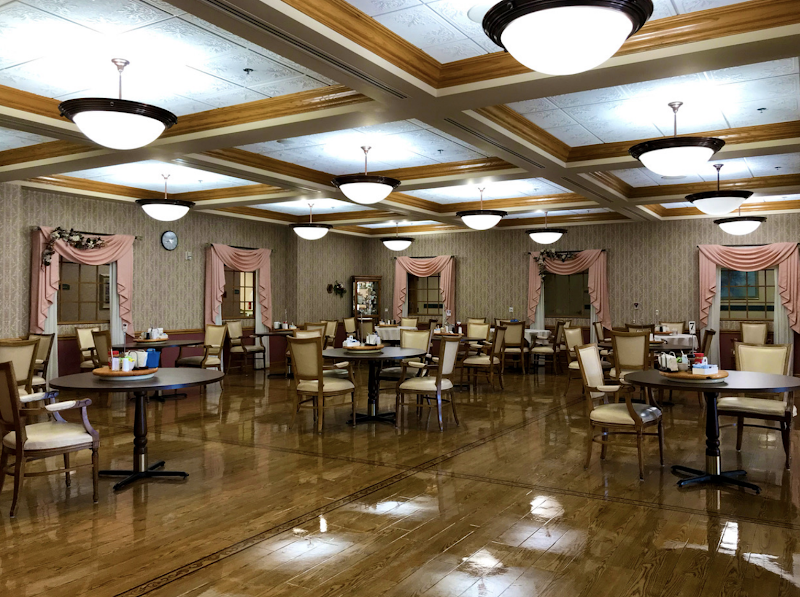
Based on observations, resident and staff interview and policy review, the facility failed to maintain a comfortable temperature in the main dining room. This affected seven (#3, #6, #14, #16, #21, #36, and #43) of seven residents observed eating in the main dining room. The facility census was 53.
Findings include:
Observation on 08/30/21 at 12:00 P.M. of the main dining room for the lunch meal revealed the room to be very cold.
Observation on 08/31/21 at 12:09 P.M. revealed Resident #3, Resident #6, Resident #14, Resident #16, Resident #21, Resident #36 and Resident #43 were sitting in the main dining room while waiting on their lunch meal. All the residents' were observed to be wearing a jacket or sweater and Resident #43 had a blanket lying across her lap. The room temperature seemed very cold.
Resident interviews on 08/31/21 at 12:20 P.M. with Resident #3, Resident #6, Resident #14, Resident #16, Resident #21, Resident #36 and Resident #43 revealed it is always very cold in the dining room. Resident #43 stated that is why she has to have a blanket across her legs and we all wear a jacket or sweater.
Observation and staff Interview on 09/01/21 at 11:20 A.M. revealed the temperatures were measured by Maintenance Supervisor #375 in the main dining room in different areas, and measured at 67.5 degrees Fahrenheit (F), 68 degrees F and 66 degrees F. Maintenance Supervisor #375 stated he would have the temperatures adjusted by the time lunch was served.
Interview and observation on 09/01/21 at 11:15 A.M. interview with Resident #14, revealed the dining room is always so cold. Resident #14 was sitting outside dining room with a long sleeve blouse and sweater on.
Review of the facility policy titled Quality of Life-Homelike Environment, revised 05/2017, revealed the facility staff and management shall maximize to the extent possible, the characteristics of the facility that reflect a personalized, homelike setting. These characteristics include maintaining a comfortable and safe temperatures between 71 degrees F and 81 degrees F.
CONCERN
(E)
Potential for Harm - no one hurt, but risky conditions existed
Comprehensive Care Plan
(Tag F0656)
Could have caused harm · This affected multiple residents
**NOTE- TERMS IN BRACKETS HAVE BEEN EDITED TO PROTECT CONFIDENTIALITY** Based on medical record review, observation, staff interview and policy review, the facility failed to develop and/or implement ...
Read full inspector narrative →
**NOTE- TERMS IN BRACKETS HAVE BEEN EDITED TO PROTECT CONFIDENTIALITY** Based on medical record review, observation, staff interview and policy review, the facility failed to develop and/or implement care plan interventions. This affected four (#1, #5, #28 and #49) of 22 residents reviewed for care plans. The facility census was 53.
Findings include:
1. Review of the medical record revealed Resident #1 was admitted on [DATE]. Diagnoses included multiple fractures of ribs, right side, subsequent encounter for fracture with routine healing, anxiety disorder, muscle weakness, gastro-esophageal reflux, overactive bladder, atrial fibrillation, major depressive disorder, essential hypertension and weakness.
Review of the quarterly Minimum Data Set (MDS) dated [DATE] revealed Resident #1 had moderate cognitive impairment with a BIMS of nine out of 15. Resident #1 required extensive assist with one person assist for bed mobility, transfers, walking in room and corridor, toilet use, personal hygiene was total dependence for bathing with one person physical assist. No pressure ulcers; however, the resident is at risk for pressure ulcers, has skin tears. Resident #1 has a pressure reducing device for chair.
Review of the care plan for Resident #1 revealed there was no care plan for skin conditions.
Review of the physician orders revealed an order dated 07/31/21 cleanse skin tear to left mid lower leg with soap and water pat dry gently, apply optifoam dressing every third day until healed. Further review revealed an order dated 08/31/21 to apply foam dressing to right wrist and right forearm change every three days and as needed, ok to use bordered gauze.
Interview on 09/02/21 at 11:29 A.M. with the Assistant Director of Nursing (ADON) #354 verified that Resident #1 did not have a care plan in place for skin tears or skin conditions.
2. Review of the medical record for Resident #28 revealed an admission date of 02/19/16. Diagnoses included unspecified fracture of sacrum, subsequent encounter for fracture with routine healing, unspecified dementia without behavioral disturbance, hypothyroidism, urgency of urination, Alzheimer's Disease, anxiety disorder, major depressive disorder, recurrent, rheumatoid arthritis with rheumatoid factor of multiple sites without organ or systems involvement and gastro-esophageal reflux without esophagitis.
Review of the quarterly MDS dated [DATE] revealed Resident #28 had severe cognitive impairment with a BIMS of three out of 15. Resident had no or unknown weight loss. Resident had a fall any time in the last month or prior to admission/entry or reentry-yes, resident have a fall any time in the last two to six months prior to admission/entry/reentry-yes, resident had a fracture related to a fall in the six months prior to admission/entry/reentry, resident had a fall since admission,entry, reentry or the prior assessment, whichever is recent-yes, number of falls since admission or prior assessment-injury-one, recent surgery requiring active SNF care-yes, other major orthopedic surgery-yes. Resident was frequently incontinent of bladder and occasionally incontinent of bowel.
Review of the care plan dated 08/29/18 revealed Resident #28 was at risk for falls related to her medication use and cognitive deficits. She has poor safety awareness. Has had two recent falls with injury. Interventions included to administer medication as ordered and monitor for side effects, be sure resident's call light is within reach and encourage the resident to use it for assistance as needed. Bed in low position and bed unplugged so she does not move it into a higher position for safety. Encourage resident to participate in activities that promote exercise, physical activity for strengthening and improve mobility. Ensure that resident is wearing appropriate footwear when ambulating or mobilizing in wheelchair. Keep needed items, water, etc, within reach, provide visual prompts to ask for help. Pharmacist to review medications monthly. Provide a safe environment with even floor free from spills and/or clutter, adequate glare-free light, a working and reachable call light, the bed in lowest position at night. handrails on walls. personal items in reach. Resident has an ADL self-care performance deficit related to her cognitive deficits and joint pain. Interventions included encourage resident to use call bell for assistance. Resident requires extensive assistance of staff for toilet use and transfers.
Observation on 09/01/21 at 6:24 A.M., 9:14 A.M. and 1:39 P.M. revealed Resident #28 dressed lying on top of her bed. Call light was lying on top of tray table, out of the residents reach.
Staff interview on 09/01/21 at 1:41 P.M. with Registered Nurse (RN) #309 verified that the call light was not in reach for Resident #28. RN #309 stated Resident #28 doesn't typically use her call light, but it should still be within their reach. RN #309 did not place the call light in Resident #28's reach before she left the room.
3. Review of the medical record for Resident #49 revealed an admission date of 12/27/15. Diagnoses included unspecified non-displaced fracture of second cervical vertebra, subsequent encounter for fracture with healing, displaced intertrochanteric fracture of right femur, subsequent encounter for closed fracture with routine healing, muscle weakness, Alzheimer's Disease, cerebral infarction, chronic obstructive pulmonary disease, urge incontinence, essential hypertension, heart failure, personal history of malignant neoplasm of bladder, atherosclerotic heart disease of native coronary artery without angina pectoris and cognitive communication deficit.
Review of the significant change MDS dated [DATE] revealed Resident #49 had severe cognitive impairment with a Brief Mental Interview Status score of 99. Resident had other behavioral symptoms not directed towards others occur one to three days during the assessment period. No wandering behaviors. Resident received injections three days during the assessment period. Resident #49 received antipsychotic, diuretic and opioids four days and anticoagulant three days during the assessment period. Resident #49 received antipsychotics on a routine basis only.
Review of the care plan dated 03/12/19 revealed Resident #49 was at risk for wandering/elopement due to diagnosis of Alzheimer's disease and dementia. The resident has a history of wandering and wanting to go home. Interventions identify resident's room and bathroom. Engage resident in purposeful activity. Provide care in a calm and reassuring manner. Provide clear, simple instructions. Provide reorientation to surroundings, environment, wander guard in place. Monitor function every shift.
Review of the treatment administration records (TAR) revealed wander guard monitoring and functioning was checked/completed on : 06/13/21 A.M. or morning shift, 06/15/21 A.M. shift, 06/19/21 A.M. shift, 06/20/21 A.M. shift, 07/03/21 A.M. shift , 07/07/21 A.M. shift, 07/26/21 A.M. shift, 07/28/21 A.M. shift, 08/22/21 A.M. shift, 08/25/21 A.M. shift.
Interview on 09/02/21 at 1:36 P.M. with the ADON #354 verified there was no documentation that the function and placement of the wander guard was checked/monitored for Resident #49 on 06/13/21 A.M. shift, 06/15/21 A.M. shift, 06/19/21 A.M. shift, 06/20/21 A.M. shift, 07/03/21 A.M. shift, 07/07/21 A.M. shift, 07/26/21 A.M. shift, 07/28/21 A.M. shift, 08/22/21 A.M. shift, 08/25/21 A.M. shift.
4. Review of Resident #5's medical record revealed an admission date of 02/11/21. Diagnoses included panlobular emphysema, dementia without behavioral disturbance, difficulty in walking, repeated falls, Alzheimer's disease, and chronic obstructive pulmonary disease.
Review of Resident #5's MDS assessment dated [DATE] revealed the resident had severe cognitive impairment. Further review revealed the resident utilized oxygen and had shortness of breath when lying flat.
Review of Resident #5's monthly physician orders dated August 2021 revealed the following orders: check oxygen saturation every shift, oxygen via nasal cannula at two liters per minute as needed for oxygen saturation reading below 90%, and albuterol sulfate nebulization solution three milliliters (ml's) via nebulizer every eight hours as needed.
Review of Resident #5's care plan revealed the care plan did not address the resident's respiratory status or respiratory interventions.
Interview on 09/02/21 at 11:45 A.M. with Director of Nursing (DON) verified Resident #5's care plan did not address the resident's oxygen usage, nebulizer treatment or monitoring the resident's oxygen saturations.
Review of facility policy titled Care Plans, Comprehensive Person-Centered dated December 2016, revealed the care plan will identify problem areas and their causes and will develop interventions that are targeted and meaningful to the resident.
CONCERN
(E)
Potential for Harm - no one hurt, but risky conditions existed
Quality of Care
(Tag F0684)
Could have caused harm · This affected multiple residents
**NOTE- TERMS IN BRACKETS HAVE BEEN EDITED TO PROTECT CONFIDENTIALITY** Based on medical record review, observation and staff interview, the facility failed to implement interventions for positioning,...
Read full inspector narrative →
**NOTE- TERMS IN BRACKETS HAVE BEEN EDITED TO PROTECT CONFIDENTIALITY** Based on medical record review, observation and staff interview, the facility failed to implement interventions for positioning, skin conditions, and post fall monitoring. This affected four (#30, #1, #49, and #44) of 22 residents reviewed for care and treatment. The facility census was 53.
Findings include:
1. Review of Resident #30's medical record revealed an admission date of 01/12/17. Diagnoses included unspecified dementia without behavioral disturbance; hemiplegia and hemiparesis following cerebral infarction; atherosclerotic heart disease of native coronary artery without angina pectoris; and open-angle glaucoma.
Review of the quarterly Minimum Data Set (MDS), dated [DATE], revealed Resident #30 was moderately cognitively impaired and required extensive one person physical assistance with Activities of Daily Living (ADL's).
Review of a physician order, dated 12/04/18, revealed half lap tray to wheelchair for positioning.
Review of the plan of care, revised 02/06/19, revealed Resident #30 had an activities of daily living self care performance deficit related to her limited mobility, left sided weakness and impaired vision due to her diagnosis of cerebrovascular accident (CVA) and glaucoma. Interventions included half lap tray on left side of wheelchair to help with left arm positioning.
Observations on 08/30/21 from 9:14 A.M. to 10:30 A.M. and on 08/31/21 at 7:45 A.M. of Resident #30 revealed the half lap tray was not in position.
Interview on 08/31/21 at 7:52 A.M. of Register Nurse (RN) #323 verified Resident #30's left arm was not positioned on the half lap tray. RN #323 stated Resident #30 generally preferred her recliner and was only in her wheelchair for a couple of hours in the mornings. RN #323 verified the half lap tray was not in position for Resident #30's left arm to be placed on it.
2. Review of the medical record for Resident #1 revealed an admission date on 01/30/21. Diagnoses included multiple fractures of ribs, right side, subsequent encounter for fracture with routine healing, anxiety disorder, muscle weakness, gastro-esophageal reflux, overactive bladder, atrial fibrillation, major depressive disorder, essential hypertension and weakness.
Review of the quarterly MDS dated [DATE] revealed Resident #1 had moderate cognitive impairment with a BIMS of nine out of 15. Resident required extensive assist with one person assist for bed mobility, transfers, walking in room and corridor, toilet use, personal hygiene was total dependence for bathing with one person physical assist. Resident #1 received scheduled pain medication regimen and as needed (PRN) pain medication or was offered and declined. Should pain assessment interview be conducted-yes. Resident #1 has had any falls since admission/entry or reentry or the prior assessment, whichever is more recent. Number of falls since admission or prior assessment-no injury, two or more. Number of falls since admission or prior assessment-injury one, number of falls since admission or prior assessment-none. No pressure ulcers, resident is at risk for pressure ulcers, has skin tears. Resident #1 has a pressure reducing device for chair.
Review of the care plan dated 02/04/21 revealed Resident #1 had an activity of daily living (ADL) self care performance deficit related to fatigue and debility. Resident #1 is alert and can make needs known. Resident #1 has some occasional incontinence. My vision is adequate and the resident is slightly hard of hearing. Resident #1 can ambulate with a walker. Resident #1 has his/her my own teeth per admit screener. Physical and Occupational Therapy (PT/OT) evaluation and treatment as per physician orders. Encourage resident to use bell to call for assistance. Resident #1 needs supervision to limited assist of one staff member for transfers, bed mobility, toilet use, dressing. Resident #1 needs supervision to limited assist of one staff member
The medical record contained no documentation regarding a care plan for skin conditions.
Review of the physician orders revealed an order dated 02/08/21 to complete weekly skin observations every Monday. The review revealed an order dated 07/31/21 cleanse skin tear to left mid lower leg with soap and water pat dry gently. Apply optifoam dressing every third day until healed. Further review revealed an order dated on 08/31/21 to apply foam dressing to right wrist and right forearm change every three days/PRN ok to use bordered gauze.
Review of the skin assessments revealed skin assessments were not completed in 05/2021, 06/16/21 through 07/27/21 and 07/27/21 through 08/11/21.
Review of the fall investigations revealed Resident #1 had an unwitnessed fall on 06/06/21 and 06/10/21 and there were no neurological checks completed on 06/06/21 and only a partial set of neurological checks completed on 06/10/21.
Interview on 09/07/21 at 11:46 A.M. with the Director of Nursing (DON) verified there were no skin assessments completed for Resident #1 in 05/2021, 06/16/21 through 07/27/21 and 07/27/21 through 08/11/21. The DON confirmed Resident #1 had an unwitnessed fall on 06/06/21 and 06/10/21 and no neurological checks were completed following the fall on 06/06/21 and not a full neurological check or assessment was completed following the fall on 06/10/21.
3. Review of the medical record for Resident #49 revealed an admission date of 12/27/15. Diagnoses included unspecified non-displaced fracture of second cervical vertebra, subsequent encounter for fracture with healing, displaced intertrochanteric fracture of right femur, subsequent encounter for closed fracture with routine healing, muscle weakness, Alzheimer's Disease, cerebral infarction, chronic obstructive pulmonary disease, urge incontinence, essential hypertension, heart failure, personal history of malignant neoplasm of bladder, atherosclerotic heart disease of native coronary artery without angina pectoris and cognitive communication deficit.
Review of the significant change MDS dated [DATE] revealed Resident #49 had severe cognitive impairment with a Brief Mental Interview Status score of 99. Resident #49 had other behavioral symptoms not directed towards others occur one to three days during the assessment period. No wandering behaviors. Resident had a fall in the last month prior to admission/entry or reentry. Resident #49 had a fall any time in the last two to six months prior to admission/entry or reentry. Resident #49 had a fracture related to a fall in the six months prior to admission/entry or reentry. Repair fractures of the pelvis, hip leg, knee or ankle (not foot), yes,
Review of the care plan dated 03/12/19 revealed Resident #49 was unaware of safety needs and gait/balance problems. Does not feel she needs stand by assist when ambulating long distances. Tends to lose her balance when making turns. Interventions- OT to evaluation for object retrieval during meal prep, promote a safe environment with even floors free from spills and/or clutter, glare free light, a working and adequate reachable call light, the bed in low position at night personal items within reach. anticipate and meet needs. Be sure call light is within reach and encourage the resident to use it for assistance as needed. Declutter room and keep floor free from clutter and obstacles. Fluff pillows while sitting in chair or wheel to provide a more suitable surface and support to resident while fluffing. Pharmacy consult to review meds monthly and make recommendations for dosage adjustments. reminder signs to use walker and use call light.
Review of the unwitnessed fall investigations dated 07/17/21 and 08/01/21 revealed no neurological checks were completed on 07/17/21 and only three neurological checks were completed post fall on 08/01/21.
Interview with the DON on 09/07/21 at 10:46 A.M. revealed that neurological checks are to be completed with any unwitnessed falls, that is the facilities standard of practice. The DON further stated neurological checks are completed every 15 minutes for two hours and then every 30 minutes for two hours then every two hours for four hours. The DON verified there were no neuro checks done for the unwitnessed fall on 07/17/21 and only three neurological checks were completed on 08/01/21. The facility denied having a policy for post fall neurological checks, but stated it was their standard of practice.
4. Review of the medical record for Resident #44 revealed an admission date of 01/29/15. Diagnoses included toxic encephalopathy, urinary tract infection, muscle weakness, cognitive communication deficit, major depressive disorder, recurrent, heart failure, insomnia, rheumatoid arthritis, gout, urge incontinence.
Review of the significant change MDS dated [DATE] revealed Resident #44 had moderate cognitive impairment with a BIMS of 09. Resident has a pressure ulcer/injury-no, resident was at risk for pressure ulcers, has a pressure reducing device for chair and bed.
Review of the care plan dated 01/10/19 revealed Resident #44 presents with unavoidable risk for pressure ulcer and decline due to terminal diagnosis and on hospice services. Continues with the following risk factors. Weakness, incontinence of bowel/bladder and limited mobility needs help for repositioning. Assist reposition at least every two hours, more often as needed or requested. Assist with incontinent care after each occasional, assure pressure redistribution devices are present on bed and chair daily.
Review of the physician orders revealed an order dated 02/06/21 through 07/24/21 for weekly skin observation to be done every Saturday.
Review of the skin assessments for Resident #44 revealed skin assessments were completed on 02/28/21, 04/08/21, 06/16/21 and 08/25/21. There were no other evidence of skin assessments being completed for Resident #44.
Interview on 09/07/21 at 11:47 A.M. with the DON verified Resident #44 had four skin assessments completed between 02/28/21 through 08/25/21. The DON confirmed there was no other evidence of skin assessments being completed for Resident #44.
CONCERN
(F)
Potential for Harm - no one hurt, but risky conditions existed
Food Safety
(Tag F0812)
Could have caused harm · This affected most or all residents
Based on observation, staff interview, and review of facility policy, the facility failed to cover food during hall tray delivery to residents rooms and ensure food was dated properly to prevent food ...
Read full inspector narrative →
Based on observation, staff interview, and review of facility policy, the facility failed to cover food during hall tray delivery to residents rooms and ensure food was dated properly to prevent food borne illnesses. This had the potential to affect all 53 residents who received food from the kitchen. The facility census was 53.
Findings include:
1. Observation on 08/30/21 at 11:44 A.M. of hall tray service on the C Hall revealed the meal cart was placed in the common area of the hall. State Tested Nursing Assistant (STNA) #319 was observed removing lunch trays from the meal cart, walking down the hall and delivering to the resident rooms. Observation of the lunch trays revealed cupcakes on the meal trays had a plastic cover over the top, but the bottom portion, approximately half of the cupcake, was exposed.
Interview on 08/30/21 at 11:50 A.M. of STNA #319 verified the bottom portion of the cupcakes were not properly covered during delivery to resident rooms. STNA #319 stated the cupcakes should have been placed in a cup and the plastic cover then placed over them to ensure they were properly covered. STNA #319 verified Residents #8, #14, #34, #39, #46 and #53 received cupcakes on their lunch tray during meal service.
Review of facility policy titled Preventing Foodborne Illness - Food Handling, revised July 2014, revealed food will stored, prepared, handled and served so that the risk of foodborne illness is minimized.
2. Observation of the facility kitchen on 08/30/21 at 9:10 A.M. revealed a flour bin that had a scoop left in the flour.
Interview on 08/30/21 at 9:10 A.M. with [NAME] #358 verified there was a scoop left in the flour bin.
Observation of the facility kitchen on 08/30/21 at 9:15 A.M. revealed one bag of hot dog buns that had green mold.
Observation of the facility kitchen on 08/30/21 at 9:18 A.M. revealed a refrigerator that had a container of celery and a container of sliced tomatoes with a throw out date of 08/29/21 and a container of mushrooms undated. There were two trays of salads undated.
Interview on 08/30/21 at 9:25 A.M. with [NAME] #387 verified there was a bag of hot dog buns with mold, two trays of salad undated in the refrigerator, there was a container of sliced tomatoes and a container of celery that was outdated and a container of mushrooms undated. The facility confirmed all residents receive meals from the kitchen.
Review of the policy titled Refrigerated Storage, undated, revealed refrigerated food shall be stored in a manner that optimizes food safety and quality. Refrigerator items shall bear a label indicating product name and date that product was received, used, or first opened. Discard date may be included on labels per facility preference.
CONCERN
(F)
Potential for Harm - no one hurt, but risky conditions existed
Infection Control
(Tag F0880)
Could have caused harm · This affected most or all residents
**NOTE- TERMS IN BRACKETS HAVE BEEN EDITED TO PROTECT CONFIDENTIALITY** Based on observations, staff interview, review of the facility policy and review of the Centers for Disease Control (CDC) guidan...
Read full inspector narrative →
**NOTE- TERMS IN BRACKETS HAVE BEEN EDITED TO PROTECT CONFIDENTIALITY** Based on observations, staff interview, review of the facility policy and review of the Centers for Disease Control (CDC) guidance, the facility failed to properly wear facemasks while providing resident care, failed to monitor residents for signs and symptoms of COVID-19 and failed to wear an N95 respirator while performing staff testing for COVID-19 to potentially limit the transmission of COVID-19. This had the potential to affect 53 of 53 residents who reside in the facility. In addition, the facility failed to store oxygen tubing in a sanitary manner, affecting one (#25) resident reviewed for oxygen tube storage. The facility census was 53.
Findings include:
1. Observation on 08/30/21 at 8:05 A.M. of the reception area revealed all staff were screened for symptoms of COVID-19 upon entrance into the facility. Outside the door of the reception desk was a cart with facemasks. A sign hanging on the cart stated to wear a facemask over both the nose and mouth.
Observation on 08/30/21 at 12:28 P.M. of the second floor dining room, revealed Stated Tested Nurse Aide (STNA) #319 providing feeding assistance to Resident #18 and was within arms reach of the resident while she provided assistance. STNA #319's facemask was placed below her nose. Additional observation revealed STNA #348 assisting Residents #38 and #41 with eating. STNA #348 was seated between the residents and was within arms reach of each resident. STNA #348's facemask was placed below her nose.
Interviews on 08/30/21 at 12:36 P.M. of STNA's #319 and #348, verified their facemasks were placed below their noses while providing feeding assistance to Residents #18, #38 and #41. Both STNA's stated they were unvaccinated for COVID-19.
Review of CDC guidance titled, Guidance for Wearing Masks, updated 04/19/21 and located at https://www.cdc.gov/coronavirus/2019-ncov/prevent-getting-sick/cloth-face-cover-guidance.html , revealed masks should completely cover the nose and mouth and fit snugly against the sides of face without gaps.
2. Review of Resident #39's medical record revealed an admission date of 06/10/19. Diagnoses included heart failure, unspecified; unspecified atrial fibrillation; atherosclerotic heart disease of native coronary artery without angina pectoris; hypertension; major depressive disorder, recurrent, unspecified; osteoarthritis, unspecified site and other intervertebral disc degeneration, lumbar region. Additional review of the quarterly MDS, dated [DATE], revealed Resident #39 was cognitively intact.
Review of the CHI Active Respirator Screens from 08/15/21 to 09/03/21, revealed the assessment was not completed for Resident #39 on 08/15/21, 08/20/21, 08/25/21, 08/28/21, and 09/03/21. Review of the Resident's vital signs in the EMR for the same time period revealed Resident #39's temperature was not monitored on 08/15/21, 08/20/21, 08/25/21, 08/28/21 and 09/03/21.
Review of Resident #18's medical record revealed an admission date of 11/09/20. Diagnoses included Alzheimer's disease, unspecified; malignant neoplasm of unspecified site of left female breast; unspecified atrial fibrillation; acute kidney failure; and pulmonary hypertension. Additional review of the quarterly MDS, dated [DATE], revealed Resident #18 was moderately cognitively impaired.
Review of the CHI Respiratory Screens from 08/15/21 to 09/03/21, revealed the assessment was not completed for Resident #18 on 08/15/21, 08/20/21, 08/25/21 and 09/03/21. Review of the resident's vital signs in the EMR for the same time period revealed Resident #18's temperature and oxygen saturation were not monitored on 08/15/21, 08/20/21, 08/25/21 and 09/03/21.
Interview on 09/02/21 with the Administrator verified COVID-19 screenings were not completed at least daily for Residents #39 and #18.
Review of facility policy titled, Infection Prevention and Control Policy Covid-19, Basic Policy, revised 07/16/21, revealed the facility will actively screen each of the residents utilizing the CHI Active Respiratory Screen a minimum of daily for all residents.
3. Observation on 09/02/21 at 8:32 A.M. of routine testing for staff who were unvaccinated for COVID-19 revealed Mission Integration (MI) #383 obtained her specimen collection kit from human resources. MI #383 traveled to the third floor of the facility to have nursing collect the specimen for COVID-19 testing. Continued observation revealed Licensed Practical Nurse (LPN) #373, wearing goggles and a surgical facemask, perform hand hygiene, don a gown and gloves, and proceeded to collect the nasal test specimen from MI #383. LPN #373 completed the specimen collection and doffed the gown and gloves and performed hand hygiene and exited the room where she collected the specimen and entered a resident care area. Interview at the time of the observation of LPN #373, verified she did not don an N95 while collecting the COVID-19 test specimen from MI #383 and stated she only needed to wear the surgical facemask.
Review of facility policy titled, Infection Prevention and Control Policy Covid-19, revised 05/04/21, revealed facilities must conduct testing according to nationally recognized guidelines, outlined by the Centers for Disease Control and Prevention (CDC).
Review of CDC guidance titled Interim Guidelines for Collecting and Handling Clinical Specimens for COVID-19 Testing, updated 02/26/21 and located at https://www.cdc.gov/coronavirus/2019-ncov/lab/guidelines-clinical-specimens.html, revealed healthcare providers collecting specimens should maintain proper infection control and use recommended personal protective equipment (PPE), which includes an N95 or higher-level respirator, eye protection, gloves, and a gown.
#4. Review of Resident #25's medical record revealed an admission date of 04/26/18.
Diagnoses included multiple sclerosis, chronic obstructive pulmonary disease, dementia without behavioral disturbance, pulmonary hypertension, obstructive sleep apnea, and chronic respiratory failure.
Review of Resident #25's Minimum Data Set (MDS) assessment dated [DATE], revealed the resident had intact cognition. Further review of the assessment listed the resident as receiving oxygen.
Review of Resident #25's care plan revealed the resident had altered respiratory status related to sleep apnea and chronic respiratory failure. Interventions included to provide continuous oxygen as ordered.
Review of Resident #25's monthly physician orders dated August 2021, revealed an order for continuous oxygen at three liters per minute via nasal cannula.
Observation on 08/31/21 at 2:30 P.M. of Resident #25's bathroom, revealed the resident's oxygen tubing with nasal cannula hanging over the back of the toilet attached to a portable oxygen concentrator. The resident stated she does use the oxygen in the bathroom when she uses the restroom.
Observation on 08/31/21 at 2:47 P.M., revealed Resident #25's oxygen tubing with nasal cannula attached draped over the back of the resident's toilet and was not covered or placed in a bag.
Interview on 08/31/21 at 2:27 P.M. with Registered Nurse (RN) #323, verified Resident #25's oxygen tubing had been draped over the back of the resident's toilet. RN #323 stated the oxygen tubing should be stored in a bag when not in use.
This deficiency substantiates Complaint Numbers OH00111538 and OH00111572.
CONCERN
(F)
Potential for Harm - no one hurt, but risky conditions existed
Deficiency F0886
(Tag F0886)
Could have caused harm · This affected most or all residents
**NOTE- TERMS IN BRACKETS HAVE BEEN EDITED TO PROTECT CONFIDENTIALITY** Based on medical record review, review of the facility census record for resident COVID-19 testing, staff interview, review of t...
Read full inspector narrative →
**NOTE- TERMS IN BRACKETS HAVE BEEN EDITED TO PROTECT CONFIDENTIALITY** Based on medical record review, review of the facility census record for resident COVID-19 testing, staff interview, review of the facility policy, review of staff COVID-19 testing logs, staff laboratory results, and review of guidance from the Centers for Medicare and Medicaid Services (CMS), the facility failed to document resident COVID-19 test results in the electronic medical record (EMR), failed to timely follow up with the laboratory staff COVID-19 test results and failed to monitor a resident who refused COVID-19 testing during a facility outbreak. This had the potential to affect 53 of 53 residents who reside in the facility.
Findings include:
1. Review of the facility census for resident testing for COVID-19, dated 08/24/21 and 08/25/21, revealed Residents #16, #49, #37, #22, #1, #50, #305, #27, #14, #40, #28, #44, #10, #205, #13, #43, #12, #52, #47, #45, #4, #35, #24, #206, #36, #7 and #15 were tested for COVID-19 following a positive staff COVID-19 test result, resulting in facility outbreak testing. Next to each resident name was the result of the test. The residents resided on the A and B halls of the facility.
Review of the medical records for Residents #16, #49, #37, #22, #1, #50, #305, #27, #14, #40, #28, #44, #10, #205, #13, #43, #12, #52, #47, #45, #4, #35, #24, #206, #36, #7 and #15, revealed no documentation in the EMR of the resident testing or results.
Interview on 08/31/21 at 3:43 P.M. of the Director of Nursing (DON), verified resident COVID-19 test results were to be documented in a progress note. The DON stated the facility was conducting outbreak testing after a staff member had tested positive for COVID-19 on 08/16/21. The DON verified she completed resident COVID-19 testing on 08/24/21 and 08/25/21, on the A and B Halls of the facility, with results documented on a facility census, and the test results were not documented in the resident's EMR. The DON stated this was an oversight.
Review of facility policy titled, Infection Prevention and Control Policy Covid-19, revised 05/04/21, revealed the facility must document testing results in the medical record.
2. Review of the staff COVID-19 testing log, dated 08/12/21, revealed Maintenance Technician (MT) #347 was tested for COVID-19, as part of routine staff testing for unvaccinated staff. The testing log indicated a positive test result was received on 08/15/21 for MT #347.
Review of laboratory results dated [DATE], revealed MT #347's COVID-19 test specimen was collected on 08/12/21, received by the laboratory on 08/15/21, and final report was made on 08/17/21. The test result was positive.
Interview on 09/02/21 at 8:40 A.M. of MT #347, revealed he felt kind of funny beginning on 08/12/21, stating he felt like he had a cold and a sore arm. MT #347 stated he received his first COVID-19 vaccination on 08/11/21, and attributed his symptoms to receiving the vaccination. MT #347 stated he came to work on 08/16/21 but was feeling bad and was having trouble breathing. MT #347 stated he had another medical condition and attributed his difficulty breathing to that. The facility did send MT #347 home after approximately three hours of work on 08/16/21. MT #347 stated he did go to the hospital, where he tested positive for COVID-19 and informed the facility of his positive test result.
Interview on 09/02/21 at 8:49 A.M. of Director of Human Resources (HR) #322, revealed COVID-19 test results for specimens that were collected on the facility's Thursday testing day were never received before Monday or Tuesday of the next week. HR #322 stated test specimens collected on Thursdays were taken for delivery to the laboratory on the day of the specimen collection by one of the facility staff. HR #322 verified she did not follow up with the laboratory over the weekend regarding test results from the 08/12/21 staff testing. HR #322 verified the facility initially became aware MT #347 was positive for COVID-19 after he was sent home from work due to symptoms and later tested positive for COVID-19 at the hospital. HR #322 stated she did not know why it took so long for MT #347's test results to return from the laboratory or why the laboratory report indicated MT #347's specimen was not received until 08/15/21. HR #347 verified she had no documentation she had followed up with the laboratory regarding the results.
Interview on 09/08/21 at 1:23 P.M. with the Administrator, revealed all staff test specimens for COVID-19 were delivered to the shipping company on the date the specimen was collected for overnight shipment to the laboratory. The Administrator verified there had been no delays in getting COVID-19 test specimens to the shipping company.
Review of facility policy titled, Infection Prevention and Control Policy Covid-19 Testing, revised 05/04/21, revealed if the 48-hour turn-around time cannot be met due to community testing supply shortages, limited access, or inability of laboratories to process tests within 48 hours, the facility should have documentation of its efforts to obtain quick turnaround test results with the identified laboratory or laboratories and contact with the local and state health departments.
3. Review of Resident #20's medical record revealed an admission date of 01/18/17. Diagnoses included unspecified sequelae of unspecified cerebrovascular disease disease; unspecified dementia with behavioral disturbance; hemiplegia and hemiparesis; gastric ulcer, unspecified as acute or chronic without hemorrhage or perforation. Additional review of the quarterly Minimum Data Set (MDS), dated [DATE], revealed Resident #20 was moderately cognitively impaired.
Review of the facility census for resident COVID-19 testing, dated 08/24/21 and 08/25/21, revealed Resident #20 refused COVID-19 testing as part of the facility outbreak testing.
Review of the CHI Active Respiratory Screens from 08/15/21 to 09/03/21, revealed the assessment was not completed for Resident #20 on 08/18/21, 08/21/21, 08/24/21, 08/28/21, 08/29/21 and 09/01/21. Additional review of Resident #20's vitals for the same time period in the electronic medical record (EMR) revealed Resident #20's temperature and oxygen saturation were not monitored on 08/18/21, 08/21/21, 08/28/21, 08/29/21 and 09/01/21 and, on 08/24/21, her temperature was checked but oxygen saturation was not monitored.
Interview on 09/02/21 at 4:43 P.M. with the Administrator verified the facility was conducting outbreak testing following a positive staff test. The outbreak testing period was from 08/12/21 to 08/26/21. The Administrator verified symptom monitoring was not completed for Resident #20 on 08/25/21 and 08/26/21 and no additional precautions were in place.
Review of facility policy titled, Infection Prevention and Control Policy Covid-19 Testing, revised 05/04/21, revealed if there was a facility outbreak and the resident declined testing, he or she should be placed on or remain on transmission-based precautions until he or she meets the symptom-based criteria for discontinuation, or the outbreak was resolved, whichever was longer.