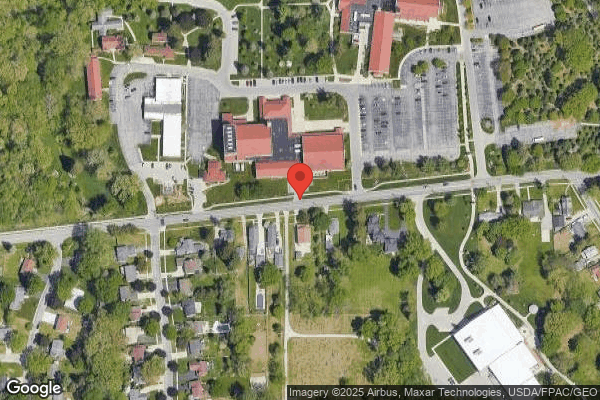
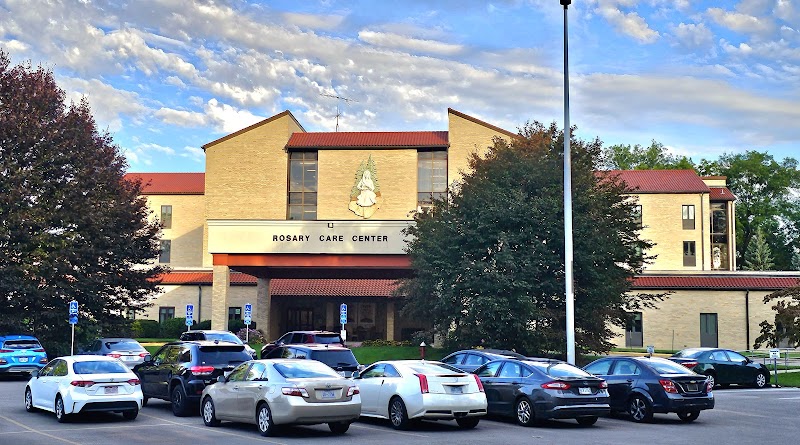
ROSARY CARE CENTER

6832 CONVENT BOULEVARD, SYLVANIA, OH 43560 (419) 824-3600
Non profit - Church related 76 Beds Independent Data: November 2025
Trust Grade
65/100
#331 of 913 in OH
Last Inspection: January 2025

Within standard 12-15 month inspection cycle. Federal law requires annual inspections.

Overview

Rosary Care Center has a Trust Grade of C+, which means it is considered decent and slightly above average compared to other facilities. It ranks #331 out of 913 in Ohio, placing it in the top half of nursing homes in the state, and #6 out of 33 in Lucas County, indicating that there are only five better local options. However, the facility is experiencing a worsening trend, with issues increasing from 1 in 2024 to 6 in 2025. Staffing is a strength, with a 4/5 star rating and a turnover rate of 49%, which is on par with the state average. Notably, there have been no fines reported, but there have been serious concerns, including a resident suffering a fall and fracture due to improper use of a mechanical lift, and issues with staff not practicing proper hand hygiene during meal service, which could potentially affect all residents. Overall, while there are positive aspects, families should be aware of the recent increase in problems and specific incidents that raise concerns about resident safety and care practices.

Trust Score
C+
65/100
In Ohio
#331/913
Top 36%
Safety Record
Moderate
Needs review
Inspections
Getting Worse
1 → 6 violations
Staff Stability
⚠ Watch
49% turnover. Above average. Higher turnover means staff may not know residents' routines.
Penalties
✓ Good
No fines on record. Clean compliance history, better than most Ohio facilities.
Skilled Nurses
○ Average
Each resident gets 32 minutes of Registered Nurse (RN) attention daily — about average for Ohio. RNs are the most trained staff who monitor for health changes.
Violations
⚠ Watch
22 deficiencies on record. Higher than average. Multiple issues found across inspections.
★★★★☆
4.0
Overall Rating
★★★★☆
4.0
Staff Levels
★★★★★
5.0
Care Quality
★★★☆☆
3.0
Inspection Score
Stable
2024: 1 issues
2025: 6 issues

The Good

  • 4-Star Staffing Rating · Above-average nurse staffing levels
  • 5-Star Quality Measures · Strong clinical quality outcomes
  • Full Sprinkler Coverage · Fire safety systems throughout facility
  • No fines on record

Facility shows strength in staffing levels, quality measures, fire safety.

The Bad

Staff Turnover: 49%

Near Ohio avg (46%)

Higher turnover may affect care consistency

The Ugly 22 deficiencies on record

1 actual harm
Jan 2025 6 deficiencies
CONCERN (D)

Potential for Harm - no one hurt, but risky conditions existed

Notification of Changes (Tag F0580)

Could have caused harm · This affected 1 resident

**NOTE- TERMS IN BRACKETS HAVE BEEN EDITED TO PROTECT CONFIDENTIALITY** Based on record review, staff interview, and review of policy, the facility failed to notify the family when a resident experien...

Read full inspector narrative →
**NOTE- TERMS IN BRACKETS HAVE BEEN EDITED TO PROTECT CONFIDENTIALITY** Based on record review, staff interview, and review of policy, the facility failed to notify the family when a resident experienced a change in condition requiring a medication change. This affected one (#62) of one resident reviewed for notification of changes. The facility census was 71. Findings include: Review of the electronic medical record for Resident #62 revealed an admission date of 05/31/24, with diagnoses including chronic respiratory failure with hypoxia, hypertension (HTN), other post-traumatic urethral stricture, chronic kidney disease (CKD), hyperkalemia, heart failure, diverticulum of bladder, acidosis, anxiety, atherosclerotic heart disease of native coronary artery without angina pectoris, atrial fibrillation (a. fib), hypothyroidism, neuromuscular dysfunction of bladder, generalized muscle weakness, need for assistance with personal care, cognitive communication deficit, oral dysphagia, and difficulty in walking. Review of the most recent quarterly Minimum Data Set (MDS) assessment dated [DATE], revealed a Brief Interview of Mental Status (BIMS) score of 12, indicating the resident had relatively cognition intact. Review of the medical record for Resident #62 revealed a urine culture dated 12/23/24 which resulted >100,000 colony-forming units per milliliter (cfu/ml). Review of the electronic medical record revealed a physician order dated 12/23/24, for Macrobid (an antibiotic used to treat UTI's) Oral Capsule 100 milligrams, to be administered twice daily for seven days. Review of the electronic medical record for Resident #62 revealed no documented evidence of the family for Resident #62 being notified of the positive UTI urine test or Resident #62 being started on oral antibiotics to treat her UTI. Interview on 01/07/24 at 9:20 A.M. with Licensed Practical Nurse (LPN) #123 verified the medical record contains no evidence of the family of Resident #62 being notified of her change in condition or treatment. Review of the policy titled, Change in Condition, revised February 2021, revealed the facility promptly (within 24 hours) notifies the resident, his or her attending physician, and the resident representative of changes in the resident's medical/mental condition and/or status.
CONCERN (D)

Potential for Harm - no one hurt, but risky conditions existed

Pharmacy Services (Tag F0755)

Could have caused harm · This affected 1 resident

**NOTE- TERMS IN BRACKETS HAVE BEEN EDITED TO PROTECT CONFIDENTIALITY** Based on observation, medical record review, resident interview, staff interview, and policy review, the facility failed to ensu...

Read full inspector narrative →
**NOTE- TERMS IN BRACKETS HAVE BEEN EDITED TO PROTECT CONFIDENTIALITY** Based on observation, medical record review, resident interview, staff interview, and policy review, the facility failed to ensure medications were taken as self-administration assessments and according to policy. This affected two (#18 and #38) of two residents reviewed for self medication administration. The facility identified four residents participating in self medication administration in a facility census of 71. Findings include: 1. Review of the medical record revealed Resident #18 was admitted to the facility on [DATE], with the diagnoses including: transient cerebral ischemic attack, atrial fibrillation, hypertension, osteoporosis, atrial flutter, chronic rhinitis and low back pain. Review of the most current Minimum Data Set (MDS) assessment dated [DATE], assessed Resident #18 with minimal hearing difficulty, highly impaired vision, intact cognition, utilized a walker for mobility, independent with activities of daily living, received scheduled pain medications, and received an anti-platelet medication. Review of Resident #18's independent medication administration plan of care dated 04/04/22 noted the following interventions: Complete self-administration assessment. Monitor for signs of decreased cognition or dexterity that may interfere with continued ability to self administer medications. Provide me a lock box for the storage of my medications. Review of physician orders dated 07/26/22 revealed a physician order initiated for a Self medication assessment every 90 days. Review of the medical record identified a self medication evaluation completed on 01/17/24 indicating Resident #18 was assessed and self-administration of medication is granted and a physician's order is obtained. Review of a self-administration of medication assessment was completed on 07/22/24, indicating Resident #18 was approved for self administration of medications. No documentation contained in the medical record revealed evidence self medication evaluations were completed every 90 days. The record also lacked a physician order for self medication administration. Observation on 01/06/25 at 9:44 A.M., discovered a daily self medication container ([NAME]) on the overbed table at the foot of the bed. Interview with Resident #18, at the time, revealed medications were placed into the medication [NAME]. Observation with the resident noted medications placed inside each daily compartment marked Sunday through Saturday. Inside each day of the week identified multiple of the same medication tablet placed under each day of the week. The medications taken daily were not placed together. The resident was unable to provide documentation indicated when medications were administered. Interview on 01/06/25 at 9:45 A.M., with Registered Nurse (RN) #143 revealed she was unaware Resident #18 utilized a medication [NAME], unaware what medications the resident took or when she took the medications. No documentation was maintained indicating the facility or resident were recording medications were taken daily. Interview on 01/07/25 at 11:10 A.M., with Licensed Practical Nurse (LPN) #130 and LPN #138 unit manager verified no documentation or verification was recorded when Resident #18 medications were self administered. Review of the policy titled Self-Administration of Medications Policy, revised February 2021, revealed if it is deemed safe and appropriate for a resident to self administer medications, it is documented in the medical record and the care plan. The decision that a resident can self-administer medications is re-assessed periodically based on changes in the residents medical or decision making skills. For self administering residents, the nursing staff determines who is responsible (the resident or the nursing staff) for documenting that medications are taken. If the resident is able and willing to take responsibility for documenting self-administration of medications, the resident is instructed on how to complete a record indicating the administration of the medication. 2. Review of the medical record revealed Resident #38 was admitted to the facility on [DATE], with the diagnoses including: paraplegia, spina bifida, neuromuscular bladder, urinary incontinence, edema, systemic inflammatory response syndrome, cervicalgia, and pain to right and left shoulder. Review of the most current MDS assessment dated [DATE], assessed Resident #38 with intact cognition, utilized a wheelchair for mobility, independent with activities of daily living, incontinent of bowel and bladder, received regular diet with no weight loss, and at risk for pressure ulcer development with no current skin breakdown. Review of the nursing plan of care initiated 04/18/24, regarding Resident #38 preference to self-administer medications included interventions for the following: I will safely administer medications as my physician has ordered. Assess ability to self-administer medications as needed. Educate regarding the dosage, frequency and side effects of medication(s). Monitor me for signs of decreased cognition or dexterity that may interfere with continued ability to self administer medications. Notify physician as needed if I am unable/do not follow medication orders. Provide me a lock box for the storage of my medications if needed. Provide me with medication administration assistance as needed. Review of a physician order dated 08/13/19 noted self medication assessment to be completed quarterly. Review of self medication evaluation dated 07/17/24 revealed self medication granted. Physicians order obtained. Further review of the record revealed no evidence of a physician order contained in the medical record for the resident to self administer medications. The most recent self medication assessment prior to 07/17/24 was dated 10/21/23 and lacked further evidence self medication assessments were being completed every 90 days. Interview with Resident #38 on 01/06/25 at 2:44 P.M., revealed he had not been provided with the medication Methenamine for the past 4 days. Resident #38 stated he reported the medication was not available to the nurse. Observation inside a locked cabinet noted Multiple blister pack cards or medications. The medication Methenamine Hippurate was not contained inside the cabinet. On 01/07/25 at 7:48 A.M., interview with Licensed Practical Nurse (LPN) #130 and LPN #138 revealed Resident #38 medication Methenamine was ordered twice since 12/19/24 and the resident it had not been delivered to the facility. LPN #130 and LPN #138 confirmed they were unaware when medications needed refilled unless a resident request a refill. In addition they stated no documentation was being maintained indicating self medication approved residents were consuming medications as ordered. Observation on 01/07/25 at 7:54 A.M., with Resident #38 revealed the night nurse provided him with a medication card containing Methenamine early that morning. Observation inside the locked cabinet in the resident room discovered a medication card labeled Methenamine one (1) Gram (GM) with the fill date of 01/06/25. Review of pharmacy delivery manifest noted a card containing 14 tablets each of Resident #38 Methenamine one (1) Gram (GM) were delivered on 11/12/24, 11/25/24, 12/17/24, 01/06/25. Interview on 01/08/24 at 9:45 A.M., with the Director of Nursing (DON) obtained a list of four residents residing in the facility, assessed to self administer medications (#8, #18, #38, #53). Review of the policy titled Self-Administration of Medications Policy, revised February 2021, revealed if it is deemed safe and appropriate for a resident to self administer medications, it is documented in the medical record and the care plan. The decision that a resident can self-administer medications is re-assessed periodically based on changes in the residents medical or decision making skills. For self administering residents, the nursing staff determines who is responsible (the resident or the nursing staff) for documenting that medications are taken. If the resident is able and willing to take responsibility for documenting self-administration of medications, the resident is instructed on how to complete a record indicating the administration of the medication.
CONCERN (D)

Potential for Harm - no one hurt, but risky conditions existed

Unnecessary Medications (Tag F0759)

Could have caused harm · This affected 1 resident

Based on observation, medical record review, staff interview, and policy review, the facility failed to ensure medications were administered as ordered by the physician, and within prescribed time fra...

Read full inspector narrative →
Based on observation, medical record review, staff interview, and policy review, the facility failed to ensure medications were administered as ordered by the physician, and within prescribed time frames, resulting in a medication error rate above five percent (%). A total of 2 medication errors were observed out of 32 opportunities for a medication administrations calculating an error rate of 6.25%. This affected two (#12, #40) of three residents observed during medication administration. The facility census was 71. Findings include: 1. Observation on 01/07/25 at 7:27 A.M., noted Licensed Practical Nurse (LPN) #130 to obtain Resident #12 medications from the medication cart. LPN #130 stated Lamotrigine 200 milligrams (mg) was not available in the facility or in the contingency box supply. The medication would have to be omitted and ordered from the pharmacy. LPN #130 proceeded to Resident #12 room and administered the available medications. Review of the medical record revealed a physician order dated 04/05/22 for the administration of Lamotrigine one 200 mg tablet twice daily for Seizures. Review of the medication administration record (MAR) revealed Lamotrigine one 200 mg was scheduled for the prescribed times twice daily at 7:30 A.M. and 7:30 P.M. Interview on 01/07/25 at 10:35 A.M., with LPN #130 verified the medication Lamotrigine was not available in the facility and the dose was not administered. 2. Observation on 01/07/24 at 8:38 A.M., noted Licensed Practical Nurse (LPN) #154 preparing Resident #40 medications for administration. As medications were obtained from the medication cart LPN #154 stated Resident #40 medication Januvia 50 milligrams (mg) was not available in the medication cart. LPN #154 proceeded to review the contents of the facility contingency medication storage and stated the medication was not available in the facility stating the medication would not be administered. LPN #154 proceeded to administered Resident #40 available medications. Review of the medical record revealed a physician order dated 09/25/23 for the administration of Januvia 50 mg once daily for Diabetes Mellitus. Review of the medication administration record (MAR) Januvia 50 mg was scheduled for the prescribed times once daily at 8:00 A.M. Interview on 01/07/25 at 8:45 A.M., with LPN #154 verified the medication Januvia was not available in the facility and the dose was not administered. Review of the policy titled Medication Administration, effective 09/12/24, revealed medications are administered in accordance with written orders of the prescriber. A schedule of routine dose administration times is established by the community and utilized on the administration records. Medications are administered within 60 minutes of scheduled time.
CONCERN (E)

Potential for Harm - no one hurt, but risky conditions existed

Deficiency F0760 (Tag F0760)

Could have caused harm · This affected multiple residents

**NOTE- TERMS IN BRACKETS HAVE BEEN EDITED TO PROTECT CONFIDENTIALITY** Based on observation, medical record review, staff interview, and policy review, the facility failed to ensure medications were ...

Read full inspector narrative →
**NOTE- TERMS IN BRACKETS HAVE BEEN EDITED TO PROTECT CONFIDENTIALITY** Based on observation, medical record review, staff interview, and policy review, the facility failed to ensure medications were administered as ordered by the physician and within prescribed time frames, resulting in delay in administration of anticonvulsant medication, anti-diabetic medication, anti-dementia medication and anti-psychotic medication. This affected four (#12, #36 #40, #66 ) of eight residents reviewed for medication administration. The facility census was 71. Findings include: 1. Observation on 01/07/25 at 7:27 A.M., noted Licensed Practical Nurse (LPN) #130 to obtain Resident #12 medications from the medication cart. LPN #130 stated Lamotrigine 200 milligrams (mg) was not available in the facility or in the contingency box supply. The medication would have to be omitted and ordered from the pharmacy. LPN #130 proceeded to Resident #12 room and administered the available medications. Review of the medical record revealed a physician order dated 04/05/22 for the administration of Lamotrigine one 200 mg tablet twice daily for Seizures. Review of the medication administration record (MAR) revealed Lamotrigine one 200 mg was scheduled for the prescribed times twice daily at 7:30 A.M. and 7:30 P.M. Interview on 01/07/25 at 10:35 A.M., with LPN #130 verified the medication Lamotrigine was not available in the facility and the dose was not administered. 2. Observation on 01/07/24 at 8:38 A.M., noted Licensed Practical Nurse (LPN) #154 preparing Resident #40 medications for administration. As medications were obtained from the medication cart LPN #154 stated Resident #40 medication Januvia 50 milligrams (mg) was not available in the medication cart. LPN #154 proceeded to review the contents of the facility contingency medication storage and stated the medication was not available in the facility stating the medication would not be administered. LPN #154 proceeded to administered Resident #40 available medications. Review of the medical record revealed a physician order dated 09/25/23 for the administration of Januvia 50 mg once daily for Diabetes Mellitus. Review of the medication administration record (MAR) Januvia 50 mg was scheduled for the prescribed times once daily at 8:00 A.M. Interview on 01/07/25 at 8:45 A.M., with LPN #154 verified the medication Januvia was not available in the facility and the dose was not administered. Review of the policy titled Medication Administration, effective 09/12/24, revealed medications are administered in accordance with written orders of the prescriber. A schedule of routine dose administration times is established by the community and utilized on the administration records. Medications are administered within 60 minutes of scheduled time. 3. Review of the medical record for Resident #36 revealed an admission date of 04/01/21 with diagnoses depression, vascular dementia, and anxiety. Review of the quarterly minimum data set (MDS) assessment dated [DATE] revealed Resident #36 had impaired cognition and received antipsychotic medications on a routine basis. Review of the current physician order dated 01/02/25 revealed Resident #36 received Seroquel 50 milligrams (mg), one tablet by mouth in the evening for depression, dementia, and anxiety. Review of the January 2025, medication administration record (MAR) for Resident #36 revealed a 9 was marked in the administration box on 01/05/25, 01/06/25, and 01/07/25. Further review of the MAR revealed 9 indicated the nurse wrote a progress note. Review of a nurse's progress note dated 01/05/25 revealed the Seroquel was not available and the facility was awaiting delivery from the pharmacy. Review of a nurse's progress note dated 01/06/25 revealed the facility was awaiting shipment of the medication from the pharmacy. Review of a nurse's progress note dated 01/07/25 revealed the facility was awaiting shipment of the medication from the pharmacy. Interview on 01/09/25 at 10:09 A.M., with the DON confirmed Resident #36 did not receive Seroquel as ordered by the physician on 01/05/25, 01/06/025, and 01/07/25. The DON stated Seroquel was received from the pharmacy on 01/08/25. 4. Review of the medical record for Resident #66 revealed an admission date of 11/18/24 with diagnoses of vascular dementia and Alzheimer's disease. Review of the initial comprehensive MDS assessment dated [DATE] revealed Resident #66 was rarely/never understood. Review of the physician order dated 11/09/24 revealed Resident #66 should receive galantamine hydrobromide ER (extended release) oral capsule, 24 mg, one capsule by mouth once daily for Alzheimer's disease. Review of the MAR for November 2024 revealed a 9 documented in the administration box for galantamine hydrobromide ER on [DATE] and 11/10/24. Further review of the MAR revealed 9 indicated the nurse wrote a progress note. Review of the nurse's progress notes revealed no note dated 11/09/24. Additional review revealed a progress note dated 11/10/24 indicating the medication was on order. Interview on 01/09/25 at 10:09 A.M., with the DON confirmed Resident #66 did not receive galantamine hydrobromide ER for two days after admission, as ordered by the physician. The DON further provided evidence the medication was delivered to the facility on [DATE]. Further interview with the DON revealed the facility used one pharmacy and provided the pharmacy a list of medications required for each resident upon admission. The DON stated the pharmacy was also able to drop-ship (send more quickly) medications as requested by the facility.
CONCERN (E)

Potential for Harm - no one hurt, but risky conditions existed

Infection Control (Tag F0880)

Could have caused harm · This affected multiple residents

Based on observation, staff interview, and review of policy, the facility failed to doff and appropriately store soiled personal protective equipment (PPE). This had the potential to affect all 23 res...

Read full inspector narrative →
Based on observation, staff interview, and review of policy, the facility failed to doff and appropriately store soiled personal protective equipment (PPE). This had the potential to affect all 23 residents on the second floor (#2, #3, #5, #10, #14, #15, #19, #22, #23, #24, #27, #29, #35, #36, #44, #51, #56, #62, #64, #66, #67, #70, and #71). The facility census was 71. Findings include: Observation on 01/06/25 at approximately 10:45 A.M., revealed Certified Nursing Aide (CNA) #116 removing PPE in the doorway of Resident #10's room and placing it in a trash can located in the hallway outside Resident #10's room. Concurrent interview with CNA #116 confirmed Resident #10 was on Enhanced Barrier Precautions (EBP) and required staff to wear PPE while providing personal care. CNA #116 further confirmed the process was to remove PPE in the doorway and place in a trash can located in the hallway outside of the room. Observation on 01/06/25 at 2:48 P.M., revealed a trash can outside Resident #36's room. Concurrent interview with Licensed Practical Nurse (LPN) #160 confirmed Resident #36 was on EBP and the trash can for soiled PPE was located in the hallway outside his room. LPN #160 further stated the process was to keep trash cans for soiled PPE outside each resident's room, in the common hallway. Observation on 01/07/25 at approximately 11:00 A.M., revealed no trash cans in the hallway outside residents rooms who were identified to require EBP. Interview on 01/07/25 at 11:04 A.M., with LPN #123 confirmed eight residents (#3, #5, #10, #19, #23, #27, #36, and #56) on the second floor were on EBP. Further interview with LPN #123 confirmed all residents trash cans were kept outside the rooms for soiled PPE until 01/06/25. LPN #123 stated the facility reviewed the policy for EBP and determined the trash cans should be kept inside the room and staff should doff soiled PPE inside the room. LPN #123 further confirmed all trash can were inside each resident's room who were on EBP. Review of the policy titled, Enhanced Barrier Precautions Policy, dated 04/01/24, revealed a trash can would be positioned inside the resident's room for discarding PPE prior to exit of the room.
CONCERN (F)

Potential for Harm - no one hurt, but risky conditions existed

Food Safety (Tag F0812)

Could have caused harm · This affected most or all residents

Based on observation, staff interview, and review of policy, the facility failed to ensure staff practiced appropriate hand hygiene during meal service and ensured food was free from contamination. Th...

Read full inspector narrative →
Based on observation, staff interview, and review of policy, the facility failed to ensure staff practiced appropriate hand hygiene during meal service and ensured food was free from contamination. This had the potential to affect all residents in the facility except Resident #1 who was identified to not eat food by mouth. The facility census was 71. Findings include: Observations on 01/07/25, beginning at 3:56 P.M., revealed [NAME] #182 taking temperatures of food items before meal service. [NAME] #182 wore disposable gloves while touching the thermometer, serving utensils, a pen and paperwork, lids covering food items, and then picked up a pork chop with his left hand and inserted the thermometer into the pork chop. [NAME] #182 determined the temperature was not adequate and touched three additional pork chops before determining the food temperature was adequate. Interview on 01/07/25 at 4:05 P.M., with [NAME] #182 confirmed he touched multiple surfaces with his disposable gloves before touching ready-to-eat pork chops. Observation and interview on 01/07/25 at approximately 4:07 P.M., with [NAME] #182 confirmed a single hair was in the pork chops. The hair was approximately six inches long. [NAME] #182 removed the hair from the pork chops and threw the hair in the trash. [NAME] #182 did not discard or replace any pork chops. 2. Observation during meal service on 01/07/25 at 4:36 P.M., with Dietary Director (DD) #165 revealed he was plating meal trays while wearing disposable gloves. DD #165 touched serving utensils, plates, plate warmers, meal tickets and lids to the steam table while wearing disposable gloves. DD #165 then picked up a dinner roll with his gloved hand without performing hand hygiene or changing gloves. Concurrent interview with DD #165 confirmed he touched a ready-to-eat dinner roll with his gloved hand after touching multiple kitchen surfaces and should have washed his hands and changed gloves before touching the dinner roll. 3. Observation during meal service on 01/07/25 at approximately 4:42 P.M., revealed Dietary Aide (DA) #121 wearing disposable gloves and dissembling a prepared hamburger. DA #121 placed the hamburger patty on a plate and placed the plate in a microwave. DA #121 then changed her disposable gloves. Further observation revealed DA #121 opened the microwave wearing disposable gloves, removed the plate from the microwave, and reassembled the burger and provided it to Resident #38. Interview on 01/07/25 at 4:44 P.M., with DA #121 confirmed she did not change her disposable gloves after opening the microwave and before reassembling Resident #38's hamburger. Review of the undated policy titled, Food Safety Requirements - Use and Storage of Food and Beverage, Food Procurement, revealed staff were responsible to adhere to food safety requirements, including preventing cross-contamination between food contact surfaces and ready-to-eat foods, and preventing physical contamination of food including hair.
Feb 2024 1 deficiency
CONCERN (D) 📢 Someone Reported This

A family member, employee, or ombudsman was alarmed enough to file a formal complaint

Potential for Harm - no one hurt, but risky conditions existed

Accident Prevention (Tag F0689)

Could have caused harm · This affected 1 resident

**NOTE- TERMS IN BRACKETS HAVE BEEN EDITED TO PROTECT CONFIDENTIALITY** Based on medical record review, fall investigation review, staff interview, and policy review, the facility failed to ensure sta...

Read full inspector narrative →
**NOTE- TERMS IN BRACKETS HAVE BEEN EDITED TO PROTECT CONFIDENTIALITY** Based on medical record review, fall investigation review, staff interview, and policy review, the facility failed to ensure staff members exercised care and caution around residents following a fall incident and failed to ensure fall incidents were thoroughly and accurately investigated. This affected one (#1) of three residents reviewed for falls. The facility census was 69. Findings Included: Review of Resident #1's medical record revealed an admission date of 10/26/23. Diagnoses included cellulitis of the left lower limb, sepsis with septic shock, non-pressure chronic ulcer of the left calf with fat layer exposed, contusion of left lower limb, acute kidney failure, coronary artery disease and respiratory failure. Review of Resident #1's admission Minimum Data Set (MDS) assessment dated [DATE] revealed the resident was assessed with intact cognition, required a substantial/maximum assist for all transfers, and required oxygen therapy at all times. Review of Resident #1's most recent care plan revealed the resident was at risk for injury related to falls due to deconditioning, gait/balance problems, and psychoactive drug use. Interventions included to assist with toileting and transfers, ensure the call light was within reach, and encourage her to use it before attempting to transfer. Resident #1 was at risk for skin breakdown due to a history of chronic non-pressure ulcer on left calf and immobility. Review of Resident #1's nursing progress note dated 11/12/23 at 2:19 A.M. revealed the resident was found by a nursing assistant lying on her left side. The resident indicated she was trying to get up and walk. Agency Nurse #4 began to obtain Resident #1's vital signs when the nurse tripped over the resident's oxygen tubing. When the nurse fell, the nurse stepped on Resident #1's leg causing a 20 centimeter (cm) long by 3.0 cm skin tear on the resident's right lower leg. Resident #1 then sat up and vital signs were taken which were stable. The resident's right lower leg was cleansed, wrapped with an absorbent bandage, and wrapped with kerlix and a compression bandage. The on-call hospice nurse was contacted and was sent to the facility to assess the resident. Review of the fall investigation dated 11/12/24 revealed the investigation contained no information regarding Agency Nurse #4 tripping over Resident #1's oxygen tubing and falling onto the resident causing a skin tear. Review of Resident #1's skin assessment dated [DATE] revealed an impaired skin condition was noted to the front of the resident's right lower leg. The skin impairment was noted to be a a skin tear measuring 20 cm long by 3.0 cm wide by 0.1 cm deep and had moderate bloody drainage. Wound closure strips were applied and treatment orders were given to cleanse the wound with with normal saline, pat dry, apply gauze, an absorbent dressing, and wrap with kerlix and was to be changed daily. Interview with the Director of Nursing (DON) on 02/01/24 at 10:49 A.M. revealed Resident #1's sustained a fall on night shift on 11/12/23. The DON further stated the nurse was going in to assess Resident #1 after the fall and tripped on the oxygen tubing which resulted in the skin tear to Resident #1's right leg. The DON confirmed hospice and Resident #1's family were notified, and the resident received treatment in the facility. Review of a facility policy titled, Accidents and Incidents - Investigating and Reporting, revised July 2017, revealed all accidents or incidents involving residents occurring on the facility' premises shall be investigated and reported to the administrator. Applicable data from the accident or incident shall be included on the Report of Incident/Accident form and should include, among other items, the date and time the incident or accident took place, the nature of the injury or illness, the circumstances surrounding the accident or incident, and the name(s) of witnesses and their accounts of the accident or incident. This deficiency represents an incidental finding discovered during investigation of Complaint Number OH00149866.
Dec 2022 1 deficiency 1 Harm
SERIOUS (G) 📢 Someone Reported This

A family member, employee, or ombudsman was alarmed enough to file a formal complaint

Actual Harm - a resident was hurt due to facility failures

Accident Prevention (Tag F0689)

A resident was harmed · This affected 1 resident

**NOTE- TERMS IN BRACKETS HAVE BEEN EDITED TO PROTECT CONFIDENTIALITY** Based on review of medical records, staff interview, observations, and policy review, the facility failed to ensure the mechanic...

Read full inspector narrative →
**NOTE- TERMS IN BRACKETS HAVE BEEN EDITED TO PROTECT CONFIDENTIALITY** Based on review of medical records, staff interview, observations, and policy review, the facility failed to ensure the mechanical lift sling was properly used. This resulted in Actual Harm when Resident (#3) was transferred utilizing a mechanic lift, with the tabs of the lift sling coming off the lift causing Resident #3 to suffer a fall with a fracture ot the thoracic vertebrae. This affected one (#3) of three residents reviewed for falls. The facility identified 51 residents to require two person assistance for transfers. The facility census was 67. Findings include: Review of Resident #3's medical records revealed an admission date of 06/01/22. Diagnoses included Alzheimer's disease, chronic kidney disease, schizoaffective disorder, transient ischemic attack, diabetes mellitus, and dysphasia. Review of the quarterly Minimum Data Set (MDS) assessment, dated 11/15/22, revealed Resident #3 had a low cognitive function. Extensive assistance from two staff members was used for transfers. Review of the plan of care revealed Resident #3 had an activity of daily living self-care performance deficit related to Alzheimers and was a total lift with two staff assists for transfers. Review of Resident #3's Fall Risk assessment dated [DATE] revealed the resident was a moderate fall risk. Review of Resident #3's physician orders dated 03/15/19 revealed a Hoyer lift was to be used for transfer. Review of Resident #3's Fall Investigation, dated 12/11/22 at 6:55 P.M., revealed a nurse was called into the resident's room due to a fall. A State Tested Nursing Aide (STNA) and a nurse were in the room when the fall occurred. The nurse entered the room and saw the resident laying on her right side on the floor. Vital signs were immediately taken and the nurses assessed Resident #3 for any injury. The nurse contacted the guardian, daughter, nurse manager, and physician on call. Resident #3 was transferred to the hospital due to an abrasion on her face and top of head. No predisposing environmental factors were noted. Review of Resident #3's emergency room notes dated 12/11/22, revealed the resident had a fall and hit her head. The resident was complaining of back pain. Review of the Computed Tomography (CT) scan dated 12/11/22 revealed an indeterminate compression fracture deformity of T8, which was new since a previous scan on 10/21/10, with no significant bony retropulsion. There was a possible minimal superior end plate compression fracture at T5 not seen with certainty on prior exams. In addition, there was a contusion noted within the superior posterior scalp soft tissues. The clinical impression was listed as a compression fracture of the body of the thoracic vertebrae. The resident was returned to the facility the same day. Review of Resident #3's physician order dated 12/11/22 revealed the facility staff was to call and schedule an appointment with an orthopedic physician related to a follow up for the resident's fracture. Review of STNA #156's witness statement revealed she asked Licensed Practical Nurse (LPN) #191 to help transfer Resident #3. She stated she had Resident #3 all hooked up to the lift and then pressed the button to lift her up from the bed. The STNA then maneuvered the lift out of the bed and around the corners to get Resident #3 to the wheelchair. STNA #156 then positioned the resident in the right place to start to put her in the wheelchair. The STNA stated all she had left to do was open the legs on the lift. As she was opening the legs, the top left loop of the lift pad released from the lift hook and the resident fell landing head first. Review of LPN #191's witness statement dated 12/11/22 revealed STNA #156 asked her to help transfer Resident #3 from the bed to the wheelchair. The STNA had her hooked up to the lift and STNA #156 opened up the leg of the lift while the nurse was holding on to the wheelchair. As the STNA was opening the legs on the lift the top loop released and the resident fell instantly. Review of Registered Nurse (RN) #168's witness statement revealed she was called into Resident #3's room by STNA #156 and LPN #191, who said the resident had slipped out of the Hoyer lift. The nurse entered and immediately started assessing the resident and gathered vital signs. The staff completed vital signs, neurological checks, and a full skin assessment. The staff then assisted Resident #3 back into bed with the a different mechanical lift. RN #168 then exited the room and called the on-call physician, power of attorney, and the unit manager. The RN then sent Resident #3 to the hospital under the advisement of the doctor and nurse manager. RN #168 called 911 and the resident was transported to a local hospital. Interview with the Administrator and Director of Nursing (DON) on 12/12/22 and 12/13/22 revealed in talking with the orthopedic physician's office they did not see the need for the follow up appointment unless a magnetic resonance imaging (MRI) was completed. Resident #3's guardian and family refused to allow the physician to complete the procedure. Observation of the Hoyer lift and sling which were used at the time of Resident #3's fall was completed on 12/12/22 at 2:28 P.M. with the Administrator and Maintenance Supervisor. The sling tabs were found to be sewn properly with no rips or tears. The sling tabs were made of canvas material and had several rows of intact stitching in place. The mechanical lift spreader bar and attachment points were found to be free of structure weakness or breakage. The loop attachment points were three C-shaped hooks that curved upward and inward with the opening facing the spreader bar. Further observation revealed if the sling tabs were placed securely on the hooks the tab was unable to migrate for the loop to become loose and endanger a resident unless the tab broke. This was verified by the Administrator and Maintenance Director. The lift and sling were taken out of service and stored in the maintenance work room. Interview with the DON on 12/12/22 at 3:29 P.M. revealed there were no mechanical issues with the Hoyer lift nor the sling that was used to transfer Resident #3 when the fall occurred. Review of the facility policy titled Assessing Falls and Their Causes, dated 03/2018, revealed falling may be related to an underlying clinical or medical conditions, overall functional decline, medication side effects, and/or environmental risk factors. This is an example of non-compliance found during the investigation for Master Complaint Number OH00138342 and Complaint Number OH00137789.
Oct 2022 11 deficiencies
CONCERN (D)

Potential for Harm - no one hurt, but risky conditions existed

Notification of Changes (Tag F0580)

Could have caused harm · This affected 1 resident

**NOTE- TERMS IN BRACKETS HAVE BEEN EDITED TO PROTECT CONFIDENTIALITY** Based on medical record review, physician communication binder review, physician office staff review, staff interviews and revie...

Read full inspector narrative →
**NOTE- TERMS IN BRACKETS HAVE BEEN EDITED TO PROTECT CONFIDENTIALITY** Based on medical record review, physician communication binder review, physician office staff review, staff interviews and review of facility policy, the facility failed to notify the physician and dietitian of a residents significant weight loss. This affected one (#29) of two residents reviewed for notification of change. The facility census was 66. Findings include: Review of the medical record for Resident #29 revealed an admission date of 07/14/17 and readmission date of 10/18/20. Diagnoses included multiple sclerosis (MS), flaccid hemiplegia affecting right dominant side, dysphagia, conversion disorder with seizures or convulsions, neuromuscular dysfunction of bladder, major depressive disorder, hypertensive heart disease, diverticulosis of large intestine, personal history of transient ischemic attack and cerebral infarction without residual deficits, contracture right hand, chronic migraine and legal blindness. Review of the annual Minimum Data Set (MDS) assessment dated [DATE] revealed Resident #29 was cognitively intact and required supervision of eating, was on a mechanically altered diet, had no natural teeth and had no significant weight loss. Review of a plan of care focus area revised 01/19/21 revealed Resident #29 had a nutritional problem related to depression, cardiovascular accident (CVA) and MS. Interventions included administer medications as ordered, assist with meal set-up and meals, diet as ordered, supplements as ordered and monitor/record/report to the physician as needed signs and symptoms of malnutrition: emaciation, muscle wasting, significant weight loss of 3 pounds in one week, more than 5% in one month, 7.5% in 3 months and 10% in six months. Review of Resident #29's weights revealed on 07/21/22 the Resident weighed 206 pounds, 207.8 pounds on 08/11/22, 196.3 pounds on 09/01/22, 194.0 pounds on 09/22/22 and 190.5 pounds on 09/03/22. Comparison of the weights from 08/11/22 and 09/01/22 confirmed Resident #29 lost 11.5 pounds, indicating a significant weight loss of 5.5%. Comparison of weights from 08/18/22 and 09/22/22 confirmed resident had a weight loss of 13.3 pounds, indicating a significant weight loss of 6.4% in a month. Finally, comparison of weights dated 07/21/22 and 09/30/22 confirmed Resident #29 lost 15.5 pounds, indicating a significant weight loss of 7.5% within three months. Review of progress notes from 08/11/22 through 10/04/22 revealed no documentation Resident #29's physician had been notified of the Resident's significant weight loss. Interview on 10/05/22 at 7:25 A.M., with Unit Manager (UM) #467 confirmed Resident #29 had some weight loss. UM #467 verified there was no documentation in Resident #29's electronic medical record (EMR) the physician or dietitian had been notified of the significant weight loss. Interview on 10/05/22 at 10:05 A.M., with Licensed Practical Nurse (LPN) #445 revealed nursing staff generally faxed any resident concerns to the physician. A copy of the faxed communication was kept in a physician communication binder. In addition to no evidence documented in Resident #29's EMR, LPN #445 verified the physician communication binder contained no evidence the physician had been notified of the resident's significant weight loss. LPN #445 stated the facility had to have notified the physician of the weight loss because laboratory test (labs) were ordered on 09/02/22. Upon further review of the labs dated 09/02/22, LPN #445 confirmed the labs were ordered due to an irregular blood pressure and pulse and weight loss was not indicated. Review of a neurologist progress note dated 10/03/22, that was provided on 10/05/22 at 4:10 P.M. by the Director of Nursing (DON), revealed Resident #29 had lost 17 pounds between 08/18/22 and 10/03/22. Interview with the DON at this time, stated a physician was notified of the Resident's weight loss. The DON continued to state Resident #29 had a history of weight fluctuations. The DON provided this surveyor with a copy of a nursing progress note dated 08/16/22, which stated nursing left a message for Resident #29's neurologist to call back. The note did not state what this was in regards to. The DON stated the reason for the call to the neurologist was to schedule an appointment, as requested by the attending physician, as the attending physician was aware of Resident #29's weight loss and believed the weight loss had a neurological basis, indicating evidence the attending physician was notified of Resident #29's significant weight loss. This surveyor noted the date nursing contacted the neurologist, 08/16/22, was prior to Resident #29 experiencing a weight loss, with the first significant weight loss documented and identified on 09/01/22. The DON provided a copy of a faxed communication to the physician, dated 09/02/22, as evidence of physician notification of weight loss. The faxed communication was in regards to a swallow study being completed related to a choking incident and did not contain any information related to Resident #29's weight loss. Finally, the DON provided a nursing progress note, dated 09/20/22, which stated Resident #29 did not feel well and the primary care physician was notified. Again, the nursing progress note was silent for attending physician notification of Resident #29's weight loss. Interview on 10/05/22 at 4:46 P.M., with Licensed Dietician (LD) #413 confirmed she had not been notified of Resident #29's weight loss by the facility nursing staff and only became aware of resident weight loss when she reviewed the weekly weight reports. LD #413 stated she was generally the one who notified the facility when there was a significant weight loss. Interview on 10/06/22 1:22 P.M., with the Office Manager (OM) #531 of the attending physician's office revealed Physician #509 was on vacation and unable to be reached this week. While OM #531 stated most communication from the facility came via fax, she was unable to verify if any communication had been sent to Physician #509 regarding Resident #29's significant weight loss. Review of the policy titled Notification of Changes, revised 08/10/22, revealed the facility must consult with the resident's physician when there is a change requiring such notification, including significant changes in a resident's physical, mental or psychosocial condition such as deterioration in health, mental or psychosocial status and circumstances requiring a need to alter treatment. Further review revealed, except in emergencies, physician notification would be made within 24 hours of a change occurring in a resident's medical or mental condition or status.
CONCERN (D)

Potential for Harm - no one hurt, but risky conditions existed

Deficiency F0582 (Tag F0582)

Could have caused harm · This affected 1 resident

Based on review of beneficiary notices and staff interview, the facility failed to ensure advance beneficiary notification of non-coverage (ABN) was provided to residents who remained in the facility ...

Read full inspector narrative →
Based on review of beneficiary notices and staff interview, the facility failed to ensure advance beneficiary notification of non-coverage (ABN) was provided to residents who remained in the facility following the end of covered Medicare Part A services. This affected two (#29 and #66) of three residents reviewed for beneficiary protection notification. The facility census was 66. Findings include: 1. Review of the beneficiary notice provided to Resident #29 revealed the resident had a facility initiated discharge from Medicare Part A covered services effective 05/20/22. Resident #29 remained in the facility following the end of Medicare Part A coverage. Resident #29 was provided the notice of medicare non-coverage, signed 05/18/22, but was not provided the advance beneficiary notification of non-coverage (ABN). 2. Review of the beneficiary notices provided to Resident #66 revealed the resident had a facility initiated discharge from Medicare Part A covered services effective 03/03/22. Resident #66 remained in the facility following the end of Medicare Part A coverage. Resident #66 was provided the notice of medicare non-coverage, signed 03/01/22, but was not provided the advance beneficiary notification of non-coverage (ABN). Interview on 10/04/22 at 1:28 P.M., with Social Worker (SW) #422 confirmed she provided beneficiary notices upon residents discharge from Medicare Part A services. SW #422 verified Residents #29 and #66 were not provided the ABN when discharged from Medicare Part A Services and stated she was unaware they needed to be provided.
CONCERN (D)

Potential for Harm - no one hurt, but risky conditions existed

Pressure Ulcer Prevention (Tag F0686)

Could have caused harm · This affected 1 resident

**NOTE- TERMS IN BRACKETS HAVE BEEN EDITED TO PROTECT CONFIDENTIALITY** Based on observation, medical record review, and staff interview, the facility failed to ensure a resident's pressure reducing m...

Read full inspector narrative →
**NOTE- TERMS IN BRACKETS HAVE BEEN EDITED TO PROTECT CONFIDENTIALITY** Based on observation, medical record review, and staff interview, the facility failed to ensure a resident's pressure reducing mattress was functioning. This affected one (#65) of one resident reviewed for pressure ulcer prevention. The facility census was 66. Findings include: Review of the medical record for Resident #65 revealed an admission date of 08/20/20 and a readmission date of 01/09/21. Diagnoses included Parkinson's disease, schizoaffective disorder, chronic obstructive pulmonary disease (COPD), hypotension, dysphagia and unspecified symptoms and signs involving cognitive functions and awareness. Review of the quarterly Minimum Data Set (MDS) assessment dated [DATE] revealed Resident #65 was cognitively intact, required extensive two person assistance with bed mobility and transfers, and extensive one person assistance with dressing, toilet use, and personal hygiene. Additionally, Resident #65 was at risk for pressure ulcers and utilized a pressure reducing device for his bed. Review of a plan of care focus area, revised 06/15/22, revealed Resident #65 was at risk for skin breakdown due to immobility and incontinence. Interventions included alternating pressure mattress (APM) perimeter mattress to bed. Review of a Braden Scale dated 09/03/22 revealed a score of 15, indicating Resident #65 was high risk for developing pressure ulcers. Review of current physician orders for October 2022 revealed Resident #65 had an order for an alternating pressure mattress (APM) perimeter mattress and check for function each shift. Observations on 10/03/22 at 10:07 A.M., 11:37 A.M., 1:31 P.M., 1:47 P.M. and 2:19 P.M., revealed Resident #65 in bed. Resident #65's APM was not functioning. Observation on 10/03/22 at 2:29 P.M., with Licensed Practical Nurse (LPN) #445 of Resident #65's APM perimeter mattress confirmed the mattress was not functioning. LPN #445 verified the APM mattress was not on and Resident #65 was not receiving the therapeutic benefit of the APM mattress. LPN #445 verified Resident #445 was not able to reposition himself in bed and required two staff assistance for repositioning. Additionally, LPN #445 confirmed Resident #65 did not currently have any pressure sores. After attempting to turn the APM mattress on and checking to ensure the mattress was plugged in at the wall, LPN #445 stated she was unsure why the mattress was not functioning and she would have to contact maintenance or the medical supplier. Follow up interview on 10/03/22 at 4:28 P.M., of LPN #445 confirmed maintenance had checked Resident #65's APM mattress and discovered it was unplugged at the unit.
CONCERN (D)

Potential for Harm - no one hurt, but risky conditions existed

Deficiency F0692 (Tag F0692)

Could have caused harm · This affected 1 resident

**NOTE- TERMS IN BRACKETS HAVE BEEN EDITED TO PROTECT CONFIDENTIALITY** Based on medical record review, staff interviews and review of facility policy, the facility failed to ensure the dietitian time...

Read full inspector narrative →
**NOTE- TERMS IN BRACKETS HAVE BEEN EDITED TO PROTECT CONFIDENTIALITY** Based on medical record review, staff interviews and review of facility policy, the facility failed to ensure the dietitian timely assessed a resident following a significant weight loss and failed to monitor weights as ordered by the physician. This affected one (#29) of three residents reviewed for nutrition. The facility census was 66. Findings include: Review of the medical record for Resident #29 revealed an admission date of 07/14/17 and readmission date of 10/18/20. Diagnoses included multiple sclerosis (MS), flaccid hemiplegia affecting right dominant side, dysphagia, conversion disorder with seizures or convulsions, neuromuscular dysfunction of bladder, major depressive disorder, hypertensive heart disease, diverticulosis of large intestine, personal history of transient ischemic attack and cerebral infarction without residual deficits, contracture right hand, chronic migraine and legal blindness. Review of the annual Minimum Data Set (MDS) assessment dated [DATE] revealed Resident #29 was cognitively intact and required supervision of eating, was on a mechanically altered diet, had no natural teeth and had no significant weight loss. Review of a plan of care focus area revised 01/19/21 revealed Resident #29 had a nutritional problem related to depression, cardiovascular accident (CVA) and MS. Interventions included administer medications as ordered, assist with meal set-up and meals, diet as ordered, supplements as ordered and monitor/record/report to the physician as needed signs and symptoms of malnutrition including emaciation, muscle wasting, significant weight loss of 3 pounds in one week, more than 5% in one month, 7.5% in 3 months and 10% in six months. Review of a dietary progress note dated 07/24/22 revealed Resident #29 was on a mechanical soft diet, overall appetite had been good and was offered Boost pudding daily due to history of weight loss. The recommendation was to continue the plan of care goal to maintain weight. Further review of Resident #29's medical record was silent for any dietitian assessments or progress notes after 07/24/22. Review of Resident #29's weights revealed the Resident weighed 206 pounds on 07/21/22, 207.8 pounds on 08/11/22, 196.3 pounds on 09/01/22, 194.0 pounds on 09/22/22 and 190.5 pounds on 09/03/22. Comparison of the weights from 08/11/22 and 09/01/22 confirmed Resident #29 lost 11.5 pounds, indicating a significant weight loss of 5.5%. Comparison of weights from 08/18/22 and 09/22/22 confirmed resident had a weight loss of 13.3 pounds, indicating a significant weight loss of 6.4% in a month. Finally, comparison of weights dated 07/21/22 and 09/30/22 confirmed Resident #29 lost 15.5 pounds, indicating a significant weight loss of 7.5% within three months. The medical record was silent for a weight between 09/01/22 and 09/22/22. Review of current physician orders revealed the following for Resident #29: an order dated 08/07/21 for four ounces of Boost pudding for weight loss in the evening; an order dated 08/07/21 for weekly weight on Thursday; and an order dated 09/30/22 for a pureed texture, honey consistency diet. Review of a Speech and Language Pathologist (SLP) therapy progress note for dates of services from 09/24/22 through 10/06/22 revealed Resident #29 had complaints of decreased appetite, nausea, and difficulties with dentures, with the therapist notifying nursing staff of these concerns and providing education on 08/26/22, 09/02/22, 09/08/22, 09/21/22 and 09/23/22. SLP also reached out to the facility dietitian due to concerns with weight loss the week of 09/19/22. Due to continued concerns with intake, on 08/31/22, SLP recommended a modified barium swallow study (MBSS) be completed. The MBSS was completed on 09/30/22. Interview on 10/05/22 at 10:05 A.M., with Licensed Practical Nurse (LPN) #445 confirmed Resident #29's medical record did not contain weights from 09/01/22 to 09/22/22, verifying weights were not monitored weekly as ordered by the physician. LPN #445 confirmed weights were always documented in the electronic medical record (EMR). Additionally, LPN #445 stated Resident #29 had some issues with his dentures, but they had been sent out for repair and had returned. Interview on 10/05/22 at 4:26 P.M., with Licensed Dietitian (LD) #413 revealed she typically reviewed residents quarterly for nutritional status. LD #413 stated she reviewed weight reports generated from the facility's electronic medical record system on Sundays to determine if there was an abnormality and would then review any resident with weight loss, if needed. While Resident #29 had a history of weight fluctuations, LD #413 stated his weights had been fairly stable over the past year. LD #413 stated she noted this week Resident #29 had a significant weight loss and she intended to see the Resident on 10/03/22 but had gone to another floor and got stuck there, therefore she did not see the resident. On 10/04/22, LD #413 stated she did meet with Resident #29 and the decision was made to keep the Boost pudding one time daily and added Boost Breeze one time daily and a yogurt at one meal each day. LD #413 confirmed Resident #29 had a significant weight loss noted on 09/01/22, 09/22/22 and 09/30/22 and, prior to 10/04/22, she had not assessed Resident #29's nutritional status since 07/24/22. Interview on 10/06/22 at 8:24 A.M., with SLP #520 revealed she had worked with Resident #29 related to swallowing concerns. SLP #520 stated Resident #29's appetite had been a lot lower and he had resistance when he tried to swallow. In addition, Resident #29 had some issues with his dentures, but this was addressed and was no longer a concern. On 08/31/22, SLP #520 made the recommendation for a swallow study to be completed. SLP #520 stated she spoke with several nurses and informed the dietitian via text message, because LD #413 worked a full time day job and was unavailable by phone, of her concerns related to Resident #29's weight loss. SLP #520 stated she did not receive a response from LD #413 when she sent the text message and was unaware if LD #413 reassessed the Resident's nutritional status. Review of the undated policy titled Nutrition and Hydration Intervention Guidelines, revealed nutrition risk factors that indicated the need for a nutritional intervention may include, but not limited to, unfavorable decline in appetite and/or history of reduced appetite, gradual weight loss and/or undesirable significant weight loss of 5% in 30 days, 7.5% in 90 days, and/or 10% in 180 days.
CONCERN (D)

Potential for Harm - no one hurt, but risky conditions existed

Pharmacy Services (Tag F0755)

Could have caused harm · This affected 1 resident

**NOTE- TERMS IN BRACKETS HAVE BEEN EDITED TO PROTECT CONFIDENTIALITY** Based on medical record review and staff interview, the facility failed to ensure residents received medications as ordered by t...

Read full inspector narrative →
**NOTE- TERMS IN BRACKETS HAVE BEEN EDITED TO PROTECT CONFIDENTIALITY** Based on medical record review and staff interview, the facility failed to ensure residents received medications as ordered by the physician. This affected two (#56 and #21) of 12 residents reviewed for medication administration. The facility census was 66. Findings include: 1. Review of the medical record for Resident #56 revealed an admission date of 04/04/14 and a readmission date of 03/01/19. Diagnoses included congestive heart failure, type 2 diabetes mellitus, dependence on renal dialysis, and long term use of insulin. Review of the quarterly minimum data set (MDS) assessment dated [DATE] revealed Resident #56 had intact cognition and required extensive assistance of one person for bed mobility, dressing, toileting, and hygiene and required limited assistance of one person for transfers, walking, and eating. Continued review revealed she received insulin, an antidepressant, an anticoagulant, a diuretic, and an opioid during the review period. Review of the current physician orders for Resident #56 revealed two orders for cardizem (blood pressure medication) scheduled for hemodialysis days and non-hemodialysis days. A physician order dated 10/02/21 revealed Resident #56 should receive cardizem tablet 30 milligrams (mg), one tablet by mouth four times daily on Tuesday, Thursday, and Saturday. An additional physician order dated 10/03/21 revealed Resident #56 should receive cardizem tablet, 30 mg, give one tablet by mouth four times daily on Monday, Wednesday, Friday, and Sunday; hold if the systolic blood pressure (SBP) is less than 100 or heart rate (HR) is less than 60. Review of the medication administrator record (MAR) for September 2022 for the cardizem order dated 10/02/21 (given on Tuesday, Thursday, and Saturday) revealed Resident #56 did not receive a cardizem dose as ordered on 09/01/22 at 9:00 P.M.; on 09/03/22 at 6:00 A.M., 12:00 P.M., and 5:00 P.M.; on 09/06/22 at 5:00 P.M.; on 09/08/22 at 9:00 P.M.; on 09/10/22 at 5:00 P.M.; on 09/15/22 at 5:00 P.M. and 9:00 P.M.; on 09/17/22 at 6:00 A.M. and 12:00 P.M.; on 09/20/22 at 12:00 P.M., 5:00 P.M., and 9:00 P.M.; on 09/22/22 at 9:00 P.M.; on 09/24/22 at 6:00 A.M., 5:00 P.M., and 9:00 P.M.; on 09/27/22 at 9:00 P.M.; and on 09/29/22 at 5:00 P.M. Review of the MAR for September 2022 and October 2022 for the cardizem order dated 10/03/21 (given Monday, Wednesday, Friday, and Sunday) revealed Resident #56 did not received a cardizem outside the ordered blood pressure parameters on 09/21/22 at 8:00 A.M.; on 09/23/22 at 4:00 P.M.; and on 10/02/22 at 8:00 A.M. Review of the medical record revealed no negative side effects as a result of this deficient practice. Interview on 10/05/22 at 10:35 A.M., with the Director of Nursing (DON) confirmed the cardizem doses were not given per physician's order on the identified dates. 2. Review of the medical record for Resident #21 revealed an admission date of 08/23/18, with the medical diagnoses of Alzheimer's disease, dementia without behavioral disturbance, diverticulitis of the large intestine, and mixed incontinence. Review of the quarterly MDS dated [DATE] revealed Resident #21 had severely impaired cognition and required extensive assistance of one person for toileting and personal hygiene, and supervision of one person for eating. Further review revealed she was dependent for toileting and required substantial/maximal assistance for showers/bathing. Review of the current care plan updated 04/11/22 revealed Resident #21 experienced constipation at times and was at risk for complications. Interventions included providing a stool softener and/or laxative if not having regular bowel movements. Review of the current physician orders revealed an order dated 11/11/20 for docusate sodium capsule (laxative/stool softener), 100 milligrams, give one capsule by mouth every 24 hours as needed for constipation. Review of the bowel/bladder task summary for September 2022 revealed Resident #21 had no bowel movement on 09/22/22, 09/24/22, 09/25/22, 09/26/22, 09/27/22, and 09/28/22. No documentation was recorded on 09/23/22. Review of the MAR for September 2022 revealed docusate sodium was not given at any time, including the dates from 09/22/22 through 09/28/22. Interview on 10/04/22 at 3:47 P.M., with State Tested Nurse Aide (STNA) #423 revealed STNAs were responsible for documenting bowel movements in the electronic medical record (EMR). Further interview revealed nurses track the frequency of residents' bowel movements. Interview on 10/04/22 at approximately 4:30 P.M., with Licensed Practical Nurse (LPN) #478 revealed the EMR alerted nurses when a resident had not had a bowel movement in three days. LPN #478 further revealed she attempted to verify the accuracy of the record by talking with staff or the resident. Continued interview revealed a nurse would provide as-needed medication to treat the constipation after determining the resident had no bowel movement for three days. Interview on 10/05/22 at 2:47 P.M., with the DON confirmed no stool was documented for Resident #21 from 09/22/22 through 09/28/22. Further interview confirmed no as-needed constipation medication was given between 09/22/22 through 09/28/22. Interview on 10/06/22 at 7:07 A.M., with the Administrator revealed the facility had no policy regarding the monitoring of bowel movements.
CONCERN (D)

Potential for Harm - no one hurt, but risky conditions existed

Deficiency F0760 (Tag F0760)

Could have caused harm · This affected 1 resident

**NOTE- TERMS IN BRACKETS HAVE BEEN EDITED TO PROTECT CONFIDENTIALITY** Based on medical record review, staff interview and review of the facility policy, the facility failed to ensure residents recei...

Read full inspector narrative →
**NOTE- TERMS IN BRACKETS HAVE BEEN EDITED TO PROTECT CONFIDENTIALITY** Based on medical record review, staff interview and review of the facility policy, the facility failed to ensure residents received sliding scale insulin injections in accordance with the physician's order. This affected one (#56) of 12 residents reviewed for medication administration. The facility census was 66. Findings include: Review of the medical record for Resident #56 revealed an admission date of 04/04/14 and a readmission date of 03/01/19. Diagnoses included congestive heart failure, type 2 diabetes mellitus, dependence on renal dialysis, and long term use of insulin. Review of the quarterly minimum data set (MDS) dated [DATE] revealed Resident #56 had intact cognition and required extensive assistance of one person for bed mobility, dressing, toileting, and hygiene and required limited assistance of one person for transfers, walking, and eating. Continued review revealed she received insulin, an antidepressant, an anticoagulant, a diuretic, and an opioid during the review period. Review of the current care plan revealed Resident #56 had type 2 diabetes mellitus. Interventions included administering insulin as ordered. Review of the current physician orders for Resident #56 revealed an order dated 09/15/21 for Humalog KwikPen Solution Pen-injector 100 unit/milliliter (mL) (Insulin Lispro -1 Unit Dial). Inject as per sliding scale: if 90-150 = 3 units subcutaneously before meals for diabetes mellitus. Review of the medication administrator record (MAR) for September 2022 and October 2022 for sliding scale insulin dosing revealed Resident #56 received no insulin on 09/05/22 at 11:00 A.M. when her blood glucose (BG) was 94; on 09/06/22 at 8:00 A.M. when her BG was 111; on 09/11/22 at 8:00 A.M. when her BG was 119; on 09/13/22 at 8:00 A.M. when her BG was 105; on 09/17/22 at 8:00 A.M. when her BG was 130; on 09/18/22 at 8:00 A.M. when her BG was 110; on 09/20/22 at 8:00 A.M. when her BG was 97; on 09/23/22 at 8:00 A.M. when her BG was 100; on 09/28/22 at 8:00 A.M. when her BG was 103; at 11:00 A.M. when her BG was 93; and at 4:00 P.M. when her BG was 132; on 10/01/22 at 8:00 A.M. when her BG was 108; and at 11:00 A.M. when her BG was 135, and on 10/02/22 at 4:00 P.M. when her BG was 132. Review of the medical record revealed no negative side effects as a result of this deficient practice. Interview on 10/05/22 at 10:35 A.M. with the Director of Nursing (DON) confirmed the sliding scale insulin doses were not given per physician's order on the identified dates. Review of the undated facility policy Medication and Treatment Orders revealed medications shall be administered only upon the written order of a person duly licensed and authorized to prescribe such medications in the state.
CONCERN (D)

Potential for Harm - no one hurt, but risky conditions existed

Medical Records (Tag F0842)

Could have caused harm · This affected 1 resident

**NOTE- TERMS IN BRACKETS HAVE BEEN EDITED TO PROTECT CONFIDENTIALITY** 3. Review of the medical record for Resident #34 revealed an admission date of 08/17/15, with admitting diagnoses including: hem...

Read full inspector narrative →
**NOTE- TERMS IN BRACKETS HAVE BEEN EDITED TO PROTECT CONFIDENTIALITY** 3. Review of the medical record for Resident #34 revealed an admission date of 08/17/15, with admitting diagnoses including: hemiplegia and hemiparesis affecting right side; cerebrovascular disease; vascular dementia; peripheral vascular disease; aphasia; epilepsy; type II diabetes; major depressive disorder; chronic kidney disease; acquired absence of right leg above the knee; pulmonary heart disease; weakness and dementia. Review of the annual Minimum Data Set (MDS) assessment dated [DATE] revealed Resident #34 had severe cognitive impairment, showed resident had limited function on one side of his body. The Quarterly MDS assessment date 07/16/22 showed the resident had no falls since the prior assessment of 04/19/22. Review of the facility documentation titled Rosary Care Center Incidents By Incident Type from 04/01/22 through 10/03/22 showed Resident #34 had a fall on 08/18/22 at 6:00 A.M. Review of a Fall Risk assessment dated [DATE] revealed Resident #34 scored 17, indicating the Resident was at high risk for falls. Additionally, the risk assessment indicated the reason for the assessment being completed was due to recent falls. The risk assessment did not provide any information related to a specific fall. Review of Electronic Health Record (EHR) and hard copy medical chart for Resident #34 revealed an absence of documentation in the EHR or hard copy medical chart which described the circumstances of the fall, provided details regarding the investigation of the fall completed by the facility, described any resident assessment by qualified medical personnel immediately after the fall, indicated notification to the physician about the fall, or indicated notification to the resident representative about the fall. Observation on 10/03/22 at 10:35 A.M., of Resident #34 revealed the Resident was sitting and positioned appropriately in his wheelchair in the main common area. No safety issues were observed. Interview on 10/03/22 at 1:17 P.M., of Resident #34's family member revealed the resident had fallen out of bed a few times within the last year. Interview on 10/04/22 at 4:19 P.M., with the Director of Nursing (DON) revealed resident fall information was documented in risk management records and was protected information. The DON stated medical record documentation of resident falls was documented on a fall risk assessment, located in the EHR, and confirmed the fall risk assessments did not provide information related to a specific fall, such as a description of the fall, physician notification, resident representative notification, assessment of the resident following the fall or immediate interventions implemented. The DON showed evidence of fall descriptions, interventions, assessments, investigations, and notifications were included in risk management records but this information was not accessible in the residents medical record. Follow up interview on 10/05/22 at 10:10 A.M., with the DON confirmed the EHR and hard copy medical chart for Resident #34 did not contain documentation pertaining to the fall on 08/18/22 which described the circumstances of the fall, described any resident assessment by qualified medical personnel immediately after the fall, indicated notification to the physician about the fall, or indicated notification to the resident representative about the fall. The DON explained information about falls was kept in a Quality Assurance (QA) file, which she reported was not able to be printed for independent review by the survey team. The DON reported the information in the QA file was permitted to be read aloud only and was part of the facility's risk management. Based on record review, policy review, resident and staff interviews, the facility failed to maintain complete and accurate medical records regarding fall incidents. This affected three residents (#32, #34, and #53) of three residents reviewed for falls. The facility census was 66 residents. Findings include: 1. Review of the medical record for Resident #53 revealed an admission date of 11/01/18 and a readmission date of 08/19/22. Diagnoses included broken internal right hip prosthesis (08/19/22), need for assistance with personal care, unspecified dementia, and muscle weakness. Review of the 5-day minimum data set (MDS) dated [DATE] revealed Resident #53 had intact cognition, required extensive of two people for bed mobility, transfers, dressing, toilet and hygiene, and required supervision with setup help only for eating. Further review revealed she used a wheelchair for mobility, and she had a fall in the month prior to reentry. Review of Resident #53's Fall Risk Assessment revealed it was created on 08/16/22 at 9:00 A.M. regarding a fall from 08/15/22 and Resident #53 was at moderate risk for falls. Further review revealed nothing regarding the circumstances of the fall, any notifications, or any newly developed interventions. Review of the incident log dated 04/01/22 to 10/03/22 revealed Resident #53 fell on [DATE] at 9:00 A.M. Further review of the incident log revealed a statement at the bottom of the document Privileged and Confidential - Not part of the Medical Record - Do not Copy. Review of the progress notes for Resident #53 dated 08/11/22 through 08/20/22 revealed no reference to a fall. Review of a progress note dated 08/15/22 revealed Resident #53 had a right hip fracture, required surgery, and would be admitted to the hospital. Interview on 10/03/22 at 10:27 A.M., with Resident #53 revealed she fell out of her wheelchair while being pushed down a ramp resulting in a hospitalization, right hip fracture, and surgery. Interview on 10/04/22 at 4:25 P.M., with the Director of Nursing (DON) confirmed the facility did not create progress notes for falls. Further interview revealed information regarding specifics of a fall were documented in a Fall Investigation form located in the Risk Management section of the electronic medical record. The DON confirmed the Fall Investigation form stated at the bottom Privileged and Confidential - Not part of the Medical Record - Do not Copy. Interview on 10/05/22 at 8:45 A.M., with LPN #456 revealed she was the nurse for Resident #53 on the day of the fall, 08/15/22. Further interview confirmed Resident #53's progress notes between 08/15/22 and 08/20/22 did not include any reference to a fall. Interview on 10/05/22 at 9:55 A.M., with the DON revealed she could not provide a copy of the Fall Investigation form because it was privileged information. Verbal review of the fall investigation at that time revealed Resident #53 was not in the facility at the time of the fall, but was on her way to a meeting in an adjacent building. Another resident was pushing Resident #53 in her wheelchair and lost control of the wheelchair on a ramp. The investigation revealed Resident #53 indicated she leaned too far forward in her wheelchair and subsequently fell out. Resident #53's nurse, LPN #423, was notified and went to the ramp and assessed Resident #53 who reported pain in her right foot and right wrist. Three staff assisted Resident #53 into a wheelchair and returned her to the facility whereupon Resident #53 reported extreme pain, and was subsequently sent to the emergency room. Continued verbal review revealed the resident representative and physician were notified, and an intervention was developed to have staff provide transportation to the meetings in the future, and not allow residents to assist with transportation. Continued interview with the DON at that time revealed the facility used Fall Risk Assessments to document falls. 2. Review of the medical record for Resident #32 revealed an admission date of 06/26/14 and a readmission date of 09/27/19. Diagnoses included dementia, hemiplegia and hemiparesis, and unsteadiness on feet. Review of the quarterly MDS dated [DATE] revealed she had impaired cognition. Review of the quarterly MDS dated [DATE] revealed Resident #32's cognition was not assessed. Further review revealed she required extensive assistance of one person for transfers, toileting, hygiene, eating and dressing. Continued review revealed she had two or more falls without injury since the previous assessment. Review of the Fall Risk Assessment completed 06/20/22 revealed Resident #32 was at high risk for falls. Further review revealed it was created on 06/20/22 at 1:56 A.M. regarding a fall from 06/20/22. Continued review revealed nothing regarding the circumstances of the fall, any notifications, or any newly developed interventions. Review of the progress notes dated 06/20/22 through 06/23/22 revealed no reference to a fall. Review of the incident log dated 04/01/22 to 10/03/22 revealed Resident #32 fell on [DATE] at 1:35 A.M. Further review of the incident log revealed a statement at the bottom of the document Privileged and Confidential - Not part of the Medical Record - Do not Copy. Interview on 10/04/22 at 4:25 P.M., with the DON confirmed the facility did not create progress notes for falls. Further interview revealed information regarding specifics of a fall were documented in a Fall Investigation form located in the Risk Management section of the electronic medical record. The DON confirmed the Fall Investigation form stated at the bottom Privileged and Confidential - Not part of the Medical Record - Do not Copy. Interview on 10/05/22 at 9:50 A.M., with the DON revealed she could not provide a copy of the Fall Investigation form because it was privileged information. Verbal review of the fall investigation at that time revealed Resident #32 was found on the floor next to her bed on 06/20/22 at 1:35 A.M. A physical and neurological assessment was completed with no concerns found. Resident #32 reported no injuries and was assisted back to bed. Resident #32's family was notified, and the physician was notified. Neurological checks were completed for 72 hours. Interventions included a floor mat, and placing the bed against the wall per Resident #32's request. Continued interview with the DON at that time revealed the facility used Fall Risk Assessments to document falls. Additionally, Fall Risk Assessments were completed on admission and quarterly, so each Fall Risk Assessment did not reflect a fall. The DON confirmed the Fall Risk assessment dated [DATE] revealed nothing regarding the circumstances of the fall or whether any notifications were completed. Review of the facility policy Falls and Fall Risk, Managing, revised March 2018, revealed no guidance regarding documentation of a fall in the medical record.
CONCERN (D)

Potential for Harm - no one hurt, but risky conditions existed

Safe Environment (Tag F0921)

Could have caused harm · This affected 1 resident

**NOTE- TERMS IN BRACKETS HAVE BEEN EDITED TO PROTECT CONFIDENTIALITY** Based on observation, record review and staff interview, the facility failed to ensure resident rooms were maintained in good re...

Read full inspector narrative →
**NOTE- TERMS IN BRACKETS HAVE BEEN EDITED TO PROTECT CONFIDENTIALITY** Based on observation, record review and staff interview, the facility failed to ensure resident rooms were maintained in good repair. This affected one (#37) of three residents reviewed for environment. The facility census was 66. Findings include: Review of the medical record revealed Resident #37 had an admission date of 05/19/21. Diagnoses included dementia, major depressive disorder, neuromuscular dysfunction of bladder, osteoporosis, peripheral vascular disease, schizoaffective disorder, hypertension, osteoarthritis, psychotic disorder with delusions and overactive bladder. Further review of the quarterly minimum data set assessment dated [DATE] revealed Resident #37's cognition was not assessed. Observation on 10/03/22 at 10:16 A.M., of Resident #37's room revealed the bed pushed against the wall to the right of the entrance to the room. On the wall, near the foot of the bed, were 12 gouges in the drywall, varying in size, and a hole approximately two and one-half inches in diameter and approximately 1/4 to 1/2 inch deep, with crumbled drywall exposed. Interview on 10/03/22 10:36 A.M., of Maintenance Director (MD) #513 and Housekeeping Supervisor (HS) #461 revealed the facility had a work order system, but staff generally called or just told MD #513 if any repairs were needed. MD #513 verified the damage to Resident #37's wall, stating it was quite a divot. MD #513 stated he was unaware of the damage to the wall. HS #461 stated he believed Resident #37's bed was recently moved, possibly over the weekend, and the damage had been caused by the Resident's recliner being against that wall. HS #461 stated since the bed had just been moved, staff did not have time to inform anyone yet of the damage. Interview on 10/03/22 at 10:47 A.M., of Licensed Practical Nurse (LPN) #445 revealed she typically worked on the floor Resident #37 resided on and confirmed the resident was cognitively impaired. LPN #445 stated she was unsure of when Resident #37's bed had been moved to the wall it was currently on but stated it had been moved prior to this past weekend and it may have been a couple of months ago when the bed was moved to that wall. LPN #445 stated she had not noticed the damage to the wall when she was in Resident #37's room.
CONCERN (E)

Potential for Harm - no one hurt, but risky conditions existed

Deficiency F0569 (Tag F0569)

Could have caused harm · This affected multiple residents

**NOTE- TERMS IN BRACKETS HAVE BEEN EDITED TO PROTECT CONFIDENTIALITY** Based on medical record review, resident account list review and business office file review and staff interviews, the facility ...

Read full inspector narrative →
**NOTE- TERMS IN BRACKETS HAVE BEEN EDITED TO PROTECT CONFIDENTIALITY** Based on medical record review, resident account list review and business office file review and staff interviews, the facility failed to notify a resident when their personal funds account balance was within two hundred dollars of the state allowed limit. This affected five (#15, #23, #26, #39 and #47) of five residents reviewed for personal funds. The facility census was 66. Findings include: 1. Review of the medical record revealed Resident #15 was admitted to the facility on [DATE]. Diagnoses included Parkinson's disease, depressive disorder, diabetes mellitus, type II and hypertension. Review of the resident account list revealed a balance of $2,348.08. Review of the business office file revealed no evidence a spend down letter was issued to Resident #15, or their representative as required. 2. Review of the medical record revealed Resident #23 was admitted to the facility on [DATE]. Diagnoses included heart failure, mitral valve insufficiency, osteoarthritis, hypertension, muscle weakness, and hyperlipidemia. Review of the resident account list revealed a balance of $2,029.64. Review of the business office file revealed no evidence a spend down letter was issued to Resident #23, or their representative as required. 3. Review of the medical record revealed Resident #26 was admitted to the facility on [DATE]. Diagnoses included dementia, Alzheimer's disease, kidney disease and hypothyroidism. Review of the resident account list revealed a balance of $2,897.15. Review of the business office file revealed no evidence a spend down letter was issued to Resident #26, or their representative as required. 4. Review of the medical record revealed Resident #39 was admitted to the facility on [DATE]. Diagnoses included diabetes mellitus, type II, and hypertension. Review of the resident account list revealed a balance of $1,867.43. Review of the business office file revealed no evidence a spend down letter was issued to Resident #39, or their representative as required. 5. Review of the medical record revealed Resident #47 was admitted to the facility on [DATE]. Diagnoses included hemiplegia, hemiparesis, postural kyphosis. Review of the resident account list revealed a balance of $2,451.37. Review of the business office file revealed no evidence a spend down letter was issued to Resident #47, or their representative as required. Interview on 10/04/22 at 1:30 P.M., with the Finance Manager (FM) #416 verified no spend down letter had been issued to Resident #15, #23, #26, #39, and #47 as required.
CONCERN (E)

Potential for Harm - no one hurt, but risky conditions existed

Accident Prevention (Tag F0689)

Could have caused harm · This affected multiple residents

**NOTE- TERMS IN BRACKETS HAVE BEEN EDITED TO PROTECT CONFIDENTIALITY** 2. Review of the medical record for Resident #32 revealed an admission date of 06/26/14 and a readmission date of 09/27/19. Diag...

Read full inspector narrative →
**NOTE- TERMS IN BRACKETS HAVE BEEN EDITED TO PROTECT CONFIDENTIALITY** 2. Review of the medical record for Resident #32 revealed an admission date of 06/26/14 and a readmission date of 09/27/19. Diagnoses included dementia, hemiplegia and hemiparesis, and unsteadiness on feet. Review of the quarterly MDS dated [DATE] revealed Resident #32 had impaired cognition. Review of the quarterly MDS dated [DATE] revealed Resident #32's cognition was not assessed. Further review revealed she required extensive assistance of one person for transfers, toileting, hygiene, eating and dressing. Continued review revealed she had two or more falls without injury since the previous assessment. Review of the current care plan for Resident #32 revealed she was at risk for falls due to psychoactive drug use, gait/balance problems, diuretic use, hypertension, antihistamine, anti-Parkinson's disease medication, impaired vision, schizophrenia, visual hallucinations and a history of falls. Interventions included signs to remind Resident #32 to use her call light and to ensure her call light was within reach. Review of the Fall Risk Assessment completed 06/20/22 revealed Resident #32 was at high risk for falls. Observation on 10/03/22 at 1:13 P.M., revealed Resident #32 sleeping in her recliner chair. Further observation revealed her call light was on the bed, out of reach. Observation and interview on 10/03/22 at 1:22 P.M. with STNA #423 confirmed Resident #32's call light was out of reach. STNA #423 placed Resident #32's call light within reach at that time. Further interview with STNA #423 confirmed Resident #32 used her call light when she needed assistance. Review of the policy titled Falls and Fall Risk, Managing, revised March 2018, revealed based on previous evaluations and current data, the staff will identify interventions related to the resident's specific risks and causes to try to prevent the resident from falling and try to minimize complications from falling. Based on observation, medical record review, review of safety data sheets, review of facility list, staff interviews, and policy review, the facility failed to ensure potentially hazardous chemicals were securely stored in the second floor kitchen area. This had the potential to affect four (#12, #14, #15 and #40) residents identified by the facility as cognitively impaired and independently mobile residing on the second floor. Additionally, the facility failed to fall interventions were in place as care planned for fall precautions. This affected one (#32) of three residents reviewed for falls. The facility census was 66. Findings include: 1. Observation on 10/05/22 at 11:10 A.M., of the second floor kitchenette revealed, in the unlocked cabinet under the kitchen sink, germicidal cleaner and disinfectant spray bottle containing approximately 15 ounces of the cleaner. The bottle had a warning label to avoid contact with eyes; in case of contact, immediately flush with plenty of water; if irritation develops, get medical treatment. Also located in the same unlocked cabinet was a container of Sani-Cloths with bleach. Statements on the container included caution, hazard to humans, causes moderate eye irritation and avoid contact with eyes or clothing. Lastly, located in the unlocked cabinet was a 19 ounce can, approximately half full, of Clorox Disinfecting Spray. Warnings on the Clorox Spray could causes substantial but temporary eye injury and wear protective eyewear. Interview on 10/05/22 at 11:25 A.M., of Housekeeper (HK) #465 and Housekeeper Supervisor (HS) #461 verified the cleaning products located in the unlocked cabinet under the kitchen sink. HS #461 confirmed the cleaning products should be secured and instructed HK #465 to remove the products and store in a locked area. Review of the Safety Data Sheet for Clorox Commercial Solutions Clorox Disinfecting Spray, revised 09/22/15, revealed hazard statements including causes serious eye irritation. Additional review revealed storage precautionary statements included store locked up. Review of the Safety Data Sheet for Germicidal Cleaner and Disinfectant, undated, revealed hazard statements included caused serious eye damage and skin irritation. Further review revealed storage included to keep the product locked up. Review of the Safety Data Sheet, undated, for Sani-Cloth Bleach Germicidal Disposable Wipes revealed precautions for safe handling included avoid contact with eyes, wash hands thoroughly with soap and water after use. Additionally, safety, health, and environmental regulations indicated the product was a pesticide registered by the United States Environmental Protection Agency (EPA) and subject to labeling requirements under federal pesticide lay. Required labeling for the Sani-Cloth Bleach Germicidal Disposable Wipes included the following: hazards to humans and caused moderate eye irritation. Review of the facility provided list revealed four (#12, #14, #15 and #40) residents were identified as being cognitively impaired, independently mobile and residing on the second floor
CONCERN (E)

Potential for Harm - no one hurt, but risky conditions existed

Food Safety (Tag F0812)

Could have caused harm · This affected multiple residents

Based on observation, staff interviews and review of facility policies, the facility failed to ensure foods were labeled, dated and stored in accordance with professional standards for food services s...

Read full inspector narrative →
Based on observation, staff interviews and review of facility policies, the facility failed to ensure foods were labeled, dated and stored in accordance with professional standards for food services safety. This had the potential to affect all residents in the facility except two (#61 and #65) residents who were identified as receiving no food by mouth. The facility census was 66. Findings include: 1. Observations and concurrent interview with Dietary Director #484 on 10/03/22 at 8:42 A.M., revealed an open box of hamburgers in the freezer with the plastic bag open to air. Further observations revealed a bag of salami dated 09/01/22, a bag of turkey lunch meat dated 09/14/22, a bag of hot dogs dated 09/22/22, and a bag of sliced ham lunch meat dated 09/26/22. Interview at that time, with the Dietary Director #484 confirmed the lunch meat and hot dogs had been opened and should have been discarded within seven days of the date written on the bag. 2. Observation and concurrent interview on 10/05/22 at 11:05 A.M., with Licensed Practical Nurse (LPN) #429 revealed the refrigerator on the 300-hall was designated for resident food and contained unlabeled, undated Chinese food; unlabeled and undated chili; and an unlabeled and undated open jar of pizza sauce. LPN #429 confirmed the unlabeled, undated food items. Observation of the sign on the front of the refrigerator stated, Please make sure that any food stored in this refrigerator or freezer is labeled and dated. Anything not properly labeled and dated will be disposed of. The sign was dated 11/09/15. Observation and concurrent interview on 10/06/22 at 11:19 A.M., with State Tested Nurse Assistant (STNA) #500 revealed the resident's food refrigerator on the 300-hall contained opened cartons of thickened cranberry juice, prune juice, thickened water, thickened apple juice, orange juice, and tomato juice were unlabeled and undated. Further observation and interview confirmed an opened carton of thickened water was dated 09/24/22. Interview on 10/06/22 at 1:16 P.M., with the Dietary Director #484 revealed opened food should be labeled on the date it was opened, and should be consumed or discarded within seven days unless the product had an earlier expiration date. He further clarified day one was the first day it was labeled. Continued interview revealed bulk beverages, such as prune juice and thickened water, should also be consumed within seven days of opening, or discarded. The Dietary Director #484 stated he did not have a policy stating this guideline, but stated it was a standard of care per ServSafe (nationally recognized food safety guidance). 3. Observation on 10/05/22 at 11:28 A.M., of the reach in refrigerator and freezer, located in the kitchenette on the second floor, revealed an opened container, approximately one-third full, of prune juice dated 06/25/22 and had an expiration date of 09/18/22; an opened and undated container of cranberry juice cocktail, approximately one-quarter full; an opened and undated approximately three-quarter full container of orange juice; a second opened and undated container of prune juice, approximately three-quarters full; and an opened and undated container of apple juice, approximately three-quarters full. The freezer contained two bags of opened, unsealed and undated packages of french toast sticks. Ice crystals were observed on the french toast sticks. In addition, there were four frozen waffles in a plastic bag. The package was unlabeled and undated. Ice crystals were observed on the waffles. Observation of a sign on the freezer door, dated 11/09/15, stated Please make sure that any food stored in this refrigerator or freezer is labeled and dated. Anything not properly labeled and dated will be disposed of. Interview on 10/05/22 at 11:35 A.M., of Dietary Aide (DA) #425 confirmed the refrigerator and freezer were used to store foods used by the residents and verified the above findings. DA #425 stated he believed the opened containers of juice were good to use until the use by date, regardless of the date the juice was opened. DA #425 removed the opened, undated and unlabeled items from the refrigerator and freezer and disposed of them in the trash. DA #425 stated the staff knew everything needed to be labeled and dated. Review of undated policy titled Refrigerated Storage, revealed refrigerated items should have a label indicating name and date product was received, used, or first opened. Review of the undated policy titled Visitors Providing Food to Residents revealed perishable food items shall be labeled, dated and placed in appropriate storage area (e.g., personal or unit refrigerators) in such a way to clearly distinguish it from food used by or prepared by the facility.
Oct 2019 3 deficiencies
CONCERN (D)

Potential for Harm - no one hurt, but risky conditions existed

Deficiency F0582 (Tag F0582)

Could have caused harm · This affected 1 resident

**NOTE- TERMS IN BRACKETS HAVE BEEN EDITED TO PROTECT CONFIDENTIALITY** Based on medical record review and staff interview, the facility failed to issue appropriate notifications of the ending of skil...

Read full inspector narrative →
**NOTE- TERMS IN BRACKETS HAVE BEEN EDITED TO PROTECT CONFIDENTIALITY** Based on medical record review and staff interview, the facility failed to issue appropriate notifications of the ending of skilled Medicare Part A services. This affected one (#28) of three residents reviewed for liability notices. The facility identified six residents with Medicare as their primary payer source and discharged from skilled services in the last six months. The total facility census was 69. Findings include: Review of the medical record revealed Resident #28 admitted to the facility on [DATE]. Diagnoses included chronic obstructive pulmonary disease, coronary artery disease, hypertension, chronic kidney disease, atrial fibrillation, morbid obesity, major depression, type II diabetes mellitus, and peripheral autonomic neuropathy. Review of Resident #28's Beneficiary Protection Notification Review revealed Medicare Part A skilled services started on 07/16/19 and last day of covered services was 08/14/19. An Advanced Beneficiary Notice of Non-coverage form was provided and signed 08/14/19. No documentation was provided or contained in the medical record indicating notice of the discontinuation of services was provided at or prior to 48 hours of services ending. Interview on 10/17/19 at 3:00 P.M., Licensed Social Worker (LSW) #500 verified Resident #28 was not provided with discontinuation of service notification 48 hours prior to services being terminated.
CONCERN (D)

Potential for Harm - no one hurt, but risky conditions existed

Incontinence Care (Tag F0690)

Could have caused harm · This affected 1 resident

**NOTE- TERMS IN BRACKETS HAVE BEEN EDITED TO PROTECT CONFIDENTIALITY** Based on observation, medical record review, staff interview, and review of facility policy, the facility failed to ensure appro...

Read full inspector narrative →
**NOTE- TERMS IN BRACKETS HAVE BEEN EDITED TO PROTECT CONFIDENTIALITY** Based on observation, medical record review, staff interview, and review of facility policy, the facility failed to ensure appropriate interventions to prevent potential for urinary contamination of an indwelling urinary catheter for one (#65) of one residents reviewed for indwelling urinary catheter. The facility identified four residents with an indwelling urinary catheter. The facility census was 69. Findings include; Review of the medical record revealed Resident #65 admitted to the facility on [DATE]. Diagnoses included dementia with behavior disturbance, chronic kidney disease, obstructive and reflux uropathy, neuromuscular bladder dysfunction, urinary retention, benign prostatic hyperplasia (BPH), gross hematuria, and history of urinary tract infections. Review of the Minimum Data Set (MDS) assessment, dated 09/25/19, the resident was identified with severe cognitive impairment and required extensive physical assistance with activities of daily living, including hygiene. The resident utilized an indwelling urinary catheter and was incontinent of bowel. Review of the physician order dated 08/28/18 revealed Resident #65 was to have catheter care every shift to prevent infection. On 12/13/18 the physician ordered the placement of a leg bag in the morning. On 07/21/19 a revised physician order presented for the use of a french coude indwelling catheter to be used and changed every 30 days due to BPH. Review of the plan of care, revised 06/19/19, addressed the indwelling catheter due to the diagnosis of urinary retention, BPH, obstructive and reflux uropathy, neuromuscular dysfunction of bladder, and history of chronic urinary tract infections with gross hematuria. Interventions included: changing catheter bag as ordered, keep drainage bag lower then bladder level, monitor urine characteristics, provide catheter care routinely, and use leg bag during the day. Observation's on 10/15/19 at 9:54 A.M. and on 10/16/19 at 6:42 A.M. and 8:28 A.M. noted a strong urine odor detected inside Resident #65's room. On 10/16/19 at 6:42 A.M. and 8:28 A.M. the indwelling catheter drainage bag was observed hanging from the side of a trash can at the resident's bedside. The trash can contained discarded rubbish. Observation on 10/16/19 at 8:28 A.M. revealed State Tested Nurse Aide (STNA) #400 and Registered Nurse (RN) #500 entered Resident #65's room to complete catheter care and change the catheter bag to a leg bag. STNA#400 washed hands and donned plastic gloves. STNA #400 proceeded to unfasten Resident #65's adult brief and cleansed the insertion site of the catheter with a provodone-iodine solution swab. STNA #400 did not cleanse the catheter tubing or surrounding perineal area. After changing gloves and washing hands, STNA #400 changed the gravity drainage catheter bag to a leg bag. STNA #400 then placed a single layer paper towel on the floor next to the resident's bed with a graduated cylinder on top and drained 400 cubic centimeters(cc) of cloudy urine to the cylinder. While the urine was draining, droplets of urine were observed on the surface of the paper towel and falling on the carpet. STNA #400 then disposed of the urine in the toilet and rinsed the graduated cylinder with tap water only. No type of disinfectant solution was utilized. The cylinder was placed in a clear tote on the floor of the bathroom next to the toilet. The tote contatined the drainage bag which was contained inside a clear plastic bag with an open top. The tote was not covered. Interview on 10/16/19 at 8:46 A.M., RN #500 and STNA #400 verified the urinary catheter drainage bag was hanging on the trash can and the spillage of urine to the floor while emptying the catheter bag. STNA #400 confirmed the resident's catheter was not thoroughly cleansed during care and the drainage bag was not covered in the plastic bag and neither the catheter drainage bag not the graduated cylinder were covered in the tote. Review of the facility policy titled Daily Catheter Care Policy, dated 02/01/2001, identified the definition as cleansing the catheter and area around the catheter with a cleansing solution. The procedure indicated for a male resident to expose and cleanse the perineal meatus, take a applicator and wipe using a circular motion around the penis. With another applicator, wipe around the catheter.
CONCERN (F)

Potential for Harm - no one hurt, but risky conditions existed

Food Safety (Tag F0812)

Could have caused harm · This affected most or all residents

Based on observation, staff interview, review of facility policy, and review of manufacturer instructions for use, the facility failed to ensure the appropriate concentration of sanitizer was utilized...

Read full inspector narrative →
Based on observation, staff interview, review of facility policy, and review of manufacturer instructions for use, the facility failed to ensure the appropriate concentration of sanitizer was utilized during cleansing of kitchen equipment. This deficient practice had the potential to affect 69 residents identified by the facility to receive food from the facility kitchen in a facility census of 69. Findings include; Observation on 10/15/19 at 8:45 A.M. of the facility kitchen with Food Service Manager (FSM) #1 revealed a bucket of sanitizer next to the steam kettles in the kitchen. FSM #1 obtained solution test strips and proceeded to test the contents contained in the bucket identified as quaternary sanitizer. The result of the test indicated no sanitizer solution was contained in the bucket. Interview with FSM #1 at the time revealed sanitizer solution was to test at 200 parts per million (ppm) to be effective and as indicated by the manufacturer. Additional observation on 10/16/19 at 10:45 A.M. with FSM #1 noted a bucket identified as sanitizer located next to the two steam kettles in the kitchen. FSM #1 proceeded to test the contents of the bucket and the result indicated the sanitizer was at 50 ppm. Interview at the time of the observation with [NAME] #10 revealed she just cleaned and sanitized the two steam kettles using the same bucket of sanitizer. At 11:52 A.M. second check of the sanitizer bucket with FSM #1 noted the sanitizer at 150 ppm. Interview at this time with FSM #1 revealed he was contacting the sanitizer vendor for repair. Review of the facility policy titled Sanitation Bucket Policy, dated July 2018, revealed staff are to test sanitation buckets using test strips each time a bucket is filled. The solution is to test at 200 ppm. If the solution is too high or too low staff is to inform a supervisor. Review of the quaternary sanitizer manufacturer instructions identified the sanitizer solution concentration was to be tested at 200 ppm for effective sanitizing. Interview on 10/17/19 at 10:55 A.M., FSM #1 revealed the chemical vendor inspected the sanitizer dispenser and found debris inside the hose. Once the debris was removed the sanitizer dispenser was found to be at the appropriate 200 ppm.
Understanding Severity Codes (click to expand)
Life-Threatening (Immediate Jeopardy)
J - Isolated K - Pattern L - Widespread
Actual Harm
G - Isolated H - Pattern I - Widespread
Potential for Harm
D - Isolated E - Pattern F - Widespread
No Harm (Minor)
A - Isolated B - Pattern C - Widespread

Questions to Ask on Your Visit

  • "Can I speak with families of current residents?"
  • "What's your RN coverage like on weekends and overnight?"

Our Honest Assessment

Strengths
  • • No fines on record. Clean compliance history, better than most Ohio facilities.
Concerns
  • • 22 deficiencies on record, including 1 serious (caused harm) violation. Ask about corrective actions taken.
Bottom line: Mixed indicators with Trust Score of 65/100. Visit in person and ask pointed questions.

About This Facility

What is Rosary's CMS Rating?

CMS assigns ROSARY CARE CENTER an overall rating of 4 out of 5 stars, which is considered above average nationally. Within Ohio, this rating places the facility higher than 99% of the state's 100 nursing homes. This rating reflects solid performance across the metrics CMS uses to evaluate nursing home quality.

How is Rosary Staffed?

CMS rates ROSARY CARE CENTER's staffing level at 4 out of 5 stars, which is above average compared to other nursing homes. Staff turnover is 49%, compared to the Ohio average of 46%.

What Have Inspectors Found at Rosary?

State health inspectors documented 22 deficiencies at ROSARY CARE CENTER during 2019 to 2025. These included: 1 that caused actual resident harm and 21 with potential for harm. Deficiencies causing actual harm indicate documented cases where residents experienced negative health consequences.

Who Owns and Operates Rosary?

ROSARY CARE CENTER is owned by a non-profit organization. Non-profit facilities reinvest revenue into operations rather than distributing to shareholders. The facility operates independently rather than as part of a larger chain. With 76 certified beds and approximately 67 residents (about 88% occupancy), it is a smaller facility located in SYLVANIA, Ohio.

How Does Rosary Compare to Other Ohio Nursing Homes?

Compared to the 100 nursing homes in Ohio, ROSARY CARE CENTER's overall rating (4 stars) is above the state average of 3.2, staff turnover (49%) is near the state average of 46%, and health inspection rating (3 stars) is at the national benchmark.

What Should Families Ask When Visiting Rosary?

Based on this facility's data, families visiting should ask: "Can I visit during a mealtime to observe dining assistance and food quality?" "How do you handle medical emergencies, and what is your hospital transfer rate?" "Can I speak with family members of current residents about their experience?"

Is Rosary Safe?

Based on CMS inspection data, ROSARY CARE CENTER has a clean safety record: no substantiated abuse findings (meaning no confirmed cases of resident harm), no Immediate Jeopardy citations (the most serious violation level indicating risk of serious injury or death), and is not on the Special Focus Facility watch list (a federal program monitoring the lowest-performing 1% of nursing homes). The facility has a 4-star overall rating and ranks #1 of 100 nursing homes in Ohio. While no facility is perfect, families should still ask about staff-to-resident ratios and recent inspection results during their visit.

Do Nurses at Rosary Stick Around?

ROSARY CARE CENTER has a staff turnover rate of 49%, which is about average for Ohio nursing homes (state average: 46%). Moderate turnover is common in nursing homes, but families should still ask about staff tenure and how the facility maintains care continuity when employees leave.

Was Rosary Ever Fined?

ROSARY CARE CENTER has no federal fines on record. CMS issues fines when nursing homes fail to meet care standards or don't correct problems found during inspections. The absence of fines suggests the facility has either maintained compliance or corrected any issues before penalties were assessed. This is a positive indicator, though families should still review recent inspection reports for the full picture.

Is Rosary on Any Federal Watch List?

ROSARY CARE CENTER is not on any federal watch list. The most significant is the Special Focus Facility (SFF) program, which identifies the bottom 1% of nursing homes nationally based on persistent, serious quality problems. Not being on this list means the facility has avoided the pattern of deficiencies that triggers enhanced federal oversight. This is a positive indicator, though families should still review the facility's inspection history directly.