QUAKERTOWN CENTER

1020 SOUTH MAIN STREET, QUAKERTOWN, PA 18951 (215) 536-9300
For profit - Corporation 138 Beds GENESIS HEALTHCARE Data: November 2025
Trust Grade
75/100
#218 of 653 in PA
Last Inspection: February 2025

Within standard 12-15 month inspection cycle. Federal law requires annual inspections.

Overview

Quakertown Center has a Trust Grade of B, which means it is considered a good choice for families looking for a nursing home, indicating solid performance in care quality. It ranks #218 out of 653 facilities in Pennsylvania, placing it in the top half of the state, and #19 out of 29 in Bucks County, meaning there are only a few local options that perform better. However, the facility's trend is worsening, with issues increasing from 6 in 2024 to 7 in 2025. Staffing is a strength, with a rating of 4 out of 5 stars and a turnover rate of 39%, which is lower than the state average of 46%. Although there are no fines on record, which is a positive sign, recent inspector findings revealed significant concerns about cleanliness and maintenance, such as broken tiles and damaged walls in resident rooms, indicating a need for improvement in the facility's environment.

Trust Score
B
75/100
In Pennsylvania
#218/653
Top 33%
Safety Record
Low Risk
No red flags
Inspections
Getting Worse
6 → 7 violations
Staff Stability
○ Average
39% turnover. Near Pennsylvania's 48% average. Typical for the industry.
Penalties
✓ Good
No fines on record. Clean compliance history, better than most Pennsylvania facilities.
Skilled Nurses
✓ Good
Each resident gets 43 minutes of Registered Nurse (RN) attention daily — more than average for Pennsylvania. RNs are trained to catch health problems early.
Violations
⚠ Watch
17 deficiencies on record. Higher than average. Multiple issues found across inspections.
★★★★☆
4.0
Overall Rating
★★★★☆
4.0
Staff Levels
★★★☆☆
3.0
Care Quality
★★★★☆
4.0
Inspection Score
Stable
2024: 6 issues
2025: 7 issues

The Good

  • 4-Star Staffing Rating · Above-average nurse staffing levels
  • Full Sprinkler Coverage · Fire safety systems throughout facility
  • No fines on record
  • Staff turnover below average (39%)

    9 points below Pennsylvania average of 48%

Facility shows strength in staffing levels, fire safety.

The Bad

Staff Turnover: 39%

Near Pennsylvania avg (46%)

Typical for the industry

Chain: GENESIS HEALTHCARE

Part of a multi-facility chain

Ask about local staffing decisions and management

The Ugly 17 deficiencies on record

Sept 2025 1 deficiency
MINOR (B) 📢 Someone Reported This

A family member, employee, or ombudsman was alarmed enough to file a formal complaint

Minor Issue - procedural, no safety impact

Deficiency F0628 (Tag F0628)

Minor procedural issue · This affected multiple residents

**NOTE- TERMS IN BRACKETS HAVE BEEN EDITED TO PROTECT CONFIDENTIALITY** Based on clinical record review and staff interview, it was determined that the facility failed to provide the resident and/or t...

Read full inspector narrative →
**NOTE- TERMS IN BRACKETS HAVE BEEN EDITED TO PROTECT CONFIDENTIALITY** Based on clinical record review and staff interview, it was determined that the facility failed to provide the resident and/or the resident's representative with a reconciliation of all pre- and post-discharge medications for one of five sampled residents with a planned discharge. (CL1) Findings include: Clinical record review revealed that CL1 had a planned discharge on [DATE]. There was no documented evidence that the resident and/or the resident's representative was provided a reconciliation of all pre and post discharge medications at the time of discharge. A further review revealed that the representative requested for the reconciliation of medication on August 13, 2025. In an interview on September 4, 2025, at 4:00 p.m., the Administrator confirmed that the resident and/or the resident's representative did not receive the reconciliation of all pre- and post-discharge medications at the time of discharge. 28 Pa. Code 211.12(d)(1)(5) Nursing services.
Feb 2025 6 deficiencies
CONCERN (D)

Potential for Harm - no one hurt, but risky conditions existed

Assessment Accuracy (Tag F0641)

Could have caused harm · This affected 1 resident

**NOTE- TERMS IN BRACKETS HAVE BEEN EDITED TO PROTECT CONFIDENTIALITY** Based on clinical record review and staff interview, it was determined that the facility failed to ensure that the Minimum Data ...

Read full inspector narrative →
**NOTE- TERMS IN BRACKETS HAVE BEEN EDITED TO PROTECT CONFIDENTIALITY** Based on clinical record review and staff interview, it was determined that the facility failed to ensure that the Minimum Data Set (MDS) assessment was completed to accurately reflect the current status of one of 26 sampled residents. (Resident 7) Findings include: Clinical record review revealed that Resident 7 had diagnoses that included bipolar disorder and heart failure. On May 17, 2024, the resident weighed 152.4 pounds. On November 1, 2024, the resident weighed 173.6 pounds, which reflected a significant weight gain of 13.9% in the last six months. Review of the physician's orders revealed that Resident 7 had been receiving an antipsychotic medication, olanzapine (a medication that affected brain activities) since May 17, 2024. Review of the November 2024 medication administration record revealed that Resident 7 received olanzapine during the MDS review period. The MDS assessment dated [DATE], incorrectly indicated in section K that Resident 7's weight was 146 pounds, which was not a weight reflected in the resident's clinical record, and that the resident had no significant weight gain in the last six months. Further review of the MDS assessment revealed that section N incorrectly indicated that the resident did not receive an antipsychotic medication in the review period. In an interview on February 7, 2025, at 1:00 p.m., the Director of Nursing confirmed that Resident 7's MDS assessment areas were inaccurate.
CONCERN (D)

Potential for Harm - no one hurt, but risky conditions existed

Comprehensive Care Plan (Tag F0656)

Could have caused harm · This affected 1 resident

**NOTE- TERMS IN BRACKETS HAVE BEEN EDITED TO PROTECT CONFIDENTIALITY** Based on clinical record review and staff interview, it was determined that the facility failed to develop a comprehensive care ...

Read full inspector narrative →
**NOTE- TERMS IN BRACKETS HAVE BEEN EDITED TO PROTECT CONFIDENTIALITY** Based on clinical record review and staff interview, it was determined that the facility failed to develop a comprehensive care plan that addressed individual resident needs as identified in the comprehensive assessment for two of 26 sampled residents. (Residents 112, 115) Findings include: Clinical record review revealed that Resident 112 was admitted to the facility on [DATE], and had diagnoses that included chronic kidney failure. The Minimum Data Set (MDS) Care Area Assessment (CAA) summary dated August 24, 2024, noted that the resident's urinary incontinence was to be addressed in the care plan. The quarterly MDS summary dated November 7, 2024, indicated the resident was frequently incontinent of urine. There was no evidence that interventions to address Resident 112's urinary incontinence were included in the current care plan. Clinical record review revealed that Resident 115 was admitted to the facility on [DATE], and had diagnoses that included epilepsy (a brain disorder that causes seizures) and rheumatoid arthritis. The MDS CAA summary dated September 14, 2024, noted that the resident's urinary incontinence was to be addressed in the care plan. The quarterly MDS summary dated November 27, 2024, indicated that the resident was frequently incontinent of urine. There was no evidence that interventions to address Resident 115's urinary incontinence were included in the current care plan. In an interview on February 7, 2025, at 12:36 p.m., the Director of Nursing confirmed there was no documented evidence that the care areas were addressed in the residents' current care plans. CFR 483.21(b)(1) Comprehensive Care Plans Previously cited 3/8/2024 28 Pa. Code 211.12(d)(1)(3)(5) Nursing services.
CONCERN (D)

Potential for Harm - no one hurt, but risky conditions existed

Deficiency F0697 (Tag F0697)

Could have caused harm · This affected 1 resident

Based on facility policy review, clinical record review, and staff interview, it was determined that the facility failed to provide person-centered pain management consistent with professional standar...

Read full inspector narrative →
Based on facility policy review, clinical record review, and staff interview, it was determined that the facility failed to provide person-centered pain management consistent with professional standards of practice for one of 26 sampled residents. (Resident 20) Findings include: Review of the facility policy entitled, Pain Management Policy, last reviewed October 15, 2024, revealed that the physician ordered PRN (as needed) pain medications were to have defined parameters for use. Clinical record review revealed that Resident 20 had diagnoses that included chronic venous insufficiency (a condition in which the veins have problems sending blood from the legs back to the heart), lymphedema (tissue swelling caused by an accumulation of protein-rich fluid drained through the lymphatic system), and Parkinson's disease. There were physician's orders dated November 27, 2024, for the resident to receive the narcotic pain medication tramadol every eight hours as needed for pain (failed to identify pain parameters), ibuprofen every eight hours as needed for pain (failed to identify pain parameters), and acetaminophen every four hours as needed for mild pain. Review of Medication Administration Records revealed that the resident received the as needed narcotic (tramadol) for mild or moderate pain on 35 occasions in December 2024, 23 in January 2025, and six in February 2025. The resident did not receive any doses of the as needed acetaminophen for mild pain or ibuprofen in December 2024, January 2025, or February 2025. In an interview on February 7, 2025, at 12:58 p.m., the Director of Nursing confirmed that parameters had not been ordered for the administration of the prn (as needed) pain medication. 28 Pa. Code 211.9(a)(1) Pharmacy services. 28 Pa. Code 211.12(d)(1)(5) Nursing services.
CONCERN (D)

Potential for Harm - no one hurt, but risky conditions existed

Deficiency F0698 (Tag F0698)

Could have caused harm · This affected 1 resident

Based on facility policy review, clinical record review, and staff interview, it was determined that the facility failed to provide ongoing assessment and monitoring for one of one sampled residents r...

Read full inspector narrative →
Based on facility policy review, clinical record review, and staff interview, it was determined that the facility failed to provide ongoing assessment and monitoring for one of one sampled residents receiving dialysis (process of removing excess toxins and water from the blood). (Resident 70) Findings include: A review of a facility policy entitled, Dialysis: Hemodialysis- Communication and Documentation, last reviewed October 15, 2024, revealed that staff were to complete the pre-dialysis portion of the Hemodialysis Communication Record that provided information regarding the resident's ongoing status to send with the resident to dialysis. Clinical record review revealed that Resident 70 had diagnoses that included end-stage renal (kidney) disease and dependence on renal dialysis and had a physician's order for the facility to provide dialysis three days per week. There was a lack of evidence to support that the pre-dialysis portion of the resident's dialysis communication forms were completed and that the resident was assessed before dialysis on five of 14 occasions from January 4, 2025, through February 4, 2025. In an interview on February 7, 2025, at 9:35 a.m., the Director of Nursing confirmed that communication forms were to be completed before dialysis to assess residents and that the forms were not completed. 28 Pa. Code 211.12(1)(3)(5) Nursing services.
CONCERN (D)

Potential for Harm - no one hurt, but risky conditions existed

Medication Errors (Tag F0758)

Could have caused harm · This affected 1 resident

Based on clinical record review and staff interview, it was determined that the facility failed to ensure psychotropic medications (medications that affect brain activities) were prescribed for a spec...

Read full inspector narrative →
Based on clinical record review and staff interview, it was determined that the facility failed to ensure psychotropic medications (medications that affect brain activities) were prescribed for a specific diagnosis for two of seven sampled residents who were prescribed psychotropic medications. (Residents 82, 116) Findings include: Clinical record review revealed that resident 82 had diagnoses that included Alzheimer's disease, anxiety, and stroke. A physician's order dated January 18, 2024, directed staff to administer an antipsychotic medication, Seroquel, at bedtime for agitation. There was a lack of evidence to support that the medication was used to treat a specific diagnosis. Clinical record review revealed that resident 116 had diagnoses that included post traumatic stress disorder (PTSD) and depression. Physician's orders dated January 25, 2025, directed staff to administer antipsychotic medications, haloperidol, every six hours for psychosis and quetiapine, twice daily for psychosis. There was a lack of evidence to support that the medication was used to treat a specific diagnosis. In an interview on February 7, 2025, at 1:11 p.m., the Director of Nursing confirmed that the antipsychotic medication orders should have included specific diagnoses. CFR 483.45(e)(1) Pharmacy Services Previously cited 3/8/2024 28 Pa. Code 211.12(d)(1)(3)(5) Nursing services.
CONCERN (E)

Potential for Harm - no one hurt, but risky conditions existed

Safe Environment (Tag F0584)

Could have caused harm · This affected multiple residents

**NOTE- TERMS IN BRACKETS HAVE BEEN EDITED TO PROTECT CONFIDENTIALITY** Based on observation, it was determined that the facility failed to provide a safe, clean, and comfortable environment for resid...

Read full inspector narrative →
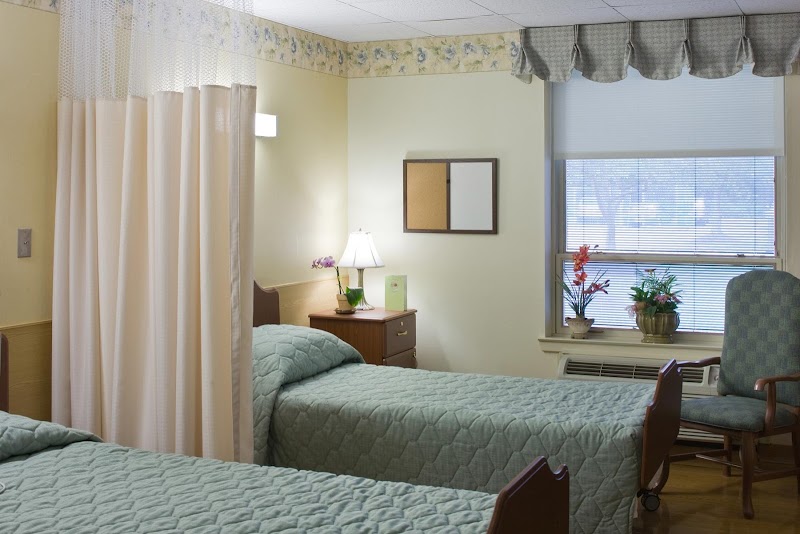
**NOTE- TERMS IN BRACKETS HAVE BEEN EDITED TO PROTECT CONFIDENTIALITY** Based on observation, it was determined that the facility failed to provide a safe, clean, and comfortable environment for residents on two of two nursing units. (South Wing and North Wing) Findings include: Observation from February 4, 2025, between 9:45 a.m. and 1:35 p.m., February 5, 2025, between 8:20 a.m. and 9:00 a.m., and 12:15 p.m. and 2:21 p.m., and February 7, 2025, between 9:10 a.m. and 9:30 a.m. revealed the following: In room [ROOM NUMBER], the walls were heavily marred. In room [ROOM NUMBER], the walls were marred and the closet was missing both doors. In room [ROOM NUMBER], the closet was missing both doors. In room [ROOM NUMBER] bed H, the fan had a heavy accumulation of dust and dirt. In room [ROOM NUMBER]'s bathroom, there was a broken floor tile in front of the toilet and a water-stained ceiling tile. In room [ROOM NUMBER], the walls were heavily marred. In room [ROOM NUMBER], the walls were heavily marred. In the bathroom, there was a large hole in the drywall on the right side of the wall. There was a water-stained ceiling tile. In room [ROOM NUMBER], the windowsill was covered with dirt and debris. The wallpaper was peeling behind bed W. In room [ROOM NUMBER] bed W, the dresser drawer handle was broken. In room [ROOM NUMBER], the ptac unit (ductless air conditioning unit that heats and cools small areas) contained debris and dirt. In the bathroom, the floor was buckled on the left and right sides of the toilet In room [ROOM NUMBER] bed W, there was a solid black thick substance splattered on the floor. In room [ROOM NUMBER]'s bathroom, there was a brown stain along the bottom molding on the wall by the toilet and under the sink. There was a floor tile behind the toilet that was stained with a black substance. In room [ROOM NUMBER], there was an accumulation of dust in the top corner of the window as well as on the curtain. In room [ROOM NUMBER], a layer of floor material in the entry way was lifted away from the base. 28 Pa. Code 201.18(b)(3) Management.
Mar 2024 6 deficiencies
CONCERN (D)

Potential for Harm - no one hurt, but risky conditions existed

Comprehensive Care Plan (Tag F0656)

Could have caused harm · This affected 1 resident

Based on clinical record review and staff interview, it was determined that the facility failed to develop a comprehensive care plan that addressed individual resident needs as identified in the compr...

Read full inspector narrative →
Based on clinical record review and staff interview, it was determined that the facility failed to develop a comprehensive care plan that addressed individual resident needs as identified in the comprehensive assessment for one of 26 sampled residents. (Resident 119) Findings include: Clinical record review revealed that Resident 119 had a Minimum Data Set assessment completed on February 13, 2024. According to the assessment, the resident received nutrition from a feeding tube. According to the Care Area Assessment summary from that assessment, the facility identified that nutrition and a feeding tube were problem areas for the resident and should have been included on the comprehensive care plan. Review of the care plan revealed that the facility did not develop interventions to address these care areas. In an interview on March 8, 2024, at 10:10 a.m., the Director of Nursing confirmed that Resident 119's care plan did not include the areas of potential concern identified in the comprehensive assessment. 28 Pa. Code 211.12(d)(5) Nursing services.
CONCERN (D)

Potential for Harm - no one hurt, but risky conditions existed

Deficiency F0688 (Tag F0688)

Could have caused harm · This affected 1 resident

**NOTE- TERMS IN BRACKETS HAVE BEEN EDITED TO PROTECT CONFIDENTIALITY** Based on clinical record review, observation, and staff interview, it was determined that the facility failed to implement inter...

Read full inspector narrative →
**NOTE- TERMS IN BRACKETS HAVE BEEN EDITED TO PROTECT CONFIDENTIALITY** Based on clinical record review, observation, and staff interview, it was determined that the facility failed to implement interventions to prevent further decline and/or improve range of motion for one of seven sampled residents. (Resident 49) Findings include: Clinical record review revealed that Resident 49 had diagnoses that included multiple sclerosis, quadriplegia, and Parkinson's Disease. The Minimum Data Set assessment dated [DATE], indicated that the resident had memory impairment and required extensive assistance from staff for personal hygiene and dressing. Review of the care plan revealed that staff was to apply bilateral hand carrots (orthotic devices) for four hours to prevent contractures and maintain skin integrity. Review of the current physician's orders revealed that staff was to apply bilateral hand carrots four hours daily, on at 10 a.m. and off at 2 p.m. Observation on March 5, 2024, revealed the resident in bed at 11:34 a.m., 12:15 p.m., and 1:10 p.m., without the bilateral hand carrots in place. On March 6, 2024, the resident was in bed at 12:45 p.m., and 1:50 p.m., without the bilateral hand carrots in place. On March 7, 2024, the resident was again in bed at 10:55 a.m. and 1:07 p.m., without the bilateral hand carrots in place. In an interview on March 8, 2024, at 10:45 a.m., the Director of Nursing confirmed that the staff was to apply bilateral hand carrots as ordered by the physician. 28 Pa. Code 211.12(d)(1)(5) Nursing services.
CONCERN (D)

Potential for Harm - no one hurt, but risky conditions existed

Accident Prevention (Tag F0689)

Could have caused harm · This affected 1 resident

**NOTE- TERMS IN BRACKETS HAVE BEEN EDITED TO PROTECT CONFIDENTIALITY** Based on facility policy review, clinical record review, observation, and resident and staff interview, it was determined that t...

Read full inspector narrative →
**NOTE- TERMS IN BRACKETS HAVE BEEN EDITED TO PROTECT CONFIDENTIALITY** Based on facility policy review, clinical record review, observation, and resident and staff interview, it was determined that the facility failed to assess and implement safety measures related to smoking for two of two sampled residents. (Resident 6, 83) Findings include: Review of the facility policy entitled, Smoking, last reviewed August 7, 2023, revealed that smoking would be permitted in designated areas, that residents would be assessed on admission, quarterly, and with change in condition for the ability to smoke safely and, if necessary, would be supervised. The policy also required that smoking supplies (including, but not limited to, tobacco, matches, lighters, lighter fluid, batteries, refill cartridges, etc.) would be labeled with the resident 's name, room number, and bed number, maintained by staff, and stored in a suitable cabinet kept at the nursing station. Clinical record review revealed that Resident 6 had diagnoses that included Post Traumatic Stress Disorder, sacroiliitis, blindness in the left eye, personal history of pulmonary embolism and thrombosis, personal history of hip replacements. According to the Minimum Data Set assessment (MDS), dated [DATE], the resident had no cognitive impairment. Observations on March 5, 2024, at 11:42 a.m., and March 6, 2024, at 10:42 a.m., revealed Resident 6 smoking outside the front of the building. In an interview on March 6, 2024, at 10:42 a.m., Resident 6 reported smoking on a regular basis. There was no documented evidence that the facility completed smoking assessments for Resident 6 after July 8, 2023. Clinical record review revealed that Resident 83 had diagnoses that included Diabetes with polyneuropathy, chronic kidney disease, and paralytic syndrome following a cerebral infarction. According to the MDS, dated [DATE], the resident had no cognitive impairment. In an interview on March 7, 2024, at 12:05 p.m., Resident 83 reported smoking on a regular basis. There was no documented evidence that the facility completed smoking assessments for Resident 83 after October 1, 2023. In an interview on March 7, 2024, at 1:40 p.m., the Director of Nursing and Administrator confirmed that Residents 6 and 83 had been permitted to smoke and that quarterly smoking assessments had not been completed. 28 Pa. Code 211.12(d)(1)(5) Nursing services.
CONCERN (D)

Potential for Harm - no one hurt, but risky conditions existed

Medication Errors (Tag F0758)

Could have caused harm · This affected 1 resident

Based on clinical record review, facility policy review, and staff interview, it was determined that the facility failed to ensure that a PRN (as needed) psychotropic medication was limited to 14 days...

Read full inspector narrative →
Based on clinical record review, facility policy review, and staff interview, it was determined that the facility failed to ensure that a PRN (as needed) psychotropic medication was limited to 14 days unless the physician documented in the clinical record the rationale for the PRN to be extended beyond 14 days for two of 26 sampled residents. (Residents 43, 67) Findings include: Review of the facility policy entitled, Psychotropic Medication Use, last reviewed October 26, 2023, PRN psychotropic medication should not be ordered for more that 14 days. Residents who were taking PRN psychotropic medications were to have their prescription reviewed by the physician every 14 days. Clinical record review revealed that Resident 43 had diagnoses that included dementia and depression. On February 8, 2024, a physician ordered that staff administer a psychotropic medication (risperidone) every day as needed for anxiety. The order for the risperidone failed to include a time frame for the continued use of the medication. There was no physician documentation that it was appropriate for the order to be extended beyond 14 days. Clinical record review revealed that Resident 67 had diagnoses that included dementia and anxiety. On December 29, 2023, a physician ordered that staff administer a psychotropic medication (lorazepam) every 24 hours as needed for agitation. Review of the Medication Administration Record for March 2024, revealed that staff had administered the prn lorazepam three times and the physician's order was still current. The order for the lorazepam failed to include a time frame for the continued use of the medication. There was no physician documentation that it was appropriate for the order to be extended beyond 14 days. In an interview on March 8, 2024, at 10:10 a.m., the Director of Nursing confirmed that the there was no evidence the physician documented a rationale for continuing the medications beyond 14 days. 28 Pa. code 211.12(d)(1)(5) Nursing services.
MINOR (B)

Minor Issue - procedural, no safety impact

Transfer Notice (Tag F0623)

Minor procedural issue · This affected multiple residents

**NOTE- TERMS IN BRACKETS HAVE BEEN EDITED TO PROTECT CONFIDENTIALITY** Based on clinical record review and staff interview, it was determined that the facility failed to notify the resident's represe...

Read full inspector narrative →
**NOTE- TERMS IN BRACKETS HAVE BEEN EDITED TO PROTECT CONFIDENTIALITY** Based on clinical record review and staff interview, it was determined that the facility failed to notify the resident's representative(s) of transfer/discharge and the reasons for the move in writing for eight of 26 sampled residents. (Residents 12, 29, 45, 49, 83, 101, 119, 126) Findings include: Clinical record review revealed that Resident 12 was transferred and admitted to the hospital on [DATE], after a change in condition. There was no evidence that the resident and resident's representative were provided with written information regarding the resident's transfer to the hospital. Clinical record review revealed that Resident 29 was transferred and admitted to the hospital on [DATE], after a change in condition. There was no evidence that the resident and resident's representative were provided with written information regarding the resident's transfer to the hospital. Clinical record review revealed that Resident 45 was transferred and admitted to the hospital on [DATE], and December 30, 2023, after changes in condition. There was no evidence that the resident and resident's representative were provided with written information regarding the resident's transfer to the hospital. Clinical record review revealed that Resident 49 was transferred and admitted to the hospital on [DATE], and February 16, 2024 after changes in condition. There was no evidence that the resident and resident's representative were provided with written information regarding the resident's transfer to the hospital. Clinical record review revealed that Resident 83 was transferred and admitted to the hospital on [DATE], August 8, 2023, October 4, 2023, and January 19, 2024, after changes in condition. There was no evidence that the resident and resident's representative were provided with written information regarding the resident's transfers to the hospital. Clinical record review revealed that Resident 101 was transferred and admitted to the hospital on [DATE], after a change in condition. There was no evidence that the resident and resident's representative were provided with written information regarding the resident's transfer to the hospital. Clinical record review revealed that Resident 119 was transferred and admitted to the hospital on [DATE], after a change in condition. There was no evidence that the resident and resident's representative were provided with written information regarding the resident's transfer to the hospital. Clinical record review revealed that Resident 126 was discharged from the facility on December 27, 2023, for an increase in behaviors. There was no evidence that the resident and resident's representative were provided with written information regarding the discharge. In an interview on March 8, 2024, at 12:12 p.m., the Administrator confirmed that written transfer or discharge information, including the reasons for the move, were not provided to the residents and residents' representative. 28 Pa. Code 201.29(c.3)(2)
MINOR (B)

Minor Issue - procedural, no safety impact

Deficiency F0625 (Tag F0625)

Minor procedural issue · This affected multiple residents

**NOTE- TERMS IN BRACKETS HAVE BEEN EDITED TO PROTECT CONFIDENTIALITY** Based on clinical record review and staff interview, it was determined that the facility failed to provide a written notice of t...

Read full inspector narrative →
**NOTE- TERMS IN BRACKETS HAVE BEEN EDITED TO PROTECT CONFIDENTIALITY** Based on clinical record review and staff interview, it was determined that the facility failed to provide a written notice of the facility's bed-hold policy to the resident, family member, or legal representative at the time of transfer for two of 12 sampled residents who were transferred to the hospital. (Residents 45, 101) Findings include: Clinical record review revealed that Resident 45 was transferred and admitted to the hospital on [DATE], and December 30, 2023, after changes in condition. There was no documented evidence that the resident, resident's responsible party, or legal representatives were provided written information about the facility's bed-hold policy at the time of transfer. Clinical record review revealed that Resident 101 was transferred and admitted to the hospital on [DATE], after a change in condition. There was no documented evidence that the resident, resident's responsible party, or legal representatives were provided written information about the facility's bed-hold policy at the time of transfer. In an interview on March 8, 2024, at 11:20 a.m., the Director of Nursing confirmed that no written notice of the bed-hold policy was given to the resident or residents' representative upon transfer out of the facility.
Apr 2023 4 deficiencies
CONCERN (D)

Potential for Harm - no one hurt, but risky conditions existed

Comprehensive Care Plan (Tag F0656)

Could have caused harm · This affected 1 resident

Based on clinical record review and staff interview, it was determined that the facility failed to develop a comprehensive care plan that addressed individual resident needs as identified in the compr...

Read full inspector narrative →
Based on clinical record review and staff interview, it was determined that the facility failed to develop a comprehensive care plan that addressed individual resident needs as identified in the comprehensive assessment for one of 25 sampled residents. (Resident 42) Findings include: Clinical record review revealed that Resident 42 had a Minimum Data Set assessment completed on February 9, 2023. According to the assessment the resident had difficulty communicating. According to the Care Area Assessment (CAA) summary dated May 22, 2022, the facility identified that communication was a problem area for the resident and should have been included on the resident's comprehensive care plan. Review of the care plan revealed that the facility did not develop interventions to address this care area. In an interview on April 13, 2023, at 9:23 a.m., the Director of Nursing confirmed that there was no care plan interventions developed to address R42's communication needs. 28 Pa. Code 211.11(d) Resident care plan. 28 Pa. Code 211.12(d)(5) Nursing services.
CONCERN (D)

Potential for Harm - no one hurt, but risky conditions existed

Accident Prevention (Tag F0689)

Could have caused harm · This affected 1 resident

Based on policy review, observation, and staff interview, it was determined that the facility failed to ensure that the facility environment remained free of accident hazards in one shower room. (Nort...

Read full inspector narrative →
Based on policy review, observation, and staff interview, it was determined that the facility failed to ensure that the facility environment remained free of accident hazards in one shower room. (North Hall) Findings include: Review of the facility policy entitled, Storage and Expiration dating of Medications and Biologicals, reviewed on January 26, 2023, revealed the facility should ensured that all medications and biologicals, including treatment items, are securely stored in a locked cart inaccessible by residents and visitors. During multiple observations of the shower room from April 11, 2023, at 11:30 a.m., to April 13, 2023, at 9:55 a.m., two treatment carts were observed to be unlocked. One cart contained topical pain relief gel, triple antibiotic cream, first aid antiseptic and assorted medicated dressings, sterile gauze pads and bandages. The first drawer of the second cart contained single use razor blades. The other drawers contained an assortment of resident identified prescription medicated shampoos and creams. On April 12, 2023, at 12:53, the Director of Nursing (DON) provided documentation that ten residents resided on North Wing who were ambulatory and cognitively impaired. During an interview on April 14, 2023, at 11:35 a.m., the DON stated the treatment carts should have been locked. 28 Pa. Code 211.12(d)(5) Nursing services.
CONCERN (D)

Potential for Harm - no one hurt, but risky conditions existed

Drug Regimen Review (Tag F0756)

Could have caused harm · This affected 1 resident

Based on clinical record review and staff interview, it was determined that the facility failed to ensure that the physician acknowledged the pharmacist's recommendations for one of 25 sampled residen...

Read full inspector narrative →
Based on clinical record review and staff interview, it was determined that the facility failed to ensure that the physician acknowledged the pharmacist's recommendations for one of 25 sampled residents. (Resident 44) Findings include: Clinical record review revealed that on December 23, 2023, the consultant pharmacist recommended that the physician consider decreasing psychotropic medications. There was no documentation that the attending physician had acknowledged or acted upon this recommendation. In an interview on April 13, 2023, at 1:34 p.m., the Director of Nursing confirmed that the medication review recommendation was not addressed by the physician. 28 Pa. Code 201.18(e)(1)(3)(6) Management. 28 Pa. Code 211.12(d)(3)(5) Nursing services.
CONCERN (E)

Potential for Harm - no one hurt, but risky conditions existed

Safe Environment (Tag F0584)

Could have caused harm · This affected multiple residents

**NOTE- TERMS IN BRACKETS HAVE BEEN EDITED TO PROTECT CONFIDENTIALITY** Based on observation, it was determined that the facility failed to provide a safe, clean, and comfortable environment for resid...

Read full inspector narrative →
**NOTE- TERMS IN BRACKETS HAVE BEEN EDITED TO PROTECT CONFIDENTIALITY** Based on observation, it was determined that the facility failed to provide a safe, clean, and comfortable environment for residents on two of two nursing units. (South Wing and North Wing) Findings include: Observation throughout the facility during all days of the survey revealed the following: There was a hole in the wall near the door inside room [ROOM NUMBER]. The privacy curtain in room [ROOM NUMBER] was coming off the hooks. In room [ROOM NUMBER] there was a cracked floor tile. Metal ceiling tiles were stained and damaged in the hallway between rooms 95 to 119. Air conditioner vents contained debris and dirt in rooms 95, 96, 97, 99, 107, and 113. In room [ROOM NUMBER] the bedside cabinet doors were falling off. Tile was missing from the wall and there was dirt and debris on the floor around the air conditioning unit. In the bathroom, there was a discolored towel at the base of the toilet. The ceiling vent was dusty. In room [ROOM NUMBER] the bedside cabinet door was broken. The closet door was missing a door knob. In the bathroom, the faucet and base of sink were stained. The ceiling tiles, floor molding and heater had a built up of dirt. In room [ROOM NUMBER] there was a stained ceiling tile and missing floor tile. The closet was missing the right side door. In room [ROOM NUMBER] there was a stained ceiling tile. The bathroom had a large hole in the wall. The toilet tank cover did not fit properly and the bathroom door was marred. In room [ROOM NUMBER] there was no light cover on the over bed light. There was dirt and debris around the air conditioner base. The bathroom door was marred. In room [ROOM NUMBER] there was a used glove on the floor next to a trash can. The privacy curtain was stained and the drawstring was frayed. In the bathroom, the floor was stained and there was black dirt around the base of the toilet. The bathroom door was marred. In room [ROOM NUMBER] the closet was missing both doors. The bedside cabinet door was falling off. The bathroom door was marred and there were two holes in the wall. 28 Pa. Code 201.18(b)(3) Management.
Understanding Severity Codes (click to expand)
Life-Threatening (Immediate Jeopardy)
J - Isolated K - Pattern L - Widespread
Actual Harm
G - Isolated H - Pattern I - Widespread
Potential for Harm
D - Isolated E - Pattern F - Widespread
No Harm (Minor)
A - Isolated B - Pattern C - Widespread

Questions to Ask on Your Visit

  • "Can I speak with families of current residents?"
  • "What's your RN coverage like on weekends and overnight?"

Our Honest Assessment

Strengths
  • • No major safety red flags. No abuse findings, life-threatening violations, or SFF status.
  • • No fines on record. Clean compliance history, better than most Pennsylvania facilities.
  • • 39% turnover. Below Pennsylvania's 48% average. Good staff retention means consistent care.
Concerns
  • • 17 deficiencies on record. Higher than average. Multiple issues found across inspections.
Bottom line: Generally positive indicators. Standard due diligence and a personal visit recommended.

About This Facility

What is Quakertown Center's CMS Rating?

CMS assigns QUAKERTOWN CENTER an overall rating of 4 out of 5 stars, which is considered above average nationally. Within Pennsylvania, this rating places the facility higher than 99% of the state's 100 nursing homes. This rating reflects solid performance across the metrics CMS uses to evaluate nursing home quality.

How is Quakertown Center Staffed?

CMS rates QUAKERTOWN CENTER's staffing level at 4 out of 5 stars, which is above average compared to other nursing homes. Staff turnover is 39%, compared to the Pennsylvania average of 46%. This relatively stable workforce can support continuity of care.

What Have Inspectors Found at Quakertown Center?

State health inspectors documented 17 deficiencies at QUAKERTOWN CENTER during 2023 to 2025. These included: 14 with potential for harm and 3 minor or isolated issues.

Who Owns and Operates Quakertown Center?

QUAKERTOWN CENTER is owned by a for-profit company. For-profit facilities operate as businesses with obligations to shareholders or private owners. The facility is operated by GENESIS HEALTHCARE, a chain that manages multiple nursing homes. With 138 certified beds and approximately 122 residents (about 88% occupancy), it is a mid-sized facility located in QUAKERTOWN, Pennsylvania.

How Does Quakertown Center Compare to Other Pennsylvania Nursing Homes?

Compared to the 100 nursing homes in Pennsylvania, QUAKERTOWN CENTER's overall rating (4 stars) is above the state average of 3.0, staff turnover (39%) is near the state average of 46%, and health inspection rating (4 stars) is above the national benchmark.

What Should Families Ask When Visiting Quakertown Center?

Based on this facility's data, families visiting should ask: "Can I visit during a mealtime to observe dining assistance and food quality?" "How do you handle medical emergencies, and what is your hospital transfer rate?" "Can I speak with family members of current residents about their experience?"

Is Quakertown Center Safe?

Based on CMS inspection data, QUAKERTOWN CENTER has a clean safety record: no substantiated abuse findings (meaning no confirmed cases of resident harm), no Immediate Jeopardy citations (the most serious violation level indicating risk of serious injury or death), and is not on the Special Focus Facility watch list (a federal program monitoring the lowest-performing 1% of nursing homes). The facility has a 4-star overall rating and ranks #1 of 100 nursing homes in Pennsylvania. While no facility is perfect, families should still ask about staff-to-resident ratios and recent inspection results during their visit.

Do Nurses at Quakertown Center Stick Around?

QUAKERTOWN CENTER has a staff turnover rate of 39%, which is about average for Pennsylvania nursing homes (state average: 46%). Moderate turnover is common in nursing homes, but families should still ask about staff tenure and how the facility maintains care continuity when employees leave.

Was Quakertown Center Ever Fined?

QUAKERTOWN CENTER has no federal fines on record. CMS issues fines when nursing homes fail to meet care standards or don't correct problems found during inspections. The absence of fines suggests the facility has either maintained compliance or corrected any issues before penalties were assessed. This is a positive indicator, though families should still review recent inspection reports for the full picture.

Is Quakertown Center on Any Federal Watch List?

QUAKERTOWN CENTER is not on any federal watch list. The most significant is the Special Focus Facility (SFF) program, which identifies the bottom 1% of nursing homes nationally based on persistent, serious quality problems. Not being on this list means the facility has avoided the pattern of deficiencies that triggers enhanced federal oversight. This is a positive indicator, though families should still review the facility's inspection history directly.