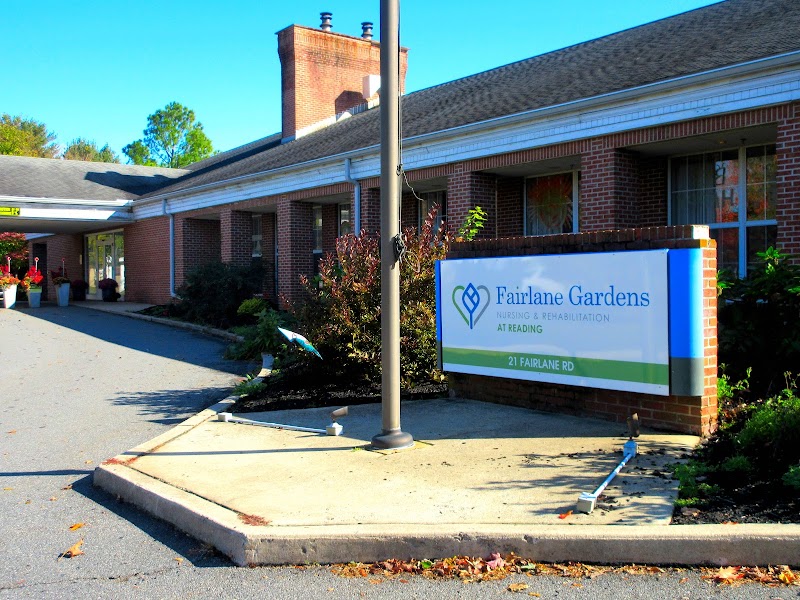
FAIRLANE GARDENS NURSING AND REHAB AT READING


21 FAIRLANE ROAD, READING, PA 19606 (610) 779-8522
For profit - Limited Liability company 124 Beds LME FAMILY HOLDINGS Data: November 2025
Trust Grade
80/100
#171 of 653 in PA
Last Inspection: August 2025

Inspected within the last 6 months. Data reflects current conditions.

Overview

Fairlane Gardens Nursing and Rehab at Reading has a Trust Grade of B+, which means it is recommended and is above average in quality. It ranks #171 out of 653 nursing homes in Pennsylvania, placing it in the top half, and #7 out of 15 in Berks County, indicating that only a few local facilities are better. The facility is improving, with a decrease in issues from 6 in 2024 to 5 in 2025, and has a good staffing turnover rate of 42%, which is lower than the state average of 46%. However, there are concerns, such as the presence of debris and damage in several areas, and incidents where medications were not administered according to physician orders for some residents. While there are no fines on record, which is positive, the average RN coverage means that while nurses are present, there may be opportunities for improvement in oversight.

Trust Score
B+
80/100
In Pennsylvania
#171/653
Top 26%
Safety Record
Low Risk
No red flags
Inspections
Getting Better
6 → 5 violations
Staff Stability
○ Average
42% turnover. Near Pennsylvania's 48% average. Typical for the industry.
Penalties
✓ Good
No fines on record. Clean compliance history, better than most Pennsylvania facilities.
Skilled Nurses
○ Average
Each resident gets 34 minutes of Registered Nurse (RN) attention daily — about average for Pennsylvania. RNs are the most trained staff who monitor for health changes.
Violations
⚠ Watch
11 deficiencies on record. Higher than average. Multiple issues found across inspections.
★★★★☆
4.0
Overall Rating
★★★☆☆
3.0
Staff Levels
★★★☆☆
3.0
Care Quality
★★★★☆
4.0
Inspection Score
Stable
2024: 6 issues
2025: 5 issues

The Good

  • Full Sprinkler Coverage · Fire safety systems throughout facility
  • No fines on record
  • Staff turnover below average (42%)

    6 points below Pennsylvania average of 48%

Facility shows strength in fire safety.

The Bad

Staff Turnover: 42%

Near Pennsylvania avg (46%)

Typical for the industry

Chain: LME FAMILY HOLDINGS

Part of a multi-facility chain

Ask about local staffing decisions and management

The Ugly 11 deficiencies on record

Aug 2025 4 deficiencies
CONCERN (D)

Potential for Harm - no one hurt, but risky conditions existed

Assessment Accuracy (Tag F0641)

Could have caused harm · This affected 1 resident

**NOTE- TERMS IN BRACKETS HAVE BEEN EDITED TO PROTECT CONFIDENTIALITY** Based on clinical record review and staff interview, it was determined that the facility failed to ensure that the Minimum Data ...

Read full inspector narrative →
**NOTE- TERMS IN BRACKETS HAVE BEEN EDITED TO PROTECT CONFIDENTIALITY** Based on clinical record review and staff interview, it was determined that the facility failed to ensure that the Minimum Data Set (MDS) assessment was completed to accurately reflect the resident's status for two of 24 sampled residents. (Residents 27, 78) Findings include: Clinical record review revealed that Section N (Medications) of Resident 27's MDS assessment dated [DATE], indicated that the resident was not on an antipsychotic medication during the seven-day review period. Review of the resident's Medication Administration Record from June 2025 revealed that the resident did receive an antipsychotic (lurasidone) during the seven-day review period. Clinical record review revealed that section O (Special treatments, procedures, and programs) of the MDS assessment dated [DATE], indicated that Resident 78 did not receive tracheostomy care during the seven-day review period. Review of Resident 21's Treatment Administration record from July 2025 revealed that the resident did receive tracheostomy care during the seven-day review period. In an interview on August 13, 2024, at 2:26 p.m., Registered Nurse Assessment Coordinator 1 confirmed the MDS assessments had not accurately reflected the residents' status and had to be modified by the facility. CFR 483.20(g) Accuracy of AssessmentsPreviously cited 7/12/24
CONCERN (D)

Potential for Harm - no one hurt, but risky conditions existed

Deficiency F0688 (Tag F0688)

Could have caused harm · This affected 1 resident

**NOTE- TERMS IN BRACKETS HAVE BEEN EDITED TO PROTECT CONFIDENTIALITY** Based on clinical record review and interview, it was determined that the facility failed to provide treatment and services to p...

Read full inspector narrative →
**NOTE- TERMS IN BRACKETS HAVE BEEN EDITED TO PROTECT CONFIDENTIALITY** Based on clinical record review and interview, it was determined that the facility failed to provide treatment and services to prevent a reduction in range of motion and/or to improve or maintain mobility on a consistent basis for two of 24 sampled residents. (Residents 27, 78) Findings include: Clinical record review revealed that Resident 27 had diagnoses that included muscle weakness and difficulty in walking. The Minimum Data Set (MDS) assessment dated [DATE], indicated that the resident was cognitively impaired and required limited assistance from staff for activities of daily living. On April 17, 2025, the physical therapist had recommended a Restorative Nursing Program (RNP) for ambulation. A physician's order dated April 17, 2025, directed staff to provide the RNP for 15 minutes twice a day, seven days a week. There was a lack of documentation to support that between July 16, 2025, through August 13, 2025, the resident was offered restorative ambulation twice a day, as ordered, on 30 of 30 days. Clinical record review revealed that Resident 78 had diagnoses that included anoxic brain damage (lack of oxygen to the brain), persistent vegetative state, and right and left-hand contractures. The MDS assessment dated [DATE], indicated that the resident was cognitively impaired and dependent on staff for all activities of daily living. A physician's order dated June 7, 2024, directed staff to provide a RNP for passive range of motion to the upper extremities, fingers and shoulders,15 minutes twice a day, seven days a week. On May 7, 2025, the occupation therapist recommended a range of motion program be continued for the bilateral should and fingers. There was a lack of documentation to support that between July 15, 2025, and August 12, 2025, the resident was offered the RNP twice a day, as ordered, on 18 of 30 days. In an interview on August 14, 2025, at 10:05 a.m. the Director of Nursing confirmed that there was no documented evidence that the RNPs were offered on the previously mentioned dates, twice a day, as ordered, to Residents 27 and 78 consistently. In an interview on August 14, 2025, at 11:15 a.m., the Director of Rehabilitation stated Resident 27 needed the RNP for mobility and Resident 78 needed the RNP for hand contractures. CFR 483.25(c)(1)-(3) Increase/Prevent Decrease in ROM/MobilityPreviously cited 7/12/24 28 Pa. Code 211.12(d)(1)(5) Nursing services.
CONCERN (E)

Potential for Harm - no one hurt, but risky conditions existed

Safe Environment (Tag F0584)

Could have caused harm · This affected multiple residents

**NOTE- TERMS IN BRACKETS HAVE BEEN EDITED TO PROTECT CONFIDENTIALITY** Based on observation, it was determined that the facility failed to provide a safe, clean, and comfortable environment on four o...

Read full inspector narrative →
**NOTE- TERMS IN BRACKETS HAVE BEEN EDITED TO PROTECT CONFIDENTIALITY** Based on observation, it was determined that the facility failed to provide a safe, clean, and comfortable environment on four of four nursing units. (1A, 1B, 2A, 2B)Findings include:Observations on August 12, 2025, from 9:00 a.m. through 12:17 p.m. revealed the following:Debris and a dark/black substance splattered throughout the hall floors of Units 1A, 1B, 2A, and 2B and rooms 101, 109, 110, and 115.The floor in 217 had red and brown spots between the beds.There were brown spots on the ceiling in the hallway at room [ROOM NUMBER].There were red spots on the wall by the door in room [ROOM NUMBER]. The radiator in the resident lounge was broken with sharp, loose parts lying on the floor. The wall by the left entrance door in the main dining room was damaged. The wall behind both beds in room [ROOM NUMBER] was damaged. The ceiling and wall behind the toilet in room [ROOM NUMBER] were damaged. The mirrors were damaged in the bathrooms in rooms 217, 224, 308, 309, and 310.There were flying winged insects noted around the nurse's station of section 1A and in room [ROOM NUMBER]. Observations on August 13, 2025, at 9:15 a.m. through 11:31 a.m., revealed the following:A strip of peeling wood sticking out of the bottom of the closet door for room [ROOM NUMBER] bed two. Debris and a dark/black substance splattered throughout the hall floors of Unit 1A and rooms 101, 109, 110, and 115.Flying winged insects were noted throughout the hallway in section 1A and in room [ROOM NUMBER].The wall was damaged by the resident's bed in room [ROOM NUMBER]. Observations in the shower room across from nurse's station intersecting halls 100-300 on August 13, 2025 at 11:30 a.m., revealed:The shower room had a musty smell.A grey and brown residue on the floor tiles in all three shower stalls. A yellow substance on the shower chair in the first stall. The non-skid strips in the first and third shower stalls were worn. A residue on all three shower curtains. All three shower curtains were missing hooks. A black substance on the non-skid mat in the third shower stall. A brown and red substance on the floor in front of the scale.28 Pa. Code 201.14(a) Responsibility of licensee. 28 Pa. Code 201.18(b)(1) Management.
CONCERN (E)

Potential for Harm - no one hurt, but risky conditions existed

Quality of Care (Tag F0684)

Could have caused harm · This affected multiple residents

Based on review of facility policy, clinical record review, and staff interview, it was determined that the facility failed to administer medications in accordance with physician orders for four of 24...

Read full inspector narrative →
Based on review of facility policy, clinical record review, and staff interview, it was determined that the facility failed to administer medications in accordance with physician orders for four of 24 sampled residents. (Residents 2, 6, 19, 34)Findings include: Review of the policy entitled, Medication Administration, last reviewed July 14, 2025, revealed staff were to obtain vital signs if necessary, and document physician indicated medication administration information.Clinical record review revealed that Resident 2 had diagnosis of hypertension (high blood pressure). On April 3, 2025, the physician ordered staff to administer a blood pressure medication (lisinopril) one time a day. The medication was to be held if the resident's systolic blood pressure (SBP, the first measurement of blood pressure when the heart beats and the pressure is at its highest) was less than 110 millimeters of mercury (mm/Hg) or if the resident's heart rate (the number of times a heart beats in one minute) was less than 60 bpm (beats per minute). Review of Resident 2's Medication Administration Records (MAR) for May, June, July, and August 2025, revealed that staff administered the medication three times in May, five times in June, and three times in July when the resident's SBP was below 110 mm/Hg. Review of Resident 2's MARs for May and June 2025, revealed no evidence that staff obtained the resident's heart rate prior to administration of the medication on 23 occasions in May 2025, and 16 occasions in June 2025.Clinical record review revealed that Resident 6 had diagnoses that included atrial fibrillation (irregular heartbeat) and hypertension (high blood pressure). On June 5, 2025, the physician ordered staff to administer a blood pressure medication (midodrine) two times a day for orthostatic blood pressure (a drop in blood pressure when changing positions) and to monitor for supine (laying) and sitting blood pressures. Review of Resident 6's care plan revealed an intervention to monitor blood pressure as ordered. Physician's notes dated June 6 and June 21, 2025, July 9, 21, and 26, 2025, and August 6, 2025, revealed staff were to continue to monitor the resident's blood pressure. There was no documented evidence that staff monitored Resident 6's blood pressure as ordered by the physician.Clinical record review revealed that Resident 19 had diagnoses that included congestive heart failure and type 2 diabetes. A physician's order dated May 3, 2025, directed staff to weigh the resident daily. Review of Resident 19's MAR for May, June, July, and August 2025, revealed no evidence that the resident's weights were obtained per physician's orders on six occasions in May, three occasions in June, four occasions in July, and three occasions in August 2025.Clinical record review revealed that Resident 34 had diagnoses that included hypertension and chronic kidney disease. On July 30, 2022, the physician ordered staff to administer a blood pressure medicine (metoprolol succinate) one time a day. Staff were not to administer the medication if Resident 34's heart rate was less than 60 bpm. Review of Resident 34's MAR for June, July, and August 2025, revealed no evidence that staff obtained the resident's heart rate prior to administration of the medication on 72 occasions.In an interview on August 14, 2025, at 10:10 a.m., the Director of Nursing confirmed that Resident 19's weights were not completed daily per the physician's orders and medications were administered outside of the established parameters for Residents 2, 6, and 34.28 Pa. Code 211.12(d)(1)(5) Nursing services.
Apr 2025 1 deficiency
CONCERN (D) 📢 Someone Reported This

A family member, employee, or ombudsman was alarmed enough to file a formal complaint

Potential for Harm - no one hurt, but risky conditions existed

Deficiency F0806 (Tag F0806)

Could have caused harm · This affected 1 resident

**NOTE- TERMS IN BRACKETS HAVE BEEN EDITED TO PROTECT CONFIDENTIALITY** Based on clinical record review, resident interview, and a review of facility documentation, it was determined that the facility...

Read full inspector narrative →
**NOTE- TERMS IN BRACKETS HAVE BEEN EDITED TO PROTECT CONFIDENTIALITY** Based on clinical record review, resident interview, and a review of facility documentation, it was determined that the facility failed to accommodate resident food allergies one of three sampled residents. (Resident 1) Findings include: Clinical record review revealed that Resident 1 was admitted to the facility on [DATE], and that he was allergic to bananas. On March 31, 2025, a nurse noted that the resident reported that he had been served yogurt containing bananas at dinner. In an interview on April 5, 2025, at 8:30 a.m., the resident stated that he had recently been served yogurt containing bananas, and that it happened several times before. Review of facility investigation documents confirmed that on March 31, 2025, the resident was served yogurt containing bananas and that he ingested a small amount. The facility investigation further revealed that he had been served food containing bananas on three prior occasions. 28 Pa. Code 201.14(a) Responsibility of licensee. 28 Pa. Code 201.18(b) Management.
Jul 2024 6 deficiencies
CONCERN (D)

Potential for Harm - no one hurt, but risky conditions existed

Assessment Accuracy (Tag F0641)

Could have caused harm · This affected 1 resident

**NOTE- TERMS IN BRACKETS HAVE BEEN EDITED TO PROTECT CONFIDENTIALITY** Based on clinical record review and staff interview, it was determined that the facility failed to ensure that the Minimum Data ...

Read full inspector narrative →
**NOTE- TERMS IN BRACKETS HAVE BEEN EDITED TO PROTECT CONFIDENTIALITY** Based on clinical record review and staff interview, it was determined that the facility failed to ensure that the Minimum Data Set (MDS) assessment was completed to accurately reflect the resident's status for two of 20 sampled residents. (Residents 11, 21) Findings include: Clinical record review revealed that Section N (Medications) of Resident 11's MDS assessment dated [DATE], indicated that the resident was not on an opioid medication during the seven-day review period, however review of the resident's record revealed that the resident did receive an opioid (tramadol) during the seven-day review period. Clinical record review revealed that section P of the MDS assessment dated [DATE], indicated that Resident 21 used a chair or other alarm less than daily during the seven-day review period. Review of Resident 21's clinical record revealed that the resident was not ordered and did not use a chair or other alarm during the seven-day review period, as inaccurately identified on the MDS assessment. In an interview on July 12, 2024, at 9:50 a.m., the Nursing Home Administrator confirmed the MDS assessments had not accurately reflected the residents' status and had to be modified by the facility.
CONCERN (D)

Potential for Harm - no one hurt, but risky conditions existed

ADL Care (Tag F0677)

Could have caused harm · This affected 1 resident

**NOTE- TERMS IN BRACKETS HAVE BEEN EDITED TO PROTECT CONFIDENTIALITY** Based on clinical record review, observation, and staff and resident interview, it was determined that the facility failed to pr...

Read full inspector narrative →
**NOTE- TERMS IN BRACKETS HAVE BEEN EDITED TO PROTECT CONFIDENTIALITY** Based on clinical record review, observation, and staff and resident interview, it was determined that the facility failed to provide services to maintain adequate grooming and personal hygiene for two of 20 sampled residents. (Residents 16, 40) Findings include: Clinical record review revealed that Resident 16 had diagnoses that included bilateral hand contractures and diabetes mellitus. Review of the Minimum Data Set (MDS) assessment dated [DATE], revealed that the resident required assistance from staff for activites of daily living including personal hygiene. On July 11, 2024, at 10:35 a.m., Resident 16 was observed in his wheelchair and his fingernails and beard were long. The resident stated that he preferred his nails and beard to be short and that he had asked for them to be cut. Clinical record review revealed that Resident 40 had diagnoses that included diabetes mellitus and hypertension. Review of the MDS assessment dated [DATE], revealed that the resident required assistance from staff for activities of daily living including personal hygiene. On July 11, 2024, at 10:50 a.m., the resident was observed in his room with long, discolored fingernails with sharp edges. He had a bandage to his right hand and stated that he had scratched himself. The resident further stated that he preferred his nails to be short and that staff had not provided nail care. In an interview on July 11, 2024, at 2:45 p.m., the Director of Nursing stated that nail care was to be completed on resident shower days (twice a week). 28 Pa. Code 211.12(d)(1)(5) Nursing services.
CONCERN (D)

Potential for Harm - no one hurt, but risky conditions existed

Deficiency F0685 (Tag F0685)

Could have caused harm · This affected 1 resident

**NOTE- TERMS IN BRACKETS HAVE BEEN EDITED TO PROTECT CONFIDENTIALITY** Based on clinical record review and resident and staff interview, it was determined that the facility failed to ensure each resi...

Read full inspector narrative →
**NOTE- TERMS IN BRACKETS HAVE BEEN EDITED TO PROTECT CONFIDENTIALITY** Based on clinical record review and resident and staff interview, it was determined that the facility failed to ensure each resident received timely treatment and services to maintain hearing abilities for one of 20 sampled residents. (Resident 33) Findings include: Clinical record review revealed that Resident 33 had diagnoses that included diabetes mellitus and congestive heart failure. Review of the Minimum Data Set assessment dated [DATE], revealed that the resident had some difficulty hearing and used a hearing appliance. In an interview on July 10, 2024, at 1:00 p.m., Resident 33 stated that she has not received her hearing aides and has been waiting almost a year. Review of facility documentation revealed that on August 9, 2023, Resident 33 was seen by audiology and the physician determined that she would benefit from hearing aides. There was no documented evidence that the resident received hearing aides or that facility addressed this recommendation until July 11, 2024. In an interview on July 12, 2024, at 12:40 p.m., the Nursing Home Administrator confirmed that the facility did not address the recommendation until July 11, 2024.
CONCERN (D)

Potential for Harm - no one hurt, but risky conditions existed

Deficiency F0810 (Tag F0810)

Could have caused harm · This affected 1 resident

Based on clinical record review and observation, it was determined that the facility failed to provide adaptive equipment to assist with eating meals for one of 20 sampled residents. (Resident 44) Fin...

Read full inspector narrative →
Based on clinical record review and observation, it was determined that the facility failed to provide adaptive equipment to assist with eating meals for one of 20 sampled residents. (Resident 44) Findings include: Clinical record review revealed that Resident 44 had diagnoses that included aspiration pneumonia and dysphagia. On May 13, 2024, the physician ordered for staff to provide assistance to Resident 44 at meals and for all food to be served in bowls. The care plan indicated that the resident was to receive her food in bowls. On July 9, 2024, from 11:45 a.m. through 12:30 p.m., the resident was observed in the dining room for lunch. She was served her meal on a regular plate. The resident was feeding herself and had a large amount of food spilt on her clothing protector. In an interview on July 12, 2024, at 12:20 p.m., the Director of Nursing confirmed that the resident should have received her food in bowls. 28 Pa. Code 211.12(d)(1)(3)(5) Nursing services.
CONCERN (E)

Potential for Harm - no one hurt, but risky conditions existed

Deficiency F0688 (Tag F0688)

Could have caused harm · This affected multiple residents

**NOTE- TERMS IN BRACKETS HAVE BEEN EDITED TO PROTECT CONFIDENTIALITY** Based on clinical record review and interview, it was determined that the facility failed to provide restorative nursing service...

Read full inspector narrative →
**NOTE- TERMS IN BRACKETS HAVE BEEN EDITED TO PROTECT CONFIDENTIALITY** Based on clinical record review and interview, it was determined that the facility failed to provide restorative nursing services to prevent a reduction in range of motion and/or to improve or maintain mobility on a consistent basis for two of 20 sampled residents. (Residents 11, 21) Findings include: Clinical record review revealed that Resident 11 had diagnoses that included traumatic brain injury, functional quadriplegia (complete inability to move due to severe disability), and bilateral hand contractures. The Minimum Data Set (MDS) assessment dated [DATE], indicated that the resident was cognitively impaired and dependent on staff for all activities of daily living. Review of Resident 11's current care plan revealed that the resident is at high risk for contractures due to immobility and that staff was to provide a restorative nursing program for passive range of motion to bilateral upper extremities at fingers and shoulders to reduce risk for further contracture twice a day. There was a lack of documentation to support that the resident was offered restorative range of motion on 18 of 30 days. Clinical record review revealed that Resident 21 had diagnoses that included chronic pain and osteoarthritis. The MDS assessment dated [DATE], indicated that the resident was alert and oriented and required limited assistance from staff for activities of daily living. In an interview on July 10, 2024, at 10:55 a.m. Resident 21 stated no one was walking him like they were supposed to. Review of Resident 21's current care plan revealed that he had self-care performance deficit due to his physical limitations and that staff was to provide a restorative nursing program to ambulate with a four wheeled walker and gait belt, with assistance of one staff person with a wheelchair to follow 50 to 125 feet twice a day. There was a lack of documentation to support that the resident was offered restorative ambulation on 17 of 30 days. In an interview on July 12, 2024, at 12:25 p.m. the Nursing Home Administrator confirmed that there was no documented evidence that the restorative nursing programs were completed. 28 Pa. Code 211.12(d)(1)(5) Nursing services.
CONCERN (E)

Potential for Harm - no one hurt, but risky conditions existed

Accident Prevention (Tag F0689)

Could have caused harm · This affected multiple residents

Based on observation and staff interview, it was determined that the facility failed to ensure that the environment remained free of accident hazards on two of four nursing units. (Station 2A, Station...

Read full inspector narrative →
Based on observation and staff interview, it was determined that the facility failed to ensure that the environment remained free of accident hazards on two of four nursing units. (Station 2A, Station 2B) Findings include: Observation on July 9, 2024, from 10:48 a.m. through 10:57 a.m., on Station 2A, medication in applesauce was left unattended on top of the medication cart. The medication was accessible to three cognitively impaired, mobile residents in the area. Observation on July 10, 2024, from 09:03 a.m. through 09:16 a.m., on Station 2B, medication in vanilla pudding was left unattended on top of the medication cart. The medication was accessible to three cognitively impaired, mobile residents in the area. In an interview on July 11, 2024, at 02:45 p.m., the Nursing Home Administrator confirmed that medication should not be unattended on the medication cart. 28 Pa. Code 211.12(d)(1)(5) Nursing services.
Understanding Severity Codes (click to expand)
Life-Threatening (Immediate Jeopardy)
J - Isolated K - Pattern L - Widespread
Actual Harm
G - Isolated H - Pattern I - Widespread
Potential for Harm
D - Isolated E - Pattern F - Widespread
No Harm (Minor)
A - Isolated B - Pattern C - Widespread

Questions to Ask on Your Visit

  • "Can I speak with families of current residents?"
  • "What's your RN coverage like on weekends and overnight?"

Our Honest Assessment

Strengths
  • • Grade B+ (80/100). Above average facility, better than most options in Pennsylvania.
  • • No major safety red flags. No abuse findings, life-threatening violations, or SFF status.
  • • No fines on record. Clean compliance history, better than most Pennsylvania facilities.
  • • 42% turnover. Below Pennsylvania's 48% average. Good staff retention means consistent care.
Concerns
  • • 11 deficiencies on record. Higher than average. Multiple issues found across inspections.
Bottom line: Generally positive indicators. Standard due diligence and a personal visit recommended.

About This Facility

What is Fairlane Gardens Nursing And Rehab At Reading's CMS Rating?

CMS assigns FAIRLANE GARDENS NURSING AND REHAB AT READING an overall rating of 4 out of 5 stars, which is considered above average nationally. Within Pennsylvania, this rating places the facility higher than 99% of the state's 100 nursing homes. This rating reflects solid performance across the metrics CMS uses to evaluate nursing home quality.
How is Fairlane Gardens Nursing And Rehab At Reading Staffed?

CMS rates FAIRLANE GARDENS NURSING AND REHAB AT READING's staffing level at 3 out of 5 stars, which is average compared to other nursing homes. Staff turnover is 42%, compared to the Pennsylvania average of 46%. This relatively stable workforce can support continuity of care.

What Have Inspectors Found at Fairlane Gardens Nursing And Rehab At Reading?

State health inspectors documented 11 deficiencies at FAIRLANE GARDENS NURSING AND REHAB AT READING during 2024 to 2025. These included: 11 with potential for harm.
Who Owns and Operates Fairlane Gardens Nursing And Rehab At Reading?

FAIRLANE GARDENS NURSING AND REHAB AT READING is owned by a for-profit company. For-profit facilities operate as businesses with obligations to shareholders or private owners. The facility is operated by LME FAMILY HOLDINGS, a chain that manages multiple nursing homes. With 124 certified beds and approximately 106 residents (about 85% occupancy), it is a mid-sized facility located in READING, Pennsylvania.

How Does Fairlane Gardens Nursing And Rehab At Reading Compare to Other Pennsylvania Nursing Homes?

Compared to the 100 nursing homes in Pennsylvania, FAIRLANE GARDENS NURSING AND REHAB AT READING's overall rating (4 stars) is above the state average of 3.0, staff turnover (42%) is near the state average of 46%, and health inspection rating (4 stars) is above the national benchmark.

What Should Families Ask When Visiting Fairlane Gardens Nursing And Rehab At Reading?

Based on this facility's data, families visiting should ask: "Can I visit during a mealtime to observe dining assistance and food quality?" "How do you handle medical emergencies, and what is your hospital transfer rate?" "Can I speak with family members of current residents about their experience?"

Is Fairlane Gardens Nursing And Rehab At Reading Safe?

Based on CMS inspection data, FAIRLANE GARDENS NURSING AND REHAB AT READING has a clean safety record: no substantiated abuse findings (meaning no confirmed cases of resident harm), no Immediate Jeopardy citations (the most serious violation level indicating risk of serious injury or death), and is not on the Special Focus Facility watch list (a federal program monitoring the lowest-performing 1% of nursing homes). The facility has a 4-star overall rating and ranks #1 of 100 nursing homes in Pennsylvania. While no facility is perfect, families should still ask about staff-to-resident ratios and recent inspection results during their visit.

Do Nurses at Fairlane Gardens Nursing And Rehab At Reading Stick Around?

FAIRLANE GARDENS NURSING AND REHAB AT READING has a staff turnover rate of 42%, which is about average for Pennsylvania nursing homes (state average: 46%). Moderate turnover is common in nursing homes, but families should still ask about staff tenure and how the facility maintains care continuity when employees leave.

Was Fairlane Gardens Nursing And Rehab At Reading Ever Fined?

FAIRLANE GARDENS NURSING AND REHAB AT READING has no federal fines on record. CMS issues fines when nursing homes fail to meet care standards or don't correct problems found during inspections. The absence of fines suggests the facility has either maintained compliance or corrected any issues before penalties were assessed. This is a positive indicator, though families should still review recent inspection reports for the full picture.

Is Fairlane Gardens Nursing And Rehab At Reading on Any Federal Watch List?

FAIRLANE GARDENS NURSING AND REHAB AT READING is not on any federal watch list. The most significant is the Special Focus Facility (SFF) program, which identifies the bottom 1% of nursing homes nationally based on persistent, serious quality problems. Not being on this list means the facility has avoided the pattern of deficiencies that triggers enhanced federal oversight. This is a positive indicator, though families should still review the facility's inspection history directly.