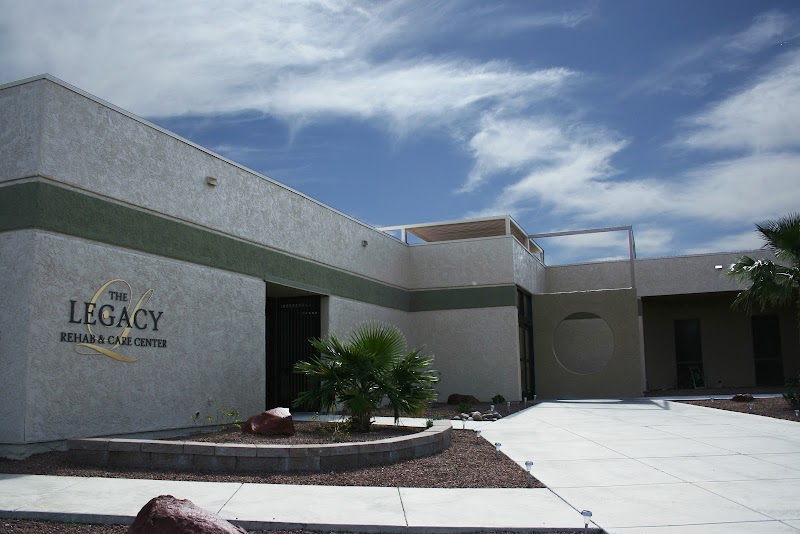
THE LEGACY REHAB & CARE CENTER
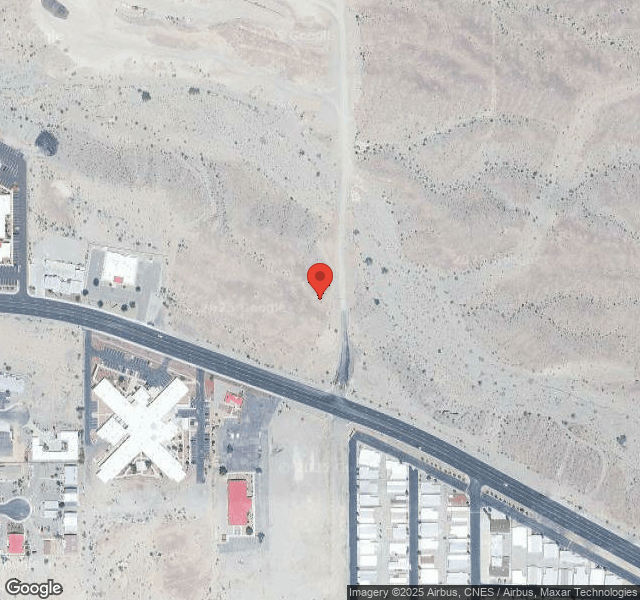
2812 SILVER CREEK ROAD, BULLHEAD CITY, AZ 86442 (928) 763-1404
For profit - Corporation 120 Beds Independent Data: November 2025
Trust Grade
90/100
#36 of 139 in AZ
Last Inspection: January 2025

Within standard 12-15 month inspection cycle. Federal law requires annual inspections.

Overview

The Legacy Rehab & Care Center in Bullhead City, Arizona, has received an excellent Trust Grade of A, indicating it is highly recommended for families seeking care. With a state rank of #36 out of 139 and a county rank of #1 out of 6, it is positioned in the top half of facilities in Arizona and is the best option in Mohave County. The facility is improving, having reduced its issues from 2 in 2023 to just 1 in 2025, although staffing is a mixed bag with a 3 out of 5 rating, and a turnover rate of 51%, which is average for the state. While there have been no fines, which is a good sign, RN coverage is concerning as it is lower than 82% of Arizona facilities, meaning residents may not have as much oversight from registered nurses. Specific incidents include high water temperatures in resident rooms, which made sinks unusable, and lapses in infection control during meal tray delivery, potentially risking the spread of illness.

Trust Score
A
90/100
In Arizona
#36/139
Top 25%
Safety Record
Low Risk
No red flags
Inspections
Getting Better
2 → 1 violations
Staff Stability
⚠ Watch
51% turnover. Above average. Higher turnover means staff may not know residents' routines.
Penalties
✓ Good
No fines on record. Clean compliance history, better than most Arizona facilities.
Skilled Nurses
⚠ Watch
Each resident gets only 25 minutes of Registered Nurse (RN) attention daily — below average for Arizona. Fewer RN minutes means fewer trained eyes watching for problems.
Violations
○ Average
6 deficiencies on record. Average for a facility this size. Mostly minor or procedural issues.
★★★★★
5.0
Overall Rating
★★★☆☆
3.0
Staff Levels
★★★☆☆
3.0
Care Quality
★★★★★
5.0
Inspection Score
Stable
2023: 2 issues
2025: 1 issues

The Good

  • Full Sprinkler Coverage · Fire safety systems throughout facility
  • No fines on record

Facility shows strength in fire safety.

The Bad

Staff Turnover: 51%

Near Arizona avg (46%)

Higher turnover may affect care consistency

The Ugly 6 deficiencies on record

Sept 2025 1 deficiency
CONCERN (D) 📢 Someone Reported This

A family member, employee, or ombudsman was alarmed enough to file a formal complaint

Potential for Harm - no one hurt, but risky conditions existed

Deficiency F0628 (Tag F0628)

Could have caused harm · This affected 1 resident

**NOTE- TERMS IN BRACKETS HAVE BEEN EDITED TO PROTECT CONFIDENTIALITY** Based on closed record review, staff interviews, and review of facility policy, the facility failed to ensure that discharge not...

Read full inspector narrative →
**NOTE- TERMS IN BRACKETS HAVE BEEN EDITED TO PROTECT CONFIDENTIALITY** Based on closed record review, staff interviews, and review of facility policy, the facility failed to ensure that discharge notifications were made for one of seven residents (#16) to the representative of the Office of the State Long-Term Care Ombudsman. The deficient practice can result in further notifications of resident discharge not being provided to the Ombudsman.Findings include:Resident #16 was admitted on [DATE], and discharged on November 19, 2023, with the diagnosis that included unspecified fracture of the lower end of the right femur, subsequent encounter for closed fracture with routine healing.A baseline care plan with the initiation date of November 10, 2023, revealed that Resident #16 will receive the necessary therapy services to return home safely.An admission MDS (Minimum Data Set) dated November 17, 2023, revealed a BIMS (Brief Interview of Mental Status) score of 15, which indicated that the resident had intact cognition. The MDS assessment also revealed that Resident #16 did not exhibit previous behavior of wandering.A progress note dated November 19, 2023, revealed that Resident #16 left the facility Against Medical Advice (AMA). The progress note revealed that Resident #16 signed an AMA form once the risks of leaving the facility AMA and verbalized her understanding of leaving.A review of the documented email notifications to the ombudsman dated December 11, 2023, regarding the discharges from November 2023, revealed that Resident #16 was not included on the provided list.An interview was conducted on September 9, 2025, at 11:31 AM with Staff #20 and #21. Staff #21, Social Services Director, had been training Staff #20 to transition into the role of Social Services Director. Staff #21 stated that as the Social Services Director, their role is to provide and begin discussions of a discharge plan starting from the day of admission, and to work in a collaborative effort with the Interdisciplinary Team (IDT) and all responsible parties to ensure that the interventions and goals established will assist with the discharge plan. Staff #21 stated that discharge readiness is determined by the IDT and responsible parties, and that once a discharge has taken place, notification of discharge is made to several entities. Notification of discharge will be provided to the resident, emergency contacts, responsible parties, case managers, Adult Protected Services (APS), and the Ombudsman. Staff #21 stated that the Ombudsman will be notified within a monthly report that included all those who have been discharged from the facility, that included residents who left the facility AMA. While reviewing the sample of 7 residents, Staff #21 stated that Resident #16 discharged from the facility AMA on November 19, 2023; and that, the discharge should have been included within the Ombudsman's monthly report for December 2023. After a review of her personal records, Staff #21 confirmed that Resident #16 had not been included in her monthly report sent to the Ombudsman in December of 2023.An interview was conducted on September 9, 2025, at 12:16 PM with an LPN (Licensed Practical Nurse/Staff #24) who stated that their role in the discharge process is to ensure that residents have all of their belongings and medications upon discharge. Staff #24 stated that if a discharge is planned, the discharge documentation will include goals, interventions, and a summary of care, to ensure continuity of care following discharge. If a resident leaves AMA, Staff #24 stated that there is a specific form that is reviewed with the resident and/or family to ensure understanding of the risks of leaving the facility AMA. The resident is encouraged to sign the document, confirming their understanding of the risks of discharging from the facility AMA.An interview was conducted on September 9, 2025, at 2:45 PM with the Director of Nursing (DON/Staff #22), who stated that the expectation for social services is to notify all responsible parties of all facility discharges. Staff #22 stated that the responsible parties included APS, law enforcement, if applicable department heads, and the ombudsman through the facility's monthly report for all discharges. Staff #22 stated that it would not meet the facility's expectations if the notification of discharge to the Ombudsman regarding the Resident #16 had not been made. A policy titled ‘Notice of Discharge' revealed that the facility will provide the Ombudsman a copy of all facility discharge notices as soon as practicable. The policy also revealed that the facility will send a copy of a discharge notice, including AMA discharges, to a representative of the Office of the State LTC Ombudsman as soon as practicable.
Feb 2023 2 deficiencies
CONCERN (D)

Potential for Harm - no one hurt, but risky conditions existed

Deficiency F0645 (Tag F0645)

Could have caused harm · This affected 1 resident

**NOTE- TERMS IN BRACKETS HAVE BEEN EDITED TO PROTECT CONFIDENTIALITY** Based on clinical record review, staff interviews and review of facility policy, the facility failed to ensure that a required P...

Read full inspector narrative →
**NOTE- TERMS IN BRACKETS HAVE BEEN EDITED TO PROTECT CONFIDENTIALITY** Based on clinical record review, staff interviews and review of facility policy, the facility failed to ensure that a required Pre-admission Screening and Resident Review Level II was completed for one resident (#3). Findings include: Review of the clinical record revealed a Pre-admission Screening and Resident Review Level 1 dated September 17, 2021 which indicated a need for a Level II determination for Mental Illness. Additionally there was an email from the resident's case manager dated September 10mg 2021 which stated that the resident should have a Level II assessment completed. During the initial screening conducted February 7, 2023 at 9:21 AM, review of the clinical record dated September 17, 2021 the resident was assessed with a Pre-admission Screening and Resident Review Level I and was recommended for a PASSAR Level II. There was no documentation in the clinical record for the Level II PASSAR. Review of the MDS Quarterly assessment dated [DATE] the resident is moderately cognitively impaired with a Brief Interview for Mental Status of 11 and requires extensive to total dependence for his activities of daily living. The resident is incontinent of both bowel and bladder. The resident does exhibit the rejection of evaluations or care, one to three days during the assessment period. Care plans were located for: Advanced Directives; Type 2 diabetes mellitus with hypoglycemia without coma; Risk for Ineffective Therapeutic Regimen Management; Major depressive disorder, recurrent, unspecified Depression; Anxiety disorder, unspecified, Impaired Coping, Risk for Harm; Risk for Self-Care Deficit: Bathing, Dressing, Feeding; Monitor for cognitive, emotional or environmental factors that may contribute to violent behaviors During an interview conducted on February 8, 2023 at 11:29 AM with a Certified Nursing Assistant, the Admissions Coordinator (staff #89), she stated that they do the initial PASARR Level 1 on admission and that after the admission further Pre-admission Screening and Resident Reviews are completed by the Social Worker. During an interview conducted on February 8, 2023 with the Medical Records Coordinator (staff #12), she stated that she does not thin the Pre-admission Screening and Resident Reviews from the clinical record and that she did not have any in the resident's thinned chart. During an interview conducted on February 8, 2023 at 11:43 with a Certified Nursing Assistant (staff #44), she stated that she was covering for the Social Worker who was out on leave. She added that she was not employed at the facility when the resident was admitted and was unaware of the missing Pre-admission Screening and Resident Review Level II. She then reviewed resident's #3 file along with this writer and was unable to locate any documentation of a Level II assessment other than identifying the need for a Level II assessment from the social worker (staff #13). During an interview conducted on February 8, 2023 with the Director of Nursing (staff #45), she stated that she does not work with the resident's Pre-admission Screening and Resident Reviews, that they were handled by the admissions office and the Social Worker. Review of the facility's policy Pre-admission Screening and Resident Review, it states that 3. All individuals with mental disorders and intellectual disability will be referred to the State for all Level two determination prior to admission.
CONCERN (E)

Potential for Harm - no one hurt, but risky conditions existed

Safe Environment (Tag F0921)

Could have caused harm · This affected multiple residents

**NOTE- TERMS IN BRACKETS HAVE BEEN EDITED TO PROTECT CONFIDENTIALITY** Based on observations, staff interviews and review of facility policy the facility failed to ensure that hot was temperatures re...

Read full inspector narrative →
**NOTE- TERMS IN BRACKETS HAVE BEEN EDITED TO PROTECT CONFIDENTIALITY** Based on observations, staff interviews and review of facility policy the facility failed to ensure that hot was temperatures remained in the safe range in the resident rooms. Findings include: During the initial screening of the residents conducted on February 6, 2023 at 2:03 PM, the water temperatures at the restroom sink in room [ROOM NUMBER] was checked and it was 130.6 degrees F. The resident was unable to use the sink. During the initial screening of the residents conducted on February 6, 2023 at 2:15 PM, the water temperature at the restroom sink in room [ROOM NUMBER] was checked and it was 131.4 degrees F. The resident was unable to use the sink. Additional water temperatures were obtained on February 6, 2023 at 2:20 PM in the following rooms: Room # 203 the water temperature was 126.0 degrees F. Room # 204 the water temperature was 127.5 degrees F. Room # 304 the water temperature was 131.9 degrees F. Room # 307 the water temperature was 131.6 degrees F. Room # 308 the water temperature was 130.6 degrees F. Room # 314 the water temperature was 130.2 degrees F. Room # 404 the water temperature was 131.1 degrees F. Room # 405 the water temperature was 128.8 degrees F. Room # 407 the water temperature was 130.0 degrees F. Room # 415 the water temperature was 128.0 degrees F. The administrator (staff #101) was notified on February 6, 2023 at 2:50 PM of the water temperatures being outside of the required temperatures, and the maintenance director accompanied by the surveyor to check temperatures which remained high. During an interview conducted on February 6, 2023 at 3:00 PM with the the Maintenance Manager (staff #32), he stated that he was unaware of the water temperature being that high and that he would immediately correct the temperatures. During observations conducted on February 7, 2023 revealed water temperatures in the follow rooms to be: room [ROOM NUMBER] - 114.1 and room [ROOM NUMBER] - 112.4. Room # 313 the water temperature was 114.1 degrees F. Room # 314 the water temperature was 112.4 degrees F. During observations conducted on February 8, 2023 at 2:14 PM revealed water temperatures in the following rooms to be: Room # 201 the water temperature was 111.5 degrees F. Room # 202 the water temperature was 109.0 degrees F. Room # 204 the water temperature was 111.0 degrees F. Room # 213 the water temperature was 110.0 degrees F. Room # 304 the water temperature was 105.0 degrees F. Room # 317 the water temperature was 109.0 degrees F. Room # 402 the water temperature was 105.5 degrees F. Room # 214 the water temperature was 106.0 degrees F. For burn prevention, federal guidelines advise that you keep domestic water temperatures below 120 degrees Fahrenheit, although this temp can still cause burns if exposure reaches five minutes. Arizona Administrative Code § 9-10-819, Section R9-10-819 - Environmental Standards; A. A manager shall ensure that:; 6. Hot water temperatures are maintained between 95º F and 120º F in areas of an assisted living facility used by residents. Review of the facility policy Monitoring of Proper Water Temperatures states, It is the policy of this facility to maintain proper water temperatures through out the facility to ensure water temperatures are safe to prevent any accidents and to ensure proper infection prevention throughout the facility. Additionally it states 3. All resident rooms will be maintained between 105 and 120 degrees F.
Dec 2021 3 deficiencies
CONCERN (D)

Potential for Harm - no one hurt, but risky conditions existed

Transfer Notice (Tag F0623)

Could have caused harm · This affected 1 resident

**NOTE- TERMS IN BRACKETS HAVE BEEN EDITED TO PROTECT CONFIDENTIALITY** Based on clinical record review, staff interviews, and facility policy, the facility failed to notify one resident (#44) and the...

Read full inspector narrative →
**NOTE- TERMS IN BRACKETS HAVE BEEN EDITED TO PROTECT CONFIDENTIALITY** Based on clinical record review, staff interviews, and facility policy, the facility failed to notify one resident (#44) and the resident's representative in writing of a transfer and failed to send a copy of the notice to the Office of the State Long Term Care Ombudsman. The deficient practice could result in residents, resident representatives, and the Ombudsman not being provided a written notice of transfers. Resident #44 was admitted to the facility on [DATE] with diagnoses that included an infection following a procedure, mitral valve stenosis, mitral valve insufficiency, and aortic valve stenosis. A weekly wound observation tool dated August 23, 2021 noted that upon assessment of the resident's incision to the right groin, the wound had worsened. The physician was notified and new orders were received to send to the resident to the hospital. The resident and resident's wife were updated on the current status of the incision. A physician's order dated August 23, 2021 stated to send the resident to the hospital for an evaluation for signs and symptoms of infection to the right groin. A transfer note dated August 23, 2021 noted that the resident had a large hard lump with redness to the right groin incision site. The note stated the resident was receiving antibiotics and the site looked like it had worsened. Orders were received and the the resident was sent to the hospital. The resident's family was notified. The resident was to be transported with a facility driver. A transfer and discharge notice form revealed the resident's name at the top of the form with a date of August 18, 2021 (prior to the resident's hospitalization). The form indicated that the resident's transfer was necessary for welfare and the facility could not meet the resident's needs in the building. The form included a section that provided information for appealing the action which included information regarding several State agencies with contact information. The section for transfer/discharge date was dated August 23, 2021. At the bottom of the form, there was the resident's signature with a date of August 18, 2021. Review of the clinical record revealed no evidence that the resident and the resident's representative were notified in writing at the time of the resident's transfer to the hospital. There was also no evidence that the Ombudsman was provided a copy of this transfer. An interview was conducted on December 2, 2021 at 2:50 PM with the Social Services Director (SSD/staff#31). She stated that on admission, she will go over the transfer/discharge notice with the resident and/or their representative, fill out the notice, and obtain a signature at that time. She said that if a resident is transferred/discharged later, she will be notified by staff or during meetings. She said that the nurses are responsible for the transfer including documenting the reason for the transfer in the clinical record. She said that once a resident is transferred or discharged , she will go back to the transfer/discharge form that she went over with the resident and/or their representative on admission and fill in the date that the resident was sent out of the facility. When asked how the resident and the resident's representative would be made aware of this information at the time of the discharge if this information was signed on admission, she stated that they would get the signed copy on admission, however the reason and the date would not be marked on the resident's copy. She stated that she was also notified by the administrator that she needed to send a copy of the transfer/discharge notice to the Ombudsman every month per federal regulation. She said that the notice had not been sent to the Ombudsman as she had never done that while working as the SSD of the facility. She said she was not aware of this requirement until the administrator told her about it. During an interview on December 2, 2021 at 3:01 PM with the Director of Nursing (DON/staff#90), she stated that her expectation for residents being transferred to the hospital is that the nurse complete an assessment prior to transfer. She stated that staff should notify the physician then talk to the resident and representative about the transfer and document the details of the transfer in the resident's clinical record. She stated that she is unsure who is responsible for getting the transfer/ discharge form completed because she was unaware that a written notice is required. She reviewed this resident's record and said that the transfer/discharge form that was completed does not meet expectations since the form was signed on admission which was prior to the transfer to the hospital. An interview was conducted on December 2, 2021 at 3:15 PM with the administrator (staff #107). She stated she is aware that the transfer/discharge notice is required to be provided in writing at the time of transfer or discharge and the resident should be provided a copy of the bed hold policy as well. The administrator further stated that the Ombudsman should also be notified when a resident is transferred or discharged . She stated she would be speaking to SSD and the Ombudsman because there is a possible problem with the current practice. She reviewed the resident's clinical record and said that there is no evidence that the resident and the resident's representative were notified in writing of the transfer at the time of the transfer because the form was signed on admission and not when the resident was transferred. She said she was aware that the SSD is not sending a copy of the notice to the Ombudsman. The facility's transfer and discharge policy revealed that the facility will allow residents to remain in the facility and not transfer or discharge unless the transfer or discharge is necessary for the resident's welfare and their needs cannot be met by the facility. The procedure included that the facility will notify the resident or the resident's representative of the reasons for transfer or discharge and record these reasons in the clinical record. Upon notification, the facility will provide notice of the right to appeal to the State with applicable contact information. Residents' will be provided with a 30 day notice prior to the date of the transfer unless the resident's urgent medical needs require more immediate transfer. In this case, this notice will be provided as soon as practicable. The policy included that the facility must send notice of discharge to the resident and resident representative and send a copy of the discharge notice to the Ombudsman.
CONCERN (D)

Potential for Harm - no one hurt, but risky conditions existed

Deficiency F0658 (Tag F0658)

Could have caused harm · This affected 1 resident

**NOTE- TERMS IN BRACKETS HAVE BEEN EDITED TO PROTECT CONFIDENTIALITY** Based on clinical record review, staff interviews, and facility policy, the facility failed to ensure medications were administe...

Read full inspector narrative →
**NOTE- TERMS IN BRACKETS HAVE BEEN EDITED TO PROTECT CONFIDENTIALITY** Based on clinical record review, staff interviews, and facility policy, the facility failed to ensure medications were administered as ordered for one resident (#10). The sample size was 13 residents. The deficient practice could result in residents not receiving medications as ordered by the physician. Findings include: Resident #10 was admitted to the facility on [DATE] with diagnoses that included atrial fibrillation, long term use of anticoagulants, type 2 Diabetes Mellitus (DM), major depressive disorder, restless leg syndrome, insomnia, chronic pain syndrome, and muscle spasm. Review of the comprehensive care plan dated October 21, 2021 revealed the resident was at risk of fluctuating blood sugar, was at risk for potential seizures, was at risk of bruising/bleeding related to anticoagulants, had an order for psychotropic medication: mirtazapine (an antidepressant medication) and had an order for melatonin for sleep. Interventions included to administer medications per physician orders. The annual Minimum Data Set (MDS) assessment dated [DATE] included the resident received pain medication, insulin injections, antidepressant, and anticoagulant medications during the 7 days look-back period. Review of the October 2021 physician order recapitulation revealed the following orders: -Insulin Detemir Solution 100 unit/Milliliter (ML), inject 25 unit subcutaneously one time a day for type 2 DM. This order was discontinued on October 28, 2021 -Levemir solution 100 unit/ml, inject 45 unit subcutaneously at bedtime related to type 2 DM. -Melatonin 20 milligrams (mg) by mouth at bedtime related to insomnia. -Mirtazapine 15 mg by mouth at bedtime related to major depressive disorder. -Warfarin Sodium 5 mg by mouth at bedtime related to unspecified atrial fibrillation. This order was discontinued on October 25, 2021 -Metoprolol Tartrate 12.5 mg by mouth two times a day for blood pressure. This order was discontinued on October 22, 2021 -Omeprazole Capsule Delayed Release 20 mg by mouth two times a day for Gastroesophageal Reflux Disease (GERD). -Topamax 100 mg by mouth two times a day for chronic migraines. -Baclofen 20 mg by mouth three times a day for muscle spasms. -Gabapentin 600 mg by mouth three times a day related to chronic pain syndrome. -Novolog solution 100 unit/ml, inject per sliding scale subcutaneously before meals and at bedtime for DM. Review of the Medication Administration Record (MAR) for October 2021 revealed that these medications were not documented as being administered on the evening shift of October 5. Also, the resident's morning doses of insulin detemir solution, the omeprazole, and the Novolog were not documented as administered on October 6. There was no documentation on the MAR as to why the medications were not documented as administered. Review of the clinical record including the Electronic Health Record (EHR) and the paper record revealed no documentation to indicate why the MAR was blank for these medications on October 5 and 6. An interview was conducted with a Certified Medication Aide (CMA/staff #2) on December 2, 2021 at 11:10 a.m. She stated there is a scheduled CMA that help nurses pass medication on the morning shift and the CMA helps as needed in the evening shift. She stated there is no scheduled CMA on night shift. She stated during medication administration, a scheduled medication can be given any time between an hour before the scheduled time and an hour after the scheduled time. She stated if a medication cannot be given, then the CMA reports to the nurse who then will report to the physician. She stated is a resident is refusing a medication, an attempt is made 2 or 3 times and if the resident still refuses then the nurse is notified. She stated the MAR must be checked off and cannot be left blank. She stated all medications given must be checked or document appropriately why the medication was not given. An interview was conducted with a Licensed Practical Nurse (LPN/Staff #94) on December 2, 2021 at 11:25 a.m. She stated the nurse assigned to the unit will pass medication during the night shift. She stated medications such as blood pressure medication would not be given if a resident blood pressure is low and outside the parameter set by the physician. In that case, she stated appropriate reason would be marked on the MAR. She stated if a resident refuses a medication the nurses document that the resident refused. She said that the nurse can also document in the nursing notes. She stated that a scheduled medication can be given between an hour before and hour after the scheduled time. She stated the nurses should take some sort of action in the clinical record rather than leaving the MAR blank. She stated if a medication cannot be given then the nurse should assess the resident and notify the physician why the medication was not given. The physician should be made aware if a medication was not administered. She said that if a medication was not delivered from pharmacy there should be a reason why which should be documented. An interview was conducted with the Director of Nursing (DON/staff #90) on December 2, 2021 at 12:06 p.m. She stated there are different reasons why a medication would not be given. She stated when the medications are not given due to unavailability then the expectation is for the nurses to notify the physician and order medication so that it can be picked up that same day. She stated if a medication is held, given late, or the resident refused then her expectation is for the nurses to document appropriately as well as notify the physician. She stated her expectation is for the nurses to document what happened instead of leaving a blank on the MAR. She said that the EHR provides options for documenting why a medication is not given. She stated the nurses also can document the reason in a nursing note. She stated that a blank on the MAR meant that the medication was not given or the medication administration was not documented. She stated the MAR is reviewed daily and audited for every shift. She reviewed the October 2021 MAR for the resident and said that the blanks did not mean the medications were not given as it could be they just were not documented by the nurse. She stated the reason why the medication was not given should be documented either on the MAR or in a nursing note. The facility policy titled Medication Administration, dated July 14, 2021, stated that medications shall be administered in a safe and timely manner, and as prescribed. The policy included that all medications must be administered in accordance with the physician's orders including any and all-time frames. The policy included that if a medication is withheld, refused or given at a time other than scheduled time, the individual administering must initial and circle the MAR space provided, document the reasoning, and notify the physician. The policy revealed that the individual administering the medication must initial the resident MAR on the appropriate area, after giving each medication, and before administering the next.
CONCERN (E)

Potential for Harm - no one hurt, but risky conditions existed

Infection Control (Tag F0880)

Could have caused harm · This affected multiple residents

Based on an observation, staff interviews, and facility policy, the facility failed to maintain infection prevention and control when delivering meal trays. The census was 46 residents. The deficient ...

Read full inspector narrative →
Based on an observation, staff interviews, and facility policy, the facility failed to maintain infection prevention and control when delivering meal trays. The census was 46 residents. The deficient practice could result in transmission of infection, including COVID-19, within the facility. Findings include: An observation was conducted on November 30, 2021 of a dietary server (staff #12) delivering in-room lunch meal trays to 10 residents. The following was observed: -In a room, the staff member picked up and moved the television remote and moved the bedside table before placing the meal tray on the bedside table. -In another room, the staff member picked up and moved a cup that was on the bedside table before placing the meal tray on the bedside table. -In a different room, the staff member picked up and moved a knife that was on the bedside table before placing the meal tray on the bedside table. -In another room, the staff member picked up and moved the television remote before placing the meal tray on the bedside table. -In another room, the staff member used her hand to open the privacy curtain before placing the meal tray on the bedside table. -In a different room, the staff member used her hand to open the privacy curtain and removed clean items from the meal tray to place them onto the bedside table. -In another room the staff member picked up and moved a cup that was on the bedside table and touched items on the meal tray before placing the meal on the bedside table. -In a final room, the staff member used her hand to open the privacy curtain before placing the meal tray on the bedside table. -The staff member did not perform hand hygiene before, during, or after serving each meal tray to the 10 residents. An interview was conducted by telephone on December 2, 2021 at 11:18 a.m. with the dietary server (staff #12). She stated that she needed to perform hand hygiene sometimes after coming out of a resident's room. She stated that she tries not to touch anything when she delivers a meal tray. She stated that if she touched anything in the room she would sanitize her hands before picking up the next clean tray. She acknowledged that she did not do hand hygiene during the observed meal deliveries because she didn't think that she had touched anything. She stated that she probably should have done hand hygiene. An interview was conducted on December 2, 2021 at 11:37 a.m. with the Corporate Infection Control and Minimum Data Set Nurse (staff #89). She stated that hand hygiene was required between each resident if the staff member touched the resident or items in the resident's vicinity as the staff would not know what was on the bedside table or resident's belongings. She stated that staff delivering in-room meal trays would start with clean hands and should be doing hand hygiene between each tray delivery even if they do not touch the resident or resident's belongings. She stated that hand hygiene was important to prevent transporting anything, including infection, from room to room. She stated that the observations during in-room meal delivery did not meet her expectation for hand hygiene and presented a risk for transmission of infection in the facility. An interview was conducted on December 2, 2021 at 12:42 p.m. with the Director of Nursing (DON/staff #90). She stated that she expected staff to do hand hygiene between residents if the staff member touched the resident, resident's belongings, or items in the resident's vicinity (including the privacy curtain, cups/utensils, television remote etc.). She stated that performing hand hygiene was important to maintain infection prevention/control in the building and to prevent the spread of germs and infection. She stated that the meal delivery observations did not meet her expectations for hand hygiene. Review of the facility policy for in-room dining service dated 2018 did not address hand hygiene. Review of the facility policy for hand hygiene, dated July 14, 2021, revealed that hand hygiene continues to be the primary means of preventing the transmission of infection. The policy included that in most situations, the preferred method of hand hygiene is with an alcohol-based hand rub. The policy included to complete hand hygiene with alcohol-based hand sanitizer before and after direct contact with residents and after contact with objects in the immediate vicinity of the resident.
Understanding Severity Codes (click to expand)
Life-Threatening (Immediate Jeopardy)
J - Isolated K - Pattern L - Widespread
Actual Harm
G - Isolated H - Pattern I - Widespread
Potential for Harm
D - Isolated E - Pattern F - Widespread
No Harm (Minor)
A - Isolated B - Pattern C - Widespread

Questions to Ask on Your Visit

  • "Can I speak with families of current residents?"
  • "What's your RN coverage like on weekends and overnight?"

Our Honest Assessment

Strengths
  • • Grade A (90/100). Above average facility, better than most options in Arizona.
  • • No major safety red flags. No abuse findings, life-threatening violations, or SFF status.
  • • No fines on record. Clean compliance history, better than most Arizona facilities.
Concerns
  • • No significant concerns identified. This facility shows no red flags across CMS ratings, staff turnover, or federal penalties.
Bottom line: Generally positive indicators. Standard due diligence and a personal visit recommended.

About This Facility

What is The Legacy Rehab &'s CMS Rating?

CMS assigns THE LEGACY REHAB & CARE CENTER an overall rating of 5 out of 5 stars, which is considered much above average nationally. Within Arizona, this rating places the facility higher than 99% of the state's 100 nursing homes. This rating reflects solid performance across the metrics CMS uses to evaluate nursing home quality.

How is The Legacy Rehab & Staffed?

CMS rates THE LEGACY REHAB & CARE CENTER's staffing level at 3 out of 5 stars, which is average compared to other nursing homes. Staff turnover is 51%, compared to the Arizona average of 46%.

What Have Inspectors Found at The Legacy Rehab &?

State health inspectors documented 6 deficiencies at THE LEGACY REHAB & CARE CENTER during 2021 to 2025. These included: 6 with potential for harm.

Who Owns and Operates The Legacy Rehab &?

THE LEGACY REHAB & CARE CENTER is owned by a for-profit company. For-profit facilities operate as businesses with obligations to shareholders or private owners. The facility operates independently rather than as part of a larger chain. With 120 certified beds and approximately 61 residents (about 51% occupancy), it is a mid-sized facility located in BULLHEAD CITY, Arizona.

How Does The Legacy Rehab & Compare to Other Arizona Nursing Homes?

Compared to the 100 nursing homes in Arizona, THE LEGACY REHAB & CARE CENTER's overall rating (5 stars) is above the state average of 3.3, staff turnover (51%) is near the state average of 46%, and health inspection rating (5 stars) is much above the national benchmark.

What Should Families Ask When Visiting The Legacy Rehab &?

Based on this facility's data, families visiting should ask: "Can I visit during a mealtime to observe dining assistance and food quality?" "How do you handle medical emergencies, and what is your hospital transfer rate?" "Can I speak with family members of current residents about their experience?"

Is The Legacy Rehab & Safe?

Based on CMS inspection data, THE LEGACY REHAB & CARE CENTER has a clean safety record: no substantiated abuse findings (meaning no confirmed cases of resident harm), no Immediate Jeopardy citations (the most serious violation level indicating risk of serious injury or death), and is not on the Special Focus Facility watch list (a federal program monitoring the lowest-performing 1% of nursing homes). The facility has a 5-star overall rating and ranks #1 of 100 nursing homes in Arizona. While no facility is perfect, families should still ask about staff-to-resident ratios and recent inspection results during their visit.

Do Nurses at The Legacy Rehab & Stick Around?

THE LEGACY REHAB & CARE CENTER has a staff turnover rate of 51%, which is about average for Arizona nursing homes (state average: 46%). Moderate turnover is common in nursing homes, but families should still ask about staff tenure and how the facility maintains care continuity when employees leave.

Was The Legacy Rehab & Ever Fined?

THE LEGACY REHAB & CARE CENTER has no federal fines on record. CMS issues fines when nursing homes fail to meet care standards or don't correct problems found during inspections. The absence of fines suggests the facility has either maintained compliance or corrected any issues before penalties were assessed. This is a positive indicator, though families should still review recent inspection reports for the full picture.

Is The Legacy Rehab & on Any Federal Watch List?

THE LEGACY REHAB & CARE CENTER is not on any federal watch list. The most significant is the Special Focus Facility (SFF) program, which identifies the bottom 1% of nursing homes nationally based on persistent, serious quality problems. Not being on this list means the facility has avoided the pattern of deficiencies that triggers enhanced federal oversight. This is a positive indicator, though families should still review the facility's inspection history directly.