
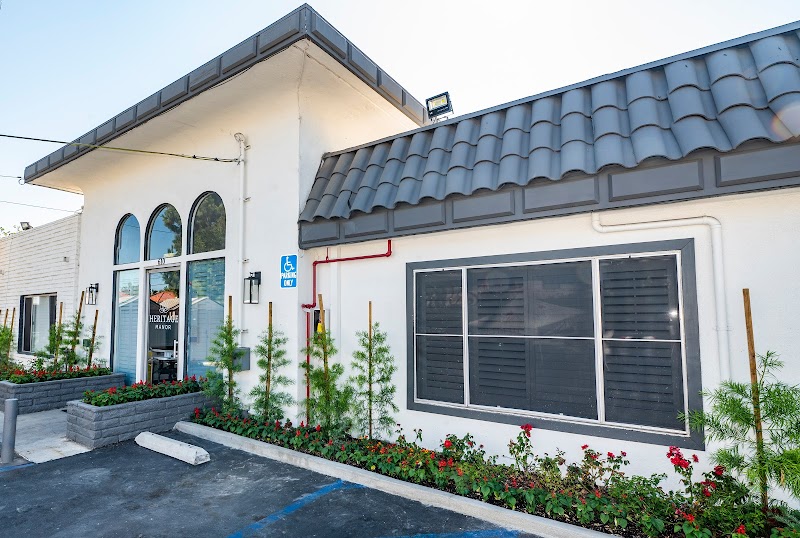

HERITAGE MANOR

610 NORTH GARFIELD AVENUE, MONTEREY PARK, CA 91754 (626) 573-3141
For profit - Limited Liability company 99 Beds DAVID & FRANK JOHNSON Data: November 2025 1 Immediate Jeopardy citation
Trust Grade
24/100
#1039 of 1155 in CA
Last Inspection: March 2025

Within standard 12-15 month inspection cycle. Federal law requires annual inspections.

Overview

Heritage Manor in Monterey Park, California, has received a Trust Grade of F, indicating significant concerns about the quality of care provided, which places it in the bottom tier of facilities. It ranks #1039 out of 1155 statewide and #306 out of 369 in Los Angeles County, meaning it is in the bottom half for both areas. The trend appears to be improving slightly, as the number of issues decreased from 23 in 2024 to 20 in 2025. Staffing is a relative strength with a rating of 3 out of 5 stars and a turnover rate of 26%, which is below the California average, suggesting that many staff members remain for longer periods. However, recent inspections revealed serious problems, including a critical incident where a resident did not receive necessary respiratory care for a life-threatening condition, and another where a fall occurred due to inadequate supervision in the shower, raising significant safety concerns.

Trust Score
F
24/100
In California
#1039/1155
Bottom 11%
Safety Record
High Risk
Review needed
Inspections
Getting Better
23 → 20 violations
Staff Stability
✓ Good
26% annual turnover. Excellent stability, 22 points below California's 48% average. Staff who stay learn residents' needs.
Penalties
✓ Good
$17,940 in fines. Lower than most California facilities. Relatively clean record.
Skilled Nurses
⚠ Watch
Each resident gets only 23 minutes of Registered Nurse (RN) attention daily — below average for California. Fewer RN minutes means fewer trained eyes watching for problems.
Violations
⚠ Watch
59 deficiencies on record. Higher than average. Multiple issues found across inspections.
★☆☆☆☆
1.0
Overall Rating
★★★☆☆
3.0
Staff Levels
★★★★☆
4.0
Care Quality
★☆☆☆☆
1.0
Inspection Score
Stable
2024: 23 issues
2025: 20 issues

The Good

  • 4-Star Quality Measures · Strong clinical quality outcomes
  • Low Staff Turnover (26%) · Staff stability means consistent care
  • Full Sprinkler Coverage · Fire safety systems throughout facility
  • No fines on record
  • Staff turnover is low (26%)

    22 points below California average of 48%

Facility shows strength in quality measures, staff retention, fire safety.

The Bad

1-Star Overall Rating

Below California average (3.1)

Significant quality concerns identified by CMS

Federal Fines: $17,940

Below median ($33,413)

Minor penalties assessed

Chain: DAVID & FRANK JOHNSON

Part of a multi-facility chain

Ask about local staffing decisions and management

The Ugly 59 deficiencies on record

1 life-threatening 1 actual harm
Aug 2025 4 deficiencies
CONCERN (D) 📢 Someone Reported This

A family member, employee, or ombudsman was alarmed enough to file a formal complaint

Potential for Harm - no one hurt, but risky conditions existed

Comprehensive Care Plan (Tag F0656)

Could have caused harm · This affected 1 resident

**NOTE- TERMS IN BRACKETS HAVE BEEN EDITED TO PROTECT CONFIDENTIALITY** Based on interview and record review, the facility failed to develop a comprehensive resident centered care plan (a formal proce...

Read full inspector narrative →
**NOTE- TERMS IN BRACKETS HAVE BEEN EDITED TO PROTECT CONFIDENTIALITY** Based on interview and record review, the facility failed to develop a comprehensive resident centered care plan (a formal process that correctly identifies existing needs and recognizes a resident's potential needs or risks to achieve healthcare outcomes) in accordance with the facility's care plan policy for one of three sampled residents (Resident 1), by failing to ensure the diabetes mellitus care plan initiated on 7/15/2025 was appropriate. This deficient practice had the potential to result in delay or lack of delivery of care and services to Resident 1, which could affect the resident's overall wellbeing. Cross Reference to F684, F726, F756 Findings: During a review of Resident 1's admission Record, the admission Record indicated the resident was originally admitted to the facility on [DATE], and readmitted on [DATE], with diagnoses including type 2 diabetes mellitus (DM-a disorder characterized by difficulty in blood sugar control and poor wound healing) with hyperglycemia (high blood sugar), encounter for attention to gastrostomy (a surgical opening fitted with a device to allow feedings to be administered directly to the stomach common for people with swallowing problems), and dysphagia (difficulty swallowing). During a review of Resident 1's Minimum Data Set (MDS- a resident assessment tool), dated 7/18/2025, the MDS indicated Resident 1's cognitive skills (ability to think and reason) for daily decision making was moderately impaired (some difficulty in situations only). The MDS indicated Resident 1 was dependent (helper does all the effort) with oral hygiene, toileting hygiene, shower, upper body dressing, lower body dressing and putting on/taking off footwear and personal hygiene. The MDS indicated Resident 1 had no orders of insulin and was not taking a hypoglycemic. During a review of Resident 1's care plan titled, The resident has diabetes mellitus, initiated on 7/15/2025, the care plan goals indicated the following: The resident will be free from signs and symptoms of hyperglycemia. The resident will be free from signs and symptoms of hypoglycemia (low blood sugar). The resident will have no complications related to diabetes. The care plan's interventions included the following: Diabetes medications as ordered by doctor. Monitor/document/report as needed for any signs and symptoms of hyperglycemia. Monitor/document/report as needed for any signs and symptoms of hypoglycemia. During a concurrent record review and interview on 8/15/2025 AM at 10:45 AM with MDS nurse 1 (MDSN 1), Resident 1's care plan was reviewed. MDSN 1 stated and verified she initiated Resident 1's care plan on 7/15/2025. MDSN 1 stated Resident 1 did not have a diabetes medication order or blood sugar monitoring on 7/15/2025. During a concurrent record review and interview on 8/15/2025 at 11:25 AM with Registered Nurse 1 (RN 1), Resident 1's care plan was reviewed. RN 1 stated Resident 1's care plan was inaccurate because Resident 1 did not have an order for diabetes medication and Accu-Chek (used by people with diabetes to manage their blood sugar levels) to monitor Resident 1's blood sugar on 7/15/2025. RN 1 stated the wrong care plan interventions might lead to confusion of care to Resident 1. During a concurrent record review and interview on 8/15/2025 at 12:26 PM with MDSN 2, Resident 1's care plan was reviewed. MDSN 2 stated the facility had 21 days to complete a care plan for a resident who was newly admitted to the facility. MDSN 2 stated the care plan was developed by the Interdisciplinary Team (IDT, a group of healthcare professionals who work together to provide comprehensive and coordinated care for residents)and was being discussed during IDT meetings or care conferences for the residents. MDSN 2 verified Resident 1's care plans were initiated on 7/15/2025, prior to having a care conference with the IDT members. MDSN 2 verified Resident 1's care plan for diabetes mellitus that was initiated on 7/15/2025 was inaccurate and should have been revised. MDSN 2 stated Resident 1 did not have an order of insulin or any diabetes medication on 7/15/2025. MDSN 2 stated the care plan interventions were not resident specific centered care and that it was important to reflect the current orders and appropriate interventions on the care plan for the entire team to know the specific care for Resident 1's diagnosis of diabetes mellitus. During a review of facility's policies and procedures (P&P) titled, Comprehensive Care Plans, revised on 12/9/2024, the P&P indicated to develop and implement a comprehensive person-centered care plan for each resident, consistent with resident rights, that includes measurable objectives and timeframes to meet a resident's medical, nursing, and mental and psychosocial needs that are identified in the resident's comprehensive assessment.
CONCERN (D) 📢 Someone Reported This

A family member, employee, or ombudsman was alarmed enough to file a formal complaint

Potential for Harm - no one hurt, but risky conditions existed

Deficiency F0726 (Tag F0726)

Could have caused harm · This affected 1 resident

**NOTE- TERMS IN BRACKETS HAVE BEEN EDITED TO PROTECT CONFIDENTIALITY** Based on interviews and record review, the facility failed to ensure the Minimum Data Set Nurse (MDSN, a licensed nurse who spec...

Read full inspector narrative →
**NOTE- TERMS IN BRACKETS HAVE BEEN EDITED TO PROTECT CONFIDENTIALITY** Based on interviews and record review, the facility failed to ensure the Minimum Data Set Nurse (MDSN, a licensed nurse who specializes in the assessment and documentation of patient health data in long-term care) 1 completed the annual licensed nurse competency for 2023 and 2024. This deficient practice caused an increased risk for improper resident assessments, inadequate documentation, and could negatively impact the quality of care to the residents which could lead to hospitalization or death. Cross Referenced to F656, F684, F756 Findings: During an interview on 8/14/2025 at 10:30 AM, MDSN 1 stated she did not know the facility's policy and procedure for comprehensive care plans (a detailed, individualized document that outlines all aspects of a patient's medical, emotional, and daily living needs). During an interview on 8/14/2025 at 12:30 PM, MDSN 2 stated developing residents' comprehensive care plans is one of the tasks of the MDS nurses. MDSN 2 stated MDS nurses should know the facility's policy for developing comprehensive care plans, as the facility has up to 21 days upon resident's admission to develop a comprehensive care plan. MDSN 2 stated this included reviewing all the pertinent records (hospital records, active orders, Doctor's History and Physical notes). MDSN 2 stated the facility conducted yearly competency to licensed nurses to ensure staff were updated and provided reminders of the standard of practice. During an interview on 8/14/2025 at 4:52 PM, the Director of Nursing (DON) stated and verified that MDSN 1 did not complete the annual licensed nurse competency (a measurable pattern of knowledge, skills, abilities, behaviors, and other characteristics that an individual need to perform work roles or occupational functions successfully) and should have completed it for the year 2023 and 2024. During a concurrent record review and interview on 8/14/2025 at 4:57 PM, the facility's Licensed Nurse Competency checklist was reviewed. The DON verified that the care plan was one of the skills that was checked off on the list. The DON stated completing the annual licensed competency was important to ensure the licensed nurses were up to date with knowledge, skills, and abilities to perform their roles for the residents. The DON stated it would help the licensed nurses to effectively and safely conduct their tasks for the residents. During a review of the facility's P&P titled, Training Requirement, revised on 12/19/2022, the P&P indicated the facility developed, implemented, and maintained an effective training program for all new and existing staff, consistent with their expected roles. During a review of facility's P&P titled, Competency Evaluation, revised on 12/19/2022, the P&P indicated annual competency was evaluated at a frequency determined by the facility assessment, evaluation of the training program, and/or job performance evaluations. During a review of facility's assessment dated [DATE], the facility assessment indicated in the staff training / education and competencies section, that Person-centered care was one of the topics in this section and should include but not be limited to person-centered care planning, education of resident and family /resident representative about treatments and medications, documentation of resident treatment references, end-of-life care, and advance care planning.
CONCERN (D) 📢 Someone Reported This

A family member, employee, or ombudsman was alarmed enough to file a formal complaint

Potential for Harm - no one hurt, but risky conditions existed

Drug Regimen Review (Tag F0756)

Could have caused harm · This affected 1 resident

**NOTE- TERMS IN BRACKETS HAVE BEEN EDITED TO PROTECT CONFIDENTIALITY** Based on interview and record review, the facility failed to perform a comprehensive medication regimen review (MRR, a thorough ...

Read full inspector narrative →
**NOTE- TERMS IN BRACKETS HAVE BEEN EDITED TO PROTECT CONFIDENTIALITY** Based on interview and record review, the facility failed to perform a comprehensive medication regimen review (MRR, a thorough evaluation of the medication regimen of a resident, with the goal of promoting positive outcomes and minimizing adverse consequences and potential risks associated with medication) in accordance with the facility's policies and procedures (P&P) for one of three sampled residents (Resident 1). This deficient practice resulted in Resident 1 not having medication for the diagnosis of diabetes mellitus (DM-a disorder characterized by difficulty in blood sugar control) since admission on [DATE], which lead to Resident 1's hyperglycemia (high blood sugar) on 8/9/2025. Cross Referenced to F656, F684, F726 Findings: During a review of Resident 1's admission Record, the admission Record indicated the resident was originally admitted to the facility on [DATE], and readmitted on [DATE], with diagnoses including type 2 diabetes mellitus (DM-a disorder characterized by difficulty in blood sugar control) with hyperglycemia (high blood sugar), encounter for attention to gastrostomy (a surgical opening fitted with a device to allow feedings to be administered directly to the stomach common for people with swallowing problems), and dysphagia (difficulty swallowing). During a review of Resident 1's Minimum Data Set (MDS- a resident assessment tool), dated 7/18/2025, the MDS indicated Resident 1 had moderately impaired cognitive skills (problems with the ability to think and reason) for daily decision making. The MDS indicated Resident 1 was dependent (helper does all the effort) with oral hygiene, toileting hygiene, shower, upper body dressing, lower body dressing and putting on/taking off footwear and personal hygiene. The MDS indicated Resident 1 had no physician's orders for insulin and was not taking hypoglycemic medication. During a review of Resident 1's MRR dated 7/1 - 7/28/2025, the MRR indicated a recommendation for Resident 1's gabapentin (medication to treat epilepsy [a brain disease] and nerve pain) and clarification of the medication route. There were no other recommendations for July 2025 for Resident 1. During a telephone interview on 8/14/2025 at 2:46 PM, the Consultant Pharmacist (CP) stated Resident 1's medications were reviewed in July, and there was no recommendation regarding any diabetes medication (metformin nor insulin). The CP stated Resident 1's diagnosis of diabetes mellitus was not included in the list of diagnoses that was reviewed for Resident 1. The CP verified Resident 1 received insulin medication from the previous admission to the facility and that he did not review Resident 1's hospital records when the MRR was conducted last month. The CP stated he did not review Resident 1's laboratory results and also stated, I would only review hospital records, laboratory results, and doctor's notes if there's something that I would clarify, so it's only sometimes, not all the time. During a follow up telephone interview on 8/14/2025 at 3:48 PM, the CP stated he did not have access to Resident 1's full diagnoses list. The CP stated a recommendation for Resident 1's diagnosis of DM without medication or treatment would have been documented in July's MRR report if he knew that Resident 1 had a diagnosis of DM. The CP stated he would have reviewed Resident 1's laboratory results if he knew that Resident 1 had diagnosis of DM. During an interview on 8/14/2025 at 4:55 PM, the Director of Nursing (DON) stated the CP did not do a comprehensive MRR for Resident 1 in July because the CP claimed he did not see the diagnosis of DM. The DON stated that the CP should have reviewed Resident 1's previous medication orders from the last admission to the facility and the CP should have reviewed Resident 1's hospital records for the new admission this July. The DON stated the CP should have reviewed Resident 1's H&P and the medications of Resident 1, which was also not reviewed by licensed nurses upon Resident 1's admission to the facility on 7/14/2025. During a review of facility's P&P titled, Medication Regimen Review, dated June 2021, the P&P indicated the consultant pharmacist performs a comprehensive MRR at least monthly and the facility assured the consultant pharmacist had access to residents and the residents' medical records.
CONCERN (E) 📢 Someone Reported This

A family member, employee, or ombudsman was alarmed enough to file a formal complaint

Potential for Harm - no one hurt, but risky conditions existed

Quality of Care (Tag F0684)

Could have caused harm · This affected multiple residents

**NOTE- TERMS IN BRACKETS HAVE BEEN EDITED TO PROTECT CONFIDENTIALITY** Based on interview and record review, the facility failed to provide the necessary diabetic care and services for one of three s...

Read full inspector narrative →
**NOTE- TERMS IN BRACKETS HAVE BEEN EDITED TO PROTECT CONFIDENTIALITY** Based on interview and record review, the facility failed to provide the necessary diabetic care and services for one of three sampled residents (Resident 1), who had a diagnosis of type 2 diabetes mellitus (DM, a disorder characterized by difficulty in blood sugar control), by failing to coordinate services for diabetic care and management for Resident 1 that included checking blood sugar with an accu-check machine (checking blood sugar level with the use of a machine, by pricking the finger and collecting a small blood sample on a test strip, which would be read by the machine) in accordance with Physician 1's H&P treatment plan. This deficient practice resulted in Resident 1 experiencing hyperglycemia (a condition where there's too much glucose in the blood) placing Resident 1 at risk for various serious complications, in ketoacidosis (DKA, a complication of diabetes in which acids build up in the blood to levels that can be life-threatening), dehydration (a condition occurs when the body loses more fluids than it takes in, leading to an insufficient amount of water for normal bodily functions), confusion (a state of reduced awareness and impaired thinking) and coma (a state of prolonged unconsciousness where a person is alive but unresponsive to their surroundings). Cross reference to F656, F726, F756.Findings: During a review of Resident 1's GACH 1's Lab (prior to admission to the facility), dated 7/10/2025, the Lab report indicated Resident 1's hemoglobin A1C (HA1C, a blood test that reflects average blood sugar levels over the past two to three months) was 7.1, which was higher than the normal range. During a review of Resident 1's GACH 1's Nursing Narrative Note, dated 7/10/2025, the Note indicated the nurse notified Physician 1 the result of HA1C and Physician 1 ordered metformin (a medication used to treat Type 2 DM) 500 milligrams (MG, a unit of measurement) twice a day. During a review of Resident 1's GACH 1's Orders, dated 7/10/2025, the Orders indicated Physician 1 ordered metformin 500 MG one table orally twice per day before meals on 7/10/2025. During a review of Resident 1's General Acute Care Hospital (GACH) 1's Medication Tasks-Scheduled (MT), dated 7/11/2025 to 7/14/2025, the MT indicated Resident 1 received metformin 500 MG one table orally twice per day before meals from 7/11/2025 and 7/14/2025. During a review of Resident 1's admission Record (AR), the AR indicated Resident 1 was admitted to the facility on [DATE], with diagnosis of type 2 diabetes with hyperglycemia. During a review of Resident 1's Minimum Data Set (MDS, a resident assessment tool), dated 7/18/2025, indicated Resident 1 had severely impaired cognitive (ability to think and reason) skills for daily decision making was moderately impaired memory and cognition (ability to think and reasonably). During a review of Resident 1's H&P, dated 7/15/2025 indicated Physician 1's plan was for Accu-check daily, continue DM meds. During a review of Resident 1's care plan titled, The resident has diabetes mellitus, initiated on 7/15/2025, the care plan goals indicated the following: The resident will be free from signs and symptoms of hyperglycemia. The resident will be free from signs and symptoms of hypoglycemia (low blood sugar). The resident will have no complications related to diabetes. The care plan's interventions included the following: Diabetes medications as ordered by doctor. Monitor/document/report as needed for any signs and symptoms of hyperglycemia. Monitor/document/report as needed for any signs and symptoms of hypoglycemia. During a review of Resident 1's Medication Administration Record (MAR), from July 2025-August 2025, indicated Resident 1 did not get daily accu-check and did not receive any diabetes medication from 7/14/2025 to 8/8/2025. During a review of Resident's SBAR, dated 7/22/2025 at 2:52 PM, the SBAR indicated Resident 1 had weight loss of six pounds per week related to edema decreased and the physician recommended Complete Blood Count (CBC, a common blood test that analyzes the three main types of blood cells), Comprehensive Metabolic Panel (CMP, a blood test that measures 14 different substances in the blood that includes blood sugar level), lipid panel ( a blood test that measures different types of fats in the blood), and thyroid-stimulating hormone (TSH, a blood test to check thyroid [a gland that regulating energy, growth and organ function] function) During a review of Resident 1's laboratory CMP result dated collection date dated 7/23/2025 indicated Resident 1's blood sugar level was 289 milligram per deciliter (MG/DL, a unit of measurement) which was high according to reference range (70-110 MG/DL). During a review of Resident 1's Situation, Background, Appearance, Review and Notify Communication Form (SBAR, a form to communicate about a resident's change of condition), dated 8/9/2025 at 9:50 AM, the SBAR indicated Resident 1 complained about weakness and not feeling well. The SBAR indicated the resident's blood sugar was at 557 milligram per deciliter (MG/DL, a unit of measurement). The SBAR indicated the physician ordered regular insulin with sliding scale and metformin. During a review of Resident 1's MAR, dated 8/9/2025 at 11:30 AM, Resident 1's blood sugar level was 358 mg/dl and Insulin Regular (a medicine that helps the body use or store the blood sugar) was administered to Resident 1 per sliding scale. During a review of Resident 1's Order Summary Report, dated 8/11/2025, the report indicated the physician ordered for the resident to receive Regular insulin injection subcutaneously as per sliding scale, starting on 8/9/2025 and Lantus (a brand name for insulin) 10 unit injection subcutaneously in the morning for DM, starting on 8/11/2025. During an interview with RN 3 on 8/13/2025 at 2:25 PM, RN 3 stated she texted a picture and faxed Resident 1's laboratory results to Physician 1 on 7/23/2025, but did not inform Physician 1 that Resident 1 was not on a routine (daily) accu-check and was not on any diabetes medications or management for the blood sugar levels. During an interview with the Director of Nursing (DON) on 8/13/2025 at 4:15 PM, the DON stated Resident 1's H&P indicated Physician 1's plan was to perform Accu-check daily, continue DM meds. The DON stated there was no order of daily accu-check and diabetes medications for Resident 1 from 7/14/2025 to 8/9/2025, and the MRD did not inform the nursing staff that the H&P was available for review when she put it in the resident's paper chart. The DON further stated the nurses did not review the H&P and did not know the physician's treatment plan for the resident which was to perform daily accu-check monitoring and for the resident to receive diabetic medications. The DON stated the MRD should have informed the nurses the H&P was available, so the nurse could review it timely. The DON stated if the nurses reviewed the H&P timely, then, the nurse should have clarified with the physician to get the orders for accu-check and diabetes medications to prevent the resident from experiencing hyperglycemia. During a concurrent interview and record review on 8/14/2025 at 1:08 PM with MDSN 1, Resident 1's H&P, dated 7/15/2025, was reviewed. MDSN 1 stated Resident 1's H&P was not reviewed during the IDT meeting on 7/24/2025. MDSN 1 stated they should have reviewed and discuss the H&P during IDT, so they would notice the orders for accu-check daily and diabetes medication were missing and notified the physician for clarification. During an interview on 8/14/2025 at 4:05 PM with Physician 1, Physician 1 stated he was informed and made aware by nursing staff of Resident 1's blood sugar level at 289 mg/dl, on 7/23/2025, but the nurse did not inform him that the resident was not on any diabetes medications. Physician 1 stated if he knew Resident 1 was not on any diabetes medications, he would have ordered for the resident to have daily accu-check and diabetes medications to treat his DM. During an interview on 8/15/2025 at 4:39 PM with the DON, the DON stated the nurses should review Resident 1's H&P and orders to make sure the physician's treatment plan and orders were consistent, and the nurse should notify the physician when there was a discrepancy between the treatment plan and the orders. The DON stated if the nurses reviewed the H&P, they would have been able to notice the discrepancy and obtain the orders for accu-check and diabetes medications earlier. During an interview on 8/15/2025 at 4:41 PM with the DON, the DON stated when the nurse reported Resident 1's abnormal blood sugar level to the physician on 7/23/2025, the nurse should check the resident's regular blood sugar level and what diabetes medications Resident 1 was taking, and provide the pertinent information to the resident's physician to better manage the resident's blood sugar level, but the nurse did not notify the physician that there was no daily accu-check and diabetes medications for Resident 1 who had a diagnosis of DM and his blood sugar was high, as result, there was lack of communication and coordination between nursing staff and physician notification to ensure appropriate diabetic care and services were provided to the resident. During a review of the facility's policy and procedure (P&P) titled, Provision of Quality of Care, revised 12/19/2022, the P&P indicated the facility will ensure that residents receive treatment and care by qualified persons in accordance with professional standards of practice, the comprehensive person-centered care plans, and the residents' choices, Each resident will be provided care and services to attain or maintain his/her highest practicable physical, mental, and psychosocial well-being, and A comprehensive care plan will be developed for each resident in accordance with procedures for development of the care plan. During a review of the facility's P&P titled, Nursing Care of the Resident with Diabetes Mellitus, revised 12/9/2025, the P&P indicated the facility to help the resident control his/her diabetes with diet, exercise, and insulin (as ordered), prevent recurrent hyperglycemia/hypoglycemia, recognize, manage, and document the treatment of complications commonly associated with diabetes. The P&P indicated glucose monitoring as the management of individuals with DM should follow relevant protocols and guidelines, including physician to order the frequency of glucose monitoring, monitoring resident's blood sugar with accu-check. The P&P indicated HA1C should be less than seven in a diabetic individual. The P&P also indicated medication management of type II diabetes may include oral hypoglycemic agents (medication that can lower the blood sugar level) with or without insulin. During a review of the facility's P&P titled, Registered Nurse-Job Description, dated 2023, the P&P indicated the RN participates in the admission of residents as required, observes for changes in residents ‘status, notifying the physician and resident's family or representative and documenting accordingly, transcribes physician orders to medical record and carries out orders as written, collaborates with other members of the interdisciplinary team as needed to ensure residents' needs are holistically met, initiates, reviews and updates care plans as required.
Mar 2025 15 deficiencies 1 IJ
CRITICAL (J)

Immediate Jeopardy (IJ) - the most serious Medicare violation

Respiratory Care (Tag F0695)

Someone could have died · This affected 1 resident

**NOTE- TERMS IN BRACKETS HAVE BEEN EDITED TO PROTECT CONFIDENTIALITY** Based on interview, and record review, the facility failed to provide the necessary respiratory care and interventions in accord...

Read full inspector narrative →
**NOTE- TERMS IN BRACKETS HAVE BEEN EDITED TO PROTECT CONFIDENTIALITY** Based on interview, and record review, the facility failed to provide the necessary respiratory care and interventions in accordance with the resident's respiratory care needs, care plan, facility policy and professional standards of practice, the physician's order and facility's policy and procedure for one of three closed record sampled residents (Resident 98) diagnosed of acute respiratory failure with hypoxia (a life-threatening condition where the lungs fail to deliver enough oxygen to the blood, leading to dangerously low oxygen levels in the body), chronic obstructive pulmonary disease exacerbation (worsened COPD, sudden severe symptoms of a lung disease characterized by poor airflow to the lungs that results in shortness of breath, difficulty breathing and respiratory distress) and pulmonary hypertension [a condition characterized by high blood pressure (BP, the measurement of the pressure or force of blood inside the blood vessels) in the arteries of the lungs which makes the heart work harder to pump blood through the narrowed or damaged blood vessels in the lungs that causes shortness of breath and difficulty breathing] by failing to: 1. Monitor Resident 98 for respiratory distress (life-threatening condition that causes severe difficulty breathing. It occurs when the lungs become inflamed and damaged, making it difficult for oxygen to reach the bloodstream) and change in respiratory condition, in accordance with the resident's care plan for COPD and physician orders, when Certified Nurse Assistant (CNA) 1 found Resident 98 with weakness, labored breathing, and an oxygen saturation (blood oxygen level) of 88% (normal range 90-100%) while receiving oxygen via nasal cannula (NC- a plastic flexible tubing used to deliver oxygen into the nose) at 2 LPM [Liters (unit of volume) Per Minute (unit of time)] and reported his findings to Licensed Vocational Nurse (LVN) 1. 2. Follow physician orders to titrate (adjust) Resident 98's oxygen therapy to 10-15 LPM via mask to maintain oxygen blood levels of 94% and above, when Resident 98's oxygen saturation decreased to 70% on [DATE] at 5:50 AM, while receiving 2 LPM of oxygen via NC. 3. Ensure LVN 1 monitored and documented Resident 98's vital signs (measurements of the body's most basic functions, including temperature, pulse rate, breathing rate, and BP, used to assess a person's overall health), treatments rendered, and reported to the physician, in accordance with the physician orders. 4. Ensure LVN 1 immediately notified the physician and called 911 (an emergency number) emergency services, when CNA 1 reported to LVN 1 that Resident 98 was experiencing labored breathing with his oxygen saturation decreased to 88% on [DATE] at around 5:30 AM, and when LVN 1 assessed Resident 98 with findings of weakness and oxygen saturation continued to decrease to 70% on [DATE] at 5:50 AM. 5. Ensure LVN 1 implemented Resident 98's Physician Orders for Life-Sustaining Treatment (POLST, a portable medical order that communicates a patient's wishes for end-of-life care and treatment interventions) according to the resident's preferences. These deficient practices resulted in the delay in diagnosis, care, and respiratory services for Resident 98's change in respiratory condition. Resident 98 expired at the facility on [DATE] with the cause of death as cardiac dysrhythmia (abnormal or irregular heartbeat), acute respiratory distress and pulmonary hypertension. On [DATE] at 3:09 PM, while onsite at the facility, the California Department of Public Health (CDPH) an Immediate Jeopardy situation (IJ, a situation in which the provider's noncompliance with one or more requirements of participation has caused or is likely to cause serious injury, harm, impairment, or death of a resident) was identified and called regarding the facility's failure to notify the physician regarding significant changes in Resident 98's respiratory conditions and provide the necessary respiratory care and monitoring. On [DATE] at 7:52 PM, the IJ was removed in the presence of the Administrator (ADM) and the Director of Nurses (DON) after the facility submitted an acceptable IJ Removal Plan (a plan that identifies all actions the facility will take to immediately address the noncompliance that has resulted in the IJ situation) and while onsite at the facility, the surveyors verified/confirmed the facility's implementation of the IJ Removal Plan and the IJ situation was no longer present. The IJ Removal Plan dated [DATE], included the following: 1. On [DATE], the Director of Nursing (DON) and Registered Nurse (RN) supervisor evaluated current residents with oxygen order (12 residents) and/or with diagnosis of COPD (32 residents) for appropriate assessment and interventions. 2. On [DATE], the Regional Nurse Consultant (RNC) provided one on one education to DON and Director Staffing Development (DSD) related to respiratory care, assessment and documentation, monitoring for any change of condition, oxygen administration as ordered by the physician, notification of the physician, escalation of emergent medical services (911) if needed, and implementation of POLST per resident preference. 3. On [DATE], the Regional Nurse Consultant (RNC) conducted an interview with LVN 1 and CNA 1 regarding the death incident of Resident 98. The RNC investigated for the licensed nurse documentation, monitoring of change of condition and the reason for not calling 911 and for the possible root cause. 4. On [DATE], the RNC provided one on one education to LVN 1 related to respiratory care, assessment and documentation, monitoring for any change of condition, oxygen administration as ordered by the physician including skills competency, notification of the physician, escalation of emergent medical services (911) if needed, and implementation of POLST per resident preference. 5. On [DATE], the DON or designee conducted re-education for licensed nursing staff on the following topics: documentation, oxygen administration, compliance with individualized interventions in each resident's care plan, implementation of POLST and notification of the physician and following physician orders. 6. On [DATE], the DON or designee started auditing residents with COPD and or Oxygen order 3 times weekly (Monday - Wednesday- Friday) for 4 weeks to ensure physician's orders were carried out, resident specific care plans were implemented, and necessary respiratory equipment/supplies were in place, and monitor if change of condition occurred. Upon identification, the DON or designee would immediately address concerns and remedy any audit deficiencies with the licensed nursing staff immediately. 7. On [DATE], A Quality Assurance and Performance Improvement (QAPI, a data-driven approach to improve the quality of care and services in healthcare settings) Plan was implemented to track and report on above audit findings. The findings will be presented on the last Wednesday of the month for the monthly Quality Assessment and Assurance (QAA, an integrated system of management activities involving planning, implementation, assessment, reporting, and quality improvement to ensure that a process, or service is of the type and quality needed and expected) meeting for a minimum of three months. After the initial three months, the QAA Committee will decide regarding the continued frequency of audits and subsequent reporting, with audits continuing at least monthly to sustain compliance. 8. On [DATE] the RNC discussed regarding Chronic Obstructive Pulmonary Disease (COPD) and pulmonary hypertension with post-test to LVN 1 to ensure understanding of the medical condition. 9. On [DATE], the DON or designee provided education to licensed nurses regarding COPD and pulmonary hypertension with post-test to ensure understanding of the medical condition. Cross reference to F580 and F867. Findings: During a review of Resident 98's admission Record (AR), the AR indicated the facility admitted Resident 98 on [DATE] with diagnoses that included acute respiratory failure with hypoxia, COPD with exacerbation (worsened symptoms), pulmonary hypertension, type 2 diabetes mellitus with hyperglycemia (DM, a chronic condition that happens when the body has persistently high blood sugar levels), and atrial fibrillation (afib a common type of irregular heartbeat). During a review of Resident 98's Order Summary Report (OSR), indicated on [DATE], Resident 98 had a physician order to monitor temperature and oxygen saturation every shift for suspected/confirmed Covid-19 (Coronavirus disease, an infectious disease caused by the SARS-CoV-2 virus), and to call the physician if oxygen saturation is newly below 91%, or if the resident's usual oxygen saturation is lower or is 3% or more lower than their baseline. During a review of Resident 98's Care plan (CP), dated [DATE], indicated Resident 98 had COPD exacerbation. The goal was that the Resident 98 would display optimal breathing patterns (a respiratory rate of 12 to 20 breaths per minute with regular, rhythmic inhalations and exhalations) daily with the interventions that included monitoring for signs and symptoms of acute respiratory insufficiency such as shortness of breath at rest, cyanosis (a bluish or purplish discoloration of the skin, typically caused by a lack of oxygen in the blood), and somnolence (lethargy, weakness, and difficulty thinking), and to administer oxygen via NC at 2-3 LPM continuously, may titrate oxygen to 10-15 LPM via mask to maintain oxygen saturation greater or equal to 94%. During a review of Resident 98's CP, dated [DATE], indicated Resident 98 was at risk for Covid-19 related to diagnosis of COPD exacerbation, DM, and afib. The interventions included to follow Resident 98's POLST, monitor temperature and pulse oximetry (a test used to measure oxygen levels of the blood) per physician's order and report abnormal findings to the physician. During a review of Resident 98's CP, dated [DATE], indicated Resident 98 had altered cardiovascular (related to heart and blood vessels) status related to afib, hypertension (high BP), and hyperlipidemia (high level of fats in the bloodstream). The interventions included to monitor Resident 98's vital signs and notify the physician of significant abnormalities, monitor/document/report to the physician for changes in capillary refill (a quick test to assess blood flow to tissues by observing how quickly color returns to the nail bed after pressure is applied) and color/warmth of extremities. During a review of Resident 98's History and Physical, dated [DATE], indicated Resident 98 had the capacity to understand and make decision. During a review of Resident 98's OSR, indicated on [DATE], for Resident 98 to receive oxygen via NC at 2-3 LPM continuously, may titrate oxygen to 10-15 LPM via mask to maintain oxygen saturation greater or equal to 94%. During a review of Resident 98's OSR, indicated on [DATE], the physician ordered to follow the instructions in Resident 98's POLST. During a review of Resident 98's POLST, dated [DATE], indicated if Resident 98 was found with a pulse and/or is breathing, the healthcare provider may, in addition oxygen treatment, use a non-invasive positive airway pressure (a method of breathing support that delivers pressurized air or oxygen through a mask without inserting a tube into the windpipe) which included continuous positive airway pressure (CPAP, a machine that uses mild air pressure to keep breathing airways open), bi-level positive airway pressure (BiPAP, a type of device that helps with breathing), and bag valve mask (a handheld device used to provide emergency breaths to someone who is not breathing or not breathing adequately) assisted respirations. During a review of Resident 98's Minimal Data Set (MDS-a federally mandated resident assessment), dated [DATE], indicated Resident 98's cognition (ability to think, remember, and reason) was moderately impaired and needed moderate assistance (helper does less than half the effort) in eating and oral hygiene. During a review of Resident 98's Weights and Vitals Summary, indicated Resident 98's last vital signs was taken on [DATE] at 1:09 AM with the resident's BP at 128/85 mmHg (millimeters of mercury, a unit of measurement for pressure), oxygen saturation of 93% while the resident was on room air, heart rate at 100 beats per minute, and temperature of 98.7 degrees Fahrenheit (a scale for measuring temperature). There was also no documented evidence that Resident 98 was monitored for vital signs on [DATE] at 5:50 AM when Resident 98 responded to touch only by opening his eyes, and had slow breathing. During a review of Resident 98's Progress Notes, dated [DATE], indicated at 5:50 AM during CNA morning care, Resident 98 responded only by opening his eyes, breathing slowing down with oxygen saturation at 70% via NC until the resident passed away. There was no documented evidence in the report that Resident 98 was provided with increased oxygen level to increase oxygen saturation to 94% as ordered by the physician. There was also no documented evidence that Resident 98 was monitored for vital signs, provided with 10-15 LPM oxygen via mask per physician's order on [DATE] at 5:50 AM when Resident 98 responded to touch only by opening his eyes, had slow breathing, and oxygen saturation at 70 % while on 3 LPM oxygen via NC. During a review of Resident 98's SBAR Communication Form (a structured approach to healthcare communication, standing for Situation, Background, Assessment, and Recommendation to ensure clear and concise information exchange, especially in critical situations) and clinical records on [DATE], indicated that there was no documented evidence that the physician was notified when Resident 98's condition changed by responding only by opening his eyes, breathing slowing down with oxygen saturation at 70% via NC on [DATE] at 5:50 AM until the resident expired on [DATE] at 5:59 AM. During a review of Resident 98's Record of Death, dated [DATE], indicated Resident 98 expired on [DATE] at 5:59 AM with the final diagnosis that included COPD, hypoxia and respiratory failure. During a review of Resident 98's Physician's Discharge Summary, dated [DATE], indicated Resident 98 was admitted on [DATE] and was discharged from the facility due to resident expired on [DATE] at 5:59 AM. During a review of Resident 98's Death Certificate dated [DATE], indicated Resident 98 expired on [DATE] with the primary cause of death as cardiac dysrhythmia and secondary cause of death that included acute respiratory distress and pulmonary hypertension. During an interview on [DATE] at 6:38 AM with CNA 1, CNA 1 stated, he took care of Resident 98 from 11 PM on [DATE] until the resident expired on the morning of [DATE]. CNA 1 stated, when he was caring for Resident 98 at the beginning of his shift, Resident 98 was alert and oriented, with the vital signs including BP and oxygen saturation was within normal limits, though he could not recall the results of the vital signs and time they were taken. CNA 1 stated, around 5-5:30 AM during his rounds in the facility, he noticed that Resident 98 did not respond when he called Resident 98's name, and breathing very slow but his skin was warm when touched and the resident was very weak with his oxygen level at around 88%. CNA 1 stated, he immediately reported to LVN 1 that Resident 98's oxygen blood level was low and then LVN 1 went to assess Resident 98. CNA 1 stated, they (LVN 1 and CNA 1) checked Resident 98's vital signs about four times, but he could not recall the results and time the vital signs were taken. CNA 1 stated, he could only recall that Resident 98's oxygen level was at 88% when he first found the resident around 5-5:30 AM and notified LVN 1. CNA 1 then stated Resident 98 slowly died in about 1 hour while receiving oxygen via NC. During a concurrent record review and interview on [DATE] at 6:52 AM with LVN 1, Resident 98's Weights and Vitals Summary, SBAR Communication Form, and clinical records on [DATE] and [DATE] were reviewed. LVN 1 stated, there was no records indicating Resident 98 was assessed and monitored for vital signs, Resident 98's physician was notified, or interventions were provided related to Resident 98's slow breathing with oxygen saturation at 70% on [DATE] at 5:50 AM. During an interview on [DATE] at 7 AM with LVN 1, LVN 1 stated, he was the charge nurse that took care of Resident 98 from 11 PM on [DATE] until the resident expired on [DATE] at 5:59 AM. LVN 1 stated, Resident 98 was alert, oriented and responsive at the beginning of his shift on [DATE], with oxygen saturation above 90% while receiving oxygen supplement at 3 LPM. LVN 1 stated, Resident 98 was able to make his needs known. LVN 1 stated, when LVN 1 provided Resident 98 with his scheduled breathing treatment (treatment to prevent difficulty breathing and shortness of breath) at 4 AM, Resident 98's oxygen saturation was about 93% and Resident 98 was placed back on 2-3 LPM oxygen via NC after the breathing treatment. LVN 1 stated around 5:30 AM, CNA 1 told him Resident 98 had a change in condition and breathing very slow and was very weak. LVN 1 stated he went to Resident 98's room, and Resident 98 opened his eyes but was very weak. LVN 1 stated he checked Resident 98's vital signs a few times but could not recall the results of the VS and he did not document the vital signs in Resident 98's clinical record. LVN 1 stated, he did not report Resident 98's change of condition to the Registered Nurse (RN) who was working during his shift on [DATE]. LVN 1 stated, he did not increase Resident 98's oxygen level as per physician's order because the resident had diagnosis of COPD. LVN 1 stated, he did not inform the physician when Resident 98's condition changed with oxygen saturation down to 88% and 70%. LVN 1 stated he informed Resident 98's physician after the resident passed away on [DATE]. LVN 1 stated, he supposed to notify Resident 98's physician, call for help or call 911 when CNA 1 reported to him that Resident 98 was weak with slow breathing and a decrease in the resident's oxygen saturation. LVN 1 stated, Resident 98 expired less than one hour after he was notified by CNA 1 for Resident 98's weakness and slow breathing. During a review of LVN 1's statement provided by the facility, dated [DATE] not timed, indicated on [DATE] at 11 PM, Resident 98 was laying comfortably in bed with oxygen via delivered via NC at 3 LPM with no sign and symptoms of respiratory distress. The statement indicated on [DATE] at 4 AM, LVN 1 administered the routine breathing treatment, Resident 98 was sleepy in bed, then at 5:50 AM, CNA 1 called LVN 1's attention and informed him that Resident 98 was only responding by opening his eyes. The statement indicated LVN 1 checked Resident 98's oxygen saturation that was 70 %. While Resident 98 was receiving oxygen supplement at 3 LPM. The statement indicated, LVN 1 elevated the Resident 98's head of the bed then suddenly Resident 98 became weak and unresponsive, like the resident last breath. During a review of CNA 1's statement provided by the facility, dated [DATE] not timed, indicated on [DATE] at 5:30 AM, CNA 1 came to change Resident 98's diaper and noticed a change in his condition and immediately reported his findings to LVN 1. The statement indicated, Resident 98's oxygen saturation was at 89%, then went down to 88%, and suddenly dropped down to 70%. LVN 1 and CNA 1 checked Resident 98's BP which was lower than the limit, then CNA 1 and LVN 1 elevated Resident 98's head of the bed higher and the resident became unresponsive. The statement indicated, Resident 98's breathing was slowing down until his last breath. During an interview on [DATE] at 9:40 AM with the DON, the DON stated when CNA 1 reported to LVN 1 that Resident 98's oxygen saturation was trending down and the resident was weak, LVN 1 should have immediately assessed, monitored and documented Resident 98's vital signs in the resident's clinical record. The DON stated, when LVN 1 found Resident 98's oxygen saturation of 70%, LVN 1 should have immediately called for help or Code Blue (an emergency code indicating a patient is experiencing a life-threatening medical emergency, typically a cardiac or respiratory arrest, requiring immediate medical attention and resuscitation efforts). followed the physician order to titrate Resident 98's oxygen therapy, followed Resident 98's POLST, called 911, and notified the physician to prevent a delay in treatments and interventions. During an interview on [DATE] at 1:02 PM with Resident 98's Primary Physician (PP) 1, PP 1 stated when Resident 98's oxygen saturation of 93-94% went down to 88%, it was a sudden drop of oxygen saturation or a sudden change in condition, PP 1 stated LVN 1 was supposed to follow the physician's orders and notified him (PP1) right away, followed Resident 98's POLST, called 911 and notified the physician again. PP 1 stated, he was not notified of Resident 98's significant change in respiratory status on [DATE]. PP 1 stated, he was notified only after Resident 98 already expired on [DATE]. During a review of the facility's Policy and Procedure (P&P) titled, Oxygen Administration, revised [DATE], indicated the following: - Oxygen is administered to residents who need it, consistent with professional standards of practice, the comprehensive person-centered care plans, and the resident's goals and preferences. - The equipment needed for oxygen administration will depend on the type of delivery system ordered. Type of delivery systems include nasal cannula, non-rebreather mask, CPAP mask, BiPAP mask. - Staff shall notify the physician of any changes in the resident's condition, including changes in vital signs, oxygen concentrations, or evidence of complications associated with the use of oxygen. During a review of the facility's P&P tiled, Notification of Changes, revised [DATE], indicated the facility consult with the resident's physician when there is a change requiring such notification. Circumstances requiring notification include significant change in the resident's physical, mental or psychosocial condition such as deterioration in health, mental or psychosocial status, which may include life-threatening conditions. During a review of the facility's P&P titled, Medical Emergency Response, revised [DATE], indicated the following: - The employee who first witnesses or is first on the site of a medical emergency will initiate immediate action, basic first aid and summon for assistance. - A nurse will assess the situation and determine the severity of the emergency, designate a staff member to announce a Code Blue (a medical emergency alert, usually indicating a person has experienced cardiac or respiratory arrest requiring immediate resuscitation efforts) if necessary, notify the physician and call 911 as needed. - All available staff will respond to the emergency accordingly. - The RN Supervisor or Charge Nurse of the unit will take the Emergency Cart to the code site, ensure accurate documentation of the event and delegate any other duties or tasks needed.
CONCERN (D)

Potential for Harm - no one hurt, but risky conditions existed

Resident Rights (Tag F0550)

Could have caused harm · This affected 1 resident

Based on observation, interview and record review, the facility failed to treat resident with dignity and respect by ensuring one of five sampled residents (Resident 78) by receive meal at the same ti...

Read full inspector narrative →
Based on observation, interview and record review, the facility failed to treat resident with dignity and respect by ensuring one of five sampled residents (Resident 78) by receive meal at the same time as other residents who were dining in the dining room during lunch time on 3/25/2025. The deficient practice resulted in Resident 78 reported feeling disrespected and frustrated when watching other residents eating and completing their meals in front of him. Findings: During a review of Resident 78's admission Record (AR), the AR indicated the facility originally admitted Resident 78 on 11/18/2024 and readmitted him on 1/2/2025 with diagnoses that included chronic obstructive pulmonary disease (a group of lung [an organ located in the chest and provide gas exchange for the body] diseases that cause ongoing damage to the airway and lungs, leading to difficulty breathing) and pulmonary edema (a condition where fluid accumulates in the lungs, making it difficult to breathe). During a review of Resident 78's Minimum Data Set (MDS, a standardized assessment and care planning tool), dated 2/21/2025, indicated Resident 78 had moderately impaired memory and cognition (ability to think and reason). The MDS indicated Resident 78 required supervision or touching assistance with eating, oral hygiene and personal hygiene, partial/moderate assistance with chair/bed-to-chair transfer, and substantial/maximal assistance with toileting hygiene and shower/bathe self. During an observation on 3/25/2025 at 12:06 PM, there were five tables in the dining room and 14 residents were sitting in the dining room to eat. The staffs served meal trays to 11 residents and were eating. Resident 78, who was sitting at a table at the corner of the dining room, did not received his meal tray and was watching other residents eating. During an observation on 3/35/2025 at 12:15 PM, one resident completed her meal and left the dining room. During an observation on 3/25/2025 at 12:19 PM, Resident 78 still did not receive his meal tray yet and took out a white bread bun from his pocket and ate bread bun in the dining room. During an interview on 3/25/2025 at 12:21 PM, Resident 78 stated he felt disrespected and was frustrated with waiting for a long time for his meal tray while watching other eating. During an interview on 3/25/2025 at 12:23 PM, Resident 78 received his meal tray. During an interview on 3/25/2025 at 12:29 PM with the Treatment Nurse (TXN), the TXN stated he was assisting and monitoring the residents in the dining room. The TXN stated he saw Resident 78 did not receive his meal tray at the same time the other residents, and the resident received his meal tray 17-minutes late. TXN stated he saw Resident 78 was eating his own white bread bun during his wait for the meal tray. The TXN stated Resident 78 usually does not eat lunch in the dining room, so the dietary staff probably did not prepare his meal tray first with other residents who usually dined in the dining room. The TXN stated Resident 78 was sitting at the corner of the dining room, so the staff might have noticed his presence there. The TXN stated the staff should have notified the dietary staff about the residents who were brought in the dining room to ensure all the residents would receive meal trays at the same time as the other residents to preserve their dignity. During an interview on 3/28/2025 at 4:30 PM with the Director of Nursing (DON), the DON stated the staff should be aware the residents in the communal dining room provide meal trays in a timely manner, so the residents would not wait for a long time and watch other residents eat to preserve their dignity. During a review of the facility ' s policy and procedure (P&P), titled Promoting/Maintaining Resident Dignity, dated 12/19/2022, the P&P indicated all staff members are to protect and promote and maintain resident dignity and respect resident rights.
CONCERN (D)

Potential for Harm - no one hurt, but risky conditions existed

Notification of Changes (Tag F0580)

Could have caused harm · This affected 1 resident

**NOTE- TERMS IN BRACKETS HAVE BEEN EDITED TO PROTECT CONFIDENTIALITY** Based on interview, and record review, the facility failed to follow its policy and procedure (P&P) titled, Notification of Chan...

Read full inspector narrative →
**NOTE- TERMS IN BRACKETS HAVE BEEN EDITED TO PROTECT CONFIDENTIALITY** Based on interview, and record review, the facility failed to follow its policy and procedure (P&P) titled, Notification of Changes, revised [DATE], its professional standards of practice and the physician ' s order for one of one sampled resident (Resident 98), who had a diagnosis of acute respiratory failure with hypoxia (a life-threatening condition where the lungs fail to deliver enough oxygen to the blood, leading to dangerously low oxygen levels in the body), chronic obstructive pulmonary disease exacerbation (COPD, sudden severe symptoms of a lung disease characterized by poor airflow to the lungs that results in shortness of breath, difficulty breathing and respiratory distress) and pulmonary hypertension [a condition that affects the blood vessels (the network of tubes through which blood is pumped around the body) in the lungs] by failing to ensure LVN 1 immediately notified the physician when CNA 1 reported to LVN 1 that Resident 98 was experiencing labored breathing with his oxygen saturation decreased to 88% on [DATE] at 5:30 AM, and when LVN 1 assessed Resident 98 with findings of weakness and oxygen saturation continued to decrease to 70% on [DATE] at 5:50 AM. This deficient practice resulted in the delay in diagnosis, care, and services of Resident 98 ' s condition. Resident 98 expired on [DATE] at 5:59 AM, after CNA 1 reported to LVN 1 that Resident 98 was weak, and his oxygen level decreased to 88% on [DATE] at around 5:30 AM. Cross Referemce to F695 Findings: During a review of Resident 98's admission Record (AR), the AR indicated the facility admitted Resident 98 on [DATE] with diagnoses that included acute respiratory failure with hypoxia, COPD with exacerbation (worsened symptoms), pulmonary hypertension, type 2 diabetes mellitus with hyperglycemia (DM, a chronic condition that happens when the body has persistently high blood sugar levels), and Atrial Fibrillation (Afib, a common type of irregular heartbeat). During a review of Resident 98 ' s Order Summary Report (OSR), indicated on [DATE], Resident 98 had a physician order to monitor temperature and oxygen saturation every shift for suspected/confirmed Covid-19, and to call the physician if oxygen saturation is newly below 91%, or if the resident ' s usual oxygen saturation is lower or is 3% or more lower than their baseline. During a review of Resident 98 ' s Care plan (CP), dated [DATE], indicated Resident 98 had COPD exacerbation. The goal was that the resident would display optimal breathing patterns daily and the interventions included monitoring for signs and symptoms of acute respiratory insufficiency such as shortness of breath at rest, cyanosis (a bluish or purplish discoloration of the skin, typically caused by a lack of oxygen in the blood), and somnolence (lethargy, weakness, and difficulty thinking), and to administer oxygen via NC at 2-3 LPM continuously, may titrate oxygen to 10-15 LPM via mask to maintain oxygen saturation greater or equal to 94%. During a review of Resident 98 ' s CP, dated [DATE], indicated Resident 98 was at risk for Covid-19 related to diagnosis of COPD exacerbation, DM, and Afib. The interventions included to follow POLST form, monitor temperature and pulse oximetry per physician ' s order and report abnormal findings to the physician. During a review of Resident 98's CP, dated [DATE], indicated Resident 98 had altered cardiovascular status related to Afib, hypertension (high blood pressure), and hyperlipidemia (high level of fats in the bloodstream). The interventions included to monitor the resident ' s vital signs and notify the physician of significant abnormalities, monitor/document/report to the physician for changes in cap refill (a quick test to assess blood flow to tissues by observing how quickly color returns to the nail bed after pressure is applied) and color/warmth of extremities. During a review of Resident 98's History and Physical, dated [DATE], indicated Resident 98 had the capacity to understand and make decision. During a review of Resident 98's OSR, indicated on [DATE], Resident 98 had a physician order for oxygen via NC at 2-3 LPM continuously, may titrate oxygen to 10-15 LPM via mask to maintain oxygen saturation greater or equal to 94%. During a review of Resident 98's OSR, indicated on [DATE], Resident 98 had a physician order to follow POLST as per instructions. During a review of Resident 98's POLST, dated [DATE], indicated if the resident was found with a pulse and/or is breathing, in addition to provide oxygen treatment, the healthcare provider may use non-invasive positive airway pressure(a method of breathing support that delivers pressurized air or oxygen through a mask without inserting a tube into the windpipe) which included continuous positive airway pressure (CPAP, a machine that uses mild air pressure to keep breathing airways open), bi-level positive airway pressure (BiPAP, a type of device that helps with breathing), and bag valve mask (a handheld device used to provide emergency breaths to someone who is not breathing or not breathing adequately) assisted respirations. During a review of Resident 98 ' s Minimal Data Set (MDS-a federally mandated resident assessment), dated [DATE], indicated Resident 98 ' s cognition (ability to think, remember, and reason with no difficulty) was moderately impaired and needed moderate assistance (helper does less than half the effort) in eating and oral hygiene. During a review of Resident 98 ' s Progress Notes, dated [DATE], indicated at 5:50 AM during CNA morning care, Resident 98 responded only by opening his eyes, breathing slowing down with oxygen saturation at 70% via NC until the resident passed away. During a review of Resident 98 ' s Weights and Vitals Summary, indicated Resident 98 ' s last vital signs was taken on [DATE] 1:09 AM with the resident ' s blood pressure at 128/85 mmHg, oxygen saturation of 93% while the resident was on room air, heart rate at 100 beats per minute, and temperature of 98.7 F. There was no documented evidence that Resident 98 was monitored for vital signs on [DATE] at 5:50 AM when Resident 98 was found responded only by opening his eyes with slow breathing. During a review of Resident 98 ' s SBAR Communication Form, indicated there was no physician notification related to Resident 98 ' s decreased in oxygen saturation on [DATE] at 5:50 AM. During a review of Resident 98 ' s Record of Death, dated [DATE], indicated Resident 98 passed away on [DATE] at 5:59 AM. During a review of Resident 98 ' s Physician ' s Discharge Summary, dated [DATE], indicated Resident 98 was admitted on [DATE] and was discharged from the facility due to resident expired on [DATE] at 5:59 AM. During an interview on [DATE] at 6:38 AM with CNA 1, CNA 1 stated, he took care of Resident 98 from 11 PM on [DATE] until the resident passed away on [DATE]. CNA 1 stated, when he received Resident 98 at the beginning of his shift, the resident was alert and oriented, and the resident ' s vital signs including BP and oxygen saturation was within normal limit though he could not recall the exact number for the vitals. CNA 1 stated, around 5-5:30 AM when he last round on his residents, he noticed that Resident 98 responded when he called the resident's name, and the resident was still warm to touch but the resident was very weak with his oxygen level was around 88%. CNA 1 stated, he immediately reported his findings to LVN 1 and recalled that LVN 1 came to assess Resident 98. CNA 1 stated, LVN 1 and CNA 1 went to check Resident 98 almost every 1-5 mins in about 1 hour before the resident passed away. CNA 1 stated, they (LVN 1 and CNA 1) checked Resident 98's vital signs about 4 times but could not recall or document the results. CNA 1 stated, he could only recall that Resident 98 ' s oxygen level was at 88% when he first found the resident around 5-5:30 AM and notified LVN 1. Stated, resident slowing died in about 1 hour while receiving oxygen via NC. During an interview on [DATE] at 7 AM with LVN 1, LVN 1 stated, he was the charge nurse that took care of Resident 98 from 11 PM on [DATE] until the resident passed away on [DATE]. LVN 1 stated, the resident was alert, oriented and responsive at the beginning of his shift, and recalled that Resident 98 ' s oxygen saturation was above 90%. LVN 1 stated, Resident 98 was able to make his needs known and used the urinal by himself. LVN 1 stated, when LVN 1 provided Resident 98 with his scheduled breathing treatment at 4 AM, Resident 98 ' s oxygen saturation was about 93%. LVN 1 stated, he put the resident back on 2-3 LPM oxygen via NC after the breathing treatment. LVN 1 stated around 5:30 AM, CNA 1 came and told him that there was a change in condition for Resident 98 that the resident was breathing very slow and was very weak. LVN 1 then came in Resident 98 ' s room, the resident opened his eyes but was very weak and was receiving oxygen continuously at 3 LPM via NC. LVN 1 stated, LVN 1 checked the resident's vital signs a few times but could not recall the results. LVN 1 stated, he did not document the resident's vital signs in the medical record. LVN 1 stated, there was a Registered Nurse (RN) during his shift, but he did not let the RN know. LVN 1 stated, he did not increase the oxygen level per physician ' s order because the resident had diagnosis of COPD. LVN 1 stated, he called Resident 98 ' s physician after the resident passed away. LVN 1 stated, he supposed to notify Resident 98 ' s physician, call for help or call 911 when CNA 1 reported to him that Resident 98 was weak with slow breathing and a decrease in the resident ' s oxygen saturation. LVN 1 stated, Resident 98 passed away in about less than one hour after he was notified by CNA 1. During a review of LVN 1 ' s statement provided by the facility, dated [DATE], indicated on [DATE] at 5:50 AM, CNA 1 called his attention that Resident 98 was only responding by opening his eyes, LVN 1 checked the oxygen saturation with the reading indicated 70% while Resident 98 was receiving oxygen at 3 LPM. The statement indicated, LVN 1 elevated head of the bed at high flower ' s position, then suddenly the resident became weak and unresponsive, like the resident ' s last breath. During a review of CNA 1 ' s statement provided by the facility, dated [DATE], indicated on [DATE] at 5:30 AM, CNA 1 came to change Resident 98 ' s diaper and noticed a change in his condition and immediately reported his findings to LVN 1. The statement indicated, Resident 98 ' s oxygen saturation was at 89%, then went down to 88%, and suddenly dropped down to 70%. LVN 1 and CNA 1 checked Resident 98 ' s blood pressure which was lower than the limit, then CNA 1 and LVN 1 elevated Resident 98 ' s head of the bed higher and the resident became unresponsive. The statement indicated, Resident 98 ' s breathing was slowing down until his last breath. During an interview on [DATE] at 9:40 AM with the DON, the DON stated when CNA 1 reported to LVN 1 that Resident 98 was weak with oxygen saturation was trending down, LVN 1 was expected to immediately assess the resident, monitor and document Resident 98 ' s vital signs. The DON stated, when LVN 1 found that Resident 98 ' s oxygen saturation of 70%, LVN 1 was expected to immediately call for help or Code Blue, follow the physician order to titrate Resident 98 ' s oxygen therapy, follow Resident 98 ' s POLST, call 911 and notify the physician to prevent a delay in treatments and interventions. During an interview on [DATE] at 1:02 PM with Resident 98 ' s Primary Physician (PP) 1, PP 1 stated, he did not expect Resident 98 to pass away within a week of admission to the nursing facility. PP 1 stated, when Resident 98 ' s oxygen saturation went from 93-94% to 88%, it meant that there was a sudden drop of oxygen saturation or a sudden change in condition, LVN 1 was expected to follow the physician's orders, and notify him right away. PP 1 stated, when Resident 98 ' s oxygen saturation dropped to 70%, LVN 1 supposed to follow the resident ' s POLST, call 911 and notify the physician again. PP 1 stated, he was notified after Resident 98 already passed away on [DATE]. During a review of the facility ' s Policy and Procedure (P&P) tiled, Notification of Changes, revised [DATE], indicated the facility consult with the resident ' s physician when there is a change requiring such notification. Circumstances requiring notification include significant change in the resident ' s physical, mental or psychosocial condition such as deterioration in health, mental or psychosocial status, which may include life-threatening conditions. During a review of the facility ' s P&P titled, Medical Emergency Response, revised [DATE], indicated the following: - The employee who first witnesses or is first on the site of a medical emergency will initiate immediate action, basic first aid and summon for assistance. - A nurse will assess the situation and determine the severity of the emergency, designate a staff member to announce a Code Blue if necessary, notify the physician and call 911 as needed. During a review of the facility ' s P&P titled, Oxygen Administration, revised [DATE], indicated staff shall notify the physician of any changes in the resident ' s condition, including changes in vital signs, oxygen concentrations, or evidence of complications associated with the use of oxygen.
CONCERN (D)

Potential for Harm - no one hurt, but risky conditions existed

Safe Environment (Tag F0584)

Could have caused harm · This affected 1 resident

**NOTE- TERMS IN BRACKETS HAVE BEEN EDITED TO PROTECT CONFIDENTIALITY** 2. During a review of Resident 27's AR, the AR indicated the facility admitted Resident 27 on 2/25/2016 and readmitted on [DATE]...

Read full inspector narrative →
**NOTE- TERMS IN BRACKETS HAVE BEEN EDITED TO PROTECT CONFIDENTIALITY** 2. During a review of Resident 27's AR, the AR indicated the facility admitted Resident 27 on 2/25/2016 and readmitted on [DATE] with diagnoses that included aphasia (a language disorder that affects a person's ability to communicate) following cerebral infarction (or ischemic stroke, occurs when the blood supply to part of the brain is blocked or reduced), and type 2 diabetes mellitus (DM2 - condition that results in too much sugar circulating in the blood). During a review of Resident 27's History and Physical, dated 11/20/2024, indicated Resident 27 did not have the capacity to understand and make decision. During a review of Resident 27's MDS, dated [DATE], indicated Resident 27's cognition (ability to think, remember, and reason with no difficulty) was severely impaired and was dependent (helper does all of the effort) in the ability to walk at least 10 feet in the room. During a concurrent observation and interview on 3/28/2025 at 9:50 AM with Certified Nurse Assistant (CNA) 6 in Resident 27's room, Resident 27 was sleeping in bed. Resident 27's floor was unrepaired with missing tiles right below the resident's bed. CNA 6 stated, the floor has been unrepaired due to water leak about a month ago. During a concurrent observation and interview on 3/28/2025 at 10:04 AM with the Maintenance Supervisor (MS), Resident 27's floor was unrepaired with missing tiles right below the resident's bed. The MS stated their water pipe which was just right outside Resident 27's room broke in January 2025 and was repaired. The MS stated, after the pipe was repaired, they have not repaired Resident 27's floor. The MS stated, Resident 27 should always be provided with homelike environment and a functional floor. During a review of the facility's policy and procedure (P&P) titled, Safe and Homelike Environment, revised 12/19/2022, the P&P indicated, in accordance with the residents' rights, the facility will provide a safe, clean, comfortable and homelike environment. This includes ensuring that the resident van receive care and services safely and that the physical layout of the facility maximizes resident independence and does not pose a safety risk. Environment refers to any environment in the facility that is frequented by the residents, including but not limited to the resident's room. During a review of the facility's P&P titled, Preventative Maintenance Program, revised 12/19/2022, the P&P indicated, the Maintenance Director is responsible for developing and maintaining a schedule of maintenance services to ensure that the buildings, grounds, and equipment are maintained in a safe and operable manner. Based on observation, interview and record review, the facility failed to provide a homelike environment to two of three residents (Resident 52, and 27) by failing to: 1. Ensure the sliding screen door in Resident 52's room was not out of track on the bottom and did not have multiple holes and tears on the screen for over a month. 2. Ensure Resident 27 had a safe and functional floor with repaired broken tiles due to a water leak. These deficient practices had result in unclean and unsafe environment that affected Resident 52's comfort and promoted a non homelike environment in the resident's living area resulted that impacted Resident 27's quality of life. Findings: 1. During a review of Resident 52's admission Record (AR), the AR indicated the facility originally admitted Resident 52 on 9/5/2022 and readmitted him on 1/13/2025 with diagnoses that included dementia (a term for a range of conditions that affect the brain's ability to think, remember, and function normally) and hypertension (high blood pressure). During a review of Resident 52's Minimum Data Set (MDS, a standardized assessment and care planning tool), dated 1/16/2025, indicated Resident 52 had moderately impaired memory and cognition (ability to think and reason). The MDS indicated Resident 52 required partial/moderate assistance with eating, oral hygiene and chair/bed-to-chair transfer, and dependent with toileting hygiene and shower/bathe self. During an observation on 3/25/2025 at 10:09 AM, the screen door in Resident 52's room was out of track on the bottom and had multiple holes and tears. During an interview on 3/25/2025 at 10:09 AM, Resident 52 stated the screen door had been broken for over one month. Resident 52 stated he liked to have some fresh air by opening the sliding glass door, but the broken screen door created gaps and holes for the dirty, leaves, and bugs coming into the room, which making him feel very uncomfortable. Resident 52 stated he reported it to the maintenance staff multiple times, but no one fixed the screen door yet. During an interview on 3/25/2025 at 10:15 AM with the Maintenance Supervisor (MS), the MS stated the tears and holes on the screen holes was caused by the wear and tear. The MS stated he did not conduct the routine check on the condition of the screen doors in the residents' rooms. The MS stated he did not know the bottom of the sliding screen door and was off the track and had tears and holes on the screen door which he does not know how long sliding door had been in its current condition. The MS stated he would rely on other staff to report to him about the repair needed in the residents' rooms, but he did not receive any report about this screen door from other staff. The MS stated the screen door should had been fixed and repaired as soon as possible to provide a homelike environment for the resident and his comfort. During a review of the facility's policy and procedure (P&P), titled Preventative Maintenance Program, dated 12/19/2022, the P&P indicated A preventative Maintenance Program shall be developed and implemented to ensure the provision of a safe, functional, sanitary, and comfortable environment for residents, staff, and the public.
CONCERN (D)

Potential for Harm - no one hurt, but risky conditions existed

Assessment Accuracy (Tag F0641)

Could have caused harm · This affected 1 resident

**NOTE- TERMS IN BRACKETS HAVE BEEN EDITED TO PROTECT CONFIDENTIALITY** Based on observation, interview, and record review, the facility failed to ensure Minimum Data Set (MDS-a federally mandated res...

Read full inspector narrative →
**NOTE- TERMS IN BRACKETS HAVE BEEN EDITED TO PROTECT CONFIDENTIALITY** Based on observation, interview, and record review, the facility failed to ensure Minimum Data Set (MDS-a federally mandated resident assessment tool) entries were accurate and reflects resident's status for one of three sampled residents (Resident 99) who was discharged home with home health services. The MDS was incorrectly coded as a transfer to a hospital, which does not reflect the actual discharge disposition of the resident who was discharged to home. This failure resulted in inaccurate documentation in the resident's medical record could impact continuity of care, facility reporting accuracy, and regulatory compliance. Incorrect discharge coding may also affect quality measures, reimbursement, and tracking of resident outcomes. Findings: During a review of Resident 99's admission Record indicated the facility admitted Resident 99 on 1/27/2025 with diagnoses that included hypertension (a long-term medical condition in which the blood pressure in the arteries is persistently elevated) and hyperlipidemia (a condition where there are high levels of fat in the blood). During a review of Resident 99's MDS dated [DATE], Section A indicated the resident had been discharge to an acute hospital. During a review of Resident 99's physician orders, dated 2/21/2025, indicated an order to discharge Resident 99 home on 2/25/2025 with home health services. During a concurrent interview and record review on 3/27/2025 at 4:53 PM with the MDS Nurse (MDSN), Resident 99's MDS was reviewed, she acknowledged the discrepancy, and stated, I will make a correction to the MDS immediately. MDSN stated the MDS should indicate resident was discharge home under care of organized home health services organization. During a review of the Center for Medicare and Medicaid Services (CMS) Resident Assessment Instrument (RAI) Manual, it indicated that facilities must ensure MDS discharge assessments accurately reflect the resident's discharge location and care needs.
CONCERN (D)

Potential for Harm - no one hurt, but risky conditions existed

Comprehensive Care Plan (Tag F0656)

Could have caused harm · This affected 1 resident

**NOTE- TERMS IN BRACKETS HAVE BEEN EDITED TO PROTECT CONFIDENTIALITY** Based on observation, interview, and record review, the facility failed to develop and implement a comprehensive person-centered...

Read full inspector narrative →
**NOTE- TERMS IN BRACKETS HAVE BEEN EDITED TO PROTECT CONFIDENTIALITY** Based on observation, interview, and record review, the facility failed to develop and implement a comprehensive person-centered care plan for one of four sampled residents (Resident 10) who had an impaired vision and needed eyeglasses to improve his vision and to meet the residents ' needs, resident ' s goals, and preferences. The deficient practices have the potential to delay necessary care and services to assist with the Resident 10 ' s vision that and affect resident ' s quality of life. Findings: During an observation on 3/25/25 at 12:11pm, Resident 10 was awake watching Television in the room with a pair of eyeglasses was on the table. Resident 10 stated he ' s waiting for the new pair of eyeglasses to be sent to him because the old pair doesn ' t work well for him anymore, which he held for about a year. Resident 10 stated the optometrist (a healthcare professional for routine eye and vision care) came to facility about a month ago and checked his vision. Resident 10 stated everything has become blurry, affecting his quality of life, and even adequate lighting will not make it better. Resident 10 stated he used to read newspaper everyday but he ' s not able to do so because of the old eyeglasses and he still waiting for the new pair of prescription. Resident 10 stated when he asked about the new pair of eyeglasses this morning, the Social Service told him to continue to wait because the estimated delivery is about six (6) to eight (8) weeks. During a review of Resident 19's admission Record, indicated Resident 10 was admitted on [DATE] with diagnoses including intervertebral disc degeneration, thoracic region (loss of cushioning in the spine between the neck and lower back), diabetes mellitus (DM-a disorder characterized by difficulty in blood sugar control and poor wound healing), and acquired absence of right leg below knee (loss of the right leg below the knee, typically due to medical intervention such as surgery following severe injury or disease.) During a review of Resident 10's Minimum Data Set (MDS- a resident assessment tool) dated 2/2/25 indicated Resident 10 ' s vision was adequate (sees fine details, such as regular print in newspapers/books) in adequate light. No corrective lenses (contacts, glasses, or magnifying glass) used. The MDS also indicated Resident 10 ' s cognition was moderately impaired (short-term memory is more affected, significant difficulty with memory, reasoning, problem-solving, and daily tasks, including confusion, trouble following conversations, and challenges managing complex situations.) The MDS also indicated that Resident 10 required partial/ moderate assistance (Helper does less than half the effort. Helper lifts, holds, or support trunk or limbs, but provides less than half the effort) on personal hygiene. During a review of Resident 10's Physician Order Summary, dated 1/29/25, indicated May see optometrist annually and as needed. During a review of Resident 10's Optometry Note, dated 2/24/25, indicated Resident 10 ' s has history of dry eye and cataract (a cloudy area in the lens) in OD and OS (both eyes.) The notes also indicated recommendation: new glasses with new lenses prescription. During a review Resident 10 ' s Care Plans from 1/30/25 to 3/26/25, indicated Resident 10 did not have a care plan related to the resident ' s impairment of vision. During a review of Resident10 ' s Clinical records that included Nursing or Social Service Progress Note between 2/24/25 and 3/24/25, the records did not have documented evidence related to resident ' s impaired vision and optometry visit. During an interview on 3/27/25 at 2:10 pm with LVN 2, LVN 2 stated she was not aware of Resident 10 ' s vision concern until Resident 10 told her about his waiting for new eyeglasses this morning. LVN 2 stated she has not referred to Social Service to talk to the resident at this time. During an interview on 3/27/25 at 2:20 pm with the Social Service Director (SSD), the SSD stated on 2/24/25 during the optometry visit, the optometrist verbally told her and Resident 10 that it takes six to eight weeks to process order and have the prescription shipped. SSD stated she did not have any documentation about the visit or order tracking for Resident 10 ' s optometry visit. During an interview on 3/27/25 at 3:05pm with Director of Nursing (DON), the DON stated nursing staff should have been aware when residents had optometry visit and should have evaluated resident's sensory change, and a care plan for his vision should have been developed. The DON stated the responsibility to identify problems is accountable of all nursing staff, the residents with unidentified care concerns are affected with their quality of life and delay delivery of care and services. During a review of the facility ' s Policy and Procedure (P&P) titled Comprehensive Care Plan, revised on 12/19/22, the P&P indicated that the care planning process will include an assessment of the resident ' s strengths and needs and will incorporate the resident ' s personal and cultural preferences in developing goals of care. The comprehensive care plan will describe the services are to be furnished to attain or maintain the resident ' s highest practicable physical, mental, and psychosocial well-being; the resident ' s goals for admission, desired outcomes, and preferences for future discharge. The comprehensive care plan will be prepared by an interdisciplinary team (IDT) that includes but not limited to a registered nurse, social service director/ social worker, and administration.
CONCERN (D)

Potential for Harm - no one hurt, but risky conditions existed

Pressure Ulcer Prevention (Tag F0686)

Could have caused harm · This affected 1 resident

**NOTE- TERMS IN BRACKETS HAVE BEEN EDITED TO PROTECT CONFIDENTIALITY** Based on observation, interview, and record review, the facility failed to ensure one of three sampled resident (Resident 11) wa...

Read full inspector narrative →
**NOTE- TERMS IN BRACKETS HAVE BEEN EDITED TO PROTECT CONFIDENTIALITY** Based on observation, interview, and record review, the facility failed to ensure one of three sampled resident (Resident 11) was provided care and services to prevent skin pressure injury (PI-pressure injury skin damage due to unrelieved pressure or sheer or friction to the skin). Resident 11 developed Stage 2 PI (partial-thickness loss of skin, presenting as a shallow open sore or wound) on left first metatarsal (big toe) that developed in the facility and on 12/31/24 that progressed to Stage 3 P1 (Full-thickness loss of skin. Dead and black tissue may be visible) on 3/4/25. Resident 11 ' s new footwear was not assessed and evaluated to determine if the shoes was effective to prevent worsening or development of new or old pressure injury. This deficiency had the potential for Resident 11's left first metatarsal pressure injury to worsen and experience pain and infection. Findings: During a review of Resident 11's admission record (AR) indicated that Resident 11 was originally admitted on [DATE] and readmitted on [DATE] with diagnoses that included chronic atrial fibrillation (an irregular and often very rapid heart rhythm), dementia (a progressive state of decline in mental abilities), and spinal stenosis (The spaces inside the bones of the spine get too small). During a review of Resident 11's Minimum Data Set (MDS - a resident assessment tool) dated 2/21/25, indicated that Resident 11 ' s cognition (ability to think, make decisions, understand, learn, and make needs known) was severely impaired. The MDS also indicated Resident 11 required supervision or touching assistance (helper provides verbal cues and/or touching/steadying and/or contact guard assistance as resident completes activity. Assistance may be provided throughout the activity or intermittently [occasionally]) on rolling left and right, sitting to lying, lying to sitting on side of bed, sitting to standing, chair/bed-to-chair transfer, toilet transfer, walking 10 feet, walking 50 feet with two turns, and walking 150 feet. During a review of Resident 11's Resident admission Assessment (RAA) dated 5/14/21, the RAA indicated that Resident 11's skin was warm and dry to touch, brownish discoloration noted on dorsal left foot. No PI was documented in RAA. During a review of Resident 11's Change in Condition (CIC) dated 12/24/24, the CIC indicated a redness was noted on left plantar 1st metatarsal phalangeal join (the connections between the bones in the foot and the toe bones.) No Staging or wound description documented in the CIC. No CIC was created on 12/31/24 for Resident 11 ' s change of skin condition. During a review of Resident 11's Wound Progress Notes (WPN) indicated the following for left lateral first metatarsal (left toe, big): 1. WPN dated 12/31/24: Epithelialization (the process of becoming covered with or converted to layers of cells that line hollow organs and glands): Partial thickness tissue loss. Exudate (fluid that leaks out of blood vessels into nearby tissues) amount: None. Apply betadine daily. Recommend new footwear/shoe. 2. The WPN dated 2/18/25: Epithelialization: Partial thickness tissue loss. Exudate amount: None. Apply Betadine (povidone-iodine, a topical antiseptic used to clean wounds and skin, and to help prevent infections) used to daily. Recommend new footwear/shoe. 3. The WPN dated 3/4/25: Stage 3 PI with full thickness tissue loss, scant exudate volume, wound is moist. Quality of tissue status, wound drainage status, and length and width status: Assessed during an initial visit, no comparison was made at this visit. 4. The WPN dated 3/25/25 indicated Resident 11 had a Stage 3 PI with full thickness tissue loss with scant exudate, wound is moist. Quality of tissue status deteriorated compared to the previous visit ' s conclusion. During a review of Resident 11 ' s Treatment Administration Record (TAR) dated 12/1/24~12/31/24, the TAR indicated that Resident 11 started treatment on left first metatarsal with applying Betadine and leave open to air on 12/24/25. The TAR indicated the same treatment was provided to Resident 11 between 1/1/25~1/31/25 and 2/1/25~ 2/28/25. During a review of Resident 11 ' s Care Plan revised 12/21/24 indicated Problem: Left first metatarsal PI, with the predisposing factors included improper footwear, the Care Plan did not include any interventions related to footwear. During an observation and concurrent interview on 3/27/25 at 11:45 am with Resident 11, there were two pairs of shoes (with Resident 11 ' s name written) in the closet for Resident 11, one is white while the other pair is black. Resident 11 stated she wore shoes when she got up to activity or to use bedside commode. Resident 11 stated she liked to wear the white sneakers, although the white sneakers were a little tight and it hurts her because she has a wound. During an observation and concurrent interview on 3/27/25 at 11:55 am with Treatment Nurse (TXN) and CNA 4, CNA 4 stated the white sneakers in the resident ' s room were older and the black pair was brought by the resident ' s family recently, however Resident 11 always asked for the white pair. TXN stated he was not very familiar with Resident 11 ' s PI and had no idea about the issue of footwear. TXN stated he assessed the wound and provided treatment daily but had not checked Resident 11 ' s footwears to determine if the footwear caused the PI. During an interview on 3/27/25 at 3:40 pm with the Director of Nursing (DON), the DON stated the TXN should have assessed predisposing factors of PI of each resident, and Resident 11 ' s new footwear should have been assessed and evaluated to determine if the shoes was effective to prevent worsening or development of new or old pressure injury. During a review of the facility ' s Policy and Procedure (P&P) titled Pressure Injury Prevention Guidelines revised on 11/27/23, the P&P indicated the following: -Individualized interventions will address specific factors identified in the resident ' s risk assessment, skin assessment, and any pressure injury assessment. -Interventions will be implemented in accordance with physician orders, including the type of prevention devices to be used and, for tasks, the frequency for performing them. -Interventions will be documented in the care plan and communicated to all relevant staff.
CONCERN (D)

Potential for Harm - no one hurt, but risky conditions existed

Unnecessary Medications (Tag F0759)

Could have caused harm · This affected 1 resident

**NOTE- TERMS IN BRACKETS HAVE BEEN EDITED TO PROTECT CONFIDENTIALITY** Based on observation, interview, and record review, the facility failed to maintain a medication error rate of five percent or (...

Read full inspector narrative →
**NOTE- TERMS IN BRACKETS HAVE BEEN EDITED TO PROTECT CONFIDENTIALITY** Based on observation, interview, and record review, the facility failed to maintain a medication error rate of five percent or (5%) or less during medication pass for one of four observed residents (Residents 52) in which three (3) medication errors were identified out of 29 opportunities that yielded a cumulative error rate of 10.34 %. The facility failed to ensure: 1. Licensed Vocational Nurse 2 (LVN 2) checked the heart rate of Resident 52 prior to the administration of Metoprolol tartrate (medication that lowers blood sugar level) and Amlodipine (medication ordered to manage hypertension [HTN - elevated blood pressure]). 2. Licensed Vocational Nurse 2 (LVN 2) provided food during medication administration of Metoprolol and Metformin HCL (medication given to lower blood sugar level) ordered by the physician. These deficient practices had the potential to result in ineffective managed hypertension and diabetes and may cause a harmful significant drop in the heart rate, blood pressure, hypoglycemia (low blood sugar) and upset stomach for Resident 52. Cross reference with F760. Findings: During a review of Resident 52's admission Record (Face Sheet), indicated the facility admitted the resident on 9/5/2022 and readmitted on [DATE] with diagnoses including diabetes mellitus (DM: long-term metabolic disorder that is characterized by high blood sugar, insulin resistance, and relative lack of insulin) and HTN. During a review of Resident 52 ' s History and Physical (H&P), dated 12/24/2024 indicated, Resident 52 does not have the mental capacity to make medical decisions. During a review of Resident 52's Minimum Data Set (MDS-a federally mandated resident assessment tool), dated 1/16/2025, indicated the resident ' s cognitive (the ability to think and process information) skills for daily decisions making was severely impaired, and was dependent on staff for the activities of daily living. During a review of Resident 52's Order Summary, dated 3/27/2025, the Order Summary Report indicated to administer the following medications to the resident: a. Amlodipine Besytate Oral tablet 10mg (milligram) give one table by mouth in the morning for HTN hold for systolic blood pressure (SBP - the amount of pressure in the arteries during contraction of the heart muscle) <110 or HR (hear rate) <60 with a Start date 1/13/2025 b. Metoprolol Tartrate Oral Tablet 50 mg (Metoprolol Tartrate) Give 1 tablet by mouth three times a day for Hypertension (Hold if SBP <110 or HR <60 / Administered with food) with a Start date 2/1/2025 c. Metformin HCl Oral Tablet 500 MG (Metformin HCl) Give 1 tablet by mouth two times a day for DM (diabetes) administer with food. During a medication pass observation and concurrent interview with the LVN 2 on 3/27/2025 at 9:26AM, LVN 2 prepared the medications Amlodipine and Metoprolol and checked the Resident 52 ' s blood pressure but she did not check the resident ' s heart rate as indicated by the physician ' s order. As the LVN 2 was about to administer the Amlodipine and Metoprolol, the surveyor asked, What is the resident ' s heart rate? LVN 2 paused and stated that she forgot to check Resident 52's HR. LVN 2 then checked the resident ' s heart rate, which was 65 bpm (beats per minute), before proceeding with administration. During an interview on 3/27/2025 at 9:26AM, LVN 2 stated she forgot to check Resident 52's heart rate. LVN 2 checked the resident's heart rate, then proceeded to administer metoprolol tartrate since Resident 26's heart rate was 65 beats per minute. LVN 2 she acknowledged the error of not providing food during medication administration. During an interview on 3/28/2025 at 1:50 PM, with the Director of Nurses (DON stated, Heart rate must be checked before administering medications like Metoprolol and Amlodipine because it can lower the heart rate. If a resident ' s heart rate is already low, giving the medication can be harmful and may cause serious complications, including dizziness, falls, or even more severe cardiac issues. DON stated nurse need to provide food to residents if there is an ordered to give. During a review of the facility's policy and procedure (P&P) titled, Medications Administration, revised 2022, indicated to: Obtain and record vital signs when applicable or per physician orders. When applicable, hold medication for those vital signs outside the physician ' s prescribed parameters. Administered medication as ordered in accordance with manufacture specification. Provide appropriate amount of food and fluid.
CONCERN (D)

Potential for Harm - no one hurt, but risky conditions existed

Deficiency F0760 (Tag F0760)

Could have caused harm · This affected 1 resident

**NOTE- TERMS IN BRACKETS HAVE BEEN EDITED TO PROTECT CONFIDENTIALITY** Based on interview and record review the facility failed to ensure one out of four residents (Resident 52) was free from signifi...

Read full inspector narrative →
**NOTE- TERMS IN BRACKETS HAVE BEEN EDITED TO PROTECT CONFIDENTIALITY** Based on interview and record review the facility failed to ensure one out of four residents (Resident 52) was free from significant medication errors as indicated in the physician ' s order, pharmacy recommendation and facility's policy and procedures by failing to ensure Licensed Vocational Nurse (LVN) 2 failed to check the heart rate of Resident 52 prior to the administration of Metoprolol tartrate (medication given to lower the blood pressure) and Amlodipine (medication ordered to manage Resident 52's hypertension [HTN - elevated blood pressure]). This failure places the resident at risk for adverse effects, including bradycardia (low heart rate), hypotension (low blood pressure), dizziness, increasing the risk of falls, and cause the heart to stop that could lead to hospitalization or death. Findings: During a review of Resident 52's admission Record (Face Sheet), indicated the facility admitted the resident on 9/5/2022 and readmitted on [DATE] with diagnoses including diabetes mellitus (DM: long-term metabolic disorder that is characterized by high blood sugar, insulin resistance, and relative lack of insulin) and hypertension (HTN-a long-term medical condition in which the blood pressure in the arteries is persistently elevated). During a review of Resident 52's History and Physical (H&P), dated 12/24/2024 indicated, Resident 52 does not have the mental capacity to make medical decisions. During a review of Resident 52's Minimum Data Set (MDS-a federally mandated resident assessment tool), dated 1/16/2025, indicated the resident ' s cognitive (the ability to think and process information) skills for daily decisions making was severely impaired, and was dependent on staff for the activities of daily living. During a review of Resident 52's Order Summary, dated 3/27/2025, the Order Summary Report indicated to administer the following medications to the resident: a. Amlodipine Besytate Oral tablet 10mg (milligram) Give one table by mouth in the morning for HTN hold for systolic blood pressure (SBP - the amount of pressure in the arteries during contraction of the heart muscle) < (less than)110 or HR (hear rate) <60 with a start date 1/13/2025. b. Metoprolol Tartrate Oral Tablet 50 mg (Metoprolol Tartrate) Give 1 tablet by mouth three times a day for Hypertension (Hold if SBP <110 or HR <60 / administered with food) with a start date 2/1/2025 During a medication pass observation and concurrent interview with the LVN 2 on 3/27/2025 at 9:26AM, LVN 2 prepared the medications Amlodipine and Metoprolol and checked the Resident 52 ' s blood pressure but she did not check the resident ' s heart rate as required by the physician ' s order. As the LVN 2 was about to administer the Amlodipine and Metoprolol, the surveyor asked, What is the resident ' s heart rate? The LVN 2 paused and stated that she forgot to check Resident 52's HR. LVN 2 then checked the resident ' s heart rate, which was 65 bpm (beats per minute), before proceeding with administration. During an interview on 3/27/2025 at 9:26AM, LVN 2 stated she forgot to check Resident 52's heart rate. LVN 2 checked the resident's heart rate, then proceeded to administer metoprolol tartrate since Resident 52s heart rate was 65 beats per minute. During an interview on 3/27/2025 at 1:50 PM, with the Director of Nurses (DON stated, Heart rate must be checked before administering medications like Metoprolol and Amlodipine because the medication can lower the heart rate. If a resident ' s heart rate is already low, giving the medication can be harmful and may cause serious complications, including dizziness, falls, or even more severe cardiac (heart) issues. During a review of the facility's policy and procedure (P&P) titled, Medications Administration, revised 2022, indicated to obtain and record vital signs when applicable or per physician orders. When applicable, hold medication for those vital signs outside the physician ' s prescribed parameters.
CONCERN (D)

Potential for Harm - no one hurt, but risky conditions existed

Deficiency F0805 (Tag F0805)

Could have caused harm · This affected 1 resident

**NOTE- TERMS IN BRACKETS HAVE BEEN EDITED TO PROTECT CONFIDENTIALITY** Based on observation, interview, and record review, the facility failed to provide food prepared in a form designed to meet indi...

Read full inspector narrative →
**NOTE- TERMS IN BRACKETS HAVE BEEN EDITED TO PROTECT CONFIDENTIALITY** Based on observation, interview, and record review, the facility failed to provide food prepared in a form designed to meet individual needs for one of two sampled residents (Resident 47) who had difficulty swallowing was served pureed diet (a food item that has been blended, mixed, or processed into a smooth and uniform texture) that was too thick in texture. This deficient practice resulted in Resident 47 and other residents with difficulty swallowing to be at increased risk for choking (happens when something blocks the airway, preventing a person from breathing properly, often due to food or other objects getting stuck in the throat) and aspiration (accidentally inhaling food, liquid, or other material into the lungs instead of the stomach, which can lead to complications like pneumonia [a severe lung infection]) that could lead to death. Finings: During a review of Resident 47's admission Record (AR), the AR indicated the facility admitted Resident 47 on 10/3/2019 and readmitted on [DATE] with diagnoses that included dysphagia (difficulty in swallowing) following cerebral infarction (or ischemic stroke, occurs when the blood supply to part of the brain is blocked or reduced), pneumonia, and dementia [the loss of cognitive functioning (thinking, remembering, and reasoning) to such an extent that it interferes with a person's daily life and activities]. During a review of Resident 47's History and Physical (H&P), dated 7/24/2024, indicated Resident 47 did not have the capacity to understand and make decision. The H&P indicated, Resident 47 had diagnosis that included Covid pneumonia, dementia, and was a potential for rehabilitation due to aspiration prevention. During a review of Resident 47's Minimal Data Set (MDS-a federally mandated resident assessment), dated 10/10/2024, indicated Resident 47 ' s cognition (ability to think, remember, and reason with no difficulty) was severely impaired and needed moderate assistance (helper does less than half the effort) in eating and oral hygiene. During a review of Resident 47's Order Summary Report, indicated Resident 47 had a physician order on 2/2/2025 for regular diet with puree texture and thin consistency (flows easily and is not thick). During a review of Resident 47's Speech Therapy - SLP Evaluation (Speech-Language Pathologist comprehensive assessment to determine if a person has swallowing disorders, or feeding disorders) and Plan of Treatment, for the period of 1/26/2025 - 2/22/2025, indicated Resident 47 needed maximal assistance in feeding and had difficulty in initiating oral stage (a preparatory phase which includes suckling, chewing, breaking down food, mixing the food with saliva; and the formation of a bolus [chewed food] of suitable size and consistency), oral residue (food or liquid remaining in the mouth after swallowing) and residue were on palate (the roof of the mouth) and/or tongue with clearance attempts. The evaluation indicated Resident 47 had impaired pharyngeal phase [the rapid stage where the food bolus is propelled from the back of the mouth into the esophagus (a tube that connects the mouth to the stomach)] as evidenced by reflexive throat clearing (involuntary action, like a cough, to clear the throat, often triggered by a sensation of something stuck or irritating in the throat) after intake. The evaluation indicated Resident 47 was at risk for aspiration and the recommendation was aspiration precautions with close supervision during oral feeding, and regular diet with moist puree consistencies. During a review of Resident 47's Nutritional Assessment, dated 3/11/2025, indicated Resident 47 had diet order for regular diet with pureed texture and thin liquid consistency. The assessment indicated Resident 47's risk factors were difficulty in swallowing, coughing or choking during meals, and complaints of difficulty or pain when swallowing. During a review of Resident 47's care plan, dated 3/19/2025, indicated Resident 47 had a potential for choking, aspiration, weight loss, poor intake related dysphagia manifested by impaired chewing/swallowing. The care plan indicated the goal was that Resident 47 would be able to chew food and tolerate oral intake without difficulty and the interventions included to provide alter diet consistency to accommodate the resident ' s chewing ability, assist during meals times, and provide diet as ordered. During a concurrent observation and interview on 3/25/2025 at 12:30 PM with Resident 47's Family Member (FM) 1 in the resident's room, FM 1 assisting Resident 47 to eat food brought from home with no facility staff present, a facility's lunch tray was observed at Resident 47's bedside. FM 1 stated, she had been preparing food for Resident 47 and fed him every day for a year because the facility's puree food was too thick, and Resident 47 would gag and cough out if she tried to feed him the facility's food because the food would get stuck in his mouth. During a concurrent observation and interview on 3/25/2025 at 12:45 PM with Resident 47's FM 1 in the resident's room, FM 1 showed the surveyor Resident 47's lunch tray which was brought in by the facility. FM 1 stated, she did not know what was prepared by the facility. FM 1 stated, there was a portion of white puree food that looked like puree rice to her. FM 1 the food was sticking to the spoon without able to slide down and there were still lumps in the remaining white food. FM 1 then fed Resident 47. Resident 47 was observed chewing and constantly coughed out the spoonful of food when trying to swallow it. During an interview on 3/25/2025 at 12:55 PM with Certified Nurse Assistant (CNA) 2, CNA 2 stated, he had been working in the past 9 months and had been seeing Resident 47's family members brought in food to feed Resident 47 during breakfast, lunch and dinner every day. During an observation on 3/26/2025 at 12:55 PM with Resident 47's FM 1 in the resident's room, FM 1 was feeding Resident 47 with homemade food, no staffs was present in the resident's room. During a concurrent observation and interview on 3/26/2025 at 1:05 PM with the Dietary Manager (DM) in Resident 47's room, Resident 47's lunch tray was observed while FM 1 was feeding Resident 47 with homemade food. The DM stated, based on their menu, Resident 47's lunch tray should have puree chicken, puree noodles and puree blended vegetables. The DM demonstrated a spoon test for puree consistency on Resident 47's lunch tray brought by the facility and stated that the consistency did not pass the test because the food should be thinner. The DM stated, Resident 47's food was too thick and was not in the correct consistency, which could create a potential that food could get stuck in the resident's mouth and potentially increase risk of choking. During an interview on 3/26/2025 at 2:43 PM with the facility's cook (Cook) in the kitchen, the [NAME] stated, she did not review and follow the facility's recipe when preparing for puree food. The [NAME] stated, she was trained by the previous DM and remembered how to make puree food. The [NAME] stated, after she completed making puree food, she would taste it and based on her experience, if the taste seemed like the right texture for her, the food was ready to be served. During an interview on 3/26/2025 at 4:32 PM with the facility's Registered Dietician (RD), the RD stated, it was very important that the [NAME] must always follow the facility's recipe when making puree food for the correct texture and consistency. The RD stated, due to risk of aspiration and choking, Resident 47 should always be provided with the correct diet texture and consistency. During a review of the facility's policy and procedure (P&P) titled, Therapeutic Diet Orders, dated 12/19/2022, indicated the facility provides all residents with foods in the appropriate form as prescribed by a physician, and/or assessed by the interdisciplinary team to support the resident's treatment/plan of care, in accordance with his/her goals and preferences. Therapeutic diets will be based on the resident's individual needs as determined by the resident's assessment. Therapeutic diets may be considered in certain situations but not limited to: swallowing difficulty.
CONCERN (D)

Potential for Harm - no one hurt, but risky conditions existed

Safe Environment (Tag F0921)

Could have caused harm · This affected 1 resident

**NOTE- TERMS IN BRACKETS HAVE BEEN EDITED TO PROTECT CONFIDENTIALITY** Based on observation, interview, and record review, the facility failed to ensure a clean and sanitary environment for six out o...

Read full inspector narrative →
**NOTE- TERMS IN BRACKETS HAVE BEEN EDITED TO PROTECT CONFIDENTIALITY** Based on observation, interview, and record review, the facility failed to ensure a clean and sanitary environment for six out of 20 sampled residents(Residents in room [ROOM NUMBER] and 5) when a rusty and dirty commode was found in shared bathroom of room [ROOM NUMBER] and 5. This failure resulted in unsanitary environment and potential to lower the residents' quality of life. Findings: During an observation on 3/25/2025 at 9:52 AM in the shared the restroom between room [ROOM NUMBER] and 5, a dirty and rusty commode was observed. During an interview on 3/25/2025 at 10 AM with Housekeeper (HK) 1, HK 1 stated, she was not aware and did not receive any report that the commode was dirty and rusty. HK 1 stated, HK 1 supposed to check all equipment and report to the Maintenance Supervisor (MS) to replace dirty and rusty commode. HK 1 stated, she could not recall if she checked shared restrooms between room [ROOM NUMBER] and 5 to make sure all equipment was clean and functional. During a concurrent observation and interview on 3/25/2025 at 10:10 AM with the MS in the shared restroom between room [ROOM NUMBER] and 5, a dirty and rusty commode was observed. The MS stated, the commode was shared by all six residents residing in room [ROOM NUMBER] and 5. The MS stated, by the appearance of the commode, it should have been dirty and rusty for at least a few days. The MS stated, he was responsible to make sure all the facility ' s equipment were sanitary, clean, and functional. The MS stated, he would replace a new commode right away. During a review of the facility ' s policy and procedure (P&P) titled, Safe and Homelike Environment, revised 12/19/2022, the P&P indicated, sanitary includes, but is not limited to, preventing the spread of disease-causing organisms by keeping resident care equipment clean and properly stored. Resident care equipment includes, but is not limited to, equipment used in the completion of the activities of daily living. During a review of the facility ' s P&P titled, Preventative Maintenance Program, revised 12/19/2022, the P&P indicated, a preventative maintenance program shall be developed and implemented to ensure the provision of safe, sanitary, and comfortable environment for residents, staff, and the public. The Maintenance Director is responsible for developing and maintaining a schedule of maintenance services to ensure that the buildings, grounds, and equipment are maintained in a safe and operable manner.
CONCERN (E)

Potential for Harm - no one hurt, but risky conditions existed

Deficiency F0583 (Tag F0583)

Could have caused harm · This affected multiple residents

**NOTE- TERMS IN BRACKETS HAVE BEEN EDITED TO PROTECT CONFIDENTIALITY** 3. During a review of Resident 94 ' s AR, the AR indicated the facility admitted Resident 94 on 1/31/2025, with diagnoses includ...

Read full inspector narrative →
**NOTE- TERMS IN BRACKETS HAVE BEEN EDITED TO PROTECT CONFIDENTIALITY** 3. During a review of Resident 94 ' s AR, the AR indicated the facility admitted Resident 94 on 1/31/2025, with diagnoses including hypertension (a long-term medical condition in which the blood pressure in the arteries is persistently elevated), and dysphagia (difficulty or discomfort in swallowing). During a review of Resident 94 ' s H&P, dated 2/2/2025 indicated, Resident 94 had the mental capacity to make medical decisions. During a review of Resident 94's MDS, dated [DATE], indicated the cognitive (the ability to think and process information) skills for daily decisions making was moderately impaired, and dependent on staff for the activities of daily living. During a review of Resident 14's AR, the AR indicated the facility admitted Resident 14 on 10/21/2021, with diagnoses including hypertension (a long-term medical condition in which the blood pressure in the arteries is persistently elevated), and dementia (decline in mental ability severe enough to interfere with daily life) During a review of Resident 14's H&P, dated 8/28/2024 indicated, Resident 14 does not have the mental capacity to make medical decisions. During a review of Resident 14's MDS, dated [DATE], indicated the cognitive (the ability to think and process information) skills for daily decisions making was severely impaired, and dependent on staff for the activities of daily living. During an observation on 3/25/2025 at 10:52 AM, in room [ROOM NUMBER]. It was noted that there was no privacy curtains installed around the beds of Resident 94 and Resident 14. Both residents were observed present in the room at the time of observation. During an interview on 3/25/2025 at 10:30 AM with the Maintenance Supervisor (MS), stated that the privacy curtains had been removed at approximately 8AM to be washed and would be returned and reinstalled at approximately 11AM. During a concurrent observation and interview on 3/25/2025 at 10:55 AM, with Certified Nurse Assistant 7 (CNA) 7 in room [ROOM NUMBER] stated, We either close the door or wait until the curtains are back to provide care. The door was open during the observation, and no care was observed being provided at that time. During an interview on 3/28/2025 at 1:20 PM with the Director of Nursing (DON), the DON stated, It is not acceptable to leave a room without privacy curtains while residents are present. Temporary privacy curtains or partitions should be put in place immediately when permanent curtains are removed. Residents must always have visual privacy. During a review of the facility's policy and procedure (P&P) titled, Promoting/Maintaining Resident Dignity , revised 2022, indicated the facility will maintain resident privacy. Based on observation, interview, and record review, the facility failed to ensure four of four sampled residents (Resident 47, 85, 94, and 14), was provided with privacy by failing to: 1. Ensure Certified Nurse Assistant (CNA) 1 closed the curtain while changing Resident 47's brief. 2. Ensure CNA 5 closed the curtain while cleaning and changing Resident 85 ' s gown. 3. Ensure Resident 94 and Resident 14 in room [ROOM NUMBER] were provided with visual privacy in a shared resident room during the temporary removal of privacy curtains. This failure resulted in the violation of residents right for privacy and dignity that had a potential to result in the residents ' negative affect in their self-esteem. This deficient practice also had the potential to compromise the dignity and privacy of both residents in the room, possibly resulting in exposure during care, embarrassment, psychosocial harm, and reduced trust in caregiver affecting their comfort, safety, and willingness to participate in care. Findings: 1. During a review of Resident 47's admission Record (AR), the AR indicated the facility admitted Resident 47 on 10/3/2019 and readmitted on [DATE] with diagnoses that included dysphagia (difficulty in swallowing) following cerebral infarction (or ischemic stroke, occurs when the blood supply to part of the brain is blocked or reduced), pneumonia (a severe lung infection), and dementia [the loss of cognitive functioning (thinking, remembering, and reasoning) to such an extent that it interferes with a person's daily life and activities]. During a review of Resident 47's History and Physical (H&P), dated 7/24/2024, indicated Resident 47 did not have the capacity to understand and make decision. During a review of Resident 47's Minimal Data Set (MDS-a federally mandated resident assessment), dated 10/10/2024, indicated Resident 47 ' s cognition (ability to think, remember, and reason with no difficulty) was severely impaired and needed moderate assistance (helper does less than half the effort) in eating and oral hygiene. During a concurrent observation on 3/25/2025 at 9:30 AM in Resident 47 ' s room, Resident 47 was lying in bed and CNA 1 was changing Resident 47's brief with the privacy curtain opened and exposed Resident 47 from the waist down. During an interview on 3/25/2025 at 9:35 AM with CNA 1 in Resident 47 ' s room, CNA 1 stated, he left the curtain open because the resident ' s room was hot. CNA 1 stated, he should have turned on the resident's fan for air instead of leaving the curtain open due to privacy issue. During an interview on 3/25/2025 at 12:30 AM with Resident 47's Family Member (FM) 1 in the resident ' s room, FM 1 stated, Resident 47 was non-verbal (unable to communicate verbally). FM 1 stated, if Resident 47 was exposed to strangers, the resident would feel upset. During an interview on 3/27/2025 at 10:33 AM with the Director of Staff Development (DSD), the DSD stated CNA 1 should always provide Resident 47 with privacy by pulling the curtain closed before changing Resident 47's brief. The DSD stated, there should be no excuses to not pulling the curtain closed. The DSD stated, Resident 47 could be negatively affected with the resident ' s right, dignity and self-esteem. 2. During a review of Resident 85's AR, the AR indicated the facility admitted Resident 85 on 10/4/2024 and readmitted on [DATE] with diagnoses that included chronic gout [a disease that causes redness and swelling of the joints (the part of the body where two or more bones meet to allow movement)], osteoarthritis (a joint disease, in which the tissues in the joint break down over time), pulmonary edema (a condition where excess fluid accumulates in the lungs, making it difficult to breathe), and type 2 diabetes mellitus (DM2 - condition that results in too much sugar circulating in the blood). During a review of Resident 85's H&P, dated 10/8/2024, indicated Resident 85 had the capacity to understand and make decision. During a review of Resident 85 ' s MDS, dated [DATE], indicated Resident 85 ' s cognition (ability to think, remember, and reason with no difficulty) was intact and was dependent (helper does all of the effort) in personal hygiene, upper and lower body dressing. During a concurrent observation on 3/25/2025 at 9:45 AM in Resident 85's room, Resident 85 was lying in bed and CNA 5 was cleaning and changing Resident 85's gown. Resident 85's curtain not drawn closed and exposed Resident 85 from the waist down. During an interview on 3/25/2025 at 9:55 AM with CNA 5, CNA 5 stated, he left the curtain opened so Resident 85 could watch TV. During an interview on 3/25/2025 at 10:07 AM with Resident 85, Resident 85 stated, he did not request to have the curtain opened to watch TV. Resident 85 stated, he was upset being exposed to strangers. During an interview on 3/27/2025 at 10:33 AM with the DSD, the DSD stated CNA 5 should always provide Resident 85 with privacy by pulling the curtain before cleaning and changing Resident 85 ' s gown. The DSD stated, there should be no excuses to not pulling the curtain. The DSD stated, Resident 85 could be negatively affected with the resident ' s right, dignity and self-esteem. During a review of the facility ' s policy and procedure (P&P) titled, Resident Rights, revised 12/19/2022, the P&P indicated, the resident has a right to personal privacy. Personal privacy includes accommodations, and personal care. During a review of the facility ' s P&P titled, Promoting/Maintaining Resident Dignity, revised 12/19/2022, the P&P indicated all staff members are involved in providing care to residents to promote and maintain resident dignity and respect resident rights, maintain resident privacy.
CONCERN (E)

Potential for Harm - no one hurt, but risky conditions existed

Deficiency F0802 (Tag F0802)

Could have caused harm · This affected multiple residents

Based on observation, interview and record review, the facility failed to ensure the two of two dietary staff (Dietary Manager and Facility Cook) had appropriate competencies and skills sets to carry ...

Read full inspector narrative →
Based on observation, interview and record review, the facility failed to ensure the two of two dietary staff (Dietary Manager and Facility Cook) had appropriate competencies and skills sets to carry out the functions of the food and nutrition service based on resident assessments, individual plans of care of the 30 residents who were prescribed with pureed diet (diet with food that has been blended, mashed, or strained until it's smooth and free of lumps, like applesauce or mashed potatoes, often used for those with difficulty chewing or swallowing) and were served pureed food that was pasty and thick in texture by failing to: 1. Ensure the Facility [NAME] reviewed and followed the recipe to ensure adequate measurement of thickener powder (powder like starch used to thicken the texture of food) were mixed when preparing the pureed food on 3/26/2025. 2. Ensure the Dietary Manager follow the pureed recipe and oversee the Facility [NAME] when preparing puree food for the residents on 3/26/2025. The deficient practices had put the residents at risk poor nutrition to weigh loss or gain, and risk of chocking and aspiration (food enters the airway and affecting air exchange in the body) that could result in aspiration pneumonia (severe infection of the lungs) and/or death. Findings: During an observation on 3/26/2025 at 10:46 AM in the kitchen, to prepare for puree chicken, the Facility [NAME] mixed unmeasured amount of chopped chicken, chicken flavor gravy powder, and water into a blender, then grinded the mixture. During an observation on 3/26/2025 at 10:49 AM in the kitchen, the Facility [NAME] poured the grinded chicken into a stainless-steel steam pan and scooped the thickener power that was less than a full scoop and mixed the thickener power in the grinded chicken. Next, the Facility [NAME] put grinded chicken inside the oven to keep it warm. The recipe for the pureed chicken was not present and the Facility [NAME] did not review and follow the recipe for pureed chicken to ensure adequate measurement of thickened powder were mixed during the cooking process. During an observation on 3/26/2025 at 11:10 AM in the kitchen, to prepare for puree noodle, the Facility [NAME] filled the unmeasured amount of cooked noodle and water into the blender and grinded the mixture. During an observation on 3/26/2025 at 11:12 AM in the kitchen, the Facility [NAME] poured the grinded noodle into a stainless-steel steam pan then used a cooking spoon to scoop the thickener powder four times without checking the recipe and added with the grinded noodle. The recipe for the pureed noodle was not present and the cook did not review and follow the recipe for pureed noodle during the cooking process. During an observation on 3/26/2025 at 11:24 AM in the kitchen, the Facility [NAME] poured the unmeasured amount of grinded vegetable into a stainless-steel steam pan. Then, the Facility [NAME] scooped the thickener powder three times without checking the recipe and added to the grinded vegetable. The recipe for the pureed vegetable was not present and the cook did not check and follow the recipe for pureed vegetable during the cooking process. During an observation and interview on 3/26/2025 at 11:28 AM with the Dietary Manager (DM) in the kitchen, the DM filled the blender and grinded unmeasured amount of regular rice porridge. The DM did not add any thickener power into the grinded porridge. The DM stated the grinded porridge was for the facility's residents on pureed diet. During an observation on 3/26/2025 at 11:34 AM in the kitchen, the Dietary Aid (DA) grinded some chocolate cookies in the blender, then, she lifted the thickener container and poured an unmeasured amount of the thickener powder into the blender two times. Next, the DA grinded the cookies with thickener power again. During a concurrent observation and interview on 3/26/2025 at 1:10 PM with the DM, the consistency of the test tray's pureed chicken and noodle was pasty. The DM performed the spoon tilt test (a test used to a spoon to test the texture of food to ensure it is safe and easy to swallow) on the test tray's pureed chicken and noodle to determine if the texture of the pureed food was appropriate. The DM stated the pureed chicken and noodle were too sticky and did not slide off the spoon when tilted, so the textures of the pureed chicken and noodle were not consistent with pureed texture. The DM stated the dietary staff supposed to measure how much the thickener power was put into the pureed food when preparing them. The DM stated someone was supposed to check the final products to make sure texture of the food was correct, but she was not sure which dietary staff was the one in charge of checking the final product before the tray line and they did not have log of checking the textures of the food. During an interview on 3/26/2025 at 2:11 PM with the Facility [NAME] stated, she did not follow the pureed recipes and did not know if they had the pureed recipes available. The [NAME] stated she added the thickener powder by eyeballing the amount of thickener needed, instead of measure it, when preparing pureed food. The [NAME] stated she would taste the pureed food and based on her experience to determine if the texture of the pureed food was right. During an interview on 3/26/2025 at 4:18 PM with the Registered Dietitian (RD), the RD stated the dietary staff should follow the pureed recipes when preparing pureed food because following the recipe could ensure the food provides necessary nutrition for the resident ' s needs and ensure the food had right texture to prevent choking. During a review of the facility's Recipe for Pureed Fish/Meat/Poultry, dated 3/27/2025, the recipe indicated for 35 servings, the ingredients included cooked meat product six and half pounds (lb, a measurement unit for weight) and one ounce (oz, a measurement unit), reserved cooking liquid or broth one quarter (qt, a measurement unit) and food thickener three tablespoons (tbsp, a measurement unit) and one and half teaspoon (tsp, a measurement unit). The recipe also indicated add thickener with one and half tsp and add more gradually until desired texture is achieved. During a review of the facility's Recipe for Pureed Vegetables, dated 3/27/2025, the recipe indicated for 35 servings, the ingredient included cooked, drained and seasoned vegetables one gallon (gal, a measurement unit) and one and half cup and food thickener three tbsp and one and half tsp. The recipe also indicated add thickener with one and half tsp and add more gradually until desired texture is achieved. During a review of the facility's Recipe for Pureed Desserts, dated 3/27/2025, the recipe indicated for 35 servings, the ingredients included 35 regular portion of desserts, apple juice or two percent milk three and half cups, and food thickener three tbsp and one and half tsp. The recipe also indicated add thickener with one and half tsp and add more gradually until desired texture is achieved. The recipe also indicated add thickener with one and half tsp and add more gradually until desired texture is achieved. During a review of the facility's Recipe for Pureed Potatoes, Pasta, [NAME] and other Grains, dated 3/27/2025, indicated for 35 servings, the ingredients included cooked and drained potatoes, pasta or rice one gal and one and half cups, broth or two percent milk two qt and third of fourth cup, margarine one third of a cup and one and two third of a tbsp, and food thickener three tbsp and one and half tsp. During a review of the facility's policy and procedure (P&P), titled Pureed Food Preparation, dated 12/19/2022, the P&P indicated to Follow the recipes and spreadsheets for pureed food items. During a review of the facility's P&P, titled Therapeutic Diet Orders, dated 12/19/2022, the P&P indicated Dietary and nursing staff are responsible for providing therapeutic diets in the appropriate form and/or the appropriate nutritive contents as prescribed.
CONCERN (E)

Potential for Harm - no one hurt, but risky conditions existed

Food Safety (Tag F0812)

Could have caused harm · This affected multiple residents

Based on observation, interview, and record review the facility failed to follow proper sanitation and safe food handling in accordance with the facility ' s policy and procedures by failing to ensure...

Read full inspector narrative →
Based on observation, interview, and record review the facility failed to follow proper sanitation and safe food handling in accordance with the facility ' s policy and procedures by failing to ensure: 1. The scoop used for scooping flour was not on the top of the flour container and was stored in a plastic bag when not in use to limit exposure to potential contamination. 2. The dietary staff correctly conduct the calibration (correlating the readings of an instrument with those of a standard to check the instrument's accuracy) of the food thermometer used to readily identify the proper temperatures of the food being served. These deficient practices had the potential to result in cross contamination and food-borne illnesses (food poisoning) of the residents with symptoms including upset stomach, stomach cramps, nausea, vomiting, diarrhea and fever and can lead to other serious medical complications and hospitalization. and put residents at risk for foodborne illnesses (illness caused by food contaminated with bacteria, viruses, parasites, or toxins). Findings: 1. During a concurrent observation and interview on 3/25/2025 at 8:32 AM with the Dietary Manager (DM), in the kitchen dry storage room, a scoop with the white powdery residue was on the top of the flour container that was not placed in a plastic bag. The DM stated the scoop should be placed in a plastic bag to prevent potential contamination to the scoop and the flour that would be used for cooking for the residents. The DM stated the dietary staff who used last probably forgot to put the scoop back into the plastic bag this morning. 2. During a concurrent observation and interview on 3/26/2025 at 9:30 AM with the DM, the DM prepared a cup of ice water and submerged a digital thermometer ' s sensing area in the ice water. The DM removed the digital thermometer out of the ice water after the display screen read 39-degree Fahrenheit (a measurement unit for temperature). The DM stated the thermometer was calibrated as long as the thermometer reading was below 40-degree Fahrenheit. The DM stated this thermometer was used for checking the hot and cold food that were served to the residents. During an interview on 3/26/2025 at 9:35 AM with the DMA, the DMA stated the digital thermometer which was used to check the temperature of hot and cold food should be calibrated in the ice water and the reading should read 32-degrees Fahrenheit. The DMA stated the DM did not calibrate the thermometer correctly and could lead to inaccurate temperature measurement for the food that were served to the residents, and cause food poisoning. During a review of the facility ' s policy and procedure (P&P), titled Food Safety and Food Storage, revised on 11/4/2024, the P&P indicated Foods and beverages shall be distributed and served to residents in a manner to prevent contamination and maintain food at the proper temperature and out of the Danger Zone, and All equipment used in the handling of food shall be cleaned and sanitized, and handled in a manner to prevent contamination. During a review of the facility ' s P&P, titled Calibrating Thermometers, dated 12/19/2022, the P&P indicated Dietary employees will use either the ice-point method . calibrate and verify the accuracy of food thermometers and To use the ice-point method: a. Prepare a 50/50 ice and water mixture. b. Submerge the sensor/probe of the thermometer a minimum of 2 inches into the solution until the needle stops moving and temperature has stabilized, about 30 seconds. c. Temperature measurement should be 32° Fahrenheit.
CONCERN (E)

Potential for Harm - no one hurt, but risky conditions existed

QAPI Program (Tag F0867)

Could have caused harm · This affected multiple residents

2. On 3/26/2025 at 3:09 PM, while onsite at the facility, the California Department of Public Health (CDPH) an Immediate Jeopardy situation (IJ, a situation in which the provider ' s noncompliance wit...

Read full inspector narrative →
2. On 3/26/2025 at 3:09 PM, while onsite at the facility, the California Department of Public Health (CDPH) an Immediate Jeopardy situation (IJ, a situation in which the provider ' s noncompliance with one or more requirements of participation has caused or is likely to cause serious injury, harm, impairment, or death of a resident) was identified and called regarding the facility ' s failure to notify the physician regarding significant changes in Resident 98 ' s respiratory conditions and provide the necessary respiratory care and monitoring. 3. LVN 1 who was in charge of Resident 98 on 2/12/25 to 2/13/25 did not implemented Resident 98 ' s Physician Orders for Life-Sustaining Treatment (POLST, a portable medical order that communicates a patient's wishes for end-of-life care and treatment interventions) according to the resident ' s preferences. During an interview on 3/26/2025 at 7 AM with LVN 1, LVN 1 stated, he was the charge nurse that took care of Resident 98 from 11 PM on 2/12/2025 until the resident expired on 2/13/2025 at 5:59 AM. LVN 1 stated, Resident 98 was alert, oriented and responsive at the beginning of his shift on 2/12/2025, with oxygen saturation above 90% while receiving oxygen supplement at 3 LPM. LVN 1 stated around 5:30 AM, CNA 1 told him Resident 98 had a change in condition and breathing very slow and was very weak. LVN 1 stated he went to Resident 98's room, and Resident 98 opened his eyes but was very weak. LVN 1 stated he checked Resident 98's vital signs a few times but could not recall the results of the VS and he did not document the vital signs in Resident 98's clinical record. LVN 1 stated, he did not report Resident 98's change of condition to the Registered Nurse (RN) who was working during his shift on 2/12/25. LVN 1 stated, he did not increase Resident 98's oxygen level as per physician's order because the resident had diagnosis of COPD. LVN 1 stated, he did not inform the physician when Resident 98's condition changed with oxygen saturation down to 88% and 70%. LVN 1 stated he informed Resident 98's physician after the resident passed away on 2/13/25. LVN 1 stated, he did not know why he did not notify Resident 98's physician, call for help or call 911 when CNA 1 reported to him that Resident 98 was weak with slow breathing and a decrease in the resident's oxygen saturation. LVN 1 stated, Resident 98 expired less than one hour after he was notified by CNA 1 for Resident 98's weakness and slow breathing. A review of the death certificate of Resident 98 indicated Resident 98 expired at the facility on 2/13/2025 with the cause of death as cardiac dysrhythmia (abnormal or irregular heartbeat), acute respiratory distress and pulmonary hypertension. During an interview on 3/17/2025 at 9:40 AM with the Director of Nursing (DON) stated, she did not investigate the possible cause of death of Resident 98 on 2/13/2025. The DON stated, after she was made aware of the incident by the surveyor, she then proceeded to investigate and interviewed Licensed Vocation Nurse (LVN) 1 and Certified Nurse Assistant (CNA) 1, who took care of Resident 98 on 2/12/2025 from 11 PM until the resident expired on 2/13/2025 at 5:59 AM, to identify possible cause of death and determine if the staffs implemented preventive actions per facility ' s policy and procedures. During an interview on 3/28/2025 at 3:10 PM with the Administrator (ADM), the ADM stated, he should be made aware of any type of adverse event in the facility. The ADM stated, he was not informed about Resident 98 ' s death. The ADM stated, the DON was supposed to be in charge of the daily census and the number of residents that expired or transferred to the hospital daily. The ADM stated, due to the lack of oversight from the DON, the incident was not identified as an adverse event and was not brought to his attention. The ADM stated, Resident 98 ' s death should had been identified with possible causes and determine if there was a written plan that should have been created and implemented when Resident 98 expired on 2/13/2025. During a review of the facility ' s policy and procedure (P&P) titled, Quality Assurance and Performance Improvement (QAPI, a data-driven approach to improve the quality of care and services in healthcare settings), revised 3/10/2025, the P&P indicated the following: -It is the policy of the facility to develop, implement, and maintain an effective, comprehensive, data-driven QAPI program that focuses on indicators of the outcomes of care and quality of life and address all the care and unique services the facility provides. -The facility will maintain documentation and demonstrate evidence of its ongoing QAPI program. Documentation may include but is not limited to: systems and reports demonstrating systematic identification, reporting, investigation, analysis, and prevention of adverse events. -The facility maintains procedures for feedback, data collection systems, and monitoring, including adverse event monitoring. The facility draws data from multiple sources, which may include but not limited to: incident/accident reports, including reports of adverse events, paper and electric medical records, medical record audits. -Department heads are responsible for ensuring data is collected appropriately and performance metrics are monitored in accordance with facility policy. Sample data collection forms are maintained with the written QAPI plan. -Facility staff monitor residents for medical errors and adverse events in accordance with established procedures for the type of adverse event. An investigation will be conducted on each identified medical error or adverse event to analyze cause. Preventive actions and mechanisms will be implemented to prevent medical errors and adverse events, including feedback and educations. Monitoring will be conducted to ensure desired outcomes are achieved and sustained. Based on interview and record review, the QAPI committee (Quality Assurance and Performance Improvement committed are group of facility staff uses data-driven approach to improve the quality of care and services in healthcare settings) facility failed to systematically identify investigate, analyze and use data and information relating to monitoring and preventing adverse events ( an untoward, undesirable and usually unanticipated event that causes death or serious injury, or the risk thereof) in the facility by collecting data and input from direct staffs, residents and responsible parties in accordance with the facility ' s policy and procedure by failing ensure: 1. A system in place to Identify, address and develop a written plan to ensure the dietary staff following the pureed food (food that has been blended, mashed, or strained until it's smooth and free of lumps, like applesauce or mashed potatoes, often used for those with difficulty chewing or swallowing) recipes when preparing pureed food for 30 residents of 30 residents who were prescribed with pureed diet. 2. A system in place to identify and investigate any possible adverse event of the possible or actual cause of one of one sampled resident (Resident 98) who expired from respiratory distress related to COPD, pulmonary hypertension. 3. A system in place to ensure determine that Resident 98 ' s POLST was implemented according to the resident ' s preference of end-of-life treatments. These deficient practices placed the residents at risk for adverse events including deaths that could have been prevented. In addition, the deficient practice had put the residents at risk poor nutrition to weigh loss or gain, and risk of chocking and aspiration (food enters the airway and affecting air exchange in the body) that could result in pneumonia (severe infection of the lungs) and/or death. Cross Reference to F802, F580 and F695. Findings: 1. During a kitchen observation on 3/26/2025 at 10:46 AM, the dietary staff did not review and follow the recipe to ensure adequate measurement of thickener powder (powder like starch used to thicken the texture of food) were mixed when preparing the pureed food who were prescribed with pureed diet and were served pureed food that was pasty and thick in texture. During a concurrent observation and interview on 3/26/2025 at 1:10 PM with the Dietary Manager (DM), the DM stated the dietary staff did not measure how much the thickener power was put into the pureed food when they were preparing them. The DM stated someone was supposed to check the final products to make sure texture of the food was correct, but she was not sure which dietary staff was the one in charge of checking the final product before the tray line and they did not have log of checking the textures of the food. During an interview on 3/26/2025 at 2:11 PM with the Cook, the [NAME] stated she did not follow the pureed recipes and did not know if they had the pureed recipes available. The [NAME] stated she added the thickener powder by eyeballing the amount of thickener needed, instead of measure it, when preparing pureed food. The [NAME] stated she and the dietary manager would taste the pureed food and based on her experience to determine if the texture of the pureed food was right. During an interview on 3/26/2025 at 4:18 PM with the Registered Dietitian (RD), the RD stated the dietary staff should follow the pureed recipes when preparing pureed food because following the recipe could ensure the food provides necessary nutrition for the resident ' s needs and ensure the food had right texture to prevent choking. During an interview on 3/28/25 at 2:40 PM with the Administrator (ADM), the ADM stated the dietary supervisor, and Registered Dietitian had mentioned the issue of the inappropriate texture of the pureed food to him more than three times in the past, but this issue had not been discussed in the QAPI and there was no written QAPI plan to address it. The ADM stated they should have discussed this issue during the QAPI and should have done something more effectively for it.
Feb 2025 1 deficiency
CONCERN (D) 📢 Someone Reported This

A family member, employee, or ombudsman was alarmed enough to file a formal complaint

Potential for Harm - no one hurt, but risky conditions existed

Grievances (Tag F0585)

Could have caused harm · This affected 1 resident

**NOTE- TERMS IN BRACKETS HAVE BEEN EDITED TO PROTECT CONFIDENTIALITY** Based on interview and record review, the facility failed to ensure prompt efforts were made to resolve grievances verbalized by...

Read full inspector narrative →
**NOTE- TERMS IN BRACKETS HAVE BEEN EDITED TO PROTECT CONFIDENTIALITY** Based on interview and record review, the facility failed to ensure prompt efforts were made to resolve grievances verbalized by one of two sampled residents' (Resident 1) responsible party (RP) apprised of progress towards resolution. In addition, the facility failed to issue a written grievance decision to the resident and RP, in accordance with the facility's policy on Grievance/Concern. This deficient practice increased the risk for negative psychosocial impact on Resident 1's quality of life. Findings: During a review of Resident 1's Face Sheet (front page of the chart that contains a summary of basic information about the resident) indicated the resident was admitted to the facility on [DATE] with diagnoses that included Metabolic encephalopathy (a condition in which the brain does not function properly due to an underlying metabolic imbalance),acute respiratory failure with hypoxia(a condition when the body doesn't get enough oxygen). During a review of Resident 1's History and Physical [H&P] dated 02/07/2025, the H&P indicated the resident has the capacity to understand and make decisions. During a review of Resident 1's Minimum Data Sets (MDS - a federally mandated resident assessment tool), dated 2/09/2025, indicated Resident 1's cognition (ability to think, remember, and reason with no difficulty) was severely impaired. During an interview and record review of the facility's grievance log on 2/18/2025 at 12:00 PM with the Social Service Director (SSD), the SSD stated she is the person assigned to respond to grievances filed by residents or family members. The SSD stated she starts by talking to the person who files the grievance to clarify information and fills out the grievance form. The SSD then stated she would immediately forward the grievance information to the specific department where the concern is being raised. The SSD then stated the grievance process is completed as soon as possible and takes approximately 2 days for SSD to finalize and inform the reporting party of the outcome. The SSD stated she had not received any concerns or grievances from residents or family members since October of last year (2024). During a telephone interview on 2/18/2025 at 1:15 pm with Resident 1's RP, RP stated she was in the facility visiting Resident 1 either Sunday (2/16/2025) or Monday (2/17/2025) when Social Service Assistant (SSA) came into the room to ask if everything in the facility was okay. RP stated she informed the SSA that when Resident 1 was admitted to the facility on [DATE], the admitting nurse was very aggressive when changing Resident 1 and rude with Resident 1 and the RP. The RP stated the SSA just said ok and wrote down on a piece of paper and left the room. The RP stated the SSA did not asked her if she wanted to file a grievance or informed if someone would look into her verbalized concern. The RP stated no one had called her from the facility or followed up from the facility in regard to her verbalized concern to SSA. During an interview on 2/18/2025 at 2:45 PM with SSA, the SSA stated she was instructed this past weekend to go around the facility and ask about customer experience questions. The SSA stated she spoke to Resident 1's RP on 2/17/2025, when RP informed her, she had experienced rudeness from some of the facility nurses. The SSA stated she did not ask RP to elaborate what she meant by rudeness and just wrote down the concern. The SSA stated she had not started a grievance for RP but informed the DON that morning (2/17/2025) and was in the process of submitting a customer satisfaction survey but had not finalized the survey. The SSA stated SSD was in charge of facility grievances, but she had not informed SSD yet of the RP concerns. During an interview on 2/18/2025 at 2:58 with SSD, the SSD stated the customer satisfaction survey was something she had developed a week ago along with the administrator. The SSD stated she instructed the SSA to walk around the facility and complete the customer satisfaction survey. The SSD stated if there were any family or resident concerns verbalized during the customer satisfaction survey, she would expect to be informed so she could start a grievance process and investigate. The SSD stated she was not aware that RP had verbalized concerns, otherwise, she would have started a formal written grievance and called the RP, then forward the grievance to the appropriate department. During an interview on 2/18/2025 at 3:00 PM with the Director of Nursing (DON), the DON stated she was not aware of any resident or family complaints regarding any nurses' treatments. The DON stated if she was aware she would start an investigation. During a review of the facility's policy and procedure titled Resident and Family with a revision date of 2/22/2023, the policy indicated It is the policy of this facility to support each resident's and family member's right to voice grievances without discrimination, reprisal or fear of discrimination or reprisal. The policy further indicated Prompt efforts to resolve, included the facility acknowledgement of a complaint/grievance and actively working toward resolution of that complaint/grievance.
Dec 2024 2 deficiencies 1 Harm
SERIOUS (G) 📢 Someone Reported This

A family member, employee, or ombudsman was alarmed enough to file a formal complaint

Actual Harm - a resident was hurt due to facility failures

Accident Prevention (Tag F0689)

A resident was harmed · This affected 1 resident

**NOTE- TERMS IN BRACKETS HAVE BEEN EDITED TO PROTECT CONFIDENTIALITY** Based on interview and record review the facility failed to ensure one (1) of five (5) sampled residents (Resident 1), who was a...

Read full inspector narrative →
**NOTE- TERMS IN BRACKETS HAVE BEEN EDITED TO PROTECT CONFIDENTIALITY** Based on interview and record review the facility failed to ensure one (1) of five (5) sampled residents (Resident 1), who was assessed at risk for falls and diagnoses of dementia (a progressive state of decline in mental abilities) and age-related osteoporosis (weak and brittle bones due to lack of calcium and Vitamin D) was free from falls and injury in accordance with the resident ' s care plan by failing to: 1. Ensure Certified Nursing Assistant (CNA) 1 prevented Resident 1, who was assessed as totally dependent to staff for bathing/showers, from falling in the Shower Room while sitting on the shower chair. On 11/30/2024, Resident 1 fell on her left side when the resident opened the arm rest of her shower chair while CNA 1 bent over to fix the hem (an edge that is folded over and stitched down to prevent threads coming loose) of her [CNA 1] pants. 2. Ensure CNA 1 notified Registered Nurse (RN) 1 when Resident 1 fell from the shower chair and placed the resident back on the shower chair, after the resident fell on [DATE] timed at 10:30 AM. 3. Ensure CNA 1 did not move and transfer Resident 1 back to the shower chair, prior to a licensed nurse assessing the resident for injuries in accordance with the facility ' s Policy and Procedure (P&P) on Incidents and Accidents. As a result of this deficient practice, on 11/30/2024 at around 11:10 AM, RN 1 heard Resident 1 screaming and yelling from the resident's room and observed Resident 1 with left upper arm swelling (the enlargement of organs, skin, or other body parts), moaning and grimacing in pain, with sad/frightened/frown. The X-ray (electromagnetic [relating to the electrical and magnetic forces produced by an electric current] waves that create pictures of the inside of your body) report taken at the facility indicated the resident had a moderately displaced oblique (having a slanting direction or position/angle) fracture (a broken bone that happens suddenly due to a traumatic injury) of the distal diaphysis (the main or midsection of a long bone) of the left humerus (upper arm bone), consistent with an acute fracture (a broken bone that happens suddenly due to a traumatic injury, like a fall causing immediate pain and noticeable damage to the bone). Resident 1 was transferred to the general acute care hospital (GACH) on 11/30/2024 at 8:11 PM for further treatment. It was determined in the GACH that Resident 1 was not a good candidate for surgery and therefore received non-operative treatment (medical treatment that does not involve surgery) at the GACH that included medication management for pain control. A left humerus fracture splint [a brace that supports and immobilizes the shoulder or arm to help with healing after an injury] was placed to the resident ' s left arm and to continue with non-weight bearing (you are not allowed to put any weight on a specific body part) to the left upper extremity. Findings: During a review of Resident 1 ' s admission Record [AR], the AR indicated the facility admitted the resident on 6/22/2021, with diagnoses including history of falling, age-related osteoporosis (weak and brittle bones due to lack of calcium and Vitamin D) without current pathological fracture (a broken bone that occurs when a disease weakens the bone, making the bone more likely to break than normal), and abnormalities in gait (a person ' s manner of walking) and mobility (a change to a person ' s walking pattern). During a review of Resident 1 ' s Fall Risk form dated 6/20/2024, the Fall Risk form indicated the resident had intermittent (fluctuating) confusion. The Fall Risk form indicated the resident was assessed at risk for falls. During a review of Resident 1 ' s History and Physical (H&P) dated 6/23/2024, the H&P indicated additional diagnosis that included dementia. The H&P indicated Resident 1 was dependent to staff for all activities of daily living [ADL, basic tasks people need to do to take care of themselves that included eating, bathing]. The H&P indicated the resident did not have the capacity to understand and make decisions. During a review of Resident 1 ' s Care Plan for Self-Care Deficit: Bathing revised on 6/28/2024, the Care Plan indicated interventions that included facility staff would evaluate the resident ' s ability to perform ADLs. During a review of Resident 1 ' s Care Plan for Age-related Osteoporosis revised on 6/28/2024, the care plan indicated the goal for the resident was to remain free of injuries or complications related to Osteoporosis. The Care Plan interventions included to monitor/document for risk of falls to reduce risk of falls. During a review of Resident 1 ' s Care Plan for Risk of Falls revised on 6/28/2024, the care plan indicated a goal for the resident to be free of falls and minor injury. The Care Plan interventions included anticipating the resident ' s needs, reminding the resident to call for help when needed, and educating the resident about safety reminders and what to do if a fall occurs. During a review of Resident 1 ' s Minimum Data Set (MDS – a federally mandated [a law or court ruling that the federal government imposes on state and local governments to address issues that affect the United States] resident assessment tool) dated 9/19/2024, the MDS indicated the resident had severe cognitive impairment (problems with a person ' s ability to think, learn, remember, use judgement, and make decisions). The MDS indicated Resident 1 ' s speech was unclear and was sometimes able to understand and be understood. During further review of the MDS, the MDS indicated under Self-Care, that assessed the resident ' s safety and quality of performance, Resident 1 was assessed as dependent (helper did all of the effort and the resident did none of the effort to complete the activity; or the assistance of two or more helpers was required for the resident to complete the activity) to facility staff with showering/bathing. The MDS indicated shower transfers (the ability to get in and out of a tub/shower) was not applicable (not attempted and the resident did not perform this activity prior to the current illness). During a review of Resident 1 ' s Care Plan for an Actual Fall that happened to the resident, dated 11/20/2024, the care plan indicated Resident had an actual fall on 11/20/2024 [10 days prior to Resident 1 ' s fall in the shower room on 11/30/2024]. The Fall care plan goal for Resident 1 was to provide a safe environment that minimizes complications associated with falls. During a review of another Fall Risk evaluation form for Resident 1, dated 11/20/2024, the Fall Risk form indicated Resident 1 continued to be at risk for falls. During a review of Resident 1 ' s Situation, Background, Assessment, and Recommendation (SBAR) dated 11/30/2024 timed at 2:11 PM, the SBAR indicated the resident had a left upper arm swelling and was moaning and grimacing when moving the left upper arm. The SBAR indicated the resident had pain with non-verbal signs of occasional moan or groan (make a deep inarticulate [not able to express yourself clearly or effectively] sound in response to pain), low-level of speech with a negative or disapproving quality, and sad/frightened/frown. The SBAR indicated the resident ' s family (FM) was at the bedside during the assessment and the physician was notified with an order for a STAT (is derived from the Latin word statim, which means instantly or immediately) left shoulder upper arm X-ray. During a review of Resident 1 ' s Physician ' s Order dated 11/30/2024, the Physician ' s Order indicated left upper arm X-ray STAT due to pain and swelling. During a review of Resident 1 ' s Final X-ray Report taken at the facility on 11/30/2024, the X-ray Report indicated the exam was for the left humerus due to swelling, mass/lump (a noticeable bump or swelling on the body) of unspecified site. The X-ray report indicated the resident had a moderately displaced oblique fracture of the distal diaphysis of the left humerus, consistent with an acute fracture. The X-ray Report indicated clinical follow-up was recommended. During a review of Resident 1 ' s Physician ' s Order dated 11/30/2024, the Physician ' s Order indicated to administer Acetaminophen (a pain reliever) oral tablet 325 milligrams (mg, a unit of measurement of weight), two (2) tablets by mouth every four (4) hours as needed (PRN) for mild pain (one [1] to three [3]/10) for 30 days. During a review of Resident 1 ' s Medication Administration Record (MAR) dated 11/30/2024 at 2:17 PM, the MAR indicated the resident received two 325 mg Acetaminophen tablets by mouth for mild pain. During a review of Resident 1 ' s Nurses Progress Note dated 11/30/2024 timed at 8 PM, the Note indicated the resident was in bed complaining of pain and swelling on the left upper arm and an x-ray done at 4 PM, that showed a left upper arm fracture. The Nurses Progress Note indicated the family requested the resident be transferred to the GACH. The Nurses Progress Note indicated the facility staff gave report to the GACH at 5 PM, the ambulance arrived at the facility on 11/30/2024 at 7:50 PM, and the resident was sent to the GACH at 8:11 PM. During a review of Resident 1 ' s GACH emergency room (ER) Triage (the preliminary assessment of patients or casualties in order to determine the urgency of their need for treatment and the nature of treatment required) Notes dated 11/30/2024 timed at 8:54 PM, the ER Triage Notes indicated the resident had left upper arm swelling, tenderness, and the resident was in a left arm sling (a device that supports and immobilizes an injured body part) upon arrival to the GACH ER. During a review of Resident 1 ' s GACH Left Humerus Computed Tomography (CT – a medical imaging technique that uses X-rays and a computer to create detailed pictures of the inside of the body) Radiology Report dated 11/30/2024, the CT Radiology Report indicated there was a complete displaced fracture involving the distal humeral diaphysis. The CT report indicated there was posterior displacement of the distal humeral diaphyseal (relating to the diaphysis of a bone) fragment. During a review of Resident 1 ' s GACH Left Humerus X-ray Radiology Report resulted on 12/1/2024, the X-ray Radiology Report indicated there was a complete oblique displaced fracture of the distal humeral diaphysis and a posterior displacement of the distal humeral fragment. During a review of Resident 1 ' s GACH Orthopedic (the branch of medicine dealing with the correction of deformities of bones or muscles Consult) H&P dated 12/1/2024, the GACH H&P indicated the resident ' s affected side revealed intact thin skin, swelling and edema (a condition that occurred when fluid builds up in the body ' s tissue and caused swelling), significant ecchymosis (a bruise), and tenderness (pain or discomfort) along the left upper extremity. The GACH H&P indicated Resident 1 ' s left humerus x-ray was a spiral fracture (a type of fracture characterized by a complete break in a bone that occurs when a twisting force causes the bone to split into at least two pieces) of the distal humerus. The GACH H&P indicated the original plan was to perform an open reduction internal fixation (ORIF, to realign broken bone pieces and secure them) of the humerus but decided against surgery due to comorbidities (condition of having two or more disease at the same time). The GACH H&P indicated Resident 1 would receive non-operative treatment that included medication management for pain control application, a left humerus fracture splint (a brace that supports and immobilizes the shoulder or arm to help with healing after an injury) was placed to the resident ' s left arm and to continue daily with non-weight bearing to the left upper extremity. During an interview on 12/3/2024 at 2:47 PM, RN 1 stated on 11/30/2024, CNA 1 was providing care to Resident 1 inside the resident ' s room around 11 AM, and she heard the resident screaming and yelling. RN 1 stated at around 11:10 AM, when she entered Resident 1 ' s room, she observed the resident ' s left arm was swollen but the skin was intact and there was no discoloration. RN 1 stated Resident 1 would not move her left arm or let the facility staff touch the left arm. RN 1 stated the attending physician was notified around 12 PM and ordered a STAT x-ray. RN 1 stated CNA 1 did not inform her that Resident 1 had a fall on 11/30/2024. During an interview on 12/3/2024 at 3:54 PM, CNA 2 stated Resident 1 required total care (providing a person with all the necessary support and assistance they need to manage their health and daily life, including medical care, personal hygiene, and other needs) and could also use hands to gesture what the resident wants. CNA 2 stated Resident 1 usually sits down in the wheelchair. CNA 2 stated on 11/30/2024 during the 3 PM to 11 PM shift, Resident 1 was sitting in the wheelchair and was not moving her left arm. CNA 2 stated Resident 1 ' s x-ray was performed around dinner time and shortly after the resident was sent to the GACH. During an interview on 12/4/2024 at 7:18 PM, the Administrator (ADM) stated CNA 1 contacted the Director of Staff Development (DSD) on 12/3/2024 at 9:18 PM and stated she did not provide accurate information when CNA 1 witnessed Resident 1 falling from the shower chair in the Shower Room and did not tell any staff. The ADM stated that according to CNA 1, on 11/30/2024 at 10:30 AM, CNA 1 took Resident 1 to the Shower Room and as CNA 1 was turning on the shower, Resident 1 opened the safety arm to the shower chair and fell. The ADM stated, CNA 1 took Resident 1 back to the resident ' s room and noticed swelling and informed RN 1 of the swelling. The ADM stated CNA 1 did not inform RN 1 of the fall and what actually happened on 11/30/2024. During a telephone interview on 12/4/2024 at 7:39 PM, CNA 1 stated on 11/30/2024 Resident 1 was sitting on the shower chair in the Shower Room. Resident 1 opened the arm rest of the shower chair, while CNA 1 was bending over to tuck the hem of CNA 1 ' s pants into her socks, to avoid her pants from getting wet. CNA 1 stated while she was bending over, Resident 1 opened the arm of the shower chair and fell to the left side with the shower chair to the floor. CNA 1 stated the shower chair arm rest was secured prior to the resident falling but Resident 1 was still able to open the arm rest to the shower chair. CNA 1 stated that when she saw Resident 1 getting up, CNA 1 tried to get to Resident 1 but was not able to catch the resident because by the time she could get to the resident, Resident 1 already touched the ground. CNA 1 stated she had her hand on the resident ' s stomach when she attempted to get to her, to make sure the resident ' s head does not hit the ground. During the same telephone interview on 12/4/2024 at 7:39 PM, CNA 1 stated after Resident 1 fell, she attempted to call another CNA to assist her, but nobody came, so CNA 1 picked up Resident 1 by herself, along with the shower chair. CNA 1 stated another CNA [CNA 3] came after Resident 1 was already back up in the shower chair, to ask what happened, but she told CNA 3 that nothing happened and did not mention Resident 1 fell. CNA 1 stated she proceeded to take Resident 1 back to bed. CNA 1 stated when she put Resident 1 back to bed, she noticed the resident ' s left arm was swollen. CNA 1 stated when RN 1 came to the resident ' s room and asked if Resident 1 fell, CNA 1 did not tell RN 1 that the resident fell from the shower chair to the floor. CNA 1 stated she told RN 1 that Resident 1 ' s left arm was already swollen when she came to assist the resident that morning [11/30/2024]. CNA 1 stated she did not tell anyone in the facility what actually happened [Resident 1 falling from the shower chair in the shower room] on 11/30/2024, because she was scared. During an interview on 12/5/2024 at 2:17 PM, CNA 3 stated when CNA 1 called for help because the resident ' s arm looked different on 11/30/2024, Resident 1 was already back in the room and observed the resident ' s arm was swollen. CNA 3 told CNA 1 to inform RN 1, and both walked out of the room. CNA 3 stated if a resident would have an incident of fall and the resident was on the floor, it is the facility ' s policy to not move the resident and instead call for help and report to the licensed nurse to assess the resident. During an interview on 12/5/2024 at 2:38 PM, Licensed Vocational Nurse (LVN) 1 stated if a resident fell, she would call the RN Supervisor to help assess the resident for any swelling, pain, or injury. LVN 1 stated not moving the resident was important to see the position the resident was in and to avoid further harm to the resident. During an interview on 12/5/2024 at 3:17 PM, the DSD stated unlicensed staff like CNAs were expected to ask for help and should not have moved or lifted a resident until help arrived because the licensed nurse would need to do an assessment. The DSD stated the CNAs must wait before moving the resident for safety issues because moving the resident would cause more harm to the resident. During an interview on 12/5/2024 at 3:30 PM, RN 2, who was assisting the Director of Nursing at the facility, stated she expects the facility staff to call for assistance and not do anything by themselves, if a resident falls because the facility staff may not be knowledgeable to assess the resident. RN 2 stated CNA 1 should have called for help/assistance from a licensed nurse to be able to assess if Resident 1 was safe to move, after the resident fell on [DATE]. RN 2 stated CNA 1 should have called for help instead of moving Resident 1 back to the shower chair and to bed. During an interview on 12/13/2024 at 3:54 PM, the DSD stated since Resident 1 was totally dependent to staff for shower/bathing, CNA 1 should not have taken her eyes off Resident 1 and should not have left Resident 1 in the shower chair while she reached down to tuck her pants in to her socks. The DSD stated CNA 1 informed her during her post-interview with CNA 1 that on 11/30/2024, Resident 1 was being resistant when she placed the resident on the shower chair. The DSD stated CNA 1 should have asked another CNA to assist her on 11/30/2024, since Resident 1 was being resistant so CNA 1 would not have to take her eyes off [Resident 1]. The DSD stated that CNA 1 should have followed the facility ' s policy for Incidents and Accidents that indicated not to move a resident after a fall to prevent further harm because a licensed nurse need to know and assess the resident and notify the physician. During a review of the facility ' s P&P titled, Incidents and Accidents, dated 12/19/2022, the P&P indicated the purpose of reporting an incident which is defined as an occurrence or situation that is not consistent with the routine care of a resident or with the routine operation of the organization, assures that appropriate and immediate interventions are implemented, and corrective actions are taken to prevent recurrences. The P&P further indicated, Any injuries would be assessed by the licensed nurse or practitioner and the affected individual would not be moved until safe to do so. During a review of the facility ' s P&P titled, Comprehensive Care Plans, dated 12/19/2022, indicated the facility would Develop and implement a comprehensive person-centered care plan for each resident consistent with resident ' s rights that include measurable objectives and timeframes to meet the resident ' s medical, nursing, mental, and psychosocial needs that are identified in the resident ' s comprehensive assessment. During a review of the facility ' s P&P titled, Accidents and Supervision, dated 12/19/2022, indicated, Each resident would receive adequate supervision and assistive devices to prevent accidents including identifying hazards and risks, evaluating and analyzing hazards and risks, implementing interventions to reduce hazards and risks, and monitoring for effectiveness and modifying interventions when necessary. The P&P indicated, Resident-directed approaches may include implementing specific interventions as part of the plan of care. The P&P indicated, Monitoring and modification processes include ensuring interventions are implemented correctly and consistently, evaluating the effectiveness of interventions, modifying or replacing interventions as needed, and evaluating the effectiveness of new interventions. During a review of the facility ' s P&P titled, Fall Prevention Program, dated 12/28/2023, indicated, Each resident would be assessed for fall risk and will receive care and services in accordance with their individualized level of risk to minimize the likelihood of falls.
CONCERN (D) 📢 Someone Reported This

A family member, employee, or ombudsman was alarmed enough to file a formal complaint

Potential for Harm - no one hurt, but risky conditions existed

Report Alleged Abuse (Tag F0609)

Could have caused harm · This affected 1 resident

Based on interview and record review the facility failed to report an injury of unknown source, immediately, but not later than two (2) hours after the allegation was made at 8:30 AM and reported the ...

Read full inspector narrative →
Based on interview and record review the facility failed to report an injury of unknown source, immediately, but not later than two (2) hours after the allegation was made at 8:30 AM and reported the allegation to the Department of Public Health (DPH) at 1:23 PM (five [5] hours after the allegation), when Resident 2 was found having ecchymosis (a bruise) to both arms and a skin tear to the left forearm, for one (1) of five (5) sampled residents (Resident 2), in accordance with the facility's policy and procedure [P&P] titled Abuse, Neglect, and Exploitation. This deficient practice had the potential to result in placing the resident at risk for undetected elder neglect or abuse. Findings: During a review of Resident 2 ' s admission Record indicated the facility admitted the resident on 10/8/2024 with diagnoses including dementia (a progressive state of decline in mental abilities), anemia (a condition where the body did not have enough healthy red blood cells), and lack of coordination. During a review of Resident 2 ' s History and Physical (H&P) dated 10/10/2024, indicated the resident did not have capacity to understand and make decisions. During a review of Resident 2 ' s Minimum Data Set (MDS, a federally mandated resident assessment tool) dated 10/15/2024, indicated the resident had severe cognitive impairment (problems with a person ' s ability to think, learn, remember, use judgement, and make decisions). The MDS indicated the resident was dependent (Helper did all of the effort and the resident did none of the effort to complete the activity; or the assistance of two or more helpers was required for the resident to complete the activity) from facility staff with eating, hygiene, dressing, and transfers. During a review of Resident 2 ' s Social Services Progress Note dated 11/21/2024 at 12:40 PM, indicated the Social Services Director (SSD) interviewed the resident regarding an abuse allegation. The SSD stated initially the resident stated someone had grabbed and hit her but later revised her story and said no one had hit her. The SSD stated the resident seemed confused and disoriented throughout the conversation. The Progress note indicated the SSD assured the resident that she was in a safe environment and the facility staff was always available to support her with any needs. During a review of the Facility ' s Faxed Confirmation Report dated 11/21/2024 at 1:23 PM, indicated the facility reported an abuse allegation for Resident 2 to DPH at 1:23 PM (five hours after the allegation). During a review of Resident 2 ' s Situation, Background, Assessment, and Recommendation (SBAR) dated 11/21/2024 at 1:30 PM, indicated the resident had ecchymosis to both arms and a skin tear to the left forearm. The SBAR indicated the resident did not have pain and the residents Family Member (FM) and physician were notified with no new orders. During a review of Resident 2 ' s Physician ' s Order dated 11/21/2024 at 2:13 PM, indicated left outer forearm the part of the upper limb between the elbow and the wrist) proximal (nearer to the center of the body) with ecchymosis open: apply stay-strip (a thin, adhesive bandage used to close small cuts or wounds by holding the edges of the skin together) and betadine (an antiseptic medication that treats minor wounds and prevents infections), leave open to air, every day shift. During a review of Resident 2 ' s Physician ' s Order dated 11/21/2024 at 2:20 PM, indicated left outer forearm with multiple ecchymosis: apply A&D (a multipurpose skin protectant and moisturizer that could help treat and prevent a variety of skin conditions), leave open to air, every day shift. During a review of Resident 2 ' s Physician ' s Order dated 11/21/2024 at 2:24 PM, indicated left dorsum (the upper surface of a body part) hand with ecchymosis: apply A&D, leave open to air, every day shift. During a review of Resident 2 ' s Physician ' s Order dated 11/21/2024 at 2:27 PM, indicated right inner forearm with ecchymosis: apply A&D, leave open to air, every day shift. During a review of Resident 2 ' s Physician ' s Order dated 11/21/2024 at 2:28 PM, indicated right dorsum hand with ecchymosis: apply A&D, leave open to air, every day shift. During a review of Resident 2 ' s Psychiatry Progress Note dated 11/21/2024, indicated the resident denied any incident of abuse and was confused and anxious. The Progress Note indicated the resident ' s abuse allegation was not reliable and the resident did not have the capacity of making decisions for herself. The Progress Note indicated the physician increased medication dosing and ordered a urinalysis (UA, a simple, noninvasive test that examines a urine sample to check for a variety of health conditions) and a urine culture and sensitivity (CS, a lab procedure that checks for bacteria or other germs in a urine sample and determines which antibiotics were effective against them) test. During a review of Resident 2 ' s Suspected Abuse/Neglect Care Plan initiated 11/21/2024, indicated a goal for the resident to be treated with respect, dignity, and reside in the facility free of mistreatment. The Care Plan indicated interventions included observing the resident for signs of fear and insecurity during delivery of care, psychiatrist consult for emotional support, and assure resident that she was in a safe and secure environment with caring professionals. During a review of Resident 2 ' s Skin Integrity Care Plan initiated 11/21/2024, indicated a goal for the resident to maintain/develop clean and intact skin, be free from injury ecchymosis, and have no complications related to multiple ecchymosis. The Care Plan interventions included applying A&D, assess/record/monitor wound healing on a weekly basis and as needed, and identify/document potential causative factors and eliminate/resolve where possible. During an interview on 12/3/2024 at 11:11 AM, Certified Nursing Assistant (CNA) 4 stated on 11/21/2024 at 8:30 AM during morning care for Resident 2, CNA 4 saw blackish things on the resident ' s arm. CNA 4 stated the blackish thing did not look like a bruise and was roughly 10 centimeters (cm, a metric unit used to measure length). CNA 4 stated he did not report the finding to the charge nurse because the resident was not in pain but later, the resident ' s FM reported the discoloration to the manager. During an interview on 12/3/2024 at 12:38 PM, Licensed Vocational Nurse (LVN) 2 stated on 11/21/2024 around lunch time she was asked to check Resident 2 ' s skin. LVN 2 stated the resident ' s left forearm had an opening and went to get the treatment cart. LVN 2 stated she cleaned the site with betadine (an antiseptic medication used to treat minor skin infections and wounds) and put sterile strips (thin, adhesive strips used to close small cuts) because there was a skin tear. LVN 2 stated on admission the resident had discoloration on the skin but that afternoon, the skin was open. During an interview on 12/3/2024 at 3:19 PM, the Director of Staff Development (DSD) stated CNAs were in-serviced to report any changes right away to the charge nurse or supervisor when a resident had a change of condition (COC) like discoloration on the skin. The DSD stated the CNAs should report the COC when they notice the change immediately. The DSD stated CNA 4 should have reported the finding right away to the charge nurse or supervisor. During a concurrent interview and record review with the Registered Nurse (RN) on 12/3/2024 at 3:34 PM of the facility ' s policy and procedure (P&P) Abuse, Neglect, and Exploitation, dated 12/19/2022, indicated Reporting of all alleged violations to the Administrator, state agency, adult protective services and to all other required agencies within specified timeframes: immediately, but not later than two (2) hours after the allegation was made, if the events that cause the allegation involve abuse or result in serious bodily injury, or not later than 24 hours if the events that cause the allegation do not involve abuse and do not result in serious bodily injury. The RN stated when staff see a COC the expectation was to report the COC to the nurse so the facility could address the situation right away. The RN stated CNA 4 should have reported the finding to the charge nurse. The RN stated when the finding was not reported, the problem would not be solved, and the resident would not be protected or safe. The RN stated CNA 4 did not follow the facility ' s P&P because he did not report the finding immediately. During a review of the facility ' s policy and procedure (P&P) titled, Compliance with Reporting Allegations of Abuse/Neglect/Exploitation, dated 12/19/2022, indicated All allegations of abuse/neglect/exploitation or mistreatment, including injuries of unknown sources and misappropriation of resident property were reported immediately to the Administrator of the facility and to other appropriate agencies in accordance with current state and federal regulations within prescribed timeframes. The P&P indicated, New employees had to be educated by the department manager on alleged violations and reporting requirements during initial orientation. Annual education and training was provided to all existing employees. During a review of the facility ' s policy and procedure (P&P) titled, Incidents and Accidents, dated 12/19/2022, indicated, The purpose of incident reporting could include assuring that appropriate and immediate interventions were implemented and corrective actions were taken to prevent recurrences and improve the management of resident care. The P&P indicated, Incidents that rise to the level of abuse, misappropriation, or neglect, would be managed and reported according to the facility ' s abuse prevention policy. During a review of the facility ' s P&P titled, Abuse, Neglect, and Exploitation, dated 12/19/2022, indicated, Training for existing staff on activities that constitute abuse, neglect, exploitation, and misappropriate of resident property, reporting procedures, and dementia management and resident abuse prevention. The P&P indicated, Training topics would include reporting process for abuse, neglect, exploitation, and misappropriation of resident property, including injuries of unknown sources. The P&P indicated, The facility would provide ongoing oversight and supervision of staff in order to assure that the policies were implemented as written.
Oct 2024 1 deficiency
CONCERN (D) 📢 Someone Reported This

A family member, employee, or ombudsman was alarmed enough to file a formal complaint

Potential for Harm - no one hurt, but risky conditions existed

Pressure Ulcer Prevention (Tag F0686)

Could have caused harm · This affected 1 resident

**NOTE- TERMS IN BRACKETS HAVE BEEN EDITED TO PROTECT CONFIDENTIALITY** Based on observation, interview and record review, the facility failed to implement the facility ' s policy and procedure titled...

Read full inspector narrative →
**NOTE- TERMS IN BRACKETS HAVE BEEN EDITED TO PROTECT CONFIDENTIALITY** Based on observation, interview and record review, the facility failed to implement the facility ' s policy and procedure titled Clean Dressing Change to prevent infection during wound care of the pressure ulcer (a skin injury resulting from prolonged unrelieve pressure in the body). Licensed Vocational Nurse (LVN 1) failed to change gloves and wash hands after touching a soiled wound dressing during wound care for one of three sample residents (Resident 2) who had Stage 4 pressure ulcer (skin injury that involves full-thickness tissue loss that exposes bone, tendon, or muscle). This deficient practice had the potential for Resident 2 to develop severe wound infection, pain and could lead to delayed healing process and a decline in the resident ' s wellbeing. Findings: During a review of the admission record indicated Resident 2 was originally admitted to the facility on [DATE], and readmitted on [DATE], with diagnoses that included diabetes (a disease in which your blood glucose, or blood sugar, levels are too high) hypertension (a long-term medical condition in which the blood pressure in the arteries is persistently elevated), sepsis (a severe blood infection), and ESBL (Extended Spectrum Beta Lactamase- an enzyme that makes some bacteria resistant to many antibiotics ) Resistance. During a review of Resident 2's Minimum Data Set (MDS - a federally mandated resident assessment tool), dated 9/5/2024, indicated the resident's cognition (mental action or process of acquiring knowledge and understanding through thought, experience, and senses) was moderately impaired. The MDS indicated Resident 2 was dependent (resident does none of the effort to complete the activity) on facility staff for eating, toileting, showers, lower body dressing. The MDS further indicated Resident 2 was dependent with care (helper does all the activity) with turning and mobility. During an observation on 10/16/2024, at 10:40 AM, in Resident ' s 2 room, the Treatment Nurse (TN1) was observed providing wound treatment to Resident 1 with ulcer on the left heel. During the wound care, TN 1 put on a pair of clean gloves to remove a soiled dressing (stained with blood and brownish drainage) from the resident's left heel and placed the soiled dressing into a disposal bag without changing the soiled gloves and did not wash hands. Then TN 1 opened a clean normal saline (salt solution) bottle to wet a 4x4 gauze (sterile or clean pads used to clean wound). Then TN 1 picked the wet 4x4 gauze up wearing the soiled gloves, which touched the soiled dressing, and cleaned the ulcer of the left ankle without changing the gloves or washing hands. After cleaning the wound, TN 1 proceeded treating the wound ulcer on the left heel and applied clean dressing without changing gloves and washing hands. TN 1 proceeded to perform the wound care treatment as ordered to Resident 2's right mid back with stage 4 wound (full thickness tissue loss with exposed bone, tendon, or muscle) without changing gloves and washing hands. During an interview on 10/16/2024 at 11AM, TN 1 stated she should have removed the gloves, which touched the soiled dressing, and should have washed her hands before she proceeded with the treatment on the left heel. TN 1 stated she should have change gloves and wash hands before proceeding with wound care on Resident 2 ' s stage 4 pressure ulcer. During an interview on 10/16/2024 at 11:20 AM with infection Prevention Nurse (IPN), stated during wound care treatment, each wound needs to be treated individually by washing hands and applying clean gloves when gloves are soiled, then remove the old dressing, after removing gloves, wash hands, and put on new gloves before cleaning the wound. The IPN stated after removing the gloves, perform hand hygiene, apply clean gloves, and apply clean dressing. IPN stated, hand hygiene was essential to prevent the spread of infection. During a review of the facility's policy and procedure (P&P) titled, Clean Dressing Change, revised 12/19/2022, indicated: 1. Wash hands and put on clean gloves; place a barrier cloth or pad next to the resident under the wound to protect the bed linen and other body sites. 2. Loosen the tape and remove the existing dressing; if needed to minimize skin stripping or pain moisten with prescribed cleansing solution or use adhesive remover to remove tape. 3. Remove gloves, by pulling inside out over the dressing; discard into appropriate receptacle; Wash hands and put on clean gloves. 4. Cleanse the wound as ordered, taking care to not contaminate other skin surfaces or other surfaces of the wound (i.e. clean outward from the center of the wound). 5. Pat dry with gauze. Measure wound using disposable measuring guide. Wash hands and put on clean gloves. 6. Apply topical ointments or creams and dress the wound as ordered. Protect surrounding skin as indicated with skin protectant. Secure dressing.
Jul 2024 1 deficiency
CONCERN (E) 📢 Someone Reported This

A family member, employee, or ombudsman was alarmed enough to file a formal complaint

Potential for Harm - no one hurt, but risky conditions existed

Infection Control (Tag F0880)

Could have caused harm · This affected multiple residents

**NOTE- TERMS IN BRACKETS HAVE BEEN EDITED TO PROTECT CONFIDENTIALITY** Based on observation, interview and record review, the facility failed to implement the facility ' s infection surveillance trac...

Read full inspector narrative →
**NOTE- TERMS IN BRACKETS HAVE BEEN EDITED TO PROTECT CONFIDENTIALITY** Based on observation, interview and record review, the facility failed to implement the facility ' s infection surveillance tracking and heighten the facility ' s surveillance activities for coronavirus illness during periods of transmission to prevent and control the spread of Covid-19 (Coronavirus, a severe respiratory illness caused by a virus and spread from person to person) in accordance with current standards and the facility ' s policies and procedures. The facility failed to develop an effective line listing (a table/list that summarizes information about cases [possible, probable or confirmed] associated with an outbreak) for 20 out of a facility census of 98 who tested positive for Covid 19. As a result, Resident 1 residing in Room A with a positive Covid 19 result was mistakenly moved to Room B to share a room with Residents 3 and 5 who were negative with Covid-19 during the facility ' s testing on 6/30/2024. These deficient practices had the potential to spread the Covid 19 to other residents, staff, visitors, and the community. Findings: 1. A review of Resident 1 ' s admission Record indicated the resident was admitted to the facility on [DATE] to Room A, with diagnoses that included thoracogenic scoliosis (when a sideways curve affects your thoracic spine, or the upper and middle part of your back), sepsis (a serious condition in which the body responds improperly to an infection). A review of the facility Census for 6/29/2024 indicated Resident 1 was originally residing in Room A (and was Resident 2 ' s former roommate) A review of Resident 1 ' s History and Physical assessment dated [DATE], indicated Resident 1 had the capacity to understand and make decisions. A review of Resident 1 ' s Minimum Data Set (MDS, a comprehensive standardized assessment and screening tool) with assessment reference date of 6/07/2024, indicated Resident 1 cognition (thought process) was intact. The MDS indicated Resident 1 was dependent (helper does all of the effort) on task such showering, upper and lower body dressing. The MDS indicated Resident 1 required substantial /maximal assistance (helper does more than half) on task such as oral hygiene, toileting, and personal hygiene. A review of Covid-19 Rapid test results for Resident 1 dated 6/30/2024 indicated Type of test: Antigen, Rapid Test Results: Positive. 2. A review of Resident 2 ' s admission Record indicated the facility was admitted to the facility on [DATE] to Room A, with diagnoses that included esophageal obstruction (sensation of something stuck in your throat), gastritis (an inflammation, irritation, or erosion of the stomach lining). Resident 2 ' s admission Record indicated Resident 2 was residing in Room A (and was Resident 1 ' s former roommate. A review of Resident 2 ' s History and Physical assessment dated [DATE], indicated Resident 2 had the capacity to understand and make decisions. A review of Covid-19 Rapid test results for Resident 2 dated 6/30/2024 indicated Type of test: Antigen, Rapid Test Results: Positive. 3. A review of Resident 3 ' s admission Record indicated the facility was admitted to the facility on [DATE] to Room B, with diagnoses that included Pneumonia (lung inflammation caused by bacterial infection), Sepsis (a serious condition in which the body responds improperly to an infection). Resident 3 ' s admission Record indicated Resident 3 was residing in Room B (and was Resident 4 ' s former roommate) A review of Resident 3 ' s History and Physical assessment dated [DATE], indicated Resident 3 did not have the capacity to understand and make decisions. A review of Covid-19 Rapid test results for Resident 3 dated 6/30/2024 indicated Type of test: Antigen, Rapid Test Results: Negative. 4. A review of Resident 4 ' s admission Record indicated the facility was admitted to the facility on [DATE] to Room B, with diagnoses that included Urinary Tract Infection (an infection in any part of the urinary system) . Resident 4 ' s admission Record indicated Resident 4 was residing in Room B (and was Resident 3 and 5 ' s former roommate). A review of Resident 4 ' s History and Physical assessment dated [DATE], indicated Resident 4 did not have the capacity to understand and make decisions. A review of Covid-19 Rapid test results for Resident 4 dated 6/30/2024 indicated Type of test: Antigen, Rapid Test Results: Positive. 5. A review of Resident 5 ' s admission Record indicated the facility was admitted to the facility on [DATE] to Room B, with diagnoses that included Type 2 Diabetes (a problem in the way the body regulates and uses sugar). Resident 5 ' s admission Record indicated Resident 5 was residing in Room B (and was Resident 3 and 4 ' s former roommate). A review of Resident 5 ' s History and Physical assessment dated [DATE], indicated Resident 5 did not have the capacity to understand and make decisions. A review of Covid-19 Rapid test results for Resident 5 dated 6/30/2024 indicated Type of test: Antigen, Rapid Test Results: Negative. A review of a printout of the facility ' s Census #1 (indicating the facility ' s residents names and corresponding room numbers) dated 7/1/2024, indicated the following information: -Handwritten Yellow Zone and 5 resident rooms listed -A line marked and handwritten Green zone over six resident rooms. -A line marked over eight resident rooms -One resident ' s room encircled (did not indicate why it was encircled) A review of another printout of the facility ' s Census #2 dated 7/1/2024, indicated the following information: -June 30-July 1 handwritten on top of the Census #2 page -Number 19 handwritten on top of the Census #2 page -Yellow zone handwritten on top of the Census #2 page -Eight residents room circled (did not indicate why it was encircled) A review of the document provided by the facility ' s Infection Preventionist (IP) nurse titled Infection Preventionist Facility Checklist for Covid-19 outbreaks indicated a document from the Indiana Department of Health with an updated date of 9/28/2021 indicated Red Zone: Place all positive symptomatic residents in Red Zone. A review of the document provided by the facility ' s IP nurse provided document titled Cohorting Zones ' ' with updated date of 8/19/2022 indicated For Shelters: In order to prevent the spread of Covid-19 during an actual or suspected outbreak, staff and residents should be separated into three zones: Red, Yellow, Green. During an interview on 7/3/2024 at with Resident 1, Resident 1 stated she was moved two times because she had Covid 19. Resident 1 stated she was first moved on Sunday (6/30/24) from her original Room A to Room B but was later moved again to Room C. Resident 1 stated the only explanation she was given by the facility ' s nurses was that she had tested positive for Covid -19. During an interview and concurrent record review on 7/3/2024 at 1:10 pm with the IP nurse, the IP nurse stated she had not had a chance to create a line listing for the residents who tested positive for Covid-19 or were exposed to Covid -19 because she had been busy testing the residents and moving residents around in the facility . The IP nurse stated she used the facility ' s printed Census #1 and facility ' s Census #2 to try and keep track of the residents who had tested positive for Covid-19 from 6/30/24 to 7//2/24. The IP nurse stated she had written Yellow zone ' ' on the Census printouts to indicate the rooms where the exposed residents were placed. The IP nurse stated the green zone handwritten on Census #1 indicated the rooms where the negative Covid -19 residents were all placed. The IP nurse stated the circled resident names/room on Census #1 and #2 indicated those residents that had been tested for Covid-19. The IP nurse stated the lines marked over Census #1 indicated those residents that had been tested for Covid-19. The IP nurse stated when she came to work on the evening of 6/30/2024, the facility nurses had began moving residents who had tested positive out of their rooms, began testing residents and were just verbally reporting to her who was tested and what the Covid test results were. During an interview on 7/3/2024 at 1:15 PM, the IP nurse confirmed Resident 1 was accidentally moved rooms three times (between June 30 to July 1). The IP nurse stated the licensed nurses tested Resident 1 for Covid-19 and verbally informed her that Resident 1 had tested positive on 6/30/24. Later that same day, the IP nurse stated she noticed Resident 1 had been moved from Room A to Room B to cohort with negative residents (Residents 3 and 5). The IP nurse stated Resident 4 (positive Covid 19) was moved out of Room B and transferred to Room A to switched places with Resident 1 who was formerly in Room A. The IP nurse stated she then tested Resident 1 herself to confirm previous verbal report given to her of Resident 1 ' s test results, since there was no formal documentation and line listing at that time. The IP nurse stated she was able to confirm that Resident 1 tested Covid-19 positive. The IP nurse stated they had to move Resident 1 again to another room (Room C) as her previous room was already occupied by Resident 4 who was moved from Room B to Room A. During the same interview on 7/3/24, at 1:15 PM, when the IP nurse was asked for references and guidance she used for the facility ' s Covid 19 outbreak from 6/30/24 to 7/3/24, the IP nurse stated she just googled (search for information about [someone or something] on the internet using the search engine Google) Covid-19 information online and found two resources online which she used as the first reference to guide her on what to do from 6/30/24 to 7/2/24 which included Cohorting Zones. The IP nurse stated she used the Infection Preventionist Facility Checklist for Covid-19 outbreaks from Indiana department of heath as her second reference she found online. The IP nurse stated she forgot to look for guidance from the local health department and the CDC. During the same interview on 7/3/2024 at 1:15PM, the IP nurse stated that on the evening of 6/30/24, all residents in the facility were tested (rapid test) and the testing resulted to eight more positive residents. The IP nurse stated that on 7/2/24, second round of rapid testing was conducted to all residents who were negative on the 6/30/24 and resulted to 12 more positive residents. During an interview on 7/03/2024 at 2:34 PM with the Director of Staff Development (DSD), the DSD stated on 6/30/2023 that per the DONs instructions, the facility ' s nurses began moving residents who tested positive for Covid-19 to different rooms in the facility prior to the IP nurse ' s arrival to the facility. A review of the facility policy and procedure titled Coronavirus Surveillance with revision date of December 2022 indicated The facility will implement heightened surveillance activities for coronavirus illness during periods of transmission in the community and /or during a declared public health emergency for illness .8. The infection Preventionist, or designee, will track the following information: a. The number of residents and staff who have fever, respiratory signs/symptoms, or other signs/symptoms related to Covid-19. B The number of residents and staff who have been diagnosed with Covid-19 and when the first case was confirmed.
Apr 2024 1 deficiency
CONCERN (D) 📢 Someone Reported This

A family member, employee, or ombudsman was alarmed enough to file a formal complaint

Potential for Harm - no one hurt, but risky conditions existed

Accident Prevention (Tag F0689)

Could have caused harm · This affected 1 resident

Based on interview and record review, the facility failed to provide sufficient monitoring and supervision to one of two sampled residents (Resident 1) who eloped (the act of leaving a facility premis...

Read full inspector narrative →
Based on interview and record review, the facility failed to provide sufficient monitoring and supervision to one of two sampled residents (Resident 1) who eloped (the act of leaving a facility premises or a safe area without notifying anyone) from the facility. The facility found out that Resident 1 was missing on 4/20/24 at around 8 PM when a family member (FAM 1) called the facility to inform a staff that the resident went home. This deficient practice had the potential for Resident 1 and other residents who are at risk for elopement to be exposed to danger or harm that could lead to injury or death. Findings: A review of Resident 1 ' s admission Record indicated the facility initially admitted the resident on 3/27/24 with diagnoses that included metabolic encephalopathy (a problem in the brain caused by a chemical imbalance in the blood, not because of a head injury) and chronic obstructive pulmonary disease (COPD, a group of diseases that cause airflow blockage and breathing-related problems). A review of Resident 1 ' s History and Physical assessment, dated 3/28/24, indicated the resident did not have the capacity to understand and make decisions for himself. A review of Resident 1 ' s Minimum Data Set (MDS - a standardized assessment and screening tool), dated 3/31/24, indicated the resident ' s cognition (mental action or process of acquiring knowledge and understanding through thought, experience, and senses) indicated that he needed substantial assistance (helper does more than half the effort) from a person when he needs to walk. A review of Resident 1 ' s Progress Notes, dated 4/20/24 at 10:13 PM, indicated that Resident 1 went home without asking permission from the staff. During a telephone interview on 4/23/24 at 9:05 AM, a family member (FAM 1) of Resident 1 stated that on 4/20/24, at approximately 8 PM, a family member of Resident 1 found him at their doorstep. FAM 1 stated they contacted the facility to inform them that the resident went home by himself. FAM 1 stated that the facility had no idea that the resident left the facility or that the resident was missing. FAM 1 stated that Resident 1 refused to go back to the facility and will stay home. During a telephone interview on 4/23/24 at 12:33 PM, Certified Nurse Assistant 1 (CNA 1) stated that she was the CNA caring for Resident 1 on 4/20/24 during the 3-11 PM shift. She stated during her shift, Resident 1 told Licensed Vocational Nurse 1 (LVN 1) that he wanted to go home but LVN 1 told him he could not leave the facility. At around 8 PM, CNA 1 stated that Registered Nurse 1 (RN 1) informed her that Resident 1 was missing. During a telephone interview on 4/23/24 at 1:15 PM, LVN 1, stated that she worked on 4/20/24 during the 3-11 PM shift. LVN 1 stated that at around 6:30 PM, Resident 1 came up to her and told her that he wanted to go home. LVN 1 stated that she told the resident that he could not go home without a physician ' s order. LVN 1 stated that the resident replied, I got you, I got you. I will not go home. LVN 1 stated that she and CNA 1 escorted the resident back to his room. She stated she did her rounds a little after 7 PM and saw him in his room. LVN 1 stated she does not know how the resident left the building without a staff seeing him leave. During a telephone interview of on 4/23/24 at 1:35 PM, RN 1 stated that she saw Resident 1 in his room when she made her rounds at 5:30 PM. She stated that at around 8 PM, LVN 1 informed her that that the resident was not in his room and was missing. During an interview on 4/23/24 at 11:34 AM, the Director of Nursing (DON) stated that on 4/20/24, Resident 1 left the facility without notifying the staff. She stated that FAM 1 called the facility to inform the facility that the resident went home. The DON stated that she does not know how the resident left the building without being seen by a staff. A review of the facility ' s policy titled, Elopements and Wander Residents, dated 12/19/22, indicated that the facility ensures residents who exhibit wandering behavior and/or at risk for elopement receive adequate supervision and have preventive measures (installing door locks/alarms) in placer to help avoid elopements and prevent accidents.
Apr 2024 17 deficiencies
CONCERN (D)

Potential for Harm - no one hurt, but risky conditions existed

Deficiency F0558 (Tag F0558)

Could have caused harm · This affected 1 resident

**NOTE- TERMS IN BRACKETS HAVE BEEN EDITED TO PROTECT CONFIDENTIALITY** 2. A review of Resident 81's admission Record, dated 4/11/24, indicated Resident 81 was admitted to the facility on [DATE] with ...

Read full inspector narrative →
**NOTE- TERMS IN BRACKETS HAVE BEEN EDITED TO PROTECT CONFIDENTIALITY** 2. A review of Resident 81's admission Record, dated 4/11/24, indicated Resident 81 was admitted to the facility on [DATE] with diagnoses that included Type 2 Diabetes Mellitus (a disease when blood sugar is too high) with hyperglycemia (high blood sugar), urinary tract infection (a condition in which bacteria invade and grow in the urinary tract [the organs that make urine and remove it from the body]), most common in the bladder or urethra (a tube through which urine leave the body)], sepsis (severe infection in the blood), immunodeficiency (the decreased ability of the body to fight infections and other diseases), adult failure to thrive (condition when an older adult has a loss of appetite, eats and drinks less than usual, loses weight, and is less active than normal), mild cognitive impairment (trouble remembering, concentrating, or making decisions that affect everyday life), and pressure ulcer (damage to an area of the skin caused by constant pressure on the area for a long time). A review of Resident 81's History and Physical (H&P), dated 2/8/24, indicated Resident 81 has the capacity to understand and make decisions. A review of Resident 81's Minimum Data Set (MDS- a comprehensive assessment and screening tool) dated 2/11/24, the MDS indicated, Resident 81 was cognitively intact (able to think, remember and reason) and was dependent (helper does all of the effort, resident does none of the effort to complete the activity and required the assistance of two or more helpers is required for the resident to complete the activity) in shower/bathe self, needed substantial/maximal assistance (helper does more than half the effort. Helper lifts or holds trunk or limbs and provides more than half the effort) in toilet hygiene (the ability to maintain perineal hygiene) and personal hygiene. A review of Resident 81's Care plan, dated 2/27/24, indicated Resident 81 had a communication problem related to mild cognitive impairment and the interventions included to use alternative communication tools as needed. During an observation on 4/10/24 at 9:59 am in Resident 81's room, Certified Nurse Assistant (CNA 6) asked Resident 81 if she wanted to go the activity ' s room. Resident 81 was observed shaking her hands, stating I don ' t understand, and was observed getting frustrated. CNA 6 did not assist Resident 81 to ensure the resident understood what she was telling the resident, instead CNA 6 was observed walking out of the room. During an interview on 4/10/24 at 10:15 am with Resident 81 in Resident 81's room, Resident 81 stated, Resident 81 could speak little English and two other languages including her native language. Resident 81 stated, the charge nurses usually does not communicate with her in her native language, but she could understand the other languages. Resident 81 stated, CNA 6 spoke to her in English, which she could not understand most of the time. Resident 81 stated, the CNAs never used any communication tool or board to help her understand the staffs when they communicated with her in a language that she does not understand too well. Resident 81 stated she gets confused most of the time when the staff communicated with her which makes her feel frustrated. During a concurrent interview and observation on 4/10/24 at 10:18 am in Resident 81's room, a communication board was observed pinned on a board just below the head light. Resident 81 stated, she did not know there was a communication board in her room, and it was never used by the staffs to communicate with her ever since her admission to the facility. During an interview on 4/10/24 at 10:30 am with CNA 6 outside of Resident 81's room, CNA 6 stated, there was no communication board in the facility that she was aware of. CNA 6 stated, she guessed if Resident 81 understood what she said by Resident 81's keeping silent or getting mean. During an interview on 4/12/24 at 3 pm with Director of Nurses (DON), the DON stated, when a Resident 81 did not understand what CNA 6 told her. The DON stated she expected CNA 6 to ask another staff that spoke the Resident 81's native language for translation. If the staff was busy, she expected CNA 6 to use the communication board located at the head of the resident's bed to make sure the resident could understand her. The DON stated, if a resident could not understand, the resident could get confused, frustrated, and became noncompliant with care, which could cause their health to decline. A review of the facility's policy and procedure titled, Effective Communication, revised 7/17/23, indicated the following: - Effective communication ensure that information provided to the resident is provided in a form and manner that the resident can access and understand, including in a language that the resident can understand. - Alternative technique include using communication boards or writing materials (i.e., write legibly, in plain terms) Based on observation, interview, and record review, the facility failed to: provide reasonable accommodation of needs for two of two residents (Resident 30 and 81). 1. Provide reasonable accommodation of needs for one of two sampled residents (Resident 30) by failing to ensure to place resident's call light within reach. 2. Use a communication board, tool or ask assistance from a translator when communicating to one of one sampled resident (Resident 81), who speaks a foreign language. These deficient practices had the potential for Resident 30 not to receive or have a delay in provision of care and necessary services for the resident's well-being, and resulted in Resident 81's verbalized feeling confused and frustrated when the staff communicated in a language that she did not understand. These deficient practices also had the potential for Resiednt 81 not to receive immediate or appropriate care and necessary interventions for her well-being. Findings: 1. A review of Resident 30's admission Record (Face Sheet) indicated the facility originally admitted Resident 30 on 12/01/2023 and readmitted on [DATE] with diagnoses including diffuse traumatic brain injury (sudden trauma that causes damage to the brain) without loss of consciousness (state of being awake and aware of one's self and surroundings), stage 3 chronic kidney disease (mild to moderate loss of kidney function), and benign prostatic hyperplasia (non-cancerous overgrowth of prostate tissue pushing against the bladder and urethra) with lower urinary tract symptoms (blocking the flow of urine out of the body). A review of Resident 30's History and Physical (H&P, a comprehensive physician's note regarding the assessment of the resident ' s health status), dated 1/23/2024, indicated Resident 30 does not have the mental capacity to understand and make medical decisions. A review of Resident 30's Minimum Data Set (MDS, a standardized assessment and care screening tool), dated 03/10/2024 indicated the cognitive (ability to think and process information) skills for daily decision making was moderately impaired, required a substantial amount of assistance for general mobility (ability to use joints and muscles easily and comfortably), and required complete staff assistance and supervision for activities of daily living with toileting hygiene, shower/bath self, upper/lower body dressing and putting on/taking off footwear. During a concurrent observation and interview on 4/9/2024, at 8:40 am, with Resident 30 in Resident 30's room, observed Resident 30 lying in bed. Resident 30's call light observed hanging on the intravenous pole (IV pole, medical device that provides a secure place to hang bags of medicine or fluid to infuse into the resident). Resident 30 stated he could not find his call light. When Resident 30 found the call light hanging on the IV pole, Resident 30 stated the inability to reach the call light as it was too far. During an interview on 4/9/2024, at 8:43 am with Certified Nurse Assistant (CNA) 1, CNA 1 stated, she stripped (removed) Resident 30's bed this morning, placed the call light on top of the IV pole, and forgot to return the call light light to Resident 30's bedside. CNA 1 stated the call light should have been next to the resident. CNA 1 stated the out of reach call light has a negative impact on the resident due to the resident inability to call the staff for help. During an interview on 04/12/2024, at 3:23 pm with Licensed Vocational Nurse (LVN) 1, LVN 1 stated the call light should be within reach of the resident. LVN 1 stated the call light was a way for the resident to communicate assistance from the staff. During an interview on 04/12/2024, at 4:27 pm with the Director of Nursing (DON), the DON stated the call light should always be within reach of the resident. The DON stated the resident cannot ask for assistance if call light not within reach. During a review of Resident 30's Care Plan (a plan that outlines resident-specific interventions used to guide a resident's care for a given area) titled ADL (Activity of Daily Living) Function Rehabilitation Potential, last revised 02/18/2024, the care plan indicated to keep call light within easy reach. A review of the facility's Policy and Procedure (P&P) titled Call Lights: Accessibility and Timely Response, last revised 12/19/2022, indicated that staff will ensure the call light is within reach of resident and secured, as needed. The P&P also indicated that the call system will be accessible to residents while in their bed or other sleeping accommodations within the resident's room.
CONCERN (D)

Potential for Harm - no one hurt, but risky conditions existed

Notification of Changes (Tag F0580)

Could have caused harm · This affected 1 resident

**NOTE- TERMS IN BRACKETS HAVE BEEN EDITED TO PROTECT CONFIDENTIALITY** Based on interview and record review the facility failed to ensure the physician and responsible party was notified for one of o...

Read full inspector narrative →
**NOTE- TERMS IN BRACKETS HAVE BEEN EDITED TO PROTECT CONFIDENTIALITY** Based on interview and record review the facility failed to ensure the physician and responsible party was notified for one of one resident (Resident 81) with significant change of condition (COC) related to severe MASD (damage of the skin caused by prolonged exposure to various sources of moisture) and fungal skin infection (skin disease irritation, swellingness caused by an overgrowth of a fungus) in the perineal (the area extending from the anus to the vulva in the female and to the scrotum in the male) and perianal (the tissues surrounding the anus) area. This deficient practice Resident 81 developed worsened skin breakdown, fungal infection that led to more pain, discomfort and recurrent sepsis (a life threatning infection of the blood). Crossed reference with F684 and F697. Findings: A review of Resident 81's admission Record, indicated Resident 81 was admitted to the facility on [DATE] with diagnoses that included Type 2 Diabetes Mellitus (a disease when blood sugar is too high) with hyperglycemia (high blood sugar), urinary tract infection (presence of disease causing organism in the urinary tract [the organs that make urine and remove it from the body]), most common in the bladder or urethra (a tube through which urine leave the body), sepsis (blood poisoning by bacteria), immunodeficiency (the decreased ability of the body to fight infections and other diseases), adult failure to thrive (condition when an older adult has a loss of appetite, eats and drinks less than usual, loses weight, and is less active than normal), and pressure ulcer (skin damage caused by constant unrelieved pressure or friction) on the area for a long time). A review of Resident 81's History and Physical (H&P), dated 2/8/24, indicated Resident 81 has the capacity to understand and make decisions. A review of Resident 81's Minimum Data Set (MDS - a comprehensive assessment and screening tool) dated 2/11/24, the MDS indicated, Resident 81 was cognitively intact (able to think, remember and reason), dependent (helper does all of the effort with the assistance of two or more helpers to complete the activity) in shower/bathe self, and needed substantial/maximal assistance (helper does more than half the effort. Helper lifts or holds trunk or limbs and provides more than half the effort) in toilet hygiene (the ability to maintain perineal hygiene) and personal hygiene. During an interview on 4/9/24 at 2:29 pm, Resident 81 stated she had redness of the buttocks when she was admitted to the facility two months ago. Resident 81 stated, she felt that her buttock wound got worst and caused her a lot more pain than before. Resident 81 stated, at nighttime, the staffs took a long time to come and change her diaper. Resident 81 stated, having the diaper on for a long period of time contributed to her wound getting worst. Resident 81 stated, she requested seeing her doctor, but she has not seen any doctor from the time she was admitted to the facility. During an interview on 4/11/24 at 10:56 am, the Treatment Nurse (TN) stated Resident 81 had severe MASD upon admission with the skin was very very red and opened around the poo poo (perianal) area. The TN stated, Resident 81 urinated often and when the resident's diaper was changed, the resident urinated again. The TN stated Resident 81's wound improved in March 2024, but the skin opened up again in April 2014. During a concurrent interview and record review on 4/11/24 at 11:15 am, the TN stated she informed the Primary Medical Physician (PMP) about the change in Resident 81's wound condition on 4/1/24 when the resident's wound was observed more red, opened and multiple rashes were observed around the buttock area, but she did not document in the COC or the nursing progress notes to indicate that a physician and the resident's responsible party were informed of the significant change in Resident 81's wound. The TN stated Resident 81's PMP, or a Wound Consultant (WC, a healthcare professional specialized in skin disorders) did not look at Resident 81's wound on the buttocks. The TN stated, she asked the WC for suggestion of treatment for MASD, but the WC did not assess the resident, and the PMP did not see the resident before signing the suggested treatments by the WC on 4/1/24. The TN stated, she informed the PMP regarding the WC's recommendation and the PMP signed the medication's order without assessing the wound. A review of Resident 81's Order Summary Report, (a physician's order summary) indicated, on 4/1/24, Resident 81's PMP ordered the resident to receive perineal care to cleanse with soap and water, pat dry, apply Zinc Oxide (skin barrier medication for diaper rash) leave open to air, at bedtime until resolved due to severe MASD, and an order for Nystatin-Triamcinolone (medicine is used to treat certain fungus infections), external (outside) cream to apply to perineal topically every shift for MASD until resolved. During an interview on 4/11/24 at 4:45 pm, Resident 81's PMP stated he did not assess Resident 81's wound. The PMP explained that the facility's nurses would usually send pictures of his patients' wound to his phone to see how the wound looked and he would relay it to the WC. The PMP stated, he did not think Resident 81 had any skin problem because he did not receive any report or any picture of the wound on his phone. The PMP stated, I did not get any image or text messages on my phone about the wound. The PMP stated, he did not assess Resident 81's wound because the resident was admitted with UTI and sepsis. The PMP added, he did not assess Resident 81's wound during his most recent visit to the facility because there was no indication to assess. The PMP stated, he signed the skin treatment that was ordered for the resident on 4/1/24 without assessing the wound. During an interview in 4/12/24 at 3 pm, the Director of Nursing (DON) stated, the facility notifies the physicians for any changes of condition, and when the physicians come to visit the patients, they need to assess all residents under their care and the nurses are supposed to let the doctor know an update on the residents because it is a chance for face-to-face report with the doctor. The DON stated for resident with skin problem, upon admission, the nurses need to do assessment, they need to put it in their record, that they notified the doctor and family. The DON stated, she expected the nurses to be specific in their documentation, the admitting nurses to follow up with the TN and the TN to assess and keep an eye on the skin problem. The DON stated, the TN is in charge of weekly assessment, and it is important to do weekly assessment to make sure the wound is getting better or getting worst. The DON stated, the doctor should be notified on time to make sure the resident receives the right treatment. The DON stated, it was important to notify the doctor if the wound treatment is not effective so the doctor can adjust the treatment right away. During an interview in 4/12/24 at 3:05 pm, the DON stated, Documentation is strong evidence that you did what you say and will have a record on the resident's condition that the whole care team will know. The DON stated, if the resident's MASD was getting worse, the ID will meet to discuss for proper care. A review of the facility's Policy and Procedures (P&P) titled Notification of Changes, revised 12/19/22, indicated the following: - The facility must inform the resident, consult with the resident's physician and /or notify the resident's family member or legal representative when there is a change requiring such notification. -Circumstances requiring notification include circumstances that require a need to alter treatment. Need to alter treatment significantly means a need to commence a new form of treatment to deal with a problem.
CONCERN (D)

Potential for Harm - no one hurt, but risky conditions existed

Incontinence Care (Tag F0690)

Could have caused harm · This affected 1 resident

**NOTE- TERMS IN BRACKETS HAVE BEEN EDITED TO PROTECT CONFIDENTIALITY** Based on observation, interview, and record review, the facility failed to ensure one of three sampled residents (Resident 76) r...

Read full inspector narrative →
**NOTE- TERMS IN BRACKETS HAVE BEEN EDITED TO PROTECT CONFIDENTIALITY** Based on observation, interview, and record review, the facility failed to ensure one of three sampled residents (Resident 76) receives appropriate care and services to prevent urine in the Foley catheter (a flexible tube used to empty the bladder and collect urine in a drainage bag) from entering back into the bladder and cause urinary tract infections (an infection due to a disease causing organisms that enters the bladder and the kidney). Resident 76 was observed with Foley catheter tubing kinked (sharp twist or bent) on the bedrail and causing the urine to flow back to the bladder and not flow freely into the drainage bag as indicated in the facility's policy and procedure and Resident 76's plan of care. This deficient practice had the potential for Resident 76 to experience recurrent urinary tract infection and negatively affect Resident 76s quality of life. Findings: During a review of Resident 76's admission Record (AR), dated 4/11/2024, indicated Resident 76 was admitted on [DATE], and readmitted on [DATE], with diagnoses including urinary tract infection, respiratory failure (a condition in which the lungs have a hard time loading the blood with oxygen or removing carbon dioxide) and heart failure (heart doesn't pump enough blood for your body's needs). During a review of Resident 76's History and Physical (H&P) Assessment, dated 2/28/2024, indicated Resident 76 did not have the capacity to understand and make decisions. The H&P also indicated Resident 76 was diagnosed of sepsis (a life-threatening infection in the blood) secondary to urinary tract infection (UTI). During a review of Resident 76's Minimum Data Set (MDS) -a standardized assessment and screening tool dated 3/19/2024, the MDS indicated Resident 76's cognitive status (ability to process and comprehend information) was severely impaired and was dependent (helper does all the effort) with all ADLs (activities of daily living). During a concurrent observation and interview on 4/9/2024, at 4:12 pm with Registered Nurse (RN) 2 in Resident 76's room, Resident 76's foley catheter was kinked on the bedrail positioned above Resident 76's bladder. The urine from the foley catheter was not flowing freely and was flowing back up towards Resident 76's bladder. RN 2 stated, the Foley catheter should not be kinked, and the backflow of urine could cause the resident to have recurrent UTI. During an interview on 4/9/2024 at 4:15 pm with the Infection Preventionist (IP) nurse, IP nurse stated, the urine in Resident 76's Foley catheter should be flowing freely because the urine can backflow to the bladder and cause the resident to experience recurrent UTI. During an interview on 4/11/2024 at 9:10 am with the Director of Nurses (DON), the DON stated, Resident 76s urine in the Foley catheter should be free flowing and the catheter was not kinked to prevent the urine to backflow into the bladder and prevent further UTI. A review of Resident 76's care plan (CP), initiated 2/28/2024, indicated Resident 76's Foley catheter bag and tubing should be positioned below the level of the bladder. A review of Resident 76's order Summary Report dated 4/11/2024, indicated: a. Physician order date 3/4/2024, Resident 76 had a Foley catheter for neurogenic bladder (lacks bladder control due to a brain, spinal cord, or nerve condition) distention (swelling and becoming large by pressure from inside) management. b. Physician order date 4/2/2024, Cipro (used to treat bacterial infections) 500 mg (milligrams-unit of measurement) twice a day for 10 days for abnormal urinalysis (UA) (a test for urine that determines presence of infection). A review of the facility's policy and procedure (P&P) titled, Catheter Care, revised on 12/19/2022, the P&P indicated the facility will a) ensure drainage bag is located below the level of the bladder to discouraged backflow of the urine, b) check drainage tubing and bag to ensure that the catheter is draining properly. A review of the facility's P&P titled, Infection Prevention and Control Program, revised 12/19/2022, the P&P indicated, the facility will establish, maintain infection prevention and control program designed to provide a safe, sanitary, and comfortable environment and to prevent the development and transmission of communicable diseases an infection as per accepted national standards and guidelines.
CONCERN (D)

Potential for Harm - no one hurt, but risky conditions existed

Tube Feeding (Tag F0693)

Could have caused harm · This affected 1 resident

**NOTE- TERMS IN BRACKETS HAVE BEEN EDITED TO PROTECT CONFIDENTIALITY** Based on observation, interview, and record review, the facility failed to implement the facility's policy and procedure on Care...

Read full inspector narrative →
**NOTE- TERMS IN BRACKETS HAVE BEEN EDITED TO PROTECT CONFIDENTIALITY** Based on observation, interview, and record review, the facility failed to implement the facility's policy and procedure on Care and Treatment of Feeding Tubes, for one of one sampled resident (Resident 72). The facility failed to ensure: 1. Resident 72's gastrostomy tube (tube inserted through the belly that brings nutrition directly to the stomach) was labeled with the date when the tubing will be changed and/or the last time it was changed. This failure had the potential to cause complications to Resident 72's gastrostomy tube. Findings: During a review of Resident 72's admission Record (AR), dated 4/11/2024, indicated Resident 72 was admitted on [DATE], and readmitted on [DATE], with diagnoses including gastrostomy ( (an opening into the stomach from the abdominal wall, made surgically for the introduction of food) infection, other complication of gastrostomy, sepsis (potentially life-threatening condition that arises when the body's response to infection causes injury to its own tissues and organs), and atherosclerosis of aorta (material called plaque (fat and calcium) has built up in the inside wall of a large blood vessel called the aorta). During a review of Resident 72's History and Physical (H&P) Assessment, dated 10/16/2023, indicated Resident 72 did not have the capacity to understand and make decisions. During a review of Resident 72's Minimum Data Set (MDS) -a standardized assessment and screening tool, dated 3/13/2024, the MDS indicated Resident 72's cognitive status (ability to process and comprehend information) was severely impaired. The MDS indicated Resident 72 was dependent (helper does all the effort) with all ADLs (Activities of Daily Living). During a concurrent observation and interview on 4/9/2024, at 10:10 am with Registered Nurse (RN) 1 in Resident 72's room, Resident 72 gastrostomy tubing did not have a date on when the GT will be changed or last changed. RN 1 stated, gastrostomy tubing should have been dated to have determination the last time it was changed. RN 1 stated, if the gastrostomy tubing was not dated, it is an infection control issue because no one can tell when it was changed. RN 1 stated, old tubing could cause bacteria build up, and potentially cause infection. During an interview on 4/9/2024 at 12:30 pm with the Infection Preventionist (IP) nurse, IP nurse stated, tubing for the gastrostomy feeding formula should be dated so the nurses would know the last time it was changed. IP nurse stated, old tubing's can harbor bacteria and affect patients' health. During an interview on 4/11/2024 at 9:09 am with the Director of Nurses (DON), DON stated, the facility does not have the policy for gastrostomy feeding tubing to be changed, but it should have been labeled and dated so the nurses would know the last time it was changed. DON stated, if the tubing did not have a date, it should be changed right away. DON stated, old tubing can harbor bacteria and be an infection control issue. A review of the facility's policy and procedure (P&P) titled, Care and Treatment of Feeding Tubes, revised on 12/19/2022, the P&P indicated; a) the facility to utilize feeding tubes in accordance with current clinical standards of practice with interventions to prevent complications to the extent possible, b) use of infection control precautions and related techniques to minimize the risk of contamination. A review of the facility's policy and procedure (P&P) titled, Infection Prevention and Control Program, revised 12/19/2022, the P&P indicated, the facility to establish and maintains and infection prevention and control program designed to provide a safe, sanitary, and comfortable environment and to prevent the development and transmission of communicable diseases an infection as per accepted national standards and guidelines.
CONCERN (D)

Potential for Harm - no one hurt, but risky conditions existed

Respiratory Care (Tag F0695)

Could have caused harm · This affected 1 resident

**NOTE- TERMS IN BRACKETS HAVE BEEN EDITED TO PROTECT CONFIDENTIALITY** 2. A review of Resident 59's admission Record indicated Resident 59 was admitted to the facility on [DATE] with diagnoses that i...

Read full inspector narrative →
**NOTE- TERMS IN BRACKETS HAVE BEEN EDITED TO PROTECT CONFIDENTIALITY** 2. A review of Resident 59's admission Record indicated Resident 59 was admitted to the facility on [DATE] with diagnoses that include acute respiratory failure (a sudden condition in which not enough oxygen passes from the lungs into the blood), Chronic Obstructive Pulmonary Disease (COPD -a lung disease characterized by long-term poor airflow), emphysema (a chronic disease in which the small air sacs in the lungs become damaged; characterized by difficulty breathing), dementia (a gradual decline in mental ability) and quadriplegia (paralysis from the neck down, affecting all arms and legs). A review of Resident 59's Minimum Data Set (MDS - a standardized resident assessment care screening tool), dated 2/12/2024, indicated Resident 59 with a severe impairment to make decisions, learn and/or remember things. The MDS also indicated Resident 59 as dependent (helper does all effort) for eating, toileting and personal hygiene. A review of Resident 59's History & Physical (H&P) dated 2/8/2024, indicated Resident 59 does not have the capacity to understand and make decisions. A review of Resident 59's Order Summary Report, dated 4/10/2024, indicated the following active orders: a. Oxygen via nasal cannula (NC- a device that delivers extra oxygen through a tube and into your nose) at two to three liters per minute. b. Albuterol Sulfate Inhalation Nebulization Solution 1.25 milligram (mg) inhale orally via nebulizer every four hours as needed for respiratory failure. During an observation on 4/9/2024 at 9:07 am at Resident 59's bedside, a plastic storage bag dated 3/30/2024, labeled with Resident 59's name and room number was observed attached to Resident 59's oxygen concentrator machine (a medical device that takes air from the surrounding to filter it into purified breathable oxygen) with a nebulizer (small machine that turns liquid medicine into a mist that can be easily inhaled) mask inside. During an interview on 4/9/2024 at 10:50 am with Registered Nurse (RN) 2, RN 2 stated facility's standard of practice was to change the plastic storage bags every seven days and to label the bag with the date the bag was to be replaced. RN 2 stated both the bag and equipment stored inside can become contaminated (come in contact with disease causing organism) if the plastic bag was not changed, causing an infection control issue. RN 2 also stated using contaminated equipment can cause symptoms such as coughing, fever congestion and shortness of breath (SOB) or difficulty breathing. During an interview on 4/12/24 at 3:51 pm with Infection Preventionist (IP), IP stated the facility's infection control protocol was to change the plastic storage bag weekly every Sunday and the bag was to be labeled and dated. IP stated if staff were not changing the plastic storage bag weekly, the bag can store bacteria and cause the resident to have SOB, altered consciousness, respiratory infection, decline in their function, mobility and eventually sepsis. A review of facility's policy and procedure (P&P) titled, Oxygen Administration revised on 2/23/2024, indicated that oxygen equipment is kept in a plastic bag when not in use and the cleaning and care of equipment will be in accordance with facility policy. Based on observation, interview, and record review, the facility failed to: 1. Ensure one of three sampled residents (Resident 12) had nasal canula and humidifier bottle dated and changed weekly in accordance with the facility's protocol for Oxygen Administration. 2. Ensure one of three residents (Resident 59) had a plastic storage bag for oxygen equipment changed weekly per facility's standard of practice. This failure had a potential to result in Resident 12 and Resident 59 using contaminated (the presence of an infectious agents- bacteria, viruses, microbes) oxygen equipment leading to a possible respiratory infection (an infection of parts of the body involved in breathing, such as the sinuses, throat, airways or lungs), sepsis (severe infection in the blood) including pneumonia (an infection that affects one or both lungs). Findings: 1. A review of Resident 12's admission Record, dated 4/11/24, indicated Resident 12 was admitted to the facility on [DATE] with diagnoses that included acute respiratory failure (a condition where there's not enough oxygen the body) with hypoxia (the state of too little oxygen), chronic obstructive pulmonary disease (COPD, a group of diseases that cause airflow blockage and breathing-related problems) with acute exacerbation (sudden worsening in airway function and respiratory symptoms in patients with COPD), hypertension (high blood pressure), and abnormalities of gait and mobility. A review of Resident 12's Minimum Data Set (MDS- a comprehensive assessment and screening tool) dated 1/29/24, the MDS indicated, Resident 12 was cognitively intact (able to think, remember and reason) and was dependent (helper does all of the effort. Resident does none of the effort to complete the activity. Or the assistance of two or more helpers is required for the resident to complete the activity) in shower/bathe self, needed substantial/maximal assistance (helper does more than half the effort. Helper lifts or holds trunk or limbs and provides more than half the effort) in personal hygiene and needed supervision with eating and oral hygiene. A review of Resident 12's Order Summary Report, dated 4/11/24, indicated Resident 12 had a physician order to receive oxygen via nasal cannula (a thin, flexible tube that gives additional oxygen through the nose) at 2-3 liters (a unit for measuring the volume of a liquid or a gas) per minutes to maintain SPO2 (measures how much oxygen blood carries in comparison to its full capacity) greater or equal to 93%, as needed. During an observation with Registered Nurse Supervisor (RN) 1 on 4/9/24 at 10:30 am in Resident 12's room. Resident 12 was observed receiving oxygen via nasal cannula tubing without a dated attached to a prefilled humidifier bottle with handwritten label dated 3/31/24 to 4/6/24. On a concurrent interview Registered Nurse Supervisor (RN) 1 stated, the nasal cannula was supposed to be dated with the date that cannula was changed and the date that it supposed to be used by and the prefilled humidifier (a device for increasing the amount of water vapor) bottle was supposed to be change weekly because of infection control issue. RN 1 stated, we already passed three days. During an interview with the Director of Nurses (DON) on 4/12/24 at 3:00 pm, the DON stated, per facility protocol, the nasal cannula and the humidifier bottle should be dated and changed weekly. The DON stated, the resident would breathe in the oxygen via nasal cannula and humidifier so changing them weekly would prevent lung infection. A review of the facility's policy and procedure titled, Oxygen Administration, dated 12/19/22, indicated, infection control measures include: a. Follow manufacturer recommendations for the frequency of cleaning equipment filters. b. Change oxygen tubing and mask/cannula weekly and as needed if it becomes soiled or contaminated. c. Change humidifier bottle when empty, weekly or per facility policy.
CONCERN (D)

Potential for Harm - no one hurt, but risky conditions existed

Deficiency F0711 (Tag F0711)

Could have caused harm · This affected 1 resident

**NOTE- TERMS IN BRACKETS HAVE BEEN EDITED TO PROTECT CONFIDENTIALITY** Based on observations, interview and record review, the attending physician failed to take an active role in supervising the tot...

Read full inspector narrative →
**NOTE- TERMS IN BRACKETS HAVE BEEN EDITED TO PROTECT CONFIDENTIALITY** Based on observations, interview and record review, the attending physician failed to take an active role in supervising the total program of care, including medications and treatments, and a decision about the continued appropriateness of the resident's current medical regimen for one of one sample resident (Resident 81), in accordance with the facility policy and procedure on Physician Visits and Physician Delegation. The facility failed to ensure Resident 81's attending physician: 1. Physically assess, evaluate and document the resident's skin condition during admission and during other physician ' s visits for Resident 81 with severe MASD (damage of the skin caused by prolonged exposure to various sources of moisture), fungal infection (skin disease caused by an overgrowth of a fungus) and dermatitis (irritation or swelling of the skin). 2. Assess and evaluate Resident 81 ' s skin condition before ordering a skin treatment to ensure the accurate diagnosis. 3. Assess and provide a medication regimen for Resident 81 with pain due to severe MASD. These deficient practices had the potential for the resident not to receive appropriate care and/or delayed care or wrong treatment for skin disorders and other clinical condition. Crossed references with F684 and F697. Findings: A review of Resident 81's admission Record, dated 4/11/24, indicated Resident 81 was admitted to the facility on [DATE] with diagnoses that included Type 2 Diabetes Mellitus (a disease when blood sugar is too high) with hyperglycemia (high blood sugar), urinary tract infection (a condition in which bacteria invade and grow in the urinary tract [the organs that make urine and remove it from the body]), sepsis (severe infection in the blood or poisoning by bacteria), immunodeficiency (the decreased ability of the body to fight infections and other diseases), adult failure to thrive (condition when an older adult has a loss of appetite, eats and drinks less than usual, loses weight, and is less active than normal),and pressure ulcer (damage to an area of the skin caused by constant pressure on the area for a long time). A review of Resident 81's History and Physical (H&P- a record of a physician ' s assessment and resident ' s diagnoses), dated 2/8/24, indicated Resident 81 has the capacity to understand and make decisions. The H&P indicated Resident 81 did not have a skin issue. A review of Resident 81's Minimum Data Set (MDS- a comprehensive assessment and screening tool) dated 2/11/24, the MDS indicated, Resident 81 was cognitively intact (able to process information, remember and reason) and was dependent (helper does all of the effort to complete the activity and the assistance of two or more helpers is required for the resident to complete the activity) in shower/bathing self, needed substantial/maximal assistance (helper does more than half of the effort, lifts or holds trunk or limbs) in toilet hygiene (the ability to maintain perineal hygiene) and personal hygiene. A review of Resident 81's Physician's Progress Notes, dated 3/24/24, no documented evidence that the resident had MASD, and skin rashes related to fungal infection and dermatitis. During an interview on 4/9/24 at 2:29 pm, Resident 81 stated she had redness of the buttocks when she was admitted to the facility two months ago. Resident 81 stated, she felt that her buttock wound got worst and caused her a lot more pain than before. Resident 81 stated, at nighttime, the staffs took a long time to come and change her diaper. Resident 81 stated, having the diaper on for a long period of time contributed to her wound getting worst. Resident 81 stated, she requested seeing her doctor, but she has not seen any doctor from the time she was admitted to the facility. During a concurrent observation in Resident 81's room on 4/10/24 at 9:45 a.m. Certified Nurse Assistant (CNA) 6 was assisting Resident 81 change brief. While being assisted by CNA 6, Resident 81 was observed moaning saying Ahhh ahhh. Resident 81 ' s perineal and perianal skin area were observed with multiple opened lesions (area of abnormal or damaged tissue caused by injury, infection, or disease) and scattered redness and dry skin peeling off and rashes covering the buttock area extending to the back of bilateral (both sides) upper thigh. During an interview on 4/10/24 at 9:59 am with Resident 81, Resident 81 stated, she was screaming because she had severe pain on her wound in the perineal and perianal area. Resident 81 described her pain level was at around eight (8) to ten (10) on a pain scale (0 for no pain and 10 for severe pain) and the worst pain she ever experienced. Resident 81 stated, she used to ask to pain medication in the past and they would sometimes bring Tylenol (a pain relieved medication) to her, but she was not given any pain medications in the last few weeks. During an interview on 4/11/24 at 4:45 pm, Resident 81's Primary Medical Physician (PMP) stated he did not assess Resident 81's wound. The PMP explained that the facility's nurses usually send pictures of the resident's wound to his phone to see how the wound looked, and he would relay it to the WC (Wound Consultant- a healthcare worker specialized in wound care). The PMP stated, he did not think Resident 81 had any skin problem because he did not receive any report or any picture of the wound on his phone. The PMP stated, I did not get an image or text messages on my phone about the wound. The PMP stated, he did not assess Resident 81's wound because the resident was admitted with UTI and sepsis. The PMP added, he did not assess Resident 81's wound during his most recent visit to the facility because there was no indication to assess. The PMP stated, he signed the skin treatment that was ordered for the resident on 4/1/24 without assessing the wound. A review of the physician ' s order for April 2024 indicated, no pain medication was ordered for Resident 81. During an interview in 4/12/24 at 3 pm, the Director of Nursing (DON) stated, the facility notifies the physicians for any changes of condition, and when the physicians come to visit the patients, they need to assess all residents under their care and the nurses are supposed to let the doctor know an update on the residents because it is a chance for face-to-face report with the doctor. The DON also stated, Resident 81 should never be suffered from pain and should have pain interventions or pain reliever timely. A review of the facility ' s Policy and Procedure titled Physician Visits and Physician Delegation, revised 12/19/22, indicated the following: - It is the policy of this facility to ensure the physician takes an active role in supervising the care of residents. - The facility should gather medical records and other documents for review by the physician during the visit and provide records such as weight and vital sign records, accident reports, risk assessments, etc. for physician review. - The Physician should see resident within 30 days of initial admission to the facility and the resident must be seen at least once every 30 calendar days for the first 90 calendar days after admission.
CONCERN (D)

Potential for Harm - no one hurt, but risky conditions existed

Deficiency F0757 (Tag F0757)

Could have caused harm · This affected 1 resident

**NOTE- TERMS IN BRACKETS HAVE BEEN EDITED TO PROTECT CONFIDENTIALITY** Based on interview and record review the facility failed to ensure that two of two sampled residents (Residents 2 and 50), who w...

Read full inspector narrative →
**NOTE- TERMS IN BRACKETS HAVE BEEN EDITED TO PROTECT CONFIDENTIALITY** Based on interview and record review the facility failed to ensure that two of two sampled residents (Residents 2 and 50), who were at risk for bleeding and bruising were free of unnecessary medication while receiving blood thinners by failing to ensure: 1. Resident 2 had adequate monitoring for bleeding and bruising while receiving Plavix (a medication that prevents platelets [a type of blood cell] in your blood from clumping together to form unwanted blood clots). 2. Resident 50 had routine laboratory test ordered to monitor the resident for complications of Aspirin (used to prevent blood cells called platelets from clumping together to form unwanted blood clots) and Eliquis (medication that decreases the clotting ability of the blood and helps to prevent harmful clots from forming) such as bleeding. These failures had the potential for Resident 2 and Resident 50 to experience side effects or adverse effects (undesired harmful effects) related to anticoagulant such as bleeding and/or bruising that were undetected and cause a decline in the resident's health and wellbeing. Findings: 1. A review of Resident 2's admission Record indicated Resident 2 was readmitted to the facility on [DATE] with diagnoses that include hemiplegia (paralysis of one side of the body) and hemiparesis (inability to move one side of the body) following cerebral infarction (also known as a stroke; refers to damage to the tissues in the brain due to a loss of oxygen to the area), paraplegia (paralysis of the lower part of the body, including the legs), dementia (a condition characterized by progressive or persistent loss of intellectual functioning), Chronic Obstructive Pulmonary Disease (COPD - a group of lung diseases that block airflow and make it difficult to breathe), type 2 diabetes mellitus (DM2 - condition that results in too much sugar circulating in the blood). A review of Resident 2's Minimum Data Set (MDS - a standardized resident assessment care screening tool) dated 2/12/2024, indicated Resident 2 with a severe impairment to make decisions, learn and/or remember things and requires moderate assistance (helper does less than half the effort) with eating and oral hygiene and maximal assistance (helper does more than half the effort) with toileting, bathing and dressing. A review of Resident 2's History & Physical (H&P) dated 2/8/2024, indicated Resident 2 does not have the capacity to understand and make decisions. During a concurrent interview and record review of Resident 2's clinical records on 4/10/2024 at 3:20 pm with the Director of Nursing (DON), indicated the physician ordered Resident 2 to receive Plavix 75 milligrams (mg) every morning that started on 2/28/2024.The DON stated there was no physician order to monitor Resident 2 for bleeding and/or bruising and other side effects of anticoagulant. DON stated Resident 2's clinical records indicated no entry or documentation that Resident 2 was monitored for bleeding and/or bruising and other side effects/or adverse reaction to anticoagulant or antiplatelet as indicated in the resident ' s care plan. DON stated possible side effects of anticoagulants/antiplatelets included blood in the urine, stool (feces), hematoma (a solid swelling of clotted blood within the tissues) and change in level of consciousness. risks of not monitoring the resident include increased bleeding anywhere in the body and health decline. During an interview on 4/11/2024 at 2:38 pm with Licensed Vocational Nurse (LVN) 1, LVN 1 stated Resident 2 was receiving Plavix and staff need to monitor Resident 2 for bleeding, bruising, blood in the stool and/or gums every shift and document on the MAR. LVN 1 stated if there was no physician order to monitor the resident for bleeding, staff are to call the doctor to get an order to monitor the resident for bleeding and bruising every shift. 2. A review of Resident 50's admission Record indicated Resident 50 was readmitted to the facility on [DATE] with diagnoses that include end stage renal disease (ESRD - a stage where the kidneys can no longer support the body's needs for waste removal and fluid balance), dependence on renal dialysis (clinical purification of blood as a substitute for the normal function of the kidney), acute respiratory failure (a sudden condition in which not enough oxygen passes from the lungs into the blood) with hypoxia (low levels of oxygen in your body tissues), pulmonary edema (a condition caused by too much fluid in the lungs), anemia (not having enough healthy red blood cells to carry oxygen to the body's tissues), and cardiomegaly (an enlarged heart). A review of Resident 50's MDS, dated [DATE], indicated Resident 50 had a severe impairment to make decisions, learn and/or remember things and requires setup assistance with eating, oral hygiene and maximal assistance (helper does more than half the effort) with toileting and bathing. The MDS also indicated Resident 50 was receiving anticoagulant and antiplatelet therapy. A review of Resident 50's History & Physical (H&P) dated 1/29/2024, indicated Resident 50 has the capacity to understand and make decisions. A review of Resident 50's Order Summary Report dated 4/12/2024, indicated an order for Aspirin 81 mg once a day started 2/25/2024 and Eliquis 2.5mg twice a day started on 2/9/2024. A review of Resident 50's Anticoagulant Therapy (Aspirin, Eliquis) Care Plan revised 4/5/2024, indicated staff will monitor for adverse side effects of anticoagulant therapy every shift. During a concurrent interview and record review on 4/11/2024 at 5:04 pm with DON, Resident 50's Order Summary Report dated 4/12/2024 indicated no physician's order for routine laboratory test and blood draws. DON stated there were no routine labs ordered for Resident 50 as indicated in the facility policy for anticoagulant therapy. DON stated the importance of routine laboratory test was to make sure the resident was not bleeding. The DON stated not having a routine laboratory test could result in the resident have bleeding, such as internal bleeding (bleeding from blood vessels that collects inside the body instead of bleeding out through an open wound) and external bleeding (occurs when blood exits through a break in the skin or a natural opening in the body) that could not be detected sooner. A review of the facility's policy and procedure (P&P) titled High Risk Medications - Anticoagulants revised 12/19/2022, indicated compliance guidelines including routine lab orders for each resident requiring anticoagulant medication and monitoring for adverse consequences including bleeding and hemorrhage (bleeding gums, nosebleed, unusual bruising, blood in urine or stool).
CONCERN (D)

Potential for Harm - no one hurt, but risky conditions existed

Unnecessary Medications (Tag F0759)

Could have caused harm · This affected 1 resident

**NOTE- TERMS IN BRACKETS HAVE BEEN EDITED TO PROTECT CONFIDENTIALITY** Based on interview, observation, and record review, the facility failed to ensure that medication error rate was less than five ...

Read full inspector narrative →
**NOTE- TERMS IN BRACKETS HAVE BEEN EDITED TO PROTECT CONFIDENTIALITY** Based on interview, observation, and record review, the facility failed to ensure that medication error rate was less than five percent (%). During the medication administration observation, four medications out of 30 total medications administered and opportunities contributed to an overall medication error rate of 13.33 % affecting three of eight residents observed for medication administration (Resident 37, 28, and 69). The medication errors noted were as follows: 1. The medication nurse attempted to administer Calcitriol (medication to treats low calcium level) and Folic Acid (medication is used to treat low blood level) without checking the expiration date on the bottle for Resident 37. 2. The medication nurse administered Metoprolol Tartrate (medication used to lower blood pressure) without offering food as ordered by the physician for Resident 28. 3. The medication nurse administered Metoprolol Succinate (medication to lower the blood pressure) without offering food as order by the physician for Resident 69. These deficient practices had the potential to develop adverse reaction or undesired effect to the medications that could affect the resident's wellbeing. Findings: 1. A review of Resident 37's admission Record (a document containing a resident's demographic and diagnostic information) indicated the resident was admitted to the facility on [DATE] with diagnoses that included hypokalemia (low level of potassium in the blood) and hyperlipidemia (a condition in which there are high levels of fat particles (lipids) in the blood). A review of Resident 37's Minimum Data Set (MDS - a standardized assessment and screening tool) dated 1/30/24 indicated the resident was cognitive skill (mental action or process of acquiring knowledge and understanding for daily decision-making) was moderately impaired. The MDS indicated Resident 37 required substantial/maximal assistance (helper does more than half the effort) with toileting hygiene, shower/bathe hygiene, and personal hygiene. A review of Resident 37's order Summary Report (a physician orders), dated 2/25/24, indicated Resident 37 was scheduled to receive the following medication during the 9AM medication pass. One tablet of Calcitriol Oral Capsule 0.25 microgram (mcg-unit of measurement of mass). One tablet of Folic Acid Oral Tablet 1 milligram (mg-unit of measurement of mass) During a concurrent observation of medication administration and interview with the Licensed Vocational Nurse (LVN 1) in the Nursing Station 1 on 4/10/24 at 8:07 am, LVN 1 was observed preparing one tablet of Calcitriol Oral Capsule 0.25 mcg and one tablet of Folic Acid Oral Tablet 1 mg medications for Resident 37. Prior to administration of the medication LVN 1 did not check the expiration dates of the medications to be administered and was asked by the surveyor to check the expiration dates before administration. During the same interview on 4/10/24 at 8:07 am, LVN 1 stated there were four total medications to administer for Resident 37 this morning. LVN 1 stated she forgot to check expiration date which was printed onto the bottles for calcitriol and folic acid. LVN 1 stated it was importance to check the expiration date on the medications because using expired medications is risky and possibly harmful to residents' health. 2. A review of Resident 28's admission Record, indicated she was initiate admitted to the facility on [DATE] and re-admitted to facility on 3/7/24 with diagnoses including osteoarthritis (degeneration of joint cartilage) left and right hip. A review of Resident 28's Minimum Data Set (MDS - a standardized assessment and screening tool) dated 3/11/24 indicated the resident had severe impairment in cognitive skills (mental action or process of acquiring knowledge and understanding for daily decision-making). The MDS indicated the resident is totally dependent on staff for activities of daily living (ADLs - basic tasks that must be accomplished every day for an individual to thrive). A review of Resident 28's order Summary Report, dated 4/11/24, indicated Resident 28 was scheduled to receive Metoprolol Tartrate by mouth one time a day for hypertension, hold if SBP (systolic blood pressure- the pressure in your arteries when your heart rests between beats) < 100 or Heart rate < 60 and to administer Metoprolol Tartrate with food. During medication pass observation with the LVN 1 in the nursing station on 4/10/24 at 8:46 am, LVN 1 was observed administering Metoprolol Tartrate for Resident 28 without offering food as indicated as in the physician order. 3. A review of Resident 69's admission Record, indicated the resident was admitted to the facility on [DATE] with diagnoses that included and hyperlipidemia (a condition in which there are high levels of fat particles (lipids) in the blood). A review of Resident 69's MDS dated [DATE], indicated the resident had cognitive skill (mental action or process of acquiring knowledge and understanding for daily decision-making) was moderately impaired. The MDS indicated the resident required partial/moderate assistance (helper does more than half the effort) with toileting hygiene and personal hygiene. A review of Resident 69's order Summary Report, dated 4/11/24, indicated Resident 69 was scheduled to receive Metoprolol Succinate by mouth in the morning for hypertension, hold if SBP < 100 or Heart rate < 60. Physician order to administer Metoprolol Succinate with food. During a concurrent observation of medication administration with the LVN 1 in the Nursing Station 1 on 4/10/24 at 8:57 am, LVN 1 administered Metoprolol Succinate to Resident 69 without food. After medication pass on 4/10/24 at 11:10 am, LVN 1 confirmed the physician order for Resident 28 to administer Metoprolol Tartrate and Resident 69's to receive Metoprolol Succinate with food. LVN 1 confirmed she did not offer snack or food to Resident 28 and Resident 69 before administration of Metoprolol. LVN 1 stated it was important to take Metoprolol with food to reduce the risk of serious side effects such as nausea vomiting, or diarrhea. During an interview with the Director of Nursing (DON) on 4/11/24 at 11:34 am, the DON stated it was important to check the expiration date of the medications and taking expired medications can have serious health consequences. The DON stated licensed nurse should have offered some snacks before administering Metoprolol to the resident to prevent stomach irritation. A review of the facility's revised policy, dated 5/15/23, titled Provision of physician Ordered Service indicated that qualified nursing personnel will administer medications as ordered by the physician, physician assistant, nurse practitioner, or clinical nurse specialist. Medication will be administered following facility protocol, dosage guidelines, and documentation procedures. A review of the facility's revised policy, dated 12/19/22, titled Administering Medications, indicated that medications are administered by licensed nurses, or other staff who are legally authorized to do so in this state, as ordered by physician and in accordance with professional standards of practice. The policy also indicated that licensed nurse should identify expiration date. If expired, notify nurse manager.
CONCERN (D)

Potential for Harm - no one hurt, but risky conditions existed

Deficiency F0883 (Tag F0883)

Could have caused harm · This affected 1 resident

**NOTE- TERMS IN BRACKETS HAVE BEEN EDITED TO PROTECT CONFIDENTIALITY** Based on interview and record review, the facility failed provide documented evidence that two of three sampled residents (Resid...

Read full inspector narrative →
**NOTE- TERMS IN BRACKETS HAVE BEEN EDITED TO PROTECT CONFIDENTIALITY** Based on interview and record review, the facility failed provide documented evidence that two of three sampled residents (Residents 53 and 390) were offered or declined (refused) the influenza (flu- results in severe infection of the lungs) vaccine (a substance used to stimulate immunity to a particular infectious disease administered via injection) annually (every year). This deficient practice placed Residents 53 and 390 at a higher risk of acquiring and transmitting the flu to other residents and staffs that could result in a widespread infection in the facility. Findings: A review of the facility's Resident Immunization Record dated 2/6/2024, indicated Resident 53 and Resident 390 declined the flu vaccine for the flu season of 2023-2024 (October to March). 1. A review of Resident 53's admission Record indicated Resident 53 was admitted to the facility on [DATE] with diagnoses of hyperthyroidism (when the thyroid gland makes too much thyroid hormone, resulting in a rapid heartbeat and an increased rate of metabolism), anemia (a condition in which the blood doesn't have enough healthy red blood cells and hemoglobin to carry oxygen all through the body) and abnormalities of gait (manner of walking or moving on foot) and mobility (ability to move). A review of Resident 53's Minimum Data Set (MDS - a comprehensive standardized assessment and screening tool) dated 3/8/2024, indicated Resident 53 is usually able to express ideas and wants as well as the ability to usually understand others. The MDS also indicated Resident 59 is varied assistance levels from setup/cleanup to supervision with eating, oral and personal hygiene, toileting and bathing. A review of Resident 53's History & Physical (H&P) dated 12/20/2023, indicated Resident 53 has the capacity to understand and make decisions. A review of Resident 53's medical charts (paper and electronic) indicated no documented evidence that the resident was administered, offered or declined the flu vaccine for 2023-2024 flu season. 2. A review of Resident 390's admission Record indicated Resident 390 was admitted to the facility on [DATE] with the diagnoses that included acute respiratory failure (a sudden condition in which not enough oxygen passes from the lungs into the blood), congestive heart failure (CHF - a chronic condition in which a weakness of the heart leads to a buildup of fluid in the lungs), type 2 diabetes mellitus (DM2 - condition that results in too much sugar circulating in the blood) and immunodeficiency (failure of the immune system to protect the body adequately from infection). A review of Resident 390's MDS, dated [DATE], indicated Resident 390 was usually able to express ideas and wants as well as the ability to usually understand others. The MDS also indicated Resident 390 required partial assistance (helper does less than half the effort) for eating and hygiene, and dependent (helper does all the effort) for toileting and bathing. A review of Resident 390's H&P dated 1/20/2024, indicated Resident 390 has the capacity to understand and make decisions. A review of Resident 390's medical charts (paper and electronic) indicated no record of administration or declination of the flu vaccine or any documentation for the 2023-2024 flu season. During an interview on 4/12/2024 at 1:09 pm with Infection Preventionist (IP), IP stated residents are offered the flu vaccine every year and explained the risks and benefits to the resident and if the resident declines, the resident signs a declination letter that is kept in the medical chart. IP also stated if a resident declines the flu vaccine, staff are to document (in the medical chart) that the vaccine was offered three times, and the risks and benefits of the vaccination were explained to the resident. During a concurrent interview and record review on 4/12/2024 at 1:47 pm with IP, Resident 53 and Resident 390's medical charts (paper and electronic) were reviewed. Resident 390 ' s and Resident 53's medical chart indicated no documentation and/or declination forms for 2023-2024 flu season. IP stated there should have been documentation indicating administration or declination records in the charts of Resident 53 and Resident 390 for the 2023-2024 flu season. IP stated she was unable to provide documented evidence that the flu vaccines were offered or administered to Residents 53 and 390 for the 2023-2024 flu season. IP also stated it was important to offer the flu vaccine to residents annually because it prevents the residents from getting and spreading the flu to other residents. The IPN stated not offering the residents the Flu vaccine increases the resident's risk of getting the flu, and experience coughing, nasal congestion (stuffy nose), fever, loss of appetite and decline in mobility. A review of the facility's policy and procedure (P&P) titled Infection Prevention and Control Program (IPCP)- Influenza and Pneumococcal Immunization revised 12/19/2022, indicated residents will be offered the flu vaccine each year between October 1st and March 31st unless contraindicated or received elsewhere during that year. The P&P also indicated documentation will reflect the education provided and details regarding whether the resident received or did not receive the immunizations. The P&P also indicated the IPCP was designed to help prevent the development and transmission of communicable diseases and infections as per national standards and guidelines.
CONCERN (D)

Potential for Harm - no one hurt, but risky conditions existed

Safe Environment (Tag F0921)

Could have caused harm · This affected 1 resident

**NOTE- TERMS IN BRACKETS HAVE BEEN EDITED TO PROTECT CONFIDENTIALITY** 2. A review of Resident 6's admission Record indicated Resident 6 was admitted to the facility on [DATE] and readmitted on [DATE...

Read full inspector narrative →
**NOTE- TERMS IN BRACKETS HAVE BEEN EDITED TO PROTECT CONFIDENTIALITY** 2. A review of Resident 6's admission Record indicated Resident 6 was admitted to the facility on [DATE] and readmitted on [DATE] with diagnoses that included chronic obstructive pulmonary disease (COPD, a group of diseases that cause airflow blockage and breathing-related problems), asthma [a chronic lung disease caused by inflammation (the body's immune system's response to an irritant) and muscle tightening around the airways, which makes it harder to breathe], dementia (the loss of cognitive functioning and thinking, remembering, and reasoning to such an extent that it interferes with a person's daily life and activities), and lack of coordination (not able to move different parts of the body together well or easily). A review of Resident 6's History and Physical (H&P), dated 1/24/23, indicated Resident 6 does not have the capacity to understand and make decisions. A review of Resident 6's Minimum Data Set (MDS- a comprehensive assessment and screening tool) dated 2/11/24, the MDS indicated, Resident 6 was cognitively impaired (ability to think, remember and reason) and needed partial/moderate assistance (helper does less than half the effort. Helper lifts or holds, or supports trunk or limbs, but provides less than half the effort) in toilet hygiene (the ability to maintain perineal hygiene), and toilet transfer (the ability to get in and off a toilet or commode). During an observation on 4/9/24 at 9:35 am in Resident 6's room, a bedside commode with feces and urine was observed on the left side of Resident 6's bed, a smell of urine was also noted. During a concurrent observation and interview on 4/9/24 at 10:27 am with Registered Nurse (RN) 1 in Resident 6's room, RN 1 stated, Resident 6's room smelt like urine and feces because her bedside commode was full of feces and urine, which was not acceptable and should be cleaned right after the resident had finished using it. During an interview on 4/9/24 at 10:29 am with Certified Nurse Assistant (CNA) 5, CNA 5 stated, she assisted Resident 6 to the bedside commode to have a bowel movement but forgot to clean and empty the commode since 8 am (two and a half hour with no cleaning). During an interview on 4/9/24 at 10:31 am with RN 1, RN 1 stated, when the bedside commode was not cleaned timely, it could cause a bad smell and spread infection, which could affect the resident's health. During a phone interview on 4/10/24 at 11:15 am with Resident 6's family member (FAM) 1, FAM 1 stated, he usually visits Resident 6 every other day. FAM 1 stated, at least four times when he came to visit Resident 6 that he found the bedside commode full of feces and urine that he could smell them right away when he entered the resident's room. FAM 1 stated, the unsanitary environment could potentially cause a decline in Resident 6's overall well-being and not a comfortable environment to be in. During an interview on 4/12/24 at 2:56 pm with Infection Control Nurse (IPN), the IPN stated, uncleaned bedside commode with feces and urine was not acceptable because it could be a start of infection, it could spread bacteria because they would not know what kind of bacteria in the urine or stool. During an interview on 4/12/24 at 3 pm with the Director of Nurses (DON), the DON stated, when a resident pooped the CNA should have cleaned it right away, especially when the bedside commode was located close to the resident's bed. The DON stated the poop ' s smell is an unsanitary environment that could negatively affect the resident's well-being. A review of the facility's policy and procedure (P&P) titled, Safe and Homelike Environment, revised 12/19/22, indicated the following information: - In accordance with residents' rights, the facility will provide a safe, clean, comfortable, and homelike Environment. - Environment refers to any environment in the facility that is frequented by residents, including (but not limited to) the residents' rooms, bathrooms, hallways, dining areas, lobby, outdoor patios, therapy areas and activity areas. - Sanitary includes, but is not limited to, preventing the spread of disease-causing organisms by keeping resident care equipment clean and properly stored. Resident care equipment includes, but is not limited to, equipment used in the completion of the activities of daily living. Based on observation, interview, and record review, the facility failed to: 1. Ensure that employee's personal item was not stored in the one of two medication rooms (Med room [ROOM NUMBER]) at Nursing Station 2. 2. Ensure one of three sampled residents (Resident 6), was maintained with sanitary environment by failing to timely clean up Resident 6's bedside commode with feces and urine. These deficient practices had the potential for cross contamination leading to infection and had a potential to result in a negative effect on Resident 6's overall well-being. Findings: 1. During the inspection of the medication room in Nursing Station 2 with a Registered Nurse 1 (RN 1), on 4/10/24 at 12:23 PM, a black colored jacket was observed hanging on the back of door of the medication room. RN 1 stated the jacket should not be there. RN 1 further stated that employees have a lounge to store their personal belongings. During an interview with the Director of Nursing (DON) on 4/10/24 at 3:28 pm, the DON stated that personal belongings should not be stored in medication room because there was a risk for infection. A review of facility's policy and procedure titled, Medication Storage, dated 12/19/22, indicated that facility to ensure all medications housed on the premises will be stored in the pharmacy and/or medication rooms according to the manufacturer's recommendations and sufficient to ensure proper sanitation . and security. A review of facility's policy and procedure titled, Infection Prevention and Control Program, dated 12/19/22, indicated that facility had established and maintains an infection prevention and control program designed to provide a safe, sanitary, and comfortable environment and to help prevent the development and transmission of communicable diseases and infections as per accepted national standards and guidelines.
CONCERN (E)

Potential for Harm - no one hurt, but risky conditions existed

Resident Rights (Tag F0550)

Could have caused harm · This affected multiple residents

**NOTE- TERMS IN BRACKETS HAVE BEEN EDITED TO PROTECT CONFIDENTIALITY** Based on observation, interview and record review, the facility failed to ensure Certified Nurse Assistant (CNA) 3 was seated du...

Read full inspector narrative →
**NOTE- TERMS IN BRACKETS HAVE BEEN EDITED TO PROTECT CONFIDENTIALITY** Based on observation, interview and record review, the facility failed to ensure Certified Nurse Assistant (CNA) 3 was seated during meals times while assisting feeding for three of three sampled residents (Residents 25, 33, and 388). This failure had the potential for Residents 25, 33 and 388 to experience loss of dignity, self-esteem and respect. Findings: 1. During a meal observation on 4/9/2024 at 12:42 pm at Resident 25's bedside, Resident 25 was observed sitting in bed while CNA 3 was observed standing on the left side of the bed (right side of the resident), feeding lunch to Resident 25. A review of Resident 25's admission Record indicated Resident 25 was readmitted to the facility on [DATE], with diagnoses that include dementia (a condition characterized by progressive or persistent loss of intellectual functioning), dysphagia (difficulty swallowing), aphasia (an impairment of language affecting the ability to express or understand speech), hemiplegia (paralysis of one side of the body) and hemiparesis (inability to move one side of the body). A review of Resident 25's Minimum Data Set (MDS - a standardized assessment and screening tool) dated 3/7/2024, indicated Resident 25 with a severe impairment to make decisions, learn and/or remember things. The MDS also indicated Resident 25 required supervision or touch assistance (helper may need to help throughout activity) for eating, oral and personal hygiene. A review of Resident 25's History & Physical (H&P) dated 11/7/2023, indicated Resident 25 does not have the capacity to understand and make decisions. 2. During a meal observation on 4/9/2024 at 12:38 pm at Resident 33's bedside, Resident 33 was observed sitting in bed while CNA 3 was observed standing on the right side of the bed (left side of the resident), feeding lunch to Resident 33. A review of Resident 33's admission Record indicated Resident 33 was readmitted to the facility on [DATE], with diagnoses that include dementia (a condition characterized by progressive or persistent loss of intellectual functioning), moderate protein-calorie malnutrition, type 2 diabetes (DM2 - condition that results in too much sugar circulating in the blood) and metabolic encephalopathy (occurs when problems with your metabolism cause brain dysfunction). A review of Resident 33's Minimum Data Set (MDS - a standardized assessment and screening tool) dated 2/20/2024, indicated Resident 33 is rarely/never understood with a severe impairment to make daily decisions. The MDS also indicated Resident 33 as dependent (helper does all effort) for eating, toileting, oral and personal hygiene. A review of Resident 33's H&P dated 12/31/2023, indicated Resident 33 does not have the capacity to understand and make decisions. A review of Resident 33's Risk for Nutritional Problem Care Plan revised on 2/5/2024, indicated staff are to provide assistance at meals as needed. 3. During a meal observation on 4/9/2024 at 12:34 pm at Resident 388's bedside, Resident 388 observed sitting in bed while CNA 3 was observed standing on the left side of the bed (right side of the resident), feeding lunch to Resident 388. A review of Resident 388's admission Record indicated Resident 388 was admitted to the facility on [DATE], with diagnoses that include dementia (a condition characterized by progressive or persistent loss of intellectual functioning), dysphagia (difficulty swallowing), moderate protein-calorie malnutrition and adult failure to thrive (a state of decline and may be caused by chronic diseases and functional impairments; manifestations include weight loss, decreased appetite, poor nutrition, and inactivity). A review of Resident 388's Minimum Data Set (MDS - a standardized assessment and screening tool) dated 4/5/2024, indicated Resident 388 with a severe impairment to make decisions, learn and/or remember things. The MDS also indicated Resident 388 as dependent (helper does all effort) for eating, toileting, oral and personal hygiene. A review of Resident 388's H&P dated 4/2/2024, indicated Resident 388 does not have the capacity to understand and make decisions. A review of Resident 388's Risk for Nutritional Problem Care Plan revised on 4/8/2024, indicated staff are to provide assistance at meals as needed. During an interview on 4/9/2024 at 2:48 pm with CNA 2, CNA 2 stated according to the facility policy, when residents were being fed by staff, staff were to sit at eye level with the residents. CNA 2 stated the importance of sitting while feeding the residents was to prevent giving the residents too much food at once, so they [the resident ' s] don ' t choke. During an interview on 4/9/2024 at 2:53 pm with CNA 3, CNA 3 stated she could not find a chair to use while feeding Resident 388 and she preferred to stand while feeding Resident 25. CNA 3 stated according to the facility protocol, she should have been seated while feeding Residents 25, 33 and 388. During an interview on 4/9/2024 at 3:31 pm with Director of Staff Development (DSD), DSD stated staff should be seated while feeding residents and should not stand. DSD stated sitting with the residents' during mealtime was important because it maintained the resident ' s dignity, and standing would create the feeling of being rushed, causing the resident to feel emotional as to why it is happening to them and create self-blame for being the reason the staff are in a hurry. The DSD also stated standing while assisting feeding can cause a safety risk of choking for the residents. A review of the facility's policies and procedures (P&P) titled, Promoting/Maintaining Resident Dignity During Mealtimes, revised 12/19/2022, indicated it is the practice of the facility to treat each resident with respect and dignity and care in a manner and environment that maintains or enhances their quality of life and protects their rights. The P&P also indicated staff are to be seated (if possible) while feeding a resident. A review of the facility's P&P titled, Meal Supervision and Assistance revised 12/19/2022, indicated residents are to be provided adequate supervision and assistance during meals to prevent accidents [any unexpected or unintentional incident, which may result in injury or illness to] and assure an enjoyable event.
CONCERN (E)

Potential for Harm - no one hurt, but risky conditions existed

Comprehensive Care Plan (Tag F0656)

Could have caused harm · This affected multiple residents

**NOTE- TERMS IN BRACKETS HAVE BEEN EDITED TO PROTECT CONFIDENTIALITY** 3. A review of Resident 31's admission Records (Face Sheet) indicated the facility originally admitted Resident 31 on 5/1/2023 a...

Read full inspector narrative →
**NOTE- TERMS IN BRACKETS HAVE BEEN EDITED TO PROTECT CONFIDENTIALITY** 3. A review of Resident 31's admission Records (Face Sheet) indicated the facility originally admitted Resident 31 on 5/1/2023 and readmitted on [DATE] with diagnoses including hypoxemia (low level of oxygen in the blood), chronic obstructive pulmonary disease (lung disease that causes restricted airflow and breathing problems) with acute exacerbation (sudden flare up of symptoms), and lack of coordination. A review of the Resident 31's History and Physical (H&P), a comprehensive physician's note regarding the assessment of the resident's health status), dated 5/2/2023, indicated Resident 31 had the mental capacity to understand and make medical decisions. A review of Resident 31's Minimum Data Set (MDS, a standardized assessment and care screening tool), dated 02/08/2023 indicated the cognitive (the ability to think and process information) skills for daily decision making was moderately impaired and required supervision/ assistance with personal hygiene, and partial staff assistance with supervision for activities of daily living such as shower/bathing self and upper/lower body dressing. During a concurrent observation and interview on 4/9/2024 at 9:50 am in Resident 31's room, a a plastic medicine cup with five medication pills was on top of Resident 31's bedside table. Resident 31 stated he takes some morning pills with breakfast and leaves the rest of the pills in the cup on the bedside table to be taken at a later time. During an interview on 4/9/2024, at 9:55 am with Licensed Vocational Nurse (LVN) 2, LVN 2 stated the correct process to give medications was pulling out medications from medication cart, putting it in a medicine cup, passing the medicine cup to the resident, and making sure resident takes the medications. LVN 2 stated she could not identify the five medication pills in medicine cup that was left on Resident 31's bedside table. A review of Resident 31's clinical recod indicated the resident did not have a person-centered comprehensive care plan to address goals and interventons for resident's preference to recieve prescribed medication at a different time from the usual medication schedule times at the facility. During a review of Resident 31's Physician Order Summary, there were no physician order for Resident 31's preference to take medication at a later time than the usual scheduled time at facility. During a concurrent interview and record review on 4/9/2024 at 10 am with LVN 2, Resident 31's care plan and physician order from 5/1/2023 to April 2024 were reviewed. LVN 2 stated Resident 31 does not have care plan or physician's order that addressed Resident 31's preference to take medication at a later time. LVN 2 stated there should be a care plan implemented and the physician should be aware of Resident 31's medication administration preferences. During an interview on 4/10/2024, at 3:20 pm with the Director of Nursing (DON), the DON stated all residents should not be left on resident's bedside table. The DON stated the medication given past scheduled time reduced the effectiveness of the medication. The DON stated the care plans should help guide licensed nurses what to do. The DON stated Resident 31 did not have a care plan to address Resident 31's preference to take medication at a later time and the physician was not notified of the resident's preference. A review of the facility's policy and procedure (P&P) titled, Comprehensive Care Plan revised 12/19/2022, indicated: a. It is the policy of the facility to develop and implement a comprehensive care plan for each resident that includes measurable objectives and timeframes to meet the resident's medical, nursing, mental and psychological needs identified in the comprehensive assessment. b. The care plan will describe services to be furnished to attain or maintain the resident's highest practicable physical, mental and psychosocial well-being. c. The care planning process will include an assessment of the resident's strengths and needs, and will incorporate the resident's personal and cultural preferences in developing goals of care. The facility's P&P also indicated the comprehensive care plan will describe resident specific interventions that reflect the resident's needs and preferences and align with the resident's cultural identity. 2. A review of Resident 2's admission Record indicated Resident 2 was readmitted to the facility on [DATE] with diagnoses that included sepsis (a severe body response to infection, which causes the immune system to attack tissues and leads to inflammation and potential organ damage), Chronic Obstructive Pulmonary Disease (COPD - a group of lung diseases that block airflow and make it difficult to breathe), urinary tract infection (UTI- an infection in any part of the urinary system), pneumonia (PNA- an infection that affects one or both lungs) and dementia (a condition characterized by progressive or persistent loss of intellectual functioning). A review of Resident 2's Minimum Data Set (MDS - a standardized resident assessment care screening tool) dated 2/12/2024, indicated Resident 2 had severe impairment to make decisions, learn and/or remember things that required moderate assistance (helper does less than half the effort) with eating and oral hygiene and maximal assistance (helper does more than half the effort) with toileting, bathing and dressing. The MDS also indicated active diagnoses of pneumonia and septicemia (a condition when bacteria enter the bloodstream, and cause blood poisoning triggering sepsis). A review of Resident 2's History & Physical (H&P) dated 2/8/2024, indicated Resident 2 does not have the capacity to understand and make decisions. A review of Resident 2's Admitting Diagnosis Worksheet dated 2/8/24, indicated active diagnoses of sepsis and PNA for current stay at facility. A review of Resident 2's Order Summary Report dated 4/12/2024, indicated an order for two antibiotics (a medication that works by killing bacteria or preventing their growth) Ceftriaxone and Metronidazole for the treatment of PNA from 2/7/2024 - 2/14/2024. During a concurrent interview and record review on 4/12/2024 at 9:42 am with Licensed Vocational Nurse (LVN) 1, indicated Resident 2's had no care plan that address interventions in the management of sepsis or PNA. LVN 1 stated she does not see a care plan in the resident's clinical record. LVN 1 stated care plans are necessary and not having a care plan is a risk to resident's health and care when staff don't know the interventions to do, what to monitor and goal to resolve. During an interview on 4/12/24 at 10:49 am with Admissions Nurse (AN), AN stated she initiates the comprehensive care plans for the residents that was based off the resident's admitting diagnoses, MDS and admitting medications. AN stated facility did not create a care plan for Resident 2's diagnoses of PNA and sepsis because the facility did not treat the diagnoses once admitted . During a concurrent interview and record review on 4/12/24 at 11:30 am with Admissions Nurse (AN), Resident 2's Order Summary and Nursing Progress Notes for 2/2024. The documents collectively indicated Resident 2 was being monitored and treated for PNA, sepsis and UTI once readmitted to the facility on [DATE]. AN stated the following: a. There should have been care plans created for Resident 2's sepsis and PNA diagnoses. b. A care plan is a systemic process for the well-being of the resident that identifies measurable goals and interventions that will be followed and evaluated to determine if the care is effective. c. The risks for not having a care plan that included resident's symptoms will not be treated or resolved and resident may have to go back to the hospital. Based on observation, interview, and record review, the facility failed to develop comprehensive care plans (a document that outlines the facility's plan to provide personalized care to a resident based on the resident's needs) for three of three sampled residents (Resident 12, 2, and 31). 1. Resident 12 who had oxygen therapy in accordance with the facility's protocol for Oxygen Administration. 2. Resident 2 who was admitted with diagnoses of sepsis (a potentially life-threatening condition that arises when the body's response to infection causes injury to its own tissues and organs) and pneumonia (a severe infection in your lungs). 3. Resident 31's preference to receieve prescribed medication at different times from the usual medication scheduled times at the facility. These deficient practices had a potential for Resident 12 not to receive or receive delayed necessary interventions during oxygen therapy, Resident 2 to have inadequate and incomplete provision of care and treatment which would put her at risk for worsening of infection and/or wellbeing, and Resident 31's frustration related to not honoring his rights to take medicatios as he preferred without proper interventions and a high risk for other residents to consume the medications from Resident 31's bedside which could result in adverse reaction undesired effect of the medications. Findings: 1. A review of Resident 12's admission Record, dated 4/11/24, indicated Resident 12 was admitted to the facility on [DATE] with diagnoses that included acute respiratory failure (a condition where there's not enough oxygen the body) with hypoxia (the state of too little oxygen), chronic obstructive pulmonary disease (COPD, a group of diseases that cause airflow blockage and breathing-related problems) with acute exacerbation (sudden worsening in airway function and respiratory symptoms in patients with COPD), hypertension (high blood pressure), and abnormalities of gait and mobility. A review of Resident 12's Minimum Data Set (MDS- a comprehensive assessment and screening tool) dated 1/29/24, the MDS indicated, Resident 12 was cognitively intact (able to think, remember and reason) and was dependent (helper does all of the effort. Resident does none of the effort to complete the activity. Or the assistance of two or more helpers is required for the resident to complete the activity) in shower/bathe self, needed substantial/maximal assistance (helper does more than half the effort. Helper lifts or holds trunk or limbs and provides more than half the effort) in personal hygiene and needed supervision with eating and oral hygiene. A review of Resident 12's Order Summary Report, dated 4/11/24, indicated Resident 12 had order for oxygen via nasal cannula (a thin, flexible tube that gives additional oxygen through the nose) at 2-3 liters (a unit for measuring the volume of a liquid or a gas) per minutes to maintain SPO2 (measures how much oxygen blood carries in comparison to its full capacity) greater or equal to 93%, as needed. During an interview on 4/10/24 at 3:18 pm with Licensed Vocational Nurse (LVN) 4, LVN 4 stated, any resident with oxygen therapy should have a care plan for it. In the care plan, they would put in the exact order as in how many litters per minute, what route, and interventions such as to monitor for SPO2 (oxygen blood level) every shift. LVN 4 stated, a care plan is important because it helps them know the problem, goal and interventions, what the resident needs and if the resident meets the goal so they can monitor to see if the interventions are effective or not effective. LVN 4 stated, if they don ' t have a care plan for oxygen therapy, other care members will not share the same information, the same goal and know how to monitor for the resident. During a concurrent interview and record review on 4/10/24 at 3:42 pm with Registered Nurse Supervisor (RN) 1, Resident 12's care plan from admission date (1/26/24) was reviewed. RN 1 stated, she could not find any care plan related to oxygen therapy for Resident 12. During a concurrent interview and record on 4/10/24 at 3:48 pm with LVN 4, Resident 12's care plan from admission date (1/26/24) was reviewed. LVN 4 confirmed, there was no care plan for oxygen therapy in Resident 12's care plan. During an interview on 4/12/24 at 3 pm with the Director of Nurses (DON), the DON stated, whoever received the physician's order should develop the care plan. The DON stated, in the care plan, she expected the nurses to put in the exact order, such as how many litters, what route to be delivered so everyone would know how to care for and how to monitor the resident with oxygen order such as oxygen saturation, and all interventions related to oxygen therapy. The DON stated a care plan is a form of communication with other staff so that they can know what is going on with the resident and how to care for the resident. The DON stated failure to create a care plan could lead to a decline in the resident's health. A review of the facility's policy and procedure titled, Oxygen Administration, dated 12/19/22, indicated, the resident's care plan shall identify the interventions for oxygen therapy, based upon the resident's assessment and orders, such as, but not limited to: a. The type of oxygen delivery system. b. When to administer, such as continuous or intermittent and/or when to discontinue. c. Equipment setting for the prescribed flow rates. d. Monitoring of SpO2 levels and/or vital signs, as ordered. e. Monitoring for complications associated with the use of oxygen.
CONCERN (E)

Potential for Harm - no one hurt, but risky conditions existed

Quality of Care (Tag F0684)

Could have caused harm · This affected multiple residents

**NOTE- TERMS IN BRACKETS HAVE BEEN EDITED TO PROTECT CONFIDENTIALITY** Based on observation, interview, and record review, the facility failed to ensure one of three residents (Resident 81) was asses...

Read full inspector narrative →
**NOTE- TERMS IN BRACKETS HAVE BEEN EDITED TO PROTECT CONFIDENTIALITY** Based on observation, interview, and record review, the facility failed to ensure one of three residents (Resident 81) was assessed, monitored, and evaluated for skin breakdown related to MASD (Moisture-associated skin damage caused by prolonged exposure to various sources of moisture, including urine or stool, perspiration, mucus, saliva, and their contents. MASD is characterized by inflammation of the skin, occurring with or without erosion [gradual destruction of tissue] or skin infection) and fungal infection (irritation or swelling of the skin cause by overgrowth of fungus) in accordance with the facility's policy and procedure and resident's plan of care. The facility failed to ensure: 1. Resident 81's plan of care was implemented to assess and document status of wound perimeter; wound bed and healing progress and report improvements and declines to medical doctor and resident. 2. The Treatment Nurse (TN) assessed, monitored and evaluated Resident 81 ' s skin weekly for as needed for size, appearance, presence of infection, drainage and presence of new skin breakdown. 3. Resident 81's name was not listed in the Assessment History for Skin Only Evaluation in the facility ' s computerized charting system to prompt the TN to assess the resident ' s skin condition. 4. The TN informed the physician and documented on a Change of Condition report (COC) when Resident 81 ' s wound worsened in size, new rashes and fungal infection was noted. 5. The TN consulted the primary physician before consulting the Wound Consultant (WC- specialist in wound management) for Resident 81 ' s skin and wound treatment. The WC was not assigned to the resident to be assessed. 6. The physician order was implemented for Resident 81 to leave perineal area open to air, at bedtime until resolved due to severe MASD. 7. The Primary Physician did not physically assess and evaluated Resident 81 ' s skin to ensure the skin treatment ordered was adequate and effective. This failure resulted in Resident 81 ' s wound to delay healing or worsened by having unrelieved severe pain and verbalized feeling sad that the facility allowed her to suffer from pain, which prevented her from moving around and attending activities that can potentially cause a decline in the resident's physical health and quality of life. Crossed reference with F697, F711 and F580 Findings: A review of Resident 81 ' s admission Record indicated Resident 81 was admitted to the facility on [DATE] with diagnoses that included Type 2 Diabetes Mellitus (a disease when blood sugar is too high) with hyperglycemia (high blood sugar), urinary tract infection (presence of disease causing organism in the urinary tract [the organs that make urine and remove it from the body]), most common in the bladder or urethra (a tube through which urine leave the body), sepsis (blood poisoning by bacteria), immunodeficiency (the decreased ability of the body to fight infections and other diseases), adult failure to thrive (condition when an older adult has a loss of appetite, eats and drinks less than usual, loses weight, and is less active than normal), and pressure ulcer (skin damage caused by constant unrelieved pressure or friction on one area for a long time). A review of Resident 81's History and Physical (H&P), dated 2/8/24, indicated Resident 81 has the capacity to understand and make decisions. A review of Resident 81's Minimum Data Set (MDS- a comprehensive assessment and screening tool), dated 2/11/24, the MDS indicated, Resident 81 was cognitively intact (able to think, remember and reason) and was dependent (helper does all of the effort. Resident does none of the effort to complete the activity. Or the assistance of two or more helpers is required for the resident to complete the activity) in shower/bathe self, needed substantial/maximal assistance (helper does more than half the effort. Helper lifts or holds trunk or limbs and provides more than half the effort) in toilet hygiene (the ability to maintain perineal hygiene) and personal hygiene. A review of Resident 81's Care plan, dated 2/8/24, indicated Resident 81 had a rash of the perineal (body area between the anus and vaginal area) extending to perianal (body area near the anus) redness relate to severe MASD. The plan of care indicated a goal to prevent no complications from rash. To prevent signs and symptoms of infection of the rash the interventions included to monitor for skin rashes for increased spread or signs of infection. A review of Resident 81's Care plan, dated 2/27/24, indicated Resident 81 was at risk for skin break down related to impaired mobility, cognitive impairment, and diabetes mellitus and the goal was that the resident risk for skin breakdown/pressure ulcer will be minimized daily. The interventions included to administer treatment/medication as ordered and monitor for effectiveness and delayed healing. A review of Resident 81's Care plan, dated 3/1/24, indicated Resident 81 had a potential to develop pressure ulcer, and the interventions included to assess/record/monitor wound healing on a weekly basis and as needed; assess and document status of wound perimeter; wound bed and healing progress; report improvements and declines to medical doctor and resident/resident representative. The interventions also included to follow facility polices/protocols for the prevention/treatment of skin breakdown and inform the resident/family/care givers of any new area of skin breakdown. A review of Resident 81's Order Summary Report, (a physician's order summary) for April 2024, indicated on 4/1/24 Resident 81 ' s physician ordered the resident to receive perineal care to cleanse with soap and water, pat dry, apply Zinc Oxide(skin barrier medication for diaper rash) leave open to air, at bedtime until resolved due to severe MASD, and an order for an external (outside) cream named Nystatin-Triamcinolone (a medicine used to treat certain fungus infections) to apply to perineal are topically every day shift for MASD until resolved. During an interview on 4/9/24 at 2:29 pm, Resident 81 stated she was admitted to the facility two months ago with skin redness on her buttock. Resident 81 stated she feels the skin redness to the buttocks, got worst and now caused the worst pain she ever experienced. Resident 81 stated, she believed wearing diaper for a long period of time contributed to her worsened wound condition that is causing her severe pain. During an observation in Resident 81's room on 4/10/24 at 9:45 a.m. Certified Nurse Assistant (CNA) 6 was assisting Resident 81 to change brief. While being assisted by CNA 6, Resident 81 was observed moaning saying Ahhh ahhh. Resident 81 ' s perineal and perianal skin area was observed with left buttock (close to the perianal area) maroon colored skin discoloration approximately measure 5 cm x 7 cm with multiple open lesions (area of abnormal or damaged tissue caused by injury, infection, or disease), scattered redness and dry skin peeling off and rashes covering the buttock area extending to the back of bilateral (both sides) upper thigh. CNA 6 was observed continuing to clean Resident 81 while the resident was moaning and saying Ahhhh and without stopping or asking why Resident 81 was screaming while telling Resident 81 It's ok, it's ok. During an interview on 4/10/24 at 9:59 AM, Resident 81 stated, she had to keep her brief on at all times because she was incontinent (no control) and the staffs does not come to change her often and she can not control urination and she does not want to lay on a wet bed constantly. During an interview on 4/11/24 at 10:56 am with the TN, the TN stated, she was aware that Resident 81 was admitted with severe MASD in the private area up to the anal area on 2/8/24. The TN stated, Resident 81 ' s skin was very red when the resident was admitted which improved in March but got worse again in April. The TN stated she does not know why Resident 81 ' s wound was worsened. TN stated there was no process to ensure the CNAs were monitored how Resident 81 with MASD was kept clean and dry. During a concurrent interview and record review on 4/11/24 at 11:05 am with the TN, Resident 81's Skin assessment records and Assessment History were reviewed. The TN stated, she documented on 2/8/24 that Resident 81's wound was maceration. TN stated, maceration means swollen, very bad condition but skin was not open. The TN stated, she was supposed to assess, monitor Resident 81 ' s skin weekly for healing, but she was not able to do so because Resident 81 ' s name was not included in the list for the resident ' s to be assessed using the skin Assessment History. TN stated, the report shows the status of the wound and completed resident's skin assessment for each resident that are on the list. The TN stated, she would do the resident's skin assessment when the report indicated incomplete. The TN showed the surveyor the Assessment History record and TN stated, Resident 81 was not listed in the report. TN stated I have so many residents for skin assessment, so I forgot to do it. During an interview on 4/11/24 at 11:15 am with the TN, the TN stated, the Wound Consult (WC medical personnel specialized in recommending wound management) was not ordered by the physician to assess Resident 81 ' s wound. The TN stated, I classified it (Resident 81's wound) as MASD because it was in the pee-pee and poo-poo area (referring to the perineal and perianal area). The TN stated, on 4/1/24, she put in an order for Nystatin-Triamcinolone external cream as a treatment for severe MASD after she speaking to the Wound Consultant (WC) about MASD treatment. The TN stated, she then called the primary physician for Resident 81 about the treatment and the doctor ordered the Nystatin-Triamcinolone cream without assessing the wound. The TN stated, the WC did not see Resident 81's wound on 4/1/24 when the order for resident's wound was placed on 4/1/24 or at any time. During an interview on 4/11/24 at 1:49 pm with the Registered Nurse Supervisor (RNS) 3, RN 3 stated, when she admitted Resident 81 on 2/8/24. she did not notify the primary medical doctor (PMD) about the presence of MASD, pressure injury, rashes, because she usually relays the resident's skin problem to the TN. The TN consults with the WC for treatment and recommendations. RN 3 stated, it's important to notify the doctor about the resident's skin issue for immediate treatment and interventions. During a concurrent interview and record review on 4/11/24 at 2 pm, Resident 81 ' s N Adv-Clinical Admission (a record of the facility ' s admission assessment) was reviewed. RNS 3 stated, she did not thoroughly assess Resident 81 ' s skin condition on admission. RN 3 stated, Resident 81 was admitted on [DATE], with perineal skin redness and the skin was not opened. RN 3 stated, I saw it today and the rashes looked worst, and the wound had a few openings. During a concurrent interview and record review of Resident 81 ' s H&P, Change of Condition (COC), report, Progress Notes, and Skin assessment notes from admission date (2/8/24), on 4/11/24 at 2:10 p.m. with RNS 3, RN 3 stated, she could not find any documented evidence Resident 81 ' s MASD in the perineal and perianal area was assessed and reassessed by the licensed staffs and the physicians to identify if the wound was improved or worst. RN 3 explained, if Resident 81's perineal wound condition became worse, there should be a COC report indicating the physician ' s notification and physician ' s orders or skin treatment to be carried out. RN 3 stated, she could not find any documented COC report or nurses' progress notes regarding Resident 81's perineal and perianal skin condition in the resident's medical record. RN 3 stated, she was responsible for weekly skin assessment of Resident 81, but she could not find in Resident 81's medical record that a weekly skin assessment was conducted since resident ' s admission on [DATE]. During a phone interview on 4/11/24 at 4:45 pm with Resident 81's PMD, the PMD stated, he was not aware that Resident 81 had any skin problem. The PMD stated, the nurses would text him to his phone and send him the picture of the resident ' s wound and would replay it to treatment nurse and the wound doctor would take care of it. The PMD stated, he checked his phone and confirmed that he did not receive any image regarding Resident 81's perineal and perianal wound. The PMD stated, he was not notified and did not assess any wound from Resident 81. The PMD stated, he usually rounded on his patients, but he would not see or assess them if there was no change and no indication for assessment that was reported to him about the residents. During an interview on 4/11/24 at 6:45 pm, LVN 5 ( worked from 11pm to 7am) stated she was not aware that Resident 81 had a physician order to keep wound open to air at bedtime until MASD was resolved. LVN 5 stated Resident 81 uses brief at all times during the night. A review of Resident 81's Surgical Consult, notes, dated 4/11/24, indicated, Resident 81 had a skin lesion located on the perineum extending to perianal that was consistent with severe MASD/Fungal dermatitis. The record also indicated, Resident 81 was at risk for developing a pressure injury because of resident ' s risk factors that included diabetes, cognitive impairment, and limited mobility. During an interview on 4/12/24 at 9 am, Resident 81 stated, she has been having a lot of pain in her perineal and perianal area for the last two months. Resident 81 stated, her wound was never better, it is worst that is causing her a lot of negative effect in her mental health because she had been constantly sad and does not know why the facility allowed her to suffer from her wound. Resident 81 stated, she could not move around because of the wound pain. During an interview on 4/12/24 at 11:31 am with Licensed Vocational Nurse (LVN) 3, LVN 3 stated, she had been taking care of Resident 81 since admission on [DATE]. LVN 3 stated, upon admission, Resident 81's perineal and perianal area was very red. LVN 3 stated, she did not see any open skin around Resident 81 ' s perianal area and the MASD was not too much. LVN 3 stated, Resident 81 had some rashes but was minimal. During a concurrent interview and record review on 4/12/24 at 11:50 am with the TN in the conference room, Resident 81's Electronic Health Record was reviewed. The TN confirmed that there was no record of skin assessment, COC report, and no nurse ' s progress note that indicated Resident 81's perineal/perianal skin condition was assessed and evaluated if the treatment provided was effective. The TN stated, there was also no record that the PMD was informed when Resident 81's perineal/perianal wound became worst on 4/1/24 that required the addition of another skin treatment and there was no record that the PMD assessed and evaluated Resident 81's wound condition to ensure the skin treatment orders were effective. During an interview on 4/12/24 at 3 pm with the Director of Nurses (DON), the DON stated she expected her nurses to conduct skin assessment for any resident with skin problem upon admission and document in the resident's medical record if the doctor and/or responsible party were notified. The DON stated the TN was expected to assess and keep an eye on the resident ' s identified skin problem on admission and weekly. The DON stated the nurses needed be specific in their documentation for what problem that was reported to the physician and document the physician ' s orders or recommendations. The DON stated, the admission Nurse was expected to assess the resident ' s skin condition upon admission and the treatment nurse was expected to recheck, monitor for wound healing and complete the weekly skin assessments. The DON stated, it was important to do weekly assessment because it was a tool to know if the wound was getting better or getting worse so that the nurses could notify the doctor on time to make sure the right treatment was given immediately, for the well-being of the resident. The DON stated, it was important to monitor for wound healing to make sure if the treatment was effective or ineffective and notify the doctor as soon as possible so the treatment could be adjusted. The DON stated, when a resident ' s skin condition became worst, she expected her nurses to notify the physician and document it in the COC report, the skin assessment, and Nurses ' Progress notes. The DON stated if you don't document it, you did no do it. You need to document so that everyone else will know because when you're not there, they don't know. The documentation is a strong proof that you did what you said and will have a record on the resident's condition that the whole care team will know. A review of the facility ' s policy and procedure (P&P) titled, Skin Assessment, dated 12/19/2022, indicated the following: -A full body, or head to toe, skin assessment will be conducted by a licensed or registered nurse upon admission/re-admission, and weekly thereafter. The assessment may also be performed after a change of condition or after any newly identified pressure injury. - Documentation of skin assessment: Include date and time of the assessment, your name, and position title; Document observations (e.g. skin conditions, how the resident tolerated the procedure, etc.); Document type of wound; Describe wound (measurements, color, type of tissue in wound bed, drainage, odor, pain). b. Interventions will be based on specific factors identified in the risk assessment, skin assessment, and any pressure injury assessment (e.g., moisture management, impaired mobility, nutritional deficit, staging, wound characteristics). A review of the facility ' s P&P titled, Skin Integrity - Incontinence Associated Dermatitis (IAD), dated 12/19/2022, indicated the following: - Residents who are incontinent will receive appropriate treatment and services for the prevention and management of incontinence-associated dermatitis (IAD). IAD refers to skin damage caused by prolonged or recurrent contact with stool and/or urine. Affected skin areas involve the perineum, and may extend to involve the buttocks, hips, and sacrum. - Monitoring and Modification of Interventions: Monitor response to interventions for managing incontinence and to skin care regimen; Notify the physician of the presence and severity of IAD; Notify the physician of the presence and severity of any skin loss or presence of fungal or bacterial skin infection. A review of the facility ' s P&P titled, Notification of Changes, dated 12/19/2022, indicated the following: - The facility must inform the resident, consult with the resident's physician and /or notify the resident's family member or legal representative when there is a change requiring such notification. -Circumstances requiring notification include circumstances that require a need to alter treatment. Need to alter treatment significantly means a need to commence a new form of treatment to deal with a problem.
CONCERN (E)

Potential for Harm - no one hurt, but risky conditions existed

Deficiency F0697 (Tag F0697)

Could have caused harm · This affected multiple residents

**NOTE- TERMS IN BRACKETS HAVE BEEN EDITED TO PROTECT CONFIDENTIALITY** Based on observation, interview, and record review, the facility failed to ensure one of one sampled resident (Resident 81), was...

Read full inspector narrative →
**NOTE- TERMS IN BRACKETS HAVE BEEN EDITED TO PROTECT CONFIDENTIALITY** Based on observation, interview, and record review, the facility failed to ensure one of one sampled resident (Resident 81), was assessed, provided pain management and interventions to relieve severe pain in the perianal (body area near the anus), perineal (body area between the anus and vaginal area) area due to severe MASD (Moisture Associated Skin Damage characterized by skin inflammation and damage of the outer layer of the skin resulting from prolong exposure moisture from to feces, urines and perspiration) and fungal dermatitis (irritation or swelling of the skin due to overgrowth of fungus) during wound care, hygiene care or when sitting on the chair for a long period of time as indicated in the facility's policy and procedure and as ordered by the physician. This failure resulted in Resident 81's having unrelieved severe pain and verbalized feeling sad that the facility allowed her to suffer from pain, which prevented her from moving around and attending activities and potentially caused a decline in the resident's overall health and quality of life. Crossed reference with F684 , F711 and F580 Findings: A review of Resident 81 ' s admission Record, dated 4/11/24, indicated Resident 81 was admitted to the facility on [DATE] with diagnoses that included Type 2 Diabetes Mellitus (a disease when blood sugar is too high) with hyperglycemia (high blood sugar), urinary tract infection (a condition in which bacteria invade and grow in the urinary tract [the organs that make urine and remove it from the body]), sepsis (severe infection in the blood or poisoning by bacteria), immunodeficiency (the decreased ability of the body to fight infections and other diseases), adult failure to thrive (condition when an older adult has a loss of appetite, eats and drinks less than usual, loses weight, and is less active than normal),and pressure ulcer (damage to an area of the skin caused by constant pressure on the area for a long time). A review of Resident 81's History and Physical (H&P), dated 2/8/24, indicated Resident 81 has the capacity to understand and make decisions. A review of Resident 81's Minimum Data Set (MDS- a comprehensive assessment and screening tool) dated 2/11/24, the MDS indicated, Resident 81 was cognitively intact (able to process information, remember and reason) and was dependent (helper does all of the effort to complete the activity and the assistance of two or more helpers is required for the resident to complete the activity) in shower/bathing self, needed substantial/maximal assistance (helper does more than half of the effort, lifts or holds trunk or limbs) in toilet hygiene (the ability to maintain perineal hygiene) and personal hygiene. A review of Resident 81's Care plan, dated 2/11/24, indicated Resident 81 ' s pain experience related to her perineal and perianal skin breakdown indicated no specific intervention to manage resident's pain in the perineal and perianal area. A review of Resident 81's Order Summary Report, (a physician's order summary) indicated on 4/1/24 Resident 81's physician ordered the resident to receive perineal care to cleanse with soap and water, pat dry, apply Zinc Oxide (skin barrier medication for diaper rash) leave open to air, at bedtime until resolved due to severe MASD, and an order for Nystatin-Triamcinolone (medicine is used to treat certain fungus infections,) external (outside) cream to apply to perineal topically every shift for MASD until resolved. During an interview on 4/9/24 at 2:29 pm, Resident 81 stated she was admitted to the facility two months ago with skin redness on her buttock. Resident 81 stated she feels the skin redness to the buttocks, got worst and now caused the worst pain she ever experienced. Resident 81 stated, she believed wearing diaper for a long period of time contributed to her worsened wound condition that is causing her severe pain. During an observation in Resident 81's room on 4/10/24 at 9:45 a.m. Certified Nurse Assistant (CNA) 6 was assisting Resident 81 to change brief. While being assisted by CNA 6, Resident 81 was observed moaning saying Ahhh ahhh. Resident 81 ' s perineal and perianal skin area was observed with left buttock (close to the perianal area) maroon colored skin discoloration approximately measure 5 cm x 7 cm with multiple open lesions (area of abnormal or damaged tissue caused by injury, infection, or disease), scattered redness and dry skin peeling off and rashes covering the buttock area extending to the back of bilateral (both sides) upper thigh. CNA 6 was observed continuing to clean Resident 81 while the resident was moaning and saying Ahhhh and without stopping or asking why Resident 81 was moaning while telling Resident 81 It's ok, it's ok. During an interview on 4/10/24 at 9:59 am with Resident 81, Resident 81 stated, she was screaming because she had severe pain on her wound in the perineal and perianal area. Resident 81 stated, she always had pain from her wound when she is being cleaned by the CNAs. Resident 81 described her pain level as around eight (8) to ten (10) on a pain scale (0 for no pain and 10 for severe pain) and the worst pain she ever experienced. Resident 81 stated, she used to ask to pain medication in the past and they would sometimes bring Tylenol (a pain relieved medication) to her, but she was not given any pain medications in the last few weeks. During an interview on 4/10/24 at 10:30 am with CNA 6, CNA 6 stated, Resident 81 always had pain while being cleaned and brief change. CNA 6 was asked if she reported to the charge nurse that Resident 81 had pain every time she was being changed and cleaned, CNA 6 replied No, the charge nurse should already be aware of it. A review of the physician order, for the month of April 2024, indicated starting 2/29/24, to monitor Resident 81 for pain very shift. A review of the physician's order for April 2024 indicated, no pain medication was ordered for Resident 81. A review of Resident 81's Progress Notes titled N Adv Skilled Evaluation, dated 4/9/24 to 4/11/24 at 8:56 am, indicated the resident had no pain. On 4/9/24 to 4/11/24 was observed by the surveyor and reported by Resident 81 to have severe pain on the perineal and perianal area. A review of Resident 81's Medication Administration Record (MAR) for April 2024 indicated no record that resident receive pain medication prior to wound treatment and at anytime from 4/1/24 to 4/11/24. The MAR did not have a section in the record to indicate the pain assessment and level of pain of Resident 81. During an interview on 4/11/24 at 1:29 pm with CNA 5, CNA 5 stated, CNA 5 had been taking care of Resident 81 since the resident was admitted to the facility. CNA 5 stated, Resident 81 always had pain in her perineal area during brief change and when sitting on the shower chair to shower, and during wound treatment on the buttocks. CNA 5 stated, CNA 5 always let the charge nurse know after providing care to the resident when she observed the resident complain of pain. A review of Resident 81's Surgical Consult, notes, dated 4/11/24, indicated, Resident 81 had a skin lesion located on the perineum extending to perianal that was consistent with severe MASD/Fungal dermatitis. The record also indicated, Resident 81 was at risk for developing a pressure injury because of resident ' s risk factors that included diabetes, cognitive impairment, and limited mobility. During an interview on 4/12/24 at 9 am, Resident 81 stated, she had been having a lot of pain because of her perineal wound for the last two months, which prevented her from moving around and sitting up for a long period of time to attend activities. Resident 81 stated, the pain caused her a lot of negative effect in her mental health because she is currently very upset with the wound care that she receives. Resident 81 stated, she was constantly sad because she did not understand why the facility let her suffer from pain. During a concurrent interview and record review of the MAR on 4/12/24 at 11:31 am with Licensed Vocational Nurse (LVN) 3, Resident 81's physician orders for April was reviewed. LVN 3 stated, she could not find a pain medication for Resident 81 that was ordered by the physician. LVN 3 was informed that Resident 81 was observed with pain while the resident was being cleaned by CNA. Resident 81 and stated, the CNAs has never reported to her that Resident 81's had pain. During an interview on 4/12/24 at 12:18 pm with the Treatment Nurse (TN), the TN stated she usually asked the charge nurse if the Resident 81's was given pain medication, but she did not check or confirm that Resident 81 ' s pain medication was given prior to starting her wound treatment. The TN stated, she was not aware if Resident 81 had any pain medication ordered because she was not responsible for passing medications. During an interview on 4/12/24 at 1 pm with Resident 81, Resident 81 stated, when the CNAs changed her brief or the TN gave her wound treatment, she always had the highest pain level that she had ever experienced because they were touching her wound. Resident 81 stated, the staffs never stopped and asked her if she had pain or offered pain medications. During an interview on 4/12/24 at 1:22 pm with CNA 4, CNA 4 stated, she observed Resident 81 had a lot of pain and itching around her perineal and anal area since her admission to the facility. CNA 4 stated, she observed Resident 81 moaning and saying, it hurts it hurts whenever she put A&D ointment (skin protective barrier cream) during brief change and her body was fidgeting (making small movements with the body, which often reflects discomfort and restlessness) which indicates she was in pain. CNA 4 added, she observed Resident 81 yelling and saying, don't put it fast. CNA 4 stated, she told Resident 81 that she had to do it fast so it would be less painful. CNA 4 stated, she told Resident 81 that It had to hurt, so Resident 81 should understand that. CNA 4 stated, she reported Resident 81 to the charge nurse that the resident had pain after she provided care, and she does not know if the charge nurse offered any pain interventions to the resident. During an interview on 4/12/24 at 3 pm with the Director of Nurses (DON), the DON stated, if the resident was screaming while the CNA was providing care, the resident was most likely experiencing pain. The DON stated, she expected the CNA to stop and notify the charge nurse right away so the charge nurse could assess why the resident was in pain, what cause the pain to provide interventions or pain medications. The DON stated, it was not acceptable for the CNA to continue providing care and tell the resident to bare the pain because the resident would be irritated, would not want to eat, to move and their health could decline. The DON added, Resident 81 should never suffer from pain and should have pain interventions or pain reliever timely. A review of the facility's policy and procedure (P&P) titled, Pain Management, dated 12/19/22, indicated the following: In order to help a resident attain or maintain his/her highest practicable level of physical, mental and psychosocial well-being and to prevent or manage pain, the facility will: Recognize when the resident is experiencing pain and identify circumstances when the pain can be anticipated Manage or prevent pain, consistent with the comprehensive assessment and plan of care, current professional standards of practice, and the resident's goals and preferences.
CONCERN (E)

Potential for Harm - no one hurt, but risky conditions existed

Deficiency F0730 (Tag F0730)

Could have caused harm · This affected multiple residents

Based on interview, and record review, the facility failed to complete a performance review for eight of nine (9) Certified Nurse Assistants (CNAs) based on the outcome of the review for each of the C...

Read full inspector narrative →
Based on interview, and record review, the facility failed to complete a performance review for eight of nine (9) Certified Nurse Assistants (CNAs) based on the outcome of the review for each of the CNAs. The CNAs did not have a completed Annual Core Clinical Competencies (ACCC, an assessment and training on the CNAs the ability to perform clinical nursing care). This failure had a potential to result in the facility ' s CNAs not able to provide quality care to the resident ' s population based on the Facility Assessment (an assessment to make decisions about direct care staff needs, as well capabilities to provide services to the residents). Findings: During an interview on 4/11/24 at 9:19 am with the Director of Staff Development (DSD), the DSD stated, all CNAs were supposed to have yearly clinical skills competency check to assess for their competency and to refresh their knowledge on how to provide appropriate care to the residents. The DSD stated, she just started the DSD position three months ago and the previous DSD did not use CNA Core Clinical Competencies checklist for any of 2023 competency skills check, so all the facility's CNAs' skills' check were either incomplete or not done. During a concurrent interview and record review on 4/11/24 at 10:13 am with the DSD, a binder with all the staffs' annual competency check list was reviewed. The record indicated, there were nine full-time CNAs with no ACCC done since 2022. The DSD stated, she spoke with the previous DSD and confirmed that the previous DSD did not conduct any ACCC with all nine CNAs. The DSD stated, it should be in their policy that they needed to follow the CNA Core Clinical Competencies checklist to assess and make sure the CNAs was competent with all their clinical skills in order to provide quality care to the facility ' s residents. A review of the facility's CNA Hiring Date Summary, undated, provided by the DSD and the ADM, nine CNAs with undone ACCC were listed with hiring dates as followed: 1. CNA 6 hired on 4/5/2012 2. CNA 7 hired on 1/8/2019 3. CNA 8 hired on 1/22/2007 4. CNA 9 hired on 1/9/2010 5. CNA 10 hired on 2/7/2018 6. CNA 11 hired on 3/10/2004 7. CNA 12 hired on 4/25/1997 8. CNA 13 hired on 5/10/2010 9. CNA 14 hired on 9/14/2018 During an interview on 4/12/24 at 3:54 pm with the Administrator (ADM), the ADM confirmed that there had been an issue with the previous DSD not keeping up with all staffs' annual competency skills check. The ADM stated, it was not acceptable that the CNAs not having their annual competency skills check since 2022 because their skills needed to be refreshed yearly to take care of the facility's residents. A review of the facility's policy and procedure (P&P) titled, Training Requirements, revised 12/19/22, indicated the following: - Competencies and skills set for all new and existing staff must be consistent with their expected roles. - Training requirements should be met prior to staff and volunteers independently providing services to residents, annually, and as necessary based on the facility assessment.
CONCERN (E)

Potential for Harm - no one hurt, but risky conditions existed

Food Safety (Tag F0812)

Could have caused harm · This affected multiple residents

Based on observation and interview and record review the facility failed to implement the facility's policy and procedure on food storage and in accordance with professional standards of practice for ...

Read full inspector narrative →
Based on observation and interview and record review the facility failed to implement the facility's policy and procedure on food storage and in accordance with professional standards of practice for food service safety by failing to: 1. Label and date of when it was opened or used by a brown powder in a clear plastic container, the chicken bouillon (ingredients used for seasoning). 2. Label a clear plastic container containing rice found in the refrigerator, with the use-by-date (the date the food product could be safely consumed). 3. Label a clear plastic container containing sliced peaches found in the refrigerator with the use-by date. 4. Label a clear plastic container containing tofu found in the refrigerator with the use-by-date. 5. Label a clear plastic container containing green peas found in the refrigerator with the use-by date. These deficient practices had the potential to result in food contamination or growth of microorganisms (disease causing organism) that could cause foodborne illness (food poisoning or food illness due to pathogens (organism that cause illness such as bacteria, viruses, or parasites) and toxins that contaminate food that could negatively affect the facility resident's wellbeing. Findings: During an initial kitchen observation conducted with DSS (Dietary Service Supervisor) on 4/9/2024 at 8:40 AM, the kitchen shelf had a brown powdery substance in a clear plastic container without a label or date of when it was opened and/or used by. In a concurrent interview, the DSS stated, the brown powder was a chicken bouillon used for seasoning residents' food. The DSS stated, the chicken bouillon seasoning should have been labeled and dated to ensure that it is still fresh and safe for residents' consumption. During a concurrent observation and interview on 4/9/2024 at 8:50 am with the DSS, the facility's refrigerator had rice in a clear plastic container, sliced peaches in a clear plastic container, tofu in a clear plastic container, and green peas in a clear plastic container all without a use-by date or when the food was prepared. DSS stated, all those items should have a used-by date to ensure it is still fresh for consumption. DSS stated, food that were not labeled with the date, or did not have a use-by date had a potential to be consumed spoiled or expired that could harm residents. During an interview on 4/11/2024 at 8:57 am with Director of Nurses (DON), the DON stated, the food in the kitchen should be labeled and dated and had a use-by date to ensure it is not spoiled because that can affect resident's health. A review of the facility's policy and procedure (P&P) titled, Food Storage, date revised 8/29/2023, the P&P indicated; a) all food products should be inspected for safety and quality and be dated upon receipt, when open, and when prepared, b) Use use-by dates on all food stored in refrigerators and use dates according to the timetable in dry, refrigerated, and freezer storage charts. c) Leftover should be dated according to refrigerated leftover storage chart, and d) remember to cover, label and date. A review of the Food Code 2022, indicated 3-501.17 Ready-to-Eat, Time/Temperature Control for Safety Food, Date Marking indicated Ready-to-Eat, Time/Temperature Control for Safety Food prepared and held in a food estabishment for more than 24 hours shall be clearly marked to indicate the date or day by which the food shall be consumed on the premises, sold, or discarded when held at a temperature of 5ºC (41ºF) or less for a maximum of 7 days. The day of preparation shall be counted as Day 1. Ready-to-Eat, Time/Temperature Control for Safety Food prepared and packaged by a Food Processing Plant shall be clearly marked, at the time the original container is opened in a food estabishment and if the food is held for more than 24 hours, to indicate the date or day by which the food shall be consumed on the premises.
CONCERN (E)

Potential for Harm - no one hurt, but risky conditions existed

Antibiotic Stewardship (Tag F0881)

Could have caused harm · This affected multiple residents

**NOTE- TERMS IN BRACKETS HAVE BEEN EDITED TO PROTECT CONFIDENTIALITY** 2. A review of Resident 2's admission Record indicated Resident 2 was readmitted to the facility on [DATE] with diagnoses that i...

Read full inspector narrative →
**NOTE- TERMS IN BRACKETS HAVE BEEN EDITED TO PROTECT CONFIDENTIALITY** 2. A review of Resident 2's admission Record indicated Resident 2 was readmitted to the facility on [DATE] with diagnoses that include sepsis (a severe body response to infection, which causes the immune system to attack tissues and leads to inflammation and potential organ damage), Chronic Obstructive Pulmonary Disease (COPD - a group of lung diseases that block airflow and make it difficult to breathe), urinary tract infection (UTI- an infection in any part of the urinary system), pneumonia (PNA- an infection that affects one or both lungs) and dementia (a condition characterized by progressive or persistent loss of intellectual functioning). A review of Resident 2's Minimum Data Set (MDS - a standardized resident assessment care screening tool) dated 2/12/2024, indicated Resident 2 with a severe impairment to make decisions, learn and/or remember things and Resident 2 needs moderate assistance (helper does less than half the effort) with eating and oral hygiene and maximal assistance (helper does more than half the effort) with toileting, bathing and dressing. A review of Resident 2's History & Physical (H&P) dated 2/8/2024, indicated Resident 2 does not have the capacity to understand and make decisions. A review of Resident 2's Order Summary Report dated 4/12/2024, indicated an order for two antibiotics, Ceftriaxone and Metronidazole for the treatment of PNA and UTI from 2/7/2024-2/14/2024. During a review of Resident 2's Medication Administration Record dated 2/1/2024- 2/29/2024, indicated Resident 2 was given Metronidazole 500 milligrams (mg) three times a day from 2/8/2024-2/14/2024, and Ceftriaxone 1 gram once a day from 2/11/2024-2/14/2024. During a concurrent interview and record review on 4/12/2024 at 3:51 pm with Infection Preventionist, the facility's Antibiotic Stewardship Binder and Resident 2 ' s medical chart was reviewed. The stewardship binder had no documentation to indicate Resident 2 was screened prior to the use of Metronidazole and Ceftriaxone that specified the symptoms or monitoring for adverse reaction (undesired effect) of antibiotic. Resident 2 ' s clinical record did not have an Antibiotic Time Out (an assessment of an antibiotic prescription that occurs 48-72 hours after first administration) completed for the use of Ceftriaxone or Metronidazole. IP stated the antibiotic surveillance, documentation and monitoring was not per facility protocol for Resident 2 and should have been. A review of the facility's policy and procedure (P&P) titled Antibiotic Stewardship Program revised 12/19/2022, indicated the purpose to optimize the treatment of infections while reducing the adverse events (harmful and negative outcomes) related to antibiotic use. The P&P also indicated: a. The IP will coordinate all antibiotic stewardship activities, maintain documentation and serves as a resource for all clinical staff. b. Antibiotic use protocols includes (but not limited to) the facility using surveillance tools to define infections and determine whether to treat an infection with antibiotics. c. Monitoring of antibiotics includes (but not limited to) the response to antibiotics to determine if the antibiotic is still needed or if adjustments should be made (e.g antibiotic time out). Based on interview and record review, the facility failed to: 1. Complete the facility's Surveillance Data Collection Form (SDC - a form used by the facility to indicate if the resident met the criteria for the use of antibiotic [medication used to treat infection]), a part of the facility's Antibiotic Stewardship Program (protocols and a system in the facility to monitor antibiotic use) prior to the administration of antibiotic for one of three sampled residents (Resident 30). 2. Implement the facility's Antibiotic Stewardship Program (a facility policy that uses protocols and a monitoring system for antibiotic [medication used to kill bacteria and to treat infections]) use by not conducting a surveillance (close observation) and monitoring prior to antibiotic use. for one of three sampled residents (Resident 2). These deficient practices had the potential for Residents 30 and Resident 2 to receive unneccessary or inappropriate antibiotics, incomplete monitoring during antibiotic therapy, and to develop infection that is resistant (organism that is not able to be killed and continued to grow) to antibiotics or multiple drug resistant organism (MDRO, are define as microorganisms, predominantly bacteria, that are resistant to one or more classes of antimicrobial agents) that is difficult to treat. Findings: 1. A review of Resident 30's admission Record indicated the resident was admitted to the facility on original admitted to facility on 12/1/23 and re-admitted on [DATE] with diagnosis that included Gastro-esophageal reflux disease (GERD- stomach acid repeatedly flow back into the tube connecting mouth and stomach) and benign prostatic hyperplasia (BPH- is a condition in men in which the urinary stream may be weak or stop and start). A review of the History and Physical Examination (H&P) dated 1/23/24, indicated Resident 30 does not have the capacity to understand and make decisions. A review of Resident 30's Minimum Data Set (MDS, a standardized assessment and care-screening tool), dated 3/10/24, indicated Resident 30 had moderate cognitive impairment (ability to think, understand, and reason). The MDS indicated Resident 30 required supervision or touching assistance (helper provides verbal cues and/or touching/steady and/or contact guard assistance as resident completes activity) from staff for eating and oral care. A review of Resident 30's physician's order, dated 3/28/24, indicated to administer Ciprofloxacin (medication used to treat infection caused by bacteria) 500 milligrams (mg - unit of measurement of mass) by mouth (PO), two times a day (BID) for until 4/2/24, for Urinated Tract Infection (UTI- an infection in any part of the urinary system, the kidney, bladder, or urethra). A review of the SDC form indicated both criteria 1 and 2 must be present for medication use. SDC form indicated to mark at least one of the signs and symptoms on Signs & Symptoms Selection to support criteria 1 and to mark the lab result at least 100,000 cfu/ml (colony forming unit/milligram) to support criteria 2 for medication use. The SDC form had no documented evidence that criteria 1 and 2 were marked for Resident 30's to indicate if the prescribed antibiotic were adequate to treat the infection. During a concurrent interview and record review on 4/12/24 at 4:36 pm, the Infection Preventionist Nurse (IPN) stated she filled out the SDC form and reviewed the resident's lab results. If the process indicated that the resident did not have an infection, then she would notify the physician. During an interview on 4/12/24 at 4:43 pm, IPN stated there was no evidence SDC form was completed to indicate that Resident 30 had signs and symptoms of infection and the no lab result for Resident 30 to indicate if the resident met the criteria for the use of antibiotics. The IPN also stated, it was important to complete the SDC form accurately so physician could use this information to prescribe the appropriate antibiotic to target specific infection. A review of facility policy and procedure titled, Antibiotic Stewardship Program dated 12/19/22, indicated that it is the policy of the facility to implement an Antibiotic Stewardship Program is to optimize the treatment of infections while reducing the adverse events associate with antibiotic use. The policy also indicated that Infection Preventionist who coordinates all antibiotic stewardship activities, maintains documentation, and serves as a resource for all clinical staff.
Mar 2024 1 deficiency
CONCERN (E) 📢 Someone Reported This

A family member, employee, or ombudsman was alarmed enough to file a formal complaint

Potential for Harm - no one hurt, but risky conditions existed

Infection Control (Tag F0880)

Could have caused harm · This affected multiple residents

**NOTE- TERMS IN BRACKETS HAVE BEEN EDITED TO PROTECT CONFIDENTIALITY** Based on observation, interview, and record review, the facility failed implement the facility ' s policy and procedure for infe...

Read full inspector narrative →
**NOTE- TERMS IN BRACKETS HAVE BEEN EDITED TO PROTECT CONFIDENTIALITY** Based on observation, interview, and record review, the facility failed implement the facility ' s policy and procedure for infection control by failing to ensure the facility staffs performs hand hygiene (hand washing or use sanitizing agent to eliminate disease causing organisms) for five of 5 sampled residents (Residents 5, 6,7,8 and 9). 1. After contact and caring for Resident 5 and Resident 8. 2. Before and after dispensing the fresh and old water in a water pitcher between Resident 6, 7 ,8, and 9. These deficient practices had the potential to result in the wide spread of infection (a process when a microorganism, such as bacteria, fungi, or a virus, enters a person's body and causes harm) in the facility. Findings: During a review of Resident 5 ' s admission Record indicated the facility admitted Resident 5 on 2/26/2024 with diagnoses that included immunodeficiency (the body fail to protect itself adequately from infection, due to the absence or insufficiency of some component process or substance) and hypertension (high blood pressure). During a review of Resident 5 ' s Minimum Data Set (MDS, a standardized assessment and care planning tool), dated 3/1/2024, indicated Resident 5 had severely impaired memory and cognition (ability to think and reasonably). The MDS indicated Resident 5 was required substantial/maximal assistance with eating, oral hygiene, toileting hygiene, personal hygiene, sit to stand, chair/bed-to-chair transfer, and was dependent with shower/bathe self. During a review of Resident 6 ' s admission Record indicated the facility admitted Resident 6 on 3/19/2019 with diagnoses that included dementia (a term for a range of conditions that affect the brain's ability to think, remember, and function normally) and hyperlipidemia (high level of fat particles in the blood). During a review of Resident 6 ' s MDS, dated [DATE], indicated Resident 6 had severely impaired memory and cognition. The MDS indicated Resident 6 required partial/moderate assistance with eating, oral hygiene, and personal hygiene, and was dependent on toilet hygiene, shower/bathe self, sit to stand, chair/bed-to-chair transfer. During a review of Resident 7 ' s admission Record indicated the facility admitted Resident 7 on 11/4/2021 with diagnoses that included dementia (a term for a range of conditions that affect the brain's ability to think, remember, and function normally) and hyperlipidemia (high level of fat particles in the blood). During a review of Resident 7 ' s MDS, dated [DATE], indicated Resident 7 had severely impaired memory and cognition. The MDS indicated Resident 7 required setup or clean-up assistance with eating, supervision or touching assistance with oral hygiene, toileting hygiene, personal hygiene, sit to stand, and chair/bed-to-chair transfer, and partial/moderate assistance with shower/bathe self. During a review of Resident 8 ' s admission Record indicated the facility originally admitted Resident 8 on 3/5/2021 and readmitted on [DATE] with diagnoses that included dementia (a term for a range of conditions that affect the brain's ability to think, remember, and function normally) and hypertension (high blood pressure). During a review of Resident 8 ' s MDS, dated [DATE], indicated Resident 8 had severely impaired memory and cognition (ability to think and reasonably). The MDS indicated Resident 8 was dependent with eating, supervision or touching assistance with oral hygiene, toileting hygiene, personal hygiene, sit to stand, chair/bed-to-chair transfer, and shower/bathe self. During a review of Resident 9 ' s admission Record indicated the facility originally admitted Resident 9 on 9/5/2022 and readmitted on [DATE] with diagnoses that included dementia (a term for a range of conditions that affect the brain's ability to think, remember, and function normally) and hypertension (high blood pressure). During a review of Resident 9 ' s, MDS, dated [DATE], indicated Resident 9 had moderately impaired memory and cognition (ability to think and reasonably). The MDS indicated Resident 9 required supervision or touching assistance with eating and oral hygiene, partial/moderate assistance with personal hygiene, and substantial/maximal assistance with toileting hygiene, sit to stand, chair/bed-to-chair transfer, and shower/bathe self. During an observation on 3/6/2024 at 3:19 PM, one three-tier service cart was outside Room A in the hallway. The services cart had multiple medical water pitchers with cup covers on each shelf of the service cart. Certified Nursing Assistant (CNA) 1 was standing on the right side of Resident 5 ' s bed. CNA 1 was holding a cup and a straw to assist Resident 5 to drink water. After assisting Resident 5, CNA 1 put down the cup on Resident 5 ' s bedside tray table, then CNA 1 walked out of the room without performing hand hygiene and picked up a clean water pitcher from the top shelf of the service cart and walked to Room B to serve the water pitcher. During an interview on 3/6/2024 at 3:21 PM with CNA 1, CNA 1 stated she was changing the resident ' s old water with the fresh water and clean water pitchers from the top of the service cart. CNA 1 stated she takes the residents ' used water pitchers from their bedside tray table and put them on the second and third shelves of the service cart. CNA 1 stated she was holding Resident 5 ' s cup and a straw to assist Resident 5 to drink water, then, she grabbed a clean water pitcher and was going to pass it to the residents in Room B, but she failed to perform hand hygiene. CNA 1 stated she should sanitize her hands after assisting Resident 5 and before grabbing the clean water pitcher to be served to the other residents. CNA 1 stated it was important to perform hand hygiene because she could spread Covid 19 (Corona Virus 19- a severe infection that affects the lungs) and germs to other residents. During an observation on 3/6/2024 at 3:40 PM, one three-tier service cart was outside Room C in the hallway. CNA 2 walked out from Room C without performing hand hygiene, then she pushed the service cart outside of Room D. CNA 2 went in Room D and picked up Resident 6 ' s used water pitcher from Resident 6 ' s bedside tray table, then, CNA 2 walked out the room and placed the used water pitcher on the bottom shelf of the service cart. Next, CNA 2 grabbed a water pitcher with cup cover from the top shelf of the service cart and put it on Resident 6 ' s bedside tray table. After that, CNA 2 walked into Room D and grabbed Resident 7 ' s used water pitcher with cup cover from her bedside tray table. Then, CNA 1 walked out of Room D and put the used water pitcher on the bottom shelf of the service cart. Later, CNA 2 grabbed a water pitcher from the top shelf of the service cart and walked in Room D and put it on Resident 7 ' s bedside tray table. Then, CNA 1 walked out Room D and walked into Room E to Resident 8 ' s bedside. After CNA 1 fixed Resident 8 ' s blanket, took Resident 8 ' s used water pitcher from his bedside tray table, walked out Room E and put it on the bottom shelf of the service cart. Then, CNA 1 grabbed a water pitcher from the top of the service cart and walked into Room E to put the pitcher on Resident 8 ' s bedside table. Afterwards, CNA 2 walked to Resident 9 ' s room in Room E and picked up Resident 9 ' s used water pitcher cover, then, walked out of Room E and put the pitcher on the bottom shelf of the service cart. Next, CNA 2 grabbed a water pitcher from the top shelf of the service cart and went into Room E, then, CNA 2 put it on Resident 9 ' s bedside tray table. CNA 2 did not perform hand hygiene during the observation. During an interview on 3/6/2024 at 3:42 PM stated, CNA 2 stated she helped Resident 8 fix his blanket when she was changing his water pitcher. CNA 2 stated she did not perform hand hygiene when she was changing out the used water pitchers and cups with the fresh water in the clean water pitchers and cup covers for the residents. CNA 2 stated she should had performed hand hygiene when changing water pitchers between residents, and she did not perform hand hygiene before and after caring for Resident 8 to prevent spread of infection. During an interview on 3/6/2024 at 3:43 PM with the Infection Preventionist (IP), the IP stated the staffs should perform hand hygiene before and after caring for each resident and the staff should perform hand hygiene when they were replacing the used water pitchers and cups with the clean water pitchers and cups between each resident. The IP stated it was important to perform hand hygiene to stop the chain of transmission of an infection. During an interview on 3/7/2024 at 1:49 PM with the Director of Nursing (DON), the DON stated the staff should perform hand hygiene whenever they had contact with objects in the resident ' s room, and before and after providing care to each resident. The DON stated hand hygiene was the standard of professional practice to prevent infection. During a review of the facility ' s policy and procedure titled, Infection Prevention and Control Program, dated 12/19/2022, indicated All staff shall assume that al residents are potentially infected or colonized with an organism that could be transmitted during the course of providing resident care services and hand hygiene shall be performed in accordance with our facility ' s established hand hygiene procedure. During a review of the facility ' s policy and procedure titled, Hand Hygiene, dated 12/19/2022, indicated All staff will perform proper hand hygiene procedures to prevent the spread of infection to other personnel, residents, and visitors. This applies to all staff working in all locations within the facility and hand hygiene will be performed under the conditions including: between resident contacts, after handling contaminated objects, before and after handling clean or soiled linens, before performing resident care procedures, after handling items potentially contaminated with blood, body fluids, secretions, or excretions, after assistance with personal body function (elimination, hair grooming, smoking) and when in doubt.
Nov 2023 2 deficiencies
CONCERN (D) 📢 Someone Reported This

A family member, employee, or ombudsman was alarmed enough to file a formal complaint

Potential for Harm - no one hurt, but risky conditions existed

Infection Control (Tag F0880)

Could have caused harm · This affected 1 resident

Based on interview and record review, the facility failed to maintain an infection control surveillance tracking log to ensure that facility staff members who were possible close contacts (one who has...

Read full inspector narrative →
Based on interview and record review, the facility failed to maintain an infection control surveillance tracking log to ensure that facility staff members who were possible close contacts (one who has shared the same indoor airspace with someone with COVID-19 for a total of 15 minutes or more over a 24-hour period) while they were infectious to 13 of 13 sampled residents with confirmed Coronavirus 2019 (COVID-19; an infectious disease) infection for the facility's current COVID 19 outbreak that started with the first positive resident on 11/8/2023. This failure had the potential to result in the further spread of COVID-19 amongst the facility's residents and staff. allows for the facility to become quickly and efficiently aware of other positive residents and staff. Findings: During a concurrent initial observation of the facility and interview with the Infection Preventionist (IPN), on 11/21/2023 at 9:42 AM, the IP stated the facility currently had a total of 92 residents in-house with 11 total positive residents for COVID-19. The IP stated the first resident residing in the facility that was confirmed as COVID 19 positive was on 11/8/2023. During a concurrent interview and record review on 11/21/2023 at 1:11 PM with the Assisting Infection Preventionist (Assisting IP), the facility's line list (a table that contains key information about each case in an outbreak) (undated) for Covid-19 was reviewed. The line list indicated that the dates the facility staff were tested were only on the dates 11/14/2023, 11/15/2023 and 11/16/2023. The Assisting IP stated that the facility's mass testing for facility staff were conducted on those dates only (11/14/2023, 11/15/2023 and 11/16/2023) and that the facility staff with no dates listed next to their name were those who were either staff who were not working on 11/14/2023, 11/15/2023 and 11/16/2023, or were on a leave of absence. The Assisting IP stated that the facility staff who were not at the facility at the time of testing would send her a picture and then she would add the staff's name to the line list. The Assisting IP stated she would inform the facility staff that they must test before they come back to the facility. There was no other additional documented evidence added to the line list that indicated other staff testing performed after 11/16/2023. During an interview on 11/21/2023 at 1:35 PM with the Director of Nursing (DON), the DON stated that Covid-19 testing for facility staff and residents should be conducted on days one, three and five for those staff who are exposed or considered a close contact to a resident who was a confirmed COVID-19 positive. During an interview on 11/21/2023 at 3:18 PM with the Public Health Nurse (PHN), the PHN stated that she contacted the DON on 11/16/2023 and gave the recommendation to start Covid-19 testing on days one, three and five post exposure for residents or staff who were in close contact with residents or staff who tested positive for COVID 19. The PHN stated if there were any positive tests amongst the close contacts, then the facility must test the whole wing or the whole facility. The PHN also stated that it is not advisable not to test on days one, three and five because any close contact could become positive and spread the infection. The PHN emphasized that testing on days one, three, and five allows for the facility to become quickly and efficiently aware of other positive residents and staff. The PHN stated that on days 2 to 9, any person within close contact could become positive and can spread the infection to others. The PHN stated that testing on days 1, 3, and 5 would catch the new positive staff or residents. During an interview on 11/21/2023 at 4:34 PM, the Assisting IP stated that when a resident tested positive for COVID-19, the facility would test their close contacts on days one, three, five and seven. The Assisting IP stated that close contacts are considered those who are roommates with a COVID-19 positive resident as well as the staff members who provided direct care for them. During another interview on 11/21/2023 at 4:49 PM, the Assisting AIP stated that the facility's Line List should indicate close contacts on the 3rd, 5th, and 7th day because they needed to be tested per facility protocol. The Assisting IP stated that close contact are roommates and any staff that are working with them. The Assisting IP stated that the facility should be keeping track of all facility staff who are close contacts to positive OVID 19 residents to ensure that they are testing on the 1st, 3rd, and 5th days and the list should be indicated in the Line Listing. The Assisting IP stated the Line Listing for facility staff testing on the required days (Days one, three and five) with close contacts were not updated at that time. The Assisting IP stated she was not the one in charge to track the staff with close contacts tested on days one, three and five. During an interview on 11/21/2023 at 5:06 PM with the DON, the DON stated the recommendation from the PHN on 11/16/2023 was to test residents and staff in close contact of COVID-19 positive residents on days one, three and five. The DON stated that the facility had no documented evidence that showed the facility tested the facility staff that were close contacts of the positive residents on days one, three and five. The DON stated that staff not testing properly could easily spread COVID-19 as they are the ones who are in close contact with the residents. The DON could not provide documented evidence that the facility implemented the PHN's recommendations to test on days one, three, and five starting 11/16/2023, when the PHN spoke to the DON. During a review of the facility's untitled list of 13 total number of residents on isolation for positive or suspected COVID 19: Name of resident Date Tested positive Resident 1 11/8/2023 Resident 2 11/13/2023 Resident 3 11/13/2023 Resident 4 New Admit (undated) Resident 5 11/15/2023 Resident 6 11/16/2023 Resident 7 11/16/2023 Resident 8 11/16/2023 Resident 9 11/17/2023 Resident 10 11/18/2023 Resident 11 11/20/2023 Resident 12 11/20/2023 Resident 13 11/20/2023 During a review of the facility's policy and procedure (P&P) titled, Coronavirus Testing, revised 6/14/2023, the P&P indicated that the definition for a, 'close contact' refers to one who has shared the same indoor airspace with someone with COVID-19 for a total of 15 minutes or more over a 24-hour period while they were infectious. The P&P also indicated that asymptomatic staff with a higher-risk exposure, regardless of vaccination status should have a series of three tests for COVID-19 done which will typically be on days one, three and five. During a review of the facility's policy and procedure (P&P) titled, Coronavirus Surveillance, revised 12/19/2022, the P&P indicated that the IP or designee will track, the number of residents and staff who have been tested for COVID-19 (testing in accordance with current CDC guidelines and priorities). During a review of, Heritage Manor COVID 19 Mitigation Plan (undated), the mitigation plan indicated the Facility will work with and follow recommendations from the Local Health Department (LHD) to determine testing strategy for the remaining staff. During a review of a letter addressed to the facility by the Los Angeles County Deputy Health Officer titled COVID-19 Outbreak Notification dated 11/16/2023, the COVID-19 Outbreak Notification indicated, Post-exposure and response testing should be immediately initiated as described in the COVID-19 Testing section of Los Angeles County Department of Public Health's (LAC DPH) Guidelines for Preventing & Managing COVID-19 in Skilled Nursing Facilities (SNFs). During a review of LAC DPH's website under Guidelines for Preventing & Managing COVID-19 in Skilled Nursing Facilities updated on 08/11/2023, the guidelines under Summary of Testing Guidance indicated to serially test residents who are close contacts and exposed staff identified in contact tracing three times on days one, three and five after the last exposure. During a review of the Center for Disease Control (CDC) - Interim Guidance for Managing Healthcare Personnel with SARS-CoV-2 Infection or Exposure to SARS-CoV-2 dated 9/23/2022 indicated that Following a higher-risk exposure, HCP should: Have a series of three viral tests for SARS-CoV-2 infection. Testing is recommended immediately (but not earlier than 24 hours after the exposure) and, if negative, again 48 hours after the first negative test and, if negative, again 48 hours after the second negative test. This will typically be at day 1 (where day of exposure is day 0), day 3, and day 5. https://www.cdc.gov/coronavirus/2019-ncov/hcp/guidance-risk-assesment-hcp.html Based on interview and record review, the facility failed to maintain an infection control surveillance tracking log to ensure that facility staff members who were possible close contacts (one who has shared the same indoor airspace with someone with COVID-19 for a total of 15 minutes or more over a 24-hour period) while they were infectious to 13 of 13 sampled residents with confirmed Coronavirus 2019 (COVID-19; an infectious disease) infection for the facility's current COVID 19 outbreak that started with the first positive resident on 11/8/2023. This failure had the potential to result in the further spread of COVID-19 amongst the facility's residents and staff. allows for the facility to become quickly and efficiently aware of other positive residents and staff. Findings: During a concurrent initial observation of the facility and interview with the Infection Preventionist (IPN), on 11/21/2023 at 9:42 AM, the IP stated the facility currently had a total of 92 residents in-house with 11 total positive residents for COVID-19. The IP stated the first resident residing in the facility that was confirmed as COVID 19 positive was on 11/8/2023. During a concurrent interview and record review on 11/21/2023 at 1:11 PM with the Assisting Infection Preventionist (Assisting IP), the facility's line list (a table that contains key information about each case in an outbreak) (undated) for Covid-19 was reviewed. The line list indicated that the dates the facility staff were tested were only on the dates 11/14/2023, 11/15/2023 and 11/16/2023. The Assisting IP stated that the facility's mass testing for facility staff were conductedon those dates only (11/14/2023, 11/15/2023 and 11/16/2023) and that the facility staff with no dates listed next to their name were those who were either staff who were not working on 11/14/2023, 11/15/2023 and 11/16/2023, or were on a leave of absence. The Assisting IP stated that the facility staff who were not at the facility at the time of testing would send her a picture and then she would add the staff's name to the line list. The Assisting IP stated she would inform the facility staff that they must test before they come back to the facility. There was no other additional documented evidence added to the line list that indicated other staff testing performed after 11/16/2023. During an interview on 11/21/2023 at 1:35 PM with the Director of Nursing (DON), the DON stated that Covid-19 testing for facility staff and residentsshould be conducted on days one, three and five for those staff who are exposed or considered a close contact to a resident who was a confirmed COVID-19 positive. During an interview on 11/21/2023 at 3:18 PM with the Public Health Nurse (PHN), the PHN stated that she contacted the DON on 11/16/2023 and gave the recommendation to start Covid-19 testing on days one, three and five post exposure for residents or staff who were in close contact with residents or staff who tested positive for COVID 19. The PHN stated if there were any positive tests amongst the close contacts, then the facility must test the whole wing or the whole facility. The PHN also stated that it is not advisable not to test on days one, three and five because any close contact couldbecome positive and spread the infection. The PHN emphasized that testing on days one, three, and five allows for the facility to become quickly and efficiently aware of other positive residents and staff. The PHN stated that on days 2 to 9, any person within close contact could become positive and can spread the infection to others. The PHN stated that testing on days 1, 3, and 5 would catch the new positive staff or residents. During an interview on 11/21/2023 at 4:34 PM, the Assisting IP stated that when a resident tested positive for COVID-19, the facility would test their close contacts on days one, three, five and seven. The Assisting IP stated that close contacts are considered those who are roommates with a COVID-19 positive resident as well as the staff members who provided direct care for them. During another interview on 11/21/2023 at 4:49 PM, the Assisting AIP stated that the facility's Line List should indicate close contacts on the 3rd, 5th, and 7th day because they needed to be tested per facility protocol. The Assisting IP stated that close contact are roommates and any staff that are working with them. The Assisting IP stated that the facility should be keeping track of all facility staff who are close contacts to positive OVID 19 residents to ensure that they are testing on the 1st, 3rd, and 5th days and the list should be indicated in the Line Listing. The Assisting IP stated the Line Listing for facility staff testing on the required days (Days one, three and five) with close contacts were not updated at that time. The Assisting IP stated she was not the one in charge to track the staff with close contacts tested on days one, three and five. During an interview on 11/21/2023 at 5:06 PM with the DON, the DON stated the recommendation from the PHN on 11/16/2023 was to test residents and staff in close contact of COVID-19 positive residents on days one, three and five. The DON stated that the facility had no documented evidence that showed the facility tested the facility staff that were close contacts of the positive residents on days one, three and five. The DON stated that staff not testing properly could easily spread COVID-19 as they are the ones who are in close contact with the residents. The DON could not provide documented evidence that the facility implemented the PHN's recommendations to test on days one, three, and five starting 11/16/2023, when the PHN spoke to the DON. During a review of the facility's untitled list of 13 total number of residents on isolation for positive or suspected COVID 19: Name of resident Date Tested positive Resident 1 11/8/2023 Resident 2 11/13/2023 Resident 3 11/13/2023 Resident 4 New Admit (undated) Resident 5 11/15/2023 Resident 6 11/16/2023 Resident 7 11/16/2023 Resident 8 11/16/2023 Resident 9 11/17/2023 Resident 10 11/18/2023 Resident 11 11/20/2023 Resident 12 11/20/2023 Resident 13 11/20/2023 During a review of the facility's policy and procedure (P&P) titled, Coronavirus Testing, revised 6/14/2023, the P&P indicated that the definition for a, 'close contact' refers to one who has shared the same indoor airspace with someone with COVID-19 for a total of 15 minutes or more over a 24-hour period while they were infectious. The P&P also indicated that asymptomatic staff with a higher-risk exposure, regardless of vaccination status should have a series of three tests for COVID-19 done which will typically be on days one, three and five. During a review of the facility's policy and procedure (P&P) titled, Coronavirus Surveillance, revised 12/19/2022, the P&P indicated that the IP or designee will track, the number of residents and staff who have been tested for COVID-19 (testing in accordance with current CDC guidelines and priorities). During a review of, Heritage Manor COVID 19 Mitigation Plan (undated), the mitigation plan indicated the Facility will work with and follow recommendations from the Local Health Department (LHD) to determine testing strategy for the remaining staff. During a review of a letter addressed to the facility by the Los Angeles County Deputy Health Officer titled COVID-19 Outbreak Notification dated 11/16/2023, the COVID-19 Outbreak Notification indicated, Post-exposure and response testing should be immediately initiated as described in the COVID-19 Testing section of Los Angeles County Department of Public Health's (LAC DPH) Guidelines for Preventing & Managing COVID-19 in Skilled Nursing Facilities (SNFs). During a review of LAC DPH's website under Guidelines for Preventing & Managing COVID-19 in Skilled Nursing Facilities updated on 08/11/2023, the guidelines under Summary of Testing Guidance indicated to serially test residents who are close contacts and exposed staff identified in contact tracing three times on days one, three and five after the last exposure. During a review of the Center for Disease Control (CDC) - Interim Guidance for Managing Healthcare Personnel with SARS-CoV-2 Infection or Exposure to SARS-CoV-2 dated 9/23/2022 indicated that Following a higher-risk exposure, HCP should: Have a series of three viral tests for SARS-CoV-2 infection. Testing is recommended immediately (but not earlier than 24 hours after the exposure) and, if negative, again 48 hours after the first negative test and, if negative, again 48 hours after the second negative test. This will typically be at day 1 (where day of exposure is day 0), day 3, and day 5. https://www.cdc.gov/coronavirus/2019-ncov/hcp/guidance-risk-assesment-hcp.html
CONCERN (D) 📢 Someone Reported This

A family member, employee, or ombudsman was alarmed enough to file a formal complaint

Potential for Harm - no one hurt, but risky conditions existed

Deficiency F0887 (Tag F0887)

Could have caused harm · This affected 1 resident

**NOTE- TERMS IN BRACKETS HAVE BEEN EDITED TO PROTECT CONFIDENTIALITY** Based on interview and record review, the facility failed to ensure that one of five sampled residents (Resident 6) out of the 9...

Read full inspector narrative →
**NOTE- TERMS IN BRACKETS HAVE BEEN EDITED TO PROTECT CONFIDENTIALITY** Based on interview and record review, the facility failed to ensure that one of five sampled residents (Resident 6) out of the 92 residents residing at the facility, was educated, and offered a Coronavirus 2019 (COVID-19; an infectious disease) vaccine, in accordance with the facility's policy and procedure. This failure resulted in the resident contracting COVID-19 during his stay at the facility. Findings: During a concurrent initial observation of the facility and interview with the Infection Preventionist (IPN), on 11/21/2023 at 9:42 AM, the IP stated the facility currently had a total of 92 residents in-house with 11 total positive residents for COVID-19. The IP stated the first resident residing in the facility that was confirmed as COVID 19 positive was on 11/8/2023. A review of Resident 6's Facesheet indicated the resident was initially admitted to the facility on [DATE] with diagnoses of interstitial pulmonary disease (a large group of disorders which cause scarring of lung tissue) and pneumonia (lung swelling caused by bacteria or viral infection in which the air sacs fill with pus and may become solid). A review of Resident 6's History and Physical Examination (HPE), dated 10/08/2023, the HPE indicated that the resident had the capacity to understand and make decisions. A review of Resident 6's Minimum Data Set (MDS; a standardized resident assessment care screening tool), dated 10/11/2023, indicated the resident's cognition (ability to think, remember, and reason) was severely impaired (difficulty with or unable to make decisions, learn, remember things), and required substantial/maximum assistance (staff does more than half the effort when assisting the resident) for bed mobility how resident moves to and from lying position, turns side to side and positions body while in bed or alternate sleep furniture), transfer (how resident moves to and from bed, chair, wheelchair, standing position), toilet use, personal hygiene and partial/moderate assistance (staff performs less than half the effort when assisting the resident) with eating and dressing (how a resident puts on, fastens and takes off all items of clothing). During an interview on 11/21/2023 at 6:40 PM with Resident 6, Resident 6 stated that he did not remember getting or being offered the COVID-19 vaccine since admission to the facility. During a review of the facility's untitled list of residents on isolation for isolation for positive or suspected COVID 19, indicated 13 total number of residents as follows. The list indicated that Resident 6 tested positive for COVID-19 on 11/16/2023. Name of resident Date Tested positive Resident 1 11/8/2023 Resident 2 11/13/2023 Resident 3 11/13/2023 Resident 4 New Admit (undated) Resident 5 11/15/2023 Resident 6 11/16/2023 Resident 7 11/16/2023 Resident 8 11/16/2023 Resident 9 11/17/2023 Resident 10 11/18/2023 Resident 11 11/20/2023 Resident 12 11/20/2023 During a review of Resident 6's immunization record (undated), the immunization record indicated that Resident 6 only received the Influenza (flu) vaccine on 10/5/2023 and a tuberculin mantoux skin test (a tool for screening for tuberculosis - an infection bacterial disease characterized by the growth of nodules in the tissues, mainly the lungs) on 10/24/2023. During a concurrent interview and record review on 11/21/2023 at 7:08 PM with the Infection Preventionist (IP), Resident COVID-19 Vaccine Administration Log (undated) was reviewed. The Resident COVID-19 Vaccine Administration Log indicated the dates that residents at the facility received or refused their COVID-19 vaccines. The IP stated that Resident 6's name could not be found on the log as either received or refused the COVID-19 vaccine. During an interview on 11/22/2023 at 10:32 AM, the IP stated that she could not find any documentation showing that Resident 6 had received or was offered the COVID-19 vaccine. The IP stated Resident 6 was not offered the COVID-19 vaccine during the facility's last COVID-19 booster clinic since the resident was currently positive for COVID-19. During an interview on 11/22/2023 at 11:25 AM with the Director of Nursing (DON), the DON stated Resident 6 had no documentation of receiving or being educated or offered the COVID-19 vaccine. The DON stated that upon admission, residents are assessed for their immunization status and should be offered the vaccines if available. The DON also stated that if residents were not properly assessed for their vaccination status, the resident could be vulnerable to infection. During a review of the facility's policy and procedure (P&P) titled, COVID-19 Vaccination, revised 06/09/23, the P&P indicated, It is the policy of this facility to minimize the risk of acquiring, transmitting, or experiencing complications from COVID-19 (SARS-CoV-2) by educating and offering our residents and staff the COVID-19 vaccine. COVID-19 vaccination will be offered to residents when supplies are available as per CDC and/or FDA guidelines unless such immunization is medically contraindicated, the individual has already been immunized during this time period or refuses to receive the vaccine. Based on interview and record review, the facility failed to ensure that one of five sampled residents (Resident 6) out of the 92 residents residing at the facility, was educated, and offered a Coronavirus 2019 (COVID-19; an infectious disease) vaccine, in accordance with the facility's policy and procedure. This failure resulted in the resident contracting COVID-19 during his stay at the facility. Findings: During a concurrent initial observation of the facility and interview with the Infection Preventionist (IPN), on 11/21/2023 at 9:42 AM, the IP stated the facility currently had a total of 92 residents in-house with 11 total positive residents for COVID-19. The IP stated the first resident residing in the facility that was confirmed as COVID 19 positive was on 11/8/2023. A review of Resident 6's Facesheet indicated the resident was initially admitted to the facility on [DATE] with diagnoses of interstitial pulmonary disease (a large group of disorders which cause scarring of lung tissue) and pneumonia (lung swelling caused by bacteria or viral infection in which the air sacs fill with pus and may become solid). A review of Resident 6's History and Physical Examination (HPE), dated 10/08/2023, the HPE indicated that the resident had the capacity to understand and make decisions. A review of Resident 6's Minimum Data Set (MDS; a standardized resident assessment care screening tool), dated 10/11/2023, indicated the resident's cognition (ability to think, remember, and reason) was severely impaired (difficulty with or unable to make decisions, learn, remember things), and required substantial/maximum assistance (staff does more than half the effort when assisting the resident) for bed mobility how resident moves to and from lying position, turns side to side and positions body while in bed or alternate sleep furniture), transfer (how resident moves to and from bed, chair, wheelchair, standing position), toilet use, personal hygiene and partial/moderate assistance (staff performs less than half the effort when assisting the resident) with eating and dressing (how a resident puts on, fastens and takes off all items of clothing). During an interview on 11/21/2023 at 6:40 PM with Resident 6, Resident 6 stated that he did not remember getting or being offered the COVID-19 vaccine since admission to the facility. During a review of the facility's untitled list of residents on isolation for isolation for positive or suspected COVID 19, indicated 13 total number of residents as follows. The list indicated that Resident 6 tested positive for COVID-19 on 11/16/2023. Name of resident Date Tested positive Resident 1 11/8/2023 Resident 2 11/13/2023 Resident 3 11/13/2023 Resident 4 New Admit (undated) Resident 5 11/15/2023 Resident 6 11/16/2023 Resident 7 11/16/2023 Resident 8 11/16/2023 Resident 9 11/17/2023 Resident 10 11/18/2023 Resident 11 11/20/2023 Resident 12 11/20/2023 During a review of Resident 6's immunization record (undated), the immunization record indicated that Resident 6 only received the Influenza (flu) vaccine on 10/5/2023 and a tuberculin mantoux skin test (a tool for screening for tuberculosis – an infection bacterial disease characterized by the growth of nodules in the tissues, mainly the lungs) on 10/24/2023. During a concurrent interview and record review on 11/21/2023 at 7:08 PM with the Infection Preventionist (IP), Resident COVID-19 Vaccine Administration Log (undated) was reviewed. The Resident COVID-19 Vaccine Administration Log indicated the dates that residents at the facility received or refused their COVID-19 vaccines. The IP stated that Resident 6's name could not be found on the log as either received or refused the COVID-19 vaccine. During an interview on 11/22/2023 at 10:32 AM, the IP stated that she could not find any documentation showing that Resident 6 had received or was offered the COVID-19 vaccine. The IP stated Resident 6 was not offered the COVID-19 vaccine during the facility's last COVID-19 booster clinic since the resident was currently positive for COVID-19. During an interview on 11/22/2023 at 11:25 AM with the Director of Nursing (DON), the DON stated Resident 6 had no documentation of receiving or being educated or offered the COVID-19 vaccine. The DON stated that upon admission, residents are assessed for their immunization status and should be offered the vaccines if available. The DON also stated that if residents were not properly assessed for their vaccination status, the residentcould be vulnerable to infection. During a review of the facility's policy and procedure (P&P) titled, COVID-19 Vaccination, revised 06/09/23, the P&P indicated, It is the policy of this facility to minimize the risk of acquiring, transmitting, or experiencing complications from COVID-19 (SARS-CoV-2) by educating and offering our residents and staff the COVID-19 vaccine. COVID-19 vaccination will be offered to residents when supplies are available as per CDC and/or FDA guidelines unless such immunization is medically contraindicated, the individual has already been immunized during this time period or refuses to receive the vaccine.
Nov 2023 1 deficiency
CONCERN (D) 📢 Someone Reported This

A family member, employee, or ombudsman was alarmed enough to file a formal complaint

Potential for Harm - no one hurt, but risky conditions existed

Accident Prevention (Tag F0689)

Could have caused harm · This affected 1 resident

**NOTE- TERMS IN BRACKETS HAVE BEEN EDITED TO PROTECT CONFIDENTIALITY** Based on interview and record review, the facility failed to follow and implement the resident ' s fall risk care plan that indi...

Read full inspector narrative →
**NOTE- TERMS IN BRACKETS HAVE BEEN EDITED TO PROTECT CONFIDENTIALITY** Based on interview and record review, the facility failed to follow and implement the resident ' s fall risk care plan that indicated to follow facility fall protocol (system of rules or accepted behavior that staff should follow in certain situations) to prevent further accidents and injury for one of three sampled residents (Resident 1), who had a recent fall in 10/22/2023, when facility staff failed to: 1. Report, investigate, and review any accidents or incidents that occur or allegedly occur, on facility property and may involve or allegedly involve a resident, in accordance with the facility ' s policy and procedures titled Incidents and Accidents. There was no report endorsed from the previous night shift to the morning shift licensed nurse on 10/22/2023, when Resident 1 was found with a swollen right eyelid with bluish discoloration and swollen cheek. The facility ' s Registered Nurse (RN 2) and interdisciplinary team did not investigate immediately by interviewing the resident, assigned facility staff, after observation of Resident 1 ' s injuries. 2. Assure that appropriate and immediate interventions are implemented, and corrective actions are taken to prevent recurrences and evaluate resident ' s risk factors, in accordance with the facility ' s policy and procedure titled Fall Prevention Program and Incidents and Accidents. There was no care plan developed for Resident 1 ' s actual accident/incident that occurred on 10/22/2023 that resulted to swollen right eyelid with bluish discoloration and swollen cheek. According to Resident 1 and Family (FM) 1 ' s interviews, Resident 1 fell while walking to the bathroom, after waiting for a facility staff to respond to his call light for about an hour. An IDT conference was conducted on 10/26/2023 (4 days after Resident 1 ' s accident and injuries). This failure had the potential for Resident 1 to have a repeat fall and injury that would require another hospitalization. Findings: A review of Resident 1's admission Record, indicated Resident 1 was admitted to the facility on [DATE], with diagnoses of, but not limited to, congestive heart failure (CHF - a chronic condition in which a weakness of the heart leads to a buildup of fluid in the lungs), benign prostatic hyperplasia (BPH - age-associated prostate gland enlargement that can cause urination difficulty), hyperlipidemia (an abnormally high concentration of fat particles in the blood), type 2 diabetes mellitus (DM2 - condition that results in too much sugar in the blood), urinary tract infection (UTI, an infection in any part of the urinary system), hypertension (high blood pressure), cardiomyopathy (a condition in which heart muscle becomes thicker than usual, making it difficult for the heart to function properly), abnormalities of gait and mobility, and lack of coordination. A review of Resident 1 ' s History and Physical (H&P), dated 10/7/2023, indicated Resident 1 had the capacity to understand and make decisions. The H&P indicated a handwritten note from the attending physician that Resident 1 was admitted to an acute hospital prior to facility admission due to status post fall to knees, fatigue, shortness of breath, and severe hyponatremia (sodium level in the blood is below normal) on 10/1/2023. A review of a facility electronic document titled Fall Risk dated 10/9/2023, indicated under Resident 1 ' s history of falls for the past 3 months, showed the facility ' s licensed nurse did not record Resident 1 ' s history of falls prior to facility admission, as indicated in the resident ' s H&P dated 10/7/23. A review of Resident 1 ' s Minimum Data Set (MDS, a resident assessment and care screening tool), dated 10/13/2023, indicated Resident 1 was dependent (helper does all the effort. Resident does none of the effort to complete the activity; or the assistance of two or more helpers is required for the resident to complete the activity) in toileting hygiene (the ability to maintain perineal hygiene, adjust clothes before and after voiding or having bowel movement), shower, upper body, and lower body dressing, and putting on or taking off footwear. The MDS also indicated, Resident 1 needed substantial or maximal assistance (helper does more than half the effort, helper lifts or holds trunk or limbs and provides more than half the effort) in sit to lying, lying to sitting on the side of bed, sit to stand and chair/bed-to-chair transfer. The MDS indicated Resident 1 had an indwelling urinary catheter and was frequently incontinent (2 or more episodes of bowel incontinence but at least one continent bowel movement) of bowel movement. The MDS further indicated no history of falls as indicated in the resident ' s H&P dated 10/7/23. A review of Resident 1 ' s care plan, dated 10/12/2023, the care plan indicated Resident 1 was at risk for fall and the interventions included tasks to anticipate and meet the resident ' s needs. The care plan also included the following interventions: following facility fall protocol, placing the resident ' s call light within reach and encouraging the resident to use the call light for assistance which further indicated Resident 1 needing prompt response to all requests for assistance. The interventions further indicated to have a review of information on past falls, attempts to determine case of falls, and record possible root causes. During a review of a facility electronic document title Neurological Flowsheet (a systematic evaluation of important clinical signs that provide evidence to help determine further management and investigation of the resident ' s condition) indicated the facility ' s licensed nurse started Resident 1 on neurological assessment on 10/22/2023 at 7 a.m. (start of the morning shift). A review of Resident 1 ' s SBAR (Situation, Background, Assessment, Recommendation) Communication Form, dated 10/22/2023, indicated that during the licensed nurses ' initial round (morning shift), Resident 1 was found with right eyelid swollen and with bluish discoloration and right cheek swollen (sic) and the physician was notified on 10/22/2023 at 7:49 AM, with recommendation to send the resident to the acute hospital for Computed Tomography (CT scan – a diagnostic imaging procedure that uses a combination of X-rays and computer technology to produce images of the inside of the body) of the head. During a review of a facility document titled Interview Record dated 10/22/2023 indicated a handwritten statement from the night shift (11 p.m. to 7 a.m.) certified nurse assistant (CNA 1) assigned to Resident 1 on 10/22/2023 prior to the morning shift of 10/22/2023, finding Resident 1 ' s swollen right eyelid with bluish discoloration and swollen right cheek, indicated Nothing unusual happened the whole shift . he assisted the resident to go to the restroom when needed. A review of Resident 1 ' s Nurses Progress Notes, dated 10/22/23 indicated Resident 1 came back from the acute hospital, the same day with no abnormal findings found from the head CT. The progress notes for 10/22/2023 and 10/23/2023 indicated was on monitoring for falls with neuro check and right eyelid with swelling and discoloration. A review of Resident 1 ' s physician order dated 10/26/2023, indicated an order to transfer to the acute hospital per Resident 1 ' s family member ' s (FM 1) request for further evaluation due to continuous coughing. During an interview on 11/13/2023 at 11:30 p.m. with the Director of Nursing (DON), the DON was asked to provide a list of residents on physical therapy with history of falls for October and November 2023, the DON stated there was no report of Resident 1 ' s fall in October. During a telephone interview on 11/13/2023 at 12 p.m. with Resident 1, in the presence of Resident 1 ' s family member (FM 1) who was translating for Resident 1 andstated, around 3 or 4 a.m. on 10/22/2023 (night shift), Resident 1 pressed the call light so he could have a facility staff assist him to the bathroom. FM 1 continued to translate for Resident 1 and stated, Resident 1 tried to push the call light and waited for like an hour and could not wait any more, so he got out of bed, tried walking to the bathroom but fell and sat on the ground for a while. Resident 1 stated he was able to stand up but then he hit his head on the bathroom ' s doorknob which caused the bruising on his right eye. Then Resident 1 fell again and just lay there calling for help. Resident 1 stated that somebody came, it was a big facility staff that he was not familiar with. Resident 1 stated it was his first-time taking care of Resident 1 and he just happened to walk by and picked him up back to bed. Resident 1 stated he was very disappointed with the care at the facility because there should be more supervision provided to him given his conditions. During the continued telephone interview, FM 1 stated that around 6 a.m., on 10/22/2023, Resident 1 ' s charge nurse (Licensed Vocational Nurse 1) called him on 10/22/2023 and stated Resident 1 fell and would be transferred to the acute hospital. FM 1 stated he rushed to the acute hospital and saw Resident 1 was alert and was able to explain what happened to him. Resident 1 ' s family member stated, if he stayed there for another week, he would have been dead. During an interview, on 11/13/2023, at 1:13 p.m., Physical Therapist (PT) 1 stated the PT ' s role after a resident fall would be to conduct a fall screening. PT 1 stated the facility ' s Rehabilitation (Rehab) Department would get a notice list of residents to screen for any incident. PT 1 stated that for the screen, PT 1 would check the ROM and mobility to know how the resident was before and evaluate for any changes or deviation from baseline. PT 1 stated if the Rehab Department sees a fall, then the resident is add it to their list. PT 1 stated the Rehab Department was not aware that Resident 1 had a fall. PT 1 stated that he was only aware that Resident 1 went out to the acute hospital. PT 1 stated that Resident 1 was not on the facility ' s communication board that he had a fall. During an interview, on 11/13/2023, at 1:30 p.m., Registered Nurse (RN) 3 stated that if a certified nurse assistant reports a fall, RN 3 would come and assess the resident right away, provide first aid, notify the physician, file a fall incident report (initial investigation), and notify the resident ' s family member. RN 3 stated she would also make sure the resident was safe and then update the resident ' s fall care plan. During an interview, on 11/13/2023, at 1:38 p.m., Occupational Therapy (OT) 1 stated the OTs were informed about falls from the licensed nurses because they would file the incident report. OT 1 stated there would be documentation of change in conditions to inform the OTs about the residents, for possible screening or evaluation. OT 1 stated he was not aware that Resident 1 had a fall because the facility ' s licensed nurses reported Resident 1 ' s fall. OT 1 stated that occupational therapy did not perform any OT screens for Resident 1 due to a fall incident. OT 1 stated Resident 1 was not able to transfer by himself because he was fairly total assist for toileting and toileting hygiene so Resident 1 could not do it by himself. OT 1 stated Resident 1 need assistance from staff to get up because Resident 1 required moderate assistance with sit to stand and bed mobility. OT 1 stated Resident 1 required maximum assistance with transferring and would be a fall risk if the resident tried to get up on his own. During an interview on 11/13/2023 at 2 p.m. with Restorative Nurse Assistant (RNA) 1, RNA 1 stated Resident 1 required two people assistance in transferring him from the bed to the wheelchair. RNA 1stated, Resident 1 would press the call light for assistance if he needed to transfer from the bed to the wheelchair or bathroom. RNA 1 stated Resident 1 was not stable to walk or stand up by himself due to weakness in his lower extremities and shortness of breath. RNA 1 stated Resident 1 fell overnight and was transferred to the acute hospital on [DATE]; Resident 1 returned to the facility the same day, on 10/22/2023. During an interview on 11/13/2023 at 3:30 p.m. RN 1 (3 p.m. to 11 p.m. shift nurse on 10/22/2023) stated Resident 1 fell overnight (10/22/2023) during the 11 p.m. to 7 a.m. shift. RN 1 stated that Resident 1 was sent to the acute hospital, and he came back with negative CT of the head and had a bruise on his right upper head. RN 1 stated that RN 2, who was the RN supervisor from 7 a.m. to 3 p.m. shift reported to her that Resident 1 fell during the night, so she sent Resident 1 to the acute hospital, and came back the same day before the evening shift started around 3 p.m. During a concurrent interview and record review on 11/13/2023 at 3:35 p.m. with Registered Nurse (RN) 1, Resident 1 ' s care plan was reviewed. RN 1 stated there should be a care plan for any incident that happens to the resident. RN 1 stated she could not find a care plan pertaining to Resident 1 ' s fall on 10/22/2023 in Resident 1 ' s care plan. During a concurrent interview and record review on 11/13/2023 at 3:40 p.m. with RN 1, Resident 1 ' s Interdisciplinary Care Conference (a coordinated group of experts from several different fields meeting to conduct a person-centered care planning and recommendation), dated 10/26/2023 was reviewed. The Interdisciplinary Care Conference indicated the meeting for the post-fall/injury investigation and IDT recommendation for Resident 1 ' s fall was conducted on 10/26/2023 at 5:35 PM. RN 1 stated Resident 1 ' s fall incident happened on 10/22/2023. RN 1 stated Resident 1 was sent to the acute hospital and came back before 3 p.m., on 10/22/2023, but the facility ' s Interdisciplinary Care Conference was conducted on 10/26/2023 (4 days post-fall). During an interview on 11/14/2023 at 2:50 p.m. with RN 2, RN 2 stated that on 10/22/23, she noticed bruises on the resident ' s right eye and upper check during her initial round. RN 2 stated Resident 1 got up by himself and bumped his head on the door. RN 2 stated she called the resident ' s physician and applied ice pack and sent Resident 1 to the acute hospital around 8 to 9 a.m. for CT of the head. RN 2 stated she did not receive any reports/endorsements from the 11 p.m. to 7 a.m. shift the night before. RN 2 stated she did not developany care plans for facility staff to implement, related to Resident 1 ' s fall incident for Resident 1 because she was very busy that morning. RN 2 stated developing a care plan is important because it helps the care team communicate what happened to the resident and provide interventions and best of care possible. During an interview on 11/14/2023 at 3:18 to 3:30 p.m. with the DON, the DON stated Resident 1 ' s post incident investigation should have been completed immediately right after the incident happened. The DON stated the resident ' s fall investigation was not in-depth because the DON was not able to interview the charge nurse assigned to Resident 1 when the incident occurred because the charge nurse no longer worked at the facility. The DON stated that CNA 1 that was taking care of Resident 1 overnight during the 11 a.m. to 7 a.m. shift on 10/22/23, did not notice anything or if Resident 1 had any fall incident. The DON stated it was important to investigate resident falls immediately and thoroughly so that the facility can make sure the resident was safe and make sure the same fall incidentswould not happen again. The DON stated RN 2 (AM shift) was the one who first noticed Resident 1 ' s injuries. The DON stated that it was the facility ' s protocol to investigate right away after the incident and the charge nurse (RN supervisor) would usually start the investigation, then the DON would conduct a follow up. During the same interview, on 11/14/2023 at 3:18 to 3:30 p.m., the DON stated that RN 2 (7 a.m. to 3 p.m. shift) was not able to develop an actual fall care plan on 10/22/2023, because according to RN 2, she was so busy that day. The DON stated that she had talked to Resident 1 ' s family member (FM 1) after the incident/accident but did not document the discussion or interview with the family member, in the resident ' s records. The DON stated that the charge nurse (RN 2) needs to ask the resident for what happened and ask/interview the CNA assigned to the resident and other CNAs to find out what happened to the resident. The DON stated RN 2 was not able to initiate the investigation of the incident (swollen right eyelid and cheek with bluish discoloration). The DON stated the facility should have conducted a full investigation to figure out what happened to ensure the resident is safe and make sure the incident would not happen again. The DON stated she tried to call the night shift LVN assigned to Resident 1 on 10/22/2023 but did not document it because the LVN did not call back. The DON stated the LVN does not work at the facility anymore. The DON stated she did not investigate Resident 1 ' s incident/accident more than that. The DON stated that the nightshift facility staff should be monitoring the resident every two hours and she could not find documented evidence of specifics of what happened to Resident 1. The DON stated she did not ask other facility staff anything more about what happened because CNA 1 stated he did not see anything or notice anything abnormal. A review of the facility ' s policy and procedure (P&P) titled, Fall Prevention Program, dated 12/19/2022, the P&P indicated, A ''fall is an event in which an individual unintentionally comes to rest on the ground, floor, or other level, but not as a result of an overwhelming external force (e.g., resident pushes another resident). The event may be witnessed, reported, or presumed when a resident is found on the floor or ground, and can occur anywhere. A near miss which is also considered a fall, is when a resident would have fallen if someone else had not caught the resident from doing so. A review of the facility ' s policy and procedure (P&P) titled, Fall Prevention Program, dated 12/19/2022, the P&P indicated, Each resident's risk factors, and environmental hazards will be evaluated when developing the resident's comprehensive plan of care. Interventions will be monitored for effectiveness. The plan of care will be revised as needed. A review of the facility ' s P&P titled, Incidents and Accidents, dated 12/19/2022, the P&P indicated, ' Accident ' refers to any unexpected or unintentional incident, which results or may result in injury or illness to a resident. It is the policy of this facility for staff to report, investigate, and review any accidents or incidents that occur or allegedly occur, on facility property and may involve or allegedly involve a resident. A review of the facility ' s P&P titled, Incidents and Accidents, dated 12/19/2022, the P&P indicated, the facility must assure that appropriate and immediate interventions are implemented, and corrective actions are taken to prevent recurrences and improve the management of resident care. The P&P also indicated; the facility must conduct root cause analysis to avoid further occurrences.
Apr 2023 13 deficiencies
CONCERN (D)

Potential for Harm - no one hurt, but risky conditions existed

Notification of Changes (Tag F0580)

Could have caused harm · This affected 1 resident

**NOTE- TERMS IN BRACKETS HAVE BEEN EDITED TO PROTECT CONFIDENTIALITY** Based on observation, interview, and record review the facility failed to notify the physician of the significant change of cond...

Read full inspector narrative →
**NOTE- TERMS IN BRACKETS HAVE BEEN EDITED TO PROTECT CONFIDENTIALITY** Based on observation, interview, and record review the facility failed to notify the physician of the significant change of condition (COC) for one of three sampled residents (Resident 37) as indicated in the facility's policy and procedure for COC. According to the Treatment Nurse (TN) Resident 37's right jaw with benign (not cancerous) tumor (abnormal tissue growth) looked a little bigger compared from the initial admission of the resident to the facility, the physician was not informed of the changed in size and condition. This deficient practice resulted in Resident 37 not to receive timely assessment and treatment for the change in the tumor size which could lead to non-treatable tumor. Findings: During an observation in Resident 37's room on 4/25/23 at 9:54 AM, Resident 37 was lying in bed, with the head of bed (HOB) flat and head resting to the right side. Resident 37 had a golf ball size tumor (abnormal cell growth) on the right side of her face, below her right ear. Resident 37 spoke minimal English was soft spoken. A review of Resident 37's admission Record indicated the resident was admitted to the facility on [DATE] with diagnoses of nonrheumatic aortic stenosis (a narrowing of the aortic valve opening), hyperlipidemia (high levels of fat particles [lipids] in the blood), and history of benign right paranoid gland tumor (largest salivary glands and are found in front of and just below each ear). A review of Resident 37's History and Physical, dated 6/28/22, indicated the resident had no capacity to understand or make decisions. A review of Resident 37's Annual Minimum Data Set (MDS, a care area screening and assessment tool) 3/1/23, indicated Resident 37 required extensive assistance (staff provide weight bearing support) with one- person physical assist on bed mobility, transfer, dressing, personal hygiene. The MDS also indicated Resident 37 required limited assistance (staff provide guided maneuvering) with eating and was totally dependent on toilet use. A review of Resident 37's General Acute Care Hospital (GACH) record, dated 2/9/19, indicated Resident 37 had a history of a benign right paranoid gland tumor. The record indicated a small mobile (movable) multilobulated nodule (tissue growth with smooth or rounded margins or nodules together) about three centimeters (cm, a unit of measurement) in diameter noted below the right ear. A review of Resident 37's physician's Order Summary Report, a physician's order, dated 4/23/2023, indicated to monitor the resident's right jaw with benign tumor for any change in condition everyday per shift. A review of Resident 37's Skin Only Evaluation, during admission on [DATE], had no documented evidence that the resident had benign tumor on the right jaw. A review of Resident 37's Situation, Background, Assessment, and Recommendation (SBAR) Form, (a form used by the facility to indicate a change in condition), did not indicate that the resident's right jaw benign tumor had increase in tumor size and no indication that the physician was informed of the change in the resident's tumor size. During an interview on 4/27/23 at 1:02 PM, Licensed Vocational Nurse 1 (LVN 1) stated Resident 37's family did not want resident to receive interventions for the tumor, such as surgery. LVN 1 stated, and the tumor was not measured for its size since admitted to the facility. LVN 1 stated the treatment nurse was responsible to monitor and assess the change in size and condition of the tumor. During a concurrent interview and record review of Resident 37's physician's Order Summary Report on 4/27/23 at 1:05 PM, LVN 1 stated Resident 37's tumor size looked a little bigger from admission to present, but there was no baseline measurement to compare the current size of Resident 37's tumor. LVN 1 stated the physician ordered to monitor for any change of Resident 37's tumor, but the tumor size was not monitored for the change in size. During an interview on 4/27/23 at 1:15PM, Registered Nurse 3 (RN 3) stated Resident 37 should had been monitored for the change in condition of the right jaw tumor and assessed for measurement. RN 3 stated if Resident 37's tumor becomes bigger in size, more tender, that was a change in condition. During a concurrent interview and record review of Resident 37's GACH records on 4/27/23 at 1:18 PM, conducted with RN 3, RN 3 stated Resident 37's tumor measured 3 cm at the GACH. RN 3 stated the tumor size of Resident 37 was bigger than 3 cm now compared to the measurement when the resident was originally admitted to the facility in 2019. During an interview on 4/27/23 at 1:29 PM, the Director of Nursing (DON) stated Resident 37 was admitted to the facility with the tumor and Resident 37's family did not want any interventions to be done to the resident's tumor. The DON stated when monitoring for change in condition of the tumor, the color, presence of pain and size should be assessed and monitored. The DON confirmed Resident 37's tumor size had increased since admission. A review of Resident 37's clinical record did not have any documented evidence that Resident 37 or the resident's family refused to treatments for Resident 37. During a concurrent interview and record review of Resident 37's COC on 4/27/23 at 1:32 PM, the DON stated there were no COC report in Resident 37's clinical record to indicate that the tumor size had increased. The DON stated there were no documented evidence indicating the physician was aware of the change in Resident 37's tumor size. The DON stated the COC should be done so the physician was aware and if treatment was required. During an interview on 4/27/23 at 2:01 PM, the Treatment nurse (TN) stated she did not monitor or measure Resident 37's tumor size during the care of the resident. The TN stated Resident 37's tumor has gotten a little bigger, but not much, but there was no measurement to compare the current tumor size. The TN stated she did not report the current increase in the tumor size to the physician. A review of the Facility's Policy and Procedure, titled, Notification of Changes, revised 9/2/22, indicated the facility will promptly inform the resident, consult the resident's physician, and the resident's representative when there is a change that required notification. The policy indicated the circumstances that required notification included the need to alter the resident's treatment which may include exacerbation of a chronic condition.
CONCERN (D)

Potential for Harm - no one hurt, but risky conditions existed

Assessment Accuracy (Tag F0641)

Could have caused harm · This affected 1 resident

**NOTE- TERMS IN BRACKETS HAVE BEEN EDITED TO PROTECT CONFIDENTIALITY** Based on observation, interview, and record review the facility failed accurately assess and complete the MDS (Minimum Data Set,...

Read full inspector narrative →
**NOTE- TERMS IN BRACKETS HAVE BEEN EDITED TO PROTECT CONFIDENTIALITY** Based on observation, interview, and record review the facility failed accurately assess and complete the MDS (Minimum Data Set, a resident assessment and care planning tool) assessment that reflects the current status of one of two sampled residents (Resident 72) who was receiving hemodialysis (a medical treatment to remove excess fluids and toxins in the blood). MDS Nurse 2 stated she failed to click the section in the MDS that the resident was receiving hemodialysis. This deficient practice had the potential for Resident 72 and other residents not to receive appropriate plan of care and services to achieve their highest potential and wellbeing. Findings: During observation on 4/25/23 at 9:09 AM, Resident 72 was not his room. An emergency hemodialysis kit (a kit contained gauze, tape and scissors used in an event accidental bleeding form the hemodialysis site) was present on the cork board above Resident 72's bedside dresser. A signage was posted indicating no blood pressure (BP, the pressure of circulating blood against the walls of blood vessels) or venipuncture (a procedure in which a needle is used to take blood from a vein, usually for laboratory testing) to the left arm. A review of Resident 72's admission Record indicated the resident was admitted to the facility on [DATE] with diagnoses of end stage renal failure (ERSD, kidneys cease functioning on a permanent basis leading to the need for a regular course of long-term hemodialysis [a procedure to remove waste products and excess fluid from the blood) when the kidneys stop working properly] or a kidney transplant to maintain life), and dependence on renal dialysis (a medical procedure to remove toxins and excess fluid in the blood). A review of Resident 72's History and Physical, dated 8/24/22, indicated the resident had no capacity to understand or make decisions. A review of Resident 72's physician's Order Summary Report, dated 4/2023, indicated the resident was recieving hemodialysis on Tuesdays, Thursdays, and Saturdays with a chair time (the time the resident will be set up for hemodialysis) of 9:45 AM, ordered 4/4/23. A review of Resident 72's physicians' Order Summary Report, dated 4/2023, indicated to hold blood pressure (BP) medications during dialysis days on Tuesday, Thursdays, and Saturdays. A review of Resident 72's quarterly Minimum Data Set (MDS, a care area screening and assessment tool, dated 3/1/23, indicated Resident 72 required limited assistance (staff provide guide maneuvering) with one person assist for bed mobility. The MDS Section I: Active Diagnoses, indicated Resident 72 was dependent on renal hemodialysis. The MDS Section O: Special Treatments, Procedures and Programs, the MDS indicated Resident 72 was not receiving hemodialysis. During an observation on 4/27/23 at 7:49 AM, Resident 72 was seated on the side of his bed and watching a show on his Tablet (device used to watch a show) placed on the bedside table. In a concurrent interview Resident 72 stated the staff will be getting him ready to go to the hemodialysis center. During an interview on 4/27/23 at 9:40 AM, MDS Nurse 2 stated, she did not physically go to Resident 72's room to observe and gather information regarding the resident's diagnoses, activities of daily living, medications or whatever the situation to complete the MDS assessment. The MDS Nurse 2 stated, the MDS's assessment identifies significant changes and improvements in the residents' condition and captures the overall picture of the resident's status. The MDS Nurse 2 stated, it was important to be accurate in completing the MDS assessment to determine the plan of care the resident needed such as hemodialysis. During a concurrent interview and record review of Resident 72's MDS on 4/27/23 at 9:45 AM, the MDS Nurse 2 stated Resident 72's MDS was inaccurately completed since the MDS assessment did not indicate Resident 72 was receiving hemodialysis. During an interview on 4/27/23 at 10:07 AM, the Director of Nursing (DON) stated the role of the DON signing off the MDS was to ensure the completion of the MDS. The DON stated as much as possible the DON would check the MDS, but not really checking one by one before signing off the MDS. During a concurrent interview and record review of Resident 72's MDS assessments, dated 3/1/23, indicated on 4/27/23 at 10:10 AM, the DON stated the MDS should indicate yes that Resident 72 was receiving dialysis. The DON stated it was important for the MDS assessment to be accurate for the health of the resident, since it was a whole assessment of the resident and it was important for resident's plan of care. A review of the facility's policy and procedure, titled Resident Assessment, revised 9/2/22, indicated the facility makes comprehensive assessment of each resident's needs, strength, goals, life history, and preference using the resident assessment instrument (RAI) specified by Centers for Medicare and Medicaid Services (CMS). The policy indicated assessment would include special treatment and procedures, and that the assessment would include direct observations and communication with residents, as well as communication with licensed and non- licensed direct care staff members on all shifts. The policy indicated the use of the results from the assessment would be utilized to develop, review, and revise the residents comprehensive care plan.
CONCERN (D)

Potential for Harm - no one hurt, but risky conditions existed

Comprehensive Care Plan (Tag F0656)

Could have caused harm · This affected 1 resident

**NOTE- TERMS IN BRACKETS HAVE BEEN EDITED TO PROTECT CONFIDENTIALITY** 2. A review of Resident 36's admission Record indicated the resident was admitted to the facility on [DATE], with diagnoses that...

Read full inspector narrative →
**NOTE- TERMS IN BRACKETS HAVE BEEN EDITED TO PROTECT CONFIDENTIALITY** 2. A review of Resident 36's admission Record indicated the resident was admitted to the facility on [DATE], with diagnoses that included Parkinson's Disease (progressive disease of the nervous system marked by tremor, muscular rigidity, and slow, imprecise movement), chronic obstructive pulmonary disease (a common lung disease causing restricted airflow and breathing problems), Type 2 Diabetes Mellitus (a condition where there is a problem in the way the body regulates and uses sugar as fuel), and depression (severe feelings on sadness and hopelessness). A review of Resident 36's History and Physical (H&P, the initial clinical evaluation and examination of the patient) dated 2/16/23, indicated Resident 36 did not have the capacity to understand and make decisions. A review of Resident 36's Minimum Data Set (MDS, a standardized assessment and care-screening tool) dated 2/22/23, indicated Resident 36 had severely impaired cognition (loss of intellectual functions, such as thinking, remembering, and reasoning). The MDS indicated Resident 36 required extensive assistance with one-person physical assist for bed mobility and transfer, dressing and personal hygiene (how resident maintains personal hygiene, including combing hair, brushing teeth, shaving, washing/drying face, and hands). A review of Skin Evaluation, dated 2/16/23, indicated Resident 36's skin color was within normal limits. A review of all the Care Plans for Resident 36's indicated the resident did not have bruising on the arms. During an observation on 4/26/23 at 10:44 AM, Resident 36 had purplish bruising of the right forearm that measured approximately 2 inches long and 1 inch wide. During an observation on 4/27/23 at 11:53 AM, Resident 36 had a purplish bruising on the right forearm and greenish bruising approximately 1 inch long and 1 inch wide on the left wrist. In a concurrent interview, Family Member 1 (FM 1) stated Resident 36 has had the bruises for a long time. During an interview on 4/27/23 at 12:03 PM, Licensed Vocational Nurse 1 (LVN 1) stated she was not aware Resident 36 had bruises on his arms. LVN 1 stated a care plan should have been developed to indicate where the bruise was located, and the interventions required to handle and monitor the resident. In a concurrent record review of the skin assessment dated [DATE], indicated Resident 36 had no bruises. LVN 1 stated there was no care plan initiated to address interventions to prevent further bruising for Resident 36. During an interview on 4/27/23 at 3:41 PM, the Director of Nursing (DON) stated her staff had informed her about Resident 36's bruises. The DON stated if residents had any bruises, it would be documented in the progress notes, change of condition report, and a care plan is developed. The DON stated the care plan for the bruising should include the interventions how to handle the resident, monitor the skin, and monitor pain. The DON stated it was important to update bruising noted on residents so the residents would be cared for and monitored to prevent condition from getting worse. A review of the facility's policy and procedure titled, Skin Assessment, revised 9/2/22, indicated a full body skin assessment will be conducted by a licensed or registered nurse upon admission and weekly thereafter. Documentation of skin assessment should include date and time of the assessment, observations, and wound measurements. A review of the facility's policy and procedure titled, Comprehensive Care Plans, revised 9/2/22, indicated a comprehensive person-centered care plan should be developed and implemented for each resident, consistent with resident rights, that includes measurable objectives and timeframes to meet a resident's medical, nursing, and mental and psychosocial needs that are identified in the resident's comprehensive assessment. Based on observation, interview, and record review the facility failed develop a comprehensive, resident specific plan of care for two of three sampled residents (Resident 37 and Resident 36): 1. For Resident 37 the plan of care did not indicate interventions on how the tumor (solid mass or abnormal cell growth) on the right side of the face will be monitored for change in condition, and prevented from skin breakdown. 2. For Resident 36, a comprehensive care plan was not created for bruising on the arms. These deficient practices resulted in the residents not to be properly monitored for changes in condition, inadequately care for the residents' needs, and lead to the deterioration of the residents' health conditions. Findings: 1. During an observation in Resident 37's room on 4/25/23 at 9:54 AM, Resident 37 was lying in bed, with the head of bed (HOB) flat and head resting to the right side. Resident 37 had a golf ball size tumor on the right side of her face, below her right ear. Resident 37s tumor was rubbing on a towel that was placed on Resident 37's chest. Resident 37 spoke in soft voice. A review of Resident 37's admission Record indicated the resident was admitted to the facility on [DATE] with diagnoses of nonrheumatic aortic stenosis (a narrowing of the aortic valve opening), hyperlipidemia (high levels of fat particles [lipids] in the blood), and history of benign right paranoid gland tumor (largest salivary glands and are found in front of and just below each ear). A review of Resident 37's History and Physical dated 6/28/22, indicated the resident had no capacity to understand or make decisions. A review of Resident 37's Annual Minimum Data Set (MDS, a care area screening and assessment tool) dated? indicated Resident 37 required extensive assistance (staff provide weight bearing support) with one- person physical assist with bed mobility, transfer, dressing, personal hygiene. Resident 37 required limited assistance (staff provide guided maneuvering) with eating. Resident 37 was totally dependent on toilet use. A review of Resident 37's physician Order Summary Report, dated 4/2023, indicated to monitor the resident's right jaw benign (non-cancerous) tumor for any change in condition every day shift with a start date of 4/23/20. A review of Resident 37's Care Plan, initiated on 8/27/21, indicated the resident had a Potential for Pressure Ulcer (PU a skin breakdown due to friction, shear or unrelieved pressure) Development related to impaired mobility, cognitive function, and benign tumor on the jaw. The plan of care did was not include intervention specific on how to monitor tumor for the change of condition, such as resident for skin breakdown, and other interventions specific to the care for Resident 37's tumor. During a concurrent interview and record review of Resident 37's Care Plan for Potential for PU related to jaw with benign tumor on 4/27/23 at 1:45 PM, conducted with the Director of Nurses (DON), she stated, Resident 37's care plan was not specific to the need of the resident with tumor, and the interventions did not include how to monitor the changes and prevent skin breakdown of the tumor. The DON stated a care plan was utilized as a communication for all healthcare staff and was important to guide the care for the resident, which must evaluate quarterly, and implemented to prevent any deterioration of residents health condition. During a concurrent interview and record review of Resident 37's Care Plan for Potential for Pressure Ulcer (PU), related to jaw with benign tumor on 4/28/23 at 9:21AM, MDS Nurse 2 (MDS 2) stated MDS 1 and MDS 2 were responsible in revising residents care plan during the quarterly target date. MDS 2 stated Resident 37's care plan should have been resident specific to indicate to monitor right jaw benign tumor for any change in condition everyday shift. A review of the facility's policy and procedure titled, Comprehensive Care Plans, revised on 9/2/22 indicated the facility would develop and implement a comprehensive person-centered care plan for each resident to meet a residents medical, nursing, and mental and psychosocial needs that are identified in the resident's comprehensive assessment. The policy indicated the comprehensive care plan would describe at a minimum resident specific intervention that reflect the resident's needs and preferences.
CONCERN (D)

Potential for Harm - no one hurt, but risky conditions existed

Deficiency F0657 (Tag F0657)

Could have caused harm · This affected 1 resident

**NOTE- TERMS IN BRACKETS HAVE BEEN EDITED TO PROTECT CONFIDENTIALITY** Based on observation, interview and record review the facility failed to review and revise the comprehensive plan of care for on...

Read full inspector narrative →
**NOTE- TERMS IN BRACKETS HAVE BEEN EDITED TO PROTECT CONFIDENTIALITY** Based on observation, interview and record review the facility failed to review and revise the comprehensive plan of care for one of one sampled resident (Resident 48). The Physical Therapist revised the plan of care of Resident 48 which included interventions that a Restorative Nurse Assistant (RNA) could not perform efficiently because it was not within their scope of practice. This deficient practice had the potential to inadequately care for residents needs and potentially lead to deterioration of health conditions. Findings: A review of Resident 48's Face Sheet indicated Resident 48 was originally admitted to the facility on [DATE] with diagnoses that included hemiplegia (paralysis on one side of the body) and hemiparesis (muscle weakness or partial paralysis on one side of the body) following an intracerebral hemorrhage (bleeding into the brain tissue) affecting left non-dominant side and contracture (hardening or shortening of muscle or tendon) left knee. A review of Resident 48's History and Physical (H and P), dated 4/2/23, indicated the resident had the capacity to understand and make decisions. A review of Resident 48's Minimum Data Set (MDS- a care area screening and assessment tool) dated 3/07/23, indicated Resident 48 required extensive assistance (resident involved in activity, staff provide weight-bearing support) with one-person physical assist for bed mobility. The MDS indicated Resident 48 required total dependance (full staff performance every time during entire 7 day period) with one person physical assist for transfer, dressing, eating, toilet use and personal hygiene. A review of Resident 48's care plan titled Restorative Nursing Assistant Services, dated 3/17/23, with a target date of 6/7/23, indicated Resident 48's goal for the plan of care included, the Restorative Nursing Assistant (RNA) program will provide the passive range of motion exercises with an intervention steps: such as shoulder flexion/extension (the action of bending or the condition of being bent/to a movement that increases the angle between two body parts) 1 set of (10 ) repetition, shoulder abduction/adduction (the movement of a limb or other part away from the midline of the body/the movement of a part of the body toward the middle of the body ) 1 set of (10) repetition, dorsiflexion/plantar flexion (the backward bending and contracting of your hand or foot/the extension of the ankle so that the foot points down and away from the leg) 1 set of (10) repetition. During and interview and record review with Physical Therapist (a health professional trained to evaluate and treat people who have conditions or injuries that limit their ability to move and do physical activities). PT 1 stated Resident 48's care plan was not revised to include the (RNA) program interventions that the RNA could perform. PT 1 stated restorative nurses should not be performing dorsiflexion/plantar flexion for Resident 48. PT 1 stated he forgot to remove the intervention when he revised Resident 48's care plan. During an interview on 4/28/23 with Director of Nursing (DON), DON stated care plans should be revised quarterly, annually, when there is significant change, when there is a dosage change. DON stated having a current and updated care plan that reflects the resident's current goals and interventions helps the staff provide appropriate and personalized care for the residents. A review of the facility policy titled, Care Plan Revisions Upon Status Change, revised 9/2/22, indicated the purpose of revising a care plan was to provide a consistent process for reviewing and revising care plan for those residents experiencing a status change. The policy indicated care plans would be updated with new or modified interventions.
CONCERN (D)

Potential for Harm - no one hurt, but risky conditions existed

Deficiency F0658 (Tag F0658)

Could have caused harm · This affected 1 resident

**NOTE- TERMS IN BRACKETS HAVE BEEN EDITED TO PROTECT CONFIDENTIALITY** 2. A review of Resident 51's admission Record indicated Resident 51 was initially admitted to the facility on [DATE] and then re...

Read full inspector narrative →
**NOTE- TERMS IN BRACKETS HAVE BEEN EDITED TO PROTECT CONFIDENTIALITY** 2. A review of Resident 51's admission Record indicated Resident 51 was initially admitted to the facility on [DATE] and then readmitted on [DATE] with diagnoses of metabolic encephalopathy (a problem in the brain, caused by a chemical imbalance in the blood) Type 2 diabetes mellitus (a condition that affects the way the body processes blood sugar) with diabetic polyneuropathy (malfunction of many peripheral nerves throughout the body). A review of Resident 51's History and Physical, dated 10/26/22, indicated, Resident 51 does not have the capacity to understand or make decisions. A review of Resident 51's quarterly MDS, indicated Resident 51 required extensive assistance (resident involved in activity, staff provide weight-bearing support) with one person assist for bed mobility, transfer, dressing, toilet use and personal hygiene. The MDS indicated Resident 51 required limited assistance (staff provide guide maneuvering) with one person assist with eating. A review of Resident 51's physician Order Summary Report, indicated on 2/28/23, the physician ordered Resident 51 to receive Humalog (fast-acting insulins or medication to control blood sugar) Pen Injector 100 units per ml. A review of Resident 51's, physician's Order Summary Report, dated 4/2023, indicated an order dated 4/23/23 for Lantus (long acting insulin) Solution 100 units per milliliter (units/mL) to inject 10 units subcutaneously every morning and at bedtime for DM. A review of Resident 51's Medication Administration Record (MAR) for 04/2023 indicated the following location of medication administration for insulin Lantus: a. 4/11/23 at 9:00PM to the LUQ of the abd. b. 4/17/23 at 9:00 PM to the LUQ of the abd. C. 4/26/23 at 6:30 AM and 9:00PM to the RLQ of the abd. A review of Resident 51's Medication Administration Record (MAR) for 04/2023 indicated the following location of medication administration for insulin Humalog Kwik Pen: a. 4/11/23 at 4:30PM to the LUQ of the abd. b. 4/17/23 at 4:30 PM to the LUQ of the abd. C. 4/26/23 at 4:30 PM to the RLQ of the abd On 4/28/23 at 7:54 AM during an interview with Licensed Vocational Nurse (LVN) 2, LVN 2 stated when administering insulin SQ injections we must rotate the injection site to prevent damage to the tissue where insulin is frequently injected. On 4/28/23 at 9:31AM during an interview and concurrent record review of Resident 51's MAR for 4/2023, with the DON indicated Resident 51 injection sites were not rotated. In an interview the DON stated all nurses who administer SQ injections must check the electronic medical record and rotate injection sites from the previous injection site. The DON stated if nurses keep using the same site it will cause damage to the SQ tissue and affect the absorption of the medication. A review of the Facility's policy titled, Administration of Infections, revised 9/2/22, indicated injections are administered by licensed nurses as ordered by the physician and in accordance with professional standards of practice. The policy indicated for repeated injections, rotate sites. Based on observation, interview, and record review the facility failed to ensure two of two sampled residents (Resident 72 and Resident 51) who received subcutaneous (SQ, under the skin) injections sites for insulin (medication used to control blood sugar level) were not rotated to different sites. This deficient practice had the potential for skin to develop buildup of fat, protein and scar tissue and damaged resulting in inadequate medication absorption. Findings: 1. A review of Resident 72's admission Record indicated an admission to the facility on 8/24/22 with diagnoses of end stage renal failure (ERSD, kidneys cease functioning on a permanent basis leading to the need for a regular course of long-term dialysis [a procedure to remove waste products and excess fluid from the blood when the kidneys stop working properly] or a kidney transplant to maintain life), and diabetes mellitus (DM, a disease of inadequate control of blood levels of glucose). A review of Resident 72's History and Physical, dated 8/24/22, indicated the resident had no capacity to understand or make decisions. A review of Resident 72's quarterly Minimum Data Set (MDS, a care area screening and assessment tool, indicated Resident 72 required limited assistance (staff provide guide maneuvering) with one person assist for bed mobility. The MDS indicated Resident 72 required extensive assistance (staff provide weight bearing support) with one person assist with transfers, dressing, toilet use, and personal hygiene. Resident 72 required supervision with eating. A review of Resident 72's physician's Order Summary Report, dated 4/2023, indicated to administer insulin Aspart (rapid-acting insulin [helps your body turn food into energy and controls your blood sugar levels]) in a Flex-Pen Solution Pen Injector 100 units per milliliter. Inject as per sliding scale subcutaneously (SQ, beneath the skin) before meals for DM. A review of Resident 72's physician's Order Summary Report, dated 1/23/23, indicate to administer Novolog (medication administered to control blood sugar) Solution 100 units per milliliter (units/mL) to inject six (6) units SQ before meals for DM. A review of Resident 72's Medication Administration Record (MAR), for the date 3/2023, indicated the following injection sites of medication administration for Aspart: a. 3/3/23 at 11:30AM and 5:30PM to the left lower quadrant (LLQ) of the abdomen (abd). b. 3/15/23 at 6:30AM and 11:30 AM to the right lower quadrant (RLQ) of the abd. c. 3/25/23 at 6:30AM and 5:30PM to the LLQ of the abd. d. 3/26/23 at 6:30AM to the LLQ of the abd. e. 3/27/23 at 11:30AM and 5:30PM to the left upper quadrant (LUQ) of the abd. A review of Resident 72's MAR, for the date 3/2023, indicated the following injection sites of medication administration for Novolog Solution 100unit/mL: a. 3/2/23 at 6:30AM and 5:30PM to the LLQ of the abd. b. 3/3/23 at 6:30AM, 11:30AM, and 5:30PM to the LLQ of the abd. c. 3/5/23 at 6:30AM and 11:30AM to the right upper quadrant (RUQ) of the abd. d. 3/6/23 at 6:30AM and 11:30AM to the LLQ of the abd. e. 3/7/23 at 6:30AM an 5:30PM to the LLQ of the abd. f. 3/8/23 at 5:30PM to the LLQ of the abd. g. 3/9/23 at 6:30AM and 5:30PM to the LLQ of the abd h. 3/10/23 at 6:30AM and 11:30 AM to the RLQ of the abd. A review of Resident 72's MAR for the date 4/2023, indicated the following location of medication administration for insulin Aspart: a. 4/1/23 at 6:30 and 5:30PM to the LLQ of the abd. b. 4/5/23 at 11:30AM and 5:30PM to the LLQ of the abd. c. 4/8/23 at 6:30AM and 5:30PM to the LLQ of the abd. d. 4/9/23 at 6:30AM, 11:30 AM, and 5:30 PM to the RLQ of the abd. e. 4/14/23 at 11:30AM and 5:30 PM to the LLQ of the abd. f. 4/17/23 at 6:30AM and 11:30 AM to the RLQ of the abd. g. 4/21/23 at 6:30AM and 11:30 AM to the RLQ of the abd. A review of Resident 72's MAR for the date 4/2023, indicated the following location of medication administration for Novolog Solution 100unit/mL: a. 4/8/23 at 6:30AM and 5:30PM to the LLQ of the abd. b. 4/9/23 at 6:30AM to the LLQ of the abd. c. 4/13/23 at 11:30AM and 5:30PM to the LLQ of the abd. d. 4/22/23 at 6:30AM and 5:30PM to the LLQ of the abd. e. 4/24/23 at 6:30AM and 11:30AM to the RLQ of the abd. During an interview on 4/28/23 at 10:46 AM, Registered Nurse 3 (RN3) RN 3 stated licensed nurses (LN) could identify which infection site was used previously since the location was indicated on the MAR. RN 3 stated when injections sites were repeatedly used, the skin may not be good because that could alter the medication absorption process. RN 3 stated it was facility practice to routinely rotate sites and that LN should know to alternate injections sites. During an interview on 4/28/23 at 12:18PM, licensed vocational nurse (LVN)1 stated when administering SQ injections sites must be rotated to prevent scarring
CONCERN (D)

Potential for Harm - no one hurt, but risky conditions existed

Quality of Care (Tag F0684)

Could have caused harm · This affected 1 resident

**NOTE- TERMS IN BRACKETS HAVE BEEN EDITED TO PROTECT CONFIDENTIALITY** Based on observation, interview and record review, the facility failed to provide the necessary care for two of three sampled re...

Read full inspector narrative →
**NOTE- TERMS IN BRACKETS HAVE BEEN EDITED TO PROTECT CONFIDENTIALITY** Based on observation, interview and record review, the facility failed to provide the necessary care for two of three sampled residents (Resident 40 and Resident 48) as indicated in the physician's order by: 1. Failing to follow the physician's orders for Resident 40's blood pressure medication parameter (Metropolol Tartrate - medication used to treat high blood pressure) oral tablet 25 milligram (mg, a unit of measurement), to hold the medication if systolic blood pressure is less than 110. 2. Failing to ensure that only qualified personnel apply physical therapy devices on Resident 48 according to the Physical therapy treatment plan. These deficient practices had a potential to cause Resident 40 and Resident 48 to not receive appropriate care and services. Findings: A review of Resident 40's Face Sheet indicated Resident 40 was admitted to the facility on [DATE], with diagnoses Type 2 diabetes mellitus ( chronic condition that affects the way the body processes blood sugar), essential hypertension (abnormally high blood pressure that's not the result of a medical condition). A review of Resident 40's History and Physical (H and P) dated 3/15/23, indicated the resident had the capacity to understand and make decisions. A review of Resident 40's Minimum Data Set (MDS- a care area screening and assessment tool) dated 3/21/23, indicated Resident 40 is cognitively intact. The MDS indicated Resident 40 required supervision (oversight, encouragement or cueing) with set up for bed mobility, transfers, locomotion, and eating. Resident 40 required limited assistance (resident highly involved in activity, staff provide guided maneuvering of limbs or other non-weight bearing assistance) with one-person physical assist for dressing and personal hygiene. A review of Resident 40's Order Summary Report for April 2023, indicated an order date of 4/01/23 for Metoprolol Tartrate oral tablet 25 milligram (mg, a unit of measurement), give 0.5 tablet by mouth every 8 hours for hypertension, hold for systolic blood pressure less than 110 mmHg or heart rate less than 60. A review of Resident 40's April 2023 Medication Administration Record (MAR) indicated Metoprolol Tartrate oral tablet 25 mg, give 0.5 tablet by mouth every 8 hours for hypertension HOLD if systolic blood pressure is less than 110 or heart rate less than 60 indicated the following: a. On 4/13/23 scheduled at 6:00 AM, with systolic blood pressure 108, heart rate 72, Metoprolol tartrate 25 mg was administered to Resident 40 b. On 4/13/23 scheduled at 2:00 PM, with systolic blood pressure 108, heart rate 72 , Metoprolol tartrate 25 mg was administered to Resident 40 c. On 4/19/23 scheduled at 6:00 AM, with systolic blood pressure 108, heart rate 72 , Metoprolol tartrate 25 mg was administered to Resident 40 d. On 4/19/23 scheduled at 2:00 PM, with systolic blood pressure 108, heart rate 72 , Metoprolol tartrate 25 mg was administered to Resident 40 e. On 4/26/23 scheduled at 6:00 AM, with systolic blood pressure 106, heart rate 66 , Metoprolol tartrate 25 mg was administered to Resident 40 On 4/28/23 at 12:32 PM during an interview and concurrent record review of Resident 40's MAR, the DON verified Resident 40's MAR indicated Resident 40 was administered Metoprolol Tartrate oral 25 mg tablet even when the resident's systolic blood pressure was less than 110 on 4/13/23, 4/19/23, and 4/26/23. The DON stated the Metoprolol should have been held based on the prescribing physician's hold parameters. The DON stated that licensed nurses should have held the Metoprolol and documented on the eMAR. The DON stated administering the blood pressure medication when the resident's blood pressure was lower than the hold parameters could cause Resident 40 to become hypotensive (low blood pressure, which can cause fainting or dizziness because the brain doesn't receive enough blood). A review of the facility's policy titled Medication Administration General Guidelines-dated October 2017 indicated B. Administration 2) Medications are administered in accordance with written orders of the attending physician. 2. A review of Resident 48's Face Sheet indicated Resident 48 was admitted to the facility on [DATE], with diagnoses including hemiplegia (paralysis on one side of the body) and hemiparesis (muscle weakness or partial paralysis on one side of the body) following a intracerebral hemorrhage (bleeding into the brain tissue) affecting left non-dominant side, contracture (hardening or shortening of muscle or tendon) left knee. A review of Resident 48's History and Physical (H and P) dated 4/02/23 indicated the resident had the capacity to understand and make decisions. A review of Resident 48's Minimum Data Set (MDS- a care area screening and assessment tool) dated 3/07/23, indicated Resident 48 required extensive assistance (resident involved in activity, staff provide weight-bearing support) with one-person physical assist for bed mobility. The MDS indicated Resident 48 required total dependance (full staff performance every time during entire 7-day period) with one-person physical assist for transfer, dressing, eating, toilet use and personal hygiene. A review of Resident 48's Physical therapy-PT recert, progress and updated therapy plan with a certification period of 4/3/23 to 5/2/23 indicated Resident 48's plan of treatment included: Orthotics/prosthetics each 15 min Frequency: 3 times Duration: 4 weeks Intensity: Daily A review of Resident 48's Physical therapy - PT recert, progress and updated therapy plan with a certification period of 4/3/23 to 5/2/23 indicated Resident 48's plan of treatment included: Objective Progress: Patient will tolerate application of left and right knee splint for knee flexing contracture management up to 3 hours without any signs or symptoms of skin redness or irritation to maintain optimal position when in wheelchair with a target date of 4/30/23. During an observation on 4/26/23 at 8:20 A.M Resident 48 was lying in bed with bilateral knee splints in place. During an interview on 4/27/23 at 10:36 AM, with Physical Therapist (PT) 1. PT 1 stated he was the PT assigned to Resident 48 on 4/26/23. PT 1 stated Resident 48 was under physical therapy services for splinting management for both knees. PT 1 stated the knee extension splint is a brace for contractures, the knee braces are put on by a physical therapist only because the range of splint is being adjusted by the physical therapy department and should be on for 3 hours a day as tolerated and as indicated in Resident 48's current physical therapy services orders. PT 1 stated when he arrived on 4/26/23 around 9AM he observed Resident 48 was already wearing knee braces on both knees. PT 1 stated he returned to Resident 48's room around 12 PM to remove the knee braces but they had already been removed by someone else. PT 1 stated he did not know at what time the braces were put on or taken off or by who they were put on or removed from Resident 48 on 4/26/23. PT 1 stated he should have checked who put on or took off Resident 48's splints but forgot to follow up with Resident 48's nurse or restorative nursing assistant (RNA). During an interview on 4/28/23 with Restorative Nursing assistant (RNA) 1, RNA 1 stated he placed the knee braces on Resident 48's bilateral knees on 4/26/23 at 8 AM. RNA 1 stated he saw the braces on the bedside drawer and decided to put them on Resident 48 without checking if Resident 48 was under RNA services. RNA 1 stated he was informed that Resident 48 was not under RNA services and removed Resident 48's knee splints around 9:30 am on 4/26/23. A review of the facility policy titled Specialized Rehabilitative Services dated with a revision date of 9/2/22 indicated 2. Specialized rehabilitative services will be provided under the written order of a physician by qualified personnel.
CONCERN (D)

Potential for Harm - no one hurt, but risky conditions existed

Deficiency F0692 (Tag F0692)

Could have caused harm · This affected 1 resident

**NOTE- TERMS IN BRACKETS HAVE BEEN EDITED TO PROTECT CONFIDENTIALITY** Based on interview and record review, the facility failed to: 1. Maintain an acceptable parameter of nutritional status for one ...

Read full inspector narrative →
**NOTE- TERMS IN BRACKETS HAVE BEEN EDITED TO PROTECT CONFIDENTIALITY** Based on interview and record review, the facility failed to: 1. Maintain an acceptable parameter of nutritional status for one of five sampled residents (Resident 54), who experienced a significant weight loss (11% change in weight from baseline in 6 months) by failing to: a. Notify the physician about further weight loss. b. Include in Weight Variance Report (lists residents who are monitored by the Interdisciplinary Team [IDT group of healthcare professionals that included the nurses and registered dietician who coordinate a plan of care with a common goal for the resident] due to concerns about weight) to determine the cause of the weight loss and monitor the weight loss. c. Discuss in the IDT team meeting the plan of care for the resident's weight loss. 2. Ensure a resident with a gastrostomy tube (G-Tube - a tube that is passed through the abdominal wall to the stomach used to provide nutrition) received the tube feeding as ordered by the physician for one of four sampled residents (Resident 29). These deficient practices had the potential to result in the residents not receiving the necessary care and interventions which could result in further weight loss and worsening malnutrition. Findings: 1. A review of Resident 54's admission Record indicated the resident was initially admitted to the facility on [DATE] and readmitted on [DATE], with diagnoses that included Parkinson's Disease (progressive disease of the nervous system marked by tremor, muscular rigidity, and slow, imprecise movement), dementia (progressive brain disorder that slowly destroys memory and thinking skills), dysphagia (difficulty swallowing), and protein-calorie malnutrition (a nutritional status in which reduced availability of nutrients leads to changes in body composition and function). A review of Resident 54's History and Physical (H&P, the initial clinical evaluation and examination of the patient) dated 3/16/23, indicated Resident 54 did not have the capacity to understand and make decisions. A review of Resident 54's Minimum Data Set (MDS, a standardized assessment and care-screening tool) dated 3/20/23, indicated Resident 54 had severely impaired cognition (loss of intellectual functions, such as thinking, remembering, and reasoning). The MDS indicated Resident 54 required total assistance (full staff performance) with one-person physical assist for bed mobility and transfer, dressing, toilet use, and personal hygiene (how resident maintains personal hygiene, including combing hair, brushing teeth, shaving, washing/drying face, and hands). During a record review of Resident 54's Weights and Vital Summary on 4/28/23 at 8:19 AM with Registered Nurse 3 (RN 3), the weights indicated the following: 10/20/22 weight 91 LBS 11/5/22 weight 92 LBS 12/10/22 weight 90 LBS 1/12/23 weight 89 LBS 2/2/23 weight 86 LBS 3/1/23 82 LBS 4/12/23 81 LBS This was equivalent to a 9 percent (%) or weight loss in three months and a 11 % or 10 LBS weight loss in six months. During an interview on 4/28/23 at 8:19 AM, RN 3 stated Resident 54's weight was monitored weekly. RN 3 stated Resident 54 was receiving continuous G-Tube feedings. RN 3 stated if there was a weight loss of three pounds, the licensed nurses need to do a change of condition report (COC - tool used by health care professionals when communicating about critical changes in a patient's status) and notify the physician and responsible party. During an interview on 4/28/23 at 9:56 AM, the Dietary Supervisor (DS) stated Resident 54 was triggered for significant weight loss at three months and at six months. During a concurrent record review, the DS stated there was no documented evidence the COC report was completed to indicate that Resident 54's had significant weight loss at three months and six months. The DS stated residents who had a significant weight loss were supposed to be added to the Weight Variance Report and their weights were monitored weekly. The DS stated when residents were added to the Weight Variance Report, the IDT team and Registered Dietician would then develop the plan of care for the resident until Resident 54's weight was stabilized. During a concurrent record review of the Weight Variance Report for the month of April, the DS stated Resident 54 was not added to the report. The DS stated she and the nursing departments were responsible to add Resident 54 to the Weight Variance Report and do the COC, but it was not done. The DS stated it was important to include Resident 54 to the weight program to make sure her weight was stable since weight loss placed residents at nutritional risk, decreased the quality of life, and decreased their ability to heal. During an interview on 4/28/23 at 10:42 AM, Licensed Vocational Nurse 1 (LVN 1) stated we must call the doctor and responsible party and notify the DS when residents have a significant weight loss. LVN 1 stated a COC and IDT meeting should be conducted if resident had significant weight loss. During a concurrent record review, LVN 1 stated there was no COC report completed for Resident 54's significant weight loss. LVN 1 stated the last weight variance was done on 2/24/23 and during this time Resident 54 was on a regular pureed diet (soft foods with pudding-like consistency). LVN 1 stated currently Resident 54 was solely receiving her nutrition though a G-Tube. During a record review and concurrent interview on 4/28/23 at 12:15 PM, the Director of Nursing (DON) stated, a COC is completed for a weight loss of weight of 5% in one month, 7.5% in 3 months, and 10% in 6 months. The DON stated residents who had significant weight loss were place on the Weight Variance Report. The DON stated the Weight Variance Report was addressed during the IDT meeting. The DON stated for Resident 54, a COC report should had been completed and the resident should had been added to the Weight Variance Report in April 2023 for a weight loss of more than 10% in six months. The DON stated the importance of placing residents on the Weight Variance Report was to monitor the residents' weights and see if the prescribed diet was appropriate for the resident. The DON stated the physician and responsible party should had been notified of Resident 54's weight loss to ensure proper interventions were implemented to prevent further weight loss. A review of the facility's policy and procedure titled, Weight Management Policy, revised 9/2/22, indicated a significant weight changed is defined as 5% change in weight in 1 month, 7.5% change in weight in 3 months, and 10% change in weight in 6 months. The physician should be informed of a significant change in weight, the Registered Dietitian or Dietary Manager should be consulted to assist with interventions, and the IDT's plan of care is communicated to staff. 2. A review of Resident 29's admission Record indicated the resident was initially admitted to the facility on [DATE] and readmitted on [DATE], with diagnoses that included Type 2 Diabetes Mellitus (a condition in which the body is unable to control blood sugar), Parkinson's Disease (progressive disease of the nervous system marked by tremor, muscular rigidity, and slow, imprecise movement), and dementia (progressive brain disorder that slowly destroys memory and thinking skills). A review of Resident 29's Minimum Data Set (MDS, a standardized assessment and care-screening tool) dated 4/11/23, indicated Resident 29 had severely impaired cognition (loss of intellectual functions, such as thinking, remembering, and reasoning), and required extensive assistance with one-to-two-person physical assist from staff for various activities of daily living (e.g., movement in bed, transfer, dressing, eating, and personal hygiene). A review the physician's order, dated 3/30/2023, indicated Resident 29 was to receive continuous enteral feeding (any method of feeding that uses the gastrointestinal (GI) tract to deliver nutrition and calories) with Diabetic source (a specialized formula to meet the nutritional needs of individuals with diabetes) at 50 milliliters (ML) per hour for 20 hours, to provide 1000 ML/1500 kilocalories (KCAL represent the amount of energy required to raise the temperature of a liter of water one centigrade at sea level). The physician order indicated to start the enteral feed at 12 PM to 1 PM until total volume had infused. A review of the physician's order, dated 4/11/23, indicated to admit Resident 29 to Hospice (care designed to give supportive care in the final phase of a terminal illness and focus on comfort and quality of life, rather than a cure). During multiple observations on 4/27/23 at 10:36 AM, 10:52 AM, 11:52 AM, 1:02 PM, and 4:16 PM, Resident 29's G-Tube feeding tube was off. During a concurrent observation and interview on 4/27/23 at 4:33 PM, Licensed Vocation Nurse 3 (LVN 3) stated he observed the G-Tube feeding machine turned off and turned the feeding tube on about ten minutes ago. LVN 3 stated there were zero volume of the G-Tube feeding formula that infused to the resident's G-Tube. LVN 3 stated Resident 29 was on hospice care and was not able to swallow, therefore, a G-Tube was placed to deliver formula to the resident for nutrition. LVN 3 stated there was no indication why the G-tube feeding should be turned off. LVN 3 stated there was no reason why the feeding was not restarted at noon today. LVN 3 stated if Resident 29 did not receive the G-Tube feeding this could cause weight loss and dehydration. During an interview on 4/28/23 at 7:58 AM, the Registered Nurse 3 (RN 3) stated Resident 29's G-Tube feedings usually start from 12 PM to 1 PM. RN 3 stated once the G-Tube feeding was started, Resident 29 should be receiving it continuously. RN 3 stated Resident 29 is a diabetic and holding the feeding for about six hours could cause the resident's blood sugar to decrease. During an interview on 4/28/23 at 1:56 PM, the Director of Nursing (DON) stated Resident 29's G-Tube feeding should had been started between 12 PM to 1 PM today per physician's order. The DON stated there was no reason why the G-Tube feeding was not started between 12 PM to 1 PM. DON stated the G-Tube feeding provided nutrition for Resident 29. A review of the facility's policy and procedure titled, Provision of Physician Ordered Services, revised 9/2/22, indicated qualified nursing personnel will carry out physician orders timely.
CONCERN (D)

Potential for Harm - no one hurt, but risky conditions existed

Deficiency F0760 (Tag F0760)

Could have caused harm · This affected 1 resident

**NOTE- TERMS IN BRACKETS HAVE BEEN EDITED TO PROTECT CONFIDENTIALITY** Based on observation, interview, and record review, the facility failed to ensure one of two sampled residents (Resident 335) wa...

Read full inspector narrative →
**NOTE- TERMS IN BRACKETS HAVE BEEN EDITED TO PROTECT CONFIDENTIALITY** Based on observation, interview, and record review, the facility failed to ensure one of two sampled residents (Resident 335) was free of any significant medication (a failure in the treatment process that leads to, or has the potential to lead to, [NAME] to the patient) error as indicated in the physician and the facility's policy and procedure for Medication Administration. Resident 335 was administered an expired intravenous (IV - administered into a vein) Levetriace (medication used to prevent seizure [a chaotic brain activity that results involuntary movements and loss of consciousness]). This deficient practice had the potential to increase the risk of a seizure for Resident 335. Findings: A review of Resident 335's admission Record indicated the resident was initially admitted to the facility on [DATE] and readmitted on [DATE], with diagnoses that included encephalopathy (any disease of the brain that alters brain function or structure), epilepsy (an electrical brain disorder marked by episodes of loss of consciousness, or convulsions). A review of Resident 335's Minimum Data Set (MDS, a standardized assessment and care-screening tool) dated 3/3/23, indicated Resident 335 had severely impaired cognition (loss of intellectual functions, such as thinking, remembering, and reasoning). The MDS indicated Resident 335 required extensive assistance with two plus persons physical assist for bed mobility and transfer. The MDS indicated Resident 335 required extensive assistance with one-person physical assist for dressing and personal hygiene (how resident maintains personal hygiene, including combing hair, brushing teeth, shaving, washing/drying face, and hands). During an observation on 4/25/23 at 9:23 AM, an empty bag of IV Levetriace 500 MG (milligram)/NS (normal saline) 100 milliliter bag with expiration date of 4/23/23 and Resident 335's name on the label that was hanging on the IV pole next to the resident's bedside. The administration date and time on the label indicated for the Levetriace showed the IV medication was administered on 4/24/23 at 9 PM. During an interview on 4/25/23 at 9:38 AM, the Registered Nurse 3 (RN 3) stated she just disconnected the Levetriace IV from Resident 335 right hand before Resident 335 left to go to hemodialysis (a medical procedure to remove excess fluid and toxins in the blood). RN 3 stated the Levetriace IV that was given last night on 4/24/23 at 9 PM. was already expired on 4/23/23. RN 3 stated, We don't pay attention to the expired date, we just give the medication that the pharmacy sends to us. RN 3 stated Resident 335 should not had been given expired medication because the medication will not be effective. RN 3 explained, Resident 335 received Levetriace to prevent seizures and since the medication was expired the resident may have seizures. During an interview on 4/27/23 at 3:46 PM, the Director of Nursing (DON) stated the licensed nurses needed to check the medication's date of expiration prior to administration. The DON stated licensed nurses were not supposed to be giving expired medications to the residents. The DON stated the expired medication would not be effective for seizure prevention. A review of the facility's policy titled, Medication Administration, revised 9/2/22, indicated licensed nurses are to administer medications in accordance with professional standards of practice by verifying the medication and identifying the expiration date. A review of the facility's policy titled, Disposal of Medications and Medication-Related Supplies, dated December 2018, indicated if a medication expires, or a prescriber discontinues a medication, the discontinued drug container shall be marked or otherwise identified or shall be stored in a separate location designed solely for this purpose.
CONCERN (E)

Potential for Harm - no one hurt, but risky conditions existed

Deficiency F0726 (Tag F0726)

Could have caused harm · This affected multiple residents

Based on interview and record review, the facility failed to ensure five Certified Nursing Assistants (CNA 2, 5, 6, 7 and 8 ) out of five CNA employed by the facility had adequate skill sets and compe...

Read full inspector narrative →
Based on interview and record review, the facility failed to ensure five Certified Nursing Assistants (CNA 2, 5, 6, 7 and 8 ) out of five CNA employed by the facility had adequate skill sets and competencies by ensuring the CNAs were assessed and evaluated during orientation and Annual Competency Skills Assessment (focuses on how well an employee is performing the required job skills in relation to specified performance standards) to provide care according to their appropriate job category when providing quality care, such as for perineal care, hygiene, and room services. As a result of this deficient practices the residents were at risk for receiving inappropriate services, treatments, and at risk for infection from incompetent staffs. Findings: A review of CNA 2's employee file records indicated the facility hired CNA 2 on 2/1/23. A review of CNA 5's employee file records indicated the facility hired CNA 5 on 6/8/17. CNA's 5 employee records included a Perineal care competency dated 6/14/17, completed marked as satisfactory. CNA 5's employee record included a Perineal care competency dated 2022 was left blank. A review of CNA's 6 employee file records indicated the facility hired CNA 6 on 2/1/23. A review of CNA's 7 employee file records indicated the facility hired CNA 7 on 3/10/24. A review of CNA's 8 employee file records indicated the facility hired CNA 8 on 6/21/22 During an interview and concurrent interview on 4/27/23 at 12:27 PM, the Director of Staff Development (DSD) stated, all CNAs should complete an Annual Competency Skills upon hire and then annually thereafter. The DSD stated CNA's 2,5, 6, 7 and 8's were not assessed and evaluated for competency skills upon hire and prior to working on the floor. The DSD stated she has a check list of a total of 41 competencies that should be assessed when the CNA were hired and again annually, but she did not complete a full Annual Competency Assessment on any CAN because she did not have the time to complete. The DSD explained she completed one or two items on the checklist for some CNA's have been completed. The DSD stated it was important to have the new hires completed the Annual Skills Competencies completed to know if nurses were competent to care for the residents. During an interview on 4/28/2023 at 3:00 PM, the DON stated the facility did not have a policy for Nursing or CNA competency assessments upon hire or annually.
CONCERN (E)

Potential for Harm - no one hurt, but risky conditions existed

Pharmacy Services (Tag F0755)

Could have caused harm · This affected multiple residents

**NOTE- TERMS IN BRACKETS HAVE BEEN EDITED TO PROTECT CONFIDENTIALITY** 2. During an observation, on 4/26/23 at 11:12 AM, in the presence of Licensed Vocational Nurse (LVN) 2, there was a discrepancy ...

Read full inspector narrative →
**NOTE- TERMS IN BRACKETS HAVE BEEN EDITED TO PROTECT CONFIDENTIALITY** 2. During an observation, on 4/26/23 at 11:12 AM, in the presence of Licensed Vocational Nurse (LVN) 2, there was a discrepancy in the count between the Controlled Drug Record (inventory and accountability record for CM) form and the amount of medication remaining in the bubble pack (a medication packaging system that contains individual doses of medication per bubble) in Medication Cart 3 for the following resident: a. One dose of zolpidem (CM used for sleep) 10 milligram ([mg] - a unit of measure of mass) was extra in the bubble pack compared to the count indicated on the Controlled Drug Record form for Resident 287. The Form indicated the bubble pack should have contained a total of eight zolpidem 10 mg tablets, after the last administration documented/signed-off by LVN 4 on 4/25/23 at 8 PM, however the bubble pack contained nine zolpidem 10 mg tablets and contained no other documentation of subsequent administrations on the Form. During concurrent record reviews, Resident 287's April 2023 MAR indicated there were no dose administered/signed-off for zolpidem 10 mg tablet for Resident 287 on 4/22/23 by LVN 3, on 4/23/23 and 4/25/32 by LVN 4, and on 4/24/23 by LVN 5. According to the MAR the last dose administered was at 10 PM on 4/21/23 by LVN 3. During a concurrent record review, in the presence of LVN 2, in Medication Cart 3, the Narcotic (CM) Reconciliation (review of inventory by 2 people to identify discrepancies) Count Sheet indicated no discrepancies were identified in Medication Cart 3 for CMs for April 25 reconciliations at 7 AM between LVN 2 and LVN 6, 3 PM between LVN 2 and LVN 4, 11 PM between LVN 4 and LVN 6, and April 26 reconciliations for 7 AM between LVN 2 and LVN 4. During a concurrent interview, LVN 2 stated based on the Controlled Drug Record form she expects the bubble pack to contain eight zolpidem 10 mg tablets for Resident 287, however she confirmed the bubble pack contained nine zolpidem 10 mg tablets and does not match the Controlled Drug Record form. LVN 2 stated the last documented administration on the Form was on 4/25/23 at 8 PM by LVN 4 and that there were no subsequent administrations documented on the Form. During the same interview, on 4/26/23 at 11:12 AM, LVN 2 stated the expectation is to document/sign-off the Controlled Drug Record form and the eMAR (electronic MAR) immediately after administering the dose to Resident 287, per facility policy for medication administration and CMs. LVN 2 stated that, on 4/22/23 LVN 3, on 4/23/23 LVN 4, on 4/24/23 LVN 5 and on 4/25/23 LVN 4, failed to document/sign-off the eMAR immediately after administering zolpidem 10 mg tablet for Resident 287. During the same interview, on 4/26/23 at 11:12 AM, LVN 2 stated that the Narcotic Reconciliation Count Sheet indicated no discrepancies were found in Medication Cart 3 for the CMs for 4/25/23 at 7 AM, 3 PM, 11 PM and 4/26/23 at 7 AM. LVN 2 stated that she initialed the Narcotic Reconciliation Count Sheet for 4/25/23 at 7 AM, 3 PM, and 4/26/23 at 7 AM and marked the Discrepancy with a NO indicating there were no CM discrepancies identified in Medication Cart 3 at that time. LVN 2 stated that even though she marked and signed the Narcotic Reconciliation Count Sheet indicating no discrepancy, she confirms that the zolpidem 10 mg tablet bubble pack count for Resident 287 did not match the Controlled Drug Record form count. LVN 2 stated that she failed to accurately verify the zolpidem 10 mg tablet bubble pack count for Resident 298 during her CM reconciliations. LVN 2 stated that accurate CM reconciliation is important to give medications to residents on time, and if not done properly it can lead to medication underdose, overdose and harm the residents by causing respiratory (relating to the organs involved in breathing) depression (stoppage), shortness of breath, seizure (sudden, uncontrolled body movements caused by abnormal electrical activity in the brain leading to loss of muscle control and shaking) cardiac (related to the heart) arrest (sudden stop) and possibly death. During a record review, Resident 287's Face Sheet (a document containing demographic and diagnostic information), dated 4/12/23, indicated Resident 287 was originally admitted to the facility on [DATE] with a diagnosis that included polyneuropathy (condition where many nerves in different parts of the body are damaged). During a record review, Resident 287's Order Summary Report (a report that includes a list of the residents' current medications) indicated she was prescribed zolpidem 10 mg oral tablet, 1 tablet orally every 24 hours as needed for insomnia (difficulty sleeping) starting 4/16/23 for 14 days. During an interview, on 4/26/23 at 1:38 PM, with the Director of Nursing (DON), the DON stated that the facility policy is to document/sign off the Control Drug Record form and eMAR immediately after administering CM to residents. The DON stated that the concern with not documenting/signing off for CM on the Form and eMAR is that there could be confusion amongst the licensed nursing staff whether the residents received the correct dose and may potentially give additional doses to the residents resulting in overdose, respiratory depression, and additional harm. The DON stated that in addition, she understands the risk of having inaccurate records, and the risk of diversion due to the lack of accountability of CM. The DON stated she acknowledges that LVN 3, LVN 4, and LVN 5 failed to follow facility policy and process of documenting/signing-off immediately on the Form and eMAR for zolpidem 10 mg doses administered to Resident 287. During the same interview, on 4/26/23 at 1:38 PM, the DON stated during CM reconciliation the outgoing and oncoming nursing staff need to reconcile the CMs in the medication carts and sign off on the Narcotic Reconciliation Count Sheet that the bubble pack count of medications matches the count on the Control Drug Record form. The DON stated that this is basic nursing expectation. The DON stated she is not aware of any Narcotic Reconciliation Count Sheet discrepancies for CM in Medication Cart 3 for April 25 7 AM, 3 PM, 11 PM and April 26 7 AM reconciliations. The DON stated she understands the importance of identifying and investigating CM discrepancies immediately, to prevent diversions and overdose to residents. The DON stated that the CM process failed for zolpidem 10 mg tablets for Resident 287. The DON stated LVN 2, LVN 4 and LVN 6 failed to identify a discrepancy for zolpidem 10 mg tablets for Resident 287 in Medication Cart 3 and notify her. During an interview, on 4/26/23 at 2:31 PM, in the presence of Registered Nurse (RN) 1 who was helping with translation, I asked Resident 287, who was alert and oriented, if she asks for her sleeping medications, Resident 287 stated in English sleeping pills and nodded her head up and down. I asked Resident 287 if she has taken her sleeping medications in the last 4 days, after RN 1 asked the question and Resident 287 replied, RN 1 stated she remembers taking the sleeping pills for the last 3 days. After RN 1 was done translating, Resident 287 looked at me and nodded her head up and down. During an interview, on 4/27/23 at 1:12 PM, with LVN 5, LVN 5 stated that he documents and signs on the Controlled Drug Record form and eMAR after administering the medications to residents. LVN 5 stated it is important to document accurately to make sure residents receive the prescribed dose and do not have missing or extra doses. LVN 5 stated that CM should have tight accountability and oversight because these medications are addictive, they can make the resident's condition worse if accidentally given an extra dose. LVN 5 stated that when CM are not accurately documented, the patients' clinical records will be incorrect. LVN 5 stated that he worked the 3-11 PM shift on 4/24/23 and took care of Resident 287 that night. LVN 5 stated on 4/24/23 he did not administer the zolpidem 10 mg tablet for Resident 287 as indicated by his signature on the Controlled Drug Record form for 4/24/23 at 8 PM. LVN 5 stated that Resident 287 requested the zolpidem 10 mg tablet that night, and after preparing the medication he noticed the residents was already sleeping. LVN 5 stated he failed to follow the process of documenting/sign-off after administration and forgot to go back and indicate that his signature for 4/24/23 8 PM dose was an error. LVN 5 stated he failed to maintain an accurate clinical record for Resident 287. LVN 5 stated for Resident 287, due to inaccurate documentation there is an extra zolpidem 10 mg tablet in the bubble pack, and this could cause confusion among licensed nurses if the resident received the dose or not and administer an extra dose (overdose). LVN 5 stated this overdose can cause harm to Resident 287, such as excessive sleepiness and not waking up to be able to perform normal daily activities. LVN 5 stated that underdosing is also a concern with inaccurate documentation, because the residents will not be treated for their condition, and they can be harmed by making their condition worse. During an interview, on 4/27/23 at 2:25PM, the DON stated that the licensed nurses failed to follow facility policy on CM, and the facility is deficient in maintaining accurate records on eMAR and the Controlled Drug Record form and failed to identify CM reconciliation discrepancies during daily reconciliations. A review of facility's P&P policy titled Controlled Medications, dated August 2014, the P&P indicated that Medications included in the Drug Enforcement Administration (DEA) classification as controlled substances (controlled medications) are subject to special handling, storage, disposal, and recordkeeping in the facility, in accordance with federal and state laws and regulations. C. When a CM is administered, the licensed nurse administering the medication immediately enters the following information on the accountability record (Controlled Drug Record) and the MAR: 1) Date and time of administration 2) Amount administered 3) Signature of nurse administering the dose on the accountability record at the time the medication is removed from the supply 4) Initials of the nurse administering the dose on the MAR after the medication is administered. E. Any discrepancy in controlled substance medication counts is reported to the director of nursing immediately. The director or designee investigates and makes every reasonable effort to reconcile all reported discrepancies. A review of facility's policy and procedure (P&P) titled, Medication Administration, dated 9/2/2022, the P&P indicated: 17. Sign MAR after administered. 18. If medication is a controlled substance, sign the narcotic (Controlled Drug Record) book. A review of facility's P&P policy titled Medication Administration - General Guidelines, dated October 2017, the P&P indicated: C. Documentation 1) The individual who administers the mediation dose records the administration on the resident's MAR directly after the medication is given. At the end of each medication pass, the person administering the medications reviews the MAR to ensure necessary doses were administered and documented. In no case should the individual who administered the medication report off-duty without first recording the administration of medications. 4) The resident's MAR is initialed by the person administering the medication, in the space provided under the date, and on the line for that specific medication dose administration. 5) When PRN (as needed) medications are administered, the following documentation is provided: a. Date and tune of administration medication dose, . d. Signature or initials of person recording administration . Based on observation, interview and record review, the facility failed provide pharmaceutical services by faiiling to: 1. Provide medications and/or biologicals, as ordered by the prescriber, to meet the needs of each resident, in accordance with the facility's policy and procedure and professional standards of practice, for two out of six sampled residents (Residents 72 and 287). For Resident 72, the administration time of the prescribed medication were not adjusted on hemodialysis (a procedure to remove waste products and excess fluid from the blood when the kidneys stop working properly) days, to ensure the resident received the prescribed medication doses as ordered by the physician. In addition, the attending physician was not informed that Resident 72 did not receive 6 units of NovoLog insulin, 667 mg Calcium Acetate, 100 mg Gabapentin, Insulin Aspart via sliding scale were held when the resident was not in the facility during the time of hemodialysis on 4/4/23, 4/6/23, 4/8/23, 4/8/23, 4/11/23, 4/15/23, 4/18/23, 4/22/23, 4/25/23. This deficient practice had the potential to result in Resident 72's blood sugar to be uncontrolled, experience seizure disorder (a brain activity that results in involuntary movements and loss of consciousness) and other complications related to inadequate daily doses of medications, as prescribed by the physician. 2. Account for one dose of controlled medication ([CM] - medications which have a potential for abuse and may also lead to physical or psychological dependence) for Resident 287 in one of two inspected medication carts (Medication Cart 3.) 3. Document four doses of CM administrations in the April 2023 Medication Administration Record ([MAR] - a record of mediations administered to residents) for Resident 287 in one of two inspected medication carts (Medication Cart Station 3.) 4. Identify and report CM discrepancy for April 25 and 26 in one of two inspected medication carts (Medication Cart 3.) This deficient practice increased the opportunity for CM diversion (the transfer of a controlled substance or other medication from a lawful to an unlawful channel of distribution or use) and increased the risk that Resident 287 could have accidental exposure to harmful medications possibly leading to physical and psychosocial harm and hospitalization. Findings: 1. During observation on 4/25/23 at 9:09 AM, Resident 72 was not his room. An emergency dialysis kit (a kit that include gauze, tape and scissors used in accident bleeding from the hemodialysis site) was present on the cork board above Resident 72's bedside dresser. A signage was posted indicating no blood pressure or venipuncture to the left arm. A review of Resident 72's admission Record indicated the resident was an admitted to the facility on [DATE] with diagnoses of end stage renal failure (ERSD, kidneys cease functioning to remove waste products and excess fluid from the blood) and dependence on renal dialysis (a medical procedure to remove toxins and excess fluid in the blood). A review of Resident 72's History and Physical, dated 8/24/22, indicated the resident had no capacity to understand or make decisions. A review of Resident 72's quarterly Minimum Data Set (MDS, a care area screening and assessment tool), dated 3/1/23, indicated Resident 72 required limited assistance (staff provide guide maneuvering) with one person assistance for bed mobility. The MDS indicated Resident 72 required extensive assistance (staff provide weight bearing support) with one person assist with transfers, dressing, toilet use, and personal hygiene. Resident 72 required supervision with eating. A review of Resident 72's a physician's Order Summary Report, dated 4/2023, indicated the resident was to receive hemodialysis on Tuesdays, Thursdays, and Saturdays with a chair time (the time the resident started hemodialysis) of 9:45 AM, ordered 4/4/23. A review of Resident 72's current Order Summary Report and the Medication Administration Record (MAR) for April 2023 indicated the following medications ordered by the physician: a. Insulin Aspart (rapid-acting insulin [helps your body turn food into energy and controls your blood sugar levels]) Flex Pen Solution Pen Injector 100 units per milliliter (ml-unit of measurement). Inject as per sliding scale subcutaneously (SQ, beneath the skin) before meals for diabetes mellitus (DM, a disease of inadequate control of blood levels of glucose), scheduled at 6:30 AM, 11:30 AM, and 5:30 PM daily. A review of Resident 72's Medication Administration Record (MAR) from 4/1/2023 to 4/31/2023, indicated the resident did not receive Insulin Aspart Flex Pen Solution Pen Injector at 11:30 AM, as scheduled on the following dates: 4/4/23, 4/6/23, 4/8/23, 4/8/23, 4/11/23, 4/15/23, 4/18/23, 4/22/23, 4/25/23, which were held due to dialysis as documented in the MAR. b. Calcium Acetate (used to control high blood levels of phosphorus in people with kidney disease who are on dialysis) capsule 667 milligrams (mg, a unit of measurement) two tablets by mouth three times a day for chronic kidney disease with meals, scheduled 7:30AM, 12 PM, and 5 PM daily. A review of Resident 72's MAR from 4/1/2023 to 4/31/2023, indicated the resident did not receive Calcium Acetate at 12 PM as scheduled on the following dates 4/4/23, 4/6/23, 4/8/23, 4/8/23, 4/11/23, 4/15/23, 4/18/23, 4/22/23, 4/25/23, which were held due to dialysis as documented in the MAR. c. Gabapentin (medications to prevent and control seizures) capsule 100 mg by mouth three times a day for seizure disorder, scheduled at 9 AM, 1 PM, and 5 PM daily. A review of Resident 72's MAR from 4/1/2023 to 4/31/2023, indicated the resident did not receive Gabapentin capsule 100 mg one capsule by mouth at 1 PM as scheduled on the following dates: 4/4/23, 4/6/23, 4/8/23, 4/8/23, 4/11/23, 4/15/23, 4/18/23, 4/22/23, 4/25/23, which were held due to dialysis as documented in the MAR. d. Novolog Solution (medication used to control blood sugar) 100 units per milliliter (units/mL) to inject six (6) units SQ before meals for diabetes, scheduled at 6:30 AM, 11:30 AM, and 5:30 PM daily. A review of Resident 72's MAR from 4/1/2023 to 4/31/2023, indicated the resident did not receive Novolog solution 100unit/ml, inject 6-unit SQ before meals at 11:30 AM as scheduled on the following dates: 4/4/23, 4/6/23, 4/8/23, 4/8/23, 4/11/23, 4/15/23, 4/18/23, 4/22/23, 4/25/23 and 4/27/23 were held due to dialysis as documented in the MAR. A review of Resident 72's MAR from 4/1/2023 to 4/31/2023, indicated the resident did not receive Pro-Stat oral liquid 30 mL at 1PM as scheduled on the following dates: 4/4/23, 4/6/23, 4/8/23, 4/8/23, 4/11/23, 4/15/23, 4/18/23, 4/22/23, 4/25/23 and 4/27/23 were held due to dialysis, as documented in the MAR. During an observation on 4/27/23 at 7:49 AM, Resident 72 was seated on the side of his bed. In an interview Resident 72 stated he will have a hemodialysis today. and his transportation will arrive by 9 AM to take him to the Hemodialysis Center (an outside agency that performs hemodialysis). Resident 72 stated he returns to the facility at around 1 PM. Resident 72 confirmed that he does not receive the rest of his routine medications at the dialysis center. During an interview on 4/27/23 at 9:27 AM, Licensed vocational nurse (LVN) 1 stated when Resident 72 goes to hemodialysis, she does not give the prescribed medications that included the Insulin, Gabapentin, Calcium Acetate, and Pro-stat. LVN 1 stated Resident 72 does not return to the facility until 1 PM to 2 PM. LVN 1 stated sometimes she does not administer the medication because it was too close to the next scheduled administration time. LVN 1 admitted that there was no physician order for Resident 72 to hold the prescribed medications, nor the physician was informed that the prescribed medications were held or given later than the scheduled time. LVN 1 stated the physician should had been aware. During a concurrent interview and record review of Resident 72's MAR from 4/1/23 to 4/30/23 on 4/27/23 at 9:50 AM, the Director of Nurses (DON) stated there must be a physician order to hold medications and that the physician must be notified if Resident 72 was not receiving medications as ordered. The DON stated if the medication were administered late, the physician was required to be notified and the administration of medication must be adjusted to account for the time Resident 72 was at HD Center. The DON stated late medication, two to three hours after scheduled dose should not occur. A review of the facility's policy and procedure, titled, Medication Administration- General Guidelines, dated October 2017, indicated medications are administered as prescribed in accordance with good nursing principles and practices. The policy indicated unless specified by the prescriber, routine medications are administered according to the established medication administration schedule. A review of the facility policy and procedure, titled, Medication Administration, revised 9/2/22, indicated medications are administered as ordered by the physician and in accordance with professional standards of practice. The policy indicated to administer medications within 60 minutes prior to or after the scheduled time unless otherwise ordered by the physician.
CONCERN (E)

Potential for Harm - no one hurt, but risky conditions existed

Deficiency F0761 (Tag F0761)

Could have caused harm · This affected multiple residents

**NOTE- TERMS IN BRACKETS HAVE BEEN EDITED TO PROTECT CONFIDENTIALITY** Based on observation, interview, and record review the facility failed to: 1. Remove and discard from use one expired insulin (m...

Read full inspector narrative →
**NOTE- TERMS IN BRACKETS HAVE BEEN EDITED TO PROTECT CONFIDENTIALITY** Based on observation, interview, and record review the facility failed to: 1. Remove and discard from use one expired insulin (medication used to regulate blood sugar levels) pen for Resident 80, in accordance with manufacturer's requirements in one of two inspected medication carts (Medication Cart 3.) 2. Label one insulin pen for Residents 236, with an open date in accordance with the manufacturer's requirements, in one of two inspected medication carts (Medication Cart Station 2). 3. Store one insulin pen for Resident 236, in the refrigerator, in accordance with the manufacturer's requirements in one of two inspected medication (Medication Cart Station 2). These deficient practices increased the risk that Residents 80 and 236 could have received medication that had become ineffective or toxic due to improper storage or labeling, possibly leading to health complications resulting in hospitalization or death. Findings: During an observation, on [DATE] at 11:12 AM, in the presence of LVN 2, in Medication Cart 3, the following was found: 1. One open and expired Humulin 70/30 Kwikpen (a brand name for a type of insulin injection device) for Resident 80 was found stored at room temperature and labeled with an open date of [DATE] and an additional label indicating any unused medication should be discarded 10 days after opening. According to the manufacturer's product labeling, opened Humulin 70/30 Kwikpen should be stored at room temperature up to 86 degrees Fahrenheit and used or discarded after 10 days of opening, even if it still has insulin left in the pen. During an interview, on [DATE] at 11:12 AM, LVN 2 stated that the Humulin 70/30 Kwikpen for Resident 80 was labeled with an open date of [DATE] and an additional label indicating to be discarded after 10 days of using. LVN 2 stated the Humulin 70/30 Kwikpen for Resident 80 is considered expired after [DATE]. LVN 2 stated that expired insulin should not be administered to residents and that doing so can cause health complications to residents due to loss of control of blood sugar (BS) levels. LVN 2 stated that when medications are expired the medication will no longer work and affect the health of residents. LVN 2 stated since the Humulin 70/30 Kwikpen for Resident 80 is expired , giving it will cause the BS to go dangerously high or low, cause shock, seizure (sudden, uncontrolled body movements caused by abnormal electrical activity in the brain leading to loss of muscle control and shaking), diabetic coma (life threatening diabetes [a disease characterized by an impairment of the body's ability to control blood sugar levels], the resident may pass out, become unconscious and possibly die. During an interview, on [DATE] at 1:38 PM, the Director of Nursing (DON) stated the Humulin 70/30 Kwikpen for Resident 80 was expired after [DATE]. The DON stated that administering expired insulin to residents can cause them harm, such as going into a coma, getting hospitalized , and possibly dying. During an observation, on [DATE] at 10:10 AM, in the presence of LVN 1, in Medication Cart 2, the following was found: 1. One unopened Humulin 70/30 Kwikpen (a brand name for a type of insulin injection device) for Resident 236 was found stored at room temperature and not labeled with a date on which storage at room temperature began. According to the manufacturer's product labeling, unopened Humulin 70/30 Kwikpen should be stored in the refrigerator from 36 to 46 degrees Fahrenheit and used or discarded after 10 days of opening or once they've been stored at room temperature. During an interview, on [DATE] at 10:25 AM, LVN 1 stated that the Humulin 70/30 Kwikpen for Resident 236 was unopened and placed at room temperature in the Medication Cart 2 and not labeled with a date indicating when it was stored at room temperature. LVN 1 stated that the unopened Humulin 70/30 Kwikpen for Resident 236 should be stored in the refrigerator according to manufacturer specifications, and once placed at room temperature should be labeled with a date it was placed at room temperature. LVN 2 stated that the Humulin 70/30 Kwikpen was not stored properly. The LVN 2 stated that once an insulin is placed at room temperature, it is good for 28 days and should not be used after that date. LVN 1 stated that it is unknown at this time how long the Humulin 70/30 Kwikpen was in the Medication Cart 2, is considered expired and should not be used, and request a new pen form the pharmacy. LVN 2 stated if this Humulin 70/30 Kwikpen insulin is used accidentally it will cause harm to Resident 236 by causing abnormal BS levels, where the levels can go high or low, cause coma, require calling 911 to transfer the resident to the hospital and even die. During an interview, on [DATE] at 2:25 PM, the DON confirmed the licensed nurses failed to follow facility policy and address the above deficient practices. The DON confirmed that Humulin 70/30 Kwikpen is good for 10 days once open and confirmed that both Humulin 70/30 Kwikpen's for Resident 80 and 236 was expired. The DON stated that these expired insulins could potentially be used in error and harm Resident 80 and 287 by causing coma, hospitalization, and death. A review of facility's policy and procedure (P&P) titled, Discontinued Medications, dated [DATE], the P&P indicated that When medications are expired, . the medications are marked as 'discontinued' or stored in a separate location and later destroyed. A. If a medication expires, the discontinued drug container shall be marked or otherwise identified or shall be stored in separate location designated solely for this purpose. B. . Medications are removed from the medication cart of storage area prior to expiration . A review of facility's P&P titled, Storage of Medications, dated [DATE], the P&P indicated that Medications and biologicals are stored safely, securely, and properly, following manufacturer's recommendations or those of the supplier. K. Medications requiring 'refrigeration' or 'temperatures between 2 degrees Celsius (36 degrees Fahrenheit) and 8 degrees Celsius (46 degrees Fahrenheit) are kept in a refrigerator . M. Outdated, contaminated, or deteriorated medications and those in containers that are cracked, soiled, or without secure closures shall be immediately removed from stock, disposed of according to procedures for medication disposal and reordered from the pharmacy if a current order exists. A review of facility's P&P titled, Medication Storage, dated [DATE], the P&P indicated: 6. Refrigerated Products: a. All medications requiring refrigeration are stored in refrigerators located in the pharmacy and at each medication room. A review of facility's P&P titled, Labeling of Medications and Biologicals, dated [DATE], the P&P indicated that All medications and biologicals in the facility will be labeled in accordance with current state and federal regulations to facilitate consideration of precautions and safe administration of medications. 3. Labels for individual drug containers must include: h. The expiration date when applicable . 4. Labels for multi-use vials must include: a. The date the vial was initially opened or accessed, b. All opened or accessed vials should be discarded within 28 days unless the manufacturer specifies a different (shorter or longer) date for that opened vial. A review of facilities undated document titled Insulin Storage indicated that: Humulin 70/30 pen is good for 10 days after opening or removing from refrigerator and storing at room temperature.
CONCERN (E)

Potential for Harm - no one hurt, but risky conditions existed

Food Safety (Tag F0812)

Could have caused harm · This affected multiple residents

Based on observation, interview, and record review, the facility failed to ensure safe and sanitary food storage practices when: 1. Five blocks of sealed turkey meat stored in the walk-in freezer loc...

Read full inspector narrative →
Based on observation, interview, and record review, the facility failed to ensure safe and sanitary food storage practices when: 1. Five blocks of sealed turkey meat stored in the walk-in freezer located on the shelf two levels below the indoor refrigeration unit were covered in frosted ice. 2. The hot water/coffee machine had a filter dated 11/01/2021 that was expired. Coffee machine was maintained in a manner that had the potential to affect quality of water and coffee and potential for growth of harmful bacteria, chemicals, and particles when water filter was expired. These deficient practices resulted in the inappropriate storage of food, expired water filter that decreased food and water quality, and had the potential to cause food borne illness in residents who eat food from the facility kitchen. Findings: 1.During a concurrent observation and interview with DS, on 4/25/2023 at 8:48 AM, there were five blocks of sealed turkey meat undated and stored in the walk-in freezer. DS stated she was not aware of the undated turkey meat and built-up frost on them. DS stated there should not be that much frost build up. A review of facility policy titled, Procedure for Freezer Storage indicated, All frozen food should be labeled and dated. A review of facility policy titled, Freezer Storage Chart, revised 4/10/2023, indicated, Unopened Luncheon Meat (turkey, pastrami, turkey bologna, etc) and Pepperoni slices have 1-2 months recommended storage time at 0 degrees Fahrenheit or less. Freezing not recommended. 2.During a concurrent observation and interview with DS, on 4/25/2023 at 9:03 AM, the hot water/coffee maker machine had a filter dated 11/1/2021 in and 11/1/2022 out. On 4/27/2023 at 11:45 AM the DS stated the water filter needed to be changed every twelve months according to maintenance company. A review of the record titled iRR BUNN LCA-2 Manual indicated this equipment must be installed with adequate backflow prevention to comply with federal, state and local codes (00656.0001). Page 6: Water pipe connections and fixtures directly connected to a potable water supply shall be sized, installed, and maintained in accordance with federal, state, and local codes. A review of the 2022 U.S. Food and Drug Administration Food Code, code: 5-202.15 titled Conditioning Device, Design, indicated, A water filter, screen, and other water conditioning device installed on water lines shall be designed to facilitate disassembly for periodic servicing and cleaning. A water filter element shall be of the replaceable type.
CONCERN (E)

Potential for Harm - no one hurt, but risky conditions existed

Infection Control (Tag F0880)

Could have caused harm · This affected multiple residents

**NOTE- TERMS IN BRACKETS HAVE BEEN EDITED TO PROTECT CONFIDENTIALITY** Based on observation, interview, and record review, the Certified Healthcare Access Associate (CHAA) and Housekeeper (HK), faile...

Read full inspector narrative →
**NOTE- TERMS IN BRACKETS HAVE BEEN EDITED TO PROTECT CONFIDENTIALITY** Based on observation, interview, and record review, the Certified Healthcare Access Associate (CHAA) and Housekeeper (HK), failed to implement the facility's Infection Prevention and Control Program by failing to wear an isolation gown when in direct contact and/or in the resident's care area for one of two sampled residents (Resident 29) who was on contact isolation (practice used when a resident has an infectious disease that may be spread by touching either the resident or other objects the resident has handled) due to ESBL (Extended Spectrum Beta-Lactamase-enzymes break down and destroy some commonly used antibiotic [medication used to treat infection] such as penicillin and cephalosporin, and make these drugs ineffective for treating infections) in the urine. This deficient practice had the potential for the wide spread of infection and compromised the health and well-being of residents, staff, and visitors in the facility. Findings: A review of Resident 29's admission Record indicated the resident was initially admitted to the facility on [DATE] and readmitted on [DATE], with diagnoses that included urinary tract infection (UTI, an infection of the bladder and urinary system), acute respiratory failure (an inability to maintain adequate oxygenation for tissues or adequate removal of carbon dioxide from tissues) with hypoxia (lack of oxygen in the tissues to sustain bodily function), and Parkinson's Disease (progressive disease of the nervous system marked by tremor, muscular rigidity, and slow, imprecise movement). A review of Resident 29's Minimum Data Set (MDS, a standardized assessment and care-screening tool) dated 4/11/23, indicated Resident 29 had severely impaired cognition (loss of intellectual functions, such as thinking, remembering, and reasoning), and required extensive assistance with one-to-two-person physical assist from staff for various activities of daily living (e.g., movement in bed, transfer, dressing, eating, and personal hygiene). A review of Resident 29's physician order, dated 4/23/23, indicated to place Resident 29 on contact isolation for ESBL of the urine. A review of Resident 29's Nursing Notes, dated 4/23/23, indicated Resident 29 was placed on isolation precautions for ESBL in the urine. During an observation on 4/25/23 at 10:04 AM, a STOP sign indicated Enhanced Standard Precautions (an infection control designed to reduce transmission of multidrug-resistant organisms (MDROs) in nursing homes). The STOP sign indicated providers and staff must wear appropriate PPE (a protective clothing, isolation gowns, helmets, gloves, face shields, goggles, face masks and/or respirators or other equipment designed to protect the wearer from injury or the spread of infection or illness) when in high contact with the resident care activities. The six moments for Enhanced Standard Precautions included: 1. Activities of daily living (dressing, grooming, bathing, changing bed linens, feeding) 2. Toileting and changing incontinence briefs 3. Care for devices and giving medical treatments 4. Wound care 5. Mobility assistance and preparing to leave room 6. Cleaning the environment During an observation on 4/25/23 at 10:06 AM, The CHAA was wearing a mask and gloves and not wearing a gown while checking the blood pressure of Resident 29 at the bedside. In a concurrent interview, the CHAA stated she did not wear an isolation gown prior to entering the Resident 29's room, and when providing care for Resident 29 because she overlooked the signage STOP before entering the resident's room. During an observation on 4/27/23 at 10:38 AM, the HK was cleaning Resident 29's floor and restroom wearing a mask, gloves, but not wearing an isolation gown. In a concurrent interview, the HK stated she was not aware she needed to wear a gown until she stepped out of Resident 29's room and saw the sign that she needed to wear Personal Protective Equipment. The HK stated she needed to wear the required PPE to protect herself from any infection that could be transmitted to other residents that had no infection. HK stated she could potentially infect the other patients in the facility for not wearing the gown. During an interview on 4/27/23 at 3:26 PM, the Infection Prevention Nurse (IPN) stated Resident 29 was on Transmission Based Precautions (TBP, additional measures focused on the mode of transmission) due to ESBL in the urine. The IPN stated an isolation cart was right outside of the resident's room. IPN stated the signage outside the door of Resident 29 indicated what type of PPE was required to be used. The IPN stated staff were supposed to wear an isolation gown, facemask, and gloves prior to entering the resident's room to prevent and reduce the spread of infection to others at the facility. During an interview on 4/27/23 at 3:52 PM, the Director of Nursing (DON) stated the staff should wear a gown, mask, and gloves prior to going inside Resident 29's room to prevent the possibility of spreading the infection to other residents and employees. A review of the facility's policy and procedure titled, Transmission-Based (Isolation) Precautions, revised 9/2/22, indicated healthcare personnel caring for residents on Contact Precautions must wear a gown and gloves for all interactions that may involve contact with the resident or potentially contaminated areas in the resident's environment.
Understanding Severity Codes (click to expand)
Life-Threatening (Immediate Jeopardy)
J - Isolated K - Pattern L - Widespread
Actual Harm
G - Isolated H - Pattern I - Widespread
Potential for Harm
D - Isolated E - Pattern F - Widespread
No Harm (Minor)
A - Isolated B - Pattern C - Widespread

Questions to Ask on Your Visit

  • "What changes have you made since the serious inspection findings?"
  • "Can I speak with families of current residents?"
  • "What's your RN coverage like on weekends and overnight?"

Our Honest Assessment

Strengths
  • • 26% annual turnover. Excellent stability, 22 points below California's 48% average. Staff who stay learn residents' needs.
Concerns
  • • Multiple safety concerns identified: 1 life-threatening violation(s), 1 harm violation(s). Review inspection reports carefully.
  • • 59 deficiencies on record, including 1 critical (life-threatening) violation. These warrant careful review before choosing this facility.
  • • $17,940 in fines. Above average for California. Some compliance problems on record.
  • • Grade F (24/100). Below average facility with significant concerns.
Bottom line: Trust Score of 24/100 indicates significant concerns. Thoroughly evaluate alternatives.

About This Facility

What is Heritage Manor's CMS Rating?

CMS assigns HERITAGE MANOR an overall rating of 1 out of 5 stars, which is considered much below average nationally. Within California, this rating places the facility higher than 0% of the state's 100 nursing homes. A rating at this level reflects concerns identified through health inspections, staffing assessments, or quality measures that families should carefully consider.

How is Heritage Manor Staffed?

CMS rates HERITAGE MANOR's staffing level at 3 out of 5 stars, which is average compared to other nursing homes. Staff turnover is 26%, compared to the California average of 46%. This relatively stable workforce can support continuity of care.

What Have Inspectors Found at Heritage Manor?

State health inspectors documented 59 deficiencies at HERITAGE MANOR during 2023 to 2025. These included: 1 Immediate Jeopardy (the most serious level, indicating potential for serious harm or death), 1 that caused actual resident harm, and 57 with potential for harm. Immediate Jeopardy findings are rare and represent the most serious regulatory concerns. They require immediate corrective action.

Who Owns and Operates Heritage Manor?

HERITAGE MANOR is owned by a for-profit company. For-profit facilities operate as businesses with obligations to shareholders or private owners. The facility is operated by DAVID & FRANK JOHNSON, a chain that manages multiple nursing homes. With 99 certified beds and approximately 94 residents (about 95% occupancy), it is a smaller facility located in MONTEREY PARK, California.

How Does Heritage Manor Compare to Other California Nursing Homes?

Compared to the 100 nursing homes in California, HERITAGE MANOR's overall rating (1 stars) is below the state average of 3.1, staff turnover (26%) is significantly lower than the state average of 46%, and health inspection rating (1 stars) is much below the national benchmark.

What Should Families Ask When Visiting Heritage Manor?

Based on this facility's data, families visiting should ask: "What changes have been made since the serious inspection findings, and how are you preventing similar issues?" "Can I visit during a mealtime to observe dining assistance and food quality?" "How do you handle medical emergencies, and what is your hospital transfer rate?" "Can I speak with family members of current residents about their experience?" These questions are particularly relevant given the facility's Immediate Jeopardy citations.

Is Heritage Manor Safe?

Based on CMS inspection data, HERITAGE MANOR has documented safety concerns. Inspectors have issued 1 Immediate Jeopardy citation (the most serious violation level indicating risk of serious injury or death). The facility has a 1-star overall rating and ranks #100 of 100 nursing homes in California. Families considering this facility should ask detailed questions about what corrective actions have been taken since these incidents.

Do Nurses at Heritage Manor Stick Around?

Staff at HERITAGE MANOR tend to stick around. With a turnover rate of 26%, the facility is 20 percentage points below the California average of 46%. Low turnover is a positive sign. It means caregivers have time to learn each resident's needs, medications, and personal preferences. Consistent staff also notice subtle changes in a resident's condition more quickly.

Was Heritage Manor Ever Fined?

HERITAGE MANOR has been fined $17,940 across 1 penalty action. This is below the California average of $33,258. While any fine indicates a compliance issue, fines under $50,000 are relatively common and typically reflect isolated problems that were subsequently corrected. Families should ask what specific issues led to these fines and confirm they've been resolved.

Is Heritage Manor on Any Federal Watch List?

HERITAGE MANOR is not on any federal watch list. The most significant is the Special Focus Facility (SFF) program, which identifies the bottom 1% of nursing homes nationally based on persistent, serious quality problems. Not being on this list means the facility has avoided the pattern of deficiencies that triggers enhanced federal oversight. This is a positive indicator, though families should still review the facility's inspection history directly.