
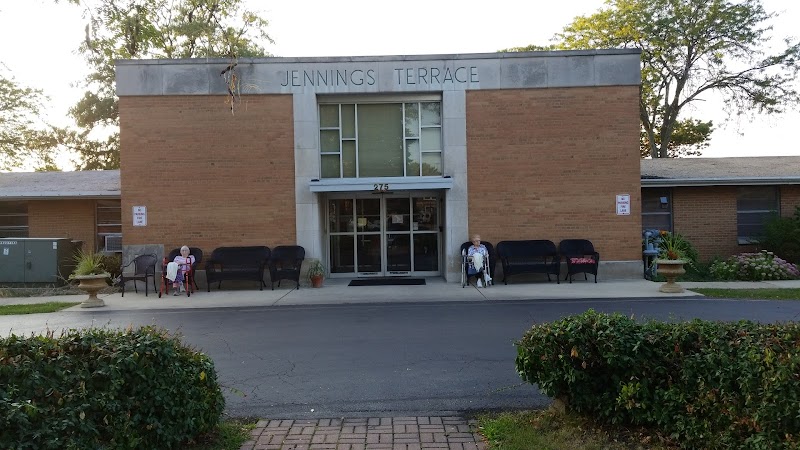
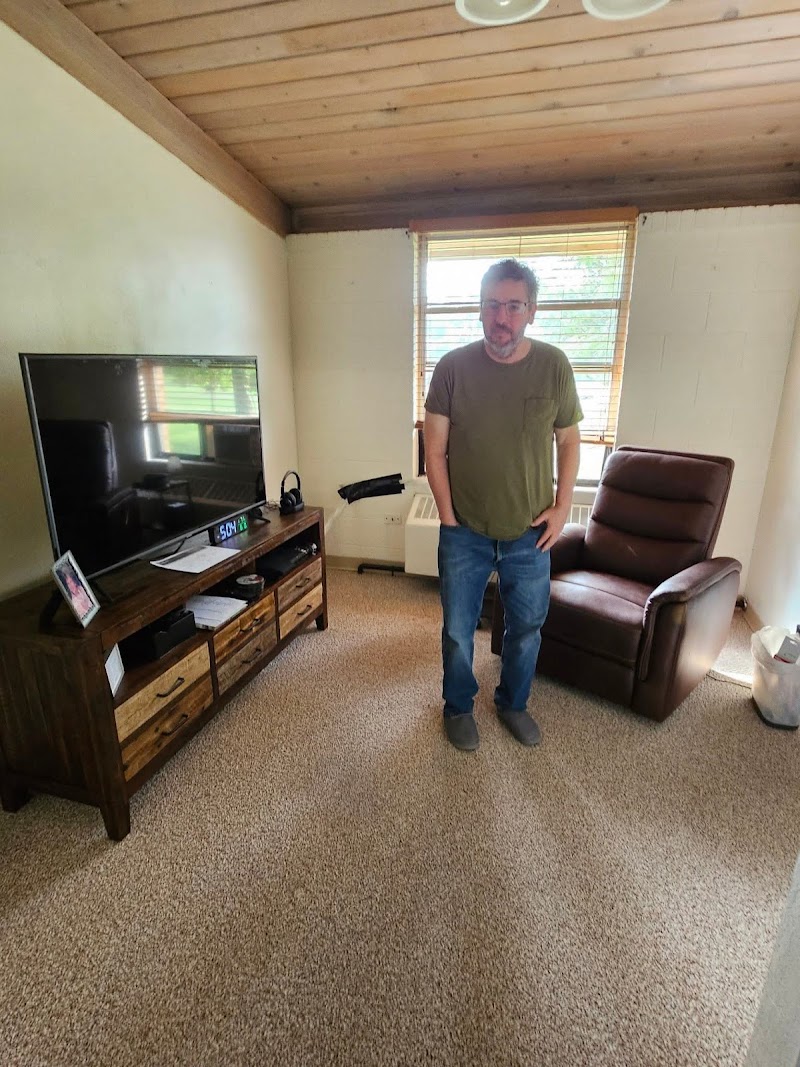
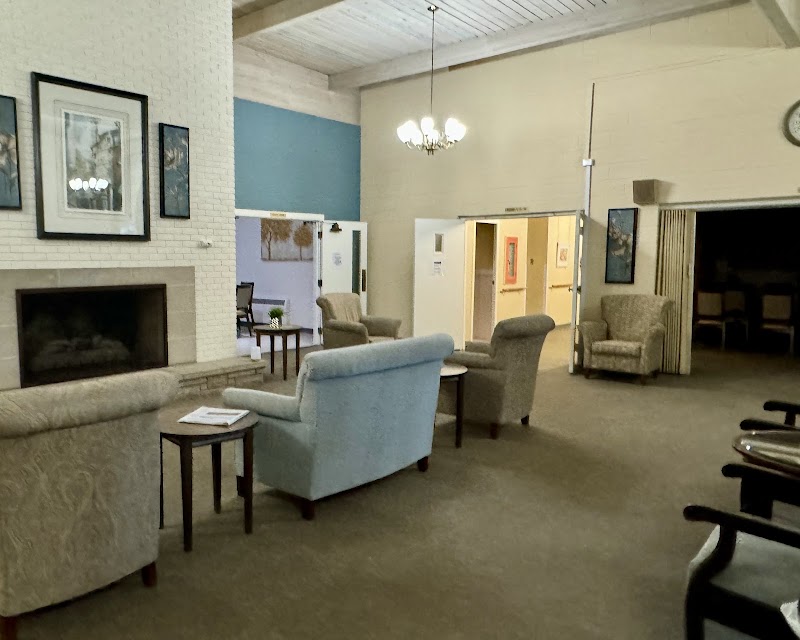
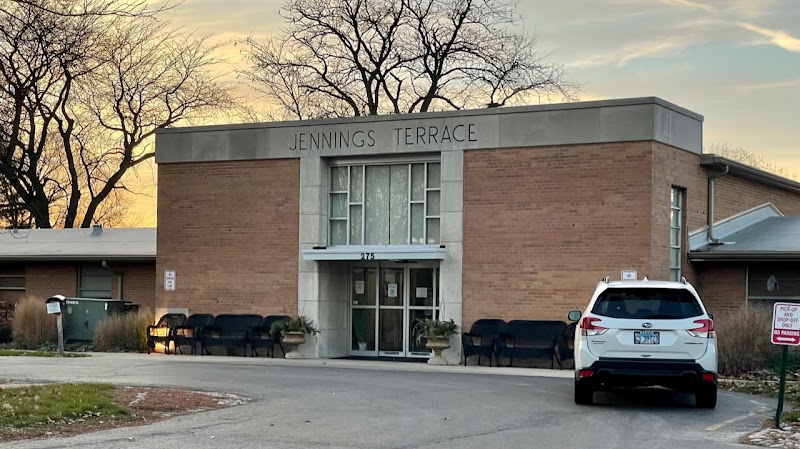
JENNINGS TERRACE

275 SOUTH LASALLE, AURORA, IL 60505 (630) 897-6947
Non profit - Corporation 60 Beds Independent Data: November 2025
Trust Grade
60/100
#254 of 665 in IL
Last Inspection: November 2024

Within standard 12-15 month inspection cycle. Federal law requires annual inspections.

Overview

Jennings Terrace has a Trust Grade of C+, which indicates it is decent and slightly above average among nursing homes. It ranks #254 out of 665 facilities in Illinois, placing it in the top half of all state facilities, and #15 of 25 in Kane County, meaning there is one local option that is better. The facility is showing improvement, having reduced its number of issues from 16 in 2024 to just 1 in 2025. However, staffing is a concern, with a rating of 2 out of 5 stars and a turnover rate of 52%, which is around the state average. Notably, there have been some troubling incidents, such as the failure to assess for Legionella bacteria, which poses health risks, and issues with kitchen sanitization that could lead to foodborne illness. On a positive note, there have been no fines recorded, and RN coverage is average, ensuring some level of professional oversight.

Trust Score
C+
60/100
In Illinois
#254/665
Top 38%
Safety Record
Low Risk
No red flags
Inspections
Getting Better
16 → 1 violations
Staff Stability
⚠ Watch
52% turnover. Above average. Higher turnover means staff may not know residents' routines.
Penalties
✓ Good
No fines on record. Clean compliance history, better than most Illinois facilities.
Skilled Nurses
○ Average
Each resident gets 31 minutes of Registered Nurse (RN) attention daily — about average for Illinois. RNs are the most trained staff who monitor for health changes.
Violations
⚠ Watch
21 deficiencies on record. Higher than average. Multiple issues found across inspections.
★★★☆☆
3.0
Overall Rating
★★☆☆☆
2.0
Staff Levels
★☆☆☆☆
1.0
Care Quality
★★★★☆
4.0
Inspection Score
Stable
2024: 16 issues
2025: 1 issues

The Good

  • Full Sprinkler Coverage · Fire safety systems throughout facility
  • No fines on record

Facility shows strength in fire safety.

The Bad

3-Star Overall Rating

Near Illinois average (2.5)

Meets federal standards, typical of most facilities

Staff Turnover: 52%

Near Illinois avg (46%)

Higher turnover may affect care consistency

The Ugly 21 deficiencies on record

Jan 2025 1 deficiency
CONCERN (D) 📢 Someone Reported This

A family member, employee, or ombudsman was alarmed enough to file a formal complaint

Potential for Harm - no one hurt, but risky conditions existed

Grievances (Tag F0585)

Could have caused harm · This affected 1 resident

**NOTE- TERMS IN BRACKETS HAVE BEEN EDITED TO PROTECT CONFIDENTIALITY** Based on interview and record review, the facility failed to respond to a resident's (R1) family representative billing concern....

Read full inspector narrative →
**NOTE- TERMS IN BRACKETS HAVE BEEN EDITED TO PROTECT CONFIDENTIALITY** Based on interview and record review, the facility failed to respond to a resident's (R1) family representative billing concern. This applies to 1 of 3 residents (R1) reviewed for grievances. The findings include: R1's EMR (Electronic Medical Record) showed R1 was admitted to the facility on [DATE] and discharged on 2/18/2024. On 1/28/2025 at 11:35 AM, V5 (R1's Family Member) said that on 9/20/2024 he contacted the facility after reviewing R1's billing for the months of April through June 2023 (from over a year earlier) when R1's family was paying out of pocket after R1 was approved for public aid. V5 said he notified V1 (Administrator) and V2 (Business of Manger/BOM) of his billing grievance regarding R1's credit due. V5 said he felt the facility was not responding promptly to his grievance. V5 said he then contacted V3 (Ombudsman) to help him find a resolution with the facility. On 1/28/2025 at 11:00 AM, V3 (Ombudsman) said she contacted V1 and V2 on 12/13/2024 to assist V5 with his grievance but was unsuccessful. V3 said the facility failed to provide V5 with a response to his grievance and stopped responding to her on 12/26/2024. On 1/28/2025 at 8:30 AM, V2 (BOM) said V5 (R1's Family Member) contacted her in October 2024 regarding R1's billing. V2 said she stopped responding to V5's emails after V3 (Ombudsman) became involved in December 2024. V2 said the facility confirmed the total amount that was due to R1's family on 1/01/2025. V2 was unable to provide a reason for why V5 and V3 were not contacted to provide them with an update regarding the grievance and the money owed to R1. R1's [NAME] Statement dated 1/01/2025 showed the facility acknowledged that R1's family was due a refund credit for R1's stay from 4/04/2023 through 2/18/2024. The email correspondence from V5 (R1's Family Member) to the facility, showed a total of 130 days had passed without V5 receiving a resolution to his billing grievance filed on 9/20/2024. The email correspondence from V3 (Ombudsman) to the facility, showed the facility failed to provide a resolution to V5's billing grievance and stopped responding on 12/26/2024. The facility's Grievance policy dated 11/28/2016, said Policy: The facility will make prompt efforts to resolve grievances that the resident may have. Grievances are taken seriously and will be subject to the procedure listed below. Procedure: 1. All residents will be notified of their right to file grievances whether it be orally or written, or anonymously. The resident will have access to contact information of the grievance official of the facility and know a reasonable timeframe for completing the review of the grievance .
Nov 2024 7 deficiencies
CONCERN (D)

Potential for Harm - no one hurt, but risky conditions existed

Quality of Care (Tag F0684)

Could have caused harm · This affected 1 resident

**NOTE- TERMS IN BRACKETS HAVE BEEN EDITED TO PROTECT CONFIDENTIALITY** Based on observation interview and record review, the facility failed to assess a resident's wound during a course of treatment ...

Read full inspector narrative →
**NOTE- TERMS IN BRACKETS HAVE BEEN EDITED TO PROTECT CONFIDENTIALITY** Based on observation interview and record review, the facility failed to assess a resident's wound during a course of treatment and document the status of the wound weekly and revise the care plan interventions for wound care. This applies to 1 of 2 residents (R5) reviewed wound care in the sample of 12. The findings include: R5's electronic medical record showed a [AGE] year old female admitted to the facility on [DATE] with diagnoses that include Osteoarthritis, Congestive Heart Failure, Obesity, Difficulty Walking, Weakness, Cognitive communication deficit, Type 2 Diabetes, and Diarrhea. R5's annual Minimum Data Sheet dated August 12, 2024 showed her to be cognitively intact. On November 18, 2024 11:23 AM, R5 was observed to be alert and oriented and stated that the facility took her air mattress and she has buttocks pain. Later, on November 19, 2024 1:40 PM, R5 stated her bottom hurts and she has an open wound on her bottom. R5 stated it has been there for a couple months. V19 (Wound Care Doctor) note dated November 20, 2024 showed R5 presented with moisture associated and excoriations and possible concomitant candida to sacrum with scattered openings in the fragile inflamed skin. V19 then prescribed an antifungal treatment for R5's wound. On November 19, 2024 at 1:43 PM V12 (Certified Nursing Assistant/CNA) confirmed that R5 has a wound to her sacrum and V14 (Licensed Practical Nurse/LPN) stated that R5 has wound on her sacrum ant they are treating it with medi-honey and calcium alginate. V14 also stated that the wound was noted on October 23, 2024. Nursing progress notes document that V18 (LPN-Nurse) obtained orders for wound care for R5 on October 23, 2024. R5 has an order dated October 23, 2024 that showed the following: Sacrum: Cleanse with wound cleanser, apply calcium alginate with medi-honey, and cover with border foam. Two times a day for opening in the sacral area. V16 (Nurse) stated on November 20, 2025 at 9:43AM, that V16 has provided wound care to R5 in the past. R5 skin care plan showed she was at risk for impaired skin integrity related to bowel and bladder incontinence, need for assist with repositioning and impaired mobility. R5's skin goal was for her skin to remain intact, free of redness, blisters, or discoloration through the next review date. The skin care plan was not updated to reflect R5's sacral wound and had not been updated since August 23, 2023. On November 20, 2024 at 9:19 AM, V2 (Director of Nursing/DON) stated, R5 does not have a wound. V2 was unable to provide any assessment or documentation of R5's wound on November 20, 2024. V2 stated she was not aware that R5 had a wound and V2 could not locate a wound assessment. V2 stated when a wound is found it should be care planned, put on the wound care system that the wound care doctor can see, assessed and documented, and the resident should be seen by the wound care doctor. V2 stated the wound care doctor has not seen R5 nor are they currently seeing R5. V2 stated that wounds should be in their Wound care system and then they flow into electronic medical record. The wound care system is what V19 (Wound Care Physician) checks when she comes in to see residents that have wounds. V2 confirmed that R5's name does not appear anywhere on the October 2024 or November 2024 list to be seen by V19. R5 was observed on November 20, 2024 with a wound to her sacrum about the size of a silver dollar. The wound bed was red and missing a layer of skin. R5 stated that the area hurt when touched. V2 stated she is waiting for the wound care doctor to see R5. V19 (Wound Care Physician) assessed R5 later and charted R5's wound as moisture associated excoriation. The facility's Pressure Ulcer/Injury Risk Assessment Policy dated July 2017 showed the following: Steps in the procedure 4. Conduct a comprehensive skin assessment with every risk assessment. b. once inspection of skin is completed document the findings on a facility-approved skin assessment tool. c. if a new skin alterations noted, initiate a (Pressure or non-pressure) form related to the type of alteration in skin. 5. Develop the resident-centered care plan and interventions based on the risk factors identified in the assessment, the condition of the skin, the residents stated wishes and goals. Documentation: The following information should be recorded in the resident's medical record utilizing facility forms: 1. The type of assessment(s) conducted. 5. The condition of the resident's skin (ie., the size and location of any red or tender areas identified. The Facility's Pressure Ulcer/Skin Breakdown- Clinical Protocol policy dated April 2018 showed the following 2. The nurse shall describe and document/report the following: a. Full assessment of the pressure sore including, location, stage, length, width, and depth, presence of exudates or necrotic tissue. 3. The physician will assist the staff to identify the type (for example, arterial or stasis ulcer) and characteristics (presence of necrotic tissue, status of wound bed, etc) of an ulcer.
CONCERN (E)

Potential for Harm - no one hurt, but risky conditions existed

Deficiency F0761 (Tag F0761)

Could have caused harm · This affected multiple residents

Based on observation, interview, and record review the facility failed to label and date medications once opened to determine the expiration date. The facility failed to remove expired medications, an...

Read full inspector narrative →
Based on observation, interview, and record review the facility failed to label and date medications once opened to determine the expiration date. The facility failed to remove expired medications, and remove or dispose narcotic medications that were in a broken sealed container. In addition, the facility failed to store suppository medications in a sanitary manner. This applies to 8 residents (R3, R8, R16, R19, R29, R30, R40, R41) reviewed for medication storage and labeling in the sample of 12. The findings include: On November 18, 2024, from 3:27 PM through 3:58 PM, observation of medication carts and medication rooms' refrigerator were conducted with V15 and V16 (Both Nurses). 1. R40's Latanoprost 0.005% (ophthalmic solution) label showed that it was opened on September 20, 2024, and expired on November 1, 2024. 2. R19's Latanoprost .005% (ophthalmic solution) label showed that it was opened on September 22, 2024, and expired on November 3, 2024. 3. R8's Latanoprost 0.005% (ophthalmic solution) opened on July 8, 2024. Pharmacy recommendation showed to discard 6 weeks after it was opened. 4. R16's Breo Ellipta (inhaler) was opened and not dated. Pharmacy recommendation showed to discard 6 weeks after opening of foil tray. 5. R41's Fluticasone Furoate/Vilanterol Ellipta (inhaler) was opened and not dated. Pharmacy recommendation showed to discard 6 weeks after opening of foil tray. 6. R30's Tramadol 50 mg tablet blister pack/container had a seal broken and taped over for tablets number 34 and 35. 7. R3's Hydrocodone Acetaminophen 7.5/325 mg tablet blister pack/container had a seal broken and taped over for tablets number 1, 2, 3, 7, 9, and 10. 8. R29's Lorazepam 0.5 mg tablet blister pack/container had a seal broken and taped over for tablets number 1. 9. There was a vial of Tuberculin Purified Protein in the South medication room refrigerator which shows that it was opened on September 26, 2024. The pharmacy guidelines show to discard this medication 30 days after it was opened. 10. There was a vial of Tuberculin Purified Protein in the North medication room refrigerator which showed that it was opened on July 1, 2024. The pharmacy guidelines show to discard this medication 30 days after it was opened. This same refrigerator stored two boxes of Bisacodyl Suppositories and one box of Tylenol Suppositories. The box containers of these suppositories were drenched with water which came from the leaking freezer. There was a puddle of water on the base floor of the refrigerator where they stored these suppositories. On November 21, 2024, at 10:33 AM, V2 (Director of Nursing) stated that if a narcotic medication container is already broken or the medication was already removed from its container and the resident refused to take the narcotic medication, the staff nurse should discard or waste it with the presence of another nurse as a witnessed to prevent potential diversion of this medications. On November 21, 2024 at 1:52 PM, V20 (Registered Pharmacist) stated that their controlled medication policy shows that once the narcotic medication is removed from its container, but the patient refused to take it, the controlled medication should not be returned to its container and should be destroyed, with a witness. The facility's Storage of Medications policy and procedure with revised dated of April 2007, shows: Policy Interpretation: 2. The nursing staff shall be responsible for maintaining medication storage and preparation areas in a clean, safe, and sanitary manner.
CONCERN (E)

Potential for Harm - no one hurt, but risky conditions existed

Deficiency F0805 (Tag F0805)

Could have caused harm · This affected multiple residents

Based on observation, interview and record review the facility failed to prepare the green peas to pureed consistency for residents on pureed diets. This applies to 5 of 5 residents (R3, R6, R13, R17,...

Read full inspector narrative →
Based on observation, interview and record review the facility failed to prepare the green peas to pureed consistency for residents on pureed diets. This applies to 5 of 5 residents (R3, R6, R13, R17, R23) reviewed for pureed diet in the sample of 12. The findings include: On November 19, 2024 at 10:30 AM, the pureed green peas preparation done by V5 (cook) was observed in the facility kitchen. V5 stated that she was preparing for five residents who are on pureed diets. According to V5, the green peas were frozen, and she had cooked it. V5 placed eight scoops of 4 ounces (total of 32 ounces) green peas inside the food processor, added 4 ounces of butter and pureed the mixture for about three minutes. V5 then opened the food processor and transferred the processed green peas inside a small metal pan. According to V5, she was done processing the green peas and she will place the small metal pan inside the warmer because the processed green peas was ready to be served to the residents on pureed diet. V5 was asked why she did not test the processed green peas to make sure it was the right consistency. V5 did not respond. On tasting the processed green peas, lots of fibrous casings (pea pods) was visible in the mixture. The fibrous casings were unable to be chewed and got stuck in the throat when swallowed. During this time V4 (Dietary Manager) was notified of the concern with regards to the consistency of the processed green peas and V4 tasted the product. V4 agreed that the green peas still had lots of fibrous casings. V4 stated that the pureed product should be pudding-like consistency and should be smooth without the need to chew. The facility's diet list as of November 19, 2024 showed that R3, R6, R13, R17 and R23 were on pureed diet consistency. On November 20, 2024 at 1:23 PM, V7 (Registered Dietitian) stated that for pureed food, the expected and appropriate consistency should be pudding-like, without chunks, clumps or fibrous casings and should be smooth. V7 added that if the processed food did not reach the pureed consistency, it should not be served to the residents on pureed diet, to prevent choking or swallowing problem. The facility's recipe for pureed green peas showed in-part, 2. Place in food processor and process until fine in consistency. Review of the facility policy and procedure regarding pureed/dysphagia diet dated 2010 showed, Food will be provided in a form designed to meet individual needs. The texture of the food may be altered to pureed consistency. Pureed/dysphagia diets will be served as ordered by the physician. The same policy under procedure showed in-part, Whole food will be pureed in a blender or a food processor to a semi-solid consistency (i.e. (for example), the consistency of pudding-like).
CONCERN (E)

Potential for Harm - no one hurt, but risky conditions existed

Antibiotic Stewardship (Tag F0881)

Could have caused harm · This affected multiple residents

Based interview and record review the facility failed to utilize the McGeer Criteria from March 2024 through November 19, 2024 for residents with suspected infections based on their policy. This appli...

Read full inspector narrative →
Based interview and record review the facility failed to utilize the McGeer Criteria from March 2024 through November 19, 2024 for residents with suspected infections based on their policy. This applies to 9 of 9 residents (R1, R5, R6, R7, R11, R12, R20, R37, R46) reviewed for antibiotic stewardship in the sample of 12. The findings include: On November 20, 2024 at 11:38 AM, V3 (Infection Preventionist/Assistant Director of Nursing) stated that the facility is using the McGeer Criteria to ensure residents are not prescribed unnecessary antibiotics. V3 stated that in March of 2024, she stopped utilizing the McGeer Criteria. Surveyor reviewed the facility's infection tracking binder and there were McGeer Criteria filled out for residents in January and February of 2024, but there were no McGeer Criteria for residents for the remainder of the year (from March 2024 to present). V3 stated there was no McGeer Criteria documentation stating whether residents who were prescribed antibiotics from March 2024 to present, either met or did not meet standards for antibiotic utilization. V3 stated, she wears a lot of hats and she is not able to get everything done. V3 stated infection control has suffered because of this. Review of the facility's infection prevention and control monthly log from March through November 19, 2024 showed that R1, R5, R6, R7, R11, R12, R20, R37, and R46 had used antibiotic therapy at a given time for suspected/confirmed infections. The facility's Antibiotic Stewardship Protocol dated April 2016 showed the following: Action, a. The facility utilizes McGeer Criteria to improve the evaluation and communication of clinical signs and symptoms when a resident is first suspected of having an infection.
CONCERN (E)

Potential for Harm - no one hurt, but risky conditions existed

Deficiency F0947 (Tag F0947)

Could have caused harm · This affected multiple residents

Based on interview and record review the facility failed to provide dementia training for the CNAs (Certified Nurse Assistants) working in the facility and who were required to care for residents with...

Read full inspector narrative →
Based on interview and record review the facility failed to provide dementia training for the CNAs (Certified Nurse Assistants) working in the facility and who were required to care for residents with dementia. This applies to 26 of 26 residents (R1, R3, R4, R6, R8, R11, R12, R14, R15, R16, R19, R20, R21, R23, R24, R26, R27, R28, R33, R36, R38, R40, R42, R44, R45 and R46) identified by the facility as having a diagnosis of dementia. The findings include: On November 20, 2024, at 10:03 AM, V9 (CNA (Certified Nursing Assistant) Supervisor) said that as the CNA Supervisor she does the CNAs annual evaluations and does the in-services for the CNAs. V9 said when needed, she will do re-education along with return demonstration on skills provided to the residents. V9 said she does not do dementia training and cannot remember having attended a training on dementia. V9 said V8 (Community Relations Coordinator) does dementia, resident rights, abuse and neglect trainings. The facility trainings are all done as in-services and the documentation is the sign in sheet. On November 20, 2024, at 10:56 AM, V2 (Director of Nursing) said she started working at this facility in April 2024. V2 said they have not done dementia training since she has been here. V2 pulled the in-service binder to see if she could locate a dementia training and provided the surveyor with an in-service V8 did on June 6, 2024. The in-service sign in sheet showed; In a facility that practices Person-Centered Care, listening skills and customer service are important skills. This is a reminder to let the resident finish their thought, sentence, or paragraph, before you offer a solution to them. Let them finish, do not cut them off when they are trying to tell you something. If you don't do it right the first time, you will have to find the time to fix it the second time! We are here to serve the needs of residents. Many of our residents' struggle with symptoms that are overwhelming to them and make their lives difficult, painful, or frustrating. Be conscious that as a staff member, you always have the power to leave, whereas the resident may not. Please remember that you can change your perspective of your job and the work you do here, where as the resident may not be able to do so. V2 was not able to provide any documentation to show dementia training had been provided to the CNAs. On November 20, 2024, 2:25 PM, V8 said she does not do dementia training for the staff. On November 20, 2024, at 1:12 PM, V10 (CNA) said she has worked here since September 2024, and had taken care of residents with dementia at the facility. V10 stated that she was not given dementia training during her orientation. On November 20, 2024, at 1:20 PM, V11 (CNA) said she has worked at this facility for 15 years, 13 years as a CNA, and had taken care of residents with dementia at the facility. V11 said she has not had dementia training and cannot remember when she had dementia training last. On November 20, 2024, at 1:42 PM, V12 CNA) said she has been working at this facility for five months, and had taken care of residents with dementia at the facility. She was able to explain her orientation process but said she did not have dementia training. On November 20, 2024, at 1:47 PM, V13 CNA) said she has been working at the facility for about five months, and had taken care of residents with dementia at the facility. V13 stated that she did not get dementia training with orientation. The facility provided list of residents with diagnosis of dementia. The list identified 26 residents which included R1, R3, R4, R6, R8, R11, R12, R14, R15, R16, R19, R20, R21, R23, R24, R26, R27, R28, R33, R36, R38, R40, R42, R44, R45 and R46.
CONCERN (F)

Potential for Harm - no one hurt, but risky conditions existed

Infection Control (Tag F0880)

Could have caused harm · This affected most or all residents

Based on interview and record review, the facility failed to ensure the facility had an assessment performed that identifies where Legionella and other opportunistic waterborne pathogens could grow. T...

Read full inspector narrative →
Based on interview and record review, the facility failed to ensure the facility had an assessment performed that identifies where Legionella and other opportunistic waterborne pathogens could grow. This applies to all 46 residents that reside in the facility. The findings include: The facility's Long Term care facility application for Medicare and Medicaid (CMS (Centers for Medicare & Medicaid Services)-671 form) dated November 18, 2024 showed that there were 46 residents residing at the facility. On November 20, 2024 at 11:12 AM, V6 (Maintenance Director) stated the facility does not have an assessment for Legionella or other opportunistic water borne pathogens. V6 stated he is not aware of any Legionella assessment being done in the last 3 years that he has been working at the facility. V6 stated, they will be using a specific company to do the facility's assessment for Legionella and other waterborne pathogens. V6 stated that they have not utilized the company yet. V6 stated the facility does not have an assessment that shows where specifically Legionella or other waterborne pathogens can potentially grow. V6 stated that there has not been any testing for Legionella since he has been working at the facility. The facility's Infection Prevention & Control - Legionnaires Disease policy dated November 1, 2018 showed the following: Procedure: the water management program is maintained by the Maintenance and Environmental Services staff. Facility plan: Identifies building water systems for which Legionella control measures are needed- Utilizing the facility layout to describe the building water systems using text. b. Assesses how much risk the hazardous conditions in those water systems pose-developing a building flow diagram per the CDC toolkit. c. Control measures will be applied as needed to reduce the hazardous conditions, whenever possible to prevent Legionella growth and spread.
MINOR (C)

Minor Issue - procedural, no safety impact

Deficiency F0847 (Tag F0847)

Minor procedural issue · This affected most or all residents

Based on interview and record review, the facility's Arbitration Agreement failed to have the required language in the Arbitration Agreement Contract. This applies to all 46 residents residing at the ...

Read full inspector narrative →
Based on interview and record review, the facility's Arbitration Agreement failed to have the required language in the Arbitration Agreement Contract. This applies to all 46 residents residing at the facility. The findings include: The facility's Long Term care facility application for Medicare and Medicaid (CMS (Centers for Medicare & Medicaid Services)-671 form) dated November 18, 2024 showed that there were 46 residents residing at the facility. On November 20, 2024, at 2:02 PM, V8 (Community Relations Coordinator) said when there is a new admission, she sit downs and goes paragraph by paragraph through the contract with the resident and/or their representative. There have been situations where V8 said she has gone over the contract paragraph by paragraph over the phone with a resident's representative who was not able to come into the facility. On November 20, 2024, at 12:18 PM, facility provided their undated admission packet titled, Contract Between Resident and [facility name] which included the arbitration agreement. Under Section X. Miscellaneous Provisions N. Mediation/Arbitration asked the resident and or their representative to enter into mediation for all claims, disputed, and controversies arising in relation to the performance, interpretation, applications, or enforcement of this contract, including but not limited to the breach thereof, or relating to care and treatment of any other dispute relating to the resident's residency The mediator will be selected in good faith by both parties .Should the parties fail to reach a resolution of the claim, dispute, or controversy by way of mediation, the dispute shall be arbitrated in accordance with the American Arbitration Association (AAA) 'Commercial Dispute Resolution Procedures' . The facility contract was lacking the language that showed that neither the resident nor their representative are required to sign the agreement for arbitration as a condition of admission to, or as a requirement to continue to receive care at the facility. It was also lacking the language that showed the resident or their representative have the right to rescind the agreement within 30 day calendar days of signing the contract. On November 20, 2024, at 2:25 PM, V8 said she has re-read the agreement and the contract does not have the required language in it. V8 said this will be addressed.
Jan 2024 9 deficiencies
CONCERN (D)

Potential for Harm - no one hurt, but risky conditions existed

Investigate Abuse (Tag F0610)

Could have caused harm · This affected 1 resident

**NOTE- TERMS IN BRACKETS HAVE BEEN EDITED TO PROTECT CONFIDENTIALITY** Based on interview and record review the facility failed to respond to a potential abuse allegation by not thoroughly investigat...

Read full inspector narrative →
**NOTE- TERMS IN BRACKETS HAVE BEEN EDITED TO PROTECT CONFIDENTIALITY** Based on interview and record review the facility failed to respond to a potential abuse allegation by not thoroughly investigating and not reporting the allegation to the State Survey Agency. This applies to 1 of 1 (R9) reviewed for abuse in the sample of 27. The findings include: The EMR (Electronic Medical Record) showed R9 was admitted to the facility on [DATE], with multiple diagnoses including Alzheimer's disease, anxiety, delusional disorder, hallucinations, schizoaffective disorder, and dementia. R9's MDS (Minimum Data Sheet) dated 11/02/2023 showed she had short and long-term memory problems and required the use of a manual wheelchair with partial to moderate staff assistance. The EMR showed R31 was admitted to the facility on [DATE], with multiple diagnoses including parkinsonism, anxiety, amd depression. R31's MDS dated [DATE] showed she was cognitively intact. On 1/17/2024 at 10:33 AM, R31 was participating in the facility's resident council group meeting and shared a concern from two months ago where she observed V4 (Agency Certified Nurse Assistant/CNA) pushing R9 into the dining room table. R31 said she was concerned with the manner V4 treated R9. R31 said she notified V1 (Administrator) the following day and was told V4 would not be returning to the facility. On 1/17/204 at 12:50 PM, V1 said R31 informed her of her concern regarding V4 (Agency CNA) and R9 a few months ago. V1 said she did a quick verbal follow-up but did not do a grievance form investigation. V1 said she did not consider R31's concern as abuse. V1 continued to say V4 said he was frustrated because he had to keep pushing R9 back into the dining room table. V1 said she called the staffing agency and asked for V4 not to return to the facility. On 1/18/2024 at 11:15 AM, R31 said V5 (Social Worker) told her on 1/17/2024 the facility had contacted the staffing agency and asked for V4 not to return to the facility. R31 continued to say she had reported R9's incident because she was concerned the incident was possibly abuse of an elderly person. The facility's document, titled Grievance/Complaint Report dated 1/17/2024 (during the survey) showed R31's grievance/complaint of her concern regarding observing an agency CNA speaking sternly and pushing another resident into the table two months ago. The form continued to show V1 was notified of R31's concern two months ago and the staffing agency was contacted to have the identified agency CNA not return to the facility. The form also showed the grievance was not resolved and is still in process. The facility's policy, titled Resident Care Policy and Procedure Regarding Abuse and Neglect, Involuntary Seclusion, Exploitation, Misappropriation of Resident Property, Injuries of Known Origin, and Social Media with a revised date of 3/15/2018, showed Abuse and Neglect Prohibited: This facility, for the protection of the residents, utilizes the seven stages of the CMS [NAME] abuse prohibition protocol .I, identification of possible incidents or allegations which need investigation; I, Investigation of incidents and allegations .Investigating Abuse 1. After an initial report of suspected abuse or neglect is sent to IDPH, the Administrator or designee shall investigate all alleged incidents of abuse or neglect .
CONCERN (D)

Potential for Harm - no one hurt, but risky conditions existed

ADL Care (Tag F0677)

Could have caused harm · This affected 1 resident

Based on observation, interview, and record review, the facility failed to ensure residents receive assistance for grooming and hygeine cares. This applies to 1 of 3 residents (R30) reviewed for groom...

Read full inspector narrative →
Based on observation, interview, and record review, the facility failed to ensure residents receive assistance for grooming and hygeine cares. This applies to 1 of 3 residents (R30) reviewed for grooming needs. The findings include: On 1/16/24 at 11:08 AM, R30 was sitting in the wheelchair in her room. R30 had several white hairs on her upper lip and chin. R30 said she does not like the hair on her chin and upper lip and would like it off. R30 said someone was supposed to do it, but they never did. On 1/17/23 at 8:46 AM, hair was still noted on her upper lip and chin. R30's MDS (Minimum Data Se) dated 11/3/23 shows that R30's cognition is moderately impaired and R30 needs moderate assistance with personal hygiene. R30's current care plan shows that R30 is at risk for ADL self-care performance deficit and needs extensive assist of 1 staff participation with personal hygiene. On 1/18/24 at 3:38 PM, V3 (ADON/Assistant Director of Nursing) said CNAs (Certified Nurse Aides) were responsible for assisting residents with ADL care. V3 said R30 does not have a history of refusing care, she should not have hair on her chin or upper lip. The facility's Supporting Activities of Daily Living (ADL) policy (reviewed 12/5/23) states that residents who are unable to carry out activities of daily living independently will receive services necessary to maintain good nutrition, grooming, personal hygiene and oral care.
CONCERN (D)

Potential for Harm - no one hurt, but risky conditions existed

Accident Prevention (Tag F0689)

Could have caused harm · This affected 1 resident

Based on observation, interview, and record review, the facility failed to secure hazardous chemicals. This applies to 4 of 10 residents (R2, R43, R4, R10) reviewed for safe environment. Findings incl...

Read full inspector narrative →
Based on observation, interview, and record review, the facility failed to secure hazardous chemicals. This applies to 4 of 10 residents (R2, R43, R4, R10) reviewed for safe environment. Findings include: 1. On 01/16/24 at 10:54 AM, one 32 oz spray bottle of bleach was found in R2 and R43's shared bathroom. R43's 11/6/23 MDS (Minimum Data Set) showed that his mental status is severely impaired. R2's EHR (Electronic Health Record) showed diagnoses including dementia, schizoaffective disorder bipolar type, neurocognitive disorder, and major depressive disorder. On 01/16/24 at 11:14 AM, V11 (Housekeeping staff) said she had cleaned R2 & R43's shared bathroom and left the bottle of bleach in there. 2. On 01/16/24 at 11:02 AM, a 32 oz. spray bottle of odor eliminator was found in R4 and R10's shared bathroom. R10's EHR showed diagnoses including schizoaffective disorder, major depressive disorder, and far sightedness. R4's EHR showed diagnosis including dementia with agitation, mild cognitive impairment and age-related cognitive decline. On 01/16/24 at 11:19 AM, V11 was shone the bottle of odor eliminator, and V11 removed the bottle from the shared bathroom. V11 said that the bottle must have been left from the CNAs because she did not use the product. V11 said that bleach and the order eliminator should be locked in a storge area because it is a safety issue for the residents. V11 said that if a resident gets a hold of one of the bottles of chemicals they could get hurt. On 01/18/24 at 2:01 PM, V2 DON (Director of Nurses) said that the bottles of bleach and odor eliminator should not have been left in the residents' rooms because of safety purposes. If a resident has an altered mental status and they get a hold of them, they can hurt themselves or others with it by possibly drinking it or spraying in their eyes or someone else's. The facility's Chemical use policy (no date) showed that all housekeeping staff shall ensure that any chemicals used, such as cleaning, sterilizing, antibacterial, general cleaning . will always be in the housekeeper's control, in locked housekeeping cart and/or behind locked doors.
CONCERN (D)

Potential for Harm - no one hurt, but risky conditions existed

Respiratory Care (Tag F0695)

Could have caused harm · This affected 1 resident

Based on observation, interview, and record review, the facility failed to ensure sanitary storage/containment of respiratory equipment when not in use. This applies to 1 of 2 residents (R49) reviewed...

Read full inspector narrative →
Based on observation, interview, and record review, the facility failed to ensure sanitary storage/containment of respiratory equipment when not in use. This applies to 1 of 2 residents (R49) reviewed for respiratory equipment in a sample of 27. The findings include: On 1/16/24 at 11:19 AM, R49's oxygen tubing and nasal cannula were observed on the floor. On 1/17/24 at 11:02 AM, R49 was sitting in his wheelchair receiving nebulizer treatment. R49's oxygen tubing and nasal cannula were again on the floor. R49 said he uses the oxygen. R49's EMR (Electronic Medical Records) shows R49's diagnosis which includes Chronic Obstructive Pulmonary Disease (COPD). R49's January 2024 Physician Order Sheet showed that R49 had an order to administer oxygen 2-4 liters via nasal cannula as needed maintain oxygen over 92% every shift related to COPD. On 1/17/24 at 3:44 PM, V3 (ADON/Assistant Director of Nursing) said if oxygen is not in use, the oxygen tubing and nasal cannula should be contained in a bag and not on the floor for infection control reasons. The facility's Oxygen Tubing Storage Policy and Procedure policy (updated 1/2/24) states that oxygen tubing will be stored when not in use in a plastic bag.
CONCERN (D)

Potential for Harm - no one hurt, but risky conditions existed

Deficiency F0760 (Tag F0760)

Could have caused harm · This affected 1 resident

Based on observation, interview, and record review, the facility failed to administer correct dose of insulin medication. This applies to 1 of 3 residents (R39) reviewed for insulin medication adminis...

Read full inspector narrative →
Based on observation, interview, and record review, the facility failed to administer correct dose of insulin medication. This applies to 1 of 3 residents (R39) reviewed for insulin medication administration in a sample of 27. The findings include: On 1/17/24 at 8:13 AM during medication pass, V7 (Agency RN/Registered Nurse) went to R39's room and to administer the scheduled dose of insulin. V7 said that R39 has an order to receive 50 units of Lantus (insulin). V7 administered the dose of insulin to R39's right upper arm. When V7 was done administering the insulin, some insulin remained in the insulin pen. Surveyor asked V7 for the insulin pen; there were still 2 units of insulin left in the pen and the pen's dial was at 2 with R39 not receiving the full prescribed dose. V7 said that dial should be at 0. R39's EMR (Electronic Medical Records) shows diagnoses which includes Type 2 Diabetes Mellitus with unspecified diabetic retinopathy and macular edema, and Type 2 diabetes mellitus with diabetic neuropathy. R39's POS (Physician Order Sheet) shows the following order for Insulin Glargine subcutaneous solution pen injector 100 unit/ml inject 50 units subcutaneously in the morning. R39's current are plans shows that R39 has Diabetes Mellitus with intervention to administer Diabetes medication as ordered by the doctor. On 1/17/24 at 3:47 PM, V3 (ADON/Assistant Director of Nursing) said the nurse should administer the required dose because the resident needs to right dose to help digest their food, and to keep insulin levels in the normal range. The facility's Administering Medications (revised 12/2012) policy states that medications must be administered in accordance with the orders .
CONCERN (D)

Potential for Harm - no one hurt, but risky conditions existed

Infection Control (Tag F0880)

Could have caused harm · This affected 1 resident

Based on observation, interview and record review, the facility failed to isolate a covid-positive resident from her covid-negative roommate. This applies to 1 of 5 residents (R24) reviewed for infect...

Read full inspector narrative →
Based on observation, interview and record review, the facility failed to isolate a covid-positive resident from her covid-negative roommate. This applies to 1 of 5 residents (R24) reviewed for infection control. Findings include On 01/17/24 at 10:29 AM, V2 DON (Director of Nursing) stated there was one resident in the facility positive for covid (R45) and one resident under observation for covid (R24). V2 stated that both residents were in the same room. V2 stated they were instructed by the physician to keep the residents together in the same room On 01/17/24 at 11:10 AM, V2 DON stated the facility policy follows the department of health guidelines to isolate covid positive residents. If there is a roommate, they should be relocated if they have tested negative for covid. V2 stated in her professional opinion, the two residents should have been separated. On 01/18/24 at 4:30 PM, V3 ADON stated residents can share a room if they have the same infection and if residents don't have the same infection, they should be separated. V3 stated that on 1/11/24 and 1/15/24 the facility had seven open beds available to relocate R24. On 01/17/24 at 11:25 AM, R24 stated her roommate had been diagnosed with covid but she had not. R24 stated she had been isolated for three or four days. R24 stated she had not been out of her room since being isolated. R24 stated she was not offered another room and did not know how she was being protected from covid. Nurse documentation on 1/17/24 at 3:20 PM states R24 tested positive for covid and is on covid antiviral. Isolation for covid maintained. On 1/18/24 at 4:20 PM, V2 stated nurses have been documenting R24 is positive for covid because she is taking the covid antiviral drug. On 01/18/24 at 4:20 PM, V2 DON stated facility wide covid testing was done on 1/11/24. On 1/15/24 four residents, including R24, were tested because they were symptomatic. V2 stated those residents tested were negative. On 01/18/24 at 3:44 PM, V3 ADON / IC Nurse stated there was no facility wide testing because neither R24 or R45 came out of their room and there were no exposure risks. If there were more residents positive for covid, they would be testing the entire facility. V3 stated they were instructed to leave R24 and R45 together in the same room. V3 stated she did not know what the facility policy said about facility-wide testing for covid. The facility policy Contingency Plan for Isolation for Covid 19 Positive / Suspected Residents dated 4/27/20 states any resident who is suspected or tests positive for Covid 19 will be moved to a private room. If more than one resident test positive they may be co-horted with each other, if of same gender. According to the CDC.gov/coronavirus Infection Prevention and Control recommendations of patients with symptoms of covid (even before results of diagnostic testing) and asymptomatic patients who have been in close contact with someone with covid infection should not be roomed with patients with confirmed covid infection unless they are confirmed to have covid infection through testing.
CONCERN (D)

Potential for Harm - no one hurt, but risky conditions existed

Deficiency F0919 (Tag F0919)

Could have caused harm · This affected 1 resident

Based on observation, interview, and record review, the facility failed to ensure a resident had a functional call light available. This applies to 1 resident (R36) reviewed for call lights. The findi...

Read full inspector narrative →
Based on observation, interview, and record review, the facility failed to ensure a resident had a functional call light available. This applies to 1 resident (R36) reviewed for call lights. The findings include: On 01/16/23 at 12:54 pm, a male voice was heard calling out of R36's room. The voice was yelling, get me out of here. At 12:59 pm, R36 was seen in his room yelling Get me out of here. At 1:02 PM, R36 was in his room and continued to yell, Can I get out of here? R36 was asked if he had turned his call light on and he said no one is answering it. R36's call light was not activated. At 1:12 pm, R36 was seen in his room still yelling for help and still no staff came to R36's aid. At 1:23 pm, R36 asked the surveyor if they would help him get out of bed because it was too warm in his room. R36 pushed his call light button to turn on his call light and the call light did not turn on. At 1:28 pm, V9 (CNA) Certified Nursing Assistant was asked by the surveyor to come into R36's room and test his call light. The call light only came on after he re-plugged in the call light, but then the call light would not turn off. At 1:48 pm, V2 (DON) Director of Nurses came into the room and tested the call light and observed that the call light was not working. V2 said that the call light was sticky. V2 said that she expected her staff to check the call lights at the beginning of every shift. On 1/18/24 at 2:01 PM, V2 (DON) said that call lights should be working at all times for emergency reasons and for the residents' needs. The facility's call light policy (no date) showed that call lights are to be answered in a timely manner and the call light system will be maintain by the facility.
CONCERN (F)

Potential for Harm - no one hurt, but risky conditions existed

Food Safety (Tag F0812)

Could have caused harm · This affected most or all residents

Based on observation, interview, and record review, the facility failed to ensure the sanitization of the kitchen, and discard and store food items to prevent the transmission of food borne illness. T...

Read full inspector narrative →
Based on observation, interview, and record review, the facility failed to ensure the sanitization of the kitchen, and discard and store food items to prevent the transmission of food borne illness. This applies to all residents that reside in the facility. Findings include: The facility's 1/16/2024 CMS-671 Form showed 50 residents live in the facility. 1. On 01/16/24 at 11:23 AM, quality assurance checks of red sanitization buckets and the three-compartment sink was conducted with V6 Dietary Manager. Sanitizing Bucket #1 strip tested at zero ppm (parts per million). Sanitizing Bucket #2 was dumped and refilled by V8 Dietary Aid before V6 tested sanitizer concentration. Bucket #2 with sanitizer strip tested at zero ppm. Sanitizing Bucket #3 strip tested at zero ppm. The three-compartment sanitizing sink tested at zero ppm. V6 Dietary manager stated staff should be changing the sanitization bucket several times during meal preparation and the person that changes should be checking it. Staff have not been checking the sanitization bucket or documenting it- ultimately, it's my responsibility. On 1/18/24, V6 stated I realized the sanitizing bucket and sink weren't at the proper level during the initial tour. Testing the sanitizing buckets should be done when you replace the water with sanitizer. V6 stated the three-compartment sink should be tested three times per day, or when it gets dirty and is refilled, or if the water gets hotter than 75 degrees because the higher temperature makes the sanitizer less effective. The buckets and sink should be tested to assure the correct level of sanitization is being used. V6 stated if you don't have enough sanitizer, it would not effectively sanitize, and can cause infection control issues with cross contamination and food borne illness. If you have too much sanitizer it's ineffective and can contaminate the item you are trying to sanitize, and potentially get residents sick and cause harm to the residents. V6 stated we should have been documenting the testing. If we had been doing the testing, we would have known there was a problem before Tuesday. A company came out to check the dish machine. I should have run the machine and then do a check of the sanitizer after the final rinse. V6 stated we should be doing it three times a day with breakfast lunch and dinner. 2. On 01/16/24 at 10:31 AM, the facility kitchen tour was conducted with V6 Dietary Manager and the following were noted: Dry Storage- Opened red food color 16oz (ounces) dated 3/29/20 Opened malt vinegar 12 oz - no opened-on date or use by date. Opened yellow food color 32 oz dated 10/20/17 Opened green food color 16oz- no open on date, use by date or manufacturer date. Opened red food color 32 oz opened on 4/27/20 V6 Dietary Manager stated items should be good for one year after opening. Two bottles of chocolate syrup 24oz expired on 12/23 Eight bottles of raspberry syrup15.1 oz expired September 2023 Open lime juice 1 gallon and in dry storage label says refrigerator after opening. Double bagged ground black crumbs. Bag opened by V6 identified as chocolate cookie crumbs sundaes. Corn starch in large clear bin covered by a metal baking pan not secured to bin- no use by or manufacturer expiration date. Opened whey protein powder (10lb) opened in a zippered storage bag- no open on date, use by date or manufacturer expiration date. Walk-in cooler- 8 [NAME] peppers with mold and soft spots. Canadian bacon 32oz opened package wrapped in plastic wrap-- opened on 1/5/24. V6 Dietary manager stated the Canadian bacon should have been used within in four days after opening. We keep dented cans on top of the organizer of in use other cans in dry storage. Reach-in cooler- Opened mayonnaise 128 oz opened 10/5/23 Opened cream cheese 11lbs opened 11/24/23 Walk in freezer- large bag of garlic bread -- writing on bag illegible Reach-in freezer- Two bags of pro apple muffin batter no volume amount listed on bags. Manufacture use by date of August 13, 2023. On 01/18/24 at 8:45 AM, V6 Dietary Manager stated food coloring is good for one year after opening according to our standard, and vinegar should have an open on date and use by date once it is open. The manufacturer's expiration date is the expiration date. Expired and should be discarded it's not used and serving expired food items can cause food borne illnesses. Foods that say refrigerate after opening should be refrigerated because they can spoil, become contaminated, and causes food borne illness. Dry items like the cornstarch should be labeled with the contents, when it came in, and when it expires. Items should be covered with a tight-fitting lid so rodents and bugs don't get in it, or spoil, which can allow harmful bacteria to grow. V6 stated I don't believe the cornstarch had an expiration date. Food transferred to another container should have a label that includes what it is, when it came in, when it expires or a use by date. Opened items that have manufacturers label should have the date it came in, and if open, when it was opened, when expires, or the use by date. Fresh items with mold and soft spots should be disposed of. V6 stated the Canadian bacon that turned gray should have been disposed of to prevent food borne illness because it could be spoiled. The Canadian bacon should have been used in 4 to 6 days. Labels that are illegible if unopened should go by manufacturer use-by date. The dented cans can be discarded or set aside for the food service company to take back. the dented cans should not be stored where our regular cans are because a staff members may use them and it may increase the risk of food borne illness like botulism. Salad dressing should be used within 30 days of opening and using it past the date increases the risk of contamination and risk of food borne illness increases also. Cream cheese icing should be used 30 days after opening. The garlic bread should be labeled legibly since it was taken out of the original container, and staff should have transferred the label information from the manufacturer label or the received date and use-by date since it was open and it should be good for 30 days after opening. The apple muffin batter was no longer good and should have been disposed of, even if it's in the freezer, because we need to follow the manufacturer original use-by date. The facility policy Storage of Dry goods / Foods dated 2010, states foods stored in bins will be removed from original packaging and bins will be labeled with item and date unpacked. Open products will be labeled and tightly covered to protect against contamination including from insects and rodents. The facility policy Labeling and Date Marking Foods dated 2014, states to decrease the risk of food borne illness and to provide the highest quality of food for the residents prepared and packaged foods may be marked with the date received, the date opened and or the date by which the item should be discarded. The facility undated recommendation chart for opened items list mayonnaise is good for two months refrigerated after opened. The facility policy Sanitizing Solution for Wiping Cloths dated 2015 states using an appropriate test strip, the strength of the sanitizing solution will be tested each time the sanitization buckets are changed. The facility did not provide a policy for the three-compartment sink.
CONCERN (F)

Potential for Harm - no one hurt, but risky conditions existed

Safe Environment (Tag F0921)

Could have caused harm · This affected most or all residents

Based on observation, interview and record review, the facility failed to ensure lint was removed from the facility's dryers, posing a fire hazard. This applies to all residents residing in the facili...

Read full inspector narrative →
Based on observation, interview and record review, the facility failed to ensure lint was removed from the facility's dryers, posing a fire hazard. This applies to all residents residing in the facility, and all staff and the public that come to the facility. The findings include: On 01/17/24 at 3:48 PM, the facility's three dryers had lint in the bottom of the dryers. In dryer 1, there was approximately a one inch layer of lint on the bottom and on all 4 sides of the lint basket. Dryer 1 was empty. In dryers 2 & 3, there was lint approximately 1 inch thick on the top of the lint screens and there was a pile under both the screens that were about 10 inches high and about 10 inches wide. Both of these dryers were with clothes in them. On 1/17/24 at 3:51 pm, V16 (Laundry staff) said that she cleans the dryers once a day at the end of her day, and she will be cleaning the lint out of these dryers at the end of this day. V16 said that she does about 20 to 30 loads a day. V16 said she does not keep a log when she cleans the lint from the machines. V12 (Maintenance Director) said that if the dryers were running with the lint in them, it would be a fire hazard. V12 said that the facility does not have a policy on removing lint from the dryers. V12 said that he does not keep a log on the maintenance of the dryers, and the lint should be cleaned from the dryer after every load. The facility [brand name] Dryer manual #1 (no date) showed on page 27 rules for safe operation - always keep lint screen clean. The facility [brand name] Dryer manual #2 showed on page 29 rules for safe operation of dryer always keep lint screen clean. The facility's ADC (American Dryer Corp) dryer manual (no date) showed on page 42, Warning lint from most fabrics is highly combustible. The accumulation of lint can create a potential fire hazard, suggested cleaning schedule every third or fourth load.
Oct 2022 4 deficiencies
CONCERN (E)

Potential for Harm - no one hurt, but risky conditions existed

Deficiency F0558 (Tag F0558)

Could have caused harm · This affected multiple residents

**NOTE- TERMS IN BRACKETS HAVE BEEN EDITED TO PROTECT CONFIDENTIALITY** 4. On 10/18/2022, approximately at 11:17 AM entered R147's room and heard R1 softly calling out to get someone to help her. R147...

Read full inspector narrative →
**NOTE- TERMS IN BRACKETS HAVE BEEN EDITED TO PROTECT CONFIDENTIALITY** 4. On 10/18/2022, approximately at 11:17 AM entered R147's room and heard R1 softly calling out to get someone to help her. R147 said, I am sitting on my bowel movement and waiting for a long time for someone to clean me R147's call light was hanging on the bedside drawer away from her, and R147 said, I can't reach the call light, and I am too weak to shout for help R147 verbally confirmed knowing the function of the call light and having the ability to use it appropriately. V8(Certified Nursing Assistant), propelling a wheelchair for another resident in the hallway, notified that R147 required assistance. V7 entered the room, secured R147's call light within reach of R147, and provided incontinent care. V8 said the call light should be within reach of the residents. R147 is a [AGE] year-old female admitted to the facility on [DATE] with diagnoses including urinary incontinence, heart failure, anxiety, and depression. Review of R147's BIMS (Brief Interview of Mental Status) summary score of the quarterly MDS (Minimum Data Set) dated 10/13/2022 showed R147 is cognitively moderately intact and requires one-two staff assistance for activities of daily living. The current care plan showed the call light to be within reach of the resident. Based on observation, interview, and record review, the facility failed to have call light within access to dependent residents. This affects 4 of 4 residents (R2, R35, R147, and R246) reviewed for call light accessibility and ADL (Activities of Daily Living) care in a sample of 19 Findings include: 1. R35 is an [AGE] year-old male with moderate cognitive impairment as per Minimum Data Set (MDS) dated [DATE]. R35 requires two-person extensive physical assistance for bed mobility/transfer/toilet use/personal hygiene/dressing as per MDS data. On 10/18/22 at 10:19 AM, R35 was observed in his bed with a call light, not within reach. The call light was observed hanging from the wall behind the headboard of the bed. Record review on R35's ADL care plan document: Ensure that my call light and frequently used items is within close reach when I am in the room. Remind me to call and to wait for assistance when needed. 2. R2 is a [AGE] year-old male with moderate cognitive impairment as per MDS dated [DATE]. R2 requires one-person physical assistance/supervision for bed mobility/transfer/toilet use/locomotion/dressing as per MDS data. On 10/18/22 at 10:15 AM, R2 was in his bed with the call light hanging from the bed. In response to the surveyor's inquiry on how to call for help, R2 replied, I don't know where my call light is. Record review on R2's ADL care plan document: Encourage R2 to use the call light for assistance. 3. R246 is a [AGE] year-old male with severe cognitive impairment as per MDS dated [DATE]. R246 requires one-person extensive physical assistance for bed mobility/transfer/toilet use/personal hygiene/dressing as per MDS data. On 10/18/22 at 1:20 PM, the surveyor heard R246 calling the nurse for help. The surveyor observed R246 on his bed with the call light not within reach. The call light was observed on top of the bedside drawer and was not accessible. On 10/18/22 at 1:21 PM, observed V2 bringing the call light close to R246 and stated that the call light should be accessible to residents. The facility presented a call light policy revised 7/15/22 document: The facility must be adequately equipped to allow residents to call for staff assistance through a communication system that relays the call directly to a staff member.
CONCERN (E)

Potential for Harm - no one hurt, but risky conditions existed

Deficiency F0692 (Tag F0692)

Could have caused harm · This affected multiple residents

**NOTE- TERMS IN BRACKETS HAVE BEEN EDITED TO PROTECT CONFIDENTIALITY** Based on observation, interview, and record review, the facility failed to ensure residents received nutritional supplements or ...

Read full inspector narrative →
**NOTE- TERMS IN BRACKETS HAVE BEEN EDITED TO PROTECT CONFIDENTIALITY** Based on observation, interview, and record review, the facility failed to ensure residents received nutritional supplements or an alternative supplement as ordered by the Physician and recommended by the facility's registered dietitian to prevent weight loss. This applies to 4 of 12 residents (R21, R33, R34, R149) reviewed for nutrition with the nutritional supplements in a sample of 19. The Findings include: 1. R21 was admitted to the facility on [DATE] with diagnoses including diabetes, dysphagia, gastroesophageal reflux disease, and dementia. R21's Quarterly Minimum Data Set (MDS) dated [DATE] showed that R21 is severely cognitively impaired and requires extensive assistance with eating. R21's admission weight on 04/08/2022 is noted to be 151 pounds and 153 pounds on 08/01/2022. R21's last weight was noted to be 143 pounds on 09/03/2022. On 10/18/2022 at 1:17PM, R21 was sitting in the dining room, and V 9(R21'S POA-Power of Attorney) was assisting R21 in eating lunch. R21 appeared thin/emaciated, with protruding collarbones and a gaunt appearance on his face, with protruding cheekbones. V 9 (R2's family member) said his supplement is back ordered, and she is bringing it from home and giving it to R21 whenever she feeds him. On 10/19/2022 at 10:10 AM, V 6(Registered Nurse) said his supplement was back ordered, and he offered R21 an alternative supplement for breakfast, and R21 refused. Physician order upon admission documents for R21 to get 120cc Med Pass Supplement three times daily. V7's (Registered Dietician) progress notes dated 09/12/2022 showed R21 had 5.9 percent weight loss in a month. V7 documented that R21 is on 120 ml Med Pass 2.0 three times a day. R21's care plan dated 04/18/2022 showed R21 had significant weight loss per family, and intervention included providing and serving supplements as ordered. On 10/20/2022, approximately at 12:50 PM, V7(Registered Dietician) said she was unaware of the back order and assumed residents were receiving nutritional supplements. On 10/20/2022, at approximately 02:50 PM, V 1(Administrator) and V 2(Director of Nursing) said Med Pass was back ordered since they both started at the beginning-mid of this year, and they were not aware that V7 was not aware. 2. R33 was admitted to the facility on [DATE] with diagnoses including degenerative disease, major depression, and dementia. R33's Quarterly Minimum Data Set (MDS) dated [DATE] showed R33 was cognitively severely impaired and required assistance with eating. R33's weight record documented 148 pounds on 07/25/2022 and 130 pounds on 10/18/2022. admission order initiated 90 Med Pass Supplement daily. V7's (Registered Dietitian) progress notes dated 10//12/2022 showed R33 had 9.9 percent of weight loss in one month. V7 recommended 120 ml Med Pass supplement daily once. R33's care plan dated 07/26/2022 showed R33 was at nutritional risk, and intervention included providing nutritional supplements per Physician/Dietitian orders to promote wound healing and maintain weight. 3) R34 was admitted to the facility on [DATE] with diagnoses including dementia, hypokalemia, and osteoporosis. R34's Quarterly Minimum Data Set (MDS) dated [DATE] showed that R34 was cognitively moderately impaired and required assistance with the meal tray set. R34's weight record documented weight of 131.2 pounds on 07/21/2022 and 125 pounds on 10/07/2022. The Physician ordered 90 Med Pass supplements daily on 10/17/2022 for weight loss. V7's (Registered Dietician) progress notes document that R34's BMI (Body Mass Index) at 21.0 which is low and indicating impaired nutritional status and V7 recommended increasing Med Pass 2.0 to 120 ml two times a day. R34's care plan dated 07/26/2022 showed R34 was at nutritional risk, and intervention included providing nutritional supplements as ordered. R34 was not provided the Med Pass supplement. 4) R149 was admitted to the facility on [DATE] with diagnoses including esophagitis, neoplasm of the breast, and osteoarthritis. R149 also had a facility-acquired pressure ulcer in Coccyx. R149's Quarterly Minimum Data Set (MDS) dated [DATE] showed that R149 is severely cognitively impaired and required extensive assistance with eating. R149's weight record documented a weight 105 pounds on 10/10/2022. The physician order dated 07/28/2022 documents an order for Med Pass Supplement 120ml every evening for weight loss. V7 (Registered Dietician) progress notes dated 09/12/2022 showed a 4.1 weight loss in one month, and Med passes 120 ml every evening. V7's progress notes dated 10/12/2022 showed 120 ml Med Pass 2.0 every evening and increased nutrient needs related to the wound. R147's care plan dated 04/08/2022 documents that R147 is at nutritional risk, and intervention included providing nutritional supplements to aid wound healing and promote optimal weight per physician/dietician orders.
CONCERN (E)

Potential for Harm - no one hurt, but risky conditions existed

Deficiency F0761 (Tag F0761)

Could have caused harm · This affected multiple residents

Based on observation, interview, and record review, failed to properly secure resident medications and failed to remove over the counter medications from resident's rooms. This applies to 4 of 4 resid...

Read full inspector narrative →
Based on observation, interview, and record review, failed to properly secure resident medications and failed to remove over the counter medications from resident's rooms. This applies to 4 of 4 residents (R22, R23, R25 and R195) reviewed for medications in a sample of 19. Findings include: 1. On 10/18/22 at 10:32 AM during the initial tour, there bottle of Afrin nasal spray and Robitussin nighttime maximum strength cough syrup on R195's bedside table. R195 said she brought both medications from home, and she uses the nasal spray for sinus congestion. R195's current electronic POS (Physician Order Sheet) was reviewed; there was no order for both medications, and R195 did not have an order for any medications to be at the bedside. 2. On 10/18/22 at 11:03 AM, there was tube of Bengay ultra strength topical analgesic cream on R22's bed. At 11:12 AM, R22 said he uses the Bengay for his knee pain but has not used it in a while. On 10/20/22 at 9:33 AM, V2 DON (Director of Nursing) said R22's daughter brought in the Bengay and R22 does not have an order for it to be at the bedside. R22's current electronic POS was reviewed, there was no order for this medication; R22 had the following order, Resident may self-medicate his medications. 3. On 10/18/22 at 11:06 AM, R25 was observed in bed resting. On R25's bedside table there was 1 unlabeled white medication in the medication cup. R25 said the nurse gave her the medication in the morning; R25 said she did not know what the medication was and was going to take the medication when she wakes up. On 10/18/22 at 11:20 AM, V5 (Agency LPN/Licensed Practical Nurse) said she gave R25 all her medications this morning and R25 took the medications. V5 said she does not know where R25 got the unlabeled medication, maybe it dropped. V5 said she will check the medication and will document the incident. V5 asked R25 where she got the medication, R25 said she does not know where she got the medication from. R25's current electronic POS was reviewed, there was no order for any medications to be left at the bedside. 4. On 10/19/22 at 9:19 AM during medication administration with V6 RN (Registered Nurse) there was a bottle of Systane complete optimal dry eye relief eye drops and a small tube of Oragel medicated toothache and gum instant relief oral antiseptic pain reliver astringent found on R23 bedside table. R23 said they were both his, and he has not used them in a while. On 10/19/22 at 9:21 AM, V6 RN said R23 does not have orders for the medications or for the medications to be at the bedside. R23's current electronic POS was reviewed, there were no orders for both medications and there was no order for medications to be at the bedside. On 10/20/22 at 10/18/22 at 9:33 AM, V2 DON said R22, R23 and R195 do not have orders to have the medication at their bedside and the nurse should ensure that the residents take all medications during administration. The facility's policy titled Storage of Medications (Revised April 2007) states, 7. Compartments (including but not limited to, drawers, cabinets, rooms, refrigerators, carts, and boxes) containing drugs and biologicals shall be locked when not in use . The facility's policy titled Self-Administration of Medications (December 2016) states, 1. As part of their overall evaluation, the staff and practitioner will assess each resident's mental and physical abilities to determine whether self-administering medications is clinically appropriate for the resident. 8. Self-administered medications must be stored in a safe and secure place, which is not accessible by other residents. If safe storage is not possible in the resident's room, the medications of residents permitted to self-administer will be stored on a central medication cart or in the medication room. 9. Staff shall identify and give to the charge nurse any medications found at the bedside that are not authorized for self-administration, for return to the family or responsible party.
CONCERN (E)

Potential for Harm - no one hurt, but risky conditions existed

Deficiency F0809 (Tag F0809)

Could have caused harm · This affected multiple residents

Based on interview and record review, the facility failed to provide bedtime snack to residents. This applies to 9/9 residents (R9, R12, R13, R22, R30, R35, R40, R43, and R44) reviewed for meal freque...

Read full inspector narrative →
Based on interview and record review, the facility failed to provide bedtime snack to residents. This applies to 9/9 residents (R9, R12, R13, R22, R30, R35, R40, R43, and R44) reviewed for meal frequency and bedtime snacks in a sample of 19. Findings include: On 10/18/2022 at 11:03 AM R30 stated she has not been offered bedtime snack in two months. R30 stated she gets hungry around 2 AM. R30 stated that she did not know she can ask for snacks after dinner. On 10/20/2022 at 11:41 AM, V4 (Dietary Manager) provided untitled policy and procedure stating HS (7 PM) snacks must be put at each nurse's station (North and South) in Nursing Center by the 10 AM aide before the PM [NAME] leaves at night. On 10/20/22 at 12:07 PM, interview with DON stated that all residents are offered bedtime snacks every night. On 9/28/22 at 10:30 AM, during the resident groups, the group members (R9, R12, R13, R22, R35, R40, R43, and R44) unanimously stated, We are not getting any bedtime snack. They are not offering any bedtime snack. Sometimes we are hungry at 3:00 AM, so we should get some snack at bedtime. On 10/20/22 10:00 AM V4 (Dietary Director) stated, Our old menu includes pre-made snacks. For some reason, the vendor was running out of those pre-made snacks for bed time. So we were planning inhouse bedtime snack. But, we have an issue with staff not preparing bedtime snack. We rolled out new menu yesterday to include bedtime snack including PBJ, cookies, juice, fruit, apple sauce and graham crackers.
Understanding Severity Codes (click to expand)
Life-Threatening (Immediate Jeopardy)
J - Isolated K - Pattern L - Widespread
Actual Harm
G - Isolated H - Pattern I - Widespread
Potential for Harm
D - Isolated E - Pattern F - Widespread
No Harm (Minor)
A - Isolated B - Pattern C - Widespread

Questions to Ask on Your Visit

  • "Can I speak with families of current residents?"
  • "What's your RN coverage like on weekends and overnight?"

Our Honest Assessment

Strengths
  • • No major safety red flags. No abuse findings, life-threatening violations, or SFF status.
  • • No fines on record. Clean compliance history, better than most Illinois facilities.
Concerns
  • • 21 deficiencies on record. Higher than average. Multiple issues found across inspections.
Bottom line: Mixed indicators with Trust Score of 60/100. Visit in person and ask pointed questions.

About This Facility

What is Jennings Terrace's CMS Rating?

CMS assigns JENNINGS TERRACE an overall rating of 3 out of 5 stars, which is considered average nationally. Within Illinois, this rating places the facility higher than 99% of the state's 100 nursing homes. This mid-range rating indicates the facility meets federal standards but may have areas for improvement.

How is Jennings Terrace Staffed?

CMS rates JENNINGS TERRACE's staffing level at 2 out of 5 stars, which is below average compared to other nursing homes. Staff turnover is 52%, compared to the Illinois average of 46%. RN turnover specifically is 57%, which is notably high. RNs provide skilled clinical oversight, so turnover in this role can affect medical care quality.

What Have Inspectors Found at Jennings Terrace?

State health inspectors documented 21 deficiencies at JENNINGS TERRACE during 2022 to 2025. These included: 20 with potential for harm and 1 minor or isolated issues.

Who Owns and Operates Jennings Terrace?

JENNINGS TERRACE is owned by a non-profit organization. Non-profit facilities reinvest revenue into operations rather than distributing to shareholders. The facility operates independently rather than as part of a larger chain. With 60 certified beds and approximately 49 residents (about 82% occupancy), it is a smaller facility located in AURORA, Illinois.

How Does Jennings Terrace Compare to Other Illinois Nursing Homes?

Compared to the 100 nursing homes in Illinois, JENNINGS TERRACE's overall rating (3 stars) is above the state average of 2.5, staff turnover (52%) is near the state average of 46%, and health inspection rating (4 stars) is above the national benchmark.

What Should Families Ask When Visiting Jennings Terrace?

Based on this facility's data, families visiting should ask: "Can you walk me through typical staffing levels on day, evening, and night shifts?" "Can I visit during a mealtime to observe dining assistance and food quality?" "How do you handle medical emergencies, and what is your hospital transfer rate?" "Can I speak with family members of current residents about their experience?" These questions are particularly relevant given the below-average staffing rating.

Is Jennings Terrace Safe?

Based on CMS inspection data, JENNINGS TERRACE has a clean safety record: no substantiated abuse findings (meaning no confirmed cases of resident harm), no Immediate Jeopardy citations (the most serious violation level indicating risk of serious injury or death), and is not on the Special Focus Facility watch list (a federal program monitoring the lowest-performing 1% of nursing homes). The facility has a 3-star overall rating and ranks #1 of 100 nursing homes in Illinois. While no facility is perfect, families should still ask about staff-to-resident ratios and recent inspection results during their visit.

Do Nurses at Jennings Terrace Stick Around?

JENNINGS TERRACE has a staff turnover rate of 52%, which is 6 percentage points above the Illinois average of 46%. Moderate turnover is common in nursing homes, but families should still ask about staff tenure and how the facility maintains care continuity when employees leave.

Was Jennings Terrace Ever Fined?

JENNINGS TERRACE has no federal fines on record. CMS issues fines when nursing homes fail to meet care standards or don't correct problems found during inspections. The absence of fines suggests the facility has either maintained compliance or corrected any issues before penalties were assessed. This is a positive indicator, though families should still review recent inspection reports for the full picture.

Is Jennings Terrace on Any Federal Watch List?

JENNINGS TERRACE is not on any federal watch list. The most significant is the Special Focus Facility (SFF) program, which identifies the bottom 1% of nursing homes nationally based on persistent, serious quality problems. Not being on this list means the facility has avoided the pattern of deficiencies that triggers enhanced federal oversight. This is a positive indicator, though families should still review the facility's inspection history directly.