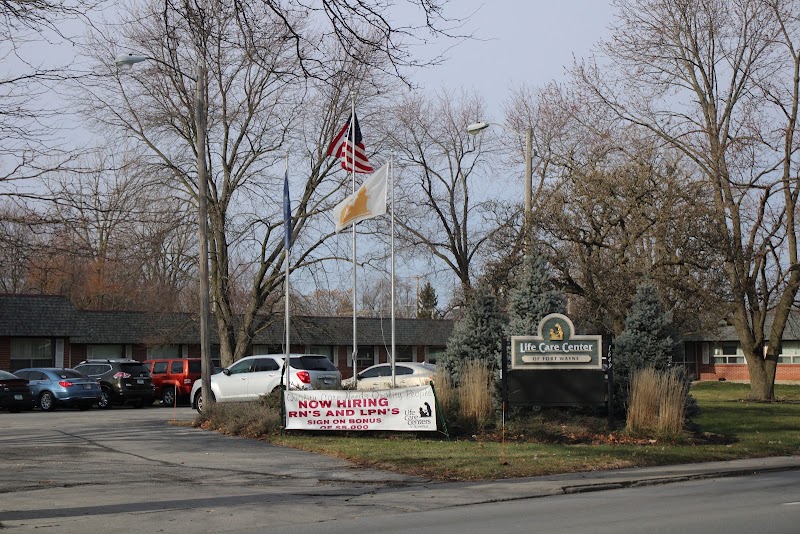
LIFE CARE CENTER OF FORT WAYNE
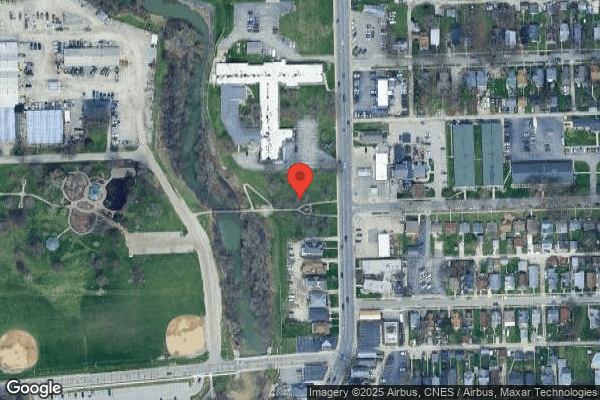
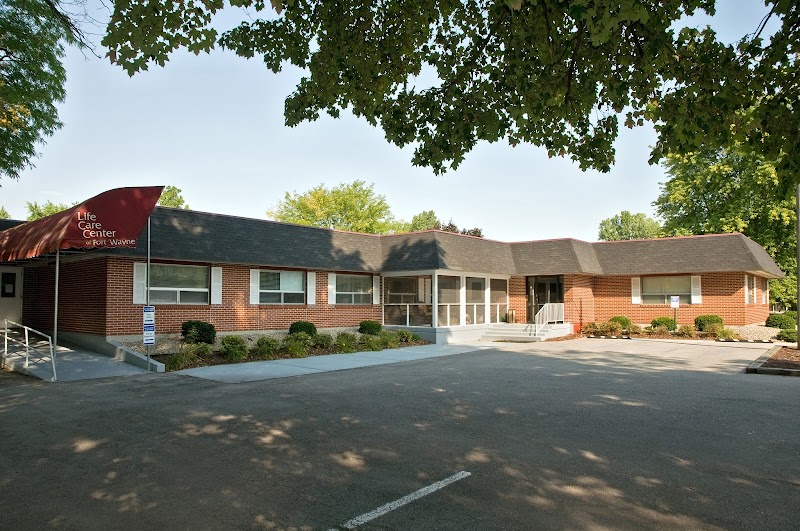
1649 SPY RUN AVENUE, FORT WAYNE, IN 46805 (260) 422-8520
For profit - Corporation 115 Beds LIFE CARE CENTERS OF AMERICA Data: November 2025
Trust Grade
85/100
#60 of 505 in IN
Last Inspection: April 2025

Within standard 12-15 month inspection cycle. Federal law requires annual inspections.

Overview

Life Care Center of Fort Wayne holds a Trust Grade of B+, indicating it is above average and recommended for families considering care options. It ranks #60 out of 505 facilities in Indiana, placing it in the top half, and #9 out of 29 in Allen County, meaning only a few local options are better. The facility's trend is stable, with one issue noted in both 2024 and 2025, but staffing is a concern with a turnover rate of 59%, higher than the Indiana average. Although there are no fines on record, which is a positive sign, some specific incidents raised concerns; for example, a resident's oxygen was set incorrectly, and the refrigerator for food storage was found dirty with no temperature log present. Overall, while the facility excels in some areas like RN coverage and health inspections, these identified weaknesses warrant consideration.

Trust Score
B+
85/100
In Indiana
#60/505
Top 11%
Safety Record
Low Risk
No red flags
Inspections
Holding Steady
1 → 1 violations
Staff Stability
⚠ Watch
59% turnover. Above average. Higher turnover means staff may not know residents' routines.
Penalties
✓ Good
No fines on record. Clean compliance history, better than most Indiana facilities.
Skilled Nurses
✓ Good
Each resident gets 53 minutes of Registered Nurse (RN) attention daily — more than average for Indiana. RNs are trained to catch health problems early.
Violations
✓ Good
Only 3 deficiencies on record. Cleaner than most facilities. Minor issues only.
★★★★★
5.0
Overall Rating
★★★☆☆
3.0
Staff Levels
★★★★★
5.0
Care Quality
★★★★★
5.0
Inspection Score
Stable
2024: 1 issues
2025: 1 issues

The Good

  • 5-Star Quality Measures · Strong clinical quality outcomes
  • Full Sprinkler Coverage · Fire safety systems throughout facility
  • No fines on record

Facility shows strength in quality measures, fire safety.

The Bad

Staff Turnover: 59%

13pts above Indiana avg (46%)

Frequent staff changes - ask about care continuity

Chain: LIFE CARE CENTERS OF AMERICA

Part of a multi-facility chain

Ask about local staffing decisions and management

Staff turnover is elevated (59%)

11 points above Indiana average of 48%

The Ugly 3 deficiencies on record

Apr 2025 1 deficiency
CONCERN (D)

Potential for Harm - no one hurt, but risky conditions existed

Quality of Care (Tag F0684)

Could have caused harm · This affected 1 resident

Based on observation, interview, and record review the facility failed to follow physician orders for 1 of 1 resident reviewed. (Resident 11). Findings include: An observation, on 4/21/25 at 10:38 AM...

Read full inspector narrative →
Based on observation, interview, and record review the facility failed to follow physician orders for 1 of 1 resident reviewed. (Resident 11). Findings include: An observation, on 4/21/25 at 10:38 AM, in Resident 11's room observed Resident 11 resting with her eyes closed and mouth open. Resident 11 had oxygen on per nasal cannula. The oxygen concentrator was set at 3 liters per nasal cannula. A record review, on 4/22/25 at 11:02AM, indicated Resident 11 had physician orders as follows: Oxygen at 2 liters per minute continuously per nasal cannula. Document every shift with the start date of 8/13/24. Oxygen at 4 liters per minute per nasal cannula as needed with the start date of 11/10/24. Admit to hospice, life expectancy 6 months or less diagnosis chronic respiratory failure with congestive heart failure with the start date of 9/4/24. There was no order for oxygen at 3 liters per nasal cannula. In an interview, on 4/22/25 at 1:20PM, Registered Nurse 2 (RN) indicated she adjusted Resident 11's oxygen determined by oxygen saturation, by Resident 11 needs and reports of how she was feeling. RN 2 indicated currently the oxygen was set at 2 liters per nasal cannula. RN 2 indicated Resident 11 does not adjust the oxygen herself and Resident 11 was unable to do so due to her current limitations. A record review of Resident 11's hospice communication book indicated the only order for oxygen was 3 liters continuous per nasal cannula with the start date 9/4/24. There were no orders for oxygen at 2 liters, no orders for 4 liters, and no orders for a titration of oxygen per Resident 11 needs or comfort. An observation, on 4/22/25 at 1:34PM, Resident 11's oxygen was on at 3 liters per nasal cannula. RN 2 readjusted the oxygen back to 2 liters per nasal cannula at the time of observation. RN 2 indicated the oxygen should be set at 2 liters. In an interview, on 4/23/25 at 8:22AM, the Director of Nursing (DON) indicated she called the hospice and the ordering physician for the facility to clarify oxygen orders for Resident 11. At the time of interview, Resident 11 kept her order for oxygen 2 liters continuously per nasal cannula and had a new order dated 4/22/25 for may titrate oxygen up to 4 liters per minute per nasal cannula as needed. The DON further indicated an in-service was done regarding oxygen concentrators and ensuring proper settings. The facility provided a current policy and procedure titled Physician Orders revised 2/26/24 and reviewed 2/27/25. The policy indicated .The facility is obligated to follow and carry out the orders of the prescriber in accordance with all applicable state and federal guidelines . 3.1-37
May 2024 1 deficiency
CONCERN (D)

Potential for Harm - no one hurt, but risky conditions existed

Deficiency F0676 (Tag F0676)

Could have caused harm · This affected 1 resident

**NOTE- TERMS IN BRACKETS HAVE BEEN EDITED TO PROTECT CONFIDENTIALITY** Based on interview and record review the facility failed to ensure vision concerns were addressed for 1 of 1 residents reviewed ...

Read full inspector narrative →
**NOTE- TERMS IN BRACKETS HAVE BEEN EDITED TO PROTECT CONFIDENTIALITY** Based on interview and record review the facility failed to ensure vision concerns were addressed for 1 of 1 residents reviewed (Resident 23). Findings include: An interview on 5/14/24 at 10:06AM Resident 23 indicated she was blind. She was sitting in a wheelchair within 5 feet of the speaker and indicated she was unable to see the face of the person speaking. Resident 23 indicated the facility was aware. Resident 23's record was reviewed on 5/15/24 at 9:52AM. Resident 23's current diagnoses included heart failure, myocardial infarction, end stage renal disease, type 2 diabetes, and hypertension. There were no diagnoses of macular degeneration or blindness. A history and physical from Lutheran hospital on [DATE] did not indicate vision difficulties as past medical history on the problem list. A medical appointment at vision care ophthalmology on 1/16/24 indicated the diagnosis of macular degeneration and myopia (nearsightedness). The report requested a consultation with a low vision specialist due to geographic atrophy (chronic progression of macular degeneration). The appointment with the low vision center was made for 4/3/24 at 12 noon. There was an order note to indicate the appointment was cancelled. The appointment was rescheduled for 4/16/24. Resident 23 was in the hospital on 4/16/24 and therefore unable to attend the appointment. There were no other appointments made. Resident 23's current care plan was reviewed. There were no problems, goals, or interventions related to impaired vision. Resident 23's current comprehensive MDS (Minimum Data Set) assessment dated [DATE] was reviewed, and the following were identified: Section B: Hearing, Speech, and Vision B. 1000 0. Adequate Section C: Cognitive Patterns BIMS (Brief Interview for Mental Status) Score 15 indicated no cognitive decline. Section I. Active Diagnosis: Vision is not checked. (cataracts, glaucoma, macular degermation) And under other the following were listed (none were vision related) Left ventricular failure. Muscle weakness Chronic respiratory failure Insomnia Presence of heart device Patent foramen ovale Other symptoms and signs involving the nervous system. Dysphagia, oropharyngeal Difficulty in walking In an interview 5/15/24 at 12:14 PM the DON (Director of Nursing) indicated none of Resident 23's history and physicals included the diagnosis macular degeneration or nearsightedness. The DON further indicated the facility had scheduled a follow up appointment with the low vison center for Resident 23 for 8/6/24. The DON indicated Resident 23 missed her appointment on 4/16/24 due to being in the hospital and it should have been rescheduled then. The DON indicated her impaired vision should have been care planned, on the MDS, and listed as a diagnosis. The DON indicated Resident 23 did not complain to staff or the medical team about her vision. A policy titled, Vision and Hearing Assistive Devices, dated reviewed 9/8/23 indicated to ensure residents receive proper treatment and assistive devise to maintain vision and hearing abilities. 3.1-38(a)(1)
May 2023 1 deficiency
CONCERN (E)

Potential for Harm - no one hurt, but risky conditions existed

Food Safety (Tag F0812)

Could have caused harm · This affected multiple residents

**NOTE- TERMS IN BRACKETS HAVE BEEN EDITED TO PROTECT CONFIDENTIALITY** Based on observation, interview and record review, the facility failed to ensure unit pantry refrigerator cleanliness and temper...

Read full inspector narrative →
**NOTE- TERMS IN BRACKETS HAVE BEEN EDITED TO PROTECT CONFIDENTIALITY** Based on observation, interview and record review, the facility failed to ensure unit pantry refrigerator cleanliness and temperatures were maintained. 71 of 73 residents residing in the facility ate food stored in the pantry refrigerators. During a tour of the [NAME] unit on 4/26/23 at 10:10 AM, the pantry refrigerator was observed. An undated, open carafe of orange juice and an undated container of applesauce were observed. No temperature log was available for review. During an interview on 4/26/23 at 10:10 AM Licensed Practical Nurse (LPN) 2 indicated all food and drink items in the refrigerator should be covered and dated. LPN 2 also indicated refrigerator temperatures should be logged daily. She indicated there was usually a temperature log form on the front of the refrigerator, but she did not know why there was not a log present at the time of observation. 18 of 18 residents residing on the [NAME] unit ate food from the pantry. During a tour of the [NAME] unit on 4/26/23 at 10:19 AM an uncovered, undated bowl of cereal was observed on the top shelf in the refrigerator. A covered Styrofoam cup containing a brown liquid was observed on the middle shelf of the refrigerator. The attached freezer had around 10 dime- to quarter sized splatters of a red substance on the floor and inside of the door. [NAME] specks of debris were found on the floor and door of the freezer. A container of ice cream was observed with no date in the freezer. No thermometer was observed inside the freezer. A temperature log observed on the front of the refrigerator did not include temperature recordings for the freezer. During an interview on 4/26/23 at 10:19 AM, LPN 2 indicated all refrigerators and freezers should be clean and free of liquid splatters or debris. She also indicated all food and drink items should be covered and dated, and temperature logs should include freezer temperatures. 38 of 40 residents residing on the [NAME] Unit ate food from the panry. During a tour of the [NAME] unit on 4/26/23 at 12:24 PM, a temperature log on the front of the refrigerator was observed to be blank. A cloth lunch bag was observed on the shelf of the refrigerator. A sandwich in a transparent plastic bag was observed in the refrigerator with no date. Two packaged ice cream bars were in a box along with an unpackaged ice cream bar. No dates were observed on the box. A half-inch layer of frost was observed covering the floor and all inside walls of the freezer. A thermometer was observed within the layer of frost. During an interview conducted on 4/26/23 at 12:24 PM, QMA ( Qualified Medication Aide) 3 indicated the temperature log should have been filled out. QMA 3 unsuccessfully attempted to remove the thermometer in the freezer, and the reading was not visible. QMA 3 indicated the cloth bag belonged to an employee. She also indicated employee's food items should not be stored in the unit refrigerator designated for residents' items. QMA 3 indicated the freezer should be free of frost, but she did not know when or how often defrosting occurred. 16 of 16 residents residing on the [NAME] unit ate food from the the pantry. During an interview on 4/26/23 at 2:09 PM, the Administrator indicated housekeeping staff was responsible to maintain pantry refrigerators and freezers. She indicated all food and drink items should be labeled and dated and all surfaces should be clean. A current policy titled Food from Outside Sources, last revised 7/27/22, indicated associate and resident food items should not be stored together in the same refrigerator. The policy addressed thermometer use, but did not specify placement in refrigerators or freezers, or maintaining temperature logs. A document titled Use by Date Guide, last revised 3/18/2020, indicated all open containers of food should be labeled and dated. A document titled Position Competencies and Performance Review- Housekeeping Aide, last revised 3/3/2017, indicated housekeeping aides should clean the insides and outsides of all refrigerators, exclusive of medication areas. A policy addressing defrosting of freezers was not available for review by the time of exit. 3.1-21(i)(3)
Understanding Severity Codes (click to expand)
Life-Threatening (Immediate Jeopardy)
J - Isolated K - Pattern L - Widespread
Actual Harm
G - Isolated H - Pattern I - Widespread
Potential for Harm
D - Isolated E - Pattern F - Widespread
No Harm (Minor)
A - Isolated B - Pattern C - Widespread

Questions to Ask on Your Visit

  • "Why is there high staff turnover? How do you retain staff?"
  • "Can I speak with families of current residents?"
  • "What's your RN coverage like on weekends and overnight?"

Our Honest Assessment

Strengths
  • • Grade B+ (85/100). Above average facility, better than most options in Indiana.
  • • No major safety red flags. No abuse findings, life-threatening violations, or SFF status.
  • • No fines on record. Clean compliance history, better than most Indiana facilities.
  • • Only 3 deficiencies on record. Cleaner than most facilities. Minor issues only.
Concerns
  • • 59% turnover. Above average. Higher turnover means staff may not know residents' routines.
Bottom line: Generally positive indicators. Standard due diligence and a personal visit recommended.

About This Facility

What is Life Of Fort Wayne's CMS Rating?

CMS assigns LIFE CARE CENTER OF FORT WAYNE an overall rating of 5 out of 5 stars, which is considered much above average nationally. Within Indiana, this rating places the facility higher than 99% of the state's 100 nursing homes. This rating reflects solid performance across the metrics CMS uses to evaluate nursing home quality.
How is Life Of Fort Wayne Staffed?

CMS rates LIFE CARE CENTER OF FORT WAYNE's staffing level at 3 out of 5 stars, which is average compared to other nursing homes. Staff turnover is 59%, which is 13 percentage points above the Indiana average of 46%. High turnover can affect care consistency as new staff learn residents' individual needs.

What Have Inspectors Found at Life Of Fort Wayne?

State health inspectors documented 3 deficiencies at LIFE CARE CENTER OF FORT WAYNE during 2023 to 2025. These included: 3 with potential for harm.
Who Owns and Operates Life Of Fort Wayne?

LIFE CARE CENTER OF FORT WAYNE is owned by a for-profit company. For-profit facilities operate as businesses with obligations to shareholders or private owners. The facility is operated by LIFE CARE CENTERS OF AMERICA, a chain that manages multiple nursing homes. With 115 certified beds and approximately 81 residents (about 70% occupancy), it is a mid-sized facility located in FORT WAYNE, Indiana.
How Does Life Of Fort Wayne Compare to Other Indiana Nursing Homes?

Compared to the 100 nursing homes in Indiana, LIFE CARE CENTER OF FORT WAYNE's overall rating (5 stars) is above the state average of 3.1, staff turnover (59%) is significantly higher than the state average of 46%, and health inspection rating (5 stars) is much above the national benchmark.

What Should Families Ask When Visiting Life Of Fort Wayne?

Based on this facility's data, families visiting should ask: "How do you ensure continuity of care given staff turnover, and what is your staff retention strategy?" "Can I visit during a mealtime to observe dining assistance and food quality?" "How do you handle medical emergencies, and what is your hospital transfer rate?" "Can I speak with family members of current residents about their experience?" These questions are particularly relevant given the facility's high staff turnover rate.

Is Life Of Fort Wayne Safe?

Based on CMS inspection data, LIFE CARE CENTER OF FORT WAYNE has a clean safety record: no substantiated abuse findings (meaning no confirmed cases of resident harm), no Immediate Jeopardy citations (the most serious violation level indicating risk of serious injury or death), and is not on the Special Focus Facility watch list (a federal program monitoring the lowest-performing 1% of nursing homes). The facility has a 5-star overall rating and ranks #1 of 100 nursing homes in Indiana. While no facility is perfect, families should still ask about staff-to-resident ratios and recent inspection results during their visit.

Do Nurses at Life Of Fort Wayne Stick Around?

Staff turnover at LIFE CARE CENTER OF FORT WAYNE is high. At 59%, the facility is 13 percentage points above the Indiana average of 46%. High turnover means new staff may not know residents' individual needs, medications, or preferences. It can also be disorienting for residents, especially those with dementia who rely on familiar faces. Families should ask: What is causing the turnover? What retention programs are in place? How do you ensure care continuity during staff transitions?

Was Life Of Fort Wayne Ever Fined?

LIFE CARE CENTER OF FORT WAYNE has no federal fines on record. CMS issues fines when nursing homes fail to meet care standards or don't correct problems found during inspections. The absence of fines suggests the facility has either maintained compliance or corrected any issues before penalties were assessed. This is a positive indicator, though families should still review recent inspection reports for the full picture.

Is Life Of Fort Wayne on Any Federal Watch List?

LIFE CARE CENTER OF FORT WAYNE is not on any federal watch list. The most significant is the Special Focus Facility (SFF) program, which identifies the bottom 1% of nursing homes nationally based on persistent, serious quality problems. Not being on this list means the facility has avoided the pattern of deficiencies that triggers enhanced federal oversight. This is a positive indicator, though families should still review the facility's inspection history directly.