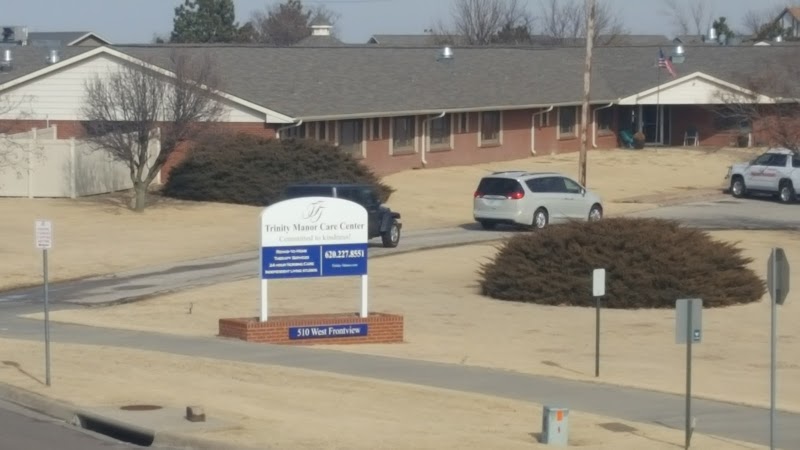
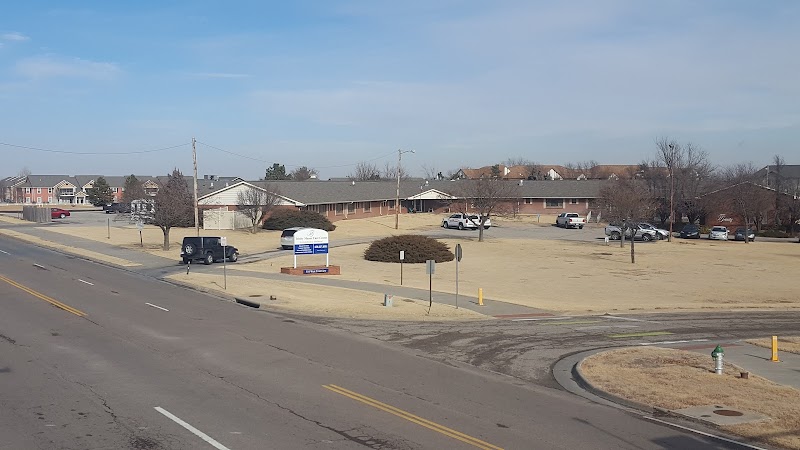

TRINITY MANOR

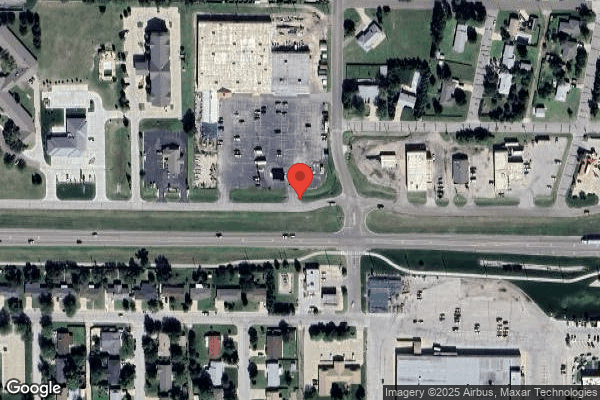
510 W FRONTVIEW STREET, DODGE CITY, KS 67801 (620) 227-8551
For profit - Limited Liability company 46 Beds FRONTLINE MANAGEMENT Data: November 2025 2 Immediate Jeopardy citations
Trust Grade
46/100
#96 of 295 in KS
Last Inspection: January 2025

Within standard 12-15 month inspection cycle. Federal law requires annual inspections.

Overview

Trinity Manor in Dodge City, Kansas, has a Trust Grade of D, indicating below-average performance with some significant concerns. It ranks #96 out of 295 facilities in the state, placing it in the top half, but #4 out of 6 in Ford County suggests there are better local options. The facility is worsening, with issues increasing from 2 in 2024 to 3 in 2025. Staffing is a relative strength, rated 4 out of 5 stars with a turnover rate of 45%, which is below the state average, but recent fines totaling $29,773 raise concerns, as they are higher than 80% of Kansas facilities. Critical incidents include a resident who fell down stairs due to a malfunctioning door and another who was improperly secured during transport, resulting in a serious injury. While the facility has good RN coverage and overall star ratings, these troubling incidents highlight the need for improvements in safety and supervision.

Trust Score
D
46/100
In Kansas
#96/295
Top 32%
Safety Record
High Risk
Review needed
Inspections
Getting Worse
2 → 3 violations
Staff Stability
○ Average
45% turnover. Near Kansas's 48% average. Typical for the industry.
Penalties
✓ Good
$29,773 in fines. Lower than most Kansas facilities. Relatively clean record.
Skilled Nurses
✓ Good
Each resident gets 56 minutes of Registered Nurse (RN) attention daily — more than average for Kansas. RNs are trained to catch health problems early.
Violations
⚠ Watch
15 deficiencies on record. Higher than average. Multiple issues found across inspections.
★★★★☆
4.0
Overall Rating
★★★★☆
4.0
Staff Levels
★★★★☆
4.0
Care Quality
★★★★☆
4.0
Inspection Score
Stable
2024: 2 issues
2025: 3 issues

The Good

  • 4-Star Staffing Rating · Above-average nurse staffing levels
  • 4-Star Quality Measures · Strong clinical quality outcomes
  • Full Sprinkler Coverage · Fire safety systems throughout facility
  • No fines on record
  • Staff turnover below average (45%)

    3 points below Kansas average of 48%

Facility shows strength in staffing levels, quality measures, fire safety.

The Bad

Staff Turnover: 45%

Near Kansas avg (46%)

Typical for the industry

Federal Fines: $29,773

Below median ($33,413)

Moderate penalties - review what triggered them

Chain: FRONTLINE MANAGEMENT

Part of a multi-facility chain

Ask about local staffing decisions and management

The Ugly 15 deficiencies on record

2 life-threatening
Jan 2025 3 deficiencies
CONCERN (D) 📢 Someone Reported This

A family member, employee, or ombudsman was alarmed enough to file a formal complaint

Potential for Harm - no one hurt, but risky conditions existed

Deficiency F0760 (Tag F0760)

Could have caused harm · This affected 1 resident

**NOTE- TERMS IN BRACKETS HAVE BEEN EDITED TO PROTECT CONFIDENTIALITY** The facility had a census of 40 residents. The sample included 12 residents. Based on observation, record review, and interview ...

Read full inspector narrative →
**NOTE- TERMS IN BRACKETS HAVE BEEN EDITED TO PROTECT CONFIDENTIALITY** The facility had a census of 40 residents. The sample included 12 residents. Based on observation, record review, and interview the facility failed to ensure two of five residents reviewed during the medication administration pass remained free of medication errors for Resident (R) 19 and R21. This placed the residents at risk for adverse reactions from the medication. Findings included: - R19's Electronic Health Record (EHR) revealed diagnoses of dysphagia (swallowing difficulty), irritable bowel syndrome (IBS- abnormally increased motility of the small and large intestines), and diabetes mellitus (DM - when the body cannot use glucose, not enough insulin is made, or the body cannot respond to the insulin). R19's Annual Minimum Data Set (MDS), dated [DATE], recorded R19 had a Brief Interview for Mental Status score of 00 that indicated she had severely impaired cognition. The MDS recorded she required extensive assistance of two staff with activities of daily living (ADLs). R19's Care Plan, dated 12/31/24, recorded R19 required extensive assistance with most activities of daily living (ADL) care. R19's Care Plan documented the resident received a regular diet with pureed (a paste or thick liquid suspension usually made from cooked food ground finely) texture, and nectar thick consistency. The care plan documented to administer medication as ordered and observing for side effects. The Physician Order, dated 12/02/24, directed the staff to administer Protonix (reduce the amount of acid in the stomach) DR (delayed release) 40 milligram (mg), administer one, tablet one time a day for maintenance therapy. On 01/22/25 at 08:00 AM, License Nurse (LN) G crushed R19's morning medications including the Protonix, and placed the medications in a plastic medication cup then poured the pills in a plastic medication bag and crushed the medication. LN G next placed the crushed medication in the plastic medication cup and added applesauce. Continued observation revealed LN G administered the crushed medication to the resident. On 01/23/25 at 09:20 AM, LN G stated she administered R19 medications crushed because the resident had a hard time swallowing the pill whole. LN G verified that delayed-release medications should not be crushed and she would speak with the director of nursing to get another route of administration for the resident. On 01/23/25 at 09:25 AM, Administrative Nurse D verified that the extended-release medication should not be crushed and said it should be administered whole due to its extended release. Administrative Nurse D said she would have an in-service with the nurse regarding the proper route of medication. Medlineplus.gov directed that delayed-release and extended-release tablets should be taken whole; do not split, chew, or crush them. The facility's Crushing Medication policy, undated, documented medications shall be crushed only when appropriate and safe to do so, consistent with physician orders. The medical director and director of nursing, in conjunction with the consulting pharmacist, shall identify appropriate indications and procedures for crushing medications. The nursing staff and/or consultant pharmacist shall notify any attending physician who gives an order to crush a drug that the manufacturer states should not be crushed (for example, long-acting or enteric-coated medications. That attending physician or consultant pharmacist must identify an alternative and/or dose form, or the attending physician must document (or provide the nurses with clinical pertinent reason to document) why crushing the medication would not adversely affect the resident; or when such medication is administered, the facility staff will observe the resident for pertinent adverse effects. Crushing each medication separately and administering each with food is considered best practice. Issues related to safety, needs preference, medication schedule, and functional ability will determine the most resident-centered approach. The facility failed to ensure R19 remained free from medication errors when staff crushed a delayed-release medication prior to administration. This placed the resident at risk for adverse reactions from the medication. - R21's Electronic Health Record (EHR) revealed diagnoses of dementia (a progressive mental disorder characterized by failing memory and confusion), dysphagia (dysphagia (swallowing difficulty), and diabetes mellitus (DM - when the body cannot use glucose, not enough insulin is made, or the body cannot respond to the insulin). R21's Quarterly Minimum Data Set (MDS), dated [DATE], recorded R21 had a Brief Interview for Mental Status score of 00 that indicated she had severely impaired cognition. The MDS recorded she required extensive assistance of one to two staff with activities of daily living (ADLs). R21's Care Plan, dated 01/03/25, recorded R21 required one to two assistance with most activities of daily living (ADL) care. R21s Care Plan documented the resident received a Low Concentrated Sweet (LCS) diet with pureed (a paste or thick liquid suspension usually made from cooked food ground finely) texture, and thin liquids. The care plan documented to administer medication as ordered and observe for side effects. The MDS recorded staff would monitor for and report any difficulty chewing/swallowing and report to speech therapy as needed. The Physician Order, dated 01/07/25, directed the staff to administer Oxybutynin XL ER (extended-releaseextended release) 10 milligram (mg), administer one, tablet one time a day for overactive bladder. On 01/22/25 at 07:30 AM observation revealed License Nurse (LN) G crushed R21's morning medications including the Oxybutynin, and Oxybutynin and placed the medications in a plastic medication cup then poured the pills into a plastic medication bag and crushed the medication. LNG then placed the crushed medication back in the plastic medication cup and added applesauce. Continued observation revealed LN G administered the crushed medication to the resident. On 01/23/25 at 09:20 AM, LN G stated she administered R21 medications crushed because she had a hard time swallowing the pill whole. LN G verified extended-release medications should not be crushed and she would speak with the director of nursing to get another route of administration. On 01/23/25 at 09:25 AM, Administrative Nurse D verified the extended-release medication should not be crushed and said it should be administered whole due to the extended release of the medication. Administrative Nurse D said she would have an in-service with the nurse regarding proper route of medication. Medlineplus.gov directed that delayed-release and extended-release tablets should be taken whole; do not split, chew, or crush them. The facility's Crushing Medication policy, undated, documented medications shall be crushed only when appropriate and safe to do so, consistent with physician orders. The medical director and director of nursing, in conjunction with the consulting pharmacist, shall identify appropriate indications and procedures for crushing medications. The nursing staff and/or consultant pharmacist shall notify any attending physician who gives an order to crush a drug that the manufacturer states should not be crushed (for example, long-acting or enteric-coated medications. That attending physician or consultant pharmacist must identify an alternative and/or dose form, or the attending physician must document (or provide the nurses with clinically pertinent reason to document) why crushing the medication would not adversely affect the resident; or when such medication is administered, the facility staff will observe the resident for pertinent adverse effects. Crushing each medication separately and administering each with food is considered best practice. Issues related to safety, needs preference, medication schedule, and functional ability will determine the most resident-centered approach. The facility failed to ensure R21 remained free from medication errors when staff crushed an extended-release medication prior to administration. This placed the resident at risk for adverse reactions from the medication.
CONCERN (F) 📢 Someone Reported This

A family member, employee, or ombudsman was alarmed enough to file a formal complaint

Potential for Harm - no one hurt, but risky conditions existed

Food Safety (Tag F0812)

Could have caused harm · This affected most or all residents

The facility had a census of 40 residents. Based on observation, interview, and record review the facility failed to store, prepare, and serve food in a sanitary manner for the 40 residents who receiv...

Read full inspector narrative →
The facility had a census of 40 residents. Based on observation, interview, and record review the facility failed to store, prepare, and serve food in a sanitary manner for the 40 residents who received meals from the facility kitchen. Findings included: - On 01/21/25 at 07:48 AM, observation in the facility kitchen revealed: A refrigerator with an opened, partially used, undated plastic quart container of macaroni salad, undated, opened, and partially used bags of diced ham, and pre-cooked chicken pieces. The walk-in freezer had three boxes of food stored on the floor. On 01/22/25 at 10:45 AM, observation in the facility kitchen revealed the utensil drawers below the coffee maker had a piece of wrinkled paper towel, a brownish drip in a teaspoon, and a small amount of dried food particles. The drawers under a make table had plastic bins for scoops and ladles with dried food and spills in the bins. The walk-in freezer stall had two boxes of food on the floor. The kitchen had one of six fluorescent light covers with a large number of cracks. On 01/21/25 at 07:48 AM, Dietary Staff (DS) CC verified the bags of opened foods and salad should have been dated when opened. She verified food boxes should not be stored on the floor. On 01/22/25 at 10:48 AM, Dietary Staff (DS) BB verified the drawers needed cleaning and stated they had not included drawer cleaning on the schedule. She verified food boxes should not be stored on the floor in the freezer and stated the vendor delivered the foods on Thursdays (four days earlier). She stated maintenance had problems finding covers to fit these lights. The facility's Cleaning Rotation policy, dated 2011, stated drawers would be cleaned weekly. The facility's Food Storage policy, dated 2011, stated staff were to store deliveries as soon as they were inspected. The facility's Labeling/Dating Food policy, dated 2011, stated all foods stored would be properly re-dated with the date the item was opened and shall be used by the safe food storage guidelines. The facility failed to store, prepare, and serve food in a sanitary manner for the 40 residents who received meals from the facility kitchen.
CONCERN (F) 📢 Someone Reported This

A family member, employee, or ombudsman was alarmed enough to file a formal complaint

Potential for Harm - no one hurt, but risky conditions existed

Infection Control (Tag F0880)

Could have caused harm · This affected most or all residents

The facility had a census of 40 residents. Based on observation, record review and interview, the facility failed to implement a water management program for Legionella disease (Legionella is a bacter...

Read full inspector narrative →
The facility had a census of 40 residents. Based on observation, record review and interview, the facility failed to implement a water management program for Legionella disease (Legionella is a bacterium spread through mist, such as air-conditioning units in large buildings. Adults over the age of 50 and people with weak immune systems, chronic lung disease, or heavy tobacco use are most at risk of developing pneumonia caused by legionella) which placed the residents at risk of contracting infectious processes. Findings included: - On 01/22/25 at 04:50 PM, Administrative Staff A reported the facility lacked a waterborne pathogen/Legionella program. The facility's Legionella Water Management Program dated 08/2023, documented as part of the infection prevention and control program, our facility has a water management program, which is overseen by the water management team. The purpose of the water management program is used to identify areas in the water system where Legionella bacteria can grow and spread, and to reduce the risk of Legionella disease. The facility failed to implement a water management program and manage waterborne pathogens placing the residents who reside in the facility at risk for contracting Legionella pneumonia.
Jul 2024 1 deficiency 1 IJ
CRITICAL (J) 📢 Someone Reported This

A family member, employee, or ombudsman was alarmed enough to file a formal complaint

Immediate Jeopardy (IJ) - the most serious Medicare violation

Accident Prevention (Tag F0689)

Someone could have died · This affected 1 resident

**NOTE- TERMS IN BRACKETS HAVE BEEN EDITED TO PROTECT CONFIDENTIALITY** The facility census totaled 41 residents with one resident sampled for accidents. Based on observation, interview, and record re...

Read full inspector narrative →
**NOTE- TERMS IN BRACKETS HAVE BEEN EDITED TO PROTECT CONFIDENTIALITY** The facility census totaled 41 residents with one resident sampled for accidents. Based on observation, interview, and record review, the facility failed to provide adequate supervision and ensure a safe and secure environment as free from accident hazards as possible when Housekeeping/Laundry Staff C failed to report a malfunctioning basement door. About six weeks later, on 07/01/24, cognitively impaired Resident (R)1 opened the same malfunctioning, key coded basement door and fell down seven steps to the landing, in her wheelchair. R1 sustained major injuries including a lump to the back of her head and three fractured ribs. This deficient practice placed R1 in immediate jeopardy and at risk for personal injury. (R1) Findings included: - R1's electronic medical record (EMR) included the following diagnoses that included cerebral infarction (stroke - sudden death of brain cells due to lack of oxygen caused by impaired blood flow to the brain by blockage or rupture of an artery to the brain) and cognitive impairment (an impairment in organization, sequencing, attention, memory, planning, problem-solving, and safety awareness). The Significant Change in Status Minimum Data Set (MDS) dated [DATE], revealed R1 had a Brief Interview for Mental Status (BIMS) score of three, indicating severe cognitive impairment. The MDS documented the resident wandered daily. The Behavioral Symptoms Care Area Assessment (CAA) dated 03/27/24 revealed R1 wandered around the facility and went into other residents rooms due to her confusion. The Quarterly MDS dated 06/17/24, revealed R1 had a Brief Interview for Mental Status (BIMS) score of four, indicating severe cognitive impairment. The MDS documented the resident wandered daily. R1' s Care Plan revised 02/23/24, revealed R1 required a wheelchair for mobility. Staff were to monitor the resident and document/report to R1's physician of any changes in cognitive function, specifically changes in decision making ability, memory, recall, general awareness, difficulty expressing self, difficulty understanding others, level of consciousness, and mental status. R1 was at risk for falls related to confusion, muscle weakness, and cerebral infarction. The Care Plan included a 06/16/24 revision for staff to encourage the resident to remain in the common area until staff could assist her to bed. On 07/01/24 at 11:15 AM, a fall note revealed Licensed Nurse (LN) B was looking for R1 when a housekeeper notified the nurse the resident fell down the stairs. Upon entering the staircase, the resident was on the landing of the basement stairs on the floor with her wheelchair near her. The resident had her shoes on and a stack of kitchen napkins beside her. LN B asked the resident if she hit her head and R1 stated yes. Three staff assisted R1 into her wheelchair. When asked what she was doing R1 reported, I was walking down the stairs. Staff transported R1 upstairs via a basement elevator. R1 could follow commands and answer most questions. R1 had a bump to the back, left side of her head. R1 reported pain to her upper left back and stated it hurts when staff palpated (touched) her head. LN B provided Tylenol (pain medication), 650 milligrams (mg), as needed (PRN) at 11:23 PM. Review of the facility investigation dated 07/01/24, revealed R1 went through a door with a keylock and fell down the basement stairs (7 stairs). R1 told staff she was walking down the stairs and lost her balance and fell. The resident had a bump to the back, left side of her head and pain to her left upper back. No other injuries found. Staff initiated neuro checks (an assessment to monitor for neurological functions, motor and sensory response and level of consciousness). Staff notified R1's physician and the physician advised staff to apply an ice pack to the affected area. Immediately after the accident, the resident had complaints of pain and the staff administered PRN Tylenol. Later in the day, (untimed) the resident complained of left-sided pain. The nursing staff contacted the physician a second time and received orders for an X-ray of her ribs to the left side. The X-ray revealed three minimally displaced fractures of the left fifth, sixth, and seventh ribs. The Progress Notes dated 07/01/24 at 04:18 PM, revealed the resident complained of pain to her left ribs when staff transferred her from a recliner to a wheelchair. Staff contacted Physician F's office to request an X-ray. On 07/02/2024 at 02:04 PM, the x-ray results revealed R1 ha Minimally displaced fractures of the posterior left 5th, 6th, and 7th ribs. The witness statement by Housekeeping Staff C revealed on 07/02/24 Housekeeping Staff C reported the [malfunctioning basement door] door was not completely shut. The statement revealed if staff let it shut slowly, the door would not latch. Housekeeping Staff C documented it was approximately a month and a half ago, the door did not latch effectively. Housekeeping Staff C documented she told another housekeeper about it but did not report it to maintenance because she did not feel the door was broken, but it was just not latching. Review of the maintenance door logs from 06/03/24 through 07/18/24 showed no malfunction of the doors or the locks. Observation on 07/15/24 at 11:45 AM, revealed the resident in her wheelchair and able to propel her wheelchair without assistance. Observation on 07/15/24 at 01:40 PM, revealed the resident sat in a recliner in the commons area with the TV on. Observation on 07/15/24 at 02:40 PM, revealed Certified Nurse Aide (CNA) D transferred R1 from a recliner in the commons area to a wheelchair. R1 wheeled herself independently to her room with staff walking beside her. Once in her room, CNA D assisted the resident to the toilet. R1 could stand while she held onto the grab bar to transfer to the toilet. On 07/15/24 at 11:10 AM, Administrative Staff A stated staff were not sure how the resident got the door open. Administrative Staff A reported she knew laundry staff noted the door was not all the way latched about six weeks prior to the incident and did not know if the resident just shook the door handle until it opened or how she opened the door. Administrative Staff A stated the resident was confused but told staff she was walking down the stairs and lost her balance, so staff do not know how she got out the door. Her wheelchair was on the landing next to her when a housekeeping staff saw her on the floor. On 07/15/24 at 11:20 AM, Maintenance Staff H reported the door had a manual lock on it, but it worked fine when he checked the doors. He reported he checked all doors and door locks to make sure they were functioning and documented those on a daily log. He reported the whole locking mechanism was changed and switched it to an electronic lock pad to assure it did not open except with the code. On 07/15/24 at 01:30 PM, Licensed Nurse B reported she did not know how the resident got the door open. LN B said the door had a keypad on it and if a person did not have the code, it should not open. She reported it was about lunch time and the resident had been outside at an activity and as she was coming back in, R1 went through the dining room and picked up a big stack of napkins. LN B saw R1 go by the nurses' station holding onto the napkins. LN B said she watched her go by and was going to finish her charting and then take the resident to the dining room for lunch, but when she looked down the hall, she could not find R1, so she went to look for her. LN B said she looked on in every room, including the chapel and the restrooms, and had all the aides looking as well. LN B said Housekeeping Staff C took LN B to the basement door and LN B saw the resident on the landing of the stairs, going to the basement. LN B said her wheelchair was upright and next to the resident. LN B did range of motion (ROM) and asked R1 if she hit her head the resident reported yes, she hit her head. LN B said R1 had a bump to the back of her head. Several CNAs lifted the resident back into her wheelchair and staff carried her in her wheelchair down the stairs to the basement, then brought her upstairs in the elevator. LN B said she notified Administrative Nurse G, faxed the physician, then put an ice pack on the resident's head. The resident was placed in recliner in the commons area and was there a couple of hours. Staff then went to take her to the bathroom and when they transferred R1, the resident complained of pain in her left side by her ribs. LN B said she notified the physician for an order to get an x ray of her ribs. The physician ordered the X-ray the next day, which revealed three rib fractures. The physician ordered Tramadol (pain pill) and ice for pain. LN B said the maintenance department changed the locks on the door so it could not come open again and said the door is heavy and difficult for staff to open. On 07/15/24 at 02:30 PM, CNA D said they did know how R1 could open the heavy door. CNA D said a housekeeping staff saw R1 and notified the nurse. Review of the undated facility Maintenance policy for doors, documented all doors were to be checked daily for proper function and documented on the door log. On 07/15/24 at 05:20 PM, the IJ template was provided to Administrative Staff A and notified the facility of the failure to ensure a safe and secure environment as free from accident hazards as possible when a housekeeping/laundry staff failed to report a malfunctioning basement door, and about six weeks later, on 07/01/24, cognitively impaired R1 opened the key coded basement door and fell down seven steps to the landing, in her wheelchair and sustained major injuries that included a lump to the back of her head and three fractured ribs, placed the resident in immediate jeopardy. The immediate jeopardy was determined to first exist on 07/01/24. The facility identified and implemented the following corrective actions, completed on 07/03/24: 1. Doorknob/lock changed, and door closure changed on 07/02/24. 2. All staff received education on Reporting malfunction or equipment not working appropriately immediately to Administration Team. 3. Charge Nurses received education If there is a substantial fall (stairwell, out of transportation vehicle, fall face first out of wheelchair) and Director of Nursing/ Assistant Director of Nursing is present in the building, notify them and have them assess, too; if not present and another Charge Nurse present in the facility have the assess, also. If a resident sustains a substantial fall notify physician via phone, not a fax. 4. The Medical Director notified on 07/03/24. 5. Staff members who have not had education will be educated prior to working their next assigned shift. 6. An ad-hoc QAA meeting held to review this area of concern and the action plan created to ensure system is corrected and sustained 07/03/24. The surveyor verified the above implemented and completed corrective actions while onsite 07/15/24. Due to corrective actions the facility completed prior to the onsite visit, the deficient practice was deemed past non-compliance and existed at a J scope and severity.
Feb 2024 1 deficiency 1 IJ
CRITICAL (J) 📢 Someone Reported This

A family member, employee, or ombudsman was alarmed enough to file a formal complaint

Immediate Jeopardy (IJ) - the most serious Medicare violation

Accident Prevention (Tag F0689)

Someone could have died · This affected 1 resident

The facility reported a census of 41 residents with three residents sampled for safety related to transportation outside the facility. Based on observation, interview, and record review, the facility ...

Read full inspector narrative →
The facility reported a census of 41 residents with three residents sampled for safety related to transportation outside the facility. Based on observation, interview, and record review, the facility failed to ensure staff provided a safe environment as free of accident hazards as possible, when Social Services Designee (SSD) C failed to ensure the lap belt was snug on Resident (R)1 prior to transport in the facility van while traveling on the highway. R1 fell out of the wheelchair onto the floor of the facility van, landing on his knees. SSD C failed to notify 911 or activate EMS for assistance. SSD C assisted R1 to lay on the floor of the van and then drove R1 back to the facility (approximately 20 miles), unsecured, and laying on the floor of the wheelchair van. Upon arrival to the facility R1 required emergency medical transport to a local hospital for evaluation and treatment of a left femur (thigh bone) fracture (broken bone). This deficient practice placed R1 in immediate jeopardy. Findings included: - Review of the Electronic Health Record (EHR) documented R1 had diagnoses which included hemiplegia (paralysis of one side of the body) and hemiparesis (muscular weakness of one side of the body) following cerebrovascular disease (CVA or stroke - a sudden death of brain cells due to the lack of oxygen caused by impaired blood flow to the brain), end stage renal disease (ESRD - a terminal disease of the kidneys due to irreversible damage), dependence on renal dialysis (a type of treatment that helps the body remove extra fluid and waste products from the blood when the kidneys are not able to - a treatment procedure that is usually performed three to four times per week), diabetes mellitus type 2 (DM2 - when the body cannot use glucose, not enough insulin is made or the body cannot respond to the insulin) and disorders of bone density (disorders of altered bone density), and osteopenia (loss of bone density which weakens the bone). The 05/18/23 Annual Minimum Data Set (MDS) documented a Brief Interview for Mental Status (BIMS) score of 15, which indicated intact cognition. R1 required extensive assistance of two staff for all cares except eating, which was independent. R1 had no falls in the facility since admission. The 05/18/23 Falls Care Area Assessment (CAA) documented R1 was at increased potential for falls related to the requirement of a full body mechanical lift, incontinence (loss of bowel or bladder function), use of psychotropic medications (classes of medications that affect the mind, mood or mental processes), and hemiplegia. The 11/08/23 Quarterly MDS documented a BIMS score of 13, which indicated intact cognition. R1 required the assistance of two or more staff for all cares except eating, which was independent. The MDS documented no falls since admission. The Care Plan documented R1 was at risk for falls related to hemiplegia, history of CVA, chronic diffuse osteopenia, muscle weakness, bone demineralization, and history of a fall prior to admission that resulted in a femur fracture. The Care Plan lacked interventions specific to the mitigation of fall risk during transportation in facility owned vehicles. The Care Plan documented an intervention on 02/01/24 at 10:00 AM for R1 to have a pummel cushion (a cushion added to a wheelchair seat to prevent sliding) in place and to add use of vehicle's factory installed shoulder/lap seat belt for all transportations. The Fall Risk Score Assessments revealed the following for R1: 1. On 11/02/23, a fall score of 16, which indicated high risk for falls. 2. On 01/29/24, a fall score of 19 which indicated high risk for falls. The Progress Notes documented the following: On 02/01/24 at 06:45 AM, SSD C was providing transportation in the facility van when a small herd of deer crossed the road in front of the vehicle. SSD C swerved the vehicle to miss the deer and heard R1 yell her name. SSD C stopped the vehicle on the side of the road and saw R1 on his knees on the floor with the seatbelt intact on the wheelchair. On 02/01/24 at 07:36 AM, Licensed Nurse (LN) D documented at approximately 07:00 AM, SSD C reported to her that SSD C swerved to avoid hitting deer on the road and R1 fell out of his wheelchair. SSD C laid R1 down on the floor of the van and drove the resident back to the facility. R1 complained of left leg pain. LN D assessed R1 for injuries and called 911 to activate EMS (Emergency Medical Services) at 07:06 AM and R1 was transported to the ED (Emergency Department) for further evaluation of his injuries. On 02/01/24 at 12:00 PM, Administrative Nurse B informed LN D that R1 was going to be returning to the facility via EMS with a left leg splint (a rigid device used to prevent motion of a joint or the ends of a fractured bone) due to a distal femur fracture and R1 was not a candidate for surgery. On 02/01/24 at 12:45 PM, R1 returned to the facility via EMS from the ED and R1 complained of pain to his left leg and required pain medication. Review of the facility's undated investigation revealed on 02/01/24 at 06:45 AM, R1 was being transported to an appointment out of town in the facility van. The van traveled on the highway approximately 20 miles from the facility when a herd of deer crossed the highway. SSD C performed an emergency stop and swerve to avoid colliding with the deer and heard R1 call her name. R1 was observed by SSD C to have slipped out of his seatbelt and was on his knees on the floor. SSD C observed the seat belt and other safety belts were still in their proper position/placements. SSD C then assisted the resident off his knees and into a laying position on the floor of the van and returned to the facility. Upon the return to the facility, LN D assessed R1 and called 911 to activate EMS to transport R1 to the ED for further evaluation of his injuries. The ED staff assessed R1 and diagnosed a left distal femur fracture with slight displacement and placed a left leg splint due to R1 not being a candidate for surgical repair and opioid (a class of medications for severe pain) medication for pain management. On 02/07/24 at 09:41 AM, R1 observed laying in his bed on his left side. The resident wore a left leg splint. R1 stated that some deer ran out in front of the facility owned transport van and SSD C slammed on the brakes and swerved to avoid the deer. R1 stated that he slid out of his wheelchair and landed on his knees on the floor of the transport van. R1 further stated that he did not think the seatbelt was appropriately fastened to the wheelchair and only recalled use of the lap belt. On 02/07/24 at 10:45 AM, SSD C stated when staff transport residents in the van, a resident is wheeled into the transport van, there are four hook straps that secure the wheelchair to the van floor, then a seatbelt is placed through the arms of the wheelchair and positioned as low as possible on the resident's abdomen/pelvis. Further stated that at the time of the incident, deer were beginning to cross the roadway and she performed an emergency braking maneuver and swerved to the right to avoid the collision with the wildlife. Stated after the incident, the resident called out her name and she pulled completely off the road to the right to assess what had happened. R1 knelt on the floor of the transport van with the wheelchair and the seatbelt still fastened/secured to the van. She assisted R1 to a laying position while telling the resident that she was going to call 911. Once R1 was laying on the floor of the transport van with the wheelchair and seatbelts moved out of the way, she transported the resident back to the facility without the resident being secured in any way. Confirmed that she failed to call 911 from the side of the road, and that she failed to call the licensed nurse on duty for instructions. On 02/07/24 at 10:50 AM, Transportation Aide E revealed when staff propel a resident into the transportation van, the wheelchair should be secured to the transportation van with four hook straps then a seatbelt is snugly placed as low as possible across the resident's abdomen/pelvis. In the event a resident fell from the wheelchair, staff were to check the resident for injuries, then call 911 to activate EMS for further assistance. On 02/07/24 at 11:15 AM, Licensed Nurse D revealed that on 02/01/24 at approximately 07:00 AM, SSD C revealed an incident occurred to R1 in the transport van and R1 had been injured. 911 was called to activate EMS response for further assistance. R1 was laying on the floor of the transport van on his right side. On 02/07/24 at 11:30 AM, Certified Nurse Aide (CNA) F revealed when a resident was wheeled into the transportation van, the wheelchair should be secured with four hook straps and then a lap belt snugly placed as low as possible around the resident's abdomen/pelvis. In the event of a resident falling from the wheelchair, staff were to check the resident to make sure they were OK and then call 911 to activate EMS for further assistance, then call the charge nurse and/or Administrative Nurse B. On 02/07/24 at 11:42 AM, Administrative Nurse B revealed in the event of an incident in the transportation van, the expectation is for staff to call 911 to activate EMS to evaluate the resident for injuries. Further stated that she was unsure of what the policy directed in that situation. Further confirmed R1 was transported unsecured on the floor of the transportation van approximately 20 miles back to the facility. On-the-spot reeducation was provided to SSD C. On 02/07/24 at 12:00 PM, Administrative Staff A revealed in the event of an incident in the transportation van, the expectation is that staff should not move the resident and call 911 to activate EMS to evaluate the resident for injuries. Further, confirmed that SSD C did not follow procedure to call 911 to activate EMS. The facility's undated Assessing Falls and Their Causes policy lacked guidance related to incidents that occurred during transport to and from the facility in facility owned vehicles. On 02/07/24 at 03:43 PM, Administrative Staff A was provided a copy of the immediate jeopardy (IJ) template and informed of the IJ when SSD C failed to ensure the lap belt was snug on R1 prior to transport in the facility van while traveling on the highway. R1 fell out of the wheelchair onto the floor of the facility van, landing on his knees. SSD C failed to notify 911 or activate EMS for assistance. SSD C assisted R1 to lay on the floor of the van and then drove R1 back to the facility (approximately 20 miles), unsecured, and laying on the floor of the wheelchair van. Upon arrival to the facility R1 required emergency medical transport to a local hospital for evaluation and treatment of a left femur fracture. This deficient practice placed R1 in immediate jeopardy. The deficient practice was cited as past non-compliance as the facility implemented the following corrective actions beginning on 02/01/24: The facility implemented education for all transportation staff on the proper securing methods for securing residents into transportation vans and the use of the new seatbelt that was initiated on 02/01/24 at 01:00 PM and completed on 02/05/24 at 02:00 PM. The facility implemented education for all transportation staff on the need to call 911 to activate EMS response during an emergency event during transportation, initiated on 02/01/24 at 01:00 PM, and completed on 02/05/24 at 02:00 PM. The facility completed on-the-spot education to SSD C on the necessity of calling 911 to activate EMS response during any emergent event initiated on 02/01/24 at 11:00 AM and completed on 02/01/24 at 11:00 AM. The facility updated R1's care plan to include the use of a pummel cushion and use of transportation van's factory installed shoulder/lap belt for all resident transports initiated on 02/01/24 at 10:00 AM and completed on 02/01/24 at 10:00 AM. The facility ordered shoulder straps that attach to the resident's wheelchair for added protection in addition to implementation of a seatbelt device that allows for integration of the transportation van's factory installed shoulder/lap belt and was initiated on 02/02/24 at 01:00 PM and completed on 02/02/24 at 01:00 PM. Due to the correction measures implemented by the facility prior to the onsite complaint investigation on 02/07/24, the deficient practice was deemed past non-compliance. The deficient practice remained at a J scope and severity.
Feb 2023 3 deficiencies
CONCERN (D)

Potential for Harm - no one hurt, but risky conditions existed

Transfer Notice (Tag F0623)

Could have caused harm · This affected 1 resident

**NOTE- TERMS IN BRACKETS HAVE BEEN EDITED TO PROTECT CONFIDENTIALITY** - Review of Resident (R)34's Minimum Data Set (MDS) tracking form documented the resident discharged to the hospital on [DATE] a...

Read full inspector narrative →
**NOTE- TERMS IN BRACKETS HAVE BEEN EDITED TO PROTECT CONFIDENTIALITY** - Review of Resident (R)34's Minimum Data Set (MDS) tracking form documented the resident discharged to the hospital on [DATE] and returned to the facility on [DATE]. Furthermore, the resident discharged to the hospital again on 12/20/22 and returned to the facility on [DATE]. Review of R34's Medical Record lacked evidence of a written notification of the facility-initiated hospitalizations transfer/discharges to the Office of the State Long-Term Care Ombudsman (Ombudsman). On 02/09/23 at 08:52 AM, Social Service staff X confirmed she did not send a notice to the Office of the State Long Term Care Ombudsman when a resident discharged to the hospital and was unaware of the need to notify the State Long Term Care Ombudsman. On 02/09/23 at 09:00 AM, Administrative Nurse D stated she did not know social service staff X's procedure for Ombudsman notifications. On 02/09/23 at 09:02 AM, Administrative Staff A confirmed no notice was sent to the Office of the State Long-Term Care Ombudsman when residents transferred to a hospital. She stated she was aware that a notice was required and would have expected it to be completed. The facility's policy for Transfer or Discharge Notice revised 12/2016, documented a notice would be given as soon as practicable but before the transfer or discharge when a resident required an immediate transfer or discharge for urgent medical needs. A copy of the notice would be sent to the Office of the State Long-Term Care Ombudsman. The facility failed to notify/ send a copy of the notice of facility-initiated hospitalization transfer/discharge to a representative of the Office of the State Long-Term Care Ombudsman of the reason for the transfers for R34's required hospitalizations. The facility census totaled 43 residents with 12 residents included in the sample and two residents reviewed for hospitalization. Based on observation, interview, and record review the facility failed to send a copy of the facility- initiated hospitalization transfer/discharge notice to the Office of the State Long- Term Care Ombudsman for Residents (R)40 and R 34. Findings included: - R 40's signed physician orders dated 12/25/22, revealed the following diagnoses: alcohol dependence, in remission (consumption of alcohol in large quantities on a routine basis), atrial fibrillation (rapid irregular heartbeat), history of falling, unsteadiness on feet, and muscle weakness. The admission Minimum Data Set (MDS) dated [DATE], revealed a Brief Interview for Mental Status (BIMS) score of four indicating severe cognitive impairment. The resident required extensive assistance of staff with transfers and ambulation. The resident had falls prior to admission with no fracture, and no falls since admission. The Significant change in status MDS dated [DATE], revealed a BIMS of seven, indicating severe cognitive impairment. The resident required extensive assist of two staff with transfers and ambulation. The resident had falls prior to admission with no falls since admission. The Care Plan dated 10/12/22, revealed the resident was at risk for falls. On 10/26/22, the care plan updated to include the resident was noncompliant with calling for assistance with transfers and has been transferring himself. The 12/19/22 care plan update included the resident was to be evaluated and treated, by therapy, as per physician orders, once the resident returned from the hospital. The care plan update on 01/28/23 included anti-rollback bars placed on the resident's wheelchair. Review of the physician orders dated 12/19/22, revealed the resident fell, and required hospitalization. On 12/30/22, the resident readmitted to the facility following surgery to repair his fractured right hip. Review of R40's Medical Record lacked evidence of a written notification of the facility-initiated hospitalizations transfer/discharges to the Office of the State Long-Term Care Ombudsman (Ombudsman). On 02/09/23 at 08:52 AM, Social Service Staff X stated she did not know staff were to notify the Ombudsman of hospitalizations. On 02/09/23 at 08:45 AM, Administrative Nurse D revealed she was unaware of the social service process with transfers/discharge. On 02/09/23 at 09:02 AM, Administrative Staff A stated she was aware of the requirement. and confirmed she would expect that staff notify the Ombudsman with transfers. The facility's policy for Transfer or Discharge Notice revised 12/2016, documented a notice would be given as soon as practicable but before the transfer or discharge when a resident required an immediate transfer or discharge for urgent medical needs. A copy of the notice would be sent to the Office of the State Long-Term Care Ombudsman. The facility failed to send a copy of the facility- initiated hospitalization transfer/discharge notice to the ombudsman for residents (R)40, as required.
CONCERN (D)

Potential for Harm - no one hurt, but risky conditions existed

Deficiency F0757 (Tag F0757)

Could have caused harm · This affected 1 resident

The facility census totaled 43 residents, with 12 sampled, including five residents for unnecessary medications. Based on interview and record review, the facility failed to ensure adequate monitoring...

Read full inspector narrative →
The facility census totaled 43 residents, with 12 sampled, including five residents for unnecessary medications. Based on interview and record review, the facility failed to ensure adequate monitoring for one of the five residents reviewed, regarding Zoloft (antidepressant- class of medications used to treat mood disorders and relieve symptoms of depression) and a lab for diabetes mellitus (when the body cannot use glucose, not enough insulin made or the body cannot respond to the insulin) for Resident (R) 21, by not decreasing the dose of this medication as ordered and not having the lab results available for review. These failures placed the resident at risk for adverse effects related to medication use. Findings Included: - The 02/07/23 Electronic Health Record (EHR) documented diagnoses of depression (abnormal emotional state characterized by exaggerated feelings of sadness, worthlessness, and emptiness) and diabetes mellitus. The 12/23/22 Annual Minimum Data Set (MDS) documented a Brief Interview for Mental Status (BIMS) score of zero, indicating severely impaired cognition. The assessment documented the use of an antipsychotic (class of medications used to treat psychosis and other mental emotional conditions) and an antidepressant medication daily for R21. The 10/04/22 Quarterly MDS documented a staff assessment which indicated severely impaired cognition. The assessment documented the use of an antipsychotic and an antidepressant daily for R21. The Physicians Orders documented an order dated 06/24/21 for Zoloft, 100 milligrams, (mg) a day, that changed to 50 mg once daily, on 02/24/22. An order dated 10/01/22 for Levemir (a long-acting insulin used to treat high blood sugar levels) 30 units subcutaneous at bedtime, that changed from 20 units. Review of the monthly Pharmacy Medication Record Review (MRR) for January 2022 through January 2023 documented a gradual dose reduction (GDR) recommendation on 01/19/22 to decrease the dose of Zoloft to 50 mg daily to help reduce the risk of adverse effects (including increased risk of bleeding and suicidal thoughts and behaviors). The provider signed the recommendation in agreement on 01/21/22, the recommendation was not implemented for R21 until 02/24/22 (a total of 34 days after signed by the provider). A recommendation on 08/17/22 a need for a current hemoglobin A1C (HbA1c, a blood test that shows the average blood sugar level over the past two to three months). On 02/08/23 at 03:25 PM, Certified Medication Aide (CMA) R confirmed R21 took Zoloft daily. On 02/09/23 at 09:11 AM, Administrative Nurse D confirmed she was responsible for completion of the MRR's and that the recommendations for R21 had not been processed appropriately. She stated R21 was in the hospital at the time of the GDR (01/19/22), so she put the recommendation on hold. Administrative Nurse D stated at the time of R21's return to the facility the admitting nurse then put in the old order, and Administrative Nurse D changed it following the 02/23/22 recommendation by the consultant pharmacist. Administrative Nurse D stated the HbA1c had been drawn on 08/24/22 but had not been scanned in for review until 09/27/22, following the consultant pharmacist recommendation. The facility's Medication Regimen Review Policy and Procedure policy revised 05/2019 documented the goal of the MRR was to promote positive outcomes while minimizing adverse consequences and potential risks associated with medication. The facility failed to adequately monitor medication use for R21, by the failure to decrease the Zoloft when recommended and ordered by the physician and for not having available for review in a timely manner the HbA1c, for the monitoring of blood sugar levels to possibly reduce the adverse effects for R21.
CONCERN (F)

Potential for Harm - no one hurt, but risky conditions existed

Food Safety (Tag F0812)

Could have caused harm · This affected most or all residents

The facility reported a census of 43 residents. Based on observation, interview, and record review, the facility failed to provide sanitary food storage to prevent the spread of food borne illness to ...

Read full inspector narrative →
The facility reported a census of 43 residents. Based on observation, interview, and record review, the facility failed to provide sanitary food storage to prevent the spread of food borne illness to the residents of the facility. Findings included: - On 02/07/03 at 07:52 AM initial tour of the kitchen with Dietary Staff CC revealed the following concerns: In the main refrigerator: 1. A large bag of shredded cheese, open and undated. 2. A container of sliced tomatoes, lacked preparation or expiration date. 3. A large bag of shredded lettuce, open and undated. 4. A small bag of shredded lettuce, open and undated. On 02/08/23 at 12:15 PM, Dietary Staff BB, stated staff should label food products in the refrigerators and freezers with an opened (or prepared) date and expiration dates. The revised 06/1997 facility's policy for Storage of food and non-food items revealed all opened food items would be labeled with contents and dated. Further documented that cheese should be tightly wrapped. The facility failed to store food under sanitary conditions for the residents in the facility. This created the potential for the spread of food borne illnesses to the residents of the facility.
Jul 2021 7 deficiencies
CONCERN (D)

Potential for Harm - no one hurt, but risky conditions existed

Deficiency F0582 (Tag F0582)

Could have caused harm · This affected 1 resident

The facility census totaled 32 residents, with three residents reviewed for beneficiary notices. Based on record review and interview, the facility failed to notify Resident (R)183 in advance of Medic...

Read full inspector narrative →
The facility census totaled 32 residents, with three residents reviewed for beneficiary notices. Based on record review and interview, the facility failed to notify Resident (R)183 in advance of Medicare Part A (skilled) services ending on 05/06/21 per the Centers for Medicaid/Medicare Services (CMS) regulation. Findings included: - Review of R183's Notice of Medicare Non-coverage (NOMNAC) documented her Medicare Part A skilled services last covered day was 05/06/21, and the resident had signed the form. Review of the Skilled Nursing Facility Advance Beneficiary Notice of Non-Coverage, (SNFABN) documented the form was not provided to R183 because the Social Services Director (SSD) was new and still learning the forms that were required. An interview with SSD D on 07/12/21 at 04:30 PM revealed she provided all residents with the NOMNAC at the end of skilled services but only provided the SNFABN to residents who remained in the facility after skilled services. She did not provide the SNFABN to residents who discharged from the facility after completing skilled services. SSD D stated R183 remained in the facility for six weeks after completing skilled services before being discharged and that she was unaware that R183 should have received the SNFABN. An interview with Administrator A on 07/14/21 at 05:01 PM revealed that all residents were to receive the NOMNAC and SNFABN at the completion of skilled services. She also stated that R183 did not receive the SNFABN because the SSD was new and still learning what forms were needed. Review of the Form CMS-10055 dated for 2018 documented SNFs are to issue the SNFABN to all beneficiaries so s/he can decide whether or not to get the care that may not be paid for by Medicare and assume financial responsibility. The facility failed to provide R183 written notification of the SNFABN before the end of the Medicare Part A stay.
CONCERN (D)

Potential for Harm - no one hurt, but risky conditions existed

Deficiency F0602 (Tag F0602)

Could have caused harm · This affected 1 resident

The facility reported a census of 32 residents with 12 residents included in the sample. Based on interview and record review the facility failed to prevent the misappropriation of resident's property...

Read full inspector narrative →
The facility reported a census of 32 residents with 12 residents included in the sample. Based on interview and record review the facility failed to prevent the misappropriation of resident's property, when the facility utilized Resident (R)133's government issued stimulus check to pay for facility charges on the resident's account without R133's consent. Findings included: - Review of the R133 personal funds revealed a deposit of $1200.00 from a government issued stimulus check. Further review revealed the facility used R133's stimulus check to make a payment to the facility, towards his account. Review of R133's record revealed no evidence of resident consent for the transaction. Interview with Business office staff C on 7/14/21 at 03:01 PM revealed R133 would not sign the check they had sent to him at the other facility where lived prior to admission to the current facility. The funds were placed back into R133's account and Business office staff C wrote a check from the account to the facility to apply the amount of the stimulus check to the account. Interview with Administrative Staff A on 07/14/21 at 03:53 PM revealed when the stimulus checks arrived the money went directly into the resident's funds. The facility policy Abuse, Neglect and Exploitation Prevention Policy and Procedure dated 08/16/19 revealed the facility prohibits the abuse, mistreatment, neglect and/or exploitation of residents. The policy defined the misappropriation of resident's property as the deliberate misplacement, exploitation or wrongful, temporary or permanent use of a resident's belongings or money without the resident's consent. The facility failed to prevent the misappropriation of residents' property, when the facility utilized the resident's government issued stimulus check to pay for the facility charges on the resident's account without R133's consent.
CONCERN (D)

Potential for Harm - no one hurt, but risky conditions existed

Drug Regimen Review (Tag F0756)

Could have caused harm · This affected 1 resident

**NOTE- TERMS IN BRACKETS HAVE BEEN EDITED TO PROTECT CONFIDENTIALITY** The facility reported a census of 32 residents, with 12 sampled, including five for unnecessary medications. Based on interview ...

Read full inspector narrative →
**NOTE- TERMS IN BRACKETS HAVE BEEN EDITED TO PROTECT CONFIDENTIALITY** The facility reported a census of 32 residents, with 12 sampled, including five for unnecessary medications. Based on interview and record review, the facility failed to address the consultant pharmacist's recommendations for Resident (R)2. Findings included: - Review of R2's Physician's Orders in the Electronic Medical Record (EMR) dated 07/26/21 included a diagnosis of major depressive disorder (major mood disorder). A review of the Significant Change Minimum Data Set (MDS), dated [DATE], documented R2 received scheduled pain medication, as well as seven out of the seven-day observation period of antipsychotics (class of medications used to treat psychosis and other mental and emotional conditions) and antidepressants (class of medications used to treat mood disorders and relieve symptoms of depression). Review of the Psychotropic Drug Use Care Area Assessment (CAA), dated 08/04/20, documented that the resident had a potential for issues related to psychotropic medications and that pharmacy reviews were to be completed quarterly and as needed. Review of the 04/07/21 Quarterly MDS documented R2 received scheduled pain medication, as well as seven out of the seven-day observation period of antipsychotics and antidepressants. Review of the 06/29/21 Care Plan documented staff was to monitor R2 for psychotropic medication side effects as well as possible dose reduction of psychotropic medication. Review of the Medication Regimen Review (MRR) and Gradual Dose Reduction (GDR) regarding R2 documented the following: On the 04/2020 MRR and GDR, the consultant pharmacist recommended that Doxepin (antidepressant medication) 25 milligram (mg) tablet, one tablet by mouth (PO) every night, be decreased to 10mg PO every night. The facility faxed the recommendation to the provider, but the facility failed to follow up on this recommendation. On the 10/2020 MRR and GDR, the consultant pharmacist recommended that Doxepin (antidepressant medication) 25 milligram (mg) tablet, one tablet by mouth (PO) every night, be considered for a decrease. In addition, the consultant pharmacist also recommended that Latuda (an antipsychotic medication) 60mg tablet, one tablet PO every day, be considered for a decrease. The facility faxed the recommendation to the provider, but the facility failed to follow up on this recommendation. On the 12/2020 MRR and GDR, the consultant pharmacist recommended that Doxepin (antidepressant medication) 25 milligram (mg) tablet, one tablet by mouth (PO) every night, be considered for a decrease. In addition, the consultant pharmacist also recommended that Latuda (an antipsychotic medication) 60mg tablet, one tablet PO every day, be considered for a decrease. The facility faxed the recommendation to the provider, but the facility failed to follow up on this recommendation. On the 02/2021 MRR and GDR, the consultant pharmacist recommended that Doxepin (antidepressant medication) 25 milligram (mg) tablet, one tablet by mouth (PO) every night, be considered for a decrease. The consultant pharmacist also recommended that Latuda (an antipsychotic medication) 60mg tablet, one tablet PO every day, be considered for a decrease. The facility faxed the recommendation to the provider, but the facility failed to follow up on this recommendation. On the 04/2021 MRR and GDR, the consultant pharmacist recommended that Doxepin (antidepressant medication) 25 milligram (mg) tablet, one tablet by mouth (PO) every night, be considered for a decrease. The facility faxed the recommendation to the provider, with a response to decrease the Latuda to 40mg PO every day and to keep the Doxepin at the same dosage. Review of the 10/2020 through 03/2021 Monthly Medication Review documented that the provider printed the medication/order list and signed each one. An interview with Pharmacist E on 07/19/21 at 09:51 AM revealed he completed a GDR every two months to allow the provider to respond. He expected the provider to see the GDR, agree or disagree [with explanation], and then sign the form before faxing back to the facility. Pharmacist E stated he would send the GDR every two months until he received an acceptable signed response from the provider and stated that a printed monthly medication/order review signed by the provider is not an acceptable response to a GDR. Pharmacist E stated that he follows the appendix PP of the state regulations, which required a signature from the provider. He also stated that R2 was on Latuda for at least one year before it was addressed and reduced by the provider. An interview with Administrative Nurse B on 07/14/21 at 02:30 PM revealed that she would resend the fax after one week with no response after the GDR is faxed to the provider. If there were no response after the third attempt, she would call the office about completing the GDR. Administrative Nurse B stated that some of the providers that work with the facility would not complete the MRR/GDRs. Instead, the providers would print out the medication/order list each month, make changes, sign, and fax it back to the facility to respond to the pharmacist recommendations. Review of the 04/2007 Tapering Medications and Gradual Drug Dose Reduction documented that the physician was to review antipsychotic medications for gradual dose reductions periodically. Within the first year of a new antipsychotic medication for a resident, the practitioner was to attempt a GDR two separate quarters and then at least annually. The facility failed to follow up on the consultant pharmacist recommendations for R2 timely.
CONCERN (D)

Potential for Harm - no one hurt, but risky conditions existed

Deficiency F0757 (Tag F0757)

Could have caused harm · This affected 1 resident

**NOTE- TERMS IN BRACKETS HAVE BEEN EDITED TO PROTECT CONFIDENTIALITY** The facility reported a census of 32 residents, with 12 sampled and five reviewed for unnecessary medications. Based on intervie...

Read full inspector narrative →
**NOTE- TERMS IN BRACKETS HAVE BEEN EDITED TO PROTECT CONFIDENTIALITY** The facility reported a census of 32 residents, with 12 sampled and five reviewed for unnecessary medications. Based on interviews and record review, the facility failed to adequately follow the physicians' diabetic orders and document appropriately for Resident (R)2. Findings included: - Review of R2's Physician's Orders Electronic Medical Record dated 07/26/21 included a diagnosis of Diabetes Mellitus (DM; when the body cannot use glucose, not enough insulin is made, or the body cannot respond to the insulin). A review of the Significant Change Minimum Data Set (MDS) dated [DATE] documented a Brief Interview for Mental Status (BIMS) score of 14, indicating intact cognition. R2 received insulin (mediation that regulates the amount of glucose in the blood) seven out of a seven-day observation period. Review of the Care Area Assessment (CAA) dated 08/04/20 documented no applicable CAAs triggered. A review of the Quarterly MDS dated 04/07/21, documented a BIMS score of 13, indicating intact cognition. R2 received insulin seven out of a seven-day observation period. Review of the 06/29/21 Care Plan documented staff was to administer medications as ordered, monitor R2 for signs and symptoms of hyperglycemia (high blood sugar levels), complete blood glucose (BG; blood sugar), and to notify the provider if the BG was above or below prescribed parameters. Review of the Electronic Health Records (EHR) Physician Orders documented the following: 02/19/21: Basaglar Kwikpen (long -acting insulin to reduce BG levels) 20 units SQ (into the belly fat) at bedtime for DM 03/01/21: NovoLOG Flexpen (fast -acting insulin to reduce BG levels) 15 units SQ every 4 hours as needed (PRN) for BG greater than 300 milligram/deciliter (mg/dl). 06/04/21: Exenatide Extended -Release (medication to help reduce BG) 2 milligrams (mg) subcutaneous (SQ; into the belly fat) once a day on Fridays for DM 06/18/21: accucheck (BG check) three times a day related to DM, no need to notify provider unless BG is greater than or equal to 450 mg/dl, or is 70 mg/dl or less. 06/19/21: accucheck (BG check) one time a day every Tuesday, Thursday, Saturday, and Sunday for DM 06/21/21: accucheck one time a day every Monday, Wednesday, and Friday for DM 06/18/21: accucheck three times a day related to DM, no need to notify provider unless BG is greater than or equal to 450, or is 70 or less 06/04/21: Exenatide Extended Release (medication to help reduce BG) 2 milligrams (mg) subcutaneous (SQ; into the belly fat) once a day on Fridays for DM 03/01/21: NovoLOG Flexpen (fast acting insulin) 15 units SQ every 4 hours as needed (PRN) for BG greater than 300 02/19/21: Basaglar Kwikpen (long acting insulin) 20 units SQ at bedtime for DM Review of the 04/2021 through 07/2021 Medication Administration Record (MAR) and Treatment Administration Record (TAR) documented that a total of 24 BGs were greater than 300 mg/dl and required NovoLOG insulin per order but was not given. An interview with Certified Medication Aide (CMA) I on 07/14/21 at 09:38 AM revealed R2's BG was checked four times a day, and she would notify the nurse on duty of any BG greater than 250 mg/dl and obtain a second BG check if required. An interview with CMA H on 07/14/21 at 02:18 PM revealed R2's BG was checked four times a day and with a parameter of 350 to notify the nurse. After notifying the nurse, CMA H would obtain a second BG check two hours after the high reading. The nurse would notify the provider if the BG remained elevated and gives the insulin to the resident. An interview with License Nurse (LN) G on 07/14/21 at 09:00 AM revealed that LN staff would notify the provider the provider would be notifiefd for all BGs greater than 450. If R2's BG was greater than 300 mg/dl, the LN would give 15 units of NovoLOG insulin every four hours until the BG was less than 300 mg/dl. An interview with Administrative Nurse B on 07/14/21 at 02:30 PM revealed that she expected staff to give the NovoLOG inulin PRN when R2's BG was greater than 300 mg/dl. An interview with Pharmacist E on 07/19/21 at 09:51 AM revealed that he would look at the emar to monitor BG but that [Administrative Nurse B] was to monitor as well. Pharmacist E expected staff to monitor R2's BG four times a day and after every dose of PRN NovoLOG given. If the BG was greater than 300 mg/dl, the facility staff should have administered the PRN NovoLOG should have been given each time. He also stated that if the insulin was not documented in the emar as having been given, there would be no way to know that the BG was treated. Review of the 04/2019 Administering Medications policy documented that all staff was to administer medications were to be administered in accordance with prescriber orders. The facility failed to adequately follow the physicians' diabetic orders and document appropriately for R2.
CONCERN (D)

Potential for Harm - no one hurt, but risky conditions existed

Medication Errors (Tag F0758)

Could have caused harm · This affected 1 resident

**NOTE- TERMS IN BRACKETS HAVE BEEN EDITED TO PROTECT CONFIDENTIALITY** The facility reported a census of 32 residents, with 12 sampled, including five for unnecessary medications. Based on interview ...

Read full inspector narrative →
**NOTE- TERMS IN BRACKETS HAVE BEEN EDITED TO PROTECT CONFIDENTIALITY** The facility reported a census of 32 residents, with 12 sampled, including five for unnecessary medications. Based on interview and record review, the facility failed to adequately ensure gradual dose reductions (GDR's) were attempted for Resident (R) 2. Findings included: - Review of R2's Physician's Orders in the Electronic Medical Record (EMR) dated 07/26/21 included a diagnosis of major depressive disorder (major mood disorder). A review of the Significant Change Minimum Data Set (MDS), dated [DATE], documented R2 received scheduled pain medication, as well as seven out of the seven-day observation period of antipsychotics (class of medications used to treat psychosis and other mental and emotional conditions) and antidepressants (class of medications used to treat mood disorders and relieve symptoms of depression). Review of the Psychotropic Drug Use Care Area Assessment (CAA), dated 08/04/20, documented that the resident had a potential for issues related to psychotropic medications and that pharmacy reviews were to be completed quarterly and as needed. Review of the 04/07/21 Quarterly MDS documented R2 received scheduled pain medication, as well as seven out of the seven-day observation period of antipsychotics and antidepressants. Review of the 06/29/21 Care Plan documented staff was to monitor R2 for psychotropic medication side effects as well as possible dose reduction of psychotropic medication. Review of the Electronic Health Records (EHR) Physician Orders documented an order for Doxepin HCl (antidepressant medication) 25 milligram (mg) capsule, staff would give one capsule by mouth at bedtime started on 10/08/19. R2 also had an order for Latuda (an antipsychotic medication) 40mg tablet that staff would give one tablet by mouth every day started on 04/13/21. Review of 01/2021 through 06/2021 Medication Administration Record (MAR) and Treatment Administration Record (TAR) documented appropriate documentation of administrations of medications and monitoring of behaviors. Review of the GDRs from 10/2020 through 02/2021 documented Pharmacist E completed a GDR request for Latuda and Doxepin every two months with no reduction in dosage or reasonable explanation for continuing the dosage. Latuda did not have a dosage reduction until the 04/2021 GDR request by Pharmacist E. Doxepin did not have a dosage reduction or reasonable explanation for continuing the dosage. An interview with Pharmacist E on 07/19/21 at 09:51AM revealed he completed a GDR every two months to allow the provider to respond. He expected the provider to see the GDR, either agree or disagree [with explanation], and then sign the form, before faxing back to the facility. Pharmacist E stated he would send the GDR every two months until he received an acceptable signed response from the provider and stated that a printed monthly medication/order review signed by the provider is not an acceptable response to a GDR. Review of the 04/2007 Tapering Medications and Gradual Drug Dose Reduction documented that the physician was to review antipsychotic medications for gradual dose reductions periodically. Within the first year of a new antipsychotic medication for a resident, the practitioner was to attempt a GDR two separate quarters and then at least annually. The facility failed to ensure GDRs were attempted for R2.
CONCERN (F)

Potential for Harm - no one hurt, but risky conditions existed

Deficiency F0801 (Tag F0801)

Could have caused harm · This affected most or all residents

The facility reported a census of 32 residents. Based on interview and record review the facility failed to employ a Certified Dietary Manager (CDM). Findings Include: - On 07/13/21 at 11:50 AM Dieta...

Read full inspector narrative →
The facility reported a census of 32 residents. Based on interview and record review the facility failed to employ a Certified Dietary Manager (CDM). Findings Include: - On 07/13/21 at 11:50 AM Dietary Staff (DS) J confirmed she was not a CDM. She stated that her plan was to attend courses as soon as she could get registered, explaining that since Covid-19 it was difficult to register for classes. On 07/14/21 at 01:39 PM Administrative staff A stated DS J the had taken the courses but had not tested, also that the registered dietician had found out recently that DS J could still test, even though courses were taken in the mid 1990's. Stated she was aware they were to have a CDM and confirmed that they do not currently. The facility failed to provide a policy on required dietary staff when requested on 07/15/21. The facility failed to employ a CDM in the allotted time.
CONCERN (F)

Potential for Harm - no one hurt, but risky conditions existed

Food Safety (Tag F0812)

Could have caused harm · This affected most or all residents

The facility reported a census of 32 residents, with one central kitchen. Based on observation, interview, and record review, the facility failed to store foods safely and sanitary by the staff's fail...

Read full inspector narrative →
The facility reported a census of 32 residents, with one central kitchen. Based on observation, interview, and record review, the facility failed to store foods safely and sanitary by the staff's failure to date and reseal opened food items, failure to discard expired food items, and failure to use gloves appropriately in the kitchen. Findings included: - On 07/12/21 at 08:24 AM, during the initial tour of the main kitchen, the following was observed: In the walk-in refrigerator, noted one crate with 17 molded tomatoes, one bag of broccoli florets, one bag of carrots, and one bag of vegetable medley all opened and not dated, one eight ounce (oz) boost breeze (liquid nourishment) with a use-by date of 06/21/21, three eight oz boost breeze with a use-by date of 06/30/21, one eight oz ensure plus (liquid nourishment) with a use-by date of 09/01/20. In the refrigerator, noted one 24 oz container of cottage cheese expired on 07/07/21, one bag of sliced ham, and one bag of 22 hot dogs opened and not dated. During an interview on 07/12/21 at 09:03 AM, Dietary Staff (DS) J removed all items and verified that all items opened should be dated and resealed and facility staff should be observing all expiration dates. DS J expected the staff to follow the policy and reseal and date all opened items and expected all expired items be removed from use. DS J stated that it was all the staff's responsibility to check expiration dates. On 07/13/21 at 11:17 AM, during a follow-up visit to the central kitchen, Dietary Staff K was observed using gloved hands to place silverware into napkins while touching the food tray cart, the handle of the two shelf serving cart, and then touching the tops of the silverware while wearing the same gloves. During an interview on 07/13/21 at 11:50 AM, DS J stated she has made sure to educate all kitchen staff on infection control and glove use and watched them for competencies. She expected staff to change gloves after touching external objects such as the face, hair, doorknobs, etc. She did not know that Dietary Staff K did not know the proper way to wear gloves. She also stated that Dietary Staff K usually worked in transportation and was helping in the kitchen for other dietary staffs vacations. Review of facility's Labeling/ Dating Foods (Date Marking) policy dated 2011 documented once opened food will be re-dated with a use-by date according to current safe food storage guidelines. The facility failed to store foods safely and sanitary and that dietary staff followed appropriate glove usage.
Understanding Severity Codes (click to expand)
Life-Threatening (Immediate Jeopardy)
J - Isolated K - Pattern L - Widespread
Actual Harm
G - Isolated H - Pattern I - Widespread
Potential for Harm
D - Isolated E - Pattern F - Widespread
No Harm (Minor)
A - Isolated B - Pattern C - Widespread

Questions to Ask on Your Visit

  • "What changes have you made since the serious inspection findings?"
  • "Can I speak with families of current residents?"
  • "What's your RN coverage like on weekends and overnight?"

Our Honest Assessment

Strengths
  • • 45% turnover. Below Kansas's 48% average. Good staff retention means consistent care.
Concerns
  • • Multiple safety concerns identified: 2 life-threatening violation(s), $29,773 in fines. Review inspection reports carefully.
  • • 15 deficiencies on record, including 2 critical (life-threatening) violations. These warrant careful review before choosing this facility.
  • • $29,773 in fines. Higher than 94% of Kansas facilities, suggesting repeated compliance issues.
  • • Grade D (46/100). Below average facility with significant concerns.
Bottom line: Trust Score of 46/100 indicates significant concerns. Thoroughly evaluate alternatives.

About This Facility

What is Trinity Manor's CMS Rating?

CMS assigns TRINITY MANOR an overall rating of 4 out of 5 stars, which is considered above average nationally. Within Kansas, this rating places the facility higher than 99% of the state's 100 nursing homes. This rating reflects solid performance across the metrics CMS uses to evaluate nursing home quality.

How is Trinity Manor Staffed?

CMS rates TRINITY MANOR's staffing level at 4 out of 5 stars, which is above average compared to other nursing homes. Staff turnover is 45%, compared to the Kansas average of 46%. This relatively stable workforce can support continuity of care. RN turnover specifically is 60%, which is notably high. RNs provide skilled clinical oversight, so turnover in this role can affect medical care quality.

What Have Inspectors Found at Trinity Manor?

State health inspectors documented 15 deficiencies at TRINITY MANOR during 2021 to 2025. These included: 2 Immediate Jeopardy (the most serious level, indicating potential for serious harm or death) and 13 with potential for harm. Immediate Jeopardy findings are rare and represent the most serious regulatory concerns. They require immediate corrective action.

Who Owns and Operates Trinity Manor?

TRINITY MANOR is owned by a for-profit company. For-profit facilities operate as businesses with obligations to shareholders or private owners. The facility is operated by FRONTLINE MANAGEMENT, a chain that manages multiple nursing homes. With 46 certified beds and approximately 38 residents (about 83% occupancy), it is a smaller facility located in DODGE CITY, Kansas.

How Does Trinity Manor Compare to Other Kansas Nursing Homes?

Compared to the 100 nursing homes in Kansas, TRINITY MANOR's overall rating (4 stars) is above the state average of 2.9, staff turnover (45%) is near the state average of 46%, and health inspection rating (4 stars) is above the national benchmark.

What Should Families Ask When Visiting Trinity Manor?

Based on this facility's data, families visiting should ask: "What changes have been made since the serious inspection findings, and how are you preventing similar issues?" "Can I visit during a mealtime to observe dining assistance and food quality?" "How do you handle medical emergencies, and what is your hospital transfer rate?" "Can I speak with family members of current residents about their experience?" These questions are particularly relevant given the facility's Immediate Jeopardy citations.

Is Trinity Manor Safe?

Based on CMS inspection data, TRINITY MANOR has documented safety concerns. Inspectors have issued 2 Immediate Jeopardy citations (the most serious violation level indicating risk of serious injury or death). The facility has a 4-star overall rating and ranks #1 of 100 nursing homes in Kansas. Families considering this facility should ask detailed questions about what corrective actions have been taken since these incidents.

Do Nurses at Trinity Manor Stick Around?

TRINITY MANOR has a staff turnover rate of 45%, which is about average for Kansas nursing homes (state average: 46%). Moderate turnover is common in nursing homes, but families should still ask about staff tenure and how the facility maintains care continuity when employees leave.

Was Trinity Manor Ever Fined?

TRINITY MANOR has been fined $29,773 across 2 penalty actions. This is below the Kansas average of $33,377. While any fine indicates a compliance issue, fines under $50,000 are relatively common and typically reflect isolated problems that were subsequently corrected. Families should ask what specific issues led to these fines and confirm they've been resolved.

Is Trinity Manor on Any Federal Watch List?

TRINITY MANOR is not on any federal watch list. The most significant is the Special Focus Facility (SFF) program, which identifies the bottom 1% of nursing homes nationally based on persistent, serious quality problems. Not being on this list means the facility has avoided the pattern of deficiencies that triggers enhanced federal oversight. This is a positive indicator, though families should still review the facility's inspection history directly.