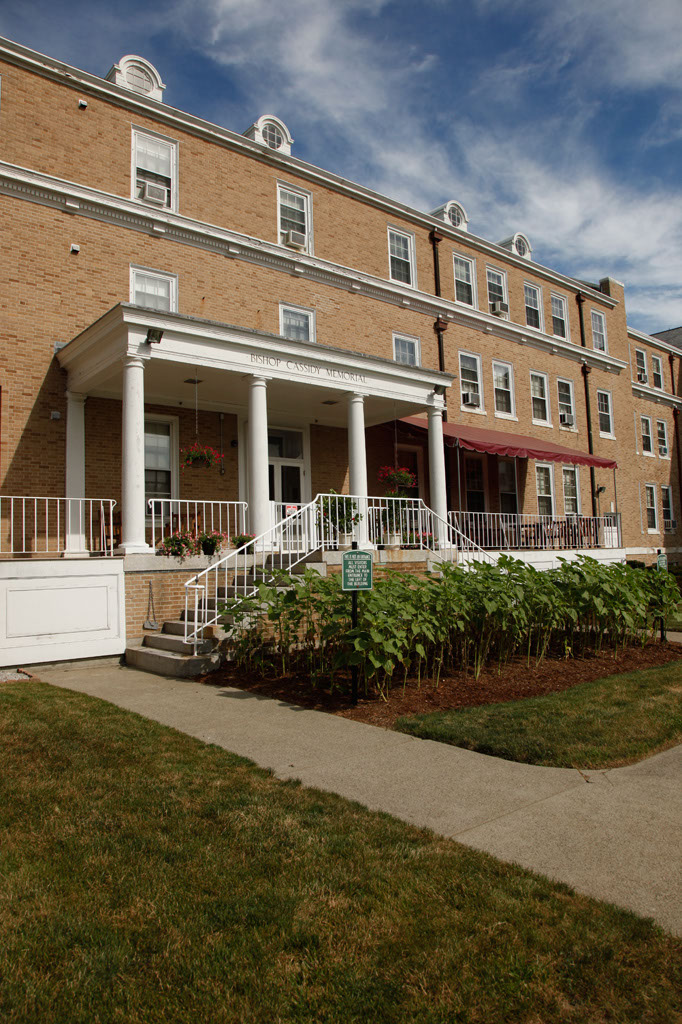
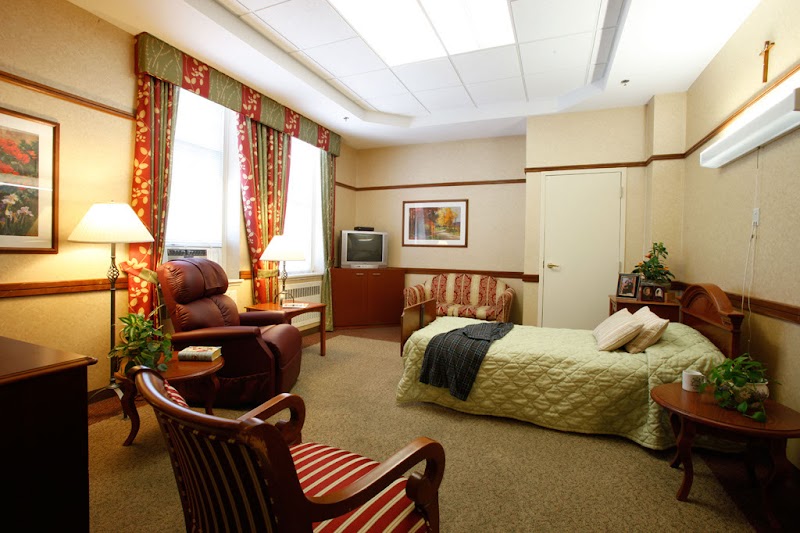
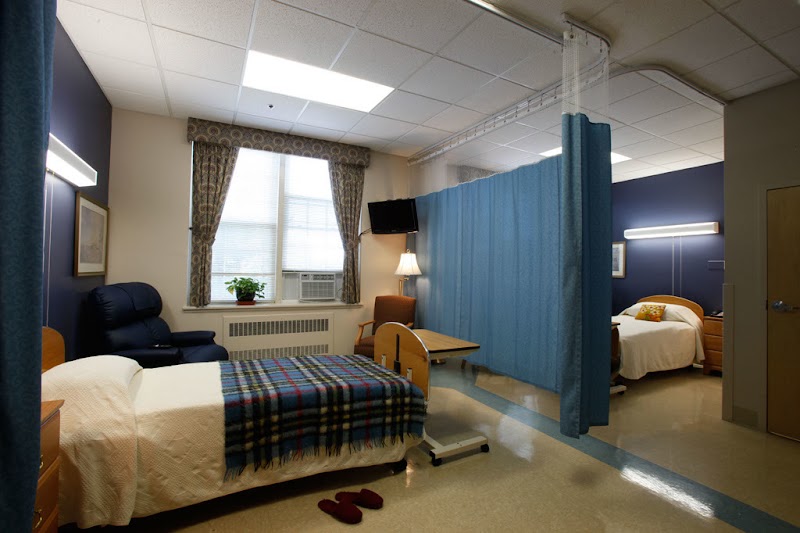
CATHOLIC MEMORIAL HOME

2446 HIGHLAND AVENUE, FALL RIVER, MA 02720 (508) 679-0011
Non profit - Church related 300 Beds DIOCESAN HEALTH FACILITIES Data: November 2025
Trust Grade
38/100
#146 of 338 in MA
Last Inspection: April 2025

Within standard 12-15 month inspection cycle. Federal law requires annual inspections.

Overview

Catholic Memorial Home has a Trust Grade of F, indicating significant concerns about the facility's quality and safety. It ranks #146 out of 338 nursing homes in Massachusetts, placing it in the top half, but this is mitigated by the poor trust grade. The facility's issues have remained stable, with eight reported incidents each year in 2024 and 2025. Staffing is a strength, receiving a 5/5 star rating and a low turnover rate of 28%, which is better than the state average, suggesting that staff are stable and familiar with residents. However, there are concerning incidents: one resident with a history of aggression was able to physically harm multiple residents, highlighting failures in implementing abuse prevention measures. Additionally, the facility has accumulated $84,061 in fines, which is average but may indicate ongoing compliance issues.

Trust Score
F
38/100
In Massachusetts
#146/338
Top 43%
Safety Record
High Risk
Review needed
Inspections
Holding Steady
8 → 8 violations
Staff Stability
✓ Good
28% annual turnover. Excellent stability, 20 points below Massachusetts's 48% average. Staff who stay learn residents' needs.
Penalties
○ Average
$84,061 in fines. Higher than 52% of Massachusetts facilities. Some compliance issues.
Skilled Nurses
○ Average
Each resident gets 34 minutes of Registered Nurse (RN) attention daily — about average for Massachusetts. RNs are the most trained staff who monitor for health changes.
Violations
⚠ Watch
40 deficiencies on record. Higher than average. Multiple issues found across inspections.
★★★☆☆
3.0
Overall Rating
★★★★★
5.0
Staff Levels
★★★☆☆
3.0
Care Quality
★★☆☆☆
2.0
Inspection Score
Stable
2024: 8 issues
2025: 8 issues

The Good

  • 5-Star Staffing Rating · Excellent nurse staffing levels
  • Low Staff Turnover (28%) · Staff stability means consistent care
  • Full Sprinkler Coverage · Fire safety systems throughout facility
  • No fines on record
  • Staff turnover is low (28%)

    20 points below Massachusetts average of 48%

Facility shows strength in staffing levels, staff retention, fire safety.

The Bad

3-Star Overall Rating

Near Massachusetts average (2.9)

Meets federal standards, typical of most facilities

Federal Fines: $84,061

Well above median ($33,413)

Moderate penalties - review what triggered them

Chain: DIOCESAN HEALTH FACILITIES

Part of a multi-facility chain

Ask about local staffing decisions and management

The Ugly 40 deficiencies on record

3 actual harm
Apr 2025 8 deficiencies
CONCERN (D)

Potential for Harm - no one hurt, but risky conditions existed

Deficiency F0583 (Tag F0583)

Could have caused harm · This affected 1 resident

Based on observations and interviews, the facility failed to ensure resident's privacy was maintained. Specifically the facility: 1. failed to perform a Brief Interview of Mental Status (BIMS) assessm...

Read full inspector narrative →
Based on observations and interviews, the facility failed to ensure resident's privacy was maintained. Specifically the facility: 1. failed to perform a Brief Interview of Mental Status (BIMS) assessment in a private and confidential space. 2. failed to ensure resident protected health information (PHI) was secure and not visible to others on one nursing unit of seven nursing units. Findings include: Review of the facility's HIPAA Policy, undated, indicated but was not limited to, the following: -HIPAA is the Health Insurance Portability and Accountability Act of 1996. It requires that all health care providers and organizations develop and follow procedures that ensure the confidentiality and security of health information of an individual. -Confidentiality includes all personal information (name, social security, age, occupation, medical record number, address, diagnosis, treatments, why the resident is here, medical condition or medications). -Do's: Close resident's doors when discussing information, doing treatments or performing procedures. Close curtains and speak softly in semi-private rooms when discussing treatments or performing procedures. -Don'ts: Don't talk about residents in public areas, such as an elevator or break room. 1. Resident #143 was admitted to the facility in January 2024. Review of the medical record indicated Resident #143 had moderate cognitive impairment as evidenced by a BIMS assessment (cognitive assessment) score of 12 out of 15. On 4/15/25 at 11:10 A.M., the surveyor observed the Minimum Data Set (MDS) Nurse conducting Resident #143's BIMS assessment in the Unit 3 hall corridor. The surveyor observed four female residents and other staff passing by who could have easily heard the MDS Nurse assessing the Resident's cognitive status. The MDS nurse was overheard asking the Resident questions like, Repeat the following words: blue, bed, and sock. The Resident was overheard saying to the MDS nurse that he/she could not remember all three of the words that the MDS nurse had asked him/her to try to remember. During an interview on 4/15/25 at 11:12 A.M., the MDS Nurse said that she should not have performed the BIMS assessment in the corridor; she did not follow the HIPAA policy. She said she should have conducted the assessment in a private space such as the Resident's room where others could not overhear so as to protect the Resident's privacy and dignity. During an interview on 4/17/25 at 11:27 A.M., the Director of Nursing (DON) said that she had heard about the MDS Nurse conducting the BIMS assessment in the corridor on the B Unit. The DON said that the MDS nurse should have conducted the assessment in a private location to protect the Resident's privacy and dignity. 2. On 4/14/25 at 11:41 A.M., the surveyor observed a sign posted to the Unit 6 dining room door titled Feeding List for 7-3 and 3-11 which included 19 residents first and last names along with their room number. The residents were having lunch in the dining room at this time with staff feeding residents their meals. On 4/14/25 at 5:00 P.M., the surveyor observed the same sign posted while residents were having dinner. The surveyor observed visitors in the dining room at this time. During an interview with observation on 4/15/25 at 7:39 A.M., Certified Nurse Aide (CNA) #5 said that she uses the list posted on the door as a reference as to which residents need to be fed their meals. She said the Unit Manager made this list for the staff and posted it on the dining room door for ease of access to information. During an interview on 4/15/25 at 7:50 A.M., CNA #4 said the sign on the door has been posted for reference for well over a month. She said the list is updated by the Unit Manager if someone needs to be fed. During an interview on 4/15/25 at 8:17 A.M., Unit Manager #5 said she created and posted the sign on the door as a cheat sheet for staff to know which residents need to be fed and which residents they can just set up their meals. She said she updates it with changes. She said she also keeps the seating chart posted on this door with Resident names for the dining room but she was not sure where that sign was moved to. During an observation with an interview on 4/15/25 at 11:50 A.M., the Administrator said this information should not be posted publicly. She said the sign violated HIPAA and should not be visible to other residents or visitors.
CONCERN (D)

Potential for Harm - no one hurt, but risky conditions existed

Comprehensive Care Plan (Tag F0656)

Could have caused harm · This affected 1 resident

**NOTE- TERMS IN BRACKETS HAVE BEEN EDITED TO PROTECT CONFIDENTIALITY** Based on observation, interview, and record review, the facility failed to implement the person-centered plan of care for one Re...

Read full inspector narrative →
**NOTE- TERMS IN BRACKETS HAVE BEEN EDITED TO PROTECT CONFIDENTIALITY** Based on observation, interview, and record review, the facility failed to implement the person-centered plan of care for one Resident (#173), out of 35 sampled residents. Specifically, the facility failed to implement the fall risk prevention intervention of having the call light within reach. Findings include: Resident #173 was admitted to the facility in May 2023 with diagnoses of dementia and a history of falling. Review of the care plans indicated Resident #173 had a history of falls with the following interventions: -call light in reach at all times; may not always know how to use due to cognitive loss (effective 5/10/23) -remind and educate to call for assistance (effective 7/3/23) -remind to use call light for assistance (effective 11/18/24) Review of the medical record indicated Resident #173 fell on [DATE], 12/24/24, 2/16/25, and 4/12/25. On 4/15/25 at 2:20 P.M., the surveyor observed Resident #173 in his/her room in a stationary reclining chair. The surveyor observed a red string attached to the wall call light box and on the Resident's bed. The call light cord was not within reach of the Resident. On 4/16/25 at 7:40 A.M., the surveyor observed Resident #173 lying in bed. The wall call light box was located towards the foot of the Resident's bed and the red string was hanging straight down at the Resident's foot of the bed and could not be easily reached by the Resident. On 4/16/25 at 9:02 A.M., the surveyor observed Resident #173 in his/her room in a stationary reclining chair with their breakfast on a table in front of them. The surveyor observed a red string attached to the wall call light box and on the Resident's bed. The call light cord was not within reach of the Resident. On 4/16/25 at 11:35 A.M., the surveyor observed Resident #173 in his/her room in a stationary reclining chair. The surveyor observed a red string attached to the wall call light box and on the Resident's bed. The call light cord was not within reach of the Resident. During an interview on 4/16/25 at 12:00 P.M., Certified Nursing Assistant (CNA) #2 said Resident #173 was able to ambulate with a rolling walker in his/her room and would attempt to get up on their own. She said the Resident preferred to sleep in their recliner on and off throughout the day. She said the Resident knew how to use the call light. During an interview on 4/16/25 at 1:46 P.M., Unit Manager #4 said Resident #173 needed supervision with walking and should be using the call light, although would forget at times. She said the call light should be within reach of the Resident and this was part of the care plan interventions.
CONCERN (D)

Potential for Harm - no one hurt, but risky conditions existed

Deficiency F0761 (Tag F0761)

Could have caused harm · This affected 1 resident

Based on observation and interview, the facility failed to ensure that medications were labeled and stored in accordance with accepted professional principles for two Residents (#144 and #103), of a t...

Read full inspector narrative →
Based on observation and interview, the facility failed to ensure that medications were labeled and stored in accordance with accepted professional principles for two Residents (#144 and #103), of a total sample of 35 residents. Specifically, the facility failed: 1. For Resident #103, to ensure medications were stored in the container with the pharmacy label; and 2. For Resident #144, to ensure that the Resident's topical medications were stored securely. Findings include: Review of the facility policy titled Storage of Medications, dated March 2021 and reviewed on 4/17/25, indicated but was not limited to, the following: C. All medications dispensed by the pharmacy are stored in the container with the pharmacy label. Review of the facility policy titled Medication Storage in the Facility, dated 1/9/17, indicated, but was not limited to, the following: -Medications and biologicals are stored safely, securely, and properly, following manufacturer's recommendations or those of the supplier. The medication supply is accessible only to licensed nursing personnel, pharmacy personnel, or staff members lawfully authorized to administer medications. -Only licensed nurses, pharmacy personnel, and those lawfully authorized to administer medications (such as medication aides) permitted [sic] to access medications. Medication rooms, carts, and medication supplies are locked when not in use or in direct view of persons with authorized access. 1. On 4/15/25 at 8:30 A.M., the surveyor observed Nurse #5 administering medications to Resident #103. While preparing the Resident's medications, Nurse #5 opened the third drawer of the medication cart and the surveyor observed an unidentified, unlabeled, white pill in a plastic medication cup. During an interview on 4/15/25 at 8:35 A.M., Nurse #5 said she didn't know what the medication was, the dose of the medication, who the medication was for, when it was placed there, or when it was to be administered. Nurse #5 said that the unlabeled medication in the drawer likely belonged to Resident #103, and could be the Resident's 6 A.M. dose of levothyroxine, however she was not sure. Nurse #5 said she could not say why the night nurse would have left the pill unlabeled in the medication cup and that doing so was prohibited. Nurse #5 said that medications should never be left unlabeled and stored in the medication cart. During an interview on 4/17/25 at 11:13 A.M., the Director of Nurses (DON) said that medications should never be left unlabeled and stored in the medication cart for any reason. 2. During the course of survey, the surveyor made the following observations in Resident #144's room: -4/14/25 at 9:34 A.M.: two tubes of Mupirocin (a topical antibiotic ointment and Bacitracin (a topical antibiotic ointment) in a basin on top of the dresser. -4/15/25 at 9:30 A.M.: two tubes of Mupirocin and Bacitracin in a basin on top of the dresser. -4/16/25 at 7:35 A.M.: two tubes of Mupirocin and Bacitracin in a basin on top of the dresser. During an interview on 4/16/25 at 10:05 A.M., Unit Manager #1 said that Mupirocin and Bacitracin should not be stored, unsecured, in the Resident's room.
CONCERN (D)

Potential for Harm - no one hurt, but risky conditions existed

Deficiency F0810 (Tag F0810)

Could have caused harm · This affected 1 resident

**NOTE- TERMS IN BRACKETS HAVE BEEN EDITED TO PROTECT CONFIDENTIALITY** Based on observations, interviews, and record review, the facility failed to provide adaptive equipment for one Resident (#5), o...

Read full inspector narrative →
**NOTE- TERMS IN BRACKETS HAVE BEEN EDITED TO PROTECT CONFIDENTIALITY** Based on observations, interviews, and record review, the facility failed to provide adaptive equipment for one Resident (#5), out of a total sample of 35 residents. Specifically, the facility failed to ensure Resident #5 was provided with built-up handles for utensils and a handled cup for beverages during meals. Findings include: During the entrance conference on 4/14/25 at 9:00 A.M., the Administrator said the facility had been making repairs in the kitchen and all residents were currently using disposable dishes and plastic utensils since February 2025. Resident #5 was admitted to the facility in September 2021 and had bilateral hand contractures. Review of the care plans indicated Resident #5 was received help with opening containers and cutting up food and was then independent with eating and drinking. The interventions included following any Occupational Therapy (OT) recommendations. Review of the OT Evaluation and Plan of Treatment, dated 2/25/25, indicated the following: -prior level of function: self-feed after set-up -presents with increased difficulty grasping and manipulating utensils and standard cups during mealtimes resulting in decreased efficiency during meals Review of the OT Discharge summary, dated [DATE], indicated the following: -skilled interventions: built-up handles for plastic utensils provided and two handled cups were recommended to maximize independence in feeding -progress: functional performance has improved as a result of instruction to caregivers -discharge recommendations: provide set-up assistance with included built-up handles, nursing staff aware to issue for meals and to clean as needed. On 4/16/25 from 8:32 A.M. through 8:51 A.M., the surveyor observed Resident #5 in the unit dining room. The Resident was provided their breakfast meal in a disposable container and provided a plastic fork and a plastic spoon. The Resident was observed with bilateral hand contractures holding the plastic fork, without built-up handles on the utensil. The Resident was observed to have a standard disposable plastic cup of milk (without a handle) and a disposable container of orange juice. The Resident was observed to have difficulty holding the container of orange juice with both hands and trying to bring it to his/her mouth. On 4/16/25 at 11:48 A.M., the surveyor observed Resident #5 in the unit dining room. The Resident was provided their lunch meal in a disposable container and provided a plastic fork and a plastic spoon. The Resident was observed holding a plastic spoon, without a built-up handle, eating ice cream. The Resident then used the plastic fork, without a built-up handle, to eat the cut-up ham. The milk was in a plastic disposable cup, without a handle. During an interview on 4/16/25 at 11:57 A.M., Certified Nursing Assistant (CNA) #1 said Resident #5 previously had foam handles that would be put on the utensils to make for a better grip for the Resident, but the foam handles did not fit on the plastic utensils because the handles on the plastic utensils were too small. She said Resident #5 prefers to feed him/herself and will not let staff feed him/her. During an interview on 4/16/25 at 1:40 P.M., Unit Manager #4 said the process for when a resident discharged from a therapy service with adaptive equipment was for the OT to write up the recommendation, for the nurse to transcribe the order and for the Unit Manager to double check the order and then add any changes to the care plans. She said she would have to check on the process for when Resident #5 was discharged from OT on 3/4/25. During an interview on 4/16/25 at 2:39 P.M., Unit Manager #4 said she was unable to locate any documentation from when Resident #5 discharged from OT. She said based on the discharge summary the OT had educated the staff, but she was not sure who was educated. She said she found the red built-up foam handles for the utensils in the Resident's room and the staff had not been using them because the utensils moved when inside the handle, making it more difficult for the Resident to eat. She said the staff had not communicated this to her. During an interview on 4/17/25 at 8:10 A.M., the Occupational Therapist said Resident #5 had been referred for OT because of their decrease in self-feeding leading to a decrease in food intake. She said when she discharged the Resident from services the plan was for the red built-up handle covers to be added to the plastic utensils for a better grip and for all beverages to be provided in cups with handles (one or two handled cups). She said she had educated one of the CNAs but was not sure which one. She said she had not known at that time that the recommendations for staff to put the built-up handle on the plastic utensils needed to be in writing so the adaptive equipment could be added to the orders for effective implementation. She said the recommendation for cups with handles should have been communicated to the kitchen but it had not been done at that time.
CONCERN (D)

Potential for Harm - no one hurt, but risky conditions existed

Food Safety (Tag F0812)

Could have caused harm · This affected 1 resident

Based on observation and interview, the facility failed to follow professional standards of practice for food safety to prevent the potential spread of foodborne illness to residents who are at high r...

Read full inspector narrative →
Based on observation and interview, the facility failed to follow professional standards of practice for food safety to prevent the potential spread of foodborne illness to residents who are at high risk. Specifically, the facility failed to ensure food items were properly dated and stored in three of three kitchenettes. Findings include: Review of the 2022 Food Code by the Food and Drug Administration (FDA), revised 1/2023, indicated but was not limited to the following: 3-305.11 (A) Except as specified in paragraphs (B) and (C) of this section, food shall be protected from contamination by storing the food (1) in a clean, dry location. 3-501.17 Ready-to-Eat, Time/Temperature Control for Safety Food, Date Marking. (B) Except as specified in (E) - (G) of this section, refrigerated, READY-TO-EAT TIME/TEMPERATURE CONTROL FOR SAFETY FOOD prepared and PACKAGED by a FOOD PROCESSING PLANT shall be clearly marked, at the time the original container is opened in a FOOD ESTABLISHMENT and if the FOOD is held for more than 24 hours, to indicate the date or day by which the FOOD shall be consumed on the FDA Food Code 2022 Chapter 3. Food Chapter 3 - 29 PREMISES, sold, or discarded, based on the temperature and time combinations specified in (A) of this section and: (1) The day the original container is opened in the FOOD ESTABLISHMENT shall be counted as Day 1; and (2) The day or date marked by the FOOD ESTABLISHMENT may not exceed a manufacturer's use-by date if the manufacturer determined the use-by date based on FOOD safety. (D) A date marking system that meets the criteria stated in (A) and (B) of this section may include: (1) Using a method approved by the regulatory authority for refrigerated, ready-to-eat time/temperature control for safety food that is frequently rewrapped, such as lunchmeat or a roast, or for which date marking is impractical, such as soft serve mix or milk in a dispensing machine; (2) Marking the date or day of preparation, with a procedure to discard the food on or before the last date or day by which the food must be consumed on the premises, sold, or discarded as specified under (A) of this section; (3) Marking the date or day the original container is opened in a food establishment, with a procedure to discard the food on or before the last date or day by which the food must be consumed on the premises, sold, or discarded as specified under (B) of this section; or (4) Using calendar dates, days of the week, color-coded marks, or other effective marking methods, provided that the marking system is disclosed to the REGULATORY AUTHORITY upon request. On 4/15/25 at 2:31 P.M., the surveyor observed on Unit 6 three opened and undated containers of thickened liquids. One container had a manufacturer's label indicating to use the contents within seven days of opening. Two containers had a manufacturer's label indicating to discard the contents if not used within 10 days of opening. On 4/16/25 at 1:01 P.M., the surveyor observed on Unit 6, one opened and undated container of thickened liquid with a manufacturer's label indicating to use the contents within seven days of opening. During an interview on 4/16/25 at 1:30 P.M., CNA #3 said there was no date on the thickened liquid container to indicate when it was opened. CNA #3 said any food or drink that was opened should be dated so staff know when to discard it. CNA #3 said they did not know when the thickened liquid container was opened. During an interview on 4/17/25 at 10:50 A.M., the Food Service Director (FSD) said once a food or drink item is opened, staff should date the item with the date opened. The FSD said thickened liquids should be dated with the date opened and discarded per manufacturer's instructions.
CONCERN (D)

Potential for Harm - no one hurt, but risky conditions existed

Medical Records (Tag F0842)

Could have caused harm · This affected 1 resident

**NOTE- TERMS IN BRACKETS HAVE BEEN EDITED TO PROTECT CONFIDENTIALITY** Based on record review and interview, the facility failed to ensure a complete and accurate medical record was maintained for on...

Read full inspector narrative →
**NOTE- TERMS IN BRACKETS HAVE BEEN EDITED TO PROTECT CONFIDENTIALITY** Based on record review and interview, the facility failed to ensure a complete and accurate medical record was maintained for one Resident (#36), out of a total sample of 35 residents. Specifically, for Resident #36, the Resident's medical record failed to reflect accurate health care proxy activation status. Findings include: Review of the facility's policy titled Advance Directives Policy, dated 11/2024, indicated, but was not limited to, the following: -If the resident is incapacitated at the time of admission, information may be given to the resident's family or surrogate. If the resident's condition reverses and he/she is no longer incapacitated, information shall be given to the resident at the appropriate time. -Implementation of resident self-determination begins on admission. -If the resident lacks decision-making capacity, the responsible party that is present during the admission process will be asked if the resident has designated a Health Care Proxy (HCP). The HCP shall be contacted to determine if the resident ever discussed or drafted advanced directives. The physician shall activate the HCP and the HCP will be responsible for executing advance directives on the resident's behalf. Resident #36 was admitted to the facility in [DATE] with diagnoses including left calf hematoma evacuation and wound debridement and atrial fibrillation. Review of the Minimum Data Set (MDS) assessment, dated [DATE], indicated the Resident was moderately cognitively impaired, as evidenced by a Brief Interview for Mental Status (BIMS) score of eight out of 15. Further review of the MDS indicated Resident #36's Health Care Proxy was invoked. Review of the outside hospital's Discharge summary, dated [DATE], indicated Resident #36 had mild cognitive impairment and had signed advanced directives, including a Medical Orders for Life Sustaining Treatment (MOLST) document and Health Care Proxy document, during his/her hospitalization. Further review of the Discharge Summary failed to indicate the Resident's Health Care Proxy had been invoked. Review of Resident #36's Physician's Orders indicated the Resident's Health Care Proxy was activated on [DATE]. Review of Resident #36's Care Plan indicated, but was not limited to, the following: Problem: Advanced Directives - I am a DNR. I do not have any other advanced directives in place at this time. My healthcare proxy is activated. Goal: My HCP has chosen the following advanced directives to be carried out this quarter. Approach: -DNR - Do Not Resuscitate order will be honored while resident is in the facility. Upon finding the resident without pulse or respiration, NO CPR will be initiated per resident/HCP request and MD order. -My family is to be called with any changes in my condition and a decision will be made at that time to follow through on this POC or change it. -Please monitor and assess my condition for system management and provide adjustments/additions to my medication. Review of the physician (MD) and nurse practitioner (NP) progress notes for Resident #36 indicated, but was not limited to, the following: -[DATE] NP note: HCP is not activated. -[DATE] MD note: HCP is not activated. -[DATE] MD note: HCP is not activated. -[DATE] NP note: HCP is not activated. During an interview on [DATE] at 8:25 A.M., Unit Manager #1 said the order entered in Resident #36's record indicating the Resident's HCP was activated may have been entered in error.
CONCERN (E)

Potential for Harm - no one hurt, but risky conditions existed

Resident Rights (Tag F0550)

Could have caused harm · This affected multiple residents

Based on observation and interview, the facility failed to ensure for six residents of a total sample of 35 residents, that the Residents were provided respect and dignity in a manner and environment ...

Read full inspector narrative →
Based on observation and interview, the facility failed to ensure for six residents of a total sample of 35 residents, that the Residents were provided respect and dignity in a manner and environment that promoted enhancement of the residents' quality of life and individuality. Specifically, the facility failed: To provide meal assistance in a respectful and dignified manner on units 1E, 2A, and 7. Findings include: Review of the facility's policy titled Tray Pass Guidelines, undated, indicated but was not limited to the following: -A tray may not be placed in front of a dependent feeder until someone is ready to sit down and immediately feed them. On 4/14/25 at 8:53 A.M., the surveyor observed on Unit 1E, two Certified Nursing Assistants (CNAs) standing and feeding two seated Residents, of which one CNA was standing directly in front of a Resident with the Resident's head reaching the height of the CNA's chest. On 4/14/25 at 12:20 P.M., the surveyor observed CNA #6 standing while feeding a Resident in the Unit 7 dining room. CNA #6 was observed walking around the dining room, feeding several seated residents while standing. On 4/14/25 at 12:24 P.M., the surveyor observed CNA #7 standing while feeding an entire meal to a Resident. During an interview with observation on 4/16/25 at 8:44 A.M., the surveyor observed CNA #7 standing while feeding a Resident in the dining room. The Resident was sitting in a Broda chair with a tray table in front of the chair with a pureed breakfast meal. CNA #7 said she is constantly moving in the dining room trying to get residents to eat and she will go from resident to resident providing a spoonful of food. She said she thinks the residents eat better when she feeds them a mouthful of food and then walks away and feeds another resident and then goes back to the first resident. She said she never sits down in the dining room. On 4/16/25 at 12:05 P.M., the surveyor observed CNA #11 standing while feeding lunch to two Residents who were seated in the Unit 2A dining room. During an interview on 4/16/25 at 12:06 P.M., the Director of Nursing (DON) said she expected staff to be seated while feeding residents.
CONCERN (E)

Potential for Harm - no one hurt, but risky conditions existed

Infection Control (Tag F0880)

Could have caused harm · This affected multiple residents

4. The Use of the Medication Cart policy, dated March 2021, and reviewed by the surveyor on 4/16/25, indicated but was not limited to: -J. The licensed personnel should maintain a clean top surface of...

Read full inspector narrative →
4. The Use of the Medication Cart policy, dated March 2021, and reviewed by the surveyor on 4/16/25, indicated but was not limited to: -J. The licensed personnel should maintain a clean top surface of the medication cart while passing medications and clean and replenish the medication cart after each use. During observation of the Med Cart, on the D-Wing, Unit 7, on 4/16/25 at 4:14 PM with Nurse #7, the following was observed: The 1st, 5th and 6th drawers of the medication cart were observed to be significantly dirty with black, soiled and sticky areas, with dark marks left on the bottoms of the drawers from sticky medication bottles. Nurse #7 said that the drawers in the med cart were dirty and in need of cleaning. Nurse #7 said that typically, the night shift cleans the medication carts. However, she also said that each nurse is responsible for ensuring the cleanliness of the medication carts during their shifts. During an interview on 4/17/25 at 11:21 A.M., the Director of Nursing (DON) said, after viewing the pictures of the dirty med cart provided by the surveyor, that is pretty gross. The DON said that the facility policy is for nurses to clean the med carts after each shift. 5. During observation on 4/15/25 at 9:10 A.M., Nurse #8, assigned to administer medications on the 2 AB Unit, was observed preparing medications for Resident #109. During the preparation process, the nurse indicated to the surveyor which pill in the cup was the Metformin (diabetic medication) that she had placed in the medication cup. Nurse #8 was observed inserting her finger in the medication cup and physically touched the pill with her finger. When the surveyor indicated that she had placed her finger in the cup and touched the pill, she said, That's a no no. She said that she understood that touching medication with bare hands is a violation of infection control procedures. During an interview on 4/17/25 at 11:33 A.M., the DON said that Nurse #8 should not have touched the Resident's medication with her bare finger. The DON said that it is an infection control issue. Based on observations and interviews, the facility failed to follow infection control prevention practices. Specifically, the facility failed to: 1. Ensure effective hand hygiene practices and appropriate PPE (personal protective equipment) were utilized when entering in and out of resident rooms, including residents on transmission based precautions; 2. Ensure staff utilized appropriate PPE while providing direct care to Resident #36 on Enhanced Barrier Precautions; 3. Ensure staff and resident hand hygiene was implemented during meals on Unit 7 and Unit 2A; 4. Ensure that medication carts were maintained in a clean, sanitary condition to prevent contamination and transmission of disease from resident to resident; and 5. Ensure that sanitary practices were used by nursing while preparing and administering medications. Findings include: 1. Review of the facility policy titled Precautions to Prevent Infection indicated,dated as reviewed in July 2025 but was not limited to the following: -standard precautions are intended to be applied to the care of all patients in healthcare settings, regardless of suspected or confirmed presence of an infectious agent -transmission-based precautions are for patients who are known or suspected to be infected or colonized with infectious agents -the category of transmission-based precaution determines the type of PPE (personal protective equipment) to be used -proper hand washing remains a key preventative measure, regardless of the type of transmission-based precaution employed -when implementing transmission based precautions: post clear signage on the door or wall outside of the resident room indicating the type of precaution and required PPE Review of the transmission-based precautions signs indicated the following: -Isolation Precaution sign: staff and providers must clean hands when entering and exiting the room -Contact Plus precaution sign: staff and providers must clean hands before entering room, change gown and gloves between caring for each resident, wash hands with soap and water before exiting resident's room (hand sanitizer is not sufficient when exiting a resident's room), use bleach products to clean and disinfect resident rooms During an interview on 4/15/25 at 3:05 P.M., Unit Manager #5 said Resident #142 had been placed on Isolation precautions that morning related to an episode of vomiting and Resident #190 was on Contact Plus precautions related to loose stool. On 4/16/25 at 3:49 P.M., Certified Nursing Assistant (CNA) #9 was observed exiting the room of Resident #142 and placed a robe on the shoulders of Resident #142 who was sitting in the hallway. A sign on the room for Resident #142 indicated the Resident was on Isolation Precautions. CNA #9 was observed going back in the room of Resident #142 and coming out with an over the bed table with a stack of clean hospital gowns for residents. CNA #9 was not observed to perform hand hygiene when entering or exiting the room or following contact with the Resident and their clothing. CNA #9 then wheeled the over the bed table with the hospital gowns down the hall and entered the room of Resident #190 with the table, without performing hand hygiene prior to entering. CNA #9 was observed placing the resident gowns on the dresser of each resident in the room. CNA #9 exits the room of Resident #190 without performing hand hygiene, goes to the linen closet on the unit to obtain more briefs and returns to the room of Resident #190. CNA #9 then exits the room of Resident #190, without performing hand hygiene. CNA #9 was observed going to the linen closet and getting clothing protections and brining them to the unit dining room. CNA #9 was observed exiting the room without performing hand hygiene. During an interview on 4/16/25 at 4:06 P.M., CNA #9 said each of the signs outside of the resident's rooms indicated the type of precautions the residents were on. He said the signs indicated the directions for hand hygiene and PPE use and should be followed. During an interview at 8:55 A.M., the Infection Control Preventionist said when a staff enter the rooms of residents on precautions they should be performing hand hygiene when entering and exiting. For Contact Plus precautions the staff would need to don PPE if they are touching resident items, but not if they were only dropping off linen. 3. Review of the facility's policy titled Hand Hygiene, undated, indicated but was not limited to the following: Purpose - Hand hygiene continues to be the primary means of preventing the transmission of infection. Policy - All employees of the facility shall perform hand hygiene (such as hand washing or use of alcohol hand rubs) in accordance with the recommendations of the Center for Disease Control (CDC) Guideline for Hand Hygiene in Health Care Settings, World Health Organization (WHO), Centers for Medicare and Medicaid Services (CMS) Guidance. Hand washing with antimicrobial soap and water must be performed in the following situations: -When hands are visibly dirty or contaminated with proteinaceous materials or with blood or any body fluids; -Before and after eating or handling food. Alcohol based hand rubs can be used for routinely decontaminating hands if they are not visibly soiled and if the aforementioned situations do not exist. The following is a list of some situations that require hand hygiene: -Before and after eating or handling food (hand washing required); -Before and after assisting a resident with meals (hand washing required); -After handling soiled equipment or utensils; -After contact with objects and environmental surfaces in a resident's room or in vicinity of resident. On 4/14/25 at 12:10 P.M., the surveyor observed CNA #6 walking around the Unit 7 dining room feeding several residents. The surveyor observed CNA #6 feeding food and drinks to residents. The surveyor observed the CNA touch residents' utensils and serving ware, discard used placemats and finished meal items, and remove residents' used clothing protectors. The surveyor did not observe the CNA wash or sanitize her hands between these tasks or between assisting residents. On 4/16/25 at 7:17 A.M. to 7:50 A.M., the surveyor observed twelve residents sitting in the Unit 7 dining room awaiting the arrival of their meals. The surveyor observed staff preparing for breakfast by placing clothing protectors on residents and putting placemats on table. Residents were not offered hand hygiene at any time prior to being served breakfast. On 4/16/25 at 7:50 A.M., the surveyor observed staff serving breakfast to the Residents in the Unit 7 dining room. The surveyor observed staff did not offer Residents hand hygiene when serving the food. During an interview on 4/16/25 at 8:38 A.M., Nurse #1 said that hand hygiene should be offered to residents prior to them having their meal and she said she was not sure if it was offered. During an interview on 4/16/25 at 12:33 P.M., Resident Representative #1 said she sits with her husband almost daily in the dining room at lunch and she said she has not witnessed staff offer hand hygiene to residents prior to eating. On 4/16/25 at 12:05 P.M., the surveyor observed CNA #11 assisting three residents with lunch in the Unit 2A dining room. CNA #11 was observed moving from resident to resident without sanitizing her hands before assisting with their meals. CNA #11 was observed handling bread from one Resident's tray with her bare hands as she spread margarine on the bread with the Resident's utensils. CNA #11 then moved to feed another Resident without sanitizing or cleaning her hands. During an interview on 4/16/25 at 12:27 P.M., the Director of Nurses (DON) said her expectation is residents are being offered hand hygiene prior to every meal, and staff who are assisting/feeding residents should wash or sanitize their own hands when moving from one resident to the next. 2. Resident #36 was admitted to the facility in March 2025 with diagnoses including pressure ulcer of the sacral region and left calf hematoma requiring incision and drainage. Review of Resident #36's Care Plan indicated, but was not limited to, the following: Problem: EBP (Enhanced Barrier Precautions) - I am at increased risk of MDRO (multi-drug resistant organism) acquisition secondary to surgical wounds to my left lower extremity. Approach: -Do not wear the same gown and gloves for the care of more than one resident or reuse the gown and gloves for the same resident. -Post clear signage on the door or wall outside of the resident's room indicating the type of precautions and required personal protective equipment. *For enhanced barrier precautions, signage should indicate the high-contact resident care activities that require the use of gown and gloves. On 4/17/25 at 10:03 A.M., the surveyor observed the Centers for Disease Control and Prevention (CDC) Enhanced Barrier Precautions sign posted on the wall outside of Resident #36's room. The sign indicated that everyone must clean their hands and that providers and staff must wear gloves and a gown for high-contact resident care activities such as: dressing, bathing/showering, transferring, changing linens, providing hygiene, changing briefs or assisting with toileting, device care, and wound care. Gowns were located in a hanging basket on the room door. On 4/17/25 at 10:03 A.M., Certified Nursing Assistant (CNA) #10 was observed in Resident #36's room providing incontinence care and assisting the Resident with turning and repositioning in bed. CNA #10 was wearing gloves but was not wearing a gown during care. On 4/17/25 at 10:15 A.M., the surveyor observed wound care provided to Resident #36. CNA #10 was present in the room and assisted in providing hygiene and positioning the Resident during wound care. CNA #10 was wearing gloves but was not wearing a gown. During wound care, the surveyor observed Nurse #4 remove her gloves and don new gloves without performing hand hygiene at 10:21 A.M., 10:23 A.M., and 10:25 A.M. During an interview on 4/17/25 at 10:35 A.M. Nurse #4 said Resident #36 required Enhanced Barrier Precautions and that CNA #10 should have had on a gown for high-contact care activities. Nurse #4 said that after removing gloves, hand hygiene should be performed before new gloves are put on. During an interview on 4/17/25 at 11:22 A.M., CNA #10 said Resident #36 required Enhanced Barrier Precautions and that she should have worn a gown when providing care, but was busy and forgot to.
Mar 2024 8 deficiencies 3 Harm
SERIOUS (H)

Actual Harm - a resident was hurt due to facility failures

Free from Abuse/Neglect (Tag F0600)

A resident was harmed · This affected multiple residents

Based on interviews, record review, and policy review, the facility failed to prevent one Resident (#193), who had a history of agitation, aggression, and physical abuse of staff, from punching four R...

Read full inspector narrative →
Based on interviews, record review, and policy review, the facility failed to prevent one Resident (#193), who had a history of agitation, aggression, and physical abuse of staff, from punching four Residents (#147, #83, #122, and #192), who had severe cognitive impairment, from a total sample of 38 residents. 1. On 2/13/24, Resident #193 punched Resident #147; 2. On 3/16/24 and 3/20/24, Resident #193 punched Resident #83; 3. On 3/16/24 and 3/20/24, Resident #193 punched Resident #192; and 4. On 3/18/24, Resident #193 punched Resident #122. Using the reasonable person concept, a person would experience emotional distress after being hit, unprovoked, by another person. Findings include: Review of the facility's policy titled Resident Abuse, Mistreatment, and Neglect Policy and Procedure, last revised 1/2024, indicated but was not limited to: Procedure: -Abuse is defined as, but not limited to, willful infliction of injury, unreasonable confinement, intimidation, or punishment with resulting physical harm, pain or mental anguish. -Resident to Resident altercation is defined as a physical or verbal act between two residents with or without resulting injury. -Employees are obligated, as a condition of employment, to report immediately to their supervisors or the administrator, any observed or suspected incidents of abuse when they have reasonable cause to do so. -The reporting is necessary in order that the nursing home can inform the alleged violations to the Department of Public Health prior to preliminary investigation as required and to protect the Resident from harm during the investigation of any such allegations. -The Administrator shall immediately take any and all protective actions necessary to prevent further harm to residents. Resident #193 was admitted to the facility in June 2023 with diagnoses including dementia. Review of the medical record indicated Resident #193 has a history of agitation, aggression, and physically assaulting staff since admission to the facility. Review of a Nursing progress note, dated 11/9/23, indicated Resident #193 exhibited increased agitation, combativeness and punched a Certified Nursing Assistant (CNA) in the face when attempting to provide care. On 11/14/23, Resident #193 was evaluated at the hospital and diagnosed with a urinary tract infection and metabolic encephalopathy. Review of the Minimum Data Set (MDS) assessment, dated 2/22/24, indicated a staff assessment of Resident's mental status identifying he/she had both long- and short-term memory problems, severely impaired skills for daily decision making, exhibited physical behaviors toward others such as hitting, kicking, pushing, scratching, and grabbing, and wandering. Review of Resident #193's Mood/Behavior Care Plan, dated 6/27/23, indicated, but was not limited to the following interventions: -Avoid over-stimulation (e.g., noise, crowding, other physically aggressive residents). -If I become agitated, please try to assess for any unmet needs and redirect me with activities I enjoy; this will help calm me. Ensure that I am not in pain. Go slow with my care. Speak calmly to me while providing care. I enjoy conversations pertaining to my family. I light up when you talk to me about my granddaughter. -If I become physically and/or verbally abusive: assess whether the behavior endangers myself and/or others. Intervene as necessary. -Redirect me as needed and if that doesn't work, then just leave me alone if it is safe to do and return at a later time. -When I become physically and/or verbally abusive: keep distance between resident and others (e.g. staff, other residents, visitors). -When I become physically and/or verbally abusive: STOP and try task later. Do not force to do task. Review of the medical record indicated an interdisciplinary care plan meeting was held on 3/13/24. However, the current mood/behavior care plan was reviewed and renewed with no new interventions. Review of a psychiatric consultant Nurse Practitioner's note, dated 2/20/24, indicated Resident #193 was seen for aggressive behavior. The NP indicated a possibility that the Resident was annoyed by another resident's screaming. Recommendations included an increase in a medication used to treat akathisia (psychomotor restlessness), continue with supportive care, monitor for signs and symptoms of depression and notify the consultant provider with any changes. Further review of Resident #193's medical record indicated Resident #193 physically assaulted four residents on six occasions from 2/13/24 to 3/20/24 as follows: 1. Resident #147 was admitted to the facility with diagnoses including dementia. Review of the Minimum Data Set (MDS) assessment, dated 3/1/24, indicated Resident #147 had moderate cognitive impairment as evidenced by a Brief Interview for Mental Status (BIMS) score of 11 out of 15, and required assistance from staff for all activities of daily living. Review of the medical record indicated on 2/13/24 at 6:30 P.M., while seated at a table in the unit dining room, Resident #147 was punched in the face by Resident #193. Review of the facility's Event Reports (for Residents #147 and #193), dated 2/13/24, indicated on 2/13/24 at 6:30 P.M., a Certified Nursing Assistant (CNA) observed Resident #193 approach Resident #147 while he/she was seated at a table in the unit dining room and punch him/her on the right side of the face, unprovoked. New interventions included 15-minute checks for 72 hours, and redirect the resident as needed. The report indicated Resident #193's behavioral symptoms put others at risk for significant injury. During an interview on 3/19/24 at 9:45 A.M., Resident #147 was unable to recall the incident that occurred on 2/13/24. 2. Resident #83 was admitted to the facility with diagnoses including dementia with agitation and anxiety. Review of the MDS assessment, dated 1/5/24, indicated Resident #83 had severe cognitive impairment as evidenced by a BIMS score of 3 out of 15, required supervision only for ambulation on the unit, wandered, and had verbal behavioral symptoms directed toward others. Review of Resident #83's Mood/Behavior Care Plan, dated 1/20/22, indicated, but was not limited to the following: -Problem: I am at risk for behaviors and/or mood issues secondary to Alzheimer's disease, dementia, anxiety, depression, paranoia. -Approach: I can be paranoid in my thinking and believe that people are trying to hold me hostage or do harm to me. -Goal: To have a sense of happiness, calmness, and my mood to be regulated so that I can enjoy the time I spend with my family when they visit and enjoy the interactions with staff and other residents (target date: 4/18/24). a. Review of the facility's Event Reports (for both Resident #83 and #193), dated 3/16/24, indicated on 3/16/24 at 10:15 A.M. a CNA observed Resident #193 punch Resident #83 in the back twice as the Resident walked by him/her in the unit hallway. The report indicated Resident #193's behavioral symptoms put others at risk for significant injury. Resident #193 was placed on one-to-one (1:1) for the safety of others. b. Review of the facility's Event Reports (for both Resident #83 and #193), dated 3/20/24, indicated on 3/20/24 at 2:50 P.M., Resident #193 entered Resident #83's room and slapped him/her in the face. The report indicated a new intervention of redirection and Resident #193 was placed on 1:1. 3. Resident #192 was admitted to the facility with diagnoses including dementia and depression. Review of the MDS assessment, dated 1/19/24, indicated Resident #192 was unable to complete the BIMS assessment. Staff assessed that the Resident had both long- and short-term memory problems, severely impaired skills for daily decision making, physical and verbal behavior toward others and wandering behavior. Review of Resident #192's Mood/Behavior Care Plan, dated 4/29/23, indicated, but was not limited to the following: -Problem: I am at risk for behaviors and/or mood issues secondary to my Alzheimer's disease, dementia, and depression. -Approach: Avoid over-stimulation (e.g., noise, crowding, other physically aggressive residents). -Goal: To have a sense of happiness, calmness, and my mood will be regulated so that I can enjoy the time I spend with my family when they visit and enjoy the interactions with staff and other residents (target date: 5/2/24). a. Review of the facility's Event Reports (for both Resident #192 and #193), dated 3/16/24, indicated on 3/16/24 at approximately 5:00 P.M., Resident #193, while being supervised by CNA #5 for 1:1, entered Resident #192's room and struck him/her in the chest with a closed fist while he/she was resting in bed. The CNA's witness statement indicated she followed Resident #193 into Resident #192's room and observed him/her hit the Resident with a closed fist in the upper chest area. The statement indicated she was able to stop the Resident by leading him/her out of the room. The report indicated Resident #193's behavioral symptoms put others at risk for significant injury. The Surveyor was unable to interview CNA #5 as she did not respond to the Department of Public Health's telephone message request for an interview. b. Review of the facility's Event Reports (for both Resident #192 and #193), dated 3/20/24, and review of the medical record indicated on 3/20/24 at 3:00 P.M., the facility Social Worker (SW) was doing rounds on the unit, and observed Resident #193 sitting on the edge of Resident #192's bed repeatedly striking him/her on the chest. The SW removed Resident #193 from Resident #192's bed and called for assistance of a CNA. The report indicated Resident #193's behavioral symptoms put others at risk for significant injury. The Resident was placed on 1:1, redirection as needed, and urinalysis and culture and sensitivity were ordered. During an interview on 3/21/24 at 9:00 A.M., Resident #192's family member said that her loved one was hit by a resident the other day and she was called by facility staff last night to inform her that her loved one was hit again by the same resident. She said Resident #192 makes loud vocalizations frequently and staff think that may be a trigger for the Resident. She said she doesn't want her loved one to get hit again. 4. Resident #122 was admitted to the facility with diagnoses including dementia, depression, and anxiety. The Resident was receiving Hospice services. Review of the MDS assessment, dated 1/4/24, indicated Resident #122 had severe cognitive impairment as evidenced by a BIMS score of 3 out of 15, and required assistance with all activities of daily living. Review of Resident #122's Mood/Behavior Care Plan, dated 9/4/23, indicated, but was not limited to the following: -Problem: I am at risk for behaviors and/or mood issues secondary to my dementia, depression and anxiety. -Approach: Avoid over-stimulation (e.g., noise, crowding, other physically aggressive residents); At times, I don't like being alone. I can become anxious and restless and yell out. -Goal: To have a sense of happiness, calmness, and my mood to be regulated so that I can enjoy the time I spend with my family when they visit and enjoy the interactions with staff and other residents this quarter (target date: 4/11/24). Review of the facility's Event Reports (for both Resident #122 and #193), dated 3/18/24, indicated on 3/18/24 at 3:15 P.M., Resident #122 was yelling out with distressing behavior and told a Nurse that he/she was thrown to the floor and punched two times in the back. Increased anxiety and shaking were noted. The report indicated Resident #193's behavioral symptoms put others at risk for significant injury. Resident #193 was placed on 1:1, and redirect the Resident. During an interview on 3/21/24 at 2:10 P.M., Unit Manager #5 said Resident #193 has a history of aggression and assaulting facility staff. She said they have tried redirection, which really hasn't worked for a long time, every 15-minute checks (the staff go by the room and check on the resident), administration of as-needed (prn) antidepressant medication, and prn 1:1. The Unit Manager said prn 1:1 is only authorized by the Nursing Supervisor or Assistant Director of Nursing (ADON) and is when someone sits with a resident when they are behavioral, and once they are calm, the person leaves and the resident is unsupervised. She said 15-minute checks and prn 1:1 was not effective in preventing Resident #193 from punching Residents #147, #83, #192, #122 multiple times. Unit Manager #5 said Resident #193's behavior may be due to a urinary tract infection (UTI) and they are waiting for test results before implementing any interventions. During an interview on 3/21/24 at 2:40 P.M., the Assistant Director of Nursing (ADON) reviewed facility Event Reports for Residents #193, #147, #83, #192 and #122. She said Resident #193's behavior is unpredictable, and 15-minute checks and 1:1 was not effective in preventing Resident #193 from punching the Residents. She said the Resident is triggered by noise, and have considered moving his/her room, but he/she would be disruptive to others. The ADON said that when Resident #193 was at the hospital on 3/16/24, a urinalysis was negative for a UTI. She said the physician ordered another test and they are waiting for results. She said his/her behaviors may be due to a urinary tract infection (UTI), but they are waiting for the results before implementing any interventions. During interviews on 3/22/24 at 9:25 A.M. and 9:55 A.M., the Medical Director and the surveyor reviewed Resident #193's resident to resident altercations. He said after reviewing Resident #193's medical record, he consulted with the Resident's attending physician, and has decided to send the Resident out to the hospital for evaluation of his/her behaviors and psychiatric status. During an interview on 3/22/24 at 10:05 A.M., Social Worker #1 (SW# 1) said when Resident #193 was admitted to the facility, he/she would get nervous and combative with care only. She said the Resident had no aggression toward other residents until 2/13/24, when the Resident punched Resident #147. SW #1 said Resident #193's behavior has escalated over the past week and a half. She said they are waiting for test results to see if the Resident has a UTI, which may cause his/her behaviors. She said the Resident used to respond to redirection and would be calmed by talking about his/her family, but now he/she has just a blank stare. She said she had not contacted the facility's consultant psychiatric service provider for guidance related to managing Resident #193's behavior. SW #1 said there have been no updates or revisions to the Resident's care plan to prevent the resident from assaulting other residents. During an interview on 3/22/24 12:20 P.M., Nurse #7 said that she was working on 3/16/24 when a CNA told her that Resident #193 hit Resident #83 in the back. She said Resident #193 was redirected to his/her room; she notified the Supervisor and the Resident was placed on an as needed 1:1. Nurse #7 said she heard that Resident #193 hit another Resident in the afternoon and Resident #193 was sent out to the hospital. She said when she came back to work on the 17th, the Resident was not on a 1:1 and she didn't think of asking if he/she should be put back on a 1:1. She said she feels bad, because he/she hit someone else on 3/18/24. She said the Resident was started on continuous 1:1 last night. Nurse #7 said Resident #193's lab results came back positive for a UTI, but the physician is waiting for the culture and sensitivity results before prescribing treatment. During a telephone interview on 3/26/24 at 1:22 P.M., the consultant psychiatric Nurse Practitioner #1 (NP #1) said she has seen Resident #193 on several occasions for psychiatric medication management since his/her admission to the facility. She said the Resident's baseline behaviors include agitation, aggression and pacing behaviors. She said the Resident started a new medication, Rexulti (used to treat agitation associated with dementia) in December 2023 to address agitation and aggressive behaviors. NP #1 said she last saw Resident #193 on 2/20/24 upon staff request for aggressive behavior, medication review, breakthrough agitation, and an incident in which the Resident hit a peer and she recommended a dose increase to Benztropine (used to treat psychomotor restlessness). NP #1 said neither she nor her office was made aware of the Resident's multiple physical altercations with peers following the 2/13/24 altercation. She said the facility can contact her directly via her cell phone or email, or her office 24/7 and a clinician would contact them to set up a telehealth consult with the staff and Resident. She said if they had contacted her regarding the change in the Resident's violent behavior, she would have recommended they call 911 and have the Resident evaluated at the hospital.
SERIOUS (H)

Actual Harm - a resident was hurt due to facility failures

Abuse Prevention Policies (Tag F0607)

A resident was harmed · This affected multiple residents

**NOTE- TERMS IN BRACKETS HAVE BEEN EDITED TO PROTECT CONFIDENTIALITY** Based on interviews, record reviews, and policy review, the facility failed to implement their abuse policy for prevention, prot...

Read full inspector narrative →
**NOTE- TERMS IN BRACKETS HAVE BEEN EDITED TO PROTECT CONFIDENTIALITY** Based on interviews, record reviews, and policy review, the facility failed to implement their abuse policy for prevention, protection and reporting to the Department of Public Health (DPH) for four Residents (#147, #83, #192, and #122), out of a total sample of 38 residents. Specifically, the facility failed to implement their policy: 1. For Resident #147, when he/she was struck by a peer on [DATE]. 2. For Resident #83, when he/she was struck by a peer on [DATE] and [DATE]. 3. For Resident #192, when he/she was struck by a peer on [DATE] and [DATE]. 4. For Resident #122, when he/she was struck by a peer on [DATE]. Using the reasonable person concept, a person would experience emotional distress after being hit, unprovoked, by another person. Findings include: Review of the facility's policy titled Resident Abuse, Mistreatment, and Neglect Policy and Procedure, last revised 1/2024, indicated but was not limited to: Procedure: -Abuse is defined as, but not limited to, willful infliction of injury, unreasonable confinement, intimidation, or punishment with resulting physical harm, pain or mental anguish. -Resident to Resident altercation is defined as a physical or verbal act between two residents with or without resulting injury. -Employees are obligated, as a condition of employment, to report immediately to their supervisors or the administrator, any observed or suspected incidents of abuse when they have reasonable cause to do so. -The reporting is necessary in order that the nursing home can inform the alleged violations to the Department of Public Health prior to preliminary investigation as required and to protect the Resident from harm during the investigation of any such allegations. -Administrator must immediately report allegations of abuse to the Department of Public Health's Division of Health Care Quality within two hours and do so via online reporting system. -The Administrator shall immediately take any and all protective actions necessary to prevent further harm to residents. Resident #193 was admitted to the facility in [DATE] with diagnoses including dementia. Review of the Minimum Data Set (MDS) assessment, dated [DATE], indicated a staff assessment of the Resident's mental status identified that he/she had both long- and short-term memory problems, severely impaired skills for daily decision making, exhibited physical behaviors toward others such as hitting, kicking, pushing, scratching and grabbing, and wandering. Review of the medical record indicated Resident #193 has a history of agitation, aggression and physically assaulting staff since admission to the facility. Review of Resident #193's medical record indicated Resident #193 physically assaulted four residents on six occasions from [DATE] to [DATE] as follows: 1. Resident #147 was admitted to the facility with diagnoses including dementia. Review of the Minimum Data Set (MDS) assessment, dated [DATE], indicated Resident #147 had moderate cognitive impairment as evidenced by a Brief Interview for Mental Status (BIMS) score of 11 out of 15, and required assistance from staff for all activities of daily living. Review of the medical record indicated on [DATE] at 6:30 P.M., while seated at a table in the unit dining room, Resident #147 was punched in the face by Resident #193. Review of the facility's Event Reports (for Residents #147 and #193), dated [DATE], indicated on [DATE] at 6:30 P.M., a Certified Nursing Assistant (CNA) observed Resident #193 approach Resident #147 while he/she was seated at a table in the unit dining room and punch him/her on the right side of the face, unprovoked. New interventions included 15-minute checks for 72 hours, and redirect the resident as needed. The report indicated Resident #193's behavioral symptoms put others at risk for significant injury. Review of the Health Care Facility Reporting System (HCFRS-system used in Massachusetts by facilities to report suspected abuse/misappropriation) on [DATE], indicated the facility submitted a report on [DATE] as a resident-to-resident altercation between Resident #193 and Resident #147, and not resident-to-resident abuse, and did not report within two hours as required. No protective measures were put in place to protect any residents from Resident #193's aggressive behavior once 15-minute checks expired after 72 hours. 2. Resident #83 was admitted to the facility with diagnoses including dementia with agitation and anxiety. Review of the MDS assessment, dated [DATE], indicated Resident #83 had severe cognitive impairment as evidenced by a Brief Interview for Mental Status (BIMS) score of 3 out of 15, required supervision only for ambulation on the unit, wandered, and had verbal behavioral symptoms directed toward others. a. Review of the facility's Event Reports (for both Resident #83 and #193), dated [DATE], indicated on [DATE] at 10:15 A.M. a CNA observed Resident #193 punch Resident #83 in the back twice as the Resident walked by him/her in the unit hallway. The report indicated Resident #193's behavioral symptoms put others at risk for significant injury. Resident #193 was placed on one-to-one (1:1) for the safety of others. b. Review of the facility's Event Reports (for both Resident #83 and #193), dated [DATE], indicated on [DATE] at 2:50 P.M., Resident #193 entered Resident #83's room and slapped him/her in the face. The report indicated a new intervention of redirection and Resident #193 was placed on 1:1. Review of the HCFRS on [DATE], failed to indicate the facility submitted a report for the resident-to-resident abuse between Resident #193 and Resident #83 that occurred on [DATE] and [DATE]. During an interview on [DATE] at 2:10 P.M., Unit Manager #5 said Resident #193 did not have a prn 1:1 in place and was not on 15-minute checks at the time the incident occurred. No ongoing protective measures were put in place to protect any residents from Resident #193's aggressive behavior. 3. Resident #192 was admitted to the facility with diagnoses including dementia and depression. Review of the MDS assessment, dated [DATE], indicated Resident #192 was unable to complete the BIMS assessment. Staff assessed that the Resident had both long- and short-term memory problems, severely impaired skills for daily decision making, physical and verbal behavior toward others and wandering behavior. a. Review of the facility's Event Reports (for both Resident #192 and #193), dated [DATE], indicated on [DATE] at approximately 5:00 P.M., Resident #193, while being supervised by CNA #5 for 1:1, entered Resident #192's room and struck him/her in the chest with a closed fist while he/she was resting in bed. The CNA's witness statement indicated she followed Resident #193 into Resident #192's room and observed him/her hit the Resident with a closed fist in the upper chest area. The statement indicated she was able to stop the Resident by leading him/her out of the room. The report indicated Resident #193's behavioral symptoms put others at risk for significant injury. b. Review of the facility's Event Reports (for both Resident #192 and #193), dated [DATE], and review of the medical record indicated on [DATE] at 3:00 P.M., the facility Social Worker (SW) was doing round on the unit, and observed Resident #193 sitting on the edge of Resident #192's bed repeatedly striking him/her on the chest. The SW removed Resident #193 from Resident #192's bed, and called for assistance of a CNA. The report indicated Resident #193's behavioral symptoms put others at risk for significant injury. The Resident was placed on 1:1, redirection as needed, and urinalysis and culture and sensitivity were ordered. Review of the HCFRS on [DATE], failed to indicate the facility submitted a report for the resident-to-resident abuse between Resident #193 and Resident #192 that occurred on [DATE] and [DATE]. No ongoing protective measures were put in place to protect any residents from Resident #193's aggressive behavior. 4. Resident #122 was admitted to the facility with diagnoses including dementia, depression and anxiety. The Resident was receiving Hospice services. Review of the MDS assessment, dated [DATE], indicated Resident #122 had severe cognitive impairment as evidenced by a BIMS score of 3 out of 15, and required assistance with all activities of daily living. Review of the facility's Event Reports (for both Resident #122 and #193), dated [DATE], indicated on [DATE] at 3:15 P.M., Resident #122 was yelling out with distressing behavior and told a Nurse that he/she was thrown to the floor and punched two times in the back. Increased anxiety and shaking were noted. The report indicated Resident #193's behavioral symptoms put others at risk for significant injury. Resident #193 was placed on 1:1 and redirect the Resident. Review of the HCFRS on [DATE], failed to indicate the facility submitted a report for the resident-to-resident abuse between Resident #193 and Resident #122 that occurred on [DATE]. During an interview on [DATE] at 2:40 P.M., the Assistant Director of Nursing (ADON) reviewed the facility Event Reports for Residents #193, #147, #83, #192 and #122. She said Resident #193's behavior is unpredictable, and 15-minute checks and prn 1:1 was not effective in protecting any residents from being punched by Resident #193. During an interview on [DATE] at 8:10 A.M., the Administrator and ADON said they were confused on the definition of abuse as it relates to cognitively impaired residents, and after reviewing the incidents, the Administrator said all of the incidents are considered abuse and should have been reported within two hours.
SERIOUS (H)

Actual Harm - a resident was hurt due to facility failures

Investigate Abuse (Tag F0610)

A resident was harmed · This affected multiple residents

**NOTE- TERMS IN BRACKETS HAVE BEEN EDITED TO PROTECT CONFIDENTIALITY** Based on interviews and record reviews, the facility failed to implement protective interventions to prevent further instances o...

Read full inspector narrative →
**NOTE- TERMS IN BRACKETS HAVE BEEN EDITED TO PROTECT CONFIDENTIALITY** Based on interviews and record reviews, the facility failed to implement protective interventions to prevent further instances of abuse, resulting in psychosocial distress for four cognitively impaired Residents (#147, #83, #122, and #192), in a total sample of 38 residents. Using the reasonable person concept, a person would experience emotional distress after being hit, unprovoked, by another person. Findings include: Review of the facility's policy titled Resident Abuse, Mistreatment, and Neglect Policy and Procedure, last revised 1/2024, indicated but was not limited to: Procedure: -Abuse is defined as, but not limited to, willful infliction of injury, unreasonable confinement, intimidation, or punishment with resulting physical harm, pain or mental anguish. -Resident to Resident altercation is defined as a physical or verbal act between two residents with or without resulting injury. -The reporting is necessary in order that the nursing home can inform the alleged violations to the Department of Public Health prior to preliminary investigation as required and to protect the Resident from harm during the investigation of any such allegations. -The Administrator shall immediately take any and all protective actions necessary to prevent further harm to residents. Resident #193 was admitted to the facility in [DATE] with diagnoses including dementia. Review of the Minimum Data Set (MDS) assessment, dated [DATE], indicated a staff assessment of the Resident's mental status identifying he/she had both long- and short-term memory problems, severely impaired skills for daily decision making, exhibited physical behaviors toward others such as hitting, kicking, pushing, scratching and grabbing, and wandering. Review of the medical record indicated Resident #193 has a history of agitation, aggression, and physically assaulting staff since admission to the facility. Review of Resident #193's Mood/Behavior Care Plan, dated [DATE], indicated but was not limited to the following interventions: -Avoid over-stimulation (e.g. noise, crowding, other physically aggressive residents) -If I become agitated, please try to assess for any unmet needs and redirect me with activities I enjoy; this will help calm me. Ensure that I am not in pain. Go slow with my care. Speak calmly to me while providing care. I enjoy conversations pertaining to my family. I light up when you talk to me about my granddaughter. -If I become physically and/or verbally abusive: assess whether the behavior endangers myself and/or others. Intervene as necessary. -Redirect me as needed and if that doesn't work, then just leave me alone if it is safe to do and return at a later time. -When I become physically and/or verbally abusive: keep distance between resident and others (e.g. staff, other residents, visitors). -When I become physically and/or verbally abusive: STOP and try task later. Do not force to do task. Review of a psychiatric consultant Nurse Practitioner's note, dated [DATE], indicated Resident #193 was seen for agitation and combativeness. Recommendations included but were not limited to monitoring and document changes in mood, behavior, mental status and cognition and contact the psychiatric service provider with any changes. Further review of Resident #193's medical record indicated Resident #193 physically assaulted four residents on six occasions from [DATE] to [DATE] as follows: 1. Resident #147 was admitted to the facility with diagnoses including dementia. Review of the Minimum Data Set (MDS) assessment, dated [DATE], indicated Resident #147 had moderate cognitive impairment as evidenced by a Brief Interview for Mental Status (BIMS) score of 11 out of 15, and required assistance from staff for all activities of daily living. Review of the medical record indicated on [DATE] at 6:30 P.M., while seated at a table in the unit dining room, Resident #147 was punched in the face by Resident #193. Review of the facility's Event Reports (for Residents #147 and #193), dated [DATE], indicated on [DATE] at 6:30 P.M., a Certified Nursing Assistant (CNA) observed Resident #193 approach Resident #147 while he/she was seated at a table in the unit dining room and punch him/her on the right side of the face, unprovoked. New interventions included 15-minute checks for 72 hours, and redirect the resident as needed. The report indicated Resident #193's behavioral symptoms put others at risk for significant injury. During an interview on [DATE] at 2:10 P.M., Unit Manager #5 said as needed (prn) one to one (1:1) supervision is only authorized by the Nursing Supervisor or Assistant Director of Nursing (ADON) and is when someone sits with a resident when they are behavioral, and once they are calm, the person leaves and the resident is unsupervised No protective measures were put in place to protect any residents from Resident #193's aggressive behavior once 15-minute checks expired after 72 hours. 2. Resident #83 was admitted to the facility with diagnoses including dementia with agitation and anxiety. Review of the MDS assessment, dated [DATE], indicated Resident #83 had severe cognitive impairment as evidenced by a BIMS score of 3 out of 15, required supervision only for ambulation on the unit, wandered, and had verbal behavioral symptoms directed toward others. Review of the facility's Event Reports (for both Resident #83 and #193), dated [DATE], indicated on [DATE] at 10:15 A.M. a CNA observed Resident #193 punch Resident #83 in the back twice as the Resident walked by him/her in the unit hallway. The report indicated Resident #193's behavioral symptoms put others at risk for significant injury. Resident #193 was placed on one-to-one (1:1) for the safety of others. The report failed to indicate any protective measures were in place at the time of the incident to prevent Resident #83 from being punched by Resident #193. During an interview on [DATE] at 2:10 P.M., Unit Manager #5 said Resident #193 did not have a prn 1:1 in place and was not on 15-minute checks at the time the incident occurred. 3. Resident #192 was admitted to the facility with diagnoses including dementia and depression. Review of the MDS assessment, dated [DATE], indicated Resident #192 was unable to complete the BIMS assessment. Staff assessed that the Resident had both long- and short-term memory problems, severely impaired skills for daily decision making, physical and verbal behavior toward others and wandering behavior. Review of the facility's Event Reports (for both Resident #192 and #193), dated [DATE], indicated on [DATE] at approximately 5:00 P.M., Resident #193, while being supervised by CNA #5 for 1:1, entered Resident #192's room and struck him/her in the chest with a closed fist while he/she was resting in bed. The CNA's witness statement indicated she followed Resident #193 into Resident #192's room and observed him/her hit the Resident with a closed fist in the upper chest area. The statement indicated she was able to stop the Resident by leading him/her out of the room. The report indicated Resident #193's behavioral symptoms put others at risk for significant injury. The Surveyor was unable to interview CNA #5 as she did not respond to the Department of Public Health's telephone message request for an interview. Review of hospital documentation, dated [DATE], indicated Resident #193 was evaluated for altered mental status and aggressive behavior due to dementia. A head CAT scan (computed tomography scan) and laboratory tests were performed which showed no abnormalities. The Resident was discharged and arrived at the facility at 11:50 P.M. on [DATE]. Review of Resident #193's medical record failed to indicate 1:1 supervision was resumed upon his/her return to the facility, and no other protective measures were put in place to protect any residents from Resident #193's aggressive behavior. During an interview on [DATE] at 12:20 P.M., Nurse #7 said when Resident #193 returned from the hospital on [DATE], the 1:1 was not resumed. 4. Resident #122 was admitted to the facility with diagnoses including dementia, depression and anxiety. The Resident was receiving Hospice services. Review of the MDS assessment, dated [DATE], indicated Resident #122 had severe cognitive impairment as evidenced by a BIMS score of 3 out of 15, and required assistance with all activities of daily living. Review of the facility's Event Reports (for both Resident #122 and #193), dated [DATE], indicated on [DATE] at 3:15 P.M., Resident #122 was yelling out with distressing behavior and told a Nurse that he/she was thrown to the floor and punched two times in the back. Increased anxiety and shaking were noted. The report indicated Resident #193's behavioral symptoms put others at risk for significant injury. Resident #193 was placed on 1:1, and redirect the Resident. The report failed to indicate any protective measures were in place at the time of the incident to prevent Resident #122 from being punched by Resident #193. During an interview on [DATE] at 2:10 P.M., Unit Manager #5 said Resident #193 did not have a prn 1:1 in place and was not on 15-minute checks at the time of the incident. 5. Review of the facility's Event Reports (for both Resident #83 and #193), dated [DATE], indicated on [DATE] at 2:50 P.M., Resident #193 entered Resident #83's room and slapped him/her in the face. The report indicated a new intervention of redirection and Resident #193 was placed on 1:1. The report failed to indicate any protective measures were in place at the time of the incident to prevent Resident #83 from being slapped by Resident #193. During an interview on [DATE] at 2:10 P.M., Unit Manager #5 said Resident #193 did not have a prn 1:1 in place and was not on 15-minute checks at the time of the incident. 6. Review of the facility's Event Reports (for both Resident #192 and #193), dated [DATE], and review of the medical record indicated that on [DATE] at 3:00 P.M., the facility Social Worker (SW) was doing rounds on the unit, and observed Resident #193 sitting on the edge of Resident #192's bed repeatedly striking him/her on the chest. The SW removed Resident #193 from Resident #192's bed, and called for assistance of a CNA. The report indicated Resident #193's behavioral symptoms put others at risk for significant injury. The Resident was placed on 1:1, redirection as needed, and urinalysis and culture and sensitivity were ordered. The report failed to indicate any protective measures were in place at the time of the incident to prevent Resident #192 from being punched by Resident #193. During an interview on [DATE] at 2:10 P.M., Unit Manager #5 said Resident #193 has a history of aggression and assaulting facility staff. She said they have tried redirection, which really hasn't worked for a long time, every 15-minute checks (the staff go by the room and check on the resident), administration of prn antidepressant medication, and prn 1:1. She said 15-minute checks and prn 1:1 was not effective in preventing Resident #193 from punching Residents #147, #83, #192, #122 multiple times. Unit Manager #5 said Resident #193's behavior may be due to a urinary tract infection (UTI) and they are waiting for test results before implementing any interventions. During an interview on [DATE] at 2:40 P.M., the Assistant Director of Nursing (ADON) reviewed the facility's Event Reports for Residents #193, #147, #83, #192, and #122. She said Resident #193's behavior is unpredictable, and 15-minute checks and 1:1 was not effective in preventing Resident #193 from punching the Residents. She said the Resident is triggered by noise, and have considered moving his/her room, but he/she would be disruptive to others. The ADON said that when Resident #193 was at the hospital on [DATE], a urinalysis was negative for a UTI. She said the physician ordered another test and they are waiting for results. She said his/her behaviors may be due to a urinary tract infection (UTI), but they are waiting for the results before implementing any interventions. During an interview on [DATE] at 10:05 A.M., Social Worker #1 (SW# 1) said when Resident #193 was admitted to the facility, he/she would get nervous and combative with care only. She said the Resident had no aggression toward other residents until [DATE], when the Resident punched Resident #147. SW #1 said Resident #193's behavior has escalated over the past week and a half. She said the Resident used to respond to redirection and would be calmed by talking about his/her family, but now he/she has just a blank stare. She said they are waiting to update the Resident's care plan with new interventions until they receive test results to see if the Resident has a UTI, which may cause his/her behaviors. During an interview on [DATE] at 12:20 P.M., Nurse #7 said Resident #193 was started on continuous a 1:1 last night, more than five weeks after Resident #193 first struck a fellow Resident.
CONCERN (D)

Potential for Harm - no one hurt, but risky conditions existed

Deficiency F0658 (Tag F0658)

Could have caused harm · This affected 1 resident

Based on observations, interviews and records reviewed for two Residents (#74 and #103), of 38 sampled residents, the facility failed to maintain professional standards of practice. Specifically, the ...

Read full inspector narrative →
Based on observations, interviews and records reviewed for two Residents (#74 and #103), of 38 sampled residents, the facility failed to maintain professional standards of practice. Specifically, the facility failed to ensure: 1. For Resident #74, heel protection lifts/boots were in place, as ordered by the physician; and 2. For Resident #103, heel protection boots and bilateral hand carrots (orthotic positioning device) were in place, as ordered by the physician. Findings include: Standard of Practice Reference: Pursuant to Massachusetts General Law (M.G.L.), chapter 112, individuals are given the designation of registered nurse and practical nurse which includes the responsibility to provide nursing care. Pursuant to the Code of Massachusetts Regulation (CMR) 244, Rules and Regulations 3.02 and 3.04 define the responsibilities and functions of a registered nurse and Practical nurse respectively. The regulations stipulate that both the registered nurse and practical nurse bear full responsibility for systematically assessing health status and recording the related health data. They also stipulate that both the registered nurse and practical nurse incorporate into the plan of care and implement prescribed medical regimens. The rules and regulations 9.03 define standards of Conduct for Nurses where it is stipulated that a nurse licensed by the Board shall engage in the practice of nursing in accordance with accepted standards of practice. 1. Resident #74 was admitted to the facility in April 2023 with the following diagnoses: Alzheimer's disease, diabetes mellitus, and muscle weakness. Review of the most recent Minimum Data Set (MDS) assessment, dated 1/3/24, indicated that Resident #74 was cognitively impaired as evidenced by staff interview indicating both short- and long-term memory problems, was dependent on staff for all activities of daily living, and was at risk for developing pressure ulcers. Review of Resident #74's Physician's Orders indicated but was not limited to: -heels: heel lift boots while in bed, may remove for hygiene, dated 2/7/24 Review of Resident #74's February and March 2024 Medication Administration Record (MAR) and Treatment Administration Record (TAR) failed to indicate heel lift boots had been implemented. On the following days of survey, the surveyor observed Resident #74, alone in his/her room, in bed without the heel lift boots on: -3/20/24 at 8:20 A.M., heel lift boot observed on his/her bureau -3/20/24 at 4:49 P.M., heel lift boots observed across the room on a chair -3/22/24 at 7:30 A.M., heel lift boots observed on his/her bureau During an interview on 3/26/24 at 11:27 A.M., Certified Nursing Assistant #6 said she takes care of Resident #74 often, and that the Resident should have heel lift boots on whenever he/she was in bed. During an interview on 3/26/24 at 11:38 A.M., Nurse #9 said Resident #74 should have heel lift boots on when he/she was in bed. Nurse #9 said when she starts her shift, she rounds to make sure the boots were on and there had been times that the Resident was in bed but the heel lift boots were not on. During an interview on 3/26/24 at 12:03 P.M., the Administrator said the expectation was for staff to follow physician's orders and the heel lift boots for Resident #74 should have been on when he/she was in bed. During an interview on 3/26/24 at 2:45 P.M., the Administrator said she reviewed Resident #74's medical record and there was no documented evidence that the heel lift boots had been applied. 2. Resident #103 was admitted to the facility in October 2016 with diagnoses including general weakness and Stiff-man syndrome (rare neurological autoimmune disorder that can cause muscle stiffness, rigidity and spasms). Review of the MDS assessment, dated 2/20/24, indicated Resident #103 had severely impaired cognitive skills for daily decision making, was dependent on staff for all activities of daily living, and was at risk for developing pressure ulcers. Review of the medical record indicated the following Physician's Orders: -Heel protectors when in bed to off-load heels (10/2/21) -Bilateral Upper Extremity carrot splints to be worn starting with A.M. care and removed at P.M. care (11/13/23) On 3/20/24 at 9:41 A.M., 10:27 A.M. and 11:46 A.M., the surveyor observed Resident #103 lying in bed sleeping. The outline of the Resident's feet were clearly visible through the sheet and no heel protectors were in place on the Resident's feet as ordered by the physician. The Resident's left hand was contracted and had a hand carrot in place. The Resident's right hand was contracted, and resting across his/her abdomen. There was no hand carrot in place in the Resident's right hand as ordered by the physician. On 3/21/24 at 9:16 A.M., the surveyor observed Resident #103 lying in bed awake. The outline of the Resident's feet were clearly visible through the sheet with black socks on them and no heel protectors were in place on the Resident's feet as ordered by the physician. The Resident's right and left hands were contracted and resting across his/her abdomen. There were no hand carrots in either hand as ordered by the physician. During an interview with observation on 3/21/24 at 9:58 A.M., Resident #103's Responsible Person (RP) said he is not aware of any booties or heel protectors for the Resident's feet. The RP pulled back the sheet and revealed no heel protectors were on the Resident's feet. The RP said sometimes staff put the hand carrots in the Resident's hands, but not all the time. The RP said when staff apply the carrots, they pull it through his/her hands, and it doesn't come out because his/her hands are so contracted. The Resident's right and left hands were contracted and resting across his/her abdomen. There were no hand carrots in either hand as ordered by the physician. Review of the medical record indicated Certified Nursing Assistants and Nursing staff documented heel protectors and bilateral hand carrots were in place during the surveyor's observations of them not in place. During an interview on 3/21/24 at 1:39 P.M., Nurse #4 and the surveyor observed Resident #103 lying in bed awake. The Nurse pulled the blankets off the Resident's legs and noted the Resident was wearing a pair of black socks, and not heel protectors as ordered by the physician. Nurse #4 searched the Resident's room and found two soft booties in the back of the closet and applied them to the Resident's feet. There were no hand carrots in either of the Resident's hands as ordered by the physician. Nurse #4 said that she has not seen the carrots in place in the Resident's hands all day although she signed off in the medical record that they were in place. Nurse #4 searched the Resident's room and found one hand carrot, but could not find a second one. During an interview on 3/21/24 at 1:45 P.M., Unit Manager #1 said the hand carrots and heel protectors should be in place according to physician's orders and it should be accurately documented in the medical record. Unit Manager #1 searched the Resident's room and was unable to find the second hand carrot.
CONCERN (D)

Potential for Harm - no one hurt, but risky conditions existed

Pressure Ulcer Prevention (Tag F0686)

Could have caused harm · This affected 1 resident

**NOTE- TERMS IN BRACKETS HAVE BEEN EDITED TO PROTECT CONFIDENTIALITY** Based on observations, interviews, policy review, and record review, for one Resident (#3), of 38 sampled residents, the facilit...

Read full inspector narrative →
**NOTE- TERMS IN BRACKETS HAVE BEEN EDITED TO PROTECT CONFIDENTIALITY** Based on observations, interviews, policy review, and record review, for one Resident (#3), of 38 sampled residents, the facility failed to ensure he/she received care and treatment to promote healing of a pressure injury. Specifically, for Resident #3, the facility failed to assess his/her pressure injury weekly and designate a multidisciplinary skin care team to review the plan of care weekly from 10/25/23 through 1/30/24 resulting in a wound infection requiring hospitalization and intravenous (IV, through a catheter directly into a blood vessel) antibiotics. Findings include: Review of the facility's policy titled Wound & Skin Care Protocol, dated as revised 1/24, indicated but was not limited to: -The facility will designate and support a multidisciplinary skin care team whose purpose is to review the plan of care for all residents with wounds on a weekly basis and make recommendations to the plan of care Resident #3 was admitted to the facility in July 2021 with the following diagnoses: multiple sclerosis with a history of pressure ulcers and osteomyelitis (an infection in the bone). Review of the most recent Minimum Data Set (MDS) assessment, dated 2/9/24, indicated Resident #3 was moderately cognitively impaired as evidenced by a Brief Interview for Mental Status (BIMS) score of 12 out of 15 and had an unhealed stage 3 pressure injury that was not present on admission. Review of Resident #3's care plan titled Pressure Ulcer/Injury, initiated 10/25/23, indicated he/she had a stage 3 pressure ulcer on his/her coccyx (the bone at the base of the spine, the tailbone). The care plan included a goal for the pressure ulcer to improve, decrease in size, or heal without signs and symptoms of infection. The care plan interventions included but was not limited to: -assess the pressure ulcer for location, stage, size (length, width, and depth), peri-wound condition, presence/absence of granulation tissue and epithelization weekly, dated 11/28/23 Review of Resident #3's Physician's Orders indicated: -wound assessment: to record findings for weekly documentation go to wound management, dated 10/25/23 and discontinued 1/30/24 -wound assessment -coccyx weekly, go to wound management, accurately fill in required description of wound, dated 1/30/24 Review of Resident #3's progress note, dated 10/25/23 at 2:38 P.M., indicated a new pressure area was noted on his/her coccyx and the Resident had been seen by the wound nurse. Review of Resident #3's progress note, dated 10/25/23 at 3:19 P.M., indicated the first weekly wound assessment had been completed. The assessment of the coccyx wound included a measurement of 2.6 centimeters (cm) in length x 2.1 cm in width x 0.1 cm depth with moderate serosanguinous (clear thin liquid from a wound) exudate with no odor. The center of the wound contained 25% slough (non-viable yellow, tan, gray, green or brown tissue; usually moist, can be soft, stringy, and mucinous in texture) with surrounding granulation tissue, the wound edges were attached and thin, the peri skin had erythema (redness), and there was no pain. The progress note indicated the wound would be followed weekly. Review of Resident #3's Wound Management Reports for his/her coccyx wound indicated but was not limited to: -10/25/23: Measurements: 2.6 cm in length x 2.1 cm in width x 0.1 cm depth with moderate serosanguinous exudate with no odor/ undermining/ tunneling Tissue type: slough Percent of wound covered by granulation tissue: 75 Percent of wound covered by slough tissue: 25 Wound edges/margins: edge attached to base Skin surrounding wound: erythema/blanchable Comments: Coccyx area first assessment. 2.6 x 2.1 x 0.1 cm. Moderate serosang exudate. Cleansed with normal saline with no odor. Center wound 25% slough thin and speckled. Surrounding granulation tissue. Edges attached and thin. Peri skin erythema. No pain. New treatment recommendations. Will follow weekly. -11/1/23: Measurements: 2.2 cm in length x 2.2 cm in width x 0.1 cm depth with moderate serosanguinous exudate with no odor/ undermining/ tunneling Tissue type: slough Percent of wound covered by granulation tissue: 50 Percent of wound covered by slough tissue: 50 Wound edges/margins: macerated/ soft; peeling Skin surrounding wound: erythema/blanchable Wound healing status: improving Comments: Coccyx area improving 2.2 x 2.2 x 0.1 cm. Moderate serosang exudate cleansed with normal saline with no odor. Wound bed thin slough 50% with granulation tissue. Edges peeling and fragile. Peri skin erythema. Continue treatment and reassess next week. -11/8/23: No assessment completed -11/15/23: Review indicated the wound status had declined as evidenced by: Measurements: 3.5 cm in length x 2.8 cm in width x 0.1 cm depth with moderate serosanguinous exudate with no odor/ undermining/ tunneling Tissue type: slough Percent of wound covered by granulation tissue: 20 Percent of wound covered by slough tissue: 50 Percent of wound covered by eschar tissue: 30 Wound edges/margins: macerated/ soft; peeling Skin surrounding wound: erythema/blanchable Wound healing status: declining Comments: Coccyx area decline 3.5 x 2.8 x 0.1 cm. Moderate serosang exudate. Cleansed with normal saline no odor Wound bed slough/necrotic tissue and small granulation tissue. Edges thin, soft and peeling. Peri skin erythema. Denies pain. Continue and follow up next week. -11/22/23: Measurements: 3 cm in length x 4 cm in width x 0.1 cm depth with moderate serosanguinous exudate with no odor Tissue type: slough Percent of wound covered by granulation tissue: 20 Percent of wound covered by slough tissue: 80 Wound edges/margins: irregular wound edge Skin surrounding wound: erythema/blanchable Wound healing status: stable Comments: Coccyx pressure area stable 3 x 4 x 0.1 cm, moderate serosang exudate on old dressing. Cleansed with normal saline with no odor. Wound bed with 80% adhered thin slough and 20% granulation. Edges irregular. Peri skin erythema with some pain during treatment. Continue same follow up next week. -11/30/23: Measurements: 3.5 cm in length x 3.5 cm in width x 0.1 cm depth with moderate serosanguinous exudate with foul odor Tissue type: slough Percent of wound covered by granulation tissue: 25 Percent of wound covered by slough tissue: 75 Percent of wound covered by eschar tissue: 25 Wound edges/margins: irregular wound edge Skin surrounding wound: erythema/blanchable Wound healing status: stable Comments: Coccyx pressure area stable 3.5 x 3.5 x 0.1 cm, moderate serosang exudate. Cleansed with normal saline with residual foul odor. Wound bed 25% granulation. 75% slough. Edges irregular. Peri skin erythema. Denies pain during treatment. -12/6/23: Measurements: 4 cm in length x 3.5 cm in width x 0.1 cm depth with moderate serosanguinous exudate with foul odor Tissue type: slough Percent of wound covered by granulation tissue: 25 Percent of wound covered by slough tissue: 75 Wound edges/margins: macerated/soft Skin surrounding wound: erythema/blanchable Wound healing status: stable Comments: Coccyx wound stable 4 x 3.5 x 0.1 cm. Moderate serosang exudate with blue/green tint. Cleansed with normal saline with residual foul odor. Wound bed 75% slough with granulation. Edges soft, peri skin macerated blanching erythema. Continue same treatment, on IV antibiotics, no pain with treatment. Will follow up next week. -12/14/23: Measurements: 3.5 cm in length x 4 cm in width x 0.1 cm depth with heavy seropurulent (a type of wound drainage that includes pus) exudate with foul odor Tissue type: slough Percent of wound covered by granulation tissue: 25 Percent of wound covered by slough tissue: 75 Wound edges/margins: macerated/soft Skin surrounding wound: erythema/blanchable Comments: Coccyx area 3.5 x 4 x 0.1 cm. Moderate to heavy seropurulent exudate with tint of blue/green. Cleansed with normal saline and residual foul odor present. Wound bed 75% slough. Edges macerated. Peri skin erythema. New recs for wound treatment. Will continue to assess weekly -12/20/23 No assessment completed -12/27/23 No assessment completed -1/4/24: Review indicated the wound status had declined as evidenced by: Measurements: 5.2 cm in length x 6 cm in width x 0.2 cm depth with heavy serosanguinous exudate with no odor/ undermining/ tunneling Tissue type: slough Percent of wound covered by granulation tissue: 50 Percent of wound covered by slough tissue: 25 Percent of wound covered by eschar tissue: 25 Wound edges/margins: irregular wound edge Skin surrounding wound: erythema/blanchable Comments: Coccyx area decline 5.2 x 6 x 0.2 cm. Large serosang/seropurulent (a type of wound drainage that includes pus) exudate. Irrigated with normal saline no order. Wound bed 25% slough with soft eschar 25% at center. Surrounding tissue granulation. Edges irregular and lacerated. Peri skin erythema. New recs for wound treatment. Will continue weekly assessments education provided to resident about repositioning and off-loading. -1/11/24: Measurements: 6.2 cm in length x 7 cm in width x 0.2 cm depth with heavy serosanguinous exudate with no odor/ undermining/ tunneling Tissue type: slough Percent of wound covered by granulation tissue: 50 Percent of wound covered by slough tissue: 25 Percent of wound covered by eschar tissue: 25 Wound edges/margins: irregular wound edges; macerated/soft Skin surrounding wound: erythema/ blanchable Wound healing status: declining Comments: Declining area. Heavy serosang exudate. Cleansed with normal saline no odor wound bed with 25% slugh [sic] and 25% necrotic tissue center. Surrounding granulation tissue. Edges macerated thin and wet. Peri skin erythema. Continue same treatment. Resident refusal of repositioning is frequent. Education provided. Will reassess next week. -1/17/24 No assessment completed -1/24/24 No assessment completed Review of Resident #3's nursing progress notes indicated, but was not limited to: -1/29/24 at 10:09 P.M., Temperature of 101.0, oxygen saturation of 88% on room air, color ashin [sic] with lips and nailbeds gray. Resident arousable to stimuli, denies pain but moans with movement. Tylenol and cold compresses applied. Nurse Practitioner (NP) assessed resident and provided new orders for oxygen, labs, chest x-ray, RSV and Flu swabs, and a wound culture with next dressing change. Resident had a poor appetite, was weak and sluggish. -1/30/24 at 12:05 P.M., Resident was very lethargic, weak and unresponsive. NP aware with orders to send to the hospital. -1/30/24 at 7:59 P.M., Resident being admitted to hospital with sepsis, infected wound and pneumonia Further review of the medical record indicated Resident #3 was hospitalized on [DATE], after having missed two consecutive wound assessments (1/17/24 and 1/24/24) and had an admitting diagnosis that included a wound infection. Review of the Nurse Practitioner's progress note, dated 2/6/24, indicated Resident #3 was readmitted after being hospitalized for a wound infection and pneumonia. Resident #3 was diagnosed with toxic metabolic encephalopathy secondary to pneumonia and infected decubitus ulcer (pressure ulcer) requiring six weeks of IV antibiotics. During an interview on 3/21/24 at 7:59 A.M., Resident #3 said the wound on his/her bottom used to be very painful but is much better now, he/she said they were on antibiotics for a long time and the wound clinic recently removed a part of bone that was floating in the wound. Resident #3 said he/she started going to the wound clinic after being hospitalized for a wound infection that is now getting better. During an interview on 3/25/24 at 1:08 P.M., Nurse #10 said when Resident developed the pressure ulcer on his/her coccyx the facility wound nurse started to follow the wound weekly. Nurse #10 said the wound nurse had recently resigned and was responsible for assessing wounds and documenting the findings in the electronic record. Nurse #10 said the nurses did the weekly skin assessment but did not complete the weekly wound assessment. Nurse #10 said Resident #3 had recently completed antibiotics for his/her coccyx wound infection and was now being followed by a wound clinic. During an interview on 3/25/24 at 1:11 P.M., Unit Manager (UM) #5 said wound assessments should be completed weekly in the wound management section of the electronic record. UM #5 said Resident #3 had a coccyx pressure ulcer and wound rounds were completed weekly with the wound nurse, the UM, and the nurse assigned to the Resident. UM #5 said documented evidence of the visit/wound assessment was in the electronic medical record. UM #5 said the facility had recent changes in the wound nurse position and the current wound nurse was in training. During an interview on 3/25/24 at 1:44 P.M., UM #5 said the expectation was for the weekly wound assessment to include measurements, wound description, drainage description, and description of the surrounding skin. UM #5 and the surveyor reviewed Resident #3's medical record and UM #5 said there was no documented evidence of a coccyx wound assessment for Resident #3 on 11/8/23, 12/20/23, 12/27/23, 1/17/24, or 1/24/24. UM #5 said she was not sure if some of those dates were when the facility did not have a wound nurse. During an interview on 3/25/24 at 3:27 P.M., Nurse Practitioner (NP) #1 said Resident #3 had a history of osteomyelitis and recurrent pressure ulcers. NP #1 said Resident #3 had recently been hospitalized and completed IV antibiotics for his/her coccyx wound infection. During an interview on 3/25/24 at 4:42 P.M., the Assistant Director of Nurses (ADON) said the expectation was for a wound assessment to be completed weekly and as needed. The ADON said a wound assessment should include the wound measurements and description, drainage description, characteristics of the surrounding skin, and wound progression. The ADON said wound assessments and wound rounds were completed by the facility wound nurse and/or the unit managers, and documentation was completed in the wound management portion of the electronic medical record. During an interview on 3/25/24 at 4:44 P.M., the Administrator said the facility completed weekly wound rounds on Wednesdays. The Administrator said the facility had been through a few wound nurses, but the unit managers were covering at those times and the new wound nurse was currently orienting. The Administrator said the interdisciplinary team discussed residents with wounds monthly but only nursing was involved in the weekly plan of care for wounds. During an interview on 3/25/24 at 4:46 P.M., the Administrator, ADON and surveyor reviewed the wound management detail report and there was no documented assessment for Resident #3's coccyx wound on 11/8/23, 12/20/23, 12/27/23, 1/17/24 or 1/24/24. The ADON said a wound assessment should have been completed on those days. During an interview on 3/26/24 at 7:55 A.M., the Administrator said she found an in-house pressure ulcer tracking tool with measurements of Resident #3's coccyx wound for 11/8/23, 12/20/23, and 12/27/23. The Administrator said the documentation only included wound measurements and not a full assessment. She said the tracking tool was not part of Resident #3's medical record.
CONCERN (E)

Potential for Harm - no one hurt, but risky conditions existed

Report Alleged Abuse (Tag F0609)

Could have caused harm · This affected multiple residents

Based on interviews, record reviews, and policy review, the facility failed to implement their abuse policy for four Residents (#147, #83, #192 and #122) out of a total sample of 38 residents. Specifi...

Read full inspector narrative →
Based on interviews, record reviews, and policy review, the facility failed to implement their abuse policy for four Residents (#147, #83, #192 and #122) out of a total sample of 38 residents. Specifically, the facility failed: 1. For Resident #147, to report abuse when he/she was struck by a peer on 2/13/24. 2. For Resident #83, to report abuse when he/she was struck by a peer on 3/16/24 and 3/20/24. 3. For Resident #192, to report abuse when he/she was struck by a peer on 3/16/24 and 3/20/24. 4. For Resident #122, to report abuse when he/she was struck by a peer on 3/18/24. Using the reasonable person concept, a person would experience emotional distress after being hit, unprovoked, by another person. Findings include: Review of the facility's policy titled Resident Abuse, Mistreatment, and Neglect Policy and Procedure, last revised 1/2024, indicated but was not limited to: Procedure: -Abuse is defined as, but not limited to, willful infliction of injury, unreasonable confinement, intimidation, or punishment with resulting physical harm, pain or mental anguish. -Resident to Resident altercation is defined as a physical or verbal act between two residents with or without resulting injury. -Employees are obligated, as a condition of employment, to report immediately to their supervisors or the administrator, any observed or suspected incidents of abuse when they have reasonable cause to do so. -The reporting is necessary in order that the nursing home can inform the alleged violations to the Department of Public Health prior to preliminary investigation as required and to protect the Resident from harm during the investigation of any such allegations. -Administrator must immediately report allegations of abuse to the Department of Public Health's Division of Health Care Quality within two hours and do so via online reporting system. Resident #193 was admitted to the facility in June 2023 with diagnoses including dementia. Review of the Minimum Data Set (MDS) assessment, dated 2/22/24, indicated a staff assessment of Resident's mental status identifying he/she had both long- and short-term memory problems, severely impaired skills for daily decision making, exhibited physical behaviors toward others such as hitting, kicking, pushing, scratching and grabbing and wandering. Review of the medical record indicated Resident #193 has a history of agitation, aggression and physically assaulting staff since admission to the facility. Review of Resident #193's medical record indicated Resident #193 physically assaulted four residents on six occasions from 2/13/24 to 3/20/24 as follows: 1. Resident #147 was admitted to the facility with diagnoses including dementia. Review of the Minimum Data Set (MDS) assessment, dated 3/1/24, indicated Resident #147 had moderate cognitive impairment as evidenced by a Brief Interview for Mental Status (BIMS) score of 11 out of 15, and required assistance from staff for all activities of daily living. Review of the medical record indicated on 2/13/24 at 6:30 P.M., while seated at a table in the unit dining room, Resident #147 was punched in the face by Resident #193. Review of the facility's Event Reports (for Residents #147 and #193), dated 2/13/24, indicated on 2/13/24 at 6:30 P.M., a Certified Nursing Assistant (CNA) observed Resident #193 approach Resident #147 while he/she was seated at a table in the unit dining room and punch him/her on the right side of the face, unprovoked. New interventions included 15-minute checks for 72 hours, and redirect the resident as needed. The report indicated Resident #193's behavioral symptoms put others at risk for significant injury. Review of the Health Care Facility Reporting System (HCFRS-system used by facilities to report suspected abuse/misappropriation) on 3/21/24, indicated the facility submitted a report on 2/20/24 for the resident-to-resident abuse between Resident #193 and Resident #147, and not within two hours as required. 2. Resident #83 was admitted to the facility with diagnoses including dementia with agitation and anxiety. Review of the MDS assessment, dated 1/5/24, indicated Resident #83 had severe cognitive impairment as evidenced by a BIMS score of 3 out of 15, required supervision only for ambulation on the unit, wandered, and had verbal behavioral symptoms directed toward others. a. Review of the facility's Event Reports (for both Resident #83 and #193), dated 3/16/24, indicated on 3/16/24 at 10:15 A.M. a CNA observed Resident #193 punch Resident #83 in the back twice as the Resident walked by him/her in the unit hallway. The report indicated Resident #193's behavioral symptoms put others at risk for significant injury. Resident #193 was placed on one-to-one (1:1) for the safety of others. b. Review of the facility's Event Reports (for both Resident #83 and #193), dated 3/20/24, indicated on 3/20/24 at 2:50 P.M., Resident #193 entered Resident #83's room and slapped him/her in the face. The report indicated a new intervention of redirection and Resident #193 was placed on 1:1. Review of the HCFRS on 3/21/24, failed to indicate the facility submitted a report for the resident-to-resident abuse between Resident #193 and Resident #83 that occurred on 3/16/24 and 3/20/24. 3. Resident #192 was admitted to the facility with diagnoses including dementia and depression. Review of the MDS assessment, dated 1/19/24, indicated Resident #192 was unable to complete the BIMS assessment. Staff assessed that the Resident had both long- and short-term memory problems, severely impaired skills for daily decision making, physical and verbal behavior toward others and wandering behavior. a. Review of the facility's Event Reports (for both Resident #192 and #193), dated 3/16/24, indicated on 3/16/24 at approximately 5:00 P.M., Resident #193, while being supervised by CNA #5 for 1:1, entered Resident #192's room and struck him/her in the chest with a closed fist while he/she was resting in bed. The CNA's witness statement indicated she followed Resident #193 into Resident #192's room and observed him/her hit the Resident with a closed fist in the upper chest area. The statement indicated she was able to stop the Resident by leading him/her out of the room. The report indicated Resident #193's behavioral symptoms put others at risk for significant injury. b. Review of the facility's Event Reports (for both Resident #192 and #193), dated 3/20/24, and review of the medical record indicated on 3/20/24 at 3:00 P.M., the facility Social Worker (SW) was doing round on the unit, and observed Resident #193 sitting on the edge of Resident #192's bed repeatedly striking him/her on the chest. The SW removed Resident #193 from Resident #192's bed, and called for assistance of a CNA. The report indicated Resident #193's behavioral symptoms put others at risk for significant injury. The Resident was placed on 1:1, redirection as needed, and urinalysis and culture and sensitivity were ordered. Review of the HCFRS on 3/21/24, failed to indicate the facility submitted a report for the resident-to-resident abuse between Resident #193 and Resident #192 that occurred on 3/16/24 and 3/20/24. 4. Resident #122 was admitted to the facility with diagnoses including dementia, depression and anxiety. The Resident was receiving Hospice services. Review of the MDS assessment, dated 1/4/24, indicated Resident #122 had severe cognitive impairment as evidenced by a BIMS score of 3 out of 15, and required assistance with all activities of daily living. Review of the facility's Event Reports (for both Resident #122 and #193), dated 3/18/24, indicated on 3/18/24 at 3:15 P.M., Resident #122 was yelling out with distressing behavior and told a Nurse that he/she was thrown to the floor and punched two times in the back. Increased anxiety and shaking were noted. The report indicated Resident #193's behavioral symptoms put others at risk for significant injury. Resident #193 was placed on 1:1 and redirect the Resident. Review of the HCFRS on 3/21/24, failed to indicate the facility submitted a report for the resident-to-resident abuse between Resident #193 and Resident #122 that occurred on 3/18/24. During an interview on 3/22/24 at 8:10 A.M., the Administrator and Assistant Director of Nursing said they were confused on the definition of abuse as it relates to cognitively impaired residents, and after reviewing the incidents, the Administrator said all of the incidents are considered abuse and should have been reported within two hours.
CONCERN (E)

Potential for Harm - no one hurt, but risky conditions existed

Deficiency F0740 (Tag F0740)

Could have caused harm · This affected multiple residents

Based on record reviews and interviews, the facility failed to ensure that necessary behavioral health care and services were provided to create an environment to maintain the highest psychosocial wel...

Read full inspector narrative →
Based on record reviews and interviews, the facility failed to ensure that necessary behavioral health care and services were provided to create an environment to maintain the highest psychosocial well-being for one Resident (#193), out of a total sample of 38 residents. Specifically, the facility failed to review and revise the behavioral health care plan when interventions were not effective and the Resident had an increase in aggressive behaviors and physical altercations with staff and peers. Findings include: Review of the facility's policy titled, Behavior Management, dated 2024, included but was not limited to: -The interdisciplinary team will address behavioral issues and implement interventions for residents who exhibit behaviors that may affect the safety or others or to themselves. -A behavior care plan will be developed and reviewed at least quarterly. -In cases where behaviors continue to jeopardize the safety of other residents, or themselves, an admission to a psychiatric facility will be pursued through the facility's psychiatric consult contractor with the permission of the resident's physician. Resident #193 was admitted to the facility in June 2023 with diagnoses including dementia. Review of the Minimum Data Set (MDS) assessment, dated 2/22/24, indicated a staff assessment of the Resident's mental status identifying he/she had both long- and short-term memory problems, severely impaired skills for daily decision making, exhibited physical behaviors toward others such as hitting, kicking, pushing, scratching, and grabbing, and wandering. Review of Resident #193's Mood/Behavior Care Plan, dated 6/27/23, indicated, but was not limited to the following interventions: -Avoid over-stimulation (e.g. noise, crowding, other physically aggressive residents). -If I become agitated, please try to assess for any unmet needs and redirect me with activities I enjoy; this will help calm me. Ensure that I am not in pain. Go slow with my care. Speak calmly to me while providing care. I enjoy conversations pertaining to my family. I light up when you talk to me about my granddaughter. -If I become physically and/or verbally abusive: assess whether the behavior endangers myself and/or others. Intervene as necessary. -Redirect me as needed and if that doesn't work, then just leave me alone if it is safe to do and return at a later time. -When I become physically and/or verbally abusive: keep distance between resident and others (e.g. staff, other residents, visitors). -When I become physically and/or verbally abusive: STOP and try task later. Do not force to do task. Review of a Nursing progress note, dated 11/9/23, indicated Resident #193 exhibited increased agitation, combativeness and punched a Certified Nursing Assistant (CNA) in the face when attempting to provide care. On 11/14/23, Resident #193 was evaluated at the hospital and diagnosed with a urinary tract infection and metabolic encephalopathy. Further review of Resident #193's medical record indicated Resident #193 physically assaulted four residents on six occasions from 2/13/24 to 3/20/24 as follows: 1. Review of the medical record indicated on 2/13/24 at 6:30 P.M., while seated at a table in the unit dining room, Resident #147 was punched in the face by Resident #193. Review of the facility's Event Reports (for Residents #147 and #193), dated 2/13/24, indicated on 2/13/24 at 6:30 P.M., a Certified Nursing Assistant (CNA) observed Resident #193 approach Resident #147 while he/she was seated at a table in the unit dining room and punch him/her on the right side of the face, unprovoked. New interventions included 15-minute checks for 72 hours, and redirect the resident as needed. The report indicated Resident #193's behavioral symptoms put others at risk for significant injury. 2. Review of the facility's Event Reports (for both Resident #83 and #193), dated 3/16/24, indicated on 3/16/24 at 10:15 A.M. a CNA observed Resident #193 punch Resident #83 in the back twice as the Resident walked by him/her in the unit hallway. The report indicated Resident #193's behavioral symptoms put others at risk for significant injury. Resident #193 was placed on one-to-one (1:1) for the safety of others. 3. Review of the facility's Event Reports (for both Resident #192 and #193), dated 3/16/24, indicated on 3/16/24 at approximately 5:00 P.M., Resident #193, while being supervised by CNA #5 for 1:1, entered Resident #192's room and struck him/her in the chest with a closed fist while he/she was resting in bed. The CNA's witness statement indicated she followed Resident #193 into Resident #192's room and observed him/her hit the Resident with a closed fist in the upper chest area. The statement indicated she was able to stop the Resident by leading him/her out of the room. The report indicated Resident #193's behavioral symptoms put others at risk for significant injury. 4. Review of the facility's Event Reports (for both Resident #122 and #193), dated 3/18/24, indicated on 3/18/24 at 3:15 P.M., Resident #122 was yelling out with distressing behavior and told a Nurse that he/she was thrown to the floor and punched two times in the back. Increased anxiety and shaking were noted. The report indicated Resident #193's behavioral symptoms put others at risk for significant injury. Resident #193 was placed on 1:1 and redirect the Resident. 5. Review of the facility's Event Reports (for both Resident #83 and #193), dated 3/20/24, indicated on 3/20/24 at 2:50 P.M., Resident #193 entered Resident #83's room and slapped him/her in the face. The report indicated a new intervention of redirection and Resident #193 was placed on 1:1. 6. Review of the facility's Event Reports (for both Resident #192 and #193), dated 3/20/24, and review of the medical record indicated on 3/20/24 at 3:00 P.M., the facility Social Worker (SW) was doing rounds on the unit, and observed Resident #193 sitting on the edge of Resident #192's bed repeatedly striking him/her on the chest. The SW removed Resident #193 from Resident #192's bed and called for assistance of a CNA. The report indicated Resident #193's behavioral symptoms put others at risk for significant injury. The Resident was placed on 1:1, redirection as needed, and urinalysis and culture and sensitivity were ordered. Review of Resident #193's comprehensive care plans does not reflect any history of resident-to-resident altercation, any updates or changes to the care plan to monitor for changes in mood, behavior or psychosocial well-being after staff identified the Resident's behavior put other's at risk for significant injury following six resident to resident altercations that occurred on 2/13/24, 3/16/24, 3/18/24, and 3/20/24. During an interview on 3/21/24 at 2:10 P.M., Unit Manager #5 said Resident #193's behavioral care plan had not been updated with new interventions because she thinks the Resident may have a urinary tract infection (UTI) and they are waiting for the urinalysis results to come in. During an interview on 3/22/24 at 10:05 A.M., Social Worker #1 (SW# 1) said mood and behavioral care plans are developed and updated by the nurse manager and social worker. She said Resident #193 had no aggression toward other residents until 2/13/24, when he/she punched Resident #147. However, the behavioral care plan was not updated at the last quarterly care plan meeting held on 3/13/24. SW #1 said Resident #193's behavior has escalated over the past week and a half. She said the Resident used to respond to redirection and would be calmed by talking about his/her family, but now he/she has just a blank stare. She said they are waiting to update the Resident's care plan with new interventions until they receive test results to see if the Resident has a UTI, which may cause his/her behaviors. During a telephone interview on 3/26/24 at 1:22 P.M., the consultant psychiatric Nurse Practitioner #1 (NP #1) said she has seen Resident #193 on several occasions for psychiatric medication management since his/her admission to the facility. She said the Resident's baseline behaviors include agitation, aggression, and pacing behaviors. The NP said she last saw Resident #193 on 2/20/24 upon staff request for aggressive behavior, medication review, breakthrough agitation, and an incident in which the Resident hit a peer and she recommended a dose increase to Benztropine (used to treat psychomotor restlessness). The NP said neither she nor her office was made aware of the Resident's multiple physical altercations with peers following the 2/13/24 altercation. She said the facility can contact her directly via her cell phone or email, or her office 24/7 and a clinician would contact them to set up a telehealth consult with the staff and Resident. She said if they had contacted her regarding the change in the Resident's violent behavior, she would have recommended they call 911 and have the Resident evaluated at the hospital.
CONCERN (E)

Potential for Harm - no one hurt, but risky conditions existed

Deficiency F0761 (Tag F0761)

Could have caused harm · This affected multiple residents

**NOTE- TERMS IN BRACKETS HAVE BEEN EDITED TO PROTECT CONFIDENTIALITY** Based on observation, interview, and policy review, the facility failed to ensure all drugs and biologicals were stored in a saf...

Read full inspector narrative →
**NOTE- TERMS IN BRACKETS HAVE BEEN EDITED TO PROTECT CONFIDENTIALITY** Based on observation, interview, and policy review, the facility failed to ensure all drugs and biologicals were stored in a safe and secure manner as required on five of seven units in the facility. Specifically, the facility failed to ensure all medication and treatment carts were locked when unattended and unsupervised. Findings include: Review of the facility's policy titled Medication Storage in the Facility, dated 3/2021, indicated but was not limited to: -Policy: Medications and biologics are stored safely, securely, and properly, following manufacturer's recommendations or those of the supplier. The medication supply is accessible only to licensed nursing personnel, pharmacy personnel, or staff members lawfully authorized to administer medications. -Procedures: Only licensed nurses, pharmacy personnel, and those lawfully authorized to administer medications (such as medication aides) are permitted to access medications. Medication rooms, carts, and medication supplies are locked when not in use or in direct view of persons with authorized access. The surveyor observed the following medication/treatment carts to be unlocked and unattended: -3/19/24 at 7:39 A.M., Unit 1, 1B treatment cart was unlocked and unattended. -3/19/24 at 7:39 A.M., Unit 1, 1A medication and treatment carts were unlocked and unattended parked at the 1A nurses' station. -3/19/24 at 12:36 P.M., Unit 3, 2B medication cart unlocked and unattended, parked to the right of room [ROOM NUMBER]; a resident was observed sitting in the hallway. -3/19/24 at 12:58 P.M., Unit 3, 2B treatment cart unlocked and unattended parked across from the elevator; residents observed in the hallway. -3/20/24 at 10:22 A.M., Unit 7, medication cart unlocked and unattended parked to the left of the nurses' station. -3/20/24 at 1:26 P.M., Unit 7, treatment cart unlocked and unattended in the hallway. -3/20/24 at 2:14 P.M., Unit 7, medication cart unlocked and unattended in the hallway. -3/20/24 at 4:56 P.M., Unit 4, medication cart unlocked and unattended; residents observed in the hallway. -3/21/24 at 7:53 A.M., Unit 3, 2A treatment cart unlocked and unattended, located against the wall across from the elevator; residents observed in the hallway. -3/21/24 at 8:14 A.M., Nurse #3 on Unit 3A was in a resident's room, the medication cart was unlocked and unattended in the hallway on the opposite side of the hall and was out of sight of the room. -3/21/24 at 8:16 A.M., Unit 5 medication cart unlocked and unattended parked at the nurses' station. -3/21/24 at 8:23 A.M., Unit 3, 2A the treatment cart unlocked/unattended, located against the wall across from the elevator. The medication cart was unlocked and unattended parked at the nurses' station; nurse noted to be in room [ROOM NUMBER] (adjacent to the nurses' station) but had her back to the medication cart. -3/21/24 at 8:59 A.M., the Unit 3 treatment cart unlocked and unattended. -3/21/24 at 9:06 A.M., on Unit 3, the surveyor observed Nurse #1 walk into room [ROOM NUMBER], leaving the medication cart unlocked in the hallway. Nurse #1 had her back to the medication cart while in the room with the medication cart not visible. -3/21/24 at 9:25 A.M., on Unit 4, the surveyor observed Nurse #2 park the medication cart against the wall outside of room [ROOM NUMBER]. Nurse #2 entered room [ROOM NUMBER], leaving the medication cart in the hallway unlocked and attended. At 9:26 A.M., Nurse #2 exited room [ROOM NUMBER] took something off the medication cart and returned to room [ROOM NUMBER]. Nurse #2 did not return to the medication cart until 9:28 A.M. -3/25/24 at 7:04 A.M., the treatment carts on Units 1A and 1B were unlocked and unattended parked in the Unit 1 hallway. During an interview on 3/20/24 at 2:26 P.M., Nurse #11 said the medication cart was not locked and she should have locked it before walking away. During an interview on 3/21/24 at 9:12 A.M., Nurse #1 said she could not see the medication cart from room [ROOM NUMBER] and should have locked it before entering room [ROOM NUMBER]. Nurse # 1 said the medication and treatment cart on Unit 3 should have been locked when unattended. During an interview on 3/21/24 at 9:28 A.M., Nurse #2 said the process was to lock the medication cart when it was unattended and out of sight. She said she should have locked the medication cart when she entered room [ROOM NUMBER] because it was no longer visible to her. During an interview on 3/21/24 at 9:39 A.M., Nurse #3 said she must have been going fast and did not lock the medication cart. She said the process was to lock the medication cart when out of sight. During an interview on 3/21/24 at 11:50 A.M., the Unit Manager (UM) #2 said the expectation was for medication and treatment carts to be locked when unattended. During an interview on 3/21/24 at 2:33 P.M., the Administrator said the expectation was for medication and treatment carts to be kept locked when unattended. During an interview on 3/26/24 at 9:48 A.M., UM #4 said the expectation was for medication and treatment carts to be locked whenever unattended. During an interview on 3/26/24 at 9:54 A.M., UM #5 said if a nurse walks away from a medication or treatment cart, the process was that the carts should be locked. She said it was never okay to leave a medication or treatment cart unlocked when unattended. During an interview on 3/25/24 at 4:42 P.M., the Assistant Director of Nursing (ADON) said the expectation was that all medication and treatments carts were locked when not in direct view of the nurse.
Jun 2022 24 deficiencies
CONCERN (D)

Potential for Harm - no one hurt, but risky conditions existed

Deficiency F0554 (Tag F0554)

Could have caused harm · This affected 1 resident

Based on observation, interviews, record review, and policy review, the facility failed for one Resident (#100), to ensure the Resident was assessed by the Interdisciplinary Team (IDT) for the self-ad...

Read full inspector narrative →
Based on observation, interviews, record review, and policy review, the facility failed for one Resident (#100), to ensure the Resident was assessed by the Interdisciplinary Team (IDT) for the self-administration of medications, out of a total sample of 35 residents. Findings include: Review of the facility's policy titled Self-Administration of Medications, dated February 2019, indicated but was not limited to the following: - In order to maintain the residents' highest level of independence, residents who desire to self-administer medications are permitted to do so if the facility's IDT has determined that the practice would be safe for the resident and other residents of the facility and there is a prescriber's order to self-administer. - If the resident desires to self-administer medications and an assessment by the IDT indicates it is appropriate, this is documented in the appropriate place in the resident's record; - For those residents assessed, the IDT determines the resident has the ability to self-administer and the skills to self-administer medications. Such as, removal of the medication from the package and/or operating the medical device, the purpose of the medication, reading the label scheduling of the medications and storing of the medication. - If the resident demonstrates the ability to safely self-administer medications, a further assessment of the safety of bedside medication storage is conducted. - Bedside storage is permitted only when it does not present a risk to other residents. Resident #100 was admitted to the facility in November 2019 with diagnoses including lung cancer. Review of the Minimum Data Set (MDS) assessment, dated 4/28/22, indicated Resident #100 was alert and oriented, and he/she was cognitively intact. On 6/21/22 at 11:00 A.M., the surveyor observed the prescription medication, Symbicort (budesonide-fumarate dihydrate- a combination of a steroid and a long-acting bronchodilator used to prevent bronchospasm in the lungs) laying on its side, on top of Resident #100's nightstand. The medication was prescribed to Resident #100. On 6/21/22 at 2:04 P.M., the surveyor observed the Symbicort laying on its side on Resident #100's nightstand. While in the room speaking with Resident #100, the surveyor observed Nurse #1 enter the room and stand directly in front of the nightstand and medication. The Nurse left the Resident's room and failed to take the medication from the room and/or secure the medication safely. Review of the Physician's Order indicated: - Symbicort, HFA aerosol inhaler; 160-4.5 micrograms (mcg) / actuation, administer 2 puffs, twice a day by mouth, rinse mouth after each use, store medication upright and discard after 3 months. During both observations of the Symbicort on 6/21/22, the medication was not stored in an upright position. Record review on 6/21/22 at 2:30 P.M., failed to indicate the Interdisciplinary Team (IDT) had evaluated and determined the Resident appropriate to self-administer any medications. There were no Physician's orders for the Resident to self-administer medications and there was no evidence the IDT conducted an assessment for the safety of bedside medication storage. On 6/22/22 at 11:30 A.M., the surveyor observed the Symbicort on the Resident's nightstand. The medication was laying on its side, not upright as ordered. During an interview with Resident #100 on 6/24/22 at 11:52 A.M., the surveyor observed Nurse #18 in Resident #100's room leave a small clear cup with one pill in it on the Resident's tray table. The surveyor asked the Resident if the medication that was in the cup were medications he/she self-administered and how did he/she store medications. Resident #100 said, No, but he/she did have medication in his/her room. Resident #100 said he/she had Symbicort and nasal spray in the nightstand drawer and he/she had it because the facility staff could never find it when it was supposed to be administered. The surveyor asked how the facility staff were informed when he/she administered the medications. Resident #100 said generally no one asked, but sometimes a facility staff would ask about taking the medications. The surveyor asked if anyone had asked if he/she had taken the medication today and he/she said no. The surveyor observed the medications in the unlocked, top drawer of the nightstand and the Symbicort was laying on its side, not upright as ordered. During an interview on 6/24/22 at 12:10 P.M., Nurse #18 said he was aware the Resident had the medication Symbicort in his/her room. The Nurse said he was unaware Resident #100 had nasal spray and said there were no current Physician's orders for the nasal spray and was unaware of any orders or an assessment for the self-administration of medications. He said that to sign off the administration of the Symbicort, he would have to ask the Resident if he/she had taken the medication twice a day. During an interview on 6/24/22 at 2:18 P.M., Unit Manager #1 said she had spoken with Nurse #18 and had not found IDT assessments for self-administering of medication or for safe storage of medications. She said there was no orders for self-administering medications and there was no order for the nasal spray.
CONCERN (D)

Potential for Harm - no one hurt, but risky conditions existed

Deficiency F0583 (Tag F0583)

Could have caused harm · This affected 1 resident

Based on observation and staff interview, the facility failed to ensure that the right to personal privacy was maintained for one Resident (#154). Findings include: On 06/24/22 from 1:00 P.M. through ...

Read full inspector narrative →
Based on observation and staff interview, the facility failed to ensure that the right to personal privacy was maintained for one Resident (#154). Findings include: On 06/24/22 from 1:00 P.M. through 1:20 P.M., Surveyors #1 and #2 observed the facility's consultant Psychologist interviewing Resident #154 in his/her room. The consultant Psychologist was seated at the end of the Resident's bed and directly in front of the open doorway. The Psychologist asked Resident #154 questions specific to memory, in a voice easily heard by the two surveyors. The surveyors could hear the Resident answering the Psychologist's questions. The Resident's voice was hesitant, shaky and he/she stuttered. The Resident could be heard asking for reassurance that he/she was answering the questions correctly. During the observation from 1:00 P.M. through 1:20 P.M. on 6/24/22, the surveyors observed Nurse #18 (seated at the nurses' station), a dietary aide, and a certified nursing assistant outside the Resident's room, as well as Unit Manager #1 walking by the Resident's room twice, while the consulting Psychologist interviewed the Resident at the doorway. The Psychologist could be clearly heard by staff who were in the hallway and at the nurses' station. The surveyors did not observe staff intervening to ensure the Resident the right to privacy. On 6/24/22 at 1:20 P.M., Unit Manager #1 approached the surveyors and the Resident's room. She said she had just realized what was occurring. She said the Resident's sessions with the consultant Psychologist should be private. On 6/24/22 at 2:35 P.M., Unit Manager #1 said the Psychologist said he was trying to maintain a comfortable and safe environment and that was why he had left the door of the Resident's room open during his evaluation. The Unit Manager said the unit had other locations available that would have provided a comfortable, safe, and private environment.
CONCERN (D)

Potential for Harm - no one hurt, but risky conditions existed

Deficiency F0604 (Tag F0604)

Could have caused harm · This affected 1 resident

Based on observations, interviews, record review, and policy review, the facility failed to ensure two Residents (#189 and #203), out of 35 sampled residents, were free from Velcro seat belt restraint...

Read full inspector narrative →
Based on observations, interviews, record review, and policy review, the facility failed to ensure two Residents (#189 and #203), out of 35 sampled residents, were free from Velcro seat belt restraints. Findings include: Review of the Physical Restraints Policy, dated April 2022, indicated the following restraint procedures: -identify specific medical symptoms that require the use of restraints -obtain a physician order -restraints will be removed for 10 minutes every two hours to allow for activities of daily living 1. Resident #189 was admitted to the facility in August 2020 with a diagnosis of dementia. Review of the Minimum Data Set (MDS) assessment, dated 5/31/22, indicated Resident #189 scored a 4 out of 15 on the Brief Interview for Mental Status (BIMS) which indicated a severe cognitive impairment. Review of the current Physician's Orders included an order dated 4/21/22 indicating Resident #189 had a Velcro alarm belt on the wheelchair and to monitor the times the Resident intentionally removed the alarm belt when out of bed; with special instructions indicating this was not a restraint because the Resident could intentionally remove the safety belt. Review of a Fall/Safety Care Plan indicated Resident #189 had a history of falling related to muscular skeletal changes, medications, and cognitive loss secondary to dementia, having poor sense of directions, destination and poor safety awareness due to poor cognition and there were times the Resident was unpredictable. The interventions on the care plan included a Velcro alarm belt. On 6/21/22 at 11:20 A.M., the surveyor observed Resident #189 seated in a wheelchair with a Velcro alarmed seat belt across his/her lap. The Resident was in the unit dining, with staff present and the seatbelt was intact. On 6/23/22 at 8:57 A.M., the surveyor observed Resident #189 in the unit dining room, in a wheelchair with an intact Velcro seat belt across his/her lap. The Resident was seated with his/her eyes closed and was not attempting to get up. On 6/28/22 at 9:34 A.M., the surveyor observed Resident #189 seated in the unit dining room in his/her wheelchair with an intact seat belt on his/her lap. The Therapeutic Activity Director, at the request of the surveyor, asked Resident #189 to release his/her Velcro seat belt. The Resident looked at the surveyor and the Therapeutic Activity Director and mumbled incoherent words. The Resident was asked in several ways (release seat belt, open seat belt, make the alarm sound) and lightly touches the belt. The Resident did not release the seat belt. The Therapeutic Activity Director said she was not sure the Resident understood the question due to dementia. During an interview on 6/28/22 at 9:40 A.M., Nurse #10 said the staff had never asked Resident #189 to release the seat belt. She said she did not think Resident #189 knew what the seat belt was for. She said in the afternoons, Resident #189 would get anxious and pull on the red tab of the Velcro seat belt. She said the Resident did not know what he/she was pulling on and Nurse #10 said she could not say the Resident was removing the seat belt with intention. During an interview on 6/28/22 at 9:45 A.M., Unit Manager #5 said she felt Resident #189 could release the Velcro intentionally because he/she had done it in the past. She said staff monitor the intentional release of the Velcro seat belt. She said the staff do not ask the Resident to release the Velcro seat belt because he/she would not understand the question due to his/her dementia. She said the device was not considered a restraint because the Resident was able to do the act of physically releasing the device. Review of the Restraint/Adaptive Equipment Use assessment, dated 3/16/22, indicated an alarmed Velcro seat belt was on the wheelchair and was not a restraint because Resident #189 could intentionally remove the belt. The sections titled functional factors, other factors, and evaluation were not completed. The assessment ended with a plan to continue the plan of care. Review of the Medication Administration Record (MAR) for June 2022 indicated an order to twice per day monitor how many times the Resident intentionally removed the Velcro seat belt. The MAR indicated Resident #189 did not remove the seat belt for 22 out of the 54 shifts reviewed. During an interview on 6/29/22 at 9:30 A.M., Unit Manager #5 said if Resident #189 went a couple of days without removing the Velcro belt, then the staff would re-assess to see if the belt was now a restraint. She said there was no policy in place to determine how many times/shifts the Resident would not release the belt in order to re-assess. She said she was unable to tell if the Resident knew he/she had to release the Velcro seat belt prior to standing up. She said the Resident performed the action of releasing the seat belt but could not say it was intentional. She said the Case Manager holds meetings regarding adaptive equipment to review their use. During an interview on 6/29/22 at 11:50 A.M., the Case Manager said the facility held monthly meetings regarding adaptive equipment to ensure their proper use. She said Resident #189 could intentionally remove the seat belt because he/she has physically done the act. She said they no longer asked residents to remove seat belts because it was no longer indicated in the MDS manual. She said the facility determines intent based on if the resident can remove the device with their own hands and not based on if the resident was removing the device with an understanding of purpose. 2. Resident #203 was admitted to the facility in July 2021 with a diagnosis of dementia. Resident #203 was Portuguese speaking. Review of the MDS assessment, dated 6/7/22, indicated Resident #203 was unable to complete the BIMS and a staff assessment was completed. The staff assessment indicated the Resident had short term and long-term memory problems and the cognitive skills for daily decision making were severely impaired, never or rarely making a decision. Review of the current Physician's Orders, included an order, dated 4/21/22, indicating Resident #203 had a Velcro alarm belt on the wheelchair and to monitor the times the Resident intentionally removed the alarm belt when out of bed; with special instructions indicating this was not a restraint because the Resident could intentionally remove the safety belt. Review of a Fall/Safety Care Plan indicated the Resident had a history of falling related to muscular skeletal changes, medications, and cognitive loss secondary to dementia, having poor sense of directions, destination and there were times the Resident was unpredictable. The interventions on the care plan included a Velcro alarm belt. On 6/21/22 at 12:04 P.M., the surveyor observed Resident #203 seated in the hallway, in a wheelchair with a Velcro alarmed seat belt across his/her lap. At 12:23 P.M., the surveyor observed the Resident being fed lunch by a Certified Nursing Assistant (CNA) and the seat belt remained intact while he/she ate lunch. On 6/24/22 at 11:48 A.M., the surveyor observed Resident #203 in his/her wheelchair in the hallway with an intact Velcro seat belt across his/her lap. The Resident was observed to be using his/her hands to follow along the seat belt to where it attached on the wheelchair, behind him/her. The Resident was observed to be pulling the straps of the belt from where they connected to the chair (not where the belt should be released). On 6/28/22 at 12:25 P.M., the surveyor observed Resident #203 in the unit hallway, sitting in his/her wheelchair with a Velcro seat belt intact across his/her lap. At the request of the surveyor, CNA #4 asked Resident #203, in Portuguese, to release his/her Velcro seat belt. The Resident responded verbally, and the CNA said the Resident was not making any sense and the responses were not related to the question of releasing the seat belt. She said the Resident did not know what the seat belt was for and would play with the seat belt because it was on his/her lap and that was how the Resident released the seat belt. Review of the Restraint/Adaptive Equipment Reduction assessment, dated 4/21/22, indicated an alarmed Velcro seat belt was on the wheelchair and to monitor the number of times the Resident intentionally removed the belt. The assessment indicated a previous trial reduction on 4/8/22 with a different type of wheelchair. The plan of care indicated the Velcro seat belt was not considered a restraint secondary to the Resident's intentional removal. Review of the MAR for June 2022 indicated an order to twice per day monitor how many times the Resident intentionally removed the Velcro seat belt. The MAR indicated Resident #203 did not remove the seat belt for 33 out of the 55 shifts reviewed. During an interview on 6/29/22 at 9:44 A.M., Unit Manager #5 said Resident #203 was reviewed for a different wheelchair in April 2022, where he/she would not have to use the seat belt but was unable to self-propel in the wheelchair and the family wanted him/her to be able to move around on his/her own. She said at that time it was determined the continued need for the Velcro seat belt. She said the staff do not ask the Resident if he/she can release the seat belt due to his/her dementia. She said the Resident was able to perform the act of releasing the seatbelt, but she was unsure if it was intentional. She said the process was to re-evaluate if the device was a restraint if the resident went a couple of days without self-releasing the device, but there was no policy on the amount of days to monitor. She said the Case Manager held a monthly meeting to discuss the use of adaptive equipment to ensure they were not restraints. During an interview on 6/29/22 at 11:50 A.M., the Case Manager said the facility held monthly meetings regarding adaptive equipment to ensure their proper use. She said Resident #203 did not have any safety awareness due to cognition and that was why the Velcro seat belt was needed. She said they no longer asked residents to remove seat belts because it was no longer indicated in the MDS manual. She said the facility determined intent based on if the resident could remove the device with their own hands and not based on if the resident was removing the device with an understanding of purpose.
CONCERN (D)

Potential for Harm - no one hurt, but risky conditions existed

Abuse Prevention Policies (Tag F0607)

Could have caused harm · This affected 1 resident

Based on policy review, record review, and interviews, the facility failed to ensure that staff implemented written policies and procedures for allegations of abuse for one Resident (#197), out of 35 ...

Read full inspector narrative →
Based on policy review, record review, and interviews, the facility failed to ensure that staff implemented written policies and procedures for allegations of abuse for one Resident (#197), out of 35 sampled residents. Findings include: Review of the facility's policy titled Resident Abuse, Mistreatment, and Neglect, undated, indicated but was not limited to: -The resident has the right to be free from abuse, neglect, misappropriation of resident property, and exploitation. -Mental abuse is defined as, but not limited to, humiliation, harassment, threats of punishment, or withholding of treatment or services. -Employees are obligated to report immediately to their supervisors or their administrator, any observed or suspected incidents of abuse. This reporting is necessary in order that the nursing home can inform the alleged violations to DPH prior to preliminary investigation as required. -Upon reporting of any alleged abuse, the administrator must ensure that all alleged violations involving abuse, neglect, exploitation or mistreatment, including misappropriation of resident property are reported immediately, but not later than 2 hours after the allegation is made. If the events that cause the allegation involve abuse or result in serious bodily injury, or not later than 24 hours if the events that cause the allegation do not involve abuse and do not result in serious bodily injury, to the Administrator of the facility and to other officials in accordance with State law. Resident #197 was admitted to the facility in September 2019 with diagnoses including chronic obstructive pulmonary disease and anxiety. Review of the 6/1/22 Minimum Data Set (MDS) assessment indicated Resident #197 was cognitively intact as evidenced by a Brief Interview for Mental Status score of 14 out of 15. Review of the medical record indicated Resident #197 received one to one (1:1) psychotherapy provided by the facility's psychiatric consultant. Review of the 7/23/21 Case Opening Interview note written by the Psychotherapist indicated Resident #197 told the clinician an aide yelled at him/her that morning and said if he/she falls again, he/she would just leave me there. Review of the 12/3/21 Case Opening Interview note indicated Resident #197 told the clinician that when he/she asked Nurse #5 about an upcoming appointment with an eye doctor, she told him/her that she already told him/her about it five times already. The Resident told the clinician the nurse has no right to talk to me that way, I am sick of it, and I won't take it anymore. The Resident told the clinician the nurse treats me like an idiot, and likes to make me look like a fool. Review of the Health Care Facility Reporting System (a web-based system that health care facilities must use to report incidents and allegations of abuse, neglect, and misappropriation) on 6/24/22 at 10:00 A.M., failed to indicate the allegations of verbal abuse reported to the consultant psychiatric clinician on 7/23/21 and 12/3/21 were reported to DPH as required. During an interview on 6/28/22 at 8:34 A.M., the surveyor reviewed the psychiatric clinician's notes with the Director of Nursing (DON) and Administrator. They said all incidents related to Resident #197 were reviewed, and they found no reports or investigations for allegations of verbal abuse. They said the allegations should have been investigated and reported per the facility abuse policy.
CONCERN (D)

Potential for Harm - no one hurt, but risky conditions existed

Report Alleged Abuse (Tag F0609)

Could have caused harm · This affected 1 resident

2. Resident #65 was admitted to the facility in January 2022 with a diagnosis of dementia. Review of the Nursing Progress Notes indicated on 4/20/22 Resident #65 was heard to say, Hey, don't do that ...

Read full inspector narrative →
2. Resident #65 was admitted to the facility in January 2022 with a diagnosis of dementia. Review of the Nursing Progress Notes indicated on 4/20/22 Resident #65 was heard to say, Hey, don't do that again. Resident #21 was observed to be walking away from Resident #65. Resident #65 then said Resident #21 hit him/her on the back of the head with his/her hand, that he/she was not hurt, but that's not the point. The nursing note indicated the families were called, both Residents were placed on 15-minute checks and a message was left for the nurse manager. Review of the Nursing Progress Note, dated 4/21/22, indicated the social worker and nurse manager met with Resident #65 and their spouse. The note indicated the Resident was able to recall the event of being struck with an open hand to the back and that the slap hurt. Review of the Nursing Progress Note, dated 4/21/22 at 11:00 P.M., indicated Resident #65 was afraid to sleep. The note indicated that on this day at 7:00 P.M. Resident #21 walked up to Resident #65 looked at his/her slippers and said, What is that? Resident #65 became anxious and said he/she did not know what he/she did to upset Resident #21. On 6/28/22 at 2:00 P.M., the surveyor reviewed the incident reports provided by the Director of Nurses. The documentation did not include any information to indicate the incident had been reported within two hours or that the results of the investigation were reported within 5 working days to the state agency. During an interview on 6/28/22 at 2:04 P.M., the Director of Nurses said the incident was not reported to the state agency because both Residents had dementia. She said the facility policy did indicate that resident to resident altercations were considered abuse, but Resident #65 was not hurt, so it was not reported. Based on policy review, record review, and interview, the facility failed to ensure staff reported two allegations of verbal abuse within two hours to the Department of Public Health (DPH) for two Residents (#197 and #65), out of a total sample of 35 residents. Findings include: Review of the facility's policy titled Resident Abuse, Mistreatment, and Neglect, undated, indicated but was not limited to: -The resident has the right to be free from abuse, neglect, misappropriation of resident property, and exploitation. -Mental abuse is defined as, but not limited to, humiliation, harassment, threats of punishment, or withholding of treatment or services. -Employees are obligated to report immediately to their supervisors or their administrator, any observed or suspected incidents of abuse. This reporting is necessary in order that the nursing home can inform the alleged violations to DPH prior to preliminary investigation as required. -Upon reporting of any alleged abuse, the administrator must ensure that all alleged violations involving abuse, neglect, exploitation or mistreatment, including misappropriation of resident property are reported immediately, but not later than 2 hours after the allegation is made. If the events that cause the allegation involve abuse or result in serious bodily injury, or not later than 24 hours if the events that cause the allegation do not involve abuse and do not result in serious bodily injury, to the Administrator of the facility and to other officials in accordance with State law. 1. Resident #197 was admitted to the facility in September 2019 with diagnoses including chronic obstructive pulmonary disease and anxiety. Review of the 6/1/22 Minimum Data Set (MDS) assessment indicated Resident #197 was cognitively intact as evidenced by a Brief Interview for Mental Status score of 14 out of 15. Review of the medical record indicated Resident #197 received one to one (1:1) psychotherapy provided by the facility's psychiatric consultant. Review of the 7/23/21 Case Opening Interview note written by the Psychotherapist indicated Resident #197 told the clinician an aide yelled at him/her that morning and said if he/she falls again, he/she would just leave me there. Review of the 12/3/21 Case Opening Interview note indicated Resident #197 told the clinician that when he/she asked Nurse #5 about an upcoming appointment with an eye doctor, she told him/her that she already told him/her about it five times already. The Resident told the clinician the nurse has no right to talk to me that way, I am sick of it, and I won't take it anymore. The Resident told the clinician the nurse treats me like an idiot, and likes to make me look like a fool. During an interview on 6/28/22 at 8:34 A.M., the Director of Nursing (DON) and Administrator said the allegations of verbal abuse were not reported to DPH as required.
CONCERN (D)

Potential for Harm - no one hurt, but risky conditions existed

Investigate Abuse (Tag F0610)

Could have caused harm · This affected 1 resident

2. Resident #65 was admitted to the facility in January 2022 with a diagnosis of dementia. Review of the nursing progress notes indicated on 4/20/22 Resident #65 was heard to say, Hey, don't do that ...

Read full inspector narrative →
2. Resident #65 was admitted to the facility in January 2022 with a diagnosis of dementia. Review of the nursing progress notes indicated on 4/20/22 Resident #65 was heard to say, Hey, don't do that again. Resident #21 was observed to be walking away from Resident #65. Resident #65 then said Resident #21 hit him/her on the back of the head with his/her hand, that he/she was not hurt, but that's not the point. The nursing note indicated the families were called, both Residents were placed on 15-minute checks and a message was left for the nurse manager. Review of the Nursing Progress Note, dated 4/21/22, indicated the social worker and nurse manager met with Resident #65 and their spouse. The note indicated the Resident was able to recall the event of being struck with an open hand to the back and that the slap hurt. Review of the Nursing Progress Note, dated 4/21/22 at 11:00 P.M., indicated Resident #65 was afraid to sleep. The note indicated that on this day at 7:00 P.M. Resident #21 walked up to Resident #65 looked at his/her slippers and said, What is that? Resident #65 became anxious and said he/she did not know what he/she did to upset Resident #21. On 6/28/22 at 2:00 P.M., the surveyor reviewed the incident reports provided by the Director of Nurses. The documentation did not include any information to indicate the results of the investigation were reported to the state agency within five working days. During an interview on 6/28/22 at 2:04 P.M., the Director of Nurses said the completed investigation was not reported to the state agency within five days because both Residents had dementia. She said the facility policy did indicate that resident to resident altercations were considered abuse, but Resident #65 was not hurt, so it was not reported. Based on policy review, record review, and interview, the facility failed to ensure staff thoroughly investigated and reported the results of an allegation of abuse for two Residents (#197 and #65), out of a total sample of 35 residents. Specifically, the facility failed to: 1. For Resident #197, investigate an allegation of verbal abuse; and 2. For Resident #65, report the results of a completed investigation of resident-to-resident abuse to the Department of Public Health within five days. Findings include: Review of the facility's Abuse Prohibition Policy & Procedure, undated, and Incident Reporting Policy and Procedure, undated, included but was not limited to: It is the policy of the Diocesan Health Facilities that abuse prohibition is comprehensively enforced, as defined Freedom from Abuse, Neglect, and Exploitation (42 Code of Federal Regulations 483.12) -All Resident allegations of abuse must be investigated according to DPH policy. 1. Resident #197 was admitted to the facility in September 2019 with diagnoses including chronic obstructive pulmonary disease and anxiety. Review of the 6/1/22 Minimum Data Set (MDS) assessment indicated Resident #197 was cognitively intact as evidenced by a Brief Interview for Mental Status score of 14 out of 15. Review of the 7/23/21 Case Opening Interview note written by the Psychotherapist indicated Resident #197 told the clinician an aide yelled at him/her that morning and said if he/she falls again, he/she would just leave me there. Review of the 12/3/21 Case Opening Interview note indicated Resident #197 told the clinician that when he/she asked Nurse #5 about an upcoming appointment with an eye doctor, she told him/her that she already told him/her about it five times already. The Resident told the clinician the nurse has no right to talk to me that way, I am sick of it, and I won't take it anymore. The Resident told the clinician the nurse treats me like an idiot, and likes to make me look like a fool. During an interview on 2/23/22 at 2:36 P.M., the Director of Nursing (DON) and Administrator said there were no reports or investigations for allegations of verbal abuse for Resident #197. They said the allegations should have been investigated according to the facility abuse policy.
CONCERN (D)

Potential for Harm - no one hurt, but risky conditions existed

Deficiency F0620 (Tag F0620)

Could have caused harm · This affected 1 resident

Based on policy review, record review, and interview, the facility failed to ensure a Physician's order for admission was obtained according to facility policy for two Residents (#211 and #212), out o...

Read full inspector narrative →
Based on policy review, record review, and interview, the facility failed to ensure a Physician's order for admission was obtained according to facility policy for two Residents (#211 and #212), out of three closed records reviewed, from a total sample of 35 residents. Findings include: Review of the facility's admission Procedure policy, last reviewed in March 2022, included but was not limited to: -Residents shall be admitted on ly on the written order of a Physician, Physician Assistant or Nurse Practitioner. 1. Resident #211 was admitted to the facility in May 2022 with diagnoses including diabetes mellitus, hypertension, and cerebral infarction. On 6/3/22, the Resident was discharged home with services. Review of the medical record failed to indicate an order to admit Resident #211 to the facility. 2. Resident #212 was admitted to the facility in May 2022 for a five-day respite stay and received Hospice services. The Resident had diagnoses including cerebrovascular disease. The Resident was transferred to the hospital on 5/12/22 and did not return to the facility. Review of the medical record failed to indicate an order to admit Resident #212 to the facility for a respite stay on Hospice services. During an interview on 6/28/22 at 12:19 P.M., the surveyor and Medical Records Coordinator reviewed Resident #211 and Resident #212's medical records. The Medical Records Coordinator was unable to find a Physician's order to admit Resident #211 to the facility according to facility policy. During an interview on 6/28/22 at 12:28 P.M., the surveyor and Director of Nursing (DON) reviewed Residents #211's and #212's medical records, and she confirmed there were no Physician's orders to admit Residents #211 and #212 to the facility according to facility policy.
CONCERN (D)

Potential for Harm - no one hurt, but risky conditions existed

Comprehensive Care Plan (Tag F0656)

Could have caused harm · This affected 1 resident

Based on observations, record reviews, and interviews, the facility failed to ensure that individualized, comprehensive care plans were developed and consistently implemented for two Residents (#74 an...

Read full inspector narrative →
Based on observations, record reviews, and interviews, the facility failed to ensure that individualized, comprehensive care plans were developed and consistently implemented for two Residents (#74 and #71), out of a total of 35 sampled residents. Specifically, the facility failed 1. For Resident #74, to develop and implement the care plan for weekly weights and record percentage of meals consumed, per the physician's orders; and 2. For Resident #71, to implement the care plan and provide mealtime assistance and cueing. 1. Resident #74 was admitted to the facility in October 2021 with diagnoses including Parkinson's disease, dementia with Lewy bodies, and dysphagia (difficulty swallowing). Review of the Minimum Data Set (MDS) assessment, dated 4/14/22, indicated Resident #74 had moderate cognitive impairment as evidenced by a Brief Interview for Mental Status (BIMS) score of 9 out of 15. The MDS indicated the Resident was not on a physician-prescribed weight loss plan. Review of the June 2022 Physician's Orders included the following orders initiated 10/24/21: - CNA [certified nursing assistant] to record breakfast and lunch intake. - CNA to record dinner intake. - House snack offered: at bedtime, 15:00 (3:00 P.M.) and 23:00 (11:00 P.M.); and - Weight: Check and record weekly unless otherwise indicated. Review of the Comprehensive Care Plans included but was not limited to: -Focus: Resident had a nutritional problem with eating and drinking due to uncoordinated movements/tremors secondary to Parkinson's disease. Resident can feed him/herself at times but need assistance with setting up tray and opening small containers; At risk for dehydration r/t impaired cognition secondary to dementia, at risk for aspiration secondary to dysphagia - Approach: Start Date 5/10/22 - Dental evaluation and intervention as needed - Diet- House - Eating - Assist - Follow OT/ST (Occupational and Speech Therapy) - Insert dentures prior to meals - Monitor and report if Resident had any coughing episodes while eating, congestion, increased temperature, difficulty swallowing or chewing. Goal: Resident will be well hydrated and well nourished The care plan failed to include the following approach: CNA to record breakfast and lunch intake; and CNA to record dinner intake; House snack offered: at bedtime, 15:00 (3:00 P.M.) and 23:00 (11:00 P.M.) Weight: weekly and as needed; Weight: Check and record weekly unless otherwise indicated. Review of the CNAs Flow Sheet for the month of June 2022 did not include the percentage of breakfast, lunch, and dinner consumed. Further review of the clinical record indicated the weights were obtained monthly, as opposed to weekly per the physician's order: 1/5/22- 115.4 pounds (lbs.) 4/12/22- 104.8 pounds 6/6/22- 108.2 pounds During an interview on 06/29/22 at 12:11 P.M., Unit Manager #2 said the Resident's weekly weight was not being obtained. 2. Resident #71 was admitted to the facility in January 2022 with medical diagnoses including unspecified dementia with behavioral disturbance and dementia with Lewy bodies. Review of the January 2022 MDS assessment indicated Resident #71 had severe cognitive impairment as evidenced by a BIMS score of 04 out of 15. The MDS indicated Resident #71 required extensive assistance for all activities of daily living. Review of the Resident's Nutritional Care Plan, dated 4/27/22, indicated the following: Focus: Resident enjoy eating in his/her room Intervention: -Set the Resident meal tray so that he/she can feed him/herself. -Provide the Resident with reminders to eat because sometimes his/her mind may wander On 6/21/22 the surveyor made the following observations: -At 8:45 A.M., the Resident was sitting in his/her room with the breakfast tray in front of him/her yelling, Hey!. The Resident said he/she needed help with breakfast and wanted something to drink. The Resident was observed struggling to open his carton of juice. -At 9:42 A.M., CNA #7 came by the Resident's room; the surveyor told her the Resident was yelling for help and something to drink. The CNA left the room without assisting the Resident. -At 9:50 A.M., the Resident was struggling to peel his/her egg from the shell. CNA #7 came back and asked the Resident if he/she was done eating. The surveyor intervened and said the Resident had not begun and needed assistance. The CNA said he/she likes to do it alone and said to the Resident she would be right back. On 6/21/22 at 12:30 P.M., the surveyor observed the Resident's lunch tray on the bedside table in front of him/her. The tray had not been set up. The surveyor observed the Resident becoming frustrated because he/she had difficulty reaching all the items on the tray. The Resident started yelling, Hey! The surveyor informed CNA #5 the Resident needed help. During an interview on 6/21/22 at 12:35 P.M., CNA #5 said she did not know the Resident needed his/her meals set up, so she left the tray in the room. In addition, the CNA said she did not know to provide directional cues to the Resident when eating.
CONCERN (D)

Potential for Harm - no one hurt, but risky conditions existed

Deficiency F0657 (Tag F0657)

Could have caused harm · This affected 1 resident

**NOTE- TERMS IN BRACKETS HAVE BEEN EDITED TO PROTECT CONFIDENTIALITY** 2. Resident #84 was admitted to the facility in July 2021 with diagnoses including multiple sclerosis and dementia. Review of th...

Read full inspector narrative →
**NOTE- TERMS IN BRACKETS HAVE BEEN EDITED TO PROTECT CONFIDENTIALITY** 2. Resident #84 was admitted to the facility in July 2021 with diagnoses including multiple sclerosis and dementia. Review of the 4/20/22 MDS assessment indicated Resident #84 was cognitively intact as evidenced by a BIMS score of 13 out of 15 and required extensive assistance of two staff for all activities of daily living. Review of the medical record indicated the following Physician's Order: -Bilateral heel off boots on at all times, remove for care and replace (initiated 9/29/21) Review of Comprehensive Care Plans included but was not limited to: -Problem: Integumentary- I am dependent for repositioning and have a stage 4 pressure wound on my right ischium and am incontinent (last updated 5/16/22) -Goal: My skin will remain intact and be well moisturized (5/16/22) -Approach: I use a cushion for pressure reduction when in chair (5/16/22); I use a pressure relieving/low air loss mattress for pressure reduction when in bed (5/16/22); Use a pillow to offload and relieve pressure on my heels when in bed (5/16/22) Further review of the medical record failed to indicate that the comprehensive care plan was updated to reflect the physician's order for the use of bilateral heel off boots initiated 9/29/21. During an interview on 6/28/22 at 1:14 P.M., the surveyor and Unit Manager #3 reviewed Resident #84's comprehensive care plans. She said the care plan should have been updated to reflect the use of bilateral booties. Based on observation, record review, and interview, the facility failed to evaluate for effectiveness and revise the comprehensive care plan for two Residents (#112 and #84), out of a total sample of 35 residents. Specifically, the facility failed 1. For Resident #112, to revise the care plan for the use and monitoring of psychotropic medications; and 2. For Resident #84, to revise the care plan for skin to reflect the Resident's intermittent behavior of removing booties prescribed by the physician as an intervention to prevent to development of pressure injuries to his/heels. Findings include: 1. Resident #112 was admitted to the facility in January 2022 and diagnosed with dementia. Review of the Minimum Data Set (MDS), dated [DATE], indicated Resident #112 had severe cognitive impairment as evidenced by a Brief Interview for Mental Status (BIMS) score of 03 out of 15, the MDS indicated the Resident received psychotropic medications. Review of the Comprehensive Care Plans included but was not limited to: -Focus: Resident had mood/behaviors- At risk for behaviors and/mood issues secondary to dementia, anxiety, and depression. -Approach: Monitor for episodes of yelling, swearing, crying, or hitting staff or my peers Goal: Resident will not harm others secondary to physically abusive behavior. Resident will accept assistance without becoming verbally and physically abusive. Review of the June 2022 Physician's Orders indicated: -Sertraline (used to improve mood and decrease depression) 50 Milligram (MG) tablets; Give one tablet orally at 08:30 A.M. -Seroquel (decrease psychosis) 25 MG tablets; Give one tablet orally at 08:30 A.M. Further review of the clinical record indicated a Pharmacy Recommendation dated 2/16/22 with the following instructions: Resident was admitted to the facility with current order of Seroquel 37.5 MG daily, for behavioral or psychological symptoms of dementia, start to decrease Seroquel 25 MG daily re-evaluate in two weeks. The clinical record failed to include that this medication was re-evaluated in two weeks to evaluate the effectiveness of the lower dosage. The Resident's comprehensive care plan, dated 3/11/22, was not implemented to accurately reflect the Resident receives psychotropic medications and that they were being monitored to reflect if dosages were being increased or decreased. During an interview on 6/28/22 at 12:08 P.M., Unit Manager #2 said there was no recent changes made in the Resident's medication. Unit Manager #2 said the Resident was currently stable.
CONCERN (D)

Potential for Harm - no one hurt, but risky conditions existed

Deficiency F0658 (Tag F0658)

Could have caused harm · This affected 1 resident

**NOTE- TERMS IN BRACKETS HAVE BEEN EDITED TO PROTECT CONFIDENTIALITY** 2. Review of [NAME] NURSING PROCEDURES, 8th edition Applying topical medications- Documentation: Document the name of the medica...

Read full inspector narrative →
**NOTE- TERMS IN BRACKETS HAVE BEEN EDITED TO PROTECT CONFIDENTIALITY** 2. Review of [NAME] NURSING PROCEDURES, 8th edition Applying topical medications- Documentation: Document the name of the medication, the dose, and the date and time of administration in the patient's medication administration record. Include the route and site used. Document the appearance and integrity of the skin before administration. Record the presence or absence of adverse effects; if adverse effects occur, note the name of the practitioner notified, if applicable. Document the patient's response to and tolerance of therapy. Resident #99 was admitted to the facility in January 2021 with diagnoses including cerebrovascular insufficiency. Review of the 4/25/22 Nursing Progress Note indicated Resident #99's family member called the facility to report that he/she was in to visit the Resident and his/her feet were extremely red and seemed in bad shape. The family member requested the Nurse Practitioner (NP) evaluate the Resident and report back. There was no documentation in the medical record to reflect that Resident #99 had redness to his/her left foot. Review of a 4/25/22 Patient Progress Note indicated the NP evaluated Resident #99 and noted the distal left foot was red with white crust in-between and diagnosed the condition as Tinea. The NP indicated a treatment plan to wash the foot, dry thoroughly, and apply Ketoconazole (antifungal cream) twice daily until resolved. The NP was not specific in the description of the reddened area or the location of the white crust on the foot. Review of the current Physician's Orders included, but was not limited to: -Inspect feet every shift for redness, new blisters report issues to NP/Physician (10/2/21) -Ketoconazole cream 2%, wash left foot, dry thoroughly and in between toes. Apply cream evenly and re-evaluate in 7 days (4/25/22) Review of April 2022 and May 2022 Medication/Treatment Administration Records (MAR/TAR) indicated Ketoconazole cream was applied as ordered. Further review of the medical record failed to indicate any documentation of the appearance and integrity of the reddened skin and white crust on the foot while being treated with the prescribed treatment according to professional standards of practice. Review of a 5/23/22 Nurse Practitioner's Note indicated the Resident was seen for follow up for Tinea. The NP documented that nursing previously reported that the Resident's left foot was red and warm and was subsequently treated with antifungal cream. Upon evaluation, the NP found the Resident's left foot to have no swelling, no redness, and had no warmth or drainage. The NP ordered to discontinue the antifungal treatment, and initiate Aquaphor (topical moisture ointment) twice daily. Review of the May 2022 and June 2022 MAR/TAR indicated Aquaphor was applied to the Resident's feet as ordered. Staff documented that the Resident's feet had no new areas, were within normal limits, and/or had no redness. On 6/23/22 at 12:33 P.M., the surveyor observed Resident #99 reclining in a Broda chair (positioning chair) in his/her room. The Resident had a soft bootie on his/her left foot and was not wearing a sock, which exposed the top of the foot. The distal foot was red extending from the great toe to the little toe. During an interview on 6/23/22 at 2:00 P.M., the surveyor and Unit Manager #3 observed Resident #99 reclining in a Broda chair in his/her room. The surveyor asked Unit Manager #3 to describe the appearance of the Resident's left foot. She said that it appeared reddened and extended across his/her toes. She said staff should document a description of the Resident's foot to determine if the area has a changed, and therefore would need to be evaluated by the Physician. During an interview on 6/28/22 at 10:42 A.M., the surveyor informed the Wound Nurse of the reddened area on Resident #99's left foot. She said she was not aware of the reddened area but wanted to check it out. She said typically, she will receive a voicemail or email from staff with any changes to residents' skin, and she will follow up. She said she knew about the area on the Resident's left foot identified in April and treated with antifungal cream, and it was followed by the NP. The Wound Nurse said staff should be documenting a description of the area so when they do a skin check, they can accurately assess the area and determine if there are any changes so they can be addressed promptly. Based on observations, record reviews, and interviews the facility failed to ensure professional standards of practice were followed for two Residents (#100 and #99), out of a total sample of 35 residents. Specifically, the facility failed: 1. For Resident #100, to ensure nursing staff did not leave medications at the bedside; and 2. For Resident #99, to complete ongoing comprehensive skin assessments. Findings include: 1. Review of the facility's policy titled, Storage of Medications, dated February 2019, indicated but was not limited to the following: -Only licensed nurses, pharmacy personnel, and those lawfully authorized to administer medications are permitted to access medications. Resident #100 was admitted to the facility in November 2019 with diagnoses including a primary admission diagnoses of treated lung cancer and irritable bowel syndrome. Review of the Minimum Data Set (MDS) assessment, dated 4/28/22, indicated Resident #100 was alert and oriented. On 6/21/22 at 11:00 A.M. and at 2:00 P.M., the surveyor observed the medication Symbicort (a combination of a steroid and a long-acting bronchodilator used to prevent bronchospasm in the lungs) on the Resident's nightstand. During an interview on 6/24/22 at 11:52 A.M., the surveyor observed Nurse #18 in Resident #100's room and leave a small clear cup with one pill on the Resident's tray table. Resident #100 said the pill was left by Nurse #18, because he/she was not ready to take it. The surveyor asked if the Nurse had offered to take back the medication and have him/her call when you were ready. The Resident said no the Nurse had not. The surveyor inquired about other medications seen on the nightstand and Resident #100 said that he/she had Symbicort and nasal spray in the unlocked drawer of his/her nightstand. The Resident said he/she had the medications because the facility staff could not find the medications and therefore it was available to him/her. Record review indicated there was no specific order for medications to be left at the bedside. During an interview on 6/24/22 at 12:10 P.M., Nurse #18 said, yes, he had left medication at the Resident's bedside. He said the Resident said he/she would take the medication later. Nurse #18 said that he probably should not have left them, but the medication was only an over-the-counter medication called Simethicone. He said the medication helped the Resident with pain and discomfort caused by excessive gas. The surveyor asked if he was aware of two other medications at the bedside, and he said he knew about the Symbicort, but not the nasal spray. He said that he was unaware of any specific orders to leave medications at the bedside and that there was no Physician's order for the nasal spray. The surveyor asked if it was the facility's practice to leave medications at the bedside. Nurse #18 said no it was not the practice and said he should have taken responsibility in ensuring the medication was administered safely. He said he was not sure what to do about the Symbicort and nasal spray. During an interview on 6/24/22 at 2:18 P.M., Unit Manager #1 said she had spoken with Nurse #18 and said it was not the facility's practice to leave medication at the bedside. She said the Resident did not have Physician specifics orders to do so.
CONCERN (D)

Potential for Harm - no one hurt, but risky conditions existed

Deficiency F0685 (Tag F0685)

Could have caused harm · This affected 1 resident

Based on interview and record review, the facility failed to assist one Resident (#85), out of a total sample of 35 residents, in obtaining an alternative or replacement hearing device in a timely man...

Read full inspector narrative →
Based on interview and record review, the facility failed to assist one Resident (#85), out of a total sample of 35 residents, in obtaining an alternative or replacement hearing device in a timely manner upon discovering the Resident's hearing aids were lost. Findings include: Resident #85 was admitted to the facility in January 2022. Review of the most recent Minimum Data Set (MDS) assessment, dated 4/20/22, indicated the Resident was cognitively intact as evidenced by a Brief Interview for Mental Status (BIMS) score of 14 out of 15. The MDS further indicated in Section B the Resident had moderate difficulty with hearing and hearing aids were used. During an interview on 6/21/22 at 9:36 A.M., Resident #85 said he/she is hard of hearing (HOH) and does not have hearing aids. Review of the Communication Care Plan indicated, but was not limited to, the following under approaches to be used with Resident #85: - I am HOH and may miss part of what you are saying to me especially in a noisy busy environment - I am HOH and wear bilateral hearing aids. Please insert them daily so that I can hear you On 6/22/22 at 11:21 A.M., the surveyor observed two sealed over-the-counter (OTC) hearing aid packages in the bottom drawer of Nurse #12's medication cart. Nurse #12 said the facility keeps these OTC devices on hand for use by residents who may lose their hearing aids or are awaiting replacement devices; the ones in her cart are not for anyone in particular. During an interview on 6/24/22 at 8:34 A.M., Resident #85 required repeat questions and an elevated volume to hear and understand the surveyor. He/she said his/her hearing aids have been missing for approximately three to four weeks. He/she said the staff did search for the hearing aids, but they were not found and he/she does not know if there is any plan to replace them, but they would like them replaced as the Resident said he/she is having difficulty following conversations and enjoying attending mass and feels lost when he/she is trying to communicate. Review of the medical record for Resident #85 indicated on the June 2022 medication administration record (MAR), the hearing aids had been missing since 6/2/22. The record lacked any information on a potential replacement device or any temporary assistive devices to try to help the Resident maintain adequate hearing. During an interview on 6/24/22 at 11:19 A.M., Nurse #20 said the Resident has been missing his/her hearing aids for a few weeks according to the MAR. She said she is unaware of any follow up or additional information because she could not find anything in the medical record to indicate any action had been taken. During an interview on 6/24/22 at 11:31 A.M., Unit Manager #4 said she was aware the Resident's hearing aids were missing but doesn't believe the Resident was asked if he/she wants them replaced and doesn't know if the family was notified as she could not find any information in the medical record. She said to the best of her knowledge the Resident does not have an appointment booked with audiology and she is unsure who the Resident uses for an audiologist or where the Resident got the hearing aids from. During a follow up interview on 6/24/22 at 11:55 A.M., Resident #85 said he/she has not been made aware of any follow up on his/her missing hearing aids and have not been offered any alternative devices since his/her hearing aids have been missing. He/she said they would really like something as he/she is having difficulty and struggles to hear all the important pieces of mass, which he/she indicated is his/her favorite activity. During an interview on 6/24/22 at 12:49 P.M., the Administrator said she notified the family of the missing hearing aids and reached out to the supplier for replacements but does not have an estimated time of replacement. She said she has not had contact with the audiologist since 6/9/22. She said she thought she notified the Resident of the follow up but does not have any documentation of that on the lost items report. She said the facility has not offered the Resident any alternative assistive listening devices in the interim of the hearing aids being replaced. During a follow up interview on 6/28/22 at 10:20 A.M., the Administrator said Resident #85 had an appointment and was fitted for replacement hearing aids at his/her audiologist on 6/27/22, after the surveyor inquiry.
CONCERN (D)

Potential for Harm - no one hurt, but risky conditions existed

Pressure Ulcer Prevention (Tag F0686)

Could have caused harm · This affected 1 resident

Based on interview, observation, and policy review, the facility failed to ensure existing interventions to promote healing and/or prevent worsening of a pressure ulcer and prevent skin breakdown on t...

Read full inspector narrative →
Based on interview, observation, and policy review, the facility failed to ensure existing interventions to promote healing and/or prevent worsening of a pressure ulcer and prevent skin breakdown on the heels (air mattress; and bilateral heel off booties and a pillow to offload heels, respectively) were followed for one Resident (#84), out of a total sample of 35 residents. Findings include: Review of the facility's policies for Wound & Skin Care Protocol Policy (undated) and Low Air Loss Mattress (undated), included, but were not limited to: Purpose: Identify outcomes-based approaches for the care of residents identified at-risk and those with existing wounds. Treat and prevent wounds by facilitating blood circulation and decreasing pressure of each tissue's contact area. Procedure: -Interventions must be care planned and implemented during the admission process and revised as needed; -Check the resident's weight and adjust the low air loss mattress accordingly. This should be done weekly with the weekly weights and documented. Resident #84 was admitted to the facility in July 2021 with three Stage 3 pressure ulcers. Review of the 4/20/22 Minimum Data Set assessment indicated Resident #84 had one Stage 4 pressure ulcer and received pressure ulcer treatment including a pressure reducing mattress. Review of the June 2022 Physician's Orders included, but was not limited to: -Pressure relieving/reducing air mattress, check accuracy of weight (9/29/21) -Bilateral heel off boots on at all times, remove for care and replace (9/29/21) Review of the Comprehensive Care Plan for Skin included, but was not limited to: -Problem: Integumentary- I am dependent for repositioning and have a stage 4 pressure wound on my right ischium and am incontinent (last updated 5/16/22) -Goal: My skin will remain intact and be well moisturized (5/16/22) -Approach: I use a cushion for pressure reduction when in chair (5/16/22); I use a pressure relieving/low air loss mattress for pressure reduction when in bed (5/16/22); Use a pillow to offload and relieve pressure on my heels when in bed (5/16/22) Review of Resident #84's weight record indicated on 6/2/22, the Resident weighed 165.4 pounds (lbs.). During an interview on 6/22/22 at 8:15 A.M., the surveyor observed Resident #84 sitting upright in bed on an air mattress. The air mattress box was on, and the weight setting was set to 340 lbs. The outline of the Resident's feet was visible through the sheet and there were no booties in place on his/her feet. The Resident said that he/she could not remember the last time staff put booties on his/her feet or elevated his/her feet on pillows. On 6/27/22 at 12:20 P.M., the surveyor observed Resident #84 reclining in bed sleeping. The air mattress control box was on and set to 340 lbs. The Resident's feet were visible through the sheet and there were no booties in place on his/her feet, and no pillows in place to offload his/her heels. Review of June 2022 Medication/Treatment Administration Records (MAR/TAR) indicated staff signed off that bilateral heel off boots were in place and the pressure relieving/reducing air mattress was set according to the Resident's weight at the time of the surveyor's observations. There was no documentation to indicate the use of a pillow to offload and relieve pressure on the Resident's heels was in place as indicated in the care plan. On 6/27/22 at 1:14 P.M., the surveyor and Unit Manager #3 observed Resident #84 sitting upright in bed awake. The Unit Manager confirmed that no booties were on the Resident's feet, there was no pillow in place to offload his/her heels, and the air mattress was on and set too high at 340 lbs. and is supposed to be set to the Resident's weight. She said that staff should not document that interventions are in place when they are not, and had no information about the pillow to offload the Resident's heels.
CONCERN (D)

Potential for Harm - no one hurt, but risky conditions existed

Respiratory Care (Tag F0695)

Could have caused harm · This affected 1 resident

**NOTE- TERMS IN BRACKETS HAVE BEEN EDITED TO PROTECT CONFIDENTIALITY** Based on observation, record review, policy review, and interview, the facility failed to provide the necessary respiratory care...

Read full inspector narrative →
**NOTE- TERMS IN BRACKETS HAVE BEEN EDITED TO PROTECT CONFIDENTIALITY** Based on observation, record review, policy review, and interview, the facility failed to provide the necessary respiratory care and services in accordance with professional standards of practice for one Resident (#99), out of a total sample of 35 residents. Findings include: Review of [NAME] NURSING PROCEDURES, 8th edition -oxygen .all oxygen delivery systems should be checked at least once each day -verify the practitioner's order for the oxygen therapy, because oxygen is considered a medication or therapy and should be prescribed -monitor the patient's O2 saturation level by pulse oximetry to assess response to O2 therapy -assess the patient frequently for signs and symptoms of hypoxia, such as restlessness, decreased level consciousness, increased heart rate, arrhythmias, perspiration, dyspnea, use of accessory muscles, yawning or flared nostrils, cyanosis, and cool, clammy skin, obtain vital signs, as needed. DOCUMENTATION record the date and time of oxygen administration, the type of delivery device, the oxygen flow rate, the patient's vital signs, skin color, respiratory effort, and breath sounds. Review of the facility's policy titled Use of Oxygen Concentrators, undated, included but was not limited to: -Adjust liter flow to the proper setting. Resident #99 was admitted to the facility in January 2021 with diagnoses including acute respiratory disease. Review of June 2022 Physician's Orders indicated the following orders initiated 10/2/21: -Oxygen, 1 to 5 Liters (L) every shift to maintain an oxygen saturation (O2 sat) greater than or equal to above 90% -Monitor O2 saturation every shift Review of the Medication Administration Record (MAR) indicated the O2 saturations were monitored on the Day (7:00 A.M. to 3:00 P.M.), Evening (3:00 P.M. to 11:00 P.M.) and Night (11:00 P.M. to 7:00 A.M.) shifts. Further review of the medical record failed to indicate the liter flow of oxygen (between 1 and 5 liters) that corresponded to the oxygen saturation measurement. During an interview on 6/23/22 at 3:45 P.M., the surveyor and Unit Manager #3 reviewed Resident #99's medical record. Unit Manager #3 said physician's orders for oxygen therapy used to be specific to liter flow but were changed at some point. She said there is no way to determine what liter flow Resident #99 was receiving when the oxygen saturation measurement was obtained, and therefore unable to determine what liter flow is effective. During an interview on 6/23/22 at 3:50 P.M., the surveyor and Respiratory Therapist reviewed Resident #99's medical record. The Respiratory Therapist said because there is no documentation of what liter flow the Resident is using when the oxygen saturation is measured, there is no way to determine what oxygen liter flow is effective.
CONCERN (D)

Potential for Harm - no one hurt, but risky conditions existed

Deficiency F0697 (Tag F0697)

Could have caused harm · This affected 1 resident

Based on observation, record review, and interview, the facility failed to effectively manage one Resident's (#170) pain, out of a total sample of 35 residents. Findings include: Resident #170 was adm...

Read full inspector narrative →
Based on observation, record review, and interview, the facility failed to effectively manage one Resident's (#170) pain, out of a total sample of 35 residents. Findings include: Resident #170 was admitted to the facility in May 2021 with medical diagnoses including displaced intertrochanteric fracture of left femur, subsequent encounter for closed fracture with routine healing, encounter for orthopedic aftercare, unspecified fall subsequent encounter, difficulty in walking and other lack of coordination. Review of the Minimum Data Set (MDS) assessment, dated 5/23/22, indicated Resident #170 had severe cognitive impairment as evidenced by a Brief Interview for Mental Status (BIMS) score of 99; the MDS indicated the Resident required extensive assistance for all activities of daily living. Review of the Comprehensive Care Plans included but was not limited to: -Focus: Resident does not have a history of complaints of pain. Monitor the Resident for any behaviors that indicate the Resident had pain such as moaning, increased restlessness, grimacing or guarding and report to his/her physician for pain management. - Approach: Start Date 5/31/21 Provide the Resident with non-pharmacological interventions such as 1:1 visits, repositioning, and distraction. Goal: Resident to feel comfortable so he/she can enjoy activities of daily living. Review of the June 2022 Physician's Orders included an order dated 2/14/22 as follows: -Acetaminophen (used for pain management) 325 MG tablets administer two tablets (650 MG) orally, special instructions included scheduled three times a day at 06:00, 14:00 and 22:00 (06:00 A.M., 02:00 P.M., and 10:00 P.M.). Review of the Medication Administration Record (MAR) indicated the Resident received Acetaminophen 650 MG as scheduled for pain three times a day. On 6/22/22 at 11:30 A.M., the surveyor observed the Resident sitting up in a chair leaning over to the left side. The surveyor asked the Resident if he/she was okay, and the Resident said, I am in pain. The surveyor told Nurse #4. On 6/22/22 at 11:45 A.M., the surveyor observed Nurse #4 administer Acetaminophen 325 MG tablets, two tablets (650 MG) to the Resident. During an interview on 6/22/22 at 1:30 P.M., Nurse #4 said she did ask the Resident about his/her pain rate before administering the Acetaminophen but did not go back to assess the effectiveness. On 6/23/22 at 09:45 A.M., the surveyor observed the Resident sitting in bed grimacing. The surveyor asked the Resident if he/she was okay, and the Resident replied, his/her lower back hurts. The surveyor notified Nurse #12, and she said she would give him/her something for pain as soon as she was able. On 6/23/22 at 10:00 A.M., Nurse #12 brought two Acetaminophen tablets 325 MG each and administered to the Resident without inquiring about the Resident's pain level at the time. During an interview on 6/23/22 at 10:40 A.M., Nurse #12 said she forgot to ask the Resident for his/her pain rate; she knows the Resident was receiving Acetaminophen 325 MG two tablets for pain and did not have a chance to return to the Resident's room to reassess him/her. Further review of the Physician's Orders failed to indicate Acetaminophen 325 MG tablets Give two tablets (650 MG) as needed. Nurse #12 failed to verify the Resident's scheduled Acetaminophen was the only order available. In addition, Nurse #12 failed to inform the physician that the Resident needed additional PRN (as needed) medication to manage his/her pain. During an interview on 06/29/22 at 12:28 P.M., Unit Manager #2 said the Resident was on scheduled Acetaminophen 325 MG, give two tablets to equal to 650 MG three times a day, but their pain was not being managed.
CONCERN (D)

Potential for Harm - no one hurt, but risky conditions existed

Deficiency F0742 (Tag F0742)

Could have caused harm · This affected 1 resident

Based on document review, record review, and staff interview, the facility failed to ensure that for two Residents (#139 and #197), out of a sample of 35 residents, the facility's psychiatric consulta...

Read full inspector narrative →
Based on document review, record review, and staff interview, the facility failed to ensure that for two Residents (#139 and #197), out of a sample of 35 residents, the facility's psychiatric consultant, who provided one to one (1:1) psychotherapy, developed a treatment plan which identified individualized, person-centered, and measurable goals of treatment. Findings include: Review of the Behavioral Health Service Agreement, signed on 3/18/19, included, but was not limited to: -Meet with medical and professional personnel of the facility to assist in treatment planning and behavioral management 1. Resident #139 was admitted to the facility in February 2020 with diagnoses including dementia and schizophrenia. Review of the Minimum Data Set (MDS) assessment, dated 5/11/22, indicated Resident #139 was cognitively intact as evidenced by a Brief Interview for Mental Status (BIMS) score of 15 out of 15. Review of the Physician's Orders included, but was not limited to: -May have psychiatric evaluation and treat (initiated on 9/28/21) Review of the medical record indicated Resident #139 received weekly visits from the consultant Psychotherapist. Review of the Therapy Progress Note indicated the following therapeutic interventions/techniques were utilized during each session: -Symptom management -Empathic responding -Reflective listening Further review of the consultant Psychotherapist's documentation failed to indicate a treatment plan had been developed which identified a rationale for treatment, individualized, person-centered, measurable goals and specific therapeutic interventions to reach these goals. 2. Resident #197 was admitted to the facility in September 2019 with diagnoses including depression and anxiety. Review of the MDS assessment, dated 6/1/22, indicated Resident #197 was cognitively intact as evidenced by a BIMS score of 14 out of 15. Review of the Physician's Orders included, but was not limited to: -May have 1:1 psychotherapy (initiated on 10/2/21) Review of the medical record indicated Resident #197 received weekly visits from the consultant psychotherapist beginning 1/15/21. Review of the Therapy Progress Note indicated the following therapeutic interventions/techniques were utilized during each session: -Symptom management -Empathic responding -Cognitive Behavioral Therapy -Problem solving -Reflective listening Further review of the consultant Psychotherapist's documentation failed to indicate a treatment plan had been developed which identified a rationale for treatment, individualized, person-centered, measurable goals and specific therapeutic interventions to reach these goals. During an interview on 6/24/22 at 11:45 A.M., the Social Worker said the consultant Psychiatric Therapist meets with Residents #139 and #197 weekly. She said she did not know what behavioral techniques were being taught to the Residents and did not know what the goals of treatment are. She said the consultant psychotherapist does not develop treatment plans for any Residents he sees in the facility, and the Residents' treatment is not incorporated into the plan of care, there is no collaboration, and staff are unaware of any useful interventions.
CONCERN (D)

Potential for Harm - no one hurt, but risky conditions existed

Deficiency F0744 (Tag F0744)

Could have caused harm · This affected 1 resident

Based on observations, record reviews, and interviews, the facility failed to provide the appropriate treatment and services to attain or maintain the highest practicable physical, mental, and psychos...

Read full inspector narrative →
Based on observations, record reviews, and interviews, the facility failed to provide the appropriate treatment and services to attain or maintain the highest practicable physical, mental, and psychosocial well-being of one Resident (#112) with dementia, out of a total sample of 35 residents. Resident #112 was admitted to the facility in January 2022. Review of a Psychiatric Evaluation, 2/23/22, indicated Resident #112 had cognitive impairment and dementia. Review of the clinical record indicated the facility did not address the Resident's diagnosis of dementia until 3/11/22 (2.5 weeks later). Review of Resident #112's Care Plan for Mood/Behaviors, Episodes of: yelling, screaming, swearing, crying, or hitting staff or my peers, included the following interventions: -Administer medications as ordered, monitor and record effectiveness. Report adverse side effects. Review of the MDS assessment, dated 4/28/22, indicated Resident #112 had severe cognitive impairment as evidenced by a BIMS score of 03 out of 15. The MDS indicated no non-pharmacological resident centered care techniques were in use. On 6/22/22 at 09:30 A.M., the surveyor observed Resident #112 in his/her room, on Unit 2. The Resident appeared withdrawn and sad. The surveyor approached the Resident and he/she started crying. During an interview on 6/22/22 at 9:32 A.M., CNA #6 said she did not know what to do to console the Resident; she does not know what the Resident's preferences were. CNA #6 then left the room without assisting the Resident. On 6/23/22 at 10:30 A.M., the surveyor observed Resident #112 in his/her room; the Resident appeared depressed with a flat affect. CNA #4 was present and did not engage with the Resident. During an interview on 6/23/22 at 1:30 P.M., Unit Manager #2 said there is not much to do on Unit #2 for Residents with dementia. She said Resident #112 is not residing on the dementia special care unit (DSCU).
CONCERN (D)

Potential for Harm - no one hurt, but risky conditions existed

Drug Regimen Review (Tag F0756)

Could have caused harm · This affected 1 resident

Based on record review and staff interviews, the facility failed to ensure medication irregularities identified during the Pharmacist's Drug Regimen Review were reported and acted upon for one Residen...

Read full inspector narrative →
Based on record review and staff interviews, the facility failed to ensure medication irregularities identified during the Pharmacist's Drug Regimen Review were reported and acted upon for one Resident (#198), out of a total sample of 35 residents. Findings include: Resident #198 was admitted to the facility in May 2022 with diagnoses which included anxiety. Review of the Pharmacy Drug Regimen Review, dated 6/8/22, indicated two irregularities as noted below: 1. Nsg (nursing) rec (recommend) Cipro Tx (treatment) requires stop-date or clarification. 2. Nsg (nursing) rec (recommend) PRN (as needed) Ativan orders require 14-day limit. During an interview on 6/29/22 at 11:45 A.M., the Director of Nursing (DON) said she was not sure if the recommendations had been addressed, or acted upon, by the facility. The DON explained that the facility process for pharmacist recommendations is, the pharmacy recommendations are e-mailed to her, she gives them to the secretary who places them in each of the nursing unit managers' mailboxes. And, then it is the Unit Managers' (UM) responsibility to act upon the recommendations by contacting the appropriate provider (physician or nurse practitioner) to address the recommendation. The DON further stated she was not sure if UM #4 had acted upon or addressed the pharmacist recommendations from 6/8/22 with the provider. During an interview on 6/29/22 at 11:55 A.M., UM #4 said she was not aware of the pharmacist's recommendations and said, This is the first time I've seen them.
CONCERN (D)

Potential for Harm - no one hurt, but risky conditions existed

Deficiency F0757 (Tag F0757)

Could have caused harm · This affected 1 resident

4. Resident #173 was admitted to the facility in May 2022 with diagnoses including: unspecified cerebral infarction (stroke), type 2 diabetes, and paroxysmal atrial fibrillation. Review of the medical...

Read full inspector narrative →
4. Resident #173 was admitted to the facility in May 2022 with diagnoses including: unspecified cerebral infarction (stroke), type 2 diabetes, and paroxysmal atrial fibrillation. Review of the medical record for Resident #173 indicated June 2022 Physician's Orders for -Eliquis (an anticoagulant) 5 milligrams (mg) twice a day. Further review of the June 2022 MAR indicated the Resident received this medication as ordered twice daily. The record failed to indicate any monitoring of signs and symptoms (s/s) of potential side effects, such as bleeding. Review of the Care Plan, dated 5/20/22, indicated the Resident was on anticoagulation therapy with a goal to be free from signs and symptoms of active bleeding and approaches including: - monitor for s/s of bleeding - protect from injury - labs and meds as ordered - monitor bowel movements for black, tarry stools Review of an updated Care Plan, dated as edited 6/2/22, indicated the Resident was a bleeding risk and was on both aspirin and anticoagulant therapy with a goal to remain free from bleeding complications. Approaches included: - observe for signs of active bleeding (nose bleeds, bleeding gums, hematoma, blood in urine or stool, abdominal pain, elevated temp, painful joints) During an interview on 6/22/22 at 3:59 P.M., Unit Manager #4 said it is not the typical practice of the facility or the nurses to monitor for signs and symptoms of bleeding without a physician's order to do so. She reviewed the MAR and said the Resident did not have an order to monitor him/her for side effects such as bleeding. She reviewed the care plan and said there is nowhere the staff document the monitoring for active bleeding. During an interview on 6/24/22 at 10:50 A.M., Nurse #1 said the Resident is on Eliquis and at risk for bleeding. On review of the care plan she said a task should have been added to the record for the nurses to document and monitor for s/s of bleeding but there is nothing in the record at this time that indicated the Resident is being monitored for this side effect. Based on record review, policy review, and interview, the facility failed to monitor for signs/symptoms of adverse consequences (i.e., side effects) and the effectiveness of an anti-coagulant agent prescribed for four Residents (#59, #99 #139, and #173), out of a total sample of 35 residents. Findings include: Review of the facility's policy titled Anticoagulation Therapy Policy and Procedure, undated, included, but was not limited to: -Anticoagulation therapy is the administration of certain drugs that reduce the tendency of the blood to coagulate, thus reducing the risk of thrombosis (clotting of the blood). Anticoagulation is indicated for a variety of conditions, including prophylaxis of venous thromboembolism (blood clot) and the prevention of systemic embolism. -Observe for signs of bleeding: Blood in urine or stool Bleeding of gums, nose Small purplish, hemorrhagic spots on the skin Excessive and easy bruising Confusion, changes in mental status 1. Resident #59 was admitted to the facility in December 2021 with diagnoses including a pulmonary embolism. Review of the June 2022 Physician's Orders included, but was not limited to: -Eliquis 2.5 mg twice daily (4/25/22) Review of April 2022 through June 2022 Medication Administration Records (MAR) indicated Eliquis was administered as ordered by the physician. Further review of the medical record failed to indicate staff monitored the Resident for signs of bleeding as required. 2. Resident #99 was admitted to the facility in January 2021 with diagnoses including cerebrovascular insufficiency. Review of the June 2022 Physician's Orders included, but was not limited to: -Xarelto 20 mg once a day (8/18/21) Review of the April 2022 through June 2022 MARs indicated Xarelto was administered as ordered by the physician. Further review of the medical record failed to indicate staff monitored the Resident for signs of bleeding as required. 3. Resident #139 was admitted to the facility in February 2020 with diagnoses including atrial fibrillation. Review of the June 2022 Physician's Orders included, but was not limited to: -Xarelto 15 mg every day Review of April 2022 through June 2022 MARs indicated Xarelto was administered as ordered by the physician. Further review of the medical record failed to indicate staff monitored the Resident for signs of bleeding as required.
CONCERN (D)

Potential for Harm - no one hurt, but risky conditions existed

Deficiency F0849 (Tag F0849)

Could have caused harm · This affected 1 resident

**NOTE- TERMS IN BRACKETS HAVE BEEN EDITED TO PROTECT CONFIDENTIALITY** Based on record review and interviews, the facility failed to develop an integrated, person-centered hospice care plan identifyi...

Read full inspector narrative →
**NOTE- TERMS IN BRACKETS HAVE BEEN EDITED TO PROTECT CONFIDENTIALITY** Based on record review and interviews, the facility failed to develop an integrated, person-centered hospice care plan identifying coordination of care between the facility and the hospice provider for one Resident (#185), out of a total sample of 35 residents. Findings include: The facility did not have a separate Hospice policy available for review by the surveyor. Review of the contract agreement between the facility and the consultant Hospice provider, signed as effective 3/19/14, indicated but was not limited to: Responsibilities of the Nursing Facility: -In accordance with applicable laws and regulations, including without limitation, all applicable Centers for Medicare and Medicaid Services (CMS) condition of participation. Nursing Facility shall consult with Hospice regarding the development and/or modification of a Plan of Care for each eligible resident. -The Plan of Care must identify the care and services that are needed and specifically identify which provider is responsible for performing the respective functions that have been agreed upon and included in the Plan of Care. Resident #185 was admitted to Hospice in May 2022 with a terminal diagnosis of [NAME]-[NAME] disease (also called spinocerebellar ataxia type 3), a rare hereditary ataxia, meaning loss of control and coordination of the muscles we can willingly move. Review of the Physician's Telephone Orders, dated 5/25/22, indicated Resident #185 was referred to Hospice for Evaluation including admission to Hospice, if appropriate. Review of the clinical record indicated Resident #185 was evaluated for Hospice services and admitted on [DATE] for services. Further review of the clinical record indicated the facility failed to develop a care plan for hospice that identified the care and services that are needed, and specifically identify which provider is responsible for performing the respective functions that have been agreed upon to maintain the resident's highest practicable physical, mental, and psychosocial well-being. During an interview on 06/29/22 at 12:27 P.M., Unit Manager #2 said the facility did not develop an integrated hospice care plan that outline services provided by the hospice staff such as nursing, CNA, social work, and spiritual support.
CONCERN (D)

Potential for Harm - no one hurt, but risky conditions existed

Infection Control (Tag F0880)

Could have caused harm · This affected 1 resident

Based on policy review, observation, and interview, the facility failed to ensure standards of infection prevention practices were maintained during a dressing change for one Resident (#74), out of a ...

Read full inspector narrative →
Based on policy review, observation, and interview, the facility failed to ensure standards of infection prevention practices were maintained during a dressing change for one Resident (#74), out of a total sample of 35 residents. Findings include: 1. Review of the facility's policy titled Dressing Changes and Changing a Clean Dressing, dated 11/2021, indicated but was not limited to the following: It is the policy of the facility to promote wound healing. Procedure: -Perform hand hygiene. -Apply disposable gloves. -Provide counter traction on skin, loosen tape, and pull ends toward the wound removing the dressing. Discard in plastic bag. -Cleanse and rinse wound as ordered. If wound appears abnormal or infected, always notify Nurse Manager or Supervisor. -Remove gloves and discard in plastic bag. -Washing hands. -Set up dressing supplies and open packages on clean surface. -Apply clean exam gloves. -Pick up dressing holding it by corners. -Center dressing over wound/cover with secondary dressing if ordered. -Tape dressing securely in place, date and initial. -Discard gloves and all used supplies in bag and discard in the appropriate receptacle. -Document procedure and patient tolerance. -Wash hands with alcohol gel. On 6/28/22 at 10:06 A.M., the surveyor and Unit Manager #2 observed Nurse #8 perform a dressing change. Nurse #8 did not perform hand hygiene before creating a clean field. Nurse #8 was observed removing the old dressing and discarding it in the trash can in the Resident's room; Nurse #8 cleansed the wound. Nurse #8 removed her gloves without performing hand hygiene and proceeded with the wound dressing. Nurse #8 applied a new pair of gloves before applying the wound dressing. When she was about to secure the wound dressing with adhesive tape, she removed her gloves and placed them on the Resident's bed with the outer part on the Resident's bed sheet. Nurse #8 documented the procedure and the patient tolerance. Thereafter, Nurse #8 gathered all the used supplies, performed hand washing, and carried the rest of the supplies with her. During an interview on 6/28/22 at 11:04 A.M., the surveyor reviewed her observations of the dressing change and the breech in infection control technique with Nurse #8. Nurse #8 said she did not perform hand hygiene at the time of the dressing change and did not maintain good infection control techniques throughout the dressing change observations. Nurse #8 said she did place the dirty gloves on the Resident's bed, dispose of the old dressing in the Resident's trash can, and should not have done that. During an interview on 6/28/22 at 03:30 P.M., Unit Manager #2 said she did observe the lack of infection control practices during the dressing change and added that Nurse #8 failed to follow the policy for a dressing change.
CONCERN (D)

Potential for Harm - no one hurt, but risky conditions existed

Antibiotic Stewardship (Tag F0881)

Could have caused harm · This affected 1 resident

Based on policy review, record review, and interview, the facility failed to implement their Antibiotic Stewardship Program policy to ensure that a stop date or a clinical rationale for continued use ...

Read full inspector narrative →
Based on policy review, record review, and interview, the facility failed to implement their Antibiotic Stewardship Program policy to ensure that a stop date or a clinical rationale for continued use was included in the order for one Resident (#198), out of a total sample of 35 residents, being prescribed an antibiotic. Findings include: Review of the facility's Antibiotic Stewardship Program (ASP) Policy, the Antibiotic Stewardship Program Team will be established to be accountable for stewardship activities. The ASP Team consists of a Medical Director, Administrator, Director of Nursing, Infection Preventionist (IP), pharmacy consultant, and laboratory representative. Their duties, as a team included: -Review infections and monitor antibiotic usage patterns on a regular basis. Resident #198 was admitted to the facility in May 2022 with diagnoses which included hepatic cancer and anxiety. Review of the Pharmacy Drug Regimen Review, dated 6/8/22, indicated the consultant pharmacist identified the following irregularity: -6/8/22, Nsg (nursing) rec (recommend) Cipro Tx (treatment) requires stop-date or clarification. During an interview on 6/29/22 at 11:45 A.M., the Director of Nursing (DON) said, I don't know if they [pharmacy consultant's recommendations] have been addressed. The DON explained the pharmacy recommendations are e-mailed by the pharmacist to her, she gives them to the secretary who places them in each of the nursing Unit Managers' mailboxes. Then, it is the Unit Managers' responsibility to act upon the recommendations by contacting the appropriate provider (physician/nurse practitioner) to address the recommendation. During an interview on 6/29/22 at 11:55 A.M., Unit Manager (UM) #4 said she was not aware of the Pharmacist's recommendations and said, This is the first time I've seen them. She said she knew that antibiotics needed a stop date, or rationale for continuing an antibiotic indefinitely. During an interview on 6/29/22 at 3:45 P.M., the DON and the Administrator said they did not know why the ASP Team was not aware of the Resident's daily use of Cipro without a stop date, and without documented clinical justification, and why the ASP policy was not followed.
CONCERN (E)

Potential for Harm - no one hurt, but risky conditions existed

Medication Errors (Tag F0758)

Could have caused harm · This affected multiple residents

6. Resident #65 was admitted to the facility in January 2022 with diagnoses including dementia, anxiety, and depression. A review of the medical record for Resident #65 included Physician's Orders, wr...

Read full inspector narrative →
6. Resident #65 was admitted to the facility in January 2022 with diagnoses including dementia, anxiety, and depression. A review of the medical record for Resident #65 included Physician's Orders, written on 1/6/22 for -Paxil (a Selective Serotonin Reuptake Inhibitor antidepressant, SSRI) 30 mg at bedtime -Effexor XR (extended release) (a Serotonin Norepinephrine Reuptake Inhibitor antidepressant, SNRI) 37.5 mg once per day. Review of the Subsequent Psychopharm Note, from the psychiatric nurse practitioner (NP) consultant, dated 1/25/22, indicated Resident #65 was adjusting well to the new environment with a future plan to discontinue one of the antidepressants (SNRI/SSRI), when more stable. Review of the Pharmacy Medication Recommendation, dated 1/12/22, indicated Resident #65 was on Paxil, which could be considered a potentially inappropriate medication for use in geriatric patients due to the side effects. The recommendation was declined by the physician on 1/28/22 with a note indicating Resident #65 was new to the facility, to hold off on changes and follow up with psychiatric services. A review of the medical record and the Psychiatric Communication Binder on the unit, failed to include any further psychiatric NP visits for Resident #65 after 1/25/22. Review of the Physician's Progress Notes for Resident #65 indicated the following: -3/22/22: mood disorder, on Paxil and Effexor, stable -4/21/22: mood disorder, on Paxil and Effexor, stable -6/13/22: no mention of instability with mood disorder Review of the electronic medical record including Point of Care (POC) tasks for Certified Nursing Assistants (CNA) failed to indicate any instability of mood. During an interview on 6/28/22 at 12:00 P.M., Unit Manager #5 said the facility did not currently have a credentialed psychiatric NP or psychiatrist to review psychotropic medications and that was why the last visit for Resident #65 was on 1/25/22. She said Resident #65 had adjusted well to the facility and his/her mood had been stable. She said the Social Worker would know more about the psychiatric services. During an interview on 6/29/22 at 10:40 A.M., the Social Worker said the consultant psychiatric NP had resigned from the consultant company in March 2022 and the consultant psychiatric company had been working with the facility on credentialing a new provider. She said the plan while the facility did not have a credentialed psychiatric pharmacological consultant was for the primary physicians and NPs of the facility to review the psychiatric medications. She said Resident #65 had adjusted to the facility, had good family support, and had maintained a stable mood. She said the psychiatric NP recommendation, made five months prior, should have been addressed by now. Review of the Psychopharmacologic Drugs policy, reviewed May 2022, indicated residents who use antipsychotic drugs will receive gradual dose reductions in an effort to discontinue these drugs. During an interview on 6/29/22 at 12:45 PM., the Administrator said there was no policy to indicate psychotropic drugs would also be reviewed for gradual dose reductions. Based on record review, policy review, and staff interviews, the facility failed to ensure that for six Residents (#84, #99, #139, #197, #198, and #65), out of a total sample of 35 residents, that each Resident's drug regimen was free of unnecessary drugs. Specifically, the facility failed a. For Residents #84, #99, #139, and #197 to ensure that an appropriate diagnosis was identified, targeted behaviors/signs and symptoms were monitored to evaluate the effectiveness of psychotropic medication, and/or potential side effects were identified and monitored to promote or maintain the Residents' highest practicable mental, physical, and psychosocial well-being, per the facility policy; b. For Resident #198, to ensure the PRN (as needed) psychotropic drugs were limited to 14 days; and c. For Resident #65, to re-evaluate for a gradual dose reduction of psychotropic medications as recommended by the psychiatric Nurse Practitioner. Findings include: Review of the facility's policy titled Psychopharmacologic Drugs (undated), included, but was not limited to: -Diocesan Health Facilities ensures that each resident's drug regimen will be free from unnecessary drugs. -These drugs will be monitored closely in conjunction with the drug regimen review for desired responses and adverse consequences by the facility staff. -A record will be maintained of the administration of the drug, the route of administration, side effect monitoring, a description of the behavior, mood or mental status, the effect of the drug on the behavior, mood and mental status of the resident, and any other change in behavior, mood, mental status or adverse drug reaction which occur with the administration of the drug. 1. Resident #84 was admitted to the facility in July 2021 with diagnoses including depression and anxiety. Review of the 4/20/22 Minimum Data Set (MDS) assessment indicated Resident #84 received psychotropic medication daily. Review of the June 2022 Physician's Orders included, but was not limited to: -Divalproex (used as a mood stabilizer) 125 milligrams (mg), give two tablets for a total dose of 250 mg twice daily for adjustment disorder with mixed disturbance of emotions and conduct (7/14/21) -Lorazepam (anti-anxiety) 0.5 mg three times a day for anxiety disorder (7/15/21) -Paroxetine (antidepressant) 50 mg every day for major depressive disorder with psychotic symptoms (7/14/21) The Physician's Orders failed to include monitoring of potential side effects of the medication as required. Review of the medical record failed to indicate that potential side effects for the use of Divalproex, Lorazepam and Paroxetine were monitored as required. 2. Resident #99 was admitted to the facility in January 2021 with diagnoses including anxiety. Review of the 4/27/22 MDS assessment indicated Resident #99 has severe cognitive impairment as evidenced by a Brief Interview for Mental Status (BIMS) score of 4 out of 15 and received psychotropic medication daily. Review of the June 2022 Physician's Orders included, but was not limited to: -Sertraline (antidepressant) 25 mg, give three tablets for a total dose of 75 mg every day (7/16/21) -Trazodone (antidepressant) 50 mg at bedtime as needed for insomnia, re-evaluate in 90 days on 8/11/22 (5/12/22) The Physician's Orders failed to include monitoring insomnia for the use of Trazodone, and potential side effects of Sertraline and Trazodone as required. Review of the medical record failed to indicate that potential side effects for the use of Sertraline and Trazodone were monitored as required. 3. Resident #139 was admitted to the facility in February 2020 with diagnoses including vascular dementia with behavioral disturbance and schizophrenia. Review of the 5/11/22 MDS assessment indicated Resident #139 was cognitively intact as evidenced by a BIMS score of 15 out of 15 and received antipsychotic and antidepressant medication daily. Review of the June 2022 Physician's Orders included, but was not limited to: -Quetiapine (antipsychotic) 50 mg at bedtime for schizophrenia (3/30/20) -Trazodone (antidepressant) 50 mg at bedtime for major depressive disorder (11/9/20) -Clonazepam (antianxiety) 1 mg at bedtime for anxiety disorder (3/25/21) -Venlafaxine (antidepressant) 150 mg once daily (3/23/22) The Physician's Orders failed to include a diagnosis for the use of Venlafaxine and failed to include monitoring potential side effects of Quetiapine, Trazodone, Clonazepam and Venlafaxine as required. Review of the medical record failed to indicate that potential side effects for the use of Quetiapine, Trazodone, Clonazepam and Venlafaxine were monitored as required. 4. Resident #197 was admitted to the facility in September 2019 with diagnoses including anxiety. Review of the 6/1/22 MDS assessment indicated Resident #197 was cognitively intact as evidenced by a BIMS score of 14 out of 15 and received psychotropic medication daily. Review of the June 2022 Physician's Orders included, but was not limited to: -Trazodone (antidepressant) 50 mg at bedtime for insomnia (2/5/20) -Duloxetine (antidepressant) 90 mg every day for depression (7/24/20) -Bupropion (antidepressant) 100 mg twice daily for depression (4/21/21) -Mirtazapine (antidepressant) 5 mg at bedtime for appetite (7/21/21) -Valium (antidepressant) 2 mg, give two tablets for a total dose of 4 mg at bedtime (3/23/22) The Physician's Orders failed to include a diagnosis for the use of Valium and failed to include monitoring potential side effects of Trazodone, Duloxetine, Bupropion, Mirtazapine and Valium as required. Review of the medical record failed to indicate that potential side effects for the use of Trazodone, Duloxetine, Bupropion, Mirtazapine and Valium as required. During an interview on 6/23/22 at 11:16 A.M., Unit Manager #3 said that staff do not monitor for adverse reactions/side effects of psychotropic medications. 5. Resident #198 was admitted to the facility in May 2022 with diagnoses which included anxiety. Record review indicated Resident #198 was prescribed upon admission an antianxiety (psychotropic) medication: -Lorazepam Intensol, 2 milligrams/milliliter (mg/ml) 0.5 ml (1mg) by mouth every 4 hours PRN. Further review of the Lorazepam order indicated the drug was ordered by the Physician on 5/27/22 without a 14-day limit. The order remained active at the time of record review, 32 days following the start date without a documented rationale that it was appropriate for the PRN order to be extended beyond 14 days. Review of the medical record indicated on 6/8/22, during a Drug Regimen Review, the consultant pharmacist recommended the order for Lorazepam be reviewed due to the requirement that PRN psychotropic drugs be limited to 14 days. During an interview with Unit Manager (UM) #4 on 6/29/22 at 11:55 A.M., UM #4 said she had not received the recommendation by the pharmacist that indicated the Lorazepam should be limited to 14 days. When the surveyor showed UM #4 the Pharmacist's recommendations, she said, This is the first time I've seen them. As a result, UM #4 said, she had not addressed the recommendation with the provider.
CONCERN (E)

Potential for Harm - no one hurt, but risky conditions existed

Room Equipment (Tag F0908)

Could have caused harm · This affected multiple residents

Based on observation, interview, and document review, the facility failed to ensure that three out of six unit medication refrigerators were maintained in safe operating condition to help preserve the...

Read full inspector narrative →
Based on observation, interview, and document review, the facility failed to ensure that three out of six unit medication refrigerators were maintained in safe operating condition to help preserve the integrity of the medications stored. Findings include: Review of the facility's policy titled, Storage of Medications, dated February 2019, indicated, but was not limited to the following: -All medications are maintained within the temperature ranges noted in the United States Pharmacopeia (USP) and by the Centers for Disease Control (CDC) Temperature -The facility should maintain a temperature log in the storage area to record temperatures at least once a day -The facility should check the refrigerator or freezer temperature and maintain a log in which medications (but not vaccines) are stored, at least once a day, per USP/NF Guidelines. The USP (Unites States Pharmacopoeia and National Formulary) guidance from April 28, 2017, indicated the refrigerator temperature for medication storage should be controlled between 36 degrees and 46 degrees Fahrenheit (F). On 6/23/22 the surveyor observed, during an inspection of the facility's unit medication refrigerators, the following: Unit 2: (with Nurse #12 and Unit Manager (UM) #2 at 10:20 A.M.) June 2022 reviewed -Five days of temperatures below range (32-34 degrees F) -Freezer with excess frost -Ophthalmic and Arformoterol Tartrate (treats wheezing and shortness of breath) medications stored inside During an interview on 6/23/22 at 10:20 A.M., Nurse #12 said there were temperatures out of range, some too low. UM #2 said the 3:00 P.M.-11:00 P.M. and 11:00 P.M.-7:00 A.M. nurses were responsible for checking and logging the temperatures and, if out of range, were required to notify maintenance or call a supervisor but said that had not been done. She also said the freezer needed to be defrosted. Unit 3: (with Nurse #14 and UM #3 at 10:49 A.M.) January 2022 through June 2022 reviewed -51 days of temperatures below range (18-34 degrees F) -Dorzolamide HCL 2% ophthalmic solution and four medication emergency kits (glucose, epinephrine, two insulins) stored inside During an interview on 6/23/22 at 10:49 A.M., Nurse #14 said there were many temperatures documented that were below the 35-46-degree range. UM #3 said the 3:00 P.M.-11:00 P.M. and 11:00 P.M.-7:00 A.M. nurses were responsible for checking and the temperatures were not being consistently documented. She said the out of range temperatures had not been reported to the Maintenance Director or Supervisor that she knew of and said temperatures below range could affect the integrity of the medications stored. Unit 4: (with Nurse #15 at 11:11 A.M.) January 2022 through June 2022 reviewed -2 days of temperatures below range (34 degrees F) -Liquid Ativan stored inside During an interview on 6/23/22 at 11:11 A.M., Nurse #15 said the refrigerator temperatures were supposed to be checked twice a day by the 3:00 P.M.-11:00 P.M. and 11:00 P.M.-7:00 A.M. shift nurses. He said if temperatures are out of range the supervisor should be notified and the pharmacy notified to ensure the medications stored are still okay. During an interview on 6/28/22 at 3:59 P.M., the Maintenance Director said he was not made aware by staff that any of the medication refrigerators had temperatures below the range except for one after surveyor intervention. He said staff was supposed to fill out a maintenance slip or have him paged, but this was not done. He said he was not aware of what the nursing responsibility was to monitor temperatures. He further said if he knew that the temperatures were out of range, he would have addressed it immediately. During an interview on 6/29/22 at 8:10 A.M., the Maintenance Director said he was not sure how nursing monitored the temperatures. He said he was not sure if there was a communication maintenance log and said, I just get a call. He said there was no clear process being followed. During an interview on 6/29/22 at 10:07 A.M., the Director of Nursing (DON) said the 11:00 P.M.-7:00 A.M. and 3:00 P.M.-11:00 P.M. nurses were responsible for checking the medication refrigerator temperatures and should notify maintenance by putting a maintenance slip in if out of range. She said some staff knew where to find the slips, but there was no clear process being followed. The DON said she could not be sure medications stored in the refrigerators would remain safe and effective if temperatures were out of range.
CONCERN (F)

Potential for Harm - no one hurt, but risky conditions existed

Deficiency F0761 (Tag F0761)

Could have caused harm · This affected most or all residents

Based on observation, interview, and policy review, the facility failed to ensure all medications used in the facility were safely and securely stored and labeled in accordance with currently accepted...

Read full inspector narrative →
Based on observation, interview, and policy review, the facility failed to ensure all medications used in the facility were safely and securely stored and labeled in accordance with currently accepted professional principles. Specifically, the facility failed to: 1. Properly store controlled drugs in separately locked compartments in three of eight medication carts reviewed; 2. Properly label all medications stored in one of six medication refrigerators and two of eight medication carts; 3. Lock one of seven medication storage cabinets and one of six-unit medication refrigerators when not attended by persons with authorized access; and 4. Store medications at proper temperatures to preserve their integrity for three out of six-unit medication refrigerators and maintain consistent documentation of medication refrigerator temperatures for six out of seven medication refrigerators reviewed. Findings include: 1. Review of the facility's policy titled Controlled Substances, dated February 2019, indicated, but was not limited to the following: -All controlled substances, CII-V are stored and maintained in a locked cabinet or compartment -Accurate accountability of the inventory of all controlled drugs is maintained at all times. When a controlled substance is administered, the licensed nurse administering the medication immediately enters the following information on the accountability record: -date and time of administration -amount administered -remaining quantity -initials of the nurse administering the dose -completed after the medication is actually administered On 6/23/22 at 3:40 P.M., the surveyor reviewed the D-Wing medication cart on Unit 2 with Nurse #13 and observed the controlled substance box located inside the cart unlocked with controlled substances inside. Nurse #13 had not been administering medications at the time of the review. Nurse #13 said she had performed a narcotic count with another nurse earlier and did not lock the box afterwards but should have. On 6/23/22 at 3:55 P.M., the surveyor reviewed the 4C medication cart on Unit 4 with Nurse #16 and observed the controlled substance box located inside the cart unlocked with controlled substances inside. Nurse #16 had not been administering medications at the time of the review. Nurse #16 said the box should have been locked when it was not in immediate use but was not. On 6/23/22 at 11:45 A.M., the surveyor reviewed the D-Wing medication cart on Unit 7 with Nurse #17 and observed the controlled substance box located inside the cart unlocked with controlled substances inside. Nurse #17 had not been administering medications at the time of review. Nurse #17 randomly chose two residents to review counts and documentation with the surveyor. The first resident had two medications; Ativan (sedative, class IV drug) and Tramadol (opioid analgesic, class IV drug) that Nurse #17 said she had administered that day but had not documented on the accountability record yet. The 6/23/22 entry was blank for each medication. She said she should have documented on the record immediately after administration but forgot. The second resident had one medication, Ativan, that Nurse #17 said she had administered that day, but had not documented on the record yet for that one either. The 6/23/22 entry was blank for that medication. She said, I didn't get a chance to do it yet. When asked what the process was when there was missing documentation for controlled medications previously administered, Nurse #17 said she did not need to notify anyone saying, I know I gave it, then proceeded to enter her information on the record. Nurse #17 said all the medications should have been documented immediately when administered but were not. During an interview on 6/29/22 at 10:27 A.M., the Director of Nursing (DON) said all controlled substance compartments located inside the medication carts should have been locked if not in immediate use and all information immediately documented on the accountability record when a controlled substance is administered. 2. On 6/23/22 at 10:30 A.M., the surveyor reviewed medication cart 2A on Unit 3 with Nurse #10 and observed a bottle of generic nasal spray with the seal broken and was not labeled with a resident's name. Nurse #10 said the bottle should have been labeled once opened but was not and could not be sure what resident it belonged to. On 6/23/22 at 10:49 A.M., the surveyor reviewed the Unit 3 medication refrigerator with Nurse #10 and Nurse #14 and observed a bottle of Dorzolamide HCL Ophthalmic Solutions 2% (treats glaucoma) labeled with a resident's name and the seal broken. There was no open date sticker on the medication bottle and/or the new date of expiration as required by facility policy. Nurse #10 said it had been opened and was not labeled but should have been. The surveyor also observed a Glucose e-kit with a bright yellow label stating, Do Not Refrigerate. Nurse #14 said the e-kit should not have been stored in the refrigerator. On 6/30/22 at 2:35 P.M., the DON said Dorzolamide should have been labeled when opened and included an expiration date of 60 days once opened. On 6/23/22 at 11:45 A.M., the surveyor reviewed medication cart D-Wing on Unit 7 with Nurse #17 and observed a bottle of Latanoprost (treats glaucoma) ophthalmic eye drops labeled with a resident's name and the seal broken. There was not a date opened sticker on the medication bottle and/or the new date of expiration as required per facility policy. Nurse #17 said she did not know when the bottle was opened or what the facility policy was regarding the expiration once opened. Review of a facility document titled, Medication Storage Requirements, undated, indicated the expiration date for Latanoprost once opened, per the manufacturer, was 42 days (6 weeks) at room temperature. During an interview on 6/29/22 at 10:07 A.M., the DON said the medications should have been properly labeled. 3. Review of the facility's policy titled Storage of Medications, dated February 2019, indicated, but was not limited to the following: -Only licensed nurses, pharmacy personnel, and those lawfully authorized to administer medications are permitted to access medications. Medication rooms, carts, and medication supplies are locked when not attended by persons with authorized access. -The consultant pharmacist ensures that medication storage conditions are routinely monitored, and corrective action taken if problems are identified. Expiration Dating -When the original seal of a manufacturer's container or vial is initially broken, the container or vial will be dated. The nurse shall place a date opened sticker on the medication and enter the date opened and/or the new date of expiration. The date opened and/or the triggered expiration date should be recorded on the label for such purpose affixed to the vial. -All expired medications will be removed from the active supply and destroyed in the facility, regardless of amount remaining. On 6/23/22 at 8:27 A.M., the surveyor observed the medication storage cabinet on Unit 1 unlocked and unattended. There were no staff nearby. The surveyor located UM #1 and Nurse #11 who said the cabinet should have been locked when unattended but was not. On 6/23/22 at 9:23 A.M., the surveyor observed the medication refrigerator on Unit 7 (dementia care unit) unlocked and unattended. There were no staff nearby and there was no barrier preventing residents from accessing the refrigerator. The surveyor located Nurse #17 who said the refrigerator should have been locked but was not. Nurse #17 attempted to lock the refrigerator but said the key is not working requiring approximately three or four attempts before she was successful. During an interview on 6/29/22 at 10:27 A.M., the DON said the medication storage cabinets and medication refrigerators should have been locked when unattended by staff. 4. Review of the facility's policy titled, Storage of Medications, dated February 2019, indicated, but was not limited to the following: -All medications are maintained within the temperature ranges noted in the United States Pharmacopeia (USP) and by the Centers for Disease Control (CDC) Temperature -The facility should maintain a temperature log in the storage area to record temperatures at least once a day -The facility should check the refrigerator or freezer temperature and maintain a log in which medications (but not vaccines) are stored, at least once a day, per USP/NF Guidelines. The USP (Unites States Pharmacopoeia and National Formulary) guidance from April 28,2017 indicated the refrigerator temperature for medication storage should be controlled between 36 degrees and 46 degrees Fahrenheit. On 6/23/22 at 3:30 P.M., the surveyor reviewed the Unit 2E Wing Hall medication storage room refrigerator with Nurse #13. Review of the January 2022 through June 2022 temperature logs indicated 20 days were missing documentation of temperatures. Nurse #13 said the temperature logs should have been consistently checked daily and documented but were not. Medications stored in the refrigerator included Dupixant (reduces inflammation), Latanoprost (treats glaucoma), Insulins (treats diabetes), and Bisacodyl suppositories (laxative). On 6/23/22 the surveyor observed, during an inspection of the facility's unit medication refrigerators, the following: Unit 2: (with Nurse #12 and UM #2 at 10:20 A.M.) -June 2022 reviewed -Five days of temperatures below range (32-34 degrees F) -Six days temperatures not documented -Ophthalmic and Arformoterol Tartrate (treats wheezing and shortness of breath) medications stored inside During an interview on 6/23/22 at 10:20 A.M., Nurse #12 said there were temperatures out of range, some too low, and were not being consistently documented. UM #2 said the 3:00 P.M.-11:00 P.M. and 11:00 P.M.-7:00 A.M. nurses were responsible for checking and logging the temperatures and, if out of range, were required to notify maintenance or call a supervisor but said that had not been done. She also said the refrigerator needed to be defrosted. Unit 3: (with Nurse #14 and UM #3 at 10:49 A.M.) -January 2022 through June 2022 reviewed -51 days of temperatures below range (18-34 degrees F) -19 days temperatures not documented -Dorzolamide HCL 2% ophthalmic solution and four medication emergency kits (glucose, epinephrine, two insulins) stored inside During an interview on 6/23/22 at 10:49 A.M., Nurse #14 said there were many temperatures documented that were below the 35-46-degree range. UM #3 said the 3:00 P.M.-11:00 P.M. and 11:00 P.M.-7:00 A.M. nurses were responsible for checking and the temperatures were not being consistently documented. She said the out-of-range temperatures had not been reported to the maintenance director or supervisor that she knew of and said temperatures below range could affect the integrity of the medications stored. Unit 4: (with Nurse #15 at 11:11 A.M.) January 2022 through June 2022 reviewed -2 days of temperatures below range (34 degrees F) -6 days temperatures not documented -Liquid Ativan stored inside, locked During an interview on 6/23/22 at 11:11 A.M., Nurse #15 said the refrigerator temperatures were supposed to be checked twice a day by the 3:00 P.M.-11:00 P.M. and 11:00 P.M.-7:00 A.M. shift nurses. He said if temperatures are out of range the supervisor should be notified and the pharmacy notified to ensure the medications stored are still okay. Nurse #15 said the temperatures were not consistently being documented but should have been. Unit 5: (with UM #4 at 11:37 A.M.) January 2022, March 2022 through June 2022 reviewed -9 days temperatures not documented -Emergency Insulin kit stored inside During an interview on 6/23/22 at 11:37 A.M., UM #4 said the temperatures should have been consistently documented but were not. Unit 7: (with Nurse #17 at 9:23 A.M.) June 2022 reviewed -4 days temperatures not documented -Liquid Ativan and Insulins stored inside During an interview on 6/23/22 at 9:23 A.M., Nurse #17 said the 11:00 P.M.-7:00 A.M. nurse was responsible for checking the medication refrigerator temperatures, but it was supposed to be done twice a day though no vaccines were stored there. She said the temperatures should have been consistently documented but were not. During an interview on 6/29/22 at 10:07 A.M., the DON said the 11:00 P.M.-7:00 A.M. and 3:00 P.M.-11:00 P.M. nurses were responsible for checking the medication refrigerator temperatures and should have been consistently documenting the temperatures but were not.
Understanding Severity Codes (click to expand)
Life-Threatening (Immediate Jeopardy)
J - Isolated K - Pattern L - Widespread
Actual Harm
G - Isolated H - Pattern I - Widespread
Potential for Harm
D - Isolated E - Pattern F - Widespread
No Harm (Minor)
A - Isolated B - Pattern C - Widespread

Questions to Ask on Your Visit

  • "Can I speak with families of current residents?"
  • "What's your RN coverage like on weekends and overnight?"

Our Honest Assessment

Strengths
  • • 28% annual turnover. Excellent stability, 20 points below Massachusetts's 48% average. Staff who stay learn residents' needs.
Concerns
  • • Multiple safety concerns identified: 3 harm violation(s), $84,061 in fines. Review inspection reports carefully.
  • • 40 deficiencies on record, including 3 serious (caused harm) violations. Ask about corrective actions taken.
  • • $84,061 in fines. Extremely high, among the most fined facilities in Massachusetts. Major compliance failures.
  • • Grade F (38/100). Below average facility with significant concerns.
Bottom line: Trust Score of 38/100 indicates significant concerns. Thoroughly evaluate alternatives.

About This Facility

What is Catholic Memorial Home's CMS Rating?

CMS assigns CATHOLIC MEMORIAL HOME an overall rating of 3 out of 5 stars, which is considered average nationally. Within Massachusetts, this rating places the facility higher than 99% of the state's 100 nursing homes. This mid-range rating indicates the facility meets federal standards but may have areas for improvement.

How is Catholic Memorial Home Staffed?

CMS rates CATHOLIC MEMORIAL HOME's staffing level at 5 out of 5 stars, which is much above average compared to other nursing homes. Staff turnover is 28%, compared to the Massachusetts average of 46%. This relatively stable workforce can support continuity of care.

What Have Inspectors Found at Catholic Memorial Home?

State health inspectors documented 40 deficiencies at CATHOLIC MEMORIAL HOME during 2022 to 2025. These included: 3 that caused actual resident harm and 37 with potential for harm. Deficiencies causing actual harm indicate documented cases where residents experienced negative health consequences.

Who Owns and Operates Catholic Memorial Home?

CATHOLIC MEMORIAL HOME is owned by a non-profit organization. Non-profit facilities reinvest revenue into operations rather than distributing to shareholders. The facility is operated by DIOCESAN HEALTH FACILITIES, a chain that manages multiple nursing homes. With 300 certified beds and approximately 219 residents (about 73% occupancy), it is a large facility located in FALL RIVER, Massachusetts.

How Does Catholic Memorial Home Compare to Other Massachusetts Nursing Homes?

Compared to the 100 nursing homes in Massachusetts, CATHOLIC MEMORIAL HOME's overall rating (3 stars) is above the state average of 2.9, staff turnover (28%) is significantly lower than the state average of 46%, and health inspection rating (2 stars) is below the national benchmark.

What Should Families Ask When Visiting Catholic Memorial Home?

Based on this facility's data, families visiting should ask: "Can I visit during a mealtime to observe dining assistance and food quality?" "How do you handle medical emergencies, and what is your hospital transfer rate?" "Can I speak with family members of current residents about their experience?"

Is Catholic Memorial Home Safe?

Based on CMS inspection data, CATHOLIC MEMORIAL HOME has a clean safety record: no substantiated abuse findings (meaning no confirmed cases of resident harm), no Immediate Jeopardy citations (the most serious violation level indicating risk of serious injury or death), and is not on the Special Focus Facility watch list (a federal program monitoring the lowest-performing 1% of nursing homes). The facility has a 3-star overall rating and ranks #1 of 100 nursing homes in Massachusetts. While no facility is perfect, families should still ask about staff-to-resident ratios and recent inspection results during their visit.

Do Nurses at Catholic Memorial Home Stick Around?

Staff at CATHOLIC MEMORIAL HOME tend to stick around. With a turnover rate of 28%, the facility is 18 percentage points below the Massachusetts average of 46%. Low turnover is a positive sign. It means caregivers have time to learn each resident's needs, medications, and personal preferences. Consistent staff also notice subtle changes in a resident's condition more quickly. Registered Nurse turnover is also low at 18%, meaning experienced RNs are available to handle complex medical needs.

Was Catholic Memorial Home Ever Fined?

CATHOLIC MEMORIAL HOME has been fined $84,061 across 1 penalty action. This is above the Massachusetts average of $33,919. Fines in this range indicate compliance issues significant enough for CMS to impose meaningful financial consequences. Common causes include delayed correction of deficiencies, repeat violations, or care failures affecting resident safety. Families should ask facility leadership what changes have been made since these penalties.

Is Catholic Memorial Home on Any Federal Watch List?

CATHOLIC MEMORIAL HOME is not on any federal watch list. The most significant is the Special Focus Facility (SFF) program, which identifies the bottom 1% of nursing homes nationally based on persistent, serious quality problems. Not being on this list means the facility has avoided the pattern of deficiencies that triggers enhanced federal oversight. This is a positive indicator, though families should still review the facility's inspection history directly.