BEAR MOUNTAIN AT WORCESTER
59 ACTON STREET, WORCESTER, MA 01604 (508) 791-3147
For profit - Limited Liability company 173 Beds BEAR MOUNTAIN HEALTHCARE Data: November 2025 4 Immediate Jeopardy citations
Trust Grade
0/100
#269 of 338 in MA
Last Inspection: November 2024

Within standard 12-15 month inspection cycle. Federal law requires annual inspections.

Overview

Bear Mountain at Worcester has received a Trust Grade of F, indicating significant concerns about the facility's overall quality and care. It ranks #269 out of 338 nursing homes in Massachusetts, placing it in the bottom half of facilities statewide, and #43 out of 50 in Worcester County, suggesting limited local options for better care. The facility's trend is worsening, with reported issues increasing from 7 in 2024 to 9 in 2025, highlighting growing problems. Staffing is a relative strength with a 3/5 rating and a turnover rate of 27%, which is better than the state average, meaning that staff are more likely to stay and develop relationships with residents. However, the facility has concerning fines totaling $122,646, which is higher than 83% of facilities in the state and points to compliance issues. Additionally, there have been critical incidents, including failures in infection control practices related to the spread of Candida Auris, a serious infection, indicating that the facility is not adequately managing health risks for its most vulnerable residents. Another finding revealed that nursing staff were not properly trained in using Personal Protective Equipment while caring for residents with tracheostomy and ventilator needs, further compromising safety. Overall, while there are some staffing strengths, the numerous critical issues and poor trust grade raise serious concerns for families considering this facility for their loved ones.

Trust Score
F
0/100
In Massachusetts
#269/338
Bottom 21%
Safety Record
High Risk
Review needed
Inspections
Getting Worse
7 → 9 violations
Staff Stability
✓ Good
27% annual turnover. Excellent stability, 21 points below Massachusetts's 48% average. Staff who stay learn residents' needs.
Penalties
✓ Good
$122,646 in fines. Lower than most Massachusetts facilities. Relatively clean record.
Skilled Nurses
○ Average
Each resident gets 35 minutes of Registered Nurse (RN) attention daily — about average for Massachusetts. RNs are the most trained staff who monitor for health changes.
Violations
⚠ Watch
57 deficiencies on record. Higher than average. Multiple issues found across inspections.
★☆☆☆☆
1.0
Overall Rating
★★★☆☆
3.0
Staff Levels
★★☆☆☆
2.0
Care Quality
★☆☆☆☆
1.0
Inspection Score
Stable
2024: 7 issues
2025: 9 issues

The Good

  • Low Staff Turnover (27%) · Staff stability means consistent care
  • Full Sprinkler Coverage · Fire safety systems throughout facility
  • No fines on record
  • Staff turnover is low (27%)

    21 points below Massachusetts average of 48%

Facility shows strength in staff retention, fire safety.

The Bad

1-Star Overall Rating

Below Massachusetts average (2.9)

Significant quality concerns identified by CMS

Federal Fines: $122,646

Well above median ($33,413)

Significant penalties indicating serious issues

Chain: BEAR MOUNTAIN HEALTHCARE

Part of a multi-facility chain

Ask about local staffing decisions and management

The Ugly 57 deficiencies on record

4 life-threatening 3 actual harm
Sept 2025 2 deficiencies
CONCERN (D) 📢 Someone Reported This

A family member, employee, or ombudsman was alarmed enough to file a formal complaint

Potential for Harm - no one hurt, but risky conditions existed

Abuse Prevention Policies (Tag F0607)

Could have caused harm · This affected 1 resident

Based on interviews and records reviewed, for one of three sampled residents (Resident #1) who reported an allegation of verbal abuse to a staff member, the Facility failed to ensure staff implemented...

Read full inspector narrative →
Based on interviews and records reviewed, for one of three sampled residents (Resident #1) who reported an allegation of verbal abuse to a staff member, the Facility failed to ensure staff implemented and followed the Facility Abuse Prohibition Policy, when the staff member did not immediately report the allegations to the shift supervisor/charge nurse/manager or the Administrator/designee. Findings include: The Facility Policy titled Administration, last reviewed 10/2022, indicated that the Facility prohibited abuse, that all staff would notify the shift supervisor/charge nurse/manager immediately if suspected abuse occurred, that the incident would be reported to the Director of Nursing and the Administrator and to the DPH within two hours. Resident #1's medical record indicated he/she was admitted to the Facility during May of 2025. Resident #1's most recent Minimum Data Set (MDS) Assessment, dated 5/22/25, indicated his/her cognitive patterns were moderately impaired.Review of the Report submitted by the Facility via the Health Care Facility Reporting System (HCFRS), dated 7/16/25, indicated Resident #1 reported that the Social Worker screamed at him/her and called him/her a crackhead.During a telephone interview on 9/23/25 at 12:51 P.M., the Nurse Practitioner (NP) said that on 7/15/25 Resident #1 told her that the Social Worker screamed at him/her and called him/her a crackhead. The Nurse Practitioner said that she did not report Resident #1's statement to the shift supervisor/charge nurse/manager immediately or to the Administrator or Director of Nursing. The Nurse Practitioner said that she documented Resident #1's comments in a Progress Note.Review of the Nurse Practitioner's Progress Note, dated 7/15/25, indicated Resident #1 told this writer (the NP) that the Social Worker screamed at him/her, told him/her that he/she should go and kill him/herself and called him/her a crackhead.During an interview on 9/15/25 at 2:00 P.M. the Director of Nursing said that on 7/16/25, she learned that on 7/15/25, the Nurse Practitioner documented in a Progress Note that Resident #1 alleged that the Social Worker screamed at him/her, told him/her that he/she should go and kill him/herself and called him/her a crackhead. The Director of Nursing said that the Nurse Practitioner had not informed her or the Administrator of the allegation on 7/15/25, in accordance with the Facility Policy.On 9/15/25, the Facility was found to be in Past Non-Compliance and presented the Surveyor with a plan of correction, with an effective date of 7/25/25, which addressed the area(s) of concern as evidenced by:A) On 7/16/25, the Nurse Practitioner was suspended and subsequently terminated.B) On 7/16/25 and on-going until his/her discharge in August 2025, Resident #1 received support and counseling from the Behavioral Health Service.C) Between 7/16/25 and 7/22/25, the Director of Nursing/designee trained all Facility staff members on the Facility Abuse Policy.D) Between 7/16/25 and 7/24/25, the Director of Nursing/designee interviewed all Facility residents without identifying further allegations which had not been reported.E) On 7/25/25, the Facility held an ad hoc meeting of the Quality Assurance Committee to review the correction plan.F) On 7/16/25 and on-going, the Facility leadership (Administrator, Director of Nursing and Regional Staff) initiated a process for daily interviews of a sampled of direct care staff in order to assess their understanding of the Facility Abuse Policy.G) In July 2025 and on-going, Facility leadership (Administrator, Director of Nursing and Regional) initiated monthly meetings with the Ombudsman and Resident Council to ensure relevant concerns had been reported timely in accordance with the Facility Abuse Policy.H) On 7/16/25 and on-going, Facility leadership (Administrator, Director of Nursing and Regional Staff) initiated a daily review of all Progress Notes to ensure relevant concerns had been reported timely in accordance with the Facility Abuse Policy.I) The Administrator/designee are responsible for overall compliance.
CONCERN (D) 📢 Someone Reported This

A family member, employee, or ombudsman was alarmed enough to file a formal complaint

Potential for Harm - no one hurt, but risky conditions existed

Report Alleged Abuse (Tag F0609)

Could have caused harm · This affected 1 resident

Based on interviews and records reviewed, for one of three sampled residents (Residents #1), the Facility failed to ensure that after being made aware on 6/02/25 of an allegation of verbal abuse by a ...

Read full inspector narrative →
Based on interviews and records reviewed, for one of three sampled residents (Residents #1), the Facility failed to ensure that after being made aware on 6/02/25 of an allegation of verbal abuse by a staff member, that the incident was reported to the Department of Public Health (DPH), within two hours, as required. Findings include: The Facility Policy titled Administration, last reviewed 10/2022, indicated that the Administrator would report allegations to the DPH within two hours. Resident #1's medical record indicated he/she was admitted to the Facility during May of 2025. Resident #1's most recent Minimum Data Set (MDS) Assessment, dated 5/22/25, indicated his/her cognitive patterns were moderately impaired.Review of the Report submitted by the Facility via the Health Care Facility Reporting System (HCFRS), dated 7/16/25, indicated Resident #1 reported the Social Worker screamed at him/her and called him/her a crackhead.During an interview on 9/15/25 at 2:00 P.M. the Director of Nursing said that on 7/16/25 she learned that Resident #1 had told the Nurse Practitioner on 7/15/25 that the Social Worker screamed at him/her, told him/her that he/she should go and kill him/herself and called him/her a crackhead. The Director of Nursing said during that investigation into Resident #1's allegation, she learned that another allegation had previously been reported to the Former Administrator. The Director of Nursing said that a Written Witness Statement (dated 6/02/25) from the Behavioral Department Staff Member was found on the Former Administrator's desk.Review of the Written Witness Statement from the Behavioral Staff Member, dated 6/02/25, indicated the Behavior Staff Member witnessed the Social Worker and Resident #1 having a discussion and during the discussion, the Social Worker called Resident #1 a crack addict and berated and taunted him/her.During a telephone interview on 9/16/25 at 3:20 P.M., the Behavioral Department Staff Member said that he witnessed the Social Worker argue with and yell at Resident #1 and call him/her a drug seeking crackhead. The Behavioral Department Staff Member said that he reported his observation to the immediate supervisor and the Former Administrator.The Surveyor was unable to interview the Former Administrator as he did not respond to the DPH's telephone or email requests for an interview.The Director of Nursing said that the Former Administrator told her that he handled the Behavior Department Staff Member's report as a grievance and did not report the allegation that the Social Worker verbally abused Resident #1 to the DPH, as required.The Director of Nursing said that she submitted a report via the HCFRS on 7/16/25, (regarding the 6/02/25 incident) about six weeks after the allegation had been reported to the Former Administrator.On 9/15/25, the Facility was found to be in Past Non-Compliance and presented the Surveyor with a plan of correction, with an effective date of 7/25/25, which addressed the area(s) of concern as evidenced by: A) On 7/16/25, the Former Administrator was suspended and subsequently terminated. B) On 7/16/25 and on-going until his/her discharge in August 2025, Resident #1 received support and counseling from the Behavioral Health Service. C) Between 7/16/25 and 7/22/25, the Director of Nursing/designee trained all Facility staff members on the Facility Abuse Policy. D) Between 7/16/25 and 7/24/25, the Director of Nursing/designee interviewed all Facility residents without identifying further allegations which had not been reported. E) On 7/25/25, the Facility held an ad hoc meeting of the Quality Assurance Committee to review the correction plan. F) On 7/16/25 and on-going, the Facility leadership (Administrator, Director of Nursing and Regional Staff) initiated daily interviews of a sample of staff members to assess their understanding of the Facility Abuse Policy. G) In July 2025 on-going Facility leadership (Administrator, Director of Nursing and Regional Staff) initiated monthly meetings with the Ombudsman and Resident Council to ensure relevant concerns had been reported timely in accordance with the Facility Abuse Policy. H) On 7/16/25 and on-going, Facility leadership (Administrator, Director of Nursing and Regional Staff) initiated a daily review of all Progress Notes to ensure relevant concerns had been reported timely in accordance with the Facility Abuse Policy. I) The Administrator/designee is responsible for overall compliance.
Aug 2025 2 deficiencies 2 Harm
SERIOUS (G) 📢 Someone Reported This

A family member, employee, or ombudsman was alarmed enough to file a formal complaint

Actual Harm - a resident was hurt due to facility failures

Tube Feeding (Tag F0693)

A resident was harmed · This affected 1 resident

**NOTE- TERMS IN BRACKETS HAVE BEEN EDITED TO PROTECT CONFIDENTIALITY** Based on records reviewed and interviews for one of three sampled residents (Resident #1) who had a gastrostomy tube (G tube, pl...

Read full inspector narrative →
**NOTE- TERMS IN BRACKETS HAVE BEEN EDITED TO PROTECT CONFIDENTIALITY** Based on records reviewed and interviews for one of three sampled residents (Resident #1) who had a gastrostomy tube (G tube, placed through the abdomen into the stomach, for feedings, liquids and medications) in place to meet his/her nutritional and fluid intake needs, and whose physician's orders included formula feeds, water flushes and medication administration through the G tube, the Facility failed to ensure that Resident #1 was provided with appropriate treatment and services when his/her G tube was replaced by a Facility Nurse, and formula feeding and water flushes were administered into the incorrectly positioned G tube resulting in a change in Resident #1's condition, with subsequent need for transfer and admission to the Hospital. Findings include:Review of the Facility policy titled Enteral Feedings, undated, indicated the procedures for administering enteral feed formulas and flushes, changing administration set tubing and verification of tube placement. Review of the policy indicated there was no evidence to support that nursing staff were allowed to insert a gastrostomy tube. The Facility was also unable to provide any documentation to support the nurses had received clinical training on G tube insertion. Review of the Covidien Kangaroo Gastrostomy Feeding Tube manufacturer's instructions, dated as revised 12/2018, provided by the Facility, indicated the device should only be inserted by a trained clinician. Resident #1 was admitted to the Facility in [DATE], diagnoses included but not limited to acute respiratory failure with hypoxia (low oxygen), dependence on respirator (ventilator), cerebral infarct (stroke-damage to brain from interruption in blood supply), dysphagia (difficulty swallowing) and gastrostomy. Review of Resident #1's Nutrition Care Plan, date initiated [DATE], indicated the following:Tube feedings will provide 100% of estimated needs for nutrition/hydration. Check placement and patency of tube prior to initiating tube feeding. Review of Resident #1's Physician's orders for the month of [DATE], related to G tube feeds and water flushes indicated it included orders for, but not limited to the following:Enteral Feed Order-Vital 1.5 at 50 milliliters per hour (ml/hr) via PEG (gastrostomy) tube daily, start date [DATE].Water flushes 400 ml via PEG every six hours, start date [DATE].Document tube feed/water intake every shift, start date [DATE]. Review of Resident #1's Medication Administration Record (MAR) for the month of [DATE] indicated the following was documented as administered:[DATE]-Day Shift-Enteral Feed Order-Vital 1.5 at 50 ml/hr, documented as administeredXXX[DATE]-Day Shift-Water flushes 400 ml via PEG every six hours, documented as administeredXXX[DATE]-Day Shift-Document tube feed/water intake every shift-documented as administered: feed-400, water 400. Review of Resident #1's Nurse Progress Note, dated [DATE], indicated the following:Guardian updated on (Resident #1) removing his/her PEG tube today and that we replaced it with a G-tube. He/she now has 18 French (Fr) 20 milliliter (ml) (size of gastrostomy tube) and orders changed to support that and changing times.Review of Resident #1's Provider Progress Note, dated [DATE], indicated that the Nurse Practitioner was informed by the Unit Manager that Resident #1's PEG tube fell out this morning and that we replaced it with a G-tube, so it will need to be replaced every three months now. The Provider Progress Note indicated that at approximately 3:30 P.M., Resident #1 was examined by his/her Physician and observed to have abdominal distention after bedside G Tube replacement and that Resident #1 was to be sent to the Hosptial Emergency Department (ED).During a telephone interview on [DATE] at 10:00 A.M., the Physician said that on [DATE] at approximately 3:30 P.M., she was made aware that a facility nurse had inserted a G-tube into Resident #1. The Physician said she then assessed Resident #1, found his/her abdomen to be distended, that she was unable to withdraw gastric contents to verify placement of the G tube, ordered the feeding stopped and ordered Resident #1 to be transferred to the hospital. The Physician said that G tube placement should have been checked with Gastrografin (a contrast medium injected into a tube followed by an X ray that is used to confirm proper G tube placement after insertion), prior to the G tube being used. Review of Resident #1's Hospital Record indicated the following:The Hospital Emergency Department (ED) Report, dated [DATE], indicated Resident #1 was transferred to the ED for PEG (gastrostomy tube) study when he/she was found to be significantly hypotensive by Emergency Medical Services (EMS). On arrival at the Emergency Department (ED) Resident #1 had no pulse and cardiopulmonary resuscitation (CPR) was initiated. Resident #1 achieved return of spontaneous circulation after one round of CPR. The Critical Care History and Physical, dated [DATE], indicated Resident #1 had his/her PEG tube replaced with a G-tube at [nursing facility], on [DATE] at around 12:00 P.M., at which time tube feeds were continued. Computed Tomography (CT) scan of the abdomen and pelvis, dated [DATE], indicated that the gastrostomy tube was mal-positioned (not in the stomach) with the balloon and tip within the peritoneum (membrane that lines the abdominal cavity) with associated moderate free air and moderate free ascites (accumulation of fluid). The Surveyor was unable to interview Nurse #1, as she did not respond to the Department of Public Health's requests for an interview. Review of Nurse #1's written statement, undated, indicated that Nurse #1 had notified Unit Manager #1 that Resident #1's G tube had been dislodged. The Statement indicated that Unit Manger #1 had notified the Physician, and that she (Nurse #1) had replaced the G tube, administered medication and restarted the tube feeding. During an interview on [DATE] at 12:35 P.M., Unit Manager #1 said that on [DATE] she had instructed Nurse #1 to insert a G tube into Resident #1. Unit Manager #1 said she did not assess Resident #1 at that time or review the Facility policy prior to giving Nurse #1 instructions to insert a G tube into Resident #1.During an interview on [DATE] at 2:00 P.M., the Director of Nurses (DON) said the facility did not have a policy or protocol to support the insertion of gastrostomy tubes by nurses. The DON said Nurse #1 should not have inserted a G tube into Resident #1. On [DATE], the Facility was found to be in Past Non-Compliance and presented the Surveyor with a plan of correction, with an effective date of [DATE], which addressed the areas of concern as evidenced by:a) Resident #1 was transferred and admitted to the hospital on [DATE] for treatment.b) Nurse #1 and Unit Manager #1 received disciplinary actions for not following Facility policy related to G tube insertion.c) The Facility revised the Enteral Feedings policy t(effective 05/2025) to include a statement that no licensed professionals (Nurses/Physicians, Nurse Practitioners etc.) will replace or insert any enteral tube at the facility. Any replacement/insertion of enteral tubes will be performed at the hospital to ensure confirmation of placement. d) On [DATE] Unit Managers and/or designee completed audits of current residents with G tubes for compliance with Physician's orders that indicate residents will not have enteral tubes changed at the facility and will transfer to the hospital for evaluation.e) On [DATE] the Director of Nurses and/or designee-initiated education for Nurses and Providers that residents will not have enteral tubes changed at the facility and will need to be transferred to the hospital for evaluation.f) On [DATE] the Director of Nurses and/or designee initiated ongoing monthly audits, to be completed for three months, of Physician's orders to ensure the orders indicate that residents will not have enteral tubes changed at the facility and will transfer to the hospital for evaluation.g) The concern for G tube insertion at the Facility was discussed by the Quality Assurance Performance Improvement (QAPI) Committee on [DATE] and ongoing audit results have continued to be reviewed at the QAPI Committee meeting monthly for three months. Target compliance date for this concern is [DATE].h) The Director of Nurses and/or designee are responsible for overall compliance.
SERIOUS (G) 📢 Someone Reported This

A family member, employee, or ombudsman was alarmed enough to file a formal complaint

Actual Harm - a resident was hurt due to facility failures

Deficiency F0726 (Tag F0726)

A resident was harmed · This affected 1 resident

**NOTE- TERMS IN BRACKETS HAVE BEEN EDITED TO PROTECT CONFIDENTIALITY** Based on records reviewed and interviews for one of three sampled residents (Resident #1) who had a gastrostomy tube (G tube, pl...

Read full inspector narrative →
**NOTE- TERMS IN BRACKETS HAVE BEEN EDITED TO PROTECT CONFIDENTIALITY** Based on records reviewed and interviews for one of three sampled residents (Resident #1) who had a gastrostomy tube (G tube, placed through the abdomen into the stomach, for feedings, liquids and medications) in place to meet his/her nutritional and fluid intake needs, the Facility failed to ensure nursing staff were competent related to gastrostomy tubes (G tube) and appropriate actions to take when dislodged, when after Resident #1's G Tube became dislodged, nursing inserted a new G Tube and restarted his/her tube feeding without verifying tube placement, resulting in a change in Resident #1's condition, he/she subsequently required transfer and admission to the Hospital. Findings include:Review of the Facility policy titled Enteral Feedings, undated, indicated the procedures for administering enteral feed formulas and flushes, changing administration set tubing and verification of tube placement. Review of the policy indicated there was no evidence to support that nursing staff were allowed to insert a gastrostomy tube. The Facility was also unable to provide any documentation to support the nurses had received clinical training on G tube insertion. Review of the Covidien Kangaroo Gastrostomy Feeding Tube manufacturer's instructions, dated as revised 12/2018, provided by the Facility, indicated the device should only be inserted by a trained clinician. Review of Nurse #1's Required Competency, dated [DATE] indicated there was no documentation to support that Nurse #1 had been trained or was competent to insert G Tubes. Resident #1 was admitted to the Facility in [DATE], diagnoses included but not limited to acute respiratory failure with hypoxia (low oxygen), dependence on respirator (ventilator), cerebral infarct (stroke-damage to brain from interruption in blood supply), dysphagia (difficulty swallowing) and gastrostomy.Review of Resident #1's Hospital Record indicated the following:The Emergency Department (ED) Report, dated [DATE], indicated Resident #1 was being transferred to the Hospital for PEG (gastrostomy tube) study when he/she was found to be significantly hypotensive by Emergency Medical Services (EMS). On arrival at the Emergency Department (ED) Resident #1 had no pulse and cardiopulmonary resuscitation (CPR) was initiated. Resident #1 achieved return of spontaneous circulation after one round of CPR. The Critical Care History and Physical, dated [DATE], indicated Resident #1 had his/her PEG tube replaced with a G-tube at [nursing facility], on [DATE] at around 12:00 P.M., at which time tube feeds were continued. Computed Tomography (CT) scan of the abdomen and pelvis, dated [DATE], indicated that the gastrostomy tube was malpositioned (not in the stomach) with the balloon and tip within the peritoneum (membrane that lines the abdominal cavity) with associated moderate free air and moderate free ascites (accumulation of fluid). During a telephone interview on [DATE] at 10:00 A.M., the Facility Physician said that on [DATE] at approximately 3:30 P.M., she was made aware that a Facility nurse had inserted a G-tube into Resident #1. The Physician said she assessed Resident #1, found his/her abdomen to be distended, that she was unable to withdraw gastric contents to verify placement of the G tube, ordered the feeding stopped and ordered Resident #1 to be transferred to the hospital. The Physician said that G tube placement should be checked with Gastrografin (a contrast medium injected into a tube followed by an X ray that is used to confirm proper placement of a G tube after insertion), prior to the G tube being used. Review of Nurse #1's written statement, undated, indicated that Nurse #1 had notified Unit Manager #1 that Resident #1's G tube had been dislodged. The statement indicated that Unit Manger #1 had notified the Provider, and that Nurse #1 had replaced the G tube, administered medication and restarted the tube feeding. The Surveyor was unable to interview Nurse #1, as she did not respond to the Department of Public Health's request for an interview. During an interview on [DATE] at 12:35 P.M., Unit Manager #1 said that on [DATE], she instructed Nurse #1 to insert a G tube into Resident #1. Unit Manager #1 said she did not assess Resident #1 or review the Facility policy prior to giving Nurse #1 instructions to insert a G tube into Resident #1.During an interview on [DATE] at 2:00 P.M., the Director of Nurses (DON) said Nurse #1 should not have inserted a G tube into Resident #1 and that the Facility did not have a policy or protocol to support this practice.On [DATE], the Facility was found to be in Past Non-Compliance and presented the Surveyor with a plan of correction, with an effective date of [DATE], which addressed the areas of concern as evidenced by:a) Resident #1 was transferred and admitted to the hospital on [DATE] for treatment.b) Nurse #1 and Unit Manager #1 have received disciplinary actions for not following Facility policy related to G tube insertion.c) The Facility has revised the Enteral Feedings policy (effective 05/2025) to include a statement that no licensed professionals (Nurses/Physicians, Nurse Practitioners etc.) will replace or insert any enteral tube at the facility. Any replacement/insertion of enteral tubes will be performed at the hospital to ensure confirmation of placement. d) On [DATE] Unit Managers and/or designee completed audits of current residents with G tubes for compliance with Physician's orders that indicate residents will not have enteral tubes changed at the facility and will transfer to the hospital for evaluation.e) On [DATE] the Director of Nurses and/or designee-initiated education for Nurses and Providers that residents will not have enteral tubes changed at the facility and will transfer to the hospital for evaluation.f) On [DATE] the Director of Nurses and/or designee initiated ongoing monthly audits, to be completed for three months, of Physician's orders to ensure the orders indicate that residents will not have enteral tubes changed at the facility and will transfer to the hospital for evaluation.g) The concern for G tube insertion at the Facility was discussed by the Quality Assurance Performance Improvement (QAPI) Committee on [DATE] and ongoing audit results have continued to be reviewed at the QAPI Committee meeting monthly for three months. Target compliance date for this concern is [DATE].h) The Director of Nurses and/or designee are responsible for overall compliance.
Jun 2025 1 deficiency
CONCERN (E) 📢 Someone Reported This

A family member, employee, or ombudsman was alarmed enough to file a formal complaint

Potential for Harm - no one hurt, but risky conditions existed

Infection Control (Tag F0880)

Could have caused harm · This affected multiple residents

Based on observations, interviews, and record reviews, for five out of ten sampled residents (Resident #3, #4, #5, #6, and #7), on one of four nursing units (Unit #2), all of whom were either on Enhan...

Read full inspector narrative →
Based on observations, interviews, and record reviews, for five out of ten sampled residents (Resident #3, #4, #5, #6, and #7), on one of four nursing units (Unit #2), all of whom were either on Enhanced Barrier Precautions (EBP) or Contact Precautions, both of which required staff to use Personal Protective Equipment (PPE) during the provision of care, the Facility failed to ensure they implemented and maintained an infection control program that helped prevent the development and spread of infections, when staff were observed not following infection control practices in accordance with performing hand hygiene at appropriate intervals and not adhering to posted Precaution Signs. Findings include: Review of the facility's policy, titled Handwashing/Hand Hygiene, with a revision date of October 2023 indicated the following: -The facility considers hand hygiene the primary means to prevent the spread of healthcare-associated infections. -Indications for Hand Hygiene: *Immediately before and after touching a resident *After touching the resident's environment Review of the facility's policy, titled Transmission Based Precautions, with a revision date of January 2024, included the following: -Transmission based precautions are designed for patients documented or suspected of being infected or colonized (a person who is colonized carries the organism in or on their body, but it is not causing symptoms) with transmissible pathogens for which additional precautions beyond Standard Precautions are needed to interrupt transmission in the healthcare setting. -Enhanced Barrier Precautions will be implemented for residents with active or colonized multi drug resistant organisms (MDRO) infections, those with indwelling devices [i.e. urinary catheters (tubes to drain urine from the bladder), tracheostomy (a surgical opening to the wind pipe), gastrostomy (a surgical opening to the stomach)], or chronic wounds. -Review of the Enhanced Barrier Precaution sign, undated, indicated: -Everyone Must: Clean their hands including before and when leaving the room. -Providers and Staff Must Also: Wear a gown and gloves for the following High-Contact Resident Care Activities: *Dressing *Bathing/showering *Transferring *Changing Linens *Providing Hygiene *Changing briefs or assisting with toileting *Device Care of Use: central line, urinary catheter, feeding tube, tracheostomy and *Wound Care: any skin opening requiring a dressing -Contact Precautions will be implemented for residents with known or suspected to be infected or colonized with microorganisms that can be transmitted by direct contact with the resident or indirect contact with environmental surfaces or resident care items in the resident's environment. Review of the Contact Precaution Sign, undated, indicated: -Everyone Must: Clean their hands including before entering and when leaving the room. -Providers and Staff Must Also: *Put on gloves before room entry and discard gloves before room exit. *Put on gown before room entry and discard gown before room exit. *Do not wear the same gown and gloves for the care of more than one person. During the initial tour of Unit 2 on 06/18/25 at 7:22 A.M., Surveyor #1 observed that there were Enhanced Barrier Precautions Signs on the doorways of Residents #4, #5, #6, and #7 rooms, and a Contact Precaution Sign on the doorway of Resident #3 room. 1. Resident #5 was admitted to the facility in August 2023, diagnoses included gastrostomy and tracheostomy. Review of Resident #5's medical record indicated he/she had a current Physician's order for Enhanced Barrier Precautions due to having a tracheostomy. On 06/18/25 at 7:28 A.M., Surveyor #1 observed Certified Nurse Aide (CNA) #1 exit Resident #5's room wearing gloves and then walk down the hallway to the Nurses Station, where she then removed the gloves. During an interview on 06/18/25 at 7:30 A.M., CNA #1 said she had just changed Resident #5's bed linens and should have taken her gloves off and performed hand hygiene prior to exiting his/her room. 2. Resident #7 was admitted to the facility in February 2025, diagnoses included neuromuscular bladder, and he/she had an indwelling urinary catheter. Review of Resident #7's medical record indicated he/she had a current Physician's order for Enhanced Barrier Precautions. On 06/18/25 at 7:51 A.M., Surveyor #1 observed Certified Nurse Aide (CNA) #2 enter Resident #7's room without performing hand hygiene and then minutes later CNA #2 exited his/her room holding a plastic bag of linen, without performing hand hygiene. During an interview on 06/18/25 at 7: 54 A.M., CNA #2 said she had provided care for Resident #7 and his/her roommate, and they were both on Enhanced Barrier Precautions. CNA #2 said she should have performed hand hygiene when she entered and exited the room. 3. Resident #6 was admitted to the facility in January 2025, diagnoses included traumatic brain injury, gastrostomy, and tracheostomy. Review of Resident #6's medical record indicated he/she had a current Physician's order for Enhanced Barrier Precautions. A. On 06/18/25 at 7:32 A.M., Surveyor #1 observed Laboratory Technician #1 leaning over Resident #6's bed and obtaining a blood sample from his/her right arm, without wearing a gown. Laboratory Technician #1 exited Resident #6's room moments later without performing hand hygiene. During an interview on 06/18/25 at 7:36 A.M., Laboratory Technician #1 said she did not know, until the nurse just told her, that she was supposed to wear a gown when providing direct care to Resident #6. B. On 06/18/25 at 9:16 A.M., Surveyor #1 observed Certified Nurse Aide (CNA) #4 enter Resident #6's room without performing hand hygiene. During an interview on 06/18/25 at 9:20 AM., CNA #4 said she did not know she was supposed to perform hand hygiene before entering Resident #6's room. 4. Resident #4 was admitted to the facility in December 2024, diagnoses included tracheostomy and gastrostomy. Review of Resident #4's medical record indicated a current Physician's order for Enhanced Barrier Precautions. On 06/18/25 at 7:58 A.M., Surveyor #1 observed CNA #3 inside Resident #4's room, tidying Resident #4's bed linens, without wearing a gown. During an interview on 06/18/25 at 8:00 A.M., CNA #3 said she had just completed activities of daily living care (bathing/dressing/grooming) for Resident #4 and only needed to wear gloves during care. CNA #3 said she did not need to wear a gown because, although Resident #4 had a tracheostomy and a gastric tube,, he/she was able to feed him/herself, therefore it was her understanding that a gown was not required for high contact care. 5. Resident #3 was admitted to the facility in April 2025, diagnoses included carbapenem resistant pseudomonas colonized in his/her sputum (CRPA-can be spread through direct contact with patients or residents who are colonized or infected with CRPA or by the hands or clothing of health care personnel (HCP). CRPA can also be spread through contaminated surfaces in the patient's or residents' environment. A person who is colonized with CRPA carries the organism in or on their body, but it is not causing symptoms. People who are colonized can spread the organism to surfaces in their environment and to other people), anoxic brain injury and tracheostomy. Review of Resident #3's medical record indicated he/she had a current Physician's order for Contact Precautions every shift for CRPA in the sputum. On 06/18/25 at 7:28 A.M., Surveyor #1 observed the Certified Occupational Therapist Assistant (COTA) leaning over Resident #3's bed, wearing a gown, gloves and surgical mask. -At 7:34 A.M., Surveyor #1 observed the COTA exit Resident #3's room, wearing a surgical mask. Surveyor #1 did not observe a supply of surgical masks inside Resident #3's room, and noted the box of clean surgical masks was in a bin located outside of Resident #3's room. During an interview on 06/18/25 at 7:35 A.M., the COTA said she was doing Range of Motion exercises with Resident #3 and that she changed her mask inside Resident #3's room before leaving it. The COTA said she had a mask in the pocket of her scrubs which she applied before leaving Resident #3's room. The COTA said she knew Resident #3 was on precautions but was not sure why. The COTA said she should not have used a mask that was kept in her pocket. During a telephone interview on 06/20/25 at 10:13 A.M., the Director of Nurses (DON) said that all staff, including vendors, are expected to follow the Precaution Signs posted at the entry of residents' rooms. The DON said all staff should perform hand hygiene upon entry and exit of rooms for residents who are on precautions. The DON said clean PPE should not be stored in the pockets of staff members clothing and staff should not wear masks in general. The DON said she expected all staff to always adhere to infection control protocols.
Feb 2025 4 deficiencies 4 IJ (4 affecting multiple)
CRITICAL (K) 📢 Someone Reported This

A family member, employee, or ombudsman was alarmed enough to file a formal complaint

Immediate Jeopardy (IJ) - the most serious Medicare violation

Deficiency F0726 (Tag F0726)

Someone could have died · This affected multiple residents

Based on observations, records reviewed and interviews, on one of four nursing units (Unit #1) that specialized in the care and treatment of residents who were dependent on a tracheostomy and/or venti...

Read full inspector narrative →
Based on observations, records reviewed and interviews, on one of four nursing units (Unit #1) that specialized in the care and treatment of residents who were dependent on a tracheostomy and/or ventilator for breathing, whose residents all required Enhanced Barrier Precaution (EBP) to be utilized by nursing staff during the provision of care, and where there was on-going spread of Candida Auris (C. Auris, a type of yeast that can cause severe illness and spreads easily among patients in healthcare facilities, which can cause a range of infections from superficial (skin) infections to more severe, life-threatening infections, such as bloodstream infections), the Facility failed to ensure 1) that nursing staff on the unit were competent and had the necessary skill set to appropriately care for residents on EBP by donning the correct Personal Protective Equipment (PPE), when a nursing staff member was observed not following EBP when caring for a resident, and 2) the Unit Manager (for Unit #1) who was responsible for ensuring nursing staff on the unit followed established infection control procedures when caring for the residents on the unit, (who were all on EBP), was unable to verbalize the Facility's hand hygiene protocol for residents on EBP, both of which increased the risk of spread of infectious diseases (like C. Auris) to other residents on the unit. Findings include: Review of the Facility's policy titled Competent Nursing Staff, undated, indicated it was the practice of the Facility to employ nursing staff that have the competency and skills to provide nursing and related services to assure resident safety and attain or maintain the highest practicable physical, mental, and psychosocial well-being of each resident, as determined by resident assessments and individual plans of care. The Policy indicated nursing competencies would be performed during the orientation period to validate skills necessary to perform duties of the employees' job description and additional competencies may be conducted as indicated as standards of practice or regulation changes. Review of the Facility's policy titled Candida Auris (C.Auris), dated April 2024, indicated the following: -C. Auris is highly contagious in healthcare facilities and spreads easily in healthcare settings and can cause outbreaks. -C. Auris can colonize in patients for many months, persists on surfaces, and is not killed by some commonly used healthcare facility disinfectants. -Hand hygiene, appropriate precautions, and environmental disinfection prevent and control outbreaks. -How it spreads: *Person to person contact: C. Auris can spread through direct contact with an infected person. *Contaminated surfaces: C. Auris can survive on surfaces for weeks, including bedrails, doorknobs, and medical equipment. *Shared equipment: C. Auris can spread through sharing medical equipment that has not been disinfected. -Recognizing that residents are at an increased risk of becoming colonized and developing infection, the facility will implement the use of Enhanced Barrier Precautions (EBP). -Enhanced Barrier Precautions targets the use of a gown and gloves during high contact care activities. -The Personal Protective Equipment (PPE) required when following Enhanced Barrier Precautions is a gown and gloves which are to be donned (applied) prior to the high contact care activity. -Hand hygiene is to be performed before donning PPE and after doffing (removed). -Examples of high contact care include (but not limited to): Device care or use, tracheostomy/ventilator. Review of the Enhanced Barrier Precaution sign, undated, indicated: -Everyone Must: Clean their hands including before and when leaving the room. -Providers and Staff Must Also: Wear a gown and gloves for the following High-Contact Resident Care Activities: *Dressing *Bathing/showering *Transferring *Changing Linens *Providing Hygiene *Changing briefs or assisting with toileting *Device Care of Use: central line, urinary catheter, feeding tube, tracheostomy and *Wound Care: any skin opening requiring a dressing. Review of the Facility's Line List (a tracking tool used for infectious diseases) for Candida Auris (C. Auris- a type of yeast that can cause severe illness and spreads easily among patients in healthcare facilities, which can cause a range of infections from superficial (skin) infections to more severe, life-threatening infections, such as bloodstream infections) indicated that on Unit #1, there were three cases in identified in December 2024 and an additional four more cases were identified in January 2025. 1) Review of Nurse #2's Competency Assessment for Licensed Nurses, dated 07/19/24, indicated Nurse #2 was competent in the knowledge of infection prevention policies and applied the procedures. Review of the Licensed Practical Nurse (LPN) job description, signed by Nurse #2 and dated 12/12/24, included the following: -Ensures that safety and sanitation standards are maintained in residents' rooms. -Follows organizational policies and procedures when providing nursing care. Resident #6 was admitted to the Facility in October 2024, diagnoses include respiratory failure, anoxic brain damage, cerebral infarction and tracheostomy. Review of Resident #6's Physician Orders dated 1/29/25 indicated he/she required Enhanced Barrier Precautions and tracheostomy care as needed. On 1/29/25 at 8:35 A.M., Surveyor #2 observed an Enhanced Barrier Precaution sign hanging in the doorway outside of Resident #6's room. Surveyor #2 further observed Resident #6 lying in bed and Nurse #2 wearing gloves and a mask, and without a gown, lean over Resident #6 to change the dressing around his/her tracheostomy. Nurse #2 removed the gauze dressing from Resident #6's tracheostomy site, wiped around the tracheostomy with another piece of gauze and applied a clean piece of gauze around the tracheostomy. Nurse #2 completed the dressing change, then placed a blood pressure cuff around Resident #6's arm to obtain his/her blood pressure and placed her stethoscope on Resident #6's chest. Nurse #2 exited Resident #6's room, removed her gloves and performed hand hygiene using hand sanitizer. Nurse #2 then wiped down the blood pressure cuff and stethoscope using Oxivir (broad spectrum disinfectant) wipes. During an interview on 1/29/25 at 8:48 A.M., with Surveyor #2, Nurse #2 said she had performed tracheostomy care and obtained vital signs for Resident #6. Nurse #2 pointed to a bin outside of Resident #6's room that was filled with gowns, as well as other personal protective equipment and said she should have worn a gown when she provided care for Resident #6. Nurse #2 said it was a mistake that she had not worn one. 2) Review of the Unit Manager job description, signed by the Unit Manager and dated 05/14/24, indicated responsibilities of this position included the following: -Assist the Director of Nursing in directing the day-to-day functions of the nursing activities in accordance with current rules, regulations, and guidelines that govern the long-term care facility. -Ensure that all nursing service personnel are following their respective job description. -Ensure that personnel follow the established procedures for the use and disposal of personal protective equipment. -Ensure that nursing service personnel follow established handwashing and hand hygiene procedures. -Participate in the development, implementation, and maintenance of the infection control program for monitoring communicable and/or infectious diseases among the residents and personnel. Review of the competency evaluations completed for Unit Manager #1 indicated the following: -Hand Hygiene Competency Validation was completed on 10/11/24, and the competency included a return demonstration. -Personal Protective Equipment Competency was completed on 10/11/24, and the competency included a return demonstration. During an interview on 01/29/25 at 3:40 P.M., with Surveyor #1 and Surveyor #2, Unit Manager #1 said that all residents on her unit (Unit #1) required Enhanced Barrier Precautions. Unit Manager #1 said staff were not required to perform hand hygiene to enter and exit a resident room on the unit if they were not providing high-contact resident care. Unit Manager #1 said that when staff performed high-contact resident care activities they were supposed to wear a gown and gloves. Although Nurse #2 and Unit Manager #1 had received education, training, and had been required to complete competencies related to infection control practices, they were unable to apply their training when Nurse #2 was observed providing high-contact care to Resident #6 without wearing a gown, and Unit Manager #1 was unaware of hand hygiene protocol unit staff were required to complete for residents on Enhanced Barrier Precautions, which included all of the residents on her unit (Unit #1). During an interview on 1/29/25, at 4:00 P.M. with Surveyor #1 and Surveyor #2, the Director of Nursing (DON) said that all residents residing on Unit #1 required Enhanced Barrier Precautions because they had indwelling medical devices or wounds. The DON said it was her expectation that any staff member entering residents' rooms would adhere to the posted Enhanced Barrier Precautions. The DON said that all staff should perform hand hygiene every time enter/exit a resident room and when they change their gloves.
CRITICAL (K) 📢 Someone Reported This

A family member, employee, or ombudsman was alarmed enough to file a formal complaint

Immediate Jeopardy (IJ) - the most serious Medicare violation

Administration (Tag F0835)

Someone could have died · This affected multiple residents

Based on observations, records reviewed and interviews, for one of four nursing units (Unit #1), that specialized in the care and treatment of residents with a tracheostomy and/or ventilator, the faci...

Read full inspector narrative →
Based on observations, records reviewed and interviews, for one of four nursing units (Unit #1), that specialized in the care and treatment of residents with a tracheostomy and/or ventilator, the facility failed to ensure it provided appropriate administrative oversight of Infection Control Practices when resident cases of Candida Auris (C. Auris- a type of yeast that can cause severe illness and spreads easily among patients in healthcare facilities, which can cause a range of infections from superficial (skin) infections to more severe, life-threatening infections, such as bloodstream infections) on Unit #1 continued to spread. Although Administration was aware of the on-going spread of this infection, the facility failed to ensure that resources available to the facility were used in an effort to prevent the spread of C. Auris and as a result the facility had a total of seven new cases of C. Auris between December 2024 and January 2025 on Unit #1, placing additional residents on the unit at risk for exposure and acquisition of C. Auris that could cause harm, including death. Findings include: Review of the Centers of Disease Control and Prevention (CDC) website, article titled Infection Control Guidance for Candida Auris, dated 04/24/24, indicated the following: -C. Auris typically affects patients with severe underlying medical conditions who may need invasive devices. These include lines and tubes, including central venous catheters, urinary catheters and tracheostomy (a surgical hole in the windpipe to aid in breathing) tubes. These devices can provide ways for C. Auris to enter the body. -The primary infection control measures for prevention of C. Auris transmission in healthcare settings are: *Hand hygiene *Setting-based precautions *Environmental disinfection with product effective against C. Auris -Ensuring that all healthcare personnel adhere to infection control recommendations is critical to preventing transmission of C. Auris, other Multiple Drug Resistant Organisms (MDRO), and communicable diseases. Consider taking the steps outlined below to enhance adherence: *Ensure that adequate supplies are available to implement and maintain appropriate infection control measures. *Monitor for adherence to appropriate infection control practices by performing audits. *Provide feedback on hand hygiene practices, donning (put on) and doffing (take off) of gowns and gloves, and environmental cleaning and disinfection. *Consider increasing the number of audits performed on units with C. Auris cases. Review of the Massachusetts Department of Public Health's Infection Prevention and Control Resource Hub website indicated the Massachusetts Department of Public Health (MDPH) partnered with the Centers for Disease Control and Prevention (CDC) to offer healthcare facilities in Massachusetts onsite infection prevention and control assessments. An Infection Control Assessment and Response (ICAR) visit consists of an on-site, collaborative, non-regulatory visit from a Public Health Nurse and an Epidemiologist to assess and strengthen current infection prevention and control practices in Massachusetts Health Care Facilities, may be needed when a facility is experiencing an outbreak or after an infection control breach has been identified. During the entrance interview on 01/29/25 at 7:45 A.M., the Director of Nurses said that the residents who resided on Unit #1 had tracheostomies and/or were ventilator dependent (relied on a machine for breathing). Review of the Facility's Line List (a tracking tool used for infectious diseases) for C. Auris indicated there were a total of 10 cases identified in 2024, including three new cases in December 2024 and an additional four new cases were identified in January 2025, all of which occurred on Unit #1. Throughout the survey, the surveyors observed breaches of infection control practices by the staff on Unit 1, including inadequate hand hygiene, lack of and/or improper use of Personal Protective Equipment (PPE), and use of cleaning supplies that were not approved to treat C. Auris. -On 01/29/25 at 8:35 A.M., Surveyor #2 observed Nurse #2 provide a tracheostomy dressing change for a resident on Unit #1, without wearing a gown as required. -On 01/29/25 at 9:15 A.M., Surveyor #1 observed the Respiratory (RT) perform tracheal suctioning for a resident on Unit #1, without wearing a gown as required. -On 01/29/25 at 1:20 P.M., Surveyor #2 observed the Activity Director enter and exit multiple resident rooms on Unit #1, without performing hand hygiene upon room entry and exit. -On 01/29/25 at 11:12 A.M., Surveyor #2 observed Housekeeper #1 using cleaning products in resident care areas on Unit #1 that were ineffective against C. Auris. During an interview on 01/29/25 at 2:35 P.M., the Infection Preventionist said she had provided staff with education on proper hand hygiene and use of PPE in December of 2024, but that she had not conducted any audits to ensure staff were adhering to proper infection control guidelines including hand hygiene and appropriate use of PPE. During an interview on 02/05/25 at 3:28 P.M. with Surveyor #1 and Surveyor #2, the Director of Nurses (DON) said that she was aware of the on-going transmission of C. Auris on Unit #1. The DON said the Facility had several ICAR visits, the most recent one was conducted at the facility in November 2024. The DON said the Facility had implemented some, but not all, of the recommendations generated by the ICAR. The DON said the Facility's Administration had talked about plans to address the on-going transmission of C. Auris. The DON was unable to provide the surveyors with any documentation to support evidence of a facility plan. During an interview on 02/05/25 at 1:33 P.M., the Medical Director said she was aware of the on-going transmission of C. Auris in the Facility and that she expected all staff to adhere to infection control practices including proper hand hygiene and wearing the appropriate PPE for all resident interactions. The Medical Director said she assumed the Facility had consulted with an Epidemiologist from the Department of Public Health (DPH) regarding the on-going transmission of C. Auris. During an interview on 02/05/25 at 2:47 P.M., with Surveyor #1 and Surveyor #2, the Administrator said he was aware of the on-going transmission of C. Auris on Unit 1 and that it had his attention. The Administrator said they were still in the talking phase of how best to mitigate the spread of the infection. The Administrator said that he had not done anything directly, related to the management of C. Auris.
CRITICAL (K) 📢 Someone Reported This

A family member, employee, or ombudsman was alarmed enough to file a formal complaint

Immediate Jeopardy (IJ) - the most serious Medicare violation

Deficiency F0865 (Tag F0865)

Someone could have died · This affected multiple residents

Based on records reviewed, policy reviews and interviews, the Facility which had a known area of concern related to the continued spread of Candida Auris (C. Auris, a type of yeast that can cause seve...

Read full inspector narrative →
Based on records reviewed, policy reviews and interviews, the Facility which had a known area of concern related to the continued spread of Candida Auris (C. Auris, a type of yeast that can cause severe illness and spreads easily among patients in healthcare facilities, which can cause a range of infections from superficial (skin) infections to more severe, life-threatening infections) an infectious disease on Unit #1, which specializes in care and treatment of residents' requiring a tracheostomy and/or ventilator to breathe, with new cases of the infection identified in December 2024 and several more new cases identified in January 2025, the Facility failed to ensure they developed, implemented and maintained a Quality Assurance and Performance Improvement (QAPI) program that was comprehensive, ensured the residents' received care in accordance with their Infection Control Program, and was focused on quality of care for residents in the facility. Findings include: Review of the Facility's QAPI Policy, dated 12/06/21, indicated the following: -Purpose: To provide a means of continuous assessment of care and services provided, and to identify and investigate areas that could be improved through a multi-disciplinary approach. -Policy: QAPI encompasses all administrative, managerial, clinical, and environmental services as well as external providers and suppliers of care and services. QAPI is a comprehensive program by which the facility identifies problems or issues early on, develops a plan to address the root causes of the problems and prevent adverse events throughout the system while involving the entire team in using the data to understand and work to improve performance. -Procedure: The facility will incorporate the following five elements of a QAPI plan: *Design and Scope: Ongoing and comprehensive, all services offered, all departments. *Governance and Leadership: Led by Administration, input from staff, residents, families. *Feedback, Data Systems, and Monitoring: Systems to monitor care and services, draws data from multiple sources. *Systematic Analysis and Systematic Action: Determine when in-depth analysis is needed and understand the problem, causes, implications of change. Review of the Facility's Line List (a tracking tool used for infectious diseases) for Candida Auris, [which included documentation that the facility had cases of C. Auris as far back as 2021] indicated there were a total of 10 cases in 2024, including three new cases in December 2024 and an additional four new cases in January 2025. Review of the QAPI Meeting Minutes, dated 12/27/24, indicated there was no documentation to support that newly identified cases and on-going spread of C. Auris was identified or investigated. Review of the QAPI Meeting Minutes, dated 01/15/25, indicated that C. Auris management and planning was on-going. The Facility was unable to provide the surveyors with documentation to support that a QAPI project had been developed and maintained, related to the continual spread of C. Auris. During an interview on 02/05/25 at 3:28 P.M., the Director of Nurses (DON) said between December 2024 and January 2025, facility administration had talked about what they could do to address and prevent the spread of C. Auris. The DON said they had no documentation to support that audits had been carried out to ensure staff were performing hand hygiene or using Personal Protective Equipment appropriately, (both of which can help minimize or stop the spread of infection). The DON said they had not developed a QAPI project, initiated a Root Cause Analysis, or documented any data to analyze, related to the ongoing spread of C. Auris. During an interview on 02/05/25 at 10:42 A.M., the Administrator said the QAPI committee had reviewed the on-going spread of C. Auris at the January 2025 QAPI meeting but they were still in the talking phase of how best to mitigate its spread. The Administrator said he was aware it was a problem in December 2024 because of the three new positive cases, with an additional four new cases in January 2025. The Administrator said he had not done anything directly related to the management of the on-going spread of C. Auris.
CRITICAL (K) 📢 Someone Reported This

A family member, employee, or ombudsman was alarmed enough to file a formal complaint

Immediate Jeopardy (IJ) - the most serious Medicare violation

Infection Control (Tag F0880)

Someone could have died · This affected multiple residents

Based on observations, interviews, and record reviews, for one of four nursing units (Unit #1) that specialized in the care and treatment of residents with a tracheostomy and/or ventilator, with an av...

Read full inspector narrative →
Based on observations, interviews, and record reviews, for one of four nursing units (Unit #1) that specialized in the care and treatment of residents with a tracheostomy and/or ventilator, with an average daily census of 27 residents all of whom were on Enhanced Barrier Precautions (EBP) which required staff to use Personal Protective Equipment (PPE) during the provision of care, and had a known issue with the spread of Candida Auris (C. Auris, a type of yeast that can cause severe illness and spreads easily among patients in healthcare facilities, which can cause a range of infections from superficial (skin) infections to more severe, life-threatening infections, such as bloodstream infections), the Facility failed to ensure they implemented and maintained an infection control program that helped prevent the development and spread of infections, when staff 1) were observed not following infection control practices in accordance with posted Precaution Signs, 2) were observed not performing hand hygiene at appropriate intervals, 3) did not maintain respiratory equipment, and 4) were observed not using appropriate cleaning products in resident areas with confirmed C. Auris cases, all of which increased the potential for additional residents to be exposed and at risk for contracting C. Auris. Findings include: Review of the Facility's policy titled Candida Auris (C. Auris), dated April 2024, indicated the following: -C. Auris is highly contagious in healthcare facilities and spreads easily in healthcare settings and can cause outbreaks. -C. Auris can colonize in patients for many months, persists on surfaces, and is not killed by some commonly used healthcare facility disinfectants. -Hand hygiene, appropriate precautions, and environmental disinfection prevent and control outbreaks. -How it spreads: *Person to person contact: C. Auris can spread through direct contact with an infected person. *Contaminated surfaces: C. Auris can survive on surfaces for weeks, including bedrails, doorknobs, and medical equipment. *Shared equipment: C. Auris can spread through sharing medical equipment that has not been disinfected. -Recognizing that residents are at an increased risk of becoming colonized and developing infection, the facility will implement the use of Enhanced Barrier Precautions (EBP). -Enhanced Barrier Precautions targets the use of a gown and gloves during high contact care activities. -The Personal Protective Equipment (PPE) required when following Enhanced Barrier Precautions is a gown and gloves which are to be donned (applied) prior to the high contact care activity. -Hand hygiene is to be performed before donning PPE and after doffing (removing). -Examples of high contact care include (but not limited to): Device care or use, tracheostomy/ventilator. Review of the Facility's Policy, titled Hand Hygiene, dated 5/28/21, indicated the following: -It is the policy of the facility that staff will perform hand hygiene as a means of cleaning hands by either soap and water (hand washing), or antiseptic hand rub (alcohol based hand rub-ABHR), to decrease the risk of transmission of infection. -Gloves are not a substitute for hand hygiene. -If your task involves gloves, perform hand hygiene prior to donning gloves, before touching the patient or the patient environment. -Perform hand hygiene before donning gloves and immediately after doffing. -Always perform hand hygiene when moving from the care of one resident to the care of another. Review of the Enhanced Barrier Precaution sign, undated, indicated: -Everyone Must: Clean their hands including before and when leaving the room. -Providers and Staff Must Also: Wear a gown and gloves for the following High-Contact Resident Care Activities: *Dressing *Bathing/showering *Transferring *Changing Linens *Providing Hygiene *Changing briefs or assisting with toileting *Device Care of Use: central line, urinary catheter, feeding tube, tracheostomy and *Wound Care: any skin opening requiring a dressing During the initial tour of Unit #1 on 01/29/25 at 8:20 A.M., the surveyors observed that there were Enhanced Barrier Precautions signs on the doorways of every resident's room. 1A. Resident #3 was admitted to the Facility in December 2024, diagnoses included acute respiratory failure with hypoxia (low oxygen level), pneumonia, tracheostomy (surgical opening in the windpipe to aid in breathing and sepsis (life threatening response to infection). Review of Resident 3's medical record indicated that he/she had tested positive for Candida Auris (C. Auris) on 12/11/24. Review of Resident #3's Physician Orders dated 1/29/25 indicated he/she required: -Enhanced Barrier Precautions -Trach (tracheostomy) care every shift and prn (as needed), -Suction (a procedure to remove secretions from the respiratory tract) every shift and prn, -Administer Ipratropium-Albuterol Inhalation Solution (a medication to make breathing easier) 0.5-2.5 3 milligrams (mg)/3 milliliters (ml) - 3 ml via trach four times daily. On 1/29/25 at 8:55 A.M., Surveyor #2 observed an Enhanced Barrier Precaution sign posted at the entrance doorway to Resident #3's room. Surveyor #2 further observed the Respiratory Therapist (RT) don (put on) gloves and enter Resident #3's room, and without donning/wearing a gown, the RT proceeded to Resident #3's bedside and started tracheal suctioning. The RT continued to suction Resident #3 for approximately three minutes. Resident #3 was observed to cough during the procedure. The RT finished the procedure, exited the room, removed his gloves and performed hand hygiene using hand sanitizer. During an interview on 1/29/25, at 9:30 A.M., the Respiratory Therapist said he knew that Resident #3 was on Enhanced Barrier Precautions and that he should have worn a gown to perform suctioning on Resident #3, but he had not. The RT said there was a risk of exposure to respiratory secretions, and said he forgot to put a gown on before the procedure. On 01/29/25 at 11:39 A.M., Surveyor #1 observed the Respiratory Therapist administer a nebulizer treatment to Resident #3. -The RT performed hand hygiene prior to entering Resident #3's room, donned a gown and gloves, and entered Resident #3's room. The RT removed the nebulizer cup (holds medication) and the nebulizer tubing out of a bag which was on the side of a respiratory equipment treatment cart in the resident's room. The treatment cart held shared supplies for Resident #3 and his/her roommate. -The RT placed the medication into the nebulizer cup and attached the nebulizer to Resident #3's tracheostomy tubing for administration of the medicine. -The RT then reached for the Yankeaur suction tip, (a rigid plastic suction catheter used to remove secretions from the airway) which was stored in its original plastic sheath package, on top of the treatment cart. The RT suctioned Resident #3's mouth with the Yankeaur and placed it back in its package when he was done. -The RT removed his gloves, and without performing hand hygiene, put on a new pair of gloves and went back to Resident #3's bedside where he disconnected the nebulizer connector including the medication cup from the tracheostomy tubing, performed tracheal suctioning, then removed his gloves, and without performing hand hygiene put on a new pair of gloves. -The RT picked up the nebulizer medication cup and tubing and brought them into Resident #3's bathroom where he rinsed the medication cup with tap water, then placed the nebulizer medication cup back in the bag on the side of the treatment cart. -The RT removed his gloves, and without performing hand hygiene, put on new gloves, reached into the shared treatment supplies cart, touched several items, did not remove anything, removed his gloves, and without performing hand hygiene, put on a new pair of gloves. -The RT picked up the pulse oximeter (a small machine used to measure the amount of oxygen in blood) from Resident #3's bed and placed it on his/her bedside table. The RT removed his gown and gloves in Resident #3's room, exited the room and then performed hand hygiene. During an interview on 01/29/25 at 2:56 P.M. with Surveyor #1, the Respiratory Therapist said that he changed his gloves several times during Resident #3's nebulizer treatment and did not need to perform hand hygiene because he had remained with the same resident. The RT said he only needed to do hand hygiene between glove changes if he was working between two different residents. B. Resident #4 was admitted to the Facility in November 2024, diagnoses included indwelling urinary catheter, tracheostomy and dependence on respiratory ventilator. Review of Resident #4's Physician's orders, dated January 2025, indicated he/she required Enhanced Barrier Precautions. On 01/29/25 at 9:15 A.M., Surveyor #1 observed an Enhanced Barrier Precaution sign posted at the entrance doorway to Resident #4's room. Surveyor #1 observed the Respiratory Therapist (RT) enter Resident #4's room without performing hand hygiene, the RT then proceeded to Resident #4's bedside where he donned a pair of gloves, not a gown, and began tracheal suctioning. The RT finished Resident #4's tracheal suctioning, removed his gloves, exited Resident #4's room and performed hand hygiene using hand sanitizer. During an interview on 01/29/25 at 9:20 A.M., the Respiratory Therapist said he had been a full time Respiratory Therapist at the Facility for the last eight years. The RT said that when a resident was on Enhanced Barrier Precautions, he only needed to wear a mask and gloves to perform tracheal suctioning. C. Resident #6 was admitted to the Facility in October 2024, diagnoses include respiratory failure, anoxic brain damage, cerebral infarction and tracheostomy. Review of Resident #6's Physician Orders dated 1/29/25 indicated he/she required Enhanced Barrier Precautions and tracheostomy care as needed. On 1/29/25 at 8:35 A.M., Surveyor #2 observed an Enhanced Barrier Precaution sign posted at the doorway entrance of Resident #6's room. Surveyor #2 further observed Resident #6 lying in bed and Nurse #2 wearing gloves and a mask, but without a gown, as she leaned over Resident #6 to change the dressing around his/her tracheostomy. Nurse #2 removed the gauze dressing from Resident #6's tracheostomy site, wiped around the tracheostomy with another piece of gauze and applied a clean piece of gauze around the tracheostomy. Nurse #2 completed the dressing change, then placed a blood pressure cuff around Resident #6's arm to obtain his/her blood pressure and placed her stethoscope on Resident #6's chest. Nurse #2 exited Resident #6's room, removed her gloves and performed hand hygiene using hand sanitizer. Nurse #2 then wiped down the blood pressure cuff and stethoscope using Oxivir (broad spectrum disinfecting) wipes. During an interview on 1/29/25 at 8:48 A.M., with Surveyor #2, Nurse #2 said she had performed tracheostomy care and obtained vital signs for Resident #6. Nurse #2 pointed to a PPE bin outside of Resident #6's room that was filled with gowns and other personal protective equipment and said she should have worn a gown when she provided tracheostomy care for Resident #6. Nurse #2 said it was a mistake that she had not worn one. 2. On 1/29/25 at 1:20 P.M., Surveyor #2 observed the following on Unit #1: -The Activity Director entered a resident's room and failed to perform hand hygiene upon entry. -The Activity Director was in the room for approximately two minutes, exited the room, and failed to perform hand hygiene. -The Activity Director walked down the corridor and entered a second resident room and failed to perform hand hygiene upon entry. The Activity Director was in that room for approximately five minutes, exited the room and failed to perform hand hygiene. -The Activity Director entered a third resident room, failed to perform hand hygiene, stayed in the room for approximately five minutes and washed her hands in the sink in the room then exited the room. During an interview on 1/29/25, at 1:33 P.M., the Activity Director said that she did not need to perform hand hygiene when entering and exiting resident rooms because she was not caring for the residents. The Activity Director said that she did not usually do hand hygiene when entering and exiting resident rooms. During the interview, the Activity Director then observed the Enhanced Barrier Precautions signs posted outside the resident rooms on the unit (Unit #1) and said that now she knew she needed to do hand hygiene when entering and exiting all resident rooms. During an interview on 01/29/25 at 3:40 P.M., with Surveyor #1 and Surveyor #2, the Unit Manager #1 said that all residents on her unit (Unit #1) required Enhanced Barrier Precautions. Unit Manager #1 said staff were not required to perform hand hygiene to enter and exit a resident room on the unit if they were not providing high-contact resident care. Unit Manager #1 said that when staff performed high-contact resident care activities they were supposed to wear a gown and gloves. During interviews on 01/29/25 at 10:18 A.M. and 2:35 P.M., with Surveyor #1 and Surveyor #2, the Infection Preventionist (IP) said the staff were required to wear a gown and gloves when they performed any high-contact activities with residents who were on EBP. The IP said that she expected all staff, and anyone who entered the residents' rooms who were on EBP, to perform hand hygiene upon entering and exiting the residents' rooms. The Infection Preventionist said that although she was aware of the on-going transmission of C.Auris in the Facility (on Unit #1), said she was new to the role of IP and had not yet been able to do much work related to the on-going transmission of C. Auris. During an interview on 1/29/25, at 4:00 P.M. with Surveyor #1 and Surveyor #2, the Director of Nursing (DON) said that all residents residing on Unit #1 required Enhanced Barrier Precautions because they had indwelling medical devices or wounds. The DON said it was her expectation that any staff member entering residents' rooms would adhere to the posted Enhanced Barrier Precautions signage and said that the Respiratory Therapist should have worn a gown when suctioning a resident due to the increased risk of exposure to infections during high-contact resident care activities. The DON said that all staff should perform hand hygiene every time they change their gloves. 3. Resident #5 was admitted to the Facility in September 2023, diagnoses included acute respiratory failure with hypoxia, tracheostomy and dependence on a ventilator. Review of Resident #5's Physician Orders for the month of January 2025 included the following: -Change all canisters (used to hold the secretions from suctioning), tubing tracheostomy strap (to secure it in place), tracheostomy mask, oxygen tubing and Yankeaur, every week on Wednesday. -Vent settings, AC (ventilator delivers a set number of breaths) 500, rr (respiratory rate) 14, Peep (positive end-expiratory pressure- maintains a certain amount of pressure in the lungs at the end of expiration) +5, Oxygen (0-8) 3 liters every evening and night shift. On 1/29/25, at 11:35 A.M., Surveyor #2 observed Resident #5 sitting in a chair near his/her bed. Resident #5's oxygen and tracheostomy tubing were in a bag attached to the bedside rail. One end of the oxygen tubing was attached to the oxygen concentrator and was labeled with a piece of tape, and was dated 12/23 [12/23/24]. One end of the tracheostomy tubing was attached to the ventilator and near the connection was dated 12/23 [12/23/24] with black marker. During an interview on 01/29/25, at 11:35 A.M., Resident #5 said he/she wore the oxygen and tracheostomy tubing only in the evening and overnight, not during the day. Resident #5 said that the nursing staff applied them both at 6:00 P.M. every evening. Review of Resident #5's Respiratory Flow Sheet documentation for the month of January 2025 indicated there was an order to; change all canisters, tubing trach strap, trach mask, oxygen tubing and Yankeaur every week on Wednesday, and that the flow sheet had been signed off by a Respiratory Therapist as having been completed on 01/01/25, 01/08/25, 01/15/25 and 01/22/25. During an interview on 01/29/25, at 2:56 P.M, the Respiratory Therapist (RT) said that the respiratory therapists changed the oxygen tubing once a week and the tracheostomy tubing monthly. The RT said that they wrote the date of the change right on the tubing. The RT said the date written on Resident #5's tubing [12/23] was the date that it had been changed. During an interview on 01/29/25, at 3:40 P.M., Unit Manager #1 said that the Respiratory Therapists change oxygen tubing weekly and label it with the date. Unit Manager #1 said the date [12/23] written on Resident #5's equipment was the date that it was last changed. Unit Manager #1 said that Resident #5 had an order to use oxygen and ventilator on the evening and overnight shifts, not during the day, Unit Manager #1 said that although Resident #5's Respiratory Flow Sheet indicated the equipment had been changed as ordered, said it had not been changed. 4. The Facility was unable to provide the surveyors with a policy or process related to the cleaning and disinfecting of resident areas where C. Auris was present. During an observation on 1/29/25, at 11:12 A.M., Surveyor #2 observed the following on Unit #1: -Housekeeper #1 cleaning a Resident's room who had an Enhanced Barrier Precaution sign posted on the door. -Housekeeper #1 wore gloves and removed two bags from two barrels in the resident's room that were filled with used Personal Protective Equipment and other waste. - Housekeeper #1 exited the resident's room with her gloves on and walked down the corridor to dispose of the bags in a utility room. -Housekeeper #1 then re-entered the resident's room and failed to remove her soiled gloves or perform hand hygiene. -Housekeeper #1 then removed a spray bottle containing a pink liquid solution (later identified as n-alkyl dimethyl benzyl ammonium chloride) from her cleaning cart and started spraying the solution on the surfaces of the resident's room including his/her over-the-bed table, windowsills and doorknobs. -Housekeeper #1 turned and saw Surveyor #2 observing the process. -Housekeeper #1 then placed the bottle of pink solution on the cleaning cart and removed the Oxivir cleanser. -Housekeeper #1 sprayed the same surfaces using Oxivir, then wiped all the surfaces using a rag. After wiping the surfaces, she mopped the floor using a floor cleaner from the bucket on the cart. -Housekeeper #1 mopped the entire floor, set up a wet floor sign, and left the room. -Housekeeper #1 then removed her gloves, did not perform hand hygiene, put on new gloves and walked down the hallway pushing the housekeeping cart. -Housekeeper #1 then entered another resident's room which also had an Enhanced Barrier Precaution sign posted on the door. Housekeeper #1 gathered her cleaning supplies and entered the resident's room wearing the same gloves. During an interview on 1/29/25 at 11:55 A.M. with Surveyor #2, Housekeeper #1 said she did not do hand hygiene after throwing the trash away or between resident rooms. Housekeeper #1 said she normally did, but said she forgot to that day. Housekeeper #1 showed Surveyor #2 the pink liquid solution she used to clean the surfaces of the resident's rooms on Unit #1, the bottle was labeled n-alkyl dimethyl benzyl ammonium chloride. Housekeeper #1 said she should not have used it on the surfaces because it was a deodorizer and not a cleaner. Housekeeper #1 said when she saw the Surveyor, she changed the cleaning product to Oxivir solution which she should have used to clean the residents' rooms. Housekeeper #1 said she used the yellow cleaner (bottle was labeled Quat 64 from Simoniz) stored in the Housekeeping Closet to clean the floors. Housekeeper #1 demonstrated that she fills the bucket on her cart with the solution and said she uses a new mop head for each room. Review of the Safety Data Sheet and Information Sheet for Quat 64 Lemon Liquid Disinfectant by Simoniz, undated, indicated a list of the pathogens including bacteria, viruses and Fungi that it is effective against. The Information Sheet did not indicate that Quat 64 was effective against Candida Auris. Review of the United States Environmental Protective Agency's list of Registered Antimicrobial Products Effective Against Candida Auris (List P), undated, did not include Quat 64 by Simoniz or n-alkyl dimethyl benzyl ammonium chloride. During an interview on 1/29/25 at 2:00 P.M., with Surveyor #2, the Housekeeping Director said that the residents' rooms were cleaned every day. The Housekeeping Director said the Housekeeping Staff should use Oxivir on the flat surfaces like tables, doorknobs and windowsills. The Housekeeping Director said that Housekeeper #1 should not have used the pink solution (n-alkyl dimethyl benzyl ammonium chloride), to clean the rooms because it was deodorizer which was used to remove foul odors. The Housekeeping Director said the facility recently started using Oxivir because it was effective against Candida Auris. The Housekeeping Director showed Surveyor #2 the system for cleaning the floors and said they were using Quat 64 to clean all floors, but added it was not effective against Candida Auris. During an interview on 1/29/25, at 4:10 P.M., the Administrator said he left the management of the Candida Auris outbreak to the Director of Nursing (DON). The Administrator said he knew that the DON was in contact with an Epidemiologist at the Department of Public Health. The Administrator said he was not aware that the Quat 64 Disinfectant used to clean all the floors in the facility was not effective against Candida Auris. The Administrator asked if it made a difference about what disinfectant was used on the floors and said he would talk with the Housekeeping Director about it. During an interview on 02/05/25 at 1:33 P.M., the Medical Director said she was aware of the on-going transmission of C. Auris in the Facility and that she expected all staff to adhere to infection control practices including proper hand hygiene and wearing the appropriate PPE for all resident interactions.
Nov 2024 6 deficiencies
CONCERN (D)

Potential for Harm - no one hurt, but risky conditions existed

Resident Rights (Tag F0550)

Could have caused harm · This affected 1 resident

**NOTE- TERMS IN BRACKETS HAVE BEEN EDITED TO PROTECT CONFIDENTIALITY** Based on observation, interview, and record review, the facility failed to preserve the dignity of one Resident (#55) out of a t...

Read full inspector narrative →
**NOTE- TERMS IN BRACKETS HAVE BEEN EDITED TO PROTECT CONFIDENTIALITY** Based on observation, interview, and record review, the facility failed to preserve the dignity of one Resident (#55) out of a total sample size of 26 residents. Specifically, the facility failed to provide Resident #55 with a wheelchair that was properly maintained and repaired as required. Findings include: Review of facility policy titled Quality of Life-Dignity, undated indicated: -Each resident shall be cared for in a manner that promotes and enhances quality of life, dignity, respect and individuality. -Treated with dignity means the resident will be assisted in maintaining and enhancing his or her self esteem and self worth. Resident #55 was admitted to the facility in September 2020 with diagnoses including unsteadiness on feet. Review of Resident #55's most recent Minimum Data Set (MDS) dated [DATE], indicated the Resident had moderate cognitive impairment as evidenced by a BIMS (Brief Interview for Mental Status) score of 10 out of a total possible score of 15. On 11/13/24 at 8:50 A.M., the surveyor observed Resident #55 sitting in a wheelchair with a broken left sided arm rest in his/her room. The surveyor further observed that the broken arm rest had a sharp uneven edge at the midway point and a screw post (area where the armrest is connected to the arm of the wheelchair) was exposed. During an interview at the time, Resident #55 said that the wheelchair he/she was sitting in belonged to him/her. Resident #55 said that he/she had told the staff about broken arm rest a few weeks ago but the staff have done nothing about it. On 11/14/24 at 1:38 P.M., the surveyor observed Resident #55 sitting in his/her wheelchair with the broken left sided arm rest in the unit hallway at the nurses station. On 11/15/24 at 8:57 A.M., the surveyor observed Resident #55 seated in day room eating breakfast with staff supervision of three Certified Nurses Aides (CNA). During an observation and interview on 11/15/24 at 9:17 A.M., the surveyor observed Resident #55 sitting in his/her wheelchair with the broken left arm rest in the unit hallway at the nurses station. Resident #55 said he/she had reported the broken wheelchair to the Nurse last week. Resident #55 said the wheelchair looks like it came from a junk yard, why wouldn't he/she tell someone about this, maybe if they gave he/she the screwdriver he/she could do it myself. During an interview on 11/15/24 at 9:26 A.M., CNA #1 said he had not noticed the broken arm rest on the wheelchair. CNA #1 said that Resident #55 required some help with care and staff were in contact with the Resident three to four times during any given shift. CNA #1 said the left sided arm rest that was broken, and the screw that was exposed, could cause some trouble. CNA #1 said he was surprised nobody had noticed the broken arm rest. During an interview on 11/15/24 at 11:10 A.M., Nurse #2 said she was a regular Nurse on the unit. Nurse #2 said that Resident #55 gets seen by a Nurse two to three times during a shift. Nurse #2 also said that Resident #55 was very social, and staff see him/her several times a day because he/she goes everywhere like activities, socializing in the hallway, eating in the dining room and was always in his/her wheelchair. Nurse #2 said Resident #55 requires assist for some care areas and it was ultimately the staff members' responsibility to identify broken equipment. Nurse #2 said the CNA providing care should have noticed the broken wheelchair and reported it to the Nurse. During an interview on 11/15/24 at 1:11 P.M., the Director of Nursing (DON) said that she would have expected a staff member would have identified the broken arm rest for Resident #55 because he/she is seen several times throughout the day. The DON said wheelchairs in disrepair could be a dignity issue. During an interview and record review on 11/19/24 at 12:19 P.M., the Director of Rehabilitation (DOR) said she did monthly audits on facility owned wheelchairs and personal wheelchairs for all residents. The surveyor reviewed the October 2024 audit log which indicated that Resident #55's wheelchair had been audited and not found to be in disrepair at the time of the October audit. The DOR said staff should report broken wheelchairs to herself or the maintenance department as broken wheelchairs could affect a Resident's safety and level of dignity.
CONCERN (D)

Potential for Harm - no one hurt, but risky conditions existed

Incontinence Care (Tag F0690)

Could have caused harm · This affected 1 resident

**NOTE- TERMS IN BRACKETS HAVE BEEN EDITED TO PROTECT CONFIDENTIALITY** Based on observation, record review, and interview, the facility failed to provide care and services according to professional s...

Read full inspector narrative →
**NOTE- TERMS IN BRACKETS HAVE BEEN EDITED TO PROTECT CONFIDENTIALITY** Based on observation, record review, and interview, the facility failed to provide care and services according to professional standards of practice for an indwelling urinary/Foley catheter (a flexible tube that passes through the urethra and into the bladder to drain urine outside the body) for two Residents (#86 and #286) out of a total sample of 26 residents. Specifically, the facility staff failed to ensure that the correct size indwelling urinary catheter, as ordered by the Physician, was in place for both Resident #86 and Resident #286, placing the Residents at risk for infection, discomfort, and potential damage to the urinary system. Findings include: Review of the facility policy titled Foley Catheter Care dated 5/1/22, indicated the following: -It is the policy of this facility to maintain MD (Medical Doctor) orders for care and maintenance of a Foley catheter. -The MD orders will include the size of the Foley lumen (diameter of the flexible tube passed through the urethra) and the size of the Foley balloon (a tiny balloon at the end of the indwelling urinary catheter that is inflated with water to prevent the indwelling urinary catheter from sliding out of the body). 1. Resident #86 was admitted to the facility in November 2019, with diagnoses including neurogenic bladder (a condition where the nerves in the brain do not communicate with the bladder muscles resulting in difficulty urinating and retention of urine [inability to completely empty the bladder of urine]) and persistent vegetative state (a chronic condition that occurs when someone is awake but shows no awareness of their surroundings). Review of the Minimum Data Set (MDS) assessment dated [DATE], indicated no Brief Interview for Mental Status (BIMS) score entered for Resident #86. Review of the active Physician orders dated 11/18/24, for Resident #86 indicated the following: -Coude catheter (a specific type of indwelling urinary catheter with a curved tip) care every shift. Size #18 Fr (French)/ 10 ml (milliliter) balloon, initiated 10/29/24. -Coude #18 Fr/10 ml, change PRN (as needed) for blockage or if falls out, initiated 10/12/23. On 11/18/24 at 8:16 A.M., the surveyor and Nurse #6 observed that Resident #86 had a size 16 Fr/ 30 ml indwelling urinary catheter in place. During an interview at the time, Nurse #6 said that Resident #86 was ordered to have a size 18 Fr/ 10 ml indwelling urinary catheter in place. Nurse #6 said that the size 16 Fr/ 30 ml indwelling catheter the Resident had in place was incorrect and should be replaced with the correct size catheter as ordered. 2. Resident #286 was admitted to the facility in November 2022, with diagnoses including paraplegia, unspecified (severe or complete loss of function in the lower extremities) and retention of urine. Review of the MDS assessment dated [DATE], indicated Resident #286 was cognitively intact as evidenced by a BIMS score of 14 out of a total possible score of 15. Review of the active Physician orders dated 11/18/24 indicated the following: -Foley catheter 22 Fr/ 10 ml. Change monthly on the 11th and PRN if becomes dislodged or blocked. On 11/19/24 at 11:32 A.M., the surveyor and Nurse #7 observed that Resident #286 had a size 22 Fr/ 30 ml indwelling urinary catheter in place. During an interview at the time, Nurse #7 said that the Physician orders indicate Resident #286 should have a size 22 Fr/ 10 ml indwelling urinary catheter in place and not the size 22 Fr/ 30 ml catheter that the Resident currently had in place. Nurse #7 said that Resident #286's indwelling urinary catheter should have been changed to reflect the correct size as ordered by the Physician.
CONCERN (D)

Potential for Harm - no one hurt, but risky conditions existed

Infection Control (Tag F0880)

Could have caused harm · This affected 1 resident

**NOTE- TERMS IN BRACKETS HAVE BEEN EDITED TO PROTECT CONFIDENTIALITY** Based on observation, interview, and National Standards reviewed, the facility failed to provide a safe, and sanitary environmen...

Read full inspector narrative →
**NOTE- TERMS IN BRACKETS HAVE BEEN EDITED TO PROTECT CONFIDENTIALITY** Based on observation, interview, and National Standards reviewed, the facility failed to provide a safe, and sanitary environment for all residents, staff, and visitors, on one Unit (Fourth Floor) out of four total units observed. Specifically, the facility failed to implement cleaning techniques to manage and eliminate rodent droppings according to National Standards in order to control the source of potential infection for all individuals on the Unit. Findings include: Review of the Centers for Disease Control and Prevention (CDC) guidelines, titled How to Clean up After Rodents, dated 1/3/23, indicated the following: -Diseases are mainly spread to people from rodents when they breathe in contaminated air. -CDC recommends you NOT vacuum (even vacuums with a HEPA filter) or sweep rodent urine, droppings, or nesting materials. -These actions can cause tiny droplets containing viruses to get into the air. -Always take precautions when cleaning to reduce your risk of getting sick. -Before you begin cleaning, prepare by gathering the proper equipment. -Use a preferred disinfectant: General-purpose household disinfectant cleaning product (confirm the word Disinfectant is included on the label), or Bleach solution made with 1.5 cups of household bleach in 1 gallon of water (or 1 part bleach to 9 parts water). -Make bleach solution fresh before use. -Wear rubber or plastic gloves. -Additional precautions should be used for cleaning homes or buildings with heavy rodent infestation. -Step 1: Put on rubber or plastic gloves. -Step 2: Spray urine and droppings with bleach solution or an EPA-registered disinfectant until very wet. Let it soak for 5 minutes or according to instructions on the disinfectant label. -Step 3: Use paper towels to wipe up the urine or droppings and cleaning product. -Step 4: Throw the paper towels in a covered garbage can that is regularly emptied. -Step 5: Mop or sponge the area with a disinfectant. -Clean all hard surfaces including floors, countertops, cabinets, and drawers . -Step 6: Wash gloved hands with soap and water or a disinfectant before removing gloves. -Step 7: Wash hands with soap and warm water after removing gloves or use a waterless alcohol-based hand rub when soap is not available, and hands are not visibly soiled. On 11/13/24 at 9:00 A.M., the surveyor observed on the Fourth Floor: >Rooms 403, 405, 412, 414, and 415, with rodent droppings on the two corners of the floor closest to the window and along the floor behind the headboard of the beds within the rooms. >room [ROOM NUMBER] with rodent droppings on the windowsill and on the two corners of the floor closest to the window within the room. On 11/14/24 at 1:38 P.M., the surveyor observed on the Fourth Floor: >Rooms 403, 405, 412, 414, and 415, with rodent droppings on the two corners of the floor closest to the window and along the floor behind the headboard of the beds within the rooms. >room [ROOM NUMBER] with rodent droppings on the windowsill and on the two corners of the floor closest to the window within the room. During an interview on 11/14/24 at 4:41 P.M., the Maintenance Director said that the extermination company was visiting the facility every other day to bait and inspect the rodent traps inside and outside the facility on every floor. The Maintenance Director said that rodent activity had slowed down a lot, but he had never been provided with directions for care of the traps or rodent droppings. During an interview on 11/14/24 at 4:48 P.M., the Director of Housekeeping said that rodent activity had reduced significantly since the new extermination company had been in place, but the mouse droppings were still seen daily by his staff. The Director of Housekeeping said that the housekeepers were responsible to wipe down surfaces, sweep, and mop resident rooms once a day or more frequently as needed. The Director of Housekeeping said he had not been provided with any special instructions related to the care or cleaning of the rodent droppings and there were no special treatments or processes in place for the cleaning or disinfection of rodent droppings in the facility. On 11/15/24 at 8:48 A.M., the surveyor observed on the Fourth Floor: >Rooms 403, 405, 412, 414, and 415, remained with rodent droppings on the two corners of the floor closest to the window and along the floor behind the headboard of the beds within the rooms. >room [ROOM NUMBER] remained with rodent droppings on the windowsill and on the two corners of the floor closest to the window within the room. During an observation and interview on 11/15/24 at 11:07 A.M., the surveyor observed Housekeeper #2 use a long handled broom and dustpan to sweep the rodent droppings off the floor in room [ROOM NUMBER] and then emptied the droppings into the trash bucket on the housekeeping cart. Housekeeper #2 said that she had always done it this way and she was not aware of special instructions to clean rodent droppings. Housekeeper #2 then identified rodent droppings to the surveyor and demonstrated the process of sweeping the droppings with her broom and dustpan and then placing the droppings into the trash bucket. Housekeeper #2 said she had not been instructed to clean rodent droppings differently than as demonstrated to the surveyor. Housekeeper #2 said that she had seen rodent droppings in almost every room on the Fourth Floor. During a follow-up interview on 11/15/24 at 1:56 P.M., the Director of Housekeeping said he had spoken with the Infection Preventionist (IP) and reviewed the CDC website related to cleaning for rodent droppings. The Director of Housekeeping said the facility had not been cleaning and disinfecting the rodent droppings in the correct way and that improper cleaning and disinfection could lead to a viral infection. During an interview on 11/15/24 at 2:51 P.M., the IP said the facility followed CDC guidelines for infection control practices, but she had been unaware that rodent droppings required special treatment and disposal when cleaning and disinfecting. The IP said that the Housekeepers should not have swept up rodent droppings because the droppings could contain Hantavirus (a family of viruses which can cause serious illnesses and death from contact with rodents like rats and mice, especially when exposed to their urine, droppings, and saliva). The IP said the facility had residents who were at high risk for infection if they were exposed to Hantavirus and the housekeeping staff should therefore update their procedures for cleaning and disinfecting rodent droppings.
CONCERN (E)

Potential for Harm - no one hurt, but risky conditions existed

Tube Feeding (Tag F0693)

Could have caused harm · This affected multiple residents

**NOTE- TERMS IN BRACKETS HAVE BEEN EDITED TO PROTECT CONFIDENTIALITY** 2. Review of the Facility Policy titled Checking Gastric Residual Volume (GRV) indicated the following: -The purpose of this pol...

Read full inspector narrative →
**NOTE- TERMS IN BRACKETS HAVE BEEN EDITED TO PROTECT CONFIDENTIALITY** 2. Review of the Facility Policy titled Checking Gastric Residual Volume (GRV) indicated the following: -The purpose of this policy is to assess tolerance of enteral feeding and minimize the potential for aspiration. -If the resident is on continuous tube feedings (enteral feedings), the stomach should contain no more than the total intake from the last hour. If so, withhold feeding and notify the Physician. -If the GRV is between 250-500 ml (milliliters), take measures to prevent aspiration. Resident #86 was admitted to the facility in November 2019, with diagnoses including Acute and Chronic Respiratory Failure (a condition that occurs when the lungs cannot provide enough oxygen to the body or remove enough carbon dioxide from the body, identified with acute symptoms of trouble breathing and fatigue), Tracheostomy, G-Tube, and persistent vegetative state (a chronic condition that occurs when someone is awake but shows no awareness of their surroundings). Review of a Minimum Data Set (MDS) assessment dated [DATE], indicated no BIMS score entered for Resident #86. Review of the active Physician orders dated 11/18/24, indicated the following: -Enteral Feed Order every shift Glucerna 1.5 at 55 ml/hour via G-tube times 22 hours, initiated 2/21/24. -NPO Diet, initiated 9/16/21. -Check residual tube feeding (enteral feeding) every shift and record. If residual (GRV) is greater than 150 ml, hold feeding and notify MD, initiated 10/19/20. Review of Resident #86's Medication Administration Record (MAR) did not provide any evidence that gastric volume residuals had been completed and documented every shift as ordered. During an interview and record review on 11/19/24 at 9:06 A.M., the Director of Nursing (DON) said that the Physician orders for Resident #86 included to document the amount of gastric residual volume every shift. The DON said that the gastric residual volume for Resident #86 should have been documented on the MAR as ordered but was not documented. The DON said that it is important to document the gastric residual volume so that staff can assess Resident #86's tolerance to the tube feedings and be aware of any trends that can lead to complications for the Resident. Based on observation, interview, and record review, the facility failed to provide necessary care and services, relative to enteral feeding (nutrients provided directly into the stomach), for two Residents (#114 and #86) out of a total sample of 26 residents. Specifically, the facility failed to: 1. Ensure interventions were implemented in a timely manner to determine Resident #114's abilities for restoring oral eating skills, as recommended by the Ear Nose and Throat (ENT) Clinic Specialist and as requested by the Resident. 2. Adequately monitor Resident #86's gastric residual volume (amount of liquid drained from the stomach following enteral feeding), as ordered by the Physician, increasing the Resident's risk for aspiration (when food or liquid enters your airway or lungs by accident which may cause serious health problems such as Pneumonia [infection of the lungs]). Findings include: 1. Review of the facility's policy titled Enteral Feedings, undated, indicated the following: -The facility will remain current in and follow accepted best practices in enteral nutrition. -Check gastric residual volume every four hours for the first 48 hours after tube insertion and then every six to eight hours after target feeding volume and rate have been established or as ordered by the Physician. -Document all assessments, findings, and interventions in the medical record. Resident #114 was admitted to the facility in September 2023, with diagnoses including Hemiplegia (paralysis on one side of the body) and Hemiparesis (one-sided muscle weakness) following Cerebral Infarction (stroke) affecting the non-dominant left side, encounter for attention to Gastrostomy (G-tube: tube inserted through the abdominal wall into the stomach), encounter for attention to Tracheostomy (an opening surgically created through the neck into the trachea [windpipe] to allow placement of a breathing tube), and Oropharyngeal Phase Dysphagia (medical condition that causes a disruption or delay in swallowing). Review of Resident #114's Hospital Specialty Inpatient Provider Progress Note, dated 8/22/23, indicated the following: -The Resident had Oropharyngeal Phase Dysphagia -The Resident did not pass his/her FEES (flexible endoscopic evaluation of swallowing: procedure used to assess how well one swallows where a thin, flexible instrument is placed through the nose to view parts of the throat as one swallows) test completed 7/5/23. -The Resident had notable swelling and left sided weakness with evidence of some aspiration. -A Modified Barium Swallow Study (MBSS: contrast-enhanced radiographic study commonly used to assess structural and functional characteristics of swallowing) was completed with the Resident on 8/16/23. -The MBSS revealed definite esophageal narrowing and little to no upper esophageal sphincter (UES: opens to allow food and liquids to pass into the esophagus) opening. -The Resident was to remain NPO (nothing by mouth) and continue on enteral feeding and free water flushes (water provided through enteral means that gets counted toward the Resident's fluid needs). -The Resident had been scheduled for an appointment with the ENT Clinic. Review of Resident #114's Hospital Specialty Inpatient Speech Therapy Treatment Record, dated 8/22/23, indicated the following long term goals: -Patient will improve swallow function . -Patient will maintain adequate hydration/nutrition via least restrictive means possible. Review of Resident #114's active Physician Order, initiated 9/5/23, with no stop date, indicated: -NPO diet texture. Review of Resident #114's active Nutrition Care Plan, initiated 9/6/23, indicated the Resident had alteration in nutrition related to Dysphagia . Review of Resident #114's active Advance Directive Care Plan, initiated 9/8/23, indicated the Resident had a healthcare proxy (HCP: individual appointed to make health care decisions for someone when they are unable to do for themself), but the Resident was currently his/her own responsible person. Further review of the Advance Directive Care Plan indicated the appointed HCP would make health care decisions for the Resident if the Resident became incapacitated (deprived of power). Review of Resident #114's Nurse Practitioner (NP) Progress Note, dated 9/29/23, indicated the Resident was awaiting an ENT visit. Review of Resident #114's clinical record indicated the following: -The Resident received Speech Therapy services, which included treatment of swallowing dysfunction, from 9/7/23 through 9/21/23. -Speech Therapy services were discontinued on 9/21/23 due to the Resident being discharged to the hospital. -The Resident returned to the facility on 9/29/23. -A Speech Therapy Evaluation and Plan of Treatment was completed for the Resident on 10/2/23. Review of Resident #114's Speech Therapy Evaluation and Plan of Treatment, dated 10/2/23, indicated the following: -The Resident's level of function prior to medical decline and placement of a feeding tube included eating regular foods and managing thin liquids. -The Resident was currently NPO. -The Resident's Laryngeal (area in the top of the neck involved in breathing, producing sound and protecting the trachea against food aspiration)/Pharyngeal (the part of the throat behind the mouth and nasal cavity, and above the esophagus [tube that goes to the stomach] and trachea [tube that goes to the lungs] performance was impaired. -The Resident had a history of decreased opening of the UES to allow for passage of bolus (small rounded mass of a substance, especially of chewed food at the moment of swallowing). -The Resident's dry swallow was intact. -The Resident's Functional Oral Intake Scale score was one out of seven (seven is the highest functional level). -The Resident was at high risk for Pneumonia and was NPO. -The Resident had severe Oropharyngeal Phase Dysphagia. -The Resident was awaiting ENT assessment due to lack of UES opening for PO (by mouth) intake. -The Resident's goal was to eat again. Review of Resident #114's Speech Therapy Discharge summary, dated [DATE], indicated the following: -The Resident remained NPO due to lack of UES opening. Review of Resident #114's Speech Therapy Evaluation and Plan of Treatment, dated 12/5/23, indicated the Resident was being assessed in response to the Resident's request for ice chips. Review of Resident #114's Speech Therapy Discharge summary, dated [DATE], indicated the Resident was discharged from Speech Therapy services due to being transferred to the hospital. Review of Resident #114's ENT Clinic Consultation Report, dated 5/28/24, indicated: -The Resident had left vocal fold (muscular band inside one's voice box that produce the sound of one's voice and help one breathe and swallow food safely) immobility. -The Resident exhibited minimal pooling (accumulation) of secretions in the pyriform sinuses (small recess on either side of the laryngeal inlet). -The Resident had possible severe stenosis (narrowing of a passage)/complete stenosis of the esophagus and left vocal fold paralysis. -The ENT Clinic Provider requested to see the MBSS performed in 2023 to see whether any contrast went through into the esophagus. -If not, an MBSS would need to be re-ordered. Further review of the ENT Clinic Consultation Report, dated 5/28/24, indicated the NP had reviewed the Consultation. Review of Resident #114's NP Progress Note, dated 5/29/24, indicated the following: -ENT visit completed one day ago. -Recommendations from Barium studies to be faxed to ENT. -Checking for dye (contrast) penetration into esophagus. Review of Resident #114's Interdisciplinary Quarterly Screen Form, dated 5/31/24, by the Speech Language Pathologist (SLP), indicated the following: -? need for MBSS. -The Resident told the SLP the MBSS would be performed through the ENT Clinic. Review of Resident #114's NP Progress Note, dated 6/5/24, indicated the following: -Discussion with SLP regarding obtaining MBSS results from another Provider. -Awaiting results . Review of Resident #114's NP Progress Note, dated 6/12/24, indicated the following: -Sourcing copies of MBSS completed outside of this facility with SLP support. -Results pending. Review of Resident #114's NP Progress Note, dated 6/28/24, indicated the following: -Request for previous MBSS studies discussion with SLP. -SLP will assist as able to get the Resident's records. Review of Resident #114's Interdisciplinary Quarterly Screen Form, dated 8/30/24, indicated the Resident had experienced no change in swallowing. Review of Resident #114's Minimum Data Set (MDS) Assessment, dated 9/4/24, indicated the following: -The Resident was cognitively intact as evidenced by a Brief Interview for Mental Status (BIMS) score of 15 out of 15 total possible points. -The Resident demonstrated no refusal of care. -The Resident received 51% or more total calories through . tube feeding. -The Resident received 501 cc/day or more average fluid intake per day by . tube feeding. Review of Resident #114's Physician Progress Note, dated 8/20/24, indicated: -Consider ENT evaluation for the Resident's vocal cord . Review of Resident #114's Interdisciplinary Quarterly Screen Form, dated 11/14/24, indicated: -the SLP discussed scheduling an MBSS for the following week with the Nurse Practitioner (NP), Nursing, and the Resident, pending Respiratory Therapy (RT). -the Resident's BIMS score was 15 out of 15 total possible points. During an interview on 11/13/24 at 2:10 P.M., Resident #114 said he/she had not eaten any food in a year and a half. Resident #114 said his/her swallowing had been evaluated in the past and that he/she had been told his/her esophagus could be widened, but that widening of his/her esophagus had not been done. Review of Resident #114's Mobile Dysphagia Consultation Order Form, dated 11/14/24, completed by the SLP and signed by the NP, indicated the following: -The Resident consented to having an MBSS and Esophageal Assessment to Stomach. -The MBSS was being ordered per the ENT Clinic Provider's request. -The Resident was currently NPO. -The medical necessity for the consult included breathing difficulty with PO intake and vocal fold paralysis. During an interview on 11/19/24 at 10:00 A.M., the SLP said she was responsible to schedule MBSSs for Residents at the facility and that she would schedule the MBSSs once the order was obtained from the NP. The SLP said Resident #114 had an MBSS and a FEES prior to his/her admission to the facility in September 2023 and that the facility was never able to obtain the MBSS and FEES results. The SLP said she had been notified by Nursing Staff on 11/14/24 of a Physician request for an MBSS to be completed for Resident #114. The SLP said the MBSS was requested to determine whether any barium entered the Resident's esophagus during swallowing. The SLP further said she had not been made aware of the request for an MBSS to be completed for Resident #114 prior to 11/14/24. During an interview on 11/19/24 at 10:10 A.M., Unit Manager (UM) #1 said she referred Resident #114 to the SLP on 11/14/24 because the ENT Clinic staff had called the facility that same day to inquire of the status of the previously requested MBSS results. UM #1 said she thought the Resident had gone to see the ENT Provider in August 2024, then reviewed the Resident's record and said the Resident went to the ENT clinic in May 2024. UM #1 said she could not believe it had been almost six months since the Resident's appointment with the ENT clinic. UM #1 said she had been unavailable to work for about one month around the time Resident #114 went to the ENT clinic, so she did not see the results and recommendations from the Consultation. UM #1 said that if she had been working when the recommendations were made, she would have been responsible to follow-up on the recommendations from the ENT clinic consultation. UM #1 further said she returned to work in July 2024. UM #1 said could not speak to who would have been responsible to follow-up on the ENT clinic's recommendations when she was not at work. During a follow-up interview on 11/19/24 at 10:20 A.M., the SLP said that nursing staff should alert her to any new recommendations for residents relative to swallowing and requests for MBSSs when the recommendations are received by the facility. The SLP said she would complete a screen and address the recommendations within 24 hours of being notified by staff of the recommendations. The SLP said she spoke with Resident #114 when she completed the Quarterly Screen on 5/31/24, and that the Resident said he/she thought the MBSS was going to be scheduled through the ENT Clinic. The SLP further said she had not been alerted by staff whether the MBSS had been completed and had not been notified of any changes in the Resident's swallowing status, so she had no indication to follow-up with the Resident. The SLP said she should have been notified by nursing staff when the ENT clinic recommendations were made on 5/28/24, so she could have obtained the order from the NP for an MBSS to be completed for the Resident since the MBSS results from 2023 had never been obtained by the facility for review. The SLP said that the Resident experienced a delay in treatment because she was not aware of the ENT clinic recommendations and the MBSS was not ordered timely. During an interview on 11/19/24 at 10:25 A.M., the Nurse Practitioner (NP) said that she reviewed Resident #114's ENT Clinic Consultation Report on 5/29/24, and that her initials on the Consultation indicated agreement with the ENT Clinic's recommendations. The NP said that she expected that the facility would provide the results of the MBSS completed in 2023 for the ENT Clinic Provider to review and that if the MBSS results could not be obtained, staff would have discussed the need for an MBSS to be ordered and completed for the Resident. The NP said that the need for an MBSS to be completed for Resident #114 should have been addressed when the recommendations were made for the Resident by the ENT Clinic Provider. The NP said that the Resident's need for an MBSS not yet having been addressed resulted in a delay in care for the Resident. During an interview on 11/19/24 at 12:53 P.M., the Director of Nursing (DON) said that Resident #114's ENT Clinic recommendations from 5/28/24, should have been addressed when the recommendations were made and that the recommendations not yet being addressed was a concern for delay in treatment for the Resident.
CONCERN (E)

Potential for Harm - no one hurt, but risky conditions existed

Deficiency F0761 (Tag F0761)

Could have caused harm · This affected multiple residents

**NOTE- TERMS IN BRACKETS HAVE BEEN EDITED TO PROTECT CONFIDENTIALITY** Based on observation, and interview, the facility failed to ensure all medications used in the facility were stored and labeled ...

Read full inspector narrative →
**NOTE- TERMS IN BRACKETS HAVE BEEN EDITED TO PROTECT CONFIDENTIALITY** Based on observation, and interview, the facility failed to ensure all medications used in the facility were stored and labeled in accordance with currently accepted professional principles of practice. Specifically, the facility failed to: 1. Ensure that staff properly labeled all medications stored in one of four medication carts reviewed. 2. Ensure that staff removed four expired medications from one medication room refrigerator of two refrigerators reviewed. Findings include: 1. Review of the facility's Labeling of Medication Containers Policy (dated 2017) indicated but was not limited to the following: 1. Any medication packaging containers that are inadequately or improperly labeled shall be returned to the issuing pharmacy. 2. Labels for individual drug containers shall include all necessary information, such as: a. The resident's name; b. The prescribing physician's name; c. The name, address, and telephone number of the issuing pharmacy; d. The name, strength, and quantity of the drug; e. The prescription number (if applicable); f. The date the medication was dispensed; g. Appropriate accessory and cautionary statements; h. The expiration date when applicable; and i. Directions for use. 3. Only the dispensing pharmacy can label or alter the label on a medication container or package. On 11/14/24 at 1:42 P.M., the surveyor and Nurse #1 observed medication cart A on the third floor. Two Ventolin HFA (bronchodilator medication) inhalers in boxes were observed in the second drawer, with no pharmacy label affixed to the inhaler or the box. The labeling failed to indicate the resident's name, prescribing physician's name, the name, address and telephone number of the pharmacy, the prescription number, dispensing date or directions for use. The surveyor observed that a resident's name was handwritten in black marker on one of the Ventolin boxes, and the expiration date on the box was February, 2024. The other Ventolin box did not have a name written on it. During an interview at the time, Nurse #1 said he forgot to take the expired inhaler off the medication cart when the new inhaler came in. Nurse #1 said both medications should have pharmacy labels attached and that the resident was no longer receiving the Ventolin medication. During an interview on 11/15/34, at 11:00 A.M., the Director of Nursing (DON) said that all medications in medication carts and storage rooms needed to be labeled with the required information for use. 2. Review of the facility's Storage of Medications Policy (dated 2022) indicated but was not limited to the following: -The facility shall not use discontinued, outdated, or deteriorated drugs or biologicals. All such drugs shall be returned to the dispensing facility or destroyed. Review of the facility's Insulin Storage Policy (dated 2022) indicated but was not limited to the following: -Insulin (medication used to manage blood sugars) has a 'use-by' date as well as an expiration date. Insulins removed from the refrigerator and/or opened shall be dated as such with the 'use-by' date not to exceed 28 days. On 11/14/24, at 3:52 P.M., the surveyor and Unit Manager (UM) #1 observed the medication room on the First Floor. In the refrigerator, medications were observed: -A bottle of Vancomycin Hydrochloride (liquid antibiotic) for Oral Solution, USP 50 mg/ml. Affixed to the bottle was a red sticker indicating Beyond Use Date including a date, 10/30/2024 (handwritten on sticker). -A bottle of Vancomycin Hydrochloride for Oral Solution, USP 25 mg/ml. Affixed to the bottle was a red sticker indicating Beyond Use Date including a date, 9/28/2024 (handwritten on sticker). -A bottle of Konvomep (A combination medication used to prevent upper gastrointestinal bleeding) [NAME] [sic] 2 mg/ml. Affixed to the bottle was a red sticker indicating Beyond Use Date including a date, 11/11/2024 (handwritten on sticker). -A vial of Humolog Insulin with the top seal removed and open. Affixed was a yellow label indicating: Date opened 9/11/24 and expiration date 10/1/24. During an interview on 11/14/24 at 3:52 P.M., UM #1 said she does not know what the Beyond Use Date means but she plans to dispose of the medication. UM #1 said that the opened bottle of Humalog Insulin should not have been in the refrigerator and it should have been disposed of when it expired on 10/1/24. During an interview on 11/14/24 at 4:25 P.M., Pharmacist #1 said that the Beyond Use Date is the date that the medication cannot be used passed. Pharmacist #1 said the Beyond Use Date is used for medications that are compounded and have short end expiration dates that is typically 14 days. Pharmacist #1 said the Pharmacist who compounds the medication places the sticker and writes the date on the sticker. Pharmacist #1 said that the three medications with the Beyond Use Date stickers were expired and they should not have been in the medication refrigerator because there is a risk that they could be used. Pharmacist #1 said the medications should have been disposed of. Pharmacist #1 also said the labeled opened Humalog Insulin that had an expiration date of 10/1/24, should have been disposed of and not in the refrigerator. Pharmacist #1 said there is no way of knowing how long the medication was out of the refrigerator and there is a risk that it could be used. During an interview on 11/15/34 at 11:00 A.M., the Director of Nursing (DON) said that all expired medications in medication carts and storage rooms should be removed or disposed of.
MINOR (C)

Minor Issue - procedural, no safety impact

Staffing Data (Tag F0851)

Minor procedural issue · This affected most or all residents

Based on record review, and interview, the facility failed to electronically submit complete and accurate direct care staffing data based on payroll to Centers for Medicare and Medicaid Services (CMS)...

Read full inspector narrative →
Based on record review, and interview, the facility failed to electronically submit complete and accurate direct care staffing data based on payroll to Centers for Medicare and Medicaid Services (CMS) for the entire reporting period, Fiscal Year (FY) Quarter 3 2024 (April 1 - June 30) as required by CMS. Findings include: Review of Reporting Direct Care Staffing Information (Payroll-Based Journal) (PBJ) Policy (undated) indicated but was not limited to the following: 1. Complete and accurate direct care staffing information is reported electronically to CMS through the PBJ system in a uniform format specified by CMS. 2. Direct care staff are those individuals who, through interpersonal contact with residents or residents care management, provide care and services to allow residents to attain or maintain their highest practicable physical, mental, and psychosocial well-being. Review of the PBJ Staffing Report, CASPER Report 1705D, FY Quarter 3 2024 (April 1 - June 30), indicated the facility triggered for: -One star staffing. -excessively low weekend staffing. -no RN (Registered Nurse) hours (four or more days within the quarter with no RN hours). -failed to have LN (Licensed Nurse) coverage 24 hours per day (four or more days within the quarter with less than 24 hour hours per day). Further review the PBJ Staffing Report indicated that the infraction dates for no RN hours and failed to have LN coverage 24 hours per day consisted of every day of the quarter (April 1 - June 30). Review of the facility's as worked schedules and payroll reports indicated that there was RN coverage for more than eight hours per day and LN coverage for 24 hours per day everyday through the quarter (FY Quarter 3 2024). During an interview on 11/14/24 at 11:00 A.M., the Director of Nursing (DON) said that everyday there is at least one or two RNs and LN 24 hours per day working on the units. The DON said she has been the DON since January 2024 and there has never been a day without an RN working or LN in the facility 24 hours/day. The DON said if that were to happen, she would ensure coverage was in place or come in herself. The DON said she monitors the schedule for staffing. During an interview on 11/14/24 at 11:55 A.M., the Administrator said that payroll data is reported to CMS by the ownership corporate office. The Administrator said he determined that the ownership corporate office did not submit the hours properly, that only the agency/contract hours were uploaded and accepted, so a majority of the hours were not submitted and accepted. The Administrator said that they were unaware of the issue until the surveyor brought it to his attention today. The Administrator said he would see if this could be corrected. The Administrator said he is unsure how or why it happened. The Administrator provided the surveyor with the CASPER Report 1702S, Staffing Summary Report from 4/1/2024 through 6/30/2024. Review of the CASPER Report 1702S indicated that total Staffing hours reported was 1,083.00. The Administrator said that the total hours reported should be around 70,000 hours because it is all of the Direct Care Hours.
Nov 2024 1 deficiency
CONCERN (D) 📢 Someone Reported This

A family member, employee, or ombudsman was alarmed enough to file a formal complaint

Potential for Harm - no one hurt, but risky conditions existed

Medical Records (Tag F0842)

Could have caused harm · This affected 1 resident

Based on records reviewed and interviews, for three of three sampled residents, (Resident #1, Resident #2 and Resident #3), the Facility failed to ensure they maintained complete and accurate medical ...

Read full inspector narrative →
Based on records reviewed and interviews, for three of three sampled residents, (Resident #1, Resident #2 and Resident #3), the Facility failed to ensure they maintained complete and accurate medical records, when 1) physician's orders were not obtained related to isolation precautions when each resident was Covid-19 positive, and 2) nursing and respiratory therapy documentation for Resident #1 related to the administration of a medication was incomplete. Findings include: Review of the Facility's Policy, undated and titled Medical Record, indicated the following: -A resident chart is a legal document that contains a resident's health and well-being information and record of a resident's care. It includes important information such as .treatments, medications, and documentation regarding services provided to the residents. -All records shall be kept complete and accurate. -Any care pertaining to the resident must be documented in the resident records, timely and accurately. 1) Review of the Facility's Policy, titled Covid-19 Facility Plan, dated 09/11/24, indicated the following under Use of Personal Protective Equipment (PPE) during Covid-19 Pandemic: -The Facility recognizes the greatest mitigation strategy for the prevention of Covid-19 spread is the proper use of PPE. The Facility will follow Centers for Disease Control and Prevention (CDC), Centers for Medicare and Medicaid Services (CMS) and state guidance for the use of PPE. -For Covid-19 positive residents: an Isolation sign (outside of the resident's room to indicate the required PPE) and Full PPE upon room entry to include fit-tested N95 respirator or alternative, face shield/goggles. Gown and gloves if there is any contact with potentially infectious material. Gowns and gloves must be changed between residents. Review of the Facility's Policy, titled Enhanced Barrier Precautions (EBP), dated 04/2024, indicated that EBP is indicated for residents with indwelling medical devices even if the resident is not known to be infected or colonized (presence of bacteria without an active infection) with a multi-drug resistant organism (MDRO). -The PPE required when following EBP is a gown and gloves are to be donned prior to high contact resident care activity. a) Resident #1 was admitted to the Facility in July 2024, diagnoses included acute and chronic respiratory failure with hypoxia (low oxygen), cognitive communication deficit, and tracheostomy (a surgical opening in the neck to allow for breathing). Review of the Covid-19 Testing Log provided by the Facility, indicated Resident #1 tested positive for Covid-19 on 09/27/24. Review of Resident #1's Physician's Orders, indicated there was no documentation to support that nursing obtained a Physician's order to implement Isolation Precautions when Resident #1 tested positive for Covid-19. Review of Resident #1's Treatment Administration Records (TAR) for the months of September 2024 and October 2024, indicated Enhanced Barrier Precautions continued to be in place from 09/27/24 through 10/02/24 (during his/her active infection with Covid-19). b) Resident #2 was admitted to the Facility in September 2023, diagnoses included acute respiratory failure with hypoxia, dependence on respirator (ventilator), and tracheostomy. Review of the Covid-19 Testing Log provided by the Facility, indicated Resident #2 tested positive for Covid-19 on 09/25/24. Review of Resident #2's Physician's Orders, indicated there was no documentation to support that nursing obtained a Physician's order to implement Isolation Precautions when Resident #2 tested positive for Covid-19. Review of Resident #2's TAR for the month of September 2024, indicated Enhanced Barrier Precautions continued to be in place from 09/25/24 through 09/30/24 (during his/her active infection with Covid-19). c) Resident #3 was admitted to the Facility in January 2023, diagnoses included chronic respiratory failure with hypoxia, dependence on respirator (ventilator), and tracheostomy. Review of the Covid-19 Testing Log provided by the Facility, indicated Resident #3 tested positive for Covid-19 on 09/29/24. Review of Resident #3's Physician's Orders, indicated there was no documentation to support that nursing obtained a Physician's order to implement Isolation Precautions when Resident #3 tested positive for Covid-19. Review of Resident #3's TAR for the months of September 2024 and October 2024, indicated Enhanced Barrier Precautions continued to be in place from 09/29/24 through 10/04/24 (during his/her active infection with Covid-19). During a telephone interview on 11/05/24 at 1:07 P.M., Nurse #1 said that Isolation Precautions were required for all Covid-19 positive residents. Nurse #1 said Isolation precautions included eye protection, N95 mask, and gowns and gloves. During an interview on 11/05/24 at 3:27 P.M., the Infection Preventionist (IP) said Isolation Precautions were required for all Covid-19 positive residents. The IP said Isolation Precautions included eye protection, N95 mask, gowns and gloves. The IP said the difference between Isolation Precautions and EBP was the PPE required for Isolation Precautions must be put on prior to entering the resident's room, whereas a staff member needed to wear the required PPE for a resident on EBP only when they provided high contact resident care (bathing, dressing, etc.), not upon room entry. The IP said nursing staff should have obtained a Physician's order for Isolation Precautions when a resident tested positive for Covid-19 and the order should have been placed on the Treatment Administration Record. The IP reviewed the TARs for Resident #1, Resident #2, and Resident #3 and said none of them included a Physician's Order for Isolation Precautions when they had active Covid-19 infections. 2) Review of the Facility's Policy, undated and titled Charting and Documentation, indicated observations, medications administered, services performed, etc., will be documented in the resident's clinical record. Review of Resident #1's Respiratory Medication Administration Record (RMAR) for the month of September 2024, indicated a physician's order to administer Levalbuterol HCI Inhalation Nebulization Solution (medication in the form of a fine mist) 1.25 milligrams (mg)/3 milliliters (ml) - administer 1.25 mg via tracheostomy twice daily (10:00 A.M. and 10:00 P.M.). Further review of the RMAR indicated the 10:00 P.M. dose was not signed as administered for 19 out of 28 scheduled doses; the 10:00 A.M. dose was not signed as administered for four out of 28 scheduled doses. During an interview on 11/05/24 at 1:41 P.M., the Respiratory Therapist (RT) said that when a RT was on duty, they usually administered the medications on the RMAR but nursing sometimes did as well. During a telephone interview on 11/06/24 at 10:07 A.M., Nurse #2 said the medications listed on a RMAR would not show for nursing to administer because the RMAR was for Respiratory Therapists only, therefore would not automatically alert nursing that there was a scheduled medication to be administered. During an interview on 11/05/24 at 3:02 P.M., the Director of Nurses (DON) reviewed the TARs for Resident #1, Resident #2, and Resident #3 and said all of them should have been placed on Isolation Precautions when they were Covid-19 positive and the documentation did not reflect that. The DON reviewed Resident #1's Respiratory Medication Administration Record (RMAR) for the month of September 2024 and said that all of the scheduled nebulizer treatments should have been administered as ordered, by either a Respiratory Therapist or nursing, and the documentation did not reflect that.
Dec 2023 1 deficiency
CONCERN (D) 📢 Someone Reported This

A family member, employee, or ombudsman was alarmed enough to file a formal complaint

Potential for Harm - no one hurt, but risky conditions existed

Deficiency F0692 (Tag F0692)

Could have caused harm · This affected 1 resident

Based on observations, records reviewed and interviews, for one of three sampled residents (Resident #1), who was identified upon admission to the Facility as being at risk for potential alteration in...

Read full inspector narrative →
Based on observations, records reviewed and interviews, for one of three sampled residents (Resident #1), who was identified upon admission to the Facility as being at risk for potential alteration in nutrition, required all nutrients to be administered via gastrostomy tube (tube inserted into the stomach to deliver nutrients and fluids), had non-healing pressure injuries, and had experienced an undesired weight loss, the Facility failed to ensure nursing transcribed and put into effect a physician's order to increase the rate of his/her continuous supplemental nutritional tube feed formula, resulting in Resident #1 being at further risk for continued weight loss and poor wound healing. Findings include: Review of the Facility's policy, Weight Monitoring, revised 12/21/22, indicated the following: -Purpose: to ensure that residents maintain acceptable parameter of nutritional status -Policy: the multidisciplinary team will strive to prevent, monitor, and intervene for undesirable weight loss/gain for our residents. -Procedure: The Dietician will review weights-the plan of care will be updated as needed. Resident #1 was admitted to the Facility in August 2023, diagnoses included dysphagia (difficulty swallowing), moderate protein-calorie malnutrition, gastrostomy, anoxic brain injury, and Stage 4 pressure injury (full thickness skin loss with extensive destruction, tissue death with damage to muscle, bone, or supporting structures.) On 12/20/23 at 8:41 A.M. and 12:02 P.M., the surveyor observed Resident #1 lying in bed with Jevity 1.5 (liquid nutrient) being administered via a pump at 55 milliliters (ml) per hour (hr) via his/her gastrostomy tube. Review of Resident #1's nutritional care plan, last revised on 11/20/23, indicated Resident #1 was at risk for potential alteration in nutrition as evidenced by: -Requires all nutrition and hydration needs via tube feeding/gastric tube due to nothing by mouth (NPO)/dysphagia. -Stage 4 pressure injuries -Undesirable weight loss Further review of Resident #1's nutritional care plan indicated the following intervention was in place: -Increase Jevity 1.5 tube feed rate to 60 ml/hr continuously Review of Resident #1's Nutrition Assessment, dated 11/20/23, indicated Resident #1 had an insignificant, yet undesirable weight loss in the past six months, and the current regimen may require more calories and protein given his/her gradual/undesirable weight loss. Further review of the Nutrition Assessment indicated it included a recommendation to increase the tube feed rate to 60 ml/hr continuously. Review of Resident #1's Physician's Interim Orders, indicated he/she had an order, dated 11/21/23, to increase the tube feed rate to 60 ml/hr continuously. Review of Resident #1's Medication Administration Record (MAR) for the months of November and December 2023, indicated Resident #1 was administered Jevity 1.5 at 55 ml/hr continuously via gastrostomy tube, despite the physician's order to increase the tube feed rate to 60 ml/hr as of 11/21/23. During an interview on 12/20/23 at 12:35 P.M., the Registered Dietician (RD) said that she had recommended to increase Resident #1's tube feed rate due to his/her undesirable weight loss and to help with the wound healing process. The RD said that she was unaware, and said that it was a problem, that Resident #1's tube feed had not been increased to the 60 ml/hr as she had recommended. During an interview on 12/20/23 at 1:32 P.M., the Wound Physician said that Resident #1's wounds were slow to improve due to his/her compromised state. The Wound Physician said they were giving Resident #1 as much protein as possible. During an interview on 12/20/23, the Infection Preventionist (IP) said she covered for the Unit Manager on Unit 2 (where Resident #1 resided) when needed. During the interview, the IP reviewed Resident #1's Interim Physician's orders, dated 11/21/23, and said the order indicated for Resident #1's tube feed to be increased to 60 ml/hr. The IP also reviewed Resident #1's November and December 2023 MARs and said the physician's order to increase the Jevity 1.5 to 60 ml/hr was never transcribed or put into effect. The IP said Resident #1 was instead administered Jevity 1.5 at 55 ml/hr. During an interview on 12/20/23 at 4:20 P.M., the Director of Nurses (DON) said that he was unaware that Resident #1 had not been receiving the physician ordered rate of 60 ml/hr for the Jevity 1.5. The DON said he expected the physician's orders to be implemented accurately and timely once nursing received them.
Nov 2023 1 deficiency
CONCERN (D) 📢 Someone Reported This

A family member, employee, or ombudsman was alarmed enough to file a formal complaint

Potential for Harm - no one hurt, but risky conditions existed

Report Alleged Abuse (Tag F0609)

Could have caused harm · This affected 1 resident

Based on interviews and records reviewed, for two of three sampled residents (Residents #1 and #2) the Facility failed to ensure that, after being made aware on 10/30/23 that Resident #2 alleged he/sh...

Read full inspector narrative →
Based on interviews and records reviewed, for two of three sampled residents (Residents #1 and #2) the Facility failed to ensure that, after being made aware on 10/30/23 that Resident #2 alleged he/she had been raped by Resident #1, that they reported the allegation to the Department of Public Health (DPH) within two hours as required, when they did not submit their report to the DPH until the following day. Findings include: The Facility Policy titled Abuse Prohibition, last updated 2/20/23, indicated that the Administrator is responsible for ensuring that there has been notification of the State Survey Agency within two hours of the allegations involving abuse. Resident #1's medical record indicated that he/she was admitted to the Facility during February 2014. Resident #1's most recent Minimum Data Set (MDS) Assessment, dated 8/02/23, indicated that his/her memory skills were severely impaired. Resident #2's medical record indicated that he/she was admitted to the Facility during February 2013. Resident #2's most recent Minimum Data Set (MDS) Assessment, dated 8/23/23, indicated that his/her memory skills were moderately impaired. During an interview on 11/01/23 at 10:05 A.M., Resident #1 said that he/she reported to staff members that Resident #2 raped him/her. During an interview on 11/02/23 at 10:00 A.M., the Activity Assistant said that, on 10/30/23, Resident #1 told her that Resident #2 tried to force him/herself on him/her. During an interview on 11/01/23 at 8:55 A.M., the Assistant Director of Nurses said that on 10/30/23, Resident #1 reported to several staff members that, on 10/28/23, Resident #2 came into his/her room and abused him/her. The Assistant Director of Nurses said that during interviews, Resident #1 alleged that Resident #2 raped him/her and alleged that Resident #2 climbed on top of him/her and exposed his/her genital area to him/her. The Assistant Director of Nurses said that he notified the Administrator of the allegation and said he reported the allegation to the DPH via the Health Care Facility Reporting System (HCFRS). Review of the report submitted by the Facility via HCFRS, dated 10/31/23, regarding the allegation Resident #1 made on 10/30/23, indicated that the Facility reported the allegation to the DPH that Resident #2 raped Resident #1 at 8:47 A.M. on 10/31/23 (the day after being made aware of the allegation). During an interview on 11/02/23 at 1:20 P.M., the Administrator said that although the Assistant Director of Nurses initiated the report of the allegation internally to the Facility leadership on 10/30/23 and an investigation was initiated, said the Facility did not report the allegation to the DPH until 10/31/23, around 24 hours after the allegation had been reported.
Aug 2023 9 deficiencies
CONCERN (D)

Potential for Harm - no one hurt, but risky conditions existed

Deficiency F0558 (Tag F0558)

Could have caused harm · This affected 1 resident

**NOTE- TERMS IN BRACKETS HAVE BEEN EDITED TO PROTECT CONFIDENTIALITY** Based on observation, interview and record review, the facility failed to ensure reasonable accommodations were maintained for o...

Read full inspector narrative →
**NOTE- TERMS IN BRACKETS HAVE BEEN EDITED TO PROTECT CONFIDENTIALITY** Based on observation, interview and record review, the facility failed to ensure reasonable accommodations were maintained for one Resident (#110) out of a total sample of 26 residents. Specifically, -for Resident #110, the facility staff failed to ensure that his/her call light was within reach resulting in the Resident not being able to call for staff when needed. Findings include: Review of the facility policy titled: Answer the Call Light, revised on 12/6/21, indicated .5. When the resident is in bed or confined to a chair be sure the call light is within easy reach of the resident. Resident #110 was admitted to the facility in March 2021. Review of the Minimum Data Set (MDS) assessment dated [DATE], indicated the following: -Brief Interview for Mental Status (BIMS) score of 11 out of 15, indicating the Resident's cognition was moderately impaired. -The Resident was dependent for all care. -The Resident was diagnosed with hemiplegia (paralysis of one side of the body). On 8/8/23 at 2:07 P.M., the surveyor observed Resident #110 seated in his/her wheelchair on the right side of the bed, watching television. The call bell was located on the bed behind Resident #110, under the sheets and out of his/her reach. When the surveyor asked the Resident how he/she called for help when he/she needed someone, the Resident said the light and motioned with his/her head behind him/her towards the pull cord that was attached to the wall. When asked if he/she could reach the pull cord, the Resident looked around and shrugged his/her shoulders. During an interview on 8/8/23, with Nurse #1 following the observation, Nurse #1 said that the Resident was capable of using the call light/pull cord. The surveyor and Nurse #1 both observed the call light/pull cord to be out of reach for the Resident. Nurse #1 said the Resident was unable to reach the call light where it was located and then placed it within the Resident's reach.
CONCERN (D)

Potential for Harm - no one hurt, but risky conditions existed

Deficiency F0583 (Tag F0583)

Could have caused harm · This affected 1 resident

Based on policy review, observation and interview, the facility failed to provide privacy during observation of a medication pass for one Resident (#18), out of seven applicable residents, in a total ...

Read full inspector narrative →
Based on policy review, observation and interview, the facility failed to provide privacy during observation of a medication pass for one Resident (#18), out of seven applicable residents, in a total sample of 26 residents. Findings include: Review of the Quality of Life-Dignity Policy, undated, indicated, but not limited to, the following: -Staff shall promote, maintain, and protect resident privacy, including bodily privacy during assistance with personal care and during treatment procedures. Resident #18 was admitted to the facility in December 2022 with diagnoses including Respiratory Failure with Hypoxia (when the lungs are unable to get enough oxygen to the blood with decreased perfusion of oxygen to the tissues), Paraplegia (paralysis of the legs and lower body), and Tracheostomy (an opening surgically created through the neck into the trachea (windpipe) to allow direct access to the breathing tube). Review of the most recent Minimum Data Set (MDS) assessment, dated 5/23/23, indicated that the Resident was severely impaired for daily decision making skills and had a Gastrostomy tube (G-tube: a surgically placed tube into the abdomen to give direct access for supplemental feeding). On 8/10/23 at 9:00 A.M., the surveyor observed a medication administration pass with Nurse #3. Resident #18 was awake and lying in bed. He/she was not wearing a covering and his/her torso was exposed. A G-tube was observed on the Resident's abdomen. The privacy curtain was not drawn and the Resident's roommate was observed to be awake and lying in bed. Nurse #3 administered the medications through the G-tube. The privacy curtain was never drawn during the medication administration procedure and the surveyor observed two staff members conversing outside the Resident's room, and several other staff members walked by the room during the medication administration. During an interview on 8/10/23 at 11:00 A.M., Nurse #3 said that he did not ensure privacy was maintained during the medication administration pass for Resident #18, as required.
CONCERN (D)

Potential for Harm - no one hurt, but risky conditions existed

Safe Environment (Tag F0584)

Could have caused harm · This affected 1 resident

**NOTE- TERMS IN BRACKETS HAVE BEEN EDITED TO PROTECT CONFIDENTIALITY** Based on observations and interviews, for one resident (Resident #107) out of a sample of 26 residents, the facility failed to p...

Read full inspector narrative →
**NOTE- TERMS IN BRACKETS HAVE BEEN EDITED TO PROTECT CONFIDENTIALITY** Based on observations and interviews, for one resident (Resident #107) out of a sample of 26 residents, the facility failed to provide a safe, clean, homelike environment. Specifically, the facility staff failed to address a strong odor coming from the Resident's room. Findings include: Resident #107 was admitted to the facility in May 2023. Review of the Minimum Data Set (MDS) assessment dated [DATE], indicated that Resident #107 had severe cognitive impairment as evidenced by a Brief Interview of Mental Status (BIMS) score of 6 out of 15. Further review of the MDS assessment indicated the Resident required extensive assistance with toileting and hygiene and was frequently incontinent of urine ([seven or more episodes of involuntary leakage of urine from the bladder] but at least one episode of urinary continence during the assessment period). On 8/8/23 at 9:23 A.M., the surveyor observed the Resident seated in his/her wheelchair in a small hallway outside of his/her room. The surveyor smelled a strong odor in the hallway, inside the Resident's room, as well as inside the bathroom, and near the foam fall mat next to the Resident's bed. The surveyor also observed the Resident wearing a green shirt with stains on the front of the shirt. On 8/9/23 at 8:48 A.M., the surveyor observed the Resident seated in his/her wheelchair in a small hallway outside of his/her room, wearing the same stained green shirt from the previous day. The surveyor also smelled a strong odor both outside the Resident's room in the hallway, as well as inside the Resident's room and bathroom. During an interview on 8/10/23 at 10:20 A.M., Certified Nursing Assistant (CNA) #1 said the Resident's room smelled strongly of urine and somebody needed to come in there and clean. During an interview on 8/10/23 at 10:24 A.M., Unit Manager (UM) #2 said the odor could be coming from the Resident's mattress. UM #2 further said the Resident's room and bathroom smelled bad and needed to be cleaned. During an observation and interview on 8/11/23 at 8:10 A.M., the surveyor visited Resident #107's room with the Regional Administrator. While the surveyor and the Regional Administrator were approximately ten feet outside the Resident's room, the Regional Administrator said she could smell a strong odor. The surveyor and the Regional Administrator then entered Resident 107's room with the Resident's permission and observed that the Resident's foam fall pad next to the bed had been slightly displaced, revealing a large, dark stain underneath it and the Resident's bedsheets were wet. The Regional Administrator said the room smelled of urine, the floor needed to be stripped, and the mattress needed to be replaced.
CONCERN (D)

Potential for Harm - no one hurt, but risky conditions existed

Comprehensive Care Plan (Tag F0656)

Could have caused harm · This affected 1 resident

**NOTE- TERMS IN BRACKETS HAVE BEEN EDITED TO PROTECT CONFIDENTIALITY** Based on observation, interview and record review, the facility failed to follow the plan of care for two Residents (#123 and #4...

Read full inspector narrative →
**NOTE- TERMS IN BRACKETS HAVE BEEN EDITED TO PROTECT CONFIDENTIALITY** Based on observation, interview and record review, the facility failed to follow the plan of care for two Residents (#123 and #42), out of a total sample of 26 residents. Specifically, the facility staff failed to: 1. For Resident #123, administer enteral (passing through the intestine) feedings as ordered resulting in a decrease in daily nutrients and fluids intake. 2. For Resident # 42, reassess quarterly for the continued use of a restraint. Findings include: 1. Resident #123 was admitted to the facility in November 2022 with the following diagnoses: Gastrostomy (G-tube: a tube inserted directly into the stomach for nutrients, medication, and fluid to be administered) status. Review of the policy titled Enteral Nutrition indicated the following: -Enteral nutrition will be ordered by the Physician based on recommendation of the Dietician. Review of the Registered Dietician's (RD) progress note, dated 7/6/23, indicated a recommendation for Glucerna 1.5 at 65 milliliter per hour (ml/hr) continuous. The progress notes further indicated that the feeding rate would provide 2340 calories, 127 grams of protein, and 1248 ml of free water a day. Review of the August 2023 Physician's orders indicated: enteral feed order-Glucerna 1.5 at 65 ml per hour via PEG (Percutaneous Endoscopic Gastrostomy, also referred to as G-tube) continuous. On 8/9/23 at 10:45 A.M., the surveyor observed Resident #123 being wheeled outside of the facility by his/her spouse. The enteral feeding was observed to not be infusing (delivered). On 8/10/23 at 8:50 A.M. the surveyor observed Resident #123 in his/her wheelchair in his/her room. The enteral feeding was not infusing. The Resident's spouse said the enteral feeding was usually off for around two hours a day while he/she was visiting. During an interview on 8/10/23 at 9:13 A.M., Unit Manager (UM) #3 said that she was not aware that Resident #123's enteral feeding had been turned off for two hours a day. She further said that the Physician and the Dietician had not been made aware that the enteral feeding had been turned off. During an interview on 8/10/23 at 2:08 P.M., the Director of Nurses (DON) said that she had determined that the enteral feeding had been turned off for about two hours a day for the past month. She said that the Physician and the Dietitian had not been made aware. The DON further said the enteral feeding had not been administered according to the Physician's orders. 2. Resident #42 was admitted to the facility in May 2009 with the following diagnoses: Dementia with Behavioral Disturbance, Unspecified Intracranial Injury (damage inflected on the brain as the direct or indirect result of an external force), lack of coordination, and Attention Deficit Hyperactivity Disorder (ADHD). Review of the facility policy titled Physical Restraints, reviewed December 2022, indicated the following: -Physical restraint is defined as any manual method, physical, or mechanical device, equipment or material that meets the following criteria. -Is attached to adjacent to the patient's body [sic] -Cannot be removed easily by the patient -Restricts the patient's freedom of movement or normal access to his/her body -Restraint evaluation-All residents who are utilizing a device that meets the definition of a restraint will be evaluated: -At the time the device is implemented -Quarterly -Annually . Review of the Minimum Data Set (MDS) assessment dated [DATE], indicated the Resident utilized a trunk restraint (a device used to control the movement on the trunk of the body (portion of the body from the shoulders down to the pelvic region) daily. Review of the Active Order Summary Report as of 8/10/23, indicated the following Physician order was in place: -Lap tray to be used in chair for positioning and comfort. Due to motor restlessness and poor trunk control. -Release lap tray for positioning and care every shift with a start date of 10/27/20. Review of the most recent Informed Consent for The Use of Physical Restraints/Assistive Device, signed 10/7/22, indicated the Resident utilized a rear closure lap tray (a tray table that was positioned at the mid stomach level and hung over the Residents legs, attached to the Resident's wheelchair by a buckle in the back of the wheelchair to keep it in the correct position). On multiple observations on 8/10/23, the Resident was observed seated in his/her wheelchair with the lap tray in place and buckled at the back of the wheelchair. Review of the Resident's Restraint care plan indicated the following goal: -The Resident will be reassessed quarterly and as needed (PRN) for continuation of this least restrictive device .initiated 1/23/20. Review of the Resident's medical record indicated three restraint assessments dated 2/17/22, 1/13/23, and 4/18/23. Further review of the Resident's medical record indicated no documented evidence that the quarterly restraint assessments had been completed between 2/17/22 to 1/13/23 as required, and the most recent restraint assessment had not been completed as of 8/10/23 at 8:09 A.M., when the surveyor reviewed the medical record. During an interview on 8/10/23 at 10:13 A.M., Unit Manager (UM) #1 said the most recent quarterly assessment had not been completed on time and was not completed until the surveyor had asked about the assessment. UM #1 said it should have been completed prior to the Resident's most recent MDS assessment, dated 7/18/23. During an interview on 8/10/23 at 10:44 A.M., the MDS Nurse said Restraint Assessments are completed quarterly as part of the user defined assessment (UDA) form completed by the Nurses on the unit. The MDS Nurse further said the UDA form should be completed prior to the MDS assessment reference date (ARD) so the information can be utilized to complete the MDS. During an interview on 8/10/23 at 1:32 P.M., the Director of Nursing (DON) said she was unable to locate any additional restraint assessments and the assessments had not been done quarterly as required.
CONCERN (D)

Potential for Harm - no one hurt, but risky conditions existed

Deficiency F0658 (Tag F0658)

Could have caused harm · This affected 1 resident

**NOTE- TERMS IN BRACKETS HAVE BEEN EDITED TO PROTECT CONFIDENTIALITY** Based on observation, record review and interview, the facility failed to follow professional standards of quality during the ad...

Read full inspector narrative →
**NOTE- TERMS IN BRACKETS HAVE BEEN EDITED TO PROTECT CONFIDENTIALITY** Based on observation, record review and interview, the facility failed to follow professional standards of quality during the administration of medication through an enteral tube (a tube inserted surgically in the abdominal wall for allowing liquid food to enter the stomach, also referred to as a Gastrostomy tube[G-tube]), for one Resident (#18), out of a total sample of 26 residents. Specifically, the facility staff failed to flush the Resident's G-tube with water prior to administering medications and also failed to allow administered medications to flow by gravity as required. Findings include: Resident #18 was admitted to the facility in December 2022 with diagnoses including Respiratory Failure with Hypoxia (when the lungs are unable to get enough oxygen to the blood with decreased perfusion of oxygen to the tissues), Paraplegia (paralysis of the legs and lower body), and Tracheostomy (an opening surgically created through the neck into the trachea [windpipe]to allow direct access to the breathing tube). Review of the facility policy titled: Enteral Tube Medication Administration Policy, undated, indicated the following, but not limited to: -Remove the plunger from a 60 milliliter (ml) catheter tipped-syringe (a syringe that does not contain a needle) and connect the syringe to the clamped G-tube. -Put 15-30 ml of water in the syringe and flush using gravity flow (gravity pulls the formula in a downward direction through the feeding tube). -Clamp the G-tube tubing after the syringe is empty. -Pour dissolved/dilute medications in the syringe, unclamp tubing, allowing medications to flow by gravity. According to the Journal of Parenteral and Enteral Nutrition (2017), Volume 41, Number 1: -Inappropriate preparation and/or administration technique can lead to an occluded (obstructed) tube, reduced drug effect or increased drug toxicity. Review of the Physician's orders dated 12/5/22, indicated: -Crush and combine meds together and administer via Gastric tube [sic]. Review of the Minimum Data Set (MDS) assessment dated [DATE], indicated that the Resident was severely impaired for daily decision making skills and had a Gastrostomy tube (G-tube). On 8/10/23 at 9:00 A.M., during a medication pass, the surveyor observed Nurse #3 as he administered two cups filled with medications that had been crushed and diluted in water. Nurse #3 withdrew the contents of one cup with a 60 ml catheter-tipped syringe and injected the contents of the syringe forcefully into the G-tube. Nurse #3 performed this process twice during the medication administration observation. During an interview on 8/10/23 at 11:00 A.M., Nurse #3 said that he injected the medications forcefully into the G-tube with the filled syringe due to the Resident having gas (intestinal buildup of air) and he did not want the medications to leak out. Nurse #3 did not flush the G-tube with 15-30 ml of water using gravity flow prior to administering the medications, nor did he allow the medications to flow by gravity as required. During an interview on 8/10/25 at 2:05 P.M., the DON said Nurse #3 administered the medications incorrectly through the G-tube. The DON said the medications were not administered by gravity as required.
CONCERN (D)

Potential for Harm - no one hurt, but risky conditions existed

Incontinence Care (Tag F0690)

Could have caused harm · This affected 1 resident

**NOTE- TERMS IN BRACKETS HAVE BEEN EDITED TO PROTECT CONFIDENTIALITY** Based on observations, interviews, and records reviewed for one Resident (#34) out of a total sample of 26 residents, the facili...

Read full inspector narrative →
**NOTE- TERMS IN BRACKETS HAVE BEEN EDITED TO PROTECT CONFIDENTIALITY** Based on observations, interviews, and records reviewed for one Resident (#34) out of a total sample of 26 residents, the facility failed to provide urinary catheter (a flexible tube inserted into the bladder to drain urine to the outside of the body) care consistent with professional standards for the Resident who was already deemed at risk for Urinary Tract Infections (UTIs). Specifically, the facility staff failed to ensure: 1) that the urinary catheter was properly secured with a catheter securement device, used to prevent trauma to the urethra (the tube that connects the bladder to the outside of the body). 2) that hospital discharge recommendations for the Resident to visit a Urologist (a doctor who specializes in conditions related to the urinary system) were implemented. Findings include: Resident #34 was admitted to the facility in October 2022 with the following diagnoses: history of recurrent Urinary Tract Infections (UTIs- infection in the urinary system), history of urinary retention (a condition where one is unable to empty all of the urine from the bladder) with Hydronephrosis (a condition of excess fluid in the kidney due to a backup of urine, usually caused by a blockage in the tube that connects the kidney with the bladder which can be caused by an infection). Review of the Centers for Disease Control and Prevention article titled, Catheter Associated Urinary Tract Infections (updated 6/6/19), https://www.cdc.gov/infectioncontrol/pdf/guidelines/cauti-guidelines-h.pdf indicated: - Properly secure indwelling catheters after insertion to prevent movement and urethral traction (injury to urethra). Review of the Resident's Hospital Discharge summary dated [DATE] indicated but was not limited to: - Please continue Foley catheter (a type of catheter that remains inside the bladder) until the Resident sees Urology. - Resident was found to have Pseudomonas (a type of bacteria) in his/her urine and Pseudomonas bacteremia (presence of bacteria in the circulating blood) and was treated with a 14-day course of intravenous (IV) antibiotics (-medication given through the veins). - After the 14-day course of antibiotic treatment, the Resident then had a recurrent UTI with Klebsiella (a type of bacteria) and finished a seven-day course of Meropenem (a type of antibiotic). - Prior to discharge the Resident continued to have hematuria (blood in the urine) and Urology was consulted. - Resident was evaluated with: > a CTU (computerized tomography urogram - an imaging exam used to evaluate the urinary tract), >MR urogram (magnetic resonance urogram - a radiation free exam that uses magnetic waves to create detailed pictures of the kidneys, ureters [tubes in which urine passes from kidneys to the bladder], and the bladder, > multiple ultrasounds (an imaging method that uses sound waves to produce images of structures within the body) of his/her kidneys and bladder which identified bilateral (two sided) uretrohydronephrosis (enlargement of the ureters and kidney resulting from an obstruction in the urinary tract which can damage the kidneys and lead to kidney failure) that improved with a Foley catheter. - Foley catheter discontinued, however had a recurrence of hydronephrosis and worsening kidney function so Foley catheter was replaced and again treated for UTI. - Resident will need discussion with primary Urologist about proceeding with a diagnostic cystoscopy (a procedure to look inside the bladder with a thin camera) under anesthesia to fully evaluate bladder. - Resident had one month of hydronephrosis in conjunction with ongoing hematuria and recurrent drug resistant UTIs. -Resident will require outpatient follow up with Urologist to ascertain bladder capacity and compliance and further discussion about risks and benefits of continuing indwelling catheter versus CIC (clean intermittent catheterization: a process using a catheter to drain urine at regular intervals instead of using an indwelling catheter). Review of the Minimum Data Set (MDS) assessment dated [DATE], indicated the Resident was cognitively intact as evidenced by a Brief Interview of Mental Status (BIMS) score of 13 out of 15 and had a urinary catheter. 1. During an observation and interview on 8/8/23 at 2:27 P.M., the surveyor observed the Resident seated at the side of his/her bed. The Resident had an indwelling Foley catheter with the drainage tubing tangled between his/her legs, and dark red colored urine observed inside of the catheter drainage bag. The surveyor also observed that the catheter tubing was not secured to the Resident's leg with a catheter securement device, as required. The Resident said he/she came to the facility with the catheter and that he/she was not supposed to have it forever. On 8/9/23 at 10:55 A.M., the surveyor observed that the Resident's catheter remained without a securement device. Review of the July 2023 Physician's orders did not indicate an order to utilize a catheter securement device. Review of the Resident's Care Plan indicated no evidence of a catheter care plan. Review of a Nursing Progress Note dated 8/8/23 at 2:25 P.M., indicated: -Indwelling catheter flushed (a procedure to help remove any debris in the bladder which can lead to catheter blockage, preventing it from draining) with 60 milliliters (mL) of normal saline (a liquid mixture of salt and water), blood-tinged urine returned. During an interview on 8/9/23 at 4:45 P.M., UM #2 said that all indwelling catheters should be secured with a device to prevent the catheter from shifting, moving, or becoming dislodged and there was usually a Physician's order for this. UM #2 further said that it was possible hematuria could occur if the catheter was not secured. 2. During an interview on 8/9/23 at 4:21 P.M., Nurse #2 said when a resident was admitted to the facility from the hospital, it was the responsibility of the staff Nurse to review the hospital discharge paperwork and ensure the recommendations were presented to the attending Physician and/or his/her designee to approve or disapprove. Nurse #2 then reviewed the 2023 resident appointment calendar and said there was no evidence that Resident #34 had gone to the Urologist, as recommended. Nurse #2 suggested the surveyor speak to the Unit Manager (UM #2) to check the records from 2022. During an interview on 8/9/23 at 5:03 P.M., UM #2 said the facility staff never made an appointment for the Resident to see the Urologist as required, and they should have when he/she was admitted . During a follow-up interview on 8/10/23 at 8:09 A.M., UM #2 said he was able to secure a Urology appointment for the Resident but not until October (one year after the Resident was admitted to the facility), and that the Resident did not have a catheter securement device as required.
CONCERN (D)

Potential for Harm - no one hurt, but risky conditions existed

Unnecessary Medications (Tag F0759)

Could have caused harm · This affected 1 resident

**NOTE- TERMS IN BRACKETS HAVE BEEN EDITED TO PROTECT CONFIDENTIALITY** Based on observation, record review and interview, the facility failed to maintain a medication pass error rate of less than fiv...

Read full inspector narrative →
**NOTE- TERMS IN BRACKETS HAVE BEEN EDITED TO PROTECT CONFIDENTIALITY** Based on observation, record review and interview, the facility failed to maintain a medication pass error rate of less than five percent (%). Specifically, the medication error rate was observed to be 20%, for two Residents (#4 and #18), out of seven applicable residents, out of 25 opportunities. Finding include: Review of the undated facility Medication Administration-General Guidelines Policy, included, but not limited to the following: -Five Rights: Right resident, right drug, right dose, right route, right time, are applied for each medication being administered. -Medications are administered within 60 minutes of scheduled time, except before, with or after meal orders, which are administered based on mealtimes. 1. For Resident #4, medication errors occurred relative to the administration of medications not within the required timeframe and administering an incorrect dose of medication. Resident #4 was admitted to the facility in May 2020 with diagnoses including: Spastic Quadriplegia Cerebral Palsy (a congenital disorder of movement, muscle tone or posture that affects both arms and legs). Review of the Minimum Data Set (MDS) assessment dated [DATE], indicated that the Resident was cognitively intact as evidenced by a Brief Interview for Mental Status (BIMS) assessment score of 13 out of 15. On 8/10/23 at 9:30 A.M., the surveyor observed a medication administration pass with Nurse #1. Nurse #1 administered the following medications: -Baclofen (muscle relaxant) 10 milligram (mg) one tablet -Levetiracetam (used to treat seizures), 500 mg one tablet -Lactaid (helps the body to digest lactose) one tablet, all by mouth. Nurse #1 also administered Artificial Tears, one drop (gtt) into each eye for Resident #4. Review of the 8/2023 Monthly Physician Orders indicated the following: -Baclofen (muscle relaxant), 10 milligrams, give one tablet by mouth four times a day, administer at 8:00 A.M., 12:00 P.M., 4:00 P.M., and 8:00 P.M. -Artificial Tears two gtts both eyes daily, administer at 8:00 A.M, 1:00 P.M., 5:00 P.M., and 8:00 P.M. -Levetiracetam 500 mg, give one tablet by mouth twice a day, administer at 8:00 A.M. and 8:00 P.M. -Lactaid, give one tablet by mouth before meals for loose stools, scheduled for 7:30 A.M., 11:30 A.M., and 4:30 P.M. During an interview on 8/11/23 at 11:12 A.M., Nurse #1 said she administered the Levetiracetam, Baclofen and Artificial Tears beyond the one hour required timeframe. She further said she did not administer two eye drops into each eye, as ordered. The medication errors observed were administering an incorrect dose and administering medications beyond the required timeframe. 2. For Resident #18, a medication error occurred due to an omission, when a medication was not administered but the Medication Administration Record (MAR) indicated it had been administered. Resident #18 was admitted to the facility in December 2022 with diagnoses including: Respiratory Failure with Hypoxia (when the lungs are unable to get enough oxygen to the blood with decreased perfusion of oxygen to the tissues), Paraplegia (paralysis of the legs and lower body), and Tracheostomy (an opening surgically created through the neck into the trachea [windpipe]to allow direct access to the breathing tube). Review of the Minimum Data Set (MDS) assessment dated [DATE], indicated that the Resident was severely impaired for daily decision making skills and had a Gastrostomy tube (G-tube: a surgically placed tube into the abdomen to give direct access for supplemental feeding). Review of the August 2023 Monthly Physician's orders indicated an order for Carboxymethycellulose Sodium Ophthalmic Solution (eye lubricant), instill one drop in both eyes, three times day, scheduled for 8:00 A.M., 2:00 P.M and 8:00 P.M. During an observation of a medication pass on 8/10/23 at 9:00 A.M., with Nurse #3, the surveyor did not observe Nurse #3 administer any eye drops to Resident #18. Review of the August 2023 Medication Administration Record (MAR) indicated documentation that Nurse #3 had administered the 8:00 A.M. dose of Carboxymethylcellulose eye medication. During an interview on 8/10/23 at 10:30 A.M., Nurse #3 said he did document that he administered the Carboxymethycellulose eye medication to Resident #18. Nurse #3 further said that he did not administer the medication on 8/10/23 at 8:00 A.M., as ordered.
CONCERN (D)

Potential for Harm - no one hurt, but risky conditions existed

Medical Records (Tag F0842)

Could have caused harm · This affected 1 resident

**NOTE- TERMS IN BRACKETS HAVE BEEN EDITED TO PROTECT CONFIDENTIALITY** Based on observation, record review and interview, the facility failed to maintain accurate medical records for one Resident (#1...

Read full inspector narrative →
**NOTE- TERMS IN BRACKETS HAVE BEEN EDITED TO PROTECT CONFIDENTIALITY** Based on observation, record review and interview, the facility failed to maintain accurate medical records for one Resident (#18), out of a total sample of 26 residents. Specifically, the facility staff failed to obtain a Physician order to indicate the correct route of medication administration. Findings include: Review of the facility Medication and Treatment Orders Policy, revised 12/6/21, included, but not limited to the following: -Orders for medications must include: a. Name and strength of the drug. b. Quantity or specific duration of therapy. c. Dosage and frequency of administration. d. Route of administration. e. Reason or problem for which given. Resident #18 was admitted to the facility in December 2022 with diagnoses including: Respiratory Failure with Hypoxia (when the lungs are unable to get enough oxygen to the blood with decreased perfusion of oxygen to the tissues), Paraplegia (paralysis of the legs and lower body), and Tracheostomy (an opening surgically created through the neck into the trachea [windpipe]to allow direct access to the breathing tube). Review of the Minimum Data Set (MDS) assessment dated [DATE], indicated that the Resident was severely impaired for daily decision making skills and had a Gastrostomy tube (G-tube: a surgically placed tube into the abdomen to give direct access for supplemental feeding). Review of the August 2023 Monthly Physician's orders indicated the medications to be administered by mouth (PO). Review of the August 2023 Medication Administration Record (MAR) indicated that the Resident's medications were documented as being administered by mouth. On 8/10/23 at 9:00 A.M., the surveyor observed Nurse #3 administer the scheduled medications via the G-tube. During an interview on 8/10/23 at 10:00 A.M., Nurse #3 said that Resident #18 had never received his/her medications PO but received them via the G-tube. During an interview on 8/10/23 at 2:05 P.M., the Director of Nurses (DON) said the medication orders that were ordered to be administered by mouth were inaccurate. She said the orders did not indicate to administer by G-tube, as required.
CONCERN (D)

Potential for Harm - no one hurt, but risky conditions existed

Infection Control (Tag F0880)

Could have caused harm · This affected 1 resident

Based on policy review, observation and interview, the facility failed to ensure its staff followed infection control guidelines relative to hand washing during the observation of the medication admin...

Read full inspector narrative →
Based on policy review, observation and interview, the facility failed to ensure its staff followed infection control guidelines relative to hand washing during the observation of the medication administration pass, for two out of seven opportunities, out of seven residents, in a total sample of 26 residents. Findings include: Review of the Medication Administration-General Guidelines Policy, undated, included, but not limited to: - .Hands are washed with soap and water or alcohol gel and examination gloves are worn prior to handling tablets and examination gloves are worn to prevent touching of tablets . On 8/10/23 at 4:00 P.M., the surveyor observed two medication administration pass processes with Nurse #2. For each medication pass, Nurse #2 opened a resident specific medication package (prepared by the Pharmacy containing ordered medications) and removed a tablet with his bare hands and placed the tablet into a medication cup prior to administering to the resident. During an interview on 8/10/23 at 4:10 P.M., Nurse #2 said he used a sanitizer prior to handling the medication. When the surveyor asked Nurse #2 what was the facility policy for handling medications, he said that he did not wear gloves as required, when he touched the medications.
Feb 2023 4 deficiencies
CONCERN (D) 📢 Someone Reported This

A family member, employee, or ombudsman was alarmed enough to file a formal complaint

Potential for Harm - no one hurt, but risky conditions existed

Deficiency F0658 (Tag F0658)

Could have caused harm · This affected 1 resident

Based on records reviewed and interviews for one of three sampled residents (Resident #1), who had a diagnosis of diabetes mellitus and a Physician's Order for diabetic foot care every evening, the Fa...

Read full inspector narrative →
Based on records reviewed and interviews for one of three sampled residents (Resident #1), who had a diagnosis of diabetes mellitus and a Physician's Order for diabetic foot care every evening, the Facility failed to ensure care and treatment provided by Licensed Nurses met professional standards of practice when diabetic foot care, which included washing, drying, applying lotion, and assessment of Resident #1's feet was not consistently provided by Licensed Nurses. Findings Include: Pursuant to Massachusetts General Law (M.I.T.), chapter 112, individuals are given the designation of Registered Nurse and Practical Nurse which includes the responsibility to provide nursing care. Pursuant to the Code of Massachusetts Regulation (CRM) 244, Rules and Regulations 3.02 and 3.04 define the responsibilities and functions of a Registered Nurse and Practical Nurse respectively. The regulations stipulate that both the Registered Nurse and Practical Nurse bear full responsibility for systematically assessing health status and recording the related health data. They also stipulate that both the Registered Nurse and Practical Nurse incorporate into the plan of care and implement prescribed medical regimens. The Rules and Regulations 9.03 define Standards of Conduct for Nurses where it is stipulated that a nurse licensed by the Board shall engage in the practice of nursing in accordance with accepted standards of practice. Review of the Facility Policy titled Nursing Care of the Resident with Diabetes Mellitus, undated, indicated one of the purposes of the guidelines included to recognize, manage, and document the treatment of complications commonly associated with diabetes. The Policy indicated that foot complications associated with diabetes included neuropathy (numbness and pain from nerve damage), dry skin, calluses, poor circulation, and ulcers. The Policy indicated skin and foot care included: -Skin should be kept as dry and clean as possible. -Lotion should be applied to dry skin. -Use aseptic technique in caring for any lacerations, abrasions or breaks in skin integrity and report the condition immediately to your supervisor. -Bathe feet in warm (not hot) water as necessary to keep clean, keep feet dry, especially between the toes. The Policy indicated that documentation should reflect the carefully assessed diabetic resident and include assessment of the feet such as; hygiene, temperature, color, circulation, calluses, any abrasions, sores or injuries, and the condition of the toes and toe nails. Resident #1 was admitted to the Facility in November 2021, diagnoses included diabetes mellitus, peripheral vascular disease (circulatory condition in which narrowed blood vessels reduce blood flow to the limbs), stage four (full thickness skin loss with extensive damage to muscle, bone, or supporting structures such as tendons) pressure injury to sacral (portion of spine between your lower back and tailbone) area, pulmonary embolism (blood clot in lungs), sepsis (body's extreme response to infection), osteomyelitis (infection in a bone) of vertebra (small bone forming backbone or spine) sacral region, depression, anxiety, diarrhea, and COVID-19. Review of Resident #1's Physician's Order Summary Report, dated 02/07/23, indicated he/she was to receive diabetic foot care every evening at bedtime, adverse findings were to be documented, and Physician to be notified. During an interview on 02/07/23 at 8:45 A.M., Resident #1 said Nurses did not consistently provide diabetic foot care for him/her and said Family Member #1 observed an issue on one of his/her toes and notified a Nurse. During an interview on 02/16/23 at 9:17 A.M., Nurse #2 said diabetic foot care involved washing and drying the residents' feet and assessing them for anything unusual. Nurse #2 said he did not recall how many times he had provided diabetic foot care to Resident #1 but said there had been very few times that he had provided it for him/her it because Family Member #1 usually does it. Nurse #2 said even though Family Member #1 provided Resident #1's diabetic foot care, that he signed off on the TAR that is was completed. Nurse #2 said the documentation on the TAR would not differentiate (show) that Family Member #1 had actually completed the diabetic foot care and he had not. During an interview on 02/16/23 at 9:56 A.M., Nurse #3 said diabetic foot care involved washing and drying the residents' feet, applying cream, and assessing the feet for cracks or discoloration. Nurse #3 said Resident #1's did not refuse care. Nurse #3 said she typically did not provide diabetic foot care for Resident #1 because Family Member #1 would do it. Nurse #3 said Family Member #1 would provide diabetic foot care for Resident #1 and said she thought Family Member #1 would tell her if there were any issues with Resident #1's feet. During an interview on 02/16/23 at 2:58 P.M., Nurse #4 said she typically worked three days per week and said Resident #1 has not refused diabetic foot care. Nurse #4 said although she had never observed it, said that Family Member #1 visited Resident #1 nightly and provided diabetic foot care for him/her. Nurse #4 said she would sometimes look at Resident #1's feet if she was able to and said when she worked during the month of January 2023, that Family Member #1, typically provided his/her diabetic foot care. Review of Resident #1's Treatment Administration Record (TAR), dated January 2023 and February 2023, indicated he/she had an active Physician's Order for nursing to provide diabetic foot care every day at bedtime. Further Review of the TARs indicated that, although the nurses said Family Member #1 was providing diabetic foot care to Resident #1 almost every evening, the Licensed Nurses were initialing and signing off on his/her TAR that they had provided the care. Review of Resident #1's Medical Record indicated there was no documentation to support Resident #1's diabetic foot care could be deferred by nursing and that Family Member #1 was to provide his/her diabetic foot care. There was no documentation to support that Family Member #1 had been educated by the Facility about what proper diabetic foot care consisted of. During an interview on 02/08/23 at 2:29 P.M., the Unit Manager said Family Member #1 came in regularly on the evening shift and said she had seen Family Member #1 providing diabetic foot care for Resident #1 on several occasions. The Unit Manager said rather than Family Member #1 just asking a nurse to provide diabetic food care for Resident #1, she heard Family Member #1 say she was going to provide diabetic foot care for him/her because nobody else did it. The Unit Manager said Family Member #1 washed Resident #1's feet, applied lotion and said she thought that Family Member #1 would tell nurses if there were any issues with his/her feet. The Unit Manager said the Licensed Nurses were responsible for completing Resident #1's diabetic foot care. During an interview on 02/08/23 at 3:51 P.M., the Director of Nursing (DON) said she became aware that Family Member #1 was providing diabetic foot care for Resident #1 when Family Member #1 informed the Facility that Resident #1 had a hang nail. The DON said she discovered that although the nurses had signed off on Resident #1's TAR and indicated that they provided diabetic foot care to him/her daily on the evening shift, Family Member #1 had actually provided diabetic foot care for Resident #1. The DON said diabetic foot care included washing and drying the residents' feet, applying lotion, and also included assessing the feet and toes for redness, swelling, changes, and checking capillary refill. The DON said even if Family Member #1 washed Resident #1's feet and applied lotion, the nurses assigned to Resident #1 still should have looked at and assessed his/her feet.
CONCERN (D) 📢 Someone Reported This

A family member, employee, or ombudsman was alarmed enough to file a formal complaint

Potential for Harm - no one hurt, but risky conditions existed

Deficiency F0760 (Tag F0760)

Could have caused harm · This affected 1 resident

Based on records reviewed and interviews for one of three sampled residents (Resident #1), the Facility failed to ensure Resident #1 was free from a significant medication error when, on 01/10/23, the...

Read full inspector narrative →
Based on records reviewed and interviews for one of three sampled residents (Resident #1), the Facility failed to ensure Resident #1 was free from a significant medication error when, on 01/10/23, the Nurse Practitioner wrote a new order for the administration of Questran (blocks bile acid, used to help lower cholesterol and to treat diarrhea) which decreased the amount of the medication he/she was to receive daily, however, the new Order was not transcribed by nursing onto his/her Medication Administration Record (MAR). Resident #1 was administered the incorrect dose of Questran from 01/10/23 to 02/07/23 (for a total of 96 extra doses of the medication). Findings Include: Review of the Facility Policy titled Medication and Treatment Orders, dated as revised 12/06/21, indicated that Physician Orders would be managed in a safe and consistent manner and that Physician Orders for medications and treatments would be consistent with principles of safe and effective order writing. Resident #1 was admitted to the Facility in November 2021, diagnoses included stage four (full thickness skin loss with extensive damage to muscle, bone, or supporting structures such as tendons) pressure injury to sacral (portion of spine between your lower back and tailbone) area, peripheral vascular disease (circulatory condition in which narrowed blood vessels reduce blood flow to the limbs), pulmonary embolism (blood clot in lungs), diabetes mellitus, sepsis (body's extreme response to infection), osteomyelitis (infection in a bone) of vertebra (small bone forming backbone or spine) sacral region, depression, anxiety, diarrhea, and COVID-19. Review of Resident #1's Physician Interim Order Form, dated 01/10/23 and timed at 12:15 P.M., indicated that he/she had a new order for Questran, one packet mixed in liquid of choice, give QOD (every other day). Review of Resident #1's Physician's Order Summary Report, dated 02/07/23, indicated that his/her Physician's Order that had been obtained on 04/25/22 for Cholestyramine (Questran), one packet by mouth four times a day for diarrhea prevention, remained current and was listed as an active order. Review of Resident #1's Medication Administration Record (MAR), dated January 2023, indicated that the new Physician's Order dated 01/10/23 for the Questran had not been transcribed into his/her MAR, and nurses continued to administer Questran, one packet four times daily to Resident #1 until 02/07/23. This resulted in Resident #1 receiving approximately ninety-six extra doses of Questran. During an interview on 02/08/23 at 10:59 A.M., the Nurse Practitioner (NP) said that the most recent Questran order for Resident #1 was the order she wrote on 01/10/23 and that no order changes were made to resume his/her Questran to four times daily after that date. The NP said nurses should have administered Questran, one packet every other day to Resident #1, per her Orders on 01/10/23. During an interview on 02/08/23 at 2:29 P.M., the Unit Manager said she was just made aware of Resident #1's Questran order change after speaking with the NP. The Unit Manager said that the nurse who posted the NP Order from 01/10/23 for Questran did not correctly input the information into Resident #1's MAR. During an interview on 02/08/23 at 3:51 P.M., the Director of Nursing (DON) said that the NP should not have used the abbreviation QOD for the Questran but should have written out every other day. The DON said nurses made a medication error and that Resident #1 should have only been administered Questran, one packet every other day as ordered by the NP on 01/10/23.
CONCERN (D) 📢 Someone Reported This

A family member, employee, or ombudsman was alarmed enough to file a formal complaint

Potential for Harm - no one hurt, but risky conditions existed

Deficiency F0761 (Tag F0761)

Could have caused harm · This affected 1 resident

Based on records reviewed, interviews, and observation, for one of three sampled residents (Resident #1), the Facility failed to ensure medications were kept and administered under the direct supervis...

Read full inspector narrative →
Based on records reviewed, interviews, and observation, for one of three sampled residents (Resident #1), the Facility failed to ensure medications were kept and administered under the direct supervision of a nurse. On 02/07/23 at 8:45 A.M. the Surveyor, while speaking to Resident #1, observed a medication cup containing multiple medications on his/her bedside table, as the Surveyor began to question Resident #1 about the medications, he/she immediately picked up the medication cup and swallowed all the medications at once. At the time of the observation, there was no Facility nurse in Resident #1's room, therefore leaving the medications unattended and unsecured. Findings Include: Review of the Facility Policy titled, Specific Medication Administration Procedures, dated 01/01/21, indicated to administer medication and remain with the resident while the medication is swallowed. The Policy indicated not to leave medications at the bedside, unless specifically ordered by a prescriber. The Policy indicated the resident is always observed after administration to ensure that the dose was completely ingested. Resident #1 was admitted to the Facility in November 2021, diagnoses included diabetes, depression, anxiety, stage four (full thickness skin loss with extensive damage to muscle, bone, or supporting structures such as tendons) pressure injury to sacral (portion of spine between your lower back and tailbone) area, peripheral vascular disease (circulatory condition in which narrowed blood vessels reduce blood flow to the limbs), pulmonary embolism (blood clot in lungs), sepsis (body's extreme response to infection), osteomyelitis (infection in a bone) of vertebra (small bone forming backbone or spine) sacral region, diarrhea, and COVID-19. On 02/07/23 at 8:45 A.M., the Surveyor entered Resident #1's room, began speaking to him/her, and observed a medication cup containing multiple medications on top of his/her bedside table. The Surveyor began to question Resident #1 about the medications and he/she immediately picked up the medication cup, put all the medications into his/her mouth, and swallowed them all with liquid that was in a plastic cup in front of him/her. Resident #1 said the nurse had just been in to give him/her his/her morning medications and when he/she told the nurse he/she was not ready to take them, the nurse left the pills on the bedside table for him/her. At approximately 9:15 A.M., the Unit Manager came into Resident #1's room and the Surveyor told the Unit Manager about the medication cup containing medications that had been left on Resident #1's bedside table. The Unit Manager said it was okay for Resident #1 to take his/her medications on his/her own. Review of Resident #1's Order Summary Report, dated as active orders as of 02/07/23, indicated there was no documentation to support that he/she had a Physician's Order to self-administer his/her own medications. Review of Resident #1's Medical Record indicated there was no documentation to support that he/she had been assessed by nursing for the ability to self-administer his/her medications. Review of Resident #1's Medication Administration Record (MAR), for the month of February 2023, indicated that on 2/07/23, Resident #1's physician's ordered medications scheduled for 8:00 A.M., and initialed as having been administered by Nurse #5 included: Fluoxetine HCI capsule, 40 milligrams (mg) (Serotonin Reuptake Inhibitor, treats depression) by mouth Tamusolin HCI capsule, 0.4 mg (alpha blocker, treats urinary retention) by mouth Apixaban tablet, 5 mg (factor Xa inhibitor, reduces risk of blood clots) by mouth Bethanechol Chloride tablet, 25 mg (cholinergic, treats urinary retention) by mouth Pantoprazole Sodium tablet, 40 mg (proton pump inhibitor, treats high levels of stomach acid) by mouth Lactobacillus Capsule, one (bacteria, helps treat digestive issues) by mouth Vitamin B12 tablet, 1000 micrograms (mcg) (vitamin supplement) by mouth Vitamin C tablet, 500 mg (vitamin supplement) by mouth Zinc Capsule, 220 mg (mineral supplement) by mouth Ferrous Gluconate tablet, 324 mg (mineral supplement) by mouth During an interview on 02/23/23 at 10:15 A.M., Nurse #5 said that when she brought Resident #1 his/her morning medications on 02/07/23, he/she told her that he/she was not yet ready to take them and to just leave them. Nurse #5 said she left the medication cup containing Resident #1's morning medications on his/her bedside table because Resident #1 was his/her own responsible person. Nurse #5 said she knew she was not supposed to leave Resident #1's medications in his/her room, but did so based on what he/she had asked her to do. During an interview on 02/08/23 at 2:29 P.M., the Unit Manager said (although contrary to what she told the Surveyor on 02/07/23) that during medication administration, the expectation was that medications were supposed to be taken in front of the nurse and that the nurse was expected to stay with the resident until they took their medications. During an interview on 02/23/23 at 1:02 P.M., the Director of Nursing (DON) said it was a standard of practice that medications should not be left at the bedside and said if Resident #1 was not ready to take his/her medications, the nurse should not have left them at his/her bedside.
CONCERN (D) 📢 Someone Reported This

A family member, employee, or ombudsman was alarmed enough to file a formal complaint

Potential for Harm - no one hurt, but risky conditions existed

Medical Records (Tag F0842)

Could have caused harm · This affected 1 resident

**NOTE- TERMS IN BRACKETS HAVE BEEN EDITED TO PROTECT CONFIDENTIALITY** Based on records reviewed and interviews for one of three sampled residents (Resident #1), the Facility failed to ensure they ma...

Read full inspector narrative →
**NOTE- TERMS IN BRACKETS HAVE BEEN EDITED TO PROTECT CONFIDENTIALITY** Based on records reviewed and interviews for one of three sampled residents (Resident #1), the Facility failed to ensure they maintained a complete and accurate Medical Record when 1) Certified Nurse Aide Activity of Daily Living (ADL) Documentation was not consistently completed for Resident #1 during the months of December 2022 and January 2023, 2) although diabetic foot care was not consistently provided to Resident #1 by his/her assigned nurses they initialed and signed off on his/her Treatment Administration Record (TAR), in January and February of 2023, indicating they had completed his/her diabetic foot care, and 3) his/her weekly weights in December 2022 and on January 26, 2023 were inaccurately recorded. Findings Include: Resident #1 was admitted to the Facility in November 2021, diagnoses included stage four (full thickness skin loss with extensive damage to muscle, bone, or supporting structures such as tendons) pressure injury to sacral (portion of spine between your lower back and tailbone) area, peripheral vascular disease (circulatory condition in which narrowed blood vessels reduce blood flow to the limbs), pulmonary embolism (blood clot in lungs), diabetes mellitus, sepsis (body's extreme response to infection), osteomyelitis (infection in a bone) of vertebra (small bone forming backbone or spine) sacral region, depression, anxiety, diarrhea, and COVID-19. Review of Resident #1's Annual Minimum Data Set (MDS), dated [DATE], indicated he/she required extensive assistance of two staff members for personal hygiene, bathing, and dressing. The MDS indicated that Resident #1 was non-ambulatory. 1) Review of Resident #1's Documentation Survey Report, also known as the Certified Nurse Aide (CNA) Flow Sheets, for the months of December 2022 and January 2023, indicated that Certified Nurse Aides (CNAs) did not consistently document ADL care provided to him/her for; bathing, bed mobility, behavior monitoring, dressing, personal hygiene, preventative skin care, and amount eaten (meal percent consumed). Resident #1's CNA Flow Sheets for the following dates and shifts were left blank; -12/01/22 7:00 A.M.-3:00 P.M., 3:00 P.M.-11:00 P.M., and 11:00 P.M.-7:00 A.M. -12/03/22 7:00 A.M.-3:00 P.M. -12/04/22 3:00 P.M.-11:00 P.M. -12/07/22 3:00 P.M.-11:00 P.M. -12/08/22 3:00 P.M.-11:00 P.M. -12/17/22 7:00 A.M.-3:00 P.M. -12/20/22 3:00 P.M.-11:00 P.M. -12/22/22 3:00 P.M.-11:00 P.M. -12/28/22 7:00 A.M.-3:00 P.M. -01/06/23 7:00 A.M.-3:00 P.M. -01/10/23 7:00 A.M.-3:00 P.M. -01/11/23 3:00 P.M.-11:00 P.M. -01/12/23 3:00 P.M.-11:00 P.M. -01/13/23 7:00 A.M.-3:00 P.M., and 11:00 P.M.-7:00 A.M. -01/16/23 7:00 A.M.-3:00 P.M. -01/18/23 7:00 A.M.-3:00 P.M., and 11:00 P.M.-7:00 A.M. -01/19/23 7:00 A.M.-3:00 P.M., and 3:00 P.M.-11:00 P.M. -01/20/23 7:00 A.M.-3:00 P.M. -01/21/23 7:00 A.M.-3:00 P.M. -01/23/23 7:00 A.M.-3:00 P.M. -01/25/23 7:00 A.M.-3:00 P.M., and 3:00 P.M.-11:00 P.M. -01/27/23 7:00 A.M.-3:00 P.M. -01/28/23 7:00 A.M.-3:00 P.M. During an interview on 02/07/23 at 4:05 P.M., Certified Nurse Aide (CNA) #2 said she was a lead CNA on Resident #1's Unit, CNA #2 said although she told staff to complete their ADL documentation, said at times Agency staff has refused to complete their ADL documentation or have told her they did not an access code for the computer to allow them to be able to complete their ADL documentation. During an interview on 02/08/23 at 11:43 A.M., CNA #3 said after ADL care is provided, CNAs are supposed to document and sign each section in the computer that is specific to type of ADL care provided. CNA #3 said when she was busy, she did not have the time to complete the ADL documentation. During an interview on 02/08/23 at 2:29 P.M., the Unit Manager said after CNAs provided care, they were supposed to document the care that was provided. The Unit Manager said she has had some issues with CNA documentation not being completed. During an interview on 02/08/23 at 3:51 P.M., the Director of Nursing (DON) said that after CNAs provided care for residents, they were supposed to document the care given in the resident's Electronic Medical Record on the CNA Flow Sheets. The DON said that the Flow Sheets were supposed to be signed on every shift and said if care was given on a particular shift, CNAs were supposed to sign it on that shift and said it was not supposed to be left blank. 2) Review of the Facility Policy titled Nursing Care of the Resident with Diabetes Mellitus, undated, indicated the purpose of the guidelines was to recognize, manage, and document the treatment of complications commonly associated with diabetes mellitus. The Policy indicated that documentation should reflect the carefully assessed diabetic resident and include assessment of the feet such as; hygiene, temperature, color, circulation, calluses, any abrasions, sores or injuries, and the condition of the toes and toe nails. Review of Resident #1's Physician's Order Summary Report, dated 02/07/23, indicated he/she was to receive diabetic foot care every evening at bedtime, adverse findings were to be documented and Physician notified every shift. Review of Resident #1's Treatment Administration Record (TAR), dated January 2023 and February 2023, indicated he/she had an active Physician's Order for nursing to provide diabetic foot care every day at bedtime. Further Review of the TARs indicated that although the nurses said Family Member #1 was providing diabetic foot care to Resident #1 almost every evening, the Licensed Nurses were initialing and signing off on his/her TAR that they had provided the care. During an interview on 02/07/23 at 8:45 A.M., Resident #1 said Nurses did not consistently provide diabetic foot care to him/her and said Family Member #1 observed an issue on one of his/her toes and had to notify a nurse. During an interview on 02/16/23 at 9:17 A.M., Nurse #2 said he did not recall how many times he had provided diabetic foot care to Resident #1, but said there had been very few times that he had provided it for him/her it because Family Member #1 does it. Nurse #2 said even though Family Member #1 provided Resident #1's diabetic foot care, said he would sign off on the treatment in the TAR. Nurse #2 said the documentation on the TAR would not differentiate (show) that Family Member #1 had actually completed the diabetic foot care and not him. During an interview on 02/16/23 at 9:56 A.M., Nurse #3 said she typically did not provide diabetic foot care to Resident #1 because Family Member #1 would do it at least four times per week. Nurse #3 said she would ask Family Member #1 if diabetic foot care had been done and then she would sign the TAR. Nurse #3 said she did not document that she did not complete the diabetic foot care to Resident #1. During an interview on 02/16/23 at 2:58 P.M., Nurse #4 said Family Member #1 typically provided the diabetic foot care for Resident #1 and she did not, but that she signed off on the TAR as having completed it. During an interview on 02/08/23 at 3:51 P.M., the Director of Nursing (DON) said she was made aware that nurses were not providing diabetic foot care to Resident #1 and said although Family Member #1 washed and applied lotion to Resident #1's feet, diabetic foot care also included making sure the feet were dry and assessing his/her feet and in between toes. The DON said nurses should have assessed his/her feet and said if nurses did not provide Resident #1's diabetic foot care, they should have indicated on the TAR that diabetic foot care was completed and should have written a Nurse Progress Note that indicated why they did not do it. 3) Review of Resident #1's Physician's Order Summary Report, dated 02/07/23, indicated he/she was to be weighed weekly every Thursday on the evening shift. Review of Resident #1's Weights and Vitals Summary, dated 02/08/23, indicated the following weights: ` -12/15/22 weighed 265.1 pounds (lbs), weighed with a mechanical lift scale -12/29/22 weighed 264.7 lbs, weighed with a mechanical lift scale -01/12/23 weighed 264.9 lbs, weighed with a mechanical lift scale -01/26/23 weighed 265.3 lbs, weighed with a mechanical lift scale -02/07/23 weighed 291.2 lbs, weighed with a wheelchair scale (which indicated a 25.9 lb weight gain in 12 days) Review of Resident #1's Medical Record indicated there was no documentation to support that he/she had any changes to his/her diet, meal percentages consumed, that contributed to a 25.9 lb weight gain in twelve days. Review of the Engineering & Facility Patient Scales Calibration Form, for the month of January and February, indicated that the Facility scales were checked and calibrated. During an interview on 02/07/23 at 3:17 P.M., the Director of Maintenance said he inspects all the scales in the Facility regularly and said there had been no issues with scales. During an interview on 02/08/23 at 2:29 P.M., the Unit Manager said that she thought Resident #1's documented weights were inaccurate prior to his/her weight obtained on 02/07/23. The Unit Manager said weights previous to 02/07/23 were obtained with the scale on the mechanical lift which weighed in kilograms and his/her weight taken on 02/07/23 was obtained with the wheelchair scale, which weighed in pounds. The Unit Manager said she thought the difference in weights was related to staff incorrectly converting kilograms into pounds. During an interview on 02/16/23 at 10:28 A.M., the Dietician said there was no way Resident #1 gained almost thirty pounds from 01/26/23 to 02/07/23. The Dietician said she was not at the Facility on 02/07/23 when Resident #1 was weighed, but when she returned to the Facility shortly after, although she did not recall the date, said they re-weighed Resident #1 again and although she did not recall the exact weight, upon re-weigh, he/she weighed within the same 291.2 lb range as the weight obtained on 02/07/23. The Dietician said Resident #1's weights previous to 02/07/23 were inaccurate. During an interview on 02/23/23 at 1:02 P.M., the Director of Nursing (DON) said although she believed that Resident #1 had gained some weight, they re-weighed Resident #1 after 02/07/23 and confirmed a 26 lb gain from 01/26/23. The DON said she had the Maintenance Director check the scales and he confirmed that there was nothing wrong with them. The DON said as they looked into the issue, and found that the mechanical lift measured weight in kilograms and previous to 02/07/23, staff weighed him/her on the mechanical lift, but his/her most recent weights had been on the wheelchair scale. The DON said she felt that staff may not have been converting kilograms into pounds correctly and thought the large variance in his/her weight since 01/26/23 could have been due to mathematical errors.
Feb 2022 26 deficiencies 1 Harm
SERIOUS (G)

Actual Harm - a resident was hurt due to facility failures

Notification of Changes (Tag F0580)

A resident was harmed · This affected 1 resident

**NOTE- TERMS IN BRACKETS HAVE BEEN EDITED TO PROTECT CONFIDENTIALITY** Review of the facility policy titled Medication Administration-General Guidelines, dated January 1, 2021, indicated the followin...

Read full inspector narrative →
**NOTE- TERMS IN BRACKETS HAVE BEEN EDITED TO PROTECT CONFIDENTIALITY** Review of the facility policy titled Medication Administration-General Guidelines, dated January 1, 2021, indicated the following: -The five rights of medication administration are applied with each medication being administered and include the right resident, right drug, right dose, right route and the right time. -Medications are administered within 60 minutes of scheduled time. 2.) Review of the Medication Administration Record, dated February 2022, indicated that 13 of the 14 medications administered were scheduled for 8:00 A.M. and one was an as needed medication. In addition, four of the 14 medications administered were medications that were given in two or more doses throughout the day: -Humulin insulin 48 units twice a day, scheduled for 8:00 A.M. and 8:00 P.M. -Metoprolol 25 milligrams (mg: weight measurement denoting strength of medication), three times a day scheduled for administration at 8:00 A.M., 2:00 P.M., and 8:00 P.M. -Venlafaxine 75 mg twice a day scheduled for administration at 8:00 A.M. and 8:00 P.M. -Gabapentin 400 mg three times a day scheduled for 12:00 A.M., 8:00 A.M., and 4:00 P.M. On 2/16/22 at 10:45 A.M. the surveyor observed Nurse #3 prepare and administer 14 medications to Resident #126, during the morning medication pass on Unit One. During an interview on 2/16/22 at 10:56 A.M., following the medication administration, Nurse #3 said that the medication pass on Unit One took a long time due to the number of medications and could not be accomplished within the two-hour window, as required. During an interview on 2/23/22 at 10:02 A.M., the DON said that medications must be administered within a two-hour window, an hour before and an hour after the medication administration time, to be considered administered on time. She said that if a medication cannot be given within that two-hour window, the Nurse Practitioner should be notified as well as the Resident and the Resident's legal representative. During an interview on 2/23/22 at 10:36 A.M., the Nurse Practitioner said that she does not get called for the late administration of medications. She said she was not notified of the late administration of medications for Resident #126 on 2/16/22. She further said if a dose of a morning medication is administered beyond the two hour window, the practitioner should be called to adjust the timing of subsequent doses so the resident does not get too much medication in a short amount of time. Based on observations, record reviews and interviews, the facility failed to notify the physician 1.) for a of change in condition for one sampled Resident #132 and, 2.) a medication omission for 13 out of a total of 29 sampled residents. Findings include: Review of the facility's policy titled Change in Resident's Condition or Status Notification, dated 1/01/20, included but was not limited to: The Registered Nurse (RN) Nurse Supervisor/Charge Nurse will notify the resident's Attending Physician, Physician extender or On-Call Physician when there has been a significant change in the resident's medical/mental conditions and/or status including but not limited to: a. An accident or incident involving the resident; b. A discovery of injuries of unknown source; c. A reaction to medication; d. A change/deterioration in the resident physical/emotional/mental condition; e. A need to alter the resident's medical treatment significantly; f. A refusal of treatment or medications (ex. (2) or more consecutive times); g. A need to transfer the resident to a hospital/treatment center; h. A discharge without proper medical authority; and/or i. Instructions to notify the Physician of changes in the resident's condition. A significant change of condition is a deterioration in the resident's physical, mental or psychosocial status in either life threatening conditions or clinical complications. 1. For Resident #132, the facility failed to notify the physician of a change in condition. Resident #132 was hospitalized and was diagnosed to be septic, to have a bowel obstruction, and aspiration pneumonia. Resident #132 was admitted to the facility in March 2011 with a diagnosis of Huntington's Chorea (a rare inherited disease that causes progressive breakdown of nerve cells in the brain). Review of the Minimum Data Set (MDS) assessment dated [DATE], indicated Resident #132 had severe cognitive impairment for daily decision making skills. The MDS Assessment further indicated the Resident required extensive assistance with dressing and personal hygiene. Review of a nurse note, dated 11/16/21, indicated that the 7:00 A.M.-3:00 P.M. nurse arrived on the unit and a distinct odor was detected upon entering the nursing unit. The nurse note further indicated that the previous shift nurse reported that all the residents were fine and there were no issues throughout the night. A Certified Nursing Assistant (CNA) and a Behavioral Specialist indicated the odor might be coming from Resident #132's room. The Resident was found sitting in a wheelchair, in his/her bathroom. There was black liquid observed in the toilet. There was dried black liquid on the side of the toilet, on Resident #132's johnny (hospital gown) and on his/her hands. The Resident was pale and sweating. Emergency Medical Technicians (EMTs) were notified and the Resident was transferred to the emergency room (ER) for further evaluation. Review of the hospital Discharge Summary indicated the Resident was hospitalized in November due to a severe infection. Further review of the summary indicated the Resident was diagnosed with aspiration pneumonia (a lung infection caused by inhaling mouth secretions, stomach contents or both) and was started on antibiotics. The Resident had a cystoscopy (a hollow tube with a lens inserted into the tube that carries urine out of the body to examine the lining of the bladder) done due to bladder distention and urine specimen obtained from the procedure indicated a bacterial and fungal infection. The Resident was placed on an anti-fungal medication and antibiotics. The Resident's condition worsened and a Cat Scan (a medical imaging technique used in radiology to obtain detailed internal images of the body) was done which showed a complicated fluid collection in the lower left abdomen. A drain was placed to drain the fluid. The fluid also contained bacteria and the Resident completed a course of antibiotics to target the bacterial infection. During an interview on 2/17/22 at 8:14 A.M. with Nurse #7, he said he worked the 11:00 P.M.-7:00 A.M. shift on 11/15/21. He further said he checked on the Residents before 7:00 A.M. and observed Resident #132 sitting in a wheelchair and watching television in his/her room. He could not provide any further information concerning the odor observed on the unit by the oncoming shift staff. On 2/17/22 at 8:50 A.M., the surveyor observed Resident #132 seated in a wheelchair and propel him/herself from his/her room and place him/herself on floor by the nursing station. During an interview on 2/17/22 at 9:09 A.M. with the Behavioral Specialist, she said she came onto the unit on 11/16/21 for the 7:00 A.M.-3:00 P.M. shift and there was a very strong foul smell on the unit. She said she and a CNA investigated the smell and they found Resident #132 in his/her bathroom with dark, odorous emesis all over the toilet and him/herself. She said the EMTs came quickly and the Resident was transferred to the ER. During an interview on 2/17/22 at 9:40 A.M., the Director of Nurses (DON) said during a review of the nurse note, dated 11/16/21, the physician was not notified of a change in condition regarding vomiting of a black colored liquid for Resident #132, as required.
CONCERN (D)

Potential for Harm - no one hurt, but risky conditions existed

Deficiency F0561 (Tag F0561)

Could have caused harm · This affected 1 resident

**NOTE- TERMS IN BRACKETS HAVE BEEN EDITED TO PROTECT CONFIDENTIALITY** Based on interviews and record reviews, the facility failed to ensure that the right to self-determination and the right to make...

Read full inspector narrative →
**NOTE- TERMS IN BRACKETS HAVE BEEN EDITED TO PROTECT CONFIDENTIALITY** Based on interviews and record reviews, the facility failed to ensure that the right to self-determination and the right to make choices, were promoted for one Resident (#76) out of a total of 29 sampled residents. Findings include: Resident # 76 was admitted to the facility in March 2020, with diagnoses including bipolar disorder, spastic quadriplegic cerebral palsy, and anxiety disorder. Review of the Minimum Data Set (MDS), dated [DATE], indicated that the Resident was cognitively intact as evidenced by a score of 15 out of 15 on the Brief Interview for Mental Status (BIMS) Assessment. Review of the Nurse's Note, dated 9/24/21, indicated that the Resident was sent to the hospital for suicidal ideation. Review of the Nurse's Note, dated 9/25/21 indicated due to expressed concerns about mood and privacy, a room change or fewer roommates was recommended. Review of the Behavioral Health Note, dated 9/27/21, indicated that the Resident expressed the need for a private room so he/she could better control his/her environment. During an an interview on 2/14/22 at 10:25 A.M. Resident #76 said that he/she was in a room with four beds and identified with being a gender other than the gender of his/her roommates. He/she told the surveyor that he/she needed to be in a private room. During a interview on 2/23/22 at 9:15 A.M., Unit Manager (UM) #2 said that the Resident should not be in a room with three other residents of his/her assigned gender and should be in a private room.
CONCERN (D)

Potential for Harm - no one hurt, but risky conditions existed

Safe Environment (Tag F0584)

Could have caused harm · This affected 1 resident

**NOTE- TERMS IN BRACKETS HAVE BEEN EDITED TO PROTECT CONFIDENTIALITY** Based on observation, record review and interview, the facility failed to provide a homelike environment for one Resident (#91) ...

Read full inspector narrative →
**NOTE- TERMS IN BRACKETS HAVE BEEN EDITED TO PROTECT CONFIDENTIALITY** Based on observation, record review and interview, the facility failed to provide a homelike environment for one Resident (#91) out of a total sample of 29 residents. Findings include: Review of the facility policy titled Quality of Life-Homelike Environment, undated, indicated that residents were encouraged to use their personal belongings to the extent possible and that the facility management and staff would maximize the characteristics of the facility to reflect a personalized, homelike setting, including personalized furniture and room arrangements and inviting colors and decor. Resident #91 was admitted to the facility December 2021 with Anoxic Brain Injury (injury and death to brain tissue as a result of a lack of oxygen). Review of the Minimum Data Set assessment dated [DATE], indicated Resident #91 was able to hear, had highly impaired vision, did not speak, was rarely /never understood and was dependent on staff for all activities of daily living. On 2/15/22, 2/16, 2/17, and 2/23, the surveyor observed Resident #91 in his/her room and noted the absence of any personal touches in his/her room. The walls were unadorned, there were no pictures or artwork, no television, radio or other forms of visual interest or personalization in the room. During an interview on 02/23/22 at 12:58 P.M., Nurse #11 said Resident #91's room was not homelike. She said the room was very sterile looking, there were no personal touches and there was nothing for the Resident to look at. She further said she was not sure if the Resident's family was involved or had been encouraged to provide personal items for the room. During an interview on 2/23/22 at 1:01 P.M., the Corporate Infection Control Nurse said that the room was very sterile looking and not homelike, as required. During an interview on 2/23/22 at 1:21 P.M., Unit Manager #1 said the Resident came to the facility with no personal items and was provided with a television. The surveyor and UM #1 proceeded to Resident #91's room and UM #1 said the television was gone and there were no personal touches in the room, as required.
CONCERN (D)

Potential for Harm - no one hurt, but risky conditions existed

Deficiency F0625 (Tag F0625)

Could have caused harm · This affected 1 resident

**NOTE- TERMS IN BRACKETS HAVE BEEN EDITED TO PROTECT CONFIDENTIALITY** Based on record review and interview, the facility failed to ensure written notification of the bed hold policy was provided to ...

Read full inspector narrative →
**NOTE- TERMS IN BRACKETS HAVE BEEN EDITED TO PROTECT CONFIDENTIALITY** Based on record review and interview, the facility failed to ensure written notification of the bed hold policy was provided to the resident or resident representative for three Residents (#2, #102, #121) out of the 29 residents sampled. Findings include: 1. Resident #2 was admitted to the facility in February 2020 with Chronic Respiratory Failure (inadequate gas exchange by the respiratory system, causing a drop of oxygen in the blood, an increased respiratory rate, and increased work of breathing). Review of Resident #2's clinical record indicated the Resident was sent to the hospital on 1/19/22 and returned to the facility on 1/24/22. There was no documentation in the record that the Resident had received a bed hold notice. 2. Resident #102 was admitted to the facility July 2020 with Chronic Respiratory Failure. Review of Resident #102's record indicated the resident was sent to the hospital on 1/19/2022 and was readmitted to the facility on [DATE]. There was no documentation in the record that the resident had received a bed hold notice. During an interview on 2/23/22 at 9:49 A.M., the Social Worker said she was not in the facility at the time Resident #2 or Resident #102 were transferred to the hospital on 1/19/22, and was unable to locate documentation that the bed hold notification had been completed, as required. 3. For Resident #121, the facility failed to provide the Resident or Resident Representative the Bed Hold Notice upon transfer to the hospital. Resident #121 was admitted to the facility in September 2021 with a diagnosis of End Stage Renal Disease (ESRD-kidneys cease functioning). Review of the medical record indicated the Resident was transferred and admitted to the hospital on [DATE]. Further review of the medical record did not indicate a Bed Hold Notice was provided to the Resident or Resident Representative upon transfer to the hospital. During an interview on 2/17/22 at 8:58 A.M., the Social Worker said she could not locate documentation in the medical record to indicate that the Resident or Resident Representative was provided a copy of the Bed Hold Notice, as required.
CONCERN (D)

Potential for Harm - no one hurt, but risky conditions existed

Deficiency F0655 (Tag F0655)

Could have caused harm · This affected 1 resident

Based on interviews and record reviews, the facility failed to ensure a baseline care plan was developed to provide person-centered care for needs identified on admission, for one Resident (#43) out o...

Read full inspector narrative →
Based on interviews and record reviews, the facility failed to ensure a baseline care plan was developed to provide person-centered care for needs identified on admission, for one Resident (#43) out of a total of 29 sampled residents. Findings include: Resident # 43 was admitted to the facility in November 2021. Review of the clinical record indicated a baseline care plan form which was completely blank. During an interview on 2/23/22 at 9:00 A.M., Unit Manager (UM) #2 said that he did not complete the baseline care plan form. He said that the Resident moved from another unit and he did not have time to complete the baseline care plan.
CONCERN (D)

Potential for Harm - no one hurt, but risky conditions existed

Comprehensive Care Plan (Tag F0656)

Could have caused harm · This affected 1 resident

Based on observation, record review and interview, the facility failed to implement a comprehensive care plan for two Resident's (#42 and #101) out of a total sample of 29 residents. Findings include:...

Read full inspector narrative →
Based on observation, record review and interview, the facility failed to implement a comprehensive care plan for two Resident's (#42 and #101) out of a total sample of 29 residents. Findings include: 1. For Resident #42 the facility failed to ensure that staff implemented a comprehensive care plan relative to behavioral and emotional support. Resident #42 was admitted to the facility with diagnoses including dementia with behavioral disturbances, major depressive disorder, legal blindness, impulse control, and unspecified intracranial injury. Review of Resident #42's Psychosocial Well-Being Care Plan, revised on 12/7/21, indicated the following interventions: -Provide emotional support and allow time to express feelings, fears and concerns Review of Resident #42's Behavioral Care Plan, revised on 12/15/21, indicated the following interventions: -Offer things that are soothing when nervous -Please avoid things that are anxiety provoking -If upset, please re-direct the conversation or task -Resident is out of bed to wheelchair after breakfast and back to bed after supper, as tolerates Review of Resident #42's Mood Care Plan, revised on 12/20/21, indicated the following interventions: -Encourage Resident to become involved with physical activities and social interactions -Establish a trusting relationship -Give positive reinforcement when Resident copes well -Help Resident to cope by suggesting possible solutions to conflict On 2/14/22 from 11:40 A.M. to approximately 1:00 P.M., the surveyor observed Resident #42, in bed and to be in distress as evidenced by repeatedly slapping his/her bare hip, and grabbing/pulling at the mattress. At the time of the observation, the surveyor did not observe any staff engagement with Resident #42. On 2/15/22 at 10:46 A.M., while sitting at the nurses station, the surveyor overheard a repetitive banging coming from Resident #42's room. The surveyor then observed Resident #42 in their room attempting to move the wheelchair with his/her right hand, but was unable to make any progress as the leg rests of the wheelchair hit the bed and there was not enough room for him/her to independently turn the wheelchair. At the time of the observation, the surveyor did not observe any staff engagement with Resident #42. On 2/16/22 at 12:03 P.M., the surveyor observed Resident #42 in the wheelchair, banging the leg rests on the doorway, attempting to exit the room. At the time of the observation, the surveyor did not observe any staff engagement with Resident #42. During an interview on 2/17/22 at 1:52 P.M., Nurse #2 she said staff should have engaged with Resident #42 at the times when he appeared to be agitated, as care planned for, but did not. see F741 2. For Resident #101 the facility failed to implement a comprehensive care plan relative to catheter care. Review of the facility policy titled, Catheter Care/Urinary, undated, indicated the following: -The following information should be recorded in the resident's medical record . -The date and time that catheter care was given -The name and title of the individual (s) giving the catheter care -All assessment data obtained when giving catheter care -Foley care every shift and PRN -Charge nurse documents amount in electornic medical administration record (E-MAR) Resident #101 had a nephrostomy tube in place (a catheter inserted through the skin into the kidney to drain the urine directly from the kidney) Review of the January and February 2022 Treatment Administration Records(TAR) indicated no documentation that the following treatments had completed: - Assess the nephrostomy tube each shift . - Nephrostomy drain tube care every shift . on the following dates and shifts: 1/2 (night), 1/10 (evening), 1/14 (day and evening), 1/18 (night), 1/20 (evening), 1/22 (night), 1/26 (night), 1/27 (night), 1/28 (evening), and 1/30 (day). on the following dates and shifts: 2/1 (night), 2/2 (day), 2/3 (day), 2/11 (evening), 2/12 (day), and 2/13 (day). During an interview on 2/16/22 at 3:25 P.M., Nurse #5 said that the TAR is the only place that staff should document when care has been provided for Resident #101's nephrostomy drain tube. She further said that the documentation was incomplete which indicated that care had not been provided, as required.
CONCERN (D)

Potential for Harm - no one hurt, but risky conditions existed

Deficiency F0657 (Tag F0657)

Could have caused harm · This affected 1 resident

Based on observation, record reviews and interviews, the facility failed to ensure the plan of care was revised for one Resident (#67) out of a total sample of 29 residents. Findings include: 1. For ...

Read full inspector narrative →
Based on observation, record reviews and interviews, the facility failed to ensure the plan of care was revised for one Resident (#67) out of a total sample of 29 residents. Findings include: 1. For Resident #67 the facility failed to update the care plan regarding interventions for [NAME] behaviors. Resident # 67 was admitted to the facility in February 2013 with a diagnoses including unspecified intracranial injury with loss of consciousness and mild cognitive impairment. Review of the Minimum Data Set (MDS) Assessment, dated 12/9/21, indicated that the Resident was severely cognitively impaired as evidenced by a score of 7 out of a possible 15 on the Brief Interview for Mental Status (BIMS) Assessment. Review of the [NAME] (compulsive eating disorder of non food items) Care Plan dated 12/27/21, indicated the following interventions: - Administer medications as ordered. Report any adverse effects. - Attempt to anticipate the Resident's needs. - Caregivers to provide opportunities for positive interaction, attention. Stop and talk with him/her as passing by as able. - If the Resident is yelling out attempt to determine the cause, (for example hungry/thirsty, hot/cold, in need of incontinent care, need of positioning). - Intervene as necessary to protect the Resident. Approach/speak in a clam manner. Divert attention. Remove non-edible items from the Resident's reach as able. Further review of the care plan indicated no plan in place for leaving the Resident's shirt off due to pica behaviors. On 2/14/22 at 9:05 A.M. the surveyor observed the resident in his/her bed. The resident was uncovered and was wearing only a pair of shorts. On 2/14/22 at 10:35 A.M. the surveyor observed the resident in his/her bed. The resident was uncovered and was wearing only a pair of shorts. On 2/22/22 at 2:11 P.M. the surveyor observed the Resident is sitting in a chair in his/her room, uncovered and wearing only a pair of shorts. During and interview on 2/22/22 at 2:39 P.M., Certified Nursing Assistant (CNA) #7 said that the Resident was dependent for care and the staff members do not put a shirt on him/her due to Pica. She further said that if he/she is leaving the facility, the facility staff we put full clothing on him/her. During an interview on 2/23/22 8:43 A.M., Unit Manager (UM) #2 said that Resident #67 was care planned for pica, and the CNAs only put a shirt on the Resident when he/she has visitors or leaves the area. UM #2 further said that he should have updated the care plan to include not placing a shirt on the Resident, while in his/her room, due to pica behaviors.
CONCERN (D)

Potential for Harm - no one hurt, but risky conditions existed

Deficiency F0658 (Tag F0658)

Could have caused harm · This affected 1 resident

Based on observation, interview and record review, facility failed to ensure that the staff adhered to professional standards related to the administration of medications, via gastric tube (g tube: a ...

Read full inspector narrative →
Based on observation, interview and record review, facility failed to ensure that the staff adhered to professional standards related to the administration of medications, via gastric tube (g tube: a tube inserted through the abdominal wall into the stomach to administer fluids and nutrition to a resident with swallowing issues) for two Residents (#77 and #126) of the 3 residents observed during the medication administration. Findings include: Review of an article published in the American Society of Parenteral and Enteral (nutrition administered through the intestines either from the mouth or via an artificial opening such as a g tube, or elsewhere in the body, such as the circulatory system) Nutrition (ASPEN), titled ASPEN Safe Practices for Enteral Nutrition Therapy, copyright 2016, indicated the following: -Administer each medication separately through an appropriate access. -Avoid mixing different medications intended for administration through the feeding tube given the risks for physical and chemical incompatibilities, tube obstruction, and altered therapeutic drug responses. Review of the facility policy titled Medication Administration-General Guidelines, dated January 1, 2021, indicated the following: -Medications should be crushed and administered individually if administered via any feeding tube (g tube) to avoid clogging the tube. -Medications may be crushed and administered together if ordered by the prescriber and the pharmacist has reviewed the medications involved and has no concerns. -To address concerns with physical and chemical incompatibility of crushed medications and ensure complete dosing of each medication, best practice would be to separately crush and administer each medication. On 2/16/22 at 10:10 A.M. the surveyor observed Nurse #3 crush, combine, mix with water, and administer 7 medications to Resident #77 via g tube during the morning medication pass on the first-floor unit. On 2/16/22 at 10:45 A.M., the surveyor observed Nurse #3 crush, combine, mix with water and administer 13 medications to Resident #126 via g tube during the morning medication pass on the first-floor unit. During an interview following the observations Nurse #3 said that she was never oriented to the facility's policies procedures on g tube use. She said she always mixed the medications before administering via g tube. She said if she had to give the medications individually, it would take too long to complete the medication pass because there were so many g tubes on the first-floor unit. During an interview on 2/23/22 at 10:02 A.M., the Director of Nurses said an order from the physician was needed to combine and administer medications together via the g tube and this was not completed, as required.
CONCERN (D)

Potential for Harm - no one hurt, but risky conditions existed

ADL Care (Tag F0677)

Could have caused harm · This affected 1 resident

**NOTE- TERMS IN BRACKETS HAVE BEEN EDITED TO PROTECT CONFIDENTIALITY** Based on observation and interview, the facility failed to provide the necessary services to maintain good grooming and personal...

Read full inspector narrative →
**NOTE- TERMS IN BRACKETS HAVE BEEN EDITED TO PROTECT CONFIDENTIALITY** Based on observation and interview, the facility failed to provide the necessary services to maintain good grooming and personal hygiene for three dependent Residents (#78, #102 and #114) out of the 29 residents sampled. Findings include: Review of the facility policy titled Activities of Daily Living, undated, indicated the following: -the facility will provide care and services for the for activities of daily living which include bathing, grooming and oral care. -a resident unable to carry out the activities of daily living (ADLs), will receive the necessary services to maintain good nutrition, grooming and personal and oral hygiene. 1. Resident #102 was admitted to the facility in July 2020 with Traumatic Brain Injury. Review of the Minimum Data Set (MDS) assessment dated [DATE], indicated Resident #102 was totally dependent on staff for bathing and personal hygiene. On 2/15/22 at 4:32 P.M., the surveyor observed Resident #102 lying in bed. The Resident had hair growth on cheeks, chin, and upper lip. His/her fingernails on the left hand were long and had tan/brown substance underneath them. The right hand was resting on his/her chest and the wrist was flexed so the fingernails were not in view. On 2/16/22 at 9:39 A.M., the surveyor observed the Resident lying in bed. He/she appeared freshly shaved. His/her arms were under the sheet and obscured from the surveyor's view. On 2/17/22 at 1:33 P.M., the surveyor observed Resident #102 lying in bed with head of bed elevated. The fingernails on the left hand were long with irregular edges and appeared to have tan/brown substance underneath them. During an interview on 2/17/22 at 1:37 P.M., Nurse #4 said the fingernails on Resident # 102's left hand appeared very long. She said that nail care was not done on the Resident's shower day, as required. 2. Resident #114 was admitted to the facility March 2010 with Traumatic Brain Injury. Review of the MDS assessment dated [DATE], indicated Resident #114 was totally dependent on staff for all activities of daily living including personal hygiene. On 2/15/22 at 4:39 P.M., the surveyor observed Resident #114 resting quietly in bed with eyes closed. Resident #114's mouth was dry, the upper teeth appear dirty, and the lips had a crusty material along the inside line of the lip. The fingernails were long, extending beyond the fingertips on the left hand and had brown substance visible underneath the middle and ring fingernails. During an interview on 2/16/22 at 10:01 A.M., Nurse #3 said Resident #114's fingernails were long, had irregular edges, and needed to be cut. She said long fingernails can cause skin breakdown of the palms as the Resident often keeps his/her hands in a fist. She said the Certified Nursing Assistants (CNAs) should check fingernails and trim them as needed when care is given. Otherwise, nails are routinely trimmed on shower days. She said this was not done, as required. On 2/17/22 at 9:01 A.M., the surveyor observed the resident lying in bed. The resident's hands were above the covers and the nails remained long and discolored. On 2/17/22 at 1:49 P.M., the surveyor observed Resident #114 out of bed in a chair at the bedside. Resident #114 was groomed but the fingernails on both hands continued to be long with jagged edges and had brown substance underneath the nail. During an interview at the time of the observation, Nurse #4 said the resident's nails on both hands were too long, were dirty and had sharp jagged edges. She said they needed to be cut. During an interview on 2/23/22 at 10:16 A.M., the Director of Nurses said that fingernails should be done by CNAs weekly on shower days and that had not been done, as required. 3. For Resident #78 the facility failed to provide assistance with ADLs relative to personal care. Resident #78 was admitted to the facility in September 2020 with diagnoses including, quadriplegia (paralysis of all four limbs). Review of the MDS assessment dated [DATE], indicated that the Resident was cognitively intact as evidenced by a score of 15 out of 15 on the Brief Interview for Mental Status (BIMS) Assessment, and that he/she was totally dependent for dressing, toilet use, hygiene and bathing. Review of the ADL Care plan, revised on 2/16/22, indicated the following: -Will be washed, dressed and groomed daily by staff -Totally dependent on staff to provide bathing, dressing and grooming/personal hygiene -Two person assist at all times Review of a nurse's note dated 1/11/22, indicated that the Resident had complained he/she had not received ADL care all day long. The note further indicated that each time the Resident requested assistance he/she was told that the staff were busy providing care of other residents. Additionally, the note indicated that at 9:00 P.M., the Resident had still not received care for the day. The Resident had also requested a shower before having surgery the following day and was told that it was not possible due to scheduling of staff and other Residents already scheduled for showers. During an interview on 2/14/22 at 2:30 P.M., Resident #78 said that there was not enough staff to ensure everyone was taken care of in a timely manner and often had long wait times to receive ADL care.
CONCERN (D)

Potential for Harm - no one hurt, but risky conditions existed

Quality of Care (Tag F0684)

Could have caused harm · This affected 1 resident

**NOTE- TERMS IN BRACKETS HAVE BEEN EDITED TO PROTECT CONFIDENTIALITY** Based on observation, interview and record review, facility failed to ensure two Residents (#133 and #333) received treatment an...

Read full inspector narrative →
**NOTE- TERMS IN BRACKETS HAVE BEEN EDITED TO PROTECT CONFIDENTIALITY** Based on observation, interview and record review, facility failed to ensure two Residents (#133 and #333) received treatment and care in accordance with professional standards of practice, out of a total sample of 29 residents. Findings include: 1. For Resident #333 the facility failed to ensure diabetic foot care and wound care were provided daily as ordered. Resident #333 was admitted to the facility January 2022 with diagnoses including Diabetes Mellitus (a disease in which the body's ability to produce or respond to the hormone insulin is impaired, resulting in abnormal metabolism of carbohydrates and elevated levels of glucose in the blood), with diabetic peripheral angiopathy (a blood vessel disease caused by high blood sugar levels, one of the most common complications of diabetes), gangrene (tissue death caused by lack of blood supply to the area), and a history of right leg above-the-knee amputation. Review of the February 2022 Physician's Orders indicated the following orders: -Santyl ointment (a name brand ointment used to remove dead skin cells in a wound to promote healing) 250 unit/GM apply to Left plantar (bottom) foot topically every day-shift. Wash with Normal Saline, followed by Santyl, followed by collagen sheet (a type of dressing used to promote healing in a wound), followed by Abdominal gauze pad (a large absorbent pad used to dress heavily draining wounds) and wrap (ordered 2/5/22). -Diabetic foot care every evening shift Review of the care plan initiated 2/4/22, indicated diabetic wound Left plantar foot and to provide treatment as ordered and note any signs or symptoms of infection and report to the physician. Review of the February Treatment Administration Record indicated the following: -the daily dressing changes were not signed off as completed on three of the 15 days (2/9, 2/13, 2/14). -Diabetic foot care was not signed off as completed on two of the 15 days (2/4, 2/13). Review of the progress note dated 2/9/22 entered at 22:58 P.M. (10:58 P.M.), indicated Resident #333 received wound care. There was no indication the physician had been notified that the wound care had been given after the scheduled time on the day shift. Review of the progress notes for 2/13/22 and 2/14/22 had no indication that the physician had been notified that the wound care was not completed. On 2/14/22 at 2:44 P.M., the surveyor observed Resident #333 in his/her room seated on the bed. There was a large gauze dressing on the Resident's left foot dated 2/12/22. During an interview at the time of the observation, Nurse #1 said the Resident had daily dressing changes ordered and that she herself had changed the dressing on 2/12/22 but the dressing was not changed since 2/12/22, as required. During an interview on 02/23/22 at 10:19 A.M., the Director of Nurses said Resident #333 was at risk for infection and deterioration of the wound and the wound care should have been completed daily, as ordered. She further said if the day shift nurse assigned to the Resident was unable to complete the dressing change on her shift, the physician and the responsible party should be notified and there was no evidence that this was completed, as required. 2. For Resident #133, the facility failed to obtain admission orders resulting in missed medications for one closed record, Resident (#133), out of two closed records reviewed. Findings include: Review of the facility's policy titled, admission Policies, Uniform Guidelines, revised 9/20/17, included but was not limited to: 1. A primary purpose of our admission policies is to establish uniform guidelines for personnel to follow in admitting residents to the facility. 2. Prior to or at time of admission, the resident's Attending Physician must provide the facility with information needed for the immediate care of the resident, including orders covering at least: a. Type of diet (ex. regular, mechanical, etcetera); b. Medication orders, including (as necessary) a medical condition or problem associated with each medication; c. Routine care orders to maintain or improve the resident's function until the physician and care planning team can conduct a comprehensive assessment and develop a more detailed Interdisciplinary Care Plan. Review of Resident #133's hospital Discharge Summary indicated the Resident was hospitalized from [DATE] -11/26/21 due to a fall at home and had a diagnosis of Diabetes Mellitus (DM). Further review of the Discharge Summary indicated the Resident was due to receive Atvorastatin (used to treat high cholesterol), Klonopin (sedative), Lantus (long-acting) Insulin, Humalog (fast-acting) Insulin, Robaxin (muscle relaxant), Artificial Tears, Lacri-lube (eye ointment) at 9:00 P.M. and Heparin (an anticoagulant) at 10:00 P.M., upon the 11/26/21 transfer to the nursing facility. Review of the medical record indicated there were no Physician Orders in place for medication, diet or routine care orders obtained upon admission to the facility. Review of the medical record indicated Physician Orders were obtained on 11/27/21 and the Resident did not receive the medications that had been listed on the hospital Transfer Summary for administration on 11/26/21. Review of the medical record indicated the Social Worker had initiated a Brief Interview for Mental Status Assessment for Resident #133 on 11/26/21 at 8:30 P.M During an interview on 2/23/22 at 10:29 A.M., the Social Worker (SW) said Resident #133 admitted to the facility in late afternoon on 11/26/21. She said the admission was not properly done as Physician Orders were not obtained until the next day. She said the Resident was a diabetic and did not receive his/her insulin medications. She further said Resident #133 wanted to go home as his/her scheduled medications were not available on the day of admission to the facility. The SW further said the Resident said, I have all my medications set up at home and I need my medications. The Resident signed an Against Medical Advice (AMA) form and exited the facility on 11/27/21.
CONCERN (D)

Potential for Harm - no one hurt, but risky conditions existed

Pressure Ulcer Prevention (Tag F0686)

Could have caused harm · This affected 1 resident

**NOTE- TERMS IN BRACKETS HAVE BEEN EDITED TO PROTECT CONFIDENTIALITY** Based on observation, interview and record review, the facility failed to ensure that the necessary treatment and services, cons...

Read full inspector narrative →
**NOTE- TERMS IN BRACKETS HAVE BEEN EDITED TO PROTECT CONFIDENTIALITY** Based on observation, interview and record review, the facility failed to ensure that the necessary treatment and services, consistent with professional standards of practice to promote healing, prevent infection and prevent new pressure ulcers from developing were provided to one Resident (#120) out of the seven sampled residents with pressure ulcers. Findings include: Resident #120 was admitted to the facility in November 2021 with pressure wounds (wounds caused by prolonged pressure to the skin and underlying tissues over bony prominences). Review of the care plan initiated 11/2/21, indicated that Resident #120 had a potential for pressure ulcer development, had pressure wounds present, and required the bed as flat as possible to reduce friction and shear. Review of the care plan initiated 12/20/21, indicated Resident #120 had a stage four pressure ulcer ( full thickness skin and tissue loss with exposed fascia, muscle, tendon, ligament, cartilage, or bone in the ulcer) on the right lower ischium, a stage four pressure ulcer on the medial sacrum and a stage three pressure area ( full thickness tissue loss of skin in which adipose (fat) tissue is visible in the ulcer) on the right lateral hip, the air mattress setting was 200 lbs., and treatments were to be administered as ordered by the physician. Review of the January 2022 Treatment Administration Record (TAR) indicated the following: -Air mattress setting and function checks were not documented on eight out of 31 opportunities on the day shift, five out of 31 opportunities on the evening shift and two out of 31 opportunities on the night shift. Review of the Minimum Data Set assessment dated [DATE], indicated the Resident was in a persistent vegetative state, was dependent on staff for all care, had an indwelling catheter, and had two stage four pressure ulcers on admission. Review of the February 2022 Physician's Orders indicated the following orders: -Medial sacrum: wash with normal saline, followed by collagen sheet with silver, followed by ABD every evening shift -Right lateral hip: wash with normal saline followed by collagen with silver, followed by island dressing with border. -Right lower ischium: wash with normal saline followed by collagen sheet with silver, followed by ABD every evening shift. Review of the February 2022 TAR indicated the following: -Air mattress setting, and function checks were not documented on four out of 23 opportunities on the day shift, six out of 23 opportunities on the evening shift and four out of 23 opportunities on the night shift. -For wound treatments, there were six sacral wound treatments not documented out of 22 opportunities, three right lateral hip treatments not documented out of 23 opportunities, and six right ischium treatments not documented out of 23 opportunities. On 2/14/22 at 3:28 P.M., the surveyor observed the Resident lying in bed on a pressure relief mattress. The pump for the pressure relief mattress was positioned on the footboard and there was a piece of tape on the pump that indicated the pump should be set at 200 lbs. The surveyor observed the pump was set at 350 pounds (lbs.). On 2/15/22 at 4:47 P.M., the surveyor observed the Resident lying in bed. The pressure relief mattress was set at 350 lbs. and appeared fully inflated. On 2/16/22 at 9:48 A.M., the surveyor observed the Resident lying bed with the head of the bed elevated. The pressure relief mattress was set at 350 lbs. During an interview at the time of the 2/16/22 observation Nurse #3 said, when the Resident was positioned at a 45-degree angle, the mattress had to be at the maximum setting otherwise the mattress would fail. During an interview on 2/23/22 at 3:16 P.M., Unit Manager #1 said the pressure relief mattress should be set at the ordered setting which is 200 lb. She said the higher the setting, the firmer the mattress, and if too firm, the mattress can cause injury. She further said that there were a lot of treatments not documented on the TAR and if treatments were not completed, as ordered, the wounds can worsen.
CONCERN (D)

Potential for Harm - no one hurt, but risky conditions existed

Deficiency F0688 (Tag F0688)

Could have caused harm · This affected 1 resident

**NOTE- TERMS IN BRACKETS HAVE BEEN EDITED TO PROTECT CONFIDENTIALITY** 3. For Resident #112, the facility failed to ensure that the splints were applied according to the schedule developed by rehabil...

Read full inspector narrative →
**NOTE- TERMS IN BRACKETS HAVE BEEN EDITED TO PROTECT CONFIDENTIALITY** 3. For Resident #112, the facility failed to ensure that the splints were applied according to the schedule developed by rehabilitation. Resident #112 was admitted to the facility March 2021 with Respiratory Failure. Review of the MDS assessment dated [DATE], indicated Resident #112 was severely impaired, was not able to speak, had impairment on both upper and lower extremities bilaterally and was totally dependent on staff for all activities of daily living. On 2/14/22 at 11:24 A.M., the surveyor observed the Resident in his/her room lying in bed. There was signage on the wall above the bed that indicated the resident was to wear bilateral hand splints from 7:00 A.M.-2:00 P.M. The top sheet was covering both of the Resident's hands and the surveyor was unable to visualize the hands or the splints. On 2/14/22 at 11:37 A.M., the surveyor observed the Respiratory Therapist in the room. The therapist moved the top sheet at the surveyor's request and the splints were not on Resident #112's hands/lower arms. On 2/16/22 at 11:17 A.M., the surveyor observed Resident #112 lying in bed with both hands visible. There were no splints on the hands/lower arms. On 2/22/22 at 8:31 A.M., the surveyor observed Resident #112 lying in bed with no hand splints in place. Certified Nursing Assistant (CNA) #10 was in Resident's room assisting roommate. During an interview at the time of the observation, CNA #10 said the splints get placed on the resident's hands after morning care and Resident #112 had not received care yet this morning. During an interview on at 2/22/22 11:56 A.M., the Occupational Therapist (OT) said Resident #112 was to wear the splints during the times specified for the required seven hours. She said the splints were managed by nursing because the Resident was not currently active with therapy. She further said the splints were necessary to prevent worsening contractures, subsequent skin integrity issues and pain/discomfort with care. During an interview on 2/23/22 at 3:54 P.M., the OT said that she had never been notified by nursing that the schedule for splinting was not working for the staff. She said she would have changed the splinting schedule to accommodate the staff, while assuring that the resident wore the splints for the required seven hours. Based on observation, record review and interview, the facility failed to ensure appropriate treatment and services were in place for a decrease in Range of Motion (ROM) for there sampled Residents (#25, #46 and #112), out of a total of 29 sampled residents. Findings include: Review of the facility's policy titled Brace and Splint Program, dated 1/01/20, included but was not limited to: The facility will ensure that any resident with a limited range of motion receives treatment and services to increase range of motion and prevent further decrease in range of motion. 1. For Resident #46, the facility failed to address the Resident's left hand contracture. Resident #46 was admitted to the facility with diagnoses of cerebral palsy (a congenital disorder of movement, muscle tone or posture) and anoxic (deficient in oxygen) brain damage. Review of the Minimum Data Set (MDS) assessment dated [DATE], indicated the Resident had severe cognitive impairment as evidenced by a score of 6 out of 15 on the Brief Interview for Mental Status (BIMS) Assessment and had upper extremity impairment on one side and lower extremity impairment on both sides. On 2/15/22 at 9:05 A.M., the surveyor observed the Resident sitting in a wheelchair in the unit dining room. The Resident's left hand was contracted and there was no assistive device on the left hand. On 2/16/22 at 8:40 A.M., the surveyor observed the Resident sitting in a wheelchair in the unit dining room. The Resident's left hand was contracted and there was no assistive device on the left hand. On 2/17/22 at 12:50 P.M., the surveyor observed the Resident sitting in a wheelchair in the unit dining room. The Resident's left hand was contracted and there was no assistive device on the left hand. Review of the medical record did not indicate the Resident's left hand contracture had been addressed. There was no care plan in place to address the left hand contracture. During an interview on 2/18/22 at 9:35 A.M., the Physical Therapist Assistant (PTA) said Resident #46 has a left hand contracture and the contracture has not been addressed by the physical therapy department, as required. 2. For Resident #25, the facility failed to ensure the application of an ankle foot orthosis (AFO-a brace that provides correction, support or protection to a part of the body). Review of the MDS Assessment, dated 11/10/21, indicated the Resident had severe cognitive impairment as evidenced by a score of 7 out of 15 on the BIMS Assessment and had lower extremity impairment on both sides. Review of a Physician Order dated (9/22/21), indicated to apply left lower extremity AFO in the morning (A.M.) for transfers, to remain in place until back in bed, to assist with proper positioning. Check skin integrity with donning (applying) and doffing (removing), every shift for contracture (a permanent tightening of the muscles, tendons, skin, and nearby tissues that causes the joints to shorten and become very stiff) management. Review of the Certified Nurse Aide (CNA) Care Card (a card that the CNA can reference for information for the care and assistance specific to a resident) for Resident #25 indicated the Resident was to have a left lower extremity AFO applied only for transfer and taken off after transfers. On 2/16/22 at 8:22 A.M., the surveyor observed the Resident propelling self in the wheelchair. The Resident was dragging his/her left lower extremity on the floor. There was no footrest on the wheelchair and the left AFO was not observed on the Resident. On 2/17/22 at 10:45 A.M., the surveyor observed the Resident propelling self in the wheelchair. The Resident was dragging his/her left lower extremity on the floor. There was no footrest on the wheelchair and the left AFO was not observed on the Resident. On 2/17/22 at 11:00 A.M., the surveyor observed Resident #25 taking part in an activities program in the unit dining room. The Resident did not have an AFO applied to his/her left lower extremity. During an interview on 2/17/22 at 11:01 A.M., CNA #5 said Resident #25 was not wearing the required left AFO and she further said the CNA Care Card needed to be updated with the current AFO application schedule. During an interview on 2/17/22 at 12:30 P.M., the Therapy Director said Resident #25 utilizes a left AFO that needs to be applied in the morning and removed at night, prior to getting into bed. She further said the Resident is to have footrests on his/her wheelchair.
CONCERN (D)

Potential for Harm - no one hurt, but risky conditions existed

Accident Prevention (Tag F0689)

Could have caused harm · This affected 1 resident

Based on observations, record review and interview, the facility failed to ensure that staff implemented the facility policy to prevent accident hazards and provide adequate supervision for one sample...

Read full inspector narrative →
Based on observations, record review and interview, the facility failed to ensure that staff implemented the facility policy to prevent accident hazards and provide adequate supervision for one sampled Resident (#132), out of a total sample of 29 residents. Findings include: Resident #132 was admitted to the facility in March 2011 with a diagnosis of Huntington's Chorea (a rare inherited disease that causes progressive breakdown of nerve cells in the brain). Review of the Minimum Data Set (MDS) Assessment, dated 1/21/22, indicated Resident #132 had severe cognitive impairment as evidenced by a score of 7 out of 15 on the Brief Interview for Mental Status (BIMS) Assessment. Review of the facility's policy, titled Fall Reduction, dated 7/26/21, included but was not limited to: 1. The facility will identify residents at risk for falls through the use of a Fall Assessment tool. 2. The facility will implement interventions to minimize and/or eliminate contributing factors for falls for residents at risk based on the individual resident's needs. 3. The facility will provide education on fall prevention to caregivers, residents, and family. 4. In the event that a fall occurs, the facility will investigate the factors contributing to the fall and develop a plan of action to minimize further falls. In the event a resident falls, the following measures will be instituted: a. Conduct a physical assessment to determine if there are any injuries. Notify the nursing supervisor/Director of Nurses (DON) immediately. Administer appropriate first aid. b. Notify the physician and family/responsible party regarding the fall. c. If the resident fall was unwitnessed or if a head injury is suspected, monitor neurological signs. d. Nursing staff will monitor for delayed complications after an observed or suspected fall. e. Evaluate why the resident may have fallen, clarify the details of the fall. f. Implement intervention (s) as appropriate to prevent reoccurrence. g. Document in the medical record. h. Complete an Incident Report. Review of the most current Fall Risk Assessment, dated 7/29/21, indicated the Resident was a moderate risk for falls. Review of the Behavior Care Plan indicated that the Resident may lay on his/her bedroom floor. Further review of the Behavior Care Plan, revised (11/17/21), indicated the following interventions were initiated on 9/23/21: -Lab, urine, psych evaluation as needed -Remind resident that he/she is safe here and that we are here to help him/her -Report threats, PA to nursing -Offer to take resident's vital signs -Remind resident to report concerns to the nurse immediately On 2/15/22 at 8:34 A.M., the surveyor observed the Resident slide out of his/her wheelchair and onto to the floor. This was witnessed by the Behavioral Specialist who with additional staff assistance, repositioned the Resident into his/her wheelchair. The surveyor also observed the Resident on the floor at 10:00 A.M., 10:30 A.M. and at 1:55 P.M These falls were unwitnessed by the staff. The staff observed the Resident on the floor each time and assisted him/her back onto the wheelchair. There was no assessment of the Resident done by a staff member after each fall. On 2/15/22 at 3:50 P.M., the surveyor observed the Resident on the floor by the nurse's station. The Resident was then assisted onto the wheelchair by two Certified Nursing Assistants (CNAs). There was no assessment of the Resident done by a staff member after each fall On 2/16/22 between 8:00 A.M.-4:00 P.M., the surveyor observed the Resident place him/herself on the floor five times. Each time one or two staff members would assist the Resident back onto the wheelchair. The surveyor observed no assessment was done of the Resident after each fall. On 2/17/22 the surveyor observed the Resident on the floor at 8:50 A.M. and 9:05 A.M The Resident was assisted back onto his/her wheelchair. The surveyor observed no assessment was done of the Resident after each fall. During an interview on 2/17/22 at 10:00 A.M., the Director of Nurses (DON) said there were no current Fall Risk Assessments completed, as required, since the 7/29/21 Fall Risk Assessment. The DON said the Resident is care planned for placing self on the floor. When the surveyor said she witnessed the Resident's numerous falls out of the wheelchair that were unwitnessed by staff and then the staff assisted the Resident back onto the wheelchair without doing an assessment of the Resident, the DON could not answer how the facility was ensuring the Resident was being assessed for an injury from an unwitnessed fall.
CONCERN (D)

Potential for Harm - no one hurt, but risky conditions existed

Incontinence Care (Tag F0690)

Could have caused harm · This affected 1 resident

**NOTE- TERMS IN BRACKETS HAVE BEEN EDITED TO PROTECT CONFIDENTIALITY** Based on record reviews and interviews, the facility failed to: 1.) ensure one Resident (#78) who was incontinent of bladder, re...

Read full inspector narrative →
**NOTE- TERMS IN BRACKETS HAVE BEEN EDITED TO PROTECT CONFIDENTIALITY** Based on record reviews and interviews, the facility failed to: 1.) ensure one Resident (#78) who was incontinent of bladder, received appropriate treatment and services to prevent infections and, 2.) ensure that staff obtained Physician's Orders for one Residents (#28) out of a total sample of 29 residents. Findings include: Review of the facility policy titled, Catheter Care/Urinary, undated, indicated the following information should be recorded in the resident's medical record: -The date and time that catheter care was given -The name and title of the individual(s) giving the catheter care -All assessment data obtained when giving catheter care -Foley care every shift and PRN (as needed) -Charge nurse is to document in electronic medical administration record (E-MAR) -Observe the residents for complications associated with urinary catheters 1. Resident #78 was admitted to the facility in September 2020 with diagnoses including, quadriplegia (paralysis of all four limbs). Record review indicated a recent history of an infection as evidenced by a urology consult report, encounter date 1/26/22. The report indicated in part, that Resident #78 had been seen for cellulitis (bacterial skin infection that causes redness, swelling, and pain in the infected area of the skin) around the suprapubic tube (SPC) (a thin plastic tube that is inserted through the lower abdomen directly into the urinary bladder to drain the urine). Review of the bladder care plan, revised on 7/22/21, indicated to flush the Foley Catheter and complete catheter care as ordered. Review of the January and February 2022 Treatment Administration Records (TARs), indicated no documentation that Foley Catheter care had been completed as ordered (per shift) on the following dates and shifts: 1/2 (day), 1/6 (day), 1/10 (evening), 1/16 (day), 1/20 (evening), 1/26 night, 2/6 (day), and 2/11-2/13 (day). Review of a nurse's note, dated 2/2/22, indicated that Resident #78 had completed the antibiotics for supra pubic catheter. Review of a nurse's note, dated 2/15/22 indicated the following: -Resident #78 was started on an antibiotic due to an infected SPC -Resident stated pain was 7/10 During an interview on 2/23/22 at 9:47 A.M., the Director of Nurses said that there should be no blanks in the TAR. She further said that if the document is not complete it looks as though the treatment was not done, as required. 2. For Resident #28, the facility failed to ensure that appropriate Physician's Orders were in place to manage the Resident's Foley Catheter (tube that drains urine from the bladder). Review of the Minimum Data Set, dated [DATE], indicated that the Resident was moderately cognitively impaired as evidenced by a score of 9 out of a possible 15 on the Brief Interview for Mental Status (BIMS), was dependent for bed mobility, transfers, did not have a catheter, was at risk for pressure and had one stage four pressure ulcer. Review of the nurse's note, dated 1/21/22, indicated that orders were received to to insert a 16 French (Fr) (catheter size) Foley catheter. Review of the January 2022 and February 2022 Physician's Orders indicated Foley catheter size 16 fr, 30 milliliter (ml) balloon. Irrigate Foley catheter with 30 ml normal saline, as needed for blockage, leakage, or sluggishness. There were no orders for any other routine catheter care. During an interview on 2/23/22 at 8:49 A.M., Unit Manager (UM) #2 said there were no Physician's Orders for routine catheter care such as how often to change the bag, as required.
CONCERN (D)

Potential for Harm - no one hurt, but risky conditions existed

Deficiency F0692 (Tag F0692)

Could have caused harm · This affected 1 resident

**NOTE- TERMS IN BRACKETS HAVE BEEN EDITED TO PROTECT CONFIDENTIALITY** Based on observation, interview and record review, the facility failed to maintain acceptable parameters of nutritional status a...

Read full inspector narrative →
**NOTE- TERMS IN BRACKETS HAVE BEEN EDITED TO PROTECT CONFIDENTIALITY** Based on observation, interview and record review, the facility failed to maintain acceptable parameters of nutritional status and offer sufficient fluid intake to maintain proper hydration for one Resident (#102) with a gastrostomy tube (g tube: a tube inserted through the abdominal wall directly into the stomach to deliver nutrition and medication for the resident with swallowing issues) out of a total sample of seven residents with g tubes. Findings include: Resident #102 was admitted to the facility July 2020 with a g tube. Review of the Minimum Data Set assessment dated [DATE], indicated the Resident was severely cognitively impaired, was totally dependent on staff for all activities of daily living and received nutrition and hydration through a g tube. On 2/14/22 at 11:57 A.M., the surveyor observed Resident #102 lying in bed. His/her lips were very dry, there was crusty, peeling skin on the lower lip and the tongue appeared to be white and dry. On 02/17/22 at 1:33 P.M., the surveyor observed Resident #102 lying in bed. His/her lips were dry and had peeling skin on them, and the tongue was also dry with deep creases. During an interview on 2/17/22 at 1:37 P.M., Nurse #4 said Resident#102's lips are dry and peeling, the inside of his/her mouth looks very dry and he/she appears to be dehydrated. Review of the February 2022 Physician's Orders: NPO (nothing by mouth) initiated 6/3/21 Enteral Feed order Osmolite 1.5 calorie (a name brand of formula that delivers 1.5 calories per milliliter: ml: a unit of measurement) 55ml per hour (2/9/22). Free water flush 200 milliliters: 100 ml before bolus and 100 ml after bolus five times a day 3/24/21 There were no orders in place to monitor the Resident's intake. The order for free water flushes was not changed when the formula order was changed from bolus feedings to continuous at 55ml/hr. Review of record indicated the following weights: -On 9/23/21 the Resident's weight was recorded as 154.3 pounds (lbs.) -On 2/11/22 the weight recorded was 170.3 lbs., -On 2/13/22 the weight recorded was 107.0 lbs., -On 2/14/22 the weight recorded was 108 lbs. Review of the dietician progress note dated 1/5/22, indicated Resident #102's current weight was 150 pounds, that his/her ideal body weight was 133-163 lbs. and he/she was within that range. The dietician's note also indicated that some weights seem to be outliers and was unclear if they were correct. The note further indicated the Resident received all nutrition through the g tube, was getting five bolus (intermittent delivery of a specific amount of formula during a 24 hour period) feedings of Osmolite daily and free water before and after the bolus feedings and his/her hydration appears normal. Review of the written orders dated 1/27/22, indicated an order to update laboratory tests (labs) in one week which included a complete metabolic profile (a profile that included Blood Urea Nitrogen and Creatinine tests which indicated kidney function and hydration status). Review of the clincal records indicated no evidence that the labs had been completed and reported as ordered. Review of the written Physician's Orders dated 2/9/22, indicated to resume the Resident's tube feeding of Osmolite 1.5 calorie at 55 cubic centimeters (cc: a liquid measurement) per hour, not bolus, and a referral to the dietician. Review of the clinical record indicated no evidence that the dietician had assessed the Resident after the note dated 1/5/22. During an interview on 2/22/22 at 2:31 P.M., the Nurse Practitioner said, water and formula requirements are under the purview of the dietician. She further said that she would monitor the Resident's lab results to make sure he/she was hydrated (had enough fluids) and had ordered repeat lab tests on 1/27/22 for the following week. She said she was unable to locate results of those labs on the Resident's record and said they were not done as ordered. During an interview on 2/22/22 at 3:22 P.M., Unit Manager (UM) #1 said that the labs were not done as ordered. On 2/22/22 at 4:16 P.M., the surveyor accompanied UM #1 to observe Resident #102 who was lying in bed in his/her room. During an interview at the time of the observation, UM #1 said the Resident's lips looked very dry and like there was formula crusted on them. During an interview on 2/23/22 at 8:07 A.M., UM #1 said she didn't know why there was such variation in the Resident's weights, she had reassigned the weight to another shift and was not aware of an issue with the equipment. During an interview on 2/23/22 at 10:12 A.M., the Director of Nurses said the nurse should have known what lab tests were outstanding and followed up with the laboratory and notified the physician that they were not done as ordered. She further said that the inconsistent weights should have been checked daily for at least three days and the equipment should have been checked for accuracy.
CONCERN (D)

Potential for Harm - no one hurt, but risky conditions existed

Tube Feeding (Tag F0693)

Could have caused harm · This affected 1 resident

**NOTE- TERMS IN BRACKETS HAVE BEEN EDITED TO PROTECT CONFIDENTIALITY** Based on observation, interview and record review, the facility failed to ensure that staff provided the appropriate treatment a...

Read full inspector narrative →
**NOTE- TERMS IN BRACKETS HAVE BEEN EDITED TO PROTECT CONFIDENTIALITY** Based on observation, interview and record review, the facility failed to ensure that staff provided the appropriate treatment and services to administer medications and prevent complications of enteral feeding (a method of providing nutrition and fluids directly into the stomach via a gastric tube (g tube), which is inserted through the abdominal wall to give direct access to the stomach or upper intestines) to five Residents (#2, #77, #114,#120, and #126) of the seven Residents with g tubes sampled. Findings include: 1. The facility failed to ensure orders were complete related to the use of feeding tubes for three of the residents with g-tubes in the sample. Resident #2 was admitted in February 2020 and had a g-tube. Review of Physician's Orders dated February 2022, indicated no orders for the size or type of g-tube. Resident #114 was admitted to the facility March 2010 and had a g tube. Review of the Physician's Orders dated February 2022, indicated no orders for the type and size of the g-tube. Resident #120 was admitted to the facility November 2021 and had a g-tube. Review of the Physician's Orders dated February 2022, indicated no orders for the type and size of the g-tube. During an interview on 2/23/22 at 11:37 A.M., the Director of Nurses (DON) said for a resident with a g-tube there should be orders for the type and size of the tube itself, checking the placement, flushing and feeding orders, care of the site and if a regular g-tube there should be an order that the g-tube can be replaced, or what to do if the g-tube falls out. During an interview on 2/23/22 at 3:22 P.M., Unit Manager (UM) #1 said that if a g-tube comes out, a new one would be inserted by nursing. An order with the type and size of g-tube should be in the physician's orders. She further said that there were no orders or other documentation on the record to indicate the type and size of g-tube for Residents #2, #114 and #120, as required. 2. For Resident #114 the facility failed to ensure the timely discontinuation of a tube feeding per manufacturers specifications. Resident #114 was admitted to the facility March 2010 and had a g-tube. Review of the Physician's Orders dated February 2022, indicated the following order: -Jevity 1.2 calorie formula at 60 cc/per hour. Review of the [NAME] website: [NAME] nutrition.com, the manufacturer of Jevity formulas indicated the following Jevity formula precautions: -Hang product for up to 48 hours after initial connection when clean technique and only one new set are used. Otherwise hang for no more than 24 hours. On 2/15/22 at 4:39 P.M., the surveyor observed Resident #114 resting in bed. The g-tube was connected to a feeding pump and Jevity 1.2 calorie formula (a name brand of formula that delivers 1.2 calories per cubic centimeter, cc: a liquid unit of measurement) was infusing at 60 cc per hour. The formula bottle was labeled and dated 2/13/22 at 12:00 P.M. During an interview on 2/15/22 at 5:07 P.M., UM #1 said formula feedings can infuse for up to 48 hours. She said that the label indicated the formula bottle was initiated at 12:00 or 2:00 P.M., on 2/13/22 and was infusing for over 48 hours. During an interview on 2/23/22 at 10:16 A.M., the DON said that formula feedings should be documented properly with dates and times on the label when initiated. She further said if the original tubing set is used the feeding can infuse for 48 hours but no longer. Formula that is administered after the 48-hour maximum time limit could make the resident ill. 3. The facility failed to adhere to professional standards related to the administration of medications via a g-tube. Review of an article published in the American Society of Parenteral and Enteral (nutrition administered through the intestines either from the mouth or via an artificial opening such as a g-tube, or elsewhere in the body, such as the circulatory system) Nutrition (ASPEN), titled ASPEN Safe Practices for Enteral Nutrition Therapy, copyright 2016, indicated the following: -Administer each medication separately through an appropriate access. -Avoid mixing different medications intended for administration through the feeding tube given the risks for physical and chemical incompatibilities, tube obstruction, and altered therapeutic drug responses. Review of the facility policy titled Medication Administration-General Guidelines dated 1/1/2021, indicated the following: -Medications should be crushed and administered individually if administered via any feeding tube (g-tube) to avoid clogging the tube. -Medications may be crushed and administered together if ordered by the prescriber and the pharmacist has reviewed the medications involved and has no concerns. -To address concerns with physical and chemical incompatibility of crushed medications and ensure complete dosing of each medication, best practice would be to separately crush and administer each medication. On 2/16/22 at 10:10 A.M. the surveyor observed Nurse #3 crush, combine with water, and administer seven medications to Resident #77 via g-tube during the morning medication pass on the first floor unit. On 2/16/22 at 10:45 A.M., the surveyor observed Nurse #3 crush, combine with water, and administer 13 medications to Resident #126 via g-tube during the morning medication pass on the first-floor unit. During an interview following the observations Nurse #3 said that she was never oriented to the facility's policies procedures on g-tube use. She said she always combined the medications prior to administering via g-tube. She said if she had to give the medications individually, it would take too long to complete the medication pass because there were so many g-tubes on the first-floor unit. During an interview on 2/23/22 at 10:02 A.M., the DON said an order from the physician was needed to combine and administer medications together via the g-tube and this was not completed, as required.
CONCERN (D)

Potential for Harm - no one hurt, but risky conditions existed

Respiratory Care (Tag F0695)

Could have caused harm · This affected 1 resident

Based on observation, record review and interview, the facility failed to ensure that staff implemented a comprehensive person-centered care plan and ensure respiratory care, including tracheostomy (t...

Read full inspector narrative →
Based on observation, record review and interview, the facility failed to ensure that staff implemented a comprehensive person-centered care plan and ensure respiratory care, including tracheostomy (trach) care was completed as ordered for one Resident (#42) out of a total sample of 29 residents. Findings include: Resident #42 was admitted to the facility in January 2014 with diagnoses including, chronic respiratory failure, generalized muscle weakness, tracheostomy (a tube placed through a hole in the front of the neck to allow air to flow in and out of the windpipe), and dysphagia (difficulty swallowing). Review of Resident #42's Respiratory Care Plan, revised on 12/20/21, indicated the following interventions: -Humidify mist via cool mist compressor on at 8:00 P.M. and off at 8:00 A.M. -Observe and record color, amount and consistency of sputum when suctioned. Review of the February 2022 Treatment Administration Record (TAR), indicated no documentation that the cool mist compressor and trach suctioning treatment had been completed as ordered on the following dates and shifts: 2/2 (day), 2/3 (day), 2/11 (evening), 2/12 (day), and 2/13 (day) On 2/14/22 at 11:35 A.M., from the hallway, the surveyor observed Resident #42, lying in bed curled up on his/her side. The air mattress was visibly wet, under his/her upper body, with secretions from the Resident's tracheostomy. Audible gurgling sounds were also observed. The surveyor did not observe any staff or nursing interventions at the time of the observation. The survey informed a CNA and care was provided. During and interview on 2/17/22 at 10:42 A.M., Nurse #2 said that the mist helps to keep the secretions moist and to prevent mucus plugs. She further said that if the TAR is left blank or indicates not applicable (NA) it is to be assumed that the treatment was not done, as required.
CONCERN (D)

Potential for Harm - no one hurt, but risky conditions existed

Deficiency F0698 (Tag F0698)

Could have caused harm · This affected 1 resident

Based on observation, interview and record review, the facility failed to ensure that: A. a dialysis (procedure to remove waste products and excess fluid from the blood when the kidneys stop working p...

Read full inspector narrative →
Based on observation, interview and record review, the facility failed to ensure that: A. a dialysis (procedure to remove waste products and excess fluid from the blood when the kidneys stop working properly) care plan was developed, B. the Resident's dialysis access site was monitored and, C. medications were administered, as ordered, for one applicable Resident (#121), out of total of 29 sampled residents. Findings include: Review of the facility's policy, titled End Stage Renal Disease, Care of the Resident, dated 12/21/21, included but was not limited to: 1. Staff caring for residents with ERSD, including resident receiving dialysis outside of the facility, shall be trained in the care and special needs of these residents. 2. Education and training of staff includes, specifically: a. The nature and clinical management of ESRD (including infection prevention and nutritional needs); b. The type of assessment data that is to be gathered about the resident's condition on a daily or per shift basis; c. Signs and symptoms of worsening condition and/or complications of ESRD; d. How to recognize and intervene in medical emergencies such as hemorrhage and septic infections; e. How to recognize and manage equipment failure or complications (according to the type of equipment used in the facility); f. Timing and administration of medications, particularly those before and after dialysis; g. The care of grafts (a deliberate connection between an artery and vein that is created by inserting graft material between them) and fistulas (a connection that is made between an artery and a vein for dialysis access; h. The handling of waste. The resident's comprehensive care plan will reflect the resident's needs related to ESRD/dialysis care. Resident #121 was admitted to the facility in September 2021 with a diagnosis of End Stage Renal Disease (ESRD-kidneys cease functioning). Review of the Minimum Data Set (MDS) Assessment, dated 1/22/22, indicated the Resident had moderate cognitive impairment as evidenced by a score of 9 out of 15 on the Brief Interview for Mental Status (BIMS) Assessment. The MDS Assessment further indicated the Resident was receiving dialysis treatments. Review of the medical record indicated the Resident received dialysis treatments outside of the facility every Tuesday, Thursday and Saturday. The Resident was scheduled to leave the facility at 9:30 A.M. and return to the facility at 2:30 P.M. after each dialysis treatment. A. The facility failed to develop a comprehensive care plan addressing Resident #121 needs related to dialysis care. Review of the medical record did not indicate a dialysis care plan was in place. During an interview on 2/17/22 at 9:42 A.M., the Director of Nurses (DON) said there was no dialysis care plan in place, as required. B. The facility failed to observe, assess and document Resident #121 dialysis access site. On 2/16/22 at 8:07 A.M., the surveyor observed the Resident in bed. The Resident showed the surveyor a gauze dressing on his/her left upper chest that was covering a perma-catheter (a special intravenous line inserted into the neck or upper chest used for dialysis treatment) access site. Review of the medical record contained no documentation or Physician order to monitor or assess the status of the perma-catheter site or the dressing. During an interview on 2/17/22 at 9:42 A.M. with the DON, she said there were no Physician Order's in place indicating to monitor or assess the perma-catheter site or dressing, as required. C. The facility failed to ensure medication orders were: 1. clear and concise and, 2. were scheduled and administered, as ordered. 1. Review of a Physician Order indicated an unclear medication administration order. Review of the 01/2022 Monthly Physician Order's indicated an order for Sevelamer Hydrochloride (HCL)- (lowers the amount of phosphorous in the blood of patients receiving dialysis), give 1200 milligram (mg) by mouth before meals for treatment of excess phosphorus in patients with chronic kidney disease, 400 mg everyday with snacks, 1200 mg everyday as needed (PRN) with food from home. The 01/2022 Medication Administration Record (MAR) contained this order as one entry and the medication was scheduled to be administered daily at 7:30 A.M.-11:30 A.M.-4:30 P.M During an interview on 2/17/22 at 9:42 A.M., the DON said the Sevelamer HCL order was not clear and was not transcribed as three separate orders, as required. 2. Review of the 01/2022 Monthly Physician Orders indicated the orders for the Sevelamer HCL and Hydralazine (used to treat high blood pressure) 100 mg, give one tablet by mouth three times a day. The Hydralazine was scheduled to be administered daily at 8:00 A.M.-2:00 P.M.-8:00 P.M Review of the 01/2022 MAR indicated the Resident received 10 doses of the Sevelamer HCL at 11:30 A.M., when the Resident was receiving a dialysis treatment outside of the facility. Review of the 01/2022 MAR indicated the Resident received 10 doses of the Hydralazine at 2:00 P.M. when the Resident was receiving a dialysis treatment outside of the facility Review of the 2/2022 MAR on 2/17/22 indicated the Resident received seven doses of the Sevelamer HCL at 11:30 A.M., when the Resident was receiving a dialysis treatment outside of the facility. Review of the 2/2022 MAR on 2/17/22 indicated the Resident received six doses of the Hydralazine at 2:00 P.M. when the Resident was receiving a dialysis treatment outside of the facility. During an interview on 2/17/22 at 9:42 A.M., the DON said the Sevelamer HCL and Hydralazine were not being administered as the Resident was out of the facility at his/her scheduled dialysis treatment.
CONCERN (D)

Potential for Harm - no one hurt, but risky conditions existed

Deficiency F0725 (Tag F0725)

Could have caused harm · This affected 1 resident

Based on observation and interview the facility failed to provide sufficient nursing staff to provide nursing and related services relative to assisting dependent residents during meals, on one (Unit ...

Read full inspector narrative →
Based on observation and interview the facility failed to provide sufficient nursing staff to provide nursing and related services relative to assisting dependent residents during meals, on one (Unit 2) out of four units. Findings include: On 2/16/22 at 2:04 P.M., the surveyor observed Housekeeper #1 providing assistance to one resident in his/her while in bed, with eating his/her lunch. During an interview immediately following the observation, Housekeeper #1 said that she wanted to help because she had the time to, and the staff needed the help. During an interview on 2/16/22 at 1:48 P.M., Nurse #9 said that the lunch carts came up about an hour late and there were only three people (two Certified Nurse's Aides (CNAs) and one Nurse) to deliver trays and two CNAs to assist residents with eating. She also said that there were 9-10 residents who required assistance while eating, so some must wait as they can not assist them all at once. During an interview on 2/16/22 at 4:12 P.M., the Administrator said that only CNAs and nursing staff are allowed to assist residents who required assistance with eating. She further said that Housekeeper #1 should not have been helping as they do not have a paid feeding assistant program therefore the housekeeper had not received the proper training that is required to assistance residents with eating.
CONCERN (D)

Potential for Harm - no one hurt, but risky conditions existed

Deficiency F0741 (Tag F0741)

Could have caused harm · This affected 1 resident

Based on observation, record review and interview, the facility failed to implement a comprehensive care plan relative to behavioral and emotional support relative to sufficient staff for one Resident...

Read full inspector narrative →
Based on observation, record review and interview, the facility failed to implement a comprehensive care plan relative to behavioral and emotional support relative to sufficient staff for one Resident (#42) out of total of 29 sampled residents. Findings include: Resident #42 was admitted to the facility in January 2014 with diagnoses including, dementia with behavioral disturbances, major depressive disorder, legal blindness, impulse control, and unspecified intracranial injury. Review of Resident #42's Psychosocial Well-Being Care Plan, revised on 12/7/21, indicated the following interventions: -Provide emotional support and allow me to express feelings, fears and concerns Review of Resident #42's Behavioral Care Plan, revised on 12/15/21, indicated the following interventions: -Offer things that are soothing when nervous -Please avoid things that are anxiety provoking -If upset, please re-direct the conversation or task -Resident is out of bed to wheelchair after breakfast and back to bed after supper, as tolerates Review of Resident #42's Mood Care Plan, revised on 12/20/21, indicated the following interventions: -Encourage Resident to become involved with physical activities and social interactions. -Establish a trusting relationship -Give positive reinforcement when Resident copes well -Help Resident to cope by suggesting possible solutions to conflict On 2/14/22 from 11:40 A.M. to approximately 1:00 P.M., the surveyor observed Resident #42, in bed and to be in distress as evidenced by repeatedly slapping his/her bare hip, and grabbing/pulling at the mattress repeatedly. On 2/15/22 at 10:46 A.M., while sitting at the nurses station, the surveyor overheard a repetitive banging sound that came from Resident #42's room. The surveyor then observed Resident #42 in their room attempting to move the wheelchair with his/her right hand, but was unable to make any progress as the leg rests of the wheelchair hit the bed and there was not enough room for him/her to independently turn the wheelchair. On 2/16/22 at 12:03 P.M., the surveyor observed Resident #42 in the wheelchair, banging the leg rests on the doorway, attempting to exit the room. At the time of all three observations, the surveyor observed staff moving throughout the unit, and did not observe any staff engagement with Resident #42. During and interview on 2/15/22 at 4:49 P.M., the Director of Social Services said that Unit Two had a combination of behaviors and residents that required a higher level of care. She further said that she felt it was too much for one Nurse and two Certified Nursing Assistants to manage. During an interview on 2/17/22 at 1:52 P.M., Nurse #2 she said that most of the time there was not enough staff on the unit to implement the interventions that Resident #42 was care planned for. She further said that staff should have engaged with Resident #42 at the times when he/she appeared agitated, as care planned for, but did not.
CONCERN (D)

Potential for Harm - no one hurt, but risky conditions existed

Deficiency F0742 (Tag F0742)

Could have caused harm · This affected 1 resident

**NOTE- TERMS IN BRACKETS HAVE BEEN EDITED TO PROTECT CONFIDENTIALITY** Based on record review, observation and interview, the facility failed to ensure behavioral health service recommendations were ...

Read full inspector narrative →
**NOTE- TERMS IN BRACKETS HAVE BEEN EDITED TO PROTECT CONFIDENTIALITY** Based on record review, observation and interview, the facility failed to ensure behavioral health service recommendations were followed for one Resident (#76), out of a total sample of 29 residents. Findings include: Resident # 76 was admitted to the facility in March 2020, with diagnoses including bipolar disorder, spastic quadriplegic cerebral palsy, and anxiety disorder. Review of the Minimum Data Set (MDS), dated [DATE], indicated that the Resident was cognitively intact as evidence by a score of 15 out of 15 on the Brief Interview for Mental Status (BIMS) Assessment. Review of the nurse's note dated 9/24/21, indicated that the Resident was sent to the hospital for suicidal ideation. Review of the Behavioral Health Note dated 9/27/21, indicated that the Resident expressed the need for a private room so he/she could better control his/her environment. Review of the nurse's note dated 9/25/21, indicated that due to expressed concerns about mood and privacy, a room change or fewer roommates was recommended. During a interview on 2/23/22 at 9:15 A.M., Unit Manager #2 said that the Resident should not be in a room with three other residents of his/her assigned gender. During an interview on 2/23/22 at 10:16 A.M. the Director of Social Services said that she was not aware of the Behavioral Health Recommendations for a room change. She further said that since the room change was a recommendation from the hospital, the room change should have been completed.
CONCERN (D)

Potential for Harm - no one hurt, but risky conditions existed

Unnecessary Medications (Tag F0759)

Could have caused harm · This affected 1 resident

Based on observation, interview and record review, the facility failed to ensure that the medication error rate was below five percent during the medication administration observation on two of the tw...

Read full inspector narrative →
Based on observation, interview and record review, the facility failed to ensure that the medication error rate was below five percent during the medication administration observation on two of the two units observed. Findings include: Review of the facility policy titled Medication Administration-General Guidelines dated January 1, 2021, indicated the following: -The five rights of medication administration are applied with each medication being administered and include the right resident, right drug, right dose, right route, and the right time. -Medications are administered within 60 minutes of scheduled time. The surveyor observed three errors out of 28 opportunities with an error rate of 10.71%. On 2/16/22 at 10:45 A.M. the surveyor observed Nurse #3 prepare and administer 14 medications to Resident #126 during the morning medication pass on Unit One. Review of the Medication Administration Record dated February 2022 indicated that four of the 14 medications administered to Resident #126 were medications that were given in two or more doses throughout the day: -Humulin Insulin (a medication used to regulate blood sugar in residents with diabetes) 48 units twice a day at 8:00 A.M. and 8:00 P.M. -Metoprolol (a medication used to lower blood pressure) 25 mg three times a day at 8:00 A.M., 2:00 P.M., and 8:00 P.M. -Venlafaxine (a medication used in the treatment of depression) 75 mg twice a day at 8:00 A.M. and 8:00 P.M. -Gabapentin (a medication used in the treatment of neuropathic pain: pain caused by progressive nerve disease) 400 mg three times a day at 12:00 A.M., 8:00 A.M. and 4:00 P.M. -Tussin Liquid (a medication used to treat cough) four times a day at 8:00 A.M., 2:00 P.M., 8:00 P.M. and 2:00 A.M. Review of Resident #126's record had no indication that the Nurse Practitioner was notified of the late medication administration on 2/16/22. During an interview on 2/16/22 at 10:56 A.M., following the medication administration, Nurse #3 said that the medication pass on Unit One took a long time due to the number of medications and could not be accomplished within the two-hour window. During an interview on 2/23/22 at 10:02 A.M., the Director of Nurses said that medications can be administered within a two-hour window, an hour before and an hour after the medication administration time, to be considered administered on time. She said that if a medication cannot be given within that two-hour window, the Nurse Practitioner should be notified as well as the Resident and their Resident's legal representative as required. During an interview on 2/23/22 at 10:36 A.M., the Nurse Practitioner said that she does not get called for the late administration of medications. She further said she was not notified of the late administration of medications for Resident #126 on 2/16/22. She said if a dose of a morning medication was administered beyond the two hour window, the practitioner should be called to adjust the timing of subsequent doses so the resident does not get too much medication in a short amount of time in order to prevent adverse reactions.
CONCERN (E)

Potential for Harm - no one hurt, but risky conditions existed

Resident Rights (Tag F0550)

Could have caused harm · This affected multiple residents

5. For Resident #42 the facility failed to ensure the Resident was treated with respect and dignity. Resident #42 was admitted to the facility in January 2014 with diagnoses including, tracheostomy (...

Read full inspector narrative →
5. For Resident #42 the facility failed to ensure the Resident was treated with respect and dignity. Resident #42 was admitted to the facility in January 2014 with diagnoses including, tracheostomy (a tube placed through a hole in the front of the neck to allow air to flow in and out of the windpipe), dementia with behavioral disturbances, major depressive disorder, legal blindness, contracture of the left hand, and dysphagia (difficulty swallowing). On 2/14/22 at 11:35 A.M., from the hallway, the surveyor observed Resident #42, lying in bed, curled up on his/her side, with no fitted sheet to cover the air mattress. He/She did not have a top sheet to cover his/her body, which exposed the Resident who wore a brief and hospital gown (that was pulled up to his/her waist). The air mattress was wet, under his/her upper body, neck and head area, with secretions from the Resident's tracheostomy. Additionally, the surveyor noted a strong, foul odor coming from the room. On 2/14/22 at 3:00 P.M. the surveyor observed the Resident to be in the same position, with the same foul odor coming from the room. During an interview immediately following the second observation, CNA #1 said that he did not typically work on this floor and was unfamiliar with Resident #42. He further said he was aware of the odor coming from Resident #42. On 2/17/22 at 10:08 A.M., from the hallway, the surveyor observed Resident #42 in bed, with his/her feet dangling over the side of the bed, wearing a hospital gown, fully exposed from the waist down as the brief was partially on the Resident. During an interview immediately following the observation, CNA #2 said that he had not yet provided morning care for Resident #42 and would be doing so immediately. During an interview and observation on 2/17/22 at 1:03 P.M., Resident #42 was observed in the hallway wearing sweat pants and a hospital gown. CNA #2 said that at the time when he provided morning care, the Resident did not have a clean shirt in his room. He further said Resident #42 should have on his own personal clothing. Based on observations and interviews, the facility failed to ensure that staff were treated with respect and dignity for: A. five sampled Residents (#42, #67, #76, #121, #132) and, B. while assisting residents with meal intake, out of a total of 29 sampled Residents. Findings include: Review of the facility policy titled, Resident Rights, undated, indicted the following: -A facility must treat each resident with respect and dignity and care for each resident in a manner and in an environment that promotes maintenance or enhancement of his or her quality of life 1. For Resident #121, the facility failed to ensure the Resident was covered with a sheet and his/her incontinent pads were not exposed when in bed. Resident #121 was admitted to the facility in September 2021 with a diagnosis of End Stage Renal Disease (ESRD-kidneys cease functioning). Review of the Minimum Data Set (MDS) Assessment, dated 1/22/22, indicated the Resident had moderate cognitive impairment as evidenced by a score of 9 out of 15 on the Brief Interview for Mental Status (BIMS) Assessment. The MDS Assessment further indicated the Resident was dependent on staff for dressing, toilet use and required extensive assistance with personal hygiene. On 2/16/22 at 8:02 A.M., the surveyor observed the Resident resting in bed with eyes closed. The Resident did not have a pillow and was not covered with a top sheet. The top sheet was observed on a chair in the room. There was no pillow in the room. The Resident was wearing a pull up and an incontinence pad. The incontinence pad was exposed from under the pull up. Resident #121 responded, What's going on? and was unable to answer as to why he/she did not have a pillow or a top sheet on the bed. During an observation and interview with Nurse #6 in the Resident's room on 2/16/22 at 8:05 A.M., Nurse #6 said Resident #121 should have a pillow under his/her head. She further said the Resident should have a top sheet on him/her as the Resident's lower body was exposed. 2. For Resident #132, the facility failed to ensure the Resident's back and incontinence pad were not exposed while propelling self in the hallway. Resident #132 was admitted to the facility in March 2011 with a diagnosis of Huntington's Chorea (a rare inherited disease that causes progressive breakdown of nerve cells in the brain). Review of the MDS Assessment, dated 1/21/22, indicated Resident #132 had severe cognitive impairment as evidenced by a score of 7 out of 15 on the BIMS Assessment. The MDS Assessment further indicated the Resident required extensive assistance with dressing. On 2/15/22 at 8:12 A.M., the surveyor observed Resident #132 self propel his/her wheelchair in the hallway. The Resident had a johnny (hospital gown) on and his/her back was exposed and the incontinence pad the Resident was wearing was also exposed. On 2/16/22 at 8:00 A.M., the surveyor observed Resident #132 placing him/herself on the floor numerous times. The Resident was wearing a johnny and his/her back and incontinent pad were exposed each time the Resident placed him/herself on the floor. During an interview on 2/16/22 at 11:45 A.M., the Behavioral Specialist said Resident #132's back and incontinent pads were exposed. further said the Resident should have a covering on so that his/her back and the incontinent pad are covered. B. The facility failed to ensure the staff were sitting when assisting residents with meal intake. On 2/15/22 at 8:58 A.M., the surveyor observed Certified Nursing Assistant (CNA) #5 standing and feeding a resident in the unit dining room. The resident was seated in a wheelchair. CNA #5 finished feeding the resident and then turned around and began to feed another resident seated at the same table, while standing. On 2/17/22 at 1:25 P.M., the surveyor observed CNA #5 standing and feeding a resident in the unit dining room. The resident was seated in a wheelchair. During an interview on 2/17/22 at 3:20 P.M., CNA #5 said she was standing and not sitting down when feeding residents, as required. 3. For Resident #67 the facility failed to provide dignity while the Resident was not fully clothed. Resident # 67 was admitted to the facility in February 2013 with diagnoses including unspecified intracranial injury with loss of consciousness and mild cognitive impairment. Review of the MDS Assessment, dated 12/9/21, indicated that the resident was [severely cognitively impaired as evidenced by a score of 7 out of a possible 15 on the BIMS. The resident was dependent for care. Review of the care plan for [NAME] (compulsive eating disorder of non food items), dated 12/27/21, indicated the following interventions: - Administer medications as ordered. Report any adverse effects. - Attempt to anticipate the Resident's needs. - Caregivers to provide opportunities for positive interaction, attention. Stop and talk with him/her as passing by as able. - If the Resident is yelling out attempt to determine the cause, (for example hungry/thirsty, hot/cold, in need of incontinent care, need of positioning). - Intervene as necessary to protect the Resident. Approach/speak in a clam manner. Divert attention. Remove non-edible items from the Resident's reach as able. Further review of the care plan indicated no plan in place for leaving the resident's shirt off due to PICA behaviors. Review of the medical failed to indicate evidence of the resident eating their shirts. On 2/14/22 at 9:05 A.M. the surveyor observed the resident in his/her bed. The resident was uncovered and was wearing only a pair of shorts. On 2/14/22 at 10:35 A.M. the surveyor observed the resident in his/her bed. The resident was uncovered and was wearing only a pair of shorts. On 2/22/22 at 2:11 P.M. the surveyor observed the Resident is sitting in a chair in his/her room, uncovered and wearing only a pair of shorts. During and interview with CNA #7 on 2/22/22 at 2:39 P.M. she said that the Resident was dependent for care and the staff members do not put a shirt on him/her due to Pica. She further said that if he/she is leaving the facility, the facility staff we put full clothing on him/her. During an interview on 2/23/22 8:43 A.M., Unit Manager (UM) #2 said that Resident #67 was care planned for Pica, and the CNAs only put a shirt on the Resident when he/she has visitors or leaves the area. UM #2 further said that the staff should have pulled the resident's privacy curtain to maintain dignity while he/she is not fully clothed. 4. For Resident #76 the facility failed to maintain the Resident's dignity by placing him/her in a room with residents of his/her assigned gender, although the Resident identifies as being of the opposite gender. Resident # 76 was admitted to the facility in March 2020 , with diagnoses including bipolar disorder, spastic quadriplegic cerebral palsy, and anxiety disorder. Review of the MDS Assessment, dated 12/16/21, indicated that the Resident was cognitively intact as evidence by a score of 15 out of 15 on the BIMS. Required extensive assistance with bed mobility and was dependent for all other Activities of Daily Living (ADLs). During an an interview with Resident #76 on 2/14/22 at 10:25 A.M. he/she said that he/she is in a room with four beds and identifies with being a gender other than the gender of his/her roommates. During a interview on 2/23/22 at 9:15 A.M., UM #2 said that the Resident should not be in a room with three other residents of his/her assigned gender.
CONCERN (E)

Potential for Harm - no one hurt, but risky conditions existed

Infection Control (Tag F0880)

Could have caused harm · This affected multiple residents

C. 1. The facility failed to ensure staff used gloves to handle and prepare medications for administration. On 2/16/22 at 10:56 A.M., the surveyor made the following observations as Nurse #3 prepared ...

Read full inspector narrative →
C. 1. The facility failed to ensure staff used gloves to handle and prepare medications for administration. On 2/16/22 at 10:56 A.M., the surveyor made the following observations as Nurse #3 prepared medications to administer to a resident: -Nurse #3 opened a new bottle of Vitamin C tablets by piercing the seal in the inside of the bottle with her fingernail, prior to pouring medication out past the seal into the medication cup. -Nurse #3 opened one crushing sleeve with her finger by inserting her fingernail and tip of finger into the sleeve prior to adding the medications and crushing them together. -All medications were crushed and administered together, preceded, and followed by a water flush. During an interview on 2/16/22 directly following the observations Nurse #3 said she has worked in the facility for the past year and a half and was not given a facility orientation related to the administration of medications through a gastric tube (g tube: a tube inserted through the abdominal wall into the stomach to administer fluids and nutrition to someone with swallowing difficulties). Nurse #3 further said she should not have opened the crushing sleeve or the seal of the new bottle of vitamin C with her fingernail, as that was not acceptable infection control practice because it could contaminate the medication. During an interview on 2/23/22 at 10:02 A.M., the Director of Nurses said the nurse should have worn a glove and not used her nails to pierce the seal for the bottle or open the medication sleeve. 2. For Resident #44, facility failed to ensure that staff maintained infection control practices related to the use and storage of medications utilized during a dressing change. Resident #44 was admitted to the facility in November 2021 with diagnoses including a pressure ulcer (bed sore: a wound caused by prolonged pressure to the skin and underlying tissue over a bony prominence). On 2/16/22 at 4:15 P.M. the surveyor observed Nurse #2 provide wound care for Resident #44. Part of the wound care involved mixing Santyl paste (a name brand ointment used to remove dead skin cells in a wound to promote healing) and metronidazole gel (an antibiotic gel used to treat skin infections). The tubes of medication were removed from the treatment cart and brought into the room in the resealable bag, in which they were stored. The bag with the medicine was placed directly on the overbed table among the Resident's personal items, and the tubes were removed from the bag and placed on the top side of the bag and used during wound care. Once the procedure was completed, the now contaminated tubes were placed back into the resealable bag and returned to the treatment cart drawer. There was no separate cubby for the resident's creams. During an interview on 2/16/22 at 4:40 P.M., Nurse #2 said that the medications are brought into the room for the care and then returned to the cart as they are not allowed to leave the medications in the resident's room. She said she did not know the facility's policy about returning treatment creams to the treatment cart but that since the bag containing the tubes of creams was in the resident's room and in contact with the resident's environment, they probably should not be returned to the cart for infection control reasons. 3. The facility failed to ensure medical equipment was properly sanitized after use before being returned to the medication cart. On 2/16/22 at 5:20 P.M., the surveyor observed the medication administration for a resident on the second-floor unit. The surveyor observed Nurse #4 bring the glucometer (a machine used to test the blood sugar level) and a vial of test strips into the room of a resident, who required contact precautions. The surveyor observed the nurse place the glucometer and test strip vial onto the bed linens of the resident, remove one test strip and perform a fingerstick blood sugar test. The nurse placed the glucometer and test strip vial on the personal protective equipment (PPE) cart upon exit from the room, she performed hand hygiene, donned gloves, and wiped down the glucometer and test strip vial and placed them back on the top of the PPE cart outside the resident's room. She removed her gloves, performed hand hygiene, and placed the glucometer and test strip vial onto the top of the medication cart. During an interview on 2/16/22 at 5:26 P.M., Nurse #4 said she placed the cleaned items back on the top of the PPE cart which re-contaminated the clean items and then placed them on the top of the medication cart, which contaminated the cart. She said she should have returned the items to the medication cart directly after sanitizing them with the bleach wipe to prevent the spread of infection. During an interview on 2/23/22 at 10:02 A.M., the Director of Nurses said items brought into a resident room should be considered contaminated and cleaned prior to removing the items from the resident environment. The tubes of medication should have been cleaned or placed in a new plastic bag before being returned to the treatment cart. The vial of test strips should not have been brought into the room, just the one strip needed to perform the test, and the glucometer should have been placed on a protected surface (paper towel or some other barrier) so the glucometer did not come into direct contact with the resident's environment. Once cleaned, it should be placed directly onto the cart and not on the cart that had been used to hold the contaminated equipment to prevent the spread of infection. 4. The facility failed to ensure that staff implemented the facility protocol for the use of personal protective equipment (PPE) during the provision of care. On 2/17/22 at 1:15 P.M., the surveyor observed Nurse #5 working on the first-floor unit medication cart wearing a mask and prescription glasses. Nurse #5 went to a resident's room, donned gown and gloves and proceeded into resident's room to administer medication. When she exited the room, she doffed (removed) the gown and gloves, performed hand hygiene, and returned to the medication cart. During an interview on 2/17/22 at 1:19 P.M., Nurse #5 said she was supposed to wear a gown, gloves, mask and eye protection, as required. She said she put her goggles down on the medication cart and forgot to put them back on her face before going into a resident's room, as required. Based on observations, record reviews and policy reviews, the facility failed to follow infection control guidelines relative to: A. wearing proper Personal Protective Equipment (PPE) while providing resident care, on one of four units, B. failure to screen visitors and staff upon entrance to the facility and, C. during an observation of a medication administration pass, on one of four units observed. Findings include: Review of the Center for Disease Control (CDC) Interim Infection Prevention and Control Recommendations to Prevent SARS-CoV-2 (a contagious respiratory infection) Spread in Nursing Homes, updated 2/02/22, indicated Healthcare Personnel (HCP) should wear source control (eye protection and a facemask) when they are in areas of the healthcare facility where they could encounter patients. The recommendations indicated for a facility to establish a process to identify anyone entering the facility, regardless of their vaccination status, who has any of the following three criteria, so that they can be properly managed: 1.) a positive viral test for SARS-CoV-2, 2.) symptoms of COVID-19, or 3.) close contact with someone with SARS-CoV-2 infection (for patients and visitors) or a higher risk exposure (for HCP). The recommendations further indicated to post strategic visual alerts at the entrance and in strategic places with instructions about current Infection Prevention and Control (IPC) recommendations. A. On 2/18/22 at 10:09 A.M., the surveyor observed Certified Nursing Assistant (CNA) #6 in the Third Floor Unit dining room. Residents were observed sitting in the dining room. CNA #6 was not wearing eye protection. During an interview on 2/18/22 at 10:16 A.M., CNA#6 said she should be wearing eye protection but she forgot her eye protection at home. She further said, I will have to find a pair of goggles. During an interview on 2/18/22 at 10:37 A.M. with the Director of Nurses (DON) and the Corporate Nurse Infection Preventionist, both said the staff should wear eye protection and surgical masks on the nursing units. They further said eye protection is required for direct resident care, assisting residents with meals and if there is a chance that there would be resident interaction. B. The facility failed to ensure COVID-19 screenings were done for staff and visitors upon entrance into the facility after the receptionist exits the facility. During an interview on 2/18/22 at 10:37 A.M., the Director of Nurses (DON) said the receptionist is at the front desk from 6:30 A.M.-3:30 P.M. daily. She said no one replaces the receptionist when she leaves the facility. The DON said the expectation for anyone entering the facility from 3:30 P.M. to 7:00 P.M. was to go the First Floor Nursing Unit to be screened. She said there was no visual alert posted at the receptionist area indicating for staff and visitors to do this procedure. The DON further said the front door is locked at 7:00 P.M. and anyone entering after 7:00 P.M. has to ring the doorbell and the First Floor Nursing Unit staff member responds to the doorbell and was responsible to do the screening of the visitor. On 2/18/22 at 1:25 P.M., the surveyor did not observe any visual alerts in the facility entrance reception area to indicate the screening process for visitors.
CONCERN (F)

Potential for Harm - no one hurt, but risky conditions existed

Deficiency F0802 (Tag F0802)

Could have caused harm · This affected most or all residents

Based on observations and interviews, the facility failed to provide sufficient support personnel to carry out the functions of the food and nutrition services safely and effectively in the kitchen an...

Read full inspector narrative →
Based on observations and interviews, the facility failed to provide sufficient support personnel to carry out the functions of the food and nutrition services safely and effectively in the kitchen and on two of the four units. Findings include: 1. On 2/14/22 at 8:55 A.M. the surveyor observed the Food Service Director (FSD) working on the food preparation line to cook eggs for the breakfast trays for the residents. During an interview at the time of the observation, the FSD said he had to cook today as the kitchen was short staffed. On 2/17/22 at 1:24 P.M., the surveyor overheard a resident asking a nurse where his/her lunch was. During an interview, directly after the observation, Nurse #5 said that the lunch trays had not arrived and the residents were asking for their lunch. Nurse #5 said the meal trays were often late. On 2/17/22 at 1:31 P.M., the surveyor observed the lunch trays arrive on the first floor. Review of the Food Truck Delivery Times provided by the facility indicated that lunch trays were scheduled to be delivered to the first floor at 12:50 P.M. On 2/22/22 at 9:02 A.M., the surveyor observed the breakfast trays arrive on the first floor. Review of the Food Truck Delivery Times form, provided by the facility, indicated that breakfast trays were scheduled to be delivered to the first floor at 8:50 A.M. 2. During an observation on 2/18/22 at 8:49 A.M. on the Third Floor Unit, the first breakfast cart was delivered. Review of the Food Truck Delivery Times form indicated the first breakfast cart was to be delivered at 8:20 A.M. During an observation at 9:07 A.M. on the Third Floor Unit, the second breakfast cart was delivered. Review of the Food Truck Delivery Times form indicated the second breakfast cart was to be delivered at 8:30 A.M. During an interview on 2/17/22 at 10:02 A.M., the FSD said there was high turnover in the kitchen positions and that on 2/16/22, the lunch trays were sent to the floor late due to low staffing in the kitchen. He said that there was a combined issue with not enough staff in dietary department and the scheduled staff calling out sick. The FSD said he was short three people yesterday with and then a staff member called out. He said there were issues with staffing for the past six months. The FSD said that getting the meal trays to the floors late negatively impacts the residents. During an interview on 2/18/22 at 11:30 A.M., the FSD said the breakfast trays were delivered late due to the dietary department being short staffed. He said there should be five dietary staff members and himself and there were three dietary staff members and himself working in the kitchen. He further said the was kitchen short staffed and doing the best they could.
CONCERN (F)

Potential for Harm - no one hurt, but risky conditions existed

Food Safety (Tag F0812)

Could have caused harm · This affected most or all residents

Based on observations and interviews the facility failed to store and prepare food for resident service in the main facility kitchen and in one of four dining room refrigerators in accordance with pro...

Read full inspector narrative →
Based on observations and interviews the facility failed to store and prepare food for resident service in the main facility kitchen and in one of four dining room refrigerators in accordance with professional standards. Review of the Centers for Disease Control and Prevention (CDC) website indicated: -Adults 65 and older are at a higher risk for food poisoning due to weakened immune systems -Surfaces should be washed often to prevent risk of foodborne illness The facility policy related to food storage and preparation was requested and not supplied by the facility. Findings include: During the initial tour of the kitchen on 2/14/22 at 8:55 A.M. the surveyor observed: -The tall refrigerator to the left of the entrance did not have a working thermometer. -There was a tray with juice glasses with lids, none were dated. -There was a half full bottle of water that was not dated. -There was water on the floor that ran from the ice machine along the back wall. There was a dirty rag under the tables between the ice machine and ovens that appeared wet and was blackened. -There were boxes on the lower shelf under the counter that had brown tinged moisture stains on the outside of the boxes, and dried brown splatter marks on the lower shelf surface. -Counter tops had crumbs and granular debris on their surfaces, food carts had crumbs and brown beverage stains on the shelves of the cart. -There was a disposable large clear plastic cup containing a brown liquid inside a ceramic mug on the counter next to the clean dishware used for plating the resident breakfast meals. -The walls in the kitchen and dish room were splattered with dried brown substance and were dirty in appearance. During an interview, at the time of the observations, the Food Services Director (FSD) said he could not read the temperature in the tall refrigerator because the thermometer needed to be replaced. The FSD said the juice cups were not dated as required, and that staff beverages should not be in the kitchen refrigerator or next to the tray line. The FSD said anything stored in the kitchen refrigerators should be labeled and dated. He said that the rag on the floor was dirty and was placed there to keep the water on one end of the kitchen. He further said there should not be water standing on the kitchen floor and a work order had been submitted to maintenance. During a tour of the unit dining areas the surveyor observed the following: On 2/15/22 at 2:03 P.M., during a tour of the Second Floor Unit dining room, the surveyor observed the following: -Three small plastic containers that had a brown substance in the freezer. Two of the containers were opened, partially used and taped shut. The third container was unopened. None of the containers were labeled or dated. During an interview at the time of the observation, Nurse #2 said that food should be labeled and dated and this was not completed, as required. She said there was no way to know who the containers belonged to or when they were opened. On 2/17/22 at 10:02 A.M., the surveyor observed during a subsequent tour of the kitchen: -There was water on the floor on the washer side of the dish room. -The dish room walls remained dirty and splattered with brown substance. -The dish machine was in use by one of the kitchen staff, there were racks of dishes and silverware in the machine and additional racks were being prepared to run through the machine. The surveyor observed the temperature was 144 degrees Fahrenheit (a temperature scale) for the wash cycle and 164 degrees Fahrenheit for the rinse cycle. The machine thermometers labeled by the manufacturer on the machine indicated the minimum wash cycle temperature was 160 degrees Fahrenheit and the minimum rinse cycle temperature was 180 degrees Fahrenheit. During an interview at the time of the observations, the FSD said he checked the dish machine temperatures that morning and the temperatures were within range. He said he was not sure why the temperatures were low during the time of the observation. The FSD further said there was an opening on the seam of the stainless counter leading to the dish machine which leaked water onto the floor. The policy related to the high temperature dishwasher was requested and was not provided by the facility. During a follow up visit on 2/17/22 at 11:00 A.M., the surveyor, accompanied by the FSD, observed the dish machine temperatures to be 143 degrees Fahrenheit for the wash cycle and 173 degrees Fahrenheit for the rinse cycle. The FSD said that he would notify maintenance to check the machine. He said if the temperatures were not at the minimum level the dishes were not sanitized and it was a major infection control issue which can cause the residents to become ill.
Understanding Severity Codes (click to expand)
Life-Threatening (Immediate Jeopardy)
J - Isolated K - Pattern L - Widespread
Actual Harm
G - Isolated H - Pattern I - Widespread
Potential for Harm
D - Isolated E - Pattern F - Widespread
No Harm (Minor)
A - Isolated B - Pattern C - Widespread

Questions to Ask on Your Visit

  • "What changes have you made since the serious inspection findings?"
  • "Can I speak with families of current residents?"
  • "What's your RN coverage like on weekends and overnight?"

Our Honest Assessment

Strengths
  • • 27% annual turnover. Excellent stability, 21 points below Massachusetts's 48% average. Staff who stay learn residents' needs.
Concerns
  • • Multiple safety concerns identified: 4 life-threatening violation(s), Special Focus Facility, 3 harm violation(s), $122,646 in fines. Review inspection reports carefully.
  • • 57 deficiencies on record, including 4 critical (life-threatening) violations. These warrant careful review before choosing this facility.
  • • $122,646 in fines. Extremely high, among the most fined facilities in Massachusetts. Major compliance failures.
  • • Grade F (0/100). Below average facility with significant concerns.
Bottom line: This facility is on CMS's Special Focus list for poor performance. Consider alternatives strongly.

About This Facility

What is Bear Mountain At Worcester's CMS Rating?

CMS assigns BEAR MOUNTAIN AT WORCESTER an overall rating of 1 out of 5 stars, which is considered much below average nationally. Within Massachusetts, this rating places the facility higher than 0% of the state's 100 nursing homes. A rating at this level reflects concerns identified through health inspections, staffing assessments, or quality measures that families should carefully consider.
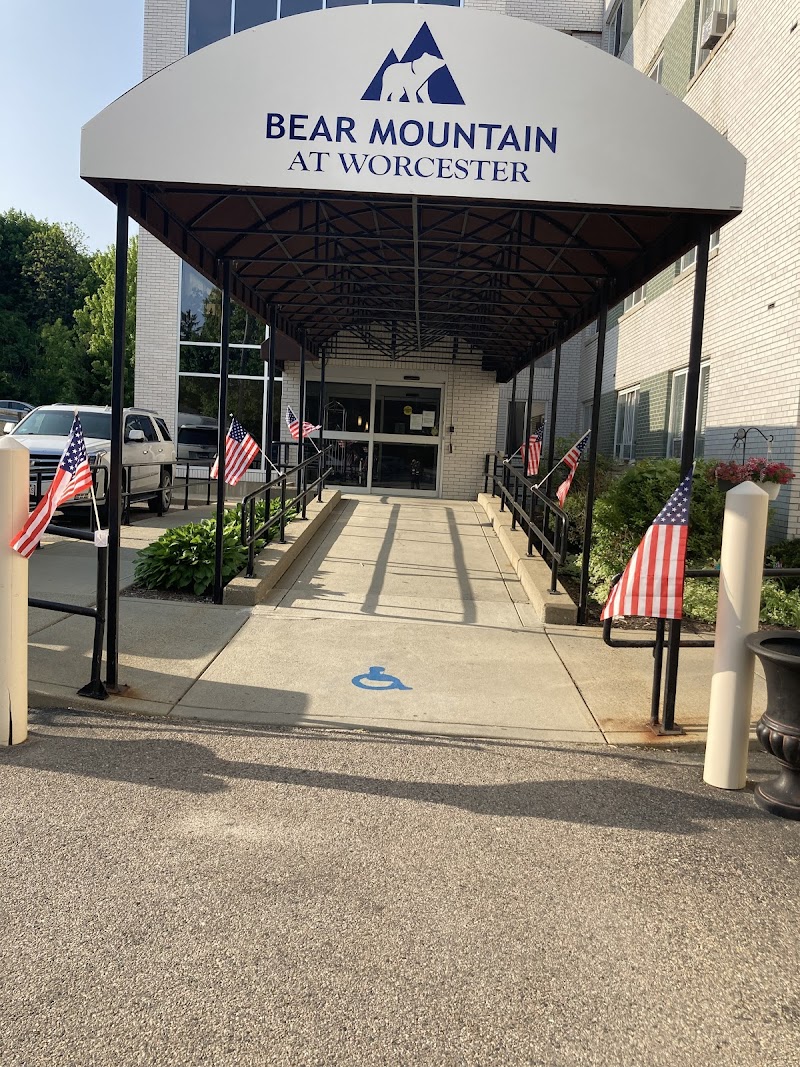
How is Bear Mountain At Worcester Staffed?

CMS rates BEAR MOUNTAIN AT WORCESTER's staffing level at 3 out of 5 stars, which is average compared to other nursing homes. Staff turnover is 27%, compared to the Massachusetts average of 46%. This relatively stable workforce can support continuity of care.

What Have Inspectors Found at Bear Mountain At Worcester?

State health inspectors documented 57 deficiencies at BEAR MOUNTAIN AT WORCESTER during 2022 to 2025. These included: 4 Immediate Jeopardy (the most serious level, indicating potential for serious harm or death), 3 that caused actual resident harm, 49 with potential for harm, and 1 minor or isolated issues. Immediate Jeopardy findings are rare and represent the most serious regulatory concerns. They require immediate corrective action.
Who Owns and Operates Bear Mountain At Worcester?

BEAR MOUNTAIN AT WORCESTER is owned by a for-profit company. For-profit facilities operate as businesses with obligations to shareholders or private owners. The facility is operated by BEAR MOUNTAIN HEALTHCARE, a chain that manages multiple nursing homes. With 173 certified beds and approximately 132 residents (about 76% occupancy), it is a mid-sized facility located in WORCESTER, Massachusetts.
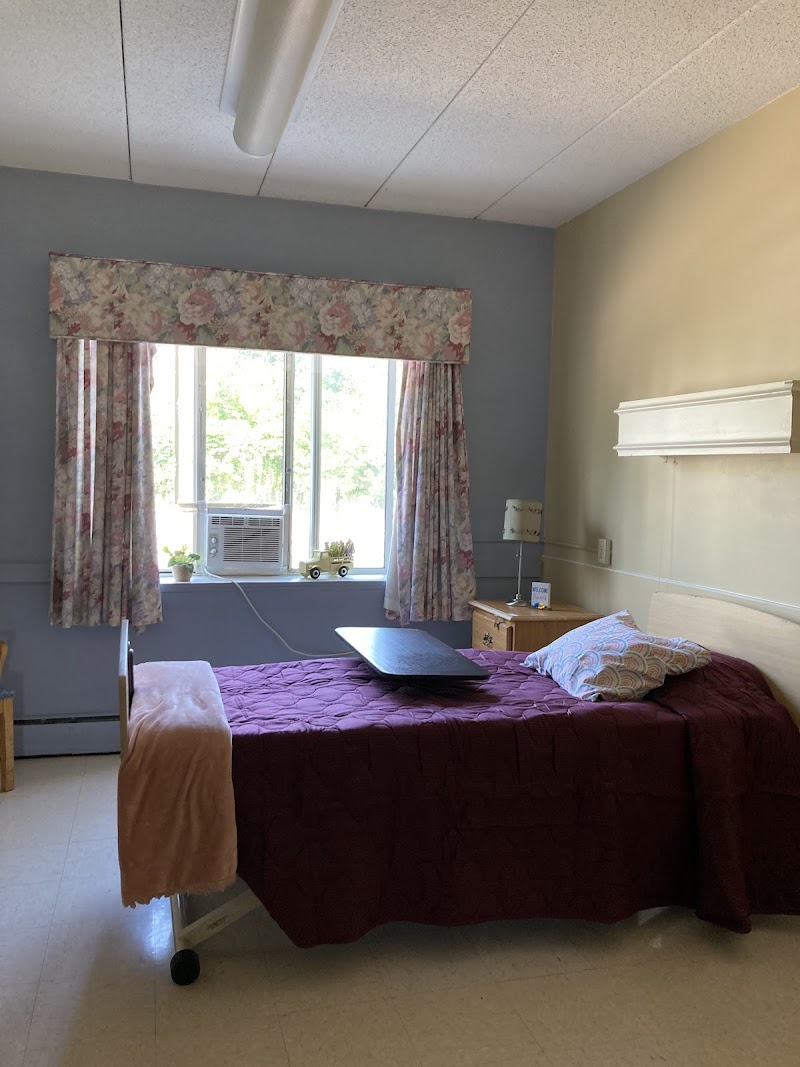
How Does Bear Mountain At Worcester Compare to Other Massachusetts Nursing Homes?

Compared to the 100 nursing homes in Massachusetts, BEAR MOUNTAIN AT WORCESTER's overall rating (1 stars) is below the state average of 2.9, staff turnover (27%) is significantly lower than the state average of 46%, and health inspection rating (1 stars) is much below the national benchmark.

What Should Families Ask When Visiting Bear Mountain At Worcester?

Based on this facility's data, families visiting should ask: "What changes have been made since the serious inspection findings, and how are you preventing similar issues?" "Can I visit during a mealtime to observe dining assistance and food quality?" "How do you handle medical emergencies, and what is your hospital transfer rate?" "Can I speak with family members of current residents about their experience?" These questions are particularly relevant given the facility's Immediate Jeopardy citations.

Is Bear Mountain At Worcester Safe?

Based on CMS inspection data, BEAR MOUNTAIN AT WORCESTER has documented safety concerns. Inspectors have issued 4 Immediate Jeopardy citations (the most serious violation level indicating risk of serious injury or death). The facility is currently on the Special Focus Facility watch list (a federal program monitoring the lowest-performing 1% of nursing homes nationwide). The facility has a 1-star overall rating and ranks #100 of 100 nursing homes in Massachusetts. Families considering this facility should ask detailed questions about what corrective actions have been taken since these incidents.

Do Nurses at Bear Mountain At Worcester Stick Around?

Staff at BEAR MOUNTAIN AT WORCESTER tend to stick around. With a turnover rate of 27%, the facility is 19 percentage points below the Massachusetts average of 46%. Low turnover is a positive sign. It means caregivers have time to learn each resident's needs, medications, and personal preferences. Consistent staff also notice subtle changes in a resident's condition more quickly.

Was Bear Mountain At Worcester Ever Fined?

BEAR MOUNTAIN AT WORCESTER has been fined $122,646 across 2 penalty actions. This is 3.6x the Massachusetts average of $34,305. Fines at this level are uncommon and typically indicate a pattern of serious deficiencies, repeated violations, or failure to correct problems promptly. CMS reserves penalties of this magnitude for facilities that pose significant, documented risk to resident health or safety. Families should request specific documentation of what issues led to these fines and what systemic changes have been implemented.

Is Bear Mountain At Worcester on Any Federal Watch List?

BEAR MOUNTAIN AT WORCESTER is currently an SFF Candidate, meaning CMS has identified it as potentially qualifying for the Special Focus Facility watch list. SFF Candidates have a history of serious deficiencies but haven't yet reached the threshold for full SFF designation. The facility is being monitored more closely — if problems continue, it may be added to the official watch list. Families should ask what the facility is doing to address the issues that led to this status.